EP2910940A1 - Composition of a poly ionic liquid and a metal compound for the detection of CO2 gas at low temperatures - Google Patents
Composition of a poly ionic liquid and a metal compound for the detection of CO2 gas at low temperatures Download PDFInfo
- Publication number
- EP2910940A1 EP2910940A1 EP14000587.7A EP14000587A EP2910940A1 EP 2910940 A1 EP2910940 A1 EP 2910940A1 EP 14000587 A EP14000587 A EP 14000587A EP 2910940 A1 EP2910940 A1 EP 2910940A1
- Authority
- EP
- European Patent Office
- Prior art keywords
- rare earth
- pil
- ionic liquid
- reoc
- oxycarbonate
- Prior art date
- Legal status (The legal status is an assumption and is not a legal conclusion. Google has not performed a legal analysis and makes no representation as to the accuracy of the status listed.)
- Withdrawn
Links
- 239000002608 ionic liquid Substances 0.000 title claims abstract description 124
- 150000002736 metal compounds Chemical class 0.000 title claims abstract description 101
- 229920000831 ionic polymer Polymers 0.000 title claims abstract description 75
- 239000000203 mixture Substances 0.000 title claims abstract description 74
- 238000001514 detection method Methods 0.000 title claims abstract description 13
- 239000000758 substrate Substances 0.000 claims abstract description 32
- 239000000725 suspension Substances 0.000 claims abstract description 31
- 238000000034 method Methods 0.000 claims abstract description 26
- 238000004519 manufacturing process Methods 0.000 claims abstract description 15
- 229910052761 rare earth metal Inorganic materials 0.000 claims description 141
- 150000002910 rare earth metals Chemical class 0.000 claims description 124
- -1 (p-vinylbenzyl)triethyl ammonium tetrafluoroborate Chemical compound 0.000 claims description 43
- WEVYAHXRMPXWCK-UHFFFAOYSA-N Acetonitrile Chemical compound CC#N WEVYAHXRMPXWCK-UHFFFAOYSA-N 0.000 claims description 28
- 229910052746 lanthanum Inorganic materials 0.000 claims description 24
- FZLIPJUXYLNCLC-UHFFFAOYSA-N lanthanum atom Chemical compound [La] FZLIPJUXYLNCLC-UHFFFAOYSA-N 0.000 claims description 24
- 239000002245 particle Substances 0.000 claims description 23
- 229910052751 metal Inorganic materials 0.000 claims description 20
- 239000002184 metal Substances 0.000 claims description 20
- 239000000463 material Substances 0.000 claims description 12
- 229920000642 polymer Polymers 0.000 claims description 10
- QGZKDVFQNNGYKY-UHFFFAOYSA-O Ammonium Chemical compound [NH4+] QGZKDVFQNNGYKY-UHFFFAOYSA-O 0.000 claims description 9
- 229910052779 Neodymium Inorganic materials 0.000 claims description 9
- QEFYFXOXNSNQGX-UHFFFAOYSA-N neodymium atom Chemical compound [Nd] QEFYFXOXNSNQGX-UHFFFAOYSA-N 0.000 claims description 9
- 229910052684 Cerium Inorganic materials 0.000 claims description 8
- 229910052777 Praseodymium Inorganic materials 0.000 claims description 8
- ZMIGMASIKSOYAM-UHFFFAOYSA-N cerium Chemical compound [Ce][Ce][Ce][Ce][Ce][Ce][Ce][Ce][Ce][Ce][Ce][Ce][Ce][Ce][Ce][Ce][Ce][Ce][Ce][Ce][Ce][Ce][Ce][Ce][Ce][Ce][Ce][Ce][Ce][Ce][Ce][Ce][Ce][Ce][Ce][Ce][Ce][Ce] ZMIGMASIKSOYAM-UHFFFAOYSA-N 0.000 claims description 8
- PUDIUYLPXJFUGB-UHFFFAOYSA-N praseodymium atom Chemical compound [Pr] PUDIUYLPXJFUGB-UHFFFAOYSA-N 0.000 claims description 8
- 238000005266 casting Methods 0.000 claims description 7
- 238000007641 inkjet printing Methods 0.000 claims description 7
- 229910044991 metal oxide Inorganic materials 0.000 claims description 7
- 150000004706 metal oxides Chemical class 0.000 claims description 7
- 238000007650 screen-printing Methods 0.000 claims description 7
- 239000002904 solvent Substances 0.000 claims description 7
- 238000004528 spin coating Methods 0.000 claims description 7
- 238000010345 tape casting Methods 0.000 claims description 7
- RAXXELZNTBOGNW-UHFFFAOYSA-O Imidazolium Chemical compound C1=C[NH+]=CN1 RAXXELZNTBOGNW-UHFFFAOYSA-O 0.000 claims description 6
- 150000002739 metals Chemical class 0.000 claims description 6
- XYFCBTPGUUZFHI-UHFFFAOYSA-O phosphonium Chemical compound [PH4+] XYFCBTPGUUZFHI-UHFFFAOYSA-O 0.000 claims description 6
- JUJWROOIHBZHMG-UHFFFAOYSA-O pyridinium Chemical compound C1=CC=[NH+]C=C1 JUJWROOIHBZHMG-UHFFFAOYSA-O 0.000 claims description 6
- BVKZGUZCCUSVTD-UHFFFAOYSA-L Carbonate Chemical compound [O-]C([O-])=O BVKZGUZCCUSVTD-UHFFFAOYSA-L 0.000 claims description 4
- 229910052688 Gadolinium Inorganic materials 0.000 claims description 4
- UIWYJDYFSGRHKR-UHFFFAOYSA-N gadolinium atom Chemical compound [Gd] UIWYJDYFSGRHKR-UHFFFAOYSA-N 0.000 claims description 4
- GYTMBPAYCGWVCX-UHFFFAOYSA-N (4-ethenylphenyl)methyl-trimethylazanium;trifluoromethanesulfonamide Chemical compound NS(=O)(=O)C(F)(F)F.C[N+](C)(C)CC1=CC=C(C=C)C=C1 GYTMBPAYCGWVCX-UHFFFAOYSA-N 0.000 claims description 3
- 239000004952 Polyamide Substances 0.000 claims description 3
- RWRDLPDLKQPQOW-UHFFFAOYSA-O Pyrrolidinium ion Chemical compound C1CC[NH2+]C1 RWRDLPDLKQPQOW-UHFFFAOYSA-O 0.000 claims description 3
- XUIMIQQOPSSXEZ-UHFFFAOYSA-N Silicon Chemical compound [Si] XUIMIQQOPSSXEZ-UHFFFAOYSA-N 0.000 claims description 3
- 235000004279 alanine Nutrition 0.000 claims description 3
- 239000000919 ceramic Substances 0.000 claims description 3
- 239000011521 glass Substances 0.000 claims description 3
- 239000000178 monomer Substances 0.000 claims description 3
- 229920002647 polyamide Polymers 0.000 claims description 3
- 229920002635 polyurethane Polymers 0.000 claims description 3
- 239000004814 polyurethane Substances 0.000 claims description 3
- 230000002441 reversible effect Effects 0.000 claims description 3
- 239000010980 sapphire Substances 0.000 claims description 3
- 229910052594 sapphire Inorganic materials 0.000 claims description 3
- RWSOTUBLDIXVET-UHFFFAOYSA-O sulfonium Chemical compound [SH3+] RWSOTUBLDIXVET-UHFFFAOYSA-O 0.000 claims description 3
- RXJKFRMDXUJTEX-UHFFFAOYSA-O triethylphosphanium Chemical compound CC[PH+](CC)CC RXJKFRMDXUJTEX-UHFFFAOYSA-O 0.000 claims description 3
- GETQZCLCWQTVFV-UHFFFAOYSA-N trimethylamine Chemical compound CN(C)C GETQZCLCWQTVFV-UHFFFAOYSA-N 0.000 claims description 3
- 229910052782 aluminium Inorganic materials 0.000 claims description 2
- XAGFODPZIPBFFR-UHFFFAOYSA-N aluminium Chemical compound [Al] XAGFODPZIPBFFR-UHFFFAOYSA-N 0.000 claims description 2
- 229910052747 lanthanoid Inorganic materials 0.000 claims description 2
- 150000002602 lanthanoids Chemical class 0.000 claims description 2
- 229910000000 metal hydroxide Inorganic materials 0.000 claims description 2
- 150000004692 metal hydroxides Chemical class 0.000 claims description 2
- QNAYBMKLOCPYGJ-REOHCLBHSA-N L-alanine Chemical compound C[C@H](N)C(O)=O QNAYBMKLOCPYGJ-REOHCLBHSA-N 0.000 claims 1
- 239000004411 aluminium Substances 0.000 claims 1
- OEYIOHPDSNJKLS-UHFFFAOYSA-N choline Chemical compound C[N+](C)(C)CCO OEYIOHPDSNJKLS-UHFFFAOYSA-N 0.000 claims 1
- 229960001231 choline Drugs 0.000 claims 1
- 239000002131 composite material Substances 0.000 abstract description 17
- CURLTUGMZLYLDI-UHFFFAOYSA-N Carbon dioxide Chemical compound O=C=O CURLTUGMZLYLDI-UHFFFAOYSA-N 0.000 description 108
- 229910002092 carbon dioxide Inorganic materials 0.000 description 103
- CJFGBCWGOQRURQ-UHFFFAOYSA-N ginsenoside Mc Natural products C1CC(C2(CCC3C(C)(C)C(O)CCC3(C)C2CC2O)C)(C)C2C1C(C)(CCC=C(C)C)OC(C(C(O)C1O)O)OC1COC1OC(CO)C(O)C1O CJFGBCWGOQRURQ-UHFFFAOYSA-N 0.000 description 55
- 150000001875 compounds Chemical class 0.000 description 39
- 239000002105 nanoparticle Substances 0.000 description 31
- 229910002226 La2O2 Inorganic materials 0.000 description 29
- 229910020854 La(OH)3 Inorganic materials 0.000 description 20
- 239000007789 gas Substances 0.000 description 17
- 230000003993 interaction Effects 0.000 description 11
- 238000001179 sorption measurement Methods 0.000 description 11
- 230000015572 biosynthetic process Effects 0.000 description 9
- MRELNEQAGSRDBK-UHFFFAOYSA-N lanthanum(3+);oxygen(2-) Chemical compound [O-2].[O-2].[O-2].[La+3].[La+3] MRELNEQAGSRDBK-UHFFFAOYSA-N 0.000 description 9
- 230000007423 decrease Effects 0.000 description 8
- 230000035945 sensitivity Effects 0.000 description 8
- 238000003786 synthesis reaction Methods 0.000 description 8
- CSCPPACGZOOCGX-UHFFFAOYSA-N Acetone Chemical compound CC(C)=O CSCPPACGZOOCGX-UHFFFAOYSA-N 0.000 description 7
- 230000008859 change Effects 0.000 description 7
- 238000011065 in-situ storage Methods 0.000 description 7
- 239000000126 substance Substances 0.000 description 7
- 238000002411 thermogravimetry Methods 0.000 description 7
- ZMXDDKWLCZADIW-UHFFFAOYSA-N N,N-Dimethylformamide Chemical compound CN(C)C=O ZMXDDKWLCZADIW-UHFFFAOYSA-N 0.000 description 6
- 238000006243 chemical reaction Methods 0.000 description 6
- 238000000634 powder X-ray diffraction Methods 0.000 description 6
- 230000008901 benefit Effects 0.000 description 5
- 239000001569 carbon dioxide Substances 0.000 description 5
- 230000008569 process Effects 0.000 description 5
- 230000002195 synergetic effect Effects 0.000 description 5
- 230000009466 transformation Effects 0.000 description 5
- KWOLFJPFCHCOCG-UHFFFAOYSA-N Acetophenone Chemical compound CC(=O)C1=CC=CC=C1 KWOLFJPFCHCOCG-UHFFFAOYSA-N 0.000 description 4
- 238000002441 X-ray diffraction Methods 0.000 description 4
- 230000001133 acceleration Effects 0.000 description 4
- 238000001453 impedance spectrum Methods 0.000 description 4
- 229910052698 phosphorus Inorganic materials 0.000 description 4
- 238000006116 polymerization reaction Methods 0.000 description 4
- 238000001878 scanning electron micrograph Methods 0.000 description 4
- 238000004626 scanning electron microscopy Methods 0.000 description 4
- 230000026683 transduction Effects 0.000 description 4
- 238000010361 transduction Methods 0.000 description 4
- 238000012546 transfer Methods 0.000 description 4
- LFQSCWFLJHTTHZ-UHFFFAOYSA-N Ethanol Chemical compound CCO LFQSCWFLJHTTHZ-UHFFFAOYSA-N 0.000 description 3
- 238000003917 TEM image Methods 0.000 description 3
- 238000010521 absorption reaction Methods 0.000 description 3
- 150000001768 cations Chemical class 0.000 description 3
- 239000006185 dispersion Substances 0.000 description 3
- 238000000157 electrochemical-induced impedance spectroscopy Methods 0.000 description 3
- 239000011159 matrix material Substances 0.000 description 3
- 238000005259 measurement Methods 0.000 description 3
- 230000006911 nucleation Effects 0.000 description 3
- 238000010899 nucleation Methods 0.000 description 3
- KTUFCUMIWABKDW-UHFFFAOYSA-N oxo(oxolanthaniooxy)lanthanum Chemical compound O=[La]O[La]=O KTUFCUMIWABKDW-UHFFFAOYSA-N 0.000 description 3
- 235000015047 pilsener Nutrition 0.000 description 3
- 239000000843 powder Substances 0.000 description 3
- 241000894007 species Species 0.000 description 3
- IJGRMHOSHXDMSA-UHFFFAOYSA-N Atomic nitrogen Chemical compound N#N IJGRMHOSHXDMSA-UHFFFAOYSA-N 0.000 description 2
- KFZMGEQAYNKOFK-UHFFFAOYSA-N Isopropanol Chemical compound CC(C)O KFZMGEQAYNKOFK-UHFFFAOYSA-N 0.000 description 2
- 150000001295 alanines Chemical class 0.000 description 2
- PNEYBMLMFCGWSK-UHFFFAOYSA-N aluminium oxide Inorganic materials [O-2].[O-2].[O-2].[Al+3].[Al+3] PNEYBMLMFCGWSK-UHFFFAOYSA-N 0.000 description 2
- 238000013459 approach Methods 0.000 description 2
- 150000004649 carbonic acid derivatives Chemical class 0.000 description 2
- 229910000420 cerium oxide Inorganic materials 0.000 description 2
- 229910052729 chemical element Inorganic materials 0.000 description 2
- 239000010949 copper Substances 0.000 description 2
- 230000001419 dependent effect Effects 0.000 description 2
- 238000011161 development Methods 0.000 description 2
- 238000009792 diffusion process Methods 0.000 description 2
- 230000000694 effects Effects 0.000 description 2
- 238000002362 energy-dispersive X-ray chemical map Methods 0.000 description 2
- 238000002474 experimental method Methods 0.000 description 2
- 238000002173 high-resolution transmission electron microscopy Methods 0.000 description 2
- 238000002847 impedance measurement Methods 0.000 description 2
- 238000001566 impedance spectroscopy Methods 0.000 description 2
- 230000007774 longterm Effects 0.000 description 2
- 238000002156 mixing Methods 0.000 description 2
- 238000012986 modification Methods 0.000 description 2
- 230000004048 modification Effects 0.000 description 2
- 239000003960 organic solvent Substances 0.000 description 2
- 230000001590 oxidative effect Effects 0.000 description 2
- BMMGVYCKOGBVEV-UHFFFAOYSA-N oxo(oxoceriooxy)cerium Chemical compound [Ce]=O.O=[Ce]=O BMMGVYCKOGBVEV-UHFFFAOYSA-N 0.000 description 2
- 239000002243 precursor Substances 0.000 description 2
- 229910001404 rare earth metal oxide Inorganic materials 0.000 description 2
- 239000007787 solid Substances 0.000 description 2
- 238000004627 transmission electron microscopy Methods 0.000 description 2
- ZMANZCXQSJIPKH-UHFFFAOYSA-O triethylammonium ion Chemical compound CC[NH+](CC)CC ZMANZCXQSJIPKH-UHFFFAOYSA-O 0.000 description 2
- 235000008979 vitamin B4 Nutrition 0.000 description 2
- XLYOFNOQVPJJNP-UHFFFAOYSA-N water Substances O XLYOFNOQVPJJNP-UHFFFAOYSA-N 0.000 description 2
- OKTJSMMVPCPJKN-UHFFFAOYSA-N Carbon Chemical compound [C] OKTJSMMVPCPJKN-UHFFFAOYSA-N 0.000 description 1
- 241001503987 Clematis vitalba Species 0.000 description 1
- RYGMFSIKBFXOCR-UHFFFAOYSA-N Copper Chemical compound [Cu] RYGMFSIKBFXOCR-UHFFFAOYSA-N 0.000 description 1
- 206010014561 Emphysema Diseases 0.000 description 1
- 238000005033 Fourier transform infrared spectroscopy Methods 0.000 description 1
- 238000001157 Fourier transform infrared spectrum Methods 0.000 description 1
- 229910052766 Lawrencium Inorganic materials 0.000 description 1
- 229910052765 Lutetium Inorganic materials 0.000 description 1
- MWUXSHHQAYIFBG-UHFFFAOYSA-N Nitric oxide Chemical class O=[N] MWUXSHHQAYIFBG-UHFFFAOYSA-N 0.000 description 1
- 239000004793 Polystyrene Substances 0.000 description 1
- 229910052767 actinium Inorganic materials 0.000 description 1
- QQINRWTZWGJFDB-UHFFFAOYSA-N actinium atom Chemical compound [Ac] QQINRWTZWGJFDB-UHFFFAOYSA-N 0.000 description 1
- 150000001298 alcohols Chemical group 0.000 description 1
- 239000003513 alkali Substances 0.000 description 1
- 238000004873 anchoring Methods 0.000 description 1
- 150000001449 anionic compounds Chemical class 0.000 description 1
- 150000001450 anions Chemical class 0.000 description 1
- 239000003125 aqueous solvent Substances 0.000 description 1
- 239000012300 argon atmosphere Substances 0.000 description 1
- 235000013361 beverage Nutrition 0.000 description 1
- 230000037396 body weight Effects 0.000 description 1
- 238000001354 calcination Methods 0.000 description 1
- 229910052799 carbon Inorganic materials 0.000 description 1
- 239000012159 carrier gas Substances 0.000 description 1
- 238000005119 centrifugation Methods 0.000 description 1
- 238000012512 characterization method Methods 0.000 description 1
- 229920001940 conductive polymer Polymers 0.000 description 1
- 229910052802 copper Inorganic materials 0.000 description 1
- 229910052593 corundum Inorganic materials 0.000 description 1
- 238000003795 desorption Methods 0.000 description 1
- 238000003618 dip coating Methods 0.000 description 1
- 238000009826 distribution Methods 0.000 description 1
- 238000005516 engineering process Methods 0.000 description 1
- 238000011066 ex-situ storage Methods 0.000 description 1
- 230000002349 favourable effect Effects 0.000 description 1
- 238000007429 general method Methods 0.000 description 1
- 238000010438 heat treatment Methods 0.000 description 1
- XLYOFNOQVPJJNP-UHFFFAOYSA-M hydroxide Chemical compound [OH-] XLYOFNOQVPJJNP-UHFFFAOYSA-M 0.000 description 1
- 238000003384 imaging method Methods 0.000 description 1
- 229910001412 inorganic anion Inorganic materials 0.000 description 1
- 230000002427 irreversible effect Effects 0.000 description 1
- 150000002576 ketones Chemical class 0.000 description 1
- SORGMJIXNUWMMR-UHFFFAOYSA-N lanthanum(3+);propan-2-olate Chemical compound [La+3].CC(C)[O-].CC(C)[O-].CC(C)[O-] SORGMJIXNUWMMR-UHFFFAOYSA-N 0.000 description 1
- CNQCVBJFEGMYDW-UHFFFAOYSA-N lawrencium atom Chemical compound [Lr] CNQCVBJFEGMYDW-UHFFFAOYSA-N 0.000 description 1
- OHSVLFRHMCKCQY-UHFFFAOYSA-N lutetium atom Chemical compound [Lu] OHSVLFRHMCKCQY-UHFFFAOYSA-N 0.000 description 1
- 239000011817 metal compound particle Substances 0.000 description 1
- 229910021645 metal ion Inorganic materials 0.000 description 1
- 238000012544 monitoring process Methods 0.000 description 1
- 239000002114 nanocomposite Substances 0.000 description 1
- 229910052757 nitrogen Inorganic materials 0.000 description 1
- 229910052755 nonmetal Inorganic materials 0.000 description 1
- 230000003287 optical effect Effects 0.000 description 1
- 238000005457 optimization Methods 0.000 description 1
- 230000037361 pathway Effects 0.000 description 1
- 238000005325 percolation Methods 0.000 description 1
- 229920000128 polypyrrole Polymers 0.000 description 1
- 229920002223 polystyrene Polymers 0.000 description 1
- 239000011148 porous material Substances 0.000 description 1
- 239000002244 precipitate Substances 0.000 description 1
- 238000004094 preconcentration Methods 0.000 description 1
- 238000012545 processing Methods 0.000 description 1
- 230000005855 radiation Effects 0.000 description 1
- 230000035484 reaction time Effects 0.000 description 1
- 230000009257 reactivity Effects 0.000 description 1
- 230000009467 reduction Effects 0.000 description 1
- 238000011160 research Methods 0.000 description 1
- 230000004044 response Effects 0.000 description 1
- 150000003839 salts Chemical class 0.000 description 1
- 229910052706 scandium Inorganic materials 0.000 description 1
- SIXSYDAISGFNSX-UHFFFAOYSA-N scandium atom Chemical compound [Sc] SIXSYDAISGFNSX-UHFFFAOYSA-N 0.000 description 1
- 238000000527 sonication Methods 0.000 description 1
- 238000004611 spectroscopical analysis Methods 0.000 description 1
- 230000003068 static effect Effects 0.000 description 1
- 125000001424 substituent group Chemical group 0.000 description 1
- 230000009044 synergistic interaction Effects 0.000 description 1
- 125000005207 tetraalkylammonium group Chemical group 0.000 description 1
- 238000007669 thermal treatment Methods 0.000 description 1
- 230000002463 transducing effect Effects 0.000 description 1
- 238000005406 washing Methods 0.000 description 1
- 229910001845 yogo sapphire Inorganic materials 0.000 description 1
- 229910052727 yttrium Inorganic materials 0.000 description 1
- VWQVUPCCIRVNHF-UHFFFAOYSA-N yttrium atom Chemical compound [Y] VWQVUPCCIRVNHF-UHFFFAOYSA-N 0.000 description 1
Images






Classifications
-
- G—PHYSICS
- G01—MEASURING; TESTING
- G01N—INVESTIGATING OR ANALYSING MATERIALS BY DETERMINING THEIR CHEMICAL OR PHYSICAL PROPERTIES
- G01N27/00—Investigating or analysing materials by the use of electric, electrochemical, or magnetic means
- G01N27/02—Investigating or analysing materials by the use of electric, electrochemical, or magnetic means by investigating impedance
- G01N27/04—Investigating or analysing materials by the use of electric, electrochemical, or magnetic means by investigating impedance by investigating resistance
- G01N27/12—Investigating or analysing materials by the use of electric, electrochemical, or magnetic means by investigating impedance by investigating resistance of a solid body in dependence upon absorption of a fluid; of a solid body in dependence upon reaction with a fluid, for detecting components in the fluid
- G01N27/125—Composition of the body, e.g. the composition of its sensitive layer
- G01N27/127—Composition of the body, e.g. the composition of its sensitive layer comprising nanoparticles
-
- G—PHYSICS
- G01—MEASURING; TESTING
- G01N—INVESTIGATING OR ANALYSING MATERIALS BY DETERMINING THEIR CHEMICAL OR PHYSICAL PROPERTIES
- G01N33/00—Investigating or analysing materials by specific methods not covered by groups G01N1/00 - G01N31/00
- G01N33/0004—Gaseous mixtures, e.g. polluted air
- G01N33/0009—General constructional details of gas analysers, e.g. portable test equipment
- G01N33/0027—General constructional details of gas analysers, e.g. portable test equipment concerning the detector
- G01N33/0036—General constructional details of gas analysers, e.g. portable test equipment concerning the detector specially adapted to detect a particular component
- G01N33/004—CO or CO2
Definitions
- the present invention relates to composites of poly ionic liquids and metal compounds in particular for low temperature CO 2 gas detecting, a solution or a suspension comprising said composition, a substrate comprising said composition, a use of said composition for CO 2 detection or in a CO 2 sensor or a use of said suspension or solution in a method for manufacturing a CO 2 sensor.
- the invention further comprises a CO 2 sensor comprising said composition and a method for detecting CO 2 .
- Miniaturization is one of the main issues but also a driving force in the research development as well as fabrication of electronic devices. This is also valid for CO 2 sensors, which are used in a wide extent of applications ranging from air quality monitoring in motors and in buildings to factories of the beverage industry. Additionally, to those established markets, the need for control of carbon dioxide concentration in breath for instance of a scuba diver, Himalaya climber or emphysema patient is driving the development of CO 2 sensors that are portable.
- the problem of the invention is to develop a composition usable in a CO 2 sensor working at ambient temperature, which can be easily miniaturized and has moderate production costs and has no cross-sensitivity to reducing or oxidizing gases like CO, H 2 or NO x (mono-nitrogen oxides).
- composition according to claim 1 a suspension or solution according to claim 8
- substrate according to claim 11 a CO 2 sensor according to claim 15.
- the invention relates to a composition, in particular a composition for CO 2 detecting, comprising at least one metal compound MC, in particular a rare earth compound REC, more particularly a rare earth oxycarbonate REOC, and a poly ionic liquid PIL.
- the invention relates to a suspension or solution comprising a composition according to the first aspect of the invention.
- the invention relates to a substrate comprising a composition according to the first aspect of the invention, wherein on said substrate said at least one metal compound MC, in particular said at least one rare earth compound REC, more particularly said at least one rare earth oxycarbonate REOC and said poly ionic liquid PIL are deployed, wherein in particular said substrate is selected from a rigid material, such as ceramic, alumina (Al 2 O 3 ), sapphire, silicium or glass or flexible material such as polyamide or polyurethane.
- a rigid material such as ceramic, alumina (Al 2 O 3 ), sapphire, silicium or glass or flexible material such as polyamide or polyurethane.
- the invention relates to the use of the composition according to the first aspect of the invention or the use of a substrate according to the third aspect of the invention for CO 2 detection.
- the invention relates to the use of a composition according to the first aspect of the invention or the use of substrate according to the third aspect the invention in a CO 2 sensor.
- the invention relates to the use of a suspension or solution according to the second aspect of the invention in screen printing, drop casting, tape casting, spin casting or ink jet printing methods, in particular in screen printing, drop casting, tape casting, spin casting or ink jet printing methods for manufacturing a CO 2 sensor.
- the invention relates to a CO 2 sensor comprising a composition according to the first aspect of the invention or a substrate according to the third aspect of the invention or a CO 2 sensor manufactured by use of the suspension or solution according to the second aspect of the invention.
- the invention relates to a method for CO 2 detection comprising a CO 2 sensor according to the seventh aspect of the invention.
- metal compound refers to a compound comprising a metal element and a non-metal moiety (“counterpart”) such as an oxide, a hydroxide, a carbonate or an oxycarbonate and the mixture of thereof.
- the metal compound may comprise a covalent or ionic structure.
- actinoides refers to the metallic chemical elements with atomic numbers from 89 to 103 (actinium to lawrencium).
- lanthanoides refers to the metallic chemical elements with atomic numbers from 57 to 71 (lanthanum to lutetium).
- rare earth metal refers to the lanthanoides plus scandium and yttrium.
- the first aspect of the invention relates to a composition, in particular for CO 2 detection, comprising a metal compound MC and poly ionic liquid PIL.
- the metal compound MC comprises chemo-resistive properties in particular chemo-resistive properties selective to CO 2 .
- Compositions comprising chemo-resistive properties comprise an increase or decrease of resistant when subjected to a gas or a gas-mixture. The contact with the gas or the gas-mixture has a direct influence on the conductivity of the material and, thus, leading to a change in the resistance, which can be measured. The change of the resistance correlates with the concentration of the gas or gas-mixture, which is to be measured.
- the metal compound MC comprises chemo-capacitive properties in particular chemo-capacitive properties selective to CO 2 .
- Compositions comprising chemo-capacitive properties comprise an increase or decrease of capacitance when subjected to a gas or a gas-mixture. The contact with the gas or the gas-mixture has a direct influence on the capacity of the material and, thus, leading to a change in the capacitance, which can be measured. The change of the capacitance correlates with the concentration of the gas or gas-mixture, which is to be measured
- the metal of said metal compound MC is selected from rare earth metals, metals from the group of lanthanides or metals from the group of actinoides, and/or the metal compound MC is selected from a metal hydroxide, metal carbonate, metal oxide or metal oxycarbonate or mixture thereof.
- said metal compound MC may comprise at least two metal compounds MC, wherein the metal compounds MC may comprise the same metal but different counterparts such as oxide or oxycarbonate (e.g. a lanthanum oxide and a lanthanum oxycarbonate). Said metal compound MC may also comprise at least two metal compounds MC, wherein the metals may be different but the counterparts are the same (e.g. a lanthanum oxide and a cerium oxide). Furthermore, said metal compound MC may comprise at least two metal compounds MC, wherein the metals and the counterparts may be different (e.g. a lanthanum oxycarbonate and a cerium oxide).
- oxide or oxycarbonate e.g. a lanthanum oxide and a lanthanum oxycarbonate
- Said metal compound MC may also comprise at least two metal compounds MC, wherein the metals may be different but the counterparts are the same (e.g. a lanthanum oxide and a cerium oxide).
- the metal compound MC is selected from a metal oxide or a metal oxycarbonate.
- the metal compound MC is a metal oxycarbonate.
- said metal compound MC is a rare earth compound REC.
- the metal of said metal compound MC is a rare earth metal REC, wherein said rare earth metal REC is selected from a rare earth metal hydroxide, a rare earth metal carbonate, a rare earth metal oxide or a rare earth metal oxycarbonate, in particular from a rare earth metal oxide or a rare earth metal oxycarbonate, more particularly a rare earth metal oxycarbonate.
- said metal compound MC is a rare earth compound REC, wherein the rare earth metal of said rare earth compound REC is selected from lanthanum, cerium, neodymium, praseodymium or gadolinium.
- said metal compound MC is a rare earth compound REC, wherein the rare earth metal of said rare earth compound REC is selected from lanthanum, cerium, neodymium or praseodymium.
- said metal MC is a rare earth compound REC, wherein the rare earth metal of said rare earth compound REC is lanthanum.
- said metal compound MC is a rare earth oxycarbonate REOC.
- said metal compound MC is a rare earth oxycarbonate REOC, wherein the rare earth metal of said rare earth oxycarbonate REOC is selected from lanthanum, cerium, neodymium, praseodymium or gadolinium.
- said metal compound MC is a rare earth oxycarbonate REOC, wherein the rare earth metal of said rare earth oxycarbonate REOC is selected from lanthanum, cerium, neodymium or praseodymium.
- said metal compound MC is a rare earth oxycarbonate REOC, wherein the rare earth metal of said rare earth oxycarbonate REOC is lanthanum.
- said metal compound MC is a rare earth oxycarbonate REOC.
- PIL refers to a special type of polyelectrolates which carry an ionic liquid species in each of the repeating unit. They combine properties of ionic liquids and the flexibility of polymers.
- the poly ionic liquid PIL comprises a, in particular reversible, CO 2 capturing capacity.
- the poly ionic liquid PIL is selected from polymers of pyrrolidinium based ionic liquids, sulfonium based ionic liquids, alanines based ionic liquids, cholines based ionic liquids, acetonitrile based ionic liquids, ammonium based ionic liquids, pyridinium based ionic liquids, imidazolium based ionic liquids or phosphonium ionic liquids or the poly ionic liquid PIL comprises a mixture of the before mentioned.
- the poly ionic liquid PIL is selected from polymers of ammonium based ionic liquids, pyridinium based ionic liquids, imidazolium based ionic liquids or phosphonium ionic liquids.
- the poly ionic liquid PIL is selected from polymers of ammonium based ionic liquids. Tetraalkylammonium-based PIL show superior CO 2 sorption capacities, thus, these PIL are preferred candidates for application in CO 2 gas sensors.
- the poly ionic liquid PIL is selected from p-vinylbenzyl)triethyl ammonium tetrafluoroborate P[VBTEA][BF 4 ], 1-(p-vinylbenzyl)pyridinium tetrafluoroborate P[VBP][BF 4 ], (p-vinylbenzyl)trimethyl ammonium hexafluorophosphate P[VBTMA][PF 6 ], 2-(methacryloyloxy) ethyltrimethylamnonium tetrafluoroborate P(MATMA][BF 4 ], (p-vinylbenzyl)trimethyl ammonium trifluoromethane sulfonamide P[VBTMA][Tf 2 N]; p-vinylbenzyl)trimethyl ammonium tetrafluoroborate P[VBTMA][BF 4 ], 1-(p-vinylbenzyl)-3-methyl-imidazolium
- the poly ionic liquid PIL comprises a mixture of the poly ionic liquids PIL defined in the previous paragraph.
- the poly ionic liquid is (P-venylbenzyl) trimethylammoniumhexaflurophosphat P[VBTMA][PF 6 ].
- the poly ionic liquid P[VBTMA][PF 6 ] has a polystyrene backbone, an inorganic anion and a small substituent on the cation side and a high CO 2 sorption capacity.
- Poly ionic liquids P[VBTMA][Tf 2 N) comprising a mesoporous P[VBTMA][Tf 2 N) networks show significantly faster CO 2 adsorption than its bulk counterparts (see Tang, J. B.; Shen, Y. Q.; Radosz, M.; Sun, W. L. Isothermal Carbon Dioxide Sorption in Poly(ionic liquid)s Ind. Eng. Chem. Res. 2009, 48, (20), 9193-9118 ).
- the compositions comprises as said metal compound MC a rare earth oxycarbonate REOC, wherein in particular the rare earth metal of said rare earth oxycarbonate REOC is selected from lanthanum, cerium, neodymium, praseodymium or gadolinium, in particular from lanthanum, cerium, neodymium or praseodymium, more particularly the rare earth metal of said rare earth oxycarbonate REOC is lanthanum and
- composition of the invention comprises metal compounds, in particular rare earth compounds, more particular rare earth oxycarbonates, and a poly ionic liquid, which are interacting with each other.
- PIL poly ionic liquids
- PIL are solid polymeric materials, which are generally prepared via polymerization of either the cation or the anion species of the respective ionic liquid.
- An ionic liquid on the other hand is composed of two species with opposed charges. PIL have been shown to selectively absorb CO 2 in large amounts.
- a composite comprising metal compounds MC, in particular rare earth compounds REC, more particularly rare earth oxycarbonates REOC and poly ionic liquids PIL are not known in the art.
- Such composites allow the provision of a material for detection of CO 2 , which can readily miniaturized and the provision of a CO 2 sensor which may be operated at a temperature range between room temperature and 200 °C. Such a working temperature has a significant advantage in comparison to known CO 2 sensors.
- composition of the invention comprises further an excellent thermal and chemical stability together with a good flexibility.
- the poly ionic liquid PIL in a composition according to the invention selectively absorbs CO 2 and increase the probability for a CO 2 interaction with the particles of the metal compound MC, in particular the rare earth compound REC, more particularly the rare earth oxycarbonate REOC.
- the pre-concentration is crucial for operation at room temperature because it increases the efficiency of the CO 2 interaction.
- the metal compound MC in particular the rare earth compound REC, more particularly the rare earth oxycarbonate REOC of the composition according to the invention works as an electronic transduction element in which the particles are transducing the chemical information into an electric signal.
- the polymeric phase PIL selectively absorbs CO 2 while the metal compound MC, in particular the rare earth compound REC, more particularly the rare earth oxycarbonate REOC, change their electric properties upon contact with CO 2 .
- the CO 2 absorption and adsorption properties of the PIL amplify the reactivity toward CO 2 with the metal compound MC, in particular the rare earth compound REC, more particularly the rare earth oxycarbonate REOC at room temperature.
- composition according to the invention comprises a synergistic effect.
- the inventors believe, without being bound by this theory that the synergistic effect arises from anchoring the poly ionic liquids PIL at the surface of the particles, for example in case of using a rare earth oxycarbonate and an ammonium based PI L, through interaction between strongly electropositive metal ions of the metal compound MC and cations of the PIL.
- PI L nor the MC, in particular the REOC-film itself is having measurable resistance ( ⁇ 20 GOhms) at room temperature.
- the resistivity of the films dramatically decreases, as it is revealed by EIS measurements shown in Fig. 15 . It has to deal with charge transfer between PIL and the surface of nanoparticles. At a certain percolation level the interaction between the PIL and MC, in particular REOC, are governing the electrical characteristic of the films.
- Fig. 10 to 18 show an example of the effect of one composition of the invention, namely lanthanum oxycarbonate (LOC) and P[VBTMA][PF 6 ].
- LOC lanthanum oxycarbonate
- P[VBTMA][PF 6 ] PF 6
- the chemo-resistive principle was tested providing new insight into this type of sensing.
- the findings from both resistance and impedance measurements attest the validity to use such composite systems in CO 2 sensing.
- the sensor signal clearly shows sensitivity to CO 2 .
- composition of the invention shows a synergistic effect, which is depicted in Fig. 15 and Fig. 20 .
- Fig. 15 the electrical properties of La 2 O 2 CO 3 P[VBTMA][PF 6 ] composites are shown.
- the impedance spectroscopy visualized the synergistic influence of La 2 O 2 CO 3 /P[VBTMA)[PF 6 ] on the electrical properties of the composites by comparing the La 2 O 2 CO 3 /P[VBTMA)[PF 6 ] composite and its individual components La 2 O 2 CO 3 and P[VBTMA)[PF 6 ].
- impedance of the La 2 O 2 CO 3 /P[VBTMA)[PF 6 ] sensor is lower than that of La 2 O 2 CO 3 sensor and much lower than the one of the polymer itself.
- the presence of the semicircle at high frequencies (50 Hz - 2 MHz) suggests that in comparison with the individual components, there is an additional charge transfer at the organic/inorganic interface.
- the organic-inorganic interface formation is lowering of the resistivity also at DC (50 Hz) that makes the resistive readout feasible.
- the ratio of said metal compound MC, in particular said rare earth compound REC, more particularly said rare earth oxycarbonate REOC, to said poly ionic liquid PIL is in the range of 1 wt% to 99 wt% of said metal compound MC, in particular said rare earth compound REC, more particularly said rare earth oxycarbonate REOC, to 99 wt% to 1 wt% of said poly ionic liquid PIL.
- the ratio of said metal compound MC, in particular said rare earth compound REC, more particularly said rare earth oxycarbonate REOC, to said poly ionic liquid PIL is in the range of 80 wt% to 20 wt% of said of said metal compound MC, in particular said rare earth compound REC, more particularly said rare earth oxycarbonate REOC, to 20 wt% to 80 wt% of said poly ionic liquid PIL.
- the ratio of said metal compound MC, in particular said rare earth compound REC, more particularly said rare earth oxycarbonate REOC, to said poly ionic liquid PIL is in the range of 80 wt% to 50 wt% of said of said metal compound MC, in particular of said rare earth oxycarbonate REOC, to 50 wt% to 20 wt% of said poly ionic liquid PIL.
- the ratio of said metal compound MC, in particular said rare earth compound REC, more particularly said rare earth oxycarbonate REOC, to said poly ionic liquid PIL is in the range of 50 wt% to 20 wt% of said of said metal compound MC, in particular of said rare earth oxycarbonate REOC, to 50 wt% to 80 wt% of said poly ionic liquid PIL.
- the ratio of said metal compound MC, in particular said rare earth compound REC, more particularly said rare earth oxycarbonate REOC, to said poly ionic liquid PIL is in the range of 80 wt% to 60 wt% of said of said metal compound MC, in particular of said rare earth oxycarbonate REOC, to 40 wt% to 20 wt% of said poly ionic liquid PIL.
- the ratio of said metal compound MC, in particular said rare earth compound REC, more particularly said rare earth oxycarbonate REOC, to said poly ionic liquid PIL is in the range of 40 wt% to 20 wt% of said of said metal compound MC, in particular of said rare earth oxycarbonate REOC, to 60 wt% to 80 wt% of said poly ionic liquid PIL.
- the ratio of said metal compound MC, in particular said rare earth compound REC, more particularly said rare earth oxycarbonate REOC, to said poly ionic liquid PIL is essentially 70 wt% of said of said metal compound MC, in particular of said rare earth oxycarbonate REOC, to 30 wt% of said poly ionic liquid PIL.
- said poly ionic liquid PIL comprises a porous structure, in particular a mesoporous structure.
- said poly ionic liquid PIL comprises a porosity in the range of 2 to 50 nm, in particular in the range of 2 to 20 nm.
- said metal compound MC in particular said rare earth compound REC, more particularly said rare earth oxycarbonate REOC comprises particles with a diameter in the range smaller than 200 nm, in particular smaller than 100 nm, more particularly smaller than 20 nm. This is because the smaller the size of nanoparticle, the higher is the surface area of interaction between REOC and PIL.
- the composition comprises additionally nanoparticles of a further metal compound MC, in particular a further rare earth compound REC, more particularly a further rare earth oxycarbonate REOC, wherein the further metal compound MC, in particular the further rare earth compound REC, more particularly the further rare earth oxycarbonate REOC comprise the same properties as discussed above concerning the first aspect of the invention.
- a second aspect of the invention relates to a suspension or solution comprising a composition according to the first aspect of the invention.
- said metal compound MC in particular said rare earth compound REC, more particularly said rare earth oxycarbonate REOC, and said poly ionic liquid PIL are present in the suspension or solution in form of separate particles consisting of said metal compound MC, in particular said rare earth compound REC, more particularly said rare earth oxycarbonate REOC, or said poly ionic liquid PIL
- said metal compound MC in particular said rare earth compound REC, more particularly said rare earth oxycarbonate REOC, and said poly ionic liquid PIL are present in the suspension or solution in form of particles consisting of a metal compound MC center, in particular a rare earth compound REC center, more particularly a rare earth oxycarbonate REOC center, and a poly ionic liquid PIL casing, which may partially or completely enclose the center, providing mixed particles in the suspension or solution.
- said metal compound MC, in particular said rare earth compound REC, more particularly said rare earth oxycarbonate REOC, of the suspension or solution comprise a diameter in the range of 2 to 200 nm, in particular in the range of 2 to 100 nm, more particularly in the range of 2 to 50 nm, further more in the range of 2 to 20 nm, and said poly ionic liquid PIL particles of the suspension or solution
- said metal compound MC, in particular said rare earth compound REC, more particularly said rare earth oxycarbonate REOC, of the suspension or solution comprises a diameter in the range of 2 to 20 nm, and said poly ionic liquid PIL particles are completely dissolved in the solvent of the solution or suspension. In order avoid clogging, the smaller particles are favorable.
- the suspension or solution comprises an organic solvent, water or a mixture thereof, wherein the organic solvent is selected from alcohols, ketones, acetonitrile or a mixture thereof, wherein in particular said solvent is selected from water, ethanol, acetone, isopropanol, acetonitrile or a mixture thereof.
- the suspension or solution comprises a viscosity of 1 to 25 mpascal*s.
- a third aspect of the invention relates to a substrate comprising a composition according the first aspect of the invention, wherein on said substrate said metal compound MC, in particular said rare earth compound REC, more particularly said rare earth oxycarbonate REOC, and said poly ionic liquid PIL are deployed, wherein in particular said substrate is selected from a rigid material, such as ceramic, aluminum, sapphire, silicium or glass or a flexible material, such as polyamide or polyurethane.
- said substrate comprises a mixture of said metal compound MC, in particular said rare earth compound REC, more particularly said rare earth oxycarbonate REOC, and said poly ionic liquid PIL (see Fig. 1 ).
- said substrate comprises a layer of said metal compound MC, in particular a layer of said rare earth compound REC, more particularly a layer of said rare earth oxycarbonate REOC, and a layer of said poly ionic liquid PIL deposited on said a layer of metal compound MC, in particular said a layer of rare earth compound REC, more particularly said a layer of rare earth oxycarbonate REOC, layer.
- said substrate comprises a layer of said poly ionic liquid PIL and a layer of said metal compound MC, in particular a layer of said rare earth compound REC, more particularly a layer of said rare earth oxycarbonate REOC, deposited on said poly ionic liquid PIL layer.
- a fourth aspect of the invention relates to a use of the composition according to the first aspect of the invention or a substrate according to the third aspect of the invention for CO 2 detection.
- a fifth aspect of the invention relates to a use of the composition according to the first aspect of the invention or a substrate according to the third aspect of the invention in a CO 2 sensor.
- the composites bring to bear the affinity of PIL and MC to interact with CO 2 . Nevertheless, the main advantage is that interaction of PIL with MC dramatically changes the electrical properties of composites. This is decisive for the transduction of chemical information into electrical signal and thus for the application as a CO 2 sensor.
- a sixth aspect of the invention relates to a use of the suspension or solution according to the second aspect of the invention in screen printing, drop casting, tape casting, spin casting or ink-jet printing methods.
- a seventh aspect of the invention relates to a use of the suspension or solution according to the second aspect of the invention in screen printing, drop casting, tape casting, spin casting or ink-jet printing methods for manufacturing a CO 2 -sensor.
- the prepared solution or suspensions can be used in any of the state-of-art film fabrication method for example screen printing, drop casting, tape casting, spin casting or ink-jet printing methods.
- the optimization will include mainly adjusting the viscosity and/or composition of the suspension and solution.
- Other advantages highlighting the versatility of the composites are their high thermal stability (up to 200°C) and selective solubility. This makes them compatible with for instance MEMS processing.
- An eight aspect of the invention relates to a method for CO 2 detection comprising a CO 2 sensor according to the seventh aspect of the invention.
- the method comprises the steps of:
- PXRD X-ray powder diffraction (PXRD) patterns were registered on a PANalytical Empyrean powder diffractometer in reflection mode using Cu K ⁇ radiation and operating at 45 kV and 40 mA.
- the Anton Paar high temperatures chamber was used for the in-situ PXRD experiments.
- SEM images were taken on a LEO 1530 Gemini microscope equipped with an in-lens detector at an acceleration voltage of 3 kV.
- samples were coated with a 5 nm layer of sputtered Pt to prevent charging.
- EDX was measured on a Hitachi SU-70 operated at 20 kV acceleration voltage.
- An X-Max detector semiconductor-type, Oxford Instruments was used.
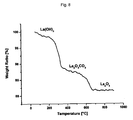
- Thermogravimetric analysis (TGA) of La(OH) 3 was conducted using a Mettler Toledo TGA/SDTA 851 e instrument under air. The heating rate was 10 K/min.
- TEM images were recorded using a Philips Tecnai operating at an acceleration voltage of 300 kV. The samples were dispersed in acetone by sonication and a drop of the suspension was air-dried onto a carbon-coated copper grid.
- La(OH) 3 nanoparticles were synthesized via a modification of a previously published method ( Rare earth oxycarbonates as a material class for chemoresistive CO2 gas sensors, A. Haensch, D. Koziej, M. Niederberger, N. Barsan, U. Weimar, Procedia Engineering, 5 (2010) 139-142 ). This modification allows for significant decreases of nanoparticles size to approximately 10 nm. Additionally, a further decrease of nanoparticles size dependent on the reaction time is feasible.
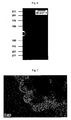
- the La(OH) 3 particles and La 2 O 2 CO 3 particles were examined with PXRD, BET and TEM (see Fig. 4-7 ).
- the La(OH) 3 particles show a diameter of 9.3 nm and a surface area of 147.2 m 2 /g.
- the La 2 O 2 CO 3 particles show a diameter of 10.4 nm and a surface area of 114.3 m 2 /g.
- the thermal transformation from La(OH) 3 to La 2 O 2 CO 3 was investigated by TGA and in-situ PXRD (see Fig. 8 , 9 and step b of Scheme 1). 400°C is the temperature needed for transformation of La(OH) 3 to La 2 O 2 CO 3 .
- Lanthanum oxides may be produced by applying a higher temperature in the thermal transformation step (see Fig. 8 ).
- a carbonate source has to be added to the reaction solution, for instance carbon dioxide, alkali carbonates and/or rare-earth precursors including R-CO 2 - .
- the direct nucleation of carbonates nanoparticles can be additionally induced by high pressure or temperature.
- the PILs particles were dispersed in a non-aqueous solvent.
- the lanthanum precursor here lanthanum isopropoxide was dissolved in acetophenone.
- the reaction solution was heated in the microwave to 200 °C for 15 minutes.
- PILs due to their high microwave absorptivity, act as hot spots for nucleation.
- the nanoparticles nucleate and grow directly at the surface of PI L as shown in Figure 10 .
- the nucleation of nanoparticles is restricted only to the surface of PILs. Therefore in SEM image no lose nanoparticles, not attached to PIL, can be observed.
- the REOC nanoparticles can be dispersed in dimethyl form amide (DMF), or any other solvent used in polymerization of ionic liquids monomer, for instance [VBTMA][PF 6 ]. In-situ polymerization will induce grafting of the PIL at the surface or REOC and will reinforce the synergistic interaction between PIL and REOC.
- DMF dimethyl form amide
- PF 6 PF 6
- FIG. 2 A schematic drawing of the sensor fabrication process is depicted in Fig. 2 .
- La 2 O 2 CO 3 nanoparticles and P[VBTMA][PF 6 ] are blended in acetonitrile and dip coated on the substrate equipped with electrodes. As-prepared sensors were dried in the oven at 80 °C for 24 hours. Different concentrations of PIULOC were tested. The optimal film consist of 77 wt% La 2 O 2 CO 3 (LOC) and 23 wt% P[VBTMA][PF 6 ] (PIL).
- the impedance spectroscopy was utilized to determine the optimal composition of the sensing film.
- the main selection criterion is the low resistivity of the layers at 50 Hz.
- the impedance spectra of the optimized films, which were fabricated in the aforementioned process, are shown in Fig. 15 for comparison the impedance spectra of single components are shown. Since the impedance depends on the geometry of the films (thickness, porosity), geometry of electrodes of the film etc. the optimal compositions has to be determined dependent on the film fabrication process.
- FIG. 3 An alternative fabrication process is depicted in Fig. 3 .
- La(OH) 3 (ICDD File Card No. 06-0585) nanoparticles produced by microwave synthesis are dispersed in an organic matrix following a procedure documented in literature ( S. K. Biswas, J.-O. Baeg, S.-J. Moon, K. Kong, W.-W. So, J. Nanopart. Res. 2012, 14, 667 ), which is then spread on the sensor substrate by the doctor blade approach.
- the layer was set to be 100 ⁇ m thick.
- a thermal treatment step at 400°C followed. This allowed the removal of the organics in the dispersion as well as the transformation of the La(OH) 3 to La 2 O 2 CO 3 (ICDD File Card No. 48-1113).
- the resulting film had a thickness of approximately 2 ⁇ m with a porosity of 31 %.
- La 2 O 2 CO 3 particles can be directly used.
- the polymer layer is applied.
- the film consists of 52 wt% La 2 O 2 CO 3 (REOC) and 48 wt% P[VBTMA][PF 6 ] (PIL).
- FIG. 11 A SEM picture of a cross section the La 2 O 2 CO 3 /P[VBTMA][PF 6 ] film is depicted in Fig. 11 .
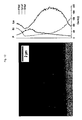
- FIG. 12 A corresponding EDX map of a cross-section of the La 2 O 2 CO 3 /P[VBTMA][PF 6 ] film and concentration profile recorded for La, Si and P elements is depicted in Fig. 12 .
- the La 2 O 2 CO 3 /P[VBTMA][PF 6 ] film shows a homogenous distribution of P[VBTMA][PF 6 ] in the La 2 O 2 CO 3 film
- the La(OH) 3 nanoparticles were characterized using x-ray diffraction (XRD) spectroscopy as well as transmission electron microscopy (TEM). According to size calculations in XRD, the particle size is in the 9-11 nm range and is confirmed by TEM images (see Fig. 4 and 5 ). The degree of crystallinity seems to be very high.
- XRD x-ray diffraction
- TEM transmission electron microscopy
- Thermogravimetric analysis was used to find the ideal temperature for the La(OH) 3 to La 2 O 2 CO 3 transformation (see Fig. 8 ).
- An in-situ XRD analysis concerning the conversion of La(OH) 3 to La 2 O 2 CO 3 and La 2 O 3 is depicted in Fig. 9 .
- Scanning electron microscopy (SEM) was found to be the most appropriate method for verifying the quality of the films produced.
- Fig. 10 an SEM image of the cross section of a typical film produced using the aforementioned approach of Fig. 3 is depicted.
- FTIR measurements were performed to investigate the interaction between the PIL (P[VBTMA][PF 6 ]) and LOC (lanthanum oxycarbonate) nanoparticles, as shown in Figure 20 .
- LOC nanoparticles were first dispersed in PIL-acetonitrile solution and then centrifuged. As centrifuge powders were washed several times in acetonitrile to remove all PIL, which was not firmly grafted at the surface. Presence of PIL specific vibration at the surface of LOC suggests that PIL is indeed irreversibly grafts at the surface of LOC. This strong chemical interaction is likely responsible for the synergistic effect on the electrical properties of the films and their sensitivity to CO 2 .
- Sensitivity towards CO 2 and cross-sensitivity to CO in humid air were tested in a continuous-flow chamber.
- a computer-controlled gas mixing system equipped in Bronkhorst mass flow controllers adjusts the gas concentrations at the constant flow of 200 mL min -1 in air as a carrier gas.
- the electrodes of the sensor were connected to a Keithley 617 electrometer or Zahner IM6 impedance analyzer, respectively.
- a typical resistance changes profile and in Figure 17 corresponding sensor signal are shown.
- the first curve (top) shows the evolution of the resistance with time whereas the second curve (bottom) depicts the concentration changes of CO 2 versus time in hours.
- Pulses of 150, 500, 1000 and 2500 ppm were performed.
- the first four CO 2 pulse led to a reduction in sensor resistance.
- the channel for CO 2 was inverted so that synthetic air would flow through instead.
- Such a blank experiment allows demonstrating that the measured signals are indeed from CO 2 and not an artefact related to the gas mixing system.
- small peaks appear at the first two pulses 150 and 500 ppm pulses. These are due to some residual CO 2 in the gas tubes.
- the sensors are subjected to different concentration of CO 2 and CO as shown in Figure 14 .
- the first curve (top) shows resistance changes of a sensor upon exposure to 250, 500, 1000 and 2000 ppm of CO 2 and 10, 20 and 50 ppm CO.
- the CO 2 pulses lead to significant decreases of the resistance, whereas CO pulses of did not have a significant impact on the resistance.
- the second curve (bottom) shows resistance changes of the commercial metal-oxide-based sensor, which was simultaneously used.
- Such a reference sensor shows reversed trend, namely high sensitivity to CO and lack of sensitivity to CO 2 .
- EIS electrochemical impedance spectroscopy
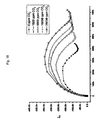
- Fig. 18 the impedance of the sensor at various CO 2 content is plotted in a Nyquist plot. With increasing CO 2 concentration, the semi-circles become larger, indicating an increasing sensor signal.
- Fig. 19 the model circuit of the system is shown. The resistor simulates the charge transfer resistance, the Warburg impedance shows diffusion and becomes important only at low frequencies, finally, the constant phase element (CPE) is the counterpart for the double-layer capacitance. Furthermore, AC impedance measurements show that capacitive readout of sensor signal is also possible.
Landscapes
- Chemical & Material Sciences (AREA)
- Health & Medical Sciences (AREA)
- Engineering & Computer Science (AREA)
- Life Sciences & Earth Sciences (AREA)
- Immunology (AREA)
- Physics & Mathematics (AREA)
- Analytical Chemistry (AREA)
- Biochemistry (AREA)
- General Health & Medical Sciences (AREA)
- General Physics & Mathematics (AREA)
- Pathology (AREA)
- Electrochemistry (AREA)
- Chemical Kinetics & Catalysis (AREA)
- Nanotechnology (AREA)
- Combustion & Propulsion (AREA)
- Food Science & Technology (AREA)
- Medicinal Chemistry (AREA)
Abstract
Composites of poly ionic liquids and metal compounds for low temperature CO2 gas detecting, a solution or a suspension comprising said composition, a substrate comprising said composition, a use of said composition for CO2 detection or in a CO2 sensor or a use of said suspension or solution in a method for manufacturing a CO2 sensor. Further comprised is a CO2 sensor comprising said composition and a method for detecting CO2.
Description
- The present invention relates to composites of poly ionic liquids and metal compounds in particular for low temperature CO2 gas detecting, a solution or a suspension comprising said composition, a substrate comprising said composition, a use of said composition for CO2 detection or in a CO2 sensor or a use of said suspension or solution in a method for manufacturing a CO2 sensor. The invention further comprises a CO2 sensor comprising said composition and a method for detecting CO2.
- Miniaturization is one of the main issues but also a driving force in the research development as well as fabrication of electronic devices. This is also valid for CO2 sensors, which are used in a wide extent of applications ranging from air quality monitoring in motors and in buildings to factories of the beverage industry. Additionally, to those established markets, the need for control of carbon dioxide concentration in breath for instance of a scuba diver, Himalaya climber or emphysema patient is driving the development of CO2 sensors that are portable.
- However, the results obtained so far with metal oxides-based sensors are disappointing, particularly when compared to advanced and commercialized sensors for reducing or oxidizing gases. Intensive trail-and-error work is under way, but the prospect of simple-in-use CO2 sensors appears remote. The realization of a CO2 sensor is very challenging and depends on the combination of new structural materials that deliver active properties and simultaneously maintain a simple transduction scheme.
- So far, most CO2 sensors are based on the non-dispersive infrared method (NDIR).
- Their sensitivity depends on the length of the absorption optical path path (Lambert-Beer equation). Thus, the aforementioned miniaturization reaches its limits.
- Thus, a new type of CO2 sensing based on a different technology is being needed.
- There is an increasing interest towards CO2 sensors based on the chemo-resistive effect. These sensors show an increase or decrease of resistance when subjected to
- CO2.The advantages mainly lie in the fact that they can be miniaturized, having moderate production costs.
- Recently, the sensitivity of oxycarbonates of lanthanum and neodymium to CO2 was reported (A. Haensch, D. Koziej, M. Niederberger, N. Barsan, U. Weimar, Procedia Engineering 2010, 5, 139). The document describes an increase of the resistance of the oxycarbonate film with increasing concentration of CO2.
- However, to date, most chemo-resistive CO2 sensors work at high temperatures (application temperatures between 200 and 700 °C), thus, negatively affecting long term stability of these sensors. Also, these sensors are heated resistively, thus, energy is consumed. Furthermore, the use of conductive polymers show in CO2 sensor resistance changes upon exposure to CO2. The most studied are the polypyrrols and their composites with metal oxides (see Waghuley, S. A; Yenorkar, S. M.; Yawale, S. S.; Yawale, S. P. Application of chemically synthesized conducting polymer-polypyrrole as a carbon dioxide gas sensor Sens. Actuators, B 2008,128, (2), 366-373).
- The problem of the invention is to develop a composition usable in a CO2 sensor working at ambient temperature, which can be easily miniaturized and has moderate production costs and has no cross-sensitivity to reducing or oxidizing gases like CO, H2 or NOx (mono-nitrogen oxides).
- This problem is solved by a composition according to
claim 1, a suspension or solution according toclaim 8, a substrate according to claim 11 or a CO2 sensor according toclaim 15. - According to a first aspect of the invention, the invention relates to a composition, in particular a composition for CO2 detecting, comprising at least one metal compound MC, in particular a rare earth compound REC, more particularly a rare earth oxycarbonate REOC, and a poly ionic liquid PIL.
- According to a second aspect of the invention, the invention relates to a suspension or solution comprising a composition according to the first aspect of the invention.
- According to a third aspect of the invention, the invention relates to a substrate comprising a composition according to the first aspect of the invention, wherein on said substrate said at least one metal compound MC, in particular said at least one rare earth compound REC, more particularly said at least one rare earth oxycarbonate REOC and said poly ionic liquid PIL are deployed, wherein in particular said substrate is selected from a rigid material, such as ceramic, alumina (Al2O3), sapphire, silicium or glass or flexible material such as polyamide or polyurethane.
- According to a fourth aspect of the invention, the invention relates to the use of the composition according to the first aspect of the invention or the use of a substrate according to the third aspect of the invention for CO2 detection.
- According to a fifth aspect of the invention, the invention relates to the use of a composition according to the first aspect of the invention or the use of substrate according to the third aspect the invention in a CO2 sensor.
- According to a sixth aspect of the invention, the invention relates to the use of a suspension or solution according to the second aspect of the invention in screen printing, drop casting, tape casting, spin casting or ink jet printing methods, in particular in screen printing, drop casting, tape casting, spin casting or ink jet printing methods for manufacturing a CO2 sensor.
- According to a seventh aspect of the invention, the invention relates to a CO2 sensor comprising a composition according to the first aspect of the invention or a substrate according to the third aspect of the invention or a CO2 sensor manufactured by use of the suspension or solution according to the second aspect of the invention.
- According to an eight aspect of the invention, the invention relates to a method for CO2 detection comprising a CO2 sensor according to the seventh aspect of the invention.
- As used herein the term "metal compound," refers to a compound comprising a metal element and a non-metal moiety ("counterpart") such as an oxide, a hydroxide, a carbonate or an oxycarbonate and the mixture of thereof. The metal compound may comprise a covalent or ionic structure.
- As used herein the term "actinoides" refers to the metallic chemical elements with atomic numbers from 89 to 103 (actinium to lawrencium).
- As used herein the term "lanthanoides" refers to the metallic chemical elements with atomic numbers from 57 to 71 (lanthanum to lutetium).
- As used herein the term "rare earth metal" refers to the lanthanoides plus scandium and yttrium.
- The first aspect of the invention relates to a composition, in particular for CO2 detection, comprising a metal compound MC and poly ionic liquid PIL.
- In some embodiments, the metal compound MC comprises chemo-resistive properties in particular chemo-resistive properties selective to CO2. Compositions comprising chemo-resistive properties comprise an increase or decrease of resistant when subjected to a gas or a gas-mixture. The contact with the gas or the gas-mixture has a direct influence on the conductivity of the material and, thus, leading to a change in the resistance, which can be measured. The change of the resistance correlates with the concentration of the gas or gas-mixture, which is to be measured.
- In some embodiments, the metal compound MC comprises chemo-capacitive properties in particular chemo-capacitive properties selective to CO2. Compositions comprising chemo-capacitive properties comprise an increase or decrease of capacitance when subjected to a gas or a gas-mixture. The contact with the gas or the gas-mixture has a direct influence on the capacity of the material and, thus, leading to a change in the capacitance, which can be measured. The change of the capacitance correlates with the concentration of the gas or gas-mixture, which is to be measured
- In some embodiments, the metal of said metal compound MC is selected from rare earth metals, metals from the group of lanthanides or metals from the group of actinoides, and/or the metal compound MC is selected from a metal hydroxide, metal carbonate, metal oxide or metal oxycarbonate or mixture thereof.
- Thus, said metal compound MC may comprise at least two metal compounds MC, wherein the metal compounds MC may comprise the same metal but different counterparts such as oxide or oxycarbonate (e.g. a lanthanum oxide and a lanthanum oxycarbonate). Said metal compound MC may also comprise at least two metal compounds MC, wherein the metals may be different but the counterparts are the same (e.g. a lanthanum oxide and a cerium oxide). Furthermore, said metal compound MC may comprise at least two metal compounds MC, wherein the metals and the counterparts may be different (e.g. a lanthanum oxycarbonate and a cerium oxide).
- In some embodiments, the metal compound MC is selected from a metal oxide or a metal oxycarbonate.
- In some embodiments, the metal compound MC is a metal oxycarbonate.
- In some embodiments, said metal compound MC is a rare earth compound REC.
- In some embodiments, the metal of said metal compound MC is a rare earth metal REC, wherein said rare earth metal REC is selected from a rare earth metal hydroxide, a rare earth metal carbonate, a rare earth metal oxide or a rare earth metal oxycarbonate, in particular from a rare earth metal oxide or a rare earth metal oxycarbonate, more particularly a rare earth metal oxycarbonate.
- In some embodiments, said metal compound MC is a rare earth compound REC, wherein the rare earth metal of said rare earth compound REC is selected from lanthanum, cerium, neodymium, praseodymium or gadolinium.
- In some embodiments, said metal compound MC is a rare earth compound REC, wherein the rare earth metal of said rare earth compound REC is selected from lanthanum, cerium, neodymium or praseodymium.
- In some embodiments, said metal MC is a rare earth compound REC, wherein the rare earth metal of said rare earth compound REC is lanthanum.
- In some embodiments, said metal compound MC is a rare earth oxycarbonate REOC.
- In some embodiments, said metal compound MC is a rare earth oxycarbonate REOC, wherein the rare earth metal of said rare earth oxycarbonate REOC is selected from lanthanum, cerium, neodymium, praseodymium or gadolinium.
- In some embodiments, said metal compound MC is a rare earth oxycarbonate REOC, wherein the rare earth metal of said rare earth oxycarbonate REOC is selected from lanthanum, cerium, neodymium or praseodymium.
- In some embodiments, said metal compound MC is a rare earth oxycarbonate REOC, wherein the rare earth metal of said rare earth oxycarbonate REOC is lanthanum.
- In some embodiments, said metal compound MC is a rare earth oxycarbonate REOC.
- The term "PIL" refer to a special type of polyelectrolates which carry an ionic liquid species in each of the repeating unit. They combine properties of ionic liquids and the flexibility of polymers.
- In some embodiments, the poly ionic liquid PIL comprises a, in particular reversible, CO2 capturing capacity.
- In some embodiments, the poly ionic liquid PIL is selected from polymers of pyrrolidinium based ionic liquids, sulfonium based ionic liquids, alanines based ionic liquids, cholines based ionic liquids, acetonitrile based ionic liquids, ammonium based ionic liquids, pyridinium based ionic liquids, imidazolium based ionic liquids or phosphonium ionic liquids or the poly ionic liquid PIL comprises a mixture of the before mentioned.
- In some embodiments, the poly ionic liquid PIL is selected from polymers of ammonium based ionic liquids, pyridinium based ionic liquids, imidazolium based ionic liquids or phosphonium ionic liquids.
- In some embodiments, the poly ionic liquid PIL is selected from polymers of ammonium based ionic liquids. Tetraalkylammonium-based PIL show superior CO2 sorption capacities, thus, these PIL are preferred candidates for application in CO2 gas sensors.
- In some embodiments, the poly ionic liquid PIL is selected from p-vinylbenzyl)triethyl ammonium tetrafluoroborate P[VBTEA][BF4], 1-(p-vinylbenzyl)pyridinium tetrafluoroborate P[VBP][BF4], (p-vinylbenzyl)trimethyl ammonium hexafluorophosphate P[VBTMA][PF6], 2-(methacryloyloxy) ethyltrimethylamnonium tetrafluoroborate P(MATMA][BF4], (p-vinylbenzyl)trimethyl ammonium trifluoromethane sulfonamide P[VBTMA][Tf2N]; p-vinylbenzyl)trimethyl ammonium tetrafluoroborate P[VBTMA][BF4], 1-(p-vinylbenzyl)-3-methyl-imidazolium tetrafluoroborate P[VBMI][BF4], from (p-vinyl benzyl)tributylammonium tetrafluoroborate P[VBTBA][BF4] or p-vinylbenzyl)triethyl phosphonium tetrafluoroborate P[VBTEP][BF4], in particular said poly ionic liquid (PIL) is (p-vinylbenzyl)trimethyl ammonium hexafluorophosphate P[VBTMA][PF6].
- In some embodiments, the poly ionic liquid PIL comprises a mixture of the poly ionic liquids PIL defined in the previous paragraph.
- In some embodiments, the poly ionic liquid is (P-venylbenzyl) trimethylammoniumhexaflurophosphat P[VBTMA][PF6].
- The poly ionic liquid P[VBTMA][PF6] has a polystyrene backbone, an inorganic anion and a small substituent on the cation side and a high CO2 sorption capacity. The poly ionic liquid P[VBTBA][PF6] has a high sensitivity (it can absorb 77% of its body weight of CO2); a good selectivity/cross-sensitivity (the CO2 absorption is very selective since no mass change was observed for N2, O2 and CH4 sorption); a fast response/recover time and stability (at room temperature sorption and desorption is on the order of minutes of up to the 95% of CO2 capacity and stable over time); a high thermal stability (Tg = 255°C); and is easy to process since it is soluble in acetonitrile.
- Poly ionic liquids P[VBTMA][Tf2N) comprising a mesoporous P[VBTMA][Tf2N) networks show significantly faster CO2 adsorption than its bulk counterparts (see Tang, J. B.; Shen, Y. Q.; Radosz, M.; Sun, W. L. Isothermal Carbon Dioxide Sorption in Poly(ionic liquid)s Ind. Eng. Chem. Res. 2009, 48, (20), 9193-9118).
- In some embodiments, the compositions comprises as said metal compound MC a rare earth oxycarbonate REOC, wherein in particular the rare earth metal of said rare earth oxycarbonate REOC is selected from lanthanum, cerium, neodymium, praseodymium or gadolinium, in particular from lanthanum, cerium, neodymium or praseodymium, more particularly the rare earth metal of said rare earth oxycarbonate REOC is lanthanum and
- said poly ionic liquid PIL comprises a polymer structure of ionic liquid monomers which comprise a reversible CO2 capturing capacity, or
- said poly ionic liquid PIL is selected from pyrrolidinium based ionic liquids, sulfonium based ionic liquids, alanines based ionic liquids, cholines based ionic liquids, acetonitrile based ionic liquids, ammonium based ionic liquids, pyridinium based ionic liquids, imidazolium based ionic liquids or phosphonium ionic liquids, or
- said poly ionic liquid PIL is selected from ammonium based ionic liquids, pyridinium based ionic liquids, imidazolium based ionic liquids or phosphonium based ionic liquids, or
- said poly ionic liquid PIL is selected from ammonium based ionic liquids, or
- said poly ionic liquid is selected from p-vinylbenzyl)triethyl ammonium tetrafluoroborate P[VBTEA][BF4], 1-(p-vinylbenzyl)pyridinium tetrafluoroborate P[VBP][BF4], (p-vinylbenzyl)trimethyl ammonium hexafluorophosphate P[VBTMA][PF6], 2-(methacryloyloxy) ethyltrimethylamnonium tetrafluoroborate P[MATMA][BF4], (p-vinylbenzyl)trimethyl ammonium trifluoromethane sulfonamide P[VBTMA][Tf2N]; p-vinylbenzyl)trimethyl ammonium tetrafluoroborate P[VBTMA][BF4], 1-(p-vinylbenzyl)-3-methyl-imidazolium tetrafluoroborate P[VBMI][BF4], from (p-vinyl benzyl)tributylammonium tetrafluoroborate P[VBTBA][BF4] or p-vinylbenzyl)triethyl phosphonium tetrafluoroborate P[VBTEP][BF4], or
- said poly ionic liquid PIL is (p-vinylbenzyl) trimethylammoniumhexaflurophosphat P[VBTMA][PF6].
- The composition of the invention comprises metal compounds, in particular rare earth compounds, more particular rare earth oxycarbonates, and a poly ionic liquid, which are interacting with each other.
- As already discussed, the use of rare earth oxycarbonates or oxides, is known in the art. These salts have some advantages for the use in detecting CO2, since they comprise a high sensor signal and they are good transduction elements, which can conduct chemical information into an electrical signal. However, a major disadvantage of these compounds is the necessity to use a very high working temperature. CO2 sensors comprising such compound cannot operate at room temperature and the high working temperature negatively affects long term stability of these sensors and the use of such sensors has a very high demand on energy.
- Characteristics of poly ionic liquids PIL are also known in the art. PIL are solid polymeric materials, which are generally prepared via polymerization of either the cation or the anion species of the respective ionic liquid. An ionic liquid on the other hand is composed of two species with opposed charges. PIL have been shown to selectively absorb CO2 in large amounts.
- The use of a composite comprising metal compounds MC, in particular rare earth compounds REC, more particularly rare earth oxycarbonates REOC and poly ionic liquids PIL are not known in the art. Such composites allow the provision of a material for detection of CO2, which can readily miniaturized and the provision of a CO2 sensor which may be operated at a temperature range between room temperature and 200 °C. Such a working temperature has a significant advantage in comparison to known CO2 sensors.
- The composition of the invention comprises further an excellent thermal and chemical stability together with a good flexibility.
- An example of such a structure is depicted in
Fig. 1 . The poly ionic liquid PIL in a composition according to the invention selectively absorbs CO2 and increase the probability for a CO2 interaction with the particles of the metal compound MC, in particular the rare earth compound REC, more particularly the rare earth oxycarbonate REOC. The pre-concentration is crucial for operation at room temperature because it increases the efficiency of the CO2 interaction. - The metal compound MC, in particular the rare earth compound REC, more particularly the rare earth oxycarbonate REOC of the composition according to the invention works as an electronic transduction element in which the particles are transducing the chemical information into an electric signal.
- Thus, the polymeric phase PIL selectively absorbs CO2 while the metal compound MC, in particular the rare earth compound REC, more particularly the rare earth oxycarbonate REOC, change their electric properties upon contact with CO2. The CO2 absorption and adsorption properties of the PIL amplify the reactivity toward CO2 with the metal compound MC, in particular the rare earth compound REC, more particularly the rare earth oxycarbonate REOC at room temperature.
- Furthermore, the most essential is that composition according to the invention comprises a synergistic effect. The inventors believe, without being bound by this theory that the synergistic effect arises from anchoring the poly ionic liquids PIL at the surface of the particles, for example in case of using a rare earth oxycarbonate and an ammonium based PI L, through interaction between strongly electropositive metal ions of the metal compound MC and cations of the PIL. Neither, PI L nor the MC, in particular the REOC-film itself is having measurable resistance (<20 GOhms) at room temperature.
- However, at the certain concentrations of PIUMC, in particular PIL/REOC, the resistivity of the films dramatically decreases, as it is revealed by EIS measurements shown in
Fig. 15 . It has to deal with charge transfer between PIL and the surface of nanoparticles. At a certain percolation level the interaction between the PIL and MC, in particular REOC, are governing the electrical characteristic of the films. -
Fig. 10 to 18 show an example of the effect of one composition of the invention, namely lanthanum oxycarbonate (LOC) and P[VBTMA][PF6]. For this nanocomposite, the chemo-resistive principle was tested providing new insight into this type of sensing. The findings from both resistance and impedance measurements attest the validity to use such composite systems in CO2 sensing. Moreover, even though the sensors were tested at room temperature, the sensor signal clearly shows sensitivity to CO2. - The composition of the invention shows a synergistic effect, which is depicted in
Fig. 15 andFig. 20 . - In
Fig. 15 the electrical properties of La2O2CO3P[VBTMA][PF6] composites are shown. The impedance spectroscopy visualized the synergistic influence of La2O2CO3/P[VBTMA)[PF6] on the electrical properties of the composites by comparing the La2O2CO3/P[VBTMA)[PF6] composite and its individual components La2O2CO3 and P[VBTMA)[PF6]. - It has to be noted that impedance of the La2O2CO3/P[VBTMA)[PF6] sensor is lower than that of La2O2CO3 sensor and much lower than the one of the polymer itself. For the composite material the presence of the semicircle at high frequencies (50 Hz - 2 MHz) suggests that in comparison with the individual components, there is an additional charge transfer at the organic/inorganic interface. Furthermore, the organic-inorganic interface formation is lowering of the resistivity also at DC (50 Hz) that makes the resistive readout feasible.
- In some embodiments, the ratio of said metal compound MC, in particular said rare earth compound REC, more particularly said rare earth oxycarbonate REOC, to said poly ionic liquid PIL is in the range of 1 wt% to 99 wt% of said metal compound MC, in particular said rare earth compound REC, more particularly said rare earth oxycarbonate REOC, to 99 wt% to 1 wt% of said poly ionic liquid PIL.
- In some embodiments, the ratio of said metal compound MC, in particular said rare earth compound REC, more particularly said rare earth oxycarbonate REOC, to said poly ionic liquid PIL is in the range of 80 wt% to 20 wt% of said of said metal compound MC, in particular said rare earth compound REC, more particularly said rare earth oxycarbonate REOC, to 20 wt% to 80 wt% of said poly ionic liquid PIL.
- In some embodiments, the ratio of said metal compound MC, in particular said rare earth compound REC, more particularly said rare earth oxycarbonate REOC, to said poly ionic liquid PIL is in the range of 80 wt% to 50 wt% of said of said metal compound MC, in particular of said rare earth oxycarbonate REOC, to 50 wt% to 20 wt% of said poly ionic liquid PIL.
- In some embodiments, the ratio of said metal compound MC, in particular said rare earth compound REC, more particularly said rare earth oxycarbonate REOC, to said poly ionic liquid PIL is in the range of 50 wt% to 20 wt% of said of said metal compound MC, in particular of said rare earth oxycarbonate REOC, to 50 wt% to 80 wt% of said poly ionic liquid PIL.
- In some embodiments, the ratio of said metal compound MC, in particular said rare earth compound REC, more particularly said rare earth oxycarbonate REOC, to said poly ionic liquid PIL is in the range of 80 wt% to 60 wt% of said of said metal compound MC, in particular of said rare earth oxycarbonate REOC, to 40 wt% to 20 wt% of said poly ionic liquid PIL.
- In some embodiments, the ratio of said metal compound MC, in particular said rare earth compound REC, more particularly said rare earth oxycarbonate REOC, to said poly ionic liquid PIL is in the range of 40 wt% to 20 wt% of said of said metal compound MC, in particular of said rare earth oxycarbonate REOC, to 60 wt% to 80 wt% of said poly ionic liquid PIL.
- In some embodiments, the ratio of said metal compound MC, in particular said rare earth compound REC, more particularly said rare earth oxycarbonate REOC, to said poly ionic liquid PIL is essentially 70 wt% of said of said metal compound MC, in particular of said rare earth oxycarbonate REOC, to 30 wt% of said poly ionic liquid PIL.
- In some embodiments, said poly ionic liquid PIL comprises a porous structure, in particular a mesoporous structure.
- In some embodiments, said poly ionic liquid PIL comprises a porosity in the range of 2 to 50 nm, in particular in the range of 2 to 20 nm.
- Mesoporous networks of PIL show significantly faster CO2 adsorption than its bulk counterparts. The outstanding CO2 sorption in combination with a mesoporous structure will be the most appropriate for CO2 sensing.
- In some embodiments, said metal compound MC, in particular said rare earth compound REC, more particularly said rare earth oxycarbonate REOC comprises particles with a diameter in the range smaller than 200 nm, in particular smaller than 100 nm, more particularly smaller than 20 nm. This is because the smaller the size of nanoparticle, the higher is the surface area of interaction between REOC and PIL.
- In some embodiments, the composition comprises additionally nanoparticles of a further metal compound MC, in particular a further rare earth compound REC, more particularly a further rare earth oxycarbonate REOC, wherein the further metal compound MC, in particular the further rare earth compound REC, more particularly the further rare earth oxycarbonate REOC comprise the same properties as discussed above concerning the first aspect of the invention.
- A second aspect of the invention relates to a suspension or solution comprising a composition according to the first aspect of the invention.
- In some embodiments, said metal compound MC, in particular said rare earth compound REC, more particularly said rare earth oxycarbonate REOC, and said poly ionic liquid PIL are present in the suspension or solution in form of separate particles consisting of said metal compound MC, in particular said rare earth compound REC, more particularly said rare earth oxycarbonate REOC, or said poly ionic liquid PIL
- In some embodiments, said metal compound MC, in particular said rare earth compound REC, more particularly said rare earth oxycarbonate REOC, and said poly ionic liquid PIL are present in the suspension or solution in form of particles consisting of a metal compound MC center, in particular a rare earth compound REC center, more particularly a rare earth oxycarbonate REOC center, and a poly ionic liquid PIL casing, which may partially or completely enclose the center, providing mixed particles in the suspension or solution.
- In some embodiments, said metal compound MC, in particular said rare earth compound REC, more particularly said rare earth oxycarbonate REOC, of the suspension or solution comprise a diameter in the range of 2 to 200 nm, in particular in the range of 2 to 100 nm, more particularly in the range of 2 to 50 nm, further more in the range of 2 to 20 nm, and said poly ionic liquid PIL particles of the suspension or solution
- comprise a diameter in the range of 2 to 500 nm, in particular in the range of 2 to 100 nm, more particularly in the range of 2 to 50 nm or
- are partially dissolved in the solvent of the solution or suspension or
- completely dissolved in the solvent of the solution or suspension.
- In some embodiments, said metal compound MC, in particular said rare earth compound REC, more particularly said rare earth oxycarbonate REOC, of the suspension or solution comprises a diameter in the range of 2 to 20 nm, and said poly ionic liquid PIL particles are completely dissolved in the solvent of the solution or suspension. In order avoid clogging, the smaller particles are favorable.
- In some embodiments, the suspension or solution comprises an organic solvent, water or a mixture thereof, wherein the organic solvent is selected from alcohols, ketones, acetonitrile or a mixture thereof, wherein in particular said solvent is selected from water, ethanol, acetone, isopropanol, acetonitrile or a mixture thereof.
- In some embodiments, the suspension or solution comprises a viscosity of 1 to 25 mpascal*s.
- A third aspect of the invention relates to a substrate comprising a composition according the first aspect of the invention, wherein on said substrate said metal compound MC, in particular said rare earth compound REC, more particularly said rare earth oxycarbonate REOC, and said poly ionic liquid PIL are deployed, wherein in particular said substrate is selected from a rigid material, such as ceramic, aluminum, sapphire, silicium or glass or a flexible material, such as polyamide or polyurethane.
- In some embodiments, said substrate comprises a mixture of said metal compound MC, in particular said rare earth compound REC, more particularly said rare earth oxycarbonate REOC, and said poly ionic liquid PIL (see
Fig. 1 ). - In some embodiments, said substrate comprises a layer of said metal compound MC, in particular a layer of said rare earth compound REC, more particularly a layer of said rare earth oxycarbonate REOC, and a layer of said poly ionic liquid PIL deposited on said a layer of metal compound MC, in particular said a layer of rare earth compound REC, more particularly said a layer of rare earth oxycarbonate REOC, layer.
- In some embodiments, said substrate comprises a layer of said poly ionic liquid PIL and a layer of said metal compound MC, in particular a layer of said rare earth compound REC, more particularly a layer of said rare earth oxycarbonate REOC, deposited on said poly ionic liquid PIL layer.
- A fourth aspect of the invention relates to a use of the composition according to the first aspect of the invention or a substrate according to the third aspect of the invention for CO2 detection.
- A fifth aspect of the invention relates to a use of the composition according to the first aspect of the invention or a substrate according to the third aspect of the invention in a CO2 sensor.
- The composites bring to bear the affinity of PIL and MC to interact with CO2. Nevertheless, the main advantage is that interaction of PIL with MC dramatically changes the electrical properties of composites. This is decisive for the transduction of chemical information into electrical signal and thus for the application as a CO2 sensor.
- A sixth aspect of the invention relates to a use of the suspension or solution according to the second aspect of the invention in screen printing, drop casting, tape casting, spin casting or ink-jet printing methods.
- A seventh aspect of the invention relates to a use of the suspension or solution according to the second aspect of the invention in screen printing, drop casting, tape casting, spin casting or ink-jet printing methods for manufacturing a CO2-sensor.
- The prepared solution or suspensions can be used in any of the state-of-art film fabrication method for example screen printing, drop casting, tape casting, spin casting or ink-jet printing methods. The optimization will include mainly adjusting the viscosity and/or composition of the suspension and solution. Other advantages highlighting the versatility of the composites are their high thermal stability (up to 200°C) and selective solubility. This makes them compatible with for instance MEMS processing.
- An eight aspect of the invention relates to a method for CO2 detection comprising a CO2 sensor according to the seventh aspect of the invention.
- The method comprises the steps of:
- provision of a CO2 sensor comprising a composition according to any one of the
claims 1 to 7 or a substrate according to any one of theclaims 8 to 12, - contacting said sensor with CO2, which is to be detected, in particular contacting said sensor with CO2, which is to be detected, at a temperature in the range of 20°C and 200°C, more particularly in the range of 20°C to 100°C, more particularly in the range of 20°C to 35°C
- chemical interaction of said CO2 with said composition or said substrate comprising said composition providing an electrical signal based on said chemical interaction and
- analyzing said signal.
- For details, see section CO2-Detection.
- PXRD X-ray powder diffraction (PXRD) patterns were registered on a PANalytical Empyrean powder diffractometer in reflection mode using Cu Kα radiation and operating at 45 kV and 40 mA. For the in-situ PXRD experiments, the Anton Paar high temperatures chamber was used.
- Scanning electron microscopy (SEM) images were taken on a LEO 1530 Gemini microscope equipped with an in-lens detector at an acceleration voltage of 3 kV. For the SEM imaging, samples were coated with a 5 nm layer of sputtered Pt to prevent charging.
- EDX was measured on a Hitachi SU-70 operated at 20 kV acceleration voltage. An X-Max detector (semiconductor-type, Oxford Instruments) was used.
- Thermogravimetric analysis (TGA) of La(OH)3 was conducted using a Mettler Toledo TGA/SDTA 851 e instrument under air. The heating rate was 10 K/min.
- Transmission electron microscopy (TEM) images were recorded using a Philips Tecnai operating at an acceleration voltage of 300 kV. The samples were dispersed in acetone by sonication and a drop of the suspension was air-dried onto a carbon-coated copper grid.
- Surface area of the nanoparticles was determined by Brunauer-Emmett-Teller (BET) nitrogen adsorption. The powders were first outgassed for 22 h at 150 °C and then the adsorption isotherm was recorded on a Quantachrome Autosorb iQ station.
- The reaction pathway to La2O2CO3 is depicted in
Scheme 1.
- La(OH)3 nanoparticles were synthesized via a modification of a previously published method (Rare earth oxycarbonates as a material class for chemoresistive CO2 gas sensors, A. Haensch, D. Koziej, M. Niederberger, N. Barsan, U. Weimar, Procedia Engineering, 5 (2010) 139-142). This modification allows for significant decreases of nanoparticles size to approximately 10 nm. Additionally, a further decrease of nanoparticles size dependent on the reaction time is feasible. In a typical synthesis 0.5 mmol (158.1 mg) of La(OiPr)3 were dissolved in 40 mmol (4.67 mL) of acetophenone, mixed under argon atmosphere in a 10 mL pressure vial and stirred for 10 min. The brown, opaque solution was sealed and heated in CEM Explorer microwave oven at 200 °C for 20 min. Subsequently, the precipitate was extracted by centrifugation and washed three times with acetone. The nanoparticles were dried in a lab furnace at 60 °C overnight (see step a of Scheme 1).
- The La(OH)3 particles and La2O2CO3 particles were examined with PXRD, BET and TEM (see
Fig. 4-7 ). The La(OH)3 particles show a diameter of 9.3 nm and a surface area of 147.2 m2/g. The La2O2CO3 particles show a diameter of 10.4 nm and a surface area of 114.3 m2/g. The thermal transformation from La(OH)3 to La2O2CO3 was investigated by TGA and in-situ PXRD (seeFig. 8 ,9 and step b of Scheme 1). 400°C is the temperature needed for transformation of La(OH)3 to La2O2CO3. Lanthanum oxides may be produced by applying a higher temperature in the thermal transformation step (seeFig. 8 ). - Direct synthesis of rare-earth carbonates and oxycarbonates in CO2 enriched solution.
- In order to directly synthesize oxycarbonates nanoparticles in the solution a carbonate source has to be added to the reaction solution, for instance carbon dioxide, alkali carbonates and/or rare-earth precursors including R-CO2 -. In such a carbon dioxide enriched condition the direct nucleation of carbonates nanoparticles can be additionally induced by high pressure or temperature.
- The PILs particles were dispersed in a non-aqueous solvent. The lanthanum precursor, here lanthanum isopropoxide was dissolved in acetophenone. The reaction solution was heated in the microwave to 200 °C for 15 minutes. PILs due to their high microwave absorptivity, act as hot spots for nucleation. Thus the nanoparticles nucleate and grow directly at the surface of PI L as shown in
Figure 10 . The nucleation of nanoparticles is restricted only to the surface of PILs. Therefore in SEM image no lose nanoparticles, not attached to PIL, can be observed. - The REOC nanoparticles can be dispersed in dimethyl form amide (DMF), or any other solvent used in polymerization of ionic liquids monomer, for instance [VBTMA][PF6]. In-situ polymerization will induce grafting of the PIL at the surface or REOC and will reinforce the synergistic interaction between PIL and REOC.
- A schematic drawing of the sensor fabrication process is depicted in
Fig. 2 . - La2O2CO3 nanoparticles and P[VBTMA][PF6] are blended in acetonitrile and dip coated on the substrate equipped with electrodes. As-prepared sensors were dried in the oven at 80 °C for 24 hours. Different concentrations of PIULOC were tested. The optimal film consist of 77 wt% La2O2CO3 (LOC) and 23 wt% P[VBTMA][PF6] (PIL).
- The impedance spectroscopy was utilized to determine the optimal composition of the sensing film. The main selection criterion is the low resistivity of the layers at 50 Hz. The impedance spectra of the optimized films, which were fabricated in the aforementioned process, are shown in
Fig. 15 for comparison the impedance spectra of single components are shown. Since the impedance depends on the geometry of the films (thickness, porosity), geometry of electrodes of the film etc. the optimal compositions has to be determined dependent on the film fabrication process. - An alternative fabrication process is depicted in
Fig. 3 . - La(OH)3 (ICDD File Card No. 06-0585) nanoparticles produced by microwave synthesis are dispersed in an organic matrix following a procedure documented in literature (S. K. Biswas, J.-O. Baeg, S.-J. Moon, K. Kong, W.-W. So, J. Nanopart. Res. 2012, 14, 667), which is then spread on the sensor substrate by the doctor blade approach. The layer was set to be 100 µm thick. A thermal treatment step at 400°C followed. This allowed the removal of the organics in the dispersion as well as the transformation of the La(OH)3 to La2O2CO3 (ICDD File Card No. 48-1113). The resulting film had a thickness of approximately 2 µm with a porosity of 31 %. Alternatively, La2O2CO3 particles can be directly used. Finally, the polymer layer is applied. The film consists of 52 wt% La2O2CO3 (REOC) and 48 wt% P[VBTMA][PF6] (PIL).
- A SEM picture of a cross section the La2O2CO3/P[VBTMA][PF6] film is depicted in
Fig. 11 . A corresponding EDX map of a cross-section of the La2O2CO3/P[VBTMA][PF6] film and concentration profile recorded for La, Si and P elements is depicted inFig. 12 . The La2O2CO3/P[VBTMA][PF6] film shows a homogenous distribution of P[VBTMA][PF6] in the La2O2CO3 film - The same methods apply for other metal compounds or rare earth compounds or PIL discussed above.
- The La(OH)3 nanoparticles were characterized using x-ray diffraction (XRD) spectroscopy as well as transmission electron microscopy (TEM). According to size calculations in XRD, the particle size is in the 9-11 nm range and is confirmed by TEM images (see
Fig. 4 and 5 ). The degree of crystallinity seems to be very high. - Thermogravimetric analysis (TGA) was used to find the ideal temperature for the La(OH)3 to La2O2CO3 transformation (see
Fig. 8 ). An in-situ XRD analysis concerning the conversion of La(OH)3 to La2O2CO3 and La2O3 is depicted inFig. 9 . Scanning electron microscopy (SEM) was found to be the most appropriate method for verifying the quality of the films produced. InFig. 10 , an SEM image of the cross section of a typical film produced using the aforementioned approach ofFig. 3 is depicted. - FTIR measurements were performed to investigate the interaction between the PIL (P[VBTMA][PF6]) and LOC (lanthanum oxycarbonate) nanoparticles, as shown in
Figure 20 . LOC nanoparticles were first dispersed in PIL-acetonitrile solution and then centrifuged. As centrifuge powders were washed several times in acetonitrile to remove all PIL, which was not firmly grafted at the surface. Presence of PIL specific vibration at the surface of LOC suggests that PIL is indeed irreversibly grafts at the surface of LOC. This strong chemical interaction is likely responsible for the synergistic effect on the electrical properties of the films and their sensitivity to CO2. - Sensitivity towards CO2 and cross-sensitivity to CO in humid air were tested in a continuous-flow chamber. A computer-controlled gas mixing system equipped in Bronkhorst mass flow controllers adjusts the gas concentrations at the constant flow of 200 mL min-1 in air as a carrier gas. To monitor changes in the DC resistance or in the AC impedance of the sensor during exposure to the target gases, the electrodes of the sensor were connected to a Keithley 617 electrometer or Zahner IM6 impedance analyzer, respectively.
- To characterise the CO2 sensing performance, the sensors are subjected to different concentrations of CO2 and the resistance of the films is measured at the same time. In
Fig. 16 , a typical resistance changes profile and inFigure 17 corresponding sensor signal are shown. The first curve (top) shows the evolution of the resistance with time whereas the second curve (bottom) depicts the concentration changes of CO2 versus time in hours. Pulses of 150, 500, 1000 and 2500 ppm were performed. The first four CO2 pulse led to a reduction in sensor resistance. After 8 hours, the channel for CO2 was inverted so that synthetic air would flow through instead. Such a blank experiment allows demonstrating that the measured signals are indeed from CO2 and not an artefact related to the gas mixing system. However, small peaks appear at the first twopulses - To demonstrate sensors' selectivity, the sensors are subjected to different concentration of CO2 and CO as shown in
Figure 14 . The first curve (top) shows resistance changes of a sensor upon exposure to 250, 500, 1000 and 2000 ppm of CO2 and 10, 20 and 50 ppm CO. The CO2 pulses lead to significant decreases of the resistance, whereas CO pulses of did not have a significant impact on the resistance. The second curve (bottom) shows resistance changes of the commercial metal-oxide-based sensor, which was simultaneously used. Such a reference sensor, as expected, shows reversed trend, namely high sensitivity to CO and lack of sensitivity to CO2. - In addition to DC resistance (static resistance) measurements, electrochemical impedance spectroscopy (EIS) was performed. In
Fig. 18 , the impedance of the sensor at various CO2 content is plotted in a Nyquist plot. With increasing CO2 concentration, the semi-circles become larger, indicating an increasing sensor signal. InFig. 19 the model circuit of the system is shown. The resistor simulates the charge transfer resistance, the Warburg impedance shows diffusion and becomes important only at low frequencies, finally, the constant phase element (CPE) is the counterpart for the double-layer capacitance. Furthermore, AC impedance measurements show that capacitive readout of sensor signal is also possible. -
- Fig. 1
- shows a structure of composite materials: nanoparticles of the metal compound (dots marked with arrows) and mesoporous PIL composite materials (solid block with transparent pores). In an alternative, the PIL composite materials may be distributed in a similar way as the marked dots.
- Fig. 2
- shows a one step sensor fabrication on a substrate equipped with electrodes. A dispersion of La2O2CO3 nanoparticles and PIL in volatile solvent is deposited on the substrate via dip coating.
- Fig. 3
- shows a three step sensor fabrication on a substrate equipped with electrodes. First, a dispersion of La(OH)3 nanoparticles in an organic matrix is spread on the substrate via doctor blade (i). Following, a calcination step is performed to remove the organic matrix and to transform the La(OH)3 into La2O2CO3 (ii). Finally, the polymer layer (P[VBTMA][PF6]) is applied (iii).
- Fig. 4
- shows a HR-TEM image of La(OH)3 nanoparticles.
- Fig. 5
- shows a TEM image of La(OH)3 nanoparticles.
- Fig. 6
- shows an indexed diffraction pattern of La(OH)3 nanoparticles.
- Fig. 7
- shows a HR-TEM image of La2O2CO3 nanoparticles produced according to
scheme 1. - Fig. 8
- shows a thermogravimetric analysis concerning the thermal conversion of La(OH)3 to La2O2CO3 and La2O3.
- Fig. 9
- shows in-situ XRD analysis concerning the conversion of La(OH)3 to La2O2CO3 and La2O3.
- Fig. 10
- shows SEM image of La(OH)3 grown directly at the surface of mesoporous PIL.
- Fig. 11
- shows a SEM picture of a cross-section of the La2O2CO3/P[VBTMA][PF6] film according to
Fig. 3 . Acceleration voltage was 3 kV, Working distance 3.6 mm and an in-lens detector was used. - Fig. 12
- shows EDX map of a cross-section of the La2O2CO3/P[VBTMA][PF6] film according to
Fig. 3 and concentration profile recorded for La, Si and P elements. - Fig. 13
- shows the relative changes of resistance of a CO2 sensor versus time. The film composition was 77% LOC (lanthanum oxycarbonate) and 23% PIL (P[VBTMA][PF6]). The sensor is subjected to different concentrations of CO2 (150, 250, 500, 1000, 1500, and 2000). In the inset, sensor signal vs. concentration of CO2 is shown.
- Fig. 14
- shows the absolute changes of resistance of a CO2 sensor versus time. The film composition was 77% LOC (lanthanum oxycarbonate) and 23% PIL (P[VBTMA][PF6]). The sensor is subjected to different concentrations of CO2 (250, 500, 1000, and 2000) and of CO (10, 20, 50 ppm). For comparison to the signal of conventional MOX sensors is shown at the bottom.
- Fig. 15
- shows a Nyquist plot of impedance spectra of LOC (lanthanum oxycarbonate), PIL (P[VBTMA][PF6]) and composites of thereof. The film composition was 77% LOC and 23% PIL.
- Fig. 16
- shows the change of resistance of a CO2 sensor versus time. The film composition was 52% LOC (lanthanum oxycarbonate) and 48 % PIL (P[VBTMA][PF6]). The sensor is subjected to different concentrations of CO2 (150, 500, 1000 and 2500). In the second part, synthetic air was fed instead of CO2. A slight decrease of resistance is due to residual CO2 in the tubes. The humidity level was 50% relative humidity.
- Fig. 17
- shows the sensor signal sensor versus time. The film composition was 52% LOC (lanthanum oxycarbonate) and 48 % PIL (P[VBTMA][PF6]). The sensor is subjected to different concentrations of CO2 (150, 500, 1000 and 2500). The humidity level was 50% relative humidity.
- Fig. 18
- shows a Nyquist plot of impedance spectra at various CO2 content at 50% relative measured at the frequency range between 50 Hz and 2 MHz. The film composition was 52% LOC and 48 % PIL.
- Fig. 19
- shows an equivalent circuit modelling the sensor. The resistance stands for charge transfer resistance, the Warburg for diffusion.
- Fig. 20
- FTIR spectra of PIL (P[VBTMA][PF6]), LOC and PIL grafted at the surface of LOC. The presence of PIL at the surface of LOC nanoparticles, even after thorough washing in acetonitrile proofs that PIL is irreversible grafted at the surface of LOC. Thus, there is a strong interaction between the surface of LOC nanoparticles and PIL.
Claims (15)
- A composition, in particular for CO2 detection, comprising at least one metal compound (MC) and a poly ionic liquid (PIL).
- The composition according to claims 1, wherein the metal of said the metal compound (MC) is selected from rare earth metals, metals from the group of lanthanides or metals from the group of actinoides and/or the metal compound (MC) is selected from a metal hydroxide, metal carbonate, metal oxide or metal oxycarbonate or mixture thereof, in particular from a metal oxide or metal oxycarbonate, more particularly said metal compound (MC) is a metal oxycarbonate.
- The composition according to any one of the claims 1 or 2, wherein said metal compound (MC) is a rare earth oxycarbonate (REOC), wherein in particular the rare earth metal of said rare earth oxycarbonate (REOC) is selected from lanthanum, cerium, neodymium, praseodymium or gadolinium, in particular from lanthanum, cerium, neodymium or praseodymium, more particularly the rare earth metal of said rare earth oxycarbonate (REOC) is lanthanum.
- The composition according to claim 1, wherein said poly ionic liquid (PIL) comprises a polymer structure of ionic liquid monomers, wherein in particular said poly ionic liquid (PIL) comprises a reversible CO2 capturing capacity.
- The composition according to any one of the claims 1 or 4, wherein said poly ionic liquid (PIL) is selected from polymers of pyrrolidinium based ionic liquids, sulfonium based ionic liquids, alanine based ionic liquids, choline based ionic liquids, acetonitrile based ionic liquids, ammonium based ionic liquids, pyridinium based ionic liquids, imidazolium based ionic liquids or phosphonium based ionic liquids, in particular of ammonium-based ionic liquids, pyridinium-based ionic liquids, imidazolium-based ionic liquids or phosphonium-based ionic liquids, more particularly said poly ionic liquid (PIL) is selected from (p-vinylbenzyl)triethyl ammonium tetrafluoroborate P[VBTEA][BF4], 1-(p-vinylbenzyl)pyridinium tetrafluoroborate P[VBP][BF4], (p-vinylbenzyl)trimethyl ammonium hexafluorophosphate P[VBTMA][PF6], 2-(methacryloyloxy) ethyltrimethylamnonium tetrafluoroborate P[MATMA][BF4], (p-vinylbenzyl)trimethyl ammonium trifluoromethane sulfonamide P[VBTMA][Tf2N]; p-vinylbenzyl)trimethyl ammonium tetrafluoroborate P[VBTMA][BF4], 1-(p-vinylbenzyl)-3-methyl-imidazolium tetrafluoroborate P[VBMI][BF4], (p-vinyl benzyl)tributylammonium tetrafluoroborate P[VBTBA][BF4] or p-vinylbenzyl)triethyl phosphonium tetrafluoroborate P[VBTEP][BF4], more particularly said poly ionic liquid (PIL) is (p-vinylbenzyl)trimethyl ammonium hexafluorophosphate P[VBTMA][PF6]
- The composition according to any one of the previous claims, wherein the ratio of said at least one metal compound (MC), in particular said at least one rare earth compound (REC), more particularly said at least one rare earth oxycarbonate (REOC), to said poly ionic liquid (PIL) is in the range of 1 wt% to 99 wt% of said of said metal compound (MC), in particular of said rare earth compound REC, more particularly of said rare earth oxycarbonate (REOC), to 99 wt% to 1 wt% of said poly ionic liquid (PIL).
- The composition according to any one of the previous claims, wherein said metal compound (MC), in particular said rare earth compound (REC), more particularly said rare earth oxycarbonate (REOC) comprises particles with a diameter in the range smaller than 200 nm, in particular smaller than 100 nm, more particularly smaller than 20 nm.
- A suspension or solution comprising a composition according to any one of the claims 1 to 7.
- The suspension or solution according to claim 8, wherein said metal compound (MC), in particular said rare earth compound (REC), more particularly said rare earth oxycarbonate (REOC), and said poly ionic liquid (PIL) are present- in form of separate particles consisting of said metal compound (MC), in particular said rare earth compound (REC), more particularly said rare earth oxycarbonate (REOC), and of said poly ionic liquid (PIL), or- in form of particles consisting of a metal compound (MC) center, in particular a rare earth compound (REC) center, more particularly a rare earth oxycarbonate (REOC) center, and a poly ionic liquid (PIL) casing, which may partially or completely enclose the center, providing mixed particles.
- The suspension or solution according to any one of the claims 8 or 9, wherein said metal compound (MC), in particular said rare earth compound (REC), more particularly said rare earth oxycarbonate (REOC), particles comprise a diameter in the range of 2 to 200 nm, in particular in the range of 2 to 100 nm, more particularly in the range of 2 to 20 nm and said poly ionic liquid (PIL) particles comprise a diameter in the range of 2 to 500 nm, in particular in the range of 2 to 100 nm, more particularly in the range of 2 to 20 nm or said poly ionic liquid (PIL) particles are partially or completely dissolved in the solvent of the solution or suspension.
- A substrate comprising a composition according to any one of the claims 1 to 7, wherein on said substrate said metal compound (MC), in particular said rare earth compound (REC), more particularly said rare earth oxycarbonate (REOC), and said poly ionic liquid (PIL) are deployed, wherein in particular said substrate is selected from a rigid material, such as ceramic, aluminium, sapphire, silicium or glass or a flexible material, such as polyamide or polyurethane.
- The substrate according to claim 11, wherein said substrate comprises- a mixture of said metal compound (MC), in particular said rare earth compound (REC), more particularly said rare earth oxycarbonate (REOC), and said poly ionic liquid (PIL), or- a layer of said metal compound (MC), in particular a layer of said rare earth compound (REC), more particularly a layer of said rare earth oxycarbonate (REOC), and a layer of said poly ionic liquid (PIL) deposited on said layer of said metal compound (MC), in particular said layer of said rare earth compound (REC), more particularly said layer of said rare earth oxycarbonate (REOC), layer or- a layer of said poly ionic liquid (PIL) and a layer of said metal compound (MC), in particular a layer of said rare earth compound (REC), more particularly a layer of said rare earth oxycarbonate (REOC), deposited on said layer of said poly ionic liquid (PIL) layer.
- Use of the composition according to any one of the claims 1 to 7 or a substrate according to any one of the claims 11 to 12 for CO2 detection or in a CO2 sensor.
- Use of the suspension or solution according to any one of the claims 8 to 10 in screen printing, drop casting, tape casting, spin casting or ink-jet printing methods, in particular in screen printing, drop casting, tape casting, spin casting or ink-jet printing methods for manufacturing a CO2 sensor.
- A CO2 sensor comprising composition according to any one of the claims 1 to 7 or a substrate according to any one of the claims 11 to 12 or a CO2 sensor manufactured by use of a suspension or solution according to any one of the claims 8 to 10.
Priority Applications (2)
| Application Number | Priority Date | Filing Date | Title |
|---|---|---|---|
| EP14000587.7A EP2910940A1 (en) | 2014-02-19 | 2014-02-19 | Composition of a poly ionic liquid and a metal compound for the detection of CO2 gas at low temperatures |
| PCT/EP2015/052167 WO2015124417A1 (en) | 2014-02-19 | 2015-02-03 | Composition of a poly ionic liquid and a metal compound for the detection of co2 gas at low temperatures |
Applications Claiming Priority (1)
| Application Number | Priority Date | Filing Date | Title |
|---|---|---|---|
| EP14000587.7A EP2910940A1 (en) | 2014-02-19 | 2014-02-19 | Composition of a poly ionic liquid and a metal compound for the detection of CO2 gas at low temperatures |
Publications (1)
| Publication Number | Publication Date |
|---|---|
| EP2910940A1 true EP2910940A1 (en) | 2015-08-26 |
Family
ID=50150534
Family Applications (1)
| Application Number | Title | Priority Date | Filing Date |
|---|---|---|---|
| EP14000587.7A Withdrawn EP2910940A1 (en) | 2014-02-19 | 2014-02-19 | Composition of a poly ionic liquid and a metal compound for the detection of CO2 gas at low temperatures |
Country Status (2)
| Country | Link |
|---|---|
| EP (1) | EP2910940A1 (en) |
| WO (1) | WO2015124417A1 (en) |
Cited By (3)
| Publication number | Priority date | Publication date | Assignee | Title |
|---|---|---|---|---|
| RU2634137C1 (en) * | 2016-07-28 | 2017-10-24 | Федеральное государственное бюджетное образовательное учреждение высшего образования "Московский технологический университет" | Method of producing electroconducting films on surface of oxide glasses for determination of moisture content in air |
| WO2018234185A1 (en) | 2017-06-22 | 2018-12-27 | Robert Bosch Gmbh | Electrochemical gas sensor |
| CN111587372A (en) * | 2018-07-13 | 2020-08-25 | 富士电机株式会社 | carbon dioxide gas sensor |
Families Citing this family (1)
| Publication number | Priority date | Publication date | Assignee | Title |
|---|---|---|---|---|
| CN113996273B (en) * | 2021-11-04 | 2023-11-10 | 辽宁大学 | Polyion liquid adsorption film, preparation method thereof and application thereof in adsorption of rhenium |
-
2014
- 2014-02-19 EP EP14000587.7A patent/EP2910940A1/en not_active Withdrawn
-
2015
- 2015-02-03 WO PCT/EP2015/052167 patent/WO2015124417A1/en not_active Ceased
Non-Patent Citations (13)
| Title |
|---|
| A. HAENSCH; D. KOZIEJ; M. NIEDERBERGER; N. BARSAN; U. WEIMAR, PROCEDIA ENGINEERING, vol. 5, 2010, pages 139 |
| A. HAENSCH; D. KOZIEJ; M. NIEDERBERGER; N. BARSAN; U. WEIMAR: "Rare earth oxycarbonates as a material class for chemoresistive CO2 gas sensors", PROCEDIA ENGINEERING, vol. 5, 2010, pages 139 - 142 |
| HAENSCH A ET AL: "Rare earth oxycarbonates as a material class for chemoresistive CO2 gas sensors", PROCEDIA ENGINEERING, ELSEVIER, AMSTERDAM, NL, vol. 5, 1 January 2010 (2010-01-01), pages 139 - 142, XP027483623, ISSN: 1877-7058, [retrieved on 20101025], DOI: 10.1016/J.PROENG.2010.09.067 * |
| MARTINA NÁDHERNÁ ET AL: "Ionic liquid-polymer electrolyte for amperometric solid-state NO2 sensor", ELECTROCHIMICA ACTA, vol. 56, no. 16, 13 April 2011 (2011-04-13), pages 5650 - 5655, XP055061024, ISSN: 0013-4686, DOI: 10.1016/j.electacta.2011.04.022 * |
| PLACIDO G. MINEO ET AL: "Very fast CO2 response and hydrophobic properties of novel poly(ionic liquid)s", JOURNAL OF MATERIALS CHEMISTRY, vol. 19, no. 46, 19 October 2009 (2009-10-19), pages 8861, XP055129227, ISSN: 0959-9428, DOI: 10.1039/b912379b * |
| QI WANG ET AL: "Nonenzymatic sensor for hydrogen peroxide based on the electrodeposition of silver nanoparticles on poly(ionic liquid)-stabilized graphene sheets", MICROCHIMICA ACTA ; AN INTERNATIONAL JOURNAL ON MICRO AND TRACEANALYSIS, SPRINGER-VERLAG, VI, vol. 180, no. 3 - 4, 19 December 2012 (2012-12-19), pages 261 - 268, XP035167946, ISSN: 1436-5073, DOI: 10.1007/S00604-012-0921-3 * |
| S. K. BISWAS; J.-O. BAEG; S.-J. MOON; K. KONG; W.-W. SO, J. NANOPART. RES., vol. 14, 2012, pages 667 |
| TANG, J. B.; SHEN, Y. Q.; RADOSZ, M.; SUN, W. L.: "Isothermal Carbon Dioxide Sorption in Poly(ionic liquid)s", IND. ENG. CHEM. RES., vol. 48, no. 20, 2009, pages 9113 - 9118 |
| TRAN THANH TUNG ET AL: "Electronic noses for VOCs detection based on the nanoparticles hybridized graphene composites", NANOTECHNOLOGY (IEEE-NANO), 2012 12TH IEEE CONFERENCE ON, IEEE, 20 August 2012 (2012-08-20), pages 1 - 5, XP032260193, ISBN: 978-1-4673-2198-3, DOI: 10.1109/NANO.2012.6322037 * |
| WAGHULEY, S. A; YENORKAR, S. M.; YAWALE, S. S.; YAWALE, S. P.: "Application of chemically synthesized conducting polymer-polypyrrole as a carbon dioxide gas sensor Sens", ACTUATORS, B, vol. 128, no. 2, 2008, pages 366 - 373 |
| XIANGJIE BO ET AL: "Ultra-fine Pt nanoparticles supported on ionic liquid polymer-functionalized ordered mesoporous carbons for nonenzymatic hydrogen peroxide detection", BIOSENSORS AND BIOELECTRONICS, ELSEVIER BV, NL, vol. 28, no. 1, 1 July 2011 (2011-07-01), pages 77 - 83, XP028340755, ISSN: 0956-5663, [retrieved on 20110707], DOI: 10.1016/J.BIOS.2011.07.001 * |
| YANG LI ET AL: "A composite of quaternized and crosslinked poly(4-vinylpyridine) with processable polypyrrole for the construction of humidity sensors with improved sensing properties", SYNTHETIC METALS, ELSEVIER SEQUOIA, LAUSANNE, CH, vol. 162, no. 1, 28 November 2011 (2011-11-28), pages 205 - 211, XP028442853, ISSN: 0379-6779, [retrieved on 20111205], DOI: 10.1016/J.SYNTHMET.2011.11.034 * |
| YANXIANG LI ET AL: "Poly(ionic liquid)-wrapped single-walled carbon nanotubes for sub-ppb detection of CO2", CHEMICAL COMMUNICATIONS, vol. 48, no. 66, 1 January 2012 (2012-01-01), pages 8222, XP055129197, ISSN: 1359-7345, DOI: 10.1039/c2cc33365a * |
Cited By (6)
| Publication number | Priority date | Publication date | Assignee | Title |
|---|---|---|---|---|
| RU2634137C1 (en) * | 2016-07-28 | 2017-10-24 | Федеральное государственное бюджетное образовательное учреждение высшего образования "Московский технологический университет" | Method of producing electroconducting films on surface of oxide glasses for determination of moisture content in air |
| WO2018234185A1 (en) | 2017-06-22 | 2018-12-27 | Robert Bosch Gmbh | Electrochemical gas sensor |
| CN111587372A (en) * | 2018-07-13 | 2020-08-25 | 富士电机株式会社 | carbon dioxide gas sensor |
| US20200400606A1 (en) * | 2018-07-13 | 2020-12-24 | Fuji Electric Co., Ltd. | Carbon dioxide gas sensor |
| CN111587372B (en) * | 2018-07-13 | 2023-09-19 | 富士电机株式会社 | carbon dioxide gas sensor |
| US12099030B2 (en) * | 2018-07-13 | 2024-09-24 | Fuji Electric Co., Ltd. | Carbon dioxide gas sensor |
Also Published As
| Publication number | Publication date |
|---|---|
| WO2015124417A1 (en) | 2015-08-27 |
Similar Documents
| Publication | Publication Date | Title |
|---|---|---|
| Haddadi et al. | Fabrication and characterization of graphene-based carbon hollow spheres for encapsulation of organic corrosion inhibitors | |
| Fattakhova‐Rohlfing et al. | Highly Organized Mesoporous TiO2 Films with Controlled Crystallinity: A Li‐Insertion Study | |
| Zhang et al. | Fabrication of Co3O4 nanowires assembled on the surface of hollow carbon spheres for acetone gas sensing | |
| Li et al. | Highly ordered mesoporous tungsten oxides with a large pore size and crystalline framework for H2S sensing | |
| Romero et al. | Metal-functionalized covalent organic frameworks as precursors of supercapacitive porous N-doped graphene | |
| Travlou et al. | Cu–BTC MOF–graphene-based hybrid materials as low concentration ammonia sensors | |
| Tomer et al. | Humidity sensing properties of Ag-loaded mesoporous silica SBA-15 nanocomposites prepared via hydrothermal process | |
| Tomer et al. | Mn‐loaded mesoporous silica nanocomposite: a highly efficient humidity sensor | |
| Zhang et al. | In situ hydrothermal growth of ZnO/g-C3N4 nanoflowers coated solid-phase microextraction fibers coupled with GC-MS for determination of pesticides residues | |
| Ge et al. | Highly mesoporous hierarchical nickel and cobalt double hydroxide composite: fabrication, characterization and ultrafast NO x gas sensors at room temperature | |
| Liu et al. | Conductometric ozone sensor based on mesoporous ultrafine Co3O4 nanobricks | |
| Aghazadeh et al. | Mn3O4 nanorods with secondary plate-like nanostructures; preparation, characterization and application as high performance electrode material in supercapacitors | |
| Patel et al. | Hybrid MnO 2–disordered mesoporous carbon nanocomposites: synthesis and characterization as electrochemical pseudocapacitor electrodes | |
| Reddy et al. | ZIF-8, Zn (NA) and Zn (INA) MOFs as chemical selective sensors of ammonia, formaldehyde and ethanol gases | |
| Khdary et al. | Polymer-silica nanocomposite membranes for CO2 capturing | |
| Chen et al. | Templated synthesis of hierarchically porous manganese oxide with a crystalline nanorod framework and its high electrochemical performance | |
| Kruefu et al. | Enhancement of p-type gas-sensing performances of NiO nanoparticles prepared by precipitation with RuO2 impregnation | |
| Wang et al. | High gas-sensor and supercapacitor performance of porous Co 3 O 4 ultrathin nanosheets | |
| EP3325143A1 (en) | Magnetic hydrophobic porous graphene sponge for environmental and biological/medical applications | |
| WO2015124417A1 (en) | Composition of a poly ionic liquid and a metal compound for the detection of co2 gas at low temperatures | |
| Naikoo et al. | Polypyrrole and its composites with various cation exchanged forms of zeolite X and their role in sensitive detection of carbon monoxide | |
| WO2009155043A1 (en) | Ternary metal transition metal non-oxide nano-particles, methods and applications thereof | |
| Xia et al. | The humidity-sensitive property of MCM-48 self-assembly fiber prepared via electrospinning | |
| Morán-Lázaro et al. | Evaluation of MgCo2O4 nanoparticles as a gas sensor for the detection of acetone in the diabetic and non-diabetic range | |
| Huang et al. | Large-scale selective preparation of porous SnO 2 3D architectures and their gas-sensing property |
Legal Events
| Date | Code | Title | Description |
|---|---|---|---|
| PUAI | Public reference made under article 153(3) epc to a published international application that has entered the european phase |
Free format text: ORIGINAL CODE: 0009012 |
|
| AK | Designated contracting states |
Kind code of ref document: A1 Designated state(s): AL AT BE BG CH CY CZ DE DK EE ES FI FR GB GR HR HU IE IS IT LI LT LU LV MC MK MT NL NO PL PT RO RS SE SI SK SM TR |
|
| AX | Request for extension of the european patent |
Extension state: BA ME |
|
| STAA | Information on the status of an ep patent application or granted ep patent |
Free format text: STATUS: THE APPLICATION IS DEEMED TO BE WITHDRAWN |
|
| 18D | Application deemed to be withdrawn |
Effective date: 20160227 |