EP2908944B1 - 8-ring small pore molecular sieve with promoter to improve low temperature performance - Google Patents
8-ring small pore molecular sieve with promoter to improve low temperature performance Download PDFInfo
- Publication number
- EP2908944B1 EP2908944B1 EP13847777.3A EP13847777A EP2908944B1 EP 2908944 B1 EP2908944 B1 EP 2908944B1 EP 13847777 A EP13847777 A EP 13847777A EP 2908944 B1 EP2908944 B1 EP 2908944B1
- Authority
- EP
- European Patent Office
- Prior art keywords
- molecular sieve
- catalyst
- small pore
- ring small
- pore molecular
- Prior art date
- Legal status (The legal status is an assumption and is not a legal conclusion. Google has not performed a legal analysis and makes no representation as to the accuracy of the status listed.)
- Active
Links
Images

Classifications
-
- B—PERFORMING OPERATIONS; TRANSPORTING
- B01—PHYSICAL OR CHEMICAL PROCESSES OR APPARATUS IN GENERAL
- B01J—CHEMICAL OR PHYSICAL PROCESSES, e.g. CATALYSIS OR COLLOID CHEMISTRY; THEIR RELEVANT APPARATUS
- B01J29/00—Catalysts comprising molecular sieves
- B01J29/04—Catalysts comprising molecular sieves having base-exchange properties, e.g. crystalline zeolites
- B01J29/06—Crystalline aluminosilicate zeolites; Isomorphous compounds thereof
- B01J29/70—Crystalline aluminosilicate zeolites; Isomorphous compounds thereof of types characterised by their specific structure not provided for in groups B01J29/08 - B01J29/65
- B01J29/72—Crystalline aluminosilicate zeolites; Isomorphous compounds thereof of types characterised by their specific structure not provided for in groups B01J29/08 - B01J29/65 containing iron group metals, noble metals or copper
- B01J29/76—Iron group metals or copper
- B01J29/763—CHA-type, e.g. Chabazite, LZ-218
-
- B—PERFORMING OPERATIONS; TRANSPORTING
- B01—PHYSICAL OR CHEMICAL PROCESSES OR APPARATUS IN GENERAL
- B01D—SEPARATION
- B01D53/00—Separation of gases or vapours; Recovering vapours of volatile solvents from gases; Chemical or biological purification of waste gases, e.g. engine exhaust gases, smoke, fumes, flue gases, aerosols
- B01D53/34—Chemical or biological purification of waste gases
- B01D53/74—General processes for purification of waste gases; Apparatus or devices specially adapted therefor
- B01D53/86—Catalytic processes
- B01D53/8621—Removing nitrogen compounds
- B01D53/8625—Nitrogen oxides
- B01D53/8628—Processes characterised by a specific catalyst
-
- B—PERFORMING OPERATIONS; TRANSPORTING
- B01—PHYSICAL OR CHEMICAL PROCESSES OR APPARATUS IN GENERAL
- B01D—SEPARATION
- B01D53/00—Separation of gases or vapours; Recovering vapours of volatile solvents from gases; Chemical or biological purification of waste gases, e.g. engine exhaust gases, smoke, fumes, flue gases, aerosols
- B01D53/34—Chemical or biological purification of waste gases
- B01D53/92—Chemical or biological purification of waste gases of engine exhaust gases
- B01D53/94—Chemical or biological purification of waste gases of engine exhaust gases by catalytic processes
-
- B—PERFORMING OPERATIONS; TRANSPORTING
- B01—PHYSICAL OR CHEMICAL PROCESSES OR APPARATUS IN GENERAL
- B01D—SEPARATION
- B01D53/00—Separation of gases or vapours; Recovering vapours of volatile solvents from gases; Chemical or biological purification of waste gases, e.g. engine exhaust gases, smoke, fumes, flue gases, aerosols
- B01D53/34—Chemical or biological purification of waste gases
- B01D53/92—Chemical or biological purification of waste gases of engine exhaust gases
- B01D53/94—Chemical or biological purification of waste gases of engine exhaust gases by catalytic processes
- B01D53/9404—Removing only nitrogen compounds
- B01D53/9409—Nitrogen oxides
- B01D53/9413—Processes characterised by a specific catalyst
- B01D53/9418—Processes characterised by a specific catalyst for removing nitrogen oxides by selective catalytic reduction [SCR] using a reducing agent in a lean exhaust gas
-
- B—PERFORMING OPERATIONS; TRANSPORTING
- B01—PHYSICAL OR CHEMICAL PROCESSES OR APPARATUS IN GENERAL
- B01J—CHEMICAL OR PHYSICAL PROCESSES, e.g. CATALYSIS OR COLLOID CHEMISTRY; THEIR RELEVANT APPARATUS
- B01J29/00—Catalysts comprising molecular sieves
- B01J29/04—Catalysts comprising molecular sieves having base-exchange properties, e.g. crystalline zeolites
- B01J29/06—Crystalline aluminosilicate zeolites; Isomorphous compounds thereof
- B01J29/70—Crystalline aluminosilicate zeolites; Isomorphous compounds thereof of types characterised by their specific structure not provided for in groups B01J29/08 - B01J29/65
-
- B—PERFORMING OPERATIONS; TRANSPORTING
- B01—PHYSICAL OR CHEMICAL PROCESSES OR APPARATUS IN GENERAL
- B01J—CHEMICAL OR PHYSICAL PROCESSES, e.g. CATALYSIS OR COLLOID CHEMISTRY; THEIR RELEVANT APPARATUS
- B01J29/00—Catalysts comprising molecular sieves
- B01J29/04—Catalysts comprising molecular sieves having base-exchange properties, e.g. crystalline zeolites
- B01J29/06—Crystalline aluminosilicate zeolites; Isomorphous compounds thereof
- B01J29/70—Crystalline aluminosilicate zeolites; Isomorphous compounds thereof of types characterised by their specific structure not provided for in groups B01J29/08 - B01J29/65
- B01J29/72—Crystalline aluminosilicate zeolites; Isomorphous compounds thereof of types characterised by their specific structure not provided for in groups B01J29/08 - B01J29/65 containing iron group metals, noble metals or copper
- B01J29/76—Iron group metals or copper
-
- B—PERFORMING OPERATIONS; TRANSPORTING
- B01—PHYSICAL OR CHEMICAL PROCESSES OR APPARATUS IN GENERAL
- B01J—CHEMICAL OR PHYSICAL PROCESSES, e.g. CATALYSIS OR COLLOID CHEMISTRY; THEIR RELEVANT APPARATUS
- B01J29/00—Catalysts comprising molecular sieves
- B01J29/82—Phosphates
- B01J29/84—Aluminophosphates containing other elements, e.g. metals, boron
- B01J29/85—Silicoaluminophosphates [SAPO compounds]
-
- B—PERFORMING OPERATIONS; TRANSPORTING
- B01—PHYSICAL OR CHEMICAL PROCESSES OR APPARATUS IN GENERAL
- B01J—CHEMICAL OR PHYSICAL PROCESSES, e.g. CATALYSIS OR COLLOID CHEMISTRY; THEIR RELEVANT APPARATUS
- B01J37/00—Processes, in general, for preparing catalysts; Processes, in general, for activation of catalysts
- B01J37/02—Impregnation, coating or precipitation
- B01J37/024—Multiple impregnation or coating
- B01J37/0246—Coatings comprising a zeolite
-
- B—PERFORMING OPERATIONS; TRANSPORTING
- B01—PHYSICAL OR CHEMICAL PROCESSES OR APPARATUS IN GENERAL
- B01D—SEPARATION
- B01D2255/00—Catalysts
- B01D2255/20—Metals or compounds thereof
- B01D2255/204—Alkaline earth metals
-
- B—PERFORMING OPERATIONS; TRANSPORTING
- B01—PHYSICAL OR CHEMICAL PROCESSES OR APPARATUS IN GENERAL
- B01D—SEPARATION
- B01D2255/00—Catalysts
- B01D2255/20—Metals or compounds thereof
- B01D2255/204—Alkaline earth metals
- B01D2255/2042—Barium
-
- B—PERFORMING OPERATIONS; TRANSPORTING
- B01—PHYSICAL OR CHEMICAL PROCESSES OR APPARATUS IN GENERAL
- B01D—SEPARATION
- B01D2255/00—Catalysts
- B01D2255/20—Metals or compounds thereof
- B01D2255/207—Transition metals
- B01D2255/20761—Copper
-
- B—PERFORMING OPERATIONS; TRANSPORTING
- B01—PHYSICAL OR CHEMICAL PROCESSES OR APPARATUS IN GENERAL
- B01D—SEPARATION
- B01D2255/00—Catalysts
- B01D2255/50—Zeolites
-
- B—PERFORMING OPERATIONS; TRANSPORTING
- B01—PHYSICAL OR CHEMICAL PROCESSES OR APPARATUS IN GENERAL
- B01D—SEPARATION
- B01D2257/00—Components to be removed
- B01D2257/40—Nitrogen compounds
- B01D2257/404—Nitrogen oxides other than dinitrogen oxide
Definitions
- Catalysts employed in the SCR process ideally should be able to retain good catalytic activity over the wide range of temperature conditions of use, for example, 200 °C to 600 °C or higher, under hydrothermal conditions.
- Hydrothermal conditions are often encountered in practice, such as during the regeneration of a soot filter, a component of the exhaust gas treatment system used for the removal of particles.
- Metal-promoted zeolite catalysts including, among others, iron-promoted and copper-promoted zeolite catalysts, for the selective catalytic reduction of nitrogen oxides with ammonia are known.
- Iron-promoted zeolite beta has been an effective commercial catalyst for the selective reduction of nitrogen oxides with ammonia.
- hydrothermal conditions for example exhibited during the regeneration of a soot filter with temperatures locally exceeding 700 °C, the activity of many metal-promoted zeolites begins to decline. This decline is often attributed to dealumination of the zeolite and the consequent loss of metal-containing active centers within the zeolite.
- WO-.A-2012091046 discloses a CHA-type zeolite having copper and an alkaline earth metal supported thereon, wherein the alkaline earth metal is selected from the group consisting of calcium, magnesium and barium, and preferably calcium.
- the zeolite is used as a NOx reduction catalyst such as an SCR catalyst having a catalytic activity at high and low temperatures.
- a CHA-zeolite having copper and barium supported thereon wherein barium has a loading of approximately 2.8 wt. % calculated as BaO and based on the total weight of the zeolite is disclosed.
- the 8-ring small pore molecular sieve is selected from the group consisting of AEI, AFT, AFX, CHA, EAB, ERI, KFI, LEV, SAS, SAT, and SAV.
- the 8-ring small pore molecular sieve has the CHA crystal structure.
- the 8-ring small molecular sieve having the CHA-crystal structure is selected from the group consisting of aluminosilicate zeolite, a borosilicate, a gallosilicate, a SAPO, an ALPO, a MEAPSO and a MeAPO.
- the 8-ring small pore molecular sieve having the CHA crystal structure is an aluminosilicate.
- the aluminosilicate is selected from SSZ-13 and SSZ-62.
- the aluminosilicate zeolite has a silica to alumina molar ratio in the range of 5 and 100.
- the 8-ring small pore molecular sieve having the CHA crystal structure is a SAPO.
- the molecular sieve is selected from the group consisting of SSZ-13, SSZ-62, natural chabazite, zeolite K-G, Linde D, Linde R, LZ-218, LZ-235, LZ-236, ZK-14, SAPO-34, SAPO-44, SAPO-47, and ZYT-6.
- the alkaline earth component is selected from barium, strontium, and combinations thereof. In a very specific embodiment, the alkaline earth component is barium.
- the catalyst exhibits higher NOx conversion at 200°C than a catalyst comprising copper promoted aluminosilicate zeolite tested under similar conditions.
- the catalyst is effective to catalyze the selective catalytic reduction of nitrogen oxides in the presence of a reductant at temperatures between 200°C and 550°C without excessive generation or "make" of N 2 O, a greenhouse gas.
- SCR selective catalytic reduction
- molecular sieves refer to materials based on an extensive three-dimensional network of oxygen ions containing generally tetrahedral type sites and having a pore distribution.
- a zeolite is a specific example of a molecular sieve, further including silicon and aluminum.
- Reference to a "non-zeolite-support" or “non-zeolitic support” in a catalyst layer refers to a material that is not a molecular sieve or zeolite and that receives precious metals, stabilizers, promoters, binders, and the like through association, dispersion, impregnation, or other suitable methods. Examples of such non-zeolitic supports include, but are not limited to, high surface area refractory metal oxides.
- High surface area refractory metal oxide supports can comprise an activated compound selected from the group consisting of alumina, zirconia, silica, titania, silica-alumina, zirconia-alumina, titania-alumina, lanthana-alumina, lanthana-zirconia-alumina, baria-alumina, baria-lanthana-alumina, baria-lanthana-neodymia-alumina, zirconia-silica, titania-silica, and zirconia-titania.
- an activated compound selected from the group consisting of alumina, zirconia, silica, titania, silica-alumina, zirconia-alumina, titania-alumina, lanthana-alumina, lanthana-zirconia-alumina, baria-alumina, baria-lanthana-alumina, baria-lanthana-neodymia-alumina, zi
- the term "catalyst” refers to a material that promotes a reaction.
- the phrase “catalyst composition” refers to a combination of two or more catalysts, for example a combination of two different materials that promote a reaction.
- the catalyst composition may be in the form of a washcoatAs used herein, the term “carrier” refers to a support that carries or supports a catalytic species such as a catalyzed honeycomb substrate.
- the term "substrate” refers to the monolithic material onto which the carrier is placed, typically in the form of a washcoat containing a plurality of carriers having catalytic species thereon.
- a washcoat is formed by preparing a slurry containing a specified solids content (e.g., 30-90% by weight) of carriers in a liquid vehicle, which is then coated onto a substrate and dried to provide a washcoat layer.
- washcoat has its usual meaning in the art of a thin, adherent coating of a catalytic or other material applied to a substrate carrier material, such as a honeycomb-type carrier member, which is sufficiently porous to permit the passage of the gas stream being treated.
- any suitable substrate may be employed, such as a monolithic substrate of the type having fine, parallel gas flow passages extending there through from an inlet or an outlet face of the substrate such that passages are open to fluid flow there through.
- the passages which are essentially straight paths from their fluid inlet to their fluid outlet, are defined by walls on which the catalytic material is coated as a washcoat so that the gases flowing through the passages contact the catalytic material.
- the flow passages of the monolithic substrate are thin-walled channels, which can be of any suitable cross-sectional shape and size such as trapezoidal, rectangular, square, sinusoidal, hexagonal, oval, circular, etc.
- Such structures may contain from about 60 to about 900 or more gas inlet openings (i.e. cells) per square inch of cross section.
- the ceramic substrate may be made of any suitable refractory material, e.g. cordierite, cordierite- ⁇ -alumina, silicon nitride, zircon mullite, spodumene, alumina-silica-magnesia, zircon silicate, sillimanite, a magnesium silicate, zircon, petalite, ⁇ -alumina, an aluminosilicate and the like.
- suitable refractory material e.g. cordierite, cordierite- ⁇ -alumina, silicon nitride, zircon mullite, spodumene, alumina-silica-magnesia, zircon silicate, sillimanite, a magnesium silicate, zircon, petalite, ⁇ -alumina, an aluminosilicate and the like.
- Row periods refer to periods of exhaust treatment where the exhaust gas composition is rich, i.e., has a ⁇ ⁇ 1.0.
- Rare earth metal components refer to one or more oxides of the lanthanum series defined in the Periodic Table of Elements, including lanthanum, cerium, praseodymium and neodymium.
- Rare earth metal components can include at least one rare earth metal selected from Ce, Pr, Nd, Eu, Nb, Sm, Yb, and La.
- Alkaline earth component refers to one or more chemical elements defined in the Periodic Table of Elements, including beryllium (Be), magnesium (Mg), calcium (Ca), strontium (Sr), barium (Ba), and radium (Ra).
- One or more embodiments are directed to selective catalytic reduction catalysts.
- the catalysts comprise an 8-ring small pore molecular sieve promoted with copper and an alkaline earth component.
- the catalyst is effective to catalyze the reduction of nitrogen oxides in the presence of a reductant.
- promoter refers to a component that is intentionally added to the molecular sieve, as opposed to impurities inherent in the molecular sieve.
- a promoter is intentionally added to enhance activity of a catalyst compared to a catalyst that does not have promoter intentionally added.
- the molecular sieves have 8-ring pore openings and double-six ring secondary building units, for example, those having the following structure types: AEI, AFT, AFX, CHA, EAB, ERI, KFI, LEV, SAS, SAT, and SAV. According to one or more embodiments, it will be appreciated that by defining the molecular sieves by their structure type, it is intended to include the structure type and any and all isotypic framework materials such as SAPO, ALPO and MeAPO materials having the same structure type.
- reference to an aluminosilicate zeolite structure type limits the material to molecular sieves that do not include phosphorus or other metals substituted in the framework.
- aluminosilicate zeolites may be subsequently ion-exchanged with one or more promoter metals such as iron, copper, cobalt, nickel, cerium or platinum group metals.
- promoter metals such as iron, copper, cobalt, nickel, cerium or platinum group metals.
- alumino silicate zeolite excludes aluminophosphate materials such as SAPO, ALPO, and MeAPO materials, and the broader term "zeolite" is intended to include aluminosilicates and aluminophosphates.
- the SCR catalyst based on an 8-ring small pore molecular sieve promoted with copper and an alkaline earth component exhibits comparable NO x conversion activity with Cu-SSZ-13 catalysts.
- the catalyst exhibits both good low temperature NO x conversion activity (NO x conversion > 50% at 200°C) and good high temperature NO x conversion activity (NO x conversion > 70% at 450°C).
- the NO x activity is measured under steady state conditions at maximum NH 3 -slip conditions in a gas mixture of 500 ppm NO, 500 ppm NH 3 , 10% O 2 , 5% H 2 O, balance N 2 at a volume-based space velocity of 80,000 h -1 .
- Na + -form of chabazite refers to the calcined form of this zeolite without any ion exchange.
- the zeolite generally contains a mixture of Na + and H + cations in the exchange sites. The fraction of sites occupied by Na + cations varies depending on the specific zeolite batch and recipe.
- a molecular sieve can be zeolitic--zeolites--or non-zeolitic, and zeolitic and non-zeolitic molecular sieves can have the chabazite crystal structure, which is also referred to as the CHA structure by the International Zeolite Association.
- Zeolitic chabazite includes a naturally occurring tectosilicate mineral of a zeolite group with approximate formula: (Ca,Na 2 ,K 2 ,Mg)Al 2 Si 4 O 12 •6H 2 O (e.g., hydrated calcium aluminum silicate).
- Three synthetic forms of zeolitic chabazite are described in " Zeolite Molecular Sieves," by D. W.
- Breck published in 1973 by John Wiley & Sons .
- the three synthetic forms reported by Breck are Zeolite K-G, described in J. Chem. Soc., p. 2822 (1956), Barrer et al; Zeolite D, described in British Patent No. 868,846 (1961 ); and Zeolite R, described in U.S. Patent No. 3,030,18 1 .
- Synthesis of another synthetic form of zeolitic chabazite, SSZ-13, is described in U.S. Pat. No. 4,544,53 8 .
- Synthesis of a synthetic form of a non-zeolitic molecular sieve having the chabazite crystal structure, silicoaluminophosphate 34 (SAPO-34), is described in U.S. Patent 4,440,871 and No. 7,264,789 .
- a method of making yet another synthetic non-zeolitic molecular sieve having chabazite structure, SAPO-44, is described in U.S. Patent No. 6,162,415 .
- the 8-ring small pore molecular sieve promoted with copper and an alkaline earth component is selected from the group consisting of AEI, AFT, AFX, CHA, EAB, ERI, KFI, LEV, SAS, SAT, and SAV.
- the 8-ring small pore molecular sieve can include all aluminosilicate, borosilicate, gallosilicate, MeAPSO, and MeAPO compositions.
- the 8-ring small pore molecular sieve will have the aluminosilicate composition, such as SSZ-13 and SSZ-62, which would exclude borosilicate, gallosilicate, MeAPSO, SAPO and MeAPO compositions.
- the 8-ring small pore molecular sieve has the CHA crystal structure and is selected from the group consisting of aluminosilicate zeolite having the CHA crystal structure, SAPO, ALPO, and MeAPO.
- the 8-ring small pore molecular sieve having the CHA crystal structure is an aluminosilicate zeolite having the CHA crystal structure.
- the 8-ring small pore molecular sieve having the CHA crystal structure will have an aluminosilicate composition, such as SSZ-13 and SSZ-62.
- the Cu content of the 8-ring small pore molecular sieve promoted with copper and an alkaline earth component, calculated as CuO, in specific embodiments is from 2 wt.% and in even more specific embodiments from 2.5 wt% 3.5 wt.%, based on the total weight of the calcined molecular sieve reported on a volatile free basis.
- the alkaline earth component is selected from barium, strontium, and combinations thereof. In a more specific embodiment, the alkaline earth component is barium.
- the alkaline earth component loading is less than 1% by weight. In a more specific embodiment, the alkaline earth component loading is less than 0.5% by weight.
- the copper and alkaline earth component are exchanged into the 8-ring small pore molecular sieve.
- the 8-ring small pore molecular sieve promoted with copper and an alkaline earth component is an aluminosilicate zeolite that has a mole ratio of silica to alumina greater than 15, even more specifically greater than about 20.
- the 8-ring small pore molecular sieve promoted with copper and an alkaline earth component has a mole ratio of silica to alumina in the range from about 20 to about 256, more specifically in the range from 25 to 40.
- the atomic ratio of copper to aluminum exceeds 0.25. In more specific embodiments, the ratio of copper to aluminum is from 0.25 to 1, even more specifically from 0.25 to 0.5. In even more specific embodiments, the ratio of copper to aluminum is from 0.3 to 0.4.
- the 8-ring small pore molecular sieve promoted with copper and an alkaline earth component exhibits an aged NO x conversion at 200°C of at least 50% measured at a gas hourly space velocity of 80000 h -1 . In specific embodiments the 8-ring small pore molecular sieve promoted with copper and an alkaline earth component exhibits an aged NO x conversion at 450°C of at least 70% measured at a gas hourly space velocity of 80000 h -1 .
- the aged NO x conversion at 200°C is at least 55% and at 450°C at least 75%, even more specifically the aged NO x conversion at 200°C is at least 60% and at 450°C at least 80%, measured at a gas hourly volume-based space velocity of 80000 h -1 under steady state conditions at maximum NH 3 -slip conditions in a gas mixture of 500 ppm NO, 500 ppm NH 3 , 10% O 2 , 5% H 2 O, balance N 2 .
- the cores were hydrothermally aged in a tube furnace in a gas flow containing 10% H 2 O, 10% O 2 , balance N 2 at a space velocity of 4,000 h -1 for 6h at 850°C.
- the 8-ring small pore molecular sieve promoted with copper and an alkaline earth component has a sodium content (reported as Na 2 O on a volatile free basis) of below 2 wt.%, based on the total weight of the calcined molecular sieve.
- sodium content is below 1 wt.%, even more specifically below 2000 ppm, even more specifically below 1000 ppm, even more specifically below 500 ppm and most specifically below 100 ppm.
- the 8-ring small pore molecular sieve promoted with copper and an alkaline earth component has an atomic sodium to aluminum ratio of less than 0.7.
- the atomic sodium to aluminum ratio is less than 0.35, even more specifically less than 0.007, even more specifically less than 0.03 and even more specifically less than 0.02.
- the 8-ring small pore molecular sieve promoted with copper and an alkaline earth component has an atomic copper to sodium ratio of greater than 0.5. In more specific embodiments, the atomic copper to sodium ratio of greater than 1, even more specifically greater than 10, even more specifically greater than 50.
- a source of silica, a source of alumina, and a structure directing agent are mixed under alkaline aqueous conditions.
- Typical silica sources include various types of fumed silica, precipitated silica, and colloidal silica, as well as silicon alkoxides.
- Typical alumina sources include boehmites, pseudo-boehmites, aluminum hydroxides, aluminum salts such as aluminum sulfate or sodium aluminate, and aluminum alkoxides. Sodium hydroxide is typically added to the reaction mixture.
- a typical structure directing agent for this synthesis is adamantyltrimethyl ammonium hydroxide, although other amines and/or quaternary ammonium salts may be substituted or added to the latter directing agent.
- the reaction mixture is heated in a pressure vessel with stirring to yield the crystalline SSZ-13 product.
- Typical reaction temperatures are in the range of 100 and 200°C, and in specific embodiments between 135 and 170 °C.
- Typical reaction times are between 1 hr and 30 days, and in specific embodiments, between 10 hours and 3 days.
- the obtained alkali metal zeolite is NH 4 -exchanged to form NH 4 -Chabazite.
- the NH 4 - ion exchange can be carried out according to various techniques known in the art, for example Bleken, F.; Bjorgen, M.; Palumbo, L.; Bordiga, S.; Svelle, S.; Gebrud, K.-P.; and Olsbye, U. Topics in Catalysis 52, (2009), 218-228 .
- barium is incorporated into a copper-promoted 8-ring small pore molecular sieve (e.g. Cu-SSZ-13) by dropwise addition of Ba 2+ salt solution into an aqueous slurry of the copper-promoted 8-ring small pore molecular sieve.
- the pH is adjusted to about 5.5, followed by agitation of the mixture for at least 12 hours.
- the precursor slurry is pre-milled to desired D 90 value of particle size.
- the resultant barium and copper promoted 8-ring small pore molecular sieve is then coated onto a ceramic flow-through honeycomb.
- the 8-ring small pore molecular sieve promoted with copper and an alkaline earth component exhibits a BET surface area, determined according to DIN 66131, of at least about 400 m 2 /g, more specifically of at least about 550 m 2 /g, even more specifically of at about 650 m 2 /g.
- the selective catalytic reduction catalyst comprising an 8-ring small pore molecular sieve promoted with copper and an alkaline earth component exhibits a BET surface area in the range from about 400 to about 750 m 2 /g, more specifically from about 500 to about 750 m 2 /g, even more specifically from about 600 to mean length of crystallites:
- the crystallites of the calcined 8-ring small pore molecular sieve promoted with copper and an alkaline earth component have a mean length in the range of from 10 nanometers to 100 micrometers, specifically in the range of from 50 nanometers to 5 micrometers, more specifically in the range of 50 nanometers to 500 nanometers as determined via SEM.
- the 8-ring small pore molecular sieve promoted with copper and an alkaline earth component according to embodiments of the invention may be provided in the form of a powder or a sprayed material obtained from above-described separation techniques, e.g. decantation, filtration, centrifugation, or spraying.
- the powder or sprayed material can be shaped without any other compounds, e.g. by suitable compacting, to obtain moldings of a desired geometry, e.g. tablets, cylinders, spheres, or the like.
- the powder or sprayed material is admixed with or coated by suitable modifiers well known in the art.
- suitable modifiers such as silica, alumina, zeolites or refractory binders (for example a zirconium precursor) may be used.
- the powder or the sprayed material optionally after admixing or coating by suitable modifiers, may be formed into a slurry, for example with water, which is deposited upon a suitable refractory carrier (for example WO 2008/106519 ).
- the 8-ring small pore molecular sieve promoted with copper and an alkaline earth component of embodiments of the invention may also be provided in the form of extrudates, pellets, tablets or particles of any other suitable shape, for use as a packed bed of particulate catalyst, or as shaped pieces such as plates, saddles, tubes, or the like.
- the molecular sieve is substantially comprised of alumina and silica and has a silica to alumina ratio in the range of about 1 to 1000, and in specific embodiments from 1 to 500, and in more specific embodiments from 5 to 300, 5 to 200, 5 to 100, 10 to 90, 10 to 80, 10 to 70, 10 to 60, 10 to 50, 10 to 40, 10 to 35 and 10 to 30 are within the scope of the invention.
- the molecular sieve is SSZ-13 and/or SSZ-62 both promoted with copper and barium.
- said catalyst may be employed as catalyst for the selective reduction (SCR) of nitrogen oxides (NO x ); for the oxidation of NH 3 , in particular for the oxidation of NH 3 slip in diesel systems; for the decomposition of N 2 O; for soot oxidation; for emission control in Advanced Emission Systems such as Homogeneous Charge Compression Ignition (HCCl) engines; as additive in fluid catalytic cracking (FCC) processes; as catalyst in organic conversion reactions; or as catalyst in "stationary source” processes.
- SCR selective reduction
- NO x nitrogen oxides
- NO x nitrogen oxides
- HCCl Homogeneous Charge Compression Ignition
- FCC fluid catalytic cracking
- an additional precious metal component is added to the copper chabazite (e.g. Pd, Pt).
- the selective reduction of nitrogen oxides wherein the selective catalytic reduction catalyst comprising an 8-ring small pore molecular sieve promoted with copper and an alkaline earth component according to embodiments of the invention is employed as catalytically active material is carried out in the presence of ammonia or urea. While ammonia is the reducing agent of choice for stationary power plants, urea is the reducing agent of choice for mobile SCR systems.
- the SCR system is integrated in the exhaust gas treatment system of a vehicle and, also typically, contains the following main components: selective catalytic reduction catalyst comprising an 8-ring small pore molecular sieve promoted with copper and an alkaline earth component according to embodiments of the invention; a urea storage tank; a urea pump; a urea dosing system; a urea injector/nozzle; and a respective control unit.
- nitrogen oxides designates the oxides of nitrogen, especially dinitrogen oxide (N 2 O), nitrogen monoxide (NO), dinitrogen trioxide (N 2 O 3 ), nitrogen dioxide (NO 2 ), dinitrogen tetroxide (N 2 O 4 ), dinitrogen pentoxide (N 2 O 5 ), nitrogen peroxide (NO 3 ).
- the nitrogen oxides which are reduced using a selective catalytic reduction catalyst comprising an 8-ring small pore molecular sieve promoted with copper and an alkaline earth component according to embodiments of the invention or an 8-ring small pore molecular sieve promoted with copper and an alkaline earth component obtainable or obtained according to embodiments of the invention may be obtained by any process, e.g. as a waste gas stream.
- waste gas streams as obtained in processes for producing adipic acid, nitric acid, hydroxylamine derivatives, caprolactame, glyoxal, methyl-glyoxal, glyoxylic acid or in processes for burning nitrogeneous materials may be mentioned.
- Copper is ion exchanged into the molecular sieve.
- the metal can be exchanged after manufacture of the molecular sieve.
- a suitable alkaline earth is exchanged into the molecular sieve material.
- copper is ion exchanged into alkali metal or NH 4 -Chabazite to form Cu-Chabazite.
- the copper concentration of the liquid copper solution used in the copper ion-exchange is in specific embodiments in the range from about 0.01 to about 0.4 molar, more specifically in the range from about 0.05 to about 0.3 molar, even more specifically in the range from about 0.1 to about 0.25 molar, even more specifically in the range from about 0.125 to about 0.25 molar, even more specifically in the range from about 0.15 to about 0.225 molar and even more specifically in the range from about 0.2.
- the 8-ring small pore molecular sieve of the invention used in a catalytic process involving the conversion of at least one compound comprising at least one nitrogen - oxygen bond.
- the 8-ring small pore molecular sieve is used as a catalyst and/or catalyst support in a selective catalytic reduction (SCR) process for the selective reduction of nitrogen oxides NOx; for the oxidation of NH 3 , in particular for the oxidation of NH 3 slip in diesel systems; for the decomposition of N 2 O.
- SCR selective catalytic reduction
- nitrogen oxides, NO x designates the oxides of nitrogen, especially dinitrogen oxide (N 2 O), nitrogen monoxide (NO), dinitrogen trioxide (N 2 O 3 ), nitrogen dioxide (NO 2 ), dinitrogen tetroxide (N 2 O 4 ), dinitrogen pentoxide (N 2 O 5 ), nitrogen peroxide (NO 3 ).
- N 2 O dinitrogen oxide
- NO nitrogen monoxide
- N 2 O 3 nitrogen dioxide
- N 2 O 4 dinitrogen tetroxide
- N 2 O 5 dinitrogen pentoxide
- NO 3 nitrogen peroxide
- the selective reduction of nitrogen oxides wherein the 8-ring small pore molecular sieve according to an embodiment of the present invention is employed as catalytically active material is carried out in the presence ammonia or urea.
- urea is the reducing agent of choice for mobile SCR systems.
- the SCR system is integrated in the engine and vehicle design and, also typically, contains the following main components: SCR catalyst containing the 8-ring small pore molecular sieve according to an embodiment of the present invention; a urea storage tank; a urea pump; a urea dosing system; a urea injector/nozzle; and a respective control unit.
- the pH was adjusted to 4.5 using 15% ammonium hydroxide solution.
- the slurry was rolled overnight (for at least 12 hours) for in-situ ion exchange of Ba 2+ .
- the resultant Ba-Cu-SSZ-13 slurry is coated onto ceramic flow-through honeycombs.
- Samples were hydrothermally aged in the presence of 10% H 2 O at 750° C for 5 hours, followed by measurement of the nitrogen oxides SCR efficiency and selectivity by the same process as outlined above for the SCR evaluation on a fresh catalyst core.
- NO x adsorption was measured on 2:1 DE Cu(CHA) to Liquid Exchange FeCHA samples to determine the effect of BaO.
- NO x DRIFT experiments were performed on the Excalibur FT-IR instrument. Samples were dehydrated at 450°C for 1 hour in dry nitrogen(g) and argon(g). The samples were then cooled to room temperature, and adsorbed with 1% NO x in argon(g). Spectra were collected after 45 minutes of desorption. N-O stretching vibrations are shown in an IR spectral comparison ( Figure 3 ) after NOx adsorption between 2000 and 1400 cm -1 .
Landscapes
- Chemical & Material Sciences (AREA)
- Engineering & Computer Science (AREA)
- Chemical Kinetics & Catalysis (AREA)
- Materials Engineering (AREA)
- Organic Chemistry (AREA)
- Environmental & Geological Engineering (AREA)
- Biomedical Technology (AREA)
- Health & Medical Sciences (AREA)
- Crystallography & Structural Chemistry (AREA)
- Analytical Chemistry (AREA)
- General Chemical & Material Sciences (AREA)
- Oil, Petroleum & Natural Gas (AREA)
- Combustion & Propulsion (AREA)
- Catalysts (AREA)
- Exhaust Gas After Treatment (AREA)
- Silicates, Zeolites, And Molecular Sieves (AREA)
- Exhaust Gas Treatment By Means Of Catalyst (AREA)
Description
- The present invention pertains to the field of selective catalytic reduction catalysts. More specifically, the present invention relates to selective catalytic reduction catalysts comprising an 8-ring small pore molecular sieve promoted with copper and an alkaline earth component.
- Molecular sieves such as zeolites have been used extensively to catalyze a number of chemical reactions in refinery and petrochemical reactions, and catalysis, adsorption, separation, and chromatography. For example, with respect to zeolites, both synthetic and natural zeolites and their use in promoting certain reactions, including conversion of methanol to olefins (MTO reactions) and the selective catalytic reduction (SCR) of nitrogen oxides with a reductant such as ammonia, urea or a hydrocarbon in the presence of oxygen, are well known in the art. Zeolites are crystalline materials having rather uniform pore sizes which, depending upon the type of zeolite and the type and amount of cations included in the zeolite lattice, range from about 3 to 10 Angstroms in diameter. Zeolites having 8-ring pore openings and double-six ring secondary building units, particularly those having cage-like structures have recently found interest in use as SCR catalysts. A specific type of zeolite having these properties is chabazite (CHA), which is a small pore zeolite with 8 member-ring pore openings (~3.8 Angstroms) accessible through its 3-dimensional porosity. A cage like structure results from the connection of double six-ring building units by 4 rings.
- Catalysts employed in the SCR process ideally should be able to retain good catalytic activity over the wide range of temperature conditions of use, for example, 200 °C to 600 °C or higher, under hydrothermal conditions. Hydrothermal conditions are often encountered in practice, such as during the regeneration of a soot filter, a component of the exhaust gas treatment system used for the removal of particles.
- Metal-promoted zeolite catalysts including, among others, iron-promoted and copper-promoted zeolite catalysts, for the selective catalytic reduction of nitrogen oxides with ammonia are known. Iron-promoted zeolite beta has been an effective commercial catalyst for the selective reduction of nitrogen oxides with ammonia. Unfortunately, it has been found that under harsh hydrothermal conditions, for example exhibited during the regeneration of a soot filter with temperatures locally exceeding 700 °C, the activity of many metal-promoted zeolites begins to decline. This decline is often attributed to dealumination of the zeolite and the consequent loss of metal-containing active centers within the zeolite.
- The synthesis of a zeolite varies according to structure type of the zeolite, but usually, zeolites are synthesized using a structure directing agent, sometimes referred to as a template or organic template) together with sources of silica and alumina. The structure directing agent can be in the form of an organic, i.e. tetraethylammonium hydroxide (TEAOH), or inorganic cation, i.e. Na+ or K+. During crystallization, the tetrahedral silica-alumina units organize around the SDA to form the desired framework, and the SDA is often embedded within the pore structure of the zeolite crystals.
- Metal-promoted, particularly copper promoted aluminosilicate zeolites having the CHA structure type and a silica to alumina molar ratio greater than 1, particularly those having a silica to alumina ratio greater than or equal to 5, 10, or 15 and less than about 1000, 500, 250, 100 and 50 have recently solicited a high degree of interest as catalysts for the SCR of oxides of nitrogen in lean burning engines using nitrogenous reductants. This is because of the wide temperature window coupled with the excellent hydrothermal durability of these materials, as described in
United States Patent Number 7,601,662 . Prior to the discovery of metal promoted zeolites described inUnited States Patent Number 7,601,662 , while the literature had indicated that a large number of metal-promoted zeolites had been proposed in the patent and scientific literature for use as SCR catalysts, each of the proposed materials suffered from one or both of the following defects: (1) poor conversion of oxides of nitrogen at low temperatures, for example 350° C and lower; and (2) poor hydrothermal stability marked by a significant decline in catalytic activity in the conversion of oxides of nitrogen by SCR. Thus, the invention described inUnited State Patent Number 7,601,662 addressed a compelling, unsolved need to provide a material that would provide conversion of oxides of nitrogen at low temperatures and retention of SCR catalytic activity after hydrothermal aging at temperatures in excess of 650° C. - Thus, one of the challenges of meeting current governmental (for example, Euro 6) NOx regulations is the improvement of low temperature performance of the existing Cu-SSZ-13 based SCR catalysts. Additionally, light duty diesel (LDD) applications now require fast transient NOx conversion response at low NH3 storage levels. While current SCR technology has the maximum NOx conversion at its highest NH3 storage capacity, 2.2 g/L, light duty diesel customers demand the same maximum NOx conversion from 0.5 g/L to 1 g/L NH3 storage levels. Accordingly, an SCR catalyst is needed that shows optimal performance at significantly lower NH3 filling level versus Cu-SSZ-13.
WO-.A-2012091046 discloses a CHA-type zeolite having copper and an alkaline earth metal supported thereon, wherein the alkaline earth metal is selected from the group consisting of calcium, magnesium and barium, and preferably calcium. The zeolite is used as a NOx reduction catalyst such as an SCR catalyst having a catalytic activity at high and low temperatures. Further, a CHA-zeolite having copper and barium supported thereon wherein barium has a loading of approximately 2.8 wt. % calculated as BaO and based on the total weight of the zeolite is disclosed. - The present invention is directed to a selective catalytic reduction catalyst comprising an 8-ring small pore molecular sieve promoted with copper and an alkaline earth component, wherein the catalyst is effective to catalyze the reduction of nitrogen oxides in the presence of a reductant, as defined in the claims.
- In one or more embodiments, the 8-ring small pore molecular sieve is selected from the group consisting of AEI, AFT, AFX, CHA, EAB, ERI, KFI, LEV, SAS, SAT, and SAV. In a specific embodiment, the 8-ring small pore molecular sieve has the CHA crystal structure.
- In one or more embodiments, the 8-ring small molecular sieve having the CHA-crystal structure is selected from the group consisting of aluminosilicate zeolite, a borosilicate, a gallosilicate, a SAPO, an ALPO, a MEAPSO and a MeAPO. In a specific embodiment, the 8-ring small pore molecular sieve having the CHA crystal structure is an aluminosilicate. In a more specific embodiment, the aluminosilicate is selected from SSZ-13 and SSZ-62. In a specific embodiment, the aluminosilicate zeolite has a silica to alumina molar ratio in the range of 5 and 100.
- In one or more embodiments, the 8-ring small pore molecular sieve having the CHA crystal structure is a SAPO.
- In one or more embodiments, the molecular sieve is selected from the group consisting of SSZ-13, SSZ-62, natural chabazite, zeolite K-G, Linde D, Linde R, LZ-218, LZ-235, LZ-236, ZK-14, SAPO-34, SAPO-44, SAPO-47, and ZYT-6.
- The alkaline earth component is selected from barium, strontium, and combinations thereof. In a very specific embodiment, the alkaline earth component is barium.
- In one or more embodiment, the catalyst exhibits higher NOx conversion at 200°C than a catalyst comprising copper promoted aluminosilicate zeolite tested under similar conditions.
- The copper loading is in the range of 2 to 3,5 % by weight, based on the total weight of the calcined molecular sieve reported on a volatile free basis, and as determined by ICP analysis.
- In one or more embodiments, the catalyst is effective to catalyze the selective catalytic reduction of nitrogen oxides in the presence of a reductant at temperatures between 200°C and 550°C without excessive generation or "make" of N2O, a greenhouse gas.
-
-
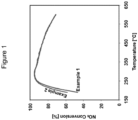
FIG. 1 compares NOx conversion of a Cu-CHA sample (Example 1) with a Ba-Cu-CHA sample (Example 2). -
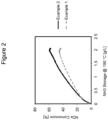
FIG. 2 compares the NOx conversion versus NH3 storage for Cu-CHA (Example 1) and Ba-Cu-CHA samples (Example 2). -
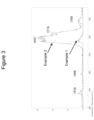
FIG. 3 represents an Infrared spectrum of Cu-CHA (Example 1) and Ba-Cu-CHA (Example 2) showing the N-O stretching vibrations after NOx adsorption between 2000 and 1400 cm-1. -
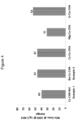
FIG. 4 is compares NOx conversion, at 200 °C and 1 g/L NH3 storage, of various alkaline earth metal promoted Cu-CHA. -
FIG. 5 compares steady state NOx conversion at 200 °C and 600 °C for various alkaline earth metal promoted Cu-CHA. - Before describing several exemplary embodiments of the invention, it is to be understood that the invention is not limited to the details of construction or process steps set forth in the following description. The invention is capable of other embodiments and of being practiced or being carried out in various ways.
- Governmental regulations mandate the use of NOx reduction technologies for light and heavy-duty vehicles. Selective catalytic reduction (SCR) of NOx using urea is an effective and dominant emission control technology for NOx control. To meet governmental regulations, an SCR catalyst that has improved low and high temperature performance compared to the current Cu-SSZ-13 based benchmark technology is necessary. Provided is an SCR catalyst having NOx conversion efficiency improvement at low NH3 storage levels.
- With respect to the terms used in this disclosure, the following definitions are provided.
- As used herein, molecular sieves refer to materials based on an extensive three-dimensional network of oxygen ions containing generally tetrahedral type sites and having a pore distribution. A zeolite is a specific example of a molecular sieve, further including silicon and aluminum. Reference to a "non-zeolite-support" or "non-zeolitic support" in a catalyst layer refers to a material that is not a molecular sieve or zeolite and that receives precious metals, stabilizers, promoters, binders, and the like through association, dispersion, impregnation, or other suitable methods. Examples of such non-zeolitic supports include, but are not limited to, high surface area refractory metal oxides. High surface area refractory metal oxide supports can comprise an activated compound selected from the group consisting of alumina, zirconia, silica, titania, silica-alumina, zirconia-alumina, titania-alumina, lanthana-alumina, lanthana-zirconia-alumina, baria-alumina, baria-lanthana-alumina, baria-lanthana-neodymia-alumina, zirconia-silica, titania-silica, and zirconia-titania.
- As used herein, the term "catalyst" refers to a material that promotes a reaction. As used herein, the phrase "catalyst composition" refers to a combination of two or more catalysts, for example a combination of two different materials that promote a reaction. The catalyst composition may be in the form of a washcoatAs used herein, the term "carrier" refers to a support that carries or supports a catalytic species such as a catalyzed honeycomb substrate.
- As used herein, the term "substrate" refers to the monolithic material onto which the carrier is placed, typically in the form of a washcoat containing a plurality of carriers having catalytic species thereon. A washcoat is formed by preparing a slurry containing a specified solids content (e.g., 30-90% by weight) of carriers in a liquid vehicle, which is then coated onto a substrate and dried to provide a washcoat layer.
- As used herein, the term "washcoat" has its usual meaning in the art of a thin, adherent coating of a catalytic or other material applied to a substrate carrier material, such as a honeycomb-type carrier member, which is sufficiently porous to permit the passage of the gas stream being treated.
- Any suitable substrate may be employed, such as a monolithic substrate of the type having fine, parallel gas flow passages extending there through from an inlet or an outlet face of the substrate such that passages are open to fluid flow there through. The passages, which are essentially straight paths from their fluid inlet to their fluid outlet, are defined by walls on which the catalytic material is coated as a washcoat so that the gases flowing through the passages contact the catalytic material. The flow passages of the monolithic substrate are thin-walled channels, which can be of any suitable cross-sectional shape and size such as trapezoidal, rectangular, square, sinusoidal, hexagonal, oval, circular, etc. Such structures may contain from about 60 to about 900 or more gas inlet openings (i.e. cells) per square inch of cross section.
- The ceramic substrate may be made of any suitable refractory material, e.g. cordierite, cordierite-α-alumina, silicon nitride, zircon mullite, spodumene, alumina-silica-magnesia, zircon silicate, sillimanite, a magnesium silicate, zircon, petalite, α-alumina, an aluminosilicate and the like.
- "Rich gaseous streams" including rich exhaust streams mean gas streams that have a λ < 1.0.
- "Rich periods" refer to periods of exhaust treatment where the exhaust gas composition is rich, i.e., has a λ < 1.0.
- "Rare earth metal components" refer to one or more oxides of the lanthanum series defined in the Periodic Table of Elements, including lanthanum, cerium, praseodymium and neodymium. Rare earth metal components can include at least one rare earth metal selected from Ce, Pr, Nd, Eu, Nb, Sm, Yb, and La.
- "Alkaline earth component" refers to one or more chemical elements defined in the Periodic Table of Elements, including beryllium (Be), magnesium (Mg), calcium (Ca), strontium (Sr), barium (Ba), and radium (Ra).
- One or more embodiments are directed to selective catalytic reduction catalysts. The catalysts comprise an 8-ring small pore molecular sieve promoted with copper and an alkaline earth component. The catalyst is effective to catalyze the reduction of nitrogen oxides in the presence of a reductant. As used herein, "promoted" refers to a component that is intentionally added to the molecular sieve, as opposed to impurities inherent in the molecular sieve. Thus, a promoter is intentionally added to enhance activity of a catalyst compared to a catalyst that does not have promoter intentionally added.
- The molecular sieves have 8-ring pore openings and double-six ring secondary building units, for example, those having the following structure types: AEI, AFT, AFX, CHA, EAB, ERI, KFI, LEV, SAS, SAT, and SAV. According to one or more embodiments, it will be appreciated that by defining the molecular sieves by their structure type, it is intended to include the structure type and any and all isotypic framework materials such as SAPO, ALPO and MeAPO materials having the same structure type.
- In more specific embodiments reference to an aluminosilicate zeolite structure type limits the material to molecular sieves that do not include phosphorus or other metals substituted in the framework. Of course, aluminosilicate zeolites may be subsequently ion-exchanged with one or more promoter metals such as iron, copper, cobalt, nickel, cerium or platinum group metals. However, to be clear, as used herein, alumino silicate zeolite" excludes aluminophosphate materials such as SAPO, ALPO, and MeAPO materials, and the broader term "zeolite" is intended to include aluminosilicates and aluminophosphates.
- In general, the SCR catalyst based on an 8-ring small pore molecular sieve promoted with copper and an alkaline earth component exhibits comparable NOx conversion activity with Cu-SSZ-13 catalysts. In general, the catalyst exhibits both good low temperature NOx conversion activity (NOx conversion > 50% at 200°C) and good high temperature NOx conversion activity (NOx conversion > 70% at 450°C). The NOx activity is measured under steady state conditions at maximum NH3-slip conditions in a gas mixture of 500 ppm NO, 500 ppm NH3, 10% O2, 5% H2O, balance N2 at a volume-based space velocity of 80,000 h-1.
- As used herein, the term "Na+-form of chabazite" refers to the calcined form of this zeolite without any ion exchange. In this form, the zeolite generally contains a mixture of Na+ and H+ cations in the exchange sites. The fraction of sites occupied by Na+ cations varies depending on the specific zeolite batch and recipe.
- A molecular sieve can be zeolitic--zeolites--or non-zeolitic, and zeolitic and non-zeolitic molecular sieves can have the chabazite crystal structure, which is also referred to as the CHA structure by the International Zeolite Association. Zeolitic chabazite includes a naturally occurring tectosilicate mineral of a zeolite group with approximate formula: (Ca,Na2,K2,Mg)Al2Si4O12•6H2O (e.g., hydrated calcium aluminum silicate). Three synthetic forms of zeolitic chabazite are described in "Zeolite Molecular Sieves," by D. W. Breck, published in 1973 by John Wiley & Sons. The three synthetic forms reported by Breck are Zeolite K-G, described in J. Chem. Soc., p. 2822 (1956), Barrer et al; Zeolite D, described in
British Patent No. 868,846 (1961 U.S. Patent No. 3,030,18 1 . Synthesis of another synthetic form of zeolitic chabazite, SSZ-13, is described inU.S. Pat. No. 4,544,53 8 . Synthesis of a synthetic form of a non-zeolitic molecular sieve having the chabazite crystal structure, silicoaluminophosphate 34 (SAPO-34), is described inU.S. Patent 4,440,871 and No.7,264,789 . A method of making yet another synthetic non-zeolitic molecular sieve having chabazite structure, SAPO-44, is described inU.S. Patent No. 6,162,415 . - In one or more embodiments, the 8-ring small pore molecular sieve promoted with copper and an alkaline earth component is selected from the group consisting of AEI, AFT, AFX, CHA, EAB, ERI, KFI, LEV, SAS, SAT, and SAV. In a specific embodiment, the 8-ring small pore molecular sieve can include all aluminosilicate, borosilicate, gallosilicate, MeAPSO, and MeAPO compositions. These include, but are not limited to SSZ-13, SSZ-62, natural chabazite, zeolite K-G, Linde D, Linde R, LZ-218, LZ-235, LZ-236, ZK-14, SAPO-34, SAPO-44, SAPO-47, ZYT-6, CuSAPO-34, CuSAPO-44, and CuSAPO-47. However, in specific embodiments, the 8-ring small pore molecular sieve will have the aluminosilicate composition, such as SSZ-13 and SSZ-62, which would exclude borosilicate, gallosilicate, MeAPSO, SAPO and MeAPO compositions.
- In one or more embodiments, the 8-ring small pore molecular sieve has the CHA crystal structure and is selected from the group consisting of aluminosilicate zeolite having the CHA crystal structure, SAPO, ALPO, and MeAPO. In particular, the 8-ring small pore molecular sieve having the CHA crystal structure is an aluminosilicate zeolite having the CHA crystal structure. In a specific embodiment, the 8-ring small pore molecular sieve having the CHA crystal structure will have an aluminosilicate composition, such as SSZ-13 and SSZ-62.
- The Cu content of the 8-ring small pore molecular sieve promoted with copper and an alkaline earth component, calculated as CuO, in specific embodiments is from 2 wt.% and in even more specific embodiments from 2.5 wt% 3.5 wt.%, based on the total weight of the calcined molecular sieve reported on a volatile free basis.
- The alkaline earth component is selected from barium, strontium, and combinations thereof. In a more specific embodiment, the alkaline earth component is barium.
- The alkaline earth component loading is less than 1% by weight. In a more specific embodiment, the alkaline earth component loading is less than 0.5% by weight.
- The copper and alkaline earth component are exchanged into the 8-ring small pore molecular sieve.
- In specific embodiments, the 8-ring small pore molecular sieve promoted with copper and an alkaline earth component is an aluminosilicate zeolite that has a mole ratio of silica to alumina greater than 15, even more specifically greater than about 20. In specific embodiments, the 8-ring small pore molecular sieve promoted with copper and an alkaline earth component has a mole ratio of silica to alumina in the range from about 20 to about 256, more specifically in the range from 25 to 40.
- In specific embodiments, the atomic ratio of copper to aluminum exceeds 0.25. In more specific embodiments, the ratio of copper to aluminum is from 0.25 to 1, even more specifically from 0.25 to 0.5. In even more specific embodiments, the ratio of copper to aluminum is from 0.3 to 0.4.
- In specific embodiments, the 8-ring small pore molecular sieve promoted with copper and an alkaline earth component exhibits an aged NOx conversion at 200°C of at least 50% measured at a gas hourly space velocity of 80000 h-1. In specific embodiments the 8-ring small pore molecular sieve promoted with copper and an alkaline earth component exhibits an aged NOx conversion at 450°C of at least 70% measured at a gas hourly space velocity of 80000 h-1. More specifically the aged NOx conversion at 200°C is at least 55% and at 450°C at least 75%, even more specifically the aged NOx conversion at 200°C is at least 60% and at 450°C at least 80%, measured at a gas hourly volume-based space velocity of 80000 h-1 under steady state conditions at maximum NH3-slip conditions in a gas mixture of 500 ppm NO, 500 ppm NH3, 10% O2, 5% H2O, balance N2. The cores were hydrothermally aged in a tube furnace in a gas flow containing 10% H2O, 10% O2, balance N2 at a space velocity of 4,000 h-1 for 6h at 850°C.
- The SCR activity measurement has been demonstrated in the literature, for example
WO 2008/106519 . - In specific embodiments, the 8-ring small pore molecular sieve promoted with copper and an alkaline earth component has a sodium content (reported as Na2O on a volatile free basis) of below 2 wt.%, based on the total weight of the calcined molecular sieve. In more specific embodiments, sodium content is below 1 wt.%, even more specifically below 2000 ppm, even more specifically below 1000 ppm, even more specifically below 500 ppm and most specifically below 100 ppm.
- In specific embodiments, the 8-ring small pore molecular sieve promoted with copper and an alkaline earth component has an atomic sodium to aluminum ratio of less than 0.7. In more specific embodiments, the atomic sodium to aluminum ratio is less than 0.35, even more specifically less than 0.007, even more specifically less than 0.03 and even more specifically less than 0.02.
- In specific embodiments, the 8-ring small pore molecular sieve promoted with copper and an alkaline earth component has an atomic copper to sodium ratio of greater than 0.5. In more specific embodiments, the atomic copper to sodium ratio of greater than 1, even more specifically greater than 10, even more specifically greater than 50.
- In what may be referred to as a conventional synthesis of an molecular sieve having the CHA structure, a source of silica, a source of alumina, and a structure directing agent are mixed under alkaline aqueous conditions. Typical silica sources include various types of fumed silica, precipitated silica, and colloidal silica, as well as silicon alkoxides. Typical alumina sources include boehmites, pseudo-boehmites, aluminum hydroxides, aluminum salts such as aluminum sulfate or sodium aluminate, and aluminum alkoxides. Sodium hydroxide is typically added to the reaction mixture. A typical structure directing agent for this synthesis is adamantyltrimethyl ammonium hydroxide, although other amines and/or quaternary ammonium salts may be substituted or added to the latter directing agent. The reaction mixture is heated in a pressure vessel with stirring to yield the crystalline SSZ-13 product. Typical reaction temperatures are in the range of 100 and 200°C, and in specific embodiments between 135 and 170 °C. Typical reaction times are between 1 hr and 30 days, and in specific embodiments, between 10 hours and 3 days.
- At the conclusion of the reaction, optionally the pH is adjusted to between 6 and 10, and in specific embodiments, between 7 and 7.5, and the product is filtered and washed with water. Any acid can be used for pH adjustment, and in specific embodiments nitric acid is used. Alternatively, the product may be centrifuged. Organic additives may be used to help with the handling and isolation of the solid product. Spray-drying is an optional step in the processing of the product. The solid product is thermally treated in air or nitrogen. Alternatively, each gas treatment can be applied in various sequences, or mixtures of gases can be applied. Typical calcination temperatures are in the 400°C to 850°C range.
- Optionally, the obtained alkali metal zeolite is NH4-exchanged to form NH4-Chabazite. The NH4- ion exchange can be carried out according to various techniques known in the art, for example Bleken, F.; Bjorgen, M.; Palumbo, L.; Bordiga, S.; Svelle, S.; Lillerud, K.-P.; and Olsbye, U. Topics in Catalysis 52, (2009), 218-228.
- Particularly, the catalyst comprises a SSZ-13 promoted with copper and barium. The synthesis of CHA-type zeolites promoted with copper and an alkaline earth, particularly CHA-type aluminosilicate zeolites such as SSZ-13 and SSZ-62 are provided.
- Generally, barium is incorporated into a copper-promoted 8-ring small pore molecular sieve (e.g. Cu-SSZ-13) by dropwise addition of Ba2+ salt solution into an aqueous slurry of the copper-promoted 8-ring small pore molecular sieve. The pH is adjusted to about 5.5, followed by agitation of the mixture for at least 12 hours. The precursor slurry is pre-milled to desired D90 value of particle size. The resultant barium and copper promoted 8-ring small pore molecular sieve is then coated onto a ceramic flow-through honeycomb.
- In specific embodiments, the 8-ring small pore molecular sieve promoted with copper and an alkaline earth component exhibits a BET surface area, determined according to DIN 66131, of at least about 400 m2/g, more specifically of at least about 550 m2/g, even more specifically of at about 650 m2/g. In specific embodiments, the selective catalytic reduction catalyst comprising an 8-ring small pore molecular sieve promoted with copper and an alkaline earth component exhibits a BET surface area in the range from about 400 to about 750 m2/g, more specifically from about 500 to about 750 m2/g, even more specifically from about 600 to mean length of crystallites:
- In specific embodiments, the crystallites of the calcined 8-ring small pore molecular sieve promoted with copper and an alkaline earth component have a mean length in the range of from 10 nanometers to 100 micrometers, specifically in the range of from 50 nanometers to 5 micrometers, more specifically in the range of 50 nanometers to 500 nanometers as determined via SEM.
- The 8-ring small pore molecular sieve promoted with copper and an alkaline earth component according to embodiments of the invention may be provided in the form of a powder or a sprayed material obtained from above-described separation techniques, e.g. decantation, filtration, centrifugation, or spraying.
- In general, the powder or sprayed material can be shaped without any other compounds, e.g. by suitable compacting, to obtain moldings of a desired geometry, e.g. tablets, cylinders, spheres, or the like.
- By way of example, the powder or sprayed material is admixed with or coated by suitable modifiers well known in the art. By way of example, modifiers such as silica, alumina, zeolites or refractory binders (for example a zirconium precursor) may be used. The powder or the sprayed material, optionally after admixing or coating by suitable modifiers, may be formed into a slurry, for example with water, which is deposited upon a suitable refractory carrier (for example
WO 2008/106519 ). - The 8-ring small pore molecular sieve promoted with copper and an alkaline earth component of embodiments of the invention may also be provided in the form of extrudates, pellets, tablets or particles of any other suitable shape, for use as a packed bed of particulate catalyst, or as shaped pieces such as plates, saddles, tubes, or the like.
- In specific embodiments, the molecular sieve is substantially comprised of alumina and silica and has a silica to alumina ratio in the range of about 1 to 1000, and in specific embodiments from 1 to 500, and in more specific embodiments from 5 to 300, 5 to 200, 5 to 100, 10 to 90, 10 to 80, 10 to 70, 10 to 60, 10 to 50, 10 to 40, 10 to 35 and 10 to 30 are within the scope of the invention. In specific embodiments, the molecular sieve is SSZ-13 and/or SSZ-62 both promoted with copper and barium.
- Among others, said catalyst may be employed as catalyst for the selective reduction (SCR) of nitrogen oxides (NOx); for the oxidation of NH3, in particular for the oxidation of NH3 slip in diesel systems; for the decomposition of N2O; for soot oxidation; for emission control in Advanced Emission Systems such as Homogeneous Charge Compression Ignition (HCCl) engines; as additive in fluid catalytic cracking (FCC) processes; as catalyst in organic conversion reactions; or as catalyst in "stationary source" processes. For applications in oxidation reactions, in specific embodiments an additional precious metal component is added to the copper chabazite (e.g. Pd, Pt).
- In particular, the selective reduction of nitrogen oxides wherein the selective catalytic reduction catalyst comprising an 8-ring small pore molecular sieve promoted with copper and an alkaline earth component according to embodiments of the invention is employed as catalytically active material is carried out in the presence of ammonia or urea. While ammonia is the reducing agent of choice for stationary power plants, urea is the reducing agent of choice for mobile SCR systems. Typically, the SCR system is integrated in the exhaust gas treatment system of a vehicle and, also typically, contains the following main components: selective catalytic reduction catalyst comprising an 8-ring small pore molecular sieve promoted with copper and an alkaline earth component according to embodiments of the invention; a urea storage tank; a urea pump; a urea dosing system; a urea injector/nozzle; and a respective control unit.
- The term nitrogen oxides, NOx, as used in the context of embodiments of the invention designates the oxides of nitrogen, especially dinitrogen oxide (N2O), nitrogen monoxide (NO), dinitrogen trioxide (N2O3), nitrogen dioxide (NO2), dinitrogen tetroxide (N2O4), dinitrogen pentoxide (N2O5), nitrogen peroxide (NO3).
- The nitrogen oxides which are reduced using a selective catalytic reduction catalyst comprising an 8-ring small pore molecular sieve promoted with copper and an alkaline earth component according to embodiments of the invention or an 8-ring small pore molecular sieve promoted with copper and an alkaline earth component obtainable or obtained according to embodiments of the invention may be obtained by any process, e.g. as a waste gas stream. Among others, waste gas streams as obtained in processes for producing adipic acid, nitric acid, hydroxylamine derivatives, caprolactame, glyoxal, methyl-glyoxal, glyoxylic acid or in processes for burning nitrogeneous materials may be mentioned.
- Copper is ion exchanged into the molecular sieve. The metal can be exchanged after manufacture of the molecular sieve.
- For additional promotion of the SCR of oxides of nitrogen, a suitable alkaline earth is exchanged into the molecular sieve material.
- In specific embodiments, copper is ion exchanged into alkali metal or NH4-Chabazite to form Cu-Chabazite. When copper acetate is used, the copper concentration of the liquid copper solution used in the copper ion-exchange is in specific embodiments in the range from about 0.01 to about 0.4 molar, more specifically in the range from about 0.05 to about 0.3 molar, even more specifically in the range from about 0.1 to about 0.25 molar, even more specifically in the range from about 0.125 to about 0.25 molar, even more specifically in the range from about 0.15 to about 0.225 molar and even more specifically in the range from about 0.2.
- According to a further embodiment of the present invention, the 8-ring small pore molecular sieve of the invention used in a catalytic process involving the conversion of at least one compound comprising at least one nitrogen - oxygen bond. According to one or more embodiments of the present invention the 8-ring small pore molecular sieve is used as a catalyst and/or catalyst support in a selective catalytic reduction (SCR) process for the selective reduction of nitrogen oxides NOx; for the oxidation of NH3, in particular for the oxidation of NH3 slip in diesel systems; for the decomposition of N2O. The term nitrogen oxides, NOx, as used in the context of the present invention designates the oxides of nitrogen, especially dinitrogen oxide (N2O), nitrogen monoxide (NO), dinitrogen trioxide (N2O3), nitrogen dioxide (NO2), dinitrogen tetroxide (N2O4), dinitrogen pentoxide (N2O5), nitrogen peroxide (NO3). In particular, the selective reduction of nitrogen oxides wherein the 8-ring small pore molecular sieve according to an embodiment of the present invention is employed as catalytically active material is carried out in the presence ammonia or urea. While ammonia is the reducing agent of choice for stationary power plants, urea is the reducing agent of choice for mobile SCR systems. Typically, the SCR system is integrated in the engine and vehicle design and, also typically, contains the following main components: SCR catalyst containing the 8-ring small pore molecular sieve according to an embodiment of the present invention; a urea storage tank; a urea pump; a urea dosing system; a urea injector/nozzle; and a respective control unit.
- The invention is now described with reference to the following examples. Before describing several exemplary embodiments of the invention, it is to be understood that the invention is not limited to the details of construction or process steps set forth in the following description.
- A Cu-CHA powder catalyst was prepared by mixing 100 g of NH4 +-form CHA, having a silica/alumina mole ratio of 30, with 400 mL of a copper(II) acetate solution of 1.0 M. An ion-exchange reaction between the NH4 +-form CHA and the copper ions was carried out by agitating the slurry at 80° C for 1 hour. The resulting mixture was then filtered, washed with 800 mL of deionized water in three portions until the filtrate was clear and colorless, which indicated that substantially no soluble or free copper remained in the sample, and the washed sample was dried in air at room temperature.
- The resulting Cu-CHA product was then calcined at 640° C in air for 6 hours. The obtained Cu-CHA catalyst comprised CuO at 2 to 3.5% by weight, as determined by ICP analysis. A Cu-CHA slurry was prepared by mixing 90 g of Cu-CHA, as described above, with 215 mL of deionized water. The slurry was milled and a binder of zirconium acetate in dilute acetic acid (containing 30% ZrO2) was added into the slurry with agitation.
- The slurry was coated onto 1"Dx3"L cellular ceramic cores, having a cell density of 400 cpsi (cells per square inch) and a wall thickness of 6 mil. The coated cores were dried at 110° C for 3 hours and calcined at 450° C for 1 hour. The coating process was repeated once to obtain a target washcoat loading of 2 to 3 g/in3.
- Barium incorporated Cu-SSZ-13 (Ba-Cu-SSZ-13) is prepared by drop-wise addition of Ba2+ salt solution into an aqueous slurry of Cu-SSZ-13 prepared in accordance with Example 1. The Cu-CHA filter cake, obtained in Example 1 was crushed and then calcined at 600°C for 4 hours An aqueous slurry was then prepared to 45% target solids, followed by addition of 5% ZrOAc binder, based on the zeolite solids. The mixture was mixed well, and then was milled. A solution of Ba(OAc)2 (30 mL, 0.00822 g per gram of zeolite for 0.5wt% BaO loading) was added dropwise to the aqueous slurry with stirring. The pH was adjusted to 4.5 using 15% ammonium hydroxide solution. The slurry was rolled overnight (for at least 12 hours) for in-situ ion exchange of Ba2+. The resultant Ba-Cu-SSZ-13 slurry is coated onto ceramic flow-through honeycombs.
- For the preparation of coated monolithic test scores, the filtercake (water content of 45 % measured after calcination at 600°C in air for 1 hour) was made into a slurry of 38-45% solid content by adding deionized water. The Cu-CHA slurry was then milled in a ceramic ball mill to a particle size of D90 of less than 10 µm (for example 4 to 10 µm) measured with a Sympatec particle size analyzer using forward Laser scattering. No acid or binder was added to the slurry in order to probe the intrinsic activity of the catalyst. The milled slurry was coated onto a ceramic monolith (NGK) of 1" diameter and 2" length having 400 cpsi cell density and 6 mil wall thickness. The target dry gain was 2.3 g/in3 which corresponds to the loading of active catalyst in
WO 2008/106519 . Typically two to three coats were needed to reach that target, the solid content of the additional coats has been adjusted to meet the desired target dry gain increase. After each coat the core was dried for 3h at 90°C in air. The last drying step was followed by a calcination for 1h at 450°C in air in a muffle funnel. - Nitrogen oxides selective catalytic reduction (SCR) efficiency and selectivity of a fresh catalyst core was measured by adding a feed gas mixture of 500 ppm of NO, 500 ppm of NH3, 10% O2, 5% H2O, balanced with N2 to a steady state reactor containing a 1"D x 3"L catalyst core. The reaction was carried at a space velocity of 80,000 hr-1 across a 150° C to 450° C temperature range.
- Samples were hydrothermally aged in the presence of 10% H2O at 750° C for 5 hours, followed by measurement of the nitrogen oxides SCR efficiency and selectivity by the same process as outlined above for the SCR evaluation on a fresh catalyst core.
-
Figure 1 compares Example 1 with Example 2 for steady state NOx conversion obtained on a lab reactor. The results are summarized in Table 1.Table 1: EXAMPLE # TEMPERATURE (°C) NOx CONVERSION (%) 1 200 54 250 91 300 96 450 87 550 80 2 200 70 250 93 300 95 450 86 550 78 -
Figure 2 compares the NOx conversion versus NH3 storage for Example 1 and Example 2 obtained on a lab reactor at 190 °C. - The results are summarized in Table 2.
Table 2: EXAMPLE # NOx CONVERSION (%) NH3 STORAGE @ 190°C (g/L) 1 21 0.5 32 1.0 40 1.5 45 2.0 2 24 0.5 39 1.0 50 1.5 60 2.0 - The aged Ba-Cu-SSZ-13 has 10% higher absolute NOx conversion compared to Cu-SSZ-13 at 200°C. This improvement of low temperature SCR performance occurs at lower NH3 storage values compared to that of Cu-SSZ-13. Among different Ba loading studied (0.5, 1, and 5 wt% BaO), the 0.5 wt% Ba sample showed the highest performance improvement, and the 5 wt% Ba loading showed detrimental effects on SCR performance.
- NOx adsorption was measured on 2:1 DE Cu(CHA) to Liquid Exchange FeCHA samples to determine the effect of BaO. NOx DRIFT experiments were performed on the Excalibur FT-IR instrument. Samples were dehydrated at 450°C for 1 hour in dry nitrogen(g) and argon(g). The samples were then cooled to room temperature, and adsorbed with 1% NOx in argon(g). Spectra were collected after 45 minutes of desorption. N-O stretching vibrations are shown in an IR spectral comparison (
Figure 3 ) after NOx adsorption between 2000 and 1400 cm-1. - The results show that with the addition of BaO, a much higher concentration of NOx is stored on the catalyst surface.
- Additional metals, Ca, Mg and Sr were incorporated into Cu-CHA to produce Ca-Cu-CHA, Mg-Cu-CHA, and Sr-Cu-CHA; similar to the procedures in Example 2 in an amount of 0.5 wt. %.
Figure 4 shows NOx conversion of each sample at 200 °C at 1 g/L NH3 storage. Ba-Cu-CHA, Ca-Cu-CHA, and Sr-Cu-CHA showed improved low temperature conversion at 1 g/L NH3 storage compared to Cu-CHA.Figure 5 compares the steady state NOx conversion at 200 °C and 600 °C for Example 1, Example 2, and other (Ca, Sr) alkaline earth elements promoted in Cu-CHA. Example 2, Ca-Cu-CHA, and Sr-Cu-CHA show SCR performance improvement vs. Example 1 at 200 °C. Example 2 and Sr-Cu-CHA show SCR performance improvement vs. Example 1 at 600 °C. - Reference throughout this specification to "one embodiment," "certain embodiments," "one or more embodiments" or "an embodiment" means that a particular feature, structure, material, or characteristic described in connection with the embodiment is included in at least one embodiment of the invention. Thus, the appearances of the phrases such as "in one or more embodiments," "in certain embodiments," "in one embodiment" or "in an embodiment" in various places throughout this specification are not necessarily referring to the same embodiment of the invention. Furthermore, the particular features, structures, materials, or characteristics may be combined in any suitable manner in one or more embodiments.
- Although the invention herein has been described with reference to particular embodiments, it is to be understood that these embodiments are merely illustrative of the principles and applications of the present invention.
Claims (9)
- A selective catalytic reduction catalyst comprising an 8-ring small pore molecular sieve promoted with copper and an alkaline earth component, wherein the catalyst is effective to catalyze the reduction of nitrogen oxides in the presence of a reductant, wherein the copper and the alkaline earth component are exchanged into the 8-ring small pore molecular sieve and wherein the alkaline earth component is selected from barium, strontium, and combinations thereof, the alkaline earth component loading, as oxide, being of less than 1 wt. %, based on the total weight of the calcined molecular sieve reported on a volatile free basis, and as determined by ICP analysis,
and wherein the copper content of the 8-ring small pore molecular sieve, calculated as CuO, is in the range of from 2 to 3.5 weight-%, based on the total weight of the calcined molecular sieve reported on a volatile free basis, and as determined by ICP analysis. - The catalyst of claim 1, wherein the 8-ring small pore molecular sieve is selected from the group consisting of AEI, AFT, AFX, CHA, EAB, ERI, KFI, LEV, SAS, SAT, and SAV.
- The catalyst of claim 2, wherein the 8-ring small pore molecular sieve has the CHA crystal structure.
- The catalyst of claim 3, wherein the 8-ring small pore molecular sieve having the CHA crystal structure is selected from the group consisting of aluminosilicate zeolite, a borosilicate, a gallosilicate, a SAPO, an ALPO, a MEAPSO and a MeAPO.
- The catalyst of claim 4, wherein the molecular sieve is selected from the group consisting of SSZ-13, SSZ-62, natural chabazite, zeolite K-0, Linde D, Linde R, LZ-218, LZ-235, LZ-236, ZK-14, SAP0-34, SAP0-44, SAP0-47, and ZYT-6.
- The catalyst of claim 3, wherein the 8-ring small pore molecular sieve having the CHA crystal structure is an aluminosilicate zeolite.
- The catalyst of claim 5, wherein the aluminosilicate zeolite is selected from SSZ-13 and SSZ-62.
- The catalyst of claim 3, wherein the 8-ring small pore molecular sieve having the CHA crystal structure is a SAPO.
- The catalyst of claim 1, wherein the alkaline earth component is barium.
Applications Claiming Priority (2)
| Application Number | Priority Date | Filing Date | Title |
|---|---|---|---|
| US201261716067P | 2012-10-19 | 2012-10-19 | |
| PCT/US2013/065501 WO2014062952A1 (en) | 2012-10-19 | 2013-10-17 | 8-ring small pore molecular sieve with promoter to improve low temperature performance |
Publications (3)
| Publication Number | Publication Date |
|---|---|
| EP2908944A1 EP2908944A1 (en) | 2015-08-26 |
| EP2908944A4 EP2908944A4 (en) | 2016-07-06 |
| EP2908944B1 true EP2908944B1 (en) | 2025-03-19 |
Family
ID=50485524
Family Applications (1)
| Application Number | Title | Priority Date | Filing Date |
|---|---|---|---|
| EP13847777.3A Active EP2908944B1 (en) | 2012-10-19 | 2013-10-17 | 8-ring small pore molecular sieve with promoter to improve low temperature performance |
Country Status (9)
| Country | Link |
|---|---|
| US (1) | US8961914B2 (en) |
| EP (1) | EP2908944B1 (en) |
| JP (1) | JP6388591B2 (en) |
| KR (1) | KR20150074107A (en) |
| CN (1) | CN104736241B (en) |
| CA (1) | CA2888518C (en) |
| MX (1) | MX2015004814A (en) |
| RU (1) | RU2015118441A (en) |
| WO (1) | WO2014062952A1 (en) |
Families Citing this family (31)
| Publication number | Priority date | Publication date | Assignee | Title |
|---|---|---|---|---|
| US9981256B2 (en) * | 2011-12-02 | 2018-05-29 | Pq Corporation | Stabilized microporous crystalline material, the method of making the same, and the use for selective catalytic reduction of NOx |
| RU2634899C2 (en) * | 2012-04-11 | 2017-11-08 | Джонсон Мэтти Паблик Лимитед Компани | Zeolite catalysts containing metals |
| US9925492B2 (en) * | 2014-03-24 | 2018-03-27 | Mellanox Technologies, Ltd. | Remote transactional memory |
| US10626772B2 (en) * | 2014-07-18 | 2020-04-21 | Cummins Inc. | SCR exhaust aftertreatment apparatus, system and methods including multiple washcoat formulations |
| US10807082B2 (en) * | 2014-10-13 | 2020-10-20 | Johnson Matthey Public Limited Company | Zeolite catalyst containing metals |
| EP4464403A1 (en) * | 2015-03-19 | 2024-11-20 | BASF Corporation | Filter catalyzed with scr catalyst, systems and methods |
| WO2017090382A1 (en) * | 2015-11-27 | 2017-06-01 | 三菱化学株式会社 | Method for producing eight-membered oxygen ring zeolite and aei-type zeolite |
| EP3205398A1 (en) * | 2016-02-12 | 2017-08-16 | Hyundai Motor Company | Method for preparing zeolite catalyst |
| KR20180114238A (en) * | 2016-03-08 | 2018-10-17 | 바스프 코포레이션 | An ion-exchanged molecular sieve catalyst exhibiting reduced N2O emissions |
| KR102458492B1 (en) * | 2016-09-30 | 2022-10-27 | 존슨 맛쎄이 퍼블릭 리미티드 컴파니 | Synthesis of AEI and Cu-AEI Zeolites |
| EP3544730A1 (en) | 2016-11-28 | 2019-10-02 | Basf Se | Catalyst composite comprising an alkaline earth metal containing cha zeolite and use thereof in a process for the conversion of oxygenates to olefins |
| KR101879695B1 (en) * | 2016-12-02 | 2018-07-18 | 희성촉매 주식회사 | Zeolite structures with specific Cu2+ (α)/ Cu2+ (β) ratio in NO DRIFTS spectrum, a method for preparing zeolite structures, and a catalyst composition comprising the zeolite structures |
| EP3641917A1 (en) | 2016-12-05 | 2020-04-29 | Basf Corporation | Tetra-functional catalyst for the oxidation of no, the oxidation of a hydrocarbon, the oxidation of nh3 and the selective catalytic reduction of nox |
| JP2018094478A (en) | 2016-12-09 | 2018-06-21 | トヨタ自動車株式会社 | Scr catalyst system |
| KR102571848B1 (en) * | 2017-02-22 | 2023-08-30 | 바스프 코포레이션 | Exhaust Gas Treatment Catalyst for Nitrogen Oxide Reduction |
| US11040337B2 (en) * | 2018-04-30 | 2021-06-22 | Pq Corporation | Low-silica chabazite zeolites with high acidity |
| US11219885B2 (en) * | 2018-11-30 | 2022-01-11 | Johnson Matthey Public Limited Company | JMZ-1, a CHA-containing zeolite and methods of preparation |
| CN111514929B (en) * | 2019-02-03 | 2023-11-03 | 李云龙 | Cu-SSZ-13 catalyst with double aluminum centers, H-SSZ-13 molecular sieve, preparation method and application thereof |
| CN109926033B (en) * | 2019-04-15 | 2020-12-01 | 清华大学 | Modified small-pore molecular sieve adsorbent and preparation method and use thereof |
| JP7753199B2 (en) | 2019-09-25 | 2025-10-14 | ビーエーエスエフ モバイル エミッションズ カタリスツ エルエルシー | Cu-CHA SCR catalyst with specific lattice strain and domain size characteristics |
| WO2021083270A1 (en) * | 2019-10-31 | 2021-05-06 | 中国石油化工股份有限公司 | Supported catalyst, preparation method therefor and application thereof |
| KR20230028282A (en) * | 2020-06-25 | 2023-02-28 | 바스프 코포레이션 | Process for preparing copper-promoted zeolites |
| CN113070097A (en) * | 2021-03-29 | 2021-07-06 | 中国科学院生态环境研究中心 | NO for ammonia selective catalytic reductionxCopper-based catalyst and preparation method thereof |
| JP7206336B1 (en) * | 2021-07-26 | 2023-01-17 | 株式会社キャタラー | Exhaust gas purification catalyst |
| JP7320568B2 (en) * | 2021-08-04 | 2023-08-03 | 株式会社キャタラー | Exhaust gas purification catalyst |
| CN116139919A (en) * | 2021-11-22 | 2023-05-23 | 上海歌地催化剂有限公司 | A kind of SCR catalyst and preparation method thereof |
| JP7372302B2 (en) * | 2021-12-06 | 2023-10-31 | 株式会社キャタラー | Exhaust gas purification catalyst device |
| US20250222443A1 (en) | 2022-03-23 | 2025-07-10 | Umicore Ag & Co. Kg | SCR Zeolite Catalysts for Reduced N2O Formation |
| CN115304077B (en) * | 2022-08-10 | 2024-06-14 | 浙江浙能技术研究院有限公司 | Molecular sieve for selective catalytic reduction of nitrogen oxides and its preparation method and application |
| CN116550376A (en) * | 2023-04-28 | 2023-08-08 | 中国科学院生态环境研究中心 | A kind of preparation method and application of Cu-SSZ-13 composite catalyst supporting rare earth metal oxide or transition metal oxide |
| CN116902991B (en) * | 2023-07-19 | 2025-11-11 | 浙江汇甬新材料有限公司 | Small-pore zeolite molecular sieve, preparation method, catalyst and molecular sieve zeolite membrane |
Citations (3)
| Publication number | Priority date | Publication date | Assignee | Title |
|---|---|---|---|---|
| WO2008132452A2 (en) | 2007-04-26 | 2008-11-06 | Johnson Matthey Public Limited Company | Transition metal/zeolite scr catalysts |
| US7601662B2 (en) | 2007-02-27 | 2009-10-13 | Basf Catalysts Llc | Copper CHA zeolite catalysts |
| WO2012091046A1 (en) | 2010-12-28 | 2012-07-05 | 東ソー株式会社 | Zeolite having copper and alkali earth metal supported thereon |
Family Cites Families (21)
| Publication number | Priority date | Publication date | Assignee | Title |
|---|---|---|---|---|
| US3030181A (en) | 1957-08-26 | 1962-04-17 | Union Carbide Corp | Crystalline zeolite r |
| GB868846A (en) | 1957-08-26 | 1961-05-25 | Union Carbide Corp | Improvements in and relating to zeolites |
| US4544538A (en) | 1982-07-09 | 1985-10-01 | Chevron Research Company | Zeolite SSZ-13 and its method of preparation |
| US4440871A (en) | 1982-07-26 | 1984-04-03 | Union Carbide Corporation | Crystalline silicoaluminophosphates |
| US5024981A (en) | 1989-04-20 | 1991-06-18 | Engelhard Corporation | Staged metal-promoted zeolite catalysts and method for catalytic reduction of nitrogen oxides using the same |
| US6162415A (en) | 1997-10-14 | 2000-12-19 | Exxon Chemical Patents Inc. | Synthesis of SAPO-44 |
| US6974889B1 (en) | 1998-07-29 | 2005-12-13 | Exxonmobil Chemical Patents Inc. | Processes for manufacture of molecular sieves |
| US6709644B2 (en) * | 2001-08-30 | 2004-03-23 | Chevron U.S.A. Inc. | Small crystallite zeolite CHA |
| MXPA06014444A (en) | 2004-06-18 | 2007-03-21 | Basf Ag | Method for the continuous synthesis of methylamines. |
| US8541331B2 (en) | 2007-08-13 | 2013-09-24 | Pq Corporation | Iron-containing aluminosilicate zeolites and methods of making and using same |
| GB2464478A (en) | 2008-10-15 | 2010-04-21 | Johnson Matthey Plc | Aluminosilicate zeolite catalyst and use thereof in exhaust gas after-treatment |
| US9662611B2 (en) * | 2009-04-03 | 2017-05-30 | Basf Corporation | Emissions treatment system with ammonia-generating and SCR catalysts |
| CN105749747A (en) * | 2009-04-17 | 2016-07-13 | 约翰逊马西有限公司 | Small pore molecular sieve supported copper catalysts |
| EP2555853A4 (en) | 2010-03-11 | 2014-04-16 | Johnson Matthey Plc | OFFSETTED MOLECULAR SIEVE SUPPORTS FOR SELECTIVE CATALYTIC REDUCTION OF NOx &xA; |
| PL2428659T3 (en) * | 2010-09-13 | 2017-01-31 | Umicore Ag & Co. Kg | Catalytic convertor for removing nitrogen oxides from the exhaust gas of diesel motors |
| DK2646149T3 (en) | 2010-12-02 | 2020-06-29 | Johnson Matthey Plc | METALLIC ZEOLITE CATALYST |
| US8789356B2 (en) | 2011-07-28 | 2014-07-29 | Johnson Matthey Public Limited Company | Zoned catalytic filters for treatment of exhaust gas |
| CN103987662B (en) * | 2011-12-02 | 2018-10-23 | Pq公司 | Stabilized microporous crystalline material, method for its preparation and use for selective catalytic reduction of NOx |
| US9981256B2 (en) * | 2011-12-02 | 2018-05-29 | Pq Corporation | Stabilized microporous crystalline material, the method of making the same, and the use for selective catalytic reduction of NOx |
| CN102614908A (en) * | 2012-03-16 | 2012-08-01 | 北京工业大学 | Preparation method of SSZ-13 loaded Cu-Fe catalyst for selectively catalyzing and eliminating NOx by ammonia |
| RU2634899C2 (en) * | 2012-04-11 | 2017-11-08 | Джонсон Мэтти Паблик Лимитед Компани | Zeolite catalysts containing metals |
-
2013
- 2013-10-17 EP EP13847777.3A patent/EP2908944B1/en active Active
- 2013-10-17 US US14/056,431 patent/US8961914B2/en active Active
- 2013-10-17 JP JP2015537835A patent/JP6388591B2/en active Active
- 2013-10-17 KR KR1020157013161A patent/KR20150074107A/en not_active Ceased
- 2013-10-17 RU RU2015118441A patent/RU2015118441A/en not_active Application Discontinuation
- 2013-10-17 WO PCT/US2013/065501 patent/WO2014062952A1/en not_active Ceased
- 2013-10-17 CA CA2888518A patent/CA2888518C/en active Active
- 2013-10-17 CN CN201380054298.8A patent/CN104736241B/en active Active
- 2013-10-17 MX MX2015004814A patent/MX2015004814A/en unknown
Patent Citations (4)
| Publication number | Priority date | Publication date | Assignee | Title |
|---|---|---|---|---|
| US7601662B2 (en) | 2007-02-27 | 2009-10-13 | Basf Catalysts Llc | Copper CHA zeolite catalysts |
| WO2008132452A2 (en) | 2007-04-26 | 2008-11-06 | Johnson Matthey Public Limited Company | Transition metal/zeolite scr catalysts |
| WO2012091046A1 (en) | 2010-12-28 | 2012-07-05 | 東ソー株式会社 | Zeolite having copper and alkali earth metal supported thereon |
| EP2659973A1 (en) | 2010-12-28 | 2013-11-06 | Tosoh Corporation | Zeolite having copper and alkali earth metal supported thereon |
Non-Patent Citations (2)
| Title |
|---|
| D1 - ANNOTATED CLAIM AMENDMENTS CLAIMS AS FILED INCLUDING ANNOTATED AMENDMENTS TO INDICATE THE AMENDMENTS MADE IN THE GRANTED CLAIM SET. |
| D5 - PATENTEE'S LETTER DATED 2 MARCH 2020 IN REPLY TO COMMUNICATION FROM THE EXAMINING DIVISION |
Also Published As
| Publication number | Publication date |
|---|---|
| KR20150074107A (en) | 2015-07-01 |
| EP2908944A4 (en) | 2016-07-06 |
| CN104736241A (en) | 2015-06-24 |
| JP2015533343A (en) | 2015-11-24 |
| CN104736241B (en) | 2020-05-19 |
| MX2015004814A (en) | 2015-10-22 |
| RU2015118441A (en) | 2016-12-10 |
| CA2888518C (en) | 2021-09-14 |
| JP6388591B2 (en) | 2018-09-12 |
| US20140112852A1 (en) | 2014-04-24 |
| EP2908944A1 (en) | 2015-08-26 |
| WO2014062952A1 (en) | 2014-04-24 |
| CA2888518A1 (en) | 2014-04-24 |
| US8961914B2 (en) | 2015-02-24 |
Similar Documents
| Publication | Publication Date | Title |
|---|---|---|
| US8961914B2 (en) | 8-ring small pore molecular sieve with promoter to improve low temperature performance | |
| JP7158453B2 (en) | Eight-membered ring small pore molecular sieves as high temperature SCR catalysts | |
| EP2908947B1 (en) | Mixed metal 8-ring small pore molecular sieve catalytic articles and methods | |
| US20110165052A1 (en) | Process for Preparation of Copper Containing Molecular Sieves With the CHA Structure, Catalysts, Systems and Methods | |
| CA2965962A1 (en) | Mixed metal large crystal molecular sieve catalyst compositions, catalytic articles, systems and methods | |
| CN111867976B (en) | CHA zeolitic materials and related methods of synthesis | |
| BR112015008646B1 (en) | SELECTIVE CATALYTIC REDUCTION CATALYST |
Legal Events
| Date | Code | Title | Description |
|---|---|---|---|
| PUAI | Public reference made under article 153(3) epc to a published international application that has entered the european phase |
Free format text: ORIGINAL CODE: 0009012 |
|
| 17P | Request for examination filed |
Effective date: 20150519 |
|
| AK | Designated contracting states |
Kind code of ref document: A1 Designated state(s): AL AT BE BG CH CY CZ DE DK EE ES FI FR GB GR HR HU IE IS IT LI LT LU LV MC MK MT NL NO PL PT RO RS SE SI SK SM TR |
|
| AX | Request for extension of the european patent |
Extension state: BA ME |
|
| DAX | Request for extension of the european patent (deleted) | ||
| RA4 | Supplementary search report drawn up and despatched (corrected) |
Effective date: 20160602 |
|
| RIC1 | Information provided on ipc code assigned before grant |
Ipc: B01J 29/06 20060101ALI20160527BHEP Ipc: B01J 23/02 20060101ALI20160527BHEP Ipc: B01J 23/72 20060101AFI20160527BHEP |
|
| STAA | Information on the status of an ep patent application or granted ep patent |
Free format text: STATUS: EXAMINATION IS IN PROGRESS |
|
| 17Q | First examination report despatched |
Effective date: 20191023 |
|
| GRAP | Despatch of communication of intention to grant a patent |
Free format text: ORIGINAL CODE: EPIDOSNIGR1 |
|
| STAA | Information on the status of an ep patent application or granted ep patent |
Free format text: STATUS: GRANT OF PATENT IS INTENDED |
|
| INTG | Intention to grant announced |
Effective date: 20240516 |
|
| RAP1 | Party data changed (applicant data changed or rights of an application transferred) |
Owner name: BASF MOBILE EMISSIONS CATALYSTS LLC |
|
| GRAJ | Information related to disapproval of communication of intention to grant by the applicant or resumption of examination proceedings by the epo deleted |
Free format text: ORIGINAL CODE: EPIDOSDIGR1 |
|
| STAA | Information on the status of an ep patent application or granted ep patent |
Free format text: STATUS: EXAMINATION IS IN PROGRESS |
|
| GRAP | Despatch of communication of intention to grant a patent |
Free format text: ORIGINAL CODE: EPIDOSNIGR1 |
|
| STAA | Information on the status of an ep patent application or granted ep patent |
Free format text: STATUS: GRANT OF PATENT IS INTENDED |
|
| INTC | Intention to grant announced (deleted) | ||
| INTG | Intention to grant announced |
Effective date: 20241008 |
|
| P01 | Opt-out of the competence of the unified patent court (upc) registered |
Free format text: CASE NUMBER: APP_67566/2024 Effective date: 20241220 |
|
| GRAS | Grant fee paid |
Free format text: ORIGINAL CODE: EPIDOSNIGR3 |
|
| GRAA | (expected) grant |
Free format text: ORIGINAL CODE: 0009210 |
|
| STAA | Information on the status of an ep patent application or granted ep patent |
Free format text: STATUS: THE PATENT HAS BEEN GRANTED |
|
| AK | Designated contracting states |
Kind code of ref document: B1 Designated state(s): AL AT BE BG CH CY CZ DE DK EE ES FI FR GB GR HR HU IE IS IT LI LT LU LV MC MK MT NL NO PL PT RO RS SE SI SK SM TR |
|
| REG | Reference to a national code |
Ref country code: GB Ref legal event code: FG4D |
|
| REG | Reference to a national code |
Ref country code: CH Ref legal event code: EP |
|
| REG | Reference to a national code |
Ref country code: DE Ref legal event code: R096 Ref document number: 602013086593 Country of ref document: DE |
|
| REG | Reference to a national code |
Ref country code: IE Ref legal event code: FG4D |
|
| PG25 | Lapsed in a contracting state [announced via postgrant information from national office to epo] |
Ref country code: RS Free format text: LAPSE BECAUSE OF FAILURE TO SUBMIT A TRANSLATION OF THE DESCRIPTION OR TO PAY THE FEE WITHIN THE PRESCRIBED TIME-LIMIT Effective date: 20250619 |
|
| PG25 | Lapsed in a contracting state [announced via postgrant information from national office to epo] |
Ref country code: FI Free format text: LAPSE BECAUSE OF FAILURE TO SUBMIT A TRANSLATION OF THE DESCRIPTION OR TO PAY THE FEE WITHIN THE PRESCRIBED TIME-LIMIT Effective date: 20250319 |
|
| REG | Reference to a national code |
Ref country code: LT Ref legal event code: MG9D |
|
| PG25 | Lapsed in a contracting state [announced via postgrant information from national office to epo] |
Ref country code: NO Free format text: LAPSE BECAUSE OF FAILURE TO SUBMIT A TRANSLATION OF THE DESCRIPTION OR TO PAY THE FEE WITHIN THE PRESCRIBED TIME-LIMIT Effective date: 20250619 |
|
| PG25 | Lapsed in a contracting state [announced via postgrant information from national office to epo] |
Ref country code: HR Free format text: LAPSE BECAUSE OF FAILURE TO SUBMIT A TRANSLATION OF THE DESCRIPTION OR TO PAY THE FEE WITHIN THE PRESCRIBED TIME-LIMIT Effective date: 20250319 |
|
| PG25 | Lapsed in a contracting state [announced via postgrant information from national office to epo] |
Ref country code: LV Free format text: LAPSE BECAUSE OF FAILURE TO SUBMIT A TRANSLATION OF THE DESCRIPTION OR TO PAY THE FEE WITHIN THE PRESCRIBED TIME-LIMIT Effective date: 20250319 |
|
| PG25 | Lapsed in a contracting state [announced via postgrant information from national office to epo] |
Ref country code: GR Free format text: LAPSE BECAUSE OF FAILURE TO SUBMIT A TRANSLATION OF THE DESCRIPTION OR TO PAY THE FEE WITHIN THE PRESCRIBED TIME-LIMIT Effective date: 20250620 Ref country code: BG Free format text: LAPSE BECAUSE OF FAILURE TO SUBMIT A TRANSLATION OF THE DESCRIPTION OR TO PAY THE FEE WITHIN THE PRESCRIBED TIME-LIMIT Effective date: 20250319 |
|
| REG | Reference to a national code |
Ref country code: NL Ref legal event code: MP Effective date: 20250319 |
|
| REG | Reference to a national code |
Ref country code: AT Ref legal event code: MK05 Ref document number: 1776529 Country of ref document: AT Kind code of ref document: T Effective date: 20250319 |
|
| PG25 | Lapsed in a contracting state [announced via postgrant information from national office to epo] |
Ref country code: NL Free format text: LAPSE BECAUSE OF FAILURE TO SUBMIT A TRANSLATION OF THE DESCRIPTION OR TO PAY THE FEE WITHIN THE PRESCRIBED TIME-LIMIT Effective date: 20250319 |
|
| PG25 | Lapsed in a contracting state [announced via postgrant information from national office to epo] |
Ref country code: SE Free format text: LAPSE BECAUSE OF FAILURE TO SUBMIT A TRANSLATION OF THE DESCRIPTION OR TO PAY THE FEE WITHIN THE PRESCRIBED TIME-LIMIT Effective date: 20250319 |
|
| PG25 | Lapsed in a contracting state [announced via postgrant information from national office to epo] |
Ref country code: SM Free format text: LAPSE BECAUSE OF FAILURE TO SUBMIT A TRANSLATION OF THE DESCRIPTION OR TO PAY THE FEE WITHIN THE PRESCRIBED TIME-LIMIT Effective date: 20250319 |
|
| PG25 | Lapsed in a contracting state [announced via postgrant information from national office to epo] |
Ref country code: ES Free format text: LAPSE BECAUSE OF FAILURE TO SUBMIT A TRANSLATION OF THE DESCRIPTION OR TO PAY THE FEE WITHIN THE PRESCRIBED TIME-LIMIT Effective date: 20250319 Ref country code: PT Free format text: LAPSE BECAUSE OF FAILURE TO SUBMIT A TRANSLATION OF THE DESCRIPTION OR TO PAY THE FEE WITHIN THE PRESCRIBED TIME-LIMIT Effective date: 20250721 |
|
| PG25 | Lapsed in a contracting state [announced via postgrant information from national office to epo] |
Ref country code: IT Free format text: LAPSE BECAUSE OF FAILURE TO SUBMIT A TRANSLATION OF THE DESCRIPTION OR TO PAY THE FEE WITHIN THE PRESCRIBED TIME-LIMIT Effective date: 20250319 Ref country code: PL Free format text: LAPSE BECAUSE OF FAILURE TO SUBMIT A TRANSLATION OF THE DESCRIPTION OR TO PAY THE FEE WITHIN THE PRESCRIBED TIME-LIMIT Effective date: 20250319 |
|
| PGFP | Annual fee paid to national office [announced via postgrant information from national office to epo] |
Ref country code: GB Payment date: 20250923 Year of fee payment: 13 |
|
| PG25 | Lapsed in a contracting state [announced via postgrant information from national office to epo] |
Ref country code: AT Free format text: LAPSE BECAUSE OF FAILURE TO SUBMIT A TRANSLATION OF THE DESCRIPTION OR TO PAY THE FEE WITHIN THE PRESCRIBED TIME-LIMIT Effective date: 20250319 |
|
| PGFP | Annual fee paid to national office [announced via postgrant information from national office to epo] |
Ref country code: FR Payment date: 20250924 Year of fee payment: 13 |
|
| PG25 | Lapsed in a contracting state [announced via postgrant information from national office to epo] |
Ref country code: EE Free format text: LAPSE BECAUSE OF FAILURE TO SUBMIT A TRANSLATION OF THE DESCRIPTION OR TO PAY THE FEE WITHIN THE PRESCRIBED TIME-LIMIT Effective date: 20250319 Ref country code: CZ Free format text: LAPSE BECAUSE OF FAILURE TO SUBMIT A TRANSLATION OF THE DESCRIPTION OR TO PAY THE FEE WITHIN THE PRESCRIBED TIME-LIMIT Effective date: 20250319 |
|
| PG25 | Lapsed in a contracting state [announced via postgrant information from national office to epo] |
Ref country code: RO Free format text: LAPSE BECAUSE OF FAILURE TO SUBMIT A TRANSLATION OF THE DESCRIPTION OR TO PAY THE FEE WITHIN THE PRESCRIBED TIME-LIMIT Effective date: 20250319 |
|
| PG25 | Lapsed in a contracting state [announced via postgrant information from national office to epo] |
Ref country code: SK Free format text: LAPSE BECAUSE OF FAILURE TO SUBMIT A TRANSLATION OF THE DESCRIPTION OR TO PAY THE FEE WITHIN THE PRESCRIBED TIME-LIMIT Effective date: 20250319 |
|
| PG25 | Lapsed in a contracting state [announced via postgrant information from national office to epo] |
Ref country code: IS Free format text: LAPSE BECAUSE OF FAILURE TO SUBMIT A TRANSLATION OF THE DESCRIPTION OR TO PAY THE FEE WITHIN THE PRESCRIBED TIME-LIMIT Effective date: 20250719 |
|
| REG | Reference to a national code |
Ref country code: DE Ref legal event code: R026 Ref document number: 602013086593 Country of ref document: DE |
|
| PLBI | Opposition filed |
Free format text: ORIGINAL CODE: 0009260 |
|
| REG | Reference to a national code |
Ref country code: CH Ref legal event code: L10 Free format text: ST27 STATUS EVENT CODE: U-0-0-L10-L00 (AS PROVIDED BY THE NATIONAL OFFICE) Effective date: 20251231 |
|
| PGFP | Annual fee paid to national office [announced via postgrant information from national office to epo] |
Ref country code: DE Payment date: 20250923 Year of fee payment: 13 |
|
| PG25 | Lapsed in a contracting state [announced via postgrant information from national office to epo] |
Ref country code: DK Free format text: LAPSE BECAUSE OF FAILURE TO SUBMIT A TRANSLATION OF THE DESCRIPTION OR TO PAY THE FEE WITHIN THE PRESCRIBED TIME-LIMIT Effective date: 20250319 |
|
| PLAX | Notice of opposition and request to file observation + time limit sent |
Free format text: ORIGINAL CODE: EPIDOSNOBS2 |
|
| 26 | Opposition filed |
Opponent name: JOHNSON MATTHEY PUBLIC LIMITED COMPANY Effective date: 20251219 |
|
| PLAB | Opposition data, opponent's data or that of the opponent's representative modified |
Free format text: ORIGINAL CODE: 0009299OPPO |
|
| REG | Reference to a national code |
Ref country code: CH Ref legal event code: L10 Free format text: ST27 STATUS EVENT CODE: U-0-0-L10-L00 (AS PROVIDED BY THE NATIONAL OFFICE) Effective date: 20260402 |
|
| R26 | Opposition filed (corrected) |
Opponent name: JOHNSON MATTHEY PUBLIC LIMITED COMPANY Effective date: 20251219 |
|
| PLAF | Information modified related to communication of a notice of opposition and request to file observations + time limit |
Free format text: ORIGINAL CODE: EPIDOSCOBS2 |