EP2908600A1 - Provision of a reduced CPRI framelet link - Google Patents
Provision of a reduced CPRI framelet link Download PDFInfo
- Publication number
- EP2908600A1 EP2908600A1 EP15000476.0A EP15000476A EP2908600A1 EP 2908600 A1 EP2908600 A1 EP 2908600A1 EP 15000476 A EP15000476 A EP 15000476A EP 2908600 A1 EP2908600 A1 EP 2908600A1
- Authority
- EP
- European Patent Office
- Prior art keywords
- cpri
- framelet
- block
- fiber link
- access subsystem
- Prior art date
- Legal status (The legal status is an assumption and is not a legal conclusion. Google has not performed a legal analysis and makes no representation as to the accuracy of the status listed.)
- Granted
Links
Images




Classifications
-
- H—ELECTRICITY
- H04—ELECTRIC COMMUNICATION TECHNIQUE
- H04B—TRANSMISSION
- H04B10/00—Transmission systems employing electromagnetic waves other than radio-waves, e.g. infrared, visible or ultraviolet light, or employing corpuscular radiation, e.g. quantum communication
- H04B10/25—Arrangements specific to fibre transmission
- H04B10/2575—Radio-over-fibre, e.g. radio frequency signal modulated onto an optical carrier
- H04B10/25752—Optical arrangements for wireless networks
-
- H—ELECTRICITY
- H04—ELECTRIC COMMUNICATION TECHNIQUE
- H04W—WIRELESS COMMUNICATION NETWORKS
- H04W88/00—Devices specially adapted for wireless communication networks, e.g. terminals, base stations or access point devices
-
- H—ELECTRICITY
- H04—ELECTRIC COMMUNICATION TECHNIQUE
- H04B—TRANSMISSION
- H04B10/00—Transmission systems employing electromagnetic waves other than radio-waves, e.g. infrared, visible or ultraviolet light, or employing corpuscular radiation, e.g. quantum communication
- H04B10/27—Arrangements for networking
-
- H—ELECTRICITY
- H04—ELECTRIC COMMUNICATION TECHNIQUE
- H04W—WIRELESS COMMUNICATION NETWORKS
- H04W88/00—Devices specially adapted for wireless communication networks, e.g. terminals, base stations or access point devices
- H04W88/08—Access point devices
- H04W88/085—Access point devices with remote components
Definitions
- the subject technology generally relates to communications and, in particular, relates to common public radio interface (CPRI) framelets.
- CPRI common public radio interface
- CPRI public radio interface
- RRH remote radio-heads
- TDM time-division multiplexing
- AxCs antenna containers
- I&Q raw in-phase and quadrature
- Point-to-Point (PtP) fiber is the only practical solution for many deployments that is currently available.
- CPRI bit-rates e.g., 9.8304, 6.144, 4.9152, 3.072, 2.4576, 1.2288, 0.6144 Gb/s
- LTE Long Term Evolution
- small cells small cells
- femto-cells etc.
- CRAN urban cloud radio-access network
- baseband pool terminating more than 10k PtP CPRI fiber links.
- the deployment of small-cell base stations is highly cost sensitive, since they are designed for a relatively small number of concurrent users and are expected to be deployed in large numbers in many networks.
- a system for providing a reduced common public radio interface (CPRI) framelet link comprises:
- the baseband pool comprises a cellular base-station, and wherein the cellular base-station is configured to support various wireless protocol layers including L1, L2, and L3 protocol layers.
- the access subsystem comprises a broadband subsystem, wherein the broadband subsystem comprises an Ethernet subsystem, wherein the access subsystem comprises a digital subscriber line (DSL), a passive optical network (PON), or a hybrid fiber-coaxial (HFC) sub-system.
- DSL digital subscriber line
- PON passive optical network
- HFC hybrid fiber-coaxial
- the access subsystem comprises one or more modems, one or more low speed links, and one of a DSL access multiplexer (DSLAM), a cable-modem termination system (CMTS), or an optical line terminal (OLT), and wherein open base-station architecture initiative (OBSAI) framelets are transported across the one or more low-speed links.
- DSL access multiplexer DSL access multiplexer
- CMTS cable-modem termination system
- OLT optical line terminal
- OBSAI open base-station architecture initiative
- the baseband pool comprises a network synchronizer, wherein the network synchronizer is configured to provide synchronization signals, and wherein the first framelet block is synchronized with the DSLAM, the CMTS, or the OLT, and wherein the network synchronizer is configured to use one of IEEE 1588, SyncE, or an equivalent line-timing mechanism.
- the baseband pool includes a second framelet block that is configured to facilitate interfacing the access subsystem to a second short CPRI fiber link, wherein the second framelet block is configured to convert Ethernet frames to CPRI framelets, and wherein the second framelet block is configured to aggregate the CPRI framelets received from the DSLAM, the CMTS, or the OLT.
- the DSLAM, the CMTS, or the OLT is included in the baseband pool and is coupled to the second framelet block and the network synchronizer.
- each of the first and second short CPRI fiber links comprises a CPRI fiber link with a length of less than 2 meters, and wherein the second short CPRI fiber link comprises an aggregated CPRI fiber link including multiple CPRI fiber links.
- each cellular tower is coupled to the first short CPRI fiber link through a cellular remote radio head (RRH), and wherein the first framelet block is configured to convert CPRI framelets to Ethernet frames by extracting active data plane and control plane data.
- RRH cellular remote radio head
- a method for providing a reduced common public radio interface (CPRI) framelet link comprises:
- the baseband pool comprises a cellular base-station, and wherein the cellular base-station supports various wireless protocol layers including L1, L2, and L3 protocol layers.
- coupling the access subsystem comprises coupling an Ethernet subsystem, wherein coupling the access subsystem comprises coupling a digital subscriber line (DSL), a passive optical network (PON), or a hybrid fiber-coaxial (HFC) subsystem.
- DSL digital subscriber line
- PON passive optical network
- HFC hybrid fiber-coaxial
- coupling the access subsystem comprises coupling one or more modems, one or more low speed links, and one of a DSL access multiplexer (DSLAM), a cable-modem termination system (CMTS), or an optical line terminal (OLT), and wherein the method comprises transporting open base-station architecture initiative (OBSAI) framelets across the one or more low-speed links.
- DSL access multiplexer DSL access multiplexer
- CMTS cable-modem termination system
- OLT optical line terminal
- OBSAI open base-station architecture initiative
- the baseband pool comprises a network synchronizer, wherein the method comprises configuring the network synchronizer to:
- the baseband pool includes a second framelet block, and wherein the method comprises configuring the second framelet block to:
- the DSLAM, the CMTS, or the OLT is included in the baseband pool, and the method comprises coupling the DSLAM to the second framelet block and the network synchronizer.
- each of the first and second short CPRI fiber links comprises a CPRI fiber link with a length of less than 2 meters, and wherein the second short CPRI fiber link comprises an aggregated CPRI fiber link including multiple CPRI fiber links.
- the method further comprises:
- an apparatus for providing a reduced common public radio interface (CPRI) framelet link comprises:
- FIGs. 1A-1B are diagrams illustrating examples of a carry common public radio interface (CPRI) link and a CPRI framelet link, in accordance with one or more implementations.
- CPRI carry common public radio interface
- CPRI common public radio interface
- AxCs antenna containers
- the subject technology mitigates significant drawbacks of the current backhaul solutions for small remote radio-heads (RRHs), especially for cases with a small number of (e.g., one) AxCs per CPRI fiber link.
- the subject solution avoids using the expensive point-to-point (PtP) fiber links for small number of AxCs, of which much of the link capacity can be wasted.
- PtP point-to-point
- the subject technology leverages the broadband access systems that do not have the bandwidth to support a full CPRI connection. Examples of the broadband access systems includes digital subscriber line (DSL), hybrid fiber-coaxial (HFC), and passive optical network (PON) access systems.
- DSL digital subscriber line
- HFC hybrid fiber-coaxial
- PON passive optical network
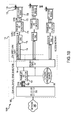
- FIGs. 1A-1B are diagrams illustrating examples of a carry common public radio interface (CPRI) access network 100A and a CPRI framelet access network 100B, in accordance with one or more implementations of the subject technology.
- the CPRI access network 100A shown in FIG. 1A includes a number of CPRI links 110 which can communicate through a central office (e.g., a base-band pool) 150 including a cellular base-station 152 with a network 160 (e.g., the Internet).
- the cellular base-station 152 can support various wireless protocol layers including L1, L2, and L3 protocol layers.
- Each CPRI links 110 includes a cellular tower 120, a cellular RRH 130, and a CPRI fiber link 140.
- the cellular tower 120 includes multiple antennas 122, and the CPRI fiber link 140 is a long (e.g., more than 20 meters and up to a few kilometers) fiber link.
- CPRI is a time-division multiplexing (TDM)-based protocol with a hyper-frame structure, which contains a number of AxCs, control channels, and other protocol elements. Each AxC carries raw in-phase and quadrature (I&Q) data for a particular antenna.
- TDM time-division multiplexing
- the cellular RRH 130 receives radio-frequency (RF) signals from the antenna(s) 122 and provides digitized data 142 including the control and digitized I&Q data to the CPRI fiber link 140, which carries the data 142 to the central office 150.
- RF radio-frequency
- the problem with the CPRI access network arises when the number of antennas 122 are small (e.g., one), in which case the operation of the CPRI network become highly inefficient.
- the subject technology provides a low cost and less complex solution for this particular case by leveraging existing broadband access systems, as described herein.
- the CPRI framelet access network 100B shown in FIG. 1B includes a number of CPRI framelet links 170 communicating through a central office (e.g., a base-band pool) 180 with the network 160.
- Each CPRI framelet link 170 includes the cellular tower 120, the cellular RRH 130, a short (e.g., a few meters) CPRI fiber link 172, a first framelet block (also referred to as "framelet inter-working function") 175, and an access subsystem including an access system node (e.g., modem) 176 and a low-speed link 174 coupled to a baseband pool 180.
- the RRH 130 maps the traffic from each antenna 122 to a unique AxC.
- the access subsystem is coupled to the first short CPRI fiber link 172 via the first framelet block 175 facilitates interfacing the first short CPRI fiber link 172 to the access subsystem.
- the first framelet block can convert CPRI framelets to Ethernet frames by extracting active data plane and control plane data, as described in more details herein.
- the baseband pool 180 includes a second framelet block 185 that can facilitate interfacing the access subsystem to a second short CPRI fiber link 182.
- the baseband pool 180 further includes the cellular base-station 152 that supports various wireless protocol layers including L1, L2, and L3 protocol layers.
- Examples of the access subsystem include an Ethernet subsystem such as a digital subscriber line (DSL) subsystem.
- the DSL subsystem includes one or more modems (e.g., 176), one or more low-speed links (e.g., 174), and a termination system 184 such as a cable-modem termination system (CMTS), an optical line terminal (OLT), or a DSL access multiplexer (DSLAM) at the base-band pool 180.
- CMTS cable-modem termination system
- OLT optical line terminal
- DSL access multiplexer DSL access multiplexer
- open Base-station architecture initiative (OBSAI) framelets can be transported across the low-speed links 174.
- OBSAI Base-station
- the baseband pool 180 includes the termination system 184 and a network synchronizer 186 that provides synchronization signals that are used, for example, to synchronize the first framelet block 175 with the termination system 184.
- the network synchronizer can use one of IEEE 1588, SyncE, or an equivalent line-timing mechanism.
- the DSLAM 184 is coupled to the second framelet block 185 and the network synchronizer 186.
- the second framelet block 185 converts Ethernet frames received from the DSLAM 184 to the CPRI framelets and can aggregate the CPRI framelets for delivery by a short (e.g., ⁇ 2m) CPRI fiber link 182 to the cellular base-station 152.
- the short CPRI fiber link 182 is an aggregated CPRI fiber link including multiple CPRI fiber links.
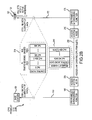
- FIGs. 2A-2B are diagrams illustrating examples of a CPRI link 200A and a CPRI framelet link 200B, in accordance with one or more implementations of the subject technology.
- the CPRI link 200A is similar to the CPRI link 110 of FIG. 1A which includes the cellular tower 120, multiple RF antennas 122, a CPRI fiber link 140 and the base station 150.
- the CPRI fiber link 140 has the capacity of carrying multiple (e.g., M) AxCs.
- Each AxC includes a mapping of the traffic from each antenna of the cellular tower 120.
- the AxCs are included in basic frames (BFs) 214, which are, in turn, parts of hyper frames 212.
- BFs basic frames
- the hyper frames 212 are the components of radio frames 210 that are transmitted by the CPRI fiber link 140 from the cellular tower 120 to the base station 150 (or in a reverse direction from the base station 150 to the cellular tower 120).
- Each basic frame 214 includes a control word 215 that carries data for the D control channels, a number of (e.g., N) traffic-bearing AxCs, and multiple (e.g., M-N) unused (e.g., non-traffic-bearing) AxCs.
- the shown structure of the basic frame 214 is a conceptual one and the details of structure of the basic frame 214 depend on the CPRI link bit-rate and other factors. It is understood that the CPRI link has both an upstream and a downstream channel, which can carry the similar radio frames 210 in both directions.
- the CPRI framelet link 200B is similar to the CPRI framelet link 170 of FIG. 1B and includes the cellular tower 120 including one or more RF antennas 122, the short CPRI link 172, the first framelet block 175, a first access system node 210 (e.g., a modem), an access link 230, a second access system node 220, a second framelet block 185, a second short CPRI fiber 240, and the base station 150.
- the short CPRI fiber links 172 and 250 carry the radio frames 210 of FIG. 1B including the basic frames 214 in both directions.
- the access link 230 carry CPRI framelets 240 provided by the first and second framelet blocks 175 and 185.
- a conceptual structure of a CPRI framelet 240 includes a framelet header, a control word data, and a number of (e.g., N) AxC data. More detailed structure of a CPRI framelet 240 is implementation dependent and is out of scope of the subject disclosure.
- the first access system node 210 and the first framelet block 175 can be integrated in a single device.
- the second access system node 220 and the second framelet block 185 can be integrated in another single device.
- a single CPRI stream may be mapped into a single CPRI framelet stream, as shown in FIG. 2B , or into multiple CPRI framelet streams to be carried by the aggregated CPRI short fiber link 182 of FIG. 1B .
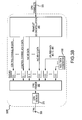
- FIGs. 3A-3B are diagrams illustrating examples of first and second framelet blocks 300A and 300B, in accordance with one or more implementations of the subject technology.
- the first framelet block 300A shown in FIG. 3A , is a conceptual implementation of the first framelet block 175 of FIGs. 1B and 2B and maps the CPRI data 305 to CPRI framelet data 335.
- the first framelet block 300A includes a CPRI SerDes 310, a CPRI Framer 320, and a framelet encapsulation module 330.
- the CPRI SerDes 310 deserialize the CPR data (e.g., radio frames 210 of FIG. 2A ) for processing by the CPRI framer 320 that can provide a number of parallel queues.
- the parallel queues include D (e.g., 0 to D-1) control channel data and N (e.g., 0 to N-1) AxC data, which are provides to the framelet encapsulation module 330.
- the CPRI framer 320 discards null data from the unused AxCs (e.g., AxCs numbered N-1 to M).
- the framelet encapsulation module 330 receives the D control channel data (e.g., control plane data) and the N AxCs data (e.g., data plane) and map these data to CPRI framelets (e.g., 240 of FIG. 2B ) that can be carried over a CPRI link with a capacity of M AxCs where N is smaller or equal to M.
- the synchronization mechanism used in the subject technology can be implementation dependent and is not described here for brevity.
- a single CPRI stream may be mapped into one or multiple CPRI Framelet streams, as described above.
- the second framelet block 300B shown in FIG. 3B , is a conceptual implementation of the second framelet block 185 of FIGs.
- the second framelet block 300B includes a framelet de-encapsulation module 340, a null data generator 350, a CPRI Framer 360, and a CPRI SerDes 370.
- the second framelet block 300B maps CPRI framelets data 355 into CPRI data 305.
- the framelet de-encapsulation module 340 receives the CPRI framesets 355 and provides D control channel data and N active AxCs.
- the null data generator 350 generates a number of (e.g., M-N) null data to complete the M AxCs (e.g., N active AxCs and M-N unused AxCs) for delivery to the CPRI framer 360.
- the CPRI framer 360 processes the D control channel data and M AxCs data to be fed to the CPRI SerDes 370, which convert the parallel data into a serial format data outputted by the CPRI SerDes 370 as the CPRI data 305.
- the synchronization mechanism used in the subject technology can be implementation dependent and is not described here for brevity.
- multiple CPRI framelet streams may be mapped into one or more CPRI streams to be carried by an aggregated short CPRI fiber link (e.g., 182 of FIG. 1B ), as described above.
- the first and second framelet blocks 300A and 300B may be implemented in hardware, firmware and/or software. The software may be executed by a processor such as a local processor or cloud processor.
- FIG. 4 is a diagram illustrating an example of a CPRI framelet structure 400, in accordance with one or more implementations of the subject technology.
- the CPRI framelet structure 400 includes a number of known fields of an Ethernet frame such as a preamble field 410, a destination media access control (MAC) address field 420, a source MAC address field 430, virtual local area network (VLAN) tag field 440, a type/length field 450, a data field 460, and a cyclic redundancy check (CRC) field 470.
- the structure of the data field 460 as shown in FIG.
- CPRI framelet 4 is specific to the CPRI framelet and includes a CPRI framelet payload including F(e.g., 0 to F-1) header fields, D (e.g., 0 to D-1) control channel fields, and N (e.g., 0 to N-1) AxC data fields.
- F e.g., 0 to F-1 header fields
- D e.g., 0 to D-1 control channel fields
- N e.g., 0 to N-1) AxC data fields.
- a CPRI link with a capacity of M AxCs, D control channels, and N active AxCs (N ⁇ M) is mapped into an Ethernet flow marked with a VLAN tag of the VLAN tag field 440.
- the VLAN tag is inserted/removed by the first or second framelet (e.g., interworking function) blocks 175 or 185 of FIG. 1B .
- the header fields of the data field 460 are also inserted or removed by the first or second framelet blocks 175 or 185.
- the header fields can contain information such as the CPRI basic frame number (e.g., 0...255), the CPRI hyper frame number (e.g., 0...
- first or second framelet blocks 175 or 185 a flow index that identifies individual management channels or AxCs, an indicator for the number of I and Q samples in the payload, alignment data used to maintain link synchronization, or other information needed by first or second framelet blocks 175 or 185.
- a more detailed structure of the header is implementation dependent and is out of scope of the present disclosure.
- the CPRI link can be mapped into more than one Ethernet flow, with each flow marked with a unique VLAN tag. This includes the case where each management channel and each AxC is mapped into a separate Ethernet flow, each with a unique VLAN tag.
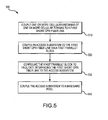
- FIG. 5 is a flow diagram illustrating an example of a method 500 for providing CPRI framelet link, in accordance with one or more implementations of the subject technology.
- the blocks of the example method 500 are described herein as occurring in serial, or linearly. However, multiple blocks of the example method 500 can occur in parallel. In addition, the blocks of the example method 500 need not be performed in the order shown and/or one or more of the blocks of the example method 500 need not be performed.
- one or more cellular antennas e.g., 122 of FIG. 1B of one or more cellular towers (e.g., 120 of FIG. 1B ) is coupled to a first short CPRI fiber link(e.g., 172 of FIG. 1B ) (510).
- An access subsystem e.g., including 174, 176, and 184 of FIG. 1B
- the first framelet block facilitates interfacing the first short CPRI fiber link to the access subsystem (530).
- the access subsystem is coupled to a baseband pool (e.g., 180 of FIG. 1B ) (540).
- the phrase "at least one of” preceding a series of items, with the term “and” or “or” to separate any of the items, modifies the list as a whole, rather than each member of the list (i.e., each item).
- the phrase "at least one of” does not require selection of at least one of each item listed; rather, the phrase allows a meaning that includes at least one of any one of the items, and/or at least one of any combination of the items, and/or at least one of each of the items.
- phrases “at least one of A, B, and C” or “at least one of A, B, or C” each refer to only A, only B, or only C; any combination of A, B, and C; and/or at least one of each of A, B, and C.
- a phrase such as "an aspect” does not imply that such aspect is essential to the subject technology or that such aspect applies to all configurations of the subject technology.
- a disclosure relating to an aspect can apply to all configurations, or one or more configurations.
- An aspect can provide one or more examples of the disclosure.
- a phrase such as an "aspect” refers to one or more aspects and vice versa.
- a phrase such as an "embodiment” does not imply that such embodiment is essential to the subject technology or that such embodiment applies to all configurations of the subject technology.
- a disclosure relating to an embodiment can apply to all embodiments, or one or more embodiments.
- An embodiment can provide one or more examples of the disclosure.
- a phrase such an "embodiment” can refer to one or more embodiments and vice versa.
- a phrase such as a "configuration” does not imply that such configuration is essential to the subject technology or that such configuration applies to all configurations of the subject technology.
- a disclosure relating to a configuration can apply to all configurations, or one or more configurations.
- a configuration can provide one or more examples of the disclosure.
- a phrase such as a "configuration” can refer to one or more configurations and vice versa.
Landscapes
- Engineering & Computer Science (AREA)
- Computer Networks & Wireless Communication (AREA)
- Signal Processing (AREA)
- Physics & Mathematics (AREA)
- Electromagnetism (AREA)
- Computing Systems (AREA)
- Mobile Radio Communication Systems (AREA)
- Small-Scale Networks (AREA)
- Data Exchanges In Wide-Area Networks (AREA)
Abstract
Description
- The present application claims the benefit of
U.S. Provisional Patent Application Serial No. 61/941,397 - The subject technology generally relates to communications and, in particular, relates to common public radio interface (CPRI) framelets.
- One class of radio access network architectures exploits point-to-point fiber links between the cell sites and a centralized base-band pool. These links carry common public radio interface (CPRI) traffic between remote radio-heads (RRH) and the pooled base-band functionality. Some of the key characteristics of this solution are described herein. It is known that CPRI is a time-division multiplexing (TDM)-based protocol with a hyper-frame structure, which contains a number of antenna containers (AxCs), control channels, and other protocol elements, and each AxC carries raw in-phase and quadrature (I&Q) data for a particular antenna. Due to the strict synchronization requirements for radio-frame alignment at the RRH (e.g., 65 ns for 3GPP) and the high capacity required to carry traffic for multiple RRHs, Point-to-Point (PtP) fiber is the only practical solution for many deployments that is currently available. CPRI bit-rates (e.g., 9.8304, 6.144, 4.9152, 3.072, 2.4576, 1.2288, 0.6144 Gb/s) differ from both Ethernet and Fiber Channels. The introduction of advanced mobile platforms (e.g., LTE, small cells, femto-cells, etc.) greatly increases the number of cell sites in a given geographical area, which can result in a large increase in the number of back-haul connections. For example, there are projections for an urban cloud radio-access network (CRAN) central office or a baseband pool terminating more than 10k PtP CPRI fiber links. The deployment of small-cell base stations is highly cost sensitive, since they are designed for a relatively small number of concurrent users and are expected to be deployed in large numbers in many networks.
- According to an aspect, a system for providing a reduced common public radio interface (CPRI) framelet link comprises:
- one or more cellular towers, each cellular tower including one or more cellular antennas and coupled to a first short CPRI fiber link; and
- an access subsystem coupled to a baseband pool,
- wherein:
- the access subsystem is coupled to the first short CPRI fiber link via a first framelet block, and
- the first framelet block is configured to facilitate interfacing the first short CPRI fiber link to the access subsystem.
- Advantageously, the baseband pool comprises a cellular base-station, and wherein the cellular base-station is configured to support various wireless protocol layers including L1, L2, and L3 protocol layers.
- Advantageously, the access subsystem comprises a broadband subsystem, wherein the broadband subsystem comprises an Ethernet subsystem, wherein the access subsystem comprises a digital subscriber line (DSL), a passive optical network (PON), or a hybrid fiber-coaxial (HFC) sub-system.
- Advantageously, the access subsystem comprises one or more modems, one or more low speed links, and one of a DSL access multiplexer (DSLAM), a cable-modem termination system (CMTS), or an optical line terminal (OLT), and wherein open base-station architecture initiative (OBSAI) framelets are transported across the one or more low-speed links.
- Advantageously, the baseband pool comprises a network synchronizer, wherein the network synchronizer is configured to provide synchronization signals, and wherein the first framelet block is synchronized with the DSLAM, the CMTS, or the OLT, and wherein the network synchronizer is configured to use one of IEEE 1588, SyncE, or an equivalent line-timing mechanism.
- Advantageously, the baseband pool includes a second framelet block that is configured to facilitate interfacing the access subsystem to a second short CPRI fiber link, wherein the second framelet block is configured to convert Ethernet frames to CPRI framelets, and wherein the second framelet block is configured to aggregate the CPRI framelets received from the DSLAM, the CMTS, or the OLT.
- Advantageously, the DSLAM, the CMTS, or the OLT is included in the baseband pool and is coupled to the second framelet block and the network synchronizer.
- Advantageously, each of the first and second short CPRI fiber links comprises a CPRI fiber link with a length of less than 2 meters, and wherein the second short CPRI fiber link comprises an aggregated CPRI fiber link including multiple CPRI fiber links.
- Advantageously, each cellular tower is coupled to the first short CPRI fiber link through a cellular remote radio head (RRH), and wherein the first framelet block is configured to convert CPRI framelets to Ethernet frames by extracting active data plane and control plane data.
- According to an aspect, a method for providing a reduced common public radio interface (CPRI) framelet link comprises:
- coupling one or more cellular antennas of one or more cellular towers to a first short CPRI fiber link;
- coupling an access subsystem to the first short CPRI fiber link via a first framelet block;
- configuring the first framelet block to facilitate interfacing the first short CPRI fiber link to the access subsystem; and
- coupling the access subsystem to a baseband pool.
- Advantageously, the baseband pool comprises a cellular base-station, and wherein the cellular base-station supports various wireless protocol layers including L1, L2, and L3 protocol layers.
- Advantageously, coupling the access subsystem comprises coupling an Ethernet subsystem, wherein coupling the access subsystem comprises coupling a digital subscriber line (DSL), a passive optical network (PON), or a hybrid fiber-coaxial (HFC) subsystem.
- Advantageously, coupling the access subsystem comprises coupling one or more modems, one or more low speed links, and one of a DSL access multiplexer (DSLAM), a cable-modem termination system (CMTS), or an optical line terminal (OLT), and wherein the method comprises transporting open base-station architecture initiative (OBSAI) framelets across the one or more low-speed links.
- Advantageously, the baseband pool comprises a network synchronizer, wherein the method comprises configuring the network synchronizer to:
- provide synchronization signals;
- use one of IEEE 1588, SyncE, or an equivalent line-timing mechanism; and
- synchronize the first framelet block with the DSLAM, the CMTS, or the OLT.
- Advantageously, the baseband pool includes a second framelet block, and wherein the method comprises configuring the second framelet block to:
- facilitate interfacing the access subsystem to a second short CPRI fiber link;
- convert Ethernet frames to CPRI framelets; and
- aggregate the CPRI framelets received from the DSLAM, the CMTS, or the OLT.
- Advantageously, the DSLAM, the CMTS, or the OLT is included in the baseband pool, and the method comprises coupling the DSLAM to the second framelet block and the network synchronizer.
- Advantageously, each of the first and second short CPRI fiber links comprises a CPRI fiber link with a length of less than 2 meters, and wherein the second short CPRI fiber link comprises an aggregated CPRI fiber link including multiple CPRI fiber links.
- Advantageously, the method further comprises:
- coupling each cellular tower to the first short CPRI fiber link through a cellular remote radio head (RRH); and
- configuring the first framelet block to convert CPRI framelets to Ethernet frames by extracting active data plane and control plane data.
- According to an aspect, an apparatus for providing a reduced common public radio interface (CPRI) framelet link comprises:
- a first short CPRI fiber link coupled to one or more cellular antennas of one or more cellular towers; and
- a first framelet block configured to facilitate interfacing the first short CPRI fiber to an access subsystem coupled to a baseband pool,
- wherein the baseband pool includes a second framelet block that is configured to facilitate interfacing the access subsystem to a second short CPRI fiber link.
- Advantageously:
- the second framelet block is configured to convert Ethernet frames to CPRI framelets,
- the second framelet block is configured to aggregate the CPRI framelets received from a DSLAM, a CMTS, or an OLT included in the baseband pool,
- the baseband pool comprises a cellular base-station, and
- the cellular base-station is configured to support various wireless protocol layers including L1, L2, and L3 protocol layers.
- Certain features of the subject technology are set forth in the appended claims. However, for purpose of explanation, several embodiments of the subject technology are set forth in the following figures.
-
FIGs. 1A-1B are diagrams illustrating examples of a carry common public radio interface (CPRI) link and a CPRI framelet link, in accordance with one or more implementations. -
FIGs. 2A-2B are diagrams illustrating examples of a CPRI access network and a CPRI framelet access network, in accordance with one or more implementations. -
FIGs. 3A-3B are diagrams illustrating examples of a first and a second framelet block, in accordance with one or more implementations. -
FIG. 4 is a diagram illustrating an example of a CPRI framelet structure, in accordance with one or more implementations. -
FIG. 5 is a flow diagram illustrating an example of a method for providing CPRI framelet link, in accordance with one or more implementations. - The detailed description set forth below is intended as a description of various configurations of the subject technology and is not intended to represent the only configurations in which the subject technology can be practiced. The appended drawings are incorporated herein and constitute a part of the detailed description. The detailed description includes specific details for the purpose of providing a thorough understanding of the subject technology. However, it will be clear and apparent to those skilled in the art that the subject technology is not limited to the specific details set forth herein and can be practiced using one or more implementations. In one or more instances, well-known structures and components are shown in block diagram form in order to avoid obscuring the concepts of the subject technology.
- In one or more aspects of the subject technology, methods and configurations for providing a reduced common public radio interface (CPRI) hyper frame suitable for transport of a small number (e.g., one) of antenna containers (AxCs) and their associated control channels are described. The subject technology mitigates significant drawbacks of the current backhaul solutions for small remote radio-heads (RRHs), especially for cases with a small number of (e.g., one) AxCs per CPRI fiber link. The subject solution avoids using the expensive point-to-point (PtP) fiber links for small number of AxCs, of which much of the link capacity can be wasted. The subject technology leverages the broadband access systems that do not have the bandwidth to support a full CPRI connection. Examples of the broadband access systems includes digital subscriber line (DSL), hybrid fiber-coaxial (HFC), and passive optical network (PON) access systems.
-
FIGs. 1A-1B are diagrams illustrating examples of a carry common public radio interface (CPRI)access network 100A and a CPRIframelet access network 100B, in accordance with one or more implementations of the subject technology. TheCPRI access network 100A shown inFIG. 1A includes a number ofCPRI links 110 which can communicate through a central office (e.g., a base-band pool) 150 including a cellular base-station 152 with a network 160 (e.g., the Internet). The cellular base-station 152 can support various wireless protocol layers including L1, L2, and L3 protocol layers. Each CPRI links 110 includes acellular tower 120, acellular RRH 130, and aCPRI fiber link 140. Thecellular tower 120 includesmultiple antennas 122, and theCPRI fiber link 140 is a long (e.g., more than 20 meters and up to a few kilometers) fiber link. CPRI is a time-division multiplexing (TDM)-based protocol with a hyper-frame structure, which contains a number of AxCs, control channels, and other protocol elements. Each AxC carries raw in-phase and quadrature (I&Q) data for a particular antenna. - The
cellular RRH 130 receives radio-frequency (RF) signals from the antenna(s) 122 and provides digitizeddata 142 including the control and digitized I&Q data to theCPRI fiber link 140, which carries thedata 142 to thecentral office 150. The problem with the CPRI access network arises when the number ofantennas 122 are small (e.g., one), in which case the operation of the CPRI network become highly inefficient. The subject technology provides a low cost and less complex solution for this particular case by leveraging existing broadband access systems, as described herein. - The CPRI
framelet access network 100B, shown inFIG. 1B includes a number of CPRI frameletlinks 170 communicating through a central office (e.g., a base-band pool) 180 with thenetwork 160. Each CPRI framelet link 170 includes thecellular tower 120, thecellular RRH 130, a short (e.g., a few meters)CPRI fiber link 172, a first framelet block (also referred to as "framelet inter-working function") 175, and an access subsystem including an access system node (e.g., modem) 176 and a low-speed link 174 coupled to abaseband pool 180. TheRRH 130 maps the traffic from eachantenna 122 to a unique AxC. The access subsystem is coupled to the first shortCPRI fiber link 172 via thefirst framelet block 175 facilitates interfacing the first shortCPRI fiber link 172 to the access subsystem. The first framelet block can convert CPRI framelets to Ethernet frames by extracting active data plane and control plane data, as described in more details herein. - The
baseband pool 180 includes asecond framelet block 185 that can facilitate interfacing the access subsystem to a second shortCPRI fiber link 182. Thebaseband pool 180 further includes the cellular base-station 152 that supports various wireless protocol layers including L1, L2, and L3 protocol layers. Examples of the access subsystem include an Ethernet subsystem such as a digital subscriber line (DSL) subsystem. The DSL subsystem includes one or more modems (e.g., 176), one or more low-speed links (e.g., 174), and atermination system 184 such as a cable-modem termination system (CMTS), an optical line terminal (OLT), or a DSL access multiplexer (DSLAM) at the base-band pool 180. In some aspects, open Base-station architecture initiative (OBSAI) framelets can be transported across the low-speed links 174. - In one or more implementations, the
baseband pool 180 includes thetermination system 184 and anetwork synchronizer 186 that provides synchronization signals that are used, for example, to synchronize thefirst framelet block 175 with thetermination system 184. In some aspects, the network synchronizer can use one of IEEE 1588, SyncE, or an equivalent line-timing mechanism. TheDSLAM 184 is coupled to thesecond framelet block 185 and thenetwork synchronizer 186. Thesecond framelet block 185 converts Ethernet frames received from theDSLAM 184 to the CPRI framelets and can aggregate the CPRI framelets for delivery by a short (e.g., < 2m)CPRI fiber link 182 to the cellular base-station 152. In some implementations, the shortCPRI fiber link 182 is an aggregated CPRI fiber link including multiple CPRI fiber links. -
FIGs. 2A-2B are diagrams illustrating examples of aCPRI link 200A and aCPRI framelet link 200B, in accordance with one or more implementations of the subject technology. The CPRI link 200A is similar to the CPRI link 110 ofFIG. 1A which includes thecellular tower 120,multiple RF antennas 122, aCPRI fiber link 140 and thebase station 150. TheCPRI fiber link 140 has the capacity of carrying multiple (e.g., M) AxCs. Each AxC includes a mapping of the traffic from each antenna of thecellular tower 120. The AxCs are included in basic frames (BFs) 214, which are, in turn, parts ofhyper frames 212. Thehyper frames 212 are the components of radio frames 210 that are transmitted by the CPRI fiber link 140 from thecellular tower 120 to the base station 150 (or in a reverse direction from thebase station 150 to the cellular tower 120). Eachbasic frame 214 includes acontrol word 215 that carries data for the D control channels, a number of (e.g., N) traffic-bearing AxCs, and multiple (e.g., M-N) unused (e.g., non-traffic-bearing) AxCs. - The shown structure of the
basic frame 214 is a conceptual one and the details of structure of thebasic frame 214 depend on the CPRI link bit-rate and other factors. It is understood that the CPRI link has both an upstream and a downstream channel, which can carry thesimilar radio frames 210 in both directions. - The CPRI framelet link 200B, shown in
FIG. 2B , is similar to the CPRI framelet link 170 ofFIG. 1B and includes thecellular tower 120 including one ormore RF antennas 122, theshort CPRI link 172, thefirst framelet block 175, a first access system node 210 (e.g., a modem), anaccess link 230, a secondaccess system node 220, asecond framelet block 185, a secondshort CPRI fiber 240, and thebase station 150. The shortCPRI fiber links FIG. 1B including thebasic frames 214 in both directions. The access link 230 carry CPRI framelets 240 provided by the first and second framelet blocks 175 and 185. A conceptual structure of aCPRI framelet 240 includes a framelet header, a control word data, and a number of (e.g., N) AxC data. More detailed structure of aCPRI framelet 240 is implementation dependent and is out of scope of the subject disclosure. - In some implementations, the first
access system node 210 and thefirst framelet block 175 can be integrated in a single device. Similarly, the secondaccess system node 220 and thesecond framelet block 185 can be integrated in another single device. In one or more implementations, a single CPRI stream may be mapped into a single CPRI framelet stream, as shown inFIG. 2B , or into multiple CPRI framelet streams to be carried by the aggregated CPRIshort fiber link 182 ofFIG. 1B . -
FIGs. 3A-3B are diagrams illustrating examples of first and second framelet blocks 300A and 300B, in accordance with one or more implementations of the subject technology. Thefirst framelet block 300A, shown inFIG. 3A , is a conceptual implementation of thefirst framelet block 175 ofFIGs. 1B and2B and maps theCPRI data 305 toCPRI framelet data 335. Thefirst framelet block 300A includes aCPRI SerDes 310, aCPRI Framer 320, and aframelet encapsulation module 330. TheCPRI SerDes 310 deserialize the CPR data (e.g., radio frames 210 ofFIG. 2A ) for processing by theCPRI framer 320 that can provide a number of parallel queues. The parallel queues include D (e.g., 0 to D-1) control channel data and N (e.g., 0 to N-1) AxC data, which are provides to theframelet encapsulation module 330. - The
CPRI framer 320 discards null data from the unused AxCs (e.g., AxCs numbered N-1 to M). Theframelet encapsulation module 330 receives the D control channel data (e.g., control plane data) and the N AxCs data (e.g., data plane) and map these data to CPRI framelets (e.g., 240 ofFIG. 2B ) that can be carried over a CPRI link with a capacity of M AxCs where N is smaller or equal to M. The synchronization mechanism used in the subject technology can be implementation dependent and is not described here for brevity. In some implementations, a single CPRI stream may be mapped into one or multiple CPRI Framelet streams, as described above. - The
second framelet block 300B, shown inFIG. 3B , is a conceptual implementation of thesecond framelet block 185 of FIGs. Thesecond framelet block 300B includes aframelet de-encapsulation module 340, anull data generator 350, aCPRI Framer 360, and aCPRI SerDes 370. Thesecond framelet block 300B maps CPRI framelets data 355 intoCPRI data 305. Theframelet de-encapsulation module 340 receives the CPRI framesets 355 and provides D control channel data and N active AxCs. Thenull data generator 350 generates a number of (e.g., M-N) null data to complete the M AxCs (e.g., N active AxCs and M-N unused AxCs) for delivery to theCPRI framer 360. TheCPRI framer 360 processes the D control channel data and M AxCs data to be fed to theCPRI SerDes 370, which convert the parallel data into a serial format data outputted by theCPRI SerDes 370 as theCPRI data 305. - The synchronization mechanism used in the subject technology can be implementation dependent and is not described here for brevity. In some implementations, multiple CPRI framelet streams may be mapped into one or more CPRI streams to be carried by an aggregated short CPRI fiber link (e.g., 182 of
FIG. 1B ), as described above. In some implementations, the first and second framelet blocks 300A and 300B may be implemented in hardware, firmware and/or software. The software may be executed by a processor such as a local processor or cloud processor. -
FIG. 4 is a diagram illustrating an example of aCPRI framelet structure 400, in accordance with one or more implementations of the subject technology. TheCPRI framelet structure 400 includes a number of known fields of an Ethernet frame such as apreamble field 410, a destination media access control (MAC)address field 420, a sourceMAC address field 430, virtual local area network (VLAN)tag field 440, a type/length field 450, adata field 460, and a cyclic redundancy check (CRC)field 470. The structure of thedata field 460, as shown inFIG. 4 , is specific to the CPRI framelet and includes a CPRI framelet payload including F(e.g., 0 to F-1) header fields, D (e.g., 0 to D-1) control channel fields, and N (e.g., 0 to N-1) AxC data fields. - In one or more implementations of the subject technology, a CPRI link with a capacity of M AxCs, D control channels, and N active AxCs (N≤M) is mapped into an Ethernet flow marked with a VLAN tag of the
VLAN tag field 440. The VLAN tag is inserted/removed by the first or second framelet (e.g., interworking function) blocks 175 or 185 ofFIG. 1B . The header fields of thedata field 460 are also inserted or removed by the first or second framelet blocks 175 or 185. The header fields can contain information such as the CPRI basic frame number (e.g., 0...255), the CPRI hyper frame number (e.g., 0... 149), a flow index that identifies individual management channels or AxCs, an indicator for the number of I and Q samples in the payload, alignment data used to maintain link synchronization, or other information needed by first or second framelet blocks 175 or 185. A more detailed structure of the header is implementation dependent and is out of scope of the present disclosure. - In some implementations of the subject technology, the CPRI link can be mapped into more than one Ethernet flow, with each flow marked with a unique VLAN tag. This includes the case where each management channel and each AxC is mapped into a separate Ethernet flow, each with a unique VLAN tag.
-
FIG. 5 is a flow diagram illustrating an example of amethod 500 for providing CPRI framelet link, in accordance with one or more implementations of the subject technology. For explanatory purposes, the blocks of theexample method 500 are described herein as occurring in serial, or linearly. However, multiple blocks of theexample method 500 can occur in parallel. In addition, the blocks of theexample method 500 need not be performed in the order shown and/or one or more of the blocks of theexample method 500 need not be performed. - According to the
method 500, one or more cellular antennas (e.g., 122 ofFIG. 1B ) of one or more cellular towers (e.g., 120 ofFIG. 1B ) is coupled to a first short CPRI fiber link(e.g., 172 ofFIG. 1B ) (510). An access subsystem (e.g., including 174, 176, and 184 ofFIG. 1B ) is coupled to the first short CPRI fiber link via a first framelet block (e.g., 175 ofFIG. 1B ) (520). The first framelet block facilitates interfacing the first short CPRI fiber link to the access subsystem (530). The access subsystem is coupled to a baseband pool (e.g., 180 ofFIG. 1B ) (540). - Those of skill in the art would appreciate that the various illustrative blocks, modules, elements, components, and methods described herein can be implemented as electronic hardware, computer software, or combinations of both. To illustrate this interchangeability of hardware and software, various illustrative blocks, modules, elements, components, and methods have been described above generally in terms of their functionality. Whether such functionality is implemented as hardware or software depends upon the particular application and design constraints imposed on the overall system. Skilled artisans can implement the described functionality in varying ways for each particular application. Various components and blocks can be arranged differently (e.g., arranged in a different order, or partitioned in a different way) all without departing from the scope of the subject technology.
- As used herein, the phrase "at least one of" preceding a series of items, with the term "and" or "or" to separate any of the items, modifies the list as a whole, rather than each member of the list (i.e., each item). The phrase "at least one of" does not require selection of at least one of each item listed; rather, the phrase allows a meaning that includes at least one of any one of the items, and/or at least one of any combination of the items, and/or at least one of each of the items. By way of example, the phrases "at least one of A, B, and C" or "at least one of A, B, or C" each refer to only A, only B, or only C; any combination of A, B, and C; and/or at least one of each of A, B, and C.
- A phrase such as "an aspect" does not imply that such aspect is essential to the subject technology or that such aspect applies to all configurations of the subject technology. A disclosure relating to an aspect can apply to all configurations, or one or more configurations. An aspect can provide one or more examples of the disclosure. A phrase such as an "aspect" refers to one or more aspects and vice versa. A phrase such as an "embodiment" does not imply that such embodiment is essential to the subject technology or that such embodiment applies to all configurations of the subject technology. A disclosure relating to an embodiment can apply to all embodiments, or one or more embodiments. An embodiment can provide one or more examples of the disclosure. A phrase such an "embodiment" can refer to one or more embodiments and vice versa. A phrase such as a "configuration" does not imply that such configuration is essential to the subject technology or that such configuration applies to all configurations of the subject technology. A disclosure relating to a configuration can apply to all configurations, or one or more configurations. A configuration can provide one or more examples of the disclosure. A phrase such as a "configuration" can refer to one or more configurations and vice versa.
- The word "exemplary" is used herein to mean "serving as an example, instance, or illustration." Any embodiment described herein as "exemplary" or as an "example" is not necessarily to be construed as preferred or advantageous over other embodiments. Furthermore, to the extent that the term "include," "have," or the like is used in the description or the claims, such term is intended to be inclusive in a manner similar to the term "comprise" as "comprise" is interpreted when employed as a transitional word in a claim.
- All structural and functional equivalents to the elements of the various aspects described throughout this disclosure that are known or later come to be known to those of ordinary skill in the art are expressly incorporated herein by reference and are intended to be encompassed by the claims. Moreover, nothing disclosed herein is intended to be dedicated to the public regardless of whether such disclosure is explicitly recited in the claims. No claim element is to be construed under the provisions of 35 U.S.C. §112, sixth paragraph, unless the element is expressly recited using the phrase "means for" or, in the case of a method claim, the element is recited using the phrase "step for."
- The previous description is provided to enable any person skilled in the art to practice the various aspects described herein. Various modifications to these aspects will be readily apparent to those skilled in the art, and the generic principles defined herein can be applied to other aspects. Thus, the claims are not intended to be limited to the aspects shown herein, but are to be accorded the full scope consistent with the language claims, wherein reference to an element in the singular is not intended to mean "one and only one" unless specifically so stated, but rather "one or more." Unless specifically stated otherwise, the term "some" refers to one or more. Pronouns in the masculine (e.g., his) include the feminine and neuter gender (e.g., her and its) and vice versa. Headings and subheadings, if any, are used for convenience only and do not limit the subject disclosure.
Claims (15)
- A system for providing a reduced common public radio interface (CPRI) framelet link, the system comprising:one or more cellular towers, each cellular tower including one or more cellular antennas and coupled to a first short CPRI fiber link; andan access subsystem coupled to a baseband pool,wherein:the access subsystem is coupled to the first short CPRI fiber link via a first framelet block, andthe first framelet block is configured to facilitate interfacing the first short CPRI fiber link to the access subsystem.
- The system of claim 1, wherein the baseband pool comprises a cellular base-station, and wherein the cellular base-station is configured to support various wireless protocol layers including L1, L2, and L3 protocol layers.
- The system of claim 1 or 2, wherein the access subsystem comprises a broadband subsystem, wherein the broadband subsystem comprises an Ethernet subsystem, wherein the access subsystem comprises a digital subscriber line (DSL), a passive optical network (PON), or a hybrid fiber-coaxial (HFC) sub-system.
- The system of any preceding claim, wherein the access subsystem comprises one or more modems, one or more low speed links, and one of a DSL access multiplexer (DSLAM), a cable-modem termination system (CMTS), or an optical line terminal (OLT), and wherein open base-station architecture initiative (OBSAI) framelets are transported across the one or more low-speed links.
- The system of claim 4, wherein the baseband pool comprises a network synchronizer, wherein the network synchronizer is configured to provide synchronization signals, and wherein the first framelet block is synchronized with the DSLAM, the CMTS, or the OLT, and wherein the network synchronizer is configured to use one of IEEE 1588, SyncE, or an equivalent line-timing mechanism.
- The system of claim 4 or 5, wherein the baseband pool includes a second framelet block that is configured to facilitate interfacing the access subsystem to a second short CPRI fiber link, wherein the second framelet block is configured to convert Ethernet frames to CPRI framelets, and wherein the second framelet block is configured to aggregate the CPRI framelets received from the DSLAM, the CMTS, or the OLT.
- The system of claim 6, wherein the DSLAM, the CMTS, or the OLT is included in the baseband pool and is coupled to the second framelet block and the network synchronizer.
- The system of claim 6 or 7, wherein each of the first and second short CPRI fiber links comprises a CPRI fiber link with a length of less than 2 meters, and wherein the second short CPRI fiber link comprises an aggregated CPRI fiber link including multiple CPRI fiber links.
- The system of any preceding claim, wherein each cellular tower is coupled to the first short CPRI fiber link through a cellular remote radio head (RRH), and wherein the first framelet block is configured to convert CPRI framelets to Ethernet frames by extracting active data plane and control plane data.
- A method for providing a reduced common public radio interface (CPRI) framelet link, the method comprising:coupling one or more cellular antennas of one or more cellular towers to a first short CPRI fiber link;coupling an access subsystem to the first short CPRI fiber link via a first framelet block;configuring the first framelet block to facilitate interfacing the first short CPRI fiber link to the access subsystem; andcoupling the access subsystem to a baseband pool.
- The method of claim 10, wherein the baseband pool comprises a cellular base-station, and wherein the cellular base-station supports various wireless protocol layers including L1, L2, and L3 protocol layers.
- The method of claim 10 or 11, wherein coupling the access subsystem comprises coupling an Ethernet subsystem, wherein coupling the access subsystem comprises coupling a digital subscriber line (DSL), a passive optical network (PON), or a hybrid fiber-coaxial (HFC) subsystem.
- The method of any of claims 10 to 12, wherein coupling the access subsystem comprises coupling one or more modems, one or more low speed links, and one of a DSL access multiplexer (DSLAM), a cable-modem termination system (CMTS), or an optical line terminal (OLT), and wherein the method comprises transporting open base-station architecture initiative (OBSAI) framelets across the one or more low-speed links.
- The method of claim 13, wherein the baseband pool comprises a network synchronizer, wherein the method comprises configuring the network synchronizer to:provide synchronization signals;use one of IEEE 1588, SyncE, or an equivalent line-timing mechanism; andsynchronize the first framelet block with the DSLAM, the CMTS, or the OLT.
- An apparatus for providing a reduced common public radio interface (CPRI) framelet link, the apparatus comprising:a first short CPRI fiber link coupled to one or more cellular antennas of one or more cellular towers; anda first framelet block configured to facilitate interfacing the first short CPRI fiber to an access subsystem coupled to a baseband pool,wherein the baseband pool includes a second framelet block that is configured to facilitate interfacing the access subsystem to a second short CPRI fiber link.
Applications Claiming Priority (2)
| Application Number | Priority Date | Filing Date | Title |
|---|---|---|---|
| US201461941397P | 2014-02-18 | 2014-02-18 | |
| US14/624,114 US9749050B2 (en) | 2014-02-18 | 2015-02-17 | CPRI framelets |
Publications (2)
| Publication Number | Publication Date |
|---|---|
| EP2908600A1 true EP2908600A1 (en) | 2015-08-19 |
| EP2908600B1 EP2908600B1 (en) | 2017-06-07 |
Family
ID=52544258
Family Applications (1)
| Application Number | Title | Priority Date | Filing Date |
|---|---|---|---|
| EP15000476.0A Active EP2908600B1 (en) | 2014-02-18 | 2015-02-18 | Provision of a reduced cpri framelet link |
Country Status (4)
| Country | Link |
|---|---|
| US (1) | US9749050B2 (en) |
| EP (1) | EP2908600B1 (en) |
| CN (1) | CN104852766B (en) |
| HK (1) | HK1209917A1 (en) |
Cited By (3)
| Publication number | Priority date | Publication date | Assignee | Title |
|---|---|---|---|---|
| CN105187161A (en) * | 2015-09-11 | 2015-12-23 | 深圳三星通信技术研究有限公司 | Transmission method and transmission device of CPRI frame in the Ethernet |
| EP3322255A4 (en) * | 2015-08-31 | 2018-05-30 | Huawei Technologies Co., Ltd. | Method, device, and system for receiving cpri data stream and ethernet frame |
| EP3468298A4 (en) * | 2016-06-28 | 2019-04-10 | ZTE Corporation | METHOD AND APPARATUS FOR TRANSMITTING DATA, AND DEVICE AND SYSTEM FOR PHOTOELECTRIC CONVERSION |
Families Citing this family (7)
| Publication number | Priority date | Publication date | Assignee | Title |
|---|---|---|---|---|
| US9961688B1 (en) * | 2015-07-12 | 2018-05-01 | Kiomars Anvari | Cloud ran architecture |
| JP6634876B2 (en) * | 2016-02-25 | 2020-01-22 | 沖電気工業株式会社 | Band control system, band control device, and communication device |
| CN109314916B (en) * | 2016-04-19 | 2021-10-01 | 诺基亚通信公司 | Method, apparatus and computer readable medium for communication |
| CN106487670A (en) * | 2016-10-14 | 2017-03-08 | 深圳三星通信技术研究有限公司 | A kind of CPRI gateway device and base station forward pass network system |
| CN108616484A (en) * | 2016-12-09 | 2018-10-02 | 华为技术有限公司 | a kind of data transmission method and device |
| US11395242B2 (en) | 2019-02-01 | 2022-07-19 | Cisco Technology, Inc. | Link establishment between a radio equipment controller (REC) and radio equipment (RE) in a fronthaul network |
| CN112187363B (en) * | 2020-09-18 | 2022-03-08 | 中国科学院上海光学精密机械研究所 | High-precision optical fiber time frequency transmission system and method compatible with Ethernet |
Citations (4)
| Publication number | Priority date | Publication date | Assignee | Title |
|---|---|---|---|---|
| US20070116046A1 (en) * | 2005-10-31 | 2007-05-24 | Utstarcom Telecom Co., Ltd. | Cpri link multiplex transmission method and system |
| US20120057572A1 (en) * | 2010-09-02 | 2012-03-08 | Samplify Systems, Inc. | Transmission Of Multiprotocol Data in a Distributed Antenna System |
| US20130051329A1 (en) * | 2010-06-04 | 2013-02-28 | Sumitomo Electric Industries, Ltd | Radio equipment and radio base station |
| US20130136068A1 (en) * | 2011-11-24 | 2013-05-30 | Bernt Johansson | Communication Systems and Methods in a Communication System |
Family Cites Families (4)
| Publication number | Priority date | Publication date | Assignee | Title |
|---|---|---|---|---|
| SE0302596D0 (en) | 2003-09-30 | 2003-09-30 | Ericsson Telefon Ab L M | Improvements in or relating to base stations |
| GB2440192B (en) | 2006-07-17 | 2011-05-04 | Ubidyne Inc | Antenna array system |
| US8837564B2 (en) | 2011-10-14 | 2014-09-16 | Broadcom Corporation | Multi gigabit modem for mmWave point to point links |
| CN103581926B (en) | 2012-08-01 | 2016-12-21 | 中兴通讯股份有限公司 | A kind of method and apparatus realizing multiple networking model compatibility |
-
2015
- 2015-02-17 US US14/624,114 patent/US9749050B2/en active Active
- 2015-02-18 EP EP15000476.0A patent/EP2908600B1/en active Active
- 2015-02-25 CN CN201510087867.XA patent/CN104852766B/en not_active Expired - Fee Related
- 2015-10-21 HK HK15110344.5A patent/HK1209917A1/en unknown
Patent Citations (4)
| Publication number | Priority date | Publication date | Assignee | Title |
|---|---|---|---|---|
| US20070116046A1 (en) * | 2005-10-31 | 2007-05-24 | Utstarcom Telecom Co., Ltd. | Cpri link multiplex transmission method and system |
| US20130051329A1 (en) * | 2010-06-04 | 2013-02-28 | Sumitomo Electric Industries, Ltd | Radio equipment and radio base station |
| US20120057572A1 (en) * | 2010-09-02 | 2012-03-08 | Samplify Systems, Inc. | Transmission Of Multiprotocol Data in a Distributed Antenna System |
| US20130136068A1 (en) * | 2011-11-24 | 2013-05-30 | Bernt Johansson | Communication Systems and Methods in a Communication System |
Non-Patent Citations (1)
| Title |
|---|
| "CPRI Specification V4.2 (2010-09-29) Interface Specification Common Public Radio Interface (CPRI); Interface Specification", 29 September 2010 (2010-09-29), XP055018382, Retrieved from the Internet <URL:www.cpri.info> [retrieved on 20120203] * |
Cited By (8)
| Publication number | Priority date | Publication date | Assignee | Title |
|---|---|---|---|---|
| EP3322255A4 (en) * | 2015-08-31 | 2018-05-30 | Huawei Technologies Co., Ltd. | Method, device, and system for receiving cpri data stream and ethernet frame |
| US10616800B2 (en) | 2015-08-31 | 2020-04-07 | Huawei Technologies Co., Ltd. | Method and apparatus for receiving CPRI data stream, method and apparatus for receiving ethernet frame, and system |
| EP3823415A1 (en) * | 2015-08-31 | 2021-05-19 | Huawei Technologies Co., Ltd. | Method and apparatus for receiving cpri data stream, method and apparatus for receiving ethernet frame, and system |
| US11432193B2 (en) | 2015-08-31 | 2022-08-30 | Huawei Technologies Co., Ltd. | Method and apparatus for receiving CPRI data stream, method and apparatus for receiving ethernet frame, and system |
| US11736978B2 (en) | 2015-08-31 | 2023-08-22 | Huawei Technologies Co., Ltd. | Method and apparatus for receiving CPRI data stream, method and apparatus for receiving ethernet frame, and system |
| CN105187161A (en) * | 2015-09-11 | 2015-12-23 | 深圳三星通信技术研究有限公司 | Transmission method and transmission device of CPRI frame in the Ethernet |
| CN105187161B (en) * | 2015-09-11 | 2019-01-01 | 深圳三星通信技术研究有限公司 | The transmission method and device of a kind of CPRI frame over ethernet |
| EP3468298A4 (en) * | 2016-06-28 | 2019-04-10 | ZTE Corporation | METHOD AND APPARATUS FOR TRANSMITTING DATA, AND DEVICE AND SYSTEM FOR PHOTOELECTRIC CONVERSION |
Also Published As
| Publication number | Publication date |
|---|---|
| US20150236785A1 (en) | 2015-08-20 |
| CN104852766B (en) | 2018-04-13 |
| US9749050B2 (en) | 2017-08-29 |
| CN104852766A (en) | 2015-08-19 |
| EP2908600B1 (en) | 2017-06-07 |
| HK1209917A1 (en) | 2016-04-08 |
Similar Documents
| Publication | Publication Date | Title |
|---|---|---|
| US9749050B2 (en) | CPRI framelets | |
| US8824478B2 (en) | System and method for transporting digital radio signal streams in a small cell network environment | |
| US9736274B2 (en) | Radio over ethernet mapper physical layer device (PHY) | |
| AU2013409674B2 (en) | Data transmission method, data forwarding device, and system | |
| US11212068B1 (en) | Carrying a timestamp in radio over ethernet | |
| CN103916315A (en) | Radio Over Ethernet for Radio Access Network and Cloud-RAN | |
| EP3295765B1 (en) | Systems and methods of transporting internal radio base station (rbs) interface information over a packet switched network | |
| CN101958747B (en) | Mobile communication system and method in high-speed moving environment | |
| US20160134353A1 (en) | Static delay compensation in a telecommunications system | |
| CN103533630B (en) | Eat dishes without rice or wine method for synchronizing time and system, wireless device, radio equipment controller | |
| US10531330B2 (en) | Frame start optimizing in telecommunications systems | |
| US10869222B2 (en) | Data frame transmission method and apparatus for virtual elastic CPRI interface | |
| EP4292393A1 (en) | Fifth generation (5g) hybrid data over cable service interface specification (docsis) 5g new radio (nr) system | |
| CN102437944B (en) | System, device and method for intercommunication between LANs (local area networks) | |
| EP2760173A1 (en) | Data transmission method, device and system | |
| KR20100117813A (en) | Apparatus and method for transmitting/receiving common public radio interface in broadband wireless communication system | |
| US11223437B1 (en) | Differential clock recovery using a global reference time | |
| KR20080076629A (en) | Device for transmitting and receiving data in communication system | |
| Shibata et al. | Dynamic compression method using wireless resource allocation for digitized radio over TDM-PON system | |
| WO2018103394A1 (en) | Data transmission method and device | |
| EP4200997A1 (en) | Carrying a timestamp in radio over ethernet | |
| CN1838561B (en) | Method for transmitting baseband data time stamp in common public radio interface | |
| EP3228027B1 (en) | Wireless communication network apparatus and method of transmitting communications traffic in simple format | |
| CN104579529B (en) | A kind of method and apparatus of Synchronization Status Message | |
| EP4721372A1 (en) | Techniques for diminishing latency in a distributed antenna system |
Legal Events
| Date | Code | Title | Description |
|---|---|---|---|
| PUAI | Public reference made under article 153(3) epc to a published international application that has entered the european phase |
Free format text: ORIGINAL CODE: 0009012 |
|
| 17P | Request for examination filed |
Effective date: 20150218 |
|
| AK | Designated contracting states |
Kind code of ref document: A1 Designated state(s): AL AT BE BG CH CY CZ DE DK EE ES FI FR GB GR HR HU IE IS IT LI LT LU LV MC MK MT NL NO PL PT RO RS SE SI SK SM TR |
|
| AX | Request for extension of the european patent |
Extension state: BA ME |
|
| 17Q | First examination report despatched |
Effective date: 20150729 |
|
| RBV | Designated contracting states (corrected) |
Designated state(s): AL AT BE BG CH CY CZ DE DK EE ES FI FR GB GR HR HU IE IS IT LI LT LU LV MC MK MT NL NO PL PT RO RS SE SI SK SM TR |
|
| GRAJ | Information related to disapproval of communication of intention to grant by the applicant or resumption of examination proceedings by the epo deleted |
Free format text: ORIGINAL CODE: EPIDOSDIGR1 |
|
| GRAP | Despatch of communication of intention to grant a patent |
Free format text: ORIGINAL CODE: EPIDOSNIGR1 |
|
| INTG | Intention to grant announced |
Effective date: 20170112 |
|
| GRAS | Grant fee paid |
Free format text: ORIGINAL CODE: EPIDOSNIGR3 |
|
| AK | Designated contracting states |
Kind code of ref document: B1 Designated state(s): AL AT BE BG CH CY CZ DE DK EE ES FI FR GB GR HR HU IE IS IT LI LT LU LV MC MK MT NL NO PL PT RO RS SE SI SK SM TR |
|
| RAP1 | Party data changed (applicant data changed or rights of an application transferred) |
Owner name: AVAGO TECHNOLOGIES GENERAL IP (SINGAPORE) PTE. LTD |
|
| REG | Reference to a national code |
Ref country code: GB Ref legal event code: FG4D |
|
| GRAA | (expected) grant |
Free format text: ORIGINAL CODE: 0009210 |
|
| REG | Reference to a national code |
Ref country code: CH Ref legal event code: EP Ref country code: AT Ref legal event code: REF Ref document number: 900078 Country of ref document: AT Kind code of ref document: T Effective date: 20170615 |
|
| REG | Reference to a national code |
Ref country code: IE Ref legal event code: FG4D |
|
| REG | Reference to a national code |
Ref country code: DE Ref legal event code: R096 Ref document number: 602015002940 Country of ref document: DE |
|
| REG | Reference to a national code |
Ref country code: NL Ref legal event code: MP Effective date: 20170607 |
|
| REG | Reference to a national code |
Ref country code: LT Ref legal event code: MG4D |
|
| PG25 | Lapsed in a contracting state [announced via postgrant information from national office to epo] |
Ref country code: GR Free format text: LAPSE BECAUSE OF FAILURE TO SUBMIT A TRANSLATION OF THE DESCRIPTION OR TO PAY THE FEE WITHIN THE PRESCRIBED TIME-LIMIT Effective date: 20170908 Ref country code: FI Free format text: LAPSE BECAUSE OF FAILURE TO SUBMIT A TRANSLATION OF THE DESCRIPTION OR TO PAY THE FEE WITHIN THE PRESCRIBED TIME-LIMIT Effective date: 20170607 Ref country code: NO Free format text: LAPSE BECAUSE OF FAILURE TO SUBMIT A TRANSLATION OF THE DESCRIPTION OR TO PAY THE FEE WITHIN THE PRESCRIBED TIME-LIMIT Effective date: 20170907 Ref country code: HR Free format text: LAPSE BECAUSE OF FAILURE TO SUBMIT A TRANSLATION OF THE DESCRIPTION OR TO PAY THE FEE WITHIN THE PRESCRIBED TIME-LIMIT Effective date: 20170607 Ref country code: LT Free format text: LAPSE BECAUSE OF FAILURE TO SUBMIT A TRANSLATION OF THE DESCRIPTION OR TO PAY THE FEE WITHIN THE PRESCRIBED TIME-LIMIT Effective date: 20170607 Ref country code: ES Free format text: LAPSE BECAUSE OF FAILURE TO SUBMIT A TRANSLATION OF THE DESCRIPTION OR TO PAY THE FEE WITHIN THE PRESCRIBED TIME-LIMIT Effective date: 20170607 |
|
| REG | Reference to a national code |
Ref country code: AT Ref legal event code: MK05 Ref document number: 900078 Country of ref document: AT Kind code of ref document: T Effective date: 20170607 |
|
| PG25 | Lapsed in a contracting state [announced via postgrant information from national office to epo] |
Ref country code: SE Free format text: LAPSE BECAUSE OF FAILURE TO SUBMIT A TRANSLATION OF THE DESCRIPTION OR TO PAY THE FEE WITHIN THE PRESCRIBED TIME-LIMIT Effective date: 20170607 Ref country code: NL Free format text: LAPSE BECAUSE OF FAILURE TO SUBMIT A TRANSLATION OF THE DESCRIPTION OR TO PAY THE FEE WITHIN THE PRESCRIBED TIME-LIMIT Effective date: 20170607 Ref country code: BG Free format text: LAPSE BECAUSE OF FAILURE TO SUBMIT A TRANSLATION OF THE DESCRIPTION OR TO PAY THE FEE WITHIN THE PRESCRIBED TIME-LIMIT Effective date: 20170907 Ref country code: RS Free format text: LAPSE BECAUSE OF FAILURE TO SUBMIT A TRANSLATION OF THE DESCRIPTION OR TO PAY THE FEE WITHIN THE PRESCRIBED TIME-LIMIT Effective date: 20170607 Ref country code: LV Free format text: LAPSE BECAUSE OF FAILURE TO SUBMIT A TRANSLATION OF THE DESCRIPTION OR TO PAY THE FEE WITHIN THE PRESCRIBED TIME-LIMIT Effective date: 20170607 |
|
| PG25 | Lapsed in a contracting state [announced via postgrant information from national office to epo] |
Ref country code: RO Free format text: LAPSE BECAUSE OF FAILURE TO SUBMIT A TRANSLATION OF THE DESCRIPTION OR TO PAY THE FEE WITHIN THE PRESCRIBED TIME-LIMIT Effective date: 20170607 Ref country code: AT Free format text: LAPSE BECAUSE OF FAILURE TO SUBMIT A TRANSLATION OF THE DESCRIPTION OR TO PAY THE FEE WITHIN THE PRESCRIBED TIME-LIMIT Effective date: 20170607 Ref country code: SK Free format text: LAPSE BECAUSE OF FAILURE TO SUBMIT A TRANSLATION OF THE DESCRIPTION OR TO PAY THE FEE WITHIN THE PRESCRIBED TIME-LIMIT Effective date: 20170607 Ref country code: CZ Free format text: LAPSE BECAUSE OF FAILURE TO SUBMIT A TRANSLATION OF THE DESCRIPTION OR TO PAY THE FEE WITHIN THE PRESCRIBED TIME-LIMIT Effective date: 20170607 Ref country code: EE Free format text: LAPSE BECAUSE OF FAILURE TO SUBMIT A TRANSLATION OF THE DESCRIPTION OR TO PAY THE FEE WITHIN THE PRESCRIBED TIME-LIMIT Effective date: 20170607 |
|
| PG25 | Lapsed in a contracting state [announced via postgrant information from national office to epo] |
Ref country code: IT Free format text: LAPSE BECAUSE OF FAILURE TO SUBMIT A TRANSLATION OF THE DESCRIPTION OR TO PAY THE FEE WITHIN THE PRESCRIBED TIME-LIMIT Effective date: 20170607 Ref country code: IS Free format text: LAPSE BECAUSE OF FAILURE TO SUBMIT A TRANSLATION OF THE DESCRIPTION OR TO PAY THE FEE WITHIN THE PRESCRIBED TIME-LIMIT Effective date: 20171007 Ref country code: SM Free format text: LAPSE BECAUSE OF FAILURE TO SUBMIT A TRANSLATION OF THE DESCRIPTION OR TO PAY THE FEE WITHIN THE PRESCRIBED TIME-LIMIT Effective date: 20170607 Ref country code: PL Free format text: LAPSE BECAUSE OF FAILURE TO SUBMIT A TRANSLATION OF THE DESCRIPTION OR TO PAY THE FEE WITHIN THE PRESCRIBED TIME-LIMIT Effective date: 20170607 |
|
| REG | Reference to a national code |
Ref country code: DE Ref legal event code: R097 Ref document number: 602015002940 Country of ref document: DE |
|
| PLBE | No opposition filed within time limit |
Free format text: ORIGINAL CODE: 0009261 |
|
| STAA | Information on the status of an ep patent application or granted ep patent |
Free format text: STATUS: NO OPPOSITION FILED WITHIN TIME LIMIT |
|
| PG25 | Lapsed in a contracting state [announced via postgrant information from national office to epo] |
Ref country code: DK Free format text: LAPSE BECAUSE OF FAILURE TO SUBMIT A TRANSLATION OF THE DESCRIPTION OR TO PAY THE FEE WITHIN THE PRESCRIBED TIME-LIMIT Effective date: 20170607 |
|
| 26N | No opposition filed |
Effective date: 20180308 |
|
| PG25 | Lapsed in a contracting state [announced via postgrant information from national office to epo] |
Ref country code: SI Free format text: LAPSE BECAUSE OF FAILURE TO SUBMIT A TRANSLATION OF THE DESCRIPTION OR TO PAY THE FEE WITHIN THE PRESCRIBED TIME-LIMIT Effective date: 20170607 |
|
| REG | Reference to a national code |
Ref country code: CH Ref legal event code: PL |
|
| PG25 | Lapsed in a contracting state [announced via postgrant information from national office to epo] |
Ref country code: MC Free format text: LAPSE BECAUSE OF FAILURE TO SUBMIT A TRANSLATION OF THE DESCRIPTION OR TO PAY THE FEE WITHIN THE PRESCRIBED TIME-LIMIT Effective date: 20170607 |
|
| REG | Reference to a national code |
Ref country code: DE Ref legal event code: R082 Ref document number: 602015002940 Country of ref document: DE Representative=s name: BOSCH JEHLE PATENTANWALTSGESELLSCHAFT MBH, DE Ref country code: DE Ref legal event code: R081 Ref document number: 602015002940 Country of ref document: DE Owner name: AVAGO TECHNOLOGIES INTERNATIONAL SALES PTE. LT, SG Free format text: FORMER OWNER: AVAGO TECHNOLOGIES GENERAL IP (SINGAPORE) PTE. LTD., SINGAPORE, SG |
|
| REG | Reference to a national code |
Ref country code: IE Ref legal event code: MM4A |
|
| REG | Reference to a national code |
Ref country code: BE Ref legal event code: MM Effective date: 20180228 |
|
| PG25 | Lapsed in a contracting state [announced via postgrant information from national office to epo] |
Ref country code: LI Free format text: LAPSE BECAUSE OF NON-PAYMENT OF DUE FEES Effective date: 20180228 Ref country code: CH Free format text: LAPSE BECAUSE OF NON-PAYMENT OF DUE FEES Effective date: 20180228 Ref country code: LU Free format text: LAPSE BECAUSE OF NON-PAYMENT OF DUE FEES Effective date: 20180218 |
|
| REG | Reference to a national code |
Ref country code: FR Ref legal event code: ST Effective date: 20181031 |
|
| PG25 | Lapsed in a contracting state [announced via postgrant information from national office to epo] |
Ref country code: IE Free format text: LAPSE BECAUSE OF NON-PAYMENT OF DUE FEES Effective date: 20180218 |
|
| PG25 | Lapsed in a contracting state [announced via postgrant information from national office to epo] |
Ref country code: BE Free format text: LAPSE BECAUSE OF NON-PAYMENT OF DUE FEES Effective date: 20180228 Ref country code: FR Free format text: LAPSE BECAUSE OF NON-PAYMENT OF DUE FEES Effective date: 20180228 |
|
| GBPC | Gb: european patent ceased through non-payment of renewal fee |
Effective date: 20190218 |
|
| PG25 | Lapsed in a contracting state [announced via postgrant information from national office to epo] |
Ref country code: MT Free format text: LAPSE BECAUSE OF NON-PAYMENT OF DUE FEES Effective date: 20180218 Ref country code: GB Free format text: LAPSE BECAUSE OF NON-PAYMENT OF DUE FEES Effective date: 20190218 |
|
| PG25 | Lapsed in a contracting state [announced via postgrant information from national office to epo] |
Ref country code: TR Free format text: LAPSE BECAUSE OF FAILURE TO SUBMIT A TRANSLATION OF THE DESCRIPTION OR TO PAY THE FEE WITHIN THE PRESCRIBED TIME-LIMIT Effective date: 20170607 |
|
| PG25 | Lapsed in a contracting state [announced via postgrant information from national office to epo] |
Ref country code: PT Free format text: LAPSE BECAUSE OF FAILURE TO SUBMIT A TRANSLATION OF THE DESCRIPTION OR TO PAY THE FEE WITHIN THE PRESCRIBED TIME-LIMIT Effective date: 20170607 |
|
| PG25 | Lapsed in a contracting state [announced via postgrant information from national office to epo] |
Ref country code: CY Free format text: LAPSE BECAUSE OF FAILURE TO SUBMIT A TRANSLATION OF THE DESCRIPTION OR TO PAY THE FEE WITHIN THE PRESCRIBED TIME-LIMIT Effective date: 20170607 Ref country code: HU Free format text: LAPSE BECAUSE OF FAILURE TO SUBMIT A TRANSLATION OF THE DESCRIPTION OR TO PAY THE FEE WITHIN THE PRESCRIBED TIME-LIMIT; INVALID AB INITIO Effective date: 20150218 Ref country code: MK Free format text: LAPSE BECAUSE OF NON-PAYMENT OF DUE FEES Effective date: 20170607 |
|
| PG25 | Lapsed in a contracting state [announced via postgrant information from national office to epo] |
Ref country code: AL Free format text: LAPSE BECAUSE OF FAILURE TO SUBMIT A TRANSLATION OF THE DESCRIPTION OR TO PAY THE FEE WITHIN THE PRESCRIBED TIME-LIMIT Effective date: 20170607 |
|
| PGFP | Annual fee paid to national office [announced via postgrant information from national office to epo] |
Ref country code: DE Payment date: 20260210 Year of fee payment: 12 |