EP2908240A1 - Apparatus and method for stabilizing output sequence of real random number generator - Google Patents
Apparatus and method for stabilizing output sequence of real random number generator Download PDFInfo
- Publication number
- EP2908240A1 EP2908240A1 EP15154282.6A EP15154282A EP2908240A1 EP 2908240 A1 EP2908240 A1 EP 2908240A1 EP 15154282 A EP15154282 A EP 15154282A EP 2908240 A1 EP2908240 A1 EP 2908240A1
- Authority
- EP
- European Patent Office
- Prior art keywords
- values
- fuzzy
- unit
- random number
- output
- Prior art date
- Legal status (The legal status is an assumption and is not a legal conclusion. Google has not performed a legal analysis and makes no representation as to the accuracy of the status listed.)
- Withdrawn
Links
Images




Classifications
-
- G—PHYSICS
- G06—COMPUTING OR CALCULATING; COUNTING
- G06F—ELECTRIC DIGITAL DATA PROCESSING
- G06F7/00—Methods or arrangements for processing data by operating upon the order or content of the data handled
- G06F7/58—Random or pseudo-random number generators
- G06F7/588—Random number generators, i.e. based on natural stochastic processes
-
- G—PHYSICS
- G06—COMPUTING OR CALCULATING; COUNTING
- G06F—ELECTRIC DIGITAL DATA PROCESSING
- G06F7/00—Methods or arrangements for processing data by operating upon the order or content of the data handled
- G06F7/58—Random or pseudo-random number generators
-
- G—PHYSICS
- G06—COMPUTING OR CALCULATING; COUNTING
- G06N—COMPUTING ARRANGEMENTS BASED ON SPECIFIC COMPUTATIONAL MODELS
- G06N7/00—Computing arrangements based on specific mathematical models
- G06N7/02—Computing arrangements based on specific mathematical models using fuzzy logic
Definitions
- the present invention generally relates to an apparatus and method for stabilizing the output sequence of a real random number generator and, more particularly, to an apparatus and method for stabilizing the output sequence of a real random number generator that is used in security systems.
- the core of a real random number generator for generating an output sequence is to provide statistical randomness.
- a real random number generator uses unpredictable, uncopyable, and non-deterministic noise sources that may be extracted from a natural phenomenon.
- a real random number generator that uses an analog noise source may generate biased random numbers due to a surrounding environment or device aging.
- Korean Patent Application Publication No. 2004-0085608 (entitled “Method and Apparatus of Generating Random Number Using Electronic Circuit Noise”) discloses technology that provides statistical randomness suitable for a random number generation apparatus implemented using hardware including electronic circuits.
- an object of the present invention is to provide an apparatus and method that stabilizes the output sequence of a real random number generator by adjusting the input voltage of the random number generator or the comparative voltage of a comparator.
- an apparatus for stabilizing an output sequence of a real random number generator including a verification unit for performing a monobit test on random number values sampled by and output from a comparison unit, and calculating an impact value; and an adjustment unit for adjusting a voltage of any one of a random number generation unit and the comparison unit using resulting values of the monobit test and the impact value output from the verification unit.
- the impact value may become a negative (-) value when ( n 0 - n 1 ) is greater than 0 in the monobit test equation, whereas the impact value may become a positive (+) value when ( n 0 - n 1 ) is less than 0.
- the adjustment unit may include a fuzzy function unit for fuzzifying the resulting values of the monobit test from the verification unit using a preset fuzzy function; a fuzzy engine unit for performing fuzzy inference by applying fuzzy values from the fuzzy function unit to a fuzzy rule; and a defuzzy function unit for converting the fuzzy values indicated by a fuzzy set by the fuzzy engine unit into numerical values corresponding to the fuzzy values.
- the preset fuzzy function may be composed of values between probabilities of 0.95 and 0.99 of a chi-square distribution, and respective distribution values are 3.84 and 6.64.
- the adjustment unit may output values, obtained by multiplying the values output from the defuzzy function unit by the impact value output from the verification unit, as adjustment values.
- a method for stabilizing an output sequence of a real random number generator including performing, by a verification unit, a monobit test on random number values sampled by and output from a comparison unit, and calculating an impact value; and adjusting, by an adjustment unit, a voltage of any one of a random number generation unit and the comparison unit using resulting values of the monobit test and the impact value.
- FIG. 1 is a configuration diagram showing an apparatus for stabilizing the output sequence of a real random number generator according to an embodiment of the present invention.
- the apparatus for stabilizing the output sequence of a real random number generator includes a random number generation unit 10, a comparison unit 20, a storage unit 30, a verification unit 40, an adjustment unit 50, and a post-processing unit 60.
- the random number generation unit 10 is a device composed of diodes that are analog noise sources, thermal noise, etc. to perform amplification.
- the random number generation unit 10 outputs pure analog signals.
- the random number generation unit 10 may include an initialization function, an output generation function, an update function, etc.
- the initialization function determines the initial value of operating status using an entropy input generated using noise.
- the operating status which is data used to generate an output (random numbers) from the internal output generation function of an output generation function, is generated by the initialization function and is updated by the update function and the output generation function.
- the output generation function outputs random numbers using the operating status. Further, to prevent a predictive attack, the update function adds new entropy to the operating status.
- the entropy denotes a value determined using the probability distribution of results of a certain event. As the entropy is larger, it is more difficult to predict which value the corresponding variable becomes, and thus it may be considered that the randomness of the corresponding variable is high.
- the comparison unit 20 compares an analog signal (random number values) output from the random number generation unit 10 with a specific voltage, and samples and outputs the analog signal at each preset period. For example, the comparison unit 20 may identify and sample bit patterns of "1" and "0".
- the storage unit 30 stores random number values sampled and output by the comparison unit 20.
- the storage unit 30 may store 200,000 or more bits.
- the verification unit 40 calculates an impact value while performing a monobit test using the random number values stored in the storage unit 30.
- X n 0 - n 1 2 / n
- X denotes the calculated resulting values of the monobit test
- n 0 denotes the number of 0's
- n 1 denotes the number of 1's
- n denotes the total number of bits.
- the impact value becomes a negative (-) value when ( n 0 - n 1 ) is greater than 0 (zero) in the monobit test equation, whereas the impact value becomes a positive (+) value when ( n 0 - n 1 ) is less than 0.
- the verification unit 40 performs the monobit test on a random number sequence (random numbers), which is generated by the random number generation unit 10 and is processed through the comparison unit 20 and the storage unit 30, and calculates a distribution of 1's and 0's. Further, the verification unit 40 obtains an impact value using the above-described scheme.
- the adjustment unit 50 adjusts the voltage of the random number generation unit 10 or the comparison unit 20 using values (that is, the resulting values of the monobit test and the impact value) verified by the verification unit 40.
- the post-processing unit 60 post-processes and outputs the random numbers stored in the storage unit 30.
- FIG. 2 is a diagram showing the internal configuration of the adjustment unit shown in FIG. 1
- FIG. 3 is a diagram showing an example of a fuzzy function of a fuzzy function unit shown in FIG. 2
- FIG. 3 is a diagram showing an example of a fuzzy function unit shown in FIG. 2
- FIG. 4 is a diagram showing an example of a fuzzy rule shown in FIG. 2
- FIG. 5 is a diagram showing an example of a defuzzy function of a defuzzy function unit shown in FIG. 2
- FIG. 6 is a diagram illustrating adjustment values from the adjustment unit shown in FIG. 1 .
- the adjustment unit 50 includes a fuzzy function unit 51, a fuzzy engine unit 52, and a defuzzy function unit 54.
- the fuzzy function unit 51 fuzzifies the results of verification (e.g., the resulting values of the monobit test) by the verification unit 40 using a preset fuzzy function.
- the preset fuzzy function is composed of values between probabilities of 0.95 and 0.99 of a chi-square distribution. As shown in FIG. 3 , respective distribution values are 3.84 and 6.64. In this way, the fuzzy function unit 51 converts the results of verification by the verification unit 40 into a fuzzy set in which fuzzy inference may be performed.
- fuzzy inference is performed by the fuzzy engine unit 52.
- the fuzzy engine unit 52 performs fuzzy inference by applying the fuzzified values (fuzzy values) from the fuzzy function unit 51 to the fuzzy rule 53.
- the fuzzy rule has the format of an antecedent part "IF" and a consequent part "THEN", and is configured such that, when an input value satisfying the condition of the antecedent part is received, the proposition of the consequent part is fulfilled.
- the fuzzy engine unit 52 converts the fuzzy values output from the fuzzy function unit 51 into a fuzzy set of an output space using the fuzzy rule 53.
- the defuzzy function unit 54 converts the fuzzy values indicated by the fuzzy set by the fuzzy engine unit 52 into normal numerical values corresponding to the fuzzy values.
- Defuzzification has the inverse function of fuzzification.
- the results of inference based on fuzzy logic in the fuzzy engine unit 52 may be a linguistic expression, and thus they must undergo a defuzzification procedure via the defuzzy function unit 54.
- Methods used in defuzzification may include methods using the maximum values of fuzzy sets of combined output units, methods using the average of individual maximum values, methods using the center of gravity (center of area method), etc.
- the defuzzy function unit 54 may adjust output values thereof by a maximum of 0.4 V at each time, as illustrated in FIG. 5 .
- the values output from the defuzzy function unit 54 are multiplied by the impact value and adjusted as illustrated in FIG. 6 .
- the adjustment unit 50 outputs adjustment values by multiplying the values (numerical values) output from the internal defuzzy function unit 54 by the impact value output from the verification unit 40.
- the adjustment values may be given, as illustrated in FIG. 6 .
- the adjustment values output from the adjustment unit 50 are used to adjust the input voltage of the random number generation unit 10 or to adjust the comparative voltage of the comparison unit 20.
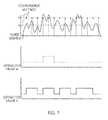
- FIG. 7 is a diagram illustrating an output sequence stabilization scheme implemented via the adjustment of the comparative voltage of the comparison unit shown in FIG. 1 .
- FIG. 7 illustrates the results of decreasing the comparative voltage of the comparison unit 20.
- the comparative voltage in the case of the comparative voltage 'a' of FIG. 7 , the comparative voltage is a high, and thus there is a high probability that "0" will be output.
- uniform random number sequences may be obtained by decreasing the comparative voltage of the comparison unit 20.
- FIG. 8 is a diagram illustrating an output sequence stabilization scheme implemented via the adjustment of the input voltage of the random number generation unit shown in FIG. 1 .
- FIG. 8 shows that the output of the noise source of the random number generation unit 10 is low, and thus the frequency of "0" may be high as in the extracted value a. In this case, by raising the input voltage of the random number generation unit 10, uniform random number sequences may be obtained.
- FIG. 9 is a flowchart showing a method for stabilizing the output sequence of a real random number generator according to an embodiment of the present invention.
- the random number generation unit 10 generates a predetermined random number sequence (random number values). That is, the random number generation unit 10 generates a random number sequence (analog signal) based on a predetermined input value. The generated random number sequence is applied to the comparison unit 20.
- the comparison unit 20 compares the analog signal (random number values) output from the random number generation unit 10 with a specific voltage, and then samples and outputs the analog signal at each preset period.
- the storage unit 30 stores the random number values sampled by and output from the comparison unit 20.
- the verification unit 40 verifies the random number values stored in the storage unit 30, performs a monobit test on the stored random number values, and obtains the resulting values of the monobit test while calculating an impact value.
- the adjustment unit 50 adjusts the input voltage of the random number generation unit 10 or the comparative voltage of the comparison unit 20 using the values verified by the verification unit 40 (that is, the resulting values of the monobit test and the impact value). That is, the adjustment unit 50 fuzzifies the resulting values of the monobit test output from the verification unit 40, performs fuzzy inference to generate a corresponding fuzzy set based on fuzzy inference, and defuzzifies the fuzzy set. Accordingly, the adjustment unit 50 converts fuzzy values indicated by the fuzzy set into normal numerical values corresponding to the fuzzy values. The adjustment unit 50 outputs adjustment values by multiplying the numerical values by the impact value output from the verification unit 40.
- uniform random number sequences may be stored in the storage unit 30, and the random number sequences stored in the storage unit 30 may be post-processed and output by the post-processing unit 60.
- the input voltage of a random number generator or the comparative voltage of a comparator is adjusted via self-diagnosis, so that the equipment may be maintained in the highest functioning state. Accordingly, the real random number generator that is maintained in the highest functioning state is not biased, and output sequences that are unpredictable and that have excellent randomness may be generated.
Landscapes
- Engineering & Computer Science (AREA)
- Physics & Mathematics (AREA)
- General Physics & Mathematics (AREA)
- Theoretical Computer Science (AREA)
- Computational Mathematics (AREA)
- Mathematical Analysis (AREA)
- Mathematical Optimization (AREA)
- Pure & Applied Mathematics (AREA)
- General Engineering & Computer Science (AREA)
- Software Systems (AREA)
- Biomedical Technology (AREA)
- Algebra (AREA)
- Life Sciences & Earth Sciences (AREA)
- Fuzzy Systems (AREA)
- General Health & Medical Sciences (AREA)
- Molecular Biology (AREA)
- Health & Medical Sciences (AREA)
- Automation & Control Theory (AREA)
- Artificial Intelligence (AREA)
- Data Mining & Analysis (AREA)
- Evolutionary Computation (AREA)
- Computing Systems (AREA)
- Mathematical Physics (AREA)
- Feedback Control In General (AREA)
- Heterocyclic Carbon Compounds Containing A Hetero Ring Having Oxygen Or Sulfur (AREA)
- Tests Of Electronic Circuits (AREA)
Abstract
Description
- The present invention generally relates to an apparatus and method for stabilizing the output sequence of a real random number generator and, more particularly, to an apparatus and method for stabilizing the output sequence of a real random number generator that is used in security systems.
- The core of a real random number generator for generating an output sequence (key sequence) is to provide statistical randomness. Generally, a real random number generator uses unpredictable, uncopyable, and non-deterministic noise sources that may be extracted from a natural phenomenon.
- A real random number generator that uses an analog noise source may generate biased random numbers due to a surrounding environment or device aging.
- That is, since the characteristics of a real random number generator change every moment, the entropy of an output sequence may be decreased.
- In other words, if a surrounding environment and condition are satisfied, such a real random number generator generates unbiased random numbers, but if the surrounding environment is deteriorated or aged, predictable random numbers having a specific pattern may be generated. In this case, security systems that use predictable random numbers become vulnerable to external attacks.
- As related preceding technology, Korean Patent Application Publication No.
2004-0085608 - Accordingly, the present invention has been made keeping in mind the above problems occurring in the prior art, and an object of the present invention is to provide an apparatus and method that stabilizes the output sequence of a real random number generator by adjusting the input voltage of the random number generator or the comparative voltage of a comparator.
- In accordance with an aspect of the present invention to accomplish the above object, there is provided an apparatus for stabilizing an output sequence of a real random number generator, including a verification unit for performing a monobit test on random number values sampled by and output from a comparison unit, and calculating an impact value; and an adjustment unit for adjusting a voltage of any one of a random number generation unit and the comparison unit using resulting values of the monobit test and the impact value output from the verification unit.
- The verification unit may perform the monobit test using the following monobit test equation:

where X denotes calculated resulting values of the monobit test, n 0 denotes a number of 0's, n 1 denotes a number of 1's, and n denotes a total number of bits. - The impact value may become a negative (-) value when (n 0 - n 1 ) is greater than 0 in the monobit test equation, whereas the impact value may become a positive (+) value when (n 0 - n 1) is less than 0.
- The adjustment unit may include a fuzzy function unit for fuzzifying the resulting values of the monobit test from the verification unit using a preset fuzzy function; a fuzzy engine unit for performing fuzzy inference by applying fuzzy values from the fuzzy function unit to a fuzzy rule; and a defuzzy function unit for converting the fuzzy values indicated by a fuzzy set by the fuzzy engine unit into numerical values corresponding to the fuzzy values.
- The preset fuzzy function may be composed of values between probabilities of 0.95 and 0.99 of a chi-square distribution, and respective distribution values are 3.84 and 6.64.
- The adjustment unit may output values, obtained by multiplying the values output from the defuzzy function unit by the impact value output from the verification unit, as adjustment values.
- In accordance with another aspect of the present invention to accomplish the above object, there is provided a method for stabilizing an output sequence of a real random number generator, including performing, by a verification unit, a monobit test on random number values sampled by and output from a comparison unit, and calculating an impact value; and adjusting, by an adjustment unit, a voltage of any one of a random number generation unit and the comparison unit using resulting values of the monobit test and the impact value.
- The above and other objects, features and advantages of the present invention will be more clearly understood from the following detailed description taken in conjunction with the accompanying drawings, in which:
-
FIG. 1 is a configuration diagram showing an apparatus for stabilizing the output sequence of a real random number generator according to an embodiment of the present invention; -
FIG. 2 is a diagram showing the internal configuration of an adjustment unit shown inFIG. 1 ; -
FIG. 3 is a diagram showing an example of a fuzzy function of a fuzzy function unit shown inFIG. 2 ; -
FIG. 4 is a diagram showing an example of a fuzzy rule shown inFIG. 2 ; -
FIG. 5 is a diagram showing an example of a defuzzy function of a defuzzy function unit shown inFIG. 2 ; -
FIG. 6 is a diagram illustrating adjustment values from the adjustment unit shown inFIG. 1 ; -
FIG. 7 is a diagram illustrating an output sequence stabilization scheme implemented via the adjustment of the comparative voltage of a comparison unit shown inFIG. 1 ; -
FIG. 8 is a diagram illustrating an output sequence stabilization scheme implemented via the adjustment of the input voltage of the random number generation unit shown inFIG. 1 ; and -
FIG. 9 is a flowchart showing a method for stabilizing the output sequence of a real random number generator according to an embodiment of the present invention. - The present invention may be variously changed and may have various embodiments, and specific embodiments will be described in detail below with reference to the attached drawings.
- However, it should be understood that those embodiments are not intended to limit the present invention to specific disclosure forms and they include all changes, equivalents or modifications included in the spirit and scope of the present invention.
- The terms used in the present specification are merely used to describe specific embodiments and are not intended to limit the present invention. A singular expression includes a plural expression unless a description to the contrary is specifically pointed out in context. In the present specification, it should be understood that the terms such as "include" or "have" are merely intended to indicate that features, numbers, steps, operations, components, parts, or combinations thereof are present, and are not intended to exclude a possibility that one or more other features, numbers, steps, operations, components, parts, or combinations thereof will be present or added.
- Unless differently defined, all terms used here including technical or scientific terms have the same meanings as the terms generally understood by those skilled in the art to which the present invention pertains. The terms identical to those defined in generally used dictionaries should be interpreted as having meanings identical to contextual meanings of the related art, and are not interpreted as being ideal or excessively formal meanings unless they are definitely defined in the present specification.
- Embodiments of the present invention will be described in detail with reference to the accompanying drawings. In the following description of the present invention, the same reference numerals are used to designate the same or similar elements throughout the drawings and repeated descriptions of the same components will be omitted.
-
FIG. 1 is a configuration diagram showing an apparatus for stabilizing the output sequence of a real random number generator according to an embodiment of the present invention. - The apparatus for stabilizing the output sequence of a real random number generator according to the embodiment of the present invention includes a random
number generation unit 10, acomparison unit 20, astorage unit 30, averification unit 40, anadjustment unit 50, and apost-processing unit 60. - The random
number generation unit 10 is a device composed of diodes that are analog noise sources, thermal noise, etc. to perform amplification. The randomnumber generation unit 10 outputs pure analog signals. The randomnumber generation unit 10 may include an initialization function, an output generation function, an update function, etc. The initialization function determines the initial value of operating status using an entropy input generated using noise. The operating status, which is data used to generate an output (random numbers) from the internal output generation function of an output generation function, is generated by the initialization function and is updated by the update function and the output generation function. The output generation function outputs random numbers using the operating status. Further, to prevent a predictive attack, the update function adds new entropy to the operating status. The entropy denotes a value determined using the probability distribution of results of a certain event. As the entropy is larger, it is more difficult to predict which value the corresponding variable becomes, and thus it may be considered that the randomness of the corresponding variable is high. - The
comparison unit 20 compares an analog signal (random number values) output from the randomnumber generation unit 10 with a specific voltage, and samples and outputs the analog signal at each preset period. For example, thecomparison unit 20 may identify and sample bit patterns of "1" and "0". - The
storage unit 30 stores random number values sampled and output by thecomparison unit 20. For example, thestorage unit 30 may store 200,000 or more bits. - The
verification unit 40 calculates an impact value while performing a monobit test using the random number values stored in thestorage unit 30. - Here, an equation for calculating the monobit test is given by the following equation:

where X denotes the calculated resulting values of the monobit test, n 0 denotes the number of 0's, n 1 denotes the number of 1's, and n denotes the total number of bits. - Further, the impact value becomes a negative (-) value when (n 0 - n 1) is greater than 0 (zero) in the monobit test equation, whereas the impact value becomes a positive (+) value when (n 0 - n 1) is less than 0.
- That is, the
verification unit 40 performs the monobit test on a random number sequence (random numbers), which is generated by the randomnumber generation unit 10 and is processed through thecomparison unit 20 and thestorage unit 30, and calculates a distribution of 1's and 0's. Further, theverification unit 40 obtains an impact value using the above-described scheme. - The
adjustment unit 50 adjusts the voltage of the randomnumber generation unit 10 or thecomparison unit 20 using values (that is, the resulting values of the monobit test and the impact value) verified by theverification unit 40. - The
post-processing unit 60 post-processes and outputs the random numbers stored in thestorage unit 30. -
FIG. 2 is a diagram showing the internal configuration of the adjustment unit shown inFIG. 1 ,FIG. 3 is a diagram showing an example of a fuzzy function of a fuzzy function unit shown inFIG. 2 ,FIG. 3 is a diagram showing an example of a fuzzy function unit shown inFIG. 2 ,FIG. 4 is a diagram showing an example of a fuzzy rule shown inFIG. 2 ,FIG. 5 is a diagram showing an example of a defuzzy function of a defuzzy function unit shown inFIG. 2 , andFIG. 6 is a diagram illustrating adjustment values from the adjustment unit shown inFIG. 1 . - The
adjustment unit 50 includes afuzzy function unit 51, afuzzy engine unit 52, and adefuzzy function unit 54. - The
fuzzy function unit 51 fuzzifies the results of verification (e.g., the resulting values of the monobit test) by theverification unit 40 using a preset fuzzy function. Here, the preset fuzzy function is composed of values between probabilities of 0.95 and 0.99 of a chi-square distribution. As shown inFIG. 3 , respective distribution values are 3.84 and 6.64. In this way, thefuzzy function unit 51 converts the results of verification by theverification unit 40 into a fuzzy set in which fuzzy inference may be performed. - Here, fuzzy inference is performed by the
fuzzy engine unit 52. - The
fuzzy engine unit 52 performs fuzzy inference by applying the fuzzified values (fuzzy values) from thefuzzy function unit 51 to thefuzzy rule 53. For example, as illustrated inFIG. 4 , the fuzzy rule has the format of an antecedent part "IF" and a consequent part "THEN", and is configured such that, when an input value satisfying the condition of the antecedent part is received, the proposition of the consequent part is fulfilled. In other words, thefuzzy engine unit 52 converts the fuzzy values output from thefuzzy function unit 51 into a fuzzy set of an output space using thefuzzy rule 53. - The
defuzzy function unit 54 converts the fuzzy values indicated by the fuzzy set by thefuzzy engine unit 52 into normal numerical values corresponding to the fuzzy values. Defuzzification has the inverse function of fuzzification. For example, the results of inference based on fuzzy logic in thefuzzy engine unit 52 may be a linguistic expression, and thus they must undergo a defuzzification procedure via thedefuzzy function unit 54. Methods used in defuzzification may include methods using the maximum values of fuzzy sets of combined output units, methods using the average of individual maximum values, methods using the center of gravity (center of area method), etc. Thedefuzzy function unit 54 may adjust output values thereof by a maximum of 0.4 V at each time, as illustrated inFIG. 5 . - The values output from the
defuzzy function unit 54 are multiplied by the impact value and adjusted as illustrated inFIG. 6 . - That is, the
adjustment unit 50 outputs adjustment values by multiplying the values (numerical values) output from the internaldefuzzy function unit 54 by the impact value output from theverification unit 40. Here, the adjustment values may be given, as illustrated inFIG. 6 . - The adjustment values output from the
adjustment unit 50 are used to adjust the input voltage of the randomnumber generation unit 10 or to adjust the comparative voltage of thecomparison unit 20. -
FIG. 7 is a diagram illustrating an output sequence stabilization scheme implemented via the adjustment of the comparative voltage of the comparison unit shown inFIG. 1 . - In
FIG. 7 , it can be seen that, when the comparative voltage of thecomparison unit 20 is "a", relatively many 0's are output by referring to extracted value a. Therefore, it can be seen that when the comparative voltage of thecomparison unit 20 is changed to "b" via theadjustment unit - That is,
FIG. 7 illustrates the results of decreasing the comparative voltage of thecomparison unit 20. In this case, in the case of the comparative voltage 'a' ofFIG. 7 , the comparative voltage is a high, and thus there is a high probability that "0" will be output. In this case, uniform random number sequences may be obtained by decreasing the comparative voltage of thecomparison unit 20. -
FIG. 8 is a diagram illustrating an output sequence stabilization scheme implemented via the adjustment of the input voltage of the random number generation unit shown inFIG. 1 . - As shown in
FIG. 8 , it can be seen that, when the input voltage of the randomnumber generation unit 10 is "a", relatively many 0's are output in extracted value a. Therefore, it can be seen that, when the input voltage of the randomnumber generation unit 10 is changed to "b" via theadjustment unit - That is,
FIG. 8 shows that the output of the noise source of the randomnumber generation unit 10 is low, and thus the frequency of "0" may be high as in the extracted value a. In this case, by raising the input voltage of the randomnumber generation unit 10, uniform random number sequences may be obtained. -
FIG. 9 is a flowchart showing a method for stabilizing the output sequence of a real random number generator according to an embodiment of the present invention. - At step S10, the random
number generation unit 10 generates a predetermined random number sequence (random number values). That is, the randomnumber generation unit 10 generates a random number sequence (analog signal) based on a predetermined input value. The generated random number sequence is applied to thecomparison unit 20. - Then, at step S20, the
comparison unit 20 compares the analog signal (random number values) output from the randomnumber generation unit 10 with a specific voltage, and then samples and outputs the analog signal at each preset period. - At step S30, the
storage unit 30 stores the random number values sampled by and output from thecomparison unit 20. - At step S40, the
verification unit 40 verifies the random number values stored in thestorage unit 30, performs a monobit test on the stored random number values, and obtains the resulting values of the monobit test while calculating an impact value. - Finally, at step S50, the
adjustment unit 50 adjusts the input voltage of the randomnumber generation unit 10 or the comparative voltage of thecomparison unit 20 using the values verified by the verification unit 40 (that is, the resulting values of the monobit test and the impact value). That is, theadjustment unit 50 fuzzifies the resulting values of the monobit test output from theverification unit 40, performs fuzzy inference to generate a corresponding fuzzy set based on fuzzy inference, and defuzzifies the fuzzy set. Accordingly, theadjustment unit 50 converts fuzzy values indicated by the fuzzy set into normal numerical values corresponding to the fuzzy values. Theadjustment unit 50 outputs adjustment values by multiplying the numerical values by the impact value output from theverification unit 40. - As the voltage of the random
number generation unit 10 or thecomparison unit 20 is adjusted using such adjustment values, uniform random number sequences may be stored in thestorage unit 30, and the random number sequences stored in thestorage unit 30 may be post-processed and output by thepost-processing unit 60. - In accordance with the present invention having the above configuration, in the aging of equipment or malfunctioning of the equipment, the input voltage of a random number generator or the comparative voltage of a comparator is adjusted via self-diagnosis, so that the equipment may be maintained in the highest functioning state. Accordingly, the real random number generator that is maintained in the highest functioning state is not biased, and output sequences that are unpredictable and that have excellent randomness may be generated.
- As described above, optimal embodiments of the present invention have been disclosed in the drawings and the specification. Although specific terms have been used in the present specification, these are merely intended to describe the present invention and are not intended to limit the meanings thereof or the scope of the present invention described in the accompanying claims. Therefore, those skilled in the art will appreciate that various modifications and other equivalent embodiments are possible from the embodiments. Therefore, the technical scope of the present invention should be defined by the technical spirit of the claims.
Claims (12)
- An apparatus for stabilizing an output sequence of a real random number generator, comprising:a verification unit for performing a monobit test on random number values sampled by and output from a comparison unit, and calculating an impact value; andan adjustment unit for adjusting a voltage of any one of a random number generation unit and the comparison unit using resulting values of the monobit test and the impact value output from the verification unit.
- The apparatus of claim 1, wherein the verification unit performs the monobit test using the following monobit test equation:

where X denotes calculation results of the monobit test, n 0 denotes a number of 0's, n 1 denotes a number of 1's, and n denotes a total number of bits. - The apparatus of claim 2, wherein the impact value becomes a negative (-) value when (n 0 - n 1) is greater than 0 in the monobit test equation, whereas the impact value becomes a positive (+) value when (n 0 - n 1) is less than 0.
- The apparatus of claim 1, 2 or 3, wherein the adjustment unit comprises:a fuzzy function unit for fuzzifying the resulting values of the monobit test from the verification unit using a preset fuzzy function;a fuzzy engine unit for performing fuzzy inference by applying fuzzy values from the fuzzy function unit to a fuzzy rule; anda defuzzy function unit for converting the fuzzy values indicated by a fuzzy set by the fuzzy engine unit into numerical values corresponding to the fuzzy values.
- The apparatus of claim 4, wherein the preset fuzzy function is composed of values between probabilities of 0.95 and 0.99 of a chi-square distribution, and respective distribution values are 3.84 and 6.64.
- The apparatus of claim 4 or 5, wherein the adjustment unit outputs values, obtained by multiplying the values output from the defuzzy function unit by the impact value output from the verification unit, as adjustment values.
- A method for stabilizing an output sequence of a real random number generator, comprising:performing, by a verification unit, a monobit test on random number values sampled by and output from a comparison unit, and calculating an impact value; andadjusting, by an adjustment unit, a voltage of any one of a random number generation unit and the comparison unit using resulting values of the monobit test and the impact value.
- The method of claim 7, wherein performing the monobit test and calculating the impact value comprises performing the monobit test using the following monobit test equation:

where X denotes calculation results of the monobit test, n 0 denotes a number of 0's, n 1 denotes a number of 1's, and n denotes a total number of bits. - The method of claim 8, wherein the impact value becomes a negative (-) value when (n 0 - n 1) is greater than 0 in the monobit test equation, whereas the impact value becomes a positive (+) value when (n 0 - n 1) is less than 0.
- The method of claim 7, 8 or 9, wherein adjusting the voltage comprises:fuzzifying the resulting values of the monobit test using a preset fuzzy function;performing fuzzy inference by applying fuzzy values obtained from fuzzifying to a fuzzy rule; andconverting the fuzzy values indicated by a fuzzy set by the fuzzy inference into numerical values corresponding to the fuzzy values.
- The method of claim 10, wherein the preset fuzzy function is composed of values between probabilities of 0.95 and 0.99 of a chi-square distribution, and respective distribution values are 3.84 and 6.64.
- The method of claim 10 or 11, wherein adjusting the value further comprises outputting values, obtained by multiplying the numerical values by the impact value, as adjustment values.
Applications Claiming Priority (1)
| Application Number | Priority Date | Filing Date | Title |
|---|---|---|---|
| KR1020140015806A KR101557761B1 (en) | 2014-02-12 | 2014-02-12 | Apparatus and method for stabilizing output stream of real random number generator |
Publications (1)
| Publication Number | Publication Date |
|---|---|
| EP2908240A1 true EP2908240A1 (en) | 2015-08-19 |
Family
ID=52573590
Family Applications (1)
| Application Number | Title | Priority Date | Filing Date |
|---|---|---|---|
| EP15154282.6A Withdrawn EP2908240A1 (en) | 2014-02-12 | 2015-02-09 | Apparatus and method for stabilizing output sequence of real random number generator |
Country Status (4)
| Country | Link |
|---|---|
| US (1) | US9841949B2 (en) |
| EP (1) | EP2908240A1 (en) |
| KR (1) | KR101557761B1 (en) |
| CN (1) | CN104834499B (en) |
Families Citing this family (6)
| Publication number | Priority date | Publication date | Assignee | Title |
|---|---|---|---|---|
| US10228912B2 (en) * | 2016-09-06 | 2019-03-12 | Quintessencelabs Pty Ltd. | Tunable tunnel diode-based digitized noise source |
| KR102836787B1 (en) | 2016-11-16 | 2025-07-18 | 삼성전자주식회사 | Apparatus and method of randomness test for random number generator |
| KR101931777B1 (en) * | 2017-08-10 | 2019-03-13 | 한국전자통신연구원 | Apparatus for generating true random value based on uart and method for the same |
| KR102372740B1 (en) | 2019-04-09 | 2022-03-14 | 한국전자통신연구원 | Random number generating device and operating method of the same |
| KR102792398B1 (en) | 2019-06-17 | 2025-04-10 | 한국전자통신연구원 | Random number generating device and operating method of the same |
| CN110531957B (en) * | 2019-09-11 | 2021-04-23 | 北京智芯微电子科技有限公司 | On-line detection method of random number generator |
Citations (3)
| Publication number | Priority date | Publication date | Assignee | Title |
|---|---|---|---|---|
| KR20040085608A (en) | 2003-04-01 | 2004-10-08 | 한국전자통신연구원 | Method And Apparatus of Generating Random Number Using Electronic Circuit Noise |
| US20090165086A1 (en) * | 2007-12-21 | 2009-06-25 | Spansion Llc | Random number generation through use of memory cell activity |
| US20100005128A1 (en) * | 2006-08-03 | 2010-01-07 | Salih Ergun | Random numbers generation using continuous-time chaos |
Family Cites Families (7)
| Publication number | Priority date | Publication date | Assignee | Title |
|---|---|---|---|---|
| US4853884A (en) * | 1987-09-11 | 1989-08-01 | Motorola, Inc. | Random number generator with digital feedback |
| JPH06175855A (en) | 1992-12-07 | 1994-06-24 | Ube Ind Ltd | Fuzzy inference method |
| US6675113B2 (en) * | 2002-03-26 | 2004-01-06 | Koninklijke Philips Electronics N.V. | Monobit-run frequency on-line randomness test |
| JPWO2005124537A1 (en) * | 2004-06-18 | 2008-04-17 | 富士通株式会社 | Random number generation device, generation method, generator evaluation method, and random number use method |
| KR20070018986A (en) | 2006-12-07 | 2007-02-14 | 후지쯔 가부시끼가이샤 | Random number generator, generation method, generator evaluation method and random number usage method |
| CN101364171B (en) * | 2008-07-07 | 2011-05-11 | 武汉大学 | Dynamic real random number generator |
| JP4538066B2 (en) * | 2008-08-26 | 2010-09-08 | 株式会社東芝 | Random number generator |
-
2014
- 2014-02-12 KR KR1020140015806A patent/KR101557761B1/en not_active Expired - Fee Related
-
2015
- 2015-02-05 US US14/614,544 patent/US9841949B2/en not_active Expired - Fee Related
- 2015-02-09 EP EP15154282.6A patent/EP2908240A1/en not_active Withdrawn
- 2015-02-12 CN CN201510075844.7A patent/CN104834499B/en not_active Expired - Fee Related
Patent Citations (3)
| Publication number | Priority date | Publication date | Assignee | Title |
|---|---|---|---|---|
| KR20040085608A (en) | 2003-04-01 | 2004-10-08 | 한국전자통신연구원 | Method And Apparatus of Generating Random Number Using Electronic Circuit Noise |
| US20100005128A1 (en) * | 2006-08-03 | 2010-01-07 | Salih Ergun | Random numbers generation using continuous-time chaos |
| US20090165086A1 (en) * | 2007-12-21 | 2009-06-25 | Spansion Llc | Random number generation through use of memory cell activity |
Non-Patent Citations (2)
| Title |
|---|
| MENEZES A J ET AL: "Handbook of Applied Cryptopgraphy", 1997, CRC PRESS, BOCA RATON, FL, USA, ISBN: 978-0-8493-8523-0, pages: 81 - 82, XP002252330 * |
| SAITOH Y ET AL: "GENERATION OF PHYSICAL RANDOM NUMBERS WITH A VARIABLE-CAPACITOR PARAMETRON", ELECTRONICS & COMMUNICATIONS IN JAPAN, PART III - FUNDAMENTALELECTRONIC SCIENCE,, vol. 86, no. 2, PART 03, 2002, WILEY, HOBOKEN, NJ, USA, pages 24 - 32, XP001132383, ISSN: 1042-0967, DOI: 10.1002/ECJC.10040 * |
Also Published As
| Publication number | Publication date |
|---|---|
| US9841949B2 (en) | 2017-12-12 |
| CN104834499A (en) | 2015-08-12 |
| KR101557761B1 (en) | 2015-10-06 |
| US20150227344A1 (en) | 2015-08-13 |
| KR20150094911A (en) | 2015-08-20 |
| CN104834499B (en) | 2019-04-02 |
Similar Documents
| Publication | Publication Date | Title |
|---|---|---|
| US9841949B2 (en) | Apparatus and method for stabilizing output sequence of real random number generator | |
| Knudsen et al. | Analysis methods for (alleged) RC4 | |
| CN107735981B (en) | Clock period randomization for defense against cryptographic attacks | |
| CN111611126A (en) | Sampling device and method for controlling sampling device | |
| US20220237455A1 (en) | Neural-network quantization method and apparatus | |
| JP2005523497A (en) | Hadamard transform online irregularity test | |
| Hamdi et al. | A very efficient pseudo-random number generator based on chaotic maps and s-box tables | |
| US20140025718A1 (en) | Circuit and method for generating random number | |
| Husa et al. | Designing bent boolean functions with parallelized linear genetic programming | |
| US20230269065A1 (en) | Carry-based differential power analysis and its application to testing for vulnerability of sha-2 and hmac-sha-2 to side channel attack | |
| EP3851982A1 (en) | Information processing program, information processing method, and information processing apparatus | |
| Günakın et al. | 4D memristive chaotic system based optional parameterized random number generator | |
| Kumari et al. | On the complex and chaotic dynamics of standard logistic sine square map | |
| EP3131228A1 (en) | Method to secure keccak algorithm against side-channel attacks | |
| US8660262B2 (en) | Method and device for generating random wait states | |
| EP2899713B1 (en) | Hash value calculation device, hash value calculation method and hash value calculation program | |
| Kumar et al. | Analysis of the Impact of Logistic Map with Gaussian Membership Function for Cryptography. | |
| Jiang et al. | On the optimality of repair-cost-limit policies | |
| Yacoub et al. | Pseudo random number generators employing three numerical solvers of chaotic generators | |
| Beirami et al. | A performance metric for discrete-time chaos-based truly random number generators | |
| CN114859703A (en) | Positive linear system pulse control system, method, equipment and medium based on event trigger | |
| CN117396889A (en) | Method and apparatus for optimizing reasoning of deep neural network | |
| JP2019071113A (en) | Ising device and ising device control method | |
| CN120050039B (en) | A SRAM PUF key extraction method based on correlation judgment | |
| US8793296B2 (en) | Random number generating method |
Legal Events
| Date | Code | Title | Description |
|---|---|---|---|
| PUAI | Public reference made under article 153(3) epc to a published international application that has entered the european phase |
Free format text: ORIGINAL CODE: 0009012 |
|
| AK | Designated contracting states |
Kind code of ref document: A1 Designated state(s): AL AT BE BG CH CY CZ DE DK EE ES FI FR GB GR HR HU IE IS IT LI LT LU LV MC MK MT NL NO PL PT RO RS SE SI SK SM TR |
|
| AX | Request for extension of the european patent |
Extension state: BA ME |
|
| 17P | Request for examination filed |
Effective date: 20160219 |
|
| RBV | Designated contracting states (corrected) |
Designated state(s): AL AT BE BG CH CY CZ DE DK EE ES FI FR GB GR HR HU IE IS IT LI LT LU LV MC MK MT NL NO PL PT RO RS SE SI SK SM TR |
|
| 17Q | First examination report despatched |
Effective date: 20180418 |
|
| GRAP | Despatch of communication of intention to grant a patent |
Free format text: ORIGINAL CODE: EPIDOSNIGR1 |
|
| INTG | Intention to grant announced |
Effective date: 20190606 |
|
| STAA | Information on the status of an ep patent application or granted ep patent |
Free format text: STATUS: THE APPLICATION IS DEEMED TO BE WITHDRAWN |
|
| 18D | Application deemed to be withdrawn |
Effective date: 20191017 |