EP2908076A1 - Method for operating a production system for air separation processes and production system - Google Patents
Method for operating a production system for air separation processes and production system Download PDFInfo
- Publication number
- EP2908076A1 EP2908076A1 EP14000517.4A EP14000517A EP2908076A1 EP 2908076 A1 EP2908076 A1 EP 2908076A1 EP 14000517 A EP14000517 A EP 14000517A EP 2908076 A1 EP2908076 A1 EP 2908076A1
- Authority
- EP
- European Patent Office
- Prior art keywords
- air separation
- units
- separation plant
- unit
- consumer
- Prior art date
- Legal status (The legal status is an assumption and is not a legal conclusion. Google has not performed a legal analysis and makes no representation as to the accuracy of the status listed.)
- Withdrawn
Links
- 238000000926 separation method Methods 0.000 title claims abstract description 90
- 238000004519 manufacturing process Methods 0.000 title claims abstract description 61
- 238000000034 method Methods 0.000 title claims abstract description 52
- 239000012530 fluid Substances 0.000 claims abstract description 28
- 230000003213 activating effect Effects 0.000 claims abstract description 10
- 238000003860 storage Methods 0.000 claims description 17
- 238000004422 calculation algorithm Methods 0.000 claims description 12
- IJGRMHOSHXDMSA-UHFFFAOYSA-N Atomic nitrogen Chemical compound N#N IJGRMHOSHXDMSA-UHFFFAOYSA-N 0.000 claims description 8
- 239000007789 gas Substances 0.000 claims description 6
- MYMOFIZGZYHOMD-UHFFFAOYSA-N Dioxygen Chemical compound O=O MYMOFIZGZYHOMD-UHFFFAOYSA-N 0.000 claims description 4
- 238000004590 computer program Methods 0.000 claims description 4
- 229910052757 nitrogen Inorganic materials 0.000 claims description 4
- 230000008569 process Effects 0.000 claims description 4
- 238000012544 monitoring process Methods 0.000 claims description 2
- 230000007704 transition Effects 0.000 claims description 2
- 241000196324 Embryophyta Species 0.000 description 53
- 239000000047 product Substances 0.000 description 26
- 238000005457 optimization Methods 0.000 description 9
- 230000006870 function Effects 0.000 description 8
- 239000007788 liquid Substances 0.000 description 6
- 238000011160 research Methods 0.000 description 5
- 238000013459 approach Methods 0.000 description 4
- 238000009826 distribution Methods 0.000 description 4
- 239000012263 liquid product Substances 0.000 description 4
- 230000008901 benefit Effects 0.000 description 3
- XKRFYHLGVUSROY-UHFFFAOYSA-N Argon Chemical compound [Ar] XKRFYHLGVUSROY-UHFFFAOYSA-N 0.000 description 2
- 230000004913 activation Effects 0.000 description 2
- QVGXLLKOCUKJST-UHFFFAOYSA-N atomic oxygen Chemical compound [O] QVGXLLKOCUKJST-UHFFFAOYSA-N 0.000 description 2
- 238000004364 calculation method Methods 0.000 description 2
- 230000009849 deactivation Effects 0.000 description 2
- 238000005265 energy consumption Methods 0.000 description 2
- 239000001301 oxygen Substances 0.000 description 2
- 229910052760 oxygen Inorganic materials 0.000 description 2
- 244000068988 Glycine max Species 0.000 description 1
- UFHFLCQGNIYNRP-UHFFFAOYSA-N Hydrogen Chemical compound [H][H] UFHFLCQGNIYNRP-UHFFFAOYSA-N 0.000 description 1
- 229910052786 argon Inorganic materials 0.000 description 1
- 238000011161 development Methods 0.000 description 1
- 238000010586 diagram Methods 0.000 description 1
- 230000005611 electricity Effects 0.000 description 1
- ZZUFCTLCJUWOSV-UHFFFAOYSA-N furosemide Chemical compound C1=C(Cl)C(S(=O)(=O)N)=CC(C(O)=O)=C1NCC1=CC=CO1 ZZUFCTLCJUWOSV-UHFFFAOYSA-N 0.000 description 1
- 230000036541 health Effects 0.000 description 1
- 239000001307 helium Substances 0.000 description 1
- 229910052734 helium Inorganic materials 0.000 description 1
- SWQJXJOGLNCZEY-UHFFFAOYSA-N helium atom Chemical compound [He] SWQJXJOGLNCZEY-UHFFFAOYSA-N 0.000 description 1
- 239000001257 hydrogen Substances 0.000 description 1
- 229910052739 hydrogen Inorganic materials 0.000 description 1
- 238000012886 linear function Methods 0.000 description 1
- 238000007726 management method Methods 0.000 description 1
- 238000012067 mathematical method Methods 0.000 description 1
- XLYOFNOQVPJJNP-UHFFFAOYSA-N water Substances O XLYOFNOQVPJJNP-UHFFFAOYSA-N 0.000 description 1
Images
Classifications
-
- F—MECHANICAL ENGINEERING; LIGHTING; HEATING; WEAPONS; BLASTING
- F25—REFRIGERATION OR COOLING; COMBINED HEATING AND REFRIGERATION SYSTEMS; HEAT PUMP SYSTEMS; MANUFACTURE OR STORAGE OF ICE; LIQUEFACTION SOLIDIFICATION OF GASES
- F25J—LIQUEFACTION, SOLIDIFICATION OR SEPARATION OF GASES OR GASEOUS OR LIQUEFIED GASEOUS MIXTURES BY PRESSURE AND COLD TREATMENT OR BY BRINGING THEM INTO THE SUPERCRITICAL STATE
- F25J3/00—Processes or apparatus for separating the constituents of gaseous or liquefied gaseous mixtures involving the use of liquefaction or solidification
- F25J3/02—Processes or apparatus for separating the constituents of gaseous or liquefied gaseous mixtures involving the use of liquefaction or solidification by rectification, i.e. by continuous interchange of heat and material between a vapour stream and a liquid stream
- F25J3/04—Processes or apparatus for separating the constituents of gaseous or liquefied gaseous mixtures involving the use of liquefaction or solidification by rectification, i.e. by continuous interchange of heat and material between a vapour stream and a liquid stream for air
- F25J3/04763—Start-up or control of the process; Details of the apparatus used
- F25J3/04866—Construction and layout of air fractionation equipments, e.g. valves, machines
- F25J3/04951—Arrangements of multiple air fractionation units or multiple equipments fulfilling the same process step, e.g. multiple trains in a network
-
- F—MECHANICAL ENGINEERING; LIGHTING; HEATING; WEAPONS; BLASTING
- F25—REFRIGERATION OR COOLING; COMBINED HEATING AND REFRIGERATION SYSTEMS; HEAT PUMP SYSTEMS; MANUFACTURE OR STORAGE OF ICE; LIQUEFACTION SOLIDIFICATION OF GASES
- F25J—LIQUEFACTION, SOLIDIFICATION OR SEPARATION OF GASES OR GASEOUS OR LIQUEFIED GASEOUS MIXTURES BY PRESSURE AND COLD TREATMENT OR BY BRINGING THEM INTO THE SUPERCRITICAL STATE
- F25J3/00—Processes or apparatus for separating the constituents of gaseous or liquefied gaseous mixtures involving the use of liquefaction or solidification
- F25J3/02—Processes or apparatus for separating the constituents of gaseous or liquefied gaseous mixtures involving the use of liquefaction or solidification by rectification, i.e. by continuous interchange of heat and material between a vapour stream and a liquid stream
- F25J3/04—Processes or apparatus for separating the constituents of gaseous or liquefied gaseous mixtures involving the use of liquefaction or solidification by rectification, i.e. by continuous interchange of heat and material between a vapour stream and a liquid stream for air
- F25J3/04763—Start-up or control of the process; Details of the apparatus used
- F25J3/04769—Operation, control and regulation of the process; Instrumentation within the process
- F25J3/04848—Control strategy, e.g. advanced process control or dynamic modeling
-
- F—MECHANICAL ENGINEERING; LIGHTING; HEATING; WEAPONS; BLASTING
- F25—REFRIGERATION OR COOLING; COMBINED HEATING AND REFRIGERATION SYSTEMS; HEAT PUMP SYSTEMS; MANUFACTURE OR STORAGE OF ICE; LIQUEFACTION SOLIDIFICATION OF GASES
- F25J—LIQUEFACTION, SOLIDIFICATION OR SEPARATION OF GASES OR GASEOUS OR LIQUEFIED GASEOUS MIXTURES BY PRESSURE AND COLD TREATMENT OR BY BRINGING THEM INTO THE SUPERCRITICAL STATE
- F25J2290/00—Other details not covered by groups F25J2200/00 - F25J2280/00
- F25J2290/60—Details about pipelines, i.e. network, for feed or product distribution
-
- F—MECHANICAL ENGINEERING; LIGHTING; HEATING; WEAPONS; BLASTING
- F25—REFRIGERATION OR COOLING; COMBINED HEATING AND REFRIGERATION SYSTEMS; HEAT PUMP SYSTEMS; MANUFACTURE OR STORAGE OF ICE; LIQUEFACTION SOLIDIFICATION OF GASES
- F25J—LIQUEFACTION, SOLIDIFICATION OR SEPARATION OF GASES OR GASEOUS OR LIQUEFIED GASEOUS MIXTURES BY PRESSURE AND COLD TREATMENT OR BY BRINGING THEM INTO THE SUPERCRITICAL STATE
- F25J2290/00—Other details not covered by groups F25J2200/00 - F25J2280/00
- F25J2290/62—Details of storing a fluid in a tank
Definitions
- This disclosure in general relates to a method for operating or controlling a fluid production system for air separation processes.
- This disclosure also relates to a production system including air separation processes. More particularly, controlling production of liquid air components in an air separation plant network is disclosed.
- the field of operations research, or operational research deals with the application of advanced mathematical methods to help make better decisions, e.g. deciding a commitment of plant units in a production system.
- Sub-fields of managing or controlling such a production system according to operational research methods are, e.g., assignment problems, project planning, game theory, routing, scheduling, forecasting demands and supplies.
- a method for operating a production system for air separation processes comprises:
- the method comprises the step of activating and/or deactivating the air separation plant units as a function of a linear model describing the production system.
- a production system of air separation processes comprises:
- the method for operating or controlling a production system for air separation processes generally employs a linear model that can be efficiently implemented in terms of a computer readable code and/or a programmable control unit.
- the method and/or system can be implemented to schedule the start-up and shut-down operations or activation and/or deactivation of air separation plant units.
- One can also refer to a method or a system adapted to execute a unit commitment algorithm.
- the system and method relates to operational research where a mathematically linear optimization is used.
- the method comprises the step of operating each air separation plant unit independently from one another according to a closed-loop control process.
- a respective air separation plant unit in the production system can be adapted to operate according to a closed-loop control independently from other air separation plant units comprised in the system.
- the method for operating or controlling the production system only requires a small amount of adjustment parameters, as for example the individual air separation plant units can be described in terms of simple heuristic models. There is no need for real-time closed-loop control as it may be necessary for a production system control controlling the individual air separation plants.
- the method and system can assume an idealized or generalized model for each plant thereby reducing calculational requirements,
- the fluid product is at least one of liquid oxygen, nitrogen or a rare gas component of air.
- the system may comprise at least one storage unit implemented to receive and store fluid products from the manifold of conduits and/or implemented to feed fluid products into the manifold of conduits.
- storage units can be reservoirs for the air separation products.
- the system may also comprise a plurality of sensor units for monitoring operational parameters of the air separation plant units, the consumer units and/or the storage units.
- a heuristic model is associated to each air separation plant unit, to the consumer unit and/or the storage unit. Heuristic models are easy to implement and do not require complicated and extensive calculational effort.
- a predetermined fluid product consumption is set or associated to each consumer unit over a predetermined time.
- the activating and/or deactivating then is preferably carried out as a function of the predetermined fluid product consumptions.
- external scheduling may require a particular consumer unit using an air separation product to operate regularly or over a specific time.
- activating and/or deactivating is carried out as a function of a plurality of predetermined cost parameters.
- the predetermined cost parameters can include the number of fluid products, production prices of the fluid products, load boundaries for the air separation plant units, load changing speeds for the air separation plant units, shutdown costs for the air separation plant units and/or shutdown state transition cycle numbers of the air separation plant units.
- the linear model for describing the production system is a mixed-integer linear programming algorithm.
- a mixed-integer linear programming (MILP) process can easily be implemented in terms of an algorithm.
- Embodiments of the method and the system can assist a production manager's or operator's decision-making based on an analytical algorithm that takes into account current and future production prices, heuristic simplified plant models and production forecasts.
- the control method or an accordingly implemented production system can run in parallel to real-time closed-loop control algorithms that may influence the optimization and operation of the individual plant units.
- the proposed method and system employs a linear optimization technique wherein a non-linear complex-scheduling problem is simplified to piecewise Arte linear problems.
- generalized heuristic models are used to describe the respective air separation plant units' closed-loop behavior.
- the closed-loop behavior in terms of integer linear models can be used as constraints in the linear optimization problem.
- the computer program product comprises a computer-readable storage medium having computer-readable program code embodied therewith, the computer-readable program code comprising computer-readable program code configured to control an activation and/or deactivation of the air separation units as a function of a linear model describing the production system.
- the program code may be configured to implement further aspects or steps of the method for controlling or operating the production system.
- the computer program product for instance, includes computer readable code for implementing aspects of the method for controlling or operating a production system depicted above.
- Certain embodiments of the presented method and system may comprise individual or combined features or aspects as mentioned above or below with respect to exemplary embodiments.
- fluid can refer to a gaseous or liquid medium, such as fluid air can be gaseous air or liquid air depending on the temperature and pressure conditions.
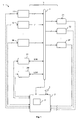
- FIG. 1 shows a schematic diagram of an embodiment of a production system for air separation processes.
- the production system 1 comprises a plurality of air separation plant units 11...1N.
- Each air separation plant unit 11...1N is implemented to produce at least one fluid product.
- a fluid product can be, for example, oxygen (LOX, GOX), nitrogen (LIN, GAN), hydrogen and rare gas components of air, such as argon (LAR, GAR) and helium.
- the air separation plant units 11...1N employ industrial processes, such as cryogenic air separation.
- the air separation plant units 11...1N are coupled through a pipeline or conduit network 5 to respective consumer units 31...3P.
- the consumer units 31...3P can be industrial plants that need one or more of the air separation products.
- the consumer units 31...3P are also coupled to the pipeline or fluid distribution network 5.
- the Fig. shows single conduit lines, a plurality of lines can be coupled to the consumers furnishing specific liquid or gaseous products.
- the production system 1 further comprises storage units 21...2M that are coupled to the pipeline network 5.
- the storage units 21...2M can be used as reservoirs for storing one or more of the air separation products.
- the pipeline distribution network 5 is indicated as a manifold of conduits 4 that can be implemented according to the needs and logistic constraints of the production site. Although, single lines are drawn in the Fig. an extended tube or pipeline network can be contemplated. Additional means for transporting liquid or gaseous products can be added. E.g. trucks, tank ships or the like can be regarded as part of the distribution network between units.
- the air separation plant units 11...1N must meet the demand or consumption of the consumer units 31...3P.
- the consumer units 31...3P and storage units 21...2M draw gaseous or liquid product from the network 5.
- the flow of product or pressures in the manifold 4 or individual lines in the network 5 can be metered by appropriate sensors.
- the product levels in the storage units 21...2M can be monitored by sensors.
- the energy demand of the air separation plant units 11...1N can be monitored.
- Sensor signals and/or control lines for transferring data relating to the operational state of the system are indicated as dashed lines.
- the production system 1 comprises a control unit 2 that is implemented, for example as a computer-programmable device.
- the control unit 2 can be considered a scheduling or unit commitment control device.
- the control unit 2 is communicatively coupled to the air separation plant units 11...1 N to the storage units 21 ... 2M and the consumer units 31...3P.
- the dashed lines in the Fig. indicate control and/or sensor signals or control lines coupled to the control unit 2.
- the control unit 2 operates and controls the production system 1 according to a linear model that takes into account the operational statuses of the units and/or product demands.
- each air separation plant unit 11...1N is considered in terms of a heuristic simplified plant model that takes into account the closed-loop behavior of each air separation plant unit 11...1 N.
- the air separation plant units 11...1 N are generally operated individually according to a more complex closed-loop control process.
- Each air separation plant unit 11...1N can include dedicated control circuitry for running the respective cryogenic air separation process.
- the control unit 2 can receive parameters referring to flow, pressure or other physical characteristics in the pipeline system 5 and the energy consumption of the air separation plant units 11...1N or an estimated consumption of the consumer units 31...3P.
- the control unit 2 may receive additional parameters 6 describing characteristics of the productions system 1, e.g. energy needed to power up certain air separation plant units, the number of products, valve statuses in the manifold, error messages, expected product consumption of consumers, limitations with respect to available energy etc.
- the control unit 2 uses a linear model 3 for the production system 1.
- a computer-implemented method for controlling can be realized as disclosed in A. Borghetti et al. "An MILP Approach for Short-Term Hydro Scheduling and Unit Commitment With Head-Dependent Reservoir” in IEEE Transactions on Power Systems, Vol. 23, No. 3. August 2008 .
- parameters p i (t) e.g. start-up costs for air separation plant units, load changing times
- variables v j (t) e.g. energy or power consumption of air separation plant units, production rates
- the variables are subject to linear constraints c: c jl ⁇ v j ⁇ c jm (e.g.
- a heuristic model for an air separation plant unit and time steps or periods t.
- the parameters and variables are numbered according to sets j ⁇ J,i ⁇ I, and t ⁇ T.
- An objective function is a linear function in the parameters and variables, e.g. max ⁇ j , t , i ⁇ a i ⁇ p i + b j ⁇ v j .
- a cost efficient operation of the production system is calculated and the plant units 11...1N are scheduled accordingly.
- An operator of the plant network 1 can be assisted by displaying optimized operation modes of the system 1, as a function of the (analytical) linear model.
- the optimized mode may take into account future production prices, the heuristic simplified plant models, production forecasts, load changing speeds, and shutdown costs.
- Various operational statuses of the air separation plant units can be used as well.
- control unit does not need to carry out complex non-linear algorithms or implement model predictive controllers, real-time optimization programs or other complicated scheduling methods conventionally used for load balancing.
- load changing or automatic start-up routines that are efficiently taken into account in the linear model by heuristic simplified models. For example, electric energy load-balancing or energy producers can be considered as well. This leads to a lean control unit having reduced calculational requisites in terms of power and memory requirements compared to conventional scheduling and unit commitment systems.
- the disclosed methods and system can be employed in a variety of alternative scenarios.
- the approach of using a linear model for controlling a commitment and/or production process can also assist in applications of management science like scheduling airlines, including both planes and crew, deciding the appropriate place to site new facilities such as a warehouse, factory or fire station, managing the flow of water from reservoirs, identifying possible future development paths for parts of the telecommunications industry, establishing the information needs and appropriate systems to supply them within the health service.
- management science like scheduling airlines, including both planes and crew, deciding the appropriate place to site new facilities such as a warehouse, factory or fire station, managing the flow of water from reservoirs, identifying possible future development paths for parts of the telecommunications industry, establishing the information needs and appropriate systems to supply them within the health service.
- management science like scheduling airlines, including both planes and crew, deciding the appropriate place to site new facilities such as a warehouse, factory or fire station, managing the flow of water from reservoirs, identifying possible future development paths for parts of the telecommunications industry, establishing
Landscapes
- Engineering & Computer Science (AREA)
- Physics & Mathematics (AREA)
- Mechanical Engineering (AREA)
- Thermal Sciences (AREA)
- General Engineering & Computer Science (AREA)
- Feedback Control In General (AREA)
Abstract
A method for operating a production system (1) for air separation processes comprises a plurality of air separation plant units (11...1N) wherein an air separation plant unit (11...1N) is implemented to provide at least one fluid product; a plurality of consumer units (31...3P) wherein a consumer unit (31...3P) is implemented to receive and use at least one of the products according to a demand associated with the consumer unit (31... 3P). The air separation plant units (21...2N) and the consumer units (31...3P) are communicatively coupled through a manifold (5) of conduits, and the method comprises the step of: activating and/or deactivating the air separation plant units (11...2N) as a function of a linear model describing the production system (1).
Description
- This disclosure in general relates to a method for operating or controlling a fluid production system for air separation processes. This disclosure also relates to a production system including air separation processes. More particularly, controlling production of liquid air components in an air separation plant network is disclosed. One may regard the methods and systems disclosed as applications using operational research methods,
- In production systems involving a plurality of air separation units or plants and a plurality of consumers using the separation products such as nitrogen, oxygen and rare gas components, an energy- and time-efficient scheduling of the individual air separation units is desired. As cryogenic air separation is an industrial process and highly energy-intensive, the major operating cost is electricity. Engaging and shutting down the air separation units according to a demand of the separation products by the consumers can be mathematically described as an optimization problem.
- In general, the field of operations research, or operational research deals with the application of advanced mathematical methods to help make better decisions, e.g. deciding a commitment of plant units in a production system. Sub-fields of managing or controlling such a production system according to operational research methods are, e.g., assignment problems, project planning, game theory, routing, scheduling, forecasting demands and supplies.
- In the past, scheduling and commitment algorithms have been proposed, that sometimes use real-time optimization programs in terms of closed-loop control approaches and/or non-linear problem solver algorithms. For example,
US 7,092,893 discloses a method for controlling liquid and gaseous production within a plurality of air separation plants to produce and distribute gases and liquid products to a plurality of customers in which the electrical power cost involved in producing gases and liquid products is optimized to be at a minimum together with road shipping costs of liquid products by a real-time optimization program. The proposed algorithm considers thermodynamic models of the different air separation units and requires complex non-linear calculations. Generally, real-time planning systems continuously updating parameters of the plant network require large calculation and storage resources. - It is therefore an aspect of the disclosure to provide an improved and efficient method for operating a production system involving a plurality of air separation processes.
- Accordingly, a method for operating a production system for air separation processes comprises:
- a plurality of air separation plant units wherein an air separation plant unit is implemented to provide at least one fluid product;
- a plurality of consumer units wherein a consumer unit is implemented to receive and use at least one of the products according to a demand associated with a consumer unit, and
- wherein the air separation plant units and the consumer units are communicatively coupled through a manifold of conduits.
- The method comprises the step of activating and/or deactivating the air separation plant units as a function of a linear model describing the production system.
- According to an aspect of this disclosure, a production system of air separation processes is disclosed. The system comprises:
- a plurality of air separation plant units, wherein an air separation plant unit is implemented to provide at least one fluid product;
- a plurality of consumer units wherein a consumer unit is implemented to receive and use at least one of the products according to a demand associated with a consumer unit,
- wherein the air separation plant units and the consumer units are communicatively coupled through a manifold of conduits; and
- a control unit for activating and/or deactivating the air separation units as a function of a linear model describing the production system.
- The method for operating or controlling a production system for air separation processes generally employs a linear model that can be efficiently implemented in terms of a computer readable code and/or a programmable control unit. The method and/or system can be implemented to schedule the start-up and shut-down operations or activation and/or deactivation of air separation plant units. One can also refer to a method or a system adapted to execute a unit commitment algorithm. The system and method relates to operational research where a mathematically linear optimization is used.
- It is an advantage of the disclosed method and system that a linear optimization routine is implemented instead of scheduling algorithms for multi-plant complexes that require non-linear and/or closed-loop control algorithms.
- In embodiments, the method comprises the step of operating each air separation plant unit independently from one another according to a closed-loop control process. Similarly, a respective air separation plant unit in the production system can be adapted to operate according to a closed-loop control independently from other air separation plant units comprised in the system.
- The method for operating or controlling the production system only requires a small amount of adjustment parameters, as for example the individual air separation plant units can be described in terms of simple heuristic models. There is no need for real-time closed-loop control as it may be necessary for a production system control controlling the individual air separation plants. The method and system can assume an idealized or generalized model for each plant thereby reducing calculational requirements,
- In embodiments of the method and/or the system, the fluid product is at least one of liquid oxygen, nitrogen or a rare gas component of air. The system may comprise at least one storage unit implemented to receive and store fluid products from the manifold of conduits and/or implemented to feed fluid products into the manifold of conduits. For example, storage units, can be reservoirs for the air separation products. The system may also comprise a plurality of sensor units for monitoring operational parameters of the air separation plant units, the consumer units and/or the storage units.
- In embodiments of the method or the production system, a heuristic model is associated to each air separation plant unit, to the consumer unit and/or the storage unit. Heuristic models are easy to implement and do not require complicated and extensive calculational effort.
- In embodiments of the method, a predetermined fluid product consumption is set or associated to each consumer unit over a predetermined time. The activating and/or deactivating then is preferably carried out as a function of the predetermined fluid product consumptions. For example, external scheduling may require a particular consumer unit using an air separation product to operate regularly or over a specific time.
- In embodiments of the method, activating and/or deactivating is carried out as a function of a plurality of predetermined cost parameters. The predetermined cost parameters can include the number of fluid products, production prices of the fluid products, load boundaries for the air separation plant units, load changing speeds for the air separation plant units, shutdown costs for the air separation plant units and/or shutdown state transition cycle numbers of the air separation plant units. One can also contemplate of predetermined cost parameters associated to storage units.
- In one embodiment of the method, the linear model for describing the production system is a mixed-integer linear programming algorithm. A mixed-integer linear programming (MILP) process can easily be implemented in terms of an algorithm.
- Embodiments of the method and the system can assist a production manager's or operator's decision-making based on an analytical algorithm that takes into account current and future production prices, heuristic simplified plant models and production forecasts. The control method or an accordingly implemented production system can run in parallel to real-time closed-loop control algorithms that may influence the optimization and operation of the individual plant units. The proposed method and system, however, employs a linear optimization technique wherein a non-linear complex-scheduling problem is simplified to piecewise afine linear problems. Instead of using complicated thermodynamic plant descriptions, generalized heuristic models are used to describe the respective air separation plant units' closed-loop behavior. The closed-loop behavior in terms of integer linear models can be used as constraints in the linear optimization problem.
- It is an advantage of the method and system that only a few adjustment parameters for the linear optimization program is used. One can include the energy consumption optimization of the system's operation during start-up and include future or estimated consumer consumption rates as parameters for the linear model. The start-up costs of the air separation plant network and the operational costs can be considered contemporaneously in terms of the linear model. The methods and production systems provide an efficient load balancing and unit commitment approach for air separation processes.
- Further, a computer program product for controlling a production system for air separation processes is disclosed. The computer program product comprises a computer-readable storage medium having computer-readable program code embodied therewith, the computer-readable program code comprising computer-readable program code configured to control an activation and/or deactivation of the air separation units as a function of a linear model describing the production system.
- The program code may be configured to implement further aspects or steps of the method for controlling or operating the production system. The computer program product, for instance, includes computer readable code for implementing aspects of the method for controlling or operating a production system depicted above.
- Certain embodiments of the presented method and system may comprise individual or combined features or aspects as mentioned above or below with respect to exemplary embodiments.
- In the following, embodiments of a production system and methods for operating a production system are described with reference to the enclosed drawing.
- It is understood that the term "fluid" can refer to a gaseous or liquid medium, such as fluid air can be gaseous air or liquid air depending on the temperature and pressure conditions.
-
Figure 1 shows a schematic diagram of an embodiment of a production system for air separation processes. Theproduction system 1 comprises a plurality of airseparation plant units 11...1N. Each airseparation plant unit 11...1N is implemented to produce at least one fluid product. A fluid product can be, for example, oxygen (LOX, GOX), nitrogen (LIN, GAN), hydrogen and rare gas components of air, such as argon (LAR, GAR) and helium. The airseparation plant units 11...1N employ industrial processes, such as cryogenic air separation. The airseparation plant units 11...1N are coupled through a pipeline orconduit network 5 torespective consumer units 31...3P. - The
consumer units 31...3P can be industrial plants that need one or more of the air separation products. Theconsumer units 31...3P are also coupled to the pipeline orfluid distribution network 5. Although the Fig. shows single conduit lines, a plurality of lines can be coupled to the consumers furnishing specific liquid or gaseous products. - The
production system 1 further comprisesstorage units 21...2M that are coupled to thepipeline network 5. Thestorage units 21...2M can be used as reservoirs for storing one or more of the air separation products. Thepipeline distribution network 5 is indicated as a manifold ofconduits 4 that can be implemented according to the needs and logistic constraints of the production site. Although, single lines are drawn in the Fig. an extended tube or pipeline network can be contemplated. Additional means for transporting liquid or gaseous products can be added. E.g. trucks, tank ships or the like can be regarded as part of the distribution network between units. - The air
separation plant units 11...1N must meet the demand or consumption of theconsumer units 31...3P. Theconsumer units 31...3P andstorage units 21...2M draw gaseous or liquid product from thenetwork 5. The flow of product or pressures in themanifold 4 or individual lines in thenetwork 5 can be metered by appropriate sensors. Further, the product levels in thestorage units 21...2M can be monitored by sensors. Additionally, the energy demand of the airseparation plant units 11...1N can be monitored. Sensor signals and/or control lines for transferring data relating to the operational state of the system are indicated as dashed lines. One can contemplate of a sensor network for obtaining parameters or variables relating to the production system. - The
production system 1 comprises acontrol unit 2 that is implemented, for example as a computer-programmable device. Thecontrol unit 2 can be considered a scheduling or unit commitment control device. Thecontrol unit 2 is communicatively coupled to the airseparation plant units 11...1 N to thestorage units 21 ... 2M and theconsumer units 31...3P. The dashed lines in the Fig. indicate control and/or sensor signals or control lines coupled to thecontrol unit 2. Thecontrol unit 2 operates and controls theproduction system 1 according to a linear model that takes into account the operational statuses of the units and/or product demands. - In particular, each air
separation plant unit 11...1N is considered in terms of a heuristic simplified plant model that takes into account the closed-loop behavior of each airseparation plant unit 11...1 N. The airseparation plant units 11...1 N are generally operated individually according to a more complex closed-loop control process. Each airseparation plant unit 11...1N can include dedicated control circuitry for running the respective cryogenic air separation process. - The
control unit 2 can receive parameters referring to flow, pressure or other physical characteristics in thepipeline system 5 and the energy consumption of the airseparation plant units 11...1N or an estimated consumption of theconsumer units 31...3P. Thecontrol unit 2 may receiveadditional parameters 6 describing characteristics of theproductions system 1, e.g. energy needed to power up certain air separation plant units, the number of products, valve statuses in the manifold, error messages, expected product consumption of consumers, limitations with respect to available energy etc. - The
control unit 2 uses alinear model 3 for theproduction system 1. For example, a computer-implemented method for controlling can be realized as disclosed in A. Borghetti et al. "An MILP Approach for Short-Term Hydro Scheduling and Unit Commitment With Head-Dependent Reservoir" in IEEE Transactions on Power Systems, Vol. 23, No. 3. August 2008. In general, parameters pi(t) (e.g. start-up costs for air separation plant units, load changing times...) and variables vj(t) (e.g. energy or power consumption of air separation plant units, production rates...) are used, wherein the variables are subject to linear constraints c: cjl < vj < cjm (e.g. a heuristic model for an air separation plant unit) and time steps or periods t. The parameters and variables are numbered according to sets j ∈ J,i ∈ I, and t ∈ T. An objective function is a linear function in the parameters and variables, e.g.
- One can further simplify the objective function by a piecewise linear approximation and find the optimum values for ai and bj under the constraints c. Preferably, a cost efficient operation of the production system is calculated and the
plant units 11...1N are scheduled accordingly. - An operator of the
plant network 1 can be assisted by displaying optimized operation modes of thesystem 1, as a function of the (analytical) linear model. The optimized mode may take into account future production prices, the heuristic simplified plant models, production forecasts, load changing speeds, and shutdown costs. Various operational statuses of the air separation plant units can be used as well. - It is an advantage that the control unit does not need to carry out complex non-linear algorithms or implement model predictive controllers, real-time optimization programs or other complicated scheduling methods conventionally used for load balancing. When operating the production system, one may use load changing or automatic start-up routines, that are efficiently taken into account in the linear model by heuristic simplified models. For example, electric energy load-balancing or energy producers can be considered as well. This leads to a lean control unit having reduced calculational requisites in terms of power and memory requirements compared to conventional scheduling and unit commitment systems.
- Though, mainly illustrated in connection with a production system for air separation processes it will be appreciated that the disclosed methods and system can be employed in a variety of alternative scenarios. For example, the approach of using a linear model for controlling a commitment and/or production process, can also assist in applications of management science like scheduling airlines, including both planes and crew, deciding the appropriate place to site new facilities such as a warehouse, factory or fire station, managing the flow of water from reservoirs, identifying possible future development paths for parts of the telecommunications industry, establishing the information needs and appropriate systems to supply them within the health service. One can further contemplate other applications.
- Used reference characters:
- 1
- production system
- 11...1 N
- plant unit
- 2
- control unit
- 21...2M
- storage
- 3
- linear model
- 31...3P
- consumer unit
- 4
- manifold
- 5
- distribution network
- 6
- system parameters
Claims (15)
- A method for operating a production system (1) for air separation processes comprising:a plurality of air separation plant units (11...1N) wherein an air separation plant unit (11...1N) is implemented to provide at least one fluid product;a plurality of consumer units (31... 3P) wherein a consumer unit (31... 3P) is implemented to receive and use at least one of the products according to a demand associated with the consumer unit (31...3P); andwherein the air separation plant units (21...2N) and the consumer units (31...3P) are communicatively coupled through a manifold (5) of conduits; the method comprising the step of:activating and/or deactivating the air separation plant units (11... 2N) as a function of a linear model (3) describing the production system (1).
- The method of claim 1, further comprising: operating each air separation plant unit (11...1N) independently from one another according to a closed-loop control process.
- The method of claim 1 or 2, wherein activating and/or deactivating comprises:minimizing a production cost as a function of linear constraints associated to the air separation plant units (1...1N).
- The method of any one of claims 1 - 3, further comprising: associating a heuristic model to each air separation plant unit (1...1N).
- The method of any one of claims 1 - 4, further comprising: setting a predetermined fluid product consumption to each consumer unit (31...3P) over a predetermined time, wherein activating and/or deactivating is carried out as a function of the predetermined fluid product consumptions.
- The method of any one of claims 1 - 5, wherein activating and/or deactivating is carried out as a function of a plurality of predetermined cost parameters, the predetermined cost parameters including the number of fluid products, production prices of the fluid products, load boundaries for the air separation plant units (11...1N), load changing speeds for the air separation plant units (11...1N), shutdown costs for the air separation plant units (11...1N) and/or shutdown state transition cycle numbers for the air separation plant units (11...1N).
- The method of any one of claims 1 - 6, wherein the system comprises at least one storage unit (21...2M) implemented to receive and store fluid product from the manifold of conduits (5) and/or implemented to feed fluid product into the manifold of conduits (5), the method further comprising: associating predetermined cost parameters to the storage means (21...2M).
- The method of any one of claims 1 - 7, wherein the linear model (3) describing the production system (1) includes a mixed-integer linear programming (MILP) algorithm.
- A production system (1) for air separation processes comprising:a plurality of air separation plant units (11...1N) wherein an air separation plant unit (11...1N) is implemented to provide at least one fluid product;a plurality of consumer units (31...3P) wherein a consumer unit (31...3P) is implemented to receive and use at least one of the products according to a demand associated with the consumer unit (31...3P);wherein the air separation plant units (11...1N) and the consumer units (31...3P) are communicatively coupled through a manifold (5) of conduits; anda control unit (2) for activating and/or deactivating the air separation plant units (21...2N) as a function of a linear model (3) describing the production system (1).
- The system of claim 9, wherein each air separation plant unit (11...1N) is adapted to operate according to a closed-loop control independently from one another.
- The system of claim 9 or 10, wherein the fluid product is at least one of, liquid oxygen (LOX,GOX), nitrogen (LIN,GAN), or a rare gas component of air.
- The system of any one of claims 9 - 11, wherein the control unit (2) is implemented to carry out a method of any one of claims 1 - 8.
- The system of any one of claims 9 - 12, comprising at least one storage unit (21...2M) implemented to receive and store fluid product from the manifold of conduits (5) and/or implemented to feed fluid product into the manifold of conduits (5).
- The system of any one of claims 9 - 13, comprising a plurality of sensor units for monitoring operation parameters of the air separation plant unit (11...1N), the consumer units (31...3P) and/or the storage units (21...2M).
- A computer program product, implemented to carry out a method of any one of claims 1 - 8 when loaded into a programmable control unit (2) for a fluid production system.
Priority Applications (1)
| Application Number | Priority Date | Filing Date | Title |
|---|---|---|---|
| EP14000517.4A EP2908076A1 (en) | 2014-02-13 | 2014-02-13 | Method for operating a production system for air separation processes and production system |
Applications Claiming Priority (1)
| Application Number | Priority Date | Filing Date | Title |
|---|---|---|---|
| EP14000517.4A EP2908076A1 (en) | 2014-02-13 | 2014-02-13 | Method for operating a production system for air separation processes and production system |
Publications (1)
| Publication Number | Publication Date |
|---|---|
| EP2908076A1 true EP2908076A1 (en) | 2015-08-19 |
Family
ID=50156529
Family Applications (1)
| Application Number | Title | Priority Date | Filing Date |
|---|---|---|---|
| EP14000517.4A Withdrawn EP2908076A1 (en) | 2014-02-13 | 2014-02-13 | Method for operating a production system for air separation processes and production system |
Country Status (1)
| Country | Link |
|---|---|
| EP (1) | EP2908076A1 (en) |
Cited By (2)
| Publication number | Priority date | Publication date | Assignee | Title |
|---|---|---|---|---|
| CN111829290A (en) * | 2020-07-28 | 2020-10-27 | 杭州福斯达深冷装备股份有限公司 | A kind of air separation startup method |
| US20220205819A1 (en) * | 2020-12-30 | 2022-06-30 | L'air Liquide, Societe Anonyme Pour L'etude Et L?Exploitation Des Procedes Georges Claude | Air separation control system and control method |
Citations (2)
| Publication number | Priority date | Publication date | Assignee | Title |
|---|---|---|---|---|
| EP0581273A1 (en) * | 1992-07-29 | 1994-02-02 | Praxair Technology, Inc. | Chemical process optimization method |
| US20040148264A1 (en) * | 2003-01-28 | 2004-07-29 | Lawrence Megan | Control of liquid production of air separation plant network |
-
2014
- 2014-02-13 EP EP14000517.4A patent/EP2908076A1/en not_active Withdrawn
Patent Citations (3)
| Publication number | Priority date | Publication date | Assignee | Title |
|---|---|---|---|---|
| EP0581273A1 (en) * | 1992-07-29 | 1994-02-02 | Praxair Technology, Inc. | Chemical process optimization method |
| US20040148264A1 (en) * | 2003-01-28 | 2004-07-29 | Lawrence Megan | Control of liquid production of air separation plant network |
| US7092893B2 (en) | 2003-01-28 | 2006-08-15 | Praxair Technology, Inc. | Control of liquid production of air separation plant network |
Non-Patent Citations (4)
| Title |
|---|
| A. BORGHETTI ET AL.: "An MILP Approach for Short-Term Hydro Scheduling and Unit Commitment With Head-Dependent Reservoir", IEEE TRANSACTIONS ON POWER SYSTEMS, vol. 23, no. 3, August 2008 (2008-08-01) |
| BORGHETTI A ET AL: "An MILP Approach for Short-Term Hydro Scheduling and Unit Commitment With Head-Dependent Reservoir", IEEE TRANSACTIONS ON POWER SYSTEMS, IEEE SERVICE CENTER, PISCATAWAY, NJ, US, vol. 23, no. 3, 1 August 2008 (2008-08-01), pages 1115 - 1124, XP011230060, ISSN: 0885-8950, DOI: 10.1109/TPWRS.2008.926704 * |
| FLAVIO MANENTI, MAURIZIO ROVAGLIO: "OPERATIONAL PLANNING IN THE MANAGEMENT OF PROGRAMMED MAINTENANCESA MILP APPROACH", DYNAMICS AND CONTROL OF PROCESS SYSTEMS, vol. 8, no. 1, 6 June 2007 (2007-06-06), pages 279 - 284, XP002725757, Retrieved from the Internet <URL:http://www.nt.ntnu.no/users/skoge/prost/proceedings/dycops2007-and-cab2007/DYCOPS/Wednesday/Posters/C1_WP25_145_Paperstamped_noJM.pdf> [retrieved on 20140613] * |
| TONG LI, THIERRY ROBA, MARC BASTID: "PRODUCTION SCHEDULING OF AIR SEPARATIONPROCESSES", FOCAPO 2012, 8 January 2012 (2012-01-08), pages 1 - 5, XP002725758, Retrieved from the Internet <URL:http://focapo.cheme.cmu.edu/2012/proceedings/data/papers/075.pdf> [retrieved on 20140613] * |
Cited By (2)
| Publication number | Priority date | Publication date | Assignee | Title |
|---|---|---|---|---|
| CN111829290A (en) * | 2020-07-28 | 2020-10-27 | 杭州福斯达深冷装备股份有限公司 | A kind of air separation startup method |
| US20220205819A1 (en) * | 2020-12-30 | 2022-06-30 | L'air Liquide, Societe Anonyme Pour L'etude Et L?Exploitation Des Procedes Georges Claude | Air separation control system and control method |
Similar Documents
| Publication | Publication Date | Title |
|---|---|---|
| CN115879913B (en) | Intelligent gas pipe network maintenance material prediction method, internet of things system and medium | |
| US11620545B2 (en) | Planning apparatus, method of generating operating plan, hydrogen production method, and computer readable storage medium | |
| Mitra et al. | Optimal production planning under time-sensitive electricity prices for continuous power-intensive processes | |
| US9958861B2 (en) | Production control system and integrated production control system | |
| JP5702466B2 (en) | Method and apparatus for controlling energy consumption in a ship | |
| Xenos et al. | Optimization of a network of compressors in parallel: Real Time Optimization (RTO) of compressors in chemical plants–An industrial case study | |
| US10620598B2 (en) | Methods and systems for controlling generating units and power plants for improved performance | |
| CN115775088B (en) | Intelligent gas inspection plan determining method and Internet of things system | |
| AU2010236009B2 (en) | Method and apparatus for monitoring a process and/or a technical installation | |
| Gao et al. | Digital twin-driven dynamic scheduling for the assembly workshop of complex products with workers allocation | |
| WO2014183120A1 (en) | Methods for optimizing ship performance and devices thereof | |
| Robles et al. | Reliable fault-tolerant model predictive control of drinking water transport networks | |
| US12374890B2 (en) | Controlling the electrical load of a load facility using demand response | |
| Dolgui et al. | Data mining-based prediction of manufacturing situations | |
| Nguyen et al. | A comparison of automation techniques for optimization of compressor scheduling | |
| Kobbacy et al. | A survey of AI in operations management from 2005 to 2009 | |
| EP3502012A1 (en) | Method for optimising the process of gas injection to and withdrawal from an underground gas storage facility | |
| Hong et al. | Admission control in queue-time loop production-mixed integer programming with Lagrangian relaxation (MIPLAR) | |
| Giner et al. | Demonstrating reinforcement learning for maintenance scheduling in a production environment | |
| CN117231925B (en) | Intelligent gas emergency gas supply device, internet of things system, method and medium | |
| Foss et al. | Dynamic optimization of the LNG value chain | |
| Anis | Identifying a mathematical model to optimize pump maintenance planning decisions-a case of irrigation asset management in KSA | |
| Malamura et al. | Hybrid system modeling and operation schedule optimization for gas transportation network based on combined method of DE, GA and hybrid petri net | |
| JP2007070829A (en) | Water supply operation control device | |
| Zhang et al. | Data-driven dynamic scheduling algorithm for multi-objective distributed hybrid flowshop |
Legal Events
| Date | Code | Title | Description |
|---|---|---|---|
| PUAI | Public reference made under article 153(3) epc to a published international application that has entered the european phase |
Free format text: ORIGINAL CODE: 0009012 |
|
| AK | Designated contracting states |
Kind code of ref document: A1 Designated state(s): AL AT BE BG CH CY CZ DE DK EE ES FI FR GB GR HR HU IE IS IT LI LT LU LV MC MK MT NL NO PL PT RO RS SE SI SK SM TR |
|
| AX | Request for extension of the european patent |
Extension state: BA ME |
|
| STAA | Information on the status of an ep patent application or granted ep patent |
Free format text: STATUS: THE APPLICATION IS DEEMED TO BE WITHDRAWN |
|
| 18D | Application deemed to be withdrawn |
Effective date: 20160220 |