EP2907814A1 - Method for producing cycloalkanol derivative, and method for producing azole derivative - Google Patents
Method for producing cycloalkanol derivative, and method for producing azole derivative Download PDFInfo
- Publication number
- EP2907814A1 EP2907814A1 EP13844913.7A EP13844913A EP2907814A1 EP 2907814 A1 EP2907814 A1 EP 2907814A1 EP 13844913 A EP13844913 A EP 13844913A EP 2907814 A1 EP2907814 A1 EP 2907814A1
- Authority
- EP
- European Patent Office
- Prior art keywords
- derivative
- reaction
- compound
- producing
- formula
- Prior art date
- Legal status (The legal status is an assumption and is not a legal conclusion. Google has not performed a legal analysis and makes no representation as to the accuracy of the status listed.)
- Withdrawn
Links
- 238000004519 manufacturing process Methods 0.000 title claims abstract description 73
- 150000007980 azole derivatives Chemical class 0.000 title claims abstract description 34
- 238000006243 chemical reaction Methods 0.000 claims abstract description 117
- -1 azole compound Chemical class 0.000 claims abstract description 72
- 238000000034 method Methods 0.000 claims abstract description 34
- 229910052783 alkali metal Inorganic materials 0.000 claims abstract description 28
- NINIDFKCEFEMDL-UHFFFAOYSA-N Sulfur Chemical compound [S] NINIDFKCEFEMDL-UHFFFAOYSA-N 0.000 claims abstract description 16
- 229910052717 sulfur Inorganic materials 0.000 claims abstract description 16
- 239000011593 sulfur Substances 0.000 claims abstract description 16
- KAESVJOAVNADME-UHFFFAOYSA-N 1H-pyrrole Natural products C=1C=CNC=1 KAESVJOAVNADME-UHFFFAOYSA-N 0.000 claims abstract description 13
- 150000001875 compounds Chemical class 0.000 claims description 55
- 125000004432 carbon atom Chemical group C* 0.000 claims description 35
- WQDUMFSSJAZKTM-UHFFFAOYSA-N Sodium methoxide Chemical group [Na+].[O-]C WQDUMFSSJAZKTM-UHFFFAOYSA-N 0.000 claims description 18
- 125000000217 alkyl group Chemical group 0.000 claims description 17
- 150000002924 oxiranes Chemical class 0.000 claims description 14
- 125000005843 halogen group Chemical group 0.000 claims description 13
- 125000004435 hydrogen atom Chemical group [H]* 0.000 claims description 11
- 125000001997 phenyl group Chemical group [H]C1=C([H])C([H])=C(*)C([H])=C1[H] 0.000 claims description 10
- KEPJZBFFLDRKSF-UHFFFAOYSA-M trimethylsulfoxonium bromide Chemical compound [Br-].C[S+](C)(C)=O KEPJZBFFLDRKSF-UHFFFAOYSA-M 0.000 claims description 10
- 125000003545 alkoxy group Chemical group 0.000 claims description 9
- 125000001797 benzyl group Chemical group [H]C1=C([H])C([H])=C(C([H])=C1[H])C([H])([H])* 0.000 claims description 8
- IAYPIBMASNFSPL-UHFFFAOYSA-N Ethylene oxide Chemical compound C1CO1 IAYPIBMASNFSPL-UHFFFAOYSA-N 0.000 claims description 7
- 125000004438 haloalkoxy group Chemical group 0.000 claims description 6
- 125000001188 haloalkyl group Chemical group 0.000 claims description 6
- 229910052757 nitrogen Inorganic materials 0.000 claims description 6
- 125000004433 nitrogen atom Chemical group N* 0.000 claims description 6
- 150000001340 alkali metals Chemical group 0.000 claims description 5
- 125000001434 methanylylidene group Chemical group [H]C#[*] 0.000 claims description 4
- 125000004093 cyano group Chemical group *C#N 0.000 claims description 3
- 125000000449 nitro group Chemical group [O-][N+](*)=O 0.000 claims description 3
- POYMFKJUYZDXAT-UHFFFAOYSA-N 1-(4-iodophenyl)pyrrolidine Chemical compound C1=CC(I)=CC=C1N1CCCC1 POYMFKJUYZDXAT-UHFFFAOYSA-N 0.000 claims description 2
- BPLKQGGAXWRFOE-UHFFFAOYSA-M trimethylsulfoxonium iodide Chemical compound [I-].C[S+](C)(C)=O BPLKQGGAXWRFOE-UHFFFAOYSA-M 0.000 claims description 2
- YXFVVABEGXRONW-UHFFFAOYSA-N Toluene Chemical compound CC1=CC=CC=C1 YXFVVABEGXRONW-UHFFFAOYSA-N 0.000 description 21
- 239000002904 solvent Substances 0.000 description 19
- 238000005580 one pot reaction Methods 0.000 description 17
- OKKJLVBELUTLKV-UHFFFAOYSA-N Methanol Chemical compound OC OKKJLVBELUTLKV-UHFFFAOYSA-N 0.000 description 15
- HEMHJVSKTPXQMS-UHFFFAOYSA-M Sodium hydroxide Chemical compound [OH-].[Na+] HEMHJVSKTPXQMS-UHFFFAOYSA-M 0.000 description 15
- 125000002496 methyl group Chemical group [H]C([H])([H])* 0.000 description 15
- WSFSSNUMVMOOMR-UHFFFAOYSA-N Formaldehyde Chemical compound O=C WSFSSNUMVMOOMR-UHFFFAOYSA-N 0.000 description 14
- 239000000243 solution Substances 0.000 description 14
- 239000002585 base Substances 0.000 description 13
- XLYOFNOQVPJJNP-UHFFFAOYSA-N water Substances O XLYOFNOQVPJJNP-UHFFFAOYSA-N 0.000 description 12
- MEKOFIRRDATTAG-UHFFFAOYSA-N 2,2,5,8-tetramethyl-3,4-dihydrochromen-6-ol Chemical compound C1CC(C)(C)OC2=C1C(C)=C(O)C=C2C MEKOFIRRDATTAG-UHFFFAOYSA-N 0.000 description 11
- 125000001309 chloro group Chemical group Cl* 0.000 description 11
- XEKOWRVHYACXOJ-UHFFFAOYSA-N Ethyl acetate Chemical compound CCOC(C)=O XEKOWRVHYACXOJ-UHFFFAOYSA-N 0.000 description 9
- 239000012295 chemical reaction liquid Substances 0.000 description 8
- MFRIHAYPQRLWNB-UHFFFAOYSA-N sodium tert-butoxide Chemical compound [Na+].CC(C)(C)[O-] MFRIHAYPQRLWNB-UHFFFAOYSA-N 0.000 description 8
- VEXZGXHMUGYJMC-UHFFFAOYSA-N Hydrochloric acid Chemical compound Cl VEXZGXHMUGYJMC-UHFFFAOYSA-N 0.000 description 7
- 230000000052 comparative effect Effects 0.000 description 7
- 238000003541 multi-stage reaction Methods 0.000 description 7
- YLZOPXRUQYQQID-UHFFFAOYSA-N 3-(2,4,6,7-tetrahydrotriazolo[4,5-c]pyridin-5-yl)-1-[4-[2-[[3-(trifluoromethoxy)phenyl]methylamino]pyrimidin-5-yl]piperazin-1-yl]propan-1-one Chemical compound N1N=NC=2CN(CCC=21)CCC(=O)N1CCN(CC1)C=1C=NC(=NC=1)NCC1=CC(=CC=C1)OC(F)(F)F YLZOPXRUQYQQID-UHFFFAOYSA-N 0.000 description 6
- 239000002253 acid Substances 0.000 description 6
- 230000015572 biosynthetic process Effects 0.000 description 6
- RAXXELZNTBOGNW-UHFFFAOYSA-N imidazole Natural products C1=CNC=N1 RAXXELZNTBOGNW-UHFFFAOYSA-N 0.000 description 6
- 239000000203 mixture Substances 0.000 description 6
- 230000035484 reaction time Effects 0.000 description 6
- 238000003786 synthesis reaction Methods 0.000 description 6
- RTZKZFJDLAIYFH-UHFFFAOYSA-N Diethyl ether Chemical compound CCOCC RTZKZFJDLAIYFH-UHFFFAOYSA-N 0.000 description 5
- FXHOOIRPVKKKFG-UHFFFAOYSA-N N,N-Dimethylacetamide Chemical compound CN(C)C(C)=O FXHOOIRPVKKKFG-UHFFFAOYSA-N 0.000 description 5
- PMZURENOXWZQFD-UHFFFAOYSA-L Sodium Sulfate Chemical compound [Na+].[Na+].[O-]S([O-])(=O)=O PMZURENOXWZQFD-UHFFFAOYSA-L 0.000 description 5
- 239000000287 crude extract Substances 0.000 description 5
- 125000001153 fluoro group Chemical group F* 0.000 description 5
- 239000012044 organic layer Substances 0.000 description 5
- NSPMIYGKQJPBQR-UHFFFAOYSA-N 4H-1,2,4-triazole Chemical compound C=1N=CNN=1 NSPMIYGKQJPBQR-UHFFFAOYSA-N 0.000 description 4
- LFQSCWFLJHTTHZ-UHFFFAOYSA-N Ethanol Chemical compound CCO LFQSCWFLJHTTHZ-UHFFFAOYSA-N 0.000 description 4
- CDBYLPFSWZWCQE-UHFFFAOYSA-L Sodium Carbonate Chemical compound [Na+].[Na+].[O-]C([O-])=O CDBYLPFSWZWCQE-UHFFFAOYSA-L 0.000 description 4
- QAOWNCQODCNURD-UHFFFAOYSA-N Sulfuric acid Chemical compound OS(O)(=O)=O QAOWNCQODCNURD-UHFFFAOYSA-N 0.000 description 4
- WYURNTSHIVDZCO-UHFFFAOYSA-N Tetrahydrofuran Chemical compound C1CCOC1 WYURNTSHIVDZCO-UHFFFAOYSA-N 0.000 description 4
- DHKHKXVYLBGOIT-UHFFFAOYSA-N acetaldehyde Diethyl Acetal Natural products CCOC(C)OCC DHKHKXVYLBGOIT-UHFFFAOYSA-N 0.000 description 4
- 150000001241 acetals Chemical class 0.000 description 4
- 239000003795 chemical substances by application Substances 0.000 description 4
- 201000010099 disease Diseases 0.000 description 4
- 208000037265 diseases, disorders, signs and symptoms Diseases 0.000 description 4
- 125000001495 ethyl group Chemical group [H]C([H])([H])C([H])([H])* 0.000 description 4
- 125000002887 hydroxy group Chemical group [H]O* 0.000 description 4
- BWHMMNNQKKPAPP-UHFFFAOYSA-L potassium carbonate Chemical compound [K+].[K+].[O-]C([O-])=O BWHMMNNQKKPAPP-UHFFFAOYSA-L 0.000 description 4
- 125000006239 protecting group Chemical group 0.000 description 4
- 159000000000 sodium salts Chemical class 0.000 description 4
- 239000007787 solid Substances 0.000 description 4
- DYLIWHYUXAJDOJ-OWOJBTEDSA-N (e)-4-(6-aminopurin-9-yl)but-2-en-1-ol Chemical compound NC1=NC=NC2=C1N=CN2C\C=C\CO DYLIWHYUXAJDOJ-OWOJBTEDSA-N 0.000 description 3
- UHOVQNZJYSORNB-UHFFFAOYSA-N Benzene Chemical compound C1=CC=CC=C1 UHOVQNZJYSORNB-UHFFFAOYSA-N 0.000 description 3
- ZMXDDKWLCZADIW-UHFFFAOYSA-N N,N-Dimethylformamide Chemical compound CN(C)C=O ZMXDDKWLCZADIW-UHFFFAOYSA-N 0.000 description 3
- KWYUFKZDYYNOTN-UHFFFAOYSA-M Potassium hydroxide Chemical compound [OH-].[K+] KWYUFKZDYYNOTN-UHFFFAOYSA-M 0.000 description 3
- FAPWRFPIFSIZLT-UHFFFAOYSA-M Sodium chloride Chemical class [Na+].[Cl-] FAPWRFPIFSIZLT-UHFFFAOYSA-M 0.000 description 3
- ZMANZCXQSJIPKH-UHFFFAOYSA-N Triethylamine Chemical compound CCN(CC)CC ZMANZCXQSJIPKH-UHFFFAOYSA-N 0.000 description 3
- 239000007864 aqueous solution Substances 0.000 description 3
- 229910052801 chlorine Inorganic materials 0.000 description 3
- 238000006114 decarboxylation reaction Methods 0.000 description 3
- 238000000605 extraction Methods 0.000 description 3
- 229910052731 fluorine Inorganic materials 0.000 description 3
- 230000007062 hydrolysis Effects 0.000 description 3
- 238000006460 hydrolysis reaction Methods 0.000 description 3
- 238000007031 hydroxymethylation reaction Methods 0.000 description 3
- 125000000959 isobutyl group Chemical group [H]C([H])([H])C([H])(C([H])([H])[H])C([H])([H])* 0.000 description 3
- 125000001449 isopropyl group Chemical group [H]C([H])([H])C([H])(*)C([H])([H])[H] 0.000 description 3
- 150000002576 ketones Chemical class 0.000 description 3
- 239000010410 layer Substances 0.000 description 3
- 125000004108 n-butyl group Chemical group [H]C([H])([H])C([H])([H])C([H])([H])C([H])([H])* 0.000 description 3
- 125000004123 n-propyl group Chemical group [H]C([H])([H])C([H])([H])C([H])([H])* 0.000 description 3
- 229960005235 piperonyl butoxide Drugs 0.000 description 3
- 239000002798 polar solvent Substances 0.000 description 3
- 239000002994 raw material Substances 0.000 description 3
- 238000010992 reflux Methods 0.000 description 3
- 125000000999 tert-butyl group Chemical group [H]C([H])([H])C(*)(C([H])([H])[H])C([H])([H])[H] 0.000 description 3
- WTCLHADIQBSFAE-UHFFFAOYSA-N 1-(1h-pyrrol-2-ylmethyl)cyclopentan-1-ol Chemical class C=1C=CNC=1CC1(O)CCCC1 WTCLHADIQBSFAE-UHFFFAOYSA-N 0.000 description 2
- NLXLAEXVIDQMFP-UHFFFAOYSA-N Ammonia chloride Chemical compound [NH4+].[Cl-] NLXLAEXVIDQMFP-UHFFFAOYSA-N 0.000 description 2
- 241000894006 Bacteria Species 0.000 description 2
- 0 CC(*)(OC1)OCC1(CC[C@]1C=CC=C)C1=O Chemical compound CC(*)(OC1)OCC1(CC[C@]1C=CC=C)C1=O 0.000 description 2
- IAZDPXIOMUYVGZ-UHFFFAOYSA-N Dimethylsulphoxide Chemical compound CS(C)=O IAZDPXIOMUYVGZ-UHFFFAOYSA-N 0.000 description 2
- NBIIXXVUZAFLBC-UHFFFAOYSA-N Phosphoric acid Chemical compound OP(O)(O)=O NBIIXXVUZAFLBC-UHFFFAOYSA-N 0.000 description 2
- UIIMBOGNXHQVGW-UHFFFAOYSA-M Sodium bicarbonate Chemical compound [Na+].OC([O-])=O UIIMBOGNXHQVGW-UHFFFAOYSA-M 0.000 description 2
- DKGAVHZHDRPRBM-UHFFFAOYSA-N Tert-Butanol Chemical compound CC(C)(C)O DKGAVHZHDRPRBM-UHFFFAOYSA-N 0.000 description 2
- DTQVDTLACAAQTR-UHFFFAOYSA-N Trifluoroacetic acid Chemical compound OC(=O)C(F)(F)F DTQVDTLACAAQTR-UHFFFAOYSA-N 0.000 description 2
- 239000004480 active ingredient Substances 0.000 description 2
- 150000001298 alcohols Chemical class 0.000 description 2
- 230000000844 anti-bacterial effect Effects 0.000 description 2
- HTZCNXWZYVXIMZ-UHFFFAOYSA-M benzyl(triethyl)azanium;chloride Chemical compound [Cl-].CC[N+](CC)(CC)CC1=CC=CC=C1 HTZCNXWZYVXIMZ-UHFFFAOYSA-M 0.000 description 2
- 125000001246 bromo group Chemical group Br* 0.000 description 2
- 239000006227 byproduct Substances 0.000 description 2
- 230000000694 effects Effects 0.000 description 2
- 125000001301 ethoxy group Chemical group [H]C([H])([H])C([H])([H])O* 0.000 description 2
- 239000012770 industrial material Substances 0.000 description 2
- 239000007788 liquid Substances 0.000 description 2
- 125000000956 methoxy group Chemical group [H]C([H])([H])O* 0.000 description 2
- 150000007522 mineralic acids Chemical class 0.000 description 2
- SYSQUGFVNFXIIT-UHFFFAOYSA-N n-[4-(1,3-benzoxazol-2-yl)phenyl]-4-nitrobenzenesulfonamide Chemical class C1=CC([N+](=O)[O-])=CC=C1S(=O)(=O)NC1=CC=C(C=2OC3=CC=CC=C3N=2)C=C1 SYSQUGFVNFXIIT-UHFFFAOYSA-N 0.000 description 2
- 125000003506 n-propoxy group Chemical group [H]C([H])([H])C([H])([H])C([H])([H])O* 0.000 description 2
- AHHWIHXENZJRFG-UHFFFAOYSA-N oxetane Chemical class C1COC1 AHHWIHXENZJRFG-UHFFFAOYSA-N 0.000 description 2
- KJIFKLIQANRMOU-UHFFFAOYSA-N oxidanium;4-methylbenzenesulfonate Chemical compound O.CC1=CC=C(S(O)(=O)=O)C=C1 KJIFKLIQANRMOU-UHFFFAOYSA-N 0.000 description 2
- 239000003444 phase transfer catalyst Substances 0.000 description 2
- 229910000027 potassium carbonate Inorganic materials 0.000 description 2
- 239000000047 product Substances 0.000 description 2
- 150000003242 quaternary ammonium salts Chemical class 0.000 description 2
- 229920006395 saturated elastomer Polymers 0.000 description 2
- 125000002914 sec-butyl group Chemical group [H]C([H])([H])C([H])([H])C([H])(*)C([H])([H])[H] 0.000 description 2
- 229910052708 sodium Inorganic materials 0.000 description 2
- 229910000029 sodium carbonate Inorganic materials 0.000 description 2
- 125000001424 substituent group Chemical group 0.000 description 2
- YLQBMQCUIZJEEH-UHFFFAOYSA-N tetrahydrofuran Natural products C=1C=COC=1 YLQBMQCUIZJEEH-UHFFFAOYSA-N 0.000 description 2
- JOXIMZWYDAKGHI-UHFFFAOYSA-N toluene-4-sulfonic acid Chemical compound CC1=CC=C(S(O)(=O)=O)C=C1 JOXIMZWYDAKGHI-UHFFFAOYSA-N 0.000 description 2
- 150000003852 triazoles Chemical class 0.000 description 2
- BGJSXRVXTHVRSN-UHFFFAOYSA-N 1,3,5-trioxane Chemical compound C1OCOCO1 BGJSXRVXTHVRSN-UHFFFAOYSA-N 0.000 description 1
- RYHBNJHYFVUHQT-UHFFFAOYSA-N 1,4-Dioxane Chemical compound C1COCCO1 RYHBNJHYFVUHQT-UHFFFAOYSA-N 0.000 description 1
- 125000004793 2,2,2-trifluoroethoxy group Chemical group FC(CO*)(F)F 0.000 description 1
- HEWZVZIVELJPQZ-UHFFFAOYSA-N 2,2-dimethoxypropane Chemical compound COC(C)(C)OC HEWZVZIVELJPQZ-UHFFFAOYSA-N 0.000 description 1
- XGVGTFSWOQMISL-UHFFFAOYSA-N 3-[(4-chlorophenyl)methyl]-8,8-dimethyl-7,9-dioxaspiro[4.5]decan-4-one Chemical compound C1OC(C)(C)OCC11C(=O)C(CC=2C=CC(Cl)=CC=2)CC1 XGVGTFSWOQMISL-UHFFFAOYSA-N 0.000 description 1
- CDODETLQSKBSOD-UHFFFAOYSA-N 3-benzyl-8,8-dimethyl-4-(1,2,4-triazol-1-ylmethyl)-7,9-dioxaspiro[4.5]decan-4-ol Chemical compound C1OC(C)(C)OCC11C(CN2N=CN=C2)(O)C(CC=2C=CC=CC=2)CC1 CDODETLQSKBSOD-UHFFFAOYSA-N 0.000 description 1
- FUMZCEMNEPDSSM-UHFFFAOYSA-N 5-[(4-chlorophenyl)methyl]-2,2-bis(hydroxymethyl)-1-(1,2,4-triazol-1-ylmethyl)cyclopentan-1-ol Chemical compound C1=NC=NN1CC1(O)C(CO)(CO)CCC1CC1=CC=C(Cl)C=C1 FUMZCEMNEPDSSM-UHFFFAOYSA-N 0.000 description 1
- ZCYVEMRRCGMTRW-UHFFFAOYSA-N 7553-56-2 Chemical group [I] ZCYVEMRRCGMTRW-UHFFFAOYSA-N 0.000 description 1
- DGAQECJNVWCQMB-PUAWFVPOSA-M Ilexoside XXIX Chemical group C[C@@H]1CC[C@@]2(CC[C@@]3(C(=CC[C@H]4[C@]3(CC[C@@H]5[C@@]4(CC[C@@H](C5(C)C)OS(=O)(=O)[O-])C)C)[C@@H]2[C@]1(C)O)C)C(=O)O[C@H]6[C@@H]([C@H]([C@@H]([C@H](O6)CO)O)O)O.[Na+] DGAQECJNVWCQMB-PUAWFVPOSA-M 0.000 description 1
- 241001465754 Metazoa Species 0.000 description 1
- SECXISVLQFMRJM-UHFFFAOYSA-N N-Methylpyrrolidone Chemical compound CN1CCCC1=O SECXISVLQFMRJM-UHFFFAOYSA-N 0.000 description 1
- CTQNGGLPUBDAKN-UHFFFAOYSA-N O-Xylene Chemical compound CC1=CC=CC=C1C CTQNGGLPUBDAKN-UHFFFAOYSA-N 0.000 description 1
- BGTOWKSIORTVQH-UHFFFAOYSA-N O=C1CCCC1 Chemical compound O=C1CCCC1 BGTOWKSIORTVQH-UHFFFAOYSA-N 0.000 description 1
- 229930040373 Paraformaldehyde Natural products 0.000 description 1
- UIIMBOGNXHQVGW-DEQYMQKBSA-M Sodium bicarbonate-14C Chemical compound [Na+].O[14C]([O-])=O UIIMBOGNXHQVGW-DEQYMQKBSA-M 0.000 description 1
- 229910000288 alkali metal carbonate Inorganic materials 0.000 description 1
- 150000008041 alkali metal carbonates Chemical class 0.000 description 1
- 150000008044 alkali metal hydroxides Chemical class 0.000 description 1
- 229910000147 aluminium phosphate Inorganic materials 0.000 description 1
- 235000019270 ammonium chloride Nutrition 0.000 description 1
- 150000004945 aromatic hydrocarbons Chemical class 0.000 description 1
- 125000005997 bromomethyl group Chemical group 0.000 description 1
- 229910052799 carbon Inorganic materials 0.000 description 1
- 239000003153 chemical reaction reagent Substances 0.000 description 1
- 125000004218 chloromethyl group Chemical group [H]C([H])(Cl)* 0.000 description 1
- 230000001276 controlling effect Effects 0.000 description 1
- 238000007796 conventional method Methods 0.000 description 1
- 239000012043 crude product Substances 0.000 description 1
- 125000001511 cyclopentyl group Chemical group [H]C1([H])C([H])([H])C([H])([H])C([H])(*)C1([H])[H] 0.000 description 1
- 238000010511 deprotection reaction Methods 0.000 description 1
- 125000004786 difluoromethoxy group Chemical group [H]C(F)(F)O* 0.000 description 1
- 230000009977 dual effect Effects 0.000 description 1
- 125000000524 functional group Chemical group 0.000 description 1
- 230000012010 growth Effects 0.000 description 1
- IXCSERBJSXMMFS-UHFFFAOYSA-N hydrogen chloride Substances Cl.Cl IXCSERBJSXMMFS-UHFFFAOYSA-N 0.000 description 1
- 229910000041 hydrogen chloride Inorganic materials 0.000 description 1
- 239000012433 hydrogen halide Substances 0.000 description 1
- 229910000039 hydrogen halide Inorganic materials 0.000 description 1
- 231100000053 low toxicity Toxicity 0.000 description 1
- XEFHZYULZFZBFU-UHFFFAOYSA-N methyl 1-[(4-chlorophenyl)methyl]-2-oxocyclopentane-1-carboxylate Chemical compound C=1C=C(Cl)C=CC=1CC1(C(=O)OC)CCCC1=O XEFHZYULZFZBFU-UHFFFAOYSA-N 0.000 description 1
- VCCWPCPYZBSBOR-UHFFFAOYSA-N methyl 1-[(4-chlorophenyl)methyl]-3,3-bis(hydroxymethyl)-2-oxocyclopentane-1-carboxylate Chemical compound C=1C=C(Cl)C=CC=1CC1(C(=O)OC)CCC(CO)(CO)C1=O VCCWPCPYZBSBOR-UHFFFAOYSA-N 0.000 description 1
- CKYORIXJGIAVSF-UHFFFAOYSA-N methyl 3-[(4-chlorophenyl)methyl]-8,8-dimethyl-4-oxo-7,9-dioxaspiro[4.5]decane-3-carboxylate Chemical compound C1CC2(COC(C)(C)OC2)C(=O)C1(C(=O)OC)CC1=CC=C(Cl)C=C1 CKYORIXJGIAVSF-UHFFFAOYSA-N 0.000 description 1
- 239000012046 mixed solvent Substances 0.000 description 1
- 238000002156 mixing Methods 0.000 description 1
- 150000007524 organic acids Chemical class 0.000 description 1
- 150000007530 organic bases Chemical class 0.000 description 1
- 125000000466 oxiranyl group Chemical group 0.000 description 1
- 229920002866 paraformaldehyde Polymers 0.000 description 1
- 239000005648 plant growth regulator Substances 0.000 description 1
- 230000001105 regulatory effect Effects 0.000 description 1
- 238000010898 silica gel chromatography Methods 0.000 description 1
- 239000011734 sodium Substances 0.000 description 1
- 125000004436 sodium atom Chemical group 0.000 description 1
- 229910000030 sodium bicarbonate Inorganic materials 0.000 description 1
- 235000017557 sodium bicarbonate Nutrition 0.000 description 1
- 238000000638 solvent extraction Methods 0.000 description 1
- CMQCNTNASCDNGR-UHFFFAOYSA-N toluene;hydrate Chemical compound O.CC1=CC=CC=C1 CMQCNTNASCDNGR-UHFFFAOYSA-N 0.000 description 1
- 125000003866 trichloromethyl group Chemical group ClC(Cl)(Cl)* 0.000 description 1
- 125000000876 trifluoromethoxy group Chemical group FC(F)(F)O* 0.000 description 1
- 125000002023 trifluoromethyl group Chemical group FC(F)(F)* 0.000 description 1
- GOTIICCWNAPLMN-UHFFFAOYSA-M trimethylsulfanium;bromide Chemical compound [Br-].C[S+](C)C GOTIICCWNAPLMN-UHFFFAOYSA-M 0.000 description 1
- OWUGVJBQKGQQKJ-UHFFFAOYSA-M trimethylsulfanium;chloride Chemical compound [Cl-].C[S+](C)C OWUGVJBQKGQQKJ-UHFFFAOYSA-M 0.000 description 1
- VFJYIHQDILEQNR-UHFFFAOYSA-M trimethylsulfanium;iodide Chemical compound [I-].C[S+](C)C VFJYIHQDILEQNR-UHFFFAOYSA-M 0.000 description 1
- 239000008096 xylene Substances 0.000 description 1
Classifications
-
- C—CHEMISTRY; METALLURGY
- C07—ORGANIC CHEMISTRY
- C07D—HETEROCYCLIC COMPOUNDS
- C07D405/00—Heterocyclic compounds containing both one or more hetero rings having oxygen atoms as the only ring hetero atoms, and one or more rings having nitrogen as the only ring hetero atom
- C07D405/02—Heterocyclic compounds containing both one or more hetero rings having oxygen atoms as the only ring hetero atoms, and one or more rings having nitrogen as the only ring hetero atom containing two hetero rings
- C07D405/06—Heterocyclic compounds containing both one or more hetero rings having oxygen atoms as the only ring hetero atoms, and one or more rings having nitrogen as the only ring hetero atom containing two hetero rings linked by a carbon chain containing only aliphatic carbon atoms
-
- C—CHEMISTRY; METALLURGY
- C07—ORGANIC CHEMISTRY
- C07D—HETEROCYCLIC COMPOUNDS
- C07D293/00—Heterocyclic compounds containing rings having nitrogen and selenium or nitrogen and tellurium, with or without oxygen or sulfur atoms, as the ring hetero atoms
- C07D293/10—Heterocyclic compounds containing rings having nitrogen and selenium or nitrogen and tellurium, with or without oxygen or sulfur atoms, as the ring hetero atoms condensed with carbocyclic rings or ring systems
-
- C—CHEMISTRY; METALLURGY
- C07—ORGANIC CHEMISTRY
- C07D—HETEROCYCLIC COMPOUNDS
- C07D319/00—Heterocyclic compounds containing six-membered rings having two oxygen atoms as the only ring hetero atoms
- C07D319/04—1,3-Dioxanes; Hydrogenated 1,3-dioxanes
- C07D319/08—1,3-Dioxanes; Hydrogenated 1,3-dioxanes condensed with carbocyclic rings or ring systems
-
- C—CHEMISTRY; METALLURGY
- C07—ORGANIC CHEMISTRY
- C07D—HETEROCYCLIC COMPOUNDS
- C07D493/00—Heterocyclic compounds containing oxygen atoms as the only ring hetero atoms in the condensed system
- C07D493/02—Heterocyclic compounds containing oxygen atoms as the only ring hetero atoms in the condensed system in which the condensed system contains two hetero rings
- C07D493/10—Spiro-condensed systems
Definitions
- the present invention relates to a method for producing a cycloalkanol derivative, and to a method for producing an azole derivative. More specifically, the present invention relates to a method for producing a cycloalkanol derivative, which is useful as an intermediate compound of an azole derivative used as an active ingredient for an agricultural and horticultural agent, also relates to a method for producing an azole derivative by using a cycloalkanol derivative produced using the aforementioned method.
- Patent Document 1 discloses a 2-(halogenated hydrocarbon-substituted)-5-benzyl-1-azolylmethylcyclopentanol derivative, which exhibits low toxicity to humans and animals and which exhibits a high controlling effect on a wide range of plant diseases and a high growth regulating effect on a variety of agricultural and horticultural plants.
- Patent Document 1 discloses a production example in which a solid alkali metal butoxide is used as a base when subjecting an intermediate to azolylmethylation, which is a part of a process for producing 2-(halogenated hydrocarbon-substituted)-5-benzyl-1-azolylmethylcyclopentanol derivative.
- Patent Document 2 discloses a production example in which an alkali metal butoxide is used as a base when subjecting an intermediate to azolylmethylation, which is a part of a process for producing an azolylmethylcycloalkanol derivative.
- azole derivatives conventional methods for producing azolylmethylcyclopentanol derivatives (hereinafter referred to as azole derivatives) are sufficiently inexpensive or capable of obtaining azole derivatives with high yields, and further improvements are required.
- a main objective of the present invention is to provide a method for producing a cycloalkanol derivative that enables the production of an azole derivative at low cost and with high yield; and a method for producing an azole derivative.
- the method for producing a cycloalkanol derivative according to the present invention is a method for producing a cycloalkanol derivative represented by general formula (I) below, and is characterized by including an azolylmethylation reaction step of azolylmethylating a cycloalkanone derivative represented by general formula (II) below using an azole compound represented by general formula (III) below in the presence of a sulfur ylide, wherein the sulfur ylide is produced from a sulfonium compound or sulfoxonium compound and an alkali metal methoxide in a reaction system in the azolylmethylation reaction step.
- R 1 and R 2 are each independently a hydrogen atom, an alkyl group having from 1 to 4 carbon atoms, a phenyl group or a benzyl group. Moreover, one or more hydrogen atoms on these phenyl groups and benzyl groups may be substituted with alkyl groups having from 1 to 4 carbon atoms, alkoxy groups having from 1 to 4 carbon atoms, or halogen atoms.
- A is a nitrogen atom or a methine group.
- X is a halogen atom, an alkyl group having from 1 to 4 carbon atoms, a haloalkyl group having from 1 to 4 carbon atoms, an alkoxy group having from 1 to 4 carbon atoms, a haloalkoxy group having from 1 to 4 carbon atoms, a phenyl group, a cyano group or a nitro group, and m is an integer from 0 to 5. Moreover, in cases where m is 2 or higher, the plurality of X groups may be different from each other.
- R 1 , R 2 , X and m are the same as R 1 , R 2 , X and m in formula (I) above.
- M is an alkali metal atom and A is the same as A in formula (I) above.
- reaction system means either a single reaction that occurs in a reaction vessel or a plurality of reactions that occur successively in a reaction vessel. That is, in the present invention, even in the case of a product obtained from a raw material via an intermediate, reactions that occur successively in a reaction vessel are regarded as being the same reaction system.
- an alkali metal methoxide is used when producing the sulfur ylide in the reaction system in the azolylmethylation reaction step in the process for producing the cycloalkanol derivative, it is possible to produce an azole derivative at lower cost and with higher yield compared to conventional production methods.
- cycloalkanol derivative (I) a cycloalkanol derivative represented by general formula (I) below (hereinafter referred to as cycloalkanol derivative (I)) is produced.
- cycloalkanol derivative (I) a cycloalkanol derivative represented by general formula (I) below (hereinafter referred to as cycloalkanol derivative (I)) is produced.
- R 1 and R 2 are each independently a hydrogen atom, an alkyl group having from 1 to 4 carbon atoms, a phenyl group or a benzyl group.
- alkyl groups having from 1 to 4 carbon atoms include methyl groups, ethyl groups, n-propyl groups, 1-methylethyl groups, 1-methylpropyl groups, 2-methylpropyl groups, n-butyl groups and 1,1-dimethylethyl groups.
- One or more hydrogen atoms in the phenyl groups in R 1 and/or R 2 and one or more hydrogen atoms in the phenyl moiety of the benzyl groups in R 1 and/or R 2 may be substituted with alkyl groups having from 1 to 4 carbon atoms, alkoxy groups having from 1 to 4 carbon atoms, or halogen atoms.
- substituent alkyl groups having from 1 to 4 carbon atoms include methyl groups, ethyl groups, n-propyl groups, 1-methylethyl groups, 1-methylpropyl groups, 2-methylpropyl groups, n-butyl groups and 1,1-dimethylethyl groups.
- substituent alkoxy groups having from 1 to 4 carbon atoms include methoxy groups, ethoxy groups and n-propoxy groups.
- substituent halogen atoms include fluorine atoms, chlorine atoms and bromine atoms.
- R 1 and R 2 are each independently a hydrogen atom or an alkyl group having from 1 to 4 carbon atoms, more preferably a hydrogen atom or an alkyl group having from 1 to 2 carbon atoms, and further preferably a hydrogen atom or a methyl group, and it is particularly preferable for both R 1 and R 2 to be methyl groups.
- X is a halogen atom, an alkyl group having from 1 to 4 carbons, a haloalkyl group having from 1 to 4 carbons, an alkoxy group having from 1 to 4 carbons, a haloalkoxy group having from 1 to 4 carbons, a phenyl group, a cyano group, or a nitro group.
- halogen atoms include chlorine atoms, fluorine atoms, bromine atoms and iodine atoms.
- alkyl groups having from 1 to 4 carbon atoms include methyl groups, ethyl groups, n-propyl groups, 1-methylethyl groups, 2-methylpropyl groups, n-butyl groups and 1,1-dimethylethyl groups.
- haloalkyl groups having from 1 to 4 carbon atoms include trifluoromethyl groups, 1,1,2,2,2-pentafluoroethyl groups, chloromethyl groups, trichloromethyl groups and bromomethyl groups.
- alkoxy groups having from 1 to 4 carbon atoms examples include methoxy groups, ethoxy groups and n-propoxy groups.
- haloalkoxy groups having from 1 to 4 carbon atoms include trifluoromethoxy groups, difluoromethoxy groups, 1,1,2,2,2-pentafluoroethoxy groups and 2,2,2-trifluoroethoxy groups.
- X is preferably a halogen atom, a haloalkyl group having from 1 to 3 carbon atoms, a haloalkoxy group having from 1 to 3 carbon atoms, an alkyl group having from 1 to 3 carbon atoms or an alkoxy group having from 1 to 3 carbon atoms, more preferably a halogen atom, a haloalkyl group having from 1 to 2 carbon atoms or a haloalkoxy group having from 1 to 2 carbon atoms, further preferably a halogen atom, and particularly preferably a fluorine atom or a chlorine atom.
- n is an integer from 0 to 5. In cases where m is 2 or higher, the plurality of X groups may be different from each other. Of these, m is preferably an integer from 0 to 3, and more preferably an integer from 0 to 2.
- the bonding position of X is not particularly limited, but in cases where m is 1, a bonding position that forms a 4-substituted benzyl group is preferred.
- A is a nitrogen atom or a methine group.
- A is preferably a nitrogen atom.
- cycloalkanol derivative (I) is a cycloalkanol derivative represented by general formula (I-1) below, but cycloalkanol derivative (I) is not limited thereto.
- X 1 is a hydrogen atom, a fluorine atom or a chlorine atom.
- Cycloalkanol derivative (I) can be advantageously used to produce an azole derivative represented by general formula (V) below (hereinafter referred to as azole derivative (V)).
- X, m and A in formula (V) above are the same as X, m and A in formula (I).
- L is a halogen atom, and a fluorine atom or chlorine atom is preferred as this halogen atom.
- Azole derivative (V) exhibits excellent bactericidal activity against many types of bacteria that cause diseases in plants.
- cycloalkanol derivative (I) per se also exhibits excellent bactericidal activity against bacteria that cause diseases in plants.
- azole derivative (V) and cycloalkanol derivative (I) can also be advantageously used as agents for protecting industrial materials and as plant growth regulators.
- the reaction process for producing cycloalkanol derivative (I) from cycloalkanone derivative (II) includes two reactions shown in Reaction Formula 1 and Reaction Formula 2 below.
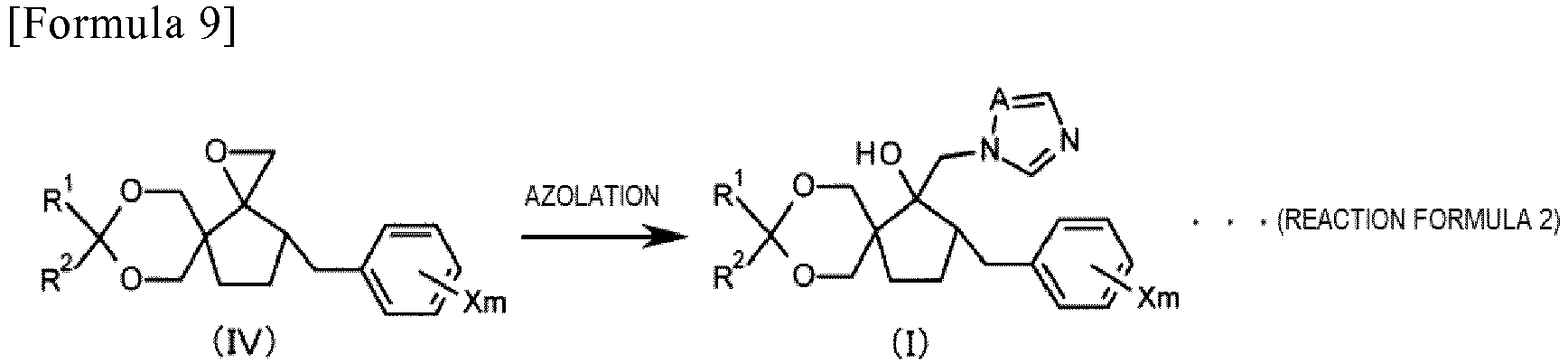
- the reaction shown in Reaction Formula 1 shows an oxirane production step in which an oxirane derivative represented by general formula (IV) (hereinafter referred to as oxirane derivative (IV)) is produced from cycloalkanone derivative (II).
- the reaction shown in Reaction Formula 2 (hereinafter referred to as reaction 2) shows an azolation step in which cycloalkanol derivative (I) is produced from oxirane derivative (IV).
- Reaction 1 and reaction 2 may be carried out in the same reaction system or in different reaction systems.
- reaction system means either a single reaction that occurs in a reaction vessel or a plurality of reactions that occur successively in a reaction vessel, and this also applies in the explanations given below. That is, in the method for producing a cycloalkanol derivative of the present embodiment, even in the case of a product obtained from a raw material via an intermediate, reactions that occur successively in a reaction vessel are regarded as being the same reaction system.
- reaction 1 and reaction 2 are different reaction systems.
- the vessel in which reaction 1 is carried out and the vessel in which reaction 2 is carried out may be the same or different.
- reaction 1 and reaction 2 occur simultaneously and successively, and the reaction systems are therefore the same.
- the entire quantity of the raw materials for reaction 1 and reaction 2 may be placed in the reaction vessel in advance, or introduced as appropriate during the reactions.
- reactions that take place in the same reaction system are known as “one-pot (reactions)", and reactions that take place in different reaction systems are known as “stepwise (reactions)”.
- reaction 1 and reaction 2 may be one-pot reactions or stepwise reactions.
- reaction 1 and reaction 2 are one-pot reactions.
- Reaction Formula 3 shows a reaction formula for an azolylmethylation reaction using a one-pot reaction.
- A is a nitrogen atom or methine group
- M is an alkali metal atom.
- a sodium atom is preferred as the alkali metal atom.
- cycloalkanol derivative (I) is obtained in a one-pot reaction by azolylmethylating cycloalkanone derivative (II) using azole compound (III) in the presence of a sulfur ylide.
- oxirane derivative (IV) is produced from cycloalkanone derivative (II) by the action of the sulfur ylide in the one-pot reaction.
- the obtained oxirane derivative (IV) reacts with azole compound (III), which is present in the reaction system, thereby forming cycloalkanol derivative (I).
- cycloalkanone derivative (II) and azole compound (III) are dissolved in a solvent.
- a sulfonium compound or sulfoxonium compound is added to the obtained solution, and an alkali metal methoxide is then also added to the solution, thereby producing a sulfur ylide in the reaction system.
- oxirane derivative (IV) is produced from cycloalkanone derivative (II) in the reaction system.
- the obtained oxirane derivative (IV) reacts with azole compound (III), which is present in the solvent, thereby forming cycloalkanol derivative (I).
- cycloalkanol derivative (I) is produced by a carbon-nitrogen bond being formed between a carbon atom that constitutes the oxirane ring in oxirane derivative (IV) and a nitrogen atom in azole compound (III).
- the alkali metal methoxide may be divided and added in separate portions.
- the sulfonium compound or sulfoxonium compound may, like the alkali metal methoxide, be divided and added in separate portions. Furthermore, it is possible to divide both the alkali metal methoxide and the sulfonium compound or sulfoxonium compound, and add these in separate portions.
- the sulfur ylide is produced in the reaction system as a result of the alkali metal methoxide reacting with the sulfonium compound or sulfoxonium compound, and the type of sulfur ylide produced depends on the type of sulfonium compound or sulfoxonium compound used.
- Examples of the sulfonium compound or sulfoxonium compound include trimethylsulfonium bromide, trimethylsulfonium chloride, trimethylsulfonium iodide, trimethylsulfoxonium bromide, trimethylsulfoxonium chloride and trimethylsulfoxonium iodide. From the perspective of yield when producing the sulfur ylide, the use of a sulfoxonium compound is preferred, and of these, trimethylsulfoxonium bromide is more preferred.
- sodium methoxide as the alkali metal methoxide is preferred.
- the sodium methoxide in the form of a solution. It is more preferable for this solution to be a methanol solution of sodium methoxide.
- examples of solvents used in the one-pot reaction in the present embodiment include amide bond-containing polar solvents, dimethylsulfoxide, and mixed solvents of alcohols and these polar solvents.
- examples of amide bond-containing polar solvents include N-methylpyrrolidone, N, N-dimethylacetamide and N,N-dimethylformamide.
- examples of alcohols include t-butanol.
- the solvent used in the above-mentioned reaction may be mixed with toluene.
- the reaction temperature and reaction time can be set as appropriate according to the type of solvent used, the type of cycloalkanone derivative (II), the type of sulfonium compound or sulfoxonium compound, and the type of alkali metal methoxide.
- the reaction temperature is preferably from 0 to 200°C, and more preferably from 20 to 100°C.
- the reaction time is preferably between 0.1 hours and several days, and more preferably between 0.5 hours and 2 days.
- the number of times the alkali metal methoxide is added is not particularly limited as long as the desired objective can be achieved.
- the number of times the alkali metal methoxide is added is preferably from 1 to 20, and more preferably from 2 to 10. The same applies in cases where the sulfonium compound or sulfoxonium compound is divided and added in separate portions.
- the total usage quantity of the sulfonium compound or sulfoxonium compound is preferably from 0.5 to 5 times, and more preferably from 0.8 to 2 times, the molar quantity of cycloalkanone derivative (II).
- the usage quantity of azole compound (III) is preferably from 0.5 to 10 times, and more preferably from 0.8 to 5 times, the molar quantity of cycloalkanone derivative (II).
- reaction 1 and reaction 2 are carried out in a stepwise reaction rather than a one-pot reaction.
- reaction 1 and reaction 2 are carried out in a stepwise reaction
- the oxiranation of cycloalkanone derivative (II) (Reaction Formula 1) in the one-pot reaction and the azolation of oxirane derivative (IV) obtained by the oxiranation (Reaction Formula 2) in the one-pot reaction are carried out in different reaction systems. That is, the stepwise reaction differs from the one-pot reaction in that azole compound (III) is not present in the reaction vessel when oxirane derivative (IV) is produced.
- the reagents, solvents, reaction conditions, and the like used in the stepwise reaction are the same as those used in the one-pot reaction mentioned above, and detailed explanations for these matters are therefore omitted.
- azole compound (III) may be produced from a triazole or imidazole in the reaction system.
- M is sodium
- compound (III) can be produced by reacting sodium hydroxide with a triazole or imidazole.
- sodium methoxide instead of sodium hydroxide.
- cycloalkanol derivative (I) it is preferable for cycloalkanol derivative (I) to be produced in a one-pot reaction.
- cycloalkanol derivative (I) it is possible to prevent by-products (for example, oxetane derivatives), which are produced in reaction 2 when carrying out a stepwise reaction, from being produced. In this way, it is possible to prevent a reduction in the yield of cycloalkanol derivative (I).
- step 1 a compound represented by general formula (2) (hereinafter referred to as compound (2)) is obtained by subjecting a compound represented by general formula (1) (hereinafter referred to as compound (1)) to hydroxymethylation (see Reaction Formula 4 below).
- compound (2) a compound represented by general formula (2)
- compound (1) a compound represented by general formula (1)
- Reaction Formula 4 a compound represented by general formula (1)
- X and m are as described above.
- R 5 is an alkyl group having from 1 to 4 carbon atoms.
- the method for subjecting compound (1) to hydroxymethylation can be a method in which compound (1) is reacted with formaldehyde or a formaldehyde derivative in a solvent in the presence of a base.
- the base can be an alkali metal carbonate such as sodium carbonate or potassium carbonate, an alkali metal hydroxide such as sodium hydroxide, or an organic base such as triethylamine, but is not limited to these.
- the usage quantity of the base is, for example, from 0.01 to 10 times, and preferably from 0.1 to 5 times, the molar quantity of compound (1).
- the reaction temperature is, for example, from 0 to 250°C, and preferably from 0 to 100°C.
- the reaction time is, for example, between 0.1 hours and several days, and preferably between 0.5 hours and 2 days.
- the solvent is not particularly limited, but it is possible to use an ether, such as diethyl ether, tetrahydrofuran (THF) or dioxane, an aromatic hydrocarbon, such as benzene, toluene or xylene, an alcohol, such as methanol or ethanol, or water, or the like, and mixtures of these solvents can be used if necessary.
- a phase transfer catalyst such as, for example, a commonly used quaternary ammonium salt (for example, benzyltriethylammonium chloride).
- formaldehyde derivatives include paraformaldehyde, 1,3,5-trioxane, formaldehyde dialkyl acetal, and the like.
- the usage quantity of the formaldehyde or formaldehyde derivative is, for example, from 1 to 40 times, and preferably from 1.6 to 20 times, the molar quantity of compound (1).
- Step 2 Protecting group introduction step
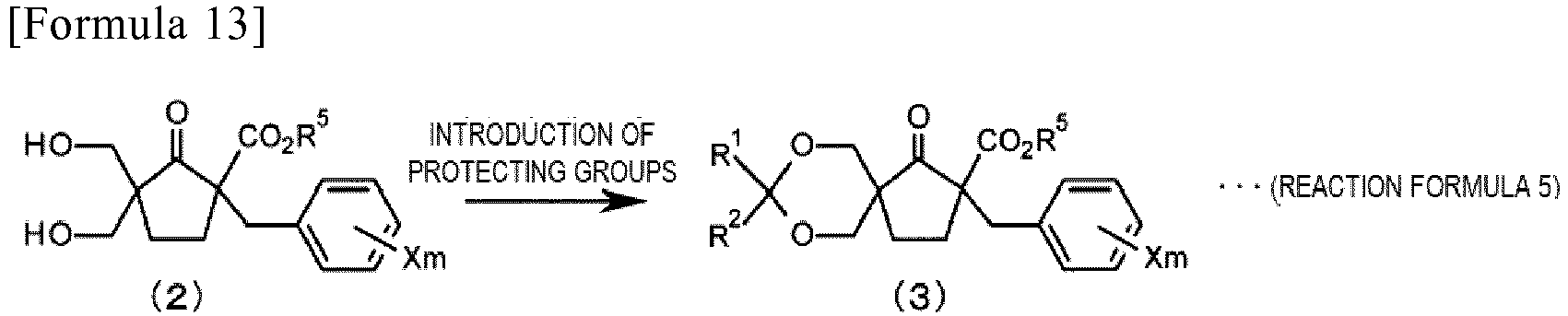
- step 2 protecting groups that simultaneously protect the hydroxyl groups in the two hydroxyethyl groups in compound (2) are introduced by means of a single compound, thereby obtaining a compound represented by general formula (3) (hereinafter referred to as compound (3)) (see Reaction Formula 2 below).
- compound (3) a compound represented by general formula (3) (hereinafter referred to as compound (3)) (see Reaction Formula 2 below).
- X, m, R 1 , R 2 and R 5 are as described above.
- the method for introducing protecting groups to the hydroxyl groups in compound (2) can be a method involving reacting compound (2) with an acetal or ketone in the presence of an acid.
- the acetal can be a compound represented by general formula (VI) below.
- ketone can be a compound represented by general formula (VII) below.
- R 1 and R 2 are the same functional groups as those represented by R 1 and R 2 in the azole derivative being produced.
- R 3 and R 4 are each independently an alkyl group having from 1 to 4 carbon atoms, such as a methyl group or an ethyl group.
- the usage quantity of the acetal or ketone is, for example from 0.5 to 20 times, and preferably from 0.8 to 10 times, the molar quantity of compound (2).
- the acid can be an inorganic acid such as hydrochloric acid, phosphoric acid or sulfuric acid, or an organic acid such as p-toluenesulfonic acid or trifluoroacetic acid.
- the usage quantity of the acid is, for example, from 0.001 to 10 times, and preferably from 0.002 to 2 times, the molar quantity of compound (2).
- the reaction temperature is, for example, from 0 to 200°C, and preferably from 0 to 100°C.
- the reaction time is, for example, between 0.1 hours and several days, and preferably between 0.5 hours and 2 days.
- step 3 compound (4) is produced by subjecting compound (3) to hydrolysis/decarboxylation (see Reaction Formula 6 below). Moreover, compound (4) below is the same as cycloalkanone derivative (II).
- the method for subjecting compound (3) to hydrolysis/decarboxylation can be a method involving reacting compound (3) in a solvent in the presence of a base.
- an alkali metal base such as sodium hydroxide or potassium hydroxide
- the usage quantity of the base is, for example, from 0.1 to 50 times, and preferably from 0.2 to 20 times, the molar quantity of compound (3).
- the solvent can be water, water to which an alcohol is added, or a solvent composition consisting of solvents that do not form a homogeneous layer (water-toluene, or the like).
- a phase transfer catalyst for example, a commonly used quaternary ammonium salt
- the reaction temperature is, for example, from 0°C to the reflux temperature, and preferably from 20°C to the reflux temperature.
- the reaction time is, for example, between 0.1 hours and several days, and preferably from 0.5 to 24 hours.
- step 4 and step 5 The azolylmethylation process carried out in step 4 and step 5 has already been explained in detail, and an explanation of this process will be omitted here.
- Compound (10) can be produced from compound (6) according to Scheme 2 described below. Because compound (10) may be produced by using publicly known methods (for example, see Patent Document 1) for step 7 and subsequent steps, only step 6 in the present embodiment will now be explained.
- step 6 compound (7) is produced from compound (6) by deprotecting compound (6) (see Reaction Formula 7 below).
- the method for deprotecting the protecting groups on compound (6) can be a method that involves the use of an acid.
- the acid is preferably an inorganic acid, for example a hydrogen halide such as hydrogen chloride, sulfuric acid, or the like.
- the usage quantity of the acid is not particularly limited, but is, for example, from 0.01 to 100 times, and preferably from 0.1 to 20 times, the molar quantity of compound (6).
- the reaction temperature is, for example, from 0 to 200°C, and preferably from 20 to 100°C.
- the reaction time is, for example, between 0.1 hours and several days, and preferably between 0.5 hours and 2 days.
- Production Example 2-1 (method “A") and Production Example 2-2 (method “B"), in which the production conditions were different, are shown as Production Example 2.
- Comparative Production Example 2-1 (method “A") and Comparative Production Example 2-2 (method “B") are shown as Comparative Production Example 2.
- method “A” is a method in which both the base (sodium methoxide or sodium tert-butoxide) and TMSOB were divided and added in separate portions
- method “B” is a method in which, of the base and the TMSOB, only the base was divided and added in separate portions.
- the "cis isomer” and “trans isomer” occur as a result of the steric configuration of the hydroxyl group and benzyl group bonded to the cyclopentane ring in azole derivative (6).
- the "cis isomer” and “trans isomer” in subsequent production examples occur as a result of the steric configuration of a group corresponding to this hydroxyl group (or oxetane group) and a group corresponding to this benzyl group in the compounds in question.
- Table 1 shows the yields of azole derivative 6-a produced in the production examples.
- Base Method Yield[%] Production Example 2-1 MeONa Liquid A 75.5 Production Example 2-2 MeONa Liquid B 78.2 Comparative Production Example 2-1 t-BuONa Solid A 73.4 Comparative Production Example 2-2 t-BuONa Solid B 77.4
Landscapes
- Chemical & Material Sciences (AREA)
- Organic Chemistry (AREA)
- Organic Low-Molecular-Weight Compounds And Preparation Thereof (AREA)
- Heterocyclic Carbon Compounds Containing A Hetero Ring Having Nitrogen And Oxygen As The Only Ring Hetero Atoms (AREA)
- Plural Heterocyclic Compounds (AREA)
Abstract
Description
- The present invention relates to a method for producing a cycloalkanol derivative, and to a method for producing an azole derivative. More specifically, the present invention relates to a method for producing a cycloalkanol derivative, which is useful as an intermediate compound of an azole derivative used as an active ingredient for an agricultural and horticultural agent, also relates to a method for producing an azole derivative by using a cycloalkanol derivative produced using the aforementioned method.
- Some known azolylmethylcyclopentanol derivatives exhibit excellent activity as active ingredients in agricultural and horticultural disease control agents and agents for protecting industrial materials. For example, Patent Document 1 discloses a 2-(halogenated hydrocarbon-substituted)-5-benzyl-1-azolylmethylcyclopentanol derivative, which exhibits low toxicity to humans and animals and which exhibits a high controlling effect on a wide range of plant diseases and a high growth regulating effect on a variety of agricultural and horticultural plants.
- Patent Document 1 discloses a production example in which a solid alkali metal butoxide is used as a base when subjecting an intermediate to azolylmethylation, which is a part of a process for producing 2-(halogenated hydrocarbon-substituted)-5-benzyl-1-azolylmethylcyclopentanol derivative. In addition, Patent Document 2 discloses a production example in which an alkali metal butoxide is used as a base when subjecting an intermediate to azolylmethylation, which is a part of a process for producing an azolylmethylcycloalkanol derivative.
-
- Patent Document 1:
WO/2011/070771 - Patent Document 2: Japanese Unexamined Patent Application Publication No.
H01-301664A - Patent Document 3: Japanese Unexamined Patent Application Publication No.
H01-093574A - However, it cannot be said that conventional methods for producing azolylmethylcyclopentanol derivatives (hereinafter referred to as azole derivatives) are sufficiently inexpensive or capable of obtaining azole derivatives with high yields, and further improvements are required.
- Therefore, a main objective of the present invention is to provide a method for producing a cycloalkanol derivative that enables the production of an azole derivative at low cost and with high yield; and a method for producing an azole derivative.
- As a result of diligent research into how to solve the problems mentioned above, the inventors of the present invention found that there was still room for improvement in a method for producing a cycloalkanol derivative used as an intermediate compound for an azole derivative, and succeeded in completing the present invention.
- That is, the method for producing a cycloalkanol derivative according to the present invention is a method for producing a cycloalkanol derivative represented by general formula (I) below, and is characterized by including an azolylmethylation reaction step of azolylmethylating a cycloalkanone derivative represented by general formula (II) below using an azole compound represented by general formula (III) below in the presence of a sulfur ylide, wherein the sulfur ylide is produced from a sulfonium compound or sulfoxonium compound and an alkali metal methoxide in a reaction system in the azolylmethylation reaction step.
- [Formula 1]

- Here, in formula (I) above, R1 and R2 are each independently a hydrogen atom, an alkyl group having from 1 to 4 carbon atoms, a phenyl group or a benzyl group. Moreover, one or more hydrogen atoms on these phenyl groups and benzyl groups may be substituted with alkyl groups having from 1 to 4 carbon atoms, alkoxy groups having from 1 to 4 carbon atoms, or halogen atoms. In addition, A is a nitrogen atom or a methine group. Furthermore, X is a halogen atom, an alkyl group having from 1 to 4 carbon atoms, a haloalkyl group having from 1 to 4 carbon atoms, an alkoxy group having from 1 to 4 carbon atoms, a haloalkoxy group having from 1 to 4 carbon atoms, a phenyl group, a cyano group or a nitro group, and m is an integer from 0 to 5. Moreover, in cases where m is 2 or higher, the plurality of X groups may be different from each other.

- In formula (II) above, R1, R2, X and m are the same as R1, R2, X and m in formula (I) above.

- In formula (III) above, M is an alkali metal atom and A is the same as A in formula (I) above.
- Moreover, in the present invention, "reaction system" means either a single reaction that occurs in a reaction vessel or a plurality of reactions that occur successively in a reaction vessel. That is, in the present invention, even in the case of a product obtained from a raw material via an intermediate, reactions that occur successively in a reaction vessel are regarded as being the same reaction system.
- According to the present invention, because an alkali metal methoxide is used when producing the sulfur ylide in the reaction system in the azolylmethylation reaction step in the process for producing the cycloalkanol derivative, it is possible to produce an azole derivative at lower cost and with higher yield compared to conventional production methods.
- A preferred embodiment for carrying out the present invention will now be explained. Moreover, the embodiment explained below illustrates a single representative example of the present invention, and it should not be interpreted that the scope of the present invention is narrowed by this embodiment.
- In a method for producing a cycloalkanol derivative according to an embodiment of the present invention, a cycloalkanol derivative represented by general formula (I) below (hereinafter referred to as cycloalkanol derivative (I)) is produced. Before explaining the production method in detail, the structure of cycloalkanol derivative (I) will be explained.

- In formula (I) above, R1 and R2 are each independently a hydrogen atom, an alkyl group having from 1 to 4 carbon atoms, a phenyl group or a benzyl group.
- Examples of alkyl groups having from 1 to 4 carbon atoms include methyl groups, ethyl groups, n-propyl groups, 1-methylethyl groups, 1-methylpropyl groups, 2-methylpropyl groups, n-butyl groups and 1,1-dimethylethyl groups.
- One or more hydrogen atoms in the phenyl groups in R1 and/or R2 and one or more hydrogen atoms in the phenyl moiety of the benzyl groups in R1 and/or R2 may be substituted with alkyl groups having from 1 to 4 carbon atoms, alkoxy groups having from 1 to 4 carbon atoms, or halogen atoms. Examples of substituent alkyl groups having from 1 to 4 carbon atoms include methyl groups, ethyl groups, n-propyl groups, 1-methylethyl groups, 1-methylpropyl groups, 2-methylpropyl groups, n-butyl groups and 1,1-dimethylethyl groups. Examples of substituent alkoxy groups having from 1 to 4 carbon atoms include methoxy groups, ethoxy groups and n-propoxy groups. Examples of substituent halogen atoms include fluorine atoms, chlorine atoms and bromine atoms.
- Of these, it is preferable for R1 and R2 to be each independently a hydrogen atom or an alkyl group having from 1 to 4 carbon atoms, more preferably a hydrogen atom or an alkyl group having from 1 to 2 carbon atoms, and further preferably a hydrogen atom or a methyl group, and it is particularly preferable for both R1 and R2 to be methyl groups.
- X is a halogen atom, an alkyl group having from 1 to 4 carbons, a haloalkyl group having from 1 to 4 carbons, an alkoxy group having from 1 to 4 carbons, a haloalkoxy group having from 1 to 4 carbons, a phenyl group, a cyano group, or a nitro group.
- Examples of halogen atoms include chlorine atoms, fluorine atoms, bromine atoms and iodine atoms.
- Examples of alkyl groups having from 1 to 4 carbon atoms include methyl groups, ethyl groups, n-propyl groups, 1-methylethyl groups, 2-methylpropyl groups, n-butyl groups and 1,1-dimethylethyl groups.
- Examples of haloalkyl groups having from 1 to 4 carbon atoms include trifluoromethyl groups, 1,1,2,2,2-pentafluoroethyl groups, chloromethyl groups, trichloromethyl groups and bromomethyl groups.
- Examples of alkoxy groups having from 1 to 4 carbon atoms include methoxy groups, ethoxy groups and n-propoxy groups.
- Examples of haloalkoxy groups having from 1 to 4 carbon atoms include trifluoromethoxy groups, difluoromethoxy groups, 1,1,2,2,2-pentafluoroethoxy groups and 2,2,2-trifluoroethoxy groups.
- X is preferably a halogen atom, a haloalkyl group having from 1 to 3 carbon atoms, a haloalkoxy group having from 1 to 3 carbon atoms, an alkyl group having from 1 to 3 carbon atoms or an alkoxy group having from 1 to 3 carbon atoms, more preferably a halogen atom, a haloalkyl group having from 1 to 2 carbon atoms or a haloalkoxy group having from 1 to 2 carbon atoms, further preferably a halogen atom, and particularly preferably a fluorine atom or a chlorine atom.
- m is an integer from 0 to 5. In cases where m is 2 or higher, the plurality of X groups may be different from each other. Of these, m is preferably an integer from 0 to 3, and more preferably an integer from 0 to 2.
- The bonding position of X is not particularly limited, but in cases where m is 1, a bonding position that forms a 4-substituted benzyl group is preferred.
- A is a nitrogen atom or a methine group. A is preferably a nitrogen atom.
- A preferred example of cycloalkanol derivative (I) is a cycloalkanol derivative represented by general formula (I-1) below, but cycloalkanol derivative (I) is not limited thereto. Moreover, in general formula (I-1), X1 is a hydrogen atom, a fluorine atom or a chlorine atom.


- Cycloalkanol derivative (I) can be advantageously used to produce an azole derivative represented by general formula (V) below (hereinafter referred to as azole derivative (V)).

- X, m and A in formula (V) above are the same as X, m and A in formula (I). In addition, L is a halogen atom, and a fluorine atom or chlorine atom is preferred as this halogen atom.
- Azole derivative (V) exhibits excellent bactericidal activity against many types of bacteria that cause diseases in plants. Moreover, cycloalkanol derivative (I) per se also exhibits excellent bactericidal activity against bacteria that cause diseases in plants. In addition, azole derivative (V) and cycloalkanol derivative (I) can also be advantageously used as agents for protecting industrial materials and as plant growth regulators.
- An explanation will now be given of a method for producing cycloalkanol derivative (I). Here, an explanation will be given of a reaction process for producing cycloalkanol derivative (I) from a cycloalkanone derivative represented by general formula (II) below (hereinafter referred to as cycloalkanone derivative (II)), which is the main characteristic of the present invention. Moreover, R1, R2, X and m in general formula (II) below are the same as in cycloalkanol derivative (I).


- The reaction process for producing cycloalkanol derivative (I) from cycloalkanone derivative (II) includes two reactions shown in Reaction Formula 1 and Reaction Formula 2 below. The reaction shown in Reaction Formula 1 (hereinafter referred to as reaction 1) shows an oxirane production step in which an oxirane derivative represented by general formula (IV) (hereinafter referred to as oxirane derivative (IV)) is produced from cycloalkanone derivative (II). In addition, the reaction shown in Reaction Formula 2 (hereinafter referred to as reaction 2) shows an azolation step in which cycloalkanol derivative (I) is produced from oxirane derivative (IV).

- Reaction 1 and reaction 2 may be carried out in the same reaction system or in different reaction systems. Here, "reaction system" means either a single reaction that occurs in a reaction vessel or a plurality of reactions that occur successively in a reaction vessel, and this also applies in the explanations given below. That is, in the method for producing a cycloalkanol derivative of the present embodiment, even in the case of a product obtained from a raw material via an intermediate, reactions that occur successively in a reaction vessel are regarded as being the same reaction system.
- More specifically, in cases where reaction 2 is initiated after reaction 1 is complete, reaction 1 and reaction 2 are different reaction systems. In such cases, the vessel in which reaction 1 is carried out and the vessel in which reaction 2 is carried out may be the same or different. Meanwhile, in cases where reaction 2 is initiated while the reaction 1 is ongoing, reaction 1 and reaction 2 occur simultaneously and successively, and the reaction systems are therefore the same. In such cases, the entire quantity of the raw materials for reaction 1 and reaction 2 may be placed in the reaction vessel in advance, or introduced as appropriate during the reactions.
- In the present embodiment, reactions that take place in the same reaction system are known as "one-pot (reactions)", and reactions that take place in different reaction systems are known as "stepwise (reactions)".
- That is, it can be said that reaction 1 and reaction 2 may be one-pot reactions or stepwise reactions. Here, an explanation will now be given of a case in which reaction 1 and reaction 2 are one-pot reactions.
- Reaction Formula 3 below shows a reaction formula for an azolylmethylation reaction using a one-pot reaction. In Reaction Formula 3, A is a nitrogen atom or methine group, and M is an alkali metal atom. A sodium atom is preferred as the alkali metal atom.

- As shown in Reaction Formula 3, cycloalkanol derivative (I) is obtained in a one-pot reaction by azolylmethylating cycloalkanone derivative (II) using azole compound (III) in the presence of a sulfur ylide. Specifically, oxirane derivative (IV) is produced from cycloalkanone derivative (II) by the action of the sulfur ylide in the one-pot reaction. Next, the obtained oxirane derivative (IV) reacts with azole compound (III), which is present in the reaction system, thereby forming cycloalkanol derivative (I).
- Next, a detailed explanation will be given of a one-pot reaction. First, cycloalkanone derivative (II) and azole compound (III) are dissolved in a solvent. A sulfonium compound or sulfoxonium compound is added to the obtained solution, and an alkali metal methoxide is then also added to the solution, thereby producing a sulfur ylide in the reaction system. By producing the sulfur ylide, oxirane derivative (IV) is produced from cycloalkanone derivative (II) in the reaction system. The obtained oxirane derivative (IV) reacts with azole compound (III), which is present in the solvent, thereby forming cycloalkanol derivative (I). Specifically, cycloalkanol derivative (I) is produced by a carbon-nitrogen bond being formed between a carbon atom that constitutes the oxirane ring in oxirane derivative (IV) and a nitrogen atom in azole compound (III). Moreover, the alkali metal methoxide may be divided and added in separate portions.
- In addition, the sulfonium compound or sulfoxonium compound may, like the alkali metal methoxide, be divided and added in separate portions. Furthermore, it is possible to divide both the alkali metal methoxide and the sulfonium compound or sulfoxonium compound, and add these in separate portions.
- In the present embodiment, the sulfur ylide is produced in the reaction system as a result of the alkali metal methoxide reacting with the sulfonium compound or sulfoxonium compound, and the type of sulfur ylide produced depends on the type of sulfonium compound or sulfoxonium compound used.
- Examples of the sulfonium compound or sulfoxonium compound include trimethylsulfonium bromide, trimethylsulfonium chloride, trimethylsulfonium iodide, trimethylsulfoxonium bromide, trimethylsulfoxonium chloride and trimethylsulfoxonium iodide. From the perspective of yield when producing the sulfur ylide, the use of a sulfoxonium compound is preferred, and of these, trimethylsulfoxonium bromide is more preferred.
- The use of sodium methoxide as the alkali metal methoxide is preferred. In addition, from the perspective of ease of handling during production, it is preferable to use the sodium methoxide in the form of a solution. It is more preferable for this solution to be a methanol solution of sodium methoxide.
- Moreover, examples of solvents used in the one-pot reaction in the present embodiment include amide bond-containing polar solvents, dimethylsulfoxide, and mixed solvents of alcohols and these polar solvents. Examples of amide bond-containing polar solvents include N-methylpyrrolidone, N, N-dimethylacetamide and N,N-dimethylformamide. In addition, examples of alcohols include t-butanol. Furthermore, the solvent used in the above-mentioned reaction may be mixed with toluene.
- The reaction temperature and reaction time can be set as appropriate according to the type of solvent used, the type of cycloalkanone derivative (II), the type of sulfonium compound or sulfoxonium compound, and the type of alkali metal methoxide. The reaction temperature is preferably from 0 to 200°C, and more preferably from 20 to 100°C. In addition, the reaction time is preferably between 0.1 hours and several days, and more preferably between 0.5 hours and 2 days.
- In addition, the number of times the alkali metal methoxide is added is not particularly limited as long as the desired objective can be achieved. The number of times the alkali metal methoxide is added is preferably from 1 to 20, and more preferably from 2 to 10. The same applies in cases where the sulfonium compound or sulfoxonium compound is divided and added in separate portions.
- The total usage quantity of the sulfonium compound or sulfoxonium compound is preferably from 0.5 to 5 times, and more preferably from 0.8 to 2 times, the molar quantity of cycloalkanone derivative (II). The usage quantity of azole compound (III) is preferably from 0.5 to 10 times, and more preferably from 0.8 to 5 times, the molar quantity of cycloalkanone derivative (II).
- An explanation will now be given of a case in which reaction 1 and reaction 2 are carried out in a stepwise reaction rather than a one-pot reaction.
- In cases in which reaction 1 and reaction 2 are carried out in a stepwise reaction, the oxiranation of cycloalkanone derivative (II) (Reaction Formula 1) in the one-pot reaction and the azolation of oxirane derivative (IV) obtained by the oxiranation (Reaction Formula 2) in the one-pot reaction are carried out in different reaction systems. That is, the stepwise reaction differs from the one-pot reaction in that azole compound (III) is not present in the reaction vessel when oxirane derivative (IV) is produced. The reagents, solvents, reaction conditions, and the like used in the stepwise reaction are the same as those used in the one-pot reaction mentioned above, and detailed explanations for these matters are therefore omitted.
- Here, azole compound (III) may be produced from a triazole or imidazole in the reaction system. For example, in cases where M is sodium, compound (III) can be produced by reacting sodium hydroxide with a triazole or imidazole. In addition, it is possible to use sodium methoxide instead of sodium hydroxide.
- Moreover, it is preferable for cycloalkanol derivative (I) to be produced in a one-pot reaction. When producing cycloalkanol derivative (I) in a one-pot reaction, it is possible to prevent by-products (for example, oxetane derivatives), which are produced in reaction 2 when carrying out a stepwise reaction, from being produced. In this way, it is possible to prevent a reduction in the yield of cycloalkanol derivative (I).
- As explained above, by using an alkali metal methoxide, which is less expensive than a conventionally used alkali metal butoxide, in the production method of the present invention, it is possible to produce cycloalkanol derivative (I) with a high yield and with no concerns regarding the production of by-products. In this way, it is possible to produce cycloalkanol derivative (I) (and even azole derivative (V) shown below) at low cost. In addition, by using the alkali metal methoxide in the form of a solution, the alkali metal methoxide can be handled more easily during production than a solid alkali metal methoxide.
- An explanation will now be given of a process for producing cycloalkanol derivative (I) other than by the above-mentioned azolylmethylation reaction. Moreover, cycloalkanol derivative (I) is hereinafter described as compound (6). Compound (6) can be produced according to scheme 1 below from compound (1), which is obtained using a publicly known technique (for example, that disclosed in Patent Document 3).


- The various steps will now be explained.
- In step 1, a compound represented by general formula (2) (hereinafter referred to as compound (2)) is obtained by subjecting a compound represented by general formula (1) (hereinafter referred to as compound (1)) to hydroxymethylation (see Reaction Formula 4 below). Here, X and m are as described above. R5 is an alkyl group having from 1 to 4 carbon atoms.

- The method for subjecting compound (1) to hydroxymethylation can be a method in which compound (1) is reacted with formaldehyde or a formaldehyde derivative in a solvent in the presence of a base.
- The base can be an alkali metal carbonate such as sodium carbonate or potassium carbonate, an alkali metal hydroxide such as sodium hydroxide, or an organic base such as triethylamine, but is not limited to these. The usage quantity of the base is, for example, from 0.01 to 10 times, and preferably from 0.1 to 5 times, the molar quantity of compound (1).
- The reaction temperature is, for example, from 0 to 250°C, and preferably from 0 to 100°C. The reaction time is, for example, between 0.1 hours and several days, and preferably between 0.5 hours and 2 days.
- The solvent is not particularly limited, but it is possible to use an ether, such as diethyl ether, tetrahydrofuran (THF) or dioxane, an aromatic hydrocarbon, such as benzene, toluene or xylene, an alcohol, such as methanol or ethanol, or water, or the like, and mixtures of these solvents can be used if necessary. Here, if the reaction system forms a dual phase, it is preferable to use a phase transfer catalyst such as, for example, a commonly used quaternary ammonium salt (for example, benzyltriethylammonium chloride).
- Examples of formaldehyde derivatives include paraformaldehyde, 1,3,5-trioxane, formaldehyde dialkyl acetal, and the like.
- The usage quantity of the formaldehyde or formaldehyde derivative is, for example, from 1 to 40 times, and preferably from 1.6 to 20 times, the molar quantity of compound (1).
- In step 2, protecting groups that simultaneously protect the hydroxyl groups in the two hydroxyethyl groups in compound (2) are introduced by means of a single compound, thereby obtaining a compound represented by general formula (3) (hereinafter referred to as compound (3)) (see Reaction Formula 2 below). Here, X, m, R1, R2 and R5 are as described above.
- The method for introducing protecting groups to the hydroxyl groups in compound (2) can be a method involving reacting compound (2) with an acetal or ketone in the presence of an acid.
- The acetal can be a compound represented by general formula (VI) below.

- In addition, the ketone can be a compound represented by general formula (VII) below.

- In formula (VI) and formula (VII), R1 and R2 are the same functional groups as those represented by R1 and R2 in the azole derivative being produced. In formula (VI), R3 and R4 are each independently an alkyl group having from 1 to 4 carbon atoms, such as a methyl group or an ethyl group.
- The usage quantity of the acetal or ketone is, for example from 0.5 to 20 times, and preferably from 0.8 to 10 times, the molar quantity of compound (2).
- The acid can be an inorganic acid such as hydrochloric acid, phosphoric acid or sulfuric acid, or an organic acid such as p-toluenesulfonic acid or trifluoroacetic acid. The usage quantity of the acid is, for example, from 0.001 to 10 times, and preferably from 0.002 to 2 times, the molar quantity of compound (2).
- The reaction temperature is, for example, from 0 to 200°C, and preferably from 0 to 100°C. The reaction time is, for example, between 0.1 hours and several days, and preferably between 0.5 hours and 2 days.
- In step 3, compound (4) is produced by subjecting compound (3) to hydrolysis/decarboxylation (see Reaction Formula 6 below). Moreover, compound (4) below is the same as cycloalkanone derivative (II).

- The method for subjecting compound (3) to hydrolysis/decarboxylation can be a method involving reacting compound (3) in a solvent in the presence of a base.
- It is preferable to use an alkali metal base, such as sodium hydroxide or potassium hydroxide, as the base. The usage quantity of the base is, for example, from 0.1 to 50 times, and preferably from 0.2 to 20 times, the molar quantity of compound (3).
- The solvent can be water, water to which an alcohol is added, or a solvent composition consisting of solvents that do not form a homogeneous layer (water-toluene, or the like). In cases where solvents that do not form a homogeneous layer are used, it is possible to use a phase transfer catalyst (for example, a commonly used quaternary ammonium salt) in the reaction system.
- The reaction temperature is, for example, from 0°C to the reflux temperature, and preferably from 20°C to the reflux temperature. The reaction time is, for example, between 0.1 hours and several days, and preferably from 0.5 to 24 hours.
- The azolylmethylation process carried out in step 4 and step 5 has already been explained in detail, and an explanation of this process will be omitted here.
- An explanation will now be given of a method for producing the above-mentioned azole derivative (V). Moreover, azole derivative (V) is hereinafter described as compound (10). It is preferable to use the above-mentioned compound (6) as an intermediate in the production of compound (10).
- Compound (10) can be produced from compound (6) according to Scheme 2 described below. Because compound (10) may be produced by using publicly known methods (for example, see Patent Document 1) for step 7 and subsequent steps, only step 6 in the present embodiment will now be explained.

- In step 6, compound (7) is produced from compound (6) by deprotecting compound (6) (see Reaction Formula 7 below).

- Here, X, m, R1, R2 and A are as described above.
- The method for deprotecting the protecting groups on compound (6) can be a method that involves the use of an acid.
- The acid is preferably an inorganic acid, for example a hydrogen halide such as hydrogen chloride, sulfuric acid, or the like. The usage quantity of the acid is not particularly limited, but is, for example, from 0.01 to 100 times, and preferably from 0.1 to 20 times, the molar quantity of compound (6).
- The reaction temperature is, for example, from 0 to 200°C, and preferably from 20 to 100°C. In addition, the reaction time is, for example, between 0.1 hours and several days, and preferably between 0.5 hours and 2 days.
- Therefore, according to the method for producing an azole derivative according to the present invention, as described above, it is possible to obtain compound (6) (cycloalkanol derivative (I)) conveniently, at low cost, and with a high yield. In addition, by using compound (6), it is possible to obtain compound (10) (azole derivative (V)) by using a publicly known method.
- The present invention is not limited to the embodiment described above, and may be variously altered within the scope indicated in the claims. That is, embodiments obtained by combining appropriately altered technical means within the scope indicated in the claims are encompassed by the technical scope of the present invention.
- The present invention will now be explained in greater detail through the use of production examples. Moreover, the present invention is not limited to the production examples given below, as long as the gist of the invention is not exceeded.
- 10.38 g of potassium carbonate and 65 mL of a 37% aqueous solution of formalin were added to 79.98 g of 1-(4-chlorobenzyl)-2-oxocyclopentane carboxylic acid methyl ester (compound 1-a; R5 = CH3, Xm = 4-Cl in compound (1)), and stirred at room temperature for 23 hours. 250 mL of water and 51 mL of concentrated hydrochloric acid were added to the reaction liquid and stirred for a further 7 hours. Following completion of the reaction, water was added and extraction with ethyl acetate was carried out. The organic layer was washed with water and a saturated saline solution, and then dried with anhydrous sodium sulfate. The solvent was distilled off, thereby obtaining 110.77 g of a crude extract of compound 2-a.
- 90 mL of acetone dimethyl acetal, 180 mL of toluene and 1.43 g of p-toluenesulfonic acid monohydrate were added to the entire quantity of the crude extract of compound 2-a obtained in [1] above, stirred for 1 hour at 55°C, and then stirred for a further 15 hours at room temperature. Saturated aqueous sodium bicarbonate, water and toluene were added to the reaction liquid, thereby causing partitioning. The aqueous layer was extracted with toluene, and the organic layer was dried with anhydrous sodium sulfate. The solvent was distilled off, thereby obtaining 111.05 g of a crude extract of compound 3-a.
- 8 mL of toluene was added to 48.0 g of the crude extract of compound 3-a obtained in [2] above, and the crude extract was dissolved by being heated to 100°C. Here, 80.0 g of a 25 wt.% aqueous solution of sodium hydroxide was added to the obtained solution, a reaction was carried out under reflux for 2 hours, and the reaction liquid was then allowed to cool. Water was added to the reaction liquid, and extraction with toluene was then carried out. The organic layer was washed with a mixture obtained by mixing 150 mL of water with 150 mL of saturated aqueous ammonium chloride, and then dried with anhydrous sodium sulfate. The solvent was distilled off, thereby obtaining compound 4-a.
Yield: 27.62 g - Production Example 2-1 (method "A") and Production Example 2-2 (method "B"), in which the production conditions were different, are shown as Production Example 2. In addition, Comparative Production Example 2-1 (method "A") and Comparative Production Example 2-2 (method "B") are shown as Comparative Production Example 2.
- Moreover, method "A" is a method in which both the base (sodium methoxide or sodium tert-butoxide) and TMSOB were divided and added in separate portions, and method "B" is a method in which, of the base and the TMSOB, only the base was divided and added in separate portions.

- 3.26 mmol of compound 4-a was dissolved in 3.2 mL of dimethylacetamide, and heated to 85°C. 4.91 mmol of a sodium salt of 1, 2, 4-triazole was added to the obtained solution. Next, 1.99 mmol of a 28% methanol solution of sodium methoxide and 4.78 mmol of trimethylsulfoxonium bromide (TMSOB) were added intermittently over a period of 2 hours, after which a reaction was allowed to progress for 1 hour. Following completion of the reaction, water was added to the reaction liquid, and extraction with ethyl acetate was then carried out. The organic layer was washed with water and a saturated saline solution, and then dried with anhydrous sodium sulfate. The solvent was distilled off, and the crude product was purified by means of silica gel chromatography, thereby obtaining azole derivative 6-a as a mixture of isomers (cis isomer : trans isomer ratio = 93 : 7). The purity was 95.9%.
- Here, the "cis isomer" and "trans isomer" occur as a result of the steric configuration of the hydroxyl group and benzyl group bonded to the cyclopentane ring in azole derivative (6). In addition, the "cis isomer" and "trans isomer" in subsequent production examples occur as a result of the steric configuration of a group corresponding to this hydroxyl group (or oxetane group) and a group corresponding to this benzyl group in the compounds in question.
- 3.24 mmol of compound 4-a was dissolved in 3.2 mL of dimethylacetamide, and heated to 85°C. 4.85 mmol of a sodium salt of 1,2,4-triazole and 4.53 mmol of TMSOB were added to the obtained solution. Next, 1.64 mmol of a 28% methanol solution of sodium methoxide was added intermittently over a period of 50 minutes, after which a reaction was allowed to progress for 50 minutes. Following completion of the reaction, azole derivative 6-a was obtained using the same method as that used in Production Example 2-1 above. The purity was 99.1%.
- 3.24 mmol of compound 4-a was dissolved in 3.2 mL of dimethylacetamide, and heated to 85°C. 4.85 mmol of a sodium salt of 1,2,4-triazole was added to the obtained solution. Next, 1.94 mmol of sodium tert-butoxide and 4.78 mmol of TMSOB were added intermittently over a period of 2 hours, after which a reaction was allowed to progress for 1 hour. Following completion of the reaction, azole derivative 6-a was obtained using the same method as that used in Production Example 2-1 above. The purity was 98.7%.
- 3.24 mmol of compound 4-a was dissolved in 3.2 mL of dimethylacetamide, and heated to 85°C. 4.88 mmol of a sodium salt of 1,2,4-triazole and 4.54 mmol of TMSOB were added to the obtained solution. Next, 1.63 mmol of sodium tert-butoxide was added intermittently over a period of 50 minutes, after which a reaction was allowed to progress for 50 minutes. Following completion of the reaction, azole derivative 6-a was obtained using the same method as that used in Production Example 2-1 above. The purity was 98.3%.
- Table 1 shows the yields of azole derivative 6-a produced in the production examples.
[Table 1] Base Method Yield[%] Production Example 2-1 MeONa Liquid A 75.5 Production Example 2-2 MeONa Liquid B 78.2 Comparative Production Example 2-1 t-BuONa Solid A 73.4 Comparative Production Example 2-2 t-BuONa Solid B 77.4 - 8.98 g of azole derivative 6-a was dissolved in a mixture of 30 mL of methanol and 40 mL of a 6N aqueous solution of hydrochloric acid, and stirred at room temperature for 4 hours. Water was added to the reaction liquid, after which the reaction liquid was neutralized with sodium carbonate and sodium bicarbonate. After this was extracted with ethyl acetate, the organic layer was washed with saturated saline. The reaction liquid was then dried with anhydrous sodium sulfate, after which the solvent was distilled off, thereby obtaining azole derivative 7-a as a mixture of isomers. The yield was 7.96 g.
Claims (9)
- method for producing a cycloalkanol derivative, by which a cycloalkanol derivative represented by general formula (I) below is produced, the method comprising an azolylmethylation reaction step of azolylmethylating a cycloalkanone derivative represented by general formula (II) below using an azole compound represented by general formula (III) below in the presence of a sulfur ylide, and
the sulfur ylide being produced from a sulfonium compound or sulfoxonium compound and an alkali metal methoxide in a reaction system in the azolylmethylation reaction step


- The method for producing a cycloalkanol derivative according to claim 1, the azolylmethylation reaction step including
an oxirane production step of oxiranating the cycloalkanone derivative in the presence of a sulfur ylide so as to produce an oxirane derivative represented by general formula (IV) below, and an azolation step of reacting the oxirane derivative produced in the oxirane production step with the azole compound, and
the oxirane production step and the azolation step being carried out in the same reaction system
- The method for producing a cycloalkanol derivative according to claim 1, the azolylmethylation reaction step including
an oxirane production step of oxiranating the cycloalkanone derivative in the presence of a sulfur ylide so as to produce an oxirane derivative represented by general formula (IV) below, and
an azolation step of reacting the oxirane derivative produced in the oxirane production step with the azole compound, and
the oxirane production step and the azolation step being carried out in different reaction systems
- The method for producing a cycloalkanol derivative according to any one of claims 1 to 3, wherein the alkali metal methoxide is in the form of a solution.
- The method for producing a cycloalkanol derivative according to any one of claims 1 to 4, wherein the alkali metal methoxide is divided and added to the reaction system in separate portions.
- The method for producing a cycloalkanol derivative according to any one of claims 1 to 5, wherein the sulfonium compound or sulfoxonium compound is divided and added to the reaction system in separate portions.
- The method for producing a cycloalkanol derivative according to any one of claims 1 to 6, wherein the alkali metal methoxide is sodium methoxide.
- The method for producing a cycloalkanol derivative according to any one of claims 1 to 7, wherein at least one compound selected from among trimethylsulfoxonium chloride, trimethylsulfoxonium bromide and trimethylsulfoxonium iodide is used as the sulfoxonium compound.
- A method for producing an azole derivative represented by general formula (V) below, the method including the method for producing a cycloalkanol derivative according to any one of claims 1 to 8

Applications Claiming Priority (2)
| Application Number | Priority Date | Filing Date | Title |
|---|---|---|---|
| JP2012226249 | 2012-10-11 | ||
| PCT/JP2013/076780 WO2014057844A1 (en) | 2012-10-11 | 2013-10-02 | Method for producing cycloalkanol derivative, and method for producing azole derivative |
Publications (2)
| Publication Number | Publication Date |
|---|---|
| EP2907814A1 true EP2907814A1 (en) | 2015-08-19 |
| EP2907814A4 EP2907814A4 (en) | 2016-03-09 |
Family
ID=50477311
Family Applications (1)
| Application Number | Title | Priority Date | Filing Date |
|---|---|---|---|
| EP13844913.7A Withdrawn EP2907814A4 (en) | 2012-10-11 | 2013-10-02 | Method for producing cycloalkanol derivative, and method for producing azole derivative |
Country Status (5)
| Country | Link |
|---|---|
| US (1) | US20150218134A1 (en) |
| EP (1) | EP2907814A4 (en) |
| JP (1) | JPWO2014057844A1 (en) |
| CN (1) | CN104540818A (en) |
| WO (1) | WO2014057844A1 (en) |
Families Citing this family (3)
| Publication number | Priority date | Publication date | Assignee | Title |
|---|---|---|---|---|
| CN105308051A (en) * | 2013-07-03 | 2016-02-03 | 株式会社吴羽 | Production method for oxirane derivative and production method for azole derivative |
| RS65431B1 (en) | 2019-04-19 | 2024-05-31 | Kureha Corp | Fungicidal agent for agricultural or horticultural use, plant disease control method, and product for plant disease control use |
| CN116171273B (en) * | 2020-08-06 | 2024-05-14 | 株式会社吴羽 | Method for producing compound |
Family Cites Families (7)
| Publication number | Priority date | Publication date | Assignee | Title |
|---|---|---|---|---|
| JPH0625140B2 (en) | 1986-11-10 | 1994-04-06 | 呉羽化学工業株式会社 | Novel azole derivative, method for producing the same and agricultural / horticultural drug of the derivative |
| JPH0762001B2 (en) * | 1988-02-16 | 1995-07-05 | 呉羽化学工業株式会社 | Process for producing azolylmethylcycloalkanol derivative |
| AU2009285455A1 (en) * | 2008-08-26 | 2010-03-04 | Kureha Corporation | 5-benzyl-4-azolylmethyl-4-spiro[2.4]heptanol derivatives, methods for producing the same, and agro-horticultural agents and industrial material protecting agents thereof |
| UA108867C2 (en) | 2009-12-08 | 2015-06-25 | APPROACHES OF AZOLS, THE METHOD OF THEIR PRODUCTS (OPTIONS), INTERMEDIATES, AGRICULTURAL AND HORTICULTURAL PRODUCTS | |
| JPWO2012115070A1 (en) * | 2011-02-25 | 2014-07-07 | 株式会社クレハ | Agricultural chemicals and methods for producing the same |
| JP5826839B2 (en) * | 2011-06-07 | 2015-12-02 | 株式会社クレハ | Azole derivatives, methods for producing azole derivatives, and intermediate compounds |
| UA110647C2 (en) * | 2011-06-07 | 2016-01-25 | Куреха Корпорейшн | Azole derivative, method of its preparation, intermediate compounds and chemical agent designed for use in agriculture and horticulture, and an agent for protecting industrial materials |
-
2013
- 2013-10-02 CN CN201380037498.2A patent/CN104540818A/en active Pending
- 2013-10-02 WO PCT/JP2013/076780 patent/WO2014057844A1/en not_active Ceased
- 2013-10-02 JP JP2014540813A patent/JPWO2014057844A1/en active Pending
- 2013-10-02 US US14/421,849 patent/US20150218134A1/en not_active Abandoned
- 2013-10-02 EP EP13844913.7A patent/EP2907814A4/en not_active Withdrawn
Also Published As
| Publication number | Publication date |
|---|---|
| JPWO2014057844A1 (en) | 2016-09-05 |
| EP2907814A4 (en) | 2016-03-09 |
| US20150218134A1 (en) | 2015-08-06 |
| WO2014057844A1 (en) | 2014-04-17 |
| CN104540818A (en) | 2015-04-22 |
Similar Documents
| Publication | Publication Date | Title |
|---|---|---|
| EP2816042B1 (en) | 6-oxabicyclo[3,2,0]heptanes for use as intermediates | |
| EP0775684B1 (en) | Process for the oxidation of primary or secondary alcohols | |
| EP2719695B1 (en) | Azole derivative, method for producing azole derivative, and intermediate compound | |
| US20150218134A1 (en) | Method for producing cycloalkanol derivative, and method for producing azole derivative | |
| JP5869006B2 (en) | Method for producing cyclopentanone derivative, intermediate compound and method for producing intermediate compound | |
| KR20130131407A (en) | Method for producing 2-(triazinylcarbonyl) sulfonanilides | |
| EP1794152B1 (en) | Method for manufacturing enantiomeric imidazole compounds | |
| EP2842947A1 (en) | Method for producing triazolyl methyl cycloalkanol derivative and triazolyl methyl cycloalkanol derivative-containing composition | |
| EP3762359B1 (en) | Method for preparation of 2-chloroacetoacetic acid amide and ester | |
| EP0314478A1 (en) | Novel imidazole compounds, process for preparation thereof antifungal agent and mildewproof agent | |
| CN105246885A (en) | Method for producing azole derivative | |
| EP1399437B1 (en) | Method for the production of triazolylmethylepoxides | |
| WO2015194247A1 (en) | Method for producing cyclopentanol derivative | |
| KR100200246B1 (en) | Method for preparing triazole derivative | |
| HK40036616B (en) | Method for preparation of 2-chloroacetoacetic acid amide and ester | |
| HK40036616A (en) | Method for preparation of 2-chloroacetoacetic acid amide and ester | |
| WO2015001868A1 (en) | Production method for oxirane derivative and production method for azole derivative | |
| EP1395579B1 (en) | Method for producing triazolyl methyl oxiranes | |
| IE48786B1 (en) | Imidazolyl oxime ether compositions | |
| JP3228533B2 (en) | Azoxy group-containing compounds | |
| JPS62281867A (en) | Imidazolecarboxylic acid ester derivative, production thereof and fungicide comprising said derivative as active ingredient | |
| CS202001B2 (en) | Process for preparing derivative of imidazole | |
| JPS5942338A (en) | Ketoaldehyde derivative, manufacture and use | |
| JPH0680058B2 (en) | Novel thiophene derivative | |
| WO2017171095A1 (en) | Method for producing azole derivative and intermediate compound of same |
Legal Events
| Date | Code | Title | Description |
|---|---|---|---|
| PUAI | Public reference made under article 153(3) epc to a published international application that has entered the european phase |
Free format text: ORIGINAL CODE: 0009012 |
|
| 17P | Request for examination filed |
Effective date: 20150213 |
|
| AK | Designated contracting states |
Kind code of ref document: A1 Designated state(s): AL AT BE BG CH CY CZ DE DK EE ES FI FR GB GR HR HU IE IS IT LI LT LU LV MC MK MT NL NO PL PT RO RS SE SI SK SM TR |
|
| AX | Request for extension of the european patent |
Extension state: BA ME |
|
| DAX | Request for extension of the european patent (deleted) | ||
| RA4 | Supplementary search report drawn up and despatched (corrected) |
Effective date: 20160205 |
|
| RIC1 | Information provided on ipc code assigned before grant |
Ipc: C07D 405/06 20060101AFI20160201BHEP |
|
| STAA | Information on the status of an ep patent application or granted ep patent |
Free format text: STATUS: THE APPLICATION IS DEEMED TO BE WITHDRAWN |
|
| 18D | Application deemed to be withdrawn |
Effective date: 20160906 |