EP2907801A1 - Novel alicyclic dicarboxylic acid ester compound, and method for producing same - Google Patents
Novel alicyclic dicarboxylic acid ester compound, and method for producing same Download PDFInfo
- Publication number
- EP2907801A1 EP2907801A1 EP13847806.0A EP13847806A EP2907801A1 EP 2907801 A1 EP2907801 A1 EP 2907801A1 EP 13847806 A EP13847806 A EP 13847806A EP 2907801 A1 EP2907801 A1 EP 2907801A1
- Authority
- EP
- European Patent Office
- Prior art keywords
- dicarboxylic acid
- alicyclic dicarboxylic
- acid ester
- ester compound
- methyl
- Prior art date
- Legal status (The legal status is an assumption and is not a legal conclusion. Google has not performed a legal analysis and makes no representation as to the accuracy of the status listed.)
- Granted
Links
- 0 CC(C)(C(CC1)CCC1(C)C(O*)=O)C(O*)=O Chemical compound CC(C)(C(CC1)CCC1(C)C(O*)=O)C(O*)=O 0.000 description 1
- IQRXFHMNBWHLIA-UHFFFAOYSA-N CC(C)(C(CC1)CCC1(C)C(OC)=O)C(OC)=O Chemical compound CC(C)(C(CC1)CCC1(C)C(OC)=O)C(OC)=O IQRXFHMNBWHLIA-UHFFFAOYSA-N 0.000 description 1
Images







Classifications
-
- C—CHEMISTRY; METALLURGY
- C07—ORGANIC CHEMISTRY
- C07C—ACYCLIC OR CARBOCYCLIC COMPOUNDS
- C07C69/00—Esters of carboxylic acids; Esters of carbonic or haloformic acids
- C07C69/74—Esters of carboxylic acids having an esterified carboxyl group bound to a carbon atom of a ring other than a six-membered aromatic ring
- C07C69/75—Esters of carboxylic acids having an esterified carboxyl group bound to a carbon atom of a ring other than a six-membered aromatic ring of acids with a six-membered ring
-
- C—CHEMISTRY; METALLURGY
- C07—ORGANIC CHEMISTRY
- C07C—ACYCLIC OR CARBOCYCLIC COMPOUNDS
- C07C67/00—Preparation of carboxylic acid esters
- C07C67/14—Preparation of carboxylic acid esters from carboxylic acid halides
-
- C—CHEMISTRY; METALLURGY
- C07—ORGANIC CHEMISTRY
- C07C—ACYCLIC OR CARBOCYCLIC COMPOUNDS
- C07C51/00—Preparation of carboxylic acids or their salts, halides or anhydrides
- C07C51/58—Preparation of carboxylic acid halides
-
- C—CHEMISTRY; METALLURGY
- C07—ORGANIC CHEMISTRY
- C07C—ACYCLIC OR CARBOCYCLIC COMPOUNDS
- C07C61/00—Compounds having carboxyl groups bound to carbon atoms of rings other than six-membered aromatic rings
- C07C61/08—Saturated compounds having a carboxyl group bound to a six-membered ring
-
- C—CHEMISTRY; METALLURGY
- C07—ORGANIC CHEMISTRY
- C07C—ACYCLIC OR CARBOCYCLIC COMPOUNDS
- C07C2601/00—Systems containing only non-condensed rings
- C07C2601/12—Systems containing only non-condensed rings with a six-membered ring
- C07C2601/14—The ring being saturated
-
- C—CHEMISTRY; METALLURGY
- C07—ORGANIC CHEMISTRY
- C07C—ACYCLIC OR CARBOCYCLIC COMPOUNDS
- C07C67/00—Preparation of carboxylic acid esters
- C07C67/36—Preparation of carboxylic acid esters by reaction with carbon monoxide or formates
- C07C67/38—Preparation of carboxylic acid esters by reaction with carbon monoxide or formates by addition to an unsaturated carbon-to-carbon bond
-
- C—CHEMISTRY; METALLURGY
- C07—ORGANIC CHEMISTRY
- C07C—ACYCLIC OR CARBOCYCLIC COMPOUNDS
- C07C69/00—Esters of carboxylic acids; Esters of carbonic or haloformic acids
- C07C69/74—Esters of carboxylic acids having an esterified carboxyl group bound to a carbon atom of a ring other than a six-membered aromatic ring
- C07C69/757—Esters of carboxylic acids having an esterified carboxyl group bound to a carbon atom of a ring other than a six-membered aromatic ring having any of the groups OH, O—metal, —CHO, keto, ether, acyloxy, groups, groups, or in the acid moiety
Definitions
- the present invention relates to a new alicyclic dicarboxylic acid ester compound having a cyclohexane ring, and a manufacturing method thereof.
- a polyester resin synthesized from an alicyclic dicarboxylic acid and an alicyclic diol can be applied to use as optical materials, electronic information materials, and medical appliance materials, due to excellence in transparency, heat resistance, weather resistance, gas barrier property, and optical properties.
- 1,4-cyclohexane dicarboxylic acid (1,4-CHDA) as alicyclic dicarboxylic acid, and 1,4-cyclohexane dimethanol (1,4-CHDM) as alicyclic diol a polyester resin excellent in biodegradability (refer to, for example, Patent Document 1), a conductive polyester emitting a less amount of gas (refer to, for example, Patent Document 2), and a polyester having a short foam-disappearing time, suitable for use in medical application (refer to, for example, Patent Document 3) are synthesized.
- An object of the present invention is to provide a new alicyclic dicarboxylic acid ester compound having a cyclohexane ring and a manufacturing method thereof.
- the present inventor has investigated a method of manufacturing a new alicyclic dicarboxylic acid ester compound represented by the following formula (1) from 4-isopropenyl-1-methyl-1-cyclohexene represented by the following formula (3), and found out that the new alicyclic dicarboxylic acid ester compound represented by the following formula (1) can be manufactured by, for example, reacting 4-isopropenyl-1-methyl-1-cyclohexene represented by the following formula (3) with carbon monoxide in the presence of hydrogen fluoride (hereinafter also referred to as "HF"), subsequently reacting the produced alicyclic dicarboxylic acid fluoride represented by the following formula (2) with alcohol.
- HF hydrogen fluoride
- R each independently represent an alkyl group having 1 to 4 carbon atoms.
- the new alicyclic dicarboxylic acid ester compound represented by the formula (1) of the present invention can be used, for example, as a raw material of polyester resins. Since the manufacturing method of the present invention uses a compound represented by the formula (3) derived from biomass as a raw material, it can be said that the manufacturing method is environment-friendly in terms of carbon neutrality.
- the present embodiment The embodiments of the present invention (hereinafter also referred to as “the present embodiment”) are described in detail in the following. The following embodiments are, however, provided to illustrate the present invention, and the present invention is not limited thereto only.
- the new alicyclic dicarboxylic acid ester compound of the present embodiment is represented by the following formula (1). wherein R each independently represent an alkyl group having 1 to 4 carbon atoms.
- Examples of the alkyl group represented by R having 1 to 4 carbon atoms in the formula (1) include a methyl group, an ethyl group, an n-propyl group, an isopropyl group, an n-butyl group, an i-butyl group, and a t-butyl group, though not being particularly limited.
- a methyl group, an ethyl-group, and an n-propyl group are preferred, a methyl group and an ethyl group are more preferred, and a methyl group is furthermore preferred.
- the alicyclic dicarboxylic acid ester compound represented by the formula (1) may be used, for example, as a raw material for polyester resins, and a material excellent in optical properties and heat resistance can be manufactured by using the alicyclic dicarboxylic acid ester compound.
- a material excellent in optical properties and heat resistance can be manufactured by using the alicyclic dicarboxylic acid ester compound.
- Examples of the application of the material having such properties include, but not particularly limited to, optical materials such as lenses.
- the compound of the present embodiment may have a plurality of steric structures.
- the steric structure of the compound of the present embodiment is different depending on, for example, whether the functional group or hydrogen atom bonded to the carbon in a cyclohexane ring is at an axial position or an equatorial position, and the steric structure is in a trans or cis configuration due to difference in the position of two functional groups bonded to the carbon in a cyclohexane ring.
- the compound of the present embodiment tends to be stabilized, in the case of having a steric structure of a cyclohexane ring with a functional group having a large steric hindrance, such as a 1-methoxy-2-methyl-1-oxopropan-2-yl group, at an equatorial position, and with a hydrogen atom or the like having a small steric hindrance at an axial position.
- the compound of the present embodiment with a trans configuration tends to have higher reactivity of a reactive substituent such as a carboxylate group.
- the alicyclic dicarboxylic acid ester compound having such properties is useful as a raw material for a polyester resin excellent in optical anisotropy.
- the compound of the present embodiment is preferably an alicyclic dicarboxylic acid ester compound having a steric structure represented by the following formula (1-1). wherein R each independently represent an alkyl group having 1 to 4 carbon atoms.
- the method of manufacturing the new alicyclic dicarboxylic acid ester compound of the present embodiment comprises the following steps (a) and (b):
- the carbonylation reaction of 4-isopropenyl-1-methyl-1-cyclohexene represented by the following formula (3) is preferably performed in the presence of HF under pressure of carbon monoxide.
- an alicyclic carbonyl compound represented by the following formula (2) (hereinafter also referred to as "alicyclic dicarboxylic acid fluoride”) is produced.
- the product of the carbonylation reaction in the step (a) may contain various by-products (containing other isomers).
- the carbon monoxide for use in the carbonylation step may contain an inert gas such as nitrogen and methane.
- the carbonylation step is performed under a carbon monoxide partial pressure in the range of preferably 0.5 to 5 MPa, more preferably 1 to 4 MPa, furthermore preferably 1.5 to 3 MPa. Under a carbon monoxide partial pressure of more than 0.5 MPa, the carbonylation reaction proceeds sufficiently without concurrence of side reactions such as disproportionation and polymerization, so that the target substance, i.e. alicyclic dicarboxylic acid fluoride, can be obtained at a high yield.
- a carbon monoxide partial pressure of 5 MPa or less is preferred, considering the load on equipment.
- the substantially anhydrous HF means HF with a water concentration of 200 ppm or less.
- the amount of HF for use is preferably 4 to 30 times by mole, more preferably 7 to 20 times by mole, furthermore preferably 10 to 15 times by mole, as large as the amount of raw material 4-isopropenyl-1-methyl-1-cyclohexene.
- the amount of HF for use is preferably 30 times by mole or less, more preferably 15 times by mole or less, considering raw material costs and productivity.
- the type of carbonylation reaction in the step (a) is not particularly limited. Any of a batch type, a semi-continuous type, a continuous type, and the like may be employed.
- the reaction temperature of carbonylation reaction in the step (a) is preferably in the range of -50°C to 30°C, more preferably -40°C to 0°C, furthermore preferably -30 to -10°C. At a reaction temperature of the carbonylation reaction of 30°C or less, in particular - 10°C or less, improved selectivity tends to be achieved.
- the carbonylation reaction in the step (a) is preferably performed at -50°C or more, considering the reaction rate.
- the reaction pressure of carbonylation reaction in the step (a) is preferably in the range of 0.6 to 5.0 MPa, more preferably 1.1 to 4.0 MPa, furthermore preferably 1.6 to 3.0 MPa.
- the esterification step is a step of reacting the alicyclic dicarboxylic acid fluoride produced in the carbonylation step with an alcohol having 1 to 4 carbon atoms so as to produce an alicyclic dicarboxylic acid ester compound.
- the reaction liquid produced in the carbonylation step may be directly used.
- a method in which a predetermined amount of alcohol is added to the reaction liquid produced in the carbonylation step is preferred.
- an excessive amount of HF may be distilled away from the reaction liquid produced in the carbonylation step and then alcohol may be added to the reaction liquid for esterification.
- R each independently represent an alkyl group having 1 to 4 carbon atoms.
- the alcohol for use in the esterification step include methanol, ethanol, n-propanol, isopropanol, n-butyl alcohol, isobutyl alcohol, and tert-butyl alcohol, though not being particularly limited. Among them, methanol or ethanol is preferred, considering the reactivity.
- one type of alcohol may be used alone or two or more types may be used in combination.
- the amount of alcohol for use in the esterification step is preferably 1.0 to 2.5 times by mole, more preferably 1.2 to 2.3 times by mole, furthermore preferably 1.5 to 2.0 times by mole, as large as the amount of raw material 4-isopropenyl-1-methyl-1-cyclohexene in the carbonylation step.
- an amount of alcohol for use of 1.0 times by mole or more the remaining amount of unreacted alicyclic dicarboxylic acid fluoride is small, resulting in little corrosion of apparatus in a subsequent step, which is preferable.
- An amount of alcohol for use of 2.5 times by mole or less is preferred, from the viewpoint of suppressing the corrosion of apparatus by water produced in an intermolecular dehydration reaction of alcohol.
- the reaction temperature in the esterification step is preferably -40°C or more and 20°C or less, more preferably -35 to 10°C, furthermore preferably -30 to 0°C, from the viewpoint of suppressing decomposition of the alicyclic dicarboxylic acid ester compound represented by the above formula (1).
- a reaction temperature of - 40°C or more the esterification rate can be accelerated to improve the yield.
- a reaction temperature of 20°C or less the decomposition of ester can be suppressed and by-product water due to dehydration reaction of alcohol can be suppressed.
- the esterification step is preferably performed under normal pressure.
- the manufacturing method of the present embodiment may comprise other steps other than the steps (a) and (b) described above.
- the other step include a liquid-liquid extraction step, a catalyst recovery step, a neutralization and washing step, an auxiliary agent recovery step, and a refining step, though not being particularly limited.
- Examples of the refining step include a step of, after distilling HF away from the reaction liquid containing an alicyclic dicarboxylic acid ester compound represented by the formula (1) produced in the esterification step, refining the reaction liquid by a conventional method such as distillation, though not being particularly limited.
- a measurement apparatus GC-17A made by SHIMADZU CORPORATION and a capillary column HR-1 made by ULBON (0.32 mm ⁇ x 25 m x 0.50 ⁇ m) were used.
- the temperature-rising conditions were set such that the temperature was raised from 100°C to 300°C at a rate of 5°C/min.
- the isomer in the description means a structural isomer having a carbonyl group at a different insertion position.
- GC-MS measurement apparatus As GC-MS measurement apparatus, a GC-MS spectrometer POLARIS Q made by Thermo ELECTRON Corporation was used.
- Apparatus Bruker Avance 600II (600 MHz-NMR) Mode: Proton, Carbon, DEPT 45°, 90°, and 135°, Carbon i.g., and INADEQUATE, HSQC, H2BC, HMBC Solvent: CDCl3 (deuterated chloroform) Internal reference substance: tetramethylsilane
- the carbonylation step was performed as follows.
- the atmosphere in the autoclave was substituted with carbon monoxide.
- 230 g (11.5 mol) of anhydrous hydrogen fluoride was introduced into the autoclave, and the liquid temperature in the autoclave was set to -27°C.
- the inside of the autoclave was then pressurized to 2 MPa with carbon monoxide.
- the reaction liquid was extracted from the bottom of the autoclave into ice water, so that an oil phase and an aqueous phase were separated. Subsequently, the oil phase was washed twice with 100 ml of 2% caustic soda aqueous solution and twice with 100 ml of distilled water, and was dehydrated with 10 g of anhydrous sodium sulfate. After dehydration, the produced liquid was analyzed by gas chromatography.
- the yield of the dicarboxylic acid ester compound was 26.6 mol% (on 4-isopropenyl-1-methyl-1-cyclohexene basis), and the yield of methyl-4-(1-methoxy-2-methyl-1-oxopropan-2-yl)-1-methylcyclohexane carboxylate was 21.1 mol% (on 4-isopropenyl-1-methyl-1-cyclohexene basis, isomer ratio: 79.2%).
- the product obtained in the isolation and refining in Example 1 had a molecular weight of 256.
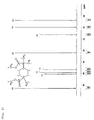
- Figure 1 is a chart showing DEPT 45°-NMR measurement results. From Figure 1 , it was found that the fifth and seventh peaks for quaternary carbon atoms were missing.
- Figure 2 is a chart showing DEPT 90°-NMR measurement results. From Figure 2 , it was found that the sixth peak for a tertiary carbon atom was strongly detected.
- Figure 3 is a chart showing DEPT 135°-NMR measurement results. From Figure 3 , it was found that the second and fourth peaks for secondary carbon atoms were detected in the downward direction.
- Figure 4 is a chart showing Carbon i.g.-NMR measurement results. From Figure 4 , the number of carbon was confirmed.
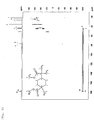
- Figure 5 and Figure 6 are charts showing INADEQUATE-NMR measurement results ( Figure 6 is an enlarged chart showing measurement results in a portion for 15 to 55 ppm in Figure 5 .). From Figure 5 and Figure 6 , the correlations of direct bonding between carbons were elucidated.
- Figure 7 and Figure 8 are charts showing HSQC-NMR measurement results ( Figure 8 is an enlarged chart showing measurement results in a portion from 3.50 to 3.70 ppm in Figure 7 .). From Figure 7 and Figure 8 , the hydrogen atom bonded to each carbon atom was determined.
- Figure 9 and Figure 10 are charts showing HMBC-NMR measurement results ( Figure 10 is an enlarged chart showing measurement results in a portion from 3.50 to 3.70 ppm in Figure 9 .). From Figure 9 and Figure 10 , a hydrogen atom which positions 2 bonds away from each carbon atom was determined.
- Example 1 Based on comprehensive determination from the measurement results, the main component of the product obtained in Example 1 was identified to be methyl-4-(1-methoxy-2-methyl-1-oxopropan-2-yl)-1-methylcyclohexane carboxylate.
- Example 1 The steric structure of methyl-4-(1-methoxy-2-methyl-1-oxopropan-2-yl)-1-methylcyclohexane carboxylate obtained in Example 1 was identified as follows by NMR measurement.
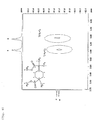
- Figure 11 is a chart showing 1H-NMR measurement results.
- Figure 12 is an enlarged chart of a peak 6 (peak of a hydrogen atom bonded to the carbon to which a 1-methoxy-2-methyl-1-oxopropan-2-yl group is bonded) of Figure 11 . From Figure 12 , it was shown that the peak was split into 9 and the binding constant of each peak was 12 Hz or 3 Hz.
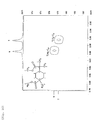
- Figure 13 is a chart showing COZY-NMR measurement results.
- Figure 14 is a chart showing NOEZY-NMR measurement results. From the comparison of the measurement results in Figure 13 and Figure 14 , it was shown that correlations specific to NOEZY-NMR measurement exist between the hydrogen atoms at position 2 and position 9 and between the hydrogen atoms at position 6 and position 8 of the compound shown in Figures 13 and 14 (methyl-4-(1-methoxy-2-methyl-1-oxopropan-2-yl)-1-methylcyclohexane carboxylate). In other words, it was shown that the hydrogen atoms at position 2 and position 9 were spatially located at a close distance, and the hydrogen atoms at position 6 and position 8 were spatially located at a close distance.
- the yield of the dicarboxylic acid ester compound was 25.6 mol% (on 4-isopropenyl-1-methyl-1-cyclohexene basis), and the yield of methyl-4-(1-methoxy-2-methyl-1-oxopropan-2-yl)-1-methylcyclohexane carboxylate was 18.7 mol% (on 4-isopropenyl-1-methyl-1-cyclohexene basis, isomer ratio: 73.0%).
- the yield of the dicarboxylic acid ester compound was 27.5 mol% (on 4-isopropenyl-1-methyl-1-cyclohexene basis), and the yield of methyl-4-(1-methoxy-2-methyl-1-oxopropan-2-yl)-1-methylcyclohexane carboxylate was 20.1 mol% (on 4-isopropenyl-1-methyl-1-cyclohexene basis, isomer ratio: 73.1%).
- the new alicyclic dicarboxylic acid ester compound obtained in the present invention is useful as various industrial chemical raw materials and raw materials for manufacturing functional optical materials and functional electronic materials.
Landscapes
- Chemical & Material Sciences (AREA)
- Organic Chemistry (AREA)
- Engineering & Computer Science (AREA)
- Oil, Petroleum & Natural Gas (AREA)
- Organic Low-Molecular-Weight Compounds And Preparation Thereof (AREA)
- Chemical Kinetics & Catalysis (AREA)
- Low-Molecular Organic Synthesis Reactions Using Catalysts (AREA)
Abstract
Description
- The present invention relates to a new alicyclic dicarboxylic acid ester compound having a cyclohexane ring, and a manufacturing method thereof.
- A polyester resin synthesized from an alicyclic dicarboxylic acid and an alicyclic diol can be applied to use as optical materials, electronic information materials, and medical appliance materials, due to excellence in transparency, heat resistance, weather resistance, gas barrier property, and optical properties.
- For example, using 1,4-cyclohexane dicarboxylic acid (1,4-CHDA) as alicyclic dicarboxylic acid, and 1,4-cyclohexane dimethanol (1,4-CHDM) as alicyclic diol, a polyester resin excellent in biodegradability (refer to, for example, Patent Document 1), a conductive polyester emitting a less amount of gas (refer to, for example, Patent Document 2), and a polyester having a short foam-disappearing time, suitable for use in medical application (refer to, for example, Patent Document 3) are synthesized. Furthermore, using tricyclo[3.3.1.13,7]decane dicarboxylic acid as alicyclic dicarboxylic acid, and tricyclo[3.3.1.13,7]decane diol as alicyclic diol, a polyester resin having small optical anisotropy, excellent in moldability, is synthesized (refer to, for example, Patent Document 4).
-
-
Patent Document 1
Japanese Patent Laid-Open No.2000-290356 -
Patent Document 2
Japanese Patent Laid-Open No.2004-124022 -
Patent Document 3
Japanese Patent Laid-Open No.2005-298555 -
Patent Document 4
Japanese Patent No.3862538 - An object of the present invention is to provide a new alicyclic dicarboxylic acid ester compound having a cyclohexane ring and a manufacturing method thereof.
- The present inventor has investigated a method of manufacturing a new alicyclic dicarboxylic acid ester compound represented by the following formula (1) from 4-isopropenyl-1-methyl-1-cyclohexene represented by the following formula (3), and found out that the new alicyclic dicarboxylic acid ester compound represented by the following formula (1) can be manufactured by, for example, reacting 4-isopropenyl-1-methyl-1-cyclohexene represented by the following formula (3) with carbon monoxide in the presence of hydrogen fluoride (hereinafter also referred to as "HF"), subsequently reacting the produced alicyclic dicarboxylic acid fluoride represented by the following formula (2) with alcohol.
- The present invention has been thus accomplished based on the finding.

- Specifically, the present invention is described as follows.
- [1] An alicyclic dicarboxylic acid ester compound represented by the following formula (1):

- [2] The alicyclic dicarboxylic acid ester compound according to [1], wherein the compound has a steric structure represented by the following formula (1-1):

- [3] A method of manufacturing an alicyclic dicarboxylic acid ester compound comprising the steps of:
- reacting 4-isopropenyl-1-methyl-1-cyclohexene represented by the following formula (3) with carbon monoxide in the presence of hydrogen fluoride so as to produce an alicyclic dicarboxylic acid fluoride represented by the following formula (2); and
- reacting the produced alicyclic dicarboxylic acid fluoride represented by the following formula (2) with alcohol so as to produce an alicyclic dicarboxylic acid ester compound represented by the following formula (1):

- The new alicyclic dicarboxylic acid ester compound represented by the formula (1) of the present invention can be used, for example, as a raw material of polyester resins. Since the manufacturing method of the present invention uses a compound represented by the formula (3) derived from biomass as a raw material, it can be said that the manufacturing method is environment-friendly in terms of carbon neutrality.
-
- [
Figure 1] Figure 1 is achart showing DEPT 45°-NMR measurement results of a product obtained in Example 1. - [
Figure 2] Figure 2 is a chart showing DEPT 90°-NMR measurement results of a product obtained in Example 1. - [
Figure 3] Figure 3 is a chart showing DEPT 135°-NMR measurement results of a product obtained in Example 1. - [
Figure 4] Figure 4 is a chart showing Carbon i.g.-NMR measurement results of a product obtained in Example 1. - [
Figure 5] Figure 5 is a chart showing INADEQUATE-NMR measurement results of a product obtained in Example 1. - [
Figure 6] Figure 6 is an enlarged chart showing measurement results in a portion from 15 to 55 ppm inFigure 5 . - [
Figure 7] Figure 7 is a chart showing HSQC-NMR measurement results of a product obtained in Example 1. - [
Figure 8] Figure 8 is an enlarged chart showing measurement results in a portion from 3.50 to 3.70 ppm inFigure 7 . - [
Figure 9] Figure 9 is a chart showing HMBC-NMR measurement results of a product obtained in Example 1. - [
Figure 10] Figure 10 is an enlarged chart showing measurement results in a portion from 3.50 to 3.70 ppm inFigure 9 . - [
Figure 11] Figure 11 is a chart showing 1H-NMR measurement results of a product obtained in Example 1. - [
Figure 12] Figure 12 is an enlarged chart expressing the horizontal axis of apeak 6 ofFigure 1 in Hz. - [
Figure 13] Figure 13 is a chart showing COZY-NMR measurement results of a product obtained in Example 1. - [
Figure 14] Figure 14 is a chart showing NOEZY-NMR measurement results of a product obtained in Example 1. - The embodiments of the present invention (hereinafter also referred to as "the present embodiment") are described in detail in the following. The following embodiments are, however, provided to illustrate the present invention, and the present invention is not limited thereto only.
- The new alicyclic dicarboxylic acid ester compound of the present embodiment is represented by the following formula (1).

- Examples of the alkyl group represented by R having 1 to 4 carbon atoms in the formula (1) include a methyl group, an ethyl group, an n-propyl group, an isopropyl group, an n-butyl group, an i-butyl group, and a t-butyl group, though not being particularly limited. Among them, a methyl group, an ethyl-group, and an n-propyl group are preferred, a methyl group and an ethyl group are more preferred, and a methyl group is furthermore preferred.
- The alicyclic dicarboxylic acid ester compound represented by the formula (1) may be used, for example, as a raw material for polyester resins, and a material excellent in optical properties and heat resistance can be manufactured by using the alicyclic dicarboxylic acid ester compound. Examples of the application of the material having such properties include, but not particularly limited to, optical materials such as lenses.
- Due to having a cyclohexane ring, the compound of the present embodiment may have a plurality of steric structures. The steric structure of the compound of the present embodiment is different depending on, for example, whether the functional group or hydrogen atom bonded to the carbon in a cyclohexane ring is at an axial position or an equatorial position, and the steric structure is in a trans or cis configuration due to difference in the position of two functional groups bonded to the carbon in a cyclohexane ring.
- The compound of the present embodiment tends to be stabilized, in the case of having a steric structure of a cyclohexane ring with a functional group having a large steric hindrance, such as a 1-methoxy-2-methyl-1-oxopropan-2-yl group, at an equatorial position, and with a hydrogen atom or the like having a small steric hindrance at an axial position. Also, the compound of the present embodiment with a trans configuration tends to have higher reactivity of a reactive substituent such as a carboxylate group. The alicyclic dicarboxylic acid ester compound having such properties is useful as a raw material for a polyester resin excellent in optical anisotropy.
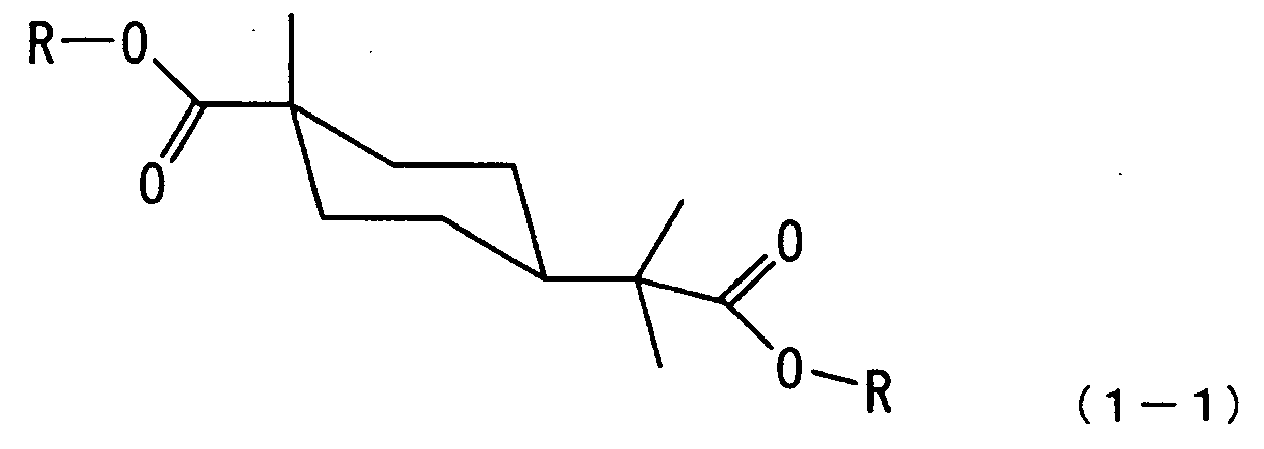
- From the viewpoint described above, the compound of the present embodiment is preferably an alicyclic dicarboxylic acid ester compound having a steric structure represented by the following formula (1-1).

- The method of manufacturing the new alicyclic dicarboxylic acid ester compound of the present embodiment comprises the following steps (a) and (b):
- (a) A step of reacting 4-isopropenyl-1-methyl-1-cyclohexene represented by the following formula (3) with carbon monoxide in the presence of hydrogen fluoride (hereinafter also referred to as "HF") so as to produce an alicyclic dicarboxylic acid fluoride represented by the following formula (2)(hereinafter sometimes abbreviated as "carbonylation step"); and
- (b) A step of reacting the produced alicyclic dicarboxylic acid fluoride represented by the following formula (2) with alcohol so as to produce an alicyclic dicarboxylic acid ester compound represented by the following formula (1) (hereinafter sometimes abbreviated as "esterification step").
- In the step (a), the carbonylation reaction of 4-isopropenyl-1-methyl-1-cyclohexene represented by the following formula (3) is preferably performed in the presence of HF under pressure of carbon monoxide. Through the step (a), an alicyclic carbonyl compound represented by the following formula (2) (hereinafter also referred to as "alicyclic dicarboxylic acid fluoride") is produced. The product of the carbonylation reaction in the step (a) may contain various by-products (containing other isomers).

- The carbon monoxide for use in the carbonylation step may contain an inert gas such as nitrogen and methane. The carbonylation step is performed under a carbon monoxide partial pressure in the range of preferably 0.5 to 5 MPa, more preferably 1 to 4 MPa, furthermore preferably 1.5 to 3 MPa. Under a carbon monoxide partial pressure of more than 0.5 MPa, the carbonylation reaction proceeds sufficiently without concurrence of side reactions such as disproportionation and polymerization, so that the target substance, i.e. alicyclic dicarboxylic acid fluoride, can be obtained at a high yield. A carbon monoxide partial pressure of 5 MPa or less is preferred, considering the load on equipment.
- Since HF for use in the carbonylation step functions as a solvent, a catalyst, and a secondary raw material for the reaction, use of substantially anhydrous HF is preferred. In the present embodiment, the substantially anhydrous HF means HF with a water concentration of 200 ppm or less. In the carbonylation step, the amount of HF for use is preferably 4 to 30 times by mole, more preferably 7 to 20 times by mole, furthermore preferably 10 to 15 times by mole, as large as the amount of raw material 4-isopropenyl-1-methyl-1-cyclohexene. With an amount of HF for use of 4 times by mole or more, the carbonylation reaction proceeds efficiently, with concurrence of side reactions such as disproportionation and polymerization being suppressed, so that the target substance, i.e. alicyclic dicarboxylic acid fluoride, can be obtained at a high yield. The amount of HF for use is preferably 30 times by mole or less, more preferably 15 times by mole or less, considering raw material costs and productivity.
- The type of carbonylation reaction in the step (a) is not particularly limited. Any of a batch type, a semi-continuous type, a continuous type, and the like may be employed.
- The reaction temperature of carbonylation reaction in the step (a) is preferably in the range of -50°C to 30°C, more preferably -40°C to 0°C, furthermore preferably -30 to -10°C. At a reaction temperature of the carbonylation reaction of 30°C or less, in particular - 10°C or less, improved selectivity tends to be achieved. The carbonylation reaction in the step (a) is preferably performed at -50°C or more, considering the reaction rate.
- The reaction pressure of carbonylation reaction in the step (a) is preferably in the range of 0.6 to 5.0 MPa, more preferably 1.1 to 4.0 MPa, furthermore preferably 1.6 to 3.0 MPa.
- The esterification step is a step of reacting the alicyclic dicarboxylic acid fluoride produced in the carbonylation step with an alcohol having 1 to 4 carbon atoms so as to produce an alicyclic dicarboxylic acid ester compound. In the esterification step, the reaction liquid produced in the carbonylation step may be directly used. Considering the corrosivity of a reaction apparatus, in the esterification step, a method in which a predetermined amount of alcohol is added to the reaction liquid produced in the carbonylation step is preferred. Alternatively, an excessive amount of HF may be distilled away from the reaction liquid produced in the carbonylation step and then alcohol may be added to the reaction liquid for esterification.

- Specific examples of the alcohol for use in the esterification step include methanol, ethanol, n-propanol, isopropanol, n-butyl alcohol, isobutyl alcohol, and tert-butyl alcohol, though not being particularly limited. Among them, methanol or ethanol is preferred, considering the reactivity. In the esterification step, one type of alcohol may be used alone or two or more types may be used in combination.
- The amount of alcohol for use in the esterification step is preferably 1.0 to 2.5 times by mole, more preferably 1.2 to 2.3 times by mole, furthermore preferably 1.5 to 2.0 times by mole, as large as the amount of raw material 4-isopropenyl-1-methyl-1-cyclohexene in the carbonylation step. With an amount of alcohol for use of 1.0 times by mole or more, the remaining amount of unreacted alicyclic dicarboxylic acid fluoride is small, resulting in little corrosion of apparatus in a subsequent step, which is preferable. An amount of alcohol for use of 2.5 times by mole or less is preferred, from the viewpoint of suppressing the corrosion of apparatus by water produced in an intermolecular dehydration reaction of alcohol.
- The reaction temperature in the esterification step is preferably -40°C or more and 20°C or less, more preferably -35 to 10°C, furthermore preferably -30 to 0°C, from the viewpoint of suppressing decomposition of the alicyclic dicarboxylic acid ester compound represented by the above formula (1). With a reaction temperature of - 40°C or more, the esterification rate can be accelerated to improve the yield. With a reaction temperature of 20°C or less, the decomposition of ester can be suppressed and by-product water due to dehydration reaction of alcohol can be suppressed.
- The esterification step is preferably performed under normal pressure.
- The manufacturing method of the present embodiment may comprise other steps other than the steps (a) and (b) described above. Examples of the other step include a liquid-liquid extraction step, a catalyst recovery step, a neutralization and washing step, an auxiliary agent recovery step, and a refining step, though not being particularly limited.
- Examples of the refining step include a step of, after distilling HF away from the reaction liquid containing an alicyclic dicarboxylic acid ester compound represented by the formula (1) produced in the esterification step, refining the reaction liquid by a conventional method such as distillation, though not being particularly limited.
- Hereinafter, the present invention will be specifically described with reference to Examples, but the present invention is not intended to be limited to these examples. Unless otherwise specified, "%" in the following means mass%.
- In gas chromatography, a measurement apparatus GC-17A made by SHIMADZU CORPORATION and a capillary column HR-1 made by ULBON (0.32 mmφ x 25 m x 0.50 µm) were used. The temperature-rising conditions were set such that the temperature was raised from 100°C to 300°C at a rate of 5°C/min.
- By gas chromatography analysis, the area ratios (GC%) of several types of isomeric dicarboxylic acid ester compounds as products were obtained, and the yield and the isomer ratio of the dicarboxylic acid ester compounds were calculated by an internal reference method using the following expression.


- The isomer in the description means a structural isomer having a carbonyl group at a different insertion position.
- As GC-MS measurement apparatus, a GC-MS spectrometer POLARIS Q made by Thermo ELECTRON Corporation was used.
- NMR was measured under the following conditions.
- Apparatus: Bruker Avance 600II (600 MHz-NMR)
Mode: Proton, Carbon,DEPT 45°, 90°, and 135°, Carbon i.g., and INADEQUATE, HSQC, H2BC, HMBC
Solvent: CDCl3 (deuterated chloroform)
Internal reference substance: tetramethylsilane -

- Using a stainless steel autoclave with an internal volume of 500 ml including a Nack drive type stirrer and three inlet nozzles at the top and one extraction nozzle at the bottom, with a jacket for internal temperature control, the carbonylation step was performed as follows.
- First, the atmosphere in the autoclave was substituted with carbon monoxide. Subsequently, 230 g (11.5 mol) of anhydrous hydrogen fluoride was introduced into the autoclave, and the liquid temperature in the autoclave was set to -27°C. The inside of the autoclave was then pressurized to 2 MPa with carbon monoxide.
- In the autoclave with the reaction temperature being kept at -27°C, and the reaction pressure being kept at 2 MPa, 104.4 g (0.77 mol) of 4-isopropenyl-1-methyl-1-cyclohexene was supplied from the top of the autoclave, so that the carbonylation reaction was performed. After completion of the supply, with stirring of the reaction liquid being continued for about 10 minutes until no absorption of carbon monoxide was observed, an alicyclic dicarboxylic acid fluoride was thereby obtained.
- Subsequently, in the autoclave with the reaction temperature being kept at -27°C, 49.1 g (1.53 mol) of methanol was supplied from the top of the autoclave, so that esterification of the alicyclic dicarboxylic acid fluoride was performed with the reaction liquid being stirred for 1 hour.
- The reaction liquid was extracted from the bottom of the autoclave into ice water, so that an oil phase and an aqueous phase were separated. Subsequently, the oil phase was washed twice with 100 ml of 2% caustic soda aqueous solution and twice with 100 ml of distilled water, and was dehydrated with 10 g of anhydrous sodium sulfate. After dehydration, the produced liquid was analyzed by gas chromatography. As a result, the yield of the dicarboxylic acid ester compound was 26.6 mol% (on 4-isopropenyl-1-methyl-1-cyclohexene basis), and the yield of methyl-4-(1-methoxy-2-methyl-1-oxopropan-2-yl)-1-methylcyclohexane carboxylate was 21.1 mol% (on 4-isopropenyl-1-methyl-1-cyclohexene basis, isomer ratio: 79.2%).
- By reduced-pressure distillation of the liquid produced in the esterification step with an evaporator, low-boiling point substances were removed from the liquid. Subsequently, the low-boiling point substance-removed liquid was rectified using a rectification column with a theoretical plate number of 20 (distillation temperature: 177°C, degree of vacuum: 20 torr). Through the rectification, 42.0 g of a product as main fraction having an isomer ratio of 92.0% by gas chromatography analysis (distilled yield: 93.2 mol%, on methyl-4-(1-methoxy-2-methyl-1-oxopropan-2-yl)-1-methylcyclohexane carboxylate basis) was obtained.
- As a result of GC-MS analysis, the product obtained in the isolation and refining in Example 1 had a molecular weight of 256.
- Using the NMR apparatus, 1H-NMR measurement, 13C-NMR measurement,
DEPT 45°, 90°, and 135°-NMR measurement, Carbon i.g.-NMR measurement, INADEQUATE-NMR measurement, HSQC-NMR measurement, H2BC-NMR measurement, and HMBC-NMR measurement were performed. The results of 1H-NMR measurement and 13C-NMR measurement are shown as follows, and the results ofDEPT 45°, 90°, and 135°-NMR measurement, Carbon i.g.-NMR measurement, INADEQUATE-NMR measurement, HSQC-NMR measurement, H2BC-NMR measurement, and HMBC-NMR measurement are shown inFigures 1 to 10 . - 1H-NMR (600 MHz, CDCl3, TMS, ppm) δ: 0.994-1.055 (m, 14H), 1.380-1.401 (m, 2H), 1.488 (m, 1H), 2.147-2.168 (m, 2H), 3.567 (s, 3H), 3.596 (s, 3H)
- 13C-NMR (600 MHz, CDCl3, TMS, ppm) δ: 21.74, 24.75, 28.01, 35.85, 43.25, 44.46, 45.17, 51.33, 51.41, 177.31, 178.34
-
Figure 1 is achart showing DEPT 45°-NMR measurement results. FromFigure 1 , it was found that the fifth and seventh peaks for quaternary carbon atoms were missing.Figure 2 is a chart showing DEPT 90°-NMR measurement results. FromFigure 2 , it was found that the sixth peak for a tertiary carbon atom was strongly detected.Figure 3 is a chart showing DEPT 135°-NMR measurement results. FromFigure 3 , it was found that the second and fourth peaks for secondary carbon atoms were detected in the downward direction.Figure 4 is a chart showing Carbon i.g.-NMR measurement results. FromFigure 4 , the number of carbon was confirmed.Figure 5 andFigure 6 are charts showing INADEQUATE-NMR measurement results (Figure 6 is an enlarged chart showing measurement results in a portion for 15 to 55 ppm inFigure 5 .). FromFigure 5 andFigure 6 , the correlations of direct bonding between carbons were elucidated.Figure 7 andFigure 8 are charts showing HSQC-NMR measurement results (Figure 8 is an enlarged chart showing measurement results in a portion from 3.50 to 3.70 ppm inFigure 7 .). FromFigure 7 andFigure 8 , the hydrogen atom bonded to each carbon atom was determined.Figure 9 andFigure 10 are charts showing HMBC-NMR measurement results (Figure 10 is an enlarged chart showing measurement results in a portion from 3.50 to 3.70 ppm inFigure 9 .). FromFigure 9 andFigure 10 , a hydrogen atom which positions 2 bonds away from each carbon atom was determined. - Based on comprehensive determination from the measurement results, the main component of the product obtained in Example 1 was identified to be methyl-4-(1-methoxy-2-methyl-1-oxopropan-2-yl)-1-methylcyclohexane carboxylate.
- The steric structure of methyl-4-(1-methoxy-2-methyl-1-oxopropan-2-yl)-1-methylcyclohexane carboxylate obtained in Example 1 was identified as follows by NMR measurement.
-
Figure 11 is a chart showing 1H-NMR measurement results.Figure 12 is an enlarged chart of a peak 6 (peak of a hydrogen atom bonded to the carbon to which a 1-methoxy-2-methyl-1-oxopropan-2-yl group is bonded) ofFigure 11 . FromFigure 12 , it was shown that the peak was split into 9 and the binding constant of each peak was 12 Hz or 3 Hz. From this, it was shown that the hydrogen atom at a position 6 (hydrogen atom bonded to the carbon to which a 1-methoxy-2-methyl-1-oxopropan-2-yl group is bonded) of the compound shown inFigure 11 (methyl-4-(1-methoxy-2-methyl-1-oxopropan-2-yl)-1-methylcyclohexane carboxylate) was at the axial position of a cyclohexane ring. -
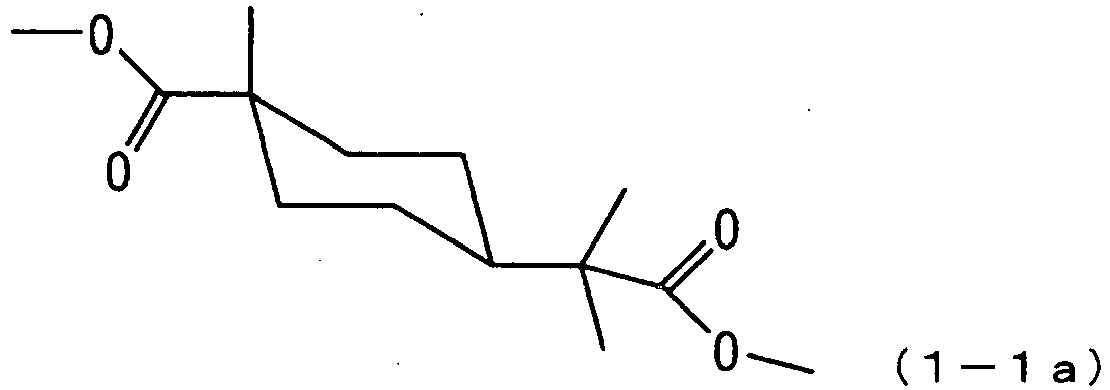
Figure 13 is a chart showing COZY-NMR measurement results.Figure 14 is a chart showing NOEZY-NMR measurement results. From the comparison of the measurement results inFigure 13 andFigure 14 , it was shown that correlations specific to NOEZY-NMR measurement exist between the hydrogen atoms atposition 2 andposition 9 and between the hydrogen atoms atposition 6 andposition 8 of the compound shown inFigures 13 and14 (methyl-4-(1-methoxy-2-methyl-1-oxopropan-2-yl)-1-methylcyclohexane carboxylate). In other words, it was shown that the hydrogen atoms atposition 2 andposition 9 were spatially located at a close distance, and the hydrogen atoms atposition 6 andposition 8 were spatially located at a close distance. From this, it was shown that the compound shown inFigures 13 and14 (methyl-4-(1-methoxy-2-methyl-1-oxopropan-2-yl)-1-methylcyclohexane carboxylate) has a carboxylate group at the equatorial position of a cyclohexane ring. - From the measurement results described above, the steric structure of methyl-4-(1-methoxy-2-methyl-1-oxopropan-2-yl)-1-methylcyclohexane carboxylate obtained in Example 1 was identified to be a trans configuration represented by the following formula (1-1a).
- Except that the reaction temperature in a carbonylation step was set to -15°C, the carbonylation step, an esterification step, and isolation and refining of a product were performed in the same way as in Example 1. After isolation and refining, the produced liquid was analyzed by gas chromatography. As a result, the yield of the dicarboxylic acid ester compound was 25.6 mol% (on 4-isopropenyl-1-methyl-1-cyclohexene basis), and the yield of methyl-4-(1-methoxy-2-methyl-1-oxopropan-2-yl)-1-methylcyclohexane carboxylate was 18.7 mol% (on 4-isopropenyl-1-methyl-1-cyclohexene basis, isomer ratio: 73.0%).
- Except that the carbon monoxide pressure in autoclave was set to 3 MPa, a carbonylation step, an esterification step, and isolation and refining of a product were performed in the same way as in Example 2. After isolation and refining, the produced liquid was analyzed by gas chromatography. As a result, the yield of the dicarboxylic acid ester compound was 27.5 mol% (on 4-isopropenyl-1-methyl-1-cyclohexene basis), and the yield of methyl-4-(1-methoxy-2-methyl-1-oxopropan-2-yl)-1-methylcyclohexane carboxylate was 20.1 mol% (on 4-isopropenyl-1-methyl-1-cyclohexene basis, isomer ratio: 73.1%).
- The new alicyclic dicarboxylic acid ester compound obtained in the present invention is useful as various industrial chemical raw materials and raw materials for manufacturing functional optical materials and functional electronic materials.

Claims (3)
- An alicyclic dicarboxylic acid ester compound represented by the following formula (1):

- The alicyclic dicarboxylic acid ester compound according to claim 1, wherein the compound has a steric structure represented by the following formula (1-1):
- A method of manufacturing an alicyclic dicarboxylic acid ester compound comprising the steps of:reacting 4-isopropenyl-1-methyl-1-cyclohexene represented by the following formula (3) with carbon monoxide in the presence of hydrogen fluoride so as to produce an alicyclic dicarboxylic acid fluoride represented by the following formula (2); andreacting the produced alicyclic dicarboxylic acid fluoride represented by the following formula (2) with alcohol so as to produce an alicyclic dicarboxylic acid ester compound represented by the following formula (1):
 wherein R each independently represent an alkyl group having 1 to 4 carbon atoms.
Applications Claiming Priority (2)
| Application Number | Priority Date | Filing Date | Title |
|---|---|---|---|
| JP2012227837 | 2012-10-15 | ||
| PCT/JP2013/077712 WO2014061571A1 (en) | 2012-10-15 | 2013-10-11 | Novel alicyclic dicarboxylic acid ester compound, and method for producing same |
Publications (3)
| Publication Number | Publication Date |
|---|---|
| EP2907801A1 true EP2907801A1 (en) | 2015-08-19 |
| EP2907801A4 EP2907801A4 (en) | 2016-06-01 |
| EP2907801B1 EP2907801B1 (en) | 2017-03-01 |
Family
ID=50488137
Family Applications (1)
| Application Number | Title | Priority Date | Filing Date |
|---|---|---|---|
| EP13847806.0A Active EP2907801B1 (en) | 2012-10-15 | 2013-10-11 | Novel alicyclic dicarboxylic acid ester compound, and method for producing same |
Country Status (10)
| Country | Link |
|---|---|
| US (1) | US9156773B2 (en) |
| EP (1) | EP2907801B1 (en) |
| JP (1) | JP6160627B2 (en) |
| KR (1) | KR102067651B1 (en) |
| CN (1) | CN104736514B (en) |
| ES (1) | ES2618552T3 (en) |
| IN (1) | IN2015DN03842A (en) |
| RU (1) | RU2642069C2 (en) |
| TW (1) | TWI589558B (en) |
| WO (1) | WO2014061571A1 (en) |
Families Citing this family (4)
| Publication number | Priority date | Publication date | Assignee | Title |
|---|---|---|---|---|
| JPH1147933A (en) * | 1997-07-28 | 1999-02-23 | Hitachi Constr Mach Co Ltd | Welding wire feeder |
| CN104781224B (en) * | 2012-10-15 | 2018-04-03 | 三菱瓦斯化学株式会社 | New ester ring type diol compound and its manufacture method |
| WO2019138988A1 (en) * | 2018-01-12 | 2019-07-18 | 株式会社ダイセル | Alicyclic epoxy compound product |
| JP7245450B2 (en) * | 2018-02-16 | 2023-03-24 | 三菱瓦斯化学株式会社 | Method for producing tricyclo[5.2.1.02,6]decane-2-carboxylic acid ester |
Family Cites Families (18)
| Publication number | Priority date | Publication date | Assignee | Title |
|---|---|---|---|---|
| US2986584A (en) * | 1958-11-03 | 1961-05-30 | American Cyanamid Co | Production of terpene alcohols |
| JP2000290356A (en) | 1999-04-09 | 2000-10-17 | Kuraray Co Ltd | Polyester and molding prepared therefrom |
| TW482761B (en) * | 1999-07-19 | 2002-04-11 | New Japan Chem Co Ltd | Dicarboxylic acid diester, a process for preparation thereof and refrigerator lubricating oil containing the diester |
| US6455666B1 (en) | 2000-10-11 | 2002-09-24 | Daicel Chemical Industries, Ltd. | Polyesters and production process thereof |
| JP3862538B2 (en) | 2000-10-11 | 2006-12-27 | ダイセル化学工業株式会社 | Novel polyester polymer and its production method |
| JP2004124022A (en) | 2002-10-07 | 2004-04-22 | Mitsubishi Chemicals Corp | Conductive polyester resin composition |
| EP1550681B1 (en) * | 2003-12-22 | 2007-04-11 | INVISTA Technologies S.à.r.l. | Aromatic polyester composition for making stretch blow molded containers |
| JP2005298555A (en) | 2004-04-07 | 2005-10-27 | Mitsubishi Chemicals Corp | Polyester, method for producing the same, and medical device using the polyester |
| EP1700839B1 (en) * | 2005-03-10 | 2013-07-31 | Mitsubishi Gas Chemical Company, Inc. | Production of carboxylic acids or carboxylic acid esters |
| JP5294259B2 (en) * | 2006-03-28 | 2013-09-18 | ヤスハラケミカル株式会社 | Terpene alcohol compounds, terpene (meth) acrylate compounds, and methods for producing them |
| JP5175539B2 (en) * | 2007-12-21 | 2013-04-03 | 花王株式会社 | Cyclohexylalkanol |
| KR20110021880A (en) * | 2008-05-14 | 2011-03-04 | 바스프 에스이 | Use of cyclohexane diol mixtures for polymer preparation |
| JP5441526B2 (en) | 2009-07-01 | 2014-03-12 | 三菱瓦斯化学株式会社 | Method for producing alicyclic alcohol |
| FR2959738B1 (en) | 2010-05-05 | 2012-05-11 | Mane Fils V | COMPOUNDS WITH BOOKED NOTE. |
| JP5624456B2 (en) | 2010-12-28 | 2014-11-12 | 三菱瓦斯化学株式会社 | New alicyclic alcohol |
| JP5626987B2 (en) * | 2010-12-28 | 2014-11-19 | 三菱瓦斯化学株式会社 | New alicyclic alcohol |
| RU2585761C2 (en) | 2011-03-25 | 2016-06-10 | Мицубиси Гэс Кемикал Компани, Инк. | Novel compound of carboxylic ester and production method thereof, and composition of aromatic substances |
| CN104781224B (en) * | 2012-10-15 | 2018-04-03 | 三菱瓦斯化学株式会社 | New ester ring type diol compound and its manufacture method |
-
2013
- 2013-10-11 KR KR1020157009384A patent/KR102067651B1/en active Active
- 2013-10-11 US US14/431,442 patent/US9156773B2/en active Active
- 2013-10-11 CN CN201380053974.XA patent/CN104736514B/en active Active
- 2013-10-11 WO PCT/JP2013/077712 patent/WO2014061571A1/en not_active Ceased
- 2013-10-11 RU RU2015118152A patent/RU2642069C2/en active
- 2013-10-11 JP JP2014542098A patent/JP6160627B2/en active Active
- 2013-10-11 ES ES13847806.0T patent/ES2618552T3/en active Active
- 2013-10-11 EP EP13847806.0A patent/EP2907801B1/en active Active
- 2013-10-15 TW TW102137157A patent/TWI589558B/en active
-
2015
- 2015-05-06 IN IN3842DEN2015 patent/IN2015DN03842A/en unknown
Also Published As
| Publication number | Publication date |
|---|---|
| TW201425293A (en) | 2014-07-01 |
| CN104736514B (en) | 2016-12-28 |
| RU2015118152A (en) | 2016-12-10 |
| CN104736514A (en) | 2015-06-24 |
| IN2015DN03842A (en) | 2015-10-02 |
| JP6160627B2 (en) | 2017-07-12 |
| ES2618552T3 (en) | 2017-06-21 |
| WO2014061571A1 (en) | 2014-04-24 |
| US9156773B2 (en) | 2015-10-13 |
| US20150239823A1 (en) | 2015-08-27 |
| KR20150067199A (en) | 2015-06-17 |
| TWI589558B (en) | 2017-07-01 |
| RU2642069C2 (en) | 2018-01-24 |
| JPWO2014061571A1 (en) | 2016-09-05 |
| EP2907801A4 (en) | 2016-06-01 |
| KR102067651B1 (en) | 2020-01-17 |
| EP2907801B1 (en) | 2017-03-01 |
Similar Documents
| Publication | Publication Date | Title |
|---|---|---|
| EP2907800B1 (en) | Novel alicyclic-type diol compound, and method for producing same | |
| US8669392B2 (en) | Process for preparing 2,3-di-non-straight-alkyl-2-cyanosuccinic acid diesters | |
| Rybak et al. | Cross-metathesis of oleyl alcohol with methyl acrylate: optimization of reaction conditions and comparison of their environmental impact | |
| EP2907801B1 (en) | Novel alicyclic dicarboxylic acid ester compound, and method for producing same | |
| EP2450333A1 (en) | Method for producing alicyclic alcohol | |
| JP6102548B2 (en) | Novel ethyladamantane dicarboxylic acid ester compound and method for producing the same | |
| US11401227B2 (en) | Process to produce a mono vinyl ether | |
| JP6528947B2 (en) | Process for producing dicarboxylic acid ester having norbornane skeleton | |
| JP6102547B2 (en) | Novel ethyladamantanediol compound and method for producing the same | |
| US7399879B2 (en) | Process for preparing alkylidene-substituted-1,4-dions derivatives | |
| CA2491280A1 (en) | Method for the production of a dicarboxylic acid from acrylic acid | |
| Zhang et al. | Rh (II) and Zn (II) co-catalyzed multi-component reaction for the synthesis of vicinal diols | |
| KR20240097112A (en) | Synthesis method of compound applying acetoxylation reaction to lactic acid derivative | |
| JP2001011015A (en) | Method for producing lower alkyl tartaric diester | |
| US20020177733A1 (en) | Manufacture of cyclic aliphatic acids and esters | |
| JP2002053509A (en) | Method for producing alkylated naphthol |
Legal Events
| Date | Code | Title | Description |
|---|---|---|---|
| PUAI | Public reference made under article 153(3) epc to a published international application that has entered the european phase |
Free format text: ORIGINAL CODE: 0009012 |
|
| 17P | Request for examination filed |
Effective date: 20150312 |
|
| AK | Designated contracting states |
Kind code of ref document: A1 Designated state(s): AL AT BE BG CH CY CZ DE DK EE ES FI FR GB GR HR HU IE IS IT LI LT LU LV MC MK MT NL NO PL PT RO RS SE SI SK SM TR |
|
| AX | Request for extension of the european patent |
Extension state: BA ME |
|
| DAX | Request for extension of the european patent (deleted) | ||
| RIC1 | Information provided on ipc code assigned before grant |
Ipc: C07C 67/14 20060101ALI20160412BHEP Ipc: C07C 69/757 20060101AFI20160412BHEP Ipc: C07B 61/00 20060101ALI20160412BHEP |
|
| RA4 | Supplementary search report drawn up and despatched (corrected) |
Effective date: 20160504 |
|
| RIC1 | Information provided on ipc code assigned before grant |
Ipc: C07C 67/14 20060101ALI20160428BHEP Ipc: C07B 61/00 20060101ALI20160428BHEP Ipc: C07C 69/757 20060101AFI20160428BHEP |
|
| GRAP | Despatch of communication of intention to grant a patent |
Free format text: ORIGINAL CODE: EPIDOSNIGR1 |
|
| INTG | Intention to grant announced |
Effective date: 20161011 |
|
| GRAS | Grant fee paid |
Free format text: ORIGINAL CODE: EPIDOSNIGR3 |
|
| GRAA | (expected) grant |
Free format text: ORIGINAL CODE: 0009210 |
|
| AK | Designated contracting states |
Kind code of ref document: B1 Designated state(s): AL AT BE BG CH CY CZ DE DK EE ES FI FR GB GR HR HU IE IS IT LI LT LU LV MC MK MT NL NO PL PT RO RS SE SI SK SM TR |
|
| REG | Reference to a national code |
Ref country code: GB Ref legal event code: FG4D |
|
| REG | Reference to a national code |
Ref country code: CH Ref legal event code: EP Ref country code: CH Ref legal event code: NV Representative=s name: BOHEST AG, CH Ref country code: AT Ref legal event code: REF Ref document number: 871109 Country of ref document: AT Kind code of ref document: T Effective date: 20170315 |
|
| REG | Reference to a national code |
Ref country code: IE Ref legal event code: FG4D |
|
| REG | Reference to a national code |
Ref country code: DE Ref legal event code: R096 Ref document number: 602013018141 Country of ref document: DE |
|
| REG | Reference to a national code |
Ref country code: NL Ref legal event code: FP |
|
| REG | Reference to a national code |
Ref country code: ES Ref legal event code: FG2A Ref document number: 2618552 Country of ref document: ES Kind code of ref document: T3 Effective date: 20170621 |
|
| REG | Reference to a national code |
Ref country code: LT Ref legal event code: MG4D |
|
| REG | Reference to a national code |
Ref country code: AT Ref legal event code: MK05 Ref document number: 871109 Country of ref document: AT Kind code of ref document: T Effective date: 20170301 |
|
| PG25 | Lapsed in a contracting state [announced via postgrant information from national office to epo] |
Ref country code: FI Free format text: LAPSE BECAUSE OF FAILURE TO SUBMIT A TRANSLATION OF THE DESCRIPTION OR TO PAY THE FEE WITHIN THE PRESCRIBED TIME-LIMIT Effective date: 20170301 Ref country code: LT Free format text: LAPSE BECAUSE OF FAILURE TO SUBMIT A TRANSLATION OF THE DESCRIPTION OR TO PAY THE FEE WITHIN THE PRESCRIBED TIME-LIMIT Effective date: 20170301 Ref country code: NO Free format text: LAPSE BECAUSE OF FAILURE TO SUBMIT A TRANSLATION OF THE DESCRIPTION OR TO PAY THE FEE WITHIN THE PRESCRIBED TIME-LIMIT Effective date: 20170601 Ref country code: GR Free format text: LAPSE BECAUSE OF FAILURE TO SUBMIT A TRANSLATION OF THE DESCRIPTION OR TO PAY THE FEE WITHIN THE PRESCRIBED TIME-LIMIT Effective date: 20170602 Ref country code: HR Free format text: LAPSE BECAUSE OF FAILURE TO SUBMIT A TRANSLATION OF THE DESCRIPTION OR TO PAY THE FEE WITHIN THE PRESCRIBED TIME-LIMIT Effective date: 20170301 |
|
| REG | Reference to a national code |
Ref country code: FR Ref legal event code: PLFP Year of fee payment: 5 |
|
| PG25 | Lapsed in a contracting state [announced via postgrant information from national office to epo] |
Ref country code: SE Free format text: LAPSE BECAUSE OF FAILURE TO SUBMIT A TRANSLATION OF THE DESCRIPTION OR TO PAY THE FEE WITHIN THE PRESCRIBED TIME-LIMIT Effective date: 20170301 Ref country code: AT Free format text: LAPSE BECAUSE OF FAILURE TO SUBMIT A TRANSLATION OF THE DESCRIPTION OR TO PAY THE FEE WITHIN THE PRESCRIBED TIME-LIMIT Effective date: 20170301 Ref country code: LV Free format text: LAPSE BECAUSE OF FAILURE TO SUBMIT A TRANSLATION OF THE DESCRIPTION OR TO PAY THE FEE WITHIN THE PRESCRIBED TIME-LIMIT Effective date: 20170301 Ref country code: BG Free format text: LAPSE BECAUSE OF FAILURE TO SUBMIT A TRANSLATION OF THE DESCRIPTION OR TO PAY THE FEE WITHIN THE PRESCRIBED TIME-LIMIT Effective date: 20170601 Ref country code: RS Free format text: LAPSE BECAUSE OF FAILURE TO SUBMIT A TRANSLATION OF THE DESCRIPTION OR TO PAY THE FEE WITHIN THE PRESCRIBED TIME-LIMIT Effective date: 20170301 |
|
| PG25 | Lapsed in a contracting state [announced via postgrant information from national office to epo] |
Ref country code: RO Free format text: LAPSE BECAUSE OF FAILURE TO SUBMIT A TRANSLATION OF THE DESCRIPTION OR TO PAY THE FEE WITHIN THE PRESCRIBED TIME-LIMIT Effective date: 20170301 Ref country code: CZ Free format text: LAPSE BECAUSE OF FAILURE TO SUBMIT A TRANSLATION OF THE DESCRIPTION OR TO PAY THE FEE WITHIN THE PRESCRIBED TIME-LIMIT Effective date: 20170301 Ref country code: SK Free format text: LAPSE BECAUSE OF FAILURE TO SUBMIT A TRANSLATION OF THE DESCRIPTION OR TO PAY THE FEE WITHIN THE PRESCRIBED TIME-LIMIT Effective date: 20170301 Ref country code: EE Free format text: LAPSE BECAUSE OF FAILURE TO SUBMIT A TRANSLATION OF THE DESCRIPTION OR TO PAY THE FEE WITHIN THE PRESCRIBED TIME-LIMIT Effective date: 20170301 |
|
| PG25 | Lapsed in a contracting state [announced via postgrant information from national office to epo] |
Ref country code: PL Free format text: LAPSE BECAUSE OF FAILURE TO SUBMIT A TRANSLATION OF THE DESCRIPTION OR TO PAY THE FEE WITHIN THE PRESCRIBED TIME-LIMIT Effective date: 20170301 Ref country code: PT Free format text: LAPSE BECAUSE OF FAILURE TO SUBMIT A TRANSLATION OF THE DESCRIPTION OR TO PAY THE FEE WITHIN THE PRESCRIBED TIME-LIMIT Effective date: 20170703 Ref country code: IS Free format text: LAPSE BECAUSE OF FAILURE TO SUBMIT A TRANSLATION OF THE DESCRIPTION OR TO PAY THE FEE WITHIN THE PRESCRIBED TIME-LIMIT Effective date: 20170701 Ref country code: SM Free format text: LAPSE BECAUSE OF FAILURE TO SUBMIT A TRANSLATION OF THE DESCRIPTION OR TO PAY THE FEE WITHIN THE PRESCRIBED TIME-LIMIT Effective date: 20170301 |
|
| REG | Reference to a national code |
Ref country code: DE Ref legal event code: R097 Ref document number: 602013018141 Country of ref document: DE |
|
| PLBE | No opposition filed within time limit |
Free format text: ORIGINAL CODE: 0009261 |
|
| STAA | Information on the status of an ep patent application or granted ep patent |
Free format text: STATUS: NO OPPOSITION FILED WITHIN TIME LIMIT |
|
| PG25 | Lapsed in a contracting state [announced via postgrant information from national office to epo] |
Ref country code: DK Free format text: LAPSE BECAUSE OF FAILURE TO SUBMIT A TRANSLATION OF THE DESCRIPTION OR TO PAY THE FEE WITHIN THE PRESCRIBED TIME-LIMIT Effective date: 20170301 |
|
| 26N | No opposition filed |
Effective date: 20171204 |
|
| PG25 | Lapsed in a contracting state [announced via postgrant information from national office to epo] |
Ref country code: SI Free format text: LAPSE BECAUSE OF FAILURE TO SUBMIT A TRANSLATION OF THE DESCRIPTION OR TO PAY THE FEE WITHIN THE PRESCRIBED TIME-LIMIT Effective date: 20170301 |
|
| PG25 | Lapsed in a contracting state [announced via postgrant information from national office to epo] |
Ref country code: MC Free format text: LAPSE BECAUSE OF FAILURE TO SUBMIT A TRANSLATION OF THE DESCRIPTION OR TO PAY THE FEE WITHIN THE PRESCRIBED TIME-LIMIT Effective date: 20170301 |
|
| REG | Reference to a national code |
Ref country code: IE Ref legal event code: MM4A |
|
| PG25 | Lapsed in a contracting state [announced via postgrant information from national office to epo] |
Ref country code: LU Free format text: LAPSE BECAUSE OF NON-PAYMENT OF DUE FEES Effective date: 20171011 |
|
| REG | Reference to a national code |
Ref country code: BE Ref legal event code: MM Effective date: 20171031 |
|
| PG25 | Lapsed in a contracting state [announced via postgrant information from national office to epo] |
Ref country code: BE Free format text: LAPSE BECAUSE OF NON-PAYMENT OF DUE FEES Effective date: 20171031 |
|
| REG | Reference to a national code |
Ref country code: FR Ref legal event code: PLFP Year of fee payment: 6 |
|
| PG25 | Lapsed in a contracting state [announced via postgrant information from national office to epo] |
Ref country code: MT Free format text: LAPSE BECAUSE OF NON-PAYMENT OF DUE FEES Effective date: 20171011 |
|
| PG25 | Lapsed in a contracting state [announced via postgrant information from national office to epo] |
Ref country code: IE Free format text: LAPSE BECAUSE OF NON-PAYMENT OF DUE FEES Effective date: 20171011 |
|
| PG25 | Lapsed in a contracting state [announced via postgrant information from national office to epo] |
Ref country code: HU Free format text: LAPSE BECAUSE OF FAILURE TO SUBMIT A TRANSLATION OF THE DESCRIPTION OR TO PAY THE FEE WITHIN THE PRESCRIBED TIME-LIMIT; INVALID AB INITIO Effective date: 20131011 |
|
| PG25 | Lapsed in a contracting state [announced via postgrant information from national office to epo] |
Ref country code: CY Free format text: LAPSE BECAUSE OF FAILURE TO SUBMIT A TRANSLATION OF THE DESCRIPTION OR TO PAY THE FEE WITHIN THE PRESCRIBED TIME-LIMIT Effective date: 20170301 |
|
| PG25 | Lapsed in a contracting state [announced via postgrant information from national office to epo] |
Ref country code: MK Free format text: LAPSE BECAUSE OF FAILURE TO SUBMIT A TRANSLATION OF THE DESCRIPTION OR TO PAY THE FEE WITHIN THE PRESCRIBED TIME-LIMIT Effective date: 20170301 |
|
| PG25 | Lapsed in a contracting state [announced via postgrant information from national office to epo] |
Ref country code: TR Free format text: LAPSE BECAUSE OF FAILURE TO SUBMIT A TRANSLATION OF THE DESCRIPTION OR TO PAY THE FEE WITHIN THE PRESCRIBED TIME-LIMIT Effective date: 20170301 |
|
| PG25 | Lapsed in a contracting state [announced via postgrant information from national office to epo] |
Ref country code: AL Free format text: LAPSE BECAUSE OF FAILURE TO SUBMIT A TRANSLATION OF THE DESCRIPTION OR TO PAY THE FEE WITHIN THE PRESCRIBED TIME-LIMIT Effective date: 20170301 |
|
| P01 | Opt-out of the competence of the unified patent court (upc) registered |
Effective date: 20230515 |
|
| PGFP | Annual fee paid to national office [announced via postgrant information from national office to epo] |
Ref country code: IT Payment date: 20250922 Year of fee payment: 13 Ref country code: NL Payment date: 20250912 Year of fee payment: 13 |
|
| PGFP | Annual fee paid to national office [announced via postgrant information from national office to epo] |
Ref country code: GB Payment date: 20250828 Year of fee payment: 13 |
|
| PGFP | Annual fee paid to national office [announced via postgrant information from national office to epo] |
Ref country code: FR Payment date: 20250908 Year of fee payment: 13 |
|
| REG | Reference to a national code |
Ref country code: CH Ref legal event code: U11 Free format text: ST27 STATUS EVENT CODE: U-0-0-U10-U11 (AS PROVIDED BY THE NATIONAL OFFICE) Effective date: 20251101 |
|
| PGFP | Annual fee paid to national office [announced via postgrant information from national office to epo] |
Ref country code: DE Payment date: 20250902 Year of fee payment: 13 |
|
| PGFP | Annual fee paid to national office [announced via postgrant information from national office to epo] |
Ref country code: CH Payment date: 20251101 Year of fee payment: 13 |
|
| PGFP | Annual fee paid to national office [announced via postgrant information from national office to epo] |
Ref country code: ES Payment date: 20251103 Year of fee payment: 13 |