EP2906605B1 - Sponge polymer with controlled long chain branching and broad molecular weight distribution - Google Patents
Sponge polymer with controlled long chain branching and broad molecular weight distribution Download PDFInfo
- Publication number
- EP2906605B1 EP2906605B1 EP13846036.5A EP13846036A EP2906605B1 EP 2906605 B1 EP2906605 B1 EP 2906605B1 EP 13846036 A EP13846036 A EP 13846036A EP 2906605 B1 EP2906605 B1 EP 2906605B1
- Authority
- EP
- European Patent Office
- Prior art keywords
- diene
- percent
- tetrapolymer
- catalyst
- content
- Prior art date
- Legal status (The legal status is an assumption and is not a legal conclusion. Google has not performed a legal analysis and makes no representation as to the accuracy of the status listed.)
- Active
Links
Classifications
-
- C—CHEMISTRY; METALLURGY
- C08—ORGANIC MACROMOLECULAR COMPOUNDS; THEIR PREPARATION OR CHEMICAL WORKING-UP; COMPOSITIONS BASED THEREON
- C08F—MACROMOLECULAR COMPOUNDS OBTAINED BY REACTIONS ONLY INVOLVING CARBON-TO-CARBON UNSATURATED BONDS
- C08F236/00—Copolymers of compounds having one or more unsaturated aliphatic radicals, at least one having two or more carbon-to-carbon double bonds
- C08F236/02—Copolymers of compounds having one or more unsaturated aliphatic radicals, at least one having two or more carbon-to-carbon double bonds the radical having only two carbon-to-carbon double bonds
- C08F236/20—Copolymers of compounds having one or more unsaturated aliphatic radicals, at least one having two or more carbon-to-carbon double bonds the radical having only two carbon-to-carbon double bonds unconjugated
-
- C—CHEMISTRY; METALLURGY
- C08—ORGANIC MACROMOLECULAR COMPOUNDS; THEIR PREPARATION OR CHEMICAL WORKING-UP; COMPOSITIONS BASED THEREON
- C08F—MACROMOLECULAR COMPOUNDS OBTAINED BY REACTIONS ONLY INVOLVING CARBON-TO-CARBON UNSATURATED BONDS
- C08F210/00—Copolymers of unsaturated aliphatic hydrocarbons having only one carbon-to-carbon double bond
- C08F210/04—Monomers containing three or four carbon atoms
- C08F210/06—Propene
-
- C—CHEMISTRY; METALLURGY
- C08—ORGANIC MACROMOLECULAR COMPOUNDS; THEIR PREPARATION OR CHEMICAL WORKING-UP; COMPOSITIONS BASED THEREON
- C08F—MACROMOLECULAR COMPOUNDS OBTAINED BY REACTIONS ONLY INVOLVING CARBON-TO-CARBON UNSATURATED BONDS
- C08F210/00—Copolymers of unsaturated aliphatic hydrocarbons having only one carbon-to-carbon double bond
- C08F210/16—Copolymers of ethene with alpha-alkenes, e.g. EP rubbers
- C08F210/18—Copolymers of ethene with alpha-alkenes, e.g. EP rubbers with non-conjugated dienes, e.g. EPT rubbers
-
- C—CHEMISTRY; METALLURGY
- C08—ORGANIC MACROMOLECULAR COMPOUNDS; THEIR PREPARATION OR CHEMICAL WORKING-UP; COMPOSITIONS BASED THEREON
- C08L—COMPOSITIONS OF MACROMOLECULAR COMPOUNDS
- C08L23/00—Compositions of homopolymers or copolymers of unsaturated aliphatic hydrocarbons having only one carbon-to-carbon double bond; Compositions of derivatives of such polymers
- C08L23/02—Compositions of homopolymers or copolymers of unsaturated aliphatic hydrocarbons having only one carbon-to-carbon double bond; Compositions of derivatives of such polymers not modified by chemical after-treatment
- C08L23/10—Homopolymers or copolymers of propene
- C08L23/14—Copolymers of propene
- C08L23/145—Copolymers of propene with monomers having two or more carbon-to-carbon double bonds
-
- Y—GENERAL TAGGING OF NEW TECHNOLOGICAL DEVELOPMENTS; GENERAL TAGGING OF CROSS-SECTIONAL TECHNOLOGIES SPANNING OVER SEVERAL SECTIONS OF THE IPC; TECHNICAL SUBJECTS COVERED BY FORMER USPC CROSS-REFERENCE ART COLLECTIONS [XRACs] AND DIGESTS
- Y10—TECHNICAL SUBJECTS COVERED BY FORMER USPC
- Y10S—TECHNICAL SUBJECTS COVERED BY FORMER USPC CROSS-REFERENCE ART COLLECTIONS [XRACs] AND DIGESTS
- Y10S526/00—Synthetic resins or natural rubbers -- part of the class 520 series
- Y10S526/905—Polymerization in presence of transition metal containing catalyst in presence of hydrogen
Definitions
- the present embodiments generally relate to a unique sponge polymer composed of ethylene propylene diene monomer (EPDM) and the process for making it.
- EPDM ethylene propylene diene monomer
- the present embodiments relate to a tetrapolymer boasting surprising physical and chemical characteristics as well as excellent processability.
- the tetrapolymer exhibits exceptional smoothness when extruded, and is suitable for use in multiple applications such as sealing and noise dampening.
- the tetrapolymer further exhibits excellent non-linear viscosity characteristics and compression set characteristics.
- a benefit of the tetrapolymer is that the chemical components are easy to process and allow for a continuous flow process which can be operated 24 hours a day, 7 days a week, making a bright polymer with high purity.
- the process can involve blending an extender oil into the tetrapolymer.
- a benefit of the process is that the resulting tetrapolymer can be reduced easily into friable bales for easy transport and delivery to a user of the polymer.
- a benefit of this tetrapolymer formed by this process is that the material is easy to use in a mixer, breaking down for easy blending with other compounding ingredients.
- the invention generally involves a continuous process for making a tetrapolymer utilizing ethylene, propylene, and dienes.
- the process enables a person ordinarily skilled in the art to create tetrapolymers containing high diene content without reactor fouling due to gelling (or uncontrolled branching reactions).
- the process further allows generating product with high degrees of long chain branching, a high molecular weight, a medium breadth molecular weight distribution (MWD), a low tangent delta, and a high polyene content while making use of a known catalyst and a single reactor.
- MWD medium breadth molecular weight distribution
- a diene shall refer to an organic compound containing two double bonds. Further, the diene shall be capable of being polymerized by a Ziegler-Natta catalyst.
- N i is the number of molecules having molecular weight M i in a given polymer sample.
- the tangent delta is a measure of the relationship between viscosity and elasticity that is known to those ordinarily skilled in the art.
- a 5-Ethylidene-2-norbornene can be used.
- it can comprise the structure:
- VNB 5-vinyl-2-norbornene
- VNB is a non-conjugated polyene with which it is known to be difficult to create copolymers due to its propensity to branch uncontrollably, create gels during polymerization, and foul a reactor.
- the current process allows for relatively large concentrations of VNB in tetrapolymers, and uniquely allows for terpolymers with a VNB component to be created.
- a saturated hydrocarbon solvent is utilized as a reaction medium and carrier stream for all monomers used in the process.
- the saturated hydrocarbon is introduced to the reactor at a flow rate adequate to sustain a residence time of 30 minutes to 60 minutes in the reactor.
- the saturated hydrocarbon stream Prior to entering the reactor, the saturated hydrocarbon stream is passed through a chiller to reduce its temperature below 35 degrees Celsius.
- hexane is used as the hydrocarbon solvent due to its ready availability and ease of removal from the final product.
- hydrocarbon solvents such as butane, pentane, heptane, octane, and combinations thereof.
- a pure ethylene monomer is introduced to the saturated hydrocarbon solvent at a flow rate to achieve the desired ethylene weight content in a final product.
- the ethylene content in the final product can range from 55 percent to 60 percent by weight.
- a pure propylene monomer is introduced to the saturated hydrocarbon solvent at a flow rate to achieve the desired propylene weight content in a final product.
- the propylene content in the final product can range from 33 percent to 37 percent by weight.
- EPDM ethylene propylene diene monomer
- Hydrogen is introduced to the saturated hydrocarbon solvent at a flow rate adequate to achieve a desired molecular weight in the final product.
- the dienes are introduced to the saturated hydrocarbon solvent/carrier a rate sufficient to achieve the desired weight percent in the final polymer.
- the dienes can be numerous compounds as known to persons ordinarily skilled in the art.
- both 5-ethylidene-2-norbornene (ENB) and 5-Vinyl-2-norbornene (VNB) are used as dienes for preparing a final product.
- norbornene derivatives are: 5-methylene-2-norbornene, 5-(2-propenyl)-2-norbornene, 5-(3-butenyl)-2-norbornene, 5-(4-pentenyl)-2-norbornene, 5-(5-hexenyl)-2-norbornene, 5-(6-heptenyl)-2-norbornene, 5-(7-octenyl)-2-norbornene.
- the mixture of the saturated hydrocarbon solvent, propylene, hydrogen, and dienes is sent through a chiller to reduce its temperature below 35 degrees Celsius. As the polymerization reaction to follow is exothermic, this cooling step helps to maintain the desired temperature range within the reactor.
- the process as described is for solution polymerization, with some minor adjustments to catalyst, it can be adapted to gas, or slurry phase processes.
- a Ziegler-Natta catalyst optionally a catalyst promoter, and co-catalyst, are introduced to the reactor concurrently with the cooled mixture of the saturated hydrocarbon solvent, alpha olefin, hydrogen, and dienes.
- the Ziegler-Natta catalyst comprises a transition metal, or transition metal compound.
- transition metals or compounds thereof for the current invention are Vanadium, Titanium, and Zirconium.
- other transition metals can be substituted by persons ordinarily skilled in the art.
- the Ziegler-Natta catalyst is introduced at a flow rate sufficient to sustain a continuous reaction.
- the example below serves to illustrate this.
- the co-catalyst comprises a metal alkyl which further comprises a halogen element.
- the co-catalysts utilized can be Diethylaluminum chloride, Ethylaluminum sesquichloride, or Ethylaluminum dichloride.
- the co-catalyst is introduced at a flow rate sufficient to sustain a continuous reaction.
- the example below serves to illustrate this.
- the promoter comprises an oxidizing agent capable of oxidizing the transition metal and generating at least one halogen free radical per mole of promoter used.
- An example of a promoter is a chlorinated ester, such as Butyl-2methyl, 4,4,4-trichlorobut-2-enoate.
- a chlorinated ester such as Butyl-2methyl, 4,4,4-trichlorobut-2-enoate.
- many other organic compounds that generate halogen free radicals can be substituted by persons ordinarily skilled in the art.
- the promoter is introduced either separately, or in solution with the Ziegler-Natta catalyst at a flow rate sufficient to sustain a continuous reaction.
- the example below serves to illustrate this.
- the flow rate of all the above components is adjusted to allow for a residence time from 30 minutes to 60 minutes in the reactor at a temperature from 35 degrees Celsius to 65 degrees Celsius, and at a pressure of 190 pounds per square inch gauge (psig) to 230 pounds per square inch gauge (psig).
- a final product is formed as a resultant tetrapolymer.
- the final product has a medium breadth molecular weight distribution, and a broad range of desirable characteristics that can be customized to the desired application.
- MWD medium breadth molecular weight distribution
- this process allows for high diene content in the final product, which translates to faster cure rates, and excellent compression set characteristics for sealing applications. Specifically, this product allows for a large VNB concentration.
- This process allows for these products to be created without fouling of the reactor due to gelling, or uncontrolled branching, while utilizing only one reactor and high quantities of dienes. Specifically, high quantities of VNB can be utilized without fouling of the reactor.
- a tetrapolymer having high molecular weight (Mw), medium breadth molecular weight distribution (MWD), high degree of branching and high diene content is produced.
- the reactor is charged with hexane at a flow rate of 107 grams per minute at temperature of 45 degrees Celsius, and a reactor pressure of 200 psig.
- pure propylene monomer is introduced to the hexane stream at a flow rate of 19 grams per minute.
- a hydrogen in nitrogen mix with 10 percent hydrogen by weight is introduced to the hexane stream at a flow rate of 5.8 standard liters per hour.
- an ethylidene norbornene (ENB) monomer solution (in hexane) is introduced to the hexane stream with at a flow rate of 76 grams of solution per hour.
- a 5-vinyl-2-norbornene monomer solution (in hexane) is introduced to the hexane stream at a flow rate of 98 grams per hour.
- a chlorinated aluminum alkyl co-catalyst solution ethyl aluminum sesquichloride in hexane
- a chlorinated aluminum alkyl co-catalyst solution ethyl aluminum sesquichloride in hexane
- a Ziegler-Natta catalyst solution vanadium oxytrichloride in hexane
- a promoter solution in hexane
- the Ziegler-Natta catalyst and promoter are premixed in hexane to yield a solution that is fed directly to the reactor as a single stream.
- a polymer grade ethylene monomer is incrementally introduced to the hexane stream to reach a maximum flow rate of 6.6 grams per minute.
- the polymerization reaction is allowed to proceed with a residence time of approximately 30 minutes at a temperature of 45 degrees Celsius, and a reactor pressure of 200 psig, resulting in a tetrapolymer.
- the tetrapolymer as formed has a weight average molecular weight of 476,500, a medium breadth molecular weight distribution (MWD) of 3.16, a Mooney viscosity (ML 1+4@ 125 degrees Celsius) of 82 Mooney Units (MU), and a very low Tangent Delta value of 0.692, indicative of a high level of branching.
- MFD medium breadth molecular weight distribution
- ML 1+4@ 125 degrees Celsius 82 Mooney Units
- MU Mooney Units
- the tetrapolymer has an ethylene:propylene ratio of 62:38, a VNB weight percent of 0.33 weight percent and ENB content of 7.3 weight percent.
Landscapes
- Chemical & Material Sciences (AREA)
- Health & Medical Sciences (AREA)
- Chemical Kinetics & Catalysis (AREA)
- Medicinal Chemistry (AREA)
- Polymers & Plastics (AREA)
- Organic Chemistry (AREA)
- Addition Polymer Or Copolymer, Post-Treatments, Or Chemical Modifications (AREA)
- Transition And Organic Metals Composition Catalysts For Addition Polymerization (AREA)
- Engineering & Computer Science (AREA)
- Materials Engineering (AREA)
- Polymerisation Methods In General (AREA)
Description
- The present application claims priority to and the benefit of co-pending
US Patent Application Serial No.: 14/049,075 filed on October 08, 2013 , entitled "SPONGE POLYMER WITH CONTROLLED LONG CHAIN BRANCHING AND BROAD MOLECULAR WEIGHT DISTRIBUTION," which claims priority to and the benefit of co-pendingUS Provisional Patent Application Serial No. 61/711,596 filed on October 09, 2012 - The present embodiments generally relate to a unique sponge polymer composed of ethylene propylene diene monomer (EPDM) and the process for making it.
- A need exists for a process to create a high performance polymer with a significant degree of long chain branching, a high degree of diene content, a unique molecular weight distribution, and favorable elasticity characteristics.
- The present embodiments meet these needs.
- N/A
- Before explaining the present polymer in detail, it is to be understood that the polymer is not limited to the particular embodiments and that it can be practiced or carried out in various ways.
- The present embodiments relate to a tetrapolymer boasting surprising physical and chemical characteristics as well as excellent processability. The tetrapolymer exhibits exceptional smoothness when extruded, and is suitable for use in multiple applications such as sealing and noise dampening. The tetrapolymer further exhibits excellent non-linear viscosity characteristics and compression set characteristics.
- A benefit of the tetrapolymer is that the chemical components are easy to process and allow for a continuous flow process which can be operated 24 hours a day, 7 days a week, making a bright polymer with high purity.
- In one or more embodiments, the process can involve blending an extender oil into the tetrapolymer.
- A benefit of the process is that the resulting tetrapolymer can be reduced easily into friable bales for easy transport and delivery to a user of the polymer.
- A benefit of this tetrapolymer formed by this process is that the material is easy to use in a mixer, breaking down for easy blending with other compounding ingredients.
- The invention generally involves a continuous process for making a tetrapolymer utilizing ethylene, propylene, and dienes.
- The process enables a person ordinarily skilled in the art to create tetrapolymers containing high diene content without reactor fouling due to gelling (or uncontrolled branching reactions). The process further allows generating product with high degrees of long chain branching, a high molecular weight, a medium breadth molecular weight distribution (MWD), a low tangent delta, and a high polyene content while making use of a known catalyst and a single reactor.
- As used within this application, a diene shall refer to an organic compound containing two double bonds. Further, the diene shall be capable of being polymerized by a Ziegler-Natta catalyst.
- As used within this application, the molecular weight distribution (MWD) shall refer to the weight average molecular weight of a polymer (Mw) divided by the number average molecular weight of a polymer (Mn). Mw and Mn are determined as follows:

- Wherein, Ni is the number of molecules having molecular weight Mi in a given polymer sample.
- As used within this application, the tangent delta is a measure of the relationship between viscosity and elasticity that is known to those ordinarily skilled in the art.
- The descriptions below make use of norbornene derivatives as the diene for exemplary reasons. However, other dienes with similar chemical and reactive characteristics may be substituted by persons ordinarily skilled in the art.
- In this process, a 5-Ethylidene-2-norbornene (ENB) can be used. In embodiments it can comprise the structure:
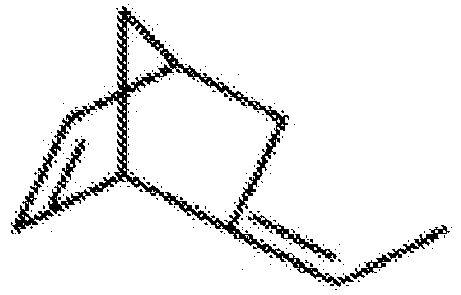
-
Formula: C9H12
-
- Molecular Weight: 120.19
- Synonyms for this molecule can include: ENB; Ethylidene Norbornene; 5-Ethylene-2-Norborene; Ethylidene-2-Norbornene; 5-Ethylidene Norbornene; 5-Ethylidene-2-Norbornen; 5-Ethylidenenorborn-2-ene; 5-ethylidene-5-norbornene; Ethylidene Norbornene (ENB).
- Boiling Point: 146 degrees Celsius at 760mmHg
- Flash Point: 38.3 degrees Celsius
- In this process, a 5-vinyl-2-norbornene (VNB) can be used which is known by the structure:

-
Formula: C9H12
-
- Molecular Weight: 120.21
- Synonyms for this molecule can include: 2-Norbornene,5-vinyl-(6CI,7CI,8CI); 2-Vinyl-5-norbornene;2-Vinylbicyclo[2.2.1]hept-5-ene;2-Vinylnorbornene; 5-Ethenylbicyclo[2.2.1]hept-2-ene; 5-Vinyl-2-norbornene;5-Vinylbicyclo[2.2.1]hept-2-ene; 5-Vinylnorbornene; NSC 61529; V 0062; VBH; Vinylnorbornene
- Boiling Point: 141 degrees Celsius at 760mmHg
- Flash Point: 28 degrees Celsius
- VNB is a non-conjugated polyene with which it is known to be difficult to create copolymers due to its propensity to branch uncontrollably, create gels during polymerization, and foul a reactor. The current process allows for relatively large concentrations of VNB in tetrapolymers, and uniquely allows for terpolymers with a VNB component to be created.
- The general process is described as follows:
- A saturated hydrocarbon solvent is utilized as a reaction medium and carrier stream for all monomers used in the process. The saturated hydrocarbon is introduced to the reactor at a flow rate adequate to sustain a residence time of 30 minutes to 60 minutes in the reactor. Prior to entering the reactor, the saturated hydrocarbon stream is passed through a chiller to reduce its temperature below 35 degrees Celsius.
- In the examples shown below, hexane is used as the hydrocarbon solvent due to its ready availability and ease of removal from the final product. However, many other hydrocarbon solvents can be utilized, such as butane, pentane, heptane, octane, and combinations thereof.
- A pure ethylene monomer is introduced to the saturated hydrocarbon solvent at a flow rate to achieve the desired ethylene weight content in a final product. The ethylene content in the final product can range from 55 percent to 60 percent by weight.
- A pure propylene monomer is introduced to the saturated hydrocarbon solvent at a flow rate to achieve the desired propylene weight content in a final product. The propylene content in the final product can range from 33 percent to 37 percent by weight.
- The example shown below utilizes a norbornene derivative as the diene. However, similar results are to be expected with other dienes with similar chemical characteristics.
- Utilizing ethylene, propylene and a diene results in an ethylene propylene diene monomer (EPDM) in the example below. EPDM is a well-known product class with desirable properties.
- Hydrogen is introduced to the saturated hydrocarbon solvent at a flow rate adequate to achieve a desired molecular weight in the final product.
- The dienes are introduced to the saturated hydrocarbon solvent/carrier a rate sufficient to achieve the desired weight percent in the final polymer.
- The dienes can be numerous compounds as known to persons ordinarily skilled in the art. In the current example, both 5-ethylidene-2-norbornene (ENB) and 5-Vinyl-2-norbornene (VNB) are used as dienes for preparing a final product.
- Some examples of other norbornene derivatives are: 5-methylene-2-norbornene, 5-(2-propenyl)-2-norbornene, 5-(3-butenyl)-2-norbornene, 5-(4-pentenyl)-2-norbornene, 5-(5-hexenyl)-2-norbornene, 5-(6-heptenyl)-2-norbornene, 5-(7-octenyl)-2-norbornene.
- The mixture of the saturated hydrocarbon solvent, propylene, hydrogen, and dienes is sent through a chiller to reduce its temperature below 35 degrees Celsius. As the polymerization reaction to follow is exothermic, this cooling step helps to maintain the desired temperature range within the reactor. Although the process as described is for solution polymerization, with some minor adjustments to catalyst, it can be adapted to gas, or slurry phase processes.
- A Ziegler-Natta catalyst, optionally a catalyst promoter, and co-catalyst, are introduced to the reactor concurrently with the cooled mixture of the saturated hydrocarbon solvent, alpha olefin, hydrogen, and dienes.
- The Ziegler-Natta catalyst comprises a transition metal, or transition metal compound. Some examples of transition metals (or compounds thereof) for the current invention are Vanadium, Titanium, and Zirconium. However, other transition metals can be substituted by persons ordinarily skilled in the art.
- The Ziegler-Natta catalyst is introduced at a flow rate sufficient to sustain a continuous reaction. The example below serves to illustrate this.
- The co-catalyst comprises a metal alkyl which further comprises a halogen element. The co-catalysts utilized can be Diethylaluminum chloride, Ethylaluminum sesquichloride, or Ethylaluminum dichloride.
- However, many other compounds can be substituted by persons ordinarily skilled in the art.
- The co-catalyst is introduced at a flow rate sufficient to sustain a continuous reaction. The example below serves to illustrate this.
- The promoter comprises an oxidizing agent capable of oxidizing the transition metal and generating at least one halogen free radical per mole of promoter used. An example of a promoter is a chlorinated ester, such as Butyl-2methyl, 4,4,4-trichlorobut-2-enoate. However, many other organic compounds that generate halogen free radicals can be substituted by persons ordinarily skilled in the art.
- The promoter is introduced either separately, or in solution with the Ziegler-Natta catalyst at a flow rate sufficient to sustain a continuous reaction. The example below serves to illustrate this.
- The flow rate of all the above components is adjusted to allow for a residence time from 30 minutes to 60 minutes in the reactor at a temperature from 35 degrees Celsius to 65 degrees Celsius, and at a pressure of 190 pounds per square inch gauge (psig) to 230 pounds per square inch gauge (psig).
- A final product is formed as a resultant tetrapolymer. The final product has a medium breadth molecular weight distribution, and a broad range of desirable characteristics that can be customized to the desired application.
- This process allows for medium breadth molecular weight distribution (MWD) products, which translates to higher green strengths, improved mill handling, extremely smooth extrusion surfaces due to the relationship between viscosity and shear rate, and optimum qualities for injection molding.
- At the same time, this process allows for high diene content in the final product, which translates to faster cure rates, and excellent compression set characteristics for sealing applications. Specifically, this product allows for a large VNB concentration.
- This process allows for these products to be created without fouling of the reactor due to gelling, or uncontrolled branching, while utilizing only one reactor and high quantities of dienes. Specifically, high quantities of VNB can be utilized without fouling of the reactor.
- The combination of medium breadth molecular weight distribution, low tangent delta, and high diene content is known in the art to be difficult to accomplish in a single reactor system without fouling of the reactor.
- An embodiment of the product claimed is described below:
- In this example a tetrapolymer having high molecular weight (Mw), medium breadth molecular weight distribution (MWD), high degree of branching and high diene content is produced. The reactor is charged with hexane at a flow rate of 107 grams per minute at temperature of 45 degrees Celsius, and a reactor pressure of 200 psig.
- Next, pure propylene monomer is introduced to the hexane stream at a flow rate of 19 grams per minute.
- As the next step, a hydrogen in nitrogen mix with 10 percent hydrogen by weight is introduced to the hexane stream at a flow rate of 5.8 standard liters per hour.
- Next, an ethylidene norbornene (ENB) monomer solution (in hexane) is introduced to the hexane stream with at a flow rate of 76 grams of solution per hour.
- As the next step, a 5-vinyl-2-norbornene monomer solution (in hexane) is introduced to the hexane stream at a flow rate of 98 grams per hour.
- Next, a chlorinated aluminum alkyl co-catalyst solution (ethyl aluminum sesquichloride in hexane) is fed directly to the reactor by separate stream at a rate of 78 grams of solution per hour.
- Subsequently, a Ziegler-Natta catalyst solution (vanadium oxytrichloride in hexane) and a promoter solution (in hexane) are introduced to the reactor by separate stream at flow rates of 72 grams per hour each.
- The Ziegler-Natta catalyst and promoter are premixed in hexane to yield a solution that is fed directly to the reactor as a single stream.
- In the next step, a polymer grade ethylene monomer is incrementally introduced to the hexane stream to reach a maximum flow rate of 6.6 grams per minute.
- When all reagents have been added to the reactor, the polymerization reaction is allowed to proceed with a residence time of approximately 30 minutes at a temperature of 45 degrees Celsius, and a reactor pressure of 200 psig, resulting in a tetrapolymer.
- The tetrapolymer as formed has a weight average molecular weight of 476,500, a medium breadth molecular weight distribution (MWD) of 3.16, a Mooney viscosity (ML 1+4@ 125 degrees Celsius) of 82 Mooney Units (MU), and a very low Tangent Delta value of 0.692, indicative of a high level of branching.
- The tetrapolymer has an ethylene:propylene ratio of 62:38, a VNB weight percent of 0.33 weight percent and ENB content of 7.3 weight percent.
- While these embodiments have been described with emphasis on the embodiments, it should be understood that within the scope of the appended claims, the embodiments might be practiced other than as specifically described herein.
Claims (16)
- A process for continuously making tetrapolymers, comprising ethylene monomers, propylene monomers, and diene monomers, comprising:a. introducing a saturated hydrocarbon stream;b. introducing a propylene monomer to the saturated hydrocarbon stream at a rate sufficient to achieve propylene content in a final product of 32 percent to 36 percent of total weight;c. introducing hydrogen gas to the saturated hydrocarbon stream at a rate sufficient to control the molecular weight of the final product;d. introducing a first diene to the saturated hydrocarbon stream at a rate sufficient to achieve desired first diene content in the final product;e. introducing a second diene to the saturated hydrocarbon stream at a rate sufficient to achieve desired second diene content in the final product;f. introducing an ethylene to the saturated hydrocarbon stream at a rate sufficient to initiate the polymerization reaction and achieve ethylene content in a final product of 53 percent to 59 percent of total weight;g. cooling the saturated hydrocarbon stream, the propylene monomer, hydrogen gas, the first diene, the second diene, and the ethylene to below 35 degrees Celsius to create a cooled mixture;h. concurrently introducing a Ziegler-Natta catalyst, a co-catalyst, and optionally a promoter into a continuous flow reactor, wherein:(i) the Ziegler-Natta catalyst comprises a transition metal or a transition metal compound;(ii) the co-catalyst comprises a metal alkyl comprising a halogen element; and(iii) the promoter if used comprises an oxidizing agent capable of oxidizing the transition metal, and the oxidizing agent is capable of generating at least one halogen free-radical per mole of the promoter;i. reacting the cooled mixture, the Ziegler-Natta catalyst, the co-catalyst, the promoter, the first diene, and the second diene in solution phase for 30 minutes to 60 minutes, at a temperature from 35 degrees Celsius to 65 degrees Celsius, and a pressure from 190 psig to 230 psig; andj. forming a resultant tetrapolymer as the final product.
- The process of claim 1, wherein the Ziegler-Natta catalyst and the promoter are premixed before introduction to the continuous flow reactor.
- The process of claim 1 wherein the molar ratio of the co-catalyst to the sum of the catalyst and the promoter is from 1 to 50.
- The process of claim 1, wherein the saturated hydrocarbon stream is hexane.
- The process of claim 1, wherein the first diene and the second diene are both norbornene derivatives.
- The process of claim 1, wherein the Ziegler-Natta catalyst is a vanadium oxitrichloride or a vanadium vanadate.
- The process of claim 1, wherein the co-catalyst is Diethylaluminum chloride, Ethylaluminum sesquichloride, or Ethylaluminum dichloride
- The process of claim 1, wherein the oxidizing agent is an ester comprising a halogen element.
- The process of claim 1, wherein the oxidizing agent is Butyl-2methyl, 4,4,4-trichlorobut-2-enoate.
- The process of claim 1, wherein reacting the cooled mixture, the Ziegler-Natta catalyst, the co-catalyst, the promoter, the first diene, and the second diene occurs in a slurry phase.
- The process of claim 1, wherein reacting the cooled mixture, the Ziegler-Natta catalyst, the co-catalyst, the promoter, the first diene, and the second diene occurs in a gas phase.
- A tetrapolymer made by the process of claim 1, wherein the tetrapolymer has the following characteristics:a. a moderate degree of long chain branching as characterized by the average number of branches per polymer chain, wherein branches are from .02 to .07 branches per 1000 carbons;b. a non-linear relationship between viscosity and shear as characterized by a tangent delta from .55 to .73;c. a weight average molecular weight of 550,000 to 635,000;d. a Mooney viscosity ranging from (ML 1+4@ 125 degrees Celsius) 170 to (ML 1+4@ 125 degrees Celsius) 215;e. an ethylene to propylene ratio ranging from 60:40 to 64:36;f. a combined weight content of ethylene and propylene of 90 percent to 91 percent based upon the total weight of the resultant tetrapolymer;g. a first diene content of 9 percent to 10 percent by weight content based upon the total weight of the resultant tetrapolymer; andh. a second diene content of .20 percent to .40 percent by weight content based upon the total weight of the resultant tetrapolymer.
- A tetrapolymer having the following characteristics:a. a moderate degree of long chain branching as characterized by the average number of branches per polymer chain, wherein branches are from .02 to .07 branches per 1000 carbons;b. a non-linear relationship between viscosity and shear as characterized by a tangent delta from .55 to .73;c. a weight average molecular weight of 550,000 to 635,000;d. a Mooney viscosity ranging from (ML 1+4@ 125 degrees Celsius) 170 to (ML 1+4@ 125 degrees Celsius) 215;e. an ethylene to propylene ratio ranging from 60:40 to 64:36;f. a combined weight content of ethylene and propylene of 90 percent to 91 percent based upon the total weight of the resultant tetrapolymer;g. a first diene content of 9 percent to 10 percent by weight content based upon the total weight of the resultant tetrapolymer; andh. a second diene content of .20 percent to .40 percent by weight content based upon the total weight of the resultant tetrapolymer.
- A compound comprising the tetrapolymer of claim 13, for the purposes of:a. extrusion;b. molding;c. calandering; andd. combinations thereof.
- A thermoplastic vulcanizate comprising the tetrapolymer of claim 13.
- The tetrapolymer of claim 13, further comprising an extender oil.
Applications Claiming Priority (3)
| Application Number | Priority Date | Filing Date | Title |
|---|---|---|---|
| US201261711596P | 2012-10-09 | 2012-10-09 | |
| US14/049,075 US8901238B2 (en) | 2012-10-09 | 2013-10-08 | Sponge polymer with controlled long chain branching and broad molecular weight distribution |
| PCT/US2013/064134 WO2014059019A2 (en) | 2012-10-09 | 2013-10-09 | Sponge polymer with controlled long chain branching and broad molecular weight distribution |
Publications (3)
| Publication Number | Publication Date |
|---|---|
| EP2906605A2 EP2906605A2 (en) | 2015-08-19 |
| EP2906605A4 EP2906605A4 (en) | 2016-07-20 |
| EP2906605B1 true EP2906605B1 (en) | 2018-03-28 |
Family
ID=50433191
Family Applications (1)
| Application Number | Title | Priority Date | Filing Date |
|---|---|---|---|
| EP13846036.5A Active EP2906605B1 (en) | 2012-10-09 | 2013-10-09 | Sponge polymer with controlled long chain branching and broad molecular weight distribution |
Country Status (7)
| Country | Link |
|---|---|
| US (2) | US8901236B2 (en) |
| EP (1) | EP2906605B1 (en) |
| JP (1) | JP2016500723A (en) |
| CN (1) | CN105189578B (en) |
| BR (1) | BR112015007975B1 (en) |
| SA (1) | SA515360262B1 (en) |
| WO (2) | WO2014059017A1 (en) |
Families Citing this family (12)
| Publication number | Priority date | Publication date | Assignee | Title |
|---|---|---|---|---|
| US9139726B2 (en) | 2012-10-09 | 2015-09-22 | Lion Copolymer Geismar, Llc | Process for making an ethylene elastomer with long chain branching for use in anti-vibration applications |
| US9139727B2 (en) | 2012-10-09 | 2015-09-22 | Lion Copolymer Geismar, Llc | Low damping high strength polymer with long chain branching for use in anti-vibration applications |
| US8901236B2 (en) * | 2012-10-09 | 2014-12-02 | Lion Copolymer Geismar, Llc | Process for creating an ethylene elastomer |
| EP3026070A1 (en) * | 2014-11-26 | 2016-06-01 | Lion Copolymer Geismar, LLC | Process for making an ethylene elastomer with long chain branching for use in anti-vibration applications |
| EP3026080A1 (en) * | 2014-11-26 | 2016-06-01 | Lion Copolymer Geismar, LLC | Low damping high strength polymer with long chain branching for use in anti-vibration applications |
| US10800865B2 (en) | 2015-09-14 | 2020-10-13 | Exxonmobil Chemical Patents Inc. | Process for making branched EPDM and the EPDM therefrom |
| CN109153832B (en) * | 2016-05-20 | 2021-03-02 | 阿朗新科荷兰有限公司 | rubber composition |
| US9574033B1 (en) * | 2016-08-12 | 2017-02-21 | Lion Copolymer Geismar, Llc | Process for continuously making high molecular weight tetrapolymer for use in anti-vibration applications |
| US9574034B1 (en) * | 2016-08-12 | 2017-02-21 | Lion Copolymer Geismar, Llc | Process for making high molecular weight tetrapolymer and articles produced therefrom |
| US9574035B1 (en) * | 2016-08-12 | 2017-02-21 | Lion Copolymer Geismar, Llc | Process for making high molecular weight tetrapolymer and articles produced therefrom |
| US10550252B2 (en) * | 2017-04-20 | 2020-02-04 | Chevron Phillips Chemical Company Lp | Bimodal PE resins with improved melt strength |
| US11041034B2 (en) | 2018-02-09 | 2021-06-22 | Exxonmobil Chemical Patents Inc. | Ethylene-a-olefin-diene elastomers and methods of making them |
Family Cites Families (18)
| Publication number | Priority date | Publication date | Assignee | Title |
|---|---|---|---|---|
| DE1595670A1 (en) * | 1966-08-23 | 1970-04-30 | Hoechst Ag | Production of copolymers from ethylene, propylene and 5-AEthylidene-2-norbornene that can be vulcanized with sulfur into elastomers that are resistant to heat and fatigue cracking |
| NL137057C (en) * | 1968-02-16 | |||
| US3748316A (en) * | 1969-06-02 | 1973-07-24 | Du Pont | Functionally substituted terpolymers and tetrapolymers of alpha-olefins and process for manufacturing functional substituted copolymers |
| US3856765A (en) | 1969-06-02 | 1974-12-24 | J Collette | Functionally substituted terpolymers of alpha-olefins |
| US3903062A (en) | 1973-08-08 | 1975-09-02 | Snam Progetti | Olefin tetrapolymer and process for the preparation thereof |
| US4156767A (en) * | 1977-05-16 | 1979-05-29 | Copolymer Rubber & Chemical Corporation | Ethylene, C3-16 monoolefin polymer containing 0.02%-0.6% by weight vinyl norbornene bound in the polymer having improved cold flow |
| JPS58191705A (en) * | 1982-05-06 | 1983-11-09 | Mitsui Petrochem Ind Ltd | Ethylene copolymerized rubber |
| JPH0689072B2 (en) * | 1986-06-30 | 1994-11-09 | 三井石油化学工業株式会社 | Ethylene copolymer rubber |
| US5473017A (en) | 1993-09-30 | 1995-12-05 | Exxon Chemical Patents Inc. | Intervulcanized elastomer blends |
| US6300451B1 (en) | 1994-10-24 | 2001-10-09 | Exxon Chemical Patents Inc. | Long-chain branched polymers and their production |
| US5786504A (en) | 1996-05-15 | 1998-07-28 | Uniroyal Chemical Company, Inc. | Polymerization catalyst promoter |
| AU1241600A (en) * | 1998-11-02 | 2000-05-22 | Dupont Dow Elastomers L.L.C. | Shear thinning ethylene/alpha-olefin interpolymers and their preparation |
| US6680361B1 (en) | 1998-11-02 | 2004-01-20 | Dupont Dow Elastomers Llc | Shear thinning ethylene/α-olefin interpolymers and their preparation |
| CA2292387A1 (en) * | 1999-12-17 | 2001-06-17 | Bayer Inc. | Process for producing olefin polymer with long chain branching |
| JP2005154618A (en) * | 2003-11-27 | 2005-06-16 | Sumitomo Chemical Co Ltd | Process for producing ethylene-α-olefin copolymer |
| US7622179B2 (en) * | 2004-03-17 | 2009-11-24 | Dow Global Technologies Inc. | Three dimensional random looped structures made from interpolymers of ethylene/α-olefins and uses thereof |
| EP1957548B1 (en) * | 2005-12-06 | 2013-08-07 | ExxonMobil Chemical Patents Inc. | Ethylene elastomer compositions |
| US8901236B2 (en) * | 2012-10-09 | 2014-12-02 | Lion Copolymer Geismar, Llc | Process for creating an ethylene elastomer |
-
2013
- 2013-10-08 US US14/049,037 patent/US8901236B2/en active Active
- 2013-10-08 US US14/049,075 patent/US8901238B2/en active Active
- 2013-10-09 WO PCT/US2013/064129 patent/WO2014059017A1/en not_active Ceased
- 2013-10-09 JP JP2015536864A patent/JP2016500723A/en active Pending
- 2013-10-09 BR BR112015007975-0A patent/BR112015007975B1/en not_active IP Right Cessation
- 2013-10-09 WO PCT/US2013/064134 patent/WO2014059019A2/en not_active Ceased
- 2013-10-09 EP EP13846036.5A patent/EP2906605B1/en active Active
- 2013-10-09 CN CN201380063811.XA patent/CN105189578B/en active Active
-
2015
- 2015-04-09 SA SA515360262A patent/SA515360262B1/en unknown
Non-Patent Citations (1)
| Title |
|---|
| None * |
Also Published As
| Publication number | Publication date |
|---|---|
| WO2014059017A1 (en) | 2014-04-17 |
| US20140100326A1 (en) | 2014-04-10 |
| US8901238B2 (en) | 2014-12-02 |
| BR112015007975B1 (en) | 2021-07-27 |
| BR112015007975A2 (en) | 2017-08-08 |
| WO2014059019A3 (en) | 2015-07-30 |
| US20140100325A1 (en) | 2014-04-10 |
| EP2906605A4 (en) | 2016-07-20 |
| WO2014059019A2 (en) | 2014-04-17 |
| CN105189578B (en) | 2018-07-31 |
| US8901236B2 (en) | 2014-12-02 |
| JP2016500723A (en) | 2016-01-14 |
| EP2906605A2 (en) | 2015-08-19 |
| SA515360262B1 (en) | 2016-01-07 |
| CN105189578A (en) | 2015-12-23 |
Similar Documents
| Publication | Publication Date | Title |
|---|---|---|
| US8901238B2 (en) | Sponge polymer with controlled long chain branching and broad molecular weight distribution | |
| US9139726B2 (en) | Process for making an ethylene elastomer with long chain branching for use in anti-vibration applications | |
| KR101397337B1 (en) | High Efficiency Solution Polymerization Process | |
| Kukhta et al. | Room temperature cationic polymerization of β-pinene using modified AlCl 3 catalyst: toward sustainable plastics from renewable biomass resources | |
| US6384162B1 (en) | Process for production of olefin polymer with long chain branching | |
| KR20170097696A (en) | Process for producing polymer compositions | |
| EA002450B1 (en) | Elastomeric copolymer and process for the preparation thereof | |
| KR102848495B1 (en) | catalyst mixture | |
| US9139727B2 (en) | Low damping high strength polymer with long chain branching for use in anti-vibration applications | |
| EP3026080A1 (en) | Low damping high strength polymer with long chain branching for use in anti-vibration applications | |
| US9574033B1 (en) | Process for continuously making high molecular weight tetrapolymer for use in anti-vibration applications | |
| EP3026070A1 (en) | Process for making an ethylene elastomer with long chain branching for use in anti-vibration applications | |
| EP1902079B1 (en) | Process for narrowing short-chain branching distribution in two-step ethylene polymerizations and products | |
| EP4330297B1 (en) | Metal complex catalyst for the polymerization of olefins | |
| US20260098139A1 (en) | Foamable branched polypropylene compositions and foamed products produced therefrom | |
| US20240247020A1 (en) | Metal complexes with sulfilimine-type ligands and their use as polymerization | |
| US9574035B1 (en) | Process for making high molecular weight tetrapolymer and articles produced therefrom | |
| CN119137166A (en) | Method for producing polymers | |
| US20230331884A1 (en) | Ethylene-copolymers and catalyst mixture for making ethylene copolymers | |
| JPH0456042B2 (en) | ||
| JP2005264055A (en) | Method for producing trans-1,4-polybutadiene | |
| JPS6245244B2 (en) |
Legal Events
| Date | Code | Title | Description |
|---|---|---|---|
| PUAI | Public reference made under article 153(3) epc to a published international application that has entered the european phase |
Free format text: ORIGINAL CODE: 0009012 |
|
| 17P | Request for examination filed |
Effective date: 20150417 |
|
| AK | Designated contracting states |
Kind code of ref document: A2 Designated state(s): AL AT BE BG CH CY CZ DE DK EE ES FI FR GB GR HR HU IE IS IT LI LT LU LV MC MK MT NL NO PL PT RO RS SE SI SK SM TR |
|
| AX | Request for extension of the european patent |
Extension state: BA ME |
|
| R17D | Deferred search report published (corrected) |
Effective date: 20150730 |
|
| DAX | Request for extension of the european patent (deleted) | ||
| A4 | Supplementary search report drawn up and despatched |
Effective date: 20160621 |
|
| RIC1 | Information provided on ipc code assigned before grant |
Ipc: C08F 210/06 20060101AFI20160615BHEP Ipc: C08L 23/14 20060101ALI20160615BHEP |
|
| GRAP | Despatch of communication of intention to grant a patent |
Free format text: ORIGINAL CODE: EPIDOSNIGR1 |
|
| INTG | Intention to grant announced |
Effective date: 20170714 |
|
| GRAS | Grant fee paid |
Free format text: ORIGINAL CODE: EPIDOSNIGR3 |
|
| GRAA | (expected) grant |
Free format text: ORIGINAL CODE: 0009210 |
|
| AK | Designated contracting states |
Kind code of ref document: B1 Designated state(s): AL AT BE BG CH CY CZ DE DK EE ES FI FR GB GR HR HU IE IS IT LI LT LU LV MC MK MT NL NO PL PT RO RS SE SI SK SM TR |
|
| RAP1 | Party data changed (applicant data changed or rights of an application transferred) |
Owner name: LION COPOLYMER GEISMAR, LLC |
|
| REG | Reference to a national code |
Ref country code: GB Ref legal event code: FG4D |
|
| REG | Reference to a national code |
Ref country code: CH Ref legal event code: EP |
|
| REG | Reference to a national code |
Ref country code: AT Ref legal event code: REF Ref document number: 983355 Country of ref document: AT Kind code of ref document: T Effective date: 20180415 |
|
| REG | Reference to a national code |
Ref country code: IE Ref legal event code: FG4D |
|
| REG | Reference to a national code |
Ref country code: DE Ref legal event code: R096 Ref document number: 602013035215 Country of ref document: DE |
|
| PG25 | Lapsed in a contracting state [announced via postgrant information from national office to epo] |
Ref country code: HR Free format text: LAPSE BECAUSE OF FAILURE TO SUBMIT A TRANSLATION OF THE DESCRIPTION OR TO PAY THE FEE WITHIN THE PRESCRIBED TIME-LIMIT Effective date: 20180328 Ref country code: LT Free format text: LAPSE BECAUSE OF FAILURE TO SUBMIT A TRANSLATION OF THE DESCRIPTION OR TO PAY THE FEE WITHIN THE PRESCRIBED TIME-LIMIT Effective date: 20180328 Ref country code: FI Free format text: LAPSE BECAUSE OF FAILURE TO SUBMIT A TRANSLATION OF THE DESCRIPTION OR TO PAY THE FEE WITHIN THE PRESCRIBED TIME-LIMIT Effective date: 20180328 Ref country code: NO Free format text: LAPSE BECAUSE OF FAILURE TO SUBMIT A TRANSLATION OF THE DESCRIPTION OR TO PAY THE FEE WITHIN THE PRESCRIBED TIME-LIMIT Effective date: 20180628 |
|
| REG | Reference to a national code |
Ref country code: NL Ref legal event code: MP Effective date: 20180328 |
|
| REG | Reference to a national code |
Ref country code: LT Ref legal event code: MG4D |
|
| PG25 | Lapsed in a contracting state [announced via postgrant information from national office to epo] |
Ref country code: SE Free format text: LAPSE BECAUSE OF FAILURE TO SUBMIT A TRANSLATION OF THE DESCRIPTION OR TO PAY THE FEE WITHIN THE PRESCRIBED TIME-LIMIT Effective date: 20180328 Ref country code: LV Free format text: LAPSE BECAUSE OF FAILURE TO SUBMIT A TRANSLATION OF THE DESCRIPTION OR TO PAY THE FEE WITHIN THE PRESCRIBED TIME-LIMIT Effective date: 20180328 Ref country code: RS Free format text: LAPSE BECAUSE OF FAILURE TO SUBMIT A TRANSLATION OF THE DESCRIPTION OR TO PAY THE FEE WITHIN THE PRESCRIBED TIME-LIMIT Effective date: 20180328 Ref country code: BG Free format text: LAPSE BECAUSE OF FAILURE TO SUBMIT A TRANSLATION OF THE DESCRIPTION OR TO PAY THE FEE WITHIN THE PRESCRIBED TIME-LIMIT Effective date: 20180628 Ref country code: GR Free format text: LAPSE BECAUSE OF FAILURE TO SUBMIT A TRANSLATION OF THE DESCRIPTION OR TO PAY THE FEE WITHIN THE PRESCRIBED TIME-LIMIT Effective date: 20180629 |
|
| PG25 | Lapsed in a contracting state [announced via postgrant information from national office to epo] |
Ref country code: AL Free format text: LAPSE BECAUSE OF FAILURE TO SUBMIT A TRANSLATION OF THE DESCRIPTION OR TO PAY THE FEE WITHIN THE PRESCRIBED TIME-LIMIT Effective date: 20180328 Ref country code: ES Free format text: LAPSE BECAUSE OF FAILURE TO SUBMIT A TRANSLATION OF THE DESCRIPTION OR TO PAY THE FEE WITHIN THE PRESCRIBED TIME-LIMIT Effective date: 20180328 Ref country code: NL Free format text: LAPSE BECAUSE OF FAILURE TO SUBMIT A TRANSLATION OF THE DESCRIPTION OR TO PAY THE FEE WITHIN THE PRESCRIBED TIME-LIMIT Effective date: 20180328 Ref country code: PL Free format text: LAPSE BECAUSE OF FAILURE TO SUBMIT A TRANSLATION OF THE DESCRIPTION OR TO PAY THE FEE WITHIN THE PRESCRIBED TIME-LIMIT Effective date: 20180328 Ref country code: RO Free format text: LAPSE BECAUSE OF FAILURE TO SUBMIT A TRANSLATION OF THE DESCRIPTION OR TO PAY THE FEE WITHIN THE PRESCRIBED TIME-LIMIT Effective date: 20180328 Ref country code: EE Free format text: LAPSE BECAUSE OF FAILURE TO SUBMIT A TRANSLATION OF THE DESCRIPTION OR TO PAY THE FEE WITHIN THE PRESCRIBED TIME-LIMIT Effective date: 20180328 |
|
| PG25 | Lapsed in a contracting state [announced via postgrant information from national office to epo] |
Ref country code: SK Free format text: LAPSE BECAUSE OF FAILURE TO SUBMIT A TRANSLATION OF THE DESCRIPTION OR TO PAY THE FEE WITHIN THE PRESCRIBED TIME-LIMIT Effective date: 20180328 Ref country code: CZ Free format text: LAPSE BECAUSE OF FAILURE TO SUBMIT A TRANSLATION OF THE DESCRIPTION OR TO PAY THE FEE WITHIN THE PRESCRIBED TIME-LIMIT Effective date: 20180328 Ref country code: SM Free format text: LAPSE BECAUSE OF FAILURE TO SUBMIT A TRANSLATION OF THE DESCRIPTION OR TO PAY THE FEE WITHIN THE PRESCRIBED TIME-LIMIT Effective date: 20180328 |
|
| REG | Reference to a national code |
Ref country code: AT Ref legal event code: MK05 Ref document number: 983355 Country of ref document: AT Kind code of ref document: T Effective date: 20180328 |
|
| PG25 | Lapsed in a contracting state [announced via postgrant information from national office to epo] |
Ref country code: PT Free format text: LAPSE BECAUSE OF FAILURE TO SUBMIT A TRANSLATION OF THE DESCRIPTION OR TO PAY THE FEE WITHIN THE PRESCRIBED TIME-LIMIT Effective date: 20180730 |
|
| REG | Reference to a national code |
Ref country code: DE Ref legal event code: R097 Ref document number: 602013035215 Country of ref document: DE |
|
| PG25 | Lapsed in a contracting state [announced via postgrant information from national office to epo] |
Ref country code: DK Free format text: LAPSE BECAUSE OF FAILURE TO SUBMIT A TRANSLATION OF THE DESCRIPTION OR TO PAY THE FEE WITHIN THE PRESCRIBED TIME-LIMIT Effective date: 20180328 Ref country code: AT Free format text: LAPSE BECAUSE OF FAILURE TO SUBMIT A TRANSLATION OF THE DESCRIPTION OR TO PAY THE FEE WITHIN THE PRESCRIBED TIME-LIMIT Effective date: 20180328 |
|
| PLBE | No opposition filed within time limit |
Free format text: ORIGINAL CODE: 0009261 |
|
| STAA | Information on the status of an ep patent application or granted ep patent |
Free format text: STATUS: NO OPPOSITION FILED WITHIN TIME LIMIT |
|
| 26N | No opposition filed |
Effective date: 20190103 |
|
| PG25 | Lapsed in a contracting state [announced via postgrant information from national office to epo] |
Ref country code: SI Free format text: LAPSE BECAUSE OF FAILURE TO SUBMIT A TRANSLATION OF THE DESCRIPTION OR TO PAY THE FEE WITHIN THE PRESCRIBED TIME-LIMIT Effective date: 20180328 |
|
| REG | Reference to a national code |
Ref country code: CH Ref legal event code: PL |
|
| PG25 | Lapsed in a contracting state [announced via postgrant information from national office to epo] |
Ref country code: MC Free format text: LAPSE BECAUSE OF FAILURE TO SUBMIT A TRANSLATION OF THE DESCRIPTION OR TO PAY THE FEE WITHIN THE PRESCRIBED TIME-LIMIT Effective date: 20180328 Ref country code: LU Free format text: LAPSE BECAUSE OF NON-PAYMENT OF DUE FEES Effective date: 20181009 |
|
| REG | Reference to a national code |
Ref country code: IE Ref legal event code: MM4A |
|
| PG25 | Lapsed in a contracting state [announced via postgrant information from national office to epo] |
Ref country code: FR Free format text: LAPSE BECAUSE OF NON-PAYMENT OF DUE FEES Effective date: 20181031 Ref country code: LI Free format text: LAPSE BECAUSE OF NON-PAYMENT OF DUE FEES Effective date: 20181031 Ref country code: CH Free format text: LAPSE BECAUSE OF NON-PAYMENT OF DUE FEES Effective date: 20181031 |
|
| PG25 | Lapsed in a contracting state [announced via postgrant information from national office to epo] |
Ref country code: IE Free format text: LAPSE BECAUSE OF NON-PAYMENT OF DUE FEES Effective date: 20181009 |
|
| PG25 | Lapsed in a contracting state [announced via postgrant information from national office to epo] |
Ref country code: MT Free format text: LAPSE BECAUSE OF NON-PAYMENT OF DUE FEES Effective date: 20181009 |
|
| PG25 | Lapsed in a contracting state [announced via postgrant information from national office to epo] |
Ref country code: TR Free format text: LAPSE BECAUSE OF FAILURE TO SUBMIT A TRANSLATION OF THE DESCRIPTION OR TO PAY THE FEE WITHIN THE PRESCRIBED TIME-LIMIT Effective date: 20180328 |
|
| PG25 | Lapsed in a contracting state [announced via postgrant information from national office to epo] |
Ref country code: HU Free format text: LAPSE BECAUSE OF FAILURE TO SUBMIT A TRANSLATION OF THE DESCRIPTION OR TO PAY THE FEE WITHIN THE PRESCRIBED TIME-LIMIT; INVALID AB INITIO Effective date: 20131009 Ref country code: CY Free format text: LAPSE BECAUSE OF FAILURE TO SUBMIT A TRANSLATION OF THE DESCRIPTION OR TO PAY THE FEE WITHIN THE PRESCRIBED TIME-LIMIT Effective date: 20180328 Ref country code: MK Free format text: LAPSE BECAUSE OF NON-PAYMENT OF DUE FEES Effective date: 20180328 |
|
| PG25 | Lapsed in a contracting state [announced via postgrant information from national office to epo] |
Ref country code: IS Free format text: LAPSE BECAUSE OF FAILURE TO SUBMIT A TRANSLATION OF THE DESCRIPTION OR TO PAY THE FEE WITHIN THE PRESCRIBED TIME-LIMIT Effective date: 20180728 |
|
| PGFP | Annual fee paid to national office [announced via postgrant information from national office to epo] |
Ref country code: GB Payment date: 20210901 Year of fee payment: 9 |
|
| GBPC | Gb: european patent ceased through non-payment of renewal fee |
Effective date: 20221009 |
|
| PG25 | Lapsed in a contracting state [announced via postgrant information from national office to epo] |
Ref country code: GB Free format text: LAPSE BECAUSE OF NON-PAYMENT OF DUE FEES Effective date: 20221009 |
|
| PGFP | Annual fee paid to national office [announced via postgrant information from national office to epo] |
Ref country code: IT Payment date: 20230913 Year of fee payment: 11 |
|
| PGFP | Annual fee paid to national office [announced via postgrant information from national office to epo] |
Ref country code: BE Payment date: 20230918 Year of fee payment: 11 |
|
| PGFP | Annual fee paid to national office [announced via postgrant information from national office to epo] |
Ref country code: DE Payment date: 20241021 Year of fee payment: 12 |
|
| PG25 | Lapsed in a contracting state [announced via postgrant information from national office to epo] |
Ref country code: BE Free format text: LAPSE BECAUSE OF NON-PAYMENT OF DUE FEES Effective date: 20241031 |
|
| REG | Reference to a national code |
Ref country code: BE Ref legal event code: MM Effective date: 20241031 |
|
| PG25 | Lapsed in a contracting state [announced via postgrant information from national office to epo] |
Ref country code: IT Free format text: LAPSE BECAUSE OF NON-PAYMENT OF DUE FEES Effective date: 20241009 |