EP2906558B1 - Sodium channel blockers, preparation method thereof and use thereof - Google Patents
Sodium channel blockers, preparation method thereof and use thereof Download PDFInfo
- Publication number
- EP2906558B1 EP2906558B1 EP13846541.4A EP13846541A EP2906558B1 EP 2906558 B1 EP2906558 B1 EP 2906558B1 EP 13846541 A EP13846541 A EP 13846541A EP 2906558 B1 EP2906558 B1 EP 2906558B1
- Authority
- EP
- European Patent Office
- Prior art keywords
- thiazol
- oxy
- benzenesulfonamide
- fluoro
- cyano
- Prior art date
- Legal status (The legal status is an assumption and is not a legal conclusion. Google has not performed a legal analysis and makes no representation as to the accuracy of the status listed.)
- Active
Links
- 0 CC1=CC(*)*C=C1S(N*)(O)=O Chemical compound CC1=CC(*)*C=C1S(N*)(O)=O 0.000 description 1
- FEGNXLMIWRWNBG-MNLZQUKPSA-O CN/C=C(\C=[NH2+])/c(cc1-c2c[n](C)nc2)ncc1Oc(ccc(S(Nc1ncc[s]1)(=O)=O)c1)c1C#N Chemical compound CN/C=C(\C=[NH2+])/c(cc1-c2c[n](C)nc2)ncc1Oc(ccc(S(Nc1ncc[s]1)(=O)=O)c1)c1C#N FEGNXLMIWRWNBG-MNLZQUKPSA-O 0.000 description 1
- PPKDSHNKNGRDNK-UHFFFAOYSA-O C[NH2+]C=C(C=N)c(cc1-c2c[o]cc2)ncc1Oc(ccc(S(NC1=N[I]=CS1)(=O)=O)c1)c1C#N Chemical compound C[NH2+]C=C(C=N)c(cc1-c2c[o]cc2)ncc1Oc(ccc(S(NC1=N[I]=CS1)(=O)=O)c1)c1C#N PPKDSHNKNGRDNK-UHFFFAOYSA-O 0.000 description 1
- BUTREPRGQFNIDE-UHFFFAOYSA-N C[n]1ncc(-c2nc(-c3ccnc(F)c3)ccc2Oc(c(C#N)c2)ccc2S(Nc2ncc[s]2)(=O)=O)c1 Chemical compound C[n]1ncc(-c2nc(-c3ccnc(F)c3)ccc2Oc(c(C#N)c2)ccc2S(Nc2ncc[s]2)(=O)=O)c1 BUTREPRGQFNIDE-UHFFFAOYSA-N 0.000 description 1
- SCWNWPMUVRHAJB-UHFFFAOYSA-N C[n]1nccc1-c1nc(-c2cc(F)ccc2)ccc1Oc(ccc(S(Nc1ncc[s]1)(=O)=O)c1)c1C#N Chemical compound C[n]1nccc1-c1nc(-c2cc(F)ccc2)ccc1Oc(ccc(S(Nc1ncc[s]1)(=O)=O)c1)c1C#N SCWNWPMUVRHAJB-UHFFFAOYSA-N 0.000 description 1
- MVTILBZGFJXIHG-UHFFFAOYSA-N N#Cc(cc(cc1)S(Nc2ncc[s]2)(=O)=O)c1Oc(c(-c1c[o]cc1)c1)cnc1-c1c[o]cc1 Chemical compound N#Cc(cc(cc1)S(Nc2ncc[s]2)(=O)=O)c1Oc(c(-c1c[o]cc1)c1)cnc1-c1c[o]cc1 MVTILBZGFJXIHG-UHFFFAOYSA-N 0.000 description 1
- RRUMWMMSCJTWNS-UHFFFAOYSA-N N#Cc(cc(cc1)S(Nc2ncc[s]2)(=O)=O)c1Oc1ccc(-c(c(F)n2)ccc2F)nc1-c1c[o]cc1 Chemical compound N#Cc(cc(cc1)S(Nc2ncc[s]2)(=O)=O)c1Oc1ccc(-c(c(F)n2)ccc2F)nc1-c1c[o]cc1 RRUMWMMSCJTWNS-UHFFFAOYSA-N 0.000 description 1
- OIJYUZLDMWAIET-UHFFFAOYSA-N O=S(c(c(F)c1)cc(Cl)c1Oc(c(-c1c[o]cc1)c1)cnc1-c(c(F)n1)ccc1F)(Nc1c[s]cn1)=O Chemical compound O=S(c(c(F)c1)cc(Cl)c1Oc(c(-c1c[o]cc1)c1)cnc1-c(c(F)n1)ccc1F)(Nc1c[s]cn1)=O OIJYUZLDMWAIET-UHFFFAOYSA-N 0.000 description 1
- FMRQUKUETBRZBP-UHFFFAOYSA-N O=S(c(c(F)c1)cc(Cl)c1Oc(c(-c1cnccc1)c1)cnc1-c1cc(F)ncc1)(Nc1c[s]cn1)=O Chemical compound O=S(c(c(F)c1)cc(Cl)c1Oc(c(-c1cnccc1)c1)cnc1-c1cc(F)ncc1)(Nc1c[s]cn1)=O FMRQUKUETBRZBP-UHFFFAOYSA-N 0.000 description 1
- ZLUIQEJXBRZZGC-UHFFFAOYSA-N O=S(c(c(F)c1)cc(F)c1Oc(c(-c1cccnc1)c1)cnc1-c1cc(F)c(C(F)(F)F)cc1)(Nc1c[s]cn1)=O Chemical compound O=S(c(c(F)c1)cc(F)c1Oc(c(-c1cccnc1)c1)cnc1-c1cc(F)c(C(F)(F)F)cc1)(Nc1c[s]cn1)=O ZLUIQEJXBRZZGC-UHFFFAOYSA-N 0.000 description 1
- WWVSFHIRLCKSBT-UHFFFAOYSA-N O=S(c(cc(c(Oc(c(-c1c[nH]nc1)c1)cnc1-c1cccc(F)c1)c1)Cl)c1F)(Nc1c[s]cn1)=O Chemical compound O=S(c(cc(c(Oc(c(-c1c[nH]nc1)c1)cnc1-c1cccc(F)c1)c1)Cl)c1F)(Nc1c[s]cn1)=O WWVSFHIRLCKSBT-UHFFFAOYSA-N 0.000 description 1
- LQFJHQZZUDJORY-UHFFFAOYSA-N O=S(c(cc(c(Oc(c(-c1cncc(N2CCCC2)c1)c1)cnc1-c1cc(F)ccc1)c1)Cl)c1F)(Nc1c[s]cn1)=O Chemical compound O=S(c(cc(c(Oc(c(-c1cncc(N2CCCC2)c1)c1)cnc1-c1cc(F)ccc1)c1)Cl)c1F)(Nc1c[s]cn1)=O LQFJHQZZUDJORY-UHFFFAOYSA-N 0.000 description 1
- BINUEWGPGPXNGB-UHFFFAOYSA-N O=S(c(cc(c(Oc(c(-c1cnccc1)c1)cnc1-c1cccc(F)c1)c1)F)c1F)(Nc1c[s]cn1)=O Chemical compound O=S(c(cc(c(Oc(c(-c1cnccc1)c1)cnc1-c1cccc(F)c1)c1)F)c1F)(Nc1c[s]cn1)=O BINUEWGPGPXNGB-UHFFFAOYSA-N 0.000 description 1
- RZKBZYCLOKKAPK-UHFFFAOYSA-N OC(c(c(F)c1)ccc1S(Nc1ncc[s]1)(=O)=O)c1cccnc1-c1ccccc1 Chemical compound OC(c(c(F)c1)ccc1S(Nc1ncc[s]1)(=O)=O)c1cccnc1-c1ccccc1 RZKBZYCLOKKAPK-UHFFFAOYSA-N 0.000 description 1
- CYRGIFPADOZUSO-UHFFFAOYSA-N OC(c(cc1)ccc1S(Nc1ncc[s]1)(=O)=O)c(c(-c1cnccc1)c1)ccc1Cl Chemical compound OC(c(cc1)ccc1S(Nc1ncc[s]1)(=O)=O)c(c(-c1cnccc1)c1)ccc1Cl CYRGIFPADOZUSO-UHFFFAOYSA-N 0.000 description 1
Classifications
-
- C—CHEMISTRY; METALLURGY
- C07—ORGANIC CHEMISTRY
- C07D—HETEROCYCLIC COMPOUNDS
- C07D417/00—Heterocyclic compounds containing two or more hetero rings, at least one ring having nitrogen and sulfur atoms as the only ring hetero atoms, not provided for by group C07D415/00
- C07D417/14—Heterocyclic compounds containing two or more hetero rings, at least one ring having nitrogen and sulfur atoms as the only ring hetero atoms, not provided for by group C07D415/00 containing three or more hetero rings
-
- A—HUMAN NECESSITIES
- A61—MEDICAL OR VETERINARY SCIENCE; HYGIENE
- A61K—PREPARATIONS FOR MEDICAL, DENTAL OR TOILETRY PURPOSES
- A61K31/00—Medicinal preparations containing organic active ingredients
- A61K31/33—Heterocyclic compounds
- A61K31/395—Heterocyclic compounds having nitrogen as a ring hetero atom, e.g. guanethidine or rifamycins
- A61K31/41—Heterocyclic compounds having nitrogen as a ring hetero atom, e.g. guanethidine or rifamycins having five-membered rings with two or more ring hetero atoms, at least one of which being nitrogen, e.g. tetrazole
- A61K31/425—Thiazoles
- A61K31/427—Thiazoles not condensed and containing further heterocyclic rings
-
- A—HUMAN NECESSITIES
- A61—MEDICAL OR VETERINARY SCIENCE; HYGIENE
- A61K—PREPARATIONS FOR MEDICAL, DENTAL OR TOILETRY PURPOSES
- A61K31/00—Medicinal preparations containing organic active ingredients
- A61K31/33—Heterocyclic compounds
- A61K31/395—Heterocyclic compounds having nitrogen as a ring hetero atom, e.g. guanethidine or rifamycins
- A61K31/435—Heterocyclic compounds having nitrogen as a ring hetero atom, e.g. guanethidine or rifamycins having six-membered rings with one nitrogen as the only ring hetero atom
- A61K31/44—Non condensed pyridines; Hydrogenated derivatives thereof
- A61K31/4427—Non condensed pyridines; Hydrogenated derivatives thereof containing further heterocyclic ring systems
-
- A—HUMAN NECESSITIES
- A61—MEDICAL OR VETERINARY SCIENCE; HYGIENE
- A61K—PREPARATIONS FOR MEDICAL, DENTAL OR TOILETRY PURPOSES
- A61K31/00—Medicinal preparations containing organic active ingredients
- A61K31/33—Heterocyclic compounds
- A61K31/395—Heterocyclic compounds having nitrogen as a ring hetero atom, e.g. guanethidine or rifamycins
- A61K31/435—Heterocyclic compounds having nitrogen as a ring hetero atom, e.g. guanethidine or rifamycins having six-membered rings with one nitrogen as the only ring hetero atom
- A61K31/44—Non condensed pyridines; Hydrogenated derivatives thereof
- A61K31/4427—Non condensed pyridines; Hydrogenated derivatives thereof containing further heterocyclic ring systems
- A61K31/443—Non condensed pyridines; Hydrogenated derivatives thereof containing further heterocyclic ring systems containing a five-membered ring with oxygen as a ring hetero atom
-
- A—HUMAN NECESSITIES
- A61—MEDICAL OR VETERINARY SCIENCE; HYGIENE
- A61P—SPECIFIC THERAPEUTIC ACTIVITY OF CHEMICAL COMPOUNDS OR MEDICINAL PREPARATIONS
- A61P13/00—Drugs for disorders of the urinary system
-
- A—HUMAN NECESSITIES
- A61—MEDICAL OR VETERINARY SCIENCE; HYGIENE
- A61P—SPECIFIC THERAPEUTIC ACTIVITY OF CHEMICAL COMPOUNDS OR MEDICINAL PREPARATIONS
- A61P23/00—Anaesthetics
-
- C—CHEMISTRY; METALLURGY
- C07—ORGANIC CHEMISTRY
- C07D—HETEROCYCLIC COMPOUNDS
- C07D417/00—Heterocyclic compounds containing two or more hetero rings, at least one ring having nitrogen and sulfur atoms as the only ring hetero atoms, not provided for by group C07D415/00
- C07D417/02—Heterocyclic compounds containing two or more hetero rings, at least one ring having nitrogen and sulfur atoms as the only ring hetero atoms, not provided for by group C07D415/00 containing two hetero rings
- C07D417/12—Heterocyclic compounds containing two or more hetero rings, at least one ring having nitrogen and sulfur atoms as the only ring hetero atoms, not provided for by group C07D415/00 containing two hetero rings linked by a chain containing hetero atoms as chain links
Definitions
- the present invention relates to a compound having a blocking effect against sodium ion channels, particularly Nav1.7, a preparation method thereof and the use thereof.
- Nav channels various voltage-gated Na+ channels (Nav channels) and K+ channels (Kav channels) are present in nerve trunks.
- membrane potential i.e., generator potential
- Nav channels When such Nav channels are depolarized by generator potential in the nerve terminal, they play an important role in generating action voltage.
- the Nav channels play an important role in various diseases, including epilepsy (see Yogeeswari et al., Curr. Drug Targets, 5(7):589-602 (2004 )), arrhythmia (see Noble D., Proc. Nail. Acad. Sci.
- Nav channels There are a total of ten known Nav channels as summarized in Table 1 below. Among the ten channels, nine channels (Nav1.1-NaV1.9) form channels (see Goldin, A. L. et al., Annu. Rev. Physiol., 63:871-894 (2001 )). Among them, Nav1.3, Nav1.6, Nav1.7, Nav1.8 and Nav1.9 are expressed in DRG.
- Nav1.7 is known to be highly expressed mainly in dorsal root ganglia (DRG) and sympathetic ganglia (see Toledo-Aral, J. J. et al., Proc. Natl. Acad. Sci. USA., 94:1527-1532 (1997 ), and Rush, A. M. et al. Proc. Natl. Acad. Sci. USA., 103:8245-8250 (2006 )).
- DRG that are sensory ganglia
- the Nav1.7 channel is expressed in A- or C-fiber neurons, but frequently distributed in small neurons having a deep connection with pain.
- 85% of DRG are present in cells defined as nociceptors (see Djouhri, L. et al., J. Physiol., 546: 565-576 (2003 )). This fact indicates that Nav1.7 has a close connection with pain.
- PEPD paroxysmal extreme pain disorder
- CIP congenital indifference to pain
- the Nav1.7 channel antagonist inhibits a plurality of Nav channels including the Nav1.7 channel, it can show adverse effects of various CNS disturbances, such as blurring of vision, dizziness, vomiting and depression. Particularly, if it inhibits the Nav1.5 channel, it can cause cardiac arrhythmia and heart failure, which may prove fatal. For these reasons, selective inhibition of the Nav1.7 channels is very important.
- Acute pain plays an important protective function in maintaining the safety of organisms from stimuli that can cause tissue injury. Thus, it is generally temporary and intense.
- inflammatory pain can be persistent, and the intensity thereof further increases.
- Inflammatory pain is mediated by various substances that are released during inflammation, including substance P, histamine, acids, prostaglandin, bradykinin, CGRP, cytokines, ATP and other substances (see Julius, D. et al., Nature, 413 (6852):203-210 (2001 )).
- the third pain is neuropathic and involves nerve injury or a nerve injury caused by viral infection. It causes reconstitution of circuits with neuron proteins to cause pathological "sensitization", which can result in chronic pain that lasts for several years. This type of pain does not provide the advantage of adaptability and is difficult to treat by current methods of therapy.
- neuropathic pain and intractable pain are great medical problems that have not been solved.
- Drugs that are currently used for the treatment of pain include NSAIDS, COX-2 inhibitors, opioids, tricyclic antidepressants and anticonvulsants.
- Neuropathic pain is particularly difficult to treat, because it does not respond well to opioids until a high dose is reached.
- gabapentin is most widely used as a therapeutic agent against neuropathic pain, but it is only effective for 60% of patients and is therefore not greatly effective. This drug is generally safe, but is problematic in terms of sedative action at high doses.
- the present inventors have conducted studies on novel compounds, and as a result, have found that compounds having chemical structures different from those of sodium channel blockers reported to date have excellent sodium channel blocking effects, thereby completing the present invention.
- Compounds falling within the scope of the present invention mainly have sodium channel blocking activity, but it is not excluded that products produced by a special in vivo environment or a metabolic process after absorption of the compounds in vivo will act as agonists and exhibit effective pharmacological action.
- the present invention provides a compound represented by the following formula 1 or a pharmaceutically acceptable salt thereof: wherein
- R 1 is phenyl unsubstituted or substituted by one or two substituents independently selected from the group consisting of C 1-4 haloalkyl and halogen; pyridinyl unsubstituted or substituted by one or two halogens; unsubstituted pyrimidinyl; unsubstituted furanyl; unsubstituted isoxazolyl; pyrazolyl unsubstituted or substituted by C 1-4 alkyl; or unsubstituted thienyl.
- R 1 is phenyl unsubstituted or substituted by one or two substituents independently selected from the group consisting of CF 3 , F and Cl; pyridinyl unsubstituted or substituted by one or two F; unsubstituted pyrimidinyl; unsubstituted furanyl; unsubstituted isoxazolyl; pyrazolyl unsubstituted or substituted by methyl; or unsubstituted thienyl.
- R 2 is unsubstituted furanyl; imidazolyl substituted by pyridinyl; isoxazolyl substituted by two C 1-4 alkyl; unsubstituted phenyl; pyrazolyl unsubstituted or substituted by C 1-4 alkyl or C 3-6 cycloalkyl; pyridinyl unsusbtituted or substituted by one or two substituents selected from the group consisting of C 1-4 alkyl, halogen, morpholino, piperidinyl and pyrrolidinyl; pyrimidinyl unsubstituted or substituted by piperazinyl; thiazolyl substituted by C 3-6 cycloalkyl; or thienyl substituted by one or two C 1-4 alkyl.
- R 2 is unsubstituted furanyl; imidazolyl substituted by pyridinyl; isoxazolyl substituted by two methyl; unsubstituted phenyl; pyrazolyl unsubstituted or substituted by methyl or cyclopropyl; pyridinyl unsusbtituted or substituted by one or two substituents selected from the group consisting of methyl, F, Cl, morpholino, piperidinyl and pyrrolidinyl; pyrimidinyl unsubstituted or substituted by piperazinyl; thiazolyl substituted by cyclopropyl; or thienyl substituted by one or two methyl.
- R 4 is H, F, Cl or CN.
- R 5 is H or F.
- R 1 is aryl or heteroaryl selected from the group consisting of phenyl, pyridinyl, pyrimidinyl, furanyl, isoxazolyl, pyrazolyl and thienyl, wherein the aryl or heteroaryl is unsubstituted or substituted by one or two substituents independently selected from the group consisting of C 1-4 alkyl, C 1-4 haloalkyl and halogen
- R 2 is aryl or heteroaryl selected from the group consisting of furanyl, imidazolyl, isoxazolyl, pyrazolyl, pyridinyl, pyrimidinyl, thiazolyl and thienyl, wherein the aryl or heteroaryl is unsubstituted or substituted by one or two substituents independently selected from the group consisting of C 1-4 alkyl, C 3-6 cycloalkyl, halogen, morpholino, piperazinyl, piperidin
- the present invention provides a method for preparing the compound represented by formula 1.
- the present invention provides a method for preparing a compound represented by formula 1 wherein Y is O, the method being as shown in the following reaction scheme 1:
- R 1 , R 2 , R 3 , R 5 , X 1 , X 2 and Z are as defined above, and X is a halogen.
- X is fluoro.
- a compound represented by formula 2-1 is allowed to react with a compound represented by formula 2-2.
- the reaction is preferably carried out in the presence of Cs 2 CO 3 , and a solvent for the reaction is preferably DMF.
- the present disclosure also provides a method for preparing a compound represented by formula 1 wherein Y is CH(OH), the method being as shown in the following reaction scheme 2: (wherein R 1 , R 2 , R 3 , R 5 , X 1 , X 2 and Z are defined above, and X is a halogen. Preferably, X is chloro.)
- reaction scheme 2 a compound represented by formula 2-3 is allowed to react with a compound represented by formula 2-4.
- the reaction is preferably carried out in the presence of n-BuLi, and a solvent for the reaction is preferably THF.
- the present invention also provides a method for preparing a compound represented by formula 1 wherein R1 is aryl or heteroaryl selected from the group consisting of phenyl, pyridinyl, pyrimidinyl, furanyl, isoxazolyl, pyrazolyl and thienyl (wherein the aryl or heteroaryl is unsubstituted or substituted by one or two substituents independently selected from the group consisting of C 1-4 alkyl, C 1-4 haloalkyl and halogen), the method being as shown in the following reaction scheme 3: (wherein R 2 , R 3 , R 5 , X 1 , X 2 , Y and Z are as defined above, and X is a halogen.
- X is chloro.
- reaction scheme 3 a compound represented by formula 2-5 is allowed to react with a compound represented by formula 2-6.
- the reaction is preferably carried out in the presence of Pd(PPh 3 ) 4 and Na 2 CO 3 , and a solvent for the reaction is preferably DMF.
- a pharmaceutically acceptable metal salt of the compound represented by formula 1 can be obtained using a base according to a conventional method.
- a pharmaceutically acceptable metal salt of the compound represented by formula 1 can be obtained by dissolving the compound of formula 1 in an excess of an alkali metal hydroxide or alkaline earth metal hydroxide solution, filtering out undissolved compound salt, and evaporating and drying the filtrate.
- the metal salt prepared is particularly preferably a sodium, potassium or calcium salt, and this metal salt may be reacted with a suitable salt (e.g., nitrate).
- a pharmaceutically unacceptable salt or solvate of the compound represented by formula 1 may be used as an intermediate in the preparation of the compound represented by formula 1 or a pharmaceutically acceptable salt or solvate thereof.
- inventive compounds represented by formula 1 include, in addition to pharmaceutically acceptable salts thereof, possible solvates and hydrates that can be prepared therefrom, as well as all possible stereoisomers. Solvates, hydrates and stereoisomers of the compounds represented by formula 1 can be prepared from the compounds of formula 1 using conventional methods.
- inventive compound represented by formula 1 may be prepared in a crystalline or amorphous form. When the compound represented by formula 1 is prepared in a crystalline form, it may optionally be hydrated or solvated.
- the present invention includes within its scope stoichiometric hydrates of the compounds represented by formula 1 as well as compounds containing variable amounts of water. Solvates of the inventive compounds represented by formula 1 include all stoichiometric solvates and non-stoichiometric solvates.
- the present invention provides a pharmaceutical composition for preventing or treating a sodium channel blocker-related disease comprising the compound represented by formula 1 or a pharmaceutically acceptable salt, hydrate, solvate or isomer thereof as an active ingredient. Further, the present invention provides a method of treating or preventing a sodium channel blocker-related disease, which comprises administering to a subject in need thereof a pharmaceutical composition comprising comprising the compound represented by formula 1 or a pharmaceutically acceptable salt, hydrate, solvate or isomer thereof as an active ingredient. Further, the present invention provides a pharmaceutical composition for use in the prevention or treatment of a sodium channel blocker-related disease, comprising the compound represented by formula 1 or a pharmaceutically acceptable salt, hydrate, solvate or isomer thereof as an active ingredient.
- the present invention provides a use of a pharmaceutical composition comprising the compound represented by formula 1 or a pharmaceutically acceptable salt, hydrate, solvate or isomer thereof as an active ingredient, for the manufacture of a medicament for preventing or treating a sodium channel blocker-related disease.
- the diseases include acute pain, chronic pain, neuropathic pain, post-surgery pain, migraine, arthralgia, neuropathy, nerve injury, diabetic neuropathy, neuropathic disease, epilepsy, arrhythmia, myotonia, ataxia, multiple sclerosis, irritable bowel syndrome, urinary incontinence, visceral pain, depression, erythromelalgia, paroxysmal extreme pain disorder (PEPD), and the like.
- PEPD paroxysmal extreme pain disorder
- the pharmaceutical composition of the present invention may be formulated in oral or parenteral dosage forms according to standard pharmaceutical standards. These formulations may contain, in addition to the active ingredient, additives such as a pharmaceutically acceptable carrier, adjuvant or diluent.
- suitable carriers include, but are not limited to, physiological saline, polyethylene glycol, ethanol, vegetable oil and isopropyl myristate, and examples of suitable diluents include, but are not limited to, lactose, dextrose, sucrose, mannitol, sorbitol, cellulose and/or glycine.
- the compounds of the present invention may be dissolved in oil, propylene glycol or other solvents, which are generally used in the preparation of injectable solutions. Further, the compounds of the present invention may be formulated into ointments or cream for topical application.
- the compounds of the present invention may be used in the form of pharmaceutically acceptable salts or solvates and may also be used alone or in appropriate association, as well as in combination with other pharmaceutically active compounds.
- the compounds of the present invention may be formulated into injections by dissolving, suspending or emulsifying water-soluble solvents such as saline or 5% dextrose, or in water-insoluble solvents such as vegetable oils, synthetic fatty acid glyceride, higher fatty acid esters or propylene glycol.
- the formulations of the present invention may include any of conventional additives such as dissolving agents, isotonic agents, suspending agents, emulsifiers, stabilizers and preservatives.
- the preferred dose of the compound of the present invention varies depending on the patient's condition and weight, the severity of the disease, the form of drug, and the route and duration of administration and may be suitably selected by those skilled in the art. To achieve the desired effects, however, the compound of the present invention may be administered at a daily dose of 0.0001-100 mg/kg (weight), and preferably 0.001-100 mg/kg (weight). The compound of the present invention may be administered by an oral or parenteral route in a single dose in a single dose or multiple doses daily.
- composition of the present invention may contain the compound of the present invention in an amount of 0.001-99 wt%, and preferably 0.01-60 wt%, depending on the mode of administration.
- the pharmaceutical composition of the present invention may be administered to mammals, including rats, mice, humans, domestic animals and the like, by various routes. All routes of administration can be contemplated, and for example, the composition may be administered orally, intrarectally or by intravenous, intramuscular, subcutaneous, intrauterine, intrathecal or intracerebroventricular injection.
- the inventive compound represented by formula 1 or a pharmaceutically acceptable salt, hydrate, solvate or stereoisomer thereof can be effectively used for the prevention or treatment of pain, for example, acute pain, chronic pain, neuropathic pain, post-surgery pain, migraine, arthralgia, neuropathy, nerve injury, diabetic neuropathy, neuropathic disease, epilepsy, arrhythmia, myotonia, ataxia, multiple sclerosis, irritable bowel syndrome, urinary incontinence, visceral pain, depression, erythromelalgia, or paroxysmal extreme pain disorder (PEPD).
- pain for example, acute pain, chronic pain, neuropathic pain, post-surgery pain, migraine, arthralgia, neuropathy, nerve injury, diabetic neuropathy, neuropathic disease, epilepsy, arrhythmia, myotonia, ataxia, multiple sclerosis, irritable bowel syndrome, urinary incontinence, visceral pain, depression, erythromelalgi
- Example 54 Preparation of 4-((4,6-bis(1-methyl-1H-pyrazol-4-yl)pyridin-3-yl)oxy)-3-cyano-N-(thiazol-2-yl)be nzenesulfonamide
- Example 70 Preparation of 5-chloro-2-fluoro-4-((6'-fluoro-4-(1-methyl-1H-pyrazol-4-yl)-[2,3'-bipyridin]-5-yl) oxy)-N-(thiazol-4-yl)benzenesulfonamide 2,2,2-trifluoroacetate
- Example 104 Preparation of 3-cyano-4-((6'-fluoro-6-(furan-3-yl)-[2,3'-bipyridin]-5-yl)oxy)-N-(thiazol-2-yl)benz enesulfonamide
- Example 138 Preparation of 4-((4-chloro-2-(1-methyl-1H-pyrazol-5-yl)phenyl)(hydroxy)methyl)-N-(thiazol-2-y l)benzenesulfonamide
- Example 144 Preparation of 4-((4-chloro-2-(1-methyl-1H-pyrazol-5-yl)phenyl)(hydroxy)methyl)-3-fluoro-N-(th iazol-2-yl)benzenesulfonamide
- Example 150 Preparation of 4-((4-(2-fluoropyridin-3-yl)-2-(furan-3-yl)phenyl)(hydroxy)methyl)-N-(thiazol-2-yl )benzenesulfonamide
- Example 152 Preparation of 4-((2'-fluoro-3-(furan-3-yl)-[1,1'-biphenyl]-4-yl)(hydroxy)methyl)-N-(thiazol-2-yl) benzenesulfonamide
- Example 154 Preparation of 4-((4'-fluoro-3-(furan-3-yl)-[1,1'-biphenyl]-4-yl)(hydroxy)methyl)-N-(thiazol-2-yl) benzenesulfonamide
- the hNav1.7 HEK293 cell line used was a cell line having a human sodium ion channel 1.7 gene (type IX voltage-gated sodium channel alpha subunit) (type IX voltage-gated sodium channel alpha subunit) in human embryonic kidney (HEK) 293 cells and was purchased from Millipore.
- the medium used was prepared by adding 1% 100X NEAA and 10% heat inactivated FBS to DMEM F-12 and adding 1% P/S as an antibiotic thereto.
- G-418 as a restriction enzyme was added during subculture, and the hNav1.7 HEK293 cells were cultured to a confluence of about 80% in a T75 flask in a 5% CO2 incubator at 37°C for 2 or 3 days and detached from the flask by treatment with 0.25% trypsin solution. Then, the cells were collected by centrifugation and used in the experiment.
- the compounds prepared in the Examples of the present invention were dissolved in dimethyl sulfoxide (DMSO) and used in the experiment.
- DMSO dimethyl sulfoxide
- 90 mM and 10 mM DMSO stock solutions were prepared from each of the compounds and diluted in an extracellular solution (4 mM KCl, 138 mM NaCl, 1 mM MgCl 2 , 1.8 mM CaCl 2 , 5.6 mM glucose, 10 mM HEPES, pH 7.45) at various concentrations so that the final concentration of each compound in DMSO was 0.3% or less.
- an IonFlux16 Auto patch clamp system (Fluxion, Inc.) and a plate for exclusive use were used.
- the cells were distributed in an extracellular solution (4 mM KCl, 138 mM NaCl, 1 mM MgCl 2 , 1.8 mM CaCl 2 , 5.6 mM glucose, 10 mM HEPES, pH 7.45), and then dispensed in the specified region of the plate, and each of the prepared compound samples was diluted at various concentrations, and then dispensed in the specified region of the plate.
- the compound samples and an intracellular solution 100 mM CsF, 45 mM CsCl, 5 mM NaCl, 5 mM EGTA, 10 mM HEPES, pH 7.2
- the plate was mounted in the patch clamp system, and whether the compounds inhibited the ion channel was measured according to a set program and pulse protocol.
Landscapes
- Chemical & Material Sciences (AREA)
- Organic Chemistry (AREA)
- Health & Medical Sciences (AREA)
- Veterinary Medicine (AREA)
- Animal Behavior & Ethology (AREA)
- Public Health (AREA)
- General Health & Medical Sciences (AREA)
- Life Sciences & Earth Sciences (AREA)
- Medicinal Chemistry (AREA)
- Pharmacology & Pharmacy (AREA)
- Nuclear Medicine, Radiotherapy & Molecular Imaging (AREA)
- General Chemical & Material Sciences (AREA)
- Chemical Kinetics & Catalysis (AREA)
- Epidemiology (AREA)
- Bioinformatics & Cheminformatics (AREA)
- Urology & Nephrology (AREA)
- Engineering & Computer Science (AREA)
- Anesthesiology (AREA)
- Pharmaceuticals Containing Other Organic And Inorganic Compounds (AREA)
- Plural Heterocyclic Compounds (AREA)
- Acyclic And Carbocyclic Compounds In Medicinal Compositions (AREA)
Description
- The present invention relates to a compound having a blocking effect against sodium ion channels, particularly Nav1.7, a preparation method thereof and the use thereof.
- Various channels (molecular sensors) are present in the terminal of nociceptive nerves, and various voltage-gated Na+ channels (Nav channels) and K+ channels (Kav channels) are present in nerve trunks. In addition, membrane potential (i.e., generator potential) is present in the nerve terminal by various channels. When such Nav channels are depolarized by generator potential in the nerve terminal, they play an important role in generating action voltage. Thus, the Nav channels play an important role in various diseases, including epilepsy (see Yogeeswari et al., Curr. Drug Targets, 5(7):589-602 (2004)), arrhythmia (see Noble D., Proc. Nail. Acad. Sci. USA, 99(9):5755-6 (2002)), myotonia (see Cannon, S. C. et al., Kidney Int., 57(3):772-9(2000)), ataxia (see Meisler, M. H. et al., Novartis Found Symp., 241:72-81 (2002)), multiple sclerosis (see Black, J. A. et al., Proc. Nail. Acad. Sci. USA, 97(21): 11598-11602 (2000), and Renganathan, M. M. et al., Brain Res., 959 (2): 235-242 (2003)), irritable bowel syndrome (see Laird, J. M. et al., J. Neurosci., 22(19):8352-3856 (2002)), urinary incontinence and visceral pain (see Yoshimura, N. S., et al., J. Neurosci., 21(21): 8690-8696 (2001)), depression (see Hurley, S. C. et al., Ann, Pharmacother, 36(5):860-873 (2002)), and pain (see Wood, J. N. et al., J. Neurobiol., 61(1):55-71 (2004)). Currently, ten Nav channels (Nav1.1-1.9 and Nax) are found in humans. Among them, four channels (Nav1.3, Nav1.7, Nav1.8 and Nav1.9) are known to have a close connection with the transmission of pain signals, and thus are recognized as important analgesic targets.
- There are a total of ten known Nav channels as summarized in Table 1 below. Among the ten channels, nine channels (Nav1.1-NaV1.9) form channels (see Goldin, A. L. et al., Annu. Rev. Physiol., 63:871-894 (2001)). Among them, Nav1.3, Nav1.6, Nav1.7, Nav1.8 and Nav1.9 are expressed in DRG.
-
[Table 1] Type Gene Primary tissue TTX IC-50 nM Indications Nav1.1 SNC1A CNS/PNS 10 Pain, epilepsy, neurodegeneration Nav1.2 SNC2A CNS 10 Neurodegeneration, epilepsy Nav1.3 SNC3A CNS 15 Pain, epilepsy Nav1.4 SNC4A Sk.muscle 25 Myotonia Nav1.5 SNC5A Heart 2000 Arrhythmia Nav1.6 SNC6A CNS/PNS 6 Pain, movement disorders Nav1.7 SNC7A PNS 25 Pain, disorder of neuroendocrine system Nav1.8 SNC8A PNS 50000 Pain Nav1.9 SNC9A PNS 1000 Pain - Particularly, Nav1.7 is known to be highly expressed mainly in dorsal root ganglia (DRG) and sympathetic ganglia (see Toledo-Aral, J. J. et al., Proc. Natl. Acad. Sci. USA., 94:1527-1532 (1997), and Rush, A. M. et al. Proc. Natl. Acad. Sci. USA., 103:8245-8250 (2006)). In DRG that are sensory ganglia, the Nav1.7 channel is expressed in A- or C-fiber neurons, but frequently distributed in small neurons having a deep connection with pain. Particularly, 85% of DRG are present in cells defined as nociceptors (see Djouhri, L. et al., J. Physiol., 546: 565-576 (2003)). This fact indicates that Nav1.7 has a close connection with pain.
- The fact that the Nav1.7 channel has a close connection with pain is well demonstrated in the results of not only animal studies, but also human disease studies. The results of animal studies indicated that, when inflammation occurs, the gene transcription of Nav1.7 significantly increases and the expression of proteins also increases. This increase in transcripttion is believed to be attributable to an increase in NGF. The increased expression of Nav1.7 is believed to be the direct cause of an increase in excitability of sensory cells. In particular, when the gene of the Nav1.7 channel is removed or reduced, inflammatory pain is greatly reduced. However, animal studies do not indicate that the removal or reduction of the Nav1.7 channel gene reduces neuropathic pain. However, there is much evidence that Nav1.7 is involved in neuropathic pain in humans.
- Experiment results of lineages that feel severe pain or no pain provide many answers for pain research. Particularly, these results directly indicate the importance of Nav1.7 in causing pain. There are two types of inherited diseases that cause severe pain. In the case of erythromelalgia or erythermalgia among these diseases, severe pain is sometimes felt for a few hours when the body is slightly warm or exercises. In some cases, the skin becomes red, and the hand, the foot or the face swell. The results of genetic research indicated that SCN9A (the human gene name of Nav1.7) is present at chromosomal sites associated with diseases. Nine mutations of Nav1.7 were found until now. These mutations lower activation threshold or result in slow deactivation of the channel. Thus, these mutations can easily generate action potential even upon depolarization of some neurons (see Dib-Hajj, SD. et al., Trends in Neurosci.,30,555-563:(2007)).
- In the case of paroxysmal extreme pain disorder (PEPD) that is another inherited disease, pain is felt in the course of daily life and caused when the bowels are evacuated or the anal region is stimulated. In addition to pain, the leg becomes red. As is known in the art, in PEPD, eight mutations occur in Nav1.7. These mutations occur mainly in sites that cause inactivation. The Nav channel has an inactivation ball in the linker between domains III and IV, and a peptide receiving region in the linker between the S5 and S6 segments of domains III and IV. Interestingly, mutations that cause PEPD all occur in these two regions. These cause a problem in the inactivation of Nav1.7. As expected, these mutations cause a problem in the inactivation of Nav1.7, resulting in slow deactivation of the channel (see Fertleman, C. R. et al., Neuron, 52, 767-774 (2006)). Thus, the amount of electric current that enters through the channel increases.
- Still another inherited disease is congenital indifference to pain (CIP). This disease results from mutation of the Nav1.7 channel and exists in Pakistani and Chinese lineages. Persons suffering from this disease feel no pain (see Cox, J. J. et al., Nature, 444, 894-898 (2006)). Specifically, persons suffering from this disease do not feel almost all pain, including pain caused by a burn, and organ pains (see Cox, J. J. et al., Nature, 444, 894-898 (2006)). CIP causes the loss of function of the Nav1.7 channel. Particularly, a mutation in this channel inhibits the expression of this channel. Thus, this channel is not expressed (see Cox, J. J. et al., Nature, 444, 894-898 (2006)). Interestingly, the knock-out of Nav1.7 does not influence other sensations (see Dib-Hajj, SD. et al., Trends in Neurosci., 30, 555-563 (2007)). However, it influences the olfactory sensation. This fact directly indicates that Nav1.7 does not overlap with other channels in pain transmission and the function thereof is not compensated for by other Nav channels.
- As described for the above diseases, when a mutation in the Nav1.7 channel causes a gain of function, severe pain is felt, and when it causes a loss of function, pain is relieved. This is a good clinical example that directly shows that the Nav1.7 channel is the major cause of pain. Thus, it is considered that an antagonist that inhibits this channel will naturally result in a pain-relieving effect.
- However, if the Nav1.7 channel antagonist inhibits a plurality of Nav channels including the Nav1.7 channel, it can show adverse effects of various CNS disturbances, such as blurring of vision, dizziness, vomiting and depression. Particularly, if it inhibits the Nav1.5 channel, it can cause cardiac arrhythmia and heart failure, which may prove fatal. For these reasons, selective inhibition of the Nav1.7 channels is very important.
- Pain can be largely classified into three kinds: acute pain, inflammatory pain, and neuropathic pain. Acute pain plays an important protective function in maintaining the safety of organisms from stimuli that can cause tissue injury. Thus, it is generally temporary and intense. On the other hand, inflammatory pain can be persistent, and the intensity thereof further increases. Inflammatory pain is mediated by various substances that are released during inflammation, including substance P, histamine, acids, prostaglandin, bradykinin, CGRP, cytokines, ATP and other substances (see Julius, D. et al., Nature, 413 (6852):203-210 (2001)). The third pain is neuropathic and involves nerve injury or a nerve injury caused by viral infection. It causes reconstitution of circuits with neuron proteins to cause pathological "sensitization", which can result in chronic pain that lasts for several years. This type of pain does not provide the advantage of adaptability and is difficult to treat by current methods of therapy.
- Particularly, neuropathic pain and intractable pain are great medical problems that have not been solved. Several hundred million patients are suffering from severe pain that is not well inhibited by current therapeutic methods. Drugs that are currently used for the treatment of pain include NSAIDS, COX-2 inhibitors, opioids, tricyclic antidepressants and anticonvulsants. Neuropathic pain is particularly difficult to treat, because it does not respond well to opioids until a high dose is reached. Currently, gabapentin is most widely used as a therapeutic agent against neuropathic pain, but it is only effective for 60% of patients and is therefore not greatly effective. This drug is generally safe, but is problematic in terms of sedative action at high doses.
- Accordingly, studies on the discovery of new regulators of the Nav1.7 channel (see Wiffen, P. S. et al., Cochrane Database Syst. Rev 3., (2000); Guay, D. R., Pharmacotherapy, 21(9):1070-1081 (2001)) and the use thereof for the treatment of acute pain (see Wiffen, P. S. et al., Cochrane Database Syst. Rev3., (2000)), chronic acute (see Guay, D. R., Pharmacotherapy, 21(9):1070-1081 (2001)), inflammatory pain (see Gold, M. S., Proc. Natl. Acad. Sci. USA., 96(14): 7645-7649 (1999)) and neuropathic pain (Sandner-Kiesling, A. G. et al., Acta. Anaesthesiol Scand., 46(10):1261-1264 (2002)) have been actively conducted by global pharmaceutical companies, including Merck, AstraZeneca and the like (see
WO-A-2005/013914 ;WO-A-2005/054176 ;WO-A-2008/118758 ;EP-A-1088819 ;WO-A-2009/012242 ;US2010/0197655 A1 ;US7858786 B2 ;US7989481 B2 ;WO-A-2012/04743 - Accordingly, the present inventors have conducted studies on novel compounds, and as a result, have found that compounds having chemical structures different from those of sodium channel blockers reported to date have excellent sodium channel blocking effects, thereby completing the present invention. Compounds falling within the scope of the present invention mainly have sodium channel blocking activity, but it is not excluded that products produced by a special in vivo environment or a metabolic process after absorption of the compounds in vivo will act as agonists and exhibit effective pharmacological action.
- It is an object of the present invention to provide compounds having a blocking effect against sodium ion channels, particularly Nav1.7, a preparation method thereof and the use thereof.
- To achieve the above object, the present invention provides a compound represented by the following formula 1 or a pharmaceutically acceptable salt thereof:

- R1 is aryl or heteroaryl selected from the group consisting of phenyl, pyridinyl, pyrimidinyl, furanyl, isoxazolyl, pyrazolyl and thienyl,
- wherein the aryl or heteroaryl is unsubstituted or substituted by one or two substituents independently selected from the group consisting of C1-4 alkyl, C1-4 haloalkyl and halogen,
- R2 is aryl or heteroaryl selected from the group consisting of furanyl, imidazolyl, isoxazolyl, phenyl, pyrazolyl, pyridinyl, pyrimidinyl, thiazolyl and thienyl,
- wherein the aryl or heteroaryl is unsubstituted or substituted by one or two substituents independently selected from the group consisting of C1-4 alkyl, C3-6 cycloalkyl, halogen, morpholino, piperazinyl, piperidinyl, pyridinyl and pyrrolidinyl,
- R3 is thiazolyl or thiadiazolyl,
- X1 is CH and X2 is N, or X1 is N and X2 is CH,
- Y is O,
- Z is CR4,
- R4 is H, halogen or CN,
- R5 is H or halogen,
- Preferably, R1 is phenyl unsubstituted or substituted by one or two substituents independently selected from the group consisting of C1-4 haloalkyl and halogen; pyridinyl unsubstituted or substituted by one or two halogens; unsubstituted pyrimidinyl; unsubstituted furanyl; unsubstituted isoxazolyl; pyrazolyl unsubstituted or substituted by C1-4 alkyl; or unsubstituted thienyl.
- Preferably, R1 is phenyl unsubstituted or substituted by one or two substituents independently selected from the group consisting of CF3, F and Cl; pyridinyl unsubstituted or substituted by one or two F; unsubstituted pyrimidinyl; unsubstituted furanyl; unsubstituted isoxazolyl; pyrazolyl unsubstituted or substituted by methyl; or unsubstituted thienyl.
- Preferably, R2 is unsubstituted furanyl; imidazolyl substituted by pyridinyl; isoxazolyl substituted by two C1-4 alkyl; unsubstituted phenyl; pyrazolyl unsubstituted or substituted by C1-4 alkyl or C3-6 cycloalkyl; pyridinyl unsusbtituted or substituted by one or two substituents selected from the group consisting of C1-4 alkyl, halogen, morpholino, piperidinyl and pyrrolidinyl; pyrimidinyl unsubstituted or substituted by piperazinyl; thiazolyl substituted by C3-6 cycloalkyl; or thienyl substituted by one or two C1-4 alkyl.
- Preferably, R2 is unsubstituted furanyl; imidazolyl substituted by pyridinyl; isoxazolyl substituted by two methyl; unsubstituted phenyl; pyrazolyl unsubstituted or substituted by methyl or cyclopropyl; pyridinyl unsusbtituted or substituted by one or two substituents selected from the group consisting of methyl, F, Cl, morpholino, piperidinyl and pyrrolidinyl; pyrimidinyl unsubstituted or substituted by piperazinyl; thiazolyl substituted by cyclopropyl; or thienyl substituted by one or two methyl.
- Preferably, R4 is H, F, Cl or CN.
- Preferably, R5 is H or F.
- Preferably,
R1 is aryl or heteroaryl selected from the group consisting of phenyl, pyridinyl, pyrimidinyl, furanyl, isoxazolyl, pyrazolyl and thienyl,
wherein the aryl or heteroaryl is unsubstituted or substituted by one or two substituents independently selected from the group consisting of C1-4 alkyl, C1-4 haloalkyl and halogen,
R2 is aryl or heteroaryl selected from the group consisting of furanyl, imidazolyl, isoxazolyl, pyrazolyl, pyridinyl, pyrimidinyl, thiazolyl and thienyl,
wherein the aryl or heteroaryl is unsubstituted or substituted by one or two substituents independently selected from the group consisting of C1-4 alkyl, C3-6 cycloalkyl, halogen, morpholino, piperazinyl, piperidinyl, pyridinyl and pyrrolidinyl,
R3 is thiazolyl or thiadiazolyl,
X1 is CH and X2 is N, or X1 is N and X2 is CH,
Y is O,
Z is CR4,
R4 is H, halogen or CN,
R5 is H or halogen. - The representative compounds represented by the following formula 1 are as follows:
- 1) 3-cyano-4-((4-(furan-3-yl)-6-phenylpyridin-3-yl)oxy)-N-(thiazol-2-yl)benzenesulfona mide,
- 2) 3-cyano-4-((4-(1-methyl-1H-pyrazol-5-yl)-6-phenylpyridin-3-yl)oxy)-N-(thiazol-2-yl) benzenesulfonamide,
- 3) 3-cyano-4-((4-(furan-3-yl)-6-phenylpyridin-3-yl)oxy)-N-(1,2,4-thiadiazol-5-yl)benzen esulfonamide,
- 4) 3-cyano-4-((4-(1-methyl-1H-pyrazol-5-yl)-6-phenylpyridin-3-yl)oxy)-N-(1,2,4-thiadia zol-5-yl)benzenesulfonamide,
- 5) 3-cyano-4-(6-(3-fluorophenyl)-4-(furan-3-yl)pyridin-3-yloxy)-N-(thiazol-2-yl)benzene sulfonamide,
- 6) 3-cyano-4-(6-(2-fluorophenyl)-4-(furan-3-yl)pyridin-3-yloxy)-N-(thiazol-2-yl)benzene sulfonamide,
- 7) 3-cyano-4-(6-(4-fluorophenyl)-4-(furan-3-yl)pyridin-3-yloxy)-N-(thiazol-2-yl)benzene sulfonamide,
- 8) 3-cyano-4-(4-(furan-3-yl)-6-(3-(trifluoromethyl)phenyl)pyridin-3-yloxy)-N-(thiazol-2-yl)benzenesulfonamide,
- 9) 3-cyano-4-(2'-fluoro-4-(furan-3-yl)-2,4'-bipyridin-5-yloxy)-N-(thiazol-2-yl)benzenesul fonamide,
- 10) 3-cyano-4-(2'-fluoro-4-(furan-3-yl)-2,3'-bipyridin-5-yloxy)-N-(thiazol-2-yl)benzenesul fonamide,
- 11) 3-cyano-4-(6'-fluoro-4-(furan-3-yl)-2,3'-bipyridin-5-yloxy)-N-(thiazol-2-yl)benzenesul fonamide,
- 12) 3-cyano-4-(2',6'-difluoro-4-(furan-3-yl)-2,3'-bipyridin-5-yloxy)-N-(thiazol-2-yl)benzen esulfonamide,
- 13) 3-cyano-4-(4-(furan-3-yl)-2,3'-bipyridin-5-yloxy)-N-(thiazol-2-yl)benzenesulfonamide,
- 14) 3-cyano-4-(4-(furan-3-yl)-2,4'-bipyridin-5-yloxy)-N-(thiazol-2-yl)benzenesulfonamide,
- 15) 3-cyano-4-(4-(furan-3-yl)-6-(pyrimidin-5-yl)pyridin-3-yloxy)-N-(thiazol-2-yl)benzene sulfonamide,
- 16) 3-cyano-4-((4,6-di(furan-3-yl)pyridin-3-yl)oxy)-N-(thiazol-2-yl)benzenesulfonamide,
- 17) 4-((4,6-di(furan-3-yl)pyridin-3-yl)oxy)-3-fluoro-N-(thiazol-2-yl)benzenesulfonamide,
- 18) 3-cyano-4-((2'-fluoro-4-(1-methyl-1H-pyrazol-5-yl)-[2,3'-bipyridin]-5-yl)oxy)-N-(thiaz ol-2-yl)benzenesulfonamide,
- 19) 3-cyano-4-((6'-fluoro-4-(1-methyl-1H-pyrazol-5-yl)-[2,3'-bipyridin]-5-yl)oxy)-N-(thiaz ol-2-yl)benzenesulfonamide,
- 20) 3-cyano-4-((4-(furan-3-yl)-6-(thiophen-3-yl)pyridin-3-yl)oxy)-N-(thiazol-2-yl)benzene sulfonamide,
- 21) 3-fluoro-4-((4-(1-methyl-1H-pyrazol-5-yl)-[2,3'-bipyridin]-5-yl)oxy)-N-(thiazol-2-yl)b enzenesulfonamide,
- 22) 3-fluoro-4-((4-(1-methyl-1H-pyrazol-5-yl)-6-(thiophen-3-yl)pyridin-3-yl)oxy)-N-(thiaz ol-2-yl)benzenesulfonamide,
- 23) 3-cyano-4-((6-(4-fluorophenyl)-4-(1-methyl-1H-pyrazol-5-yl)pyridin-3-yl)oxy)-N-(thi azol-2-yl)benzenesulfonamide,
- 24) 3-cyano-4-((6-(2-fluorophenyl)-4-(1-methyl-1H-pyrazol-5-yl)pyridin-3-yl)oxy)-N-(thi azol-2-yl)benzenesulfonamide,
- 25) 3-cyano-4-((6-(furan-3-yl)-4-(1-methyl-1H-pyrazol-5-yl)pyridin-3-yl)oxy)-N-(thiazol-2-yl)benzenesulfonamide,
- 26) 3-cyano-4-((6-(3-fluorophenyl)-4-(1-methyl-1H-pyrazol-5-yl)pyridin-3-yl)oxy)-N-(thi azol-2-yl)benzenesulfonamide,
- 27) 3-cyano-4-((2'-fluoro-4-(1-methyl-1H-pyrazol-5-yl)-[2,4'-bipyridin]-5-yl)oxy)-N-(thiaz ol-2-yl)benzenesulfonamide,
- 28) 4-((4,6-di(furan-3-yl)pyridin-3-yl)oxy)-N-(thiazol-2-yl)benzenesulfonamide,
- 29) 3-cyano-4-((2-fluoro-6'-phenyl-[3,4'-bipyridin]-3'-yl)oxy)-N-(thiazol-2-yl)benzenesulf onamide,
- 30) 3-cyano-4-((6-fluoro-6'-phenyl-[3,4'-bipyridin]-3'-yl)oxy)-N-(thiazol-2-yl)benzenesulf onamide,
- 31) 3-cyano-4-((2'-fluoro-6-phenyl-[4,4'-bipyridin]-3-yl)oxy)-N-(thiazol-2-yl)benzenesulfo namide,
- 32) 3-cyano-4-((6-fluoro-5-methyl-6'-phenyl-[3,4'-bipyridin]-3'-yl)oxy)-N-(thiazol-2-yl)be nzenesulfonamide,
- 33) 3-cyano-4-((6'-phenyl-[3,4'-bipyridin]-3'-yl)oxy)-N-(thiazol-2-yl)benzenesulfonamide,
- 34) 3-cyano-4-((6-phenyl-4-(pyrimidin-5-yl)pyridin-3-yl)oxy)-N-(thiazol-2-yl)benzenesulf onamide,
- 35) 4-((3'-chloro-6-phenyl-[4,4'-bipyridin]-3-yl)oxy)-3-cyano-N-(thiazol-2-yl)benzenesulf onamide,
- 36) 3-cyano-4-((2',3'-dichloro-6-phenyl-[4,4'-bipyridin]-3-yl)oxy)-N-(thiazol-2-yl)benzene sulfonamide,
- 37) 3-cyano-4-((4-(3,5-dimethylisoxazol-4-yl)-6-phenylpyridin-3-yl)oxy)-N-(thiazol-2-yl) benzenesulfonamide,
- 38) 3-cyano-4-((4-(1-methyl-1H-pyrazol-4-yl)-6-phenylpyridin-3-yl)oxy)-N-(thiazol-2-yl) benzenesulfonamide,
- 39) 3-cyano-4-((6-phenyl-4-(1H-pyrazol-4-yl)pyridin-3-yl)oxy)-N-(thiazol-2-yl)benzenesu lfonamide,
- 40) 3-cyano-4-((6-phenyl-[4,4'-bipyridin]-3-yl)oxy)-N-(thiazol-2-yl)benzenesulfonamide,
- 41) 3-cyano-4-((4-(2,5-dimethylthiophen-3-yl)-6-phenylpyridin-3-yl)oxy)-N-(thiazol-2-yl) benzenesulfonamide,
- 42) 3-cyano-4-((4-(5-methylthiophen-2-yl)-6-phenylpyridin-3-yl)oxy)-N-(thiazol-2-yl)ben zenesulfonamide,
- 43) 3-cyano-4-((4-(2-cyclopropylthiazol-4-yl)-6-phenylpyridin-3-yl)oxy)-N-(thiazol-2-yl)b enzenesulfonamide,
- 44) 3-cyano-4-((4-(1-cyclopropyl-1H-pyrazol-4-yl)-6-phenylpyridin-3-yl)oxy)-N-(thiazol-2-yl)benzenesulfonamide,
- 45) 3-cyano-4-((4-(furan-3-yl)-6-(1H-pyrazol-4-yl)pyridin-3-yl)oxy)-N-(thiazol-2-yl)benze nesulfonamide,
- 46) 3-cyano-4-((4-(furan-3-yl)-6-(1-methyl-1H-pyrazol-4-yl)pyridin-3-yl)oxy)-N-(thiazol-2-yl)benzenesulfonamide,
- 47) 3-fluoro-4-((2'-fluoro-4-(furan-3-yl)-[2,3'-bipyridin]-5-yl)oxy)-N-(thiazol-2-yl)benzene sulfonamide,
- 48) 3-fluoro-4-((6'-fluoro-4-(furan-3-yl)-[2,3'-bipyridin]-5-yl)oxy)-N-(thiazol-2-yl)benzene sulfonamide,
- 49) 3-cyano-4-((6-fluoro-[3,2':4',3"-terpyridin]-5'-yl)oxy)-N-(thiazol-2-yl)benzenesulfona mide,
- 50) 3-cyano-4-((6'-(3-fluorophenyl)-[3,4'-bipyridin]-3'-yl)oxy)-N-(thiazol-2-yl)benzenesulf onamide,
- 51) 3-cyano-4-((2-fluoro-[3,2':4',3"-terpyridin]-5'-yl)oxy)-N-(thiazol-2-yl)benzenesulfona mide,
- 52) 3-cyano-4-((6'-(2-fluorophenyl)-[3,4'-bipyridin]-3'-yl)oxy)-N-(thiazol-2-yl)benzenesulf onamide,
- 53) 3-cyano-4-((2,6-difluoro-[3,2':4',4"-terpyridin]-5'-yl)oxy)-N-(thiazol-2-yl)benzenesulfo namide,
- 54) 4-((4,6-bis(1-methyl-1H-pyrazol-4-yl)pyridin-3-yl)oxy)-3-cyano-N-(thiazol-2-yl)benze nesulfonamide,
- 55) 4-((4,6-bis(1-methyl-1H-pyrazol-4-yl)pyridin-3-yl)oxy)-3-cyano-N-(1,2,4-thiadiazol-5 -yl)benzenesulfonamide,
- 56) 5-chloro-2-fluoro-4-((2'-fluoro-4-(furan-3-yl)-[2,3'-bipyridin]-5-yl)oxy)-N-(thiazol-4-y l)benzenesulfonamide,
- 57) 5-chloro-2-fluoro-4-((6'-fluoro-4-(furan-3-yl)-[2,3'-bipyridin]-5-yl)oxy)-N-(thiazol-4-y l)benzenesulfonamide,
- 58) 5-chloro-4-((2',6'-difluoro-4-(furan-3-yl)-[2,3'-bipyridin]-5-yl)oxy)-2-fluoro-N-(thiazol -4-yl)benzenesulfonamide,
- 59) 5-chloro-2-fluoro-4-((6-(3-fluorophenyl)-4-(furan-3-yl)pyridin-3-yl)oxy)-N-(thiazol-4-yl)benzenesulfonamide,
- 60) 5-chloro-2-fluoro-4-((6-(2-fluorophenyl)-4-(furan-3-yl)pyridin-3-yl)oxy)-N-(thiazol-4-yl)benzenesulfonamide,
- 61) 5-chloro-2-fluoro-4-((6-(4-fluorophenyl)-4-(furan-3-yl)pyridin-3-yl)oxy)-N-(thiazol-4-yl)benzenesulfonamide,
- 62) 5-chloro-2-fluoro-4-((2'-fluoro-4-(furan-3-yl)-[2,4'-bipyridin]-5-yl)oxy)-N-(thiazol-4-y l)benzenesulfonamide,
- 63) 5-chloro-2-fluoro-4-((6-(2-fluorophenyl)-4-(1-methyl-1H-pyrazol-4-yl)pyridin-3-yl)ox y)-N-(thiazol-4-yl)benzenesulfonamide 2,2,2-trifluoroacetate,
- 64) 5-chloro-2-fluoro-4-((6-(3-fluorophenyl)-4-(1-methyl-1H-pyrazol-5-yl)pyridin-3-yl)ox y)-N-(thiazol-2-yl)benzenesulfonamide,
- 65) 5-chloro-2-fluoro-4-((6-(4-fluorophenyl)-4-(1-methyl-1H-pyrazol-4-yl)pyridin-3-yl)ox y)-N-(thiazol-4-yl)benzenesulfonamide 2,2,2-trifluoroacetate,
- 66) 5-chloro-4-((6-(2,4-difluorophenyl)-4-(1-methyl-1H-pyrazol-4-yl)pyridin-3-yl)oxy)-2-fluoro-N-(thiazol-4-yl)benzenesulfonamide 2,2,2-trifluoroacetate,
- 67) 5-chloro-4-((6-(3,4-difluorophenyl)-4-(1-methyl-1H-pyrazol-4-yl)pyridin-3-yl)oxy)-2-fluoro-N-(thiazol-4-yl)benzenesulfonamide 2,2,2-trifluoroacetate,
- 68) 5-chloro-2-fluoro-4-((2'-fluoro-4-(1-methyl-1H-pyrazol-4-yl)-[2,4'-bipyridin]-5-yl)oxy )-N-(thiazol-4-yl)benzenesulfonamide 2,2,2-trifluoroacetate,
- 69) 5-chloro-2-fluoro-4-((2'-fluoro-4-(1-methyl-1H-pyrazol-4-yl)-[2,3'-bipyridin]-5-yl)oxy )-N-(thiazol-4-yl)benzenesulfonamide 2,2,2-trifluoroacetate,
- 70) 5-chloro-2-fluoro-4-((6'-fluoro-4-(1-methyl-1H-pyrazol-4-yl)-[2,3'-bipyridin]-5-yl)oxy )-N-(thiazol-4-yl)benzenesulfonamide 2,2,2-trifluoroacetate,
- 71) 5-chloro-2-fluoro-4-((6-(3-fluorophenyl)-4-(1-methyl-1H-pyrazol-5-yl)pyridin-3-yl)ox y)-N-(thiazol-4-yl)benzenesulfonamide,
- 72) 5-chloro-2-fluoro-4-((6-(3-fluorophenyl)-4-(2-(piperazin-1-yl)pyrimidin-4-yl)pyridin-3 -yl)oxy)-N-(thiazol-4-yl)benzenesulfonamide,
- 73) 5-chloro-2-fluoro-4-((6'-(3-fluorophenyl)-[3,4'-bipyridin]-3'-yl)oxy)-N-(thiazol-2-yl)be nzenesulfonamide,
- 74) 5-chloro-2-fluoro-4-((6'-(3-fluorophenyl)-[3,4'-bipyridin]-3'-yl)oxy)-N-(thiazol-4-yl)be nzenesulfonamide,
- 75) 5-chloro-2-fluoro-4-((2"-fluoro-[3,4':2',4"-terpyridin]-5'-yl)oxy)-N-(thiazol-4-yl)benze nesulfonamide,
- 76) 5-chloro-2-fluoro-4-((6-(3-fluorophenyl)-4-(pyrimidin-5-yl)pyridin-3-yl)oxy)-N-(thiaz ol-4-yl)benzenesulfonamide,
- 77) 5-chloro-2-fluoro-4-((2'-fluoro-4-(pyrimidin-5-yl)-[2,4'-bipyridin]-5-yl)oxy)-N-(thiazol -4-yl)benzenesulfonamide,
- 78) 5-chloro-2-fluoro-4-((6-(3-fluorophenyl)-4-(1H-pyrazol-4-yl)pyridin-3-yl)oxy)-N-(thia zol-4-yl)benzenesulfonamide,
- 79) 5-chloro-2-fluoro-4-((2'-fluoro-6-(3-fluorophenyl)-[4,4'-bipyridin]-3-yl)oxy)-N-(thiazo 1-4-yl)benzenesulfonamide,
- 80) 5-chloro-4-((6-(3,4-difluorophenyl)-2'-fluoro-[4,4'-bipyridin]-3-yl)oxy)-2-fluoro-N-(thi azol-4-yl)benzenesulfonamide,
- 81) 5-chloro-4-((6'-(5-chloro-2-fluorophenyl)-[3,4'-bipyridin]-3'-yl)oxy)-2-fluoro-N-(thiaz ol-4-yl)benzenesulfonamide,
- 82) 5-chloro-4-((6'-(3,4-difluorophenyl)-[3,4'-bipyridin]-3'-yl)oxy)-2-fluoro-N-(thiazol-4-y l)benzenesulfonamide,
- 83) 3-cyano-4-((6-(3-fluorophenyl)-4-(1H-pyrazol-4-yl)pyridin-3-yl)oxy)-N-(thiazol-4-yl) benzenesulfonamide,
- 84) 3-cyano-4-((6'-(3-fluorophenyl)-[3,4'-bipyridin]-3'-yl)oxy)-N-(thiazol-4-yl)benzenesulf onamide,
- 85) 3-cyano-4-((6'-(3,4-difluorophenyl)-[3,4'-bipyridin]-3'-yl)oxy)-N-(thiazol-4-yl)benzene sulfonamide,
- 86) 3-cyano-4-((6'-(3-fluoro-4-(trifluoromethyl)phenyl)-[3,4'-bipyridin]-3'-yl)oxy)-N-(thia zol-4-yl)benzenesulfonamide,
- 87) 2,5-difluoro-4-((6'-(3-fluorophenyl)-[3,4'-bipyridin]-3'-yl)oxy)-N-(thiazol-4-yl)benzen esulfonamide,
- 88) 4-((6'-(3,4-difluorophenyl)-[3,4'-bipyridin]-3'-yl)oxy)-2,5-difluoro-N-(thiazol-4-yl)ben zenesulfonamide,
- 89) 2,5-difluoro-4-((6'-(3-fluoro-4-(trifluoromethyl)phenyl)-[3,4'-bipyridin]-3'-yl)oxy)-N-(t hiazol-4-yl)benzenesulfonamide,
- 90) 3-cyano-4-((6-(4-fluorophenyl)-4-(1H-pyrazol-4-yl)pyridin-3-yl)oxy)-N-(thiazol-4-yl) benzenesulfonamide,
- 91) 3-cyano-4-((6-(3,4-difluorophenyl)-4-(1H-pyrazol-4-yl)pyridin-3-yl)oxy)-N-(thiazol-4 -yl)benzenesulfonamide,
- 92) 3-cyano-4-((6-(3-fluorophenyl)-4-(pyrimidin-5-yl)pyridin-3-yl)oxy)-N-(thiazol-4-yl)be nzenesulfonamide,
- 93) 3-cyano-4-((6-(3,4-difluorophenyl)-4-(pyrimidin-5-yl)pyridin-3-yl)oxy)-N-(thiazol-4-y l)benzenesulfonamide,
- 94) 3-cyano-4-((6-(3-fluoro-4-(trifluoromethyl)phenyl)-4-(pyrimidin-5-yl)pyridin-3-yl)oxy )-N-(thiazol-4-yl)benzenesulfonamide,
- 95) 2,5-difluoro-4-((6-(3-fluorophenyl)-4-(pyrimidin-5-yl)pyridin-3-yl)oxy)-N-(thiazol-4-y l)benzenesulfonamide,
- 96) 4-((6-(3,4-difluorophenyl)-4-(pyrimidin-5-yl)pyridin-3-yl)oxy)-2,5-difluoro-N-(thiazol -4-yl)benzenesulfonamide,
- 97) 2,5-difluoro-4-((6-(3-fluoro-4-(trifluoromethyl)phenyl)-4-(pyrimidin-5-yl)pyridin-3-yl) oxy)-N-(thiazol-4-yl)benzenesulfonamide,
- 98) 5-chloro-4-((6-(3,4-difluorophenyl)-4-(1H-pyrazol-4-yl)pyridin-3-yl)oxy)-2-fluoro-N-( thiazol-4-yl)benzenesulfonamide,
- 99) 5-chloro-2-fluoro-4-((6'-(3-fluorophenyl)-5-(pyrrolidin-1-yl)-[3,4'-bipyridin]-3'-yl)oxy) -N-(thiazol-4-yl)benzenesulfonamide,
- 100) 5-chloro-2-fluoro-4-((6-(3-fluorophenyl)-4-(1-(pyridin-3-yl)-1H-imidazol-4-yl)pyridin -3-yl)oxy)-N-(thiazol-4-yl)benzenesulfonamide,
- 101) 5-chloro-2-fluoro-4-((6-(3-fluorophenyl)-2'-morpholino-[4,4'-bipyridin]-3-yl)oxy)-N-(t hiazol-4-yl)benzenesulfonamide,
- 102) 5-chloro-2-fluoro-4-((6-(3-fluorophenyl)-2'-(piperidin-1-yl)-[4,4'-bipyridin]-3-yl)oxy)-N-(thiazol-4-yl)benzenesulfonamide,
- 103) 3-cyano-4-((2'-fluoro-6-(furan-3-yl)-[2,3'-bipyridin]-5-yl)oxy)-N-(thiazol-2-yl)benzene sulfonamide,
- 104) 3-cyano-4-((6'-fluoro-6-(furan-3-yl)-[2,3'-bipyridin]-5-yl)oxy)-N-(thiazol-2-yl)benzene sulfonamide,
- 105) 3-cyano-4-((6-(furan-3-yl)-[2,3'-bipyridin]-5-yl)oxy)-N-(thiazol-2-yl)benzenesulfonam ide,
- 106) 3-cyano-4-((2-(furan-3-yl)-6-(pyrimidin-5-yl)pyridin-3-yl)oxy)-N-(thiazol-2-yl)benzen esulfonamide,
- 107) 3-cyano-4-((2'-fluoro-6-(1-methyl-1H-pyrazol-5-yl)-[2,4'-bipyridin]-5-yl)oxy)-N-(thiaz ol-2-yl)benzenesulfonamide,
- 108) 3-cyano-4-((6-(2-fluorophenyl)-2-(furan-3-yl)pyridin-3-yl)oxy)-N-(thiazol-2-yl)benzen esulfonamide,
- 109) 3-cyano-4-((6-(4-fluorophenyl)-2-(furan-3-yl)pyridin-3-yl)oxy)-N-(thiazol-2-yl)benzen esulfonamide,
- 110) 3-cyano-4-((6-(3-fluorophenyl)-2-(furan-3-yl)pyridin-3-yl)oxy)-N-(thiazol-2-yl)benzen esulfonamide,
- 111) 3-cyano-4-((6-(furan-3-yl)-[2,4'-bipyridin]-5-yl)oxy)-N-(thiazol-2-yl)benzenesulfonam ide,
- 112) 3-cyano-4-((2'-fluoro-6-(furan-3-yl)-[2,4'-bipyridin]-5-yl)oxy)-N-(thiazol-2-yl)benzene sulfonamide,
- 113) 3-cyano-4-((2-(furan-3-yl)-6-(thiophen-3-yl)pyridin-3-yl)oxy)-N-(thiazol-2-yl)benzene sulfonamide,
- 114) 3-cyano-4-((2,6-di(furan-3-yl)pyridin-3-yl)oxy)-N-(thiazol-2-yl)benzenesulfonamide,
- 115) 3-cyano-4-((6'-fluoro-6-(1-methyl-1H-pyrazol-5-yl)-[2,3'-bipyridin]-5-yl)oxy)-N-(thiaz ol-2-yl)benzenesulfonamide,
- 116) 3-cyano-4-((2'-fluoro-6-(1-methyl-1H-pyrazol-5-yl)-[2,3'-bipyridin]-5-yl)oxy)-N-(thiaz ol-2-yl)benzenesulfonamide,
- 117) 3-cyano-4-((6-(3-fluorophenyl)-2-(1-methyl-1H-pyrazol-5-yl)pyridin-3-yl)oxy)-N-(thi azol-2-yl)benzenesulfonamide,
- 118) 3-cyano-4-((6-(2-fluorophenyl)-2-(1-methyl-1H-pyrazol-5-yl)pyridin-3-yl)oxy)-N-(thi azol-2-yl)benzenesulfonamide,
- 119) 3-cyano-4-((2-(1-methyl-1H-pyrazol-5-yl)-6-(thiophen-3-yl)pyridin-3-yl)oxy)-N-(thiaz ol-2-yl)benzenesulfonamide,
- 120) 3-cyano-4-((6-(1-methyl-1H-pyrazol-4-yl)-2-(1-methyl-1H-pyrazol-5-yl)pyridin-3-yl)o xy)-N-(thiazol-2-yl)benzenesulfonamide,
- 121) 3-cyano-4-((6-(isoxazol-4-yl)-2-(1-methyl-1H-pyrazol-5-yl)pyridin-3-yl)oxy)-N-(thiaz ol-2-yl)benzenesulfonamide,
- 122) 3-cyano-4-((6-(3-fluorophenyl)-2-(1-methyl-1H-pyrazol-4-yl)pyridin-3-yl)oxy)-N-(thi azol-2-yl)benzenesulfonamide,
- 123) 3-cyano-4-((2'-fluoro-6-(1-methyl-1H-pyrazol-4-yl)-[2,3'-bipyridin]-5-yl)oxy)-N-(thiaz ol-2-yl)benzenesulfonamide,
- 124) 3-cyano-4-((6'-fluoro-6-(1-methyl-1H-pyrazol-4-yl)-[2,3'-bipyridin]-5-yl)oxy)-N-(thiaz ol-2-yl)benzenesulfonamide,
- 125) 3-cyano-4-((2'-fluoro-6-(1-methyl-1H-pyrazol-4-yl)-[2,4'-bipyridin]-5-yl)oxy)-N-(thiaz ol-2-yl)benzenesulfonamide,
- 126) 3-cyano-4-((2',6'-difluoro-6-(1-methyl-1H-pyrazol-4-yl)-[2,3'-bipyridin]-5-yl)oxy)-N-( thiazol-2-yl)benzenesulfonamide,
- 127) 3-cyano-4-((2',6'-difluoro-6-(furan-3-yl)-[2,3'-bipyridin]-5-yl)oxy)-N-(thiazol-2-yl)ben zenesulfonamide,
- 128) 3-cyano-4-((2',6'-difluoro-6-(1-methyl-1H-pyrazol-5-yl)-[2,3'-bipyridin]-5-yl)oxy)-N-( thiazol-2-yl)benzenesulfonamide,
- 129) 5-chloro-4-((2',6'-difluoro-6-(furan-3-yl)-[2,3'-bipyridin]-5-yl)oxy)-2-fluoro-N-(thiazol -4-yl)benzenesulfonamide,
- 130) 5-chloro-2-fluoro-4-((6'-fluoro-6-(furan-3-yl)-[2,3'-bipyridin]-5-yl)oxy)-N-(thiazol-4-y l)benzenesulfonamide,
- 131) 5-chloro-2-fluoro-4-((6-(4-fluorophenyl)-2-(furan-3-yl)pyridin-3-yl)oxy)-N-(thiazol-4-yl)benzenesulfonamide,
- 132) 5-chloro-2-fluoro-4-((2'-fluoro-6-(furan-3-yl)-[2,4'-bipyridin]-5-yl)oxy)-N-(thiazol-4-y l)benzenesulfonamide,
- 133) 5-chloro-2-fluoro-4-((6-(2-fluorophenyl)-2-(furan-3-yl)pyridin-3-yl)oxy)-N-(thiazol-4-yl)benzenesulfonamide,
- 134) 5-chloro-4-((2',6'-difluoro-6-(1-methyl-1H-pyrazol-5-yl)-[2,3'-bipyridin]-5-yl)oxy)-2-fl uoro-N-(thiazol-4-yl)benzenesulfonamide,
- 135) 5-chloro-2-fluoro-4-((6-(4-fluorophenyl)-2-(1-methyl-1H-pyrazol-5-yl)pyridin-3-yl)ox y)-N-(thiazol-4-yl)benzenesulfonamide,
- 136) 5-chloro-2-fluoro-4-((6-(2-fluorophenyl)-2-(1-methyl-1H-pyrazol-5-yl)pyridin-3-yl)ox y)-N-(thiazol-4-yl)benzenesulfonamide,
- 137) 5-chloro-2-fluoro-4-((6'-fluoro-6-(1-methyl-1H-pyrazol-5-yl)-[2,3'-bipyridin]-5-yl)oxy )-N-(thiazol-4-yl)benzenesulfonamide, The compounds 138-157 do not fall under formula (1) and are reference examples.
- 138) 4-((4-chloro-2-(1-methyl-1H-pyrazol-5-yl)phenyl)(hydroxy)methyl)-N-(thiazol-2-yl)be nzenesulfonamide,
- 139) 4-((4-chloro-2-(1H-pyrazol-4-yl)phenyl)(hydroxy)methyl)-3-fluoro-N-(thiazol-2-yl)be nzenesulfonamide,
- 140) 4-((4-chloro-2-(furan-3-yl)phenyl)(hydroxy)methyl)-3-fluoro-N-(thiazol-2-yl)benzenes ulfonamide,
- 141) 4-((2,4-di(furan-3-yl)phenyl)(hydroxy)methyl)-3-fluoro-N-(thiazol-2-yl)benzenesulfon amide,
- 142) 3-fluoro-4-(hydroxy(2-(1-methyl-1H-pyrazol-5-yl)phenyl)methyl)-N-(thiazol-2-yl)ben zenesulfonamide,
- 143) 4-((4-chloro-2-(furan-3-yl)phenyl)(hydroxy)methyl)-N-(thiazol-2-yl)benzenesulfonami de,
- 144) 4-((4-chloro-2-(1-methyl-1H-pyrazol-5-yl)phenyl)(hydroxy)methyl)-3-fluoro-N-(thiaz ol-2-yl)benzenesulfonamide,
- 145) 4-((4-chloro-2-(pyridin-3-yl)phenyl)(hydroxy)methyl)-3-fluoro-N-(thiazol-2-yl)benzen esulfonamide,
- 146) 4-((4-chloro-2-(pyridin-4-yl)phenyl)(hydroxy)methyl)-3-fluoro-N-(thiazol-2-yl)benzen esulfonamide,
- 147) 4-((4-chloro-2-(pyridin-4-yl)phenyl)(hydroxy)methyl)-N-(thiazol-2-yl)benzenesulfona mide,
- 148) 4-((4-chloro-2-(pyridin-3-yl)phenyl)(hydroxy)methyl)-N-(thiazol-2-yl)benzenesulfona mide,
- 149) 4-((2,4-di(furan-3-yl)phenyl)(hydroxy)methyl)-N-(thiazol-2-yl)benzenesulfonamide,
- 150) 4-((4-(2-fluoropyridin-3-yl)-2-(furan-3-yl)phenyl)(hydroxy)methyl)-N-(thiazol-2-yl)be nzenesulfonamide,
- 151) 4-((4-(6-fluoropyridin-3-yl)-2-(furan-3-yl)phenyl)(hydroxy)methyl)-N-(thiazol-2-yl)be nzenesulfonamide,
- 152) 4-((2'-fluoro-3-(furan-3-yl)-[1,1'-biphenyl]-4-yl)(hydroxy)methyl)-N-(thiazol-2-yl)ben zenesulfonamide,
- 153) 4-((3'-fluoro-3-(furan-3-yl)-[1,1'-biphenyl]-4-yl)(hydroxy)methyl)-N-(thiazol-2-yl)ben zenesulfonamide,
- 154) 4-((4'-fluoro-3-(furan-3-yl)-[1,1'-biphenyl]-4-yl)(hydroxy)methyl)-N-(thiazol-2-yl)ben zenesulfonamide,
- 155) 3-fluoro-4-((2-(furan-3-yl)pyridin-3-yl)(hydroxy)methyl)-N-(thiazol-2-yl)benzenesulfo namide,
- 156) 4-((2-(furan-3-yl)pyridin-3-yl)(hydroxy)methyl)-N-(thiazol-2-yl)benzenesulfonamide, and
- 157) 3-fluoro-4-(hydroxy(2-phenylpyridin-3-yl)methyl)-N-(thiazol-2-yl)benzenesulfonamid e.
- The present invention provides a method for preparing the compound represented by formula 1.
- For example, the present invention provides a method for preparing a compound represented by formula 1 wherein Y is O, the method being as shown in the following reaction scheme 1:

- (wherein R1, R2, R3, R5, X1, X2 and Z are as defined above, and X is a halogen. Preferably, X is fluoro.)
- In the above reaction, a compound represented by formula 2-1 is allowed to react with a compound represented by formula 2-2. The reaction is preferably carried out in the presence of Cs2CO3, and a solvent for the reaction is preferably DMF.
- For example, the present disclosure also provides a method for preparing a compound represented by formula 1 wherein Y is CH(OH), the method being as shown in the following reaction scheme 2:

- In the reaction shown in reaction scheme 2, a compound represented by formula 2-3 is allowed to react with a compound represented by formula 2-4. The reaction is preferably carried out in the presence of n-BuLi, and a solvent for the reaction is preferably THF.
- For example, the present invention also provides a method for preparing a compound represented by formula 1 wherein R1 is aryl or heteroaryl selected from the group consisting of phenyl, pyridinyl, pyrimidinyl, furanyl, isoxazolyl, pyrazolyl and thienyl (wherein the aryl or heteroaryl is unsubstituted or substituted by one or two substituents independently selected from the group consisting of C1-4 alkyl, C1-4 haloalkyl and halogen), the method being as shown in the following reaction scheme 3:

- In the reaction shown in reaction scheme 3, a compound represented by formula 2-5 is allowed to react with a compound represented by formula 2-6. The reaction is preferably carried out in the presence of Pd(PPh3)4 and Na2CO3, and a solvent for the reaction is preferably DMF.
- In addition, a pharmaceutically acceptable metal salt of the compound represented by formula 1 can be obtained using a base according to a conventional method. For example, a pharmaceutically acceptable metal salt of the compound represented by formula 1 can be obtained by dissolving the compound of formula 1 in an excess of an alkali metal hydroxide or alkaline earth metal hydroxide solution, filtering out undissolved compound salt, and evaporating and drying the filtrate. Herein, the metal salt prepared is particularly preferably a sodium, potassium or calcium salt, and this metal salt may be reacted with a suitable salt (e.g., nitrate).
- A pharmaceutically unacceptable salt or solvate of the compound represented by formula 1 may be used as an intermediate in the preparation of the compound represented by formula 1 or a pharmaceutically acceptable salt or solvate thereof.
- The inventive compounds represented by formula 1 include, in addition to pharmaceutically acceptable salts thereof, possible solvates and hydrates that can be prepared therefrom, as well as all possible stereoisomers. Solvates, hydrates and stereoisomers of the compounds represented by formula 1 can be prepared from the compounds of formula 1 using conventional methods.
- In addition, the inventive compound represented by formula 1 may be prepared in a crystalline or amorphous form. When the compound represented by formula 1 is prepared in a crystalline form, it may optionally be hydrated or solvated. The present invention includes within its scope stoichiometric hydrates of the compounds represented by formula 1 as well as compounds containing variable amounts of water. Solvates of the inventive compounds represented by formula 1 include all stoichiometric solvates and non-stoichiometric solvates.
- The present invention provides a pharmaceutical composition for preventing or treating a sodium channel blocker-related disease comprising the compound represented by formula 1 or a pharmaceutically acceptable salt, hydrate, solvate or isomer thereof as an active ingredient. Further, the present invention provides a method of treating or preventing a sodium channel blocker-related disease, which comprises administering to a subject in need thereof a pharmaceutical composition comprising comprising the compound represented by formula 1 or a pharmaceutically acceptable salt, hydrate, solvate or isomer thereof as an active ingredient. Further, the present invention provides a pharmaceutical composition for use in the prevention or treatment of a sodium channel blocker-related disease, comprising the compound represented by formula 1 or a pharmaceutically acceptable salt, hydrate, solvate or isomer thereof as an active ingredient. Further, the present invention provides a use of a pharmaceutical composition comprising the compound represented by formula 1 or a pharmaceutically acceptable salt, hydrate, solvate or isomer thereof as an active ingredient, for the manufacture of a medicament for preventing or treating a sodium channel blocker-related disease.
- Herein, the diseases include acute pain, chronic pain, neuropathic pain, post-surgery pain, migraine, arthralgia, neuropathy, nerve injury, diabetic neuropathy, neuropathic disease, epilepsy, arrhythmia, myotonia, ataxia, multiple sclerosis, irritable bowel syndrome, urinary incontinence, visceral pain, depression, erythromelalgia, paroxysmal extreme pain disorder (PEPD), and the like.
- The pharmaceutical composition of the present invention may be formulated in oral or parenteral dosage forms according to standard pharmaceutical standards. These formulations may contain, in addition to the active ingredient, additives such as a pharmaceutically acceptable carrier, adjuvant or diluent. Examples of suitable carriers include, but are not limited to, physiological saline, polyethylene glycol, ethanol, vegetable oil and isopropyl myristate, and examples of suitable diluents include, but are not limited to, lactose, dextrose, sucrose, mannitol, sorbitol, cellulose and/or glycine. In addition, the compounds of the present invention may be dissolved in oil, propylene glycol or other solvents, which are generally used in the preparation of injectable solutions. Further, the compounds of the present invention may be formulated into ointments or cream for topical application.
- Hereinafter, formulation methods and excipients will be described, but the scope of the present invention is not limited to these examples.
- The compounds of the present invention may be used in the form of pharmaceutically acceptable salts or solvates and may also be used alone or in appropriate association, as well as in combination with other pharmaceutically active compounds.
- The compounds of the present invention may be formulated into injections by dissolving, suspending or emulsifying water-soluble solvents such as saline or 5% dextrose, or in water-insoluble solvents such as vegetable oils, synthetic fatty acid glyceride, higher fatty acid esters or propylene glycol. The formulations of the present invention may include any of conventional additives such as dissolving agents, isotonic agents, suspending agents, emulsifiers, stabilizers and preservatives.
- The preferred dose of the compound of the present invention varies depending on the patient's condition and weight, the severity of the disease, the form of drug, and the route and duration of administration and may be suitably selected by those skilled in the art. To achieve the desired effects, however, the compound of the present invention may be administered at a daily dose of 0.0001-100 mg/kg (weight), and preferably 0.001-100 mg/kg (weight). The compound of the present invention may be administered by an oral or parenteral route in a single dose in a single dose or multiple doses daily.
- The composition of the present invention may contain the compound of the present invention in an amount of 0.001-99 wt%, and preferably 0.01-60 wt%, depending on the mode of administration.
- The pharmaceutical composition of the present invention may be administered to mammals, including rats, mice, humans, domestic animals and the like, by various routes. All routes of administration can be contemplated, and for example, the composition may be administered orally, intrarectally or by intravenous, intramuscular, subcutaneous, intrauterine, intrathecal or intracerebroventricular injection.
- As described above, the inventive compound represented by formula 1 or a pharmaceutically acceptable salt, hydrate, solvate or stereoisomer thereof can be effectively used for the prevention or treatment of pain, for example, acute pain, chronic pain, neuropathic pain, post-surgery pain, migraine, arthralgia, neuropathy, nerve injury, diabetic neuropathy, neuropathic disease, epilepsy, arrhythmia, myotonia, ataxia, multiple sclerosis, irritable bowel syndrome, urinary incontinence, visceral pain, depression, erythromelalgia, or paroxysmal extreme pain disorder (PEPD).
- Hereinafter, the present invention will be described in further detail with reference to preparation examples and examples. It is to be understood, however, that these preparation examples and examples are for illustrative purposes and are not intended to limit the scope of the present invention.
-

- 10 mg (0.04 mmol) of 4-(furan-3-yl)-6-phenylpyridin-3-ol was dissolved in 1.5 mL of N,N-dimethylformamide, and 27 mg (0.08 mmol) of Cs2CO3 was added thereto, followed by stirring at room temperature for 10 minutes. Then, 15 mg (0.04 mmol) of 3-cyano-4-fluoro-N-(thiazol-2-yl)benzenesulfonamide was added thereto, and the solution was stirred at room temperature for 3 hours. After completion of the reaction as checked by TLC, the solvent was removed, and the remaining material was diluted with ethyl acetate and washed with saturated sodium chloride. The organic layer was collected, dried with magnesium sulfate to remove water, and concentrated under reduced pressure, and the residue was purified by column chromatography (developing solvent: ethyl acetate = 100%) to obtain 16.0 mg (80% yield) of the title compound.
1H NMR (CDCl3, 500MHz) δ 8.48 (1H), 7.98 (3H), 7.93 (1H), 7.91 (1H), 7.51 (3H), 7.46 (1H), 7.13 (1H), 6.82 (2H), 6.59 (1H) -

- 10 mg (0.04 mmol) of 4-(1-methyl-1H-pyrazol-5-yl)-6-phenylpyridin-3-ol was dissolved in 1.5 mL of N,N-dimethylformamide, and 26 mg (0.08 mmol) of Cs2CO3 was added thereto, followed by stirring at room temperature for 10 minutes. Then, 15 mg (0.04 mmol) of 3-cyano-4-fluoro-N-(thiazol-2-yl)benzenesulfonamide was added thereto, and the solution was stirred at room temperature for 3 hours. After completion of the reaction as checked by TLC, the solvent was removed, and the remaining material was diluted with ethyl acetate and washed with saturated sodium chloride. The organic layer was collected, dried with magnesium sulfate to remove water, and concentrated under reduced pressure, and the residue was purified by column chromatography (developing solvent: ethyl acetate = 100%) to obtain 17.1 mg (83% yield) of the title compound.
1H NMR (CDCl3, 500MHz) δδ 8.61 (1H), 8.13 (1H), 8.01 (2H), 7.92 (1H), 7.81 (1H), 7.66 (1H), 7.48 (3H), 7.12 (1H), 6.73 (1H), 6.59 (1H), 6.35 (1H), 3.93 (3H) -

- 17.6 mg (88% yield) of the title compound was obtained in the same manner as described in Example 1, except that 3-cyano-4-fluoro-N-(1,2,4-thiadiazol-5-yl)benzenesulfonamide was used instead of 3-cyano-4-fluoro-N-(thiazol-2-yl)benzenesulfonamide.
1H NMR (CDCl3, 500MHz) δ 8.49 (1H), 8.23 (1H), 8.16 (1H), 8.11 (1H), 8.07 (2H), 7.99 (2H), 7.60 (1H), 7.51 (2H), 7.46 (1H), 7.01 (1H), 6.92 (1H) -

- 16.7 mg (81% yield) of the title compound was obtained in the same manner as described in Example 2, except that 3-cyano-4-fluoro-N-(1,2,4-thiadiazol-5-yl)benzenesulfonamide was used instead of 3-cyano-4-fluoro-N-(thiazol-2-yl)benzenesulfonamide. 1H NMR (CDCl3, 500MHz) δ 8.71 (1H), 8.10 (3H), 8.08 (1H), 7.97 (1H), 7.94 (1H), 7.51 (2H), 7.48 (1H), 7.38 (1H), 6.93 (1H), 6.37 (1H), 3.89 (3H)
-

- 100 mg (0.22 mmol) of 4-((6-chloro-4-(furan-3-yl)pyridin-3-yl)oxy)-3-cyano-N-(thiazol-2-yl)benzenesulfona mide was dissolved in 2.4 mL of 1,4-dioxane, and 33.6 mg (0.24 mmol)of (3-fluorophenyl)boronic acid was added thereto, and then 8.3 mg(3 mol%) of Pd(PPh3) 4, 76.2 mg(0.72 mmol) of Na2CO3, and 2.4 mL of H2O were added thereto. After reacting with microwave reactor at 120°C for 5 minutes, the solvent was removed, and the remaining material was diluted with ethyl acetate and the organic layer was separated, and washed with saturated sodium chloride. The organic layer was collected, dried with magnesium sulfate to remove water, and concentrated under reduced pressure, and the residue was purified by column chromatography (developing solvent, hexane:ethyl acetate = 1:1) to obtain 80 mg (70% yield) of the title compound. 1H NMR (CDCl3, 500MHz) δ 8.51 (s, 1H), 8.23 (s, 1H), 8.06 (s, 1H), 7.96 (d 1H), 7.92 (s, 1H), 7.79 (d, 1H), 7.73 (d, 1H), 7.54 (s, 1H), 7.49 (m, 1H), 7.18 (m, 1H), 7.11 (s, 1H), 6.90 (d, 1H), 6.86 (s, 1H), 6.58 (s, 1H)
-

- 68 mg (60% yield) of the title compound was obtained in the same manner as described in Example 5, except that (2-fluorophenyl)boronic acid was used instead of (3-fluorophenyl)boronic acid. 1H NMR (CD3OD/CDCl3, 500MHz) δ 8.22(s, 1H), 7.98(s, 1H), 7.87(s, 2H), 7.74(d, 1H), 7.53(t, 1H), 7.29(s, 1H), 7.22(m, 1H), 7.05(t, 1H), 7.98(t, 1H), 6.73(d, 1H), 6.70(d, 1H), 6.64(s, 1H), 6.34(d, 1H)
-

- 74 mg (65% yield) of the title compound was obtained in the same manner as described in Example 5, except that (4-fluorophenyl)boronic acid was used instead of (3-fluorophenyl)boronic acid. 1H NMR (CD3OD/CDCl3, 500MHz) δ 8.19 (s, 1H), 7.99 (s, 1H), 7.92 (d, 2H), 7.75 (d, 2H), 7.50 (d, 1H), 7.68 (m, 2H), 6.98 (t, 1H), 6.73 (m, 3H), 6.35 (d, 1H)
-

- 63 mg (50% yield) of the title compound was obtained in the same manner as described in Example 5, except that (3-(trifluoromethyl)phenyl)boronic acid was used instead of (3-fluorophenyl)boronic acid.
1H NMR (CDCl3, 500MHz) δ 8.49 (s, 1H), 8.28 (s, 1H), 8.22 (m, 2H), 8.08 (s, 1H), 7.97 (s, 1H), 7.94 (d, 1H), 7.73 (d, 1H), 7.60 (m, 1H), 7.01 (d, 1H), 6.88 (s, 1H), 6.85 (d, 1H), 6.53 (d, 1H) -

- 74 mg (65% yield) of the title compound was obtained in the same manner as described in Example 5, except that (2-fluoropyridin-4-yl)boronic acid was used instead of (3-fluorophenyl)boronic acid.
1H NMR (CD3OD/CDCl3, 500MHz) δ 8.19 (s, 1H), 8.00 (d, 1H), 7.95 (s, 1H), 7.90 (s, 1H), 7.78 (s, 1H), 7.68 (d, 1H), 7.63 (d, 1H), 7.40 (s, 1H), 6.70 (d, 1H), 6.66 (s, 1H), 6.58 (d, 1H), 6.33 (d, 1H) -

- 63 mg (55% yield) of the title compound was obtained in the same manner as described in Example 5, except that (2-fluoropyridin-3-yl)boronic acid was used instead of (3-fluorophenyl)boronic acid.
1H NMR (CDCl3, 500MHz) δ 8.59 (t, 1H), 8.50 (s, 1H), 8.32 (d, 1H), 8.26 (d, 1H), 8.06 (s, 1H), 8.99 (d, 1H), 7.53 (s, 1H), 7.40 (t, 1H), 7.10 (d, 1H), 6.87 (d, 1H), 6.86 (s, 1H), 6.59 (d, 1H) -

- 69 mg (60% yield) of the title compound was obtained in the same manner as described in Example 5, except that (6-fluoropyridin-3-yl)boronic acid was used instead of (3-fluorophenyl)boronic acid.
1H NMR (CDCl3, 500MHz) δ 8.84 (s, 1H), 8.51 (t, 1H), 8.48 (s, 1H), 8.24 (s, 1H), 8.06 (s, 1H), 7.97 (d, 1H), 7.92 (s, 1H), 7.54 (s, 1H), 7.09 (m, 2H), 6.87 (m, 2H), 6.59 (d, 1H) -
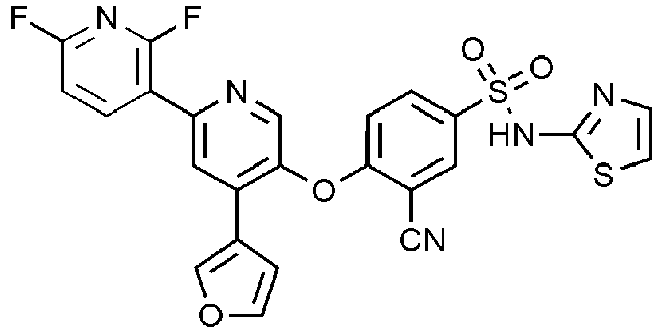
- 59 mg (50% yield) of the title compound was obtained in the same manner as described in Example 5, except that (2,6-difluoropyridin-3-yl)boronic acid was used instead of (3-fluorophenyl)boronic acid.
1H NMR (CDCl3, 500MHz) δ 8.73 (q, 1H), 8.48 (s, 1H), 8.25 (d, 1H), 8.11 (s, 1H), 8.06 (s, 1H), 7.99 (dd, 1H), 7.67 (m, 1H), 7.11 (d, 1H), 7.04 (dd, 1H), 6.88 (d, 1H), 6.85 (s, 1H), 6.60 (d, 1H) -

- 66 mg (60% yield) of the title compound was obtained in the same manner as described in Example 5, except that pyridin-3-ylboronic acid was used instead of (3-fluorophenyl)boronic acid. 1H NMR (CD3OD/CDCl3, 500MHz) δ 9.67 (s, 1H), 9.20 (d, 1H), 8.79 (d, 1H), 8.42 (s, 1H), 8.34 (s, 1H), 8.21 (s, 1H), 8.08 (s, 1H), 8.05 (d, 1H), 7.94 (d, 1H), 7.47 (s, 1H), 6.98 (s, 1H), 6.88 (s, 1H), 6.79 (d, 1H), 6.48 (d, 1H)
-
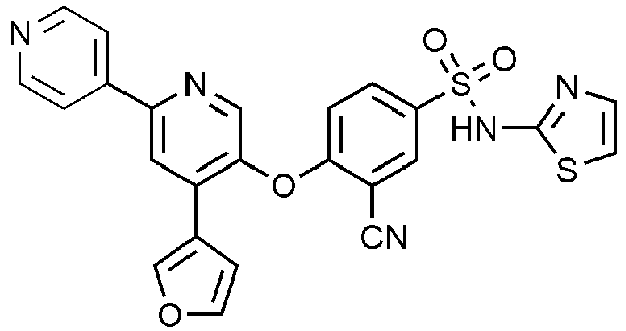
- 61 mg (55% yield) of the title compound was obtained in the same manner as described in Example 5, except that pyridin-4-ylboronic acid was used instead of (3-fluorophenyl)boronic acid.
1H NMR (CD3OD/CDCl3, 500MHz) δ 8.76 (d, 2H), 8.57 (s, 1H), 8.43 (s, 1H), 8.37 (d, 2H), 8.29 (d, 1H), 8.17 (s, 1H), 8.03 (d, 1H), 7.62 (s, 1H), 7.10 (d, 1H), 7.07 (s, 1H), 7.00 (d, 1H), 6.73 (d, 1H) -

- 66 mg (60% yield) of the title compound was obtained in the same manner as described in Example 5, except that (pyrimidin-5-yl)boronic acid was used instead of (3-fluorophenyl)boronic acid. 1H NMR (CD3OD/CDCl3, 500MHz) δ 9.38 (s, 2H), 9.22 (s, 1H), 8.43 (s, 1H), 8.20 (s, 1H), 8.00 (s, 2H), 7.92 (m, 1H), 7.46 (s, 1H), 6.87 (s, 2H), 6.84 (s, 1H), 6.76 (m, 1H), 6.48 (s, 1H)
-
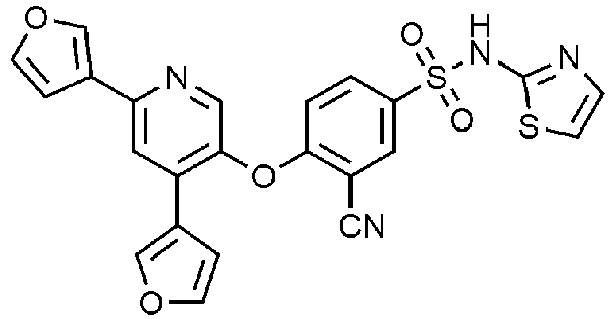
- 20.0 mg of 4,6-di(furan-3-yl)pyridin-3-ol and 24.9 mg of 3-cyano-4-fluoro-N-(thiazol-2-yl)benzenesulfonamide were dissolved in DMF, and 86.0 mg(3.0eq) of Cs2CO3(86.0mg, 3.0eq) was added thereto. After reacting at room temperature for 2 hours, the resulting mixture was reacted at 60°C for 16 hours. The solvent was removed by concentrating under reduced pressure. AS work-up with EA/H 2O, the ethyl acetate layer was treated with magnesium sulfate, and concentrated under reduced pressure. The residue was separated by PLC (developing solvent, EA:n-Hex = 1:4) to obtain 10.1 mg (24% yield) of the title compound.
1H NMR (CD3OD/CDCl3, 500MHz) δ 8.39 (s, 1H), 8.24 (s, 2H), 8.09 (s, 1H), 8.00 (s, 1H), 7.96 (s, 1H), 7.63 (s, 1H), 7.60 (s, 1H), 7.10 (d, 1H), 7.07 (s, 1H), 7.01 (s, 1H), 6.89 (m, 1H), 6.71 (s, 1H) -

- 7.8 mg (18% yield) of the title compound was obtained in the same manner as described in Example 16, except that N-(tert-butyl)-3,4-fluoro-N-(thiazol-2-yl)benzenesulfonamide was used instead of 3-cyano-4-fluoro-N-(thiazol-2-yl)benzenesulfonamide.
1H NMR (CDCl3, 500MHz) δ 8.41 (s, 1H), 8.21 (s, 1H), 8.18 (s, 1H), 7.81 (d, 1H), 7.76 (s, 1H), 7.69 (d, 1H), 7.58 (s, 1H), 7.54 (s, 1H), 7.18 (m, 1H), 7.12 (d, 1H), 7.06 (s, 1H), 6.90 (s, 1H), 6.58 (d, 1H) -

- 10 mg of 4-((6-chloro-4-(1-methyl-1H-pyrazol-5-yl)pyridin-3-yl)oxy)-3-cyano-N-(thiazol-2-yl)b enzenesulfonamide was dissolved in DMF/H2O=1:1 (0.46 mL), and 3.2 mg of (2-fluoropyridin-3-yl)boronic acid, 0.8 mg of Pd(PPh3)4 and 7.4 mg of Na2CO3 were added thereto. After reacting with microwave reactor at 120°C for 5 minutes, DMF was removed by concentrating under reduced pressure. After extracting with EA, the extract was treated with MgSO4 and concentrated under reduced pressure. The residue was separated by PLC (developing solvent, EA) to obtain 3.2 mg (28% yield) of the title compound.
1H NMR (CD3OD, 500MHz) δ 8.79 (s, 1H), 8.63 (t, 1H), 8.31 (d, 1H), 8.14 (d, 1H), 8.07 (s, 1H), 7.98 (dd, 1H), 7.52 (t, 1H), 7.39 (d, 1H), 7.14 (d, 1H), 7.00 (d, 1H), 6.76 (d, 1H), 6.41 (d, 1H), 3.89 (s, 3H) -

- 4.2 mg (37% yield) of the title compound was obtained in the same manner as described in Example 18, except that (6-fluoropyridin-3-yl)boronic acid was used instead of (2-fluoropyridin-3-yl)boronic acid.
1H NMR (CD3OD, 500MHz) δ 8.95 (s, 1H), 8.75 (s, 1H), 8.67 (t, 1H), 8.13 (s, 1H), 7.96 (m, 2H), 7.39 (s, 1H), 7.22 (d, 1H), 7.14 (d, 1H), 6.98 (d, 1H), 6.76 (d, 1H), 6.40 (d, 1H), 3.88 (s, 3H) -

- 34 mg (31% yield) of the title compound was obtained in the same manner as described in Example 5, except that (thiophen-3-yl)boronic acid was used instead of (3-fluorophenyl)boronic acid.
1H NMR (CD3OD, 500MHz) δ 8.43 (s, 1H), 8.26 (s, 1H), 8.13 (s, 2H), 8.10 (s, 1H), 8.00 (dd, 1H), 7.79 (d, 1H), 7.61 (s, 1H), 7.54 (dd, 1H), 7.12 (d, 1H), 7.02 (s, 1H), 6.94 (d, 1H), 6.75 (d, 1H) -

- 10 mg(0.02 mmol)of 4-((6-chloro-4-(1-methyl-1H-pyrazol-5-yl)pyridin-3-yl)oxy)-3-fluoro-N-(thiazol-2-yl)b enzenesulfonamide was dissolved in 3 mL of N,N-dimethylformamide, and 3.9 mg(0.03 mmol) of (pyridin-3-yl)boronic acid was added thereto, and then 2.4 mg(10 mol%) of Pd(PPh3)4, 6.8 mg(0.64 mmol) of Na2CO3, and 1 mL of H2O were added thereto. After reacting with microwave reactor at 120°C 10 minutes, the solvent was removed, and the remaining material was diluted with ethyl acetate and the organic layer was separated, and washed with saturated sodium chloride. The organic layer was collected, dried with magnesium sulfate to remove water, and concentrated under reduced pressure, and the residue was purified by column chromatography (developing solvent, hexane:ethyl acetate = 3:1) to obtain 5 mg (45% yield) of the title compound. 1H NMR (CD3OD, 500MHz) δ 9.23 (s, 1H), 8.80 (d, 1H), 8.60 (s, 1H), 8.53 (m, 1H), 8.10 (s, 1H), 7.70 (m, 1H), 7.67(m, 1H), 7.62 (m, 1H), 7.43 (s, 1H), 7.13 (m, 2H), 6.76 (m, 1H), 6.45 (s, 1H), 3.87 (s, 3H)
-
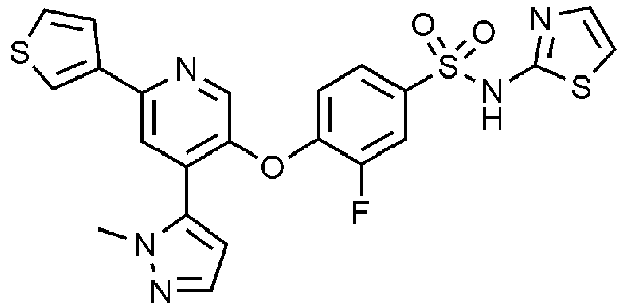
- 5 mg (45% yield) of the title compound was obtained in the same manner as described in Example 21, except that (thiophen-3-yl)boronic acid was used instead of (pyridin-3-yl)boronic acid.
1H NMR (CD3OD/CDCl3, 500MHz) δ 8.45 (s, 1H), 8.23 (s, 1H), 8.09 (s,1H), 7.92 (m, 1H), 7.59(m, 4H), 7.40 (s, 1H), 7.12 (m, 1H), 7.03 (m, 1H), 6.76 (m, 1H), 6.40 (s, 1H), 3.85 (s, 3H) -
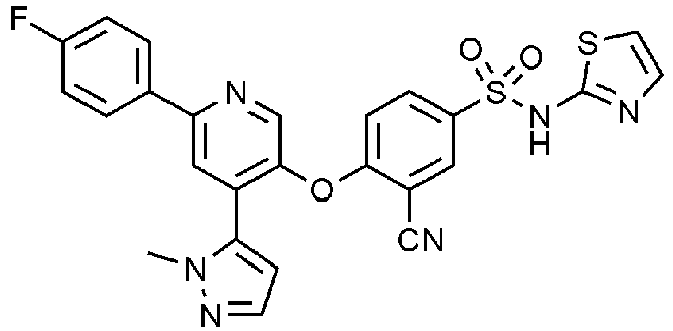
- 10 mg(0.02 mmol)of 4-((6-chloro-4-(1-methyl-1H-pyrazol-5-yl)pyridin-3-yl)oxy)-3-cyano-N-(thiazol-2-yl)b enzenesulfonamide was dissolved in 3 mL of N,N-dimethylformamide, and 4.4 mg(0.03 mmol) of (4-fluorophenyl)boronic acid was added thereto, and then 2.4 mg(10 mol%) of Pd(PPh3)4, 6.7 mg(0.6 mmol) of Na2CO3, and 1 mL of H2O were added thereto. After reacting with microwave reactor at 120°C for 10 minutes, the solvent was removed, and the remaining material was diluted with ethyl acetate and the organic layer was separated, and washed with saturated sodium chloride. The organic layer was collected, dried with magnesium sulfate to remove water, and concentrated under reduced pressure, and the residue was purified by column chromatography (developing solvent, hexane:ethyl acetate = 3:1) to obtain 5 mg (45% yield) of the title compound. 1H NMR (CD3OD, 500MHz) δ 8.72 (s, 1H), 8.14 (m, 3H), 8.03 (s, 1H), 7.94 (m, 1H), 7.37 (d, 1H), 7.23 (m, 2H), 7.13 (m, 1H), 6.94 (m, 1H), 6.74 (d, 1H), 3.87 (s, 3H)
-

- 5 mg (45% yield) of the title compound was obtained in the same manner as described in Example 23, except that (pyridin-2-yl)boronic acid was used instead of (4-fluorophenyl)boronic acid. 1H NMR (CD3OD/CDCl3, 500MHz) δ 8.79 (s, 1H), 8.12 (s, 1H), 7.98 (m, 3H), 7.52 (m, 1H), 7.38 (m, 2H), 7.29 (m, 1H), 7.13 (m, 1H), 6.99 (m, 1H), 6.75 (d, 1H), 6.39 (s, 1H), 3.88 (s, 3H)
-

- 5 mg (47% yield) of the title compound was obtained in the same manner as described in Example 23, except that (furan-3-yl)boronic acid was used instead of (4-fluorophenyl)boronic acid. 1H NMR (CD3OD/CDCl3, 500MHz) δ 8.61 (s, 1H), 8.23 (s, 1H), 8.11 (s, 1H), 7.93 (m, 1H), 7.84 (s, 1H), 7.62 (s, 1H), 7.36(d, 1H), 7.13 (d, 1H), 7.05 (d, 1H), 6.92 (d, 1H), 6.75 (d, 1H), 6.35 (d, 1H), 3.86 (s, 3H)
-

- 5 mg (45% yield) of the title compound was obtained in the same manner as described in Example 23, except that (pyridin-3-yl)boronic acid was used instead of (4-fluorophenyl)boronic acid.
1H NMR (CD3OD/CDCl3, 500MHz) δ 8.72 (s, 1H), 7.95 (d, 2H), 7.93 (m, 3H), 7.50 (m, 1H), 7.37 (s, 1H), 7.22 (m, 1H), 7.13 (m, 1H), 6.95 (d, 1H), 6.75 (d, 1H), 6.39 (s, 1H), 3.88 (s, 3H) -
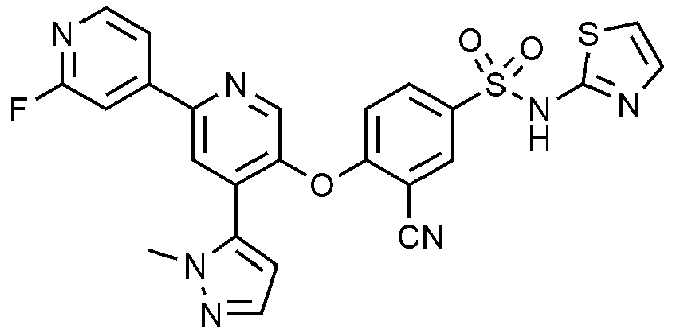
- 5 mg (44% yield) of the title compound was obtained in the same manner as described in Example 23, except that (2-fluoropyridin-4-yl)boronic acid was used instead of (4-fluorophenyl)boronic acid. 1H NMR (CD3OD/CDCl3, 500MHz) δ 8.78 (s, 1H), 8.33 (m, 1H), 8.26 (s, 1H), 8.14 (d, 1H), 8.06 (m, 1H), 7.98 (m, 1H), 7.83 (s, 1H), 7.39 (m, 1H), 7.12 (d, 1H), 6.99 (d, 1H), 6.73 (m, 1H), 6.41 (d, 1H), 3.88 (s, 3H)
-
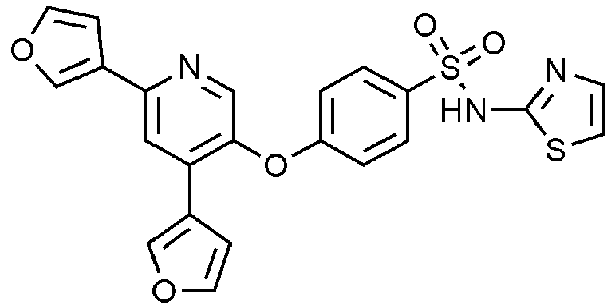
- 2.8 mg (78% yield) of the title compound was obtained in the same manner as described in Example 16, except that N-(tert-butyl)-4-fluoro-N-(thiazol-2-yl)benzenesulfonamide was used instead of 3-cyano-4-fluoro-N-(thiazol-2-yl)benzenesulfonamide.
1H NMR (CD3OD, 500MHz) δ 8.22 (s, 1H), 8.16 (s, 1H), 7.96 (s, 1H), 7.91 (s, 1H), 7.87 (d, 2H), 7.58 (s, 1H), 7.55 (s, 1H), 7.05 (m, 3H), 7.00 (dd, 2H), 6.66 (d, 1H) -

- 10 mg (0.02 mmol) of 3-cyano-4-((4-iodo-6-phenylpyridin-3-yl)oxy)-N-(thiazol-2-yl)benzenesulfonamide was dissolved in 3 mL of N,N-dimethylformamide, and 3.7 mg (0.03 mmol) of (2-fluoropyridin-3-yl)boronic acid was added thereto, and then 2.0 mg (10 mol%) of Pd(PPh3)4, 5.6 mg (0.6 mmol) of Na2CO3, and 1 mL of H2O were added thereto. After reacting with microwave reactor at 120°C for 5 minutes, the solvent was removed, and the remaining material was diluted with ethyl acetate and the organic layer was separated, and washed with saturated sodium chloride. The organic layer was collected, dried with magnesium sulfate to remove water, and concentrated under reduced pressure, and the residue was purified by column chromatography (developing solvent, hexane:ethyl acetate = 3:1) to obtain 3 mg (30% yield) of the title compound.
1H NMR (CD3OD, 500MHz) δ 8.61 (s, 1H), 8.08 (m, 3H), 8.04 (m, 1H), 7.84 (m, 2H), 7.52 (m, 4H), 7.15 (m, 1H), 6.77 (m, 2H), 6.64 (m, 1H) -

- 3 mg (30% yield) of the title compound was obtained in the same manner as described in Example 29, except that (2-fluoropyridin-5-yl)boronic acid was used instead of (2-fluoropyridin-3-yl)boronic acid.
1H NMR (CD3OD/CDCl3, 500MHz) δ 8.52 (s, 1H), 8.35 (m, 1H), 8.15 (m, 1H), 8.05 (m, 2H), 7.99 (m, 1H), 7.92 (m, 1H), 7.86 (m, 1H), 7.52 (m, 2H), 7.45 (m, 1H), 7.11 (m, 1H), 6.86 (m, 1H), 6.72 (m, 1H), 6.64 (m, 1H) -

- 3 mg (30% yield) of the title compound was obtained in the same manner as described in Example 29, except that (2-fluoropyridin-4-yl)boronic acid was used instead of (2-fluoropyridin-3-yl)boronic acid.
1H NMR (CD3OD/CDCl3, 500MHz) δ 8.63 (s, 1H), 8.11 (m, 1H), 8.08 (m, 2H), 8.02 (m, 2H), 7.93 (m, 1H), 7.52 (m, 3H), 7.12 (m, 1H), 6.91 (m, 1H), 6.71 (m, 3H) -

- 3 mg (30% yield) of the title compound was obtained in the same manner as described in Example 29, except that (6-fluoro-5-methylpyridin-3-yl)boronic acid was used instead of (2-fluoropyridin-3-yl)boronic acid.
1H NMR (CD3OD/CDCl3, 500MHz) δ 8.57 (s, 1H), 8.22 (m, 1H), 8.13 (m, 1H), 8.07 (m, 2H), 8.05 (m, 1H), 8.01 (m, 1H), 7.91 (m, 1H), 7.52 (m, 3H), 7.11 (m, 1H), 6.85 (m, 1H), 6.72 (m, 1H), 2.29 (s, 3H) -

- 3 mg (30% yield) of the title compound was obtained in the same manner as described in Example 29, except that pyridin-3-ylboronic acid was used instead of (2-fluoropyridin-3-yl)boronic acid.
1H NMR (CD3OD/CDCl3, 500MHz) δ 8.05 (m, 1H), 8.65 (s, 1H), 8.50 (m, 1H), 8.12 (m, 5H), 7.92 (m, 1H), 7.48 (m, 4H), 7.12 (m, 1H), 6.98 (d, 1H), 6.74 (d, 1H) -

- 3 mg (30% yield) of the title compound was obtained in the same manner as described in Example 29, except that (pyrimidin-5-yl)boronic acid was used instead of (2-fluoropyridin-3-yl)boronic acid.
1H NMR (CD3OD/CDCl3, 500MHz) δ 9.13 (m, 3H), 8.65 (s, 1H), 8.19 (m, 2H), 8.12 (m, 2H), 7.99 (m, 1H), 7.51 (m, 3H), 7.10 (m, 1H), 7.06 (m, 1H), 6.72 (m, 1H) -

- 3 mg (30% yield) of the title compound was obtained in the same manner as described in Example 29, except that (3-chloropyridin-4-yl)boronic acid was used instead of (2-fluoropyridin-3-yl)boronic acid.
1H NMR (CD3OD/CDCl3, 500MHz) δ 8.55 (m, 1H), 8.26 (m, 1H), 8.10 (m, 1H), 7.99 (m, 3H), 7.72 (m, 1H), 7.66 (m, 1H), 7.57 (m, 1H), 7.50 (m, 2H), 7.44 (m, 1H), 7.13 (m, 2H), 6.75 (m, 1H) -
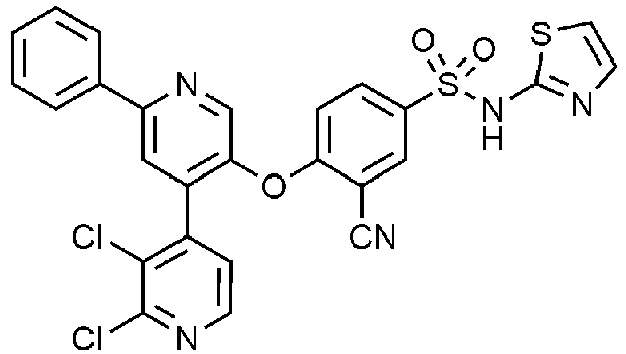
- 3 mg (30% yield) of the title compound was obtained in the same manner as described in Example 29, except that (2,3-dichloropyridin-4-yl)boronic acid was used instead of (2-fluoropyridin-3-yl)boronic acid.
1H NMR (CD3OD/CDCl3, 500MHz) δ 8.54 (m, 1H), 8.26 (m, 1H), 8.08 (m, 1H), 7.99 (m, 3H), 7.72 (m, 1H), 7.56 (m, 1H), 7.49 (m, 2H), 7.43 (m, 1H), 7.12 (m, 2H), 6.73 (m, 1H) -

- 3 mg (30% yield) of the title compound was obtained in the same manner as described in Example 29, except that (3,5- dimethylisoxazol-4-yl)boronic acid was used instead of (2-fluoropyridin-3-yl)boronic acid.
1H NMR (CD3OD/CDCl3, 500MHz) δ 8.66 (s, 1H), 8.15 (m, 1H), 8.05 (m, 2H), 7.99 (m, 2H), 7.49 (m, 4H), 7.10 (m, 1H), 6.89 (m, 1H), 6.71 (m, 1H), 2.34 (s, 3H), 2.23 (s, 3H) -
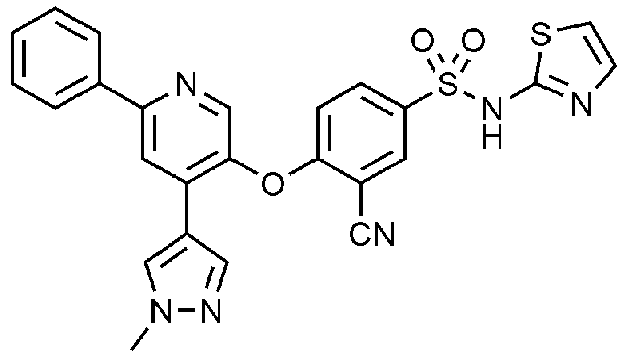
- 3 mg (30% yield) of the title compound was obtained in the same manner as described in Example 29, except that 1-methyl-4-(4,4,5,5-tetramethyl-1,3,2-dioxaboran-2-yl)-1H-pyrazole was used instead of (2-fluoropyridin-3-yl)boronic acid.
1H NMR (CD3OD/CDCl3, 500MHz) δ 8.45 (m, 1H), 8.27 (m, 1H), 8.20 (m, 2H), 8.05 (m, 3H), 7.98 (m, 1H), 7.50 (m, 2H), 7.47 (m, 1H), 7.10 (m, 1H), 6.94 (m, 1H), 6.71 (m, 1H), 3.89 (s, 2H) -

- 3 mg (30% yield) of the title compound was obtained in the same manner as described in Example 29, except that tert-butyl 4-(4,4,5,5-tetramethyl-1,3,2-dioxaboran-2-yl)-1H-pyrazol-1-carboxylate was used instead of (2-fluoropyridin-3-yl)boronic acid.
1H NMR (CD3OD/CDCl3, 500MHz) δ 8.47 (s, 1H), 8.24 (m, 4H), 8.05 (m, 2H), 7.97 (m, 1H), 7.52 (m, 2H), 7.49 (m, 1H), 7.10 (m, 1H), 6.93 (m, 1H), 6.71 (m, 1H) -

- 3 mg (30% yield) of the title compound was obtained in the same manner as described in Example 29, except that (pyridin-4-yl)boronic acid was used instead of (2-fluoropyridin-3-yl)boronic acid.
1H NMR (CD3OD/CDCl3, 500MHz) δ 8.67 (s, 1H), 8.59 (m, 2H), 8.14 (m, 1H), 8.09 (m, 3H), 7.94 (m, 1H), 7.70 (m, 2H), 7.52 (m, 2H), 7.47 (m, 1H), 7.12 (m, 1H), 6.99 (m, 1H), 6.76 (m, 1H) -

- 3 mg (30% yield) of the title compound was obtained in the same manner as described in Example 29, except that (2,5-dimethylthiophen-3-yl)boronic acid was used instead of (2-fluoropyridin-3-yl)boronic acid.
1H NMR (CD3OD/CDCl3, 500MHz) δ 8.64 (s, 1H), 8.06 (m, 3H), 7.89 (m, 2H), 7.50 (m, 2H), 7.46 (m, 2H), 7.16 (d, 1H), 6.81 (m, 2H), 6.63 (s, 1H), 2.27 (s, 6H) -
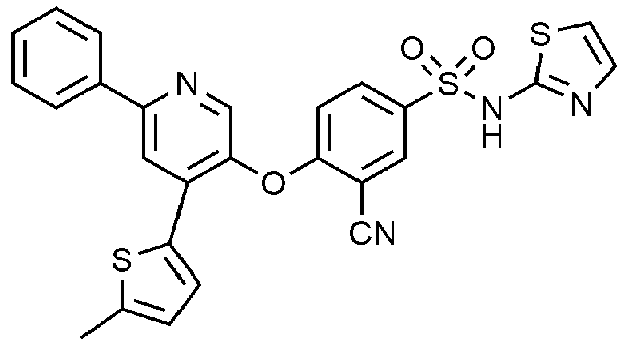
- 3 mg (30% yield) of the title compound was obtained in the same manner as described in Example 29, except that (5-methylthiophen-2-yl)boronic acid was used instead of (2-fluoropyridin-3-yl)boronic acid.
1H NMR (CD3OD/CDCl3, 500MHz) δ 8.54 (s, 1H), 8.27 (s, 1H), 8.10 (m, 1H), 8.07 (m, 3H), 7.74 (m, 1H), 7.72 (m, 2H), 7.50 (m, 1H), 7.47 (m, 1H), 7.45 (m, 2H), 7.13 (m, 1H), 6.75 (d, 1H), 2.13 (s, 3H) -
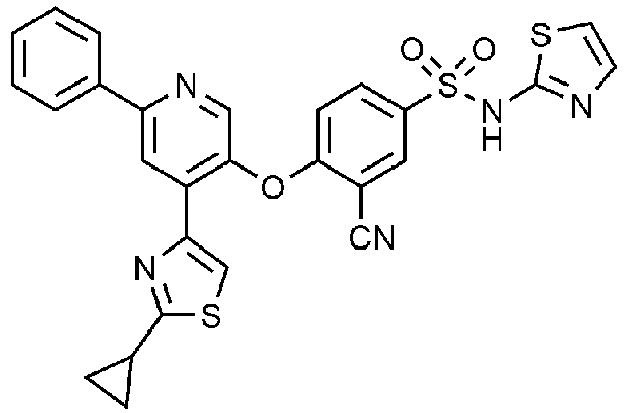
- 3 mg (30% yield) of the title compound was obtained in the same manner as described in Example 29, except that 2-cyclopropyl-4-(4,4,5,5-tetramethyl-1,3,2-dioxaboran-2-yl)thiazole was used instead of (2-fluoropyridin-3-yl)boronic acid.
1H NMR (CD3OD/CDCl3, 500MHz) δ 8.54 (s, 1H), 8.48 (s, 1H), 8.24 (s, 1H), 8.05 (d, 1H), 7.97 (m, 1H), 7.88 (s, 1H), 7.64 (m, 1H), 7.55 (m, 2H), 7.50 (m, 1H), 7.13 (d, 1H), 6.93 (d, 1H), 6.74 (m, 1H), 2.33 (m, 1H), 1.61 (m, 4H) -
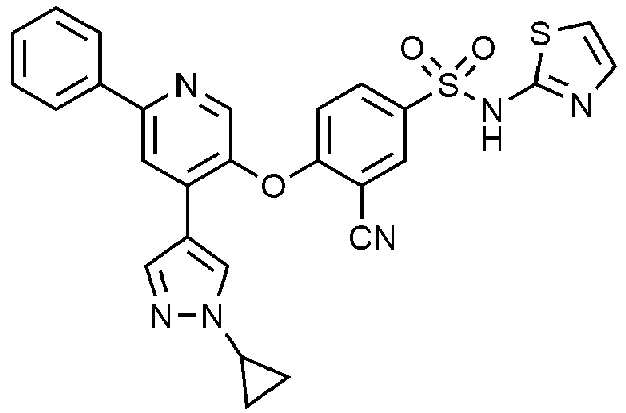
- 3 mg (30% yield) of the title compound was obtained in the same manner as described in Example 29, except that 1-cyclopropyl-4-(4,4,5,5-tetramethyl-1,3,2-dioxaboran-2-yl)-1H-pyrazole was used instead of (2-fluoropyridin-3-yl)boronic acid.
1H NMR (CD3OD/CDCl3, 500MHz) δ 8.56 (s, 1H), 8.23 (s, 1H), 8.08 (m, 1H), 8.00 (m, 2H), 7.74 (m, 1H), 7.72 (m, 1H), 7.66 (m, 1H), 7.56 (m, 2H), 7.29 (m, 1H), 7.13 (m, 2H), 6.75 (d, 1H), 2.32 (m, 1H), 1.61 (m, 4H) -

- 32 mg (30% yield) of the title compound was obtained in the same manner as described in Example 5, except that (1H-pyrzol-4-yl)boronic acid was used instead of (3-fluorophenyl)boronic acid.
1H NMR (CDCl3, 500MHz) δ 8.53 (t, 1H), 8.36 (s, 1H), 8.28 (s, 1H), 8.09 (d, 2H), 7.80 (d, 1H), 7.67 (d, 1H), 7.52 (s, 1H), 7.36 (t, 1H), 7.09 (d, 1H), 7.00 (t, 1H), 6.87 (s, 1H), 6.56 (d, 1H) -

- 29 mg (26% yield) of the title compound was obtained in the same manner as described in Example 5, except that 1-methyl-4-(4,4,5,5-tetramethyl-1,3,2-dioxaboran-2-yl)-1H-pyrzole was used instead of (3-fluorophenyl)boronic acid.
1H NMR (CD3OD, 500MHz) δ 8.89 (s, 1H), 8.61 (m, 1H), 8.33 (s, 1H), 8.23 (s, 1H), 8.20 (s, 1H), 7.79 (dd, 1H), 7.68 (d, 1H), 7.63 (s, 1H), 7.20 (dd, 1H), 7.13 (m, 3H), 6.75 (d, 1H) -

- 10.0 mg of 4-((6-chloro-4-(furan-3-yl)pyridin-3-yl)oxy)-3-fluoro-N-(thiazol-2-yl)benzenesulfona mide was dissolved in 1,4-dioxane/H2O=1:1 (0.48 mL), and 3.2 mg of 2-fluoropyridin-3-yl)boronic acid, 0.84 mg of Pd(PPh3)4 and 7.7 mg of Na2CO3, were added thereto. After reacting with microwave reactor at 120°C for 5 minutes, 1,4-dioxane was removed by concentrating under reduced pressure. After extracting with ethyl acetate, the extract was treated with MgSO4, and concentrated under reduced pressure. The residue was purified by PLC (developing solvent, EA:n-Hex = 2:1) to obtain 3.9 mg (34% yield) of the title compound.
1H NMR (CD3OD, 500MHz) δ 8.39 (s, 1H), 8.27 (s, 2H), 8.10 (s, 1H), 8.06 (s, 1H), 7.99 (d, 1H), 7.83 (s, 1H), 7.63 (s, 1H), 7.60 (s, 1H), 7.54 (s, 1H), 7.10 (d, 1H), 7.02 (s, 1H), 6.93 (d, 1H), 6.73 (d, 1H) -

- 3.9 mg (34% yield) of the title compound was obtained in the same manner as described in Example 47, except that (6-fluoropyridin-3-yl)boronic acid was used instead of (2-fluoropyridin-3-yl)boronic acid.
1H NMR (CDCl3, 500MHz) δ 8.29 (s, 1H), 8.00 (s, 1H), 7.97 (s, 1H), 7.94 (s, 1H), 7.71 (d, 1H), 7.66 (d, 1H), 7.62 (s, 1H), 7.56 (t, 1H), 7.54 (s, 1H), 7.38 (d, 1H), 6.89 (t, 1H), 6.83 (s, 1H), 3.98 (s, 3H) -

- 10 mg (0.02 mmol) of 4-((6'-chloro-[3,4'-bipyridin]-3'-yl)oxy)-3-cyano-N-(thiazol-2-yl)benzenesulfonamide was dissolved in 3 mL of N,N-dimethylformamide, and 4.5 mg (0.03 mmol) of (6-fluoropyridin-3-yl)boronic acid was added thereto, and then 2.4 mg(10 mol%) of Pd(PPh3)4, 6.7 mg(0.6 mmol) of Na2CO3, and 1 mL of H2O were added thereto. After reacting with microwave reactor at 120°C for 10 minutes, the solvent was removed, and the remaining material was diluted with ethyl acetate and the organic layer was separated, and washed with saturated sodium chloride. The organic layer was collected, dried with magnesium sulfate to remove water, and concentrated under reduced pressure, and the residue was purified by column chromatography (developing solvent, hexane:ethyl acetate = 3:1) to obtain 3 mg (27% yield) of the title compound.
1H NMR (CD3OD, 500MHz) δ 8.97 (d, 1H), 8.82 (s, 1H), 8.70 (m, 2H), 8.52 (m, 1H), 8.21 (m, 1H), 8.13 (m, 2H), 7.79 (m, 1H), 7.39 (m, 1H), 7.48 (m, 1H), 7.23 (m, 1H), 7.14 (m, 1H), 7.00 (d, 1H), 6.75 (d, 1H) -
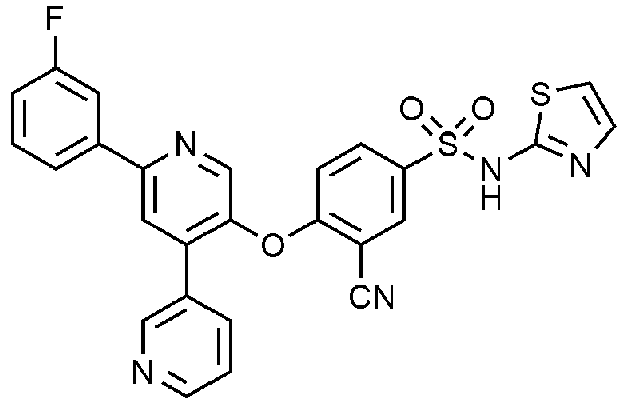
- 3 mg (30% yield) of the title compound was obtained in the same manner as described in Example 49, except that (3-fluorophenyl)boronic acid was used instead of (6-fluoropyridin-3-yl)boronic acid.
1H NMR (CD3OD/CDCl3, 500MHz) δ 8.80 (d, 1H), 8.67 (s, 1H), 8.50 (m, 1H), 8.15 (m, 3H), 7.94 (m, 3H), 7.52 (m, 2H), 7.22 (m, 1H), 7.13 (m, 1H), 6.99 (d, 1H), 6.75 (d, 1H) -

- 3 mg (30% yield) of the title compound was obtained in the same manner as described in Example 49, except that (2-fluoropyridin-3-yl)boronic acid was used instead of (6-fluoropyridin-3-yl)boronic acid.
1H NMR (CD3OD/CDCl3, 500MHz) δ 8.79 (s, 1H), 8.74 (s, 1H), 8.62 (m, 1H), 8.52 (m, 1H), 8.30 (m, 1H), 8.14 (m, 3H), 7.96 (m, 1H), 7.51 (m, 2H), 7.13 (d, 1H), 7.03 (d, 1H), 6.74 (d, 1H) -

- 3 mg (30% yield) of the title compound was obtained in the same manner as described in Example 49, except that (2-fluorophenyl)boronic acid was used instead of (6-fluoropyridin-3-yl)boronic acid.
1H NMR (CD3OD/CDCl3, 500MHz) δ 8.78 (m, 1H), 8.69 (s, 1H), 8.51 (d, 1H), 8.13 (s, 1H), 8.09 (d, 1H), 8.03 (m, 2H), 7.96 (m, 1H), 7.49 (m, 2H), 7.45 (m, 1H), 7.34 (m, 1H), 7.10 (m, 1H), 7.00 (d, 1H), 6.71 (m, 1H) -

- 10 mg (0.02 mmol) of 4-((6-chloro-[4,4'-bipyridin]-3-yl)oxy)-3-cyano-N-(thiazol-2-yl)benzenesulfonamide was dissolved in 3 mL of N,N-dimethylformamide, and 5 mg (0.03 mmol)of (2,6-difluoropyridin-3-yl)boronic acid was added thereto, and then 2.4 mg(10 mol%) of Pd(PPh3)4, 6.7 mg(0.6 mmol) of Na2CO3, and 1 mL of H2O were added thereto. After reacting with microwave reactor at 120°C for 10 minutes, the solvent was removed, and the remaining material was diluted with ethyl acetate and the organic layer was separated, and washed with saturated sodium chloride. The organic layer was collected, dried with magnesium sulfate to remove water, and concentrated under reduced pressure, and the residue was purified by column chromatography (developing solvent, hexane:ethyl acetate = 3:1) to obtain 2 mg (19% yield) of the title compound.
1H NMR (CD3OD, 500MHz) δ 8.76 (m, 2H), 8.59 (m, 2H), 8.15 (s, 1H), 8.10 (s, 1H), 7.96 (d, 1H), 7.66 (m, 2H), 7.20 (m, 1H), 7.12 (m, 1H), 7.04 (d, 1H), 6.74 (m, 1H) -

- 10 mg (0.04 mmol) of 4,6-bis(1-methyl-1H-pyrazol-4-yl)pyridin-3-ol was dissolved in 3 mL of N,N-dimethylformamide, and 32 mg (0.1 mmol) of Cs2CO3 was added thereto, followed by stirring at room temperature for 10 minutes. Then, 11 mg (0.04 mmol) of 3-cyano-4-fluoro-N-(thiazol-2-yl)benzenesulfonamide was added thereto, and the solution was stirred at room temperature for 3 hours. After completion of the reaction as checked by TLC, the solvent was removed, and the remaining material was diluted with ethyl acetate and washed with saturated sodium chloride. The organic layer was collected, dried with magnesium sulfate to remove water, and concentrated under reduced pressure, and the residue was purified by column chromatography (developing solvent, hexane:ethyl acetate = 3:1) to obtain 16.0 mg (80% yield) of the title compound.
1H NMR (CDCl3, 500MHz) δ 8.34 (s, 1H), 8.24 (s, 1H), 8.20 (s, 1H), 8.14 (s, 1H), 8.08 (s, 1H), 7.98 (m, 3H), 7.10 (d, 1H), 6.90 (d, 1H), 6.71 (d, 1H), 3.96 (s, 3H), 3.88 (s, 3H) -
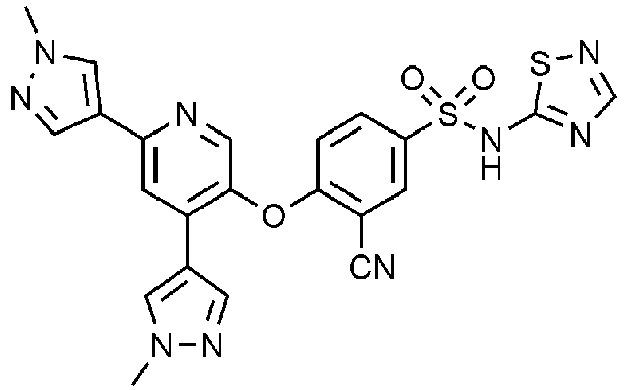
- 16 mg (80% yield) of the title compound was obtained in the same manner as described in Example 54, except that 3-cyano-4-fluoro-N-(1,2,4-thiadiazol-5-yl)benzenesulfonamide was used instead of 3-cyano-4-fluoro-N-(thiazol-2-yl)benzenesulfonamide.
1H NMR (CD3OD/CDCl3, 500MHz) δ 8.31 (s, 1H), 8.22 (m, 2H), 8.13 (s, 1H), 8.09 (s, 1H), 7.96 (m, 3H), 7.92 (s, 1H), 6.86 (d, 1H), 3.96 (s, 3H), 3.87 (s, 3H) -

- 10 mg of tert-butyl ((5-chloro-4-((6-chloro-4-(furan-3-yl)pyridin-3-yl)oxy)-2-fluorophenyl)sulfonyl)(thiaz ol-4-yl)carbamate was dissolved in 1,4-dioxane/H2O=1:1 (0.38 mL), and 3.5 mg of (2-fluoropyridin-3-yl)boronic acid, 0.65 mg(3 mol%) of Pd(PPh3)4 and 5.96 mg of Na2 CO3 were added thereto. After reacting with microwave reactor at 120°C for 5 minutes, 1,4-dioxane was removed by concentrating under reduced pressure. After extracting with ethyl acetate, the extract was treated with MgSO4, and concentrated under reduced pressure. The residue was separated by PLC (developing solvent, EA:n-Hex = 1:1) to obtain 6.7 mg (72% yield) of the title compound.
1H NMR (CDCl3, 500MHz) δ 9.49 (s, 1H), 8.64 (s, 1H), 8.58 (t, 1H), 8.43 (s, 1H), 8.29 (s, 1H), 8.12 (s, 1H), 8.00 (d, 2H), 7.50 (s, 1H), 7.37 (t, 1H), 7.04 (s, 1H), 6.82 (s, 1H), 6.50 (d, 1H) -

- 9.1 mg (97% yield) of the title compound was obtained in the same manner as described in Example 56, except that (6-fluoropyridin-3-yl)boronic acid was used instead of (2-fluoropyridin-3-yl)boronic acid.
1H NMR (CDCl3, 500MHz) δ 10.3 (s, 1H), 8.80 (s, 1H), 8.68 (s, 1H), 8.45 (m, 1H), 8.43 (s, 1H), 8.00 (d, 1H), 7.99 (s, 1H), 7.85 (s, 1H), 7.50 (s, 1H), 7.05 (d, 1H), 7.00 (s, 1H), 6.81 (s, 1H), 6.47 (d, 1H) -

- 8.6 mg (89% yield) of the title compound was obtained in the same manner as described in Example 56, except that (2,6-difluoropyridin-3-yl)boronic acid was used instead of (2-fluoropyridin-3-yl)boronic acid.
1H NMR (CDCl3, 500MHz) δ 10.1 (s, 1H), 8.70 (s, 1H), 8.67 (s, 1H), 8.40 (s, 1H), 8.06 (s, 1H), 8.01 (s, 1H), 7.99 (s, 1H), 7.50 (s, 1H), 7.01 (s, 1H), 6.99 (s, 1H), 6.81 (s, 1H), 6.48 (d, 1H) -

- 8.7 mg (93% yield) of the title compound was obtained in the same manner as described in Example 56, except that (3-fluorophenyl)boronic acid was used instead of (2-fluoropyridin-3-yl)boronic acid.
1H NMR (CDCl3, 500MHz) δ 9.75 (s, 1H), 8.66 (d, 1H), 8.40 (d, 1H), 7.99 (d, 1H), 7.98 (d, 1H), 7.86 (d, 1H), 7.76 (dd, 1H), 7.72 (d, 1H), 7.50 (s, 1H), 7.46 (d, 1H), 7.14 (t, 1H), 7.02 (d, 1H), 6.81 (s, 1H), 6.46 (dd, 1H) -

- 9.0 mg (97% yield) of the title compound was obtained in the same manner as described in Example 56, except that (2-fluorophenyl)boronic acid was used instead of (2-fluoropyridin-3-yl)boronic acid.
1H NMR (CDCl3, 500MHz) δ 9.98 (s, 1H), 8.66 (s, 1H), 8.43 (s, 1H), 7.99 (m, 3H), 7.96 (s, 1H), 7.47 (s, 1H), 7.41 (m, 1H), 7.29 (m, 1H), 7.19 (m, 1H), 7.00 (s, 1H), 6.79 (s, 1H), 6.48 (d, 1H) -

- 8.2 mg (88% yield) of the title compound was obtained in the same manner as described in Example 56, except that (4-fluorophenyl)boronic acid was used instead of (2-fluoropyridin-3-yl)boronic acid.
1H NMR (CDCl3, 500MHz) δ 10.2 (s, 1H), 8.67 (s, 1H), 8.38 (s, 1H), 7.97 (m, 4H), 7.82 (s, 1H), 7.49 (s, 1H), 7.17 (t, 2H), 6.99 (d, 1H), 6.80 (s, 1H), 6.44 (d, 1H) -
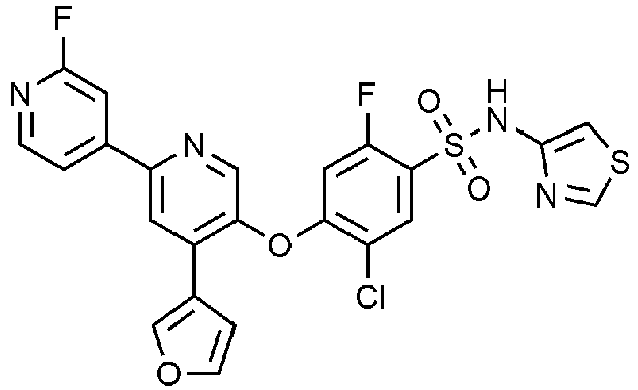
- 8.3 mg (89% yield) of the title compound was obtained in the same manner as described in Example 56, except that (2-fluoropyridin-4-yl)boronic acid was used instead of (2-fluoropyridin-3-yl)boronic acid.
1H NMR (CDCl3, 500MHz) δ 9.57 (s, 1H), 8.66 (s, 1H), 8.42 (s, 1H), 8.35 (d, 1H), 8.02 (s, 1H), 8.00 (s, 1H), 7.95 (s, 1H), 7.79 (d, 1H), 7.56 (d, 1H), 7.53 (d, 1H), 7.04 (d, 1H), 6.83 (d, 1H), 6.51 (d, 1H) -

- 20 mg (0.03 mmol) of tert-butyl ((5-chloro-2-fluoro-4-((6-(2-fluorophenyl)-4-(1-methyl-1H-pyrazol-4-yl)pyridin-3-yl)o xy)phenyl)sulfonyl)(thiazol-4-yl)carbamate was dissolved in 3 mL of dichloromethane, and 30 uL of trifluoroacetic acid was added thereto, followed by stirring at room temperature for 5 hours. After completion of the reaction as checked by TLC, the solvent was removed to obtain 7.0 mg (35% yield) of the title compound.
1H NMR (CDCl3, 500MHz) δ 8.75 (m, 1H), 8.52 (s, 1H), 8.39 (d, 1H), 8.35 (d, 1H), 8.14 (m, 1H), 8.07 (m, 1H), 7.84 (m, 1H), 7.61 (m, 1H), 7.39 (m, 2H), 7.10 (m, 2H), 3.93 (s, 3H) -
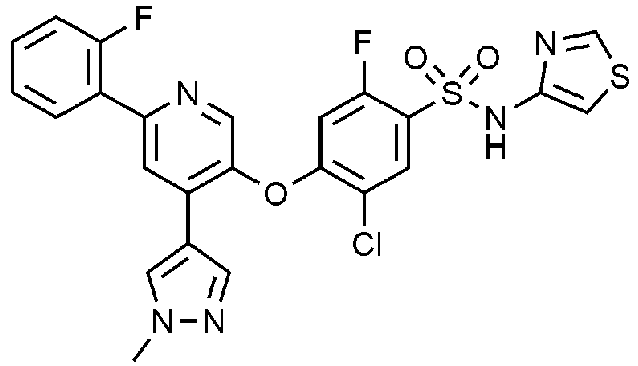
- 10 mg (0.02 mmol) of 5-chloro-4-((6-chloro-4-(1-methyl-1H-pyrazol-5-yl)pyridin-3-yl)oxy)-2-fluoro-N-(thia zol-2-yl)benzenesulfonamide was dissolved in 3 mL of N,N-dimethylformamide, and 4.2 mg (0.03 mmol) of (3-fluorophenyl)boronic acid was added thereto, and then 2.3 mg (10 mol%) of Pd(PPh3)4, 6.3 mg (0.6 mmol) of Na2CO3, and 1 mL of H2O were added thereto. After reacting with microwave reactor at 120°C for 10 minutes, the solvent was removed, and the remaining material was diluted with ethyl acetate and the organic layer was separated, and washed with saturated sodium chloride. The organic layer was collected, dried with magnesium sulfate to remove water, and concentrated under reduced pressure, and the residue was purified by column chromatography (developing solvent, hexane:ethyl acetate = 3:1) to obtain 4 mg (36% yield) of the title compound.
1H NMR (CD3OD, 500MHz) δ 8.51 (s, 1H), 8.06 (s, 2H), 7.98 (m, 1H), 7.89 (m, 2H), 7.49 (m, 3H), 7.18 (m, 1H), 7.00 (m, 1H), 6.52 (s, 1H), 3.92 (s, 3H) -

- 16 mg (80% yield) of the title compound was obtained in the same manner as described in Example 63, except that tert-butyl ((5-chloro-2-fluoro-4-((6-(4-fluorophenyl)-4-(1-methyl-1H-pyrazol-4-yl)pyridin-3-yl)o xy)phenyl)sulfonyl)(thiazol-4-yl)carbamate was used instead of tert-butyl ((5-chloro-2-fluoro-4-((6-(2-fluorophenyl)-4-(1-methyl-1H-pyrazol-4-yl)pyridin-3-yl)o xy)phenyl)sulfonyl)(thiazol-4-yl)carbamate.
1H NMR (CD3OD, 500MHz) δ 8.73 (s, 1H), 8.45 (s, 1H), 8.36 (s, 2H), 8.17 (m, 1H), 8.05 (m, 3H), 7.34 (m, 2H), 7.09 (m, 1H), 7.01 (m, 1H), 3.93 (s, 3H) -

- 16 mg (80% yield) of the title compound was obtained in the same manner as described in Example 63, except that tert-butyl ((5-chloro-4-((6-(2,4-difluorophenyl)-4-(1-methyl-1H-pyrazol-4-yl)pyridin-3-yl)oxy)-2-fluorophenyl)sulfonyl)(thiazol-4-yl)carbamate was used instead of tert-butyl ((5-chloro-2-fluoro-4-((6-(2-fluorophenyl)-4-(1-methyl-1H-pyrazol-4-yl)pyridin-3-yl)o xy)phenyl)sulfonyl)(thiazol-4-yl)carbamate.
1H NMR (CD3OD, 500MHz) δ 8.73 (s, 1H), 8.40 (s, 1H), 8.30 (s, 1H), 8.24 (s, 1H), 8.08 (m, 2H), 7.92 (m, 1H), 7.20 (m, 2H), 7.09 (s, 1H), 6.99 (m, 1H) -

- 16 mg (80% yield) of the title compound was obtained in the same manner as described in Example 63, except that tert-butyl ((5-chloro-4-((6-(3,4-difluorophenyl)-4-(1-methyl-1H-pyrazol-4-yl)pyridin-3-yl)oxy)-2-fluorophenyl)sulfonyl)(thiazol-4-yl)carbamate was used instead of tert-butyl ((5-chloro-2-fluoro-4-((6-(2-fluorophenyl)-4-(1-methyl-1H-pyrazol-4-yl)pyridin-3-yl)o xy)phenyl)sulfonyl)(thiazol-4-yl)carbamate.
1H NMR (CD3OD, 500MHz) δ 8.73 (d, 1H), 8.40 (s, 1H), 8.29 (m, 2H), 8.10 (m, 1H), 8.03 (m, 2H), 7.89 (m, 1H), 7.43 (m, 1H), 7.08 (m, 1H), 6.87 (d, 1H), 3.91 (s, 3H) -
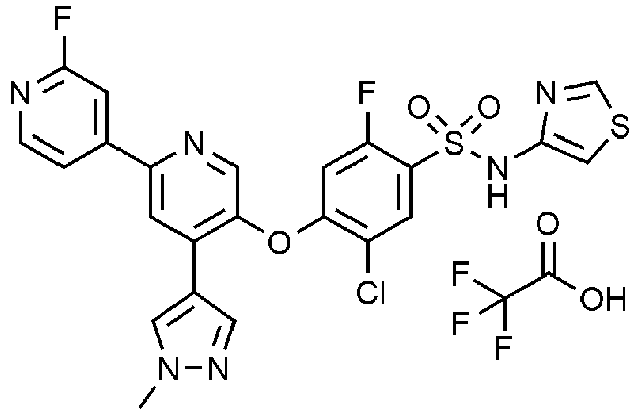
- 16 mg (80% yield) of the title compound was obtained in the same manner as described in Example 63, except that tert-butyl ((5-chloro-2-fluoro-4-((2'-fluoro-4-(1-methyl-1H-pyrazol-4-yl)-[2,4'-bipyridin]-5-yl)ox y)phenyl)sulfonyl)(thiazol-4-yl)carbamate was used instead of tert-butyl ((5-chloro-2-fluoro-4-((6-(2-fluorophenyl)-4-(1-methyl-1H-pyrazol-4-yl)pyridin-3-yl)o xy)phenyl)sulfonyl)(thiazol-4-yl)carbamate.
1H NMR (CD3OD, 500MHz) δ 8.73 (s, 1H), 8.40 (s, 2H), 8.32 (m, 1H), 8.25 (d, 1H), 8.10 (m, 1H), 8.03 (m, 1H), 7.81 (s, 1H), 7.08 (s, 1H), 6.85 (d, 1H), 3.92 (s, 3H) -
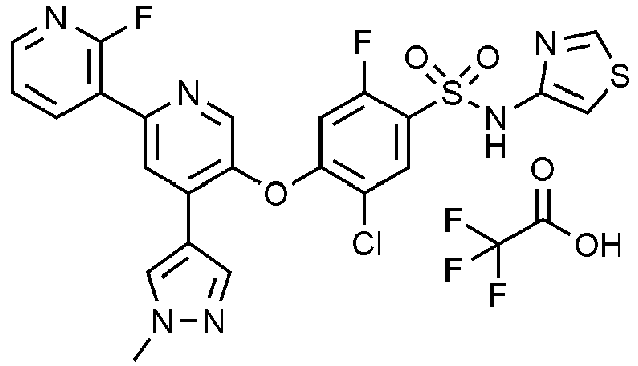
- 16 mg (80% yield) of the title compound was obtained in the same manner as described in Example 63, except that tert-butyl ((5-chloro-2-fluoro-4-((2'-fluoro-4-(1-methyl-1H-pyrazol-4-yl)-[2,3'-bipyridin]-5-yl)ox y)phenyl)sulfonyl)(thiazol-4-yl)carbamate was used instead of tert-butyl ((5-chloro-2-fluoro-4-((6-(2-fluorophenyl)-4-(1-methyl-1H-pyrazol-4-yl)pyridin-3-yl)o xy)phenyl)sulfonyl)(thiazol-4-yl)carbamate.
1H NMR (CD3OD, 500MHz) δ 8.73 (s, 1H), 8.46 (m, 2H), 8.30 (m, 1H), 8.25 (m, 2H), 8.03 (m, 2H), 7.50 (s, 1H), 7.08 (s, 1H), 6.90 (m, 1H), 3.91 (s, 3H) -

- 16 mg (80% yield) of the title compound was obtained in the same manner as described in Example 63, except that tert-butyl ((5-chloro-2-fluoro-4-((6'-fluoro-4-(1-methyl-1H-pyrazol-4-yl)-[2,3'-bipyridin]-5-yl)ox y)phenyl)sulfonyl)(thiazol-4-yl)carbamate was used instead of tert-butyl ((5-chloro-2-fluoro-4-((6-(2-fluorophenyl)-4-(1-methyl-1H-pyrazol-4-yl)pyridin-3-yl)o xy)phenyl)sulfonyl)(thiazol-4-yl)carbamate.
1H NMR (CD3OD, 500MHz) δ 8.91 (m, 1H), 8.72 (m, 1H), 8.61 (m, 1H), 8.41 (m, 1H), 8.31 (m, 1H), 8.25 (m, 1H), 8.09 (m, 2H), 7.22 (m, 1H), 7.07 (m, 1H), 6.82 (m, 1H), 3.90 (s, 3H) -
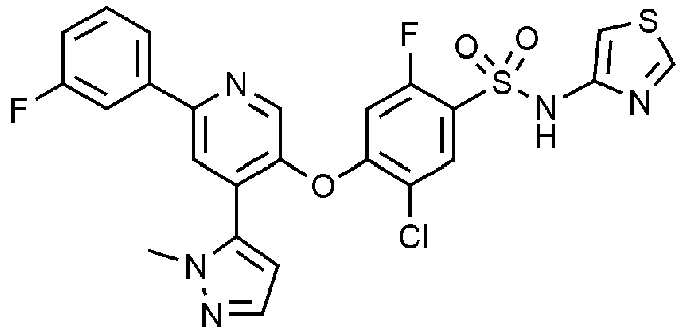
- 20 mg (0.03 mmol) of tert-butyl ((5-chloro-4-((6-chloro-4-(1-methyl-1H-pyrazol-5-yl)pyridin-3-yl)oxy)-2-fluorophenyl )sulfonyl)(thiazol-4-yl)carbamate was dissolved in 3 mL of N,N-dimethylformamide, and 6.9 mg (0.05 mmol) of (3-fluorophenyl)boronic acid was added thereto, and then 3.8 mg (10 mol%) of Pd(PPh3)4, 10.5 mg (0.1 mmol) of Na2CO3, and 1 mL of H2O were added thereto. After reacting with microwave reactor at 120°C for 10 minutes, the solvent was removed, and the remaining material was diluted with ethyl acetate and the organic layer was separated, and washed with saturated sodium chloride. The organic layer was collected, dried with magnesium sulfate to remove water, and concentrated under reduced pressure, and the residue was purified by column chromatography (developing solvent, hexane:ethyl acetate = 3:1) to obtain 5 mg (27% yield) of the title compound.
1H NMR (CD3OD, 500MHz) δ 8.72 (s, 1H), 8.59 (s, 1H), 8.05 (s, 1H), 7.89 (m, 3H), 7.52 (m, 1H), 7.41 (m, 1H), 7.21 (m, 1H), 7.02 (m, 1H), 6.82 (m, 1H), 6.41 (s, 1H), 3.87 (s, 3H) -

- 1000 mg (1 eq) of 6-chloropyridin-3-ol was dissolved in 50 mL of N,N-dimethylformamide, and 370 mg (1.2 eq) of sodium hydride was added thereto, followed by stirring at room temperature for 1 hour. Then, 688 uL (1.1 eq) of chloro(methoxy)methane was added slowly thereto, and the solution was stirred at room temperature for 2 hours. N,N-dimethylformamide was removed by concentrating under reduced pressure. After extracting with ethyl acetate, the extract was treated with anhydrous magnesium sulfate, and concentrated under reduced pressure. The residue was separated by column chromatography (developing solvent, hexane:ethyl acetate = 9:1) to obtain 1200 mg of 2-chloro-5-(methoxymethoxy)pyridine.
- 200 mg (1.0 eq) of the obtained 2-chloro-5-(methoxymethoxy)pyridine was dissolved in N,N-dimethylformamide/H2O = 5:1 (16 mL), 193 mg (1.2 eq) of (3-fluorophenyl)boronic acid, 48 mg (3 mol%) of Pd(PPh3)4 and 586 mg (4.0 eq) of Na 2CO3 were added. After reacting with microwave reactor at 120°C for 30 minutes, N,N-dimethylformamide was removed by concentrating under reduced pressure. After extracting with ethyl acetate, the extract was treated with anhydrous magnesium sulfate, and concentrated under reduced pressure. The residue was separated by column chromatography (developing solvent, hexane:ethyl acetate = 9:1) to obtain 220 mg of 2-(3-fluorophenyl)-5-(methoxymethoxy)pyridine.
- 100 mg (1.0 eq) of the obtained 2-(3-fluorophenyl)-5-(methoxymethoxy)pyridine was dissolved in 4.3 mL of tetrahydrofuran. After cooling to -78°C, tert-butyllithium 1.7 M solution (0.5 mL, 2.0 eq) was added slowly. The mixture was stirred at the same temperature for 30 minutes. 121 mg (1.5 eq) of B(O-iPr)3 was dissolved in 2.1 mL of tetrahydrofuran, and added to the above mixture. The mixture was stirred at the same temperature for 1 hour, and stirred for 3 hours as wariming to room temperature. After quenching by adding distilled water, tetrahydrofuran solution was added, and washed with brine. The reaction solution was dried with magnesium sulfate to remove water, concentrated under reduced pressure, and crystallized with methylchloride to obtain 50 mg of (2-(3-fluorophenyl)-5-hydroxypyridin-4-yl)boronic acid as white solid.
- 15.0 mg (1.0 eq) of the obtained (2-(3-fluorophenyl)-5-hydroxypyridin-4-yl)boronic acid was dissolved in 4.3 mL of 1,4-dioxane/H2O = 1:1 (1.0 mL), and 11.7 mg (1.0 eq) of (2-(3-fluorophenyl)-5-hydroxypyridin-4-yl)boronic acid, 1.74 mg (3 mol%) of Pd(PPh3)4 and 16.0 mg (3.0 eq) of Na2CO3 were added. After reacting with microwave reactor at 120°C for 5 minutes, 1,4-dioxane was removed by concentrating under reduced pressure. After extracting with ethyl acetate, the extract was treated by anhydrous magnesium sulfate, and concentrated under reduced pressure. The residue was separated by column chromatography (developing solvent, hexane:ethyl acetate = 4:1) to obtain 10.0 mg of tert-butyl 4-(4-(2-(3-fluorophenyl)-5-hydroxypyridin-4-yl)pyrimidin-2-yl)piperazin-1-carboxylat e.
- 10.0 mg (1.0 eq) of the obtained tert-butyl 4-(4-(2-(3-fluorophenyl)-5-hydroxypyridin-4-yl)pyrimidin-2-yl)piperazin-1-carboxylat e and 9.1 mg (1.0 eq) of the obtained tert-butyl ((5-chloro-2,4-difluorophenyl)sulfonyl)(thiazol-4-yl)carbamate were dissolved in 0.2 mL of N,N-dimethylformamide 0.2 mL, then 21.6 mg (3.0 eq) of Cs2CO3 was added thereto. The mixure was reacted at room temperature for 16 hours. The solvent was removed by concentrating under reduced pressure. The residue was separated by PLC (developing solvent, hexane:ethyl acetate = 2:1) to obtain 10 mg of tert-butyl 4-(4-(5-(4-(N-(tert-butoxycarbonyl)-N-(thiazol-4-yl)sulfamoyl)-2-chloro-5-fluorophen oxy)-2-(3-fluorophenyl)pyridin-4-yl)pyrimidin-2-yl)piperazin-1-carboxylate.
- 10 mg (1.0 eq) of the obtained tert-butyl 4-(4-(5-(4-(N-(tert-butoxycarbonyl)-N-(thiazol-4-yl)sulfamoyl)-2-chloro-5-fluorophen oxy)-2-(3-fluorophenyl)pyridin-4-yl)pyrimidin-2-yl)piperazin-1-carboxylate was dissolved in 0.2 oL dimethylchloride, and 0.2 mL of trifluoroacetic acid was added thereto. The mixure was reacted at room temperature for 2 hours. The solvent was removed by concentrating under reduced pressure. The residue was separated by PLC (developing solvent, dimethylchloride:methanol = 15:1) to obtain 2.0 mg of 5-chloro-2-fluoro-4-((6-(3-fluorophenyl)-4-(2-(piperazin-1-yl)pyrimidin-4-yl)pyridin-3 -yl)oxy)-N-(thiazol-4-yl)benzenesulfonamide.
1H NMR (CDCl3, 500MHz) δ 8.70 (s, 1H), 8.59 (s, 1H), 8.47 (d, 1H), 8.25 (s, 1H), 7.93 (m, 2H), 7.87 (d, 1H), 7.53 (q, 1H), 7.21 (m, 1H), 7.11 (d, 1H), 6.85 (d, 1H), 6.76 (d, 1H), 4.62 (br, 1H), 3.80 (br, 4H), 3.07 (t, 4H) -

- 20 mg (0.03 mmol) of tert-butyl ((5-chloro-4-((6'-chloro-[3,4'-bipyridin]-3'-yl)oxy)-2-fluorophenyl)sulfonyl)(thiazol-2-yl)carbamate was dissolved in 3 mL of N,N-dimethylformamide, and 7 mg (0.05 mmol) of (3-fluorophenyl)boronic acid was added thereto, and then 3.8 mg (10 mol%) of Pd(PPh3)4, 10.6 mg (0.10 mmol) of Na2CO3, and 1 mL of H2O were added thereto. After reacting with microwave reactor at 120°C for 10 minutes, the solvent was removed, and the remaining material was diluted with ethyl acetate and the organic layer was separated, and washed with saturated sodium chloride. The organic layer was collected, dried with magnesium sulfate to remove water, and concentrated under reduced pressure, and the residue was purified by column chromatography (developing solvent, hexane:ethyl acetate = 3:1) to obtain 5 mg (27% yield) of the title compound.
1H NMR (CD3OD, 500MHz) δ 8.88 (m, 1H), 8.60 (s, 1H), 8.55 (m, 1H), 8.18 (m, 1H), 8.07 (s, 1H), 7.93 (m, 1H), 7.90 (m, 1H), 7.54 (m, 3H), 7.21 (m, 1H), 6.97 (m, 1H), 6.71 (s, 1H) -

- 20 mg (0.03 mmol) of tert-butyl ((5-chloro-4-((6'-chloro-[3,4'-bibyridin]-3'-yl)oxy)-2-fluorophenyl)sulfonyl)(thiazol-4-yl)carbamate was dissolved in 3 mL of N,N-dimethylformamide, and 3.8 mg (10 mol%) of (3-fluorophenyl)boronic acid was added thereto, and then 8.3 mg(3 mol%) of Pd(PPh3)4, 10.6 mg (0.10 mmol) of Na2CO3, and 1 mL of H2O were added thereto. After reacting with microwave reactor at 120°C for 10 minutes, the solvent was removed, and the remaining material was diluted with ethyl acetate and the organic layer was separated, and washed with saturated sodium chloride. The organic layer was collected, dried with magnesium sulfate to remove water, and concentrated under reduced pressure, and the residue was purified by column chromatography (developing solvent, hexane:ethyl acetate = 3:1) to obtain 5 mg (27% yield) of the title compound.
1H NMR (CD3OD, 500MHz) δ 8.82 (m, 1H), 8.72 (m, 1H), 8.54 (m, 2H), 8.13 (m, 2H), 7.92 (m, 3H), 7.62 (m, 1H), 7.54 (m, 1H), 7.20 (m, 1H), 7.00 (m, 1H), 6.82 (d, 1H) -

- 16 mg (80% yield) of the title compound was obtained in the same manner as described in Example 74, except that (2-fluoropyridin-4-yl)boronic acid was used instead of (3-fluorophenyl)boronic acid.
1H NMR (CD3OD/CDCl3, 500MHz) δ 8.82 (s, 1H), 8.73 (s, 1H), 8.60 (s, 1H), 8.56 (m, 1H), 8.32 (m, 2H), 8.15 (m, 1H), 8.07 (m, 1H), 7.91 (m, 1H), 7.84 (s, 1H), 7.50 (m, 1H), 7.01 (s, 1H), 6.89 (d, 1H) -

- 20 mg (0.03 mmol)of tert-butyl ((5-chloro-4-((6-chloro-4-(pyrimidin-5-yl)pyridin-3-yl)oxy)-2-fluorophenyl)sulfonyl)(t hiazol-4-yl)carbamate was dissolved in 3 mL of N,N-dimethylformamide, and 7 mg (0.05 mmol)of (3-fluorophenyl)boronic acid was added thereto, and then 3.8 mg (10 mol%) of Pd(PPh3)4, 10.6 mg (0.10 mmol)of Na2CO3, and 1 mL of H2O were added thereto. After reacting with microwave reactor at 120°C for 10 minutes, the solvent was removed, and the remaining material was diluted with ethyl acetate and the organic layer was separated, and washed with saturated sodium chloride. The organic layer was collected, dried with magnesium sulfate to remove water, and concentrated under reduced pressure, and the residue was purified by column chromatography (developing solvent, hexane:ethyl acetate = 3:1) to obtain 5 mg (27% yield) of the title compound.
1H NMR (CD3OD, 500MHz) δ 9.17 (s, 1H), 9.11 (m, 2H), 8.74 (m, 1H), 8.54 (s, 1H), 8.21 (s, 1H), 7.93 (m, 3H), 7.52 (m, 1H), 7.20 (m, 1H), 7.04 (m, 1H), 6.95 (d, 1H) -

- 16 mg (80% yield) of the title compound was obtained in the same manner as described in Example 76, except that (2-fluoropyridin-4-yl)boronic acid was used instead of (3-fluorophenyl)boronic acid.
1H NMR (CD3OD/CDCl3, 500MHz) δ 9.19 (s, 1H), 9.14 (s, 2H, 8.74 (m, 1H), 8.59 (s, 1H), 8.39 (m, 1H), 8.33 (m, 1H), 8.06 (m, 1H), 7.95 (m, 1H), 7.85 (m, 1H), 7.05 (m, 2H) -
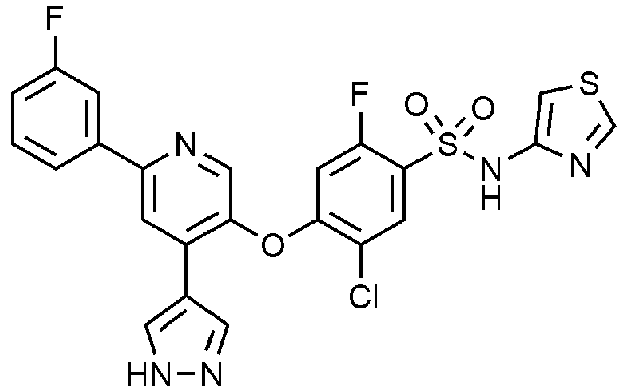
- 13.9 mg (0.03 mmol)of 5-chloro-4-((6-chloro-4-(1H-pyrazol-4-yl)pyridin-3-yl)oxy)-2-fluoro-N-(thiazol-4-yl)b enzenesulfonamide was dissolved in 1 mL of 1,4-dioxane, and 6.3 mg (0.05 mmol) of (3-fluorophenyl)boronic acid was added thereto, and then 3.5 mg (10 mol%)of Pd(PPh3 )4, 12.4 mg (0.09 mmol) of Na2CO3, and 0.2 mL of H2O were added thereto. After reacting with microwave reactor at 120°C for 20 minutes, the solvent was removed, and the remaining material was diluted with ethyl acetate and the organic layer was separated, and washed with saturated sodium chloride. The organic layer was collected, dried with magnesium sulfate to remove water, and concentrated under reduced pressure, and the residue was purified by column chromatography (developing solvent, dimethylchloride:ethanol = 15:1) to obtain 3.2 mg (19.7% yield) of the title compound.
1H NMR (CD3OD, 500MHz) δ 6.73 (1H), 7.05 (1H), 7.19 (1H), 7.51 (1H), 7.85 (1H), 7.91 (1H), 8.00 (1H), 8.23 (3H), 8.39 (1H), 7.81 (1H) -

- 20 mg (0.03 mmol) of tert-butyl ((5-chloro-4-((6-chloro-2'-fluoro-[4,4'-bipyridin]-3-yl)oxy)-2-fluorophenyl)sulfonyl)(th iazol-4-yl)carbamate was dissolved in 3 mL of N,N-dimethylformamide, and 6.8 mg (0.05 mmol) of (3-fluorophenyl)boronic acid was added thereto, and then 3.7 mg (10 mol%) of Pd(PPh3)4, 10 mg (0.10 mmol) of Na2CO3, and 1 mL of H2O were added thereto. After reacting with microwave reactor at 120°C for 5 minutes, the solvent was removed, and the remaining material was diluted with ethyl acetate and the organic layer was separated, and washed with saturated sodium chloride. The organic layer was collected, dried with magnesium sulfate to remove water, and concentrated under reduced pressure, and the residue was purified by column chromatography (developing solvent, hexane:ethyl acetate = 3:1) to obtain 5 mg (27% yield) of the title compound.
1H NMR (CD3OD, 500MHz) δ 8.72 (m, 1H), 8.54 (s, 1H), 8.24 (d, 1H), 8.12 (m, 1H), 7.87 (m, 3H), 7.57 (m, 1H), 7.52 (m, 1H), 7.49 (m, 1H), 7.21 (m, 1H), 7.02 (m, 1H), 6.87 (d, 1H) -

- 16 mg (80% yield) of the title compound was obtained in the same manner as described in Example 79, except that (3,4-fluorophenyl)boronic acid was used instead of (3-fluorophenyl)boronic acid.
1H NMR (CD3OD/CDCl3, 500MHz) δ 8.72 (s, 1H), 8.53 (s, 1H), 8.24 (m, 1H), 8.11 (m, 2H), 7.91 (m, 2H), 7.56 (m, 1H), 7.40 (m, 2H), 7.01 (s, 1H), 6.88 (d, 1H) -
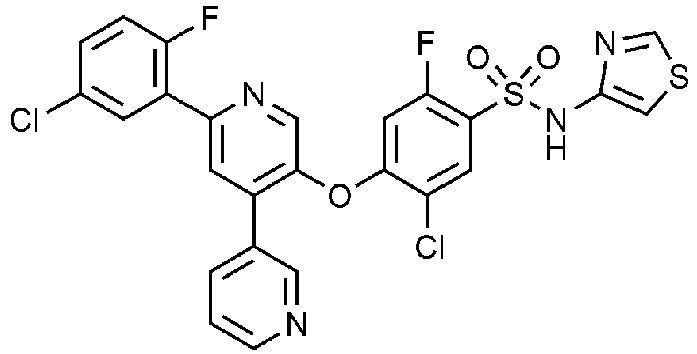
- 16 mg (80% yield) of the title compound was obtained in the same manner as described in Example 74, except that (5-chloro-2-fluorophenyl)boronic acid was used instead of (3-fluorophenyl)boronic acid.
1H NMR (CD3OD/CDCl3, 500MHz) δ 8.96 (s, 1H), 8.87 (s, 1H), 8.70 (s, 1H), 8.58 (m, 1H), 8.12 (m, 4H), 7.70 (s, 1H), 7.52 (m, 2H), 7.30 (m, 1H), 6.98 (d, 1H) -
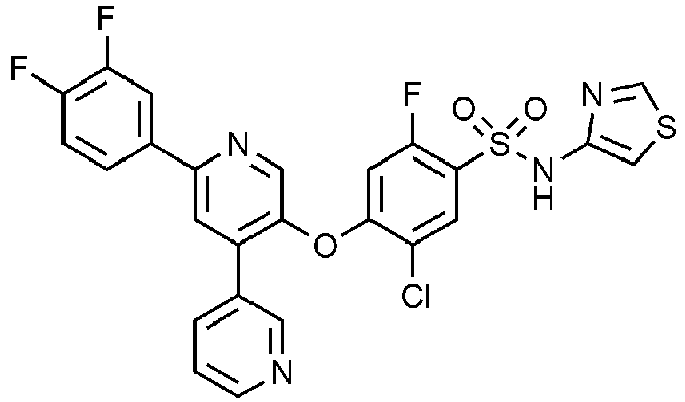
- 16 mg (80% yield) of the title compound was obtained in the same manner as described in Example 74, except that (3,4-fluorophenyl)boronic acid was used instead of (3-fluorophenyl)boronic acid.
1H NMR (CD3OD/CDCl3, 500MHz) δ 8.82 (s, 1H), 8.71 (s, 1H), 8.53 (s, 2H), 8.11 (m, 3H), 7.94 (m, 1H), 7.87 (d, 1H), 7.47 (m, 1H), 7.40 (m, 1H), 6.95 (s, 1H), 6.80 (d, 1H) -

- 25.0 mg (0.05 mmol) of 4-((6-chloro-4-(1H-pyrazol-4-yl)pyridin-3-yl)oxy)-3-cyano-N-(thiazol-4-yl)benzenesul fonamide was dissolved in 1.5 mL of 1,4-dioxane, and 10.5 mg (0.08 mmol) of (3-fluorophenyl)boronic acid was added thereto, and then 5.8 mg (10 mol%) of Pd(PPh 3)4, 20.7 mg (0.15 mmol) of K2CO3, and 0.3 mL of H2O were added thereto. After reacting with microwave reactor at 120°C for 20 minutes, the solvent was removed, and the remaining material was diluted with ethyl acetate and the organic layer was separated, and washed with saturated sodium chloride. The organic layer was collected, dried with magnesium sulfate to remove water, and concentrated under reduced pressure, and the residue was purified by column chromatography (developing solvent, hexane:ethyl acetate = 1:1) to obtain 9.0 mg (31.9% yield) of the title compound.
1H NMR (CD3OD, 500MHz) δ 6.92 (1H), 7.07 (1H), 7.19 (1H), 7.53 (1H), 7.86 (1H), 7.92 (2H), 8.26 (4H), 8.49 (1H), 8.71 (1H) -

- 10 mg (0.03 mmol) of tert-butyl ((4-((6'-chloro-[3,4'-bipyridin]-3'-yl)oxy)-3-cyanophenyl)sulfonyl)(thiazol-4-yl)carbam ate was dissolved in 3 mL of N,N-dimethylformamide, and 3.7 mg (0.03 mmol) of (3-fluorophenyl)boronic acid was added thereto, and then 2 mg (10 mol%) of Pd(PPh3) 4, 5.6 mg (0.05 mmol) of Na2CO3, and 1 mL of H2O were added thereto. After reacting with microwave reactor at 120°C for 5 minutes, the solvent was removed, and the remaining material was diluted with ethyl acetate and the organic layer was separated, and washed with saturated sodium chloride. The organic layer was collected, dried with magnesium sulfate to remove water, and concentrated under reduced pressure, and the residue was purified by column chromatography (developing solvent, hexane:ethyl acetate = 3:1) to obtain 5 mg (27% yield) of the title compound.
1H NMR (CD3OD, 500MHz) δ 8.79 (s, 1H), 8.71 (m, 1H), 8.67 (s, 1H), 8.52 (m, 1H), 8.13 (m, 3H), 7.91 (m, 3H), 7.51 (m, 1H), 7.48 (m, 1H), 7.21 (m, 1H), 7.19 (m, 1H), 6.95 (d, 1H) -

- 16 mg (80% yield) of the title compound was obtained in the same manner as described in Example 84, except that (3,4-fluorophenyl)boronic acid was used instead of (3-fluorophenyl)boronic acid.
1H NMR (CD3OD/CDCl3, 500MHz) δ 8.78 (s, 1H), 8.72 (s, 1H), 8.65 (s, 1H), 8.52 (m, 1H), 8.12 (m, 4H), 7.99 (m, 1H), 7.88 (m, 1H), 7.46 (m, 1H), 7.39 (m, 1H), 7.02 (s, 1H), 6.93 (d, 1H) -

- 16 mg (80% yield) of the title compound was obtained in the same manner as described in Example 84, except that (3-fluoro-4-(trifluoromethyl)phenyl)boronic acid was used instead of (3-fluorophenyl)boronic acid.
1H NMR (CD3OD/CDCl3, 500MHz) δ 8.81 (s, 1H), 8.71 (s, 2H), 8.53 (m, 1H), 8.27 (m, 1H), 8.12 (m, 4H), 7.88 (m, 2H), 7.49 (m, 1H), 7.01 (m, 2H) -

- 10 mg (0.03 mmol) of tert-butyl ((4-((6'-chloro-[3,4'-bipyridin]-3'-yl)oxy)-2,5-difluorophenyl)sulfonyl)(thiazol-4-yl)car bamate was dissolved in 3 mL of N,N-dimethylformamide, and 3.7 mg (0.03 mmol) of (3-fluorophenyl)boronic acid was added thereto, and then 2 mg (10 mol%) of Pd(PPh3) 4, 5.5 mg (0.05 mmol) of Na2CO3, and 1 mL of H2O were added thereto. After reacting with microwave reactor at 120°C for 10 minutes, the solvent was removed, and the remaining material was diluted with ethyl acetate and the organic layer was separated, and washed with saturated sodium chloride. The organic layer was collected, dried with magnesium sulfate to remove water, and concentrated under reduced pressure, and the residue was purified by column chromatography (developing solvent, hexane:ethyl acetate = 3:1) to obtain 5 mg (27% yield) of the title compound.
1H NMR (CD3OD, 500MHz) δ 8.81 (m, 1H), 8.73 (m, 1H), 8.54 (m, 2H), 8.12 (m, 2H), 7.91 (d, 1H), 7.86 (m, 1H), 7.68 (m, 1H), 7.50 (m, 2H), 7.19 (m, 1H), 6.99 (m, 1H), 6.94 (m, 1H) -

- 16 mg (80% yield) of the title compound was obtained in the same manner as described in Example 87, except that (3,4-fluorophenyl)boronic acid was used instead of (3-fluorophenyl)boronic acid.
1H NMR (CD3OD/CDCl3, 500MHz) δ 8.81 (s, 1H), 8.73 (s, 1H), 8.54 (m, 2H), 8.12 (m, 3H), 7.93 (m, 1H), 7.67 (m, 1H), 7.50 (m, 1H), 7.39 (m, 1H), 7.00 (s, 1H), 6.91 (m, 1H) -

- 16 mg (80% yield) of the title compound was obtained in the same manner as described in Example 87, except that (3-fluoro-4-(trifluoromethyl)phenyl)boronic acid was used instead of (3-fluorophenyl)boronic acid.
1H NMR (CD3OD/CDCl3, 500MHz) δ 8.83 (m, 1H), 8.78 (m, 1H), 8.56 (m, 2H), 8.21 (s, 1H), 8.12 (m, 3H), 7.81 (m, 1H), 7.68 (m, 1H), 7.51 (m, 1H), 6.96 (m, 2H) -

- 5.5 mg (29.5% yield) of the title compound was obtained in the same manner as described in Example 83, except that 4-((6-chloro-4-(1H-pyrazol-4-yl)pyridin-3-yl)oxy)-3-cyano-N-(thiazol-4-yl)benzenesul fonamide and (4-fluorophenyl)boronic acid were used instead of 4-((6-chloro-4-(1H-pyrazol-4-yl)pyridin-3-yl)oxy)-3-cyano-N-(thiazol-4-yl)benzenesul fonamide and (3-fluorophenyl)boronic acid.
1H NMR (CD3OD, 500MHz) δ 6.91 (1H), 7.05 (1H), 7.24 (2H), 7.92 (1H), 8.12 (3H), 8.24 (3H), 8.47 (1H), 8.70 (1H) -

- 5.7 mg (29.5% yield) of the title compound was obtained in the same manner as described in Example 83, except that (3,4-difluorophenyl)boronic acid was used instead of (3-fluorophenyl)boronic acid.
1H NMR (CD3OD, 500MHz) δ 6.91 (1H), 7.06 (1H), 7.40 (1H), 7.94 (2H), 8.07 (1H), 8.23 (4H), 8.49 (1H), 8.71 (1H) -
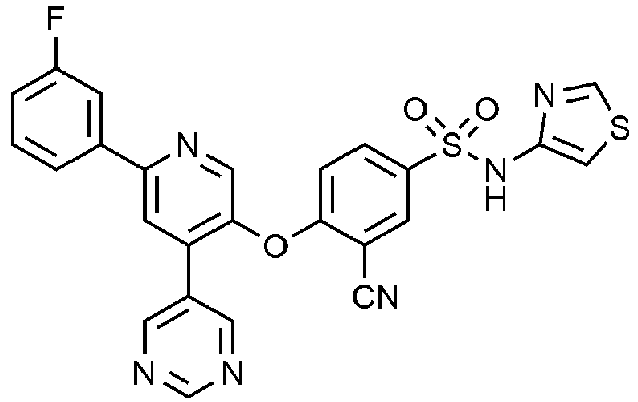
- 10 mg (0.02 mmol) of tert-butyl ((4-((6-chloro-4-(pyrimidin-5-yl)pyridin-3-yl)oxy)-3-cyanophenyl)sulfonyl)(thiazol-4-yl)carbamate was dissolved in 3 mL of N,N-dimethylformamide, and 3.7 mg (0.03 mmol) of (3-fluorophenyl)boronic acid was added thereto, and then 2 mg (10 mol%) of Pd(PPh3)4, 5.5 mg (0.05 mmol) of Na2CO3, and 1 mL of H2O were added thereto. After reacting with microwave reactor at 120°C for 10 minutes, the solvent was removed, and the remaining material was diluted with ethyl acetate and the organic layer was separated, and washed with saturated sodium chloride. The organic layer was collected, dried with magnesium sulfate to remove water, and concentrated under reduced pressure, and the residue was purified by column chromatography (developing solvent, hexane:ethyl acetate = 3:1) to obtain 80 mg (70% yield) of the title compound.
1H NMR (CD3OD, 500MHz) δ 9.15 (s, 1H), 9.08 (s, 2H), 8.73 (s, 1H), 8.67 (s, 1H), 8.23 (s, 1H), 8.18 (m, 1H), 7.97 (m, 1H), 7.93 (m, 2H), 7.53 (m, 1H), 7.21 (m, 1H), 7.05 (m, 2H) -

- 16 mg (80% yield) of the title compound was obtained in the same manner as described in Example 92, except that (3,4-fluorophenyl)boronic acid was used instead of (3-fluorophenyl)boronic acid.
1H NMR (CD3OD/CDCl3, 500MHz) δ 9.16 (s, 1H), 9.08 (s, 2H), 8.72 (s, 1H), 8.66 (s, 1H), 8.22 (s, 1H), 8.18 (s, 1H), 8.11 (m, 1H), 7.98 (m, 1H), 7.91 (m, 1H), 7.42 (m, 1H), 7.05 (m, 2H) -

- 16 mg (80% yield) of the title compound was obtained in the same manner as described in Example 92, except that (3-fluoro-4-(trifluoromethyl)phenyl)boronic acid was used instead of (3-fluorophenyl)boronic acid.
1H NMR (CD3OD/CDCl3, 500MHz) δ 9.17 (s, 1H), 9.10 (s, 2H), 8.73 (m, 2H), 8.35 (s, 1H), 8.19 (m, 3H), 7.94 (m, 1H), 7.83 (m, 1H), 7.09 (m, 2H) -

- 10 mg (0.02 mmol) of tert-butyl ((4-((6-chloro-4-(pyrimidin-5-yl)pyridin-3-yl)oxy)-2,5-difluorophenyl)sulfonyl)(thiazo 1-4-yl)carbamate was dissolved in 3 mL of N,N-dimethylformamide, and 3.6 mg (0.03 mmol) of (3-fluorophenyl)boronic acid was added thereto, and then 2 mg (10 mol%) of Pd(PPh3)4, 5.4 mg (0.05 mmol)of Na2CO3, and 1 mL of H2O were added thereto. After reacting with microwave reactor at 120°C for 10 minutes, the solvent was removed, and the remaining material was diluted with ethyl acetate and the organic layer was separated, and washed with saturated sodium chloride. The organic layer was collected, dried with magnesium sulfate to remove water, and concentrated under reduced pressure, and the residue was purified by column chromatography (developing solvent, hexane:ethyl acetate = 3:1) to obtain 5 mg (27% yield) of the title compound.
1H NMR (CD3OD, 500MHz) δ 9.18 (s, 1H), 9.10 (s, 2H), 8.73 (s, 1H), 8.54 (s, 1H), 8.19 (s, 1H), 7.92 (m, 2H), 7.72 (m, 1H), 7.52 (m, 1H), 7.21 (m, 1H), 7.09 (m, 1H), 7.01 (s, 1H) -

- 16 mg (80% yield) of the title compound was obtained in the same manner as described in Example 95, except that (3,4-difluorophenyl)boronic acid was used instead of (3-fluorophenyl)boronic acid.
1H NMR (CD3OD/CDCl3, 500MHz) δ 9.18 (s, 1H), 9.10 (s, 2H), 8.73 (s, 1H), 8.53 (s, 1H), 8.17 (s, 1H), 8.08 (m, 1H), 7.95 (m, 1H), 7.73 (m, 1H), 7.38 (m, 1H), 7.08 (m, 1H), 7.01 (s, 1H) -

- 16 mg (80% yield) of the title compound was obtained in the same manner as described in Example 95, except that (3-fluoro-4-(trifluoromethyl)phenyl)boronic acid was used instead of (3-fluorophenyl)boronic acid.
1H NMR (CD3OD/CDCl3, 500MHz) δ 9.19 (s, 1H), 9.12 (s, 2H), 8.73 (s, 1H), 8.57 (s, 1H), 8.30 (s, 1H), 8.14 (m, 2H), 7.82 (m, 1H), 7.77 (m, 1H), 7.14 (m, 1H), 7.02 (s, 1H) -

- 15.0 mg (0.03 mmol) of 5-chloro-4-((6-chloro-4-(1H-pyrazol-4-yl)pyridin-3-yl)oxy)-2-fluoro-N-(thiazol-4-yl)b enzenesulfonamide was dissolved in 1.5 mL of 1,4-dioxane, and 7.1 mg (0.05 mmol) of (3,4-difluorophenyl)boronic acid was added thereto, and then 3.5 mg (10 mol%)of Pd(PPh3)4, 12.4 mg (0.09 mmol) of K2CO3, and 0.3 mL of H2O were added thereto. After reacting with microwave reactor at 150°C for 30 minutes, the solvent was removed, and the remaining material was diluted with ethyl acetate and the organic layer was separated, and washed with saturated sodium chloride. The organic layer was collected, dried with magnesium sulfate to remove water, and concentrated under reduced pressure, and the residue was purified by column chromatography (developing solvent, dimethylchloride:methanol = 20:1) to obtain 9.0 mg (31.9% yield) of the title compound.
1H NMR (DMSO-d6, 500MHz) δ 8.86 (1H), 8.59 (1H), 8.35 (1H), 8.04 (2H), 7.88 (3H), 7.37 (1H), 7.17 (1H), 6.31 (1H) -

- 30 mg (0.05 mmol) of 5-chloro-2-fluoro-4-((6-(3-fluorophenyl)-4-iodipyridin-3-yl)oxy)-N-(thiazol-4-yl)benz enesulfonamide was dissolved in 0.9 mL of N,N-dimethylformamide, and 13.2 mg (0.05 mmol) of (5-(pyrrolidin-1-yl)pyridin-3-yl)boronic acid was added thereto, and then 5.3 mg (10 mol%) of Pd(PPh3)4, 14.5 mg (0.15 mmol) of Na2CO3, and 0.1 mL of H2O were added thereto. After reacting with microwave reactor at 120°C for 10 minutes, the solvent was removed, and the remaining material was diluted with ethyl acetate and the organic layer was separated, and washed with saturated sodium chloride. The organic layer was collected, dried with magnesium sulfate to remove water, and concentrated under reduced pressure, and the residue was purified by column chromatography (developing solvent, hexane:ethyl acetate = 1:2) to obtain 5.0 mg (17.5% yield) of the title compound.
1H NMR (CD3OD, 500MHz) δ 8.71 (1H), 8.70 (1H), 8.56 (1H), 8.08 (1H), 7.87 (4H), 7.51 (1H), 7.19 (1H), 7.12 (1H), 6.97 (1H), 6.73 (1H), 2.00 (4H) -
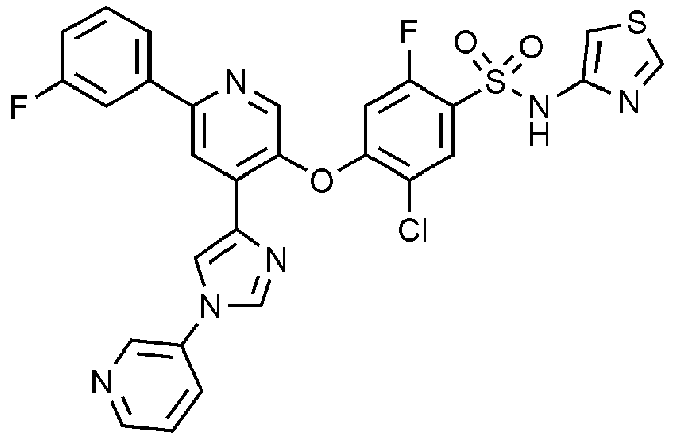
- 3.0 mg (10.5% yield) of the title compound was obtained in the same manner as described in Example 99, except that 3-(4-(4,4,5,5,-tetramethyl-1,3,2-dioxaboran-2-yl)-1H-imidazol-1-yl)pyridine was used instead of (5-(pyrrolidin-1-yl)pyridin-3-yl)boronic acid.
1H NMR (CD3OD, 500MHz) δ 8.30 (1H), 8.11 (1H), 7.78 (3H), 7.67 (3H), 7.56 (3H), 7.45 (1H), 7.11 (1H) -

- 4.5 mg (15.4% yield) of the title compound was obtained in the same manner as described in Example 99, except that (2-morpholinopyridin-4-yl)boronic acid was used instead of (5-(pyrrolidin-1-yl)pyridin-3-yl)boronic acid.
1H NMR (CD3OD, 500MHz) δ 8.71 (1H), 8.56 (1H), 8.11 (1H), 8.06 (1H), 7.92 (1H), 7.87 (2H), 7.53 (1H), 7.20 (1H), 6.94 (2H), 6.86 (1H), 6.72 (1H), 3.75 (4H), 3.46 (4H) -

- 4.8 mg (16.4% yield) of the title compound was obtained in the same manner as described in Example 99, except that (2-(piperidin-1-yl)pyridin-4-yl)boronic acid was used instead of (5-(pyrrolidin-1-yl)pyridin-3-yl)boronic acid.
1H NMR (CD3OD, 500MHz) δ 8.71 (1H), 8.55 (1H), 8.05 (2H), 7.91 (1H), 7.87 (2H), 7.52 (1H), 7.20 (1H), 6.94 (1H), 6.87 (1H), 6.77 (1H), 6.72 (1H), 3.49 (4H), 1.65 (2H), 1.56 (4H) -

- 2.5 mg (22.1% yield) of the title compound was obtained in the same manner as described in Example 5, except that 4-((6-chloro-2-(furan-3-yl)pyridin-3-yl)oxy)-3-cyano-N-(thiazol-2-yl)benzenesulfona mide and (2-fluoropyridin-3-yl)boronic acid were used instead of 4-((6-chloro-4-(furan-3-yl)pyridin-3-yl)oxy)-3-cyano-N-(thiazol-2-yl)benzenesulfona mide and (3-fluorophenyl)boronic acid.
1H NMR (DMSO-d6, 500MHz) δ 6.87 (1H), 7.18 (2H), 7.28 (1H), 7.56 (1H), 7.89 (2H), 7.99 (1H), 7.28 (2H), 8.34 (1H), 8.70 (1H) -

- 2.5 mg (11.0% yield) of the title compound was obtained in the same manner as described in Example 5, except that 4-((6-chloro-2-(furan-3-yl)pyridin-3-yl)oxy)-3-cyano-N-(thiazol-2-yl)benzenesulfona mide and (6-fluoropyridin-3-yl)boronic acid were used instead of 4-((6-chloro-4-(furan-3-yl)pyridin-3-yl)oxy)-3-cyano-N-(thiazol-2-yl)benzenesulfona mide and (3-fluorophenyl)boronic acid.
1H NMR (CD3OD, 500MHz) δ 6.86 (1H), 7.10 (1H), 7.20 (1H), 7.28 (1H), 7.34 (1H), 7.81 (1H), 7.92 (1H), 7.96 (1H), 8.08 (1H), 8.28 (2H), 8.77 (1H), 9.10 (1H) -

- 2.5 mg (11.5% yield) of the title compound was obtained in the same manner as described in Example 5, except that 4-((6-chloro-4-(furan-3-yl)pyridin-3-yl)oxy)-3-cyano-N-(thiazol-2-yl)benzenesulfona mide and (3-fluorophenyl)boronic acid were used instead of 4-((6-chloro-2-(furan-3-yl)pyridin-3-yl)oxy)-3-cyano-N-(thiazol-2-yl)benzenesulfona mide and (pyridin-3-yl)boronic acid.
1H NMR (CD3OD, 500MHz) δ 6.73 (1H), 7.04 (1H), 7.11 (1H), 7.21 (1H), 7.59 (2H), 7.71 (1H), 7.95 (1H), 8.05 (1H), 8.19 (1H), 8.30 (1H), 8.61 (2H), 9.31 (1H) -

- 2.4 mg (11.0% yield) of the title compound was obtained in the same manner as described in Example 5, except that 4-((6-chloro-2-(furan-3-yl)pyridin-3-yl)oxy)-3-cyano-N-(thiazol-2-yl)benzenesulfona mide and (pyrimidin-5-yl)boronic acid were used instead of 4-((6-chloro-4-(furan-3-yl)pyridin-3-yl)oxy)-3-cyano-N-(thiazol-2-yl)benzenesulfona mide and (3-fluorophenyl)boronic acid.
1H NMR (DMSO-d6, 500MHz) δ 6.74 (1H), 7.08 (1H), 7.12 (1H), 7.22 (1H), 7.60 (1H), 7.73 (1H), 8.00 (1H), 8.06 (1H), 8.22 (1H), 8.31 (1H), 9.22 (1H), 9.52 (2H) -

- 2.0 mg (15.2% yield) of the title compound was obtained in the same manner as described in Example 5, except that 4-((6-chloro-2-(1-methyl-1H-pyrazol-5-yl)pyridin-3-yl)oxy)-3-cyano-N-(thiazol-2-yl)b enzenesulfonamide and (2-fluoropyridin-4-yl)boronic acid were used instead of 4-((6-chloro-4-(furan-3-yl)pyridin-3-yl)oxy)-3-cyano-N-(thiazol-2-yl)benzenesulfona mide and (3-fluorophenyl)boronic acid.
1H NMR (DMSO-d6, 500MHz) δ 4.10 (3H), 6.61 (1H), 6.88 (1H), 7.15 (1H), 7.29 (1H), 7.47 (1H), 7.92 (2H), 8.12 (2H), 8.23 (1H), 8.39 (2H), 12.88 (1H) -

- 3.0 mg (13.2% yield) of the title compound was obtained in the same manner as described in Example 5, except that 4-((6-chloro-2-(furan-3-yl)pyridin-3-yl)oxy)-3-cyano-N-(thiazol-2-yl)benzenesulfona mide and (2-fluorophenyl)boronic acid were used instead of 4-((6-chloro-4-(furan-3-yl)pyridin-3-yl)oxy)-3-cyano-N-(thiazol-2-yl)benzenesulfona mide and (3-fluorophenyl)boronic acid.
1H NMR (DMSO-d6, 500MHz) δ 6.86 (1H), 7.14 (2H), 7.28 (1H), 7.37 (2H), 7.52 (1H), 7.79 (2H), 7.86 (1H), 7.98 (1H), 8.10 (1H), 8.30 (2H) -

- 4.5 mg (19.7% yield) of the title compound was obtained in the same manner as described in Example 5, except that 4-((6-chloro-2-(furan-3-yl)pyridin-3-yl)oxy)-3-cyano-N-(thiazol-2-yl)benzenesulfona mide and (4-fluorophenyl)boronic acid were used instead of 4-((6-chloro-4-(furan-3-yl)pyridin-3-yl)oxy)-3-cyano-N-(thiazol-2-yl)benzenesulfona mide and (3-fluorophenyl)boronic acid.
1H NMR (DMSO-d6, 500MHz) δ 6.86 (1H), 7.08 (1H), 7.16 (1H), 7.27 (1H), 7.34 (2H), 7.80 (1H), 7.86 (1H), 7.97 (2H), 8.25 (4H) -

- 4.3 mg (18.9% yield) of the title compound was obtained in the same manner as described in Example 5, except that 4-((6-chloro-2-(furan-3-yl)pyridin-3-yl)oxy)-3-cyano-N-(thiazol-2-yl)benzenesulfona mide and (3-fluorophenyl)boronic acid were used instead of 4-((6-chloro-4-(furan-3-yl)pyridin-3-yl)oxy)-3-cyano-N-(thiazol-2-yl)benzenesulfona mide and (3-fluorophenyl)boronic acid.
1H NMR (DMSO-d6, 500MHz) δ 6.86 (1H), 7.10 (1H), 7.19 (1H), 7.28 (2H), 7.56 (1H), 7.80 (1H), 7.87 (1H), 7.96 (1H), 8.04 (3H), 8.27 (2H) -

- 2.5 mg (11.3% yield) of the title compound was obtained in the same manner as described in Example 5, except that 4-((6-chloro-2-(furan-3-yl)pyridin-3-yl)oxy)-3-cyano-N-(thiazol-2-yl)benzenesulfona mide and (pyridin-4-yl)boronic acid were used instead of 4-((6-chloro-4-(furan-3-yl)pyridin-3-yl)oxy)-3-cyano-N-(thiazol-2-yl)benzenesulfona mide and (3-fluorophenyl)boronic acid.
1H NMR (CD3OD, 500MHz) δ 6.76 (1H), 7.08 (1H), 7.13 (1H), 7.24 (1H), 7.61 (1H), 7.73 (1H), 8.05 (2H), 8.21 (3H), 8.32 (1H), 8.68 (2H) -

- 2.5 mg (11.0% yield) of the title compound was obtained in the same manner as described in Example 5, except that 4-((6-chloro-2-(furan-3-yl)pyridin-3-yl)oxy)-3-cyano-N-(thiazol-2-yl)benzenesulfona mide and (2-fluoropyridin-4-yl)boronic acid were used instead of 4-((6-chloro-4-(furan-3-yl)pyridin-3-yl)oxy)-3-cyano-N-(thiazol-2-yl)benzenesulfona mide and (3-fluorophenyl)boronic acid.
1H NMR (CD3OD, 500MHz) δ 6.75 (1H), 7.09 (1H), 7.13 (1H), 7.24 (1H), 7.61 (1H), 7.72 (1H), 7.85 (1H), 7.94 (3H), 8.23 (1H), 8.33 (1H) -
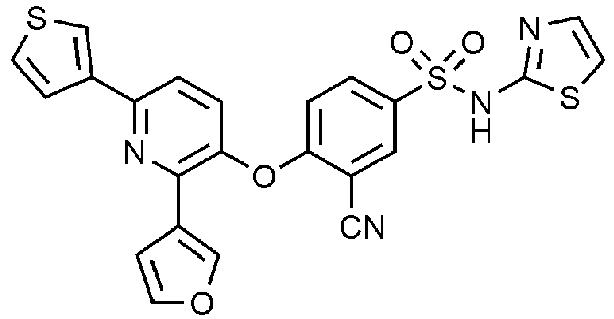
- 3.0 mg (13.4% yield) of the title compound was obtained in the same manner as described in Example 5, except that 4-((6-chloro-2-(furan-3-yl)pyridin-3-yl)oxy)-3-cyano-N-(thiazol-2-yl)benzenesulfona mide and (thiophen-3-yl)boronic acid were used instead of 4-((6-chloro-4-(furan-3-yl)pyridin-3-yl)oxy)-3-cyano-N-(thiazol-2-yl)benzenesulfona mide and (3-fluorophenyl)boronic acid.
1H NMR (CD3OD, 500MHz) δ 6.75 (1H), 6.95 (1H), 7.14 (1H), 7.52 (1H), 7.56 (1H) 7.61 (1H), 7.76 (1H), 7.80 (1H), 8.01 (1H), 8.11 (2H), 8.30 (1H) -

- 3.2 mg (14.8% yield) of the title compound was obtained in the same manner as described in Example 5, except that 4-((6-chloro-2-(furan-3-yl)pyridin-3-yl)oxy)-3-cyano-N-(thiazol-2-yl)benzenesulfona mide and (furan-3-yl)boronic acid were used instead of 4-((6-chloro-4-(furan-3-yl)pyridin-3-yl)oxy)-3-cyano-N-(thiazol-2-yl)benzenesulfona mide and (3-fluorophenyl)boronic acid.
1H NMR (CD3OD, 500MHz) δ 6.71 (1H), 6.92 (1H), 7.05 (1H), 7.09 (1H), 7.12 (1H), 7.58 (4H), 8.01 (1H), 8.09 (1H), 8.20 (1H), 8.27 (1H) -

- 2.4 mg (18.2% yield) of the title compound was obtained in the same manner as described in Example 5, except that 4-((6-chloro-2-(1-methyl-1H-pyrazol-5-yl)pyridin-3-yl)oxy)-3-cyano-N-(thiazol-2-yl)b enzenesulfonamide and (6-fluoropyridin-3-yl)boronic acid were used instead of 4-((6-chloro-4-(furan-3-yl)pyridin-3-yl)oxy)-3-cyano-N-(thiazol-2-yl)benzenesulfona mide and (3-fluorophenyl)boronic acid.
1H NMR (CD3OD, 500MHz) δ 4.11 (3H), 6.69 (1H), 6.76 (1H), 7.02 (1H), 7.13 (1H), 7.23 (1H), 7.44 (1H), 7.89 (1H), 8.00 (1H), 8.11 (1H), 8.20 (1H), 8.68 (1H), 8.98 (1H) -

- 1.9 mg (13.7% yield) of the title compound was obtained in the same manner as described in Example 5, except that 4-((6-chloro-2-(1-methyl-1H-pyrazol-5-yl)pyridin-3-yl)oxy)-3-cyano-N-(thiazol-2-yl)b enzenesulfonamide and (2-fluoropyridin-3-yl)boronic acid were used instead of 4-((6-chloro-4-(furan-3-yl)pyridin-3-yl)oxy)-3-cyano-N-(thiazol-2-yl)benzenesulfona mide and (3-fluorophenyl)boronic acid.
1H NMR (CD3OD, 500MHz) δ 4.10 (3H), 6.71 (1H), 6.76 (1H), 7.05 (1H), 7.13 (1H), 7.45 (1H), 7.51 (1H), 7.90 (1H), 8.02 (1H), 8.08 (1H), 8.22 (1H), 8.32 (1H), 8.65 (1H), -

- 1.5 mg (17.6% yield) of the title compound was obtained in the same manner as described in Example 5, except that 4-((6-chloro-2-(1-methyl-1H-pyrazol-5-yl)pyridin-3-yl)oxy)-3-cyano-N-(thiazol-2-yl)b enzenesulfonamide and (3-fluorophenyl)boronic acid were used instead of 4-((6-chloro-4-(furan-3-yl)pyridin-3-yl)oxy)-3-cyano-N-(thiazol-2-yl)benzenesulfona mide and (3-fluorophenyl)boronic acid.
1H NMR (CD3OD, 500MHz) δ 4.12 (3H), 6.68 (1H), 6.76 (1H), 6.99 (1H), 7.13 (1H), 7.20 (1H), 7.44 (1H), 7.53 (1H), 7.89 (2H), 7.96 (1H), 7.99 (1H), 8.08 (1H), 8.20 (1H) -

- 1.3 mg (15.3% yield) of the title compound was obtained in the same manner as described in Example 5, except that 4-((6-chloro-2-(1-methyl-1H-pyrazol-5-yl)pyridin-3-yl)oxy)-3-cyano-N-(thiazol-2-yl)b enzenesulfonamide and (2-fluorophenyl)boronic acid were used instead of 4-((6-chloro-4-(furan-3-yl)pyridin-3-yl)oxy)-3-cyano-N-(thiazol-2-yl)benzenesulfona mide and (3-fluorophenyl)boronic acid.
1H NMR (CD3OD, 500MHz) δ 4.09 (3H), 6.68 (1H), 6.75 (1H), 7.01 (1H), 7.13 (1H), 7.28 (1H), 7.35 (1H), 7.43 (1H), 7.85 (1H), 8.00 (3H), 8.20 (1H) -

- 4.5 mg (20.4% yield) of the title compound was obtained in the same manner as described in Example 5, except that 4-((6-chloro-2-(1-methyl-1H-pyrazol-5-yl)pyridin-3-yl)oxy)-3-cyano-N-(thiazol-2-yl)b enzenesulfonamide and (thiophen-3-yl)boronic acid were used instead of 4-((6-chloro-4-(furan-3-yl)pyridin-3-yl)oxy)-3-cyano-N-(thiazol-2-yl)benzenesulfona mide and (3-fluorophenyl)boronic acid.
1H NMR (DMSO-d6, 500MHz) δ 4.09 (3H), 6.53 (1H), 6.80 (1H), 7.02 (1H), 7.22 (1H), 7.43 (1H), 7.70 (1H), 7.82 (1H), 7.89 (1H), 7.97 (1H), 8.05 (1H), 8.18 (1H), 8.31 (1H) -

- 2.5 mg (11.4% yield) of the title compound was obtained in the same manner as described in Example 5, except that 4-((6-chloro-2-(1-methyl-1H-pyrazol-5-yl)pyridin-3-yl)oxy)-3-cyano-N-(thiazol-2-yl)b enzenesulfonamide and (1-methyl-1H-pyrazol-4-yl)boronic acid were used instead of 4-((6-chloro-4-(furan-3-yl)pyridin-3-yl)oxy)-3-cyano-N-(thiazol-2-yl)benzenesulfona mide and (3-fluorophenyl)boronic acid.
1H NMR (CD3OD, 500MHz) δ 3.97 (3H), 4.09 (3H), 6.61 (1H), 6.73 (1H), 6.92 (1H), 7.12 (1H), 7.76 (1H), 7.97 (1H), 8.07 (1H), 8.17 (1H), 8.25 (1H) -

- 3.0 mg (14.0% yield) of the title compound was obtained in the same manner as described in Example 5, except that 4-((6-chloro-2-(1-methyl-1H-pyrazol-5-yl)pyridin-3-yl)oxy)-3-cyano-N-(thiazol-2-yl)b enzenesulfonamide and (isoxazol-4-yl)boronic acid were used instead of 4-((6-chloro-4-(furan-3-yl)pyridin-3-yl)oxy)-3-cyano-N-(thiazol-2-yl)benzenesulfona mide and (3-fluorophenyl)boronic acid.
1H NMR (CD3OD, 500MHz) δ 3.90 (3H), 6.48 (1H), 6.75 (1H), 6.89 (1H), 7.12 (1H), 7.40 (1H), 7.64 (1H), 7.79 (1H), 7.96 (1H), 8.13 (1H), 8.84 (1H), 9.08 (1H) -
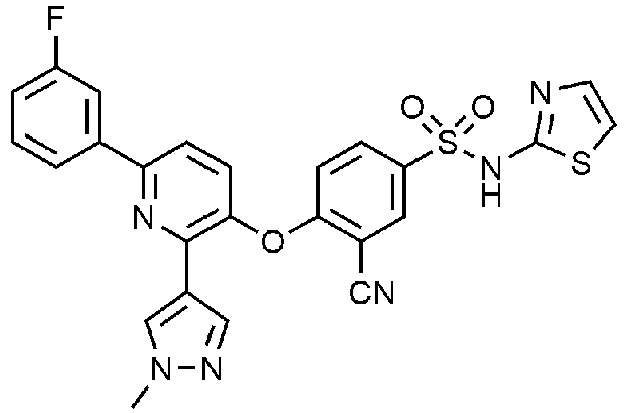
- 10 mg (0.02 mmol) of 4-((6-chloro-2-(1-methyl-1H-pyrazol-4-yl)pyridin-3-yl)oxy)-3-cyano-N-(thiazol-2-yl)b enzenesulfonamide was dissolved in 3 mL of N,N-dimethylformamide, and 4.4 mg (0.03 mmol) of (3-fluorophenyl)boronic acid was added thereto, and then 2.4 mg (10 mol%) of Pd(PPh3)4, 6.7 mg (0.63 mmol) of Na2CO3, and 1 mL of H2O were added thereto. After reacting with microwave reactor at 120°C for 10 minutes, the solvent was removed, and the remaining material was diluted with ethyl acetate and the organic layer was separated, and washed with saturated sodium chloride. The organic layer was collected, dried with magnesium sulfate to remove water, and concentrated under reduced pressure, and the residue was purified by column chromatography (developing solvent, hexane:ethyl acetate = 3:1) to obtain 5 mg (45% yield) of the title compound.
1H NMR (CD3OD, 500MHz) δ 8.30 (s, 1H), 8.27 (s, 1H), 8.10 (s, 1H), 8.02 (d, 1H), 7.96 (m, 1H), 7.84 (d, 1H), 7.66 (d, 1H), 7.52 (m, 1H), 7.18 (m, 1H), 7.12 (d, 1H), 6.99 (d, 1H), 6.76 (d, 1H), 3.92 (s, 3H) -

- 5 mg (45% yield) of the title compound was obtained in the same manner as described in Example 122, except that (2-fluorophenyl-4-yl)boronic acid was used instead of (3-fluorophenyl)boronic acid.
1H NMR (CD3OD/CDCl3, 500MHz) δ 8.79 (m, 1H), 8.33 (s, 1H), 8.30 (m, 2H), 8.15 (s, 1H), 8.08 (d, 1H), 7.88 (d, 1H), 7.72 (d, 1H), 7.55 (m, 1H), 7.15 (d, 1H), 7.08 (d, 1H), 4.65 (s, 2H), 3.92 (s, 3H) -
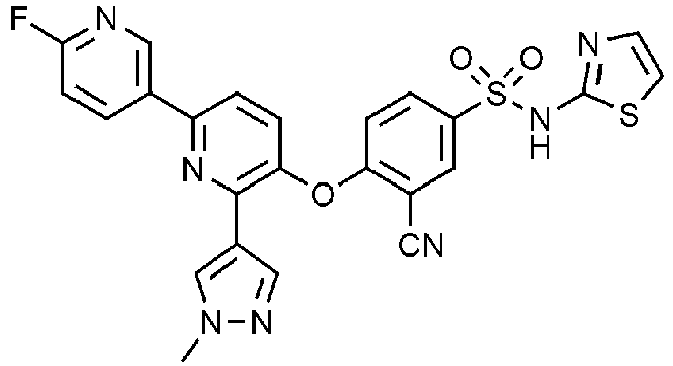
- 5 mg (45% yield) of the title compound was obtained in the same manner as described in Example 122, except that (6-fluoropyridin-3-yl)boronic acid was used instead of (3-fluorophenyl)boronic acid.
1H NMR (CD3OD/CDCl3, 500MHz) δ 8.99 (s, 1H), 8.76 (m, 1H), 8.30 (m, 2H), 8.14 (s, 1H), 8.07 (d, 1H), 7.89 (d, 1H), 7.68 (m, 5H), 7.59 (m, 3H), 7.25 (m, 1H), 7.16 (d, 1H), 7.05 (d, 1H), 6.78 (d, 1H), 3.94 (s, 3H) -
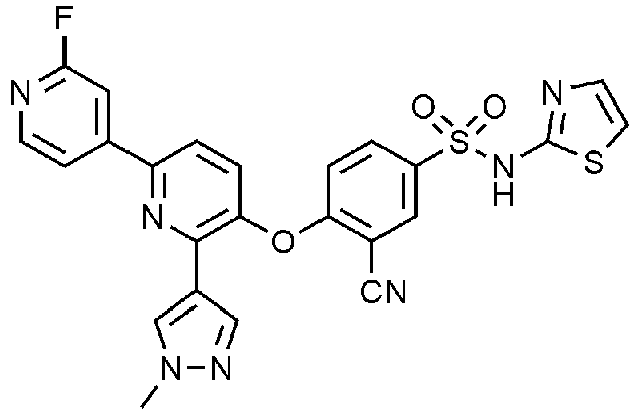
- 5 mg (45% yield) of the title compound was obtained in the same manner as described in Example 122, except that (2-fluoropyridin-4-yl)boronic acid was used instead of (3-fluorophenyl)boronic acid.
1H NMR (CD3OD/CDCl3, 500MHz) δ 8.36 (m, 1H), 8.18 (s, 1H), 8.10 (m, 2H), 8.00 (d, 1H), 7.88 (s, 1H), 7.72 (d, 1H), 7.62 (m, 2H), 7.15 (m, 1H), 7.10 (m, 1H), 6.78 (d, 1H), 3.96 (s, 3H) -
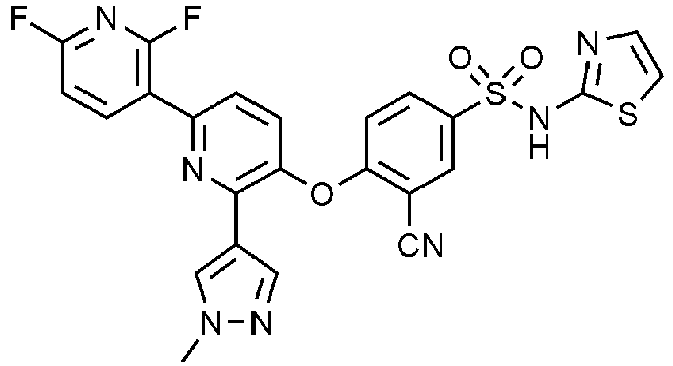
- 5 mg (45% yield) of the title compound was obtained in the same manner as described in Example 122, except that (2,6-difluoropyridin-3-yl)boronic acid was used instead of (3-fluorophenyl)boronic acid.
1H NMR (CD3OD/CDCl3, 500MHz) δ 8.86 (m, 1H), 8.31 (s, 1H), 8.11 (s, 1H), 8.05 (m, 1H), 7.82 (m, 1H), 7.69 (m, 1H), 7.62 (m, 2H), 7.19 (m, 1H), 7.13 (m, 1H), 7.06 (d, 1H), 6.76 (d, 1H), 3.92 (s, 3H) -
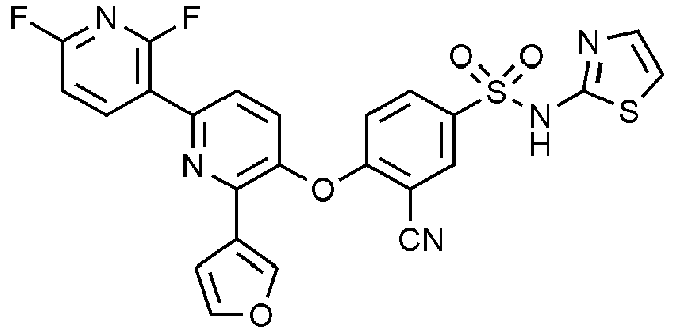
- 17.4 mg (29.7% yield) of the title compound was obtained in the same manner as described in Example 5, except that 4-((6-chloro-2-(furan-3-yl)pyridin-3-yl)oxy)-3-cyano-N-(thiazol-2-yl)benzenesulfona mide and (2,6-difluoropyridin-3-yl)boronic acid were used instead of 4-((6-chloro-4-(furan-3-yl)pyridin-3-yl)oxy)-3-cyano-N-(thiazol-2-yl)benzenesulfona mide and (3-fluorophenyl)boronic acid.
1H NMR (CD3OD, 500MHz) δ 6.75 (1H), 6.76 (1H), 7.13 (1H), 7.18 (2H), 7.58 (1H), 7.71 (1H), 7.86 (1H), 7.05 (1H), 8.18 (1H), 8.30 (1H), 8.87 (1H) -

- 12.0 mg (34.3% yield) of the title compound was obtained in the same manner as described in Example 5, except that 4-((6-chloro-2-(1-methyl-1H-pyrazol-5-yl)pyridin-3-yl)oxy)-3-cyano-N-(thiazol-2-yl)b enzenesulfonamide and (2,6-difluoropyridin-3-yl)boronic acid were used instead of 4-((6-chloro-4-(furan-3-yl)pyridin-3-yl)oxy)-3-cyano-N-(thiazol-2-yl)benzenesulfona mide and (3-fluorophenyl)boronic acid.
1H NMR (CD3OD, 500MHz) δ 4.09 (3H), 6.70 (1H), 6.76 (1H), 7.04 (1H), 7.13 (1H), 7.18 (1H), 7.44 (1H), 7.89 (1H), 8.01 (2H), 8.21 (1H), 8.75 (1H) -

- 4.4 mg (22.8% yield) of the title compound was obtained in the same manner as described in Example 5, except that tert-butyl ((5-chloro-4-((6-chloro-2-(furan-3-yl)pyridin-3-yl)oxy)-2-fluorophenyl)sulfonyl)(thiaz ol-4-yl)carbamate and (2,6-difluoropyridin-3-yl)boronic acid were used instead of 4-((6-chloro-4-(furan-3-yl)pyridin-3-yl)oxy)-3-cyano-N-(thiazol-2-yl)benzenesulfona mide and (3-fluorophenyl)boronic acid.
1H NMR (CD3OD, 500MHz) δ 6.92 (1H), 7.08 (1H), 7.17 (2H), 7.57 (2H), 7.82 (1H), 8.05 (1H), 8.18 (1H), 8.74 (1H), 8.86 (1H) -

- 4.5 mg (24.2% yield) of the title compound was obtained in the same manner as described in Example 5, except that tert-butyl ((5-chloro-4-((6-chloro-2-(furan-3-yl)pyridin-3-yl)oxy)-2-fluorophenyl)sulfonyl)(thiaz ol-4-yl)carbamate and (6-fluoropyridin-3-yl)boronic acid were used instead of 4-((6-chloro-4-(furan-3-yl)pyridin-3-yl)oxy)-3-cyano-N-(thiazol-2-yl)benzenesulfona mide and (3-fluorophenyl)boronic acid.
1H NMR (CD3OD, 500MHz) δ 6.88 (1H), 7.78 (1H), 7.21 (2H), 7.58 (2H), 7.86 (1H), 7.05 (1H), 8.17 (1H), 8.71 (2H), 8.94 (1H) -

- 5.7 mg (30.6% yield) of the title compound was obtained in the same manner as described in Example 5, except that tert-butyl ((5-chloro-4-((6-chloro-2-(furan-3-yl)pyridin-3-yl)oxy)-2-fluorophenyl)sulfonyl)(thiaz ol-4-yl)carbamate and (4-fluorophenyl)boronic acid were used instead of 4-((6-chloro-4-(furan-3-yl)pyridin-3-yl)oxy)-3-cyano-N-(thiazol-2-yl)benzenesulfona mide and (3-fluorophenyl)boronic acid.
1H NMR (CD3OD, 500MHz) δ 6.79 (1H), 7.06 (1H), 7.21 (3H), 7.55 (2H), 7.80 (1H), 8.03 (1H), 8.14 (3H), 8.75 (1H) -

- 4.1 mg (22.0% yield) of the title compound was obtained in the same manner as described in Example 5, except that tert-butyl ((5-chloro-4-((6-chloro-2-(furan-3-yl)pyridin-3-yl)oxy)-2-fluorophenyl)sulfonyl)(thiaz ol-4-yl)carbamate and (2-fluoropyridin-4-yl)boronic acid were used instead of 4-((6-chloro-4-(furan-3-yl)pyridin-3-yl)oxy)-3-cyano-N-(thiazol-2-yl)benzenesulfona mide and (3-fluorophenyl)boronic acid.
1H NMR (CD3OD, 500MHz) δ 6.99 (1H), 7.09 (1H), 7.25 (1H), 7.55 (1H), 7.61 (1H), 7.83 (1H), 7.98 (1H), 8.07 (2H), 8.23 (1H), 8.32 (1H), 8.74 (1H) -
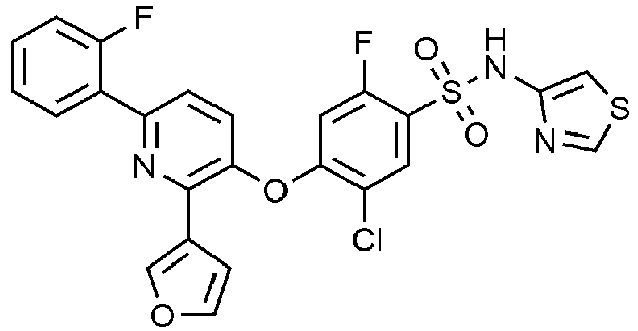
- 4.0 mg (21.5% yield) of the title compound was obtained in the same manner as described in Example 5, except that tert-butyl ((5-chloro-4-((6-chloro-2-(furan-3-yl)pyridin-3-yl)oxy)-2-fluorophenyl)sulfonyl)(thiaz ol-4-yl)carbamate and (2-fluorophenyl)boronic acid were used instead of 4-((6-chloro-4-(furan-3-yl)pyridin-3-yl)oxy)-3-cyano-N-(thiazol-2-yl)benzenesulfona mide and (3-fluorophenyl)boronic acid.
1H NMR (CD3OD, 500MHz) δ 6.86 (1H), 7.06 (1H), 7.16 (1H), 7.24 (1H), 7.34 (1H), 7.46 (1H), 7.55 (2H), 7.79 (1H), 8.04 (1H), 8.12 (2H), 8.74 (1H) -

- 6.0 mg (41.4% yield) of the title compound was obtained in the same manner as described in Example 5, except that tert-butyl ((5-chloro-4-((6-chloro-2-(1-methyl-1H-pyrazol-5-yl)pyridin-3-yl)oxy)-2-fluorophenyl )sulfonyl)(thiazol-4-yl)carbamate and (2,6-difluoropyridin-3-yl)boronic acid were used instead of 4-((6-chloro-4-(furan-3-yl)pyridin-3-yl)oxy)-3-cyano-N-(thiazol-2-yl)benzenesulfona mide and (3-fluorophenyl)boronic acid.
1H NMR (CD3OD, 500MHz) δ 4.11 (3H), 6.72 (1H), 6.94 (1H), 7.05 (1H), 7.17 (1H), 7.45 (1H), 7.74 (1H), 7.98 (2H), 8.74 (2H) -

- 6.0 mg (42.8% yield) of the title compound was obtained in the same manner as described in Example 5, except that tert-butyl ((5-chloro-4-((6-chloro-2-(1-methyl-1H-pyrazol-5-yl)pyridin-3-yl)oxy)-2-fluorophenyl )sulfonyl)(thiazol-4-yl)carbamate and (4-fluorophenyl)boronic acid were used instead of 4-((6-chloro-4-(furan-3-yl)pyridin-3-yl)oxy)-3-cyano-N-(thiazol-2-yl)benzenesulfona mide and (3-fluorophenyl)boronic acid.
1H NMR (CD3OD, 500MHz) δ 4.14 (3H), 6.78 (1H), 6.82 (1H), 7.03 (1H), 7.23 (2H), 7.43 (1H), 7.69 (1H), 7.96 (2H), 8.14 (2H), 8.73 (1H) -

- 6.0 mg (42.8% yield) of the title compound was obtained in the same manner as described in Example 5, except that tert-butyl ((5-chloro-4-((6-chloro-2-(1-methyl-1H-pyrazol-5-yl)pyridin-3-yl)oxy)-2-fluorophenyl )sulfonyl)(thiazol-4-yl)carbamate and (2-fluorophenyl)boronic acid were used instead of 4-((6-chloro-4-(furan-3-yl)pyridin-3-yl)oxy)-3-cyano-N-(thiazol-2-yl)benzenesulfona mide and (3-fluorophenyl)boronic acid.
1H NMR (CD3OD, 500MHz) δ 4.16 (3H), 6.77 (1H), 6.95 (1H), 7.28 (1H), 7.35 (1H), 7.48 (2H), 7.72 (1H), 7.84 (1H), 8.03 (2H), 8.19 (1H), 8.96 (1H) -
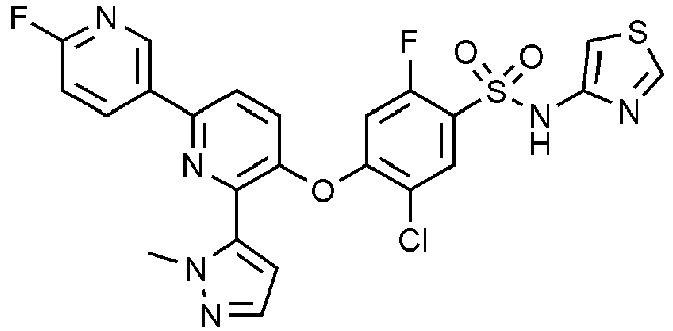
- 6.0 mg (42.8% yield) of the title compound was obtained in the same manner as described in Example 5, except that tert-butyl ((5-chloro-4-((6-chloro-2-(1-methyl-1H-pyrazol-5-yl)pyridin-3-yl)oxy)-2-fluorophenyl )sulfonyl)(thiazol-4-yl)carbamate and (6-fluoropyridin-3-yl)boronic acid were used instead of 4-((6-chloro-4-(furan-3-yl)pyridin-3-yl)oxy)-3-cyano-N-(thiazol-2-yl)benzenesulfona mide and (3-fluorophenyl)boronic acid.
1H NMR (CD3OD, 500MHz) δ 4.14 (3H), 6.72 (1H), 6.90 (1H), 7.03 (1H), 7.22 (1H), 7.45 (1H), 7.96 (1H), 8.06 (1H), 8.66 (1H), 8.73 (1H), 8.95 (1H) - The following examples 138-157 are reference examples.
-

- 192 mg (0.46 mmol) of tert-butyl (4-bromophenyl)sulfonyl(thiazol-2-yl)carbamate was dissolved in 1.5 mL of tetrahydrofuran under nitrogen gas, and cooled to -78°C. After adding 0.4 mL (0.64 mmol) of n-butyllithium (1.6M in tetrahydrofuran) slowly, the mixture was stirred for 30 minutes as maintaining -78°C. 50.0 mg (0.23 mmol) of 4-chloro-2-(1-methyl-1H-pyrazol-5-yl)benzaldehyde was dissolved in 0.5 mL of tetrahydrofuran, and added to the above reacting solution. As warming from -78°C to room temperature, the reacting solution was stirred for 24 hours. Ethyl acetate and water/1N-hydrochloride were added to the reacting solution, and it was stirred. After separating layers, the organic layer only was collected and concentrated under reduced pressure. The obtained residue was separated by column chromatography (developing solvent, hexane:ethyl acetate = 1:2) to obtain 10.0 mg (9.6% yield) of the title compound.
1H NMR (CD3OD, 500MHz) δ 7.80 (1H), 7.73 (2H), 7.55 (1H), 7.50 (1H), 7.23 (1H), 7.07 (3H), 6.70 (1H), 6.26 (1H), 5.72 (1H) -

- 5.77 mg (5.4% yield) of the title compound was obtained in the same manner as described in Example 138, except that tert-butyl (4-bromo-3-fluorophenyl)sulfonyl(thiazol-2-yl)carbamatetert-butyl-4-(5-chloro-2-formylphenyl)-1H-pyrazol-1-carboxylate were used instead of tert-butyl (4-bromophenyl)sulfonyl(thiazol-2-yl)carbamate and 4-chloro-2-(1-methyl-1H-pyrazol-5-yl)benzaldehyde.

1H NMR (CD3OD, 500MHz) δ 7.67 (1H), 7.53 (3H), 7.34 (3H), 7.25 (1H), 7.02 (1H), 6.95 (1H), 6.60 (1H) -

- 5.45 mg (5.1% yield) of the title compound was obtained in the same manner as described in Example 139, except that 4-chloro-2-(furan-3-yl)benzaldehyde was used instead of tert-butyl-4-(5-chloro-2-formylphenyl)-1H-pyrazol-1-carboxylate.
1H NMR (CD3OD, 500MHz) δ 7.70 (1H), 7.61 (2H), 7.53 (1H), 7.45 (1H), 7.31 (1H), 7.26 (2H), 7.07 (1H), 6.67 (1H), 6.52 (1H), 6.15 (1H) -

- 5.46 mg (5.0% yield) of the title compound was obtained in the same manner as described in Example 139, except that 2,4-di(furan-3-yl)benzaldehyde was used instead of tert-butyl-4-(5-chloro-2-formylphenyl)-1H-pyrazol-1-carboxylate.
1H NMR (CD3OD, 500MHz) δ 7.90 (1H), 7.45 (9H), 7.28 (1H), 7.07 (1H), 6.79 (1H), 6.66 (1H), 6.55 (1H), 6.19 (1H) -
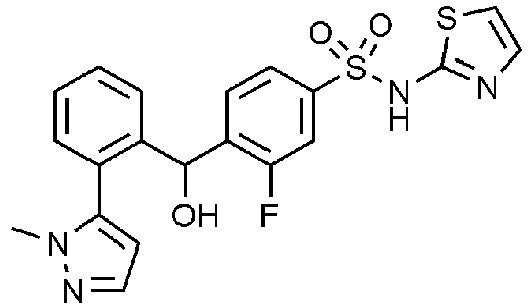
- 4.40 mg (4.3% yield) of the title compound was obtained in the same manner as described in Example 139, except that 2-(1-methyl-1H-pyrazol-5-yl)benzaldehyde was used instead of tert-butyl-4-(5-chloro-2-formylphenyl)-1H-pyrazol-1-carboxylate.
1H NMR (CD3OD, 500MHz) δ 7.58 (1H), 7.48 (1H), 7.42 (6H), 7.21 (1H), 7.06 (1H), 6.67 (1H), 6.18 (1H), 5.97 (1H), 3.34 (3H) -

- 192 mg (0.46 mmol) of tert-butyl (4-bromophenyl)sulfonyl(thiazol-2-yl)carbamate was dissolved in 2 mL of tetrahydrofuran under nitrogen gas, and cooled to -78°C. After adding 0.4 mL (0.64 mmol) of n-butyllithium (1.6M in tetrahydrofuran) slowly, the mixture was stirred for 30 minutes as maintaining -78°C. 47.5 mg (0.23 mmol) of 4-chloro-2-(furan-3-yl)benzaldehyde was dissolved in 0.5 mL of tetrahydrofuran, and added to the above reacting solution. As warming from -78°C to room temperature, the reacting solution was stirred for 24 hours. Ethyl acetate and water/1N-hydrochloride were added to the reacting solution, and it was stirred. After separating layers, the organic layer only was collected and concentrated under reduced pressure. The obtained residue was separated by column chromatography (developing solvent, hexane:ethyl acetate = 1:1) to obtain 9.9 mg (9.6% yield) of the title compound.
1H NMR (CD3OD, 500MHz) δ 7.78 (m, 2H), 7.56 (s, 2H), 7.35 (m, 1H), 7.31 (m, 4H), 7.06 (m, 1H), 6.67 (m, 1H), 6.53 (s, 1H), 6.00 (s, 1H) -

- 10.0 mg (9.6% yield) of the title compound was obtained in the same manner as described in Example 139, except that 4-chloro-2-(1-methyl-1H-pyrazol-5-yl)benzaldehyde was used instead of tert-butyl-4-(5-chloro-2-formylphenyl)-1H-pyrazol-1-carboxylate.
1H NMR (CD3OD, 500MHz) δ 7.58 (1H), 7.48 (1H), 7.42 (5H), 7.21 (1H), 7.06 (1H), 6.67 (1H), 6.18 (1H), 5.97 (1H), 3.34 (3H) -
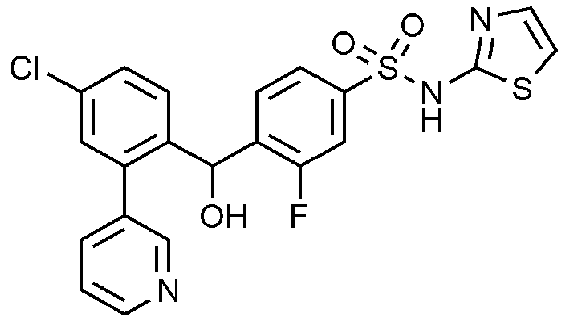
- 10.0 mg (9.6% yield) of the title compound was obtained in the same manner as described in Example 139, except that 4-chloro-2-(pyridin-3-yl)benzaldehyde was used instead of tert-butyl-4-(5-chloro-2-formylphenyl)-1H-pyrazol-1-carboxylate.
1H NMR (CDCl3, 500MHz) δ 8.73 (1H), 8.26 (1H), 7.87 (1H), 7.66 (4H), 7.43 (2H), 7.10 (3H), 6.88 (1H), 6.55 (1H) -

- 10.0 mg (9.6% yield) of the title compound was obtained in the same manner as described in Example 139, except that 4-chloro-2-(pyridin-2-yl)benzaldehyde was used instead of tert-butyl-4-(5-chloro-2-formylphenyl)-1H-pyrazol-1-carboxylate.
1H NMR (CDCl3, 500MHz) δ 8.42 (1H), 7.88 (1H), 7.84 (1H), 7.34 (4H), 7.16 (1H), 6.95 (1H), 6.85 (1H), 6.52 (1H) -
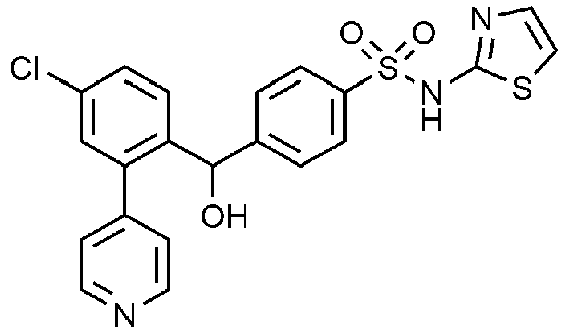
- 10.0 mg (9.6% yield) of the title compound was obtained in the same manner as described in Example 138, except that -chloro-2-(pyridin-2-yl)benzaldehyde was used instead of 4-chloro-2-(1-methyl-1H-pyrazol-5-yl)benzaldehyde.
1H NMR (CDCl3, 500MHz) δ 8.50 (1H), 7.72 (2H), 7.54 (1H), 7.47 (1H), 7.31 (2H), 7.24 (1H), 7.18 (2H), 7.09 (1H), 6.71 (1H) -
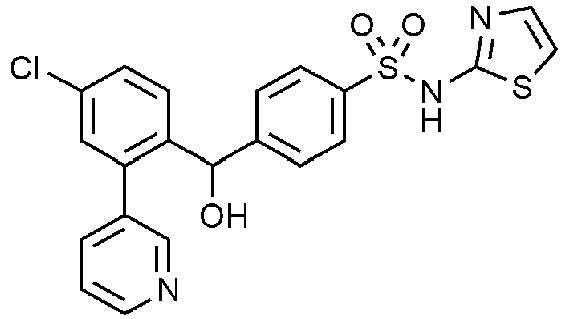
- 8.6 mg (4.1% yield) of the title compound was obtained in the same manner as described in Example 138, except that 4-chloro-2-(pyridin-3-yl)benzaldehyde was used instead of 4-chloro-2-(1-methyl-1H-pyrazol-5-yl)benzaldehyde.
1H NMR (CD3OD, 500MHz) δ 8.52 (dd, 1H), 8.44 (s, 1H), 7.73 (d, 2H), 7.66 (d, 1H), 7.56 (d, 1H), 7.47 (dd, 1H), 7.39 (m, 1H), 7.26 (d, 1H), 7.16 (d, 2H),7.09 (d, 1H), 6.71 (d, 1H), 5.76 (s, 1H) -

- 5.2 mg (2.4% yield) of the title compound was obtained in the same manner as described in Example 138, except that 2,4-di(furan-3-yl)benzaldehyde was used instead of 4-chloro-2-(1-methyl-1H-pyrazol-5-yl)benzaldehyde.
1H NMR (CD3OD, 500MHz) δ 7.92 (s, 1H), 7.80 (d, 2H), 7.59-7.50 (m, 5H), 7.36 (d, 3H), 7.08 (d, 1H), 6.81 (s, 1H), 6.70 (d, 1H), 6.59 (s, 1H), 6.05 (s, 1H) -

- 6.9 mg (2.9% yield) of the title compound was obtained in the same manner as described in Example 138, except that 4-(2-fluoropyridin-3-yl)-2-(furan-3-yl)benzaldehyde was used instead of 4-chloro-2-(1-methyl-1H-pyrazol-5-yl)benzaldehyde.
1H NMR (CD3OD, 500MHz) δ 8.18 (d, 1H), 8.08 (t, 1H), 7.81 (d, 2H), 7.60-7.51 (m, 5H), 7.42-7.37 (m, 3H), 7.08 (d, 1H), 6.70 (d, 1H), 6.60 (s, 1H), 6.11 (s, 1H) -

- 5.8 mg (2.5% yield) of the title compound was obtained in the same manner as described in Example 138, except that 4-(6-fluoropyridin-3-yl)-2-(furan-3-yl)benzaldehyde was used instead of 4-chloro-2-(1-methyl-1H-pyrazol-5-yl)benzaldehyde.
1H NMR (CD3OD, 500MHz) δ 8.61 (d, 1H), 8.08 (t, 1H), 7.81 (d, 2H), 7.60-7.51 (m, 5H), 7.42-7.37 (m, 3H), 7.08 (d, 1H), 6.70 (d, 1H), 6.60 (s, 1H), 6.11 (s, 1H) -
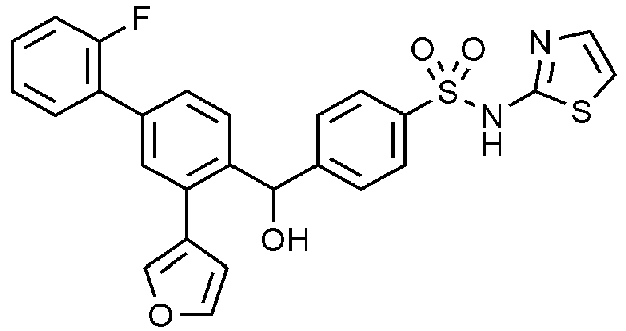
- 5.2 mg (2.2% yield) of the title compound was obtained in the same manner as described in Example 138, except that 2'-fluoro-3-(furan-3-yl)-[1,1'-biphenyl]-4-carbaldehyde was used instead of 4-chloro-2-(1-methyl-1H-pyrazol-5-yl)benzaldehyde.
1H NMR (CD3OD, 500MHz) δ 7.81 (d, 2H), 7.57 (d, 2H), 7.47-7.44 (m, 4H), 7.39-7.34 (m, 3H), 7.24-7.14 (m, 2H), 7.07 (d, 1H), 6.68 (d, 1H), 6.58 (s, 1H), 6.10 (s, 1H) -
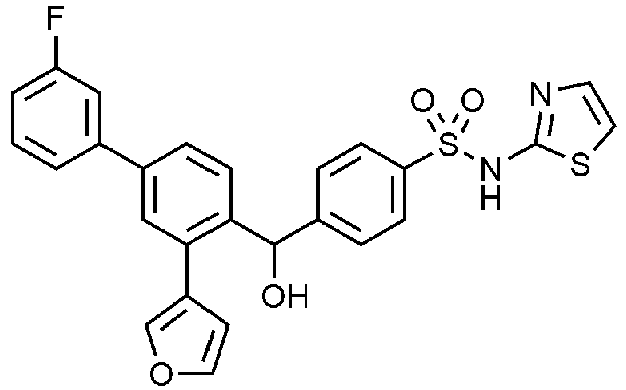
- 4.0 mg (1.7% yield) of the title compound was obtained in the same manner as described in Example 138, except that 3'-fluoro-3-(furan-3-yl)-[1,1'-biphenyl]-4-carbaldehyde was used instead of 4-chloro-2-(1-methyl-1H-pyrazol-5-yl)benzaldehyde.
1H NMR (CD3OD, 500MHz) δ 7.81 (d, 2H), 7.61-7.55 (m, 4H), 7.48-7.43 (m, 3H), 7.37 (d, 3H), 7.08 (d, 2H), 6.70 (d, 1H), 6.61 (s, 1H), 6.10 (s, 1H) -

- 4.6 mg (2.0% yield) of the title compound was obtained in the same manner as described in Example 138, except that 4'-fluoro-3-(furan-3-yl)-[1,1'-biphenyl]-4-carbaldehyde was used instead of 4-chloro-2-(1-methyl-1H-pyrazol-5-yl)benzaldehyde.
1H NMR (CD3OD, 500MHz) δ 7.81 (d, 2H), 7.58-7.53 (m, 6H), 7.45 (d, 1H), 7.38 (d, 2H), 7.16 (t, 2H), 7.09 (d, 1H), 6.71 (d, 1H), 6.61 (d, 1H), 6.09 (s, 1H) -

- 100 mg (0.26 mmol) of tert-butyl ((3,4-difluorophenyl)sulfonyl)(thiazol-2-yl)carbamate was dissolved in 5 mL of tetrahydrofuran under nitrogen gas, and cooled to -78°C. After adding 0.25 mL (0.39 mmol) of n-butyllithium (1.6M in tetrahydrofuran) slowly, the mixture was stirred for 30 minutes as maintaining -78°C. 23 mg (0.13 mmol) of 2-(furan-3-yl)nicotinaldehyde was dissolved in 0.5 mL of tetrahydrofuran, and added to the above reacting solution. As warming from -78°C to room temperature, the reacting solution was stirred for 24 hours. Ethyl acetate and water/1N-hydrochloride were added to the reacting solution, and it was stirred. After separating layers, the organic layer only was collected and concentrated under reduced pressure. The obtained residue was separated by column chromatography (developing solvent, hexane:ethyl acetate = 1:1) to obtain 7 mg (6.1% yield) of the title compound.
1H NMR (CD3OD, 500MHz) δ 8.48 (m, 1H), 7.84 (s, 1H), 7.72 (m, 3H), 7.59 (m, 1H), 7.47 (m, 1H), 7.32 (m, 1H), 7.70 (m, 1H), 6.73 (m, 2H), 6.24 (s, 1H) -
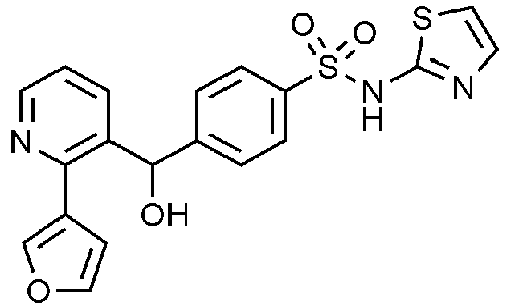
- 100 mg (0.28 mmol) of tert-butyl ((4-fluorophenyl)sulfonyl)(thiazol-2-yl)carbamate was dissolved in 5 mL of tetrahydrofuran under nitrogen gas, and cooled to -78°C. After adding 0.26 mL (0.42 mmol) of n-butyllithium (1.6 M in tetrahydrofuran) slowly, the mixture was stirred for 30 minutes as maintaining -78°C. 23 mg (0.13 mmol) of 2-(furan-3-yl)nicotinaldehyde was dissolved in 0.5 mL of tetrahydrofuran, and added to the above reacting solution. As warming from -78°C to room temperature, the reacting solution was stirred for 24 hours. Ethyl acetate and water/ 1N-hydrochloride were added to the reacting solution, and it was stirred. After separating layers, the organic layer only was collected and concentrated under reduced pressure. The obtained residue was separated by column chromatography (developing solvent, hexane:ethyl acetate = 1:1) to obtain 6 mg (5.2% yield) of the title compound.
1H NMR (CD3OD, 500MHz) δ 8.48 (m, 1H), 7.81 (m, 4H), 7.59 (m, 1H), 7.36 (m, 3H), 7.09 (m, 1H), 6.73 (m, 2H), 6.09 (s, 1H) -

- 100 mg (0.26 mmol) of tert-butyl ((3,4-difluorophenyl)sulfonyl)(thiazol-2-yl)carbamate was dissolved in 5 mL of tetrahydrofuran under nitrogen gas, and cooled to -78°C. After adding 0.25 mL (0.39 mmol) of n-butyllithium (1.6 M in tetrahydrofuran) slowly, the mixture was stirred for 30 minutes as maintaining -78°C. 24.3 mg (0.13 mmol) of 2-phenylnicotinaldehyde was dissolved in 0.5 mL of tetrahydrofuran, and added to the above reacting solution. As warming from -78°C to room temperature, the reacting solution was stirred for 24 hours. Ethyl acetate and water/1N-hydrochloride were added to the reacting solution, and it was stirred. After separating layers, the organic layer only was collected and concentrated under reduced pressure. The obtained residue was separated by column chromatography (developing solvent, hexane:ethyl acetate = 1:1) to obtain 9 mg (7.6% yield) of the title compound.
1H NMR (CD3OD, 500MHz) δ 8.49 (m, 1H), 7.95 (m, 1H), 7.64 (m, 1H), 7.52 (m, 1H), 7.42 (m, 1H), 7.37 (m, 6H), 7.12 (m, 1H), 6.74 (m, 1H), 6.09 (s, 1H) - In order to measure the activities of the inventive compounds as antagonists, an experiment on a blocking effect against the sodium ion channel (Nav1.7) was carried out as follows.
- The hNav1.7 HEK293 cell line used was a cell line having a human sodium ion channel 1.7 gene (type IX voltage-gated sodium channel alpha subunit) (type IX voltage-gated sodium channel alpha subunit) in human embryonic kidney (HEK) 293 cells and was purchased from Millipore. The medium used was prepared by adding 1% 100X NEAA and 10% heat inactivated FBS to DMEM F-12 and adding 1% P/S as an antibiotic thereto. G-418 as a restriction enzyme was added during subculture, and the hNav1.7 HEK293 cells were cultured to a confluence of about 80% in a T75 flask in a 5% CO2 incubator at 37°C for 2 or 3 days and detached from the flask by treatment with 0.25% trypsin solution. Then, the cells were collected by centrifugation and used in the experiment.
- The compounds prepared in the Examples of the present invention were dissolved in dimethyl sulfoxide (DMSO) and used in the experiment. 90 mM and 10 mM DMSO stock solutions were prepared from each of the compounds and diluted in an extracellular solution (4 mM KCl, 138 mM NaCl, 1 mM MgCl2, 1.8 mM CaCl2, 5.6 mM glucose, 10 mM HEPES, pH 7.45) at various concentrations so that the final concentration of each compound in DMSO was 0.3% or less.
- To measure the sodium ion channel blocking effect, an IonFlux16 Auto patch clamp system (Fluxion, Inc.) and a plate for exclusive use were used. The cells were distributed in an extracellular solution (4 mM KCl, 138 mM NaCl, 1 mM MgCl2, 1.8 mM CaCl2, 5.6 mM glucose, 10 mM HEPES, pH 7.45), and then dispensed in the specified region of the plate, and each of the prepared compound samples was diluted at various concentrations, and then dispensed in the specified region of the plate. After the dispensation of the cells, the compound samples and an intracellular solution (100 mM CsF, 45 mM CsCl, 5 mM NaCl, 5 mM EGTA, 10 mM HEPES, pH 7.2) in the plate has been completed, the plate was mounted in the patch clamp system, and whether the compounds inhibited the ion channel was measured according to a set program and pulse protocol.
- Specifically, eight concentrations per compound were set, and percent inhibition was determined by calculating the percentage of inhibition of the peak current, generated after treating the cells with each concentration of the compound for 50 seconds, relative to the peak current generated before treatment with the compound, and the IC50 value was calculated using the Sigma plot program. The results of the calculation are shown in Tables 2-4 below. In Tables 2-4 below, the percent inhibition of Nav1.7 is rated as follows:
Nav1.7 IC50 : + (>100 nM), ++ (51-100 nM), and +++ (<50 nM) -
[Table 2] Exmple No. Nav1.7 IC50 Exmple No. Nav1.7 IC50 Exmple No. Nav1.7 IC50 1 +++ 21 + 41 + 2 + 22 ++ 42 + 3 +++ 23 + 43 + 4 ++ 24 + 44 + 5 +++ 25 + 45 + 6 + 26 ++ 46 + 7 ++ 27 + 47 + 8 + 28 + 48 + 9 ++ 29 + 49 + 10 ++ 30 + 50 +++ 11 ++ 31 ++ 51 + 12 +++ 32 + 52 + 13 + 33 + 53 + 14 + 34 + 54 + 15 + 35 + 55 + 16 +++ 36 + 56 + 17 + 37 + 57 + 18 + 38 + 58 + 19 + 39 ++ 59 + 20 + 40 + 60 + -
[Table 3] Exmple No. Nav1.7 IC50 Exmple No. Nav1.7 IC50 Exmple No. Nav1.7 IC50 61 + 81 + 101 ++ 62 + 82 + 102 + 63 + 83 + 103 + 64 + 84 + 104 ++ 65 + 85 + 105 + 66 + 86 + 106 + 67 + 87 + 107 + 68 + 88 + 108 ++ 69 + 89 + 109 +++ 70 + 90 + 110 +++ 71 + 91 + 111 + 72 + 92 + 112 ++ 73 + 93 + 113 + 74 + 94 + 114 + 75 + 95 + 115 + 76 + 96 + 116 + 77 + 97 + 117 ++ 78 + 98 + 118 + 79 + 99 + 119 ++ 80 + 100 + 120 + -
[Table 4] Exmple No. Nav1.7 IC50 Exmple No. Nav1.7 IC50 Exmple No. Nav1.7 IC50 121 + 134 + 147 + 122 ++ 135 + 148 + 123 + 136 + 149 + 124 + 137 + 150 + 125 + 138 + 151 + 126 + 139 + 152 + 127 ++ 140 + 153 ++ 128 + 141 + 154 + 129 + 142 + 155 + 130 + 143 +++ 156 + 131 ++ 144 + 157 + 132 + 145 + 133 + 146 +
Claims (9)
- A compound represented by the following formula 1 or a pharmaceutically acceptable salt thereof:
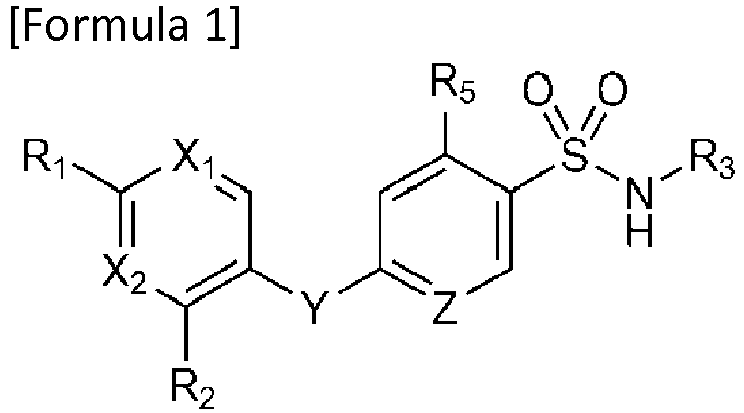 R1 is aryl or heteroaryl selected from the group consisting of phenyl, pyridinyl, pyrimidinyl, furanyl, isoxazolyl, pyrazolyl and thienyl,wherein the aryl or heteroaryl is unsubstituted or substituted by one or two substituents independently selected from the group consisting of C1-4 alkyl, C1-4 haloalkyl and halogen,R2 is aryl or heteroaryl selected from the group consisting of furanyl, imidazolyl, isoxazolyl, pyrazolyl, pyridinyl, pyrimidinyl, thiazolyl and thienyl,wherein the aryl or heteroaryl is unsubstituted or substituted by one or two substituents independently selected from the group consisting of C1-4 alkyl, C3-6 cycloalkyl, halogen, morpholino, piperazinyl, piperidinyl, pyridinyl and pyrrolidinyl,R3 is thiazolyl or thiadiazolyl,X1 is CH and X2 is N, or X1 is N and X2 is CH,Y is O,Z is CR4,R4 is H, halogen or CN,R5 is H or halogen.
 - The compound or pharmaceutically acceptable salt thereof of claim 1, wherein R1 is phenyl unsubstituted or substituted by one or two substituents independently selected from the group consisting of C1-4 haloalkyl and halogen; pyridinyl unsubstituted or substituted by one or two halogens; unsubstituted pyrimidinyl; unsubstituted furanyl; unsubstituted isoxazolyl; pyrazolyl unsubstituted or substituted by C1-4 alkyl; or unsubstituted thienyl.
- The compound or pharmaceutically acceptable salt thereof of claim 2, wherein R1 is phenyl unsubstituted or substituted by one or two substituents independently selected from the group consisting of CF3, F and Cl; pyridinyl unsubstituted or substituted by one or two F; unsubstituted pyrimidinyl; unsubstituted furanyl; unsubstituted isoxazolyl; pyrazolyl unsubstituted or substituted by methyl; or unsubstituted thienyl.
- The compound or pharmaceutically acceptable salt thereof of claim 1, wherein R2 is unsubstituted furanyl; imidazolyl substituted by pyridinyl; isoxazolyl substituted by two C1-4 alkyl; unsubstituted phenyl; pyrazolyl unsubstituted or substituted by C1-4 alkyl or C3-6 cycloalkyl; pyridinyl unsusbtituted or substituted by one or two substituents selected from the group consisting of C1-4 alkyl, halogen, morpholino, piperidinyl and pyrrolidinyl; pyrimidinyl unsubstituted or substituted by piperazinyl; thiazolyl substituted by C3-6 cycloalkyl; or thienyl substituted by one or two C1-4 alkyl.
- The compound or pharmaceutically acceptable salt thereof of claim 4, wherein R2 is unsubstituted furanyl; imidazolyl substituted by pyridinyl; isoxazolyl substituted by two methyl; unsubstituted phenyl; pyrazolyl unsubstituted or substituted by methyl or cyclopropyl; pyridinyl unsusbtituted or substituted by one or two substituents selected from the group consisting of methyl, F, Cl, morpholino, piperidinyl and pyrrolidinyl; pyrimidinyl unsubstituted or substituted by piperazinyl; thiazolyl substituted by cyclopropyl; or thienyl substituted by one or two methyl.
- The compound or pharmaceutically acceptable salt thereof of claim 1, wherein R4 is H, F, Cl or CN.
- The compound or pharmaceutically acceptable salt thereof of claim 1, wherein R5 is H or F.
- A compound or pharmaceutically acceptable salt thereof, wherein the compound is selected from the group consisting of1)3-cyano-4-((4-(furan-3-yl)-6-phenylpyridin-3-yl)oxy)-N-(thiazol-2-yl)benzenesulfonamide,2)3-cyano-4-((4-(1-methyl-1H-pyrazol-5-yl)-6-phenylpyridin-3-yl)oxy)-N-(thiazol-2-yl)benzenesulfonamide,3)3-cyano-4-((4-(furan-3-yl)-6-phenylpyridin-3-yl)oxy)-N-(1,2,4-thiadiazol-5-yl)benzenesulfonamide,4)3-cyano-4-((4-(1-methyl-1H-pyrazol-5-yl)-6-phenylpyridin-3-yl)oxy)-N-(1,2,4-thiadiazol-5-yl)benzenesulfonamide,5)3-cyano-4-(6-(3-fluorophenyl)-4-(furan-3-yl)pyridin-3-yloxy)-N-(thiazol-2-yl)benzenesulfonamide,6)3-cyano-4-(6-(2-fluorophenyl)-4-(furan-3-yl)pyridin-3-yloxy)-N-(thiazol-2-yl)benzenesulfonamide,7)3-cyano-4-(6-(4-fluorophenyl)-4-(furan-3-yl)pyridin-3-yloxy)-N-(thiazol-2-yl)benzenesulfonamide,8)3-cyano-4-(4-(furan-3-yl)-6-(3-(trifluoromethyl)phenyl)pyridin-3-yloxy)-N-(thiazol-2-yl)benzenesulfonamide,9)3-cyano-4-(2'-fluoro-4-(furan-3-yl)-2,4'-bipyridin-5-yloxy)-N-(thiazol-2-yl)benzenesulfonamide,10)3-cyano-4-(2'-fluoro-4-(furan-3-yl)-2,3'-bipyridin-5-yloxy)-N-(thiazol-2-yl)benzenesulfonamide,11)3-cyano-4-(6'-fluoro-4-(furan-3-yl)-2,3'-bipyridin-5-yloxy)-N-(thiazol-2-yl)benzenesulfonamide,12)3-cyano-4-(2',6'-difluoro-4-(furan-3-yl)-2,3'-bipyridin-5-yloxy)-N-(thiazol-2-yl)benzenesulfonamide,13)3-cyano-4-(4-(furan-3-yl)-2,3'-bipyridin-5-yloxy)-N-(thiazol-2-yl)benzenesulfonamide,14)3-cyano-4-(4-(furan-3-yl)-2,4'-bipyridin-5-yloxy)-N-(thiazol-2-yl)benzenesulfonamide,15)3-cyano-4-(4-(furan-3-yl)-6-(pyrimidin-5-yl)pyridin-3-yloxy)-N-(thiazol-2-yl)benzenesulfonamide,16)3-cyano-4-((4,6-di(furan-3-yl)pyridin-3-yl)oxy)-N-(thiazol-2-yl)benzenesulfonamide,17)4-((4,6-di(furan-3-yl)pyridin-3-yl)oxy)-3-fluoro-N-(thiazol-2-yl)benzenesulfonamide,18)3-cyano-4-((2'-fluoro-4-(1-methyl-1H-pyrazol-5-yl)-[2,3'-bipyridin]-5-yl)oxy)-N-(thiazol-2-yl)benzenesulfonamide,19)3-cyano-4-((6'-fluoro-4-(1-methyl-1H-pyrazol-5-yl)-[2,3'-bipyridin]-5-yl)oxy)-N-(thiazol-2-yl)benzenesulfonamide,20)3-cyano-4-((4-(furan-3-yl)-6-(thiophen-3-yl)pyridin-3-yl)oxy)-N-(thiazol-2-yl)benzenesulfonamide,21)3-fluoro-4-((4-(1-methyl-1H-pyrazol-5-yl)-[2,3'-bipyridin]-5-yl)oxy)-N-(thiazol-2-yl)benzenesulfonamide,22)3-fluoro-4-((4-(1-methyl-1H-pyrazol-5-yl)-6-(thiophen-3-yl)pyridin-3-yl)oxy)-N-(thiazol-2-yl)benzenesulfonamide,23)3-cyano-4-((6-(4-fluorophenyl)-4-(1-methyl-1H-pyrazol-5-yl)pyridin-3-yl)oxy)-N-(thiazol-2-yl)benzenesulfonamide,24) 3-cyano-4-((6-(2-fluorophenyl)-4-(1-methyl-1H-pyrazol-5-yl)pyridin-3-yl)oxy)-N-(thiazol-2-yl)benzenesulfonamide,25)3-cyano-4-((6-(furan-3-yl)-4-(1-methyl-1H-pyrazol-5-yl)pyridin-3-yl)oxy)-N-(thiazol-2-yl)benzenesulfonamide,26)3-cyano-4-((6-(3-fluorophenyl)-4-(1-methyl-1H-pyrazol-5-yl)pyridin-3-yl)oxy)-N-(thiazol-2-yl)benzenesulfonamide,27)3-cyano-4-((2'-fluoro-4-(1-methyl-1H-pyrazol-5-yl)-[2,4'-bipyridin]-5-yl)oxy)-N-(thiazol-2-yl)benzenesulfonamide,28)4-((4,6-di(furan-3-yl)pyridin-3-yl)oxy)-N-(thiazol-2-yl)benzenesulfonamide,29)3-cyano-4-((2-fluoro-6'-phenyl-[3,4'-bipyridin]-3'-yl)oxy)-N-(thiazol-2-yl)benzenesulfonamide,30)3-cyano-4-((6-fluoro-6'-phenyl-[3,4,-bipyridin]-3'-yl)oxy)-N-(thiazol-2-yl)benzenesulfonamide,31)3-cyano-4-((2'-fluoro-6-phenyl-[4,4'-bipyridin]-3-yl)oxy)-N-(thiazol-2-yl)benzenesulfonamide,32)3-cyano-4-((6-fluoro-5-methyl-6'-phenyl-[3,4'-bipyridin]-3'-yl)oxy)-N-(thiazol-2-yl)benzenesulfonamide,33)3-cyano-4-((6'-phenyl-[3,4'-bipyridin]-3'-yl)oxy)-N-(thiazol-2-yl)benzenesulfonamide,34)3-cyano-4-((6-phenyl-4-(pyrimidin-5-yl)pyridin-3-yl)oxy)-N-(thiazol-2-yl)benzenesulfonamide,35)4-((3'-chloro-6-phenyl-[4,4'-bipyridin]-3-yl)oxy)-3-cyano-N-(thiazol-2-yl)benzenesulfonamide,36)3-cyano-4-((2',3'-dichloro-6-phenyl-[4,4'-bipyridin]-3-yl)oxy)-N-(thiazol-2-yl)benzenesulfonamide,37)3-cyano-4-((4-(3,5-dimethylisoxazol-4-yl)-6-phenylpyridin-3-yl)oxy)-N-(thiazol-2-yl)benzenesulfonamide,38)3-cyano-4-((4-(1-methyl-1H-pyrazol-4-yl)-6-phenylpyridin-3-yl)oxy)-N-(thiazol-2-yl)benzenesulfonamide,39)3-cyano-4-((6-phenyl-4-(1H-pyrazol-4-yl)pyridin-3-yl)oxy)-N-(thiazol-2-yl)benzenesulfonamide,40)3-cyano-4-((6-phenyl-[4,4'-bipyridin]-3-yl)oxy)-N-(thiazol-2-yl)benzenesulfonamide,41)3-cyano-4-((4-(2,5-dimethylthiophen-3-yl)-6-phenylpyridin-3-yl)oxy)-N-(thiazol-2-yl)benzenesulfonamide,42)3-cyano-4-((4-(5-methylthiophen-2-yl)-6-phenylpyridin-3-yl)oxy)-N-(thiazol-2-yl)benzenesulfonamide,43)3-cyano-4-((4-(2-cyclopropylthiazol-4-yl)-6-phenylpyridin-3-yl)oxy)-N-(thiazol-2-yl)benzenesulfonamide,44)3-cyano-4-((4-(1-cyclopropyl-1h-pyrazol-4-yl)-6-phenylpyridin-3-yl)oxy)-N-(thiazol-2-yl)benzenesulfonamide,45)3-cyano-4-((4-(furan-3-yl)-6-(1H-pyrazol-4-yl)pyridin-3-yl)oxy)-N-(thiazol-2-yl)benzenesulfonamide,46)3-cyano-4-((4-(furan-3-yl)-6-(1-methyl-1H-pyrazol-4-yl)pyridin-3-yl)oxy)-N-(thiazol-2-yl)benzenesulfonamide,47)3-fluoro-4-((2'-fluoro-4-(furan-3-yl)-[2,3'-bipyridin]-5-yl)oxy)-N-(thiazol-2-yl)benzenesulfonamide,48)3-fluoro-4-((6'-fluoro-4-(furan-3-yl)-[2,3'-bipyridin]-5-yl)oxy)-N-(thiazol-2-yl)benzenesulfonamide,49)3-cyano-4-((6-fluoro-[3,2':4',3"-terpyridin]-5'-yl)oxy)-N-(thiazol-2-yl)benzenesulfonamide,50)3-cyano-4-((6'-(3-fluorophenyl)-[3,4'-bipyridin]-3'-yl)oxy)-N-(thiazol-2-yl)benzenesulfonamide,51)3-cyano-4-((2-fluoro-[3,2':4',3"-terpyridin]-5'-yl)oxy)-N-(thiazol-2-yl)benzenesulfonamide,52)3-cyano-4-((6'-(2-fluorophenyl)-[3,4'-bipyridin]-3'-yl)oxy)-N-(thiazol-2-yl)benzenesulfonamide,53)3-cyano-4-((2,6-difluoro-[3,2':4',4"-terpyridin]-5'-yl)oxy)-N-(thiazol-2-yl)benzenesulfonamide,54)4-((4,6-bis(1-methyl-1H-pyrazol-4-yl)pyridin-3-yl)oxy)-3-cyano-N-(thiazol-2-yl)benzenesulfonamide,55)4-((4,6-bis(1-methyl-1H-pyrazol-4-yl)pyridin-3-yl)oxy)-3-cyano-N-(1,2,4-thiadiazol-5-yl)benzenesulfonamide,56)5-chloro-2-fluoro-4-((2'-fluoro-4-(furan-3-yl)-[2,3'-bipyridin]-5-yl)oxy)-N-(thiazol-4-yl)benzenesulfonamide,57)5-chloro-2-fluoro-4-((6'-fluoro-4-(furan-3-yl)-[2,3'-bipyridin]-5-yl)oxy)-N-(thiazol-4-yl)benzenesulfonamide,58)5-chloro-4-((2',6'-difluoro-4-(furan-3-yl)-[2,3'-bipyridin]-5-yl)oxy)-2-fluoro-N-(thiazol-4-yl)benzenesulfonamide,59)5-chloro-2-fluoro-4-((6-(3-fluorophenyl)-4-(furan-3-yl)pyridin-3-yl)oxy)-N-(thiazol-4-yl)benzenesulfonamide,60)5-chloro-2-fluoro-4-((6-(2-fluorophenyl)-4-(furan-3-yl)pyridin-3-yl)oxy)-N-(thiazol-4-yl)benzenesulfonamide,61)5-chloro-2-fluoro-4-((6-(4-fluorophenyl)-4-(furan-3-yl)pyridin-3-yl)oxy)-N-(thiazol-4-yl)benzenesulfonamide,62)5-chloro-2-fluoro-4-((2'-fluoro-4-(furan-3-yl)-[2,4'-bipyridin]-5-yl)oxy)-N-(thiazol-4-yl)benzenesulfonamide,63)5-chloro-2-fluoro-4-((6-(2-fluorophenyl)-4-(1-methyl-1H-pyrazol-4-yl)pyridin-3-yl)oxy)-N-(thiazol-4-yl)benzenesulfonamide 2,2,2-trifluoroacetate,64)5-chloro-2-fluoro-4-((6-(3-fluorophenyl)-4-(1-methyl-1H-pyrazol-5-yl)pyridin-3-yl)oxy)-N-(thiazol-2-yl)benzenesulfonamide,65)5-chloro-2-fluoro-4-((6-(4-fluorophenyl)-4-(1-methyl-1H-pyrazol-4-yl)pyridin-3-yl)oxy)-N-(thiazol-4-yl)benzenesulfonamide 2,2,2-trifluoroacetate,66)5-chloro-4-((6-(2,4-difluorophenyl)-4-(1-methyl-1H-pyrazol-4-yl)pyridin-3-yl)oxy)-2-fluoro-N-(thiazol-4-yl)benzenesulfonamide 2,2,2-trifluoroacetate,67)5-chloro-4-((6-(3,4-difluorophenyl)-4-(1-methyl-1H-pyrazol-4-yl)pyridin-3-yl)oxy)-2-fluoro-N-(thiazol-4-yl)benzenesulfonamide 2,2,2-trifluoroacetate,68)5-chloro-2-fluoro-4-((2'-fluoro-4-(1-methyl-1H-pyrazol-4-yl)-[2,4'-bipyridin]-5-yl)oxy)-N-(thiazol-4-yl)benzenesulfonamide 2,2,2-trifluoroacetate,69)5-chloro-2-fluoro-4-((2'-fluoro-4-(1-methyl-1H-pyrazol-4-yl)-[2,3'-bipyridin]-5-yl)oxy)-N-(thiazol-4-yl)benzenesulfonamide 2,2,2-trifluoroacetate,70)5-chloro-2-fluoro-4-((6'-fluoro-4-(1-methyl-1H-pyrazol-4-yl)-[2,3'-bipyridin]-5-yl)oxy)-N-(thiazol-4-yl)benzenesulfonamide 2,2,2-trifluoroacetate,71)5-chloro-2-fluoro-4-((6-(3-fluorophenyl)-4-(1-methyl-1H-pyrazol-5-yl)pyridin-3-yl)oxy)-N-(thiazol-4-yl)benzenesulfonamide,72)5-chloro-2-fluoro-4-((6-(3-fluorophenyl)-4-(2-(piperazin-1-yl)pyrimidin-4-yl)pyridin-3-yl)oxy)-N-(thiazol-4-yl)benzenesulfonamide,73)5-chloro-2-fluoro-4-((6'-(3-fluorophenyl)-[3,4'-bipyridin]-3'-yl)oxy)-N-(thiazol-2-yl)benzenesulfonamide,74)5-chloro-2-fluoro-4-((6'-(3-fluorophenyl)-[3,4'-bipyridin]-3'-yl)oxy)-N-(thiazol-4-yl)benzenesulfonamide,75)5-chloro-2-fluoro-4-((2"-fluoro-[3,4':2',4"-terpyridin]-5'-yl)oxy)-N-(thiazol-4-yl)benzenesulfonamide,76)5-chloro-2-fluoro-4-((6-(3-fluorophenyl)-4-(pyrimidin-5-yl)pyridin-3-yl)oxy)-N-(thiazol-4-yl)benzenesulfonamide,77)5-chloro-2-fluoro-4-((2'-fluoro-4-(pyrimidin-5-yl)-[2,4'-bipyridin]-5-yl)oxy)-N-(thiazol-4-yl)benzenesulfonamide,78)5-chloro-2-fluoro-4-((6-(3-fluorophenyl)-4-(1H-pyrazol-4-yl)pyridin-3-yl)oxy)-N-(thiazol-4-yl)benzenesulfonamide,79)5-chloro-2-fluoro-4-((2'-fluoro-6-(3-fluorophenyl)-[4,4'-bipyridin]-3-yl)oxy)-N-(thiazol-4-yl)benzenesulfonamide,80)5-chloro-4-((6-(3,4-difluorophenyl)-2'-fluoro-[4,4'-bipyridin]-3-yl)oxy)-2-fluoro-N-(thiazol-4-yl)benzenesulfonamide,81)5-chloro-4-((6'-(5-chloro-2-fluorophenyl)-[3,4'-bipyridin]-3'-yl)oxy)-2-fluoro-N-(thiazol-4-yl)benzenesulfonamide,82)5-chloro-4-((6'-(3,4-difluorophenyl)-[3,4'-bipyridin]-3'-yl)oxy)-2-fluoro-N-(thiazol-4-yl)benzenesulfonamide,83)3-cyano-4-((6-(3-fluorophenyl)-4-(1H-pyrazol-4-yl)pyridin-3-yl)oxy)-N-(thiazol-4-yl)benzenesulfonamide,84)3-cyano-4-((6'-(3-fluorophenyl)-[3,4'-bipyridin]-3'-yl)oxy)-N-(thiazol-4-yl)benzenesulfonamide,85)3-cyano-4-((6'-(3,4-difluorophenyl)-[3,4'-bipyridin]-3'-yl)oxy)-N-(thiazol-4-yl)benzenesulfonamide,86)3-cyano-4-((6'-(3-fluoro-4-(trifluoromethyl)phenyl)-[3,4'-bipyridin]-3'-yl)oxy)-N-(thiazol-4-yl)benzenesulfonamide,87)2,5-difluoro-4-((6'-(3-fluorophenyl)-[3,4'-bipyridin]-3'-yl)oxy)-N-(thiazol-4-yl)benzenesulfonamide,88)4-((6'-(3,4-difluorophenyl)-[3,4'-bipyridin]-3'-yl)oxy)-2,5-difluoro-N-(thiazol-4-yl)benzenesulfonamide,89)2,5-difluoro-4-((6'-(3-fluoro-4-(trifluoromethyl)phenyl)-[3,4'-bipyridin]-3'-yl)oxy)-N-(thiazol-4-yl)benzenesulfonamide,90)3-cyano-4-((6-(4-fluorophenyl)-4-(1H-pyrazol-4-yl)pyridin-3-yl)oxy)-N-(thiazol-4-yl)benzenesulfonamide,91)3-cyano-4-((6-(3,4-difluorophenyl)-4-(1H-pyrazol-4-yl)pyridin-3-yl)oxy)-N-(thiazol-4-yl)benzenesulfonamide,92)3-cyano-4-((6-(3-fluorophenyl)-4-(pyrimidin-5-yl)pyridin-3-yl)oxy)-N-(thiazol-4-yl)benzenesulfonamide,93)3-cyano-4-((6-(3,4-difluorophenyl)-4-(pyrimidin-5-yl)pyridin-3-yl)oxy)-N-(thiazol-4-yl)benzenesulfonamide,94)3-cyano-4-((6-(3-fluoro-4-(trifluoromethyl)phenyl)-4-(pyrimidin-5-yl)pyridin-3-yl)oxy)-N-(thiazol-4-yl)benzenesulfonamide,95)2,5-difluoro-4-((6-(3-fluorophenyl)-4-(pyrimidin-5-yl)pyridin-3-yl)oxy)-N-(thiazol-4-yl)benzenesulfonamide,96)4-((6-(3,4-difluorophenyl)-4-(pyrimidin-5-yl)pyridin-3-yl)oxy)-2,5-difluoro-N-(thiazol-4-yl)benzenesulfonamide,97)2,5-difluoro-4-((6-(3-fluoro-4-(trifluoromethyl)phenyl)-4-(pyrimidin-5-yl)pyridin-3-yl)oxy)-N-(thiazol-4-yl)benzenesulfonamide,98)5-chloro-4-((6-(3,4-difluorophenyl)-4-(1H-pyrazol-4-yl)pyridin-3-yl)oxy)-2-fluoro-N-(thiazol-4-yl)benzenesulfonamide,99)5-chloro-2-fluoro-4-((6'-(3-fluorophenyl)-5-(pyrrolidin-1-yl)-[3,4'-bipyridin]-3'-yl)oxy)-N-(thiazol-4-yl)benzenesulfonamide,100)5-chloro-2-fluoro-4-((6-(3-fluorophenyl)-4-(1-(pyridin-3-yl)-1H-imidazol-4-yl)pyridin-3-yl)oxy)-N-(thiazol-4-yl)benzenesulfonamide,101)5-chloro-2-fluoro-4-((6-(3-fluorophenyl)-2'-morpholino-[4,4'-bipyridin]-3-yl)oxy)-N-(thiazol-4-yl)benzenesulfonamide,102)5-chloro-2-fluoro-4-((6-(3-fluorophenyl)-2'-(piperidin-1-yl)-[4,4'-bipyridin]-3-yl)oxy)-N-(thiazol-4-yl)benzenesulfonamide,103)3-cyano-4-((2'-fluoro-6-(furan-3-yl)-[2,3'-bipyridin]-5-yl)oxy)-N-(thiazol-2-yl)benzenesulfonamide,104)3-cyano-4-((6'-fluoro-6-(furan-3-yl)-[2,3'-bipyridin]-5-yl)oxy)-N-(thiazol-2-yl)benzenesulfonamide,105)3-cyano-4-((6-(furan-3-yl)-[2,3'-bipyridin]-5-yl)oxy)-N-(thiazol-2-yl)benzenesulfonamide,106)3-cyano-4-((2-(furan-3-yl)-6-(pyrimidin-5-yl)pyridin-3-yl)oxy)-N-(thiazol-2-yl)benzenesulfonamide,107)3-cyano-4-((2'-fluoro-6-(1-methyl-1H-pyrazol-5-yl)-[2,4'-bipyridin]-5-yl)oxy)-N-(thiazol-2-yl)benzenesulfonamide,108)3-cyano-4-((6-(2-fluorophenyl)-2-(furan-3-yl)pyridin-3-yl)oxy)-N-(thiazol-2-yl)benzenesulfonamide,109)3-cyano-4-((6-(4-fluorophenyl)-2-(furan-3-yl)pyridin-3-yl)oxy)-N-(thiazol-2-yl)benzenesulfonamide,110)3-cyano-4-((6-(3-fluorophenyl)-2-(furan-3-yl)pyridin-3-yl)oxy)-N-(thiazol-2-yl)benzenesulfonamide,111)3-cyano-4-((6-(furan-3-yl)-[2,4'-bipyridin]-5-yl)oxy)-N-(thiazol-2-yl)benzenesulfonamide,112)3-cyano-4-((2'-fluoro-6-(furan-3-yl)-[2,4'-bipyridin]-5-yl)oxy)-N-(thiazol-2-yl)benzenesulfonamide,113)3-cyano-4-((2-(furan-3-yl)-6-(thiophen-3-yl)pyridin-3-yl)oxy)-N-(thiazol-2-yl)benzenesulfonamide,114)3-cyano-4-((2,6-di(furan-3-yl)pyridin-3-yl)oxy)-N-(thiazol-2-yl)benzenesulfonamide,115)3-cyano-4-((6'-fluoro-6-(1-methyl-1H-pyrazol-5-yl)-[2,3'-bipyridin]-5-yl)oxy)-N-(thiazol-2-yl)benzenesulfonamide,116)3-cyano-4-((2'-fluoro-6-(1-methyl-1H-pyrazol-5-yl)-[2,3'-bipyridin]-5-yl)oxy)-N-(thiazol-2-yl)benzenesulfonamide,117)3-cyano-4-((6-(3-fluorophenyl)-2-(1-methyl-1H-pyrazol-5-yl)pyridin-3-yl)oxy)-N-(thiazol-2-yl)benzenesulfonamide,118)3-cyano-4-((6-(2-fluorophenyl)-2-(1-methyl-1H-pyrazol-5-yl)pyridin-3-yl)oxy)-N-(thiazol-2-yl)benzenesulfonamide,119)3-cyano-4-((2-(1-methyl-1H-pyrazol-5-yl)-6-(thiophen-3-yl)pyridin-3-yl)oxy)-N-(thiazol-2-yl)benzenesulfonamide,120)3-cyano-4-((6-(1-methyl-1H-pyrazol-4-yl)-2-(1-methyl-1H-pyrazol-5-yl)pyridin-3-yl)oxy)-N-(thiazol-2-yl)benzenesulfonamide,121)3-cyano-4-((6-(isoxazol-4-yl)-2-(1-methyl-1H-pyrazol-5-yl)pyridin-3-yl)oxy)-N-(thiazol-2-yl)benzenesulfonamide,122)3-cyano-4-((6-(3-fluorophenyl)-2-(1-methyl-1H-pyrazol-4-yl)pyridin-3-yl)oxy)-N-(thiazol-2-yl)benzenesulfonamide,123)3-cyano-4-((2'-fluoro-6-(1-methyl-1H-pyrazol-4-yl)-[2,3'-bipyridin]-5-yl)oxy)-N-(thiazol-2-yl)benzenesulfonamide,124)3-cyano-4-((6'-fluoro-6-(1-methyl-1H-pyrazol-4-yl)-[2,3'-bipyridin]-5-yl)oxy)-N-(thiazol-2-yl)benzenesulfonamide,125)3-cyano-4-((2'-fluoro-6-(1-methyl-1H-pyrazol-4-yl)-[2,4'-bipyridin]-5-yl)oxy)-N-(thiazol-2-yl)benzenesulfonamide,126)3-cyano-4-((2',6'-difluoro-6-(1-methyl-1H-pyrazol-4-yl)-[2,3'-bipyridin]-5-yl)oxy)-N-(thiazol-2-yl)benzenesulfonamide,127)3-cyano-4-((2',6'-difluoro-6-(furan-3-yl)-[2,3'-bipyridin]-5-yl)oxy)-N-(thiazol-2-yl)benzenesulfonamide,128)3-cyano-4-((2',6'-difluoro-6-(1-methyl-1H-pyrazol-5-yl)-[2,3'-bipyridin]-5-yl)oxy)-N-(thiazol-2-yl)benzenesulfonamide,129)5-chloro-4-((2',6'-difluoro-6-(furan-3-yl)-[2,3'-bipyridin]-5-yl)oxy)-2-fluoro-N-(thiazol-4-yl)benzenesulfonamide,130)5-chloro-2-fluoro-4-((6'-fluoro-6-(furan-3-yl)-[2,3'-bipyridin]-5-yl)oxy)-N-(thiazol-4-yl)benzenesulfonamide,131)5-chloro-2-fluoro-4-((6-(4-fluorophenyl)-2-(furan-3-yl)pyridin-3-yl)oxy)-N-(thiazol-4-yl)benzenesulfonamide,132)5-chloro-2-fluoro-4-((2'-fluoro-6-(furan-3-yl)-[2,4'-bipyridin]-5-yl)oxy)-N-(thiazol-4-yl)benzenesulfonamide,133)5-chloro-2-fluoro-4-((6-(2-fluorophenyl)-2-(furan-3-yl)pyridin-3-yl)oxy)-N-(thiazol-4-yl)benzenesulfonamide,134)5-chloro-4-((2',6'-difluoro-6-(1-methyl-1H-pyrazol-5-yl)-[2,3'-bipyridin]-5-yl)oxy)-2-fluoro-N-(thiazol-4-yl)benzenesulfonamide,135)5-chloro-2-fluoro-4-((6-(4-fluorophenyl)-2-(1-methyl-1H-pyrazol-5-yl)pyridin-3-yl)oxy)-N-(thiazol-4-yl)benzenesulfonamide,136)5-chloro-2-fluoro-4-((6-(2-fluorophenyl)-2-(1-methyl-1H-pyrazol-5-yl)pyridin-3-yl)oxy)-N-(thiazol-4-yl)benzenesulfonamide, and137)5-chloro-2-fluoro-4-((6'-fluoro-6-(1-methyl-1H-pyrazol-5-yl)-[2,3'-bipyridin]-5-yl)oxy)-N-(thiazol-4-yl)benzenesulfonamide.
- A pharmaceutical composition for use in preventing or treating a sodium channel blocker-related disease comprising the compound or pharmaceutically acceptable salt thereof of any one of claims 1 to 8 as an active ingredient, wherein the sodium channel blocker-related disease is selected from the group consisting of acute pain, chronic pain, neuropathic pain, post-surgery pain, migraine, arthralgia, neuropathy, nerve injury, diabetic neuropathy, neuropathic disease, epilepsy, arrhythmia, myotonia, ataxia, multiple sclerosis, irritable bowel syndrome, urinary incontinence, visceral pain, depression, erythromelalgia, and paroxysmal extreme pain disorder (PEPD).
Priority Applications (1)
| Application Number | Priority Date | Filing Date | Title |
|---|---|---|---|
| EP18198388.3A EP3444249B1 (en) | 2012-10-15 | 2013-10-15 | Sodium channel blockers, preparation method thereof and use thereof |
Applications Claiming Priority (2)
| Application Number | Priority Date | Filing Date | Title |
|---|---|---|---|
| KR20120114414 | 2012-10-15 | ||
| PCT/KR2013/009206 WO2014061970A1 (en) | 2012-10-15 | 2013-10-15 | Sodium channel blockers, preparation method thereof and use thereof |
Related Child Applications (2)
| Application Number | Title | Priority Date | Filing Date |
|---|---|---|---|
| EP18198388.3A Division-Into EP3444249B1 (en) | 2012-10-15 | 2013-10-15 | Sodium channel blockers, preparation method thereof and use thereof |
| EP18198388.3A Division EP3444249B1 (en) | 2012-10-15 | 2013-10-15 | Sodium channel blockers, preparation method thereof and use thereof |
Publications (3)
| Publication Number | Publication Date |
|---|---|
| EP2906558A1 EP2906558A1 (en) | 2015-08-19 |
| EP2906558A4 EP2906558A4 (en) | 2016-07-27 |
| EP2906558B1 true EP2906558B1 (en) | 2020-09-02 |
Family
ID=50488472
Family Applications (2)
| Application Number | Title | Priority Date | Filing Date |
|---|---|---|---|
| EP13846541.4A Active EP2906558B1 (en) | 2012-10-15 | 2013-10-15 | Sodium channel blockers, preparation method thereof and use thereof |
| EP18198388.3A Active EP3444249B1 (en) | 2012-10-15 | 2013-10-15 | Sodium channel blockers, preparation method thereof and use thereof |
Family Applications After (1)
| Application Number | Title | Priority Date | Filing Date |
|---|---|---|---|
| EP18198388.3A Active EP3444249B1 (en) | 2012-10-15 | 2013-10-15 | Sodium channel blockers, preparation method thereof and use thereof |
Country Status (14)
| Country | Link |
|---|---|
| US (1) | US9376429B2 (en) |
| EP (2) | EP2906558B1 (en) |
| JP (1) | JP6251275B2 (en) |
| KR (1) | KR102038607B1 (en) |
| CN (1) | CN104718205B (en) |
| AU (1) | AU2013332648B2 (en) |
| BR (1) | BR112015008508B1 (en) |
| CA (1) | CA2887845C (en) |
| ES (2) | ES2828503T3 (en) |
| IL (1) | IL238296B (en) |
| MX (2) | MX374131B (en) |
| MY (1) | MY177422A (en) |
| RU (1) | RU2645711C2 (en) |
| WO (1) | WO2014061970A1 (en) |
Families Citing this family (13)
| Publication number | Priority date | Publication date | Assignee | Title |
|---|---|---|---|---|
| GB201417497D0 (en) * | 2014-10-03 | 2014-11-19 | Convergence Pharmaceuticals | Novel use |
| EP3375782B1 (en) * | 2015-11-13 | 2020-07-29 | Daewoong Pharmaceutical Co., Ltd. | Sodium channel blocker |
| TW201726637A (en) | 2015-12-18 | 2017-08-01 | 默沙東藥廠 | Hydroxyalkylamine- and hydroxycycloalkylamine-substituted diamine-arylsulfonamide compounds with selective activity in voltage-gated sodium channels |
| AU2017215697A1 (en) | 2016-02-03 | 2018-07-05 | Shanghai Haiyan Pharmaceutical Technology Co., Ltd. | N-sulfonyl benzamide derivative with heterocyclic substituent, preparation method therefor and pharmaceutical application thereof |
| KR102366077B1 (en) | 2016-05-20 | 2022-02-21 | 제논 파마슈티칼스 인크. | Benzenesulfonamide compounds and their use as therapeutic agents |
| KR20190086772A (en) * | 2016-12-09 | 2019-07-23 | 제논 파마슈티칼스 인크. | Benzenesulfonamide compounds and their use as therapeutic agents |
| BR112020024729A2 (en) | 2018-06-13 | 2021-03-23 | Xenon Pharmaceuticals, Inc. | benzenesulfonamide compounds and their use as therapeutic agents |
| IL279810B2 (en) | 2018-08-31 | 2025-03-01 | Xenon Pharmaceuticals Inc | Heteroaryl-substituted sulfonamide compounds and their use as therapeutic agents |
| CA3104913A1 (en) | 2018-08-31 | 2020-03-05 | Xenon Pharmaceuticals Inc. | Heteroaryl-substituted sulfonamide compounds and their use as sodium channel inhibitors |
| CN113527281B (en) * | 2020-04-20 | 2023-12-22 | 昆山彭济凯丰生物科技有限公司 | Heterocyclic compounds, process for their preparation and their use |
| CN111920796A (en) * | 2020-08-28 | 2020-11-13 | 南京医科大学 | Application of compound in preparation of medicine for treating epilepsy |
| IL313762A (en) * | 2021-12-23 | 2024-08-01 | Veralox Therapeutics | Compositions and methods of use to treat 12-lipoxygenase (12-lox) mediated diseases |
| EP4655291A2 (en) * | 2023-01-26 | 2025-12-03 | Merck Sharp & Dohme LLC | N-substituted indazole sulfonamide compounds with selective activity in voltage-gated sodium channels background |
Family Cites Families (12)
| Publication number | Priority date | Publication date | Assignee | Title |
|---|---|---|---|---|
| ATE297905T1 (en) | 1999-09-30 | 2005-07-15 | Pfizer Prod Inc | 6-AZAURACIL DERIVATIVES AS LIGANDS OF THYROID RECEPTORS |
| TW200524888A (en) | 2003-08-08 | 2005-08-01 | Vertex Pharma | Compositions useful as inhibitors of voltage-gated ion channels |
| CA2547212A1 (en) | 2003-11-25 | 2005-06-16 | Eli Lilly And Company | Peroxisome proliferator activated receptor modulators |
| JP2008540443A (en) | 2005-05-04 | 2008-11-20 | バーテックス ファーマシューティカルズ インコーポレイテッド | Pyrimidines and pyrazines useful as modulators of ion channels |
| WO2006133459A1 (en) | 2005-06-09 | 2006-12-14 | Vertex Pharmaceuticals Incorporated | Indane derivatives as modulators of ion channels |
| ATE461177T1 (en) | 2007-03-23 | 2010-04-15 | Icagen Inc | ION CHANNEL INHIBITORS |
| EP2173743A2 (en) | 2007-07-13 | 2010-04-14 | Icagen, Inc. | Sodium channel inhibitors |
| EP2305641A4 (en) * | 2008-06-23 | 2012-08-22 | Astellas Pharma Inc | Sulfonamide compound or salt thereof |
| HUE025013T2 (en) * | 2009-01-12 | 2016-04-28 | Pfizer Ltd | Sulfonamide derivatives |
| JP5872552B2 (en) * | 2010-07-09 | 2016-03-01 | ファイザー・リミテッドPfizer Limited | Chemical compound |
| CA2804593C (en) * | 2010-07-09 | 2015-11-24 | Pfizer Limited | Biphenyloxybenzensulphonamide derivatives useful as sodium channel inhibitors |
| JP5860045B2 (en) * | 2010-07-09 | 2016-02-16 | ファイザー・リミテッドPfizer Limited | Compound |
-
2013
- 2013-10-15 WO PCT/KR2013/009206 patent/WO2014061970A1/en not_active Ceased
- 2013-10-15 JP JP2015536720A patent/JP6251275B2/en active Active
- 2013-10-15 CA CA2887845A patent/CA2887845C/en active Active
- 2013-10-15 AU AU2013332648A patent/AU2013332648B2/en active Active
- 2013-10-15 EP EP13846541.4A patent/EP2906558B1/en active Active
- 2013-10-15 ES ES13846541T patent/ES2828503T3/en active Active
- 2013-10-15 MX MX2015004765A patent/MX374131B/en active IP Right Grant
- 2013-10-15 MY MYPI2015000978A patent/MY177422A/en unknown
- 2013-10-15 MX MX2018009770A patent/MX385498B/en unknown
- 2013-10-15 US US14/435,473 patent/US9376429B2/en active Active
- 2013-10-15 KR KR1020130122783A patent/KR102038607B1/en active Active
- 2013-10-15 EP EP18198388.3A patent/EP3444249B1/en active Active
- 2013-10-15 BR BR112015008508-3A patent/BR112015008508B1/en active IP Right Grant
- 2013-10-15 CN CN201380053790.3A patent/CN104718205B/en active Active
- 2013-10-15 ES ES18198388T patent/ES2798138T3/en active Active
- 2013-10-15 RU RU2015113333A patent/RU2645711C2/en active
-
2015
- 2015-04-14 IL IL238296A patent/IL238296B/en active IP Right Grant
Non-Patent Citations (1)
| Title |
|---|
| None * |
Also Published As
| Publication number | Publication date |
|---|---|
| WO2014061970A1 (en) | 2014-04-24 |
| AU2013332648A1 (en) | 2015-04-30 |
| JP6251275B2 (en) | 2017-12-20 |
| RU2015113333A (en) | 2016-12-10 |
| EP2906558A4 (en) | 2016-07-27 |
| EP3444249A1 (en) | 2019-02-20 |
| CN104718205A (en) | 2015-06-17 |
| IL238296A0 (en) | 2015-06-30 |
| ES2828503T3 (en) | 2021-05-26 |
| US9376429B2 (en) | 2016-06-28 |
| KR102038607B1 (en) | 2019-10-30 |
| AU2013332648B2 (en) | 2017-09-07 |
| BR112015008508B1 (en) | 2022-06-07 |
| CA2887845C (en) | 2020-12-15 |
| KR20140048059A (en) | 2014-04-23 |
| RU2645711C2 (en) | 2018-02-28 |
| BR112015008508A2 (en) | 2020-01-07 |
| MY177422A (en) | 2020-09-15 |
| CN104718205B (en) | 2017-12-01 |
| IL238296B (en) | 2018-01-31 |
| EP2906558A1 (en) | 2015-08-19 |
| US20150336944A1 (en) | 2015-11-26 |
| JP2015536917A (en) | 2015-12-24 |
| ES2798138T3 (en) | 2020-12-09 |
| EP3444249B1 (en) | 2020-05-13 |
| MX2015004765A (en) | 2015-08-14 |
| MX385498B (en) | 2025-03-18 |
| CA2887845A1 (en) | 2014-04-24 |
| MX374131B (en) | 2025-03-05 |
Similar Documents
| Publication | Publication Date | Title |
|---|---|---|
| AU2013332648B2 (en) | Sodium channel blockers, preparation method thereof and use thereof | |
| US10604532B2 (en) | Substituted benzylindazoles for use as BUB1 kinase inhibitors in the treatment of hyperproliferative diseases | |
| EP1700856B1 (en) | Thiazole derivative | |
| AU2014233414B2 (en) | N-acyl-N'-(pyridin-2-yl) ureas and analogs exhibiting anti-cancer and anti-proliferative activities | |
| EP3193880B1 (en) | Inhibiting the transient receptor potential a1 ion channel | |
| TW201834657A (en) | poly-ADP ribose polymerase (PARP) inhibitor | |
| AU2014234472A1 (en) | 3-acetylamino-1-(phenyl-heteroaryl-aminocarbonyl or phenyl-heteroaryl-carbonylamino)benzene derivatives for the treatment of hyperproliferative disorders | |
| EP3256449B1 (en) | Sodium channel blockers | |
| JP2019509272A (en) | Combination therapy for the treatment of spinal muscular atrophy | |
| EP3375782B1 (en) | Sodium channel blocker | |
| EP4721737A1 (en) | Use of pharmaceutical composition comprising compound having bis(azanylylidene) sulfonyl structure for treating anemia-related diseases | |
| HK1224660A1 (en) | Thiazole derivatives | |
| HK1224660B (en) | Thiazole derivatives | |
| HK1091837B (en) | Thiazole derivative | |
| HK1241285B (en) | Inhibiting the transient receptor potential a1 ion channel | |
| HK1241285A1 (en) | Inhibiting the transient receptor potential a1 ion channel |
Legal Events
| Date | Code | Title | Description |
|---|---|---|---|
| PUAI | Public reference made under article 153(3) epc to a published international application that has entered the european phase |
Free format text: ORIGINAL CODE: 0009012 |
|
| 17P | Request for examination filed |
Effective date: 20150409 |
|
| AK | Designated contracting states |
Kind code of ref document: A1 Designated state(s): AL AT BE BG CH CY CZ DE DK EE ES FI FR GB GR HR HU IE IS IT LI LT LU LV MC MK MT NL NO PL PT RO RS SE SI SK SM TR |
|
| AX | Request for extension of the european patent |
Extension state: BA ME |
|
| DAX | Request for extension of the european patent (deleted) | ||
| RIC1 | Information provided on ipc code assigned before grant |
Ipc: C07D 417/14 20060101ALI20160411BHEP Ipc: A61K 31/443 20060101ALI20160411BHEP Ipc: A61P 29/00 20060101ALI20160411BHEP Ipc: C07D 417/12 20060101AFI20160411BHEP Ipc: A61K 31/427 20060101ALI20160411BHEP |
|
| RA4 | Supplementary search report drawn up and despatched (corrected) |
Effective date: 20160624 |
|
| RIC1 | Information provided on ipc code assigned before grant |
Ipc: C07D 417/14 20060101ALI20160620BHEP Ipc: A61K 31/427 20060101ALI20160620BHEP Ipc: A61P 29/00 20060101ALI20160620BHEP Ipc: C07D 417/12 20060101AFI20160620BHEP Ipc: A61K 31/443 20060101ALI20160620BHEP |
|
| STAA | Information on the status of an ep patent application or granted ep patent |
Free format text: STATUS: EXAMINATION IS IN PROGRESS |
|
| 17Q | First examination report despatched |
Effective date: 20180528 |
|
| REG | Reference to a national code |
Ref country code: DE Ref legal event code: R079 Ref document number: 602013072238 Country of ref document: DE Free format text: PREVIOUS MAIN CLASS: C07D0417140000 Ipc: A61P0013000000 |
|
| GRAJ | Information related to disapproval of communication of intention to grant by the applicant or resumption of examination proceedings by the epo deleted |
Free format text: ORIGINAL CODE: EPIDOSDIGR1 |
|
| STAA | Information on the status of an ep patent application or granted ep patent |
Free format text: STATUS: GRANT OF PATENT IS INTENDED |
|
| GRAP | Despatch of communication of intention to grant a patent |
Free format text: ORIGINAL CODE: EPIDOSNIGR1 |
|
| RIC1 | Information provided on ipc code assigned before grant |
Ipc: C07D 417/14 20060101ALI20200227BHEP Ipc: A61P 23/00 20060101ALI20200227BHEP Ipc: A61P 13/00 20060101AFI20200227BHEP Ipc: C07D 417/12 20060101ALI20200227BHEP |
|
| INTG | Intention to grant announced |
Effective date: 20200401 |
|
| RAP1 | Party data changed (applicant data changed or rights of an application transferred) |
Owner name: DAEWOONG PHARMACEUTICAL CO., LTD. |
|
| GRAS | Grant fee paid |
Free format text: ORIGINAL CODE: EPIDOSNIGR3 |
|
| GRAA | (expected) grant |
Free format text: ORIGINAL CODE: 0009210 |
|
| STAA | Information on the status of an ep patent application or granted ep patent |
Free format text: STATUS: THE PATENT HAS BEEN GRANTED |
|
| AK | Designated contracting states |
Kind code of ref document: B1 Designated state(s): AL AT BE BG CH CY CZ DE DK EE ES FI FR GB GR HR HU IE IS IT LI LT LU LV MC MK MT NL NO PL PT RO RS SE SI SK SM TR |
|
| REG | Reference to a national code |
Ref country code: GB Ref legal event code: FG4D |
|
| REG | Reference to a national code |
Ref country code: AT Ref legal event code: REF Ref document number: 1308124 Country of ref document: AT Kind code of ref document: T Effective date: 20200915 Ref country code: CH Ref legal event code: EP |
|
| REG | Reference to a national code |
Ref country code: DE Ref legal event code: R096 Ref document number: 602013072238 Country of ref document: DE |
|
| REG | Reference to a national code |
Ref country code: IE Ref legal event code: FG4D |
|
| REG | Reference to a national code |
Ref country code: LT Ref legal event code: MG4D |
|
| PG25 | Lapsed in a contracting state [announced via postgrant information from national office to epo] |
Ref country code: FI Free format text: LAPSE BECAUSE OF FAILURE TO SUBMIT A TRANSLATION OF THE DESCRIPTION OR TO PAY THE FEE WITHIN THE PRESCRIBED TIME-LIMIT Effective date: 20200902 Ref country code: GR Free format text: LAPSE BECAUSE OF FAILURE TO SUBMIT A TRANSLATION OF THE DESCRIPTION OR TO PAY THE FEE WITHIN THE PRESCRIBED TIME-LIMIT Effective date: 20201203 Ref country code: NO Free format text: LAPSE BECAUSE OF FAILURE TO SUBMIT A TRANSLATION OF THE DESCRIPTION OR TO PAY THE FEE WITHIN THE PRESCRIBED TIME-LIMIT Effective date: 20201202 Ref country code: HR Free format text: LAPSE BECAUSE OF FAILURE TO SUBMIT A TRANSLATION OF THE DESCRIPTION OR TO PAY THE FEE WITHIN THE PRESCRIBED TIME-LIMIT Effective date: 20200902 Ref country code: SE Free format text: LAPSE BECAUSE OF FAILURE TO SUBMIT A TRANSLATION OF THE DESCRIPTION OR TO PAY THE FEE WITHIN THE PRESCRIBED TIME-LIMIT Effective date: 20200902 Ref country code: BG Free format text: LAPSE BECAUSE OF FAILURE TO SUBMIT A TRANSLATION OF THE DESCRIPTION OR TO PAY THE FEE WITHIN THE PRESCRIBED TIME-LIMIT Effective date: 20201202 Ref country code: LT Free format text: LAPSE BECAUSE OF FAILURE TO SUBMIT A TRANSLATION OF THE DESCRIPTION OR TO PAY THE FEE WITHIN THE PRESCRIBED TIME-LIMIT Effective date: 20200902 |
|
| REG | Reference to a national code |
Ref country code: NL Ref legal event code: MP Effective date: 20200902 |
|
| REG | Reference to a national code |
Ref country code: AT Ref legal event code: MK05 Ref document number: 1308124 Country of ref document: AT Kind code of ref document: T Effective date: 20200902 |
|
| PG25 | Lapsed in a contracting state [announced via postgrant information from national office to epo] |
Ref country code: PL Free format text: LAPSE BECAUSE OF FAILURE TO SUBMIT A TRANSLATION OF THE DESCRIPTION OR TO PAY THE FEE WITHIN THE PRESCRIBED TIME-LIMIT Effective date: 20200902 Ref country code: LV Free format text: LAPSE BECAUSE OF FAILURE TO SUBMIT A TRANSLATION OF THE DESCRIPTION OR TO PAY THE FEE WITHIN THE PRESCRIBED TIME-LIMIT Effective date: 20200902 Ref country code: RS Free format text: LAPSE BECAUSE OF FAILURE TO SUBMIT A TRANSLATION OF THE DESCRIPTION OR TO PAY THE FEE WITHIN THE PRESCRIBED TIME-LIMIT Effective date: 20200902 |
|
| PG25 | Lapsed in a contracting state [announced via postgrant information from national office to epo] |
Ref country code: EE Free format text: LAPSE BECAUSE OF FAILURE TO SUBMIT A TRANSLATION OF THE DESCRIPTION OR TO PAY THE FEE WITHIN THE PRESCRIBED TIME-LIMIT Effective date: 20200902 Ref country code: CZ Free format text: LAPSE BECAUSE OF FAILURE TO SUBMIT A TRANSLATION OF THE DESCRIPTION OR TO PAY THE FEE WITHIN THE PRESCRIBED TIME-LIMIT Effective date: 20200902 Ref country code: RO Free format text: LAPSE BECAUSE OF FAILURE TO SUBMIT A TRANSLATION OF THE DESCRIPTION OR TO PAY THE FEE WITHIN THE PRESCRIBED TIME-LIMIT Effective date: 20200902 Ref country code: SM Free format text: LAPSE BECAUSE OF FAILURE TO SUBMIT A TRANSLATION OF THE DESCRIPTION OR TO PAY THE FEE WITHIN THE PRESCRIBED TIME-LIMIT Effective date: 20200902 Ref country code: NL Free format text: LAPSE BECAUSE OF FAILURE TO SUBMIT A TRANSLATION OF THE DESCRIPTION OR TO PAY THE FEE WITHIN THE PRESCRIBED TIME-LIMIT Effective date: 20200902 Ref country code: PT Free format text: LAPSE BECAUSE OF FAILURE TO SUBMIT A TRANSLATION OF THE DESCRIPTION OR TO PAY THE FEE WITHIN THE PRESCRIBED TIME-LIMIT Effective date: 20210104 |
|
| REG | Reference to a national code |
Ref country code: ES Ref legal event code: FG2A Ref document number: 2828503 Country of ref document: ES Kind code of ref document: T3 Effective date: 20210526 |
|
| PG25 | Lapsed in a contracting state [announced via postgrant information from national office to epo] |
Ref country code: AT Free format text: LAPSE BECAUSE OF FAILURE TO SUBMIT A TRANSLATION OF THE DESCRIPTION OR TO PAY THE FEE WITHIN THE PRESCRIBED TIME-LIMIT Effective date: 20200902 Ref country code: AL Free format text: LAPSE BECAUSE OF FAILURE TO SUBMIT A TRANSLATION OF THE DESCRIPTION OR TO PAY THE FEE WITHIN THE PRESCRIBED TIME-LIMIT Effective date: 20200902 Ref country code: IS Free format text: LAPSE BECAUSE OF FAILURE TO SUBMIT A TRANSLATION OF THE DESCRIPTION OR TO PAY THE FEE WITHIN THE PRESCRIBED TIME-LIMIT Effective date: 20210102 |
|
| REG | Reference to a national code |
Ref country code: CH Ref legal event code: PL |
|
| REG | Reference to a national code |
Ref country code: DE Ref legal event code: R097 Ref document number: 602013072238 Country of ref document: DE |
|
| PG25 | Lapsed in a contracting state [announced via postgrant information from national office to epo] |
Ref country code: MC Free format text: LAPSE BECAUSE OF FAILURE TO SUBMIT A TRANSLATION OF THE DESCRIPTION OR TO PAY THE FEE WITHIN THE PRESCRIBED TIME-LIMIT Effective date: 20200902 Ref country code: LU Free format text: LAPSE BECAUSE OF NON-PAYMENT OF DUE FEES Effective date: 20201015 Ref country code: SK Free format text: LAPSE BECAUSE OF FAILURE TO SUBMIT A TRANSLATION OF THE DESCRIPTION OR TO PAY THE FEE WITHIN THE PRESCRIBED TIME-LIMIT Effective date: 20200902 |
|
| PLBE | No opposition filed within time limit |
Free format text: ORIGINAL CODE: 0009261 |
|
| STAA | Information on the status of an ep patent application or granted ep patent |
Free format text: STATUS: NO OPPOSITION FILED WITHIN TIME LIMIT |
|
| REG | Reference to a national code |
Ref country code: BE Ref legal event code: MM Effective date: 20201031 |
|
| 26N | No opposition filed |
Effective date: 20210603 |
|
| PG25 | Lapsed in a contracting state [announced via postgrant information from national office to epo] |
Ref country code: CH Free format text: LAPSE BECAUSE OF NON-PAYMENT OF DUE FEES Effective date: 20201031 Ref country code: BE Free format text: LAPSE BECAUSE OF NON-PAYMENT OF DUE FEES Effective date: 20201031 Ref country code: DK Free format text: LAPSE BECAUSE OF FAILURE TO SUBMIT A TRANSLATION OF THE DESCRIPTION OR TO PAY THE FEE WITHIN THE PRESCRIBED TIME-LIMIT Effective date: 20200902 Ref country code: SI Free format text: LAPSE BECAUSE OF FAILURE TO SUBMIT A TRANSLATION OF THE DESCRIPTION OR TO PAY THE FEE WITHIN THE PRESCRIBED TIME-LIMIT Effective date: 20200902 Ref country code: LI Free format text: LAPSE BECAUSE OF NON-PAYMENT OF DUE FEES Effective date: 20201031 |
|
| REG | Reference to a national code |
Ref country code: ES Ref legal event code: PC2A Owner name: IN THERAPEUTICS Effective date: 20210827 |
|
| REG | Reference to a national code |
Ref country code: GB Ref legal event code: 732E Free format text: REGISTERED BETWEEN 20210819 AND 20210825 |
|
| PG25 | Lapsed in a contracting state [announced via postgrant information from national office to epo] |
Ref country code: IE Free format text: LAPSE BECAUSE OF NON-PAYMENT OF DUE FEES Effective date: 20201015 |
|
| REG | Reference to a national code |
Ref country code: DE Ref legal event code: R081 Ref document number: 602013072238 Country of ref document: DE Owner name: IN THERAPEUTICS, YONGIN-SI, KR Free format text: FORMER OWNER: DAEWOONG PHARMACEUTICAL CO., LTD., SEONGNAM-SI, GYEONGGI-DO, KR |
|
| PG25 | Lapsed in a contracting state [announced via postgrant information from national office to epo] |
Ref country code: TR Free format text: LAPSE BECAUSE OF FAILURE TO SUBMIT A TRANSLATION OF THE DESCRIPTION OR TO PAY THE FEE WITHIN THE PRESCRIBED TIME-LIMIT Effective date: 20200902 Ref country code: MT Free format text: LAPSE BECAUSE OF FAILURE TO SUBMIT A TRANSLATION OF THE DESCRIPTION OR TO PAY THE FEE WITHIN THE PRESCRIBED TIME-LIMIT Effective date: 20200902 Ref country code: CY Free format text: LAPSE BECAUSE OF FAILURE TO SUBMIT A TRANSLATION OF THE DESCRIPTION OR TO PAY THE FEE WITHIN THE PRESCRIBED TIME-LIMIT Effective date: 20200902 |
|
| PG25 | Lapsed in a contracting state [announced via postgrant information from national office to epo] |
Ref country code: MK Free format text: LAPSE BECAUSE OF FAILURE TO SUBMIT A TRANSLATION OF THE DESCRIPTION OR TO PAY THE FEE WITHIN THE PRESCRIBED TIME-LIMIT Effective date: 20200902 |
|
| PGFP | Annual fee paid to national office [announced via postgrant information from national office to epo] |
Ref country code: IT Payment date: 20250924 Year of fee payment: 13 |
|
| PGFP | Annual fee paid to national office [announced via postgrant information from national office to epo] |
Ref country code: GB Payment date: 20250922 Year of fee payment: 13 |
|
| PGFP | Annual fee paid to national office [announced via postgrant information from national office to epo] |
Ref country code: FR Payment date: 20250925 Year of fee payment: 13 |
|
| PGFP | Annual fee paid to national office [announced via postgrant information from national office to epo] |
Ref country code: DE Payment date: 20250922 Year of fee payment: 13 |
|
| PGFP | Annual fee paid to national office [announced via postgrant information from national office to epo] |
Ref country code: ES Payment date: 20251117 Year of fee payment: 13 |