EP2906534B1 - Fluoromethyl-substituted pyrrole carboxamides - Google Patents
Fluoromethyl-substituted pyrrole carboxamides Download PDFInfo
- Publication number
- EP2906534B1 EP2906534B1 EP13756320.1A EP13756320A EP2906534B1 EP 2906534 B1 EP2906534 B1 EP 2906534B1 EP 13756320 A EP13756320 A EP 13756320A EP 2906534 B1 EP2906534 B1 EP 2906534B1
- Authority
- EP
- European Patent Office
- Prior art keywords
- alkyl
- trifluoromethyl
- benzyl
- methyl
- pyrrole
- Prior art date
- Legal status (The legal status is an assumption and is not a legal conclusion. Google has not performed a legal analysis and makes no representation as to the accuracy of the status listed.)
- Not-in-force
Links
- 0 *c1c(*)[n](*)c(C(N(*)*)=O)c1-c1ccccc1 Chemical compound *c1c(*)[n](*)c(C(N(*)*)=O)c1-c1ccccc1 0.000 description 34
- XTVMXZSPEHJSIA-UHFFFAOYSA-N C=[N+]1[N-]C=CC=C1 Chemical compound C=[N+]1[N-]C=CC=C1 XTVMXZSPEHJSIA-UHFFFAOYSA-N 0.000 description 1
- RWGADMHMIOEWKS-UHFFFAOYSA-N CC(C)(C)CN(C)C(c([n](Cc1cc(Cl)ccc1C1(F)F)c1c1C)c1-c(cc1)ccc1Cl)=O Chemical compound CC(C)(C)CN(C)C(c([n](Cc1cc(Cl)ccc1C1(F)F)c1c1C)c1-c(cc1)ccc1Cl)=O RWGADMHMIOEWKS-UHFFFAOYSA-N 0.000 description 1
- VNUVEFNMVASJJU-UHFFFAOYSA-N CC(C)(C)CN(C)C(c([n](Cc1cc(S(C)(=O)=O)ccc1)c(C(F)(F)F)c1)c1-c(cc1)ccc1Cl)=O Chemical compound CC(C)(C)CN(C)C(c([n](Cc1cc(S(C)(=O)=O)ccc1)c(C(F)(F)F)c1)c1-c(cc1)ccc1Cl)=O VNUVEFNMVASJJU-UHFFFAOYSA-N 0.000 description 1
- FIZBQWLDEZAMHV-UHFFFAOYSA-N CC(C)(CCO)N(C)C(c([n](Cc1ccccc1)c(C(F)(F)F)c1C)c1-c(cc1)ccc1Cl)=O Chemical compound CC(C)(CCO)N(C)C(c([n](Cc1ccccc1)c(C(F)(F)F)c1C)c1-c(cc1)ccc1Cl)=O FIZBQWLDEZAMHV-UHFFFAOYSA-N 0.000 description 1
- SBGPTVPFOZMRNV-UHFFFAOYSA-N CC(C)N(CC1)CCS1(=O)=O Chemical compound CC(C)N(CC1)CCS1(=O)=O SBGPTVPFOZMRNV-UHFFFAOYSA-N 0.000 description 1
- PXJMBBTWKWIXFW-UHFFFAOYSA-N CC(CCC1)CS1(=O)=O Chemical compound CC(CCC1)CS1(=O)=O PXJMBBTWKWIXFW-UHFFFAOYSA-N 0.000 description 1
- MRAKFCDAUDZKAR-UHFFFAOYSA-N CC1(CN(C)C(c([n](Cc2ccccc2)c(C(F)(F)F)c2)c2-c(cc2)ccc2Cl)=O)C=[O]C1 Chemical compound CC1(CN(C)C(c([n](Cc2ccccc2)c(C(F)(F)F)c2)c2-c(cc2)ccc2Cl)=O)C=[O]C1 MRAKFCDAUDZKAR-UHFFFAOYSA-N 0.000 description 1
- LJPCNSSTRWGCMZ-UHFFFAOYSA-N CC1COCC1 Chemical compound CC1COCC1 LJPCNSSTRWGCMZ-UHFFFAOYSA-N 0.000 description 1
- NXZYDUKXUQZESI-UHFFFAOYSA-N CCC(CCN1CC(CC)CC1)CC(CC1)CS1(=O)=O Chemical compound CCC(CCN1CC(CC)CC1)CC(CC1)CS1(=O)=O NXZYDUKXUQZESI-UHFFFAOYSA-N 0.000 description 1
- KCDCZVIUIVXNCL-UHFFFAOYSA-N CCOC(c([n](Cc1cc(Cl)ccc1)c(C(F)(F)F)c1C)c1-c(cc1)ccc1Cl)=O Chemical compound CCOC(c([n](Cc1cc(Cl)ccc1)c(C(F)(F)F)c1C)c1-c(cc1)ccc1Cl)=O KCDCZVIUIVXNCL-UHFFFAOYSA-N 0.000 description 1
- NQPHWDYTDJNLIC-UHFFFAOYSA-N CC[O](CC)C(c([n](Cc1cc(Cl)ccc1)cc1CC[O](CC)C(c([nH]cc2C)c2-c(cc2)ccc2Cl)=O)c1-c(cc1)ccc1Cl)=O Chemical compound CC[O](CC)C(c([n](Cc1cc(Cl)ccc1)cc1CC[O](CC)C(c([nH]cc2C)c2-c(cc2)ccc2Cl)=O)c1-c(cc1)ccc1Cl)=O NQPHWDYTDJNLIC-UHFFFAOYSA-N 0.000 description 1
- MKWDLLNKRKUEHO-UHFFFAOYSA-N CN(CC1)CCS1=O Chemical compound CN(CC1)CCS1=O MKWDLLNKRKUEHO-UHFFFAOYSA-N 0.000 description 1
- JBUJPAUSBIEUPA-UHFFFAOYSA-N CN(CCC1OCCC1)C(c([n](Cc1ccccc1)c(C(F)(F)F)c1)c1-c(cc1)ccc1Cl)=O Chemical compound CN(CCC1OCCC1)C(c([n](Cc1ccccc1)c(C(F)(F)F)c1)c1-c(cc1)ccc1Cl)=O JBUJPAUSBIEUPA-UHFFFAOYSA-N 0.000 description 1
- YZAKENGNADHGSS-UHFFFAOYSA-N COc(c(F)c1)ccc1I Chemical compound COc(c(F)c1)ccc1I YZAKENGNADHGSS-UHFFFAOYSA-N 0.000 description 1
- SYSZENVIJHPFNL-UHFFFAOYSA-N COc(cc1)ccc1I Chemical compound COc(cc1)ccc1I SYSZENVIJHPFNL-UHFFFAOYSA-N 0.000 description 1
- JFOAEMJHYWJFHL-UHFFFAOYSA-N COc1cc(I)ccc1Cl Chemical compound COc1cc(I)ccc1Cl JFOAEMJHYWJFHL-UHFFFAOYSA-N 0.000 description 1
- FCDKZLAZICFOHU-UHFFFAOYSA-N COc1cc(I)ccc1F Chemical compound COc1cc(I)ccc1F FCDKZLAZICFOHU-UHFFFAOYSA-N 0.000 description 1
- RGRSBPMUAHMZRJ-UHFFFAOYSA-N CSC1COCCC1 Chemical compound CSC1COCCC1 RGRSBPMUAHMZRJ-UHFFFAOYSA-N 0.000 description 1
- FQYALNADMSVMKL-MRXNPFEDSA-N C[C@H](C(C)(C)C)NC(c([n](Cc1ccccc1)c(C(F)(F)F)c1C)c1-c(ccc(Cl)c1)c1F)=O Chemical compound C[C@H](C(C)(C)C)NC(c([n](Cc1ccccc1)c(C(F)(F)F)c1C)c1-c(ccc(Cl)c1)c1F)=O FQYALNADMSVMKL-MRXNPFEDSA-N 0.000 description 1
- WAEWGSXDBLFPKF-UHFFFAOYSA-N Cc(cc1[FH+])ccc1F Chemical compound Cc(cc1[FH+])ccc1F WAEWGSXDBLFPKF-UHFFFAOYSA-N 0.000 description 1
- WUAIMWCHOYIDOG-UHFFFAOYSA-N Cc1c(C(F)(F)F)[n](Cc2cccc(Cl)c2)c(C(O)=O)c1-c(cc1)ccc1Cl Chemical compound Cc1c(C(F)(F)F)[n](Cc2cccc(Cl)c2)c(C(O)=O)c1-c(cc1)ccc1Cl WUAIMWCHOYIDOG-UHFFFAOYSA-N 0.000 description 1
- RGWSDWZMRJPYDQ-LWMIZPGFSA-N Cc1c(C(F)(F)F)[n](Cc2ccccc2)c(C(N(C)CC(CCC2)[C@@H]2O)=O)c1-c(cc1)ccc1Cl Chemical compound Cc1c(C(F)(F)F)[n](Cc2ccccc2)c(C(N(C)CC(CCC2)[C@@H]2O)=O)c1-c(cc1)ccc1Cl RGWSDWZMRJPYDQ-LWMIZPGFSA-N 0.000 description 1
- VAZZFQGMONBXJR-UHFFFAOYSA-N Cc1c(C(F)(F)F)[n](Cc2ccccc2)c(C(N(C)Cc2cnccn2)=O)c1-c(cc1)ccc1Cl Chemical compound Cc1c(C(F)(F)F)[n](Cc2ccccc2)c(C(N(C)Cc2cnccn2)=O)c1-c(cc1)ccc1Cl VAZZFQGMONBXJR-UHFFFAOYSA-N 0.000 description 1
- JWNDKNOKTFGMMA-UHFFFAOYSA-N Cc1c(C(F)(F)F)[n](Cc2ccccc2)c(C(N(C)Cc2ncc(C)nc2)=O)c1-c(cc1)ccc1Cl Chemical compound Cc1c(C(F)(F)F)[n](Cc2ccccc2)c(C(N(C)Cc2ncc(C)nc2)=O)c1-c(cc1)ccc1Cl JWNDKNOKTFGMMA-UHFFFAOYSA-N 0.000 description 1
- FGCNPCIIQYTUHD-UHFFFAOYSA-N Cc1c(C(F)(F)F)[n](Cc2ccccc2)c(C(N(C2)CC2O)=O)c1-c(cc1)ccc1OC(F)(F)F Chemical compound Cc1c(C(F)(F)F)[n](Cc2ccccc2)c(C(N(C2)CC2O)=O)c1-c(cc1)ccc1OC(F)(F)F FGCNPCIIQYTUHD-UHFFFAOYSA-N 0.000 description 1
- UHVAZIKHFJAHPV-UHFFFAOYSA-N Cc1c(C(F)(F)F)[n](Cc2ccccc2)c(C(N2CC(CO)OCC2)=O)c1-c(cc1)ccc1Cl Chemical compound Cc1c(C(F)(F)F)[n](Cc2ccccc2)c(C(N2CC(CO)OCC2)=O)c1-c(cc1)ccc1Cl UHVAZIKHFJAHPV-UHFFFAOYSA-N 0.000 description 1
- UOCKQLJDZWOUOT-UHFFFAOYSA-N Cc1c(C(c2ccccc2C2)(F)F)[n]2c(C(N2CCOCC2)=O)c1-c(cc1Cl)ccc1F Chemical compound Cc1c(C(c2ccccc2C2)(F)F)[n]2c(C(N2CCOCC2)=O)c1-c(cc1Cl)ccc1F UOCKQLJDZWOUOT-UHFFFAOYSA-N 0.000 description 1
- BLLGSCGNDRJPGF-UHFFFAOYSA-N Cc1nnc(CN(C)C(c([n](Cc2ccccc2)c(C(F)(F)F)c2)c2-c(cc2)ccc2Cl)=O)[o]1 Chemical compound Cc1nnc(CN(C)C(c([n](Cc2ccccc2)c(C(F)(F)F)c2)c2-c(cc2)ccc2Cl)=O)[o]1 BLLGSCGNDRJPGF-UHFFFAOYSA-N 0.000 description 1
- RTUDBROGOZBBIC-UHFFFAOYSA-N FC(Oc(cc1)ccc1I)(F)F Chemical compound FC(Oc(cc1)ccc1I)(F)F RTUDBROGOZBBIC-UHFFFAOYSA-N 0.000 description 1
- SKGRFPGOGCHDPC-UHFFFAOYSA-N FC(c(cc1)ccc1I)(F)F Chemical compound FC(c(cc1)ccc1I)(F)F SKGRFPGOGCHDPC-UHFFFAOYSA-N 0.000 description 1
- VNMRRTIDEYNZOV-UHFFFAOYSA-N Fc1cc(I)ccc1Cl Chemical compound Fc1cc(I)ccc1Cl VNMRRTIDEYNZOV-UHFFFAOYSA-N 0.000 description 1
- FHUKASATYHHXDL-UHFFFAOYSA-N O=C(c([n](Cc1cc(Cl)ccc1)c(C(F)(F)F)c1)c1-c(cc1)ccc1Cl)N1CCOCC1 Chemical compound O=C(c([n](Cc1cc(Cl)ccc1)c(C(F)(F)F)c1)c1-c(cc1)ccc1Cl)N1CCOCC1 FHUKASATYHHXDL-UHFFFAOYSA-N 0.000 description 1
- CJZCQFMMGIXMNU-UHFFFAOYSA-N SC1CNCCC1 Chemical compound SC1CNCCC1 CJZCQFMMGIXMNU-UHFFFAOYSA-N 0.000 description 1
- JUJWROOIHBZHMG-UHFFFAOYSA-N c1ccncc1 Chemical compound c1ccncc1 JUJWROOIHBZHMG-UHFFFAOYSA-N 0.000 description 1
- CZPWVGJYEJSRLH-UHFFFAOYSA-N c1cncnc1 Chemical compound c1cncnc1 CZPWVGJYEJSRLH-UHFFFAOYSA-N 0.000 description 1
- KYQCOXFCLRTKLS-UHFFFAOYSA-N c1nccnc1 Chemical compound c1nccnc1 KYQCOXFCLRTKLS-UHFFFAOYSA-N 0.000 description 1
Classifications
-
- C—CHEMISTRY; METALLURGY
- C07—ORGANIC CHEMISTRY
- C07D—HETEROCYCLIC COMPOUNDS
- C07D207/00—Heterocyclic compounds containing five-membered rings not condensed with other rings, with one nitrogen atom as the only ring hetero atom
- C07D207/02—Heterocyclic compounds containing five-membered rings not condensed with other rings, with one nitrogen atom as the only ring hetero atom with only hydrogen or carbon atoms directly attached to the ring nitrogen atom
- C07D207/30—Heterocyclic compounds containing five-membered rings not condensed with other rings, with one nitrogen atom as the only ring hetero atom with only hydrogen or carbon atoms directly attached to the ring nitrogen atom having two double bonds between ring members or between ring members and non-ring members
- C07D207/34—Heterocyclic compounds containing five-membered rings not condensed with other rings, with one nitrogen atom as the only ring hetero atom with only hydrogen or carbon atoms directly attached to the ring nitrogen atom having two double bonds between ring members or between ring members and non-ring members with hetero atoms or with carbon atoms having three bonds to hetero atoms with at the most one bond to halogen, e.g. ester or nitrile radicals, directly attached to ring carbon atoms
-
- A—HUMAN NECESSITIES
- A61—MEDICAL OR VETERINARY SCIENCE; HYGIENE
- A61P—SPECIFIC THERAPEUTIC ACTIVITY OF CHEMICAL COMPOUNDS OR MEDICINAL PREPARATIONS
- A61P25/00—Drugs for disorders of the nervous system
-
- A—HUMAN NECESSITIES
- A61—MEDICAL OR VETERINARY SCIENCE; HYGIENE
- A61P—SPECIFIC THERAPEUTIC ACTIVITY OF CHEMICAL COMPOUNDS OR MEDICINAL PREPARATIONS
- A61P25/00—Drugs for disorders of the nervous system
- A61P25/04—Centrally acting analgesics, e.g. opioids
-
- A—HUMAN NECESSITIES
- A61—MEDICAL OR VETERINARY SCIENCE; HYGIENE
- A61P—SPECIFIC THERAPEUTIC ACTIVITY OF CHEMICAL COMPOUNDS OR MEDICINAL PREPARATIONS
- A61P25/00—Drugs for disorders of the nervous system
- A61P25/08—Antiepileptics; Anticonvulsants
-
- A—HUMAN NECESSITIES
- A61—MEDICAL OR VETERINARY SCIENCE; HYGIENE
- A61P—SPECIFIC THERAPEUTIC ACTIVITY OF CHEMICAL COMPOUNDS OR MEDICINAL PREPARATIONS
- A61P25/00—Drugs for disorders of the nervous system
- A61P25/18—Antipsychotics, i.e. neuroleptics; Drugs for mania or schizophrenia
-
- A—HUMAN NECESSITIES
- A61—MEDICAL OR VETERINARY SCIENCE; HYGIENE
- A61P—SPECIFIC THERAPEUTIC ACTIVITY OF CHEMICAL COMPOUNDS OR MEDICINAL PREPARATIONS
- A61P25/00—Drugs for disorders of the nervous system
- A61P25/28—Drugs for disorders of the nervous system for treating neurodegenerative disorders of the central nervous system, e.g. nootropic agents, cognition enhancers, drugs for treating Alzheimer's disease or other forms of dementia
-
- A—HUMAN NECESSITIES
- A61—MEDICAL OR VETERINARY SCIENCE; HYGIENE
- A61P—SPECIFIC THERAPEUTIC ACTIVITY OF CHEMICAL COMPOUNDS OR MEDICINAL PREPARATIONS
- A61P29/00—Non-central analgesic, antipyretic or antiinflammatory agents, e.g. antirheumatic agents; Non-steroidal antiinflammatory drugs [NSAID]
-
- C—CHEMISTRY; METALLURGY
- C07—ORGANIC CHEMISTRY
- C07D—HETEROCYCLIC COMPOUNDS
- C07D207/00—Heterocyclic compounds containing five-membered rings not condensed with other rings, with one nitrogen atom as the only ring hetero atom
- C07D207/02—Heterocyclic compounds containing five-membered rings not condensed with other rings, with one nitrogen atom as the only ring hetero atom with only hydrogen or carbon atoms directly attached to the ring nitrogen atom
- C07D207/30—Heterocyclic compounds containing five-membered rings not condensed with other rings, with one nitrogen atom as the only ring hetero atom with only hydrogen or carbon atoms directly attached to the ring nitrogen atom having two double bonds between ring members or between ring members and non-ring members
- C07D207/32—Heterocyclic compounds containing five-membered rings not condensed with other rings, with one nitrogen atom as the only ring hetero atom with only hydrogen or carbon atoms directly attached to the ring nitrogen atom having two double bonds between ring members or between ring members and non-ring members with only hydrogen atoms, hydrocarbon or substituted hydrocarbon radicals, directly attached to ring carbon atoms
- C07D207/323—Heterocyclic compounds containing five-membered rings not condensed with other rings, with one nitrogen atom as the only ring hetero atom with only hydrogen or carbon atoms directly attached to the ring nitrogen atom having two double bonds between ring members or between ring members and non-ring members with only hydrogen atoms, hydrocarbon or substituted hydrocarbon radicals, directly attached to ring carbon atoms with only hydrogen atoms or radicals containing only hydrogen and carbon atoms directly attached to the ring nitrogen atoms
-
- C—CHEMISTRY; METALLURGY
- C07—ORGANIC CHEMISTRY
- C07D—HETEROCYCLIC COMPOUNDS
- C07D401/00—Heterocyclic compounds containing two or more hetero rings, having nitrogen atoms as the only ring hetero atoms, at least one ring being a six-membered ring with only one nitrogen atom
- C07D401/02—Heterocyclic compounds containing two or more hetero rings, having nitrogen atoms as the only ring hetero atoms, at least one ring being a six-membered ring with only one nitrogen atom containing two hetero rings
- C07D401/06—Heterocyclic compounds containing two or more hetero rings, having nitrogen atoms as the only ring hetero atoms, at least one ring being a six-membered ring with only one nitrogen atom containing two hetero rings linked by a carbon chain containing only aliphatic carbon atoms
-
- C—CHEMISTRY; METALLURGY
- C07—ORGANIC CHEMISTRY
- C07D—HETEROCYCLIC COMPOUNDS
- C07D401/00—Heterocyclic compounds containing two or more hetero rings, having nitrogen atoms as the only ring hetero atoms, at least one ring being a six-membered ring with only one nitrogen atom
- C07D401/02—Heterocyclic compounds containing two or more hetero rings, having nitrogen atoms as the only ring hetero atoms, at least one ring being a six-membered ring with only one nitrogen atom containing two hetero rings
- C07D401/12—Heterocyclic compounds containing two or more hetero rings, having nitrogen atoms as the only ring hetero atoms, at least one ring being a six-membered ring with only one nitrogen atom containing two hetero rings linked by a chain containing hetero atoms as chain links
-
- C—CHEMISTRY; METALLURGY
- C07—ORGANIC CHEMISTRY
- C07D—HETEROCYCLIC COMPOUNDS
- C07D403/00—Heterocyclic compounds containing two or more hetero rings, having nitrogen atoms as the only ring hetero atoms, not provided for by group C07D401/00
- C07D403/02—Heterocyclic compounds containing two or more hetero rings, having nitrogen atoms as the only ring hetero atoms, not provided for by group C07D401/00 containing two hetero rings
- C07D403/06—Heterocyclic compounds containing two or more hetero rings, having nitrogen atoms as the only ring hetero atoms, not provided for by group C07D401/00 containing two hetero rings linked by a carbon chain containing only aliphatic carbon atoms
-
- C—CHEMISTRY; METALLURGY
- C07—ORGANIC CHEMISTRY
- C07D—HETEROCYCLIC COMPOUNDS
- C07D403/00—Heterocyclic compounds containing two or more hetero rings, having nitrogen atoms as the only ring hetero atoms, not provided for by group C07D401/00
- C07D403/02—Heterocyclic compounds containing two or more hetero rings, having nitrogen atoms as the only ring hetero atoms, not provided for by group C07D401/00 containing two hetero rings
- C07D403/12—Heterocyclic compounds containing two or more hetero rings, having nitrogen atoms as the only ring hetero atoms, not provided for by group C07D401/00 containing two hetero rings linked by a chain containing hetero atoms as chain links
-
- C—CHEMISTRY; METALLURGY
- C07—ORGANIC CHEMISTRY
- C07D—HETEROCYCLIC COMPOUNDS
- C07D405/00—Heterocyclic compounds containing both one or more hetero rings having oxygen atoms as the only ring hetero atoms, and one or more rings having nitrogen as the only ring hetero atom
- C07D405/02—Heterocyclic compounds containing both one or more hetero rings having oxygen atoms as the only ring hetero atoms, and one or more rings having nitrogen as the only ring hetero atom containing two hetero rings
- C07D405/12—Heterocyclic compounds containing both one or more hetero rings having oxygen atoms as the only ring hetero atoms, and one or more rings having nitrogen as the only ring hetero atom containing two hetero rings linked by a chain containing hetero atoms as chain links
-
- C—CHEMISTRY; METALLURGY
- C07—ORGANIC CHEMISTRY
- C07D—HETEROCYCLIC COMPOUNDS
- C07D409/00—Heterocyclic compounds containing two or more hetero rings, at least one ring having sulfur atoms as the only ring hetero atoms
- C07D409/02—Heterocyclic compounds containing two or more hetero rings, at least one ring having sulfur atoms as the only ring hetero atoms containing two hetero rings
- C07D409/12—Heterocyclic compounds containing two or more hetero rings, at least one ring having sulfur atoms as the only ring hetero atoms containing two hetero rings linked by a chain containing hetero atoms as chain links
-
- C—CHEMISTRY; METALLURGY
- C07—ORGANIC CHEMISTRY
- C07D—HETEROCYCLIC COMPOUNDS
- C07D413/00—Heterocyclic compounds containing two or more hetero rings, at least one ring having nitrogen and oxygen atoms as the only ring hetero atoms
- C07D413/02—Heterocyclic compounds containing two or more hetero rings, at least one ring having nitrogen and oxygen atoms as the only ring hetero atoms containing two hetero rings
- C07D413/06—Heterocyclic compounds containing two or more hetero rings, at least one ring having nitrogen and oxygen atoms as the only ring hetero atoms containing two hetero rings linked by a carbon chain containing only aliphatic carbon atoms
-
- C—CHEMISTRY; METALLURGY
- C07—ORGANIC CHEMISTRY
- C07D—HETEROCYCLIC COMPOUNDS
- C07D413/00—Heterocyclic compounds containing two or more hetero rings, at least one ring having nitrogen and oxygen atoms as the only ring hetero atoms
- C07D413/02—Heterocyclic compounds containing two or more hetero rings, at least one ring having nitrogen and oxygen atoms as the only ring hetero atoms containing two hetero rings
- C07D413/12—Heterocyclic compounds containing two or more hetero rings, at least one ring having nitrogen and oxygen atoms as the only ring hetero atoms containing two hetero rings linked by a chain containing hetero atoms as chain links
-
- C—CHEMISTRY; METALLURGY
- C07—ORGANIC CHEMISTRY
- C07D—HETEROCYCLIC COMPOUNDS
- C07D417/00—Heterocyclic compounds containing two or more hetero rings, at least one ring having nitrogen and sulfur atoms as the only ring hetero atoms, not provided for by group C07D415/00
- C07D417/02—Heterocyclic compounds containing two or more hetero rings, at least one ring having nitrogen and sulfur atoms as the only ring hetero atoms, not provided for by group C07D415/00 containing two hetero rings
- C07D417/06—Heterocyclic compounds containing two or more hetero rings, at least one ring having nitrogen and sulfur atoms as the only ring hetero atoms, not provided for by group C07D415/00 containing two hetero rings linked by a carbon chain containing only aliphatic carbon atoms
-
- C—CHEMISTRY; METALLURGY
- C07—ORGANIC CHEMISTRY
- C07D—HETEROCYCLIC COMPOUNDS
- C07D487/00—Heterocyclic compounds containing nitrogen atoms as the only ring hetero atoms in the condensed system, not provided for by groups C07D451/00 - C07D477/00
- C07D487/02—Heterocyclic compounds containing nitrogen atoms as the only ring hetero atoms in the condensed system, not provided for by groups C07D451/00 - C07D477/00 in which the condensed system contains two hetero rings
- C07D487/04—Ortho-condensed systems
Definitions
- the invention relates to substituted pyrrole-2-yl-carboxamides bearing a fluorinated methyl moiety in 5-position as voltage gated Ca-channel (CaV) blockers, to pharmaceutical compositions containing these compounds and also to these compounds for use in the treatment and/or prophylaxis of pain and further diseases and/or disorders.
- CaV voltage gated Ca-channel
- Ion channels are proteins that form pores in membranes of biological cells and control the flow of ions down their electrochemical gradient. They are involved in the regulation of a wide range of cellular functions in both excitable and nonexcitable cells and provide attractive therapeutic targets for the treatment of various diseases.
- VGCCs voltage-gated calcium channels
- Ziconotide Common side effects of Ziconotide include memory impairment, dizziness, nystagmus, speech disorder, nervousness, somnolence and abnormal gait ( Rauck et al., 2009, Pain Pract., 9, p. 327-37 ), which have been attributed to the inhibition of CaV2.2 channels in the brain by Ziconotide.
- the present invention describes small molecule CaV2.2 channel blockers.
- the compounds should be suitable in particular as pharmacological active ingredients in pharmaceutical compositions, preferably in pharmaceutical compositions for the treatment and/or prophylaxis of disorders or diseases which are at least partially mediated by CaV2.2 calcium channels.
- the present invention therefore relates to a compound of general formula (I), wherein
- single stereoisomer preferably means in the sense of the present invention an individual enantiomer or diastereomer.
- mixture of stereoisomers means in the sense of this invention the racemate and mixtures of enantiomers and/or diastereomers in any mixing ratio.
- physiologically acceptable salt preferably comprises in the sense of this invention a salt of at least one compound according to the present invention and at least one physiologically acceptable acid or base.
- a physiologically acceptable salt of at least one compound according to the present invention and at least one physiologically acceptable acid preferably refers in the sense of this invention to a salt of at least one compound according to the present invention with at least one inorganic or organic acid which is physiologically acceptable - in particular when used in human beings and/or other mammals.
- physiologically acceptable acids are: hydrochloric acid, hydrobromic acid, sulphuric acid, methanesulphonic acid, p-toluenesulphonic acid, carbonic acid, formic acid, acetic acid, oxalic acid, succinic acid, tartaric acid, mandelic acid, fumaric acid, maleic acid, lactic acid, citric acid, glutamic acid, saccharic acid, monomethylsebacic acid, 5-oxoproline, hexane-1-sulphonic acid, nicotinic acid, 2, 3 or 4-aminobenzoic acid, 2,4,6-trimethylbenzoic acid, ⁇ -lipoic acid, acetyl glycine, hippuric acid, phosphoric acid, aspartic acid.
- a physiologically acceptable salt of at least one compound according to the present invention and at least one physiologically acceptable base preferably refers in the sense of this invention to a salt of at least one compound according to the present invention as an anion with at least one preferably inorganic cation, which is physiologically acceptable - in particular when used in human beings and/or other mammals.
- physiologically acceptable solvate preferably comprises in the sense of this invention an adduct of one compound according to the present invention and/or a physiologically acceptable salt of at least one compound according to the present invention with distinct molecular equivalents of one solvent or more solvents.
- physiologically acceptable solvents are water, alkanols, esters, ethers or ketones.
- Particularily preferred solvates are hydrates.
- alkyl preferably comprise in the sense of this invention acyclic saturated aliphatic hydrocarbon residues, which can be respectively branched or unbranched and can be unsubstituted or can be mono- or polysubstituted, e.g. mono-, di- or trisubstituted, and which contain 1 to 6 carbon atoms, i.e. 1, 2, 3, 4, 5 or 6 carbon atoms, or 1 to 4, i.e. 1, 2, 3 or 4 carbon atoms, respectively, i.e. C 1-6 aliphatic residues and C 1-6 aliphatic residues, i.e.
- C 1-6 alkanyls as well as C 1-6 alkanyls.
- Preferred C 1-6 alkanyl residues are selected from the group consisting of methyl, ethyl, n-propyl, 2-propyl, n-butyl, isobutyl, sec.-butyl, tert.-butyl, n-pentyl, isopentyl, neopentyl, and n-hexyl.
- Preferred C 1-6 alkanyl residues are selected from the group consisting of methyl, ethyl, n-propyl, 2-propyl, n-butyl, isobutyl, sec.-butyl, and tert.-butyl.
- alkyl In relation to the terms “alkyl”, “C 1-4 -alkyl” and “C 1-6 -alkyl”, the term “monosubstituted” or “polysubstituted” such as di- or tri-substituted refers in the sense of this invention, with respect to the corresponding residues or groups, to the single substitution or multiple substitution, e.g. disubstitution or trisubstitution, of one or more hydrogen atoms each independently of one another by at least one substituent.
- polysubstituted such as di- or tri-substituted with respect to polysubstituted residues and groups such as di- or tri-substituted residues and groups includes the polysubstitution of these residues and groups either on different or on the same atoms, for example trisubstituted on the same carbon atom, as in the case of CF 3 or CH 2 CF 3 or at various points, as in the case of CH(OH)-CH 2 CH 2 -CHCl 2 .
- the multiple substitution can be carried out using the same or using different substituents.
- C 1-10 aliphatic residue comprises in the sense of this invention acyclic saturated or unsaturated aliphatic hydrocarbon residues, which can be branched or unbranched and also unsubstituted or mono- or polysubstituted, which contain 1 to 10, or 1 to 8, or 1 to 4 carbon atoms respectively, i.e.
- aliphatic residues are selected from the group consisting of alkanyl (alkyl) and alkenyl residues, more preferably are alkanyl (alkyl) residues.
- Preferred C 1-10 alkanyl residues are selected from the group consisting of methyl, ethyl, n-propyl, 2-propyl, n-butyl, isobutyl, sec.-butyl, tert.-butyl, n-pentyl, isopentyl, neopentyl, n-hexyl, n-heptyl, n-octyl, n-nonyl and n-decyl.
- Preferred C 1-8 alkanyl residues are selected from the group consisting of methyl, ethyl, n-propyl, 2-propyl, n-butyl, isobutyl, sec.-butyl, tert.-butyl, n-pentyl, isopentyl, neopentyl, n-hexyl, n-heptyl and n-octyl.
- Preferred C 1-6 alkanyl residues are selected from the group consisting of methyl, ethyl, n-propyl, 2-propyl, n-butyl, isobutyl, sec.-butyl and tert.-butyl.
- Preferred C 2-10 alkynyl residues are selected from the group consisting of ethynyl, propynyl (-CH 2 -C ⁇ CH, -C ⁇ C-CH 3 ), butynyl, pentynyl, hexynyl, heptynyl, octynyl, nonynyl and decynyl.
- Preferred C 2-8 alkynyl residues are selected from the group consisting of ethynyl, propynyl (-CH 2 -C ⁇ CH, -C ⁇ C-CH 3 ), butynyl, pentynyl, hexynyl, heptynyl and octynyl.
- Preferred C 2-4 alkynyl residues are selected from the group consisting of ethynyl, propynyl (-CH 2 -C ⁇ CH, -C ⁇ C-CH 3 ) and butynyl.
- C 3-6 cycloaliphatic residue and “C 3-10 cycloaliphatic residue” mean for the purposes of this invention cyclic aliphatic hydrocarbons containing 3, 4, 5 or 6 carbon atoms and 3, 4, 5, 6, 7, 8, 9 or 10 carbon atoms, respectively, wherein the hydrocarbons in each case can be saturated or unsaturated (but not aromatic), unsubstituted or mono- or polysubstituted.
- the cycloaliphatic residues can be bound to the respective superordinate general structure via any desired and possible ring member of the cycloaliphatic residue.
- the cycloaliphatic residues can also be condensed with further saturated, (partially) unsaturated, (hetero)cyclic, aromatic or heteroaromatic ring systems, i.e. with cycloaliphatic, heterocycloaliphatic, aryl or heteroaryl residues, which in each case can in turn be unsubstituted or mono- or polysubstituted.
- C 3-10 cycloaliphatic residue can furthermore be singly or multiply bridged such as, for example, in the case of adamantyl, bicyclo[2.2.1]heptyl or bicyclo[2.2.2]octyl.
- Preferred C 3-10 cycloaliphatic residues are selected from the group consisting of cyclopropyl, cyclobutyl, cyclopentyl, cyclohexyl, cycloheptyl, cyclooctyl, cyclononyl, cyclodecyl, adamantyl, cyclopentenyl, cyclohexenyl, cycloheptenyl, cyclooctenyl, Preferred C 3-6 cycloaliphatic residues are selected from the group consisting of cyclopropyl, cyclobutyl, cyclopentyl, cyclohexyl, cyclopentenyl and cyclohexenyl.
- Particularly preferred C 3-10 cycloaliphatic and C 3-6 cycloaliphatic residues are C 3-6 cycloaliphatic residues such as cyclopropyl, cyclobutyl, cyclopentyl, cyclohexyl, cyclopentenyl and cyclohexenyl, inparticular cyclopropyl.
- heterocycloaliphatic residue or "3-7-membered heterocycloaliphatic residue”
- 3- to 10-membered heterocycloaliphatic residue or “3-10-membered heterocycloaliphatic residue” mean for the purposes of this invention heterocycloaliphatic saturated or unsaturated (but not aromatic) residues having 3 to 7, i.e. 3, 4, 5, 6 or 7 ring members, and 3 to 10, i.e.
- the cycloaliphatic residues can also be condensed with further saturated, (partially) unsaturated, (hetero)cyclic, aromatic or heteroaromatic ring systems, i.e.
- heterocycloaliphatic residues can be bound to the superordinate general structure via any desired and possible ring member of the heterocycloaliphatic residue if not indicated otherwise.
- aryl means for the purpose of this invention aromatic hydrocarbons having 6 to 14, i.e. 6, 7, 8, 9, 10, 11, 12, 13 or 14 ring members, preferably having 6 to 10, i.e. 6, 7, 8, 9 or 10 ring members, including phenyls and naphthyls.
- Each aryl residue can be unsubstituted or mono- or polysubstituted, wherein the aryl substituents can be the same or different and in any desired and possible position of the aryl.
- the aryl can be bound to the superordinate general structure via any desired and possible ring member of the aryl residue.
- aryl residues can also be condensed with further saturated, (partially) unsaturated, (hetero)cycloaliphatic, aromatic or heteroaromatic ring systems, i.e. with a cycloaliphatic, heterocycloaliphatic, aryl or heteroaryl residue, which can in turn be unsubstituted or mono- or polysubstituted.
- condensed aryl residues are benzodioxolanyl and benzodioxanyl.
- aryl is selected from the group consisting of phenyl, 1-naphthyl, 2-naphthyl, fluorenyl and anthracenyl, each of which can be respectively unsubstituted or mono- or polysubstituted.
- a particularly preferred aryl is phenyl, unsubstituted or mono- or polysubstituted.
- heteroaryl for the purpose of this invention represents a 5 or 6-membered cyclic aromatic residue containing at least 1, if appropriate also 2, 3, 4 or 5 heteroatoms, wherein the heteroatoms are each selected independently of one another from the group S, N and O and the heteroaryl residue can be unsubstituted or mono- or polysubstituted; in the case of substitution on the heteroaryl, the substituents can be the same or different and be in any desired and possible position of the heteroaryl.
- the binding to the superordinate general structure can be carried out via any desired and possible ring member of the heteroaryl residue if not indicated otherwise.
- the heteroaryl can also be part of a bi- or polycyclic system having up to 14 ring members, wherein the ring system can be formed with further saturated, (partially) unsaturated, (hetero)cycloaliphatic or aromatic or heteroaromatic rings, i.e. with a cycloaliphatic, heterocycloaliphatic, aryl or heteroaryl residue, which can in turn be unsubstituted or mono- or polysubstituted.
- heteroaryl residue is selected from the group consisting of benzofuranyl, benzoimidazolyl, benzothienyl, benzothiadiazolyl, benzothiazolyl, benzotriazolyl, benzooxazolyl, benzooxadiazolyl, quinazolinyl, quinoxalinyl, carbazolyl, quinolinyl, dibenzofuranyl, dibenzothienyl, furyl (furanyl), imidazolyl, imidazothiazolyl, indazolyl, indolizinyl, indolyl, isoquinolinyl, isoxazoyl, isothiazolyl, indolyl, naphthyridinyl, oxazolyl, oxadiazolyl, phenazinyl, phenothiazinyl, phthalazinyl, pyrazolyl, pyridyl (2-pyridyl,
- the term "connected via a C 1-6 aliphatic group” or “via a C 1-8 aliphatic group” with respect to residues as heterocycloaliphatic residue and cycloaliphatic residue mean for the purpose of the invention that these residues have the above-defined meanings and that each of these residues is bound to the respective superordinate general structure via a C 1-6 aliphatic group or via a C 1-8 aliphatic group, respectively.
- the C 1-6 aliphatic group and the C 1-8 aliphatic group can in all cases be branched or unbranched, unsubstituted or mono- or polysubstituted.
- the C 1-6 aliphatic group can in all cases be furthermore saturated or unsaturated, i.e.
- the C 1-6 aliphatic group is a C 1-6 -alkylene group or a C 2-6 -alkenylene group, more preferably a C 1-6 -alkylene group.
- the C 1-8 aliphatic group is a C 1-8 -alkylene group or a C 2-8 -alkenylene group, more preferably a C 1-8 -alkylene group.
- Preferred C 1-6 -alkylene groups are selected from the group consisting of -CH 2 -, -CH 2 -CH 2 -, -CH(CH 3 )-, -CH 2 -CH 2 -CH 2 -, -CH(CH 3 )-CH 2 -, -CH(CH 2 CH 3 )-, -CH 2 -(CH 2 ) 2 -CH 2 -, -CH(CH 3 )-CH 2 -CH 2 -, -CH(CH 3 )-CH 2 -, -CH(CH 3 )-CH 2 -, -CH(CH 3 )-CH(CH 3 )-, -CH(CH 2 CH 3 )-CH 2 -, -C(CH 3 ) 2 -CH 2 -,
- Preferred C 1-8 -alkylene groups are selected from the group consisting of -CH 2 -, -CH 2 -CH 2 -, -CH(CH 3 )-, -CH 2 -CH 2 -CH 2 -, -CH(CH 3 )-CH 2 -, -CH(CH 2 CH 3 )-, -CH 2 -(CH 2 ) 2 -CH 2 -, -CH(CH 3 )-CH 2 -CH 2 -, -CH 2 -CH(CH 3 )-CH 2 -, -CH(CH 3 )-CH(CH 3 )-, -CH(CH 2 CH 3 )-CH 2 -, -C(CH 3 ) 2 -CH 2 -, -CH(CH 2 CH 2 CH 3 )-, -C(CH 3 )(CH 2 CH 3 )-, -CH(CH 2 CH 3 )-, -CH(CH 2 CH 3 )-, -C(CH 3
- alkyl In relation to the terms “alkyl”, “C 1-4 -alkyl”,”C 1-6 -alkyl", “aliphatic residue”, “aliphatic group”, “cycloaliphatic residue” and “heterocycloaliphatic residue”, the term “mono- or polysubstituted” refers in the sense of this invention, with respect to the corresponding residues or groups, to the single substitution or multiple substitution, e.g.
- a substituent can if appropriate for its part in turn be mono- or polysubstituted. The multiple substitution can be carried out using the same or using different substituents.
- the 3 rd generation substituents may not be resubstituted, i.e. there are then no 4 th generation substituents.
- the 2 nd generation substituents may not be resubstituted, i.e. there are then not even any 3 rd generation substituents.
- the functional groups for R 1 to R 9 can each if appropriate be substituted; however, the respective substituents may then for their part not be resubstituted.
- the compounds according to the invention are defined by substituents which are or carry a cycloaliphatic residue or a heterocycloaliphatic residue, respectively, in each case unsubstituted or mono- or polysubstituted, or which form together with the carbon atom(s) or heteroatom(s) connecting them, as the ring member or as the ring members, a ring, for example a cycloaliphatic or a heterocycloaliphatic ring system.
- Both these cycloaliphatic or heterocycloaliphatic ring systems and the (hetero)cycloaliphatic ring systems formed in this manner can if appropriate be condensed with a cycloaliphatic residue, preferably a C 3-6 cycloaliphatic residue, or with a heterocycloaliphatic residue, preferably a 3 to 7 membered heterocycloaliphatic residue, e.g. with a cycloaliphatic residue such as cyclohexyl, or a heterocycloaliphatic residue such as morpholinyl, wherein the cycloaliphatic or heterocycloaliphatic residues condensed in this way can for their part be respectively unsubstituted or mono- or polysubstituted.
- the symbol used in the formulae denotes a link of a corresponding residue to the respective superordinate general structure.
- R 1 and R 2 denote a 3 to 10 membered heterocycloaliphatic residue
- the 3 to 10 membered heterocycloaliphatic residue can e.g. represent morpholinyl for R 1 and can represent piperazinyl for R 2 .
- R 1 , R 2 and R 3 are independently of one another selected from the group consisting of H, F, Cl, CF 3 , CH 3 and O-CH 3 .
- R 1 , R 2 and R 3 are independently of one another selected from the group consisting of H, F, Cl, CH 3 and O-CH 3 .
- R 1 , R 2 and R 3 denote H.
- At least one of R 1 , R 2 and R 3 is ⁇ H.
- R 1 , R 2 and R 3 denote(s) H.
- one of R 1 , R 2 and R 3 represents H.
- R 1 , R 2 and R 3 represent H.
- R 2 and R 3 are independently of one another selected from the group consisting of H, F, Cl, CFH 2 , CF 2 H, CF 3 , CN, C 1-6 -alkyl; CH 2 -OH, CH 2 -OCH 3 , OCF 3 , OH, O-CH 3 , O-CH 2 CH 3 , NH 2 , NH(CH 3 ), and N(CH 3 ) 2 , more preferably are independently of one another selected from the group consisting of H, F, Cl, CFH 2 , CF 2 H, CF 3 , CN, CH 2 -OCH 3 , OCF 3 , CH 3 , O-CH 3 , O-CH 2 CH 3 and N(CH 3 ) 2 , even more preferably are independently of one another selected from the group consisting of H, F, Cl, CFH 2 , CF 2 H, CF 3 , OCF 3 , CH 3 , O-CH 3 , and O-CH 2 CH 3 , even more
- part structure (SF-I) is selected from the group consisting of
- part structure (SF-I) is selected from the group consisting of
- part structure (SF-I) is selected from the group consisting of
- n 0, 1 or 2
- m 0 or 1 with the proviso that n ⁇ m, wherein X is selected from the group consisting of O, S, NH or N-C 1-6 -alkyl;
- n 1 or 2 and m represents 1.
- n 2
- m 1
- X is selected from the group consisting of O, S, NH and N-C 1-6 -alkyl.
- n 2
- m 1
- X is selected from the group consisting of O, NH and N-C 1-6 -alkyl.
- n 2
- m 1
- X O
- n 1
- m 0
- R 1 , R 2 and R 3 represent H.
- R 4 represents CH 2 F, CHF 2 or CF 3 .
- R 4 represents CHF 2 or CF 3 .
- R 4 represents CF 3 .
- R 4 represents CHF 2 .
- R 5 represents H, C 1-6 -alkyl, branched or unbranched, unsubstituted or mono- or poly-substituted, a C 3-6 cycloaliphatic residue or a 3 to 7 membered heterocycloaliphatic residue, in each case unsubstituted or mono- or polysubstituted; OH; O-C 1-6 -alkyl; NH 2 ; N(H)-C 1-6 -alkyl; N(-C 1-6 -alkyl) 2 or SO 2 (-C 1-6 -alkyl), whereby in each case C 1-6 -alkyl may be branched or unbranched; unsubstituted or mono- or polysubstituted;.
- R 5 is selected from the group consisting of H, methyl, ethyl, n-propyl, iso-propyl, n-butyl, sec-butyl, iso-butyl, tert-butyl, cyclopropyl, methoxy, ethoxy, methylsulfonyl, 2-oxetyl, 3-oxetyl, 2-tetrahydrofuranyl and 3-tetrahydrofuranyl.
- R 5 is selected from the group consisting of H, methyl, ethyl, iso-propyl and cyclopropyl.
- R 5 represents H or methyl.
- R 5 represents methyl (CH 3 ).
- R 5 represents H
- R 6 , R 7 and R 8 are independently of one another selected from the group consisting of H, F, Cl, C 1- alkyl; CFH 2 , CF 2 H, CF 3 , CN, CH 2 -OCH 3 , OCF 3 , CH 3 , O-CH 3 , O-CH 2 CF 3 , O-CH 2 CH 3 and N(CH 3 ) 2 .
- R 6 , R 7 and R 8 are independently of one another selected from the group consisting of H, F, Cl, CFH 2 , CF 2 H, CF 3 , CN, OCF 3 , CH 3 , O-CH 3 , O-CH 2 CF 3 and O-CH 2 CH 3 .
- R 6 , R 7 and R 8 are independently of one another selected from the group consisting of H, F, Cl, CF 3 , CN, OCF 3 , CH 3 and O-CH 3 .
- R 6 , R 7 and R 8 are independently of one another selected from the group consisting of H, F, Cl, CF 3 , OCF 3 and O-CH 3 .
- At least one of R 6 , R 7 and R 8 is ⁇ H.
- R 6 , R 7 and R 8 preferably R 7 and/or R 8 , denote(s) H.
- one of R 6 , R 7 and R 8 represents H.
- R 6 and R 7 are independently of one another selected from the group consisting of H, F, Cl, C 1-6 -alkyl, CFH 2 , CF 2 H, CF 3 , CN, CH 2 -OH, CH 2 -OCH 3 , OCF 3 , OH, O-CH 3 , O-CH 2 CF 3 , O-CH 2 CH 3 , NH 2 , NH(CH 3 ), and N(CH 3 ) 2 , more preferably are independently of one another selected from the group consisting of H, F, Cl, CFH 2 , CF 2 H, CF 3 , CN, CH 2 -OCH 3 , OCF 3 , CH 3 , O-CH 3 , O-CH 2 CF 3 , O-CH 2 CH 3 and N(CH 3 ) 2 , even more preferably are independently of one another selected from the group consisting of H, F, Cl, CFH 2 , CF 2 H, CF 3 , OCF 3 ,
- R 6 is selected from the group consisting of F, Cl, C 1-6 -alkyl, CFH 2 , CF 2 H, CF 3 , CN, CH 2 -OH, CH 2 -OCH 3 , OCF 3 , OH, CH 3 , O-CH 3 , O-CH 2 CH 3 , NH 2 , NH(CH 3 ), and N(CH 3 ) 2 , more preferably is selected from the group consisting of F, Cl, CFH 2 , CF 2 H, CF 3 , CN, CH 2 -OCH 3 , OCF 3 , CH 3 , O-CH 3 , O-CH 2 CH 3 and N(CH 3 ) 2 , even more preferably is selected from the group consisting of F, Cl, CFH 2 , CF 2 H, CF 3 , OCF 3 , CH 3 , O-CH 3 , and O-CH 2 CH 3 , still more preferably is selected from the group consisting of F, Cl, C 1-6
- R 6 is selected from the group consisting of F, Cl, C 1-6 -alkyl, CFH 2 , CF 2 H, CF 3 , CN, CH 2 -OH, CH 2 -OCH 3 , OCF 3 , OH, O-CH 3 , O-CH 2 CH 3 , NH 2 , NH(CH 3 ), and N(CH 3 ) 2 , more preferably is selected from the group consisting of F, Cl, CFH 2 , CFH, CF 3 , CN, CH 2 -OCH 3 , OCF 3 , CH 3 , O-CH 3 , O-CH 2 CH 3 and N(CH 3 ) 2 , even more preferably is selected from the group consisting of F, Cl, CFH 2 , CF 2 H, CF 3 , OCF 3 , CH 3 , O-CH 3 , and O-CH 2 CH 3 , still more preferably is selected from the group consisting of F, Cl, CF 3 ,
- part structure (SF-II) is selected from the group consisting of
- part structure (SF-II) is selected from the group consisting of
- part structure (SF-II) is selected from the group consisting of
- R 9 represents represents H, a C 1-10 aliphatic residue, branched or unbranched, unsubstituted or mono- or poly-substituted; a C 3-10 cycloaliphatic residue or a 3 to 10 membered heterocycloaliphatic residue, in each case unsubstituted or mono- or poly-substituted and in each case optionally connected via a C 1-8 alkylene group, branched or unbranched, which in turn may be unsubstituted or mono- or polysubstituted;
- R 9 represents H or a C 1-6 unsubstituted aliphatic residue, branched or unbranched.
- R 9 represents represents H or is selected from the group consisting of methyl, ethyl, iso-propyl and n-propyl.
- R 9 denotes H.
- R 9 represents methyl
- R 10 represents represents H, a C 1-10 aliphatic residue, branched or unbranched, unsubstituted or mono- or poly-substituted; a C 3-10 cycloaliphatic residue or a 3 to 10 membered heterocycloaliphatic residue, in each case unsubstituted or mono- or poly-substituted and in each case optionally connected via a C 1-8 alkylene group, branched or unbranched, which in turn may be unsubstituted or mono- or polysubstituted;
- Preferred heteroaryl residues which contain at least one nitrogen atom, are selected from pyridine, pyrimidine, pyrazine, pyridazine, triazine, quinoline, isoquinoline, phthalazine, naphtheridine, quinoxaline, quinazoline, indole, isoindole, pyrrole, imidazole, pyrazole, 1,2,3-triazole, 1,2,4-triazole, oxazole, isoxazole, thiazole, isothiazole, oxadiazole and thiadiazole.
- R 10 represents a part structure of general formula SF-III wherein
- R 10 represents a part structure of general formula SF-III wherein
- the general formula SF-III is selected from formulae SF-IIIa to SF-IIIo wherein
- R 10 is represented by any part structure the general formulae SF-IIIa to SF-IIIo, wherein
- R 10 is represented by any part structure the general formulae SF-IIIa to SF-IIIo, wherein
- R 10 is represented by any part structure the general formulae SF-IIIa to SF-IIIo, wherein
- R 10 is represented by any part structure the general formulae SF-IIIa to SF-IIIo, wherein
- R 10 is represented by any part structure the general formulae SF-IIIa to SF-IIIo, wherein
- R 10 is selected from the group consisting of methyl, ethyl, 2-propyl (iso-propyl), 1-propyl (n-propyl), 1-butyl, 2-butyl, 2-methyl-propyl, 1,1-dimethylethyl (tert-butyl), 1-pentyl, 2-pentyl, 3-pentyl, 2-methyl-butyl, 2,2-dimethyl-propyl (neo-pentyl), 1-hexyl, 2-hexyl, 3-hexyl, 3,3-dimethyl-butyl, cyclopropyl, cyclopropylmethyl, 2-cyclopropyl-ethyl, 1-cyclopropyl-ethyl and residues according the following substructures: wherein
- R 9 represents H or C 1-6 -alkyl and R 10 represents represents H, a C 1-10 aliphatic residue, branched or unbranched, unsubstituted or mono- or poly-substituted; a C 3-10 cycloaliphatic residue, a 3 to 10 membered heterocycloaliphatic residue or a heteroaryl residue, in each case unsubstituted or mono- or poly-substituted and in each case optionally connected via a C 1-8 alkylene group, branched or unbranched, which in turn may be unsubstituted or mono- or polysubstituted.
- At least one of R 9 and R 10 does not denote H.
- R 9 represents H or C 1-6 -alkyl and R 10 represents a part structure of general formula SF-III wherein
- R 9 represents H or C 1-6 -alkyl and R 10 represents a part structure of general formula SF-III wherein
- R 9 represents H or C 1-6 -alkyl and R 10 is selected from the group consisting of methyl, ethyl, 2-propyl (iso-propyl), 1-propyl (n-propyl), 1-butyl, 2-butyl, 2-methyl-propyl, 1,1-dimethylethyl (tert-butyl), 1-pentyl, 2-pentyl, 3-pentyl, 2-methyl-butyl, 2,2-dimethyl-propyl (neo-pentyl), 1-hexyl, 2-hexyl, 3-hexyl, 3,3-dimethyl-butyl, cyclopropyl, cyclopropylmethyl, 2-cyclopropyl-ethyl, 1-cyclopropylethyl and residues according the following substructures: wherein
- R 9 represents H or C 1-6 -alkyl and R 10 represents a part structure of general formula SF-III wherein
- R 9 represents methyl and R 10 represents represents H, a C 1-10 aliphatic residue, branched or unbranched, unsubstituted or mono- or poly-substituted; a C 3-10 cycloaliphatic residue, a 3 to 10 membered heterocycloaliphatic residue or a heteroaryl residue, in each case unsubstituted or mono- or poly-substituted and in each case optionally connected via a C 1-8 alkylene group, branched or unbranched, which in turn may be unsubstituted or mono- or polysubstituted.
- R 9 represents methyl and R 10 represents a part structure of general formula SF-III wherein
- R 9 represents methyl and R 10 represents a part structure of general formula SF-III wherein
- R 9 represents methyl and R 10 is selected from the group consisting of methyl, ethyl, 2-propyl (iso-propyl), 1-propyl (n-propyl), 1-butyl, 2-butyl, 2-methyl-propyl, 1,1-dimethylethyl (tert-butyl), 1-pentyl, 2-pentyl, 3-pentyl, 2-methyl-butyl, 2,2-dimethyl-propyl (neo-pentyl), 1-hexyl, 2-hexyl, 3-hexyl, 3,3-dimethyl-butyl, cyclopropyl, cyclopropylmethyl, 2-cyclopropyl-ethyl, 1-cyclopropyl-ethyl and residues according the following substructures: wherein
- substituents selected from the group consisting of F
- R 9 and R 10 together with the nitrogen atom connecting them form a heterocycloaliphatic residue selected from the group consisting of wherein
- R 9 and R 10 together with the nitrogen atom connecting them form a heterocycloaliphatic residue selected from the group consisting of wherein
- R 9 and R 10 together with the nitrogen atom connecting them form a heterocycloaliphatic residue selected from the group consisting of
- R 9 and R 10 together with the nitrogen atom connecting them form a heterocycloaliphatic residue selected from the group consisting of
- the compound of general formula (I) is selected from the group consisting of
- Preferred embodiments of the compound according to the invention of general formula (I) have general formulae (Ia) or (Ib) or (Ic) or (Id): wherein the particular radicals, variables and indices have the meanings described herein in connection with the compounds according to the invention and preferred embodiments thereof.
- the compounds of general formula (I) have general formulae (la-1) or (la-2) or (Ib-1) or (Ib-2) or (Ic-1) or (Ic-2) or (Id-1) or (Id-2), particularly (la-2) or (Ib-2) or (Ic-2) or (Id-2).
- the compounds of general formula (I) have general formulae (Ia-1-a) or (la-2-a) or (Ib-1-a) or (Ib-2-a) or (Ic-1-a) or (Ic-2-a) or (Id-1-a) or (Id-2-a) wherein R 6 denotes CH 3 and wherein the remaining particular radicals, variables and indices have the meanings described herein in connection with the compounds according to the invention and preferred embodiments thereof.
- the compounds of general formula (I) have general formulae (Ia-1-a) or (Ia-2-a) or (Ib-1-a) or (Ib-2-a) or (Ic-1-a) or (Ic-2-a) or (Id-1-a) or (ld-2-a), wherein R 6 denotes Cl and wherein the remaining particular radicals, variables and indices have the meanings described herein in connection with the compounds according to the invention and preferred embodiments thereof.
- the compounds of general formula (I) have general formulae (Ia-1-a) or (la-2-a) or (Ib-1-a) or (Ib-2-a) or (Ic-1-a) or (Ic-2-a) or (Id-1-a) or (Id-2-a), wherein R 6 denotes F and wherein the remaining particular radicals, variables and indices have the meanings described herein in connection with the compounds according to the invention and preferred embodiments thereof.
- the compounds of general formula (I) have general formula (la-1), (la-2), (Ib-1), (Ib-2), (Ic-1), (Ic-2), (Id-1), (Id-2), (Ia-1-a), (la-2-a), (Ib-1-a), (Ib-2-a), (Ic-1-a), (Ic-2-a), (Id-1-a) or (Id-2-a), wherein,
- the compounds of general formula (I) have general formulae (la-1), (la-2), (Ib-1), (Ib-2), (Ic-1), (Ic-2), (Id-1), (Id-2), (la-1-a), (la-2-a), (Ib-1-a), (Ib-2-a), (Ic-1-a), (Ic-2-a), (Id-1-a) or (Id-2-a), wherein
- the compounds of general formula (I) have general formulae (la-1), (la-2), (Ib-1), (Ib-2), (Ic-1), (Ic-2), (Id-1), (Id-2), (la-1-a), (la-2-a), (Ib-1-a), (Ib-2-a), (Ic-1-a), (Ic-2-a), (Id-1-a) or (Id-2-a), wherein
- the compounds of general formula (I) have general formulae (Ia-1), (la-2), (Ib-1), (Ib-2), (Ic-1), (Ic-2), (Id-1), (Id-2), (la-1-a), (la-2-a), (Ib-1-a), (Ib-2-a), (Ic-1-a), (Ic-2-a), (Id-1-a) or (Id-2-a), wherein R 9 and R 10 together with the nitrogen atom connecting them form a heterocycloaliphatic residue selected from the group consisting of wherein
- the compounds of general formula (I) have general formulae (la-1) and/or (la-2) and/or (Ib-1) and/or (Ib-2) and/or (Ic-1) and/or (Ic-2) and/or (Id-1) and/or (Id-2) and/or (Ia-1-a) and/or (la-2-a) and/or (lb-1-a) and/or (Ib-2-a) and/or (Ic-1-a) and/or (Ic-2-a) and/or (Id-1-a) and/or (Id-2-a), wherein
- the compounds of general formula (I) have general formulae (la-1), (la-2), (Ib-1), (Ib-2), (Ic-1), (Ic-2), (Id-1), (Id-2), (Ia-1-a), (la-2-a), (Ib-1-a), (Ib-2-a), (Ic-1-a), (Ic-2-a), (Id-1-a) or (Id-2-a), wherein
- the compounds of general formula (I) have general formulae (la-1), (la-2), (Ib-1), (Ib-2), (Ic-1), (Ic-2), (Id-1), (Id-2), (Ia-1-a), (la-2-a), (Ib-1-a), (Ib-2-a), (Ic-1-a), (Ic-2-a), (Id-1-a) or (ld-2-a), wherein R 6 denotes CH 3 and R 9 and R 10 together with the nitrogen atom connecting them form a heterocycloaliphatic residue selected from the group consisting of wherein
- the compounds of general formula (I) have general formulae (la-1), (la-2), (Ib-1), (Ib-2), (Ic-1), (Ic-2), (Id-1), (Id-2), (Ia-1-a), (la-2-a), (Ib-1-a), (Ib-2-a), (Ic-1-a), (Ic-2-a), (Id-1-a) or (Id-2-a), wherein
- the compounds of general formula (I) have general formulae (la-1), (la-2), (Ib-1), (Ib-2), (Ic-1), (Ic-2), (Id-1), (Id-2), (la-1-a), (la-2-a), (Ib-1-a), (Ib-2-a), (Ic-1-a), (Ic-2-a), (ld-1-a) or (ld-2-a), wherein
- the compounds of general formula (I) have general formulae (la-1), (la-2), (Ib-1), (Ib-2), (Ic-1), (Ic-2), (Id-1), (Id-2), (Ia-1-a), (la-2-a), (Ib-1-a), (Ib-2-a), (Ic-1-a), (Ic-2-a), (Id-1-a) or (Id-2-a), wherein R 6 denotes Cl and R 9 and R 10 together with the nitrogen atom connecting them form a heterocycloaliphatic residue selected from the group consisting of wherein
- the compounds of general formula (I) have general formulae (la-1), (la-2), (Ib-1), (Ib-2), (Ic-1), (Ic-2), (Id-1), (Id-2), (Ia-1-a), (la-2-a), (Ib-1-a), (Ib-2-a), (Ic-1-a), (Ic-2-a), (Id-1-a) or (Id-2-a), wherein
- the compounds of general formula (I) have general formulae (la-1), (la-2), (Ib-1), (Ib-2), (Ic-1), (Ic-2), (Id-1), (Id-2), (la-1-a), (la-2-a), (Ib-1-a), (Ib-2-a), (Ic-1-a), (Ic-2-a), (Id-1-a) or (Id-2-a), wherein
- the compounds of general formula (I) have general formulae (la-1), (la-2), (Ib-1), (Ib-2), (Ic-1), (lc-2), (Id-1), (Id-2), (la-1-a), (la-2-a), (Ib-1-a), (Ib-2-a), (Ic-1-a), (Ic-2-a), (Id-1-a) or (Id-2-a), wherein R 6 denotes F and R 9 and R 10 together with the nitrogen atom connecting them form a heterocycloaliphatic residue selected from the group consisting of wherein
- compositions according to the invention that cause at least a 50% inhibition, which is present at a concentration of 3 ⁇ M, in a fluorescent assay for CaV2.2 channels with HEK293 cells in which human CaV2.2 channels were stably expressed at a concentration of less 3 ⁇ M, preferably less than 1000 ⁇ M, particularly preferably less than 300 ⁇ M, most particularly preferably less than 100 ⁇ M, even more preferably less than 75 ⁇ M, additionally preferably less than 50 ⁇ M, most preferably less than 10 ⁇ M.
- the Ca 2+ influx is quantified in the FLIPR assay with the aid of a Ca 2+ -sensitive dye (type Fluo-4, Molecular Probes Europe BV, Leiden, the Netherlands) in a fluorescent imaging plate reader (FLIPR 3, Molecular Devices, Sunnyvale, USA), as described hereinafter.
- a Ca 2+ -sensitive dye type Fluo-4, Molecular Probes Europe BV, Leiden, the Netherlands
- FLIPR 3 Molecular Devices, Sunnyvale, USA
- the compounds according to the invention and corresponding stereoisomers and also the respective corresponding acids, bases, salts and solvates are suitable for the treatment and/or prophylaxis of one or more disorders and/or diseases selected from the group consisting of pain, preferably pain selected from the group consisting of acute pain, chronic pain, visceral pain, headache pain, inflammatory pain and mixed pain; stroke (the neuronal damage resulting from head trauma); mood disorders; epilepsy; schizophrenia, and neurodegenerative disorders.
- the present invention further relates to a compound according to the present invention for CaV2.2 calcium channel regulation, preferably for use in CaV2.2 calcium channel blockage.
- the present invention therefore further relates to a compound according to the present invention for the prophylaxis and/or treatment of disorders and/or diseases which are mediated, at least in part, at least in part, by CaV2.2 channels.
- disorders and/or diseases which are mediated, at least in part, by CaV2.2 channels is intended to include each of or all of the disease states.
- the substances according to the invention hence act, for example, on CaV2.2 channels relevant in connection with various diseases, so that they are suitable as a pharmacologically active compound in pharamceutical compositions.
- the compounds according to the first aspect of the present invention and the corresponding stereoisomers and the respective salts and solvates are toxicologically safe and are therefore suitable as pharmacologically active ingredients in pharmaceutical compositions.
- the invention therefore also provides pharmaceutical compositions, containing at least one compound according to the invention and optionally one or more suitable, pharmaceutically compatible auxiliaries and/or, if appropriate, one or more further pharmacologically active compounds.
- the pharmaceutical composition according to the invention is suitable for administration to adults and children, including toddlers and babies.
- the pharmaceutical composition according to the invention may be found as a liquid, semisolid or solid pharmaceutical form, for example in the form of injection solutions, drops, juices, syrups, sprays, suspensions, tablets, patches, capsules, plasters, suppositories, ointments, creams, lotions, gels, emulsions, aerosols or in multiparticulate form, for example in the form of pellets or granules, if appropriate pressed into tablets, decanted in capsules or suspended in a liquid, and also be administered as much.
- the pharmaceutical composition according to the invention conventionally contains further physiologically compatible pharmaceutical auxiliaries which can for example be selected from the group consisting of excipients, fillers, solvents, diluents, surface-active substances, dyes, preservatives, blasting agents, slip additives, lubricants, aromas and binders.
- physiologically compatible auxiliaries and also the amounts thereof to be used depend on whether the pharmaceutical composition is to be applied orally, subcutaneously, parenterally, intravenously, intraperitoneally, intradermally, intramuscularly, intranasally, buccally, rectally or locally, for example to infections of the skin, the mucous membranes and of the eyes.
- Preparations in the form of tablets, dragees, capsules, granules, pellets, drops, juices and syrups are preferably suitable for oral application; solutions, suspensions, easily reconstitutable dry preparations and also sprays are preferably suitable for parenteral, topical and inhalative application.
- the compounds according to the invention used in the pharmaceutical composition according to the invention in a repository in dissolved form or in a plaster, agents promoting skin penetration being added if appropriate, are suitable percutaneous application preparations. Orally or percutaneously applicable preparation forms can release the respective compound according to the invention also in a delayed manner.
- compositions according to the invention are prepared with the aid of conventional means, devices, methods and process known in the art, such as are described for example in " Remington's Pharmaceutical Sciences", A.R. Gennaro (Editor), 17th edition, Mack Publishing Company, Easton, Pa, 1985, in particular in Part 8, Chapters 76 to 93 .
- the corresponding description is introduced herewith by way of reference and forms part of the disclosure.
- the amount to be administered to the patient of the respective compounds according to the invention of the above-indicated general formula I may vary and is for example dependent on the patient's weight or age and also on the type of application, the indication and the severity of the disorder. Conventionally 0.001 to 100 mg/kg, preferably 0.05 to 75 mg/kg, particularly preferably 0.05 to 50 mg of at least one such compound according to the invention are applied per kg of the patient's body weight.
- CaV2.2 channels are believed to be involved in a variety of diseases or disorders in mammals such as humans. These include pain (e.g.; acute pain, chronic pain, visceral pain, headache pain, inflammatory pain, mixed pain), stroke (the neuronal damage resulting from head trauma), epilepsy, mood disorders, schizophrenia, neurodegenerative disorders.
- pain e.g.; acute pain, chronic pain, visceral pain, headache pain, inflammatory pain, mixed pain
- stroke the neuronal damage resulting from head trauma
- epilepsy the neuronal damage resulting from head trauma
- mood disorders e.g.; schizophrenia, neurodegenerative disorders.
- Another embodiment of the present invention is at least one compound according the present invention for the treatment and/or prophylaxis of one or more disorders selected from the group consisting of pain, preferably pain selected from the group consisting of acute pain, chronic pain, visceral pain, headache pain, inflammatory pain and mixed pain; stroke (the neuronal damage resulting from head trauma); mood disorders; epilepsy; schizophrenia, and neurodegenerative disorders.
- pain preferably pain selected from the group consisting of acute pain, chronic pain, visceral pain, headache pain, inflammatory pain and mixed pain
- stroke the neuronal damage resulting from head trauma
- mood disorders the neuronal damage resulting from head trauma
- epilepsy the neuronal damage resulting from head trauma
- schizophrenia the neurodegenerative disorders.
- Another embodiment of the present invention is at least one compound according to the present invention for the treatment and/or prophylaxis of pain, in particular acute pain and/or chronic pain and/or visceral pain and/or headache pain and/or inflammatory pain and/or mixed pain.
- Acute pain according to the invention might include nociceptive pain and post-operative or surgical pain.
- Chronic pain might include peripheral neuropathic pain such as post-herpetic neuralgia, traumatic nerve injury, nerve compression or entrapment, small fibre neuropathy, diabetic neuropathy, neuropathic cancer pain, failed back surgery Syndrome, trigeminal neuralgia, phantom limb pain; neuroma pain, complex regional pain syndrome, chronic arthritic pain and related neuralgias, and pain associated with cancer, chemotherapy, HIV and HIV treatment-induced neuropathy; central neuropathic pain such as multiple sclerosis related pain, Parkinson disease related pain, post-stroke pain, post-traumatic spinal cord injury pain, and pain in dementia; musculoskeletal pain such as osteoarthritic pain and fibromyalgia syndrome.
- joint mobility will also improve as the underlying chronic pain is reduced.
- at least one compound for treatment of osteoarthritic pain inherently will also improve joint mobility in patients suffering from osteoarthritis.
- Visceral pain according to the invention might include interstitial cystitis, irritable bowel syndrome, Crohn's disease and chronic pelvic pain syndrome.
- Inflammatory pain might include rheumatoid arthritis and endometriosis.
- Headachepain according to the invention might include migraine, cluster headache, tension headache syndrome, facial pain and headache caused by other diseases.
- Mixed pain according to the invention might include lower back pain, neck and shoulder pain, burning mouth syndrome and complex regional pain syndrome.
- At least one compound according to the present invention is particularily suitable for the treatment and/or prophylaxis of mood disorders.
- Mood disorders according to the invention might include anxiety disorder, social anxiety disorder, panic disorder, specific phobias, for example, specific animal phobias, social phobias, obsessive-compulsive disorder, agoraphobia, post-traumatic stress syndrome, addiction (including dependence, withdrawal and/or relapse of medication, including opioids, but also drugs such as cocaine, opioids, alcohol and nicotine), generalised anxiety disorders, single episodic or recurrent major depressive disorders and dysthymic disorders, or bipolar disorders, for example, bipolar I disorder, bipolar II disorder and cyclothymic disorder.
- At least one compound according to the present invention is particularily suitable for the treatment and/or prophylaxis of epilepsy.
- Epilepsy according to the invention might include partial seizures such as temporal lobe epilepsy, absence seizures generalized seizures, and tonic/clonic seizures.
- At least one compound according to the present invention is particularily suitable for the treatment and/or prophylaxis of neurodegenerative disorders.
- Neurodegenerative disorders according to the invention might include Parkinson's disease, Alzheimer's disease, multiple sclerosis, neuropathies, Huntington's disease, presbycusis and amyotrophic lateral sclerosis (ALS).
- Parkinson's disease Alzheimer's disease
- multiple sclerosis neuropathies
- Huntington's disease presbycusis
- amyotrophic lateral sclerosis ALS
- At least one compound according to the present invention is suitable for the treatment and/or prophylaxis of one or more disorders and/or diseases selected from the group consisting of pain, preferably of pain selected from the group consisting of acute pain, chronic pain, visceral pain, headache pain, inflammatory pain and mixed pain; migraine; depression; neurodegenerative diseases, preferably selected from the group consisting of multiple sclerosis, Alzheimer's disease, Parkinson's disease and Huntington's disease; cognitive dysfunctions, preferably cognitive deficiency states, particularly preferably memory disorders; medication dependency; misuse of medication; withdrawal symptoms in medication dependency; development of tolerance to medication, preferably development of tolerance to natural or synthetic opioids; drug dependency; misuse of drugs; withdrawal symptoms in drug dependency; alcohol dependency; misuse of alcohol and withdrawal symptoms in alcohol dependency.
- pain preferably of pain selected from the group consisting of acute pain, chronic pain, visceral pain, headache pain, inflammatory pain and mixed pain
- migraine depression
- neurodegenerative diseases preferably selected from the group consisting of multiple sclerosis, Alzheimer's disease, Parkinson's disease
- At least one compound according to the present invention according to the invention is suitable for the treatment and/or prophylaxis of pain, preferably of pain selected from the group consisting of acute pain, chronic pain, visceral pain, headache pain, inflammatory pain and mixed pain.
- the present invention further relates to a compound according to the present invention and one or more additional pharmaceutically active agents for use in the prophylaxis and/or treatment of disorders and/or diseases which are mediated, at least in part, at least in part, by CaV2.2 channels.
- the present invention therefore further relates to a compound according to the present invention and one or more additional pharmaceutically active agents for the prophylaxis and/or treatment of disorders and/or diseases selected from the group consisting of pain, preferably pain selected from the group consisting of acute pain, chronic pain, visceral pain, headache pain, inflammatory pain and mixed pain; stroke (the neuronal damage resulting from head trauma); mood disorders; epilepsy; schizophrenia, and neurodegenerative disorders.
- pain preferably pain selected from the group consisting of acute pain, chronic pain, visceral pain, headache pain, inflammatory pain and mixed pain
- stroke the neuronal damage resulting from head trauma
- mood disorders the neuronal damage resulting from head trauma
- epilepsy the neuronal damage resulting from head trauma
- schizophrenia the neurodegenerative disorders.
- a compound according to the present invention one or more additional pharmaceutically active agents for the prophylaxis and/or treatment of pain, preferably of pain selected from the group consisting of acute pain, chronic pain, visceral pain, headache pain, inflammatory pain and mixed pain.
- Additional pharmaceutically active agents in the treatment of pain may include, for example, i) opiate agonists or antagonists, ii) calcium channel antagonists, iii) 5HT receptor agonists or antagonists, iv) sodium channel antagonists, v) NMDA receptor agonists or antagonists, vi) COX-2 selective inhibitors, vii) NKI antagonists, viii) non-steroidal anti-inflammatory drugs ("NSAID”), ix) selective serotonin reuptake inhibitors ("SSRI”) and/or selective serotonin and norepinephrine reuptake inhibitors (“SSNRI”), x) tricyclic antidepressant drugs, xi) norepinephrine modulators, xii) lithium, xiii) valproate, xiv) neurontin (gabapentin), xv) pregabalin.
- NSAID non-steroidal anti-inflammatory drugs
- SSNRI selective serotonin reuptake inhibitors
- Additional pharmaceutically active agents in the treatment of depression or anxiety can include other anti-depressant or anti-anxiety agents, such as norepinephrine reuptake inhibitors, selective serotonin reuptake inhibitors (SSRIs), monoamine oxidase inhibitors (MAOIs), reversible inhibitors of monoamine oxidase (RIMAs), serotonin and noradrenaline reuptake inhibitors (SNRIs), adrenoreceptor antagonists, atypical anti-depressants, benzodiazepines, 5-HT1 A agonists or antagonists, especially 5-HT1A partial agonists, neurokinin 1 receptor antagonists, corticotropin releasing factor (CRF) antagonists, and pharmaceutically acceptable salts thereof.
- anti-depressant or anti-anxiety agents such as norepinephrine reuptake inhibitors, selective serotonin reuptake inhibitors (SSRIs), monoamine oxidase inhibitors (MAOIs),
- Another embodiment of the present invention therefore relates to use of at least one compound according to the present invention for the preparation of a pharmaceutical composition for the treatment and/or prophylaxis of one or more disorders or diseases, particularly selected from the group consisting of pain, preferably pain selected from the group consisting of acute pain, chronic pain, visceral pain, headache pain, inflammatory pain and mixed pain; stroke; mood disorders; epilepsy; schizophrenia, and neurodegenerative disorders.
- the effectiveness against pain can be shown, for example, in the Bennett or Chung model ( Bennett, G.J. and Xie, Y.K., A peripheral mononeuropathy in rat that produces disorders of pain sensation like those seen in man, Pain 1988, 33(1), 87-107 ; Kim, S.H. and Chung, J.M., An experimental model for peripheral neuropathy produced by segmental spinal nerve ligation in the rat, Pain 1992, 50(3), 355-363 ), by tail flick experiments (e.g. according to D'Amour und Smith (J. Pharm. Exp. Ther. 72, 74 79 (1941 )) or by the formalin test (e.g. according to D. Dubuisson et al., Pain 1977, 4, 161-174 ).
- Bennett or Chung model Bennett, G.J. and Xie, Y.K., A peripheral mononeuropathy in rat that produces disorders of pain sensation like those seen in man, Pain 1988, 33(1), 87-107 ; Kim, S.
- the present invention further relates to processes for preparing compounds according to the invention.
- the compounds (I) according the present invention may be prepared by various methods. Several exemplified syntheses are outlined in following synthetic schemes 1 to 7. The methods mentioned therein are known to those skilled in the art and the specific reaction conditions may readily adjusted to different substrates.
- the introduction of the amide may also be accomplished at an earlier stage in the synthesis as exemplified in schemes 5, 6 and 7.
- the stationary phase used for the column chromatography was silica gel 60 (0.04 - 0.063 mm) from E. Merck, Darmstadt. The reactions were, if necessary, carried out under an inert amosphere (mostly nitrogen).
- the yields of the compounds prepared are not optimized.
- the mixing ratios of solvents are usually stated in the volume / volume ratio.
- the reactions were, if necessary, carried out under an inert amosphere (mostly nitrogen).
- the number of equivalents of reagents and the amounts of solvents employed as well as the reaction temperatures and times can vary slightly between different reactions carried out by the same (general) method.
- the work-up and purification methods were adapted according to the characteristic properties of each compound and can vary slightly for analogous/general methods.
- Step 4 1-Benzyl-3-(4-chlorophenyl)-4-methyl-1H-pyrrole-2-carboxylic acid (ACI-02)
- ACI-02 250 mg, 0.767 mmol
- FeSO 4 ⁇ 7H 2 O (128 mg, 0.460 mmol) were dissolved in DMSO (5 mL) to give a dark yellow solution.
- Trifluoromethyl iodide gas
- 35% aqueous H 2 O 2 (0.403 mL, 4.60 mmol) was added, giving an exothermic reaction which was cooled using an ice bath.
- the very dark brown mixture was stirred 1 h at room temperature.
- the reaction mixture was partitioned between brine (25 mL) and EtOAc (25 mL) and the layers were separated.
- Step 4 Ethyl 1-benzyl-3-(4-chloro-2-fluorophenyl)-4-methyl-5-(trifluoromethyl)-1 H-pyrrole-2- carboxylate
- reaction mixture was stirred for 30 min, then diluted carefully with saturated aqueous Na 2 CO 3 and the product was extracted with EtOAc. The combined organic layers were dried on Na 2 SO 4 and concentrated.
- the product was purified using flash column chromatograph (silica, heptane/EtOAc 95:5) and reversed phase chromatography (MeCN/H 2 O) to give the desired product (1.55 g, 44%) as a yellow oil.
- Step 5 1-Benzyl-3-(4-chloro-2-fluorophenyl)-4-methyl-5-(trifluoromethyl)-1H-pyrrole-2-carboxylic acid (ACI-04)
- reaction mixture was stirred for 10 min, then diluted carefully with saturated aqueous Na 2 CO 3 (15 mL) and the product was extracted with EtOAc (100 mL). The combined organic layers were dried on Na 2 SO 4 and concentration.
- the product was purified using reversed phase chromatography (MeCN/H 2 O) to give the desired product (737 mg, 53%) as a yellow oil.
- Step 3 1-(3-chlorobenzyl)-3-(4-chlorophenyl)-4-methyl-5-(trifluoromethyl)-1H-pyrrole-2-carboxylic acid (ACI-05)
- Step 1 Ethyl 1-(3-chlorobenzyl)-3-(4-chlorophenyl)-5-(trifluoromethyl)-1H-pyrrole-2-carboxylate
- KOt-Bu (265 mg, 2.36 mmol) and 18-crown-6 (catalytic amount) were added to ethyl 3-(4-chlorophenyl)-5-(trifluoromethyl)-1H-pyrrole-2-carboxylate [for synthesis see ACI-06] (500 mg, 1.57 mmol) in dry THF (5 mL).
- the reaction mixture was stirred for 30 min. and 1-(bromomethyl)-3-chlorobenzene (647 mg, 3.15 mmol) was added to the reaction mixture.
- the reaction mixture was stirred at reflux temperature overnight.
- reaction mixture was acidified with aqueous 1M KHSO 4 (4 mL), diluted with H 2 O (4 mL) and extracted with EtOAc (50 mL). The organic layer was washed with brine, dried (Na 2 SO 4 ), and concentrated to give crude product as a colourless oil (732 mg).
- the reaction mixture was diluted with argon degassed dry MeCN (24 mL). Extra reagents were added: CF 3 SO 2 Cl (398 ⁇ L, 3.73 mmol) and dichlortris(1,10-phenanthroline)-ruthenium(II) hydrate (106 mg, 0.149 mmol). The reaction mixture was stirred for 3 d at a temperature of 25-30 °C adjacent to a fluorescent light bulb. Subsequently, EtOAc (100 mL) and H 2 O (100 mL) were added. The aqueous layer was extracted with EtOAc (50 mL).
- Step 7 1-Benzyl-3-(4-chloro-2-fluorophenyl)-5-(trifluoromethyl)-1H-pyrrole-2-carboxylic acid (ACI-08)
- tert-Butyl (1-hydroxycyclopropyl)methylcarbamate 150 mg was dissolved in dry DMF (2 mL) and Cs 2 CO 3 (313 mg, 0.961 mmol) was added, followed by Mel (0.053 mL, 0.841 mmol). The light yellow suspension was stirred in a sealed vessel at room temperature overnight. More Mel (0.050 mL, 0.801 mmol) was added and stirring was continued for 2 d. The reaction mixture was partitioned between aqueous saturated NaHCO 3 (25 mL) and EtOAc (25 mL).
- Step 2 tert-Butyl methyl(2-methyl-2-morpholinopropyl)carbamate
- ACI (1 eq.) und AMN (1 - 1.5 eq.) were dissolved in DME, BOP-CI (1 - 2.5eq.) and DIPEA (3 - 5 eq.) were added. The reaction mixture was stirred at 60°C for 2-4 h and then cooled to room temperature.
- Step 1 1-Benzyl-3-(4-chlorophenyl)-N-methyl-N-neopentyl-1H-pyrrole-2-carboxamide
- Step 2 1 -Benzyl-3-(4-chlorophenyl)-N-(2,2-dimethyl-propyl)-N-methyl-5-(trifluoromethyl)-1H-pyrrole-2-carboxylic acid amide (SC-02)
- Step 1 (1-Benzyl-3-(4-chlorophenyl)-4-methyl-1H-pyrrol-2-yl)(morpholino)methanone
- Step 2 [1-Benzyl-3-(4-chlorophenyl)-4-methyl-5-(trifluoromethyl)-1H-pyrrol-2-yl]-morpholin-4-yl-methanone (SC-03)
- Step 2 1-Benzyl-3-(4-chlorophenyl)-N-(2,2-dimethyl-propyl)-N,4-dimethyl-5-(trifluoromethyl)-1H-pyrrole-2-carboxylic acid amide (SC-04)
- Step 1 4-[1-Benzyl-3-(4-chlorophenyl)-4-methyl-5-(trifluoromethyl)-1H-pyrrole-2-carbonyl]-1-methyl-piperazin-2-one (SC-09)
- Step 1 1-Benzyl-3-(4-chlorophenyl)-N,N,4-trimethyl-5-(trifluoromethyl)-1H-pyrrole-2-carboxylic acid amide (SC-18)
- the reaction mixture was stirred at 50 °C for 4 d. The temperature was lowered to room temperature; the reaction mixture was concentrated in vacuo. The residue was dissolved in EtOAc (30 mL) and diluted aqueous Na 2 CO 3 (15 mL) to result in a clear two phase system. The phases were separated, and the organic phase was washed twice with 1 M NaOH (10 mL), followed by brine, twice with diluted aqueous NH 4 Cl (10 mL) and brine. Drying (Na 2 SO 4 ) was followed by concentration in vacuo. The residue was used for preparative TLC (silica, heptane/EtOAc, 4:1), providing 40 mg (47%) of pyrrole SC-18 as a fluffy white solid.
- Step 1 [1-Benzyl-3-(4-chlorophenyl)-4-methyl-5-(trifluoromethyl)-1H-pyrrol-2-yl]-(1-oxo-[1,4]thiazinan-4-yl)-methanone (SC-19)
- Step 1 1-Benzyl-3-(4-chlorophenyl)-N,4-dimethyl-5-(trifluoromethyl)-1H-pyrrole-2-carboxylic acid amide (SC-22)
- ACl-03 (80 mg, 0.203 mmol) was dissolved in dry THF (3 mL). The solution was mixed with Et 3 N (85 ⁇ L, 0.609 mmol) and stirred for 10 min. at room temperature, 2M methyl amine in THF (406 ⁇ L, 0.813 mmol) was added, followed by 50% w/w T3P in DMF (237 ⁇ L, 0.406 mmol). The temperature was raised to 50 °C and the reaction mixture was stirred for 4 d. Additional reagents were added: 2M methyl amine in THF (203 ⁇ L, 0.407 mmol) and 50% w/w T3P in DMF (119 ⁇ L, 0.203 mmol).
- the reaction mixture was stirred at 50 °C overnight. The temperature was lowered to room temperature and the reaction mixture was concentrated in vacuo. The residue was dissolved in EtOAc (30 mL) and diluted with aqueous Na 2 CO 3 (15 mL) to result in a clear two phase system. The phases were separated, and the organic phase was washed twice with aqueous 1M NaOH (10 mL), followed by brine, twice with diluted aqueous NH 4 Cl (10 mL) and again brine. Drying (Na 2 SO 4 ) was followed by concentration in vacuo.
- Step 1 3-(4-Chlorophenyl)-4-methyl-1H-pyrrole-2-carboxylic acid
- Step 2 (3-(4-Chlorophenyl)-4-methyl-1H-pyrrol-2-yl)(morpholino)methanone
- Step 3 (3-(4-Chlorophenyl)-4-methyl-5-(trifluoromethyl)-1H-pyrrol-2-yl)(morpholino)methanone
- Step 4 [3-(4-C.hlorophenyl)-1-[(3-chlorophenyl)-methyl]-4-methyl-5-(trifluoromethyl)-1H-pyrrol-2-yl]-morpholin-4-yl-methanone (SC-25)
- Step 1 (1-Benzyl-3-(4-chlorophenyl)-4-methyl-5-(trifluoromethyl)-1H-pyrrol-2-yl)(thiomorpholino)methanone
- Step 2 [1-Benzyl-3-(4-chlorophenyl)-4-methyl-5-(trifluoromethyl)-1H-pyrrol-2-yl]-(1,1-dioxo-[1,4]thiazinan-4-yl)-methanone (SC-26)
- a microwave vial was charged with 3-(4-chlorophenyl)-4-methyl-1 H-pyrrole-2-carboxylic acid (2 g 8.5 mmol), BOP-Cl (2.1 equiv., 4.7 g, 17.8 mmol), 3,3-difluoroazetidine hydrochloride (1.6 equiv., 1.8 g, 13.6 mmol), DIPEA (5 equiv., 7.4 mL, 42.4 mmol) and DCM (20 mL) and the reaction mixture was heated to reflux for 1 hour.
- Step 3 [3-(4-Chlorophenyl)-1-(3-methoxyphenyl)-4-methyl-pyrrol-2-yl]-(3,3-difluoroazetidin-1-yl)methanone
- Step 4 3-(4-Chlorophenyl)-1-(3-methoxyphenyl)-4-methyl-5-(trifluoromethyl)-1H-pyrrol-2-yl]-(3,3-difluoro-azetidin-1-yl)-methanone
- the reaction mixture was quenched by the addition of sodium metabisulfite (100 mL saturated solution).
- the aqueous solution was extracted with DCM (2 x 100 mL) and the organics combined, dried over magnesium sulphate and then concentrated under vacuum.
- the residue was purified using preparative HPLC (preparative Agilent 1200 Series HPLC system using 30%-95% acetonitrile / water (0.1 % Ammonia aq.) over 15 minutes, collecting at 254nm).).
- the title compound was obtained as a cream solid (44mg, 30% yield).
- Step 1 [1-(3-chlorophenyl)-3-(4-chlorophenyl)-4-methyl-pyrrol-2-yl]-(3,3-difluoroazetidin-1-yl)methanone
- [1-(3-chlorophenyl)-3-(4-chlorophenyl)-4-methyl-pyrrol-2-yl]-(3,3-difluoroazetidin-1-yl)methanone was synthesised according to the procedure described for [3-(4-Chlorophenyl)-1-(3-methoxyphenyl)-4-methyl-pyrrol-2-yl]-(3,3-difluoroazetidin-1-yl)methanone (SC-32) using 1-chloro-3-iodobenzene (1 mL, 8 mmol) and [3-(4-chlorophenyl)-4-methyl-1H-pyrrol-2-yl]-(3,3-difluoroazetidin-1-yl)methanone (200 mg, 0.6 mmol).
- Step 2 [1-(3-Chlorophenyl)-3-(4-chlorophenyl)-4-methyl-5-(trifluoromethyl)-1H-pyrrol-2-yl]-(3,3-difluoro-azetidin-1-yl)-methanone
- Step 1 tert-Butyl 2-(1-benzyl-3-(4-chlorophenyl)-N,4-dimethyl-5-(trifluoromethyl)-1H-pyrrole-carboxamido)ethylcarbamate
- Step 2 N-(2-Aminoethyl)-1-benzyl-3-(4-chlorophenyl)-N,4-dimethyl-5-(trifluoromethyl)-1H-pyrrole-2-carboxamide hydrochloride
- Step 3 N-(2-Acetylamino-ethyl)-1-benzyl-3-(4-chlorophenyl)-N,4-dimethyl-5-(trifluoromethyl)-1 H-pyrrole-2-carboxylic acid amide (SC-37)
- Step 1 -Benzyl-4-(4-chlorophenyl)-3-methyl-5-(morpholine-4-carbonyl)-1H-pyrrole-2-carbaldehyde
- reaction mixture was cooled to 0 °C, then saturated aqueous NaHCO 3 was added while vigorously stirring, until the mixture was neutralised.
- the mixture was extracted with DCM, washed with brine and concentrated.
- the residue was dissolved in i -PrOH and precipitated with H 2 O.
- the precipitate was filtered, washed with i -PrOH/H 2 O (1:1, 2x) and MeOH (2x) and dried on for a couple of hours to give the desired product (761 mg, 79%).
- Step 1 1,3-Bis(4-chlorophenyl)-3-(4-chlorophenyl)-4-methyl-pyrrol-2-yl]-(3,3-difluoroazetidin-1-yl)methanone
- 1,3-Bis(4-chlorophenyl)-3-(4-chlorophenyl)-4-methyl-pyrrol-2-yl]-(3,3-difluoroazetidin-1-yl)methanone was synthesised according to the procedure described for [3-(4-Chlorophenyl)-1-(3-methoxyphenyl)-4-methyl-pyrrol-2-yl]-(3,3-difluoroazetidin-1-yl)methanone (SC-32) using 1-chloro-4-iodobenzene (1 mL, 8 mmol) and [3-(4-chlorophenyl)-4-methyl-1H-pyrrol-2-yl]-(3,3-difluoroazetidin-1-yl)methanone (200 mg, 0.6 mmo) to afford the title compound as pink solid (109 mg, 40% yield).
- Step 2 [1,3-Bis(4-chlorophenyl)-4-methyl-5-(trifluoromethyl)-1H-pyrrol-2-yl]-(3,3-difluoro-azetidin-1-yl)-methanone (SC-44)
- Step 1 1-Benzyl-3-(4-chlorophenyl)-N-[1-(hydroxymethyl)-cyclopropyl]-N,4-dimethyl-5-(trifluoromethyl)-1H-pyrrole-2-carboxylic acid amide (SC-48)
- Step 1 1-Benzyl-N-(1-carbamoyl-cyclopropyl)-3-(4-chlorophenyl)-N,4-dimethyl-5-(trifluoromethyl)-1H-pyrrole-2-carboxylic acid amide (SC-49)
- Step 1 tert-Butyl 2-(1-benzyl-3-(4-chlorophenyl)-N-(2-hydroxyethyl)-4-methyl-5-(trifluoromethyl)-1H-pyrrole-2-carboxamido)acetate
- Step 2 4-[1-Benzyl-3-(4-chlorophenyl)-4-methyl-5-(trifluoromethyl)-1H-pyrrole-2-carbonyl]-morpholin-2-one (SC-50)
- Step 1 [3-(4-Chlorophenyl)-1-[2-(4-fluoro-phenoxy)-ethyl]-4-methyl-5-(trifluoromethyl)-1H-pyrrol-2-yl]-morpholin-4-yl-methanone (SC-51)
- the temperature was lowered to room temperature; the reaction mixture was combined with the reaction mixture of another identical reaction (starting from 20 mg or 0.054 mmol (3-(4-chlorophenyl)-4-methyl-5-(trifluoromethyl)-1H-pyrrol-2-yl)(morpholino)methanone), followed by concentration in vacuo.
- the residue was used for flash chromatography (silica, gradient heptane/EtOAc, 1:0 ⁇ 1:1).
- the product was purified by preparative TLC (silica, DCM twice) to result in 60 mg (29%) of SC-51.
- Step 1 Ethyl 1-(1-benzyl-3-(4-chlorophenyl)-4-methyl-5-(trifluoromethyl)-1H-pyrrole-2-carboxamido)cyclopropanecarboxylate
- Step 2 1-[[1-Benzyl-3-(4-chlorophenyl)-4-methyl-5-(trifluoromethyl)-1H-pyrrole-2-carbonyl]-methyl-amino]-cyclopropane-1-carboxylic acid ethyl ester (SC-52) and 1-(1-Benzyl-3-(4-chlorophenyl)-N,4-dimethyl-5-(trifluoromethyl)-1H-pyrrole-2-carboxamido)cyclopropanecarboxylic acid (I-01)
- Step 1 tert-Butyl 4-(1-benzyl-3-(4-chlorophenyl)-5-(trifluoromethyl)-1H-pyrrole-2-carbonyl)-2,2-dimethylpiperazine-1-carboxylate
- Step 1 1-Benzyl-bromo-3-(4-chlorophenyl)-N-(2,2-dimethylpropyl)-N-methyl-5-(trifluoromethyl)pyrrole-2-carboxamide
- Step 1 1-Benzyl-3-(4-chlorophenyl)-4-cyclopropyl-N-(2,2-dimethyl-propyl)-N-methyl-5-(trifluoromethyl)-1H-pyrrole-2-carboxylic acid amide (SC-120)
- methyl 3-(tert-butoxycarbonyl(methyl)amino)-2,2-dimethylpropanoate 250 mg, 1.019 mmol was suspended in dry THF (5 mL) and cooled to -10°C. 4.0 M HCl in dioxane (5.10 mL, 20.38 mmol) was added and the reaction mixture was stirred at room temperature for 3 h. The solvent was evaporated under reduced pressure and the residue co-evaporated with DCM (5 mL) to give 185 mg of crude product as a yellow solid.
- Step 6 3-(1-Benzyl-3-(4-chlorophenyl)-N-methyl-5-(trifluoromethyl)-1H-pyrrole-2-carboxamido)-2,2-dimethylpropanoic acid (I-02)
- the reaction mixture was stirred at room temperature for 2 d and then acidified with aqueous 0.5 M KHSO 4 (10 mL).
- the product was extracted with DCM (3 x 20 mL).
- the organic layers were combined and washed with brine (3x10 mL).
- the combined organic layers were dried on Na 2 SO 4 and filtered. Solvents were removed in vacuo to give the desired product (233 mg, 93%) as a white foam.
- Step 7 1-Benzyl-N-(2-carbamoyl-2-methyl-propyl)-3-(4-chlorophenyl)-N-methyl-5- (trifluoromethyl)-1H-pyrrole-2-carboxylic acid amide (SC-174)
- Step 2 N-(2-Amino-2-methyl-propyl)-1-benzyl-3-(4-chlorophenyl)-N-methyl-5-(trifluoromethyl)-1H-pyrrole-2-carboxylic acid amide (SC-175)
- Step 1 1-Benzyl-3-(4-chlorophenyl)-N-(2-cyano-2-methyl-propyl)-N-methyl-5-(trifluoromethyl)-1 H-pyrrole-2-carboxylic acid amide (SC-187)
- Step 1 N-(3-Amino-2,2-dimethyl-propyl)-1-benzyl-3-(4-chlorophenyl)-N-methyl-5-(trifluoromethyl)-1H-pyrrole-2-carboxylic acid amide (SC-188)
- Trifluoromethanesulfonyl chloride (40.7 mL, 381.67 mmol) was added to the argon degassed solution of ethyl-4-methyl-1 H-pyrrole-2-carboxylate (40 g, 254.45 mmol), K 2 HPO 4 (132.9 g, 763.35 mmol), dichlorotris (1, 10-phenanthroline) ruthenium (II) hydrate (3.6 g, 5.08 mmol) in acetonitrile. The reaction mixture was stirred for 6 d at room temperature adjacent to a fluorescent light bulb (23W). The reaction mixture was diluted with EtOAc and H 2 O. The aqueous layer was extracted with EtOAc (2x700 mL).
- N-Bromosuccinimide (NBS) (17.7 g, 99.77 mmol) was portion wise added to an ice cooled solution of ethyl 4-methyl-5-(trifluoromethyl)-1H-pyrrole-2-carboxylate (21 g, 95.02 mmol) and K 2 CO 3 (13.7 g, 99.77 mmol) in acetonitrile.
- the reaction mixture was stirred for 2 h at RT.
- the reaction mixture was diluted with EtOAc and H 2 O.
- the aqueous layer was extracted with EtOAc (2x300 mL). Combined organic layer was dried over anhydrous Na 2 SO 4 , concentrated under reduced pressure to yield crude mass which was directly used to next step without further purification
- Lithium hydroxide monohydrate (8.89 g, 371.6 mmol) was added to the ice cold solution of ethyl 1-benzyl-3-bromo-4-methyl-5-(trifluoromethyl)-1 H-pyrrole-2-carboxylate (29 g, 74.32 mmol) in THF (300 mL) and H 2 O (100 mL) warmed to RT and then heated at 100°C for 14 h, cooled to RT and then diluted with H 2 O and acidify with 6N HCl (pH ⁇ 2). The aqueous layer was extracted with EtOAc (2x350 mL). Combined organic layer was dried over anhydrous Na 2 SO 4 , concentrated under reduced pressure to yield crude mass which was triturated with diethyl ether to afford title compound (23 g, 85.48 % yield, white color solid).
- Step 5 1-Benzyl-3-bromo-N,4-dimethyl-N-neopentyl-5-(trifluoromethyl)-1H-pyrrole-2-carboxamide
- HATU (12.6 g, 33.24 mmol) and DIPEA (12.4 ml, 69.25 mmol) were added to the ice cold solution of 1-benzyl-3-bromo-4-methyl-5-(trifluoromethyl)-1H-pyrrole-2-carboxylic acid (10 g, 27.77) in DMF (110 mL) and it was stirred for 10 min at same temperature and then neopentyl amine (3.92 ml, 33.24 mmol) was added to the reaction mixture warmed to RT and then stirred for 15 h. Reaction mixture was diluted with EtOAc and H 2 O. The aqueous layer was extracted with EtOAc (2x300 mL).
- Methyl iodide (3.17 mL, 51.04 mmol) was added to the ice cold solution of 1-benzyl-3-bromo-4-methyl-N-neopentyl-5-(trifluoromethyl)-1 H-pyrrole-2-carboxamide (11 g, 25.52 mmol), (100%) NaH (1.2 g, 51.04 mmol) in THF (100 mL) and stirred for 2 h at RT. The reaction mass was poured onto crushed ice, extracted with EtOAc (2x200 mL).
- Step 6 1-Benzyl-N,4-dimethyl-N-neopentyl-3-(4,4,5,5-tetramethyl-1,3,2-dioxaborolan-2-yl)-5-(trifluoromethyl)-1H-pyrrole-2-carboxamide
- n-BuLi (10.89 mL, 26.15 mmol) was added to the cooled (-78 °C) solution of 1 -benzyl-3-bromo-N,4-dimethyl-N-neopentyl-5-(trifluoromethyl)-1H-pyrrole-2-carboxamide (9.7 g, 21.79 mmol) in dry THF (100 mL) and it was stirred at same temperature for 30 min. HBPin (17.4 mL, 108.98 mmol) was added to the reaction mixture and stirred for 45 min at -78 °C. The reaction mass was quenched with saturated NH 4 Cl solution, extracted with ethyl acetate (2x300 mL).
- Step 7 1-Benzyl-N,4-dimethyl-N-neopentyl-3-(4-(2,2,2-trifluoroethoxy)phenyl)-5-(trifluoromethyl)-1H-pyrrole-2-carboxamide (SC-260)
- the reaction mixture was stirred at 80°C under microwave irridation for 1 h.
- the mixture was cooled to RT and the reaction was stopped by addition of 1 M NaOH solution (2 mL).
- the crude product was extracted with EtOAc (2x3 mL) and the combined organic layers were washed with water (3x1 mL), dried over Na 2 SO 4 , filtered and the solvent was removed under reduced pressure.
- the crude mass was purified by flash chromatography to give SC-260 (95 mg, 89.7 %).
- Step 1 1-Benzyl-3-(4-chlorophenyl)-N-(2,2-dimethyl-propyl)-N-methyl-4-methylsulfonyl-5-(trifluoromethyl)-1H-pyrrole-2-carboxylic acid amide (SC-259)
- More trifluoromethanesulfonyl chloride (0.24 mL, 2.250 mmol) was added and the irradiation was continued for 24 h. More trifluoromethanesulfonyl chloride (0.24 mL, 2.250 mmol) was added and the irradiation was continued for 48 h. More trifluoromethanesulfonyl chloride (0.24 mL, 2.250 mmol) was added and the irradiation was continued for 72 h. More degassed dry MeCN (5-10 mL per vial) was added to fill up the vials and more trifluoromethanesulfonyl chloride (0.5 mL, 4.69 mmol) was added.
- the product was filtered off and washed with a mixture of heptane and MeCN ( ⁇ 1:1, 2x3 mL) and dried to give another batch of the desired product (468 mg, 6%) as a white solid.
- the mother liquor was concentrated in vacuo to give the desired product (1.23 g, 78% pure) as a brown oil. From the column more impure product was retrieved to give the title compound (1.86 g, 51% pure) as a brown oil.
- N-Methyl neopentyl amine (0.781 g, 5.68 mmol) and 3-(4-chlorophenyl)-5-(trifluoromethyl)-1H-pyrrole-2-carboxylic acid (1.37 g, 4.73 mmol) were combined in DME (13 mL).
- DIPEA (3.47 mL, 19.87 mmol) and BOP-Cl (2.53 g, 9.93 mmol) were added. The mixture was stirred at 60 °C for 1 h.
- the reaction mixture was diluted with EtOAc (50 mL) and washed with aqueous 1M KHSO 4 (3x20 mL), aqueous saturated NaHCO 3 (3x20 mL) and brine (2x20 mL) before drying on Na 2 SO 4 and concentration in vacuo to give an oil.
- the product was dissolved by heating in i -Pr 2 O and left to cool for 16 h. A solid had formed which was filtered off and washed with i -Pr 2 O (2x5 mL) to give a light yellow solid.
- the filtrate was combined with the residue and purified using column chromatography (silica, gradient heptane/EtOAc 95:5 -> 7:3) to give the desired product (604 mg, 34%) as a yellow solid.
- the mother liquor was concentrated in vacuo and triturated with heptane to give another batch of the desired product (271 mg, 15%) as a white solid.
- Step 4 3-(4-Chlorophenyl)-N-(2,2-dimethyl-propyl)-1-[(4-fluorophenyl)-methyl]-N-methyl-5-(trifluoromethyl)-1 H-pyrrole-2-carboxylic acid amide (SC-261)
- HATU (12.59 g 33.14 mmol) and DIPEA (12.3 mL, 33.14 mmol) were added to the ice cold solution of 1-benzyl-3-bromo-4-methyl-5-(trifluoromethyl)-1H-pyrrole-2-carboxylic acid (10 g, 27.62 mmol) in DMF (110 mL) and it was stirred for 10 min at same temperature and then morpholine (2.8 mL, 33.14 mmol) was added to the reaction mixture warmed to RT and then stirred for 14 h. The reaction mixture was diluted with EtOAc and H 2 O.
- Step 2 (1-Benzyl-4-methyl-3-(4,4,5,5-tetramethyl-1,3,2-dioxaborolan-2-yl)-5-(trifluoromethyl)-1H-pyrrol-2-yl)(morpholino)methanone
- n-BuLi (7.50 mL, 17.26 mmol) was added to the cooled (-78 °C) solution of (1-benzyl-3-bromo-4-methyl-5-(trifluoromethyl)-1 H-pyrrol-2-yl)(morpholino)methanone (6.2 g, 14.38 mmol) in dry THF (80 mL) and it was stirred at same temperature for 30 min.
- HBPin (11.49 mL, 71.92 mmol) was added to - the reaction mixture and stirred for 45 min at -78 °C.
- the reaction mass was quenched with saturated NH 4 Cl solution, extracted with ethyl acetate (2x300 mL).
- Step 3 (1-benzyl-3-(2-fluoro-4-(trifluoromethoxy)phenyl)-4-methyl-5-(trifluoromethyl)-1H-pyrrol-2-yl)(morpholino)methanone (SC-262)
- Human CaV2.2 channels were stably expressed in HEK293 cells together with alpha2-delta and beta subunits of voltage gated calcium channels.
- an inwardly rectifying potassium channel (Kir2.3) was stably expressed in these cells to augment control of the cell membrane potential by the concentration of extracellular potassium ions. Raise of the extracellular potassium concentration leads to depolarization of the membrane potential and thus regulates the voltage dependent state of CaV2.2 channels.
- cells were seeded in black poly-D-lysine coated 96-well plates (Becton Dickinson, Biocoat 4640) in 100 ⁇ l medium [500ml DMEM/F-12 plus Glutamax (Invitrogen 31331-093) plus 5.5 ml MEM NEAA 100x (Invitrogen 11140-035) plus 50 ml FBS decomplemented (Invitrogen 10270-106) plus 4.4 ml Geneticin (Invitrogen 10131-027) plus 1.1 ml Hygromycin B (Invitrogen 10687-010) plus 68.75 ⁇ l Puromycin (Clontech, 631306)] at a cell density of 45.000 cells per well.
- 100 ⁇ l medium 500ml DMEM/F-12 plus Glutamax (Invitrogen 31331-093) plus 5.5 ml MEM NEAA 100x (Invitrogen 11140-035) plus 50 ml FBS decomplemented (Invitrogen 10270-106) plus 4.4 m
- Patch-clamp recordings were performed using HEK293 cells stably expressing human Cav2.2.
- Cells were plated in T150 flasks and grown a humidified incubator at 37 °C and under 5% CO 2 to approximately 50-60% confluency. Cells were maintained at 30 °C for 48 hrs prior to recording.
- TrypLE cell detachment solution Invitrogen
- phosphate buffered saline 50% cell culture media, 50% NaCl based external saline (in mM, 140 NaCl, 4 KCI, 1 MgCl 2 , 2 CaCl 2 , 5 Glucose, 10 HEPES, pH 7.4) up to several hours prior to experiment.
- Patchliner is a multi-well whole-cell automated patch clamp device that operates asyn-chronously with fully integrated fluidics. Capacitance and series resistance compensation was automated and no correction for liquid junction potential was employed. Leak was subtracted on-line.
- Whole-cell patch-clamp recordings were obtained using extracellular saline consisting of (mM): 145 TEA-Cl, 10 BaCl 2 , 10 HEPES, 10 glucose. The pH was adjusted to 7.35 with NaOH and the osmolarity was adjusted to 310 mOsm with sucrose.
- Intracellular solution consisted of (mM): 50 CsCl, 60 CsF, 10 NaCl, 20 EGTA, 5 BAPTA, 10 HEPES.
- 5 mM MgATP and 0.3 NaGTP were added, the pH was adjusted to 7.2 with CsOH and the osmolarity was adjusted to 290 mOsm with sucrose.
- a voltage pulse protocol was utilised to assess compound inhibition.
- Cells were held at a holding potential of -60 mV and channels were activated using a 10 ms test pulse to +30 mV activated every 10 seconds (0.1 Hz). Increasing concentrations of compound were applied to individual cells with 5 minutes at each test concentration.
- Compounds were prepared in DMSO as 10 mM stock solutions and subsequent 1:3 serial dilutions performed. Final dilution of 1:1000 in external solution resulted in a final DMSO concentration of 0.1 %.
- current responses were normalised to dimethyl sulfoxide vehicle control to generate concentration-response curves. When multiple doses were achieved per cell, IC50 values were calculated from the fits of the Hill equation to the data.
Landscapes
- Chemical & Material Sciences (AREA)
- Organic Chemistry (AREA)
- Health & Medical Sciences (AREA)
- Engineering & Computer Science (AREA)
- Bioinformatics & Cheminformatics (AREA)
- Public Health (AREA)
- Animal Behavior & Ethology (AREA)
- Neurology (AREA)
- Neurosurgery (AREA)
- Veterinary Medicine (AREA)
- Chemical Kinetics & Catalysis (AREA)
- General Chemical & Material Sciences (AREA)
- Medicinal Chemistry (AREA)
- Nuclear Medicine, Radiotherapy & Molecular Imaging (AREA)
- Pharmacology & Pharmacy (AREA)
- Life Sciences & Earth Sciences (AREA)
- Biomedical Technology (AREA)
- General Health & Medical Sciences (AREA)
- Pain & Pain Management (AREA)
- Psychiatry (AREA)
- Hospice & Palliative Care (AREA)
- Rheumatology (AREA)
- Pharmaceuticals Containing Other Organic And Inorganic Compounds (AREA)
- Plural Heterocyclic Compounds (AREA)
- Pyrrole Compounds (AREA)
- Nitrogen Condensed Heterocyclic Rings (AREA)
- Heterocyclic Carbon Compounds Containing A Hetero Ring Having Nitrogen And Oxygen As The Only Ring Hetero Atoms (AREA)
Description
- The invention relates to substituted pyrrole-2-yl-carboxamides bearing a fluorinated methyl moiety in 5-position as voltage gated Ca-channel (CaV) blockers, to pharmaceutical compositions containing these compounds and also to these compounds for use in the treatment and/or prophylaxis of pain and further diseases and/or disorders.
- Ion channels are proteins that form pores in membranes of biological cells and control the flow of ions down their electrochemical gradient. They are involved in the regulation of a wide range of cellular functions in both excitable and nonexcitable cells and provide attractive therapeutic targets for the treatment of various diseases.
- In the somatosensory context, CaV2.2 channels, specific cellular plasma membrane calcium channels that belong to a diverse superfamily of voltage-gated calcium channels (VGCCs), were demonstrated to play an important role in spinal nociceptive processing.
- The critical role of CaV2.2 in pain processing was underlined by the clinical efficacy of the intrathecally delivered, selective CaV2.2 channel antagonist Ziconotide (SNX-111; Prialt™), a synthetic peptide derived from a ω-(omega)-conotoxin peptide (Miljanich, 2004, Curr. Med. Chem., 11(23), p. 3029-40; Staats et al., 2004, JAMA, 291(1), p. 63-70). Inthrathecal administration of Ziconotide is required in order to reach the ion channel in presynaptic terminals of sensory neurons in the spinal cord. Common side effects of Ziconotide include memory impairment, dizziness, nystagmus, speech disorder, nervousness, somnolence and abnormal gait (Rauck et al., 2009, Pain Pract., 9, p. 327-37), which have been attributed to the inhibition of CaV2.2 channels in the brain by Ziconotide.
- Calcium-channel blockers have been reported in, for example, Bioorg.
- Med. Chem. Lett. 2011, 21 (2), 869-873 and in
WO 2012/004604 . - Therefore, a demand remains for the development of orally available CaV2.2 calcium channel blockers that show the desired qualities and effectively block CaV2.2 calcium channels in the nociceptive signaling pathway.
- The present invention describes small molecule CaV2.2 channel blockers.
- It was therefore an object of the invention to provide novel compounds, preferably having advantages over the prior-art compounds. The compounds should be suitable in particular as pharmacological active ingredients in pharmaceutical compositions, preferably in pharmaceutical compositions for the treatment and/or prophylaxis of disorders or diseases which are at least partially mediated by CaV2.2 calcium channels.
- This object is achieved by the subject matter described herein.
- It has surprisingly been found that the compounds of general formula (I), as given below, display outstanding affinity to CaV2.2 calcium channels and are therefore particularly suitable for the prophylaxis and/or treatment of disorders or diseases which are at least partially mediated by CaV2.2 calcium channels.
- The present invention therefore relates to a compound of general formula (I),
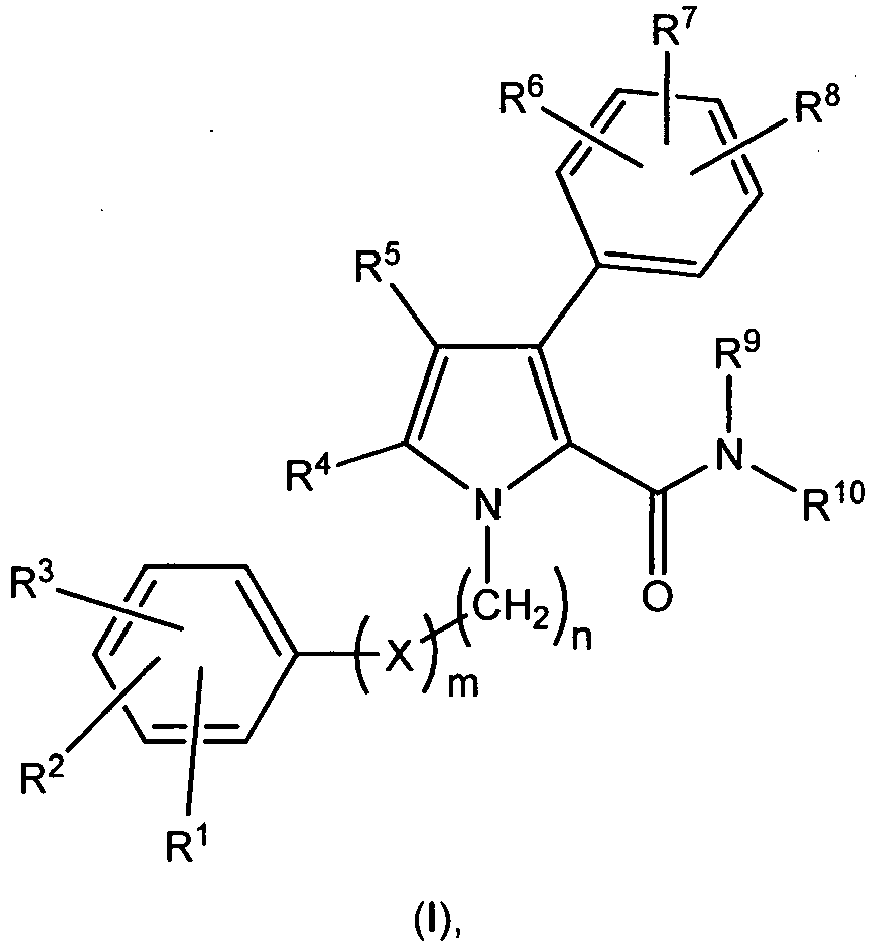
- n represents 0, 1 or 2; m represents 0 or 1 with the proviso that n ≥ m;
- X is selected from the group consisting of O, S, NH or N-C1-6-alkyl;
- R1, R2 and R3, are each independently of one another selected from the group consisting of H; F; Cl; Br; I; NO2; CN; C1-6-alkyl; CF3; CF2H; CFH2; CF2Cl; CFCl2; C(=O)-H; C(=O)-C1-6-alkyl; C(=O)-OH; C(=O)-O-C1-6-alkyl; C(=O)-N(H)(OH); C(=O)-NH2; C(=O)-N(H)(C1-6-alkyl); C(=O)-N(C1-6-alkyl)2; C(=N-OH)-H; C(=N-OH)-C1-6-alkyl; C(=N-O-C1-6-alkyl)-H; C(=N-O-C1-6-alkyl)-C1-6-alkyl; OH; OCF3; OCF2H; OCFH2; OCF2Cl; OCFCl2; O-C1-6-alkyl; O-C(=O)-C1-6-alkyl; O-C(=O)-O-C1-6-alkyl; O-(C=O)-N(H)(C1-6-alkyl); O-C(=O)-N(C1-6-alkyl)2; O-S(=O)2-C1-6-alkyl; O-S(=O)2-OH; O-S(=O)2-O-C1-6-alkyl; O-S(=O)2-NH2; O-S(=O)2-N(H)(C1-6-alkyl); O-S(=O)2-N(C1-6-alkyl)2; NH2; N(H)(C1-6-alkyl); N(C1-6-alkyl)2; N(H)-C(=O)-C1-6-alkyl; N(H)-C(=O)-O-C1-6-alkyl; N(H)-C(=O)-NH2; N(H)-C(=O)-N(H)(C1-6-alkyl); N(H)-C(=O)-N(C1-6-alkyl)2; N(C1-6-alkyl)-C(=O)-C1-6-alkyl; N(C1-6-alkyl)-C(=O)-O-C1-6-alkyl; N(C1-6-alkyl)-C(=O)-NH2; N(C1-6-alkyl)-C(=O)-N(H)(C1-6-alkyl); N(C1-6-alkyl)-C(=O)-N(C1-6-alkyl)2; N(H)-S(=O)2OH; N(H)-S(=O)2-C1-6-alkyl; N(H)-S(=O)2-O-C1-6-alkyl; N(H)-S(=O)2-NH2; N(H)-S(=O)2-N(H)(C1-6-alkyl); N(H)-S(=O)2N(C1-6-alkyl)2; N(C1-6-alkyl)-S(=O)2-OH; N(C1-6-alkyl)-S(=O)2-C1-6-alkyl; N(C1-6-alkyl)-S(=O)2-O-C1-6-alkyl; N(C1-6-alkyl)-S(=O)2-NH2; N(C1-6-alkyl)-S(=O)2-N(H)(C1-6-alkyl); N(C1-6-alkyl)-S(=O)2-N(C1-6-alkyl)2; SH; SCF3; SCF2H; SCFH2; SCF2Cl; SCFCl2; S-C1-6-alkyl; S(=O)-C1-6-alkyl; S(=O)2-C1-6-alkyl; S(=O)2-OH; S(=O)2-O-C1-6-alkyl; S(=O)2-NH2; S(=O)2-N(H)(C1-6-alkyl); or S(=O)2-N(C1-6-alkyl)2, whereby in each case C1-6-alkyl may be branched or unbranched; unsubstituted or mono- or polysubstituted;
a C3-6 cycloaliphatic residue or a 3 to 7 membered heterocycloaliphatic residue, in each case unsubstituted or mono- or polysubstituted; - R4 represents CH2F; CHF2, or CF3;
- R5 represents H, C1-6-alkyl, branched or unbranched, unsubstituted or mono- or poly-substituted, a C3-6 cycloaliphatic residue or a 3 to 7 membered heterocycloaliphatic residue, in each case unsubstituted or mono- or polysubstituted; OH; O-C1-6-alkyl; NH2; N(H)-C1-6-alkyl; N(-C1-6-alkyl)2 or SO2(-C1-6-alkyl), whereby in each case C1-6-alkyl may be branched or unbranched; unsubstituted or mono- or poly-substituted;
- R6, R7 and R8, are each independently of one another selected from the group consisting of H; F; Cl; Br; I; NO2; CN; C1-6-alkyl; CF3; CF2H; CFH2; CF2Cl; CFCl2; C(=O)-H; C(=O)-C1-6-alkyl; C(=O)-OH; C(=O)-O-C1-6-alkyl; C(=O)-N(H)(OH); C(=O)-NH2; C(=O)-N(H)(C1-6-alkyl); C(=O)-N(C1-6-alkyl)2; C(=N-OH)-H; C(=N-OH)-C1-6-alkyl; C(=N-O-C1-6-alkyl)-H; C(=N-O-C1-6-alkyl)-C1-6-alkyl; OH; OCF3; OCF2H; OCFH2; OCF2Cl; OCFCl2; O-C1-6-alkyl; O-C(=O)-C1-6-alkyl; O-C(=O)-O-C1-6-alkyl; O-(C=O)-N(H)(C1-6-alkyl); O-C(=O)-N(C1-6-alkyl)2; O-S(=O)2-C1-6-alkyl; O-S(=O)2-OH; O-S(=O)2-O-C1-6-alkyl; O-S(=O)2-NH2; O-S(=O)2-N(H)(C1-6-alkyl); O-S(=O)2-N(C1-6-alkyl)2; NH2; N(H)(C1-6-alkyl); N(C1-6-alkyl)2; N(H)-C(=O)-C1-6-alkyl; N(H)-C(=O)-O-C1-6-alkyl; N(H)-C(=O)-NH2; N(H)-C(=O)-N(H)(C1-6-alkyl); N(H)-C(=O)-N(C1-6-alkyl)2; N(C1-6-alkyl)-C(=O)-C1-6-alkyl; N(C1-6-alkyl)-C(=O)-O-C1-6-alkyl; N(C1-6-alkyl)-C(=O)-NH2; N(C1-6-alkyl)-C(=O)-N(H)(C1-6-alkyl); N(C1-6-alkyl)-C(=O)-N(C1-6-alkyl)2; N(H)-S(=O)2OH; N(H)-S(=O)2-C1-6-alkyl; N(H)-S(=O)2-O-C1-6-alkyl; N(H)-S(=O)2-NH2; N(H)-S(=O)2-N(H)(C1-6-alkyl); N(H)-S(=O)2N(C1-6-alkyl)2; N(C1-6-alkyl)-S(=O)2-OH; N(C1-6-alkyl)-S(=O)2-C1-6-alkyl; N(C1-6-alkyl)-S(=O)2-O-C1-6-alkyl; N(C1-6-alkyl)-S(=O)2-NH2; N(C1-6-alkyl)-S(=O)2-N(H)(C1-6-alkyl); N(C1-6-alkyl)-S(=O)2-N(C1-6-alkyl)2; SH; SCF3; SCF2H; SCFH2; SCF2Cl; SCFCl2; S-C1-6-alkyl; S(=O)-C1-6-alkyl; S(=O)2-C1-6-alkyl; S(=O)2-OH; S(=O)2-O-C1-6-alkyl; S(=O)2-NH2; S(=O)2-N(H)(C1-6-alkyl); or S(=O)2-N(C1-6-alkyl)2, whereby in each case C1-6-alkyl may be branched or unbranched; unsubstituted or mono- or poly-substituted;
a C3-6 cycloaliphatic residue or a 3 to 7 membered heterocycloaliphatic residue, in each case unsubstituted or mono- or polysubstituted; - R9 represents H, a C1-10 aliphatic residue, branched or unbranched, unsubstituted or mono- or poly-substituted; a C3-10 cycloaliphatic residue or a 3 to 10 membered heterocycloaliphatic residue, in each case unsubstituted or mono- or poly-substituted and in each case optionally connected via a C1-8 aliphatic group, branched or unbranched, which in turn may be unsubstituted or mono- or polysubstituted;
- R10 represents H, a C1-10 aliphatic residue, branched or unbranched, unsubstituted or mono- or polysubstituted; a C3-10 cycloaliphatic residue, a 3 to 10 membered heterocycloaliphatic residue or a heteroaryl residue, in each case unsubstituted or mono- or poly-substituted and in each case optionally connected via a C1-8 alkylene group, branched or unbranched, which in turn may be unsubstituted or mono- or polysubstituted; or
- R9 and R10 together with the nitrogen atom connecting them form a 3 to 10 membered heterocycloaliphatic residue, which may be unsubstituted or mono- or polysubstituted;
- optionally in the form of a single stereoisomer or a mixture of stereoisomers, in the form of the free compound and/or a physiologically acceptable salt and/or a physiologically acceptable solvate thereof.
- The term "single stereoisomer" preferably means in the sense of the present invention an individual enantiomer or diastereomer. The term "mixture of stereoisomers" means in the sense of this invention the racemate and mixtures of enantiomers and/or diastereomers in any mixing ratio.
- The term "physiologically acceptable salt" preferably comprises in the sense of this invention a salt of at least one compound according to the present invention and at least one physiologically acceptable acid or base.
- A physiologically acceptable salt of at least one compound according to the present invention and at least one physiologically acceptable acid preferably refers in the sense of this invention to a salt of at least one compound according to the present invention with at least one inorganic or organic acid which is physiologically acceptable - in particular when used in human beings and/or other mammals. Examples of physiologically acceptable acids are: hydrochloric acid, hydrobromic acid, sulphuric acid, methanesulphonic acid, p-toluenesulphonic acid, carbonic acid, formic acid, acetic acid, oxalic acid, succinic acid, tartaric acid, mandelic acid, fumaric acid, maleic acid, lactic acid, citric acid, glutamic acid, saccharic acid, monomethylsebacic acid, 5-oxoproline, hexane-1-sulphonic acid, nicotinic acid, 2, 3 or 4-aminobenzoic acid, 2,4,6-trimethylbenzoic acid, α-lipoic acid, acetyl glycine, hippuric acid, phosphoric acid, aspartic acid.
- A physiologically acceptable salt of at least one compound according to the present invention and at least one physiologically acceptable base preferably refers in the sense of this invention to a salt of at least one compound according to the present invention as an anion with at least one preferably inorganic cation, which is physiologically acceptable - in particular when used in human beings and/or other mammals.
- The term "physiologically acceptable solvate" preferably comprises in the sense of this invention an adduct of one compound according to the present invention and/or a physiologically acceptable salt of at least one compound according to the present invention with distinct molecular equivalents of one solvent or more solvents. Examples of physiologically acceptable solvents are water, alkanols, esters, ethers or ketones. Particularily preferred solvates are hydrates.
- The terms "alkyl", "C1-4-alkyl", and "C1-6-alkyl" preferably comprise in the sense of this invention acyclic saturated aliphatic hydrocarbon residues, which can be respectively branched or unbranched and can be unsubstituted or can be mono- or polysubstituted, e.g. mono-, di- or trisubstituted, and which contain 1 to 6 carbon atoms, i.e. 1, 2, 3, 4, 5 or 6 carbon atoms, or 1 to 4, i.e. 1, 2, 3 or 4 carbon atoms, respectively, i.e. C1-6 aliphatic residues and C1-6 aliphatic residues, i.e. C1-6 alkanyls as well as C1-6 alkanyls. Preferred C1-6 alkanyl residues are selected from the group consisting of methyl, ethyl, n-propyl, 2-propyl, n-butyl, isobutyl, sec.-butyl, tert.-butyl, n-pentyl, isopentyl, neopentyl, and n-hexyl. Preferred C1-6 alkanyl residues are selected from the group consisting of methyl, ethyl, n-propyl, 2-propyl, n-butyl, isobutyl, sec.-butyl, and tert.-butyl.
- In relation to the terms "alkyl", "C1-4-alkyl" and "C1-6-alkyl", the term "monosubstituted" or "polysubstituted" such as di- or tri-substituted refers in the sense of this invention, with respect to the corresponding residues or groups, to the single substitution or multiple substitution, e.g. disubstitution or trisubstitution, of one or more hydrogen atoms each independently of one another by at least one substituent. The term "polysubstituted" such as di- or tri-substituted with respect to polysubstituted residues and groups such as di- or tri-substituted residues and groups includes the polysubstitution of these residues and groups either on different or on the same atoms, for example trisubstituted on the same carbon atom, as in the case of CF3 or CH2CF3 or at various points, as in the case of CH(OH)-CH2CH2-CHCl2. The multiple substitution can be carried out using the same or using different substituents.
- The terms "C1-10 aliphatic residue", "C1-8 aliphatic residue", and "C1-6 aliphatic residue" comprise in the sense of this invention acyclic saturated or unsaturated aliphatic hydrocarbon residues, which can be branched or unbranched and also unsubstituted or mono- or polysubstituted, which contain 1 to 10, or 1 to 8, or 1 to 4 carbon atoms respectively, i.e. C1-10 alkanyls (C1-10 alkyls), C2-10 alkenyls and C2-10 alkynyls as well as C1-8 alkanyls (C1-8 alkyls), C2-8 alkenyls and C2-8 alkynyls as well as C1-6 alkanyls (C1-6 alkyls), C2-4 alkenyls and C2-4 alkynyls, respectively. Alkenyls comprise at least one C-C double bond (a C=C-bond) and alkynyls comprise at least one C-C triple bond (a C≡C-bond). Preferably, aliphatic residues are selected from the group consisting of alkanyl (alkyl) and alkenyl residues, more preferably are alkanyl (alkyl) residues. Preferred C1-10 alkanyl residues are selected from the group consisting of methyl, ethyl, n-propyl, 2-propyl, n-butyl, isobutyl, sec.-butyl, tert.-butyl, n-pentyl, isopentyl, neopentyl, n-hexyl, n-heptyl, n-octyl, n-nonyl and n-decyl. Preferred C1-8 alkanyl residues are selected from the group consisting of methyl, ethyl, n-propyl, 2-propyl, n-butyl, isobutyl, sec.-butyl, tert.-butyl, n-pentyl, isopentyl, neopentyl, n-hexyl, n-heptyl and n-octyl. Preferred C1-6 alkanyl residues are selected from the group consisting of methyl, ethyl, n-propyl, 2-propyl, n-butyl, isobutyl, sec.-butyl and tert.-butyl. Preferred C2-10 alkenyl residues are selected from the group consisting of ethenyl (vinyl), propenyl (-CH2CH=CH2, -CH=CH-CH3, -C(=CH2)-CH3), butenyl, pentenyl, hexenyl heptenyl, octenyl, nonenyl and decenyl. Preferred C2-8 alkenyl residues are selected from the group consisting of ethenyl (vinyl), propenyl (-CH2CH=CH2, -CH=CH-CH3, -C(=CH2)-CH3), butenyl, pentenyl, hexenyl heptenyl and octenyl. Preferred C2-4 alkenyl residues are selected from the group consisting of ethenyl (vinyl), propenyl (-CH2CH=CH2, -CH=CH-CH3, -C(=CH2)-CH3) and butenyl. Preferred C2-10 alkynyl residues are selected from the group consisting of ethynyl, propynyl (-CH2-C≡CH, -C≡C-CH3), butynyl, pentynyl, hexynyl, heptynyl, octynyl, nonynyl and decynyl. Preferred C2-8 alkynyl residues are selected from the group consisting of ethynyl, propynyl (-CH2-C≡CH, -C≡C-CH3), butynyl, pentynyl, hexynyl, heptynyl and octynyl. Preferred C2-4 alkynyl residues are selected from the group consisting of ethynyl, propynyl (-CH2-C≡CH, -C≡C-CH3) and butynyl.
- The terms "C3-6 cycloaliphatic residue" and "C3-10 cycloaliphatic residue" mean for the purposes of this invention cyclic aliphatic hydrocarbons containing 3, 4, 5 or 6 carbon atoms and 3, 4, 5, 6, 7, 8, 9 or 10 carbon atoms, respectively, wherein the hydrocarbons in each case can be saturated or unsaturated (but not aromatic), unsubstituted or mono- or polysubstituted. The cycloaliphatic residues can be bound to the respective superordinate general structure via any desired and possible ring member of the cycloaliphatic residue. The cycloaliphatic residues can also be condensed with further saturated, (partially) unsaturated, (hetero)cyclic, aromatic or heteroaromatic ring systems, i.e. with cycloaliphatic, heterocycloaliphatic, aryl or heteroaryl residues, which in each case can in turn be unsubstituted or mono- or polysubstituted. C3-10 cycloaliphatic residue can furthermore be singly or multiply bridged such as, for example, in the case of adamantyl, bicyclo[2.2.1]heptyl or bicyclo[2.2.2]octyl. Preferred C3-10 cycloaliphatic residues are selected from the group consisting of cyclopropyl, cyclobutyl, cyclopentyl, cyclohexyl, cycloheptyl, cyclooctyl, cyclononyl, cyclodecyl, adamantyl, cyclopentenyl, cyclohexenyl, cycloheptenyl, cyclooctenyl,

- The terms "3 to 7-membered heterocycloaliphatic residue" or "3-7-membered heterocycloaliphatic residue", and "3 to 10-membered heterocycloaliphatic residue" or "3-10-membered heterocycloaliphatic residue" mean for the purposes of this invention heterocycloaliphatic saturated or unsaturated (but not aromatic) residues having 3 to 7, i.e. 3, 4, 5, 6 or 7 ring members, and 3 to 10, i.e. 3, 4, 5, 6, 7, 8, 9 or 10 ring members, respectively, in which in each case at least one, if appropriate also two or three carbon atoms are replaced by a heteroatom or a heteroatom group each selected independently of one another from the group consisting of O, S, S(=O), S(=O)2, N, NH and N(C1-6-alkyl) such as N(CH3), wherein the ring members can be unsubstituted or mono- or polysubstituted. The cycloaliphatic residues can also be condensed with further saturated, (partially) unsaturated, (hetero)cyclic, aromatic or heteroaromatic ring systems, i.e. with cycloaliphatic, heterocycloaliphatic, aryl or heteroaryl residues, which in each case can in turn be unsubstituted or mono- or polysubstituted. The heterocycloaliphatic residue can be bound to the superordinate general structure via any desired and possible ring member of the heterocycloaliphatic residue if not indicated otherwise.
- The term "aryl" means for the purpose of this invention aromatic hydrocarbons having 6 to 14, i.e. 6, 7, 8, 9, 10, 11, 12, 13 or 14 ring members, preferably having 6 to 10, i.e. 6, 7, 8, 9 or 10 ring members, including phenyls and naphthyls. Each aryl residue can be unsubstituted or mono- or polysubstituted, wherein the aryl substituents can be the same or different and in any desired and possible position of the aryl. The aryl can be bound to the superordinate general structure via any desired and possible ring member of the aryl residue. The aryl residues can also be condensed with further saturated, (partially) unsaturated, (hetero)cycloaliphatic, aromatic or heteroaromatic ring systems, i.e. with a cycloaliphatic, heterocycloaliphatic, aryl or heteroaryl residue, which can in turn be unsubstituted or mono- or polysubstituted. Examples of condensed aryl residues are benzodioxolanyl and benzodioxanyl. Preferably, aryl is selected from the group consisting of phenyl, 1-naphthyl, 2-naphthyl, fluorenyl and anthracenyl, each of which can be respectively unsubstituted or mono- or polysubstituted. A particularly preferred aryl is phenyl, unsubstituted or mono- or polysubstituted.
- The term "heteroaryl" for the purpose of this invention represents a 5 or 6-membered cyclic aromatic residue containing at least 1, if appropriate also 2, 3, 4 or 5 heteroatoms, wherein the heteroatoms are each selected independently of one another from the group S, N and O and the heteroaryl residue can be unsubstituted or mono- or polysubstituted; in the case of substitution on the heteroaryl, the substituents can be the same or different and be in any desired and possible position of the heteroaryl. The binding to the superordinate general structure can be carried out via any desired and possible ring member of the heteroaryl residue if not indicated otherwise. The heteroaryl can also be part of a bi- or polycyclic system having up to 14 ring members, wherein the ring system can be formed with further saturated, (partially) unsaturated, (hetero)cycloaliphatic or aromatic or heteroaromatic rings, i.e. with a cycloaliphatic, heterocycloaliphatic, aryl or heteroaryl residue, which can in turn be unsubstituted or mono- or polysubstituted. It is preferable for the heteroaryl residue to be selected from the group consisting of benzofuranyl, benzoimidazolyl, benzothienyl, benzothiadiazolyl, benzothiazolyl, benzotriazolyl, benzooxazolyl, benzooxadiazolyl, quinazolinyl, quinoxalinyl, carbazolyl, quinolinyl, dibenzofuranyl, dibenzothienyl, furyl (furanyl), imidazolyl, imidazothiazolyl, indazolyl, indolizinyl, indolyl, isoquinolinyl, isoxazoyl, isothiazolyl, indolyl, naphthyridinyl, oxazolyl, oxadiazolyl, phenazinyl, phenothiazinyl, phthalazinyl, pyrazolyl, pyridyl (2-pyridyl, 3-pyridyl, 4-pyridyl), pyrrolyl, pyridazinyl, pyrimidinyl, pyrazinyl, purinyl, phenazinyl, thienyl (thiophenyl), triazolyl, tetrazolyl, thiazolyl, thiadiazolyl and triazinyl.
- The term "connected via a C1-6 aliphatic group" or "via a C1-8 aliphatic group" with respect to residues as heterocycloaliphatic residue and cycloaliphatic residue mean for the purpose of the invention that these residues have the above-defined meanings and that each of these residues is bound to the respective superordinate general structure via a C1-6 aliphatic group or via a C1-8 aliphatic group, respectively. The C1-6 aliphatic group and the C1-8 aliphatic group can in all cases be branched or unbranched, unsubstituted or mono- or polysubstituted. The C1-6 aliphatic group can in all cases be furthermore saturated or unsaturated, i.e. can be a C1-6-alkylene group, a C2-6-alkenylene group or a C2-6-alkynylene group. The same applies to a C1-8 aliphatic group, i.e. a C1-8 aliphatic group can in all cases be furthermore saturated or unsaturated, i.e. can be a C1-8-alkylene group, a C2-8-alkenylene group or a C2-8-alkynylene group. Preferably, the C1-6 aliphatic group is a C1-6-alkylene group or a C2-6-alkenylene group, more preferably a C1-6-alkylene group. Preferably, the C1-8 aliphatic group is a C1-8-alkylene group or a C2-8-alkenylene group, more preferably a C1-8-alkylene group. Preferred C1-6-alkylene groups are selected from the group consisting of -CH2-, -CH2-CH2-, -CH(CH3)-, -CH2-CH2-CH2-, -CH(CH3)-CH2-, -CH(CH2CH3)-, -CH2-(CH2)2-CH2-, -CH(CH3)-CH2-CH2-, -CH2-CH(CH3)-CH2-, -CH(CH3)-CH(CH3)-, -CH(CH2CH3)-CH2-, -C(CH3)2-CH2-, -CH(CH2CH2CH3)- and -C(CH3)(CH2CH3)-. Preferred C2-6-alkenylene groups are selected from the group consisting of -CH=CH-, -CH=CH-CH2-, -C(CH3)=CH2-, -CH=CH-CH2-CH2-, -CH2-CH=CH-CH2-, -CH=CH-CH=CH-, -C(CH3)=CH-CH2-, -CH=C(CH3)-CH2-, -C(CH3)=C(CH3)- and -C(CH2CH3)=CH-. Preferred C2-6-alkynylene groups are selected from the group consisting of -C≡C-, -C≡C-CH2-, -C≡C-CH2-CH2-, -C≡C-CH(CH3)-, -CH2-C≡C-CH2- and -C=C-C=C-. Preferred C1-8-alkylene groups are selected from the group consisting of -CH2-, -CH2-CH2-, -CH(CH3)-, -CH2-CH2-CH2-, -CH(CH3)-CH2-, -CH(CH2CH3)-, -CH2-(CH2)2-CH2-, -CH(CH3)-CH2-CH2-, -CH2-CH(CH3)-CH2-, -CH(CH3)-CH(CH3)-, -CH(CH2CH3)-CH2-, -C(CH3)2-CH2-, -CH(CH2CH2CH3)-, -C(CH3)(CH2CH3)-, -CH2-(CH2)3-CH2-, -CH(CH3)-CH2-CH2-CH2-, -CH2-CH(CH3)-CH2-CH2-, -CH(CH3)-CH2-CH(CH3)-, -CH(CH3)-CH(CH3)-CH2-, -C(CH3)2-CH2-CH2-, -CH2-C(CH3)2-CH2-, -CH(CH2CH3)-CH2-CH2-, -CH2-CH(CH2CH3)-CH2-, -C(CH3)2-CH(CH3)-, -CH(CH2CH3)-CH(CH3)-, -C(CH3)(CH2CH3)-CH2-, -CH(CH2CH2CH3)-CH2-, -C(CH2CH2CH3)-CH2-, -CH(CH2CH2CH2CH3)-, -C(CH3)(CH2CH2CH3)-, -C(CH2CH3)2- and -CH2-(CH2)4-CH2-. Preferred C2-8-alkenylene groups are selected from the group consisting of -CH=CH-, -CH=CH-CH2-, -C(CH3)=CH2-, -CH=CH-CH2-CH2-, -CH2-CH=CH-CH2-, -CH=CH-CH=CH-, -C(CH3)=CH-CH2-, -CH=C(CH3)-CH2-, -C(CH3)=C(CH3)-, -C(CH2CH3)=CH-, -CH=CH-CH2-CH2-CH2-, -CH2-CH=CH2-CH2-CH2-, -CH=CH=CH-CH2-CH2- and -CH=CH2-CH-CH=CH2-. Preferred C2-8-alkynylene groups are selected from the group consisting of -C≡C-, -C≡C-CH2-, -C≡C-CH2-CH2-, -C=C-CH(CH3)-, -CH2-C≡C-CH2-, -C=C-C=C-, -C≡C-C(CH3)2-, -C≡C-CH2-CH2-CH2-, -CH2-C≡C-CH2-CH2-, -C≡C-C≡C-CH2- and -C≡C-CH2-C≡C-.
- In relation to the terms "alkyl", "C1-4-alkyl","C1-6-alkyl", "aliphatic residue", "aliphatic group", "cycloaliphatic residue" and "heterocycloaliphatic residue", the term "mono- or polysubstituted" refers in the sense of this invention, with respect to the corresponding residues or groups, to the single substitution or multiple substitution, e.g. disubstitution, trisubstitution, tetrasubstitution, or pentasubstitution, of one or more hydrogen atoms each independently of one another by at least one substituent selected from the group consisting of F; Cl; Br; I; NO2; CN; =O; =NH; =N(OH); =N(O-C1-6-alkyl); CF3; CF2H; CFH2; CF2Cl; CFCl2; C1-6-alkyl; (C1-8 alkylene)-OH; C(=O)-H; C(=O)-C1-6-alkyl; C(=O)-OH; C(=O)-O-C1-6-alkyl; C(=O)-N(H)(OH); C(=O)-NH2; C(=O)-N(H)(C1-6-alkyl); C(=O)-N(C1-6-alkyl)2; C(=N-OH)-H; C(=N-OH)-C1-6-alkyl; C(=N-O-C1-6-alkyl)-H; C(=N-O-C1-6-alkyl)-C1-6-alkyl; OH; OCF3; OCF2H; OCFH2; OCF2Cl; OCFCl2; O-C1-6-alkyl; O-(C1-8 alkylene)-OH; O-(C1-8 alkylene)-O-C1-8-alkyl; O-C(=O)-C1-6-alkyl; O-C(=O)-O-C1-6-alkyl; O-(C=O)-N(H)(C1-6-alkyl); O-C(=O)-N(C1-6-alkyl)2; O-S(=O)2-C1-6-alkyl; O-S(=O)2-OH; O-S(=O)2-O-C1-6-alkyl; O-S(=O)2-NH2; O-S(=O)2-N(H)(C1-6-alkyl); O-S(=O)2-N(C1-6-alkyl)2; NH2; N(H)(C1-6-alkyl); N(C1-6-alkyl)2; N(H)-C(=O)-C1-6-alkyl; N(H)-C(=O)-O-C1-6-alkyl; N(H)-C(=O)-NH2; N(H)-C(=O)-N(H)(C1-6-alkyl); N(H)-C(=O)-N(C1-6-alkyl)2; N(C1-6-alkyl)-C(=O)-C1-6-alkyl; N(C1-6-alkyl)-C(=O)-O-C1-6-alkyl; N(C1-6-alkyl)-C(=O)-NH2; N(C1-6-alkyl)-C(=O)-N(H)(C1-6-alkyl); N(C1-6-alkyl)-C(=O)-N(C1-6-alkyl)2; N(H)-S(=O)2-OH; N(H)-S(=O)2-C1-6-alkyl; N(H)-S(=O)2-O-C1-6-alkyl; N(H)-S(=O)2-NH2; N(H)-S(=O)2-N(H)(C1-6-alkyl); N(H)-S(=O)2-N(C1-6-alkyl)2; N(C1-6-alkyl)-S(=O)2-OH; N(C1-6-alkyl)-S(=O)2-C1-6-alkyl; N(C1-6-alkyl)-S(=O)2-O-C1-6-alkyl; N(C1-6-alkyl)-S(=O)2-NH2; N(C1-6-alkyl)-S(=O)2-N(H)(C1-6-alkyl); N(C1-6-alkyl)-S(=O)2-N(C1-6-alkyl)2; SH; SCF3; SCF2H; SCFH2; SCF2Cl; SCFCl2; S-C1-6-alkyl; S(=O)-C1-6-alkyl; S(=O)2-C1-6-alkyl; S(=O)2-OH; S(=O)2-O-C1-6-alkyl; S(=O)2-NH2; S(=O)2-N(H)(C1-6-alkyl); S(=O)2-N(C1-6-alkyl)2; a C3-6 cycloaliphatic residue or a 3 to 7 membered heterocycloaliphatic residue. The term "polysubstituted" with respect to polysubstituted residues and groups includes the polysubstitution of these residues and groups either on different or on the same atoms, for example trisubstituted on the same carbon atom, as in the case of CF3, CH2CF3 or 1,1-difluorocyclohexyl, or at various points, as in the case of CH(OH)-CH=CH-CHCl2 or 1-chloro-3-fluorocyclohexyl. A substituent can if appropriate for its part in turn be mono- or polysubstituted. The multiple substitution can be carried out using the same or using different substituents.
- Preferred substituents of "alkyl", "C1-4-alkyl","C1-6-alkyl", "aliphatic residue" and "aliphatic group" are selected from the group consisting of F; Cl; Br; I; NO2; CF3; CN; =O; =NH; C1-6-alkyl; (C1-8-alkylene)-OH; C(=O)-H; C(=O)-C1-6-alkyl; C(=O)-OH; C(=O)-O-C1-6-alkyl; C(=O)-NH2; C(=O)-N(H)(C1-6-alkyl); C(=O)-N(C1-6-alkyl)2; OH; O-C1-6-alkyl; O-C(=O)-C1-6-alkyl; O-(C1-8 alkylene)-OH; O-(C1-8 alkylene)-O-C1-8 alkyl; OCF3; NH2; N(H)(C1-6-alkyl); N(C1-6-alkyl)2; N(H)-C(=O)-C1-6-alkyl; N(H)-S(=O)2-C1-6-alkyl; N(C1-6-alkyl)-S(=O)2-C1-6-alkyl; N(H)-C(=O)-NH2; N(H)-C(=O)-N(H)(C1-6-alkyl); N(H)-C(=O)-N(C1-6-alkyl)2; N(H)-S(=O)2-NH2; N(H)-S(=O)2-N(H)(C1-6-alkyl); N(H)-S(=O)2-N(C1-6-alkyl)2; N(C1-6-alkyl)-S(=O)2-NH2; N(C1-6-alkyl)-S(=O)2-N(H)(C1-6-alkyl); N(C1-6-alkyl)-S(=O)2-N(C1-6-alkyl)2; SH; SCF3; S-C1-6-alkyl; S(=O)2 C1-6-alkyl; S(=O)2OH; S(=O)2O-C1-6-alkyl and S(=O)2-NH2; S(=O)2-N(H)(C1-6-alkyl); and S(=O)2-N(C1-6alkyl)2.
- Particularly preferred substituents of "alkyl", "C1-4-alkyl","C1-6-alkyl", "aliphatic residue" and "aliphatic group" are selected from the group consisting of F; Cl; Br; I; NO2; CF3; CN; =0; C1-6-alkyl; (C1-8-alkylene)-OH; C(=O)-H; C(=O)-C1-6-alkyl; C(=O)-OH; C(=O)-O-C1-6-alkyl; C(=O)-NH2; C(=O)-N(H)(C1-6-alkyl); C(=O)-N(C1-6-alkyl)2; OH; O-C1-6-alkyl; O-C(=O)-C1-6-alkyl; O-(C1-8-alkylene)-OH; O-(C1-8-alkylene)-O-C1-6-alkyl; OCF3; NH2; N(H)(C1-6-alkyl); N(C1-6-alkyl)2; N(H)-C(=O)-C1-6-alkyl; N(H)-S(=O)2-C1-6-alkyl; N(C1-6-alkyl)-S(=O)2-C1-6-alkyl; N(H)-C(=O)-NH2; N(H)=C(=O)-N(H)(C1-6-alkyl); N(H)-C(=O)-N(C1-6-alkyl)2; N(C1-6-alkyl)-S(=O)2-NH2; N(C1-6-alkyl)-S(=O)2-N(H)(C1-6-alkyl); N(C1-6-alkyl)-S(=O)2-N(C1-6-alkyl)2; SH; SCF3; S-C1-6-alkyl; S(=O)2 C1-6-alkyl; S(=O)2OH; S(=O)2O-C1-6-alkyl; S(=O)2-NH2; S(=O)2-N(H)(C1-6-alkyl) and S(=O)2-N(C1-6-alkyl)2.
- Most preferred substituents of "alkyl", "C1-4-alkyl","C1-6-alkyl", "aliphatic residue" and "aliphatic group" are selected from the group consisting of F; Cl; Br; I; CF3; C(=O)-NH2; C(=O)-N(H)(C1-6-alkyl); C(=O)-N(C1-6-alkyl)2; OH; O-C1-6-alkyl; O-(C1-8-alkylene)-OH; O-(C1-8-alkylene)-O-C1-8-alkyl; NaH2 ; N(H)(C1-6-alkyl); N(C1-6-alkyl)2; N(H)-C(=O)-C1-6-alkyl; N(H)-S(=O)2-C1-6-alkyl; N(C1-6-alkyl)-S(=O)2-C1-6-alkyl; N(H)-S(=O)2-NH2; SH; S-C1-6-alkyl; S(=O)2 C1-6-alkyl and S(=O)2-N(H)(C1-6-alkyl).
- Particularly preferred substituents of "cycloaliphatic residue" and "heterocycloaliphatic residue" are selected from the group consisting of F; Cl; Br; I; NO2; CF3; CN; =O; C1-6-alkyl; C3-6 cycloaliphatic residue; 3 to 7 membered heterocycloaliphatic residue; C3-6 cycloaliphatic residue or 3 to 6 membered heterocycloaliphatic bridged via a C1-6 aliphatic group; CHO; C(=O)-C1-6-alkyl; CO2H; C(=O)O-C1-6-alkyl; CONH2; C(=O)NH-C1-6-alkyl; C(=O)N(C1-6-alkyl)2; OH; O-C1-6-alkyl; OCF3; O-(C1-8-alkylene)-OH; O-(C1-8-alkylene)-O-C1-6-alkyl; O-C(=O)-C1-6-alkyl; NH2 ; NH-C1-6-alkyl; N(C1-6-alkyl)2; NH-C(=O)-C1-6-alkyl; SH; S-C1-6-alkyl; SCF3; S(=O)2-C1-6-alkyl; S(=O)2OH; S(=O)2O-C1-6-alkyl and S(=O)2-NH-C1-6-alkyl.
- The compounds according to the invention are defined by substituents, for example by R1, R2 and R3 (1st generation substituents) which are for their part if appropriate themselves substituted (2nd generation substituents). Depending on the definition, these substituents of the substituents can for their part be resubstituted (3rd generation substituents). If, for example, R1 = a C1-6-alkyl (1st generation substituent), then the C1-6-alkyl can for its part be substituted, for example with a NH- C1-6-alkyl (2nd generation substituent). This produces the functional group R1 = (C1-6-alkyl-NH-C1-6-alkyl). The NH-C1-6-alkyl can then for its part be resubstituted, for example with Cl (3rd generation substituent). Overall, this produces the functional group R1 = C1-6-alkyl-NH-C1-6-alkyl, wherein the C1-6-alkyl of the NH-C1-6-alkyl is substituted by Cl.
- However, in a preferred embodiment, the 3rd generation substituents may not be resubstituted, i.e. there are then no 4th generation substituents.
- In another preferred embodiment, the 2nd generation substituents may not be resubstituted, i.e. there are then not even any 3rd generation substituents. In other words, in this embodiment, in the case of general formula (I), for example, the functional groups for R1 to R9 can each if appropriate be substituted; however, the respective substituents may then for their part not be resubstituted.
- In some cases, the compounds according to the invention are defined by substituents which are or carry a cycloaliphatic residue or a heterocycloaliphatic residue, respectively, in each case unsubstituted or mono- or polysubstituted, or which form together with the carbon atom(s) or heteroatom(s) connecting them, as the ring member or as the ring members, a ring, for example a cycloaliphatic or a heterocycloaliphatic ring system. Both these cycloaliphatic or heterocycloaliphatic ring systems and the (hetero)cycloaliphatic ring systems formed in this manner can if appropriate be condensed with a cycloaliphatic residue, preferably a C3-6 cycloaliphatic residue, or with a heterocycloaliphatic residue, preferably a 3 to 7 membered heterocycloaliphatic residue, e.g. with a cycloaliphatic residue such as cyclohexyl, or a heterocycloaliphatic residue such as morpholinyl, wherein the cycloaliphatic or heterocycloaliphatic residues condensed in this way can for their part be respectively unsubstituted or mono- or polysubstituted.
- Within the scope of the present invention, the symbol

- If a residue occurs multiply within a molecule, then this residue can have respectively different meanings for various substituents: if, for example, both R1 and R2 denote a 3 to 10 membered heterocycloaliphatic residue, then the 3 to 10 membered heterocycloaliphatic residue can e.g. represent morpholinyl for R1 and can represent piperazinyl for R2.
- In a preferred embodiment of the compound according to the present invention
R1, R2 and R3 are each independently of one another selected from the group consisting of H; F; Cl; Br; I; NO2; CN; C1-6-alkyl; CF3; CF2H; CFH2; CF2Cl; CFCl2; C(=O)-H; C(=O)-C1-6-alkyl; C(=O)-OH; C(=O)-O-C1-6-alkyl; C(=O)-N(H)(OH); C(=O)-NH2; C(=O)-N(H)(C1-6-alkyl); C(=O)-N(C1-6-alkyl)2; C(=N-OH)-H; C(=N-OH)-C1-6-alkyl; C(=N-O-C1-6-alkyl)-H; C(=N-O-C1-6-alkyl)-C1-6-alkyl; OH; OCF3; OCF2H; OCFH2; OCF2Cl; OCFCl2; O-C1-6-alkyl; O-C(=O)-C1-6-alkyl; O-C(=O)-O-C1-6-alkyl; O-(C=O)-N(H)(C1-6-alkyl); O-C(=O)-N(C1-6-alkyl)2; O-S(=O)2-C1-6-alkyl; O-S(=O)2-OH; O-S(=O)2-O-C1-6-alkyl; O-S(=O)2-NH2; O-S(=O)2-N(H)(C1-6-alkyl); O-S(=O)2-N(C1-6-alkyl)2; NH2; N(H)(C1-6-alkyl); N(C1-6-alkyl)2; N(H)-C(=O)-C1-6-alkyl; N(H)-C(=O)-O-C1-6-alkyl; N(H)-C(=O)-NH2; N(H)-C(=O)-N(H)(C1-6-alkyl); N(H)-C(=O)-N(C1-6-alkyl)2; N(C1-6-alkyl)-C(=O)-C1-6-alkyl; N(C1-6-alkyl)-C(=O)-O-C1-6-alkyl; N(C1-6-alkyl)-C(=O)-NH2; N(C1-6-alkyl)-C(=O)-N(H)(C1-6-alkyl); N(C1-6-alkyl)-C(=O)-N(C1-6-alkyl)2; N(H)-S(=O)2OH; N(H)-S(=O)2-C1-6-alkyl; N(H)-S(=O)2-O-C1-6-alkyl; N(H)-S(=O)2-NH2; N(H)-S(=O)2-N(H)(C1-6-alkyl); N(H)-S(=O)2N(C1-6-alkyl)2; N(C1-6-alkyl)-S(=O)2-OH; N(C1-6-alkyl)-S(=O)2-C1-6-alkyl; N(C1-6-alkyl)-S(=O)2-O-C1-6-alkyl; N(C1-6-alkyl)-S(=O)2-NH2; N(C1-6-alkyl)-S(=O)2-N(H)(C1-6-alkyl); N(C1-6-alkyl)-S(=O)2-N(C1-6-alkyl)2; SH; SCF3; SCF2H; SCFH2; SCF2Cl; SCFCl2; S-C1-6-alkyl; S(=O)-C1-6-alkyl; S(=O)2-C1-6-alkyl; S(=O)2-OH; S(=O)2-O-C1-6-alkyl; S(=O)2-NH2; S(=O)2-N(H)(C1-6-alkyl); or S(=O)2-N(C1-6-alkyl)2, whereby in each case C1-6-alkyl may be branched or unbranched; unsubstituted or mono- or polysubstituted; a C3-6 cycloaliphatic residue or a 3 to 7 membered heterocycloaliphatic residue, in each case unsubstituted or mono- or polysubstituted. - Preferably,
R1, R2 and R3 are each independently of one another selected from the group consisting of H; F; Cl; CN; C1-6-alkyl; CF3; CF2H; CFH2; OH; OCF3; O-C1-6-alkyl; O-C(=O)-C1-6-alkyl; NH2; N(H)(C1-6-alkyl); N(C1-6-alkyl)2; SCF3; S(=O)-C1-6-alkyl; S(=O)2-C1-6-alkyl; S(=O)2-OH; S(=O)2-O-C1-6-alkyl; S(=O)2-NH2; S(=O)2-N(H)(C1-6-alkyl); S(=O)2-N(C1-6 alkyl)2, whereby in each case C1-6-alkyl may be branched or unbranched, or a C3-6 cycloaliphatic residue, unsubstituted or mono- or polysubstituted. - More preferably,
R1, R2 and R3 are independently of one another selected from the group consisting of H, F, Cl, CFH2, CF2H, CF3, CN, CH2-OCH3, S(=O)2-CH3, OCF3, CH3, O-CH3, O-CH2CH3 and N(CH3)2. - Even more preferably,
R1, R2 and R3 are independently of one another selected from the group consisting of H, F, Cl, CN, CFH2, CF2H, CF3, OCF3, CH3, S(=O)2-CH3, O-CH3, and O-CH2CH3. - Still more preferably,
R1, R2 and R3 are independently of one another selected from the group consisting of H, F, Cl, CF3, OCF3, CH3, S(=O)2-CH3 and O-CH3. - Particularly preferred,
R1, R2 and R3 are independently of one another selected from the group consisting of H, F, Cl, CF3, CH3 and O-CH3. - Even more particularly preferred,
R1, R2 and R3 are independently of one another selected from the group consisting of H, F, Cl, CH3 and O-CH3. - In one preferred embodiment of the compound according to the present invention, R1, R2 and R3 denote H.
- In another preferred embodiment of the compound according to the present invention at least one of R1, R2 and R3 is ≠ H.
- In another preferred embodiment of the compound according to the present invention one or two of R1, R2 and R3, denote(s) H.
- In another preferred embodiment of the compound according to the present invention one of R1, R2 and R3 represents H.
- In another preferred embodiment of the compound according to the present invention two of R1, R2 and R3 represent H.
- In another preferred embodiment of the compound according to the present invention
R2 and R3 are independently of one another selected from the group consisting of H; F; Cl; CN; C1-6-alkyl; CF3; CF2H; CFH2; OH; OCF3; O-C1-6-alkyl; O-C(=O)-C1-6-alkyl; NH2; N(H)(C1-6-alkyl); N(C1-6-alkyl)2; SCF3; S(=O)-C1-6-alkyl; S(=O)2-C1-6-alkyl; S(=O)2-OH; S(=O)2-O-C1-6-alkyl; S(=O)2-NH2; S(=O)2-N(H)(C1-6-alkyl); S(=O)2-N(C1-6-alkyl)2, whereby in each case C1-6-alkyl may be branched or unbranched, or a C3-6 cycloaliphatic residue, unsubstituted or mono- or polysubstituted,
and R1 represents H. - Preferably,
R2 and R3 are independently of one another selected from the group consisting of H, F, Cl, CFH2, CF2H, CF3, CN, C1-6-alkyl; CH2-OH, CH2-OCH3, OCF3, OH, O-CH3, O-CH2CH3, NH2, NH(CH3), and N(CH3)2, more preferably are independently of one another selected from the group consisting of H, F, Cl, CFH2, CF2H, CF3, CN, CH2-OCH3, OCF3, CH3, O-CH3, O-CH2CH3 and N(CH3)2, even more preferably are independently of one another selected from the group consisting of H, F, Cl, CFH2, CF2H, CF3, OCF3, CH3, O-CH3, and O-CH2CH3, still more preferably are independently of one another selected from the group consisting of H, F, Cl, CF3, OCF3, CH3 and O-CH3, in particular are independently of one another selected from the group consisting of H, F, Cl, CH3, CF3 and O-CH3, even more particularly preferred are independently of one another selected from the group consisting of H, F, Cl, CH3 and O-CH3,
and R1 represents H. - In yet another preferred embodiment of the compound according to the present invention,
R3 is selected from the group consisting of F, Cl, Br, CFH2, CF2H, CF3, CN, CH2-OH, CH2-OCH3, OCF3, OH, CH3, CH2CH3, CH(CH3)2, S(=O)2-CH3, O-CH3, O-CH2CH3, NH2, NH(CH3), and N(CH3)2, and both R1 and R2 represent H. - Preferably,
R3 is selected from the group consisting of F, Cl, CFH2, CF2H, CF3, CN, CH2-OH, CH2-OCH3, OCF3, OH, CH3, S(=O)2-CH3, O-CH3, O-CH2CH3, NH2, NH(CH3), and N(CH3)2, more preferably is selected from the group consisting of F, Cl, CFH2, CF2H, CF3, CN, CH2-OCH3, OCF3, CH3, O-CH3, O-CH2CH3 and N(CH3)2, even more preferably is selected from the group consisting of F, Cl, CFH2, CF2H, CF3, OCF3, CH3, O-CH3, and O-CH2CH3, still more preferably is selected from the group consisting of F, Cl, CF3, OCF3, CH3 and O-CH3, in particular is selected from the group consisting of F, Cl, CF3, CH3 and O-CH3, even more particularly preferred is selected from the group consisting of F, Cl, CH3 and O-CH3,
and both R1 and R2 represent H. - In yet a further preferred embodiment of the compound according to the present invention
R2 is selected from the group consisting of H; F; Cl; CN; C1-6-alkyl; CF3; CF2H; CFH2; OH; OCF3; O-C1-6-alkyl; O-C(=O)-C1-6-alkyl; NH2; N(H)(C1-6-alkyl); N(C1-6-alkyl)2; SCF3; S(=O)-C1-6-alkyl; S(=O)2-C1-6-alkyl; S(=O)2-OH; S(=O)2-O-C1-6-alkyl; S(=O)2-NH2; S(=O)2-N(H)(C1-6-alkyl); or S(=O)2-N(C1-6 alkyl)2, whereby in each case C1-6-alkyl may be branched or unbranched,
R3 is selected from the group consisting of H; F; Cl; CN; C1-6-alkyl; CF3; CF2H; CFH2; OH; OCF3; O-C1-6-alkyl; O-C(=O)-C1-6-alkyl; NH2; N(H)(C1-6-alkyl); N(C1-6-alkyl)2; SCF3; S(=O)-C1-6-alkyl; S(=O)2-C1-6-alkyl; S(=O)2-OH; S(=O)2-O-C1-6-alkyl; S(=O)2-NH2; S(=O)2-N(H)(C1-6-alkyl); or S(=O)2-N(C1-6-alkyl)2, whereby in each case C1-6-alkyl may be branched or unbranched,
and R1 represents H. - Preferably,
R2 is selected from the group consisting of H, F, Cl, CFH2, CF2H, CF3, CN, CH2-OH, CH2-OCH3, OCF3, OH, CH3, CH2CH3, CH(CH3)2, S(=O)2-CH3, O-CH3, O-CH2CH3, NH2, NH(CH3), and N(CH3)2, preferably is selected from the group consisting of of F, Cl, CFH2, CF2H, CF3, CN, CH2-OH, CH2-OCH3, OCF3, OH, CH3, S(=O)2-CH3, O-CH3, O-CH2CH3, NH2, NH(CH3), and N(CH3)2, more preferably is selected from the group consisting of F, Cl, CFH2, CF2H, CF3, CN, CH2-OCH3, OCF3, CH3, S(=O)2-CH3, O-CH3, O-CH2CH3 and N(CH3)2, even more preferably is selected from the group consisting of F, Cl, CFH2, CF2H, CF3, OCF3, CH3, S(=O)2-CH3, O-CH3 and O-CH2CH3, still more preferably is selected from the group consisting of F, Cl, CF3, S(=O)2-CH3, OCF3, CH3 and O-CH3, in particular is selected from the group consisting of F, Cl, CF3, S(=O)2-CH3, CH3 and O-CH3, even more particularly preferred is selected from the group consisting of F, Cl, CH3 and O-CH3,
R3 is selected from the group consisting of H, F, Cl, CFH2, CF2H, CF3, CN, CH2-OH, CH2-OCH3, OCF3, OH, CH3, O-CH3, O-CH2CH3, NH2, NH(CH3), and N(CH3)2, preferably is selected from the group consisting of of F, Cl, CFH2, CF2H, CF3, CN, CH2-OH, CH2-OCH3, OCF3, OH, CH3, O-CH3, O-CH2CH3, NH2, NH(CH3), and N(CH3)2, more preferably is selected from the group consisting of H, F, Cl, CFH2, CF2H, CF3, CN, CH2-OCH3, OCF3, CH3, O-CH3, O-CH2CH3 and N(CH3)2, even more preferably is selected from the group consisting of H, F, Cl, CFH2, CF2H, CF3, OCF3, CH3, O-CH3, and O-CH2CH3, still more preferably is selected from the group consisting of H, F, Cl, CF3, OCF3, CH3 and O-CH3, in particular is selected from the group consisting of H, F, Cl, CF3, CH3 and O-CH3, even more particularly preferred is selected from the group consisting of H, F, Cl, CH3 and O-CH3,
and R1 represents H. - In another particularly preferred embodiment according to the present invention the part structure (SF-I)


- Even more particularly preferred, the part structure (SF-I) is selected from the group consisting of


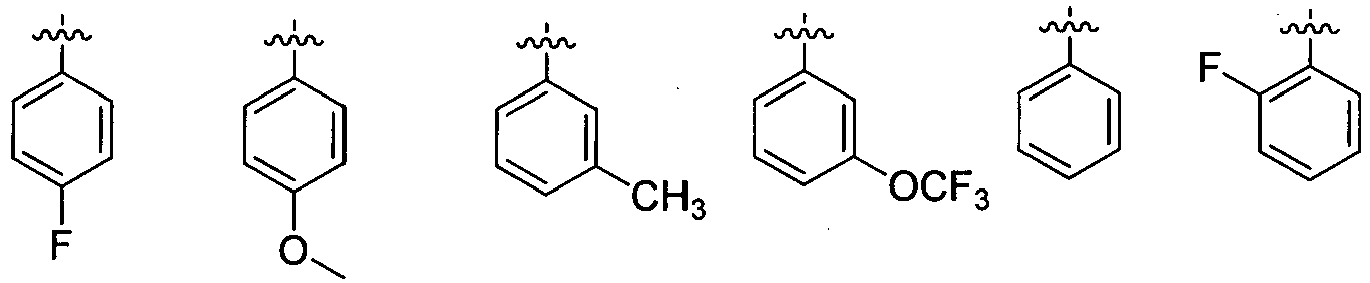
- Most preferred, the part structure (SF-I) is selected from the group consisting of

- In a preferred embodiment of the compound according to the present invention,
n represents 0, 1 or 2;
m represents 0 or 1 with the proviso that n ≥ m,
wherein
X is selected from the group consisting of O, S, NH or N-C1-6-alkyl; - In another preferred embodiment of the compound according to the present invention,
n represents 0 or 1 and m represents 0. - In a particularly preferred embodiment of the compound according to the present invention, n represents 0 and m represents 0.
- In another particularly preferred embodiment of the compound according to the present invention, n represents 1 and m represents 0.
- In yet a further preferred embodiment of the compound according to the present invention,
n represents 1 or 2 and m represents 1. - Preferably,
n represents 2 and m represents 1. - More preferably,
n represents 2, m represents 1 and X is selected from the group consisting of O, S, NH and N-C1-6-alkyl. - Even more preferably,
n represents 2, m represents 1 and X is selected from the group consisting of O, NH and N-C1-6-alkyl. - In a particularly preferred embodiment of the compound according to the present invention, n represents 2, m represents 1 and X represents O.
- In another particularly preferred embodiment of the compound according to the present invention,
n represents 1, m represents 0 and
R1, R2 and R3 are each independently of one another selected from the group consisting of H; F; Cl; CN; C1-6-alkyl; CF3; CF2H; CFH2; OH; OCF3; O-C1-6-alkyl; O-C(=O)-C1-6-alkyl; NH2; N(H)(C1-6-alkyl); N(C1-6-alkyl)2; SCF3; S(=O)-C1-6-alkyl; S(=O)2-C1-6-alkyl; S(=O)2-OH; S(=O)2-O-C1-6-alkyl; S(=O)2-NH2; S(=O)2-N(H)(C1-6-alkyl); S(=O)2-N(C1-6-alkyl)2, whereby in each case C1-6-alkyl may be branched or unbranched, or a C3-6 cycloaliphatic residue, unsubstituted or mono- or polysubstituted. - In a particularly preferred embodiment of the compound according to the present invention,
n represents 1, m represents 0 and R1, R2 and R3 represent H. - In another particularly preferred embodiment of the compound according to the present invention,
n represents 1, m represents 0 and
R1, R2 and R3 are each independently of one another selected from the group consisting of H; F; Cl; CN; C1-6-alkyl; CF3; CF2H; CFH2; OH; OCF3; O-C1-6-alkyl; O-C(=O)-C1-6-alkyl; NH2; N(H)(C1-6-alkyl); N(C1-6-alkyl)2; SCF3; S(=O)-C1-6-alkyl; S(=O)2-C1-6-alkyl; S(=O)2-OH; S(=O)2-O-C1-6-alkyl; S(=O)2-NH2; S(=O)2-N(H)(C1-6-alkyl); S(=O)2-N(C1-6-alkyl)2, whereby in each case C1-6-alkyl may be branched or unbranched, or a C3-6 cycloaliphatic residue, unsubstituted or mono- or polysubstituted.
with the proviso that at least one of R1, R2 and R3 does not represent H. - More preferably,
n represents 1, m represents 0 and
R1, R2 and R3 are each independently of one another selected from the group consisting of H; F; Cl; C1-6-alkyl; CN; CF3; CF2H; CFH2; S(=O)2-CH3; OH; OCF3 or OCH3,
with the proviso that at least one of R1, R2 and R3 does not represent H. - More preferably,
n represents 1, m represents 0 and
R1, R2 and R3 are each independently of one another selected from the group consisting of H; F; Cl; CN; CH3; CF3; CF2H; CFH2; S(=O)2-CH3; OH; OCF3 or OCH3,
with the proviso that at least one of R1, R2 and R3 does not represent H. - In another preferred embodiment of the compound according to the present invention
R4 represents CH2F, CHF2 or CF3. - Preferably,
R4 represents CHF2 or CF3. - In a particularly preferred embodiment of the compound according to the present invention R4 represents CF3.
- In another particularly preferred embodiment of the compound according to the present invention R4 represents CHF2.
- In a further preferred embodiment of the compound according to the present invention,
R5 represents H, C1-6-alkyl, branched or unbranched, unsubstituted or mono- or poly-substituted, a C3-6 cycloaliphatic residue or a 3 to 7 membered heterocycloaliphatic residue, in each case unsubstituted or mono- or polysubstituted; OH; O-C1-6-alkyl; NH2; N(H)-C1-6-alkyl; N(-C1-6-alkyl)2 or SO2(-C1-6-alkyl), whereby in each case C1-6-alkyl may be branched or unbranched; unsubstituted or mono- or polysubstituted;. - Preferably,
R5 is selected from the group consisting of H, methyl, ethyl, n-propyl, iso-propyl, n-butyl, sec-butyl, iso-butyl, tert-butyl, cyclopropyl, methoxy, ethoxy, methylsulfonyl, 2-oxetyl, 3-oxetyl, 2-tetrahydrofuranyl and 3-tetrahydrofuranyl. - More preferably,
R5 is selected from the group consisting of H, methyl, ethyl, iso-propyl and cyclopropyl. - Even more preferably,
R5 represents H or methyl. - In a particularly preferred embodiment of the compound according to the present invention R5 represents methyl (CH3).
- In another particularly preferred embodiment of the compound according to the present invention R5 represents H.
- In another preferred embodiment of the compound according to the present invention,
R6, R7 and R8 are each independently of one another selected from the group consisting of H; F; Cl; Br; I; NO2; CN; C1-6-alkyl; CF3; CF2H; CFH2; CF2Cl; CFCl2; C(=O)-H; C(=O)-C1-6-alkyl; C(=O)-OH; C(=O)-O-C1-6-alkyl; C(=O)-N(H)(OH); C(=O)-NH2; C(=O)-N(H)(C1-6-alkyl); C(=O)-N(C1-6-alkyl)2; C(=N-OH)-H; C(=N-OH)-C1-6-alkyl; C(=N-O-C1-6-alkyl)-H; C(=N-O-C1-6-alkyl)-C1-6-alkyl; OH; OCF3; OCF2H; OCFH2; OCF2Cl; OCFCl2; O-C1-6-alkyl; O-C(=O)-C1-6-alkyl; O-C(=O)-O-C1-6-alkyl; O-(C=O)-N(H)(C1-6-alkyl); O-C(=O)-N(C1-6-alkyl)2; O-S(=O)2-C1-6-alkyl; O-S(=O)2-OH; O-S(=O)-O-C1-6-alkyl; O-S(=O)2-NH2; O-S(=O)2-N(H)(C1-6-alkyl); O-S(=O)2-N(C1-6-alkyl)2; NH2; N(H)(C1-6-alkyl); N(C1-6-alkyl)2; N(H)-C(=O)-C1-6-alkyl; N(H)-C(=O)-O-C1-6-alkyl; N(H)-C(=O)-NH2; N(H)-C(=O)-N(H)(C1-6-alkyl); N(H)-C(=O)-N(C1-6-alkyl)2; N(C1-6-alkyl)-C(=O)-C1-6-alkyl; N(C1-6-alkyl)-C(=O)-O-C1-6-alkyl; N(C1-6-alkyl)-C(=O)-NH2; N(C1-6-alkyl)-C(=O)-N(H)(C1-6-alkyl); N(C1-6-alkyl)-C(=O)-N(C1-6-alkyl)2; N(H)-S(=O)2OH; N(H)-S(=O)2-C1-6-alkyl; N(H)-S(=O)2-O-C1-6-alkyl; N(H)-S(=O)2-NH2; N(H)-S(=O)2-N(H)(C1-6-alkyl); N(H)-S(=O)2N(C1-6-alkyl)2; N(C1-6-alkyl)-S(=O)2-OH; N(C1-6-alkyl)-S(=O)2-C1-6-alkyl; N(C1-6-alkyl)-S(=O)2-O-C1-6-alkyl; N(C1-6-alkyl)-S(=O)2-NH2; N(C1-6-alkyl)-S(=O)2-N(H)(C1-6-alkyl); N(C1-6-alkyl)-S(=O)2-N(C1-6-alkyl)2; SH; SCF3; SCF2H; SCFH2; SCF2Cl; SCFCl2; S-C1-6-alkyl; S(=O)-C1-6-alkyl; S(=O)2-C1-6-alkyl; S(=O)2-OH; S(=O)2-O-C1-6-alkyl; S(=O)2-NH2; S(=O)2-N(H)(C1-6-alkyl); or S(=O)2-N(C1-6-alkyl)2, whereby in each case C1-6-alkyl may be branched or unbranched; unsubstituted or mono- or polysubstituted; a C3-6 cycloaliphatic residue or a 3 to 7 membered heterocycloaliphatic residue, in each case unsubstituted or mono- or polysubstituted. - Preferably,
R6, R7 and R8 are each independently of one another selected from the group consisting of H; F; Cl; CN; C1-6-alkyl; CF3; CF2H; CFH2; OH; OCF3; O-C1-6-alkyl; O-C(=O)-C1-6-alkyl; NH2; N(H)(C1-6-alkyl); N(C1-6-alkyl)2; SCF3; S(=O)-C1-6-alkyl; S(=O)2-C1-6-alkyl; S(=O)2-OH; S(=O)-O-C1-6-alkyl; S(=O)2-NH2; S(=O)2-N(H)(C1-6-alkyl); or S(=O)2-N(C1-6-alkyl)2; whereby in each case C1-6-alkyl may be branched or unbranched; or a C3-6 cycloaliphatic residue, unsubstituted or mono- or polysubstituted. - More preferably,
R6, R7 and R8 are independently of one another selected from the group consisting of H, F, Cl, C1-alkyl; CFH2, CF2H, CF3, CN, CH2-OCH3, OCF3, CH3, O-CH3, O-CH2CF3, O-CH2CH3 and N(CH3)2. - Even more preferably,
R6, R7 and R8 are independently of one another selected from the group consisting of H, F, Cl, CFH2, CF2H, CF3, CN, OCF3, CH3, O-CH3, O-CH2CF3 and O-CH2CH3. - Still more preferably,
R6, R7 and R8 are independently of one another selected from the group consisting of H, F, Cl, CF3, CN, OCF3, CH3 and O-CH3. - Particularly preferred,
R6, R7 and R8 are independently of one another selected from the group consisting of H, F, Cl, CF3, OCF3 and O-CH3. - In a preferred embodiment of the compound according to the present invention at least one of R6, R7 and R8 is ≠ H.
- In another preferred embodiment of the compound according to the present invention one or two of R6, R7 and R8 preferably R7 and/or R8, denote(s) H.
- In another preferred embodiment of the compound according to the present invention one of R6, R7 and R8 represents H.
- In another preferred embodiment of the compound according to the present invention
R6 and R7 are independently of one another selected from the group consisting of H; F; Cl; CN; C1-6-alkyl; CF3; CF2H; CFH2; OH; OCF3; O-C1-6-alkyl; O-C(=O)-C1-6-alkyl; NH2; N(H)(C1-6-alkyl); N(C1-6-alkyl)2; SCF3; S(=O)-C1-6-alkyl; S(=O)2-C1-6-alkyl; S(=O)2-OH; S(=O)2-O-C1-6-alkyl; S(=O)2-NH2; S(=O)2-N(H)(C1-6-alkyl); or S(=O)2-N(C1-6-alkyl)2, whereby in each case C1-6-alkyl may be branched or unbranched,
and R8 represents H. - Preferably,
R6 and R7 are independently of one another selected from the group consisting of H, F, Cl, C1-6-alkyl, CFH2, CF2H, CF3, CN, CH2-OH, CH2-OCH3, OCF3, OH, O-CH3, O-CH2CF3, O-CH2CH3, NH2, NH(CH3), and N(CH3)2, more preferably are independently of one another selected from the group consisting of H, F, Cl, CFH2, CF2H, CF3, CN, CH2-OCH3, OCF3, CH3, O-CH3, O-CH2CF3, O-CH2CH3 and N(CH3)2, even more preferably are independently of one another selected from the group consisting of H, F, Cl, CFH2, CF2H, CF3, OCF3, CH3, O-CH3, and O-CH2CH3, still more preferably are independently of one another selected from the group consisting of H, F, Cl, CF3, OCF3, CH3 and O-CH3,
and R8 represents H. - In yet another preferred embodiment of the compound according to the present invention,
R6 is selected from the group consisting of F; Cl; C1-6-alkyl; CN; CF3; CF2H; CFH2; OH; OCF3; O-C1-6-alkyl; O-C(=O)-C1-6-alkyl; NH2; N(H)(C1-6-alkyl); N(C1-6-alkyl)2; SCF3; S(=O)-C1-6-alkyl; S(=O)2-C1-6-alkyl; S(=O)2-OH; S(=O)2-O-C1-6-alkyl; S(=O)2-NH2; S(=O)2-N(H)(C1-6-alkyl); or S(=O)2-N(C1-6-alkyl)2, whereby in each case C1-6-alkyl may be branched or unbranched,
and both R7 and R8 represent H. - Preferably,
R6 is selected from the group consisting of F, Cl, C1-6-alkyl, CFH2, CF2H, CF3, CN, CH2-OH, CH2-OCH3, OCF3, OH, CH3, O-CH3, O-CH2CH3, NH2, NH(CH3), and N(CH3)2, more preferably is selected from the group consisting of F, Cl, CFH2, CF2H, CF3, CN, CH2-OCH3, OCF3, CH3, O-CH3, O-CH2CH3 and N(CH3)2, even more preferably is selected from the group consisting of F, Cl, CFH2, CF2H, CF3, OCF3, CH3, O-CH3, and O-CH2CH3, still more preferably is selected from the group consisting of F, Cl, CF3, OCF3, CH3 and O-CH3,
and both R7 and R8 represent H. - In yet a further preferred embodiment of the compound according to the present invention
R6 is selected from the group consisting of F; Cl; C1-6-alkyl; CN; CF3; CF2H; CFH2; OH; OCF3; O-C1-6-alkyl; O-C(=O)-C1-6-alkyl; NH2; N(H)(C1-6-alkyl); N(C1-6-alkyl)2; SCF3; S(=O)-C1-6-alkyl; S(=O)2-C1-6-alkyl; S(=O)2-OH; S(=O)2-O-C1-6-alkyl; S(=O)2-NH2; S(=O)2-N(H)(C1-6-alkyl); or S(=O)2-N(C1-6-alky)2, whereby in each case C1-6-alkyl may be branched or unbranched,
R7 is selected from the group consisting of F; Cl; C1-6-alkyl; CN; CF3; CF2H; CFH2; OH; OCF3; O-C1-6-alkyl; O-C(=O)-C1-6-alkyl; NH2; N(H)(C1-6-alkyl); N(C1-6-alkyl)2; SCF3; S(=O)-C1-6-alkyl; S(=O)2-C1-6-alkyl; S(=O)2-OH; S(=O)2-O-C1-6-alkyl; S(=O)2-NH2; S(=O)2-N(H)(C1-6-alkyl); or S(=O)2-N(C1-6-alkyl)2, whereby in each case C1-6-alkyl may be branched or unbranched,
and R3 represents H. - Preferably,
R6 is selected from the group consisting of F, Cl, C1-6-alkyl, CFH2, CF2H, CF3, CN, CH2-OH, CH2-OCH3, OCF3, OH, O-CH3, O-CH2CH3, NH2, NH(CH3), and N(CH3)2, more preferably is selected from the group consisting of F, Cl, CFH2, CFH, CF3, CN, CH2-OCH3, OCF3, CH3, O-CH3, O-CH2CH3 and N(CH3)2, even more preferably is selected from the group consisting of F, Cl, CFH2, CF2H, CF3, OCF3, CH3, O-CH3, and O-CH2CH3, still more preferably is selected from the group consisting of F, Cl, CF3, OCF3, CH3 and O-CH3,
R7 is selected from the group consisting of H, F, Cl, C1-6-alkyl, CFH2, CF2H, CF3, CN, CH2-OH, CH2-OCH3, OCF3, OH, O-CH3, O-CH2CH3, NH2, NH(CH3), and N(CH3)2, more preferably is selected from the group consisting of H, F, Cl, CFH2, CF2H, CF3, CN, CH2-OCH3, OCF3, CH3, O-CH3, O-CH2CH3 and N(CH3)2, even more preferably is selected from the group consisting of H, F, Cl, CFH2, CF2H, CF3, OCF3, CH3, O-CH3, and O-CH2CH3, still more preferably is selected from the group consisting of H, F, Cl, CF3, OCF3, CH3 and O-CH3,
and R8 represents H. - In another particularly preferred embodiment according to the present invention the part structure (SF-II)


- Even more particularly preferred, the part structure (SF-II) is selected from the group consisting of


- Most preferred, the part structure (SF-II) is selected from the group consisting of

- In another preferred embodiment of the compound according to the present invention,
R9 represents represents H, a C1-10 aliphatic residue, branched or unbranched, unsubstituted or mono- or poly-substituted; a C3-10 cycloaliphatic residue or a 3 to 10 membered heterocycloaliphatic residue, in each case unsubstituted or mono- or poly-substituted and in each case optionally connected via a C1-8 alkylene group, branched or unbranched, which in turn may be unsubstituted or mono- or polysubstituted; - Preferably,
R9 represents represents H or
a C1-6 aliphatic residue, branched or unbranched, unsubstituted or substituted with 1, 2, 3, 4 or 5 substituents independently from one another selected from the group consisting of OH, =0, O-C1-6-alkyl, S(=O)-C1-6-alkyl, S(=O)2-C1-6-alkyl, N(H)-S(=O)-C1-6-alkyl, N(C1-6-alkyl)-S(=O)-C1-6-alkyl, N(H)-S(=O)2-C1-6-alkyl, N(C1-6-alkyl)-S(=O)2-C1-6-alkyl, C(=O)-NH2, C(=O)-N(H)(C1-6-alkyl), C(=O)-N(C1-6-alkyl)2, C(=O)-O-C1-6-alkyl; N(H)-C(=O)-C1-6-alkyl, and N(C1-6-alkyl)-C(=O)-C1-6-alkyl; or
a C3-6 cycloaliphatic residue, unsubstituted or substituted with 1, 2, 3, 4 or 5 substituents independently from one another selected from the group consisting of F, Cl, CF3, =0, OCF3; C1-6-alkylen-OH, C1-6-alkyl, OH, O-C1-6-alkyl, S(=O)-C1-6-alkyl, S(=O)2-C1-6-alkyl, N(H)-S(=O)-C1-6-alkyl, N(C1-6-alkyl)-S(=O)-C1-6-alkyl, N(H)-S(=O)2-C1-6-alkyl, N(C1-6-alkyl)-S(=O)2-C1-6-alkyl, C(=O)-NH2, C(=O)-N(H)(C1-6-alkyl), C(=O)-N(C1-6-alkyl)2, C(=O)-O-C1-6-alkyl; N(H)-C(=O)-C1-6-alkyl, and N(C1-6-alkyl)-C(=O)-C1-6-alkyl; wherein said C3-6 cycloaliphatic residue is optionally connected via a C1-6-alkylene group, branched or unbranched, which in turn may be unsubstituted or substituted with 1, 2, 3, 4 or 5 substituents independently from one another selected from the group consisting of F, Cl, CF3, =0, OCF3, OH, O-C1-6-alkyl and C1-6-alkylen-OH; or
a 3-7-membered heterocycloaliphatic residue, which is unsubstituted or substituted with 1, 2, 3, 4 or 5 substituents independently from one another selected from the group consisting of F, Cl, CF3, =0, OCF3; C1-6-alkylen-OH, C1-6-alkyl, OH, O-C1-6-alkyl, S(=O)-C1-6-alkyl, S(=O)2-C1-6-alkyl, N(H)-S(=O)-C1-6-alkyl, N(C1-6-alkyl)-S(=O)-C1-6-alkyl, N(H)-S(=O)2-C1-6-alkyl, N(C1-6-alkyl)-S(=O)-C1-6-alkyl, C(=O)-NH2, C(=O)-N(H)(C1-6-alkyl), C(=O)-N(C1-6-alkyl)2, C(=O)-O-C1-6-alkyl; N(H)-C(=O)-C1-6-alkyl, and N(C1-6-alkyl)-C(=O)-C1-6-alkyl, wherein said 3-7-membered heterocycloaliphatic residue is optionally connected via a C1-6-alkylene group, branched or unbranched, which in turn may be unsubstituted or substituted with 1, 2, 3, 4 or 5 substituents independently from one another selected from the group consisting of F, Cl, CF3, =O, OCF3, OH, O-C1-6-alkyl and C1-6-alkylen-OH. - More preferably,
R9 represents represents H or
a C1-6 aliphatic residue, branched or unbranched, unsubstituted or substituted with 1, 2, 3, 4 or 5 substituents independently from one another selected from the group consisting of OH, =0, O-C1-6-alkyl, S(=O)-C1-6-alkyl, S(=O)2-C1-6-alkyl, N(H)-S(=O)-C1-6-alkyl, N(C1-6-alkyl)-S(=O)-C1-6-alkyl, N(H)-S(=O)2-C1-6-alkyl, N(C1-6-alkyl)-S(=O)2-C1-6-alkyl, C(=O)-NH2, C(=O)-N(H)(C1-6-alkyl), C(=O)-N(C1-6-alkyl)2, C(=O)-O-C1-6-alkyl; N(H)-C(=O)-C1-6-alkyl, and N(C1-6-alkyl)-C(=O)-C1-6-alkyl. - Even more preferably,
R9 represents represents H or
a C1-6 aliphatic residue, branched or unbranched, unsubstituted or substituted with 1, 2, 3, 4 or 5 substituents independently from one another selected from the group consisting of OH, =0, O-C1-6-alkyl, S(=O)2-C1-6-alkyl, N(H)-S(=O)2-C1-6-alkyl, C(=O)-NH2, C(=O)-N(H)(C1-6-alkyl), C(=O)-N(C1-6-alkyl)2, C(=O)-O-C1-6-alkyl and N(H)-C(=O)-C1-6-alkyl. - Still more preferably,
R9 represents represents H or
a C1-6 unsubstituted aliphatic residue, branched or unbranched. - Particularly preferred,
R9 represents represents H or
is selected from the group consisting of methyl, ethyl, iso-propyl and n-propyl. - In a preferred embodiment of the compound according to the present invention, R9 denotes H.
- In another preferred embodiment of the compound according to the present invention, R9 represents methyl.
- In another preferred embodiment of the compound according to the present invention,
R10 represents represents H, a C1-10 aliphatic residue, branched or unbranched, unsubstituted or mono- or poly-substituted; a C3-10 cycloaliphatic residue or a 3 to 10 membered heterocycloaliphatic residue, in each case unsubstituted or mono- or poly-substituted and in each case optionally connected via a C1-8 alkylene group, branched or unbranched, which in turn may be unsubstituted or mono- or polysubstituted; - Preferably, R10 represents
H or
a C1-6 aliphatic residue, branched or unbranched, unsubstituted or substituted with 1, 2, 3, 4 or 5 substituents independently from one another selected from the group consisting of F, Cl, CF3, CN, OH, =O, OCF3, O-C1-6-alkyl, O-(C=O)C1-6-alkyl, S(=O)-C1-6-alkyl, S(=O)2-C1-6-alkyl, S(=O)2-NH2, S(=O)2-N(H)C1-6-alkyl, S(=O)2-N(C1-6-alkyl)2, NH2, NH(C1-6-alkyl), N(C1-6-alkyl)2, N(H)-S(=O)-C1-6-alkyl, N(C1-6-alkyl)-S(=O)-C1-6-alkyl, N(H)-S(=O)2-C1-6-alkyl, N(C1-6-alkyl)-S(=O)2-C1-6-alkyl, N(H)-C(=O)-NH2, N(H)-C(=O)-N(H)(C1-6-alkyl), N(H)-C(=O)-N(C1-6-alkyl)2, N(H)-C(=O)-O-C1-6-alkyl; O-C(=O)-NH2, O-C(=O)-N(H)(C1-6-alkyl), O-C(=O)-N(C1-6-alkyl)2, C(=O)-NH2, C(=O)-N(H)(C1-6-alkyl), C(=O)-N(C1-6-alkyl)2, C(=O)-O-C1-6-alkyl; N(H)-C(=O)-C1-6-alkyl, and N(C1-6-alkyl)-C(=O)-C1-6-alkyl; or
a C3-6 cycloaliphatic residue, unsubstituted or substituted with 1, 2, 3, 4 or 5 substituents independently from one another selected from the group consisting of F, Cl, CN, CF3, =O, OCF3, C1-6-alkylen-OH, C1-6 alkyl, OH, O-C1-6-alkyl, O-(C=O)C1-6-alkyl, S(=O)-C1-6-alkyl, S(=O)2-C1-6-alkyl, S(=O)2-NH2, S(=O)2-N(H)C1-6-alkyl, S(=O)2-N(C1-6-alkyl)2, NH2, NH(C1-6-alkyl), N(C1-6-alkyl)2, N(H)-S(=O)-C1-6-alkyl, N(C1-6-alkyl)-S(=O)-C1-6-alkyl, N(H)-S(=O)2-C1-6-alkyl, N(C1-6-alkyl)-S(=O)2-C1-6-alkyl, N(H)-C(=O)-O-C1-6-alkyl; O-C(=O)-NH2, O-C(=O)-N(H)(C1-6-alkyl), O-C(=O)-N(C1-6-alkyl)2, N(H)-C(=O)-NH2, N(H)-C(=O)-N(H)(C1-6-alkyl), N(H)-C(=O)-N(C1-6-alkyl)2, C(=O)-NH2, C(=O)-N(H)(C1-6-alkyl), C(=O)-N(C1-6-alkyl)2, C(=O)-O-C1-6-alkyl; N(H)-C(=O)-C1-6-alkyl, and N(C1-6-alkyl)-C(=O)-C1-6-alkyl; wherein said C3-6 cycloaliphatic residue is optionally connected via a C1-6-alkylene group, branched or unbranched, which in turn may be unsubstituted or substituted with 1, 2, 3, 4 or 5 substituents independently from one another selected from the group consisting of F, Cl, CF3, =O, OCF3, OH, O-C1-6-alkyl and C1-6-alkylen-OH; or
a 3-7-membered heterocycloaliphatic residue, which is unsubstituted or substituted with 1, 2, 3, 4 or 5 substituents independently from one another selected from the group consisting of F, Cl, CN, CF3, =0, OCF3, C1-6-alkylen-OH, C1-6 alkyl, OH, O-C1-6-alkyl, O-(C=O)C1-6-alkyl, S(=O)-C1-6-alkyl, S(=O)2-C1-6-alkyle, S(=O)2-NH2, S(=O)2-N(H)C1-6-alkyl, S(=O)2-N(C1-6-alkyl)2, NH2, NH(C1-6-alkyl), N(C1-6-alkyl)2, N(H)-S(=O)-C1-6-alkyl, N(C1-6-alkyl)-S(=O)-C1-6-alkyl, N(H)-S(=O)2-C1-6-alkyl, N(C1-6-alkyl)-S(=O)2-C1-6-alkyl, N(H)-C(=O)-O-C1-6-alkyl; O-C(=O)-NH2, O-C(=O)-N(H)(C1-6-alkyl), O-C(=O)-N(C1-6-alkyl)2, N(H)-C(=O)-NH2, N(H)-C(=O)-N(H)(C1-6-alkyl), N(H)-C(=O)-N(C1-6-alkyl)2, (C=O)C1-6-alkyl, C(=O)-NH2, C(=O)-N(H)(C1-6-alkyl), C(=O)-N(C1-6-alkyl)2, C(=O)-O-C1-6-alkyl; N(H)-C(=O)-C1-6-alkyl, and N(C1-6-alkyl)-C(=O)-C1-6-alkyl; wherein said 3-7-membered heterocycloaliphatic residue is optionally connected via a C1-6-alkylene group, branched or unbranched, which in turn may be unsubstituted or substituted with 1, 2, 3, 4 or 5 substituents independently from one another selected from the group consisting of F, Cl, CF3, =O, OCF3, OH, O-C1-6-alkyl and C1-6-alkylen-OH,
or a heteroaryl residue, which is unsubstituted or substituted with 1, 2, 3, 4 or 5 substituents independently from one another selected from the group consisting of F, Cl, CN, CF3, OCF3, C1-6-alkylen-OH, C1-6-alkyl, OH, O-C1-6-alkyl, O-(C=O)C1-6-alkyl, S(=O)-C1-6-alkyl, S(=O)2-C1-6-alkyl, S(=O)2-NH2, S(=O)2-N(H)C1-6-alkyl, S(=O)2-N(C1-6-alkyl)2, NH2, NH(C1-6-alkyl), N(C1-6-alkyl)2, N(H)-S(=O)-C1-6-alkyl, N(C1-6-alkyl)-S(=O)-C1-6-alkyl, N(H)-S(=O)2-C1-6-alkyl, N(C1-6-alkyl)-S(=O)2-C1-6-alkyl, N(H)-C(=O)-O-C1-6-alkyl; O-C(=O)-NH2, O-C(=O)-N(H)(C1-6-alkyl), O-C(=O)-N(C1-6-alkyl)2, N(H)-C(=O)-NH2, N(H)-C(=O)-N(H)(C1-6-alkyl), N(H)-C(=O)-N(C1-6-alkyl)2, C(=O)-NH2, C(=O)-N(H)(C1-6-alkyl), C(=O)-N(C1-6-alkyl)2, C(=O)-O-C1-6-alkyl; N(H)-C(=O)-C1-6-alkyl, and N(C1-6-alkyl)-C(=O)-C1-6-alkyl, wherein said heteroaryl residue is optionally connected via a C1-6-alkylene group, branched or unbranched, which in turn may be unsubstituted or substituted with 1, 2, 3, 4 or 5 substituents independently from one another selected from the group consisting of F, Cl, CF3, =O, OCF3, OH, O-C1-6-alkyl and C1-6-alkylen-OH. - In another embodiment, R10 represents
a C3-6 cycloaliphatic residue, which is unsubstituted or substituted with 1, 2, 3, 4 or 5 substituents independently from one another selected from the group consisting of F, Cl, CF3, =O, OCF3, OH, O-C1-6-alkyl, C1-6-alkylen-OH and C1-6-alkyl;
or a 3-7-membered heterocycloaliphatic residue, which contains 1 or 2 heteroatoms or heteroatom groups independently from one another selected from the group consisting of O, S, S(=O), S(=O)2, NH and N-C1-6-alkyl, and which is unsubstituted or substituted with 1, 2, 3, 4 or 5 substituents independently from one another selected from the group consisting of F, Cl, CF3, OCF3, CN, C1-6-alkyl, C1-6-alkylen-OH and O-C1-6-alkyl;
a heteroaryl residue, which contains at least one nitrogen atom and which is unsubstituted or substituted with 1, 2 or 3 substituents independently from one another selected from the group consisting of F, Cl, CN, CF3, OCF3, C1-6-alkylen-OH, C1-6-alkyl, OH, O-C1-6-alkyl, S(=O)2-C1-6-alkyl, S(=O)2-NH2, NH2, NH(C1-6-alkyl), N(C1-6-alkyl)2, O-C(=O)-NH2, C(=O)-NH2, C(=O)-N(H)(C1-6-alkyl), C(=O)-N(C1-6-alkyl)2, C(=O)-O-C1-6-alkyl;
or a part structure of general formula SF-III
- x represents 0, 1 or 2; y represents 0, 1 or 2; z represents 0, 1 or 2; on the condition that the sum of x, y and z is 1, 2, 3, 4, 5 or 6;
- R11 and R12 are independently from one another selected from H or C1-6-alkyl; or R11 and R12 together with the carbon atom connecting them form a C3-6 cycloaliphatic residue or a 3-7-membered heterocycloaliphatic residue, which contains 1 or 2 heteroatoms or heteroatom groups independently from one another selected from the group consisting of O, S, S(=O), S(=O)2, NH and N-C1-6-alkyl, wherein said C3-6- cycloaliphatic residue or 3-7-membered heterocycloaliphatic residue may be unsubstituted or substituted with 1, 2, 3, 4 or 5 substituents independently from one another selected from the group consisting of F, Cl, CF3, OCF3, CN, C1-6-alkyl and O-C1-6-alkyl;
- R13 is selected from the group consisting of H, F, Cl, CN, CF3, OCF3, C1-6-alkylen-OH, C1-6 alkyl, OH, O-C1-6-alkyl, S(=O)-C1-6-alkyl, S(=O)2-C1-6-alkyl, S(=O)2-NH2, S(=O)2-N(H)C1-6-alkyl, S(=O)2-N(C1-6-alkyl)2, NH2, NH(C1-6-alkyl), N(C1-6-alkyl)2, N(H)-S(=O)-C1-6-alkyl, N(C1-6-alkyl)-S(=O)-C1-6-alkyl, N(H)-S(=O)2-C1-6-alkyl, N(C1-6-alkyl)-S(=O)2-C1-6-alkyl, N(H)-C(=O)-NH2, N(H)-C(=O)-N(H)(C1-6-alkyl), N(H)-C(=O)-N(C1-6-alkyl)2, C(=O)-NH2, C(=O)-N(H)(C1-6-alkyl), C(=O)-N(C1-6-alkyl)2, C(=O)-O-C1-6-alkyl; N(H)-C(=O)-C1-6-alkyl and N(C1-6-alkyl)-C(=O)-C1-6-alkyl, or represents
a C3-6 cycloaliphatic residue, which is unsubstituted or substituted with 1, 2, 3, 4, or 5 substituents independently from one another selected from the group consisting of F, Cl, CF3, =0, OCF3, OH, O-C1-6 alkyl, C1-6-alkylen-OH and C1-6-alkyl; or
a 3-7-membered heterocycloaliphatic residue, which contains 1 or 2 heteroatoms or heteroatom groups independently from one another selected from the group consisting of O, S, S(=O), S(=O)2, NH and N-C1-6-alkyl, and which is unsubstituted or substituted with 1, 2, 3, 4 or 5 substituents independently from one another selected from the group consisting of F, Cl, CF3, OCF3, CN, C1-6-alkyl and O-C1-6-alkyl; or
a heteroaryl residue, which contains at least one nitrogen atom and which is unsubstituted or substituted with 1, 2 or 3 substituents independently from one another selected from the group consisting of F, Cl, CN, CF3, OCF3, C1-6-alkylen-OH, C1-6-alkyl, OH, O-C1-6-alkyl, S(=O)2-C1-6-alkyl, S(=O)2-NH2, NH2, NH(C1-6-alkyl), N(C1-6-alkyl)2, O-C(=O)-NH2, C(=O)-NH2, C(=O)-N(H)(C1-6-alkyl), C(=O)-N(C1-6-alkyl)2, C(=O)-O-C1-6-alkyl. - Preferred heteroaryl residues, which contain at least one nitrogen atom, are selected from pyridine, pyrimidine, pyrazine, pyridazine, triazine, quinoline, isoquinoline, phthalazine, naphtheridine, quinoxaline, quinazoline, indole, isoindole, pyrrole, imidazole, pyrazole, 1,2,3-triazole, 1,2,4-triazole, oxazole, isoxazole, thiazole, isothiazole, oxadiazole and thiadiazole.
- More preferably, R10 represents
a part structure of general formula SF-III
- x represents 0, 1 or 2; y represents 0, 1 or 2; z represents 0, 1 or 2; on the condition that the sum of x, y and z is 1, 2, 3, 4, 5 or 6;
- R11 and R12 are independently from one another selected from H or C1-6-alkyl; or R11 and R12 together with the carbon atom connecting them form a C3-6 cycloaliphatic residue or a 3-7-membered heterocycloaliphatic residue, which contains 1 or 2 heteroatoms or heteroatom groups independently from one another selected from the group consisting of O, S, S(=O), S(=O)2, NH and N-C1-6-alkyl, wherein said C3-6- cycloaliphatic residue or 3-7-membered heterocycloaliphatic residue may be unsubstituted or substituted with 1, 2, 3, 4 or 5 substituents independently from one another selected from the group consisting of F, Cl, CF3, OCF3, CN, C1-6-alkyl and O-C1-6-alkyl;
- R13 is selected from the group consisting of H, F, Cl, CN, CF3, OCF3, O-C1-6-alkylen-OH, C1-6-alkylen-OH, C1-6alkyl, OH, O-C1-6-alkyl, S(=O)-C1-6-alkyl, S(=O)2-C1-6-alkyl, S(=O)2-NH2, S(=O)2-N(H)C1-6-alkyl, S(=O)2-N(C1-6-alkyl)2, NH2, NH(C1-6-alkyl), N(C1-6-alkyl)2, N(H)-S(=O)-C1-6-alkyl, N(C1-6-alkyl)-S(=O)-C1-6-alkyl, N(H)-S(=O)2-C1-6-alkyl, N(C1-6-alkyl)-S(=O)2-C1-6-alkyl, N(H)-C(=O)-NH2, N(H)-C(=O)-N(H)(C1-6-alkyl), N(H)-C(=O)-N(C1-6-alkyl)2, C(=O)-NH2, C(=O)-N(H)(C1-6-alkyl), C(=O)-N(C1-6-alkyl)2, C(=O)-O-C1-6-alkyl; N(H)-C(=O)-C1-6-alkyl and N(C1-6-alkyl)-C(=O)-C1-6-alkyl.
- Still more preferably, R10 represents a part structure of general formula SF-III


- x represents 0, 1 or 2; y represents 0, 1 or 2; z represents 0, 1 or 2; on the condition that the sum of x, y and z is 1, 2, 3, 4, 5 or 6;
- R11 and R12 are independently from one another selected from H or C1-6-alkyl; or R11 and R12 together with the carbon atom connecting them form a C3-6 cycloaliphatic residue or a 3-7-membered heterocycloaliphatic residue, which contains 1 or 2 heteroatoms or heteroatom groups independently from one another selected from the group consisting of O, S, S(=O), S(=O)2, NH and N-C1-6-alkyl, wherein said C3-6- cycloaliphatic residue or 3-7-membered heterocycloaliphatic residue may be unsubstituted or substituted with 1, 2, 3, 4 or 5 substituents independently from one another selected from the group consisting of F, Cl, CF3, OCF3, CN, C1-6-alkyl and O-C1-6-alkyl;
- R13 is selected from the group consisting of H, OH, F, Cl, CN, S(=O)2-C1-6-alkyl, NH2, N(H)-C(=O)-C1-6-alkyl, N(H)-S(=O)2-C1-6-alkyl, O-C1-6-alkyl, C(=O)-NH2, C(=O)-N(H)(C1-6-alkyl) and C(=O)-O-C1-6-alkyl.
- In a preferred embodiment of the invention, the general formula SF-III is selected from formulae SF-IIIa to SF-IIIo


- x represents 0, 1 or 2; y represents 0 or 1; z represents 0, 1 or 2; on the condition that the sum of x, y and z is 1, 2, 3, 4, 5 or 6.
- Preferred are compounds according formula (I), that are characterized that R10 is represented by any part structure the general formulae SF-IIIa to SF-IIIo, wherein
- x represents 1, y respresents 0 and z represents 0.
- Preferred are compounds according formula (I), that are characterized that R10 is represented by any part structure the general formulae SF-IIIa to SF-IIIo, wherein
- x represents 1, y respresents 0 and z represents 1.
- Also preferred are compounds according formula (I), that are characterized that R10 is represented by any part structure the general formulae SF-IIIa to SF-IIIo, wherein
- x represents 1, y respresents 1 and z represents 0.
- Also preferred are compounds according formula (I), that are characterized that R10 is represented by any part structure the general formulae SF-IIIa to SF-IIIo, wherein
- x represents 0, y respresents 1 and z represents 0.
- Also preferred are compounds according formula (I), that are characterized that R10 is represented by any part structure the general formulae SF-IIIa to SF-IIIo, wherein
- x represents 0, y respresents 1 and z represents 1.
- In a particularily preferred embodiment of the compound according to the present invention, R10 is selected from the group consisting of
methyl, ethyl, 2-propyl (iso-propyl), 1-propyl (n-propyl), 1-butyl, 2-butyl, 2-methyl-propyl, 1,1-dimethylethyl (tert-butyl), 1-pentyl, 2-pentyl, 3-pentyl, 2-methyl-butyl, 2,2-dimethyl-propyl (neo-pentyl), 1-hexyl, 2-hexyl, 3-hexyl, 3,3-dimethyl-butyl, cyclopropyl, cyclopropylmethyl, 2-cyclopropyl-ethyl, 1-cyclopropyl-ethyl
and residues according the following substructures:


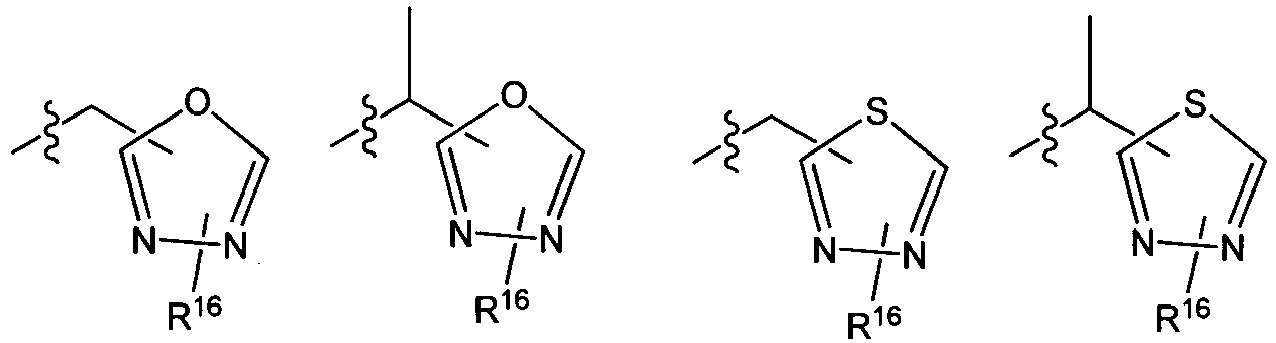


- R16 represents 1, 2 or 3 substituents, selected from C1-6-alkyl, CF3, F, Cl, CN, OH, OCF3, O-C1-6-alkyl or NH2, N(H) C1-6-alkyl, N(C1-6-alkyl)2, 1-pyrrolidinyl, 1-piperidinyl, 4-methyl-piperidin-1-yl or 1-morpholinyl,
- and R17 represents H or C1-6-alkyl.
- In one preferred embodiment of the compound according to the present invention,
R9 represents H or C1-6-alkyl and
R10 represents represents H, a C1-10 aliphatic residue, branched or unbranched, unsubstituted or mono- or poly-substituted; a C3-10 cycloaliphatic residue, a 3 to 10 membered heterocycloaliphatic residue or a heteroaryl residue, in each case unsubstituted or mono- or poly-substituted and in each case optionally connected via a C1-8 alkylene group, branched or unbranched, which in turn may be unsubstituted or mono- or polysubstituted.. - Preferably, at least one of R9 and R10 does not denote H.
- Preferably,
R9 represents H or C1-6-alkyl and
R10 represents
H or
a C1-6 aliphatic residue, branched or unbranched, unsubstituted or substituted with 1, 2, 3, 4 or 5 substituents independently from one another selected from the group consisting of F, Cl, CF3, CN, OH, =0, OCF3, O-C1-6-alkyl, S(=O)-C1-6-alkyl, S(=O)2-C1-6-alkyl, S(=O)2-NH2, S(=O)2-N(H)C1-6-alkyl, S(=O)2-N(C1-6-alkyl)2, NH2, NH(C1-6-alkyl), N(C1-6-alkyl)2, N(H)-S(=O)-C1-6-alkyl, N(C1-6-alkyl)-S(=O)-C1-6-alkyl, N(H)-S(=O)2-C1-6-alkyl, N(C1-6-alkyl)-S(=O)2-C1-6-alkyl, N(H)-C(=O)-NH2, N(H)-C(=O)-N(H)(C1-6-alkyl), N(H)-C(=O)-N(C1-6-alkyl)2,C(=O)-NH2, C(=O)-N(H)(C1-6-alkyl), C(=O)-N(C1-6-alkyl)2, C(=O)-O-C1-6-alkyl; N(H)-C(=O)-C1-6-alkyl, and N(C1-6-alkyl)-C(=O)-C1-6-alkyl; or
a C3-6 cycloaliphatic residue, unsubstituted or substituted with 1, 2, 3, 4 or 5 substituents independently from one another selected from the group consisting of F, Cl, CN, CF3, =O, OCF3, C1-6-alkylen-OH, C1-6 alkyl, OH, O-C1-6-alkyl, S(=O)-C1-6-alkyl, S(=O)2-C1-6-alkyl, S(=O)2-NH2, S(=O)2-N(H)C1-6-alkyl, S(=O)2-N(C1-6-alkyl)2, NH2, NH(C1-6-alkyl), N(C1-6-alkyl)2, N(H)-S(=O)-C1-6-alkyl, N(C1-6-alkyl)-S(=O)-C1-6-alkyl, N(H)-S(=O)2-C1-6-alkyl, N(C1-6-alkyl)-S(=O)2-C1-6-alkyl, N(H)-C(=O)-NH2, N(H)-C(=O)-N(H)(C1-6-alkyl), N(H)-C(=O)-N(C1-6-alkyl)2, C(=O)-NH2, C(=O)-N(H)(C1-6-alkyl), C(=O)-N(C1-6-alkyl)2, C(=O)-O-C1-6-alkyl; N(H)-C(=O)-C1-6-alkyl, and N(C1-6-alkyl)-C(=O)-C1-6-alkyl; wherein said C3-6 cycloaliphatic residue is optionally connected via a C1-6-alkylene group, branched or unbranched, which in turn may be unsubstituted or substituted with 1, 2, 3, 4 or 5 substituents independently from one another selected from the group consisting of F, Cl, CF3, =O, OCF3, OH, O-C1-6-alkyl and C1-6-alkylen-OH; or
a 3-7-membered heterocycloaliphatic residue, which is unsubstituted or substituted with 1, 2, 3, 4 or 5 substituents independently from one another selected from the group consisting of F, Cl, CN, CF3, =0, OCF3, C1-6-alkylen-OH, C1-6 alkyl, OH, O-C1-6-alkyl, S(=O)-C1-6-alkyl, S(=O)2-C1-6-alkyl, S(=O)2-NH2, S(=O)2-N(H)C1-6-alkyl, S(=O)2-N(C1-6-alkyl)2, NH2, NH(C1-6-alkyl), N(C1-6-alkyl)2, N(H)-S(=O)-C1-6-alkyl, N(C1-6-alkyl)-S(=O)-C1-6-alkyl, N(H)-S(=O)2-C1-6-alkyl, N(C1-6-alkyl)-S(=O)2-C1-6-alkyl, N(H)-C(=O)-NH2, N(H)-C(=O)-N(H)(C1-6-alkyl), N(H)-C(=O)-N(C1-6-alkyl)2, C(=O)-NH2, C(=O)-N(H)(C1-6-alkyl), C(=O)-N(C1-6-alkyl)2, (C=O)C1-6-alkyl, C(=O)-O-C1-6-alkyl; N(H)-C(=O)-C1-6-alkyl, and N(C1-6-alkyl)-C(=O)-C1-6-alkyl, wherein said 3-7-membered heterocycloaliphatic residue is optionally connected via a C1-6-alkylene group, branched or unbranched, which in turn may be unsubstituted or substituted with 1, 2, 3, 4 or 5 substituents independently from one another selected from the group consisting of F, Cl, CF3, =O, OCF3, OH, O-C1-6-alkyl and C1-6-alkylen-OH; or
a heteroaryl residue, which is unsubstituted or substituted with 1, 2, 3, 4 or 5 substituents independently from one another selected from the group consisting of F, Cl, CN, CF3, OCF3, C1-6-alkylen-OH, C1-6-alkyl, OH, O-C1-6-alkyl, O-(C=O)C1-6-alkyl, S(=O)-C1-6-alkyl, S(=O)2-C1-6-alkyl, S(=O)2-NH2, S(=O)2-N(H)C1-6-alkyl, S(=O)2-N(C1-6-alkyl)2, NH2, NH(C1-6-alkyl), N(C1-6-alkyl)2, N(H)-S(=O)-C1-6-alkyl, N(C1-6-alkyl)-S(=O)-C1-6-alkyl, N(H)-S(=O)2-C1-6-alkyl, N(C1-6-alkyl)-S(=O)2-C1-6-alkyl, N(H)-C(=O)-O-C1-6-alkyl; O-C(=O)-NH2, O-C(=O)-N(H)(C1-6-alkyl), O-C(=O)-N(C1-6-alkyl)2, N(H)-C(=O)-NH2, N(H)-C(=O)-N(H)(C1-6-alkyl), N(H)-C(=O)-N(C1-6-alkyl)2, C(=O)-NH2, C(=O)-N(H)(C1-6-alkyl), C(=O)-N(C1-6-alkyl)2, C(=O)-O-C1-6-alkyl; N(H)-C(=O)-C1-6-alkyl, and N(C1-6-alkyl)-C(=O)-C1-6-alkyl, wherein said heteroaryl residue is optionally connected via a C1-6-alkylene group, branched or unbranched, which in turn may be unsubstituted or substituted with 1, 2, 3, 4 or 5 substituents independently from one another selected from the group consisting of F, Cl, CF3, =O, OCF3, OH, O-C1-6-alkyl and C1-6-alkylen-OH. - More preferably,
R9 represents H or C1-6-alkyl and
R10 represents
a C3-6 cycloaliphatic residue, which is unsubstituted or substituted with 1, 2, 3, 4 or 5 substituents independently from one another selected from the group consisting of F, Cl, CF3, =O, OCF3, OH, O-C1-6-alkyl, C1-6-alkylen-OH and C1-6-alkyl; or
a 3-7-membered heterocycloaliphatic residue, which contains 1 or 2 heteroatoms or heteroatom groups independently from one another selected from the group consisting of O, S, S(=O), S(=O)2, NH and N-C1-6-alkyl, and which is unsubstituted or substituted with 1, 2, 3, 4 or 5 substituents independently from one another selected from the group consisting of F, Cl, CF3, =O, OCF3, CN, C1-6-alkyl, C1-6-alkylen-OH and O-C1-6-alkyl; or
a heteroaryl residue, which contains at least one nitrogen atom and which is unsubstituted or substituted with 1, 2 or 3 substituents independently from one another selected from the group consisting of F, Cl, CN, CF3, OCF3, C1-6-alkylen-OH, C1-6-alkyl, OH, O-C1-6-alkyl, S(=O)2-C1-6-alkyl, S(=O)2-NH2, NH2, NH(C1-6-alkyl), N(C1-6-alkyl)2, O-C(=O)-NH2, C(=O)-NH2, C(=O)-N(H)(C1-6-alkyl), C(=O)-N(C1-6-alkyl)2, C(=O)-O-C1-6-alkyl; or
a part structure of general formula SF-III
- x represents 0, 1 or 2; y represents 0, 1 or 2; z represents 0, 1 or 2; on the condition that the sum of x, y and z is 1, 2, 3, 4, 5 or 6;
- R11 and R12 are independently from one another selected from H or C1-6-alkyl; or R11 and R12 together with the carbon atom connecting them form a C3-6 cycloaliphatic residue or a 3-7-membered heterocycloaliphatic residue, which contains 1 or 2 heteroatoms or heteroatom groups independently from one another selected from the group consisting of O, S, S(=O), S(=O)2, NH and N-C1-6-alkyl, wherein said C3-6- cycloaliphatic residue or 3-7-membered heterocycloaliphatic residue may be unsubstituted or substituted with 1, 2, 3, 4 or 5 substituents independently from one another selected from the group consisting of F, Cl, CF3, OCF3, CN" C1-6-alkyl and O-C1-6-alkyl;
- R13 is selected from the group consisting of H, F, Cl, CN, CF3, OCF3, C1-6-alkylen-OH, C1-6 alkyl, OH, O-C1-6-alkyl, S(=O)-C1-6-alkyl, S(=O)2-C1-6-alkyl, S(=O)2-NH2, S(=O)2-N(H)C1-6-alkyl, S(=O)2-N(C1-6-alkyl)2, NH2, NH(C1-6-alkyl), N(C1-6-alkyl)2, N(H)-S(=O)-C1-6-alkyl, N(C1-6-alkyl)-S(=O)-C1-6-alkyl, N(H)-S(=O)2-C1-6-alkyl, N(C1-6-alkyl)-S(=O)2-C1-6-alkyl, N(H)-C(=O)-NH2, N(H)-C(=O)-N(H)(C1-6-alkyl), N(H)-C(=O)-N(C1-6-alkyl)2, C(=O)-NH2, C(=O)-N(H)(C1-6-alkyl), C(=O)-N(C1-6-alkyl)2, C(=O)-O-C1-6-alkyl; N(H)-C(=O)-C1-6-alkyl and N(C1-6-alkyl)-C(=O)-C1-6-alkyl, or represents a C3-6 cycloaliphatic residue, which is unsubstituted or substituted with 1, 2, 3, 4, or 5 substituents independently from one another selected from the group consisting of F, Cl, CF3, =0, OCF3, OH, O-C1-6 alkyl, C1-6-alkylen-OH and C1-6-alkyl; or
a 3-7-membered heterocycloaliphatic residue, which contains 1 or 2 heteroatoms or heteroatom groups independently from one another selected from the group consisting of O, S, S(=O), S(=O)2, NH and N-C1-6-alkyl, and which is unsubstituted or substituted with 1, 2, 3, 4 or 5 substituents independently from one another selected from the group consisting of F, Cl, CF3, OCF3, CN, C1-6-alkyl and O-C1-6-alkyl; or
a heteroaryl residue, which contains at least one nitrogen atom and which is unsubstituted or substituted with 1, 2 or 3 substituents independently from one another selected from the group consisting of F, Cl, CN, CF3, OCF3, C1-6-alkylen-OH, C1-6-alkyl, OH, O-C1-6-alkyl, S(=O)2-C1-6-alkyl, S(=O)2-NH2, NH2, NH(C1-6-alkyl), N(C1-6-alkyl)2, O-C(=O)-NH2, C(=O)-NH2, C(=O)-N(H)(C1-6-alkyl), C(=O)-N(C1-6-alkyl)2, C(=O)-O-C1-6-alkyl. - More preferably,
R9 represents H or C1-6-alkyl and
R10 represents
a part structure of general formula SF-III
- x represents 0, 1 or 2; y represents 0, 1 or 2; z represents 0, 1 or 2; on the condition that the sum of x, y and z is 1, 2, 3, 4, 5 or 6;
- R11 and R12 are independently from one another selected from H or C1-6-alkyl; or R11 and R12 together with the carbon atom connecting them form a C3-6 cycloaliphatic residue or a 3-7-membered heterocycloaliphatic residue, which contains 1 or 2 heteroatoms or heteroatom groups independently from one another selected from the group consisting of O, S, S(=O), S(=O)2, NH and N-C1-6-alkyl, wherein said C3-6- cycloaliphatic residue or 3-7-membered heterocycloaliphatic residue may be unsubstituted or substituted with 1, 2, 3, 4 or 5 substituents independently from one another selected from the group consisting of F, Cl, CF3, OCF3, CN, C1-6-alkyl and O-C1-6-alkyl;
- R13 is selected from the group consisting of H, F, Cl, CN, CF3, OCF3, O-C1-6-alkylen-OH, C1-6-alkylen-OH, C1-6 alkyl, OH, O-C1-6-alkyl, S(=O)-C1-6-alkyl, S(=O)2-C1-6-alkyl, S(=O)2-NH2, S(=O)2-N(H)C1-6-alkyl, S(=O)2-N(C1-6-alkyl)2, NH2, NH(C1-6-alkyl), N(C1-6-alkyl)2, N(H)-S(=O)-C1-6-alkyl, N(C1-6-alkyl)-S(=O)-C1-6-alkyl, N(H)-S(=O)2-C1-6-alkyl, N(C1-6-alkyl)-S(=O)2-C1-6-alkyl, N(H)-C(=O)-NH2, N(H)-C(=O)-N(H)(C1-6-alkyl), N(H)-C(=O)-N(C1-6-alkyl)2, C(=O)-NH2, C(=O)-N(H)(C1-6-alkyl), C(=O)-N(C1-6-alkyl)2, C(=O)-O-C1-6-alkyl; N(H)-C(=O)-C1-6-alkyl and N(C1-6-alkyl)-C(=O)-C1-6-alkyl.
- Still more preferably,
R9 represents H or C1-6-alkyl and
R10 represents
a part structure of general formula SF-III
- x represents 0, 1 or 2; y represents 0, 1 or 2; z represents 0, 1 or 2; on the condition that the sum of x, y and z is 1, 2, 3, 4, 5 or 6;
- R11 and R12 are independently from one another selected from H or C1-6-alkyl; or R11 and R12 together with the carbon atom connecting them form a C3-6 cycloaliphatic residue or a 3-7-membered heterocycloaliphatic residue, which contains 1 or 2 heteroatoms or heteroatom groups independently from one another selected from the group consisting of O, S, S(=O), S(=O)2, NH and N-C1-6-alkyl, wherein said C3-6- cycloaliphatic residue or 3-7-membered heterocycloaliphatic residue may be unsubstituted or substituted with 1, 2, 3, 4 or 5 substituents independently from one another selected from the group consisting of F, Cl, CF3, OCF3, CN, C1-6-alkyl and O-C1-6-alkyl;
- R13 is selected from the group consisting of H, OH, F, Cl, CN, S(=O)2-C1-6-alkyl, NH2, N(H)-C(=O)-C1-6-alkyl, N(H)-S(=O)2-C1-6-alkyl, O-C1-6-alkyl, C(=O)-NH2, C(=O)-N(H)(C1-6-alkyl) and C(=O)-O-C1-6-alkyl.
- In a particularily preferred embodiment of the compound according to the present invention,
R9 represents H or C1-6-alkyl and
R10 is selected from the group consisting of methyl, ethyl, 2-propyl (iso-propyl), 1-propyl (n-propyl), 1-butyl, 2-butyl, 2-methyl-propyl, 1,1-dimethylethyl (tert-butyl), 1-pentyl, 2-pentyl, 3-pentyl, 2-methyl-butyl, 2,2-dimethyl-propyl (neo-pentyl), 1-hexyl, 2-hexyl, 3-hexyl, 3,3-dimethyl-butyl, cyclopropyl, cyclopropylmethyl, 2-cyclopropyl-ethyl, 1-cyclopropylethyl and residues according the following substructures:


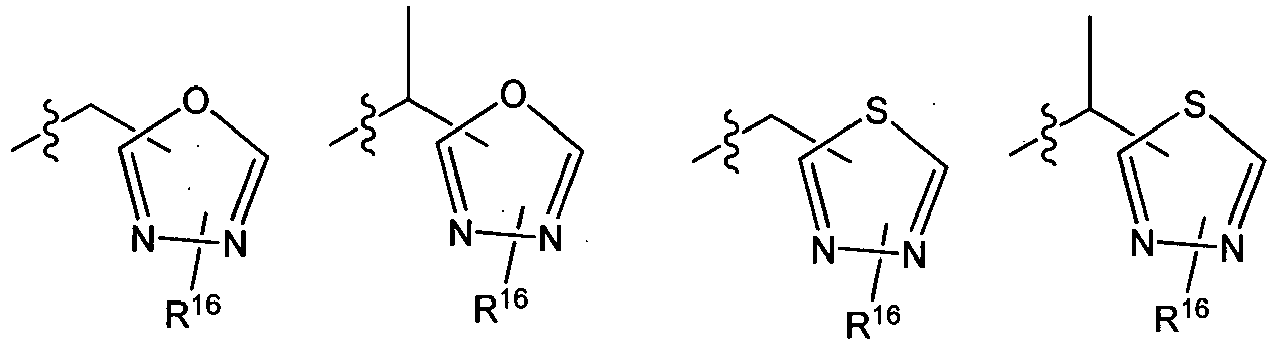


- R16 represents 1, 2 or 3 substituents, selected from C1-6-alkyl, CF3, F, Cl, CN, OH, OCF3, O-C1-6-alkyl or NH2, N(H) C1-6-alkyl, N(C1-6-alkyl)2, 1-pyrrolidinyl, 1-piperidinyl, 4-methyl-piperidin-1-yl or 1-morpholinyl,
- and R17 represents H or C1-6-alkyl.
- Still more preferably,
R9 represents H or C1-6-alkyl and
R10 represents
a part structure of general formula SF-III
- x represents 0, 1 or 2; y represents 0, 1 or 2; z represents 0, 1 or 2; on the condition that the sum of x, y and z is 1, 2, 3, 4, 5 or 6;
- R11 and R12 are independently from one another selected from H or C1-6-alkyl; or R11 and R12 together with the carbon atom connecting them form a C3-6 cycloaliphatic residue or a 3-7-membered heterocycloaliphatic residue, which contains 1 or 2 heteroatoms or heteroatom groups independently from one another selected from the group consisting of O, S, S(=O), S(=O)2, NH and N-C1-6-alkyl, wherein said C3-6- cycloaliphatic residue or 3-7-membered heterocycloaliphatic residue may be unsubstituted or substituted with 1, 2, 3, 4 or 5 substituents independently from one another selected from the group consisting of F, Cl, CF3, OCF3, CN, C1-6-alkyl and O-C1-6-alkyl;
- R13 is selected from the group consisting of H, OH, F, Cl, CN, S(=O)2-C1-6-alkyl, NH2, N(H)-C(=O)-C1-6-alkyl, N(H)-S(=O)2-C1-6-alkyl, O-C1-6-alkyl, C(=O)-NH2, C(=O)-N(H)(C1-6-alkyl) and C(=O)-O-C1-6-alkyl.
- In another particularily preferred embodiment of the compound according to the present invention,
R9 represents methyl and
R10 represents represents H, a C1-10 aliphatic residue, branched or unbranched, unsubstituted or mono- or poly-substituted; a C3-10 cycloaliphatic residue, a 3 to 10 membered heterocycloaliphatic residue or a heteroaryl residue, in each case unsubstituted or mono- or poly-substituted and in each case optionally connected via a C1-8 alkylene group, branched or unbranched, which in turn may be unsubstituted or mono- or polysubstituted. - Preferably,
R9 represents methyl and
R10 represents
H or
a C1-6 aliphatic residue, branched or unbranched, unsubstituted or substituted with 1, 2, 3, 4 or 5 substituents independently from one another selected from the group consisting of F, Cl, CF3, CN, OH, =O, OCF3, O-C1-6-alkyl, S(=O)-C1-6-alkyl, S(=O)2-C1-6-alkyl, S(=O)2-NH2, S(=O)2-N(H)C1-6-alkyl, S(=O)2-N(C1-6-alkyl)2, NH2, NH(C1-6-alkyl), N(C1-6-alkyl)2, N(H)-S(=O)-C1-6-alkyl, N(C1-6-alkyl)-S(=O)-C1-6-alkyl, N(H)-S(=O)2-C1-6-alkyl, N(C1-6-alkyl)-S(=O)2-C1-6-alkyl, N(H)-C(=O)-NH2, N(H)-C(=O)-N(H)(C1-6-alkyl), N(H)-C(=O)-N(C1-6-alkyl)2,C(=O)-NH2, C(=O)-N(H)(C1-6-alkyl), C(=O)-N(C1-6-alkyl)2, C(=O)-O-C1-6-alkyl; N(H)-C(=O)-C1-6-alkyl, and N(C1-6-alkyl)-C(=O)-C1-6-alkyl; or
a C3-6 cycloaliphatic residue, unsubstituted or substituted with 1, 2, 3, 4 or 5 substituents independently from one another selected from the group consisting of F, Cl, CN, CF3, =O, OCF3, C1-6-alkylen-OH, C1-6 alkyl, OH, O-C1-6-alkyl, S(=O)-C1-6-alkyl, S(=O)2-C1-6-alkyl, S(=O)2-NH2, S(=O)2-N(H)C1-6-alkyl, S(=O)2-N(C1-6-alkyl)2, NH2, NH(C1-6-alkyl), N(C1-6-alkyl)2, N(H)-S(=O)-C1-6-alkyl, N(C1-6-alkyl)-S(=O)-C1-6-alkyl, N(H)-S(=O)2-C1-6-alkyl, N(C1-6-alkyl)-S(=O)2-C1-6-alkyl, N(H)-C(=O)-NH2, N(H)-C(=O)-N(H)(C1-6-alkyl), N(H)-C(=O)-N(C1-6-alkyl)2, C(=O)-NH2, C(=O)-N(H)(C1-6-alkyl), C(=O)-N(C1-6-alkyl)2, C(=O)-O-C1-6-alkyl; N(H)-C(=O)-C1-6-alkyl, and N(C1-6-alkyl)-C(=O)-C1-6-alkyl; wherein said C3-6 cycloaliphatic residue is optionally connected via a C1-6-alkylene group, branched or unbranched, which in turn may be unsubstituted or substituted with 1, 2, 3, 4 or 5 substituents independently from one another selected from the group consisting of F, Cl, CF3, =O, OCF3, OH, O-C1-6-alkyl and C1-6-alkylen-OH; or
a 3-7-membered heterocycloaliphatic residue, which is unsubstituted or substituted with 1, 2, 3, 4 or 5 substituents independently from one another selected from the group consisting of F, Cl, CN, CF3, =0, OCF3, C1-6-alkylen-OH, C1-6-alkyl, OH, O-C1-6-alkyl, S(=O)-C1-6-alkyl, S(=O)2-C1-6-alkyl, S(=O)2-NH2, S(=O)2-N(H)C1-6-alkyl, S(=O)2-N(C1-6-alkyl)2, NH2, NH(C1-6-alkyl), N(C1-6-alkyl)2, N(H)-S(=O)-C1-6-alkyl, N(C1-6-alkyl)-S(=O)-C1-6-alkyl, N(H)-S(=O)2-C1-6-alkyl, N(C1-6-alkyl)-S(=O)2-C1-6-alkyl, N(H)-C(=O)-NH2, N(H)-C(=O)-N(H)(C1-6-alkyl), N(H)-C(=O)-N(C1-6-alkyl)2, C(=O)-C1-6-alkyl; C(=O)-NH2, C(=O)-N(H)(C1-6-alkyl), C(=O)-N(C1-6-alkyl)2, C(=O)-O-C1-6-alkyl; N(H)-C(=O)-C1-6-alkyl, and N(C1-6-alkyl)-C(=O)-C1-6-alkyl, whereinsaid 3-7-membered heterocycloaliphatic residue is optionally connected via a C1-6-alkylene group, branched or unbranched, which in turn may be unsubstituted or substituted with 1, 2, 3, 4 or 5 substituents independently from one another selected from the group consisting of F, Cl, CF3, =O, OCF3, OH, O-C1-6-alkyl and C1-6-alkylen-OH; or
or a heteroaryl residue, which is unsubstituted or substituted with 1, 2, 3, 4 or 5 substituents independently from one another selected from the group consisting of F, Cl, CN, CF3, OCF3, C1-6-alkylen-OH, C1-6-alkyl, OH, O-C1-6-alkyl, O-(C=O)C1-6-alkyl, S(=O)-C1-6-alkyl, S(=O)2-C1-6-alkyl, S(=O)2-NH2, S(=O)2-N(H)C1-6-alkyl, S(=O)2-N(C1-6-a)kyl)2, NH2, NH(C1-6-alkyl), N(C1-6-alkyl)2, N(H)-S(=O)-C1-6-alkyl, N(C1-6-alkyl)-S(=O)-C1-6-alkyl, N(H)-S(=O)2-C1-6-alkyl, N(C1-6-alkyl)-S(=O)2-C1-6-alkyl, N(H)-C(=O)-O-C1-6-alkyl; O-C(=O)-NH2, O-C(=O)-N(H)(C1-6-alkyl), O-C(=O)-N(C1-6-alkyl)2, N(H)-C(=O)-NH2, N(H)-C(=O)-N(H)(C1-6-alkyl), N(H)-C(=O)-N(C1-6-alkyl)2, C(=O)-NH2, C(=O)-N(H)(C1-6-alkyl), C(=O)-N(C1-6-alkyl)2, C(=O)-O-C1-6-alkyl; N(H)-C(=O)-C1-6-alkyl, and N(C1-6-alkyl)-C(=O)-C1-6-alkyl, wherein said heteroaryl residue is optionally connected via a C1-6-alkylene group, branched or unbranched, which in turn may be unsubstituted or substituted with 1, 2, 3, 4 or 5 substituents independently from one another selected from the group consisting of F, Cl, CF3, =0, OCF3, OH, O-C1-6-alkyl and C1-6-alkylen-OH. - More preferably,
R9 represents methyl and
R10 represents
a C3-6 cycloaliphatic residue, which is unsubstituted or substituted with 1, 2, 3, 4 or 5 substituents independently from one another selected from the group consisting of F, Cl, CF3, =0, OCF3, OH, O-C1-6-alkyl, C1-6-alkylen-OH and C1-6-alkyl; or
a 3-7-membered heterocycloaliphatic residue, which contains 1 or 2 heteroatoms or heteroatom groups independently from one another selected from the group consisting of O, S, S(=O), S(=O)2, NH and N-C1-6-alkyl, and which is unsubstituted or substituted with 1, 2, 3, 4 or 5 substituents independently from one another selected from the group consisting of F, Cl, CF3, OCF3, CN, C1-6-alkyl, C1-6-alkylen-OH and O-C1-6-alkyl; or
a heteroaryl residue, which contains at least one nitrogen atom and which is unsubstituted or substituted with 1, 2 or 3 substituents independently from one another selected from the group consisting of F, Cl, CN, CF3, OCF3, C1-6-alkylen-OH, C1-6-alkyl, OH, O-C1-6-alkyl, S(=O)2-C1-6-alkyl, S(=O)2-NH2, NH2, NH(C1-6-alkyl), N(C1-6-alkyl)2, O-C(=O)-NH2, C(=O)-NH2, C(=O)-N(H)(C1-6-alkyl), C(=O)-N(C1-6-alkyl)2, C(=O)-O-C1-6-alkyl; or
a part structure of general formula SF-III
- x represents 0, 1 or 2; y represents 0, 1 or 2; z represents 0, 1 or 2; on the condition that the sum of x, y and z is 1, 2, 3, 4, 5 or 6;
- R11 and R12 are independently from one another selected from H or C1-6-alkyl; or R11 and R12 together with the carbon atom connecting them form a C3-6 cycloaliphatic residue or a 3-7-membered heterocycloaliphatic residue, which contains 1 or 2 heteroatoms or heteroatom groups independently from one another selected from the group consisting of O, S, S(=O), S(=O)2, NH and N-C1-6-alkyl, wherein said C3-6- cycloaliphatic residue or 3-7-membered heterocycloaliphatic residue may be unsubstituted or substituted with 1, 2, 3, 4 or 5 substituents independently from one another selected from the group consisting of F, Cl, CF3, OCF3, CN,, C1-6-alkyl and O-C1-6-alkyl;
- R13 is selected from the group consisting of H, F, Cl, CN, CF3, OCF3, C1-6-alkylen-OH, C1-6 alkyl, OH, O-C1-6-alkyl, S(=O)-C1-6-alkyl, S(=O)2-C1-6-alkyl, S(=O)2-NH2, S(=O)2-N(H)C1-6-alkyl, S(=O)2-N(C1-6-alkyl)2, NH2, NH(C1-6-alkyl), N(C1-6-alkyl)2, N(H)-S(=O)-C1-6-alkyl, N(C1-6-alkyl)-S(=O)-C1-6-alkyl, N(H)-S(=O)2-C1-6-alkyl, N(C1-6-alkyl)-S(=O)2-C1-6-alkyl, N(H)-C(=O)-NH2, N(H)-C(=O)-N(H)(C1-6-alkyl), N(H)-C(=O)-N(C1-6-alkyl)2, C(=O)-NH2, C(=O)-N(H)(C1-6-alkyl), C(=O)-N(C1-6-alkyl)2, C(=O)-O-C1-6-alkyl; N(H)-C(=O)-C1-6-alkyl and N(C1-6-alkyl)-C(=O)-C1-6-alkyl, or represents
a C3-6 cycloaliphatic residue, which is unsubstituted or substituted with 1, 2, 3, 4, or 5 substituents independently from one another selected from the group consisting of F, Cl, CF3, =0, OCF3, OH, O-C1-6 alkyl, C1-6-alkylen-OH and C1-6-alkyl; or
a 3-7-membered heterocycloaliphatic residue, which contains 1 or 2 heteroatoms or heteroatom groups independently from one another selected from the group consisting of O, S, S(=O), S(=O)2, NH and N-C1-6-alkyl, and which is unsubstituted or substituted with 1, 2, 3, 4 or 5 substituents independently from one another selected from the group consisting of F, Cl, CF3, OH, OCF3, CN, C1-6-alkyl and O-C1-6-alkyl; or
a heteroaryl residue, which contains at least one nitrogen atom and which is unsubstituted or substituted with 1, 2 or 3 substituents independently from one another selected from the group consisting of F, Cl, CN, CF3, OCF3, C1-6-alkylen-OH, C1-6-alkyl, OH, O-C1-6-alkyl, S(=O)-C1-6-alkyl, S(=O)2-NH2, NH2, NH(C1-6-alkyl), N(C1-6-alkyl)2, O-C(=O)-NH2, C(=O)-NH2, C(=O)-N(H)(C1-6-alkyl), C(=O)-N(C1-6-alkyl)2, C(=O)-O-C1-6-alkyl;. - More preferably,
R9 represents methyl and
R10 represents
a part structure of general formula SF-III
- x represents 0, 1 or 2; y represents 0, 1 or 2; z represents 0, 1 or 2; on the condition that the sum of x, y and z is 1, 2, 3, 4, 5 or 6;
- R11 and R12 are independently from one another selected from H or C1-6-alkyl; or R11 and R12 together with the carbon atom connecting them form a C3-6 cycloaliphatic residue or a 3-7-membered heterocycloaliphatic residue, which contains 1 or 2 heteroatoms or heteroatom groups independently from one another selected from the group consisting of O, S, S(=O), S(=O)2, NH and N-C1-6-alkyl, wherein said C3-6- cycloaliphatic residue or 3-7-membered heterocycloaliphatic residue may be unsubstituted or substituted with 1, 2, 3, 4 or 5 substituents independently from one another selected from the group consisting of F, Cl, CF3, OCF3, CN, C1-6-alkyl and O-C1-6-alkyl;
- R13 is selected from the group consisting of H, F, Cl, CN, CF3, OCF3, O-C1-6-alkylen-OH, C1-6-alkylen-OH, C1-6alkyl, OH, O-C1-6-alkyl, S(=O)-C1-6-alkyl, S(=O)-C1-6-alkyl, S(=O)2-NH2, S(=O)2-N(H)C1-6-alkyl, S(=O)2-N(C1-6-alkyl)2, NH2, NH(C1-6-alkyl), N(C1-6-alkyl)2, N(H)-S(=O)-C1-6-alkyl, N(C1-6-alkyl)-S(=O)-C1-6-alkyl, N(H)-S(=O)2-C1-6-alkyl, N(C1-6-alkyl)-S(=O)2-C1-6-alkyl, N(H)-C(=O)-NH2, N(H)-C(=O)-N(H)(C1-6-alkyl), N(H)-C(=O)-N(C1-6-alkyl)2, C(=O)-NH2, C(=O)-N(H)(C1-6-alkyl), C(=O)-N(C1-6-alkyl)2, C(=O)-O-C1-6-alkyl; N(H)-C(=O)-C1-6-alkyl and N(C1-6-alkyl)-C(=O)-C1-6-alkyl.
- Still more preferably,
R9 represents methyl and
R10 represents
a part structure of general formula SF-III
- x represents 0, 1 or 2; y represents 0, 1 or 2; z represents 0, 1 or 2; on the condition that the sum of x, y and z is 1, 2, 3, 4, 5 or 6;
- R11 and R12 are independently from one another selected from H or C1-6-alkyl; or R11 and R12 together with the carbon atom connecting them form a C3-6 cycloaliphatic residue or a 3-7-membered heterocycloaliphatic residue, which contains 1 or 2 heteroatoms or heteroatom groups independently from one another selected from the group consisting of O, S, S(=O), S(=O)2, NH and N-C1-6-alkyl, wherein said C3-6- cycloaliphatic residue or 3-7-membered heterocycloaliphatic residue may be unsubstituted or substituted with 1, 2, 3, 4 or 5 substituents independently from one another selected from the group consisting of F, Cl, CF3, OCF3, CN, C1-6-alkyl and O-C1-6-alkyl;
- R13 is selected from the group consisting of H, OH, F, Cl, CN, S(=O)2-C1-6-alkyl, NH2, N(H)-C(=O)-C1-6-alkyl, N(H)-S(=O)2-C1-6-alkyl, O-C1-6-alkyl, C(=O)-NH2, C(=O)-N(H)(C1-6-alkyl) and C(=O)-O-C1-6-alkyl.
- In a particularily preferred embodiment of the compound according to the present invention,
R9 represents methyl and
R10 is selected from the group consisting of
methyl, ethyl, 2-propyl (iso-propyl), 1-propyl (n-propyl), 1-butyl, 2-butyl, 2-methyl-propyl, 1,1-dimethylethyl (tert-butyl), 1-pentyl, 2-pentyl, 3-pentyl, 2-methyl-butyl, 2,2-dimethyl-propyl (neo-pentyl), 1-hexyl, 2-hexyl, 3-hexyl, 3,3-dimethyl-butyl, cyclopropyl, cyclopropylmethyl, 2-cyclopropyl-ethyl, 1-cyclopropyl-ethyl and residues according the following substructures:


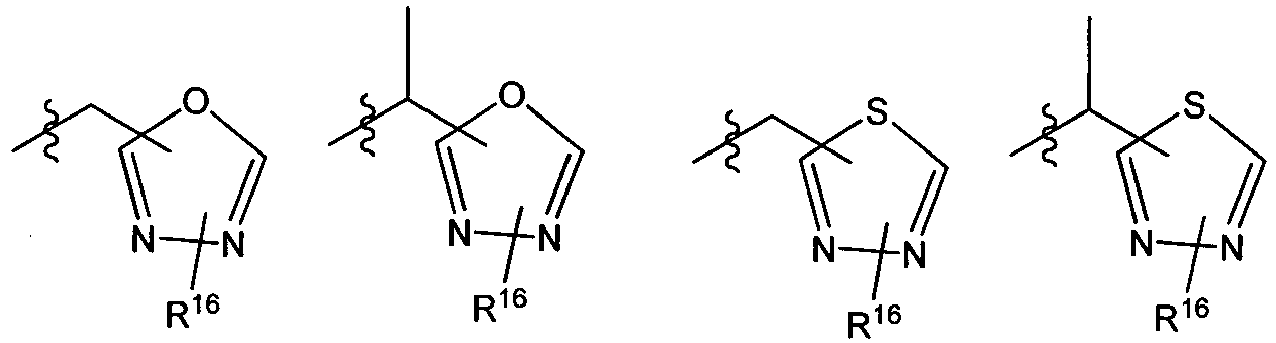


- R16 represents 1, 2 or 3 substituents, selected from C1-6-alkyl, CF3, F, Cl, CN, OH, OCF3, O-C1-6-alkyl or NH2, N(H) C1-6-alkyl, N(C1-6-alkyl)2, 1-pyrrolidinyl, 1-piperidinyl, 4-methyl-piperidin-1-yl or 1-morpholinyl,
- and R17 represents H or C1-6-alkyl.
- In another preferred embodiment of the compound according to the present invention,
R9 and R10 together with the nitrogen atom connecting them form a 3-7-membered heterocycloaliphatic residue, unsubstituted or substituted with 1, 2, 3, 4 or 5 substituents selected from the group consisting of F, Cl, CN, CF3, =0, OH, C1-6-alkyl, O-C1-6-alkyl, C1-6-alkylen-OH, OCF3, SO2(C1-6-alkyl), SO2NH2, SO2N(H)C1-6-alkyl, SO2N(C1-6-alkyl)2, NH2, NH(C1-6-alkyl), N(C1-6-alkyl)2, a C3-6 cycloaliphatic residue or a 3 to 7 membered heterocycloaliphatic residue, in each case unsubstituted or mono- or polysubstituted. - Preferably,
R9 and R10 together with the nitrogen atom connecting them form a heterocycloaliphatic residue selected from the group consisting of


- R14 denotes 0, 1, 2, 3 or 4 substituents which are in each case independently of each other selected from the group consisting of F, Cl, CF3, =0, OCF3, OH, O-C1-6-alkyl, C1-6-alkylen-OH, SO2(C1-6-alkyl), C1-6-alkylen-SO2(C1-6-alkyl), and C1-6 alkyl; or
- R14 denotes at least two substituents, wherein two substituents R14 stand together for a C1-6-alkylen-group, substituted or unsubstituted, wherein optionally one or more C-atoms of the C1-6-alkylen-group is replaced by a heteroatom or heteroatom group, selected of O, N-R15, S, S(O) and S(O)2, and wherein these two substituents R14 are positioned at different carbon atoms of the heterocycloaliphatic residue, so the C1-6-alkylen-group represents a bridge to form a bicyclic heterocycloaliphatic residue; or
- R14 denotes at least two substituents, wherein two substituents R14 stand together for a C2-6-alkylen-group, substituted or unsubstituted, wherein optionally one or more C-atoms of the C2-6-alkylen-group is replaced by a heteroatom or heteroatom group, selected of O, N-R15, S, S(O) and S(O)2, and wherein these two substituents R14 are positioned at the same carbon atom of the heterocycloaliphatic residue, so the C2-6-alkylen-group forms a spiro- heterocycloaliphatic residue;
and - R15 represents H, C1-6-alkyl or (C=O)C1-6-alkyl.
- More preferably,
R9 and R10 together with the nitrogen atom connecting them form a heterocycloaliphatic residue selected from the group consisting of


- R14 denotes 0, 1, 2, 3 or 4 substituents which are in each case independently of each other selected from the group consisting of F, Cl, CF3, =0, OCF3, OH, O-C1-6-alkyl, C1-6-alkylen-OH, SO2(C1-6-alkyl), C1-6-alkylen-SO2(C1-6-alkyl), and C1-6 alkyl; or
- R14 denotes at least two substituents, wherein two substituents R14 stand together for a C1-6-alkylen-group, substituted or unsubstituted, wherein optionally one or more C-atoms of the C1-6-alkylen-group is replaced by a heteroatom or heteroatom group, selected of O, N-R15, S, S(O) and S(O)2, and wherein these two substituents R14 are positioned at different carbon atoms of the heterocycloaliphatic residue, so the C1-6-alkylen-group represents a bridge to form a bicyclic heterocycloaliphatic residue; or
- R14 denotes at least two substituents, wherein two substituents R14 stand together for a C2-6-alkylen-group, substituted or unsubstituted, wherein optionally one or more C-atoms of the C2-6-alkylen-group is replaced by a heteroatom or heteroatom group, selected of O, N-R15, S, S(O) and S(O)2, and wherein these two substituents R14 are positioned at the same carbon atom of the heterocycloaliphatic residue, so the C2-6-alkylen-group forms a spiro- heterocycloaliphatic residue; and
- R15 represents H, C1-6-alkyl or (C=O)C1-6-alkyl.
- Still more preferably,
R9 and R10 together with the nitrogen atom connecting them form a heterocycloaliphatic residue selected from the group consisting of


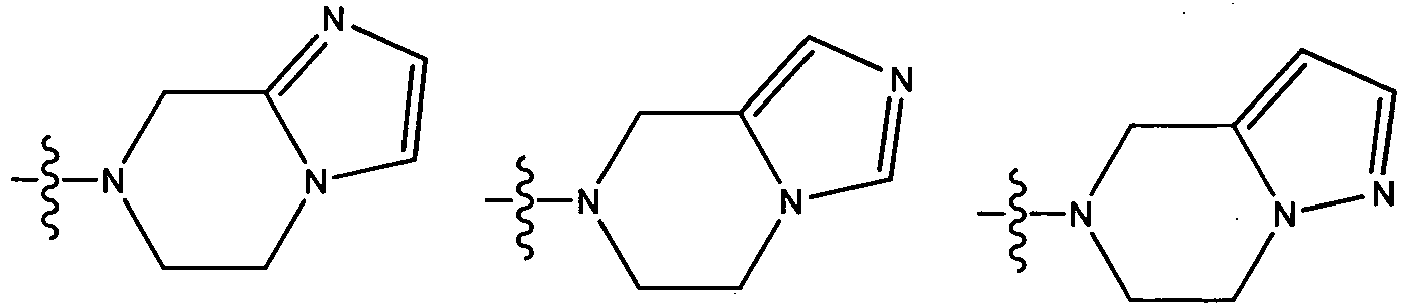
- Most preferred,
R9 and R10 together with the nitrogen atom connecting them form a heterocycloaliphatic residue selected from the group consisting of


- In a particular preferred embodiment according to the present invention, the compound of general formula (I) is selected from the group consisting of
- compounds according general formula (I), wherein
n represents 0 and
m represents 0 and
R4 represents CHF2 and
R5 represents H, C1-6-alkyl, branched or unbranched, unsubstituted or mono- or poly-substituted, a C3-6 cycloaliphatic residue or a 3 to 7 membered heterocycloaliphatic residue, in each case unsubstituted or mono- or polysubstituted; OH; O-C1-6-alkyl; NH2; N(H)-C1-6-alkyl; N(-C1-6-alkyl)2 or SO2C1-6-alkyl), whereby in each case C1-6-alkyl may be branched or unbranched; unsubstituted or mono- or poly-substituted; - compounds according general formula (I), wherein
n represents 0 and
m represents 0 and
R4 represents CF3 and
R5 represents H, C1-6-alkyl, branched or unbranched, unsubstituted or mono- or poly-substituted, a C3-6 cycloaliphatic residue or a 3 to 7 membered heterocycloaliphatic residue, in each case unsubstituted or mono- or polysubstituted; OH; O-C1-6-alkyl; NH2; N(H)-C1-6-alkyl; N(-C1-6-alkyl)2 or SO2(-C1-6-alkyl), whereby in each case C1-6-alkyl may be branched or unbranched; unsubstituted or mono- or polysubstituted - compounds according general formula (I), wherein
n represents 1 and
m represents 0 and
R4 represents CHF2 and
R5 represents H, C1-6-alkyl, branched or unbranched, unsubstituted or mono- or poly-substituted, a C3-6 cycloaliphatic residue or a 3 to 7 membered heterocycloaliphatic residue, in each case unsubstituted or mono- or polysubstituted; OH; O-C1-6-alkyl; NH2; N(H)-C1-6-alkyl; N(-C1-6-alkyl)2 or SO2(-C1-6-alkyl), whereby in each case C1-6-alkyl may be branched or unbranched; unsubstituted or mono- or polysubstituted; - compounds according general formula (I), wherein
n represents 1 and
m represents 0 and
R4 represents CF3 and
R5 represents H, C1-6-alkyl, branched or unbranched, unsubstituted or mono- or poly-substituted, a C3-6 cycloaliphatic residue or a 3 to 7 membered heterocycloaliphatic residue, in each case unsubstituted or mono- or polysubstituted; OH; O-C1-6-alkyl; NH2; N(H)-C1-6-alkyl; N(-C1-6-alkyl)2 or SO2C1-6-alkyl), whereby in each case C1-6-alkyl may be branched or unbranched; unsubstituted or mono- or polysubstituted; - compounds according general formula (I), wherein
n represents 2 and
m represents 0 and
R4 represents CHF2 and
R5 represents H, C1-6-alkyl, branched or unbranched, unsubstituted or mono- or poly-substituted, a C3-6 cycloaliphatic residue or a 3 to 7 membered heterocycloaliphatic residue, in each case unsubstituted or mono- or polysubstituted; OH; O-C1-6-alkyl; NH2; N(H)-C1-6-alkyl; N(-C1-6-alkyl)2 or SO2(-C1-6-alkyl), whereby in each case C1-6-alkyl may be branched or unbranched; unsubstituted or mono- or polysubstituted; - compounds according general formula (I), wherein
n represents 2 and
m represents 0 and
R4 represents CF3 and
R5 represents H, C1-6-alkyl, branched or unbranched, unsubstituted or mono- or poly-substituted, a C3-6 cycloaliphatic residue or a 3 to 7 membered heterocycloaliphatic residue, in each case unsubstituted or mono- or polysubstituted; OH; O-C1-6-alkyl; NH2; N(H)-C1-6-alkyl; N(-C1-6-alkyl)2 or SO2(-C1-6-alkyl), whereby in each case C1-6-alkyl may be branched or unbranched; unsubstituted or mono- or polysubstituted; - compounds according general formula (I), wherein
n represents 2 and
m represents 1 and
X represents O and
R4 represents CHF2 and
R5 represents H, C1-6-alkyl, branched or unbranched, unsubstituted or mono- or poly-substituted, a C3-6 cycloaliphatic residue or a 3 to 7 membered heterocycloaliphatic residue, in each case unsubstituted or mono- or polysubstituted; OH; O-C1-6-alkyl; NH2; N(H)-C1-6-alkyl; N(-C1-6-alkyl)2 or SO2C1-6-alkyl), whereby in each case C1-6-alkyl may be branched or unbranched; unsubstituted or mono- or polysubstituted; - compounds according general formula (I), wherein
n represents 2 and
m represents 1 and
X represents O and
R4 represents CF3 and
R5 represents H, C1-6-alkyl, branched or unbranched, unsubstituted or mono- or poly-substituted, a C3-6 cycloaliphatic residue or a 3 to 7 membered heterocycloaliphatic residue, in each case unsubstituted or mono- or polysubstituted; OH; O-C1-6-alkyl; NH2; N(H)-C1-6-alkyl; N(-C1-6-alkyl)2 or SO2(-C1-6-alkyl), whereby in each case C1-6-alkyl may be branched or unbranched; unsubstituted or mono- or polysubstituted. - Preferred embodiments of the compound according to the invention of general formula (I) have general formulae (Ia) or (Ib) or (Ic) or (Id):


- Further preferred embodiments of the compound according to the invention of general formula (I) have general formulae (la-1) or (la-2) or (la-3) or (la-4):


- Further preferred embodiments of the compound according to the invention of general formula (I) have general formulae (Ib-1) or (Ib-2) or (Ib-3) or (Ib-4):


- Further preferred embodiments of the compound according to the invention of general formula (I) have general formulae (Ic-1) or (Ic-2) or (Ic-3) or (Ic-4):

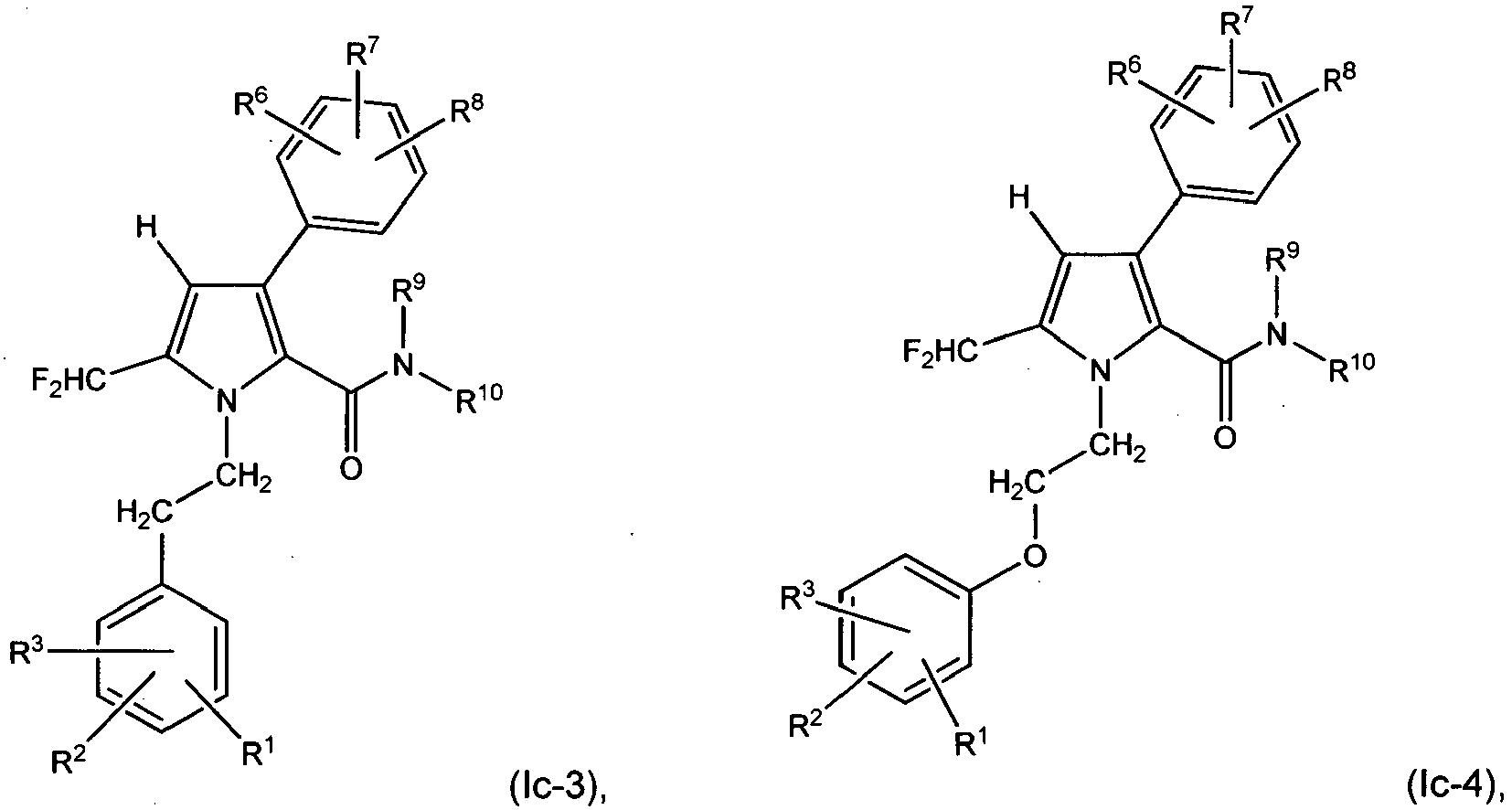
- Further preferred embodiments of the compound according to the invention of general formula (I) have general formulae (Id-1) or (Id-2) or (Id-3) or (Id-4):


- In another preferred embodiment of the present invention, the compounds of general formula (I) have general formulae (la-1) or (la-2) or (Ib-1) or (Ib-2) or (Ic-1) or (Ic-2) or (Id-1) or (Id-2), particularly (la-2) or (Ib-2) or (Ic-2) or (Id-2).
- In another particularly preferred embodiment of the present invention, the compounds of general formula (I) have general formulae (Ia-1-a) or (la-2-a) or (Ib-1-a) or (Ib-2-a) or (Ic-1-a) or (Ic-2-a) or (Id-1-a) or (Id-2-a)


wherein the remaining particular radicals, variables and indices have the meanings described herein in connection with the compounds according to the invention and preferred embodiments thereof. - In another particularly preferred embodiment of the present invention, the compounds of general formula (I) have general formulae (Ia-1-a) or (Ia-2-a) or (Ib-1-a) or (Ib-2-a) or (Ic-1-a) or (Ic-2-a) or (Id-1-a) or (ld-2-a),
wherein R6 denotes Cl and
wherein the remaining particular radicals, variables and indices have the meanings described herein in connection with the compounds according to the invention and preferred embodiments thereof. - In another particularly preferred embodiment of the present invention, the compounds of general formula (I) have general formulae (Ia-1-a) or (la-2-a) or (Ib-1-a) or (Ib-2-a) or (Ic-1-a) or (Ic-2-a) or (Id-1-a) or (Id-2-a),
wherein R6 denotes F and
wherein the remaining particular radicals, variables and indices have the meanings described herein in connection with the compounds according to the invention and preferred embodiments thereof. - In a particularily preferred embodiment of the present invention, the compounds of general formula (I) have general formula (la-1), (la-2), (Ib-1), (Ib-2), (Ic-1), (Ic-2), (Id-1), (Id-2), (Ia-1-a), (la-2-a), (Ib-1-a), (Ib-2-a), (Ic-1-a), (Ic-2-a), (Id-1-a) or (Id-2-a), wherein,
- R9 represents methyl or H and R10 represents a part structure of general formula SF-III

- x represents 0, 1 or 2; y represents 0, 1 or 2; z represents 0, 1 or 2; on the condition that the sum of x, y and z is 1, 2, 3 or 4;
- R11 and R12 are independently from one another selected from H or C1-6-alkyl; or R11 and R12 together with the carbon atom connecting them form a C3-6 cycloaliphatic residue or a 3-7-membered heterocycloaliphatic residue, which contains 1 or 2 heteroatoms or heteroatom groups independently from one another selected from the group consisting of O, S, S(=O), S(=O)2, NH and N-C1-6-alkyl, wherein said C3-6- cycloaliphatic residue or 3-7-membered heterocycloaliphatic residue may be unsubstituted or substituted with 1, 2, 3, 4 or 5 substituents independently from one another selected from the group consisting of F, Cl, CF3, OCF3, CN, C1-6-alkyl and O-C1-6-alkyl;
- R13 is selected from the group consisting of H, F, Cl, CN, CF3, OCF3, C1-6-alkylen-OH, C1-6alkyl, OH, O-C1-6-alkyl, S(=O)-C1-6-alkyl, S(=O)2-C1-6-alkyl, S(=O)2-NH2, S(=O)2-N(H)C1-6-alkyl, S(=O)2-N(C1-6-alkyl)2, NH2, NH(C1-6-alkyl), N(C1-6-alkyl)2, N(H)-S(=O)-C1-6-alkyl, N(C1-6-alkyl)-S(=O)-C1-6-alkyl, N(H)-S(=O)2-C1-6-alkyl, N(C1-6-alkyl)-S(=O)2-C1-6-alkyl, N(H)-C(=O)-NH2, N(H)-C(=O)-N(H)(C1-6-alkyl), N(H)-C(=O)-N(C1-6-alkyl)2, C(=O)-NH2, C(=O)-N(H)(C1-6-alkyl), C(=O)-N(C1-6-alkyl)2, C(=O)-O-C1-6-alkyl; N(H)-C(=O)-C1-6-alkyl and N(C1-6-alkyl)-C(=O)-C1-6-alkyl,
or
a C3-6 cycloaliphatic residue, selected from cyclopropyl, cyclobutyl, cyclopentyl or cyclohexyl, each unsubstituted or substituted with 1, 2, 3, 4 or 5 substituents independently from one another selected from the group consisting of F, Cl, CF3, OH, OCF3, CN, C1-6-alkyl and O-C1-6-alkyl;
or
a 3-7-membered heterocycloaliphatic residue, selected from oxetanyl, tetrahydrofuranyl, tetrahydropyranyl, morpholinyl, azetidinyl, pyrrolidinyl, piperidinyl, piperazinyl, thiolanyl, 1-oxo-thiolanyl, 1,1-dioxo-thiolanyl, thianyl, 1-oxo-thianyl, 1,1-dioxo-thianyl, [1,4]thiazinanyl, 1-oxo-[1,4]thiazinanyl or 1,1-dioxo-[1,4]thiazinanyl, each unsubstituted or substituted with 1, 2, 3, 4 or 5 substituents independently from one another selected from the group consisting of F, Cl, CF3, OH, OCF3, CN, C1-6-alkyl and O-C1-6-alkyl;
- R9 and R10 together with the nitrogen atom connecting them form a 3-7-membered heterocycloaliphatic residue, unsubstituted or substituted with 1, 2, 3, 4 or 5 substituents selected from the group consisting of F, Cl, CN, CF3, =0, OH, C1-6-alkyl, O-C1-6-alkyl, C1-6-alkylen-OH, OCF3, SO2(C1-6-alkyl), SO2NH2, SO2N(H)C1-6-alkyl, SO2N(C1-6-alkyl)2, NH2, NH(C1-6-alkyl), N(C1-6-alkyl)2, a C3-6 cycloaliphatic residue or a 3 to 7 membered heterocycloaliphatic residue, in each case unsubstituted or mono- or polysubstituted,
- Preferably,
the compounds of general formula (I) have general formulae (la-1), (la-2), (Ib-1), (Ib-2), (Ic-1), (Ic-2), (Id-1), (Id-2), (la-1-a), (la-2-a), (Ib-1-a), (Ib-2-a), (Ic-1-a), (Ic-2-a), (Id-1-a) or (Id-2-a), wherein - R9 represents H and R10 represents a part structure of general formula SF-III

- x represents 0, 1 or 2; y represents 0, 1 or 2; z represents 0, 1 or 2; on the condition that the sum of x, y and z is 1, 2, 3 or 4;
- R11 and R12 are independently from one another selected from H or C1-6-alkyl; or R11 and R12 together with the carbon atom connecting them form a C3-6 cycloaliphatic residue or a 3-7-membered heterocycloaliphatic residue, which contains 1 or 2 heteroatoms or heteroatom groups independently from one another selected from the group consisting of O, S, S(=O), S(=O)2, NH and N-C1-6-alkyl, wherein said C3-6- cycloaliphatic residue or 3-7-membered heterocycloaliphatic residue may be unsubstituted or substituted with 1, 2, 3, 4 or 5 substituents independently from one another selected from the group consisting of F, Cl, CF3, OCF3, CN, C1-6-alkyl and O-C1-6-alkyl;
- R13 is selected from the group consisting of H, F, Cl, CN, CF3, OCF3, C1-6-alkylen-OH, C1-6alkyl, OH, O-C1-6-alkyl, S(=O)-C1-6-alkyl, S(=O)2-C1-6-alkyl, S(=O)2-NH2, S(=O)2-N(H)C1-6-alkyl, S(=O)2-N(C1-6-alkyl)2, NH2, NH(C1-6-alkyl), N(C1-6-alkyl)2, N(H)-S(=O)-C1-6-alkyl, N(C1-6-alkyl)-S(=O)-C1-6-alkyl, N(H)-S(=O)2-C1-6-alkyl, N(C1-6-alkyl)-S(=O)2-C1-6-alkyl, N(H)-C(=O)-NH2, N(H)-C(=O)-N(H)(C1-6-alkyl), N(H)-C(=O)-N(C1-6-alkyl)2, C(=O)-NH2, C(=O)-N(H)(C1-6-alkyl), C(=O)-N(C1-6-alkyl)2, C(=O)-O-C1-6-alkyl; N(H)-C(=O)-C1-6-alkyl and N(C1-6-alkyl)-C(=O)-C1-6-alkyl
or
a C3-6 cycloaliphatic residue, selected from cyclopropyl, cyclobutyl, cyclopentyl or cyclohexyl, each unsubstituted or substituted with 1, 2, 3, 4 or 5 substituents independently from one another selected from the group consisting of F, Cl, CF3, OH, OCF3, CN, C1-6-alkyl and O-C1-6-alkyl;
or
a 3-7-membered heterocycloaliphatic residue, selected from oxetanyl, tetrahydrofuranyl, tetrahydropyranyl, morpholinyl, azetidinyl, pyrrolidinyl, piperidinyl, piperazinyl, thiolanyl, 1-oxo-thiolanyl, 1,1-dioxo-thiolanyl, thianyl, 1-oxo-thianyl, 1,1-dioxo-thianyl, [1,4]thiazinanyl, 1-oxo-[1,4]thiazinanyl or 1,1-dioxo-[1,4]thiazinanyl, each unsubstituted or substituted with 1, 2, 3, 4 or 5 substituents independently from one another selected from the group consisting of F, Cl, CF3, OH, OCF3, CN, C1-6-alkyl and O-C1-6-alkyl.
- Preferably,
the compounds of general formula (I) have general formulae (la-1), (la-2), (Ib-1), (Ib-2), (Ic-1), (Ic-2), (Id-1), (Id-2), (la-1-a), (la-2-a), (Ib-1-a), (Ib-2-a), (Ic-1-a), (Ic-2-a), (Id-1-a) or (Id-2-a), wherein - R9 represents methyl and R10 represents a part structure of general formula SF-III

- x represents 0, 1 or 2; y represents 0, 1 or 2; z represents 0, 1 or 2; on the condition that the sum of x, y and z is 1, 2, 3 or 4;
- R11 and R12 are independently from one another selected from H or C1-6-alkyl; or R11 and R12 together with the carbon atom connecting them form a C3-6 cycloaliphatic residue or a 3-7-membered heterocycloaliphatic residue, which contains 1 or 2 heteroatoms or heteroatom groups independently from one another selected from the group consisting of O, S, S(=O), S(=O)2, NH and N-C1-6-alkyl, wherein said C3-6- cycloaliphatic residue or 3-7-membered heterocycloaliphatic residue may be unsubstituted or substituted with 1, 2, 3, 4 or 5 substituents independently from one another selected from the group consisting of F, Cl, CF3, OCF3, CN, C1-6-alkyl and O-C1-6-alkyl;
- R13 is selected from the group consisting of H, F, Cl, CN, CF3, OCF3, C1-6-alkylen-OH, C1-6alkyl, OH, O-C1-6-alkyl, S(=O)-C1-6-alkyl, S(=O)2-C1-6-alkyl, S(=O)2-NH2, S(=O)2-N(H)C1-6-alkyl, S(=O)2-N(C1-6-alkyl)2, NH2, NH(C1-6-alkyl), N(C1-6-alkyl)2, N(H)-S(=O)-C1-6-alkyl, N(C1-6-alkyl)-S(=O)-C1-6-alkyl, N(H)-S(=O)2-C1-6-alkyl, N(C1-6-alkyl)-S(=O)2-C1-6-alkyl, N(H)-C(=O)-NH2, N(H)-C(=O)-N(H)(C1-6-alkyl), N(H)-C(=O)-N(C1-6-alkyl)2, C(=O)-NH2, C(=O)-N(H)(C1-6-alkyl), C(=O)-N(C1-6-alkyl)2, C(=O)-O-C1-6-alkyl; N(H)-C(=O)-C1-6-alkyl and N(C1-6-alkyl)-C(=O)-C1-6-alkyl or
a C3-6 cycloaliphatic residue, selected from cyclopropyl, cyclobutyl, cyclopentyl or cyclohexyl, each unsubstituted or substituted with 1, 2, 3, 4 or 5 substituents independently from one another selected from the group consisting of F, Cl, CF3, OH, OCF3, CN, C1-6-alkyl and O-C1-6-alkyl;
or
a 3-7-membered heterocycloaliphatic residue, selected from oxetanyl, tetrahydrofuranyl, tetrahydropyranyl, morpholinyl, azetidinyl, pyrrolidinyl, piperidinyl, piperazinyl, thiolanyl, 1-oxo-thiolanyl, 1,1-dioxo-thiolanyl, thianyl, 1-oxo-thianyl, 1,1-dioxo-thianyl, [1,4]thiazinanyl, 1-oxo-[1,4]thiazinanyl or 1,1-dioxo-[1,4]thiazinanyl, each unsubstituted or substituted with 1, 2, 3, 4 or 5 substituents independently from one another selected from the group consisting of F, Cl, CF3, OH, OCF3, CN, C1-6-alkyl and O-C1-6-alkyl.
- Still preferably, the compounds of general formula (I) have general formulae (Ia-1), (la-2), (Ib-1), (Ib-2), (Ic-1), (Ic-2), (Id-1), (Id-2), (la-1-a), (la-2-a), (Ib-1-a), (Ib-2-a), (Ic-1-a), (Ic-2-a), (Id-1-a) or (Id-2-a), wherein R9 and R10 together with the nitrogen atom connecting them form a heterocycloaliphatic residue selected from the group consisting of


- R14 denotes 0, 1, 2, 3 or 4 substituents which are in each case independently of each other selected from the group consisting of F, Cl, CF3, =0, OCF3, OH, O-C1-6-alkyl, C1-6-alkylen-OH, SO2(C1-6-alkyl), C1-6-alkylen-SO2(C1-6-alkyl) and alkyl; or
- R14 denotes at least two substituents, wherein two substituents R14 stand together for a C1-6-alkylen-group, substituted or unsubstituted, wherein optionally one or more C-atoms of the C1-6-alkylen-group is replaced by a heteroatom or heteroatom group, selected of O, N-R15, S, S(O) and S(O)2, and wherein these two substituents R14 are positioned at different carbon atoms of the heterocycloaliphatic residue, so the C1-6-alkylen-group represents a bridge to form a bicyclic heterocycloaliphatic residue; or
- R14 denotes at least two substituents, wherein two substituents R14 stand together for a C2-6-alkylen-group, substituted or unsubstituted, wherein optionally one or more C-atoms of the C2-6-alkylen-group is replaced by a heteroatom or heteroatom group, selected of O, N-R15, S, S(O) and S(O)2, and wherein these two substituents R14 are positioned at the same carbon atom of the heterocycloaliphatic residue, so the C2-6-alkylen-group forms a spiro- heterocycloaliphatic residue; and
- R15 represents H, C1-6-alkyl or C(=O)C1-6-alkyl.
- Preferably,
the compounds of general formula (I) have general formulae (la-1) and/or (la-2) and/or (Ib-1) and/or (Ib-2) and/or (Ic-1) and/or (Ic-2) and/or (Id-1) and/or (Id-2) and/or (Ia-1-a) and/or (la-2-a) and/or (lb-1-a) and/or (Ib-2-a) and/or (Ic-1-a) and/or (Ic-2-a) and/or (Id-1-a) and/or (Id-2-a), wherein - R6 denotes CH3,
- R9 represents H and R10 represents a part structure of general formula SF-III
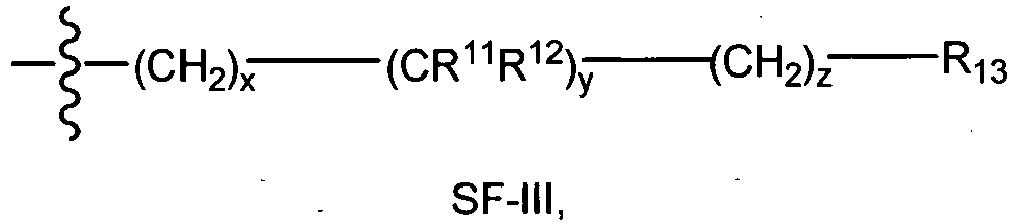
- x represents 0, 1 or 2; y represents 0, 1 or 2; z represents 0, 1 or 2; on the condition that the sum of x, y and z is 1, 2, 3 or 4;
- R11 and R12 are independently from one another selected from H or C1-6-alkyl; or R11 and R12 together with the carbon atom connecting them form a C3-6 cycloaliphatic residue or a 3-7-membered heterocycloaliphatic residue, which contains 1 or 2 heteroatoms or heteroatom groups independently from one another selected from the group consisting of O, S, S(=O), S(=O)2, NH and N-C1-6-alkyl, wherein said C3-6- cycloaliphatic residue or 3-7-membered heterocycloaliphatic residue may be unsubstituted or substituted with 1, 2, 3, 4 or 5 substituents independently from one another selected from the group consisting of F, Cl, CF3, OCF3, CN, C1-6-alkyl and O-C1-6-alkyl;
- R13 is selected from the group consisting of H, F, Cl, CN, CF3, OCF3, C1-6-alkylen-OH, C1-6 alkyl, OH, O-C1-6-alkyl, S(=O)-C1-6-alkyl, S(=O)2-C1-6-alkyl, S(=O)2-NH2, S(=O)2-N(H)C1-6-alkyl, S(=O)2-N(C1-6-alkyl)2, NH2, NH(C1-6-alkyl), N(C1-6-alkyl)2, N(H)-S(=O)-C1-6-alkyl, N(C1-6-alkyl)-S(=O)-C1-6-alkyl, N(H)-S(=O)2-C1-6-alkyl, N(C1-6-alkyl)-S(=O)2-C1-6-alkyl, N(H)-C(=O)-NH2, N(H)-C(=O)-N(H)(C1-6-alkyl), N(H)-C(=O)-N(C1-6-alkyl)2, C(=O)-NH2, C(=O)-N(H)(C1-6-alkyl), C(=O)-N(C1-6-alkyl)2, C(=O)-O-C1-6-alkyl; N(H)-C(=O)-C1-6-alkyl and N(C1-6-alkyl)-C(=O)-C1-6-alkyl;
or
a C3-6 cycloaliphatic residue, selected from cyclopropyl, cyclobutyl, cyclopentyl or cyclohexyl, each unsubstituted or substituted with 1, 2, 3, 4 or 5 substituents independently from one another selected from the group consisting of F, Cl, CF3, OH, OCF3, CN, C1-6-alkyl and O-C1-6-alkyl;
or
a 3-7-membered heterocycloaliphatic residue, selected from oxetanyl, tetrahydrofuranyl, tetrahydropyranyl, morpholinyl, azetidinyl, pyrrolidinyl, piperidinyl, piperazinyl, thiolanyl, 1-oxo-thiolanyl, 1,1-dioxo-thiolanyl, thianyl, 1-oxo-thianyl, 1,1-dioxo-thianyl, [1,4]thiazinanyl, 1-oxo-[1,4]thiazinanyl or 1,1-dioxo-[1,4]thiazinanyl, each unsubstituted or substituted with 1, 2, 3, 4 or 5 substituents independently from one another selected from the group consisting of F, Cl, CF3, OH, OCF3, CN, C1-6-alkyl and O-C1-6-alkyl.
- Still preferably,
the compounds of general formula (I) have general formulae (la-1), (la-2), (Ib-1), (Ib-2), (Ic-1), (Ic-2), (Id-1), (Id-2), (Ia-1-a), (la-2-a), (Ib-1-a), (Ib-2-a), (Ic-1-a), (Ic-2-a), (Id-1-a) or (Id-2-a), wherein - R6 denotes CH3,
- R9 represents methyl and R10 represents a part structure of general formula SF-III
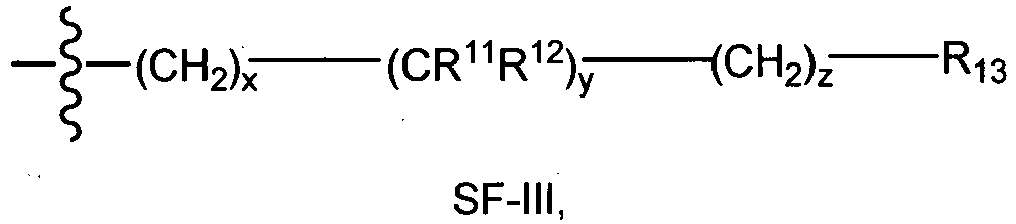
- x represents 0, 1 or 2; y represents 0, 1 or 2; z represents 0, 1 or 2; on the condition that the sum of x, y and z is 1, 2, 3 or 4;
- R11 and R12 are independently from one another selected from H or C1-6-alkyl; or R11 and R12 together with the carbon atom connecting them form a C3-6 cycloaliphatic residue or a 3-7-membered heterocycloaliphatic residue, which contains 1 or 2 heteroatoms or heteroatom groups independently from one another selected from the group consisting of O, S, S(=O), S(=O)2, NH and N-C1-6-alkyl, wherein said C3-6- cycloaliphatic residue or 3-7-membered heterocycloaliphatic residue may be unsubstituted or substituted with 1, 2, 3, 4 or 5 substituents independently from one another selected from the group consisting of F, Cl, CF3, OCF3, CN, C1-6-alkyl and O-C1-6-alkyl;
- R13 is selected from the group consisting of H, F, Cl, CN, CF3, OCF3, C1-6-alkylen-OH, C1-6 alkyl, OH, O-C1-6-alkyl, S(=O)-C1-6-alkyl, S(=O)2-C1-6-alkyl, S(=O)2-NH2, S(=O)2-N(H)C1-6-alkyl, S(=O)2-N(C1-6-alkyl)2, NH2, NH(C1-6-alkyl), N(C1-6-alkyl)2, N(H)-S(=O)-C1-6-alkyl, N(C1-6-alkyl)-S(=O)-C1-6-alkyl, N(H)-S(=O)2-C1-6-alkyl, N(C1-6-alkyl)-S(=O)2-C1-6-alkyl, N(H)-C(=O)-NH2, N(H)-C(=O)-N(H)(C1-6-alkyl), N(H)-C(=O)-N(C1-6-alkyl)2, C(=O)-NH2, C(=O)-N(H)(C1-6-alkyl), C(=O)-N(C1-6-alkyl)2, C(=O)-O-C1-6-alkyl; N(H)-C(=O)-C1-6-alkyl and N(C1-6-alkyl)-C(=O)-C1-6-alkyl;
or
a C3-6 cycloaliphatic residue, selected from cyclopropyl, cyclobutyl, cyclopentyl or cyclohexyl, each unsubstituted or substituted with 1, 2, 3, 4 or 5 substituents independently from one another selected from the group consisting of F, Cl, CF3, OH, OCF3, CN, C1-6-alkyl and O-C1-6-alkyl;
or
a 3-7-membered heterocycloaliphatic residue, selected from oxetanyl, tetrahydrofuranyl, tetrahydropyranyl, morpholinyl, azetidinyl, pyrrolidinyl, piperidinyl, piperazinyl, thiolanyl, 1-oxo-thiolanyl, 1,1-dioxo-thiolanyl, thianyl, 1-oxo-thianyl, 1,1-dioxo-thianyl, [1,4]thiazinanyl, 1-oxo-[1,4]thiazinanyl or 1,1-dioxo-[1,4]thiazinanyl, each unsubstituted or substituted with 1, 2, 3, 4 or 5 substituents independently from one another selected from the group consisting of F, Cl, CF3, OH, OCF3, CN, C1-6-alkyl and O-C1-6-alkyl.
- Still preferably,
the compounds of general formula (I) have general formulae (la-1), (la-2), (Ib-1), (Ib-2), (Ic-1), (Ic-2), (Id-1), (Id-2), (Ia-1-a), (la-2-a), (Ib-1-a), (Ib-2-a), (Ic-1-a), (Ic-2-a), (Id-1-a) or (ld-2-a), wherein R6 denotes CH3 and
R9 and R10 together with the nitrogen atom connecting them form a heterocycloaliphatic residue selected from the group consisting of

- R14 denotes 0, 1, 2, 3 or 4 substituents which are in each case independently of each other selected from the group consisting of F, Cl, CF3, =O, OCF3, OH, O-C1-6-alkyl, SO2(C1-6-alkyl), C1-6-alkylen-SO2(C1-6-alkyl), C1-6-alkylen-OH and C1-6 alkyl; or
- R14 denotes at least two substituents, wherein two substituents R14 stand together for a C1-6-alkylen-group, substituted or unsubstituted, wherein optionally one or more C-atoms of the C1-6-alkylen-group is replaced by a heteroatom or heteroatom group, selected of O, N-R15, S, S(O) and S(O)2, and wherein these two substituents R14 are positioned at different carbon atoms of the heterocycloaliphatic residue, so the C1-6-alkylen-group represents a bridge to form a bicyclic heterocycloaliphatic residue; or
- R14 denotes at least two substituents, wherein two substituents R14 stand together for a C2-6-alkylen-group, substituted or unsubstituted, wherein optionally one or more C-atoms of the C2-6-alkylen-group is replaced by a heteroatom or heteroatom group, selected of O, N-R15, S, S(O) and S(O)2, and wherein these two substituents R14 are positioned at the same carbon atom of the heterocycloaliphatic residue, so the C2-6-alkylen-group forms a spiro- heterocycloaliphatic residue; and
- R15 represents H, C1-6-alkyl or C(=O)C1-6-alkyl.
- Preferably,
the compounds of general formula (I) have general formulae (la-1), (la-2), (Ib-1), (Ib-2), (Ic-1), (Ic-2), (Id-1), (Id-2), (Ia-1-a), (la-2-a), (Ib-1-a), (Ib-2-a), (Ic-1-a), (Ic-2-a), (Id-1-a) or (Id-2-a), wherein - R6 denotes Cl,
- R9 represents H and R10 represents a part structure of general formula SF-III

- x represents 0, 1 or 2; y represents 0, 1 or 2; z represents 0, 1 or 2; on the condition that the sum of x, y and z is 1, 2, 3 or 4;
- R11 and R12 are independently from one another selected from H or C1-6-alkyl; or R11 and R12 together with the carbon atom connecting them form a C3-6 cycloaliphatic residue or a 3-7-membered heterocycloaliphatic residue, which contains 1 or 2 heteroatoms or heteroatom groups independently from one another selected from the group consisting of O, S, S(=O), S(=O)2, NH and N-C1-6-alkyl, wherein said C3-6- cycloaliphatic residue or 3-7-membered heterocycloaliphatic residue may be unsubstituted or substituted with 1, 2, 3, 4 or 5 substituents independently from one another selected from the group consisting of F, Cl, CF3, OCF3, CN, C1-6-alkyl and O-C1-6-alkyl;
- R13 is selected from the group consisting of H, F, Cl, CN, CF3, OCF3, C1-6-alkylen-OH, C1-6 alkyl, OH, O-C1-6-alkyl, S(=O)-C1-6-alkyl, S(=O)2-C1-6-alkyl, S(=O)2-NH2, S(=O)2-N(H)C1-6-alkyl, S(=O)2-N(C1-6-alkyl)2, NH2, NH(C1-6-alkyl), N(C1-6-alkyl)2, N(H)-S(=O)-C1-6-alkyl, N(C1-6-alkyl)-S(=O)-C1-6-alkyl, N(H)-S(=O)2-C1-6-alkyl, N(C1-6-alkyl)-S(=O)2-C1-6-alkyl, N(H)-C(=O)-NH2, N(H)-C(=O)-N(H)(C1-6-alkyl), N(H)-C(=O)-N(C1-6-alkyl)2, C(=O)-NH2, C(=O)-N(H)(C1-6-alkyl), C(=O)-N(C1-6-alkyl)2, C(=O)-O-C1-6-alkyl; N(H)-C(=O)-C1-6-alkyl and N(C1-6-alkyl)-C(=O)-C1-6-alkyl
or
a C3-6 cycloaliphatic residue, selected from cyclopropyl, cyclobutyl, cyclopentyl or cyclohexyl, each unsubstituted or substituted with 1, 2, 3, 4 or 5 substituents independently from one another selected from the group consisting of F, Cl, CF3, OH, OCF3, CN, C1-6-alkyl and O-C1-6-alkyl;
or
a 3-7-membered heterocycloaliphatic residue, selected from oxetanyl, tetrahydrofuranyl, tetrahydropyranyl, morpholinyl, azetidinyl, pyrrolidinyl, piperidinyl, piperazinyl, thiolanyl, 1-oxo-thiolanyl, 1,1-dioxo-thiolanyl, thianyl, 1-oxo-thianyl, 1,1-dioxo-thianyl, [1,4]thiazinanyl, 1-oxo-[1,4]thiazinanyl or 1,1-dioxo-[1,4]thiazinanyl, each unsubstituted or substituted with 1, 2, 3, 4 or 5 substituents independently from one another selected from the group consisting of F, Cl, CF3, OH, OCF3, CN, C1-6-alkyl and O-C1-6-alkyl.
- Still preferably,
the compounds of general formula (I) have general formulae (la-1), (la-2), (Ib-1), (Ib-2), (Ic-1), (Ic-2), (Id-1), (Id-2), (la-1-a), (la-2-a), (Ib-1-a), (Ib-2-a), (Ic-1-a), (Ic-2-a), (ld-1-a) or (ld-2-a), wherein - R6 denotes Cl,
- R9 represents methyl and R10 represents a part structure of general formula SF-III

- x represents 0, 1 or 2; y represents 0, 1 or 2; z represents 0, 1 or 2; on the condition that the sum of x, y and z is 1, 2, 3 or 4;
- R11 and R12 are independently from one another selected from H or C1-6-alkyl; or R11 and R12 together with the carbon atom connecting them form a C3-6 cycloaliphatic residue or a 3-7-membered heterocycloaliphatic residue, which contains 1 or 2 heteroatoms or heteroatom groups independently from one another selected from the group consisting of O, S, S(=O), S(=O)2, NH and N-C1-6-alkyl, wherein said C3-6-cycloaliphatic residue or 3-7-membered heterocycloaliphatic residue may be unsubstituted or substituted with 1, 2, 3, 4 or 5 substituents independently from one another selected from the group consisting of F, Cl, CF3, OCF3, CN, C1--6-alkyl and O-C1-6-alkyl;
- R13 is selected from the group consisting of H, F, Cl, CN, CF3, OCF3, C1-6-alkylen-OH, C1-6alkyl, OH, O-C1-6-alkyl, S(=O)-C1-6-alkyl, S(=O)2-C1-6-alkyl, S(=O)2-NH2, S(=O)2-N(H)C1-6-alkyl, S(=O)2-N(C1-6-alkyl)2, NH2, NH(C1-6-alkyl), N(C1-6-alkyl)2, N(H)-S(=O)-C1-6-alkyl, N(C1-6-alkyl)-S(=O)-C1-6-alkyl, N(H)-S(=O)2-C1-6-alkyl, N(C1-6-alkyl)-S(=O)2-C1-6-alkyl, N(H)-C(=O)-NH2, N(H)-C(=O)-N(H)(C1-6-alkyl), N(H)-C(=O)-N(C1-6-alkyl)2, C(=O)-NH2, C(=O)-N(H)(C1-6-alkyl), C(=O)-N(C1-6-alkyl)2, C(=O)-O-C1-6-alkyl; N(H)-C(=O)-C1-6-alkyl and N(C1-6-alkyl)-C(=O)-C1-6-alkyl;
or
a C3-6 cycloaliphatic residue, selected from cyclopropyl, cyclobutyl, cyclopentyl or cyclohexyl, each unsubstituted or substituted with 1, 2, 3, 4 or 5 substituents independently from one another selected from the group consisting of F, Cl, CF3, OH, OCF3, CN, C1-6-alkyl and O-C1-6-alkyl;
or
a 3-7-membered heterocycloaliphatic residue, selected from oxetanyl, tetrahydrofuranyl, tetrahydropyranyl, morpholinyl, azetidinyl, pyrrolidinyl, piperidinyl, piperazinyl, thiolanyl, 1-oxo-thiolanyl, 1,1-dioxo-thiolanyl, thianyl, 1-oxo-thianyl, 1,1-dioxo-thianyl, [1,4]thiazinanyl, 1-oxo-[1,4]thiazinanyl or 1,1-dioxo-[1,4]thiazinanyl, each unsubstituted or substituted with 1, 2, 3, 4 or 5 substituents independently from one another selected from the group consisting of F, Cl, CF3, OH, OCF3, CN, C1-6-alkyl and O-C1-6-alkyl.
- Still preferably,
the compounds of general formula (I) have general formulae (la-1), (la-2), (Ib-1), (Ib-2), (Ic-1), (Ic-2), (Id-1), (Id-2), (Ia-1-a), (la-2-a), (Ib-1-a), (Ib-2-a), (Ic-1-a), (Ic-2-a), (Id-1-a) or (Id-2-a), wherein R6 denotes Cl and
R9 and R10 together with the nitrogen atom connecting them form a heterocycloaliphatic residue selected from the group consisting of

- R14 denotes 0, 1, 2, 3 or 4 substituents which are in each case independently of each other selected from the group consisting of F, Cl, CF3, =0, OCF3, OH, O-C1-6-alkyl, SO2(C1-6-alkyl), C1-6-alkylen-SO2(C1-6-alkyl), C1-6-alkylen-OH and C1-6 alkyl; or
- R14 denotes at least two substituents, wherein two substituents R14 stand together for a C1-6-alkylen-group, substituted or unsubstituted, wherein optionally one or more C-atoms of the C1-6-alkylen-group is replaced by a heteroatom or heteroatom group, selected of O, N-R15, S, S(O) and S(O)2, and wherein these two substituents R14 are positioned at different carbon atoms of the heterocycloaliphatic residue, so the C1-6-alkylen-group represents a bridge to form a bicyclic heterocycloaliphatic residue; or
- R14 denotes at least two substituents, wherein two substituents R14 stand together for a C2-6-alkylen-group, substituted or unsubstituted, wherein optionally one or more C-atoms of the C2-6-alkylen-group is replaced by a heteroatom or heteroatom group, selected of O, N-R15, S, S(O) and S(O)2, and wherein these two substituents R14 are positioned at the same carbon atom of the heterocycloaliphatic residue, so the C2-6-alkylen-group forms a spiro- heterocycloaliphatic residue; and
- R15 represents H, C1-6-alkyl or C(=O)C1-6-alkyl.
- Preferably,
the compounds of general formula (I) have general formulae (la-1), (la-2), (Ib-1), (Ib-2), (Ic-1), (Ic-2), (Id-1), (Id-2), (Ia-1-a), (la-2-a), (Ib-1-a), (Ib-2-a), (Ic-1-a), (Ic-2-a), (Id-1-a) or (Id-2-a), wherein - R6 denotes F,
- R9 represents H and R10 represents a part structure of general formula SF-III

- x represents 0, 1 or 2; y represents 0, 1 or 2; z represents 0, 1 or 2; on the condition that the sum of x, y and z is 1, 2, 3 or 4;
- R11 and R12 are independently from one another selected from H or C1-6-alkyl; or R11 and R12 together with the carbon atom connecting them form a C3-6 cycloaliphatic residue or a 3-7-membered heterocycloaliphatic residue, which contains 1 or 2 heteroatoms or heteroatom groups independently from one another selected from the group consisting of O, S, S(=O), S(=O)2, NH and N-C1-6-alkyl, wherein said C3-6- cycloaliphatic residue or 3-7-membered heterocycloaliphatic residue may be unsubstituted or substituted with 1, 2, 3, 4 or 5 substituents independently from one another selected from the group consisting of F, Cl, CF3, OCF3, CN, C1-6-alkyl and O-C1-6-alkyl;
- R13 is selected from the group consisting of H, F, Cl, CN, CF3, OCF3, C1-6-alkylen-OH, C1-6 alkyl, OH, O-C1-6-alkyl, S(=O)-C1-6-alkyl, S(=O)2-C1-6-alkyl, S(=O)2-NH2, S(=O)2-N(H)C1-6-alkyl, S(=O)2-N(C1-6-alkyl)2, NH2, NH(C1-6-alkyl), N(C1-6-alkyl)2, N(H)-S(=O)-C1-6-alkyl, N(C1-6-alkyl)-S(=O)-C1-6-alkyl, N(H)-S(=O)2-C1-6-alkyl, N(C1-6-alkyl)-S(=O)2-C1-6-alkyl, N(H)-C(=O)-NH2, N(H)-C(=O)-N(H)(C1-6-alkyl), N(H)-C(=O)-N(C1-6-alkyl)2, C(=O)-NH2, C(=O)-N(H)(C1-6-alkyl), C(=O)-N(C1-6-alkyl)2, C(=O)-O-C1-6-alkyl; N(H)-C(=O)-C1-6-alkyl and N(C1-6-alkyl)-C(=O)-C1-6-alkyl;
or
a C3-6 cycloaliphatic residue, selected from cyclopropyl, cyclobutyl, cyclopentyl or cyclohexyl, each unsubstituted or substituted with 1, 2, 3, 4 or 5 substituents independently from one another selected from the group consisting of F, Cl, CF3, OH, OCF3, CN, C1-6-alkyl and O-C1-6-alkyl;
or
a 3-7-membered heterocycloaliphatic residue, selected from oxetanyl, tetrahydrofuranyl, tetrahydropyranyl, morpholinyl, azetidinyl, pyrrolidinyl, piperidinyl, piperazinyl, thiolanyl, 1-oxo-thiolanyl, 1,1-dioxo-thiolanyl, thianyl, 1-oxo-thianyl, 1,1-dioxo-thianyl, [1,4]thiazinanyl, 1-oxo-[1,4]thiazinanyl or 1,1-dioxo-[1,4]thiazinanyl, each unsubstituted or substituted with 1, 2, 3, 4 or 5 substituents independently from one another selected from the group consisting of F, Cl, CF3, OH, OCF3, CN, C1-6-alkyl and O-C1-6-alkyl.
- Still preferably,
the compounds of general formula (I) have general formulae (la-1), (la-2), (Ib-1), (Ib-2), (Ic-1), (Ic-2), (Id-1), (Id-2), (la-1-a), (la-2-a), (Ib-1-a), (Ib-2-a), (Ic-1-a), (Ic-2-a), (Id-1-a) or (Id-2-a), wherein - R6 denotes F,
- R9 represents methyl and R10 represents a part structure of general formula SF-III

- x represents 0, 1 or 2; y represents 0, 1 or 2; z represents 0, 1 or 2; on the condition that the sum of x, y and z is 1, 2, 3 or 4;
- R11 and R12 are independently from one another selected from H or C1-6-alkyl; or R11 and R12 together with the carbon atom connecting them form a C3-6 cycloaliphatic residue or a 3-7-membered heterocycloaliphatic residue, which contains 1 or 2 heteroatoms or heteroatom groups independently from one another selected from the group consisting of O, S, S(=O), S(=O)2, NH and N-C1-6-alkyl, wherein said C3-6-cycloaliphatic residue or 3-7-membered heterocycloaliphatic residue may be unsubstituted or substituted with 1, 2, 3, 4 or 5 substituents independently from one another selected from the group consisting of F, Cl, CF3, OCF3, CN, C1-6-alkyl and O-C1-6-alkyl;
- R13 is selected from the group consisting of H, F, Cl, CN, CF3, OCF3, C1-6-alkylen-OH, C1-6 alkyl, OH, O-C1-6-alkyl, S(=O)-C1-6-alkyl, S(=O)2-C1-6-alkyl, S(=O)2-NH2, S(=O)2-N(H)C1-6-alkyl, S(=O)2-N(C1-6-alkyl)2, NH2, NH(C1-6-alkyl), N(C1-6-alkyl)2, N(H)-S(=O)-C1-6-alkyl, N(C1-6-alkyl)-S(=O)-C1-6-alkyl, N(H)-S(=O)2-C1-6-alkyl, N(C1-6-alkyl)-S(=O)2-C1-6-alkyl, N(H)-C(=O)-NH2, N(H)-C(=O)-N(H)(C1-6-alkyl), N(H)-C(=O)-N(C1-6-alkyl)2, C(=O)-NH2, C(=O)-N(H)(C1-6-alkyl), C(=O)-N(C1-6-alkyl)2, C(=O)-O-C1-6-alkyl; N(H)-C(=O)-C1-6-alkyl and N(C1-6-alkyl)-C(=O)-C1-6-alkyl;
or
a C3-6 cycloaliphatic residue, selected from cyclopropyl, cyclobutyl, cyclopentyl or cyclohexyl, each unsubstituted or substituted with 1, 2, 3, 4 or 5 substituents independently from one another selected from the group consisting of F, Cl, CF3, OH, OCF3, CN, C1-6-alkyl and O-C1-6-alkyl;
or
a 3-7-membered heterocycloaliphatic residue, selected from oxetanyl, tetrahydrofuranyl, tetrahydropyranyl, morpholinyl, azetidinyl, pyrrolidinyl, piperidinyl, piperazinyl, thiolanyl, 1-oxo-thiolanyl, 1,1-dioxo-thiolanyl, thianyl, 1-oxo-thianyl, 1,1-dioxo-thianyl, [1,4]thiazinanyl, 1-oxo-[1,4]thiazinanyl or 1,1-dioxo-[1,4]thiazinanyl, each unsubstituted or substituted with 1, 2, 3, 4 or 5 substituents independently from one another selected from the group consisting of F, Cl, CF3, OH, OCF3, CN, C1-6-alkyl and O-C1-6-alkyl.
- Still preferably,
the compounds of general formula (I) have general formulae (la-1), (la-2), (Ib-1), (Ib-2), (Ic-1), (lc-2), (Id-1), (Id-2), (la-1-a), (la-2-a), (Ib-1-a), (Ib-2-a), (Ic-1-a), (Ic-2-a), (Id-1-a) or (Id-2-a), wherein R6 denotes F and
R9 and R10 together with the nitrogen atom connecting them form a heterocycloaliphatic residue selected from the group consisting of

- R14 denotes 0, 1, 2, 3 or 4 substituents which are in each case independently of each other selected from the group consisting of F, Cl, CF3, =0, OCF3, OH, O-C1-6-alkyl, SO2(C1-6-alkyl), C1-6-alkylen-SO2(C1-6-alkyl), C1-6-alkylen-OH and C1-6 alkyl; or
- R14 denotes at least two substituents, wherein two substituents R14 stand together for a C1-6-alkylen-group, substituted or unsubstituted, wherein optionally one or more C-atoms of the C1-6-alkylen-group is replaced by a heteroatom or heteroatom group, selected of O, N-R15, S, S(O) and S(O)2, and wherein these two substituents R14 are positioned at different carbon atoms of the heterocycloaliphatic residue, so the C1-6-alkylen-group represents a bridge to form a bicyclic heterocycloaliphatic residue; or
- R14 denotes at least two substituents, wherein two substituents R14 stand together for a C2-6-alkylen-group, substituted or unsubstituted, wherein optionally one or more C-atoms of the C2-6-alkylen-group is replaced by a heteroatom or heteroatom group, selected of O, N-R15, S, S(O) and S(O)2, and wherein these two substituents R14 are positioned at the same carbon atom of the heterocycloaliphatic residue, so the C2-6-alkylen-group forms a spiro- heterocycloaliphatic residue; and R15 represents H, C1-6-alkyl or C(=O)C1-6-alkyl.
- Particularly preferred are compounds according to the invention from the group consisting of
- SC-01
- [1-Benzyl-3-(4-chlorophenyl)-5-(trifluoromethyl)-1H-pyrrol-2-yl]-morpholin-4-yl-methanone
- SC-02
- 1-Benzyl-3-(4-chlorophenyl)-N-(2,2-dimethyl-propyl)-N-methyl-5-(trifluoromethyl)-1H-pyrrole-2-carboxylic acid amide
- SC-03
- [1-Benzyl-3-(4-chlorophenyl)-4-methyl-5-(trifluoromethyl)-1H-pyrrol-2-yl]-morpholin-4-yl-methanone
- SC-04
- 1-Benzyl-3-(4-chlorophenyl)-N-(2,2-dimethyl-propyl)-N,4-dimethyl-5-(trifluoromethyl)-1 H-pyrrole-2-carboxylic acid amide
- SC-05
- [1-Benzyl-3-(4-chlorophenyl)-4-methyl-5-(trifluoromethyl)-1H-pyrrol-2-yl]-(3-hydroxy-azetidin-1-yl)-methanone
- SC-06
- 1-Benzyl-3-(4-chlorophenyl)-N,4-dimethyl-N-(2-methylsulfonyl-ethyl)-5-(trifluoromethyl)-1H-pyrrole-2-carboxylic acid amide
- SC-08
- 4-[1-Benzyl-3-(4-chlorophenyl)-4-methyl-5-(trifluoromethyl)-1H-pyrrole-2-carbonyl]-piperazin-2-one
- SC-09
- 4-[1-Benzyl-3-(4-chlorophenyl)-4-methyl-5-(trifluoromethyl)-1H-pyrrole-2-carbonyl]-1-methyl-piperazin-2-one
- SC-10
- 1-Benzyl-3-(4-chlorophenyl)-4-methyl-N-tetrahydro-pyran-4-yl-5-(trifluoromethyl)-1H-pyrrole-2-carboxylic acid amide
- SC-11
- 1-Benzyl-3-(4-chlorophenyl)-N,4-dimethyl-N-tetrahydro-pyran-4-yl-5-(trifluoromethyl)-1H-pyrrole-2-carboxylic acid amide
- SC-16
- 1-Benzyl-3-(4-chlorophenyl)-N-[1-(hydroxymethyl)-cyclopropyl]-4-methyl-5-(trifluoromethyl)-1H-pyrrole-2-carboxylic acid amide
- SC-17
- [1-Benzyl-3-(4-chlorophenyl)-4-methyl-5-(trifluoromethyl)-1H-pyrrol-2-yl]-(4-hydroxy-piperidin-1-yl)-methanone
- SC-18
- 1-Benzyl-3-(4-chlorophenyl)-N,N,4-trimethyl-5-(trifluoromethyl)-1H-pyrrole-2-carboxylic acid amide
- SC-19
- [1-Benzyl-3-(4-chlorophenyl)-4-methyl-5-(trifluoromethyl)-1H-pyrrol-2-yl]-(1-oxo-[1,4]thiazinan-4-yl)-methanone
- SC-20
- [1-Benzyl-3-(4-chlorophenyl)-4-methyl-5-(trifluoromethyl)-1H-pyrrol-2-yl]-[2-(hydroxymethyl)-morpholin-4-yl]-methanone
- SC-21
- 1-Benzyl-3-(4-chlorophenyl)-N,4-dimethyl-N-(tetrahydro-pyran-4-yl-methyl)-5-(trifluoromethyl)-1 H-pyrrole-2-carboxylic acid amide
- SC-22
- 1-Benzyl-3-(4-chlorophenyl)-N,4-dimethyl-5-(trifluoromethyl)-1H-pyrrole-2-carboxylic acid amide
- SC-23
- [1-Benzyl-3-(4-chlorophenyl)-4-methyl-5-(trifluoromethyl)-1H-pyrrol-2-yl]-(3-hydroxy-pyrrolidin-1-yl)-methanone
- SC-24
- 1-Benzyl-3-(4-chlorophenyl)-N-(2-hydroxy-ethyl)-N,4-dimethyl-5-(trifluoromethyl)-1H-pyrrole-2-carboxylic acid amide
- SC-25
- [3-(4-Chlorophenyl)-1-[(3-chlorophenyl)-methyl]-4-methyl-5-(trifluoromethyl)-1H-pyrrol-2-yl]-morpholin-4-yl-methanone
- SC-26
- [1-Benzyl-3-(4-chlorophenyl)-4-methyl-5-(trifluoromethyl)-1H-pyrrol-2-yl]-(1,1-dioxo-[1,4]thiazinan-4-yl)-methanone
- SC-29
- [1-Benzyl-3-(4-chlorophenyl)-4-methyl-5-(trifluoromethyl)-1H-pyrrol-2-yl]-(3,3-dimethyl-piperazin-1-yl)-methanone
- SC-32
- [3-(4-Chlorophenyl)-1-(3-methoxyphenyl)-4-methyl-5-(trifluoromethyl)-1H-pyrrol-2-yl]-(3,3-difluoro-azetidin-1-yl)-methanone
- SC-33
- [1-(3-Chlorophenyl)-3-(4-chlorophenyl)-4-methyl-5-(trifluoromethyl)-1H-pyrrol-2-yl]-(3,3-difluoro-azetidin-1-yl)-methanone
- SC-34
- 1-Benzyl-3-(4-chlorophenyl)-N-cyclopropyl-N,4-dimethyl-5-(trifluoromethyl)-1H-pyrrole-2-carboxylic acid amide
- SC-35
- 1-Benzyl-3-(4-chlorophenyl)-N-cyclopropyl-4-methyl-5-(trifluoromethyl)-1H-pyrrole-2-carboxylic acid amide
- SC-36
- 1-Benzyl-3-(4-chlorophenyl)-N-[(1-methoxy-cyclopropyl)-methyl]-4-methyl-5-(trifluoromethyl)-1H-pyrrole-2-carboxylic acid amide
- SC-37
- N-(2-Acetylamino-ethyl)-1-benzyl-3-(4-chlorophenyl)-N,4-dimethyl-5-(trifluoromethyl)-1H-pyrrole-2-carboxylic acid amide
- SC-38
- 1-Benzyl-3-(4-chlorophenyl)-N-[2-(methanesulfonamido)-ethyl]-N,4-dimethyl-5-(trifluoromethyl)-1H-pyrrole-2-carboxylic acid amide
- SC-39
- 1-Benzyl-3-(4-chlorophenyl)-N,4-dimethyl-N-(1-methyl-piperidin-4-yl)-5-(trifluoromethyl)-1H-pyrrole-2-carboxylic acid amide
- SC-40
- [1-Benzyl-3-(4-chlorophenyl)-4-methyl-5-(trifluoromethyl)-1H-pyrrol-2-yl]-(2,2-dimethyl-morpholin-4-yl)-methanone
- SC-41
- [1-Benzyl-3-(4-chlorophenyl)-5-(difluoro-methyl)-4-methyl-1H-pyrrol-2-yl]-morpholin-4-yl-methanone
- SC-42
- 1-Benzyl-3-(4-chlorophenyl)-5-(difluoro-methyl)-N-(2,2-dimethyl-propyl)-N,4-dimethyl-1H-pyrrole-2-carboxylic acid amide
- SC-44
- [1,3-Bis(4-chlorophenyl)-4-methyl-5-(trifluoromethyl)-1H-pyrrol-2-yl]-(3,3-difluoro-azetidin-1-yl)-methanone
- SC-48
- 1-Benzyl-3-(4-chlorophenyl)-N-[1-(hydroxymethyl)-cyclopropyl]-N,4-dimethyl-5-(trifluoromethyl)-1H-pyrrole-2-carboxylic acid amide
- SC-49
- 1-Benzyl-N-(1-carbamoyl-cyclopropyl)-3-(4-chlorophenyl)-N,4-dimethyl-5-(trifluoromethyl)-1H-pyrrole-2-carboxylic acid amide
- SC-50
- 4-[1-Benzyl-3-(4-chlorophenyl)-4-methyl-5-(trifluoromethyl)-1H-pyrrole-2-carbonyl]-morpholin-2-one
- SC-51
- [3-(4-Chlorophenyl)-1-[2-(4-fluoro-phenoxy)-ethyl]-4-methyl-5-(trifluoromethyl)-1H-pyrrol-2-yl]-morpholin-4-yl-methanone
- SC-52
- 1-[[1-Benzyl-3-(4-chlorophenyl)-4-methyl-5-(trifluoromethyl)-1H-pyrrole-2-carbonyl]-methyl-amino]-cyclopropane-1-carboxylic acid ethyl ester
- SC-53
- 3-(4-Chlorophenyl)-1-[(3-chlorophenyl)-methyl]-N-(2,2-dimethyl-propyl)-N,4-dimethyl-5-(trifluoromethyl)-1H-pyrrole-2-carboxylic acid amide
- SC-54
- 1-Benzyl-3-(4-chlorophenyl)-N-(2-hydroxy-2-methyl-propyl)-N,4-dimethyl-5-(trifluoromethyl)-1H-pyrrole-2-carboxylic acid amide
- SC-55
- 4-[3-(4-Chlorophenyl)-1-[(3-chlorophenyl)-methyl]-4-methyl-5-(trifluoromethyl)-1H-pyrrole-2-carbonyl]-piperazin-2-one
- SC-56
- 3-(4-Chlorophenyl)-1-[(3-chlorophenyl)-methyl]-N,4-dimethyl-N-(2-methylsulfonyl-ethyl)-5-(trifluoromethyl)-1H-pyrrole-2-carboxylic acid amide
- SC-57
- 3-(4-Chlorophenyl)-1-[(3-chlorophenyl)-methyl]-N-(2-hydroxy-2-methyl-propyl)-N,4-dimethyl-5-(trifluoromethyl)-1H-pyrrole-2-carboxylic acid amide
- SC-58
- 1-Benzyl-3-(4-chloro-2-fluoro-phenyl)-N-(2-hydroxy-2-methyl-propyl)-N,4-dimethyl-5-(trifluoromethyl)-1H-pyrrole-2-carboxylic acid amide
- SC-59
- 1-Benzyl-3-(4-chloro-2-fluoro-phenyl)-N-(2,2-dimethyl-propyl)-N,4-dimethyl-5-(trifluoromethyl)-1H-pyrrole-2-carboxylic acid amide
- SC-60
- 1-Benzyl-3-(4-chlorophenyl)-N,4-dimethyl-N-[(3-methyl-oxetan-3-yl)-methyl]-5-(trifluoromethyl)-1H-pyrrole-2-carboxylic acid amide
- SC-61
- 4-[1-Benzyl-3-(4-chloro-2-fluoro-phenyl)-4-methyl-5-(trifluoromethyl)-1H-pyrrole-2-carbonyl]-piperazin-2-one
- SC-62
- [1-Benzyl-3-(4-chloro-2-fluoro-phenyl)-4-methyl-5-(trifluoromethyl)-1H-pyrrol-2-yl]-morpholin-4-yl-methanone
- SC-63
- 1-Benzyl-3-(4-chlorophenyl)-N-(1,1-dioxo-thiolan-3-yl)-N,4-dimethyl-5-(trifluoromethyl)-1H-pyrrole-2-carboxylic acid amide
- SC-64
- 1-Benzyl-3-(4-chloro-2-fluoro-phenyl)-N,4-dimethyl-N-(2-methylsulfonyl-ethyl)-5-(trifluoromethyl)-1H-pyrrole-2-carboxylic acid amide
- SC-65
- 1-Benzyl-3-(4-chlorophenyl)-N-[(1-hydroxy-cyclopropyl)-methyl]-N,4-dimethyl-5-(trifluoromethyl)-1H-pyrrole-2-carboxylic acid amide
- SC-66
- 4-[1-Benzyl-3-(4-chlorophenyl)-5-(trifluoromethyl)-1H-pyrrole-2-carbonyl]-piperazin-2-one
- SC-67
- 1-Benzyl-3-(4-chlorophenyl)-N-methyl-N-(2-methylsulfonyl-ethyl)-5-(trifluoromethyl)-1H-pyrrole-2-carboxylic acid amide
- SC-68
- 1-Benzyl-3-(4-chlorophenyl)-N-(2-hydroxy-2-methyl-propyl)-N-methyl-5-(trifluoromethyl)-1H-pyrrole-2-carboxylic acid amide
- SC-69
- 3-(4-Chlorophenyl)-1-[(3-chlorophenyl)-methyl]-N-methyl-N-(2-methylsulfonyl-ethyl)-5-(trifluoromethyl)-1H-pyrrole-2-carboxylic acid amide
- SC-70
- 3-(4-Chlorophenyl)-1-[(3-chlorophenyl)-methyl]-N-(2-hydroxy-2-methyl-propyl)-N-methyl-5-(trifluoromethyl)-1H-pyrrole-2-carboxylic acid amide
- SC-71
- 3-(4-Chlorophenyl)-1-[(3-chlorophenyl)-methyl]-N-(2,2-dimethyl-propyl)-N-methyl-5-(trifluoromethyl)-1H-pyrrole-2-carboxylic acid amide
- SC-72
- [1-Benzyl-3-(4-chlorophenyl)-5-(trifluoromethyl)-1H-pyirol-2-yl]-(3-hydroxy-azetidin-1-yl)-methanone
- SC-73
- 1-Benzyl-3-(4-chlorophenyl)-N-methyl-N-tetrahydro-pyran-4-yl-5-(trifluoromethyl)-1H-pyrrole-2-carboxylic acid amide
- SC-74
- [3-(4-Chlorophenyl)-1-[(3-chlorophenyl)-methyl]-5-(trifluoromethyl)-1H-pyrrol-2-yl]-morpholin-4-yl-methanone
- SC-75
- [1-Benzyl-3-(4-chlorophenyl)-5-(trifluoromethyl)-1H-pyrrol-2-yl]-(2,2-dimethyl-morpholin-4-yl)-methanone
- SC-76
- 1-Benzyl-3-(4-chlorophenyl)-N-(cyclopropyl-methyl)-N-methyl-5-(trifluoromethyl)-1H-pyrrole-2-carboxylic acid amide
- SC-77
- 1-Benzyl-N-tert-butyl-3-(4-chlorophenyl)-N-methyl-5-(trifluoromethyl)-1H-pyrrole-2-carboxylic acid amide
- SC-78
- 1-Benzyl-3-(4-chlorophenyl)-N-methyl-N-[(3-methyl-oxetan-3-yl)-methyl]-5-(trifluoromethyl)-1H-pyrrole-2-carboxylic acid amide
- SC-79
- 1-Benzyl-3-(4-chlorophenyl)-N-(3-hydroxy-2,2-dimethyl-propyl)-N-methyl-5-(trifluoromethyl)-1 H-pyrrole-2-carboxylic acid amide
- SC-80
- 1-Benzyl-3-(4-chlorophenyl)-N,N-dimethyl-5-(trifluoromethyl)-1H-pyrrole-2-carboxylic acid amide
- SC-81
- 4-[3-(4-Chlorophenyl)-1-[(3-chlorophenyl)-methyl]-5-(trifluoromethyl)-1H-pyrrole-2-carbonyl]-piperazin-2-one
- SC-82
- [1-Benzyl-3-(4-chlorophenyl)-5-(trifluoromethyl)-1H-pyrrol-2-yl]-(3,3-dimethyl-piperazin-1-yl)-methanone
- SC-83
- 1-Benzyl-3-(4-chlorophenyl)-N-(1,1-dioxo-thiolan-3-yl)-N-methyl-5-(trifluoromethyl)-1H-pyrrole-2-carboxylic acid amide
- SC-84
- 1-Benzyl-3-(4-chlorophenyl)-N-(3,3-dimethyl-butyl)-N-methyl-5-(trifluoromethyl)-1H-pyrrole-2-carboxylic acid amide
- SC-85
- 1-Benzyl-3-(4-chlorophenyl)-N-methyl-N-(2-methyl-2-morpholin-4-yl-propyl)-5-(trifluoromethyl)-1H-pyrrole-2-carboxylic acid amide
- SC-86
- [1-Benzyl-3-(4-chloro-2-fluoro-phenyl)-5-(trifluoromethyl)-1H-pyrrol-2-yl]-morpholin-4-yl-methanone
- SC-87
- 1-Benzyl-3-(4-chloro-2-fluoro-phenyl)-N-(2-hydroxy-2-methyl-propyl)-N-methyl-5-(trifluoromethyl)-1H-pyrrole-2-carboxylic acid amide
- SC-88
- 1-Benzyl-3-(4-chloro-2-fluoro-phenyl)-N-(2,2-dimethyl-propyl)-N-methyl-5-(trifluoromethyl)-1H-pyrrole-2-carboxylic acid amide
- SC-89
- 4-[1-Benzyl-3-(4-chloro-2-fluoro-phenyl)-5-(trifluoromethyl)-1H-pyrrole-2-carbonyl]-piperazin-2-one
- SC-90
- 1-Benzyl-3-(4-chloro-2-fluoro-phenyl)-N-methyl-N-(2-methylsulfonyl-ethyl)-5-(trifluoromethyl)-1H-pyrrole-2-carboxylic acid amide
- SC-92
- 1-Benzyl-3-(4-chlorophenyl)-N-methyl-N-(2-methyl-2-methylsulfonyl-propyl)-5-(trifluoromethyl)-1H-pyrrole-2-carboxylic acid amide
- SC-93
- [1-Benzyl-3-(4-chlorophenyl)-4-methyl-5-(trifluoromethyl)-1H-pyrrol-2-yl]-(3,3-difluoro-azetidin-1-yl)-methanone
- SC-94
- [1-Benzyl-3-(4-chlorophenyl)-5-(trifluoromethyl)-1H-pyrrol-2-yl]-(3,3-difluoro-azetidin-1-yl)-methanone
- SC-95
- [1-Benzyl-3-(4-fluorophenyl)-4-methyl-5-(trifluoromethyl)-1H-pyrrol-2-yl]-(3,3-difluoro-azetidin-1-yl)-methanone
- SC-96
- [1-Benzyl-4-methyl-5-(trifluoromethyl)-3-[4-(trifluoromethyl)-phenyl]-1H-pyrrol-2-yl]-(3,3-difluoro-azetidin-1-yl)-methanone
- SC-97
- [1-Benzyl-4-methyl-5-(trifluoromethyl)-3-[4-(trifluoromethyloxy)-phenyl]-1H-pyrrol-2-yl]-(3,3-difluoro-azetidin-1-yl)-methanone
- SC-98
- [1-Benzyl-3-(4-chloro-3-fluoro-phenyl)-4-methyl-5-(trifluoromethyl)-1H-pyrrol-2-yl]-(3,3-difluoro-azetidin-1-yl)-methanone
- SC-99
- [1-Benzyl-3-(3-chloro-4-fluoro-phenyl)-4-methyl-5-(trifluoromethyl)-1H-pyrrol-2-yl]-(3,3-difluoro-azetidin-1-yl)-methanone
- SC-100
- [1-Benzyl-3-(4-chloro-2-fluoro-phenyl)-4-methyl-5-(trifluoromethyl)-1H-pyrrol-2-yl]-(3,3-difluoro-azetidin-1-yl)-methanone
- SC-101
- [1-Benzyl-3-(4-fluorophenyl)-4-methyl-5-(trifluoromethyl)-1H-pyrrol-2-yl]-morpholin-4-yl-methanone
- SC-102
- [1-Benzyl-4-methyl-5-(trifluoromethyl)-3-[4-(trifluoromethyl)-phenyl]-1H-pyrrol-2-yl]-morpholin-4-yl-methanone
- SC-103
- [1-Benzyl-3-(4-chloro-3-fluoro-phenyl)-4-methyl-5-(trifluoromethyl)-1H-pyrrol-2-yl]-morpholin-4-yl-methanone
- SC-104
- [1-Benzyl-3-(3-chloro-4-fluoro-phenyl)-4-methyl-5-(trifluoromethyl)-1H-pyrrol-2-yl]-morpholin-4-yl-methanone
- SC-105
- [1-Benzyl-4-methyl-5-(trifluoromethyl)-3-[4-(trifluoromethyloxy)-phenyl]-1H-pyrrol-2-yl]-morpholin-4-yl-methanone
- SC-106
- 1-Benzyl-3-(4-chlorophenyl)-N-(3-hydroxy-2,2-dimethyl-propyl)-N,4-dimethyl-5-(trifluoromethyl)-1H-pyrrole-2-carboxylic acid amide
- SC-107
- 1-Benzyl-3-(4-chloro-2-fluoro-phenyl)-N-(3-hydroxy-2,2-dimethyl-propyl)-N,4-dimethyl-5-(trifluoromethyl)-1H-pyrrole-2-carboxylic acid amide
- SC-108
- 1-Benzyl-3-(4-fluorophenyl)-N-(2-hydroxy-2-methyl-propyl)-N,4-dimethyl-5-(trifluoromethyl)-1H-pyrrole-2-carboxylic acid amide
- SC-109
- 1-Benzyl-N-(2-hydroxy-2-methyl-propyl)-N,4-dimethyl-5-(trifluoromethyl)-3-[4-(trifluoromethyl)-phenyl]-1H-pyrrole-2-carboxylic acid amide
- SC-110
- 1-Benzyl-N-(2-hydroxy-2-methyl-propyl)-N,4-dimethyl-5-(trifluoromethyl)-3-[4-(trifluoromethyloxy)-phenyl]-1H-pyrrole-2-carboxylic acid amide
- SC-111
- 1-Benzyl-3-(4-chloro-3-fluoro-phenyl)-N-(2-hydroxy-2-methyl-propyl)-N,4-dimethyl-5-(trifluoromethyl)-1H-pyrrole-2-carboxylic acid amide
- SC-112
- 1-Benzyl-3-(3-chloro-4-fluoro-phenyl)-N-(2-hydroxy-2-methyl-propyl)-N,4-dimethyl-5-(trifluoromethyl)-1H-pyrrole-2-carboxylic acid amide,
- SC-113
- 1-Benzyl-3-(4-chlorophenyl)-N-(3-hydroxy-3-methyl-butyl)-N,4-dimethyl-5-(trifluoromethyl)-1H-pyrrole-2-carboxylic acid amide
- SC-114
- 1-Benzyl-3-(4-chlorophenyl)-N-(3-hydroxy-2,2-dimethyl-propyl)-4-methyl-5-(trifluoromethyl)-1H-pyrrole-2-carboxylic acid amide
- SC-115
- 1-Benzyl-3-(4-chlorophenyl)-N-[[1-(hydroxymethyl)-cyclopropyl]-methyl]-N,4-dimethyl-5-(trifluoromethyl)-1H-pyrrole-2-carboxylic acid amide
- SC-116
- 1-Benzyl-3-(4-chlorophenyl)-N-[[1-(hydroxymethyl)-cyclobutyl]-methyl]-N,4-dimethyl-5-(trifluoromethyl)-1H-pyrrole-2-carboxylic acid amide
- SC-117
- [1-Benzyl-3-(4-chlorophenyl)4-methyl-5-(trifluoromethyl)-1H-pyrrol-2-yl]-[3-(hydroxymethyl)-pyrrolidin-1-yl]-methanone
- SC-118
- 1-Benzyl-3-(4-chlorophenyl)-N-(2,2-dimethyl-3-morpholin-4-yl-propyl)-N,4-dimethyl-5-(trifluoromethyl)-1H-pyrrole-2-carboxylic acid amide
- SC-119
- 1-Benzyl-3-(4-chlorophenyl)-N-(2,2-dimethyl-propyl)-4-ethyl-N-methyl-5-(trifluoromethyl)-1H-pyrrole-2-carboxylic acid amide
- SC-120
- 1-Benzyl-3-(4-chlorophenyl)-4-cyclopropyl-N-(2,2-dimethyl-propyl)-N-methyl-5-(trifluoromethyl)-1H-pyrrole-2-carboxylic acid amide
- SC-121
- 1-Benzyl-3-(4-chlorophenyl)-N,4-dimethyl-N-(tetrahydro-furan-3-yl-methyl)-5-(trifluoromethyl)-1H-pyrrole-2-carboxylic acid amide
- SC-122
- 1-Benzyl-3-(4-chlorophenyl)-N-(3-hydroxy-1,1-dimethyl-propyl)-N,4-dimethyl-5-(trifluoromethyl)-1H-pyrrole-2-carboxylic acid amide
- SC-123
- [1-Benzyl-3-(4-chlorophenyl)-4-methyl-5-(trifluoromethyl)-1H-pyrrol-2-yl]-(3-methylsulfonyl-pyrrolidin-1-yl)-methanone
- SC-124
- 1-Benzyl-3-(4-chlorophenyl)-N-[1-(hydroxymethyl)-2,2-dimethyl-propyl]-N,4-dimethyl-5-(trifluoromethyl)-1H-pyrrole-2-carboxylic acid amide
- SC-125
- 1-Benzyl-3-(4-chlorophenyl)-N-[3-hydroxy-2-(hydroxymethyl)-2-methyl-propyl]-N,4-dimethyl-5-(trifluoromethyl)-1H-pyrrole-2-carboxylic acid amide
- SC-126
- 1-Benzyl-3-(4-chlorophenyl)-N-(2-hydroxy-1,1-dimethyl-ethyl)-N,4-dimethyl-5-(trifluoromethyl)-1H-pyrrole-2-carboxylic acid amide
- SC-127
- 1-Benzyl-3-(4-chlorophenyl)-N,4-dimethyl-N-(3-methylsulfonyl-propyl)-5-(trifluoromethyl)-1H-pyrrole-2-carboxylic acid amide
- SC-128
- 1-Benzyl-3-(4-chlorophenyl)-N-ethyl-4-methyl-N-(2-methylsulfonyl-ethyl)-5-(trifluoromethyl)-1H-pyrrole-2-carboxylic acid amide
- SC-129
- 1-Benzyl-3-(4-chlorophenyl)-4-methyl-N-(2-methylsulfonyl-ethyl)-5-(trifluoromethyl)-1H-pyrrole-2-carboxylic acid amide
- SC-130
- 1-Benzyl-3-(4-chlorophenyl)-N-[2-(isopropylsulfonyl)-ethyl]-N,4-dimethyl-5-(trifluoromethyl)-1H-pyrrole-2-carboxylic acid amide
- SC-131
- 1-Benzyl-3-(4-chlorophenyl)-N-(1,1-dioxo-thian-4-yl)-N,4-dimethyl-5-(trifluoromethyl)-1H-pyrrole-2-carboxylic acid amide
- SC-132
- 1-Benzyl-3-(4-chlorophenyl)-N-[2-(ethylsulfonyl)-ethyl]-N,4-dimethyl-5-(trifluoromethyl)-1H-pyrrole-2-carboxylic acid amide
- SC-133
- 1-Benzyl-3-(4-chlorophenyl)-N,4-dimethyl-N-(2-tetrahydro-furan-2-yl-ethyl)-5-(trifluoromethyl)-1H-pyrrole-2-carboxylic acid amide
- SC-134
- 1-Benzyl-3-(4-chlorophenyl)-N,4-dimethyl-N-(tetrahydro-furan-2-yl-methyl)-5-(trifluoromethyl)-1H-pyrrole-2-carboxylic acid amide
- SC-135
- 1-Benzyl-3-(4-chlorophenyl)-N-[[(2S)-2-hydroxy-cyclopentyl]-methyl]-N,4-dimethyl-5-(trifluoromethyl)-1H-pyrrole-2-carboxylic acid amide
- SC-136
- 1-Benzyl-3-(4-chlorophenyl)-N-[[(2R)-2-hydroxy-cyclopentyl]-methyl]-N,4-dimethyl-5-(trifluoromethyl)-1H-pyrrole-2-carboxylic acid amide
- SC-137
- [1-Benzyl-3-(4-chlorophenyl)-4-methyl-5-(trifluoromethyl)-1H-pyrrol-2-yl]-(3-methylsulfonyl-azetidin-1-yl)-methanone
- SC-138
- 1-Benzyl-3-(4-chlorophenyl)-N,4-dimethyl-N-(tetrahydro-pyran-2-yl-methyl)-5-(trifluoromethyl)-1H-pyrrole-2-carboxylic acid amide
- SC-139
- 1-Benzyl-3-(4-chlorophenyl)-N-[2,2-dimethyl-3-[methyl-(2-pyrrolidin-1-yl-ethyl)-amino]-propyl]-N,4-dimethyl-5-(trifluoromethyl)-1H-pyrrole-2-carboxylic acid amide
- SC-140
- 1-Benzyl-3-(4-chlorophenyl)-N,4-dimethyl-N-[(3-methyl-isoxazol-5-yl)-methyl]-5-(trifluoromethyl)-1H-pyrrole-2-carboxylic acid amide
- SC-141
- 1-Benzyl-3-(4-chlorophenyl)-N,4-dimethyl-N-(1-methyl-2-methylsulfonyl-ethyl)-5-(trifluoromethyl)-1H-pyrrole-2-carboxylic acid amide
- SC-142
- 1-Benzyl-3-(4-chlorophenyl)-N,4-dimethyl-N-[(5-methyl-isoxazol-3-yl)-methyl]-5-(trifluoromethyl)-1H-pyrrole-2-carboxylic acid amide
- SC-143
- 1-Benzyl-3-(4-chlorophenyl)-N,4-dimethyl-N-[(5-methyl-[1,3,4]oxadiazol-2-yl)-methyl]-5-(trifluoromethyl)-1H-pyrrole-2-carboxylic acid amide
- SC-144
- 1-Benzyl-3-(4-chlorophenyl)-N,4-dimethyl-N-(pyrimidin-4-yl-methyl)-5-(trifluoromethyl)-1H-pyrrole-2-carboxylic acid amide
- SC-145
- [1-Benzyl-3-(4-chlorophenyl)-4-methyl-5-(trifluoromethyl)-1H-pyrrol-2-yl]-(4-methoxy-piperidin-1-yl)-methanone
- SC-146
- 1-Benzyl-3-(4-chlorophenyl)-N,4-dimethyl-N-(pyrazin-2-yl-methyl)-5-(trifluoromethyl)-1 H-pyrrole-2-carboxylic acid amide
- SC-147
- 1-Benzyl-3-(4-chlorophenyl)-N-[(2-dimethylamino-pyrimidin-4-yl)-methyl]-N,4-dimethyl-5-(trifluoromethyl)-1H-pyrrole-2-carboxylic acid amide
- SC-148
- 1-Benzyl-3-(4-chlorophenyl)-N,4-dimethyl-N-[(1-methyl-1H-imidazol-2-yl)-methyl]-5-(trifluoromethyl)-1H-pyrrole-2-carboxylic acid amide
- SC-149
- 1-Benzyl-3-(4-chlorophenyl)-N-isopropyl-N,4-dimethyl-5-(trifluoromethyl)-1H-pyrrole-2-carboxylic acid amide
- SC-150
- 1-Benzyl-3-(4-chlorophenyl)-N-isopropyl-4-methyl-5-(trifluoromethyl)-1H-pyrrole-2-carboxylic acid amide
- SC-151
- 1-Benzyl-3-(4-chlorophenyl)-N,4-dimethyl-N-[(5-methyl-pyrazin-2-yl)-methyl]-5-(trifluoromethyl)-1H-pyrrole-2-carboxylic acid amide
- SC-152
- 1-Benzyl-3-(4-chlorophenyl)-N-[(2-dimethylamino-pyrimidin-5-yl)-methyl]-N,4-dimethyl-5-(trifluoromethyl)-1H-pyrrole-2-carboxylic acid amide
- SC-153
- 1-[4-[1-Benzyl-3-(4-chlorophenyl)-4-methyl-5-(trifluoromethyl)-1H-pyrrole-2-carbonyl]-piperazin-1-yl]-ethanone
- SC-154
- [1-Benzyl-3-(4-chloro-2-fluoro-phenyl)-4-methyl-5-(trifluoromethyl)-1H-pyrrol-2-yl]-(3-hydroxy-azetidin-1-yl)-methanone
- SC-155
- [1-Benzyl-3-(4-chloro-2-fluoro-phenyl)-4-methyl-5-(trifluoromethyl)-1H-pyrrol-2-yl]-(2,2-dimethyl-morpholin-4-yl)-methanone
- SC-156
- 1-Benzyl-3-(4-chloro-2-fluoro-phenyl)-N,4-dimethyl-N-tetrahydro-pyran-4-yl-5-(trifluoromethyl)-1H-pyrrole-2-carboxylic acid amide
- SC-158
- 1-Benzyl-3-(4-chloro-2-fluoro-phenyl)-4-methyl-5-(trifluoromethyl)-N-[(1R)-1,2,2-trimethyl-propyl]-1H-pyrrole-2-carboxylic acid amide
- SC-159
- 1-Benzyl-3-(4-chloro-2-fluoro-phenyl)-N-cyclopropyl-N,4-dimethyl-5-(trifluoromethyl)-1 H-pyrrole-2-carboxylic acid amide
- SC-160
- 1-Benzyl-3-(4-chloro-2-fluoro-phenyl)-N-(1,1-dioxo-thian-4-yl)-N,4-dimethyl-5-(trifluoromethyl)-1H-pyrrole-2-carboxylic acid amide
- SC-161
- 1-Benzyl-3-(4-chloro-2-fluoro-phenyl)-N,4-dimethyl-N-(3-methylsulfonyl-propyl)-5-(trifluoromethyl)-1H-pyrrole-2-carboxylic acid amide
- SC-162
- [1-Benzyl-3-(4-chloro-2-fluoro-phenyl)-4-methyl-5-(trifluoromethyl)-1H-pyrrol-2-yl]-[2-(methylsulfonyl-methyl)-pyrrolidin-1-yl]-methanone
- SC-163
- 1-Benzyl-3-(4-chloro-2-fluoro-phenyl)-4-methyl-N-(2-methylsulfonyl-ethyl)-5-(trifluoromethyl)-1H-pyrrole-2-carboxylic acid amide
- SC-164
- 1-Benzyl-3-(4-chloro-2-fluoro-phenyl)-N,4-dimethyl-N-(2-tetrahydro-furan-2-yl-ethyl)-5-(trifluoromethyl)-1H-pyrrole-2-carboxylic acid amide
- SC-165
- 1-Benzyl-3-(4-chloro-2-fluoro-phenyl)-N,4-dimethyl-N-(tetrahydro-furan-2-yl-methyl)-5-(trifluoromethyl)-1H-pyrrole-2-carboxylic acid amide
- SC-166
- [1-Benzyl-3-(4-chloro-2-fluoro-phenyl)-4-methyl-5-(trifluoromethyl)-1H-pyrrol-2-yl]-[3-(hydroxymethyl)-pyrrolidin-1-yl]-methanone
- SC-167
- 1-Benzyl-3-(4-chloro-2-fluoro-phenyl)-N,4-dimethyl-N-(tetrahydro-furan-3-yl-methyl)-5-(trifluoromethyl)-1H-pyrrole-2-carboxylic acid amide
- SC-168
- 1-Benzyl-3-(4-chloro-2-fluoro-phenyl)-N,4-dimethyl-N-(2-methyl-2-methylsulfonyl-propyl)-5-(trifluoromethyl)-1H-pyrrole-2-carboxylic acid amide
- SC-169
- 1-Benzyl-3-(4-chloro-2-fluoro-phenyl)-N-isopropyl-4-methyl-N-(2-methylsulfonyl-ethyl)-5-(trifluoromethyl)-1H-pyrrole-2-carboxylic acid amide
- SC-170
- [1-Benzyl-3-(4-chloro-2-fluoro-phenyl)-4-methyl-5-(trifluoromethyl)-1H-pyrrol-2-yl]-(2,2-dimethyl-1,1-dioxo-[1,4]thiazinan-4-yl)-methanone
- SC-171
- 1-Benzyl-3-(4-chloro-2-fluoro-phenyl)-N-(1,1-dioxo-thiolan-3-yl)-N,4-dimethyl-5-(trifluoromethyl)-1H-pyrrole-2-carboxylic acid amide
- SC-172
- 1-Benzyl-3-(4-chloro-2-fluoro-phenyl)-N-cyclopropyl-4-methyl-5-(trifluoromethyl)-1H-pyrrole-2-carboxylic acid amide
- SC-173
- [1-Benzyl-3-(4-chloro-2-fluoro-phenyl)-4-methyl-5-(trifluoromethyl)-1H-pyrrol-2-yl]-(1,1-dioxo-[1,4]thiazinan-4-yl)-methanone
- SC-174
- 1-Benzyl-N-(2-carbamoyl-2-methyl-propyl)-3-(4-chlorophenyl)-N-methyl-5-(trifluoromethyl)-1H-pyrrole-2-carboxylic acid amide
- SC-175
- N-(2-Amino-2-methyl-propyl)-1-benzyl-3-(4-chlorophenyl)-N-methyl-5-(trifluoromethyl)-1H-pyrrole-2-carboxylic acid amide
- SC-176
- 1-Benzyl-3-(4-chlorophenyl)-N-(3-hydroxy-3-methyl-butyl)-N-methyl-5-(trifluoromethyl)-1H-pyrrole-2-carboxylic acid amide
- SC-177
- 1-Benzyl-3-(4-chlorophenyl)-N-(3-hydroxy-2,2-dimethyl-propyl)-5-(trifluoromethyl)-1H-pyrrole-2-carboxylic acid amide
- SC-178
- 1-Benzyl-3-(4-chlorophenyl)-N-[[1-(hydroxymethyl)-cyclopropyl]-methyl]-N-methyl-5-(trifluoromethyl)-1H-pyrrole-2-carboxylic acid amide
- SC-179
- 1-Benzyl-3-(4-chlorophenyl)-N-[[1-(hydroxymethyl)-cyclobutyl]-methyl]-N-methyl-5-(trifluoromethyl)-1H-pyrrole-2-carboxylic acid amide
- SC-180
- 1-Benzyl-3-(4-chlorophenyl)-N-(2,2-dimethyl-3-morpholin-4-yl-propyl)-N-methyl-5-(trifluoromethyl)-1H-pyrrole-2-carboxylic acid amide
- SC-181
- [1-Benzyl-3-(4-chlorophenyl)-5-(trifluoromethyl)-1H-pyrrol-2-yl]-[3-(hydroxymethyl)-pyrrolidin-1-yl]-methanone
- SC-182
- 1-Benzyl-3-(4-chlorophenyl)-N-methyl-N-(tetrahydro-furan-3-yl-methyl)-5-(trifluoromethyl)-1H-pyrrole-2-carboxylic acid amide
- SC-183
- 1-Benzyl-3-(4-chlorophenyl)-N-[3-hydroxy-2-(hydroxymethyl)-2-methyl-propyl]-N-methyl-5-(trifluoromethyl)-1H-pyrrole-2-carboxylic acid amide
- SC-184
- 1-Benzyl-3-(4-chlorophenyl)-N-(3-hydroxy-1,1-dimethyl-propyl)-N-methyl-5-(trifluoromethyl)-1 H-pyrrole-2-carboxylic acid amide
- SC-185
- [1-Benzyl-3-(4-chlorophenyl)-5-(trifluoromethyl)-1H-pyrrol-2-yl]-(3-methylsulfonyl-pyrrolidin-1-yl)-methanone
- SC-186
- 1-Benzyl-3-(4-chlorophenyl)-N-[1-(hydroxymethyl)-2,2-dimethyl-propyl]-N-methyl-5-(trifluoromethyl)-1H-pyrrole-2-carboxylic acid amide
- SC-187
- 1-Benzyl-3-(4-chlorophenyl)-N-(2-cyano-2-methyl-propyl)-N-methyl-5-(trifluoromethyl)-1H-pyrrole-2-carboxylic acid amide
- SC-188
- N-(3-Amino-2,2-dimethyl-propyl)-1-benzyl-3-(4-chlorophenyl)-N-methyl-5-(trifluoromethyl)-1H-pyrrole-2-carboxylic acid amide
- SC-189
- 1-Benzyl-3-(4-chlorophenyl)-N-methyl-N-(3-methylsulfonyl-propyl)-5-(trifluoromethyl)-1H-pyrrole-2-carboxylic acid amide
- SC-190
- 1-Benzyl-3-(4-chlorophenyl)-N-ethyl-N-(2-methylsulfonyl-ethyl)-5-(trifluoromethyl)-1H-pyrrole-2-carboxylic acid amide
- SC-191
- 1-Benzyl-3-(4-chlorophenyl)-N-(2-methylsulfonyl-ethyl)-5-(trifluoromethyl)-1H-pyrrole-2-carboxylic acid amide
- SC-192
- 1-Benzyl-3-(4-chlorophenyl)-N-[2-(ethylsulfonyl)-ethyl]-N-methyl-5-(trifluoromethyl)-1H-pyrrole-2-carboxylic acid amide
- SC-193
- 1-Benzyl-3-(4-chlorophenyl)-N-(1,1-dioxo-thian-4-yl)-N-methyl-5-(trifluoromethyl)-1H-pyrrole-2-carboxylic acid amide
- SC-194
- 1-Benzyl-3-(4-chlorophenyl)-N-[2-(isopropylsulfonyl)-ethyl]-N-methyl-5-(trifluoromethyl)-1H-pyrrole-2-carboxylic acid amide
- SC-195
- 1-Benzyl-3-(4-chlorophenyl)-N-methyl-N-(2-tetrahydro-furan-2-yl-ethyl)-5-(trifluoromethyl)-1H-pyrrole-2-carboxylic acid amide
- SC-196
- [1-Benzyl-3-(4-chlorophenyl)-5-(trifluoromethyl)-1H-pyrrol-2-yl]-(1,1-dioxo-[1,4]thiazinan-4-yl)-methanone
- SC-197
- 1-Benzyl-3-(4-chlorophenyl)-N-methyl-N-(tetrahydro-furan-2-yl-methyl)-5-(trifluoromethyl)-1H-pyrrole-2-carboxylic acid amide
- SC-198
- 1-Benzyl-3-(4-chlorophenyl)-N-methyl-N-(1-methyl-2-methylsulfonyl-ethyl)-5-(trifluoromethyl)-1H-pyrrole-2-carboxylic acid amide
- SC-199
- 1-Benzyl-3-(4-chlorophenyl)-N-[[(2S)-2-hydroxy-cyclopentyl]-methyl]-N-methyl-5-(trifluoromethyl)-1H-pyrrole-2-carboxylic acid amide
- SC-200
- 1-Benzyl-3-(4-chlorophenyl)-N-[[(2R)-2-hydroxy-cyclopentyl]-methyl]-N-methyl-5-(trifluoromethyl)-1H-pyrrole-2-carboxylic acid amide
- SC-201
- [1-Benzyl-3-(4-chlorophenyl)-5-(trifluoromethyl)-1H-pyrrol-2-yl]-(3-methylsulfonyl-azetidin-1-yl)-methanone
- SC-202
- 1-Benzyl-3-(4-chlorophenyl)-N-methyl-N-(tetrahydro-pyran-2-yl-methyl)-5-(trifluoromethyl)-1 H-pyrrole-2-carboxylic acid amide
- SC-203
- 1-Benzyl-3-(4-chlorophenyl)-N-[2,2-dimethyl-3-[methyl-(2-pyrrolidin-1-yl-ethyl)-amino]-propyl]-N-methyl-5-(trifluoromethyl)-1H-pyrrole-2-carboxylic acid amide
- SC-204
- 1-Benzyl-3-(4-chlorophenyl)-N-methyl-N-[(3-methyl-isoxazol-5-yl)-methyl]-5-(trifluoromethyl)-1H-pyrrole-2-carboxylic acid amide
- SC-205
- 1-Benzyl-3-(4-chlorophenyl)-N-methyl-N-[(5-methyl-isoxazol-3-yl)-methyl]-5-(trifluoromethyl)-1 H-pyrrole-2-carboxylic acid amide
- SC-206
- 1-Benzyl-3-(4-chlorophenyl)-N-methyl-N-[(5-methyl-[1,3,4]oxadiazol-2-yl)-methyl]-5-(trifluoromethyl)-1H-pyrrole-2-carboxylic acid amide
- SC-207
- 1-Benzyl-3-(4-chlorophenyl)-N-methyl-N-(pyrimidin-4-yl-methyl)-5-(trifluoromethyl)-1 H-pyrrole-2-carboxylic acid amide
- SC-208
- [1-Benzyl-3-(4-chlorophenyl)-5-(trifluoromethyl)-1H-pyrrol-2-yl]-(4-methoxy-piperidin-1-yl)-methanone
- SC-209
- 1-[4-[1-Benzyl-3-(4-chlorophenyl)-5-(trifluoromethyl)-1H-pyrrole-2-carbonyl]-piperazin-1-yl]-ethanone
- SC-210
- 1-Benzyl-3-(4-chlorophenyl)-N-methyl-N-(pyrazin-2-yl-methyl)-5-(trifluoromethyl)-1H-pyrrole-2-carboxylic acid amide
- SC-211
- 1-Benzyl-3-(4-chlorophenyl)-N-[(2-dimethylamino-pyrimidin-4-yl)-methyl]-N-methyl-5-(trifluoromethyl)-1H-pyrrole-2-carboxylic acid amide
- SC-212
- 1-Benzyl-3-(4-chlorophenyl)-N-methyl-N-[(1-methyl-1H-imidazol-2-yl)-methyl]-5-(trifluoromethyl)-1H-pyrrole-2-carboxylic acid amide
- SC-213
- 1-Benzyl-3-(4-chlorophenyl)-N-isopropyl-N-methyl-5-(trifluoromethyl)-1H-pyrrole-2-carboxylic acid amide
- SC-214
- 1-Benzyl-3-(4-chlorophenyl)-N-isopropyl-5-(trifluoromethyl)-1H-pyrrole-2-carboxylic acid amide
- SC-215
- 1-Benzyl-3-(4-chlorophenyl)-N-methyl-N-[(5-methyl-pyrazin-2-yl)-methyl]-5-(trifluoromethyl)-1H-pyrrole-2-carboxylic acid amide
- SC-216
- 1-Benzyl-3-(4-chlorophenyl)-N-[(2-dimethylamino-pyrimidin-5-yl)-methyl]-N-methyl-5-(trifluoromethyl)-1H-pyrrole-2-carboxylic acid amide
- SC-217
- [1-Benzyl-3-(4-chlorophenyl)-5-(trifluoromethyl)-1H-pyrrol-2-yl]-(5,6,7,8-tetrahydro-imidazo[1,2-a]pyrazin-7-yl)-methanone
- SC-218
- 1-Benzyl-3-(4-fluorophenyl)-N-(3-hydroxy-2,2-dimethyl-propyl)-N,4-dimethyl-5-(trifluoromethyl)-1H-pyrrole-2-carboxylic acid amide
- SC-219
- 1-Benzyl-3-(4-fluorophenyl)-N,4-dimethyl-N-(2-methylsulfonyl-ethyl)-5-(trifluoromethyl)-1H-pyrrole-2-carboxylic acid amide
- SC-220
- 1-Benzyl-3-(4-fluorophenyl)-N,4-dimethyl-N-tetrahydro-pyran-4-yl-5-(trifluoromethyl)-1 H-pyrrole-2-carboxylic acid amide
- SC-221
- 1-Benzyl-N-cyclopropyl-3-(4-fluorophenyl)-N,4-dimethyl-5-(trifluoromethyl)-1H-pyrrole-2-carboxylic acid amide
- SC-222
- 1-Benzyl-3-(4-fluorophenyl)-N-(2-hydroxy-1,1-dimethyl-ethyl)-N,4-dimethyl-5-(trifluoromethyl)-1H-pyrrole-2-carboxylic acid amide
- SC-223
- [1-Benzyl-3-(4-fluorophenyl)-4-methyl-5-(trifluoromethyl)-1H-pyrrol-2-yl]-(3-hydroxy-azetidin-1-yl)-methanone
- SC-224
- 1-Benzyl-N-(2,2-dimethyl-propyl)-3-(4-fluorophenyl)-N,4-dimethyl-5-(trifluoromethyl)-1 H-pyrrole-2-carboxylic acid amide
- SC-225
- [1-Benzyl-3-(4-fluorophenyl)-4-methyl-5-(trifluoromethyl)-1H-pyrrol-2-yl]-(2,2-dimethyl-morpholin-4-yl)-methanone
- SC-226
- 1-Benzyl-3-(4-fluorophenyl)-N,4-dimethyl-N-(tetrahydro-furan-3-yl-methyl)-5-(trifluoromethyl)-1 H-pyrrole-2-carboxylic acid amide
- SC-227
- 1-Benzyl-N-(3-hydroxy-2,2-dimethyl-propyl)-N,4-dimethyl-5-(trifluoromethyl)-3-[4-(trifluoromethyl)-phenyl]-1H-pyrrole-2-carboxylic acid amide
- SC-228
- 1-Benzyl-N,4-dimethyl-N-(2-methylsulfonyl-ethyl)-5-(trifluoromethyl)-3-[4-(trifluoromethyl)-phenyl]-1H-pyrrole-2-carboxylic acid amide
- SC-229
- 1-Benzyl-N,4-dimethyl-N-tetrahydro-pyran-4-yl-5-(trifluoromethyl)-3-[4-(trifluoromethyl)-phenyl]-1H-pyrrole-2-carboxylic acid amide
- SC-230
- 1-Benzyl-N-cyclopropyl-N,4-dimethyl-5-(trifluoromethyl)-3-[4-(trifluoromethyl)-phenyl]-1H-pyrrole-2-carboxylic acid amide
- SC-231
- 1-Benzyl-N-(2-hydroxy-1,1-dimethyl-ethyl)-N,4-dimethyl-5-(trifluoromethyl)-3-[4-(trifluoromethyl)-phenyl]-1H-pyrrole-2-carboxylic acid amide
- SC-232
- [1-Benzyl-4-methyl-5-(trifluoromethyl)-3-[4-(trifluoromethyl)-phenyl]-1H-pyrrol-2-yl]-(3-hydroxy-azetidin-1-yl)-methanone
- SC-233
- 1-Benzyl-N-(2,2-dimethyl-propyl)-N,4-dimethyl-5-(trifluoromethyl)-3-[4-(trifluoromethyl)-phenyl]-1H-pyrrole-2-carboxylic acid amide
- SC-234
- [1-Benzyl-4-methyl-5-(trifluoromethyl)-3-[4-(trifluoromethyl)-phenyl]-1H-pyrrol-2-yl]-(2,2-dimethyl-morpholin-4-yl)-methanone
- SC-235
- 1-Benzyl-N-(3-hydroxy-2,2-dimethyl-propyl)-N,4-dimethyl-5-(trifluoromethyl)-3-[4-(trifluoromethyloxy)-phenyl]-1H-pyrrole-2-carboxylic acid amide
- SC-236
- 1-Benzyl-N,4-dimethyl-N-(2-methylsulfonyl-ethyl)-5-(trifluoromethyl)-3-[4-(trifluoromethyloxy)-phenyl]-1H-pyrrole-2-carboxylic acid amide
- SC-237
- 1-Benzyl-N,4-dimethyl-N-tetrahydro-pyran-4-yl-5-(trifluoromethyl)-3-[4-(trifluoromethyloxy)-phenyl]-1H-pyrrole-2-carboxylic acid amide
- SC-238
- 1-Benzyl-N-cyclopropyl-N,4-dimethyl-5-(trifluoromethyl)-3-[4-(trifluoromethyloxy)-phenyl]-1 H-pyrrole-2-carboxylic acid amide
- SC-239
- [1-Benzyl-4-methyl-5-(trifluoromethyl)-3-[4-(trifluoromethyloxy)-phenyl]-1H-pyrrol-2-yl]-(3-hydroxy-azetidin-1-yl)-methanone
- SC-240
- 1-Benzyl-N-(2,2-dimethyl-propyl)-N,4-dimethyl-5-(trifluoromethyl)-3-[4-(trifluoromethyloxy)-phenyl]-1H-pyrrole-2-carboxylic acid amide
- SC-241
- 1-Benzyl-N-(2-hydroxy-1,1-dimethyl-ethyl)-N,4-dimethyl-5-(trifluoromethyl)-3-[4-(trifluoromethyloxy)-phenyl]-1H-pyrrole-2-carboxylic acid amide
- SC-242
- [1-Benzyl-4-methyl-5-(trifluoromethyl)-3-[4-(trifluoromethyloxy)-phenyl]-1H-pyrrol-2-yl]-(2,2-dimethyl-morpholin-4-yl)-methanone
- SC-243
- 1-Benzyl-3-(4-chloro-3-fluoro-phenyl)-N-(3-hydroxy-2,2-dimethyl-propyl)-N,4-dimethyl-5-(trifluoromethyl)-1H-pyrrole-2-carboxylic acid amide
- SC-244
- 1-Benzyl-3-(4-chloro-3-fluoro-phenyl)-N,4-dimethyl-N-(2-methylsulfonyl-ethyl)-5-(trifluoromethyl)-1 H-pyrrole-2-carboxylic acid amide
- SC-245
- 1-Benzyl-3-(4-chloro-3-fluoro-phenyl)-N,4-dimethyl-N-tetrahydro-pyran-4-yl-5-(trifluoromethyl)-1H-pyrrole-2-carboxylic acid amide
- SC-246
- 1-Benzyl-3-(4-chloro-3-fluoro-phenyl)-N-cyclopropyl-N,4-dimethyl-5-(trifluoromethyl)-1 H-pyrrole-2-carboxylic acid amide
- SC-247
- [1-Benzyl-3-(4-chloro-3-fluoro-phenyl)-4-methyl-5-(trifluoromethyl)-1H-pyrrol-2-yl]-(3-hydroxy-azetidin-1-yl)-methanone
- SC-248
- 1-Benzyl-3-(4-chloro-3-fluoro-phenyl)-N-(2-hydroxy-1,1-dimethyl-ethyl)-N,4-dimethyl-5-(trifluoromethyl)-1H-pyrrole-2-carboxylic acid amide
- SC-249
- [1-Benzyl-3-(4-chloro-3-fluoro-phenyl)-4-methyl-5-(trifluoromethyl)-1H-pyrrol-2-yl]-(2,2-dimethyl-morpholin-4-yl)-methanone
- SC-250
- 1-Benzyl-3-(4-chloro-3-fluoro-phenyl)-N-(2,2-dimethyl-propyl)-N,4-dimethyl-5-(trifluoromethyl)-1H-pyrrole-2-carboxylic acid amide
- SC-251
- 1-Benzyl-3-(3-chloro-4-fluoro-phenyl)-N-(3-hydroxy-2,2-dimethyl-propyl)-N,4-dimethyl-5-(trifluoromethyl)-1H-pyrrole-2-carboxylic acid amide
- SC-252
- 1-Benzyl-3-(3-chloro-4-fluoro-phenyl)-N,4-dimethyl-N-(2-methylsulfonyl-ethyl)-5-(trifluoromethyl)-1H-pyrrole-2-carboxylic acid amide
- SC-253
- 1-Benzyl-3-(3-chloro-4-fluoro-phenyl)-N,4-dimethyl-N-tetrahydro-pyran-4-yl-5-(trifluoromethyl)-1H-pyrrole-2-carboxylic acid amide
- SC-254
- 1-Benzyl-3-(3-chloro-4-fluoro-phenyl-N-cyclopropyl-N,4-dimethyl-5-(trifluoromethyl)-1 H-pyrrole-2-carboxylic acid amide
- SC-255
- [1-Benzyl-3-(3-chloro-4-fluoro-phenyl)-4-methyl-5-(trifluoromethyl)-1H-pyrrol-2-yl]-(3-hydroxy-azetidin-1-yl)-methanone
- SC-256
- 1-Benzyl-3-(3-chloro-4-fluoro-phenyl)-N-(2,2-dimethyl-propyl)-N,4-dimethyl-5-(trifluoromethyl)-1H-pyrrole-2-carboxylic acid amide
- SC-257
- 1-Benzyl-3-(3-chloro-4-fluoro-phenyl)-N-(2-hydroxy-1,1-dimethyl-ethyl)-N,4-dimethyl-5-(trifluoromethyl)-1H-pyrrole-2-carboxylic acid amide
- SC-258
- [1-Benzyl-3-(3-chloro-4-fluoro-phenyl)-4-methyl-5-(trifluoromethyl)-1H-pyrrol-2-yl]-(2,2-dimethyl-morpholin-4-yl)-methanone
- SC-259
- 1-Benzyl-3-(4-chlorophenyl)-N-(2,2-dimethyl-propyl)-N-methyl-4-methylsulfonyl-5-(trifluoromethyl)-1H-pyrrole-2-carboxylic acid amide SC-260 1-Benzyl-N-(2,2-dimethyl-propyl)-N,4-dimethyl-3-[4-(2,2,2-trifluoro-ethoxy)-phenyl]-5-(trifluoromethyl)-1H-pyrrole-2-carboxylic acid amide
- SC-261
- 3-(4-Chlorophenyl)-N-(2,2-dimethyl-propyl)-1-[(4-fluorophenyl)-methyl]-N-methyl-5-(trifluoromethyl)-1H-pyrrole-2-carboxylic acid amide
- SC-262
- [1-Benzyl-3-[2-fluoro-4-(trifluoromethyloxy)-phenyl]-4-methyl-5-(trifluoromethyl)-1H-pyrrol-2-yl]-morpholin-4-yl-methanone
- SC-263
- [1-Benzyl-4-methyl-3-[4-(2,2,2-trifluoro-ethoxy)-phenyl]-5-(trifluoromethyl)-1H-pyrrol-2-yl]-morpholin-4-yl-methanone
- SC-264
- 4-[1-Benzyl-4-methyl-2-(morpholine-4-carbonyl)-5-(trifluoromethyl)-1H-pyrrol-3-yl]-3-fluoro-benzonitrile
- SC-265
- [3-(4-Chlorophenyl)-4-methyl-1-[(3-methylsulfonyl-phenyl)-methyl]-5-(trifluoromethyl)-1H-pyrrol-2-yl]-morpholin-4-yl-methanone
- SC-266
- 3-(4-Chlorophenyl)-N-(2,2-dimethyl-propyl)-N-methyl-1-[(3-methylsulfonyl-phenyl)-methyl]-5-(trifluoromethyl)-1H-pyrrole-2-carboxylic acid amide,
- Furthermore, preference may be given to compounds according to the invention that cause at least a 50% inhibition, which is present at a concentration of 3 µM, in a fluorescent assay for CaV2.2 channels with HEK293 cells in which human CaV2.2 channels were stably expressed at a concentration of less 3 µM, preferably less than 1000 µM, particularly preferably less than 300 µM, most particularly preferably less than 100 µM, even more preferably less than 75 µM, additionally preferably less than 50 µM, most preferably less than 10 µM.
- In the process, the Ca2+ influx is quantified in the FLIPR assay with the aid of a Ca2+-sensitive dye (type Fluo-4, Molecular Probes Europe BV, Leiden, the Netherlands) in a fluorescent imaging plate reader (FLIPR 3, Molecular Devices, Sunnyvale, USA), as described hereinafter.
- The compounds according to the invention and corresponding stereoisomers and also the respective corresponding acids, bases, salts and solvates are suitable for the treatment and/or prophylaxis of one or more disorders and/or diseases selected from the group consisting of pain, preferably pain selected from the group consisting of acute pain, chronic pain, visceral pain, headache pain, inflammatory pain and mixed pain; stroke (the neuronal damage resulting from head trauma); mood disorders; epilepsy; schizophrenia, and neurodegenerative disorders.
- The present invention further relates to a compound according to the present invention for CaV2.2 calcium channel regulation, preferably for use in CaV2.2 calcium channel blockage.
- The present invention therefore further relates to a compound according to the present invention for the prophylaxis and/or treatment of disorders and/or diseases which are mediated, at least in part, at least in part, by CaV2.2 channels.
- The term "disorders and/or diseases which are mediated, at least in part, by CaV2.2 channels", is intended to include each of or all of the disease states.
- The substances according to the invention hence act, for example, on CaV2.2 channels relevant in connection with various diseases, so that they are suitable as a pharmacologically active compound in pharamceutical compositions.
- The compounds according to the first aspect of the present invention and the corresponding stereoisomers and the respective salts and solvates are toxicologically safe and are therefore suitable as pharmacologically active ingredients in pharmaceutical compositions.
- In another aspect of the present invention, the invention therefore also provides pharmaceutical compositions, containing at least one compound according to the invention and optionally one or more suitable, pharmaceutically compatible auxiliaries and/or, if appropriate, one or more further pharmacologically active compounds.
- The pharmaceutical composition according to the invention is suitable for administration to adults and children, including toddlers and babies.
- The pharmaceutical composition according to the invention may be found as a liquid, semisolid or solid pharmaceutical form, for example in the form of injection solutions, drops, juices, syrups, sprays, suspensions, tablets, patches, capsules, plasters, suppositories, ointments, creams, lotions, gels, emulsions, aerosols or in multiparticulate form, for example in the form of pellets or granules, if appropriate pressed into tablets, decanted in capsules or suspended in a liquid, and also be administered as much.
- In addition to at least one compound according to the invention, if appropriate in the form of one of its pure stereoisomers, in particular enantiomers or diastereomers, its racemate or in the form of mixtures of the stereoisomers, in particular the enantiomers or diastereomers, in any desired mixing ratio, or if appropriate in the form of a corresponding salt or respectively in the form of a corresponding solvate, the pharmaceutical composition according to the invention conventionally contains further physiologically compatible pharmaceutical auxiliaries which can for example be selected from the group consisting of excipients, fillers, solvents, diluents, surface-active substances, dyes, preservatives, blasting agents, slip additives, lubricants, aromas and binders.
- The selection of the physiologically compatible auxiliaries and also the amounts thereof to be used depend on whether the pharmaceutical composition is to be applied orally, subcutaneously, parenterally, intravenously, intraperitoneally, intradermally, intramuscularly, intranasally, buccally, rectally or locally, for example to infections of the skin, the mucous membranes and of the eyes.
- Preparations in the form of tablets, dragees, capsules, granules, pellets, drops, juices and syrups are preferably suitable for oral application; solutions, suspensions, easily reconstitutable dry preparations and also sprays are preferably suitable for parenteral, topical and inhalative application. The compounds according to the invention used in the pharmaceutical composition according to the invention in a repository in dissolved form or in a plaster, agents promoting skin penetration being added if appropriate, are suitable percutaneous application preparations. Orally or percutaneously applicable preparation forms can release the respective compound according to the invention also in a delayed manner.
- The pharmaceutical compositions according to the invention are prepared with the aid of conventional means, devices, methods and process known in the art, such as are described for example in "Remington's Pharmaceutical Sciences", A.R. Gennaro (Editor), 17th edition, Mack Publishing Company, Easton, Pa, 1985, in particular in Part 8, Chapters 76 to 93. The corresponding description is introduced herewith by way of reference and forms part of the disclosure. The amount to be administered to the patient of the respective compounds according to the invention of the above-indicated general formula I may vary and is for example dependent on the patient's weight or age and also on the type of application, the indication and the severity of the disorder. Conventionally 0.001 to 100 mg/kg, preferably 0.05 to 75 mg/kg, particularly preferably 0.05 to 50 mg of at least one such compound according to the invention are applied per kg of the patient's body weight.
- CaV2.2 channels are believed to be involved in a variety of diseases or disorders in mammals such as humans. These include pain (e.g.; acute pain, chronic pain, visceral pain, headache pain, inflammatory pain, mixed pain), stroke (the neuronal damage resulting from head trauma), epilepsy, mood disorders, schizophrenia, neurodegenerative disorders.
- Another embodiment of the present invention is at least one compound according the present invention for the treatment and/or prophylaxis of one or more disorders selected from the group consisting of pain, preferably pain selected from the group consisting of acute pain, chronic pain, visceral pain, headache pain, inflammatory pain and mixed pain; stroke (the neuronal damage resulting from head trauma); mood disorders; epilepsy; schizophrenia, and neurodegenerative disorders.
- Another embodiment of the present invention is at least one compound according to the present invention for the treatment and/or prophylaxis of pain, in particular acute pain and/or chronic pain and/or visceral pain and/or headache pain and/or inflammatory pain and/or mixed pain.
- Acute pain according to the invention might include nociceptive pain and post-operative or surgical pain.
- Chronic pain according to the invention might include peripheral neuropathic pain such as post-herpetic neuralgia, traumatic nerve injury, nerve compression or entrapment, small fibre neuropathy, diabetic neuropathy, neuropathic cancer pain, failed back surgery Syndrome, trigeminal neuralgia, phantom limb pain; neuroma pain, complex regional pain syndrome, chronic arthritic pain and related neuralgias, and pain associated with cancer, chemotherapy, HIV and HIV treatment-induced neuropathy; central neuropathic pain such as multiple sclerosis related pain, Parkinson disease related pain, post-stroke pain, post-traumatic spinal cord injury pain, and pain in dementia; musculoskeletal pain such as osteoarthritic pain and fibromyalgia syndrome. In treating osteoarthritic pain, joint mobility will also improve as the underlying chronic pain is reduced. Thus, at least one compound for treatment of osteoarthritic pain inherently will also improve joint mobility in patients suffering from osteoarthritis.
- Visceral pain according to the invention might include interstitial cystitis, irritable bowel syndrome, Crohn's disease and chronic pelvic pain syndrome.
- Inflammatory pain according to the invention might include rheumatoid arthritis and endometriosis.
- Headachepain according to the invention might include migraine, cluster headache, tension headache syndrome, facial pain and headache caused by other diseases.
- Mixed pain according to the invention might include lower back pain, neck and shoulder pain, burning mouth syndrome and complex regional pain syndrome.
- In another embodiment of the invention, at least one compound according to the present invention is particularily suitable for the treatment and/or prophylaxis of mood disorders.
- Mood disorders according to the invention might include anxiety disorder, social anxiety disorder, panic disorder, specific phobias, for example, specific animal phobias, social phobias, obsessive-compulsive disorder, agoraphobia, post-traumatic stress syndrome, addiction (including dependence, withdrawal and/or relapse of medication, including opioids, but also drugs such as cocaine, opioids, alcohol and nicotine), generalised anxiety disorders, single episodic or recurrent major depressive disorders and dysthymic disorders, or bipolar disorders, for example, bipolar I disorder, bipolar II disorder and cyclothymic disorder.
- In another embodiment of the invention, at least one compound according to the present invention is particularily suitable for the treatment and/or prophylaxis of epilepsy.
- Epilepsy according to the invention might include partial seizures such as temporal lobe epilepsy, absence seizures generalized seizures, and tonic/clonic seizures.
- In yet another embodiment of the invention, at least one compound according to the present invention is particularily suitable for the treatment and/or prophylaxis of neurodegenerative disorders.
- Neurodegenerative disorders according to the invention might include Parkinson's disease, Alzheimer's disease, multiple sclerosis, neuropathies, Huntington's disease, presbycusis and amyotrophic lateral sclerosis (ALS).
- Particularly preferably, at least one compound according to the present invention is suitable for the treatment and/or prophylaxis of one or more disorders and/or diseases selected from the group consisting of pain, preferably of pain selected from the group consisting of acute pain, chronic pain, visceral pain, headache pain, inflammatory pain and mixed pain; migraine; depression; neurodegenerative diseases, preferably selected from the group consisting of multiple sclerosis, Alzheimer's disease, Parkinson's disease and Huntington's disease; cognitive dysfunctions, preferably cognitive deficiency states, particularly preferably memory disorders; medication dependency; misuse of medication; withdrawal symptoms in medication dependency; development of tolerance to medication, preferably development of tolerance to natural or synthetic opioids; drug dependency; misuse of drugs; withdrawal symptoms in drug dependency; alcohol dependency; misuse of alcohol and withdrawal symptoms in alcohol dependency.
- Most particularly preferably, at least one compound according to the present invention according to the invention is suitable for the treatment and/or prophylaxis of pain, preferably of pain selected from the group consisting of acute pain, chronic pain, visceral pain, headache pain, inflammatory pain and mixed pain.
- The present invention further relates to a compound according to the present invention and one or more additional pharmaceutically active agents for use in the prophylaxis and/or treatment of disorders and/or diseases which are mediated, at least in part, at least in part, by CaV2.2 channels.
- In particular, the present invention therefore further relates to a compound according to the present invention and one or more additional pharmaceutically active agents for the prophylaxis and/or treatment of disorders and/or diseases selected from the group consisting of pain, preferably pain selected from the group consisting of acute pain, chronic pain, visceral pain, headache pain, inflammatory pain and mixed pain; stroke (the neuronal damage resulting from head trauma); mood disorders; epilepsy; schizophrenia, and neurodegenerative disorders.
- Most particularly preferred is a compound according to the present invention one or more additional pharmaceutically active agents for the prophylaxis and/or treatment of pain, preferably of pain selected from the group consisting of acute pain, chronic pain, visceral pain, headache pain, inflammatory pain and mixed pain.
- Additional pharmaceutically active agents in the treatment of pain may include, for example, i) opiate agonists or antagonists, ii) calcium channel antagonists, iii) 5HT receptor agonists or antagonists, iv) sodium channel antagonists, v) NMDA receptor agonists or antagonists, vi) COX-2 selective inhibitors, vii) NKI antagonists, viii) non-steroidal anti-inflammatory drugs ("NSAID"), ix) selective serotonin reuptake inhibitors ("SSRI") and/or selective serotonin and norepinephrine reuptake inhibitors ("SSNRI"), x) tricyclic antidepressant drugs, xi) norepinephrine modulators, xii) lithium, xiii) valproate, xiv) neurontin (gabapentin), xv) pregabalin.
- Additional pharmaceutically active agents in the treatment of depression or anxiety can include other anti-depressant or anti-anxiety agents, such as norepinephrine reuptake inhibitors, selective serotonin reuptake inhibitors (SSRIs), monoamine oxidase inhibitors (MAOIs), reversible inhibitors of monoamine oxidase (RIMAs), serotonin and noradrenaline reuptake inhibitors (SNRIs), adrenoreceptor antagonists, atypical anti-depressants, benzodiazepines, 5-HT1 A agonists or antagonists, especially 5-HT1A partial agonists, neurokinin 1 receptor antagonists, corticotropin releasing factor (CRF) antagonists, and pharmaceutically acceptable salts thereof.
- Another embodiment of the present invention therefore relates to use of at least one compound according to the present invention for the preparation of a pharmaceutical composition for the treatment and/or prophylaxis of one or more disorders or diseases, particularly selected from the group consisting of pain, preferably pain selected from the group consisting of acute pain, chronic pain, visceral pain, headache pain, inflammatory pain and mixed pain; stroke; mood disorders; epilepsy; schizophrenia, and neurodegenerative disorders.
- All preferred embodiments of the first aspect of the invention are preferred vice versa for the other aspects and embodiments.
- The effectiveness against pain can be shown, for example, in the Bennett or Chung model (Bennett, G.J. and Xie, Y.K., A peripheral mononeuropathy in rat that produces disorders of pain sensation like those seen in man, Pain 1988, 33(1), 87-107; Kim, S.H. and Chung, J.M., An experimental model for peripheral neuropathy produced by segmental spinal nerve ligation in the rat, Pain 1992, 50(3), 355-363), by tail flick experiments (e.g. according to D'Amour und Smith (J. Pharm. Exp. Ther. 72, 74 79 (1941)) or by the formalin test (e.g. according to D. Dubuisson et al., Pain 1977, 4, 161-174).
- The present invention further relates to processes for preparing compounds according to the invention. The compounds (I) according the present invention may be prepared by various methods. Several exemplified syntheses are outlined in following synthetic schemes 1 to 7. The methods mentioned therein are known to those skilled in the art and the specific reaction conditions may readily adjusted to different substrates.
- For sake of clarity, the residues R' and R" in schemes 1 to 7 represent the following substructures


- S1:
- (i) MePPh3Hal, base; (ii) Nal, NaTs, CAN; (iii) NEt3.
- S2:
- R5-CH2NO2, base.
- S3:
- CN-CH2CO2Et.
- Such intermediates IN-1 are readily converted into the compounds according to the present invention as outlined in Scheme 2.


- S1:
- R4 = CF3: ICF3, H2O2, FeSO4 (especially for R5 ≠ H) or CF3SO2Cl, RuII-cat, light; R4 = CF2H: (i) DMF, POCl3; (ii) Deoxo-Fluor.
- S2:
- R"-X, base (for n ≠ 0) or R"-OH, PPh3, DIAD/DEAD (for n = 1) or R"-X, cat. (e. g. CuI, Pd") (for n=0).
- S3:
- standard ester hydrolysis, e.g. NaOH, H2O.
- S4:
- standard amidination procedures, e.g. HNR9R10, EDI, HOAt.
- An alternative synthetic route to specific intermediates IN-6 commences from trifluoroacetylacetophenone followed by coupling and pyrrole formation with substituted glycine derivatives, as shown in Scheme 3.


- S1:
- (COCl)2, DMF.
- S2:
- base.
- S3:
- base, H2O.
- Yet another alternative synthesis to intermediates of type IN-6 involves transition metal catalyzed coupling between pyrroles and aryl compounds, as shown in scheme 4.

- S1:
- ICF3, H2O2, FeSO4 (especially for R5 ≠ H) or CF3SO2Cl, RuII-cat, light.
- S2:
- N-Hal-Succinimide (e.g. NBS).
- S3:
- R"-X, base (for n ≠ 0) or R"-OH, PPh3, DIAD/DEAD (for n = 1).
- S4:
- (i) HB(OR)2, PdII-cat.; (ii) R'-X, PdII-cat.; or R'-M (M = ZnX, B(OR)2, SnX3...), PdII-cat.
- The introduction of the amide may also be accomplished at an earlier stage in the synthesis as exemplified in schemes 5, 6 and 7.

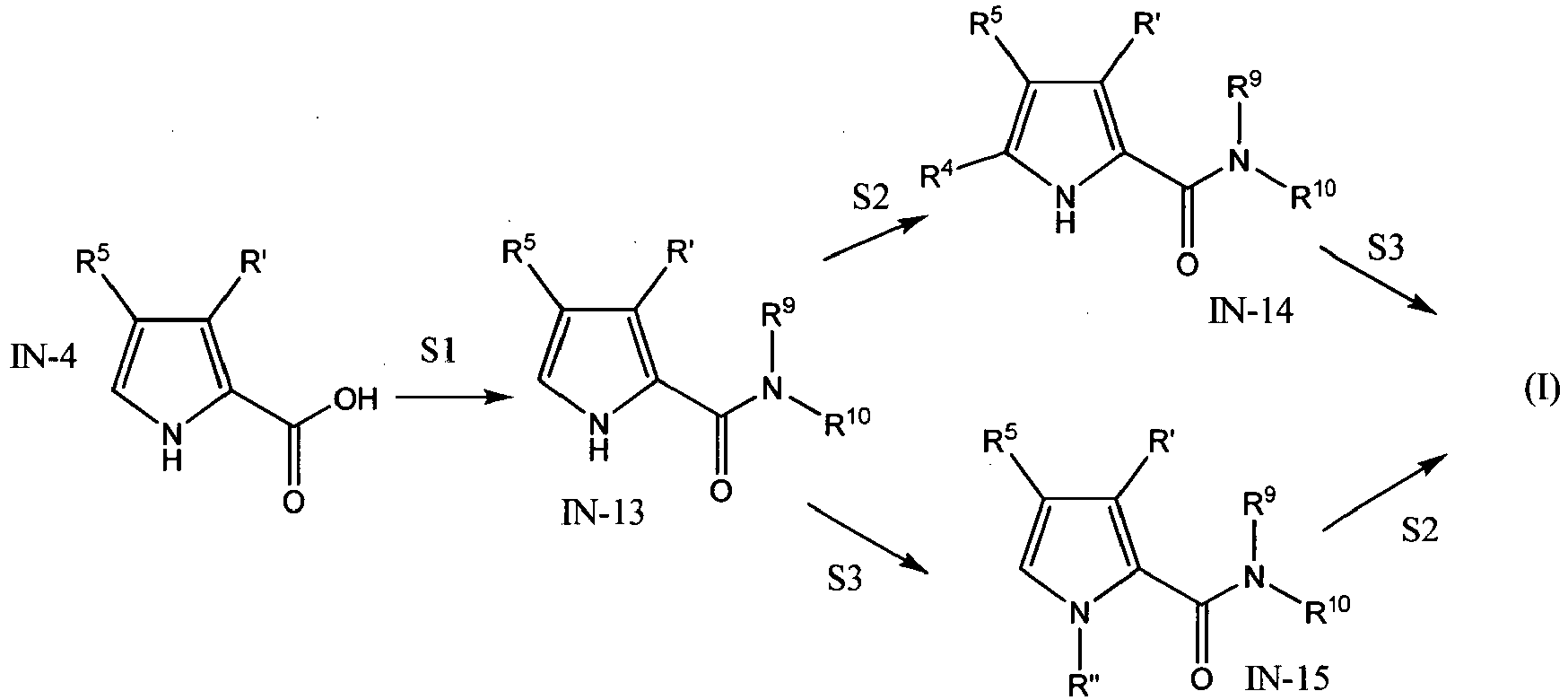
- S1:
- standard amidination procedures, e.g. HNR9R10, EDI, HOAt.
- S2:
- R4 = CF3: ICF3, H2O2, FeSO4 (especially for R5 ≠ H) or CF3SO2Cl, RuII-cat, light; R4 = CF2H: (i) DMF, POCl3; (ii) Deoxo-Fluor.
- S3:
- R"-X, base (for n ≠ 0) or R"-OH, PPh3, DIAD/DEAD (for n = 1) or R"-X, cat. (e. g. CuI, Pd") (for n = 0).
- S1:
- standard amidination procedures, e.g. HNR9R10, EDI, HOAt.
- S2:
- R"-X, base (for n ≠ 0) or R"-OH, PPh3, DIAD/DEAD (for n = 1) or R"-X, cat. (e. g. CuI, Pd") (for n = 0).
- S1:
- standard amidination procedures, e.g. HNR9R10, EDI, HOAt.
- S2:
- R4 = CF3: ICF3, H2O2, FeSO4 (especially for R5 ≠ H) or CF3SO2Cl, RuII-cat, light; R4 = CF2H: (i) DMF, POCl3; (ii) Deoxo-Fluor.
- The following examples further illustrate the invention but are not to be construed as limiting its scope.
- The indication "equivalents" ("eq." or "eq" or "equiv.") means molar equivalents, "RT" or "rt" means room temperature (23 ± 7 °C), "M" are indications of concentration in mol/l, "aq." means aqueous, "sat." means saturated, "sol." means solution, "conc." means concentrated.
- Boc = tert-butoxycarbonyl
- BOP-Cl = bis(2-oxo-3- oxazolidinyl)phosphonic chloride
- conc. = concentrated
- d = day(s)
- DCM = dichloromethane
- deoxo-Fluor = bis(2-methoxyethyl) aminosulfur trifluoride
- DIAD = diisopropyl azodicarboxylate
- DIPEA = diisopropylethylamine
- DME = 1,2-dimethoxyethane
- DMF = dimethylformamide
- DMSO = dimethylsulfoxide
- DPPA = Diphenylphosphoryl azide
- Et3N = triethylamine
- EtOAc = ethyl acetate
- EDCI = N-(3-dimethylaminopropyl)-N'-ethylcarbodiimide hydrochloride
- eq. = equivalent(s)
- h = hour(s)
- LiAIH4 = lithium aluminium hydride
- HATU = O-(7-azabenzotriazol-1-yl)N,N,N',N'-tetramethyluronium hexafluorophosphate
- HOAt = 1-hydroxy-7-azabenzotriazole
- HOBt = 1-hydroxybenzotriazole
- min. = minute(s)
- MeCN = acetonirile
- Mel = methyl iodide
- MeOH = methanol
- Oxone = potassium monopersulfate
- iPrOH = iso-propanol
- TBD on polystyrene = 1,5,7-triazabicyclo[4.4.0]dec-5-ene polystyrene
- TFA = trifluoroacetic acid
- TFAA = trifluoroacetic acid anhydride
- THF = tetrahydrofuran
- TLC = thin layer chromatography
- Ts = para-toluenesulfonyl
- T3P = propylphosphonic anhydride
- All starting materials which are not explicitly described were either commercially available (the details of suppliers such as for example Acros, Avocado, Aldrich, Apollo, Bachem, Fluka, FluoroChem, Lancaster, Manchester Organics, MatrixScientific, Maybridge, Merck, Rovathin, Sigma, TCI, Oakwood, etc. can be found in the Symyx® Available Chemicals Database of MDL, San Ramon, US or the SciFinder® Database of the ACS, Washington DC, US, respectively, for example) or the synthesis thereof has already been described precisely in the specialist literature (experimental guidelines can be found in the Reaxys® Database of Elsevier, Amsterdam, NL or the SciFinder® Database of the ACS, Washington DC, US, repspectively, for example) or can be prepared using the conventional methods known to the person skilled in the art.
- The stationary phase used for the column chromatography was silica gel 60 (0.04 - 0.063 mm) from E. Merck, Darmstadt. The reactions were, if necessary, carried out under an inert amosphere (mostly nitrogen).
- The yields of the compounds prepared are not optimized.
The mixing ratios of solvents are usually stated in the volume / volume ratio. - The reactions were, if necessary, carried out under an inert amosphere (mostly nitrogen). The number of equivalents of reagents and the amounts of solvents employed as well as the reaction temperatures and times can vary slightly between different reactions carried out by the same (general) method. The work-up and purification methods were adapted according to the characteristic properties of each compound and can vary slightly for analogous/general methods.
- All the intermediate products and exemplary compounds were analytically characterized by means of 1H-NMR spectroscopy. In addition, mass spectrometry tests (MS, m/z for [M+H]+) were carried out for all the exemplary compounds and selected intermediate products.
-

- A flask was charged with sodium p-toluenesulfinate (19.28 g, 108 mmol) and Nal (16.22 g, 108 mmol) in dry MeCN (360 mL). The reaction mixture was bubbled through with argon for 15 min followed by addition of 4-chlorostyrene (9.09 mL, 72.2 mmol) and (NH4)2Ce(NO3)6 (79 g, 144 mmol). The reaction mixture was stirred for 18h under argon atmosphere at room temperature. Then the solvent was evaporated under reduced pressure and the residue was partitioned between H2O (400 mL) and DCM (500 mL). The layers were separated and the aqueous phase was extracted with DCM (200 mL). The organic layer was washed with saturated aqueous Na2S2O3 (150 mL), brine (150 mL), dried over Na2SO4, filtered and evaporate to dryness to afford 28.5 g (94 %) of the desired product.
- 1-Chloro-4-(1-iodo-2-tosylethyl)benzene (28.5 g, 67.7 mmol) was dissolved in dry MeCN (376 mL) followed by addition of Et3N (18.83 mL, 135 mmol) and the mixture was stirred at room temperature for 1h. Then the solvent was evaporated under reduced pressure and the residue partitioned between DCM (400 mL) and 1 M aqueous KHSO4 (300 mL). The layers were separated and the organic phase was dried over Na2SO4, filtered and evaporated to dryness under reduced pressure to afford 19 g (96 %) of the desired product.
- Under N2, at 0°C 60% NaH in mineral oil (3.11 g, 78 mmol) was added to a solution of (E)-1-chloro-4-(2-tosylvinyl)benzene (19 g, 64.9 mmol) in dry THF (300 mL). After 5 minutes ethyl 2-isocyanoacetate (7.76 mL, 71.4 mmol) was added and the reaction mixture stirred at room temperature. After 18h EtOH (50 mL) was added and the solvents were evaporated under reduced pressure. The residue was partitioned between EtOAc (400 mL) and H2O (400 mL). The organic phase was washed with (100 mL), dried over Na2SO4, filtered and evaporated to dryness under reduced pressure. The crude product (16.55 g, "102%") was used in the next step.
- Under N2 ethyl 3-(4-chlorophenyl)-1H-pyrrole-2-carboxylate (16.5 g, 66.1 mmol) was dissolved in DMF (132 mL) and 60% NaH in mineral oil (2.91 g, 72.7 mmol) was added while cooling the solution in an ice-bath and the reaction mixture was then stirred at room temperature. After 20 min benzyl bromide (9.48 mL, 79 mmol) was added and stirring was continued for 24h. The reaction mixture was poured into H2O (200 mL) and the product was extracted with EtOAc (300 mL). The organic phase was washed with saturated aqueous NaH4Cl (2x200 mL), brine (150 mL), dried over Na2SO4, filtered and evaporated to dryness under reduced pressure. The crude mixture was purified by gravity chromatography (silica, heptane/EtOAc, 9:1), to yield 8 g (36%) of the desired product.
- Ethyl 1-benzyl-3-(4-chlorophenyl)-1H-pyrrole-2-carboxylate (8 g, 23.54 mmol) was dissolved in MeOH (33.4 mL) and THF (33.4 mL) followed by addition of aqueous 6M NaOH (33.4 mL, 200 mmol) and the reaction mixture was stirred at reflux for 18h. The volatile solvents were evaporated under reduced pressure. The remaining aqueous phase was acidified with aqueous 1M HCl until pH=4 and a solid precipitated. The solid was filtered off and washed with cold H2O. The collected solid was dissolved in EtOAc, dried over Na2SO4, filtered and the solution evaporated to dryness to give 6.69 g (91%) of ACI-01.
-

- A solution of 4-chlorobenzaldehyde (28.57 g, 203 mmol), nitroethane (44.0 mL, 610 mmol) and piperidine (4.01 mL, 40.6 mmol) in toluene (200 mL) was stirred at reflux (Dean-Stark) for 6 h and the mixture was stored at room temperature overnight. The solvent was removed under reduced pressure and the product was recrystallised from absolute EtOH. The crystals were filtered off, washed with a small amount of absolute EtOH and dried to give 23.25 g of the desired product. The mother liquor was concentrated, heated, cooled. Another batch of crystals was filtered off, washed with a small amount of absolute EtOH and dried in vacuo, to afford 3.95 g of the desired product. Total yield: 27.20 g (68%).
- 2.6 mmol TBD/g polystyrene (21.4 g, 55.7 mmol) was added to a suspension of (E)-1-chloro-4-(2-nitroprop-1-enyl)benzene (10 g, 50.6 mmol) and ethyl 2-isocyanoacetate (6.01 g, 53.1 mmol) in i-PrOH (40 mL) and dry THF (40 mL). The reaction mixture was stirred at room temperature overnight. The suspension was filtered, washed with i-PrOH/THF (1/1, v/v, 40 mL). The combined filtrate was evaporated under reduced pressure to furnish 11.0 g (82%) of the desired product.
- Ethyl 3-(4-chlorophenyl)-4-methyl-1H-pyrrole-2-carboxylate (9 g, 34.1 mmol) was dissolved in dry DMF (20 mL). At 0 °C, 60% NaH in mineral oil (1.365 g, 34.1 mmol) was added. After 20 min gas evolution had ceased and benzyl bromide (4.08 mL, 34.1 mmol) was added. The reaction mixture was stirred at room temperature overnight. Brine (400 mL) was added, followed by EtOAc (400 mL). The organic layer was washed with H2O (2 x 400 mL), brine (400 mL), dried (Na2SO4) and evaporated under reduced pressure. The product was purified by column chromatography (silica, heptane/EtOAc, 9:1), to yield 8.40 g (70%) of the desired product.
- To a suspension of ethyl 1-benzyl-3-(4-chlorophenyl)-4-methyl-1H-pyrrole-2-carboxylate (8.50 g, 24.0 mmol) in THF (15 mL), EtOH (15 mL) and H2O (15 mL) was added LiOH·H2O (10.1 g, 240 mmol). The reaction mixture was stirred at reflux temperature for 2 h. To the reaction mixture were added extra H2O (45 mL) and EtOH (30 mL) and the reaction mixture was stirred at reflux temperature overnight.
- The reaction mixture was allowed to cool to room temperature and was almost completely concentrated. Aqueous 1 M KHSO4 (∼240 mL) was added to the reaction mixture while cooling with an ice-bath (pH reached 1), followed by the addition of EtOAc (500 mL). The organic layer was separated, washed with brine (2x 400 mL), dried (Na2SO4) and concentrated. The residue was washed with a minimal amount of i-Pr2O and dried on a filter for 1 h to give ACI-02 (7.26 g, 93%).
-

- ACI-02 (250 mg, 0.767 mmol) and FeSO4·7H2O (128 mg, 0.460 mmol) were dissolved in DMSO (5 mL) to give a dark yellow solution. Trifluoromethyl iodide (gas) was bubbled through for 2 minutes via a syringe, giving a red solution. Subsequently, 35% aqueous H2O2 (0.403 mL, 4.60 mmol) was added, giving an exothermic reaction which was cooled using an ice bath. The very dark brown mixture was stirred 1 h at room temperature. The reaction mixture was partitioned between brine (25 mL) and EtOAc (25 mL) and the layers were separated. The aqueous layer was extracted with EtOAc (2x15 mL) and the combined organic layers were washed with brine (2x25 mL), dried on Na2SO4 and concentrated in vacuo to give an off-white solid. The product was triturated with heptane and filtered off to give ACI-03 (170 mg, 56%) as a white solid.
-

- 4-Chloro-2-fluorobenzaldehyde (10 g, 63.1 mmol), nitroethane (54.6 mL, 757 mmol) and piperidine (1.869 mL, 18.92 mmol) were dissolved in toluene (150 mL) and refluxed under Dean Stark conditions overnight. The reaction mixture was cooled to room temperature and the solvents were evaporated. The crude product was purified by column chromatography (silica, heptane/EtOAc 98:2) to give the desired product (10.4 g, 76%) as a yellow solid.
- To a suspension of (E)-4-chloro-2-fluoro-1-(2-nitroprop-1-enyl)benzene (5 g, 23.2 mmol) and ethyl 2-isocyanoacetate (2.65 mL, 24.4 mmol) in a mixture of dry THF (20 mL) and i-PrOH (20 mL) was added 2.6 mmol TBD/g polymer (9.8 g, 25.5 mmol). The suspension was stirred at room temperature for 5 d. The reaction mixture was filtered off and the residue was washed with i-PrOH/THF (1:1, 30 mL). The filtrate was concentrated to give the desired product (5.7 g, 87%) as a yellow oil.
- A solution of ethyl 3-(4-chloro-2-fluorophenyl)-4-methyl-1 H-pyrrole-2-carboxylate (5.7 g, 20.2 mmol) in dry DMF (25 mL) was added dropwise to a cooled suspension of 60% NaH in mineral oil (0.89 g, 22.3 mmol) in dry DMF (25 mL). The mixture was stirred at 0 °C for 20 min, then benzylbromide (2.54 mL, 21.3 mmol) was added dropwise. The mixture was stirred for 10 min at 0 °C, the cooling was removed and stirring was continued for 2 h at room temperature. The reaction was quenched by addition of saturated aqueous NH4Cl/ice (1:1, 150 mL) and the product was extracted with EtOAc (150 mL). The combined organic layers were dried on Na2SO4 and evaporated. The residual crude product purified using column chromatography (silica, heptane/EtOAc 2:1) to give the desired product (6.6 g, 88%) as an orange oil.
- To a solution of ethyl 1-benzyl-3-(4-chloro-2-fluorophenyl)-4-methyl-1H-pyrrole-2-carboxylate (3 g, 8.74 mmol) in DMSO (45 mL) was added FeSO4·7 H2O (0.67 g, 2.42 mmol) and H2SO4 (0.43 mL, 8.07 mmol). Subsequently, CF3I was bubbled through for 5 min and the dark brown mixture became slightly warm. Aqueous 35% H2O2 (1.41 mL, 16.1 mmol) was carefully added. The reaction mixture was stirred for 30 min, then diluted carefully with saturated aqueous Na2CO3 and the product was extracted with EtOAc. The combined organic layers were dried on Na2SO4 and concentrated. The product was purified using flash column chromatograph (silica, heptane/EtOAc 95:5) and reversed phase chromatography (MeCN/H2O) to give the desired product (1.55 g, 44%) as a yellow oil.
- To a mixture of ethyl 1-benzyl-3-(4-chloro-2-fluorophenyl)-4-methyl-5-(trifluoromethyl)-1H-pyrrole-2-carboxylate (1.55 g, 3.5 mmol) in H2O (20 mL) and EtOH (20 mL) was added NaOH (2.82 g, 71 mmol) and the mixture stirred at reflux for 2 h. The reaction mixture cooled to room temperature and concentrated. The reaction mixture was acidified using aqueous 5N HCl and the solids which had been formed were filtered off to give 1.45 g (100%) of ACI-04 as an off white solid.
-

- A solution of ethyl 1-(3-chlorobenzyl)-3-(4-chlorophenyl)-4-methyl-1H-pyrrole-2-carboxylate (1 g, 3.79 mmol) in dry DMF (5 mL) was added dropwise to a cooled suspension of 60% NaH in mineral oil (0.167 g, 4.17 mmol) in dry DMF (5 mL). The mixture was stirred at 0 °C for 20 min, then 3-chlorobenzyl bromide (0.524 mL, 3.98 mmol) was added dropwise over 5 min. The mixture was stirred for 10 min at 0 °C, then the cooling was removed and the stirring was continued for 2.5 h at room temperature. The reaction was quenched by the addition of saturated aqueous NH4Cl/ice (1:1, 50 mL) and the product was extracted with EtOAc (50 mL). The combined organic layers were dried on Na2SO4 and evaporated and the residual crude product purified using gravity column chromatography (silica, heptane/EtOAc 9:1) to give the desired product (1.18 g, 80%).
- To a solution of ethyl 1-(3-chlorobenzyl)-3-(4-chlorophenyl)-4-methyl-1H-pyrrole-2-carboxylate (1.18 g, 3.04 mmol) in DMSO (15 mL) was added FeSO4·7 H2O (0.253 g, 0.912 mmol) and H2SO4 (0.162 mL, 3.04 mmol). Subsequently, CF3I was bubbled through for 5 min and the dark brown mixture became slightly warm. The reaction mixture was cooled in an ice-bath until the first solid particles were visible. The cooling bath was removed and aqueous 35% H2O2 (0.53 mL, 6.08 mmol) was carefully added. The reaction mixture was stirred for 10 min, then diluted carefully with saturated aqueous Na2CO3 (15 mL) and the product was extracted with EtOAc (100 mL). The combined organic layers were dried on Na2SO4 and concentration. The product was purified using reversed phase chromatography (MeCN/H2O) to give the desired product (737 mg, 53%) as a yellow oil.
- To a mixture of ethyl 1-(3-chlorobenzyl)-3-(4-chlorophenyl)-4-methyl-5-(trifluoromethyl)-1H-pyrrole-2-carboxylate (737 mg, 1.6 mmol) in H2O (10 mL) and EtOH (10 mL) was added NaOH (1.29 g, 32 mmol) and the mixture stirred at reflux for 3 h. The reaction mixture cooled to room temperature and concentrated the next day. Aqueous 5N HCl was added and the solids which had been formed were filtered off and dried on air for 5 d to give 768 mg of compound ACI-05 as a yellow solid.
-

- This reaction was carried out in 5 batches using the same procedure. To a mixture of ethyl 3-(4-chlorophenyl)-1 H-pyrrole-2-carboxylate [for synthesis see ACI-01] (1.25 g, 5.01 mmol), K2HPO4 (2.62 g, 15 mmol) and dichlortris(1,10-phenanthroline)-ruthenium(II) hydrate (71 mg, 0.10 mmol) in argon degassed dry MeCN (35 mL) was added CF3SO2Cl (1.60 mL, 15 mmol). The reaction mixture was stirred for 16 h at room temperature adjacent to a fluorescent light bulb (E27 - 32W, 4000K, 65 mA). After 16 h, an additional amount of CF3SO2Cl (0.20 mL, 1.88 mmol) was added and the reaction mixture was stirred overnight at room temperature adjacent to a fluoroescent light bulb. All reaction mixtures were combined and diluted with EtOAc (150 mL) and H2O was added. The aqueous layer was extracted with EtOAc (150 mL). The organic layers were combined and the solvent was evaporated to give an oil. The crude product was purified by flash chromatography (silica, gradient heptane/EtOAc, 1:0 → 1:1) to furnish the desired product (4.59 g, 58%).
- To a solution of ethyl 3-(4-chlorophenyl)-5-(trifluoromethyl)-1H-pyrrole-2-carboxylate (2.0 g, 6.30 mmol) in dry THF (20 mL) was added triphenylphosphine (1.899 g, 7.24 mmol) and benzyl alcohol (0.720 mL, 6.92 mmol). DIAD (1.373 mL, 6.92 mmol) in dry THF (5 mL) was added dropwise. The reaction mixture was stirred at room temperature for 1 h. THF was removed in vacuo. The crude product was dissolved in EtOAc (20 mL) and saturated NaHCO3 (40 mL) was added. The layers were separated and the aqueous layer was extracted with EtOAc (20 mL). The combined organic layer was washed with brine (50 mL) and dried over Na2SO4 and the solvent was evaporated. The residue was co-evaporated with DCM (10 mL) and then stirred in Et2O (20 mL) and the solids were filtered off. The filtrate was purified by column chromatography (silica, heptane/EtOAc, 3:1) to give 2.6 g (97%) the desired product as a yellow oil.
- To a solution of ethyl 1-benzyl-3-(4-chlorophenyl)-5-(trifluoromethyl)-1H-pyrrole-2-carboxylate (2.59 g, 6.35 mmol) in dry THF (15 mL) was added a solution of NaOH (3.9 g, 98 mmol) in H2O (15 mL). The reaction mixture was stirred overnight at 80 °C. An additional portion of NaOH (4.25 g, 106 mmol) was added and the reaction mixture was stirred at 100°C during 7 h. The organic solvent was evaporated and the residue was acidified with aqueous 5 M HCl (55 mL). The product was extracted with EtOAc (3x20 mL). The combined organic layer was washed with brine (3x20 mL) and dried (Na2SO4). The remaining oil was triturated with heptane (20 mL). The off-white solids were filtered off to give 1.29 g (51%) ACI-06.
-

- KOt-Bu (265 mg, 2.36 mmol) and 18-crown-6 (catalytic amount) were added to ethyl 3-(4-chlorophenyl)-5-(trifluoromethyl)-1H-pyrrole-2-carboxylate [for synthesis see ACI-06] (500 mg, 1.57 mmol) in dry THF (5 mL). The reaction mixture was stirred for 30 min. and 1-(bromomethyl)-3-chlorobenzene (647 mg, 3.15 mmol) was added to the reaction mixture. The reaction mixture was stirred at reflux temperature overnight. The reaction mixture was acidified with aqueous 1M KHSO4 (4 mL), diluted with H2O (4 mL) and extracted with EtOAc (50 mL). The organic layer was washed with brine, dried (Na2SO4), and concentrated to give crude product as a colourless oil (732 mg).
- To crude ethyl 1-(3-chlorobenzyl)-3-(4-chlorophenyl)-5-(trifluoromethyl)-1H-pyrrole-2-carboxylate (732 mg, max. 1.57 mmol) in EtOH (2 mL) and H2O (2 mL) was added LiOH·H2O (347 mg, 8.28 mmol). The reaction mixture was stirred at reflux temperature overnight. The reaction mixture was concentrated, diluted with H2O (5 mL) and acidified with aqueous 1 M KHSO4 (10 mL) while cooling with an ice-bath. The precipitate was filtrated, washed with H2O (2x) and dried on filter to give ACI-07 (533 mg, 82% over two steps).
-

- A solution of KOt-Bu (19.5 g, 174 mmol) in dry THF (300 mL) was cooled with an ice/water bath. Portionwise addition of MePPh3Br (62.2 g, 174 mmol) resulted in a suspension, which was stirred for 5 min at 0 °C and for 1 h at 15 °C. Subsequently, the temperature was lowered to 0 °C and a solution of 4-chloro-2-fluorobenzaldehyde (25.1 g, 158 mmol) in dry THF (100 mL) was added dropwise. The temperature was raised to room temperature slowly. The reaction mixture was stirred at room temperature for 20 h. Addition of brine (100 mL) resulted in a clear two phase system and a white solid. The combination of layers was decanted from the solid. The layers were separated, the aqueous layer was combined with the solid residue and Et2O (200 mL). The combination of layers was decanted from the solid. The layers were separated, the combination of organic layers was dried (Na2SO4) and concentrated at a controlled vacuum of 100 mbar. The residual oil was combined with pentane (300 mL) and Na2SO4. The suspension was triturated. Filtration and pentane washing provided a filtrate, which was concentrated at a controlled vacuum of 100 mbar to arrive at 26.76 g (97%, 90% purity) of impure title compound as a yellow oil.
- To a mechanically stirred mixture of impure 4-chloro-2-fluoro-1-vinylbenzene (26.76 g, 154 mmol), sodium p-toluenesulfinate (28.8 g, 161 mmol) and Nal (34.6 g, 231 mmol) in MeCN (700 mL) was added (NH4)2Ce(NO3)6 (169 g, 308 mmol) portionwise. The mixture was stirred under a nitrogen atmosphere during 3 h at room temperature. The liquid was separated by decantation and the solids were washed with MeCN (3x100 mL). The solvent was evaporated in vacuo and re-dissolved in EtOAc (500 mL). The organic layer was washed with brine (400 mL), aqueous 10 wt% Na2S2O3 (2x200 mL) and brine (200 mL). The organic layer was dried (Na2SO4) and the solvent was evaporated to arrive at 51.86 g of crude title compound as a yellow solid.
- Crude 4-chloro-2-fluoro-1-(1-iodo-2-tosylethyl)benzene (51.8 g, max. 154 mmol) was dissolved in a mixture of Et2O (250 mL), THF (50 mL) and EtOAc (80 mL) after some warming. Carefully, Et3N (23.6 mL, 170 mmol) was added in 2 mL portions at room temperature. The mixture was stirred for 90 min at room temperature. Aqueous 1 M NaHSO4 (200 mL) and H2O (100 mL) were added and the organic layer was separated. The aqueous layer was extracted with EtOAc (50 mL). The combination of organic layers was washed with saturated aqueous NaHCO3 and with brine, dried (Na2SO4) and filtered. The solvent was evaporated in vacuo to give a yellow solid. The residue was triturated in MeOH (50 mL), filtration and air-drying provided 23.04 g (48% over two steps) of the desired product as a white solid.
- A suspension of 60% NaH in mineral oil (0.772 g, 19.3 mmol) in dry THF (30 mL) was prepared and cooled with a water bath. A solution of (E)-4-chloro-2-fluoro-1-(2-tosylvinyl)benzene (5.0 g, 16.1 mmol) and ethyl 2-isocyanoacetate (1.93 mL, 17.7 mmol) in dry THF (30 mL) was prepared and added dropwise at room temperature. The reaction mixture was stirred for 2 h at room temperature.
- Subsequently, saturated aqueous NH4Cl (30 mL), ice (ca. 10 g), Et2O (100 mL) and EtOAc (10 mL) were added to result in a clear two phase system. The layers were separated, the aqueous layer was extracted with Et2O (30 mL). The combination of organic layers was washed with brine twice, dried (Na2SO4), co-evaporated with DCM and with toluene twice. The resulting dark oil was dissolved in DCM (a few mL) and used for filtration over silica (heptane/EtOAc 1:1). This resulted in 3.88 g (90%) of the desired product as a yellow oil, which crystallised on standing.
- To a mixture of ethyl 3-(4-chloro-2-fluorophenyl)-1H-pyrrole-2-carboxylate (2.00 g, 7.47 mmol), K2HPO4 (3.90 g, 22.4 mmol) and dichlortris(1,10-phenanthroline)-ruthenium(II) hydrate (106 mg, 0.149 mmol) in argon degassed dry MeCN (24 mL) was added CF3SO2Cl (1.59 mL, 14.9 mmol). The reaction mixture was stirred for 18 h at a temperature of 25-30 °C adjacent to a fluorescent light bulb (E27 - 32W, 4000K, 65 mA). The reaction mixture was diluted with argon degassed dry MeCN (24 mL). Extra reagents were added: CF3SO2Cl (398 µL, 3.73 mmol) and dichlortris(1,10-phenanthroline)-ruthenium(II) hydrate (106 mg, 0.149 mmol). The reaction mixture was stirred for 3 d at a temperature of 25-30 °C adjacent to a fluorescent light bulb. Subsequently, EtOAc (100 mL) and H2O (100 mL) were added. The aqueous layer was extracted with EtOAc (50 mL). The combination of organic layers was washed with saturated aqueous NaHCO3 and with brine, dried (Na2SO4) and the solvent was evaporated. The crude product was purified by flash chromatography (silica, gradient heptane/EtOAc, 1:0 → 4:1) to give a yellow solid, which was crystallised from hot heptane to provide 1.01 g (40%) of the desired product as colourless crystals.
- To a solution of ethyl 3-(4-chloro-2-fluorophenyl)-5-(trifluoromethyl)-1H-pyrrole-2-carboxylate (1.33 g, 3.96 mmol) in dry MeCN (20 mL) was added K2CO3 (1.10 g, 7.92 mmol) and benzyl bromide (521 µL, 4.36 mmol). The reaction mixture was stirred overnight at 80 °C. Addition of silica (ca. 2 g) was followed by filtration; the filtrate was concentrated in vacuo. The product was co-evaporated twice with toluene (30 mL), to result in 1.75 g (99%, 95% purity) of the desired product as a clear oil.
- To a solution of ethyl 1-benzyl-3-(4-chloro-2-fluorophenyl)-5-(trifluoromethyl)-1H-pyrrole-2-carboxylate (1.69 g, 3.77 mmol) in DMSO (10 mL) were added crushed pellets of NaOH (397 mg, 9.92 mmol). The reaction mixture was stirred at room temperature overnight. Subsequently, 0.3 M aqueous HCl (70 mL) and EtOAc (30 mL) were added to result in a clear two phase system. The layers were separated, the organic layer was washed with H2O (20 mL) twice and with brine twice, dried (Na2SO4) and concentrated in vacuo. The residue was triturated in heptane, filtration and air-drying provided 1.36 g (91%) of carboxylic acid ACI-08 as a white solid.
-
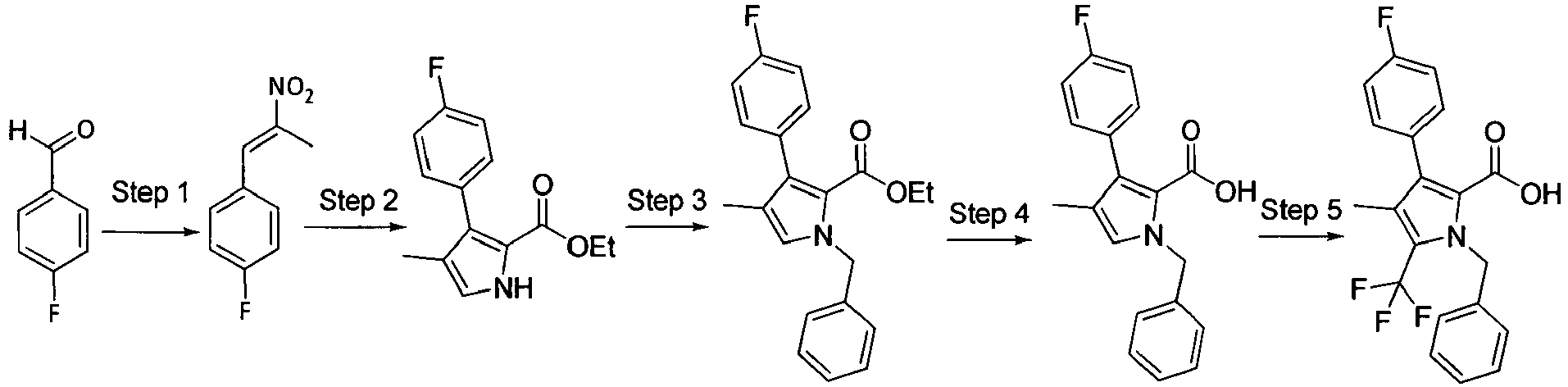
- A solution of 4-fluorobenzaldehyde (5.0 g, 40.32 mmol), nitro ethane (3.2 mL, 44.35 mmol), trimethyl orthoformate (9.7 mL, 88.70 mmol), methylamine HCl (2.1 g, 31.44 mmol) and potassium acetate (2.76 g, 28.22 mmol) in methanol (50mL) was refluxed at 80°C for 18h. Methanol was evaporated; the residue diluted with water (100 mL), extracted with EtOAc (3 x 50 mL). The combined organic layer was washed with water (50 mL), brine (50 mL), dried (Na2SO4) and concentrated. The residue triturated with methanol (10 mL), filtered off and washed with cold methanol (5 mL) to afford the desired product (1.82 g, 25%) as a yellow solid.
- Ethyl isocyanoacetate (4.36 mL, 42.09 mmol) and DBU (6.28mL, 42.09mmol) was added to a solution of (E)-1-fluoro-4-(2-nitroprop-1-enyl) benzene (6.0 g, 33.14 mmol) in THF (60 mL) at 0°C. The reaction mixture was stirred for 30 min at room temperature; quenched with water (100 mL) and extracted with EtOAc (2x100 mL). The combined organic layers were washed with water (1x100 mL) and brine (75 mL), dried (Na2SO4) and concentrated under reduced pressure to give the crude product, which was purified by column chromatography (silica gel; 60-120 mesh). The pure product was eluted with 10% EtOAc in petroleum ether to yield the desired compound (6.0 g, 73%) as pale yellow solid.
- A solution of ethyl 3-(4-fluorophenyl)-4-methyl-1 H-pyrrole-2-carboxylate (5.5 g, 22.26 mmol) in DMF (12 mL) was added to a mixture of 60% NaH (1.1 g, 33.39 mmol) in dry DMF (20 mL) at 0°C under a N2 atmosphere and the mixture was stirred for 15 min. Benzyl bromide (2.9 mL, 24.49 mmol) was added and it was stirred at 80°C for 12h. The reaction mixture was cooled to 0°C, quenched with brine (20 mL), diluted with water (50 mL) and extracted with EtOAc (3x50 mL). The combined organic layers were washed with water (75 mL) and brine (75 mL), dried (Na2SO4) and concentrated under reduced pressure to afford the desired product (6.5 g, 87%) as brown color solid.
- Ethyl 1-benzyl-3-(4-fluorophenyl)-4-methyl-1H-pyrrole-2-carboxylate (5.0 g, 14.83 mmol) was added to a solution of 8M NaOH (30 mL) and catalytic amount of TBAF (0.5 mL) at 0°C. The resulting mixture was stirred at 110°C for 24 h. The reaction mixture was cooled to 0°C, acidified (pH∼2) with 6N HCl andextracted with EtOAc (3x50 mL). The combined organic layers were washed with brine (100 mL), dried (Na2SO4) and concentrated to afford the desired product (3.8 g, 84%) as a brown solid.
- CF3l (10 g) gas was bubbled through a solution of 1-benzyl-3-(4-fluorophenyl)-4-methyl-1H-pyrrole-2-carboxylic acid (4.0 g, 12.94 mmol) in DMSO (40 mL) and FeSO4.7H2O (2.15 g, 7.76 mmol) at RT for 5min. 30% Aqueous H2O2 (8.7 mL, 77.64 mmol) was then added at 0°C and stirring was continued at room temperature for 16h. The reaction mixture was diluted with water (100 mL) and extracted with EtOAc (3x50 mL). The combined organic layers were washed with water (1x100 mL) and brine (50 mL), dried (Na2SO4) and concentrated in vacuo. The crude product was purified by column chromatography (silica gel; 60-120mesh); it eluted with 10-12% EtOAc in petroleum ether to yield ACI-09 (1.7 g, 35%) as a white solid.
- 1-Benzyl-4-methyl-5-(trifluoromethyl)-3-(4-(trifluoromethyl)phenyl)-1H-pyrrole-2-carboxylic acid (ACI-10), 1-Benzyl-4-methyl-3-(4-(trifluoromethoxy)phenyl)-5-(trifluoromethyl)-1H-pyrrole-2-carboxylic acid (ACI-11), 1-Benzyl-3-(4-chloro-3-fluorophenyl)-4-methyl-5-(trifluoromethyl)-1 H-pyrrole-2-carboxylic acid (ACI-12) and 1-Benzyl-3-(3-chloro-4-fluorophenyl)-4-methyl-5-(trifluoromethyl)-1H-pyrrole-2-carboxylic acid (ACI-13) were synthesized in analogy to ACI-09 , utilising the appropriate benzaldehyde.
-

- 1-(Aminomethyl)cyclopropanol (250 mg, 2.87 mmol) was dissolved inDCM (8 mL) with dry DMF (2 mL). Boc2O (626 mg, 2.87 mmol) was added and the mixture was stirred at room temperature overnight. The reaction mixture was concentrated in vacuo and the residue (still containing DMF) was partitioned between brine (10 mL) and EtOAc (10 mL). The aqueous layer was extracted with EtOAc (2x10 mL) and the combined organic layers were washed with brine (2x10 mL) and dried on Na2SO4 before concentration in vacuo to give 505 mg (94%) of a light yellow oil which solidified on standing. According to 1H-NMR this appeared to be a mixture of the expected product and 40% Boc2O. The intermediate was dissolved in dry THF (2 mL) and the solution was added dropwise at room temperature to 2.4M LiAIH4 in THF (6 mL, 14.40 mmol). The mixture was stirred at 70 °C overnight. The reaction mixture was cooled in an ice bath and saturated aqueous Na2SO4 (20 mL) was added slowly. The turbid mixture was filtered over Celite and washed with EtOAc and the layers were separated. The organic layer was washed with brine (2x20 mL) and dried over Na2SO4 before concentration in vacuo to give the desired product (150 mg) as a yellow solid.
- tert-Butyl (1-hydroxycyclopropyl)methylcarbamate (150 mg) was dissolved in dry DMF (2 mL) and Cs2CO3 (313 mg, 0.961 mmol) was added, followed by Mel (0.053 mL, 0.841 mmol). The light yellow suspension was stirred in a sealed vessel at room temperature overnight. More Mel (0.050 mL, 0.801 mmol) was added and stirring was continued for 2 d. The reaction mixture was partitioned between aqueous saturated NaHCO3 (25 mL) and EtOAc (25 mL). The aqueous layer was extracted with EtOAc (2x10 mL) and the combined organic layers were washed with saturated aqueous NaHCO3 (2x25 mL). The organic layer was washed with brine (2x25 mL) and dried on Na2SO4 before concentration in vacuo to give a yellow oil. The product was filtered over a plug of silica (eluent heptane/iPr2O 1:1) to give the title compound (90 mg, 16% from 1-(aminomethyl)cyclopropanol) as a colorless oil.
- 4M HCl in dioxane (0.447 mL, 1.789 mmol) was added dropwise to a solution of tert-butyl (1-methoxycyclopropyl)methylcarbamate (90 mg, 0.447 mmol) in dry dioxane (1 mL) under a N2 atmosphere. The mixture was stirred at room temperature overnight. The mixture was evaporated to dryness and the residue was co-evaporated with Et2O to afford 57 mg (93%) of AMN-22 as a yellow solid.
-

- To a solution of 1-hydroxycyclopropanecarboxylic acid (250 mg, 2.45 mmol) and Et3N (0.851 mL, 6.12 mmol) in DCM (5 mL) were added subsequently methylamine HCl (207 mg, 3.06 mmol), EDCI (540 mg, 2.82 mmol) and HOAt (333 mg, 2.45 mmol) at room temperature. After stirring for 5 d, the mixture was concentrated and the crude product was purified by flash chromatography (silica, gradient heptane/EtOAc, 1:1 → 0:1) to give the desired product (220 mg, 78%) as a white solid.
- To a solution of 1-hydroxy-N-methylcyclopropanecarboxamide (110 mg, 0.955 mmol) in dry Et2O (2 mL) was added 1M BH3 in THF (4.78 mL, 4.78 mmol). The reaction mixture was refluxed for 2.5 h, cooled to room temperature and quenched with MeOH (0.5 mL). 1M HCl in Et2O (9.55 mL, 9.55 mmol) was added dropwise and the mixture stirred for 1.5 h. The solids were filtered off and transferred into a flask and co-evaporated with Et2O to afford 94 mg (72%) of AMN-24 as a colorless glass like solid.
-

- To a cooled (0 °C) solution of 3,3-dimethylbutan-1-amine (866 mg, 8.56 mmol in DCM (9 mL) was added Boc2O (1.87 g, 8.56 mmol). The reaction mixture was stirred at room temperature overnight. The reaction mixture was concentrated and diluted with saturated aqueous NaHCO3 (20 mL) and extracted with DCM (10 mL). The combined organic layers were dried (Na2SO4) and evaporated to give the desired product (1.72 g, 100%) as a colourless oil.
- To a solution of tert-butyl 3,3-dimethylbutylcarbamate (1.72 g, 8.56 mmol) in dry DMF (20 mL) was portionwise added 60% NaH in mineral oil (685 mg, 17.12 mmol) under a N2 atmosphere. After 30 min, Mel (2.68 mL, 42.8 mmol) was added dropwise with ice cooling. The mixture was stirred at room temperature for 2 d, poured in ice-H2O and extracted with Et2O (30 mL). The organic layer was dried (Na2SO4) and concentrated to yield the desired product (1.43 g, 63%, 80% purity) as a colourless oil.
- 4 M HCl in dioxane (4.05 mL, 16.2 mmol) was added dropwise to a solution of tert-butyl 3,3-dimethylbutyl(methyl)carbamate (436 mg, 1.62 mmol) in dry dioxane (4 mL) under a N2 atmosphere. The mixture was stirred at room temperature for 3 d. The mixture was evaporated to dryness, co-evaporated with DCM (15 mL) and the residue was stirred in Et2O for 30 min. The solids were filtered off, rinsed with Et2O and dried on air to yield AMN-38 (222 mg, 72%) as a white solid.
-

- To a solution of 2-methyl-2-morpholinopropan-1-amine (531 mg, 3.36 mmol) in DCM (5 mL) was added Boc2O (732 mg, 3.36 mmol). The reaction mixture was stirred at room temperature. After 1.5 h the reaction mixture was concentrated and diluted with aqueous saturated NaHCO3 and extracted with DCM (30 mL). The combined organic layers were dried (Na2SO4) and evaporated to give the desired product (770 mg, 89%) as a yellow oil.
- To a suspension of 60% NaH in mineral oil (238 mg, 5.96 mmol) in dry DMF (5 mL) was added dropwise a solution of tert-butyl 2-methyl-2-morpholinopropylcarbamate (770 mg, 2.98 mmol) in dry DMF (5 mL). After 30 min Mel (0.928 mL, 14.9 mmol) was added dropwise. The mixture was stirred at room temperature for 5 d, poured in H2O and extracted with Et2O (30 mL). The organic layer was dried (Na2SO4) and concentrated to yield the desired crude product (970 mg,) as a light yellow oil.
- 4 M HCl in dioxane (0.890 mL, 3.5 mmol) was added dropwise to a solution of tert-butyl methyl(2-methyl-2-morpholinopropyl)carbamate (970 mg, max. 2.98 mmol) in dry dioxane (5 mL) under a N2 atmosphere. The mixture was stirred at room temperature for 6 h. The mixture was evaporated to dryness and the residue was stirred in Et2O overnight. The solids were filtered off, rinsed with Et2O and dried on air to yield a white solid. The solids were dissolved in dry dioxane (2 mL) and 4 M HCl in dioxane (0.890 mL, 3.5 mmol) was added. The reaction mixture was stirred at room temperature overnight. The mixture was diluted with Et2O and the solids were filtered off, which resulted in AMN-39 (453 mg, 73% over 2 steps).
-

- To a suspension of methanesulfinic acid sodium salt (310 mg, 3.04 mmol) in dry DMF (3.5 mL) was added under a nitrogen atmosphere, dry pyridine (0.5 mL) and 2-bromo-N,2-dimethylpropanamide (365 mg, 2.027 mmol). The reaction mixture was stirred at 50°C overnight, cooled and H2O (5 mL) and EtOAc (10 mL) were added. The aqueous layer was separated and extracted twice with EtOAc (5 mL). The combined organic phase was washed with brine (20 mL) and dried over Na2SO4. The solution was concentrated in vacuo and stirred in heptane (25 mL). The solids were filtered to give the desired product (88 mg, 23%) as a white solid.
- AlCl3 (101 mg, 0.759 mmol) was cooled to 0°C under an nitrogen atmosphere and Et2O (2 mL) was added. Dry THF (2 mL) was added after 10 min. followed by the addition of 2.4 M LiALH4 in THF (0.632 mL, 1.518 mmol). After 30 min. a solution of N,2-Dimethyl-2-(methylsulfonyl)propanamide (68 mg, 0.379 mmol) in dry THF (3 mL) was addec dropwise. The temperature was allowed to warm up to room temperature overnight. The mixture was cooled (0°C) and qeunched with a solution of THF (5 mL) and H2O (5 mL). Aqueous 1N HCl (6 mL) was added, followed by basification with solid NaHCO3. The solvents were removed in vacuo. DCM (10 mL) was added and the suspension was filtered. The residue was washed with DCM (10 mL). The aqueous layer of the filtrate was separated and extracted twice with DCM (10 mL). The combined organic phase was washed with brine (20 mL) and dried over Na2SO4. Concentration in vacuo afforded amine AMN-43 (25 mg, 30%, 72% purity) as a white solid.
-

- ACI (1 eq.) und AMN (1 - 1.5 eq.) were dissolved in DME, BOP-CI (1 - 2.5eq.) and DIPEA (3 - 5 eq.) were added. The reaction mixture was stirred at 60°C for 2-4 h and then cooled to room temperature.
- Saturated aqueous NaHCO3 and EtOAc were added. The layers were separated and the aqueous layer was extracted with EtOAc. The organic layers were combined, dried over Na2SO4 and evaporated. The product was purified by flash column chromatography.
- To a solution of ACI (1 eq.) and AMN (1 -1.2 eq.) in DCM was added EDCI (1 - 1.2 eq.), followed by HOAt (0.1 eq.). The reaction mixture was stirred at room temperature for 4-16 h. The reaction mixture was washed with aqueous 1 M KHSO4 and saturated aqueous NaHCO3, dried over Na2SO4 and concentrated. The crude product was purified by flash column chromatography.
- To a stirred solution of ACI (1 eq.) and DIPEA (2 - 4 eq.) in DCM or THF was added HATU (1 eq.) and stirring was continued for 15 min at 0°C. AMN (1 eq.) was added and the solution was stirred at room temperature for 12-48 h. The reaction mixture was washed with saturated aqueous NaHCO3, aqueous NH4Cl and brine, dried over MgSO4 and concentrated. The crude product was purified by flash column chromatography.
- To a stirred solution of ACI (1 eq.) and DIPEA (2 - 4 eq.) in DCM was added EDCI (1.2 eq.), followed by HOBt (0.2 eq.) and stirring was coninued for 15 min 0°C. AMN (1 eq.) was added and the solution was stirred at room temperature for 12-72 h. The reaction mixture was washed with saturated aqueous NaHCO3 and concentrated in vacuo. The crude product was purified by flash column chromatography.
- To a stirred solution of ACI (1 eq.) and DIPEA (2 - 4 eq.) in THF was added HATU (1 eq.) and stirring was continued for 15 min at 0°C. AMN (1 eq.) was added and the solution was stirred at room temperature for 12-48 h. The reaction mixture was washed with saturated aqueous NaHCO3, aqueous HCl solution (pH 5) and brine, dried over MgSO4 and concentrated. The crude product was purified by flash column chromatography.
- To a stirred solution of ACI (1 eq.) and DIPEA (2 - 4 eq.) in DCM or THF was added HATU (1.0 eq.), and stirring was coninued for 15 min 0°C. AMN (1 eq.) was added and the solution was stirred at room temperature for 12-72 h. The reaction mixture was diluted with DCM, washed with saturated aqueous NaHCO3 and concentrated in vacuo. The crude product was purified by flash column chromatography.
Table Synthesis of pyrrole derivatives (SC): Example No. Structure Name Synthesis according to Yield Comments SC-01 
[1-Benzyl-3-(4-chlorophenyl)-5-(trifluoromethyl)-1H-pyrrol-2-yl]-morpholin-4-yl-methanone Prepared in analogy to SC-02 SC-02 
1-Benzyl-3-(4-chlorophenyl)-N-(2,2-dimethyl-propyl)-N-methyl-5-(trifluoromethyl)-1H-pyrrole-2-carboxylic acid amide see below SC-03 
[1-Benzyl-3-(4-chlorophenyl)-4-methyl-5-(trifluoromethyl)-1H-pyrrol-2-yl]-morpholin-4-yl-methanone see below SC-04 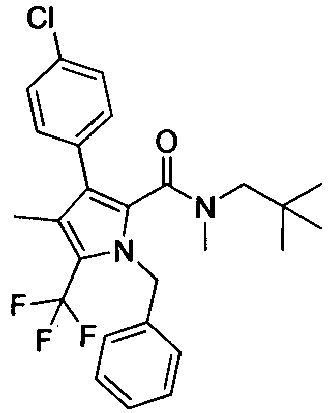
1-Benzyl-3-(4-chlorophenyl)-N-(2,2-dimethyl-propyl)-N,4-dimethyl-5-(trifluoromethyl)-1H-pyrrole-2-carboxylic acid amide see below SC-05 
[1-Benzyl-3-(4-chlorophenyl)-4-methyl-5-(trifluoromethyl)-1H-pyrrol-2-yl]-(3-hydroxy-azetidin-1-yl)-methanone GP-1 78 mg (40%) SC=06 
1-Benzyl-3-(4-chlorophenyl)-N,4-dimethyl-N-(2-methylsulfonyl-ethyl)-5-(trifluoromethyl)-1H-pyrrole-2-carboxylic acid amide GP-2 178 mg (91%) SC-08 
4-[1-Benzyl-3-(4-chlorophenyl)-4-methyl-5-(trifluoromethyl)-1H-pyrrole-2-carbonyl]-piperazin-2-one GP-2 131 mg (72%) SC-09 
4-[1-Benzyl-3-(4-chlorophenyl)-4-methyl-5-(trifluoromethyl)-1H-pyrrole-2-carbonyl]-1-methyl-piperazin-2-one see below SC-10 
1-Benzyl-3-(4-chlorophenyl)-4-methyl-N-tetrahydro-pyran-4-yl-5-(trifluoromethyl)-1H-pyrrole-2-carboxylic acid amide GP-1 42 mg (34%) SC-11 
1-Benzyl-3-(4-chlorophenyl)-N,4-dimethyl-N-tetrahydropyran-4-yl-5-(trifluoromethyl)-1H-pyrrole-2-carboxylic acid amide GP-1 98 mg (39%) SC-16 
1-Benzyl-3-(4-chlorophenyl)-N-[1-(hydroxymethyl)-cyclopropyl]-4-methyl-5-(trifluoromethyl)-1H-pyrrole-2-carboxylic acid amide GP-1 23 mg (19%) SC-17 
[1-Benzyl-3-(4-chlorophenyl)-4-methyl-5-(trifluoromethyl)-1H-pyrrol-2-yl]-(4-hydroxy-piperidin-1-yl)-methanone GP-2 88 mg (73%) SC-18 
1-Benzyl-3-(4-chlorophenyl)-N,N,4-trimethyl-5-(trifluoromethyl)-1H-pyrrole-2-carboxylic acid amide see below SC-19 
[1-Benzyl-3-(4-chlorophenyl)-4-methyl-5-(trifluoromethyl)-1H-pyrrol-2-yl]-(-oxy-[1,4]thiazinan-4-yl)-methanone see below SC-20 
[1-Benzyl-3-(4-chlorophenyl)-4-methyl-5-(trifluoromethyl)-1H-pyrrol-2-yl]-[2-(hydroxymethyl)-morpholin-4-yl]-methanone GP-2 37 mg (39%) SC-21 
1-Benzyl-3-(4-chlorophenyl)-N,4-dimethyl-N-(tetrahydropyran-4-yl-methyl)-5-(trifluoromethyl)-1H-pyrrole-2-carboxylic acid amide GP-1 50 mg (39%) SC-22 
1-Benzyl-3-(4-chlorophenyl)-N,4-dimethyl-5-(trifluoromethyl)-1H-pyrrole-2-carboxylic acid amide see below SC-23 
[1-Benzyl-3-(4-chlorophenyl)-4-methyl-5-(trifluoromethyl)-1H-pyrrol-2-yl]-(3-hydroxy-pyrrolidin-1-yl)-methanone GP-2 67 mg (57%) reaction time & no. of eq of reagents / educts were adjusted SC-24 
1-Benzyl-3-(4-chlorophenyl)-N-(2-hydroxy-ethyl)-N,4-dimethyl-5-(trifluoromethyl)-1H-pyrrole-2-carboxylic acid amide GP-1 68 mg (59%) SC-25 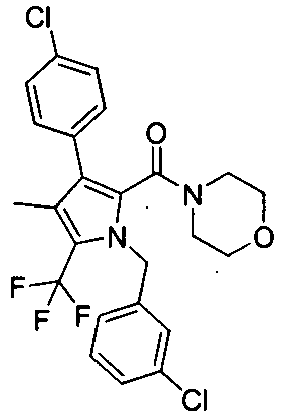
[3-(4-Chlorophenyl)-1-[(3-chlorophenyl)-methyl]-4-methyl-5-(trifluoromethyl)-1H-pyrrol-2-yl]-morpholin-4-yl-methanone see below SC-26 
[1-Benzyl-3-(4-chlorophenyl)-4-methyl-5-(trifluoromethyl)-1H-pyrrol-2-yl]-(1,1-dioxo-[1,4]thiazinan-4-yl)-methanone see below SC-29 
[1-Benzyl-3-(4-chlorophenyl)-4-methyl-5-(trifluoromethyl)-1H-pyrrol-2-yl]-(3,3-dimethyl-piperazin-1-yl)-methanone GP-1 109 mg (44%) SC-32 
[3-(4-Chlorophenyl)-1-(3-methoxyphenyl)-4-methyl-5-(trifluoromethyl)-1H-pyrrol-2-yl]-(3,3-difluoro-azetidin-1-yl)-methanone see below SC-33 
[1-(3-Chlorophenyl)-3-(4-chlorophenyl)-4-methyl-5-(trifluoromethyl)-1H-pyrrol-2-yl]-(3,3-difluoro-azetidin-1-yl)-methanone see below SC-34 
1-Benzyl-3-(4-chlorophenyl)-N-cyclopropyl-N,4-dimethyl-5-(trifluoromethyl)-1H-pyrrole-2-carboxylic acid amide GP-1 51 mg (45%) SC-35 
1-Benzyl-3-(4-chlorophenyl)-N-cyclopropyl-4-methyl-5-(trifluoromethyl)-1H-pyrrole-2-carboxylic acid amide GP-2 64 mg (60%) SC-36 
1-benzyl-3-(4-chlorophenyl)-N-((1-methoxycyclopropyl)methyl)-4-methyl-5-(trifluoromethyl)-1H-pyrrole-2-carboxamide GP-1 49 mg (37%) SC-37 
N-(2-Acetylamino-ethyl)-1-benzyl-3-(4-chlorophenyl)-N,4-dimethyl-5-(trifluoromethyl)-1H-pyrrole-2-carboxylic acid amide see below SC-38 
1-Benzyl-3-(4-chlorophenyl)-N-[2-(methanesulfonamido)-ethyl]-N,4-dimethyl-5-(trifluoromethyl)-1H-pyrrole-2-carboxylic acid amide see below SC-39 
1-Benzyl-3-(4-chlorophenyl)-N,4-dimethyl-N-(1-methyl-piperidin-4-yl)-5-(trifluoromethyl)-1H-pyrrole-2-carboxylic acid amide GP-1 53 mg (36%) SC-40 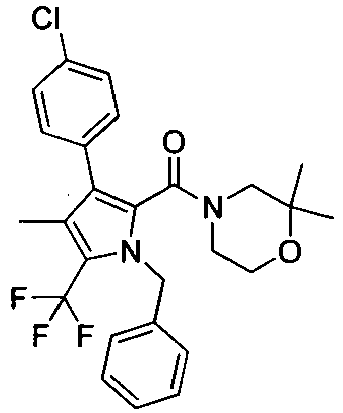
[1-Benzyl-3-(4-chlorophenyl)-4-methyl-5-(trifluoromethyl)-1 H-pyrrol-2-yl]-(2,2-dimethyl-morpholin-4-yl)-methanone GP-2 85 mg (68%) SC-41 
[1-Benzyl-3-(4-chlorophenyl)-5-(difluoro-methyl)-4-methyl-1 H-pyrrol-2-yl]-morpholin-4-yl-methanone see below SC-42 
1-Benzyl-3-(4-chlorophenyl)-5-(difluoro-methyl)-N-(2,2-dimethyl-propyl)-N,4-dimethyl-1H-pyrrole-2-carboxylic acid amide Prepared in analogy to SC-41 SC-44 
[1,3-Bis(4-chlorophenyl)-4-methyl-5-(trifluoromethyl)-13H-pyrrol-2-yl]-(3,3-difluoro-azetidin-1-yl)-methanone see below SC-48 
1-Benzyl-3-(4-chlorophenyl)-N-[1-(hydroxymethyl)-cyclopropyl]-N,4-dimethyl-5-(trifluoromethyl)-1H-pyrrole-2-carboxylic acid amide see below SC-49 
1-Benzyl-N-(1-carbamoyl-cyclopropyl)-3-(4-chlorophenyl)-N,4-dimethyl-5-(trifluoromethyl)-1H-pyrrole-2-carboxylic acid amide see below SC-50 
4-[1-Benzyl-3-(4-chlorophenyl)-4-methyl-5-(trifluoromethyl)-1H-pyrrole-2-carbonyl]-morpholin-2-one see below SC-51 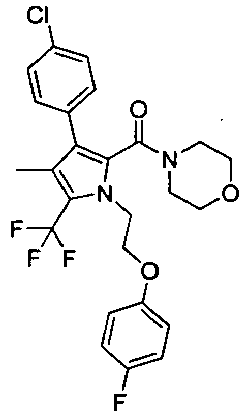
[3-(4-Chlorophenyl)-1-[2-(4-fluoro-phenoxy)-ethyl]-4-methyl-5-(trifluoromethyl)-1H-pyrrol-2-yl]-morpholin-4-yl-methanone see below SC-52 
1-[[1-Benzyl-3-(4-chlorophenyl)-4-methyl-5-(trifluoromethyl)-1H-pyrrole-2-carbonyl]-methyl-amino]-cyclopropane-1-carboxylic acid ethyl ester see below SC-53 
3-(4-Chlorophenyl)-1-[(3-chlorophenyl)-methyl]-N-(2,2-dimethyl-propyl)-N,4-dimethyl-5-(trifluoromethyl)-1H-pyrrole-2-carboxylic acid amide GP-1 130 mg (63%) SC-54 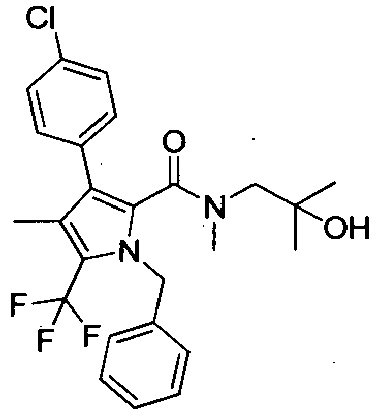
1-Benzyl-3-(4-chlorophenyl)-N-(2-hydroxy-2-methyl-propyl)-N,4-dimethyl-5-(trifluoromethyl)-1H-pyrrole-2-carboxylic acid amide GP-2 178 mg (73%) SC-55 
4-[3-(4-Chlorophenyl)-1-[(3-chlorophenyl)-methyl]-4-methyl-5-(trifluoromethyl)-1H-pyrrole-2-carbonyl]-piperazin-2-one GP-2 116 mg (57%) SC-56 
3-(4-Chlorophenyl)-1-[(3-chlorophenyl)-methyl]-N,4-dimethyl-N-(2-methylsulfonylethyl)-5-(trifluoromethyl)-1H-pyrrole-2-carboxylic acid amide GP-2 120 mg (55%) SC-57 
3-(4-Chlorophenyl)-1-[(3-chlorophenyl)-methyl]-N-(2-hydroxy-2-methyl-propyl)-N,4-dimethyl-5-(trifluoromethyl)-1H-pyrrole-2-carboxylic acid amide GP-1 120 mg (58%) SC-58 
1-Benzyl-3-(4-chloro-2-fluorophenyl)-N-(2-hydroxy-2-methylpropyl)-N,4-dimethyl-5-(trifluoromethyl)-1H-pyrrole-2-carboxylic acid amide GP-1 145 mg (60%) SC-59 
1-Benzyl-3-(4-chloro-2-fluorophenyl)-N-(2,2-dimethylpropyl)-N,4-dimethyl-5-(trifluoromethyl)-1H-pyrrole-2-carboxylic acid amide GP-1 104 mg (43%) SC-60 
1-Benzyl-3-(4-chlorophenyl)-N,4-dimethyl-N-[(3-methyl-oxetan-3-yl)-methyl]-5-(trifluoromethyl)-1H-pyrrole-2-carboxylic acid amide GP-2 123 mg (57%) SC-61 
4-[1-Benzyl-3-(4-chloro-2-fluoro-phenyl)-4-methyl-5-(trifluoromethyl)-1H-pyrrole-2-carbonyl]-piperazin-2-one GP-2 108 mg (45%) SC-62 
[1-Benzyl-3-(4-chloro-2-fluorophenyl)-4-methyl-5-(trifluoromethyl)-1H-pyrrol-2-yl]-morpholin-4-yl-methanone GP-2 125 mg (54%) SC-63 
1-Benzyl-3-(4-chlorophenyl)-N-(1,1-dioxo-thiolan-3-yl)-N,4-dimethyl-5-(trifluoromethyl)-1H-pyrrole-2-carboxylic acid amide GP-1 138 mg (58%) SC-64 
1-Benzyl-3-(4-chloro-2-fluorophenyl)-N,4-dimethyl-N-(2-methylsulfonyl-ethyl)-5-(trifluoromethyl)-1H-pyrrole-2-carboxylic acid amide GP-2 86 mg (33%) SC-65 
1-Benzyl-3-(4-chlorophenyl)-N-[(1-hydroxy-cyclopropyl)-methyl]-N,4-dimethyl-5-(trifluoromethyl)-1H-pyrrole-2-carboxylic acid amide GP-1 40 mg (15%) SC-66 
4-[1-Benzyl-3-(4-chlorophenyl)-5-(trifluoromethyl)-1H-pyrrole-2-carbonyl]-piperazin-2-one GP-2 88 mg (72%) SC-67 
1-Benzyl-3-(4-chlorophenyl)-N-methyl-N-(2-methylsulfonylethyl)-5-(trifluoromethyl)-1H-pyrrole-2-carboxylic acid amide GP-1 108 mg (81%) SC-68 
1-Benzyl-3-(4-chlorophenyl)-N-(2-hydroxy-2-methyl-propyl)-N-methyl-5-(trifluoromethyl)-1H-pyrrole-2-carboxylic acid amide GP-1 94 mg (75%) SC-69 
3-(4-Chlorophenyl)-1-[(3-chlorophenyl)-methyl]-N-methyl-N-(2-methylsulfonyl-ethyl)-5-(trifluoromethyl)-1H-pyrrole-2-carboxylic acid amide GP-2 51 mg (40%) SC-70 
3-(4-Chlorophenyl)-1-[(3-chlorophenyl)-methyl]-N-(2-hydroxy-2-methyl-propyl)-N-methyl-5-(trifluoromethyl)-1H-pyrrole-2-carboxylic acid amide GP-2 51 mg (42%) SC-71 
3-(4-Chlorophenyl)-1-[(3-chlorophenyl)-methyl]-N-(2,2-dimethyl-propyl)-N-methyl-5-(trifluoromethyl)-1H-pyrrole-2-carboxylic acid amide GP-2 35 mg (29%) SC-72 
[1-Benzyl-3-(4-chlorophenyl)-5-(trifluoromethyl)-1H-pyrrol-2-yl]-(3-hydroxy-azetidin-1-yl)-methanone GP-1 82 mg (70%) SC-73 
1-Benzyl-3-(4-chlorophenyl)-N-methyl-N-tetrahydro-pyran-4-yl-5-(trifluoromethyl)-1H-pyrrole-2-carboxylic acid amide GP-2 65 mg (39%) SC-74 
[3-(4-Chlorophenyl)-1-[(3-chlorophenyl)-methyl]-5-(trifluoromethyl)-1 H-pyrrol-2-yl]-morpholin-4-yl-methanone GP-2 47 mg (40%) SC-75 
[1-Benzyl-3-(4-chlorophenyl)-5-(trifluoromethyl)-1H-pyrrol-2-yl]-(2,2-dimethyl-morpholin-4-yl)-methanone GP-2 58 mg (66%) SC-76 
1-Benzyl-3-(4-chlorophenyl)-N-(cyclopropyl-methyl)-N-methyl-5-(trifluoromethyl)-1H-pyrrole-2-carboxylic acid amide GP-1 34 mg (36%) SC-77 
1-Benzyl-N-tert-butyl-3-(4-chlorophenyl)-N-methyl-5-(trifluoromethyl)-1H-pyrrole-2-carboxylic acid amide GP-1 31 mg (15%) SC-78 
1-Benzyl-3-(4-chlorophenyl)-N-methyl-N-[(3-methyl-oxetan-3-yl)-methyl]-5-(trifluoromethyl)-1H-pyrrole-2-carboxylic acid amide GP-2 117 mg (70%) SC-79 
1-Benzyl-3-(4-chlorophenyl)-N-(3-hydroxy-2,2-dimethyl-propyl)-N-methyl-5-(trifluoromethyl)-1H-pyrrole-2-carboxylic acid amide GP-2 80 mg (63%) SC-80 
1-Benzyl-3-(4-chlorophenyl)-N,N-dimethyl-5-(trifluoromethyl)-1H-pyrrole-2-carboxylic acid amide GP-2 89 mg (83%) SC-81 
4-[3-(4-Chlorophenyl)-1-[(3-chlorophenyl)-methyl]-5-(trifluoromethyl)-1H-pyrrole-2-carbonyl]-piperazin-2-one GP-2 67 mg (56%) SC-82 
[1-Benzyl-3-(4-chlorophenyl)-5-(trifluoromethyl)-1H-pyrrol-2-yl]-(3,3-dimethyl-piperazin-1-yl)-methanone see below SC-83 
1-Benzyl-3-(4-chlorophenyl)-N-(1,1-dioxo-thiolan-3-yl)-N-methyl-5-(trifluoromethyl)-1H-pyrrole-2-carboxylic acid amide GP-1 45 mg (47%) SC-84 
1-Benzyl-3-(4-chlorophenyl)-N-(3,3-dimethyl-butyl)-N-methyl-5-(trifluoromethyl)-1H-pyrrole-2-carboxylic acid amide GP-1 68 mg (45%) SC-85 
1-Benzyl-3-(4-chlorophenyl)-N-methyl-N-(2-methyl-2-morpholin-4-yl-propyl)-5-(trifluoromethyl)-1H-pyrrole-2-carboxylic acid amide GP-1 43 mg (26%) SC-86 
[1-Benzyl-3-(4-chloro-2-fluoro-phenyl)-5-(trifluoromethyl)-1H-pyrrol-2-yl]-morpholin-4-yl-methanone GP-2 131 mg (93%) SC-87 
1-Benzyl-3-(4-chloro-2-fluorophenyl)-N-(2-hydroxy-2-methyl-propyl)-N-methyl-5-(trifluoromethyl)-1H-pyrrole-2-carboxylic acid amide GP-1 155 mg (85%) SC-88 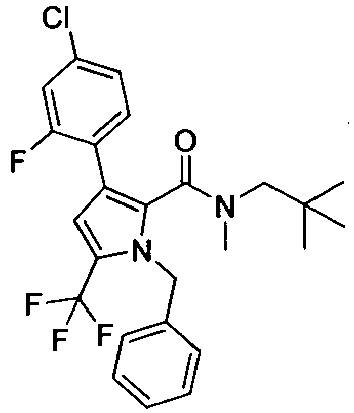
1-Benzyl-3-(4-chloro-2-fluorophenyl)-N-(2,2-dimethylpropyl)-N-methyl-5-(trifluoromethyl)-1H-pyrrole-2-carboxylic acid amide GP-1 82 mg (45%) SC-89 
4-[1-Benzyl-3-(4-chloro-2-fluoro-phenyl)-5-(trifluoromethyl)-1H-pyrrole-2-carbonyl]-piperazin-2-one GP-2 60 mg (41 %) SC-90 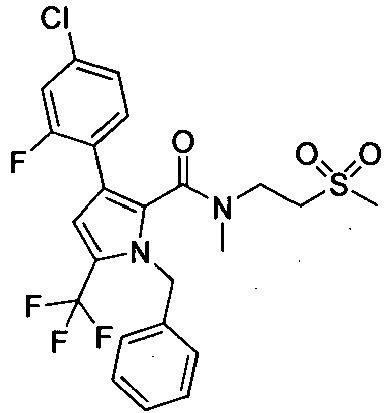
1-Benzyl-3-(4-chloro-2-fluorophenyl)-N-methyl-N-(2-methylsulfonyl-ethyl)-5-(trifluoromethyl)-1H-pyrrole-2-carboxylic acid amide GP-1 146 mg (74%) SC-92 
1-Benzyl-3-(4-chlorophenyl)-N-methyl-N-(2-methyl-2-methylsulfonyl-propyl)-5-(trifluoromethyl)-1H-pyrrole-2-carboxylic acid amide GP-1 49 mg (48%) SC-93 
[1-Benzyl-3-(4-chlorophenyl)-4-methyl-5-(trifluoromethyl)-1H-pyrrol-2-yl]-(3,3-difluoro-azetidin-1-yl)-methanone GP-3 40 mg (67%) SC-94 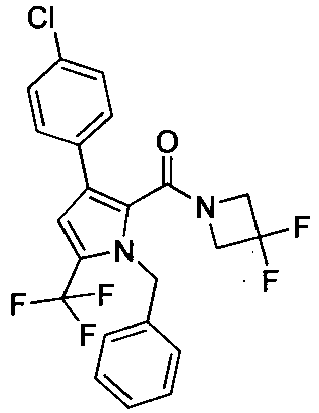
[1-Benzyl-3-(4-chlorophenyl)-5-(trifluoromethyl)-1H-pyrrol-2-yl]-(3,3-difluoro-azetidin-1-yl)-methanone GP-4 80 mg (67%) SC-95 
[1-Benzyl-3-(4-fluorophenyl)-4-methyl-5-(trifluoromethyl)-1H-pyrrol-2-yl]-(3,3-difluoro-azetidin-1-yl)-methanone GP-4 80 mg (67%) SC-96 
[1-Benzyl-4-methyl-5-(trifluoromethyl)-3-[4-(trifluoromethyl)-phenyl]-1H-pyrrol-2-yl]-(3,3-difluoro-azetidin-1-yl)-methanone GP-4 90 mg (77%) SC-97 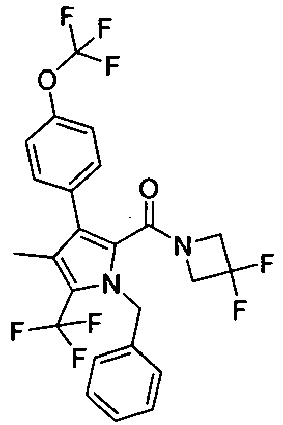
[1-Benzyl-4-methyl-5-(trifluoromethyl)-3-[4-(trifluoromethyloxy)-phenyl]-1H-pyrrol-2-yl]-(3,3-difluoro-azetidin-1-yl)-methanone GP-4 100 mg (85%) SC-98 
[1-Benzyl-3-(4-chloro-3-fluorophenyl)-4-methyl-5-(trifluoromethyl)-1H-pyrrol-2-yl]-(3,3-difluoro-azetidin-1-yl)-methanone GP-4 60 mg (51%) SC-99 
[1-Benzyl-3-(3-chloro-4-fluorophenyl)-4-methyl-5-(trifluoromethyl)-1H-pyrrol-2-yl]-(3,3-difluoro-azetidin-1-yl)-methanone GP-4 90 mg (76%) SC-100 
[1-Benzyl-3-(4-chloro-2-fluoro-phenyl)-4-methyl-5-(trifluoromethyl)-1H-pyrrol-2-yl]-(3,3-difluoro-azetidin-1-yl)-methanone GP-4 80 mg (68%) SC-101 
[1-Benzyl-3-(4-fluorophenyl)-4-methyl-5-(trifluoromethyl)-1H-pyrrol-2-yl]-morpholin-4-yl-methanone GP-4 90 mg (76%) SC-102 
[1-Benzyl-4-methyl-5-(trifluoromethyl)-3-[4-(trifluoromethyl)-phenyl]-1H-pyrrol-2-yl]-morpholin-4-yl-methanone GP-4 90 mg (77%) SC-103 
[1-Benzyl-3-(4-chloro-3-fluorophenyl)-4-methyl-5-(trifluoromethyl)-1H-pyrrol-2-yl]-morpholin-4-yl-methanone GP-4 80 mg (68%) SC-104 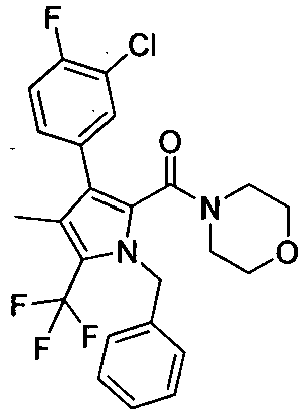
[1-Benzyl-3-(3-chloro-4-fluorophenyl)-4-methyl-5-(trifluoromethyl)-1H-pyrrol-2-yl]-morpholin-4-yl-methanone GP-4 90 mg (77%) SC-105 
[1-Benzyl-4-methyl-5-(trifluoromethyl)-3-[4-(trifluoromethyloxy)-phenyl]-1H-pyrrol-2-yl]-morpholin-4-yl-methanone GP-4 70 mg (60%) SC-106 
1-Benzyl-3-(4-chlorophenyl)-N-(3-hydroxy-2,2-dimethylpropyl)-N,4-dimethyl-5-(trifluoromethyl)-1H-pyrrole-2-carboxylic acid amide GP-4 110 mg (73%) SC-107 
1-Benzyl-3-(4-chloro-2-fluorophenyl)-N-(3-hydroxy-2,2-dimethyl-propyl)-N,4-dimethyl-5-(trifluoromethyl)-1H-pyrrole-2-carboxylic acid amide GP-4 40 mg (32%) SC-108 
1-Benzyl-3-(4-fluorophenyl)-N-(2-hydroxy-2-methyl-propyl)-N,4-dimethyl-5-(trifluoromethyl)-1H-pyrrole-2-carboxylic acid amide GP-4 130 mg (88%) SC-109 
1-Benzyl-N-(2-hydroxy-2-methyl-propyl)-N,4-dimethyl-5-(trifluoromethyl)-3-[4-(trifluoromethyl)-phenyl]-1H-pyrrole-2-carboxylic acid amide GP-4 110mg (76%) SC-110 
1-Benzyl-N-(2-hydroxy-2-methyl-propyl)-N,4-dimethyl-5-(trifluoromethyl)-3-[4-(trifluoromethyloxy)-phenyl]-1H-pyrrole-2-carboxylic acid amide GP-4 110 mg (76%) SC-111 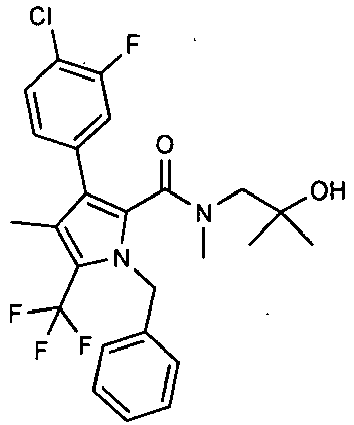
1-Benzyl-3-(4-chloro-3-fluorophenyl)-N-(2-hydroxy-2-methyl-propyl)-N,4-dimethyl-5-(trifluoromethyl)-1H-pyrrole-2-carboxylic acid amide GP-4 120 mg (83%) SC-112 
1-Benzyl-3-(3-chloro-4-fluorophenyl)-N-(2-hydroxy-2-methylpropyl)-N,4-dimethyl-5-(trifluoromethyl)-1H-pyrrole-2-carboxylic acid amide GP-4 110 mg (76%) SC-113 
1-Benzyl-3-(4-chlorophenyl)-N-(3-hydroxy-3-methyl-butyl)-N,4-dimethyl-5-(trifluoromethyl)-1 H-pyrrole-2-carboxylic acid amide GP-4 110 mg (88%) SC-114 
1-Benzyl-3-(4-chlorophenyl)-N-(3-hydroxy-2,2-dimethyl-propyl)-4-methyl-5-(trifluoromethyl)-1H-pyrrole-2-carboxylic acid amide GP-4 100 mg (82%) SC-115 
1-Benzyl-3-(4-chlorophenyl)-N-[[1-(hydroxymethyl)-cyclopropyl]-methyl]-N,4-dimethyl-5-(trifluoromethyl)-1H-pyrrole-2-carboxylic acid amide GP-4 100 mg (80%) SC-116 
1-Benzyl-3-(4-chlorophenyl)-N-[[1-(hydroxymethyl)-cyclobutyl]-methyl]-N,4-dimethyl-5-(trifluoromethyl)-1H-pyrrole-2-carboxylic acid amide GP-4 80 mg (62%) SC-117 
[1-Benzyl-3-(4-chlorophenyl)-4-methyl-5-(trifluoromethyl)-1H-pyrrol-2-yl]-[3-(hydroxymethyl)-pyrrolidin-1-yl]-methanone GP-4 140 mg (58%) SC-118 
1-Benzyl-3-(4-chlorophenyl)-N-(2,2-dimethyl-3-morpholin-4-yl-propyl)-N,4-dimethyl-5-(trifluoromethyl)-1H-pyrrole-2-carboxylic acid amide GP-4 120 mg (84%) SC-119 
1-Benzyl-3-(4-chlorophenyl)-N-(2,2-dimethyl-propyl)-4-ethyl-N-methyl-5-(trifluoromethyl)-1H-pyrrole-2-carboxylic acid amide see below SC-120 
1-Benzyl-3-(4-chlorophenyl)-4-cyclopropyl-N-(2,2-dimethylpropyl)-N-methyl-5-(trifluoromethyl)-1H-pyrrole-2-carboxylic acid amide see below SC-121 
1-Benzyl-3-(4-chlorophenyl)-N,4-dimethyl-N-(tetrahydrofuran-3-yl-methyl)-5-(trifluoromethyl)-1H-pyrrole-2-carboxylic acid amide GP-4 100 mg (80%) SC-122 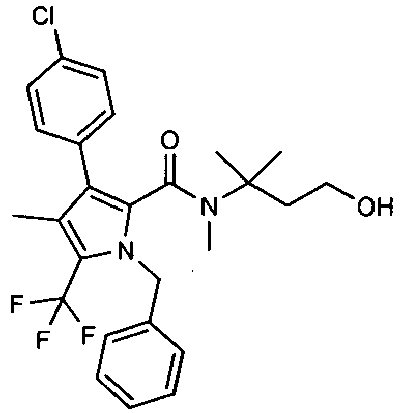
1-Benzyl-3-(4-chlorophenyl)-N-(3-hydroxy-1,1-dimethylpropyl)-N,4-dimethyl-5-(trifluoromethyl)-1H-pyrrole-2-carboxylic acid amide GP-5 110 mg (59%) SC-123 
[1-Benzyl-3-(4-chlorophenyl)-4-methyl-5-(trifluoromethyl)-1H-pyrrol-2-yl]-(3-methylsulfonyl-pyrrolidin-1-yl)-methanone GP-4 90 mg (84%) SC-124 
1-Benzyl-3-(4-chlorophenyl)-N-[1-(hydroxymethyl)-2,2-dimethyl-propyl]-N,4-dimethyl-5-(trifluoromethyl)-1H-pyrrole-2-carboxylic acid amide GP-3 110 mg (57%) SC-125 
1-Benzyl-3-(4-chlorophenyl)-N-[3-hydroxy-2-(hydroxymethyl)-2-methyl-propyl]-N,4-dimethyl-5-(trifluoromethyl)-1H-pyrrole-2-carboxylic acid amide GP-3 140 mg (72%) SC-126 
1-Benzyl-3-(4-chlorophenyl)-N-(2-hydroxy-1,1-dimethyl-ethyl)-N,4-dimethyl-5-(trifluoromethyl)-1H-pyrrole-2-carboxylic acid amide GP-3 130 mg (71%) SC-127 
1-Benzyl-3-(4-chlorophenyl)-N,4-dimethyl-N-(3-methylsulfonyl-propyl)-5-(trifluoromethyl)-1H-pyrrole-2-carboxylic acid amide GP-4 100 mg (78%) SC-128 
1-Benzyl-3-(4-chlorophenyl)-N-ethyl-4-methyl-N-(2-methylsulfonyl-ethyl)-5-(trifluoromethyl)-1H-pyrrole-2-carboxylic acid amide GP-4 35 mg (26%) SC-129 
1-Benzyl-3-(4-chlorophenyl)4-methyl-N-(2-methylsulfonyl-ethyl)-5-(trifluoromethyl)-1H-pyrrole-2-carboxylic acid amide GP-4 110 mg (88%) SC-130 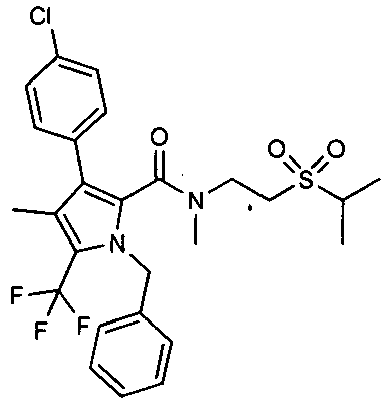
1-Benzyl-3-(4-chlorophenyl)-N-[2-(isopropylsulfonyl)-ethyl]-N,4-dimethyl-5-(trifluoromethyl)-1H-pyrrole-2-carboxylic acid amide GP-4 110 mg (78%) SC-131 
1-Benzyl-3-(4-chlorophenyl)-N-(1,1-dioxo-thian-4-yl)-N,4-dimethyl-5-(trifluoromethyl)-1H-pyrrole-2-carboxylic acid amide GP-4 15 mg (11%) SC-132 
1-Benzyl-3-(4-chlorophenyl)-N-[2-(ethylsulfonyl)-ethyl]-N,4-dimethyl-5-(trifluoromethyl)-1H-pyrrole-2-carboxylic acid amide GP-4 70 mg (53%) SC-133 
1-Benzyl-3-(4-chlorophenyl)-N,4-dimethyl-N-(2-tetrahydrofuran-2-yl-ethyl)-5-(trifluoromethyl)-1H-pyrrole-2-carboxylic acid amide GP-4 90 mg (67%) SC-134 
1-Benzyl-3-(4-chlorophenyl)-N,4-dimethyl-N-(tetrahydrofuran-2-yl-methyl)-5-(trifluoromethyl)-1H-pyrrole-2-carboxylic acid amide GP-4 100 mg (78%) SC-135 
1-Benzyl-3-(4-chlorophenyl)-N-[[(1S,2S)-2-hydroxycyclopentyl]-methyl]-N,4-dimethyl-5-(trifluoromethyl)-1H-pyrrole-2-carboxylic acid amide and 1-Benzyl-3-(4-chlorophenyl)-N-[[(1R,2R)-2-hydroxy-cyclopentyl]-methyl]-N,4-dimethyl-5-(trifluoromethyl)-1H-pyrrole-2-carboxylic acid amide GP-4 40 mg (31%) SC-136 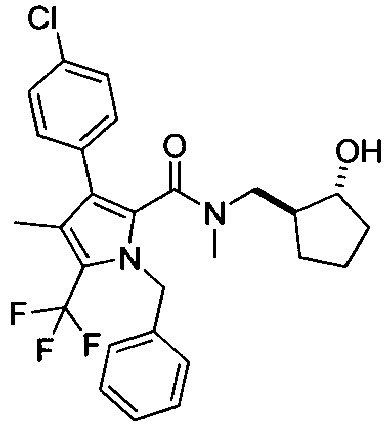
1-Benzyl-3-(4-chlorophenyl)-N-[[(1S,2R)-2-hydroxy-cyclopentyl]-methyl]-N,4-dimethyl-5-(trifluoromethyl)-1H-pyrrole-2-carboxylic acid amide and 1-Benzyl-3-(4-chlorophenyl)-N-[[(1R,2S)-2-hydroxy-cyclopentyl]-methyl]-N,4-dimethyl-5-(trifluoromethyl)-1H-pyrrole-2-carboxylic acid amide GP-4 30 mg (23%) SC-137 
[1-Benzyl-3-(4-chlorophenyl)-4-methyl-5-(trifluoromethyl)-1H-pyrrol-2-yl]-(3-methylsulfonyl-azetidin-1-yl)-methanone GP-4 100 mg (74%) SC-138 
1-Benzyl-3-(4-chlorophenyl)-N,4-dimethyl-N-(tetrahydropyran-2-yl-methyl)-5-(trifluoromethyl)-1H-pyrrole-2-carboxylic acid amide GP-6 100 mg (75%) SC-139 
1-Benzyl-3-(4-chlorophenyl)-N-[2,2-dimethyl-3-[methyl-(2-pyrrolidin-1-yl-ethyl)-amino]-propyl]-N,4-dimethyl-5-(trifluoromethyl)-1H-pyrrole-2-carboxylic acid amide GP-4 110 mg (72%) SC-140 
1-Benzyl-3-(4-chlorophenyl)-N,4-dimethyl-N-[(3-methyl-isoxazol-5-yl)-methyl]-5-(trifluoromethyl)-1H-pyrrole-2-carboxylic acid amide GP-6 67 mg (53%) SC-141 
1-Benzyl-3-(4-chlorophenyl)-N,4-dimethyl-N-(1-methyl-2-methylsulfonyl-ethyl)-5-(trifluoromethyl)-1H-pyrrole-2-carboxylic acid amide GP-4 86 mg (64%) SC-142 
1-Benzyl-3-(4-chlorophenyl)-N,4-dimethyl-N-[(5-methyl-isoxazol-3-yl)-methyl]-5-(trifluoromethyl)-1H-pyrrole-2-carboxylic acid amide GP-4 90 mg (71%) SC-143 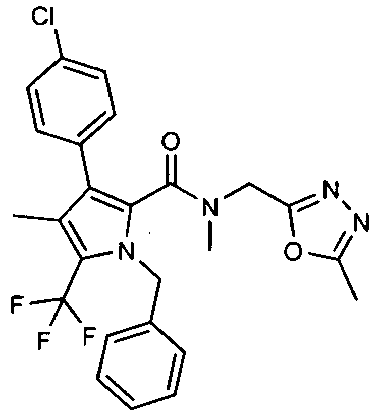
1-Benzyl-3-(4-chlorophenyl)-N,4-dimethyl-N-[(5-methyl-[1,3,4]oxadiazol-2-yl)-methyl]-5-(trifluoromethyl)-1H-pyrrole-2-carboxylic acid amide GP-4 55 mg (43%) SC-144 
1-Benzyl-3-(4-chlorophenyl)-N,4-dimethyl-N-(pyrimidin-4-yl-methyl)-5-(trifluoromethyl)-1H-pyrrole-2-carboxylic acid amide GP-4 62 mg (49%) SC-145 
[1-Benzyl-3-(4-chlorophenyl)-4-methyl-5-(trifluoromethyl)-1H-pyrrol-2-yl]-(4-methoxypiperidin-1-yl)-methanone GP-4 80 mg (64%) SC-146 
1-Benzyl-3-(4-chlorophenyl)-N,4-dimethyl-N-(pyrazin-2-yl-methyl)-5-(trifluoromethyl)-1H-pyrrole-2-carboxylic acid amide GP-4 110 mg (85%) SC-147 
1-Benzyl-3-(4-chlorophenyl)-N-[(2-dimethylamino-pyrimidin-4-yl)-methyl]-N,4-dimethyl-5-(trifluoromethyl)-1H-pyrrole-2-carboxylic acid amide GP-4 110 mg (76%) SC-148 
1-Benzyl-3-(4-chlorophenyl)-N,4-dimethyl-N-[(1-methyl-1H-imidazol-2-yl)-methyl]-5-(trifluoromethyl)-1H-pyrrole-2-carboxylic acid amide GP-4 110 mg (85%) SC-149 
1-Benzyl-3-(4-chlorophenyl)-N-isopropyl-N,4-dimethyl-5-(trifluoromethyl)-1H-pyrrole-2-carboxylic acid amide GP-4 80 mg (47%) SC-150 
1-Benzyl-3-(4-chlorophenyl)-N-isopropyl-4-methyl-5-(trifluoromethyl)-1H-pyrrole-2-carboxylic acid amide GP-4 70 mg (42%) SC-151 
1-Benzyl-3-(4-chlorophenyl)-N,4-dimethyl-N-[(5-methyl-pyrazin-2-yl)-methyl]-5-(trifluoromethyl)-1H-pyrrole-2-carboxylic acid amide GP-4 120 mg (91%) SC-152 
1-Benzyl-3-(4-chlorophenyl)-N-[(2-dimethylamino-pyrimidin-5-yl)-methyl]-N,4-dimethyl-5-(trifluoromethyl)-1H-pyrrole-2-carboxylic acid amide GP-4 110 mg (76%) SC-153 
1-[4-[1-Benzyl-3-(4-chlorophenyl)-4-methyl-5-(trifluoromethyl)-1H-pyrrole-2-carbonyl]-piperazin-1-yl]-ethanone GP-4 100 mg (78%) SC-154 
[1-Benzyl-3-(4-chloro-2-fluorophenyl)-4-methyl-5-(trifluoromethyl)-1H-pyrrol-2-yl]-(3-hydroxy-azetidin-1-yl)-methanone GP-4 50 mg (44%) SC-155 
[1-Benzyl-3-(4-chloro-2-fluorophenyl)-4-methyl-5-(trifluoromethyl)-1H-pyrrol-2-yl]-(2,2-dimethyl-morpholin-4-yl)-methanone GP-4 100 mg (81%) SC-156 
1-Benzyl-3-(4-chloro-2-fluorophenyl)-N,4-dimethyl-N-tetrahydro-pyran-4-yl-5-(trifluoromethyl)-1H-pyrrole-2-carboxylic acid amide GP-5 70 mg (57%) SC-158 
1-Benzyl-3-(4-chloro-2-fluorophenyl)-4-methyl-5-(trifluoromethyl)-N-[(1R)-1,2,2-trimethyl-propyl]-1H-pyrrole-2-carboxylic acid amide GP-4 190 mg (75%) SC-159 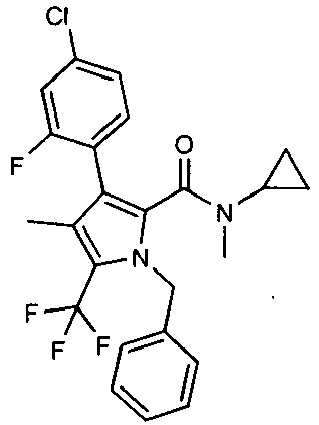
1-Benzyl-3-(4-chloro-2-fluoro-phenyl)-N-cyclopropyl-N,4-dimethyl-5-(trifluoromethyl)-1H-pyrrole-2-carboxylic acid amide GP-4 50 mg (44%) SC-160 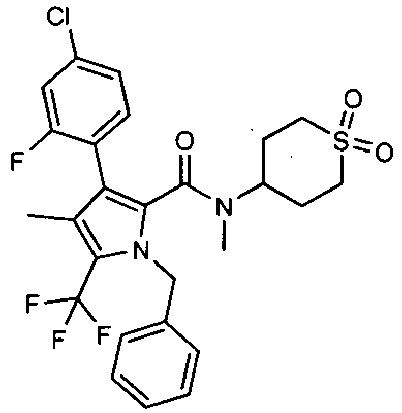
1-Benzyl-3-(4-chloro-2-fluorophenyl)-N-(1,1-dioxo-thian-4-yl)-N,4-dimethyl-5-(trifluoromethyl)-1H-pyrrole-2-carboxylic acid amide GP-4 25 mg (18%) SC-161 
1-Benzyl-3-(4-chloro-2-fluorophenyl)-N,4-dimethyl-N-(3-methylsulfonyl-propyl)-5-(trifluoromethyl)-1H-pyrrole-2-carboxylic acid amide GP-4 90 mg (68%) SC-162 
[1-Benzyl-3-(4-chloro-2-fluoro-phenyl)-4-methyl-5-(trifluoromethyl)-1H-pyrrol-2-yl]-[2-(methylsulfonyl-methyl)-pyrrolidin-1-yl]-methanone GP-4 130 mg (96%) SC-163 
1-Benzyl-3-(4-chloro-2-fluorophenyl)-4-methyl-N-(2-methylsulfonyl-ethyl)-5-(trifluoromethyl)-1H-pyrrole-2-carboxylic acid amide GP-4 120 mg (96%) SC-164 
1-Benzyl-3-(4-chloro-2-fluorophenyl)-N,4-dimethyl-N-(2-tetrahydro-furan-2-yl-ethyl)-5-(trifluoromethyl)-1H-pyrrole-2-carboxylic acid amide GP-4 100 mg (76%) SC-165 
1-Benzyl-3-(4-chloro-2-fluorophenyl)-N,4-dimethyl-N-(tetrahydro-furan-2-yl-methyl)-5-(trifluoromethyl)-1H-pyrrole-2-carboxylic acid amide GP-4 92 mg (74%) SC-166 
[1-Benzyl-3-(4-chloro-2-fluorophenyl)-4-methyl-5-(trifluoromethyl)-1H-pyrrol-2-yl]-[3-(hydroxymethyl)-pyrrolidin-1-yl]-methanone GP-4 50 mg (42%) SC-167 
1-Benzyl-3-(4-chloro-2-fluorophenyl)-N,4-dimethyl-N-(tetrahydro-furan-3-yl-methyl)-5-(trifluoromethyl)-1H-pyrrole-2-carboxylic acid amide GP-6 60 mg (61%) SC-168 
1-Benzyl-3-(4-chloro-2-fluorophenyl)-N,4-dimethyl-N-(2-methyl-2-methylsulfonyl-propyl)-5-(trifluoromethyl)-1H-pyrrole-2-carboxylic acid amide GP-6 40 mg (37%) SC-169 
1-Benzyl-3-(4-chloro-2-fluorophenyl)-N-isopropyl-4-methyl-N-(2-methylsulfonyl-ethyl)-5-(trifluoromethyl)-1H-pyrrole-2-carboxylic acid amide GP-6 50 mg (37%) SC-170 
[1-Benzyl-3-(4-chloro-2-fluorophenyl)-4-methyl-5-(trifluoromethyl)-1H-pyrrol-2-yl]-(2,2-dimethyl-1,1-dioxo-[1,4]thiazinan-4-yl)-methanone GP-6 25 mg (18%) SC-171 
1-Benzyl-3-(4-chloro-2-fluorophenyl)-N-(1,1-dioxo-thiolan-3-yl)-N,4-dimethyl-5-(trifluoromethyl)-1H-pyrrole-2-carboxylic acid amide GP-4 50 mg (38%) SC-172 
1-Benzyl-3-(4-chloro-2-fluorophenyl)-N-cyclopropyl-4-methyl-5-(trifluoromethyl)-1H-pyrrole-2-carboxylic acid amide GP-4 83 mg (76%) SC-173 
[1-Benzyl-3-(4-chloro-2-fluorophenyl)-4-methyl-5-(trifluoromethyl)-1H-pyrrol-2-yl]-(1,1-dioxo-[1,4]thiazinan-4-yl)-methanone see below 32 mg (25%) SC-174 
1-Benzyl-N-(2-carbamoyl-2-methyl-propyl)-3-(4-chlorophenyl)-N-methyl-5-(trifluoromethyl)-1H-pyrrole-2-carboxylic acid amide see below SC-175 
N-(2-Amino-2-methyl-propyl)-1-benzyl-3-(4-chlorophenyl)-N-methyl-5-(trifluoromethyl)-1H-pyrrole-2-carboxylic acid amide GP-4 SC-176 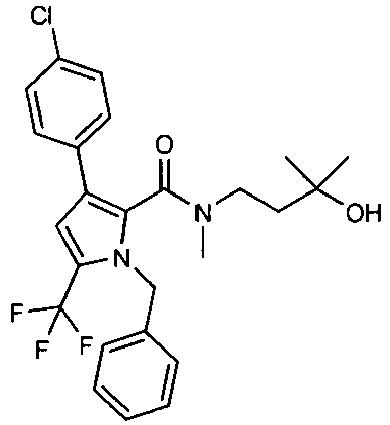
1-Benzyl-3-(4-chlorophenyl)-N-(3-hydroxy-3-methyl-butyl)-N-methyl-5-(trifluoromethyl)-1H-pyrrole-2-carboxylic acid amide GP-4 90 mg (71%) SC-177 
1-Benzyl-3-(4-chlorophenyl)-N-(3-hydroxy-2,2-dimethylpropyl)-5-(trifluoromethyl)-1H-pyrrole-2-carboxylic acid amide GP-4 40 mg (33%) SC-178 
1-Benzyl-3-(4-chlorophenyl)-N-[[1-(hydroxymethyl)-cyclopropyl]-methyl]-N-methyl-5-(trifluoromethyl)-1H-pyrrole-2-carboxylic acid amide GP-4 70 mg (56%) SC-179 
1-Benzyl-3-(4-chlorophenyl)-N-[[1-(hydroxymethyl)-cyclobutyl]-methyl]-N-methyl-5-(trifluoromethyl)-1H-pyrrole-2-carboxylic acid amide GP-4 80 mg (62%) SC-180 
1-Benzyl-3-(4-chlorophenyl)-N-(2,2-dimethyl-3-morpholin-4-yl-propyl)-N-methyl-5-(trifluoromethyl)-1H-pyrrole-2-carboxylic acid amide GP-4 120 mg (83%) SC-181 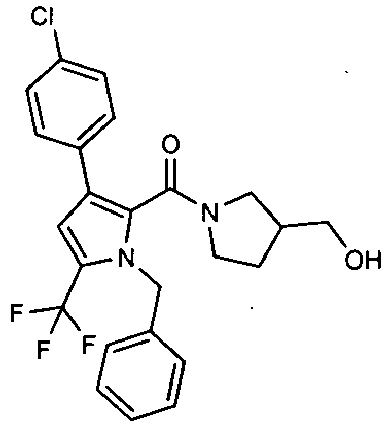
[1-Benzyl-3-(4-chlorophenyl)-5-(trifluoromethyl)-1H-pyrrol-2-yl]-[3-(hydroxymethyl)-pyrrolidin-1-yl]-methanone GP-4 50 mg (41%) SC-182 
1-Benzyl-3-(4-chlorophenyl)-N-methyl-N-(tetrahydro-furan-3-yl-methyl)-5-(trifluoromethyl)-1H-pyrrole-2-carboxylic acid amide GP-5 120 mg (96%) SC-183 
1-Benzyl-3-(4-chlorophenyl)-N-[3-hydroxy-2-(hydroxymethyl)-2-methyl-propyl]-N-methyl-5-(trifluoromethyl)-1H-pyrrole-2-carboxylic acid amide GP-5 90 mg (46%) SC-184 
1-Benzyl-3-(4-chlorophenyl)-N-(3-hydroxy-1,1-dimethylpropyl)-N-methyl-5-(trifluoromethyl)-1H-pyrrole-2-carboxylic acid amide GP-4 70 mg (37%) SC-185 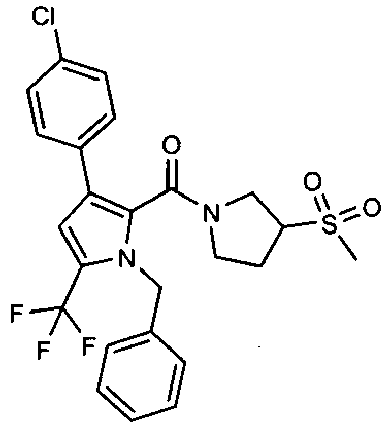
[1-Benzyl-3-(4-chlorophenyl)-5-(trifluoromethyl)-1H-pyrrol-2-yl]-(3-methylsulfonyl-pyrrolidin-1-yl)-methanone GP-6 70 mg (65%) SC-186 
1-Benzyl-3-(4-chlorophenyl)-N-[1-(hydroxymethyl)-2,2-dimethyl-propyl]-N-methyl-5-(trifluoromethyl)-1H-pyrrole-2-carboxylic acid amide see below 80 mg (41%) SC-187 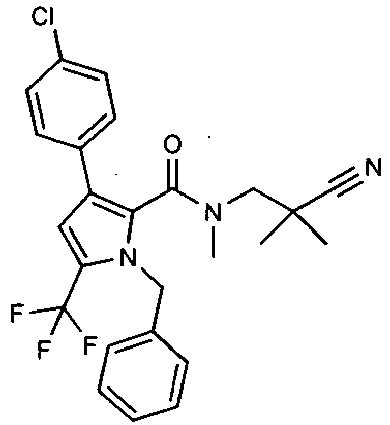
1-Benzyl-3-(4-chlorophenyl)-N-(2-cyano-2-methyl-propyl)-N-methyl-5-(trifluoromethyl)-1H-pyrrole-2-carboxylic acid amide see below SC-188 
N-(3-Amino-2,2-dimethyl-propyl)-1-benzyl-3-(4-chlorophenyl)-N-methyl-5-(trifluoromethyl)-1H-pyrrole-2-carboxylic acid amide GP-4 SC-189 
1-Benzyl-3-(4-chlorophenyl)-N-methyl-N-(3-methylsulfonyl-propyl)-5-(trifluoromethyl)-1H-pyrrole-2-carboxylic acid amide GP-4 100 mg (72%) SC-190 
1-Benzyl-3-(4-chlorophenyl)-N-ethyl-N-(2-methylsulfonylethyl)-5-(trifluoromethyl)-1H-pyrrole-2-carboxylic acid amide GP-4 70 mg (48%) SC-191 
1-Benzyl-3-(4-chlorophenyl)-N-(2-methylsulfonyl-ethyl)-5-(trifluoromethyl)-1H-pyrrole-2-carboxylic acid amide GP-4 90 mg (72%) SC-192 
1-Benzyl-3-(4-chlorophenyl)-N-[2-(ethylsulfonyl)-ethyl]-N-methyl-5-(trifluoromethyl)-1H-pyrrole-2-carboxylic acid amide GP-4 90 mg (65%) SC-193 
1-Benzyl-3-(4-chlorophenyl)-N-(1,1-dioxo-thian-4-yl)-N-methyl-5-(trifluoromethyl)-1H-pyrrole-2-carboxylic acid amide GP-4 30 mg (19%) SC-194 
1-Benzyl-3-(4-chlorophenyl)-N-[2-(isopropylsulfonyl)-ethyl]-N-methyl-5-(trifluoromethyl)-1H-pyrrole-2-carboxylic acid amide GP-4 100 mg (69%) SC-195 
1-Benzyl-3-(4-chlorophenyl)-N-methyl-N-(2-tetrahydro-furan-2-yl-ethyl)-5-(trifluoromethyl)-1H-pyrrole-2-carboxylic acid amide GP-6 80 mg (61%) SC-196 
[1-Benzyl-3-(4-chlorophenyl)-5-(trifluoromethyl)-1H-pyrrol-2-yl]-(1,1-dioxo-[1,4]thiazinan-4-yl)-methanone GP-4 70 mg (36%) SC-197 
1-Benzyl-3-(4-chlorophenyl)-N-methyl-N-(tetrahydro-furan-2-yl-methyl)-5-(trifluoromethyl)-1H-pyrrole-2-carboxylic acid amide GP-6 110 mg (88%) SC-198 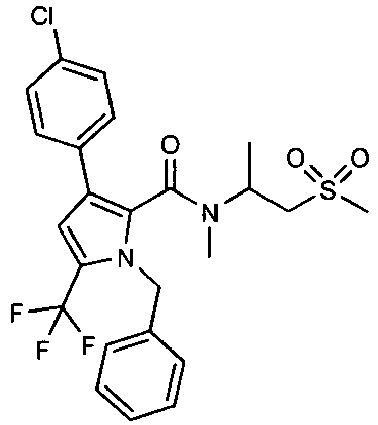
1-Benzyl-3-(4-chlorophenyl)-N-methyl-N-(1-methyl-2-methylsulfonyl-ethyl)-5-(trifluoromethyl)-1H-pyrrole-2-carboxylic acid amide GP-4 60 mg (47%) SC-199 
1-Benzyl-3-(4-chlorophenyl)-N-[[(1S,2S)-2-hydroxy-cyclopentyl]-methyl]-N-methyl-5-(trifluoromethyl)-1H-pyrrole-2-carboxylic acid amide and 1-Benzyl-3-(4-chlorophenyl)-N-[[(1R,2R)-2-hydroxy-cyclopenyl]-menthyl]-N-mentyl GP-4 70 mg (54%) SC-200 
1-Benzyl-3-(4-chlorophenyl)-N-[[(1S,2R)-2-hydroxycyclopentyl]-methyl]-N-methyl-5-(trifluoromethyl)-1H-pyrrole-2-carboxylic acid amide and 1-Benzyl-3-(4-chlorophenyl)-N-[[(1R,2S)-2-hydroxy-cyclopentyl]-methyl]-N-methyl GP-4 60 mg (46%) SC-201 
[1-Benzyl-3-(4-chlorophenyl)-5-(trifluoromethyl)-1H-pyrrol-2-yl]-(3-methylsulfonyl-azetidin-1-yl)-methanone GP-4 90 mg (70%) SC-202 
1-Benzyl-3-(4-chlorophenyl)-N-methyl-N-(tetrahydro-pyran-2-yl-methyl)-5-(trifluoromethyl)-1H-pyrrole-2-carboxylic acid amide GP-6 90 mg (71%) SC-203 
1-Benzyl-3-(4-chlorophenyl)-N-[2,2-dimethyl-3-[methyl-(2-pyrrolidin-1-yl-ethyl)-amino]-propyl]-N-methyl-5-(trifluoromethyl)-1H-pyrrole-2-carboxylic acid amide GP-4 120 mg (77%) SC-204 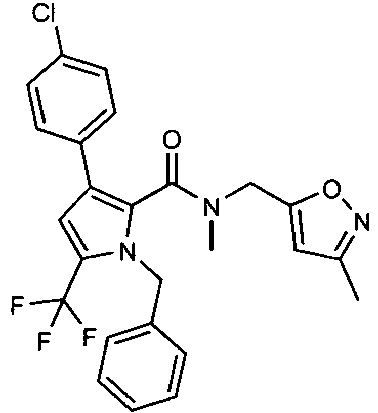
1-Benzyl-3-(4-chlorophenyl)-N-methyl-N-[(3-methyl-isoxazol-5-yl)-methyl]-5-(trifluoromethyl)-1H-pyrrole-2-carboxylic acid amide GP-4 73 mg (57%) SC-205 
1-Benzyl-3-(4-chlorophenyl)-N-methyl-N-[(5-methyl-isoxazol-3-yl)-methyl]-5-(trifluoromethyl)-1H-pyrrole-2-carboxylic acid amide GP-4 80 mg (62%) SC-206 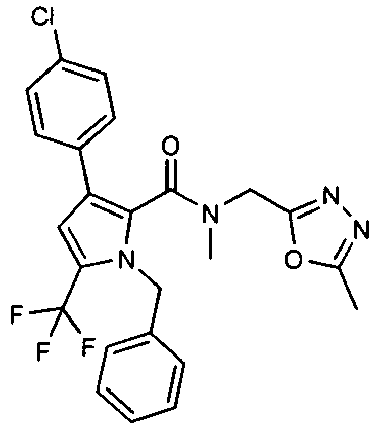
1-Benzyl-3-(4-chlorophenyl)-N-methyl-N-[(5-methyl-[1,3,4]oxadiazol-2-yl)-methyl]-5-(trifluoromethyl)-1H-pyrrole-2-carboxylic acid amide GP-4 46 mg (36%) SC-207 
1-Benzyl-3-(4-chlorophenyl)-N-methyl-N-(pyrimidin-4-yl-methyl)-5-(trifluoromethyl)-1H-pyrrole-2-carboxylic acid amide GP-4 65 mg (51%) SC-208 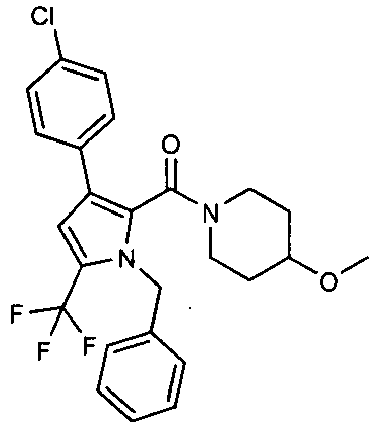
[1-Benzyl-3-(4-chlorophenyl)-5-(trifluoromethyl)-1H-pyrrol-2-yl]-(4-methoxy-piperidin-1-yl)-methanone GP-4 80 mg (64%) SC-209 
1-[4-[1-Benzyl-3-(4-chlorophenyl)-5-(trifluoromethyl)-1H-pyrrole-2-carbonyl]-piperazin-1-yl]-ethanone GP-4 70 mg (54%) SC-210 
1-Benzyl-3-(4-chlorophenyl)-N-methyl-N-(pyrazin-2-yl-methyl)-5-(trifluoromethyl)-1H-pyrrole-2-carboxylic acid amide GP-4 92 mg (72%) SC-211 
1-Benzyl-3-(4-chlorophenyl)-N-[(2-dimethylamino-pyrimidin-4-yl)-methyl]-N-methyl-5-(trifluoromethyl)-1H-pyrrole-2-carboxylic acid amide GP-4 118 mg (85%) SC-212 
1-Benzyl-3-(4-chlorophenyl)-N-methyl-N-[(1-methyl-1H-imidazol-2-yl)-methyl]-5-(trifluoromethyl)-1H-pyrrole-2-carboxylic acid amide GP-4 107 mg (84%) SC-213 
1-Benzyl-3-(4-chlorophenyl)-N-isopropyl-N-methyl-5-(trifluoromethyl)-1H-pyrrole-2-carboxylic acid amide GP-4 50 mg (29%) SC-214 
1-Benzyl-3-(4-chlorophenyl)-N-isopropyl-5-(trifluoromethyl)-1H-pyrrole-2-carboxylic acid amide GP-4 120 mg (72%) SC-215 
1-Benzyl-3-(4-chlorophenyl)-N-methyl-N-[(5-methyl-pyrazin-2-yl)-methyl]-5-(trifluoromethyl)-1H-pyrrole-2-carboxylic acid amide GP-4 104 mg (79%) SC-216 
1-Benzyl-3-(4-chlorophenyl)-N-[(2-dimethylamino-pyrimidin-5-yl)-methyl]-N-methyl-5-(trifluoromethyl)-1H-pyrrole-2-carboxylic acid amide GP-4 111 mg (79%) SC-217 
[1-Benzyl-3-(4-chlorophenyl)-5-(trifluoromethyl)-1 H-pyrrol-2-yl]-(5,6,7,8-tetrahydro-imidazo[1,2-a]pyrazin-7-yl)-methanone GP-4 80 mg (42%) SC-218 
1-Benzyl-3-(4-fluorophenyl)-N-(3-hydroxy-2,2-dimethylpropyl)-N,4-dimethyl-5-(trifluoromethyl)-1H-pyrrole-2-carboxylic acid amide GP-4 90 mg (71%) SC-219 
1-Benzyl-3-(4-fluorophenyl)-N,4-dimethyl-N-(2-methylsulfonyl-ethyl)-5-(trifluoromethyl)-1H-pyrrole-2-carboxylic acid amide GP-4 80 mg (91%) SC-220 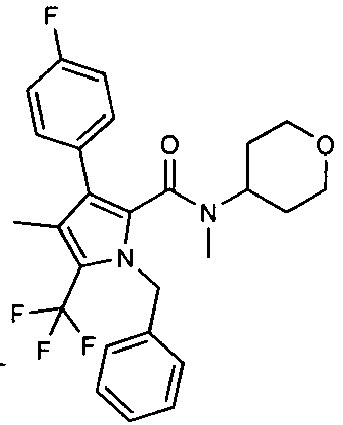
1-Benzyl-3-(4-fluorophenyl)-N,4-dimethyl-N-tetrahydropyran-4-yl-5-(trifluoromethyl)-1H-pyrrole-2-carboxylic acid amide GP-4 110 mg (87%) SC-221 
1-Benzyl-N-cyclopropyl-3-(4-fluorophenyl)-N,4-dimethyl-5-(trifluoromethyl)-1H-pyrrole-2-carboxylic acid amide GP-6 90 mg (79%) SC-222 
1-Benzyl-3-(4-fluorophenyl)-N-(2-hydroxy-1,1-dimethyl-ethyl)-N,4-dimethyl-5-(trifluoromethyl)-1H-pyrrole-2-carboxylic acid amide GP-4 40 mg (33%) SC-223 
[1-Benzyl-3-(4-fluorophenyl)-4-methyl-5-(trifluoromethyl)-1H-pyrrol-2-yl]-(3-hydroxy-azetidin-1-yl)-methanone GP-4 70 mg (61%) SC-224 
1-Benzyl-N-(2,2-dimethylpropyl)-3-(4-fluorophenyl)-N,4-dimethyl-5-(trifluoromethyl)-1H-pyrrole-2-carboxylic acid amide GP-4 100 mg (82%) SC-225 
[1-Benzyl-3-(4-fluorophenyl)-4-methyl-5-(trifluoromethyl)-1H-pyrrol-2-yl]-(2,2-dimethyl-morpholin-4-yl)-methanone GP-4 90 mg (72%) SC-226 
1-Benzyl-3-(4-fluorophenyl)-N,4-dimethyl-N-(tetrahydrofuran-3-yl-methyl)-5-(trifluoromethyl)-1H-pyrrole-2-carboxylic acid amide GP-4 80 mg (80%) SC-227 
1-Benzyl-N-(3-hydroxy-2,2-dimethyl-propyl)-N,4-dimethyl-5-(trifluoromethyl)-3-[4-(trifluoromethyl)-phenyl]-1H-pyrrole-2-carboxylic acid amide GP-4 60 mg (49%) SC-228 
1-Benzyl-N,4-dimethyl-N-(2-methylsulfonyl-ethyl)-5-(trifluoromethyl)-3-[4-(trifluoromethyl)-phenyl]-1H-pyrrole-2-carboxylic acid amide GP-4 110 mg (86%) SC-229 
1-Benzyl-N,4-dimethyl-N-tetrahydro-pyran-4-yl-5-(trifluoromethyl)-3-[4-(trifluoromethyl)-phenyl]-1H-pyrrole-2-carboxylic acid amide GP-4 90 mg (73%) SC-230 
1-Benzyl-N-cyclopropyl-N,4-dimethyl-5-(trifluoromethyl)-3-[4-(trifluoromethyl)-phenyl]-1H-pyrrole-2-carboxylic acid amide GP-6 40 mg (36%) SC-231 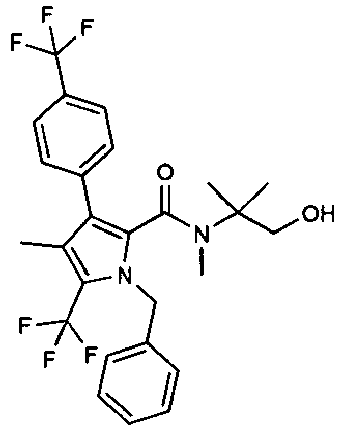
1-Benzyl-N-(2-hydroxy-1,1-dimethyl-ethyl)-N,4-dimethyl-5-(trifluoromethyl)-3-[4-(trifluoromethyl)-phenyl]-1H-pyrrole-2-carboxylic acid amide GP-4 60 mg (50%) SC-232 
[1-Benzyl-4-methyl-5-(trifluoromethyl)-3-[4-(trifluoromethyl)-phenyl]-1H-pyrrol-2-yl]-(3-hydroxy-azetidin-1-yl)-methanone GP-4 80 mg (71%) SC-233 
1-Benzyl-N-(2,2-dimethylpropyl)-N,4-dimethyl-5-(trifluoromethyl)-3-[4-(trifluoromethyl)-phenyl]-1H-pyrrole-2-carboxylic acid amide GP-4 70 mg (59%) SC-234 
[1-Benzyl-4-methyl-5-(trifluoromethyl)-3-[4-(trifluoromethyl)-phenyl]-1H-pyrrol-2-yl]-(2,2-dimethyl-morpholin-4-yl)-methanone GP-4 70 mg (57%) SC-235 
1-Benzyl-N-(3-hydroxy-2,2-dimethyl-propyl)-N,4-dimethyl-5-(trifluoromethyl)-3-[4-(trifluoromethyloxy)-phenyl]-1H-pyrrole-2-carboxylic acid amide GP-4 80 mg (65%) SC-236 
1-Benzyl-N,4-dimethyl-N-(2-methylsulfonyl-ethyl)-5-(trifluoromethyl)-3-[4-(trifluoromethyloxy)-phenyl]-1H-pyrrole-2-carboxylic acid amide GP-4 110 mg (87%) SC-237 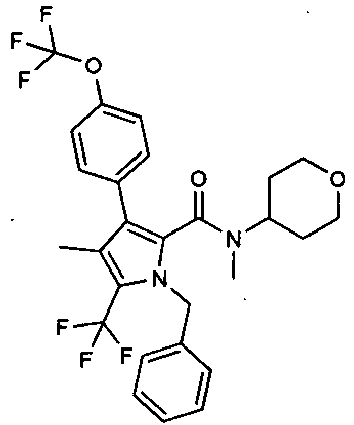
1-Benzyl-N,4-dimethyl-N-tetrahydro-pyran-4-yl-5-(trifluoromethyl)-3-[4-(trifluoromethyloxy)-phenyl]-1H-pyrrole-2-carboxylic acid amide GP-4 90 mg (74%) SC-238 
1-Benzyl-N-cyclopropyl-N,4-dimethyl-5-(trifluoromethyl)-3-[4-(trifluoromethyloxy)-phenyl]-1H-pyrrole-2-carboxylic acid amide GP-4 90 mg (80%) SC-239 
[1-Benzyl-4-methyl-5-(trifluoromethyl)-3-[4-(trifluoromethyloxy)-phenyl]-1H-pyrrol-2-yl]-(3-hydroxy-azetidin-1-yl)-methanone GP-4 70 mg (62%) SC-240 
1-Benzyl-N-(2,2-dimethylpropyl)-N,4-dimethyl-5-(trifluoromethyl)-3-[4-(trifluoromethyloxy)-phenyl]-1H-pyrrole-2-carboxylic acid amide GP-6 90 mg (76%) SC-241 
1-Benzyl-N-(2-hydroxy-1,1-dimethyl-ethyl)-N,4-dimethyl-5-(trifluoromethyl)-3-[4-(trifluoromethyloxy)-phenyl]-1H-pyrrole-2-carboxylic acid amide GP-4 50 mg (42%) SC-242 
[1-Benzyl-4-methyl-5-(trifluoromethyl)-3-[4-(trifluoromethyloxy)-phenyl]-1H-pyrrol-2-yl]-(2,2-dimethyl-morpholin-4-yl)-methanone GP-4 80 mg (65%) SC-243 
1-Benzyl-3-(4-chloro-3-fluorophenyl)-N-(3-hydroxy-2,2-dimethyl-propyl)-N,4-dimethyl-5-(trifluoromethyl)-1H-pyrrole-2-carboxylic acid amide GP-4 60 mg (48%) SC-244 
1-Benzyl-3-(4-chloro-3-fluorophenyl)-N,4-dimethyl-N-(2-methylsulfonyl-ethyl)-5-(trifluoromethyl)-1H-pyrrole-2-carboxylic acid amide GP-4 110 mg (87%) SC-245 
1-Benzyl-3-(4-chloro-3-fluorophenyl)-N,4-dimethyl-N-tetrahydro-pyran-4-yl-5-(trifluoromethyl)-1H-pyrrole-2-carboxylic acid amide GP-4 100 mg (81%) SC-246 
1-Benzyl-3-(4-chloro-3-fluorophenyl)-N-cyclopropyl-N,4-dimethyl-5-(trifluoromethyl)-1H-pyrrole-2-carboxylic acid amide GP-4 80 mg (71%) SC-247 
[1-Benzyl-3-(4-chloro-3-fluorophenyl)-4-methyl-5-(trifluoromethyl)-1H-pyrrol-2-yl]-(3-hydroxy-azetidin-1-yl)-methanone GP-6 80 mg (71%) SC-248 
1-Benzyl-3-(4-chloro-3-fluorophenyl)-N-(2-hydroxy-1,1-dimethyl-ethyl)-N,4-dimethyl-5-(trifluoromethyl)-1H-pyrrole-2-carboxylic acid amide GP-4 70 mg (58%) SC-249 
[1-Benzyl-3-(4-chloro-3-fluorophenyl)-4-methyl-5-(trifluoromethyl)-1H-pyrrol-2-yl]-(2,2-dimethyl-morpholin-4-yl)-methanone GP-4 80 mg (65%) SC-250 
1-Benzyl-3-(4-chloro-3-fluorophenyl)-N-(2,2-dimethylpropyl)-N,4-dimethyl-5-(trifluoromethyl)-1H-pyrrole-2-carboxylic acid amide GP-4 60 mg (50%) SC-251 
1-Benzyl-3-(3-chloro-4-fluorophenyl)-N-(3-hydroxy-2,2-dimethyl-propyl)-N,4-dimethyl-5-(trifluoromethyl)-1H-pyrrole-2-carboxylic acid amide GP-4 60 mg (49%) SC-252 
1-Benzyl-3-(3-chloro-4-fluorophenyl)-N,4-dimethyl-N-(2-methylsulfonyl-ethyl)-5-(trifluoromethyl)-1H-pyrrole-2-carboxylic acid amide GP-4 80 mg (62%) SC-253 
1-Benzyl-3-(3-chloro-4-fluorophenyl)-N,4-dimethyl-N-tetrahydro-pyran-4-yl-5-(trifluoromethyl)-1H-pyrrole-2-carboxylic acid amide GP-4 110 mg (87%) SC-254 
1-Benzyl-3-(3-chloro-4-fluorophenyl)-N-cyclopropyl-N,4-dimethyl-5-(trifluoromethyl)-1H-pyrrole-2-carboxylic acid amide GP-4 70 mg (62%) SC-255 
[1-Benzyl-3-(3-chloro-4-fluorophenyl)-4-methyl-5-(trifluoromethyl)-1H-pyrrol-2-yl]-(3-hydroxy-azetidin-1-yl)-methanone GP-4 65 mg (57%) SC-256 
1-Benzyl-3-(3-chloro-4-fluorophenyl)-N-(2,2-dimethylpropyl)-N,4-dimethyl-5-(trifluoromethyl)-1H-pyrrole-2-carboxylic acid amide GP-6 80 mg (67%) SC-257 
1-Benzyl-3-(3-chloro-4-fluorophenyl)-N-(2-hydroxy-1,1-dimethyl-ethyl)-N,4-dimethyl-5-(trifluoromethyl)-1H-pyrrole-2-carboxylic acid amide GP-4 45 mg (37%) SC-258 
[1-Benzyl-3-(3-chloro-4-fluorophenyl)-4-methyl-5-(trifluoromethyl)-1H-pyrrol-2-yl]-(2,2-dimethyl-morpholin-4-yl)-methanone see below 90 mg (73%) SC-259 
1-Benzyl-3-(4-chlorophenyl)-N-(2,2-dimethyl-propyl)-N-methyl-4-methylsulfonyl-5-(trifluoromethyl)-1H-pyrrole-2-carboxylic acid amide see below SC-260 
1-Benzyl-N-(2,2-dimethylpropyl)-N,4-dimethyl-3-[4-(2,2,2-trifluoro-ethoxy)-phenyl]-5-(trifluoromethyl)-1H-pyrrole-2-carboxylic acid amide see below SC-261 
3-(4-Chlorophenyl)-N-(2,2-dimethyl-propyl)-1-[(4-fluorophenyl)-methyl]-N-methyl-5-(trifluoromethyl)-1H-pyrrole-2-carboxylic acid amide see below SC-262 
[1-Benzyl-3-[2-fluoro-4-(trifluoromethyloxy)-phenyl]-4-methyl-5-(trifluoromethyl)-1H-pyrrol-2-yl]-morpholin-4-yl-methanone see below SC-263 
[1-Benzyl-4-methyl-3-[4-(2,2,2-trifluoro-ethoxy)-phenyl]-5-(trifluoromethyl)-1H-pyrrol-2-yl]-morpholin-4-yl-methanone see below SC-264 
4-[1-Benzyl-4-methyl-2-(morpholine-4-carbonyl)-5-(trifluoromethyl)-1H-pyrrol-3-yl]-3-fluoro-benzonitrile see below SC-265 
[3-(4-Chlorophenyl)-4-methyl-1-[(3-methylsulfonyl-phenyl)-methyl]-5-(trifluoromethyl)-1H-pyrrol-2-yl]-morpholin-4-yl-methanone see below SC-266 
3-(4-Chlorophenyl)-N-(2,2-dimethyl-propyl)-N-methyl-1-[(3-methylsulfonyl-phenyl)-methyl]-5-(trifluoromethyl)-1H-pyrrole-2-carboxylic acid amide - To a suspension of ACI-01 (2 g, 6.42 mmol) in DCM (32 mL) were added N,2,2-trimethylpropan-1-amine (1.06 g, 7.70 mmol) and DIPEA (2.23 mL, 12.83 mmol). To the clear solution were added EDCI (1.353 g, 7.06 mmol) and HOAt (0.087 g, 0.642 mmol) at 0°C and the yellow solution stirred at room temperature overnight. The mixture was washed with saturated aqueous NH4Cl and the phases separated. The organic phase was washed with brine, dried over Na2SO4, filtered and evaporated. The crude mixture was purified by flash chromatography (silica, gradient heptane/EtOAc, 95:5 → 90:10 → 80:20) to furnish 2.22g (88%) of the desired compound.
- To a solution of 1-benzyl-3-(4-chlorophenyl)-N-methyl-N-neopentyl-1 H-pyrrole-2-carboxamide (200 mg, 0.506 mmol) in dry DMSO (10 mL) was added FeSO4·7H2O (134 mg, 0.481 mmol). ICF3 was bubbled through the reaction mixture for 1 min. After 10 min H2O2 (35% (w/w) in H2O, 0.266 mL, 3.04 mmol) was added. The mixture was diluted with Et2O (50 mL) and brine. The organic layer was dried (Na2SO4) and concentrated. Purification by column chromatography (silica, heptane/EtOAc, 4:1) and trituration from i-Per2O (2x 2 mL) afforded SC-02 (59 mg, 25%).
- To a solution of ACI-02 (3.60 g, 11.1 mmol) and morpholine (1.02 mL, 11.6 mmol) in DCM (30 mL) was added EDCI (2.22 g, 11.6 mmol) followed by HOAt (0.15 g, 1.1 mmol) while cooling with an ice-bath. The reaction mixture was stirred at room temperature overnight. The reaction mixture was washed with aqueous 1 M HCl (30 mL) and aqueous saturated NaHCO3 (30 mL), dried (Na2SO4) and concentrated. Crystallisation (heptane/EtOAc) of the residue yielded the desired product (3.44 g, 79%). Crystallisation (MeOH) of the concentrated mother liquor resulted in another batch (315 mg, 7%). Combined yield: 3.75 g (86%).
- To a solution of (1-benzyl-3-(4-chlorophenyl)-4-methyl-1 H-pyrrol-2-yl)(morpholino)methanone (500 mg, 1.27 mmol) in DMSO (10 mL) was added FeSO4·7H2O (211 mg, 0.760 mmol). While stirring vigorously, ICF3 was bubbled through the reaction mixture for 1 min. The reaction mixture was stirred for 1 min., after which H2O2 (35% (w/w) in H2O, 0.665 mL, 7.60 mmol) was added. The reaction mixture was stirred for 1 h and Et2O (50 mL) and brine (30 mL) were added. The organic layer was separated, washed with brine (2x 30 mL), dried (Na2SO4) and concentrated. The residue was first purified by flash column chromatography (silica, heptane/EtOAc, 96:4 -> 60:40) and then by crystallization (heptane/EtOAc) to give SC-03 (196 mg, 33%).
- To a solution of ACl-02 (3.60 g, 11.1 mmol), N,2,2-trimethylpropan-1-amine (2.28 g, 16.6 mmol) and DIPEA (8.11 mL, 46.4 mmol) in DME (30 mL) was added BOP-Cl (5.91 g, 23.21 mmol). The reaction mixture was stirred at reflux temperature for 1h. The reaction mixture was allowed to cool to room temperature and EtOAc (70 mL) and aqueous 1 M HCl (75 mL) were added. After filtration of the solids, the organic layer was separated, washed with aqueous saturated NaHCO3 (75 mL), dried (Na2SO4) and concentrated. Crystallisation (heptane/EtOAc) gave the first batch of the desired product (1.064 g, 24%). Crystallisation (MeOH) of the mother liquor gave the second (1.686 g, 37%). Final crystallisation (heptane/EtOAc) of the mother liquor gave the third batch of the title compound (750 mg, 17%). Total yield: 3.539 g (78%).
- To a solution of 1-benzyl-3-(4-chlorophenyl)-N,4-dimethyl-N-neopentyl-1 H-pyrrole-2-carboxamide (400 mg, 0.978 mmol) in DMSO (10 mL) was added FeSO4·7H2O (258 mg, 0.929 mmol). While stirring vigorously, ICF3 was bubbled through the reaction mixture for 1 min. The reaction mixture was stirred for 1 min., after which H2O2 (35% (w/w) in H2O, 0.514 mL, 5.87 mmol) was added. The reaction mixture was stirred for 15 min and Et2O and brine were added. The organic layer was separated, dried (Na2SO4) and concentrated. The residue was first purified by column chromategraphy (silica, heptane/EtOAc, 4:1), followed by preparative LMCS and crystallisation (MeOH/H2O) to give SC-04 (126 mg, 27%).
- SC-08 (100 mg, 0.210 mmol) was dissolved in dry DMF (2 mL), 60% NaH in mineral oil (20 mg, 0.50 mmol) was added and the slightly foaming mixture was stirred at room temperature for 10 min. Subsequently, Mel (0.04 mL, 0.630 mmol) was added and the mixture was stirred at room temperature for 1 h. The reaction mixture was poured into aqueous 1 M KHSO4 (10 mL) and the product was extracted with EtOAc (2x10 mL). The organic layer was washed with aqueous 1M KHSO4 (2x10 mL), aqueous saturated NaHCO3 (2x10 mL) and brine (2x10 mL) before drying over Na2SO4 and concentration in vacuo to give a yellow oil. The product was purified using flash column chromatography (silica, heptane/EtOAc 80:20 to 40:60) to give SC-09 (31 mg, 30%) as a colorless foam.
- ACl-03 (80 mg, 0.203 mmol) was dissolved in dry THF (3 mL). The solution was mixed with Et3N (71 µL, 0.508 mmol) and stirred for 10 min. at room temperature. 2M Dimethylamine in THF (305 µL, 0.609 mmol) was added, followed by 50% w/w T3P in DMF (178 µL, 305 mmol). The temperature was raised to 50 °C and the reaction mixture was stirred overnight. Additional reagents were added: 2M dimethyl amine in THF (305 µL, 0.609 mmol) and 50% w/w T3P in DMF (178 µL, 305 mmol). The reaction mixture was stirred at 50 °C for 4 d. The temperature was lowered to room temperature; the reaction mixture was concentrated in vacuo. The residue was dissolved in EtOAc (30 mL) and diluted aqueous Na2CO3 (15 mL) to result in a clear two phase system. The phases were separated, and the organic phase was washed twice with 1 M NaOH (10 mL), followed by brine, twice with diluted aqueous NH4Cl (10 mL) and brine. Drying (Na2SO4) was followed by concentration in vacuo. The residue was used for preparative TLC (silica, heptane/EtOAc, 4:1), providing 40 mg (47%) of pyrrole SC-18 as a fluffy white solid.
- To a suspension of (1-benzyl-3-(4-chlorophenyl)-4-methyl-5-(trifluoromethyl)-1 H-pyrrol-2-yl)(thiomorpholino)methanone [for synthesis see SC-26] (131 mg, 0.28 mmol) in MeOH (4 mL) and H2O (1 mL) was added oxone (85 mg, 0.138 mmol). The reaction mixture was stirred at room temperature for 2 h. The reaction mixture was diluted with H2O and extracted with DCM (60 mL). The organic layer was washed with brine, dried (Na2SO4) and purified by flash column chromatography (silica, heptane/EtOAc, 1:1 → 0:1) to give SC-19 (48 mg, 35%) as a white foam.
- ACl-03 (80 mg, 0.203 mmol) was dissolved in dry THF (3 mL). The solution was mixed with Et3N (85 µL, 0.609 mmol) and stirred for 10 min. at room temperature, 2M methyl amine in THF (406 µL, 0.813 mmol) was added, followed by 50% w/w T3P in DMF (237 µL, 0.406 mmol). The temperature was raised to 50 °C and the reaction mixture was stirred for 4 d. Additional reagents were added: 2M methyl amine in THF (203 µL, 0.407 mmol) and 50% w/w T3P in DMF (119 µL, 0.203 mmol). The reaction mixture was stirred at 50 °C overnight. The temperature was lowered to room temperature and the reaction mixture was concentrated in vacuo. The residue was dissolved in EtOAc (30 mL) and diluted with aqueous Na2CO3 (15 mL) to result in a clear two phase system. The phases were separated, and the organic phase was washed twice with aqueous 1M NaOH (10 mL), followed by brine, twice with diluted aqueous NH4Cl (10 mL) and again brine. Drying (Na2SO4) was followed by concentration in vacuo. The residue was used for preparative TLC (silica, heptane/EtOAc, 7:1, 4:1 and 3:1), followed by flash chromatography (silica, heptane/DCM, 3:7) providing 38 mg (46%) of SC-22 as a fluffy white solid.
- To a solution of ethyl 3-(4-chlorophenyl)-4-methyl-1 H-pyrrole-2-carboxylate [for synthesis see ACl-02] (2.0 g, 7.58 mmol) in dry THF (26 mL) and MeOH (26 mL) was added aqueous 6 M NaOH (25.3 mL, 152 mol) and the mixture was stirred at reflux for 3 h. The organic solvents were evaporated and the remainder was acidified with aqueous 6 M HCl (30 mL) at 0 °C. The resulting mixture was extracted with EtOAc (2x 100 mL). The combined organic layers were dried (Na2SO4) and concentrated to yield the desired product 1.71 g, 96%).
- To a solution of 3-(4-chlorophenyl)-4-methyl-1 H-pyrrole-2-carboxylic acid (1.71 g, 7.26 mmol) and DIPEA (1.39 mL, 7.98 mmol) in DCM (50 mL) were added morpholine (664 µL, 7.62 mmol), HOAt (99 mg, 726 µmol) and EDCI (1.53 g, 7.98 mmol) and the reaction mixture was stirred at room temperature for 2 h. The mixture was washed with brine (100 mL) and the organic layer was dried (Na2SO4) and concentrated. Purification by column chromatography (silica, DCM/(7 M NH3 in MeOH), 98:2) afforded the desired product (1.73 g, 78%).
- A crude batch of (3-(4-chlorophenyl)-4-methyl-1H-pyrrol-2-yl)(morpholino)methanone (260 mg, containing 67% w/w or 0.572 mmol of the desired compound) was dissolved in DMSO (4 mL) and FeSO4·7H2O (95 mg, 0.343 mmol) was added. The mixture was stirred at room temperature for 5 min. and CF3I was bubbled through for 3 min. Then the mixture was cooled in an ice bath and 35% w/w aqueous H2O2 (300 mL, 3.43 mmol) was added dropwise via a syringe. The reaction was carefully quenched by the addition of brine (30 mL) and the product was extracted with EtOAc twice (50 mL and 10 mL). The combination of organic layers was washed with H2O (10 mL), brine, dried on Na2SO4 and concentrated in vacuo. The residue was combined with the residue of another identical reaction (starting from 100 mg or 0.328 mmol of starting material), dissolved in DCM (2 mL). Crystals had formed overnight. Filtration and washing with small portions of DCM gave 58 mg of the desired product. The filtrate was used for flash chromatography (silica, heptane/EtOAc; 20% to 100% EtOAc) to provide 186 mg desired product. Total yield: 244 mg (73%)
- (3-(4-Chlorophenyl)-4-methyl-5-(trifluoromethyl)-1H-pyrrol-2-yl)(morpholino)methanone (80 mg, 0.215 mmol) was dissolved in dry MeCN (5 mL). The solution was mixed with K2CO3 (59 mg, 0.429 mmol), followed by addition of 3-chlorobenzyl bromide (31 µL, 0.236 mmol). The reaction mixture was stirred vigorously at 80°C overnight. The temperature was lowered to room temperature; the reaction mixture was combined with a few lumps of ice, Et2O (50 mL) and H2O (10 mL) to result in a clear two phase system. The phases were separated; the organic phase was washed with brine. Drying (Na2SO4) was followed by concentration in vacuo. The residue was dissolved in MeCN (30 mL), concentrated in vacuo and used for preparative TLC (silica, heptane/EtOAc, 5:1), providing 96 mg (90%) of SC-25 as a fluffy white solid.
- To a solution of ACl-03 (150 mg, 0.38 mmol) and thiomorpholine (0.042 mL, 0.419 mmol) in DCM (2 mL) was added EDCI (77 mg, 0.4 mmol) followed by HOAt (5.18 mg, 0.038 mmol). The reaction mixture was stirred at room temperature overnight. The reaction mixture was washed with aqueous 1 M KHSO4 and saturated aqueous NaHCO3, dried (Na2SO4) and concentrated. The crude product was purified by flash column chromatography (silica, heptane/EtOAc, 9:1 → 2:1) to give the desired product (162 mg, 89%) as a colourless oil.
- To a suspension of (1-benzyl-3-(4-chlorophenyl)-4-methyl-5-(trifluoromethyl)-1 H-pyrrol-2-yl)(thiomorpholino)methanone (162 mg, 0.34 mmol) in MeOH (4 mL) and H2O (1 mL) was added oxone (624 mg, 1.015 mmol). The reaction mixture was stirred at room temperature overnight. The reaction mixture was diluted with H2O and extracted with DCM (60 mL). The organic layer was washed with brine, dried (Na2SO4) and purified by flash column chromategraphy (silica, heptane/EtOAc, 4:1 → 3:2) to give SC-26 (66 mg, 38%) as a white solid.
- To a solution of ethyl 3-(4-chlorophenyl)-4-methyl-1 H-pyrrole-2-carboxylate (11 g, 41.7 mmol) in methanol (140 mL,) and tetrahydrofuran (140 mL) was added sodium hydroxide (140 mL, 6M aqueous solution) and the reaction was stirred at 110°C for 4hrs. The reaction mixture was allowed to cool and the organics removed under vacuum. The resulting residue was slurried in water (200 mL) and acidified with acetic acid to pH4. The resulting precipitate was collected by filtration and washed with water to afford the title compound as a grey solid (9.8g, 99% yield)
- A microwave vial was charged with 3-(4-chlorophenyl)-4-methyl-1 H-pyrrole-2-carboxylic acid (2 g 8.5 mmol), BOP-Cl (2.1 equiv., 4.7 g, 17.8 mmol), 3,3-difluoroazetidine hydrochloride (1.6 equiv., 1.8 g, 13.6 mmol), DIPEA (5 equiv., 7.4 mL, 42.4 mmol) and DCM (20 mL) and the reaction mixture was heated to reflux for 1 hour.
- The reaction mixture was cooled and partitioned with dichloromethane (100 mL) and water (100 mL). The aqueous was washed with DCM (2 x 100 mL) and the organics combined, dried over magnesium sulphate then then concentrated under vaccum to afford a brown solid. The residue was purified by flash chromatography (150g SNAP silica column, Gradient; 0-35% EtOAc / Petrol Ether over 40 minutes) to afford the title compound as a brown solid (2g, 76% yield).
- A 5 mL microwave vial was charged with [3-(4-chlorophenyl)-4-methyl-1H-pyrrol-2-yl]-(3,3-difluoroazetidin-1-yl)methanone (200 mg, 0.6 mmol), N,N'-dimethylethylenediamine (11 mg, 0.13 mmol), potassium phosphate tri-basic (0.29 g, 1.4 mmol), 3-lodoanisole (1.97 g, 1 mL, 8.3 mmol) followed by copper (I) iodide (0.1 equiv., 12 mg, 0.06 mmol) and NMP (1 mL, 1.033 g, 1 mL, 10.4 mmol) and the reaction was at 140°C for 3 hours via Biotage microwave.
- The reaction mixture was cooled, diluted with EtOAc (100 ml) and washed with HCl (1N, 100 mL) followed by NaHCO3 (100 mL saturated solution). The aqueous washes were extracted with EtOAc (50 mL) and the organics combined, dried over magnesium sulphate and then concentrated under vacuum. The residue was purified using flash chromatography (50 g SNAP silica column, gradient; 0-15% EtOAc / Petrol Ether over 20 minutes then 15% to 50% over a further 15 minutes) to afford the title compound as an off-white solid (189 mg, 70% yield).
- [3-(4-Chlorophenyl)-1-(3-methoxyphenyl)-4-methyl-pyrrol-2-yl]-(3,3-difluoroazetidin-1-yl)methanone (126 mg, 0.3 mmol) followed by Sodium Trifluoromethanesulfinate (0.146 mg, 0.9 mmol), was added to a mixture of DMSO (1.8 mL) and water (0.8 mL) and then stirred vigorously at 0°C (ice/water bath). Tert-butyl hydroperoxide (70% in H2O) (0.21 mL, 1.5 mmol) was added drop wise and reaction mixture stirred vigorously. DCM (1.8 mL) was added and reaction mixture stirred at room temperature for 18 hours. The reaction mixture was cooled to 0°C (ice/water bath) and additional Sodium Trifluoromethanesulfinate (0.15 g, 0.9 mmol) followed by Tert-butyl hydroperoxide (70% in H2O) (0.21 mL, 1.5 mmol) was added and reaction stirred at room temperature for 20 hours.
- The reaction mixture was quenched by the addition of sodium metabisulfite (100 mL saturated solution). The aqueous solution was extracted with DCM (2 x 100 mL) and the organics combined, dried over magnesium sulphate and then concentrated under vacuum. The residue was purified using preparative HPLC (preparative Agilent 1200 Series HPLC system using 30%-95% acetonitrile / water (0.1 % Ammonia aq.) over 15 minutes, collecting at 254nm).). The title compound was obtained as a cream solid (44mg, 30% yield).
- [1-(3-chlorophenyl)-3-(4-chlorophenyl)-4-methyl-pyrrol-2-yl]-(3,3-difluoroazetidin-1-yl)methanone was synthesised according to the procedure described for [3-(4-Chlorophenyl)-1-(3-methoxyphenyl)-4-methyl-pyrrol-2-yl]-(3,3-difluoroazetidin-1-yl)methanone (SC-32) using 1-chloro-3-iodobenzene (1 mL, 8 mmol) and [3-(4-chlorophenyl)-4-methyl-1H-pyrrol-2-yl]-(3,3-difluoroazetidin-1-yl)methanone (200 mg, 0.6 mmol). The product was purified by preparative HPLC (preparative Agilent 1200 Series HPLC system using 30%-95% acetonitrile / water (0.1% Ammonia aq.) over 15 minutes, collecting at 254nm) to afford the title compound as an off-white solid (223 mg, 89% yield).
- [1-(3-Chlorophenyl)-3-(4-chlorophenyl)-4-methyl-5-(trifluoromethyl)-1 H-pyrrol-2-yl]-(3,3-difluoro-azetidin-1-yl)-methanone was synthesised according to the procedure described for 3-(4-Chlorophenyl)-1-(3-methoxyphenyl)-4-methyl-5-(trifluoromethyl)-1H-pyrrol-2-yl]-(3,3-difluoro-azetidin-1-yl)-methanone (SC-32) using [1-(3-chlorophenyl)-3-(4-chlorophenyl)-4-methyl-pyrrol-2-yl]-(3,3-difluoroazetidin-1-yl)methanone (161 mg, 0.4 mmol) to afford the title compound as an off-white solid (62 mg, 33% yield).
- ACl-03 (500 mg, 1.27 mmol) and tert-butyl 2-(methylamino)ethylcarbamate HCl (401 mg, 1.905 mmol) were dissolved in DME (2 mL) and BOP-Cl (679 mg, 2.67 mmol) and DIPEA (0.929 mL, 5.33 mmol) were added. The reaction mixture was stirred at 60°C for 1.5 h and then cooled to room temperature. Saturated aqueous NaHC03 and EtOAc were added. The aqueous layer was extracted with EtOAc, the organic layers were combined, dried (Na2SO4) and evaporated. The product was purified by flash column chromatography (silica, gradient heptane/EtOAc, 1:0 → 3:1) to afford 587 mg (84%) of the desired product.
- 4 M HCl in dioxane (1.067 mL, 4.27 mmol) was added dropwise to a solution of tert-butyl 2-(1-benzyl-3-(4-chlorophenyl)-N,4-dimethyl-5-(trifluoromethyl)-1 H-pyrrole-2-carboxamido)ethylcarbamate (587 mg, 1.067 mmol) in dry dioxane (5 mL) under a N2 atmosphere. The mixture was stirred at room temperature for 5 d. The mixture was evaporated to dryness and the residue was stirred in Et2O. The solids were filtered off to obtain 400 mg (77%) of the desired product as a white solid.
- To a suspension of N-(2-aminoethyl)-1-benzyl-3-(4-chlorophenyl)-N,4-dimethyl-5-(trifluoromethyl)-1H-pyrrole-2-carboxamide hydrochloride (150 mg, 0.308 mmol) in DCM (2 mL) were added dropwise Et3N (0.094 mL, 0.679 mmol) and acetyl chloride (0.024 mL, 0.339 mmol). The reaction mixture was stirred at room temperature overnight. The mixture was diluted with DCM and saturated aqueous NaHCO3. The layers were separated using a phase separator and the solvents were evaporated. The product was purified by flash column chromatography (silica, gradient heptane/EtOAc, 1:2 → 0:1) to afford 106 mg (70%) of SC-37.
- To a suspension of N-(2-aminoethyl)-1-benzyl-3-(4-chlorophenyl)-N,4-dimethyl-5-(trifluoromethyl)-1 H-pyrrole-2-carboxamide hydrochloride [for synthesis see SC-37] (150 mg, 0.308 mmol) in DCM (2 mL) were added dropwise Et3N (0.129 mL, 0.925 mmol) and methanesulfonylchloride (0.048 mL, 0.617 mmol). The reaction mixture was stirred at room temperature for 3 h. The mixture was diluted with DCM and saturated aqueous NaHCO3. The layers were separated using a phase separator and the solvents were evaporated. The product was purified by flash column chromatography (silica, gradient heptane/EtOAc, 2:1 → 1:2) to afford 139 mg (85%) of SC-38.
- To an ice-cold solution of DMF (0.441 mL, 5.70 mmol) in DCM (5 mL) was added POCl3 (0.425 mL, 4.56 mmol). After stirring the reaction mixture at 0 °C for 15 min, a solution of (1-benzyl-3-(4-chlorophenyl)-4-methyl-1H-pyrrol-2-yl)(morpholino)methanone [obtained via standard EDI/HOAt coupling of ACl-02 with morpholine] (900 mg, 2.28 mmol) in DCM (1 mL) was dropwise added. The reaction was stirred for 30 min, then the ice-bath was removed and stirring was continued at room temperature for 1 h. The reaction mixture was cooled to 0 °C, then saturated aqueous NaHCO3 was added while vigorously stirring, until the mixture was neutralised. The mixture was extracted with DCM, washed with brine and concentrated. The residue was dissolved in i-PrOH and precipitated with H2O. The precipitate was filtered, washed with i-PrOH/H2O (1:1, 2x) and MeOH (2x) and dried on for a couple of hours to give the desired product (761 mg, 79%).
- Deoxo-Fluor, 50% in toluene (2.1 g, 4.7 mmol) was added to 1-benzyl-4-(4-chlorophenyl)-3-methyl-5-(morpholine-4-carbonyl)-1H-pyrrole-2-carbaldehyde (200 mg, 0.473 mmol) and the reaction mixture was stirred at 60 °C overnight. The reaction mixture was allowed to cool to room temperature and acidified with aqueous 1M KHSO4 while cooling with an ice-bath. The mixture was extracted with EtOAc, washed with brine, dried (Na2SO4) and concentrated. The residue was purified by flash column chromatography (silica, gradient heptane/EtOAc, 96:4->60:40). The crude product was dissolved in i-PrOH and precipitated with H2O. The precipitate was washed with i-PrOH/H2O (∼1:3) (2x) and dried on the filter overnight. Crystallisation (MeOH) of the precipitate failed and was combined with its mother liquor and this was concentrated. Flash column chromatography (silica, gradient heptane/EtOAc, 94:6 → 34:66) of the residue gave SC-41 (113 mg, 54%).
- 1,3-Bis(4-chlorophenyl)-3-(4-chlorophenyl)-4-methyl-pyrrol-2-yl]-(3,3-difluoroazetidin-1-yl)methanone was synthesised according to the procedure described for [3-(4-Chlorophenyl)-1-(3-methoxyphenyl)-4-methyl-pyrrol-2-yl]-(3,3-difluoroazetidin-1-yl)methanone (SC-32) using 1-chloro-4-iodobenzene (1 mL, 8 mmol) and [3-(4-chlorophenyl)-4-methyl-1H-pyrrol-2-yl]-(3,3-difluoroazetidin-1-yl)methanone (200 mg, 0.6 mmo) to afford the title compound as pink solid (109 mg, 40% yield).
- [1,3-Bis(4-chlorophenyl)-4-methyl-5-(trifluoromethyl)-1H-pyrrol-2-yl]-(3,3-difluoro-azetidin-1-yl)-methanone was synthesised according to the procedure described for 3-(4-Chlorophenyl)-1-(3-methoxyphenyl)-4-methyl-5-(trifluoromethyl)-1H-pyrrol-2-yl]-(3,3-difluoro-azetidin-1-yl)-methanone (SC-32) using [1,3-Bis(4-chlorophenyl)-3-(4-chlorophenyl)-4-methyl-pyrrol-2-yl]-(3,3-difluoroazetidin-1-yl)methanone (133 mg, 0.3 mmol) to afford the title compound as an off-white solid (68mg, 44% yield).
- To a solution of SC-52 (200 mg, 0.385 mmol) in dry THF (2 mL) was added 2 M LiBH4 in THF (0.963 mL, 1.93 mmol) and the reaction mixture was stirred for 4 d. The reaction mixture was quenched with aqueous 1 M HCl, extracted with DCM and the organic layer was concentrated. The residue was purified by flash column chromatography (silica, heptane/EtOAc, 93:7->34:66) yielding SC-48 (126 mg, 69%).
- Respectively, EDCI (47 mg, 0.24 mmol) and HOAt (28 mg, 0.20 mmol) were added to a solution of 0.4 M ammonia in THF (1.53 mL, 0.611 mmol) and I-01 [for synthesis see SC-52] (100 mg, 0.204 mmol) while cooling with an ice-bath. The reaction mixture was stirred at room temperature overnight, diluted with H2O, extracted with DCM and concentrated. The residue was purified by flash column chromatography (silica, heptane/EtOAc, 88:12->0:1) and freeze-dried (MeCN) resulting in SC-49 (65 mg, 65%).
- To a mixture of ACl-03 (220 mg, 0.559 mmol), tert-butyl 2-(2-hydroxyethylamino)acetate (139 mg, max. 0.72 mmol) and DIPEA (0.191 mL, 1.117 mmol) in DCM (10 mL) was added BOP-Cl (171 mg, 0.670 mmol). The reaction mixture was stirred at room temperature overnight. Aqueous 1 M KHSO4 (50 mL) and DCM (50 mL) were added. The aqueous layer was extracted with DCM (2 x 50 mL). The organic layers were combined, dried (Na2SO4) and evaporated under reduced pressure. The product was purified by flash chromatography (silica, gradient heptane/EtOAc, 1:0 → 2:1), to afford 171 mg (56%) of the desired product.
- tert-Butyl 2-(1-benzyl-3-(4-chlorophenyl)-N-(2-hydroxyethyl)-4-methyl-5-(trifluoromethyl)-1H-pyrrole-2-carboxamido)acetate (171 mg, 0.310 mmol) was dissolved in DCM (18 mL). TFA (2 mL) was added and the reaction mixture was stirred at room temperature for 3 h. The solvent was removed under reduced pressure and the residue co-evaporated with DCM (2x). The product was purified by flash chromategraphy (silica, gradient heptane/EtOAc, 1:0 → 2:1), to give 97 mg (66%) of SC-50.
- (3-(4-Chlorophenyl)-4-methyl-5-(trifluoromethyl)-1H-pyrrol-2-yl)(morpholino)methanone [for synthesis see SC-25] (130 mg, 0.349 mmol) was dissolved in dry MeCN (4 mL). The solution was mixed with K2CO3 (120 mg, 0.872 mmol) and KI (8.7 mg, 0.052 mmol), followed by addition of 4-fluorophenoxy-ethylbromide (153 mg, 0.697 mmol). The reaction mixture was stirred vigorously at 80 °C for 2 d. The temperature was lowered to room temperature; the reaction mixture was combined with the reaction mixture of another identical reaction (starting from 20 mg or 0.054 mmol (3-(4-chlorophenyl)-4-methyl-5-(trifluoromethyl)-1H-pyrrol-2-yl)(morpholino)methanone), followed by concentration in vacuo. The residue was used for flash chromatography (silica, gradient heptane/EtOAc, 1:0 → 1:1). The product was purified by preparative TLC (silica, DCM twice) to result in 60 mg (29%) of SC-51.
- BOP-Cl (776 mg, 3.05 mmol) was added to ACl-03 (1.00 g, 2.54 mmol), DIPEA (1.77 mL, 10.2 mmol) and ethyl 1-aminocyclopropanecarboxylate hydrochloride (0.631 g, 3.81 mmol) in DME (10 mL). The reaction mixture was stirred at 60 °C for 1 h, after which the reaction mixture was allowed to cool to room temperature. The reaction mixture was diluted with EtOAc, washed with aqueous 1M KHSO4 and saturated aqueous NaHCO3, dried (Na2SO4) and concentrated. The residue was purified by crystallisation (EtOAc/heptane) to give the desired product (821 mg, 64%).
- A solution of ethyl 1-(1-benzyl-3-(4-chlorophenyl)-4-methyl-5-(trifluoromethyl)-1H-pyrrole-2-carboxamido)cyclopropanecarboxylate (818 mg, 1.62 mmol) in dry DMF (3 mL) was added to a suspension of 60% NaH in mineral oil (81 mg, 2.0 mmol) in dry DMF (1 mL) while cooling with an ice-bath. The reaction mixture was stirred for 0.5 h while cooling with an ice-bath and Mel (0.111 mL, 1.78 mmol) was added while still cooling with an ice-bath. The reaction mixture was stirred at room temperature for 2h, quenched with saturated aqueous NH4Cl and extracted with EtOAc. The organic layer was washed with brine (3x), dried (Na2SO4) and concentrated. The residue was purified by column chromatography (silica, heptane/EtOAc/acetic acid, 4:1:0 → 2:1:0.06) to give SC-52 (497 mg, 59%) and I-01 (259 mg, 33%).
- ACl-06 (100 mg, 0.263 mmol) was dissolved in DME (3 mL) and BOP-Cl (141 mg, 0.553 mmol) was added, followed by DIPEA (0.193 mL, 1.106 mmol) and tert-butyl 2,2-dimethylpiperazine-1-carboxylate (56.4 mg, 0.263 mmol). The white suspension was stirred at 60 °C for 3 h. To the reaction mixture was added H2O (50 mL) and EtOAc (10 mL). The aqueous layer was separated and extracted with EtOAc (10 mL). The combined organic layer was washed with brine (20 mL) and subsequently dried (Na2SO4). Concentration in vacuo was followed by flash chromatography (silica, gradient heptane/EtOAc, 1:0 → 3:1) and provided the desired product (103 mg, 68%) as a white foam.
- To tert-butyl 4-(1-benzyl-3-(4-chlorophenyl)-5-(trifluoromethyl)-1H-pyrrole-2-carbonyl)-2,2-dimethylpiperazine-1-carboxylate (103 mg, 0.178 mmol) in DCM (2 mL) was added TFA (0.234 mL, 3.03 mmol). The reaction mixture was stirred for 1 h and then cooled to 0°C. Saturated aqueous NaHCO3 (15 mL) was added. The aqueous layer was separated and extracted twice with DCM (10 mL). The combined organic phases were washed with brine (20 mL) and dried over Na2SO4. Concentration in vacuo was followed by flash chromatography (silica, gradient heptane/EtOAc, 1:0 → 0:1). Appropriate fractions were combined, solvents removed in vacuo and the product was placed with MeOH (5 mL) in a vial. The remaining oil was dried in vacuo at 40°C over 6 h. SC-82 (58 mg, 67%) was obtained as a white foam.
- Bromine (1.5 equiv., 1.06 g, 0.340 mL, 6.64 mmol) was added dropwise to a cold solution of SC-002 (2.05 g, 2.05 g, 4.43 mmol) in acetic acid (60 mL, 60 mL). The reaction was stirred at 10°C for 5mins and then allowed to warm to room temperature and stirred overnight for 18 hours at room temperature. LCMS shows a small amount of SM remaining therefore a few drops (approximately 100ul) of bromine were added and stirred at room temperature for a further 2hours. Workup: The reaction mixture was poured into a saturated solution of (L)-ascorbic acid and the precipitate which crashed out was filtered off and washed through with copious amounts of water. Solid then dried in the vacuum oven at 45°C overnight to give 2.33g (97%) of a bright yellow solid.
- To a solution of 1-benzyl-4-bromo-3-(4-chlorophenyl)-N-(2,2-dimethylpropyl)-N-methyl-5-(trifluoromethyl)pyrrole-2-carboxamide (240 mg, 0.44 mmol) in Toluene (1.5 mL) was added ethylboronic acid (1.5 equiv., 0.66 mmol), Palladium(II) acetate (0.1 equiv., 0.022 mmol) and 2-(DICYCLOHEXYLPHOSPHINO)-2',4',6'-TRI-I-PROPYL-1,1'-BIPHENYL (0.2 equiv., 0.09 mmol) in a reactivial. The reaction was heated to 120°C overnight. Work up: Filtered and evaporated to give a pale yellow gum. Purification: The gum was purified on a 25g SNAP silica cartridge on the Isolera eluting with a gradient from 100% pet. ether to
80% DCM in pet. ether to give 134 mgs of a colourless gum. This was further purified on the preparative HPLC with acidic modifier. The clean fractions were combined and evaporated urp to give 37.2 mgs (29%) of an off-white solid. - To a solution of 1-benzyl-4-bromo-3-(4-chlorophenyl)-N-(2,2-dimethylpropyl)-N-methyl-5-(trifluoromethyl)pyrrole-2-carboxamide (100 mg, 0.18 mmol) in Toluene (1 mL) was added cyclopropylboronic acid (2 equiv., 0.032 g, 0.37 mmol), Palladium(II) acetate (0.1 equiv., 0.004 g, 0.018 mmol), 2-(DICYCLOHEXYLPHOSPHINO)-2',4',6'-TRI-I-PROPYL-1,1'-BIPHENYL (0.2 equiv., 0.01796 g, 0.03691 mmol) and POTASSIUM PHOSPHATE TRIBASIC (3 equiv., 0.1212 g, 0.04726 mL, 0.5537 mmol) in a Reactivial. The reaction was heated to 120°C overnight. Work up: Reaction mixture cooled to room temperature and diluted with Ethyl Acetate. Filtered through celite and celite washed, through 3 x Ethyl Acetate. Organics reduced under vacuum to residue. Purification: Purified via 25g Silica Column using 0-100% Petrol Ether / (10% Ethyl Acetate/Petrol Ether) over 30 minutes collecting at 254nm. Major peak isolated and reduced under vacuum to yield ∼90mg (45%) white foam. Purified further via preparative HPLC using 70-95% acetonitrile / water (0.1% formic acid) over 20 min collecting at 254nm. Pure fractions combined and reduced under vacuum.
- 60% NaH in mineral oil (0.528 g, 13.21 mmol) was washed with hexane (2x10 mL). It was suspended in dry THF (6 mL) and cooled to 0°C before BOC-BETA-ALA-OH (1 g, 5.29 mmol) in dry THF (6 mL) was added. Mel (0.823 mL, 13.21 mmol) in dry THF (6 mL) was dropwise added after 5 min. and the resulting suspension was stirred at 0°C to room temperature over the weekend. The reaction mixture was quenched with ice cold H2O (50 mL) and washed with Et2O (25 mL). The aqueous layer was acidified with concentrated aqueous HCl (3 mL) and extracted with EtOAc (3x20 mL). The combined EtOAc extracts were dried (Na2SO4) and concentrated to afford the desired product (1.095 g, quantitative) as a yellow oil..
- To a cooled (0°C) solution of 3-(tert-butoxycarbonyl(methyl)amino)propanoic acid (1.095 g, max. 5.29 mmol) in extra dry MeOH (0.24 mL, 5.93 mmol) and DCM.(5 mL) was added DMAP (0.066 g, 0.539 mmol). EDCI (1.239 g, 6.47 mmol) was added and the reaction mixture allowed to warm up to room temperature. The reaction mixture was washed with aqueous 0.5 N HCl (3x10 mL), and brine (25 mL). The organic phase was dried over Na2SO4, filtered, and evaporated in vacuo to afford the desired product (1.129 g, 98% over two steps) as a colourless oil.
- A solution of methyl 3-(tert-butoxycarbonyl(methyl)amino)propanoate (250 mg, 1.151 mmol) in dry THF (1 mL) was dropwise added under an nitrogen atmosphere to 1.0 M LiHMDS in THF (4.60 mL, 4.60 mmol) at -78°C. Mel (0.287 mL, 4.60 mmol) in dry THF (1 mL) was added dropwise. The reaction mixture is stirred at -75°C for 1 h. The mixture was slowly allowed to warm up to room temperature overnight. The reaction mixture was quenched with saturated aqueous NH4Cl (10 mL). The product was extracted with Et2O (2x10 mL). The organic layer was washed with brine (10 mL) before drying on Na2SO4 and concentration in vacuo to give the desired product (256 mg, 89%) as a yellow oil.
- Under an nitrogen atmposphere, methyl 3-(tert-butoxycarbonyl(methyl)amino)-2,2-dimethylpropanoate (250 mg, 1.019 mmol) was suspended in dry THF (5 mL) and cooled to -10°C. 4.0 M HCl in dioxane (5.10 mL, 20.38 mmol) was added and the reaction mixture was stirred at room temperature for 3 h. The solvent was evaporated under reduced pressure and the residue co-evaporated with DCM (5 mL) to give 185 mg of crude product as a yellow solid.
- To a suspension of ACI-06 (385 mg, 1.014 mmol), BOP-Cl (542 mg, 2.129 mmol) and DIPEA (0.742 mL, 4.26 mmol) in DME (3 mL) was added methyl 2,2-dimethyl-3-(methylamino)propanoate (184 mg, 1.014 mmol). The reaction mixture was stirred in a closed vial at 80°C for 3 h and at room temperature overnight. H2O (10 mL) and EtOAc (10 mL) were added and the aqueous layer was separated and extracted twice with EtOAc (10 mL). The combined organic layers were washed twice with brine (10 mL) and dried (Na2SO4), filtered and concentrated in vacuo. Purification of the residue by flash column chromatography (silica, gradient heptane/EtOAc, 10:1 → 3:1) gave the title compound (266 mg, 51%) as a white solid.
- A solution of LiOH·H2O (214 mg, 5.11 mmol) in H2O (3 mL) was added to a stirred solution of methyl 3-(1-benzyl-3-(4-chlorophenyl)-N-methyl-5-(trifluoromethyl)-1 H-pyrrole-2-carboxamido)-2,2-dimethylpropanoate (259 mg, 0.511 mmol) in THF (3 mL). The reaction mixture was stirred at room temperature overnight. An extra portion of LiOH·H2O (107 mg, 2.55 mmol) was added, followed by the addition of H2O (11 mL) and THF (11 mL). The reaction mixture was stirred at room temperature for 2 d and then acidified with aqueous 0.5 M KHSO4 (10 mL). The product was extracted with DCM (3 x 20 mL). The organic layers were combined and washed with brine (3x10 mL). The combined organic layers were dried on Na2SO4 and filtered. Solvents were removed in vacuo to give the desired product (233 mg, 93%) as a white foam.
- To a stirred solution of 3-(1-benzyl-3-(4-chlorophenyl)-N-methyl-5-(trifluoromethyl)-1 H-pyrrole-2-carboxamido)-2,2-dimethylpropanoic acid (100 mg, 0.203 mmol) in DCM (1 mL) was added added 0.4 N NH3 in THF (0.583 mL, 0.233 mmol) under an nitrogen atmosphere. To the solution was added EDCI (52.5 mg, 0.274 mmol) followed by HOAt (27.6 mg, 0.203 mmol). The reaction mixture was stirred overnight, H2O (5 mL) was and the product was extracted with DCM (3x2 mL). The organic layers were combined and washed with brine (3x10 mL). The combined organic layers were dried on Na2SO4 and filtered. Solvents were removed in vacuo. Purification of the residue was performed by flash chromatography (silica, gradient heptane/EtOAc, 10:1 1 → 3:1). The product was co-evaporated with Et2O to give end product SC-174 (46 mg, 46%) as a white solid.
- To a stirred solution of I-02 [see step 4 SC-174] (110 mg, 0.223 mmol) in dry toluene (4 mL) was added Et3N (62 µL, 0.446 mmol) and DPPA (63 µL, 0.290 mmol). The reaction mixture was stirred overnight and concentrated in vacuo to give the desired product as a yellow oil.
- Crude 3-(1-benzyl-3-(4-chlorophenyl)-N-methyl-5-(trifluoromethyl)-1H-pyrrole-2-carboxamido)-2,2-dimethylpropanoyl azide (max. 0.223 mmol) was dissolved in 1,4-dioxane (3 mL) and 5 M aqueous HCl (6 mL) was added. The mixture was stirred at 50°C for 3 h and than cooled to room temperature. The reaction mixture was extracted with EtOAc (2x10 mL). The organic layer was washed with aqueous 3 N NaOH (15 mL) and brine (15 mL) and dried over Na2SO4. After filtration, the filtrate was concentrated in vacuo. The product was co-evaporated with Et2O to give SC-175 (71 mg, 68%).
- To a stirred solution of SC-174 (235 mg, 0.478 mmol) in pyridine (4.83 mL) was added at 0°C TFAA (0.153 mL, 1.099 mmol) under a nitrogen atmosphere. The reaction mixture was stirred at room temperature for 30 min. Aqueous 1 M HCl (20 mL) and DCM (10 mL) were added and the aqueous layer was set to pH 2 with aqueous 5 M HCl (10 mL). The layers were separated and extracted twice with DCM (10 mL). The combined organic layers were concentrated in vacuo. Purification was performed with flash chromatography (silica, gradient heptane/EtOAc, 1:0 → 0:1). The appropriate fractions were combined and solvents removed in vacuo to give SC-187 (187 mg, 82%) as a yellow foam.
- To a stirred solution of SC-187 (31 mg, 0.276 mmol) in dry MeOH (3 mL) was added CoCl2 (54 µL, 1.382 mmol) under an inert atmosphere. NaBH4 (199 mg, 5.25 mmol) was added in three equal portions under a nitrogen atmosphere at -5°C. The grey reaction mixture was stirred at room temperature during 30 min. and quenched with ice (20 mL) and aqueous 0.5 M KHSO4 (20 mL). DCM (10 mL) was added and both layers were filtered over Celite. The aqueous layer was extracted twice with DCM (10 mL). The combined organic layers were washed with brine (20 mL), dried (Na2SO4), filtered and concentrated in vacuo. Purification was performed by flash chromatography (silica, CH2Cl2/MeOH, 9:1). The appropriate fractions were combined and solvents removed in vacuo. This product was combined with the crude batch from a previous experiment performed under the same reaction conditions. In this previous experiment SC-187 (14 mg, 0.023 mmol, purity: 76%), MeOH (1 mL), CoCl2 (5.72 µL, 0.148 mmol) and NaBH4 (21.2 mg, 0.561 mmol) were used. Further purification was performed by flash chromatography (silica, DCM/MeOH/Et3N, 9:1:0.1). The appropriate fractions were combined and solvents removed in vacuo. Concentration in vacuo gave SC-188 (67 mg, 46%) as a green oil.
- Trifluoromethanesulfonyl chloride (40.7 mL, 381.67 mmol) was added to the argon degassed solution of ethyl-4-methyl-1 H-pyrrole-2-carboxylate (40 g, 254.45 mmol), K2HPO4 (132.9 g, 763.35 mmol), dichlorotris (1, 10-phenanthroline) ruthenium (II) hydrate (3.6 g, 5.08 mmol) in acetonitrile. The reaction mixture was stirred for 6 d at room temperature adjacent to a fluorescent light bulb (23W). The reaction mixture was diluted with EtOAc and H2O. The aqueous layer was extracted with EtOAc (2x700 mL). Combined organic layer was dried over anhydrous Na2SO4, concentrated under reduced pressure to yield crude mass which was then purified by column chromatography (100-200 mesh Silica gel; 20% ethyl acetate/ hexane; Rff-value 0.7) to afford title compound (25 g, 71.13 % yield, white color solid).
- N-Bromosuccinimide (NBS) (17.7 g, 99.77 mmol) was portion wise added to an ice cooled solution of ethyl 4-methyl-5-(trifluoromethyl)-1H-pyrrole-2-carboxylate (21 g, 95.02 mmol) and K2CO3 (13.7 g, 99.77 mmol) in acetonitrile. The reaction mixture was stirred for 2 h at RT. The reaction mixture was diluted with EtOAc and H2O. The aqueous layer was extracted with EtOAc (2x300 mL). Combined organic layer was dried over anhydrous Na2SO4, concentrated under reduced pressure to yield crude mass which was directly used to next step without further purification
- Benzyl bromide (10.9 mL, 91.66 mmol) was added to the solution of crude ethyl 3-bromo-4-methyl-5-(trifluoromethyl)-1 H-pyrrole-2-carboxylate (25 g, 83.33 mmol) and K2CO3 (23.03 g, 166.66 mmol) in acetonitrile. The reaction mixture was stirred for 13 h at 80°C. Then the reaction mixture was cooled to RT and then diluted with EtOAc and H2O. The aqueous layer was extracted with EtOAc (2x400 mL). Combined organic layer was dried over anhydrous Na2SO4, concentrated under reduced pressure to yield crude mass which was then purified by column chromatography (100-200 mesh Silica gel; 10% ethyl acetate/ hexane; Rf-value 0.8) to afford title compound (29 g, 89.18 % yield, pale yellow color oil).
- Lithium hydroxide monohydrate (8.89 g, 371.6 mmol) was added to the ice cold solution of ethyl 1-benzyl-3-bromo-4-methyl-5-(trifluoromethyl)-1 H-pyrrole-2-carboxylate (29 g, 74.32 mmol) in THF (300 mL) and H2O (100 mL) warmed to RT and then heated at 100°C for 14 h, cooled to RT and then diluted with H2O and acidify with 6N HCl (pH∼2). The aqueous layer was extracted with EtOAc (2x350 mL). Combined organic layer was dried over anhydrous Na2SO4, concentrated under reduced pressure to yield crude mass which was triturated with diethyl ether to afford title compound (23 g, 85.48 % yield, white color solid).
- HATU (12.6 g, 33.24 mmol) and DIPEA (12.4 ml, 69.25 mmol) were added to the ice cold solution of 1-benzyl-3-bromo-4-methyl-5-(trifluoromethyl)-1H-pyrrole-2-carboxylic acid (10 g, 27.77) in DMF (110 mL) and it was stirred for 10 min at same temperature and then neopentyl amine (3.92 ml, 33.24 mmol) was added to the reaction mixture warmed to RT and then stirred for 15 h. Reaction mixture was diluted with EtOAc and H2O. The aqueous layer was extracted with EtOAc (2x300 mL). Combined organic layer was dried over anhydrous Na2SO4, concentrated under reduced pressure to yield crude mass of 1-benzyl-3-bromo-4-methyl-N-neopentyl-5-(trifluoromethyl)-1H-pyrrole-2-carboxamide (11 g, 91.9 % yield, white color solid) which directly used without further purification. Methyl iodide (3.17 mL, 51.04 mmol) was added to the ice cold solution of 1-benzyl-3-bromo-4-methyl-N-neopentyl-5-(trifluoromethyl)-1 H-pyrrole-2-carboxamide (11 g, 25.52 mmol), (100%) NaH (1.2 g, 51.04 mmol) in THF (100 mL) and stirred for 2 h at RT. The reaction mass was poured onto crushed ice, extracted with EtOAc (2x200 mL). Combined organic layer was dried over anhydrous Na2SO4, concentrated under reduced pressure to yield crude mass which was then purified by column chromatography (100-200 mesh Silica gel; 10%ethyl acetate/ hexane Rf-value- 0.6) to afford title compound (10 g, 88.05 % yield, white solid).
- (2.4 M) n-BuLi (10.89 mL, 26.15 mmol) was added to the cooled (-78 °C) solution of 1-benzyl-3-bromo-N,4-dimethyl-N-neopentyl-5-(trifluoromethyl)-1H-pyrrole-2-carboxamide (9.7 g, 21.79 mmol) in dry THF (100 mL) and it was stirred at same temperature for 30 min. HBPin (17.4 mL, 108.98 mmol) was added to the reaction mixture and stirred for 45 min at -78 °C. The reaction mass was quenched with saturated NH4Cl solution, extracted with ethyl acetate (2x300 mL). Combined organic layer was dried over anhydrous Na2SO4, concentrated under reduced pressure to yield crude mass which was then purified by column chromatography (230-400 mesh Silica gel; 20% ethyl acetate/ hexane; Rf-value 0.4) to afford title compound (4.4 g, 40.95% yield, white solid).
- Under an nitrogen atmosphere 1-benzyl-N,4-dimethyl-N-neopentyl-3-(4,4,5,5-tetramethyl-1,3,2-dioxaborolan-2-yl)-5-(trifluoromethyl)-1H-pyrrole-2-carboxamide (106 mg, 0.216 mmol) was dissolved in DMF (1 mL) and LiOH (4 mg, 0.216 mmol), bis(tri-tert-butylphosphine)palladium (0) (6 mg, 0.014 mmol) and 1-bromo-4-(2,2,2-trifluoroethoxy)benzene (50 mg, 0.196 mmol) were subsequently added. The reaction mixture was stirred at 80°C under microwave irridation for 1 h. The mixture was cooled to RT and the reaction was stopped by addition of 1 M NaOH solution (2 mL). The crude product was extracted with EtOAc (2x3 mL) and the combined organic layers were washed with water (3x1 mL), dried over Na2SO4, filtered and the solvent was removed under reduced pressure. The crude mass was purified by flash chromatography to give SC-260 (95 mg, 89.7 %).
- 1-Benzyl-4-bromo-3-(4-chlorophenyl)-N-(2,2-dimethylpropyl)-N-methyl-5-(trifluoromethyl)pyrrole-2-carboxamide (100 mg, 0.18 mmol) followed by SODIUM METHANESULFINATE (4.0 equiv., 0.078 g, 0.74 mmol), COPPER(I) TRIFLATE BENZENE COMPLEX (0.1 equiv., 0.010 g, 0.018 mmol) , DIMETHYL SULFOXIDE (0.6 mL) and N,N'-DIMETHYLETHYLENEDIAMINE (0.2 equiv., 0.003 g, 0.037 mmol) added to reactivial. Flushed with Nitrogen and heated at 140°C for 18 hours (overnight). Black solid residue formed. Work Up: Diluted with 50ml Dichloromethane and 100ml Water then filtered to remove solids. Dichloromethane/Water shaken and separated. Aqueous extracted 2 x 50ml Dichloromethane. Organics combined and filtered through hydrophobic frit, then reduced under vacuum. Purification: Purified via Preparative HPLC over 2 injections using 50-95% acetonitrile/water (0.1 % Formic Acid) over 15 minutes collecting at 254nm. Pure fractions combined and reduced under vacuum to yield product as 51.4 mg (0.09 mmol) beige solid.
- To a solution of ethyl 3-(4-chlorophenyl)-1H-pyrrole-2-carboxylate [see step 2 ACl-02] (8 g, 32.0 mmol) in DMSO (30 mL) was added NaOH (2.56 g, 64.1 mmol) and the reaction mixture was stirred at 70 °C for 20h. An additional portion of NaOH (0.5 g, 12.5 mmol) was added and stirring at 70 °C was continued for 30 min. The reaction mixture was cooled in an ice bath and acidified with aqueous 1 M KHSO4 (80 mL). The solid was filtered off and washed with aqueous 1 M KHSO4 (20 mL), H2O (3x25 mL) and heptane (3x25mL) and dried on air. The residue was dissolved in EtOAc (600 mL), dried (Na2SO4) and the solvent was removed in vacuo. The product was stirred in i-Pr2O/heptane (1:1, 100 mL). The solid was filtered and off dried in vacuo to give the desired product as a a white solid (6.04 g, 85%).
- In 6 separate tubes, 3-(4-chlorophenyl)-1H-pyrrole-2-carboxylic acid (1 g, 4.51 mmol) and K2HPO4 (2.36 g, 13.54 mmol) were combined in dry MeCN (40 mL) and degassed with Ar for 10 min. Dichlorotris(1,10-phenanthroline)ruthenium(II) hydrate (0.130 g, 0.180 mmol) was added, followed by trifluoromethanesulfonyl chloride (0.53 mL, 4.96 mmol) and the suspension was irradiated with a fluorescent light bulb (E27 - 32W, 4000K, 65 mA) at 40°C for 20 h. More trifluoromethanesulfonyl chloride (0.24 mL, 2.250 mmol) was added and the irradiation was continued for 24 h. More trifluoromethanesulfonyl chloride (0.24 mL, 2.250 mmol) was added and the irradiation was continued for 48 h. More trifluoromethanesulfonyl chloride (0.24 mL, 2.250 mmol) was added and the irradiation was continued for 72 h. More degassed dry MeCN (5-10 mL per vial) was added to fill up the vials and more trifluoromethanesulfonyl chloride (0.5 mL, 4.69 mmol) was added. The irradiation was continued for 20 h. More trifluoromethanesulfonyl chloride (0.5 mL, 4.69 mmol) was added and the irradiation was continued for 24 h. The reaction mixtures were combined and filtered over a short plug of silica (eluent EtOAc). The filtrate was concentrated in vacuo and stirred with i-Pr2O (100 mL) to give a brown suspension. The solids were filtered off and the filtrate was concentrated in vacuo. The residue was absorbed on hydromatrix and purified using column chromatography (silica, gradient heptane/EtOAc 2:1 -> 1:2) to give a brown oil which solidified upon standing. The solid was treated with MeCN (5 mL), filtered off and washed with MeCN (3x5 mL) to give the desired product (1.37 g, 17%) as a white solid. The mother liquor was concentrated in vacuo and the residue was triturated with DCM to give the starting material (156 mg, 2%) as a light yellow solid. The mother liquor (4.9 g) was absorbed on hydromatrix and purified using column chromatography (silica, gradient heptane/EtOAc 7:3 -> 2:3) to give impure fractions which were combined and crystallised from MeCN. The product was filtered off and washed with a mixture of heptane and MeCN (∼1:1, 2x3 mL) and dried to give another batch of the desired product (468 mg, 6%) as a white solid. The mother liquor was concentrated in vacuo to give the desired product (1.23 g, 78% pure) as a brown oil. From the column more impure product was retrieved to give the title compound (1.86 g, 51% pure) as a brown oil.
- N-Methyl neopentyl amine (0.781 g, 5.68 mmol) and 3-(4-chlorophenyl)-5-(trifluoromethyl)-1H-pyrrole-2-carboxylic acid (1.37 g, 4.73 mmol) were combined in DME (13 mL). DIPEA (3.47 mL, 19.87 mmol) and BOP-Cl (2.53 g, 9.93 mmol) were added. The mixture was stirred at 60 °C for 1 h. The reaction mixture was diluted with EtOAc (50 mL) and washed with aqueous 1M KHSO4 (3x20 mL), aqueous saturated NaHCO3 (3x20 mL) and brine (2x20 mL) before drying on Na2SO4 and concentration in vacuo to give an oil. The product was dissolved by heating in i-Pr2O and left to cool for 16 h. A solid had formed which was filtered off and washed with i-Pr2O (2x5 mL) to give a light yellow solid. The filtrate was combined with the residue and purified using column chromatography (silica, gradient heptane/EtOAc 95:5 -> 7:3) to give the desired product (604 mg, 34%) as a yellow solid. The mother liquor was concentrated in vacuo and triturated with heptane to give another batch of the desired product (271 mg, 15%) as a white solid.
- To a solution of 3-(4-chlorophenyl)-N-methyl-N-neopentyl-5-(trifluoromethyl)-1 H-pyrrole-2-carboxamide (100 mg, 0.268 mmol) in dry DMF (1.5 mL) was added 1-(bromomethyl)-4-fluorobenzene (35 µL, 0.282 mmol) and Cs2CO3 (131 mg, 0.402 mmol). The white suspension was stirred at 60 °C for 1h. The reaction mixture was poured out in saturated aqueous NaHCO3 (25 mL) and the product was extracted with EtOAc (2x25 mL). The combined organic layers were washed with saturated aqueous NaHCO3 (2x15 mL), aqueous 1M KHSO4 (2x15 mL) and brine (2x15 mL) before drying on Na2SO4 and concentration in vacuo. The product was purified using flash chromatography (silica, gradient heptane/EtOAc 95:5 → 7:3). The product containing fractions were combined, concentrated in vacuo and crystallised from hot i-Pr2O to give a first batch of SC-261. The mother liquor was concentrated in vacuo and crystallised from i-Pr2O/heptane (1:1) to give white crystals which were combined with the earlier obtained batch to give SC-261 (58 mg, 45%) as colorless crystals.
- HATU (12.59 g 33.14 mmol) and DIPEA (12.3 mL, 33.14 mmol) were added to the ice cold solution of 1-benzyl-3-bromo-4-methyl-5-(trifluoromethyl)-1H-pyrrole-2-carboxylic acid (10 g, 27.62 mmol) in DMF (110 mL) and it was stirred for 10 min at same temperature and then morpholine (2.8 mL, 33.14 mmol) was added to the reaction mixture warmed to RT and then stirred for 14 h. The reaction mixture was diluted with EtOAc and H2O. The aqueous layer was extracted with EtOAc (2x300 mL), washed with water (2x300 mL) and brine (2x300 mL), organic layer was dried over anhydrous Na2SO4, combined organic layer was dried over anhydrous Na2SO4 and concentrated under reduced pressure to yield crude mass which was then purified by column chromatography (100-200 mesh Silica gel; 30% ethyl acetate/ hexane; Rf-value 0.6) to afford title compound (10 g, 84 % yield, white color solid).
- (2.3 M) n-BuLi (7.50 mL, 17.26 mmol) was added to the cooled (-78 °C) solution of (1-benzyl-3-bromo-4-methyl-5-(trifluoromethyl)-1 H-pyrrol-2-yl)(morpholino)methanone (6.2 g, 14.38 mmol) in dry THF (80 mL) and it was stirred at same temperature for 30 min. HBPin (11.49 mL, 71.92 mmol) was added to - the reaction mixture and stirred for 45 min at -78 °C. The reaction mass was quenched with saturated NH4Cl solution, extracted with ethyl acetate (2x300 mL). Combined organic layer was dried over anhydrous Na2SO4, concentrated under reduced pressure to yield crude mass which was then purified by column chromatography (230-400 mesh Silica gel; 20% ethyl acetate/ hexane; Rf-value 0.4) to afford title compound (10 g, 78.62 % yield, white solid).
- Under an nitrogen atmosphere (1-benzyl-4-methyl-3-(4,4,5,5-tetramethyl-1,3,2-dioxaborolan-2-yl)-5-(trifluoromethyl)-1H-pyrrol-2-yl)(morpholino)methanone (50 mg, 0.106 mmol) was dissolved in DMF (0.5 mL) and LiOH (2 mg, 0.106 mmol), bis(tri-tert-butylphosphine)palladium (0) (3 mg, 0.007 mmol) and 1-bromo-2-fluoro-4-(trifluoromethoxy)benzene (24 mg, 0.096 mmol) were subsequently added. The reaction mixture was stirred at 80°C under microwave irridation for 1 h. The mixture was cooled to RT and the reaction was stopped by addition of 1 M NaOH solution (2 mL). The crude product was extracted with EtOAc (2x3 mL) and the combined organic layers were washed with water (3x1 mL), dried over Na2SO4, filtered and the solvent was removed under reduced pressure. The crude mass was purified by flash chromatography to give SC-262 (34 mg, 66.8 %).
- Under an nitrogen atmosphere (1-benzyl-4-methyl-3-(4,4,5,5-tetramethyl-1,3,2-dioxaborolan-2-yl)-5-(trifluoromethyl)-1H-pyrrol-2-yl)(morpholino)methanone (50 mg, 0.106 mmol) was dissolved in DMF (0.5 mL) and LiOH (2 mg, 0.106 mmol), bis(tri-tert-butylphosphine)palladium (0) (3 mg, 0.007 mmol) and 1-bromo-4-(2,2,2-trifluoroethoxy)benzene (24 mg, 0.096 mmol) were subsequently added. The reaction mixture was stirred at 80°C under microwave irridation for 1 h. The mixture was cooled to RT and the reaction was stopped by addition of 1 M NaOH solution (2 mL). The crude product was extracted with EtOAc (2x3 mL) and the combined organic layers were washed with water (3x1 mL), dried over Na2SO4, filtered and the solvent was removed under reduced pressure. The crude mass was purified by flash chromatography to give SC-263 (32 mg, 63.3 %).
- Under an nitrogen atmosphere (1-benzyl-4-methyl-3-(4,4,5,5-tetramethyl-1,3,2-dioxaborolan-2-yl)-5-(trifluoromethyl)-1H-pyrrol-2-yl)(morpholino)methanone (50 mg, 0.106 mmol) was dissolved in DMF (0.5 mL) and LiOH (2 mg, 0.106 mmol), bis(tri-tert-butylphosphine)palladium (0) (3 mg, 0.007 mmol) and 4-bromo-3-fluorobenzonitrile (19 mg, 0.096 mmol) were subsequently added. The reaction mixture was stirred at 80°C under microwave irridation for 1 h. The mixture was cooled to RT and the reaction was stopped by addition of 1 M NaOH solution (2 mL). The crude product was extracted with EtOAc (2x3 mL) and the combined organic layers were washed with water (3x1 mL), dried over Na2SO4, filtered and the solvent was removed under reduced pressure. The crude mass was purified by flash chromatography to give SC-264 (24 mg, 55.0 %).
- To a solution of (3-(4-chlorophenyl)-4-methyl-5-(trifluoromethyl)-1H-pyrrol-2-yl)(morpholino)methanone [see step 3 SC-25] (150 mg, 0.402 mmol) and 1-(bromomethyl)-3-(methylsulfonyl)benzene (110 mg, 0.443 mmol) in dry DMF (2 mL), Cs2CO3 (288 mg, 0.885 mmol) was added and the reaction mixture was stirred at 50 °C for 5 h. The reaction mixture was poured out in H2O (200 mL) and extracted with EtOAc (200 mL). The organic layer was washed with brine (2x 100 mL), dried over Na2SO4 and the solvent was removed under reduced pressure. The product was purified using flash chromatography (silica, gradient heptane/EtOAc, 7:3 → 0:1). The product was co-evaporated with pentane (3x 20 mL) to give 191 mg (88%) of SC-265 as a white solid.
- To a solution of 3-(4-chlorophenyl)-N-methyl-N-neopentyl-5-(trifluoromethyl)-1 H-pyrrole-2-carboxamide [see step 3 SC-261] (150 mg, 0.402 mmol) and 1-(bromomethyl)-3-(methylsulfonyl)benzene (110 mg, 0.443 mmol) in dry DMF (2 mL), Cs2CO3 (288 mg, 0.885 mmol) was added and the reaction was stirred at 50 °C for 18 h. The reaction mixture was poured out in EtOAc (150 mL) and washed with H2O (2x 150 mL) and brine (150 mL). The organic layer was dried over Na2SO4 and the solvent was removed under reduced pressure. The residue was purified using flash chromatography (silica, gradient heptane/EtOAc, 9:1 → 1:1). The product was co-evaporated with pentane (3x 20 mL) to give 197 mg (90%) of SC-266 as a white foam.
- Material and Methods for LC/MS Analytics: Hardware: Coupled Agilent 1290 Infinity UHPLC-TOF System; LC-Module: MTP-Handler: Agilent, Model BenchCel 2R; Themostatic Control Autoinjector: Agilent, Modell G4226A; Column oven: Agilent, Model G1316C; DAD: Agilent, Model G4212A; Binary Pump: Agilent, Model G4220A; Time Of Flight Mass Spectrometer: Agilent 6224; Ion source: Dual ESI; Column: Supplier: Waters; Type: Acquity UPLC HSS T3 1.8µm (Part No. 186003538); Dimensions: 2.1 x 50 mm; Eluents: Eluent A: Water from Millipore Ultrapure water System: Milli-Q Integral 3 + 0.1 % Formic acid; Eluent B: Acetonitrile, Merck KGaA: LiChrosolv Hypergrade for LC-MS (1.00029.9010) + 0.1 % Formic acid; Formic acid: Merck KGaA: Suprapure 98-100% (1.11670.1000); LC-Method: Flow: 2.5 mL/min; Runtime: 1.2 min; Gradient: Start 2% B, 1 min 100% B, 1.09 min 100% B, 1.11 min 2% B, 1.2 min 2% B Stop; Column temperature: 80°C; UV: 190-400 nm; MS-Method: Ion Polarity: Positive; Gas Temperature: 325 °C; Gas Flow: 10 mL/min
- For all exemplified compounds SC-01 to SC-266, the target mass was detected. The purity, determined at UV 254 nm, was found to be >97% for all exemplified compounds SC-01 to SC-266, except for SC-117, SC-123, SC-125, SC-127, SC-128, SC-129, SC-130, SC-136 and SC-186 (>93-97%) and SC-41, SC-42, SC-95, SC-126, SC-135, SC-141, SC-145, SC-199, SC-206 and SC-231 (87-93%).
- Human CaV2.2 channels were stably expressed in HEK293 cells together with alpha2-delta and beta subunits of voltage gated calcium channels. In addition, an inwardly rectifying potassium channel (Kir2.3) was stably expressed in these cells to augment control of the cell membrane potential by the concentration of extracellular potassium ions. Raise of the extracellular potassium concentration leads to depolarization of the membrane potential and thus regulates the voltage dependent state of CaV2.2 channels. For preparation, cells were seeded in black poly-D-lysine coated 96-well plates (Becton Dickinson, Biocoat 4640) in 100 µl medium [500ml DMEM/F-12 plus Glutamax (Invitrogen 31331-093) plus 5.5 ml MEM NEAA 100x (Invitrogen 11140-035) plus 50 ml FBS decomplemented (Invitrogen 10270-106) plus 4.4 ml Geneticin (Invitrogen 10131-027) plus 1.1 ml Hygromycin B (Invitrogen 10687-010) plus 68.75 µl Puromycin (Clontech, 631306)] at a cell density of 45.000 cells per well. Plates were incubated at 37°C (5% CO2) for 20 to 23 hours. On the day of experiment medium was discarded and cells were loaded with Fluo 4 by addition of 100 µl of basic assay buffer (10 mM HEPES, 30 mM KCI, 120 mM NaCl, 0.8 mM CaCl2, 1.7 mM MgCl2, 10 mM Glucose, 0.1% BSA. pH 7.4) containing 2 µM Fluo 4 (Molecular Probes; F-14201 0.01% pluronic acid (Molecular Probes; P-6866) and 2.5 mM probenecid (Molecular Probes; P36400). Cells were incubated in the dark at 25 °C for 60 min. Then the dye containing buffer was discarded and 100 µl basic assay buffer was added. Subsequently cells were incubated in the dark at 25 °C for 15 min. 25 µl of basic assay buffer with or without test compound were added and cells were incubated again in the dark at 25 °C for 15 min. Fluorescence intensity was measured on a FLIPR 3 instrument (Molecular Devices Corp., Sunnyvale, CA) with excitation at 480 nm and emission at 535 nm. After continuously reading fluorescence for 30 sec, 50 µl of basic assay buffer containing 210 mM KCI (NaCl omitted) were added for depolarization. Peak fluorescent signal intensity was determined and the amplitude of the peak signal, normalized to base line, was used to measure channel inhibition by test compounds.
- The following table summarizes the inhibitory activity of exemplified compounds according to the present invention.
Example No. %-Inhib * Example No. %-Inhib* Example No. %-Inhib * SC-01 A SC-98 C SC-183 A SC-02 B SC-99 C SC-184 B SC-03 A SC-100 B SC-185 A SC-04 B SC-101 A SC-186 A SC-05 B SC-102 B SC-187 A SC-06 A SC-103 B SC-188 B SC-08 B SC-104 B SC-189 A SC-09 B SC-105 B SC-190 A SC-10 B SC-106 A SC-191 B SC-11 A SC-107 A SC-192 A SC-16 B SC-108 A SC-193 A SC-17 A SC-109 B SC-194 A SC-18 B SC-110 B SC-195 A SC-19 A SC-111 A SC-196 A SC-20 B SC-112 B SC-197 A SC-21 A SC-113 A SC-198 A SC-22 B SC-114 A SC-199 A SC-23 B SC-115 A SC-200 A SC-24 A SC-116 A SC-201 B SC-25 B SC-117 B SC-202 B SC-26 B SC-118 A SC-203 A SC-29 A SC-119 B SC-204 B SC-32 B SC-120 B SC-205 A SC-33 B SC-121 A SC-206 B SC-34 A SC-122 A SC-207 A SC-35 B SC-123 A SC-208 A SC-36 A SC-124 A SC-209 A SC-37 A SC-125 A SC-210 B SC-38 A SC-126 A SC-211 C SC-39 A SC-127 A SC-212 A SC-40 A SC-128 A SC-213 A SC-41 A SC-129 B SC-214 B SC-42 A SC-130 A SC-215 A SC-44 B SC-131 A SC-216 B SC-48 A SC-132 A SC-217 A SC-49 A SC-133 A SC-218 A SC-50 B SC-134 A SC-219 A SC-51 A SC-135 A SC-220 A SC-52 A SC-136 A SC-221 A SC-53 B SC-137 B SC-222 A SC-54 A SC-138 B SC-223 B SC-55 A SC-139 A SC-224 B SC-56 A SC-140 A SC-225 A SC-57 A SC-141 A SC-226 A SC-58 A SC-142 A SC-227 B SC-59 A SC-143 A SC-228 B SC-60 A SC-144 A SC-229 B SC-61 A SC-145 A SC-230 C SC-62 A SC-146 B SC-231 A SC-63 A SC-147 B SC-232 C SC-64 A SC-148 A SC-233 D SC-65 A SC-149 A SC-234 B SC-66 B SC-150 B SC-235 B SC-67 A SC-151 A SC-236 A SC-68 A SC-152 A SC-237 B SC-69 B SC-154 B SC-238 C SC-70 A SC-155 A SC-239 B SC-71 B SC-156 A SC-240 D SC-72 B SC-158 B SC-241 A SC-73 A SC-159 A SC-242 B SC-74 A SC-160 A SC-243 A SC-75 B SC-161 A SC-244 B SC-76 B SC-162 A SC-245 A SC-77 B SC-163 A SC-246 B SC-78 A SC-164 A SC-247 C SC-79 A SC-165 A SC-248 B SC-80 B SC-166 A SC-249 B SC-81 A SC-167 A SC-250 C SC-82 B SC-168 A SC-251 B SC-83 A SC-169 B SC-252 A SC-84 C SC-170 A SC-253 A SC-85 A SC-171 A SC-254 B SC-86 A SC-172 B SC-255 C SC-87 A SC-173 A SC-256 D SC-88 B SC-174 A SC-257 B SC-89 B SC-175 B SC-258 B SC-90 A SC-176 A SC-259 B SC-92 A SC-177 A SC-260 C SC-93 B SC-178 A SC-261 B SC-94 B SC-179 A SC-262 B SC-95 B SC-180 B SC-263 B SC-96 C SC-181 B SC-264 B SC-97 C SC-182 A SC-266 B * %-Inhib (CaV2.2) @31M @30mM KCI: "A": %-Inhibition > 95 %; "B": %-Inhibition > 75 % up to ≤ 95 %; "C": %-Inhibition > 40 % up to ≤ 75 %, "D": %-Inhibition > 30 % up to ≤ 40 %. - Patch-clamp recordings were performed using HEK293 cells stably expressing human Cav2.2. Cells were plated in T150 flasks and grown a humidified incubator at 37 °C and under 5% CO2 to approximately 50-60% confluency. Cells were maintained at 30 °C for 48 hrs prior to recording. On the day of the experiment, cells were harvested with TrypLE cell detachment solution (Invitrogen) diluted to 25% with phosphate buffered saline and maintained in 50% cell culture media, 50% NaCl based external saline (in mM, 140 NaCl, 4 KCI, 1 MgCl2, 2 CaCl2, 5 Glucose, 10 HEPES, pH 7.4) up to several hours prior to experiment.
- Currents were recorded at room temperature (21-23 °C) using the Patchliner planar array technology (Nanion). Patchliner is a multi-well whole-cell automated patch clamp device that operates asyn-chronously with fully integrated fluidics. Capacitance and series resistance compensation was automated and no correction for liquid junction potential was employed. Leak was subtracted on-line. Whole-cell patch-clamp recordings were obtained using extracellular saline consisting of (mM): 145 TEA-Cl, 10 BaCl2, 10 HEPES, 10 glucose. The pH was adjusted to 7.35 with NaOH and the osmolarity was adjusted to 310 mOsm with sucrose. Intracellular solution consisted of (mM): 50 CsCl, 60 CsF, 10 NaCl, 20 EGTA, 5 BAPTA, 10 HEPES. Prior to an experiment, 5 mM MgATP and 0.3 NaGTP were added, the pH was adjusted to 7.2 with CsOH and the osmolarity was adjusted to 290 mOsm with sucrose.
- A voltage pulse protocol was utilised to assess compound inhibition. Cells were held at a holding potential of -60 mV and channels were activated using a 10 ms test pulse to +30 mV activated every 10 seconds (0.1 Hz). Increasing concentrations of compound were applied to individual cells with 5 minutes at each test concentration. Compounds were prepared in DMSO as 10 mM stock solutions and subsequent 1:3 serial dilutions performed. Final dilution of 1:1000 in external solution resulted in a final DMSO concentration of 0.1 %. For each cell, current responses were normalised to dimethyl sulfoxide vehicle control to generate concentration-response curves. When multiple doses were achieved per cell, IC50 values were calculated from the fits of the Hill equation to the data. The form of the Hill equation used was: Relative current = (100/(1+(IC50/conc)^Slope)). A selection of the foregoing exemplified compounds was tested under these conditions: Several compounds are potent inhibitors (IC50 < 5 µM) or even very potent inhibitors (IC50 < 2 µM).


Claims (15)
- A compound of general formula (I),
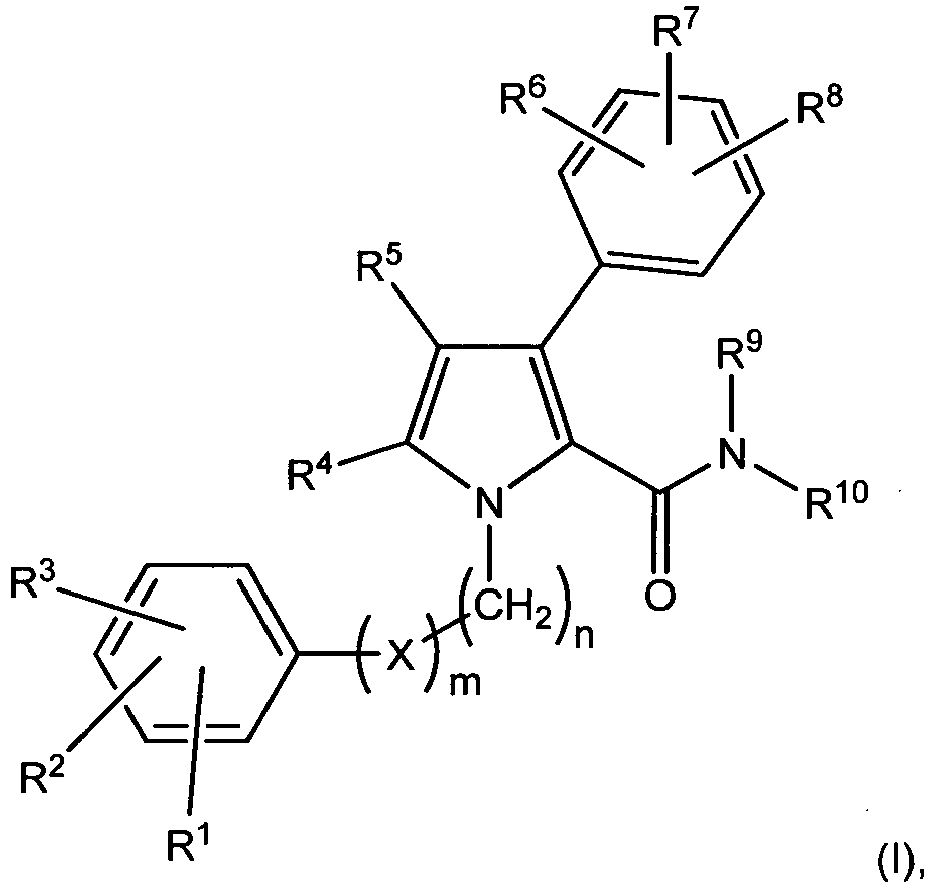 n represents 0, 1 or 2;m represents 0 or 1 with the proviso that n ≥ m;X is selected from the group consisting of O, S, NH and N-C1-6-alkyl;R1, R2 and R3, are each independently of one another selected from the group consisting of H; F; Cl; Br; I; NO2; CN; C1-6-alkyl; CF3; CF2H; CFH2; CF2Cl; CFCl2; C(=O)-H; C(=O)-C1-6-alkyl; C(=O)-OH; C(=O)-O-C1-6-alkyl; C(=O)-N(H)(OH); C(=O)-NH2; C(=O)-N(H)(C1-6-alkyl); C(=O)-N(C1-6-alkyl)2; C(=N-OH)-H; C(=N-OH)-C1-6-alkyl; C(=N-O-C1-6-alkyl)-H; C(=N-O-C1-6-alkyl)-C1-6-alkyl; OH; OCF3; OCF2H; OCFH2; OCF2Cl; OCFCl2; O-C1-6-alkyl; O-C(=O)-C1-6-alkyl; O-C(=O)-O-C1-6-alkyl; O-(C=O)-N(H)(C1-6-alkyl); O-C(=O)-N(C1-6-alkyl)2; O-S(=O)2-C1-6-alkyl; O-S(=O)2-OH; O-S(=O)2-O-C1-6-alkyl; O-S(=O)2-NH2; O-S(=O)2-N(H)(C1-6-alkyl); O-S(=O)2-N(C1-6-alkyl)2; NH2; N(H)(C1-6-alkyl); N(C1-6-alkyl)2; N(H)-C(=O)-C1-6-alkyl; N(H)-C(=O)-O-C1-6-alkyl; N(H)-C(=O)-NH2; N(H)-C(=O)-N(H)(C1-6-alkyl); N(H)-C(=O)-N(C1-6-alkyl)21; N(C1-6-alkyl)-C(=O)-C1-6-alkyl; N(C1-6-alkyl)-C(=O)-O-C1-6-alkyl; N(C1-6-alkyl)-C(=O)-NH2; N(C1-6-alkyl)-C(=O)-N(H)(C1-6-alkyl); N(C1-6-alkyl)-C(=O)-N(C1-6-alkyl)2; N(H)-S(=O)2OH; N(H)-S(=O)2-C1-6-alkyl; N(H)-S(=O)2-O-C1-6-alkyl; N(H)-S(=O)2-NH2; N(H)-S(=O)2-N(H)(C1-6-alkyl); N(H)-S(=O)2N(C1-6-alkyl)2; N(C1-6-alkyl)-S(=O)2-OH; N(C1-6-alkyl)-S(=O)2-C1-6-alkyl; N(C1-6-alkyl)-S(=O)2-O-C1-6-alkyl; N(C1-6-alkyl)-S(=O)2-NH2; N(C1-6-alkyl)-S(=O)2-N(H)(C1-6-alkyl); N(C1-6-alkyl)-S(=O)2-N(C1-6-alkyl)2; SH; SCF3; SCF2H; SCFH2; SCF2Cl; SCFCl2; S-C1-6-alkyl; S(=O)-C1-6-alkyl; S(=O)2-C1-6-alkyl; S(=O)2-OH; S(=O)2-O-C1-6-alkyl; S(=O)2-NH2; S(=O)2-N(H)(C1-6-alkyl); or S(=O)2-N(C1-6-alkylh, whereby in each case C1-6-alkyl may be branched or unbranched; unsubstituted or mono- or poly-substituted;a C3-6 cycloaliphatic residue or a 3 to 7 membered heterocycloaliphatic residue, in each case unsubstituted or mono- or polysubstituted;R4 represents CH2F; CHF2, or CF3;R5 represents H, C1-6-alkyl, branched or unbranched, unsubstituted or mono- or poly-substituted, a C3-6 cycloaliphatic residue or a 3 to 7 membered heterocycloaliphatic residue, in each case unsubstituted or mono- or polysubstituted; OH; O-C1-6-alkyl; NH2; N(H)-C1-6-alkyl; N(-C1-6-alkyl)2 or SO2(-C1-6-alkyl), whereby in each case C1-6-alkyl may be branched or unbranched; unsubstituted or mono- or polysubstituted;R6, R7 and R8, are each independently of one another selected from the group consisting of H; F; Cl; Br; I; NO2; CN; C1-6-alkyl; CF3; CF2H; CFH2; CF2Cl; CFCl2; C(=O)-H; C(=O)-C1-6-alkyl; C(=O)-OH; C(=O)-O-C1-6-alkyl; C(=O)-N(H)(OH); C(=O)-NH2; C(=O)-N(H)(C1-6-alkyl); C(=O)-N(C1-6-alkyl)2; C(=N-OH)-H; C(=N-OH)-C1-6-alkyl; C(=N-O-C1-6-alkyl)-H; C(=N-O-C1-6-alkyl)-C1-6-alkyl; OH; OCF3; OCF2H; OCFH2; OCF2Cl; OCFCl2; O-C1-6-alkyl; O-C(=O)-C1-6-alkyl; O-C(=O)-O-C1-6-alkyl; O-(C=O)-N(H)(C1-6-alkyl); O-C(=O)-N(C1-6-alkyl)2; O-S(=O)2-C1-6-alkyl; O-S(=O)2-OH; O-S(=O)2-O-C1-6-alkyl; O-S(=O)2-NH2; O-S(=O)2-N(H)(C1-6-alkyl); O-S(=O)2-N(C1-6-alkyl)2; NH2; N(H)(C1-6-alkyl); N(C1-6-alkyl)2; N(H)-C(=O)-C1-6-alkyl; N(H)-C(=O)-O-C1-6-alkyl; N(H)-C(=O)-NH2; N(H)-C(=O)-N(H)(C1-6-alkyl); N(H)-C(=O)-N(C1-6-alkyl)2; N(C1-6-alkyl)-C(=O)-C1-6-alkyl; N(C1-6-alkyl)-C(=O)-O-C1-6-alkyl; N(C1-6-alkyl)-C(=O)-NH2; N(C1-6-alkyl)-C(=O)-N(H)(C1-6-alkyl); N(C1-6-alkyl)-C(=O)-N(C1-6-alkyl)2; N(H)-S(=O)2OH; N(H)-S(=O)2-C1-6-alkyl; N(H)-S(=O)2-O-C1-6-alkyl; N(H)-S(=O)2-NH2; N(H)-S(=O)2-N(H)(C1-6-alkyl); N(H)-S(=O)2N(C1-6-alkyl)2; N(C1-6-alkyl)-S(=O)2-OH; N(C1-6-alkyl)-S(=O)2-C1-6-alkyl; N(C1-6-alkyl)-S(=O)2-O-C1-6-alkyl; N(C1-6-alkyl)-S(=O)2-NH2; N(C1-6-alkyl)-S(=O)2-N(H)(C1-6-alkyl); N(C1-6-alkyl)-S(=O)2-N(C1-6-alkyl)2; SH; SCF3; SCF2H; SCFH2; SCF2Cl; SCFCl2; S-C1-6-alkyl; S(=O)-C1-6-alkyl; S(=O)2-C1-6-alkyl; S(=O)2-OH; S(=O)2-O-C1-6-alkyl; S(=O)2-NH2; S(=O)2-N(H)(C1-6-alkyl); or S(=O)2-N(C1-6-alkyl)2, whereby in each case C1-6-alkyl may be branched or unbranched; unsubstituted or mono- or poly-substituted;a C3-6 cycloaliphatic residue or a 3 to 7 membered heterocycloaliphatic residue, in each case unsubstituted or mono- or polysubstituted;R9 represents H, a C1-10 aliphatic residue, branched or unbranched, unsubstituted or mono- or poly-substituted; a C3-10 cycloaliphatic residue or a 3 to 10 membered heterocycloaliphatic residue, in each case unsubstituted or mono- or poly-substituted and in each case optionally connected via a C1-8 alkylene group, branched or unbranched, which in turn may be unsubstituted or mono- or polysubstituted;R10 represents H, a C1-10 aliphatic residue, branched or unbranched, unsubstituted or mono- or polysubstituted; a C3-10 cycloaliphatic residue, a 3 to 10 membered heterocycloaliphatic residue or a heteroaryl residue, in each case unsubstituted or mono- or poly-substituted and in each case optionally connected via a C1-8 alkylene group, branched or unbranched, which in turn may be unsubstituted or mono- or polysubstituted; orR9 and R10 together with the nitrogen atom connecting them form a 3 to 10 membered heterocycloaliphatic residue, which may be unsubstituted or mono- or polysubstituted;optionally in the form of a single stereoisomer or a mixture of stereoisomers. In relation to the terms "alkyl", "C1-4-alkyl,"C1-6-alkyl", "aliphatic residue", "aliphatic group", "cycloaliphatic residue" and "heterocycloaliphatic residue", the term "mono- or polysubstituted" refers, with respect to the corresponding residues or groups, to the single substitution or multiple substitution, e.g. disubstitution, trisubstitution, tetrasubstitution, or pentasubstitution, of one or more hydrogen atoms each independently of one another by at least one substituent selected from the group consisting of F; Cl; Br; I; NO2; CN; =0; =NH; =N(OH); =N(O-C1-6-alkyl); CF3; CF2H; CFH2; CF2Cl; CFCl2; C1-6-alkyl; (C1-8alkylene)-OH; C(=O)-H; C(=O)-C1-6-alkyl; C(=O)-OH; C(=O)-O-C1-6-alkyl; C(=O)-N(H)(OH); C(=O)-NH2; C(=O)-N(H)(C1-6-alkyl); C(=O)-N(C1-6-alkyl) 2; C(=N-OH)-H; C(=N-OH)-C1-6-alkyl; C(=NO-C1-6-alkyl)-H; C(=N-O-C1-6-alkyl)-C1-6-alkyl; OH; OCF3; OCF2H; OCFH2; OCF2Cl; OCFCl2; O-C1-6-alkyl; O-(C1-8alkylene)-OH; O-(C1-8alkylene)-O-C1-8-alkyl; O-C(=O)-C1-6-alkyl; O-C(=O)-O-C1-6-alkyl; O-(C=O)-N(H)(C1-6-alkyl); O-C(=O)-N(C1-6-alkyl)2; O-S(=O)2-C1-6-alkyl; O-S(=O)2-OH; O-S(=O)2-O-C1-6-alkyl; O-S(=O)2-NH2; O-S(=O)2-N(H)(C1-6-alkyl); O-S(=O)2-N(C1-6-alkyl)2;NH2; N(H)(C1-6-alkyl); N(C 1-6-alkyl)2; N(H)-C(=O)-C1-6-alkyl; N(H)-C(=O)-O-C1-6-alkyl; N(H)-C(=O)-NH2; N(H)-C(=O)-N(H) (C1-6-alkyl); N(H)-C(=O)-N(C1-6-alkyl)2; N(C1-6-alkyl)-C(=O)-C1-6-alkyl; N(C1-6-alkyl)-C(=O)-O-C1-6-alkyl; N(C1-6-alkyl)-C(=O)-NH2; N(C1-6-alkyl)-C(=O)-N(H)(C1-6-alkyl); N(C1-6-alkyl)-C(=O)-N(C1-6-alkyl)2; N(H)-S(=O)2-OH; N(H)-S(=O)2-C1-6-alkyl; N(H)-S(=O)2-O-C1-6-alkyl; N(H)-S(=O)2-NH2; N(H)-S(=O)2-N(H)(C1-6-alkyl); N(H)-S(=O)2-N(C1-6-alkyl)2; N(C1-6-alkyl)-S(=O)2-OH; N(C1-6-alkyl)-S(=O)2-C1-6-alkyl; N(C1-6-alkyl)-S(=O)2-O-C1-6-alkyl; N(C1-6-alkyl)-S(=O)2-NH2; N(C1-6- alkyl)-S(=O)2-N(H)(C1-6-alkyl); N(C1-6-alkyl)-S(=O)2-N(C1-6-alkyl)2; SH; SCF3; SCF2H; SCFH2; SCF2Cl; SCFCl2; S-C1-6-alkyl; S(=O)-C1-6-alkyl; S(=O)2-C1-6-alkyl; S(=O)2-OH; S(=O)2-O-C1-6-alkyl; S(=O)2-NH2; S(=O)2-N(H)(C1-6-alkyl); S(=O)2-N(C1-6-alkyl)2; a cycloaliphatic residue or a 3 to 7 membered heterocycloaliphatic residue.In form of the free compound and/or a physiologically acceptable salt and/or a physiologically acceptable solvate thereof.
 - Compounds according to claim 1, characterized in that
R1, R2 and R3 are each independently of one another selected from the group consisting of H; F; Cl; CN; C1-6-alkyl; CF3; CF2H; CFH2; OH; OCF3; O-C1-6-alkyl; O-C(=O)-C1-6-alkyl; NH2; N(H)(C1-6-alkyl); N(C1-6-alkyl)2; SCF3; S(=O)-C1-6-alkyl; S(=O)2-C1-6-alkyl; S(=O)2-OH; S(=O)2-O-C1-6-alkyl; S(=O)2-NH2; S(=O)2-N(H)(C1-6-alkyl); or S(=O)2-N(C1-6-alkyl)2, whereby in each case C1-6-alkyl may be branched or unbranched or a C3-6 cycloaliphatic residue, unsubstituted or mono- or polysubstituted. - Compounds according to one or more of the preceding claims, characterized in that R4 represents CHF2 or CF3.
- Compounds according to one or more of the preceding claims, characterized in that R5 is selected from the group consisting of H, methyl, ethyl, n-propyl, iso-propyl, n-butyl, sec-butyl, iso-butyl, tert-butyl, cyclopropyl, methoxy, ethoxy, methylsulfonyl, 2-oxetyl, 3-oxetyl, 2-tetrahydrofuranyl and 3-tetrahydrofuranyl.
- Compounds according to one or more of the preceding claims, characterized in that R6, R7 and R8 are each independently of one another selected from the group consisting of H; F; Cl; CN; C1-6-alkyl; CF3; CF2H; CFH2; OH; OCF3; O-C1-6-alkyl; O-C(=O)-C1-6-alkyl; NH2; N(H)(C1-6-alkyl); N(C1-6-alkyl)2; SCF3; S(=O)-C1-6-alkyl; S(=O)2-C1-6-alkyl; S(=O)2-OH; S(=O)2-O-C1-6-alkyl; S(=O)2-NH2; S(=O)2-N(H)(C1-6-alkyl); or S(=O)2-N(C1-6 alkyl)2; whereby in each case C1-6-alkyl may be branched or unbranched; or a C3-6 cycloaliphatic residue, unsubstituted or mono- or polysubstituted.
- Compounds according to one or more of the preceding claims, characterized in that
R9 represents
H or
a C1-6 aliphatic residue, branched or unbranched, unsubstituted or substituted with 1, 2, 3, 4 or 5 substituents independently from one another selected from the group consisting of OH, =O, O-C1-6-alkyl, S(=O)-C1-6-alkyl, S(=O)2-C1-6-alkyl, N(H)-S(=O)-C1-6-alkyl, N(C1-6-alkyl)-S(=O)-C1-6-alkyl, N(H)-S(=O)2-C1-6-alkyl, N(C1-6-alkyl)-S(=O)2-C1-6-alkyl, C(=O)-NH2, C(=O)-N(H)(C1-6-alkyl), C(=O)-N(C1-6-alkyl)2, C(=O)-O-C1-6-alkyl; N(H)-C(=O)-C1-6-alkyl, and N(C1-6-alkyl)-C(=O)-C1-6-alkyl. - Compounds according to one or more of the preceding claims, characterized in that
R10 represents
H; or
a C1-6 aliphatic residue, branched or unbranched, unsubstituted or substituted with 1, 2, 3, 4 or 5 substituents independently from one another selected from the group consisting of F, Cl, CF3, CN, OH, =0, OCF3, O-C1-6-alkyl, O-(C=O)C1-6-alkyl, S(=O)-C1-6-alkyl, S(=O)2-C1-6-alkyl, S(=O)2-NH2, S(=O)2-N(H)C1-6-alkyl, S(=O)2-N1-6-alkyl)2, NH2, NH(C1-6-alkyl), N(C1-6-alkyl)2, N(H)-S(=O)-C1-6-alkyl, N(C1-6-alkyl)-S(=O)-C1-6-alkyl, N(H)-S(=O)2-C1-6-alkyl, N(C1-6-alkyl)-S(=O)2-C1-6-alkyl, N(H)-C(=O)-NH2, N(H)-C(=O)-N(H)(C1-6-alkyl), N(H)-C(=O)-N(C1-6-alkyl)2, N(H)-C(=O)-O-C1-6-alkyl; O-C(=O)-NH2, O-C(=O)-N(H)(C1-6-alkyl), O-C(=O)-N(C1-6-alkyl)2, C(=O)-NH2, C(=O)-N(H)(C1-6-alkyl), C(=O)-N(C1-6-alkyl)2, C(=O)-O-C1-6-alkyl; N(H)-C(=O)-C1-6-alkyl, and N(C1-6-alkyl)-C(=O)-C1-6-alkyl; or
a C3-6 cycloaliphatic residue, unsubstituted or substituted with 1, 2, 3, 4 or 5 substituents independently from one another selected from the group consisting of F, Cl, CN, CF3, =0, OCF3, C1-6-alkylen-OH, C1-6 alkyl, OH, O-C1-6-alkyl, O-(C=O)C1-6-alkyl, S(=O)-C1-6-alkyl, S(=O)2-C1-6-alkyl, S(=O)2-NH2, S(=O)2-N(H)C1-6-alkyl, S(=O)2-N(C1-6-alkyl)2, NH2, NH(C1-6-alkyl), N(C1-6-alkyl)2, N(H)-S(=O)-C1-6-alkyl, N(C1-6-alkyl)-S(=O)-C1-6-alkyl, N(H)-S(=O)2-C1-6-alkyl, N(C1-6-alkyl)-S(=O)2-C1-6-alkyl, N(H)-C(=O)-O-C1-6-alkyl; O-C(=O)-NH2, O-C(=O)-N(H)(C1-6-alkyl), O-C(=O)-N(C1-6-alkyl)2, N(H)-C(=O)-NH2, N(H)-C(=O)-N(H)(C1-6-alkyl), N(H)-C(=O)-N(C1-6-alkyl)2, C(=O)-NH2, C(=O)-N(H)(C1-6-alkyl), C(=O)-N(C1-6-alkyl)2, C(=O)-O-C1-6-alkyl; N(H)-C(=O)-C1-6-alkyl, and N(C1-6-alkyl)-C(=O)-C1-6-alkyl; wherein said C3-6 cycloaliphatic residue is optionally connected via a C1-6-alkylene group, branched or unbranched, which in turn may be unsubstituted or substituted with 1, 2, 3, 4 or 5 substituents independently from one another selected from the group consisting of F, Cl, CF3, =0, OCF3, OH, O-C1-6-alkyl and C1-6-alkylen-OH; or
a 3-7-membered heterocycloaliphatic residue, which is unsubstituted or substituted with 1, 2, 3, 4 or 5 substituents independently from one another selected from the group consisting of F, Cl, CN, CF3, =O, OCF3, C1-6-alkylen-OH, C1-6 alkyl, OH, O-C1-6-alkyl, O-(C=O)C1-6-alkyl, S(=O)-C1-6-alkyl, S(=O)2-C1-6-alkyl, S(=O)2-NH2, S(=O)2-N(H)C1-6-alkyl, S(=O)2-N(C1-6-alkyl)2, NH2, NH(C1-6-alkyl), N(C1-6-alkyl)2, N(H)-S(=O)-C1-6-alkyl, N(C1-6-alkyl)-S(=O)-C1-6-alkyl, N(H)-S(=O)2-C1-6-alkyl, N(C1-6-alkyl)-S(=O)2-C1-6-alkyl, N(H)-C(=O)-O-C1-6-alkyl; O-C(=O)-NH2, O-C(=O)-N(H)(C1-6-alkyl), O-C(=O)-N(C1-6-alkyl)2, N(H)-C(=O)-NH2, N(H)-C(=O)-N(H)(C1-6-alkyl), N(H)-C(=O)-N(C1-6-alkyl)2, (C=O)C1-6-alkyl, C(=O)-NH2, C(=O)-N(H)(C1-6-alkyl), C(=O)-N(C1-6-alkyl)2, C(=O)-O-C1-6-alkyl; N(H)-C(=O)-C1-6-alkyl, and N(C1-6-alkyl)-C(=O)-C1-6-alkyl, wherein said 3-7-membered heterocycloaliphatic residue is optionally connected via a C1-6-alkylene group, branched or unbranched, which in turn may be unsubstituted or substituted with 1, 2, 3, 4 or 5 substituents independently from one another selected from the group consisting of F, Cl, CF3, =0, OCF3, OH, O-C1-6-alkyl and C1-6-alkylen-OH;
or a heteroaryl residue, which is unsubstituted or substituted with 1, 2, 3, 4 or 5 substituents independently from one another selected from the group consisting of F, Cl, CN, CF3, OCF3, C1-6-alkylen-OH, C1-6-alkyl, OH, O-C1-6-alkyl, O-(C=O)C1-6-alkyl, S(=O)-C1-6-alkyl, S(=O)2-C1-6-alkyl, S(=O)2-NH2, S(=O)2-N(H)C1-6-alkyl, S(=O)2-N(C1-6-alkyl)2, NH2, NH(C1-6-alkyl), N(C1-6-alkyl)2, N(H)-S(=O)-C1-6-alkyl, N(C1-6-alkyl)-S(=O)-C1-6-alkyl, N(H)-S(=O)2-C1-6-alkyl, N(C1-6-alkyl)-S(=O)2-C1-6-alkyl, N(H)-C(=O)-O-C1-6-alkyl; O-C(=O)-NH2, O-C(=O)-N(H)(C1-6-alkyl), O-C(=O)-N(C1-6-alkyl)2, N(H)-C(=O)-NH2, N(H)-C(=O)-N(H)(C1-6-alkyl), N(H)-C(=O)-N(C1-6-alkyl)2, C(=O)-NH2, C(=O)-N(H)(C1-6-alkyl), C(=O)-N(C1-6-alkyl)2, C(=O)-O-C1-6-alkyl; N(H)-C(=O)-C1-6-alkyl, and N(C1-6-alkyl)-C(=O)-C1-6-alkyl, wherein said heteroaryl residue is optionally connected via a C1-6-alkylene group, branched or unbranched, which in turn may be unsubstituted or substituted with 1, 2, 3, 4 or 5 substituents independently from one another selected from the group consisting of F, Cl, CF3, =0, OCF3, OH, O-C1-6-alkyl and C1-6-alkylen-OH. - Compounds according to one or more of the preceding claims, characterized in that R9 and R10 together with the nitrogen atom connecting them form a 3-7-membered heterocycloaliphatic residue, unsubstituted or substituted with 1, 2, 3, 4 or 5 substituents selected from the group consisting of F, Cl, CN, CF3, =0, OH, C1-6-alkyl, O-C1-6-alkyl, C1-6-alkylen-OH, OCF3, SO2(C1-6-alkyl), SO2NH2, SO2N(H)C1-6-alkyl, SO2N(C1-6-alkyl)2, C1-6-alkylen-SO2(C1-6-alkyl), NH2, NH(C1-6-alkyl), N(C1-6-alkyl)2, (C=O)C1-6-alkyl, a C3-6cycloaliphatic residue or a 3 to 7 membered heterocycloaliphatic residue, in each case unsubstituted or mono- or polysubstituted.
- Compounds according to one or more of the preceding claims, characterized in that
n represents 1 and m represents 0; and
R1, R2 and R3, are each independently of one another selected from the group consisting of H; F; Cl; CN; CF3; CF2H; CFH2; OH; OCF3; O-C1-6-alkyl; O-C(=O)-C1-6-alkyl; NH2; N(H)(C1-6-alkyl); N(C1-6-alkyl)2; SCF3; S(=O)-C1-6-alkyl; S(=O)2-C1-6-alkyl; S(=O)2-OH; S(=O)2-O-C1-6-alkyl; S(=O)2-NH2; S(=O)2-N(H)(C1-6-alkyl); or S(=O)2-N(C1-6-alkyl)2, whereby in each case C1-6-alkyl may be branched or unbranched. - Compounds according to one or more of the preceding claims, characterized in that
R9 represents H or C1-6-alkyl; and
R10 represents
a C3-6 cycloaliphatic residue, which is unsubstituted or substituted with 1, 2, 3, 4 or 5 substituents independently from one another selected from the group consisting of F, Cl, CF3, =0, OCF3, OH, O-C1-6-alkyl, C1-6-alkylen-OH and C1-6-alkyl; or
a 3-7-membered heterocycloaliphatic residue, which contains 1 or 2 heteroatoms or heteroatom groups independently from one another selected from the group consisting of O, S, S(=O), S(=O)2, NH and N-C1-6-alkyl, and which is unsubstituted or substituted with 1, 2, 3, 4 or 5 substituents independently from one another selected from the group consisting of F, Cl, CF3, OCF3, CN, C1-6-alkyl, C1-6-alkylen-OH and O-C1-6-alkyl; or
a heteroaryl residue, which contains at least one nitrogen atom and which is unsubstituted or substituted with 1, 2 or 3 substituents independently from one another selected from the group consisting of F, Cl, CN, CF3, OCF3, C1-6-alkylen-OH, C1-6-alkyl, OH, O-C1-6-alkyl, S(=O)2-C1-6-alkyl, S(=O)2-NH2, NH2, NH(C1-6-alkyl); N(C1-6-alkyl)2, O-C(=O)-NH2, C(=O)-NH2, C(=O)-N(H)(C1-6-alkyl), C(=O)-N(C1-6-alkyl)2, C(=O)-O-C1-6-alkyl;
or a part structure of general formula SF-III x represents 0, 1 or 2;y represents 0, 1 or 2;z represents 0, 1 or 2;on the condition that the sum of x, y and z is 1, 2, 3, 4, 5 or 6;R11 and R12 are independently from one another selected from H or C1-6-alkyl; orR11 and R12 together with the carbon atom connecting them form a C3-6 cycloaliphatic residue or a 3-7-membered heterocycloaliphatic residue, which contains 1 or 2 heteroatoms or heteroatom groups independently from one another selected from the group consisting of O, S, S(=O), S(=O)2, NH and N-C1-6-alkyl, wherein said C3-6- cycloaliphatic residue or 3-7-membered heterocycloaliphatic residue may be unsubstituted or substituted with 1, 2, 3, 4 or 5 substituents independently from one another selected from the group consisting of F, Cl, CF3, OCF3, CN, C1-6-alkyl and O-C1-6-alkyl;R13 is selected from the group consisting of
H, OH, O-C1-6-alkyl, O-(C=O)C1-6-alkyl, S(=O)-C1-6-alkyl, S(=O)2-C1-6-alkyl, S(=O)2-NH2, S(=O)2-N(H)C1-6-alkyl, S(=O)2-N(C1-6-alkyl)2, NH2, NH(C1-6-alkyl), N(C1-6-alkyl)2, N(H)-C(=O)-C1-6-alkyl, N(C1-6-alkyl)-C(=O)-C1-6-alkyl, N(H)-S(=O)-C1-6-alkyl, N(C1-6-alkyl)-S(=O)-C1-6-alkyl, N(H)-S(=O)2-C1-6-alkyl, N(C1-6-alkyl)-S(=O)2-C1-6-alkyl, C(=O)-NH2, C(=O)-N(H)(C1-6-alkyl), C(=O)-N(C1-6-alkyl)2, C(=O)-O-C1-6-alkyl, N(H)-C(=O)-NH2, N(H)-C(=O)-N(H)(C1-6-alkyl), N(H)-C(=O)-N(C1-6-alkyl)2, N(H)-C(=O)-O-C1-6-alkyl; O-C(=O)-NH2, O-C(=O)-N(H)(C1-6-alkyl), O-C(=O)-N(C1-6-alkyl)2; or representsa C3-6 cycloaliphatic residue, which is unsubstituted or substituted with 1, 2, 3, 4, or 5 substituents independently from one another selected from the group consisting of F, Cl, CF3, =0, OCF3, OH, O-C1-6-alkyl, C1-6-alkylen-OH and C1-6-alkyl; ora 3-7-membered heterocycloaliphatic residue, which contains 1 or 2 heteroatoms or heteroatom groups independently from one another selected from the group consisting of O, S, S(=O), S(=O)2, NH and N-C1-6-alkyl, and which is unsubstituted or substituted with 1, 2, 3, 4 or 5 substituents independently from one another selected from the group consisting of F, Cl, CF3, OCF3, CN, C1-6-alkyl and O-C1-6-alkyl; ora heteroaryl residue, which contains at least one nitrogen atom and which is unsubstituted or substituted with 1, 2 or 3 substituents independently from one another selected from the group consisting of F, Cl, CN, CF3, OCF3, C1-6-alkylen-OH, C1-6-alkyl, OH, O-C1-6-alkyl, S(=O)2-C1-6-alkyl, S(=O)2-NH2, NH2, NH(C1-6-alkyl), N(C1-6-alkyl)2, O-C(=O)-NH2, C(=O)-NH2, C(=O)-N(H)(C1-6-alkyl), C(=O)-N(C1-6-alkyl)2, C(=O)-O-C1-6-alkyl;
orR9 and R10 together with the nitrogen atom connecting them form a 3-7-membered heterocycloaliphatic residue selected from the group consisting of

 R14 denotes 0, 1, 2, 3 or 4 substituents which are in each case independently of each other selected from the group consisting of F, Cl, CF3, =0, OCF3, OH, O-C1-6-alkyl, C1-6-alkylen-OH, C1-6-alkylen-SO2(C1-6-alkyl), SO2(C1-6-alkyl) and C1-6-alkyl;
orR14 denotes at least two substituents, wherein two substituents R14 stand together for a C1-6-alkylen-group, substituted or unsubstituted, wherein optionally one or more C-atoms of the C1-6-alkylen-group is replaced by a heteroatom or heteroatom group, selected of O, N-R15, S, S(O) and S(O)2, and wherein these two substituents R14 are positioned at different carbon atoms of the heterocycloaliphatic residue, so the C1-6-alkylen-group represents a bridge to form a bicyclic heterocycloaliphatic residue;
orR14 denotes at least two substituents, wherein two substituents R14 stand together for a C2-6-alkylen-group, substituted or unsubstituted, wherein optionally one or more C-atoms of the C2-6-alkylen-group is replaced by a heteroatom or heteroatom group, selected of O, N-R15, S, S(O) and S(O)2, and wherein these two substituents R14 are positioned at the same carbon atom of the heterocycloaliphatic residue, so the C2-6-alkylen-group forms a spiro-heterocycloaliphatic residue; andR15 represents H, C1-6-alkyl or (C=O)C1-6-alkyl. - Compounds according to one or more of the preceding claims, characterized in that
n represents 1 and m represents 0;
R1 represents H;
R2 and R3 are each independently of one another selected from the group consisting of H; F; Cl; CN; CF3; CF2H; CFH2; OH; OCF3; O-C1-6-alkyl; O-C(=O)-C1-6-alkyl; NH2; N(H)(C1-6-alkyl); N(C1-6-alkyl)2; SCF3; S(=O)-C1-6-alkyl; S(=O)2-C1-6-alkyl; S(=O)2-OH; S(=O)2-O-C1-6-alkyl; S(=O)2-NH2; S(=O)2-N(H)(C1-6-alkyl); or S(=O)2-N(-C1-6-alkyl)2, whereby in each case C1-6-alkyl may be branched or unbranched,
R4 represents CHF2 or CF3;
R5 represents H, methyl, ethyl, n-propyl, iso-propyl, n-butyl, sec-butyl, iso-butyl, tert-butyl, cyclopropyl, methoxy, ethoxy, methylsulfonyl, 2-oxetyl, 3-oxetyl, 2-tetrahydrofuranyl or 3-tetrahydrofuranyl;
R6, R7 and R8, are each independently of one another selected from the group consisting of H; F; Cl; CN; CF3; CF2H; CFH2; OH; OCF3; O-C1-6-alkyl; O-C(=O)-C1-6-alkyl; NH2; N(H)(C1-6-alkyl); N(C1-6-alkyl)2; SCF3; S(=O)-C1-6-alkyl; S(=O)2-C1-6-alkyl; S(=O)2-OH; S(=O)2-O-C1-6-alkyl; S(=O)2-NH2; S(=O)2-N(H)(C1-6-alkyl); or S(=O)2-N(-C1-6-alkyl)2, whereby in each case C1-6-alkyl may be branched or unbranched,
R9 represents H or C1-6-alkyl;
R10 represents
a C3-6 cycloaliphatic residue, which is unsubstituted or substituted with 1, 2, 3, 4 or 5 substituents independently from one another selected from the group consisting of F, Cl, CF3, =0, OCF3, OH, O-C1-6-alkyl, C1-6-alkylen-OH and C1-6-alkyl; or
a 3-7-membered heterocycloaliphatic residue, which contains 1 or 2 heteroatoms or heteroatom groups independently from one another selected from the group consisting of O, S, S(=O), S(=O)2, NH and N-C1-6-alkyl, and which is unsubstituted or substituted with 1, 2, 3, 4 or 5 substituents independently from one another selected from the group consisting of F, Cl, CF3, OCF3, CN, C1-6-alkyl and O-C1-6-alkyl; or
a heteroaryl residue, which contains at least one nitrogen atom and which is unsubstituted or substituted with 1, 2 or 3 substituents independently from one another selected from the group consisting of F, Cl, CN, CF3, OCF3, C1-6-alkylen-OH, C1-6-alkyl, OH, O-C1-6-alkyl, S(=O)2-C1-6-alkyl, S(=O)2-NH2, NH2, NH(C1-6-alkyl), N(C1-6-alkyl)2, O-C(=O)-NH2, C(=O)-NH2, C(=O)-N(H)(C1-6-alkyl), C(=O)-N(C1-6-alkyl)2, C(=O)-O-C1-6-alkyl;
or
represents a part structure of general formula SF-III x represents 0, 1 or 2;y represents 0, 1 or 2;z represents 0, 1 or 2;on the condition that the sum of x, y and z is 1, 2, 3, 4, 5 or 6;R11 and R12 are independently from one another selected from H or C1-6-alkyl; orR11 and R12 together with the carbon atom connecting them form a C3-6 cycloaliphatic residue or a 3-7-membered heterocycloaliphatic residue, which contains 1 or 2 heteroatoms or heteroatom groups independently from one another selected from the group consisting of O, S, S(=O), S(=O)2, NH and N-C1-6-alkyl, wherein said C3-6-cycloaliphatic residue or 3-7-membered heterocycloaliphatic residue is unsubstituted or substituted with 1, 2, 3, 4 or 5 substituents independently from one another selected from the group consisting of F, CF3, OCF3 CN, C1-6-alkyl and O-C1-6-alkyl;R13 is selected from the group consisting of
H, OH, O-C1-6-alkyl, O-(C=O)C1-6-alkyl, S(=O)-C1-6-alkyl, S(=O)2-C1-6-alkyl, S(=O)2-NH2, S(=O)2-N(H)C1-6-alkyl, S(=O)2-N(C1-6-alkyl)2, NH2, NH(C1-6-alkyl), N(C1-6-alkyl)2, N(H)-C(=O)-C1-6-alkyl, N(C1-6-alkyl)-C(=O)-C1-6-alkyl, N(H)-S(=O)-C1-6-alkyl, N(C1-6-alkyl)-S(=O)-C1-6-alkyl, N(H)-S(=O)2-C1-6-alkyl, N(C1-6-alkyl)-S(=O)2-C1-6-alkyl, C(=O)-NH2, C(=O)-N(H)(C1-6-alkyl), C(=O)-N(C1-6-alkyl)2, C(=O)-O-C1-6-alkyl, N(H)-C(=O)-NH2, N(H)-C(=O)-N(H)(C1-6-alkyl), N(H)-C(=O)-N(C1-6-alkyl)2, N(H)-C(=O)-O-C1-6-alkyl; O-C(=O)-NH2, O-C(=O)-N(H)(C1-6-alkyl), O-C(=O)-N(C1-6-alkyl)2;
or representsa C3-6 cycloaliphatic residue, which is unsubstituted or substituted with 1, 2, 3, 4, or 5 substituents independently from one another selected from the group consisting of F, Cl, CF3, =0, OCF3, OH, O-C1-6 alkyl, C1-6 alkylen-OH and C1-6-alkyl; ora 3-7-membered heterocycloaliphatic residue, which contains 1 or 2 heteroatoms or heteroatom groups independently from one another selected from the group consisting of O, S, NH and N-C1-6-alkyl, and which is unsubstituted or substituted with 1, 2, 3, 4 or 5 substituents independently from one another selected from the group consisting of F, Cl, CF3, OCF3, CN, C1-6-alkyl and O-C1-6-alkyl;a heteroaryl residue, which contains at least one nitrogen atom and which is unsubstituted or substituted with 1, 2 or 3 substituents independently from one another selected from the group consisting of F, Cl, CN, CF3, OCF3, C1-6-alkylen-OH, C1-6-alkyl, OH, O-C1-6-alkyl, S(=O)2-C1-6-alkyl, S(=O)2-NH2, NH2, NH(C1-6-alkyl), N(C1-6-alkyl)2, O-C(=O)-NH2, C(=O)-NH2, C(=O)-N(H)(C1-6-alkyl), C(=O)-N(C1-6-alkyl)2, C(=O)-O-C1-6-alkyl; orR9 and R10 together with the nitrogen atom connecting them form a heterocycloaliphatic residue selected from the group consisting of

 R14 denotes 0, 1, 2, 3 or 4 substituents which are in each case independently of each other selected from the group consisting of F, Cl, CF3, =0, OCF3, OH, O-C1-6-alkyl, C1-6-alkylen-OH, C1-6-alkylen-SO2(C1-6-alkyl), SO2(C1-6-alkyl) and C1-6-alkyl;
orR14 denotes at least two substituents, wherein two substituents R14 stand together for a C1-6-alkylen-group, substituted or unsubstituted, wherein optionally one or more C-atoms of the C1-6-alkylen-group is replaced by a heteroatom or heteroatom group, selected of O, N-R15, S, S(O) and S(O)2, and wherein these two substituents R14 are positioned at different carbon atoms of the heterocycloaliphatic residue, so the C1-6-alkylen-group represents a bridge to form a bicyclic heterocycloaliphatic residue; orR14 denotes at least two substituents, wherein two substituents R14 stand together for a C2-6-alkylen-group, substituted or unsubstituted, wherein optionally one or more C-atoms of the C2-6-alkylen-group is replaced by a heteroatom or heteroatom group, selected of O, N-R15, S, S(O) and S(O)2, and wherein these two substituents R14 are positioned at the same carbon atom of the heterocycloaliphatic residue, so the C2-6-alkylen-group forms a spiro-heterocycloaliphatic residue; andR15 represents H, C1-6-alkyl or (C=O)C1-6-alkyl. - Compounds according to one or more of the preceding claims selected from the group consisting ofSC-01 [1-Benzyl-3-(4-chlorophenyl)-5-(trifluoromethyl)-1H-pyrrol-2-yl]-morpholin-4-yl-methanoneSC-02 1-Benzyl-3-(4-chlorophenyl)-N-(2,2-dimethyl-propyl)-N-methyl-5-(trifluoromethyl)-1H-pyrrole-2-carboxylic acid amideSC-03 [1-Benzyl-3-(4-chlorophenyl)-4-methyl-5-(trifluoromethyl)-1H-pyrrol-2-yl]-morpholin-4-yl-methanoneSC-04 1-Benzyl-3-(4-chlorophenyl)-N-(2,2-dimethyl-propyl)-N,4-dimethyl-5-(trifluoromethyl)-1H-pyrrole-2-carboxylic acid amideSC-05 [1-Benzyl-3-(4-chlorophenyl)-4-methyl-5-(trifluoromethyl)-1H-pyrrol-2-yl]-(3-hydroxy-azetidin-1-yl)-methanoneSC-06 1-Benzyl-3-(4-chlorophenyl)-N,4-dimethyl-N-(2-methylsulfonyl-ethyl)-5-(trifluoromethyl)-1H-pyrrole-2-carboxylic acid amideSC-08 4-[1-Benzyl-3-(4-chlorophenyl)-4-methyl-5-(trifluoromethyl)-1H-pyrrole-2-carbonyl]-piperazin-2-oneSC-09 4-[1-Benzyl-3-(4-chlorophenyl)-4-methyl-5-(trifluoromethyl)-1H-pyrrole-2-carbonyl]-1-methyl-piperazin-2-oneSC-10 1-Benzyl-3-(4-chlorophenyl)-4-methyl-N-tetrahydro-pyran-4-yl-5-(trifluoromethyl)-1H-pyrrole-2-carboxylic acid amideSC-11 1-Benzyl-3-(4-chlorophenyl)-N,4-dimethyl-N-tetrahydro-pyran-4-yl-5-(trifluoromethyl)-1H-pyrrole-2-carboxylic acid amideSC-16 1-Benzyl-3-(4-chlorophenyl)-N-[1-(hydroxymethyl)-cyclopropyl]-4-methyl-5-(trifluoromethyl)-1 H-pyrrole-2-carboxylic acid amideSC-17 [1-Benzyl-3-(4-chlorophenyl)-4-methyl-5-(trifluoromethyl)-1 H-pyrrol-2-yl]-(4-hydroxy-piperidin-1-yl)-methanoneSC-18 1-Benzyl-3-(4-chlorophenyl)-N,N,4-trimethyl-5-(trifluoromethyl)-1H-pyrrole-2-carboxylic acid amideSC-19 [1-Benzyl-3-(4-chlorophenyl)-4-methyl-5-(trifluoromethyl)-1 H-pyrrol-2-yl]-(1-oxo-[1,4]thiazinan-4-yl)-methanoneSC-20 [1-Benzyl-3-(4-chlorophenyl)-4-methyl-5-(trifluoromethyl)-1H-pyrrol-2-yl]-[2-(hydroxymethyl)-morpholin-4-yl]-methanoneSC-21 1-Benzyl-3-(4-chlorophenyl)-N,4-dimethyl-N-(tetrahydro-pyran-4-yl-methyl)-5-(trifluoromethyl)-1H-pyrrole-2-carboxylic acid amideSC-22 1-Benzyl-3-(4-chlorophenyl)-N,4-dimethyl-5-(trifluoromethyl)-1H-pyrrole-2-carboxylic acid amideSC-23 [1-Benzyl-3-(4-chlorophenyl)-4-methyl-5-(trifluoromethyl)-1H-pyrrol-2-yl]-(3-hydroxy-pyrrolidin-1-yl)-methanoneSC-24 1-Benzyl-3-(4-chlorophenyl)-N-(2-hydroxy-ethyl)-N,4-dimethyl-5-(trifluoromethyl)-1H-pyrrole-2-carboxylic acid amideSC-25 [3-(4-Chlorophenyl)-1-[(3-chlorophenyl)-methyl]-4-methyl-5-(trifluoromethyl)-1H-pyrrol-2-yl]-morpholin-4-yl-methanoneSC-26 [1-Benzyl-3-(4-chlorophenyl)-4-methyl-5-(trifluoromethyl)-1H-pyrrol-2-yl]-(1,1-dioxo-[1,4]thiazinan-4-yl)-methanoneSC-29 [1-Benzyl-3-(4-chlorophenyl)-4-methyl-5-(trifluoromethyl)-1H-pyrrol-2-yl]-(3,3-dimethyl-piperazin-1-yl)-methanoneSC-32 [3-(4-Chlorophenyl)-1-(3-methoxyphenyl)-4-methyl-5-(trifluoromethyl)-1H-pyrrol-2-yl]-(3,3-difluoro-azetidin-1-yl)-methanoneSC-33 [1-(3-Chlorophenyl)-3-(4-chlorophenyl)-4-methyl-5-(trifluoromethyl)-1H-pyrrol-2-yl]-(3,3-difluoro-azetidin-1-yl)-methanoneSC-34 1-Benzyl-3-(4-chlorophenyl)-N-cyclopropyl-N,4-dimethyl-5-(trifluoromethyl)-1H-pyrrole-2-carboxylic acid amideSC-35 1-Benzyl-3-(4-chlorophenyl)-N-cyclopropyl-4-methyl-5-(trifluoromethyl)-1H-pyrrole-2-carboxylic acid amideSC-36 1-Benzyl-3-(4-chlorophenyl)-N-[(1-methoxy-cyclopropyl)-methyl]-4-methyl-5-(trifluoromethyl)-1H-pyrrole-2-carboxylic acid amideSC-37 N-(2-Acetylamino-ethyl)-1-benzyl-3-(4-chlorophenyl)-N,4-dimethyl-5-(trifluoromethyl)-1 H-pyrrole-2-carboxylic acid amideSC-38 1-Benzyl-3-(4-chlorophenyl)-N-[2-(methanesulfonamido)-ethyl]-N,4-dimethyl-5-(trifluoromethyl)-1H-pyrrole-2-carboxylic acid amideSC-39 1-Benzyl-3-(4-chlorophenyl)-N,4-dimethyl-N-(1-methyl-piperidin-4-yl)-5-(trifluoromethyl)-1H-pyrrole-2-carboxylic acid amideSC-40 [1-Benzyl-3-(4-chlorophenyl)-4-methyl-5-(trifluoromethyl)-1H-pyrrol-2-yl]-(2,2-dimethyl-morpholin-4-yl)-methanoneSC-41 [1-Benzyl-3-(4-chlorophenyl)-5-(difluoro-methyl)-4-methyl-1H-pyrrol-2-yl]-morpholin-4-yl-methanoneSC-42 1-Benzyl-3-(4-chlorophenyl)-5-(difluoro-methyl)-N-(2,2-dimethyl-propyl)-N,4-dimethyl-1 H-pyrrole-2-carboxylic acid amideSC-44 [1,3-Bis(4-chlorophenyl)-4-methyl-5-(trifluoromethyl)-1H-pyrrol-2-yl]-(3,3-difluoro-azetidin-1-yl)-methanoneSC-48 1-Benzyl-3-(4-chlorophenyl)-N-[1-(hydroxymethyl)-cyclopropyl]-N,4-dimethyl-5-(trifluoromethyl)-1H-pyrrole-2-carboxylic acid amideSC-49 1-Benzyl-N-(1-carbamoyl-cyclopropyl)-3-(4-chlorophenyl)-N,4-dimethyl-5-(trifluoromethyl)-1H-pyrrole-2-carboxylic acid amideSC-50 4-[1-Benzyl-3-(4-chlorophenyl)-4-methyl-5-(trifluoromethyl)-1H-pyrrole-2-carbonyl]-morpholin-2-oneSC-51 [3-(4-Chlorophenyl)-1-[2-(4-fluoro-phenoxy)-ethyl]-4-methyl-5-(trifluoromethyl)-1H-pyrrol-2-yl]-morpholin-4-yl-methanoneSC-52 1-[[1-Benzyl-3-(4-chlorophenyl)-4-methyl-5-(trifluoromethyl)-1H-pyrrole-2-carbonyl]-methyl-amino]-cyclopropane-1-carboxylic acid ethyl esterSC-53 3-(4-Chlorophenyl)-1-[(3-chlorophenyl)-methyl]-N-(2,2-dimethyl-propyl)-N,4-dimethyl-5-(trifluoromethyl)-1H-pyrrole-2-carboxylic acid amideSC-54 1-Benzyl-3-(4-chlorophenyl)-N-(2-hydroxy-2-methyl-propyl)-N,4-dimethyl-5-(trifluoromethyl)-1H-pyrrole-2-carboxylic acid amideSC-55 4-[3-(4-Chlorophenyl)-1-[(3-chlorophenyl)-methyl]-4-methyl-5-(trifluoromethyl)-1H-pyrrole-2-carbonyl]-piperazin-2-oneSC-56 3-(4-Chlorophenyl)-1-[(3-chlorophenyl)-methyl]-N,4-dimethyl-N-(2-methylsulfonyl-ethyl)-5-(trifluoromethyl)-1H-pyrrole-2-carboxylic acid amideSC-57 3-(4-Chlorophenyl)-1-[(3-chlorophenyl)-methyl]-N-(2-hydroxy-2-methyl-propyl)-N,4-dimethyl-5-(trifluoromethyl)-1H-pyrrole-2-carboxylic acid amideSC-58 1-Benzyl-3-(4-chloro-2-fluoro-phenyl)-N-(2-hydroxy-2-methyl-propyl)-N,4-dimethyl-5-(trifluoromethyl)-1H-pyrrole-2-carboxylic acid amideSC-59 1-Benzyl-3-(4-chloro-2-fluoro-phenyl)-N-(2,2-dimethyl-propyl)-N,4-dimethyl-5-(trifluoromethyl)-1H-pyrrole-2-carboxylic acid amideSC-60 1-Benzyl-3-(4-chlorophenyl)-N,4-dimethyl-N-[(3-methyl-oxetan-3-yl)-methyl]-5-(trifluoromethyl)-1H-pyrrole-2-carboxylic acid amideSC-61 4-[1-Benzyl-3-(4-chloro-2-fluoro-phenyl)-4-methyl-5-(trifluoromethyl)-1H-pyrrole-2-carbonyl]-piperazin-2-oneSC-62 [1-Benzyl-3-(4-chloro-2-fluoro-phenyl)-4-methyl-5-(trifluoromethyl)-1H-pyrrol-2-yl]-morpholin-4-yl-methanoneSC-63 1-Benzyl-3-(4-chlorophenyl)-N-(1,1-dioxo-thiolan-3-yl)-N,4-dimethyl-5-(trifluoromethyl)-1H-pyrrole-2-carboxylic acid amideSC-64 1-Benzyl-3-(4-chloro-2-fluoro-phenyl)-N,4-dimethyl-N-(2-methylsulfonyl-ethyl)-5-(trifluoromethyl)-1H-pyrrole-2-carboxylic acid amideSC-65 1-Benzyl-3-(4-chlorophenyl)-N-[(1-hydroxy-cyclopropyl)-methyl]-N,4-dimethyl-5-(trifluoromethyl)-1H-pyrrole-2-carboxylic acid amideSC-66 4-[1-Benzyl-3-(4-chlorophenyl)-5-(trifluoromethyl)-1H-pyrrole-2-carbonyl]-piperazin-2-oneSC-67 1-Benzyl-3-(4-chlorophenyl)-N-methyl-N-(2-methylsulfonyl-ethyl)-5-(trifluoromethyl)-1 H-pyrrole-2-carboxylic acid amideSC-68 1-Benzyl-3-(4-chlorophenyl)-N-(2-hydroxy-2-methyl-propyl)-N-methyl-5-(trifluoromethyl)-1H-pyrrole-2-carboxylic acid amideSC-69 3-(4-Chlorophenyl)-1-[(3-chlorophenyl)-methyl]-N-methyl-N-(2-methylsulfonyl-ethyl)-5-(trifluoromethyl)-1H-pyrrole-2-carboxylic acid amideSC-70 3-(4-Chlorophenyl)-1-[(3-chlorophenyl)-methyl]-N-(2-hydroxy-2-methyl-propyl)-N-methyl-5-(trifluoromethyl)-1H-pyrrole-2-carboxylic acid amideSC-71 3-(4-Chlorophenyl)-1-[(3-chlorophenyl)-methyl]-N-(2,2-dimethyl-propyl)-N-methyl-5-(trifluoromethyl)-1H-pyrrole-2-carboxylic acid amideSC-72 [1-Benzyl-3-(4-chlorophenyl)-5-(trifluoromethyl)-1H-pyrrol-2-yl]-(3-hydroxy-azetidin-1-yl)-methanoneSC-73 1-Benzyl-3-(4-chlorophenyl)-N-methyl-N-tetrahydro-pyran-4-yl-5-(trifluoromethyl)-1H-pyrrole-2-carboxylic acid amideSC-74 [3-(4-Chlorophenyl)-1-[(3-chlorophenyl)-methyl]-5-(trifluoromethyl)-1H-pyrrol-2-yl]-morpholin-4-yl-methanoneSC-75 [1-Benzyl-3-(4-chlorophenyl)-5-(trifluoromethyl)-1H-pyrrol-2-yl]-(2,2-dimethyl-morpholin-4-yl)-methanoneSC-76 1-Benzyl-3-(4-chlorophenyl)-N-(cyclopropyl-methyl)-N-methyl-5-(trifluoromethyl)-1H-pyrrole-2-carboxylic acid amideSC-77 1-Benzyl-N-tert-butyl-3-(4-chlorophenyl)-N-methyl-5-(trifluoromethyl)-1H-pyrrole-2-carboxylic acid amideSC-78 1-Benzyl-3-(4-chlorophenyl)-N-methyl-N-[(3-methyl-oxetan-3-yl)-methyl]-5-(trifluoromethyl)-1H-pyrrole-2-carboxylic acid amideSC-79 1-Benzyl-3-(4-chlorophenyl)-N-(3-hydroxy-2,2-dimethyl-propyl)-N-methyl-5-(trifluoromethyl)-1H-pyrrole-2-carboxylic acid amideSC-80 1-Benzyl-3-(4-chlorophenyl)-N,N-dimethyl-5-(trifluoromethyl)-1H-pyrrole-2-carboxylic acid amideSC-81 4-[3-(4-Chlorophenyl)-1-[(3-chlorophenyl)-methyl]-5-(trifluoromethyl)-1H-pyrrole-2-carbonyl]-piperazin-2-oneSC-82 [1-Benzyl-3-(4-chlorophenyl)-5-(trifluoromethyl)-1 H-pyrrol-2-yl]-(3,3-dimethyl-piperazin-1-yl)-methanoneSC-83 1-Benzyl-3-(4-chlorophenyl)-N-(1,1-dioxo-thiolan-3-yl)-N-methyl-5-(trifluoromethyl)-1 H-pyrrole-2-carboxylic acid amideSC-84 1-Benzyl-3-(4-chlorophenyl)-N-(3,3-dimethyl-butyl)-N-methyl-5-(trifluoromethyl)-1H-pyrrole-2-carboxylic acid amideSC-85 1-Benzyl-3-(4-chlorophenyl)-N-methyl-N-(2-methyl-2-morpholin-4-yl-propyl)-5-(trifluoromethyl)-1H-pyrrole-2-carboxylic acid amideSC-86 [1-Benzyl-3-(4-chloro-2-fluoro-phenyl)-5-(trifluoromethyl)-1H-pyrrol-2-yl]-morpholin-4-yl-methanoneSC-87 1-Benzyl-3-(4-chloro-2-fluoro-phenyl)-N-(2-hydroxy-2-methyl-propyl)-N-methyl-5-(trifluoromethyl)-1H-pyrrole-2-carboxylic acid amideSC-88 1-Benzyl-3-(4-chloro-2-fluoro-phenyl)-N-(2,2-dimethyl-propyl)-N-methyl-5-(trifluoromethyl)-1H-pyrrole-2-carboxylic acid amideSC-89 4-[1-Benzyl-3-(4-chloro-2-fluoro-phenyl)-5-(trifluoromethyl)-1H-pyrrole-2-carbonyl]-piperazin-2-oneSC-90 1-Benzyl-3-(4-chloro-2-fluoro-phenyl)-N-methyl-N-(2-methylsulfonyl-ethyl)-5-(trifluoromethyl)-1H-pyrrole-2-carboxylic acid amideSC-92 1-Benzyl-3-(4-chlorophenyl)-N-methyl-N-(2-methyl-2-methylsulfonyl-propyl)-5-(trifluoromethyl)-1H-pyrrole-2-carboxylic acid amideSC-93 [1-Benzyl-3-(4-chlorophenyl)-4-methyl-5-(trifluoromethyl)-1H-pyrrol-2-yl]-(3,3-difluoro-azetidin-1-yl)-methanoneSC-94 [1-Benzyl-3-(4-chlorophenyl)-5-(trifluoromethyl)-1H-pyrrol-2-yl]-(3,3-difluoro-azetidin-1-yl)-methanoneSC-95 [1-Benzyl-3-(4-fluorophenyl)-4-methyl-5-(trifluoromethyl)-1H-pyrrol-2-yl]-(3,3-difluoro-azetidin-1-yl)-methanoneSC-96 [1-Benzyl-4-methyl-5-(trifluoromethyl)-3-[4-(trifluoromethyl)-phenyl]-1H-pyrrol-2-yl]-(3,3-difluoro-azetidin-1-yl)-methanoneSC-97 [1-Benzyl-4-methyl-5-(trifluoromethyl)-3-[4-(trifluoromethyloxy)-phenyl]-1H-pyrrol-2-yl]-(3,3-difluoro-azetidin-1-yl)-methanoneSC-98 [1-Benzyl-3-(4-chloro-3-fluoro-phenyl)-4-methyl-5-(trifluoromethyl)-1H-pyrrol-2-yl]-(3,3-difluoro-azetidin-1-yl)-methanoneSC-99 [1-Benzyl-3-(3-chloro-4-fluoro-phenyl)-4-methyl-5-(trifluoromethyl)-1H-pyrrol-2-yl]-(3,3-difluoro-azetidin-1-yl)-methanoneSC-100 [1-Benzyl-3-(4-chloro-2-fluoro-phenyl)-4-methyl-5-(trifluoromethyl)-1H-pyrrol-2-yl]-(3,3-difluoro-azetidin-1-yl)-methanoneSC-101 [1-Benzyl-3-(4-fluorophenyl)-4-methyl-5-(trifluoromethyl)-1H-pyrrol-2-yl]-morpholin-4-yl-methanoneSC-102 [1-Benzyl-4-methyl-5-(trifluoromethyl)-3-[4-(trifluoromethyl)-phenyl]-1H-pyrrol-2-yl]-morpholin-4-yl-methanoneSC-103 [1-Benzyl-3-(4-chloro-3-fluoro-phenyl)-4-methyl-5-(trifluoromethyl)-1H-pyrrol-2-yl]-morpholin-4-yl-methanoneSC-104 [1-Benzyl-3-(3-chloro-4-fluoro-phenyl)-4-methyl-5-(trifluoromethyl)-1H-pyrrol-2-yl]-morpholin-4-yl-methanoneSC-105 [1-Benzyl-4-methyl-5-(trifluoromethyl)-3-[4-(trifluoromethyloxy)-phenyl]-1H-pyrrol-2-yl]-morpholin-4-yl-methanoneSC-106 1-Benzyl-3-(4-chlorophenyl)-N-(3-hydroxy-2,2-dimethyl-propyl)-N,4-dimethyl-5-(trifluoromethyl)-1H-pyrrole-2-carboxylic acid amideSC-107 1-Benzyl-3-(4-chloro-2-fluoro-phenyl)-N-(3-hydroxy-2,2-dimethyl-propyl)-N,4-dimethyl-5-(trifluoromethyl)-1H-pyrrole-2-carboxylic acid amideSC-108 1-Benzyl-3-(4-fluorophenyl)-N-(2-hydroxy-2-methyl-propyl)-N,4-dimethyl-5-(trifluoromethyl)-1H-pyrrole-2-carboxylic acid amideSC-109 1-Benzyl-N-(2-hydroxy-2-methyl-propyl)-N,4-dimethyl-5-(trifluoromethyl)-3-[4-(trifluoromethyl)-phenyl]-1H-pyrrole-2-carboxylic acid amideSC-110 1-Benzyl-N-(2-hydroxy-2-methyl-propyl)-N,4-dimethyl-5-(trifluoromethyl)-3-[4-(trifluoromethyloxy)-phenyl]-1H-pyrrole-2-carboxylic acid amideSC-111 1-Benzyl-3-(4-chloro-3-fluoro-phenyl)-N-(2-hydroxy-2-methyl-propyl)-N,4-dimethyl-5-(trifluoromethyl)-1H-pyrrole-2-carboxylic acid amideSC-112 1-Benzyl-3-(3-chloro-4-fluoro-phenyl)-N-(2-hydroxy-2-methyl-propyl)-N,4-dimethyl-5-(trifluoromethyl)-1H-pyrrole-2-carboxylic acid amideSC-113 1-Benzyl-3-(4-chlorophenyl)-N-(3-hydroxy-3-methyl-butyl)-N,4-dimethyl-5-(trifluoromethyl)-1H-pyrrole-2-carboxylic acid amideSC-114 1-Benzyl-3-(4-chlorophenyl)-N-(3-hydroxy-2,2-dimethyl-propyl)-4-methyl-5-(trifluoromethyl)-1H-pyrrole-2-carboxylic acid amideSC-115 1-Benzyl-3-(4-chlorophenyl)-N-[[1-(hydroxymethyl)-cyclopropyl]-methyl]-N,4-dimethyl-5-(trifluoromethyl)-1H-pyrrole-2-carboxylic acid amideSC-116 1-Benzyl-3-(4-chlorophenyl)-N-[[1-(hydroxymethyl)-cyclobutyl]-methyl]-N,4-dimethyl-5-(trifluoromethyl)-1H-pyrrole-2-carboxylic acid amideSC-117 [1-Benzyl-3-(4-chlorophenyl)-4-methyl-5-(trifluoromethyl)-1H-pyrrol-2-yl]-[3-(hydroxymethyl)-pyrrolidin-1-yl]-methanoneSC-118 1-Benzyl-3-(4-chlorophenyl)-N-(2,2-dimethyl-3-morpholin-4-yl-propyl)-N,4-dimethyl-5-(trifluoromethyl)-1H-pyrrole-2-carboxylic acid amideSC-119 1-Benzyl-3-(4-chlorophenyl)-N-(2,2-dimethyl-propyl)-4-ethyl-N-methyl-5-(trifluoromethyl)-1H-pyrrole-2-carboxylic acid amideSC-120 1-Benzyl-3-(4-chlorophenyl)-4-cyclopropyl-N-(2,2-dimethyl-propyl)-N-methyl-5-(trifluoromethyl)-1H-pyrrole-2-carboxylic acid amideSC-121 1-Benzyl-3-(4-chlorophenyl)-N,4-dimethyl-N-(tetrahydro-furan-3-yl-methyl)-5-(trifluoromethyl)-1H-pyrrole-2-carboxylic acid amideSC-122 1-Benzyl-3-(4-chlorophenyl)-N-(3-hydroxy-1,1-dimethyl-propyl)-N,4-dimethyl-5-(trifluoromethyl)-1H-pyrrole-2-carboxylic acid amideSC-123 [1-Benzyl-3-(4-chlorophenyl)-4-methyl-5-(trifluoromethyl)-1H-pyrrol-2-yl]-(3-methylsulfonyl-pyrrolidin-1-yl)-methanoneSC-124 1-Benzyl-3-(4-chlorophenyl)-N-[1-(hydroxymethyl)-2,2-dimethyl-propyl]-N,4-dimethyl-5-(trifluoromethyl)-1H-pyrrole-2-carboxylic acid amideSC-125 1-Benzyl-3-(4-chlorophenyl)-N-[3-hydroxy-2-(hydroxymethyl)-2-methyl-propyl]-N,4-dimethyl-5-(trifluoromethyl)-1H-pyrrole-2-carboxylic acid amideSC-126 1-Benzyl-3-(4-chlorophenyl)-N-(2-hydroxy-1,1-dimethyl-ethyl)-N,4-dimethyl-5-(trifluoromethyl)-1H-pyrrole-2-carboxylic acid amideSC-127 1-Benzyl-3-(4-chlorophenyl)-N,4-dimethyl-N-(3-methylsulfonyl-propyl)-5-(trifluoromethyl)-1H-pyrrole-2-carboxylic acid amideSC-128 1-Benzyl-3-(4-chlorophenyl)-N-ethyl-4-methyl-N-(2-methylsulfonyl-ethyl)-5-(trifluoromethyl)-1H-pyrrole-2-carboxylic acid amideSC-129 1-Benzyl-3-(4-chlorophenyl)-4-methyl-N-(2-methylsulfonyl-ethyl)-5-(trifluoromethyl)-1 H-pyrrole-2-carboxylic acid amideSC-130 1-Benzyl-3-(4-chlorophenyl)-N-[2-(isopropylsulfonyl)-ethyl]-N,4-dimethyl-5-(trifluoromethyl)-1H-pyrrole-2-carboxylic acid amideSC-131 1-Benzyl-3-(4-chlorophenyl)-N-(1,1-dioxo-thian-4-yl)-N,4-dimethyl-5-(trifluoromethyl)-1H-pyrrole-2-carboxylic acid amideSC-132 1-Benzyl-3-(4-chlorophenyl)-N-[2-(ethylsulfonyl)-ethyl]-N,4-dimethyl-5-(trifluoromethyl)-1H-pyrrole-2-carboxylic acid amideSC-133 1-Benzyl-3-(4-chlorophenyl)-N,4-dimethyl-N-(2-tetrahydro-furan-2-yl-ethyl)-5-(trifluoromethyl)-1H-pyrrole-2-carboxylic acid amideSC-134 1-Benzyl-3-(4-chlorophenyl)-N,4-dimethyl-N-(tetrahydro-furan-2-yl-methyl)-5-(trifluoromethyl)-1H-pyrrole-2-carboxylic acid amideSC-135 1-Benzyl-3-(4-chlorophenyl)-N-[[(2S)-2-hydroxy-cyclopentyl]-methyl]-N,4-dimethyl-5-(trifluoromethyl)-1H-pyrrole-2-carboxylic acid amideSC-136 1-Benzyl-3-(4-chlorophenyl)-N-[[(2R)-2-hydroxy-cyclopentyl]-methyl]-N,4-dimethyl-5-(trifluoromethyl)-1H-pyrrole-2-carboxylic acid amideSC-137 [1-Benzyl-3-(4-chlorophenyl)-4-methyl-5-(trifluoromethyl)-1H-pyrrol-2-yl]-(3-methylsulfonyl-azetidin-1-yl)-methanoneSC-138 1-Benzyl-3-(4-chlorophenyl)-N,4-dimethyl-N-(tetrahydro-pyran-2-yl-methyl)-5-(trifluoromethyl)-1H-pyrrole-2-carboxylic acid amideSC-139 1-Benzyl-3-(4-chlorophenyl)-N-[2,2-dimethyl-3-[methyl-(2-pyrrolidin-1-yl-ethyl)-amino]-propyl]-N,4-dimethyl-5-(trifluoromethyl)-1H-pyrrole-2-carboxylic acid amideSC-140 1-Benzyl-3-(4-chlorophenyl)-N,4-dimethyl-N-[(3-methyl-isoxazol-5-yl)-methyl]-5-(trifluoromethyl)-1H-pyrrole-2-carboxylic acid amideSC-141 1-Benzyl-3-(4-chlorophenyl)-N,4-dimethyl-N-(1-methyl-2-methylsulfonyl-ethyl)-5-(trifluoromethyl)-1H-pyrrole-2-carboxylic acid amideSC-142 1-Benzyl-3-(4-chlorophenyl)-N,4-dimethyl-N-[(5-methyl-isoxazol-3-yl)-methyl]-5-(trifluoromethyl)-1H-pyrrole-2-carboxylic acid amideSC-143 1-Benzyl-3-(4-chlorophenyl)-N,4-dimethyl-N-[(5-methyl-[1,3,4]oxadiazol-2-yl)-methyl]-5-(trifluoromethyl)-1H-pyrrole-2-carboxylic acid amideSC-144 1-Benzyl-3-(4-chlorophenyl)-N,4-dimethyl-N-(pyrimidin-4-yl-methyl)-5-(trifluoromethyl)-1H-pyrrole-2-carboxylic acid amideSC-145 [1-Benzyl-3-(4-chlorophenyl)-4-methyl-5-(trifluoromethyl)-1 H-pyrrol-2-yl]-(4-methoxy-piperidin-1-yl)-methanoneSC-146 1-Benzyl-3-(4-chlorophenyl)-N,4-dimethyl-N-(pyrazin-2-yl-methyl)-5-(trifluoromethyl)-1H-pyrrole-2-carboxylic acid amideSC-147 1-Benzyl-3-(4-chlorophenyl)-N-[(2-dimethylamino-pyrimidin-4-yl)-methyl]-N,4-dimethyl-5-(trifluoromethyl)-1H-pyrrole-2-carboxylic acid amideSC-148 1-Benzyl-3-(4-chlorophenyl)-N,4-dimethyl-N-[(1-methyl-1H-imidazol-2-yl)-methyl]-5-(trifluoromethyl)-1H-pyrrole-2-carboxylic acid amideSC-149 1-Benzyl-3-(4-chlorophenyl)-N-isopropyl-N,4-dimethyl-5-(trifluoromethyl)-1H-pyrrole-2-carboxylic acid amideSC-150 1-Benzyl-3-(4-chlorophenyl)-N-isopropyl-4-methyl-5-(trifluoromethyl)-1H-pyrrole-2-carboxylic acid amideSC-151 1-Benzyl-3-(4-chlorophenyl)-N,4-dimethyl-N-[(5-methyl-pyrazin-2-yl)-methyl]-5-(trifluoromethyl)-1H-pyrrole-2-carboxylic acid amideSC-152 1-Benzyl-3-(4-chlorophenyl)-N-[(2-dimethylamino-pyrimidin-5-yl)-methyl]-N,4-dimethyl-5-(trifluoromethyl)-1H-pyrrole-2-carboxylic acid amideSC-153 1-[4-[1-Benzyl-3-(4-chlorophenyl)-4-methyl-5-(trifluoromethyl)-1H-pyrrole-2-carbonyl]-piperazin-1-yl]-ethanoneSC-154 [1-Benzyl-3-(4-chloro-2-fluoro-phenyl)-4-methyl-5-(trifluoromethyl)-1H-pyrrol-2-yl]-(3-hydroxy-azetidin-1-yl)-methanoneSC-155 [1-Benzyl-3-(4-chloro-2-fluoro-phenyl)-4-methyl-5-(trifluoromethyl)-1H-pyrrol-2-yl]-(2,2-dimethyl-morpholin-4-yl)-methanoneSC-156 1-Benzyl-3-(4-chloro-2-fluoro-phenyl)-N,4-dimethyl-N-tetrahydro-pyran-4-yl-5-(trifluoromethyl)-1H-pyrrole-2-carboxylic acid amideSC-158 1-Benzyl-3-(4-chloro-2-fluoro-phenyl)-4-methyl-5-(trifluoromethyl)-N-[(1R)-1,2,2-trimethyl-propyl]-1H-pyrrole-2-carboxylic acid amideSC-159 1-Benzyl-3-(4-chloro-2-fluoro-phenyl)-N-cyclopropyl-N,4-dimethyl-5-(trifluoromethyl)-1H-pyrrole-2-carboxylic acid amideSC-160 1-Benzyl-3-(4-chloro-2-fluoro-phenyl)-N-(1,1-dioxo-thian-4-yl)-N,4-dimethyl-5-(trifluoromethyl)-1H-pyrrole-2-carboxylic acid amideSC-161 1-Benzyl-3-(4-chloro-2-fluoro-phenyl)-N,4-dimethyl-N-(3-methylsulfonyl-propyl)-5-(trifluoromethyl)-1H-pyrrole-2-carboxylic acid amideSC-162 [1-Benzyl-3-(4-chloro-2-fluoro-phenyl)-4-methyl-5-(trifluoromethyl)-1H-pyrrol-2-yl]-[2-(methylsulfonyl-methyl)-pyrrolidin-1-yl]-methanoneSC-163 1-Benzyl-3-(4-chloro-2-fluoro-phenyl)-4-methyl-N-(2-methylsulfonyl-ethyl)-5-(trifluoromethyl)-1H-pyrrole-2-carboxylic acid amideSC-164 1-Benzyl-3-(4-chloro-2-fluoro-phenyl)-N,4-dimethyl-N-(2-tetrahydro-furan-2-yl-ethyl)-5-(trifluoromethyl)-1H-pyrrole-2-carboxylic acid amideSC-165 1-Benzyl-3-(4-chloro-2-fluoro-phenyl)-N,4-dimethyl-N-(tetrahydro-furan-2-yl-methyl)-5-(trifluoromethyl)-1 H-pyrrole-2-carboxylic acid amideSC-166 [1-Benzyl-3-(4-chloro-2-fluoro-phenyl)-4-methyl-5-(trifluoromethyl)-1H-pyrrol-2-yl]-[3-(hydroxymethyl)-pyrrolidin-1-yl]-methanoneSC-167 1-Benzyl-3-(4-chloro-2-fluoro-phenyl)-N,4-dimethyl-N-(tetrahydro-furan-3-yl-methyl)-5-(trifluoromethyl)-1H-pyrrole-2-carboxylic acid amideSC-168 1-Benzyl-3-(4-chloro-2-fluoro-phenyl)-N,4-dimethyl-N-(2-methyl-2-methylsulfonyl-propyl)-5-(trifluoromethyl)-1H-pyrrole-2-carboxylic acid amideSC-169 1-Benzyl-3-(4-chloro-2-fluoro-phenyl)-N-isopropyl-4-methyl-N-(2-methylsulfonyl-ethyl)-5-(trifluoromethyl)-1H-pyrrole-2-carboxylic acid amideSC-170 [1-Benzyl-3-(4-chloro-2-fluoro-phenyl)-4-methyl-5-(trifluoromethyl)-1H-pyrrol-2-yl]-(2,2-dimethyl-1,1-dioxo-[1,4]thiazinan-4-yl)-methanoneSC-171 1-Benzyl-3-(4-chloro-2-fluoro-phenyl)-N-(1,1-dioxo-thiolan-3-yl)-N,4-dimethyl-5-(trifluoromethyl)-1H-pyrrole-2-carboxylic acid amideSC-172 1-Benzyl-3-(4-chloro-2-fluoro-phenyl)-N-cyclopropyl-4-methyl-5-(trifluoromethyl)-1H-pyrrole-2-carboxylic acid amideSC-173 [1-Benzyl-3-(4-chloro-2-fluoro-phenyl)-4-methyl-5-(trifluoromethyl)-1H-pyrrol-2-yl]-(1,1-dioxo-[1,4]thiazinan-4-yl)-methanoneSC-174 1-Benzyl-N-(2-carbamoyl-2-methyl-propyl)-3-(4-chlorophenyl)-N-methyl-5-(trifluoromethyl)-1H-pyrrole-2-carboxylic acid amideSC-175 N-(2-Amino-2-methyl-propyl)-1-benzyl-3-(4-chlorophenyl)-N-methyl-5-(trifluoromethyl)-1H-pyrrole-2-carboxylic acid amideSC-176 1-Benzyl-3-(4-chlorophenyl)-N-(3-hydroxy-3-methyl-butyl)-N-methyl-5-(trifluoromethyl)-1H-pyrrole-2-carboxylic acid amideSC-177 1-Benzyl-3-(4-chlorophenyl)-N-(3-hydroxy-2,2-dimethyl-propyl)-5-(trifluoromethyl)-1H-pyrrole-2-carboxylic acid amideSC-178 1-Benzyl-3-(4-chlorophenyl)-N-[[1-(hydroxymethyl)-cyclopropyl]-methyl]-N-methyl-5-(trifluoromethyl)-1H-pyrrole-2-carboxylic acid amideSC-179 1-Benzyl-3-(4-chlorophenyl)-N-[[1-(hydroxymethyl)-cyclobutyl]-methyl]-N-methyl-5-(trifluoromethyl)-1H-pyrrole-2-carboxylic acid amideSC-180 1-Benzyl-3-(4-chlorophenyl)-N-(2,2-dimethyl-3-morpholin-4-yl-propyl)-N-methyl-5-(trifluoromethyl)-1H-pyrrole-2-carboxylic acid amideSC-181 [1-Benzyl-3-(4-chlorophenyl)-5-(trifluoromethyl)-1H-pyrrol-2-yl]-[3-(hydroxymethyl)-pyrrolidin-1-yl]-methanoneSC-182 1-Benzyl-3-(4-chlorophenyl)-N-methyl-N-(tetrahydro-furan-3-yl-methyl)-5-(trifluoromethyl)-1H-pyrrole-2-carboxylic acid amideSC-183 1-Benzyl-3-(4-chlorophenyl)-N-[3-hydroxy-2-(hydroxymethyl)-2-methyl-propyl]-N-methyl-5-(trifluoromethyl)-1H-pyrrole-2-carboxylic acid amideSC-184 1-Benzyl-3-(4-chlorophenyl)-N-(3-hydroxy-1,1-dimethyl-propyl)-N-methyl-5-(trifluoromethyl)-1H-pyrrole-2-carboxylic acid amideSC-185 [1-Benzyl-3-(4-chlorophenyl)-5-(trifluoromethyl)-1H-pyrrol-2-yl]-(3-methylsulfonyl-pyrrolidin-1-yl)-methanoneSC-186 1-Benzyl-3-(4-chlorophenyl)-N-[1-(hydroxymethyl)-2,2-dimethyl-propyl]-N-methyl-5-(trifluoromethyl)-1H-pyrrole-2-carboxylic acid amideSC-187 1-Benzyl-3-(4-chlorophenyl)-N-(2-cyano-2-methyl-propyl)-N-methyl-5-(trifluoromethyl)-1H-pyrrole-2-carboxylic acid amideSC-188 N-(3-Amino-2,2-dimethyl-propyl)-1-benzyl-3-(4-chlorophenyl)-N-methyl-5-(trifluoromethyl)-1H-pyrrole-2-carboxylic acid amideSC-189 1-Benzyl-3-(4-chlorophenyl)-N-methyl-N-(3-methylsulfonyl-propyl)-5-(trifluoromethyl)-1H-pyrrole-2-carboxylic acid amideSC-190 1-Benzyl-3-(4-chlorophenyl)-N-ethyl-N-(2-methylsulfonyl-ethyl)-5-(trifluoromethyl)-1H-pyrrole-2-carboxylic acid amideSC-191 1-Benzyl-3-(4-chlorophenyl)-N-(2-methylsulfonyl-ethyl)-5-(trifluoromethyl)-1H-pyrrole-2-carboxylic acid amideSC-192 1-Benzyl-3-(4-chlorophenyl)-N-[2-(ethylsulfonyl)-ethyl]-N-methyl-5-(trifluoromethyl)-1H-pyrrole-2-carboxylic acid amideSC-193 1-Benzyl-3-(4-chlorophenyl)-N-(1,1-dioxo-thian-4-yl)-N-methyl-5-(trifluoromethyl)-1H-pyrrole-2-carboxylic acid amideSC-194 1-Benzyl-3-(4-chlorophenyl)-N-[2-(isopropylsulfonyl)-ethyl]-N-methyl-5-(trifluoromethyl)-1H-pyrrole-2-carboxylic acid amideSC-195 1-Benzyl-3-(4-chlorophenyl)-N-methyl-N-(2-tetrahydro-furan-2-yl-ethyl)-5-(trifluoromethyl)-1H-pyrrole-2-carboxylic acid amideSC-196 [1-Benzyl-3-(4-chlorophenyl)-5-(trifluoromethyl)-1H-pyrrol-2-yl]-(1,1-dioxo-[1,4]thiazinan-4-yl)-methanoneSC-197 1-Benzyl-3-(4-chlorophenyl)-N-methyl-N-(tetrahydro-furan-2-yl-methyl)-5-(trifluoromethyl)-1H-pyrrole-2-carboxylic acid amideSC-198 1-Benzyl-3-(4-chlorophenyl)-N-methyl-N-(1-methyl-2-methylsulfonyl-ethyl)-5-(trifluoromethyl)-1H-pyrrole-2-carboxylic acid amideSC-199 1-Benzyl-3-(4-chlorophenyl)-N-[[(2S)-2-hydroxy-cyclopentyl]-methyl]-N-methyl-5-(trifluoromethyl)-1H-pyrrole-2-carboxylic acid amideSC-200 1-Benzyl-3-(4-chlorophenyl)-N-[[(2R)-2-hydroxy-cyclopentyl]-methyl]-N-methyl-5-(trifluoromethyl)-1H-pyrrole-2-carboxylic acid amideSC-201 (1-Benzyl-3-(4-chlorophenyl)-5-(trifluoromethyl)-1H-pyrrol-2-yl]-(3-methylsulfonyl-azetidin-1-yl)-methanoneSC-202 1-Benzyl-3-(4-chlorophenyl)-N-methyl-N-(tetrahydro-pyran-2-yl-methyl)-5-(trifluoromethyl)-1H-pyrrole-2-carboxylic acid amideSC-203 1-Benzyl-3-(4-chlorophenyl)-N-[2,2-dimethyl-3-[methyl-(2-pyrrolidin-1-yl-ethyl)-amino]-propyl]-N-methyl-5-(trifluoromethyl)-1H-pyrrole-2-carboxylic acid amideSC-204 1-Benzyl-3-(4-chlorophenyl)-N-methyl-N-[(3-methyl-isoxazol-5-yl)-methyl]-5-(trifluoromethyl)-1H-pyrrole-2-carboxylic acid amideSC-205 1-Benzyl-3-(4-chlorophenyl)-N-methyl-N-[(5-methyl-isoxazol-3-yl)-methyl]-5-(trifluoromethyl)-1H-pyrrole-2-carboxylic acid amideSC-206 1-Benzyl-3-(4-chlorophenyl)-N-methyl-N-[(5-methyl-[1,3,4]oxadiazol-2-yl)-methyl]-5-(trifluoromethyl)-1H-pyrrole-2-carboxylic acid amideSC-207 1-Benzyl-3-(4-chlorophenyl)-N-methyl-N-(pyrimidin-4-yl-methyl)-5-(trifluoromethyl)-1H-pyrrole-2-carboxylic acid amideSC-208 [1-Benzyl-3-(4-chlorophenyl)-5-(trifluoromethyl)-1H-pyrrol-2-yl]-(4-methoxy-piperidin-1-yl)-methanoneSC-209 1-[4-[1-Benzyl-3-(4-chlorophenyl)-5-(trifluoromethyl)-1H-pyrrole-2-carbonyl]-piperazin-1-yl]-ethanoneSC-210 1-Benzyl-3-(4-chlorophenyl)-N-methyl-N-(pyrazin-2-yl-methyl)-5-(trifluoromethyl)-1H-pyrrole-2-carboxylic acid amideSC-211 1-Benzyl-3-(4-chlorophenyl)-N-[(2-dimethylamino-pyrimidin-4-yl)-methyl]-N-methyl-5-(trifluoromethyl)-1H-pyrrole-2-carboxylic acid amideSC-212 1-Benzyl-3-(4-chlorophenyl)-N-methyl-N-[(1-methyl-1H-imidazol-2-yl)-methyl]-5-(trifluoromethyl)-1H-pyrrole-2-carboxylic acid amideSC-213 1-Benzyl-3-(4-chlorophenyl)-N-isopropyl-N-methyl-5-(trifluoromethyl)-1H-pyrrole-2-carboxylic acid amideSC-214 1-Benzyl-3-(4-chlorophenyl)-N-isopropyl-5-(trifluoromethyl)-1H-pyrrole-2-carboxylic acid amideSC-215 1-Benzyl-3-(4-chlorophenyl)-N-methyl-N-[(5-methyl-pyrazin-2-yl)-methyl]-5-(trifluoromethyl)-1H-pyrrole-2-carboxylic acid amideSC-216 1-Benzyl-3-(4-chlorophenyl)-N-[(2-dimethylamino-pyrimidin-5-yl)-methyl]-N-methyl-5-(trifluoromethyl)-1H-pyrrole-2-carboxylic acid amideSC-217 [1-Benzyl-3-(4-chlorophenyl)-5-(trifluoromethyl)-1H-pyrrol-2-yl]-(5,6,7,8-tetrahydro-imidazo[1,2-a]pyrazin-7-yl)-methanoneSC-218 1-Benzyl-3-(4-fluorophenyl)-N-(3-hydroxy-2,2-dimethyl-propyl)-N,4-dimethyl-5-(trifluoromethyl)-1H-pyrrole-2-carboxylic acid amideSC-219 1-Benzyl-3-(4-fluorophenyl)-N,4-dimethyl-N-(2-methylsulfonyl-ethyl)-5-(trifluoromethyl)-1H-pyrrole-2-carboxylic acid amideSC-220 1-Benzyl-3-(4-fluorophenyl)-N,4-dimethyl-N-tetrahydro-pyran-4-yl-5-(trifluoromethyl)-1H-pyrrole-2-carboxylic acid amideSC-221 1-Benzyl-N-cyclopropyl-3-(4-fluorophenyl)-N,4-dimethyl-5-(trifluoromethyl)-1H-pyrrole-2-carboxylic acid amideSC-222 1-Benzyl-3-(4-fluorophenyl)-N-(2-hydroxy-1,1-dimethyl-ethyl)-N,4-dimethyl-5-(trifluoromethyl)-1H-pyrrole-2-carboxylic acid amideSC-223 [1-Benzyl-3-(4-fluorophenyl)-4-methyl-5-(trifluoromethyl)-1H-pyrrol-2-yl]-(3-hydroxy-azetidin-1-yl)-methanoneSC-224 1-Benzyl-N-(2,2-dimethyl-propyl)-3-(4-fluorophenyl)-N,4-dimethyl-5-(trifluoromethyl)-1H-pyrrole-2-carboxylic acid amideSC-225 [1-Benzyl-3-(4-fluorophenyl)-4-methyl-5-(trifluormethyl)-1H-pyrrol-2-yl]-(2,2-dimethyl-morpholin-4-yl)-methanoneSC-226 1-Benzyl-3-(4-fluorophenyl)-N,4-dimethyl-N-(tetrahydro-furan-3-yl-methyl)-5-(trifluoromethyl)-1H-pyrrole-2-carboxylic acid amideSC-227 1-Benzyl-N-(3-hydroxy-2,2-dimethyl-propyl)-N,4-dimethyl-5-(trifluoromethyl)-3-[4-(trifluoromethyl)-phenyl]-1H-pyrrole-2-carboxylic acid amideSC-228 1-Benzyl-N,4-dimethyl-N-(2-methylsulfonyl-ethyl)-5-(trifluoromethyl)-3-[4-(trifluoromethyl)-phenyl]-1H-pyrrole-2-carboxylic acid amideSC-229 1-Benzyl-N,4-dimethyl-N-tetrahydro-pyran-4-yl-5-(trifluoromethyl)-3-[4-(trifluoromethyl)-phenyl]-1H-pyrrole-2-carboxylic acid amideSC-230 1-Benzyl-N-cyclopropyl-N,4-dimethyl-5-(trifluoromethyl)-3-[4-(trifluoromethyl)-phenyl]-1H-pyrrole-2-carboxylic acid amideSC-231 1-Benzyl-N-(2-hydroxy-1,1-dimethyl-ethyl)-N,4-dimethyl-5-(trifluoromethyl)-3-[4-(trifluoromethyl)-phenyl]-1H-pyrrole-2-carboxylic acid amideSC-232 [1-Benzyl-4-methyl-5-(trifluoromethyl)-3-[4-(trifluoromethyl)-phenyl]-1H-pyrrol-2-yl]-(3-hydroxy-azetidin-1-yl)-methanoneSC-233 1-Benzyl-N-(2,2-dimethyl-propyl)-N,4-dimethyl-5-(trifluoromethyl)-3-[4-(trifluoromethyl)-phenyl]-1H-pyrrole-2-carboxylic acid amideSC-234 [1-Benzyl-4-methyl-5-(trifluoromethyl)-3-[4-(trifluoromethyl)-phenyl]-1H-pyrrol-2-yl]-(2,2-dimethyl-morpholin-4-yl)-methanoneSC-235 1-Benzyl-N-(3-hydroxy-2,2-dimethyl-propyl)-N,4-dimethyl-5-(trifluoromethyl)-3-[4-(trifluoromethyloxy)-phenyl]-1H-pyrrole-2-carboxylic acid amideSC-236 1-Benzyl-N,4-dimethyl-N-(2-methylsulfonyl-ethyl)-5-(trifluoromethyl)-3-[4-(trifluoromethyloxy)-phenyl]-1H-pyrrole-2-carboxylic acid amideSC-237 1-Benzyl-N,4-dimethyl-N-tetrahydro-pyran-4-yl-5-(trifluoromethyl)-3-[4-(trifluoromethyloxy)-phenyl]-1H-pyrrole-2-carboxylic acid amideSC-238 1-Benzyl-N-cyclopropyl-N,4-dimethyl-5-(trifluoromethyl)-3-[4-(trifluoromethyloxy)-phenyl]-1H-pyrrole-2-carboxylic acid amideSC-239 [1-Benzyl-4-methyl-5-(trifluoromethyl)-3-[4-(trifluoromethyloxy)-phenyl]-1H-pyrrol-2-yl]-(3-hydroxy-azetidin-1-yl)-methanoneSC-240 1-Benzyl-N-(2,2-dimethyl-propyl)-N,4-dimethyl-5-(trifluoromethyl)-3-[4-(trifluoromethyloxy)-phenyl]-1H-pyrrole-2-carboxylic acid amideSC-241 1-Benzyl-N-(2-hydroxy-1,1-dimethyl-ethyl)-N,4-dimethyl-5-(trifluoromethyl)-3-[4-(trifluoromethyloxy)-phenyl]-1H-pyrrole-2-carboxylic acid amideSC-242 [1-Benzyl-4-methyl-5-(trifluoromethyl)-3-[4-(trifluoromethyloxy)-phenyl]-1H-pyrrol-2-yl]-(2,2-dimethyl-morpholin-4-yl)-methanoneSC-243 1-Benzyl-3-(4-chloro-3-fluoro-phenyl)-N-(3-hydroxy-2,2-dimethyl-propyl)-N,4-dimethyl-5-(trifluoromethyl)-1H-pyrrole-2-carboxylic acid amideSC-244 1-Benzyl-3-(4-chloro-3-fluoro-phenyl)-N,4-dimethyl-N-(2-methylsulfonyl-ethyl)-5-(trifluoromethyl)-1H-pyrrole-2-carboxylic acid amideSC-245 1-Benzyl-3-(4-chloro-3-fluoro-phenyl)-N,4-dimethyl-N-tetrahydro-pyran-4-yl-5-(trifluoromethyl)-1H-pyrrole-2-carboxylic acid amideSC-246 1-Benzyl-3-(4-chloro-3-fluoro-phenyl)-N-cyclopropyl-N,4-dimethyl-5-(trifluoromethyl)-1 H-pyrrole-2-carboxylic acid amideSC-247 [1-Benzyl-3-(4-chloro-3-fluoro-phenyl)-4-methyl-5-(trifluoromethyl)-1H-pyrrol-2-yl]-(3-hydroxy-azetidin-1-yl)-methanoneSC-248 1-Benzyl-3-(4-chloro-3-fluoro-phenyl)-N-(2-hydroxy-1,1-dimethyl-ethyl)-N,4-dimethyl-5-(trifluoromethyl)-1H-pyrrole-2-carboxylic acid amideSC-249 [1-Benzyl-3-(4-chloro-3-fluoro-phenyl)-4-methyl-5-(trifluoromethyl)-1H-pyrrol-2-yl]-(2,2-dimethyl-morpholin-4-yl)-methanoneSC-250 1-Benzyl-3-(4-chloro-3-fluoro-phenyl)-N-(2,2-dimethyl-propyl)-N,4-dimethyl-5-(trifluoromethyl)-1H-pyrrole-2-carboxylic acid amideSC-251 1-Benzyl-3-(3-chloro-4-fluoro-phenyl)-N-(3-hydroxy-2,2-dimethyl-propyl)-N,4-dimethyl-5-(trifluoromethyl)-1H-pyrrole-2-carboxylic acid amideSC-252 1-Benzyl-3-(3-chloro-4-fluoro-phenyl)-N,4-dimethyl-N-(2-methylsulfonyl-ethyl)-5-(trifluoromethyl)-1H-pyrrole-2-carboxylic acid amideSC-253 1-Benzyl-3-(3-chloro-4-fluoro-phenyl)-N,4-dimethyl-N-tetrahydro-pyran-4-yl-5-(trifluoromethyl)-1H-pyrrole-2-carboxylic acid amideSC-254 1-Benzyl-3-(3-chloro-4-fluoro-phenyl)-N-cyclopropyl-N,4-dimethyl-5-(trifluoromethyl)-1 H-pyrrole-2-carboxylic acid amideSC-255 [1-Benzyl-3-(3-chloro-4-fluoro-phenyl)-4-methyl-5-(trifluoromethyl)-1H-pyrrol-2-yl]-(3-hydroxy-azetidin-1-yl)-methanoneSC-256 1-Benzyl-3-(3-chloro-4-fluoro-phenyl)-N-(2,2-dimethyl-propyl)-N,4-dimethyl-5-(trifluoromethyl)-1H-pyrrole-2-carboxylic acid amideSC-257 1-Benzyl-3-(3-chloro-4-fluoro-phenyl)-N-(2-hydroxy-1,1-dimethyl-ethyl)-N,4-dimethyl-5-(trifluoromethyl)-1H-pyrrole-2-carboxylic acid amideSC-258 [1-Benzyl-3-(3-chloro-4-fluoro-phenyl)-4-methyl-5-(trifluoromethyl)-1H-pyrrol-2-yl]-(2,2-dimethyl-morpholin-4-yl)-methanoneSC-259 1-Benzyl-3-(4-chlorophenyl)-N-(2,2-dimethyl-propyl)-N-methyl-4-methylsulfonyl-5-(trifluoromethyl)-1H-pyrrole-2-carboxylic acid amideSC-260 1-Benzyl-N-(2,2-dimethyl-propyl)-N,4-dimethyl-3-[4-(2,2,2-trifluoro-ethoxy)-phenyl]-5-(trifluoromethyl)-1H-pyrrole-2-carboxylic acid amideSC-261 3-(4-Chlorophenyl)-N-(2,2-dimethyl-propyl)-1-[(4-fluorophenyl)-methyl]-N-methyl-5-(trifluoromethyl)-1H-pyrrole-2-carboxylic acid amideSC-262 [1-Benzyl-3-[2-fluoro-4-(trifluoromethyloxy)-phenyl]-4-methyl-5-(trifluoromethyl)-1H-pyrrol-2-yl]-morpholin-4-yl-methanoneSC-263 [1-Benzyl-4-methyl-3-[4-(2,2,2-trifluoro-ethoxy)-phenyl]-5-(trifluoromethyl)-1H-pyrrol-2-yl]-morpholin-4-yl-methanoneSC-264 4-[1-Benzyl-4-methyl-2-(morpholine-4-carbonyl)-5-(trifluoromethyl)-1H-pyrrol-3-yl]-3-fluoro-benzonitrileSC-265 [3-(4-Chlorophenyl)-4-methyl-1-[(3-methylsulfonyl-phenyl)-methyl]-5-(trifluoromethyl)-1H-pyrrol-2-yl]-morpholin-4-yl-methanoneSC-266 3-(4-Chlorophenyl)-N-(2,2-dimethyl-propyl)-N-methyl-1-[(3-methylsulfonyl-phenyl)-methyl]-5-(trifluoromethyl)-1H-pyrrole-2-carboxylic acid amideoptionally in the form of a single stereoisomer or a mixture of stereoisomers, in the form of the free compound and/or a physiologically acceptable salt or solvate thereof.
- Pharmaceutical composition comprising at least one compound according to any of claims 1 to 12.
- At least one compound according to any of claims 1 to 12 for use in the treatment and/or prophylaxis of one or more disorders selected from the group consisting of pain, preferably pain selected from the group consisting of acute pain, chronic pain, visceral pain, headache pain, inflammatory pain and mixed pain; stroke; mood disorders; epilepsy; schizophrenia, and neurodegenerative disorders.
- At least one compound according to any one of claims 1 to 12 for use in the treatment and/or prophylaxis of pain, in particular acute pain and/or chronic pain and/or visceral pain and/or headache pain and/or inflammatory pain and/or mixed pain.
Priority Applications (6)
| Application Number | Priority Date | Filing Date | Title |
|---|---|---|---|
| PL13756320T PL2906534T3 (en) | 2012-08-29 | 2013-08-29 | Fluoromethyl-substituted pyrrole carboxamides |
| EP13756320.1A EP2906534B1 (en) | 2012-08-29 | 2013-08-29 | Fluoromethyl-substituted pyrrole carboxamides |
| HRP20170338TT HRP20170338T1 (en) | 2012-08-29 | 2013-08-29 | Fluoromethyl-substituted pyrrole carboxamides |
| SI201330537A SI2906534T1 (en) | 2012-08-29 | 2013-08-29 | Fluoromethyl-substituted pyrrole carboxamides |
| RS20170183A RS55702B1 (en) | 2012-08-29 | 2013-08-29 | FLUOROMETHYL SUBSTITUTED PYROL CARBOXAMIDES |
| CY20171100131T CY1118542T1 (en) | 2012-08-29 | 2017-01-30 | Fluoromethyl-Substituted Pyrrolyl Carboxamides |
Applications Claiming Priority (3)
| Application Number | Priority Date | Filing Date | Title |
|---|---|---|---|
| EP12006120 | 2012-08-29 | ||
| PCT/EP2013/002594 WO2014032801A1 (en) | 2012-08-29 | 2013-08-29 | Fluoromethyl-substituted pyrrole carboxamides |
| EP13756320.1A EP2906534B1 (en) | 2012-08-29 | 2013-08-29 | Fluoromethyl-substituted pyrrole carboxamides |
Publications (2)
| Publication Number | Publication Date |
|---|---|
| EP2906534A1 EP2906534A1 (en) | 2015-08-19 |
| EP2906534B1 true EP2906534B1 (en) | 2016-12-07 |
Family
ID=46851247
Family Applications (1)
| Application Number | Title | Priority Date | Filing Date |
|---|---|---|---|
| EP13756320.1A Not-in-force EP2906534B1 (en) | 2012-08-29 | 2013-08-29 | Fluoromethyl-substituted pyrrole carboxamides |
Country Status (27)
| Country | Link |
|---|---|
| US (1) | US9302988B2 (en) |
| EP (1) | EP2906534B1 (en) |
| JP (1) | JP6114392B2 (en) |
| KR (1) | KR20150046321A (en) |
| CN (1) | CN104755459A (en) |
| AR (1) | AR092279A1 (en) |
| AU (1) | AU2013307645B2 (en) |
| BR (1) | BR112015004306A2 (en) |
| CA (1) | CA2883242A1 (en) |
| CL (1) | CL2015000460A1 (en) |
| CY (1) | CY1118542T1 (en) |
| DK (1) | DK2906534T3 (en) |
| EA (1) | EA027640B1 (en) |
| EC (1) | ECSP15007358A (en) |
| ES (1) | ES2618520T3 (en) |
| HR (1) | HRP20170338T1 (en) |
| HU (1) | HUE032691T2 (en) |
| IL (1) | IL237393A (en) |
| LT (1) | LT2906534T (en) |
| MX (1) | MX2015002357A (en) |
| PE (1) | PE20150403A1 (en) |
| PL (1) | PL2906534T3 (en) |
| PT (1) | PT2906534T (en) |
| RS (1) | RS55702B1 (en) |
| SI (1) | SI2906534T1 (en) |
| TW (1) | TW201416348A (en) |
| WO (1) | WO2014032801A1 (en) |
Families Citing this family (9)
| Publication number | Priority date | Publication date | Assignee | Title |
|---|---|---|---|---|
| KR102280614B1 (en) | 2013-03-15 | 2021-07-21 | 글로벌 블러드 테라퓨틱스, 인크. | Compounds and uses thereof for the modulation of hemoglobin |
| EA201992707A1 (en) | 2013-11-18 | 2020-06-30 | Глобал Блад Терапьютикс, Инк. | COMPOUNDS AND THEIR APPLICATIONS FOR HEMOGLOBIN MODULATION |
| ES2660760T3 (en) * | 2013-12-19 | 2018-03-26 | Grünenthal GmbH | Fluoromethyl-substituted pyrolocarboxamides as Ca channel blockers CaV2.2 |
| WO2015090600A1 (en) * | 2013-12-19 | 2015-06-25 | Grünenthal GmbH | Fluoromethyl-substituted pyrrole carboxamides as cav2.2 calcium channel blockers |
| WO2015090599A1 (en) | 2013-12-19 | 2015-06-25 | Grünenthal GmbH | Fluoromethyl-substituted pyrrole carboxamides iv |
| TW201718557A (en) * | 2015-10-08 | 2017-06-01 | 歌林達有限公司 | Pyrazolyl substituted tetrahydropyranylsulfones |
| TW201726128A (en) * | 2015-10-08 | 2017-08-01 | 歌林達有限公司 | Pyrazolyl substituted tetrahydropyranylsulfones |
| EP3906235B1 (en) * | 2019-01-04 | 2023-03-15 | Ascentage Pharma (Suzhou) Co., Ltd. | Method for preparing sulfonamides drugs |
| CN113382990B (en) | 2019-01-11 | 2024-11-19 | 格吕伦塔尔有限公司 | Substituted pyrrolidine amide III |
Family Cites Families (6)
| Publication number | Priority date | Publication date | Assignee | Title |
|---|---|---|---|---|
| DE19963174A1 (en) * | 1999-12-27 | 2001-07-12 | Gruenenthal Gmbh | Substituted pyrrole Mannich bases |
| WO2003057669A1 (en) * | 2001-12-28 | 2003-07-17 | Takeda Chemical Industries, Ltd. | Androgen receptor antagonists |
| US7205147B2 (en) * | 2002-09-23 | 2007-04-17 | E.I. Du Pont De Nemours And Company | Nucleic acids encoding ryanodine receptors |
| DE10261130A1 (en) * | 2002-12-20 | 2004-07-01 | Grünenthal GmbH | Medicaments containing substituted 2,5-diaminomethyl-1H-pyrroles |
| DE102006027229A1 (en) * | 2006-06-09 | 2007-12-20 | Grünenthal GmbH | 1,3-Disubstituted 4-methyl-1H-pyrrole-2-carboxylic acid amides and their use for the preparation of medicaments |
| JP5815029B2 (en) | 2010-07-09 | 2015-11-17 | クオンベルゲンセ プハルマセウトイカルス リミテッド | Tetrazole compounds as calcium channel blockers |
-
2013
- 2013-08-28 TW TW102130731A patent/TW201416348A/en unknown
- 2013-08-29 BR BR112015004306A patent/BR112015004306A2/en not_active IP Right Cessation
- 2013-08-29 CN CN201380056094.8A patent/CN104755459A/en active Pending
- 2013-08-29 DK DK13756320.1T patent/DK2906534T3/en active
- 2013-08-29 RS RS20170183A patent/RS55702B1/en unknown
- 2013-08-29 AR ARP130103069A patent/AR092279A1/en unknown
- 2013-08-29 PL PL13756320T patent/PL2906534T3/en unknown
- 2013-08-29 AU AU2013307645A patent/AU2013307645B2/en not_active Ceased
- 2013-08-29 PE PE2015000264A patent/PE20150403A1/en not_active Application Discontinuation
- 2013-08-29 EA EA201500270A patent/EA027640B1/en not_active IP Right Cessation
- 2013-08-29 EP EP13756320.1A patent/EP2906534B1/en not_active Not-in-force
- 2013-08-29 LT LTEP13756320.1T patent/LT2906534T/en unknown
- 2013-08-29 MX MX2015002357A patent/MX2015002357A/en unknown
- 2013-08-29 WO PCT/EP2013/002594 patent/WO2014032801A1/en not_active Ceased
- 2013-08-29 US US14/013,081 patent/US9302988B2/en not_active Expired - Fee Related
- 2013-08-29 HR HRP20170338TT patent/HRP20170338T1/en unknown
- 2013-08-29 SI SI201330537A patent/SI2906534T1/en unknown
- 2013-08-29 CA CA2883242A patent/CA2883242A1/en not_active Abandoned
- 2013-08-29 ES ES13756320T patent/ES2618520T3/en active Active
- 2013-08-29 HU HUE13756320A patent/HUE032691T2/en unknown
- 2013-08-29 KR KR20157008032A patent/KR20150046321A/en not_active Withdrawn
- 2013-08-29 JP JP2015528905A patent/JP6114392B2/en not_active Expired - Fee Related
- 2013-08-29 PT PT137563201T patent/PT2906534T/en unknown
-
2015
- 2015-02-24 IL IL237393A patent/IL237393A/en not_active IP Right Cessation
- 2015-02-25 CL CL2015000460A patent/CL2015000460A1/en unknown
- 2015-02-27 EC ECIEPI20157358A patent/ECSP15007358A/en unknown
-
2017
- 2017-01-30 CY CY20171100131T patent/CY1118542T1/en unknown
Also Published As
Similar Documents
| Publication | Publication Date | Title |
|---|---|---|
| AU2013307645B2 (en) | Fluoromethyl-substituted pyrrole carboxamides | |
| CN109563085B (en) | Piperidine CXCR7 receptor modulators | |
| AU2015266453C1 (en) | Alk kinase inhibitor, and preparation method and use thereof | |
| CN108473471A (en) | Substituted Thio-Allantoin Derivatives Used as Androgen Receptor Antagonists | |
| WO2014137723A1 (en) | Compounds inhibiting leucine-rich repeat kinase enzyme activity | |
| EP3694331B1 (en) | Indazolyl-spiro[2.3]hexane-carbonitrile derivatives as lrrk2 inhibitors, pharmaceutical compositions, and uses thereof | |
| CN105189508B (en) | Naphthenic base nitrile Pyrazolopyridine ketone as JANUS kinase inhibitor | |
| EP3083597B1 (en) | Fluoromethyl-substituted pyrrole carboxamides as cav2.2 calcium channel blockers | |
| CN101677548A (en) | urotensin ii receptor antagonists | |
| CA3001949A1 (en) | Pyrazolyl substituted tetrahydropyranylsulfones | |
| CN102282139B (en) | Piperidine derivatives as NK3 receptor antagonists | |
| EP3218363B1 (en) | Sulfonyl piperidine derivatives and their use for treating prokineticin mediated gastrointestinal disorders | |
| HK1212685B (en) | Fluoromethyl-substituted pyrrole carboxamides | |
| JP5362839B2 (en) | Quinazoline derivatives as NK3 receptor antagonists | |
| CA2934327A1 (en) | Fluoromethyl-substituted pyrrole carboxamides as cav2.2 calcium channel blockers |
Legal Events
| Date | Code | Title | Description |
|---|---|---|---|
| PUAI | Public reference made under article 153(3) epc to a published international application that has entered the european phase |
Free format text: ORIGINAL CODE: 0009012 |
|
| 17P | Request for examination filed |
Effective date: 20150325 |
|
| AK | Designated contracting states |
Kind code of ref document: A1 Designated state(s): AL AT BE BG CH CY CZ DE DK EE ES FI FR GB GR HR HU IE IS IT LI LT LU LV MC MK MT NL NO PL PT RO RS SE SI SK SM TR |
|
| AX | Request for extension of the european patent |
Extension state: BA ME |
|
| RIN1 | Information on inventor provided before grant (corrected) |
Inventor name: SKONE, PHILIP Inventor name: STEINHAGEN, HENNING Inventor name: REICH, MELANIE Inventor name: HAMLYN, RICHARD Inventor name: KIRBY, ROBERT Inventor name: ROGERS, MARC Inventor name: DAMANN, NILS Inventor name: SUTTON, KATHY Inventor name: SCHUNK, STEFAN |
|
| DAX | Request for extension of the european patent (deleted) | ||
| REG | Reference to a national code |
Ref country code: HK Ref legal event code: DE Ref document number: 1212685 Country of ref document: HK |
|
| GRAP | Despatch of communication of intention to grant a patent |
Free format text: ORIGINAL CODE: EPIDOSNIGR1 |
|
| INTG | Intention to grant announced |
Effective date: 20160701 |
|
| RIN1 | Information on inventor provided before grant (corrected) |
Inventor name: HAURAND, MICHAEL Inventor name: KIRBY, ROBERT Inventor name: HAMLYN, RICHARD Inventor name: STEINHAGEN, HENNING Inventor name: SKONE, PHILIP Inventor name: REICH, MELANIE Inventor name: ROGERS, MARC Inventor name: MACKENZIE (NEE SUTTON), KATHY Inventor name: DAMANN, NILS Inventor name: KLESS, ACHIM Inventor name: SCHUNK, STEFAN |
|
| RIN1 | Information on inventor provided before grant (corrected) |
Inventor name: DAMANN, NILS Inventor name: MACKENZIE (NEE SUTTON), KATHY Inventor name: STEINHAGEN, HENNING Inventor name: KIRBY, ROBERT Inventor name: KLESS, ACHIM Inventor name: HAURAND, MICHAEL Inventor name: HAMLYN, RICHARD Inventor name: SKONE, PHILIP Inventor name: REICH, MELANIE Inventor name: ROGERS, MARC Inventor name: SCHUNK, STEFAN |
|
| GRAS | Grant fee paid |
Free format text: ORIGINAL CODE: EPIDOSNIGR3 |
|
| GRAA | (expected) grant |
Free format text: ORIGINAL CODE: 0009210 |
|
| AK | Designated contracting states |
Kind code of ref document: B1 Designated state(s): AL AT BE BG CH CY CZ DE DK EE ES FI FR GB GR HR HU IE IS IT LI LT LU LV MC MK MT NL NO PL PT RO RS SE SI SK SM TR |
|
| REG | Reference to a national code |
Ref country code: GB Ref legal event code: FG4D |
|
| REG | Reference to a national code |
Ref country code: CH Ref legal event code: EP Ref country code: CH Ref legal event code: NV Representative=s name: BRAUNPAT BRAUN EDER AG, CH Ref country code: AT Ref legal event code: REF Ref document number: 851565 Country of ref document: AT Kind code of ref document: T Effective date: 20161215 |
|
| REG | Reference to a national code |
Ref country code: IE Ref legal event code: FG4D |
|
| REG | Reference to a national code |
Ref country code: DE Ref legal event code: R096 Ref document number: 602013015058 Country of ref document: DE |
|
| REG | Reference to a national code |
Ref country code: DK Ref legal event code: T3 Effective date: 20170119 |
|
| REG | Reference to a national code |
Ref country code: RO Ref legal event code: EPE |
|
| REG | Reference to a national code |
Ref country code: HR Ref legal event code: TUEP Ref document number: P20170338 Country of ref document: HR |
|
| REG | Reference to a national code |
Ref country code: SE Ref legal event code: TRGR |
|
| REG | Reference to a national code |
Ref country code: PT Ref legal event code: SC4A Ref document number: 2906534 Country of ref document: PT Date of ref document: 20170308 Kind code of ref document: T Free format text: AVAILABILITY OF NATIONAL TRANSLATION Effective date: 20170227 |
|
| REG | Reference to a national code |
Ref country code: NL Ref legal event code: FP |
|
| REG | Reference to a national code |
Ref country code: EE Ref legal event code: FG4A Ref document number: E013331 Country of ref document: EE Effective date: 20170221 |
|
| REG | Reference to a national code |
Ref country code: HR Ref legal event code: T1PR Ref document number: P20170338 Country of ref document: HR |
|
| REG | Reference to a national code |
Ref country code: NO Ref legal event code: T2 Effective date: 20161207 |
|
| REG | Reference to a national code |
Ref country code: ES Ref legal event code: FG2A Ref document number: 2618520 Country of ref document: ES Kind code of ref document: T3 Effective date: 20170621 |
|
| REG | Reference to a national code |
Ref country code: HR Ref legal event code: ODRP Ref document number: P20170338 Country of ref document: HR Payment date: 20170713 Year of fee payment: 5 |
|
| REG | Reference to a national code |
Ref country code: FR Ref legal event code: PLFP Year of fee payment: 5 |
|
| PGFP | Annual fee paid to national office [announced via postgrant information from national office to epo] |
Ref country code: MC Payment date: 20170630 Year of fee payment: 5 |
|
| PG25 | Lapsed in a contracting state [announced via postgrant information from national office to epo] |
Ref country code: SM Free format text: LAPSE BECAUSE OF FAILURE TO SUBMIT A TRANSLATION OF THE DESCRIPTION OR TO PAY THE FEE WITHIN THE PRESCRIBED TIME-LIMIT Effective date: 20161207 |
|
| PGFP | Annual fee paid to national office [announced via postgrant information from national office to epo] |
Ref country code: BE Payment date: 20170626 Year of fee payment: 5 Ref country code: RS Payment date: 20170616 Year of fee payment: 5 Ref country code: PL Payment date: 20170613 Year of fee payment: 5 Ref country code: BG Payment date: 20170615 Year of fee payment: 5 |
|
| REG | Reference to a national code |
Ref country code: SK Ref legal event code: T3 Ref document number: E 23742 Country of ref document: SK |
|
| REG | Reference to a national code |
Ref country code: DE Ref legal event code: R097 Ref document number: 602013015058 Country of ref document: DE |
|
| PGFP | Annual fee paid to national office [announced via postgrant information from national office to epo] |
Ref country code: NL Payment date: 20170814 Year of fee payment: 5 Ref country code: LU Payment date: 20170808 Year of fee payment: 5 |
|
| PLBE | No opposition filed within time limit |
Free format text: ORIGINAL CODE: 0009261 |
|
| STAA | Information on the status of an ep patent application or granted ep patent |
Free format text: STATUS: NO OPPOSITION FILED WITHIN TIME LIMIT |
|
| REG | Reference to a national code |
Ref country code: HU Ref legal event code: AG4A Ref document number: E032691 Country of ref document: HU |
|
| PGFP | Annual fee paid to national office [announced via postgrant information from national office to epo] |
Ref country code: NO Payment date: 20170810 Year of fee payment: 5 Ref country code: HR Payment date: 20170713 Year of fee payment: 5 Ref country code: GB Payment date: 20170823 Year of fee payment: 5 Ref country code: ES Payment date: 20170901 Year of fee payment: 5 Ref country code: DE Payment date: 20170822 Year of fee payment: 5 Ref country code: EE Payment date: 20170726 Year of fee payment: 5 Ref country code: FI Payment date: 20170809 Year of fee payment: 5 Ref country code: SK Payment date: 20170728 Year of fee payment: 5 Ref country code: IT Payment date: 20170824 Year of fee payment: 5 Ref country code: CZ Payment date: 20170808 Year of fee payment: 5 Ref country code: FR Payment date: 20170714 Year of fee payment: 5 Ref country code: CY Payment date: 20170710 Year of fee payment: 5 Ref country code: RO Payment date: 20170719 Year of fee payment: 5 Ref country code: CH Payment date: 20170814 Year of fee payment: 5 Ref country code: GR Payment date: 20170711 Year of fee payment: 5 Ref country code: LT Payment date: 20170719 Year of fee payment: 5 |
|
| 26N | No opposition filed |
Effective date: 20170908 |
|
| PGFP | Annual fee paid to national office [announced via postgrant information from national office to epo] |
Ref country code: IS Payment date: 20170707 Year of fee payment: 5 Ref country code: SE Payment date: 20170810 Year of fee payment: 5 Ref country code: PT Payment date: 20170829 Year of fee payment: 5 Ref country code: TR Payment date: 20170815 Year of fee payment: 5 Ref country code: LV Payment date: 20170804 Year of fee payment: 5 Ref country code: DK Payment date: 20170810 Year of fee payment: 5 Ref country code: SI Payment date: 20170707 Year of fee payment: 5 Ref country code: IE Payment date: 20170809 Year of fee payment: 5 Ref country code: HU Payment date: 20170725 Year of fee payment: 5 |
|
| REG | Reference to a national code |
Ref country code: HK Ref legal event code: GR Ref document number: 1212685 Country of ref document: HK |
|
| REG | Reference to a national code |
Ref country code: CH Ref legal event code: PCAR Free format text: NEW ADDRESS: HOLEESTRASSE 87, 4054 BASEL (CH) |
|
| PGFP | Annual fee paid to national office [announced via postgrant information from national office to epo] |
Ref country code: MT Payment date: 20170816 Year of fee payment: 5 |
|
| REG | Reference to a national code |
Ref country code: DE Ref legal event code: R119 Ref document number: 602013015058 Country of ref document: DE |
|
| REG | Reference to a national code |
Ref country code: HR Ref legal event code: PBON Ref document number: P20170338 Country of ref document: HR Effective date: 20180829 |
|
| REG | Reference to a national code |
Ref country code: EE Ref legal event code: MM4A Ref document number: E013331 Country of ref document: EE Effective date: 20180831 |
|
| REG | Reference to a national code |
Ref country code: DK Ref legal event code: EBP Effective date: 20180831 Ref country code: LT Ref legal event code: MM4D Effective date: 20180829 Ref country code: NO Ref legal event code: MMEP |
|
| PG25 | Lapsed in a contracting state [announced via postgrant information from national office to epo] |
Ref country code: MC Free format text: LAPSE BECAUSE OF NON-PAYMENT OF DUE FEES Effective date: 20180831 |
|
| REG | Reference to a national code |
Ref country code: CH Ref legal event code: PL |
|
| REG | Reference to a national code |
Ref country code: SE Ref legal event code: EUG |
|
| REG | Reference to a national code |
Ref country code: NL Ref legal event code: MM Effective date: 20180901 |
|
| GBPC | Gb: european patent ceased through non-payment of renewal fee |
Effective date: 20180829 |
|
| PG25 | Lapsed in a contracting state [announced via postgrant information from national office to epo] |
Ref country code: NO Free format text: LAPSE BECAUSE OF NON-PAYMENT OF DUE FEES Effective date: 20180831 Ref country code: EE Free format text: LAPSE BECAUSE OF NON-PAYMENT OF DUE FEES Effective date: 20180831 Ref country code: LI Free format text: LAPSE BECAUSE OF NON-PAYMENT OF DUE FEES Effective date: 20180831 Ref country code: LT Free format text: LAPSE BECAUSE OF NON-PAYMENT OF DUE FEES Effective date: 20180829 Ref country code: IS Free format text: LAPSE BECAUSE OF FAILURE TO SUBMIT A TRANSLATION OF THE DESCRIPTION OR TO PAY THE FEE WITHIN THE PRESCRIBED TIME-LIMIT Effective date: 20190301 Ref country code: CZ Free format text: LAPSE BECAUSE OF NON-PAYMENT OF DUE FEES Effective date: 20180829 Ref country code: RO Free format text: LAPSE BECAUSE OF NON-PAYMENT OF DUE FEES Effective date: 20180829 Ref country code: CH Free format text: LAPSE BECAUSE OF NON-PAYMENT OF DUE FEES Effective date: 20180831 Ref country code: FI Free format text: LAPSE BECAUSE OF NON-PAYMENT OF DUE FEES Effective date: 20180829 Ref country code: CY Free format text: LAPSE BECAUSE OF NON-PAYMENT OF DUE FEES Effective date: 20180829 Ref country code: LU Free format text: LAPSE BECAUSE OF NON-PAYMENT OF DUE FEES Effective date: 20180829 Ref country code: HU Free format text: LAPSE BECAUSE OF NON-PAYMENT OF DUE FEES Effective date: 20180830 Ref country code: HR Free format text: LAPSE BECAUSE OF NON-PAYMENT OF DUE FEES Effective date: 20180829 Ref country code: LV Free format text: LAPSE BECAUSE OF NON-PAYMENT OF DUE FEES Effective date: 20180829 |
|
| REG | Reference to a national code |
Ref country code: SK Ref legal event code: MM4A Ref document number: E 23742 Country of ref document: SK Effective date: 20180829 |
|
| REG | Reference to a national code |
Ref country code: BE Ref legal event code: FP Effective date: 20170222 Ref country code: BE Ref legal event code: MM Effective date: 20180831 |
|
| PG25 | Lapsed in a contracting state [announced via postgrant information from national office to epo] |
Ref country code: PT Free format text: LAPSE BECAUSE OF NON-PAYMENT OF DUE FEES Effective date: 20190228 Ref country code: RS Free format text: LAPSE BECAUSE OF NON-PAYMENT OF DUE FEES Effective date: 20190308 Ref country code: GR Free format text: LAPSE BECAUSE OF NON-PAYMENT OF DUE FEES Effective date: 20190307 Ref country code: SE Free format text: LAPSE BECAUSE OF NON-PAYMENT OF DUE FEES Effective date: 20180830 Ref country code: SI Free format text: LAPSE BECAUSE OF NON-PAYMENT OF DUE FEES Effective date: 20180830 Ref country code: SK Free format text: LAPSE BECAUSE OF NON-PAYMENT OF DUE FEES Effective date: 20180829 |
|
| REG | Reference to a national code |
Ref country code: SI Ref legal event code: KO00 Effective date: 20190410 |
|
| PG25 | Lapsed in a contracting state [announced via postgrant information from national office to epo] |
Ref country code: NL Free format text: LAPSE BECAUSE OF NON-PAYMENT OF DUE FEES Effective date: 20180901 |
|
| PG25 | Lapsed in a contracting state [announced via postgrant information from national office to epo] |
Ref country code: DK Free format text: LAPSE BECAUSE OF NON-PAYMENT OF DUE FEES Effective date: 20180831 Ref country code: DE Free format text: LAPSE BECAUSE OF NON-PAYMENT OF DUE FEES Effective date: 20190301 Ref country code: IT Free format text: LAPSE BECAUSE OF NON-PAYMENT OF DUE FEES Effective date: 20180829 |
|
| PG25 | Lapsed in a contracting state [announced via postgrant information from national office to epo] |
Ref country code: FR Free format text: LAPSE BECAUSE OF NON-PAYMENT OF DUE FEES Effective date: 20180831 Ref country code: BG Free format text: LAPSE BECAUSE OF NON-PAYMENT OF DUE FEES Effective date: 20190430 Ref country code: BE Free format text: LAPSE BECAUSE OF NON-PAYMENT OF DUE FEES Effective date: 20180831 |
|
| REG | Reference to a national code |
Ref country code: ES Ref legal event code: FD2A Effective date: 20190918 |
|
| REG | Reference to a national code |
Ref country code: AT Ref legal event code: MM01 Ref document number: 851565 Country of ref document: AT Kind code of ref document: T Effective date: 20180829 |
|
| PG25 | Lapsed in a contracting state [announced via postgrant information from national office to epo] |
Ref country code: GB Free format text: LAPSE BECAUSE OF NON-PAYMENT OF DUE FEES Effective date: 20180829 Ref country code: ES Free format text: LAPSE BECAUSE OF NON-PAYMENT OF DUE FEES Effective date: 20180830 |
|
| PG25 | Lapsed in a contracting state [announced via postgrant information from national office to epo] |
Ref country code: MK Free format text: LAPSE BECAUSE OF FAILURE TO SUBMIT A TRANSLATION OF THE DESCRIPTION OR TO PAY THE FEE WITHIN THE PRESCRIBED TIME-LIMIT Effective date: 20161207 |
|
| PG25 | Lapsed in a contracting state [announced via postgrant information from national office to epo] |
Ref country code: AT Free format text: LAPSE BECAUSE OF NON-PAYMENT OF DUE FEES Effective date: 20180829 |
|
| PG25 | Lapsed in a contracting state [announced via postgrant information from national office to epo] |
Ref country code: PL Free format text: LAPSE BECAUSE OF NON-PAYMENT OF DUE FEES Effective date: 20180829 |
|
| PG25 | Lapsed in a contracting state [announced via postgrant information from national office to epo] |
Ref country code: IE Free format text: LAPSE BECAUSE OF NON-PAYMENT OF DUE FEES Effective date: 20180829 |
|
| PG25 | Lapsed in a contracting state [announced via postgrant information from national office to epo] |
Ref country code: AL Free format text: LAPSE BECAUSE OF FAILURE TO SUBMIT A TRANSLATION OF THE DESCRIPTION OR TO PAY THE FEE WITHIN THE PRESCRIBED TIME-LIMIT Effective date: 20161207 |
|
| PG25 | Lapsed in a contracting state [announced via postgrant information from national office to epo] |
Ref country code: MT Free format text: LAPSE BECAUSE OF NON-PAYMENT OF DUE FEES Effective date: 20180829 |
|
| REG | Reference to a national code |
Ref country code: AT Ref legal event code: UEP Ref document number: 851565 Country of ref document: AT Kind code of ref document: T Effective date: 20161207 |
|
| PG25 | Lapsed in a contracting state [announced via postgrant information from national office to epo] |
Ref country code: TR Free format text: LAPSE BECAUSE OF NON-PAYMENT OF DUE FEES Effective date: 20180829 |