EP2904434B1 - A method for determining a karstic region - Google Patents
A method for determining a karstic region Download PDFInfo
- Publication number
- EP2904434B1 EP2904434B1 EP13770900.2A EP13770900A EP2904434B1 EP 2904434 B1 EP2904434 B1 EP 2904434B1 EP 13770900 A EP13770900 A EP 13770900A EP 2904434 B1 EP2904434 B1 EP 2904434B1
- Authority
- EP
- European Patent Office
- Prior art keywords
- cell
- cells
- determining
- current
- trajectory
- Prior art date
- Legal status (The legal status is an assumption and is not a legal conclusion. Google has not performed a legal analysis and makes no representation as to the accuracy of the status listed.)
- Active
Links
Images





Classifications
-
- G—PHYSICS
- G01—MEASURING; TESTING
- G01V—GEOPHYSICS; GRAVITATIONAL MEASUREMENTS; DETECTING MASSES OR OBJECTS; TAGS
- G01V20/00—Geomodelling in general
-
- G—PHYSICS
- G06—COMPUTING OR CALCULATING; COUNTING
- G06F—ELECTRIC DIGITAL DATA PROCESSING
- G06F17/00—Digital computing or data processing equipment or methods, specially adapted for specific functions
- G06F17/10—Complex mathematical operations
-
- G—PHYSICS
- G06—COMPUTING OR CALCULATING; COUNTING
- G06F—ELECTRIC DIGITAL DATA PROCESSING
- G06F30/00—Computer-aided design [CAD]
- G06F30/20—Design optimisation, verification or simulation
Definitions
- the invention relates to the field of the simulation of geological processes for studying the subsoil. Interest is particularly focused on the karstification phenomena in a karstic region.
- Karstification of a rock is the phenomenon whereby this rock is fashioned by the dissolution of carbonates in water.
- the water infiltrates through interstices of the rock, for example pores or fractures, and this infiltration increases the size of these interstices by virtue of the dissolution of carbonates of the rock in the infiltrated water. Conduits and cavities can thus be formed.
- the water may typically be rainwater made acid by carbon dioxide from the atmosphere or the ground.
- the water may, among other things, originate for example from hydrothermal lifts.
- the rock may, for example, comprise limestone.
- the invention relates to a method for determining a karstic region modified by karstification phenomena according to claim 1.
- the geological model may be for instance a gridded representation of a real soil.
- the geological model may be represented by a matrix, each cell of the matrix having three indexes (i,j,k).
- Each cell of the matrix comprises information regarding geological and/or geophysical characteristics in the cell such as porosity, permeability in all space directions, etc.
- the cell characteristics may comprise, for instance a single set of porosity and permeability values. These values may correspond to the equivalent porosity ⁇ equ and permeability K equ of the matrix (i.e. the content of the cell) with the conduits inside this matrix.
- the cell characteristics may also comprise a plurality of sets of porosity and permeability values. For instance, one set of this plurality may comprise the porosity ⁇ m and permeability K m values for the matrix without any conduits and another set of this plurality may comprise the porosity ⁇ k and permeability K k values for the conduits inside the matrix only. It is also possible to determine a "exchange coefficient" between these two components.
- the exchange coefficient ⁇ may be chosen by an operator.
- the exchange coefficient ⁇ may be 2 ⁇ n c S R d 2 ⁇ 1 2 R d 4 ln R d ⁇ 0.75 + R d 2 ⁇ 0.25
- R d 1 2 r ⁇ i n c S and n c S being the density of conduits in the cells in m 2
- karstification simulation may be easily determined with a geometrical process. This process is simple to iterate and thus is only reasonable CPU performance is needed.
- the angular distribution may be limited to one unique angle (e.g the probability for the angle 0° is 1 while the probability of the other angles is 0).
- the angular distribution may be limited to a uniform cone (e.g the probability of angles in the cone [- ⁇ ;+ ⁇ ] is uniform while the probability of angles outside the cone is 0).
- the distance distribution may be limited to a unique distance (e.g the probability for the distance di is 1 while the probability of the other distances is 0).
- the distance distribution may be limited to a uniform interval (e.g the probability of distances in the interval [d 1 ;d 2 ] is uniform while the probability of distances outside the interval is 0).
- steps b/ to f/ may be re-iterated a plurality of times with same seed zone and target zone.
- said model comprising a plurality of seed zones and a plurality of target zones, steps b/ to f/ may be re-iterated a plurality of times with different combination of seed zone in the plurality of seed zones and target zone in the plurality of target zones.
- a seed zone in a first determination may be a target zone for a second determination.
- the seed cell may be determined in step b/ according a stochastic process and according a predetermined distribution in the at least one seed zone.
- the distribution may be uniform in the at least one seed zone.
- the target cell may be determined in step c/ according a stochastic process and according a predetermined distribution in the at least one target zone.
- This distribution may also be uniform in the at least one target zone.
- the cell based on said bifurcation cell may be said bifurcation cell.
- step d/ the reiteration of step d/ is easy as the bifurcation cell is used as the seed cell in the reiteration.
- the cell based on said bifurcation cell is a cell corresponding to a projection of the bifurcation cell on a line defined by the seed cell and the target cell.
- the projection may be an orthogonal projection for instance.
- the projection may also be a determination of a cell on the line defined by the seed cell and the target cell where the distance between this cell and the seed cell and the distance between the bifurcation cell and the target cell is the same.
- the projection may also be a determination of a cell on the line defined by the seed cell and the target cell where the distance between this cell and the target cell and the distance between the bifurcation cell and the target cell is the same.
- Determining trajectory cells may also be performed by:
- This "ordering" allows to determine which cells have been determined before others, for instance, thanks to an index associated with said cells.
- the list of cells comprises a plurality of cells where the first cell is the seed cell, the last cell is the target cell and the other cells of the list is ordered according to their order of determination.
- the approximation line algorithm may be one algorithm in a group comprising the Bresenham algorithm, the DDA algorithm, and the Run-Slice computational algorithm.
- determining trajectory cells may be performed by:
- determining conduits characteristics may comprise:
- a cell is connected with another cell if it shares at least one edge (in 2D) or a side (in 3D).
- the model is a grid with 3D cubic cells, most of the cells of the model are connected with six other cells.
- the model is a grid with 2D square cells, most of the cells of the model are connected with four other cells.
- the radius of conduits in a given cell may be easily determined in the trajectory direction.
- the conduit aperture distribution may be a uniform distribution between a maximum and a minimum radius or, for instance, a Gaussian distribution centred on a central radius.
- determining conduits characteristics may comprise:
- the number of conduits in a given cell may be easily determined in the trajectory direction.
- the conduit density distribution may be a uniform distribution between a maximum and a minimum density or, for instance, a Gaussian distribution centred on a central density or any user defined distribution.
- ⁇ temp may be equal to ⁇ eq 1 ⁇ S c S + S c S or to ⁇ eq 1 ⁇ S c S + S c S + ⁇ diff where ⁇ diff if a diffusive porosity created around the conduit.
- the section of the current conduit is a length or surface (e.g. ⁇ .r c 2 if the conduit is a 3D circular tube, r c if the conduit is a 2D rectangle).
- the section of an edge or a side of said current cell is a length or surface.
- determining cell characteristics may further comprise:
- Permeability of the current conduit may be, for instance, computed based on N c S . ⁇ r c 4 8 10 15 where S, N c and r c is defined above.
- a second aspect relates to a computer program product comprising a computer readable medium, having thereon a computer program comprising program instructions.
- the computer program is loadable into a data-processing unit and adapted to cause the data-processing unit to carry out the method described above when the computer program is run by the data-processing unit.
- Figures 1a and 1b are possible embodiments to determine bifurcation cells in a received model.
- a group of cells may be designated as the seed zone 101. These cells may be identified by geologists or reservoir engineers according to their knowledge of the real subsoil. For instance, cells corresponding to the following conditions may be designated in the seed zone:
- the cells of the seed zone may be associated with a probability value (e.g. in a distribution).
- a group of cells may be designated as the target zone 102. These cells may be identified by geologists or reservoir engineers according to their knowledge of the real subsoil. For instance, cells corresponding to the following conditions may be designated in the target zone:
- the cells of the target zone may be associated with a probability value (e.g. in a distribution).
- a target cell 104 It is then possible to determine (for instance, according to a stochastic process and/or according to the probability values associated to the cells of the target zone) a target cell 104.
- the angular distribution may be defined by a geologist or a reservoir engineer and stored in a database.
- This angular distribution may provide a maximal angular deviation (for instance, ⁇ in the figure 1a or 1b ) and a minimal angular deviation (for instance,- ⁇ in the figure 1a or 1b ).
- This maximal deviation is represented by line 103a defined so that the angle between line 110a and 103a is ⁇ .
- This minimal deviation is represented by line 103b defined so that the angle between line 110a and 103b is - ⁇ .
- the angular distribution may be uniform or non-uniform (e.g. Gaussian, etc.) and equals to 0 outside the cone defined by the maximal deviation and the minimal deviation.
- the distance distribution may be defined by a geologist or a reservoir engineer and stored in a database. This distance distribution may provide a maximal distance (for instance, di in the figure 1a or 1b ) and a minimal distance (for instance, d 2 in the figure 1a or 1b ). Between the maximal distance and the minimal distance, the distance distribution may be uniform or non-uniform (e.g. Gaussian, etc.) and equals to 0 outside the interval defined by the maximal distance and the minimal distance.
- a maximal distance for instance, di in the figure 1a or 1b
- a minimal distance for instance, d 2 in the figure 1a or 1b
- the distance distribution may be uniform or non-uniform (e.g. Gaussian, etc.) and equals to 0 outside the interval defined by the maximal distance and the minimal distance.
- hatched zone 106 The combination of the angular distribution and the distance distribution defines a hatched zone 106 named "bifurcation zone”.
- the process of determination of bifurcation cells is ended when the distance between the newly determined bifurcation cell and the target cell is less than a predetermined distance (for instance d 2 , i.e. the maximal distance).
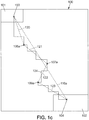
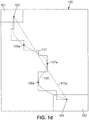
- Figures 1c and 1d are possible embodiments to determine trajectory cells in a received model according to the determined bifurcation cells.
- these segments are determined, it is possible to determine the cells of the model which fit the best the segments: they will be named "trajectory cells”. Many possible method are possible to such determination: the Bresenham's line algorithm (or “Bresenham algorithm”), the DDA algorithm (or “Digital differential analyzer”), and the “Run-Slice computational algorithm” are possible for instance. It is a discretization process
- trajectory cells describe a stair step trajectory 124 which is an estimation of the segments 120 to 123 according to the grid cells resolution.
- This determination may use a linear regression, polynomial regression or other regressions that determine a curve 130 that fits to the determined cells. Then, a discretization of the curve 130 is performed to obtain the stair step trajectory 131. This discretization may be computed by first approximating the curve with a plurality of determined length segments and then applying the previous algorithm on those segments. Other discretization processes are possible.
- Figures 2a is a representation of conduits in trajectory cells.
- trajectory cells 200 in Figures 2a are represented by cells 201, 202, 203, 204, 205, 206 and 207.
- conduits are determined in the current cell.
- the karst modeling procedure is often developed on grid cells of the reservoir which have typical dimensions of 50 to 200 meters horizontally and 1 to 10 meters vertically.
- the trajectory cells are often not to be considered as a unique conduit with 100 % of voids because the void is not so huge in the real subsoil.
- Conduits are oriented according to the stair step trajectory and is perpendicular to one of the grid cell side (for instance in the x or y direction for horizontal conduits, in the z direction for vertical conduits and for 3D cells) or of the grid cell edge (for instance in the x or y direction for 2D cells).
- conduits in cell 201 are oriented along the x axis as the stair step trajectory is horizontal (i.e. along x) for this cell: the previous cell 207 in the trajectory and the following cell 202 in the trajectory are on the same line than the current cell 201.
- Conduits in cell 203 are oriented along the y axis as the stair step trajectory is vertical (i.e.
- the previous cell 202 in the trajectory and the following cell 204 in the trajectory are on the same column than the current cell 203.
- conduits are oriented according to the first and second directions. Then, in cell 202, conduits are oriented according to both x and y directions.
- conduits density N c S i.e. the number of conduits per unit of section perpendicular to conduits direction
- This density may be a simple number, a distribution or an interval (i.e. a uniform distribution). If a distribution or an interval is indicated, a random draw may be performed for each cell of the trajectory cells in order to determine a number N c S .
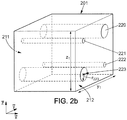
- the section S z 1 y 1 thus it is possible to determine the number of conduit in a cell along a direction as S and N c S are known.
- four conduits (220, 221, 222, and 223) are determined in cell 201. These conduits are perpendicular to sides 211 and 212.
- conduits aperture radius r c it is possible to indicate conduits aperture radius r c . If a distribution or an interval is provided, a random draw may be performed for each cell in order to determine a number r c (see radius r 223 , the radius of conduit 223 in Figure 2b ).
- the random draw may be performed for all conduits in the cell (i.e. the same radius is shared for all conduits) or for each conduit in the cell (i.e. teach conduit may have a different radius).
- Figure 3 is a flow chart describing a possible embodiment of the present invention. Part of this flow chart can represent steps of an example of a computer program which may be executed by the device of Figure 4 .
- a seed zone and a target zone is identified in the model. This identification is performed by scanning cells of the model and looking for a special flag. It is also possible to receive in a distinct message the indication of the list of cells that are in said zones.
- these zones may comprise a plurality of sub zones, connected or disconnected.
- a seed cell in the seed zone may be determined (step 301). For instance, the seed cell may determine according a stochastic process: a random draw is performed in a first distribution associated with the cells of the seed zone.
- a target cell in the target zone may be determined (step 301). For instance, the target cell may determine according a stochastic process: a random draw is performed in a distribution associated with the cells of the target zone.
- the first and second distributions may be uniform or non-uniform. These distributions are often determined by geologists or reservoir engineers.
- the distance between these two cells is computed.
- a bifurcation zone (step 305a) and a bifurcation point (step 305b) are determined as detailed in Figure 1a or Figure 1b and the description attached.
- the distance distribution and the angular distribution mentioned may be stored, for instance, in a database 303 or a part of a memory of a computer.
- the seed cell, the target cell and the bifurcation may be ordered and trajectory cells may be determined as explained above.
- conduits may be estimated in the cells according a process described in Figure 2a and 2b and the description attached.
- step 308 the cell characteristics (e.g. the permeability and the porosity of each cell of the model).
- a new value is set to ⁇ i,init , i.e. ⁇ i ,init 1 ⁇ S c S + S c S where S c being the section of the current conduit and S being the section of the cell perpendicular to that direction (assuming that the cell is a rectangular parallelepiped, e.g. in figure 2b , the direction being x , the section is z 1 y 1 ).
- This new value may also be ⁇ i ,init 1 ⁇ S c S + S c S + ⁇ diff where ⁇ diff is a diffusive porosity created around the conduits.
- the cells of the model may be updated with new porosity characteristics.
- a new value is set to K i,init , i.e K i , init 1 ⁇ S c S + K c S c S
- S c being the section of the current conduit (i.e. if the radius is r, the section of the conduit is ⁇ .r 2 )
- S being the section of the cell perpendicular to that direction
- K c is the permeability of the current conduit.
- the cells of the model may be updated with new permeability characteristics.
- the new model 309 may be provided:
- Figure 4 is a possible embodiment for a device that enables the present invention.
- the device 400 comprise a computer, this computer comprising a memory 405 to store program instructions loadable into a circuit and adapted to cause circuit 404 to carry out the steps of the present invention when the program instructions are run by the circuit 404.
- the memory 405 may also store data and useful information for carrying the steps of the present invention as described above.
- the circuit 404 may be for instance:
- This computer comprises an input interface 403 for the reception of the model according to the invention and an output interface 406 for providing parameters of this model (i.e. the porosity for each cell and the permeability for each cell).
- a screen 401 and a keyboard 402 may be provided and connected to the computer circuit 404.
Landscapes
- Physics & Mathematics (AREA)
- Engineering & Computer Science (AREA)
- General Physics & Mathematics (AREA)
- Mathematical Physics (AREA)
- Theoretical Computer Science (AREA)
- Data Mining & Analysis (AREA)
- General Life Sciences & Earth Sciences (AREA)
- Life Sciences & Earth Sciences (AREA)
- Geophysics (AREA)
- Databases & Information Systems (AREA)
- Mathematical Optimization (AREA)
- Software Systems (AREA)
- General Engineering & Computer Science (AREA)
- Computational Mathematics (AREA)
- Pure & Applied Mathematics (AREA)
- Algebra (AREA)
- Mathematical Analysis (AREA)
- Management, Administration, Business Operations System, And Electronic Commerce (AREA)
- Investigation Of Foundation Soil And Reinforcement Of Foundation Soil By Compacting Or Drainage (AREA)
- Geophysics And Detection Of Objects (AREA)
Description
- The invention relates to the field of the simulation of geological processes for studying the subsoil. Interest is particularly focused on the karstification phenomena in a karstic region.
- The approaches described in this section could be pursued, but are not necessarily approaches that have been previously conceived or pursued. Therefore, unless otherwise indicated herein, the approaches described in this section are not prior art to the claims in this application and are not admitted to be prior art by inclusion in this section. Furthermore, all embodiments are not necessarily intended to solve all or even any of the problems brought forward in this section.
- Karstification of a rock is the phenomenon whereby this rock is fashioned by the dissolution of carbonates in water. The water infiltrates through interstices of the rock, for example pores or fractures, and this infiltration increases the size of these interstices by virtue of the dissolution of carbonates of the rock in the infiltrated water. Conduits and cavities can thus be formed.
- The water may typically be rainwater made acid by carbon dioxide from the atmosphere or the ground. The water may, among other things, originate for example from hydrothermal lifts.
- The rock may, for example, comprise limestone.
- In carbonate reservoirs, karst processes are frequently observed. These processes have a clear impact on reservoir flow performances and predictions: some distant wells could be connecting extremely fast while other close wells could be not effectively connected. For this reason, to get a precise picture of the potentiality of a reservoir, it is important to address simultaneously two different objectives:
- the appropriate representation of karst conduits network which controls the connectivity of the reservoir;
- the formalization of a framework to address uncertainties on global connected volumes and related local heterogeneities location.
- It is known practice to model a karstic region statically, by using observations, in particular geological and seismic observations. When drilling a well, data measured via the well, called well data, can be used to make a posteriori adjustments to the model of the karstic region.
- The article by O. Jaquet et al., "Stochastic discrete model of karstic networks", Advances in Water Resources 27 (2004), 751-760, describes a method for simulating karstification phenomena based on a stochastic approach. In this work, a karstic region is modeled as a network of pipes with permeabilities and porosities depending on particles traveling through these pipes. These particles are corresponding to water droplets introduced in karstic system, and their displacement over the network is subjected to laws of "random walk" type. This method could be named as a pseudo-genetic approach.
- More examples and possible embodiments of the prior art may be found in documents
WO 2012/045937 andWO 2012/072923 . - There is a need to improve the efficiency of the determination, to provide fast and efficient geometrical techniques to distribute conduits zones consistently with paleo-aquifers infiltration and outlet regions, with reasonable CPU performance.
- The invention relates to a method for determining a karstic region modified by karstification phenomena according to
claim 1. - The geological model may be for instance a gridded representation of a real soil. In a three dimensions, the geological model may be represented by a matrix, each cell of the matrix having three indexes (i,j,k). Each cell of the matrix comprises information regarding geological and/or geophysical characteristics in the cell such as porosity, permeability in all space directions, etc.
- The cell characteristics may comprise, for instance a single set of porosity and permeability values. These values may correspond to the equivalent porosity φequ and permeability Kequ of the matrix (i.e. the content of the cell) with the conduits inside this matrix.
- The cell characteristics may also comprise a plurality of sets of porosity and permeability values. For instance, one set of this plurality may comprise the porosity φm and permeability Km values for the matrix without any conduits and another set of this plurality may comprise the porosity φk and permeability Kk values for the conduits inside the matrix only. It is also possible to determine a "exchange coefficient" between these two components. The exchange coefficient σ may be chosen by an operator. In one possible embodiment, the exchange coefficient σ may be


r i being the mean of the radius of the conduits in the cells (r i = ri if the radius of all conduits are identical and equal to ri). - With the above method, karstification simulation may be easily determined with a geometrical process. This process is simple to iterate and thus is only reasonable CPU performance is needed.
- The angular distribution may be limited to one unique angle (e.g the probability for the angle 0° is 1 while the probability of the other angles is 0).
- The angular distribution may be limited to a uniform cone (e.g the probability of angles in the cone [-α;+ α] is uniform while the probability of angles outside the cone is 0).
- The distance distribution may be limited to a unique distance (e.g the probability for the distance di is 1 while the probability of the other distances is 0).
- The distance distribution may be limited to a uniform interval (e.g the probability of distances in the interval [d1;d2] is uniform while the probability of distances outside the interval is 0).
- In one embodiment, steps b/ to f/ may be re-iterated a plurality of times with same seed zone and target zone.
- In consequence, it is possible to determine a plurality of "karst trajectories" and, due to a stochastic approach, to create a broad zone in the model where a karstification phenomenon has eroded the subsoil.
- In addition, said model comprising a plurality of seed zones and a plurality of target zones, steps b/ to f/ may be re-iterated a plurality of times with different combination of seed zone in the plurality of seed zones and target zone in the plurality of target zones.
- Thus, it is possible to take in account the fact that there is a plurality of outlet or infiltration zone. In addition, a seed zone in a first determination may be a target zone for a second determination.
- According to another embodiment, the seed cell may be determined in step b/ according a stochastic process and according a predetermined distribution in the at least one seed zone.
- The distribution may be uniform in the at least one seed zone.
- Moreover, the target cell may be determined in step c/ according a stochastic process and according a predetermined distribution in the at least one target zone.
- This distribution may also be uniform in the at least one target zone.
- In one embodiment, the cell based on said bifurcation cell may be said bifurcation cell.
- In consequence, the reiteration of step d/ is easy as the bifurcation cell is used as the seed cell in the reiteration.
- In addition, the cell based on said bifurcation cell is a cell corresponding to a projection of the bifurcation cell on a line defined by the seed cell and the target cell.
- The projection may be an orthogonal projection for instance. The projection may also be a determination of a cell on the line defined by the seed cell and the target cell where the distance between this cell and the seed cell and the distance between the bifurcation cell and the target cell is the same. The projection may also be a determination of a cell on the line defined by the seed cell and the target cell where the distance between this cell and the target cell and the distance between the bifurcation cell and the target cell is the same.
- Determining trajectory cells may also be performed by:
- ordering the bifurcation cells according to an order of determination in step d/ in a list of cells;
- adding the seed cell at a first position in said list of cells;
- adding the target cell at a last position in said list of cells;
- determining segments in the model between two consecutive cells in the list of cells;
- determining cells of the model based on an approximation line algorithm.
- This "ordering" allows to determine which cells have been determined before others, for instance, thanks to an index associated with said cells.
- After the three first sub-steps, the list of cells comprises a plurality of cells where the first cell is the seed cell, the last cell is the target cell and the other cells of the list is ordered according to their order of determination.
- Hence, the approximation line algorithm may be one algorithm in a group comprising the Bresenham algorithm, the DDA algorithm, and the Run-Slice computational algorithm.
- Then, the approximation enables a discretization of the trajectory.
- In one embodiment, determining trajectory cells may be performed by:
- ordering the bifurcation cells according to an order of determination in step d/ in a list of cells;
- adding the seed cell at a first position in said list of cells;
- adding the target cell at a last position in said list of cells;
- determining an interpolation curve fitting the list of cells in the model;
- determining cells of the model based on an approximation curve algorithm.
- In another embodiment, determining conduits characteristics may comprise:
- the cell being a 2D cell, for each direction of space perpendicular to at least one edge of the current cell, if an edge of said current cell perpendicular to said direction is shared with a trajectory cell connected to said current cell, determining at least one conduit in said current cell in said direction, a radius rc of said conduit is determined in said predetermined conduit aperture distribution, or
- the cell being a 3D cell, for each direction of space perpendicular to at least one side of the current cell, if a side of said current cell perpendicular to said direction is shared with a trajectory cell connected to said current cell, determining at least one conduit in said current cell in said direction, a radius rc of said conduit is determined in said predetermined conduit aperture distribution.
- A cell is connected with another cell if it shares at least one edge (in 2D) or a side (in 3D). When the model is a grid with 3D cubic cells, most of the cells of the model are connected with six other cells. When the model is a grid with 2D square cells, most of the cells of the model are connected with four other cells.
- Thus, the radius of conduits in a given cell may be easily determined in the trajectory direction.
- The conduit aperture distribution may be a uniform distribution between a maximum and a minimum radius or, for instance, a Gaussian distribution centred on a central radius.
- Moreover, determining conduits characteristics may comprise:
- the cell being a 2D cell, for each direction of space perpendicular to at least one edge of the current cell, if a edge of said current cell perpendicular to said direction, named trajectory direction, is shared with a trajectory cell connected to said current cell,
- determining a number Nc of conduits to be determined based on said predetermined conduit density distribution;
- determining Nc conduits in said current cell along said trajectory direction; or
- the cell being a 3D cell, for each direction of space perpendicular to at least one side of the current cell, if a side of said current cell perpendicular to said direction, named trajectory direction, is shared with a trajectory cell connected to said current cell,
- determining a number Nc of conduits to be determined based on said predetermined conduit density distribution;
- determining Nc conduits in said current cell along said trajectory direction.
- Thus, the number of conduits in a given cell may be easily determined in the trajectory direction.
- The conduit density distribution may be a uniform distribution between a maximum and a minimum density or, for instance, a Gaussian distribution centred on a central density or any user defined distribution.
- Once the density is known (based on a random draw in the density distribution), it is possible to determine the number of conduit as the section (side or edge) perpendicular to said direction may be easily determined.
- Determining cell characteristics may also comprise:
- receiving initial porosity characteristic φm of the current cell;
- setting the equivalent porosity φeq to φm;
- for at least one current conduit in the current cell in said direction,
- computing a porosity φtemp of the current cell based on

- setting the equivalent porosity φeq to φtemp;
- computing a porosity φtemp of the current cell based on
- For instance, φtemp may be equal to


- The section of the current conduit is a length or surface (e.g. π.rc 2 if the conduit is a 3D circular tube, rc if the conduit is a 2D rectangle). The section of an edge or a side of said current cell is a length or surface.
- In one embodiment, determining cell characteristics may further comprise:
- receiving initial permeability characteristic Km of the current cell;
- setting the equivalent permeability Keq to Km;
- for at least one current conduit in the current cell in said direction,
- computing the permeability Ktemp of the current cell based on

- setting the equivalent permeability Keq to Ktemp.
- computing the permeability Ktemp of the current cell based on
- Permeability of the current conduit may be, for instance, computed based on

- A second aspect relates to a computer program product comprising a computer readable medium, having thereon a computer program comprising program instructions. The computer program is loadable into a data-processing unit and adapted to cause the data-processing unit to carry out the method described above when the computer program is run by the data-processing unit.
- Other features and advantages of the method and apparatus disclosed herein will become apparent from the following description of non-limiting embodiments, with reference to the appended drawings.
- The present invention is illustrated by way of example, and not by way of limitation, in the figures of the accompanying drawings, in which like reference numerals refer to similar elements and in which:
-
Figures 1a and1b are possible embodiments to determine bifurcation cells in a received model; -
Figures 1c and1d are possible embodiments to determine trajectory cells in a received model according to the determined bifurcation cell s; -
Figures 2a is a representation of conduits in trajectory cells; -
Figures 2b is a representation of conduits in a current trajectory cell; -
Figure 3 is a flow chart describing a possible embodiment of the present invention; -
Figure 4 is a possible embodiment for a device that enables the present invention. -
Figures 1a and1b are possible embodiments to determine bifurcation cells in a received model. - In a received
model 100, a group of cells may be designated as theseed zone 101. These cells may be identified by geologists or reservoir engineers according to their knowledge of the real subsoil. For instance, cells corresponding to the following conditions may be designated in the seed zone: - when associated to an epikarst;
- when associated to an infiltration zone in the subsoil;
- when associated to known fractures;
- etc.
- The cells of the seed zone may be associated with a probability value (e.g. in a distribution).
- It is then possible to determine (for instance, according to a stochastic process and/or according to the probability values associated to the cells of the seed zone) a
seed cell 103. - In a received
model 100, a group of cells may be designated as thetarget zone 102. These cells may be identified by geologists or reservoir engineers according to their knowledge of the real subsoil. For instance, cells corresponding to the following conditions may be designated in the target zone: - when associated to an outlet;
- when associated to a low level;
- etc.
- The cells of the target zone may be associated with a probability value (e.g. in a distribution).
- It is then possible to determine (for instance, according to a stochastic process and/or according to the probability values associated to the cells of the target zone) a
target cell 104. - From this
seed cell 103 and from thistarget cell 104, it is possible to compute a bifurcation zone based on a received distance distribution, and on a received angular distribution. - The angular distribution may be defined by a geologist or a reservoir engineer and stored in a database. This angular distribution may provide a maximal angular deviation (for instance, α in the
figure 1a or1b ) and a minimal angular deviation (for instance,-α in thefigure 1a or1b ). This maximal deviation is represented byline 103a defined so that the angle betweenline line 103b defined so that the angle betweenline - The distance distribution may be defined by a geologist or a reservoir engineer and stored in a database. This distance distribution may provide a maximal distance (for instance, di in the
figure 1a or1b ) and a minimal distance (for instance, d2 in thefigure 1a or1b ). Between the maximal distance and the minimal distance, the distance distribution may be uniform or non-uniform (e.g. Gaussian, etc.) and equals to 0 outside the interval defined by the maximal distance and the minimal distance. - The combination of the angular distribution and the distance distribution defines a hatched
zone 106 named "bifurcation zone". - It is then possible to determine (for instance, according to a stochastic process and/or according to the angular/distance distribution) a
bifurcation cell 105a. - As illustrated in
Figure 1a , it is possible to reiterate the above described process by computing anorthogonal projection 105b of thecell 105a on theline 110a and by using this new cell corresponding to theprojection 105b as the seed cell. Other projections are also possible. - As illustrated in
Figure 1b , it is possible to reiterate the above described process by using thebifurcation cell 105a as the seed cell. Therefore, theline 110a is transformed intoline 110b. - The process of determination of bifurcation cells is ended when the distance between the newly determined bifurcation cell and the target cell is less than a predetermined distance (for instance d2, i.e. the maximal distance).
-
Figures 1c and1d are possible embodiments to determine trajectory cells in a received model according to the determined bifurcation cells. - Once the bifurcation cells are determined as detailed in
Figure 1a or1b (for instance), it is possible to determine trajectory cells. - For instance, in
Figure 1c , segments are determined between two consecutive cells: -
segment 120 betweenseed cell 103 andbifurcation cell 105a; -
segment 121 betweenbifurcation cell 105a andbifurcation cell 107a; -
segment 122 betweenbifurcation cell 107a andbifurcation cell 109a; -
segment 123 betweenbifurcation cell 109a andtarget cell 104. - Once, these segments are determined, it is possible to determine the cells of the model which fit the best the segments: they will be named "trajectory cells". Many possible method are possible to such determination: the Bresenham's line algorithm (or "Bresenham algorithm"), the DDA algorithm (or "Digital differential analyzer"), and the "Run-Slice computational algorithm" are possible for instance. It is a discretization process
- In consequence, these trajectory cells describe a
stair step trajectory 124 which is an estimation of thesegments 120 to 123 according to the grid cells resolution. - It is also possible to determine a curve that fits the bifurcation cells as described in
-
Figure 1d . This determination may use a linear regression, polynomial regression or other regressions that determine acurve 130 that fits to the determined cells. Then, a discretization of thecurve 130 is performed to obtain thestair step trajectory 131. This discretization may be computed by first approximating the curve with a plurality of determined length segments and then applying the previous algorithm on those segments. Other discretization processes are possible. -
Figures 2a is a representation of conduits in trajectory cells. - Examples of
trajectory cells 200 inFigures 2a are represented bycells - For each current cell of the trajectory cells (or of a subset of these trajectory cells), conduits are determined in the current cell.
- Indeed, the karst modeling procedure is often developed on grid cells of the reservoir which have typical dimensions of 50 to 200 meters horizontally and 1 to 10 meters vertically. As a consequence, the trajectory cells are often not to be considered as a unique conduit with 100 % of voids because the void is not so huge in the real subsoil.
- Conduits are oriented according to the stair step trajectory and is perpendicular to one of the grid cell side (for instance in the
x ory direction for horizontal conduits, in the z direction for vertical conduits and for 3D cells) or of the grid cell edge (for instance in thex ory direction for 2D cells). For instance, conduits incell 201 are oriented along the x axis as the stair step trajectory is horizontal (i.e. along x) for this cell: theprevious cell 207 in the trajectory and thefollowing cell 202 in the trajectory are on the same line than thecurrent cell 201. Conduits incell 203 are oriented along the y axis as the stair step trajectory is vertical (i.e. along y) for this cell: theprevious cell 202 in the trajectory and thefollowing cell 204 in the trajectory are on the same column than thecurrent cell 203. For a "corner" cell, i.e. a cell where the trajectory changes its direction from a first direction (i.e. x) to a second direction (i.e. y), conduits are oriented according to the first and second directions. Then, incell 202, conduits are oriented according to bothx andy directions. - To determine the characteristics of the conduits (e.g. their number), it is possible to indicate conduits density


- Referring to
Figure 2b , the section S = z1y1 thus it is possible to determine the number of conduit in a cell along a direction as S and
cell 201. These conduits are perpendicular tosides - To determine the characteristics of the conduits (e.g. their dimensions), it is possible to indicate conduits aperture radius rc. If a distribution or an interval is provided, a random draw may be performed for each cell in order to determine a number rc (see radius r223, the radius of
conduit 223 inFigure 2b ). - The random draw may be performed for all conduits in the cell (i.e. the same radius is shared for all conduits) or for each conduit in the cell (i.e. teach conduit may have a different radius).
-
Figure 3 is a flow chart describing a possible embodiment of the present invention. Part of this flow chart can represent steps of an example of a computer program which may be executed by the device ofFigure 4 . - Upon the reception of a
geological model 300 of a real or estimated karstic region, a seed zone and a target zone is identified in the model. This identification is performed by scanning cells of the model and looking for a special flag. It is also possible to receive in a distinct message the indication of the list of cells that are in said zones. In addition, these zones may comprise a plurality of sub zones, connected or disconnected. - Once the seed zone is known, a seed cell in the seed zone may be determined (step 301). For instance, the seed cell may determine according a stochastic process: a random draw is performed in a first distribution associated with the cells of the seed zone.
- Once the target zone is known, a target cell in the target zone may be determined (step 301). For instance, the target cell may determine according a stochastic process: a random draw is performed in a distribution associated with the cells of the target zone.
- The first and second distributions may be uniform or non-uniform. These distributions are often determined by geologists or reservoir engineers.
- Once the seed cell and the target cell are determined as detailed above, the distance between these two cells is computed.
- If this computed distance is above a predetermined distance (
test 304, output NOT_COMP), a bifurcation zone (step 305a) and a bifurcation point (step 305b) are determined as detailed inFigure 1a orFigure 1b and the description attached. The distance distribution and the angular distribution mentioned may be stored, for instance, in adatabase 303 or a part of a memory of a computer. - If this distance is below or equal to the predetermined distance (
test 304, output COMP), the seed cell, the target cell and the bifurcation may be ordered and trajectory cells may be determined as explained above. - Once the trajectory cells are determined, it is possible to modify (step 307) the permeability characteristic and the porosity characteristic. In order to perform such modifications, conduits may be estimated in the cells according a process described in
Figure 2a and2b and the description attached. - It is then possible to determine (step 308) the cell characteristics (e.g. the permeability and the porosity of each cell of the model).
- In the following, it is assumed that each cell i of the model have an initial porosity parameterφi,init and an initial permeability parameterKi,init. If the initial porosity (respectively initial permeability) is not set, it is assumed that φi,init = 0 (respectively Ki,init = 0).
- To determine the porosity characteristic (in a given direction) of a given cell i, for each conduit in this cell i in this direction, a new value is set to φi,init, i.e.

figure 2b , the direction beingx , the section is z1y1). This new value may also be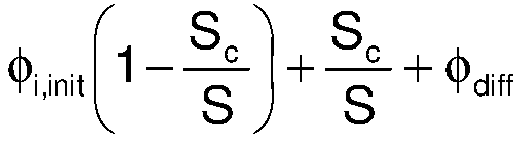
- By iterating this process for all conduits and for all trajectory (if there is a plurality of trajectory), the cells of the model may be updated with new porosity characteristics.
- To determine the permeability characteristic (in a given direction) of a given cell i, for each conduit in this cell i in this direction, a new value is set to Ki,init, i.e

- Poiseuille law for flow in tubes: in consequence,

- By iterating this process for all conduits and for all trajectory (if there is a plurality of trajectory), the cells of the model may be updated with new permeability characteristics.
- Once these characteristics are determined for all cells of the model (or at least for a subset of cells), the
new model 309 may be provided: - to a display device to be displayed, or
- to any other processing device for an additional modification or transformation.
-
Figure 4 is a possible embodiment for a device that enables the present invention. - In this embodiment, the
device 400 comprise a computer, this computer comprising amemory 405 to store program instructions loadable into a circuit and adapted to causecircuit 404 to carry out the steps of the present invention when the program instructions are run by thecircuit 404. - The
memory 405 may also store data and useful information for carrying the steps of the present invention as described above. - The
circuit 404 may be for instance: - a processor or a processing unit adapted to interpret instructions in a computer language, the processor or the processing unit may comprise, may be associated with or be attached to a memory comprising the instructions, or
- the association of a processor / processing unit and a memory, the processor or the processing unit adapted to interpret instructions in a computer language, the memory comprising said instructions, or
- an electronic card wherein the steps of the invention are described within silicon, or
- a programmable electronic chip such as a FPGA chip (for « Field-Programmable Gate Array »).
- This computer comprises an
input interface 403 for the reception of the model according to the invention and anoutput interface 406 for providing parameters of this model (i.e. the porosity for each cell and the permeability for each cell). - To ease the interaction with the computer, a
screen 401 and akeyboard 402 may be provided and connected to thecomputer circuit 404. - Expressions such as "comprise", "include", "incorporate", "contain", "is" and "have" are to be construed in a non-exclusive manner when interpreting the description and its associated claims, namely construed to allow for other items or components which are not explicitly defined also to be present. Reference to the singular is also to be construed in be a reference to the plural and vice versa.
- A person skilled in the art will readily appreciate that various parameters disclosed in the description may be modified and that various embodiments disclosed may be combined without departing from the scope of the invention, as defined by the appended claims.
- For instance, many examples are provided in a two dimensional space but they also apply to a three dimensional space.
Claims (16)
- A computer-implemented method for determining a karstic region modified by karstification phenomena, comprising:a/ receiving a geological model (100, 300) of the karstic region comprising cells, said model comprising at least one first zone (101), named seed zone, comprising cells of the model and at least one second zone (102), named target zone, comprising cells of the model, each cells of the model having coordinates;b/ determining a first cell (103), named seed cell, in the cells of the at least one seed zone;c/ determining a second cell (104), named target cell in the cells of the at least one target zone;d/ if a distance between the seed cell and the target cell is above a predetermined distance (304):d1/ determining (305a) a third zone (106), named bifurcation zone,based on the coordinates of the seed cell, the coordinates of thetarget cell, a distance distribution, an angular distribution,d2/ determining (305b) a third cell, named bifurcation cell (105a) insaid bifurcation zone;d3/ re-iterating step d/ with a cell (105b) based on said bifurcation cell(105a) as the seed cell;e/ determining fourth cells, named trajectory cells, in the geological model based on the seed cell, the target cell and bifurcation cells determined in step d/;f/ for each current cell in the trajectory cells,f1/ determining (307), for the current cell, conduits characteristics based on a predetermined conduit density distribution, a predetermined conduit aperture distribution and trajectory cells connected to said current cell;f2/ determining, for the current cell, cell characteristics based on the conduits characteristics of said current cell.
- A method according to claim 1, wherein steps b/ to f/ are re-iterated a plurality of times with same seed zone and target zone.
- A method according to one of the preceding claims, wherein said model comprising a plurality of seed zones and a plurality of target zones, steps b/ to f/ are re-iterated a plurality of times with different combination of seed zone in the plurality of seed zones and target zone in the plurality of target zones.
- A method according to one of the preceding claims, wherein the seed cell is determined in step b/ according to a stochastic process and according to a predetermined distribution in the at least one seed zone.
- A method according to one of the preceding claims, wherein the target cell is determined in step c/ according to a stochastic process and according to a predetermined distribution in the at least one target zone.
- A method according to one of the preceding claims, wherein the cell (105b) based on said bifurcation cell (105a) is said bifurcation cell.
- A method according to one of claims 1-5, wherein the cell (105b) based on said bifurcation cell (105a) is a cell corresponding to a projection of the bifurcation cell on a line (110a) defined by the seed cell and the target cell.
- A method according to one of the preceding claims, wherein determining trajectory cells is performed by:- ordering the bifurcation cells according to an order of determination in step d/ in a list of cells;- adding the seed cell at a first position in said list of cells;- adding the target cell at a last position in said list of cells;- determining segments in the model between two consecutive cells in the list of cells;- determining cells of the model based on an approximation line algorithm.
- A method according to claim 8, wherein the approximation line algorithm is one algorithm in a group comprising the Bresenham algorithm, the DDA algorithm, and the Run-Slice computational algorithm.
- A method according to one of the preceding claims, wherein determining trajectory cells is performed by:- ordering the bifurcation cells according to an order of determination in step d/ in a list of cells;- adding the seed cell at a first position in said list of cells;- adding the target cell at a last position in said list of cells;- determining an interpolation curve fitting the list of cells in the model;- determining cells of the model based on an approximation curve algorithm.
- A method according to one of the preceding claims, wherein, determining conduits characteristics comprises:- the cell being a 2D cell, for each direction of space perpendicular to at least one edge of the current cell, if an edge of said current cell perpendicular to said direction is shared with a trajectory cell connected to said current cell, determining at least one conduit in said current cell in said direction, a radius rc of said conduit is determined in said predetermined conduit aperture distribution, or- the cell being a 3D cell, for each direction of space perpendicular to at least one side of the current cell, if a side of said current cell perpendicular to said direction is shared with a trajectory cell connected to said current cell, determining at least one conduit in said current cell in said direction, a radius rc of said conduit is determined in said predetermined conduit aperture distribution.
- A method according to one of the preceding claims, wherein determining conduits characteristics comprises:- the cell being a 2D cell, for each direction of space perpendicular to at least one edge of the current cell, if an edge of said current cell perpendicular to said direction, named trajectory direction, is shared with a trajectory cell connected to said current cell,- determining a number Nc of conduits to be determined based on said predetermined conduit density distribution;- determining Nc conduits in said current cell along said trajectory direction; or- the cell being a 3D cell, for each direction of space perpendicular to at least one side of the current cell, if a side of said current cell perpendicular to said direction, named trajectory direction, is shared with a trajectory cell connected to said current cell,- determining a number Nc of conduits to be determined based on said predetermined conduit density distribution;- determining Nc conduits in said current cell along said trajectory direction.
- A method according to one of claims 11 to 12, wherein determining cell characteristics comprises:- receiving initial porosity characteristic φm of the current cell;- setting the equivalent porosity φeq to φm ;- for at least one current conduit in the current cell in said direction,- computing a porosity φtemp of the current cell based on
 - setting the equivalent porosity φeq to φtemp;
 - A method according to one of claims 11 to 13, wherein determining cell characteristics further comprises:- receiving initial permeability characteristic Km of the current cell;- setting the equivalent permeability Keq to Km;- for at least one current conduit in the current cell in said direction,- computing the permeability Ktemp of the current cell based on
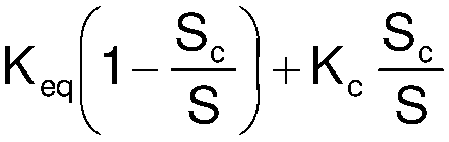 - setting the equivalent permeability Keq to Ktemp.
 - A method according to claim 14, wherein permeability of the current conduit is computed based on

- A non-transitory computer readable storage medium, having stored thereon a computer program comprising program instructions, the computer program being loadable into a data-processing unit and adapted to cause the data-processing unit to carry out the steps of any of claims 1 to 15 when the computer program is run by the data-processing device.
Applications Claiming Priority (2)
| Application Number | Priority Date | Filing Date | Title |
|---|---|---|---|
| US201261710371P | 2012-10-05 | 2012-10-05 | |
| PCT/EP2013/070291 WO2014053423A2 (en) | 2012-10-05 | 2013-09-27 | A method for determining a karstic region |
Publications (2)
| Publication Number | Publication Date |
|---|---|
| EP2904434A2 EP2904434A2 (en) | 2015-08-12 |
| EP2904434B1 true EP2904434B1 (en) | 2021-12-29 |
Family
ID=49274639
Family Applications (1)
| Application Number | Title | Priority Date | Filing Date |
|---|---|---|---|
| EP13770900.2A Active EP2904434B1 (en) | 2012-10-05 | 2013-09-27 | A method for determining a karstic region |
Country Status (6)
| Country | Link |
|---|---|
| US (1) | US10101497B2 (en) |
| EP (1) | EP2904434B1 (en) |
| CA (1) | CA2887319C (en) |
| MX (1) | MX352230B (en) |
| RU (1) | RU2626974C2 (en) |
| WO (1) | WO2014053423A2 (en) |
Families Citing this family (2)
| Publication number | Priority date | Publication date | Assignee | Title |
|---|---|---|---|---|
| CN114386154B (en) * | 2022-01-14 | 2023-12-15 | 中水珠江规划勘测设计有限公司 | Method and device for determining influence depth of dam foundation modern karst layer and electronic equipment |
| WO2023154055A1 (en) * | 2022-02-11 | 2023-08-17 | Landmark Graphics Corporation | Modeling a karst formation for a wellbore operation |
Family Cites Families (6)
| Publication number | Priority date | Publication date | Assignee | Title |
|---|---|---|---|---|
| FR2842321B1 (en) * | 2002-07-11 | 2008-12-05 | Inst Francais Du Petrole | METHOD FOR CONSTRAINING A FIELD OF HETEROGENEOUS PERMEABILITY REPRESENTING A UNDERGROUND RESERVOIR BY DYNAMIC DATA |
| FR2852710B1 (en) * | 2003-03-18 | 2005-04-29 | Inst Francais Du Petrole | METHOD FOR RAPIDLY FORMING A STOCHASTIC MODEL REPRESENTATIVE OF THE DISTRIBUTION OF A PHYSICAL SIZE IN A HETEROGENEOUS MEDIUM BY AN APPROPRIATE SELECTION OF GEOSTATISTICAL ACHIEVEMENTS |
| FR2875305B1 (en) * | 2004-09-16 | 2006-10-27 | Inst Francais Du Petrole | METHOD FOR GENERATING A RESERVOIR MODEL ON FLEXIBLE MESH |
| WO2010065774A2 (en) * | 2008-12-03 | 2010-06-10 | Chevron U.S.A. Inc. | System and method for predicting fluid flow characteristics within fractured subsurface reservoirs |
| FR2965379B1 (en) * | 2010-09-27 | 2016-04-01 | Total Sa | SIMULATION OF GEOLOGICAL PHENOMENON |
| FR2968443A1 (en) * | 2010-12-03 | 2012-06-08 | Total Sa | METHOD FOR SIMULATING THE GEOLOGICAL FORMATION OF A RIVER AREA |
-
2013
- 2013-09-27 RU RU2015116909A patent/RU2626974C2/en active
- 2013-09-27 CA CA2887319A patent/CA2887319C/en active Active
- 2013-09-27 EP EP13770900.2A patent/EP2904434B1/en active Active
- 2013-09-27 MX MX2015004225A patent/MX352230B/en active IP Right Grant
- 2013-09-27 WO PCT/EP2013/070291 patent/WO2014053423A2/en not_active Ceased
- 2013-09-27 US US14/433,532 patent/US10101497B2/en active Active
Also Published As
| Publication number | Publication date |
|---|---|
| WO2014053423A3 (en) | 2014-07-24 |
| RU2626974C2 (en) | 2017-08-02 |
| CA2887319A1 (en) | 2014-04-10 |
| US10101497B2 (en) | 2018-10-16 |
| CA2887319C (en) | 2019-09-17 |
| MX352230B (en) | 2017-11-15 |
| MX2015004225A (en) | 2015-11-13 |
| RU2015116909A (en) | 2016-11-27 |
| EP2904434A2 (en) | 2015-08-12 |
| WO2014053423A2 (en) | 2014-04-10 |
| US20150253461A1 (en) | 2015-09-10 |
Similar Documents
| Publication | Publication Date | Title |
|---|---|---|
| US8775142B2 (en) | Stochastic downscaling algorithm and applications to geological model downscaling | |
| CN105279790A (en) | Fracture network 3D digital core modeling method | |
| Legleiter et al. | Spatial prediction of river channel topography by kriging | |
| Wang et al. | Cliff face rock slope stability analysis based on unmanned arial vehicle (UAV) photogrammetry | |
| US10385658B2 (en) | In-situ wellbore, core and cuttings information system | |
| US10598818B2 (en) | Method for determining geological caves | |
| Lu et al. | Assisted history matching for fractured reservoirs by use of hough-transform-based parameterization | |
| EP4172663B1 (en) | System and method for subsurface structural interpretation | |
| US10180516B2 (en) | Method of determining channelway trajectories | |
| US10101497B2 (en) | Method for determining a karstic region | |
| US20150149138A1 (en) | Slug flow initiation in fluid flow models | |
| Anbari et al. | Estimation of capillary pressure in unconventional reservoirs using thermodynamic analysis of pore images | |
| US12560741B2 (en) | System and method to develop naturally fractured hydrocarbon reservoirs using a fracture density index | |
| EP3095043B1 (en) | Automatic cartesian gridding with logarithmic refinement at arbitrary locations | |
| US11802989B2 (en) | Systems and methods for generating vertical and lateral heterogeneity indices of reservoirs | |
| US20260029557A1 (en) | Method for simulating dissolution within a reservoir | |
| US20260030418A1 (en) | Method for simulating the evolution of a reservoir due to dissolution | |
| Tian et al. | Understanding heterogeneous and anisotropic porous media based on geometric properties derived from three‐dimensional images | |
| US20260030409A1 (en) | Method for representing a reservoir including three types of media | |
| CN115690349B (en) | Methods, systems, and storage media for constructing 3D river channel models for earthquake simulation | |
| WO2017212305A1 (en) | Structural volume segmentation | |
| Sunila et al. | Digital Elevation Model Construction Using Geostatistics and Geological Expert Knowledge--A Case Study in Oitti Area in Southern Finland | |
| Smolentcev et al. | The Algorithm of Integrated Productivity Forecast for Riphean Fractured Carbonate Reservoirs | |
| Huang et al. | Research on Geological Survey Data Management and Automatic Mapping Technology | |
| Lange et al. | Assisted History-matching for the Characterization and Recovery Optimization of Fractured Reservoirs Using Connectivity Analysis (SPE 154392) |
Legal Events
| Date | Code | Title | Description |
|---|---|---|---|
| PUAI | Public reference made under article 153(3) epc to a published international application that has entered the european phase |
Free format text: ORIGINAL CODE: 0009012 |
|
| 17P | Request for examination filed |
Effective date: 20150401 |
|
| AK | Designated contracting states |
Kind code of ref document: A2 Designated state(s): AL AT BE BG CH CY CZ DE DK EE ES FI FR GB GR HR HU IE IS IT LI LT LU LV MC MK MT NL NO PL PT RO RS SE SI SK SM TR |
|
| AX | Request for extension of the european patent |
Extension state: BA ME |
|
| RIN1 | Information on inventor provided before grant (corrected) |
Inventor name: HENRIQUEL, PATRICK Inventor name: CORRE, BERNARD Inventor name: BIVER, PIERRE Inventor name: LABOURDETTE, RICHARD Inventor name: LAPOINTE, PHILIPPE |
|
| DAX | Request for extension of the european patent (deleted) | ||
| STAA | Information on the status of an ep patent application or granted ep patent |
Free format text: STATUS: EXAMINATION IS IN PROGRESS |
|
| 17Q | First examination report despatched |
Effective date: 20190401 |
|
| RAP1 | Party data changed (applicant data changed or rights of an application transferred) |
Owner name: TOTAL SE |
|
| GRAP | Despatch of communication of intention to grant a patent |
Free format text: ORIGINAL CODE: EPIDOSNIGR1 |
|
| STAA | Information on the status of an ep patent application or granted ep patent |
Free format text: STATUS: GRANT OF PATENT IS INTENDED |
|
| INTG | Intention to grant announced |
Effective date: 20201218 |
|
| GRAJ | Information related to disapproval of communication of intention to grant by the applicant or resumption of examination proceedings by the epo deleted |
Free format text: ORIGINAL CODE: EPIDOSDIGR1 |
|
| STAA | Information on the status of an ep patent application or granted ep patent |
Free format text: STATUS: EXAMINATION IS IN PROGRESS |
|
| GRAP | Despatch of communication of intention to grant a patent |
Free format text: ORIGINAL CODE: EPIDOSNIGR1 |
|
| STAA | Information on the status of an ep patent application or granted ep patent |
Free format text: STATUS: GRANT OF PATENT IS INTENDED |
|
| INTC | Intention to grant announced (deleted) | ||
| INTG | Intention to grant announced |
Effective date: 20210226 |
|
| RIN1 | Information on inventor provided before grant (corrected) |
Inventor name: LAPOINTE, PHILIPPE Inventor name: HENRIQUEL, PATRICK Inventor name: CORRE, BERNARD Inventor name: BIVER, PIERRE Inventor name: LABOURDETTE, RICHARD |
|
| GRAJ | Information related to disapproval of communication of intention to grant by the applicant or resumption of examination proceedings by the epo deleted |
Free format text: ORIGINAL CODE: EPIDOSDIGR1 |
|
| STAA | Information on the status of an ep patent application or granted ep patent |
Free format text: STATUS: EXAMINATION IS IN PROGRESS |
|
| GRAP | Despatch of communication of intention to grant a patent |
Free format text: ORIGINAL CODE: EPIDOSNIGR1 |
|
| STAA | Information on the status of an ep patent application or granted ep patent |
Free format text: STATUS: GRANT OF PATENT IS INTENDED |
|
| INTC | Intention to grant announced (deleted) | ||
| INTG | Intention to grant announced |
Effective date: 20210726 |
|
| RAP3 | Party data changed (applicant data changed or rights of an application transferred) |
Owner name: TOTALENERGIES SE |
|
| GRAS | Grant fee paid |
Free format text: ORIGINAL CODE: EPIDOSNIGR3 |
|
| GRAA | (expected) grant |
Free format text: ORIGINAL CODE: 0009210 |
|
| STAA | Information on the status of an ep patent application or granted ep patent |
Free format text: STATUS: THE PATENT HAS BEEN GRANTED |
|
| AK | Designated contracting states |
Kind code of ref document: B1 Designated state(s): AL AT BE BG CH CY CZ DE DK EE ES FI FR GB GR HR HU IE IS IT LI LT LU LV MC MK MT NL NO PL PT RO RS SE SI SK SM TR |
|
| REG | Reference to a national code |
Ref country code: GB Ref legal event code: FG4D |
|
| REG | Reference to a national code |
Ref country code: CH Ref legal event code: EP |
|
| REG | Reference to a national code |
Ref country code: DE Ref legal event code: R096 Ref document number: 602013080543 Country of ref document: DE |
|
| REG | Reference to a national code |
Ref country code: AT Ref legal event code: REF Ref document number: 1459105 Country of ref document: AT Kind code of ref document: T Effective date: 20220115 |
|
| REG | Reference to a national code |
Ref country code: IE Ref legal event code: FG4D |
|
| REG | Reference to a national code |
Ref country code: NL Ref legal event code: FP |
|
| REG | Reference to a national code |
Ref country code: NO Ref legal event code: T2 Effective date: 20211229 |
|
| REG | Reference to a national code |
Ref country code: LT Ref legal event code: MG9D |
|
| PG25 | Lapsed in a contracting state [announced via postgrant information from national office to epo] |
Ref country code: RS Free format text: LAPSE BECAUSE OF FAILURE TO SUBMIT A TRANSLATION OF THE DESCRIPTION OR TO PAY THE FEE WITHIN THE PRESCRIBED TIME-LIMIT Effective date: 20211229 Ref country code: LT Free format text: LAPSE BECAUSE OF FAILURE TO SUBMIT A TRANSLATION OF THE DESCRIPTION OR TO PAY THE FEE WITHIN THE PRESCRIBED TIME-LIMIT Effective date: 20211229 Ref country code: FI Free format text: LAPSE BECAUSE OF FAILURE TO SUBMIT A TRANSLATION OF THE DESCRIPTION OR TO PAY THE FEE WITHIN THE PRESCRIBED TIME-LIMIT Effective date: 20211229 Ref country code: BG Free format text: LAPSE BECAUSE OF FAILURE TO SUBMIT A TRANSLATION OF THE DESCRIPTION OR TO PAY THE FEE WITHIN THE PRESCRIBED TIME-LIMIT Effective date: 20220329 |
|
| REG | Reference to a national code |
Ref country code: AT Ref legal event code: MK05 Ref document number: 1459105 Country of ref document: AT Kind code of ref document: T Effective date: 20211229 |
|
| PG25 | Lapsed in a contracting state [announced via postgrant information from national office to epo] |
Ref country code: SE Free format text: LAPSE BECAUSE OF FAILURE TO SUBMIT A TRANSLATION OF THE DESCRIPTION OR TO PAY THE FEE WITHIN THE PRESCRIBED TIME-LIMIT Effective date: 20211229 Ref country code: LV Free format text: LAPSE BECAUSE OF FAILURE TO SUBMIT A TRANSLATION OF THE DESCRIPTION OR TO PAY THE FEE WITHIN THE PRESCRIBED TIME-LIMIT Effective date: 20211229 Ref country code: HR Free format text: LAPSE BECAUSE OF FAILURE TO SUBMIT A TRANSLATION OF THE DESCRIPTION OR TO PAY THE FEE WITHIN THE PRESCRIBED TIME-LIMIT Effective date: 20211229 Ref country code: GR Free format text: LAPSE BECAUSE OF FAILURE TO SUBMIT A TRANSLATION OF THE DESCRIPTION OR TO PAY THE FEE WITHIN THE PRESCRIBED TIME-LIMIT Effective date: 20220330 |
|
| RAP2 | Party data changed (patent owner data changed or rights of a patent transferred) |
Owner name: TOTALENERGIES ONETECH |
|
| PG25 | Lapsed in a contracting state [announced via postgrant information from national office to epo] |
Ref country code: SM Free format text: LAPSE BECAUSE OF FAILURE TO SUBMIT A TRANSLATION OF THE DESCRIPTION OR TO PAY THE FEE WITHIN THE PRESCRIBED TIME-LIMIT Effective date: 20211229 Ref country code: SK Free format text: LAPSE BECAUSE OF FAILURE TO SUBMIT A TRANSLATION OF THE DESCRIPTION OR TO PAY THE FEE WITHIN THE PRESCRIBED TIME-LIMIT Effective date: 20211229 Ref country code: RO Free format text: LAPSE BECAUSE OF FAILURE TO SUBMIT A TRANSLATION OF THE DESCRIPTION OR TO PAY THE FEE WITHIN THE PRESCRIBED TIME-LIMIT Effective date: 20211229 Ref country code: PT Free format text: LAPSE BECAUSE OF FAILURE TO SUBMIT A TRANSLATION OF THE DESCRIPTION OR TO PAY THE FEE WITHIN THE PRESCRIBED TIME-LIMIT Effective date: 20220429 Ref country code: ES Free format text: LAPSE BECAUSE OF FAILURE TO SUBMIT A TRANSLATION OF THE DESCRIPTION OR TO PAY THE FEE WITHIN THE PRESCRIBED TIME-LIMIT Effective date: 20211229 Ref country code: EE Free format text: LAPSE BECAUSE OF FAILURE TO SUBMIT A TRANSLATION OF THE DESCRIPTION OR TO PAY THE FEE WITHIN THE PRESCRIBED TIME-LIMIT Effective date: 20211229 Ref country code: CZ Free format text: LAPSE BECAUSE OF FAILURE TO SUBMIT A TRANSLATION OF THE DESCRIPTION OR TO PAY THE FEE WITHIN THE PRESCRIBED TIME-LIMIT Effective date: 20211229 |
|
| PG25 | Lapsed in a contracting state [announced via postgrant information from national office to epo] |
Ref country code: PL Free format text: LAPSE BECAUSE OF FAILURE TO SUBMIT A TRANSLATION OF THE DESCRIPTION OR TO PAY THE FEE WITHIN THE PRESCRIBED TIME-LIMIT Effective date: 20211229 Ref country code: AT Free format text: LAPSE BECAUSE OF FAILURE TO SUBMIT A TRANSLATION OF THE DESCRIPTION OR TO PAY THE FEE WITHIN THE PRESCRIBED TIME-LIMIT Effective date: 20211229 |
|
| REG | Reference to a national code |
Ref country code: FR Ref legal event code: PLFP Year of fee payment: 10 |
|
| PG25 | Lapsed in a contracting state [announced via postgrant information from national office to epo] |
Ref country code: IS Free format text: LAPSE BECAUSE OF FAILURE TO SUBMIT A TRANSLATION OF THE DESCRIPTION OR TO PAY THE FEE WITHIN THE PRESCRIBED TIME-LIMIT Effective date: 20220429 |
|
| REG | Reference to a national code |
Ref country code: DE Ref legal event code: R097 Ref document number: 602013080543 Country of ref document: DE |
|
| PG25 | Lapsed in a contracting state [announced via postgrant information from national office to epo] |
Ref country code: DK Free format text: LAPSE BECAUSE OF FAILURE TO SUBMIT A TRANSLATION OF THE DESCRIPTION OR TO PAY THE FEE WITHIN THE PRESCRIBED TIME-LIMIT Effective date: 20211229 Ref country code: AL Free format text: LAPSE BECAUSE OF FAILURE TO SUBMIT A TRANSLATION OF THE DESCRIPTION OR TO PAY THE FEE WITHIN THE PRESCRIBED TIME-LIMIT Effective date: 20211229 |
|
| PLBE | No opposition filed within time limit |
Free format text: ORIGINAL CODE: 0009261 |
|
| STAA | Information on the status of an ep patent application or granted ep patent |
Free format text: STATUS: NO OPPOSITION FILED WITHIN TIME LIMIT |
|
| 26N | No opposition filed |
Effective date: 20220930 |
|
| PG25 | Lapsed in a contracting state [announced via postgrant information from national office to epo] |
Ref country code: SI Free format text: LAPSE BECAUSE OF FAILURE TO SUBMIT A TRANSLATION OF THE DESCRIPTION OR TO PAY THE FEE WITHIN THE PRESCRIBED TIME-LIMIT Effective date: 20211229 |
|
| REG | Reference to a national code |
Ref country code: DE Ref legal event code: R119 Ref document number: 602013080543 Country of ref document: DE |
|
| PG25 | Lapsed in a contracting state [announced via postgrant information from national office to epo] |
Ref country code: MC Free format text: LAPSE BECAUSE OF FAILURE TO SUBMIT A TRANSLATION OF THE DESCRIPTION OR TO PAY THE FEE WITHIN THE PRESCRIBED TIME-LIMIT Effective date: 20211229 |
|
| REG | Reference to a national code |
Ref country code: CH Ref legal event code: PL |
|
| REG | Reference to a national code |
Ref country code: BE Ref legal event code: MM Effective date: 20220930 |
|
| P01 | Opt-out of the competence of the unified patent court (upc) registered |
Effective date: 20230524 |
|
| PG25 | Lapsed in a contracting state [announced via postgrant information from national office to epo] |
Ref country code: LU Free format text: LAPSE BECAUSE OF NON-PAYMENT OF DUE FEES Effective date: 20220927 |
|
| PG25 | Lapsed in a contracting state [announced via postgrant information from national office to epo] |
Ref country code: LI Free format text: LAPSE BECAUSE OF NON-PAYMENT OF DUE FEES Effective date: 20220930 Ref country code: IE Free format text: LAPSE BECAUSE OF NON-PAYMENT OF DUE FEES Effective date: 20220927 Ref country code: DE Free format text: LAPSE BECAUSE OF NON-PAYMENT OF DUE FEES Effective date: 20230401 Ref country code: CH Free format text: LAPSE BECAUSE OF NON-PAYMENT OF DUE FEES Effective date: 20220930 |
|
| PG25 | Lapsed in a contracting state [announced via postgrant information from national office to epo] |
Ref country code: BE Free format text: LAPSE BECAUSE OF NON-PAYMENT OF DUE FEES Effective date: 20220930 |
|
| PG25 | Lapsed in a contracting state [announced via postgrant information from national office to epo] |
Ref country code: HU Free format text: LAPSE BECAUSE OF FAILURE TO SUBMIT A TRANSLATION OF THE DESCRIPTION OR TO PAY THE FEE WITHIN THE PRESCRIBED TIME-LIMIT; INVALID AB INITIO Effective date: 20130927 |
|
| PG25 | Lapsed in a contracting state [announced via postgrant information from national office to epo] |
Ref country code: CY Free format text: LAPSE BECAUSE OF FAILURE TO SUBMIT A TRANSLATION OF THE DESCRIPTION OR TO PAY THE FEE WITHIN THE PRESCRIBED TIME-LIMIT Effective date: 20211229 |
|
| PG25 | Lapsed in a contracting state [announced via postgrant information from national office to epo] |
Ref country code: MK Free format text: LAPSE BECAUSE OF FAILURE TO SUBMIT A TRANSLATION OF THE DESCRIPTION OR TO PAY THE FEE WITHIN THE PRESCRIBED TIME-LIMIT Effective date: 20211229 |
|
| REG | Reference to a national code |
Ref country code: GB Ref legal event code: 732E Free format text: REGISTERED BETWEEN 20240523 AND 20240529 |
|
| PG25 | Lapsed in a contracting state [announced via postgrant information from national office to epo] |
Ref country code: TR Free format text: LAPSE BECAUSE OF FAILURE TO SUBMIT A TRANSLATION OF THE DESCRIPTION OR TO PAY THE FEE WITHIN THE PRESCRIBED TIME-LIMIT Effective date: 20211229 |
|
| REG | Reference to a national code |
Ref country code: NL Ref legal event code: PD Owner name: TOTALENERGIES ONETECH; FR Free format text: DETAILS ASSIGNMENT: CHANGE OF OWNER(S), ASSIGNMENT; FORMER OWNER NAME: TOTALENERGIES SE Effective date: 20240905 |
|
| PG25 | Lapsed in a contracting state [announced via postgrant information from national office to epo] |
Ref country code: MT Free format text: LAPSE BECAUSE OF FAILURE TO SUBMIT A TRANSLATION OF THE DESCRIPTION OR TO PAY THE FEE WITHIN THE PRESCRIBED TIME-LIMIT Effective date: 20211229 |
|
| PGFP | Annual fee paid to national office [announced via postgrant information from national office to epo] |
Ref country code: NO Payment date: 20250923 Year of fee payment: 13 |
|
| PGFP | Annual fee paid to national office [announced via postgrant information from national office to epo] |
Ref country code: NL Payment date: 20250918 Year of fee payment: 13 Ref country code: IT Payment date: 20250923 Year of fee payment: 13 |
|
| PGFP | Annual fee paid to national office [announced via postgrant information from national office to epo] |
Ref country code: GB Payment date: 20250918 Year of fee payment: 13 |
|
| PGFP | Annual fee paid to national office [announced via postgrant information from national office to epo] |
Ref country code: FR Payment date: 20250922 Year of fee payment: 13 |