EP2902485A1 - Hepatitis c virus particles formation promoter, and method for producing hepatitis c virus particles - Google Patents
Hepatitis c virus particles formation promoter, and method for producing hepatitis c virus particles Download PDFInfo
- Publication number
- EP2902485A1 EP2902485A1 EP13841603.7A EP13841603A EP2902485A1 EP 2902485 A1 EP2902485 A1 EP 2902485A1 EP 13841603 A EP13841603 A EP 13841603A EP 2902485 A1 EP2902485 A1 EP 2902485A1
- Authority
- EP
- European Patent Office
- Prior art keywords
- hcv
- hepatitis
- virus
- cells
- particle formation
- Prior art date
- Legal status (The legal status is an assumption and is not a legal conclusion. Google has not performed a legal analysis and makes no representation as to the accuracy of the status listed.)
- Withdrawn
Links
- 239000002245 particle Substances 0.000 title claims abstract description 180
- 230000015572 biosynthetic process Effects 0.000 title claims abstract description 132
- 238000004519 manufacturing process Methods 0.000 title claims abstract description 24
- 241000711549 Hepacivirus C Species 0.000 title claims description 265
- 238000000034 method Methods 0.000 claims abstract description 74
- 229940121710 HMGCoA reductase inhibitor Drugs 0.000 claims abstract description 36
- 239000000126 substance Substances 0.000 claims abstract description 32
- 150000003839 salts Chemical class 0.000 claims abstract description 22
- 229960005486 vaccine Drugs 0.000 claims abstract description 22
- 238000012258 culturing Methods 0.000 claims abstract description 20
- 230000002708 enhancing effect Effects 0.000 claims abstract description 12
- 239000004480 active ingredient Substances 0.000 claims abstract description 11
- 241000700605 Viruses Species 0.000 claims description 57
- PCZOHLXUXFIOCF-BXMDZJJMSA-N lovastatin Chemical compound C([C@H]1[C@@H](C)C=CC2=C[C@H](C)C[C@@H]([C@H]12)OC(=O)[C@@H](C)CC)C[C@@H]1C[C@@H](O)CC(=O)O1 PCZOHLXUXFIOCF-BXMDZJJMSA-N 0.000 claims description 40
- PCZOHLXUXFIOCF-UHFFFAOYSA-N Monacolin X Natural products C12C(OC(=O)C(C)CC)CC(C)C=C2C=CC(C)C1CCC1CC(O)CC(=O)O1 PCZOHLXUXFIOCF-UHFFFAOYSA-N 0.000 claims description 38
- QLJODMDSTUBWDW-UHFFFAOYSA-N lovastatin hydroxy acid Natural products C1=CC(C)C(CCC(O)CC(O)CC(O)=O)C2C(OC(=O)C(C)CC)CC(C)C=C21 QLJODMDSTUBWDW-UHFFFAOYSA-N 0.000 claims description 38
- 229960004844 lovastatin Drugs 0.000 claims description 37
- 239000003795 chemical substances by application Substances 0.000 claims description 28
- 208000005176 Hepatitis C Diseases 0.000 claims description 14
- 108090000623 proteins and genes Proteins 0.000 claims description 13
- 244000005700 microbiome Species 0.000 claims description 11
- 102000004169 proteins and genes Human genes 0.000 claims description 11
- ZGGHKIMDNBDHJB-NRFPMOEYSA-M (3R,5S)-fluvastatin sodium Chemical compound [Na+].C12=CC=CC=C2N(C(C)C)C(\C=C\[C@@H](O)C[C@@H](O)CC([O-])=O)=C1C1=CC=C(F)C=C1 ZGGHKIMDNBDHJB-NRFPMOEYSA-M 0.000 claims description 10
- RYMZZMVNJRMUDD-HGQWONQESA-N simvastatin Chemical compound C([C@H]1[C@@H](C)C=CC2=C[C@H](C)C[C@@H]([C@H]12)OC(=O)C(C)(C)CC)C[C@@H]1C[C@@H](O)CC(=O)O1 RYMZZMVNJRMUDD-HGQWONQESA-N 0.000 claims description 10
- 239000002471 hydroxymethylglutaryl coenzyme A reductase inhibitor Substances 0.000 claims description 9
- RYMZZMVNJRMUDD-UHFFFAOYSA-N SJ000286063 Natural products C12C(OC(=O)C(C)(C)CC)CC(C)C=C2C=CC(C)C1CCC1CC(O)CC(=O)O1 RYMZZMVNJRMUDD-UHFFFAOYSA-N 0.000 claims description 8
- 229960002855 simvastatin Drugs 0.000 claims description 8
- TUZYXOIXSAXUGO-UHFFFAOYSA-N Pravastatin Natural products C1=CC(C)C(CCC(O)CC(O)CC(O)=O)C2C(OC(=O)C(C)CC)CC(O)C=C21 TUZYXOIXSAXUGO-UHFFFAOYSA-N 0.000 claims description 6
- 229960002965 pravastatin Drugs 0.000 claims description 6
- TUZYXOIXSAXUGO-PZAWKZKUSA-N pravastatin Chemical compound C1=C[C@H](C)[C@H](CC[C@@H](O)C[C@@H](O)CC(O)=O)[C@H]2[C@@H](OC(=O)[C@@H](C)CC)C[C@H](O)C=C21 TUZYXOIXSAXUGO-PZAWKZKUSA-N 0.000 claims description 6
- XUKUURHRXDUEBC-KAYWLYCHSA-N Atorvastatin Chemical compound C=1C=CC=CC=1C1=C(C=2C=CC(F)=CC=2)N(CC[C@@H](O)C[C@@H](O)CC(O)=O)C(C(C)C)=C1C(=O)NC1=CC=CC=C1 XUKUURHRXDUEBC-KAYWLYCHSA-N 0.000 claims description 5
- XUKUURHRXDUEBC-UHFFFAOYSA-N Atorvastatin Natural products C=1C=CC=CC=1C1=C(C=2C=CC(F)=CC=2)N(CCC(O)CC(O)CC(O)=O)C(C(C)C)=C1C(=O)NC1=CC=CC=C1 XUKUURHRXDUEBC-UHFFFAOYSA-N 0.000 claims description 5
- 229960005370 atorvastatin Drugs 0.000 claims description 5
- 229960003765 fluvastatin Drugs 0.000 claims description 5
- 230000000415 inactivating effect Effects 0.000 claims description 5
- 241000228212 Aspergillus Species 0.000 claims description 3
- 241000233866 Fungi Species 0.000 claims description 3
- 208000015181 infectious disease Diseases 0.000 abstract description 20
- 230000002458 infectious effect Effects 0.000 abstract description 9
- 230000001737 promoting effect Effects 0.000 abstract description 4
- 210000004027 cell Anatomy 0.000 description 204
- 108091032973 (ribonucleotides)n+m Proteins 0.000 description 26
- 239000001963 growth medium Substances 0.000 description 22
- 239000000243 solution Substances 0.000 description 18
- 238000001179 sorption measurement Methods 0.000 description 17
- 239000007788 liquid Substances 0.000 description 13
- 239000000523 sample Substances 0.000 description 13
- IAZDPXIOMUYVGZ-UHFFFAOYSA-N Dimethylsulphoxide Chemical compound CS(C)=O IAZDPXIOMUYVGZ-UHFFFAOYSA-N 0.000 description 10
- 101000600434 Homo sapiens Putative uncharacterized protein encoded by MIR7-3HG Proteins 0.000 description 10
- 102100037401 Putative uncharacterized protein encoded by MIR7-3HG Human genes 0.000 description 10
- 230000000694 effects Effects 0.000 description 10
- 239000000203 mixture Substances 0.000 description 9
- 239000012228 culture supernatant Substances 0.000 description 8
- 238000005259 measurement Methods 0.000 description 8
- 239000002671 adjuvant Substances 0.000 description 7
- 210000005229 liver cell Anatomy 0.000 description 7
- 238000012744 immunostaining Methods 0.000 description 5
- 230000003834 intracellular effect Effects 0.000 description 5
- 239000011550 stock solution Substances 0.000 description 5
- 238000011282 treatment Methods 0.000 description 5
- 239000005723 virus inoculator Substances 0.000 description 5
- 102000014150 Interferons Human genes 0.000 description 4
- 108010050904 Interferons Proteins 0.000 description 4
- 238000005119 centrifugation Methods 0.000 description 4
- 238000006243 chemical reaction Methods 0.000 description 4
- HVYWMOMLDIMFJA-DPAQBDIFSA-N cholesterol Chemical compound C1C=C2C[C@@H](O)CC[C@]2(C)[C@@H]2[C@@H]1[C@@H]1CC[C@H]([C@H](C)CCCC(C)C)[C@@]1(C)CC2 HVYWMOMLDIMFJA-DPAQBDIFSA-N 0.000 description 4
- 238000012790 confirmation Methods 0.000 description 4
- 229940079322 interferon Drugs 0.000 description 4
- 210000004698 lymphocyte Anatomy 0.000 description 4
- HQKMJHAJHXVSDF-UHFFFAOYSA-L magnesium stearate Chemical compound [Mg+2].CCCCCCCCCCCCCCCCCC([O-])=O.CCCCCCCCCCCCCCCCCC([O-])=O HQKMJHAJHXVSDF-UHFFFAOYSA-L 0.000 description 4
- 238000000691 measurement method Methods 0.000 description 4
- 238000003786 synthesis reaction Methods 0.000 description 4
- 241001465318 Aspergillus terreus Species 0.000 description 3
- 239000000427 antigen Substances 0.000 description 3
- 102000036639 antigens Human genes 0.000 description 3
- 108091007433 antigens Proteins 0.000 description 3
- FQCKMBLVYCEXJB-MNSAWQCASA-L atorvastatin calcium Chemical compound [Ca+2].C=1C=CC=CC=1C1=C(C=2C=CC(F)=CC=2)N(CC[C@@H](O)C[C@@H](O)CC([O-])=O)C(C(C)C)=C1C(=O)NC1=CC=CC=C1.C=1C=CC=CC=1C1=C(C=2C=CC(F)=CC=2)N(CC[C@@H](O)C[C@@H](O)CC([O-])=O)C(C(C)C)=C1C(=O)NC1=CC=CC=C1 FQCKMBLVYCEXJB-MNSAWQCASA-L 0.000 description 3
- 229960000868 fluvastatin sodium Drugs 0.000 description 3
- 230000002779 inactivation Effects 0.000 description 3
- RHGYHLPFVJEAOC-FFNUKLMVSA-L pitavastatin calcium Chemical compound [Ca+2].[O-]C(=O)C[C@H](O)C[C@H](O)\C=C\C1=C(C2CC2)N=C2C=CC=CC2=C1C1=CC=C(F)C=C1.[O-]C(=O)C[C@H](O)C[C@H](O)\C=C\C1=C(C2CC2)N=C2C=CC=CC2=C1C1=CC=C(F)C=C1 RHGYHLPFVJEAOC-FFNUKLMVSA-L 0.000 description 3
- 238000000746 purification Methods 0.000 description 3
- 230000010076 replication Effects 0.000 description 3
- 230000003362 replicative effect Effects 0.000 description 3
- 238000003757 reverse transcription PCR Methods 0.000 description 3
- LALFOYNTGMUKGG-BGRFNVSISA-L rosuvastatin calcium Chemical compound [Ca+2].CC(C)C1=NC(N(C)S(C)(=O)=O)=NC(C=2C=CC(F)=CC=2)=C1\C=C\[C@@H](O)C[C@@H](O)CC([O-])=O.CC(C)C1=NC(N(C)S(C)(=O)=O)=NC(C=2C=CC(F)=CC=2)=C1\C=C\[C@@H](O)C[C@@H](O)CC([O-])=O LALFOYNTGMUKGG-BGRFNVSISA-L 0.000 description 3
- OJRHUICOVVSGSY-RXMQYKEDSA-N (2s)-2-chloro-3-methylbutan-1-ol Chemical compound CC(C)[C@H](Cl)CO OJRHUICOVVSGSY-RXMQYKEDSA-N 0.000 description 2
- 102000040650 (ribonucleotides)n+m Human genes 0.000 description 2
- 102100029077 3-hydroxy-3-methylglutaryl-coenzyme A reductase Human genes 0.000 description 2
- GUBGYTABKSRVRQ-XLOQQCSPSA-N Alpha-Lactose Chemical compound O[C@@H]1[C@@H](O)[C@@H](O)[C@@H](CO)O[C@H]1O[C@@H]1[C@@H](CO)O[C@H](O)[C@H](O)[C@H]1O GUBGYTABKSRVRQ-XLOQQCSPSA-N 0.000 description 2
- 241000283707 Capra Species 0.000 description 2
- 206010008909 Chronic Hepatitis Diseases 0.000 description 2
- 238000002965 ELISA Methods 0.000 description 2
- 102000004190 Enzymes Human genes 0.000 description 2
- 108090000790 Enzymes Proteins 0.000 description 2
- WSFSSNUMVMOOMR-UHFFFAOYSA-N Formaldehyde Chemical compound O=C WSFSSNUMVMOOMR-UHFFFAOYSA-N 0.000 description 2
- GUBGYTABKSRVRQ-QKKXKWKRSA-N Lactose Natural products OC[C@H]1O[C@@H](O[C@H]2[C@H](O)[C@@H](O)C(O)O[C@@H]2CO)[C@H](O)[C@@H](O)[C@H]1O GUBGYTABKSRVRQ-QKKXKWKRSA-N 0.000 description 2
- 238000005481 NMR spectroscopy Methods 0.000 description 2
- 229930193140 Neomycin Natural products 0.000 description 2
- 238000000636 Northern blotting Methods 0.000 description 2
- 108091028043 Nucleic acid sequence Proteins 0.000 description 2
- FAPWRFPIFSIZLT-UHFFFAOYSA-M Sodium chloride Chemical compound [Na+].[Cl-] FAPWRFPIFSIZLT-UHFFFAOYSA-M 0.000 description 2
- 229920002472 Starch Polymers 0.000 description 2
- 108091027544 Subgenomic mRNA Proteins 0.000 description 2
- CZMRCDWAGMRECN-UGDNZRGBSA-N Sucrose Chemical compound O[C@H]1[C@H](O)[C@@H](CO)O[C@@]1(CO)O[C@@H]1[C@H](O)[C@@H](O)[C@H](O)[C@@H](CO)O1 CZMRCDWAGMRECN-UGDNZRGBSA-N 0.000 description 2
- 229930006000 Sucrose Natural products 0.000 description 2
- 229960001770 atorvastatin calcium Drugs 0.000 description 2
- 239000011230 binding agent Substances 0.000 description 2
- 239000000969 carrier Substances 0.000 description 2
- 239000006143 cell culture medium Substances 0.000 description 2
- 235000012000 cholesterol Nutrition 0.000 description 2
- 239000002299 complementary DNA Substances 0.000 description 2
- 230000003013 cytotoxicity Effects 0.000 description 2
- 231100000135 cytotoxicity Toxicity 0.000 description 2
- 230000001419 dependent effect Effects 0.000 description 2
- 238000001514 detection method Methods 0.000 description 2
- 239000002552 dosage form Substances 0.000 description 2
- 125000001495 ethyl group Chemical group [H]C([H])([H])C([H])([H])* 0.000 description 2
- 238000009472 formulation Methods 0.000 description 2
- 230000002070 germicidal effect Effects 0.000 description 2
- 208000006454 hepatitis Diseases 0.000 description 2
- 230000002401 inhibitory effect Effects 0.000 description 2
- 238000011081 inoculation Methods 0.000 description 2
- 239000008101 lactose Substances 0.000 description 2
- 229960001375 lactose Drugs 0.000 description 2
- 238000004895 liquid chromatography mass spectrometry Methods 0.000 description 2
- 201000007270 liver cancer Diseases 0.000 description 2
- 208000014018 liver neoplasm Diseases 0.000 description 2
- 239000000314 lubricant Substances 0.000 description 2
- 235000019359 magnesium stearate Nutrition 0.000 description 2
- 239000002609 medium Substances 0.000 description 2
- 229960004927 neomycin Drugs 0.000 description 2
- 239000008188 pellet Substances 0.000 description 2
- 229960003296 pitavastatin calcium Drugs 0.000 description 2
- VWBQYTRBTXKKOG-IYNICTALSA-M pravastatin sodium Chemical compound [Na+].C1=C[C@H](C)[C@H](CC[C@@H](O)C[C@@H](O)CC([O-])=O)[C@H]2[C@@H](OC(=O)[C@@H](C)CC)C[C@H](O)C=C21 VWBQYTRBTXKKOG-IYNICTALSA-M 0.000 description 2
- 239000000047 product Substances 0.000 description 2
- 238000011160 research Methods 0.000 description 2
- 229960004796 rosuvastatin calcium Drugs 0.000 description 2
- 210000002966 serum Anatomy 0.000 description 2
- 238000010186 staining Methods 0.000 description 2
- 239000008107 starch Substances 0.000 description 2
- 235000019698 starch Nutrition 0.000 description 2
- UCSJYZPVAKXKNQ-HZYVHMACSA-N streptomycin Chemical compound CN[C@H]1[C@H](O)[C@@H](O)[C@H](CO)O[C@H]1O[C@@H]1[C@](C=O)(O)[C@H](C)O[C@H]1O[C@@H]1[C@@H](NC(N)=N)[C@H](O)[C@@H](NC(N)=N)[C@H](O)[C@H]1O UCSJYZPVAKXKNQ-HZYVHMACSA-N 0.000 description 2
- 239000005720 sucrose Substances 0.000 description 2
- 239000006228 supernatant Substances 0.000 description 2
- 230000002194 synthesizing effect Effects 0.000 description 2
- 229940126585 therapeutic drug Drugs 0.000 description 2
- LNAZSHAWQACDHT-XIYTZBAFSA-N (2r,3r,4s,5r,6s)-4,5-dimethoxy-2-(methoxymethyl)-3-[(2s,3r,4s,5r,6r)-3,4,5-trimethoxy-6-(methoxymethyl)oxan-2-yl]oxy-6-[(2r,3r,4s,5r,6r)-4,5,6-trimethoxy-2-(methoxymethyl)oxan-3-yl]oxyoxane Chemical compound CO[C@@H]1[C@@H](OC)[C@H](OC)[C@@H](COC)O[C@H]1O[C@H]1[C@H](OC)[C@@H](OC)[C@H](O[C@H]2[C@@H]([C@@H](OC)[C@H](OC)O[C@@H]2COC)OC)O[C@@H]1COC LNAZSHAWQACDHT-XIYTZBAFSA-N 0.000 description 1
- KJTLQQUUPVSXIM-ZCFIWIBFSA-M (R)-mevalonate Chemical compound OCC[C@](O)(C)CC([O-])=O KJTLQQUUPVSXIM-ZCFIWIBFSA-M 0.000 description 1
- IXPNQXFRVYWDDI-UHFFFAOYSA-N 1-methyl-2,4-dioxo-1,3-diazinane-5-carboximidamide Chemical compound CN1CC(C(N)=N)C(=O)NC1=O IXPNQXFRVYWDDI-UHFFFAOYSA-N 0.000 description 1
- 101710158485 3-hydroxy-3-methylglutaryl-coenzyme A reductase Proteins 0.000 description 1
- FWMNVWWHGCHHJJ-SKKKGAJSSA-N 4-amino-1-[(2r)-6-amino-2-[[(2r)-2-[[(2r)-2-[[(2r)-2-amino-3-phenylpropanoyl]amino]-3-phenylpropanoyl]amino]-4-methylpentanoyl]amino]hexanoyl]piperidine-4-carboxylic acid Chemical compound C([C@H](C(=O)N[C@H](CC(C)C)C(=O)N[C@H](CCCCN)C(=O)N1CCC(N)(CC1)C(O)=O)NC(=O)[C@H](N)CC=1C=CC=CC=1)C1=CC=CC=C1 FWMNVWWHGCHHJJ-SKKKGAJSSA-N 0.000 description 1
- 244000215068 Acacia senegal Species 0.000 description 1
- 241000416162 Astragalus gummifer Species 0.000 description 1
- 108091003079 Bovine Serum Albumin Proteins 0.000 description 1
- OYPRJOBELJOOCE-UHFFFAOYSA-N Calcium Chemical compound [Ca] OYPRJOBELJOOCE-UHFFFAOYSA-N 0.000 description 1
- 101710132601 Capsid protein Proteins 0.000 description 1
- 229920002134 Carboxymethyl cellulose Polymers 0.000 description 1
- 229920002785 Croscarmellose sodium Polymers 0.000 description 1
- FBPFZTCFMRRESA-FSIIMWSLSA-N D-Glucitol Natural products OC[C@H](O)[C@H](O)[C@@H](O)[C@H](O)CO FBPFZTCFMRRESA-FSIIMWSLSA-N 0.000 description 1
- FBPFZTCFMRRESA-KVTDHHQDSA-N D-Mannitol Chemical compound OC[C@@H](O)[C@@H](O)[C@H](O)[C@H](O)CO FBPFZTCFMRRESA-KVTDHHQDSA-N 0.000 description 1
- FBPFZTCFMRRESA-JGWLITMVSA-N D-glucitol Chemical compound OC[C@H](O)[C@@H](O)[C@H](O)[C@H](O)CO FBPFZTCFMRRESA-JGWLITMVSA-N 0.000 description 1
- KJTLQQUUPVSXIM-UHFFFAOYSA-N DL-mevalonic acid Natural products OCCC(O)(C)CC(O)=O KJTLQQUUPVSXIM-UHFFFAOYSA-N 0.000 description 1
- 239000006144 Dulbecco’s modified Eagle's medium Substances 0.000 description 1
- KCXVZYZYPLLWCC-UHFFFAOYSA-N EDTA Chemical compound OC(=O)CN(CC(O)=O)CCN(CC(O)=O)CC(O)=O KCXVZYZYPLLWCC-UHFFFAOYSA-N 0.000 description 1
- 108010010803 Gelatin Proteins 0.000 description 1
- WQZGKKKJIJFFOK-GASJEMHNSA-N Glucose Natural products OC[C@H]1OC(O)[C@H](O)[C@@H](O)[C@@H]1O WQZGKKKJIJFFOK-GASJEMHNSA-N 0.000 description 1
- SXRSQZLOMIGNAQ-UHFFFAOYSA-N Glutaraldehyde Chemical compound O=CCCCC=O SXRSQZLOMIGNAQ-UHFFFAOYSA-N 0.000 description 1
- 229920002907 Guar gum Polymers 0.000 description 1
- 229920000084 Gum arabic Polymers 0.000 description 1
- 108090000895 Hydroxymethylglutaryl CoA Reductases Proteins 0.000 description 1
- 208000035150 Hypercholesterolemia Diseases 0.000 description 1
- DGAQECJNVWCQMB-PUAWFVPOSA-M Ilexoside XXIX Chemical compound C[C@@H]1CC[C@@]2(CC[C@@]3(C(=CC[C@H]4[C@]3(CC[C@@H]5[C@@]4(CC[C@@H](C5(C)C)OS(=O)(=O)[O-])C)C)[C@@H]2[C@]1(C)O)C)C(=O)O[C@H]6[C@@H]([C@H]([C@@H]([C@H](O6)CO)O)O)O.[Na+] DGAQECJNVWCQMB-PUAWFVPOSA-M 0.000 description 1
- 108091026898 Leader sequence (mRNA) Proteins 0.000 description 1
- 229930195725 Mannitol Natural products 0.000 description 1
- 241001465754 Metazoa Species 0.000 description 1
- 241000699670 Mus sp. Species 0.000 description 1
- 206010028980 Neoplasm Diseases 0.000 description 1
- 108091034117 Oligonucleotide Proteins 0.000 description 1
- 239000012648 POLY-ICLC Substances 0.000 description 1
- 241000282579 Pan Species 0.000 description 1
- 241000282577 Pan troglodytes Species 0.000 description 1
- 229930182555 Penicillin Natural products 0.000 description 1
- JGSARLDLIJGVTE-MBNYWOFBSA-N Penicillin G Chemical compound N([C@H]1[C@H]2SC([C@@H](N2C1=O)C(O)=O)(C)C)C(=O)CC1=CC=CC=C1 JGSARLDLIJGVTE-MBNYWOFBSA-N 0.000 description 1
- 239000002202 Polyethylene glycol Substances 0.000 description 1
- IWUCXVSUMQZMFG-AFCXAGJDSA-N Ribavirin Chemical compound N1=C(C(=O)N)N=CN1[C@H]1[C@H](O)[C@H](O)[C@@H](CO)O1 IWUCXVSUMQZMFG-AFCXAGJDSA-N 0.000 description 1
- 102000006382 Ribonucleases Human genes 0.000 description 1
- 108010083644 Ribonucleases Proteins 0.000 description 1
- 238000012300 Sequence Analysis Methods 0.000 description 1
- BCKXLBQYZLBQEK-KVVVOXFISA-M Sodium oleate Chemical compound [Na+].CCCCCCCC\C=C/CCCCCCCC([O-])=O BCKXLBQYZLBQEK-KVVVOXFISA-M 0.000 description 1
- 229920001615 Tragacanth Polymers 0.000 description 1
- 102000004142 Trypsin Human genes 0.000 description 1
- 108090000631 Trypsin Proteins 0.000 description 1
- 240000008042 Zea mays Species 0.000 description 1
- 235000005824 Zea mays ssp. parviglumis Nutrition 0.000 description 1
- 235000002017 Zea mays subsp mays Nutrition 0.000 description 1
- 235000010489 acacia gum Nutrition 0.000 description 1
- 239000000205 acacia gum Substances 0.000 description 1
- DPXJVFZANSGRMM-UHFFFAOYSA-N acetic acid;2,3,4,5,6-pentahydroxyhexanal;sodium Chemical compound [Na].CC(O)=O.OCC(O)C(O)C(O)C(O)C=O DPXJVFZANSGRMM-UHFFFAOYSA-N 0.000 description 1
- WQZGKKKJIJFFOK-DVKNGEFBSA-N alpha-D-glucose Chemical compound OC[C@H]1O[C@H](O)[C@H](O)[C@@H](O)[C@@H]1O WQZGKKKJIJFFOK-DVKNGEFBSA-N 0.000 description 1
- 229940037003 alum Drugs 0.000 description 1
- WNROFYMDJYEPJX-UHFFFAOYSA-K aluminium hydroxide Chemical compound [OH-].[OH-].[OH-].[Al+3] WNROFYMDJYEPJX-UHFFFAOYSA-K 0.000 description 1
- 238000004458 analytical method Methods 0.000 description 1
- 229960004977 anhydrous lactose Drugs 0.000 description 1
- 239000003443 antiviral agent Substances 0.000 description 1
- 238000003556 assay Methods 0.000 description 1
- 229960004829 atorvastatin calcium trihydrate Drugs 0.000 description 1
- WQZGKKKJIJFFOK-VFUOTHLCSA-N beta-D-glucose Chemical compound OC[C@H]1O[C@@H](O)[C@H](O)[C@@H](O)[C@@H]1O WQZGKKKJIJFFOK-VFUOTHLCSA-N 0.000 description 1
- 125000003180 beta-lactone group Chemical group 0.000 description 1
- VEZXCJBBBCKRPI-UHFFFAOYSA-N beta-propiolactone Chemical compound O=C1CCO1 VEZXCJBBBCKRPI-UHFFFAOYSA-N 0.000 description 1
- 238000010170 biological method Methods 0.000 description 1
- 230000003570 biosynthesizing effect Effects 0.000 description 1
- 230000006696 biosynthetic metabolic pathway Effects 0.000 description 1
- 239000011575 calcium Substances 0.000 description 1
- 229910052791 calcium Inorganic materials 0.000 description 1
- 159000000007 calcium salts Chemical class 0.000 description 1
- 201000011510 cancer Diseases 0.000 description 1
- 150000001720 carbohydrates Chemical class 0.000 description 1
- 239000001768 carboxy methyl cellulose Substances 0.000 description 1
- 235000010948 carboxy methyl cellulose Nutrition 0.000 description 1
- 239000008112 carboxymethyl-cellulose Substances 0.000 description 1
- 229940105329 carboxymethylcellulose Drugs 0.000 description 1
- 238000004587 chromatography analysis Methods 0.000 description 1
- 208000019425 cirrhosis of liver Diseases 0.000 description 1
- 239000003086 colorant Substances 0.000 description 1
- 150000001875 compounds Chemical class 0.000 description 1
- 239000000356 contaminant Substances 0.000 description 1
- 235000005822 corn Nutrition 0.000 description 1
- 229960001681 croscarmellose sodium Drugs 0.000 description 1
- 235000010947 crosslinked sodium carboxy methyl cellulose Nutrition 0.000 description 1
- 238000000432 density-gradient centrifugation Methods 0.000 description 1
- 238000011161 development Methods 0.000 description 1
- 201000010099 disease Diseases 0.000 description 1
- 208000037265 diseases, disorders, signs and symptoms Diseases 0.000 description 1
- 239000012153 distilled water Substances 0.000 description 1
- 229940079593 drug Drugs 0.000 description 1
- 239000003814 drug Substances 0.000 description 1
- 239000003937 drug carrier Substances 0.000 description 1
- 238000001035 drying Methods 0.000 description 1
- 238000004520 electroporation Methods 0.000 description 1
- 230000008029 eradication Effects 0.000 description 1
- 239000003797 essential amino acid Substances 0.000 description 1
- 235000020776 essential amino acid Nutrition 0.000 description 1
- 210000003527 eukaryotic cell Anatomy 0.000 description 1
- 238000002474 experimental method Methods 0.000 description 1
- 239000012894 fetal calf serum Substances 0.000 description 1
- 235000003599 food sweetener Nutrition 0.000 description 1
- 229920000159 gelatin Polymers 0.000 description 1
- 239000008273 gelatin Substances 0.000 description 1
- 235000019322 gelatine Nutrition 0.000 description 1
- 235000011852 gelatine desserts Nutrition 0.000 description 1
- 239000008103 glucose Substances 0.000 description 1
- 235000001727 glucose Nutrition 0.000 description 1
- 239000000665 guar gum Substances 0.000 description 1
- 235000010417 guar gum Nutrition 0.000 description 1
- 229960002154 guar gum Drugs 0.000 description 1
- 238000003505 heat denaturation Methods 0.000 description 1
- 210000005260 human cell Anatomy 0.000 description 1
- 239000004615 ingredient Substances 0.000 description 1
- 230000001678 irradiating effect Effects 0.000 description 1
- 238000002372 labelling Methods 0.000 description 1
- 210000004185 liver Anatomy 0.000 description 1
- 239000000594 mannitol Substances 0.000 description 1
- 235000010355 mannitol Nutrition 0.000 description 1
- 229920000609 methyl cellulose Polymers 0.000 description 1
- 125000002496 methyl group Chemical group [H]C([H])([H])* 0.000 description 1
- 239000001923 methylcellulose Substances 0.000 description 1
- 235000010981 methylcellulose Nutrition 0.000 description 1
- 238000002156 mixing Methods 0.000 description 1
- 239000003068 molecular probe Substances 0.000 description 1
- 108020004707 nucleic acids Proteins 0.000 description 1
- 102000039446 nucleic acids Human genes 0.000 description 1
- 150000007523 nucleic acids Chemical class 0.000 description 1
- 230000037361 pathway Effects 0.000 description 1
- 229940049954 penicillin Drugs 0.000 description 1
- 239000000546 pharmaceutical excipient Substances 0.000 description 1
- VGYFMXBACGZSIL-MCBHFWOFSA-N pitavastatin Chemical compound OC(=O)C[C@H](O)C[C@H](O)\C=C\C1=C(C2CC2)N=C2C=CC=CC2=C1C1=CC=C(F)C=C1 VGYFMXBACGZSIL-MCBHFWOFSA-N 0.000 description 1
- 229940115270 poly iclc Drugs 0.000 description 1
- 229920001223 polyethylene glycol Polymers 0.000 description 1
- XAEFZNCEHLXOMS-UHFFFAOYSA-M potassium benzoate Chemical compound [K+].[O-]C(=O)C1=CC=CC=C1 XAEFZNCEHLXOMS-UHFFFAOYSA-M 0.000 description 1
- 238000002360 preparation method Methods 0.000 description 1
- 230000002265 prevention Effects 0.000 description 1
- 125000002924 primary amino group Chemical group [H]N([H])* 0.000 description 1
- 108090000765 processed proteins & peptides Proteins 0.000 description 1
- 229960000380 propiolactone Drugs 0.000 description 1
- 238000002331 protein detection Methods 0.000 description 1
- 238000001243 protein synthesis Methods 0.000 description 1
- 125000004528 pyrimidin-5-yl group Chemical group N1=CN=CC(=C1)* 0.000 description 1
- 230000005855 radiation Effects 0.000 description 1
- 239000002994 raw material Substances 0.000 description 1
- 238000003753 real-time PCR Methods 0.000 description 1
- 238000010839 reverse transcription Methods 0.000 description 1
- 229960000329 ribavirin Drugs 0.000 description 1
- HZCAHMRRMINHDJ-DBRKOABJSA-N ribavirin Natural products O[C@@H]1[C@H](O)[C@@H](CO)O[C@H]1N1N=CN=C1 HZCAHMRRMINHDJ-DBRKOABJSA-N 0.000 description 1
- 150000003384 small molecules Chemical class 0.000 description 1
- 239000011734 sodium Substances 0.000 description 1
- 229910052708 sodium Inorganic materials 0.000 description 1
- 235000010413 sodium alginate Nutrition 0.000 description 1
- 239000000661 sodium alginate Substances 0.000 description 1
- 229940005550 sodium alginate Drugs 0.000 description 1
- WXMKPNITSTVMEF-UHFFFAOYSA-M sodium benzoate Chemical compound [Na+].[O-]C(=O)C1=CC=CC=C1 WXMKPNITSTVMEF-UHFFFAOYSA-M 0.000 description 1
- 235000010234 sodium benzoate Nutrition 0.000 description 1
- 239000004299 sodium benzoate Substances 0.000 description 1
- 239000011780 sodium chloride Substances 0.000 description 1
- 235000002639 sodium chloride Nutrition 0.000 description 1
- RYYKJJJTJZKILX-UHFFFAOYSA-M sodium octadecanoate Chemical compound [Na+].CCCCCCCCCCCCCCCCCC([O-])=O RYYKJJJTJZKILX-UHFFFAOYSA-M 0.000 description 1
- 159000000000 sodium salts Chemical class 0.000 description 1
- 239000000600 sorbitol Substances 0.000 description 1
- 235000010356 sorbitol Nutrition 0.000 description 1
- 210000000130 stem cell Anatomy 0.000 description 1
- 229960005322 streptomycin Drugs 0.000 description 1
- 239000000725 suspension Substances 0.000 description 1
- 239000003765 sweetening agent Substances 0.000 description 1
- 238000010189 synthetic method Methods 0.000 description 1
- 238000010257 thawing Methods 0.000 description 1
- 230000001225 therapeutic effect Effects 0.000 description 1
- 235000010487 tragacanth Nutrition 0.000 description 1
- 239000000196 tragacanth Substances 0.000 description 1
- 229940116362 tragacanth Drugs 0.000 description 1
- 230000014616 translation Effects 0.000 description 1
- 239000012588 trypsin Substances 0.000 description 1
- 238000000108 ultra-filtration Methods 0.000 description 1
- XLYOFNOQVPJJNP-UHFFFAOYSA-N water Chemical compound O XLYOFNOQVPJJNP-UHFFFAOYSA-N 0.000 description 1
- 239000001993 wax Substances 0.000 description 1
- 238000005303 weighing Methods 0.000 description 1
Images


Classifications
-
- C—CHEMISTRY; METALLURGY
- C12—BIOCHEMISTRY; BEER; SPIRITS; WINE; VINEGAR; MICROBIOLOGY; ENZYMOLOGY; MUTATION OR GENETIC ENGINEERING
- C12Q—MEASURING OR TESTING PROCESSES INVOLVING ENZYMES, NUCLEIC ACIDS OR MICROORGANISMS; COMPOSITIONS OR TEST PAPERS THEREFOR; PROCESSES OF PREPARING SUCH COMPOSITIONS; CONDITION-RESPONSIVE CONTROL IN MICROBIOLOGICAL OR ENZYMOLOGICAL PROCESSES
- C12Q1/00—Measuring or testing processes involving enzymes, nucleic acids or microorganisms; Compositions therefor; Processes of preparing such compositions
- C12Q1/02—Measuring or testing processes involving enzymes, nucleic acids or microorganisms; Compositions therefor; Processes of preparing such compositions involving viable microorganisms
- C12Q1/18—Testing for antimicrobial activity of a material
-
- A—HUMAN NECESSITIES
- A61—MEDICAL OR VETERINARY SCIENCE; HYGIENE
- A61K—PREPARATIONS FOR MEDICAL, DENTAL OR TOILETRY PURPOSES
- A61K39/00—Medicinal preparations containing antigens or antibodies
- A61K39/12—Viral antigens
- A61K39/29—Hepatitis virus
-
- A—HUMAN NECESSITIES
- A61—MEDICAL OR VETERINARY SCIENCE; HYGIENE
- A61K—PREPARATIONS FOR MEDICAL, DENTAL OR TOILETRY PURPOSES
- A61K31/00—Medicinal preparations containing organic active ingredients
- A61K31/33—Heterocyclic compounds
- A61K31/335—Heterocyclic compounds having oxygen as the only ring hetero atom, e.g. fungichromin
- A61K31/365—Lactones
- A61K31/366—Lactones having six-membered rings, e.g. delta-lactones
-
- A—HUMAN NECESSITIES
- A61—MEDICAL OR VETERINARY SCIENCE; HYGIENE
- A61K—PREPARATIONS FOR MEDICAL, DENTAL OR TOILETRY PURPOSES
- A61K31/00—Medicinal preparations containing organic active ingredients
- A61K31/33—Heterocyclic compounds
- A61K31/395—Heterocyclic compounds having nitrogen as a ring hetero atom, e.g. guanethidine or rifamycins
- A61K31/40—Heterocyclic compounds having nitrogen as a ring hetero atom, e.g. guanethidine or rifamycins having five-membered rings with one nitrogen as the only ring hetero atom, e.g. sulpiride, succinimide, tolmetin, buflomedil
-
- A—HUMAN NECESSITIES
- A61—MEDICAL OR VETERINARY SCIENCE; HYGIENE
- A61K—PREPARATIONS FOR MEDICAL, DENTAL OR TOILETRY PURPOSES
- A61K31/00—Medicinal preparations containing organic active ingredients
- A61K31/33—Heterocyclic compounds
- A61K31/395—Heterocyclic compounds having nitrogen as a ring hetero atom, e.g. guanethidine or rifamycins
- A61K31/40—Heterocyclic compounds having nitrogen as a ring hetero atom, e.g. guanethidine or rifamycins having five-membered rings with one nitrogen as the only ring hetero atom, e.g. sulpiride, succinimide, tolmetin, buflomedil
- A61K31/403—Heterocyclic compounds having nitrogen as a ring hetero atom, e.g. guanethidine or rifamycins having five-membered rings with one nitrogen as the only ring hetero atom, e.g. sulpiride, succinimide, tolmetin, buflomedil condensed with carbocyclic rings, e.g. carbazole
- A61K31/404—Indoles, e.g. pindolol
- A61K31/405—Indole-alkanecarboxylic acids; Derivatives thereof, e.g. tryptophan, indomethacin
-
- A—HUMAN NECESSITIES
- A61—MEDICAL OR VETERINARY SCIENCE; HYGIENE
- A61K—PREPARATIONS FOR MEDICAL, DENTAL OR TOILETRY PURPOSES
- A61K35/00—Medicinal preparations containing materials or reaction products thereof with undetermined constitution
- A61K35/66—Microorganisms or materials therefrom
-
- A—HUMAN NECESSITIES
- A61—MEDICAL OR VETERINARY SCIENCE; HYGIENE
- A61P—SPECIFIC THERAPEUTIC ACTIVITY OF CHEMICAL COMPOUNDS OR MEDICINAL PREPARATIONS
- A61P31/00—Antiinfectives, i.e. antibiotics, antiseptics, chemotherapeutics
- A61P31/12—Antivirals
- A61P31/14—Antivirals for RNA viruses
-
- C—CHEMISTRY; METALLURGY
- C07—ORGANIC CHEMISTRY
- C07D—HETEROCYCLIC COMPOUNDS
- C07D309/00—Heterocyclic compounds containing six-membered rings having one oxygen atom as the only ring hetero atom, not condensed with other rings
- C07D309/02—Heterocyclic compounds containing six-membered rings having one oxygen atom as the only ring hetero atom, not condensed with other rings having no double bonds between ring members or between ring members and non-ring members
- C07D309/08—Heterocyclic compounds containing six-membered rings having one oxygen atom as the only ring hetero atom, not condensed with other rings having no double bonds between ring members or between ring members and non-ring members with hetero atoms or with carbon atoms having three bonds to hetero atoms with at the most one bond to halogen, e.g. ester or nitrile radicals, directly attached to ring carbon atoms
- C07D309/10—Oxygen atoms
-
- C—CHEMISTRY; METALLURGY
- C12—BIOCHEMISTRY; BEER; SPIRITS; WINE; VINEGAR; MICROBIOLOGY; ENZYMOLOGY; MUTATION OR GENETIC ENGINEERING
- C12N—MICROORGANISMS OR ENZYMES; COMPOSITIONS THEREOF; PROPAGATING, PRESERVING, OR MAINTAINING MICROORGANISMS; MUTATION OR GENETIC ENGINEERING; CULTURE MEDIA
- C12N7/00—Viruses; Bacteriophages; Compositions thereof; Preparation or purification thereof
-
- G—PHYSICS
- G01—MEASURING; TESTING
- G01N—INVESTIGATING OR ANALYSING MATERIALS BY DETERMINING THEIR CHEMICAL OR PHYSICAL PROPERTIES
- G01N33/00—Investigating or analysing materials by specific methods not covered by groups G01N1/00 - G01N31/00
- G01N33/48—Biological material, e.g. blood, urine; Haemocytometers
- G01N33/50—Chemical analysis of biological material, e.g. blood, urine; Testing involving biospecific ligand binding methods; Immunological testing
- G01N33/5005—Chemical analysis of biological material, e.g. blood, urine; Testing involving biospecific ligand binding methods; Immunological testing involving human or animal cells
- G01N33/5008—Chemical analysis of biological material, e.g. blood, urine; Testing involving biospecific ligand binding methods; Immunological testing involving human or animal cells for testing or evaluating the effect of chemical or biological compounds, e.g. drugs, cosmetics
- G01N33/5014—Chemical analysis of biological material, e.g. blood, urine; Testing involving biospecific ligand binding methods; Immunological testing involving human or animal cells for testing or evaluating the effect of chemical or biological compounds, e.g. drugs, cosmetics for testing toxicity
-
- A—HUMAN NECESSITIES
- A61—MEDICAL OR VETERINARY SCIENCE; HYGIENE
- A61K—PREPARATIONS FOR MEDICAL, DENTAL OR TOILETRY PURPOSES
- A61K39/00—Medicinal preparations containing antigens or antibodies
- A61K2039/51—Medicinal preparations containing antigens or antibodies comprising whole cells, viruses or DNA/RNA
- A61K2039/525—Virus
- A61K2039/5252—Virus inactivated (killed)
-
- C—CHEMISTRY; METALLURGY
- C12—BIOCHEMISTRY; BEER; SPIRITS; WINE; VINEGAR; MICROBIOLOGY; ENZYMOLOGY; MUTATION OR GENETIC ENGINEERING
- C12N—MICROORGANISMS OR ENZYMES; COMPOSITIONS THEREOF; PROPAGATING, PRESERVING, OR MAINTAINING MICROORGANISMS; MUTATION OR GENETIC ENGINEERING; CULTURE MEDIA
- C12N2770/00—MICROORGANISMS OR ENZYMES; COMPOSITIONS THEREOF; PROPAGATING, PRESERVING, OR MAINTAINING MICROORGANISMS; MUTATION OR GENETIC ENGINEERING; CULTURE MEDIA ssRNA viruses positive-sense
- C12N2770/00011—Details
- C12N2770/24011—Flaviviridae
- C12N2770/24211—Hepacivirus, e.g. hepatitis C virus, hepatitis G virus
- C12N2770/24251—Methods of production or purification of viral material
-
- C—CHEMISTRY; METALLURGY
- C12—BIOCHEMISTRY; BEER; SPIRITS; WINE; VINEGAR; MICROBIOLOGY; ENZYMOLOGY; MUTATION OR GENETIC ENGINEERING
- C12N—MICROORGANISMS OR ENZYMES; COMPOSITIONS THEREOF; PROPAGATING, PRESERVING, OR MAINTAINING MICROORGANISMS; MUTATION OR GENETIC ENGINEERING; CULTURE MEDIA
- C12N2770/00—MICROORGANISMS OR ENZYMES; COMPOSITIONS THEREOF; PROPAGATING, PRESERVING, OR MAINTAINING MICROORGANISMS; MUTATION OR GENETIC ENGINEERING; CULTURE MEDIA ssRNA viruses positive-sense
- C12N2770/00011—Details
- C12N2770/28011—Hepeviridae
- C12N2770/28034—Use of virus or viral component as vaccine, e.g. live-attenuated or inactivated virus, VLP, viral protein
-
- C—CHEMISTRY; METALLURGY
- C12—BIOCHEMISTRY; BEER; SPIRITS; WINE; VINEGAR; MICROBIOLOGY; ENZYMOLOGY; MUTATION OR GENETIC ENGINEERING
- C12N—MICROORGANISMS OR ENZYMES; COMPOSITIONS THEREOF; PROPAGATING, PRESERVING, OR MAINTAINING MICROORGANISMS; MUTATION OR GENETIC ENGINEERING; CULTURE MEDIA
- C12N2770/00—MICROORGANISMS OR ENZYMES; COMPOSITIONS THEREOF; PROPAGATING, PRESERVING, OR MAINTAINING MICROORGANISMS; MUTATION OR GENETIC ENGINEERING; CULTURE MEDIA ssRNA viruses positive-sense
- C12N2770/00011—Details
- C12N2770/28011—Hepeviridae
- C12N2770/28051—Methods of production or purification of viral material
-
- C—CHEMISTRY; METALLURGY
- C12—BIOCHEMISTRY; BEER; SPIRITS; WINE; VINEGAR; MICROBIOLOGY; ENZYMOLOGY; MUTATION OR GENETIC ENGINEERING
- C12N—MICROORGANISMS OR ENZYMES; COMPOSITIONS THEREOF; PROPAGATING, PRESERVING, OR MAINTAINING MICROORGANISMS; MUTATION OR GENETIC ENGINEERING; CULTURE MEDIA
- C12N2770/00—MICROORGANISMS OR ENZYMES; COMPOSITIONS THEREOF; PROPAGATING, PRESERVING, OR MAINTAINING MICROORGANISMS; MUTATION OR GENETIC ENGINEERING; CULTURE MEDIA ssRNA viruses positive-sense
- C12N2770/00011—Details
- C12N2770/28011—Hepeviridae
- C12N2770/28061—Methods of inactivation or attenuation
-
- G—PHYSICS
- G01—MEASURING; TESTING
- G01N—INVESTIGATING OR ANALYSING MATERIALS BY DETERMINING THEIR CHEMICAL OR PHYSICAL PROPERTIES
- G01N2333/00—Assays involving biological materials from specific organisms or of a specific nature
- G01N2333/005—Assays involving biological materials from specific organisms or of a specific nature from viruses
- G01N2333/08—RNA viruses
- G01N2333/18—Togaviridae; Flaviviridae
- G01N2333/183—Flaviviridae, e.g. pestivirus, mucosal disease virus, bovine viral diarrhoea virus, classical swine fever virus (hog cholera virus) or border disease virus
- G01N2333/186—Hepatitis C; Hepatitis NANB
-
- G—PHYSICS
- G01—MEASURING; TESTING
- G01N—INVESTIGATING OR ANALYSING MATERIALS BY DETERMINING THEIR CHEMICAL OR PHYSICAL PROPERTIES
- G01N2500/00—Screening for compounds of potential therapeutic value
- G01N2500/04—Screening involving studying the effect of compounds C directly on molecule A (e.g. C are potential ligands for a receptor A, or potential substrates for an enzyme A)
-
- G—PHYSICS
- G01—MEASURING; TESTING
- G01N—INVESTIGATING OR ANALYSING MATERIALS BY DETERMINING THEIR CHEMICAL OR PHYSICAL PROPERTIES
- G01N2500/00—Screening for compounds of potential therapeutic value
- G01N2500/10—Screening for compounds of potential therapeutic value involving cells
Definitions
- the present invention relates to a hepatitis C virus (HCV) particle formation promoter for promoting formation of HCV particles in HCV-infected culture cells, and to a method of enhancing production of HCV particles.
- HCV hepatitis C virus
- HCV-infected patients are at a very high risk of developing chronic hepatitis. In some of the patients, chronic hepatitis progresses to liver cirrhosis and liver cancer. That is, HCV is a causative virus that causes severe diseases.
- a treatment method involving uses of interferon (IFN) and ribavirin, which is an antiviral drug, in combination has been often taken for many hepatitis C patients.
- IFN interferon
- ribavirin which is an antiviral drug
- HCV infectious clone of HCV could grow only in chimeric mice transplanted with chimpanzee or human liver cells.
- the clone made little contribution to research because acquirement of a virus from a patient specimen that could easily infect culture cells was not achieved, and utilization of chimpanzees did not become popular in terms of an ethical problem and cost. It was reported that a HCV subgenomic RNA replicon system capable of replicating and growing a
- HCV subgenome in culture cells was produced (Non Patent Literatures 1 to 4 and Patent Literatures 1 and 2). This enabled a replication mechanism of HCV to be analyzed using culture cells.
- Such HCV subgenomic RNA replicon is obtained by replacing a structural protein-encoding region present downstream of HCV IRES in a 5' untranslated region of HCV genomic RNA by a neomycin-resistant gene and EMCV-IRES linked downstream thereof. It was demonstrated that when the RNA replicon was introduced into human liver cancer cells Huh7 and the cells were cultured in the presence of neomycin, the RNA replicon replicated autonomously in the Huh7 cells.
- Non patent Literatures 5 to 7 In order to more effectively develop a vaccine or the like, there is a demand for a system in which HCV particles are formed in infected cells and released out of the cells more effectively.
- the inventors of the present invention have made extensive studies in order to achieve the objects. As a result, the inventors have found that a statin or a pharmaceutically acceptable salt thereof effectively promotes formation of HCV particles. Thus, a HCV particle formation promoter according to one embodiment of the present invention has been completed.
- an anti-HCV agent candidate substance can be evaluated by culturing a HCV-infected cell in the presence of the HCV particle formation promoter and the anti-HCV agent candidate substance.
- a method of evaluating an anti-HCV agent candidate substance according to one embodiment of the present invention has been completed.
- a HCV vaccine can be produced using a HCV particle produced by a method of enhancing production of HCV particles. Thus, a method of producing a HCV vaccine according to one embodiment of the present invention has been completed.
- the present invention includes the following.
- the formation of the HCV particle can be promoted, and the production efficiency of the HCV particles can be improved, by culturing the HCV-infected cell using the HCV particle formation promoter of the present invention.
- the production of the HCV particles in the HCV-infected culture cell can be increased, and the anti-HCV agent candidate substance can be evaluated.
- the HCV vaccine can be efficiently produced using the HCV particles to be obtained by the present invention.
- the present invention relates to a HCV particle formation promoter, comprising as an active ingredient a statin or a pharmaceutically acceptable salt thereof.
- the statin is a drug used as a therapeutic drug for hypercholesterolemia by inhibiting the function of 3-hydroxy-3-methylglutaryl coenzyme A reductase (HMG-CoA reductase), which is a rate-limiting enzyme of the mevalonate pathway, which is one of the cholesterol biosynthetic pathways, to suppress cholesterol biosynthesis in the liver
- HMG-CoA reductase 3-hydroxy-3-methylglutaryl coenzyme A reductase
- the statin refers to lovastatin, simvastatin, fluvastatin sodium, pravastatin, atorvastatin calcium, pitavastatin calcium, rosuvastatin calcium, or the like.
- the lovastatin has a CAS number of 75330-75-5 and refers to (1S,3R,7S,8S,8aR)-8-[2-((2R,4R)-4-hydroxy-6-oxotetrahydro-2H-pyran-2-yl)ethyl]-3,7-dimet hyl-1,2,3,7,8,8a-hexahydro-1-naphthyl, the simvastatin has a CAS number of 79902-63-9 and refers to
- statin of the present invention one kind or a plurality of kinds may be selected from the above-mentioned statins and used.
- Preferred examples thereof include lovastatin, fluvastatin, simvastatin, atorvastatin, and pravastatin. More preferred examples thereof include lovastatin, fluvastatin, simvastatin, and atorvastatin.
- the active ingredient contained in the HCV particle formation promoter of the present invention may be the above-mentioned statin or a pharmaceutically acceptable salt thereof, or may be a hydrate thereof.
- the statin, the pharmaceutically acceptable salt thereof, and the hydrate thereof may be produced by synthesis, or may be produced with a microorganism.
- the HCV particle formation promoter of the present invention may be a composition comprising as an active ingredient a statin, pharmaceutically acceptable salt thereof, and/or hydrate thereof produced by synthesis, or may be a culture extract of a microorganism capable of producing a statin, a pharmaceutically acceptable salt thereof, and/or a hydrate thereof.
- the culture extract of the microorganism may also be used without any further treatments as the HCV particle formation promoter of the present invention.
- the active ingredient comprised in the HCV particle formation promoter of the present invention is a statin, a pharmaceutically acceptable salt thereof, and/or a hydrate thereof.
- the culture extract of the microorganism capable of producing a statin, a pharmaceutically acceptable salt thereof, and/or a hydrate thereof is used without any further treatments as the HCV particle formation promoter of the present invention, the production of the HCV particle formation promoter can be easily performed, and a reduction in cost can be achieved, as compared to the case of synthesizing and purifying the statin, pharmaceutically acceptable salt thereof, and/or hydrate thereof.
- the statin, pharmaceutically acceptable salt thereof, and hydrate thereof as the active ingredient may be produced by synthesis, or may be acquired from a culture extract of a microorganism capable of biosynthesizing such ingredient. Methods of synthesizing the statin, pharmaceutically acceptable salt thereof, and hydrate thereof are not particularly limited, and methods known per se or all synthetic methods to be developed in the future are applicable thereto.
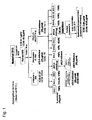
- the microorganism capable of producing a statin, a pharmaceutically acceptable salt thereof, and/or a hydrate thereof is not particularly limited, and for example, a microorganism capable of producing lovastatin is exemplified by a filamentous fungus belonging to the genus Aspergillus , particularly suitably Aspergillus terreus (see FIG. 1 ).
- the pharmaceutically acceptable salt in the present invention is not particularly limited and may be exemplified by any salt known to a person skilled in the art, such as a sodium salt, a potassium salt, or a calcium salt.
- the HCV particle formation promoter of the present invention may comprise any other compound in addition to the above-mentioned statin, pharmaceutically acceptable salt thereof, and/or hydrate thereof as the active ingredient.
- the dosage form of the HCV particle formation promoter of the present invention is not particularly limited as long as the statin, pharmaceutically acceptable salt thereof, and/or hydrate thereof as the active ingredient can be cultured together with HCV-infected cells.
- the HCV particle formation promoter of the present invention may appropriately comprise, in addition to the active ingredient of the present invention, a pharmaceutically acceptable carrier, excipient, binder, lubricant, colorant, and the like known to a person skilled in the art.
- the HCV particle formation promoter of the present invention may be easily prepared by any formulation preparation method known to a person skilled in the art.
- Suitable examples of the carrier may include lactose, starch, sucrose, glucose, methylcellulose, magnesium stearate, mannitol, sorbitol, and croscarmellose sodium.
- suitable examples of the binder include starch, gelatin, a natural saccharide such as glucose, anhydrous lactose, free flowing lactose, ⁇ -lactone, or a corn sweetener, natural or synthetic gum such as gum arabic, guar gum, tragacanth, or sodium alginate, carboxymethylcellulose, polyethylene glycol, and wax.
- examples of the lubricant to be used for these dosage forms include sodium oleate, sodium stearate, magnesium stearate, sodium benzoate, and sodium chloride.
- the present invention also encompasses a method of enhancing the production of HCV particles, wherein the method comprises culturing HCV-infected cells together with the HCV particle formation promoter.
- Cells that may be used in the production of HCV particles of the present invention only need to be HCV-permissive cells.
- the HCV-permissive cells mean cells capable of replicating HCV genomic RNA and/or capable of being infected with HCV.
- the HCV-permissive cells are cells derived from liver cells or lymphoid cells, but are not limited thereto.
- liver cells include, but not limited to, primary liver cells, Huh7 cells, RCYM1RC cells, 5-15RC cells, HepG2 cells, IMY-N9 cells, HeLa cells, and 293 cells.
- lymphoid cells include, but not limited to, Molt4 cells, HPB-Ma cells, and Daudi cells.
- Preferred examples of the HCV-permissive cells include Huh7 cells, RCYM1RC cells, 5-15RC cells, HepG2 cells, and cell lines derived from these cells. Cells derived from Huh7 cells are particularly preferred and examples of such cells include Huh7.5 cells, Huh7.5.1 cells, and Huh7-it cells. In particular, it is suitable that the cells can be subjected to subculture.
- eukaryotic cells are preferred and human cells are more preferred. As those cells, commercially available ones may be utilized, or ones available from cell repositories may be used. Cell lines derived from any cells (e.g., cancer cells or stem cells) may also be used. As cell lines derived from Huh7 cells, there are given, for example, Huh7.5 cells ( Blight KJ et al., J. Virol., 76:13001-13014, 2002 ), Huh7.5.1 cells ( Zhong J et al., Proc. Natl. Acad. Sci. USA, 102:9294-9299, 2005 ), and Huh7-it cells ( Yu L et al., J. Virol. Methods, 169:380-384, 2010 ).
- Huh7.5 cells Blight KJ et al., J. Virol., 76:13001-13014, 2002
- Huh7.5.1 cells Zhong J et al., Proc. Natl. Acad. Sci. USA,
- HCV particle formation promoter of the present invention to HCV-infected HCV-permissive cells selected from the above-mentioned cells can promote the formation of HCV particles and enhance the production of the HCV particles.
- HCV is inoculated into any cultured HCV-permissive cells selected from the above-mentioned cells so as to adsorb the HCV onto the cells.
- the cells are cultured for from 24 to 72 hours, preferably from 36 to 72 hours, more preferably about 48 hours in a culture medium supplemented with the HCV particle formation promoter at a concentration of from 10 to 200 ⁇ g/ml, preferably from 20 to 50 ⁇ g/ml.
- the formation of HCV particles can be promoted, and the production of the HCV particles can be enhanced.
- HCV-infected cells may be confirmed by any known virus detection method.
- a culture supernatant of HCV-permissive cells may be fractionated by a sucrose density gradient to detect virus particles.
- HCV-infected cells having replicated HCV genomic RNA express a HCV protein. Therefore, when the HCV protein can be detected by culturing HCV-infected cells, the cells can be estimated to have replicated HCV genomic RNA.
- the HCV protein may be detected in accordance with any known protein detection method. Specifically, the HCV protein may be detected by the method of Kaito M et al., J. Gen. Virol., 75:1755-1760, 1994 .
- a capacity to produce virus particles may be confirmed by confirming the number of infectious virus particles in a culture supernatant.
- the number of infectious virus particles in a culture supernatant may be confirmed by: inoculating a culture supernatant comprising infectious virus particles into non-infected cells; fixing the cells from 18 to 48 hours, preferably about 24 hours after the inoculation; performing immunostaining by a specific antibody against a HCV protein; and measuring the number of staining-positive cells.
- the confirmation may be performed by subjecting a culture supernatant comprising infectious virus particles to a reaction with an anti-HCV core protein antibody by an enzyme-linked immunosorbent assay (ELISA) method, followed by detection.
- ELISA enzyme-linked immunosorbent assay
- the analysis of HCV RNA to be replicated in the HCV-infected cells may be performed by a general molecular biological method.
- a method of extracting RNA from the cells may be a method known per se.
- the amount or sequence of replicated RNA may be analyzed by a northern blot method, a ribonuclease protection assay method, a RT-PCR method, or the like.
- the northern blot method or a quantitative RT-PCR may be used in the case of quantifying RNA, and a sequence analysis method may be used in the case of analyzing an RNA sequence.
- the HCV particles to be produced by the method of the present invention have an ability to infect HCV-permissive cells.
- the HCV-permissive cells mean cells capable of replicating HCV genomic RNA and/or capable of being infected with HCV.
- the HCV-permissive cells are cells derived from liver cells or lymphoid cells, but are not limited thereto.
- Specific examples of the liver cells include, but not limited to, primary liver cells, Huh7 cells, RCYM1RC cells, 5-15RC cells, HepG2 cells, IMY-N9 cells, HeLa cells, and 293 cells.
- Specific examples of the lymphoid cells include, but not limited to, Molt4 cells, HPB-Ma cells, and Daudi cells.
- HCV-permissive cells include Huh7 cells, RCYM1RC cells, 5-15RC cells, HepG2 cells, and cell lines derived from these cells.
- Cells derived from Huh7 cells are particularly preferred and examples of such cells include Huh7.5 cells, Huh7.5.1 cells, and Huh7-it cells.
- a method of purifying HCV particles from a virus liquid comprising HCV particles obtained in the foregoing, such as a culture supernatant comprising infectious virus particles, is not particularly limited, and a method known per se or a method to be developed in the future is applicable thereto.
- the purification may be performed by removing cells and cell debris by centrifugation and/or with a filter or the like, followed by one or a combination in any order of ultrafiltration concentration, chromatography, and density gradient centrifugation.
- the present invention also encompasses a method of producing a HCV vaccine comprising as antigens the HCV particles to be produced by the method of the present invention.
- the present invention also encompasses a HCV vaccine produced by the method.
- HCV particles having inactivated infectivity In the production of the HCV vaccine of the present invention, it is preferred to use HCV particles having inactivated infectivity.
- a method of inactivating the infectivity is not particularly limited as long as the method may be clinically used, and a method known per se or a method to be developed in the future may be adopted.
- the inactivated infectivity may be achieved by adding and mixing an inactivating agent such as formalin, ⁇ -propiolactone, or glutardialdehyde into, for example, a suspension of the HCV particles produced by the present invention so that the inactivating agent reacts with the HCV particles ( Appaiahgari MB et al., Vaccine, 22:3669-3675, 2004 ).
- the infectivity may be quickly inactivated by irradiating the HCV particles with UV light to lose the infectivity.
- the inactivation can be performed while reducing the influence on the protein and the like constituting the HCV particles.
- a radiation source of UV light to be used for performing the inactivation may be a general commercially available germicidal lamp, in particular, a 15-W germicidal lamp, but is not limited thereto.
- An adjuvant is not particularly limited as long as the adjuvant may be used as an adjuvant for a vaccine and may be clinically used. And, an adjuvant known per se or an adjuvant to be developed in the future is applicable thereto.
- aluminum hydroxide (Alum) or the like which has already been approved for its use as an adjuvant for a vaccine, is desired, but there may be used any adjuvant that may be clinically used.
- Examples thereof include a CpG oligonucleotide and double-stranded RNA.
- the double-stranded RNA may include polyI:C, polyICLC, and polyIpolyC12U.
- the HCV particle formation promoter of the present invention may also be utilized in a method of evaluating an anti-HCV agent candidate substance.
- an example of the anti-HCV agent is a substance having a suppressing effect on the production of HCV particles in cells or a suppressing effect on the release of HCV particles from cells.
- the anti-HCV agent candidate substance is not particularly limited as long as the substance is expected to exhibit such effects, and examples thereof include a protein, a peptide, and a low-molecular-weight compound.
- the method of evaluating an anti-HCV agent candidate substance is achieved by: culturing HCV-infected cells together with the HCV particle formation promoter of the present invention and an anti-HCV agent candidate substance, or with an anti-HCV agent candidate substance alone, for from 36 to 72 hours; and comparing abilities to form HCV particles in the cultured HCV-infected cells.
- the method may include the following steps 1) to 3):
- Examples of the cells that may be used in this case include the HCV-permissive cells described above.
- a solution using an Aspergillus terreus culture extract (B13) as a raw material was used as the HCV particle formation promoter of the present invention.
- the HCV particle formation promoter according to this example was produced by a method illustrated in FIG. 1 .
- a crude lovastatin solution "B15” or purified lovastatin solution “B15.4.1” shown in FIG. 1 was used as the HCV particle formation promoter.
- the composition of B15.4.1 was investigated by a nuclear magnetic resonance (NMR) method and liquid chromatography-mass spectrometry (LC/MS). As a result, it was confirmed that lovastatin was obtained as a substantially pure product.
- a lovastatin amount was measured by weighing a purified authentic sample (B15.4.1) after drying with a precision analytical balance.
- the purified lovastatin solution "B15.4.1" ( FIG. 1 ) of Example 1 was used as the "HCV particle formation promoter."
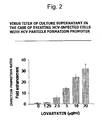
- a lovastatin solution prepared by adding a culture medium to the HCV particle formation promoter to adjust each lovastatin concentration at the time of virus inoculation and at the time of culture to from 1.25 to 20 ⁇ g/ml was used in the following.
- Huh7-it cells a highly HCV-permissive cell line derived from Huh7 cells, were used as culture cells.
- the medium used was Dulbecco's modified Eagle's medium supplemented with 10% fetal calf serum, non-essential amino acids, penicillin, and streptomycin, and the cells were cultured using a 48-well culture plate.
- a HCV stock solution to be used for promoting the formation of HCV particles of the present invention was prepared by the following method.
- the HCV strain used was JFH1 strain (genome sequence: GenBank accession number AB047639).
- RNA having the same sequence as that of the full genome of the HCV JFH1 strain was introduced (transfected) into Huh7-it cells by an electroporation method ( van den Hoff MJ et al., Nucleic Acids Res., 20:2902, 1992 ), and the culture supernatant 72 hours after the introduction was collected.
- the collected culture supernatant was passed through a 0.45- ⁇ m filter (Millipore) to remove contaminants, and then added to other Huh7-it cells.
- An infectivity titer was calculated by measuring the number of HCV-infected cells after 72 hours by a focus method, and a solution adjusted so as to have an infectivity titer of 5.4 ⁇ 10 4 infectious units/ml was used as the HCV stock solution.
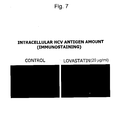
- the infectivity titer for preparing the HCV stock solution was calculated by an immunostaining method.
- An anti-HCV-core (clone CP 14) monoclonal antibody was used as a primary antibody, and a HRP-labeled goat anti-mouse antibody was used as a labeling antibody.
- Konica Immunostain HRP-1000 Konica Minolta was added, and the number of virus antigen-positive cell populations stained in blue (immunofocus; also called focus) was measured under a microscope. Thus, the infectivity titer was calculated.
- a mixture of the HCV stock solution (5.4 ⁇ 10 4 infectious units/ml) prepared in the above-mentioned section 3) and the HCV particle formation promoter was inoculated into culture cells, and the virus was adsorbed to the cells at 37°C for 2 hours. Then, the virus liquid was removed, and the cells were washed three times with a culture medium. After that, in the same manner as described above, the cells were cultured for 48 hours with the addition of the HCV particle formation promoter (lovastatin concentration: 1.25 to 20 ⁇ g/ml). The virus was inoculated into the culture cells so that the multiplicity of infection (moi) was 0.1.
- the culturemedium of the infected cells was centrifuged at 10,000 rpm for 3 minutes, and the centrifugation supernatant was used as a sample liquid.
- the sample liquid was inoculated into non-HCV-infected Huh7-it cells. 24 hours after the inoculation, the cells were fixed and subjected to immunostaining using, as a primary antibody, patient serum that had been found to strongly react with the HCV protein in advance, and using, as a secondary antibody, an Alexa 488-labeled goat anti-human IgG antibody (Molecular Probe). The number of staining-positive cells was measured, and the HCV infectivity titer was measured.
- Example 1 the crude lovastatin solution "B15" ( FIG. 1 ) of Example 1 was used as the "HCV particle formation promoter.”
- a mixture of HCV and the HCV particle formation promoter was inoculated into culture cells, and the virus was adsorbed to the cells at 37°C for 2 hours. Then, the virus liquid was removed, and the cells were washed three times with a culture medium. After that, the cells were cultured for 46 hours with the addition of the HCV particle formation promoter containing lovastatin.
- HCV was inoculated into culture cells and adsorbed to the cells at 37°C for 2 hours. Then, the virus liquid was removed, and the cells were washed three times with a culture medium. After that, the cells were cultured for 46 hours with the addition of a culture medium supplemented with the HCV particle formation promoter.
- a mixture of HCV and the HCV particle formation promoter was inoculated into culture cells, and the virus was adsorbed to the cells at 37°C for 2 hours. Then, the virus liquid was removed, and the cells were washed three times with a culture medium. After that, the cells were cultured for 46 hours with the addition of a culture medium free of the HCV particle formation promoter.
- a sample for confirming a virus-producing ability was prepared in the same manner as in Example 2, and was measured for its virus infectivity titer in the same manner as in Example 2.
- Example 1 the purified lovastatin solution "B15.4.1" ( FIG. 1 ) of Example 1 was used as the "HCV particle formation promoter."
- a mixture of HCV and the HCV particle formation promoter was inoculated into culture cells, and the virus was adsorbed to the cells at 37°C for 2 hours. Then, the virus liquid was removed, and the cells were washed three times with a culture medium. After that, the cells were cultured for 46 hours with the addition of a culture medium supplemented with the HCV particle formation promoter.
- a mixture of HCV and the HCV particle formation promoter was inoculated into culture cells, and the virus was adsorbed to the cells at 37°C for 2 hours. Then, the virus liquid was removed, and the cells were washed three times with a culture medium. After that, the cells were cultured for 46 hours with the addition of a medium free of the HCV particle formation promoter.
- HCV was inoculated into culture cells and adsorbed to the cells at 37°C for 2 hours. Then, the virus liquid was removed, and the cells were washed three times with a culture medium. After that, the cells were cultured for 46 hours with the addition of a culture medium supplemented with the HCV particle formation promoter.
- a sample for confirming a virus-producing ability was prepared in the same manner as in Example 2, and was measured for its virus infectivity titer in the same manner as in Example 2.
- culture cells were prepared in the same manner as in Example 2 to confirm the influence on the HCV infectivity titer inside and outside Huh7-it cells in the case of adding the HCV particle formation promoter to the cells over a period of from during HCV adsorption to 48 hours after HCV infection.
- the purified lovastatin solution "B 15.4.1" ( FIG. 1 ) of Example 1 was used as the HCV particle formation promoter.
- a lovastatin solution prepared by adding a culture medium to the HCV particle formation promoter to adjust each lovastatin concentration at the time of virus inoculation and at the time of culture to 20 ⁇ g/ml was used in the following.
- a system containing dimethylsulfoxide (DMSO) in place of the HCV particle formation promoter was used as a control.
- DMSO dimethylsulfoxide
- a sample for measuring an extracellular HCV infectivity titer was prepared in the same manner as in Example 2.
- a sample for measuring an intracellular HCV infectivity titer was prepared by a freeze-thawing method. First, infected cells were washed with PBS and then detached by trypsin/EDTA treatment, followed by centrifugation to collect a cell pellet. The cell pellet was washed once with PBS, suspended in 0.5 ml of a culture medium, and freeze-thawed at -80°C three times repeatedly, followed by centrifugation at 12,000 rpm for 5 minutes. The resultant supernatant was used as a sample for measurement. Each sample was measured for its virus titer in the same manner as in Example 2.
- culture cells were prepared in the same manner as in Example 2 to confirm the influence on the HCV RNA copy number in the culture cells on days 1,2, 3, and 4 after HCV infection in the case of adding the HCV particle formation promoter to Huh7-it cells over a period of from during HCV adsorption to 48 hours after HCV infection.
- the purified lovastatin solution "B15.4.1" ( FIG. 1 ) of Example 1 was used as the HCV particle formation promoter.
- a lovastatin solution prepared by adding a culture medium to the HCV particle formation promoter to adjust each lovastatin concentration at the time of virus inoculation and at the time of culture to 20 ⁇ g/ml was used in the following.
- a system containing DMSO in place of the HCV particle formation promoter was used as a control.
- Primers for the NS3 site having nucleotide sequences shown in SEQ ID NOS: 1 and 2, were used as HCV-specific primers, and a solution containing 10 ⁇ l of 2 ⁇ SYBR Premix ExTaq (Takara), 0.4 ⁇ l of each primer (10 pmol/ ⁇ l), 2 ⁇ l of the cDNA template, and 7.2 ⁇ l of sterile distilled water was used as a PCR reaction solution.
- the conditions of PCR were as follows: heat denaturation at 95°C for 10 seconds was performed and then a cycle composed of 95°C for 10 seconds and 60°C for 20 seconds was repeated 40 times.
- SEQ ID NO: 1 5'-CTTTGACTCCGTGATCGACT-3'
- SEQ ID NO: 2 5'-CCCTGTCTTCCTCTACCTG-3'
- statin formulation was used as the HCV particle formation promoter.
- the following statins were used: lovastatin (mevinolin: manufactured by Sigma-Aldrich; CAS number 75330-75-5), fluvastatin sodium (manufactured by Wako Pure Chemical Industries, Ltd.; CAS number 93957-55-2), simvastatin (manufactured by Sigma-Aldrich.; CAS number 79902-63-9), atorvastatin calcium trihydrate (manufactured by Wako Pure Chemical Industries, Ltd.; CAS number 134523-03-8), and pravastatin sodium salt hydrate (manufactured by Wako Pure Chemical Industries, Ltd.; CAS number 81131-70-6).
- Each of the statins was diluted with a culture medium to adjust its concentration at the time of culture to a concentration shown in Table 1.
- DMSO (1 ⁇ g/ml) in place of the HCV particle formation promoter was used as a control.
- a sample for confirming a virus-producing ability was prepared in the same manner as in Example 2, and was measured for its virus infectivity titer in the same manner as in Example 2.
- Table 1 shows the results of the foregoing. As a result, each of the statins was found to have a HCV particle formation promoter effect.
- HCV particle production-promoting effects of various statins (commercially available products)
- Statin Concentration ( ⁇ g/ml) Promotion ratio Control (DMSO) 1.0 1.0 Lovastatin 1.25 0.8 2.5 3.5 5.0 6.1 20.0 11.1 Fluvastatin 1.25 9.2 2.5 14.3 5.0 15.2 20.0 7.9
- the production efficiency of HCV particles in a cell culture medium can be expected to be improved by 10 times or more by culturing HCV-infected cells with the addition of the HCV particle formation promoter of the present invention.
- This enables the HCV vaccine to be produced effectively and efficiently.
- the anti-HCV agent can be evaluated by: culturing HCV-infected cells together with the HCV particle formation promoter of the present invention and the anti-HCV agent candidate substance; and measuring the virus titer and/or HCV RNA copy number in a cell culture medium.
- the HCV vaccine can be efficiently produced using the HCV particles obtained by the present invention.
Landscapes
- Health & Medical Sciences (AREA)
- Life Sciences & Earth Sciences (AREA)
- Chemical & Material Sciences (AREA)
- Organic Chemistry (AREA)
- General Health & Medical Sciences (AREA)
- Medicinal Chemistry (AREA)
- Engineering & Computer Science (AREA)
- Veterinary Medicine (AREA)
- Public Health (AREA)
- Animal Behavior & Ethology (AREA)
- Pharmacology & Pharmacy (AREA)
- Epidemiology (AREA)
- Immunology (AREA)
- Microbiology (AREA)
- Virology (AREA)
- Wood Science & Technology (AREA)
- Zoology (AREA)
- Bioinformatics & Cheminformatics (AREA)
- Genetics & Genomics (AREA)
- Biomedical Technology (AREA)
- Biotechnology (AREA)
- Molecular Biology (AREA)
- Biochemistry (AREA)
- Toxicology (AREA)
- General Engineering & Computer Science (AREA)
- Mycology (AREA)
- Proteomics, Peptides & Aminoacids (AREA)
- Analytical Chemistry (AREA)
- Physics & Mathematics (AREA)
- Communicable Diseases (AREA)
- Hematology (AREA)
- Urology & Nephrology (AREA)
- Biophysics (AREA)
- General Physics & Mathematics (AREA)
- Cell Biology (AREA)
- Food Science & Technology (AREA)
- Tropical Medicine & Parasitology (AREA)
- Pathology (AREA)
- Oncology (AREA)
- Chemical Kinetics & Catalysis (AREA)
Abstract
Description
- The present invention relates to a hepatitis C virus (HCV) particle formation promoter for promoting formation of HCV particles in HCV-infected culture cells, and to a method of enhancing production of HCV particles.
- The present application claims priority from Japanese Patent Application No.
2012-215474 - Since a HCV gene was cloned in 1989, establishment of a method of producing a virus growth cell system, involving infecting culture cells with HCV from hepatitis C patient serum, has been the biggest theme in HCV research.
- There are as many as 200 million HCV carriers worldwide, including about 2 million HCV carriers in Japan. HCV-infected patients are at a very high risk of developing chronic hepatitis. In some of the patients, chronic hepatitis progresses to liver cirrhosis and liver cancer. That is, HCV is a causative virus that causes severe diseases. At present, a treatment method involving uses of interferon (IFN) and ribavirin, which is an antiviral drug, in combination has been often taken for many hepatitis C patients. However, there are many HCV-infected patients for whom IFN is less effective. Thus, there is a problem in that the treatment method has low therapeutic effects on such patients. In addition, it has been revealed that IFN exhibits strong side effects on patients. Therefore, there is an urgent need for development of a novel therapeutic drug and novel vaccine directed to prevention of HCV infection spread and eradication of HCV.
- Meanwhile, at an animal experiment level, an infectious clone of HCV could grow only in chimeric mice transplanted with chimpanzee or human liver cells. However, the clone made little contribution to research because acquirement of a virus from a patient specimen that could easily infect culture cells was not achieved, and utilization of chimpanzees did not become popular in terms of an ethical problem and cost. It was reported that a HCV subgenomic RNA replicon system capable of replicating and growing a
- HCV subgenome in culture cells was produced (
Non Patent Literatures 1 to 4 andPatent Literatures 1 and 2). This enabled a replication mechanism of HCV to be analyzed using culture cells. Such HCV subgenomic RNA replicon is obtained by replacing a structural protein-encoding region present downstream of HCV IRES in a 5' untranslated region of HCV genomic RNA by a neomycin-resistant gene and EMCV-IRES linked downstream thereof. It was demonstrated that when the RNA replicon was introduced into human liver cancer cells Huh7 and the cells were cultured in the presence of neomycin, the RNA replicon replicated autonomously in the Huh7 cells. - After that, it was reported that a HCV full-genomic RNA replicon in which HCV full-genomic RNA replicated autonomously was produced, and that an infection growth system reflecting a life cycle of HCV (from virus adsorption and entry to formation of virus particles and release of the particles out of cells) was produced (Non
patent Literatures 5 to 7). In order to more effectively develop a vaccine or the like, there is a demand for a system in which HCV particles are formed in infected cells and released out of the cells more effectively. -
- Non Patent Literature 1: Science, 285:110-113, 1999
- Non Patent Literature 2: Science, 290:1972-74, 2000
- Non Patent Literature 3: J. Virol., 75:12047-57, 2001
- Non Patent Literature 4: Gastroenterology, 125:1808-17, 2003
- Non Patent Literature 5: Nat. Med., 11:791-796, 2005
- Non Patent Literature 6: Science, 309:623-626, 2005
- Non Patent Literature 7: Proc. Natl. Acad. Sci. USA, 102:9294-9299, 2005
-
- Patent Literature 1:
JP 2001-17187 A - Patent Literature 2:
WO 2004/104198 A1 - An object of the present invention is to provide a HCV particle formation promoter capable of promoting formation of a HCV particle in a culture cell, and a method of enhancing production of HCV particles. Another object of the present invention is to provide a method of evaluating an anti-HCV agent candidate substance, and a method of producing a HCV vaccine.
- The inventors of the present invention have made extensive studies in order to achieve the objects. As a result, the inventors have found that a statin or a pharmaceutically acceptable salt thereof effectively promotes formation of HCV particles. Thus, a HCV particle formation promoter according to one embodiment of the present invention has been completed. In addition, the inventors have found that an anti-HCV agent candidate substance can be evaluated by culturing a HCV-infected cell in the presence of the HCV particle formation promoter and the anti-HCV agent candidate substance. Thus, a method of evaluating an anti-HCV agent candidate substance according to one embodiment of the present invention has been completed. Further, the inventors have found that a HCV vaccine can be produced using a HCV particle produced by a method of enhancing production of HCV particles. Thus, a method of producing a HCV vaccine according to one embodiment of the present invention has been completed.
- That is, the present invention includes the following.
- 1. A HCV particle formation promoter, comprising as an active ingredient a statin or a pharmaceutically acceptable salt thereof.
- 2. The HCV particle formation promoter according to the above-mentioned
item 1, wherein the statin comprises one or more statins selected from the group consisting of lovastatin, fluvastatin, simvastatin, atorvastatin, and pravastatin. - 3. The HCV particle formation promoter according to the above-mentioned
item - 4. The HCV particle formation promoter according to the above-mentioned
item 3, wherein the microorganism is a filamentous fungus belonging to a genus Aspergillus. - 5. A method of enhancing production of HCV particles, wherein the method comprises culturing a HCV-infected cell in a presence of the HCV particle formation promoter according to any one of the above-mentioned
items 1 to 4. - 6. The method of enhancing production of HCV particles according to the above-mentioned
item 5, wherein the culturing is performed with addition of the HCV particle formation promoter according to any one of the above-mentioneditems 1 to 4 after formation of a HCV protein in the HCV-infected cell. - 7. A method of producing a HCV vaccine, wherein the method comprises inactivating a HCV produced by the method of enhancing production of HCV particles according to the above-mentioned
item - 8. A HCV vaccine, which is produced by the method of producing a HCV vaccine according to the above-mentioned item 7.
- 9. A method of evaluating an anti-HCV agent candidate substance,
wherein the method comprises:- culturing a HCV-infected cell together with an anti-HCV agent candidate substance in a presence of the HCV particle formation promoter according to any one of the above-mentioned
items 1 to 4; and - evaluating the anti-HCV agent candidate substance for an ability to inhibit formation of HCV particles.
- culturing a HCV-infected cell together with an anti-HCV agent candidate substance in a presence of the HCV particle formation promoter according to any one of the above-mentioned
- 10. The method of evaluating an anti-HCV agent candidate substance according to the above-mentioned item 9, wherein the method comprises the steps of:
- 1) adding the HCV particle formation promoter according to any one of the above-mentioned
items 1 to 4 and an anti-HCV agent candidate substance to a HCV-infected cell; - 2) culturing the HCV-infected cell; and
- 3) evaluating the anti-HCV agent candidate substance for an ability to inhibit formation of a HCV particle by measuring an amount of the HCV particles after the culturing.
- 1) adding the HCV particle formation promoter according to any one of the above-mentioned
- The formation of the HCV particle can be promoted, and the production efficiency of the HCV particles can be improved, by culturing the HCV-infected cell using the HCV particle formation promoter of the present invention. According to the methods of the present invention, the production of the HCV particles in the HCV-infected culture cell can be increased, and the anti-HCV agent candidate substance can be evaluated. Further, the HCV vaccine can be efficiently produced using the HCV particles to be obtained by the present invention.
-
-
FIG. 1 illustrates a flowchart of purification from an Aspergillus terreus cell extract as a production example of a HCV particle formation promoter of the present invention. In the figure, a growth inhibitory concentration (IC50) and cytotoxicity (CC50) for each solution in each purification step are shown (Example 1). -
FIG. 2 is a graph showing measurement results of a virus titer in the case of adding the HCV particle formation promoter of the present invention to culture cells (Example 2). -
FIG. 3 is a graph showing results of a study on the timing of addition of the HCV particle formation promoter to culture cells after HCV infection (Example 3). -
FIG. 4 is a graph showing results of a study on the timing of addition of the HCV particle formation promoter to culture cells after HCV infection (Example 4). -
FIG. 5 shows measurement results of virus particles formed inside and outside culture cells in the case of adding the HCV particle formation promoter of the present invention to the cells (Example 5). -
FIG. 6 is a graph showing measurement results of an RNA copy number in culture cells in the case of adding the HCV particle formation promoter of the present invention to the cells (Example 6). -
FIG. 7 shows results of confirmation of a protein-forming ability in culture cells by immunostaining in the case of adding the HCV particle formation promoter of the present invention to the cells (Example 6). - The present invention relates to a HCV particle formation promoter, comprising as an active ingredient a statin or a pharmaceutically acceptable salt thereof.
- Herein, the statin is a drug used as a therapeutic drug for hypercholesterolemia by inhibiting the function of 3-hydroxy-3-methylglutaryl coenzyme A reductase (HMG-CoA reductase), which is a rate-limiting enzyme of the mevalonate pathway, which is one of the cholesterol biosynthetic pathways, to suppress cholesterol biosynthesis in the liver, and the statin refers to lovastatin, simvastatin, fluvastatin sodium, pravastatin, atorvastatin calcium, pitavastatin calcium, rosuvastatin calcium, or the like.
- Herein, the lovastatin has a CAS number of 75330-75-5 and refers to (1S,3R,7S,8S,8aR)-8-[2-((2R,4R)-4-hydroxy-6-oxotetrahydro-2H-pyran-2-yl)ethyl]-3,7-dimet hyl-1,2,3,7,8,8a-hexahydro-1-naphthyl, the simvastatin has a CAS number of 79902-63-9 and refers to
- (1S,3R,7S,8S,8aR)-8-[2-[(2R,4R)-4-hydroxy-6-oxotetrahydropyran-2-yl]ethyl]-3,7-dimethyl-1,2,3,7,8,8a-hexahydro-1-naphthyl, the fluvastatin sodium has a CAS number of 93957-55-2 and refers to sodium (3R,5S,6E)-7-[3-(4-fluorophenyl)-1-(1-methylethyl)-1H-indol-2-yl]-3,5-dihydroxy-6-hepteno ate, the pravastatin has a CAS number of 81093-70-6 and refers to (1S,βR,δR,8aβ)-1,2,6,7,8,8a-hexahydro-β,δ,6β-trihydroxy-2β-methyl-8α-[(S)-2-methyl-1-oxo butoxy]-1β-naphthaleneheptanoate, the atorvastatin calcium has a CAS number of 134523-03-8 and refers to calcium (3R,5R)-7-[2-(4-fluorophenyl)-5-isopropyl-3-phenyl-4-[(phenylamino)carbonyl]-1H-pyrrol-1 -yl]-3,5-dihydroxyheptanoate, the pitavastatin calcium has a CAS number of 147511-69-1 and refers to (3R,5S,6E)-7-(2-cyclopropyl-4-(4-fluorophenyl)quinolin-3-yl)-3,5-dihydroxyhept-6-enoic acid, and the rosuvastatin calcium has a CAS number of 147098-20-2 and refers to calcium bis[(E)-7-[4-(4-fluorophenyl)-6-isopropyl-2-[methyl(methylsulfonyl)amino]pyrimidin-5-yl](3 R,5S)-3,5-dihydroxyhept-6-enoate].
- As the statin of the present invention, one kind or a plurality of kinds may be selected from the above-mentioned statins and used. Preferred examples thereof include lovastatin, fluvastatin, simvastatin, atorvastatin, and pravastatin. More preferred examples thereof include lovastatin, fluvastatin, simvastatin, and atorvastatin. The active ingredient contained in the HCV particle formation promoter of the present invention may be the above-mentioned statin or a pharmaceutically acceptable salt thereof, or may be a hydrate thereof. The statin, the pharmaceutically acceptable salt thereof, and the hydrate thereof may be produced by synthesis, or may be produced with a microorganism.
- The HCV particle formation promoter of the present invention may be a composition comprising as an active ingredient a statin, pharmaceutically acceptable salt thereof, and/or hydrate thereof produced by synthesis, or may be a culture extract of a microorganism capable of producing a statin, a pharmaceutically acceptable salt thereof, and/or a hydrate thereof. The culture extract of the microorganism may also be used without any further treatments as the HCV particle formation promoter of the present invention. In any of the cases, the active ingredient comprised in the HCV particle formation promoter of the present invention is a statin, a pharmaceutically acceptable salt thereof, and/or a hydrate thereof. When the culture extract of the microorganism capable of producing a statin, a pharmaceutically acceptable salt thereof, and/or a hydrate thereof is used without any further treatments as the HCV particle formation promoter of the present invention, the production of the HCV particle formation promoter can be easily performed, and a reduction in cost can be achieved, as compared to the case of synthesizing and purifying the statin, pharmaceutically acceptable salt thereof, and/or hydrate thereof.
- The statin, pharmaceutically acceptable salt thereof, and hydrate thereof as the active ingredient may be produced by synthesis, or may be acquired from a culture extract of a microorganism capable of biosynthesizing such ingredient. Methods of synthesizing the statin, pharmaceutically acceptable salt thereof, and hydrate thereof are not particularly limited, and methods known per se or all synthetic methods to be developed in the future are applicable thereto. The microorganism capable of producing a statin, a pharmaceutically acceptable salt thereof, and/or a hydrate thereof is not particularly limited, and for example, a microorganism capable of producing lovastatin is exemplified by a filamentous fungus belonging to the genus Aspergillus, particularly suitably Aspergillus terreus (see
FIG. 1 ). - The pharmaceutically acceptable salt in the present invention is not particularly limited and may be exemplified by any salt known to a person skilled in the art, such as a sodium salt, a potassium salt, or a calcium salt. The HCV particle formation promoter of the present invention may comprise any other compound in addition to the above-mentioned statin, pharmaceutically acceptable salt thereof, and/or hydrate thereof as the active ingredient.
- The dosage form of the HCV particle formation promoter of the present invention is not particularly limited as long as the statin, pharmaceutically acceptable salt thereof, and/or hydrate thereof as the active ingredient can be cultured together with HCV-infected cells. In consideration of the foregoing, the HCV particle formation promoter of the present invention may appropriately comprise, in addition to the active ingredient of the present invention, a pharmaceutically acceptable carrier, excipient, binder, lubricant, colorant, and the like known to a person skilled in the art. The HCV particle formation promoter of the present invention may be easily prepared by any formulation preparation method known to a person skilled in the art. Suitable examples of the carrier may include lactose, starch, sucrose, glucose, methylcellulose, magnesium stearate, mannitol, sorbitol, and croscarmellose sodium. Further, suitable examples of the binder include starch, gelatin, a natural saccharide such as glucose, anhydrous lactose, free flowing lactose, β-lactone, or a corn sweetener, natural or synthetic gum such as gum arabic, guar gum, tragacanth, or sodium alginate, carboxymethylcellulose, polyethylene glycol, and wax. In addition, examples of the lubricant to be used for these dosage forms include sodium oleate, sodium stearate, magnesium stearate, sodium benzoate, and sodium chloride.
- The present invention also encompasses a method of enhancing the production of HCV particles, wherein the method comprises culturing HCV-infected cells together with the HCV particle formation promoter. Cells that may be used in the production of HCV particles of the present invention only need to be HCV-permissive cells. Herein, the HCV-permissive cells mean cells capable of replicating HCV genomic RNA and/or capable of being infected with HCV. The HCV-permissive cells are cells derived from liver cells or lymphoid cells, but are not limited thereto. Specific examples of the liver cells include, but not limited to, primary liver cells, Huh7 cells, RCYM1RC cells, 5-15RC cells, HepG2 cells, IMY-N9 cells, HeLa cells, and 293 cells. Specific examples of the lymphoid cells include, but not limited to, Molt4 cells, HPB-Ma cells, and Daudi cells. Preferred examples of the HCV-permissive cells include Huh7 cells, RCYM1RC cells, 5-15RC cells, HepG2 cells, and cell lines derived from these cells. Cells derived from Huh7 cells are particularly preferred and examples of such cells include Huh7.5 cells, Huh7.5.1 cells, and Huh7-it cells. In particular, it is suitable that the cells can be subjected to subculture. Further, eukaryotic cells are preferred and human cells are more preferred. As those cells, commercially available ones may be utilized, or ones available from cell repositories may be used. Cell lines derived from any cells (e.g., cancer cells or stem cells) may also be used. As cell lines derived from Huh7 cells, there are given, for example, Huh7.5 cells (Blight KJ et al., J. Virol., 76:13001-13014, 2002), Huh7.5.1 cells (Zhong J et al., Proc. Natl. Acad. Sci. USA, 102:9294-9299, 2005), and Huh7-it cells (Yu L et al., J. Virol. Methods, 169:380-384, 2010).
- The addition of the HCV particle formation promoter of the present invention to HCV-infected HCV-permissive cells selected from the above-mentioned cells can promote the formation of HCV particles and enhance the production of the HCV particles. Specifically, HCV is inoculated into any cultured HCV-permissive cells selected from the above-mentioned cells so as to adsorb the HCV onto the cells. Then, the cells are cultured for from 24 to 72 hours, preferably from 36 to 72 hours, more preferably about 48 hours in a culture medium supplemented with the HCV particle formation promoter at a concentration of from 10 to 200 µg/ml, preferably from 20 to 50 µg/ml. Thus, the formation of HCV particles can be promoted, and the production of the HCV particles can be enhanced.
- The capacity of HCV-infected cells to produce HCV particles may be confirmed by any known virus detection method. For example, a culture supernatant of HCV-permissive cells may be fractionated by a sucrose density gradient to detect virus particles. HCV-infected cells having replicated HCV genomic RNA express a HCV protein. Therefore, when the HCV protein can be detected by culturing HCV-infected cells, the cells can be estimated to have replicated HCV genomic RNA. Further, the HCV protein may be detected in accordance with any known protein detection method. Specifically, the HCV protein may be detected by the method of Kaito M et al., J. Gen. Virol., 75:1755-1760, 1994. A capacity to produce virus particles may be confirmed by confirming the number of infectious virus particles in a culture supernatant. Specifically, the number of infectious virus particles in a culture supernatant may be confirmed by: inoculating a culture supernatant comprising infectious virus particles into non-infected cells; fixing the cells from 18 to 48 hours, preferably about 24 hours after the inoculation; performing immunostaining by a specific antibody against a HCV protein; and measuring the number of staining-positive cells. More specifically, the confirmation may be performed by subjecting a culture supernatant comprising infectious virus particles to a reaction with an anti-HCV core protein antibody by an enzyme-linked immunosorbent assay (ELISA) method, followed by detection.
- The analysis of HCV RNA to be replicated in the HCV-infected cells may be performed by a general molecular biological method. A method of extracting RNA from the cells may be a method known per se. Specifically, the amount or sequence of replicated RNA may be analyzed by a northern blot method, a ribonuclease protection assay method, a RT-PCR method, or the like. The northern blot method or a quantitative RT-PCR may be used in the case of quantifying RNA, and a sequence analysis method may be used in the case of analyzing an RNA sequence.
- The HCV particles to be produced by the method of the present invention have an ability to infect HCV-permissive cells. Herein, the HCV-permissive cells mean cells capable of replicating HCV genomic RNA and/or capable of being infected with HCV. The HCV-permissive cells are cells derived from liver cells or lymphoid cells, but are not limited thereto. Specific examples of the liver cells include, but not limited to, primary liver cells, Huh7 cells, RCYM1RC cells, 5-15RC cells, HepG2 cells, IMY-N9 cells, HeLa cells, and 293 cells. Specific examples of the lymphoid cells include, but not limited to, Molt4 cells, HPB-Ma cells, and Daudi cells. Preferred examples of the HCV-permissive cells include Huh7 cells, RCYM1RC cells, 5-15RC cells, HepG2 cells, and cell lines derived from these cells. Cells derived from Huh7 cells are particularly preferred and examples of such cells include Huh7.5 cells, Huh7.5.1 cells, and Huh7-it cells.
- A method of purifying HCV particles from a virus liquid comprising HCV particles obtained in the foregoing, such as a culture supernatant comprising infectious virus particles, is not particularly limited, and a method known per se or a method to be developed in the future is applicable thereto. For example, the purification may be performed by removing cells and cell debris by centrifugation and/or with a filter or the like, followed by one or a combination in any order of ultrafiltration concentration, chromatography, and density gradient centrifugation.
- The present invention also encompasses a method of producing a HCV vaccine comprising as antigens the HCV particles to be produced by the method of the present invention. The present invention also encompasses a HCV vaccine produced by the method.
- In the production of the HCV vaccine of the present invention, it is preferred to use HCV particles having inactivated infectivity. A method of inactivating the infectivity is not particularly limited as long as the method may be clinically used, and a method known per se or a method to be developed in the future may be adopted. For example, the inactivated infectivity may be achieved by adding and mixing an inactivating agent such as formalin, β-propiolactone, or glutardialdehyde into, for example, a suspension of the HCV particles produced by the present invention so that the inactivating agent reacts with the HCV particles (Appaiahgari MB et al., Vaccine, 22:3669-3675, 2004). Alternatively, the infectivity may be quickly inactivated by irradiating the HCV particles with UV light to lose the infectivity. According to the irradiation with UV light, the inactivation can be performed while reducing the influence on the protein and the like constituting the HCV particles. A radiation source of UV light to be used for performing the inactivation may be a general commercially available germicidal lamp, in particular, a 15-W germicidal lamp, but is not limited thereto.
- An adjuvant is not particularly limited as long as the adjuvant may be used as an adjuvant for a vaccine and may be clinically used. And, an adjuvant known per se or an adjuvant to be developed in the future is applicable thereto. For example, aluminum hydroxide (Alum) or the like, which has already been approved for its use as an adjuvant for a vaccine, is desired, but there may be used any adjuvant that may be clinically used. Examples thereof include a CpG oligonucleotide and double-stranded RNA. Examples of the double-stranded RNA may include polyI:C, polyICLC, and polyIpolyC12U.
- The HCV particle formation promoter of the present invention may also be utilized in a method of evaluating an anti-HCV agent candidate substance. Herein, an example of the anti-HCV agent is a substance having a suppressing effect on the production of HCV particles in cells or a suppressing effect on the release of HCV particles from cells. The anti-HCV agent candidate substance is not particularly limited as long as the substance is expected to exhibit such effects, and examples thereof include a protein, a peptide, and a low-molecular-weight compound.
- The method of evaluating an anti-HCV agent candidate substance is achieved by: culturing HCV-infected cells together with the HCV particle formation promoter of the present invention and an anti-HCV agent candidate substance, or with an anti-HCV agent candidate substance alone, for from 36 to 72 hours; and comparing abilities to form HCV particles in the cultured HCV-infected cells. Specifically, the method may include the following steps 1) to 3):
- 1) adding the HCV particle formation promoter of the present invention and an anti-HCV agent candidate substance to HCV-infected cells;
- 2) culturing the hepatitis C virus-infected cells; and
- 3) evaluating an ability to inhibit formation of hepatitis C virus particles by measuring the amount of the hepatitis C virus particles after the culturing.
- Examples of the cells that may be used in this case include the HCV-permissive cells described above.
- The contents of the present invention are more specifically described by way of Examples for further understanding of the present invention. However, it is apparent that the present invention is by no means limited to Examples shown below.
- In this example, a solution using an Aspergillus terreus culture extract (B13) as a raw material was used as the HCV particle formation promoter of the present invention. The HCV particle formation promoter according to this example was produced by a method illustrated in
FIG. 1 . In Examples to be described later, a crude lovastatin solution "B15" or purified lovastatin solution "B15.4.1" shown inFIG. 1 was used as the HCV particle formation promoter. The composition of B15.4.1 was investigated by a nuclear magnetic resonance (NMR) method and liquid chromatography-mass spectrometry (LC/MS). As a result, it was confirmed that lovastatin was obtained as a substantially pure product. A lovastatin amount was measured by weighing a purified authentic sample (B15.4.1) after drying with a precision analytical balance. - In this example, the influence on the HCV infectivity titer in the case of adding the HCV particle formation promoter to Huh7-it cells was confirmed.
- In this example, the purified lovastatin solution "B15.4.1" (
FIG. 1 ) of Example 1 was used as the "HCV particle formation promoter." A lovastatin solution prepared by adding a culture medium to the HCV particle formation promoter to adjust each lovastatin concentration at the time of virus inoculation and at the time of culture to from 1.25 to 20 µg/ml was used in the following. - In this example, Huh7-it cells, a highly HCV-permissive cell line derived from Huh7 cells, were used as culture cells. The medium used was Dulbecco's modified Eagle's medium supplemented with 10% fetal calf serum, non-essential amino acids, penicillin, and streptomycin, and the cells were cultured using a 48-well culture plate.
- A HCV stock solution to be used for promoting the formation of HCV particles of the present invention was prepared by the following method. The HCV strain used was JFH1 strain (genome sequence: GenBank accession number AB047639). RNA having the same sequence as that of the full genome of the HCV JFH1 strain was introduced (transfected) into Huh7-it cells by an electroporation method (van den Hoff MJ et al., Nucleic Acids Res., 20:2902, 1992), and the culture supernatant 72 hours after the introduction was collected. The collected culture supernatant was passed through a 0.45-µm filter (Millipore) to remove contaminants, and then added to other Huh7-it cells. An infectivity titer was calculated by measuring the number of HCV-infected cells after 72 hours by a focus method, and a solution adjusted so as to have an infectivity titer of 5.4×10⁴ infectious units/ml was used as the HCV stock solution. The infectivity titer for preparing the HCV stock solution was calculated by an immunostaining method. An anti-HCV-core (clone CP 14) monoclonal antibody was used as a primary antibody, and a HRP-labeled goat anti-mouse antibody was used as a labeling antibody. Konica Immunostain HRP-1000 (Konica Minolta) was added, and the number of virus antigen-positive cell populations stained in blue (immunofocus; also called focus) was measured under a microscope. Thus, the infectivity titer was calculated.
- A mixture of the HCV stock solution (5.4×10⁴ infectious units/ml) prepared in the above-mentioned section 3) and the HCV particle formation promoter was inoculated into culture cells, and the virus was adsorbed to the cells at 37°C for 2 hours. Then, the virus liquid was removed, and the cells were washed three times with a culture medium. After that, in the same manner as described above, the cells were cultured for 48 hours with the addition of the HCV particle formation promoter (lovastatin concentration: 1.25 to 20 µg/ml). The virus was inoculated into the culture cells so that the multiplicity of infection (moi) was 0.1.
- In order to confirm a virus-producing ability, the culturemedium of the infected cells was centrifuged at 10,000 rpm for 3 minutes, and the centrifugation supernatant was used as a sample liquid. The sample liquid was inoculated into non-HCV-infected Huh7-it cells. 24 hours after the inoculation, the cells were fixed and subjected to immunostaining using, as a primary antibody, patient serum that had been found to strongly react with the HCV protein in advance, and using, as a secondary antibody, an Alexa 488-labeled goat anti-human IgG antibody (Molecular Probe). The number of staining-positive cells was measured, and the HCV infectivity titer was measured.
- The results of the foregoing revealed that in the case of the culture in the presence of the purified lovastatin solution "B15.4.1" adjusted so as to contain 5 to 20 µg/ml of lovastatin, a high HCV infectivity titer was found in a lovastatin concentration-dependent manner for each sample liquid (
FIG. 2 ). - In this example, the influence on the HCV infectivity titer in the case of adding the HCV particle formation promoter to Huh7-it cells during HCV adsorption for 2 hours and/or 48 hours after HCV infection was confirmed.
- In this example, the crude lovastatin solution "B15" (
FIG. 1 ) of Example 1 was used as the "HCV particle formation promoter." A lovastatin solution prepared by adding a culture medium to the HCV particle formation promoter to adjust each lovastatin concentration at the time of virus inoculation and at the time of culture to from 1 to 50 µg/ml was used in the following. - In this example, in the same manner as in Example 2, Huh7-it cells were cultured and used.
- In this example, HCV was inoculated into culture cells so as to achieve moi=0.1 as in Example 2, and the HCV particle formation promoter was added at the following timings i) to iii).
- A mixture of HCV and the HCV particle formation promoter was inoculated into culture cells, and the virus was adsorbed to the cells at 37°C for 2 hours. Then, the virus liquid was removed, and the cells were washed three times with a culture medium. After that, the cells were cultured for 46 hours with the addition of the HCV particle formation promoter containing lovastatin.
- HCV was inoculated into culture cells and adsorbed to the cells at 37°C for 2 hours. Then, the virus liquid was removed, and the cells were washed three times with a culture medium. After that, the cells were cultured for 46 hours with the addition of a culture medium supplemented with the HCV particle formation promoter.
- A mixture of HCV and the HCV particle formation promoter was inoculated into culture cells, and the virus was adsorbed to the cells at 37°C for 2 hours. Then, the virus liquid was removed, and the cells were washed three times with a culture medium. After that, the cells were cultured for 46 hours with the addition of a culture medium free of the HCV particle formation promoter.
- A sample for confirming a virus-producing ability was prepared in the same manner as in Example 2, and was measured for its virus infectivity titer in the same manner as in Example 2.
- From the results of the foregoing, irrespective of the presence or absence of the HCV particle formation promoter during the HCV adsorption, when the cells were cultured with the addition of the HCV particle formation promoter after the HCV adsorption, a high virus infectivity titer was found in a concentration-dependent manner in the presence of 5 to 20 µg/ml of lovastatin for each sample liquid (
FIG. 3 ). - In this example, the influence on the HCV infectivity titer in the case of adding lovastatin as the HCV particle formation promoter to Huh7-it cells during HCV adsorption for 2 hours or 48 hours after HCV infection was confirmed.
- In this example, the purified lovastatin solution "B15.4.1" (
FIG. 1 ) of Example 1 was used as the "HCV particle formation promoter." A lovastatin solution prepared by adding a culture medium to the HCV particle formation promoter to adjust each lovastatin concentration at the time of virus inoculation and at the time of culture to 20 µg/ml was used in the following. - In this example, in the same manner as in Example 2, Huh7-it cells were cultured and used.
- In this example, HCV was inoculated into culture cells so as to achieve moi=0.1 as in Example 2, and the HCV particle formation promoter was added at the following timings i) to iii).
- A mixture of HCV and the HCV particle formation promoter was inoculated into culture cells, and the virus was adsorbed to the cells at 37°C for 2 hours. Then, the virus liquid was removed, and the cells were washed three times with a culture medium. After that, the cells were cultured for 46 hours with the addition of a culture medium supplemented with the HCV particle formation promoter.
- A mixture of HCV and the HCV particle formation promoter was inoculated into culture cells, and the virus was adsorbed to the cells at 37°C for 2 hours. Then, the virus liquid was removed, and the cells were washed three times with a culture medium. After that, the cells were cultured for 46 hours with the addition of a medium free of the HCV particle formation promoter.
- HCV was inoculated into culture cells and adsorbed to the cells at 37°C for 2 hours. Then, the virus liquid was removed, and the cells were washed three times with a culture medium. After that, the cells were cultured for 46 hours with the addition of a culture medium supplemented with the HCV particle formation promoter.
- A sample for confirming a virus-producing ability was prepared in the same manner as in Example 2, and was measured for its virus infectivity titer in the same manner as in Example 2.
- From the results of the foregoing, irrespective of the presence or absence of the HCV particle formation promoter during the HCV adsorption, when the cells were cultured with the addition of the HCV particle formation promoter after the HCV adsorption, a high virus infectivity titer was found (
FIG. 4 ). - In this example, culture cells were prepared in the same manner as in Example 2 to confirm the influence on the HCV infectivity titer inside and outside Huh7-it cells in the case of adding the HCV particle formation promoter to the cells over a period of from during HCV adsorption to 48 hours after HCV infection. In this example, the purified lovastatin solution "B 15.4.1" (
FIG. 1 ) of Example 1 was used as the HCV particle formation promoter. A lovastatin solution prepared by adding a culture medium to the HCV particle formation promoter to adjust each lovastatin concentration at the time of virus inoculation and at the time of culture to 20 µg/ml was used in the following. A system containing dimethylsulfoxide (DMSO) in place of the HCV particle formation promoter was used as a control. - A sample for measuring an extracellular HCV infectivity titer was prepared in the same manner as in Example 2. A sample for measuring an intracellular HCV infectivity titer was prepared by a freeze-thawing method. First, infected cells were washed with PBS and then detached by trypsin/EDTA treatment, followed by centrifugation to collect a cell pellet. The cell pellet was washed once with PBS, suspended in 0.5 ml of a culture medium, and freeze-thawed at -80°C three times repeatedly, followed by centrifugation at 12,000 rpm for 5 minutes. The resultant supernatant was used as a sample for measurement. Each sample was measured for its virus titer in the same manner as in Example 2.
- From the results of the foregoing, substantially no difference in intracellular HCV particle-producing ability was found between the system treated with the HCV particle formation promoter and the control. On the other hand, the system treated with the HCV particle formation promoter was found to have a significantly high extracellular HCV particle-producing ability, which was from 20 times to 30 times as high as that of the control (
FIG. 5 ). - In this example, culture cells were prepared in the same manner as in Example 2 to confirm the influence on the HCV RNA copy number in the culture cells on
days FIG. 1 ) of Example 1 was used as the HCV particle formation promoter. A lovastatin solution prepared by adding a culture medium to the HCV particle formation promoter to adjust each lovastatin concentration at the time of virus inoculation and at the time of culture to 20 µg/ml was used in the following. A system containing DMSO in place of the HCV particle formation promoter was used as a control. - A sample for measuring an intracellular HCV RNA copy was prepared in the same manner as in Example 5. Total RNA was extracted from infected cells using Trizol® /Trizol®-LS (Invitrogen). cDNA was synthesized from the total RNA by performing a reverse transcription reaction at 37°C for 15 minutes and an enzyme inactivation reaction at 98°C for 5 minutes through the use of a ReverTra Ace® qPCR-Kit (Toyobo). The HCV RNA copy number was measured by a quantitative RT-PCR method using a LightCycler® 480 real-time PCR system. Primers for the NS3 site, having nucleotide sequences shown in SEQ ID NOS: 1 and 2, were used as HCV-specific primers, and a solution containing 10 µl of 2×SYBR Premix ExTaq (Takara), 0.4 µl of each primer (10 pmol/µl), 2 µl of the cDNA template, and 7.2 µl of sterile distilled water was used as a PCR reaction solution. The conditions of PCR were as follows: heat denaturation at 95°C for 10 seconds was performed and then a cycle composed of 95°C for 10 seconds and 60°C for 20 seconds was repeated 40 times.
(SEQ ID NO: 1) 5'-CTTTGACTCCGTGATCGACT-3'
(SEQ ID NO: 2) 5'-CCCTGTCTTCCTCTACCTG-3' - The experimental results of the foregoing revealed that an intracellular HCV RNA replication amount was not affected by the presence or absence of the HCV particle formation promoter (
FIG. 6 ). In addition, the immunostaining revealed that an intracellular HCV protein (antigen) synthesis amount was also not affected by the presence or absence of lovastatin (FIG. 7 ). It was estimated from those experimental results that the HCV production-enhancing effect of lovastatin was not exhibited at the stages of HCV RNA replication and HCV protein synthesis, but was exhibited at the subsequent stages, i.e., the stages of HCV particle formation and release. - In this example, commercially available various statins were observed for their HCV particle production-promoting effects.
- In this example, a commercially available statin formulation was used as the HCV particle formation promoter. The following statins were used: lovastatin (mevinolin: manufactured by Sigma-Aldrich; CAS number 75330-75-5), fluvastatin sodium (manufactured by Wako Pure Chemical Industries, Ltd.; CAS number 93957-55-2), simvastatin (manufactured by Sigma-Aldrich.; CAS number 79902-63-9), atorvastatin calcium trihydrate (manufactured by Wako Pure Chemical Industries, Ltd.; CAS number 134523-03-8), and pravastatin sodium salt hydrate (manufactured by Wako Pure Chemical Industries, Ltd.; CAS number 81131-70-6). Each of the statins was diluted with a culture medium to adjust its concentration at the time of culture to a concentration shown in Table 1. DMSO (1 µg/ml) in place of the HCV particle formation promoter was used as a control.
- In this example, in the same manner as in Example 2, Huh7-it cells were cultured and used.
- In this example, HCV was inoculated into culture cells so as to achieve moi=0.1, and the virus was adsorbed to the cells at 37°C for 2 hours. Then, the virus liquid was removed, and the cells were washed three times with a culture medium. After that, the cells were cultured for 46 hours with the addition of a culture medium supplemented with the HCV particle formation promoter.
- A sample for confirming a virus-producing ability was prepared in the same manner as in Example 2, and was measured for its virus infectivity titer in the same manner as in Example 2.
- Table 1 shows the results of the foregoing. As a result, each of the statins was found to have a HCV particle formation promoter effect.
[Table 1] HCV particle production-promoting effects of various statins (commercially available products) Statin Concentration (µg/ml) Promotion ratio Control (DMSO) 1.0 1.0 Lovastatin 1.25 0.8 2.5 3.5 5.0 6.1 20.0 11.1 Fluvastatin 1.25 9.2 2.5 14.3 5.0 15.2 20.0 7.9 Simvastatin 1.25 8.5 2.5 14.8 5.0 19.5 20.0 4.1 Atorvastatin 1.25 0.9 2.5 4.3 5.0 9.4 20.0 9.7 Pravastatin 5.0 0.6 20.0 2.7 80.0 17.2 200.0 24.7 - As described in detail above, the production efficiency of HCV particles in a cell culture medium can be expected to be improved by 10 times or more by culturing HCV-infected cells with the addition of the HCV particle formation promoter of the present invention. This enables the HCV vaccine to be produced effectively and efficiently. Further, the anti-HCV agent can be evaluated by: culturing HCV-infected cells together with the HCV particle formation promoter of the present invention and the anti-HCV agent candidate substance; and measuring the virus titer and/or HCV RNA copy number in a cell culture medium. Still further, the HCV vaccine can be efficiently produced using the HCV particles obtained by the present invention.

Claims (10)
- A hepatitis C virus particle formation promoter, comprising as an active ingredient a statin or a pharmaceutically acceptable salt thereof.
- The hepatitis C virus particle formation promoter according to claim 1, wherein the statin comprises one or more statins selected from the group consisting of lovastatin, fluvastatin, simvastatin, atorvastatin, and pravastatin.
- The hepatitis C virus particle formation promoter according to claim 1 or 2, wherein the hepatitis C virus particle formation promoter comprises a culture extract of a microorganism capable of producing a statin or a pharmaceutically acceptable salt thereof.
- The hepatitis C virus particle formation promoter according to claim 3, wherein the microorganism is a filamentous fungus belonging to a genus Aspergillus.
- A method of enhancing production of hepatitis C virus particles, wherein the method comprises culturing a hepatitis C virus-infected cell in a presence of the hepatitis C virus particle formation promoter according to any one of claims 1 to 4.
- The method of enhancing production of hepatitis C virus particles according to claim 5, wherein the culturing is performed with addition of the hepatitis C virus particle formation promoter according to any one of claims 1 to 4 after formation of a hepatitis C virus protein in the hepatitis C virus-infected cell.
- A method of producing a hepatitis C virus vaccine, wherein the method comprises inactivating a hepatitis C virus produced by the method of enhancing production of hepatitis C virus particles according to claim 5 or 6.
- A hepatitis C virus vaccine, which is produced by the method of producing a hepatitis C virus vaccine according to claim 7.
- A method of evaluating an anti-hepatitis C virus agent candidate substance,
wherein the method comprises:culturing a hepatitis C virus-infected cell together with an anti-hepatitis C virus agent candidate substance in a presence of the hepatitis C virus particle formation promoter according to any one of claims 1 to 4; andevaluating the anti-hepatitis C virus agent candidate substance for an ability to inhibit formation of hepatitis C virus particles. - The method of evaluating an anti-hepatitis C virus agent candidate substance according to claim 9, wherein the method comprises the steps of:1) adding the hepatitis C virus particle formation promoter according to any one of claims 1 to 4 and an anti-hepatitis C virus agent candidate substance to a hepatitis C virus-infected cell;2) culturing the hepatitis C virus-infected cell; and3) evaluating the anti-hepatitis C virus agent candidate substance for an ability to inhibit formation of a hepatitis C virus particle by measuring an amount of the hepatitis C virus particles after the culturing.
Applications Claiming Priority (2)
| Application Number | Priority Date | Filing Date | Title |
|---|---|---|---|
| JP2012215474 | 2012-09-28 | ||
| PCT/JP2013/076414 WO2014051111A1 (en) | 2012-09-28 | 2013-09-27 | Hepatitis c virus particles formation promoter, and method for producing hepatitis c virus particles |
Publications (2)
| Publication Number | Publication Date |
|---|---|
| EP2902485A1 true EP2902485A1 (en) | 2015-08-05 |
| EP2902485A4 EP2902485A4 (en) | 2016-03-16 |
Family
ID=50388501
Family Applications (1)
| Application Number | Title | Priority Date | Filing Date |
|---|---|---|---|
| EP13841603.7A Withdrawn EP2902485A4 (en) | 2012-09-28 | 2013-09-27 | PROMOTER OF FORMATION OF HEPATITIS C VIRUS PARTICLES, AND METHOD FOR PRODUCING HEPATITIS C VIRUS PARTICLES |
Country Status (6)
| Country | Link |
|---|---|
| US (1) | US20150258189A1 (en) |
| EP (1) | EP2902485A4 (en) |
| JP (1) | JP6283315B2 (en) |
| CN (1) | CN105164251A (en) |
| CA (1) | CA2886336A1 (en) |
| WO (1) | WO2014051111A1 (en) |
Family Cites Families (10)
| Publication number | Priority date | Publication date | Assignee | Title |
|---|---|---|---|---|
| DE19915178A1 (en) | 1999-04-03 | 2000-10-05 | Univ Mainz Johannes Gutenberg | Hepatitis C virus cell culture system |
| CN1833024B (en) | 2003-05-26 | 2011-08-31 | 东丽株式会社 | Nucleic acid construct containing hepatitis c virus (hcv) of genocype 2a genome-origin nucleic acid and cell having the nucleic acid construct transferred thereinto |
| CN102206663B (en) * | 2004-02-20 | 2014-02-05 | 公益财团法人东京都医学综合研究所 | Nucleic acid construct containing full-length genome of human hepatitis C virus and uses |
| AU2008276880B2 (en) * | 2007-07-13 | 2014-02-27 | Japan As Represented By Director General Of National Institute Of Infectious Diseases | Production and use of epitope-tagged hepatitis C virus particle |
| EP2326659A2 (en) * | 2008-09-12 | 2011-06-01 | F. Hoffmann-La Roche AG | Production of infectious hepatitis c virus particles in cell culture |
| JPWO2011024875A1 (en) * | 2009-08-28 | 2013-01-31 | 公益財団法人東京都医学総合研究所 | Polynucleotide derived from a new strain of hepatitis C virus and use thereof |
| EP2484378A4 (en) * | 2009-09-30 | 2013-05-22 | Toray Industries | VACCINE COMPOSITION AGAINST HEPATITIS C VIRUS |
| CN102086183B (en) * | 2009-12-04 | 2014-04-16 | 北大方正集团有限公司 | Method for extracting and separating statins substance |
| CN102199613A (en) * | 2010-03-25 | 2011-09-28 | 国立大学法人东京大学 | High productive capacity HCV mutant of infectious HCV and application thereof |
| JP2012215474A (en) | 2011-03-31 | 2012-11-08 | Mitsubishi Heavy Ind Ltd | Coolant piping structure |
-
2013
- 2013-09-27 EP EP13841603.7A patent/EP2902485A4/en not_active Withdrawn
- 2013-09-27 JP JP2014538656A patent/JP6283315B2/en not_active Expired - Fee Related
- 2013-09-27 WO PCT/JP2013/076414 patent/WO2014051111A1/en not_active Ceased
- 2013-09-27 US US14/432,076 patent/US20150258189A1/en not_active Abandoned
- 2013-09-27 CA CA 2886336 patent/CA2886336A1/en not_active Abandoned
- 2013-09-27 CN CN201380062187.1A patent/CN105164251A/en active Pending
Also Published As
| Publication number | Publication date |
|---|---|
| EP2902485A4 (en) | 2016-03-16 |
| JP6283315B2 (en) | 2018-02-21 |
| US20150258189A1 (en) | 2015-09-17 |
| CA2886336A1 (en) | 2014-04-03 |
| CN105164251A (en) | 2015-12-16 |
| WO2014051111A1 (en) | 2014-04-03 |
| JPWO2014051111A1 (en) | 2016-08-25 |
Similar Documents
| Publication | Publication Date | Title |
|---|---|---|
| Kumar et al. | Host-directed antiviral therapy | |
| Tashiro et al. | Immunotherapy against cancer-related viruses | |
| Fung et al. | Hepatitis B and C virus-related carcinogenesis | |
| Ascherio et al. | Epstein–Barr virus infection and multiple sclerosis: a review | |
| Végső et al. | Lymphoproliferative disorders after solid organ transplantation—classification, incidence, risk factors, early detection and treatment options | |
| Ogawa et al. | Caffeic acid, a coffee-related organic acid, inhibits infection by severe fever with thrombocytopenia syndrome virus in vitro | |
| Silvestri et al. | Hepatitis C virus infection among cryoglobulinemic and non-cryoglobulinemic B-cell non-Hodgkin's lymphomas | |
| Alavian et al. | Virus‐triggered autophagy in viral hepatitis–possible novel strategies for drug development | |
| EP2484378A1 (en) | Hepatitis c virus vaccine composition | |
| Zhang et al. | Oncogenic viral antigens for engineered T cell immunotherapy: challenges and opportunities | |
| Kumar et al. | Immune responses against hepatitis C virus genotype 3a virus-like particles in mice: A novel VLP prime-adenovirus boost strategy | |
| Ababneh et al. | The role of EBV in haematolymphoid proliferations: emerging concepts relevant to diagnosis and treatment | |
| Niller et al. | EBV-associated neoplasms: alternative pathogenetic pathways | |
| Ostrowski et al. | Impairment of thymus-dependent responses by murine dendritic cells infected with foot-and-mouth disease virus | |
| Suarez et al. | Opportunities and challenges for hepatitis B cure | |
| Lefeuvre et al. | Host-cell interaction of attenuated and wild-type strains of yellow fever virus can be differentiated at early stages of hepatocyte infection | |
| Lv et al. | Targeting EBV‐encoded products: Implications for drug development in EBV‐associated diseases | |
| US20150258189A1 (en) | Hepatitis c virus particles formation promoter, and method of producing hepatitis c virus particles | |
| El‐Araby et al. | Epigenetic pathways of oncogenic viruses: therapeutic promises | |
| El‐Farrash et al. | In vitro infection of immortalized primary hepatocytes by HCV genotype 4a and inhibition of virus replication by cyclosporin | |
| Ye et al. | Centrifugal enhancement of hepatitis C virus infection of human hepatocytes | |
| EP4182446B1 (en) | Method of purifying whole virus particles | |
| Murakami et al. | Identification of bisindolylmaleimides and indolocarbazoles as inhibitors of HCV replication by tube-capture-RT-PCR | |
| Farag et al. | Dendritic cells can effectively be pulsed by HBVsvp and induce specific immune reactions in mice | |
| Zhou et al. | Development of a dendritic cell vaccine encoding multiple cytotoxic T lymphocyte epitopes targeting hepatitis C virus |
Legal Events
| Date | Code | Title | Description |
|---|---|---|---|
| PUAI | Public reference made under article 153(3) epc to a published international application that has entered the european phase |
Free format text: ORIGINAL CODE: 0009012 |
|
| 17P | Request for examination filed |
Effective date: 20150428 |
|
| AK | Designated contracting states |
Kind code of ref document: A1 Designated state(s): AL AT BE BG CH CY CZ DE DK EE ES FI FR GB GR HR HU IE IS IT LI LT LU LV MC MK MT NL NO PL PT RO RS SE SI SK SM TR |
|
| AX | Request for extension of the european patent |
Extension state: BA ME |
|
| DAX | Request for extension of the european patent (deleted) | ||
| RA4 | Supplementary search report drawn up and despatched (corrected) |
Effective date: 20160217 |
|
| RIC1 | Information provided on ipc code assigned before grant |
Ipc: C12N 7/06 20060101ALI20160211BHEP Ipc: A61P 31/14 20060101ALI20160211BHEP Ipc: A61K 39/29 20060101ALI20160211BHEP Ipc: C12Q 1/02 20060101ALI20160211BHEP Ipc: C12N 15/09 20060101ALI20160211BHEP Ipc: C12N 7/02 20060101AFI20160211BHEP |
|
| STAA | Information on the status of an ep patent application or granted ep patent |
Free format text: STATUS: REQUEST FOR EXAMINATION WAS MADE |
|
| STAA | Information on the status of an ep patent application or granted ep patent |
Free format text: STATUS: THE APPLICATION IS DEEMED TO BE WITHDRAWN |
|
| 18D | Application deemed to be withdrawn |
Effective date: 20160915 |