EP2902468A2 - Novel cyclopentanol compounds - Google Patents
Novel cyclopentanol compounds Download PDFInfo
- Publication number
- EP2902468A2 EP2902468A2 EP14195879.3A EP14195879A EP2902468A2 EP 2902468 A2 EP2902468 A2 EP 2902468A2 EP 14195879 A EP14195879 A EP 14195879A EP 2902468 A2 EP2902468 A2 EP 2902468A2
- Authority
- EP
- European Patent Office
- Prior art keywords
- ppm
- cyclopentanol
- methyl
- fragrance
- ethyl
- Prior art date
- Legal status (The legal status is an assumption and is not a legal conclusion. Google has not performed a legal analysis and makes no representation as to the accuracy of the status listed.)
- Granted
Links
- 0 C*C(CCC1)C1(C)O Chemical compound C*C(CCC1)C1(C)O 0.000 description 2
Classifications
-
- C—CHEMISTRY; METALLURGY
- C07—ORGANIC CHEMISTRY
- C07C—ACYCLIC OR CARBOCYCLIC COMPOUNDS
- C07C35/00—Compounds having at least one hydroxy or O-metal group bound to a carbon atom of a ring other than a six-membered aromatic ring
- C07C35/02—Compounds having at least one hydroxy or O-metal group bound to a carbon atom of a ring other than a six-membered aromatic ring monocyclic
- C07C35/06—Compounds having at least one hydroxy or O-metal group bound to a carbon atom of a ring other than a six-membered aromatic ring monocyclic containing a five-membered rings
-
- C—CHEMISTRY; METALLURGY
- C07—ORGANIC CHEMISTRY
- C07C—ACYCLIC OR CARBOCYCLIC COMPOUNDS
- C07C35/00—Compounds having at least one hydroxy or O-metal group bound to a carbon atom of a ring other than a six-membered aromatic ring
- C07C35/21—Compounds having at least one hydroxy or O-metal group bound to a carbon atom of a ring other than a six-membered aromatic ring polycyclic, at least one hydroxy group bound to a non-condensed ring
-
- C—CHEMISTRY; METALLURGY
- C11—ANIMAL OR VEGETABLE OILS, FATS, FATTY SUBSTANCES OR WAXES; FATTY ACIDS THEREFROM; DETERGENTS; CANDLES
- C11B—PRODUCING, e.g. BY PRESSING RAW MATERIALS OR BY EXTRACTION FROM WASTE MATERIALS, REFINING OR PRESERVING FATS, FATTY SUBSTANCES, e.g. LANOLIN, FATTY OILS OR WAXES; ESSENTIAL OILS; PERFUMES
- C11B9/00—Essential oils; Perfumes
- C11B9/0026—Essential oils; Perfumes compounds containing an alicyclic ring not condensed with another ring
- C11B9/003—Essential oils; Perfumes compounds containing an alicyclic ring not condensed with another ring the ring containing less than six carbon atoms
-
- C—CHEMISTRY; METALLURGY
- C07—ORGANIC CHEMISTRY
- C07C—ACYCLIC OR CARBOCYCLIC COMPOUNDS
- C07C2601/00—Systems containing only non-condensed rings
- C07C2601/06—Systems containing only non-condensed rings with a five-membered ring
- C07C2601/08—Systems containing only non-condensed rings with a five-membered ring the ring being saturated
Definitions
- the present invention relates to novel chemical entities and a method of using the same as fragrance materials.
- trans-compounds are shown to share pronounced urine-perspiration-type odor, while the corresponding cis-compounds are odorless or at the most possess weak and undefinable flowery or woody odor.
- some other trans- and cis-tert-butyl cyclohexanes are shown to possess opposite sensory activities [ Ohloff, et al., Helvetica Chimica Acta 66, Fasc. 5: 1343-1354 (1983 )].
- it is hard for those with skill in the art to predict a given structure would be effective in sensory activities. Identifying desirable fragrance chemicals continues to pose difficult challenges.
- the present invention provides novel compounds, the unexpected advantageous use thereof in enhancing, improving or modifying the fragrance of perfumes, colognes, toilet waters, fabric care products, personal products and the like.
- One embodiment of the invention relates to novel cyclopentanols represented by Formula I set forth below: wherein R 1 represents a C 1 -C 2 hydrocarbon group; and wherein R 2 represents a C 2 -C 9 hydrocarbon group.
- Another embodiment of the invention relates to novel cyclopentanols represented by Formula II set forth below: wherein R 3 represents a C 1 -C 2 hydrocarbon group; and wherein R 4 represents a C 3 -C 6 hydrocarbon group.
- Another embodiment of the invention relates to novel cyclopentanols represented by Formula III set forth below: wherein R 5 is selected from the group consisting of ethyl and vinyl; and wherein R 6 represents a C 3 -C 6 hydrocarbon group.
- Another embodiment of the present invention relates to a method of improving, enhancing or modifying a fragrance formulation through the addition of an olfactory acceptable amount of the novel compounds provided above.
- Another embodiment of the present invention relates to a fragrance composition comprising the novel compounds provided above.
- Another embodiment of the present invention relates to a fragrance product comprising the compounds provided above.
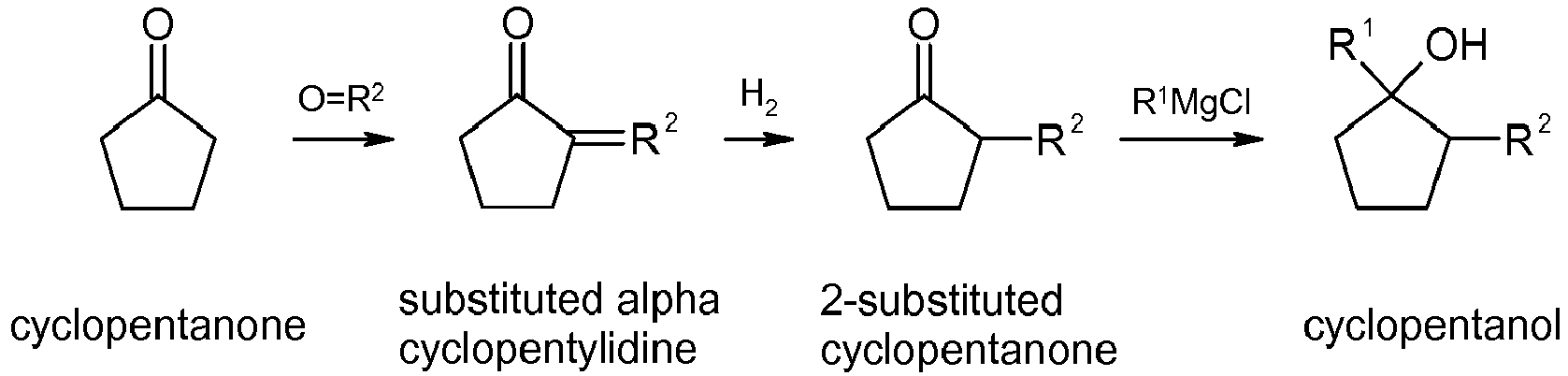
- the compounds of the present invention can be prepared from cyclopentanone.
- the reaction steps can be depicted by a scheme shown as follows: wherein R 1 and R 2 are defined as above.
- the compounds of the present invention are surprisingly found to possess powerful and complex fragrance effect such as, for example, fresh, citrusy and green notes with additional woodiness and camphoraceous and earthy undertones.
- the use of the compounds of the present invention is widely applicable in current perfumery products, including the preparations of perfumes and colognes, the perfuming of personal care products such as soaps, shower gels, and hair care products, fabric care products, air fresheners, and cosmetic preparations.
- the present invention can also be used to perfume cleaning agents, such as, but not limited to detergents, dishwashing materials, scrubbing compositions, window cleaners and the like.
- the compounds of the present invention can be used alone or in combination with other perfuming compositions, solvents, adjuvants and the like.
- the nature and variety of the other ingredients that can also be employed are known to those with skill in the art.
- fragrances can be employed in the present invention, the only limitation being the compatibility with the other components being employed.
- Suitable fragrances include but are not limited to fruits such as almond, apple, cherry, grape, pear, pineapple, orange, strawberry, raspberry; musk, flower scents such as lavender-like, rose-like, iris-like, carnation-like.
- Other pleasant scents include herbal and woodland scents derived from pine, spruce and other forest smells.
- Fragrances may also be derived from various oils, such as essential oils, or from plant materials such as peppermint, spearmint and the like.
- fragrances provided in this treatise are acacia, cassie, chypre, cyclamen, fern, gardenia, hawthorn, heliotrope, honeysuckle, hyacinth, jasmine, lilac, lily, magnolia, mimosa, narcissus, freshly-cut hay, orange blossom, orchid, reseda, sweet pea, trefle, tuberose, vanilla, violet, wallflower, and the like.
- complementary fragrance compound as used herein is defined as a fragrance compound selected from the group consisting of 2-[(4-methylphenyl)methylene]-heptanal (Acalea), iso-amyl oxyacetic acid allylester (Allyl Amyl Glycolate), (3,3-dimethylcyclohexyl)ethyl ethyl propane-1,3-dioate (Applelide), (E/Z)-1-ethoxy-1-decene (Arctical), 2-ethyl-4-(2,2,3-trimethyl-3-cyclo-penten-1-yl)-2-buten-1-ol (Bacdanol), 2-methyl-3-[(1,7,7-trimethylbicyclo[2.2.1]hept-2-yl)oxy] exo-1-propanol (Bornafix), 1,2,3,5,6,7-hexahydro-1
- Complexity of odor notes refers to the presence of multiple and/or mixed but defined odors rather than a single note or a few easily identifiable notes. High levels of complexity are also assigned to compounds that possess ambiguous and somehow hard-to-define notes because of direct contribution or the many olfactive combinations of odors produced. Fragrance materials of high level complexity are considered having unusual and high quality.
- fragrance formulation means the same and refer to a consumer composition that is a mixture of compounds including, for example, alcohols, aldehydes, ketones, esters, ethers, lactones, nitriles, natural oils, synthetic oils, and mercaptans, which are admixed so that the combined odors of the individual components produce a pleasant or desired fragrance.
- the fragrance formulation of the present invention is a consumer composition comprising a compound of the present invention.
- the fragrance formulation of the present invention may comprise a compound of the present invention and further a complementary fragrance compound as defined above.
- fragment product means a consumer product containing a fragrance ingredient that adds fragrance or masks malodor.
- Fragrance products may include, for example, perfumes, colognes, bar soaps, liquid soaps, shower gels, foam baths, cosmetics, skin care products such as creams, lotions and shaving products, hair care products for shampooing, rinsing, conditioning, bleaching, coloring, dyeing and styling, deodorants and antiperspirants, feminine care products such as tampons and feminine napkins, baby care products such as diapers, bibs and wipes, family care products such as bath tissues, facial tissues, paper handkerchiefs or paper towels, fabric products such as fabric softeners and fresheners, air care products such as air fresheners and fragrance delivery systems, cosmetic preparations, cleaning agents and disinfectants such as detergents, dishwashing materials, scrubbing compositions, glass and metal cleaners such as window cleaners, countertop cleaners, floor and carpet cleaners, toilet cleaners and bleach additives, washing agents such as all-purpose, heavy duty
- the term “improving” in the phrase “improving, enhancing or modifying a fragrance formulation” is understood to mean raising the fragrance formulation to a more desirable character.
- the term “enhancing” is understood to mean making the fragrance formulation greater in effectiveness or providing the fragrance formulation with an improved character.
- the term “modifying” is understood to mean providing the fragrance formulation with a change in character.
- olfactory acceptable amount is understood to mean the amount of a compound in a fragrance formulation, wherein the compound will contribute its individual olfactory characteristics.
- the olfactory effect of the fragrance formulation will be the sum of effect of each of the fragrance ingredients.
- the compounds of the present invention can be used to improve or enhance the aroma characteristics of the fragrance formulation, or by modifying the olfactory reaction contributed by other ingredients in the formulation.
- the olfactory acceptable amount may vary depending on many factors including other ingredients, their relative amounts and the olfactory effect that is desired.
- the amount of the compounds of the present invention employed in a fragrance formulation varies from about 0.005 to about 70 weight percent, preferably from 0.05 to about 50 weight percent, more preferably from about 0.5 to about 25 weight percent, and even more preferably from about 1 to about 10 weight percent.
- Those with skill in the art will be able to employ the desired amount to provide desired fragrance effect and intensity.
- other materials can also be used in conjunction with the fragrance formulation to encapsulate and/or deliver the fragrance.
- Some well-known materials are, for example, but not limited to, polymers, oligomers, other non-polymers such as surfactants, emulsifiers, lipids including fats, waxes and phospholipids, organic oils, mineral oils, petrolatum, natural oils, perfume fixatives, fibers, starches, sugars and solid surface materials such as zeolite and silica.
- these ingredients When used in a fragrance formulation these ingredients provide additional notes to make a fragrance formulation more desirable and noticeable, and add the perception of value.
- the odor qualities found in these materials assist in beautifying and enhancing the finished accord as well as improving the performance of the other materials in the fragrance.
- the compounds of the present invention are also surprisingly found to provide superior ingredient performance and possess unexpected advantages in malodor counteracting applications such as body perspiration, environmental odor such as mold and mildew, bathroom, and etc.
- the compounds of the present invention substantially eliminate the perception of malodors and/or prevent the formation of such malodors, thus, can be utilized with a vast number of functional products.
- the functional products may include, for example, a conventional room freshener (or deodorant) composition such as room freshener sprays, an aerosol or other spray, fragrance diffusers, a wick or other liquid system, or a solid, for instance candles or a wax base as in pomanders and plastics, powders as in sachets or dry sprays or gels, as in solid gel sticks, clothes deodorants as applied by washing machine applications such as in detergents, powders, liquids, whiteners or fabric softeners, fabric refreshers, linen sprays, closet blocks, closet aerosol sprays, or clothes storage areas or in dry cleaning to overcome residual solvent notes on clothes, bathroom accessories such as paper towels, bathroom tissues, sanitary napkins, towellets, disposable wash cloths, disposable diapers, and diaper pail deodorants, cleansers such as disinfectants and toilet bowl cleaners, cosmetic products such as antiperspirant and de
- a conventional room freshener (or deodorant) composition such as room freshener sprays, an aerosol or other spray, fragrance
- the composition of the invention is usually one in which the malodor counteractant is present together with a carrier by means of which or from which the malodor counteractant can be introduced into air space wherein the malodor is present, or a substrate on which the malodor has deposited.
- the carrier can be an aerosol propellant such as a chlorofluoro-methane, or a solid such as a wax, plastics material, rubber, inert powder or gel.
- the carrier is a substantially odorless liquid of low volatility.
- a composition of the invention contains a surface active agent or a disinfectant, while in others, the malodor counteractant is present on a fibrous substrate.
- a fragrance component which imparts a fragrance to the composition. The fragrances stated above can all be employed.
- Malodor counteracting effective amount is understood to mean the amount of the inventive malodor counteractant employed in a functional product that is organoleptically effective to abate a given malodor while reducing the combined intensity of the odor level, wherein the given malodor is present in air space or has deposited on a substrate.
- the exact amount of malodor counteractant agent employed may vary depending upon the type of malodor counteractant, the type of the carrier employed, and the level of malodor counteractancy desired. In general, the amount of malodor counteractant agent present is the ordinary dosage required to obtain the desired result. Such dosage is known to the skilled practitioner in the art.
- the compounds of the present invention when used in conjunction with malodorous solid or liquid functional products, e.g., soap and detergent, may be present in an amount ranging from about 0.005 to about 50 weight percent, preferably from about 0.01 to about 20 weight percent, and more preferably from about 0.05 to about 5 weight percent, and when used in conjunction with malodorous gaseous functional products, the compounds of the present invention may be present in an amount ranging from about 0.1 to 10 mg per cubic meter of air.
- the autoclave was cooled to an ambient temperature. The hydrogen was then vented and the autoclave was subsequently purged three times with nitrogen. The Pd/C was removed by filtration through Celite ® . The crude product 2-pentyl-cyclopentanone (520 g) was obtained and used in following steps without further purification.
- Structures 6, 7, 63 and 64 exhibited particularly desirable, strong and complex odors. Their advantageous properties are unexpected.
- Odor profiles are reported in the following: Chemical Name Structure Odor Profile 2-Isobutyl-cyclopentanol (Structure 89) No unique odor note, no complexity 2-Pentyl-cyclopentanol (Structure 90) Green note with rough character, no strength or complexity Bicyclopentyl-2-ol (Structure 91) Naphthalene-like, chemical and sweaty notes 2-Heptyl-cyclopentanol (Structure 92) Fatty note, no complexity 2-Benzyl-cyclopentanol (Structure 93) Dirty carbinol, acidic and sweaty notes 2-Octyl-cyclopentanol (Structure 94) Green note with skunky character, no strength or complexity 2-(1-Vinyl-hex-5-enyl)-cyclopentanol (Structure 94) Green note with skunky character, no strength or complexity 2-(1-Vinyl-he
Landscapes
- Chemical & Material Sciences (AREA)
- Organic Chemistry (AREA)
- Life Sciences & Earth Sciences (AREA)
- Engineering & Computer Science (AREA)
- Chemical Kinetics & Catalysis (AREA)
- Oil, Petroleum & Natural Gas (AREA)
- Wood Science & Technology (AREA)
- Organic Low-Molecular-Weight Compounds And Preparation Thereof (AREA)
- Fats And Perfumes (AREA)
- Cosmetics (AREA)
Abstract

Description
- The present invention relates to novel chemical entities and a method of using the same as fragrance materials.
- There is an ongoing need in the fragrance industry to provide new chemicals to give perfumers and other persons the ability to create new fragrances for perfumes, colognes and personal care products. Those with skill in the art appreciate how small differences in chemical structures can result in unexpected and significant differences in odor, notes and characteristics of molecules. These variations allow perfumers and other persons to apply new compounds in creating new fragrances. For example, benzene compounds that differ slightly in substituents possess completely different odor profiles [Ishikawa, et al., International Journal of Quantum Chemistry 79: 101-108 (2000)]. In the case of tert-butyl cyclohexanes, the odor is said to be dependent on the compounds' conformation and therefore analogs adopting same conformation possess similar odor. Accordingly, many trans-compounds are shown to share pronounced urine-perspiration-type odor, while the corresponding cis-compounds are odorless or at the most possess weak and undefinable flowery or woody odor. However, some other trans- and cis-tert-butyl cyclohexanes are shown to possess opposite sensory activities [Ohloff, et al., Helvetica Chimica Acta 66, Fasc. 5: 1343-1354 (1983)]. Thus, it is hard for those with skill in the art to predict a given structure would be effective in sensory activities. Identifying desirable fragrance chemicals continues to pose difficult challenges.
- The present invention provides novel compounds, the unexpected advantageous use thereof in enhancing, improving or modifying the fragrance of perfumes, colognes, toilet waters, fabric care products, personal products and the like.
- One embodiment of the invention relates to novel cyclopentanols represented by Formula I set forth below:

wherein R2 represents a C2-C9 hydrocarbon group. - Another embodiment of the invention relates to novel cyclopentanols represented by Formula II set forth below:

wherein R4 represents a C3-C6 hydrocarbon group. - Another embodiment of the invention relates to novel cyclopentanols represented by Formula III set forth below:

wherein R6 represents a C3-C6 hydrocarbon group. - Another embodiment of the present invention relates to a method of improving, enhancing or modifying a fragrance formulation through the addition of an olfactory acceptable amount of the novel compounds provided above.
- Another embodiment of the present invention relates to a fragrance composition comprising the novel compounds provided above.
- Another embodiment of the present invention relates to a fragrance product comprising the compounds provided above.
- These and other embodiments of the present invention will be apparent by reading the following specification.
- The novel cyclopentanols represented by Formulas I-III of the present invention are illustrated, for example, by following examples.
No. Chemical Name Structure 1 1-Ethyl-2-propyl-cyclopentanol Structure 2 1-Ethyl-2-isopropyl-cyclopentanol Structure 3 2-Butyl-1-ethyl-cyclopentanol Structure 4 1-Ethyl-2-isobutyl-cyclopentanol Structure 5 2-sec-Butyl-1-ethyl-cyclopentanol Structure 6 1-Ethyl-2-pentyl-cyclopentanol Structure 7 1-Ethyl-2-(3-methyl-butyl)-cyclopentanol Structure 8 1-Ethyl-2-(2-methyl-butyl)-cyclopentanol Structure 9 1-Ethyl-2-(1-methyl-butyl)-cyclopentanol Structure 10 2-(1,2-Dimethyl-propyl)-1-ethyl-cyclopentanol Structure 11 2-(2,2-Dimethyl-propyl)-1-ethyl-cyclopentanol Structure 12 2-Ethyl-bicyclopentyl-2-ol Structure 13 1-Ethyl-2-hexyl-cyclopentanol Structure 14 1-Ethyl-2-(4-methyl-pentyl)-cyclopentanol Structure 15 1-Ethyl-2-(3-methyl-pentyl)-cyclopentanol Structure 16 1-Ethyl-2-(2-methyl-pentyl)-cyclopentanol Structure 17 1-Ethyl-2-(1-methyl-pentyl)-cyclopentanol Structure 18 2-(2,3-Dimethyl-butyl)-1-ethyl-cyclopentanol Structure 19 2-(1,3-Dimethyl-butyl)-1-ethyl-cyclopentanol Structure 20 2-(1,2-Dimethyl-butyl)-1-ethyl-cyclopentanol Structure 21 1-Ethyl-2-(2-ethyl-butyl)-cyclopentanol Structure 22 1-Ethyl-2-(1-ethyl-butyl)-cyclopentanol Structure 23 1-Ethyl-2-(1-ethyl-2-methyl-propyl)-cyclopentanol Structure 24 2-(3,3-Dimethyl-butyl)-1-ethyl-cyclopentanol Structure 25 2-(2,2-Dimethyl-butyl)-1-ethyl-cyclopentanol Structure 26 2-Cyclohexyl-1-ethyl-cyclopentanol Structure 27 2-Cyclopentylmethyl-1-ethyl-cyclopentanol Structure 28 1-Ethyl-2-heptyl-cyclopentanol Structure 29 2-(3,4-Dimethyl-pentyl)-1-ethyl-cyclopentanol Structure 30 2-Propyl-1-vinyl-cyclopentanol Structure 31 2-Isopropyl-1-vinyl-cyclopentanol Structure 32 2-Butyl-1-vinyl-cyclopentanol Structure 33 2-Isobutyl-1-vinyl-cyclopentanol Structure 34 2-sec-Butyl-1-vinyl-cyclopentanol Structure 35 2-Pentyl-1-vinyl-cyclopentanol Structure 36 2-(3-Methyl-butyl)-1-vinyl-cyclopentanol Structure 37 2-(2-Methyl-butyl)-1-vinyl-cyclopentanol Structure 38 2-(1-Methyl-butyl)-1-vinyl-cyclopentanol Structure 39 2-(1,2-Dimethyl-propyl)-1-vinyl-cyclopentanol Structure 40 2-(2,2-Dimethyl-propyl)-1-vinyl-cyclopentanol Structure 41 2-Vinyl-bicyclopentyl-2-ol Structure 42 2-Hexyl-1-vinyl-cyclopentanol Structure 43 2-(4-Methyl-pentyl)-1-vinyl-cyclopentanol Structure 44 2-(3-Methyl-pentyl)-1-vinyl-cyclopentanol Structure 45 2-(2-Methyl-pentyl)-1-vinyl-cyclopentanol Structure 46 2-(1-Methyl-pentyl)-1-vinyl-cyclopentanol Structure 47 2-(2,3-Dimethyl-butyl)-1-vinyl-cyclopentanol Structure 48 2-(1,3-Dimethyl-butyl)-1-vinyl-cyclopentanol Structure 49 2-(1,2-Dimethyl-butyl)-1-vinyl-cyclopentanol Structure 50 2-(2-Ethyl-butyl)-1-vinyl-cyclopentanol Structure 51 2-(1-Ethyl-butyl)-1-vinyl-cyclopentanol Structure 52 2-(1-Ethyl-2-methyl-propyl)-1-vinyl-cyclopentanol Structure 53 2-(3,3-Dimethyl-butyl)-1-vinyl-cyclopentanol Structure 54 2-(2,2-Dimethyl-butyl)-1-vinyl-cyclopentanol Structure 55 2-Cyclohexyl-1-vinyl-cyclopentanol Structure 56 2-Cyclopentylmethyl-1-vinyl-cyclopentanol Structure 57 1-Methyl-2-propyl-cyclopentanol Structure 58 2-Isopropyl-1-methyl-cyclopentanol Structure 59 2-Butyl-1-methyl-cyclopentanol Structure 60 2-Isobutyl-1-methyl-cyclopentanol Structure 61 2-sec-Butyl-1-methyl-cyclopentanol Structure 62 1-Methyl-2-(2-methyl-allyl)-cyclopentanol Structure 63 1-Methyl-2-pentyl-cyclopentanol Structure 64 1-Methyl-2-(3-methyl-butyl)-cyclopentanol Structure 65 1-Methyl-2-(2-methyl-butyl)-cyclopentanol Structure 66 1-Methyl-2-(1-methyl-butyl)-cyclopentanol Structure 67 2-(1,2-Dimethyl-propyl)-1-methyl-cyclopentanol Structure 68 2-(2,2-Dimethyl-propyl)-1-methyl-cyclopentanol Structure 69 2-Methyl-bicyclopentyl-2-ol Structure 70 2-Hexyl-1-methyl-cyclopentanol Structure 71 1-Methyl-2-(4-methyl-pentyl)-cyclopentanol Structure 72 1-Methyl-2-(3-methyl-pentyl)-cyclopentanol Structure 73 1-Methyl-2-(2-methyl-pentyl)-cyclopentanol Structure 74 1-Methyl-2-(1-methyl-pentyl)-cyclopentanol Structure 75 2-(2,3-Dimethyl-butyl)-1-methyl-cyclopentanol Structure 76 2-(1,3-Dimethyl-butyl)-1-methyl-cyclopentanol Structure 77 2-(1,2-Dimethyl-butyl)-1-methyl-cyclopentanol Structure 78 2-(2-Ethyl-butyl)-1-methyl-cyclopentanol Structure 79 2-(1-Ethyl-butyl)-1-methyl-cyclopentanol Structure 80 2-(1-Ethyl-2-methyl-propyl)-1-methyl-cyclopentanol Structure 81 2-(3,3-Dimethyl-butyl)-1-methyl-cyclopentanol Structure 82 2-(2,2-Dimethyl-butyl)-1-methyl-cyclopentanol Structure 83 2-Cyclohexyl-1-methyl-cyclopentanol Structure 84 2-Cyclopentylmethyl-1-methyl-cyclopentanol Structure 85 2-Heptyl-1-methyl-cyclopentanol Structure 86 2-(3,4-Dimethyl-pentyl)-1-methyl-cyclopentanol Structure 87 2-Benzyl-1-methyl-cyclopentanol Structure 88 1-Methyl-2-(3,5,5-trimethyl-hexyl)-cyclopentanol - The compounds of the present invention can be prepared from cyclopentanone. The reaction steps can be depicted by a scheme shown as follows:
- The above preparation is detailed in the Examples. Materials were purchased from Aldrich Chemical Company unless noted otherwise.
- The compounds of the present invention are surprisingly found to possess powerful and complex fragrance effect such as, for example, fresh, citrusy and green notes with additional woodiness and camphoraceous and earthy undertones.
- The use of the compounds of the present invention is widely applicable in current perfumery products, including the preparations of perfumes and colognes, the perfuming of personal care products such as soaps, shower gels, and hair care products, fabric care products, air fresheners, and cosmetic preparations. The present invention can also be used to perfume cleaning agents, such as, but not limited to detergents, dishwashing materials, scrubbing compositions, window cleaners and the like. In these preparations, the compounds of the present invention can be used alone or in combination with other perfuming compositions, solvents, adjuvants and the like. The nature and variety of the other ingredients that can also be employed are known to those with skill in the art. Many types of fragrances can be employed in the present invention, the only limitation being the compatibility with the other components being employed. Suitable fragrances include but are not limited to fruits such as almond, apple, cherry, grape, pear, pineapple, orange, strawberry, raspberry; musk, flower scents such as lavender-like, rose-like, iris-like, carnation-like. Other pleasant scents include herbal and woodland scents derived from pine, spruce and other forest smells. Fragrances may also be derived from various oils, such as essential oils, or from plant materials such as peppermint, spearmint and the like.
- A list of suitable fragrances is provided in
US Pat. No. 4,534,891 , the contents of which are incorporated by reference as if set forth in its entirety. Another source of suitable fragrances is found in Perfumes, Cosmetics and Soaps, Second Edition, edited by W. A. Poucher, 1959. Among the fragrances provided in this treatise are acacia, cassie, chypre, cyclamen, fern, gardenia, hawthorn, heliotrope, honeysuckle, hyacinth, jasmine, lilac, lily, magnolia, mimosa, narcissus, freshly-cut hay, orange blossom, orchid, reseda, sweet pea, trefle, tuberose, vanilla, violet, wallflower, and the like. - The compounds of the present invention can be used in combination with a complementary fragrance compound. The term "complementary fragrance compound" as used herein is defined as a fragrance compound selected from the group consisting of 2-[(4-methylphenyl)methylene]-heptanal (Acalea), iso-amyl oxyacetic acid allylester (Allyl Amyl Glycolate), (3,3-dimethylcyclohexyl)ethyl ethyl propane-1,3-dioate (Applelide), (E/Z)-1-ethoxy-1-decene (Arctical), 2-ethyl-4-(2,2,3-trimethyl-3-cyclo-penten-1-yl)-2-buten-1-ol (Bacdanol), 2-methyl-3-[(1,7,7-trimethylbicyclo[2.2.1]hept-2-yl)oxy] exo-1-propanol (Bornafix), 1,2,3,5,6,7-hexahydro-1,1,2,3,3-pentamethyl-4H-inden-4-one (Cashmeran), trimethylcyclopentenylmethyloxabicyclooctane (Cassiffix), 1,1-dimethoxy-3,7-dimethyl-2,6-octadiene (Citral DMA), 3,7-dimethyl-6-octen-1-ol (Citronellol), 3A,4,5,6,7,7A-hexahydro-4,7-methano-1H-inden-5/6-yl acetate (Cyclacet), 3A,4,5,6,7,7A-hexahydro-4,7-methano-1H-inden-5/6-yl propinoate (Cyclaprop), 3A,4,5,6,7,7A-hexahydro-4,7-methano-1G-inden-5/6-yl butyrate (Cyclobutanate), 1-(2,6,6-trimethyl-3-cyclohexen-1-yl)-2-buten-1-one (Delta Damascone), 3-(4-ethylphenyl)-2,2-dimethyl propanenitrile (Fleuranil), 3-(O/P-ethylphenyl) 2,2-dimethyl propionaldehyde (Floralozone), tetrahydro-4-methyl-2-(2-methylpropyl)-2H-pyran-4-ol (Floriffol), 1,3,4,6,7,8-hexahydro-4,6,6,7,8,8-hexamethylcyclopenta-gamma-2-benzopyran (Galaxolide), 1-(5,5-dimethyl-1-cyclohexen-1-yl)pent-4-en-1-one (Galbascone), E/Z-3,7-dimethyl-2,6-octadien-1-yl acetate (Geranyl Acetate), α-methyl-1,3-benzodioxole-5-propanal (Helional), 1-(2,6,6-trimethyl-2-cyclohexen-1-yl)-1,6-heptadien-3-one (Hexalon), (Z)-3-hexenyl-2-hydroxybenzoate (Hexenyl Salicylate, CIS-3), 4-(2,6,6-trimethyl-2-cyclohexen-1-yl)-3-buten-2-one (Ionone α), 1-(1,2,3,4,5,6,7,8-octahydro-2,3,8,8-tetramethyl-2-naphthalenyl)-ethan-1-one (Iso E Super), methyl 3-oxo-2-pentylcyclopentaneacetate (Kharismal), 2,2,4-trimethyl-4-phenyl-butanenitrile (Khusinil), 3,4,5,6,6-pentamethylhept-3-en-2-one (Koavone), 3/4-(4-hydroxy-4-methyl-pentyl) cyclohexene-1-carboxaldehyde (Lyral), 3-methyl-4-(2,6,6-trimethyl-2-cyclohexen-1-yl)-3-buten-2-one (Methyl Ionone y), 1-(2,6,6-trimethyl-2-cyclohexen-1-yl) pent-1-en-3-one (Methyl Ionone α Extra, Methyl Ionone N), 3-methyl-4-phenylbutan-2-ol (Muguesia), cyclopentadec-4-en-1-one (Musk Z4), 3,3,4,5,5-pentamethyl-11,13-dioxatricyclo[7.4.0.0<2,6>]tridec-2(6)-ene (Nebulone), 3,7-dimethyl-2,6-octadien-1-yl acetate (Neryl Acetate), 3,7-dimethyl-1,3,6-octatriene (Ocimene), ortho-tolylethanol (Peomosa), 3-methyl-5-phenylpentanol (Phenoxanol), 1-methyl-4-(4-methyl-3-pentenyl) cyclohex-3-ene-1-carboxaldehyde (Precyclemone B), 4-methyl-8-methylene-2-adamantanol (Prismantol), 2-ethyl-4-(2,2,3-trimethyl-3-cyclopenten-1-yl)-2-buten-1-ol (Sanjinol), 2-methyl-4-(2,2,3-trimethyl-3-cyclopenten-1-yl)-2-buten-1-ol (Santaliff), Terpineol, 2,4-dimethyl-3-cyclohexene-1-carboxaldehyde (Triplal), decahydro-2,6,6,7,8,8-hexamethyl-2H-indeno[4,5-B]furan (Trisamber), 2-tert-butylcyclohexyl acetate (Verdox), 4-tert-butylcyclohexyL acetate (Vertenex), acetyl cedrene (Vertofix), 3,6/4,6-dimethylcyclohex-3-ene-1-carboxaldehyde (Vertoliff) and (3Z)-1-[(2-methyl-2-propenyl)oxy]-3-hexene (Vivaldie).
- Complexity of odor notes refers to the presence of multiple and/or mixed but defined odors rather than a single note or a few easily identifiable notes. High levels of complexity are also assigned to compounds that possess ambiguous and somehow hard-to-define notes because of direct contribution or the many olfactive combinations of odors produced. Fragrance materials of high level complexity are considered having unusual and high quality.
- The terms "fragrance formulation", "fragrance composition", and "perfume composition" mean the same and refer to a consumer composition that is a mixture of compounds including, for example, alcohols, aldehydes, ketones, esters, ethers, lactones, nitriles, natural oils, synthetic oils, and mercaptans, which are admixed so that the combined odors of the individual components produce a pleasant or desired fragrance. The fragrance formulation of the present invention is a consumer composition comprising a compound of the present invention. The fragrance formulation of the present invention may comprise a compound of the present invention and further a complementary fragrance compound as defined above.
- The term "fragrance product" means a consumer product containing a fragrance ingredient that adds fragrance or masks malodor. Fragrance products may include, for example, perfumes, colognes, bar soaps, liquid soaps, shower gels, foam baths, cosmetics, skin care products such as creams, lotions and shaving products, hair care products for shampooing, rinsing, conditioning, bleaching, coloring, dyeing and styling, deodorants and antiperspirants, feminine care products such as tampons and feminine napkins, baby care products such as diapers, bibs and wipes, family care products such as bath tissues, facial tissues, paper handkerchiefs or paper towels, fabric products such as fabric softeners and fresheners, air care products such as air fresheners and fragrance delivery systems, cosmetic preparations, cleaning agents and disinfectants such as detergents, dishwashing materials, scrubbing compositions, glass and metal cleaners such as window cleaners, countertop cleaners, floor and carpet cleaners, toilet cleaners and bleach additives, washing agents such as all-purpose, heavy duty, and hand washing or fine fabric washing agents including laundry detergents and rinse additives, dental and oral hygiene products such as toothpastes, tooth gels, dental flosses, denture cleansers, denture adhesives, dentifrices, tooth whitening and mouthwashes, health care and nutritional products and food products such as snack and beverage products. The fragrance product of the present invention is a consumer product that contains a compound of the present invention. The fragrance product of the present invention may contain a compound of the present invention and further a complementary fragrance compound as defined above.
- The term "improving" in the phrase "improving, enhancing or modifying a fragrance formulation" is understood to mean raising the fragrance formulation to a more desirable character. The term "enhancing" is understood to mean making the fragrance formulation greater in effectiveness or providing the fragrance formulation with an improved character. The term "modifying" is understood to mean providing the fragrance formulation with a change in character.
- The term "olfactory acceptable amount" is understood to mean the amount of a compound in a fragrance formulation, wherein the compound will contribute its individual olfactory characteristics. However, the olfactory effect of the fragrance formulation will be the sum of effect of each of the fragrance ingredients. Thus, the compounds of the present invention can be used to improve or enhance the aroma characteristics of the fragrance formulation, or by modifying the olfactory reaction contributed by other ingredients in the formulation. The olfactory acceptable amount may vary depending on many factors including other ingredients, their relative amounts and the olfactory effect that is desired.
- The amount of the compounds of the present invention employed in a fragrance formulation varies from about 0.005 to about 70 weight percent, preferably from 0.05 to about 50 weight percent, more preferably from about 0.5 to about 25 weight percent, and even more preferably from about 1 to about 10 weight percent. Those with skill in the art will be able to employ the desired amount to provide desired fragrance effect and intensity. In addition to the compounds of the present invention, other materials can also be used in conjunction with the fragrance formulation to encapsulate and/or deliver the fragrance. Some well-known materials are, for example, but not limited to, polymers, oligomers, other non-polymers such as surfactants, emulsifiers, lipids including fats, waxes and phospholipids, organic oils, mineral oils, petrolatum, natural oils, perfume fixatives, fibers, starches, sugars and solid surface materials such as zeolite and silica.
- When used in a fragrance formulation these ingredients provide additional notes to make a fragrance formulation more desirable and noticeable, and add the perception of value. The odor qualities found in these materials assist in beautifying and enhancing the finished accord as well as improving the performance of the other materials in the fragrance.
- In addition, the compounds of the present invention are also surprisingly found to provide superior ingredient performance and possess unexpected advantages in malodor counteracting applications such as body perspiration, environmental odor such as mold and mildew, bathroom, and etc. The compounds of the present invention substantially eliminate the perception of malodors and/or prevent the formation of such malodors, thus, can be utilized with a vast number of functional products.
- Examples of the functional products are provided herein to illustrate the various aspects of the present invention. However, they do not intend to limit the scope of the present invention. The functional products may include, for example, a conventional room freshener (or deodorant) composition such as room freshener sprays, an aerosol or other spray, fragrance diffusers, a wick or other liquid system, or a solid, for instance candles or a wax base as in pomanders and plastics, powders as in sachets or dry sprays or gels, as in solid gel sticks, clothes deodorants as applied by washing machine applications such as in detergents, powders, liquids, whiteners or fabric softeners, fabric refreshers, linen sprays, closet blocks, closet aerosol sprays, or clothes storage areas or in dry cleaning to overcome residual solvent notes on clothes, bathroom accessories such as paper towels, bathroom tissues, sanitary napkins, towellets, disposable wash cloths, disposable diapers, and diaper pail deodorants, cleansers such as disinfectants and toilet bowl cleaners, cosmetic products such as antiperspirant and deodorants, general body deodorants in the form of powders, aerosols, liquids or solid, or hair care products such as hair sprays, conditioners, rinses, hair colors and dyes, permanent waves, depilatories, hair straighteners, hair groom applications such as pomade, creams and lotions, medicated hair care products containing such ingredients as selenium sulphide, coal tar or salicylates, or shampoos, or foot care products such as foot powders, liquids or colognes, after shaves and body lotions, or soaps and synthetic detergents such as bars, liquids, foams or powders, odor control such as during manufacturing processes, such as in the textile finishing industry and the printing industry (inks and paper), effluent control such as in processes involved in pulping, stock yard and meat processings, sewage treatment, garbage bags, or garbage disposal, or in product odor control as in textile finished goods, rubber finished goods or car fresheners, agricultural and pet care products such as dog and hen house effluents and domestic animal and pet care products such as deodorants, shampoo or cleaning agents, or animal litter material and in large scale closed air systems such as auditoria, and subways and transport systems.
- Thus, it will be seen that the composition of the invention is usually one in which the malodor counteractant is present together with a carrier by means of which or from which the malodor counteractant can be introduced into air space wherein the malodor is present, or a substrate on which the malodor has deposited. For example, the carrier can be an aerosol propellant such as a chlorofluoro-methane, or a solid such as a wax, plastics material, rubber, inert powder or gel. In a wick-type air freshener, the carrier is a substantially odorless liquid of low volatility. In several applications, a composition of the invention contains a surface active agent or a disinfectant, while in others, the malodor counteractant is present on a fibrous substrate. In many compositions of the invention there is also present a fragrance component which imparts a fragrance to the composition. The fragrances stated above can all be employed.
- Malodor counteracting effective amount is understood to mean the amount of the inventive malodor counteractant employed in a functional product that is organoleptically effective to abate a given malodor while reducing the combined intensity of the odor level, wherein the given malodor is present in air space or has deposited on a substrate. The exact amount of malodor counteractant agent employed may vary depending upon the type of malodor counteractant, the type of the carrier employed, and the level of malodor counteractancy desired. In general, the amount of malodor counteractant agent present is the ordinary dosage required to obtain the desired result. Such dosage is known to the skilled practitioner in the art. In a preferred embodiment, when used in conjunction with malodorous solid or liquid functional products, e.g., soap and detergent, the compounds of the present invention may be present in an amount ranging from about 0.005 to about 50 weight percent, preferably from about 0.01 to about 20 weight percent, and more preferably from about 0.05 to about 5 weight percent, and when used in conjunction with malodorous gaseous functional products, the compounds of the present invention may be present in an amount ranging from about 0.1 to 10 mg per cubic meter of air.
- The following are provided as specific embodiments of the present invention. Other modifications of this invention will be readily apparent to those skilled in the art. Such modifications are understood to be within the scope of this invention. As used herein all percentages are weight percent unless otherwise noted, ppm is understood to stand for parts per million, L is understood to be liter, mL is understood to be milliliter, g is understood to be gram, mol is understood to be mole, psi is understood to be pounds per square inch and mmHg be millimeters (mm) of mercury (Hg). IFF as used in the examples is understood to mean International Flavors & Fragrances Inc., New York, NY, USA.
-

- Preparation of 2-Pentyl-cyclopentanone: A 3-L reaction flask was charged with cyclopentanone (500 g, 6 mol), water (H2O) (500 mL) and sodium hydroxide (NaOH) (10 g, 0.25 mol). Valeraldehyde (430 g, 5 mol) was fed into the reaction flask over 3 hours while the temperature was maintained at 25-30°C. After the feeding was completed, the reaction was aged for 2 hours and neutralized with hydrochloric acid (HCl) (30 g, 0.3 mol) while the temperature was maintained at 25-30°C. The reaction mass was further aged for 2 hours. The organic layer was separated and washed with saturated aqueous sodium bicarbonate (NaHCO3) (200 mL). The obtained crude product was fractionated to provide 2-pentylidene-cyclopentanone (523 g) having a boiling point of 122°C at 3 mmHg. A 1-L zipper autoclave was charged with 2-pentylidine cyclopentanone (523 g) and palladium on carbon (Pd/C) (2 g). The autoclave was purged three times with nitrogen followed by three times with hydrogen. The autoclave agitator was then turned on to 1500 rpm and the pressure was set to 100 psi. The reaction was allowed to exotherm to about 120°C and maintained at this temperature for 2 hours. The autoclave was cooled to an ambient temperature. The hydrogen was then vented and the autoclave was subsequently purged three times with nitrogen. The Pd/C was removed by filtration through Celite®. The crude product 2-pentyl-cyclopentanone (520 g) was obtained and used in following steps without further purification.
- 2-Pentylidene-cyclopentanone:
1H NMR (500 MHz, CDCl3): 6.40 ppm (t, 1H), 3.75-3.15 ppm (m, 2H), 2.70-2.55 ppm (m, 2H), 2.25-2.15 ppm (m, 1H), 1.96-2.14 ppm (m, 1H), 1.71-1.82 ppm (m, 2H), 1.48-1.57 ppm (m, 1H), 1.20-1.37 ppm (m, 3H), 0.88 ppm (t, 3H, J = 6.95 Hz) - 2-Pentyl-cyclopentanone:
1H NMR (500 MHz, CDCl3): 2.25-2.32 ppm (m, 1H), 2.18-2.25 ppm (m, 1H), 1.96-2.14 ppm (m, 3H), 1.71-1.82 ppm (m, 2H), 1.48-1.57 ppm (m, 1H), 1.20-1.37 ppm (m, 7H), 0.88 ppm (t, 3H, J = 6.95 Hz) -

- 1H NMR (500 MHz, CDCl3): 1.85-1.91 ppm (m, 1H), 1.62-1.76 ppm (m, 3H), 1.17-1.59 ppm (m, 10H), 1.27 ppm (s, 3H), 1.10-1.20 ppm (m, 2H), 0.89 ppm (t, 3H, J = 6.85 Hz)
- Following cyclopentanols were similarly prepared.
- 1-Ethyl-2-isobutyl-cyclopentanol (Structure 4) (boiling point of 145-150°C at 5 mmHg)
1H NMR (500 MHz, CDCl3): 1.82-1.90 ppm (m, 1H), 1.62-1.81 ppm (m, 4H), 1.48-1.61 ppm (m, 3H), 1.34-1.47 ppm (m, 2H), 1.12-1.25 ppm (m, 2H), 1.04 ppm (s, 1H), 0.94 ppm (t, 3H, J = 7.65 Hz), 0.93 ppm (d, 3H, J = 6.60 Hz), 0.86 ppm (d, 3H, J = 6.55 Hz) - 1-Ethyl-2-pentyl-cyclopentanol (Structure 6) (boiling point of 165-166°C at 3 mmHg)
1H NMR (500 MHz, CDCl3): 1.84-1.90 ppm (m, 1H), 1.60-1.78 ppm (m, 4H), 1.35-1.58 ppm (m, 6H), 1.15-1.35 ppm (m, 6H), 1.13 ppm (s, 1H), 0.94 ppm (t, 3H, J = 7.5 Hz), 0.89 ppm (t, 3H, J = 6.7 Hz) - 1-Ethyl-2-(3-methyl-butyl)-cyclopentanol (Structure 7) (boiling point of 155-159°C at 5 mmHg)
1H NMR (500 MHz, CDCl3): 1.84-1.90 ppm (m, 1H), 1.66-1.81 ppm (m, 2H), 1.64 ppm (t, 2H, J = 7.45 Hz), 1.45-1.59 ppm (m, 2H), 1.35-1.45 ppm (m, 4H), 1.18-1.28 ppm (m, 1H), 1.12-1.18 ppm (m, 2H), 1.05 ppm (s, 1H), 0.94 ppm (t. 3H, J = 7.50 Hz), 0.89 ppm (d, 3H, J = 6.25 Hz), 0.88 ppm (d, 3H, J = 6.15 Hz) - 2-Ethyl-bicyclopentyl-2-ol (Structure 12) (boiling point of 135-140°C at 5 mmHg) 1H NMR (500 MHz, CDCl3): 1.87-1.91 ppm (m, 1H), 1.42-1.84 ppm (m, 15H), 1.11-1.20 ppm (m, 2H), 1.10 ppm (s, 1H), 0.94 ppm (t. 3H, J = 7.45 Hz)
- 1-Ethyl-2-heptyl-cyclopentanol (Structure 28) (boiling point of 176-178°C at 3 mmHg)
1H NMR (500 MHz, CDCl3): 1.84-1.98 ppm (m, 1H), 1.61-1.78 ppm (m, 4H), 1.35-1.60 ppm (m, 6H), 1.12-1.34 ppm (m, 10H), 0.92-1.06 ppm (m, 4H), 0.88 ppm (t. 3H, J = 6.53 Hz) - 2-(3,4-Dimethyl-pentyl)-1-ethyl-cyclopentanol (Structure 29) (boiling point of 163-166°C at 3 mmHg)
1H NMR (500 MHz, CDCl3): 1.84-1.94 ppm (m, 1H), 1.66-1.78 ppm (m, 2H), 1.62-1.66 ppm (m, 2H), 1.47-1.62 ppm (m, 3H), 1.35-1.46 ppm (m, 3H), 1.23-1.31 ppm (m, 2H), 1.11-1.22 ppm (m, 1H), 1.02-1.09 ppm (m, 2H), 0.94 ppm (t, 3H, J = 7.53 Hz), 0.86 ppm (d, 3H, J = 6.83 Hz, of d, J = 1.53 Hz), 0.78-0.82 ppm (m, 6H) - 2-Isobutyl-1-vinyl-cyclopentanol (Structure 33) (boiling point of 130-132°C at 5 mmHg)
1H NMR (500 MHz, CDCl3): 5.86 ppm (d, 1H, J = 17.25 Hz, of d, J = 10.72 Hz), 5.26 ppm (d, 1H, J = 17.27 Hz, of d, J = 1.42 Hz), 5.10 ppm (d, 1H, J = 10.72 Hz, of d, J = 1.40 Hz), 1.44-1.96 ppm (m, 8H), 1.19 ppm (s, 1H), 1.09-1.18 ppm (m, 2H), 0.90 ppm (d, 3H, J = 6.60 Hz), 0.84 ppm (d, 3H, J = 6.56 Hz) - 2-(3-Methyl-butyl)-1-vinyl-cyclopentanol (Structure 36) (boiling point of 125-128°C at 3 mmHg)
1H NMR (500 MHz, CDCl3): 5.87 ppm (d, 1H, J = 17.26 Hz, of d, J = 10.75 Hz), 5.27 ppm (d, 1H, J = 17.28 Hz, of d, J = 1.23 Hz), 5.09 ppm (d, 1H, J = 10.73 Hz, of d, J = 1.18 Hz), 1.89-1.96 ppm (m, 1H), 1.74-1.88 ppm (m, 2H), 1.56-1.72 ppm (m, 3H), 1.44-1.54 ppm (m, 2H), 1.37-1.43 ppm (m, 1H), 1.29 ppm (s, 1H), 1.06-1.24 ppm (m, 3H), 0.87 ppm (d, 3H, J = 6.45 Hz), 0.86 ppm (d, 3H, J = 6.40 Hz) - 2-Vinyl-bicyclopentyl-2-ol (Structure 41) (boiling point of 130°C at 3 mmHg)
1H NMR (500 MHz, CDCl3): 5.95 ppm (d, 1H, J = 17.23 Hz, of d, J = 10.71 Hz), 5.27 ppm (d, 1H, J = 17.27 Hz, of d, J = 1.42 Hz), 5.02 ppm (d, 1H, J = 10.72 Hz, of d, J = 1.40 Hz), 1.70-1.91 ppm (m, 6H), 1.41-1.69 ppm (m, 8H), 1.39 ppm (s, 1H), 0.98-1.21 ppm (m, 2H) - 2-Isobutyl-1-methyl-cyclopentanol (Structure 60) (boiling point of 125-130°C at 5 mmHg)
1H NMR (500 MHz, CDCl3): 1.83-1.90 ppm (m, 1H), 1.49-1.80 ppm (m, 6H), 1.35-1.43 ppm (m, 1H), 1.26 ppm (s, 3H), 1.18-1.24 ppm (m, 2H), 1.14 ppm (s, 1H), 0.93 ppm (d. 3H, J = 6.65 Hz), 0.86 ppm (d, 3H, J = 6.55 Hz) - 1-Methyl-2-(2-methyl-allyl)-cyclopentanol (Structure 62) (boiling point of 122-125°C at 25 mmHg)
1H NMR (500 MHz, CDCl3): 4.72 ppm (s, 2H), 2.24 ppm (d, 1H, J = 13.86 Hz, of d, J = 4.10 Hz), 1.95 ppm (d, 1H, J = 13.76 Hz, of d, J = 10.15 Hz), 1.75-1.86 ppm (m, 1H), 1.67-1.74 ppm (m, 7H), 1.52-1.62 ppm (m, 1H), 1.40-1.46 ppm (m, 1H), 1.30 ppm (s, 3H), 1.13 ppm (s. 1H) - 1-Methyl-2-(3-methyl-butyl)-cyclopentanol (Structure 64) (boiling point of 145-149°C at 5 mmHg)
1H NMR (500 MHz, CDCl3): 1.84-1.91 ppm (m, 1H), 1.62-1.79 ppm (m, 3H), 1.44-1.61 ppm (m, 3H), 1.32-1.43 ppm (m, 2H), 1.27 ppm (s, 3H), 1.11-1.25 ppm (m, 4H), 0.90 ppm (d. 3H, J = 6.45 Hz), 0.88 ppm (d, 3H, J = 6.35 Hz) - 2-Methyl-bicyclopentyl-2-ol (Structure 69) (boiling point of 125-128°C at 5 mmHg)
1H NMR (500 MHz, CDCl3): 1.90-1.96 ppm (m, 1H), 1.73-1.84 ppm (m, 3H), 1.67-1.72 ppm (m, 3H), 1.42-1.67 ppm (m, 6H), 1.37-1.41 ppm (m, 1H), 1.34 ppm (s, 3H), 1.30 ppm (s, 1H), 1.10-1.21 ppm (m, 2H) - 1-Methyl-2-(2-methyl-pentyl)-cyclopentanol (Structure 73) (boiling point of 105-107°C at 3 mmHg)
1H NMR (500 MHz, CDCl3): 1.00-2.35 ppm (m, 15H), 1.25 ppm (s, 3H), 0.89 ppm (t, 3H, J = 6.75 Hz), 0.84 ppm (d, 3H, J = 6.60 Hz) - 2-Heptyl-1-methyl-cyclopentanol (Structure 85) (boiling point of 175-178°C at 3 mmHg) 1H NMR (500 MHz, CDCl3): 1.84-2.32 ppm (m, 2H), 1.61-1.82 ppm (m, 3H), 1.13-1.58 ppm (m, 18H), 0.88 ppm (t, 3H, J = 6.60 Hz)
- 2-(3,4-Dimethyl-pentyl)-1-methyl-cyclopentanol (Structure 86) (boiling point of 155-158°C at 5 mmHg)
1H NMR (500 MHz, CDCl3): 1.84-2.26 ppm (m, 2H), 1.48-1.81 ppm (m, 6H), 1.38-1.47 ppm (m, 2H), 1.37 ppm (s, 1H), 1.27 ppm (d, 3H, J = 1.48 Hz), 1.15-1.35 ppm (m, 1H), 1.14 ppm (s, 1H), 0.96-1.12 ppm (m, 1H), 0.86 ppm (d, 3H, J = 6.84 Hz), 0.81 ppm (d, 3H, J = 6.68 Hz), 0.79 ppm (d, 3H, J = 6.80 Hz) - 2-Benzyl-1-methyl-cyclopentanol (Structure 87) (boiling point of 125-130°C at 5 mmHg)
1H NMR (500 MHz, CDCl3): 7.15-7.30 ppm (m, 5H), 2.86-2.92 ppm (d, 1H, J = 13.36 Hz, of d, J = 4.07 Hz), 2.45-2.52 ppm (d, 1H, J = 13.32 Hz, of d, J = 10.41 Hz), 1.93-2.45 ppm (m, 1H), 1.61-1.85 ppm (m, 4H), 1.48-1.53 ppm (m, 2H), 1.32 ppm (s, 3H), 1.13 ppm (s, 1H) - 1-Methyl-2-(3,5,5-trimethyl-hexyl)-cyclopentanol (Structure 88) (boiling point of 160-162°C at 5 mmHg)
1H NMR (500 MHz, CDCl3): 1.81-2.17 ppm (m, 2H), 1.63-1.78 ppm (m, 3H), 1.34-1.55 ppm (m, 5H), 1.27 ppm (2s, 3H), 1.10-1.26 ppm (m, 3H), 0.99-1.10 ppm (m, 2H), 0.88-0.95 ppm (m, 12H) - The fragrance properties of the above cyclopentanols were evaluated using (i) odor strength of 0 to 10, where 0 = none, 1 = very weak, 5 = moderate, 10 = extremely strong; and (ii) level of complexity, where 0 = none, 1 = very low, 5 = moderate, 10 = extremely high. Averaged scores are reported in the following:
Chemical Name Structure Odor Profile Strength Complexity 1-Ethyl-2-isobutyl-cyclopentanol (Structure 4) 
Green note with woody background and camphoraceous and earthy undertones 6 7 1-Ethyl-2-pentyl-cyclopentanol (Structure 6) 
Lactonic, sweet and creamy notes with coconut-like fruitiness and soft floral and green background 8 7 1-Ethyl-2-(3-methyl-butyl)-cyclopentanol (Structure 7) 
High strength with extreme complexity; fresh, citrusy and green notes with camphoraceous and earthy undertones; additional woodiness supported by floral and fruity characters 8 9 2-Ethyl-bicyclopentyl-2-ol (Structure 12) 
Woodiness with solventy and chemical quality; camphoraceous, earthy and piney but fatty notes 7 4 1-Ethyl-2-heptyl-cyclopentanol (Structure 28) 
Fruity, peachy, lactonic, floral and sweet notes; low strength and low complexity 1 1 2-(3,4-Dimethyl-pentyl)-1-ethyl-cyclopentanol (Structure 29) 
Fruity, peachy, lactonic, floral and sweet notes; low strength and low complexity 1 1 2-Isobutyl-1-vinyl-cyclopentanol (Structure 33) 
Fresh, camphoraceous, woody and earthy notes with fatty and chemical quality and fishy, marine and oily characters 4 5 2-(3-Methyl-butyl)-1-vinyl-cyclopentanol (Structure 36) 
Fresh and floral notes with fatty and dirty quality 4 4 2-Vinyl-bicyclopentyl-2-ol (Structure 41) 
Fresh, citrusy, woody, earthy and camphoraceous notes with chemical, kerosene-like and balsamic quality 4 5 2-Isobutyl-1-methyl-cyclopentanol (Structure 60) 
Fresh, citrusy, floral, earthy and camphoraceous notes with green quality 7 7 1-Methyl-2-(2-methyl-allyl)-cyclopentanol (Structure 62) 
Fresh and pine-like notes with balsamic quality 4 5 1-Methyl-2-pentyl-cyclopentanol (Structure 63) 
Lactonic, fruity, floral and coconut-like notes with fatty quality 8 8 1-Methyl-2-(3 -methylbutyl)-cyclopentanol (Structure 64) 
Floral, herbaceous and piney notes but with no camphoraceous or earthy characters 8 8 2-Methyl-bicyclopentyl-2-ol (Structure 69) 
Fresh, citrusy, herbaceous and anisic notes with balsamic and chemical quality 6 5 1-Methyl-2-(2-methyl-pentyl)-cyclopentanol (Structure 73) 
Fresh, fruity, floral and green notes 6 8 2-Heptyl-1-methyl-cyclopentanol (Structure 85) 
Aldehydic note with fruity character 7 6 2-(3,4-Dimethyl-pentyl)-1-methyl-cyclopentanol (Structure 86) 
Lactonic but slightly burnt, floral and aldehydic notes with fatty, solventy and chemical quality 5 4 2-Benzyl-1-methyl-cyclopentanol (Structure 87) 
Green note with solventy character, low strength and low complexity 1 1 1-Methyl-2-(3,5,5-trimethyl-hexyl)-cyclopentanol (Structure 88) 
Floral note with rubbery and aldehydic quality 3 3 - Among all structures evaluated, Structures 6, 7, 63 and 64 exhibited particularly desirable, strong and complex odors. Their advantageous properties are unexpected.
- In addition, a number of cyclopentanol analogs were prepared via hydrogenation of corresponding substituted alpha cyclopentylidines or 2-substituted cyclopentanones from the scheme described above (See, page 7).
- 2-Isobutyl-cyclopentanol (Structure 89)
1H NMR (500 MHz, CDCl3): 3.75-4.14 ppm (m, 1H), 0.82-1.84 ppm (m, 17H) - 2-Pentyl-cyclopentanol (Structure 90)
1H NMR (500 MHz, CDCl3): 3.75-4.14 ppm (m, 1H), 1.35-1.80 ppm (m, 16H), 0.89 ppm (t, 3H, J = 6.79 Hz) - Bicyclopentyl-2-ol (Structure 91)
1H NMR (500 MHz, CDCl3): 3.75-4.14 ppm (m, 1H), 2.05-2.20 (m, 2H), 1.45-1.75 ppm (m, 15H) - 2-Heptyl-cyclopentanol (Structure 92)
1H NMR (500 MHz, CDCl3): 3.75-4.14 ppm (m, 1H), 1.10-1.80 ppm (m, 20H), 0.87 ppm (t, 3H, J-6.79 Hz) - 2-Benzyl-cyclopentanol (Structure 93)
1H NMR (500 MHz, CDCl3): 7.00-7.25 ppm (m, 5H), 3.75-4.14 ppm (m, 1H), 2.10-2.60 ppm (m, 3H), 1.50-1.80 ppm (m, 7H) - 2-Octyl-cyclopentanol (Structure 94)
1H NMR (500 MHz, CDCl3): 3.75-4.14 ppm (m, 1H), 1.10-1.80 ppm (m, 22H), 0.87 ppm (t, 3H, J-6.79 Hz) - 2-(1-Vinyl-hex-5-enyl)-cyclopentanol (Structure 95)
1H NMR (500 MHz, CDCl3): 5.60-5.79 ppm (m, 2H), 4.80-5.05 ppm (m, 4H), 3.75-4.14 ppm (m, 1H), 1.35-2.20 ppm (m, 15H) - 2-(5,6-Dimethyl-cyclohex-3-enyl)-cyclopentanol (Structure 96)
1H NMR (500 MHz, CDCl3): 5.35-5.60 ppm (m, 2H), 3.75-4.14 ppm (m, 1H), 1.45-2.25 ppm (m, 13H), 0.80-0.95 ppm (m, 6H) - 2-(2-Phenyl-propyl)-cyclopentanol (Structure 97)
1H NMR (500 MHz, CDCl3): 7.05-7.25 ppm (m, 5H), 3.75-4.14 ppm (m, 1H), 2.80-3.10 ppm (m, 1H), 1.50-2.00 ppm (m, 10H), 1.29 ppm (d, 3H, J = 6.75 Hz) - 2-((E)-3,7-Dimethyl-octa-2,6-dienyl)-cyclopentanol (Structure 98)
1H NMR (500 MHz, CDCl3): 5.15-5.25 ppm (m, 2H), 3.75-4.14 ppm (m, 1H), 1.20-2.25 ppm (m, 23H) - 2-(1,5-Dimethyl-1-vinyl-hex-4-enyl)-cyclopentanol (Structure 99)
1H NMR (500 MHz, CDCl3): 5.70-5.80 ppm (m, 1H), 4.90-5.15 ppm (m, 3H), 3.75-4.14 ppm (m, 1H), 1.25-1.90 ppm (m, 18H), 1.04 ppm (s, 3H) - 2-[2-(2,2,3-Trimethyl-cyclopentyl)-ethyl]-cyclopentanol (Structure 100)
1H NMR (500 MHz, CDCl3): 3.75-4.14 ppm (m, 1H), 1.61-1.84 ppm (m, 6H), 1.31-1.59 ppm (m, 7H), 1.02-1.24 ppm (m, 5H), 0.72-0.92 ppm (m, 6H), 0.50 ppm (s, 3H) - 2-(2,2,6-Trimethyl-cyclohexylmethyl)-cyclopentanol (Structure 101)
1H NMR (500 MHz, CDCl3): 3.77-4.14 ppm (m, 1H), 0.98-2.01 ppm (m, 18H), 0.74-0.98 ppm (m, 9H) - 2-(4-Isopropyl-benzyl)-cyclopentanol (Structure 102)
1H NMR (500 MHz, CDCl3): 7.09-7.20 ppm (m, 4H), 3.77-4.14 ppm (m, 1H), 2.48-2.88 ppm (m, 3H), 1.65-2.15 ppm (m, 8H), 1.24 ppm (d, 6H, J = 7.03 Hz) - 2-(4-tert-Butyl-benzyl)-cyclopentanol (Structure 103)
1H NMR (500 MHz, CDCl3): 7.27-7.37 ppm (m, 2H), 7.12-7.17 ppm (m, 2H), 3.77-4.14 ppm (m, 1H), 2.48-2.86 (m, 2H), 1.20-2.08 ppm (m, 8H), 1.31 ppm (s, 9H) - 1-Cyclopropyl-2-pentyl-cyclopentanol (Structure 104)
1H NMR (500 MHz, CDCl3): 1.08-2.03 (m, 15H), 1.02 (br. S., 1H), 0.77-0.97 (m, 4H), 0.28-0.50 (m, 3H), 0.17-0.27 (m, 1H) - The fragrance properties of the above cyclopentanol analogs (i.e., Structures 89-104) were also evaluated. Odor profiles are reported in the following:
Chemical Name Structure Odor Profile 2-Isobutyl-cyclopentanol (Structure 89) 
No unique odor note, no complexity 2-Pentyl-cyclopentanol (Structure 90) 
Green note with rough character, no strength or complexity Bicyclopentyl-2-ol (Structure 91) 
Naphthalene-like, chemical and sweaty notes 2-Heptyl-cyclopentanol (Structure 92) 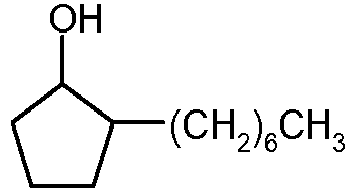
Fatty note, no complexity 2-Benzyl-cyclopentanol (Structure 93) 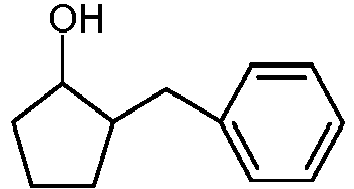
Dirty carbinol, acidic and sweaty notes 2-Octyl-cyclopentanol (Structure 94) 
Green note with skunky character, no strength or complexity 2-(1-Vinyl-hex-5-enyl)-cyclopentanol (Structure 95) 
Dirty, sulfur and mushroom-like notes 2-(5,6-Dimethyl-cyclohex-3-enyl)-cyclopentanol (Structure 96) 
Chemical note, no strength or complexity 2-(2-Phenyl-propyl)-cyclopentanol (Structure 97) 
Chessy and acidic notes 2-((E)-3,7-Dimethyl-octa-2,6-dienyl)-cyclopentanol (Structure 98) 
Very fatty note 2-(1,5-Dimethyl-1-vinyl-hex-4-enyl)-cyclopentanol (Structure 99) 
Very chemical note 2-[2-(2,2,3-Trimethyl-cyclopentyl)-ethyl]-cyclopentanol (Structure 100) 
Slightly floral but very weak note 2-(2,2,6-Trimethyl-cyclohexylmethyl)-cyclopentanol (Structure 101) 
Chemical and very weak note 2-(4-Isopropyl-benzyl)-cyclopentanol (Structure 102) 
Slightly floral but very weak note 2-(4-tert-Butyl-benzyl)-cyclopentanol (Structure 103) 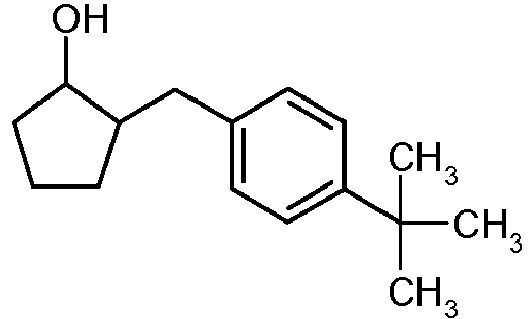
Slightly woody but very weak note 1-Cyclopropyl-2-pentyl-cyclopentanol (Structure 104) 
Green note, no strength or complexity - The evaluation of cyclopentanols and cyclopentanol analogs in the above examples has surprisingly showed that the 1-substituted cyclopentanols of EXAMPLE IV, wherein the substitution is a C1-C2 hydrocarbon group, possess desirable, strong and complex odors, which are not observed in the cyclopentanol analogs of EXAMPLE VI. Such advantageous properties of 1-substituted cyclopentanols are accordingly unexpected and superior.
Claims (16)
- A method of improving, enhancing or modifying a fragrance formulation through the addition of an olfactory acceptable amount of a compound of formula:

wherein R2 represents a C2-C9 hydrocarbon group. - The method of claim 1, wherein the compound is
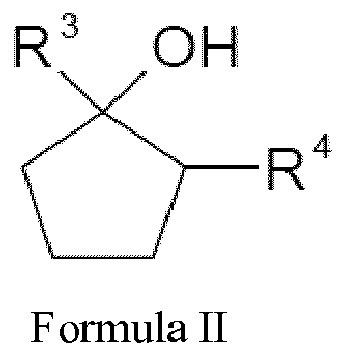
wherein R4 represents a C3-C6 hydrocarbon group. - The method of claim 2, wherein the compound is selected from the group consisting of:1-ethyl-2-pentyl-cyclopentanol;1-ethyl-2-(3-methyl-butyl)-cyclopentanol;1-methyl-2-pentyl-cyclopentanol; and1-methyl-2-(3-methyl-butyl)-cyclopentanol.
- The method of claim 1, wherein the compound is

wherein R6 represents a C3-C6 hydrocarbon group. - The method of claim 1 or any of claims 2 to 4, wherein(i) the olfactory acceptable amount is from about 0.005 to about 50 weight percent of the fragrance formulation; or(ii) the olfactory acceptable amount is from about 0.5 to about 25 weight percent of the fragrance formulation; or(iii) the olfactory acceptable amount is from about 1 to about 10 weight percent of the fragrance formulation.
- A fragrance formulation containing an olfactory acceptable amount of a compound of

wherein R2 represents a C2-C9 hydrocarbon group. - The fragrance formulation of claim 6, wherein the compound is

wherein R4 represents a C3-C6 hydrocarbon group. - The fragrance formulation of claim 6, wherein the compound is

wherein R6 represents a C3-C6 hydrocarbon group. - The fragrance formulation of claim 6 or claim 7 or claim 8, wherein(i) the olfactory acceptable amount is from about 0.005 to about 50 weight percent of the fragrance formulation; or(ii) the olfactory acceptable amount is from about 0.5 to about 25 weight percent of the fragrance formulation; or(iii) wherein the olfactory acceptable amount is from about 1 to about 10 weight percent of the fragrance formulation.
- The fragrance formulation of claim 6 or any of claims 7 to 9 further comprising a material selected from the group consisting of a polymer and a non-polymer.
- The fragrance formulation of claim 10, wherein the non-polymer is selected from the group consisting of an oligomer, a surfactant, an emulsifier, a fat, a wax, a phospholipid, an organic oil, a mineral oil, a petrolatum, a natural oil, a perfume fixative, a fiber, a starch, a sugar and a solid surface material.
- The fragrance formulation of claim 11, wherein the solid surface material is selected from the group consisting of zeolite and silica.
- A compound of formula:

wherein R6 represents a C3-C6 hydrocarbon group. - The compound of claim 13, or the fragrance formulation of any of claims 6 to 12, wherein the compound is selected from the group consisting of 1-ethyl-2-pentyl-cyclopentanol and 1-ethyl-2-(3-methyl-butyl)-cyclopentanol.
- A fragrance product containing an olfactory acceptable amount of the compound of claim of claim 13 or claim 14, or of the fragrance formulation of claim 6 or any of claims 7 to 12.
- The fragrance product of claim 15, wherein the fragrance product is selected from the group consisting of a perfume, a cologne, toilet water, a cosmetic product, a personal care product, a fabric care product, a cleaning agent and an air freshener, a bar soap, a liquid soap, a shower gel, a foam bath, a cosmetic, a skin care product, a hair care product, a deodorant, an antiperspirant, a feminine care product, a baby care product, a family care product, a fabric product, an air care product, a fragrance delivery system, a cosmetic preparation, a disinfectant, a washing agent, a dental and oral hygiene product, a health care and nutritional product and a food product.
Applications Claiming Priority (1)
| Application Number | Priority Date | Filing Date | Title |
|---|---|---|---|
| US14/103,100 US9290718B2 (en) | 2013-12-11 | 2013-12-11 | Cyclopentanol compounds |
Publications (3)
| Publication Number | Publication Date |
|---|---|
| EP2902468A2 true EP2902468A2 (en) | 2015-08-05 |
| EP2902468A3 EP2902468A3 (en) | 2015-09-16 |
| EP2902468B1 EP2902468B1 (en) | 2017-03-15 |
Family
ID=52006871
Family Applications (1)
| Application Number | Title | Priority Date | Filing Date |
|---|---|---|---|
| EP14195879.3A Active EP2902468B1 (en) | 2013-12-11 | 2014-12-02 | Method of using cyclopentanol compounds as fragrance materials |
Country Status (6)
| Country | Link |
|---|---|
| US (2) | US9290718B2 (en) |
| EP (1) | EP2902468B1 (en) |
| CN (1) | CN104710283B (en) |
| BR (1) | BR102014030310B1 (en) |
| ES (1) | ES2622930T3 (en) |
| MX (1) | MX356790B (en) |
Families Citing this family (3)
| Publication number | Priority date | Publication date | Assignee | Title |
|---|---|---|---|---|
| CN107460049A (en) * | 2016-09-09 | 2017-12-12 | 安徽香杰香精科技有限公司 | A kind of glass cleaner bouquet type composition |
| WO2023160806A1 (en) * | 2022-02-25 | 2023-08-31 | Symrise Ag | 2-cyclopentylcyclopentanol as a fragrance |
| WO2025235934A1 (en) | 2024-05-10 | 2025-11-13 | International Flavors & Fragrances Inc. | Compositions and methods for imparting a fresh attribute |
Citations (1)
| Publication number | Priority date | Publication date | Assignee | Title |
|---|---|---|---|---|
| US4534891A (en) | 1982-11-12 | 1985-08-13 | International Flavors & Fragrances Inc. | Branched C13 -alk-1-en-5-ones and use thereof in perfumery |
Family Cites Families (5)
| Publication number | Priority date | Publication date | Assignee | Title |
|---|---|---|---|---|
| US3769330A (en) * | 1970-11-10 | 1973-10-30 | Givaudan Corp | 2-butyl-1-alkynyl-cycloalkan-1-ols and derivatives thereof |
| US3852219A (en) * | 1970-11-10 | 1974-12-03 | Givaudan Corp | Odorant compositions including 2-butyl -1-alkynylcycloalkan-1-ols and derivatives thereof |
| DE3609524A1 (en) * | 1986-03-21 | 1987-09-24 | Henkel Kgaa | ISOMERE 1-ALKYL / ALKENYL-2,2,4 (2,4,4) -TRIMETHYL-CYCLOPENTAN-1-OLE AS A FRAGRANCE |
| EP2234948B1 (en) * | 2008-01-22 | 2011-08-31 | Firmenich S.A. | Perfuming ingredients imparting sap and/or earthy type notes |
| WO2011073843A1 (en) * | 2009-12-17 | 2011-06-23 | Firmenich Sa | Odorant alcohols |
-
2013
- 2013-12-11 US US14/103,100 patent/US9290718B2/en active Active
-
2014
- 2014-12-02 ES ES14195879.3T patent/ES2622930T3/en active Active
- 2014-12-02 EP EP14195879.3A patent/EP2902468B1/en active Active
- 2014-12-03 BR BR102014030310-3A patent/BR102014030310B1/en active IP Right Grant
- 2014-12-10 CN CN201410756658.5A patent/CN104710283B/en active Active
- 2014-12-10 MX MX2014015175A patent/MX356790B/en active IP Right Grant
-
2016
- 2016-02-11 US US15/041,456 patent/US9701925B2/en active Active
Patent Citations (1)
| Publication number | Priority date | Publication date | Assignee | Title |
|---|---|---|---|---|
| US4534891A (en) | 1982-11-12 | 1985-08-13 | International Flavors & Fragrances Inc. | Branched C13 -alk-1-en-5-ones and use thereof in perfumery |
Non-Patent Citations (3)
| Title |
|---|
| "Perfumes, Cosmetics and Soaps", 1959 |
| ISHIKAWA ET AL., INTERNATIONAL JOURNAL OF QUANTUM CHEMISTRY, vol. 79, 2000, pages 101 - 108 |
| OHLOFF ET AL., HELVETICA CHIMICA ACTA 66, FASC., vol. 5, 1983, pages 1343 - 1354 |
Also Published As
| Publication number | Publication date |
|---|---|
| BR102014030310A2 (en) | 2016-08-02 |
| US20160160152A1 (en) | 2016-06-09 |
| US9701925B2 (en) | 2017-07-11 |
| MX356790B (en) | 2018-06-12 |
| CN104710283A (en) | 2015-06-17 |
| US9290718B2 (en) | 2016-03-22 |
| CN104710283B (en) | 2019-06-11 |
| BR102014030310B1 (en) | 2021-12-21 |
| EP2902468A3 (en) | 2015-09-16 |
| ES2622930T3 (en) | 2017-07-07 |
| US20150159118A1 (en) | 2015-06-11 |
| MX2014015175A (en) | 2015-07-02 |
| EP2902468B1 (en) | 2017-03-15 |
Similar Documents
| Publication | Publication Date | Title |
|---|---|---|
| EP3072875B1 (en) | Organoleptic compounds | |
| US9701925B2 (en) | Cyclopentanol compounds | |
| US9732304B2 (en) | 3-(cyclohex-1-en-1-yl)propionates and their use in perfume compositions | |
| EP3362428B1 (en) | Novel octahydroindenyl propanal compounds | |
| US10982172B2 (en) | Organoleptic compounds | |
| EP3339406B1 (en) | Fragrance composition | |
| US10336676B2 (en) | Organoleptic (alkoxymethylene)octahydro-1H-4,7-methanoindene compounds | |
| CN112639064B (en) | sensory compound | |
| EP3636627B1 (en) | Novel cyclopropylmethoxy derivatives | |
| US11352586B2 (en) | Dienoates and their use in perfume compositions | |
| EP3124464B1 (en) | Novel organoleptic compounds | |
| EP3124478A1 (en) | Novel organoleptic compounds |
Legal Events
| Date | Code | Title | Description |
|---|---|---|---|
| PUAI | Public reference made under article 153(3) epc to a published international application that has entered the european phase |
Free format text: ORIGINAL CODE: 0009012 |
|
| 17P | Request for examination filed |
Effective date: 20141202 |
|
| AK | Designated contracting states |
Kind code of ref document: A2 Designated state(s): AL AT BE BG CH CY CZ DE DK EE ES FI FR GB GR HR HU IE IS IT LI LT LU LV MC MK MT NL NO PL PT RO RS SE SI SK SM TR |
|
| AX | Request for extension of the european patent |
Extension state: BA ME |
|
| PUAL | Search report despatched |
Free format text: ORIGINAL CODE: 0009013 |
|
| AK | Designated contracting states |
Kind code of ref document: A3 Designated state(s): AL AT BE BG CH CY CZ DE DK EE ES FI FR GB GR HR HU IE IS IT LI LT LU LV MC MK MT NL NO PL PT RO RS SE SI SK SM TR |
|
| AX | Request for extension of the european patent |
Extension state: BA ME |
|
| RIC1 | Information provided on ipc code assigned before grant |
Ipc: C07C 35/06 20060101ALI20150813BHEP Ipc: C07C 35/21 20060101ALI20150813BHEP Ipc: C11B 9/00 20060101AFI20150813BHEP |
|
| 17P | Request for examination filed |
Effective date: 20160310 |
|
| RBV | Designated contracting states (corrected) |
Designated state(s): AL AT BE BG CH CY CZ DE DK EE ES FI FR GB GR HR HU IE IS IT LI LT LU LV MC MK MT NL NO PL PT RO RS SE SI SK SM TR |
|
| 17Q | First examination report despatched |
Effective date: 20160711 |
|
| GRAP | Despatch of communication of intention to grant a patent |
Free format text: ORIGINAL CODE: EPIDOSNIGR1 |
|
| INTG | Intention to grant announced |
Effective date: 20161125 |
|
| GRAS | Grant fee paid |
Free format text: ORIGINAL CODE: EPIDOSNIGR3 |
|
| GRAA | (expected) grant |
Free format text: ORIGINAL CODE: 0009210 |
|
| AK | Designated contracting states |
Kind code of ref document: B1 Designated state(s): AL AT BE BG CH CY CZ DE DK EE ES FI FR GB GR HR HU IE IS IT LI LT LU LV MC MK MT NL NO PL PT RO RS SE SI SK SM TR |
|
| REG | Reference to a national code |
Ref country code: CH Ref legal event code: EP Ref country code: GB Ref legal event code: FG4D |
|
| REG | Reference to a national code |
Ref country code: IE Ref legal event code: FG4D |
|
| REG | Reference to a national code |
Ref country code: CH Ref legal event code: NV Representative=s name: BOVARD AG PATENT- UND MARKENANWAELTE, CH |
|
| REG | Reference to a national code |
Ref country code: AT Ref legal event code: REF Ref document number: 875582 Country of ref document: AT Kind code of ref document: T Effective date: 20170415 |
|
| REG | Reference to a national code |
Ref country code: NL Ref legal event code: FP |
|
| REG | Reference to a national code |
Ref country code: DE Ref legal event code: R096 Ref document number: 602014007560 Country of ref document: DE |
|
| REG | Reference to a national code |
Ref country code: ES Ref legal event code: FG2A Ref document number: 2622930 Country of ref document: ES Kind code of ref document: T3 Effective date: 20170707 |
|
| REG | Reference to a national code |
Ref country code: LT Ref legal event code: MG4D |
|
| PG25 | Lapsed in a contracting state [announced via postgrant information from national office to epo] |
Ref country code: GR Free format text: LAPSE BECAUSE OF FAILURE TO SUBMIT A TRANSLATION OF THE DESCRIPTION OR TO PAY THE FEE WITHIN THE PRESCRIBED TIME-LIMIT Effective date: 20170616 Ref country code: HR Free format text: LAPSE BECAUSE OF FAILURE TO SUBMIT A TRANSLATION OF THE DESCRIPTION OR TO PAY THE FEE WITHIN THE PRESCRIBED TIME-LIMIT Effective date: 20170315 Ref country code: NO Free format text: LAPSE BECAUSE OF FAILURE TO SUBMIT A TRANSLATION OF THE DESCRIPTION OR TO PAY THE FEE WITHIN THE PRESCRIBED TIME-LIMIT Effective date: 20170615 Ref country code: FI Free format text: LAPSE BECAUSE OF FAILURE TO SUBMIT A TRANSLATION OF THE DESCRIPTION OR TO PAY THE FEE WITHIN THE PRESCRIBED TIME-LIMIT Effective date: 20170315 Ref country code: LT Free format text: LAPSE BECAUSE OF FAILURE TO SUBMIT A TRANSLATION OF THE DESCRIPTION OR TO PAY THE FEE WITHIN THE PRESCRIBED TIME-LIMIT Effective date: 20170315 |
|
| REG | Reference to a national code |
Ref country code: AT Ref legal event code: MK05 Ref document number: 875582 Country of ref document: AT Kind code of ref document: T Effective date: 20170315 |
|
| PG25 | Lapsed in a contracting state [announced via postgrant information from national office to epo] |
Ref country code: BG Free format text: LAPSE BECAUSE OF FAILURE TO SUBMIT A TRANSLATION OF THE DESCRIPTION OR TO PAY THE FEE WITHIN THE PRESCRIBED TIME-LIMIT Effective date: 20170615 Ref country code: RS Free format text: LAPSE BECAUSE OF FAILURE TO SUBMIT A TRANSLATION OF THE DESCRIPTION OR TO PAY THE FEE WITHIN THE PRESCRIBED TIME-LIMIT Effective date: 20170315 Ref country code: SE Free format text: LAPSE BECAUSE OF FAILURE TO SUBMIT A TRANSLATION OF THE DESCRIPTION OR TO PAY THE FEE WITHIN THE PRESCRIBED TIME-LIMIT Effective date: 20170315 Ref country code: LV Free format text: LAPSE BECAUSE OF FAILURE TO SUBMIT A TRANSLATION OF THE DESCRIPTION OR TO PAY THE FEE WITHIN THE PRESCRIBED TIME-LIMIT Effective date: 20170315 |
|
| PG25 | Lapsed in a contracting state [announced via postgrant information from national office to epo] |
Ref country code: RO Free format text: LAPSE BECAUSE OF FAILURE TO SUBMIT A TRANSLATION OF THE DESCRIPTION OR TO PAY THE FEE WITHIN THE PRESCRIBED TIME-LIMIT Effective date: 20170315 Ref country code: EE Free format text: LAPSE BECAUSE OF FAILURE TO SUBMIT A TRANSLATION OF THE DESCRIPTION OR TO PAY THE FEE WITHIN THE PRESCRIBED TIME-LIMIT Effective date: 20170315 Ref country code: IT Free format text: LAPSE BECAUSE OF FAILURE TO SUBMIT A TRANSLATION OF THE DESCRIPTION OR TO PAY THE FEE WITHIN THE PRESCRIBED TIME-LIMIT Effective date: 20170315 Ref country code: AT Free format text: LAPSE BECAUSE OF FAILURE TO SUBMIT A TRANSLATION OF THE DESCRIPTION OR TO PAY THE FEE WITHIN THE PRESCRIBED TIME-LIMIT Effective date: 20170315 Ref country code: CZ Free format text: LAPSE BECAUSE OF FAILURE TO SUBMIT A TRANSLATION OF THE DESCRIPTION OR TO PAY THE FEE WITHIN THE PRESCRIBED TIME-LIMIT Effective date: 20170315 Ref country code: SK Free format text: LAPSE BECAUSE OF FAILURE TO SUBMIT A TRANSLATION OF THE DESCRIPTION OR TO PAY THE FEE WITHIN THE PRESCRIBED TIME-LIMIT Effective date: 20170315 |
|
| PG25 | Lapsed in a contracting state [announced via postgrant information from national office to epo] |
Ref country code: SM Free format text: LAPSE BECAUSE OF FAILURE TO SUBMIT A TRANSLATION OF THE DESCRIPTION OR TO PAY THE FEE WITHIN THE PRESCRIBED TIME-LIMIT Effective date: 20170315 Ref country code: IS Free format text: LAPSE BECAUSE OF FAILURE TO SUBMIT A TRANSLATION OF THE DESCRIPTION OR TO PAY THE FEE WITHIN THE PRESCRIBED TIME-LIMIT Effective date: 20170715 Ref country code: PL Free format text: LAPSE BECAUSE OF FAILURE TO SUBMIT A TRANSLATION OF THE DESCRIPTION OR TO PAY THE FEE WITHIN THE PRESCRIBED TIME-LIMIT Effective date: 20170315 Ref country code: PT Free format text: LAPSE BECAUSE OF FAILURE TO SUBMIT A TRANSLATION OF THE DESCRIPTION OR TO PAY THE FEE WITHIN THE PRESCRIBED TIME-LIMIT Effective date: 20170717 |
|
| REG | Reference to a national code |
Ref country code: DE Ref legal event code: R097 Ref document number: 602014007560 Country of ref document: DE |
|
| REG | Reference to a national code |
Ref country code: FR Ref legal event code: PLFP Year of fee payment: 4 |
|
| PLBE | No opposition filed within time limit |
Free format text: ORIGINAL CODE: 0009261 |
|
| STAA | Information on the status of an ep patent application or granted ep patent |
Free format text: STATUS: NO OPPOSITION FILED WITHIN TIME LIMIT |
|
| PG25 | Lapsed in a contracting state [announced via postgrant information from national office to epo] |
Ref country code: DK Free format text: LAPSE BECAUSE OF FAILURE TO SUBMIT A TRANSLATION OF THE DESCRIPTION OR TO PAY THE FEE WITHIN THE PRESCRIBED TIME-LIMIT Effective date: 20170315 |
|
| 26N | No opposition filed |
Effective date: 20171218 |
|
| PG25 | Lapsed in a contracting state [announced via postgrant information from national office to epo] |
Ref country code: SI Free format text: LAPSE BECAUSE OF FAILURE TO SUBMIT A TRANSLATION OF THE DESCRIPTION OR TO PAY THE FEE WITHIN THE PRESCRIBED TIME-LIMIT Effective date: 20170315 |
|
| REG | Reference to a national code |
Ref country code: IE Ref legal event code: MM4A |
|
| PG25 | Lapsed in a contracting state [announced via postgrant information from national office to epo] |
Ref country code: MT Free format text: LAPSE BECAUSE OF NON-PAYMENT OF DUE FEES Effective date: 20171202 Ref country code: LU Free format text: LAPSE BECAUSE OF NON-PAYMENT OF DUE FEES Effective date: 20171202 |
|
| REG | Reference to a national code |
Ref country code: BE Ref legal event code: MM Effective date: 20171231 |
|
| PG25 | Lapsed in a contracting state [announced via postgrant information from national office to epo] |
Ref country code: IE Free format text: LAPSE BECAUSE OF NON-PAYMENT OF DUE FEES Effective date: 20171202 |
|
| PG25 | Lapsed in a contracting state [announced via postgrant information from national office to epo] |
Ref country code: BE Free format text: LAPSE BECAUSE OF NON-PAYMENT OF DUE FEES Effective date: 20171231 |
|
| PG25 | Lapsed in a contracting state [announced via postgrant information from national office to epo] |
Ref country code: MC Free format text: LAPSE BECAUSE OF FAILURE TO SUBMIT A TRANSLATION OF THE DESCRIPTION OR TO PAY THE FEE WITHIN THE PRESCRIBED TIME-LIMIT Effective date: 20170315 Ref country code: HU Free format text: LAPSE BECAUSE OF FAILURE TO SUBMIT A TRANSLATION OF THE DESCRIPTION OR TO PAY THE FEE WITHIN THE PRESCRIBED TIME-LIMIT; INVALID AB INITIO Effective date: 20141202 |
|
| PG25 | Lapsed in a contracting state [announced via postgrant information from national office to epo] |
Ref country code: CY Free format text: LAPSE BECAUSE OF FAILURE TO SUBMIT A TRANSLATION OF THE DESCRIPTION OR TO PAY THE FEE WITHIN THE PRESCRIBED TIME-LIMIT Effective date: 20170315 |
|
| PG25 | Lapsed in a contracting state [announced via postgrant information from national office to epo] |
Ref country code: MK Free format text: LAPSE BECAUSE OF FAILURE TO SUBMIT A TRANSLATION OF THE DESCRIPTION OR TO PAY THE FEE WITHIN THE PRESCRIBED TIME-LIMIT Effective date: 20170315 |
|
| PG25 | Lapsed in a contracting state [announced via postgrant information from national office to epo] |
Ref country code: TR Free format text: LAPSE BECAUSE OF FAILURE TO SUBMIT A TRANSLATION OF THE DESCRIPTION OR TO PAY THE FEE WITHIN THE PRESCRIBED TIME-LIMIT Effective date: 20170315 |
|
| PG25 | Lapsed in a contracting state [announced via postgrant information from national office to epo] |
Ref country code: AL Free format text: LAPSE BECAUSE OF FAILURE TO SUBMIT A TRANSLATION OF THE DESCRIPTION OR TO PAY THE FEE WITHIN THE PRESCRIBED TIME-LIMIT Effective date: 20170315 |
|
| P01 | Opt-out of the competence of the unified patent court (upc) registered |
Effective date: 20230530 |
|
| PGFP | Annual fee paid to national office [announced via postgrant information from national office to epo] |
Ref country code: NL Payment date: 20251112 Year of fee payment: 12 |
|
| REG | Reference to a national code |
Ref country code: CH Ref legal event code: U11 Free format text: ST27 STATUS EVENT CODE: U-0-0-U10-U11 (AS PROVIDED BY THE NATIONAL OFFICE) Effective date: 20260101 |
|
| PGFP | Annual fee paid to national office [announced via postgrant information from national office to epo] |
Ref country code: DE Payment date: 20251104 Year of fee payment: 12 |
|
| PGFP | Annual fee paid to national office [announced via postgrant information from national office to epo] |
Ref country code: GB Payment date: 20251030 Year of fee payment: 12 |
|
| PGFP | Annual fee paid to national office [announced via postgrant information from national office to epo] |
Ref country code: FR Payment date: 20251110 Year of fee payment: 12 |
|
| PGFP | Annual fee paid to national office [announced via postgrant information from national office to epo] |
Ref country code: ES Payment date: 20260114 Year of fee payment: 12 |
|
| PGFP | Annual fee paid to national office [announced via postgrant information from national office to epo] |
Ref country code: CH Payment date: 20260101 Year of fee payment: 12 |