EP2899624A1 - Method and device for generating vibration - Google Patents
Method and device for generating vibration Download PDFInfo
- Publication number
- EP2899624A1 EP2899624A1 EP15152722.3A EP15152722A EP2899624A1 EP 2899624 A1 EP2899624 A1 EP 2899624A1 EP 15152722 A EP15152722 A EP 15152722A EP 2899624 A1 EP2899624 A1 EP 2899624A1
- Authority
- EP
- European Patent Office
- Prior art keywords
- adjective
- degree value
- vibration
- fundamental frequency
- overlap ratio
- Prior art date
- Legal status (The legal status is an assumption and is not a legal conclusion. Google has not performed a legal analysis and makes no representation as to the accuracy of the status listed.)
- Ceased
Links
Images





Classifications
-
- G—PHYSICS
- G05—CONTROLLING; REGULATING
- G05D—SYSTEMS FOR CONTROLLING OR REGULATING NON-ELECTRIC VARIABLES
- G05D19/00—Control of mechanical oscillations, e.g. of amplitude, of frequency, of phase
- G05D19/02—Control of mechanical oscillations, e.g. of amplitude, of frequency, of phase characterised by the use of electric means
-
- G—PHYSICS
- G06—COMPUTING OR CALCULATING; COUNTING
- G06F—ELECTRIC DIGITAL DATA PROCESSING
- G06F3/00—Input arrangements for transferring data to be processed into a form capable of being handled by the computer; Output arrangements for transferring data from processing unit to output unit, e.g. interface arrangements
- G06F3/01—Input arrangements or combined input and output arrangements for interaction between user and computer
- G06F3/016—Input arrangements with force or tactile feedback as computer generated output to the user
-
- G—PHYSICS
- G05—CONTROLLING; REGULATING
- G05B—CONTROL OR REGULATING SYSTEMS IN GENERAL; FUNCTIONAL ELEMENTS OF SUCH SYSTEMS; MONITORING OR TESTING ARRANGEMENTS FOR SUCH SYSTEMS OR ELEMENTS
- G05B15/00—Systems controlled by a computer
- G05B15/02—Systems controlled by a computer electric
-
- G—PHYSICS
- G06—COMPUTING OR CALCULATING; COUNTING
- G06F—ELECTRIC DIGITAL DATA PROCESSING
- G06F3/00—Input arrangements for transferring data to be processed into a form capable of being handled by the computer; Output arrangements for transferring data from processing unit to output unit, e.g. interface arrangements
- G06F3/01—Input arrangements or combined input and output arrangements for interaction between user and computer
- G06F3/048—Interaction techniques based on graphical user interfaces [GUI]
- G06F3/0487—Interaction techniques based on graphical user interfaces [GUI] using specific features provided by the input device, e.g. functions controlled by the rotation of a mouse with dual sensing arrangements, or of the nature of the input device, e.g. tap gestures based on pressure sensed by a digitiser
- G06F3/0488—Interaction techniques based on graphical user interfaces [GUI] using specific features provided by the input device, e.g. functions controlled by the rotation of a mouse with dual sensing arrangements, or of the nature of the input device, e.g. tap gestures based on pressure sensed by a digitiser using a touch-screen or digitiser, e.g. input of commands through traced gestures
-
- H—ELECTRICITY
- H04—ELECTRIC COMMUNICATION TECHNIQUE
- H04M—TELEPHONIC COMMUNICATION
- H04M19/00—Current supply arrangements for telephone systems
- H04M19/02—Current supply arrangements for telephone systems providing ringing current or supervisory tones, e.g. dialling tone or busy tone
- H04M19/04—Current supply arrangements for telephone systems providing ringing current or supervisory tones, e.g. dialling tone or busy tone the ringing-current being generated at the substations
- H04M19/047—Vibrating means for incoming calls
Definitions
- the present disclosure was made by or on behalf of the below listed parties to a joint research agreement.
- the joint research agreement was in effect on or before the date the present disclosure was made and the present disclosure was made as a result of activities undertaken within the scope of the joint research agreement.
- the parties to the joint research agreement are 1) Samsung Electronics Co., Ltd. 2) Postech Acadenry Industry Foundation.
- the present disclosure relates to methods and devices for generating a vibration by using a degree value of an adjective.
- vibration-based haptic feedback (hereinafter referred to as “vibration feedback”) are widely used in various mobile devices, such as smart phones and tablet devices, game consoles, and realistic four-dimensional (4D) movie theaters. Also, since vibration feedback is more efficient than other types of feedback, the use of vibration feedback is on the increase currently.
- a method of directly setting a frequency and an amplitude, which are physical properties of a vibration waveform is mainly used to generate a vibration feedback. Accordingly, it is difficult for an inexpert user to receive a vibration of his desired sense from a device, and it is also difficult to predict and quantify a perceptive sense that a user feels through a vibration.
- vibration generation technology that allows a user to accurately receive a vibration of his desired sense from a device and may easily predict and quantify perceptive properties of a vibration.
- an aspect of the present disclosure is to provide methods and devices for generating a vibration by using an adjective, which may generate a vibration having a fundamental frequency and an overlap ratio corresponding to an adjective and a degree value of the adjective.
- Another aspect of the present disclosure is to provide methods and devices for generating a vibration by using an adjective, which may generate a vibration by using a fundamental frequency and an overlap ratio determined on the basis of a degree value of a first adjective and a degree value of a second adjective.
- Another aspect of the present disclosure is to provide methods and devices for generating a vibration by using an adjective, which may modulate an amplitude of a vibration by using a degree value of a perceiving intensity.
- a method for generating a vibration by a device by using an adjective includes setting at least one fundamental frequency and at least one overlap ratio corresponding to a certain adjective and a degree value of the certain adjective, receiving at least one user input for inputting an adjective and a degree value of the input adjective, and generating at least one vibration corresponding to the input adjective and the degree value of the input adjective based on the setting.
- the generated at least one vibration has a fundamental frequency and an overlap ratio corresponding to the input adjective and the degree value of the input adjective.
- a device for generating a vibration by using an adjective includes a control unit configured to set at least one fundamental frequency and at least one overlap ratio corresponding to a certain adjective and a degree value of the certain adjective, a user input unit configured to receive at least one user input for inputting an adjective and a degree value of the input adjective, and a vibration generating unit configured to generate at least one vibration corresponding to the input adjective and the degree value of the input adjective based on the setting.
- the generated at least one vibration has a fundamental frequency and an overlap ratio corresponding to the input adjective and the degree value of the input adjective.
- a non-transitory computer-readable recording medium stores one or more programs including instructions that, when executed by a computer, cause the computer to perform a method for generating a vibration by a device by using an adjective, the method including setting at least one fundamental frequency and at least one overlap ratio corresponding to a certain adjective and a degree value of the certain adjective, receiving at least one user input for inputting an adjective and a degree value of the input adjective, and generating at least one vibration corresponding to the input adjective and the degree value of the input adjective based on the setting.
- the generated at least one vibration has a fundamental frequency and an overlap ratio corresponding to the input adjective and the degree value of the input adjective.
- an adjective may refer to a word representing a sense that a user may feel through a vibration of a device, and the device may generate the vibration by using a degree value of the adjective.
- the adjective may include, for example, “heavy”, “light”, “rough”, and “smooth”, but is not limited thereto.
- the degree value of the adjective may refer to a value representing the degree of the adjective.
- the device may generate a vibration through which the user may strongly feel a "heavy” sense.
- a perceiving intensity may refer to an intensity at which the user perceives a vibration.
- the device may generate a vibration so that the user may intensely feel the vibration.
- a fundamental frequency and an overlap ratio may be defined by two frequencies.
- the fundamental frequency may be the smaller one of a first frequency and a second frequency
- the overlap ratio may be a value obtained by dividing the greater one of the first frequency and the second frequency by the fundamental frequency.
- various embodiments of the present disclosure are not limited thereto.
- FIG. 1 is a diagram illustrating a device for generating a vibration based on a degree value of an adjective according to various embodiments of the present disclosure.
- a device 1000 may generate a predetermined vibration according to a degree value of an adjective.
- the device 1000 may determine a degree value of an adjective and determine a frequency of a vibration based on the determined degree value of the adjective.
- the device 1000 may generate a vibration having the determined frequency.
- the degree value of the adjective may be input to the device 1000 by the user; however, various embodiments of the present disclosure are not limited thereto.
- the device 1000 may generate a vibration having a plurality of frequencies by determining a fundamental frequency and an overlap ratio corresponding to an adjective and a degree value of the adjective.
- the device 1000 may generate at least one vibration for a plurality of adjectives by using a vibration synthesis model that will be described later.
- the device 1000 may generate a vibration synthesis model for a plurality of adjectives and determine a first frequency and a second frequency for generating a vibration by using the generated vibration synthesis model.
- the device 1000 may modulate an amplitude of a vibration according to a degree value of perceiving intensity.
- the degree value of the perceiving intensity may be input to the device 1000 by the user; however, various embodiments of the present disclosure are not limited thereto.
- the user may select a degree value of the displayed adjective and determine a degree value of the perceiving intensity, thereby making it possible for the device 1000 to generate a vibration of a sense and an intensity desired by the user.
- the device 1000 may be, for example, a smart phone, a smart television (TV), a mobile phone, a personal digital assistant (PDA), a laptop computer, a media player, a micro server, a global positioning system (GPS) device, an e-book terminal, a digital broadcasting terminal, a navigation device, a kiosk, a Motion Picture Experts Group (MPEG-1 or MPEG-2) Audio Layer III (MP3) player, a digital camera, or any other mobile or immobile computing device.
- a smart phone a smart television (TV), a mobile phone, a personal digital assistant (PDA), a laptop computer, a media player, a micro server, a global positioning system (GPS) device, an e-book terminal, a digital broadcasting terminal, a navigation device, a kiosk, a Motion Picture Experts Group (MPEG-1 or MPEG-2) Audio Layer III (MP3) player, a digital camera, or any other mobile or immobile computing device.
- MPEG-1 or MPEG-2 Motion Picture Experts Group
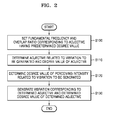
- FIG. 2 is a flowchart of a method for generating a vibration by a device based on a degree value of an adjective according to various embodiments of the present disclosure.
- the device 1000 may set at least one fundamental frequency and at least one overlap ratio corresponding to an adjective having a predetermined degree value.
- the device 1000 may set a fundamental frequency and an overlap ratio corresponding to an adjective and a degree value of the adjective.
- the device 1000 may set a fundamental frequency and an overlap ratio corresponding to an adjective and a degree value of the adjective.
- the device 1000 may set a fundamental frequency and an overlap ratio corresponding to a plurality of adjectives and degree values of the adjectives.
- the device 1000 may set a plurality of fundamental frequencies and a plurality of overlap ratios corresponding to a plurality of adjectives and degree values of the adjectives. Accordingly, the device 1000 may effectively synthesize various frequencies to embody an adjective having a predetermined degree value as a vibration.
- the fundamental frequency and the overlap ratio corresponding to the adjective and the degree value of the adjective may be experimentally determined.
- a fundamental frequency and an overlap ratio may be experimentally determined to generate a vibration of a "rough" sense having a degree value "10".
- the device 1000 may set an amplitude variation value of a vibration corresponding to an adjective having a predetermined degree value.
- a variation value of a vibration may be experimentally determined to generate a vibration of a "rough” sense having a degree value "10".
- the variation value of the vibration may be experimentally determined in association with the fundamental frequency and the overlap ratio.
- the device 1000 may set the experimentally-determined variation value of the vibration as a variation value of a vibration corresponding to an adjective having a predetermined degree value.
- the device 1000 may determine an adjective related to a vibration to be generated and a degree value of the adjective.
- the device 1000 may determine an adjective related to a vibration to be generated and a degree value of the adjective by receiving at least one user input for inputting an adjective and a degree value of the adjective.
- the device 1000 may display a predetermined user interface for inputting the adjective related to the vibration to be generated and the degree value of the adjective, and determine the adjective and the degree value of the adjective based on the user input to the displayed user interface.
- the device 1000 may determine a degree value of a perceiving intensity related to the vibration to be generated.
- the device 1000 may determine a degree value of a perceiving intensity related to the vibration to be generated by receiving at least one user input for inputting a degree value of a perceiving intensity.
- the device 1000 may display a predetermined user interface for inputting the degree value of the perceiving intensity related to the vibration to be generated on a screen of the device 1000, and determine the degree value of the perceiving intensity based on the user input to the displayed user interface.
- the device 1000 may generate at least one vibration corresponding to the determined adjective and the determined degree value of determined adjective.
- the device 1000 may determine the fundamental frequency and the overlap ratio corresponding to the adjective and the degree value of the adjective input by the user based on the values set in operation S100, and generate a vibration having the determined fundamental frequency and the determined overlap ratio.
- the device 1000 may determine an amplitude variation value of the vibration having the determined fundamental frequency and the determined overlap ratio based on the values set in operation S100, and generate a vibration based on the determined amplitude variation value.
- the device 1000 may modulate an amplitude of the vibration to be generated, based on the determined degree value of the perceiving intensity.
- the device 1000 may modulate the amplitude of the vibration to be generated based on all of the determined adjectives, the determined degree value of the determined adjective, and the determined degree value of the perceiving intensity.
- FIG. 3 is a flowchart of a method for generating a vibration by a device based on a degree value of a first adjective and a degree value of a second adjective according to various embodiments of the present disclosure.
- FIG. 3 illustrates a method for generating a vibration having senses of two adjectives by synthesizing two frequencies.
- the device 1000 acquires relationship information between a degree value of the first adjective, a degree value of the second adjective, and the fundamental frequency.
- the device 1000 may receive the relationship information between the degree value of the first adjective, the degree value of the second adjective, and the fundamental frequency from an external device (not illustrated) or may directly generate the relationship information.
- the relationship information between the degree value of the first adjective, the degree value of the second adjective, and the fundamental frequency may be a graph representing a fundamental frequency value versus the degree value of the first adjective and the degree value of the second adjective.
- the relationship information between the degree value of the first adjective, the degree value of the second adjective, and the fundamental frequency may be a graph representing a fundamental frequency value versus a degree value of an adjective "heavy” and a degree value of an adjective "rough” as illustrated in FIG. 8 .
- the graph representing the fundamental frequency value versus the degree value of the first adjective and the degree value of the second adjective may be generated by using a graph representing the degree value of the first adjective versus the fundamental frequency and the overlap ratio and a graph representing the degree value of the second adjective versus the fundamental frequency and the overlap ratio.
- a graph of FIG. 8 may be generated by synthesizing graphs of FIGS. 6 and 7 .
- the device 1000 acquires relationship information between the degree value of the first adjective, the degree value of the second adjective, and the overlap ratio.
- the device 1000 may receive the relationship information between the degree value of the first adjective, the degree value of the second adjective, and the overlap ratio from an external device (not illustrated) or may directly generate the relationship information.
- the relationship information between the degree value of the first adjective, the degree value of the second adjective, and the overlap ratio may be a graph representing an overlap ratio value versus the degree value of the first adjective and the degree value of the second adjective.
- the relationship information between the degree value of the first adjective, the degree value of the second adjective, and the overlap ratio may be a graph representing an overlap ratio value versus a degree value of an adjective "heavy” and a degree value of an adjective "rough” as illustrated in FIG. 8 .
- the graph representing the overlap ratio value versus the degree value of the first adjective and the degree value of the second adjective may be generated by using a graph representing the degree value of the first adjective versus the fundamental frequency and the overlap ratio and a graph representing the degree value of the second adjective versus the fundamental frequency and the overlap ratio.
- a graph of FIG. 9 may be generated by synthesizing the graphs of FIGS. 6 and 7 .
- the device 1000 determines a first degree value of the first adjective and a second degree value of the second adjective.
- the device 1000 may determine the first degree value of the first adjective and the second degree value of the second adjective based on the user input.
- the device 1000 may display a user interface for setting a degree value of an adjective on a screen of the device 1000.
- the device 1000 may determine the first degree value of the first adjective and the second degree value of the second adjective according to a user input to the displayed user interface.
- the first adjective may be "heavy”
- the second adjective may be "rough”.
- the device 1000 may determine the first degree value of the first adjective "heavy” as "15” and determine the second degree value of the second adjective "rough” as "10".
- first degree value of the first adjective and the second degree value of the second adjective determined in operation S220 may be used by the device 1000 to generate a vibration of a sense corresponding to the first adjective and the second adjective.
- the device 1000 determines a fundamental frequency and an overlap ratio corresponding to the first degree value and the second degree value.
- the device 1000 may determine the fundamental frequency corresponding to the first degree value and the second degree value based on the relationship information between the degree value of the first adjective, the degree value of the second adjective, and the fundamental frequency acquired in operation S200.
- the device 1000 may acquire the fundamental frequency corresponding to the first degree value and the second degree value by inputting the first degree value and the second degree value determined in operation S220 to the graph representing the fundamental frequency value versus the degree value of the first adjective and the degree value of the second adjective.
- the device 1000 may determine the overlap ratio corresponding to the first degree value and the second degree value based on the relationship information between the degree value of the first adjective, the degree value of the second adjective, and the overlap ratio acquired in operation 210. For example, the device 1000 may acquire the overlap ratio corresponding to the first degree value and the second degree value by inputting the first degree value and the second degree value determined in operation S220 to the graph representing the overlap ratio value versus the degree value of the first adjective and the degree value of the second adjective.
- the device 1000 In operation S240, the device 1000 generates a vibration based on the fundamental frequency and the overlap ratio determined in operation S230.
- the device 1000 may determine a first frequency and a second based on the relationship of the first frequency and the second frequency to the fundamental frequency and the overlap ratio. A method for determining the first frequency and the second frequency by the device 1000 will be described in more detail in operation S400.
- the device 1000 may generate a vibration having the first frequency and the second frequency.
- the device 1000 may generate the vibration having the first frequency and the second frequency by synthesizing the first frequency and the second frequency.
- the device 1000 may generate a first vibration having the first frequency and a second vibration having the second frequency.
- various embodiments of the present disclosure are not limited thereto.
- FIG. 3 illustrates a method for generating a vibration for two adjectives
- various embodiments of the present disclosure are not limited thereto. That is, the device 1000 may also generate a vibration having a sense of one adjective or a vibration having senses of three or more adjectives.
- FIG. 3 illustrates a method for generating a vibration by synthesizing two frequencies
- the device 1000 may also generate a vibration by synthesizing three or more frequencies.
- the relationship between the fundamental frequency, the overlap ratio, and three or more frequencies may be set differently from FIG. 3 .
- the relationship between the adjectives and three or more frequencies may be experimentally set differently from FIG. 3 .
- FIG. 3 illustrates that the device 1000 generates one vibration
- the device 1000 may also generate a plurality of vibrations.
- each of the vibrations may have one or more frequencies.
- FIG. 4 is a flowchart of a method for generating a vibration synthesis model by a device according to various embodiments of the present disclosure.
- the device 1000 in order to generate the vibration synthesis model, the device 1000 generates relationship information between the degree value of the first adjective, the degree value of the second adjective, and the fundamental frequency and relationship information between the degree value of the first adjective, the degree value of the second adjective, and the overlap ratio.
- the device 1000 acquires relationship information between the degree value of the first adjective, the fundamental frequency, and the overlap ratio.
- the device 1000 may acquire a graph representing the degree value of the first adjective versus the fundamental frequency and the overlap ratio.
- the graph representing the degree value of the first adjective versus the fundamental frequency and the overlap ratio may be generated by perceptive experiments.
- the graph representing the degree value of the first adjective versus the fundamental frequency and the overlap ratio may be generated by experimentally measuring the degree of the sense of the first adjective for the physical property of the vibration.
- the device 1000 acquires relationship information between the degree value of the second adjective, the fundamental frequency, and the overlap ratio.
- the device 1000 may acquire a graph representing the degree value of the second adjective versus the fundamental frequency and the overlap ratio.
- the graph representing the degree value of the second adjective versus the fundamental frequency and the overlap ratio may be generated by perceptive experiments.
- the graph representing the degree value of the second adjective versus the fundamental frequency and the overlap ratio may be generated by experimentally measuring the degree of the sense of the second adjective for the physical property of the vibration.
- the device 1000 In operation S320, the device 1000 generates a vibration synthesis model for the first adjective and the second adjective.
- the device 1000 may generate relationship information between the degree value of the first adjective, the degree value of the second adjective, and the fundamental frequency and relationship information between the degree value of the first adjective, the degree value of the second adjective, and the overlap ratio by synthesizing the relationship information acquired in operation S300 and the relationship information acquired in operation S310.
- the device 1000 may generate a graph representing the fundamental frequency value versus the degree value of the first adjective and the degree value of the second adjective by using a graph representing the degree value of the first adjective versus the fundamental frequency and the overlap ratio and a graph representing the degree value of the second adjective versus the fundamental frequency and the overlap ratio.
- the device 1000 may generate the graph of FIG. 8 by synthesizing the graphs of FIGS. 6 and 7 .
- the device 1000 may generate a graph representing the overlap ratio value versus the degree value of the first adjective and the degree value of the second adjective by using a graph representing the degree value of the first adjective versus the fundamental frequency and the overlap ratio and a graph representing the degree value of the second adjective versus the fundamental frequency and the overlap ratio.
- the device 1000 may generate the graph of FIG. 9 by synthesizing the graphs of FIGS. 6 and 7 .
- FIG. 4 illustrates that the device 1000 generates the relationship information between the degree value of the first adjective, the fundamental frequency, and the overlap ratio, the relationship information between the degree value of the second adjective, the fundamental frequency, and the overlap ratio, and the vibration synthesis model for the first adjective and the second adjective
- various embodiments of the present disclosure are not limited thereto.
- the device 1000 may also receive the relationship information between the degree value of the first adjective, the fundamental frequency, and the overlap ratio, the relationship information between the degree value of the second adjective, the fundamental frequency, and the overlap ratio, and the vibration synthesis model for the first adjective and the second adjective, which are generated or acquired by an external device (not illustrated), from the external device (not illustrated).
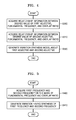
- FIG. 5 is a flowchart of a method for generating a first vibration and a second vibration by device based on a fundamental frequency and an overlap ratio according to various embodiments of the present disclosure.
- the device 1000 acquires the first frequency and the second frequency based on the fundamental frequency and the overlap ratio.
- the device 1000 may acquire the first frequency and the second frequency by inputting the fundamental frequency and the overlap ratio to Equations 1 and 2 below.
- Fundamental Frequency min First Frequency ⁇ Second Frequency
- Ovelap Ratio max First Frequency ⁇ Second Frequency / min First Frequency ⁇ Second Frequency
- the device 1000 In operation S410, the device 1000 generates a vibration having a synthesis of the first frequency and the second frequency.
- the device 1000 may generate a vibration based on the perceiving intensity.
- the device 1000 may synthesize a first amplitude for the first frequency and a second amplitude for the second frequency based on the perceiving intensity, which will be described later in detail with reference to FIG. 10 .
- FIG. 6 is a graph representing a degree value of a first adjective versus a fundamental frequency and an overlap ratio according to various embodiments of the present disclosure.
- a first adjective may be "heavy", and a user may strongly feel a "heavy” sense when a degree value of the first adjective "heavy” is great.
- the graph representing the degree value of the first adjective "heavy” versus the fundamental frequency and the overlap ratio may be generated by perceptive experiments.
- the graph representing the degree value of the first adjective "heavy” versus the fundamental frequency and the overlap ratio may be generated by experimentally measuring the degree of the "heavy” sense for the physical property of the vibration.
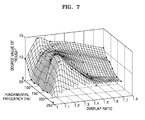
- FIG. 7 is a graph representing a degree value of a second adjective versus a fundamental frequency and an overlap ratio according to various embodiments of the present disclosure.
- a second adjective may be "rough", and a user may strongly feel a "rough” sense when a degree value of the second adjective "rough” is great.
- the graph representing the degree value of the second adjective "rough” versus the fundamental frequency and the overlap ratio may be generated by perceptive experiments.
- the graph representing the degree value of the second adjective "rough” versus the fundamental frequency and the overlap ratio may be generated by experimentally measuring the degree of the "rough” sense for the physical property of the vibration.
- FIG. 8 is a graph representing a fundamental frequency value versus a degree value of a first adjective and a degree value of a second adjective according to various embodiments of the present disclosure.
- a first adjective may be "heavy", and a second adjective maybe "rough”.
- the graph of FIG. 8 may be generated based on the graphs of FIGS. 6 and 7 .
- the device 1000 may generate the graph representing the fundamental frequency value versus the degree value of "heavy” and the degree value of "rough” by using the graph of FIG. 6 representing the degree value of "heavy” versus the fundamental frequency and the overlap ratio and the graph of FIG. 7 representing the degree value of "rough” versus the fundamental frequency and the overlap ratio.
- the device 1000 may acquire the fundamental frequency value corresponding to the input degree values by using the graph of FIG. 8 .
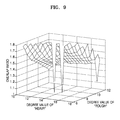
- FIG. 9 is a graph representing an overlap ratio value versus a degree value of a first adjective and a degree value of a second adjective according to various embodiments of the present disclosure.
- a first adjective may be "heavy", and the second adjective maybe "rough”.
- the graph of FIG. 9 may be generated based on the graphs of FIGS. 6 and 7 .
- the device 1000 may generate the graph representing the overlap ratio value versus the degree value of "heavy” and the degree value of "rough” by using the graph of FIG. 6 representing the degree value of "heavy” versus the fundamental frequency and the overlap ratio and the graph of FIG. 7 representing the degree value of "rough” versus the fundamental frequency and the overlap ratio.
- the device 1000 may acquire the overlap ratio value corresponding to the input degree values by using the graph of FIG. 9 .
- FIG. 10 is a flowchart of a method for generating a vibration by the device 1000 based on a degree value of a perceiving intensity according to various embodiments of the present disclosure.
- the device 1000 acquires relationship information about the frequency, the amplitude, and the perceiving intensity of the vibration.
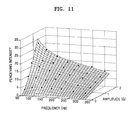
- the relationship information about the frequency, the amplitude, and the perceiving intensity of the vibration may be a graph representing the perceiving intensity versus the frequency and the amplitude of the vibration. Also, for example, a graph of FIG. 11 may be generated by experimentally measuring the perceiving intensity for the physical properties of the vibration.
- relationship information about a frequency f, an amplitude ⁇ , and a perceiving intensity P may be expressed by Equations 3 to 5 below.
- p k ⁇ ⁇ e
- the device 1000 determines a degree value of the perceiving intensity.
- the device 1000 may determine the degree value of the perceiving intensity based on a user input. In this case, the device 1000 may determine the degree value of the perceiving intensity according to a user input to a displayed user interface.
- various embodiments of the present disclosure are not limited thereto.
- the device 1000 determines a first amplitude corresponding to a first degree value P1 of the perceiving intensity and the first frequency.
- the device 1000 determines a second amplitude corresponding to a second degree value P2 of the perceiving intensity and the second frequency.
- the first degree value of the perceiving intensity and the second degree value of the perceiving intensity may be determined by a predetermined criterion based on Equation 6 below and the degree value of the perceiving intensity determined in operation S910.
- the first amplitude may be related to the first frequency
- the second amplitude may be related to the second frequency.
- the first frequency and the second frequency may be the frequencies determined in operation S400.
- the device 1000 may determine the first amplitude and the second amplitude by using Equations 3 to 6.
- Equation 6 may represent the relationship between the first degree value P1 of the perceiving intensity related to the first frequency and the second degree value P2 of the perceiving intensity related to the second frequency and the degree value P of the perceiving intensity related to both of the first frequency and the second frequency.
- the first degree value P1 of the perceiving intensity related to the first frequency and the second degree value P2 of the perceiving intensity related to the second frequency may be preset by various criterions.
- the device 1000 modulates the amplitude of a vibration having a synthesis of the first frequency and the second frequency based on the determined first amplitude and the determined second amplitude. Accordingly, the device 1000 may generate a vibration having the first frequency and the second frequency based on the first amplitude, the second amplitude, the first degree value of the perceiving intensity, and the second degree value of the perceiving intensity.
- the device 1000 may generate a first vibration having the first amplitude and a second vibration having the second amplitude.
- the device 1000 may generate the first vibration such that the first vibration of the first frequency has the first amplitude and may generate the second vibration such that the second vibration of the second frequency has the second amplitude.
- the device 1000 may generate the first vibration and the second vibration simultaneously within a predetermined period of time.
- FIG. 11 is a graph representing a perceiving intensity versus a frequency and an amplitude according to various embodiments of the present disclosure.
- a graph may be generated by experimentally measuring a perceiving intensity for physical properties of a vibration.
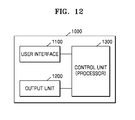
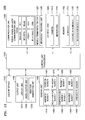
- FIGS. 12 and 13 are block diagrams of a device according to various embodiments of the present disclosure.
- the device 1000 may include a user input unit 1100, an output unit 1200, and a control unit 1300. However, not all of the illustrated elements are indispensable elements of the device 1000.
- the device 1000 may include elements more than the illustrated elements, or may include elements fewer than the illustrated elements.
- the device 1000 may further include a sensing unit 1400, a communication unit 1500, an audio/video (A/V) input unit 1600, and a memory 1700 in addition to the user input unit 1100, the output unit 1200, and the control unit 1300.
- a sensing unit 1400 may further include a communication unit 1500, an audio/video (A/V) input unit 1600, and a memory 1700 in addition to the user input unit 1100, the output unit 1200, and the control unit 1300.
- A/V audio/video
- the user input unit 1100 refers to a unit through which the user inputs data for controlling the device 1000.
- the user input unit 1100 may include, but is not limited to, a keypad, a dome switch, a touch pad (e.g., a capacitive overlay type, a resistive overlay type, an infrared beam type, a surface acoustic wave type, an integral strain gauge type, or a piezoelectric type), a jog wheel, and a jog switch.
- the user input unit 1100 may receive a user input under the control of the control unit 1300.
- the user input unit 1000 may receive a user input for inputting the degree value of the first adjective, the degree value of the second adjective, and the degree value of the perceiving intensity.
- the output unit 1200 outputs an audio signal, a video signal, or a vibration signal.
- the output unit 1200 may include a display unit 1210, an audio output unit 1220, and a vibration generating unit 1230.
- the display unit 1210 displays information processed by the device 1000.
- the display unit 1210 may display a user interface for receiving an input of values set for vibration generation of the device 1000.
- the display unit 1210 may be used as an input device in addition to an output device.
- the display unit 1210 may include at least one of a liquid crystal display (LCD), a thin film transistor LCD (TFT-LCD), an organic light-emitting diode (OLED) display, a flexible display, a three-dimensional (3D) display, and an electrophoretic display.
- the device 1000 may include two or more display units 1210 in some embodiments. In this case, the two or more display unit 1210 may be disposed to face each other through a hinge structure.
- the audio output unit 1220 outputs audio data received from the communication unit 1500 or stored in the memory 1700. Also, the audio output unit 1220 may output audio signals related to functions (e.g., call signal reception, message reception, and notification) performed in the device 1000.
- the audio output unit 1220 may include a speaker and a buzzer.
- the vibration generating unit 1230 may output a vibration signal under the control of the control unit 1300.
- the vibration generating unit 1230 may include a vibration motor, but is not limited thereto.
- the vibration generating unit 1230 may generate a vibration corresponding to an adjective and a degree value of the adjective.
- the vibration generating unit 1230 may generate a vibration having a first frequency and a second frequency.
- the vibration generating unit 1230 may generate a vibration according to a first frequency, a first amplitude, a second frequency, and a second amplitude determined by the control unit 1300 that will be described later.
- the vibration generating unit 1230 may generate a first vibration having the first frequency and a second vibration having the second frequency.
- the control unit 1300 controls overall operations of the device 1000.
- the control unit 1300 may control the user input unit 1100, the output unit 1200, the sensing unit 1400, the communication unit 1500, and the A/V input unit 1600 by executing programs stored in the memory 1700.
- control unit 1300 may set at least one fundamental frequency and at least one overlap ratio corresponding to an adjective having a predetermined degree value.
- the control unit 1300 may set a fundamental frequency and an overlap ratio corresponding to an adjective and a degree value of the adjective.
- control unit 1300 may set a fundamental frequency and an overlap ratio corresponding to an adjective and a degree value of the adjective.
- the control unit 1300 may set a fundamental frequency and an overlap ratio corresponding to a plurality of adjectives and degree values of the adjectives.
- control unit 1300 may set a plurality of fundamental frequencies and a plurality of overlap ratios corresponding to a plurality of adjectives and degree values of the adjectives. Accordingly, the device 1000 may effectively synthesize various frequencies to embody an adjective having a predetermined degree value as a vibration.
- the fundamental frequency and the overlap ratio corresponding to the adjective and the degree value of the adjective may be experimentally determined.
- a fundamental frequency and an overlap ratio may be experimentally determined to generate a vibration of a "rough" sense having a degree value "10".
- control unit 1300 may set an amplitude variation value of a vibration corresponding to an adjective having a predetermined degree value.
- a variation value of a vibration may be experimentally determined to generate a vibration of a "rough” sense having a degree value "10".
- the variation value of the vibration may be experimentally determined in association with the fundamental frequency and the overlap ratio.
- the control unit 1300 may set the experimentally-determined variation value of the vibration as a variation value of a vibration corresponding to an adjective having a predetermined degree value.
- control unit 1300 may determine an adjective related to a vibration to be generated and a degree value of the adjective.
- the control unit 1300 may determine an adjective related to a vibration to be generated and a degree value of the adjective when the device 1000 receives at least one user input for inputting an adjective and a degree value of the adjective.
- the control unit 1300 may display a predetermined user interface for inputting the adjective related to the vibration to be generated and the degree value of the adjective on the screen of the device 1000, and determine the adjective and the degree value of the adjective based on the user input to the displayed user interface.
- control unit 1300 may determine a degree value of the perceiving intensity related to the vibration to be generated.
- the control unit 1300 may determine a degree value of the perceiving intensity related to the vibration to be generated by receiving at least one user input for inputting a degree value of the perceiving intensity.
- the control unit 1300 may display a predetermined user interface for inputting the degree value of the perceiving intensity related to the vibration to be generated on the screen of the device 1000, and determine the degree value of the perceiving intensity based on the user input to the displayed user interface.
- control unit 1300 may generate at least one vibration corresponding to the determined adjective and the determined degree value of determined adjective.
- the control unit 1300 may determine the fundamental frequency and the overlap ratio corresponding to the adjective and the degree value of the adjective input by the user based on the values set in operation S100, and generate a vibration having the determined fundamental frequency and the determined overlap ratio.
- control unit 1300 may determine an amplitude variation value of the vibration having the determined fundamental frequency and the determined overlap ratio based on the values set in operation S100, and generate a vibration based on the determined amplitude variation value.
- control unit 1300 may modulate an amplitude of the vibration to be generated, based on the determined degree value of the perceiving intensity.
- control unit 1300 may modulate the amplitude of the vibration to be generated, based on all of the determined adjectives, the determined degree value of the determined adjective, and the determined degree value of the perceiving intensity.
- control unit 1300 may generate a vibration having senses of two adjectives by synthesizing two frequencies.
- the control unit 1300 may acquire relationship information between a degree value of the first adjective, a degree value of the second adjective, and the fundamental frequency.
- the control unit 1300 may receive the relationship information between the degree value of the first adjective, the degree value of the second adjective, and the fundamental frequency from an external device (not illustrated) or may directly generate the relationship information.
- the relationship information between the degree value of the first adjective, the degree value of the second adjective, and the fundamental frequency may be a graph representing a fundamental frequency value versus the degree value of the first adjective and the degree value of the second adjective.
- the relationship information between the degree value of the first adjective, the degree value of the second adjective, and the fundamental frequency may be a graph representing a fundamental frequency value versus a degree value of an adjective "heavy” and a degree value of an adjective "rough” as illustrated in FIG. 7 .
- the graph representing the fundamental frequency value versus the degree value of the first adjective and the degree value of the second adjective may be generated by using a graph representing the degree value of the first adjective versus the fundamental frequency and the overlap ratio and a graph representing the degree value of the second adjective versus the fundamental frequency and the overlap ratio.
- a graph of FIG. 8 may be generated by synthesizing the graphs of FIGS. 6 and 7 .
- control unit 1300 may acquire relationship information between a degree value of the first adjective, a degree value of the second adjective, and the overlap ratio.
- the control unit 1300 may receive the relationship information between the degree value of the first adjective, the degree value of the second adjective, and the overlap ratio from an external device (not illustrated) or may directly generate the relationship information.
- the relationship information between the degree value of the first adjective, the degree value of the second adjective, and the overlap ratio may be a graph representing an overlap ratio value versus the degree value of the first adjective and the degree value of the second adjective.
- the relationship information between the degree value of the first adjective, the degree value of the second adjective, and the overlap ratio may be a graph representing an overlap ratio value versus a degree value of an adjective "heavy” and a degree value of an adjective "rough” as illustrated in FIG. 9 .
- the graph representing the overlap ratio value versus the degree value of the first adjective and the degree value of the second adjective may be generated by using a graph representing the degree value of the first adjective versus the fundamental frequency and the overlap ratio and a graph representing the degree value of the second adjective versus the fundamental frequency and the overlap ratio.
- the graph of FIG. 9 may be generated by synthesizing the graphs of FIGS. 6 and 7 .
- control unit 1300 may determine a first degree value of the first adjective and a second degree value of the second adjective.
- the control unit 1300 may determine the first degree value of the first adjective and the second degree value of the second adjective based on the user input.
- the control unit 1300 may control the display unit 1210 to display a user interface for setting a degree value of an adjective on the screen of the device 1000.
- the control unit 1300 may determine the first degree value of the first adjective and the second degree value of the second adjective according to a user input to the displayed user interface.
- the first adjective may be "heavy", and the second adjective may be "rough”.
- the control unit 1300 may determine the first degree value of the first adjective "heavy” as "15" and determine the second degree value of the second adjective "rough” as "10".
- first degree value of the first adjective and the second degree value of the second adjective determined in operation S220 may be used by the control unit 1300 to generate a vibration of a sense corresponding to the first adjective and the second adjective by controlling the vibration generating unit 1230.
- control unit 1300 may determine a fundamental frequency and an overlap ratio corresponding to the first degree value and the second degree value.
- the control unit 1300 may determine the fundamental frequency corresponding to the first degree value and the second degree value based on the relationship information between the degree value of the first adjective, the degree value of the second adjective, and the fundamental frequency.
- the control unit 1300 may acquire the fundamental frequency corresponding to the first degree value and the second degree value by inputting the first degree value and the second degree value to the graph representing the fundamental frequency value versus the degree value of the first adjective and the degree value of the second adjective.
- control unit 1300 may determine the overlap ratio corresponding to the first degree value and the second degree value based on the relationship information between the degree value of the first adjective, the degree value of the second adjective, and the overlap ratio. For example, the control unit 1300 may acquire the overlap ratio corresponding to the first degree value and the second degree value by inputting the first degree value and the second degree value to the graph representing the overlap ratio value versus the degree value of the first adjective and the degree value of the second adjective.
- control unit 1300 generates a vibration based on the fundamental frequency and the overlap ratio corresponding to the first degree value and the second degree value.
- the control unit 1300 may determine a first frequency and a second frequency based on the relationship of the first frequency and the second frequency to the fundamental frequency and the overlap ratio.
- control unit 1300 may control the vibration generating unit 1230 to generate a vibration having the first frequency and the second frequency.
- control unit 1300 may determine a first degree value of the perceiving intensity related to the first frequency and a second degree value of the perceiving intensity related to the second frequency.
- the control unit 1300 acquires relationship information about the frequency, the amplitude, and the perceiving intensity of the vibration.
- the relationship information about the frequency, the amplitude, and the perceiving intensity of the vibration may be a graph representing the perceiving intensity versus the frequency and the amplitude of the vibration. Also, for example, the graph of FIG. 11 may be generated by experimentally measuring the perceiving intensity for the physical properties of the vibration.
- the relationship information about the frequency f, the amplitude ⁇ , and the perceiving intensity P may be expressed by Equations 3 to 5.
- control unit 1300 determines a degree value of the perceiving intensity.
- the control unit 1300 may determine the degree value of the perceiving intensity based on the user input. In this case, the control unit 1300 may determine the degree value of the perceiving intensity according to the user input to the displayed user interface.
- various embodiments of the present disclosure are not limited thereto.
- control unit 1300 determines a first amplitude corresponding to the first degree value P1 of the perceiving intensity and the first frequency, and determines a second amplitude corresponding to the second degree value P2 of the perceiving intensity and the second frequency.
- first degree value of the perceiving intensity and the second degree value of the perceiving intensity may be determined by a predetermined criterion based on Equation 6 and the degree value of the perceiving intensity determined in operation S910.
- the first amplitude may be related to the first frequency
- the second amplitude may be related to the second frequency.
- control unit 1300 may determine the first amplitude and the second amplitude by using Equations 3 to 6. Also, the first degree value P1 of the perceiving intensity related to the first frequency and the second degree value P2 of the perceiving intensity related to the second frequency may be preset by various criterions.
- the control unit 1300 modulates the amplitude of a vibration having a synthesis of the first frequency and the second frequency based on the determined first amplitude and the determined second amplitude. Accordingly, the control unit 1300 may generate a vibration having the first frequency and the second frequency based on the first amplitude, the second amplitude, the first degree value of the perceiving intensity, and the second degree value of the perceiving intensity.
- control unit 1300 may generate a first vibration having the first amplitude and a second vibration having the second amplitude.
- the control unit 1300 may generate the first vibration such that the first vibration of the first frequency has the first amplitude and may generate the second vibration such that the second vibration of the second frequency has the second amplitude.
- the control unit 1300 may generate the first vibration and the second vibration simultaneously within a predetermined period of time.
- the sensing unit 1400 may detect a state of the device 1000 or a peripheral state of the device 1000 and transmit the detected information to the control unit 1300.
- the sensing unit 1400 may include, but is not limited to, at least one of a magnetic sensor 1410, an acceleration sensor 1420, a temperature/humidity sensor 1430, an infrared sensor 1440, a gyroscope sensor 1450, a position sensor (e.g., GPS sensor) 1460, a pressure sensor 1470, a proximity sensor 1480, and a Red, Green, and Blue (RGB) sensor (illuminance sensor) 1490. Since those of ordinary skill in the art may intuitively infer the respective functions of the sensors from the respective names thereof, detailed descriptions thereof will be omitted.
- RGB Red, Green, and Blue
- the sensing unit 1400 may include a sensor for sensing a touch input by an input tool and a sensor for sensing a touch input by the user.
- the sensor for sensing a touch input by the user may be included in a touchscreen or a touchpad.
- the sensor for sensing a touch input by the input tool may be disposed under the touchscreen or the touchpad or may be included in the touchscreen or the touchpad.
- the communication unit 1500 receives a variety of information from an external device (not illustrated).
- the communication unit 1500 may receive relationship information between the degree values of the adjectives and the fundamental frequency, for example, relationship information between the degree value of the first adjective, the degree value of the second adjective, and the fundamental frequency from an external device (not illustrated).
- the communication unit 1500 may receive relationship information between the degree values of the adjectives and the overlap ratio, for example, relationship information between the degree value of the first adjective, the degree value of the second adjective, and the overlap ratio from an external device (not illustrated).
- the communication unit 1500 may include one or more elements for communication between the device 1000 and an external device (not illustrated).
- the communication unit 1500 may include a short-range wireless communication unit 1510, a mobile communication unit 1520, and a broadcast receiving unit 1530.
- the short-range wireless communication unit 1510 may include, but is not limited to, a Bluetooth communication unit, a Bluetooth Low Energy (BLE) communication unit, a near field communication unit, a wireless local area network (WLAN) (Wi-Fi) communication unit, a ZigBee communication unit, an infrared data association (IrDA) communication unit, a Wi-Fi Direct (WFD) communication unit, an ultra wideband (UWB) communication unit, and an Ant+ communication unit.
- BLE Bluetooth Low Energy
- Wi-Fi wireless local area network
- ZigBee communication unit an infrared data association (IrDA) communication unit
- Wi-Fi Direct (WFD) communication unit Wi-Fi Direct
- UWB ultra wideband
- the mobile communication unit 1520 communicates wireless signals with at least one of a base station, an external terminal, and a server on a mobile communication network.
- the wireless signals may include voice call signals, video call signals, or various types of data for transmission and reception of text/multimedia messages.
- the broadcast receiving unit 1530 receives broadcast signals and/or broadcast-related information from external devices through broadcast channels.
- the broadcast channels may include satellite channels and terrestrial channels.
- the device 1000 may not include the broadcast receiving unit 1530.
- the A/V input unit 1600 may be used to input audio signals or video signals and may include a camera 1610 and a microphone 1620.
- the camera 1610 may obtain a video frame such as a still image or a moving image through an image sensor in a video call mode or a photographing mode.
- the image captured through the image sensor may be processed by the control unit 1300 or a separate image processing unit (not illustrated).
- the memory 1700 may store a program for processing and control of the control unit 1300, and may store input/output data.
- the memory 1700 may include at least one type of storage medium from among flash memory type, hard disk type, multimedia card micro type, card type memory (e.g., secure digital (SD) and extreme digital (XD) memories), random-access memory (RAM), static RAM (SRAM), read-only memory (ROM), electronically erasable programmable ROM (EEPROM), PROM, magnetic memory, magnetic disk, and optical disk.
- card type memory e.g., secure digital (SD) and extreme digital (XD) memories
- RAM random-access memory
- SRAM static RAM
- ROM read-only memory
- EEPROM electronically erasable programmable ROM
- PROM magnetic memory
- magnetic disk magnetic disk
- optical disk optical disk
- the programs stored in the memory 1700 may be classified into a plurality of modules according to their functions and may be classified into, for example, a user interface (UI) module 1710, a touchscreen module 1720, and a notification module 1730.
- UI user interface
- the UI module 1710 may provide a specialized UI and a graphical UI (GUI) that interlock with the device 1000 for respective applications.
- the touchscreen module 1720 may sense a touch gesture of the user on a touchscreen and transfer information about the touch gesture to the control unit 1300. According to an embodiment of the present disclosure, the touchscreen module 1720 may detect and analyze a touch code.
- the touchscreen module 1720 may include separate hardware including a controller.
- Various sensors may be provided in or near the touchscreen to sense a proximity touch or a touch to the touchscreen.
- An example of the sensor for sensing a touch to the touchscreen is a tactile sensor.
- the tactile sensor refers to a sensor that senses a touch of an object in the degree of a human sense or more.
- the tactile sensor may sense a variety of information, such as the roughness of a touch surface, the hardness of a touch object, and the temperature of a touch point.
- the proximity sensor refers to a sensor that detects the presence of an object approaching a predetermined detection surface or an object located in the proximity thereof without mechanical contact by using an electromagnetic force or infrared rays.
- Examples of the proximity sensor may include transmission type photoelectric sensors, direct reflection type photoelectric sensors, mirror reflection type photoelectric sensors, high frequency oscillation type proximity sensors, electrostatic capacity type proximity sensors, magnetic type proximity sensors, and infrared proximity sensors.
- Examples of the touch gesture of the user may include tap, touch & hold, double tap, drag, panning, flick, drag & drop, and swipe.
- the notification module 1730 may generate a signal for notifying the occurrence of an event in the device 1000. Examples of the event occurring in the device 1000 include call signal reception, message reception, key signal input, and schedule notification.
- the notification module 1730 may output a notification signal of a video signal type through the display unit 1210, output a notification signal of an audio signal type through the audio output unit 1220, and output a notification signal of a vibration signal type through the vibration generating unit 1230.
- the various embodiments of the present disclosure may also be implemented in the form of a computer-readable recording medium including instructions executable by a computer, such as a program module executed by a computer.
- the computer-readable recording medium may be any available medium accessible by computers, examples of which may include a volatile recording medium, a nonvolatile recording medium, a removable recording medium, and an unremovable recording medium.
- examples of the computer-readable recording medium may include a computer storage medium and a communication medium.
- Examples of the computer storage medium may include a volatile storage medium, a nonvolatile storage medium, a removable storage medium, and an unremovable storage medium that are implemented by any method or technology for storing information such as computer-readable instructions, data structures, program modules, or other data.
- Examples of the communication medium may include any information transmission medium including computer-readable instructions, data structures, program modules, other data of modulated data signals, or other transmission mechanisms.
Landscapes
- Engineering & Computer Science (AREA)
- General Engineering & Computer Science (AREA)
- Theoretical Computer Science (AREA)
- Physics & Mathematics (AREA)
- General Physics & Mathematics (AREA)
- Human Computer Interaction (AREA)
- Automation & Control Theory (AREA)
- Signal Processing (AREA)
- User Interface Of Digital Computer (AREA)
Abstract
Description
- This application claims the benefit under 35 U.S.C. § 119(a) of a Korean patent application filed on January 28, 2014 in the Korean Intellectual Property Office and assigned Serial number
10-2014-0010881 - The present disclosure was made by or on behalf of the below listed parties to a joint research agreement. The joint research agreement was in effect on or before the date the present disclosure was made and the present disclosure was made as a result of activities undertaken within the scope of the joint research agreement. The parties to the joint research agreement are 1) Samsung Electronics Co., Ltd. 2) Postech Acadenry Industry Foundation.
- The present disclosure relates to methods and devices for generating a vibration by using a degree value of an adjective.
- Among various types of haptic feedback, vibration-based haptic feedback (hereinafter referred to as "vibration feedback") are widely used in various mobile devices, such as smart phones and tablet devices, game consoles, and realistic four-dimensional (4D) movie theaters. Also, since vibration feedback is more efficient than other types of feedback, the use of vibration feedback is on the increase currently.
- However, in the related art, a method of directly setting a frequency and an amplitude, which are physical properties of a vibration waveform, is mainly used to generate a vibration feedback. Accordingly, it is difficult for an inexpert user to receive a vibration of his desired sense from a device, and it is also difficult to predict and quantify a perceptive sense that a user feels through a vibration.
- Therefore, required is vibration generation technology that allows a user to accurately receive a vibration of his desired sense from a device and may easily predict and quantify perceptive properties of a vibration.
- The above information is presented as background information only to assist with an understanding of the present disclosure. No determination has been made, and no assertion is made, as to whether any of the above might be applicable as prior art with regard to the present disclosure.
- Aspects of the present disclosure are to address at least the above-mentioned problems and/or disadvantages and to provide at least the advantages described below. Accordingly, an aspect of the present disclosure is to provide methods and devices for generating a vibration by using an adjective, which may generate a vibration having a fundamental frequency and an overlap ratio corresponding to an adjective and a degree value of the adjective.
- Another aspect of the present disclosure is to provide methods and devices for generating a vibration by using an adjective, which may generate a vibration by using a fundamental frequency and an overlap ratio determined on the basis of a degree value of a first adjective and a degree value of a second adjective.
- Another aspect of the present disclosure is to provide methods and devices for generating a vibration by using an adjective, which may modulate an amplitude of a vibration by using a degree value of a perceiving intensity.
- Additional aspects will be set forth in part in the description which follows and, in part, will be apparent from the description, or may be learned by practice of the presented embodiments of the present disclosure.
- In accordance with an aspect of the present disclosure, a method for generating a vibration by a device by using an adjective is provided. The method includes setting at least one fundamental frequency and at least one overlap ratio corresponding to a certain adjective and a degree value of the certain adjective, receiving at least one user input for inputting an adjective and a degree value of the input adjective, and generating at least one vibration corresponding to the input adjective and the degree value of the input adjective based on the setting. The generated at least one vibration has a fundamental frequency and an overlap ratio corresponding to the input adjective and the degree value of the input adjective.
- In accordance with another aspect of the present disclosure, a device for generating a vibration by using an adjective is provided. The device includes a control unit configured to set at least one fundamental frequency and at least one overlap ratio corresponding to a certain adjective and a degree value of the certain adjective, a user input unit configured to receive at least one user input for inputting an adjective and a degree value of the input adjective, and a vibration generating unit configured to generate at least one vibration corresponding to the input adjective and the degree value of the input adjective based on the setting. The generated at least one vibration has a fundamental frequency and an overlap ratio corresponding to the input adjective and the degree value of the input adjective.
- In accordance with another aspect of the present disclosure, a non-transitory computer-readable recording medium is provided. The non-transitory computer-readable recording medium stores one or more programs including instructions that, when executed by a computer, cause the computer to perform a method for generating a vibration by a device by using an adjective, the method including setting at least one fundamental frequency and at least one overlap ratio corresponding to a certain adjective and a degree value of the certain adjective, receiving at least one user input for inputting an adjective and a degree value of the input adjective, and generating at least one vibration corresponding to the input adjective and the degree value of the input adjective based on the setting. The generated at least one vibration has a fundamental frequency and an overlap ratio corresponding to the input adjective and the degree value of the input adjective.
- Other aspects, advantages, and salient features of the disclosure will become apparent to those skilled in the art from the following detailed description, which, taken in conjunction with the annexed drawings, discloses various embodiments of the present disclosure.
- The above and other aspects, features, and advantages of certain embodiments of the present disclosure will be more apparent from the following description taken in conjunction with the accompanying drawings, in which:
-
FIG. 1 is a diagram illustrating a device for generating a vibration based on a degree value of an adjective according to various embodiments of the present disclosure; -
FIG. 2 is a flowchart of a method for generating a vibration by a device based on a degree value of an adjective according to various embodiments of the present disclosure; -
FIG. 3 is a flowchart of a method for generating a vibration by a device based on a degree value of a first adjective and a degree value of a second adjective according to various embodiments of the present disclosure; -
FIG. 4 is a flowchart of a method for generating a vibration synthesis model by a device according to various embodiments of the present disclosure; -
FIG. 5 is a flowchart of a method for generating a first vibration and a second vibration by a device based on a fundamental frequency and an overlap ratio according to various embodiments of the present disclosure; -
FIG. 6 is a graph representing a degree value of a first adjective versus a fundamental frequency and an overlap ratio according to various embodiments of the present disclosure; -
FIG. 7 is a graph representing a degree value of a second adjective versus a fundamental frequency and an overlap ratio according to various embodiments of the present disclosure; -
FIG. 8 is a graph representing a fundamental frequency value versus a degree value of a first adjective and a degree value of a second adjective according to various embodiments of the present disclosure; -
FIG. 9 is a graph representing an overlap ratio value versus a degree value of a first adjective and a degree value of a second adjective according to various embodiments of the present disclosure; -
FIG. 10 is a flowchart of a method for generating a vibration by a device based on a degree value of a perceiving intensity according to various embodiments of the present disclosure; -
FIG. 11 is a graph representing a perceiving intensity versus a frequency and an amplitude according to various embodiments of the present disclosure; and -
FIGS. 12 and13 are block diagrams of a device according to various embodiments of the present disclosure. - Throughout the drawings, it should be noted that like reference numbers are used to depict the same or similar elements, features, and structures.
- The following description with reference to the accompanying drawings is provided to assist in a comprehensive understanding of various embodiments of the present disclosure as defined by the claims and their equivalents. It includes various specific details to assist in that understanding but these are to be regarded as merely exemplary. Accordingly, those of ordinary skill in the art will recognize that various changes and modifications of the various embodiments described herein can be made without departing from the scope and spirit of the present disclosure. In addition, descriptions of well-known functions and constructions may be omitted for clarity and conciseness.
- The terms and words used in the following description and claims are not limited to the bibliographical meanings, but, are merely used by the inventor to enable a clear and consistent understanding of the present disclosure. Accordingly, it should be apparent to those skilled in the art that the following description of various embodiments of the present disclosure is provided for illustration purpose only and not for the purpose of limiting the present disclosure as defined by the appended claims and their equivalents.
- It is to be understood that the singular forms "a," "an," and "the" include plural referents unless the context clearly dictates otherwise. Thus, for example, reference to "a component surface" includes reference to one or more of such surfaces.
- It will be understood that when an element is referred to as being "connected" to another element, it may be "directly connected" to the other element or may be "electrically connected" to the other element with other element(s) interposed therebetween. It will also be understood that the terms "comprises", "includes", and "has", when used herein, specify the presence of stated elements, but do not preclude the presence or addition of other elements, unless otherwise defined.
- Also, in the specification, an adjective may refer to a word representing a sense that a user may feel through a vibration of a device, and the device may generate the vibration by using a degree value of the adjective. The adjective may include, for example, "heavy", "light", "rough", and "smooth", but is not limited thereto.
- Also, in the specification, the degree value of the adjective may refer to a value representing the degree of the adjective. For example, when the degree value of "heavy" is great, the device may generate a vibration through which the user may strongly feel a "heavy" sense.
- Also, in the specification, a perceiving intensity may refer to an intensity at which the user perceives a vibration. For example, when a degree value of the perceiving intensity is great, the device may generate a vibration so that the user may intensely feel the vibration.
- Also, in the specification, a fundamental frequency and an overlap ratio may be defined by two frequencies. The fundamental frequency may be the smaller one of a first frequency and a second frequency, and the overlap ratio may be a value obtained by dividing the greater one of the first frequency and the second frequency by the fundamental frequency. However, various embodiments of the present disclosure are not limited thereto.
- Hereinafter, various embodiments of the present disclosure will be described in detail with reference to the accompanying drawings.
-
FIG. 1 is a diagram illustrating a device for generating a vibration based on a degree value of an adjective according to various embodiments of the present disclosure. - Referring to
FIG. 1 , adevice 1000 may generate a predetermined vibration according to a degree value of an adjective. Thedevice 1000 may determine a degree value of an adjective and determine a frequency of a vibration based on the determined degree value of the adjective. Also, thedevice 1000 may generate a vibration having the determined frequency. In this case, the degree value of the adjective may be input to thedevice 1000 by the user; however, various embodiments of the present disclosure are not limited thereto. Also, thedevice 1000 may generate a vibration having a plurality of frequencies by determining a fundamental frequency and an overlap ratio corresponding to an adjective and a degree value of the adjective. - Also, the
device 1000 may generate at least one vibration for a plurality of adjectives by using a vibration synthesis model that will be described later. In this case, thedevice 1000 may generate a vibration synthesis model for a plurality of adjectives and determine a first frequency and a second frequency for generating a vibration by using the generated vibration synthesis model. - Also, the
device 1000 may modulate an amplitude of a vibration according to a degree value of perceiving intensity. In this case, the degree value of the perceiving intensity may be input to thedevice 1000 by the user; however, various embodiments of the present disclosure are not limited thereto. - Accordingly, the user may select a degree value of the displayed adjective and determine a degree value of the perceiving intensity, thereby making it possible for the
device 1000 to generate a vibration of a sense and an intensity desired by the user. - Also, the
device 1000 may be, for example, a smart phone, a smart television (TV), a mobile phone, a personal digital assistant (PDA), a laptop computer, a media player, a micro server, a global positioning system (GPS) device, an e-book terminal, a digital broadcasting terminal, a navigation device, a kiosk, a Motion Picture Experts Group (MPEG-1 or MPEG-2) Audio Layer III (MP3) player, a digital camera, or any other mobile or immobile computing device. However, various embodiments of the present disclosure are not limited thereto, and thedevice 1000 may include any other device that may generate a vibration feedback. -
FIG. 2 is a flowchart of a method for generating a vibration by a device based on a degree value of an adjective according to various embodiments of the present disclosure. - Referring to
FIG. 2 , in operation S100, thedevice 1000 may set at least one fundamental frequency and at least one overlap ratio corresponding to an adjective having a predetermined degree value. For example, thedevice 1000 may set a fundamental frequency and an overlap ratio corresponding to an adjective and a degree value of the adjective. Also, for example, thedevice 1000 may set a fundamental frequency and an overlap ratio corresponding to an adjective and a degree value of the adjective. Also, for example, thedevice 1000 may set a fundamental frequency and an overlap ratio corresponding to a plurality of adjectives and degree values of the adjectives. Also, for example, thedevice 1000 may set a plurality of fundamental frequencies and a plurality of overlap ratios corresponding to a plurality of adjectives and degree values of the adjectives. Accordingly, thedevice 1000 may effectively synthesize various frequencies to embody an adjective having a predetermined degree value as a vibration. - Also, the fundamental frequency and the overlap ratio corresponding to the adjective and the degree value of the adjective may be experimentally determined. For example, a fundamental frequency and an overlap ratio may be experimentally determined to generate a vibration of a "rough" sense having a degree value "10".
- Also, the
device 1000 may set an amplitude variation value of a vibration corresponding to an adjective having a predetermined degree value. For example, a variation value of a vibration may be experimentally determined to generate a vibration of a "rough" sense having a degree value "10". In this case, the variation value of the vibration may be experimentally determined in association with the fundamental frequency and the overlap ratio. Also, thedevice 1000 may set the experimentally-determined variation value of the vibration as a variation value of a vibration corresponding to an adjective having a predetermined degree value. - In operation S110, the
device 1000 may determine an adjective related to a vibration to be generated and a degree value of the adjective. Thedevice 1000 may determine an adjective related to a vibration to be generated and a degree value of the adjective by receiving at least one user input for inputting an adjective and a degree value of the adjective. For example, thedevice 1000 may display a predetermined user interface for inputting the adjective related to the vibration to be generated and the degree value of the adjective, and determine the adjective and the degree value of the adjective based on the user input to the displayed user interface. - In operation S120, the
device 1000 may determine a degree value of a perceiving intensity related to the vibration to be generated. Thedevice 1000 may determine a degree value of a perceiving intensity related to the vibration to be generated by receiving at least one user input for inputting a degree value of a perceiving intensity. For example, thedevice 1000 may display a predetermined user interface for inputting the degree value of the perceiving intensity related to the vibration to be generated on a screen of thedevice 1000, and determine the degree value of the perceiving intensity based on the user input to the displayed user interface. - In operation S130, the
device 1000 may generate at least one vibration corresponding to the determined adjective and the determined degree value of determined adjective. Thedevice 1000 may determine the fundamental frequency and the overlap ratio corresponding to the adjective and the degree value of the adjective input by the user based on the values set in operation S100, and generate a vibration having the determined fundamental frequency and the determined overlap ratio. - Also, the
device 1000 may determine an amplitude variation value of the vibration having the determined fundamental frequency and the determined overlap ratio based on the values set in operation S100, and generate a vibration based on the determined amplitude variation value. - Also, the
device 1000 may modulate an amplitude of the vibration to be generated, based on the determined degree value of the perceiving intensity. In this case, thedevice 1000 may modulate the amplitude of the vibration to be generated based on all of the determined adjectives, the determined degree value of the determined adjective, and the determined degree value of the perceiving intensity. -
FIG. 3 is a flowchart of a method for generating a vibration by a device based on a degree value of a first adjective and a degree value of a second adjective according to various embodiments of the present disclosure. As an example,FIG. 3 illustrates a method for generating a vibration having senses of two adjectives by synthesizing two frequencies. - Referring to
FIG. 3 , in operation S200, thedevice 1000 acquires relationship information between a degree value of the first adjective, a degree value of the second adjective, and the fundamental frequency. Thedevice 1000 may receive the relationship information between the degree value of the first adjective, the degree value of the second adjective, and the fundamental frequency from an external device (not illustrated) or may directly generate the relationship information. Also, the relationship information between the degree value of the first adjective, the degree value of the second adjective, and the fundamental frequency may be a graph representing a fundamental frequency value versus the degree value of the first adjective and the degree value of the second adjective. For example, the relationship information between the degree value of the first adjective, the degree value of the second adjective, and the fundamental frequency may be a graph representing a fundamental frequency value versus a degree value of an adjective "heavy" and a degree value of an adjective "rough" as illustrated inFIG. 8 . - Also, the graph representing the fundamental frequency value versus the degree value of the first adjective and the degree value of the second adjective may be generated by using a graph representing the degree value of the first adjective versus the fundamental frequency and the overlap ratio and a graph representing the degree value of the second adjective versus the fundamental frequency and the overlap ratio. For example, a graph of
FIG. 8 may be generated by synthesizing graphs ofFIGS. 6 and7 . - In operation S210, the
device 1000 acquires relationship information between the degree value of the first adjective, the degree value of the second adjective, and the overlap ratio. Thedevice 1000 may receive the relationship information between the degree value of the first adjective, the degree value of the second adjective, and the overlap ratio from an external device (not illustrated) or may directly generate the relationship information. Also, the relationship information between the degree value of the first adjective, the degree value of the second adjective, and the overlap ratio may be a graph representing an overlap ratio value versus the degree value of the first adjective and the degree value of the second adjective. For example, the relationship information between the degree value of the first adjective, the degree value of the second adjective, and the overlap ratio may be a graph representing an overlap ratio value versus a degree value of an adjective "heavy" and a degree value of an adjective "rough" as illustrated inFIG. 8 . - Also, the graph representing the overlap ratio value versus the degree value of the first adjective and the degree value of the second adjective may be generated by using a graph representing the degree value of the first adjective versus the fundamental frequency and the overlap ratio and a graph representing the degree value of the second adjective versus the fundamental frequency and the overlap ratio. For example, a graph of
FIG. 9 may be generated by synthesizing the graphs ofFIGS. 6 and7 . - In operation S220, the
device 1000 determines a first degree value of the first adjective and a second degree value of the second adjective. Thedevice 1000 may determine the first degree value of the first adjective and the second degree value of the second adjective based on the user input. In this case, thedevice 1000 may display a user interface for setting a degree value of an adjective on a screen of thedevice 1000. Also, thedevice 1000 may determine the first degree value of the first adjective and the second degree value of the second adjective according to a user input to the displayed user interface. For example, the first adjective may be "heavy", and the second adjective may be "rough". In this case, based on the user input, thedevice 1000 may determine the first degree value of the first adjective "heavy" as "15" and determine the second degree value of the second adjective "rough" as "10". - Also, the first degree value of the first adjective and the second degree value of the second adjective determined in operation S220 may be used by the
device 1000 to generate a vibration of a sense corresponding to the first adjective and the second adjective. - In operation S230, the
device 1000 determines a fundamental frequency and an overlap ratio corresponding to the first degree value and the second degree value. Thedevice 1000 may determine the fundamental frequency corresponding to the first degree value and the second degree value based on the relationship information between the degree value of the first adjective, the degree value of the second adjective, and the fundamental frequency acquired in operation S200. For example, thedevice 1000 may acquire the fundamental frequency corresponding to the first degree value and the second degree value by inputting the first degree value and the second degree value determined in operation S220 to the graph representing the fundamental frequency value versus the degree value of the first adjective and the degree value of the second adjective. - Also, the
device 1000 may determine the overlap ratio corresponding to the first degree value and the second degree value based on the relationship information between the degree value of the first adjective, the degree value of the second adjective, and the overlap ratio acquired in operation 210. For example, thedevice 1000 may acquire the overlap ratio corresponding to the first degree value and the second degree value by inputting the first degree value and the second degree value determined in operation S220 to the graph representing the overlap ratio value versus the degree value of the first adjective and the degree value of the second adjective. - In operation S240, the
device 1000 generates a vibration based on the fundamental frequency and the overlap ratio determined in operation S230. Thedevice 1000 may determine a first frequency and a second based on the relationship of the first frequency and the second frequency to the fundamental frequency and the overlap ratio. A method for determining the first frequency and the second frequency by thedevice 1000 will be described in more detail in operation S400. - Also, the
device 1000 may generate a vibration having the first frequency and the second frequency. Thedevice 1000 may generate the vibration having the first frequency and the second frequency by synthesizing the first frequency and the second frequency. Also, thedevice 1000 may generate a first vibration having the first frequency and a second vibration having the second frequency. However, various embodiments of the present disclosure are not limited thereto. - Although
FIG. 3 illustrates a method for generating a vibration for two adjectives, various embodiments of the present disclosure are not limited thereto. That is, thedevice 1000 may also generate a vibration having a sense of one adjective or a vibration having senses of three or more adjectives. - Although
FIG. 3 illustrates a method for generating a vibration by synthesizing two frequencies, various embodiments of the present disclosure are not limited thereto. That is, thedevice 1000 may also generate a vibration by synthesizing three or more frequencies. In this case, the relationship between the fundamental frequency, the overlap ratio, and three or more frequencies may be set differently fromFIG. 3 . Also, the relationship between the adjectives and three or more frequencies may be experimentally set differently fromFIG. 3 . - Also, although
FIG. 3 illustrates that thedevice 1000 generates one vibration, various embodiments of the present disclosure are not limited thereto. That is, thedevice 1000 may also generate a plurality of vibrations. In this case, each of the vibrations may have one or more frequencies. -
FIG. 4 is a flowchart of a method for generating a vibration synthesis model by a device according to various embodiments of the present disclosure. - Referring to
FIG. 4 , in order to generate the vibration synthesis model, thedevice 1000 generates relationship information between the degree value of the first adjective, the degree value of the second adjective, and the fundamental frequency and relationship information between the degree value of the first adjective, the degree value of the second adjective, and the overlap ratio. - In operation S300, the
device 1000 acquires relationship information between the degree value of the first adjective, the fundamental frequency, and the overlap ratio. Thedevice 1000 may acquire a graph representing the degree value of the first adjective versus the fundamental frequency and the overlap ratio. - Also, the graph representing the degree value of the first adjective versus the fundamental frequency and the overlap ratio may be generated by perceptive experiments. For example, the graph representing the degree value of the first adjective versus the fundamental frequency and the overlap ratio may be generated by experimentally measuring the degree of the sense of the first adjective for the physical property of the vibration.
- In operation S310, the
device 1000 acquires relationship information between the degree value of the second adjective, the fundamental frequency, and the overlap ratio. Thedevice 1000 may acquire a graph representing the degree value of the second adjective versus the fundamental frequency and the overlap ratio. - Also, the graph representing the degree value of the second adjective versus the fundamental frequency and the overlap ratio may be generated by perceptive experiments. For example, the graph representing the degree value of the second adjective versus the fundamental frequency and the overlap ratio may be generated by experimentally measuring the degree of the sense of the second adjective for the physical property of the vibration.
- In operation S320, the
device 1000 generates a vibration synthesis model for the first adjective and the second adjective. Thedevice 1000 may generate relationship information between the degree value of the first adjective, the degree value of the second adjective, and the fundamental frequency and relationship information between the degree value of the first adjective, the degree value of the second adjective, and the overlap ratio by synthesizing the relationship information acquired in operation S300 and the relationship information acquired in operation S310. - For example, the
device 1000 may generate a graph representing the fundamental frequency value versus the degree value of the first adjective and the degree value of the second adjective by using a graph representing the degree value of the first adjective versus the fundamental frequency and the overlap ratio and a graph representing the degree value of the second adjective versus the fundamental frequency and the overlap ratio. For example, thedevice 1000 may generate the graph ofFIG. 8 by synthesizing the graphs ofFIGS. 6 and7 . - Also, for example, the
device 1000 may generate a graph representing the overlap ratio value versus the degree value of the first adjective and the degree value of the second adjective by using a graph representing the degree value of the first adjective versus the fundamental frequency and the overlap ratio and a graph representing the degree value of the second adjective versus the fundamental frequency and the overlap ratio. For example, thedevice 1000 may generate the graph ofFIG. 9 by synthesizing the graphs ofFIGS. 6 and7 . - Although
FIG. 4 illustrates that thedevice 1000 generates the relationship information between the degree value of the first adjective, the fundamental frequency, and the overlap ratio, the relationship information between the degree value of the second adjective, the fundamental frequency, and the overlap ratio, and the vibration synthesis model for the first adjective and the second adjective, various embodiments of the present disclosure are not limited thereto. Thedevice 1000 may also receive the relationship information between the degree value of the first adjective, the fundamental frequency, and the overlap ratio, the relationship information between the degree value of the second adjective, the fundamental frequency, and the overlap ratio, and the vibration synthesis model for the first adjective and the second adjective, which are generated or acquired by an external device (not illustrated), from the external device (not illustrated). -
FIG. 5 is a flowchart of a method for generating a first vibration and a second vibration by device based on a fundamental frequency and an overlap ratio according to various embodiments of the present disclosure. - Referring to
FIG. 5 , in operation S400, thedevice 1000 acquires the first frequency and the second frequency based on the fundamental frequency and the overlap ratio. Thedevice 1000 may acquire the first frequency and the second frequency by inputting the fundamental frequency and the overlap ratio toEquations 

- In operation S410, the
device 1000 generates a vibration having a synthesis of the first frequency and the second frequency. - Also, the
device 1000 may generate a vibration based on the perceiving intensity. Thedevice 1000 may synthesize a first amplitude for the first frequency and a second amplitude for the second frequency based on the perceiving intensity, which will be described later in detail with reference toFIG. 10 . -
FIG. 6 is a graph representing a degree value of a first adjective versus a fundamental frequency and an overlap ratio according to various embodiments of the present disclosure. - Referring to
FIG. 6 , a first adjective may be "heavy", and a user may strongly feel a "heavy" sense when a degree value of the first adjective "heavy" is great. Also, the graph representing the degree value of the first adjective "heavy" versus the fundamental frequency and the overlap ratio may be generated by perceptive experiments. For example, the graph representing the degree value of the first adjective "heavy" versus the fundamental frequency and the overlap ratio may be generated by experimentally measuring the degree of the "heavy" sense for the physical property of the vibration. -
FIG. 7 is a graph representing a degree value of a second adjective versus a fundamental frequency and an overlap ratio according to various embodiments of the present disclosure. - Referring to
FIG. 7 , a second adjective may be "rough", and a user may strongly feel a "rough" sense when a degree value of the second adjective "rough" is great. Also, the graph representing the degree value of the second adjective "rough" versus the fundamental frequency and the overlap ratio may be generated by perceptive experiments. For example, the graph representing the degree value of the second adjective "rough" versus the fundamental frequency and the overlap ratio may be generated by experimentally measuring the degree of the "rough" sense for the physical property of the vibration. -
FIG. 8 is a graph representing a fundamental frequency value versus a degree value of a first adjective and a degree value of a second adjective according to various embodiments of the present disclosure. - Referring to
FIG. 8 , a first adjective may be "heavy", and a second adjective maybe "rough". - Also, the graph of
FIG. 8 may be generated based on the graphs ofFIGS. 6 and7 . For example, thedevice 1000 may generate the graph representing the fundamental frequency value versus the degree value of "heavy" and the degree value of "rough" by using the graph ofFIG. 6 representing the degree value of "heavy" versus the fundamental frequency and the overlap ratio and the graph ofFIG. 7 representing the degree value of "rough" versus the fundamental frequency and the overlap ratio. - Also, when the degree value of "heavy" and the degree value of "rough" are input from the user, the
device 1000 may acquire the fundamental frequency value corresponding to the input degree values by using the graph ofFIG. 8 . -
FIG. 9 is a graph representing an overlap ratio value versus a degree value of a first adjective and a degree value of a second adjective according to various embodiments of the present disclosure. - Referring to
FIG. 9 , a first adjective may be "heavy", and the second adjective maybe "rough". - Also, the graph of
FIG. 9 may be generated based on the graphs ofFIGS. 6 and7 . For example, thedevice 1000 may generate the graph representing the overlap ratio value versus the degree value of "heavy" and the degree value of "rough" by using the graph ofFIG. 6 representing the degree value of "heavy" versus the fundamental frequency and the overlap ratio and the graph ofFIG. 7 representing the degree value of "rough" versus the fundamental frequency and the overlap ratio. - Also, when the degree value of "heavy" and the degree value of "rough" are input from the user, the
device 1000 may acquire the overlap ratio value corresponding to the input degree values by using the graph ofFIG. 9 . -
FIG. 10 is a flowchart of a method for generating a vibration by thedevice 1000 based on a degree value of a perceiving intensity according to various embodiments of the present disclosure. - Referring to
FIG. 10 , in operation S900, thedevice 1000 acquires relationship information about the frequency, the amplitude, and the perceiving intensity of the vibration. The relationship information about the frequency, the amplitude, and the perceiving intensity of the vibration may be a graph representing the perceiving intensity versus the frequency and the amplitude of the vibration. Also, for example, a graph ofFIG. 11 may be generated by experimentally measuring the perceiving intensity for the physical properties of the vibration. - Also, for example, relationship information about a frequency f, an amplitude φ, and a perceiving intensity P may be expressed by Equations 3 to 5 below.


- In operation S910, the
device 1000 determines a degree value of the perceiving intensity. Thedevice 1000 may determine the degree value of the perceiving intensity based on a user input. In this case, thedevice 1000 may determine the degree value of the perceiving intensity according to a user input to a displayed user interface. However, various embodiments of the present disclosure are not limited thereto. - In operation S920, the
device 1000 determines a first amplitude corresponding to a first degree value P1 of the perceiving intensity and the first frequency. In operation S930, thedevice 1000 determines a second amplitude corresponding to a second degree value P2 of the perceiving intensity and the second frequency. In this case, the first degree value of the perceiving intensity and the second degree value of the perceiving intensity may be determined by a predetermined criterion based onEquation 6 below and the degree value of the perceiving intensity determined in operation S910. Also, the first amplitude may be related to the first frequency, and the second amplitude may be related to the second frequency. Also, the first frequency and the second frequency may be the frequencies determined in operation S400. - Also, the
device 1000 may determine the first amplitude and the second amplitude by using Equations 3 to 6. In this case,Equation 6 may represent the relationship between the first degree value P1 of the perceiving intensity related to the first frequency and the second degree value P2 of the perceiving intensity related to the second frequency and the degree value P of the perceiving intensity related to both of the first frequency and the second frequency.
- Also, the first degree value P1 of the perceiving intensity related to the first frequency and the second degree value P2 of the perceiving intensity related to the second frequency may be preset by various criterions.
- In operation S940, the
device 1000 modulates the amplitude of a vibration having a synthesis of the first frequency and the second frequency based on the determined first amplitude and the determined second amplitude. Accordingly, thedevice 1000 may generate a vibration having the first frequency and the second frequency based on the first amplitude, the second amplitude, the first degree value of the perceiving intensity, and the second degree value of the perceiving intensity. - Also, the
device 1000 may generate a first vibration having the first amplitude and a second vibration having the second amplitude. In this case, thedevice 1000 may generate the first vibration such that the first vibration of the first frequency has the first amplitude and may generate the second vibration such that the second vibration of the second frequency has the second amplitude. Also, thedevice 1000 may generate the first vibration and the second vibration simultaneously within a predetermined period of time. -
FIG. 11 is a graph representing a perceiving intensity versus a frequency and an amplitude according to various embodiments of the present disclosure. - Referring to
FIG. 11 , a graph may be generated by experimentally measuring a perceiving intensity for physical properties of a vibration. -
FIGS. 12 and13 are block diagrams of a device according to various embodiments of the present disclosure. - Referring to
FIG. 12 , thedevice 1000 according to various embodiments of the present disclosure may include auser input unit 1100, anoutput unit 1200, and acontrol unit 1300. However, not all of the illustrated elements are indispensable elements of thedevice 1000. Thedevice 1000 may include elements more than the illustrated elements, or may include elements fewer than the illustrated elements. - referring to
FIG. 13 , thedevice 1000 may further include asensing unit 1400, acommunication unit 1500, an audio/video (A/V)input unit 1600, and amemory 1700 in addition to theuser input unit 1100, theoutput unit 1200, and thecontrol unit 1300. - The
user input unit 1100 refers to a unit through which the user inputs data for controlling thedevice 1000. For example, theuser input unit 1100 may include, but is not limited to, a keypad, a dome switch, a touch pad (e.g., a capacitive overlay type, a resistive overlay type, an infrared beam type, a surface acoustic wave type, an integral strain gauge type, or a piezoelectric type), a jog wheel, and a jog switch. - The
user input unit 1100 may receive a user input under the control of thecontrol unit 1300. For example, theuser input unit 1000 may receive a user input for inputting the degree value of the first adjective, the degree value of the second adjective, and the degree value of the perceiving intensity. - Under the control of the
control unit 1300, theoutput unit 1200 outputs an audio signal, a video signal, or a vibration signal. For example, theoutput unit 1200 may include adisplay unit 1210, anaudio output unit 1220, and avibration generating unit 1230. - Under the control of the
control unit 1300, thedisplay unit 1210 displays information processed by thedevice 1000. Thedisplay unit 1210 may display a user interface for receiving an input of values set for vibration generation of thedevice 1000. - When the
display unit 1210 includes a touchscreen with a layer structure of a touch pad, thedisplay unit 1210 may be used as an input device in addition to an output device. Thedisplay unit 1210 may include at least one of a liquid crystal display (LCD), a thin film transistor LCD (TFT-LCD), an organic light-emitting diode (OLED) display, a flexible display, a three-dimensional (3D) display, and an electrophoretic display. Also, thedevice 1000 may include two ormore display units 1210 in some embodiments. In this case, the two ormore display unit 1210 may be disposed to face each other through a hinge structure. - The
audio output unit 1220 outputs audio data received from thecommunication unit 1500 or stored in thememory 1700. Also, theaudio output unit 1220 may output audio signals related to functions (e.g., call signal reception, message reception, and notification) performed in thedevice 1000. Theaudio output unit 1220 may include a speaker and a buzzer. - The
vibration generating unit 1230 may output a vibration signal under the control of thecontrol unit 1300. Thevibration generating unit 1230 may include a vibration motor, but is not limited thereto. Thevibration generating unit 1230 may generate a vibration corresponding to an adjective and a degree value of the adjective. For example, thevibration generating unit 1230 may generate a vibration having a first frequency and a second frequency. Thevibration generating unit 1230 may generate a vibration according to a first frequency, a first amplitude, a second frequency, and a second amplitude determined by thecontrol unit 1300 that will be described later. Also, for example, thevibration generating unit 1230 may generate a first vibration having the first frequency and a second vibration having the second frequency. - The
control unit 1300 controls overall operations of thedevice 1000. For example, thecontrol unit 1300 may control theuser input unit 1100, theoutput unit 1200, thesensing unit 1400, thecommunication unit 1500, and the A/V input unit 1600 by executing programs stored in thememory 1700. - In detail, the
control unit 1300 may set at least one fundamental frequency and at least one overlap ratio corresponding to an adjective having a predetermined degree value. For example, thecontrol unit 1300 may set a fundamental frequency and an overlap ratio corresponding to an adjective and a degree value of the adjective. Also, for example, thecontrol unit 1300 may set a fundamental frequency and an overlap ratio corresponding to an adjective and a degree value of the adjective. Also, for example, thecontrol unit 1300 may set a fundamental frequency and an overlap ratio corresponding to a plurality of adjectives and degree values of the adjectives. Also, for example, thecontrol unit 1300 may set a plurality of fundamental frequencies and a plurality of overlap ratios corresponding to a plurality of adjectives and degree values of the adjectives. Accordingly, thedevice 1000 may effectively synthesize various frequencies to embody an adjective having a predetermined degree value as a vibration. - Also, the fundamental frequency and the overlap ratio corresponding to the adjective and the degree value of the adjective may be experimentally determined. For example, a fundamental frequency and an overlap ratio may be experimentally determined to generate a vibration of a "rough" sense having a degree value "10".
- Also, the
control unit 1300 may set an amplitude variation value of a vibration corresponding to an adjective having a predetermined degree value. For example, a variation value of a vibration may be experimentally determined to generate a vibration of a "rough" sense having a degree value "10". In this case, the variation value of the vibration may be experimentally determined in association with the fundamental frequency and the overlap ratio. Also, thecontrol unit 1300 may set the experimentally-determined variation value of the vibration as a variation value of a vibration corresponding to an adjective having a predetermined degree value. - Also, the
control unit 1300 may determine an adjective related to a vibration to be generated and a degree value of the adjective. Thecontrol unit 1300 may determine an adjective related to a vibration to be generated and a degree value of the adjective when thedevice 1000 receives at least one user input for inputting an adjective and a degree value of the adjective. For example, thecontrol unit 1300 may display a predetermined user interface for inputting the adjective related to the vibration to be generated and the degree value of the adjective on the screen of thedevice 1000, and determine the adjective and the degree value of the adjective based on the user input to the displayed user interface. - Also, the
control unit 1300 may determine a degree value of the perceiving intensity related to the vibration to be generated. Thecontrol unit 1300 may determine a degree value of the perceiving intensity related to the vibration to be generated by receiving at least one user input for inputting a degree value of the perceiving intensity. For example, thecontrol unit 1300 may display a predetermined user interface for inputting the degree value of the perceiving intensity related to the vibration to be generated on the screen of thedevice 1000, and determine the degree value of the perceiving intensity based on the user input to the displayed user interface. - Also, the
control unit 1300 may generate at least one vibration corresponding to the determined adjective and the determined degree value of determined adjective. Thecontrol unit 1300 may determine the fundamental frequency and the overlap ratio corresponding to the adjective and the degree value of the adjective input by the user based on the values set in operation S100, and generate a vibration having the determined fundamental frequency and the determined overlap ratio. - Also, the
control unit 1300 may determine an amplitude variation value of the vibration having the determined fundamental frequency and the determined overlap ratio based on the values set in operation S100, and generate a vibration based on the determined amplitude variation value. - Also, the
control unit 1300 may modulate an amplitude of the vibration to be generated, based on the determined degree value of the perceiving intensity. In this case, thecontrol unit 1300 may modulate the amplitude of the vibration to be generated, based on all of the determined adjectives, the determined degree value of the determined adjective, and the determined degree value of the perceiving intensity. - Also, for example, the
control unit 1300 may generate a vibration having senses of two adjectives by synthesizing two frequencies. In this case, thecontrol unit 1300 may acquire relationship information between a degree value of the first adjective, a degree value of the second adjective, and the fundamental frequency. Thecontrol unit 1300 may receive the relationship information between the degree value of the first adjective, the degree value of the second adjective, and the fundamental frequency from an external device (not illustrated) or may directly generate the relationship information. Also, the relationship information between the degree value of the first adjective, the degree value of the second adjective, and the fundamental frequency may be a graph representing a fundamental frequency value versus the degree value of the first adjective and the degree value of the second adjective. For example, the relationship information between the degree value of the first adjective, the degree value of the second adjective, and the fundamental frequency may be a graph representing a fundamental frequency value versus a degree value of an adjective "heavy" and a degree value of an adjective "rough" as illustrated inFIG. 7 . - Also, the graph representing the fundamental frequency value versus the degree value of the first adjective and the degree value of the second adjective may be generated by using a graph representing the degree value of the first adjective versus the fundamental frequency and the overlap ratio and a graph representing the degree value of the second adjective versus the fundamental frequency and the overlap ratio. For example, a graph of
FIG. 8 may be generated by synthesizing the graphs ofFIGS. 6 and7 . - Also, the
control unit 1300 may acquire relationship information between a degree value of the first adjective, a degree value of the second adjective, and the overlap ratio. Thecontrol unit 1300 may receive the relationship information between the degree value of the first adjective, the degree value of the second adjective, and the overlap ratio from an external device (not illustrated) or may directly generate the relationship information. Also, the relationship information between the degree value of the first adjective, the degree value of the second adjective, and the overlap ratio may be a graph representing an overlap ratio value versus the degree value of the first adjective and the degree value of the second adjective. For example, the relationship information between the degree value of the first adjective, the degree value of the second adjective, and the overlap ratio may be a graph representing an overlap ratio value versus a degree value of an adjective "heavy" and a degree value of an adjective "rough" as illustrated inFIG. 9 . - Also, the graph representing the overlap ratio value versus the degree value of the first adjective and the degree value of the second adjective may be generated by using a graph representing the degree value of the first adjective versus the fundamental frequency and the overlap ratio and a graph representing the degree value of the second adjective versus the fundamental frequency and the overlap ratio. For example, the graph of
FIG. 9 may be generated by synthesizing the graphs ofFIGS. 6 and7 . - Also, the
control unit 1300 may determine a first degree value of the first adjective and a second degree value of the second adjective. Thecontrol unit 1300 may determine the first degree value of the first adjective and the second degree value of the second adjective based on the user input. In this case, thecontrol unit 1300 may control thedisplay unit 1210 to display a user interface for setting a degree value of an adjective on the screen of thedevice 1000. Also, thecontrol unit 1300 may determine the first degree value of the first adjective and the second degree value of the second adjective according to a user input to the displayed user interface. For example, the first adjective may be "heavy", and the second adjective may be "rough". In this case, based on the user input, thecontrol unit 1300 may determine the first degree value of the first adjective "heavy" as "15" and determine the second degree value of the second adjective "rough" as "10". - Also, the first degree value of the first adjective and the second degree value of the second adjective determined in operation S220 may be used by the
control unit 1300 to generate a vibration of a sense corresponding to the first adjective and the second adjective by controlling thevibration generating unit 1230. - Also, the
control unit 1300 may determine a fundamental frequency and an overlap ratio corresponding to the first degree value and the second degree value. Thecontrol unit 1300 may determine the fundamental frequency corresponding to the first degree value and the second degree value based on the relationship information between the degree value of the first adjective, the degree value of the second adjective, and the fundamental frequency. For example, thecontrol unit 1300 may acquire the fundamental frequency corresponding to the first degree value and the second degree value by inputting the first degree value and the second degree value to the graph representing the fundamental frequency value versus the degree value of the first adjective and the degree value of the second adjective. - Also, the
control unit 1300 may determine the overlap ratio corresponding to the first degree value and the second degree value based on the relationship information between the degree value of the first adjective, the degree value of the second adjective, and the overlap ratio. For example, thecontrol unit 1300 may acquire the overlap ratio corresponding to the first degree value and the second degree value by inputting the first degree value and the second degree value to the graph representing the overlap ratio value versus the degree value of the first adjective and the degree value of the second adjective. - Also, the
control unit 1300 generates a vibration based on the fundamental frequency and the overlap ratio corresponding to the first degree value and the second degree value. Thecontrol unit 1300 may determine a first frequency and a second frequency based on the relationship of the first frequency and the second frequency to the fundamental frequency and the overlap ratio. - Also, the
control unit 1300 may control thevibration generating unit 1230 to generate a vibration having the first frequency and the second frequency. - Also, based on the degree value of the perceiving intensity, the
control unit 1300 may determine a first degree value of the perceiving intensity related to the first frequency and a second degree value of the perceiving intensity related to the second frequency. - The
control unit 1300 acquires relationship information about the frequency, the amplitude, and the perceiving intensity of the vibration. The relationship information about the frequency, the amplitude, and the perceiving intensity of the vibration may be a graph representing the perceiving intensity versus the frequency and the amplitude of the vibration. Also, for example, the graph ofFIG. 11 may be generated by experimentally measuring the perceiving intensity for the physical properties of the vibration. - Also, for example, the relationship information about the frequency f, the amplitude φ, and the perceiving intensity P may be expressed by Equations 3 to 5.
- Also, the
control unit 1300 determines a degree value of the perceiving intensity. Thecontrol unit 1300 may determine the degree value of the perceiving intensity based on the user input. In this case, thecontrol unit 1300 may determine the degree value of the perceiving intensity according to the user input to the displayed user interface. However, various embodiments of the present disclosure are not limited thereto. - Also, the
control unit 1300 determines a first amplitude corresponding to the first degree value P1 of the perceiving intensity and the first frequency, and determines a second amplitude corresponding to the second degree value P2 of the perceiving intensity and the second frequency. In this case, the first degree value of the perceiving intensity and the second degree value of the perceiving intensity may be determined by a predetermined criterion based onEquation 6 and the degree value of the perceiving intensity determined in operation S910. Also, the first amplitude may be related to the first frequency, and the second amplitude may be related to the second frequency. - Also, the
control unit 1300 may determine the first amplitude and the second amplitude by using Equations 3 to 6. Also, the first degree value P1 of the perceiving intensity related to the first frequency and the second degree value P2 of the perceiving intensity related to the second frequency may be preset by various criterions. - Also, by controlling the
vibration generating unit 1230, thecontrol unit 1300 modulates the amplitude of a vibration having a synthesis of the first frequency and the second frequency based on the determined first amplitude and the determined second amplitude. Accordingly, thecontrol unit 1300 may generate a vibration having the first frequency and the second frequency based on the first amplitude, the second amplitude, the first degree value of the perceiving intensity, and the second degree value of the perceiving intensity. - Also, the
control unit 1300 may generate a first vibration having the first amplitude and a second vibration having the second amplitude. In this case, thecontrol unit 1300 may generate the first vibration such that the first vibration of the first frequency has the first amplitude and may generate the second vibration such that the second vibration of the second frequency has the second amplitude. Also, thecontrol unit 1300 may generate the first vibration and the second vibration simultaneously within a predetermined period of time. - The
sensing unit 1400 may detect a state of thedevice 1000 or a peripheral state of thedevice 1000 and transmit the detected information to thecontrol unit 1300. Thesensing unit 1400 may include, but is not limited to, at least one of amagnetic sensor 1410, anacceleration sensor 1420, a temperature/humidity sensor 1430, aninfrared sensor 1440, agyroscope sensor 1450, a position sensor (e.g., GPS sensor) 1460, apressure sensor 1470, aproximity sensor 1480, and a Red, Green, and Blue (RGB) sensor (illuminance sensor) 1490. Since those of ordinary skill in the art may intuitively infer the respective functions of the sensors from the respective names thereof, detailed descriptions thereof will be omitted. - Also, the
sensing unit 1400 may include a sensor for sensing a touch input by an input tool and a sensor for sensing a touch input by the user. In this case, the sensor for sensing a touch input by the user may be included in a touchscreen or a touchpad. Also, the sensor for sensing a touch input by the input tool may be disposed under the touchscreen or the touchpad or may be included in the touchscreen or the touchpad. - Under the control of the
control unit 1300, thecommunication unit 1500 receives a variety of information from an external device (not illustrated). Thecommunication unit 1500 may receive relationship information between the degree values of the adjectives and the fundamental frequency, for example, relationship information between the degree value of the first adjective, the degree value of the second adjective, and the fundamental frequency from an external device (not illustrated). Also, thecommunication unit 1500 may receive relationship information between the degree values of the adjectives and the overlap ratio, for example, relationship information between the degree value of the first adjective, the degree value of the second adjective, and the overlap ratio from an external device (not illustrated). - Also, the
communication unit 1500 may include one or more elements for communication between thedevice 1000 and an external device (not illustrated). For example, thecommunication unit 1500 may include a short-rangewireless communication unit 1510, amobile communication unit 1520, and abroadcast receiving unit 1530. - The short-range
wireless communication unit 1510 may include, but is not limited to, a Bluetooth communication unit, a Bluetooth Low Energy (BLE) communication unit, a near field communication unit, a wireless local area network (WLAN) (Wi-Fi) communication unit, a ZigBee communication unit, an infrared data association (IrDA) communication unit, a Wi-Fi Direct (WFD) communication unit, an ultra wideband (UWB) communication unit, and an Ant+ communication unit. - The
mobile communication unit 1520 communicates wireless signals with at least one of a base station, an external terminal, and a server on a mobile communication network. Herein, the wireless signals may include voice call signals, video call signals, or various types of data for transmission and reception of text/multimedia messages. - The
broadcast receiving unit 1530 receives broadcast signals and/or broadcast-related information from external devices through broadcast channels. The broadcast channels may include satellite channels and terrestrial channels. In various embodiments of the present disclosure, thedevice 1000 may not include thebroadcast receiving unit 1530. - The A/
V input unit 1600 may be used to input audio signals or video signals and may include acamera 1610 and amicrophone 1620. Thecamera 1610 may obtain a video frame such as a still image or a moving image through an image sensor in a video call mode or a photographing mode. The image captured through the image sensor may be processed by thecontrol unit 1300 or a separate image processing unit (not illustrated). - The
memory 1700 may store a program for processing and control of thecontrol unit 1300, and may store input/output data. - The
memory 1700 may include at least one type of storage medium from among flash memory type, hard disk type, multimedia card micro type, card type memory (e.g., secure digital (SD) and extreme digital (XD) memories), random-access memory (RAM), static RAM (SRAM), read-only memory (ROM), electronically erasable programmable ROM (EEPROM), PROM, magnetic memory, magnetic disk, and optical disk. - The programs stored in the
memory 1700 may be classified into a plurality of modules according to their functions and may be classified into, for example, a user interface (UI)module 1710, atouchscreen module 1720, and anotification module 1730. - The
UI module 1710 may provide a specialized UI and a graphical UI (GUI) that interlock with thedevice 1000 for respective applications. Thetouchscreen module 1720 may sense a touch gesture of the user on a touchscreen and transfer information about the touch gesture to thecontrol unit 1300. According to an embodiment of the present disclosure, thetouchscreen module 1720 may detect and analyze a touch code. Thetouchscreen module 1720 may include separate hardware including a controller. - Various sensors may be provided in or near the touchscreen to sense a proximity touch or a touch to the touchscreen. An example of the sensor for sensing a touch to the touchscreen is a tactile sensor. The tactile sensor refers to a sensor that senses a touch of an object in the degree of a human sense or more. The tactile sensor may sense a variety of information, such as the roughness of a touch surface, the hardness of a touch object, and the temperature of a touch point.
- Another example of the sensor for sensing a touch to the touchscreen is a proximity sensor. The proximity sensor refers to a sensor that detects the presence of an object approaching a predetermined detection surface or an object located in the proximity thereof without mechanical contact by using an electromagnetic force or infrared rays. Examples of the proximity sensor may include transmission type photoelectric sensors, direct reflection type photoelectric sensors, mirror reflection type photoelectric sensors, high frequency oscillation type proximity sensors, electrostatic capacity type proximity sensors, magnetic type proximity sensors, and infrared proximity sensors. Examples of the touch gesture of the user may include tap, touch & hold, double tap, drag, panning, flick, drag & drop, and swipe.
- The
notification module 1730 may generate a signal for notifying the occurrence of an event in thedevice 1000. Examples of the event occurring in thedevice 1000 include call signal reception, message reception, key signal input, and schedule notification. Thenotification module 1730 may output a notification signal of a video signal type through thedisplay unit 1210, output a notification signal of an audio signal type through theaudio output unit 1220, and output a notification signal of a vibration signal type through thevibration generating unit 1230. - The various embodiments of the present disclosure may also be implemented in the form of a computer-readable recording medium including instructions executable by a computer, such as a program module executed by a computer. The computer-readable recording medium may be any available medium accessible by computers, examples of which may include a volatile recording medium, a nonvolatile recording medium, a removable recording medium, and an unremovable recording medium. Also, examples of the computer-readable recording medium may include a computer storage medium and a communication medium. Examples of the computer storage medium may include a volatile storage medium, a nonvolatile storage medium, a removable storage medium, and an unremovable storage medium that are implemented by any method or technology for storing information such as computer-readable instructions, data structures, program modules, or other data. Examples of the communication medium may include any information transmission medium including computer-readable instructions, data structures, program modules, other data of modulated data signals, or other transmission mechanisms.
- The foregoing is illustrative of various embodiments of the present disclosure and is not to be construed as limiting thereof. Although the various embodiments of the present disclosure have been described above, those of ordinary skill in the art will readily appreciate that various modifications are possible in the various embodiments of the present disclosure without materially departing from the concepts and features of the various embodiments of the present disclosure. Therefore, it is to be understood that the embodiment of the present disclosure described above should be considered in a descriptive sense only and not for purposes of limitation. For example, elements described as being combined may also be implemented in a distributed manner, and elements described as being distributed may also be implemented in a combined manner.
- Therefore, the scope of the present disclosure is defined not by the detailed description of the various embodiments but by the appended claims, and all modifications or differences within the scope should be construed as being included in the present disclosure.
- It should be understood that the various embodiments of the present disclosure described herein should be considered in a descriptive sense only and not for purposes of limitation. Descriptions of features or aspects within each embodiment of the present disclosure should typically be considered as available for other similar features or aspects in other embodiments of the present disclosure.
- While the present disclosure has been shown and described with reference to various embodiments thereof, it will be understood by those skilled in the art that various changes in form and details may be made therein without departing from the spirit and scope of the present disclosure as defined by the appended claims and their equivalents.
Claims (15)
- A method for generating a vibration by a device by using an adjective, the method comprising:setting at least one fundamental frequency and at least one overlap ratio corresponding to a certain adjective and a degree value of the certain adjective;receiving at least one user input for inputting an adjective and a degree value of the input adjective; andgenerating at least one vibration corresponding to the input adjective and the degree value of the input adjective based on the setting,wherein the generated at least one vibration has a fundamental frequency and an overlap ratio corresponding to the input adjective and the degree value of the input adjective.
- The method of claim 1, further comprising:receiving a user input for inputting a degree value of a perceiving intensity; andmodulating an amplitude of the at least one vibration based on the input degree value of the perceiving intensity.
- The method of claim 1, wherein
the certain adjective comprises a first adjective and a second adjective, and
the setting of the at least one fundamental frequency and the at least one overlap ratio comprises:acquiring relationship information between a degree value of the first adjective, a degree value of the second adjective, and the fundamental frequency; andacquiring relationship information between the degree value of the first adjective, the degree value of the second adjective, and the overlap ratio. - The method of claim 3,
wherein the receiving of the at least one user input comprises receiving a first degree value of the first adjective and a second degree value of the second adjective that are input by the at least one user input, and
wherein the generating of the at least one vibration comprises determining a fundamental frequency and an overlap ratio corresponding to the first degree value and the second degree value based on the acquired relationship information and generating the at least one vibration based on the determined fundamental frequency and the determined overlap ratio. - The method of claim 1,
wherein the fundamental frequency is the smaller one of a first frequency and a second frequency, and
wherein the overlap ratio is a value obtained by dividing the greater one of the first frequency and the second frequency by the fundamental frequency. - The method of claim 3, wherein the relationship information between the degree value of the first adjective, the degree value of the second adjective, and the fundamental frequency is acquired from relationship information between the degree value of the first adjective, the fundamental frequency, and the overlap ratio and relationship information between the degree value of the second adjective, the fundamental frequency, and the overlap ratio.
- The method of claim 3, wherein the relationship information between the degree value of the first adjective, the degree value of the second adjective, and the overlap ratio is acquired from relationship information between the degree value of the first adjective, the fundamental frequency, and the overlap ratio and relationship information between the degree value of the second adjective, the fundamental frequency, and the overlap ratio.
- The method of claim 2, wherein the modulating of the amplitude of the at least one vibration comprises acquiring relationship information about a frequency, an amplitude, and a perceiving intensity and modulating the amplitude of the at least one vibration based on the acquired relationship information about the frequency, the amplitude, and the perceiving intensity.
- A device for generating a vibration by using an adjective, the device comprising:a control unit configured to set at least one fundamental frequency and at least one overlap ratio corresponding to a certain adjective and a degree value of the certain adjective;a user input unit configured to receive at least one user input for inputting an adjective and a degree value of the input adjective; anda vibration generating unit configured to generate at least one vibration corresponding to the input adjective and the degree value of the input adjective based on the setting,wherein the generated at least one vibration has a fundamental frequency and an overlap ratio corresponding to the input adjective and the degree value of the input adjective.
- The device of claim 9,
wherein the user input unit is further configured to receive a user input for inputting a degree value of a perceiving intensity, and
wherein the control unit is further configured to modulate an amplitude of the at least one vibration based on the input degree value of the perceiving intensity. - The device of claim 9,
wherein the certain adjective comprises a first adjective and a second adjective, and
wherein the control unit is further configured:to acquire relationship information between a degree value of the first adjective, a degree value of the second adjective, and the fundamental frequency andto acquire relationship information between the degree value of the first adjective, the degree value of the second adjective, and the overlap ratio. - The device of claim 11,
wherein the user input unit is further configured to receive a first degree value of the first adjective and a second degree value of the second adjective that are input by the at least one user input,
wherein the control unit is further configured to determine a fundamental frequency and an overlap ratio corresponding to the first degree value and the second degree value based on the acquired relationship information, and
wherein the vibration generating unit is further configured to generate the at least one vibration based on the determined fundamental frequency and the determined overlap ratio. - The device of claim 9,
wherein the fundamental frequency is the smaller one of a first frequency and a second frequency, and
wherein the overlap ratio is a value obtained by dividing the greater one of the first frequency and the second frequency by the fundamental frequency. - The device of claim 11,
wherein the relationship information between the degree value of the first adjective, the degree value of the second adjective, and
wherein the fundamental frequency is acquired from relationship information between the degree value of the first adjective, the fundamental frequency, and the overlap ratio and relationship information between the degree value of the second adjective, the fundamental frequency, and the overlap ratio. - The device of claim 11,
wherein the relationship information between the degree value of the first adjective, the degree value of the second adjective, and the overlap ratio is acquired from relationship information between the degree value of the first adjective, the fundamental frequency, and
wherein the overlap ratio and relationship information between the degree value of the second adjective, the fundamental frequency, and the overlap ratio.
Applications Claiming Priority (1)
| Application Number | Priority Date | Filing Date | Title |
|---|---|---|---|
| KR1020140010881A KR102191968B1 (en) | 2014-01-28 | 2014-01-28 | Method and device for generating vibration using adjective |
Publications (1)
| Publication Number | Publication Date |
|---|---|
| EP2899624A1 true EP2899624A1 (en) | 2015-07-29 |
Family
ID=52629359
Family Applications (1)
| Application Number | Title | Priority Date | Filing Date |
|---|---|---|---|
| EP15152722.3A Ceased EP2899624A1 (en) | 2014-01-28 | 2015-01-27 | Method and device for generating vibration |
Country Status (4)
| Country | Link |
|---|---|
| US (1) | US9880570B2 (en) |
| EP (1) | EP2899624A1 (en) |
| KR (1) | KR102191968B1 (en) |
| CN (1) | CN104808786B (en) |
Families Citing this family (1)
| Publication number | Priority date | Publication date | Assignee | Title |
|---|---|---|---|---|
| CN108089712A (en) * | 2017-12-29 | 2018-05-29 | 瑞声科技(南京)有限公司 | A kind of method and device of self-defined vibration sense |
Citations (2)
| Publication number | Priority date | Publication date | Assignee | Title |
|---|---|---|---|---|
| US20100231367A1 (en) * | 2009-03-12 | 2010-09-16 | Immersion Corporation | Systems and Methods for Providing Features in a Friction Display |
| US20130307809A1 (en) * | 2011-02-10 | 2013-11-21 | Kyocera Corporation | Input device |
Family Cites Families (12)
| Publication number | Priority date | Publication date | Assignee | Title |
|---|---|---|---|---|
| KR100807738B1 (en) | 2007-05-02 | 2008-02-28 | 삼성전자주식회사 | Method and apparatus for generating vibration of mobile communication terminal |
| KR101556522B1 (en) * | 2008-06-27 | 2015-10-01 | 엘지전자 주식회사 | Mobile terminal for providing haptic effect and control method thereof |
| KR101580688B1 (en) * | 2008-11-24 | 2015-12-28 | 삼성전자주식회사 | Vibration motor of portable terminal |
| KR101030389B1 (en) * | 2008-12-17 | 2011-04-20 | 삼성전자주식회사 | Haptic function control method of portable terminal |
| KR20100078141A (en) * | 2008-12-30 | 2010-07-08 | 삼성전자주식회사 | Apparatus and method for providing haptic function in portable terminal |
| US7999166B2 (en) | 2009-03-13 | 2011-08-16 | Industry-Academic Cooperation Foundation, Pohang University Of Science | Vibration authoring tool, vibration authoring method, and storage medium recorded with the same |
| KR101628782B1 (en) * | 2009-03-20 | 2016-06-09 | 삼성전자주식회사 | Apparatus and method for providing haptic function using multi vibrator in portable terminal |
| WO2010134349A1 (en) * | 2009-05-21 | 2010-11-25 | パナソニック株式会社 | Tactile sensation processing device |
| KR20100125804A (en) | 2009-05-21 | 2010-12-01 | 엘지전자 주식회사 | Mobile terminal and its control method |
| KR20110076283A (en) | 2009-12-29 | 2011-07-06 | 삼성전자주식회사 | Method and apparatus for providing feedback according to user input pattern |
| US8860563B2 (en) * | 2012-06-14 | 2014-10-14 | Immersion Corporation | Haptic effect conversion system using granular synthesis |
| KR101680502B1 (en) * | 2012-09-25 | 2016-11-28 | 노키아 테크놀로지스 오와이 | Method and display device with tactile feedback |
-
2014
- 2014-01-28 KR KR1020140010881A patent/KR102191968B1/en active Active
-
2015
- 2015-01-27 US US14/606,456 patent/US9880570B2/en active Active
- 2015-01-27 EP EP15152722.3A patent/EP2899624A1/en not_active Ceased
- 2015-01-28 CN CN201510042549.1A patent/CN104808786B/en active Active
Patent Citations (2)
| Publication number | Priority date | Publication date | Assignee | Title |
|---|---|---|---|---|
| US20100231367A1 (en) * | 2009-03-12 | 2010-09-16 | Immersion Corporation | Systems and Methods for Providing Features in a Friction Display |
| US20130307809A1 (en) * | 2011-02-10 | 2013-11-21 | Kyocera Corporation | Input device |
Also Published As
| Publication number | Publication date |
|---|---|
| US9880570B2 (en) | 2018-01-30 |
| CN104808786B (en) | 2020-02-14 |
| CN104808786A (en) | 2015-07-29 |
| KR102191968B1 (en) | 2020-12-16 |
| US20150212527A1 (en) | 2015-07-30 |
| KR20150089833A (en) | 2015-08-05 |
Similar Documents
| Publication | Publication Date | Title |
|---|---|---|
| EP3032839B1 (en) | Device and method for controlling sound output | |
| US10817163B2 (en) | Method and device for managing item | |
| EP3023871B1 (en) | Device for resizing window, and method of controlling the device to resize window | |
| JP6153727B2 (en) | Apparatus and method for scaling application program layout on video display apparatus | |
| US10423223B2 (en) | Method and device for displaying content | |
| US9600984B2 (en) | Method and device for generating vibration by using adjective space on a timeline | |
| CN105579984A (en) | System and method for sharing objects based on tap input | |
| US10078793B2 (en) | Method and device for displaying image | |
| US20150149908A1 (en) | Slide show-providing system and method | |
| US10460425B2 (en) | Method, device, and recording medium for processing image | |
| US9880570B2 (en) | Method and device for generating vibration based on an adjective | |
| US11252400B2 (en) | Method, device, and recording medium for processing image | |
| EP3196746B1 (en) | Method for displaying object on device and device therefor | |
| US10854010B2 (en) | Method and device for processing image, and recording medium | |
| US9900489B2 (en) | System and method of providing device use information | |
| US20200034163A1 (en) | Controlling a user interface | |
| KR102418564B1 (en) | Method and device for managing items |
Legal Events
| Date | Code | Title | Description |
|---|---|---|---|
| PUAI | Public reference made under article 153(3) epc to a published international application that has entered the european phase |
Free format text: ORIGINAL CODE: 0009012 |
|
| 17P | Request for examination filed |
Effective date: 20150127 |
|
| AK | Designated contracting states |
Kind code of ref document: A1 Designated state(s): AL AT BE BG CH CY CZ DE DK EE ES FI FR GB GR HR HU IE IS IT LI LT LU LV MC MK MT NL NO PL PT RO RS SE SI SK SM TR |
|
| AX | Request for extension of the european patent |
Extension state: BA ME |
|
| 17P | Request for examination filed |
Effective date: 20160129 |
|
| RBV | Designated contracting states (corrected) |
Designated state(s): AL AT BE BG CH CY CZ DE DK EE ES FI FR GB GR HR HU IE IS IT LI LT LU LV MC MK MT NL NO PL PT RO RS SE SI SK SM TR |
|
| STAA | Information on the status of an ep patent application or granted ep patent |
Free format text: STATUS: EXAMINATION IS IN PROGRESS |
|
| 17Q | First examination report despatched |
Effective date: 20180117 |
|
| STAA | Information on the status of an ep patent application or granted ep patent |
Free format text: STATUS: THE APPLICATION HAS BEEN REFUSED |
|
| 18R | Application refused |
Effective date: 20190605 |