EP2896563A1 - Deformable wing including a mobile upper surface - Google Patents
Deformable wing including a mobile upper surface Download PDFInfo
- Publication number
- EP2896563A1 EP2896563A1 EP13837224.8A EP13837224A EP2896563A1 EP 2896563 A1 EP2896563 A1 EP 2896563A1 EP 13837224 A EP13837224 A EP 13837224A EP 2896563 A1 EP2896563 A1 EP 2896563A1
- Authority
- EP
- European Patent Office
- Prior art keywords
- wing
- spars
- chord
- profile
- leading edge
- Prior art date
- Legal status (The legal status is an assumption and is not a legal conclusion. Google has not performed a legal analysis and makes no representation as to the accuracy of the status listed.)
- Withdrawn
Links
Images

Classifications
-
- B—PERFORMING OPERATIONS; TRANSPORTING
- B64—AIRCRAFT; AVIATION; COSMONAUTICS
- B64C—AEROPLANES; HELICOPTERS
- B64C3/00—Wings
- B64C3/38—Adjustment of complete wings or parts thereof
-
- B—PERFORMING OPERATIONS; TRANSPORTING
- B64—AIRCRAFT; AVIATION; COSMONAUTICS
- B64C—AEROPLANES; HELICOPTERS
- B64C3/00—Wings
- B64C3/38—Adjustment of complete wings or parts thereof
- B64C3/44—Varying camber
- B64C3/48—Varying camber by relatively-movable parts of wing structures
-
- B—PERFORMING OPERATIONS; TRANSPORTING
- B64—AIRCRAFT; AVIATION; COSMONAUTICS
- B64C—AEROPLANES; HELICOPTERS
- B64C3/00—Wings
- B64C3/38—Adjustment of complete wings or parts thereof
- B64C3/44—Varying camber
- B64C2003/445—Varying camber by changing shape according to the speed, e.g. by morphing
Definitions
- the present invention is comprised within the context of aeronautics.
- a morphing wing that allows flight at low speeds and during take-off and landing is proposed.
- Patent US6015115 modifies the wing shape by using inflatable elements, located at the leading and trailing edges, which increase the curvature.
- Patent US6347769 also uses inflatable elements, by means of a pressurized air system, with which the wing profile is compressed, increasing the curvature of said profile, but with the disadvantage of decreasing its chord.
- the chord of a wing profile is the imaginary straight line drawn between the leading edge and the trailing edge.
- patent US6622974 describes a morphing wing that includes a rigid inner core surrounded by an extensible spar which in turn includes an inflatable elastomeric element which modifies the geometry of the wing.
- This invention arises from the growing need to respond to a high demand for higher performance microlight aircraft in terms of an optimal design, comfort and ability to combine high speeds with long ranges, all this together with affordable prices.
- the development of new products that provide reductions in weight and mechanical systems that simplify the design and maintenance of aircraft is targeted.
- the wing Due to different speeds during the various stages of flight, the wing is designed to be efficient in one configuration. Preference is usually given to wing efficiency during cruise configuration. It is therefore necessary for the wing to adjust, by some system, to lower speed flight, while maintaining the same performance.
- the system used for this purpose comprises flap devices such as flaps and slats that are deployed during take-off and landing giving the wing an increased lift coefficient that maintains the overall lift of the wing at low speeds.
- flap devices such as flaps and slats that are deployed during take-off and landing giving the wing an increased lift coefficient that maintains the overall lift of the wing at low speeds.
- the problem with the devices known in the prior art is that they are heavy, they have many mechanical parts to be checked and they interfere with wing aerodynamics in having to use external devices thereof.
- this invention is presented, wherein the wing is morphed to adjust to the optimal form in the different flight configurations, by displacing the wing upper surface skinning.
- this system the leading and trailing edges of the wing are morphed, and traditional lift devices are eliminated.
- this wing morphing system allows the profile to change without reducing its chord, this being one of the disadvantages of wing morphing systems in the prior art.
- the wing of the present invention greatly reduces the weight of the wing compared to the wings known in the prior art, it is possible to reduce maintenance costs and improve the aerodynamic characteristics of the wing, particularly in the take-off and landing configurations, so that the overall performance of the aircraft carrying these wings is implemented.
- the wing of the invention is morphed depending on the aerodynamic requirements of each situation, such that the pilot can choose to morph the wing, going from an optimal wing profile for cruise to an optimal wing profile for low speeds.
- the wing of the present invention is morphed in the leading edge and trailing edge areas.
- the length to be morphed spanwise may be different in the leading edge and in the trailing edge, allowing, for instance, all the leading edge and only two-thirds of the trailing edge to be morphed, thus leaving a free zone for the aerofoils.
- the wing also comprises a torsion box, whose walls are formed by the lower surface of the wing, the main wing spars and an upper skin other than the upper surface skinning of the wing.
- the key factor of the wing of the present invention is that it includes a double skinning on the upper surface, which is different for the leading edge and for the trailing edge. This double skinning overlaps in the central area and allows for the relative displacement between the two parts, corresponding to the leading edge and to the trailing edge, in the direction of the chord.
- the movement of the double upper surface skinning is achieved by means of actuators which allow the morphing of the wing skin to the limits established by the ideal configuration for low speed flight.
- the actuators are supported on the main wing spars which delimit the torsion box. The actuators exert a reaction force on said spars.
- the wing comprises a locking system that ensures the landing configuration, so that, in the event of malfunction of the actuators or of the double skinning of the upper surface, wing capabilities are not compromised in the last phase of flight.
- the wing of the present invention has the ability to change the shape of the aerofoil without prejudice to the aerodynamic capabilities or structural integrity.
- the locking system makes the wing always safe because it will tend to the deployed position, thus achieving to ever successfully complete the landing.
- the wing of the present invention is a morphing wing with a mobile upper surface. Morphing of the wing allows its adjustment to an aerodynamically favourable profile for the aircraft flight at low speed configuration, and more specifically for take-off and landing. A great advantage of the present invention is that when the wing morphs to conform to the configuration of low-speed flight, the chord does not decrease, whereby the lifting capacity of the wing does not decrease.
- the wing (1) comprises a leading edge (2) and a trailing edge (3) which are morphing. Each of these edges may morph a different length depending on the aerodynamic needs.
- Inside the wing (1) there is a torsion box (4) whose walls are formed by the lower surface of the wing, the main wing spars (5) of the wing and an upper skin (6).
- One of the skinnings (7) corresponds to the leading edge (2) skinning and another corresponds to the trailing edge (3) and they overlap in the central area of the wing with the possibility of relative displacement between the two parts.
- Such skinnings (7) extend in the direction of the wing profile chord.
- the wing comprises actuators (8) which are placed on the main wing spars (5) and which exert a reaction force against said spars (5) when exerting the required force to morph the wing skinning, moving the skinnings (7) in the direction of the chord.
- the actuators (8) allow the morphing of the wing skinning to the limits established by the ideal configuration to fly at low speeds.
- the wing (1) also comprises a locking system in case of failure that ensures the morphed configuration of the wing and thus safe landing.
- Another object of the present invention is an aircraft comprising wings as described above.
Landscapes
- Engineering & Computer Science (AREA)
- Mechanical Engineering (AREA)
- Aviation & Aerospace Engineering (AREA)
- Toys (AREA)
- Aerodynamic Tests, Hydrodynamic Tests, Wind Tunnels, And Water Tanks (AREA)
Abstract
Description
- The present invention is comprised within the context of aeronautics. In particular, a morphing wing that allows flight at low speeds and during take-off and landing is proposed.
- It is well known from the prior art that the geometry of an aircraft wing must be changed depending on the flight regime. In general, the basic design of the wing is made for cruising in which an aerodynamically clean configuration is used, and should be modified for flight at low speeds, especially during take-off and landing. The traditional system consists of acting on moving surfaces which are the slats that are located at the leading edge of the wing, and the flaps which are located on the trailing edge. By acting on the slats and flaps the wing surface is modified. Once these elements have been deflected, the overall lift of the aircraft wing can be maintained by increasing the curvature of the wing profile and by an increased wing surface. These traditional high lift devices are described in numerous patents, such as documents
US1749021 andUS7878460 . These devices are decoupled from the wing torsion box and complex mechanisms external to the wing are required for acting on them. - Currently, the use of advanced materials makes it possible to design morphing wings achieving similar effects to those achieved with flaps by morphing the leading and trailing wing edges, as described in the article "The Aircraft Morphing Program" by Wlezien et al.
- Patent
US6015115 modifies the wing shape by using inflatable elements, located at the leading and trailing edges, which increase the curvature. PatentUS6347769 also uses inflatable elements, by means of a pressurized air system, with which the wing profile is compressed, increasing the curvature of said profile, but with the disadvantage of decreasing its chord. The chord of a wing profile is the imaginary straight line drawn between the leading edge and the trailing edge. Furthermore, patentUS6622974 describes a morphing wing that includes a rigid inner core surrounded by an extensible spar which in turn includes an inflatable elastomeric element which modifies the geometry of the wing. - The publication "Development of a Simple Morphing Wing Using Elastomeric Composites as Skins and Actuators" by Peel et al. describes a flexible wing comprising actuators which internally traction the leading and trailing edges, which causes the wing to contract, increasing curvature. Again, the same problem as in the preceding cases is encountered whereby there is a chord decrease. The prior art also includes a flexible wing wherein the morphing of the inner wing structure flexes the trailing edge, increasing the curvature. In this case the leading edge is not morphed.
- This invention arises from the growing need to respond to a high demand for higher performance microlight aircraft in terms of an optimal design, comfort and ability to combine high speeds with long ranges, all this together with affordable prices. In order to be more competitive in the market, the development of new products that provide reductions in weight and mechanical systems that simplify the design and maintenance of aircraft is targeted.
- Due to different speeds during the various stages of flight, the wing is designed to be efficient in one configuration. Preference is usually given to wing efficiency during cruise configuration. It is therefore necessary for the wing to adjust, by some system, to lower speed flight, while maintaining the same performance. Traditionally, the system used for this purpose comprises flap devices such as flaps and slats that are deployed during take-off and landing giving the wing an increased lift coefficient that maintains the overall lift of the wing at low speeds. The problem with the devices known in the prior art is that they are heavy, they have many mechanical parts to be checked and they interfere with wing aerodynamics in having to use external devices thereof. Therefore, this invention is presented, wherein the wing is morphed to adjust to the optimal form in the different flight configurations, by displacing the wing upper surface skinning. With this system the leading and trailing edges of the wing are morphed, and traditional lift devices are eliminated. Furthermore, this wing morphing system allows the profile to change without reducing its chord, this being one of the disadvantages of wing morphing systems in the prior art.
- The wing of the present invention greatly reduces the weight of the wing compared to the wings known in the prior art, it is possible to reduce maintenance costs and improve the aerodynamic characteristics of the wing, particularly in the take-off and landing configurations, so that the overall performance of the aircraft carrying these wings is implemented.
- The wing of the invention is morphed depending on the aerodynamic requirements of each situation, such that the pilot can choose to morph the wing, going from an optimal wing profile for cruise to an optimal wing profile for low speeds.
- The wing of the present invention is morphed in the leading edge and trailing edge areas. The length to be morphed spanwise may be different in the leading edge and in the trailing edge, allowing, for instance, all the leading edge and only two-thirds of the trailing edge to be morphed, thus leaving a free zone for the aerofoils.
- The wing also comprises a torsion box, whose walls are formed by the lower surface of the wing, the main wing spars and an upper skin other than the upper surface skinning of the wing.
- The key factor of the wing of the present invention is that it includes a double skinning on the upper surface, which is different for the leading edge and for the trailing edge. This double skinning overlaps in the central area and allows for the relative displacement between the two parts, corresponding to the leading edge and to the trailing edge, in the direction of the chord. The movement of the double upper surface skinning is achieved by means of actuators which allow the morphing of the wing skin to the limits established by the ideal configuration for low speed flight. The actuators are supported on the main wing spars which delimit the torsion box. The actuators exert a reaction force on said spars.
- Also the wing comprises a locking system that ensures the landing configuration, so that, in the event of malfunction of the actuators or of the double skinning of the upper surface, wing capabilities are not compromised in the last phase of flight.
- The wing of the present invention has the ability to change the shape of the aerofoil without prejudice to the aerodynamic capabilities or structural integrity. The locking system makes the wing always safe because it will tend to the deployed position, thus achieving to ever successfully complete the landing.
- Throughout the description and claims the word "comprise" and its variations are not intended to exclude other technical features, additives, components or steps. To those skilled in the art, other objects, advantages and characteristics of the invention will arise partly from the description and partly from practice of the invention. The following examples and drawings are provided by way of illustration, and are not intended to limit the scope of the present invention. Furthermore, the present invention covers all possible combinations of particular and preferred embodiments set forth herein.
-
-
FIG. 1 shows the wing of the invention in cruising flight configuration wherein the skinnings are placed one on another in the central part of the wing. -
FIG. 2 shows the wing of the invention in flight at low speed configuration and the morphing of the wing is seen on the leading edge and on the trailing edge. -
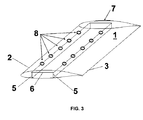
FIG. 3 shows a perspective of the wing wherein the torsion box with its component parts and the wing itself are viewed. - 1: Wing; 2: Leading edge; 3: Trailing edge; 4: Torsion box; 5: Spars; 6: Upper skin; 7: Skinnings; 8: Actuators
- The wing of the present invention is a morphing wing with a mobile upper surface. Morphing of the wing allows its adjustment to an aerodynamically favourable profile for the aircraft flight at low speed configuration, and more specifically for take-off and landing. A great advantage of the present invention is that when the wing morphs to conform to the configuration of low-speed flight, the chord does not decrease, whereby the lifting capacity of the wing does not decrease.
- The wing (1) comprises a leading edge (2) and a trailing edge (3) which are morphing. Each of these edges may morph a different length depending on the aerodynamic needs. Inside the wing (1) there is a torsion box (4) whose walls are formed by the lower surface of the wing, the main wing spars (5) of the wing and an upper skin (6). On said upper skin (6) of the torsion box (4) there is double skinning (7) of the upper surface of the wing. One of the skinnings (7) corresponds to the leading edge (2) skinning and another corresponds to the trailing edge (3) and they overlap in the central area of the wing with the possibility of relative displacement between the two parts. Such skinnings (7) extend in the direction of the wing profile chord. The wing comprises actuators (8) which are placed on the main wing spars (5) and which exert a reaction force against said spars (5) when exerting the required force to morph the wing skinning, moving the skinnings (7) in the direction of the chord. The actuators (8) allow the morphing of the wing skinning to the limits established by the ideal configuration to fly at low speeds. The wing (1) also comprises a locking system in case of failure that ensures the morphed configuration of the wing and thus safe landing.
- Another object of the present invention is an aircraft comprising wings as described above.
Claims (2)
- An aircraft wing (1) comprising a leading edge (2) and a trailing edge (3) which are morphing and inside the wing (1) there is a torsion box (4) whose walls are formed by the lower surface of the wing, the main wing spars (5) of the wing and an upper skin (6) and the wing is characterized in that on the upper skin (6) there is a double skinning (7) of the upper surface of the wing (1), wherein one of the skinnings (7) corresponds to the leading edge (2) and the other one corresponds to the trailing edge (3) and they overlap in the central area of the wing with the possibility of relative displacement between the two skinnings (7) and they extend in the direction of the chord of the wing (1) profile, the wing (1) comprises actuators (8) placed on the main wing spars (5) and which exert a reaction force against said spars (5) when they exert the force required to morph the wing (1) displacing the skinnings (7) in the direction of the chord of the profile to the configuration of low speed flight, take-off and landing.
- Aircraft comprising wings as described in claim 1.
Applications Claiming Priority (2)
| Application Number | Priority Date | Filing Date | Title |
|---|---|---|---|
| ES201200910A ES2512915B1 (en) | 2012-09-13 | 2012-09-13 | Deformable wing with mobile extrados |
| PCT/ES2013/000205 WO2014041221A1 (en) | 2012-09-13 | 2013-09-13 | Deformable wing including a mobile upper surface |
Publications (2)
| Publication Number | Publication Date |
|---|---|
| EP2896563A1 true EP2896563A1 (en) | 2015-07-22 |
| EP2896563A4 EP2896563A4 (en) | 2016-06-01 |
Family
ID=50277670
Family Applications (1)
| Application Number | Title | Priority Date | Filing Date |
|---|---|---|---|
| EP13837224.8A Withdrawn EP2896563A4 (en) | 2012-09-13 | 2013-09-13 | DEFORMABLE WING WITH EXTRADOS MOBILE |
Country Status (4)
| Country | Link |
|---|---|
| US (1) | US9856013B2 (en) |
| EP (1) | EP2896563A4 (en) |
| ES (1) | ES2512915B1 (en) |
| WO (1) | WO2014041221A1 (en) |
Cited By (2)
| Publication number | Priority date | Publication date | Assignee | Title |
|---|---|---|---|---|
| WO2020040671A1 (en) * | 2018-08-19 | 2020-02-27 | Hernadi Andras | Methods for improvements of the closed wing aircraft concept and corresponding aircraft configurations |
| CN111688911A (en) * | 2020-05-26 | 2020-09-22 | 哈尔滨工业大学 | Deformation wing device based on four-corner star-shaped scissor mechanism and rib plates with variable lengths |
Families Citing this family (10)
| Publication number | Priority date | Publication date | Assignee | Title |
|---|---|---|---|---|
| ES2512915B1 (en) | 2012-09-13 | 2015-05-20 | Universidad De Sevilla | Deformable wing with mobile extrados |
| EP3197770A1 (en) | 2014-09-25 | 2017-08-02 | Bombardier Inc. | Morphing skin for an aircraft |
| US10538306B2 (en) * | 2016-12-21 | 2020-01-21 | The Boeing Company | Wing flap deflection control removal |
| US10468545B1 (en) * | 2017-02-28 | 2019-11-05 | Solaero Technologies Corp. | Airfoil body including a moveable section of an outer surface carrying an array of transducer elements |
| DE102017216399A1 (en) * | 2017-09-15 | 2019-03-21 | Airbus Operations Gmbh | Control surface for an aircraft and aircraft with a flexible control surface |
| US11021228B2 (en) | 2019-02-12 | 2021-06-01 | Toyota Motor Engineering & Manufacturing North America, Inc. | Morphing airfoil system |
| US12103676B2 (en) * | 2019-03-09 | 2024-10-01 | United States Of America As Represented By The Administrator Of Nasa | Elastic shape morphing of ultra-light structures by programmable assembly |
| CN115571324B (en) * | 2022-12-09 | 2023-03-31 | 中国空气动力研究与发展中心设备设计与测试技术研究所 | Composite material bistable skin structure and application thereof to morphing wing |
| CN115892445B (en) * | 2023-01-04 | 2025-04-18 | 西北工业大学 | Aircraft and deformable wing |
| CN117125246A (en) * | 2023-08-08 | 2023-11-28 | 中山大学·深圳 | Intelligent deformation wing based on variable cavity large skin structure |
Family Cites Families (15)
| Publication number | Priority date | Publication date | Assignee | Title |
|---|---|---|---|---|
| GB103400A (en) * | 1916-04-29 | 1917-01-25 | Varioplane Company Ltd | Improvements in and relating to Planes and the like for Aeroplanes. |
| GB209031A (en) * | 1922-12-30 | 1924-12-19 | Piero Magni | Improvements in or relating to variable fluido-dynamic wings, such as for aeroplanes |
| US1567531A (en) * | 1923-03-24 | 1925-12-29 | Magni Piero | Variable fluido-dynamic wings such as for aeroplanes |
| US1749021A (en) | 1929-02-22 | 1930-03-04 | Edward H Davis | Aeroplane |
| US2223335A (en) * | 1938-07-14 | 1940-11-26 | Harry H Stewart | Aircraft wing |
| US2349858A (en) * | 1943-03-08 | 1944-05-30 | Richard H Gillmor | Adjustable airfoil |
| FR922899A (en) * | 1946-01-14 | 1947-06-20 | Device for varying the curvature of airfoils, stabilizers and auxiliary surfaces of aerial locomotion devices | |
| US6015115A (en) | 1998-03-25 | 2000-01-18 | Lockheed Martin Corporation | Inflatable structures to control aircraft |
| DE59900022D1 (en) | 1998-05-25 | 2001-01-11 | Prospective Concepts Ag Zollik | ADAPTIVE PNEUMATIC WING FOR SOLID WING AIRCRAFT |
| GB2386884B (en) * | 2002-03-28 | 2005-09-14 | Richard Linsley-Hood | Aerofoil with variable camber |
| US6622974B1 (en) | 2002-08-14 | 2003-09-23 | The Boeing Company | Geometric morphing wing with expandable spars |
| ES2341794T3 (en) | 2005-08-25 | 2010-06-28 | Gkn Aerospace Services Limited | AUXILIARY WING OF THE WING ATTACK OF THE WING OF AN AIRPLANE. |
| US20120104181A1 (en) * | 2010-11-02 | 2012-05-03 | Matthew Boyd Rix | Cross-Sectionally Morphing Airfoil |
| GB201115860D0 (en) * | 2011-09-14 | 2011-10-26 | Rolls Royce Plc | A variable geometry structure |
| ES2512915B1 (en) | 2012-09-13 | 2015-05-20 | Universidad De Sevilla | Deformable wing with mobile extrados |
-
2012
- 2012-09-13 ES ES201200910A patent/ES2512915B1/en active Active
-
2013
- 2013-09-13 EP EP13837224.8A patent/EP2896563A4/en not_active Withdrawn
- 2013-09-13 WO PCT/ES2013/000205 patent/WO2014041221A1/en not_active Ceased
- 2013-09-13 US US14/428,031 patent/US9856013B2/en not_active Expired - Fee Related
Cited By (4)
| Publication number | Priority date | Publication date | Assignee | Title |
|---|---|---|---|---|
| WO2020040671A1 (en) * | 2018-08-19 | 2020-02-27 | Hernadi Andras | Methods for improvements of the closed wing aircraft concept and corresponding aircraft configurations |
| US12337966B2 (en) | 2018-08-19 | 2025-06-24 | Andras Hernadi | Methods for improvements of the closed wing aircraft concept and corresponding aircraft configurations |
| CN111688911A (en) * | 2020-05-26 | 2020-09-22 | 哈尔滨工业大学 | Deformation wing device based on four-corner star-shaped scissor mechanism and rib plates with variable lengths |
| CN111688911B (en) * | 2020-05-26 | 2023-02-17 | 哈尔滨工业大学 | Deformation wing device based on four-corner star-shaped scissor mechanism and rib plates with variable lengths |
Also Published As
| Publication number | Publication date |
|---|---|
| US9856013B2 (en) | 2018-01-02 |
| US20150298792A1 (en) | 2015-10-22 |
| EP2896563A4 (en) | 2016-06-01 |
| ES2512915A1 (en) | 2014-10-24 |
| ES2512915B1 (en) | 2015-05-20 |
| WO2014041221A1 (en) | 2014-03-20 |
Similar Documents
| Publication | Publication Date | Title |
|---|---|---|
| US9856013B2 (en) | Deformable wing including a mobile upper surface | |
| EP2864195B1 (en) | Morphing wing for an aircraft | |
| Jha et al. | Morphing aircraft concepts, classifications, and challenges | |
| US8056865B2 (en) | Mechanism for changing the shape of a control surface | |
| US6843452B1 (en) | Variable trailing edge geometry and spanload control | |
| EP2397403B1 (en) | Morphing control surface transition | |
| US9598167B2 (en) | Morphing airfoil leading edge | |
| US10654557B2 (en) | Morphing skin for an aircraft | |
| US9415856B2 (en) | Dual-rib morphing leading edge | |
| US8695925B2 (en) | Elastically deformable side-edge link for trailing-edge flap aeroacoustic noise reduction | |
| US10625847B2 (en) | Split winglet | |
| US11174002B2 (en) | Edge morphing arrangement for an airfoil | |
| JP2013212834A (en) | Performance-enhancing winglet system and method therefor | |
| EP2965985A1 (en) | Morphable structure | |
| EP3388331B1 (en) | Slidable divergent trailing edge device | |
| US11780567B2 (en) | Wingtip device for an aircraft | |
| CN100488839C (en) | Aircraft comprising a lift-generating fuselage | |
| CN112278238B (en) | Wing and aircraft that can warp in succession | |
| EP3498595B1 (en) | Aircraft wing comprising cruise mini flaps | |
| US20140151511A1 (en) | Aircraft with at least two aircraft fuselages and two main wings | |
| Khorrami et al. | Elastically deformable side-edge link for trailing-edge flap aeroacoustic noise reduction | |
| GB2580064A (en) | Wingtip device for an aircraft |
Legal Events
| Date | Code | Title | Description |
|---|---|---|---|
| PUAI | Public reference made under article 153(3) epc to a published international application that has entered the european phase |
Free format text: ORIGINAL CODE: 0009012 |
|
| 17P | Request for examination filed |
Effective date: 20150410 |
|
| AK | Designated contracting states |
Kind code of ref document: A1 Designated state(s): AL AT BE BG CH CY CZ DE DK EE ES FI FR GB GR HR HU IE IS IT LI LT LU LV MC MK MT NL NO PL PT RO RS SE SI SK SM TR |
|
| AX | Request for extension of the european patent |
Extension state: BA ME |
|
| DAX | Request for extension of the european patent (deleted) | ||
| RA4 | Supplementary search report drawn up and despatched (corrected) |
Effective date: 20160429 |
|
| RIC1 | Information provided on ipc code assigned before grant |
Ipc: B64C 3/44 20060101ALN20160422BHEP Ipc: B64C 3/48 20060101AFI20160422BHEP |
|
| STAA | Information on the status of an ep patent application or granted ep patent |
Free format text: STATUS: EXAMINATION IS IN PROGRESS |
|
| 17Q | First examination report despatched |
Effective date: 20180809 |
|
| STAA | Information on the status of an ep patent application or granted ep patent |
Free format text: STATUS: THE APPLICATION IS DEEMED TO BE WITHDRAWN |
|
| 18D | Application deemed to be withdrawn |
Effective date: 20230401 |