EP2894460A1 - Method for automated analysis, automated analyzer, and program for automated analyzers - Google Patents
Method for automated analysis, automated analyzer, and program for automated analyzers Download PDFInfo
- Publication number
- EP2894460A1 EP2894460A1 EP13835939.3A EP13835939A EP2894460A1 EP 2894460 A1 EP2894460 A1 EP 2894460A1 EP 13835939 A EP13835939 A EP 13835939A EP 2894460 A1 EP2894460 A1 EP 2894460A1
- Authority
- EP
- European Patent Office
- Prior art keywords
- components
- resolution
- spectral data
- multivariate curve
- pieces
- Prior art date
- Legal status (The legal status is an assumption and is not a legal conclusion. Google has not performed a legal analysis and makes no representation as to the accuracy of the status listed.)
- Granted
Links
Images




Classifications
-
- G—PHYSICS
- G01—MEASURING; TESTING
- G01N—INVESTIGATING OR ANALYSING MATERIALS BY DETERMINING THEIR CHEMICAL OR PHYSICAL PROPERTIES
- G01N30/00—Investigating or analysing materials by separation into components using adsorption, absorption or similar phenomena or using ion-exchange, e.g. chromatography or field flow fractionation
- G01N30/02—Column chromatography
- G01N30/86—Signal analysis
-
- G—PHYSICS
- G01—MEASURING; TESTING
- G01N—INVESTIGATING OR ANALYSING MATERIALS BY DETERMINING THEIR CHEMICAL OR PHYSICAL PROPERTIES
- G01N21/00—Investigating or analysing materials by the use of optical means, i.e. using sub-millimetre waves, infrared, visible or ultraviolet light
- G01N21/17—Systems in which incident light is modified in accordance with the properties of the material investigated
- G01N21/25—Colour; Spectral properties, i.e. comparison of effect of material on the light at two or more different wavelengths or wavelength bands
- G01N21/27—Colour; Spectral properties, i.e. comparison of effect of material on the light at two or more different wavelengths or wavelength bands using photo-electric detection ; circuits for computing concentration
-
- G—PHYSICS
- G01—MEASURING; TESTING
- G01N—INVESTIGATING OR ANALYSING MATERIALS BY DETERMINING THEIR CHEMICAL OR PHYSICAL PROPERTIES
- G01N30/00—Investigating or analysing materials by separation into components using adsorption, absorption or similar phenomena or using ion-exchange, e.g. chromatography or field flow fractionation
- G01N30/02—Column chromatography
- G01N30/86—Signal analysis
- G01N30/8675—Evaluation, i.e. decoding of the signal into analytical information
- G01N30/8686—Fingerprinting, e.g. without prior knowledge of the sample components
-
- G—PHYSICS
- G01—MEASURING; TESTING
- G01N—INVESTIGATING OR ANALYSING MATERIALS BY DETERMINING THEIR CHEMICAL OR PHYSICAL PROPERTIES
- G01N30/00—Investigating or analysing materials by separation into components using adsorption, absorption or similar phenomena or using ion-exchange, e.g. chromatography or field flow fractionation
- G01N30/02—Column chromatography
- G01N30/86—Signal analysis
- G01N30/8696—Details of Software
-
- G—PHYSICS
- G06—COMPUTING OR CALCULATING; COUNTING
- G06F—ELECTRIC DIGITAL DATA PROCESSING
- G06F17/00—Digital computing or data processing equipment or methods, specially adapted for specific functions
- G06F17/10—Complex mathematical operations
-
- G—PHYSICS
- G01—MEASURING; TESTING
- G01N—INVESTIGATING OR ANALYSING MATERIALS BY DETERMINING THEIR CHEMICAL OR PHYSICAL PROPERTIES
- G01N2201/00—Features of devices classified in G01N21/00
- G01N2201/12—Circuits of general importance; Signal processing
- G01N2201/129—Using chemometrical methods
- G01N2201/1293—Using chemometrical methods resolving multicomponent spectra
Definitions
- the present invention relates to an automatic analysis method, an automatic analysis apparatus and a program for the automatic analysis apparatus for analyzing a component included in a sample by using multivariate curve resolution.
- a component included in a sample is generally analyzed by using multivariate curve resolution (MCR) (for example, see Patent Documents 1 and 2).
- MCR multivariate curve resolution
- Resolution spectral data about respective components included in the sample is obtained by using the multivariate curve resolution, and the components can be discriminated based on each pieces of the resolution spectral data.
- a spectrum is detected at a plurality of measurement points on a sample surface, and a measurement data matrix D is obtained based on the spectrum at each of the measurement points.
- the following relational expression (1) is established for this measurement data matrix D.
- a symbol C is a concentration matrix presenting concentration of the components at each of the measurement points
- a symbol S T is a transposed matrix of a spectral matrix S where spectra of the components are arranged
- a symbol E is a matrix of noise components included in the measurement data matrix D.
- D CS T + E
- C and S T are calculated based on the measurement data matrix D so that a sum of squares of the E component in the expression (1) is minimum.
- Such a process can be executed by using a publicly-known algorithm such as an Alternative Least Square (ALS).
- ALS Alternative Least Square
- the spectra of the respective columns of the spectral matrix S obtained by the calculated S T compose the resolution spectral data of the components obtained by the multivariate curve resolution.
- a number of components to be resolved should be set in advance.
- a resolved result of a data matrix can be expressed as the following expression (2) by using a concentration matrix C k and a spectral matrix S k obtained by the multivariate curve resolution.
- a symbol S k T is a transposed matrix of the spectral matrix S k
- a symbol E k is a residual matrix.
- the number of components to be resolved should be set in advance. For this reason, when an unknown sample is analyzed, a number of components included in the sample should be estimated by any method.
- the number of components included in a sample is estimated by another various methods such as a method for performing principal component analysis on a detected result of spectra and determining a number of main components until a cumulative contribution ratio exceeds a predetermined threshold as the number of components, and a method using a Malinowski's empirical function IND.
- estimated values of the number of components obtained by the respective methods vary, and thus the results vary dependently on the adopted methods.
- the present invention is devised from the above circumstances, and its object is to provide an automatic analysis method, an automatic analysis apparatus, and a program for the automatic analysis apparatus capable of discriminating a number of components included in a sample more accurately and easily.
- An automatic analysis method of the present invention includes: a multivariate curve resolution executing step of executing multivariate curve resolution using a provisional number of components as a number of components included in a sample so as to obtain resolution spectral data whose number of pieces is the same as a provisional number of components; a component discriminating step of discriminating components based on the respective pieces of resolution spectral data obtained by the multivariate curve resolution; and a component number determining step of determining a number of the components included in the sample based on the result of discriminating the components, wherein at the multivariate curve resolution executing step, the multivariate curve resolution is repeated until a border value between a provisional number of components in a case where components are discriminated as being different in all the pieces of the resolution spectral data obtained by the multivariate curve resolution and a provisional number of components in a case where the components are discriminated as being matched in at least two pieces of the resolution spectral data in all the pieces of the resolution spectral data obtained by the multivariate curve resolution
- components are discriminated based on resolution spectral data obtained by multivariate curve resolution using a provisional number of components, and the number of components included in a sample can be determined based on the discriminated result.
- the multivariate curve resolution is repeated until a border value between a provisional number of components discriminated as being different in all the resolution spectral data obtained by the multivariate curve resolution and a provisional number of components discriminated as being matched in at least two pieces of the resolution spectral data in the respective pieces of the resolution spectral data obtained by the multivariate curve resolution is obtained.
- the number of components included in the sample can be discriminated more accurately and easily based on the border value.
- a provisional number of components may be increased one by one so that the multivariate curve resolution is repeated until the components are discriminated as being matched in at least two pieces of the resolution spectral data in all the pieces of the resolution spectral data obtained by the multivariate curve resolution.
- a provisional number of components at that time may be used as the border value, and a value obtained by subtracting one from the border value may be determined as the number of components included in the sample.
- a library of spectral data about known components may be used, and all the pieces of the resolution spectral data obtained by the multivariate curve resolution may be compared with the spectral data in the library, so that the components are discriminated.
- all the pieces of the resolution spectral data obtained by the multivariate curve resolution may be compared with each other, and the components may be discriminated based on whether similarities of the resolution spectral data are a predetermined threshold or more.
- the components are discriminated based on whether similarity of the respective pieces of the resolution spectral data is a predetermined threshold or more, so that the number of components included in the sample can be discriminated for a short time.
- the automatic analysis method may further includes: a concentration distribution display step of displaying concentration distribution of the components discriminated at the component discriminating step as a chemical image.
- concentration distribution of the components is displayed as a chemical image so that an analyzed result can be displayed in a comprehensible way.
- An automatic analysis apparatus of the present invention includes: a multivariate curve resolution execution processor for executing multivariate curve resolution using a provisional number of components as a number of components included in a sample, and obtaining resolution spectral data whose number of pieces is the same as a provisional number of components; a component discrimination processor for discriminating components based on all the pieces of the resolution spectral data obtained by the multivariate curve resolution; and a component number determination processor for determining the number of components included in the sample based on the result of discriminating the components, wherein the multivariate curve resolution execution processor repeats the multivariate curve resolution until a border value between a provisional number of components in a case where the components are discriminated as being different in all the pieces of the resolution spectral data obtained by the multivariate curve resolution and a provisional number of components in a case where the components are discriminated as being matched in at least two pieces of the resolution spectral data in all the pieces of the resolution spectral data obtained by the multivariate curve resolution is obtained, the component
- a program for an automatic analysis apparatus of the present invention is for making a computer function as: a multivariate curve resolution execution processor for executing multivariate curve resolution using a provisional number of components as a number of components included in a sample, and obtaining resolution spectral data whose number of pieces is the same as a provisional number of components; a component discrimination processor for discriminating components based on all the pieces of the resolution spectral data obtained by the multivariate curve resolution; and a component number determining processor for determining the number of components included in the sample based on the result of discriminating the components, wherein the multivariate curve resolution execution processor repeats the multivariate curve resolution until a border value between a provisional number of components in a case where the components are discriminated as being different in all the pieces of the resolution spectral data obtained by the multivariate curve resolution and a provisional number of components in a case where the components are discriminated as being matched in at least two pieces of the resolution spectral data in all the pieces of the resolution spectral data obtained by
- components are discriminated based on the respective pieces of the resolution spectral data obtained by the multivariate curve resolution using a provisional number of components, and the number of components included in a sample is determined based on the discriminated result, so that the number of components included in the sample can be discriminated more accurately and easily.
- Fig. 1 is a block diagram illustrating a constitutional example of an automatic analysis apparatus according to one embodiment of the present invention.
- the automatic analysis apparatus is an apparatus for analyzing components included in a sample by using multivariate curve resolution (MCR).
- the automatic analysis apparatus includes a control section 1, a data input section 2, an operating section 3, a display section 4, a multivariate curve resolution result storage section 5, a library storage section 6, and a spectral retrieval result storage section 7.
- the control section 1 includes, for example, a CPU (Central Processing Unit), and executes programs so as to function as respective various function parts such as a multivariate curve resolution execution processor 11, a component discrimination processor 12, a component number determination processor 13, and a concentration distribution display processor 14.
- a measuring device detects spectra at a plurality of measurement points on a sample surface (a plurality of divided regions on the sample surface), for example, and a measurement data matrix D is obtained based on the spectra at the measurement points.
- the measurement data matrix D can be obtained by, for example, transposing column vectors d 1 , d 2 , ..., d n representing spectra at n-number of measurement points and arranging them in tandem.
- the measurement data matrix D obtained in such a manner is input into the control section 1 via the data input section 2.
- the data input section 2 may be constituted so as to be connectable to the measuring device in a wired or wireless way, or so that data obtained by the measuring device is input into the data input section 2 via a storage medium.
- the automatic analysis apparatus of the present invention can be constituted integrally with the measuring device.
- the multivariate curve resolution result storage section 5, the library storage section 6, and the spectral retrieval result storage section 7 can be composed of one or a plurality of memories, namely, can be composed of, for example, a ROM (Read Only Memory) or a RAM (Random Access Memory).
- the operating section 3 includes, for example, a keyboard or a mouse, and an analyst operates the operating section 3 so as to be capable of performing input works.
- the display section 4 can be composed of, for example, a liquid crystal display, and thus analyzed results can be displayed on the display section 4.
- the multivariate curve resolution execution processor 11 executes the multivariate curve resolution based on the measurement data matrix D input from the data input section 2.
- the provisional number of components k is set as the number of components included in the sample in this embodiment, and the multivariate curve resolution is executed by using the provisional number of components k.
- a concentration matrix C k and the spectral matrix S k in which a sum of squares of elements of a residual matrix E k in the following expression (3) is minimum are calculated based on the measurement data matrix D.
- Such a process can be executed by using, for example, a publicly known algorithm such as an alternating least squares method (ALS).
- a symbol S k T in the following expression (3) is a transposed matrix of the spectral matrix S k .
- D C k ⁇ S k T + E k
- the concentration matrix C k and the spectral matrix S k that are calculated (resolved) in the above manner are related with each other so as to be stored in the multivariate curve resolution result storage section 5.
- the spectra in the respective columns of the spectral matrix S k compose resolution spectral data about respective components obtained by the multivariate curve resolution, and the resolution spectral data whose number of pieces is the same as the provisional number of components k are obtained.
- the component discrimination processor 12 discriminates components based on the respective pieces of resolution spectral data obtained by the multivariate curve resolution.
- components can be discriminated by using a library of spectral data about known components (known spectral data) stored in the library storage section 6.
- the respective pieces of the resolution spectral data obtained by the multivariate curve resolution are compared with the respective pieces of known spectral data in the library stored in the library storage section 6, so that matched components are retrieved (spectral retrieval).
- This spectral retrieval can be performed in a manner that, for example, similarity between the respective pieces of the resolution spectral data and the respective pieces of known spectral data is calculated, and components corresponding to the known spectral data whose similarity is the highest are used as the retrieved result.
- components corresponding to the respective pieces of the resolution spectral data can be discriminated (identified), and the discriminated result (spectral retrieval result) is stored in the spectral retrieval result storage section 7.
- the provisional number of components k is set to "2" as an initial value so that the multivariate curve resolution is executed.
- the provisional number of components k is increased one by one and the multivariate curve resolution is repeated until components are discriminated as being matched in at least two pieces of the resolution spectral data in all the pieces of the resolution spectral data obtained by the multivariate curve resolution.
- the provisional number of components k is increased one by one and the multivariate curve resolution is executed.
- the provisional number of components k can be discriminated as exceeding an actual number of components.
- the provisional number of components k that is discriminated as exceeding the actual number of components is a border value between a provisional number of components (k - 1) to be discriminated as different components in all the pieces of the resolution spectral data obtained by the multivariate curve resolution, and a provisional number of components (k) to be discriminated as the matched components in at least two pieces of the resolution spectral data in all the pieces of the resolution spectral data obtained by the multivariate curve resolution.
- the multivariate curve resolution is repeated until the border value (the provisional number of components k) is obtained, and the number of components included in the sample can be determined based on the obtained border value.
- the component number determination processor 13 determines the number of components included in the sample based on the result of the components discriminated by the component discrimination processor 12.
- a value (k - 1) obtained by subtracting one from the border value is determined as the number of components included in a sample based on the border value (the provisional number of components k) obtained in the above manner. That is to say, when the components are discriminated as being matched in at least two pieces of the resolution spectral data in all the pieces of the resolution spectral data obtained by the multivariate curve resolution, the provisional number of components k at this time is used as the border value, and a value obtained by subtracting one from the border value is determined as the number of components included in the sample.
- the concentration distribution display processor 14 displays the concentration distribution of the components discriminated by the component discrimination processor 12 as a chemical image on the display section 4. Concretely, the concentration matrix C k obtained by the multivariate curve resolution is read from the multivariate curve resolution result storage section 5, and concentration of the respective components at the measurement points on the sample surface is displayed as image data on the display section 4. The concentration distribution of the components is displayed as the chemical image in such a manner so that the analyzed result can be displayed in a comprehensible way.
- two pieces of resolution spectral data obtained by the multivariate curve resolution are completely different from each other as shown in Figs. 2(a) and 2(b) , and the components are discriminated as being different in two pieces of the resolution spectral data by the spectral retrieval in the component discrimination processor 12.
- three pieces of the resolution spectral data obtained by the multivariate curve resolution are as shown in Figs. 3(a), 3(b) and 3(c) , respectively, and the resolution spectral data is similar between Figs. 3(b) and 3(c) .
- the provisional number of components k can be discriminated as exceeding the actual number of components.
- "2" that is a value obtained by subtracting one from the provisional number of components k is determined as the number of components included in the sample.
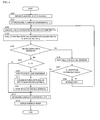
- Fig. 4 is a flowchart illustrating one example of a process to be executed by the control section 1.
- the measurement data matrix D is first obtained based on spectra detected at the plurality of measurement points on the sample surface (step S101).
- the provisional number of components k is set to "2" (step S102), and the multivariate curve resolution is executed by using the provisional number of components k (step S103: a multivariate curve resolution executing step).
- the concentration matrix C k and the spectral matrix S k are obtained so as to be stored in the multivariate curve resolution result storage section 5.
- Spectral retrieval is performed on the resolution spectral data of the respective components composing the spectra in the columns of the spectral matrix S k by using the known spectral data in the library stored in the library storage section 6 (step S104: a component discriminating step).
- step S105 when the components are discriminated as being different in all the pieces of the resolution spectral data obtained by the multivariate curve resolution (Yes at step S105), the results of the spectral retrieval for the respective components are stored in the spectral retrieval result storage section 7 (step S106), and a determination is made whether the provisional number of components k at that time reaches a predetermined repetition determined value (step S107).
- the repetition determined value can be set to any value that is 3 or more.
- the repetition determined value may be set as a defined value in advance, or the analyst operates the operating section 3 so as to be capable of setting the repetition determined value. Further, for example, the repetition determined value can be also set based on the number of components predicted from a cumulative contribution ratio by performing principal component analysis.
- the provisional number of components k is "2" and thus does not reach the repetition determined value (No at step S107). For this reason, after the provisional number of components k is increased by one to "3" (step S108), the multivariate curve resolution is again executed (step S103: a multivariate curve resolution executing step).
- the provisional number of components k is increased one by one so that the multivariate curve resolution is repeated until the components are discriminated as being matched in at least two pieces of the resolution spectral data in all the pieces of the resolution spectral data obtained by the multivariate curve resolution (until No at step S105).
- step S113 a component number determining step
- step S114 a concentration distribution display step
- step S109 When the components are discriminated as being matched in at least two pieces of the resolution spectral data in all the pieces of the resolution spectral data obtained by the multivariate curve resolution with the provisional number of components k not reaching the repetition determined value (No at step S105), a determination is made whether the provisional number of components k at that time is "2" (step S109).
- step S109 When the provisional number of components k is not "2" (No at step S109), the value (k - 1) obtained by subtracting one from the provisional number of components k at that time is determined as the number of components included in the sample (step S113: the component number determining step). As the analyzed result, the concentration distribution of the components is displayed as a chemical image on the display section 4 (step S114: the concentration distribution display step).
- the multivariate curve resolution is performed with the number of components being "1" (step S110).
- a concentration matrix C 1 and a spectral matrix S 1 obtained as the result are stored in the multivariate curve resolution result storage section 5.
- Spectral retrieval is performed on the resolution spectral data of one component composing a spectrum in the spectral matrix S 1 by using respective pieces of known spectral data in the library stored in the library storage section 6 (step S111).
- a result of the spectral retrieval is stored in the spectral retrieval result storage section 7 (step S112).
- the provisional number of components k is "2”
- "1" obtained by subtracting one from the provisional number of components k is determined as the number of components included in the sample (step S113: the component number determining step).
- the concentration distribution of the component is displayed as a chemical image on the display section 4 (step S114: the concentration distribution display step).
- the present invention is not limited to the constitution where the concentration distribution (chemical image) of the components is displayed on the display section 4 during a series of process including the multivariate curve resolution, and thus may have a constitution where the concentration distribution of the components may be displayed on the display section 4 in response to the operation of the operating section 3 performed by the analyst.
- components are discriminated based on the respective pieces of the resolution spectral data obtained by the multivariate curve resolution using the provisional number of components k, and the number of components included in the sample can be determined based on the discriminated result.
- the multivariate curve resolution is repeated until a border value between a provisional number of components discriminated as being different in all the pieces of the resolution spectral data obtained by the multivariate curve resolution and a provisional number of components discriminated as being matched in at least two pieces of the resolution spectral data in the respective pieces of the resolution spectral data obtained by the multivariate curve resolution is obtained.
- the number of components included in the sample can be discriminated more accurately and easily based on the border value.
- the number of components included in the sample can be discriminated more accurately and easily based on the border value (the provisional number of components k) that is obtained by increasing the provisional number of components k one by one and repeating the multivariate curve resolution until the components are discriminated as being matched in at least two pieces of the resolution spectral data in all the pieces of the resolution spectral data obtained by the multivariate curve resolution.
- the execution of the multivariate curve resolution is ended.
- the analysis time can be shortened.
- components are discriminated by using the library of the spectral data of the known components (known spectral data), so that the discrimination of the number of components included in the sample and the identification of the components included in the sample can be made simultaneously, and thus the sample can be analyzed efficiently.
- Fig. 5 is a flowchart illustrating one example of a process to be executed by the control section 1 of the automatic analysis apparatus according to another embodiment.
- This embodiment is different from the above embodiment in that the components included in the sample are not discriminated (identified) by the spectral retrieval using the library of the known spectral data but are discriminated (distinguished) by comparing all the pieces of the resolution spectral data obtained by the multivariate curve resolution.
- the measurement data matrix D is first obtained based on spectra detected at a plurality of measurement points on a sample surface (step S201). Thereafter, the provisional number of components k is set to "2" (step S202), and the multivariate curve resolution is executed by using the provisional number of components k (step S203: the multivariate curve resolution executing step).
- the concentration matrix C k and the spectral matrix S k are obtained so as to be stored in the multivariate curve resolution result storage section 5. Similarity of the resolution spectral data of the respective components composing the spectra in the columns in the spectral matrix S k is calculated, so that the components are discriminated (step S204: a component discriminating step).
- the components are discriminated based on whether the similarity of the respective pieces of the resolution spectral data is a predetermined threshold or more. That is to say, when the similarity of the respective pieces of the resolution spectral data is the predetermined threshold or more, the components can be discriminated as being matched. When the similarity of the respective pieces of the resolution spectral data is less than the predetermined threshold, the components can be discriminated as being different from each other.
- step S206 when the components are discriminated as being different in all the pieces of the resolution spectral data obtained by the multivariate curve resolution (Yes at step S205), the determination is made whether the provisional number of components k at that time reaches the predetermined repetition determined value (step S206).
- the repetition determined value can be set to any value that is 3 or more.
- the repetition determined value may be set as a defined value in advance, or the analyst operates the operating section 3 so as to be capable of setting the repetition determined value. Further, for example, the repetition determined value can be also set based on the number of components predicted from a cumulative contribution ratio by performing principal component analysis.
- the provisional number of components k is "2" and thus does not reach the repetition determined value (No at step S206). For this reason, after the provisional number of components k is increased by one into "3" (step S207), the multivariate curve resolution is again executed (step S203: the multivariate curve resolution executing step).
- the provisional number of components k is increased one by one so that the multivariate curve resolution is repeated until the components are discriminated as being matched in at least two pieces of the resolution spectral data in all the pieces of the resolution spectral data obtained by the multivariate curve resolution (until No at step S205).
- step S210 the component number determining step
- step S211 the concentration distribution display step
- the determination is made whether the provisional number of components k at that time is "2" (step S208).
- step S210 the component number determining step.
- step S211 the concentration distribution display step.
- step S208 when the provisional number of components k is "2" (Yes at step S208), namely, the provisional number of components k is still an initial value, the multivariate curve resolution is executed with the number of components being "1" (step S209).
- step S210 the component number determining step.
- step S211 the concentration distribution display step.
- the present invention is not limited to the constitution where the concentration distribution (chemical image) of the components is displayed on the display section 4 during a series of process including the multivariate curve resolution, and thus may have a constitution where the concentration distribution of the components may be displayed on the display section 4 in response to the operation of the operating section 3 performed by the analyst. Further, the components included in the sample may be additionally identified based on the spectral matrix S k obtained by the multivariate curve resolution.
- the components are discriminated based on whether the similarity of the respective pieces of the resolution spectral data is the predetermined threshold or more, so that the number of components included in the sample can be discriminated for a short time.
- the number of components is discriminated by spectral retrieval using a sample in which two components including lactose and folic acid are mixed is described below.
- the numbers of measurement points on a sample surface are 441 (21 rows x21 columns).
- the discrimination is made as lactose in resolution spectral data in Fig. 6(a) .
- the discrimination is made as folic acid in the resolution spectral data in Fig. 6(b) as the result of the spectral retrieval.
- the components are discriminated as lactose as a result of the spectral retrieval in both the resolution spectral data in Figs. 7(a) and 7(b) .
- the components are discriminated as folic acid as a result of the spectral retrieval in the resolution spectral data in Fig. 7(c) .
- the provisional number of components k can be discriminated as exceeding the actual number of components.
- "2" that is obtained by subtracting 1 from the provisional number of components k is determined as the number of components included in the sample. This value is matched with the actual number of components included in the sample, and it is confirmed that the number of components included in the sample can be discriminated accurately.
- This embodiment has described the constitution where the initial value of the provisional number of components k is set to "2" so that the multivariate curve resolution is executed.
- the initial value of the provisional number of components k is not limited to "2", and can be set to any value.
- the constitution may be such that the analyst can set the initial value of the provisional number of components k to any value.
- the present invention is not limited to the constitution where the provisional number of components k is increased one by one and the multivariate curve resolution is repeated, and the present invention may have, for example, a constitution where the provisional number of components k is decreased one by one and the multivariate curve resolution is repeated.
- any other modes can be employed as a concrete mode as long as the multivariate curve resolution is repeated until the border value between the provisional number of components k in a case where the components are discriminated as being different in all the pieces of the resolution spectral data obtained by the multivariate curve resolution and the provisional number of components k in a case where the components are discriminated as being matched in at least two pieces of the resolution spectral data in all the pieces of the resolution spectral data obtained by the multivariate curve resolution is obtained.
- a program for making a computer to operate (the program for the automatic analysis apparatus) as the above-described automatic analysis device can be provided.
- the program may be structured so as to be provided in a form of a storage medium including the program, or the program itself may be provided.
Landscapes
- Physics & Mathematics (AREA)
- Engineering & Computer Science (AREA)
- General Physics & Mathematics (AREA)
- Immunology (AREA)
- Health & Medical Sciences (AREA)
- Life Sciences & Earth Sciences (AREA)
- Chemical & Material Sciences (AREA)
- Analytical Chemistry (AREA)
- Biochemistry (AREA)
- General Health & Medical Sciences (AREA)
- Pathology (AREA)
- Theoretical Computer Science (AREA)
- Mathematical Physics (AREA)
- Data Mining & Analysis (AREA)
- Spectroscopy & Molecular Physics (AREA)
- Algebra (AREA)
- Computational Mathematics (AREA)
- Mathematical Analysis (AREA)
- Mathematical Optimization (AREA)
- Pure & Applied Mathematics (AREA)
- Databases & Information Systems (AREA)
- Software Systems (AREA)
- General Engineering & Computer Science (AREA)
- Library & Information Science (AREA)
- Investigating Or Analysing Materials By Optical Means (AREA)
Abstract
Description
- The present invention relates to an automatic analysis method, an automatic analysis apparatus and a program for the automatic analysis apparatus for analyzing a component included in a sample by using multivariate curve resolution.
- Conventionally, a component included in a sample is generally analyzed by using multivariate curve resolution (MCR) (for example, see
Patent Documents 1 and 2). Resolution spectral data about respective components included in the sample is obtained by using the multivariate curve resolution, and the components can be discriminated based on each pieces of the resolution spectral data. - At the time of an analysis, for example, a spectrum is detected at a plurality of measurement points on a sample surface, and a measurement data matrix D is obtained based on the spectrum at each of the measurement points. The following relational expression (1) is established for this measurement data matrix D. A symbol C is a concentration matrix presenting concentration of the components at each of the measurement points, a symbol ST is a transposed matrix of a spectral matrix S where spectra of the components are arranged, and a symbol E is a matrix of noise components included in the measurement data matrix D.

- In the multivariate curve resolution, C and ST are calculated based on the measurement data matrix D so that a sum of squares of the E component in the expression (1) is minimum. Such a process can be executed by using a publicly-known algorithm such as an Alternative Least Square (ALS). The spectra of the respective columns of the spectral matrix S obtained by the calculated ST compose the resolution spectral data of the components obtained by the multivariate curve resolution.
- In the multivariate curve resolution, a number of components to be resolved should be set in advance. When k-number of components is assumed to be included in a sample, a resolved result of a data matrix can be expressed as the following expression (2) by using a concentration matrix Ck and a spectral matrix Sk obtained by the multivariate curve resolution. A symbol Sk T is a transposed matrix of the spectral matrix Sk , a symbol Ek is a residual matrix. At this time, when the assumed number of the components k is different from the number of existent components, spectra and concentration distribution of the components obtained by the concentration matrix Ck and the spectral matrix Sk are different from spectra and concentration distribution of the components existent in the sample. For this reason, in order to obtain an appropriate resolved result, the multivariate curve resolution should be carried out after the number of components existent in the sample is set.

-
- PATENT DOCUMENT 1: Japanese Patent Application Laid-Open No.
2011-257288 - PATENT DOCUMENT 2: Japanese Translation of
PCT International Application No. 2009-540322 - In the analysis method using the multivariate curve resolution, the number of components to be resolved should be set in advance. For this reason, when an unknown sample is analyzed, a number of components included in the sample should be estimated by any method.
- For example, a method with which an analyst checks peaks of spectra so as to estimate a number of components included in a sample is considered. In such a method, however, the analyst has to have an advanced knowledge of spectrum analysis, and it is difficult to specify components whose peaks are very small.
- Further, for example, it is considered that the number of components included in a sample is estimated by another various methods such as a method for performing principal component analysis on a detected result of spectra and determining a number of main components until a cumulative contribution ratio exceeds a predetermined threshold as the number of components, and a method using a Malinowski's empirical function IND. However, estimated values of the number of components obtained by the respective methods vary, and thus the results vary dependently on the adopted methods.
- The present invention is devised from the above circumstances, and its object is to provide an automatic analysis method, an automatic analysis apparatus, and a program for the automatic analysis apparatus capable of discriminating a number of components included in a sample more accurately and easily.
- An automatic analysis method of the present invention includes: a multivariate curve resolution executing step of executing multivariate curve resolution using a provisional number of components as a number of components included in a sample so as to obtain resolution spectral data whose number of pieces is the same as a provisional number of components; a component discriminating step of discriminating components based on the respective pieces of resolution spectral data obtained by the multivariate curve resolution; and a component number determining step of determining a number of the components included in the sample based on the result of discriminating the components, wherein at the multivariate curve resolution executing step, the multivariate curve resolution is repeated until a border value between a provisional number of components in a case where components are discriminated as being different in all the pieces of the resolution spectral data obtained by the multivariate curve resolution and a provisional number of components in a case where the components are discriminated as being matched in at least two pieces of the resolution spectral data in all the pieces of the resolution spectral data obtained by the multivariate curve resolution is obtained, at the component number determining step, a number of the components included in the sample is determined based on the border value.
- In such a constitution, components are discriminated based on resolution spectral data obtained by multivariate curve resolution using a provisional number of components, and the number of components included in a sample can be determined based on the discriminated result. At this time, the multivariate curve resolution is repeated until a border value between a provisional number of components discriminated as being different in all the resolution spectral data obtained by the multivariate curve resolution and a provisional number of components discriminated as being matched in at least two pieces of the resolution spectral data in the respective pieces of the resolution spectral data obtained by the multivariate curve resolution is obtained. As a result, the number of components included in the sample can be discriminated more accurately and easily based on the border value.
- At the multivariate curve resolution executing step, when the components are discriminated as being different in all the pieces of the resolution spectral data obtained by the multivariate curve resolution, a provisional number of components may be increased one by one so that the multivariate curve resolution is repeated until the components are discriminated as being matched in at least two pieces of the resolution spectral data in all the pieces of the resolution spectral data obtained by the multivariate curve resolution. In this case, at the component number determining step, when the components are discriminated as being matched in at least two pieces of the resolution spectral data in all the pieces of the resolution spectral data obtained by the multivariate curve resolution, a provisional number of components at that time may be used as the border value, and a value obtained by subtracting one from the border value may be determined as the number of components included in the sample.
- In such a constitution, when components are discriminated as being different in all pieces of the resolution spectral data obtained by the multivariate curve resolution, a provisional number of components is increased one by one and the multivariate curve resolution is repeated until the components are discriminated as being matched in at least two pieces of the resolution spectral data in all pieces of the resolution spectral data obtained by the multivariate curve resolution, so that a border value (the provisional number of components) is obtained. As a result, the number of components included in the sample can be discriminated more accurately and easily based on the border value.
- At the multivariate curve resolution executing step, when the provisional number of components reaches the predetermined repetition determined value, execution of the multivariate curve resolution may be ended.
- In such a constitution, since unexpected repetition of the multivariate curve resolution caused by a noise component can be prevented, an analysis time can be shortened.
- At the component discriminating step, a library of spectral data about known components may be used, and all the pieces of the resolution spectral data obtained by the multivariate curve resolution may be compared with the spectral data in the library, so that the components are discriminated.
- In such a constitution, when components are discriminated by using a library of spectral data of known components, the discrimination of the number of the components included in the sample and identification of the components included in the sample can be performed simultaneously, and thus the sample can be analyzed efficiently.
- At the component discriminating step, all the pieces of the resolution spectral data obtained by the multivariate curve resolution may be compared with each other, and the components may be discriminated based on whether similarities of the resolution spectral data are a predetermined threshold or more.
- In such a constitution, the components are discriminated based on whether similarity of the respective pieces of the resolution spectral data is a predetermined threshold or more, so that the number of components included in the sample can be discriminated for a short time.
- The automatic analysis method may further includes: a concentration distribution display step of displaying concentration distribution of the components discriminated at the component discriminating step as a chemical image.
- In such a constitution, concentration distribution of the components is displayed as a chemical image so that an analyzed result can be displayed in a comprehensible way.
- An automatic analysis apparatus of the present invention includes: a multivariate curve resolution execution processor for executing multivariate curve resolution using a provisional number of components as a number of components included in a sample, and obtaining resolution spectral data whose number of pieces is the same as a provisional number of components; a component discrimination processor for discriminating components based on all the pieces of the resolution spectral data obtained by the multivariate curve resolution; and a component number determination processor for determining the number of components included in the sample based on the result of discriminating the components, wherein the multivariate curve resolution execution processor repeats the multivariate curve resolution until a border value between a provisional number of components in a case where the components are discriminated as being different in all the pieces of the resolution spectral data obtained by the multivariate curve resolution and a provisional number of components in a case where the components are discriminated as being matched in at least two pieces of the resolution spectral data in all the pieces of the resolution spectral data obtained by the multivariate curve resolution is obtained, the component number determination processor determines the number of components included in the sample based on the border value.
- A program for an automatic analysis apparatus of the present invention is for making a computer function as: a multivariate curve resolution execution processor for executing multivariate curve resolution using a provisional number of components as a number of components included in a sample, and obtaining resolution spectral data whose number of pieces is the same as a provisional number of components; a component discrimination processor for discriminating components based on all the pieces of the resolution spectral data obtained by the multivariate curve resolution; and a component number determining processor for determining the number of components included in the sample based on the result of discriminating the components, wherein the multivariate curve resolution execution processor repeats the multivariate curve resolution until a border value between a provisional number of components in a case where the components are discriminated as being different in all the pieces of the resolution spectral data obtained by the multivariate curve resolution and a provisional number of components in a case where the components are discriminated as being matched in at least two pieces of the resolution spectral data in all the pieces of the resolution spectral data obtained by the multivariate curve resolution is obtained, the component number determination processor determines the number of components included in the sample based on the border value.
- According to the present invention, components are discriminated based on the respective pieces of the resolution spectral data obtained by the multivariate curve resolution using a provisional number of components, and the number of components included in a sample is determined based on the discriminated result, so that the number of components included in the sample can be discriminated more accurately and easily.
-
-
Fig. 1 is a block diagram illustrating a constitutional example of an automatic analysis apparatus according to one embodiment of the present invention; -
Figs. 2 is a diagram illustrating one example of the resolution spectral data in a case where the multivariate curve resolution is executed in a state that the provisional number of components k = 2; -
Figs. 3 is a diagram illustrating one example of the resolution spectral data in a case where the multivariate curve resolution is executed in a state that the provisional number of components k = 3; -
Fig. 4 is a flowchart illustrating one example of a process to be executed by the control section; -
Fig. 5 is a flowchart illustrating one example of a process to be executed by the control section of the automatic analysis apparatus according to another embodiment; -
Figs. 6 is a diagram illustrating the resolution spectral data in a case where the multivariate curve resolution is executed in a state that the provisional number of components k = 2 in the embodiment of the present invention; and -
Figs. 7 is a diagram illustrating the resolution spectral data in a case where the multivariate curve resolution is executed in a state that the provisional number of components k = 3 in the embodiment of the present invention. -
Fig. 1 is a block diagram illustrating a constitutional example of an automatic analysis apparatus according to one embodiment of the present invention. The automatic analysis apparatus is an apparatus for analyzing components included in a sample by using multivariate curve resolution (MCR). The automatic analysis apparatus includes acontrol section 1, adata input section 2, anoperating section 3, adisplay section 4, a multivariate curve resolutionresult storage section 5, alibrary storage section 6, and a spectral retrievalresult storage section 7. - The
control section 1 includes, for example, a CPU (Central Processing Unit), and executes programs so as to function as respective various function parts such as a multivariate curveresolution execution processor 11, acomponent discrimination processor 12, a componentnumber determination processor 13, and a concentrationdistribution display processor 14. At the time of an analysis, a measuring device (not shown) detects spectra at a plurality of measurement points on a sample surface (a plurality of divided regions on the sample surface), for example, and a measurement data matrix D is obtained based on the spectra at the measurement points. - The measurement data matrix D can be obtained by, for example, transposing column vectors d1, d2, ..., dn representing spectra at n-number of measurement points and arranging them in tandem. The measurement data matrix D obtained in such a manner is input into the
control section 1 via thedata input section 2. Thedata input section 2 may be constituted so as to be connectable to the measuring device in a wired or wireless way, or so that data obtained by the measuring device is input into thedata input section 2 via a storage medium. Further, the automatic analysis apparatus of the present invention can be constituted integrally with the measuring device. - The multivariate curve resolution
result storage section 5, thelibrary storage section 6, and the spectral retrievalresult storage section 7 can be composed of one or a plurality of memories, namely, can be composed of, for example, a ROM (Read Only Memory) or a RAM (Random Access Memory). Theoperating section 3 includes, for example, a keyboard or a mouse, and an analyst operates theoperating section 3 so as to be capable of performing input works. Thedisplay section 4 can be composed of, for example, a liquid crystal display, and thus analyzed results can be displayed on thedisplay section 4. - The multivariate curve
resolution execution processor 11 executes the multivariate curve resolution based on the measurement data matrix D input from thedata input section 2. In order to perform the multivariate curve resolution, since the number of components to be resolved should be set in advance, the provisional number of components k is set as the number of components included in the sample in this embodiment, and the multivariate curve resolution is executed by using the provisional number of components k. - In the multivariate curve resolution, a concentration matrix Ck and the spectral matrix Sk in which a sum of squares of elements of a residual matrix Ek in the following expression (3) is minimum are calculated based on the measurement data matrix D. Such a process can be executed by using, for example, a publicly known algorithm such as an alternating least squares method (ALS). A symbol Sk T in the following expression (3) is a transposed matrix of the spectral matrix Sk.

- The concentration matrix Ck and the spectral matrix Sk that are calculated (resolved) in the above manner are related with each other so as to be stored in the multivariate curve resolution
result storage section 5. The spectra in the respective columns of the spectral matrix Sk compose resolution spectral data about respective components obtained by the multivariate curve resolution, and the resolution spectral data whose number of pieces is the same as the provisional number of components k are obtained. - The
component discrimination processor 12 discriminates components based on the respective pieces of resolution spectral data obtained by the multivariate curve resolution. In this embodiment, components can be discriminated by using a library of spectral data about known components (known spectral data) stored in thelibrary storage section 6. - Concretely, the respective pieces of the resolution spectral data obtained by the multivariate curve resolution are compared with the respective pieces of known spectral data in the library stored in the
library storage section 6, so that matched components are retrieved (spectral retrieval). This spectral retrieval can be performed in a manner that, for example, similarity between the respective pieces of the resolution spectral data and the respective pieces of known spectral data is calculated, and components corresponding to the known spectral data whose similarity is the highest are used as the retrieved result. As a result, components corresponding to the respective pieces of the resolution spectral data can be discriminated (identified), and the discriminated result (spectral retrieval result) is stored in the spectral retrievalresult storage section 7. - In this embodiment, the provisional number of components k is set to "2" as an initial value so that the multivariate curve resolution is executed. When the components are discriminated as being different in all the pieces of the resolution spectral data obtained by the multivariate curve resolution, the provisional number of components k is increased one by one and the multivariate curve resolution is repeated until components are discriminated as being matched in at least two pieces of the resolution spectral data in all the pieces of the resolution spectral data obtained by the multivariate curve resolution.
- That is to say, while components are discriminated as being different in all the pieces of the resolution spectral data obtained by the multivariate curve resolution, different components might be included in a sample. For this reason, the provisional number of components k is increased one by one and the multivariate curve resolution is executed. As a result of increasing the provisional number of components k one by one and repeating the multivariate curve resolution in such a manner, when components are discriminated as being matched in at least two pieces of the resolution spectral data in all the pieces of the resolution spectral data obtained by the multivariate curve resolution, the provisional number of components k can be discriminated as exceeding an actual number of components.
- The provisional number of components k that is discriminated as exceeding the actual number of components is a border value between a provisional number of components (k - 1) to be discriminated as different components in all the pieces of the resolution spectral data obtained by the multivariate curve resolution, and a provisional number of components (k) to be discriminated as the matched components in at least two pieces of the resolution spectral data in all the pieces of the resolution spectral data obtained by the multivariate curve resolution. In this embodiment, the multivariate curve resolution is repeated until the border value (the provisional number of components k) is obtained, and the number of components included in the sample can be determined based on the obtained border value.
- The component
number determination processor 13 determines the number of components included in the sample based on the result of the components discriminated by thecomponent discrimination processor 12. In this embodiment, a value (k - 1) obtained by subtracting one from the border value is determined as the number of components included in a sample based on the border value (the provisional number of components k) obtained in the above manner. That is to say, when the components are discriminated as being matched in at least two pieces of the resolution spectral data in all the pieces of the resolution spectral data obtained by the multivariate curve resolution, the provisional number of components k at this time is used as the border value, and a value obtained by subtracting one from the border value is determined as the number of components included in the sample. - The concentration
distribution display processor 14 displays the concentration distribution of the components discriminated by thecomponent discrimination processor 12 as a chemical image on thedisplay section 4. Concretely, the concentration matrix Ck obtained by the multivariate curve resolution is read from the multivariate curve resolutionresult storage section 5, and concentration of the respective components at the measurement points on the sample surface is displayed as image data on thedisplay section 4. The concentration distribution of the components is displayed as the chemical image in such a manner so that the analyzed result can be displayed in a comprehensible way. -
Figs. 2 is a diagram illustrating one example of the resolution spectral data in a case where the multivariate curve resolution is executed in a state that the provisional number of components k = 2. In this example, two pieces of resolution spectral data obtained by the multivariate curve resolution are completely different from each other as shown inFigs. 2(a) and 2(b) , and the components are discriminated as being different in two pieces of the resolution spectral data by the spectral retrieval in thecomponent discrimination processor 12. - When the components are discriminated as being different in two pieces of the resolution spectral data obtained by the multivariate curve resolution, another components might be included in the sample. For this reason, the provisional number of components k is increased by one, and the multivariate curve resolution is again executed in a state that the provisional number of components k = 3.
-
Figs. 3 is a diagram illustrating one example of the resolution spectral data in a case where the multivariate curve resolution is executed in a state that the provisional number of components k = 3. In this example, three pieces of the resolution spectral data obtained by the multivariate curve resolution are as shown inFigs. 3(a), 3(b) and 3(c) , respectively, and the resolution spectral data is similar betweenFigs. 3(b) and 3(c) . - When the components are discriminated as being matched in the two pieces of the resolution spectral data similar to each other by the spectral retrieval in the
component discrimination processor 12, the provisional number of components k can be discriminated as exceeding the actual number of components. In this case, "2" that is a value obtained by subtracting one from the provisional number of components k is determined as the number of components included in the sample. -
Fig. 4 is a flowchart illustrating one example of a process to be executed by thecontrol section 1. At the time of an analysis, the measurement data matrix D is first obtained based on spectra detected at the plurality of measurement points on the sample surface (step S101). Thereafter, the provisional number of components k is set to "2" (step S102), and the multivariate curve resolution is executed by using the provisional number of components k (step S103: a multivariate curve resolution executing step). - As a result of the multivariate curve resolution, the concentration matrix Ck and the spectral matrix Sk are obtained so as to be stored in the multivariate curve resolution
result storage section 5. Spectral retrieval is performed on the resolution spectral data of the respective components composing the spectra in the columns of the spectral matrix Sk by using the known spectral data in the library stored in the library storage section 6 (step S104: a component discriminating step). - As a result of spectral retrieval, when the components are discriminated as being different in all the pieces of the resolution spectral data obtained by the multivariate curve resolution (Yes at step S105), the results of the spectral retrieval for the respective components are stored in the spectral retrieval result storage section 7 (step S106), and a determination is made whether the provisional number of components k at that time reaches a predetermined repetition determined value (step S107).
- The repetition determined value can be set to any value that is 3 or more. The repetition determined value may be set as a defined value in advance, or the analyst operates the
operating section 3 so as to be capable of setting the repetition determined value. Further, for example, the repetition determined value can be also set based on the number of components predicted from a cumulative contribution ratio by performing principal component analysis. - At a time point when the first multivariate curve resolution is executed, the provisional number of components k is "2" and thus does not reach the repetition determined value (No at step S107). For this reason, after the provisional number of components k is increased by one to "3" (step S108), the multivariate curve resolution is again executed (step S103: a multivariate curve resolution executing step). In this embodiment, the provisional number of components k is increased one by one so that the multivariate curve resolution is repeated until the components are discriminated as being matched in at least two pieces of the resolution spectral data in all the pieces of the resolution spectral data obtained by the multivariate curve resolution (until No at step S105).
- During a process of repeating steps S103 to S108, when the provisional number of components k reaches the repetition determined value (Yes at step S107), the execution of the multivariate curve resolution is ended. In this case, the value (k - 1) obtained by subtracting one from the provisional number of components k at that time is determined as the number of components included in the sample (step S113: a component number determining step), and the concentration distribution of the components is displayed as an analyzed result on the
display section 4 in a form of a chemical image (step S114: a concentration distribution display step). When the provisional number of components k reaches the repetition determined value and the execution of the multivariate curve resolution is ended, this state may be displayed on thedisplay section 4. - When the components are discriminated as being matched in at least two pieces of the resolution spectral data in all the pieces of the resolution spectral data obtained by the multivariate curve resolution with the provisional number of components k not reaching the repetition determined value (No at step S105), a determination is made whether the provisional number of components k at that time is "2" (step S109).
- When the provisional number of components k is not "2" (No at step S109), the value (k - 1) obtained by subtracting one from the provisional number of components k at that time is determined as the number of components included in the sample (step S113: the component number determining step). As the analyzed result, the concentration distribution of the components is displayed as a chemical image on the display section 4 (step S114: the concentration distribution display step).
- On the other hand, when the provisional number of components k is "2" (Yes at step S109), namely, when the provisional number of components k is still an initial value, the multivariate curve resolution is performed with the number of components being "1" (step S110). A concentration matrix C1 and a spectral matrix S1 obtained as the result are stored in the multivariate curve resolution
result storage section 5. Spectral retrieval is performed on the resolution spectral data of one component composing a spectrum in the spectral matrix S1 by using respective pieces of known spectral data in the library stored in the library storage section 6 (step S111). - A result of the spectral retrieval is stored in the spectral retrieval result storage section 7 (step S112). At this time, since the provisional number of components k is "2", "1" obtained by subtracting one from the provisional number of components k is determined as the number of components included in the sample (step S113: the component number determining step). As the analyzed result, the concentration distribution of the component is displayed as a chemical image on the display section 4 (step S114: the concentration distribution display step).
- The present invention is not limited to the constitution where the concentration distribution (chemical image) of the components is displayed on the
display section 4 during a series of process including the multivariate curve resolution, and thus may have a constitution where the concentration distribution of the components may be displayed on thedisplay section 4 in response to the operation of theoperating section 3 performed by the analyst. - In this embodiment, components are discriminated based on the respective pieces of the resolution spectral data obtained by the multivariate curve resolution using the provisional number of components k, and the number of components included in the sample can be determined based on the discriminated result. At this time, the multivariate curve resolution is repeated until a border value between a provisional number of components discriminated as being different in all the pieces of the resolution spectral data obtained by the multivariate curve resolution and a provisional number of components discriminated as being matched in at least two pieces of the resolution spectral data in the respective pieces of the resolution spectral data obtained by the multivariate curve resolution is obtained. As a result, the number of components included in the sample can be discriminated more accurately and easily based on the border value.
- Particularly, in this embodiment, when the components are discriminated as being different in all the pieces of the resolution spectral data obtained by the multivariate curve resolution, the number of components included in the sample can be discriminated more accurately and easily based on the border value (the provisional number of components k) that is obtained by increasing the provisional number of components k one by one and repeating the multivariate curve resolution until the components are discriminated as being matched in at least two pieces of the resolution spectral data in all the pieces of the resolution spectral data obtained by the multivariate curve resolution.
- Further, in this embodiment, when the provisional number of components k reaches the predetermined repetition determined value, the execution of the multivariate curve resolution is ended. As a result, since unexpected repetition of the multivariate curve resolution caused by a noise component can be prevented, the analysis time can be shortened.
- Further, components are discriminated by using the library of the spectral data of the known components (known spectral data), so that the discrimination of the number of components included in the sample and the identification of the components included in the sample can be made simultaneously, and thus the sample can be analyzed efficiently.
-
Fig. 5 is a flowchart illustrating one example of a process to be executed by thecontrol section 1 of the automatic analysis apparatus according to another embodiment. This embodiment is different from the above embodiment in that the components included in the sample are not discriminated (identified) by the spectral retrieval using the library of the known spectral data but are discriminated (distinguished) by comparing all the pieces of the resolution spectral data obtained by the multivariate curve resolution. - At the time of an analysis, the measurement data matrix D is first obtained based on spectra detected at a plurality of measurement points on a sample surface (step S201). Thereafter, the provisional number of components k is set to "2" (step S202), and the multivariate curve resolution is executed by using the provisional number of components k (step S203: the multivariate curve resolution executing step).
- As a result of the multivariate curve resolution, the concentration matrix Ck and the spectral matrix Sk are obtained so as to be stored in the multivariate curve resolution
result storage section 5. Similarity of the resolution spectral data of the respective components composing the spectra in the columns in the spectral matrix Sk is calculated, so that the components are discriminated (step S204: a component discriminating step). - Concretely, the components are discriminated based on whether the similarity of the respective pieces of the resolution spectral data is a predetermined threshold or more. That is to say, when the similarity of the respective pieces of the resolution spectral data is the predetermined threshold or more, the components can be discriminated as being matched. When the similarity of the respective pieces of the resolution spectral data is less than the predetermined threshold, the components can be discriminated as being different from each other.
- As a result, when the components are discriminated as being different in all the pieces of the resolution spectral data obtained by the multivariate curve resolution (Yes at step S205), the determination is made whether the provisional number of components k at that time reaches the predetermined repetition determined value (step S206).
- The repetition determined value can be set to any value that is 3 or more. The repetition determined value may be set as a defined value in advance, or the analyst operates the
operating section 3 so as to be capable of setting the repetition determined value. Further, for example, the repetition determined value can be also set based on the number of components predicted from a cumulative contribution ratio by performing principal component analysis. - At a time point when the first multivariate curve resolution is executed, the provisional number of components k is "2" and thus does not reach the repetition determined value (No at step S206). For this reason, after the provisional number of components k is increased by one into "3" (step S207), the multivariate curve resolution is again executed (step S203: the multivariate curve resolution executing step). In this embodiment, the provisional number of components k is increased one by one so that the multivariate curve resolution is repeated until the components are discriminated as being matched in at least two pieces of the resolution spectral data in all the pieces of the resolution spectral data obtained by the multivariate curve resolution (until No at step S205).
- During the process for repeating steps S203 to S207, when the provisional number of components k reaches the repetition determined value (Yes at step S206), the execution of the multivariate curve resolution is ended. In this case, the value (k - 1) obtained by subtracting one from the provisional number of components k at that time is determined as the number of components included in the sample (step S210: the component number determining step), and the concentration distribution of the components is displayed as a chemical image on the display section 4 (step S211: the concentration distribution display step). When the provisional number of components k reaches the repetition determined value and the execution of the multivariate curve resolution is ended, this state may be displayed on the
display section 4. - When the components are discriminated as being matched in at least two pieces of the resolution spectral data in all the pieces of the resolution spectral data obtained by the multivariate curve resolution with the provisional number of components k not reaching the repetition determined value (No at step S205), the determination is made whether the provisional number of components k at that time is "2" (step S208).
- When the provisional number of components k is not "2" (No at step S208), the value (k - 1) obtained by subtracting one from the provisional number of components k at that time is determined as the number of components included in the sample (step S210: the component number determining step). As the analyzed result, the concentration distribution of the components is displayed as a chemical image on the display section 4 (step S211: the concentration distribution display step).
- On the other hand, when the provisional number of components k is "2" (Yes at step S208), namely, the provisional number of components k is still an initial value, the multivariate curve resolution is executed with the number of components being "1" (step S209). At this time, since the provisional number of components k is "2", "1" obtained by subtracting one from the provisional number of components k is determined as the number of components included in the sample (step S210: the component number determining step). As the analyzed result, the concentration distribution of the component is displayed as a chemical image on the display section 4 (step S211: the concentration distribution display step).
- The present invention is not limited to the constitution where the concentration distribution (chemical image) of the components is displayed on the
display section 4 during a series of process including the multivariate curve resolution, and thus may have a constitution where the concentration distribution of the components may be displayed on thedisplay section 4 in response to the operation of theoperating section 3 performed by the analyst. Further, the components included in the sample may be additionally identified based on the spectral matrix Sk obtained by the multivariate curve resolution. - In this embodiment, the components are discriminated based on whether the similarity of the respective pieces of the resolution spectral data is the predetermined threshold or more, so that the number of components included in the sample can be discriminated for a short time.
- An embodiment where the number of components is discriminated by spectral retrieval using a sample in which two components including lactose and folic acid are mixed is described below. In this embodiment, the numbers of measurement points on a sample surface are 441 (21 rows x21 columns).
-
Figs. 6 is a diagram illustrating the resolution spectral data in a case where the multivariate curve resolution is executed in a state that the provisional number of components k = 2 in the embodiment of the present invention. As a result of the spectral retrieval, the discrimination is made as lactose in resolution spectral data inFig. 6(a) . On the other hand, the discrimination is made as folic acid in the resolution spectral data inFig. 6(b) as the result of the spectral retrieval. - When the components are discriminated as being different in two pieces of resolution spectral data obtained by the multivariate curve resolution, another components might be included in the sample. For this reason, the provisional number of components k is increased by one, and the multivariate curve resolution is again executed in a state that the provisional number of components k = 3.
-
Figs. 7 is a diagram illustrating the resolution spectral data in a case where the multivariate curve resolution is executed in a state that the provisional number of components k = 3 in the embodiment of the present invention. The components are discriminated as lactose as a result of the spectral retrieval in both the resolution spectral data inFigs. 7(a) and 7(b) . On the other hand, the components are discriminated as folic acid as a result of the spectral retrieval in the resolution spectral data inFig. 7(c) . - When the resolution spectral data in which the components are discriminated as being matched (lactose) through spectral retrieval is present, the provisional number of components k can be discriminated as exceeding the actual number of components. In this case, "2" that is obtained by subtracting 1 from the provisional number of components k is determined as the number of components included in the sample. This value is matched with the actual number of components included in the sample, and it is confirmed that the number of components included in the sample can be discriminated accurately.
- This embodiment has described the constitution where the initial value of the provisional number of components k is set to "2" so that the multivariate curve resolution is executed. However, the initial value of the provisional number of components k is not limited to "2", and can be set to any value. In this case, the constitution may be such that the analyst can set the initial value of the provisional number of components k to any value.
- Further, the present invention is not limited to the constitution where the provisional number of components k is increased one by one and the multivariate curve resolution is repeated, and the present invention may have, for example, a constitution where the provisional number of components k is decreased one by one and the multivariate curve resolution is repeated. That is to say, any other modes can be employed as a concrete mode as long as the multivariate curve resolution is repeated until the border value between the provisional number of components k in a case where the components are discriminated as being different in all the pieces of the resolution spectral data obtained by the multivariate curve resolution and the provisional number of components k in a case where the components are discriminated as being matched in at least two pieces of the resolution spectral data in all the pieces of the resolution spectral data obtained by the multivariate curve resolution is obtained.
- Further, a program for making a computer to operate (the program for the automatic analysis apparatus) as the above-described automatic analysis device can be provided. In this case, the program may be structured so as to be provided in a form of a storage medium including the program, or the program itself may be provided.
-
- 1
- control section
- 2
- data input section
- 3
- operating section
- 4
- display section
- 5
- multivariate curve resolution result storage section
- 6
- library storage section
- 7
- spectral retrieval result storage section
- 11
- multivariate curve resolution execution processor
- 12
- component discrimination processor
- 13
- component number determination processor
- 14
- concentration distribution display processor
Claims (8)
- An automatic analysis method comprising:a multivariate curve resolution executing step of executing multivariate curve resolution using a provisional number of components as a number of components included in a sample so as to obtain resolution spectral data whose number of pieces is the same as a provisional number of components;a component discriminating step of discriminating components based on the respective pieces of resolution spectral data obtained by the multivariate curve resolution; anda component number determining step of determining a number of the components included in the sample based on the result of discriminating the components, whereinat the multivariate curve resolution executing step, the multivariate curve resolution is repeated until a border value between a provisional number of components in a case where components are discriminated as being different in all the pieces of the resolution spectral data obtained by the multivariate curve resolution and a provisional number of components in a case where the components are discriminated as being matched in at least two pieces of the resolution spectral data in all the pieces of the resolution spectral data obtained by the multivariate curve resolution is obtained,at the component number determining step, a number of the components included in the sample is determined based on the border value.
- The automatic analysis method according to claim 1, wherein
at the multivariate curve resolution executing step, when the components are discriminated as being different in all the pieces of the resolution spectral data obtained by the multivariate curve resolution, a provisional number of components is increased one by one so that the multivariate curve resolution is repeated until the components are discriminated as being matched in at least two pieces of the resolution spectral data in all the pieces of the resolution spectral data obtained by the multivariate curve resolution,
at the component number determining step, when the components are discriminated as being matched in at least two pieces of the resolution spectral data in all the pieces of the resolution spectral data obtained by the multivariate curve resolution, a provisional number of components at that time is used as the border value, and a value obtained by subtracting one from the border value is determined as the number of components included in the sample. - The automatic analysis method according to claim 2, wherein at the multivariate curve resolution executing step, when the provisional number of components reaches the predetermined repetition determined value, execution of the multivariate curve resolution is ended.
- The automatic analysis method according to any one of claims 1 to 3, wherein at the component discriminating step, a library of spectral data about known components is used, and all the pieces of the resolution spectral data obtained by the multivariate curve resolution is compared with the spectral data in the library, so that the components are discriminated.
- The automatic analysis method according to any one of claims 1 to 3, wherein at the component discriminating step, all the pieces of the resolution spectral data obtained by the multivariate curve resolution are compared with each other, and the components are discriminated based on whether similarities of the resolution spectral data are a predetermined threshold or more.
- The automatic analysis method according to any one of claims 1 to 5, further comprising: a concentration distribution display step of displaying concentration distribution of the components discriminated at the component discriminating step as a chemical image.
- An automatic analysis apparatus, comprising:a multivariate curve resolution execution processor for executing multivariate curve resolution using a provisional number of components as a number of components included in a sample, and obtaining resolution spectral data whose number of pieces is the same as a provisional number of components;a component discrimination processor for discriminating components based on all the pieces of the resolution spectral data obtained by the multivariate curve resolution; anda component number determination processor for determining the number of components included in the sample based on the result of discriminating the components, whereinthe multivariate curve resolution execution processor repeats the multivariate curve resolution until a border value between a provisional number of components in a case where the components are discriminated as being different in all the pieces of the resolution spectral data obtained by the multivariate curve resolution and a provisional number of components in a case where the components are discriminated as being matched in at least two pieces of the resolution spectral data in all the pieces of the resolution spectral data obtained by the multivariate curve resolution is obtained,the component number determination processor determines the number of components included in the sample based on the border value.
- A program for an automatic analysis apparatus for making a computer function as:a multivariate curve resolution execution processor for executing multivariate curve resolution using a provisional number of components as a number of components included in a sample, and obtaining resolution spectral data whose number of pieces is the same as a provisional number of components;a component discrimination processor for discriminating components based on all the pieces of the resolution spectral data obtained by the multivariate curve resolution; anda component number determining processor for determining the number of components included in the sample based on the result of discriminating the components, whereinthe multivariate curve resolution execution processor repeats the multivariate curve resolution until a border value between a provisional number of components in a case where the components are discriminated as being different in all the pieces of the resolution spectral data obtained by the multivariate curve resolution and a provisional number of components in a case where the components are discriminated as being matched in at least two pieces of the resolution spectral data in all the pieces of the resolution spectral data obtained by the multivariate curve resolution is obtained,the component number determination processor determines the number of components included in the sample based on the border value.
Applications Claiming Priority (2)
| Application Number | Priority Date | Filing Date | Title |
|---|---|---|---|
| JP2012196962 | 2012-09-07 | ||
| PCT/JP2013/060099 WO2014038234A1 (en) | 2012-09-07 | 2013-04-02 | Method for automated analysis, automated analyzer, and program for automated analyzers |
Publications (3)
| Publication Number | Publication Date |
|---|---|
| EP2894460A1 true EP2894460A1 (en) | 2015-07-15 |
| EP2894460A4 EP2894460A4 (en) | 2016-05-11 |
| EP2894460B1 EP2894460B1 (en) | 2021-06-16 |
Family
ID=50236859
Family Applications (1)
| Application Number | Title | Priority Date | Filing Date |
|---|---|---|---|
| EP13835939.3A Active EP2894460B1 (en) | 2012-09-07 | 2013-04-02 | Method for automated analysis, automated analyzer, and program for automated analyzers |
Country Status (4)
| Country | Link |
|---|---|
| US (1) | US10330652B2 (en) |
| EP (1) | EP2894460B1 (en) |
| JP (1) | JP5884914B2 (en) |
| WO (1) | WO2014038234A1 (en) |
Families Citing this family (2)
| Publication number | Priority date | Publication date | Assignee | Title |
|---|---|---|---|---|
| JP7719332B2 (en) * | 2021-05-21 | 2025-08-06 | 日本分光株式会社 | Spectroscopic multivariate analysis device and multivariate analysis method |
| US12601701B2 (en) * | 2022-10-19 | 2026-04-14 | Ge Infrastructure Technology Llc | Multi-frequency sensing system and method |
Family Cites Families (16)
| Publication number | Priority date | Publication date | Assignee | Title |
|---|---|---|---|---|
| JP3020885B2 (en) * | 1997-03-17 | 2000-03-15 | 日本バイリーン株式会社 | Cutting pattern correction method, cutting pattern correction system, and storage medium for cutting pattern correction |
| US6341257B1 (en) * | 1999-03-04 | 2002-01-22 | Sandia Corporation | Hybrid least squares multivariate spectral analysis methods |
| US6675106B1 (en) * | 2001-06-01 | 2004-01-06 | Sandia Corporation | Method of multivariate spectral analysis |
| US6584413B1 (en) * | 2001-06-01 | 2003-06-24 | Sandia Corporation | Apparatus and system for multivariate spectral analysis |
| US7538869B2 (en) * | 2004-06-30 | 2009-05-26 | Chemimage Corporation | Multipoint method for identifying hazardous agents |
| US20130082180A1 (en) * | 2004-06-30 | 2013-04-04 | Chemlmage Corporation | Multipoint Method for Assessing a Biological Sample |
| US7254501B1 (en) * | 2004-12-10 | 2007-08-07 | Ahura Corporation | Spectrum searching method that uses non-chemical qualities of the measurement |
| US7373256B2 (en) * | 2005-04-19 | 2008-05-13 | Nicholson Jeremy K | Method for the identification of molecules and biomarkers using chemical, biochemical and biological data |
| US7557915B2 (en) * | 2005-10-24 | 2009-07-07 | Chemimage Corporation | Automated acquisition of spectral data and image data |
| US20070147685A1 (en) * | 2005-12-23 | 2007-06-28 | 3M Innovative Properties Company | User interface for statistical data analysis |
| US20070168154A1 (en) * | 2005-12-23 | 2007-07-19 | Ericson Richard E | User interface for statistical data analysis |
| GB0611981D0 (en) | 2006-06-16 | 2006-07-26 | Renishaw Plc | Spectroscopic analysis methods |
| JP5459088B2 (en) * | 2010-06-10 | 2014-04-02 | 富士通株式会社 | SPECTRUM ANALYSIS METHOD AND SPECTRUM ANALYSIS DEVICE |
| JP5327388B2 (en) * | 2010-07-06 | 2013-10-30 | 株式会社島津製作所 | Analytical data processing method and apparatus |
| US8645082B2 (en) * | 2010-09-13 | 2014-02-04 | Mks Instruments, Inc. | Monitoring, detecting and quantifying chemical compounds in a sample |
| JP6089345B2 (en) * | 2011-10-17 | 2017-03-08 | サーモ エレクトロン サイエンティフィック インストルメンツ リミテッド ライアビリティ カンパニー | Multicomponent regression / multicomponent analysis of temporal and / or spatial series files |
-
2013
- 2013-04-02 EP EP13835939.3A patent/EP2894460B1/en active Active
- 2013-04-02 US US14/422,794 patent/US10330652B2/en not_active Expired - Fee Related
- 2013-04-02 WO PCT/JP2013/060099 patent/WO2014038234A1/en not_active Ceased
- 2013-04-02 JP JP2014534210A patent/JP5884914B2/en active Active
Also Published As
| Publication number | Publication date |
|---|---|
| US20150227491A1 (en) | 2015-08-13 |
| JP5884914B2 (en) | 2016-03-15 |
| EP2894460B1 (en) | 2021-06-16 |
| WO2014038234A1 (en) | 2014-03-13 |
| US10330652B2 (en) | 2019-06-25 |
| JPWO2014038234A1 (en) | 2016-08-08 |
| EP2894460A4 (en) | 2016-05-11 |
Similar Documents
| Publication | Publication Date | Title |
|---|---|---|
| Olivieri et al. | MVC2: A MATLAB graphical interface toolbox for second-order multivariate calibration | |
| CN1690713B (en) | Method, system for analyzing a sample to provide characterization data | |
| Meinrath et al. | Assessment of uncertainty in parameter evaluation and prediction | |
| Olivieri et al. | MVC3: a MATLAB graphical interface toolbox for third-order multivariate calibration | |
| US10598639B2 (en) | Three-dimensional spectral data processing device and processing method | |
| CN110214271B (en) | Analysis data analysis method and analysis data analysis device | |
| CN104849360B (en) | System for monitoring chromatographic mode of operation | |
| CN111351757B (en) | Methods and systems for predicting quantitative measures of oil adulteration of edible oil samples | |
| Marciano et al. | Developmental validation of PACE™: Automated artifact identification and contributor estimation for use with GlobalFiler™ and PowerPlex® fusion 6c generated data | |
| EP1376393A2 (en) | Method and apparatus for data analysis | |
| JP2022061157A (en) | Abnormality detection device and abnormality detection method | |
| EP2894460A1 (en) | Method for automated analysis, automated analyzer, and program for automated analyzers | |
| CN104350378B (en) | Method and apparatus for the performance of measure spectrum system | |
| EP2646811B1 (en) | Method for automatic peak finding in calorimetric data | |
| Shibayama et al. | Iterative optimization technology combined with wavelength selection based on excess absorption for a process analytical technology calibration–minimum approach | |
| Xu et al. | Multivariate HPLC system assessment and optimization for traditional Chinese medicine: a case study of Gastrodia elata | |
| EP4556904A1 (en) | Fingerprint similarity based sample analysis | |
| Vutov et al. | Multiple multi‐sample testing under arbitrary covariance dependency | |
| What Is | Cleaning Process Capability: Understanding Populations, Samples, And Sample Size Requirements | |
| US20250165560A1 (en) | Fingerprint similarity based sample analysis | |
| CN117373565A (en) | Ion mobility spectrometry-mass spectrometry library construction method, identification method and device | |
| WO2018158801A1 (en) | Spectral data feature extraction device and method | |
| Norin et al. | Statistical processing of traffic flow characteristics data | |
| US20250335669A1 (en) | Waveform-Analyzing Method and Waveform-Analyzing Device | |
| CN119066436B (en) | Training method, detection method, device and electronic equipment for predicting model of trace element content |
Legal Events
| Date | Code | Title | Description |
|---|---|---|---|
| PUAI | Public reference made under article 153(3) epc to a published international application that has entered the european phase |
Free format text: ORIGINAL CODE: 0009012 |
|
| 17P | Request for examination filed |
Effective date: 20150226 |
|
| AK | Designated contracting states |
Kind code of ref document: A1 Designated state(s): AL AT BE BG CH CY CZ DE DK EE ES FI FR GB GR HR HU IE IS IT LI LT LU LV MC MK MT NL NO PL PT RO RS SE SI SK SM TR |
|
| AX | Request for extension of the european patent |
Extension state: BA ME |
|
| DAX | Request for extension of the european patent (deleted) | ||
| RA4 | Supplementary search report drawn up and despatched (corrected) |
Effective date: 20160408 |
|
| RIC1 | Information provided on ipc code assigned before grant |
Ipc: G01N 21/27 20060101ALI20160404BHEP Ipc: G01N 35/00 20060101ALI20160404BHEP Ipc: G01N 21/00 20060101AFI20160404BHEP Ipc: G01N 21/35 20140101ALI20160404BHEP |
|
| STAA | Information on the status of an ep patent application or granted ep patent |
Free format text: STATUS: REQUEST FOR EXAMINATION WAS MADE |
|
| STAA | Information on the status of an ep patent application or granted ep patent |
Free format text: STATUS: EXAMINATION IS IN PROGRESS |
|
| 17Q | First examination report despatched |
Effective date: 20180212 |
|
| GRAP | Despatch of communication of intention to grant a patent |
Free format text: ORIGINAL CODE: EPIDOSNIGR1 |
|
| STAA | Information on the status of an ep patent application or granted ep patent |
Free format text: STATUS: GRANT OF PATENT IS INTENDED |
|
| INTG | Intention to grant announced |
Effective date: 20210210 |
|
| RAP1 | Party data changed (applicant data changed or rights of an application transferred) |
Owner name: SHIMADZU CORPORATION |
|
| GRAS | Grant fee paid |
Free format text: ORIGINAL CODE: EPIDOSNIGR3 |
|
| GRAA | (expected) grant |
Free format text: ORIGINAL CODE: 0009210 |
|
| STAA | Information on the status of an ep patent application or granted ep patent |
Free format text: STATUS: THE PATENT HAS BEEN GRANTED |
|
| AK | Designated contracting states |
Kind code of ref document: B1 Designated state(s): AL AT BE BG CH CY CZ DE DK EE ES FI FR GB GR HR HU IE IS IT LI LT LU LV MC MK MT NL NO PL PT RO RS SE SI SK SM TR |
|
| REG | Reference to a national code |
Ref country code: GB Ref legal event code: FG4D |
|
| REG | Reference to a national code |
Ref country code: CH Ref legal event code: EP |
|
| REG | Reference to a national code |
Ref country code: DE Ref legal event code: R096 Ref document number: 602013077976 Country of ref document: DE |
|
| REG | Reference to a national code |
Ref country code: AT Ref legal event code: REF Ref document number: 1402742 Country of ref document: AT Kind code of ref document: T Effective date: 20210715 |
|
| REG | Reference to a national code |
Ref country code: IE Ref legal event code: FG4D |
|
| REG | Reference to a national code |
Ref country code: LT Ref legal event code: MG9D |
|
| PG25 | Lapsed in a contracting state [announced via postgrant information from national office to epo] |
Ref country code: HR Free format text: LAPSE BECAUSE OF FAILURE TO SUBMIT A TRANSLATION OF THE DESCRIPTION OR TO PAY THE FEE WITHIN THE PRESCRIBED TIME-LIMIT Effective date: 20210616 Ref country code: LT Free format text: LAPSE BECAUSE OF FAILURE TO SUBMIT A TRANSLATION OF THE DESCRIPTION OR TO PAY THE FEE WITHIN THE PRESCRIBED TIME-LIMIT Effective date: 20210616 Ref country code: FI Free format text: LAPSE BECAUSE OF FAILURE TO SUBMIT A TRANSLATION OF THE DESCRIPTION OR TO PAY THE FEE WITHIN THE PRESCRIBED TIME-LIMIT Effective date: 20210616 Ref country code: BG Free format text: LAPSE BECAUSE OF FAILURE TO SUBMIT A TRANSLATION OF THE DESCRIPTION OR TO PAY THE FEE WITHIN THE PRESCRIBED TIME-LIMIT Effective date: 20210916 |
|
| REG | Reference to a national code |
Ref country code: AT Ref legal event code: MK05 Ref document number: 1402742 Country of ref document: AT Kind code of ref document: T Effective date: 20210616 |
|
| REG | Reference to a national code |
Ref country code: NL Ref legal event code: MP Effective date: 20210616 |
|
| PG25 | Lapsed in a contracting state [announced via postgrant information from national office to epo] |
Ref country code: GR Free format text: LAPSE BECAUSE OF FAILURE TO SUBMIT A TRANSLATION OF THE DESCRIPTION OR TO PAY THE FEE WITHIN THE PRESCRIBED TIME-LIMIT Effective date: 20210917 Ref country code: LV Free format text: LAPSE BECAUSE OF FAILURE TO SUBMIT A TRANSLATION OF THE DESCRIPTION OR TO PAY THE FEE WITHIN THE PRESCRIBED TIME-LIMIT Effective date: 20210616 Ref country code: NO Free format text: LAPSE BECAUSE OF FAILURE TO SUBMIT A TRANSLATION OF THE DESCRIPTION OR TO PAY THE FEE WITHIN THE PRESCRIBED TIME-LIMIT Effective date: 20210916 Ref country code: SE Free format text: LAPSE BECAUSE OF FAILURE TO SUBMIT A TRANSLATION OF THE DESCRIPTION OR TO PAY THE FEE WITHIN THE PRESCRIBED TIME-LIMIT Effective date: 20210616 Ref country code: RS Free format text: LAPSE BECAUSE OF FAILURE TO SUBMIT A TRANSLATION OF THE DESCRIPTION OR TO PAY THE FEE WITHIN THE PRESCRIBED TIME-LIMIT Effective date: 20210616 |
|
| PG25 | Lapsed in a contracting state [announced via postgrant information from national office to epo] |
Ref country code: SK Free format text: LAPSE BECAUSE OF FAILURE TO SUBMIT A TRANSLATION OF THE DESCRIPTION OR TO PAY THE FEE WITHIN THE PRESCRIBED TIME-LIMIT Effective date: 20210616 Ref country code: SM Free format text: LAPSE BECAUSE OF FAILURE TO SUBMIT A TRANSLATION OF THE DESCRIPTION OR TO PAY THE FEE WITHIN THE PRESCRIBED TIME-LIMIT Effective date: 20210616 Ref country code: CZ Free format text: LAPSE BECAUSE OF FAILURE TO SUBMIT A TRANSLATION OF THE DESCRIPTION OR TO PAY THE FEE WITHIN THE PRESCRIBED TIME-LIMIT Effective date: 20210616 Ref country code: EE Free format text: LAPSE BECAUSE OF FAILURE TO SUBMIT A TRANSLATION OF THE DESCRIPTION OR TO PAY THE FEE WITHIN THE PRESCRIBED TIME-LIMIT Effective date: 20210616 Ref country code: PT Free format text: LAPSE BECAUSE OF FAILURE TO SUBMIT A TRANSLATION OF THE DESCRIPTION OR TO PAY THE FEE WITHIN THE PRESCRIBED TIME-LIMIT Effective date: 20211018 Ref country code: NL Free format text: LAPSE BECAUSE OF FAILURE TO SUBMIT A TRANSLATION OF THE DESCRIPTION OR TO PAY THE FEE WITHIN THE PRESCRIBED TIME-LIMIT Effective date: 20210616 Ref country code: RO Free format text: LAPSE BECAUSE OF FAILURE TO SUBMIT A TRANSLATION OF THE DESCRIPTION OR TO PAY THE FEE WITHIN THE PRESCRIBED TIME-LIMIT Effective date: 20210616 Ref country code: ES Free format text: LAPSE BECAUSE OF FAILURE TO SUBMIT A TRANSLATION OF THE DESCRIPTION OR TO PAY THE FEE WITHIN THE PRESCRIBED TIME-LIMIT Effective date: 20210616 Ref country code: AT Free format text: LAPSE BECAUSE OF FAILURE TO SUBMIT A TRANSLATION OF THE DESCRIPTION OR TO PAY THE FEE WITHIN THE PRESCRIBED TIME-LIMIT Effective date: 20210616 |
|
| PG25 | Lapsed in a contracting state [announced via postgrant information from national office to epo] |
Ref country code: PL Free format text: LAPSE BECAUSE OF FAILURE TO SUBMIT A TRANSLATION OF THE DESCRIPTION OR TO PAY THE FEE WITHIN THE PRESCRIBED TIME-LIMIT Effective date: 20210616 |
|
| REG | Reference to a national code |
Ref country code: DE Ref legal event code: R097 Ref document number: 602013077976 Country of ref document: DE |
|
| PLBE | No opposition filed within time limit |
Free format text: ORIGINAL CODE: 0009261 |
|
| STAA | Information on the status of an ep patent application or granted ep patent |
Free format text: STATUS: NO OPPOSITION FILED WITHIN TIME LIMIT |
|
| PG25 | Lapsed in a contracting state [announced via postgrant information from national office to epo] |
Ref country code: DK Free format text: LAPSE BECAUSE OF FAILURE TO SUBMIT A TRANSLATION OF THE DESCRIPTION OR TO PAY THE FEE WITHIN THE PRESCRIBED TIME-LIMIT Effective date: 20210616 |
|
| 26N | No opposition filed |
Effective date: 20220317 |
|
| PG25 | Lapsed in a contracting state [announced via postgrant information from national office to epo] |
Ref country code: AL Free format text: LAPSE BECAUSE OF FAILURE TO SUBMIT A TRANSLATION OF THE DESCRIPTION OR TO PAY THE FEE WITHIN THE PRESCRIBED TIME-LIMIT Effective date: 20210616 |
|
| PG25 | Lapsed in a contracting state [announced via postgrant information from national office to epo] |
Ref country code: IT Free format text: LAPSE BECAUSE OF FAILURE TO SUBMIT A TRANSLATION OF THE DESCRIPTION OR TO PAY THE FEE WITHIN THE PRESCRIBED TIME-LIMIT Effective date: 20210616 |
|
| REG | Reference to a national code |
Ref country code: DE Ref legal event code: R119 Ref document number: 602013077976 Country of ref document: DE |
|
| REG | Reference to a national code |
Ref country code: CH Ref legal event code: PL |
|
| GBPC | Gb: european patent ceased through non-payment of renewal fee |
Effective date: 20220402 |
|
| REG | Reference to a national code |
Ref country code: BE Ref legal event code: MM Effective date: 20220430 |
|
| PG25 | Lapsed in a contracting state [announced via postgrant information from national office to epo] |
Ref country code: MC Free format text: LAPSE BECAUSE OF FAILURE TO SUBMIT A TRANSLATION OF THE DESCRIPTION OR TO PAY THE FEE WITHIN THE PRESCRIBED TIME-LIMIT Effective date: 20210616 Ref country code: LU Free format text: LAPSE BECAUSE OF NON-PAYMENT OF DUE FEES Effective date: 20220402 Ref country code: LI Free format text: LAPSE BECAUSE OF NON-PAYMENT OF DUE FEES Effective date: 20220430 Ref country code: GB Free format text: LAPSE BECAUSE OF NON-PAYMENT OF DUE FEES Effective date: 20220402 Ref country code: FR Free format text: LAPSE BECAUSE OF NON-PAYMENT OF DUE FEES Effective date: 20220430 Ref country code: DE Free format text: LAPSE BECAUSE OF NON-PAYMENT OF DUE FEES Effective date: 20221103 Ref country code: CH Free format text: LAPSE BECAUSE OF NON-PAYMENT OF DUE FEES Effective date: 20220430 |
|
| PG25 | Lapsed in a contracting state [announced via postgrant information from national office to epo] |
Ref country code: BE Free format text: LAPSE BECAUSE OF NON-PAYMENT OF DUE FEES Effective date: 20220430 |
|
| PG25 | Lapsed in a contracting state [announced via postgrant information from national office to epo] |
Ref country code: IE Free format text: LAPSE BECAUSE OF NON-PAYMENT OF DUE FEES Effective date: 20220402 |
|
| PG25 | Lapsed in a contracting state [announced via postgrant information from national office to epo] |
Ref country code: HU Free format text: LAPSE BECAUSE OF FAILURE TO SUBMIT A TRANSLATION OF THE DESCRIPTION OR TO PAY THE FEE WITHIN THE PRESCRIBED TIME-LIMIT; INVALID AB INITIO Effective date: 20130402 |
|
| PG25 | Lapsed in a contracting state [announced via postgrant information from national office to epo] |
Ref country code: MK Free format text: LAPSE BECAUSE OF FAILURE TO SUBMIT A TRANSLATION OF THE DESCRIPTION OR TO PAY THE FEE WITHIN THE PRESCRIBED TIME-LIMIT Effective date: 20210616 Ref country code: CY Free format text: LAPSE BECAUSE OF FAILURE TO SUBMIT A TRANSLATION OF THE DESCRIPTION OR TO PAY THE FEE WITHIN THE PRESCRIBED TIME-LIMIT Effective date: 20210616 |
|
| PG25 | Lapsed in a contracting state [announced via postgrant information from national office to epo] |
Ref country code: MT Free format text: LAPSE BECAUSE OF FAILURE TO SUBMIT A TRANSLATION OF THE DESCRIPTION OR TO PAY THE FEE WITHIN THE PRESCRIBED TIME-LIMIT Effective date: 20210616 |
|
| PG25 | Lapsed in a contracting state [announced via postgrant information from national office to epo] |
Ref country code: TR Free format text: LAPSE BECAUSE OF FAILURE TO SUBMIT A TRANSLATION OF THE DESCRIPTION OR TO PAY THE FEE WITHIN THE PRESCRIBED TIME-LIMIT Effective date: 20210616 |