EP2894082A1 - Transport vehicle having a variable width - Google Patents
Transport vehicle having a variable width Download PDFInfo
- Publication number
- EP2894082A1 EP2894082A1 EP15150539.3A EP15150539A EP2894082A1 EP 2894082 A1 EP2894082 A1 EP 2894082A1 EP 15150539 A EP15150539 A EP 15150539A EP 2894082 A1 EP2894082 A1 EP 2894082A1
- Authority
- EP
- European Patent Office
- Prior art keywords
- hydraulic
- trolleys
- jacks
- intermediate portion
- steering
- Prior art date
- Legal status (The legal status is an assumption and is not a legal conclusion. Google has not performed a legal analysis and makes no representation as to the accuracy of the status listed.)
- Granted
Links
Images


Classifications
-
- B—PERFORMING OPERATIONS; TRANSPORTING
- B62—LAND VEHICLES FOR TRAVELLING OTHERWISE THAN ON RAILS
- B62D—MOTOR VEHICLES; TRAILERS
- B62D7/00—Steering linkage; Stub axles or their mountings
- B62D7/06—Steering linkage; Stub axles or their mountings for individually-pivoted wheels, e.g. on king-pins
- B62D7/14—Steering linkage; Stub axles or their mountings for individually-pivoted wheels, e.g. on king-pins the pivotal axes being situated in more than one plane transverse to the longitudinal centre line of the vehicle, e.g. all-wheel steering
- B62D7/142—Steering linkage; Stub axles or their mountings for individually-pivoted wheels, e.g. on king-pins the pivotal axes being situated in more than one plane transverse to the longitudinal centre line of the vehicle, e.g. all-wheel steering specially adapted for particular vehicles, e.g. tractors, carts, earth-moving vehicles, trucks
- B62D7/144—Steering linkage; Stub axles or their mountings for individually-pivoted wheels, e.g. on king-pins the pivotal axes being situated in more than one plane transverse to the longitudinal centre line of the vehicle, e.g. all-wheel steering specially adapted for particular vehicles, e.g. tractors, carts, earth-moving vehicles, trucks for vehicles with more than two axles
-
- B—PERFORMING OPERATIONS; TRANSPORTING
- B62—LAND VEHICLES FOR TRAVELLING OTHERWISE THAN ON RAILS
- B62D—MOTOR VEHICLES; TRAILERS
- B62D13/00—Steering specially adapted for trailers
- B62D13/04—Steering specially adapted for trailers for individually-pivoted wheels
-
- B—PERFORMING OPERATIONS; TRANSPORTING
- B62—LAND VEHICLES FOR TRAVELLING OTHERWISE THAN ON RAILS
- B62D—MOTOR VEHICLES; TRAILERS
- B62D53/00—Tractor-trailer combinations; Road trains
- B62D53/04—Tractor-trailer combinations; Road trains comprising a vehicle carrying an essential part of the other vehicle's load by having supporting means for the front or rear part of the other vehicle
- B62D53/06—Semi-trailers
- B62D53/067—Multi-purpose, convertible or extendable load surface semi-trailers
Definitions
- the present invention relates to a transport vehicle having a variable width.
- the present invention relates to a rubber tired transport vehicle having a variable width.
- trailer or semitrailer type vehicles according to the attachment type to the tractor, and always comprising a chassis defining a load bed, a front steering trolley assembly and a rear steering trolley assembly.
- the front and the rear assemblies comprise, in turn, a respective right row and a respective left row of trolleys thereof, each of which is coupled to the chassis in rotational or steering manner about a vertical axis thereof.
- the front and rear assemblies each comprise a mechanically and/or hydraulically actuated steering device which interface with each other.
- Each steering device comprises, in turn, a respective rocker arm actuating lever, which extends in the sense of the width of the vehicle between the respective right and left rows of trolleys and has two reciprocally opposite side arms, one for each of the respective rows of trolleys, and an intermediate portion hinged to the chassis between the two rows of trolleys themselves to pivot about an axis parallel to the steering axes of the trolleys themselves.
- the rocker arm lever of the front assembly is connected by means of tie-rods/struts to a revolving input member of the vehicle steering control, e.g. the fifth wheel or the goose neck attachment bar.
- each rocker arm lever are connected to an end trolley of the respective rows of trolleys by means of respective tie-rods/struts instead.
- an end of a respective dual-acting hydraulic jack is coupled to each of the arms of the rocker arm levers, which jack is hydraulically connected to the other jacks to define a hydraulic control circuit of the rotation of the lever arm of the rear assembly and a parallel hydraulic safety circuit capable of allowing the rotation of both rocker arm levers also in case of breakage of a pipe or of a branch of the mentioned hydraulic control circuit.
- rocker arm levers described above thus allow, on one hand, to always steer the trolleys of each row of trolleys according to the predetermined steering law but determine, on the other hand, the vehicle width because they are mechanically connected to both the respective right and left trolley rows, in some solutions, and are in all cases always mechanically connected to the shafts of the hydraulic actuators, in others.
- the vehicle width is varied in discreet manner by using rocker arm levers which are adjustable in length in steps instead of the traditional fixed length rocker arm levers, each comprising at least one pair of portions coupled to each other in axially sliding manner and locked to each other, for example, by means of reference pins.
- the steering law is certainly varied in case of human error during the adjustment of the length of the rocker arm levers.
- a transport vehicle having a variable width comprising: a chassis defining a load bed and comprising an intermediate portion elongated in a longitudinal advancement direction of the vehicle and at least two elongated side portions arranged on opposite sides of the intermediate portion and movable orthogonally to the longitudinal direction towards and away from the intermediate portion; a row of front trolleys and a row of rear trolleys hinged to the respective side portion to rotate about respective steering axes orthogonal to the load bed for each side portion; a revolving input member of a steering control of the vehicle coupled to said intermediate portion; and steering means of said trolleys angularly coupled to said revolving input member, characterized in that said steering means comprise a hydraulic control block and a mechanical transmission interposed between said revolving input member and said hydraulic control block both connected only to said intermediate portion; and, for each side portion, a first hydraulic actuating block for the front trolleys and a second hydraulic actuating block for the rear trolleys and motion reversing
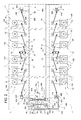
- reference numeral 1 indicates a transport vehicle having a variable width as a whole.
- the vehicle 1, of the trailer or semitrailer type comprises a chassis 2 defining a load bed 3 and, in turn, comprising an intermediate portion or floor 4 elongated in a longitudinal direction 6 of advancement of the vehicle 1 and two side portions or floors 7 and 8 elongated in the same direction 6 and arranged on opposite side parts of the intermediate floor 4 and in the longitudinal direction 6 itself.
- a respective slide guide motorized device 10 is arranged in the vehicle 1, between each side floor 7,8 and the central floor 4, to vary the width B of the vehicle 1.
- the device 10 known in itself and not described in detail, allows the respective side floor 7,8 to be displaced orthogonally to the longitudinal direction 6 between a position near the floor 4 and corresponding to a minimum width position of the vehicle 1 and a distanced position of maximum width of the vehicle 1 itself.
- Each side floor 7,8 carries a respective row 11 of front trolleys 12 and a respective row 13 of rear trolleys 14; the front row 11 and the rear row 13 are reciprocally aligned along a direction parallel to direction 6.
- Each trolley 12,14 is coupled to the respective side portion 7,8 by means of a respective fifth wheel, known in itself and not shown, to turn about a fixed hinge axis 15 thereof parallel to the other hinge axes 15 and orthogonal to the load bed 3.
- the trolleys 12,14 of a same row 11,13 of trolleys comprised between the first trolley 12A,14A and the last trolley 12B and 14B are connected to each other in angularly fixed positions by means of the interposition of mechanical connecting rod-crank transmissions 16, known in themselves and not described in detail.
- the last trolley 12B and the first trolley 14A are connected to each other in angularly fixed positions by means of a connecting rod-crank reversing mechanism 18 adapted to allow the steering or rotation of the trolleys 14 of the rear rows 13 in opposite sense with respect to the sense of rotation of the trolleys 12 of the front rows.
- each reversing device 18 comprises a rocker arm lever 20 having an intermediate portion hinged to the respective side floor 7,8 to rotate in opposite senses about a fixed hinge axis 21 parallel to the axes 15 and respective opposite arms 22 connected by means of respective tie-rod/struts 23 to the last trolley 12B of the respective front row 11 and to the first trolley 14A of the respective rear row 12, respectively.
- the intermediate floor 4 carries a member 25 (known in itself) coupled to a respective front portion 4A of the vehicle 1 for attaching to a tractor 25A (diagrammatically shown) for advancing the vehicle 1 itself.
- the attachment member 25 is connected to a front portion 4A of the intermediate floor 4 in rotational manner in opposite senses about a fixed hinge axis orthogonal to the load bed 3.
- the vehicle 1 then comprises a steering assembly 26 of the trolleys 12,14 controlled by the attachment member 25.
- the assembly 26 comprises a hydraulic control device 26A carried by portion 4A in position adjacent to the member 25 and a mechanical transmission 26B in addition to the reversing devices 18.
- the mechanical transmission 26B comprises, in turn, an input toothed wheel 27 of the steering control, which is coupled to the portion 4A in rotational manner about a fixed vertical axis 27A and is connected in angularly fixed manner to the attachment device 25.
- the wheel 27 is integrally connected to the member 25 to rotate about the axis 27A simultaneously with the member 25 itself.
- the wheel 27 is coupled in angularly fixed manner to a fifth wheel (not shown) of the member 25 or is rotated about axis 27A by a mechanical arm and lever transmission interposed between the member 25 and the wheel 27 itself.
- the mechanical transmission 26B further comprises a pair of racks indicated by reference numerals 29 and 30 in addition to the wheel 27.
- the racks 29 and 30 are parallel to each other, are arranged on diametrically opposite side of the toothed wheel 27 and mesh with the toothed wheel 27 itself to translate in opposite senses during the rotation of the toothed wheel 27.
- the hydraulic device 26A comprises reciprocally equal, two dual-acting hydraulic jacks 31 and 32, which have their opposite output rods stably connected to the opposite ends of the rack 29.
- the jacks 31 and 32 then each comprise two respective variable volume chambers, indicated by reference numerals 31A and 31B and by reference numerals 32A and 32B, respectively, the chambers 31B and 32B being crossed by the respective shafts.
- the hydraulic device 26A further comprises two dual-acting hydraulic jacks 35 and 36 conveniently equal to each other and to the jacks 31 and 32; the hydraulic jacks 35 and 36 have their opposite output rods stably connected to the opposite ends of the rack 30 and a respective pair of variable volume chambers, indicated by reference numerals 35A and 35B and by reference numerals 36A and 36B, respectively, the chambers 35B and 36B being crossed by the respective shafts.
- the assembly 26 further comprises four dual-acting actuating or steering hydraulic jacks of the trolleys, indicated by reference numerals 40, 41, 42 and 43, conveniently equal to each other.
- the jacks 40 and 41 are carried by the floor 7 to actuate trolley 12A and trolley 14B, respectively.
- jack 40 comprises a shaft connected to the trolley 12A by means of a respective tie-rod/strut and has two chambers 40A and 40B, chamber 40B being crossed by the shaft
- jack 41 comprises a shaft connected to the trolley 14B by means of a respective tie-rod/strut and has two chambers 41A and 41B, chamber 41B being crossed by the shaft.
- jacks 42 and 43 are carried by the floor 8 to actuate the trolley 12A and the trolley 14B, respectively.
- jack 42 comprises a shaft connected to the trolley 12A by means of a respective tie-rod/strut and has two chambers 42A and 42B, chamber 42B being crossed by the shaft
- jack 43 comprises a shaft connected to the trolley 14B by means of a respective tie-rod/strut and has two chambers 43A and 43B, chamber 43B being crossed by the shaft.
- the assembly 26 finally comprises four double conduit hydraulic pipes 45, 46, 47 and 48 which can be configured to adapt to the change of width of the vehicle 1.
- the word “configurable” means any pipe which may either be flexible or telescopically extendible or not, or even wound in unwindable manner so as to allow the floors 7 and 8 to move freely without constraints with respect to the floor 4 between the mentioned near and distanced positions.
- the pipe 45 comprises two reciprocally connecting conduits 45A and 45B of the chambers 36B and 40B and of the chambers 36A and 40A, respectively;
- the pipe 46 comprises two reciprocally connecting conduits 46A and 46B of the chambers 35A and 43A and of the chambers 35A and 43B, respectively;
- the pipe 47 comprises two reciprocally connecting conduits 47A and 47B of the chambers 32A and 42A and of the chambers 32A and 42B, respectively;
- the pipe 48 comprises two reciprocally connecting conduits 48A and 48B of the chambers 31B and 41B and of the chambers 31A and 41A, respectively.
- the embodiment illustrated in figure 3 relates to a vehicle 49, which differs from the vehicle 1 ( fig.2 ) for some construction details and for a different hydraulic connection, and in which the parts in common to those of the vehicle 1 are indicated, where possible, with the same reference numbers of the corresponding parts of the vehicle 1.
- the vehicle 49 comprises a steering assembly 49A, which differs from the assembly 26 in that it is free from the reversing devices 18 and comprises respective hydraulic jacks 50, 51, 52 and 53 associated to the hydraulic jacks 40, 41, 42 and 43, conveniently equal to one another ( figure 3 ).
- the jacks 50 and 51 are carried by the floor 7, and specifically the jack 50 is directly connected to the jack 40 and comprises a through shaft integrally connected to the shaft of the jack 40 and two chambers 50A and 50B both crossed by the respective shaft, while the jack 51 comprises a shaft integrally connected to the shaft of the jack 41 and has two chambers 51A and 51B both crossed by the respective shaft.
- the jacks 52 and 53 are carried by the floor 8, and specifically the jack 52 comprises a shaft directly connected to the shaft of the jack 42 and has two chambers 53A and 52B, both crossed by the respective shaft, while the jack 53 comprises a shaft integrally connected to the shaft of the jack 42 and has two chambers 53A and 51B both crossed by the respective shaft.
- the jacks 50-53 comprise respective liners which constitute the extension of the liners of the corresponding jacks 40-43 and respective shafts aligned with respect to each other and defined by a body made in one piece.
- the assembly 49A finally comprises four double conduit hydraulic pipes 55, 56, 57 and 58, instead of the pipes 45-48, configurable to adapt to the width variation of the vehicle 1 in the same way as the pipes 45-48 themselves.
- the pipe 55 comprises two reciprocally connecting conduits 55A and 55B of the chambers 36B and 52A and of the chambers 36A and 53A, respectively;
- the pipe 56 comprises two reciprocally connecting conduits 56A and 56B of the chambers 35B and 50A and of the chambers 35A and 50B, respectively;
- the pipe 57 comprises two reciprocally connecting conduits 57A and 57B of the chambers 32A and 53A and of the chambers 32A and 53B, respectively;
- the pipe 58 comprises two reciprocally connecting conduits 58A and 58B of the chambers 31B and 51B and of the chambers 31A and 51A, respectively.
- the assembly 49A then comprises further two hydraulic pipes 59 and 60 connecting the jacks 42 and 43 to each other and the jacks 40 and 41, respectively.
- the pipe 59 comprises two reciprocally connecting conduits 59A and 59B of the chambers 42B and 43A and of the chambers 42A and 43B, respectively;
- the pipe 60 comprises two reciprocally connecting conduits 60A and 60B of the chambers 40B and 41A and of the chambers 40A and 41B, respectively.
- both described assemblies 26 and 49A allow to vary the width B of the vehicle 1,49 in absolutely arbitrary and continuous manner. Both assemblies 26 and 49A then allow to maintain the steering law of the trolleys 12,14 established during the step of designing unchanged regardless of the width B of the vehicle.
- the steering assemblies 26 and 49A have a single mechanical connection between the input member 25 of the steering control and the steering devices of the trolleys; such a mechanical angular condition is mechanically separate from the components/actuators provided aboard the side floors 7,8 to which the trolleys 12,14 are coupled.
- Such side floors 7,8 are thus independently mobile units from and towards the intermediate floor 4 and actuated only by hydraulic actuators connected to each other and to the control device 26A carried by the intermediate floor 4 by simple and common flexible or extendable hydraulic pipes which because of their nature do not restrict the relative movement of parts connected to them at all.
- the steering assembly 26 has two mechanical reversing devices 18 between the respective two front and rear rows but also of devices which do not have mechanical constraints with the intermediate floor 4 because they are fully carried by the side floors 7,8. From the above, it is apparent that the described jacks may be replaced by different jacks and/or jacks connected to one another in different manner from that shown.
Landscapes
- Engineering & Computer Science (AREA)
- Chemical & Material Sciences (AREA)
- Combustion & Propulsion (AREA)
- Transportation (AREA)
- Mechanical Engineering (AREA)
- Steering-Linkage Mechanisms And Four-Wheel Steering (AREA)
Abstract
Description
- The present invention relates to a transport vehicle having a variable width.
- In particular, the present invention relates to a rubber tired transport vehicle having a variable width.
- In the field of transport by means of rubber tired vehicles the need is felt to modify the vehicle size, and in particular its width, as a function of the features of the load to be handled.
- To date, it is known to use trailer or semitrailer type vehicles according to the attachment type to the tractor, and always comprising a chassis defining a load bed, a front steering trolley assembly and a rear steering trolley assembly.
- The front and the rear assemblies comprise, in turn, a respective right row and a respective left row of trolleys thereof, each of which is coupled to the chassis in rotational or steering manner about a vertical axis thereof.
- In order to allow an optimal steering according to a predetermined steering law, it is known to steer the trolleys of the rear assembly in the opposite sense with respect to the front assembly.
- In order to do this, the front and rear assemblies each comprise a mechanically and/or hydraulically actuated steering device which interface with each other.
- Each steering device comprises, in turn, a respective rocker arm actuating lever, which extends in the sense of the width of the vehicle between the respective right and left rows of trolleys and has two reciprocally opposite side arms, one for each of the respective rows of trolleys, and an intermediate portion hinged to the chassis between the two rows of trolleys themselves to pivot about an axis parallel to the steering axes of the trolleys themselves.
- The rocker arm lever of the front assembly is connected by means of tie-rods/struts to a revolving input member of the vehicle steering control, e.g. the fifth wheel or the goose neck attachment bar.
- The arms of each rocker arm lever are connected to an end trolley of the respective rows of trolleys by means of respective tie-rods/struts instead.
- Furthermore, an end of a respective dual-acting hydraulic jack is coupled to each of the arms of the rocker arm levers, which jack is hydraulically connected to the other jacks to define a hydraulic control circuit of the rotation of the lever arm of the rear assembly and a parallel hydraulic safety circuit capable of allowing the rotation of both rocker arm levers also in case of breakage of a pipe or of a branch of the mentioned hydraulic control circuit.
- The rocker arm levers described above thus allow, on one hand, to always steer the trolleys of each row of trolleys according to the predetermined steering law but determine, on the other hand, the vehicle width because they are mechanically connected to both the respective right and left trolley rows, in some solutions, and are in all cases always mechanically connected to the shafts of the hydraulic actuators, in others.
- In some of the known solutions of the type defined above, the vehicle width is varied in discreet manner by using rocker arm levers which are adjustable in length in steps instead of the traditional fixed length rocker arm levers, each comprising at least one pair of portions coupled to each other in axially sliding manner and locked to each other, for example, by means of reference pins.
- Precisely because of their conformation, such adjustable rocker arm levers may be relatively complex from a construction point of view, costly and in some cases complicated to adjust.
- The adjustment of the length of such rocker arm levers takes a relatively long time, requires the use of specialized manpower and causes, in some cases, the undesired variation of the mentioned steering law.
- The steering law is certainly varied in case of human error during the adjustment of the length of the rocker arm levers.
- Such steering errors cannot be immediately detected and become more apparent only during transport when it is not possible to remedy them.
- In such conditions and in all cases following the compromises determined by the step adjustment of the rocker arm levers, many of the trolleys work in non-optimal, and often critical, stress conditions.
- It is the object of the present invention to provide a transport vehicle having a variable width, the construction features of which allow to solve the problems illustrated above in simple, cost-effective manner, and in particular to make vehicles of any width very rapidly.
- It is a further object of the present invention to make a transport vehicle the variation in width of which does not require mechanical adjustments and does not affect the steering law of the trolleys during the step of design.
- According to the present invention, a transport vehicle having a variable width is made, the vehicle comprising: a chassis defining a load bed and comprising an intermediate portion elongated in a longitudinal advancement direction of the vehicle and at least two elongated side portions arranged on opposite sides of the intermediate portion and movable orthogonally to the longitudinal direction towards and away from the intermediate portion; a row of front trolleys and a row of rear trolleys hinged to the respective side portion to rotate about respective steering axes orthogonal to the load bed for each side portion; a revolving input member of a steering control of the vehicle coupled to said intermediate portion; and steering means of said trolleys angularly coupled to said revolving input member, characterized in that said steering means comprise a hydraulic control block and a mechanical transmission interposed between said revolving input member and said hydraulic control block both connected only to said intermediate portion; and, for each side portion, a first hydraulic actuating block for the front trolleys and a second hydraulic actuating block for the rear trolleys and motion reversing means for steering the front trolleys in a direction opposite to the rear trolleys; said first and second hydraulic blocks and said reversing means being connected only to the respective said side portions; hydraulic pipes extending between said intermediate and side portions, hydraulically connecting said hydraulic control block and said first and second hydraulic actuating blocks and being configurable to follow the displacement of said side portions with respect to said intermediate portion.
- The invention will now be described with reference to the accompanying drawings which illustrate non-limitative embodiments thereof, in which:
-
figure 1 shows, diagrammatically and substantially in blocks, a transport vehicle having a variable width made according to the dictates of the present invention; -
figure 2 shows, diagrammatically and substantially in blocks, a first preferred embodiment of the vehicle in thefigure 1 ; and -
figure 3 shows, diagrammatically and substantially in blocks, a second preferred embodiment of the vehicle infigure 1 . - In
figure 1 ,reference numeral 1 indicates a transport vehicle having a variable width as a whole. - In the particular example described, the
vehicle 1, of the trailer or semitrailer type, comprises achassis 2 defining aload bed 3 and, in turn, comprising an intermediate portion orfloor 4 elongated in alongitudinal direction 6 of advancement of thevehicle 1 and two side portions orfloors 7 and 8 elongated in thesame direction 6 and arranged on opposite side parts of theintermediate floor 4 and in thelongitudinal direction 6 itself. - A respective slide guide
motorized device 10 is arranged in thevehicle 1, between eachside floor 7,8 and thecentral floor 4, to vary the width B of thevehicle 1. Thedevice 10, known in itself and not described in detail, allows therespective side floor 7,8 to be displaced orthogonally to thelongitudinal direction 6 between a position near thefloor 4 and corresponding to a minimum width position of thevehicle 1 and a distanced position of maximum width of thevehicle 1 itself. - Each
side floor 7,8 carries arespective row 11 offront trolleys 12 and arespective row 13 ofrear trolleys 14; thefront row 11 and therear row 13 are reciprocally aligned along a direction parallel todirection 6. Eachtrolley respective side portion 7,8 by means of a respective fifth wheel, known in itself and not shown, to turn about afixed hinge axis 15 thereof parallel to theother hinge axes 15 and orthogonal to theload bed 3. - With reference to
figure 2 , thetrolleys same row first trolley last trolley crank transmissions 16, known in themselves and not described in detail. - The
last trolley 12B and thefirst trolley 14A are connected to each other in angularly fixed positions by means of a connecting rod-crank reversing mechanism 18 adapted to allow the steering or rotation of thetrolleys 14 of therear rows 13 in opposite sense with respect to the sense of rotation of thetrolleys 12 of the front rows. - In the particular example described, each
reversing device 18 comprises arocker arm lever 20 having an intermediate portion hinged to therespective side floor 7,8 to rotate in opposite senses about afixed hinge axis 21 parallel to theaxes 15 and respectiveopposite arms 22 connected by means of respective tie-rod/struts 23 to thelast trolley 12B of the respectivefront row 11 and to thefirst trolley 14A of the respectiverear row 12, respectively. - Again with reference to
figure 2 , theintermediate floor 4 carries a member 25 (known in itself) coupled to a respectivefront portion 4A of thevehicle 1 for attaching to atractor 25A (diagrammatically shown) for advancing thevehicle 1 itself. Theattachment member 25 is connected to afront portion 4A of theintermediate floor 4 in rotational manner in opposite senses about a fixed hinge axis orthogonal to theload bed 3. - The
vehicle 1 then comprises asteering assembly 26 of thetrolleys attachment member 25. - In the particular described example, the
assembly 26 comprises ahydraulic control device 26A carried byportion 4A in position adjacent to themember 25 and amechanical transmission 26B in addition to thereversing devices 18. Themechanical transmission 26B comprises, in turn, aninput toothed wheel 27 of the steering control, which is coupled to theportion 4A in rotational manner about a fixedvertical axis 27A and is connected in angularly fixed manner to theattachment device 25. In the particular example described, thewheel 27 is integrally connected to themember 25 to rotate about theaxis 27A simultaneously with themember 25 itself. Alternatively, thewheel 27 is coupled in angularly fixed manner to a fifth wheel (not shown) of themember 25 or is rotated aboutaxis 27A by a mechanical arm and lever transmission interposed between themember 25 and thewheel 27 itself. - Again with reference to
figure 2 , themechanical transmission 26B further comprises a pair of racks indicated byreference numerals wheel 27. Theracks toothed wheel 27 and mesh with thetoothed wheel 27 itself to translate in opposite senses during the rotation of thetoothed wheel 27. - The
hydraulic device 26A comprises reciprocally equal, two dual-actinghydraulic jacks rack 29. Thejacks reference numerals reference numerals chambers - The
hydraulic device 26A further comprises two dual-actinghydraulic jacks jacks hydraulic jacks rack 30 and a respective pair of variable volume chambers, indicated byreference numerals reference numerals chambers - Again with reference to
figure 2 , theassembly 26 further comprises four dual-acting actuating or steering hydraulic jacks of the trolleys, indicated byreference numerals jacks trolley 12A andtrolley 14B, respectively. Specifically,jack 40 comprises a shaft connected to thetrolley 12A by means of a respective tie-rod/strut and has twochambers chamber 40B being crossed by the shaft, whilejack 41 comprises a shaft connected to thetrolley 14B by means of a respective tie-rod/strut and has twochambers chamber 41B being crossed by the shaft. - The
jacks floor 8 to actuate thetrolley 12A and thetrolley 14B, respectively. Specifically,jack 42 comprises a shaft connected to thetrolley 12A by means of a respective tie-rod/strut and has twochambers chamber 42B being crossed by the shaft, whilejack 43 comprises a shaft connected to thetrolley 14B by means of a respective tie-rod/strut and has twochambers chamber 43B being crossed by the shaft. - Again with reference to
figure 2 , theassembly 26 finally comprises four double conduithydraulic pipes vehicle 1. Hereinafter, the word "configurable" means any pipe which may either be flexible or telescopically extendible or not, or even wound in unwindable manner so as to allow thefloors 7 and 8 to move freely without constraints with respect to thefloor 4 between the mentioned near and distanced positions. - Specifically, the
pipe 45 comprises two reciprocally connectingconduits chambers chambers pipe 46 comprises two reciprocally connectingconduits chambers chambers pipe 47 comprises two reciprocally connectingconduits chambers chambers pipe 48 comprises two reciprocally connectingconduits chambers chambers - The embodiment illustrated in
figure 3 relates to avehicle 49, which differs from the vehicle 1 (fig.2 ) for some construction details and for a different hydraulic connection, and in which the parts in common to those of thevehicle 1 are indicated, where possible, with the same reference numbers of the corresponding parts of thevehicle 1. - The
vehicle 49 comprises asteering assembly 49A, which differs from theassembly 26 in that it is free from thereversing devices 18 and comprises respectivehydraulic jacks hydraulic jacks figure 3 ). - The
jacks jack 50 is directly connected to thejack 40 and comprises a through shaft integrally connected to the shaft of thejack 40 and twochambers jack 51 comprises a shaft integrally connected to the shaft of thejack 41 and has twochambers - The
jacks floor 8, and specifically thejack 52 comprises a shaft directly connected to the shaft of thejack 42 and has twochambers 53A and 52B, both crossed by the respective shaft, while thejack 53 comprises a shaft integrally connected to the shaft of thejack 42 and has twochambers - Conveniently, the jacks 50-53 comprise respective liners which constitute the extension of the liners of the corresponding jacks 40-43 and respective shafts aligned with respect to each other and defined by a body made in one piece.
- Again, with reference to
figure 3 , theassembly 49A finally comprises four double conduithydraulic pipes vehicle 1 in the same way as the pipes 45-48 themselves. - Specifically, the
pipe 55 comprises two reciprocally connectingconduits chambers 36B and 52A and of thechambers pipe 56 comprises two reciprocally connectingconduits chambers chambers pipe 57 comprises two reciprocally connectingconduits chambers chambers pipe 58 comprises two reciprocally connectingconduits chambers chambers - The
assembly 49A then comprises further twohydraulic pipes jacks jacks pipe 59 comprises two reciprocally connectingconduits chambers chambers pipe 60 comprises two reciprocally connectingconduits chambers chambers - From the above, it is apparent that both described
assemblies vehicle assemblies trolleys - This derives from the fact that in the described
vehicles steering assemblies input member 25 of the steering control and the steering devices of the trolleys; such a mechanical angular condition is mechanically separate from the components/actuators provided aboard theside floors 7,8 to which thetrolleys Such side floors 7,8 are thus independently mobile units from and towards theintermediate floor 4 and actuated only by hydraulic actuators connected to each other and to thecontrol device 26A carried by theintermediate floor 4 by simple and common flexible or extendable hydraulic pipes which because of their nature do not restrict the relative movement of parts connected to them at all. - Again in the
vehicle 1, the steeringassembly 26 has two mechanical reversingdevices 18 between the respective two front and rear rows but also of devices which do not have mechanical constraints with theintermediate floor 4 because they are fully carried by theside floors 7,8. From the above, it is apparent that the described jacks may be replaced by different jacks and/or jacks connected to one another in different manner from that shown.
Claims (8)
- A transport vehicle having a variable width, the vehicle comprising: a chassis defining a load bed and comprising an intermediate portion elongated in a longitudinal advancement direction of the vehicle and at least two elongated side portions arranged on opposite sides of the intermediate portion and movable orthogonally to the longitudinal direction towards and away from the intermediate portion; a row of front trolleys and a row of rear trolleys hinged to the respective side portion to rotate about respective steering axes orthogonal to the load bed for each side portion; a revolving input member of a steering control of the vehicle coupled to said intermediate portion; and steering means of said trolleys angularly coupled to said revolving input member, characterized in that said steering means comprise a hydraulic control block and a mechanical transmission interposed between said revolving input member and said hydraulic control block both connected only to said intermediate portion; and, for each side portion, a first hydraulic actuating block for the front trolleys and a second hydraulic actuating block for the rear trolleys and motion reversing means for steering the front trolleys in a direction opposite to the rear trolleys; said first and second hydraulic blocks and said reversing means being connected only to the respective said side portions; hydraulic pipes extending between said intermediate and side portions, hydraulically connecting said hydraulic control block and said first and second hydraulic actuating blocks and being configurable to follow the displacement of said side portions with respect to said intermediate portion.
- A vehicle according to claim 1, characterized in that said hydraulic control block comprises a pair of first dual-acting hydraulic jacks having respective first shafts firmly connected to each other, and a pair of second dual-acting hydraulic jacks having respective second shafts firmly connected to each other; said hydraulic transmission comprising first and second rotary-to-linear motion conversion means interposed between said revolving input member of the steering control and said first and second shafts, respectively.
- A vehicle according to claim 2, characterized in that said first and second rotary-to-linear motion conversion means comprise a toothed wheel hinged to said intermediate portion to rotate about a fixed hinge axis and a pair of racks meshing with said toothed wheel.
- A vehicle according to claim 3, characterized in that the shafts of said first hydraulic jacks extend from opposite sides of said racks and the shafts of said second hydraulic jacks extend from opposite sides of the other of said racks.
- A vehicle according to claim 4, characterized in that said racks are parallel to each other and arranged diametrically opposite to said toothed wheel.
- A vehicle according to any one of the preceding claims, characterized in that said first and second hydraulic blocks comprise a third and a fourth dual-acting hydraulic jack, respectively, having respective output rods coupled to one of the trolleys of the respective row of trolleys; said hydraulic pipes comprising first hydraulic connection pipes connecting the third and fourth jacks of a side portion to one of the first jacks, respectively, and to one of the second jacks, respectively, and second hydraulic connection pipes of the third and fourth jacks of the other side portion to the second and first hydraulic jacks, respectively.
- A vehicle according to any one of the claims from 1 to 5, characterized in that said first and second hydraulic blocks comprise a third and a fourth dual-acting hydraulic jack, respectively, having respective output rods acting on one of the trolleys of the respective row of trolleys; said hydraulic pipes comprising, for each side portion, a first and a second hydraulic connection pipe of one of the first hydraulic jacks to the third jack, respectively, and of one of the second hydraulic jacks to the fourth hydraulic jack, respectively.
- A vehicle according to claim 7, characterized in that said steering assembly further comprises, for each said third and fourth jack, a fifth and a sixth dual-acting hydraulic jack, respectively, having its output rods integrally connected to the rods of the corresponding third and fourth jacks; a further hydraulic pipe being provided for each side portion in order to connect the chambers of said fifth and sixth jacks to each other.
Applications Claiming Priority (1)
| Application Number | Priority Date | Filing Date | Title |
|---|---|---|---|
| ITTO20140010 | 2014-01-08 |
Publications (2)
| Publication Number | Publication Date |
|---|---|
| EP2894082A1 true EP2894082A1 (en) | 2015-07-15 |
| EP2894082B1 EP2894082B1 (en) | 2016-09-07 |
Family
ID=50116115
Family Applications (1)
| Application Number | Title | Priority Date | Filing Date |
|---|---|---|---|
| EP15150539.3A Active EP2894082B1 (en) | 2014-01-08 | 2015-01-08 | Transport vehicle having a variable width |
Country Status (1)
| Country | Link |
|---|---|
| EP (1) | EP2894082B1 (en) |
Cited By (7)
| Publication number | Priority date | Publication date | Assignee | Title |
|---|---|---|---|---|
| CN107200066A (en) * | 2017-06-08 | 2017-09-26 | 湖北三江航天万山特种车辆有限公司 | A kind of hydraulic system of scalable trailer |
| CN107244353A (en) * | 2017-06-19 | 2017-10-13 | 湖北三江航天万山特种车辆有限公司 | It is horizontal to stretch semitrailer |
| EP3441288A1 (en) * | 2017-08-07 | 2019-02-13 | Broshuis B.V. | Trailer |
| CN112706840A (en) * | 2021-01-28 | 2021-04-27 | 沛县奔腾工贸有限公司 | Frame structure of semitrailer |
| CN113474238A (en) * | 2019-03-29 | 2021-10-01 | 戈尔德霍弗股份公司 | Heavy load-carrying vehicle |
| EP4035939A1 (en) | 2021-02-01 | 2022-08-03 | New MBK Sp z o. o. | Semi-trailer for transporting watercraft |
| EP4063243A1 (en) * | 2021-03-24 | 2022-09-28 | Mtdk A/S | Inloader trailer |
Citations (4)
| Publication number | Priority date | Publication date | Assignee | Title |
|---|---|---|---|---|
| DE2219447A1 (en) * | 1972-04-20 | 1973-12-06 | Goldhofer Kg Allgaeuer Fahrzeu | LOW-LOADER WITH AT LEAST 2 AXLES RIGIDLY CONNECTED INTO THE VEHICLE LONGITUDINAL DIRECTION |
| FR2399351A1 (en) * | 1977-08-02 | 1979-03-02 | France Nicolas | IMPROVEMENTS FOR TOWED ROAD VEHICLES OF ADJUSTABLE WIDTH |
| GB2097733A (en) * | 1981-02-19 | 1982-11-10 | Westaby James Raymond Lister | Multi-wheel vehicle |
| EP0577992A1 (en) * | 1992-07-04 | 1994-01-12 | Krupp Industrietechnik Gmbh | Steering for a vehicle with a crane |
-
2015
- 2015-01-08 EP EP15150539.3A patent/EP2894082B1/en active Active
Patent Citations (4)
| Publication number | Priority date | Publication date | Assignee | Title |
|---|---|---|---|---|
| DE2219447A1 (en) * | 1972-04-20 | 1973-12-06 | Goldhofer Kg Allgaeuer Fahrzeu | LOW-LOADER WITH AT LEAST 2 AXLES RIGIDLY CONNECTED INTO THE VEHICLE LONGITUDINAL DIRECTION |
| FR2399351A1 (en) * | 1977-08-02 | 1979-03-02 | France Nicolas | IMPROVEMENTS FOR TOWED ROAD VEHICLES OF ADJUSTABLE WIDTH |
| GB2097733A (en) * | 1981-02-19 | 1982-11-10 | Westaby James Raymond Lister | Multi-wheel vehicle |
| EP0577992A1 (en) * | 1992-07-04 | 1994-01-12 | Krupp Industrietechnik Gmbh | Steering for a vehicle with a crane |
Cited By (10)
| Publication number | Priority date | Publication date | Assignee | Title |
|---|---|---|---|---|
| CN107200066A (en) * | 2017-06-08 | 2017-09-26 | 湖北三江航天万山特种车辆有限公司 | A kind of hydraulic system of scalable trailer |
| CN107244353A (en) * | 2017-06-19 | 2017-10-13 | 湖北三江航天万山特种车辆有限公司 | It is horizontal to stretch semitrailer |
| CN107244353B (en) * | 2017-06-19 | 2019-05-28 | 湖北三江航天万山特种车辆有限公司 | It is horizontal to stretch semitrailer |
| EP3441288A1 (en) * | 2017-08-07 | 2019-02-13 | Broshuis B.V. | Trailer |
| NL2019399B1 (en) * | 2017-08-07 | 2019-02-21 | Broshuis B V | Trailer |
| CN113474238A (en) * | 2019-03-29 | 2021-10-01 | 戈尔德霍弗股份公司 | Heavy load-carrying vehicle |
| CN113474238B (en) * | 2019-03-29 | 2023-09-12 | 戈尔德霍弗股份公司 | Heavy-duty vehicles |
| CN112706840A (en) * | 2021-01-28 | 2021-04-27 | 沛县奔腾工贸有限公司 | Frame structure of semitrailer |
| EP4035939A1 (en) | 2021-02-01 | 2022-08-03 | New MBK Sp z o. o. | Semi-trailer for transporting watercraft |
| EP4063243A1 (en) * | 2021-03-24 | 2022-09-28 | Mtdk A/S | Inloader trailer |
Also Published As
| Publication number | Publication date |
|---|---|
| EP2894082B1 (en) | 2016-09-07 |
Similar Documents
| Publication | Publication Date | Title |
|---|---|---|
| EP2894082B1 (en) | Transport vehicle having a variable width | |
| EP3137315B1 (en) | Drive axle for an agricultural or industrial vehicle | |
| US8205892B2 (en) | Method of automatically changing wheel toe angle | |
| US4209074A (en) | Adjustable control console | |
| US8960043B2 (en) | Steering device | |
| US20070069513A1 (en) | Steering device for vehicle | |
| WO2017072937A1 (en) | Work vehicle | |
| US3693997A (en) | Adjustable steering column for motor vehicles | |
| EP2025580A2 (en) | Steering group of the wheels of an axle of a vehicle | |
| US2650782A (en) | Landing unit for aircraft | |
| US2757014A (en) | Manufally operated hydraulic steering mechanism | |
| ITTO20080564A1 (en) | TRAILER WITH VARIABLE LENGTH | |
| US9254788B2 (en) | Folding rear view mirrors | |
| DE102019101379A1 (en) | Steering handle of a vehicle | |
| KR20090061601A (en) | Elevated Aerial Devices and Vehicles Where They Are Installed | |
| US2492649A (en) | Actuator for dirigible wheels | |
| EP2961646B1 (en) | Steering actuator arrangement between the rear wheels of a motor vehicle | |
| CN108928477B (en) | Device for controlling movement transmission | |
| EP3560755A1 (en) | Trolley for a vehicle for hauling and launching boats | |
| ITBO20110657A1 (en) | WHEELCHAIR FOR DISABLED | |
| DE2007008A1 (en) | Automatic steering device for vehicles | |
| DE1285673C2 (en) | EMERGENCY TRANSPORT VEHICLE WITH A FRAME FOR PICKING UP MEDICAL CARRIAGES | |
| GB2144312A (en) | Mounted or semi-mounted rotary plough | |
| CN105075522A (en) | Rowing unit adjustment system of harvesting vehicle and method thereof | |
| DE102018010128B3 (en) | exerciser |
Legal Events
| Date | Code | Title | Description |
|---|---|---|---|
| PUAI | Public reference made under article 153(3) epc to a published international application that has entered the european phase |
Free format text: ORIGINAL CODE: 0009012 |
|
| 17P | Request for examination filed |
Effective date: 20150108 |
|
| AK | Designated contracting states |
Kind code of ref document: A1 Designated state(s): AL AT BE BG CH CY CZ DE DK EE ES FI FR GB GR HR HU IE IS IT LI LT LU LV MC MK MT NL NO PL PT RO RS SE SI SK SM TR |
|
| AX | Request for extension of the european patent |
Extension state: BA ME |
|
| R17P | Request for examination filed (corrected) |
Effective date: 20160113 |
|
| RBV | Designated contracting states (corrected) |
Designated state(s): AL AT BE BG CH CY CZ DE DK EE ES FI FR GB GR HR HU IE IS IT LI LT LU LV MC MK MT NL NO PL PT RO RS SE SI SK SM TR |
|
| GRAP | Despatch of communication of intention to grant a patent |
Free format text: ORIGINAL CODE: EPIDOSNIGR1 |
|
| RIC1 | Information provided on ipc code assigned before grant |
Ipc: B62D 21/14 20060101ALN20160302BHEP Ipc: B62D 7/14 20060101AFI20160302BHEP Ipc: B62D 13/04 20060101ALI20160302BHEP Ipc: B62D 13/02 20060101ALI20160302BHEP |
|
| INTG | Intention to grant announced |
Effective date: 20160317 |
|
| GRAS | Grant fee paid |
Free format text: ORIGINAL CODE: EPIDOSNIGR3 |
|
| GRAA | (expected) grant |
Free format text: ORIGINAL CODE: 0009210 |
|
| AK | Designated contracting states |
Kind code of ref document: B1 Designated state(s): AL AT BE BG CH CY CZ DE DK EE ES FI FR GB GR HR HU IE IS IT LI LT LU LV MC MK MT NL NO PL PT RO RS SE SI SK SM TR |
|
| REG | Reference to a national code |
Ref country code: GB Ref legal event code: FG4D |
|
| REG | Reference to a national code |
Ref country code: CH Ref legal event code: EP |
|
| REG | Reference to a national code |
Ref country code: IE Ref legal event code: FG4D |
|
| REG | Reference to a national code |
Ref country code: AT Ref legal event code: REF Ref document number: 826549 Country of ref document: AT Kind code of ref document: T Effective date: 20161015 |
|
| REG | Reference to a national code |
Ref country code: DE Ref legal event code: R096 Ref document number: 602015000267 Country of ref document: DE |
|
| REG | Reference to a national code |
Ref country code: LT Ref legal event code: MG4D |
|
| REG | Reference to a national code |
Ref country code: NL Ref legal event code: MP Effective date: 20160907 |
|
| REG | Reference to a national code |
Ref country code: FR Ref legal event code: PLFP Year of fee payment: 3 |
|
| PG25 | Lapsed in a contracting state [announced via postgrant information from national office to epo] |
Ref country code: RS Free format text: LAPSE BECAUSE OF FAILURE TO SUBMIT A TRANSLATION OF THE DESCRIPTION OR TO PAY THE FEE WITHIN THE PRESCRIBED TIME-LIMIT Effective date: 20160907 Ref country code: NO Free format text: LAPSE BECAUSE OF FAILURE TO SUBMIT A TRANSLATION OF THE DESCRIPTION OR TO PAY THE FEE WITHIN THE PRESCRIBED TIME-LIMIT Effective date: 20161207 Ref country code: HR Free format text: LAPSE BECAUSE OF FAILURE TO SUBMIT A TRANSLATION OF THE DESCRIPTION OR TO PAY THE FEE WITHIN THE PRESCRIBED TIME-LIMIT Effective date: 20160907 Ref country code: LT Free format text: LAPSE BECAUSE OF FAILURE TO SUBMIT A TRANSLATION OF THE DESCRIPTION OR TO PAY THE FEE WITHIN THE PRESCRIBED TIME-LIMIT Effective date: 20160907 Ref country code: FI Free format text: LAPSE BECAUSE OF FAILURE TO SUBMIT A TRANSLATION OF THE DESCRIPTION OR TO PAY THE FEE WITHIN THE PRESCRIBED TIME-LIMIT Effective date: 20160907 |
|
| REG | Reference to a national code |
Ref country code: AT Ref legal event code: MK05 Ref document number: 826549 Country of ref document: AT Kind code of ref document: T Effective date: 20160907 |
|
| PG25 | Lapsed in a contracting state [announced via postgrant information from national office to epo] |
Ref country code: NL Free format text: LAPSE BECAUSE OF FAILURE TO SUBMIT A TRANSLATION OF THE DESCRIPTION OR TO PAY THE FEE WITHIN THE PRESCRIBED TIME-LIMIT Effective date: 20160907 Ref country code: ES Free format text: LAPSE BECAUSE OF FAILURE TO SUBMIT A TRANSLATION OF THE DESCRIPTION OR TO PAY THE FEE WITHIN THE PRESCRIBED TIME-LIMIT Effective date: 20160907 Ref country code: LV Free format text: LAPSE BECAUSE OF FAILURE TO SUBMIT A TRANSLATION OF THE DESCRIPTION OR TO PAY THE FEE WITHIN THE PRESCRIBED TIME-LIMIT Effective date: 20160907 Ref country code: SE Free format text: LAPSE BECAUSE OF FAILURE TO SUBMIT A TRANSLATION OF THE DESCRIPTION OR TO PAY THE FEE WITHIN THE PRESCRIBED TIME-LIMIT Effective date: 20160907 Ref country code: GR Free format text: LAPSE BECAUSE OF FAILURE TO SUBMIT A TRANSLATION OF THE DESCRIPTION OR TO PAY THE FEE WITHIN THE PRESCRIBED TIME-LIMIT Effective date: 20161208 |
|
| PG25 | Lapsed in a contracting state [announced via postgrant information from national office to epo] |
Ref country code: EE Free format text: LAPSE BECAUSE OF FAILURE TO SUBMIT A TRANSLATION OF THE DESCRIPTION OR TO PAY THE FEE WITHIN THE PRESCRIBED TIME-LIMIT Effective date: 20160907 Ref country code: RO Free format text: LAPSE BECAUSE OF FAILURE TO SUBMIT A TRANSLATION OF THE DESCRIPTION OR TO PAY THE FEE WITHIN THE PRESCRIBED TIME-LIMIT Effective date: 20160907 |
|
| PG25 | Lapsed in a contracting state [announced via postgrant information from national office to epo] |
Ref country code: SM Free format text: LAPSE BECAUSE OF FAILURE TO SUBMIT A TRANSLATION OF THE DESCRIPTION OR TO PAY THE FEE WITHIN THE PRESCRIBED TIME-LIMIT Effective date: 20160907 Ref country code: SK Free format text: LAPSE BECAUSE OF FAILURE TO SUBMIT A TRANSLATION OF THE DESCRIPTION OR TO PAY THE FEE WITHIN THE PRESCRIBED TIME-LIMIT Effective date: 20160907 Ref country code: BG Free format text: LAPSE BECAUSE OF FAILURE TO SUBMIT A TRANSLATION OF THE DESCRIPTION OR TO PAY THE FEE WITHIN THE PRESCRIBED TIME-LIMIT Effective date: 20161207 Ref country code: PT Free format text: LAPSE BECAUSE OF FAILURE TO SUBMIT A TRANSLATION OF THE DESCRIPTION OR TO PAY THE FEE WITHIN THE PRESCRIBED TIME-LIMIT Effective date: 20170109 Ref country code: BE Free format text: LAPSE BECAUSE OF FAILURE TO SUBMIT A TRANSLATION OF THE DESCRIPTION OR TO PAY THE FEE WITHIN THE PRESCRIBED TIME-LIMIT Effective date: 20160907 Ref country code: AT Free format text: LAPSE BECAUSE OF FAILURE TO SUBMIT A TRANSLATION OF THE DESCRIPTION OR TO PAY THE FEE WITHIN THE PRESCRIBED TIME-LIMIT Effective date: 20160907 Ref country code: CZ Free format text: LAPSE BECAUSE OF FAILURE TO SUBMIT A TRANSLATION OF THE DESCRIPTION OR TO PAY THE FEE WITHIN THE PRESCRIBED TIME-LIMIT Effective date: 20160907 Ref country code: PL Free format text: LAPSE BECAUSE OF FAILURE TO SUBMIT A TRANSLATION OF THE DESCRIPTION OR TO PAY THE FEE WITHIN THE PRESCRIBED TIME-LIMIT Effective date: 20160907 Ref country code: IS Free format text: LAPSE BECAUSE OF FAILURE TO SUBMIT A TRANSLATION OF THE DESCRIPTION OR TO PAY THE FEE WITHIN THE PRESCRIBED TIME-LIMIT Effective date: 20170107 |
|
| REG | Reference to a national code |
Ref country code: DE Ref legal event code: R097 Ref document number: 602015000267 Country of ref document: DE |
|
| PG25 | Lapsed in a contracting state [announced via postgrant information from national office to epo] |
Ref country code: IT Free format text: LAPSE BECAUSE OF FAILURE TO SUBMIT A TRANSLATION OF THE DESCRIPTION OR TO PAY THE FEE WITHIN THE PRESCRIBED TIME-LIMIT Effective date: 20160907 |
|
| PLBE | No opposition filed within time limit |
Free format text: ORIGINAL CODE: 0009261 |
|
| STAA | Information on the status of an ep patent application or granted ep patent |
Free format text: STATUS: NO OPPOSITION FILED WITHIN TIME LIMIT |
|
| PG25 | Lapsed in a contracting state [announced via postgrant information from national office to epo] |
Ref country code: DK Free format text: LAPSE BECAUSE OF FAILURE TO SUBMIT A TRANSLATION OF THE DESCRIPTION OR TO PAY THE FEE WITHIN THE PRESCRIBED TIME-LIMIT Effective date: 20160907 |
|
| 26N | No opposition filed |
Effective date: 20170608 |
|
| PG25 | Lapsed in a contracting state [announced via postgrant information from national office to epo] |
Ref country code: SI Free format text: LAPSE BECAUSE OF FAILURE TO SUBMIT A TRANSLATION OF THE DESCRIPTION OR TO PAY THE FEE WITHIN THE PRESCRIBED TIME-LIMIT Effective date: 20160907 |
|
| PG25 | Lapsed in a contracting state [announced via postgrant information from national office to epo] |
Ref country code: MC Free format text: LAPSE BECAUSE OF FAILURE TO SUBMIT A TRANSLATION OF THE DESCRIPTION OR TO PAY THE FEE WITHIN THE PRESCRIBED TIME-LIMIT Effective date: 20160907 |
|
| REG | Reference to a national code |
Ref country code: IE Ref legal event code: MM4A |
|
| REG | Reference to a national code |
Ref country code: FR Ref legal event code: PLFP Year of fee payment: 4 |
|
| PG25 | Lapsed in a contracting state [announced via postgrant information from national office to epo] |
Ref country code: IE Free format text: LAPSE BECAUSE OF NON-PAYMENT OF DUE FEES Effective date: 20170108 |
|
| REG | Reference to a national code |
Ref country code: CH Ref legal event code: PL |
|
| PG25 | Lapsed in a contracting state [announced via postgrant information from national office to epo] |
Ref country code: MT Free format text: LAPSE BECAUSE OF NON-PAYMENT OF DUE FEES Effective date: 20170108 |
|
| PG25 | Lapsed in a contracting state [announced via postgrant information from national office to epo] |
Ref country code: AL Free format text: LAPSE BECAUSE OF FAILURE TO SUBMIT A TRANSLATION OF THE DESCRIPTION OR TO PAY THE FEE WITHIN THE PRESCRIBED TIME-LIMIT Effective date: 20160907 |
|
| PG25 | Lapsed in a contracting state [announced via postgrant information from national office to epo] |
Ref country code: CH Free format text: LAPSE BECAUSE OF NON-PAYMENT OF DUE FEES Effective date: 20180131 Ref country code: LI Free format text: LAPSE BECAUSE OF NON-PAYMENT OF DUE FEES Effective date: 20180131 |
|
| PG25 | Lapsed in a contracting state [announced via postgrant information from national office to epo] |
Ref country code: HU Free format text: LAPSE BECAUSE OF FAILURE TO SUBMIT A TRANSLATION OF THE DESCRIPTION OR TO PAY THE FEE WITHIN THE PRESCRIBED TIME-LIMIT; INVALID AB INITIO Effective date: 20150108 |
|
| GBPC | Gb: european patent ceased through non-payment of renewal fee |
Effective date: 20190108 |
|
| PG25 | Lapsed in a contracting state [announced via postgrant information from national office to epo] |
Ref country code: CY Free format text: LAPSE BECAUSE OF FAILURE TO SUBMIT A TRANSLATION OF THE DESCRIPTION OR TO PAY THE FEE WITHIN THE PRESCRIBED TIME-LIMIT Effective date: 20160907 |
|
| REG | Reference to a national code |
Ref country code: DE Ref legal event code: R082 Ref document number: 602015000267 Country of ref document: DE Representative=s name: SAMSON & PARTNER PATENTANWAELTE MBB, DE Ref country code: DE Ref legal event code: R081 Ref document number: 602015000267 Country of ref document: DE Owner name: COMETTO S.P.A., IT Free format text: FORMER OWNER: INDUSTRIE COMETTO S.P.A., BORGO SAN DALMAZZO, IT |
|
| PG25 | Lapsed in a contracting state [announced via postgrant information from national office to epo] |
Ref country code: MK Free format text: LAPSE BECAUSE OF FAILURE TO SUBMIT A TRANSLATION OF THE DESCRIPTION OR TO PAY THE FEE WITHIN THE PRESCRIBED TIME-LIMIT Effective date: 20160907 |
|
| REG | Reference to a national code |
Ref country code: LU Ref legal event code: HC Owner name: COMETTO S.P.A.; IT Free format text: FORMER OWNER: INDUSTRIE COMETTO S.P.A. Effective date: 20191111 |
|
| PG25 | Lapsed in a contracting state [announced via postgrant information from national office to epo] |
Ref country code: GB Free format text: LAPSE BECAUSE OF NON-PAYMENT OF DUE FEES Effective date: 20190108 |
|
| PG25 | Lapsed in a contracting state [announced via postgrant information from national office to epo] |
Ref country code: TR Free format text: LAPSE BECAUSE OF FAILURE TO SUBMIT A TRANSLATION OF THE DESCRIPTION OR TO PAY THE FEE WITHIN THE PRESCRIBED TIME-LIMIT Effective date: 20160907 |
|
| PGFP | Annual fee paid to national office [announced via postgrant information from national office to epo] |
Ref country code: LU Payment date: 20260202 Year of fee payment: 12 |
|
| PGFP | Annual fee paid to national office [announced via postgrant information from national office to epo] |
Ref country code: DE Payment date: 20260130 Year of fee payment: 12 |
|
| PGFP | Annual fee paid to national office [announced via postgrant information from national office to epo] |
Ref country code: FR Payment date: 20260130 Year of fee payment: 12 |