EP2893039B1 - Markers and methods for detecting posttraumatic stress disorder (ptsd) - Google Patents
Markers and methods for detecting posttraumatic stress disorder (ptsd) Download PDFInfo
- Publication number
- EP2893039B1 EP2893039B1 EP13766773.9A EP13766773A EP2893039B1 EP 2893039 B1 EP2893039 B1 EP 2893039B1 EP 13766773 A EP13766773 A EP 13766773A EP 2893039 B1 EP2893039 B1 EP 2893039B1
- Authority
- EP
- European Patent Office
- Prior art keywords
- mir
- hsa
- protein
- ptsd
- mrna
- Prior art date
- Legal status (The legal status is an assumption and is not a legal conclusion. Google has not performed a legal analysis and makes no representation as to the accuracy of the status listed.)
- Not-in-force
Links
- 208000028173 post-traumatic stress disease Diseases 0.000 title claims description 104
- 238000000034 method Methods 0.000 title claims description 47
- 108090000623 proteins and genes Proteins 0.000 claims description 126
- 102000004169 proteins and genes Human genes 0.000 claims description 118
- -1 hsa-miR-551 Proteins 0.000 claims description 96
- 108700011259 MicroRNAs Proteins 0.000 claims description 85
- 108020004999 messenger RNA Proteins 0.000 claims description 82
- 239000002679 microRNA Substances 0.000 claims description 76
- 239000003153 chemical reaction reagent Substances 0.000 claims description 42
- 101000614791 Homo sapiens cAMP-dependent protein kinase type I-beta regulatory subunit Proteins 0.000 claims description 32
- 102100021203 cAMP-dependent protein kinase type I-beta regulatory subunit Human genes 0.000 claims description 32
- 102100021035 Regulator of G-protein signaling 18 Human genes 0.000 claims description 30
- 101710148110 Regulator of G-protein signaling 18 Proteins 0.000 claims description 30
- 108091068954 Homo sapiens miR-185 stem-loop Proteins 0.000 claims description 25
- 102100038294 Metabotropic glutamate receptor 7 Human genes 0.000 claims description 24
- 238000012360 testing method Methods 0.000 claims description 24
- 108091069033 Homo sapiens miR-188 stem-loop Proteins 0.000 claims description 22
- 102100031381 Fc receptor-like A Human genes 0.000 claims description 18
- 101000690940 Homo sapiens Pro-adrenomedullin Proteins 0.000 claims description 16
- 108091027943 miR-16 stem-loop Proteins 0.000 claims description 16
- 108091048308 miR-210 stem-loop Proteins 0.000 claims description 15
- 108091037290 miR-33b stem-loop Proteins 0.000 claims description 15
- 108091067468 Homo sapiens miR-210 stem-loop Proteins 0.000 claims description 14
- 108091064365 Homo sapiens miR-505 stem-loop Proteins 0.000 claims description 14
- 101150094024 Apod gene Proteins 0.000 claims description 13
- 102100022954 Apolipoprotein D Human genes 0.000 claims description 13
- 102100024326 Contactin-1 Human genes 0.000 claims description 13
- 102100035087 Ectoderm-neural cortex protein 1 Human genes 0.000 claims description 13
- 102100030652 Glutamate receptor 1 Human genes 0.000 claims description 13
- 101000909520 Homo sapiens Contactin-1 Proteins 0.000 claims description 13
- 101000877456 Homo sapiens Ectoderm-neural cortex protein 1 Proteins 0.000 claims description 13
- 101001010445 Homo sapiens Glutamate receptor 1 Proteins 0.000 claims description 13
- 101001065754 Homo sapiens Leucine-rich repeat transmembrane neuronal protein 4 Proteins 0.000 claims description 13
- 101000581984 Homo sapiens Neural cell adhesion molecule 2 Proteins 0.000 claims description 13
- 101000637249 Homo sapiens Nexilin Proteins 0.000 claims description 13
- 101000978570 Homo sapiens Noelin Proteins 0.000 claims description 13
- 101000995924 Homo sapiens Nucleosome assembly protein 1-like 5 Proteins 0.000 claims description 13
- 101000934826 Homo sapiens Protein bassoon Proteins 0.000 claims description 13
- 102100032046 Leucine-rich repeat transmembrane neuronal protein 4 Human genes 0.000 claims description 13
- 102100030467 Neural cell adhesion molecule 2 Human genes 0.000 claims description 13
- 102100031801 Nexilin Human genes 0.000 claims description 13
- 102100023731 Noelin Human genes 0.000 claims description 13
- 102100034530 Nucleosome assembly protein 1-like 5 Human genes 0.000 claims description 13
- 102100025364 Protein bassoon Human genes 0.000 claims description 13
- 108010005656 Ubiquitin Thiolesterase Proteins 0.000 claims description 13
- 102000005918 Ubiquitin Thiolesterase Human genes 0.000 claims description 13
- 102100039819 Actin, alpha cardiac muscle 1 Human genes 0.000 claims description 12
- 102100033326 Alpha-1B-glycoprotein Human genes 0.000 claims description 12
- 102100027387 Beta-1,4-galactosyltransferase 5 Human genes 0.000 claims description 12
- 102100040835 Claudin-18 Human genes 0.000 claims description 12
- 102100040132 Complement factor H-related protein 1 Human genes 0.000 claims description 12
- 102100028717 Cytosolic 5'-nucleotidase 3A Human genes 0.000 claims description 12
- 102100031752 Fibrinogen alpha chain Human genes 0.000 claims description 12
- 102100031465 Hepatocyte growth factor activator Human genes 0.000 claims description 12
- 102100026119 High affinity immunoglobulin gamma Fc receptor IB Human genes 0.000 claims description 12
- 101000959247 Homo sapiens Actin, alpha cardiac muscle 1 Proteins 0.000 claims description 12
- 101000799853 Homo sapiens Alpha-1B-glycoprotein Proteins 0.000 claims description 12
- 101000937496 Homo sapiens Beta-1,4-galactosyltransferase 5 Proteins 0.000 claims description 12
- 101000749329 Homo sapiens Claudin-18 Proteins 0.000 claims description 12
- 101000890732 Homo sapiens Complement factor H-related protein 1 Proteins 0.000 claims description 12
- 101000915170 Homo sapiens Cytosolic 5'-nucleotidase 3A Proteins 0.000 claims description 12
- 101000846244 Homo sapiens Fibrinogen alpha chain Proteins 0.000 claims description 12
- 101001066338 Homo sapiens Hepatocyte growth factor activator Proteins 0.000 claims description 12
- 101000913077 Homo sapiens High affinity immunoglobulin gamma Fc receptor IB Proteins 0.000 claims description 12
- 101000840258 Homo sapiens Immunoglobulin J chain Proteins 0.000 claims description 12
- 101001008874 Homo sapiens Mast/stem cell growth factor receptor Kit Proteins 0.000 claims description 12
- 101000636210 Homo sapiens Matrix-remodeling-associated protein 7 Proteins 0.000 claims description 12
- 101000978937 Homo sapiens Nuclear receptor subfamily 0 group B member 2 Proteins 0.000 claims description 12
- 101000595193 Homo sapiens Podocin Proteins 0.000 claims description 12
- 101000753197 Homo sapiens Sodium/potassium-transporting ATPase subunit alpha-2 Proteins 0.000 claims description 12
- 101000794189 Homo sapiens Tetraspanin-19 Proteins 0.000 claims description 12
- 101000773122 Homo sapiens Thioredoxin domain-containing protein 5 Proteins 0.000 claims description 12
- 101000777301 Homo sapiens Uteroglobin Proteins 0.000 claims description 12
- 108091058560 IL8 Proteins 0.000 claims description 12
- 102100029571 Immunoglobulin J chain Human genes 0.000 claims description 12
- 102000004890 Interleukin-8 Human genes 0.000 claims description 12
- 108090001007 Interleukin-8 Proteins 0.000 claims description 12
- 102100027754 Mast/stem cell growth factor receptor Kit Human genes 0.000 claims description 12
- 102100030775 Matrix-remodeling-associated protein 7 Human genes 0.000 claims description 12
- 102100023172 Nuclear receptor subfamily 0 group B member 2 Human genes 0.000 claims description 12
- 102100024894 PR domain zinc finger protein 1 Human genes 0.000 claims description 12
- 102100036037 Podocin Human genes 0.000 claims description 12
- 108010009975 Positive Regulatory Domain I-Binding Factor 1 Proteins 0.000 claims description 12
- 102100026651 Pro-adrenomedullin Human genes 0.000 claims description 12
- 102100021955 Sodium/potassium-transporting ATPase subunit alpha-2 Human genes 0.000 claims description 12
- 102100030174 Tetraspanin-19 Human genes 0.000 claims description 12
- 102100030269 Thioredoxin domain-containing protein 5 Human genes 0.000 claims description 12
- 102100029151 UDP-glucuronosyltransferase 1A10 Human genes 0.000 claims description 12
- 102100031083 Uteroglobin Human genes 0.000 claims description 12
- 108010063091 bilirubin uridine-diphosphoglucuronosyl transferase 1A10 Proteins 0.000 claims description 12
- 108091006374 cAMP receptor proteins Proteins 0.000 claims description 12
- 108091091807 let-7a stem-loop Proteins 0.000 claims description 12
- 108091057746 let-7a-4 stem-loop Proteins 0.000 claims description 12
- 108091028376 let-7a-5 stem-loop Proteins 0.000 claims description 12
- 108091024393 let-7a-6 stem-loop Proteins 0.000 claims description 12
- 108091091174 let-7a-7 stem-loop Proteins 0.000 claims description 12
- 108091041309 miR-505 stem-loop Proteins 0.000 claims description 12
- 102100033935 AP-3 complex subunit beta-2 Human genes 0.000 claims description 11
- 102100040055 Amyloid beta precursor like protein 1 Human genes 0.000 claims description 11
- 102100036818 Ankyrin-2 Human genes 0.000 claims description 11
- 102100028243 Breast carcinoma-amplified sequence 1 Human genes 0.000 claims description 11
- 102000014819 CACNA1B Human genes 0.000 claims description 11
- 102100028801 Calsyntenin-1 Human genes 0.000 claims description 11
- 102100023733 Ephrin-B3 Human genes 0.000 claims description 11
- 108010044085 Ephrin-B3 Proteins 0.000 claims description 11
- 102100028543 Guanylate-binding protein 3 Human genes 0.000 claims description 11
- 101000779237 Homo sapiens AP-3 complex subunit beta-2 Proteins 0.000 claims description 11
- 101000890407 Homo sapiens Amyloid beta precursor like protein 1 Proteins 0.000 claims description 11
- 101000928344 Homo sapiens Ankyrin-2 Proteins 0.000 claims description 11
- 101000935635 Homo sapiens Breast carcinoma-amplified sequence 1 Proteins 0.000 claims description 11
- 101000916423 Homo sapiens Calsyntenin-1 Proteins 0.000 claims description 11
- 101001058854 Homo sapiens Guanylate-binding protein 3 Proteins 0.000 claims description 11
- 101000967820 Homo sapiens Inactive dipeptidyl peptidase 10 Proteins 0.000 claims description 11
- 101001050565 Homo sapiens Kinesin-like protein KIF3A Proteins 0.000 claims description 11
- 101000624947 Homo sapiens Nesprin-1 Proteins 0.000 claims description 11
- 101000581986 Homo sapiens Neurocan core protein Proteins 0.000 claims description 11
- 101000601394 Homo sapiens Neuroendocrine convertase 2 Proteins 0.000 claims description 11
- 101000603107 Homo sapiens Noelin-3 Proteins 0.000 claims description 11
- 101001080808 Homo sapiens PH and SEC7 domain-containing protein 2 Proteins 0.000 claims description 11
- 101000997283 Homo sapiens Potassium voltage-gated channel subfamily C member 1 Proteins 0.000 claims description 11
- 101000770799 Homo sapiens Protein Wnt-10b Proteins 0.000 claims description 11
- 101000609959 Homo sapiens Protein piccolo Proteins 0.000 claims description 11
- 101001116929 Homo sapiens Protocadherin alpha-5 Proteins 0.000 claims description 11
- 101000606537 Homo sapiens Receptor-type tyrosine-protein phosphatase delta Proteins 0.000 claims description 11
- 101000891898 Homo sapiens Synaptotagmin-3 Proteins 0.000 claims description 11
- 101000723923 Homo sapiens Transcription factor HIVEP2 Proteins 0.000 claims description 11
- 101000652720 Homo sapiens Transgelin-3 Proteins 0.000 claims description 11
- 101000982057 Homo sapiens Unconventional myosin-XVI Proteins 0.000 claims description 11
- 101000935123 Homo sapiens Voltage-dependent N-type calcium channel subunit alpha-1B Proteins 0.000 claims description 11
- 108091061783 Homo sapiens miR-598 stem-loop Proteins 0.000 claims description 11
- 102100040449 Inactive dipeptidyl peptidase 10 Human genes 0.000 claims description 11
- 102100023425 Kinesin-like protein KIF3A Human genes 0.000 claims description 11
- 102000004866 Microtubule-associated protein 1B Human genes 0.000 claims description 11
- 108090001040 Microtubule-associated protein 1B Proteins 0.000 claims description 11
- 102100023306 Nesprin-1 Human genes 0.000 claims description 11
- 108010012255 Neural Cell Adhesion Molecule L1 Proteins 0.000 claims description 11
- 102100024964 Neural cell adhesion molecule L1 Human genes 0.000 claims description 11
- 102100030466 Neurocan core protein Human genes 0.000 claims description 11
- 102100037732 Neuroendocrine convertase 2 Human genes 0.000 claims description 11
- 102100037046 Noelin-3 Human genes 0.000 claims description 11
- 102100027455 PH and SEC7 domain-containing protein 2 Human genes 0.000 claims description 11
- 102100034308 Potassium voltage-gated channel subfamily C member 1 Human genes 0.000 claims description 11
- 102100029062 Protein Wnt-10b Human genes 0.000 claims description 11
- 102100039154 Protein piccolo Human genes 0.000 claims description 11
- 102100024269 Protocadherin alpha-5 Human genes 0.000 claims description 11
- 102100027551 Ras-specific guanine nucleotide-releasing factor 1 Human genes 0.000 claims description 11
- 102100039666 Receptor-type tyrosine-protein phosphatase delta Human genes 0.000 claims description 11
- 108091006265 SLC4A10 Proteins 0.000 claims description 11
- 102000006633 Sodium-Bicarbonate Symporters Human genes 0.000 claims description 11
- 108010057722 Synaptosomal-Associated Protein 25 Proteins 0.000 claims description 11
- 102000004183 Synaptosomal-Associated Protein 25 Human genes 0.000 claims description 11
- 102100040757 Synaptotagmin-3 Human genes 0.000 claims description 11
- 102100028438 Transcription factor HIVEP2 Human genes 0.000 claims description 11
- 102100030986 Transgelin-3 Human genes 0.000 claims description 11
- 102100026677 Unconventional myosin-XVI Human genes 0.000 claims description 11
- 239000012530 fluid Substances 0.000 claims description 11
- 230000014509 gene expression Effects 0.000 claims description 11
- 108091047758 miR-185 stem-loop Proteins 0.000 claims description 11
- 101000662993 Homo sapiens Serine/threonine-protein kinase TNNI3K Proteins 0.000 claims description 10
- 101710110798 Mannose-binding protein C Proteins 0.000 claims description 10
- 102100026553 Mannose-binding protein C Human genes 0.000 claims description 10
- 102100037670 Serine/threonine-protein kinase TNNI3K Human genes 0.000 claims description 10
- 108010041801 2',3'-Cyclic Nucleotide 3'-Phosphodiesterase Proteins 0.000 claims description 9
- 102100036817 Ankyrin-3 Human genes 0.000 claims description 9
- 102100034691 Astrocytic phosphoprotein PEA-15 Human genes 0.000 claims description 9
- 102100027203 B-cell antigen receptor complex-associated protein beta chain Human genes 0.000 claims description 9
- 102100025218 B-cell differentiation antigen CD72 Human genes 0.000 claims description 9
- 102100021568 B-cell scaffold protein with ankyrin repeats Human genes 0.000 claims description 9
- 102100022005 B-lymphocyte antigen CD20 Human genes 0.000 claims description 9
- 102100021247 BCL-6 corepressor Human genes 0.000 claims description 9
- 102100031658 C-X-C chemokine receptor type 5 Human genes 0.000 claims description 9
- 102100031478 C-type natriuretic peptide Human genes 0.000 claims description 9
- 102100033093 Calcium/calmodulin-dependent protein kinase type II subunit alpha Human genes 0.000 claims description 9
- 102100028002 Catenin alpha-2 Human genes 0.000 claims description 9
- 102100024046 Cell adhesion molecule 3 Human genes 0.000 claims description 9
- 102100024342 Contactin-2 Human genes 0.000 claims description 9
- 102100021752 Corticoliberin Human genes 0.000 claims description 9
- 102100039439 DNA-binding protein inhibitor ID-4 Human genes 0.000 claims description 9
- 102100031604 Dedicator of cytokinesis protein 3 Human genes 0.000 claims description 9
- 102100030312 Dendrin Human genes 0.000 claims description 9
- 102100021331 Dual adapter for phosphotyrosine and 3-phosphotyrosine and 3-phosphoinositide Human genes 0.000 claims description 9
- 108010008796 ELAV-Like Protein 3 Proteins 0.000 claims description 9
- 102000007301 ELAV-Like Protein 3 Human genes 0.000 claims description 9
- 101150025643 Epha5 gene Proteins 0.000 claims description 9
- 102100021605 Ephrin type-A receptor 5 Human genes 0.000 claims description 9
- 101150026630 FOXG1 gene Proteins 0.000 claims description 9
- 102100031511 Fc receptor-like protein 2 Human genes 0.000 claims description 9
- 101150051800 Fcrl1 gene Proteins 0.000 claims description 9
- 101150032412 Fcrla gene Proteins 0.000 claims description 9
- 102100038546 Fibronectin type III and SPRY domain-containing protein 1 Human genes 0.000 claims description 9
- 102100020871 Forkhead box protein G1 Human genes 0.000 claims description 9
- 101150057182 GFAP gene Proteins 0.000 claims description 9
- 102100034327 Ganglioside-induced differentiation-associated protein 1-like 1 Human genes 0.000 claims description 9
- 102100030651 Glutamate receptor 2 Human genes 0.000 claims description 9
- 102100030669 Glutamate receptor 3 Human genes 0.000 claims description 9
- 102100025296 Guanine nucleotide-binding protein G(o) subunit alpha Human genes 0.000 claims description 9
- 102100023937 Heparan sulfate glucosamine 3-O-sulfotransferase 1 Human genes 0.000 claims description 9
- 102100028171 Homeobox-containing protein 1 Human genes 0.000 claims description 9
- 101000928342 Homo sapiens Ankyrin-3 Proteins 0.000 claims description 9
- 101000734668 Homo sapiens Astrocytic phosphoprotein PEA-15 Proteins 0.000 claims description 9
- 101000914491 Homo sapiens B-cell antigen receptor complex-associated protein beta chain Proteins 0.000 claims description 9
- 101000934359 Homo sapiens B-cell differentiation antigen CD72 Proteins 0.000 claims description 9
- 101000971155 Homo sapiens B-cell scaffold protein with ankyrin repeats Proteins 0.000 claims description 9
- 101000897405 Homo sapiens B-lymphocyte antigen CD20 Proteins 0.000 claims description 9
- 101100165236 Homo sapiens BCOR gene Proteins 0.000 claims description 9
- 101000922405 Homo sapiens C-X-C chemokine receptor type 5 Proteins 0.000 claims description 9
- 101000944249 Homo sapiens Calcium/calmodulin-dependent protein kinase type II subunit alpha Proteins 0.000 claims description 9
- 101000859073 Homo sapiens Catenin alpha-2 Proteins 0.000 claims description 9
- 101000910449 Homo sapiens Cell adhesion molecule 3 Proteins 0.000 claims description 9
- 101000909516 Homo sapiens Contactin-2 Proteins 0.000 claims description 9
- 101000895481 Homo sapiens Corticoliberin Proteins 0.000 claims description 9
- 101001036276 Homo sapiens DNA-binding protein inhibitor ID-4 Proteins 0.000 claims description 9
- 101000729474 Homo sapiens DNA-directed RNA polymerase I subunit RPA1 Proteins 0.000 claims description 9
- 101000866238 Homo sapiens Dedicator of cytokinesis protein 3 Proteins 0.000 claims description 9
- 101000842847 Homo sapiens Dendrin Proteins 0.000 claims description 9
- 101001042034 Homo sapiens Dual adapter for phosphotyrosine and 3-phosphotyrosine and 3-phosphoinositide Proteins 0.000 claims description 9
- 101000846860 Homo sapiens Fc receptor-like A Proteins 0.000 claims description 9
- 101000892451 Homo sapiens Fc receptor-like B Proteins 0.000 claims description 9
- 101000846911 Homo sapiens Fc receptor-like protein 2 Proteins 0.000 claims description 9
- 101001030521 Homo sapiens Fibronectin type III and SPRY domain-containing protein 1 Proteins 0.000 claims description 9
- 101000616435 Homo sapiens Gamma-sarcoglycan Proteins 0.000 claims description 9
- 101000926071 Homo sapiens Ganglioside-induced differentiation-associated protein 1-like 1 Proteins 0.000 claims description 9
- 101000876511 Homo sapiens General transcription and DNA repair factor IIH helicase subunit XPD Proteins 0.000 claims description 9
- 101001010449 Homo sapiens Glutamate receptor 2 Proteins 0.000 claims description 9
- 101001010434 Homo sapiens Glutamate receptor 3 Proteins 0.000 claims description 9
- 101000857837 Homo sapiens Guanine nucleotide-binding protein G(o) subunit alpha Proteins 0.000 claims description 9
- 101001048058 Homo sapiens Heparan sulfate glucosamine 3-O-sulfotransferase 1 Proteins 0.000 claims description 9
- 101001006354 Homo sapiens Homeobox-containing protein 1 Proteins 0.000 claims description 9
- 101000633984 Homo sapiens Influenza virus NS1A-binding protein Proteins 0.000 claims description 9
- 101000599782 Homo sapiens Insulin-like growth factor 2 mRNA-binding protein 3 Proteins 0.000 claims description 9
- 101001006789 Homo sapiens Kinesin heavy chain isoform 5C Proteins 0.000 claims description 9
- 101000971697 Homo sapiens Kinesin-like protein KIF1B Proteins 0.000 claims description 9
- 101000620451 Homo sapiens Leucine-rich glioma-inactivated protein 1 Proteins 0.000 claims description 9
- 101000956612 Homo sapiens Lysophospholipase-like protein 1 Proteins 0.000 claims description 9
- 101001005605 Homo sapiens Mitogen-activated protein kinase kinase kinase 12 Proteins 0.000 claims description 9
- 101000616778 Homo sapiens Myelin-associated glycoprotein Proteins 0.000 claims description 9
- 101000604411 Homo sapiens NADH-ubiquinone oxidoreductase chain 1 Proteins 0.000 claims description 9
- 101000581981 Homo sapiens Neural cell adhesion molecule 1 Proteins 0.000 claims description 9
- 101000969961 Homo sapiens Neurexin-3 Proteins 0.000 claims description 9
- 101000969963 Homo sapiens Neurexin-3-beta Proteins 0.000 claims description 9
- 101001126231 Homo sapiens Phospholipid phosphatase 5 Proteins 0.000 claims description 9
- 101001047102 Homo sapiens Potassium voltage-gated channel subfamily G member 1 Proteins 0.000 claims description 9
- 101001092982 Homo sapiens Protein salvador homolog 1 Proteins 0.000 claims description 9
- 101000988244 Homo sapiens Protocadherin gamma-A5 Proteins 0.000 claims description 9
- 101001104083 Homo sapiens Rabphilin-3A Proteins 0.000 claims description 9
- 101000584583 Homo sapiens Receptor activity-modifying protein 1 Proteins 0.000 claims description 9
- 101001092125 Homo sapiens Replication protein A 70 kDa DNA-binding subunit Proteins 0.000 claims description 9
- 101000873658 Homo sapiens Secretogranin-3 Proteins 0.000 claims description 9
- 101000885321 Homo sapiens Serine/threonine-protein kinase DCLK1 Proteins 0.000 claims description 9
- 101000704196 Homo sapiens Spectrin beta chain, non-erythrocytic 4 Proteins 0.000 claims description 9
- 101000697510 Homo sapiens Stathmin-2 Proteins 0.000 claims description 9
- 101000821100 Homo sapiens Synapsin-1 Proteins 0.000 claims description 9
- 101000837987 Homo sapiens Tandem C2 domains nuclear protein Proteins 0.000 claims description 9
- 101000763537 Homo sapiens Toll-like receptor 10 Proteins 0.000 claims description 9
- 102100029241 Influenza virus NS1A-binding protein Human genes 0.000 claims description 9
- 102100037920 Insulin-like growth factor 2 mRNA-binding protein 3 Human genes 0.000 claims description 9
- 102100027928 Kinesin heavy chain isoform 5C Human genes 0.000 claims description 9
- 102100021524 Kinesin-like protein KIF1B Human genes 0.000 claims description 9
- 102100022275 Leucine-rich glioma-inactivated protein 1 Human genes 0.000 claims description 9
- 102100038490 Lysophospholipase-like protein 1 Human genes 0.000 claims description 9
- 102100025180 Mitogen-activated protein kinase kinase kinase 12 Human genes 0.000 claims description 9
- 102100021831 Myelin-associated glycoprotein Human genes 0.000 claims description 9
- 102100027347 Neural cell adhesion molecule 1 Human genes 0.000 claims description 9
- 102100021310 Neurexin-3 Human genes 0.000 claims description 9
- 102100030452 Phospholipid phosphatase 5 Human genes 0.000 claims description 9
- 102100022783 Potassium voltage-gated channel subfamily G member 1 Human genes 0.000 claims description 9
- 102100036193 Protein salvador homolog 1 Human genes 0.000 claims description 9
- 102100029261 Protocadherin gamma-A5 Human genes 0.000 claims description 9
- 102100040040 Rabphilin-3A Human genes 0.000 claims description 9
- 102100030697 Receptor activity-modifying protein 1 Human genes 0.000 claims description 9
- 102100037420 Regulator of G-protein signaling 4 Human genes 0.000 claims description 9
- 101710140404 Regulator of G-protein signaling 4 Proteins 0.000 claims description 9
- 102100035729 Replication protein A 70 kDa DNA-binding subunit Human genes 0.000 claims description 9
- 102100035897 Secretogranin-3 Human genes 0.000 claims description 9
- 102100039758 Serine/threonine-protein kinase DCLK1 Human genes 0.000 claims description 9
- 102100031882 Spectrin beta chain, non-erythrocytic 4 Human genes 0.000 claims description 9
- 102100028051 Stathmin-2 Human genes 0.000 claims description 9
- 102100021905 Synapsin-1 Human genes 0.000 claims description 9
- 102100028544 Tandem C2 domains nuclear protein Human genes 0.000 claims description 9
- 102100027009 Toll-like receptor 10 Human genes 0.000 claims description 9
- 101710150822 G protein-regulated inducer of neurite outgrowth 1 Proteins 0.000 claims description 8
- 102100022645 Glutamate receptor ionotropic, NMDA 1 Human genes 0.000 claims description 8
- 108091041014 miR-663-1 stem-loop Proteins 0.000 claims description 8
- 108091050799 miR-663-10 stem-loop Proteins 0.000 claims description 8
- 108091038412 miR-663-11 stem-loop Proteins 0.000 claims description 8
- 108091062556 miR-663-2 stem-loop Proteins 0.000 claims description 8
- 108091036836 miR-663-3 stem-loop Proteins 0.000 claims description 8
- 108091056984 miR-663-4 stem-loop Proteins 0.000 claims description 8
- 108091064096 miR-663-5 stem-loop Proteins 0.000 claims description 8
- 108091089306 miR-663-6 stem-loop Proteins 0.000 claims description 8
- 108091074126 miR-663-7 stem-loop Proteins 0.000 claims description 8
- 108091074471 miR-663-8 stem-loop Proteins 0.000 claims description 8
- 108091053580 miR-663-9 stem-loop Proteins 0.000 claims description 8
- 108091032320 miR-146 stem-loop Proteins 0.000 claims description 4
- 108091024530 miR-146a stem-loop Proteins 0.000 claims description 4
- 108091047289 miR-551 stem-loop Proteins 0.000 claims description 4
- 108091054042 miR-1207 stem-loop Proteins 0.000 claims description 3
- 101000872475 Homo sapiens Homogentisate 1,2-dioxygenase Proteins 0.000 claims 4
- 102100034782 Homogentisate 1,2-dioxygenase Human genes 0.000 claims 4
- 108010038449 metabotropic glutamate receptor 7 Proteins 0.000 claims 4
- 102100031051 Cysteine and glycine-rich protein 1 Human genes 0.000 claims 2
- 238000011895 specific detection Methods 0.000 claims 1
- 238000001514 detection method Methods 0.000 description 34
- 230000035945 sensitivity Effects 0.000 description 30
- 239000000523 sample Substances 0.000 description 27
- 101001032841 Homo sapiens Metabotropic glutamate receptor 7 Proteins 0.000 description 20
- 238000003556 assay Methods 0.000 description 17
- 102000030513 Homogentisate 1,2-Dioxygenase Human genes 0.000 description 15
- 108700023439 Homogentisate 1,2-dioxygenases Proteins 0.000 description 15
- 108091032973 (ribonucleotides)n+m Proteins 0.000 description 14
- 239000003550 marker Substances 0.000 description 14
- 210000002381 plasma Anatomy 0.000 description 14
- 238000003745 diagnosis Methods 0.000 description 12
- 238000005259 measurement Methods 0.000 description 12
- 102100032752 C-reactive protein Human genes 0.000 description 11
- 108091070501 miRNA Proteins 0.000 description 10
- 239000013060 biological fluid Substances 0.000 description 7
- 210000003819 peripheral blood mononuclear cell Anatomy 0.000 description 7
- 108090000765 processed proteins & peptides Proteins 0.000 description 7
- 239000007787 solid Substances 0.000 description 7
- 210000004369 blood Anatomy 0.000 description 6
- 239000008280 blood Substances 0.000 description 6
- 238000005516 engineering process Methods 0.000 description 6
- 108020004414 DNA Proteins 0.000 description 5
- 108091034117 Oligonucleotide Proteins 0.000 description 5
- 239000012491 analyte Substances 0.000 description 5
- 210000004027 cell Anatomy 0.000 description 5
- 208000037265 diseases, disorders, signs and symptoms Diseases 0.000 description 5
- 210000000056 organ Anatomy 0.000 description 5
- 102000004196 processed proteins & peptides Human genes 0.000 description 5
- 238000002553 single reaction monitoring Methods 0.000 description 5
- 239000000758 substrate Substances 0.000 description 5
- 210000001519 tissue Anatomy 0.000 description 5
- 230000027455 binding Effects 0.000 description 4
- 239000000090 biomarker Substances 0.000 description 4
- 210000004556 brain Anatomy 0.000 description 4
- 238000006243 chemical reaction Methods 0.000 description 4
- 238000001262 western blot Methods 0.000 description 4
- 238000002965 ELISA Methods 0.000 description 3
- 102000004190 Enzymes Human genes 0.000 description 3
- 108090000790 Enzymes Proteins 0.000 description 3
- 108091028043 Nucleic acid sequence Proteins 0.000 description 3
- 108010026552 Proteome Proteins 0.000 description 3
- 230000003321 amplification Effects 0.000 description 3
- 230000002255 enzymatic effect Effects 0.000 description 3
- 229940088598 enzyme Drugs 0.000 description 3
- 210000002216 heart Anatomy 0.000 description 3
- 210000003734 kidney Anatomy 0.000 description 3
- 210000004185 liver Anatomy 0.000 description 3
- 210000004072 lung Anatomy 0.000 description 3
- 238000004949 mass spectrometry Methods 0.000 description 3
- 238000002493 microarray Methods 0.000 description 3
- 238000003199 nucleic acid amplification method Methods 0.000 description 3
- 102000039446 nucleic acids Human genes 0.000 description 3
- 108020004707 nucleic acids Proteins 0.000 description 3
- 150000007523 nucleic acids Chemical class 0.000 description 3
- 238000000636 Northern blotting Methods 0.000 description 2
- 108091093037 Peptide nucleic acid Proteins 0.000 description 2
- 239000013614 RNA sample Substances 0.000 description 2
- 102100024944 Tropomyosin alpha-4 chain Human genes 0.000 description 2
- 238000010171 animal model Methods 0.000 description 2
- 238000013459 approach Methods 0.000 description 2
- 210000001124 body fluid Anatomy 0.000 description 2
- 210000001175 cerebrospinal fluid Anatomy 0.000 description 2
- 230000000295 complement effect Effects 0.000 description 2
- 238000009396 hybridization Methods 0.000 description 2
- 238000007477 logistic regression Methods 0.000 description 2
- 210000002751 lymph Anatomy 0.000 description 2
- 239000012474 protein marker Substances 0.000 description 2
- 238000003127 radioimmunoassay Methods 0.000 description 2
- 210000003296 saliva Anatomy 0.000 description 2
- 241000894007 species Species 0.000 description 2
- 102100040685 14-3-3 protein zeta/delta Human genes 0.000 description 1
- 101150043982 44 gene Proteins 0.000 description 1
- 102100034163 Alpha-actinin-1 Human genes 0.000 description 1
- 108091023037 Aptamer Proteins 0.000 description 1
- 102000004506 Blood Proteins Human genes 0.000 description 1
- 108010017384 Blood Proteins Proteins 0.000 description 1
- 102000014914 Carrier Proteins Human genes 0.000 description 1
- 108091006146 Channels Proteins 0.000 description 1
- 102100029057 Coagulation factor XIII A chain Human genes 0.000 description 1
- 108090000996 Cofilin 1 Proteins 0.000 description 1
- 102100027466 Cofilin-1 Human genes 0.000 description 1
- 108010028776 Complement C7 Proteins 0.000 description 1
- 102000008928 Complement component C7 Human genes 0.000 description 1
- 102100030497 Cytochrome c Human genes 0.000 description 1
- 102000016928 DNA-directed DNA polymerase Human genes 0.000 description 1
- 108010014303 DNA-directed DNA polymerase Proteins 0.000 description 1
- 102100026992 Dermcidin Human genes 0.000 description 1
- 102100039950 Eukaryotic initiation factor 4A-I Human genes 0.000 description 1
- 102100040612 Fermitin family homolog 3 Human genes 0.000 description 1
- 102100022277 Fructose-bisphosphate aldolase A Human genes 0.000 description 1
- 102100025614 Galectin-related protein Human genes 0.000 description 1
- 102100023541 Glutathione S-transferase omega-1 Human genes 0.000 description 1
- 102100027421 Heat shock cognate 71 kDa protein Human genes 0.000 description 1
- 241000282412 Homo Species 0.000 description 1
- 101000964898 Homo sapiens 14-3-3 protein zeta/delta Proteins 0.000 description 1
- 101000799406 Homo sapiens Alpha-actinin-1 Proteins 0.000 description 1
- 101000959666 Homo sapiens Eukaryotic initiation factor 4A-I Proteins 0.000 description 1
- 101000749644 Homo sapiens Fermitin family homolog 3 Proteins 0.000 description 1
- 101000755879 Homo sapiens Fructose-bisphosphate aldolase A Proteins 0.000 description 1
- 101001004750 Homo sapiens Galectin-related protein Proteins 0.000 description 1
- 101000906386 Homo sapiens Glutathione S-transferase omega-1 Proteins 0.000 description 1
- 101001080568 Homo sapiens Heat shock cognate 71 kDa protein Proteins 0.000 description 1
- 101000975474 Homo sapiens Keratin, type I cytoskeletal 10 Proteins 0.000 description 1
- 101001051207 Homo sapiens L-lactate dehydrogenase B chain Proteins 0.000 description 1
- 101000734351 Homo sapiens PDZ and LIM domain protein 1 Proteins 0.000 description 1
- 101000947178 Homo sapiens Platelet basic protein Proteins 0.000 description 1
- 101000577619 Homo sapiens Profilin-1 Proteins 0.000 description 1
- 101001072202 Homo sapiens Protein disulfide-isomerase Proteins 0.000 description 1
- 101001091538 Homo sapiens Pyruvate kinase PKM Proteins 0.000 description 1
- 101000598025 Homo sapiens Talin-1 Proteins 0.000 description 1
- 101000659879 Homo sapiens Thrombospondin-1 Proteins 0.000 description 1
- 101000652726 Homo sapiens Transgelin-2 Proteins 0.000 description 1
- 101000801742 Homo sapiens Triosephosphate isomerase Proteins 0.000 description 1
- 101000850794 Homo sapiens Tropomyosin alpha-3 chain Proteins 0.000 description 1
- 101000830781 Homo sapiens Tropomyosin alpha-4 chain Proteins 0.000 description 1
- 101001138544 Homo sapiens UMP-CMP kinase Proteins 0.000 description 1
- 108010042653 IgA receptor Proteins 0.000 description 1
- 102100025306 Integrin alpha-IIb Human genes 0.000 description 1
- 108010044467 Isoenzymes Proteins 0.000 description 1
- 102100023970 Keratin, type I cytoskeletal 10 Human genes 0.000 description 1
- 102100024580 L-lactate dehydrogenase B chain Human genes 0.000 description 1
- 102100035131 Lipopolysaccharide-binding protein Human genes 0.000 description 1
- 102100037791 Macrophage migration inhibitory factor Human genes 0.000 description 1
- 241001465754 Metazoa Species 0.000 description 1
- 101100137555 Mus musculus Prg2 gene Proteins 0.000 description 1
- 241000699670 Mus sp. Species 0.000 description 1
- 206010029412 Nightmare Diseases 0.000 description 1
- 102100034819 PDZ and LIM domain protein 1 Human genes 0.000 description 1
- 206010033664 Panic attack Diseases 0.000 description 1
- 108091000080 Phosphotransferase Proteins 0.000 description 1
- 102100036154 Platelet basic protein Human genes 0.000 description 1
- 102100030264 Pleckstrin Human genes 0.000 description 1
- 102100028857 Profilin-1 Human genes 0.000 description 1
- 102100034014 Prolyl 3-hydroxylase 3 Human genes 0.000 description 1
- 108010029485 Protein Isoforms Proteins 0.000 description 1
- 102000001708 Protein Isoforms Human genes 0.000 description 1
- 102100036352 Protein disulfide-isomerase Human genes 0.000 description 1
- 102100034911 Pyruvate kinase PKM Human genes 0.000 description 1
- 241000700159 Rattus Species 0.000 description 1
- 102100038836 Superoxide dismutase [Cu-Zn] Human genes 0.000 description 1
- 102100036977 Talin-1 Human genes 0.000 description 1
- 102100036034 Thrombospondin-1 Human genes 0.000 description 1
- 102100031016 Transgelin-2 Human genes 0.000 description 1
- 102100033598 Triosephosphate isomerase Human genes 0.000 description 1
- 102100033080 Tropomyosin alpha-3 chain Human genes 0.000 description 1
- 101710193115 Tropomyosin alpha-4 chain Proteins 0.000 description 1
- 102100020797 UMP-CMP kinase Human genes 0.000 description 1
- 102100023486 Vinculin Human genes 0.000 description 1
- JLCPHMBAVCMARE-UHFFFAOYSA-N [3-[[3-[[3-[[3-[[3-[[3-[[3-[[3-[[3-[[3-[[3-[[5-(2-amino-6-oxo-1H-purin-9-yl)-3-[[3-[[3-[[3-[[3-[[3-[[5-(2-amino-6-oxo-1H-purin-9-yl)-3-[[5-(2-amino-6-oxo-1H-purin-9-yl)-3-hydroxyoxolan-2-yl]methoxy-hydroxyphosphoryl]oxyoxolan-2-yl]methoxy-hydroxyphosphoryl]oxy-5-(5-methyl-2,4-dioxopyrimidin-1-yl)oxolan-2-yl]methoxy-hydroxyphosphoryl]oxy-5-(6-aminopurin-9-yl)oxolan-2-yl]methoxy-hydroxyphosphoryl]oxy-5-(6-aminopurin-9-yl)oxolan-2-yl]methoxy-hydroxyphosphoryl]oxy-5-(6-aminopurin-9-yl)oxolan-2-yl]methoxy-hydroxyphosphoryl]oxy-5-(6-aminopurin-9-yl)oxolan-2-yl]methoxy-hydroxyphosphoryl]oxyoxolan-2-yl]methoxy-hydroxyphosphoryl]oxy-5-(5-methyl-2,4-dioxopyrimidin-1-yl)oxolan-2-yl]methoxy-hydroxyphosphoryl]oxy-5-(4-amino-2-oxopyrimidin-1-yl)oxolan-2-yl]methoxy-hydroxyphosphoryl]oxy-5-(5-methyl-2,4-dioxopyrimidin-1-yl)oxolan-2-yl]methoxy-hydroxyphosphoryl]oxy-5-(5-methyl-2,4-dioxopyrimidin-1-yl)oxolan-2-yl]methoxy-hydroxyphosphoryl]oxy-5-(6-aminopurin-9-yl)oxolan-2-yl]methoxy-hydroxyphosphoryl]oxy-5-(6-aminopurin-9-yl)oxolan-2-yl]methoxy-hydroxyphosphoryl]oxy-5-(4-amino-2-oxopyrimidin-1-yl)oxolan-2-yl]methoxy-hydroxyphosphoryl]oxy-5-(4-amino-2-oxopyrimidin-1-yl)oxolan-2-yl]methoxy-hydroxyphosphoryl]oxy-5-(4-amino-2-oxopyrimidin-1-yl)oxolan-2-yl]methoxy-hydroxyphosphoryl]oxy-5-(6-aminopurin-9-yl)oxolan-2-yl]methoxy-hydroxyphosphoryl]oxy-5-(4-amino-2-oxopyrimidin-1-yl)oxolan-2-yl]methyl [5-(6-aminopurin-9-yl)-2-(hydroxymethyl)oxolan-3-yl] hydrogen phosphate Polymers Cc1cn(C2CC(OP(O)(=O)OCC3OC(CC3OP(O)(=O)OCC3OC(CC3O)n3cnc4c3nc(N)[nH]c4=O)n3cnc4c3nc(N)[nH]c4=O)C(COP(O)(=O)OC3CC(OC3COP(O)(=O)OC3CC(OC3COP(O)(=O)OC3CC(OC3COP(O)(=O)OC3CC(OC3COP(O)(=O)OC3CC(OC3COP(O)(=O)OC3CC(OC3COP(O)(=O)OC3CC(OC3COP(O)(=O)OC3CC(OC3COP(O)(=O)OC3CC(OC3COP(O)(=O)OC3CC(OC3COP(O)(=O)OC3CC(OC3COP(O)(=O)OC3CC(OC3COP(O)(=O)OC3CC(OC3COP(O)(=O)OC3CC(OC3COP(O)(=O)OC3CC(OC3COP(O)(=O)OC3CC(OC3COP(O)(=O)OC3CC(OC3CO)n3cnc4c(N)ncnc34)n3ccc(N)nc3=O)n3cnc4c(N)ncnc34)n3ccc(N)nc3=O)n3ccc(N)nc3=O)n3ccc(N)nc3=O)n3cnc4c(N)ncnc34)n3cnc4c(N)ncnc34)n3cc(C)c(=O)[nH]c3=O)n3cc(C)c(=O)[nH]c3=O)n3ccc(N)nc3=O)n3cc(C)c(=O)[nH]c3=O)n3cnc4c3nc(N)[nH]c4=O)n3cnc4c(N)ncnc34)n3cnc4c(N)ncnc34)n3cnc4c(N)ncnc34)n3cnc4c(N)ncnc34)O2)c(=O)[nH]c1=O JLCPHMBAVCMARE-UHFFFAOYSA-N 0.000 description 1
- 238000004458 analytical method Methods 0.000 description 1
- 238000003491 array Methods 0.000 description 1
- 239000011324 bead Substances 0.000 description 1
- 108091008324 binding proteins Proteins 0.000 description 1
- 239000012472 biological sample Substances 0.000 description 1
- 230000036765 blood level Effects 0.000 description 1
- 239000010839 body fluid Substances 0.000 description 1
- 239000003795 chemical substances by application Substances 0.000 description 1
- 230000000052 comparative effect Effects 0.000 description 1
- 238000009223 counseling Methods 0.000 description 1
- 238000002790 cross-validation Methods 0.000 description 1
- IERHLVCPSMICTF-XVFCMESISA-N cytidine 5'-monophosphate Chemical compound O=C1N=C(N)C=CN1[C@H]1[C@H](O)[C@H](O)[C@@H](COP(O)(O)=O)O1 IERHLVCPSMICTF-XVFCMESISA-N 0.000 description 1
- IERHLVCPSMICTF-UHFFFAOYSA-N cytidine monophosphate Natural products O=C1N=C(N)C=CN1C1C(O)C(O)C(COP(O)(O)=O)O1 IERHLVCPSMICTF-UHFFFAOYSA-N 0.000 description 1
- 229940079593 drug Drugs 0.000 description 1
- 239000003814 drug Substances 0.000 description 1
- 238000002474 experimental method Methods 0.000 description 1
- 210000000416 exudates and transudate Anatomy 0.000 description 1
- 230000002349 favourable effect Effects 0.000 description 1
- 239000012634 fragment Substances 0.000 description 1
- 238000011065 in-situ storage Methods 0.000 description 1
- 230000004068 intracellular signaling Effects 0.000 description 1
- 238000005040 ion trap Methods 0.000 description 1
- 150000002500 ions Chemical class 0.000 description 1
- 230000000155 isotopic effect Effects 0.000 description 1
- 238000002372 labelling Methods 0.000 description 1
- 239000004816 latex Substances 0.000 description 1
- 229920000126 latex Polymers 0.000 description 1
- 230000031700 light absorption Effects 0.000 description 1
- 210000005229 liver cell Anatomy 0.000 description 1
- 239000000463 material Substances 0.000 description 1
- 239000011159 matrix material Substances 0.000 description 1
- 238000002483 medication Methods 0.000 description 1
- 230000002503 metabolic effect Effects 0.000 description 1
- 238000012775 microarray technology Methods 0.000 description 1
- 238000001823 molecular biology technique Methods 0.000 description 1
- 238000000491 multivariate analysis Methods 0.000 description 1
- 239000013642 negative control Substances 0.000 description 1
- 238000007481 next generation sequencing Methods 0.000 description 1
- 208000019906 panic disease Diseases 0.000 description 1
- PTMHPRAIXMAOOB-UHFFFAOYSA-L phosphoramidate Chemical compound NP([O-])([O-])=O PTMHPRAIXMAOOB-UHFFFAOYSA-L 0.000 description 1
- 102000020233 phosphotransferase Human genes 0.000 description 1
- 238000000554 physical therapy Methods 0.000 description 1
- 230000004962 physiological condition Effects 0.000 description 1
- 230000036470 plasma concentration Effects 0.000 description 1
- 108091008146 restriction endonucleases Proteins 0.000 description 1
- 238000003757 reverse transcription PCR Methods 0.000 description 1
- 230000028327 secretion Effects 0.000 description 1
- 210000000582 semen Anatomy 0.000 description 1
- 230000009870 specific binding Effects 0.000 description 1
- 238000010561 standard procedure Methods 0.000 description 1
- 239000000126 substance Substances 0.000 description 1
- 208000024891 symptom Diseases 0.000 description 1
- 238000012549 training Methods 0.000 description 1
- 210000002700 urine Anatomy 0.000 description 1
- 238000010200 validation analysis Methods 0.000 description 1
- 238000005406 washing Methods 0.000 description 1
Images



Classifications
-
- C—CHEMISTRY; METALLURGY
- C12—BIOCHEMISTRY; BEER; SPIRITS; WINE; VINEGAR; MICROBIOLOGY; ENZYMOLOGY; MUTATION OR GENETIC ENGINEERING
- C12Q—MEASURING OR TESTING PROCESSES INVOLVING ENZYMES, NUCLEIC ACIDS OR MICROORGANISMS; COMPOSITIONS OR TEST PAPERS THEREFOR; PROCESSES OF PREPARING SUCH COMPOSITIONS; CONDITION-RESPONSIVE CONTROL IN MICROBIOLOGICAL OR ENZYMOLOGICAL PROCESSES
- C12Q1/00—Measuring or testing processes involving enzymes, nucleic acids or microorganisms; Compositions therefor; Processes of preparing such compositions
- C12Q1/68—Measuring or testing processes involving enzymes, nucleic acids or microorganisms; Compositions therefor; Processes of preparing such compositions involving nucleic acids
- C12Q1/6876—Nucleic acid products used in the analysis of nucleic acids, e.g. primers or probes
- C12Q1/6881—Nucleic acid products used in the analysis of nucleic acids, e.g. primers or probes for tissue or cell typing, e.g. human leukocyte antigen [HLA] probes
-
- C—CHEMISTRY; METALLURGY
- C12—BIOCHEMISTRY; BEER; SPIRITS; WINE; VINEGAR; MICROBIOLOGY; ENZYMOLOGY; MUTATION OR GENETIC ENGINEERING
- C12Q—MEASURING OR TESTING PROCESSES INVOLVING ENZYMES, NUCLEIC ACIDS OR MICROORGANISMS; COMPOSITIONS OR TEST PAPERS THEREFOR; PROCESSES OF PREPARING SUCH COMPOSITIONS; CONDITION-RESPONSIVE CONTROL IN MICROBIOLOGICAL OR ENZYMOLOGICAL PROCESSES
- C12Q1/00—Measuring or testing processes involving enzymes, nucleic acids or microorganisms; Compositions therefor; Processes of preparing such compositions
- C12Q1/68—Measuring or testing processes involving enzymes, nucleic acids or microorganisms; Compositions therefor; Processes of preparing such compositions involving nucleic acids
- C12Q1/6876—Nucleic acid products used in the analysis of nucleic acids, e.g. primers or probes
- C12Q1/6883—Nucleic acid products used in the analysis of nucleic acids, e.g. primers or probes for diseases caused by alterations of genetic material
-
- C—CHEMISTRY; METALLURGY
- C12—BIOCHEMISTRY; BEER; SPIRITS; WINE; VINEGAR; MICROBIOLOGY; ENZYMOLOGY; MUTATION OR GENETIC ENGINEERING
- C12Q—MEASURING OR TESTING PROCESSES INVOLVING ENZYMES, NUCLEIC ACIDS OR MICROORGANISMS; COMPOSITIONS OR TEST PAPERS THEREFOR; PROCESSES OF PREPARING SUCH COMPOSITIONS; CONDITION-RESPONSIVE CONTROL IN MICROBIOLOGICAL OR ENZYMOLOGICAL PROCESSES
- C12Q2600/00—Oligonucleotides characterized by their use
- C12Q2600/158—Expression markers
-
- C—CHEMISTRY; METALLURGY
- C12—BIOCHEMISTRY; BEER; SPIRITS; WINE; VINEGAR; MICROBIOLOGY; ENZYMOLOGY; MUTATION OR GENETIC ENGINEERING
- C12Q—MEASURING OR TESTING PROCESSES INVOLVING ENZYMES, NUCLEIC ACIDS OR MICROORGANISMS; COMPOSITIONS OR TEST PAPERS THEREFOR; PROCESSES OF PREPARING SUCH COMPOSITIONS; CONDITION-RESPONSIVE CONTROL IN MICROBIOLOGICAL OR ENZYMOLOGICAL PROCESSES
- C12Q2600/00—Oligonucleotides characterized by their use
- C12Q2600/178—Oligonucleotides characterized by their use miRNA, siRNA or ncRNA
Definitions
- the invention relates to the field of biological markers for physiological conditions. More specifically, it relates to markers for Posttraumatic Stress Disorder (PTSD) and methods to detect this disorder in subjects using these markers.
- the markers include microRNA, mRNA and protein circulating in body fluids.
- PTSD Posttraumatic Stress Disorder
- phenomenological indicators such as reports of panic attacks, nightmares, disability in functioning, and other measures that focus on symptomology.
- the present invention has identified markers that circulate in biological fluids of a subject afflicted with PTSD that change in concentration or level in comparison to subjects that are not afflicted with this disorder.
- the scope of the invention is defined by the appended claims.
- the present disclosure additionally contains subject-matter that falls outside the claimed invention. It has now been found that there is a multiplicity of markers whose concentration or level is different in tissues and/or bodily fluids of individuals afflicted with PTSD in comparison with individuals not so afflicted. These markers include specific microRNAs, messenger RNAs, and/or proteins. Differences in messenger RNA concentration reflect differences in gene expression, while differences in protein levels reflect combinations of gene expression differences and, in the case of fluids, propensity for secretion. MicroRNAs have been implicated in intracellular signaling and represent a potentially independent source of information regarding this condition.
- the invention is directed to a method to evaluate the probability that a test subject is afflicted with Posttraumatic Stress Disorder (PTSD), which method comprises: assessing the level of at least one specific microRNA (miRNA) marker and/or at least one specific messenger RNA (mRNA) marker and/or at least one specific protein marker in a sample of cells and/or fluid from said subject and comparing the level of at least one microRNA and/or mRNA and/or protein with the level associated with corresponding cells and/or fluid from control subjects who are free of PTSD, wherein a difference in the level of said one or more miRNA and/or mRNA and/or protein in said test subject as compared to control subjects indicates a probability that said test subject is afflicted with PTSD.
- "Corresponding" cells and/or fluid refers to the use of the same type of sample in test subjects and controls - e.g., blood in both cases or liver cells in both cases.
- the level only one miRNA or mRNA or protein is measured and compared, but employing larger numbers of markers is preferred.
- said method simultaneously determines combinations or subcombinations of said miRNA, mRNA and protein marker levels.
- the disclosure includes a panel for determining the probability of the presence or absence of PTSD in a subject wherein said panel contains detection reagents for at least two microRNA selected from the group consisting of hsa-let-7a, hsa-let-7a*, hsa-miR-16, hsa-miR-33b, hsa-miR-146a, hsa-miR-185, hsa-miR-185*, hsa-miR-188-5p, hsa-miR-188-3p, hsa-miR-210, hsa-miR-505, hsa-miR-551, hsa-miR-598 and hsa-miR-663; and/or wherein said panel contains detection reagents for at least two mRNA selected from the group consisting of HGD, RGS
- the invention relates to panels that have representatives of more than one type of marker.
- the panel may contain a detection reagent for a protein, especially PRKAR1B or protein B along with at least one detection reagent for microRNA or messenger RNA.
- the invention is directed to panels and methods that employ detection reagents for PRKAR1B along with a detection reagent for a microRNA and/or a detection reagent for a messenger RNA.
- the invention also relates to kits containing one or more of the foregoing panels, including one or any combination of two such panels or all three in the same kit.
- the invention is directed to specific methods for measuring simultaneously in the same sample markers of different chemical natures, such as proteins, mRNA, miRNA, DNA and the like.
- a multiplicity of markers has been identified whose levels in biological fluids are different in PTSD positive subjects as opposed to subjects that are free of PTSD by conventional diagnosis. Markers can be assessed in biological fluids of humans or other test subjects including blood and fractions thereof, lymph, cerebrospinal fluid, saliva, urine, semen, and any other exudates. The levels of markers may also be measured in tissues, however the use of biological fluids is more convenient. Further, since the level of these markers in tissues and fluids may not vary concomitantly with the presence or absence of PTSD, standardization of marker choice with respect to the nature of the biological sample is desirable. That is, the corresponding fluids or tissues should be used in test subjects and controls.
- microRNA or only messenger RNA or only protein it is possible to measure only, for example, microRNA or only messenger RNA or only protein, but it is also within the scope of the invention to measure combinations of these markers - i.e., representative one or more markers from the microRNA category and one or more markers from the messenger RNA category, a combination of one or more markers from the microRNA category and one or more markers from the protein category or from the messenger RNA category or from all three categories.
- a single biological fluid type may be used, or combinations of results from more than one type of fluid, such as lymph plus cerebrospinal fluid or blood plus saliva.
- the methods of the invention will employ "panels" of detection reagents for the particular markers to be assayed where, in some cases, a "panel” of only one or two detection reagents may be used or panels that contain three or many more.
- panel typically refers to a collection of two or more detection reagents for any combination of miRNA, and/or messenger RNA, and/or protein.
- the reagents are configured specifically for conducting the assays, the panel may include only one member.
- Any of the invention panels can be configured specifically for the assay, for example, by binding the reagents to a solid substrate, such as latex or magnetic beads or in an organized array on a support. The assays may, however, also be run in solution or homogeneous phase.
- detection reagents refers to members of a panel which are able to interact selectively with the protein, mRNA or miRNA to be assessed.
- a detection reagent will include a binding function that is specific for the analyte to be assessed.
- the detection reagent may be a substrate for the enzyme, perhaps labeled to indicate whether the enzyme has acted on it or not.
- the analyte is a nucleic acid
- a restriction enzyme limited by the specific sequence might be used for detection.
- the most readily envisioned detection reagents will at least include a binding function wherein the reagent is a specific binding protein for the analyte.
- additional reagents will be necessary to ascertain the concentration or level of the analyte/marker.
- concentration and “level” are used interchangeably.
- the panel may comprise antibodies or fragments thereof or aptamers that are specific for each of the protein markers to be detected, and an additional reagent, such as a fluorescent or radioisotope label may be needed to measure the quantity of protein captured by the binding partner.
- RNA In the case of RNA, an amplification reaction using appropriate primers may be done quantitatively, and the amount of amplified RNA can then be determined with an appropriate probe with a detectable label.
- the probe may be an oligonucleotide including oligos with nonnative linkages such as phosphothiolate or phosphoramidate, or a peptide nucleic acid (PNA). Nonnative bases may also be included.
- a reagent for the detection refers specifically to the reagent in an assay for the concentration of the marker which reagent is specific for the marker, and additional reagents are sometimes or often needed in order to quantitate the results.
- the panels may be configured to measure more than one type of marker simultaneously, i.e., both miRNA and mRNA, both mRNA and protein, both mRNA and protein or all three simultaneously.
- the levels of various markers in a sample can be measured individually using standard techniques well known in the art.
- concentrations of specific proteins can be measured using methods such as Western blot, enzyme-linked immunosorbent assay (ELISA), radioimmunoassay (RIA), or mass spectrometry.
- ELISA enzyme-linked immunosorbent assay
- RIA radioimmunoassay
- mass spectrometry mass spectrometry.
- concentration of a specific protein can be measured with ELISA, where one antibody specific to the targeted protein is immobilized on a solid surface.
- the sample with an unknown amount of protein of interest is exposed to the immobilized antibody and then a detection antibody is added to form a complex with the protein of interest.
- a secondary antibody reacts to the detection antibody that is linked to an enzyme through bioconjugation may then be added.
- Enzymatic substrate is introduced to produce a visible signal which reflects the concentration of protein of interest in the sample.
- the concentration of specific proteins can also be measured by various mass spectrometry methods, such as the highly sensitive selected reaction monitoring (SRM) method.
- SRM selected reaction monitoring
- the levels of endogenous peptides derived from proteins of interest are determined by comparing their peak intensities with known concentrations of spiked-in synthetic heavy-isotopically labeled (e.g ., D, 13 C, or 15 N) corresponding peptides.
- SRM technology is highly sensitive and allows the measurement of multiple proteins in the sample simultaneously.
- RNA levels can also be measured using general molecular biology techniques commonly known in the art such as Northern blot, quantitative reverse transcription polymerase chain reaction (qRT-PCR), next-generation sequencing or microarray.
- general molecular biology techniques commonly known in the art such as Northern blot, quantitative reverse transcription polymerase chain reaction (qRT-PCR), next-generation sequencing or microarray.
- the Northern blot may be used to measure gene expression level, and a denaturing gel is used to separate RNA by size.
- the bands are transferred to a solid matrix, and specific RNA molecules are detected with labeled probes complementary to the target RNA sequence.
- the probe can be labeled with radioisotope, florescent or ColorMatrixTM dye.
- qRT-PCR is a more sensitive and efficient procedure detect specific messenger RNA or microRNA.
- the RNA sample is first reverse transcribed, the target sequences can then be amplified using thermostable DNA polymerase. The concentration of a particular RNA sequence in a sample can be determined by examining the amount of amplified products. Microarray technology allows simultaneous measurement of the concentrations of multiple RNA species.
- the oligonucleotides complementary to specific RNA sequences are immobilized on solid support.
- the RNA in the sample is labeled with ColorMatrixTM or florescent dye. After subsequent hybridization of the labeled material to the solid support, the intensities of fluorescent for ColorMatrixTM dye remaining on the solid support determines the concentrations of specific RNA sequences in the samples.
- the concentration of specific RNA species can also be determined by NanoStringTM nCounterTM system which provides direct digital readout of the number of RNA molecules in the sample without the use of amplification.
- NanoStringTM technology involves mixing the RNA sample with pairs of capture and reporter probes, tailored to each RNA sequence of interest. After hybridization and washing away excess probes, probe-bound target nucleic acids are stretched on a surface and scanned to detect fluorescent-barcodes of the reporter probes. This allows for up to 1000-plex measurement with high sensitivity and without amplification bias.
- the concentrations of different types of molecular markers, such as proteins, mRNAs and miRNAs in a sample can also be measured simultaneously, on the same platform, using multiple types of technologies such as electrochemical biosensor array described by Mohan, R., et al. (PLoS ONE (2011) 6(10): e26846. doi:10.1371 ), or by surface plasma resonance or by NanoStringTM nCounterTM.
- NanoStringTM nCounterTM for example, one can concurrently quantify the concentrations of the captured mRNA, miRNA, and proteins from a single sample of biological fluids.
- the RNA is captured using the standard NanoStringTM nCounterTM protocols.
- the proteins are captured and isolated using DNA oligo tagged antibodies targeted for specific protein biomarkers of interest.
- the DNA oligo tags are isolated from the antibody-protein complexes and their concentrations are directly associated with the concentrations of the targeted protein biomarkers. From then on the DNA oligos are then treated in the same way as the isolated RNA.
- the captured mRNA, miRNA and DNA oligos can be mixed into a single tube and run through the NanoStringTM nCounterTM prep station and digital analyzer together.
- the simultaneous measurement of RNA and protein biomarkers is not specific to the NanoStringTM systems. Technologies such as electrochemical biosensor arrays, surface plasma resonance and other targeted capture assays can be utilized to quantify molecular markers simultaneously by measuring changes in electro-current, light absorption, fluorescence, or enzymatic substrates reactions.
- the subjects of the assay are typically human but also include animal models for this disorder, such as rats, mice and non-human primates.
- animal models for this disorder such as rats, mice and non-human primates.
- appropriate treatment is employed. Such treatment may include counseling, administering medications, physical therapy and combinations thereof.
- Measures of the validity of an assay include sensitivity, specificity and area under the curve (AUC).
- Sensitivity is defined as the number of positives detected divided by the number of samples that were actually positive, according to an independent diagnosis.
- Specificity is defined as the number of samples that were assessed as negative divided by the number of samples that were in fact negative, according to an independent diagnosis.
- the sensitivity is a measure of success in identifying subjects who indeed have PTSD and specificity is a measure of the ability accurately to identify subjects who do not have PTSD.
- the AUC reflects the area under the ROC curve for evaluating how well a parameter can distinguish between two groups.
- the true positive rate (Sensitivity, Y-axis) is plotted as a function of the false positive rate (100-Specificity, X-axis).
- Each point on the ROC curve represents a sensitivity/specificity pair corresponding to a particular decision or cutoff threshold.
- the AUC is a measure of how well a parameter can distinguish between two groups, the higher the better.
- a marker with perfect discrimination has a ROC curve that passes through the upper left corner (100% sensitivity, 100% specificity). Stated another way, the ROC curve determines the optimal cutoff for decision-making and the sensitivity/specificity depends on this cutoff.
- the AUC represents the probability that a classifier will rank a randomly chosen positive case higher than a randomly chosen negative one.
- AUC has been used as a performance measure of a model classifier.
- the disclosure is directed to a panel for determining the probability of the presence or absence of posttraumatic stress disorder (PTSD) in a subject wherein said panel contains detection reagents for at least two microRNA selected from the group consisting of hsa-let-7a, hsa-let-7a*, hsa-miR-16, hsa-miR-33b, hsa-miR-146a, hsa-miR-185, hsa-miR-185*, hsa-miR-188-5p, hsa-miR-188-3p, hsa-miR-210, hsa-miR-505, hsa-miR-551, hsa-miR-598 and hsa-miR-663.
- PTSD posttraumatic stress disorder
- said at least one detection reagent is for microRNA selected from hsa-let-7a*, hsa-miR-16, hsa-miR-33b, hsa-miR-185*, hsa-miR-210, hsa-miR-505, hsa-miR-551, and hsa-miR-663.
- the disclosure is also directed to a panel for determining the probability of the presence or absence of PTSD in a subject wherein said panel contains detection reagents for at least two mRNA selected from the group consisting of HGD, RGS18, ND1, NTSC3, IGF2BP3, NEXN, HEXM2, DAPP1, SAV1, ID4, CXCR5, HS3ST1, CD72, TLR10, BANK1, MS4A1, FCRLA, CD79B, PPAPDC1B, TLC1A, KCNG1, FCRL1, FCRL2, BCOR, TC2N, LYPLAL1, RPA1, HMBOX1, RAMP1, FCGR1B, ADM, PRDM1, B4GALT5, MXRA7, TXNDC5, IGJ and LOC729451.
- detection reagents for at least two mRNA selected from the group consisting of HGD, RGS18, ND1, NTSC3, IGF2BP3, NEXN, HEXM2, DAPP1,
- said at least one detection reagent is for mRNA selected from RGS18, HGD, FCGR1B, ADM, PRDM1, B4GALT5, MXRA7, TXNDC5 and IGJ.
- the disclosure also includes a panel for determining the probability of the presence or absence of PTSD in a subject wherein said panel contains detection reagents for at least two proteins selected from the group consisting of ANK2, AP3B2, APLP1, ANK3, APOD, BCAS1, BSN, CADM3, CAMK2A, CNP, CACNA1B, CLSTN1, CNTN1, CNTN2, CRH, CTNNA2, DCLK1, DDN, DOCK3, DPP10, EFNB3, ELAVL3, ENC1, EPHA5, FSD1, FOXG1, GBP3, GDAP1L1, gfap, GNAO1, GRIA1, GRIA2, GRIA3, GRIN1, GRM7, HIVEP2, JMY2, KCNC1, KIF1B, KIF3A, KIF5C, L1CAM, LGI1, LRRTM4, MAG, map, MAP1B, MAP3K12, MBP, MBP1, MYO16, NAP1L5, NCAM1, NCAM
- said at least one detection reagent is for the protein PRKAR1B or GRM7.
- the reagents of the panels are coupled to a solid substrate.
- the invention concerns a panel for determining the probability of the presence or absence of PTSD in a subject wherein said panel contains detection reagents for at least one microRNA and at least one mRNA; or at least one microRNA and at least one protein; or at least one mRNA and at least one protein; or at least one microRNA and at least one mRNA and at least one protein.
- the microRNA is selected from the group consisting of hsa-let-7a, hsa-let-7a*, hsa-miR-16, hsa-miR-33b, hsa-miR-146a, hsa-miR-185, hsa-miR-185*, hsa-miR-188-5p, hsa-miR-188-3p, hsa-miR-210, hsa-miR-505, hsa-miR-551, hsa-miR-598 and hsa-miR-663, and/or said mRNA is selected from the group consisting of HGD, RGS18, ND1, NT5C3, IGF2BP3, NEXN, HEXM2, DAPP1, SAV1, ID4, CXCR5, HS3ST1, CD72, TLR10, BANK1, MS4A1, FCR
- kits for determining the probability of the presence or absence of PTSD in a subject which comprises any of the panels described above and additional reagents for determining the level of said miRNA and/or mRNA and/or protein.
- the disclosure further includes a method to evaluate the probability that a subject is afflicted with Posttraumatic Stress Disorder (PTSD), which method comprises:
- the levels of at least 2, 3, 4, 5 or 7 of said miRNA and/or said mRNA and/or said proteins are measured and compared.
- a single method simultaneously determines combinations or subcombinations of said miRNA, said mRNA and said protein levels.
- At least one said specific miRNA is selected from the group consisting of hsa-let-7a, hsa-let-7a*, hsa-miR-16, hsa-miR-33b, hsa-miR-146a, hsa-miR-185, hsa-miR-185*, hsa-miR-188-5p, hsa-miR-188-3p, hsa-miR-210, hsa-miR-505, hsa-miR-551, hsa-miR-598 and hsa-miR-663, and/or at least one said specific mRNA is selected from the group consisting of HGD, RGS 18, ND1, NT5C3, IGF2BP3, NEXN, HEXM2, DAPP1, SAV1, ID4, CXCR5, HS3ST1, CD72, TLR10, BANK1, MS4A1,
- At least one said specific miRNA is selected from the group consisting of hsa-let-7a, hsa-let-7a*, hsa-miR-16, hsa-miR-33b, hsa-miR-146a, hsa-miR-185, hsa-miR-185*, hsa-miR-188-5p, hsa-miR-188-3p, hsa-miR-210, hsa-miR-505, hsa-miR-551, hsa-miR-598 and hsa-miR-663, and at least one said specific mRNA is selected from the group consisting of HGD, RGS 18, ND1, NT5C3, IGF2BP3, NEXN, HEXM2, DAPP1, SAV1, ID4, CXCR5, HS3ST1, CD72, TLR10, BANK1, MS4A
- At least one said specific miRNA is selected from the group consisting of hsa-let-7a, hsa-let-7a*, hsa-miR-16, hsa-miR-33b, hsa-miR-146a, hsa-miR-185, hsa-miR-185*, hsa-miR-188-5p, hsa-miR-188-3p, hsa-miR-210, hsa-miR-505, hsa-miR-551, hsa-miR-598 and hsa-miR-663, and at least one said specific protein is selected from the group consisting of ANK2, AP3B2, APLP1, ANK3, APOD, BCAS1, BSN, CADM3, CAMK2A, CNP, CACNA1B, CLSTN1, CNTN1, CNTN2, CRH, CTNNA
- At least one said specific mRNA is selected from the group consisting of HGD, RGS18, ND1, NT5C3, IGF2BP3, NEXN, HEXM2, DAPP1, SAV1, ID4, CXCR5, HS3ST1, CD72, TLR10, BANK1, MS4A1, FCRLA, CD79B, PPAPDC1B, TLC1A, KCNG1, FCRL1, FCRL2, BCOR, TC2N, LYPLAL1, RPA1, HMBOX1, RAMP1, FCGR1B, ADM, PRDM1, B4GALT5, MXRA7, TXNDC5, IGJ and LOC729451, and at least one said specific protein is selected from the group consisting of ANK2, AP3B2, APLP1, ANK3, APOD, BCAS1, BSN, CADM3, CAMK2A, CNP, CACNA1B, CLSTN1, CNTN1, CNTN2, CRH, CTNNA2, DCLK
- At least one said specific miRNA is selected from the group consisting of hsa-let-7a, hsa-let-7a*, hsa-miR-16, hsa-miR-33b, hsa-miR-146a, hsa-miR-185, hsa-miR-185*, hsa-miR-188-5p, hsa-miR-188-3p, hsa-miR-210, hsa-miR-505, hsa-miR-551, hsa-miR-598 and hsa-miR-663, and at least one said specific mRNA is selected from the group consisting of HGD, RGS18, ND1, NT5C3, IGF2BP3, NEXN, HEXM2, DAPP1, SAV1, ID4, CXCR5, HS3ST1, CD72, TLR10, BANK1, MS4
- specific proteins are selected from the group consisting of ANK2, AP3B2, APLP1, APOD, BCAS1, BSN, CACNA1B, CLSTN1, CNTN1, DPP10, EFNB3, ENC1, GBP3, GRIA1, GRM7, HIVEP2, JMY2, KCNC1, KIF3A, L1CAM, LRRTM4, MAP1B, MBP1, MYO16, NAP1L5, NCAM2, NCAN, OLFM1, OLFM3, PCDHA5, PCLO, PCSK2, PRKAR1B, PSD2, PTPRD, RASGRF1, SLC4A10, SNAP25, SYNE1, SYT3, TAGLN3, UCHL1 and WNT10B.
- specific proteins are selected from the group consisting of APOD, BSN, CNTN1, ENC1, GRIA1, GRM7, LRRTM4, NAP1L5, NCAM2, OLFM1, and UCHL1.
- specific proteins are selected from the group consisting of ACTC 1, ATP1A2, TNNI3K, CLDN18, IL8, CD117, A1BG, CFHR1, CRP, SCGB1A1, TSPAN19, NR0B2, HGFAC, FGA, UGT1A10, and NPHS2.
- specific proteins are selected from the group consisting of ACTC1, TNNi3K, CD117, or ATP1A2.
- specific proteins are selected from the group consisting of UGT1A10 and NPHS2. In another embodiment of these methods, specific proteins are selected from the group consisting of A1BG, CFHR1, CRP, NR0B2, HGFAC, and FGA. In another embodiment of these methods, specific proteins are selected from the group consisting of SCGB1A1, TSPAN19, IL8, and CLDN18.
- the method to evaluate the probability that a test subject is afflicted with Posttraumatic Stress Disorder (PTSD) comprises:
- the method further includes assessing the level of at least one microRNA (miRNA) in a sample from the test subject and comparing said level with the level of said miRNA associated with corresponding samples from control subjects who are free of PTSD, wherein a difference in the level of said PRKAR1B protein and/or RGS18 mRNA and said at least one miRNA in said test subject as compared to control subjects indicates a probability that said test subject is afflicted with PTSD.
- miRNA microRNA
- At least one miRNA is selected from the group consisting of hsa-let-7a, hsa-let-7a*, hsa-miR-16, hsa-miR-33b, hsa-miR-146a, hsa-miR-185, hsa-miR-185*, hsa-miR-188-5p, hsa-miR-188-3p, hsa-miR-210, hsa-miR-505, hsa-miR-551, hsa-miR-598 and hsa-miR-663.
- the levels of 1-7 additional proteins are assessed, and/or wherein the levels of 1-7 additional mRNAs are assessed, and/or wherein the levels of 1-7 miRNAs are assessed.
- one embodiment of panels useful in the method of the invention consists of 5 members, i.e., reagents for detection of: PKA1B, miR-1207-5p, miR-16, miR-210 and miR-33b.
- Another panel consists of 7 members, i.e., reagents for detection of: PKA1B, let-7a*, miR-16, miR-185*, miR-210, miR-33b and miR-505.
- the panel useful in the invention consists of 11 members, i.e., reagents for detection of: PKA1B, let-7a*, miR-146a, miR-16, miR-185*, miR-210, miR-33b, miR-451, miR-505, miR-551 and miR-663.
- PBMC peripheral blood mononuclear cell
- Table 2 shows the sensitivity and specificity of assays conducted using two of these markers, RGS18 (regulator of G-protein signaling 18) and HGD (homogentisate 1,2-dioxygenase), individually.
- the levels of mRNA are lower in individuals suffered with PTSD than in normal as indicated by the negative fold changes in Table 2.
- Table 2 List of blood mRNAs for PTSD Diagnosis mRNA Sensitivity Specificity AUC Median Fold Change P-value RGS18 78.3 78.7 0.803 -1.65 1.27 E -6 HGD 66.7 82.5 0.733 -1.04 7.17 E -3
- mRNA representing RGS18 was determined in blood samples of peripheral blood mononuclear cells (PBMC) from 49 human subjects.
- PBMC peripheral blood mononuclear cells
- the assay had a sensitivity of 0.7895, a specificity of 0.8, and an AUC of 0.7860.
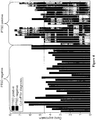
- Figure 4 each bar represents the gene expression level for RGS18 for each sample.
- PTSD negative samples only six samples were misclassified as PTSD positive and among 19 PTSD positive samples, four samples were misclassified as PTSD negative.
- Example 2 For the same set of 49 samples as in Example 2, the measurements of 14 molecules (microRNAs, mRNAs and proteins) were available and a multivariate classifier using generalized linear logistic regression approach was constructed (among 14 molecules, 13 molecules were used for modeling). Since the model is a classifier, it tries to maximize the separability which makes PTSD negative samples have low probability of being PTSD positive and vice versa.
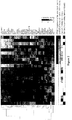
- the levels of various brain specific proteins in four PTSD positive and two PTSD negative samples were measured by mass spectrometry based measurement, SRM (single reaction monitor). Proteins that show different concentration levels between normal individuals and PTSD patients were found, examples of these proteins as shown in Figure 3 .
- PRKAR1B was found to be particularly favorable as a marker of PTSD according to Western blot, plasma concentrations of this protein in a PTSD animal model were measured also by Western blotting. The concentration of PRKAR1B showed a significant increase in plasma after the animal had been exposed to a stress condition as observed in human PTSD patient blood samples.
- the change of global plasma proteome in PTSD was measured by quantitative proteomic technology.
- Four PTSD patient plasma samples and four control plasmas were labeled with one channel of 8-plex iTRAQ® (Isobaric tags for relative and absolute quantitation) reagent, respectively.
- the 8-plex iTRAQ® labeled peptides were then mixed together and fractionated to 24 fractions with Off-gel fractionator (pH 3-10).
- the peptide fractions were analyzed on a high-performance linear ion trap LTQTM-Orbitrap/Velos Hybrid mass spectrometer to generate high-resolution plasma proteome maps.
- brain-enriched proteins ANK2, AP3B2, APLP1, APOD, BCAS1, BSN, CACNA1B, CLSTN1, CNTN1, DPP10, EFNB3, ENC1, GBP3, GRIA1, GRM7, HIVEP2, JMY2, KCNC1, KIF3A, L1CAM, LRRTM4, MAP1B, MBP 1, MYO16, NAP1L5, NCAM2, NCAN, OLFM1, OLFM3, PCDHA5, PCLO, PCSK2, PRKAR1B, PSD2, PTPRD, RASGRF1, SLC4A10, SNAP25, SYNE1, SYT3, TAGLN3, UCHL1 and WNT10B.
- the brain-enriched proteins are selected from the group consisting of APOD, BSN, CNTN1, ENC1, GRIA1, GRM7, LRRTM4, NAP1L5, NCAM2, OLFM1, and UCHL1.
- a multivariate model was constructed using combined measurements of multiple miRNAs and protein.
- a linear logistic regression model with Ridge parameter was applied to measurements of miR-33b, miR-210, miR-505, let-7a* and PRKAR1B protein across 65 samples.
- the model is according to Friedman, et al., J. Stat. Software (2010) 33:1-22 .
- the model parameter was determined using the leave-one-out cross-validation, that is, using a single measurement result from the sample as the validation data, and the remaining measurements (markers) as the training data. This is used to evaluate the performance of omitted marker.
- the method is well known in the art.
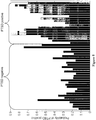
- the output from the model represents the probability of PTSD positive for each sample as shown in Figure 6 . As shown, of 36 PTSD negative samples, only two samples were misclassified as positive and among 29 PTSD positive samples, five samples were misclassified as negative.
- the combined assay (panel) has a sensitivity of 82.8 and a specificity of 94.4.
- Micro RNAs miRNAs
- mRNAs Messenger RNAs
- MRM Multiple Reaction Modeling
Landscapes
- Chemical & Material Sciences (AREA)
- Life Sciences & Earth Sciences (AREA)
- Proteomics, Peptides & Aminoacids (AREA)
- Health & Medical Sciences (AREA)
- Organic Chemistry (AREA)
- Wood Science & Technology (AREA)
- Analytical Chemistry (AREA)
- Zoology (AREA)
- Engineering & Computer Science (AREA)
- Genetics & Genomics (AREA)
- Immunology (AREA)
- Bioinformatics & Cheminformatics (AREA)
- Microbiology (AREA)
- Molecular Biology (AREA)
- Biotechnology (AREA)
- Biophysics (AREA)
- Biochemistry (AREA)
- Physics & Mathematics (AREA)
- General Engineering & Computer Science (AREA)
- General Health & Medical Sciences (AREA)
- Pathology (AREA)
- Cell Biology (AREA)
- Measuring Or Testing Involving Enzymes Or Micro-Organisms (AREA)
Description
- The invention relates to the field of biological markers for physiological conditions. More specifically, it relates to markers for Posttraumatic Stress Disorder (PTSD) and methods to detect this disorder in subjects using these markers. The markers include microRNA, mRNA and protein circulating in body fluids.
- Diagnosis of Posttraumatic Stress Disorder (PTSD) has been focused on phenomenological indicators such as reports of panic attacks, nightmares, disability in functioning, and other measures that focus on symptomology. To applicant's knowledge, no metabolic or physiological changes in the molecules present in biological fluids or tissues of the subject have been employed for this purpose. The present invention has identified markers that circulate in biological fluids of a subject afflicted with PTSD that change in concentration or level in comparison to subjects that are not afflicted with this disorder.
- The scope of the invention is defined by the appended claims. The present disclosure additionally contains subject-matter that falls outside the claimed invention. It has now been found that there is a multiplicity of markers whose concentration or level is different in tissues and/or bodily fluids of individuals afflicted with PTSD in comparison with individuals not so afflicted. These markers include specific microRNAs, messenger RNAs, and/or proteins. Differences in messenger RNA concentration reflect differences in gene expression, while differences in protein levels reflect combinations of gene expression differences and, in the case of fluids, propensity for secretion. MicroRNAs have been implicated in intracellular signaling and represent a potentially independent source of information regarding this condition.
- Thus, in one aspect, the invention is directed to a method to evaluate the probability that a test subject is afflicted with Posttraumatic Stress Disorder (PTSD), which method comprises: assessing the level of at least one specific microRNA (miRNA) marker and/or at least one specific messenger RNA (mRNA) marker and/or at least one specific protein marker in a sample of cells and/or fluid from said subject and comparing the level of at least one microRNA and/or mRNA and/or protein with the level associated with corresponding cells and/or fluid from control subjects who are free of PTSD, wherein a difference in the level of said one or more miRNA and/or mRNA and/or protein in said test subject as compared to control subjects indicates a probability that said test subject is afflicted with PTSD. "Corresponding" cells and/or fluid refers to the use of the same type of sample in test subjects and controls - e.g., blood in both cases or liver cells in both cases.
- In some embodiments, the level only one miRNA or mRNA or protein is measured and compared, but employing larger numbers of markers is preferred. In some embodiments, said method simultaneously determines combinations or subcombinations of said miRNA, mRNA and protein marker levels.
- The inventors have identified specific markers useful in the foregoing methods. Thus, in another aspect, the disclosure includes a panel for determining the probability of the presence or absence of PTSD in a subject wherein said panel contains detection reagents for at least two microRNA selected from the group consisting of hsa-let-7a, hsa-let-7a*, hsa-miR-16, hsa-miR-33b, hsa-miR-146a, hsa-miR-185, hsa-miR-185*, hsa-miR-188-5p, hsa-miR-188-3p, hsa-miR-210, hsa-miR-505, hsa-miR-551, hsa-miR-598 and hsa-miR-663; and/or
wherein said panel contains detection reagents for at least two mRNA selected from the group consisting of HGD, RGS18, ND1, NT5C3, IGF2BP3, NEXN, HEXM2, DAPP1, SAV1, ID4, CXCR5, HS3ST1, CD72, TLR10, BANK1, MS4A1, FCRLA, CD79B, PPAPDC1B, TLC1A, KCNG1, FCRL1, FCRL2, BCOR, TC2N, LYPLAL1, RPA1, HMBOX1, RAMP1, FCGR1B, ADM, PRDM1, B4GALT5, MXRA7, TXNDC5, IGJ and LOC729451; and/or
wherein said panel contains detection reagents for at least two proteins selected from the group consisting of ANK2, AP3B2, APLP1, ANK3, APOD, BCAS1, BSN, CADM3, CAMK2A, CNP, CACNA1B, CLSTN1, CNTN1, CNTN2, CRH, CTNNA2, DCLK1, DDN, DOCK3, DPP10, EFNB3, ELAVL3, ENC1, EPHA5, FSD1, FOXG1, GBP3, GDAP1L1, gfap, GNAO1, GRIA1, GRIA2, GRIA3, GRIN 1, GRM7, HIVEP2, JMY2, KCNC1, KIF1B, KIF3A, KIF5C, L1CAM, LGI1, LRRTM4, MAG, map, MAP1B, MAP3K12, MBP, MBP1, MYO16, NAP1L5, NCAM1, NCAM2, NCAN, NRXN3, OLFM1, OLFM3, PCDHA5, PCDHGA5, PCLO, PCSK2, PEA15, PKA1B, PRKAR1B, PSD2, PTPRD, RASGRF1, RGS4, RPH3A, SCG3, SLC4A10, SNAP25, SPTBN4, SST, STMN2, SYN1, SYNE1, SYT3, TAGLN3, UCHL1, WNT10B, ACTC1, ATP1A2, TNNI3K, CLDN18, IL8, CD117, A1BG, CFHR1, CRP, SCGB1A1, TSPAN19, NR0B2, HGFAC, FGA, UGT1A10, and NPHS2, or the panel may include only one representative from at least two of the categories listed. - In an important aspect, the invention relates to panels that have representatives of more than one type of marker. In particular, the panel may contain a detection reagent for a protein, especially PRKAR1B or protein B along with at least one detection reagent for microRNA or messenger RNA.
- Thus, in another aspect, the invention is directed to panels and methods that employ detection reagents for PRKAR1B along with a detection reagent for a microRNA and/or a detection reagent for a messenger RNA.
- The invention also relates to kits containing one or more of the foregoing panels, including one or any combination of two such panels or all three in the same kit.
- In still another aspect, the invention is directed to specific methods for measuring simultaneously in the same sample markers of different chemical natures, such as proteins, mRNA, miRNA, DNA and the like.
-
-
Figure 1 shows the expression pattern of 10 microRNA markers in human plasma samples separating PTSD positive samples from PTSD negative. -
Figure 2 shows the comparative expression levels measured as mRNA in human peripheral blood mononuclear cells (PBMC) separating PTSD positives from PTSD negatives. -
Figure 3 shows a comparison of levels of various proteins in PTSD positive versus PTSD negative subjects. -
Figure 4 shows the results from the using gene expression level for RGS18 as a classifier. -
Figure 5 shows the results from a multivariate model using the same subjects asFigure 4 . -
Figure 6 shows the correlation of results with predictions from an additional multivariate model. - A multiplicity of markers has been identified whose levels in biological fluids are different in PTSD positive subjects as opposed to subjects that are free of PTSD by conventional diagnosis. Markers can be assessed in biological fluids of humans or other test subjects including blood and fractions thereof, lymph, cerebrospinal fluid, saliva, urine, semen, and any other exudates. The levels of markers may also be measured in tissues, however the use of biological fluids is more convenient. Further, since the level of these markers in tissues and fluids may not vary concomitantly with the presence or absence of PTSD, standardization of marker choice with respect to the nature of the biological sample is desirable. That is, the corresponding fluids or tissues should be used in test subjects and controls.
- While measurement of a single marker is useful, the use of a multiplicity of such markers sometimes improves the probability that the diagnosis is accurate. Nevertheless, the results obtained indicate that in some cases the measurement of only one marker results in assessments with acceptable specificities and sensitivities. Use of two, three, four, five, seven, ten or more markers is also within the scope of the invention, and in most cases the larger the number of markers, the higher the probability that the diagnosis is correct. As the foregoing implies, it is possible to measure only, for example, microRNA or only messenger RNA or only protein, but it is also within the scope of the invention to measure combinations of these markers - i.e., representative one or more markers from the microRNA category and one or more markers from the messenger RNA category, a combination of one or more markers from the microRNA category and one or more markers from the protein category or from the messenger RNA category or from all three categories. A single biological fluid type may be used, or combinations of results from more than one type of fluid, such as lymph plus cerebrospinal fluid or blood plus saliva.
- Thus, typically, the methods of the invention will employ "panels" of detection reagents for the particular markers to be assayed where, in some cases, a "panel" of only one or two detection reagents may be used or panels that contain three or many more.
- As implied above, "panel" typically refers to a collection of two or more detection reagents for any combination of miRNA, and/or messenger RNA, and/or protein. However, in some cases, where the reagents are configured specifically for conducting the assays, the panel may include only one member. Any of the invention panels can be configured specifically for the assay, for example, by binding the reagents to a solid substrate, such as latex or magnetic beads or in an organized array on a support. The assays may, however, also be run in solution or homogeneous phase.
- The nature of the detection reagents will depend on the particular assay method selected. "Detection reagents" refers to members of a panel which are able to interact selectively with the protein, mRNA or miRNA to be assessed. Typically, a detection reagent will include a binding function that is specific for the analyte to be assessed. However, other forms of selectively identifying and assessing the level of analytes are not excluded. For example, if the analyte is a protein with enzymatic activity, the detection reagent may be a substrate for the enzyme, perhaps labeled to indicate whether the enzyme has acted on it or not. If the analyte is a nucleic acid, a restriction enzyme limited by the specific sequence might be used for detection. However, the most readily envisioned detection reagents will at least include a binding function wherein the reagent is a specific binding protein for the analyte. Typically, additional reagents will be necessary to ascertain the concentration or level of the analyte/marker. (In the present application, "concentration" and "level" are used interchangeably.) For example, for detection of proteins, the panel may comprise antibodies or fragments thereof or aptamers that are specific for each of the protein markers to be detected, and an additional reagent, such as a fluorescent or radioisotope label may be needed to measure the quantity of protein captured by the binding partner.
- More recently, a capture agent for proteins based on "in situ click chemistry" has been described by Millward, S. W., et al., J. Am. Chem. Soc. (2001) 133:18280-18288. In this technology, a short anchor region of a peptide capture molecule is designed that is specific for the protein to be bound, and then additional scaffolding regions are added to augment the anchor portion. While this method has been applied to proteins, it may also be extended to other analytes such as nucleic acids.
- In the case of RNA, an amplification reaction using appropriate primers may be done quantitatively, and the amount of amplified RNA can then be determined with an appropriate probe with a detectable label. The probe may be an oligonucleotide including oligos with nonnative linkages such as phosphothiolate or phosphoramidate, or a peptide nucleic acid (PNA). Nonnative bases may also be included. Thus, "a reagent for the detection" of the marker refers specifically to the reagent in an assay for the concentration of the marker which reagent is specific for the marker, and additional reagents are sometimes or often needed in order to quantitate the results. The panels may be configured to measure more than one type of marker simultaneously, i.e., both miRNA and mRNA, both mRNA and protein, both mRNA and protein or all three simultaneously.
- The levels of various markers in a sample can be measured individually using standard techniques well known in the art. The concentrations of specific proteins can be measured using methods such as Western blot, enzyme-linked immunosorbent assay (ELISA), radioimmunoassay (RIA), or mass spectrometry. For example, the concentration of a specific protein can be measured with ELISA, where one antibody specific to the targeted protein is immobilized on a solid surface. The sample with an unknown amount of protein of interest is exposed to the immobilized antibody and then a detection antibody is added to form a complex with the protein of interest. A secondary antibody reacts to the detection antibody that is linked to an enzyme through bioconjugation may then be added. Enzymatic substrate is introduced to produce a visible signal which reflects the concentration of protein of interest in the sample.
- The concentration of specific proteins can also be measured by various mass spectrometry methods, such as the highly sensitive selected reaction monitoring (SRM) method. To quantify the concentrations of specific proteins using SRM, the levels of endogenous peptides derived from proteins of interest are determined by comparing their peak intensities with known concentrations of spiked-in synthetic heavy-isotopically labeled (e.g., D, 13C, or 15N) corresponding peptides. SRM technology is highly sensitive and allows the measurement of multiple proteins in the sample simultaneously.
- Specific RNA levels can also be measured using general molecular biology techniques commonly known in the art such as Northern blot, quantitative reverse transcription polymerase chain reaction (qRT-PCR), next-generation sequencing or microarray.
- The Northern blot may be used to measure gene expression level, and a denaturing gel is used to separate RNA by size. The bands are transferred to a solid matrix, and specific RNA molecules are detected with labeled probes complementary to the target RNA sequence. The probe can be labeled with radioisotope, florescent or ColorMatrix™ dye. qRT-PCR is a more sensitive and efficient procedure detect specific messenger RNA or microRNA. The RNA sample is first reverse transcribed, the target sequences can then be amplified using thermostable DNA polymerase. The concentration of a particular RNA sequence in a sample can be determined by examining the amount of amplified products. Microarray technology allows simultaneous measurement of the concentrations of multiple RNA species. The oligonucleotides complementary to specific RNA sequences are immobilized on solid support. The RNA in the sample is labeled with ColorMatrix™ or florescent dye. After subsequent hybridization of the labeled material to the solid support, the intensities of fluorescent for ColorMatrix™ dye remaining on the solid support determines the concentrations of specific RNA sequences in the samples.
- The concentration of specific RNA species can also be determined by NanoString™ nCounter™ system which provides direct digital readout of the number of RNA molecules in the sample without the use of amplification. NanoString™ technology involves mixing the RNA sample with pairs of capture and reporter probes, tailored to each RNA sequence of interest. After hybridization and washing away excess probes, probe-bound target nucleic acids are stretched on a surface and scanned to detect fluorescent-barcodes of the reporter probes. This allows for up to 1000-plex measurement with high sensitivity and without amplification bias.
- The concentrations of different types of molecular markers, such as proteins, mRNAs and miRNAs in a sample can also be measured simultaneously, on the same platform, using multiple types of technologies such as electrochemical biosensor array described by Mohan, R., et al. (PLoS ONE (2011) 6(10): e26846. doi:10.1371), or by surface plasma resonance or by NanoString™ nCounter™. Using NanoString™ nCounter™, for example, one can concurrently quantify the concentrations of the captured mRNA, miRNA, and proteins from a single sample of biological fluids. For this method, the RNA is captured using the standard NanoString™ nCounter™ protocols. The proteins are captured and isolated using DNA oligo tagged antibodies targeted for specific protein biomarkers of interest. The DNA oligo tags are isolated from the antibody-protein complexes and their concentrations are directly associated with the concentrations of the targeted protein biomarkers. From then on the DNA oligos are then treated in the same way as the isolated RNA. The captured mRNA, miRNA and DNA oligos can be mixed into a single tube and run through the NanoString™ nCounter™ prep station and digital analyzer together. The simultaneous measurement of RNA and protein biomarkers is not specific to the NanoString™ systems. Technologies such as electrochemical biosensor arrays, surface plasma resonance and other targeted capture assays can be utilized to quantify molecular markers simultaneously by measuring changes in electro-current, light absorption, fluorescence, or enzymatic substrates reactions.
- The subjects of the assay are typically human but also include animal models for this disorder, such as rats, mice and non-human primates. In the event it is determined that the subject has PTSD, appropriate treatment is employed. Such treatment may include counseling, administering medications, physical therapy and combinations thereof.
- Measures of the validity of an assay include sensitivity, specificity and area under the curve (AUC). Sensitivity is defined as the number of positives detected divided by the number of samples that were actually positive, according to an independent diagnosis. Specificity is defined as the number of samples that were assessed as negative divided by the number of samples that were in fact negative, according to an independent diagnosis. Thus, the sensitivity is a measure of success in identifying subjects who indeed have PTSD and specificity is a measure of the ability accurately to identify subjects who do not have PTSD.
- The AUC reflects the area under the ROC curve for evaluating how well a parameter can distinguish between two groups. The true positive rate (Sensitivity, Y-axis) is plotted as a function of the false positive rate (100-Specificity, X-axis). Each point on the ROC curve represents a sensitivity/specificity pair corresponding to a particular decision or cutoff threshold. Thus the AUC is a measure of how well a parameter can distinguish between two groups, the higher the better. Ideally, a marker with perfect discrimination has a ROC curve that passes through the upper left corner (100% sensitivity, 100% specificity). Stated another way, the ROC curve determines the optimal cutoff for decision-making and the sensitivity/specificity depends on this cutoff. The AUC represents the probability that a classifier will rank a randomly chosen positive case higher than a randomly chosen negative one. AUC has been used as a performance measure of a model classifier.
- In detail, the disclosure is directed to a panel for determining the probability of the presence or absence of posttraumatic stress disorder (PTSD) in a subject wherein said panel contains detection reagents for at least two microRNA selected from the group consisting of hsa-let-7a, hsa-let-7a*, hsa-miR-16, hsa-miR-33b, hsa-miR-146a, hsa-miR-185, hsa-miR-185*, hsa-miR-188-5p, hsa-miR-188-3p, hsa-miR-210, hsa-miR-505, hsa-miR-551, hsa-miR-598 and hsa-miR-663.
- In one embodiment, said at least one detection reagent is for microRNA selected from hsa-let-7a*, hsa-miR-16, hsa-miR-33b, hsa-miR-185*, hsa-miR-210, hsa-miR-505, hsa-miR-551, and hsa-miR-663.
- The disclosure is also directed to a panel for determining the probability of the presence or absence of PTSD in a subject wherein said panel contains detection reagents for at least two mRNA selected from the group consisting of HGD, RGS18, ND1, NTSC3, IGF2BP3, NEXN, HEXM2, DAPP1, SAV1, ID4, CXCR5, HS3ST1, CD72, TLR10, BANK1, MS4A1, FCRLA, CD79B, PPAPDC1B, TLC1A, KCNG1, FCRL1, FCRL2, BCOR, TC2N, LYPLAL1, RPA1, HMBOX1, RAMP1, FCGR1B, ADM, PRDM1, B4GALT5, MXRA7, TXNDC5, IGJ and LOC729451.
- In one embodiment, said at least one detection reagent is for mRNA selected from RGS18, HGD, FCGR1B, ADM, PRDM1, B4GALT5, MXRA7, TXNDC5 and IGJ.
- The disclosure also includes a panel for determining the probability of the presence or absence of PTSD in a subject wherein said panel contains detection reagents for at least two proteins selected from the group consisting of ANK2, AP3B2, APLP1, ANK3, APOD, BCAS1, BSN, CADM3, CAMK2A, CNP, CACNA1B, CLSTN1, CNTN1, CNTN2, CRH, CTNNA2, DCLK1, DDN, DOCK3, DPP10, EFNB3, ELAVL3, ENC1, EPHA5, FSD1, FOXG1, GBP3, GDAP1L1, gfap, GNAO1, GRIA1, GRIA2, GRIA3, GRIN1, GRM7, HIVEP2, JMY2, KCNC1, KIF1B, KIF3A, KIF5C, L1CAM, LGI1, LRRTM4, MAG, map, MAP1B, MAP3K12, MBP, MBP1, MYO16, NAP1L5, NCAM1, NCAM2, NCAN, NRXN3, OLFM1, OLFM3, PCDHA5, PCDHGA5, PCLO, PCSK2, PEA15, PKA1B, PRKAR1B, PSD2, PTPRD, RASGRF1, RGS4, RPH3A, SCG3, SLC4A10, SNAP25, SPTBN4, SST, STMN2, SYN1, SYNE1, SYT3, TAGLN3, UCHL1, WNT10B, ACTC1, ATP1A2, TNNI3K, CLDN18, IL8, CD117, A1BG, CFHR1, CRP, SCGB1A1, TSPAN19, NR0B2, HGFAC, FGA, UGT1A10, and NPHS2..
- In one embodiment, said at least one detection reagent is for the protein PRKAR1B or GRM7.
- In one embodiment, the reagents of the panels are coupled to a solid substrate.
- The invention concerns a panel for determining the probability of the presence or absence of PTSD in a subject wherein said panel contains detection reagents for
at least one microRNA and at least one mRNA; or
at least one microRNA and at least one protein; or
at least one mRNA and at least one protein; or
at least one microRNA and at least one mRNA and at least one protein. - One embodiment of the panel is that wherein the microRNA is selected from the group consisting of hsa-let-7a, hsa-let-7a*, hsa-miR-16, hsa-miR-33b, hsa-miR-146a, hsa-miR-185, hsa-miR-185*, hsa-miR-188-5p, hsa-miR-188-3p, hsa-miR-210, hsa-miR-505, hsa-miR-551, hsa-miR-598 and hsa-miR-663, and/or said mRNA is selected from the group consisting of HGD, RGS18, ND1, NT5C3, IGF2BP3, NEXN, HEXM2, DAPP1, SAV1, ID4, CXCR5, HS3ST1, CD72, TLR10, BANK1, MS4A1, FCRLA, CD79B, PPAPDC1B, TLC1A, KCNG1, FCRL1, FCRL2, BCOR, TC2N, LYPLAL1, RPA1, HMBOX1, RAMP1, FCGR1B, ADM, PRDM1, B4GALT5, MXRA7, TXNDC5, IGJ and LOC729451, and/or said protein is selected from the group consisting of ANK2, AP3B2, APLP1, ANK3, APOD, BCAS1, BSN, CADM3, CAMK2A, CNP, CACNA1B, CLSTN1, CNTN1, CNTN2, CRH, CTNNA2, DCLK1, DDN, DOCK3, DPP10, EFNB3, ELAVL3, ENC1, EPHA5, FSD1, FOXG1, GBP3, GDAP1L1, gfap, GNAO1, GRIA1, GRIA2, GRIA3, GRIN1, GRM7, HIVEP2, JMY2, KCNC1, KIF1B, KIF3A, KIF5C, L1CAM, LGI1, LRRTM4, MAG, map, MAP1B, MAP3K12, MBP, MBP1, MYO16, NAP1L5, NCAM1, NCAM2, NCAN, NRXN3, OLFM1, OLFM3, PCDHA5, PCDHGA5, PCLO, PCSK2, PEA15, PKA1B, PRKAR1B, PSD2, PTPRD, RASGRF1, RGS4, RPH3A, SCG3, SLC4A10, SNAP25, SPTBN4, SST, STMN2, SYN1, SYNE1, SYT3, TAGLN3, UCHL1, WNT10B, ACTC1, ATP1A2, TNNI3K, CLDN18, IL8, CD117, A1BG, CFHR1, CRP, SCGB1A1, TSPAN19, NR0B2, HGFAC, FGA, UGT1A10, and NPHS2.
- The invention also includes kits for determining the probability of the presence or absence of PTSD in a subject which comprises any of the panels described above and additional reagents for determining the level of said miRNA and/or mRNA and/or protein.
- The disclosure further includes a method to evaluate the probability that a subject is afflicted with Posttraumatic Stress Disorder (PTSD), which method comprises:
- assessing the level of at least one specific microRNA(miRNA) and/or of at least one specific messenger RNA (mRNA) and/or of at least one specific protein in a sample of cells and/or fluid from said subject and
- comparing the level of said at least one microRNA and/or mRNA and/or protein with the level associated with corresponding cells and/or fluid from control subjects who are free of PTSD,
- wherein a difference in the level of said one or more microRNA and/or mRNA and/or protein in said test subject as compared to control subjects indicates a probability that said subject is afflicted with PTSD.
- In these methods, the levels of at least 2, 3, 4, 5 or 7 of said miRNA and/or said mRNA and/or said proteins are measured and compared.
- Also in these methods, a single method simultaneously determines combinations or subcombinations of said miRNA, said mRNA and said protein levels.
- In these methods, at least one said specific miRNA is selected from the group consisting of hsa-let-7a, hsa-let-7a*, hsa-miR-16, hsa-miR-33b, hsa-miR-146a, hsa-miR-185, hsa-miR-185*, hsa-miR-188-5p, hsa-miR-188-3p, hsa-miR-210, hsa-miR-505, hsa-miR-551, hsa-miR-598 and hsa-miR-663, and/or
at least one said specific mRNA is selected from the group consisting of HGD, RGS 18, ND1, NT5C3, IGF2BP3, NEXN, HEXM2, DAPP1, SAV1, ID4, CXCR5, HS3ST1, CD72, TLR10, BANK1, MS4A1, FCRLA, CD79B, PPAPDC1B, TLC1A, KCNG1, FCRL1, FCRL2, BCOR, TC2N, LYPLAL1, RPA1, HMBOX1, RAMP1, FCGR1B, ADM, PRDM1, B4GALT5, MXRA7, TXNDC5, IGJ and LOC729451, and/or
at least one said specific protein is selected from the group consisting of ANK2, AP3B2, APLP1, ANK3, APOD, BCAS1, BSN, CADM3, CAMK2A, CNP, CACNA1B, CLSTN1, CNTN1, CNTN2, CRH, CTNNA2, DCLK1, DDN, DOCK3, DPP10, EFNB3, ELAVL3, ENC1, EPHA5, FSD1, FOXG1, GBP3, GDAP1L1, gfap, GNAO1, GRIA1, GRIA2, GRIA3, GRIN1, GRM7, HIVEP2, JMY2, KCNC1, KIF1B, KIF3A, KIF5C, L1CAM, LGI1, LRRTM4, MAG, map, MAP1B, MAP3K12, MBP, MBP1, MYO16, NAP1L5, NCAM1, NCAM2, NCAN, NRXN3, OLFM1, OLFM3, PCDHA5, PCDHGA5, PCLO, PCSK2, PEA15, PKA1B, PRKAR1B, PSD2, PTPRD, RASGRF1, RGS4, RPH3A, SCG3, SLC4A10, SNAP25, SPTBN4, SST, STMN2, SYN1, SYNE1, SYT3, TAGLN3, UCHL1, WNT10B, ACTC1, ATP1A2, TNNI3K, CLDN18, IL8, CD117, A1BG, CFHR1, CRP, SCGB1A1, TSPAN19, NR0B2, HGFAC, FGA, UGT1A10, and NPHS2. - In one embodiment of these methods, at least one said specific miRNA is selected from the group consisting of hsa-let-7a, hsa-let-7a*, hsa-miR-16, hsa-miR-33b, hsa-miR-146a, hsa-miR-185, hsa-miR-185*, hsa-miR-188-5p, hsa-miR-188-3p, hsa-miR-210, hsa-miR-505, hsa-miR-551, hsa-miR-598 and hsa-miR-663, and
at least one said specific mRNA is selected from the group consisting of HGD, RGS 18, ND1, NT5C3, IGF2BP3, NEXN, HEXM2, DAPP1, SAV1, ID4, CXCR5, HS3ST1, CD72, TLR10, BANK1, MS4A1, FCRLA, CD79B, PPAPDC1B, TLC1A, KCNG1, FCRL1, FCRL2, BCOR, TC2N, LYPLAL1, RPA1, HMBOX1, RAMP1, FCGR1B, ADM, PRDM1, B4GALT5, MXRA7, TXNDC5, IGJ and LOC729451. - In another embodiment of these methods, at least one said specific miRNA is selected from the group consisting of hsa-let-7a, hsa-let-7a*, hsa-miR-16, hsa-miR-33b, hsa-miR-146a, hsa-miR-185, hsa-miR-185*, hsa-miR-188-5p, hsa-miR-188-3p, hsa-miR-210, hsa-miR-505, hsa-miR-551, hsa-miR-598 and hsa-miR-663, and
at least one said specific protein is selected from the group consisting of ANK2, AP3B2, APLP1, ANK3, APOD, BCAS1, BSN, CADM3, CAMK2A, CNP, CACNA1B, CLSTN1, CNTN1, CNTN2, CRH, CTNNA2, DCLK1, DDN, DOCK3, DPP10, EFNB3, ELAVL3, ENC1, EPHA5, FSD1, FOXG1, GBP3, GDAP1L1, gfap, GNAO1, GRIA1, GRIA2, GRIA3, GRIN1, GRM7, HIVEP2, JMY2, KCNC1, KIF1B, KIF3A, KIF5C, L1CAM, LGI1, LRRTM4, MAG, map, MAP1B, MAP3K12, MBP, MBP1, MYO16, NAP1L5, NCAM1, NCAM2, NCAN, NRXN3, OLFM1, OLFM3, PCDHA5, PCDHGA5, PCLO, PCSK2, PEA15, PKA1B, PRKAR1B, PSD2, PTPRD, RASGRF1, RGS4, RPH3A, SCG3, SLC4A10, SNAP25, SPTBN4, SST, STMN2, SYN1, SYNE1, SYT3, TAGLN3, UCHL1, WNT10B, ACTC1, ATP1A2, TNNI3K, CLDN18, IL8, CD117, A1BG, CFHR1, CRP, SCGB1A1, TSPAN19, NR0B2, HGFAC, FGA, UGT1A10, and NPHS2. - In another embodiment of these methods, at least one said specific mRNA is selected from the group consisting of HGD, RGS18, ND1, NT5C3, IGF2BP3, NEXN, HEXM2, DAPP1, SAV1, ID4, CXCR5, HS3ST1, CD72, TLR10, BANK1, MS4A1, FCRLA, CD79B, PPAPDC1B, TLC1A, KCNG1, FCRL1, FCRL2, BCOR, TC2N, LYPLAL1, RPA1, HMBOX1, RAMP1, FCGR1B, ADM, PRDM1, B4GALT5, MXRA7, TXNDC5, IGJ and LOC729451, and
at least one said specific protein is selected from the group consisting of ANK2, AP3B2, APLP1, ANK3, APOD, BCAS1, BSN, CADM3, CAMK2A, CNP, CACNA1B, CLSTN1, CNTN1, CNTN2, CRH, CTNNA2, DCLK1, DDN, DOCK3, DPP10, EFNB3, ELAVL3, ENC1, EPHA5, FSD1, FOXG1, GBP3, GDAP1L1, gfap, GNAO1, GRIA1, GRIA2, GRIA3, GRIN1, GRM7, HIVEP2, JMY2, KCNC1, KIF1B, KIF3A, KIF5C, L1CAM, LGI1, LRRTM4, MAG, map, MAP1B, MAP3K12, MBP, MBP1, MYO16, NAP1L5, NCAM1, NCAM2, NCAN, NRXN3, OLFM1, OLFM3, PCDHA5, PCDHGA5, PCLO, PCSK2, PEA15, PKA1B, PRKAR1B, PSD2, PTPRD, RASGRF1, RGS4, RPH3A, SCG3, SLC4A10, SNAP25, SPTBN4, SST, STMN2, SYN1, SYNE1, SYT3, TAGLN3, UCHL1, WNT10B, ACTC1, ATP1A2, TNNI3K, CLDN18, IL8, CD117, A1BG, CFHR1, CRP, SCGB1A1, TSPAN19, NR0B2, HGFAC, FGA, UGT1A10, and NPHS2. - In another embodiment of these methods, at least one said specific miRNA is selected from the group consisting of hsa-let-7a, hsa-let-7a*, hsa-miR-16, hsa-miR-33b, hsa-miR-146a, hsa-miR-185, hsa-miR-185*, hsa-miR-188-5p, hsa-miR-188-3p, hsa-miR-210, hsa-miR-505, hsa-miR-551, hsa-miR-598 and hsa-miR-663, and
at least one said specific mRNA is selected from the group consisting of HGD, RGS18, ND1, NT5C3, IGF2BP3, NEXN, HEXM2, DAPP1, SAV1, ID4, CXCR5, HS3ST1, CD72, TLR10, BANK1, MS4A1, FCRLA, CD79B, PPAPDC1B, TLC1A, KCNG1, FCRL1, FCRL2, BCOR, TC2N, LYPLAL1, RPA1, HMBOX1, RAMP1, FCGR1B, ADM, PRDM1, B4GALT5, MXRA7, TXNDC5, IGJ and LOC729451, and
at least one said specific protein is selected from the group consisting of ANK2, AP3B2, APLP1, ANK3, APOD, BCAS1, BSN, CADM3, CAMK2A, CNP, CACNA1B, CLSTN1, CNTN1, CNTN2, CRH, CTNNA2, DCLK1, DDN, DOCK3, DPP10, EFNB3, ELAVL3, ENC1, EPHA5, FSD1, FOXG1, GBP3, GDAP1L1, gfap, GNAO1, GRIA1, GRIA2, GRIA3, GRIN1, GRM7, HIVEP2, JMY2, KCNC1, KIF1B, KIF3A, KIF5C, L1CAM, LGI1, LRRTM4, MAG, map, MAP1B, MAP3K12, MBP, MBP1, MYO16, NAP1L5, NCAM1, NCAM2, NCAN, NRXN3, OLFM1, OLFM3, PCDHA5, PCDHGA5, PCLO, PCSK2, PEA15, PKA1B, PRKAR1B, PSD2, PTPRD, RASGRF1, RGS4, RPH3A, SCG3, SLC4A10, SNAP25, SPTBN4, SST, STMN2, SYN1, SYNE1, SYT3, TAGLN3, UCHL1, WNT10B, ACTC1, ATP1A2, TNNI3K, CLDN18, IL8, CD117, A1BG, CFHR1, CRP, SCGB1A1, TSPAN19, NR0B2, HGFAC, FGA, UGT1A10, and NPHS2. - In another embodiment of these methods, specific proteins are selected from the group consisting of ANK2, AP3B2, APLP1, APOD, BCAS1, BSN, CACNA1B, CLSTN1, CNTN1, DPP10, EFNB3, ENC1, GBP3, GRIA1, GRM7, HIVEP2, JMY2, KCNC1, KIF3A, L1CAM, LRRTM4, MAP1B, MBP1, MYO16, NAP1L5, NCAM2, NCAN, OLFM1, OLFM3, PCDHA5, PCLO, PCSK2, PRKAR1B, PSD2, PTPRD, RASGRF1, SLC4A10, SNAP25, SYNE1, SYT3, TAGLN3, UCHL1 and WNT10B. In another embodiment of these methods, specific proteins are selected from the group consisting of APOD, BSN, CNTN1, ENC1, GRIA1, GRM7, LRRTM4, NAP1L5, NCAM2, OLFM1, and UCHL1. In another embodiment of these methods, specific proteins are selected from the group consisting of
ACTC 1, ATP1A2, TNNI3K, CLDN18, IL8, CD117, A1BG, CFHR1, CRP, SCGB1A1, TSPAN19, NR0B2, HGFAC, FGA, UGT1A10, and NPHS2. In another embodiment of these methods, specific proteins are selected from the group consisting of ACTC1, TNNi3K, CD117, or ATP1A2. In another embodiment of these methods, specific proteins are selected from the group consisting of UGT1A10 and NPHS2. In another embodiment of these methods, specific proteins are selected from the group consisting of A1BG, CFHR1, CRP, NR0B2, HGFAC, and FGA. In another embodiment of these methods, specific proteins are selected from the group consisting of SCGB1A1, TSPAN19, IL8, and CLDN18. - In another embodiment of these methods, the method to evaluate the probability that a test subject is afflicted with Posttraumatic Stress Disorder (PTSD) comprises:
- assessing the level of the protein PRKAR1B in a sample from said test subject and
- comparing said level of said PRKAR1B protein with the level of PRKAR1B protein associated with corresponding samples from control subjects who are free of PTSD, and
- wherein a difference in the level of said PRKAR1B protein in said test subject as compared to control subjects indicates a probability that said test subject is afflicted with PTSD, and/or
- assessing the level of mRNA representing expression of RGS18 in a sample from said test subject, and
- comparing said level of said RGS18 mRNA with the level of RGS18 mRNA associated with corresponding samples from control subjects who are free of PTSD, and
- wherein a difference in the level of said RGS18 in said test subject as compared to control subjects indicates a probability that said test subject is afflicted with PTSD.
- In one embodiment, the method further includes assessing the level of at least one microRNA (miRNA) in a sample from the test subject and
comparing said level with the level of said miRNA associated with corresponding samples from control subjects who are free of PTSD,
wherein a difference in the level of said PRKAR1B protein and/or RGS18 mRNA and said at least one miRNA in said test subject as compared to control subjects indicates a probability that said test subject is afflicted with PTSD. - In another embodiment of these methods, at least one miRNA is selected from the group consisting of hsa-let-7a, hsa-let-7a*, hsa-miR-16, hsa-miR-33b, hsa-miR-146a, hsa-miR-185, hsa-miR-185*, hsa-miR-188-5p, hsa-miR-188-3p, hsa-miR-210, hsa-miR-505, hsa-miR-551, hsa-miR-598 and hsa-miR-663.
- In another embodiment of these methods, the levels of 1-7 additional proteins are assessed, and/or
wherein the levels of 1-7 additional mRNAs are assessed, and/or
wherein the levels of 1-7 miRNAs are assessed. - In particular, one embodiment of panels useful in the method of the invention consists of 5 members, i.e., reagents for detection of: PKA1B, miR-1207-5p, miR-16, miR-210 and miR-33b.
- Another panel consists of 7 members, i.e., reagents for detection of: PKA1B, let-7a*, miR-16, miR-185*, miR-210, miR-33b and miR-505.
- In another embodiment, the panel useful in the invention consists of 11 members, i.e., reagents for detection of: PKA1B, let-7a*, miR-146a, miR-16, miR-185*, miR-210, miR-33b, miR-451, miR-505, miR-551 and miR-663.
- The following examples are offered to illustrate but not to limit the invention.
- Blood plasma from 31 individuals including 14 PTSD positive and 17 PTSD negative controls was assayed using qRT-PCR for content of microRNAs. An initial screen using microRNA PCR panels (Exiqon, MA, USA, Prod. # 203607) wherein 742 microRNAs were assessed resulted in patterns wherein 20 microRNAs were differentially expressed in patients with PTSD.
Figure 1 shows the expression patterns obtained. - Using these data, blood plasma from 69 individuals different from those whose microRNA levels were as shown in
Figure 1 was assessed using qRT-PCR. Thirty-six of these individuals were diagnosed as without PTSD and 33 were diagnosed as afflicted with this disorder. Table 1 shows the sensitivity and specificity of assays conducted using each of these markers individually.Table 1 List of Circulating MicroRNAs for PTSD Diagnosis microRNA Sensitivity Specificity AUC* Median Fold Change P-value miR-33b 69.7 75 0.756 1.84 6.28 E-5 miR-210 66.7 80.8 0.723 1.46 2.12 E-4 miR-185* 64.3 83.9 0.745 2.52 6.56 E-7 miR-505 68.7 80.6 0.754 1.19 1.64 E-4 miR-16 66.7 83.3 0.721 1.41 4.75 E-4 miR-663 75.8 83.8 0.883 2.13 6.61 E-7 miR-146a 53.1 94.4 0.792 3.43 1.00 E-02 miR-551 69.7 75.8 0.737 1.58 8.15 E-4 let-7a* 62.5 86.1 0.725 1.85 1.14 E-3 * AUC (Area Under Curve). - As shown, reasonably satisfactory sensitivity and specificities were obtained even with individual markers.
- Twenty-two peripheral blood mononuclear cell (PBMC) samples that included 9 PTSD positive and 13 PTSD negative individuals by independent diagnosis were assessed for levels or messenger RNA using whole genome microarrays supplied by
Agilent 8×60K Microarray containing 56K genes (Agilent, CA, USA, Product # G4852A). Thirty-seven differentially expressing genes in patients with PTSD were found. The expression pattern of these is shown inFigure 2 . Using these data, blood PBMC from 107 individuals different from those whose mRNA levels were as shown inFigure 2 was assessed using qRT-PCR. Sixty-one of these individuals were diagnosed as without PTSD and 46 were diagnosed as afflicted with this disorder. Table 2 shows the sensitivity and specificity of assays conducted using two of these markers, RGS18 (regulator of G-protein signaling 18) and HGD (homogentisate 1,2-dioxygenase), individually. The levels of mRNA are lower in individuals suffered with PTSD than in normal as indicated by the negative fold changes in Table 2.Table 2 List of blood mRNAs for PTSD Diagnosis mRNA Sensitivity Specificity AUC Median Fold Change P-value RGS18 78.3 78.7 0.803 -1.65 1.27 E -6 HGD 66.7 82.5 0.733 -1.04 7.17 E -3 - In another experiment, mRNA representing RGS18 was determined in blood samples of peripheral blood mononuclear cells (PBMC) from 49 human subjects. Nineteen of the subjects were PTSD positive and 30 were PTSD negative. Based on a cutoff value of 4.6010, the assay had a sensitivity of 0.7895, a specificity of 0.8, and an AUC of 0.7860. These results are shown in
Figure 4 where each bar represents the gene expression level for RGS18 for each sample. Among the PTSD negative samples, only six samples were misclassified as PTSD positive and among 19 PTSD positive samples, four samples were misclassified as PTSD negative. - For the same set of 49 samples as in Example 2, the measurements of 14 molecules (microRNAs, mRNAs and proteins) were available and a multivariate classifier using generalized linear logistic regression approach was constructed (among 14 molecules, 13 molecules were used for modeling). Since the model is a classifier, it tries to maximize the separability which makes PTSD negative samples have low probability of being PTSD positive and vice versa. The model produced output scores of samples representing the probability of being PTSD positive as shown in
Figure 5 , which resulted in sensitivity=0.6316, specificity=0.9 and AUC=0.8474. Note that cut-off of the model is always 0.5 since the output scores represent probabilities (so, greater than 0.5 will be regarded as PTSD positive and vice versa). As shown inFigure 5 , only six of the PTSD negative samples were misclassified and four PTSD positive samples were misclassified. - Comparing these results with those of Example 2, in terms of (optimal) sensitivity and specificity, the classifier with RGS18 looks better than the multivariate model. However
Figure 6 shows the variation of samples within the same group seems to be fairly high, which suggests the classifier might be sensitive to small amount of noise. On the other hand, in the multivariate model shown inFigure 5 , the output scores within the same group look more homogeneous as reflected by higher AUC value (0.8474). Although a model with high sensitivity, specificity and AUC is ideally preferred, in other cases, the selection of a model with higher AUC might be more preferred. In general, multivariate approach produces a model having higher AUC value than univariate classifiers. - Ninety-seven human plasma samples were analyzed of which 53 were PTSD positive and 44 were PTSD negative by independent diagnosis. Selected proteins were analyzed by Western blot. Differential concentrations or levels of two proteins, PRKAR1B (protein kinase, camp-dependent, regulatory, type I, beta) and GRM7 (glutamate receptor, metabotropic 7) were shown to correlate with PTSD as shown in Table 3.
Table 3 List of Circulating Brain-Specific Protein for PTSD Diagnosis Blood Protein Sensitivity Specificity AUC PRKAR1B 77.3 77.9 0.803 GRM7 56.1 67.6 0.733 - Alternatively, the levels of various brain specific proteins in four PTSD positive and two PTSD negative samples were measured by mass spectrometry based measurement, SRM (single reaction monitor). Proteins that show different concentration levels between normal individuals and PTSD patients were found, examples of these proteins as shown in
Figure 3 . - As PRKAR1B was found to be particularly favorable as a marker of PTSD according to Western blot, plasma concentrations of this protein in a PTSD animal model were measured also by Western blotting. The concentration of PRKAR1B showed a significant increase in plasma after the animal had been exposed to a stress condition as observed in human PTSD patient blood samples.
- Alternatively, the change of global plasma proteome in PTSD was measured by quantitative proteomic technology. Four PTSD patient plasma samples and four control plasmas were labeled with one channel of 8-plex iTRAQ® (Isobaric tags for relative and absolute quantitation) reagent, respectively. The 8-plex iTRAQ® labeled peptides were then mixed together and fractionated to 24 fractions with Off-gel fractionator (pH 3-10). The peptide fractions were analyzed on a high-performance linear ion trap LTQ™-Orbitrap/Velos Hybrid mass spectrometer to generate high-resolution plasma proteome maps. After searching against human whole proteome sequence database, a total of 1,545 unique peptides which represent 245 distinct proteins (199 gene symbols) were identified with error rate <0.05. The intensities of reporter ions from 8-plex iTRAQ® labeling were also extracted, normalized and used as protein quantitation. About 180 proteins were observed and quantified in all 8 samples. Comparing the average protein concentration changes in each group, 31 proteins were identified to be significantly elevated in PTSD plasma (p-value of less than 0.01) and three proteins were suppressed in the PTSD samples (Table 4).
Table 4 List of Circulating Protein for PTSD Diagnosis Gene Symbol Gene description PTSD/Control Fold Changes CFL1 Cofilin-1 21.25 YWHAZ 14-3-3 protein zeta/delta 15.77 PDLIM1 PDZ and LIM domain protein 112.49 PFN1 Profilin-1 15.61 TPM4 Isoform 1 of Tropomyosin alpha-4 chain 7.64 PPBP Platelet basic protein 10.19 CMPK1 Cytidine monophosphate (UMP-CMP) kinase 17.56 PLEK Pleckstrin 5.98 TPM3 Tropomyosin alpha-3 chain 5.98 TAGLN2 Transgelin-2 6.57 ACTN1 Alpha-actinin-1 6.50 TLN1 Talin-1 7.31 ITGA2B Integrin alpha-Iib 5.78 F13A1 Coagulation factor XIII A chain 4.82 TPI1 Triosephosphate isomerase 4.77 HSPA8 Heat shock cognate 71 kDa protein 4.35 MIF Macrophage migration inhibitory factor 4.04 THBS1 Thrombospondin-1 5.14 FERMT3 Fermitin family homolog 34.30 HSPC159 Galectin-related protein 3.99 VCL Vinculin 3.64 LBP Lipopolysaccharide-binding protein 2.80 EIF4A1 Eukaryotic initiation factor 4A-I 2.66 LDHB L-lactate dehydrogenase B chain 2.77 GSTO1 Glutathione S-transferase omega-1 2.77 P4HB Protein disulfide-isomerase 2.47 ALDOA Fructose-bisphosphate aldolase A 2.73 CRP C-reactive protein 2.44 Gene Symbol Gene description PTSD/Control Fold Changes PKM2 Pyruvate kinase isozymes M1/M2 2.56 SOD1 Superoxide dismutase [Cu-Zn] 2.11 CYCS Cytochrome c 2.08 DCD Dermcidin -2.48 KRT10 Keratin, type I cytoskeletal 10 -2.44 C7 Complement component C7 -3.60 - Further assay of additional samples showed differences in the following brain-enriched proteins: ANK2, AP3B2, APLP1, APOD, BCAS1, BSN, CACNA1B, CLSTN1, CNTN1, DPP10, EFNB3, ENC1, GBP3, GRIA1, GRM7, HIVEP2, JMY2, KCNC1, KIF3A, L1CAM, LRRTM4, MAP1B,
MBP 1, MYO16, NAP1L5, NCAM2, NCAN, OLFM1, OLFM3, PCDHA5, PCLO, PCSK2, PRKAR1B, PSD2, PTPRD, RASGRF1, SLC4A10, SNAP25, SYNE1, SYT3, TAGLN3, UCHL1 and WNT10B. In other embodiments, the brain-enriched proteins are selected from the group consisting of APOD, BSN, CNTN1, ENC1, GRIA1, GRM7, LRRTM4, NAP1L5, NCAM2, OLFM1, and UCHL1. - A multivariate model was constructed using combined measurements of multiple miRNAs and protein. A linear logistic regression model with Ridge parameter was applied to measurements of miR-33b, miR-210, miR-505, let-7a* and PRKAR1B protein across 65 samples. The model is according to Friedman, et al., J. Stat. Software (2010) 33:1-22. The model parameter was determined using the leave-one-out cross-validation, that is, using a single measurement result from the sample as the validation data, and the remaining measurements (markers) as the training data. This is used to evaluate the performance of omitted marker. The method is well known in the art. The output from the model represents the probability of PTSD positive for each sample as shown in
Figure 6 . As shown, of 36 PTSD negative samples, only two samples were misclassified as positive and among 29 PTSD positive samples, five samples were misclassified as negative. - Thus, the combined assay (panel) has a sensitivity of 82.8 and a specificity of 94.4.
- Among 100 samples, seven miRNAs were completely measured in 86 samples. The results are shown in Table 5.
Table 5 Sensitivity Specificity AUC miR-33b 0.767442 0.627907 0.699838 miR-210 0.651163 0.72093 0.693889 miR-505 0.604651 0.697674 0.680638 miR-16 0.604651 0.72093 0.633856 let-7a* 0.465116 0.813953 0.630341 miR-185* 0.651163 0.697674 0.685235 miR-663 0.488372 0.744186 0.613845 Model with 6 miRNAs 0.627907 0.744186 0.750135 - Among 100 samples, five mRNAs were flawlessly measured in 65 samples. The results are shown in Table 6.
Table 6 Sensitivity Specificity AUC RGS18 0.782609 0.809524 0.809524 NEXN 0.695652 0.833333 0.792961 NT5C3 0.782609 0.738095 0.798137 ADM 0.304348 0.833333 0.589027 HGD 0.826087 0.785714 0.795031 Model with 5 genes 0.434783 0.928571 0.811594 - Among 100 samples, two proteins were measured in 85 samples. The results are shown in Table 7.
Table 7 Sensitivity Specificity AUC PKA1B 0.682927 0.75 0.703991 GRM7 0.512195 0.704545 0.570953 Model with 1 protein 0.560976 0.75 0.703991 - Seven miRNAs and five mRNAs were completely measured in 56 samples. The results are shown in Table 8.
Table 8 Sensitivity Specificity AUC miR-33b 0.714286 0.685714 0.721088 miR-210 0.666667 0.8 0.757823 miR-505 0.666667 0.742857 0.736735 miR-16 0.52381 0.8 0.644898 let-7a* 0.47619 0.914286 0.67415 miR-185* 0.47619 0.942857 0.689796 miR-663 0.666667 0.771429 0.703401 RGS18 0.809524 0.8 0.795918 NEXN 0.714286 0.828571 0.77415 NT5C3 0.809524 0.714286 0.798639 ADM 0.285714 0.885714 0.578231 HGD 0.809524 0.771429 0.778231 Model with all 0.571429 0.914286 0.840816 - Seven miRNAs and two proteins were completely measured in 73 samples. The results are shown in Table 9.
Table 9 Sensitivity Specificity AUC miR-33b 0.7568 0.6389 0.7230 miR-210 0.6757 0.7778 0.7305 miR-505 0.4054 0.8889 0.6888 miR-16 0.5946 0.8333 0.6787 let-7a* 0.4865 0.8333 0.6573 miR-185* 0.6486 0.7500 0.7042 miR-663 0.5135 0.7500 0.6149 PKA1B 0.6757 0.7222 0.7005 GRM7 0.5405 0.7222 0.5968 Model (except miR-16) 0.6486 0.7778 0.7928 - Five mRNAs and two proteins were completely measured in 56 samples. The results are shown in Table 10.
Table 10 Sensitivity Specificity AUC RGS18 0.7619 0.8000 0.7973 NEXN 0.7143 0.8000 0.7932 NT5C3 0.7619 0.7714 0.7986 ADM 0.3333 0.8571 0.5646 HGD 0.8095 0.7429 0.7673 PKA1B 0.5714 0.7429 0.6068 GRM7 0.5238 0.7143 0.5932 Model with 3 genes and GRM7 0.4762 0.8857 0.8109 - All miRNAs, mRNAs and proteins were measured in 49 samples. The results are shown in Table 11.
Table 11 Sensitivity Specificity AUC miR-33b 0.6842 0.6667 0.7035 miR-210 0.6842 0.8333 0.7877 miR-505 0.8421 0.5667 0.7447 miR-16 0.4737 0.9000 0.6632 let-7a* 0.4737 0.9000 0.6693 miR-185* 0.5263 0.9333 0.7123 miR-663 0.6842 0.8000 0.7228 RGS18 0.7895 0.8000 0.7860 NEXN 0.7368 0.8000 0.7789 NT5C3 0.7895 0.7333 0.7982 ADM 0.3158 0.8667 0.5667 HGD 0.7895 0.7333 0.7526 PKA1B 0.6842 0.6333 0.6281 GRM7 0.5789 0.7000 0.6263 Model (except miR-16) 0.6316 0.9000 0.8474 - Eighty-five participants, of whom 43 were PTSD-negative and 42 PTSD-positive provided samples that were tested with a panel of 11 members including reagents for detection of 10 miRNA's and one protein: PKA1B, let-7a*, miR-146a, miR-16, miR-185*, miR-210, miR-33b, miR-451, miR-505, miR-551 and miR-663. The results showed an AUC of 0.986, a sensitivity of 0.952, a specificity of 0.930 and an accuracy of 0.941.
- An additional set of 92 subjects of whom 49 were PTSD-negative and 43 PTSD-positive were tested with a panel of seven members including reagents for detection of one protein and six miRNA's: PKA1B, let-7a*, miR-16, miR-185*, miR-210, miR-33b and miR-505. The results of this assay showed an AUC of 0.849, a sensitivity of 0.744, a specificity of 0.918 and an accuracy of 0.837.
- An additional assay involving a panel of five members for detection of: PKA1B, miR-1207-5p, miR-16, miR-210 and miR-33b was tested on the same 85 subjects that were tested with the panel of 11 members directed above. The results of this assay showed an AUC of 0.895, a sensitivity of 0.810, a specificity of 0.884, and an accuracy of 0.847.
- Preliminary assessments were made of proteins enriched in four major organs, heart, liver, kidney and lung, in parallel with the brain-specific proteins in plasma samples from PTSD patients. Pooled samples from 21 PTSD patients and 21 normal individuals were subjected to assay with heavy isotopic-labeled synthetic peptides. The abundances of target proteins were measured in immunoaffinity-depleted plasma samples on an Agilent Triple Quadruple mass spectrometer, and the results are summarized in Table 12, wherein a threshold of 50% concentration differences between the two pooled controls was used for the selection.
Table 12 Name of Organ Organ-specific proteins monitored Organ-specific proteins detected Organ-specific proteins changed Heart 52 10 4 (up) ACTC1, TNNi3K, CD117, ATP1A2 Kidney 22 11 2 (down) UGT1A10, NPHS2 Liver 82 61 6 (down) A1BG, CFHR1, CRP, NR0B2, HGFAC, FGA Lung 72 21 4 (up) SCGB1A1, TSPAN19, IL8, CLDN18 - This is an important finding, as it may begin to explain some of the diverse symptoms that come from PTSD patients as arising from a wide range of affected organs.
Claims (7)
- A panel for determining the probability of the presence or absence of PTSD in a subject wherein said panel contains specific detection reagents for at least one microRNA and at least one mRNA; or
at least one microRNA and at least one protein; or
at least one mRNA and at least one protein; or
at least one microRNA and at least one mRNA and at least one protein,
wherein said microRNA selected from the group consisting of hsa-let-7a, hsa-let-7a*, hsa-miR-16, hsa-miR-33b, hsa-miR-146a, hsa-miR-185, hsa-miR-185*, hsa-miR-188-5p, hsa-miR-188-3p, hsa-miR-210, hsa-miR-505, hsa-miR-551, hsa-miR-598 and hsa-miR-663, and
the mRNA is selected from the group consisting of HGD, RGS18, ND1, NT5C3, IGF2BP3, NEXN, HEXM2, DAPP1, SAV1, ID4, CXCR5, HS3ST1, CD72, TLR10, BANK1, MS4A1, FCRLA, CD79B, PPAPDC1B, TLC1A, KCNG1, FCRL1, FCRL2, BCOR, TC2N, LYPLAL1, RPA1, HMBOX1, RAMP1, FCGR1B, ADM, PRDM1, B4GALT5, MXRA7, TXNDC5, IGJ and LOC729451, and
the protein is selected from the group consisting of ANK2, AP3B2, APLP1, ANK3, APOD, BCAS1, BSN, CADM3, CAMK2A, CNP, CACNA1B, CLSTN1, CNTN1, CNTN2, CRH, CTNNA2, DCLK1, DDN, DOCK3, DPP10, EFNB3, ELAVL3, ENC1, EPHA5, FSD1, FOXG1, GBP3, GDAP1L1, gfap, GNAO1, GRIA1, GRIA2, GRIA3, GRIN1, GRM7, HIVEP2, JMY2, KCNC1, KIF1B, KIF3A, KIF5C, L1CAM, LGI1, LRRTM4, MAG, map, MAP1B, MAP3K12, MBP, MBP1, MYO16, NAP1L5, NCAM1, NCAM2, NCAN, NRXN3, OLFM1, OLFM3, PCDHA5, PCDHGA5, PCLO, PCSK2, PEA15, PKA1B, PRKAR1B, PSD2, PTPRD, RASGRF1, RGS4, RPH3A, SCG3, SLC4A10, SNAP25, SPTBN4, SST, STMN2, SYN1, SYNE1, SYT3, TAGLN3, UCHL1, WNT10B, ACTC1, ATP1A2, TNNI3K, CLDN18, IL8, CD117, A1BG, CFHR1, CRP, SCGB1A1, TSPAN19, NR0B2, HGFAC, FGA, UGT1A10, and NPHS2. - The panel of claim 1 wherein said microRNA is selected from hsa-let-7a*, hsa-miR-16, hsa-miR-33b, hsa-miR-185*, hsa-miR-210, hsa-miR-505, hsa-miR-551, and hsa-miR-663, and
the mRNA is selected from RGS18, HGD, FCGR1B, ADM, PRDM1, B4GALT5, MXRA7, TXNDC5 and IGJ, and
the protein is PRKAR1B or GRM7. - A kit for determining the probability of the presence or absence of PTSD in a subject which comprises the panel of claim 1 or 2 and additional reagents for determining the level of said miRNA and/or mRNA and/or protein.
- A method to evaluate the probability that a subject is afflicted with Posttraumatic Stress Disorder (PTSD), which method comprises:assessing the level of at least one specific microRNA (miRNA) and/or of at least one specific messenger RNA (mRNA) and/or of at least one specific protein in a sample of cells and/or fluid from said subject andcomparing the level of said at least one microRNA and/or mRNA and/or protein with the level associated with corresponding cells and/or fluid from control subjects who are free of PTSD,wherein a difference in the level of said one or more microRNA and/or mRNA and/or protein in said test subject as compared to control subjects indicates a probability that said subject is afflicted with PTSD,wherein said method simultaneously determines levels ofat least one microRNA and at least one mRNA; orat least one microRNA and at least one protein; orat least one mRNA and at least one protein; orat least one microRNA and at least one mRNA and at least one protein,wherein at least one said specific microRNA is selected from the group consisting of hsa-let-7a, hsa-let-7a*, hsa-miR-16, hsa-miR-33b, hsa-miR-146a, hsa-miR-185, hsa-miR-185*, hsa-miR-188-5p, hsa-miR-188-3p, hsa-miR-210, hsa-miR-505, hsa-miR-551, hsa-miR-598 and hsa-miR-663, and/orwherein at least one said specific mRNA is selected from the group consisting of HGD, RGS18, ND1, NT5C3, IGF2BP3, NEXN, HEXM2, DAPP1, SAV1, ID4, CXCR5, HS3ST1, CD72, TLR10, BANK1, MS4A1, FCRLA, CD79B, PPAPDC1B, TLC1A, KCNG1, FCRL1, FCRL2, BCOR, TC2N, LYPLAL1, RPA1, HMBOX1, RAMP1, FCGR1B, ADM, PRDM1, B4GALT5, MXRA7, TXNDC5, IGJ and LOC729451, and/orwherein at least one said specific protein is selected from the group consisting of ANK2, AP3B2, APLP1, ANK3, APOD, BCAS1, BSN, CADM3, CAMK2A, CNP, CACNA1B, CLSTN1, CNTN1, CNTN2, CRH, CTNNA2, DCLK1, DDN, DOCK3, DPP10, EFNB3, ELAVL3, ENC1, EPHA5, FSD1, FOXG1, GBP3, GDAP1L1, gfap, GNAO1, GRIA1, GRIA2, GRIA3, GRIN1, GRM7, HIVEP2, JMY2, KCNC1, KIF1B, KIF3A, KIF5C, L1CAM, LGI1, LRRTM4, MAG, map, MAP1B, MAP3K12, MBP, MBP1, MYO16, NAP1L5, NCAM1, NCAM2, NCAN, NRXN3, OLFM1, OLFM3, PCDHA5, PCDHGA5, PCLO, PCSK2, PEA15, PKA1B, PRKAR1B, PSD2, PTPRD, RASGRF1, RGS4, RPH3A, SCG3, SLC4A10, SNAP25, SPTBN4, SST, STMN2, SYN1, SYNE1, SYT3, TAGLN3, UCHL1, WNT10B, ACTC1, ATP1A2, TNNI3K, CLDN18, IL8, CD117, A1BG, CFHR1, CRP, SCGB1A1, TSPAN19, NR0B2, HGFAC, FGA, UGT1A10, and NPHS2.
- The method of claim 4 wherein at least one said specific miRNA is selected from hsa-let-7a*, hsa-miR-16, hsa-miR-33b, hsa-miR-185*, hsa-miR-210, hsa-miR-505, hsa-miR-551, and hsa-miR-663, and
the at least one specific mRNA is selected from RGS18, HGD, FCGR1B, ADM, PRDM1, B4GALT5, MXRA7, TXNDC5 and IGJ, and
the protein is PRKAR1B or GRM7. - The method of claim 5, which method comprises:assessing the level of the protein PRKAR1B, andassessing the levels of multiple miRNA which are let-7a*, miR-146a, miR-16, miR-185*, miR-210, miR-33b, miR-451, miR-505, miR-551 and miR-663, orthe levels of multiple miRNA which are let-7a*, miR-16, miR-185*, miR-210, miR-33b and miR-505, orthe levels of multiple miRNA which are miR-1207-5p, miR-16, miR-210 and miR-33b in a sample from said test subject andcomparing said level of said PRKAR1B protein and miRNA with the level of PRKAR1B protein and miRNA associated with corresponding samples from control subjects who are free of PTSD, andwherein a difference in the levels of said PRKAR1B protein and miRNA in said test subject as compared to control subjects indicates a probability that said test subject is afflicted with PTSD.
- The method of claim 5, which method comprises:assessing the level of mRNA representing expression of RGS18 in a sample from said test subject, andassessing the level of at least one protein or at least one miRNA in said sample,comparing said level of said RGS18 mRNA with the level of RGS18 mRNA and the level of said at least one miRNA or at least one protein associated with corresponding samples from control subjects who are free of PTSD, andwherein a difference in the level of said RGS18 and of said miRNA or protein in said test subject as compared to control subjects indicates a probability that said test subject is afflicted with PTSD,wherein said protein is PRKAR1B and said miRNA is selected from the group consisting of hsa-let-7a, hsa-let-7a*, hsa-miR-16, hsa-miR-33b, hsa-miR-146a, hsa-miR-185, hsa-miR-185*, hsa-miR-188-5p, hsa-miR-188-3p, hsa-miR-210, hsa-miR-505, hsa-miR-551, hsa-miR-598 and hsa-miR-663.
Applications Claiming Priority (4)
| Application Number | Priority Date | Filing Date | Title |
|---|---|---|---|
| US201261698405P | 2012-09-07 | 2012-09-07 | |
| US201261723268P | 2012-11-06 | 2012-11-06 | |
| US13/830,326 US9856532B2 (en) | 2012-09-07 | 2013-03-14 | Markers and methods for detecting posttraumatic stress disorder (PTSD) |
| PCT/US2013/058608 WO2014039893A1 (en) | 2012-09-07 | 2013-09-06 | Markers and methods for detecting posttraumatic stress disorder (ptsd) |
Publications (2)
| Publication Number | Publication Date |
|---|---|
| EP2893039A1 EP2893039A1 (en) | 2015-07-15 |
| EP2893039B1 true EP2893039B1 (en) | 2018-05-09 |
Family
ID=50233849
Family Applications (1)
| Application Number | Title | Priority Date | Filing Date |
|---|---|---|---|
| EP13766773.9A Not-in-force EP2893039B1 (en) | 2012-09-07 | 2013-09-06 | Markers and methods for detecting posttraumatic stress disorder (ptsd) |
Country Status (5)
| Country | Link |
|---|---|
| US (1) | US9856532B2 (en) |
| EP (1) | EP2893039B1 (en) |
| CA (1) | CA2883905A1 (en) |
| HK (1) | HK1212734A1 (en) |
| WO (1) | WO2014039893A1 (en) |
Families Citing this family (10)
| Publication number | Priority date | Publication date | Assignee | Title |
|---|---|---|---|---|
| DE10254601A1 (en) | 2002-11-22 | 2004-06-03 | Ganymed Pharmaceuticals Ag | Gene products differentially expressed in tumors and their use |
| DE102004024617A1 (en) | 2004-05-18 | 2005-12-29 | Ganymed Pharmaceuticals Ag | Differentially expressed in tumors gene products and their use |
| EP1790664A1 (en) | 2005-11-24 | 2007-05-30 | Ganymed Pharmaceuticals AG | Monoclonal antibodies against claudin-18 for treatment of cancer |
| WO2013167153A1 (en) | 2012-05-09 | 2013-11-14 | Ganymed Pharmaceuticals Ag | Antibodies useful in cancer diagnosis |
| WO2015089438A1 (en) | 2013-12-13 | 2015-06-18 | Northwestern University | Biomarkers for post-traumatic stress states |
| WO2015164431A2 (en) * | 2014-04-22 | 2015-10-29 | The Henry M. Jackson Foundation For The Advancement Of Military Medicine, Inc. | Methods, processes, devices and kits for the measurement of post traumatic stress disorder microrna markers |
| WO2016057485A1 (en) * | 2014-10-06 | 2016-04-14 | The Johns Hopkins University | A dna methylation and genotype specific biomarker for predicting post-traumatic stress disorder |
| DE102017220077A1 (en) | 2017-11-10 | 2019-05-16 | Lear Corporation | Carrying device for a vehicle seat assembly |
| CN110305961B (en) * | 2019-07-16 | 2023-06-30 | 南方医科大学深圳医院 | Application of miR-1207 and its target genes in detection of laryngeal squamous cell carcinoma |
| WO2025166069A1 (en) * | 2024-01-30 | 2025-08-07 | Trugenomix Health Inc. | A novel biomarker for the identification of ptsd |
Family Cites Families (14)
| Publication number | Priority date | Publication date | Assignee | Title |
|---|---|---|---|---|
| WO2001048480A1 (en) * | 1999-12-28 | 2001-07-05 | Keene Jack D | METHODS FOR ISOLATING AND CHARACTERIZING ENDOGENOUS mRNA-PROTEIN (mRNP) COMPLEXES |
| US7341552B2 (en) * | 2002-03-15 | 2008-03-11 | The University Of Texas System Board Of Regents | Gene sets for glioma classification |
| WO2006013561A2 (en) * | 2004-08-02 | 2006-02-09 | Yissum Research Development Company Of The Hebrew University Of Jerusalem | Compositions and methods for diagnosing and treating post traumatic stress disorder |
| US20070099209A1 (en) | 2005-06-13 | 2007-05-03 | The Regents Of The University Of Michigan | Compositions and methods for treating and diagnosing cancer |
| WO2010029176A1 (en) | 2008-09-12 | 2010-03-18 | MAX-PLANCK-Gesellschaft zur Förderung der Wissenschaften e.V. | Genes associated with posttraumatic-stress disorder (ptsd) |
| US20110212849A1 (en) * | 2008-10-24 | 2011-09-01 | Vereniging VU-Windesheim; Vereniging voor Christelijk Hoger Onderwijs, | Biomarkers for predicting the development of chronic autoimmune diseases |
| WO2011027312A1 (en) * | 2009-09-03 | 2011-03-10 | Koninklijke Philips Electronics N.V. | NOVEL TUMOR MARKERS SELECTED FROM A GROUP OF cAMP-REGULATORY PATHWAY MEMBERS |
| HUE040281T2 (en) * | 2009-09-14 | 2019-03-28 | Banyan Biomarkers Inc | Autoantibody markers for diagnosis of traumatic brain injury |
| AU2010326066A1 (en) * | 2009-12-01 | 2012-06-21 | Compendia Bioscience, Inc. | Classification of cancers |
| EP2354246A1 (en) * | 2010-02-05 | 2011-08-10 | febit holding GmbH | miRNA in the diagnosis of ovarian cancer |
| WO2011142827A2 (en) * | 2010-05-12 | 2011-11-17 | Schutzer Steven E | Diagnostic markers for neuropsychiatric disease |
| US20130040833A1 (en) * | 2010-05-12 | 2013-02-14 | The General Hospital Corporation | Use of microvesicles in analyzing nucleic acid profiles |
| WO2012012051A2 (en) * | 2010-07-20 | 2012-01-26 | Trustees Of Dartmouth College | Method for multicolor codetection of microrna and proteins |
| WO2012034189A1 (en) | 2010-09-17 | 2012-03-22 | Newcastle Innovation Limited | Methods of using mirnas transcribed from the 14q32 region of human chromosome 14 as biomarkers for schizophrenia or symptoms thereof |
-
2013
- 2013-03-14 US US13/830,326 patent/US9856532B2/en not_active Expired - Fee Related
- 2013-09-06 CA CA2883905A patent/CA2883905A1/en not_active Abandoned
- 2013-09-06 EP EP13766773.9A patent/EP2893039B1/en not_active Not-in-force
- 2013-09-06 WO PCT/US2013/058608 patent/WO2014039893A1/en not_active Ceased
- 2013-09-06 HK HK16100479.2A patent/HK1212734A1/en unknown
Non-Patent Citations (1)
| Title |
|---|
| LEUNG ANTHONY K L ET AL: "MicroRNA Functions in Stress Responses", MOLECULAR CELL, vol. 40, no. 2, Sp. Iss. SI, October 2010 (2010-10-01), pages 205 - 215, ISSN: 1097-2765 * |
Also Published As
| Publication number | Publication date |
|---|---|
| US20140073516A1 (en) | 2014-03-13 |
| HK1212734A1 (en) | 2016-06-17 |
| CA2883905A1 (en) | 2014-03-13 |
| WO2014039893A1 (en) | 2014-03-13 |
| US9856532B2 (en) | 2018-01-02 |
| EP2893039A1 (en) | 2015-07-15 |
Similar Documents
| Publication | Publication Date | Title |
|---|---|---|
| US9856532B2 (en) | Markers and methods for detecting posttraumatic stress disorder (PTSD) | |
| US20140073524A1 (en) | Markers and methods for detecting posttraumatic stress disorder (ptsd) | |
| EP2723894B1 (en) | Microrna biomarkers indicative of alzheimer's disease | |
| Ng et al. | Biomarkers in neonatology: the next generation of tests | |
| US20210388443A1 (en) | Sepsis biomarker panels and methods of use | |
| US20250101517A1 (en) | Identification of unique blood-based gene expression profiles in children with regressive autism spectrum disorder (asd) and ileocolitis | |
| US9909181B2 (en) | Biomarkers for post-traumatic stress states | |
| JP2023548110A (en) | Ovarian cancer detection and treatment methods | |
| JP2021175381A (en) | How to detect atopic dermatitis | |
| CN120507517B (en) | Prognosis molecular marker for evaluating specificity of cervical cancer squamous cell carcinoma and adenocarcinoma and application thereof | |
| CN116254335B (en) | Application of ADAM12 biomarker in diagnosis of coronary artery dilation | |
| US20250180571A1 (en) | Methods for Sample Quality Assessment | |
| US20250180581A1 (en) | Compositions and methods for characterizing and treating psychiatric illness | |
| EP2607494A1 (en) | Biomarkers for lung cancer risk assessment | |
| CN119685471A (en) | Application of IL1RL1 in prediction irAEs | |
| KR20170126320A (en) | Novel Biomarker for Diagnosing Pulmonary Diseases and Uses Thereof | |
| KR20250166551A (en) | Biomarkers for colorectal cancer diagnosis and composition comprising the same for colorectal cancer diagnosis | |
| CN116377053A (en) | Diagnostic biomarkers and their application in coronary artery dilatation | |
| KR20240173248A (en) | Predicting or diagnosing composition for the occurrence or timing of allergic rhinitis, Diagnosing kit, Method for providing information and Screening method for drugs for preventing or treating allergic rhinitis using the same | |
| WO2024015486A1 (en) | Methods for sample quality assessment | |
| HK40090190A (en) | Nonalcoholic fatty liver disease (nafld) and nonalcoholic steatohepatitis (nash) biomarkers and uses thereof | |
| HK40078070A (en) | Cardiovascular risk event prediction and uses thereof | |
| AU2013204118A1 (en) | MicroRNA biomarkers indicative of Alzheimer's Disease |
Legal Events
| Date | Code | Title | Description |
|---|---|---|---|
| PUAI | Public reference made under article 153(3) epc to a published international application that has entered the european phase |
Free format text: ORIGINAL CODE: 0009012 |
|
| 17P | Request for examination filed |
Effective date: 20150407 |
|
| AK | Designated contracting states |
Kind code of ref document: A1 Designated state(s): AL AT BE BG CH CY CZ DE DK EE ES FI FR GB GR HR HU IE IS IT LI LT LU LV MC MK MT NL NO PL PT RO RS SE SI SK SM TR |
|
| AX | Request for extension of the european patent |
Extension state: BA ME |
|
| RIN1 | Information on inventor provided before grant (corrected) |
Inventor name: CHO, JI HOON Inventor name: ZHOU, YONG Inventor name: GHOSH, DHIMANKRISHNA Inventor name: WANG, KAI Inventor name: LEE, INYOUL Inventor name: HOOD, LEROY |
|
| DAX | Request for extension of the european patent (deleted) | ||
| REG | Reference to a national code |
Ref country code: HK Ref legal event code: DE Ref document number: 1212734 Country of ref document: HK |
|
| GRAP | Despatch of communication of intention to grant a patent |
Free format text: ORIGINAL CODE: EPIDOSNIGR1 |
|
| INTG | Intention to grant announced |
Effective date: 20171129 |
|
| GRAS | Grant fee paid |
Free format text: ORIGINAL CODE: EPIDOSNIGR3 |
|
| GRAA | (expected) grant |
Free format text: ORIGINAL CODE: 0009210 |
|
| RAP1 | Party data changed (applicant data changed or rights of an application transferred) |
Owner name: INSTITUTE FOR SYSTEMS BIOLOGY |
|
| AK | Designated contracting states |
Kind code of ref document: B1 Designated state(s): AL AT BE BG CH CY CZ DE DK EE ES FI FR GB GR HR HU IE IS IT LI LT LU LV MC MK MT NL NO PL PT RO RS SE SI SK SM TR |
|
| REG | Reference to a national code |
Ref country code: GB Ref legal event code: FG4D |
|
| REG | Reference to a national code |
Ref country code: CH Ref legal event code: EP Ref country code: AT Ref legal event code: REF Ref document number: 997617 Country of ref document: AT Kind code of ref document: T Effective date: 20180515 |
|
| REG | Reference to a national code |
Ref country code: IE Ref legal event code: FG4D |
|
| REG | Reference to a national code |
Ref country code: DE Ref legal event code: R096 Ref document number: 602013037276 Country of ref document: DE |
|
| REG | Reference to a national code |
Ref country code: NL Ref legal event code: MP Effective date: 20180509 |
|
| REG | Reference to a national code |
Ref country code: LT Ref legal event code: MG4D |
|
| PG25 | Lapsed in a contracting state [announced via postgrant information from national office to epo] |
Ref country code: ES Free format text: LAPSE BECAUSE OF FAILURE TO SUBMIT A TRANSLATION OF THE DESCRIPTION OR TO PAY THE FEE WITHIN THE PRESCRIBED TIME-LIMIT Effective date: 20180509 Ref country code: SE Free format text: LAPSE BECAUSE OF FAILURE TO SUBMIT A TRANSLATION OF THE DESCRIPTION OR TO PAY THE FEE WITHIN THE PRESCRIBED TIME-LIMIT Effective date: 20180509 Ref country code: NO Free format text: LAPSE BECAUSE OF FAILURE TO SUBMIT A TRANSLATION OF THE DESCRIPTION OR TO PAY THE FEE WITHIN THE PRESCRIBED TIME-LIMIT Effective date: 20180809 Ref country code: FI Free format text: LAPSE BECAUSE OF FAILURE TO SUBMIT A TRANSLATION OF THE DESCRIPTION OR TO PAY THE FEE WITHIN THE PRESCRIBED TIME-LIMIT Effective date: 20180509 Ref country code: LT Free format text: LAPSE BECAUSE OF FAILURE TO SUBMIT A TRANSLATION OF THE DESCRIPTION OR TO PAY THE FEE WITHIN THE PRESCRIBED TIME-LIMIT Effective date: 20180509 Ref country code: BG Free format text: LAPSE BECAUSE OF FAILURE TO SUBMIT A TRANSLATION OF THE DESCRIPTION OR TO PAY THE FEE WITHIN THE PRESCRIBED TIME-LIMIT Effective date: 20180809 |
|
| PG25 | Lapsed in a contracting state [announced via postgrant information from national office to epo] |
Ref country code: GR Free format text: LAPSE BECAUSE OF FAILURE TO SUBMIT A TRANSLATION OF THE DESCRIPTION OR TO PAY THE FEE WITHIN THE PRESCRIBED TIME-LIMIT Effective date: 20180810 Ref country code: NL Free format text: LAPSE BECAUSE OF FAILURE TO SUBMIT A TRANSLATION OF THE DESCRIPTION OR TO PAY THE FEE WITHIN THE PRESCRIBED TIME-LIMIT Effective date: 20180509 Ref country code: RS Free format text: LAPSE BECAUSE OF FAILURE TO SUBMIT A TRANSLATION OF THE DESCRIPTION OR TO PAY THE FEE WITHIN THE PRESCRIBED TIME-LIMIT Effective date: 20180509 Ref country code: HR Free format text: LAPSE BECAUSE OF FAILURE TO SUBMIT A TRANSLATION OF THE DESCRIPTION OR TO PAY THE FEE WITHIN THE PRESCRIBED TIME-LIMIT Effective date: 20180509 Ref country code: LV Free format text: LAPSE BECAUSE OF FAILURE TO SUBMIT A TRANSLATION OF THE DESCRIPTION OR TO PAY THE FEE WITHIN THE PRESCRIBED TIME-LIMIT Effective date: 20180509 |
|
| PGFP | Annual fee paid to national office [announced via postgrant information from national office to epo] |
Ref country code: GB Payment date: 20180905 Year of fee payment: 6 |
|
| REG | Reference to a national code |
Ref country code: AT Ref legal event code: MK05 Ref document number: 997617 Country of ref document: AT Kind code of ref document: T Effective date: 20180509 |
|
| PG25 | Lapsed in a contracting state [announced via postgrant information from national office to epo] |
Ref country code: CZ Free format text: LAPSE BECAUSE OF FAILURE TO SUBMIT A TRANSLATION OF THE DESCRIPTION OR TO PAY THE FEE WITHIN THE PRESCRIBED TIME-LIMIT Effective date: 20180509 Ref country code: RO Free format text: LAPSE BECAUSE OF FAILURE TO SUBMIT A TRANSLATION OF THE DESCRIPTION OR TO PAY THE FEE WITHIN THE PRESCRIBED TIME-LIMIT Effective date: 20180509 Ref country code: SK Free format text: LAPSE BECAUSE OF FAILURE TO SUBMIT A TRANSLATION OF THE DESCRIPTION OR TO PAY THE FEE WITHIN THE PRESCRIBED TIME-LIMIT Effective date: 20180509 Ref country code: DK Free format text: LAPSE BECAUSE OF FAILURE TO SUBMIT A TRANSLATION OF THE DESCRIPTION OR TO PAY THE FEE WITHIN THE PRESCRIBED TIME-LIMIT Effective date: 20180509 Ref country code: EE Free format text: LAPSE BECAUSE OF FAILURE TO SUBMIT A TRANSLATION OF THE DESCRIPTION OR TO PAY THE FEE WITHIN THE PRESCRIBED TIME-LIMIT Effective date: 20180509 Ref country code: AT Free format text: LAPSE BECAUSE OF FAILURE TO SUBMIT A TRANSLATION OF THE DESCRIPTION OR TO PAY THE FEE WITHIN THE PRESCRIBED TIME-LIMIT Effective date: 20180509 Ref country code: PL Free format text: LAPSE BECAUSE OF FAILURE TO SUBMIT A TRANSLATION OF THE DESCRIPTION OR TO PAY THE FEE WITHIN THE PRESCRIBED TIME-LIMIT Effective date: 20180509 |
|
| REG | Reference to a national code |
Ref country code: DE Ref legal event code: R097 Ref document number: 602013037276 Country of ref document: DE |
|
| PG25 | Lapsed in a contracting state [announced via postgrant information from national office to epo] |
Ref country code: IT Free format text: LAPSE BECAUSE OF FAILURE TO SUBMIT A TRANSLATION OF THE DESCRIPTION OR TO PAY THE FEE WITHIN THE PRESCRIBED TIME-LIMIT Effective date: 20180509 Ref country code: SM Free format text: LAPSE BECAUSE OF FAILURE TO SUBMIT A TRANSLATION OF THE DESCRIPTION OR TO PAY THE FEE WITHIN THE PRESCRIBED TIME-LIMIT Effective date: 20180509 |
|
| PLBE | No opposition filed within time limit |
Free format text: ORIGINAL CODE: 0009261 |
|
| STAA | Information on the status of an ep patent application or granted ep patent |
Free format text: STATUS: NO OPPOSITION FILED WITHIN TIME LIMIT |
|
| REG | Reference to a national code |
Ref country code: DE Ref legal event code: R119 Ref document number: 602013037276 Country of ref document: DE |
|
| 26N | No opposition filed |
Effective date: 20190212 |
|
| PG25 | Lapsed in a contracting state [announced via postgrant information from national office to epo] |
Ref country code: MC Free format text: LAPSE BECAUSE OF FAILURE TO SUBMIT A TRANSLATION OF THE DESCRIPTION OR TO PAY THE FEE WITHIN THE PRESCRIBED TIME-LIMIT Effective date: 20180509 |
|
| REG | Reference to a national code |
Ref country code: CH Ref legal event code: PL |
|
| PG25 | Lapsed in a contracting state [announced via postgrant information from national office to epo] |
Ref country code: SI Free format text: LAPSE BECAUSE OF FAILURE TO SUBMIT A TRANSLATION OF THE DESCRIPTION OR TO PAY THE FEE WITHIN THE PRESCRIBED TIME-LIMIT Effective date: 20180509 |
|
| REG | Reference to a national code |
Ref country code: BE Ref legal event code: MM Effective date: 20180930 |
|
| REG | Reference to a national code |
Ref country code: IE Ref legal event code: MM4A |
|
| PG25 | Lapsed in a contracting state [announced via postgrant information from national office to epo] |
Ref country code: LU Free format text: LAPSE BECAUSE OF NON-PAYMENT OF DUE FEES Effective date: 20180906 |
|
| PG25 | Lapsed in a contracting state [announced via postgrant information from national office to epo] |
Ref country code: IE Free format text: LAPSE BECAUSE OF NON-PAYMENT OF DUE FEES Effective date: 20180906 Ref country code: DE Free format text: LAPSE BECAUSE OF NON-PAYMENT OF DUE FEES Effective date: 20190402 |
|
| PG25 | Lapsed in a contracting state [announced via postgrant information from national office to epo] |
Ref country code: CH Free format text: LAPSE BECAUSE OF NON-PAYMENT OF DUE FEES Effective date: 20180930 Ref country code: LI Free format text: LAPSE BECAUSE OF NON-PAYMENT OF DUE FEES Effective date: 20180930 Ref country code: BE Free format text: LAPSE BECAUSE OF NON-PAYMENT OF DUE FEES Effective date: 20180930 Ref country code: FR Free format text: LAPSE BECAUSE OF NON-PAYMENT OF DUE FEES Effective date: 20180930 |
|
| PG25 | Lapsed in a contracting state [announced via postgrant information from national office to epo] |
Ref country code: AL Free format text: LAPSE BECAUSE OF FAILURE TO SUBMIT A TRANSLATION OF THE DESCRIPTION OR TO PAY THE FEE WITHIN THE PRESCRIBED TIME-LIMIT Effective date: 20180509 |
|
| PG25 | Lapsed in a contracting state [announced via postgrant information from national office to epo] |
Ref country code: MT Free format text: LAPSE BECAUSE OF NON-PAYMENT OF DUE FEES Effective date: 20180906 |
|
| PG25 | Lapsed in a contracting state [announced via postgrant information from national office to epo] |
Ref country code: TR Free format text: LAPSE BECAUSE OF FAILURE TO SUBMIT A TRANSLATION OF THE DESCRIPTION OR TO PAY THE FEE WITHIN THE PRESCRIBED TIME-LIMIT Effective date: 20180509 |
|
| PG25 | Lapsed in a contracting state [announced via postgrant information from national office to epo] |
Ref country code: PT Free format text: LAPSE BECAUSE OF FAILURE TO SUBMIT A TRANSLATION OF THE DESCRIPTION OR TO PAY THE FEE WITHIN THE PRESCRIBED TIME-LIMIT Effective date: 20180509 |
|
| PG25 | Lapsed in a contracting state [announced via postgrant information from national office to epo] |
Ref country code: HU Free format text: LAPSE BECAUSE OF FAILURE TO SUBMIT A TRANSLATION OF THE DESCRIPTION OR TO PAY THE FEE WITHIN THE PRESCRIBED TIME-LIMIT; INVALID AB INITIO Effective date: 20130906 Ref country code: CY Free format text: LAPSE BECAUSE OF FAILURE TO SUBMIT A TRANSLATION OF THE DESCRIPTION OR TO PAY THE FEE WITHIN THE PRESCRIBED TIME-LIMIT Effective date: 20180509 Ref country code: MK Free format text: LAPSE BECAUSE OF NON-PAYMENT OF DUE FEES Effective date: 20180509 |
|
| PG25 | Lapsed in a contracting state [announced via postgrant information from national office to epo] |
Ref country code: IS Free format text: LAPSE BECAUSE OF FAILURE TO SUBMIT A TRANSLATION OF THE DESCRIPTION OR TO PAY THE FEE WITHIN THE PRESCRIBED TIME-LIMIT Effective date: 20180909 |
|
| GBPC | Gb: european patent ceased through non-payment of renewal fee |
Effective date: 20190906 |
|
| PG25 | Lapsed in a contracting state [announced via postgrant information from national office to epo] |
Ref country code: GB Free format text: LAPSE BECAUSE OF NON-PAYMENT OF DUE FEES Effective date: 20190906 |
|
| REG | Reference to a national code |
Ref country code: HK Ref legal event code: WD Ref document number: 1212734 Country of ref document: HK |