EP2890171A1 - Procédé permettant à un module de commande d'accès d'accéder à des règles d'un élément sécurisé avec une seule commande spécifique et dispositif associé - Google Patents
Procédé permettant à un module de commande d'accès d'accéder à des règles d'un élément sécurisé avec une seule commande spécifique et dispositif associé Download PDFInfo
- Publication number
- EP2890171A1 EP2890171A1 EP13306864.3A EP13306864A EP2890171A1 EP 2890171 A1 EP2890171 A1 EP 2890171A1 EP 13306864 A EP13306864 A EP 13306864A EP 2890171 A1 EP2890171 A1 EP 2890171A1
- Authority
- EP
- European Patent Office
- Prior art keywords
- ref
- access
- ara
- secure element
- application
- Prior art date
- Legal status (The legal status is an assumption and is not a legal conclusion. Google has not performed a legal analysis and makes no representation as to the accuracy of the status listed.)
- Withdrawn
Links
Images

Classifications
-
- G—PHYSICS
- G06—COMPUTING OR CALCULATING; COUNTING
- G06Q—INFORMATION AND COMMUNICATION TECHNOLOGY [ICT] SPECIALLY ADAPTED FOR ADMINISTRATIVE, COMMERCIAL, FINANCIAL, MANAGERIAL OR SUPERVISORY PURPOSES; SYSTEMS OR METHODS SPECIALLY ADAPTED FOR ADMINISTRATIVE, COMMERCIAL, FINANCIAL, MANAGERIAL OR SUPERVISORY PURPOSES, NOT OTHERWISE PROVIDED FOR
- G06Q20/00—Payment architectures, schemes or protocols
- G06Q20/30—Payment architectures, schemes or protocols characterised by the use of specific devices or networks
- G06Q20/34—Payment architectures, schemes or protocols characterised by the use of specific devices or networks using cards, e.g. integrated circuit [IC] cards or magnetic cards
- G06Q20/357—Cards having a plurality of specified features
- G06Q20/3576—Multiple memory zones on card
- G06Q20/35765—Access rights to memory zones
-
- G—PHYSICS
- G06—COMPUTING OR CALCULATING; COUNTING
- G06Q—INFORMATION AND COMMUNICATION TECHNOLOGY [ICT] SPECIALLY ADAPTED FOR ADMINISTRATIVE, COMMERCIAL, FINANCIAL, MANAGERIAL OR SUPERVISORY PURPOSES; SYSTEMS OR METHODS SPECIALLY ADAPTED FOR ADMINISTRATIVE, COMMERCIAL, FINANCIAL, MANAGERIAL OR SUPERVISORY PURPOSES, NOT OTHERWISE PROVIDED FOR
- G06Q10/00—Administration; Management
- G06Q10/10—Office automation; Time management
-
- H—ELECTRICITY
- H04—ELECTRIC COMMUNICATION TECHNIQUE
- H04W—WIRELESS COMMUNICATION NETWORKS
- H04W12/00—Security arrangements; Authentication; Protecting privacy or anonymity
- H04W12/08—Access security
- H04W12/086—Access security using security domains
Definitions
- the present invention relates to Global Platform Device Secure Element, and more precisely to the optimization of the access of access control enforcers of user wireless communication equipments to access control rules stored into secure elements and intended for defining control access of users to applications of these secure elements.
- a secure element may be a SIM (or UICC) card or a smart card or a chip card or else an integrated circuit card, for instance.
- access control rule a mapping between a handset application (running into a wireless communication equipment) and a secure element application and what kind of restricted access that are defined.
- ARA-M Access Rule Application Master
- ARA-C Access Rule Application Client
- An access control rule stored in an ARA is defined by a "REF-AR-DO", which is composed of two small data objects "REF-DO" and "AR-DO".
- a REF-DO is a data object that maps a secure element application (represented by an "AID-REF-DO") and a handset application (represented by a "HASH-REF-DO”).
- An AR-DO is a data object that describes a rule, if it is allowed or not. So, an AR-DO object can be an "APDU-AR-DO" object or a "NFC-AR-DO” object or a combination of both objects.
- a first way consists in sending a "Get Data-ALL” command to the ARA-M to retrieve all the rules (REF-AR-DO) stored into all ARAs (i.e. ARA-M and ARA-Cs).
- the ARA-M will send a "Response-ALL-AR-DO" message comprising all the stored REF-AR-DOs.
- a "Get Data-NEXT" command needs to be issued by the Access Control Enforcer for obtaining the other response message(s).
- a second way consists in sending a "Get Data-Specific" command, comprising one specific REF-DO, to the ARA-M, to retrieve the rule (REF-AR-DO) defined by this specific REF-Do and stored into the ARA-M and a ARA-C).
- the ARA-M will send a "Response-AR-DO" message comprising the AR-DO corresponding to the REF-DO contained into the received Get Data-Specific command. If more than one ARA has stored the requested rule defined by a specific REF-DO, then the ARA-M applet will perform conflict resolution processing and sends a Response-AR-DO message.
- a Get Data-Specific command is sent by the access control enforcer if and only if it has just received, from the ARA-M in response to a "GET DATA Refresh Tag", a refresh tag having a value different from the one stored. If the refresh tags are the same, there is no need for the access control enforcer to send the Get Data-Specific command comprising this specific REF-DO since it already has the copy of all the corresponding rule for the concerned secure element application.
- the access control enforcer keeps value of a refresh tag that is associated to the rules previously retrieved from ARAs. So when a handset application tries to access a secure element application, before the access control enforcer sends a Get Data-Specific command, it sends a Get Data Refresh Tag to the ARA-M to check if the value is the same to the one it retrieved previously. In other words, a Refresh Tag originating from an ARA-M is updated into the access control enforcer everytime there is a change into the data it has retrieved.
- the Get Data-Specific command may be sent repeatedly, if needed by the access control enforcer.
- the first step consists in sending a REF-DO with specific "AID-REF-DO" and "HASH-REF-DO". If the ARA-M applet gives an empty response, the access control enforcer will proceed to the next step.
- the access control enforcer sends a REF-DO to ⁇ AllDeviceApplications> (denoted as C100) for the specific HASH-REF-DO and the specific AID-REF-DO. If the ARA-M applet gives an empty response, the access control enforcer will proceed to the third step.
- the access control enforcer sends a REF-DO to ⁇ AllSEApplications> (denoted as 4F00 - AllSEApplications has a length of zero, hence 4F and 00, in contrast to a specific AID-REF-DO, the length is 5-16) for the AID-REF-DO and the specific HASH-REF-DO (as in the first step, the HASH-REF-DO is specific, which means that the length of C1 should be 20, unlike in the second step when it denotes for ALLDevice applications, the length of C1 is zero). If the ARA-M applet gives an empty response, the access control enforcer will proceed to the next step.
- the access control enforcer sends a REF-DO to ⁇ AllSEApplications>, ⁇ AllDeviceApplications> denoted as E1044F00C100. If the fourth step response is still empty, the access control enforcer will deny access to the secure element application. "AllDeviceApplications" or “AllSEApplications” is represented as one data object and does not interpret a conflict resolution to "all" the rules.
- ARA-M manages the conflict resolution when several ARAs store the same requested specific REF-DO. It is also important to note that ⁇ AllDeviceApplications> and ⁇ AllSEApplications> are specific notations encoded as C100 and 4F00 respectively.
- the response to a Get Data-Specific command comprises an AR-DO. So, each time the ARA-M applet receives a Get Data specific command, it has to perform a conflict resolution to its REF-DO which affects the performance and even complexity of the ARA-M applet. Furthermore, if the Get Data-Specific command standard is deprecated the biggest impact would be if the access control enforcer was sending a Get Data-All command, because many rules would have to be retrieved and multiple "Get Data Next" command would be needed. So, from the response to the Get Data All, the access control enforcer would have to implement its own conflict resolution processing each time a REF-DO is repeated in a rule.
- an objective of the invention is to improve the situation, and more precisely to lessen the command sending from the access control enforcer.
- the invention provides notably a method, intended for allowing an access control enforcer of a user wireless communication equipment, comprising at least one handset application, to access to rules stored into an Access Rule Application Master applet and/or at least one Access Rule Application Client applet of a secure element in a Global Platform Device Secure Element environment.
- This method comprises:
- the method according to the invention may include additional characteristics considered separately or combined, and notably:
- the invention also provides another method, intended for allowing an access control enforcer of a user wireless communication equipment, comprising at least one handset application, to access to rules stored into an Access Rule Application Master applet and/or at least one Access Rule Application Client applet of a secure element in a Global Platform Device Secure Element environment.
- This other method comprises:
- the invention also provides a device intended for providing rules, stored into an Access Rule Application Master applet and/or at least one Access Rule Application Client applet of a secure element in a Global Platform Device Secure Element environment, to an access control enforcer of a user wireless communication equipment comprising at least one handset application.
- This device is arranged, when the access control enforcer has transmitted, to the secure element, a specific command, comprising one data object, named REF-DO, which represents a rule REF-AR-DO to be retrieved for a handset application requesting access to a secure element application of this secure element, for determining each REF-AR-DO represented by a received REF-DO in the Access Rule Application Master applet and in each Access Rule Application Client applet, and then for triggering transmission by the secure element to the access control enforcer of a response message comprising each determined REF-AR-DO.
- REF-DO data object
- Such a device may be comprised into a secure element.
- the invention aims, notably, at offering a method intended for allowing an access control enforcer ACE of a user wireless communication equipment CE, comprising at least one handset application HA, to access to rules stored into an Access Rule Application Master applet ARA-M and/or at least one Access Rule Application Client ARA-Ck of a secure element SE, in a Global Platform Device Secure Element environment.
- the wireless communication equipment (or handset) CE is a mobile telephone (for instance a smart phone). But the invention is not limited to this type of wireless communication equipment. It concerns a lot of wireless communication equipments comprising at least one handset application intended for accessing to at least one secure element application of a secure element. So, a user wireless communication equipment CE may be also an electronic tablet, a laptop, or a game console.
- the secure element SE is a SIM (or UICC) card.
- SIM or UICC
- the invention is not limited to this type of secure element. Indeed it concerns also smart cards or chip cards or else integrated circuit cards, for instance.
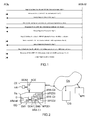
- the user wireless communication equipment CE comprises a handset application HA, a secure element SE, and a secure element access application programming interface SEAA, comprising an access control enforcer ACE and coupled to the handset application HA and secure element SE.
- the secure element SE (here a SIM card, as an example) comprises an Access Rule Application Master applet ARA-M and at least one Access Rule Application Client applet ARA-Ck.
- the Access Rule Application Master applet ARA-M is part of an issuer Security Domain (or SD) ISD (in Global Platform Card Specifications, this Security Domain is owned by the issuer (MNO)). It comprises a first storing means SM1 arranged for storing data defining access control rules REF-AR-DOs.
- an access control rule is a mapping between a handset application HA (running into the wireless communication equipment CE and represented by a "HASH-REF-DO") and a secure element application SEAk (represented by an "AID-REF-DO”), and what kind of restricted access are defined.
- each REF-AR-DO defining a rule is composed of a first small data object "REF-DO” (mapping a secure element application SEAk and a handset application HA) and a second small data object “AR-DO” (describing a (control access) rule, and which can be an "APDU-AR-DO” or a "NFC-AR-DO” or both).
- the (control access) rules stored into the first storing means SM1 may be provided to the secure element SE by a server (or card issuer) ICS, possibly over the air.
- Each Access Rule Application Client applet ARA-Ck is part of an application provider Security Domain (or SD) APSDk (in Global Platform Card Specifications, this Security Domain is owned by the Application Provider (for instance a bank)), which further comprises an associated secure element application SEAk. It comprises a second storing means SM2 arranged for storing data defining access control rules REF-AR-DOs.
- the (control access) rules stored into the second storing means SM2 may be provided to the secure element SE by an application provider server APS, possibly over the air.
- the invention proposes a method intended for allowing the access control enforcer ACE to access to rules stored into the Access Rule Application Master applet ARA-M and the Access Rule Application Clients ARA-Ck of the secure element SE.
- This method comprises two main steps (i) and (ii).
- a first main step (i) of this method is initiated each time a handset application HA of the user wireless communication equipment CE wants (or needs) to communicate with a secure element application SEAk of the secure element SE.
- the access control enforcer ACE transmits, to the secure element SE, a specific command comprising one data object REF-DO, which represents a rule REF-AR-DO to be retrieved for the handset application HA requesting access to the secure element application SEAk.
- this specific command for instance named "Get Data-Priority Rule” is a new Get Data command to be used by the access control enforcer ACE in the Global Platform Device Secure Element environment, and which is different from the other Get Data commands (Get Data-All and Get Data-Specific) known by the man skilled in the art.
- the Access Rule Application Master applet ARA-M determines each REF-AR-DO represented by a received REF-DO in its first storing means SM1 and in each Access Rule Application Client applet ARA-Ck, and then transmits each determined REF-AR-DO in a response message which is similar to a "Response-ALL-AR-DO" message known by the man skilled in the art.
- This second main step (ii) may be triggered and controlled by a device D that is comprised into the secure element SE, possibly into the issuer SD ISD that is coupled to the Access Rule Application Master applet ARA-M.
- Such a device D is preferably made of software modules, at least partly. But it could be also made of a combination of hardware and software modules. In case where it is made of software modules it can be stored in a memory or in any computer software product.
- This new specific command allows the Access Control Enforcer ACE to send only one Get Data command to the Access Rule Application Master applet ARA-M to retrieve some chosen rules, and the device D to respond to this new specific command by means of a single response message containing many possible REF-AR-Dos.
- this new specific command (Get Data-Priority Rule) is sent to the device D after the Access Control Enforcer ACE has checked near the Access Rule Application Master applet ARA-M that the rules stored into the first SM1 and second SM2 storing means had not changed since the preceding check.
- a check is performed by means of a "Get Data Refresh Tag" command.
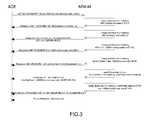
- step (ii) when the Access Rule Application Master applet ARA-M finds each REF-AR-DO represented by a received REF-DO, the device D sends a response message comprising each determined REF-AR-DO to the access control enforcer ACE, as illustrated by step 1 in figure 3 .
- the device D may proceed to the step 2 illustrated in figure 3 .
- the device D triggers a search by the Access Rule Application Master applet ARA-M, in the first SM1 and second SM2 storing means, for each REF-AR-DO associated to an AID-REF-DO representing the secure element application SEAk to be accessed and matching a received REF-DO and to a specific value of a HASH-REF-DO representing the handset application HA requesting this access.
- the device D may proceed to the step 3 illustrated in figure 3 .
- the device D triggers a search by the Access Rule Application Master applet ARA-M, in the first SM1 and second SM2 storing means, for any REF-AR-DO associated to a HASH-REF-DO set to ⁇ AllDeviceApplications> and matching this AID-REF-DO associated to a received REF-DO. For instance, the value of ⁇ AllDeviceApplications> is 4F00. Then, if it finds at least one REF-AR-DO, it transmits each found REF-AR-DO to the device D which transmits it (them) to the access control enforcer ACE.
- the device D may proceed to the step 4 illustrated in figure 3 .
- the device D triggers a search by the Access Rule Application Master applet ARA-M, in the first SM1 and second SM2 storing means, for any REF-AR-DO associated to an AID-REF-DO set to ⁇ AllSEApplications> and matching the HASH-REF-DO associated to the received REF-DO. For instance, the value of ⁇ AllSEApplications> is 4F00. Then, if it finds at least one REF-AR-DO, it transmits each found REF-AR-DO to the device D which transmits it (them) to the access control enforcer ACE.
- the device D may proceed to the step 5 illustrated in figure 3 .
- the device D triggers a search by the Access Rule Application Master applet ARA-M, in the first SM1 and second SM2 storing means, for any REF-AR-DO associated to an AID-REF-DO set to ⁇ AllSEApplications> and not matching a specific HASH-REF-DO.
- the value of ⁇ AllSEApplications> is 4F00 and the value of the specific HASH-REF-DO is different from C100.
- the device D which transmits it (them) to the access control enforcer ACE.
- the device D may proceed to the step 6 illustrated in figure 3 .
- the device D triggers a search by the Access Rule Application Master applet ARA-M, in the first SM1 and second SM2 storing means, for any REF-AR-DO associated to an AID-REF-DO set to ⁇ AllSEApplications> or ⁇ AllDeviceApplications>.
- the value of ⁇ AllSEApplications> is 4F00 and the value of ⁇ AllDeviceApplications> is also C100.
- it finds at least one REF-AR-DO it transmits each found REF-AR-DO to the device D which transmits it (them) to the access control enforcer ACE.
- the device D may transmit an empty message response to the access control enforcer ACE.
- the device D may order the Access Rule Application Master applet ARA-M to directly start the determination (or search) at step 3.
- the device D may order the Access Rule Application Master applet ARA-M to directly start the determination (or search) at step 4.
- the device D may order the Access Rule Application Master applet ARA-M to directly start the determination (or search) at step 6.
- the device D may treat this AID-REF-DO as a specific one and then may order the Access Rule Application Master applet ARA-M to start the determination (or search) at step 1.
- Steps 1 to 6 described above may be associated with priority numbers during a determination.
- the lower the priority number the higher the priority.
- the Access Rule Application Master applet ARA-M will have to send a specific priority command containing each received REF-DO to each Access Rule Application Client applet ARA-Ck to determine the priority number that is associated to each received REF-DO in its second storing means SM2.
- a priority number equal to 7 may be transmitted to the Access Rule Application Master applet ARA-M in response to the specific priority command when an Access Rule Application Client applet ARA-Ck does not store the REF-AR-DO that is represented by a received REF-DO.
- the Access Rule Application Master applet ARA-M will take into consideration the highest priority number received and will do the step (amongst step 1 to step 6) associated to it, to proceed to the determination (or search) in order to respond to the specific command sent by the Access Control Enforcer ACE.
- Figure 4 illustrates an example of routine allowing the Access Rule Application Master applet ARA-M (under control of the device D) to retrieve each priority number associated to each received REF-DO in itself and into each Access Rule Application Client applet ARA-Ck.
- the function "getPriorityREFARDO” is intended to encapsulate the management of calling "getPriorityNumber” and to determine what is the priority and which ARA to retrieve from for the "constructREFARDO".
- the function "getPriorityNumber” is intended for retrieving a priority number associated to a received REF-DO. This getPriorityNumber command is used to have an input parameter to indicate the last priority result of the previous Access Rule Application applet. This is to minimize processing time.
- an Access Rule Application Client applet ARA-Ck is having a priority number that is greater than the last priority result, then its return may be 7.
- the ARA-M gets all the priority numbers of the ARA-Ck, it will choose the least priority number and take into account which ARAs it will need to retrieve REF-AR-DO from to respond to the Access Control Enforcer ACE.
- the command “constructREFARDO” is intended to encapsulate the construction of the response and management of calling the "getREFARDO", and the command “getREFARDO” is intended to retrieve the REF-AR-DO stored from the Access Rule Application.
- step (ii) when the Access Rule Application Master applet ARA-M has determined several REF-AR-DOs corresponding to a received REF-DO into at least two Access Rule Application applets ARA-M and/or ARA-Ck associated to priority numbers, it transmits each determined REF-AR-DO, originating from the Access Rule Application applet ARA-M or ARA-Ck associated to the highest priority number amongst the different priority numbers of these Access Rule Application applets ARA-M and/or ARA-Ck, to the device D which transmits it (them) to the access control enforcer ACE.
- the ARA-M no longer needs to retrieve REF-AR-DO from ARA-Ck because it can construct the REF-AR-DO response on its own. Indeed, for priority 2, the response is always the matching received REF-DO and AR-DO set to never, and for priority 5, the response is always the ⁇ AllSEApplications> set to 4F00 and the matching HASH-REF-DO associated from received REF-DO and AR-DO set to never. In other words for priority numbers 2 and 5, only one REF-AR-DO response is needed.
- the device D will only return the REF-AR-DO provided by the Access Rule Application Master applet ARA-M to the access control enforcer ACE.
- the device D will return the three REF-AR-DOs provided by the Access Rule Application Master applet ARA-M and the first ARA-C1 and second ARA-C2 Access Rule Application Client applets to the access control enforcer ACE.
- the device D will return the two REF-AR-DOs provided by the first ARA-C1 and second ARA-C2 Access Rule Application Client applets to the access control enforcer ACE.
- the access control enforcer ACE retrieves the result for Get Data Priority Rule
- the algorithm it uses for Get Data All may be reused and will yield the same conflict resolution than if it had used Get Data All.
- the main difference is that it will process lesser the data retrieved.
- a handset application HA can be signed with a certificate within a chain.
- the rule associated to a HASH-REF-DO is searched in the following order: EndEntityCertificate, IntermediateCertificate ⁇ 1> ... IntermediateCertificate ⁇ n>, RootCertificate.
- the invention proposes still another specific command (for instance named "Get Data-Priority-All-Devices") that is another variant of Get Data.
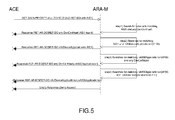
- Get Data-Priority-All-Devices An example of steps that can be implemented, in the case where Get Data-Priority-All-Devices command is used, is illustrated in figure 5 .
- the difference between this last command and Get Data-Priority Rule is the fact that Get Data-Priority-All-Devices will comprise the AID-REF-DO only and without the HASH-REF-DO, in contrast to Get Data-Priority Rule which comprises the whole REF-DO.
- step 2 the applet will overwrite the REF-AR-DO to the matching HASH-REF-DO associated to the received REF-DO and set the AR-DO to never.
- the current Global Platform specification itself is ambiguous about querying chained certificates. So, the new command Get Data-Priority-All-Devices is intended for the handset manufacturer to implement chained certificate querying without sending a GET DATA All command.
- the behaviour is almost the same as the one illustrated in figure 3 , but step2 and step5 are omitted.
- the invention also provides another method, intended for allowing an access control enforcer ACE of a user wireless communication equipment CE, comprising at least one handset application HA, to access to rules stored into an Access Rule Application Master applet ARA-M and/or at least one Access Rule Application Client applet ARA-Ck of a secure element SE in a Global Platform Device Secure Element environment.
- This other method comprises:
- the invention offers several advantages, and notably:
Landscapes
- Engineering & Computer Science (AREA)
- Business, Economics & Management (AREA)
- Computer Security & Cryptography (AREA)
- Strategic Management (AREA)
- General Physics & Mathematics (AREA)
- Entrepreneurship & Innovation (AREA)
- Human Resources & Organizations (AREA)
- Theoretical Computer Science (AREA)
- Physics & Mathematics (AREA)
- General Business, Economics & Management (AREA)
- Computer Networks & Wireless Communication (AREA)
- Signal Processing (AREA)
- Data Mining & Analysis (AREA)
- Microelectronics & Electronic Packaging (AREA)
- Accounting & Taxation (AREA)
- Economics (AREA)
- Marketing (AREA)
- Operations Research (AREA)
- Quality & Reliability (AREA)
- Tourism & Hospitality (AREA)
- Mobile Radio Communication Systems (AREA)
Priority Applications (2)
| Application Number | Priority Date | Filing Date | Title |
|---|---|---|---|
| EP13306864.3A EP2890171A1 (fr) | 2013-12-26 | 2013-12-26 | Procédé permettant à un module de commande d'accès d'accéder à des règles d'un élément sécurisé avec une seule commande spécifique et dispositif associé |
| PCT/EP2014/075198 WO2015096940A1 (fr) | 2013-12-26 | 2014-11-20 | Procédé pour permettre à un module de renforcement de contrôle d'accès ("access control enforcer") d'accéder à des règles d'un élément de sécurité par une commande unique spécifique, et dispositif associé |
Applications Claiming Priority (1)
| Application Number | Priority Date | Filing Date | Title |
|---|---|---|---|
| EP13306864.3A EP2890171A1 (fr) | 2013-12-26 | 2013-12-26 | Procédé permettant à un module de commande d'accès d'accéder à des règles d'un élément sécurisé avec une seule commande spécifique et dispositif associé |
Publications (1)
| Publication Number | Publication Date |
|---|---|
| EP2890171A1 true EP2890171A1 (fr) | 2015-07-01 |
Family
ID=50478986
Family Applications (1)
| Application Number | Title | Priority Date | Filing Date |
|---|---|---|---|
| EP13306864.3A Withdrawn EP2890171A1 (fr) | 2013-12-26 | 2013-12-26 | Procédé permettant à un module de commande d'accès d'accéder à des règles d'un élément sécurisé avec une seule commande spécifique et dispositif associé |
Country Status (2)
| Country | Link |
|---|---|
| EP (1) | EP2890171A1 (fr) |
| WO (1) | WO2015096940A1 (fr) |
Cited By (2)
| Publication number | Priority date | Publication date | Assignee | Title |
|---|---|---|---|---|
| CN110519753A (zh) * | 2019-07-09 | 2019-11-29 | 中移(杭州)信息技术有限公司 | 访问方法、装置、终端和可读存储介质 |
| WO2023104334A1 (fr) * | 2021-12-09 | 2023-06-15 | Giesecke+Devrient Mobile Security Gmbh | Élément sécurisé à application de règle d'accès (ara) |
Families Citing this family (1)
| Publication number | Priority date | Publication date | Assignee | Title |
|---|---|---|---|---|
| US11405782B2 (en) * | 2019-07-11 | 2022-08-02 | Mastercard International Incorporated | Methods and systems for securing and utilizing a personal data store on a mobile device |
Citations (1)
| Publication number | Priority date | Publication date | Assignee | Title |
|---|---|---|---|---|
| WO2013155563A1 (fr) * | 2012-04-17 | 2013-10-24 | Secure Nfc Pty. Ltd. | Architecture de partition d'éléments sécurisés de multiples émetteurs pour des dispositifs nfc |
-
2013
- 2013-12-26 EP EP13306864.3A patent/EP2890171A1/fr not_active Withdrawn
-
2014
- 2014-11-20 WO PCT/EP2014/075198 patent/WO2015096940A1/fr not_active Ceased
Patent Citations (1)
| Publication number | Priority date | Publication date | Assignee | Title |
|---|---|---|---|---|
| WO2013155563A1 (fr) * | 2012-04-17 | 2013-10-24 | Secure Nfc Pty. Ltd. | Architecture de partition d'éléments sécurisés de multiples émetteurs pour des dispositifs nfc |
Non-Patent Citations (2)
| Title |
|---|
| "GlobalPlatform Device Technology -Secure Element Access Control (GPD_SPE_013)", 31 May 2012 (2012-05-31), Internet, pages 1 - 86, XP055117051, Retrieved from the Internet <URL:http://www.globalplatform.org/specificationsdevice.asp> [retrieved on 20140508] * |
| ANWAR WAQAR ET AL: "Redesigning secure element access control for NFC enabled android smartphones using mobile trusted computing", INTERNATIONAL CONFERENCE ON INFORMATION SOCIETY (I-SOCIETY 2013), INFONOMICS SOCIETY, 24 June 2013 (2013-06-24), pages 27 - 34, XP032507521 * |
Cited By (3)
| Publication number | Priority date | Publication date | Assignee | Title |
|---|---|---|---|---|
| CN110519753A (zh) * | 2019-07-09 | 2019-11-29 | 中移(杭州)信息技术有限公司 | 访问方法、装置、终端和可读存储介质 |
| WO2023104334A1 (fr) * | 2021-12-09 | 2023-06-15 | Giesecke+Devrient Mobile Security Gmbh | Élément sécurisé à application de règle d'accès (ara) |
| US12626021B2 (en) | 2021-12-09 | 2026-05-12 | Giesecke+Devrient Mobile Security Germany Gmbh | Secure element with access rule application ARA |
Also Published As
| Publication number | Publication date |
|---|---|
| WO2015096940A1 (fr) | 2015-07-02 |
Similar Documents
| Publication | Publication Date | Title |
|---|---|---|
| KR102224760B1 (ko) | 자동 애플리케이션 업데이트 | |
| JP6332766B2 (ja) | トラステッドサービスマネージャデータの保護および秘密性のためのトラステッドセキュリティゾーンコンテナ | |
| US9769654B2 (en) | Method of implementing a right over a content | |
| CN109818937A (zh) | 针对安卓权限的控制方法、装置、及存储介质、电子装置 | |
| KR101985772B1 (ko) | M2m 데이터 처리 방법, 디바이스, 및 시스템 | |
| CN102073741B (zh) | 一种实现文件读取和/或写入的方法以及数据服务器 | |
| JP2021512380A (ja) | 資産管理方法および装置、ならびに電子デバイス | |
| US11546333B2 (en) | Blockchain-based service processing methods, apparatuses, devices, and storage media | |
| EP2638712B1 (fr) | Système de politique dynamique basé sur le contexte destinée aux dispositifs mobiles, et infrastructure de réseau support | |
| WO2011086787A1 (fr) | Système de prévention de fuite d'informations sensibles, procédé de prévention de fuite d'informations sensibles et programme de prévention de fuite d'informations sensibles | |
| US10320809B1 (en) | Decoupling rendering engine from web browser for security | |
| US9351101B2 (en) | Communication method and apparatus for NFC device and NFC device | |
| US20250047638A1 (en) | Secure analysis application for accessing web resources | |
| WO2015096940A1 (fr) | Procédé pour permettre à un module de renforcement de contrôle d'accès ("access control enforcer") d'accéder à des règles d'un élément de sécurité par une commande unique spécifique, et dispositif associé | |
| CN117459320A (zh) | 数据的访问控制方法和装置 | |
| CN112491956A (zh) | 物联网设备中通讯模组的升级方法、装置和计算机设备 | |
| KR20130008041A (ko) | 무선 통신 네트워크간의 공존 방법 및 시스템 | |
| CN117828009B (zh) | 用于生成和查询与目标通信相关联的索引的系统和方法 | |
| KR20130063399A (ko) | 모바일 클라우드 환경에 적용되는 모바일 단말과 클라우드 서버 및 이를 이용한 모바일 클라우드 컴퓨팅 방법 | |
| CN116389258B (zh) | 用于确定用于在复杂计算网络中发起目标通信的目标分配参数的系统和方法 | |
| EP2827274A1 (fr) | Procédé de mise en oeuvre de commande de l'accès par un dispositif à un élément sécurisé et élément sécurisé correspondant | |
| US20150163724A1 (en) | Communication apparatus and control method thereof | |
| CN109417559A (zh) | 用于处置缓存的内容资源的服务器、客户端装置和其中的方法 | |
| CN118394970B (zh) | 针对数据治理过程管理的数据监管方法 | |
| US20160048675A1 (en) | Starting an application on a mobile device |
Legal Events
| Date | Code | Title | Description |
|---|---|---|---|
| PUAI | Public reference made under article 153(3) epc to a published international application that has entered the european phase |
Free format text: ORIGINAL CODE: 0009012 |
|
| 17P | Request for examination filed |
Effective date: 20131226 |
|
| AK | Designated contracting states |
Kind code of ref document: A1 Designated state(s): AL AT BE BG CH CY CZ DE DK EE ES FI FR GB GR HR HU IE IS IT LI LT LU LV MC MK MT NL NO PL PT RO RS SE SI SK SM TR |
|
| AX | Request for extension of the european patent |
Extension state: BA ME |
|
| STAA | Information on the status of an ep patent application or granted ep patent |
Free format text: STATUS: THE APPLICATION IS DEEMED TO BE WITHDRAWN |
|
| 18D | Application deemed to be withdrawn |
Effective date: 20160105 |