EP2890048A1 - Method for processing a generalized Goldwasser-Micali ciphertext, corresponding electronic device and computer program product - Google Patents
Method for processing a generalized Goldwasser-Micali ciphertext, corresponding electronic device and computer program product Download PDFInfo
- Publication number
- EP2890048A1 EP2890048A1 EP13306889.0A EP13306889A EP2890048A1 EP 2890048 A1 EP2890048 A1 EP 2890048A1 EP 13306889 A EP13306889 A EP 13306889A EP 2890048 A1 EP2890048 A1 EP 2890048A1
- Authority
- EP
- European Patent Office
- Prior art keywords
- value
- binary representation
- ciphertext
- determining
- plaintext
- Prior art date
- Legal status (The legal status is an assumption and is not a legal conclusion. Google has not performed a legal analysis and makes no representation as to the accuracy of the status listed.)
- Withdrawn
Links
- 238000000034 method Methods 0.000 title claims abstract description 89
- 238000012545 processing Methods 0.000 title claims abstract description 10
- 238000004590 computer program Methods 0.000 title claims description 6
- 230000006870 function Effects 0.000 claims description 31
- 230000015654 memory Effects 0.000 claims description 18
- 230000009467 reduction Effects 0.000 claims description 4
- 230000001052 transient effect Effects 0.000 claims 1
- 230000008569 process Effects 0.000 description 11
- 239000000654 additive Substances 0.000 description 5
- 230000000996 additive effect Effects 0.000 description 5
- 238000004891 communication Methods 0.000 description 4
- 230000003287 optical effect Effects 0.000 description 2
- 230000002776 aggregation Effects 0.000 description 1
- 238000004220 aggregation Methods 0.000 description 1
- 238000010276 construction Methods 0.000 description 1
- 238000013461 design Methods 0.000 description 1
- 230000003340 mental effect Effects 0.000 description 1
- 238000004377 microelectronic Methods 0.000 description 1
- 230000004048 modification Effects 0.000 description 1
- 238000012986 modification Methods 0.000 description 1
Images



Classifications
-
- H—ELECTRICITY
- H04—ELECTRIC COMMUNICATION TECHNIQUE
- H04L—TRANSMISSION OF DIGITAL INFORMATION, e.g. TELEGRAPHIC COMMUNICATION
- H04L9/00—Cryptographic mechanisms or cryptographic arrangements for secret or secure communications; Network security protocols
- H04L9/30—Public key, i.e. encryption algorithm being computationally infeasible to invert or user's encryption keys not requiring secrecy
- H04L9/3006—Public key, i.e. encryption algorithm being computationally infeasible to invert or user's encryption keys not requiring secrecy underlying computational problems or public-key parameters
- H04L9/302—Public key, i.e. encryption algorithm being computationally infeasible to invert or user's encryption keys not requiring secrecy underlying computational problems or public-key parameters involving the integer factorization problem, e.g. RSA or quadratic sieve [QS] schemes
-
- H—ELECTRICITY
- H04—ELECTRIC COMMUNICATION TECHNIQUE
- H04L—TRANSMISSION OF DIGITAL INFORMATION, e.g. TELEGRAPHIC COMMUNICATION
- H04L9/00—Cryptographic mechanisms or cryptographic arrangements for secret or secure communications; Network security protocols
- H04L9/008—Cryptographic mechanisms or cryptographic arrangements for secret or secure communications; Network security protocols involving homomorphic encryption
Definitions
- the invention relates to cryptography, and more precisely to homomorphic cryptographic schemes.
- Additively homomorphic schemes are cryptographic functions that enable the design of more complex cryptographic systems. For example, currently, many e-voting schemes employ an additive homomorphic encryption algorithm to encrypt the votes and exploit the additive homomorphism of the encryption algorithm to recover the sum of all votes for any candidate or choice with a single decryption. As no single vote is decrypted, vote privacy is protected. Additive homomorphic schemes can also be used in MPC (for Multi-Party Computation) protocols.
- the present document focuses on the generalized Goldwasser-Micali cryptosystem scheme, and aims to provide a technique that enables an electronic device to speed up the decryption process of the generalized Goldwasser-Micali cryptosystem.
- the present invention is directed to a method for processing a generalized Goldwasser-Micali ciphertext, said ciphertext being obtained through a use of a public key.
- Such method is executed on an electronic device and is remarkable in that it comprises:
- the method is remarkable in that said determining is performed for all the bits of said binary representation of said plaintext having a position different from zero.
- the method is remarkable in that it comprises obtaining said least significant bit of said binary representation of said plaintext in function of said ciphertext, and said element defined in function of said private key.
- the method is remarkable in that said determining of said at least one bit positioned at j -th position of said binary representation of said plaintext comprises determining a first value c y m mod 2 j ⁇ j + 1 , where c corresponds to said ciphertext, y corresponds to said element of said public key, and comparing said first value with 1 or p - 1.
- the method is remarkable in that said determining said first value comprises obtaining at least a second value D corresponding to y - p ' mod p , where mod is a modular reduction.
- the method is remarkable in that said determining said first value comprises obtaining at least i values, i being comprised between 1 and j , defined in function of said at least second value D .
- the method is remarkable in that said determining said first value comprises obtaining at least i values, i being comprised between 1 and k - 1, defined in function of said at least second value D .
- the method is remarkable in that said determining said first value comprises obtaining at least a third value D corresponding to y p ' mod p, where mod is a modular reduction.
- the method is remarkable in that said determining said first value comprises obtaining at least i values, i being comprise between 1 and j , defined in function of said at least third value D .
- the method is remarkable in that said determining said first value comprises obtaining at least i values, i being comprise between 1 and k - 1, defined in function of said at least third value D ⁇ .
- the method is remarkable in that it comprises determining said private key p from said odd integer p' , said odd integer p' being stored on a memory unit of said electronic device.
- the method is remarkable in that said binary representation is stored on said electronic device according to big-endian rule.
- the method is remarkable in that said binary representation is stored on said electronic device according to little-endian rule.
- the different steps of the method are implemented by a computer software program or programs, this software program comprising software instructions designed to be executed by a data processor of a relay module according to the disclosure and being designed to control the execution of the different steps of this method.
- an aspect of the disclosure also concerns a program liable to be executed by a computer or by a data processor, this program comprising instructions to command the execution of the steps of a method as mentioned here above.
- This program can use any programming language whatsoever and be in the form of a source code, object code or code that is intermediate between source code and object code, such as in a partially compiled form or in any other desirable form.
- the disclosure also concerns an information medium readable by a data processor and comprising instructions of a program as mentioned here above.
- the information medium can be any entity or device capable of storing the program.
- the medium can comprise a storage means such as a ROM (which stands for "Read Only Memory” ), for example a CD-ROM (which stands for “Compact Disc - Read Only Memory” ) or a microelectronic circuit ROM or again a magnetic recording means, for example a floppy disk or a hard disk drive.
- ROM Read Only Memory
- CD-ROM which stands for "Compact Disc - Read Only Memory”
- microelectronic circuit ROM again a magnetic recording means, for example a floppy disk or a hard disk drive.
- the information medium may be a transmissible carrier such as an electrical or optical signal that can be conveyed through an electrical or optical cable, by radio or by other means.
- the program can be especially downloaded into an Internet-type network.
- the information medium can be an integrated circuit into which the program is incorporated, the circuit being adapted to executing or being used in the execution of the method in question.
- an embodiment of the disclosure is implemented by means of software and/or hardware components.
- module can correspond in this document both to a software component and to a hardware component or to a set of hardware and software components.
- a software component corresponds to one or more computer programs, one or more subprograms of a program, or more generally to any element of a program or a software program capable of implementing a function or a set of functions according to what is described here below for the module concerned.
- One such software component is executed by a data processor of a physical entity (terminal, server, etc.) and is capable of accessing the hardware resources of this physical entity (memories, recording media, communications buses, input/output electronic boards, user interfaces, etc.).
- a hardware component corresponds to any element of a hardware unit capable of implementing a function or a set of functions according to what is described here below for the module concerned. It may be a programmable hardware component or a component with an integrated circuit for the execution of software, for example an integrated circuit, a smart card, a memory card, an electronic board for executing firmware etc.
- the present invention is directed to an electronic device for processing a generalized Goldwasser-Micali ciphertext, said ciphertext being obtained through a use of a public key.
- the electronic device is remarkable in that it comprises:
- the electronic device is remarkable in that said means for determining are used for obtaining all the bits of said binary representation of said plaintext having a position different from zero.
- N pq , where p and q are prime numbers, verifying the following relationships p ⁇ 1 mod 2 k and q ⁇ 1 mod 2 k , with the parameter k which is the size (in bits) of the message to be encrypted. Indeed, the message space is ⁇ 0,1 ⁇ k .
- J N is a multiplicative group of integers belonging to Z N * whose Jacobi symbol is 1, and QR N is the set of the quadratic residues modulo N .
- the electronic device initializes several variables (associated with memory units such as registers for example) M , B , C , i and Y as follows: M ⁇ 0; B ⁇ 1 ; C ⁇ c ; i ⁇ 1 and Y ⁇ y .
- variable M comprises the expected plaintext m .
- the original decryption algorithm requires 2 k exponentiations modulo p .
- the present invention suggests a modification that considerably speeds up the decryption. It should be noticed that the encryption process is unchanged.
- the proposed technique is based on a relationship that links a bit representation of the plaintext, at position j - 1 (the least significant bit being at position 0, and corresponding to the bit m 0 , and the bit at position j - 1 corresponding to m j -1 , for 1 ⁇ j ⁇ k - 1 ), and some values. More precisely, the relationship is the following one: c / y m mod 2 j - 1 ⁇ j ⁇ - 1 m j - 1 ⁇ mod p where the ciphertext c is obtained through the use of the encryption function of the generalized Goldwasser-Micali cryptosystem (e.g.
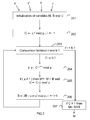
- Figure 1 presents a flowchart that depicts a decryption method according to a first embodiment of the invention.
- the decryption method executed on an electronic device obtains a parameter k corresponding to the size (in number of bits) of the plaintext to be recovered, a secret element p' as previously mentioned, as well as a value D corresponding to the value y - p ' mod p , and a ciphertext c (such ciphertext being generated through the use of an encryption function in the generalized Goldwasser-Micali cryptosystem).
- the obtaining of these elements can be done for example by reading in a memory unit the requested values.
- only the secret element p' is obtained, and the value D is determined from the value of the public element y , that can be stored in a memory of the electronic device, or received from another electronic device.
- the secret element p' is obtained from the secret element p .
- the secret element p is obtained from the secret element p '.
- the electronic device initializes several variables (associated with memory units such as registers for example). Indeed, the variables M , B, U are initialized as follows : M ⁇ 0; B ⁇ 1 and U ⁇ D.
- a variable C is initialized by performing an exponentiation, modulo the secret prime number p , on the ciphertext with an exponent corresponding to the secret element p' (e.g. we have C ⁇ c p' mod p )
- a variable (a counter variable), noted i is initialized to 1 (e.g. i ⁇ 1).
- a comparison between the value of the variable i and the parameter k is done. If the value of the variable i is smaller or equal to the value of parameter k, then the steps referenced 104, 105 and 106 are executed. If the value of the variable i is strictly greater than the value of k , then the variable M is outputted, and the decryption method is ended up . Indeed, the variable M comprises in that case the value of the plaintext m .
- an intermediate variable z is assigned with the value of the following element : ( C. U M ) 2 k-i mod p .
- a step referenced 105 the value of the intermediate variable z is compared with one. If the value of the intermediate variable z is different from one, then the value of the variable M is modified as follows : M ⁇ M + B .
- variable B is updated as follows: B ⁇ 2 B , and an increment operation by one of the value of the variable i is performed (e.g. i ⁇ i + 1). Then, the process returns to the step 103.
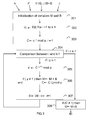
- Figure 2 presents a flowchart that depicts a decryption method according to a second embodiment of the invention.
- variable M in the loop of the decryption method described in the Figure 1 contains the lowest part of the plaintext m , and that one bit of plaintext m is correctly obtained per iteration, there is no need to recompute U M mod p . Rather, it suffices to update it using the variable C as an accumulator. Further, it is also possible to save a couple of operations by reducing the length of the loop process.
- the method according to such embodiment comprises a step referenced 201, in which the electronic device initializes several variables (associated with memory units such as registers for example). Indeed, the variables M , B, U are initialized as follows : M ⁇ 0; B ⁇ 1 and U ⁇ D .
- a variable C is initialized by performing an exponentiation, modulo the secret prime number p , on the ciphertext with an exponent corresponding to the secret element p' (e.g. we have C ⁇ c p' mod p ).
- a variable (a counter variable), noted i is initialized to 1 (e.g. i ⁇ 1).
- a comparison between the value of the variable i and the value k - 1 is performed. If the value of the variable i is smaller or equal to the value k - 1, then the steps referenced 204, 205 and 206 are executed. If the value of the variable i is strictly greater than the value k - 1, then a step referenced 207 is executed. Such step 207 comprises comparing the value of the variable C with one. If the value of the variable C is different from one, then the variable M is modified as follows: M ⁇ M + B . Otherwise, the variable M is not modified. Then, the variable M is outputted, and the decryption method is ended up. Indeed, the variable M comprises in that case the value of the plaintext m .
- an intermediate variable z is affected with the value of the following element : C 2 k-i mod p .
- the value of the intermediate variable z is compared with one. If the value of the intermediate variable z is different from one, then the value of the variable M is modified as follows : M ⁇ M + B , and the value of the variable C is also modified as follows: C ⁇ C. U mod p .
- variable B is updated as follows: B ⁇ 2 B
- variable U is updated as follows U ⁇ U 2 mod p
- an increment operation by one of the value of the variable i is performed (e.g. i ⁇ i + 1). Then the process returns to the step 203.
- the value D can be precomputed or included in the private key.
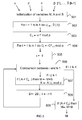
- Figure 3 presents a flowchart that depicts a decryption method according to a third embodiment of the invention.
- the decryption method can be executed faster (due to the fact that such method uses less operations from a complexity point of view) than the previous ones.
- such method needs in input some additional values (or data).
- the method according to such embodiment comprises a step referenced 301, in which the electronic device initializes several variables (associated with memory units such as registers for example). Indeed, the variables M and B are initialized as follows : M ⁇ 0; B ⁇ 1.
- a variable C is initialized in the same way as in the step 202 (e.g. we have C ⁇ c p' mod p ), and a counter variable i is also initialized as follows: i ⁇ 1.
- a comparison between the variable i and the variable k - 1 is performed. If the value of the variable i is smaller or equal to the value k - 1, then the steps referenced 305, 306 and 307 are executed. If the value of the variable i is strictly greater than the value k - 1, then a step referenced 308 is executed. Such step 308 comprises comparing the value of the variable C with one. If the value of the variable C is different from one, then the variable M is modified as follows: M ⁇ M + B . Otherwise, the variable M is not modified. Then, the variable M is outputted, and the decryption method is ended up. Indeed, the variable M comprises in that case the value of the plaintext m .
- an intermediate variable z is affected with the value of the following element : C 2k-i mod p.
- the value of the intermediate variable z is compared with one. If the value of the intermediate variable z is different from one, then the value of the variable M is modified as follows : M ⁇ M + B , and the value of the variable C is also modified as follows: C ⁇ C . U i mod p.
- variable B is updated as follows: B ⁇ 2 B , and an increment operation by one of the value of the variable i is performed (e.g. i ⁇ i + 1). Then the process returns to the step 304.
- Figure 4 presents a flowchart that depicts a decryption method according to a fourth embodiment of the invention.
- the different values of C 2 k-i mod p mentioned in the previous embodiments are obtained before executing the loop corresponding to the evolution of the value of the variable i .
- the obtaining of these elements can be done for example by reading in a memory unit the requested values.
- only the secret element p' is obtained, and the value D ⁇ is determined from the value of the public element y , that can be stored in a memory of the electronic device, or received from another electronic device.
- the secret element p' is obtained from the secret element p .
- the secret element p is obtained from the secret element p' .
- the method according to such embodiment comprises a step referenced 401, in which the electronic device initializes several variables (associated with memory units such as registers for example). Indeed, the variables M , A, B, U are initialized as follows : M ⁇ 0; A ⁇ 1 , B ⁇ 1 and U ⁇ D ⁇ .
- a variable C 0 is initialized by performing an exponentiation, modulo the secret prime number p , on the ciphertext with an exponent corresponding to the secret element p' (e.g. we have C 0 ⁇ c p' mod p ).
- C j are initialized as follows: C i ⁇ C j-1 2 mod p , for 1 ⁇ j ⁇ k - 1 .
- a counter variable i is initialized as follows: i ⁇ 1.
- a comparison between the variable i and the value k - 1 is performed. If the value of the variable i is smaller or equal to the value k - 1, then the steps referenced 406 and 407 are executed. If the value of the variable i is strictly greater than the value k - 1, then a step referenced 408 is executed. Such step 408 comprises comparing the value of the variable A with the value of the variable C 0 . If the value of the variable A is different from the value of the variable C 0 , then the variable M is modified as follows: M ⁇ M + B . Otherwise, the variable M is not modified. Then, the variable M is outputted, and the decryption method is ended up. Indeed, the variable M comprises in that case the value of the plaintext m .
- the value of the variable A is compared with the one of the variable C k -i . If these value are different from each other, then the value of the variable M is modified as follows : M ⁇ M + B , and the value of the variable A is also modified as follows: A ⁇ A. U mod p .
- variable B is updated as follows: B ⁇ 2 B
- variable U is updated as follows: U ⁇ U2 mod p
- an increment operation by one of the value of the variable i is performed (e.g. i ⁇ i + 1). Then the process returns to the step 405.
- the method according to this embodiment has a cubic complexity (whereas the classical decryption method has a quartic complexity).
- Figure 5 presents a flowchart that depicts a decryption method according to a fifth embodiment of the invention.
- Such embodiment of the invention uses the technique described in the Figure 3 to the one described in Figure 4 .
- the method according to such embodiment comprises a step referenced 501, in which the electronic device initializes several variables (associated with memory units such as registers for example). Indeed, the variables M , A , B are initialized as follows : M ⁇ 0; A ⁇ 1 , B ⁇ 1.
- a variable C 0 is initialized by performing an exponentiation, modulo the secret prime number p , on the ciphertext with an exponent corresponding to the secret element p' (e.g. we have C 0 ⁇ c p' mod p ).
- C j are initialized as follows: C j ⁇ C j -1 2 mod p , for 1 ⁇ j ⁇ k - 1 .
- a counter variable i is initialized as follows: i ⁇ 1.
- a comparison between the value of the variable i and the value k - 1 is performed. If the value of the variable i is smaller or equal to the value k - 1, then the steps referenced 507 and 508 are executed. If the value of the variable i is strictly greater than the value k - 1, then a step referenced 509 is executed. Such step 509 comprises comparing the value of the variable A with the value of the variable C 0 . If the value of the variable A is different from the value of the variable C 0 , then the variable M is modified as follows: M ⁇ M + B . Otherwise, the variable M is not modified. Then, the variable M is outputted, and the decryption method is ended up. Indeed, the variable M comprises in that case the value of the plaintext m .
- the value of the variable A is compared with the one of the variable C k - i . If these value are different from each other, then the value of the variable M is modified as follows : M ⁇ M + B , and the value of the variable A is also modified as follows: A ⁇ A. U i mod p .
- variable B is updated as follows: B ⁇ 2 B , and an increment operation by one of the value of the variable i is performed (e.g. i ⁇ i + 1). Then the process returns to the step 506.
- the method according to this embodiment has also a cubic complexity (whereas the classical decryption method has a quartic complexity).
- Figure 6 presents a device that can be used to perform one or several steps of methods disclosed in the present document.
- Such device referenced 600 comprise a computing unit (for example a CPU, for "Central Processing Unit” ), referenced 601, and one or several memory units (for example a RAM (for "Random Access Memory”) block in which intermediate results can be stored temporarily during the execution of instructions a computer program, or a ROM block in which, among other things, computer programs are stored, or an EEPROM (" Electrically-Erasable Programmable Read-Only Memory ”) block, or a flash block) referenced 602. Computer programs are made of instructions that can be executed by the computing unit.
- Such device 600 can also comprise a dedicated unit, referenced 603, constituting an input-output interface to allow the device 600 to communicate with other devices.
- this dedicated unit 603 can be connected with an antenna (in order to perform communication without contacts), or with serial ports (to carry communications "contact”). Let's remark that the arrows in Figure 6 means that the linked unit can exchange data through buses for example together.
- some or all of the steps of the method previously described can be implemented in hardware in a programmable FPGA (" Field Programmable Gate Array ”) component or ASIC (" Application-Specific Integrated Circuit ”) component.
- some or all of the steps of the method previously described can be executed on an electronic device comprising memory units and processing units as the one disclosed in the Figure 6 .
Landscapes
- Engineering & Computer Science (AREA)
- Computing Systems (AREA)
- Theoretical Computer Science (AREA)
- Computer Security & Cryptography (AREA)
- Computer Networks & Wireless Communication (AREA)
- Signal Processing (AREA)
- Storage Device Security (AREA)
Abstract
In one embodiment, it is proposed a method for processing a generalized Goldwasser-Micali ciphertext, said ciphertext being obtained through a use of a public key, said method being executed on an electronic device and being remarkable in that it comprises:
- determining at least one bit of a binary representation of a plaintext associated with said ciphertext, said at least one bit corresponding to a bit positioned at j-th position of said binary representation of said plaintext, j being an integer greater or equal to one, and position zero of said binary representation corresponding to the least significant bit of said binary representation, said determining being a function of
- said ciphertext,
- an element of said public key,
- a private key associated to said public key,
- an element defined in function of said private key, and
- least significant bits of said plaintext from position zero to j - 1 in said binary representation.
- determining at least one bit of a binary representation of a plaintext associated with said ciphertext, said at least one bit corresponding to a bit positioned at j-th position of said binary representation of said plaintext, j being an integer greater or equal to one, and position zero of said binary representation corresponding to the least significant bit of said binary representation, said determining being a function of
- said ciphertext,
- an element of said public key,
- a private key associated to said public key,
- an element defined in function of said private key, and
- least significant bits of said plaintext from position zero to j - 1 in said binary representation.
Description
- The invention relates to cryptography, and more precisely to homomorphic cryptographic schemes.
- This section is intended to introduce the reader to various aspects of art, which may be related to various aspects of the present invention that are described and/or claimed below. This discussion is believed to be helpful in providing the reader with background information to facilitate a better understanding of the various aspects of the present invention. Accordingly, it should be understood that these statements are to be read in this light, and not as admissions of prior art.
- Additively homomorphic schemes (that enable given only a public-key and the encryption of two messages m 1 and m 2, one can compute the encryption of (m 1 + m 2)) are cryptographic functions that enable the design of more complex cryptographic systems. For example, currently, many e-voting schemes employ an additive homomorphic encryption algorithm to encrypt the votes and exploit the additive homomorphism of the encryption algorithm to recover the sum of all votes for any candidate or choice with a single decryption. As no single vote is decrypted, vote privacy is protected. Additive homomorphic schemes can also be used in MPC (for Multi-Party Computation) protocols. At last, other application of additive homomorphic can be found out in the article " Fingerprinting protocol for images based on additive homomorphic property" by M. Kuribayashi et al., and published in the IEEE Trans. Image Process. 2005, or in the article " Application of homomorphism to secure image sharing" by N. Islam et al., published in the journal Optics Communications (Volume 284, ).
- However, only few additively homomorphic schemes exist in the state of the art. Indeed, one skilled in the art has a limited choice of using an additively homomorphic shemes among the original Goldwasser-Micali cryptosystem (see the article " Probabilistic Encryption and How to Play Mental Poker Keeping Secret All Partial Information", by S. Goldwasser and S. Micali, published in the proceedings of STOC'82, pp. 365-377, 1982), Benaloh's construction, the Naccache-Stern scheme, Paillier's cryptosystem scheme, the Boneh-Goh-Nissim (BGN) scheme, the Damgard-Jurik scheme, the additively homomorphic ElGamal cryptosystem scheme, the Okamoto-Uchiyama cryptosystem scheme and the generalized Goldwasser-Micali cryptosystem scheme (published in the article " Efficient Cryptosystems from 2^-th Power Residue Symbols" by M. Joye and B. Libert, published in the proceedings of Eurocrypt 2013, Lecture Notes in Computer Science vol. 7881, pp. 76-92, 2013).
- Therefore, one skilled in the art has to choose one of these schemes according to several criteria such as the size of the data (keys, messages), the security level required, the speed of execution of the additively homomorphic schemes, etc.
- The present document focuses on the generalized Goldwasser-Micali cryptosystem scheme, and aims to provide a technique that enables an electronic device to speed up the decryption process of the generalized Goldwasser-Micali cryptosystem.
- One skilled in the art could also apply the teaching of the present document to the context described in the article " An Application of the Goldwasser-Micali Cryptosystem to Biometric Authentication" by J. Bringer et al., in the proceedings of the conference ACISP'07 (Australasian Conference on Information Security and Privacy), or also in the context of aggregator of time series data as mentioned in the article " A scalable scheme for privacy-preserving aggregation of time-series data"by M. Joye and B. Libert, published in the proceedings of the conference Financial Cryptography and Data Security 2013.
- The present invention is directed to a method for processing a generalized Goldwasser-Micali ciphertext, said ciphertext being obtained through a use of a public key. Such method is executed on an electronic device and is remarkable in that it comprises:
- determining at least one bit of a binary representation of a plaintext associated with said ciphertext, said at least one bit corresponding to a bit positioned at j-th position of said binary representation of said plaintext, j being an integer greater or equal to one, and position zero of said binary representation corresponding to the least significant bit of said binary representation, said determining being a function of
- said ciphertext,
- an element of said public key,
- a private key associated to said public key,
- an element defined in function of said private key, and
- least significant bits of said plaintext from position zero to j - 1 in said binary representation.
- In a preferred embodiment, the method is remarkable in that said determining is performed for all the bits of said binary representation of said plaintext having a position different from zero.
- In a preferred embodiment, the method is remarkable in that it comprises obtaining said least significant bit of said binary representation of said plaintext in function of said ciphertext, and said element defined in function of said private key.
- In a preferred embodiment, the method is remarkable in that said binary representation of said plaintext is a k-bit string, k being an integer greater or equal to one, and in that said element defined in function of said private key corresponds to λ j+1 = 2 k-(j+1) p', where p' is an odd integer linked to said private key p, which is a prime number, by the following equation: p = 2 k
p '+ 1. - In a preferred embodiment, the method is remarkable in that said determining of said at least one bit positioned at j-th position of said binary representation of said plaintext comprises determining a first value

- In a preferred embodiment, the method is remarkable in that said determining said first value comprises obtaining at least a second value D corresponding to y -p' mod p, where mod is a modular reduction.
- In a preferred embodiment, the method is remarkable in that said determining said first value comprises obtaining at least i values, i being comprised between 1 and j, defined in function of said at least second value D.
- In a preferred embodiment, the method is remarkable in that said determining said first value comprises obtaining at least i values, i being comprised between 1 and k - 1, defined in function of said at least second value D.
- In a preferred embodiment, the method is remarkable in that said determining said first value comprises obtaining at least a third value D corresponding to y p' mod p, where mod is a modular reduction.
- In a preferred embodiment, the method is remarkable in that said determining said first value comprises obtaining at least i values, i being comprise between 1 and j, defined in function of said at least third value D.
- In a preferred embodiment, the method is remarkable in that said determining said first value comprises obtaining at least i values, i being comprise between 1 and k - 1, defined in function of said at least third value D̃.
- In a preferred embodiment, the method is remarkable in that it comprises determining said private key p from said odd integer p', said odd integer p' being stored on a memory unit of said electronic device.
- In a preferred embodiment, the method is remarkable in that said binary representation is stored on said electronic device according to big-endian rule.
- In a preferred embodiment, the method is remarkable in that said binary representation is stored on said electronic device according to little-endian rule.
- According to an exemplary implementation, the different steps of the method are implemented by a computer software program or programs, this software program comprising software instructions designed to be executed by a data processor of a relay module according to the disclosure and being designed to control the execution of the different steps of this method.
- Consequently, an aspect of the disclosure also concerns a program liable to be executed by a computer or by a data processor, this program comprising instructions to command the execution of the steps of a method as mentioned here above.
- This program can use any programming language whatsoever and be in the form of a source code, object code or code that is intermediate between source code and object code, such as in a partially compiled form or in any other desirable form.
- The disclosure also concerns an information medium readable by a data processor and comprising instructions of a program as mentioned here above.
- The information medium can be any entity or device capable of storing the program. For example, the medium can comprise a storage means such as a ROM (which stands for "Read Only Memory"), for example a CD-ROM (which stands for "Compact Disc - Read Only Memory") or a microelectronic circuit ROM or again a magnetic recording means, for example a floppy disk or a hard disk drive.
- Furthermore, the information medium may be a transmissible carrier such as an electrical or optical signal that can be conveyed through an electrical or optical cable, by radio or by other means. The program can be especially downloaded into an Internet-type network.
- Alternately, the information medium can be an integrated circuit into which the program is incorporated, the circuit being adapted to executing or being used in the execution of the method in question.
- According to one embodiment, an embodiment of the disclosure is implemented by means of software and/or hardware components. From this viewpoint, the term "module" can correspond in this document both to a software component and to a hardware component or to a set of hardware and software components.
- A software component corresponds to one or more computer programs, one or more subprograms of a program, or more generally to any element of a program or a software program capable of implementing a function or a set of functions according to what is described here below for the module concerned. One such software component is executed by a data processor of a physical entity (terminal, server, etc.) and is capable of accessing the hardware resources of this physical entity (memories, recording media, communications buses, input/output electronic boards, user interfaces, etc.).
- Similarly, a hardware component corresponds to any element of a hardware unit capable of implementing a function or a set of functions according to what is described here below for the module concerned. It may be a programmable hardware component or a component with an integrated circuit for the execution of software, for example an integrated circuit, a smart card, a memory card, an electronic board for executing firmware etc.
- In another embodiment, the present invention is directed to an electronic device for processing a generalized Goldwasser-Micali ciphertext, said ciphertext being obtained through a use of a public key. The electronic device is remarkable in that it comprises:
- means for determining at least one bit of a binary representation of a plaintext associated with said ciphertext, said at least one bit corresponding to a bit positioned at j-th position of said binary representation of said plaintext, j being an integer greater or equal to one, and position zero of said binary representation corresponding to the least significant bit of said binary representation, said means for determining being able to determine a function of
- said ciphertext,
- an element of said public key,
- a private key associated to said public key,
- an element defined in function of said private key, and
- least significant bits of said plaintext from position zero to j - 1 in said binary representation.
- In a preferred embodiment, the electronic device is remarkable in that said means for determining are used for obtaining all the bits of said binary representation of said plaintext having a position different from zero.
- The above and other aspects of the invention will become more apparent by the following detailed description of exemplary embodiments thereof with reference to the attached drawings in which:
-
Figure 1 presents a flowchart that depicts a decryption method according to a first embodiment of the invention; -
Figure 2 presents a flowchart that depicts a decryption method according to a second embodiment of the invention; -
Figure 3 presents a flowchart that depicts a decryption method according to a third embodiment of the invention; -
Figure 4 presents a flowchart that depicts a decryption method according to a fourth embodiment of the invention; -
Figure 5 presents a flowchart that depicts a decryption method according to a fifth embodiment of the invention; -
Figure 6 presents a device that can be used to perform one or several steps of methods disclosed in the present document. - The present paragraph is aimed at reminding the reader with the generalized Goldwasser-Micali cryptosystem proposed by Joye and Libert (see the previous mentioned article " Efficient Cryptosystems from 2k-th Power Residue Symbols" by M. Joye and B. Libert, Eurocrypt 2013, Lecture Notes in Computer Science vol. 7881, pp. 76-92, 2013).
- Let N = pq, where p and q are prime numbers, verifying the following relationships p ≡ 1
mod 2 k and q ≡ 1mod 2k, with the parameter k which is the size (in bits) of the message to be encrypted. Indeed, the message space is {0,1} k . Let also y ∈ J N \QR N , where J N is a multiplicative group of integers belonging to Z N * whose Jacobi symbol is 1, and QR N is the set of the quadratic residues modulo N. The public key is pk = {N,y,k} while the private key is sk = {p}. Given a message
k mod N for some random element x ∈ Z N *. Let's focus now on the decryption process of the generalized Goldwasser-Micali cryptosystem. The plaintext message m is recovered from the ciphertext c as the unique integer in the interval [0,2 k ) satisfying the relationship


- The decryption process in the generalized Goldwasser-Micali cryptosystem requires evaluating several power residue symbols modulo a prime number p ; namely,


- As a result, the original decryption algorithm requires 2k exponentiations modulo p. The present invention suggests a modification that considerably speeds up the decryption. It should be noticed that the encryption process is unchanged.
- More precisely, the proposed technique is based on a relationship that links a bit representation of the plaintext, at position j - 1 (the least significant bit being at position 0, and corresponding to the bit m 0, and the bit at position j - 1 corresponding to m j-1, for 1 ≤ j ≤ k - 1 ), and some values. More precisely, the relationship is the following one:

k mod N where the message (or plaintext) is
mod 2 k , q ≡ 1mod 2 k , and p ≢ 1mod 2 k+1, q ≢ 1mod 2 k+1, an element of the public key y ∈ J N \QR N ) and for 1 ≤ j ≤ k, we set up λ j = 2 k- jp', with p' being an odd integer defined such that p = 2 kp' + 1 (such relation is verified as it is equivalent to p ≡ 1 mod 2 k ). - In order to detail how to establish the previous mentioned equation, it should be noticed that we have the following equation that is verified y 2 k -1p' ≡ -1 mod p. Indeed, we have

Then, by setting up Cj ≡ c λj mod p, we have


-
Figure 1 presents a flowchart that depicts a decryption method according to a first embodiment of the invention. - In such embodiment of the invention, the decryption method executed on an electronic device obtains a parameter k corresponding to the size (in number of bits) of the plaintext to be recovered, a secret element p' as previously mentioned, as well as a value D corresponding to the value y -p' mod p, and a ciphertext c (such ciphertext being generated through the use of an encryption function in the generalized Goldwasser-Micali cryptosystem). The obtaining of these elements can be done for example by reading in a memory unit the requested values. In a variant, only the secret element p' is obtained, and the value D is determined from the value of the public element y, that can be stored in a memory of the electronic device, or received from another electronic device. In another variant, the secret element p' is obtained from the secret element p. In another variant, the secret element p is obtained from the secret element p'.
- Then, in a step referenced 101, the electronic device initializes several variables (associated with memory units such as registers for example). Indeed, the variables M, B, U are initialized as follows : M ← 0; B ← 1 and U ← D.
- In a step referenced 102, a variable C is initialized by performing an exponentiation, modulo the secret prime number p, on the ciphertext with an exponent corresponding to the secret element p' (e.g. we have C ← cp' mod p) Moreover, a variable (a counter variable), noted i is initialized to 1 (e.g. i ← 1).
- In a step referenced 103, a comparison between the value of the variable i and the parameter k is done. If the value of the variable i is smaller or equal to the value of parameter k, then the steps referenced 104, 105 and 106 are executed. If the value of the variable i is strictly greater than the value of k, then the variable M is outputted, and the decryption method is ended up . Indeed, the variable M comprises in that case the value of the plaintext m.
- In a step referenced 104, an intermediate variable z is assigned with the value of the following element : (C. UM )2 k-i mod p.
- In a step referenced 105, the value of the intermediate variable z is compared with one. If the value of the intermediate variable z is different from one, then the value of the variable M is modified as follows : M ← M + B.
- In a step referenced 105, the variable B is updated as follows: B ← 2B, and an increment operation by one of the value of the variable i is performed (e.g. i ← i + 1). Then, the process returns to the
step 103. -
Figure 2 presents a flowchart that depicts a decryption method according to a second embodiment of the invention. - More precisely, by remarking that variable M in the loop of the decryption method described in the
Figure 1 contains the lowest part of the plaintext m, and that one bit of plaintext m is correctly obtained per iteration, there is no need to recompute UM mod p. Rather, it suffices to update it using the variable C as an accumulator. Further, it is also possible to save a couple of operations by reducing the length of the loop process. - In the decryption method according to such second embodiment of the invention, the same inputs as the one described in
figure 1 are obtained (and the same remarks are relevant regarding the number of these inputs). The method according to such embodiment comprises a step referenced 201, in which the electronic device initializes several variables (associated with memory units such as registers for example). Indeed, the variables M, B, U are initialized as follows : M ← 0; B ← 1 and U ← D. - Then, in a step referenced 202, a variable C is initialized by performing an exponentiation, modulo the secret prime number p, on the ciphertext with an exponent corresponding to the secret element p' (e.g. we have C ← c p' mod p). Moreover, a variable (a counter variable), noted i is initialized to 1 (e.g. i ← 1).
- In a step referenced 203, a comparison between the value of the variable i and the value k - 1 is performed. If the value of the variable i is smaller or equal to the value k - 1, then the steps referenced 204, 205 and 206 are executed. If the value of the variable i is strictly greater than the value k - 1, then a step referenced 207 is executed.
Such step 207 comprises comparing the value of the variable C with one. If the value of the variable C is different from one, then the variable M is modified as follows: M ← M + B. Otherwise, the variable M is not modified. Then, the variable M is outputted, and the decryption method is ended up. Indeed, the variable M comprises in that case the value of the plaintext m. - In a step referenced 204, an intermediate variable z is affected with the value of the following element : C2
k-i mod p. - In a step referenced 205, the value of the intermediate variable z is compared with one. If the value of the intermediate variable z is different from one, then the value of the variable M is modified as follows : M ← M + B, and the value of the variable C is also modified as follows: C ← C. U mod p.
- In a step referenced 205, the variable B is updated as follows: B ← 2B, the variable U is updated as follows U ← U2 mod p, and an increment operation by one of the value of the variable i is performed (e.g. i ← i + 1). Then the process returns to the
step 203. - As already mentioned previously, the value D can be precomputed or included in the private key.
-
Figure 3 presents a flowchart that depicts a decryption method according to a third embodiment of the invention. - In such embodiment of the invention, the decryption method can be executed faster (due to the fact that such method uses less operations from a complexity point of view) than the previous ones. However, such method needs in input some additional values (or data). Indeed, in addition to the parameter k, the secret element p', and the value D, it is necessary to also obtain some other values obtained in function of the value D. More precisely, the method comprises obtaining the values D[j] = D2
j-1 mod p, for 1 ≤ j ≤ k - 1. - The method according to such embodiment comprises a step referenced 301, in which the electronic device initializes several variables (associated with memory units such as registers for example). Indeed, the variables M and B are initialized as follows : M ← 0; B ← 1.
- Then, in a step referenced 302, some intermediate variables Uj are initialized as follows: Uj ← D[j] = D 2
j-1 mod p, for 1 ≤ j ≤ k - 1. - In a step referenced 303, a variable C is initialized in the same way as in the step 202 (e.g. we have C ← cp' mod p), and a counter variable i is also initialized as follows: i ← 1.
- In a step referenced 304, a comparison between the variable i and the variable k - 1 is performed. If the value of the variable i is smaller or equal to the value k - 1, then the steps referenced 305, 306 and 307 are executed. If the value of the variable i is strictly greater than the value k - 1, then a step referenced 308 is executed.
Such step 308 comprises comparing the value of the variable C with one. If the value of the variable C is different from one, then the variable M is modified as follows: M ← M + B. Otherwise, the variable M is not modified. Then, the variable M is outputted, and the decryption method is ended up. Indeed, the variable M comprises in that case the value of the plaintext m. - In a step referenced 305, an intermediate variable z is affected with the value of the following element : C2k-i mod p.
- In a step referenced 306, the value of the intermediate variable z is compared with one. If the value of the intermediate variable z is different from one, then the value of the variable M is modified as follows : M ← M + B, and the value of the variable C is also modified as follows: C ← C. Ui mod p.
- In a step referenced 307, the variable B is updated as follows: B ← 2B, and an increment operation by one of the value of the variable i is performed (e.g. i ← i + 1). Then the process returns to the
step 304. -
Figure 4 presents a flowchart that depicts a decryption method according to a fourth embodiment of the invention. - In such embodiment, the different values of C 2 k-i mod p mentioned in the previous embodiments are obtained before executing the loop corresponding to the evolution of the value of the variable i.
- In such embodiment of the invention, the decryption method executed on an electronic device obtains the parameter k, the secret element p' as previously mentioned, as well as a value D̃ corresponding to the value yp' mod p (e.g. we have D̃ = D-1 mod p), and the ciphertext c . The obtaining of these elements can be done for example by reading in a memory unit the requested values. In a variant, only the secret element p' is obtained, and the value D̃ is determined from the value of the public element y, that can be stored in a memory of the electronic device, or received from another electronic device. In another variant, the secret element p' is obtained from the secret element p. In another variant, the secret element p is obtained from the secret element p'.
- The method according to such embodiment comprises a step referenced 401, in which the electronic device initializes several variables (associated with memory units such as registers for example). Indeed, the variables M, A, B, U are initialized as follows : M ← 0; A ← 1 ,B ← 1 and U ← D̃.
- Then, in a step referenced 402, a variable C 0 is initialized by performing an exponentiation, modulo the secret prime number p, on the ciphertext with an exponent corresponding to the secret element p' (e.g. we have C0 ← cp' mod p).
- Then, in a step referenced 403, some intermediate variables Cj are initialized as follows: Ci ← Cj-1 2 mod p, for 1 ≤ j ≤ k - 1.
- In a step referenced 404, a counter variable i is initialized as follows: i ← 1.
- In a step referenced 405, a comparison between the variable i and the value k - 1 is performed. If the value of the variable i is smaller or equal to the value k - 1, then the steps referenced 406 and 407 are executed. If the value of the variable i is strictly greater than the value k - 1, then a step referenced 408 is executed.
Such step 408 comprises comparing the value of the variable A with the value of the variable C 0. If the value of the variable A is different from the value of the variable C 0, then the variable M is modified as follows: M ← M + B. Otherwise, the variable M is not modified. Then, the variable M is outputted, and the decryption method is ended up. Indeed, the variable M comprises in that case the value of the plaintext m. - In a step referenced 406, the value of the variable A is compared with the one of the variable C k-i. If these value are different from each other, then the value of the variable M is modified as follows : M ← M + B, and the value of the variable A is also modified as follows: A ← A. U mod p.
- In a step referenced 407, the variable B is updated as follows: B ← 2B, the variable U is updated as follows: U ← U2 mod p, and an increment operation by one of the value of the variable i is performed (e.g. i ← i + 1). Then the process returns to the
step 405. - By determining the value D̃ and Cj in such way, the method according to this embodiment has a cubic complexity (whereas the classical decryption method has a quartic complexity).
-
Figure 5 presents a flowchart that depicts a decryption method according to a fifth embodiment of the invention. - Such embodiment of the invention uses the technique described in the
Figure 3 to the one described inFigure 4 . - Indeed, in addition to the parameter k, the secret element p', and the value D̃, it is necessary to also obtain some other values obtained in function of the value D. More precisely, the method comprises obtaining the values D̃[j] = D̃ 2
j-1 mod p, for 1 ≤ j ≤ k - 1. - The method according to such embodiment comprises a step referenced 501, in which the electronic device initializes several variables (associated with memory units such as registers for example). Indeed, the variables M, A, B are initialized as follows : M ← 0; A ← 1 , B ← 1.
- Then, in a step referenced 502, some intermediate variables Uj are initialized as follows: Uj ← D̃[j] ≡ D̃ 2
j-1 mod p, for 1 ≤ j ≤ k - 1. - Then, in a step referenced 503, a variable C 0 is initialized by performing an exponentiation, modulo the secret prime number p, on the ciphertext with an exponent corresponding to the secret element p' (e.g. we have C 0 ← cp' mod p).
- Then, in a step referenced 504, some intermediate variables Cj are initialized as follows: Cj ← C j-1 2 mod p, for 1 ≤ j ≤ k - 1.
- In a step referenced 505, a counter variable i is initialized as follows: i ← 1.
- In a step referenced 506, a comparison between the value of the variable i and the value k - 1 is performed. If the value of the variable i is smaller or equal to the value k - 1, then the steps referenced 507 and 508 are executed. If the value of the variable i is strictly greater than the value k - 1, then a step referenced 509 is executed.
Such step 509 comprises comparing the value of the variable A with the value of the variable C 0. If the value of the variable A is different from the value of the variable C 0, then the variable M is modified as follows: M ← M + B. Otherwise, the variable M is not modified. Then, the variable M is outputted, and the decryption method is ended up. Indeed, the variable M comprises in that case the value of the plaintext m. - In a step referenced 507, the value of the variable A is compared with the one of the variable C k-i . If these value are different from each other, then the value of the variable M is modified as follows : M ← M + B, and the value of the variable A is also modified as follows: A ← A. Ui mod p.
- In a step referenced 508, the variable B is updated as follows: B ← 2B, and an increment operation by one of the value of the variable i is performed (e.g. i ← i + 1). Then the process returns to the
step 506. - By determining the values D̃[j] and Cj in such way, the method according to this embodiment has also a cubic complexity (whereas the classical decryption method has a quartic complexity).
-
Figure 6 presents a device that can be used to perform one or several steps of methods disclosed in the present document. - Such device referenced 600 comprise a computing unit (for example a CPU, for "Central Processing Unit"), referenced 601, and one or several memory units (for example a RAM (for "Random Access Memory") block in which intermediate results can be stored temporarily during the execution of instructions a computer program, or a ROM block in which, among other things, computer programs are stored, or an EEPROM ("Electrically-Erasable Programmable Read-Only Memory") block, or a flash block) referenced 602. Computer programs are made of instructions that can be executed by the computing unit.
Such device 600 can also comprise a dedicated unit, referenced 603, constituting an input-output interface to allow thedevice 600 to communicate with other devices. In particular, thisdedicated unit 603 can be connected with an antenna (in order to perform communication without contacts), or with serial ports (to carry communications "contact"). Let's remark that the arrows inFigure 6 means that the linked unit can exchange data through buses for example together. - In an alternative embodiment, some or all of the steps of the method previously described, can be implemented in hardware in a programmable FPGA ("Field Programmable Gate Array") component or ASIC ("Application-Specific Integrated Circuit") component. In an alternative embodiment, some or all of the steps of the method previously described, can be executed on an electronic device comprising memory units and processing units as the one disclosed in the
Figure 6 .
Claims (16)
- Method for processing a generalized Goldwasser-Micali ciphertext, said ciphertext being obtained through a use of a public key, said method being executed on an electronic device and being characterized in that it comprises:- determining at least one bit of a binary representation of a plaintext associated with said ciphertext, said at least one bit corresponding to a bit positioned at j-th position of said binary representation of said plaintext, j being an integer greater or equal to one, and position zero of said binary representation corresponding to the least significant bit of said binary representation, said determining being a function of- said ciphertext,- an element of said public key,- a private key associated to said public key,- an element defined in function of said private key, and- least significant bits of said plaintext from position zero to j - 1 in said binary representation.
- Method according to claim 1, characterized in that said determining is performed for all the bits of said binary representation of said plaintext having a position different from zero.
- Method according to any claims 1 or 2, characterized in that it comprises obtaining said least significant bit of said binary representation of said plaintext in function of said ciphertext, and said element defined in function of said private key.
- Method according to any claims 1 to 3, characterized in that said binary representation of said plaintext is a k-bit string, k being an integer greater or equal to one, and in that said element defined in function of said private key corresponds to λ j+1 = 2 k-(j+1) p', where p' is an odd integer linked to said private key p, which is a prime number, by the following equation: p = 2 k p' + 1.
- Method according to claim 4, characterized in that said determining of said at least one bit positioned at j-th position of said binary representation of said plaintext comprises determining a first value

- Method according to claim 5, characterized in that said determining said first value comprises obtaining at least a second value D corresponding to y -p' mod p, where mod is a modular reduction.
- Method according to claim 6, characterized in that said determining said first value comprises obtaining at least i values, i being comprised between 1 and j, defined in function of said at least second value D̃.
- Method according to claim 6 and 2, characterized in that said determining said first value comprises obtaining at least i values, i being comprised between 1 and k - 1, defined in function of said at least second value D̃.
- Method according to claim 5, characterized in that said determining said first value comprises obtaining at least a third value D̃ corresponding to y p' mod p, where mod is a modular reduction.
- Method according to claim 9, characterized in that said determining said first value comprises obtaining at least i values, i being comprise between 1 and j, defined in function of said at least third value D̃.
- Method according to claim 9 and 2, characterized in that said determining said first value comprises obtaining at least i values, i being comprise between 1 and k - 1, defined in function of said at least third value D̃.
- Method according to any claims 4 to 11, characterized in that it comprises determining said private key p from said odd integer p', said odd integer p' being stored on a memory unit of said electronic device.
- Method according to any claims 1 to 12, characterized in that said binary representation is stored on said electronic device according to big-endian rule.
- Method according to any claims 1 to 12, characterized in that said binary representation is stored on said electronic device according to little-endian rule.
- A computer-readable and non-transient storage medium storing a computer program comprising a set of computer-executable instructions to implement a method for processing a generalized Goldwasser-Micali ciphertext when the instructions are executed by a computer, wherein the instructions comprise instructions, which when executed, configure the computer to perform a method for processing of claims 1 to 14.
- Electronic device for processing a generalized Goldwasser-Micali ciphertext, said ciphertext being obtained through a use of a public key, said electronic device being characterized in that it comprises:- means for determining at least one bit of a binary representation of a plaintext associated with said ciphertext, said at least one bit corresponding to a bit positioned at j-th position of said binary representation of said plaintext, j being an integer greater or equal to one, and position zero of said binary representation corresponding to the least significant bit of said binary representation, said means for determining being able to determine a function of- said ciphertext,- an element of said public key,- a private key associated to said public key,- an element defined in function of said private key, and- least significant bits of said plaintext from position zero to j - 1 in said binary representation.
Priority Applications (4)
| Application Number | Priority Date | Filing Date | Title |
|---|---|---|---|
| EP13306889.0A EP2890048A1 (en) | 2013-12-30 | 2013-12-30 | Method for processing a generalized Goldwasser-Micali ciphertext, corresponding electronic device and computer program product |
| US15/109,245 US20160330026A1 (en) | 2013-12-30 | 2014-12-29 | Method for processing a generalized goldwasser-micali ciphertext, corresponding electronic device and computer program product |
| PCT/EP2014/079383 WO2015101606A1 (en) | 2013-12-30 | 2014-12-29 | Method for processing a generalized goldwasser-micali ciphertext, corresponding electronic device and computer program product |
| EP14827237.0A EP3090505B1 (en) | 2013-12-30 | 2014-12-29 | Method for processing a generalized goldwasser-micali ciphertext, corresponding electronic device and computer program product |
Applications Claiming Priority (1)
| Application Number | Priority Date | Filing Date | Title |
|---|---|---|---|
| EP13306889.0A EP2890048A1 (en) | 2013-12-30 | 2013-12-30 | Method for processing a generalized Goldwasser-Micali ciphertext, corresponding electronic device and computer program product |
Publications (1)
| Publication Number | Publication Date |
|---|---|
| EP2890048A1 true EP2890048A1 (en) | 2015-07-01 |
Family
ID=50442307
Family Applications (2)
| Application Number | Title | Priority Date | Filing Date |
|---|---|---|---|
| EP13306889.0A Withdrawn EP2890048A1 (en) | 2013-12-30 | 2013-12-30 | Method for processing a generalized Goldwasser-Micali ciphertext, corresponding electronic device and computer program product |
| EP14827237.0A Not-in-force EP3090505B1 (en) | 2013-12-30 | 2014-12-29 | Method for processing a generalized goldwasser-micali ciphertext, corresponding electronic device and computer program product |
Family Applications After (1)
| Application Number | Title | Priority Date | Filing Date |
|---|---|---|---|
| EP14827237.0A Not-in-force EP3090505B1 (en) | 2013-12-30 | 2014-12-29 | Method for processing a generalized goldwasser-micali ciphertext, corresponding electronic device and computer program product |
Country Status (3)
| Country | Link |
|---|---|
| US (1) | US20160330026A1 (en) |
| EP (2) | EP2890048A1 (en) |
| WO (1) | WO2015101606A1 (en) |
Families Citing this family (1)
| Publication number | Priority date | Publication date | Assignee | Title |
|---|---|---|---|---|
| US12099997B1 (en) | 2020-01-31 | 2024-09-24 | Steven Mark Hoffberg | Tokenized fungible liabilities |
Family Cites Families (1)
| Publication number | Priority date | Publication date | Assignee | Title |
|---|---|---|---|---|
| WO2012045628A1 (en) * | 2010-10-08 | 2012-04-12 | Thomson Licensing | Public key encryption system based on the quadratic residuosity assumption |
-
2013
- 2013-12-30 EP EP13306889.0A patent/EP2890048A1/en not_active Withdrawn
-
2014
- 2014-12-29 EP EP14827237.0A patent/EP3090505B1/en not_active Not-in-force
- 2014-12-29 WO PCT/EP2014/079383 patent/WO2015101606A1/en not_active Ceased
- 2014-12-29 US US15/109,245 patent/US20160330026A1/en not_active Abandoned
Non-Patent Citations (10)
| Title |
|---|
| DAVID NACCACHE ET AL: "A new public key cryptosystem based on higher residues", PROCEEDINGS OF THE 5TH ACM CONFERENCE ON COMPUTER AND COMMUNICATIONS SECURITY , CCS '98, 1 January 1998 (1998-01-01), New York, New York, USA, pages 59 - 66, XP055129647, ISBN: 978-1-58-113007-2, DOI: 10.1145/288090.288106 * |
| J. BRINGER ET AL.: "An Application of the Goldwasser-Micali Cryptosystem to Biometric Authentication", ACISP'07 (AUSTRALASIAN CONFERENCE ON INFORMATION SECURITY AND PRIVACY |
| M. JOYE; B. LIBERT: "A scalable scheme for privacy- preserving aggregation of time-series data", FINANCIAL CRYPTOGRAPHY AND DATA SECURITY, 2013 |
| M. JOYE; B. LIBERT: "Efficient Cryptosystems from 2 A-th Power Residue Symbols", EUROCRYPT 2013, LECTURE NOTES IN COMPUTER SCIENCE, vol. 7881, 2013, pages 76 - 92 |
| M. JOYE; B. LIBERT: "Efficient Cryptosystems from 2k-th Power Residue Symbols", EUROCRYPT 2013, LECTURE NOTES IN COMPUTER SCIENCE, vol. 7881, 2013, pages 76 - 92 |
| M. KURIBAYASHI ET AL.: "Fingerprinting protocol for images based on additive homomorphic property", IEEE TRANS. IMAGE PROCESS, 2005 |
| MARC JOYE ET AL: "Efficient Cryptosystems from 2 k -th Power Residue Symbols", 26 May 2013, ADVANCES IN CRYPTOLOGY EUROCRYPT 2013, SPRINGER BERLIN HEIDELBERG, BERLIN, HEIDELBERG, PAGE(S) 76 - 92, ISBN: 978-3-642-38347-2, XP047028441 * |
| N. ISLAM ET AL.: "Application of homomorphism to secure image sharing", JOURNAL OPTICS COMMUNICATIONS, vol. 284, no. 19, 1 September 2011 (2011-09-01), pages 4412 - 4429 |
| S. GOLDWASSER; S. MICALI: "Probabilistic Encryption and How to Play Mental Poker Keeping Secret All Partial Information", STOC'82, 1982, pages 365 - 377 |
| S. POHLIG; M. HELLMAN: "An improved algorithm for computing logarithms over GF(p) and its cryptographic significance", IEEE TRANS. ON INFORMATION THEORY, vol. 1, no. 24, 1978, pages 106 - 110 |
Also Published As
| Publication number | Publication date |
|---|---|
| WO2015101606A1 (en) | 2015-07-09 |
| EP3090505A1 (en) | 2016-11-09 |
| US20160330026A1 (en) | 2016-11-10 |
| EP3090505B1 (en) | 2019-02-06 |
Similar Documents
| Publication | Publication Date | Title |
|---|---|---|
| US11798435B2 (en) | Executing a cryptographic operation | |
| US8958560B2 (en) | Efficient multivariate signature generation | |
| Kuang et al. | A new quantum-safe multivariate polynomial public key digital signature algorithm | |
| US11870911B2 (en) | Providing a cryptographic information | |
| KR20020025630A (en) | The processing device of secret information, program or system thereof | |
| JP4555859B2 (en) | Authentication system, authentication method, certification device, verification device, program and recording medium thereof | |
| JP2008252299A (en) | Cryptographic processing system and cryptographic processing method | |
| US12341902B2 (en) | Encryption device and authentication method and signature generating method of system including the same | |
| Petzoldt | Selecting and reducing key sizes for multivariate cryptography | |
| US9356783B2 (en) | Method for ciphering and deciphering, corresponding electronic device and computer program product | |
| CN112865973A (en) | Method for generating encryption key and digital signature based on lattice | |
| EP3562092A1 (en) | Method for generating on-board a cryptographic key using a physically unclonable function | |
| Batina et al. | Developing efficient blinded attribute certificates on smart cards via pairings | |
| CN100380861C (en) | Method for generating encryption unit of asymmetric encryption system using discrete logarithm function | |
| Pereira et al. | x-only point addition formula and faster compressed SIKE | |
| EP3776305B1 (en) | Using cryptographic blinding for efficient use of montgomery multiplication | |
| US8085931B2 (en) | Computation method, computing device and computer program | |
| EP2879325A1 (en) | Method for determining a statistic value on data based on encrypted data | |
| Somsuk et al. | The Variant of Digital Signature Algorithm for Constant Message. | |
| Chande et al. | An improvement of a elliptic curve digital signature algorithm | |
| Yang | ECC, RSA, and DSA analogies in applied mathematics | |
| EP3090505B1 (en) | Method for processing a generalized goldwasser-micali ciphertext, corresponding electronic device and computer program product | |
| Tahat et al. | Hybrid publicly verifiable authenticated encryption scheme based on chaotic maps and factoring problems | |
| EP2916215B1 (en) | Method of cryptographic processing of data on elliptic curves, corresponding electronic device and computer program product | |
| JP4690819B2 (en) | Scalar multiplication calculation method and scalar multiplication calculation apparatus in elliptic curve cryptography |
Legal Events
| Date | Code | Title | Description |
|---|---|---|---|
| PUAI | Public reference made under article 153(3) epc to a published international application that has entered the european phase |
Free format text: ORIGINAL CODE: 0009012 |
|
| 17P | Request for examination filed |
Effective date: 20131230 |
|
| AK | Designated contracting states |
Kind code of ref document: A1 Designated state(s): AL AT BE BG CH CY CZ DE DK EE ES FI FR GB GR HR HU IE IS IT LI LT LU LV MC MK MT NL NO PL PT RO RS SE SI SK SM TR |
|
| AX | Request for extension of the european patent |
Extension state: BA ME |
|
| STAA | Information on the status of an ep patent application or granted ep patent |
Free format text: STATUS: THE APPLICATION IS DEEMED TO BE WITHDRAWN |
|
| 18D | Application deemed to be withdrawn |
Effective date: 20160105 |