EP2889804A1 - Systèmes et procédés de reconnaissance de la parole sans contact - Google Patents
Systèmes et procédés de reconnaissance de la parole sans contact Download PDFInfo
- Publication number
- EP2889804A1 EP2889804A1 EP13290332.9A EP13290332A EP2889804A1 EP 2889804 A1 EP2889804 A1 EP 2889804A1 EP 13290332 A EP13290332 A EP 13290332A EP 2889804 A1 EP2889804 A1 EP 2889804A1
- Authority
- EP
- European Patent Office
- Prior art keywords
- lip
- principal components
- processing system
- language
- speech processing
- Prior art date
- Legal status (The legal status is an assumption and is not a legal conclusion. Google has not performed a legal analysis and makes no representation as to the accuracy of the status listed.)
- Withdrawn
Links
Images



Classifications
-
- G—PHYSICS
- G10—MUSICAL INSTRUMENTS; ACOUSTICS
- G10L—SPEECH ANALYSIS TECHNIQUES OR SPEECH SYNTHESIS; SPEECH RECOGNITION; SPEECH OR VOICE PROCESSING TECHNIQUES; SPEECH OR AUDIO CODING OR DECODING
- G10L15/00—Speech recognition
- G10L15/24—Speech recognition using non-acoustical features
- G10L15/25—Speech recognition using non-acoustical features using position of the lips, movement of the lips or face analysis
-
- G—PHYSICS
- G06—COMPUTING OR CALCULATING; COUNTING
- G06F—ELECTRIC DIGITAL DATA PROCESSING
- G06F2218/00—Aspects of pattern recognition specially adapted for signal processing
-
- G—PHYSICS
- G10—MUSICAL INSTRUMENTS; ACOUSTICS
- G10L—SPEECH ANALYSIS TECHNIQUES OR SPEECH SYNTHESIS; SPEECH RECOGNITION; SPEECH OR VOICE PROCESSING TECHNIQUES; SPEECH OR AUDIO CODING OR DECODING
- G10L15/00—Speech recognition
- G10L15/02—Feature extraction for speech recognition; Selection of recognition unit
-
- G—PHYSICS
- G10—MUSICAL INSTRUMENTS; ACOUSTICS
- G10L—SPEECH ANALYSIS TECHNIQUES OR SPEECH SYNTHESIS; SPEECH RECOGNITION; SPEECH OR VOICE PROCESSING TECHNIQUES; SPEECH OR AUDIO CODING OR DECODING
- G10L15/00—Speech recognition
- G10L15/08—Speech classification or search
- G10L15/14—Speech classification or search using statistical models, e.g. Hidden Markov Models [HMMs]
- G10L15/142—Hidden Markov Models [HMMs]
-
- G—PHYSICS
- G10—MUSICAL INSTRUMENTS; ACOUSTICS
- G10L—SPEECH ANALYSIS TECHNIQUES OR SPEECH SYNTHESIS; SPEECH RECOGNITION; SPEECH OR VOICE PROCESSING TECHNIQUES; SPEECH OR AUDIO CODING OR DECODING
- G10L15/00—Speech recognition
- G10L15/08—Speech classification or search
- G10L15/16—Speech classification or search using artificial neural networks
Definitions
- the present disclosure is directed towards speech processing systems. More particularly, it is directed towards systems and methods for speech recognition in different languages.
- Automated speech recognition systems are utilized for a wide variety of applications.
- automatic speech recognition systems are utilized in various interactive systems such as travel systems, telecommunication systems, consumer systems (e.g., consumer devices), security systems, accessibility systems, multimedia systems, etc.
- the performance of speech recognition systems can be evaluated in terms of accuracy and speed. Accuracy is typically based on a word error rate (“WER”), whereas speed is typically measured with a real time factor. Other measures of accuracy include Single Word Error Rate (“SWER”) and Command Success Rate (“CSR").
- WER word error rate
- SWER Single Word Error Rate
- CSR Command Success Rate
- Speech recognition systems operate under a variety of complex parameters that affect the measured performance of the system. For example, vocalizations may vary in terms of accent, pronunciation, articulation, roughness, nasality, pitch, volume, or speed. In addition, speech may be distorted due to external factors such as ambient noise, echoes, or electrical responses.
- a number of factors may affect the measured accuracy of a speech recognition system.
- One such factor includes the vocabulary size and confusability of a language.
- the letters of the English alphabet are difficult to discriminate because they include a number of confusable characters, such as the E-set ⁇ B, C, D, E, G, P, T, V, and Z ⁇ .
- Accuracy can also be affected based on whether the speech recognition system is configured as a single speaker recognition system or a multi-speaker recognition system, and whether the spoken words are isolated or discontinuous, as opposed to flowing or continuous. Language constraints, such as grammar or syntax, can also affect accuracy. Yet further, accuracy can also be affected based on whether the context of the speech is known (e.g., text based) or unknown (e.g., spontaneous). Yet other factors that can affect the accuracy of a speech recognition system include environmental conditions such as ambient or background noise, acoustical distortions (e.g., echoes), etc.
- the systems and methods disclosed may be applied for speech recognition in a variety of different languages.
- the systems and methods disclosed herein may be integrated with or support microphone based speech recognition systems.
- the systems and method disclosed herein may be applicable for individuals with speech or hearing impairments.
- a system and/or method includes receiving a reflected electromagnetic signal that has been modulated by the lip and facial movements of a speaking subject and preprocessing the reflected electromagnetic signal to determine a set of principal components.
- the determined set of principal components is classified into a classified set of phonemes in a language.
- the classified set of phonemes of the language is processed into a concatenated sequence representing a recognized word (or sentences) of the language.
- the reflected electromagnetic signal is a millimeter radar signal having a carrier frequency of greater than or equal to 5 GHz.
- the reflected electromagnetic signal is a pulsed electromagnetic signal having a pulse frequency of about 8 KHz.
- the determined set of principal components is classified into the classified set of phonemes in the language using a neural network implemented using a plurality of levels, and where each of the levels includes a plurality of nodes, and each of the nodes of a given level is interconnected to each of the nodes of another level by a different synaptic connection.
- the classification of the set of the principal components into the classified set of the phonemes in the language includes adjusting a weight associated with one or more of the different synaptic connections of a neural network.
- the plurality of levels of a neural network include a input level having a number of nodes that correspond to a number of principal components in the set of principal components, and a output level having a number of nodes that correspond to a number of phonemes in the language.
- the plurality of levels also includes at least one hidden level of a neural network.
- the reflected electromagnetic signal is demodulated into a windowed time-spectrum signal by removing a carrier of an un-modulated emitted electromagnetic signal from the reflected electromagnetic signal.
- a frequency transform is determined for the windowed time-spectrum signal, and a power spectrum is determined of the frequency transform of the windowed time-spectrum signal.
- a set of cepstral coefficients are determined for the windowed time-spectrum signal by computing an inverse frequency transform of the power spectrum, and, the set of principal components are determined from the determined set of cepstral coefficients.
- the set of principal components are determined from the determined set of cepstral coefficients based on the order of highest variance of the cepstral coefficients.
- the number of principal components that are determined in the set of principal components is smaller than the number of cepstral components in the determined set of cepstral coefficients.
- the set of principal components are determined from the determined set of cepstral coefficients by computing a discrete Karhunen-Loève transform, a Hotelling transform, or a proper orthogonal decomposition transform.
- system and/or method is dynamically configured for classifying the set of principal components based on different languages, dialects, or changes in the prevalent external conditions by applying different ones of a plurality of selectable parameter sets.
- a system and/or method includes receiving the set of the principal components for classification of the set of the principal components into a respective classified set of phonemes of at least one additional language, and, receiving the respective classified set of phonemes of the at least one additional language and processing the respective classified set of phonemes in the at least one additional language into at least one additional concatenated sequence representing a recognized word of the at least one additional language.
- a lip-reading speech recognition system and/or method in accordance with the present disclosure is implemented in at least one of a television, a PC monitor, a multimedia tablet, a set-top box, a projector, a conferencing device, a smart phone, a security device, a server, or a personal computer.
- the term, "or” refers to a non-exclusive or, unless otherwise indicated (e.g., “or else” or “or in the alternative”).
- words used to describe a relationship between elements should be broadly construed to include a direct relationship or the presence of intervening elements unless otherwise indicated. For example, when an element is referred to as being “connected” or “coupled” to another element, the element may be directly connected or coupled to the other element or intervening elements may be present. In contrast, when an element is referred to as being “directly connected” or “directly coupled” to another element, there are no intervening elements present. Similarly, words such as “between”, “adjacent”, and the like should be interpreted in a like fashion.
- a system includes a transmitter for emitting an inquiry electromagnetic signal towards a speaking subject, which in one aspect is a millimeter radar signal.
- the system further includes a receiver for receiving a Doppler broadened reflected electromagnetic signal that is a version of the emitted electromagnetic signal (e.g., emitted millimeter radar signal having a frequency equal to or greater than 5 GHz) that has been modulated and reflected by the moving lips or the changing facial features of the speaking subject.
- the system is configured to recognize speech articulated by the speaking subject based on an analysis of the Doppler broadened reflected electromagnetic signal that has been modulated by the lip and facial movements of the speaking subject as described further below.
- the present disclosure describes one or more trained neural networks for classifying detected and preprocessed sounds into set of phonemes.
- the one or more neural networks in conjunction with one or more Hidden Markov Models, are used to support and enable speech recognition in different languages or environmental or external conditions.
- Hidden Markov Models are statistical models that output a sequence of symbols or quantities. Hidden Markov Models are used in speech recognition because a speech signal can be viewed as a piecewise stationary signal or a short-time stationary signal. In a short time-scales (for example, 10 milliseconds), speech can be approximated as a stationary process. Speech can be thought of as a Markov model for many stochastic purposes.
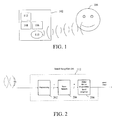
- FIG. 1 illustrates one embodiment of a contactless lip-reading system 102 for performing speech recognition of speech articulated or spoken by a subject 104.
- the system 102 may be implemented in various devices, such as, for example, a television, PC monitor or other display, a multimedia tablet, a set-top box, a projector, a conferencing device, a smart phone, a security camera or device, a server or personal computer, or any other type computing device or combination of computing devices.
- system 102 includes a transmitter 106 for emitting an electromagnetic signal towards the subject 104, which emitted signal in one aspect includes pulses of a millimeter radar signal, and a receiver 108 for receiving a Doppler broadened reflected electromagnetic signal, which reflected signal in one aspect is a version of the emitted millimeter radar signal that has been modulated based on the lip or facial movements of the subject as he/she speaks.
- the transmitter 106 and receiver 108 may be configured to respectively transmit and receive the electromagnetic signals (e.g., millimeter radar signals) via an antenna 110, which in various aspects may be implemented as one or more directional antennas, omnidirectional antennas, or a beam-forming array of antennas.
- an acoustic sound signal representing the speech articulated by the speaking subject may be determined as a difference between the emitted signal(s) and the Doppler broadened reflected signal(s).
- the system 102 of FIG. 1 includes a speech recognition unit 112.
- the speech recognition unit 112 is configured to receive, via the receiver 108, the Doppler broadened reflected signal that has been modulated and reflected by the lip and facial movements of the speaking subject 104, and to output recognized speech based on an analysis of the received reflected signal as described in detail below.
- the functionality of speech recognition unit 112 is implemented via a preprocessing unit 202, a Neural Network (“NNet”) unit 204, and a Hidden Markov Model (“HMM”) unit 206.
- NNet Neural Network
- HMM Hidden Markov Model
- NNet Neural Network
- HMM Hidden Markov Model
- the operation of the speech recognition unit 112 is discussed in conjunction with the process 600 illustrated in FIG. 6 .
- the Doppler broadened reflected signal that has been modulated and reflected by the lip and facial movements of the speaking subject 104 is received at the preprocessing unit 202 (step 604 of FIG. 6 ).
- the Doppler broadened reflected signal is preprocessed (step 606 of FIG. 6 ) to extract one or more features (a set of principal components) by the preprocessing unit 202.
- the reflected signal is first demodulated into a windowed time-spectrum signal to remove the unmodulated carrier frequency of the emitted signal.
- a frequency spectrum for the windowed time-spectrum signal is determined by performing a Fourier transform (e.g., by computing a Fast Fourier Transform ("FFT")) on the windowed time-spectrum signal, and a power spectrum for the windowed time-spectrum signal is determined from the frequency spectrum of the windowed time-spectrum signal.
- a Fourier transform e.g., by computing a Fast Fourier Transform ("FFT")
- FFT Fast Fourier Transform
- the cepstral coefficients for the windowed time-spectrum signal are determined by performing an inverse Fourier transform (e.g., by computing a Inverse Fast Fourier Transform ("IFFT")) on the power spectrum signal of the windowed time-spectrum signal to obtain a power cepstrum for the windowed time-spectrum signal, and a reduced set of n principal components are determined from the cepstral coefficients as the one or more features that are extracted.
- IFFT Inverse Fast Fourier Transform
- the preprocessing unit 202 initiates the extraction of the one or more features or principal components by subtracting the un-modulated emitted signal from the modulated reflected signal to remove the carrier signal and to obtain a modulated time-spectrum signal.
- the resulting modulated time-spectrum signal has a pulse period that corresponds to the pulse rate of the emitted signal.
- the time spectrum signal is divided into a number (e.g., one or more) of time windows to obtain the windowed time-spectrum signal, where the number of time windows that is selected may be representative of the predetermined average distance as a function of the running time. More particularly, the number of time windows may correspond to the distance resolution between the system 102 and the speaking subject 104 and depends on the pulse duration of the emitted signal in a given period of time.
- a sequence of values for the time-spectrum signal is formed for each time window, and the determined sequences of values corresponding to the respective time windows are received in respective pulse periods as the sampled values for the pulse periods.
- the sequence of values for the time windows forming the windowed time-spectrum signal represent a acoustic sound signal (referenced herein as the Doppler sound signal) for the sounds that are vocalized by the subject 104 and have been sampled with the pulse frequency of the emitted radar signal.
- the number of sampled values of the Doppler sound signal depends on the selected period of time, and the frequency range of the Doppler sound signal will be proportional to the frequency of the un-modulated emitted signal.
- a suitable frequency range is around 0 to 2 kHz for voice or speech recognition, though other frequency ranges may also be selected.
- the sequences of values of the Doppler sound signal are mapped into the frequency domain by performing a discrete Fourier transformation (e.g., by computing a FFT) on the windowed time-spectrum signal. Since the resulting frequency spectrum will be symmetrical, only half of coefficients of the frequency transform may be processed while the other half may be discarded.
- a power spectrum is determined based on the frequency transform, and a power cepstrum is obtained by performing an inverse Fourier transformation on the power spectrum.
- a power cepstrum may be generally understood as the result of taking the Inverse Fourier transform (IFT) of the logarithm of the estimated power spectrum of a signal (in this case, the windowed time-spectrum signal). It has been found that preprocessing the Doppler reflected signal into a power cepstrum is advantageous because it enables reliable phonemes classification by the NNet unit 204 of the one or more features extracted from the set of cepstral coefficients obtained from the power cepstrum.
- IFT Inverse Fourier transform
- the preprocessing unit 202 is configured to determine the set of cepstral coefficients from the power cepstrum for the windowed time-spectrum signal as described above and to thereupon compute a set of principal components from the set of cepstral coefficients, where the number of principal components may be smaller than the number of the cepstral components. More particularly, preprocessing unit 202 is configured to transform the cepstral coefficients into a smaller set of values of linearly uncorrelated variables which are determined as the set of (e.g., n) principal components.
- This transformation is computed such that the first principal component of the set of principal components has the largest possible variance (that is, accounts for as much of the variability in the cepstral components as possible), and each succeeding principal component in the set of n principal components then has the highest variance possible under the constraint that it be orthogonal to (i.e., uncorrelated with) the preceding principal components.
- the set of the principal components is computed in the order of the highest variance of the cepstral components, and those principal components having an insignificant (e.g., lower than a predetermined threshold) of variance may be disregarded to reduce the number of the principal components to a desired number n of principal components.
- An important objective of computing the principal components is to reduce the complexity of the windowed time-spectrum signal to, for example, a smaller set of values to reveal the hidden, simplified structures that often underlie it.
- the preprocessing unit 202 may be configured to transform the set of cepstral components into a reduced set of principal components using a variety of transforms, such as, for example, the discrete Karhunen-Loève transform (“KLT”), the Hotelling transform or proper orthogonal decomposition (“POD").
- KLT discrete Karhunen-Loève transform
- POD proper orthogonal decomposition
- the set of, for example, n number of principal components that are output or produced by the preprocessing unit 202 are used as n inputs into the NNet unit 204.
- the set of n principal components are classified into m outputs (step 608 of FIG. 6 ) by the NNet unit 204, where each of the outputs represent a probability associated with the m vocal and consonantal phonemes in a language.
- the number m of vocal and consonant phonemes that are classified by the NNet unit 204 may vary with the language. For example, in the German language there are around 40 (vocal and consonantal) phonemes.
- the speech recognition unit 112 may be configured with a set of multiple NNet units, where each NNet unit 204 in the set of multiple NNets may be configured to classify the set of principal components into a classified set of m vocal and consonantal phonemes of a different language as described further below.
- the classified phonemes that are output by the NNet unit 204 are used as the input for the HMM 206.
- the classified set of m vocal and consonantal phonemes are selectively concatenated into a recognized word of a language (step 610 of FIG. 6 ) by the HMM unit 206.
- the HMM unit 206 may be configured in a conventional manner for enabling representation of the classified set m of phonemes into words and for generating sentences based on the words. It is known that a HMM may include HMM model parameters, e.g., mixture components which are characterized by Gaussian distributions.
- each of the m phonemes may be characterized by the HMM unit 206 using a distinct HMM, and the HMM unit 206 may be configured to identify a sequence (e.g., a set of HMM models from the multiple HMMs) which best matches, based on a maximum likelihood, respective concatenation of the classified phonemes corresponding into a recognized word of a language.
- the performance of the HMM unit may be improved or adjusted by training the HMM unit 206 for characterizing the implemented HMMs of the m phonemes using, for example, Bayesian adaptation approach and/or the transformation based approach.
- the words of a language are recognized may be output to a speaker associated with the lip-reading system 102, or converted to text and output to a display associated with the lip-reading system 102, or stored in a memory associated with the lip-reading system 102.
- the NNet unit 204 may be implemented as nodes 302 and synaptic connections 304 between the nodes 302.
- weights which are determined by training with training data for a given language or external conditions are allocated to the synaptic connections 304, where each of the nodes 302 output an activity as the result of input data of the set of n principal components into the nodes.
- the NNet unit 204 is subdivided into different hierarchical layers or levels (e.g., as a multi-layer perceptron) which are designated in FIG. 3 as the input layer, hidden layer, and the output layer (sometimes also referenced herein respectively as the input level, hidden level, and the output level).
- layers or levels e.g., as a multi-layer perceptron
- the input layer, hidden layer, and the output layer sometimes also referenced herein respectively as the input level, hidden level, and the output level.
- each of the nodes of a subsequent (e.g., lower) layer are connected to each of the nodes of the preceding (e.g., higher) layer via synaptic connections.
- the input data for the nodes 302 in a lower layer may be understood as the activity or output of the nodes of the preceding higher layer (e.g., the input layer or the hidden layer, respectively) multiplied by the weight of the respective synaptic connections 302 interconnecting the nodes of the respective layers.
- Y n is the output of the n th node N n
- f ( ⁇ ) is a predetermined function, such as, for example, the hyperbolic tangent function
- x i is the activation of the i th node N i
- w in is the weight of the synaptic connection between the i th node N i and the n th node N n .
- a given language will typically use only a small subset of the many possible sounds that the human speech organs can produce, and (because of allophony) the number of distinct vocal and consonant phonemes will generally be smaller than the number of identifiably different sounds.
- Different languages vary considerably in the number of vowels and consonant phonemes (although apparent variation may sometimes result from the different approaches taken by the linguists doing the analysis).
- the total vowel and consonant phonemic inventory varies from as few as 11 as in the Rotokas language and the Pirah ⁇ language to as many as 141 in the !X ⁇ language.
- some languages have a very low number of phonemically distinct vowels, such as in the Ubyx and the Arrernte languages which have only 2 distinct vowels.
- the Bantu language Ngwe has as many as 14 vowels, 12 of which may occur long or short, making 26 oral vowels, plus 6 nasalized vowels, long and short, making a total of 38 vowels, while the !Xó ⁇ language achieves 31 pure vowels, not counting its additional variation by vowel length, by varying the phonation.
- the number of consonant phonemes also varies by languages.
- the Puinave language has just seven consonant phonemes, while the Rotokas language has only six consonant phonemes.
- the !Xó ⁇ language on the other hand, has somewhere around 77 consonant phonemes, while the Ubyx language has as many as 81 consonant phonemes.
- the much more prevalent English language uses a rather large set of 13 to 21 vowel phonemes, including diphthongs, although its 22 to 26 consonants are close to the average.
- German language has approximately 40 distinct phonemes (approximately 20 vocal phonemes and approximately 20 consonantal phonemes).
- German dialects often have more phonemes, and some languages, such as French, have no phonemic tone or stress, while several of the Kam-Sui languages have nine tones, and Wobe, one of the Kru languages, may have 14.
- the most common vowel system consists of the five vowels /i/, /e/, /a/, /o/, /u/.
- the most common consonants are /p/, /t/, /k/, /m/, /n/.
- Relatively few languages lack any of these, although it does happen: for example, Arabic lacks /p/, standard Hawaiian lacks /t/, Mohawk and Tlingit lack /p/ and /m/, Hupa lacks both /p/ and a simple /k/, colloquial Samoan lacks /t/ and /n/, while Rotokas and Quileute lack /m/ and /n/.
- the classification result of the NNet unit 204 is determined by the activation of the m nodes in the last layer (the output layer), where m is the number of classifiable vocal and consonant phonemes that are selected in view of the desired language or languages as described above.
- the greatest probability classification is that a dedicated phoneme belongs to the class whose output node exhibits the highest activation, as illustrated in the table below.
- Output Layer (OL) classification (vocal and consonantal) phoneme Output#1 1 Output#2 2 Output#3 3 . . . .
- all nodes of a given layer have synaptic connections with all nodes of another next layer.
- the input layer has n nodes (#1 to #n) and each of them has a respective input (Input#1 to Input#n), which correspond to each of the set of n principal components received by the NNet unit 204 from the preprocessing unit 202.
- each of the n nodes of the input layer has a synaptic connection with each of the n nodes of the hidden layer.
- the NNet unit 204 may include more than one hidden layer. While additional hidden layers may improve the accuracy of the classification of the principal components into a language's phonemes, it is also likely to increase the computing time and cost of the NNet 204.
- a NNet unit with the three layers as shown in FIG. 3 may provide a suitable balance between accuracy and cost, and it will be understood that for some languages or in cases where a greater accuracy is desired, additional hidden layers may be included in the NNet unit 204.
- the number of nodes n depicted in the input layer and the hidden layer of FIG. 3 depend on the information value of the n principal components provided by the preprocessing unit 202 to the NNet unit 204.
- the preprocessing transformation of the set of correlated cepstral coefficients into a reduced and refined set of n values of linearly uncorrelated principal components by the preprocessing unit 202 may significantly enhance the classification result of the NNet 204 for a given n number of nodes in the input and the hidden layers.
- a suitable balance may be achieved where the number n of the nodes in the input layer and the hidden layer (and the number of principal components) is around 25-35, though in other aspects fewer or greater number of nodes (and principal components) may also be selected for languages that have a relatively smaller or larger number of classifiable phonemes.
- additional benefits in the accuracy of the classification may also be realized by adding more layers to the NNet 204, though this is likely to also impact the balance of the performance versus cost in terms of the time and resources necessary for computations.
- a classification through the NNet unit 204 may take place in that classification results stored in the past are used to make conclusions about future ones by assigning appropriate weights to the synaptic connections 304 between respective nodes 302 of the NNet 204.
- the NNet unit 204 may be configured to learn classifications for a given language using training data from sets of different outputs.
- training data for classifying the principal components received from the preprocessing unit 202 into the phonemes of a given language may be presented to the NNet unit 204, until a desired accuracy is reached in the output of the NNet unit 204 for allocating the training data correctly by varying the weights of the synaptic connections 304.
- the training data used to assign or to adjust the weights to the synaptic connections 304 for a given language may comprise preprocessed principal components as described above.
- a variety of training algorithms may be used for assigning or adjusting the weights to the synaptic connections 304 for training the classification output of the NNet 204, such as, for example, an error back propagation algorithm or the cascade correlated network algorithm.
- the NNet 204 may be self-trained by providing training data based on a wide range of preprocessed Doppler broadened reflected signals, until the NNet 204 is configured to allocate or classify the resulting preprocessed principal components into the proper phoneme classifications.
- the weights of the synaptic connections 304 that are determined through training may be determined, stored, and applied to the NNet unit 204 in order to reproduce a given topology of a NNet unit 204 in different implementations of the speech processing system 102 (e.g., in different NNet units in other devices or applications), thus eliminating the potential need to train every individual device or implementation of the speech system 102 in a given situation.
- NNet unit 204 may be updated or replaced with another version of the NNet unit 204, that has been specifically trained for particular prevalent situations (e.g., environment, subject, distance, or language) or for particular implementations (e.g., different devices) that are most applicable or appropriate in a given situation or implementation.
- particular prevalent situations e.g., environment, subject, distance, or language
- implementations e.g., different devices
- the speech recognition unit 112 can be advantageously implemented in different ways in order to support different situations/conditions or languages.
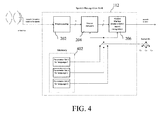
- the speech recognition unit 112 may be implemented by storing a plurality of parameter sets for configuring a given NNet unit 204 and a given HMM unit 206 for different languages or conditions as shown in the example of FIG. 4 .
- the speech recognition unit 112 may be implemented with a plural set of NNets 204 and corresponding HMM units 206 for supporting a respective plurality of languages or environmental conditions as shown in the example of FIG. 5 .
- FIG. 4 illustrates one possible implementation of the speech recognition unit 112.
- the speech recognition unit 112 includes a memory 402 which stores a plurality of parameter sets (designated as Parameter Set 1, 2, and 3).
- Each parameter set (e.g., Parameter Set 1, 2, or 3) may include predetermined training data for configuring the NNet unit 204 to support a different language, a different situation/condition, or a combination thereof.
- the three different parameter sets are selectively applied (e.g., via the switch S1) to configure the NNet 204 and the HMM 206 with appropriate training data for three different languages or application/conditions.
- the speech recognition unit 112 may be used to selectively configure the speech recognition unit 112 to perform speech recognition for three different languages, to configure the speech recognition unit 112 for three different dialects of a single language, or to improve accuracy based on different external situations/conditions (e.g., environmental or ambient conditions), or for other combinations thereof. It will also be understood that the disclosure is not limited to the example of FIG. 4 , and that in other embodiments there may be fewer or greater number of parameter sets for additional languages or conditions. In addition, the selection or switching between one parameter set to another parameter set may be manual based on user (e.g., operator or subject) input, or automatic based on detected conditions.
- user e.g., operator or subject
- FIG. 5 illustrates another possible implementation of the speech recognition unit 112.
- FIG. 5 illustrates an implementation of the speech recognition unit 112 in which three different topologies of NNets units and corresponding HMM units have been implemented.
- Such implementation may be advantageous where the NNet units are trained using a cascade-correlated networks type algorithm, where the nodes and the synaptic connections are arranged during training in a particular configuration for achieving a desired classification result.
- the embodiment shown in FIG. 5 may also be used to selectively configure the speech recognition unit 112 to perform speech recognition for three different languages, to configure the speech recognition unit 112 for three different dialects of a single language, or for any such combinations.
- a different corresponding set of NNet unit and HMM unit may be selected via the switch S1 based on the desired language, dialect, external conditions, etc.
- NNet unit and HMM unit may be manual based on user (e.g., operator or subject) input, or automatic based on detected conditions.
- the transmitter 106 of FIG. 1 transmits or emits signals via the antenna 110 as sequence of short radar signals having a pulse rate of about 8 kHz, though in other embodiments the suitable pulse rate may vary, based on, for example, the expected conditions governing the use of the system 102 and its environment.
- the frequency of the signals that are transmitted in the pulses may be in a range of 5 GHz ( ⁇ 0,06mm) or greater, though, as noted earlier, in some embodiments and environments a different frequency may also be chosen.
- the pulse rate and the frequency may be dynamically varied based on the accuracy of the classification. For example, the pulse rate may dynamically vary based on the rate at which the subject speaks or based on the language associated with the subject in order to adjust the estimated accuracy of the speech recognition unit 112 to an acceptable predetermined level.
- the construction and placement of the antenna 110 may be determined to accommodate a desired angle of beam spread, such that system 102 is suitably configured to receive and detect reflection of the emitted signal that has been modulated by the lips and the facial features of the subject 104 in a predetermined range or distance between the antenna 110 and the subject 104.
- the desired angle of beam spread may vary, for example, based on whether the antenna 110 is expected to be in close proximity to the subject or farther from the subject. In general, a higher angle of beam spread may be desirable where system 102 and the antenna 110 are implemented in a cell phone or other handheld device that is fairly proximate to the subject 104.
- a lower angle of beam spread may be selected due to the greater distance between the antenna 102 and the subject 104.
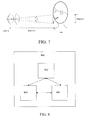
- FIG. 7 illustrates an example of a spatial arrangement of the antenna 110 to the subject 104 for speech recognition by lip-reading. It is assumed in this example that the transmitter 106 emits a millimeter-wave radar signal having a pulse rate of 8 KHz and a frequency of about 5 GHz via the antenna 110, though this is not a limitation. In addition, while a particular spatial arrangement is shown in FIG. 7 , other arrangements are possible and will be apparent based on the discussion herein.
- a suitable angle of radiation for the antenna 110 is approximately 15 degrees where the distance between the antenna 110 and subject 104 is about .5 meters which may be typical for a subject placed in front of a PC monitor implementing system 102, or about 45 degrees where the system 102 and the antenna 110 are implemented in a handset (e.g., smart phone) in which the distance between the antenna 110 and the subject 104 is much smaller.
- FIG. 8 depicts a high-level block diagram of an example computing apparatus 800 suitable for implementing one or more aspects of the disclosure.
- Apparatus 700 comprises a processor 802 that is communicatively interconnected with various input/output devices 804 and a memory 806.
- the processor 802 may be any type of processor such as a general purpose central processing unit (“CPU") or a dedicated microprocessor such as an embedded microcontroller or a digital signal processor (“DSP").
- the input/output devices 804 may be any peripheral device operating under the control of the processor 802 and configured to input data into or output data from the apparatus 800, such as, for example, transmitter 106, receiver 108, and antenna 110.
- the input/output devices 804 may also include network adapters, data ports, and various user interface devices such as a keyboard, a keypad, a mouse, or a display.
- Memory 806 may be any type of memory suitable for storing electronic information, including data and instructions executable by the processor 802.
- Memory 806 may be implemented as, for example, as one or more combinations of a random access memory (RAM), read only memory (ROM), flash memory, hard disk drive memory, compact-disk memory, optical memory, etc.
- apparatus 800 may also include an operating system, queue managers, device drivers, or one or more network protocols which may be stored, in one embodiment, in memory 806 and executed by the processor 802.
- the memory 806 may include non-transitory memory storing executable instructions and data, which instructions, upon execution by the processor 802, may configure apparatus 800 to perform the functionality in accordance with the various aspects and steps described above.
- the processor 802 may be configured, upon execution of the instructions, to communicate with, control, or implement the all or a part of the functionality of the speech recognition unit 112 (e.g., the preprocessing unit 202, the NNet unit 204, and the HMM unit 206) of the lip-reading system 102.
- the processor 802 may also be configured to communicate with and/or control other apparatus 800 to which it is interconnected via, for example a network, and which other apparatus may be configured to perform part or all of the functionality of the lip-reading system 102 under such control.
- the processor 802 may also be configured as a plurality of interconnected processors that are situated in different locations and interconnected with each other.
- the various functionality disclosed herein such as the functionality of the preprocessing unit 202, the NNet unit 204, or the HMM unit 206 may implemented using one or more application specific integrated circuits (ASICs), field programmable gate arrays (FPGAs), or any other combination of suitable hardware or circuits.
- ASICs application specific integrated circuits
- FPGAs field programmable gate arrays
- the systems and methods disclosed herein are believed to incur a number of advantages.
- the present disclosure enhances and supports speech recognition in a number of different languages using contactless lip-reading systems and methods. Lip-reading may improve the performance of speech recognition and efficiency of the system, while conventional (microphone based) speech recognition systems may also be supported and integrated. Performance enhancements may be achieved under adverse conditions like environmental noise and acoustical distortions, and persons with speaking/hearing impairments may be better able to communicate and use modern communication techniques like internet and telecommunications.
Landscapes
- Engineering & Computer Science (AREA)
- Computational Linguistics (AREA)
- Health & Medical Sciences (AREA)
- Audiology, Speech & Language Pathology (AREA)
- Human Computer Interaction (AREA)
- Physics & Mathematics (AREA)
- Acoustics & Sound (AREA)
- Multimedia (AREA)
- Machine Translation (AREA)
- User Interface Of Digital Computer (AREA)
Priority Applications (2)
| Application Number | Priority Date | Filing Date | Title |
|---|---|---|---|
| EP13290332.9A EP2889804A1 (fr) | 2013-12-30 | 2013-12-30 | Systèmes et procédés de reconnaissance de la parole sans contact |
| PCT/EP2014/077156 WO2015101466A1 (fr) | 2013-12-30 | 2014-12-10 | Systèmes et procédés de reconnaissance de la parole sans contact |
Applications Claiming Priority (1)
| Application Number | Priority Date | Filing Date | Title |
|---|---|---|---|
| EP13290332.9A EP2889804A1 (fr) | 2013-12-30 | 2013-12-30 | Systèmes et procédés de reconnaissance de la parole sans contact |
Publications (1)
| Publication Number | Publication Date |
|---|---|
| EP2889804A1 true EP2889804A1 (fr) | 2015-07-01 |
Family
ID=50064350
Family Applications (1)
| Application Number | Title | Priority Date | Filing Date |
|---|---|---|---|
| EP13290332.9A Withdrawn EP2889804A1 (fr) | 2013-12-30 | 2013-12-30 | Systèmes et procédés de reconnaissance de la parole sans contact |
Country Status (2)
| Country | Link |
|---|---|
| EP (1) | EP2889804A1 (fr) |
| WO (1) | WO2015101466A1 (fr) |
Cited By (10)
| Publication number | Priority date | Publication date | Assignee | Title |
|---|---|---|---|---|
| CN108172218A (zh) * | 2016-12-05 | 2018-06-15 | 中国移动通信有限公司研究院 | 一种语音建模方法及装置 |
| EP3335632A1 (fr) * | 2016-12-13 | 2018-06-20 | Alcatel Lucent | Procédé et appareil de surveillance d'un ou plusieurs battements de c ur et de la vitesse de respiration d'un animal vertébré vivant |
| CN108389573A (zh) * | 2018-02-09 | 2018-08-10 | 北京易真学思教育科技有限公司 | 语种识别方法及装置、训练方法及装置、介质、终端 |
| CN109241907A (zh) * | 2018-09-03 | 2019-01-18 | 北京旷视科技有限公司 | 标注方法、装置及电子设备 |
| CN110111783A (zh) * | 2019-04-10 | 2019-08-09 | 天津大学 | 一种基于深度神经网络的多模态语音识别方法 |
| CN111985335A (zh) * | 2020-07-20 | 2020-11-24 | 中国人民解放军军事科学院国防科技创新研究院 | 一种基于面部生理信息的唇语识别方法及装置 |
| CN112037788A (zh) * | 2020-09-10 | 2020-12-04 | 中航华东光电(上海)有限公司 | 一种语音纠正融合技术 |
| CN112672021A (zh) * | 2020-12-25 | 2021-04-16 | 维沃移动通信有限公司 | 语言识别方法、装置及电子设备 |
| CN113870858A (zh) * | 2021-09-27 | 2021-12-31 | 平安科技(深圳)有限公司 | 基于人工智能的静默语音识别方法、装置及存储介质 |
| CN114842864A (zh) * | 2022-04-19 | 2022-08-02 | 电子科技大学 | 一种基于神经网络的短波信道信号分集合并方法 |
Citations (2)
| Publication number | Priority date | Publication date | Assignee | Title |
|---|---|---|---|---|
| US5729694A (en) * | 1996-02-06 | 1998-03-17 | The Regents Of The University Of California | Speech coding, reconstruction and recognition using acoustics and electromagnetic waves |
| US20120059657A1 (en) * | 2010-06-07 | 2012-03-08 | Willey Jefferson M | Radar Microphone Speech Recognition |
-
2013
- 2013-12-30 EP EP13290332.9A patent/EP2889804A1/fr not_active Withdrawn
-
2014
- 2014-12-10 WO PCT/EP2014/077156 patent/WO2015101466A1/fr not_active Ceased
Patent Citations (2)
| Publication number | Priority date | Publication date | Assignee | Title |
|---|---|---|---|---|
| US5729694A (en) * | 1996-02-06 | 1998-03-17 | The Regents Of The University Of California | Speech coding, reconstruction and recognition using acoustics and electromagnetic waves |
| US20120059657A1 (en) * | 2010-06-07 | 2012-03-08 | Willey Jefferson M | Radar Microphone Speech Recognition |
Non-Patent Citations (6)
| Title |
|---|
| JOHN HOLMES ET AL.: "Speech synthesis and recognition", 1 January 2001, TAYLOR FRANCIS, pages: 167, 228, XP002726187 * |
| MINGKE JIAO ET AL: "A new speech enhancement algorithm for millimeter-wave radar speech sensor", MICROWAVE AND OPTICAL TECHNOLOGY LETTERS, vol. 56, no. 5, 11 March 2014 (2014-03-11), pages 1184 - 1189, XP055124749, ISSN: 0895-2477, DOI: 10.1002/mop.28294 * |
| ROBERT D PREUSS ET AL: "Noise Robust Vocoding at 2400 bps", SIGNAL PROCESSING, THE 8TH INTERNATIONAL CONFERENCE ON, IEEE, PI, 1 January 2006 (2006-01-01), XP031058580, ISBN: 978-0-7803-9736-1 * |
| S. KATAGIRI: "Handbook of Neural Networks for Speech Processing", 1 January 2000, ARTECH HOUSE, ISBN: 0-89006-954-9, pages: 281 - 306, XP008170035 * |
| SAGHEER A ET AL: "Visual Speech Features Representation for Automatic Lip-Reading", 2005 IEEE INTERNATIONAL CONFERENCE ON ACOUSTICS, SPEECH, AND SIGNAL PROCESSING - 18-23 MARCH 2005 - PHILADELPHIA, PA, USA, IEEE, PISCATAWAY, NJ, vol. 2, 18 March 2005 (2005-03-18), pages 781 - 784, XP010790756, ISBN: 978-0-7803-8874-1, DOI: 10.1109/ICASSP.2005.1415521 * |
| YING TIAN ET AL: "Smart radar sensor for speech detection and enhancement", SENSORS AND ACTUATORS A: PHYSICAL, vol. 191, 1 March 2013 (2013-03-01), pages 99 - 104, XP055124819, ISSN: 0924-4247, DOI: 10.1016/j.sna.2012.12.002 * |
Cited By (14)
| Publication number | Priority date | Publication date | Assignee | Title |
|---|---|---|---|---|
| CN108172218A (zh) * | 2016-12-05 | 2018-06-15 | 中国移动通信有限公司研究院 | 一种语音建模方法及装置 |
| EP3335632A1 (fr) * | 2016-12-13 | 2018-06-20 | Alcatel Lucent | Procédé et appareil de surveillance d'un ou plusieurs battements de c ur et de la vitesse de respiration d'un animal vertébré vivant |
| CN108389573B (zh) * | 2018-02-09 | 2022-03-08 | 北京世纪好未来教育科技有限公司 | 语种识别方法及装置、训练方法及装置、介质、终端 |
| CN108389573A (zh) * | 2018-02-09 | 2018-08-10 | 北京易真学思教育科技有限公司 | 语种识别方法及装置、训练方法及装置、介质、终端 |
| CN109241907A (zh) * | 2018-09-03 | 2019-01-18 | 北京旷视科技有限公司 | 标注方法、装置及电子设备 |
| CN110111783A (zh) * | 2019-04-10 | 2019-08-09 | 天津大学 | 一种基于深度神经网络的多模态语音识别方法 |
| CN111985335A (zh) * | 2020-07-20 | 2020-11-24 | 中国人民解放军军事科学院国防科技创新研究院 | 一种基于面部生理信息的唇语识别方法及装置 |
| CN112037788A (zh) * | 2020-09-10 | 2020-12-04 | 中航华东光电(上海)有限公司 | 一种语音纠正融合技术 |
| CN112037788B (zh) * | 2020-09-10 | 2021-08-24 | 中航华东光电(上海)有限公司 | 一种语音纠正融合方法 |
| CN112672021A (zh) * | 2020-12-25 | 2021-04-16 | 维沃移动通信有限公司 | 语言识别方法、装置及电子设备 |
| CN112672021B (zh) * | 2020-12-25 | 2022-05-17 | 维沃移动通信有限公司 | 语言识别方法、装置及电子设备 |
| CN113870858A (zh) * | 2021-09-27 | 2021-12-31 | 平安科技(深圳)有限公司 | 基于人工智能的静默语音识别方法、装置及存储介质 |
| CN114842864A (zh) * | 2022-04-19 | 2022-08-02 | 电子科技大学 | 一种基于神经网络的短波信道信号分集合并方法 |
| CN114842864B (zh) * | 2022-04-19 | 2023-05-23 | 电子科技大学 | 一种基于神经网络的短波信道信号分集合并方法 |
Also Published As
| Publication number | Publication date |
|---|---|
| WO2015101466A1 (fr) | 2015-07-09 |
Similar Documents
| Publication | Publication Date | Title |
|---|---|---|
| WO2015101466A1 (fr) | Systèmes et procédés de reconnaissance de la parole sans contact | |
| CN109087648B (zh) | 柜台语音监控方法、装置、计算机设备及存储介质 | |
| WO2020043162A1 (fr) | Système et procédé permettant d'effectuer une reconnaissance automatique multi-modèles de la parole dans des environnements acoustiques difficiles | |
| CN109243491B (zh) | 在频谱上对语音进行情绪识别的方法、系统及存储介质 | |
| US9940949B1 (en) | Dynamic adjustment of expression detection criteria | |
| EP3156978A1 (fr) | Système et procédé pour sécuriser une vérification du locuteur | |
| O’Shaughnessy | Automatic speech recognition: History, methods and challenges | |
| EP3424044B1 (fr) | Modèle d'apprentissage profond modulaire | |
| Cooke et al. | Monaural speech separation and recognition challenge | |
| US8935167B2 (en) | Exemplar-based latent perceptual modeling for automatic speech recognition | |
| Geoffrey et al. | Statistical models in forensic voice comparison | |
| US11611581B2 (en) | Methods and devices for detecting a spoofing attack | |
| US9443517B1 (en) | Generating sounds for detectability by neural networks | |
| KR20200012963A (ko) | 객체 인식 방법, 컴퓨터 디바이스 및 컴퓨터 판독 가능 저장 매체 | |
| US20190279644A1 (en) | Speech processing device, speech processing method, and recording medium | |
| Ismail et al. | Mfcc-vq approach for qalqalahtajweed rule checking | |
| US20210090557A1 (en) | Dialogue system, dialogue processing method, translating apparatus, and method of translation | |
| CN113658599A (zh) | 基于语音识别的会议记录生成方法、装置、设备及介质 | |
| EP4473530A1 (fr) | Détection de parole synthétique à l'aide d'un modèle adapté à des données audio d'interlocuteur | |
| Barker et al. | Speech fragment decoding techniques for simultaneous speaker identification and speech recognition | |
| US11024302B2 (en) | Quality feedback on user-recorded keywords for automatic speech recognition systems | |
| Manamperi et al. | Sinhala speech recognition for interactive voice response systems accessed through mobile phones | |
| CN121887914A (zh) | 一种ai外呼的识别拦截系统、方法及服务器 | |
| Sahoo et al. | MFCC feature with optimized frequency range: An essential step for emotion recognition | |
| KR101060162B1 (ko) | 화자 인식 장치 및 방법 |
Legal Events
| Date | Code | Title | Description |
|---|---|---|---|
| PUAI | Public reference made under article 153(3) epc to a published international application that has entered the european phase |
Free format text: ORIGINAL CODE: 0009012 |
|
| 17P | Request for examination filed |
Effective date: 20131230 |
|
| AK | Designated contracting states |
Kind code of ref document: A1 Designated state(s): AL AT BE BG CH CY CZ DE DK EE ES FI FR GB GR HR HU IE IS IT LI LT LU LV MC MK MT NL NO PL PT RO RS SE SI SK SM TR |
|
| AX | Request for extension of the european patent |
Extension state: BA ME |
|
| R17P | Request for examination filed (corrected) |
Effective date: 20160104 |
|
| RBV | Designated contracting states (corrected) |
Designated state(s): AL AT BE BG CH CY CZ DE DK EE ES FI FR GB GR HR HU IE IS IT LI LT LU LV MC MK MT NL NO PL PT RO RS SE SI SK SM TR |
|
| RAP1 | Party data changed (applicant data changed or rights of an application transferred) |
Owner name: ALCATEL LUCENT |
|
| 17Q | First examination report despatched |
Effective date: 20191008 |
|
| STAA | Information on the status of an ep patent application or granted ep patent |
Free format text: STATUS: THE APPLICATION IS DEEMED TO BE WITHDRAWN |
|
| 18D | Application deemed to be withdrawn |
Effective date: 20200219 |