EP2889290A1 - N-Alkyl-N'-poly(oxyalkyl)hexahydropyrimidine-betaines and the use thereof as corrosion inhibitors - Google Patents
N-Alkyl-N'-poly(oxyalkyl)hexahydropyrimidine-betaines and the use thereof as corrosion inhibitors Download PDFInfo
- Publication number
- EP2889290A1 EP2889290A1 EP13006056.9A EP13006056A EP2889290A1 EP 2889290 A1 EP2889290 A1 EP 2889290A1 EP 13006056 A EP13006056 A EP 13006056A EP 2889290 A1 EP2889290 A1 EP 2889290A1
- Authority
- EP
- European Patent Office
- Prior art keywords
- alkyl
- oxyalkyl
- poly
- hexahydropyrimidine
- corrosion
- Prior art date
- Legal status (The legal status is an assumption and is not a legal conclusion. Google has not performed a legal analysis and makes no representation as to the accuracy of the status listed.)
- Withdrawn
Links
- -1 poly(oxyalkyl) Polymers 0.000 title claims abstract description 42
- 238000005260 corrosion Methods 0.000 title claims description 41
- 230000007797 corrosion Effects 0.000 title claims description 41
- 239000003112 inhibitor Substances 0.000 title claims description 23
- 239000000203 mixture Substances 0.000 claims abstract description 21
- 125000004432 carbon atom Chemical group C* 0.000 claims abstract description 10
- 239000001257 hydrogen Substances 0.000 claims abstract description 5
- 229910052739 hydrogen Inorganic materials 0.000 claims abstract description 5
- 125000006273 (C1-C3) alkyl group Chemical group 0.000 claims abstract description 4
- 125000004435 hydrogen atom Chemical class [H]* 0.000 claims abstract description 4
- 125000002947 alkylene group Chemical group 0.000 claims abstract description 3
- 125000003178 carboxy group Chemical group [H]OC(*)=O 0.000 claims abstract description 3
- 150000001875 compounds Chemical class 0.000 claims description 29
- 238000000034 method Methods 0.000 claims description 9
- 229910052751 metal Inorganic materials 0.000 claims description 8
- 239000002184 metal Substances 0.000 claims description 8
- 238000009472 formulation Methods 0.000 claims description 4
- 230000002401 inhibitory effect Effects 0.000 claims description 4
- 125000000816 ethylene group Chemical group [H]C([H])([*:1])C([H])([H])[*:2] 0.000 claims description 2
- IJGRMHOSHXDMSA-UHFFFAOYSA-N Atomic nitrogen Chemical compound N#N IJGRMHOSHXDMSA-UHFFFAOYSA-N 0.000 description 24
- 239000011541 reaction mixture Substances 0.000 description 24
- FDRCDNZGSXJAFP-UHFFFAOYSA-M sodium chloroacetate Chemical compound [Na+].[O-]C(=O)CCl FDRCDNZGSXJAFP-UHFFFAOYSA-M 0.000 description 22
- 239000007789 gas Substances 0.000 description 20
- 239000000047 product Substances 0.000 description 20
- 238000006243 chemical reaction Methods 0.000 description 17
- 239000007788 liquid Substances 0.000 description 14
- 238000007792 addition Methods 0.000 description 12
- 239000003153 chemical reaction reagent Substances 0.000 description 12
- 235000009508 confectionery Nutrition 0.000 description 12
- 229910052757 nitrogen Inorganic materials 0.000 description 12
- 238000003756 stirring Methods 0.000 description 12
- POAOYUHQDCAZBD-UHFFFAOYSA-N 2-butoxyethanol Chemical compound CCCCOCCO POAOYUHQDCAZBD-UHFFFAOYSA-N 0.000 description 11
- VEXZGXHMUGYJMC-UHFFFAOYSA-M Chloride anion Chemical compound [Cl-] VEXZGXHMUGYJMC-UHFFFAOYSA-M 0.000 description 11
- 238000001816 cooling Methods 0.000 description 11
- 238000004128 high performance liquid chromatography Methods 0.000 description 11
- 238000010992 reflux Methods 0.000 description 11
- 238000006467 substitution reaction Methods 0.000 description 11
- 239000008346 aqueous phase Substances 0.000 description 10
- 239000012074 organic phase Substances 0.000 description 10
- 239000000126 substance Substances 0.000 description 10
- 238000004448 titration Methods 0.000 description 10
- CURLTUGMZLYLDI-UHFFFAOYSA-N Carbon dioxide Chemical compound O=C=O CURLTUGMZLYLDI-UHFFFAOYSA-N 0.000 description 9
- 229910002092 carbon dioxide Inorganic materials 0.000 description 9
- 239000003921 oil Substances 0.000 description 8
- 239000012267 brine Substances 0.000 description 7
- 230000000052 comparative effect Effects 0.000 description 7
- HPALAKNZSZLMCH-UHFFFAOYSA-M sodium;chloride;hydrate Chemical compound O.[Na+].[Cl-] HPALAKNZSZLMCH-UHFFFAOYSA-M 0.000 description 7
- 238000012360 testing method Methods 0.000 description 7
- XLYOFNOQVPJJNP-UHFFFAOYSA-N water Substances O XLYOFNOQVPJJNP-UHFFFAOYSA-N 0.000 description 7
- VNWKTOKETHGBQD-UHFFFAOYSA-N methane Chemical compound C VNWKTOKETHGBQD-UHFFFAOYSA-N 0.000 description 6
- 239000010779 crude oil Substances 0.000 description 5
- SMZOUWXMTYCWNB-UHFFFAOYSA-N 2-(2-methoxy-5-methylphenyl)ethanamine Chemical compound COC1=CC=C(C)C=C1CCN SMZOUWXMTYCWNB-UHFFFAOYSA-N 0.000 description 4
- NIXOWILDQLNWCW-UHFFFAOYSA-N 2-Propenoic acid Natural products OC(=O)C=C NIXOWILDQLNWCW-UHFFFAOYSA-N 0.000 description 4
- CSCPPACGZOOCGX-UHFFFAOYSA-N Acetone Chemical compound CC(C)=O CSCPPACGZOOCGX-UHFFFAOYSA-N 0.000 description 4
- RWSOTUBLDIXVET-UHFFFAOYSA-N Dihydrogen sulfide Chemical compound S RWSOTUBLDIXVET-UHFFFAOYSA-N 0.000 description 4
- 125000003342 alkenyl group Chemical group 0.000 description 4
- 125000000217 alkyl group Chemical group 0.000 description 4
- 125000002511 behenyl group Chemical group [H]C([*])([H])C([H])([H])C([H])([H])C([H])([H])C([H])([H])C([H])([H])C([H])([H])C([H])([H])C([H])([H])C([H])([H])C([H])([H])C([H])([H])C([H])([H])C([H])([H])C([H])([H])C([H])([H])C([H])([H])C([H])([H])C([H])([H])C([H])([H])C([H])([H])C([H])([H])[H] 0.000 description 4
- CADWTSSKOVRVJC-UHFFFAOYSA-N benzyl(dimethyl)azanium;chloride Chemical compound [Cl-].C[NH+](C)CC1=CC=CC=C1 CADWTSSKOVRVJC-UHFFFAOYSA-N 0.000 description 4
- 235000014113 dietary fatty acids Nutrition 0.000 description 4
- 229930195729 fatty acid Natural products 0.000 description 4
- 239000000194 fatty acid Substances 0.000 description 4
- 150000004665 fatty acids Chemical class 0.000 description 4
- 229910000037 hydrogen sulfide Inorganic materials 0.000 description 4
- 239000003350 kerosene Substances 0.000 description 4
- VGGSQFUCUMXWEO-UHFFFAOYSA-N Ethene Chemical compound C=C VGGSQFUCUMXWEO-UHFFFAOYSA-N 0.000 description 3
- 239000005977 Ethylene Substances 0.000 description 3
- QVGXLLKOCUKJST-UHFFFAOYSA-N atomic oxygen Chemical compound [O] QVGXLLKOCUKJST-UHFFFAOYSA-N 0.000 description 3
- 238000004519 manufacturing process Methods 0.000 description 3
- 239000003345 natural gas Substances 0.000 description 3
- 229910052760 oxygen Inorganic materials 0.000 description 3
- 239000001301 oxygen Substances 0.000 description 3
- 239000003760 tallow Substances 0.000 description 3
- 125000004178 (C1-C4) alkyl group Chemical group 0.000 description 2
- 0 CC(C)(*OC(C)(C)I=C)*1(*)C(*)*(*)(*)CCC1 Chemical compound CC(C)(*OC(C)(C)I=C)*1(*)C(*)*(*)(*)CCC1 0.000 description 2
- XEEYBQQBJWHFJM-UHFFFAOYSA-N Iron Chemical compound [Fe] XEEYBQQBJWHFJM-UHFFFAOYSA-N 0.000 description 2
- 101500021084 Locusta migratoria 5 kDa peptide Proteins 0.000 description 2
- 238000006845 Michael addition reaction Methods 0.000 description 2
- 230000015572 biosynthetic process Effects 0.000 description 2
- 229910052799 carbon Inorganic materials 0.000 description 2
- 239000000839 emulsion Substances 0.000 description 2
- 239000012530 fluid Substances 0.000 description 2
- 230000005764 inhibitory process Effects 0.000 description 2
- 150000007524 organic acids Chemical class 0.000 description 2
- 235000005985 organic acids Nutrition 0.000 description 2
- 239000003208 petroleum Substances 0.000 description 2
- 238000002360 preparation method Methods 0.000 description 2
- 150000003141 primary amines Chemical class 0.000 description 2
- 239000000523 sample Substances 0.000 description 2
- 239000000243 solution Substances 0.000 description 2
- 239000007858 starting material Substances 0.000 description 2
- 238000003786 synthesis reaction Methods 0.000 description 2
- DGVVWUTYPXICAM-UHFFFAOYSA-N β‐Mercaptoethanol Chemical compound OCCS DGVVWUTYPXICAM-UHFFFAOYSA-N 0.000 description 2
- 125000000923 (C1-C30) alkyl group Chemical group 0.000 description 1
- RZVAJINKPMORJF-UHFFFAOYSA-N Acetaminophen Chemical compound CC(=O)NC1=CC=C(O)C=C1 RZVAJINKPMORJF-UHFFFAOYSA-N 0.000 description 1
- BVKZGUZCCUSVTD-UHFFFAOYSA-M Bicarbonate Chemical compound OC([O-])=O BVKZGUZCCUSVTD-UHFFFAOYSA-M 0.000 description 1
- 125000000739 C2-C30 alkenyl group Chemical group 0.000 description 1
- 229910000975 Carbon steel Inorganic materials 0.000 description 1
- UFHFLCQGNIYNRP-UHFFFAOYSA-N Hydrogen Chemical compound [H][H] UFHFLCQGNIYNRP-UHFFFAOYSA-N 0.000 description 1
- 229910001209 Low-carbon steel Inorganic materials 0.000 description 1
- WAIPAZQMEIHHTJ-UHFFFAOYSA-N [Cr].[Co] Chemical compound [Cr].[Co] WAIPAZQMEIHHTJ-UHFFFAOYSA-N 0.000 description 1
- 230000002378 acidificating effect Effects 0.000 description 1
- 239000004480 active ingredient Substances 0.000 description 1
- 230000001154 acute effect Effects 0.000 description 1
- 239000000654 additive Substances 0.000 description 1
- 150000001298 alcohols Chemical class 0.000 description 1
- 229910045601 alloy Inorganic materials 0.000 description 1
- 239000000956 alloy Substances 0.000 description 1
- 150000001412 amines Chemical class 0.000 description 1
- 150000001449 anionic compounds Chemical class 0.000 description 1
- 239000002518 antifoaming agent Substances 0.000 description 1
- 239000006227 byproduct Substances 0.000 description 1
- 239000001569 carbon dioxide Substances 0.000 description 1
- 239000010962 carbon steel Substances 0.000 description 1
- 150000001805 chlorine compounds Chemical class 0.000 description 1
- HRKQOINLCJTGBK-UHFFFAOYSA-N dihydroxidosulfur Chemical compound OSO HRKQOINLCJTGBK-UHFFFAOYSA-N 0.000 description 1
- 239000003995 emulsifying agent Substances 0.000 description 1
- 230000007613 environmental effect Effects 0.000 description 1
- 125000001301 ethoxy group Chemical group [H]C([H])([H])C([H])([H])O* 0.000 description 1
- LYCAIKOWRPUZTN-UHFFFAOYSA-N ethylene glycol Natural products OCCO LYCAIKOWRPUZTN-UHFFFAOYSA-N 0.000 description 1
- 238000004880 explosion Methods 0.000 description 1
- 238000000605 extraction Methods 0.000 description 1
- 239000011521 glass Substances 0.000 description 1
- 150000002334 glycols Chemical class 0.000 description 1
- 229910000856 hastalloy Inorganic materials 0.000 description 1
- WGCNASOHLSPBMP-UHFFFAOYSA-N hydroxyacetaldehyde Natural products OCC=O WGCNASOHLSPBMP-UHFFFAOYSA-N 0.000 description 1
- 150000002462 imidazolines Chemical class 0.000 description 1
- 150000002466 imines Chemical class 0.000 description 1
- 239000011261 inert gas Substances 0.000 description 1
- 229910001412 inorganic anion Inorganic materials 0.000 description 1
- 150000002500 ions Chemical class 0.000 description 1
- 229910052742 iron Inorganic materials 0.000 description 1
- 125000005644 linolenyl group Chemical group 0.000 description 1
- 125000005645 linoleyl group Chemical group 0.000 description 1
- 230000007246 mechanism Effects 0.000 description 1
- SYSQUGFVNFXIIT-UHFFFAOYSA-N n-[4-(1,3-benzoxazol-2-yl)phenyl]-4-nitrobenzenesulfonamide Chemical class C1=CC([N+](=O)[O-])=CC=C1S(=O)(=O)NC1=CC=C(C=2OC3=CC=CC=C3N=2)C=C1 SYSQUGFVNFXIIT-UHFFFAOYSA-N 0.000 description 1
- 238000010534 nucleophilic substitution reaction Methods 0.000 description 1
- 125000001117 oleyl group Chemical group [H]C([*])([H])C([H])([H])C([H])([H])C([H])([H])C([H])([H])C([H])([H])C([H])([H])C([H])([H])/C([H])=C([H])\C([H])([H])C([H])([H])C([H])([H])C([H])([H])C([H])([H])C([H])([H])C([H])([H])C([H])([H])[H] 0.000 description 1
- 230000003647 oxidation Effects 0.000 description 1
- 238000007254 oxidation reaction Methods 0.000 description 1
- 230000002688 persistence Effects 0.000 description 1
- 239000012071 phase Substances 0.000 description 1
- 239000005077 polysulfide Substances 0.000 description 1
- 229920001021 polysulfide Polymers 0.000 description 1
- 150000008117 polysulfides Polymers 0.000 description 1
- 230000002265 prevention Effects 0.000 description 1
- 125000004805 propylene group Chemical group [H]C([H])([H])C([H])([*:1])C([H])([H])[*:2] 0.000 description 1
- 239000005297 pyrex Substances 0.000 description 1
- 150000003839 salts Chemical class 0.000 description 1
- 238000012216 screening Methods 0.000 description 1
- 239000002904 solvent Substances 0.000 description 1
- 125000001424 substituent group Chemical group 0.000 description 1
- 239000003784 tall oil Substances 0.000 description 1
Classifications
-
- C—CHEMISTRY; METALLURGY
- C07—ORGANIC CHEMISTRY
- C07D—HETEROCYCLIC COMPOUNDS
- C07D239/00—Heterocyclic compounds containing 1,3-diazine or hydrogenated 1,3-diazine rings
- C07D239/02—Heterocyclic compounds containing 1,3-diazine or hydrogenated 1,3-diazine rings not condensed with other rings
- C07D239/04—Heterocyclic compounds containing 1,3-diazine or hydrogenated 1,3-diazine rings not condensed with other rings having no double bonds between ring members or between ring members and non-ring members
-
- C—CHEMISTRY; METALLURGY
- C07—ORGANIC CHEMISTRY
- C07D—HETEROCYCLIC COMPOUNDS
- C07D295/00—Heterocyclic compounds containing polymethylene-imine rings with at least five ring members, 3-azabicyclo [3.2.2] nonane, piperazine, morpholine or thiomorpholine rings, having only hydrogen atoms directly attached to the ring carbon atoms
- C07D295/04—Heterocyclic compounds containing polymethylene-imine rings with at least five ring members, 3-azabicyclo [3.2.2] nonane, piperazine, morpholine or thiomorpholine rings, having only hydrogen atoms directly attached to the ring carbon atoms with substituted hydrocarbon radicals attached to ring nitrogen atoms
- C07D295/14—Heterocyclic compounds containing polymethylene-imine rings with at least five ring members, 3-azabicyclo [3.2.2] nonane, piperazine, morpholine or thiomorpholine rings, having only hydrogen atoms directly attached to the ring carbon atoms with substituted hydrocarbon radicals attached to ring nitrogen atoms substituted by carbon atoms having three bonds to hetero atoms with at the most one bond to halogen, e.g. ester or nitrile radicals
- C07D295/145—Heterocyclic compounds containing polymethylene-imine rings with at least five ring members, 3-azabicyclo [3.2.2] nonane, piperazine, morpholine or thiomorpholine rings, having only hydrogen atoms directly attached to the ring carbon atoms with substituted hydrocarbon radicals attached to ring nitrogen atoms substituted by carbon atoms having three bonds to hetero atoms with at the most one bond to halogen, e.g. ester or nitrile radicals with the ring nitrogen atoms and the carbon atoms with three bonds to hetero atoms attached to the same carbon chain, which is not interrupted by carbocyclic rings
- C07D295/15—Heterocyclic compounds containing polymethylene-imine rings with at least five ring members, 3-azabicyclo [3.2.2] nonane, piperazine, morpholine or thiomorpholine rings, having only hydrogen atoms directly attached to the ring carbon atoms with substituted hydrocarbon radicals attached to ring nitrogen atoms substituted by carbon atoms having three bonds to hetero atoms with at the most one bond to halogen, e.g. ester or nitrile radicals with the ring nitrogen atoms and the carbon atoms with three bonds to hetero atoms attached to the same carbon chain, which is not interrupted by carbocyclic rings to an acyclic saturated chain
-
- C—CHEMISTRY; METALLURGY
- C23—COATING METALLIC MATERIAL; COATING MATERIAL WITH METALLIC MATERIAL; CHEMICAL SURFACE TREATMENT; DIFFUSION TREATMENT OF METALLIC MATERIAL; COATING BY VACUUM EVAPORATION, BY SPUTTERING, BY ION IMPLANTATION OR BY CHEMICAL VAPOUR DEPOSITION, IN GENERAL; INHIBITING CORROSION OF METALLIC MATERIAL OR INCRUSTATION IN GENERAL
- C23F—NON-MECHANICAL REMOVAL OF METALLIC MATERIAL FROM SURFACE; INHIBITING CORROSION OF METALLIC MATERIAL OR INCRUSTATION IN GENERAL; MULTI-STEP PROCESSES FOR SURFACE TREATMENT OF METALLIC MATERIAL INVOLVING AT LEAST ONE PROCESS PROVIDED FOR IN CLASS C23 AND AT LEAST ONE PROCESS COVERED BY SUBCLASS C21D OR C22F OR CLASS C25
- C23F11/00—Inhibiting corrosion of metallic material by applying inhibitors to the surface in danger of corrosion or adding them to the corrosive agent
- C23F11/08—Inhibiting corrosion of metallic material by applying inhibitors to the surface in danger of corrosion or adding them to the corrosive agent in other liquids
- C23F11/10—Inhibiting corrosion of metallic material by applying inhibitors to the surface in danger of corrosion or adding them to the corrosive agent in other liquids using organic inhibitors
- C23F11/14—Nitrogen-containing compounds
- C23F11/149—Heterocyclic compounds containing nitrogen as hetero atom
Definitions
- Corrosion is a serious and challenging problem in the oil and gas industry and its prevention is acute in offshore operations.
- Water, acidic gases such as hydrogen sulfide and carbon dioxide, organic acids, and oxygen contribute to the corrosion of mild steel, and other types of alloys used in the oil and gas industry.
- Corrosion can cause oil and gas to leak from flowlines which can lead to explosions, accidents, and environmental disasters.
- Corrosion inhibitors are essential for preventing uncontrolled discharge of oil and /or gas into the environments surrounding the flowlines.
- Corrosion inhibitors are either water-soluble or oil soluble chemical compounds. When added in small quantities to an aggressive medium, these chemicals inhibit corrosion by changing the surface conditions of the metal. Factors like CO 2 , H 2 S, S, polysulfides, organic acids, composition of liquids, flow conditions, inorganic anions, such as chlorides, oxygen, and temperature have an influence on the corrosion rate.
- FFCIs Film-Forming Corrosion Inhibitors
- US 6171521 discloses zwitterionic water-soluble substituted imine corrosion inhibitors.
- WO 2004/092447 describes a series of novel zwitterionic acrylated imidazolines for the use as corrosion inhibitors.
- US2004/0169161 A1 discloses the use of doubly alkoxylated quaternary compounds as corrosion inhibitors with improved water solubility and improved film persistence.
- US-005530131A describes N-alkyl-N'-poly(oxyalkyl)-hexahydropyrimidines of the formula (X) in which:
- sweet gas is meant to encompass natural gas which is essentially free of H 2 S, but contains CO 2 .
- the expression “essentially free” means that any H 2 S contained in sweet gas is of a concentration so low that it will not cause corrosion with metal that is in contact with the sweet gas. In said sweet gas, any metal corrosion is due to other components, for example due to CO 2 .
- N-alkyl-N'-poly(oxyalkyl)hexahydropyrimidine-betaines gives excellent corrosion-protection for water/oil emulsions as they are present in crude oil.
- these compounds show improved corrosion inhibition properties when compared with conventional sweet gas corrosion inhibitors such as Coco benzyldimethylammonium chloride.
- a sweet gas environment with respect to crude oil means that the crude oil contain sweet gas as defined above. In such environment, sweet gas corrosion occurs from reaction of CO 2 with iron.
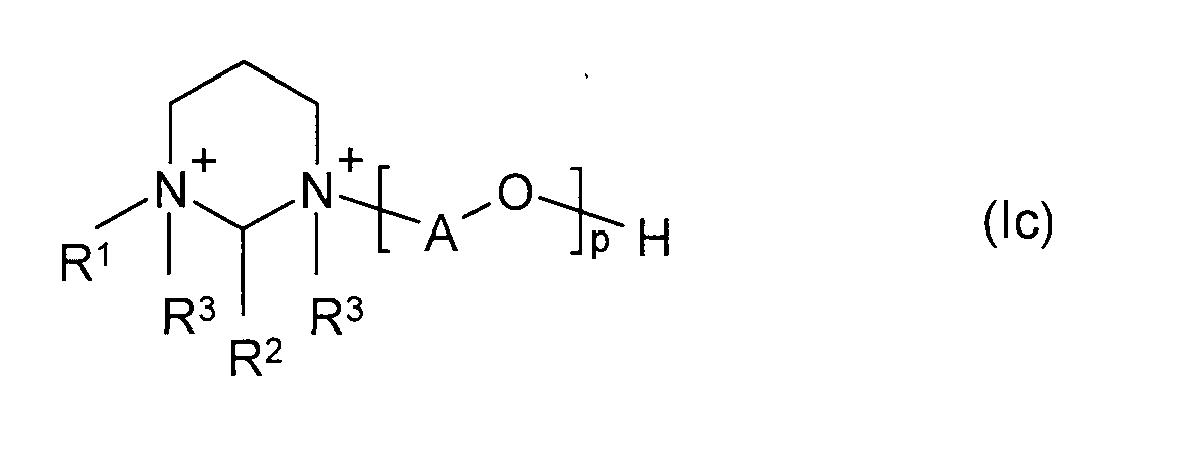
- the invention provides N-alkyl-N'-poly(oxyalkyl)hexahydropyrimidine-betaines of the formulae (Ia) - (Ic) in which
- a process for inhibiting corrosion of metal comprises bringing the metal into contact with one or more of the compounds according to the formulae (Ia) - (Ic).
- the process is preferably applied to metal which is in contact with sweet gas during crude oil or natural gas production or processing.
- R 1 is preferably a radical of a naturally occurring fatty acid. Since the amines which are used in the synthesis of the compounds (Ia) to (Ic) and in which R 1 is an alkyl or alkenyl group are generally random mixtures of homologs and also of isomers, R 1 will usually be a mixture of different alkyl and/or alkenyl groups having various chain lengths. The number of carbon atoms given for R 1 shall therefore be understood as an average number.
- R 1 is an alkyl or alkenyl group having from 8 to 24 carbon atoms, in particular having from 10 to 18 carbon atoms, especially those having from 12 to 18 carbon atoms.
- Particularly advantageous radicals R 1 are those which can be traced back to the C 10 fraction, the C 10 /C 12 fraction, the C 12 /C 14 , or the C 16 /C 18 fractions of a primary amine.
- straight-chain or branched alkyl and alkenyl groups R 1 which may be mentioned are: n-octyl, 2-ethylhexyl, n- and iso-nonyl, n- and iso-decyl, n-undecyl, n-dodecyl, n-tetradecyl, n-hexadecyl, n-octadecyl, oleyl, linoleyl, linolenyl and behenyl.
- the 1,2-alkylene group A is preferably an ethylene group or a propylene, 1,2-butylene or 2,3-butylene group.
- each group A can also be a random mixture of a plurality of the specified 1,2-alkylene groups, mixtures of ethylene and propylene units being preferred.
- the degree of alkoxylation p is between 1 and 50, preferably from 3 to 35, in particular from 5 to 15.
- the values of p are usually averages.
- R 3 is -CH 2 COO - or-CH 2 CH 2 COO -
- the compounds of the formulae (Ia) -(Ic) of the invention are generally obtained by N-substitution of N-alkyl-N'-poly(oxyalkyl)-hexahydropyrimidines of the formula (II) whose preparation is described in US-5530131A .
- the N-substitution of the compounds of the formula (II) is carried out by methods known per se.
- Suitable reagents for N-substitution are for example sodium chloro acetate or acrylic acid.
- N-substitution by the reagents can occur via different mechanisms: 1) nucleophilic substitution in case the reagents contain a leaving group (e.g. chloride in sodium chloro acetate or 2) Michael addition in case the reagent contains a Michael-acceptor (e.g. the double bond in acrylic acid).
- N-alkyl-N'-poly(oxyalkyl)-hexahydropyrimidine and N-substitution reagent are reacted at temperatures in the range from 50 - 70 °C.
- the N-alkyl-N'-poly(oxyalkyl)-hexahydropyrimidine is initially charged, heated and the reagent is added.
- the reaction is exothermic and it should be avoided that the reaction mixture is heated to > 80 °C.
- the reaction mixture is stirred, preferably at 70 °C, in order to obtain complete conversion to the desired product of the formulae (Ia) - (Ic) or product mixture thereof.
- N-alkyl-N'-poly(oxyalkyl)-hexahydropyrimidine and acrylic acid is reacted in at temperatures in the range from 100 - 130 °C.
- the N-alkyl-N'-poly(oxyalkyl)-hexahydropyrimidine is initially charged, and the reagent is added dropwise.
- the reaction mixture is stirred, preferably at 120 °C, in order to obtain complete conversion to the desired product of the formulae (Ia) - (Ic) or product mixture thereof.
- equimolar amount or less than an equimolar amount of reagent for N-substitution is used, a mixture of starting material (N-alkyl-N'-poly(oxyalkyl)-hexahydropyrimidine) and substances of the formulae (Ia) - (Ic) is obtained. If more than an equimolar amount of N-substitution reagent is used, a mixture of substances of the formulae (Ia) - (Ic) is obtained.
- the expression equimolar means one mole reagent for N-substitution per mole of starting material.
- the preparation of the substances of the formula (I) is preferably carried out under a stream of inert gas, preferably a stream of nitrogen.
- the products of the formulae (Ia) - (Ic) are generally obtained in good yield and with high degree of purity.
- the substances of the formulae (Ia) - (Ic) and mixtures thereof are suitable as corrosion inhibitors, in particular in petroleum extraction and processing plants which come into contact with salt water.
- the amounts of these compounds used as corrosion inhibitors are from 1 to 200, preferably from 5 to 50 mg per liter of corrosive liquid. Since the compounds of the invention are usually prepared as highly viscous liquids, they are in practice normally used as a 20 - 50 % by weight strength solution, for example in water, glycols, glycol ethers, alcohols and other suitable solvents. These solutions can also include other corrosion-inhibiting active ingredients and also emulsifiers, antifoaming agents and further customary additives which improve the useful properties of the product being applied.
- LPR bubble tests were conducted in 1 L Pyrex glass vessels containing 900 mL of synthetic brine (Brine composition listed in Table 1) that was continually purged with CO 2 gas whilst being heated to 80 °C. Once an oxygen content of less than 10 ppb was achieved, a probe was inserted into the fluid onto which were mounted CS 1018 working and auxiliary electrodes and a Hastelloy reference electrode.
- the probes were connected to an ACM instruments potentiostat through a zero resistance ammeter and the LPR measured every fifteen minutes to determine the rate of corrosion of the CS 1018 working electrode. After two hours, 100 mL of kerosene (also de-aerated with CO 2 ) was carefully layered on top of the brine phase, ensuring no kerosene came into contact with the electrodes. After a further two hours, 10 ppm (based on total fluid volume of 1 L) of the chemical to be evaluated was added to the kerosene layer and the change in LPR, and therefore corrosion rate, recorded for twenty hours.
- Coco benzyldimethylammonium chloride is a known corrosion inhibitor.
- the N-alkyl-N'-poly(oxyalkyl)hexahydropyrimidine-betaine derivatives were tested against the benchmark products. The chemicals performed in a superior manner to the comparative chemicals.
- the structure used in comparative examples 13 and 26 is as follows:
- EO means the ethoxy unit.
- Each formulated inhibitor consists of 20 % (by weight) of the active inhibitor molecule, 2 % Alkoxylated octyl ether carboxylic acid (Emulsogen CNO 080) and 2 % Thioalcohol (2-mercaptoethanol) with the remainder being a 50/50 mixture of Butylglycolether and water.
Landscapes
- Chemical & Material Sciences (AREA)
- Organic Chemistry (AREA)
- Engineering & Computer Science (AREA)
- Materials Engineering (AREA)
- Mechanical Engineering (AREA)
- Metallurgy (AREA)
- Preventing Corrosion Or Incrustation Of Metals (AREA)
- Organic Low-Molecular-Weight Compounds And Preparation Thereof (AREA)
Abstract
This invention relates to N-alkyl-N'-poly(oxyalkyl)hexapyrimidine- betaines of the formulae (Ia) - (Ic) and mixtures thereof


in which
R1
is C8-C30-alkyl or C8-C30-alkenyl,
R2
is hydrogen, C1-C3-alkyl, -COOH or a group selected from the formulae 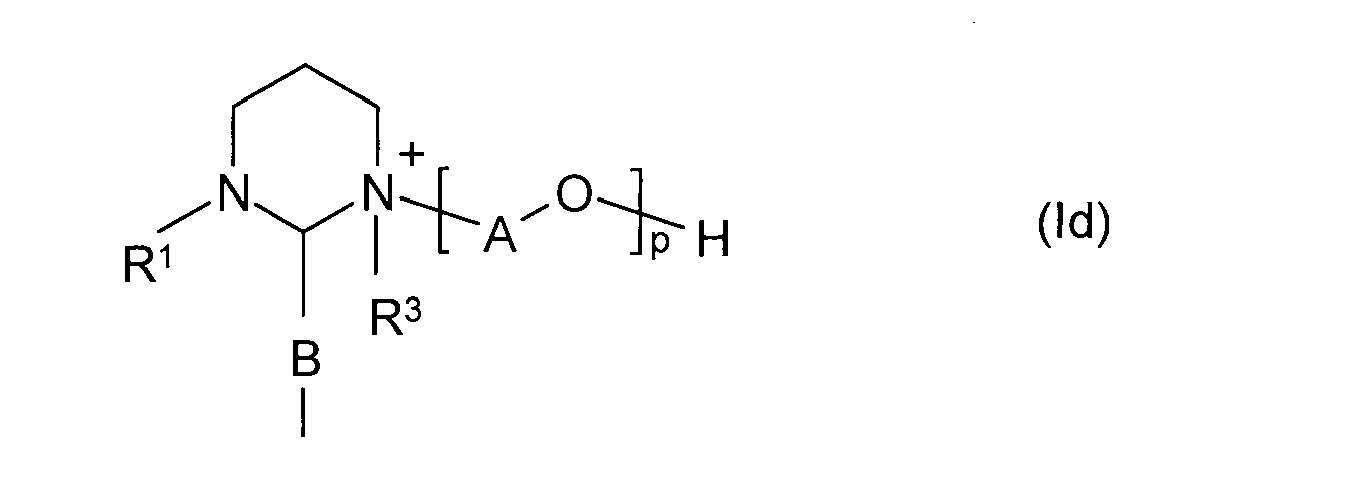

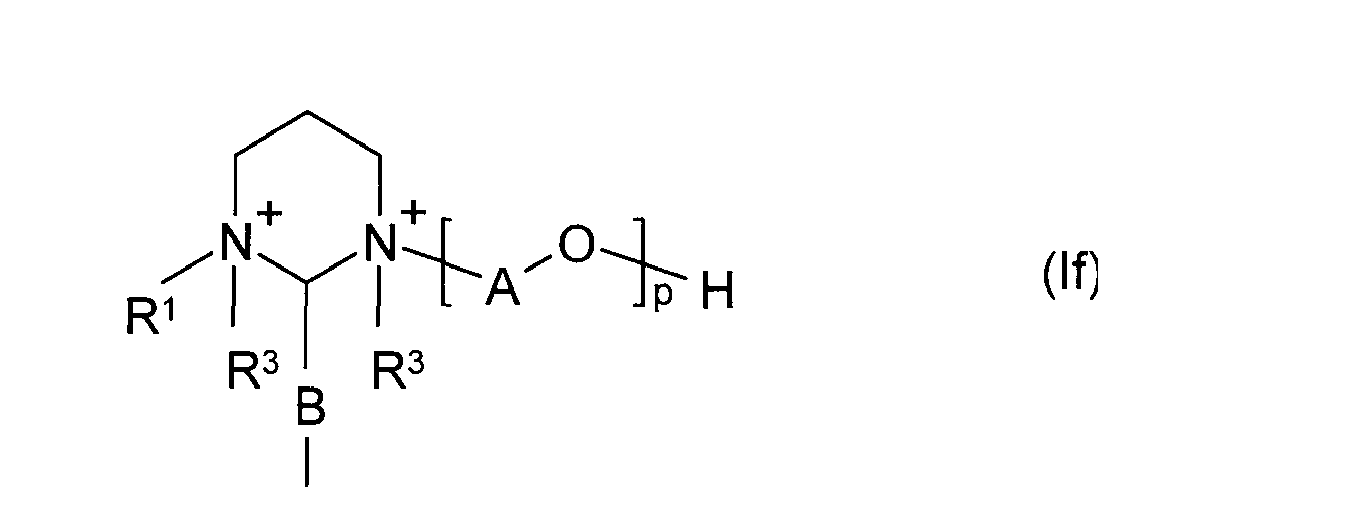
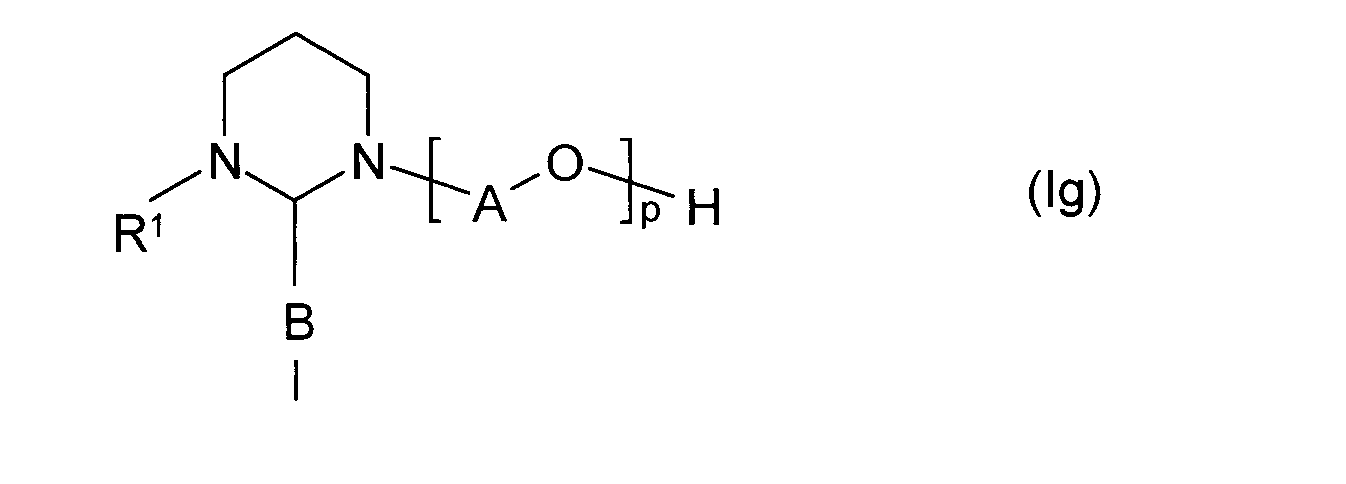
wherein
the bonding occurs via the valence containing the B residue,
B
is a single bond or a C1 to C3 alkylene group
R3
is -CH2COO- or -CH2CH2COO-
A
is a 1,2-alkylene group having from 2 to 10 carbon atoms, and
p
is a number from 1 to 50.
R1
is C8-C30-alkyl or C8-C30-alkenyl,
R2
is hydrogen, C1-C3-alkyl, -COOH or a group selected from the formulae
the bonding occurs via the valence containing the B residue,
B
is a single bond or a C1 to C3 alkylene group
R3
is -CH2COO- or -CH2CH2COO-
A
is a 1,2-alkylene group having from 2 to 10 carbon atoms, and
p
is a number from 1 to 50.
Description
- Corrosion is a serious and challenging problem in the oil and gas industry and its prevention is acute in offshore operations. Water, acidic gases such as hydrogen sulfide and carbon dioxide, organic acids, and oxygen contribute to the corrosion of mild steel, and other types of alloys used in the oil and gas industry. Corrosion can cause oil and gas to leak from flowlines which can lead to explosions, accidents, and environmental disasters. Corrosion inhibitors are essential for preventing uncontrolled discharge of oil and /or gas into the environments surrounding the flowlines.
- Corrosion inhibitors are either water-soluble or oil soluble chemical compounds. When added in small quantities to an aggressive medium, these chemicals inhibit corrosion by changing the surface conditions of the metal. Factors like CO2, H2S, S, polysulfides, organic acids, composition of liquids, flow conditions, inorganic anions, such as chlorides, oxygen, and temperature have an influence on the corrosion rate.
- Zwitterionics such as betaines have long been known as Film-Forming Corrosion Inhibitors (FFCIs) (see: Production of Chemicals for the Oil and Gas Industry, Malcolm A. Kelland, 2009, CRC Press Taylor & Francis Group).
-
US 6171521 discloses zwitterionic water-soluble substituted imine corrosion inhibitors. -
WO 2004/092447 describes a series of novel zwitterionic acrylated imidazolines for the use as corrosion inhibitors. -
US2004/0169161 A1 discloses the use of doubly alkoxylated quaternary compounds as corrosion inhibitors with improved water solubility and improved film persistence.US-005530131A describes N-alkyl-N'-poly(oxyalkyl)-hexahydropyrimidines of the formula (X)
- R1
- is C1-C30-alkyl or C2-C30-alkenyl,
- R2
- is hydrogen or C1-C3-alkyl,
- A
- is a 1,2-alkylene group having from 2 to 10, preferably from 2 to 5, carbon atoms and
- m
- is a number from 0 to 50
- n
- is a number from 0 to 50,
- m+n
- is between 1 and 50, and
- The problem to be solved was to synthesize improved corrosion inhibitors particularly suitable for sweet gas environments. For the purpose of this invention, the term "sweet gas" is meant to encompass natural gas which is essentially free of H2S, but contains CO2. The expression "essentially free" means that any H2S contained in sweet gas is of a concentration so low that it will not cause corrosion with metal that is in contact with the sweet gas. In said sweet gas, any metal corrosion is due to other components, for example due to CO2.
- It has now been found that use of N-alkyl-N'-poly(oxyalkyl)hexahydropyrimidine-betaines gives excellent corrosion-protection for water/oil emulsions as they are present in crude oil. Particularly in sweet gas environments, these compounds show improved corrosion inhibition properties when compared with conventional sweet gas corrosion inhibitors such as Coco benzyldimethylammonium chloride. A sweet gas environment with respect to crude oil means that the crude oil contain sweet gas as defined above. In such environment, sweet gas corrosion occurs from reaction of CO2 with iron.
- The invention provides N-alkyl-N'-poly(oxyalkyl)hexahydropyrimidine-betaines of the formulae (Ia) - (Ic)


- R1
- is C8-C30-alkyl or C8-C30-alkenyl,
- R2
- is hydrogen, C1-C3-alkyl, -COOH or a group selected from the formulae


the bonding occurs via the valence containing the B residue,
B is a single bond or a C1 to C3 alkylene group,
R3 is -CH2COO- or -CH2CH2COO-
A is a 1,2-alkylene group having from 2 to 10 carbon atoms and
p is a number from 1 to 50. - In another aspect of the invention, there is provided the use of one or more of compounds of formulae (Ia) - (Ic) as a corrosion inhibitor. Such use is preferably performed during the production and/or processing of crude oil and natural gas, particularly in the presence of sweet gas.
- In another aspect of the invention there is provided a process for inhibiting corrosion of metal. The process comprises bringing the metal into contact with one or more of the compounds according to the formulae (Ia) - (Ic). The process is preferably applied to metal which is in contact with sweet gas during crude oil or natural gas production or processing.
- Depending on the origin of the primary amine used in the synthesis of the compound (I), R1 is preferably a radical of a naturally occurring fatty acid. Since the amines which are used in the synthesis of the compounds (Ia) to (Ic) and in which R1 is an alkyl or alkenyl group are generally random mixtures of homologs and also of isomers, R1 will usually be a mixture of different alkyl and/or alkenyl groups having various chain lengths. The number of carbon atoms given for R1 shall therefore be understood as an average number.
- Preference is given to compounds (I) in which R1 is an alkyl or alkenyl group having from 8 to 24 carbon atoms, in particular having from 10 to 18 carbon atoms, especially those having from 12 to 18 carbon atoms. Particularly advantageous radicals R1 are those which can be traced back to the C10 fraction, the C10/C12 fraction, the C12/C14, or the C16/C18 fractions of a primary amine.
- Examples of straight-chain or branched alkyl and alkenyl groups R1 which may be mentioned are: n-octyl, 2-ethylhexyl, n- and iso-nonyl, n- and iso-decyl, n-undecyl, n-dodecyl, n-tetradecyl, n-hexadecyl, n-octadecyl, oleyl, linoleyl, linolenyl and behenyl.
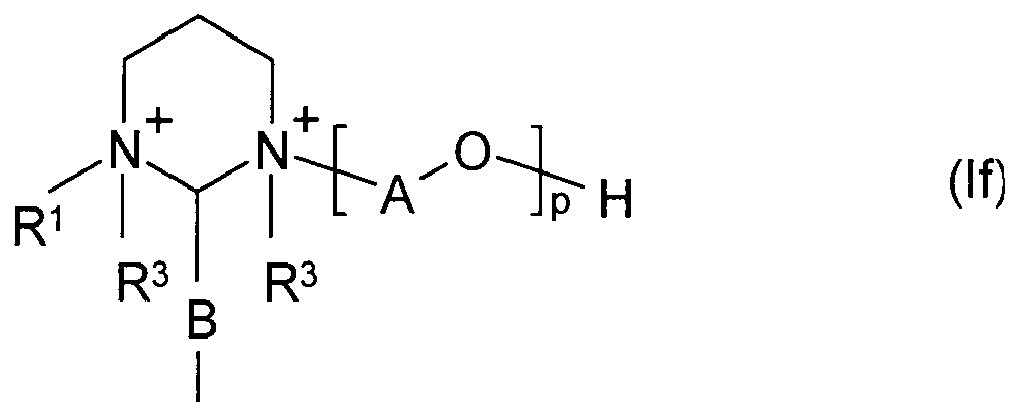
- In case that R2 has the meaning of formulae (1d) to (1g), the inventive compounds have a structure like e.g. (for B = single bond)

- This is an exemplary structure. It is within the scope of this invention to have structures similar to formula (Ih) wherein R1, R3, A and p have different meanings in the two parts of the molecule linked by the B substituent.
- A has preferably 2 to 5 carbon atoms. The 1,2-alkylene group A is preferably an ethylene group or a propylene, 1,2-butylene or 2,3-butylene group. Here, each group A can also be a random mixture of a plurality of the specified 1,2-alkylene groups, mixtures of ethylene and propylene units being preferred.
- The degree of alkoxylation p is between 1 and 50, preferably from 3 to 35, in particular from 5 to 15. The values of p are usually averages.
R3 is -CH2COO- or-CH2CH2COO-
- The compounds of the formulae (Ia) -(Ic) of the invention are generally obtained by N-substitution of N-alkyl-N'-poly(oxyalkyl)-hexahydropyrimidines of the formula (II)
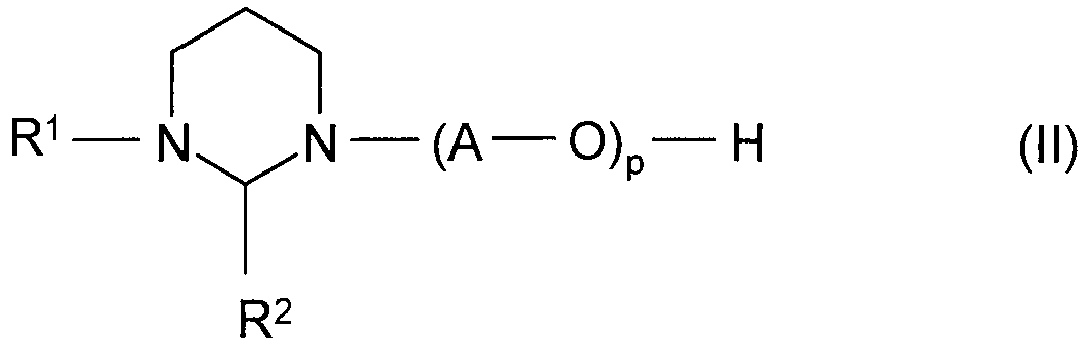
US-5530131A . The N-substitution of the compounds of the formula (II) is carried out by methods known per se. - Suitable methods are known, for example, from Jerry March, "Advanced organic chemistry" (John Wiley & Sons, 1985, 3rd edition).
- Suitable reagents for N-substitution are for example sodium chloro acetate or acrylic acid. N-substitution by the reagents can occur via different mechanisms: 1) nucleophilic substitution in case the reagents contain a leaving group (e.g. chloride in sodium chloro acetate or 2) Michael addition in case the reagent contains a Michael-acceptor (e.g. the double bond in acrylic acid).
- Preferable procedure for nucleophlic substitution reactions: N-alkyl-N'-poly(oxyalkyl)-hexahydropyrimidine and N-substitution reagent are reacted at temperatures in the range from 50 - 70 °C. Advantageously, the N-alkyl-N'-poly(oxyalkyl)-hexahydropyrimidine is initially charged, heated and the reagent is added. The reaction is exothermic and it should be avoided that the reaction mixture is heated to > 80 °C. The reaction mixture is stirred, preferably at 70 °C, in order to obtain complete conversion to the desired product of the formulae (Ia) - (Ic) or product mixture thereof.
- Preferable procedure for Michael additions: N-alkyl-N'-poly(oxyalkyl)-hexahydropyrimidine and acrylic acid is reacted in at temperatures in the range from 100 - 130 °C. Advantageously, the N-alkyl-N'-poly(oxyalkyl)-hexahydropyrimidine is initially charged, and the reagent is added dropwise. The reaction mixture is stirred, preferably at 120 °C, in order to obtain complete conversion to the desired product of the formulae (Ia) - (Ic) or product mixture thereof.
- If an equimolar amount or less than an equimolar amount of reagent for N-substitution is used, a mixture of starting material (N-alkyl-N'-poly(oxyalkyl)-hexahydropyrimidine) and substances of the formulae (Ia) - (Ic) is obtained. If more than an equimolar amount of N-substitution reagent is used, a mixture of substances of the formulae (Ia) - (Ic) is obtained. The expression equimolar means one mole reagent for N-substitution per mole of starting material.
- If R2 = H or C1-C4-alkyl and two equivalents of reagent for N-substitution are used, a nearly complete conversion to compound (Ic), with R2 = H or C1-C4-alkyl is observed.
- If R2 = a group selected from the formulae (Id) - (Ig) and four equivalents of reagent for N-substitution are used, a nearly complete conversion to compound (Ic), with R2 = (If) is observed.
- To avoid byproducts, in particular oxidation products, the preparation of the substances of the formula (I) is preferably carried out under a stream of inert gas, preferably a stream of nitrogen. The products of the formulae (Ia) - (Ic) are generally obtained in good yield and with high degree of purity.
- The substances of the formulae (Ia) - (Ic) and mixtures thereof are suitable as corrosion inhibitors, in particular in petroleum extraction and processing plants which come into contact with salt water. The amounts of these compounds used as corrosion inhibitors are from 1 to 200, preferably from 5 to 50 mg per liter of corrosive liquid. Since the compounds of the invention are usually prepared as highly viscous liquids, they are in practice normally used as a 20 - 50 % by weight strength solution, for example in water, glycols, glycol ethers, alcohols and other suitable solvents. These solutions can also include other corrosion-inhibiting active ingredients and also emulsifiers, antifoaming agents and further customary additives which improve the useful properties of the product being applied.
- In general, however, the corrosion-inhibiting effect of such mixtures is provided by the corrosion-inhibitor components of the invention alone.
- In this specification, all percentages mean weight percent, unless otherwise noted.
- 265.4 (0.5 mol) of N-coco alkyl-N'-poly(oxyalkyl)-(2-propyl-hexahydropyrimidine (A = EO, p = 5) and butyl glycol (50 wt.-%) are initially charged in a flask with stirrer and reflux condenser under a stream of nitrogen. While stirring, 70 % aq. sodium chloro acetate (116.5 g sodium chloro acetate, 1.0 mol) is added within 10 minutes . After the complete addition, the reaction mixture is stirred at 70 °C until the conversion is complete (monitored by titration of the chloride value and by HPLC). After cooling to room temperature, the reaction mixture was filtered. The aqueous phase was separated from the organic phase in a separating funnel in order to obtain the product as clear brown liquid.
- 294.5 g (0.5 mol) of N-coco alkyl-N'-poly(oxyalkyl)-(2-methyl-hexahydropyrimidine (A = (EO)3(PO)3, p = 6) and butyl glycol (50 wt.-%) are initially charged in a flask with stirrer and reflux condenser under a stream of nitrogen. While stirring, 70 % aq. sodium chloro acetate (58.25 g sodium chloro acetate, 0.5 mol) is added dropwise within 10 minutes. After the complete addition, the reaction mixture is stirred at 70 °C until the conversion is complete (monitored by titration of the chloride value and by HPLC). After cooling to room temperature, the reaction mixture was filtered. The aqueous phase was separated from the organic phase in a separating funnel in order to obtain the product as clear brown liquid.
- 156.0 g (0.5 mol) of N-coco alkyl-N'-poly(oxyalkyl)-hexahydropyrimidine (A = EO, p = 1) and butyl glycol (50 wt.-%) are initially charged in a flask with stirrer and reflux condenser under a stream of nitrogen. While stirring, 70 % aq. sodium chloro acetate (29.12 g sodium chloro acetate, 0.25 mol) is added dropwise within 10 minutes. After the complete addition, the reaction mixture is stirred at 70 °C until the conversion is complete (monitored by titration of the chloride value and by HPLC). After cooling to room temperature, the reaction mixture was filtered. The aqueous phase was separated from the organic phase in a separating funnel in order to obtain the product as clear brown liquid.
- 381.6 g (0.5 mol) of N-tallow alkyl-N'-poly(oxyalkyl)-hexahydropyrimidine (A = EO, p = 10) and butyl glycol (50 wt.-%) are initially charged in a flask with stirrer and reflux condenser under a stream of nitrogen. While stirring, 70 % aq. sodium chloro acetate (116.5 g sodium chloro acetate, 1.0 mol) is added dropwise within 10 minutes. After the complete addition, the reaction mixture is stirred at 70 °C until the conversion is complete (monitored by titration of the chloride value and by HPLC). After cooling to room temperature, the reaction mixture was filtered. The aqueous phase was separated from the organic phase in a separating funnel in order to obtain the product as clear brown liquid.
- 381.6 g (0.5 mol) of N-tallow alkyl-N'-poly(oxyalkyl)-hexahydropyrimidine (A = EO, p = 10) and butyl glycol (50 wt.-%) are initially charged in a flask with stirrer and reflux condenser under a stream of nitrogen. While stirring, 70 % aq. sodium chloro acetate (58.25 g sodium chloro acetate, 0.5 mol) is added dropwise within 10 minutes. After the complete addition, the reaction mixture is stirred at 70 °C until the conversion is complete (monitored by titration of the chloride value and by HPLC). After cooling to room temperature, the reaction mixture was filtered. The aqueous phase was separated from the organic phase in a separating funnel in order to obtain the product as clear brown liquid.
- 200.3 g (0.5 mol) of N-coco alkyl-N'-poly(oxyalkyl)-(hexahydropyrimidine-2-carboxylic acid) (A = EO, p = 2) and butyl glycol (50 wt.-%) are initially charged in a flask with stirrer and reflux condenser under a stream of nitrogen. While stirring, 70 % aq. sodium chloro acetate (116.5 g sodium chloro acetate, 1.0 mol) is added dropwise within 10 minutes. After the complete addition, the reaction mixture is stirred at 70 °C until the conversion is complete (monitored by titration of the chloride value and by HPLC). After cooling to room temperature, the reaction mixture was filtered. The aqueous phase was separated from the organic phase in a separating funnel in order to obtain the product as clear brown liquid.
- 408.6 g (0.5 mol) of N-tall oil alkyl-N'-poly(oxyalkyl)-(2-propyl-hexahydropyrimidine) (A = EO, p = 10) and butyl glycol (50 wt.-%) are initially charged in a flask with stirrer and reflux condenser under a stream of nitrogen. While stirring, 70 % aq. sodium chloro acetate (116.5 g sodium chloro acetate, 1.0 mol) is added dropwise within 10 minutes. After the complete addition, the reaction mixture is stirred at 70 °C until the conversion is complete (monitored by titration of the chloride value and by HPLC). After cooling to room temperature, the reaction mixture was filtered. The aqueous phase was separated from the organic phase in a separating funnel in order to obtain the product as clear brown liquid.
- 691.9 g (0.5 mol) of N-lauryl-N'-poly(oxyalkyl)-(2-butyl-hexahydropyrimidine) (A = EO, p = 25) and butyl glycol (50 wt.-%) are initially charged in a flask with stirrer and reflux condenser under a stream of nitrogen. While stirring, 70 % aq. sodium chloro acetate (116.5 g sodium chloro acetate, 1.0 mol) is added dropwise within 10 minutes. After the complete addition, the reaction mixture is stirred at 70 °C until the conversion is complete (monitored by titration of the chloride value and by HPLC). After cooling to room temperature, the reaction mixture was filtered. The aqueous phase was separated from the organic phase in a separating funnel in order to obtain the product as clear brown liquid.
- 614.0 g (0.5 mol) of a N-alkyl-N'-poly(oxyalkyl)-(hexahydropyrimidine) of the formula

- R1
- is behenyl, and
- A
- is ethylene
- 508.8 g (0.5 mol) of a N-alkyl-N'-poly(oxyalkyl)-(hexahydropyrimidine) of the formula

- R1
- is derived from coco fatty acid (C12/C14), and
- A
- is ethylene
- 200.3 g (0.5 mol) of N-coco alkyl-N'-poly(oxyalkyl)-(hexahydropyrimidine-2-carboxylic acid) (A = EO, p = 2) are initially charged in a flask with stirrer and reflux condenser under a stream of nitrogen. While stirring, acrylic acid (36.03 g, 0.5 mol) is added dropwise within 10 minutes. After the complete addition, the reaction mixture is stirred at 120 °C until the conversion is complete (monitored by HPLC). After cooling to room temperature, the product was obtained as clear brown liquid.
- Linear Polarisation Resistance (LPR) bubble tests were conducted in 1 L Pyrex glass vessels containing 900 mL of synthetic brine (Brine composition listed in Table 1) that was continually purged with CO2 gas whilst being heated to 80 °C. Once an oxygen content of less than 10 ppb was achieved, a probe was inserted into the fluid onto which were mounted CS 1018 working and auxiliary electrodes and a Hastelloy reference electrode.
- The probes were connected to an ACM instruments potentiostat through a zero resistance ammeter and the LPR measured every fifteen minutes to determine the rate of corrosion of the CS 1018 working electrode. After two hours, 100 mL of kerosene (also de-aerated with CO2) was carefully layered on top of the brine phase, ensuring no kerosene came into contact with the electrodes. After a further two hours, 10 ppm (based on total fluid volume of 1 L) of the chemical to be evaluated was added to the kerosene layer and the change in LPR, and therefore corrosion rate, recorded for twenty hours.
- The percentage protection is calculated using the following formula;

wherein A is the corrosion rate with no inhibitor present and B is the corrosion rate with inhibitor present -
Gas Composition 100 % CO2 Pressure Ambient Brine Composition 900 mL Synthetic Brine (See table 1) Dose Rate 10 ppm Electrodes CS 1018 Carbon Steel, 600 grit finished, acetone rinsed working and auxiliary; Hastelloy C, acetone rinsed reference Test Duration 24 hours Stir Rate 150 rpm before addition of kerosene, 0 rpm after Temperature 80 °C Table 1: Brine composition Ion Species North Sea brine [mg/L] Na+ 29 370 K+ 372 Mg2+ 3 312 Sr2+ 574 Ba2+ 252 Cl- 52 360 HCO3 - 400 CH3CO2 - 417 - LPR screenings of multiple N-alkyl-N'-poly(oxyalkyl)hexahydropyrimidine- betaines were conducted. These results are listed in Table 2.
Table 2: LPR Test Results for some N-alkyl-N'-poly(oxyalkyl)hexahydropyrimidine-betaine derivatives Example Corrosion Inhibitor Corrosion rate 2 hours after dosing [mpy] Corrosion rate at final 2 hours [mpy] % protection 2 hours after dosing % protection final 2 hours 12 Reference [1]; Coco benzyl quat (comparative example) 206.85 278.16 11.91 0.17 13 N-tallow alkyl-N'-poly(oxyalkyl)-hexahydropyrimidine (A = EO, p = 10) (comparative example) 33.49 36.64 84.26 82.78 14 Example 1 1.20 0.02 99.20 99.80 15 Example 2 2.53 0.08 98.74 99.21 16 Example 3 2.51 0.07 98.72 99.45 17 Example 4 1.18 0.02 99.45 99.99 18 Example 5 2.48 0.06 98.83 99.97 19 Example 6 2.73 0.10 98.54 98.98 20 Example 7 1.15 0.02 99.50 99.99 21 Example 8 2.12 0.04 99.23 99.99 22 Example 9 2.68 0.09 98.65 99.02 23 Example 10 2.83 0.13 98.32 98.87 24 Example 11 1.19 0.02 99.49 99.99 [1] commercially available Coco benzyldimethylammonium chloride (CAS: 68424-85-1]. - Two known chemicals were used as comparative examples: Coco benzyldimethylammonium chloride is a known corrosion inhibitor.. A parent product (N-tallowalkyl-N'-poly(oxyalkyl)-hexahydropyrimidine (A = EO; p = 10) was used as another comparison. The N-alkyl-N'-poly(oxyalkyl)hexahydropyrimidine-betaine derivatives were tested against the benchmark products. The chemicals performed in a superior manner to the comparative chemicals.
- The structure used in comparative examples 13 and 26 is as follows:

- EO means the ethoxy unit.
- Each formulated inhibitor consists of 20 % (by weight) of the active inhibitor molecule, 2 % Alkoxylated octyl ether carboxylic acid (Emulsogen CNO 080) and 2 % Thioalcohol (2-mercaptoethanol) with the remainder being a 50/50 mixture of Butylglycolether and water.
Table 3: LPR-test results of the reference compound/ the parent compound/ and an exemplary formulation Example Corrosion Inhibitor Corrosion rate 2 hours after dosing [mpy] Corrosion rate at final 2 hours [mpy] % protection 2 hours after dosing % protection final 2 hours 25 Coco benzyldimethylammonium chloride formulated (comparative example) 8.83 1.38 95.52 99.30 26 N-tallowalkyl-N'-poly(oxyalkyl)-hexahydropyrimidine (A = EO; p = 10) formulated (comparative example) 15.21 2.72 92.85 98.72 27 Example 4 formulated 3.54 0.16 98.18 99.92
R1 = behenyl and butyl glycol (50 wt.-%) are initially charged in a flask with stirrer and reflux condenser under a stream of nitrogen. While stirring, 70 % aq. sodium chloro acetate (116.5 g sodium chloro acetate, 1.0 mol) is added dropwise within 10 minutes. After the complete addition, the reaction mixture is stirred at 70 °C until the conversion is complete (monitored by titration of the chloride value and by HPLC). After cooling to room temperature, the reaction mixture was filtered. The aqueous phase was separated from the organic phase in a separating funnel in order to obtain the product as clear brown liquid.
Claims (13)
- N-alkyl-N'-poly(oxyalkyl)hexahydropyrimidine-betaines of the formulae (Ia) - (Ic)


 R1 is C8-C30-alkyl or C8-C30-alkenyl,R2 is hydrogen, C1-C3-alkyl, -COOH or a group selected from the formulae


the bonding occurs via the valence containing the B residue,B is a single bond or a C1 to C3 alkylene groupR3 is -CH2COO- or -CH2CH2COO-A is a 1,2-alkylene group having from 2 to 10 carbon atoms andp is a number from 1 to 50. - Compounds according to claim 1, wherein R1 is C10-C24-alkyl, or C10-C24-alkenyl.
- Compounds according to claim 2, wherein R1 is C10-C18-alkyl, or C10-C18-alkenyl.
- Compounds according to one or more of claims 1 to 3, wherein R3 is-CH2COO-.
- Compounds according to one or more of claims 1 to 4, wherein R2 is hydrogen.
- Compounds as claimed in one or more of claims 1 to 5, wherein A is is a 1,2-alkylene group having from 2 to 5 carbon atoms.
- Compounds as claimed in claim 6, wherein A is an ethylene group.
- Compounds as claimed in one or more of claims 1 to 7, wherein p is between 3 to 35 on average.
- Compounds as claimed in claim 8, wherein p is between 5 to 15 on average.
- Compounds according to any one of claims 1 to 9 wherein formulae (Ia) - (Ic) are formula (Ih)

- The use of compounds of one or more of claims 1 to 10 as corrosion inhibitors or in corrosion inhibitor-formulations.
- A corrosion inhibitor formulation comprising at least one compound according to one or more of claims 1 to 10.
- A process for inhibiting corrosion of metal, the process comprising bringing the metal into contact with one or more of the compounds according to one or more of claims 1 to 10.
Priority Applications (2)
| Application Number | Priority Date | Filing Date | Title |
|---|---|---|---|
| EP13006056.9A EP2889290A1 (en) | 2013-12-28 | 2013-12-28 | N-Alkyl-N'-poly(oxyalkyl)hexahydropyrimidine-betaines and the use thereof as corrosion inhibitors |
| PCT/EP2014/003213 WO2015096883A1 (en) | 2013-12-28 | 2014-12-02 | N-alkyl-n'-poly(oxyalkyl)hexahydropyrimidine-betaines and the use thereof as corrosion inhibitors |
Applications Claiming Priority (1)
| Application Number | Priority Date | Filing Date | Title |
|---|---|---|---|
| EP13006056.9A EP2889290A1 (en) | 2013-12-28 | 2013-12-28 | N-Alkyl-N'-poly(oxyalkyl)hexahydropyrimidine-betaines and the use thereof as corrosion inhibitors |
Publications (1)
| Publication Number | Publication Date |
|---|---|
| EP2889290A1 true EP2889290A1 (en) | 2015-07-01 |
Family
ID=49916791
Family Applications (1)
| Application Number | Title | Priority Date | Filing Date |
|---|---|---|---|
| EP13006056.9A Withdrawn EP2889290A1 (en) | 2013-12-28 | 2013-12-28 | N-Alkyl-N'-poly(oxyalkyl)hexahydropyrimidine-betaines and the use thereof as corrosion inhibitors |
Country Status (2)
| Country | Link |
|---|---|
| EP (1) | EP2889290A1 (en) |
| WO (1) | WO2015096883A1 (en) |
Citations (6)
| Publication number | Priority date | Publication date | Assignee | Title |
|---|---|---|---|---|
| EP0625512A1 (en) * | 1993-05-15 | 1994-11-23 | Hoechst Aktiengesellschaft | N-Alkyl-N'-poly(oxyalkyl)hexahydropyrimidine |
| US6171521B1 (en) | 1998-11-09 | 2001-01-09 | Nalco/Exxon Energy Chemicals, L.P. | Zwitterionic water-soluble substituted imine corrosion inhibitors |
| US20040169161A1 (en) | 2001-07-13 | 2004-09-02 | Uwe Dahlmann | Corrosion inhibitors with improved water solubility and improved film persistence |
| WO2004092447A2 (en) | 2003-04-11 | 2004-10-28 | Nalco Energy Services | Imidazoline corrosion inhibitors |
| JP2006169595A (en) * | 2004-12-17 | 2006-06-29 | Chubu Kiresuto Kk | Chelating agent / corrosion inhibitor composition for organic acid cleaning |
| WO2009064719A1 (en) * | 2007-11-15 | 2009-05-22 | Nalco Company | Imidazoline-based heterocyclic foamers for downhole injection |
-
2013
- 2013-12-28 EP EP13006056.9A patent/EP2889290A1/en not_active Withdrawn
-
2014
- 2014-12-02 WO PCT/EP2014/003213 patent/WO2015096883A1/en not_active Ceased
Patent Citations (7)
| Publication number | Priority date | Publication date | Assignee | Title |
|---|---|---|---|---|
| EP0625512A1 (en) * | 1993-05-15 | 1994-11-23 | Hoechst Aktiengesellschaft | N-Alkyl-N'-poly(oxyalkyl)hexahydropyrimidine |
| US5530131A (en) | 1993-05-15 | 1996-06-25 | Hoechst Aktiengesellschaft | N-alkyl-n'-poly(oxyalkyl)-hexahydropyrimidines |
| US6171521B1 (en) | 1998-11-09 | 2001-01-09 | Nalco/Exxon Energy Chemicals, L.P. | Zwitterionic water-soluble substituted imine corrosion inhibitors |
| US20040169161A1 (en) | 2001-07-13 | 2004-09-02 | Uwe Dahlmann | Corrosion inhibitors with improved water solubility and improved film persistence |
| WO2004092447A2 (en) | 2003-04-11 | 2004-10-28 | Nalco Energy Services | Imidazoline corrosion inhibitors |
| JP2006169595A (en) * | 2004-12-17 | 2006-06-29 | Chubu Kiresuto Kk | Chelating agent / corrosion inhibitor composition for organic acid cleaning |
| WO2009064719A1 (en) * | 2007-11-15 | 2009-05-22 | Nalco Company | Imidazoline-based heterocyclic foamers for downhole injection |
Non-Patent Citations (2)
| Title |
|---|
| JERRY MARCH: "Advanced organic chemistry", 1985, JOHN WILEY & SONS |
| MALCOLM A. KELLAND: "Production of Chemicals for the Oil and Gas Industry", 2009, CRC PRESS TAYLOR & FRANCIS GROUP |
Also Published As
| Publication number | Publication date |
|---|---|
| WO2015096883A1 (en) | 2015-07-02 |
Similar Documents
| Publication | Publication Date | Title |
|---|---|---|
| US10000641B2 (en) | Method and composition for preventing corrosion of metal surfaces | |
| Yıldırım et al. | Synthesis and evaluation of new long alkyl side chain acetamide, isoxazolidine and isoxazoline derivatives as corrosion inhibitors | |
| US11512045B2 (en) | Synthesis and evaluation of novel amido-amine cationic gemini surfactants containing flexible and rigid spacers | |
| DE10307725B4 (en) | Corrosion and gas hydrate inhibitors with improved water solubility and increased biodegradability | |
| US8105988B2 (en) | Corrosion inhibitors for a fluid | |
| US20090057618A1 (en) | Corrosion inhibitors containing amphoteric surfactants | |
| EP2217673B1 (en) | Method for foaming a fluid in a well | |
| EP2683849B1 (en) | Quaternary ammonium composition for inhibiting corrosion | |
| EP2809829B1 (en) | Corrosion inhibitors for metal surfaces | |
| EP3225718A1 (en) | Environmentally friendly corrosion inhibitors | |
| EP3110905B1 (en) | Quaternary fatty acid esters as corrosion inhibitors | |
| CA2818744A1 (en) | Use of sulfosuccinates as corrosion inhibitors | |
| US20180265991A1 (en) | Corrosion inhibition composition for pipelines, process of elaboration and synthesis | |
| EP3704208B1 (en) | Corrosion inhibitor compositions and methods of using same | |
| DE102004048778B3 (en) | Corrosion and gas hydrate inhibitors with increased biodegradability and reduced toxicity | |
| Nikitin et al. | New α-aminophosphonates as corrosion inhibitors for oil and gas pipelines protection | |
| EP3058047B1 (en) | N-alkyl-n'-poly(oxyalkyl)hexahydropyrimidine-quaternary ammonium salts and the use thereof as corrosion inhibitors | |
| WO2015096883A1 (en) | N-alkyl-n'-poly(oxyalkyl)hexahydropyrimidine-betaines and the use thereof as corrosion inhibitors | |
| US5530131A (en) | N-alkyl-n'-poly(oxyalkyl)-hexahydropyrimidines | |
| AU726417B2 (en) | Corrosion inhibition | |
| US20200017752A1 (en) | Use Of A Composition Containing At Least One Biodegradable Sugar-Amide-Compound In Combination With At Least One Sulfur-Based Synergist For Corrosion Inhibition Of A Metallic Equipment In Oilfield Applications | |
| EP4381023B1 (en) | Use of complex polyester amines and polyester quaternary ammonium compounds as corrosion inhibitors | |
| RU2604151C1 (en) | Method of producing corrosion inhibitor for ferrous metals for protection of oil field equipment | |
| NO150006B (en) | PROCEDURE AND MEASURES FOR AA PREVENT INHIBIT CORROSION OF METALS IN CONTACT WITH WASHING SYSTEMS | |
| Jinarakpong et al. | Novel Volatile Corrosion Inhibitors with High-Cost Efficiency for Top of the line Corrosion Mitigation |
Legal Events
| Date | Code | Title | Description |
|---|---|---|---|
| PUAI | Public reference made under article 153(3) epc to a published international application that has entered the european phase |
Free format text: ORIGINAL CODE: 0009012 |
|
| 17P | Request for examination filed |
Effective date: 20131228 |
|
| AK | Designated contracting states |
Kind code of ref document: A1 Designated state(s): AL AT BE BG CH CY CZ DE DK EE ES FI FR GB GR HR HU IE IS IT LI LT LU LV MC MK MT NL NO PL PT RO RS SE SI SK SM TR |
|
| AX | Request for extension of the european patent |
Extension state: BA ME |
|
| STAA | Information on the status of an ep patent application or granted ep patent |
Free format text: STATUS: THE APPLICATION HAS BEEN WITHDRAWN |
|
| 18W | Application withdrawn |
Effective date: 20150717 |