EP2889287B1 - Dolastatin-10 derivative, method of producing same and anticancer drug composition containing same - Google Patents
Dolastatin-10 derivative, method of producing same and anticancer drug composition containing same Download PDFInfo
- Publication number
- EP2889287B1 EP2889287B1 EP13839929.0A EP13839929A EP2889287B1 EP 2889287 B1 EP2889287 B1 EP 2889287B1 EP 13839929 A EP13839929 A EP 13839929A EP 2889287 B1 EP2889287 B1 EP 2889287B1
- Authority
- EP
- European Patent Office
- Prior art keywords
- methyl
- methoxy
- amino
- oxoheptan
- compound
- Prior art date
- Legal status (The legal status is an assumption and is not a legal conclusion. Google has not performed a legal analysis and makes no representation as to the accuracy of the status listed.)
- Not-in-force
Links
- 238000000034 method Methods 0.000 title claims description 104
- OFDNQWIFNXBECV-VFSYNPLYSA-N dolastatin 10 Chemical class CC(C)[C@H](N(C)C)C(=O)N[C@@H](C(C)C)C(=O)N(C)[C@@H]([C@@H](C)CC)[C@H](OC)CC(=O)N1CCC[C@H]1[C@H](OC)[C@@H](C)C(=O)N[C@H](C=1SC=CN=1)CC1=CC=CC=C1 OFDNQWIFNXBECV-VFSYNPLYSA-N 0.000 title claims description 30
- 239000002246 antineoplastic agent Substances 0.000 title claims description 12
- 239000000203 mixture Substances 0.000 title claims description 12
- 229940041181 antineoplastic drug Drugs 0.000 title claims description 10
- 150000001875 compounds Chemical class 0.000 claims description 452
- DNSISZSEWVHGLH-UHFFFAOYSA-N butanamide Chemical compound CCCC(N)=O DNSISZSEWVHGLH-UHFFFAOYSA-N 0.000 claims description 93
- 239000000126 substance Substances 0.000 claims description 43
- 238000006243 chemical reaction Methods 0.000 claims description 38
- -1 hydroxy, amino Chemical group 0.000 claims description 37
- ZMANZCXQSJIPKH-UHFFFAOYSA-N Triethylamine Chemical compound CCN(CC)CC ZMANZCXQSJIPKH-UHFFFAOYSA-N 0.000 claims description 27
- 239000001257 hydrogen Substances 0.000 claims description 27
- 229910052739 hydrogen Inorganic materials 0.000 claims description 27
- 125000004435 hydrogen atom Chemical group [H]* 0.000 claims description 22
- 125000000229 (C1-C4)alkoxy group Chemical group 0.000 claims description 21
- 125000004178 (C1-C4) alkyl group Chemical group 0.000 claims description 19
- 125000002924 primary amino group Chemical group [H]N([H])* 0.000 claims description 19
- 229910052799 carbon Inorganic materials 0.000 claims description 16
- 125000004043 oxo group Chemical group O=* 0.000 claims description 16
- 150000003839 salts Chemical class 0.000 claims description 16
- 125000002887 hydroxy group Chemical group [H]O* 0.000 claims description 15
- 125000004432 carbon atom Chemical group C* 0.000 claims description 13
- 229910052760 oxygen Inorganic materials 0.000 claims description 13
- 239000001301 oxygen Chemical group 0.000 claims description 13
- 229910052717 sulfur Chemical group 0.000 claims description 13
- 125000003118 aryl group Chemical group 0.000 claims description 12
- 125000006239 protecting group Chemical group 0.000 claims description 12
- 125000004434 sulfur atom Chemical group 0.000 claims description 12
- VEXZGXHMUGYJMC-UHFFFAOYSA-N Hydrochloric acid Chemical compound Cl VEXZGXHMUGYJMC-UHFFFAOYSA-N 0.000 claims description 11
- JGFZNNIVVJXRND-UHFFFAOYSA-N N,N-Diisopropylethylamine (DIPEA) Chemical compound CCN(C(C)C)C(C)C JGFZNNIVVJXRND-UHFFFAOYSA-N 0.000 claims description 10
- 125000003282 alkyl amino group Chemical group 0.000 claims description 10
- 206010006187 Breast cancer Diseases 0.000 claims description 8
- 208000026310 Breast neoplasm Diseases 0.000 claims description 8
- 125000002496 methyl group Chemical group [H]C([H])([H])* 0.000 claims description 7
- MYMOFIZGZYHOMD-UHFFFAOYSA-N Dioxygen Chemical group O=O MYMOFIZGZYHOMD-UHFFFAOYSA-N 0.000 claims description 6
- DTQVDTLACAAQTR-UHFFFAOYSA-M Trifluoroacetate Chemical compound [O-]C(=O)C(F)(F)F DTQVDTLACAAQTR-UHFFFAOYSA-M 0.000 claims description 6
- 125000004430 oxygen atom Chemical group O* 0.000 claims description 6
- FPGGTKZVZWFYPV-UHFFFAOYSA-M tetrabutylammonium fluoride Chemical compound [F-].CCCC[N+](CCCC)(CCCC)CCCC FPGGTKZVZWFYPV-UHFFFAOYSA-M 0.000 claims description 6
- 238000006482 condensation reaction Methods 0.000 claims description 5
- 229910052736 halogen Inorganic materials 0.000 claims description 5
- 150000002367 halogens Chemical class 0.000 claims description 5
- UKVIEHSSVKSQBA-UHFFFAOYSA-N methane;palladium Chemical compound C.[Pd] UKVIEHSSVKSQBA-UHFFFAOYSA-N 0.000 claims description 5
- 125000001997 phenyl group Chemical group [H]C1=C([H])C([H])=C(*)C([H])=C1[H] 0.000 claims description 5
- QOSSAOTZNIDXMA-UHFFFAOYSA-N Dicylcohexylcarbodiimide Chemical compound C1CCCCC1N=C=NC1CCCCC1 QOSSAOTZNIDXMA-UHFFFAOYSA-N 0.000 claims description 4
- 125000001584 benzyloxycarbonyl group Chemical group C(=O)(OCC1=CC=CC=C1)* 0.000 claims description 4
- 239000003153 chemical reaction reagent Substances 0.000 claims description 4
- ZWWWLCMDTZFSOO-UHFFFAOYSA-N diethoxyphosphorylformonitrile Chemical compound CCOP(=O)(C#N)OCC ZWWWLCMDTZFSOO-UHFFFAOYSA-N 0.000 claims description 4
- 239000003937 drug carrier Substances 0.000 claims description 4
- 125000001495 ethyl group Chemical group [H]C([H])([H])C([H])([H])* 0.000 claims description 4
- 125000001449 isopropyl group Chemical group [H]C([H])([H])C([H])(*)C([H])([H])[H] 0.000 claims description 3
- 125000000956 methoxy group Chemical group [H]C([H])([H])O* 0.000 claims description 3
- NXJCBFBQEVOTOW-UHFFFAOYSA-L palladium(2+);dihydroxide Chemical compound O[Pd]O NXJCBFBQEVOTOW-UHFFFAOYSA-L 0.000 claims description 3
- 239000007983 Tris buffer Substances 0.000 claims description 2
- 125000001797 benzyl group Chemical group [H]C1=C([H])C([H])=C(C([H])=C1[H])C([H])([H])* 0.000 claims description 2
- 125000000250 methylamino group Chemical group [H]N(*)C([H])([H])[H] 0.000 claims description 2
- 150000007530 organic bases Chemical class 0.000 claims description 2
- 125000005931 tert-butyloxycarbonyl group Chemical group [H]C([H])([H])C(OC(*)=O)(C([H])([H])[H])C([H])([H])[H] 0.000 claims description 2
- 150000001721 carbon Chemical group 0.000 claims 5
- SORGEQQSQGNZFI-UHFFFAOYSA-N [azido(phenoxy)phosphoryl]oxybenzene Chemical compound C=1C=CC=CC=1OP(=O)(N=[N+]=[N-])OC1=CC=CC=C1 SORGEQQSQGNZFI-UHFFFAOYSA-N 0.000 claims 2
- 239000007822 coupling agent Substances 0.000 claims 1
- 125000002349 hydroxyamino group Chemical group [H]ON([H])[*] 0.000 claims 1
- ILMRJRBKQSSXGY-UHFFFAOYSA-N tert-butyl(dimethyl)silicon Chemical group C[Si](C)C(C)(C)C ILMRJRBKQSSXGY-UHFFFAOYSA-N 0.000 claims 1
- HEDRZPFGACZZDS-MICDWDOJSA-N Trichloro(2H)methane Chemical compound [2H]C(Cl)(Cl)Cl HEDRZPFGACZZDS-MICDWDOJSA-N 0.000 description 274
- 238000002360 preparation method Methods 0.000 description 264
- 238000005160 1H NMR spectroscopy Methods 0.000 description 138
- 125000003277 amino group Chemical group 0.000 description 67
- YJLUBHOZZTYQIP-UHFFFAOYSA-N 2-[5-[2-(2,3-dihydro-1H-inden-2-ylamino)pyrimidin-5-yl]-1,3,4-oxadiazol-2-yl]-1-(2,4,6,7-tetrahydrotriazolo[4,5-c]pyridin-5-yl)ethanone Chemical compound C1C(CC2=CC=CC=C12)NC1=NC=C(C=N1)C1=NN=C(O1)CC(=O)N1CC2=C(CC1)NN=N2 YJLUBHOZZTYQIP-UHFFFAOYSA-N 0.000 description 66
- XEKOWRVHYACXOJ-UHFFFAOYSA-N Ethyl acetate Chemical compound CCOC(C)=O XEKOWRVHYACXOJ-UHFFFAOYSA-N 0.000 description 66
- OKKJLVBELUTLKV-UHFFFAOYSA-N Methanol Chemical compound OC OKKJLVBELUTLKV-UHFFFAOYSA-N 0.000 description 51
- YMWUJEATGCHHMB-UHFFFAOYSA-N Dichloromethane Chemical compound ClCCl YMWUJEATGCHHMB-UHFFFAOYSA-N 0.000 description 33
- 239000000243 solution Substances 0.000 description 30
- WYURNTSHIVDZCO-UHFFFAOYSA-N Tetrahydrofuran Chemical compound C1CCOC1 WYURNTSHIVDZCO-UHFFFAOYSA-N 0.000 description 24
- 238000003756 stirring Methods 0.000 description 23
- 229940093499 ethyl acetate Drugs 0.000 description 22
- 235000019439 ethyl acetate Nutrition 0.000 description 22
- CONKBQPVFMXDOV-QHCPKHFHSA-N 6-[(5S)-5-[[4-[2-(2,3-dihydro-1H-inden-2-ylamino)pyrimidin-5-yl]piperazin-1-yl]methyl]-2-oxo-1,3-oxazolidin-3-yl]-3H-1,3-benzoxazol-2-one Chemical compound C1C(CC2=CC=CC=C12)NC1=NC=C(C=N1)N1CCN(CC1)C[C@H]1CN(C(O1)=O)C1=CC2=C(NC(O2)=O)C=C1 CONKBQPVFMXDOV-QHCPKHFHSA-N 0.000 description 18
- ZMXDDKWLCZADIW-UHFFFAOYSA-N N,N-Dimethylformamide Chemical compound CN(C)C=O ZMXDDKWLCZADIW-UHFFFAOYSA-N 0.000 description 14
- VLKZOEOYAKHREP-UHFFFAOYSA-N n-Hexane Chemical compound CCCCCC VLKZOEOYAKHREP-UHFFFAOYSA-N 0.000 description 14
- 239000012044 organic layer Substances 0.000 description 14
- 239000011541 reaction mixture Substances 0.000 description 14
- YLQBMQCUIZJEEH-UHFFFAOYSA-N tetrahydrofuran Natural products C=1C=COC=1 YLQBMQCUIZJEEH-UHFFFAOYSA-N 0.000 description 12
- XLYOFNOQVPJJNP-UHFFFAOYSA-N water Substances O XLYOFNOQVPJJNP-UHFFFAOYSA-N 0.000 description 12
- 101100459319 Arabidopsis thaliana VIII-2 gene Proteins 0.000 description 10
- DTQVDTLACAAQTR-UHFFFAOYSA-N Trifluoroacetic acid Chemical compound OC(=O)C(F)(F)F DTQVDTLACAAQTR-UHFFFAOYSA-N 0.000 description 10
- 238000004895 liquid chromatography mass spectrometry Methods 0.000 description 10
- 238000001840 matrix-assisted laser desorption--ionisation time-of-flight mass spectrometry Methods 0.000 description 10
- OHVLMTFVQDZYHP-UHFFFAOYSA-N 1-(2,4,6,7-tetrahydrotriazolo[4,5-c]pyridin-5-yl)-2-[4-[2-[[3-(trifluoromethoxy)phenyl]methylamino]pyrimidin-5-yl]piperazin-1-yl]ethanone Chemical compound N1N=NC=2CN(CCC=21)C(CN1CCN(CC1)C=1C=NC(=NC=1)NCC1=CC(=CC=C1)OC(F)(F)F)=O OHVLMTFVQDZYHP-UHFFFAOYSA-N 0.000 description 9
- VZSRBBMJRBPUNF-UHFFFAOYSA-N 2-(2,3-dihydro-1H-inden-2-ylamino)-N-[3-oxo-3-(2,4,6,7-tetrahydrotriazolo[4,5-c]pyridin-5-yl)propyl]pyrimidine-5-carboxamide Chemical compound C1C(CC2=CC=CC=C12)NC1=NC=C(C=N1)C(=O)NCCC(N1CC2=C(CC1)NN=N2)=O VZSRBBMJRBPUNF-UHFFFAOYSA-N 0.000 description 9
- WMFOQBRAJBCJND-UHFFFAOYSA-M Lithium hydroxide Chemical compound [Li+].[OH-] WMFOQBRAJBCJND-UHFFFAOYSA-M 0.000 description 9
- 238000004440 column chromatography Methods 0.000 description 9
- JJPWJEGNCRGGGA-UHFFFAOYSA-N 4-[[2-[5-[2-(2,3-dihydro-1H-inden-2-ylamino)pyrimidin-5-yl]-1,3,4-oxadiazol-2-yl]acetyl]amino]benzoic acid Chemical compound C1C(CC2=CC=CC=C12)NC1=NC=C(C=N1)C1=NN=C(O1)CC(=O)NC1=CC=C(C(=O)O)C=C1 JJPWJEGNCRGGGA-UHFFFAOYSA-N 0.000 description 8
- RTZKZFJDLAIYFH-UHFFFAOYSA-N Diethyl ether Chemical compound CCOCC RTZKZFJDLAIYFH-UHFFFAOYSA-N 0.000 description 8
- MHAJPDPJQMAIIY-UHFFFAOYSA-N Hydrogen peroxide Chemical compound OO MHAJPDPJQMAIIY-UHFFFAOYSA-N 0.000 description 8
- CSNNHWWHGAXBCP-UHFFFAOYSA-L Magnesium sulfate Chemical compound [Mg+2].[O-][S+2]([O-])([O-])[O-] CSNNHWWHGAXBCP-UHFFFAOYSA-L 0.000 description 8
- NEAPKZHDYMQZCB-UHFFFAOYSA-N N-[2-[4-[2-(2,3-dihydro-1H-inden-2-ylamino)pyrimidin-5-yl]piperazin-1-yl]ethyl]-2-oxo-3H-1,3-benzoxazole-6-carboxamide Chemical compound C1CN(CCN1CCNC(=O)C2=CC3=C(C=C2)NC(=O)O3)C4=CN=C(N=C4)NC5CC6=CC=CC=C6C5 NEAPKZHDYMQZCB-UHFFFAOYSA-N 0.000 description 8
- 206010028980 Neoplasm Diseases 0.000 description 8
- 239000012141 concentrate Substances 0.000 description 8
- 235000008504 concentrate Nutrition 0.000 description 8
- 229940086542 triethylamine Drugs 0.000 description 8
- HMUNWXXNJPVALC-UHFFFAOYSA-N 1-[4-[2-(2,3-dihydro-1H-inden-2-ylamino)pyrimidin-5-yl]piperazin-1-yl]-2-(2,4,6,7-tetrahydrotriazolo[4,5-c]pyridin-5-yl)ethanone Chemical compound C1C(CC2=CC=CC=C12)NC1=NC=C(C=N1)N1CCN(CC1)C(CN1CC2=C(CC1)NN=N2)=O HMUNWXXNJPVALC-UHFFFAOYSA-N 0.000 description 7
- PMZURENOXWZQFD-UHFFFAOYSA-L Sodium Sulfate Chemical compound [Na+].[Na+].[O-]S([O-])(=O)=O PMZURENOXWZQFD-UHFFFAOYSA-L 0.000 description 7
- 239000010410 layer Substances 0.000 description 7
- QJPJQTDYNZXKQF-UHFFFAOYSA-N 4-bromoanisole Chemical compound COC1=CC=C(Br)C=C1 QJPJQTDYNZXKQF-UHFFFAOYSA-N 0.000 description 6
- VYPSYNLAJGMNEJ-UHFFFAOYSA-N Silicium dioxide Chemical compound O=[Si]=O VYPSYNLAJGMNEJ-UHFFFAOYSA-N 0.000 description 6
- UIIMBOGNXHQVGW-UHFFFAOYSA-M Sodium bicarbonate Chemical class [Na+].OC([O-])=O UIIMBOGNXHQVGW-UHFFFAOYSA-M 0.000 description 6
- YXFVVABEGXRONW-UHFFFAOYSA-N Toluene Chemical compound CC1=CC=CC=C1 YXFVVABEGXRONW-UHFFFAOYSA-N 0.000 description 6
- 201000011510 cancer Diseases 0.000 description 6
- 239000007810 chemical reaction solvent Substances 0.000 description 6
- 125000001436 propyl group Chemical group [H]C([*])([H])C([H])([H])C([H])([H])[H] 0.000 description 6
- BFFLLBPMZCIGRM-QMMMGPOBSA-N tert-butyl (2s)-2-(hydroxymethyl)pyrrolidine-1-carboxylate Chemical compound CC(C)(C)OC(=O)N1CCC[C@H]1CO BFFLLBPMZCIGRM-QMMMGPOBSA-N 0.000 description 6
- IESBWCCELOUXMZ-XGXHKWSGSA-N tert-butyl (2s)-2-[(1r,2r)-1-methoxy-2-methyl-3-oxo-3-[(4r)-2-oxo-4-phenyl-1,3-oxazolidin-3-yl]propyl]pyrrolidine-1-carboxylate Chemical compound C1([C@H]2N(C(OC2)=O)C(=O)[C@H](C)[C@@H](OC)[C@H]2N(CCC2)C(=O)OC(C)(C)C)=CC=CC=C1 IESBWCCELOUXMZ-XGXHKWSGSA-N 0.000 description 6
- LZUPHWRIKLBMHC-VPOLOUISSA-N (2r,3r)-3-[(2s,4s)-4-hydroxy-1-[(2-methylpropan-2-yl)oxycarbonyl]pyrrolidin-2-yl]-3-methoxy-2-methylpropanoic acid Chemical compound OC(=O)[C@H](C)[C@@H](OC)[C@@H]1C[C@H](O)CN1C(=O)OC(C)(C)C LZUPHWRIKLBMHC-VPOLOUISSA-N 0.000 description 5
- RHYYEUIJXQMEBX-DLRXZHIHSA-N (3r,4s,5s)-4-[[(2s)-2-[[(2s)-2-(dimethylamino)-3-methylbutanoyl]amino]-3-methylbutanoyl]-methylamino]-3-methoxy-5-methylheptanoic acid Chemical compound OC(=O)C[C@@H](OC)[C@H]([C@@H](C)CC)N(C)C(=O)[C@H](C(C)C)NC(=O)[C@H](C(C)C)N(C)C RHYYEUIJXQMEBX-DLRXZHIHSA-N 0.000 description 5
- 0 CCC(C)C(C(CC(O)=O)OC)N(C)C(C(C(C)C)NC(C(C(C)C)N(*)*)=O)=O Chemical compound CCC(C)C(C(CC(O)=O)OC)N(C)C(C(C(C)C)NC(C(C(C)C)N(*)*)=O)=O 0.000 description 5
- OFDNQWIFNXBECV-UHFFFAOYSA-N Dolastatin 10 Natural products CC(C)C(N(C)C)C(=O)NC(C(C)C)C(=O)N(C)C(C(C)CC)C(OC)CC(=O)N1CCCC1C(OC)C(C)C(=O)NC(C=1SC=CN=1)CC1=CC=CC=C1 OFDNQWIFNXBECV-UHFFFAOYSA-N 0.000 description 5
- UFHFLCQGNIYNRP-UHFFFAOYSA-N Hydrogen Chemical compound [H][H] UFHFLCQGNIYNRP-UHFFFAOYSA-N 0.000 description 5
- 239000012267 brine Substances 0.000 description 5
- 239000003795 chemical substances by application Substances 0.000 description 5
- 108010045524 dolastatin 10 Proteins 0.000 description 5
- 238000002330 electrospray ionisation mass spectrometry Methods 0.000 description 5
- 239000011734 sodium Substances 0.000 description 5
- HPALAKNZSZLMCH-UHFFFAOYSA-M sodium;chloride;hydrate Chemical compound O.[Na+].[Cl-] HPALAKNZSZLMCH-UHFFFAOYSA-M 0.000 description 5
- 239000007787 solid Substances 0.000 description 5
- 239000002904 solvent Substances 0.000 description 5
- NHAYXGBIBNTJTM-LAVFITLUSA-N tert-butyl (2s)-2-[(1r,2r)-1-hydroxy-2-methyl-3-oxo-3-[(4r)-2-oxo-4-phenyl-1,3-oxazolidin-3-yl]propyl]pyrrolidine-1-carboxylate Chemical compound C([C@H]1[C@H](O)[C@@H](C)C(=O)N2C(OC[C@H]2C=2C=CC=CC=2)=O)CCN1C(=O)OC(C)(C)C NHAYXGBIBNTJTM-LAVFITLUSA-N 0.000 description 5
- WZFUQSJFWNHZHM-UHFFFAOYSA-N 2-[4-[2-(2,3-dihydro-1H-inden-2-ylamino)pyrimidin-5-yl]piperazin-1-yl]-1-(2,4,6,7-tetrahydrotriazolo[4,5-c]pyridin-5-yl)ethanone Chemical compound C1C(CC2=CC=CC=C12)NC1=NC=C(C=N1)N1CCN(CC1)CC(=O)N1CC2=C(CC1)NN=N2 WZFUQSJFWNHZHM-UHFFFAOYSA-N 0.000 description 4
- LFQSCWFLJHTTHZ-UHFFFAOYSA-N Ethanol Chemical compound CCO LFQSCWFLJHTTHZ-UHFFFAOYSA-N 0.000 description 4
- 229940123237 Taxane Drugs 0.000 description 4
- 229940122803 Vinca alkaloid Drugs 0.000 description 4
- 230000001093 anti-cancer Effects 0.000 description 4
- 239000012298 atmosphere Substances 0.000 description 4
- DKPFODGZWDEEBT-QFIAKTPHSA-N taxane Chemical class C([C@]1(C)CCC[C@@H](C)[C@H]1C1)C[C@H]2[C@H](C)CC[C@@H]1C2(C)C DKPFODGZWDEEBT-QFIAKTPHSA-N 0.000 description 4
- AHORFEUTYGXBIM-SAKKWRDPSA-N tert-butyl (2S,4R)-4-[tert-butyl(dimethyl)silyl]oxy-2-[(1R,2R)-1-methoxy-2-methyl-3-oxo-3-[(4R)-2-oxo-4-phenyl-1,3-oxazolidin-3-yl]propyl]pyrrolidine-1-carboxylate Chemical compound C(C)(C)(C)[Si](O[C@@H]1C[C@H](N(C1)C(=O)OC(C)(C)C)[C@@H]([C@H](C(N1C(OC[C@H]1C1=CC=CC=C1)=O)=O)C)OC)(C)C AHORFEUTYGXBIM-SAKKWRDPSA-N 0.000 description 4
- OPKYQQXMRGWTAC-SNVBAGLBSA-N tert-butyl n-[(2r)-1-(3-methoxyphenyl)-1-oxopropan-2-yl]carbamate Chemical compound COC1=CC=CC(C(=O)[C@@H](C)NC(=O)OC(C)(C)C)=C1 OPKYQQXMRGWTAC-SNVBAGLBSA-N 0.000 description 4
- SQWVCBMYWHDLCU-RWANSRKNSA-N tert-butyl n-[(2r)-1-amino-1-phenylpropan-2-yl]carbamate Chemical compound CC(C)(C)OC(=O)N[C@H](C)C(N)C1=CC=CC=C1 SQWVCBMYWHDLCU-RWANSRKNSA-N 0.000 description 4
- RIOQSEWOXXDEQQ-UHFFFAOYSA-N triphenylphosphine Chemical compound C1=CC=CC=C1P(C=1C=CC=CC=1)C1=CC=CC=C1 RIOQSEWOXXDEQQ-UHFFFAOYSA-N 0.000 description 4
- FLCNSWOCUOXCBE-KLHDSHLOSA-N (2R,3R)-3-[(2R,4R)-4-[tert-butyl(dimethyl)silyl]oxy-1-[(2-methylpropan-2-yl)oxycarbonyl]pyrrolidin-2-yl]-3-methoxy-2-methylpropanoic acid Chemical compound C(C)(C)(C)OC(=O)N1[C@H](C[C@H](C1)O[Si](C)(C)C(C)(C)C)[C@@H]([C@H](C(=O)O)C)OC FLCNSWOCUOXCBE-KLHDSHLOSA-N 0.000 description 3
- LDOVTBNUBZFLMC-VPOLOUISSA-N (2r,3r)-3-[(2s,4s)-4-azido-1-[(2-methylpropan-2-yl)oxycarbonyl]pyrrolidin-2-yl]-3-methoxy-2-methylpropanoic acid Chemical compound OC(=O)[C@H](C)[C@@H](OC)[C@@H]1C[C@H](N=[N+]=[N-])CN1C(=O)OC(C)(C)C LDOVTBNUBZFLMC-VPOLOUISSA-N 0.000 description 3
- ZNEMGFATAVGQSF-UHFFFAOYSA-N 1-(2-amino-6,7-dihydro-4H-[1,3]thiazolo[4,5-c]pyridin-5-yl)-2-[5-[2-(2,3-dihydro-1H-inden-2-ylamino)pyrimidin-5-yl]-1,3,4-oxadiazol-2-yl]ethanone Chemical compound NC=1SC2=C(CN(CC2)C(CC=2OC(=NN=2)C=2C=NC(=NC=2)NC2CC3=CC=CC=C3C2)=O)N=1 ZNEMGFATAVGQSF-UHFFFAOYSA-N 0.000 description 3
- GVAYBGQTAADLJS-UHFFFAOYSA-N 2-(2,6-difluorophenyl)acetonitrile Chemical compound FC1=CC=CC(F)=C1CC#N GVAYBGQTAADLJS-UHFFFAOYSA-N 0.000 description 3
- AUCVZEYHEFAWHO-UHFFFAOYSA-N 2-(3-fluorophenyl)ethanamine Chemical compound NCCC1=CC=CC(F)=C1 AUCVZEYHEFAWHO-UHFFFAOYSA-N 0.000 description 3
- XXHOOSJWBBTRLA-UHFFFAOYSA-N 2-amino-1-(2-fluoro-4-methoxyphenyl)ethanone Chemical compound COC1=CC=C(C(=O)CN)C(F)=C1 XXHOOSJWBBTRLA-UHFFFAOYSA-N 0.000 description 3
- WEVYAHXRMPXWCK-UHFFFAOYSA-N Acetonitrile Chemical compound CC#N WEVYAHXRMPXWCK-UHFFFAOYSA-N 0.000 description 3
- NLXLAEXVIDQMFP-UHFFFAOYSA-N Ammonia chloride Chemical compound [NH4+].[Cl-] NLXLAEXVIDQMFP-UHFFFAOYSA-N 0.000 description 3
- 206010009944 Colon cancer Diseases 0.000 description 3
- HEMHJVSKTPXQMS-UHFFFAOYSA-M Sodium hydroxide Chemical compound [OH-].[Na+] HEMHJVSKTPXQMS-UHFFFAOYSA-M 0.000 description 3
- KRKNYBCHXYNGOX-UHFFFAOYSA-N citric acid Chemical compound OC(=O)CC(O)(C(O)=O)CC(O)=O KRKNYBCHXYNGOX-UHFFFAOYSA-N 0.000 description 3
- FAVAVMFXAKZTMV-UHFFFAOYSA-N dibutylboranyl trifluoromethanesulfonate Chemical compound CCCCB(CCCC)OS(=O)(=O)C(F)(F)F FAVAVMFXAKZTMV-UHFFFAOYSA-N 0.000 description 3
- MKRTXPORKIRPDG-UHFFFAOYSA-N diphenylphosphoryl azide Chemical compound C=1C=CC=CC=1P(=O)(N=[N+]=[N-])C1=CC=CC=C1 MKRTXPORKIRPDG-UHFFFAOYSA-N 0.000 description 3
- 230000000694 effects Effects 0.000 description 3
- 238000000605 extraction Methods 0.000 description 3
- 229950001582 feclemine Drugs 0.000 description 3
- 238000009472 formulation Methods 0.000 description 3
- 230000002401 inhibitory effect Effects 0.000 description 3
- 238000002347 injection Methods 0.000 description 3
- 239000007924 injection Substances 0.000 description 3
- QHXFNEJDSFRDAU-GYFISPQKSA-N tert-butyl (2S,4R)-2-[(1R,2R)-1-hydroxy-2-methyl-3-oxo-3-[(4R)-2-oxo-4-phenyl-1,3-oxazolidin-3-yl]propyl]-4-methoxypyrrolidine-1-carboxylate Chemical compound O[C@H]([C@H](C(N1C(OC[C@H]1C1=CC=CC=C1)=O)=O)C)[C@H]1N(C[C@@H](C1)OC)C(=O)OC(C)(C)C QHXFNEJDSFRDAU-GYFISPQKSA-N 0.000 description 3
- XAIXKICCDVTSDD-DTWKUNHWSA-N tert-butyl (2S,4R)-2-formyl-4-methoxypyrrolidine-1-carboxylate Chemical compound CO[C@@H]1C[C@@H](C=O)N(C1)C(=O)OC(C)(C)C XAIXKICCDVTSDD-DTWKUNHWSA-N 0.000 description 3
- AOVBLCVMWAXQLG-LFZDHENXSA-N tert-butyl (2S,4R)-4-methoxy-2-[(1R,2R)-1-methoxy-2-methyl-3-oxo-3-[(4R)-2-oxo-4-phenyl-1,3-oxazolidin-3-yl]propyl]pyrrolidine-1-carboxylate Chemical compound CO[C@@H]1C[C@H](N(C1)C(=O)OC(C)(C)C)[C@@H]([C@H](C(N1C(OC[C@H]1C1=CC=CC=C1)=O)=O)C)OC AOVBLCVMWAXQLG-LFZDHENXSA-N 0.000 description 3
- MEHJACQGWQTCES-LFDQFFAPSA-N tert-butyl (2s,4r)-4-[tert-butyl(dimethyl)silyl]oxy-2-[(1r,2r)-1-hydroxy-2-methyl-3-oxo-3-[(4r)-2-oxo-4-phenyl-1,3-oxazolidin-3-yl]propyl]pyrrolidine-1-carboxylate Chemical compound C([C@H]1[C@H](O)[C@@H](C)C(=O)N2C(OC[C@H]2C=2C=CC=CC=2)=O)[C@@H](O[Si](C)(C)C(C)(C)C)CN1C(=O)OC(C)(C)C MEHJACQGWQTCES-LFDQFFAPSA-N 0.000 description 3
- FUDKXBTUIHSMIL-QWHCGFSZSA-N tert-butyl (2s,4r)-4-[tert-butyl(dimethyl)silyl]oxy-2-formylpyrrolidine-1-carboxylate Chemical compound CC(C)(C)OC(=O)N1C[C@H](O[Si](C)(C)C(C)(C)C)C[C@H]1C=O FUDKXBTUIHSMIL-QWHCGFSZSA-N 0.000 description 3
- OSGLURGSUHRTQT-FSPWUOQZSA-N tert-butyl (4S)-4-[(1R,2R)-3-[2-(2,6-difluorophenyl)ethylamino]-1-methoxy-2-methyl-3-oxopropyl]-1,3-thiazolidine-3-carboxylate Chemical compound FC1=C(C(=CC=C1)F)CCNC([C@@H]([C@@H](OC)[C@@H]1N(CSC1)C(=O)OC(C)(C)C)C)=O OSGLURGSUHRTQT-FSPWUOQZSA-N 0.000 description 3
- KIZYBXCQHFRFOB-SNVBAGLBSA-N tert-butyl N-[(2R)-1-hydroxyimino-1-(3-methoxyphenyl)propan-2-yl]carbamate Chemical compound ON=C([C@@H](C)NC(OC(C)(C)C)=O)C1=CC(=CC=C1)OC KIZYBXCQHFRFOB-SNVBAGLBSA-N 0.000 description 3
- LJPLAKPBWQHNMD-MRVPVSSYSA-N tert-butyl n-[(2r)-1-(2,6-difluorophenyl)-1-oxopropan-2-yl]carbamate Chemical compound CC(C)(C)OC(=O)N[C@H](C)C(=O)C1=C(F)C=CC=C1F LJPLAKPBWQHNMD-MRVPVSSYSA-N 0.000 description 3
- ZRIKOMLRPHDSKE-SNVBAGLBSA-N tert-butyl n-[(2r)-1-(2-methoxyphenyl)-1-oxopropan-2-yl]carbamate Chemical compound COC1=CC=CC=C1C(=O)[C@@H](C)NC(=O)OC(C)(C)C ZRIKOMLRPHDSKE-SNVBAGLBSA-N 0.000 description 3
- SPOKPUXXLJDMIZ-SNVBAGLBSA-N tert-butyl n-[(2r)-1-(4-methoxyphenyl)-1-oxopropan-2-yl]carbamate Chemical compound COC1=CC=C(C(=O)[C@@H](C)NC(=O)OC(C)(C)C)C=C1 SPOKPUXXLJDMIZ-SNVBAGLBSA-N 0.000 description 3
- PWQIGBOSLQHOBT-SSDOTTSWSA-N tert-butyl n-[(2r)-1-[methoxy(methyl)amino]-1-oxopropan-2-yl]carbamate Chemical compound CON(C)C(=O)[C@@H](C)NC(=O)OC(C)(C)C PWQIGBOSLQHOBT-SSDOTTSWSA-N 0.000 description 3
- LJPLAKPBWQHNMD-QMMMGPOBSA-N tert-butyl n-[(2s)-1-(2,6-difluorophenyl)-1-oxopropan-2-yl]carbamate Chemical compound CC(C)(C)OC(=O)N[C@@H](C)C(=O)C1=C(F)C=CC=C1F LJPLAKPBWQHNMD-QMMMGPOBSA-N 0.000 description 3
- YHRDGRFSLXGSBX-OPRDCNLKSA-N (2R,3R)-3-methoxy-2-methyl-3-[(4S)-3-[(2-methylpropan-2-yl)oxycarbonyl]-1,3-thiazolidin-4-yl]propanoic acid Chemical compound C(C)(C)(C)OC(=O)N1CSC[C@@H]1[C@@H]([C@H](C(=O)O)C)OC YHRDGRFSLXGSBX-OPRDCNLKSA-N 0.000 description 2
- KZEVSDGEBAJOTK-UHFFFAOYSA-N 1-(2,4,6,7-tetrahydrotriazolo[4,5-c]pyridin-5-yl)-2-[5-[2-[[3-(trifluoromethoxy)phenyl]methylamino]pyrimidin-5-yl]-1,3,4-oxadiazol-2-yl]ethanone Chemical compound N1N=NC=2CN(CCC=21)C(CC=1OC(=NN=1)C=1C=NC(=NC=1)NCC1=CC(=CC=C1)OC(F)(F)F)=O KZEVSDGEBAJOTK-UHFFFAOYSA-N 0.000 description 2
- DBGSRZSKGVSXRK-UHFFFAOYSA-N 1-[2-[5-[2-(2,3-dihydro-1H-inden-2-ylamino)pyrimidin-5-yl]-1,3,4-oxadiazol-2-yl]acetyl]-3,6-dihydro-2H-pyridine-4-carboxylic acid Chemical compound C1C(CC2=CC=CC=C12)NC1=NC=C(C=N1)C1=NN=C(O1)CC(=O)N1CCC(=CC1)C(=O)O DBGSRZSKGVSXRK-UHFFFAOYSA-N 0.000 description 2
- LDXJRKWFNNFDSA-UHFFFAOYSA-N 2-(2,4,6,7-tetrahydrotriazolo[4,5-c]pyridin-5-yl)-1-[4-[2-[[3-(trifluoromethoxy)phenyl]methylamino]pyrimidin-5-yl]piperazin-1-yl]ethanone Chemical compound C1CN(CC2=NNN=C21)CC(=O)N3CCN(CC3)C4=CN=C(N=C4)NCC5=CC(=CC=C5)OC(F)(F)F LDXJRKWFNNFDSA-UHFFFAOYSA-N 0.000 description 2
- IIEJGTQVBJHMDL-UHFFFAOYSA-N 2-[2-(2,3-dihydro-1H-inden-2-ylamino)pyrimidin-5-yl]-5-[2-oxo-2-[3-(sulfamoylamino)pyrrolidin-1-yl]ethyl]-1,3,4-oxadiazole Chemical compound C1CN(CC1NS(=O)(=O)N)C(=O)CC2=NN=C(O2)C3=CN=C(N=C3)NC4CC5=CC=CC=C5C4 IIEJGTQVBJHMDL-UHFFFAOYSA-N 0.000 description 2
- JQMFQLVAJGZSQS-UHFFFAOYSA-N 2-[4-[2-(2,3-dihydro-1H-inden-2-ylamino)pyrimidin-5-yl]piperazin-1-yl]-N-(2-oxo-3H-1,3-benzoxazol-6-yl)acetamide Chemical compound C1C(CC2=CC=CC=C12)NC1=NC=C(C=N1)N1CCN(CC1)CC(=O)NC1=CC2=C(NC(O2)=O)C=C1 JQMFQLVAJGZSQS-UHFFFAOYSA-N 0.000 description 2
- IHCCLXNEEPMSIO-UHFFFAOYSA-N 2-[4-[2-(2,3-dihydro-1H-inden-2-ylamino)pyrimidin-5-yl]piperidin-1-yl]-1-(2,4,6,7-tetrahydrotriazolo[4,5-c]pyridin-5-yl)ethanone Chemical compound C1C(CC2=CC=CC=C12)NC1=NC=C(C=N1)C1CCN(CC1)CC(=O)N1CC2=C(CC1)NN=N2 IHCCLXNEEPMSIO-UHFFFAOYSA-N 0.000 description 2
- DHKVCYCWBUNNQH-UHFFFAOYSA-N 2-[5-[2-(2,3-dihydro-1H-inden-2-ylamino)pyrimidin-5-yl]-1,3,4-oxadiazol-2-yl]-1-(1,4,5,7-tetrahydropyrazolo[3,4-c]pyridin-6-yl)ethanone Chemical compound C1C(CC2=CC=CC=C12)NC1=NC=C(C=N1)C1=NN=C(O1)CC(=O)N1CC2=C(CC1)C=NN2 DHKVCYCWBUNNQH-UHFFFAOYSA-N 0.000 description 2
- AWFYPPSBLUWMFQ-UHFFFAOYSA-N 2-[5-[2-(2,3-dihydro-1H-inden-2-ylamino)pyrimidin-5-yl]-1,3,4-oxadiazol-2-yl]-1-(1,4,6,7-tetrahydropyrazolo[4,3-c]pyridin-5-yl)ethanone Chemical compound C1C(CC2=CC=CC=C12)NC1=NC=C(C=N1)C1=NN=C(O1)CC(=O)N1CC2=C(CC1)NN=C2 AWFYPPSBLUWMFQ-UHFFFAOYSA-N 0.000 description 2
- APLNAFMUEHKRLM-UHFFFAOYSA-N 2-[5-[2-(2,3-dihydro-1H-inden-2-ylamino)pyrimidin-5-yl]-1,3,4-oxadiazol-2-yl]-1-(3,4,6,7-tetrahydroimidazo[4,5-c]pyridin-5-yl)ethanone Chemical compound C1C(CC2=CC=CC=C12)NC1=NC=C(C=N1)C1=NN=C(O1)CC(=O)N1CC2=C(CC1)N=CN2 APLNAFMUEHKRLM-UHFFFAOYSA-N 0.000 description 2
- HRZTZLCMURHWFY-UHFFFAOYSA-N 2-bromo-1,3-difluorobenzene Chemical compound FC1=CC=CC(F)=C1Br HRZTZLCMURHWFY-UHFFFAOYSA-N 0.000 description 2
- YLZOPXRUQYQQID-UHFFFAOYSA-N 3-(2,4,6,7-tetrahydrotriazolo[4,5-c]pyridin-5-yl)-1-[4-[2-[[3-(trifluoromethoxy)phenyl]methylamino]pyrimidin-5-yl]piperazin-1-yl]propan-1-one Chemical compound N1N=NC=2CN(CCC=21)CCC(=O)N1CCN(CC1)C=1C=NC(=NC=1)NCC1=CC(=CC=C1)OC(F)(F)F YLZOPXRUQYQQID-UHFFFAOYSA-N 0.000 description 2
- WTFUTSCZYYCBAY-SXBRIOAWSA-N 6-[(E)-C-[[4-[2-(2,3-dihydro-1H-inden-2-ylamino)pyrimidin-5-yl]piperazin-1-yl]methyl]-N-hydroxycarbonimidoyl]-3H-1,3-benzoxazol-2-one Chemical compound C1C(CC2=CC=CC=C12)NC1=NC=C(C=N1)N1CCN(CC1)C/C(=N/O)/C1=CC2=C(NC(O2)=O)C=C1 WTFUTSCZYYCBAY-SXBRIOAWSA-N 0.000 description 2
- DFGKGUXTPFWHIX-UHFFFAOYSA-N 6-[2-[4-[2-(2,3-dihydro-1H-inden-2-ylamino)pyrimidin-5-yl]piperazin-1-yl]acetyl]-3H-1,3-benzoxazol-2-one Chemical compound C1C(CC2=CC=CC=C12)NC1=NC=C(C=N1)N1CCN(CC1)CC(=O)C1=CC2=C(NC(O2)=O)C=C1 DFGKGUXTPFWHIX-UHFFFAOYSA-N 0.000 description 2
- LLQHSBBZNDXTIV-UHFFFAOYSA-N 6-[5-[[4-[2-(2,3-dihydro-1H-inden-2-ylamino)pyrimidin-5-yl]piperazin-1-yl]methyl]-4,5-dihydro-1,2-oxazol-3-yl]-3H-1,3-benzoxazol-2-one Chemical compound C1C(CC2=CC=CC=C12)NC1=NC=C(C=N1)N1CCN(CC1)CC1CC(=NO1)C1=CC2=C(NC(O2)=O)C=C1 LLQHSBBZNDXTIV-UHFFFAOYSA-N 0.000 description 2
- 101001053401 Arabidopsis thaliana Acid beta-fructofuranosidase 3, vacuolar Proteins 0.000 description 2
- XKRFYHLGVUSROY-UHFFFAOYSA-N Argon Chemical compound [Ar] XKRFYHLGVUSROY-UHFFFAOYSA-N 0.000 description 2
- IJGRMHOSHXDMSA-UHFFFAOYSA-N Atomic nitrogen Chemical compound N#N IJGRMHOSHXDMSA-UHFFFAOYSA-N 0.000 description 2
- 201000009030 Carcinoma Diseases 0.000 description 2
- HEDRZPFGACZZDS-UHFFFAOYSA-N Chloroform Chemical compound ClC(Cl)Cl HEDRZPFGACZZDS-UHFFFAOYSA-N 0.000 description 2
- IAZDPXIOMUYVGZ-WFGJKAKNSA-N Dimethyl sulfoxide Chemical compound [2H]C([2H])([2H])S(=O)C([2H])([2H])[2H] IAZDPXIOMUYVGZ-WFGJKAKNSA-N 0.000 description 2
- IAZDPXIOMUYVGZ-UHFFFAOYSA-N Dimethylsulphoxide Chemical compound CS(C)=O IAZDPXIOMUYVGZ-UHFFFAOYSA-N 0.000 description 2
- WTDHULULXKLSOZ-UHFFFAOYSA-N Hydroxylamine hydrochloride Chemical compound Cl.ON WTDHULULXKLSOZ-UHFFFAOYSA-N 0.000 description 2
- 239000002841 Lewis acid Substances 0.000 description 2
- AFCARXCZXQIEQB-UHFFFAOYSA-N N-[3-oxo-3-(2,4,6,7-tetrahydrotriazolo[4,5-c]pyridin-5-yl)propyl]-2-[[3-(trifluoromethoxy)phenyl]methylamino]pyrimidine-5-carboxamide Chemical compound O=C(CCNC(=O)C=1C=NC(=NC=1)NCC1=CC(=CC=C1)OC(F)(F)F)N1CC2=C(CC1)NN=N2 AFCARXCZXQIEQB-UHFFFAOYSA-N 0.000 description 2
- DKGAVHZHDRPRBM-UHFFFAOYSA-N Tert-Butanol Chemical compound CC(C)(C)O DKGAVHZHDRPRBM-UHFFFAOYSA-N 0.000 description 2
- KZSNJWFQEVHDMF-UHFFFAOYSA-N Valine Chemical compound CC(C)C(N)C(O)=O KZSNJWFQEVHDMF-UHFFFAOYSA-N 0.000 description 2
- 239000012300 argon atmosphere Substances 0.000 description 2
- HUMNYLRZRPPJDN-UHFFFAOYSA-N benzaldehyde Chemical compound O=CC1=CC=CC=C1 HUMNYLRZRPPJDN-UHFFFAOYSA-N 0.000 description 2
- 208000029742 colonic neoplasm Diseases 0.000 description 2
- 238000010511 deprotection reaction Methods 0.000 description 2
- 125000001072 heteroaryl group Chemical group 0.000 description 2
- 150000007517 lewis acids Chemical class 0.000 description 2
- BDAGIHXWWSANSR-UHFFFAOYSA-N methanoic acid Natural products OC=O BDAGIHXWWSANSR-UHFFFAOYSA-N 0.000 description 2
- ULSIYEODSMZIPX-UHFFFAOYSA-N phenylethanolamine Chemical compound NCC(O)C1=CC=CC=C1 ULSIYEODSMZIPX-UHFFFAOYSA-N 0.000 description 2
- DJEHXEMURTVAOE-UHFFFAOYSA-M potassium bisulfite Chemical compound [K+].OS([O-])=O DJEHXEMURTVAOE-UHFFFAOYSA-M 0.000 description 2
- 235000010259 potassium hydrogen sulphite Nutrition 0.000 description 2
- VVWRJUBEIPHGQF-UHFFFAOYSA-N propan-2-yl n-propan-2-yloxycarbonyliminocarbamate Chemical compound CC(C)OC(=O)N=NC(=O)OC(C)C VVWRJUBEIPHGQF-UHFFFAOYSA-N 0.000 description 2
- BEOOHQFXGBMRKU-UHFFFAOYSA-N sodium cyanoborohydride Chemical compound [Na+].[B-]C#N BEOOHQFXGBMRKU-UHFFFAOYSA-N 0.000 description 2
- GEHJYWRUCIMESM-UHFFFAOYSA-L sodium sulfite Chemical compound [Na+].[Na+].[O-]S([O-])=O GEHJYWRUCIMESM-UHFFFAOYSA-L 0.000 description 2
- 239000000829 suppository Substances 0.000 description 2
- 239000000725 suspension Substances 0.000 description 2
- JYIBYWMADBGAIC-UAMLPYHUSA-N tert-butyl (2R,4R)-2-[(1R,2R)-3-[[2-(4-fluoro-2-methylphenyl)-2-hydroxyiminoethyl]amino]-1-methoxy-2-methyl-3-oxopropyl]-4-methoxypyrrolidine-1-carboxylate Chemical compound FC1=CC(=C(C=C1)C(CNC([C@@H]([C@@H](OC)[C@@H]1N(C[C@@H](C1)OC)C(=O)OC(C)(C)C)C)=O)=NO)C JYIBYWMADBGAIC-UAMLPYHUSA-N 0.000 description 2
- XAIXKICCDVTSDD-IUCAKERBSA-N tert-butyl (2s,4s)-2-formyl-4-methoxypyrrolidine-1-carboxylate Chemical compound CO[C@H]1C[C@@H](C=O)N(C(=O)OC(C)(C)C)C1 XAIXKICCDVTSDD-IUCAKERBSA-N 0.000 description 2
- FUDKXBTUIHSMIL-STQMWFEESA-N tert-butyl (2s,4s)-4-[tert-butyl(dimethyl)silyl]oxy-2-formylpyrrolidine-1-carboxylate Chemical compound CC(C)(C)OC(=O)N1C[C@@H](O[Si](C)(C)C(C)(C)C)C[C@H]1C=O FUDKXBTUIHSMIL-STQMWFEESA-N 0.000 description 2
- USCSKAAEPJVLMA-ZETCQYMHSA-N tert-butyl (4s)-4-formyl-1,3-thiazolidine-3-carboxylate Chemical compound CC(C)(C)OC(=O)N1CSC[C@@H]1C=O USCSKAAEPJVLMA-ZETCQYMHSA-N 0.000 description 2
- YXZISSQOFIZLNX-SNVBAGLBSA-N tert-butyl n-[(2r)-1-oxo-1-phenylpropan-2-yl]carbamate Chemical compound CC(C)(C)OC(=O)N[C@H](C)C(=O)C1=CC=CC=C1 YXZISSQOFIZLNX-SNVBAGLBSA-N 0.000 description 2
- PWQIGBOSLQHOBT-ZETCQYMHSA-N tert-butyl n-[(2s)-1-[methoxy(methyl)amino]-1-oxopropan-2-yl]carbamate Chemical compound CON(C)C(=O)[C@H](C)NC(=O)OC(C)(C)C PWQIGBOSLQHOBT-ZETCQYMHSA-N 0.000 description 2
- 238000012360 testing method Methods 0.000 description 2
- VXUYXOFXAQZZMF-UHFFFAOYSA-N titanium(IV) isopropoxide Chemical compound CC(C)O[Ti](OC(C)C)(OC(C)C)OC(C)C VXUYXOFXAQZZMF-UHFFFAOYSA-N 0.000 description 2
- JOXIMZWYDAKGHI-UHFFFAOYSA-N toluene-4-sulfonic acid Chemical compound CC1=CC=C(S(O)(=O)=O)C=C1 JOXIMZWYDAKGHI-UHFFFAOYSA-N 0.000 description 2
- VNTOFCSSYROVSO-FBIMIBRVSA-N (2R,3R)-3-methoxy-2-methyl-3-[(2R)-1-[(2-methylpropan-2-yl)oxycarbonyl]-4-oxopyrrolidin-2-yl]propanoic acid Chemical compound C(C)(C)(C)OC(=O)N1[C@H](CC(C1)=O)[C@@H]([C@H](C(=O)O)C)OC VNTOFCSSYROVSO-FBIMIBRVSA-N 0.000 description 1
- XJVQCGBBBNTLJA-WRWGMCAJSA-N (2R,3R)-3-methoxy-3-[(2R,4S)-4-methoxy-1-[(2-methylpropan-2-yl)oxycarbonyl]pyrrolidin-2-yl]-2-methylpropanoic acid Chemical compound C(C)(C)(C)OC(=O)N1[C@H](C[C@@H](C1)OC)[C@@H]([C@H](C(=O)O)C)OC XJVQCGBBBNTLJA-WRWGMCAJSA-N 0.000 description 1
- XJVQCGBBBNTLJA-WISYIIOYSA-N (2R,3R)-3-methoxy-3-[(2S,4R)-4-methoxy-1-[(2-methylpropan-2-yl)oxycarbonyl]pyrrolidin-2-yl]-2-methylpropanoic acid Chemical compound C(C)(C)(C)OC(=O)N1[C@@H](C[C@H](C1)OC)[C@@H]([C@H](C(=O)O)C)OC XJVQCGBBBNTLJA-WISYIIOYSA-N 0.000 description 1
- LNEHHTWYEBGHBY-OUAUKWLOSA-N (2r,3r)-3-methoxy-2-methyl-3-[(2s)-1-[(2-methylpropan-2-yl)oxycarbonyl]pyrrolidin-2-yl]propanoic acid Chemical compound OC(=O)[C@H](C)[C@@H](OC)[C@@H]1CCCN1C(=O)OC(C)(C)C LNEHHTWYEBGHBY-OUAUKWLOSA-N 0.000 description 1
- GHIOGGDMHCBSJG-ZTQWSDBWSA-N (3r,4s,5s)-3-methoxy-5-methyl-4-[methyl-[(2s)-3-methyl-2-[[(2s)-3-methyl-2-[methyl(phenylmethoxycarbonyl)amino]butanoyl]amino]butanoyl]amino]heptanoic acid Chemical compound OC(=O)C[C@@H](OC)[C@H]([C@@H](C)CC)N(C)C(=O)[C@H](C(C)C)NC(=O)[C@H](C(C)C)N(C)C(=O)OCC1=CC=CC=C1 GHIOGGDMHCBSJG-ZTQWSDBWSA-N 0.000 description 1
- TYZVFKRBBHHHSX-JTQLQIEISA-N (4r)-4-phenyl-3-propanoyl-1,3-oxazolidin-2-one Chemical compound C1OC(=O)N(C(=O)CC)[C@@H]1C1=CC=CC=C1 TYZVFKRBBHHHSX-JTQLQIEISA-N 0.000 description 1
- 125000004765 (C1-C4) haloalkyl group Chemical group 0.000 description 1
- 125000006656 (C2-C4) alkenyl group Chemical group 0.000 description 1
- 125000006650 (C2-C4) alkynyl group Chemical group 0.000 description 1
- ORZMSMCZBZARKY-UHFFFAOYSA-N 1,3,2$l^{6}-benzodioxathiole 2,2-dioxide Chemical compound C1=CC=C2OS(=O)(=O)OC2=C1 ORZMSMCZBZARKY-UHFFFAOYSA-N 0.000 description 1
- GJFNRSDCSTVPCJ-UHFFFAOYSA-N 1,8-bis(dimethylamino)naphthalene Chemical compound C1=CC(N(C)C)=C2C(N(C)C)=CC=CC2=C1 GJFNRSDCSTVPCJ-UHFFFAOYSA-N 0.000 description 1
- HTDQSWDEWGSAMN-UHFFFAOYSA-N 1-bromo-2-methoxybenzene Chemical compound COC1=CC=CC=C1Br HTDQSWDEWGSAMN-UHFFFAOYSA-N 0.000 description 1
- JHLKSIOJYMGSMB-UHFFFAOYSA-N 1-bromo-3,5-difluorobenzene Chemical compound FC1=CC(F)=CC(Br)=C1 JHLKSIOJYMGSMB-UHFFFAOYSA-N 0.000 description 1
- PLDWAJLZAAHOGG-UHFFFAOYSA-N 1-bromo-3-methoxybenzene Chemical compound COC1=CC=CC(Br)=C1 PLDWAJLZAAHOGG-UHFFFAOYSA-N 0.000 description 1
- HWSJWOKRNKDGKQ-UHFFFAOYSA-N 2-(2,4-dichloro-5-fluorophenyl)acetonitrile Chemical compound FC1=CC(CC#N)=C(Cl)C=C1Cl HWSJWOKRNKDGKQ-UHFFFAOYSA-N 0.000 description 1
- NOLGFFRPRFSFNF-UHFFFAOYSA-N 2-(2,4-dichloro-5-fluorophenyl)ethanamine Chemical compound NCCC1=CC(F)=C(Cl)C=C1Cl NOLGFFRPRFSFNF-UHFFFAOYSA-N 0.000 description 1
- ADHKZSNGELMMAG-UHFFFAOYSA-N 2-(2,6-difluorophenyl)ethanamine Chemical compound NCCC1=C(F)C=CC=C1F ADHKZSNGELMMAG-UHFFFAOYSA-N 0.000 description 1
- DEJPYROXSVVWIE-UHFFFAOYSA-N 2-(3-fluorophenyl)acetonitrile Chemical compound FC1=CC=CC(CC#N)=C1 DEJPYROXSVVWIE-UHFFFAOYSA-N 0.000 description 1
- CKLFJWXRWIQYOC-UHFFFAOYSA-N 2-(4-fluorophenyl)ethanamine Chemical compound NCCC1=CC=C(F)C=C1 CKLFJWXRWIQYOC-UHFFFAOYSA-N 0.000 description 1
- HLYXSMQJWZMANE-UHFFFAOYSA-N 2-amino-1-(4-fluorophenyl)ethanone Chemical compound NCC(=O)C1=CC=C(F)C=C1 HLYXSMQJWZMANE-UHFFFAOYSA-N 0.000 description 1
- FUFAHIJREMQVPV-UHFFFAOYSA-N 2-amino-1-(4-methylphenyl)ethanone Chemical compound CC1=CC=C(C(=O)CN)C=C1 FUFAHIJREMQVPV-UHFFFAOYSA-N 0.000 description 1
- HEQOJEGTZCTHCF-UHFFFAOYSA-N 2-amino-1-phenylethanone Chemical compound NCC(=O)C1=CC=CC=C1 HEQOJEGTZCTHCF-UHFFFAOYSA-N 0.000 description 1
- JUUIOSJHARSIMG-UHFFFAOYSA-N 2-azido-1-(2-fluoro-4-methoxyphenyl)ethanone Chemical compound COC1=CC=C(C(=O)CN=[N+]=[N-])C(F)=C1 JUUIOSJHARSIMG-UHFFFAOYSA-N 0.000 description 1
- XPQIPUZPSLAZDV-UHFFFAOYSA-N 2-pyridylethylamine Chemical compound NCCC1=CC=CC=N1 XPQIPUZPSLAZDV-UHFFFAOYSA-N 0.000 description 1
- HVLUYXIJZLDNIS-UHFFFAOYSA-N 2-thiophen-2-ylethanamine Chemical compound NCCC1=CC=CS1 HVLUYXIJZLDNIS-UHFFFAOYSA-N 0.000 description 1
- CJYDQTAWSHWBIT-UHFFFAOYSA-N 3-[4-(aminomethyl)-6-(trifluoromethyl)pyridin-2-yl]oxy-N-(2-hydroxy-2-methylpropyl)benzamide Chemical compound NCC1=CC(=NC(=C1)C(F)(F)F)OC=1C=C(C(=O)NCC(C)(C)O)C=CC=1 CJYDQTAWSHWBIT-UHFFFAOYSA-N 0.000 description 1
- OSWFIVFLDKOXQC-UHFFFAOYSA-N 4-(3-methoxyphenyl)aniline Chemical compound COC1=CC=CC(C=2C=CC(N)=CC=2)=C1 OSWFIVFLDKOXQC-UHFFFAOYSA-N 0.000 description 1
- ASNHGEVAWNWCRQ-UHFFFAOYSA-N 4-(hydroxymethyl)oxolane-2,3,4-triol Chemical compound OCC1(O)COC(O)C1O ASNHGEVAWNWCRQ-UHFFFAOYSA-N 0.000 description 1
- HOWFLZVASJDZRZ-UHFFFAOYSA-N 4-[[4-(aminomethyl)-6-(trifluoromethyl)pyridin-2-yl]oxymethyl]-N-phenylpiperidine-1-carboxamide Chemical compound NCC1=CC(=NC(=C1)C(F)(F)F)OCC1CCN(CC1)C(=O)NC1=CC=CC=C1 HOWFLZVASJDZRZ-UHFFFAOYSA-N 0.000 description 1
- QTBSBXVTEAMEQO-UHFFFAOYSA-M Acetate Chemical compound CC([O-])=O QTBSBXVTEAMEQO-UHFFFAOYSA-M 0.000 description 1
- VHUUQVKOLVNVRT-UHFFFAOYSA-N Ammonium hydroxide Chemical compound [NH4+].[OH-] VHUUQVKOLVNVRT-UHFFFAOYSA-N 0.000 description 1
- 241000237373 Aplysia sp. Species 0.000 description 1
- 101100132433 Arabidopsis thaliana VIII-1 gene Proteins 0.000 description 1
- 206010005003 Bladder cancer Diseases 0.000 description 1
- SXJVSAKMEADUAV-RXPDUUJSSA-N CCC[C@@H]([C@@H](CC(N(C[C@@H](C1)OC)C1[C@@H]([C@@H](C)C(NCC(c(c(C)c1)ccc1F)=O)=O)OC)=O)OC)N(C)C([C@H](C(C)C)NC([C@H](C(C)C)N(C)C)=O)=O Chemical compound CCC[C@@H]([C@@H](CC(N(C[C@@H](C1)OC)C1[C@@H]([C@@H](C)C(NCC(c(c(C)c1)ccc1F)=O)=O)OC)=O)OC)N(C)C([C@H](C(C)C)NC([C@H](C(C)C)N(C)C)=O)=O SXJVSAKMEADUAV-RXPDUUJSSA-N 0.000 description 1
- HUJNRZDVDHBGBF-OFAXAIHESA-N CC[C@H](C)C([C@@H](CC(N(C[C@H](C1)OC)[C@@H]1[C@@H](C(C)C(NCCc1ccccc1)=O)OC)=O)OC)N(C)C([C@H](C(C)C)NC([C@H](C(C)C)NC)=O)=O Chemical compound CC[C@H](C)C([C@@H](CC(N(C[C@H](C1)OC)[C@@H]1[C@@H](C(C)C(NCCc1ccccc1)=O)OC)=O)OC)N(C)C([C@H](C(C)C)NC([C@H](C(C)C)NC)=O)=O HUJNRZDVDHBGBF-OFAXAIHESA-N 0.000 description 1
- KIZYBXCQHFRFOB-ZFUTULMCSA-N C[C@H](/C(/c1cc(OC)ccc1)=N/O)NC(OC(C)(C)C)=O Chemical compound C[C@H](/C(/c1cc(OC)ccc1)=N/O)NC(OC(C)(C)C)=O KIZYBXCQHFRFOB-ZFUTULMCSA-N 0.000 description 1
- OSGLURGSUHRTQT-IBAPBDAKSA-N C[C@H]([C@H](C(CSC1)N1C(OC(C)(C)C)=O)OC)C(NCCc(c(F)ccc1)c1F)=O Chemical compound C[C@H]([C@H](C(CSC1)N1C(OC(C)(C)C)=O)OC)C(NCCc(c(F)ccc1)c1F)=O OSGLURGSUHRTQT-IBAPBDAKSA-N 0.000 description 1
- YHRDGRFSLXGSBX-RCAUJQPQSA-N C[C@H]([C@H](C(CSC1)N1C(OC(C)(C)C)=O)OC)C(O)=O Chemical compound C[C@H]([C@H](C(CSC1)N1C(OC(C)(C)C)=O)OC)C(O)=O YHRDGRFSLXGSBX-RCAUJQPQSA-N 0.000 description 1
- XIZPXCGIXGHWHG-FGHJYBADSA-N C[C@H]([C@H]([C@H](C[C@H](C1)OC)N1C(OC(C)(C)C)=O)OC)C(N[C@H](C)C(c1ccccc1)NOC(c1ccccc1)=O)=O Chemical compound C[C@H]([C@H]([C@H](C[C@H](C1)OC)N1C(OC(C)(C)C)=O)OC)C(N[C@H](C)C(c1ccccc1)NOC(c1ccccc1)=O)=O XIZPXCGIXGHWHG-FGHJYBADSA-N 0.000 description 1
- KRKNYBCHXYNGOX-UHFFFAOYSA-K Citrate Chemical compound [O-]C(=O)CC(O)(CC([O-])=O)C([O-])=O KRKNYBCHXYNGOX-UHFFFAOYSA-K 0.000 description 1
- 208000001333 Colorectal Neoplasms Diseases 0.000 description 1
- 241000237378 Dolabella auricularia Species 0.000 description 1
- 241000282412 Homo Species 0.000 description 1
- KZSNJWFQEVHDMF-BYPYZUCNSA-N L-valine Chemical compound CC(C)[C@H](N)C(O)=O KZSNJWFQEVHDMF-BYPYZUCNSA-N 0.000 description 1
- 206010058467 Lung neoplasm malignant Diseases 0.000 description 1
- FYYHWMGAXLPEAU-UHFFFAOYSA-N Magnesium Chemical compound [Mg] FYYHWMGAXLPEAU-UHFFFAOYSA-N 0.000 description 1
- 241000124008 Mammalia Species 0.000 description 1
- APGLTERDKORUHK-LURJTMIESA-N N,N-dimethyl-L-Valine Chemical compound CC(C)[C@H](N(C)C)C(O)=O APGLTERDKORUHK-LURJTMIESA-N 0.000 description 1
- MKYBYDHXWVHEJW-UHFFFAOYSA-N N-[1-oxo-1-(2,4,6,7-tetrahydrotriazolo[4,5-c]pyridin-5-yl)propan-2-yl]-2-[[3-(trifluoromethoxy)phenyl]methylamino]pyrimidine-5-carboxamide Chemical compound O=C(C(C)NC(=O)C=1C=NC(=NC=1)NCC1=CC(=CC=C1)OC(F)(F)F)N1CC2=C(CC1)NN=N2 MKYBYDHXWVHEJW-UHFFFAOYSA-N 0.000 description 1
- NIPNSKYNPDTRPC-UHFFFAOYSA-N N-[2-oxo-2-(2,4,6,7-tetrahydrotriazolo[4,5-c]pyridin-5-yl)ethyl]-2-[[3-(trifluoromethoxy)phenyl]methylamino]pyrimidine-5-carboxamide Chemical compound O=C(CNC(=O)C=1C=NC(=NC=1)NCC1=CC(=CC=C1)OC(F)(F)F)N1CC2=C(CC1)NN=N2 NIPNSKYNPDTRPC-UHFFFAOYSA-N 0.000 description 1
- AKCRVYNORCOYQT-YFKPBYRVSA-N N-methyl-L-valine Chemical group CN[C@@H](C(C)C)C(O)=O AKCRVYNORCOYQT-YFKPBYRVSA-N 0.000 description 1
- 229910002651 NO3 Inorganic materials 0.000 description 1
- 206010029350 Neurotoxicity Diseases 0.000 description 1
- NHNBFGGVMKEFGY-UHFFFAOYSA-N Nitrate Chemical compound [O-][N+]([O-])=O NHNBFGGVMKEFGY-UHFFFAOYSA-N 0.000 description 1
- 229910019142 PO4 Inorganic materials 0.000 description 1
- 229930012538 Paclitaxel Natural products 0.000 description 1
- 229930040373 Paraformaldehyde Natural products 0.000 description 1
- RWRDLPDLKQPQOW-UHFFFAOYSA-N Pyrrolidine Chemical group C1CCNC1 RWRDLPDLKQPQOW-UHFFFAOYSA-N 0.000 description 1
- 239000007868 Raney catalyst Substances 0.000 description 1
- NPXOKRUENSOPAO-UHFFFAOYSA-N Raney nickel Chemical compound [Al].[Ni] NPXOKRUENSOPAO-UHFFFAOYSA-N 0.000 description 1
- 229910000564 Raney nickel Inorganic materials 0.000 description 1
- CDBYLPFSWZWCQE-UHFFFAOYSA-L Sodium Carbonate Chemical class [Na+].[Na+].[O-]C([O-])=O CDBYLPFSWZWCQE-UHFFFAOYSA-L 0.000 description 1
- VMHLLURERBWHNL-UHFFFAOYSA-M Sodium acetate Chemical compound [Na+].CC([O-])=O VMHLLURERBWHNL-UHFFFAOYSA-M 0.000 description 1
- FAPWRFPIFSIZLT-UHFFFAOYSA-M Sodium chloride Chemical class [Na+].[Cl-] FAPWRFPIFSIZLT-UHFFFAOYSA-M 0.000 description 1
- 208000005718 Stomach Neoplasms Diseases 0.000 description 1
- QAOWNCQODCNURD-UHFFFAOYSA-L Sulfate Chemical compound [O-]S([O-])(=O)=O QAOWNCQODCNURD-UHFFFAOYSA-L 0.000 description 1
- NINIDFKCEFEMDL-UHFFFAOYSA-N Sulfur Chemical compound [S] NINIDFKCEFEMDL-UHFFFAOYSA-N 0.000 description 1
- 206010044221 Toxic encephalopathy Diseases 0.000 description 1
- 208000007097 Urinary Bladder Neoplasms Diseases 0.000 description 1
- 208000006105 Uterine Cervical Neoplasms Diseases 0.000 description 1
- 239000004480 active ingredient Substances 0.000 description 1
- 125000002252 acyl group Chemical group 0.000 description 1
- 150000001338 aliphatic hydrocarbons Chemical class 0.000 description 1
- 125000003545 alkoxy group Chemical group 0.000 description 1
- 125000004453 alkoxycarbonyl group Chemical group 0.000 description 1
- 235000019270 ammonium chloride Nutrition 0.000 description 1
- 235000011114 ammonium hydroxide Nutrition 0.000 description 1
- 238000010171 animal model Methods 0.000 description 1
- 230000000259 anti-tumor effect Effects 0.000 description 1
- 239000003963 antioxidant agent Substances 0.000 description 1
- 229910052786 argon Inorganic materials 0.000 description 1
- 238000003556 assay Methods 0.000 description 1
- QVGXLLKOCUKJST-UHFFFAOYSA-N atomic oxygen Chemical compound [O] QVGXLLKOCUKJST-UHFFFAOYSA-N 0.000 description 1
- WZMUUWMLOCZETI-UHFFFAOYSA-N azane;borane Chemical compound B.N WZMUUWMLOCZETI-UHFFFAOYSA-N 0.000 description 1
- 239000002585 base Substances 0.000 description 1
- HSDAJNMJOMSNEV-UHFFFAOYSA-N benzyl chloroformate Chemical compound ClC(=O)OCC1=CC=CC=C1 HSDAJNMJOMSNEV-UHFFFAOYSA-N 0.000 description 1
- 239000011230 binding agent Substances 0.000 description 1
- XLKNMWIXNFVJRR-UHFFFAOYSA-N boron potassium Chemical compound [B].[K] XLKNMWIXNFVJRR-UHFFFAOYSA-N 0.000 description 1
- 239000000872 buffer Substances 0.000 description 1
- 239000002775 capsule Substances 0.000 description 1
- 230000010261 cell growth Effects 0.000 description 1
- 239000011248 coating agent Substances 0.000 description 1
- 239000003086 colorant Substances 0.000 description 1
- 230000008878 coupling Effects 0.000 description 1
- 238000010168 coupling process Methods 0.000 description 1
- 238000005859 coupling reaction Methods 0.000 description 1
- 125000004093 cyano group Chemical group *C#N 0.000 description 1
- 125000000753 cycloalkyl group Chemical group 0.000 description 1
- 231100000135 cytotoxicity Toxicity 0.000 description 1
- 230000003013 cytotoxicity Effects 0.000 description 1
- 230000008021 deposition Effects 0.000 description 1
- 238000000151 deposition Methods 0.000 description 1
- 238000001212 derivatisation Methods 0.000 description 1
- 201000010099 disease Diseases 0.000 description 1
- 208000037265 diseases, disorders, signs and symptoms Diseases 0.000 description 1
- 239000002270 dispersing agent Substances 0.000 description 1
- 239000003814 drug Substances 0.000 description 1
- 229940079593 drug Drugs 0.000 description 1
- 239000000839 emulsion Substances 0.000 description 1
- 238000002474 experimental method Methods 0.000 description 1
- 239000000706 filtrate Substances 0.000 description 1
- 238000001914 filtration Methods 0.000 description 1
- 235000003599 food sweetener Nutrition 0.000 description 1
- 235000019253 formic acid Nutrition 0.000 description 1
- 125000002541 furyl group Chemical group 0.000 description 1
- 206010017758 gastric cancer Diseases 0.000 description 1
- 239000008187 granular material Substances 0.000 description 1
- 230000012010 growth Effects 0.000 description 1
- 201000005787 hematologic cancer Diseases 0.000 description 1
- 208000024200 hematopoietic and lymphoid system neoplasm Diseases 0.000 description 1
- 125000005842 heteroatom Chemical group 0.000 description 1
- 239000003906 humectant Substances 0.000 description 1
- 229930195733 hydrocarbon Natural products 0.000 description 1
- 150000002430 hydrocarbons Chemical class 0.000 description 1
- XMBWDFGMSWQBCA-UHFFFAOYSA-N hydrogen iodide Chemical compound I XMBWDFGMSWQBCA-UHFFFAOYSA-N 0.000 description 1
- 125000002636 imidazolinyl group Chemical group 0.000 description 1
- 238000010874 in vitro model Methods 0.000 description 1
- 238000011534 incubation Methods 0.000 description 1
- 125000001041 indolyl group Chemical group 0.000 description 1
- 125000000959 isobutyl group Chemical group [H]C([H])([H])C([H])(C([H])([H])[H])C([H])([H])* 0.000 description 1
- 239000007951 isotonicity adjuster Substances 0.000 description 1
- 239000000314 lubricant Substances 0.000 description 1
- 201000005202 lung cancer Diseases 0.000 description 1
- 208000020816 lung neoplasm Diseases 0.000 description 1
- 239000011777 magnesium Substances 0.000 description 1
- 229910052749 magnesium Inorganic materials 0.000 description 1
- 229910052943 magnesium sulfate Inorganic materials 0.000 description 1
- 235000019341 magnesium sulphate Nutrition 0.000 description 1
- RBWRWAUAVRMBAC-UHFFFAOYSA-M magnesium;methoxybenzene;bromide Chemical compound [Mg+2].[Br-].COC1=CC=[C-]C=C1 RBWRWAUAVRMBAC-UHFFFAOYSA-M 0.000 description 1
- 230000003211 malignant effect Effects 0.000 description 1
- 238000012986 modification Methods 0.000 description 1
- 230000004048 modification Effects 0.000 description 1
- 239000002808 molecular sieve Substances 0.000 description 1
- 125000004108 n-butyl group Chemical group [H]C([H])([H])C([H])([H])C([H])([H])C([H])([H])* 0.000 description 1
- 125000004888 n-propyl amino group Chemical group [H]N(*)C([H])([H])C([H])([H])C([H])([H])[H] 0.000 description 1
- 125000004123 n-propyl group Chemical group [H]C([H])([H])C([H])([H])C([H])([H])* 0.000 description 1
- 125000001624 naphthyl group Chemical group 0.000 description 1
- 230000007135 neurotoxicity Effects 0.000 description 1
- 231100000228 neurotoxicity Toxicity 0.000 description 1
- 125000000449 nitro group Chemical group [O-][N+](*)=O 0.000 description 1
- 229910052757 nitrogen Inorganic materials 0.000 description 1
- 208000002154 non-small cell lung carcinoma Diseases 0.000 description 1
- 231100000252 nontoxic Toxicity 0.000 description 1
- 230000003000 nontoxic effect Effects 0.000 description 1
- 125000002971 oxazolyl group Chemical group 0.000 description 1
- 229960001592 paclitaxel Drugs 0.000 description 1
- QNGNSVIICDLXHT-UHFFFAOYSA-N para-ethylbenzaldehyde Natural products CCC1=CC=C(C=O)C=C1 QNGNSVIICDLXHT-UHFFFAOYSA-N 0.000 description 1
- 229920002866 paraformaldehyde Polymers 0.000 description 1
- 239000000546 pharmaceutical excipient Substances 0.000 description 1
- NBIIXXVUZAFLBC-UHFFFAOYSA-K phosphate Chemical compound [O-]P([O-])([O-])=O NBIIXXVUZAFLBC-UHFFFAOYSA-K 0.000 description 1
- 239000010452 phosphate Substances 0.000 description 1
- 239000008363 phosphate buffer Substances 0.000 description 1
- 230000001766 physiological effect Effects 0.000 description 1
- 230000003389 potentiating effect Effects 0.000 description 1
- 239000000843 powder Substances 0.000 description 1
- 239000002244 precipitate Substances 0.000 description 1
- 239000003755 preservative agent Substances 0.000 description 1
- 230000003449 preventive effect Effects 0.000 description 1
- 108090000765 processed proteins & peptides Proteins 0.000 description 1
- 238000000746 purification Methods 0.000 description 1
- GRJJQCWNZGRKAU-UHFFFAOYSA-N pyridin-1-ium;fluoride Chemical compound F.C1=CC=NC=C1 GRJJQCWNZGRKAU-UHFFFAOYSA-N 0.000 description 1
- 125000004076 pyridyl group Chemical group 0.000 description 1
- 125000002943 quinolinyl group Chemical group N1=C(C=CC2=CC=CC=C12)* 0.000 description 1
- 238000001953 recrystallisation Methods 0.000 description 1
- 238000010992 reflux Methods 0.000 description 1
- 238000011160 research Methods 0.000 description 1
- 239000002356 single layer Substances 0.000 description 1
- 239000001632 sodium acetate Substances 0.000 description 1
- 235000017281 sodium acetate Nutrition 0.000 description 1
- URGAHOPLAPQHLN-UHFFFAOYSA-N sodium aluminosilicate Chemical compound [Na+].[Al+3].[O-][Si]([O-])=O.[O-][Si]([O-])=O URGAHOPLAPQHLN-UHFFFAOYSA-N 0.000 description 1
- 235000010265 sodium sulphite Nutrition 0.000 description 1
- VSIVTUIKYVGDCX-UHFFFAOYSA-M sodium;4-[2-(2-methoxy-4-nitrophenyl)-3-(4-nitrophenyl)tetrazol-2-ium-5-yl]benzene-1,3-disulfonate Chemical compound [Na+].COC1=CC([N+]([O-])=O)=CC=C1[N+]1=NC(C=2C(=CC(=CC=2)S([O-])(=O)=O)S([O-])(=O)=O)=NN1C1=CC=C([N+]([O-])=O)C=C1 VSIVTUIKYVGDCX-UHFFFAOYSA-M 0.000 description 1
- 239000003381 stabilizer Substances 0.000 description 1
- 201000011549 stomach cancer Diseases 0.000 description 1
- 239000006190 sub-lingual tablet Substances 0.000 description 1
- 229940098466 sublingual tablet Drugs 0.000 description 1
- 125000001424 substituent group Chemical group 0.000 description 1
- 239000011593 sulfur Substances 0.000 description 1
- UDYFLDICVHJSOY-UHFFFAOYSA-N sulfur trioxide-pyridine complex Substances O=S(=O)=O.C1=CC=NC=C1 UDYFLDICVHJSOY-UHFFFAOYSA-N 0.000 description 1
- 239000000375 suspending agent Substances 0.000 description 1
- 239000003765 sweetening agent Substances 0.000 description 1
- 239000006188 syrup Substances 0.000 description 1
- 235000020357 syrup Nutrition 0.000 description 1
- 239000003826 tablet Substances 0.000 description 1
- RCINICONZNJXQF-MZXODVADSA-N taxol Chemical compound O([C@@H]1[C@@]2(C[C@@H](C(C)=C(C2(C)C)[C@H](C([C@]2(C)[C@@H](O)C[C@H]3OC[C@]3([C@H]21)OC(C)=O)=O)OC(=O)C)OC(=O)[C@H](O)[C@@H](NC(=O)C=1C=CC=CC=1)C=1C=CC=CC=1)O)C(=O)C1=CC=CC=C1 RCINICONZNJXQF-MZXODVADSA-N 0.000 description 1
- DACKQTYQJZRYPY-BUDWNCPASA-N tert-butyl (2R,4R)-2-[(1R,2R)-3-[[(2R)-1-(4-fluorophenyl)-1-hydroxyiminopropan-2-yl]amino]-1-methoxy-2-methyl-3-oxopropyl]-4-methoxypyrrolidine-1-carboxylate Chemical compound FC1=CC=C(C=C1)C([C@@H](C)NC([C@@H]([C@@H](OC)[C@@H]1N(C[C@@H](C1)OC)C(=O)OC(C)(C)C)C)=O)=NO DACKQTYQJZRYPY-BUDWNCPASA-N 0.000 description 1
- WJPMSEKRQCVXLG-BUDWNCPASA-N tert-butyl (2R,4R)-2-[(1R,2R)-3-[[(2R)-1-(4-fluorophenyl)-1-oxopropan-2-yl]amino]-1-methoxy-2-methyl-3-oxopropyl]-4-methoxypyrrolidine-1-carboxylate Chemical compound FC1=CC=C(C=C1)C([C@@H](C)NC([C@@H]([C@@H](OC)[C@@H]1N(C[C@@H](C1)OC)C(=O)OC(C)(C)C)C)=O)=O WJPMSEKRQCVXLG-BUDWNCPASA-N 0.000 description 1
- WJPMSEKRQCVXLG-XWMYTOBWSA-N tert-butyl (2R,4R)-2-[(1R,2R)-3-[[(2S)-1-(4-fluorophenyl)-1-oxopropan-2-yl]amino]-1-methoxy-2-methyl-3-oxopropyl]-4-methoxypyrrolidine-1-carboxylate Chemical compound FC1=CC=C(C=C1)C([C@H](C)NC([C@@H]([C@@H](OC)[C@@H]1N(C[C@@H](C1)OC)C(=O)OC(C)(C)C)C)=O)=O WJPMSEKRQCVXLG-XWMYTOBWSA-N 0.000 description 1
- KNINXPHCTTXJNI-UAMLPYHUSA-N tert-butyl (2R,4R)-2-[(1R,2R)-3-[[2-(5-bromo-2-methylphenyl)-2-hydroxyiminoethyl]amino]-1-methoxy-2-methyl-3-oxopropyl]-4-methoxypyrrolidine-1-carboxylate Chemical compound BrC=1C=CC(=C(C1)C(CNC([C@@H]([C@@H](OC)[C@@H]1N(C[C@@H](C1)OC)C(=O)OC(C)(C)C)C)=O)=NO)C KNINXPHCTTXJNI-UAMLPYHUSA-N 0.000 description 1
- MYFFTWGPWVQGAF-CPUXHMLJSA-N tert-butyl (2S,4R)-2-[(1R,2R)-3-[[(2E)-2-(2-fluoro-4-methoxyphenyl)-2-hydroxyiminoethyl]amino]-1-methoxy-2-methyl-3-oxopropyl]-4-methoxypyrrolidine-1-carboxylate Chemical compound FC1=C(C=CC(=C1)OC)C(CNC([C@@H]([C@@H](OC)[C@H]1N(C[C@@H](C1)OC)C(=O)OC(C)(C)C)C)=O)=N/O MYFFTWGPWVQGAF-CPUXHMLJSA-N 0.000 description 1
- UVGKXSGXJBLJMV-GYFISPQKSA-N tert-butyl (2S,4R)-4-hydroxy-2-[(1R,2R)-1-methoxy-2-methyl-3-oxo-3-[(4R)-2-oxo-4-phenyl-1,3-oxazolidin-3-yl]propyl]pyrrolidine-1-carboxylate Chemical compound O[C@@H]1C[C@H](N(C1)C(=O)OC(C)(C)C)[C@@H]([C@H](C(N1C(OC[C@H]1C1=CC=CC=C1)=O)=O)C)OC UVGKXSGXJBLJMV-GYFISPQKSA-N 0.000 description 1
- DIKDRBMNKWEEKH-PLOVASNDSA-N tert-butyl (2S,4R)-4-methoxy-2-[(1R,2R)-1-methoxy-2-methyl-3-[[2-(2-methylphenyl)-2-oxoethyl]amino]-3-oxopropyl]pyrrolidine-1-carboxylate Chemical compound CO[C@@H]1C[C@H](N(C1)C(=O)OC(C)(C)C)[C@@H]([C@H](C(NCC(C1=C(C=CC=C1)C)=O)=O)C)OC DIKDRBMNKWEEKH-PLOVASNDSA-N 0.000 description 1
- BUNOCENQQDCJTB-HGNHLGAKSA-N tert-butyl (2S,4R)-4-methoxy-2-[(1R,2R)-1-methoxy-2-methyl-3-oxo-3-[[(2R)-1-oxo-1-phenylpropan-2-yl]amino]propyl]pyrrolidine-1-carboxylate Chemical compound CO[C@@H]1C[C@H](N(C1)C(=O)OC(C)(C)C)[C@@H]([C@H](C(N[C@@H](C(C1=CC=CC=C1)=O)C)=O)C)OC BUNOCENQQDCJTB-HGNHLGAKSA-N 0.000 description 1
- BUNOCENQQDCJTB-KVNUXVDHSA-N tert-butyl (2S,4R)-4-methoxy-2-[(1R,2R)-1-methoxy-2-methyl-3-oxo-3-[[(2S)-1-oxo-1-phenylpropan-2-yl]amino]propyl]pyrrolidine-1-carboxylate Chemical compound CO[C@@H]1C[C@H](N(C1)C(=O)OC(C)(C)C)[C@@H]([C@H](C(N[C@H](C(C1=CC=CC=C1)=O)C)=O)C)OC BUNOCENQQDCJTB-KVNUXVDHSA-N 0.000 description 1
- FXYAYDVGIOADEJ-KBMWQNTOSA-N tert-butyl (2S,4R)-4-methoxy-2-[(1R,2R)-1-methoxy-3-[[2-(4-methoxyphenyl)-2-oxoethyl]amino]-2-methyl-3-oxopropyl]pyrrolidine-1-carboxylate Chemical compound CO[C@@H]1C[C@H](N(C1)C(=O)OC(C)(C)C)[C@@H]([C@H](C(=O)NCC(=O)C1=CC=C(C=C1)OC)C)OC FXYAYDVGIOADEJ-KBMWQNTOSA-N 0.000 description 1
- GZQOGDWLEQGDBY-QDGKJQRMSA-N tert-butyl (2S,4S)-4-formyloxy-2-[(1R,2R)-1-methoxy-2-methyl-3-oxo-3-[(4R)-2-oxo-4-phenyl-1,3-oxazolidin-3-yl]propyl]pyrrolidine-1-carboxylate Chemical compound C(=O)O[C@H]1C[C@H](N(C1)C(=O)OC(C)(C)C)[C@@H]([C@H](C(N1C(OC[C@H]1C1=CC=CC=C1)=O)=O)C)OC GZQOGDWLEQGDBY-QDGKJQRMSA-N 0.000 description 1
- ZYVBYRKLECISLP-DTWKUNHWSA-N tert-butyl (2s,4r)-2-(hydroxymethyl)-4-methoxypyrrolidine-1-carboxylate Chemical compound CO[C@@H]1C[C@@H](CO)N(C(=O)OC(C)(C)C)C1 ZYVBYRKLECISLP-DTWKUNHWSA-N 0.000 description 1
- IIITUHPEBILIQR-QWHCGFSZSA-N tert-butyl (2s,4r)-4-[tert-butyl(dimethyl)silyl]oxy-2-(hydroxymethyl)pyrrolidine-1-carboxylate Chemical compound CC(C)(C)OC(=O)N1C[C@H](O[Si](C)(C)C(C)(C)C)C[C@H]1CO IIITUHPEBILIQR-QWHCGFSZSA-N 0.000 description 1
- ZYVBYRKLECISLP-IUCAKERBSA-N tert-butyl (2s,4s)-2-(hydroxymethyl)-4-methoxypyrrolidine-1-carboxylate Chemical compound CO[C@H]1C[C@@H](CO)N(C(=O)OC(C)(C)C)C1 ZYVBYRKLECISLP-IUCAKERBSA-N 0.000 description 1
- IIITUHPEBILIQR-STQMWFEESA-N tert-butyl (2s,4s)-4-[tert-butyl(dimethyl)silyl]oxy-2-(hydroxymethyl)pyrrolidine-1-carboxylate Chemical compound CC(C)(C)OC(=O)N1C[C@@H](O[Si](C)(C)C(C)(C)C)C[C@H]1CO IIITUHPEBILIQR-STQMWFEESA-N 0.000 description 1
- QZJPKZSKLMBXTO-LAVFITLUSA-N tert-butyl (4R)-4-[(1R,2R)-1-methoxy-2-methyl-3-oxo-3-[(4R)-2-oxo-4-phenyl-1,3-oxazolidin-3-yl]propyl]-1,3-thiazolidine-3-carboxylate Chemical compound C(C)(C)(C)OC(=O)N1CSC[C@H]1[C@@H]([C@H](C(N1C(OC[C@H]1C1=CC=CC=C1)=O)=O)C)OC QZJPKZSKLMBXTO-LAVFITLUSA-N 0.000 description 1
- RNBXFVHAWRBLLH-SSDOTTSWSA-N tert-butyl (4r)-4-(hydroxymethyl)-1,3-thiazolidine-3-carboxylate Chemical compound CC(C)(C)OC(=O)N1CSC[C@H]1CO RNBXFVHAWRBLLH-SSDOTTSWSA-N 0.000 description 1
- 125000000999 tert-butyl group Chemical group [H]C([H])([H])C(*)(C([H])([H])[H])C([H])([H])[H] 0.000 description 1
- RHJHTXFJERXNGH-QMMMGPOBSA-N tert-butyl n-[(2s)-1-(3,5-difluorophenyl)-1-oxopropan-2-yl]carbamate Chemical compound CC(C)(C)OC(=O)N[C@@H](C)C(=O)C1=CC(F)=CC(F)=C1 RHJHTXFJERXNGH-QMMMGPOBSA-N 0.000 description 1
- OZFLADPELOCPRG-VIFPVBQESA-N tert-butyl n-[(2s)-1-(4-fluorophenyl)-1-oxopropan-2-yl]carbamate Chemical compound CC(C)(C)OC(=O)N[C@@H](C)C(=O)C1=CC=C(F)C=C1 OZFLADPELOCPRG-VIFPVBQESA-N 0.000 description 1
- SQWVCBMYWHDLCU-NUHJPDEHSA-N tert-butyl n-[(2s)-1-amino-1-phenylpropan-2-yl]carbamate Chemical compound CC(C)(C)OC(=O)N[C@@H](C)C(N)C1=CC=CC=C1 SQWVCBMYWHDLCU-NUHJPDEHSA-N 0.000 description 1
- YXZISSQOFIZLNX-JTQLQIEISA-N tert-butyl n-[(2s)-1-oxo-1-phenylpropan-2-yl]carbamate Chemical compound CC(C)(C)OC(=O)N[C@@H](C)C(=O)C1=CC=CC=C1 YXZISSQOFIZLNX-JTQLQIEISA-N 0.000 description 1
- 125000001712 tetrahydronaphthyl group Chemical group C1(CCCC2=CC=CC=C12)* 0.000 description 1
- 230000001225 therapeutic effect Effects 0.000 description 1
- 125000000335 thiazolyl group Chemical group 0.000 description 1
- 125000001544 thienyl group Chemical group 0.000 description 1
- 125000005309 thioalkoxy group Chemical group 0.000 description 1
- 238000002054 transplantation Methods 0.000 description 1
- 230000004614 tumor growth Effects 0.000 description 1
- 208000029729 tumor suppressor gene on chromosome 11 Diseases 0.000 description 1
- 201000005112 urinary bladder cancer Diseases 0.000 description 1
- 238000005292 vacuum distillation Methods 0.000 description 1
- 239000004474 valine Substances 0.000 description 1
Classifications
-
- C—CHEMISTRY; METALLURGY
- C07—ORGANIC CHEMISTRY
- C07K—PEPTIDES
- C07K7/00—Peptides having 5 to 20 amino acids in a fully defined sequence; Derivatives thereof
- C07K7/04—Linear peptides containing only normal peptide links
- C07K7/06—Linear peptides containing only normal peptide links having 5 to 11 amino acids
-
- A—HUMAN NECESSITIES
- A61—MEDICAL OR VETERINARY SCIENCE; HYGIENE
- A61K—PREPARATIONS FOR MEDICAL, DENTAL OR TOILETRY PURPOSES
- A61K31/00—Medicinal preparations containing organic active ingredients
- A61K31/33—Heterocyclic compounds
- A61K31/395—Heterocyclic compounds having nitrogen as a ring hetero atom, e.g. guanethidine or rifamycins
- A61K31/40—Heterocyclic compounds having nitrogen as a ring hetero atom, e.g. guanethidine or rifamycins having five-membered rings with one nitrogen as the only ring hetero atom, e.g. sulpiride, succinimide, tolmetin, buflomedil
-
- A—HUMAN NECESSITIES
- A61—MEDICAL OR VETERINARY SCIENCE; HYGIENE
- A61K—PREPARATIONS FOR MEDICAL, DENTAL OR TOILETRY PURPOSES
- A61K31/00—Medicinal preparations containing organic active ingredients
- A61K31/33—Heterocyclic compounds
- A61K31/395—Heterocyclic compounds having nitrogen as a ring hetero atom, e.g. guanethidine or rifamycins
- A61K31/40—Heterocyclic compounds having nitrogen as a ring hetero atom, e.g. guanethidine or rifamycins having five-membered rings with one nitrogen as the only ring hetero atom, e.g. sulpiride, succinimide, tolmetin, buflomedil
- A61K31/4015—Heterocyclic compounds having nitrogen as a ring hetero atom, e.g. guanethidine or rifamycins having five-membered rings with one nitrogen as the only ring hetero atom, e.g. sulpiride, succinimide, tolmetin, buflomedil having oxo groups directly attached to the heterocyclic ring, e.g. piracetam, ethosuximide
-
- A—HUMAN NECESSITIES
- A61—MEDICAL OR VETERINARY SCIENCE; HYGIENE
- A61K—PREPARATIONS FOR MEDICAL, DENTAL OR TOILETRY PURPOSES
- A61K31/00—Medicinal preparations containing organic active ingredients
- A61K31/33—Heterocyclic compounds
- A61K31/395—Heterocyclic compounds having nitrogen as a ring hetero atom, e.g. guanethidine or rifamycins
- A61K31/41—Heterocyclic compounds having nitrogen as a ring hetero atom, e.g. guanethidine or rifamycins having five-membered rings with two or more ring hetero atoms, at least one of which being nitrogen, e.g. tetrazole
- A61K31/42—Oxazoles
- A61K31/421—1,3-Oxazoles, e.g. pemoline, trimethadione
-
- A—HUMAN NECESSITIES
- A61—MEDICAL OR VETERINARY SCIENCE; HYGIENE
- A61K—PREPARATIONS FOR MEDICAL, DENTAL OR TOILETRY PURPOSES
- A61K31/00—Medicinal preparations containing organic active ingredients
- A61K31/33—Heterocyclic compounds
- A61K31/395—Heterocyclic compounds having nitrogen as a ring hetero atom, e.g. guanethidine or rifamycins
- A61K31/41—Heterocyclic compounds having nitrogen as a ring hetero atom, e.g. guanethidine or rifamycins having five-membered rings with two or more ring hetero atoms, at least one of which being nitrogen, e.g. tetrazole
- A61K31/425—Thiazoles
- A61K31/426—1,3-Thiazoles
-
- A—HUMAN NECESSITIES
- A61—MEDICAL OR VETERINARY SCIENCE; HYGIENE
- A61P—SPECIFIC THERAPEUTIC ACTIVITY OF CHEMICAL COMPOUNDS OR MEDICINAL PREPARATIONS
- A61P35/00—Antineoplastic agents
-
- C—CHEMISTRY; METALLURGY
- C07—ORGANIC CHEMISTRY
- C07D—HETEROCYCLIC COMPOUNDS
- C07D207/00—Heterocyclic compounds containing five-membered rings not condensed with other rings, with one nitrogen atom as the only ring hetero atom
- C07D207/02—Heterocyclic compounds containing five-membered rings not condensed with other rings, with one nitrogen atom as the only ring hetero atom with only hydrogen or carbon atoms directly attached to the ring nitrogen atom
- C07D207/04—Heterocyclic compounds containing five-membered rings not condensed with other rings, with one nitrogen atom as the only ring hetero atom with only hydrogen or carbon atoms directly attached to the ring nitrogen atom having no double bonds between ring members or between ring members and non-ring members
- C07D207/10—Heterocyclic compounds containing five-membered rings not condensed with other rings, with one nitrogen atom as the only ring hetero atom with only hydrogen or carbon atoms directly attached to the ring nitrogen atom having no double bonds between ring members or between ring members and non-ring members with hetero atoms or with carbon atoms having three bonds to hetero atoms with at the most one bond to halogen, e.g. ester or nitrile radicals, directly attached to ring carbon atoms
- C07D207/12—Oxygen or sulfur atoms
-
- C—CHEMISTRY; METALLURGY
- C07—ORGANIC CHEMISTRY
- C07D—HETEROCYCLIC COMPOUNDS
- C07D401/00—Heterocyclic compounds containing two or more hetero rings, having nitrogen atoms as the only ring hetero atoms, at least one ring being a six-membered ring with only one nitrogen atom
- C07D401/02—Heterocyclic compounds containing two or more hetero rings, having nitrogen atoms as the only ring hetero atoms, at least one ring being a six-membered ring with only one nitrogen atom containing two hetero rings
- C07D401/12—Heterocyclic compounds containing two or more hetero rings, having nitrogen atoms as the only ring hetero atoms, at least one ring being a six-membered ring with only one nitrogen atom containing two hetero rings linked by a chain containing hetero atoms as chain links
-
- C—CHEMISTRY; METALLURGY
- C07—ORGANIC CHEMISTRY
- C07D—HETEROCYCLIC COMPOUNDS
- C07D409/00—Heterocyclic compounds containing two or more hetero rings, at least one ring having sulfur atoms as the only ring hetero atoms
- C07D409/02—Heterocyclic compounds containing two or more hetero rings, at least one ring having sulfur atoms as the only ring hetero atoms containing two hetero rings
- C07D409/12—Heterocyclic compounds containing two or more hetero rings, at least one ring having sulfur atoms as the only ring hetero atoms containing two hetero rings linked by a chain containing hetero atoms as chain links
-
- C—CHEMISTRY; METALLURGY
- C07—ORGANIC CHEMISTRY
- C07K—PEPTIDES
- C07K5/00—Peptides containing up to four amino acids in a fully defined sequence; Derivatives thereof
- C07K5/02—Peptides containing up to four amino acids in a fully defined sequence; Derivatives thereof containing at least one abnormal peptide link
-
- C—CHEMISTRY; METALLURGY
- C07—ORGANIC CHEMISTRY
- C07K—PEPTIDES
- C07K5/00—Peptides containing up to four amino acids in a fully defined sequence; Derivatives thereof
- C07K5/02—Peptides containing up to four amino acids in a fully defined sequence; Derivatives thereof containing at least one abnormal peptide link
- C07K5/0205—Peptides containing up to four amino acids in a fully defined sequence; Derivatives thereof containing at least one abnormal peptide link containing the structure -NH-(X)3-C(=0)-, e.g. statine or derivatives thereof
-
- C—CHEMISTRY; METALLURGY
- C07—ORGANIC CHEMISTRY
- C07K—PEPTIDES
- C07K5/00—Peptides containing up to four amino acids in a fully defined sequence; Derivatives thereof
- C07K5/04—Peptides containing up to four amino acids in a fully defined sequence; Derivatives thereof containing only normal peptide links
- C07K5/06—Dipeptides
- C07K5/06008—Dipeptides with the first amino acid being neutral
- C07K5/06017—Dipeptides with the first amino acid being neutral and aliphatic
- C07K5/06034—Dipeptides with the first amino acid being neutral and aliphatic the side chain containing 2 to 4 carbon atoms
- C07K5/06052—Val-amino acid
-
- A—HUMAN NECESSITIES
- A61—MEDICAL OR VETERINARY SCIENCE; HYGIENE
- A61K—PREPARATIONS FOR MEDICAL, DENTAL OR TOILETRY PURPOSES
- A61K38/00—Medicinal preparations containing peptides
Definitions
- the present invention relates to a dolastatin-10 derivative with excellent anticancer activity, a method for preparing the same, and an anticancer drug composition containing the same as an active ingredient.
- Dolastatin-10 was isolated from the Indian Ocean sea hare Dolabella auricularia in 1987 and identified to have the following chemical structure [ J. Am. Chem. Soc., 1987, 109, 6883-6885 ]. Dolastatin-10 exhibits physiological activity as an antimicrotuble agent similar to taxane and vinca alkaloid, but is a structurally different peptide [ Chem. Ind., 1999, 51-55 ; Curr. Pharm. Des., 1999, 5, 139-162 ].
- dolastatin-10 Different in structure from taxane and vinca alkaloid as well as proven to have inhibitory activity against various human tumors in in vitro and animal model experiments in pre-clinical trials, dolastatin-10 was expected to not exhibit the side effects found in taxane and vinca alkaloid, such as myelotoxicity. In spite of the structural difference, however, dolastatin-10 was found to have myelotoxicity, neurotoxicity, and other side effects, such as taxane and vinca alkaloid, in clinical studies [ Clin. Cancer Res., 2000, 6, 1293-1301 ; Drugs of the Future, 1999, 24(4), 404-409 ].
- dolastatin-10 derivatives were synthesized, with derivatization conducted on the five moieties Dov (dolavaline), Val (valine), dolaisoleucine, dolaproline, and dolaamine. Of them, the dolaproline and dolaamine moieties have been intensively studied while dolastatin-10 derivatives were disclosed in WO 2003/008378 where the methoxy of the dolaproline moiety was substituted with thiomethoxy and in U. S. Patent No. 5,599,902 where the dolaamine moiety was modified. Meanwhile, EP No. 260 858 discloses a derivative in which the dimethylvaline of the Dov moiety is substituted with monomethylvaline.
- the present invention addresses a dolastatin-10 derivative of Chemical Formula I, or a pharmaceutically acceptable salt thereof: wherein,
- C 1 -C 4 alkyl is intended to encompass straight or branched hydrocarbons of 1 to 4 carbon atoms, including, but is not to limited to, methyl, ethyl, n-propyl, i-propyl, n-butyl, i-butyl, and t-butyl.
- aryl is intended to encompass all of aromatic groups, heteroaromatic groups, and partially reduced derivatives thereof.
- aromatic groups refers 5 to 15-membered single or fused rings, preferably 6, 10 or 14-membered single or fused rings, and the term “heteroaromatic groups” refers to aromatics having at least one heteroatom such as oxygen, sulfur or nitrogen.
- aryl include phenyl, naphthyl, pyridinyl, furanyl, thiophenyl, indolyl, quinolinyl, imidazolinyl, oxazolyl, thiazolyl, and tetrahydronaphthyl, but are not limited thereto.
- C 1 -C 4 alkoxy is intended to encompass straight or branched alkoxy of 1 to 4 carbon atoms, and includes, but is not limited to, methoxy, ethoxy, and n-propanoxy.
- C 1 -C 4 alkylamino refers to an amino group with a substituent of C 1 -C 4 alkyl, and includes, but is not limited to, methylamino, ethylamino, and n-propylamino.
- At least one hydrogen may be substituted by C 1 -C 4 alkyl, C 2 -C 4 alkenyl, C 2 -C 4 alkynyl, C 3 -C 10 cycloalkyl, C 1 -C 4 haloalkyl, C 1 -C 4 alkoxy, C 1 -C 4 thioalkoxy, aryl, acyl, hydroxy, thio, halogen, amino, alkoxycarbonyl, carboxy, carbamoyl, cyano, or nitro.
- R 1 , R 3 and R 4 are each C 1 -C 4 alkyl
- R 2 and R 5 are each independently hydrogen or C 1 -C 4 alkyl
- Ar is phenyl unsubstituted or substituted with at least one selected from the group consisting of C 1 -C 4 alkyl, C 1 -C 4 alkoxy, and halogen
- X is a carbon atom
- R 7 is hydroxy, amino, C 1 -C 4 alkoxy or C 1 -C 4 alkylamino.
- R 1 , R 3 and R 4 are each methyl
- R 2 and R 5 are each independently hydrogen or methyl
- Ar is phenyl unsubstituted or substituted with at least one selected from the group consisting of methyl, methoxy and halogen
- X is a carbon atom
- R 7 is hydroxy, amino, methoxy, or N-methylamino.
- R 5 , R 6 , and R 7 are each independently in an (R)-form, in an (S)-form or in a racemic mixture.
- the term "pharmaceutically acceptable salt” is intended to encompass non-toxic salts whether inorganic or organic, and includes, but is not limited to, for example, hydrochloride, sulfate, nitrate, phosphate, acetate, benzenesulfate, citrate, etc.
- dolastatin-10 derivative according to the present invention include:
- the present invention addresses a method of producing a dolastatin-10 derivative represented by the following Chemical Formula I, comprising condensing a compound represented by the following Chemical Formula II with a compound represented by the following Chemical Formula III, and deprotecting the condensate if a protecting group exists.
- t-butoxycarbonyl t-Boc
- 9-fluorenylmethoxycarbonyl(Fmoc) benzyl(Bn)
- t-butyldimethylsilyl may be used, but with no limitations thereto.
- the compound of Chemical Formula III may be in the form of salts including, but not limited to, hydrochloride, and trifluoroacetate (TFA).
- salts including, but not limited to, hydrochloride, and trifluoroacetate (TFA).
- the condensation reaction may be carried out in the presence of a condensing agent.
- a condensing agent examples include, but are not limited to, dicyclohexylcarbodiimide(DCC), diphenylphosphorylazide (DPPA), diethyl cyanophosphonate (DEPC), and benzotriazol-1-yl-oxy-tris(dimethylamino)phosphoniumhexafluorophosphate (BOP reagent).
- an organic base such as triethylamine or diisopropylethylamine (DIPEA) may be used as needed, together with the condensing agent.
- DIPEA diisopropylethylamine
- reaction solvent a halogenated aliphatic hydrocarbon, such as chloroform and dichloromethane, ethylacetate, tetrahydrofuran (THF), dimethylformamide(DMF), and/or acetonitrile may be employed, and the reaction temperature may be preferably set to be 0 to 50°C and more preferably 0°C to room temperature.
- the deprotection of the amino protecting group may be carried out using 10% palladium carbon or 20% palladium hydroxide.
- tetrabutylammonium fluoride may be employed.
- the compound of Chemical Formula II may be synthesized as previously disclosed [ U. S. Patent No. 5,654,399 ; Tetrahedron Letters, Vol. 32, No. 21, pp 2395-2398 ].
- the compound of Chemical Formula IV is reacted with the compounds of Chemical Formula V in the presence of triethylamine as a base and dibutylboron triflate as a Lewis acid to synthesize the compound of Chemical Formula VI.
- the stereochemistry of the compound of Chemical Formula VI can be controlled according to the order of adding the base and the Lewis acid.
- the compound of Chemical Formula VI is methylated with trimethyloxonium tetrafluoroborate in the presence of 1,8-bis(dimethylamino)naphthalene (proton sponge) to give the compound of Chemical Formula VII that is then converted into the compound of Chemical Formula VIII in the presence of hydrogen peroxide and lithium hydroxide.
- the compound of Chemical Formula VIII is coupled with the compound of Chemical Formula IX to afford the compound of Chemical Formula X.
- the compound of Chemical Formula IX may be used in the form of salts including, but not limited to, hydrochloride, trifluoroacetate (TFA), etc.
- condensation reaction (coupling)
- the same reagents and conditions as in the condensation reaction between the compounds of Chemical Formulas II and III may be employed.
- the dolastatin-10 derivative of the present invention exhibits excellent antitumor activity (Test Example 1).
- Contemplated in accordance with a further aspect of the present invention is therefore an anticancer agent comprising the dolastatin-10 derivative of Chemical Formula I or a pharmaceutically acceptable salt thereof, and a pharmaceutically acceptable carrier, which is especially therapeutic of breast cancer.
- the anticancer agent according to the present invention can be administered non-parenterally (for example, orally or by inhalation) or parenterally (for example, injection, deposition, transplantation, suppository).
- administration may be performed, intravenously, subcutaneously, intramuscularly, or intraperitoneally.
- the anticancer drug of the present invention may be formulated into a tablet, a capsule, a granule, a fine subtilae, a powder, a sublingual tablet, a suppository, a paste, an injection, an emulsion, a suspension, a syrup, a sprayer, etc.
- pharmaceutically acceptable carriers typical of each formulation may be used.
- pharmaceutically acceptable carriers include excipients, binders, disintegrating agents, lubricants, preservatives, antioxidants, isotonic agents, buffers, coating agents, sweeteners, solubilizers, bases, dispersants, humectants, suspending agents, stabilizers, colorants, etc.
- a content of the compound of the present invention or a pharmaceutically acceptable salt thereof ranges from approximately 0.01 to 95 % by weight.
- the effective dosage of the anticancer drug of the present invention depends on various factors, including the kind, weight, gender, severity of diseases of the mammal subjects including humans.
- the compound according to the present invention may be administered at a daily dose ranging from 0.01 to 50 mg per kg of weight for a non-parenteral route and from 0.01 to 10 mg per kg of weight for a non-parenteral route.
- the compound may be administered in a single dose or may be divided into multiple doses per day according to the instructions of a physician or pharmacist.
- the dolastatin-10 derivatives of the present invention are novel compounds that can be effectively used for treating cancer and inhibiting tumor growth.
- the compounds are effectively suppressive or preventive of the growth of premalignant and malignant cells, and find useful applications in the treatment of blood cancer as well as carcinoma solid tumors, especially colorectal cancer, lung cancer, breast cancer, stomach cancer, uterine cervical cancer, and bladder cancer.
- the reaction was terminated with a phosphate buffer (pH 7.2, 3 mL) and 9 mL of methanol.
- the reaction mixture was cooled to 0°C before a mixture of methanol: 33% hydrogen peroxide (2 : 1,9 mL) was dropwise added thereto. It was stirred for 1 hr, and concentrated in a vacuum.
- the concentrate was dissolved in ether, washed with saturated sodium chloride, dried over anhydrous sodium sulfate, and concentrated in a vacuum to give a yellow oil. Recrystallization in ethyl acetate afforded the title compound as a white solid. 0.59 g (59%).
- the reaction was completed with 1 M sodium sulfite (72.6 mL, 72.6 mmol), and the reaction mixture was stirred at 20-25°C for 16 hrs and then extracted with saturated sodium hydrogen carbonate and dichloromethane, both cold to 0 ⁇ 5°C. Using 1 N HCl, the aqueous layer was adjusted to a pH of 2, followed by three rounds of extraction with ethylacetate. The organic layers thus obtained were pooled, dried over anhydrous magnesium sulfate, and concentrated in a vacuum to afford the title compound. 3.8 g (99%).
- the concentrate was dissolved in 120 mL of tetrahydrofuran in an argon atmosphere, added with triphenylphosphine (4.71g, 17.75mmol), and cooled to 0 ⁇ 5°C.
- the reaction solution was mixed with formic acid (0.67ml, 17.75mmol), followed by slow addition of drops of diisopropyl azodicarboxylate (3.5g, 17.75 mmol). Subsequently, stirring was conducted at 0 - 5°C for 30 min and then at 20 - 25°C for 16 hrs.
- the reaction mixture was cooled to 20-25 °C, neutralized with 1.3 mL of a saturated sodium carbonate solution, and concentrated by vacuum distillation.
- the concentrate was dissolved in 15 mL of water and 20 mL of ethylacetate.
- the aqueous layer was extracted three times with 20 mL of ethylacetate.
- the organic layers thus obtained were pooled, dried over anhydrous magnesium sulfate, and concentrated in a vacuum.
- the concentrate was purified by column chromatography to afford the title compound as a mixture of E and Z-isomers (1:2). 0.27 g (85.2%).
- reaction concentrate TSA salt
- (5S,8S,11S,12R)-11-((S)-sec-butyl)-5,8-diisopropyl-12-methoxy-4,10-dimethyl-3,6,9-trioxo-1-phenyl-2-oxa-4,7,10-triazatetradecan-14-oic acid compound II-1 (1.00 g, 2.04 mmol) were dissolved in 5 mL of dimethylformamide.
- Example 8 (S)-2-((S)-2-(dimethylamino)-3-methylbutaneamido)-N-((3R,4S,5S)-1-((2R,4R)-4-hydroxy-2-((1R,2R)-1-methoxy-2-methyl-3-oxo-3-(phenethylamino)propyl)pyrrolidin-1-yl)-3-methoxy-5-methyl-1-oxoheptan-4-yl)-N,3-dimethylbutanamide (I-8)
- the azide compound of compound (I-44) was dissolved in 10 mL of methyl alcohol, and reacted for 14 hrs in the present of 10% palladium carbon (15 mg) in a hydrogen atmosphere while stirring. After completion of the reaction, the reaction mixture was filtered through celite, and washed several times with methanol. Removal of the solvent in a vacuum left the title compound as a white solid. 0.23 g (99%).
- the compounds of the present invention were assayed for inhibitory activity against 7 cancer cell lines as breast cancer (BT-474), human epithelial cancer (A-431), non-small cell lung cancer (NCI-H460), colon cancer (HT-29), colon cancer (SW-620), breast cancer (MDA-MB-231) and breast cancer (MCF-7).
- IC 50 values of the compounds against the cancer cell lines were calculated as compound concentrations at which the cells were grown by 50 % OD of the control. The results are summarized in Table 1, below. TABLE 1 Cpd. IC 50 (nM) BT-474 A-431 NCI-H460 HT-29 SW-620 MGA-MB-231 MCF-7 Doxorubein 150 1.840 290 850 460 Paclitaxel 14.4 442 26.80 19.54 26.75 90 27.09 Dolastatin 10 0.56 I-1 0.12 I-2 0.70 I-3 1.10 37.9 I-4 2.44 21.1 I-5 0.53 61.2 I-6 0.32 I-7 0.62 I-8 0.68 1.5 2.9 27.0 I-9 5.23 10.9 27.7 27,0 I-10 0.24 I-11 0.78 I-12 0.57 I-13 0.41 I-14 0.29 I-15 0.51 I-16 0.65 I-17 0.25 I-18 0.88 I-19 0.09 I-20 0.47 I-21 0.59 I-22 0.91 I-23 0.98 I-24 1.34 I-25 0.41 I-26 0.79 I-
Landscapes
- Chemical & Material Sciences (AREA)
- Organic Chemistry (AREA)
- Health & Medical Sciences (AREA)
- Medicinal Chemistry (AREA)
- Life Sciences & Earth Sciences (AREA)
- General Health & Medical Sciences (AREA)
- Genetics & Genomics (AREA)
- Molecular Biology (AREA)
- Proteomics, Peptides & Aminoacids (AREA)
- Biophysics (AREA)
- Biochemistry (AREA)
- Veterinary Medicine (AREA)
- Pharmacology & Pharmacy (AREA)
- Animal Behavior & Ethology (AREA)
- Public Health (AREA)
- Epidemiology (AREA)
- Crystallography & Structural Chemistry (AREA)
- Chemical Kinetics & Catalysis (AREA)
- General Chemical & Material Sciences (AREA)
- Nuclear Medicine, Radiotherapy & Molecular Imaging (AREA)
- Pharmaceuticals Containing Other Organic And Inorganic Compounds (AREA)
- Medicines That Contain Protein Lipid Enzymes And Other Medicines (AREA)
- Peptides Or Proteins (AREA)
- Pyrrole Compounds (AREA)
Description
- The present invention relates to a dolastatin-10 derivative with excellent anticancer activity, a method for preparing the same, and an anticancer drug composition containing the same as an active ingredient.
- Dolastatin-10 was isolated from the Indian Ocean sea hare Dolabella auricularia in 1987 and identified to have the following chemical structure [J. Am. Chem. Soc., 1987, 109, 6883-6885]. Dolastatin-10 exhibits physiological activity as an antimicrotuble agent similar to taxane and vinca alkaloid, but is a structurally different peptide [Chem. Ind., 1999, 51-55; Curr. Pharm. Des., 1999, 5, 139-162].

- Different in structure from taxane and vinca alkaloid as well as proven to have inhibitory activity against various human tumors in in vitro and animal model experiments in pre-clinical trials, dolastatin-10 was expected to not exhibit the side effects found in taxane and vinca alkaloid, such as myelotoxicity. In spite of the structural difference, however, dolastatin-10 was found to have myelotoxicity, neurotoxicity, and other side effects, such as taxane and vinca alkaloid, in clinical studies [Clin. Cancer Res., 2000, 6, 1293-1301; Drugs of the Future, 1999, 24(4), 404-409].
- A variety of dolastatin-10 derivatives were synthesized, with derivatization conducted on the five moieties Dov (dolavaline), Val (valine), dolaisoleucine, dolaproline, and dolaamine. Of them, the dolaproline and dolaamine moieties have been intensively studied while dolastatin-10 derivatives were disclosed in
WO 2003/008378 where the methoxy of the dolaproline moiety was substituted with thiomethoxy and inU. S. Patent No. 5,599,902 where the dolaamine moiety was modified. Meanwhile,EP No. 260 858 - Leading to the present invention, intensive and thorough research into a dolastatin-10 derivative with more potent cytotoxicity against cancer cells resulted in the finding that the dolastatin-10 derivative, represented by the following Chemical Formula I, in which the pyrrolidine ring of the dolaproline moiety is modified, exhibits excellent anticancer activity.
- It is therefore an object of the present invention to provide a dolastatin-10 derivative of Chemical Formula I with excellent anticancer activity, or a pharmaceutically acceptable salt thereof.
- It is another object of the present invention to provide a method of producing a dolastatin-10 derivative of Chemical Formula I or a pharmaceutically acceptable salt thereof.
- It is a further object of the present invention to provide an anticancer drug composition containing a dolastatin-10 derivative of Chemical Formula I, or a pharmaceutically acceptable salt thereof.
- In accordance with an aspect thereof, the present invention addresses a dolastatin-10 derivative of Chemical Formula I, or a pharmaceutically acceptable salt thereof:


- R1, R2, R3, R4, and R5 are each independently hydrogen or C1-C4 alkyl,
- R6 is hydrogen, hydroxy, C1-C4 alkoxy, amino, oxo(=O), or hydroxyimino(=N-OH),
- Ar is aryl,
- X is a carbon, oxygen or sulfur atom, and
- R7 is hydroxy, amino, C1-C4 alkoxy, C1-C4 alkylamino, or oxo (=O) when X is a carbon atom, and is absent when X is an oxygen or sulfur atom.
- The term "C1-C4 alkyl," as used herein, is intended to encompass straight or branched hydrocarbons of 1 to 4 carbon atoms, including, but is not to limited to, methyl, ethyl, n-propyl, i-propyl, n-butyl, i-butyl, and t-butyl.
- As used herein, the term "aryl" is intended to encompass all of aromatic groups, heteroaromatic groups, and partially reduced derivatives thereof. The term "aromatic groups" refers 5 to 15-membered single or fused rings, preferably 6, 10 or 14-membered single or fused rings, and the term "heteroaromatic groups" refers to aromatics having at least one heteroatom such as oxygen, sulfur or nitrogen. Representative examples of aryl include phenyl, naphthyl, pyridinyl, furanyl, thiophenyl, indolyl, quinolinyl, imidazolinyl, oxazolyl, thiazolyl, and tetrahydronaphthyl, but are not limited thereto.
- The term "C1-C4 alkoxy," as used herein, is intended to encompass straight or branched alkoxy of 1 to 4 carbon atoms, and includes, but is not limited to, methoxy, ethoxy, and n-propanoxy.
- The term "C1-C4 alkylamino," as used herein, refers to an amino group with a substituent of C1-C4 alkyl, and includes, but is not limited to, methylamino, ethylamino, and n-propylamino.
- In the C1-C4 alkyl, the aryl, the C1-C4 alkoxy, and the C1-C4 alkylamino group, at least one hydrogen may be substituted by C1-C4 alkyl, C2-C4 alkenyl, C2-C4 alkynyl, C3-C10 cycloalkyl, C1-C4 haloalkyl, C1-C4 alkoxy, C1-C4 thioalkoxy, aryl, acyl, hydroxy, thio, halogen, amino, alkoxycarbonyl, carboxy, carbamoyl, cyano, or nitro.
- In a preferred embodiment of the dolastatin-10 derivative according to the present invention
R1, R3 and R4 are each C1-C4 alkyl,
R2 and R5 are each independently hydrogen or C1-C4 alkyl,
R6 is hydrogen, hydroxy, C1-C4 alkoxy, amino, oxo(=O) or hydroxyimino(=N-OH),
Ar is phenyl unsubstituted or substituted with at least one selected from the group consisting of C1-C4 alkyl, C1-C4 alkoxy, and halogen,
X is a carbon atom, and
R7 is hydroxy, amino, C1-C4 alkoxy or C1-C4 alkylamino. - In a more preferred embodiment of the dolastatin-10 derivative according to the present invention,
R1, R3 and R4 are each methyl,
R2 and R5 are each independently hydrogen or methyl,
R6 is hydrogen, hydroxy, methoxy, amino, oxo (=O) or hydroxyimino (=N-OH),
Ar is phenyl unsubstituted or substituted with at least one selected from the group consisting of methyl, methoxy and halogen,
X is a carbon atom, and
R7 is hydroxy, amino, methoxy, or N-methylamino. - All stereoisomers of the dolastatin-10 derivative, including the compound of the following Chemical Formula Ia, fall within the scope of the present invention.

- In Chemical Formula Ia, R5, R6, and R7 are each independently in an (R)-form, in an (S)-form or in a racemic mixture.
- As used herein, the term "pharmaceutically acceptable salt" is intended to encompass non-toxic salts whether inorganic or organic, and includes, but is not limited to, for example, hydrochloride, sulfate, nitrate, phosphate, acetate, benzenesulfate, citrate, etc.
- Concrete examples of the dolastatin-10 derivative according to the present invention include:
- (S)-N-((3R,4S,5S)-1-((2R,4R)-2-((1R,2R)-3-((2,6-difluorophenethyl)amino)-1-methoxy-2-methyl-3-oxopropyl)-4-methoxypyrrolidin-1-yl)-3-methoxy-5-methyl-1-oxoheptan-4-yl)-N,3-dimethyl-2-((S)-3-methyl-2-(methylamino)butaneamido)butanamide (I-1);
- (S)-N-((3R,4S,5S)-1-((2R,4R)-2-((1R,2R)-3-((3-fluorophenethyl)amino)-1-methoxy-2-methyl-3-oxopropyl)-4-methoxypyrrolidin-1-yl)-3-methoxy-5-methyl-1-oxoheptan-4-yl)-N,3-dimethyl-2-((S)-3-methyl-2-(methylamino)butaneamido)butanamide (I-2);
- (S)-N-((3R,4S,5S)-1-((2R,4R)-2-((1R,2R)-3-((4-fluorophenethyl)amino)-1-methoxy-2-methyl-3-oxopropyl)-4-methoxypyrrolidin-1-yl)-3-methoxy-5-methyl-1-oxoheptan-4-yl)-N,3-dimethyl-2-((S)-3-methyl-2-(methylamino)butaneamido)butanamide (I-3);
- (S)-N-((3R,4S,5S)-1-((2R,4R)-2-((1R,2R)-3-((2,4-dichloro-5-fluorophenethyl)amino)-1-methoxy-2-methyl-3-oxopropyl)-4-methoxypyrrolidin-1-yl)-3-methoxy-5-methyl-1-oxoheptan-4-yl)-N,3-dimethyl-2-((S)-3-methyl-2-(methylamino)butaneamido)butanamide (I-4);
- (2S)-N-((3R,4S)-3-methoxy-1-((2R,4R)-4-methoxy-2-((1R,2R)-1-methoxy-3-((2-(4-methoxyphenyl)-2-oxoethyl)amino)-2-methyl-3-oxopropyl)pyrrolidin-1-yl)-5-methyl-1-oxoheptan-4-yl)-N,3-dimethyl-2-((S)-3-methyl-2-(methylamino)butaneamido)butanamide (I-5);
- (2S)-N-((3R,4S)-3-methoxy-1-((2R,4R)-4-methoxy-2-((1R,2R)-1-methoxy-2-methyl-3-oxo-3-(((R)-1-oxo-1-phenylpropan-2-yl)amino)propyl)pyrrolidin-1-yl)-5-methyl-1-oxoheptan-4-yl)-N,3-dimethyl-2-((S)-3-methyl-2-(methylamino)butaneamido)butanamide (I-6);
- (2S)-N-((3R,4S)-3-methoxy-1-((2S,4R)-4-methoxy-2-((1R,2R)-1-methoxy-2-methyl-3-oxo-3-(((S)-1-oxo-1-phenylpropan-2-yl)amino)propyl)pyrrolidin-1-yl)-5-methyl-1-oxoheptan-4-yl)-N,3-dimethyl-2-((S)-3-methyl-2-(methylamino)butaneamido)butanamide (I-7);
- (S)-2-((S)-2-(dimethylamino)-3-methylbutaneamido)-N-((3R,4S,5S)-1-((2R,4R)-4-hydroxy-2-((1R,2R)-1-methoxy-2-methyl-3-oxo-3-(phenethylamino)propyl)pyrrolidin-1-yl)-3-methoxy-5-methyl-1-oxoheptan-4-yl)-N,3-dimethylbutanamide (I-8);
- (S)-2-((S)-2-(dimethylamino)-3-methylbutaneamido)-N-((3R,4S,5S)-3-methoxy-1-((R)-2-((1R,2R)-1-methoxy-2-methyl-3-oxo-3-(phenethylamino)propyl)-4-oxopyrrolidin-1-yl)-5-methyl-1-oxoheptan-4-yl)-N,3-dimethylbutanamide (I-9);
- (S)-2-((S)-2-(dimethylamino)-3-methylbutaneamido)-N-((3R,4S,5S)- 3-methoxy-1-((2R,4S)-4-methoxy-2-((1R,2R)-1-methoxy-2-methyl-3-oxo-3-(phenethylamino)propyl)pyrrolidin-1-yl)-5-methyl-1-oxoheptan-4-yl)-N,3-dimethylbutanamide (I-10);
- (S)-N-((3R,4S,5S)-1-((2R,4R)-2-((1R,2R)-3-(((R)-1-(4-fluorophenyl)-1-oxopropan-2-yl)amino)-1-methoxy-2-methyl-3-oxopropyl)-4-methoxypyrrolidin-1-yl)-3-methoxy-5-methyl-1-oxoheptan-4-yl)-N,3-dimethyl-2-((S)-3-methyl-2-(methylamino)butaneamido)butanamide (I-11);
- (S)-N-((3R,4S,5S)-1-((2R,4R)-2-((1R,2R)-3-(((S)-1-(4-fluorophenyl)-1-oxopropan-2-yl)amino)-1-methoxy-2-methyl-3-oxopropyl)-4-methoxypyrrolidin-1-yl)-3-methoxy-5-methyl-1-oxoheptan-4-yl)-N,3-dimethyl-2-((S)-3-methyl-2-(methylamino)butaneamido)butanamide (I-12);
- (S)-N-((3R,4S,5S)-3-methoxy-1-((2R,4R)-4-methoxy-2-((1R,2R)-1-methoxy-3-(((R)-1-(2-methoxyphenyl)-1-oxopropan-2-yl)amino)-2-methyl-3-oxopropyl)pyrrolidin-1-yl)-5-methyl-1-oxoheptan-4-yl)-N,3-dimethyl-2-((S)-3-methyl-2-(methylamino)butaneamido)butanamide (I-13);
- (S)-N-((3R,4S,5S)-3-methoxy-1-((2R,4R)-4-methoxy-2-((1R,2R)-1-methoxy-3-(((R)-1-(3-methoxyphenyl)-1-oxopropan-2-yl)amino)-2-methyl-3-oxopropyl)pyrrolidin-1-yl)-5-methyl-1-oxoheptan-4-yl)-N,3-dimethyl-2-((S)-3-methyl-2-(methylamino)butaneamido)butanamide (I-14);
- (S)-N-((3R,4S,5S)-3-methoxy-1-((2R,4R)-4-methoxy-2-((1R,2R)-1-methoxy-3-(((R)-1-(4-methoxyphenyl)-1-oxopropan-2-yl)amino)-2-methyl-3-oxopropyl)pyrrolidin-1-yl)-5-methyl-1-oxoheptan-4-yl)-N,3-dimethyl-2-((S)-3-methyl-2-(methylamino)butaneamido)butanamide (I-15);
- (S)-N-((3R,4S,5S)-1-((2R,4R)-2-((1R,2R)-3-(((S)-1-(3,5-difluorophenyl)-1-oxopropan-2-yl)amino)-1-methoxy-2-methyl-3-oxopropyl)-4-methoxypyrrolidin-1-yl)-3-methoxy-5-methyl-1-oxoheptan-4-yl)-N,3-dimethyl-2-((S)-3-methyl-2-(methylamino)butaneamido)butanamide (I-16);
- (S)-N-((3R,4S,5S)-1-((2R,4R)-2-((1R,2R)-3-(((S)-1-(2,6-difluorophenyl)-1-oxopropan-2-yl)amino)-1-methoxy-2-methyl-3-oxopropyl)-4-methoxypyrrolidin-1-yl)-3-methoxy-5-methyl-1-oxoheptan-4-yl)-N,3-dimethyl-2-((S)-3-methyl-2-(methylamino)butaneamido)butanamide (I-17);
- (S)-N-((3R,4S,5S)-1-((2R,4R)-2-((1R,2R)-3-(((R)-1-(2,6-difluorophenyl)-1-oxopropan-2-yl)amino)-1-methoxy-2-methyl-3-oxopropyl)-4-methoxypyrrolidin-1-yl)-3-methoxy-5-methyl-1-oxoheptan-4-yl)-N,3-dimethyl-2-((S)-3-methyl-2-(methylamino)butaneamido)butanamide (I-18);
- (S)-N-((3R,4S,5S)-1-((2R,4R)-2-((1R,2R)-3-(((R,Z)-1-(hydroxyimino)-1-(3-methoxyphenyl)propan-2-yl)amino)-1-methoxy-2-methyl-3-oxopropyl)-4-methoxypyrrolidin-1-yl)-3-methoxy-5-methyl-1-oxoheptan-4-yl)-N,3-dimethyl-2-((S)-3-methyl-2-(methylamino)butaneamido)butanamide (I-19);
- (S)-2-((S)-2-(dimethylamino)-3-methylbutaneamido)-N-((3R,4S,5S)-1-((2R,4R)-2-((1R,2R)-3-(((R)-1-(hydroxyimino)-1-(3-methoxyphenyl)propan-2-yl)amino)-1-methoxy-2-methyl-3-oxopropyl)-4-methoxypyrrolidin-1-yl)-3-methoxy-5-methyl-1-oxoheptan-4-yl)-N,3-dimethylbutanamide (I-20);
- (S)-2-((S)-2-(dimethylamino)-3-methylbutaneamido)-N-((3R,4S,5S)-1-((2R,4R)-2-((1R,2R)-3-(((R)-1-(4-fluorophenyl)-1-(hydroxyimino)propan-2-yl)amino)-1-methoxy-2-methyl-3-oxopropyl)-4-methoxypyrrolidin-1-yl)-3-methoxy-5-methyl-1-oxoheptan-4-yl)-N,3-dimethylbutanamide (I-21);
- (S)-N-((3R,4S,5S)-1-((2R,4R)-2-((1R,2R)-3-((2-(5-bromo-2-methylphenyl)-2-(hydroxyimino)ethyl)amino)-1-methoxy-2-methyl-3-oxopropyl)-4-methoxypyrrolidin-1-yl)-3-methoxy-5-methyl-1-oxoheptan-4-yl)-2-((S)-2-(dimethylamino)-3-methylbutaneamido)-N,3-dimethylbutanamide (I-22);
- (S)-2-((S)-2-(dimethylamino)-3-methylbutaneamido)-N-((3R,4S,5S)-1-((2R,4R)-2-((1R,2R)-3-((2-(4-fluoro-2-methylphenyl)-2-(hydroxyimino)ethyl)amino)-1-methoxy-2-methyl-3-oxopropyl)-4-methoxypyrrolidin-1-yl)-3-methoxy-5-methyl-1-oxoheptan-4-yl)-N,3-dimethylbutanamide (1-23);
- (S)-N-((3R,4S,5S)-1-((2R,4R)-2-((1R,2R)-3-((2-(4-fluoro-2-methylphenyl)-2-(hydroxyimino)ethyl)amino)-1-methoxy-2-methyl-3-oxopropyl)-4-methoxypyrrolidin-1-yl)-3-methoxy-5-methyl-1-oxoheptan-4-yl)-N,3-dimethyl-2-((S)-3-methyl-2-(methylamino)butaneamido)butanamide (I-24);
- (S)-N-((3R,4S,5S)-1-((2S,4R)-2-((1R,2R)-3-(((E)-2-(2-fluoro-4-methoxyphenyl)-2-hydroxyimino)ethyl)amino)-1-methoxy-2-methyl-3-oxopropyl)-4-methoxypyrrolidin-1-yl)-3-methoxy-5-methyl-1-oxoheptan-4-yl)-N,3-dimethyl-2-((S)-3-methyl-2-(methylamino)butaneamido)butanamide (I-25);
- (S)-2-((S)-2-(dimethylamino)-3-methylbutaneamido)-N-((3R,4S,5S)-1-((2R,4R)-2-((1R,2R)-3-((2-(4-fluoro-2-methylphenyl)-2-(oxoethyl)amino)-1-methoxy-2-methyl-3-oxopropyl)-4-methoxypyrrolidin-1-yl)-3-methoxy-5-methyl-1-oxoheptan-4-yl)-N,3-dimethylbutanamide (I-26);
- (S)-N-((3R,4S,5S)-1-((2R,4R)-2-((1R,2R)-3-((2-(4-fluoro-2-methylphenyl)-2-(oxoethyl)amino)-1-methoxy-2-methyl-3-oxopropyl)-4-methoxypyrrolidin-1-yl)-3-methoxy-5-methyl-1-oxoheptan-4-yl)-N,3-dimethyl-2-((S)-3-methyl-2-(methylamino)butaneamido)butanamide (I-27);
- (S)-N-((3R,4S,5S)-3-methoxy-1-((2S,4R)-4-methoxy-2-((1R,2R)-1-methoxy-2-methyl-3-oxo-3-((2-oxo-2-(o-tolyl)ethyl)amino)propyl)pyrrolidin-1-yl)-5-methyl-1-oxoheptan-4-yl)-N,3-dimethyl-2-((S)-3-methyl-2-(methylamino)butaneamido)butanamide (I-28);
- (S)-N-((3R,4S,5S)-3-methoxy-1-((2S,4R)-4-methoxy-2-((1R,2R)-1-methoxy-2-methyl-3-oxo-3-((2-oxo-2-(p-tolyl)ethyl)amino)propyl)pyrrolidin-1-yl)-5-methyl-1-oxoheptan-4-yl)-N,3-dimethyl-2-((S)-3-methyl-2-(methylamino)butaneamido)butanamide (I-29);
- (S)-N-((3R,4S,5S)-1-((2S,4R)-2-((1R,2R)-3-(2-(4-fluorophenyl)-2-oxoethyl)amino)-1-methoxy-2-methyl-3-oxopropyl)-4-methoxypyrrolidin-1-yl)-3-methoxy-5-methyl-1-oxoheptan-4-yl)-N,3-dimethyl-2-((S)-3-methyl-2-(methylamino)butaneamido)butanamide (I-30);
- (S)-N-((3R,4S,5S)-1-((2S,4R)-2-((1R,2R)-3-(2-(2-fluoro-4-methoxyphenyl)-2-oxoethyl)amino)-1-methoxy-2-methyl-3-oxopropyl)-4-methoxypyrrolidin-1-yl)-3-methoxy-5-methyl-1-oxoheptan-4-yl)-N,3-dimethyl-2-((S)-3-methyl-2-(methylamino)butaneamido)butanamide (I-31);
- (S)-N-((3R,4S,5S)-1-((S)-4-((1R,2R)-3-((2,6-difluorophenethyl)amino)-1-methoxy-2-methyl-3-oxopropyl)thiazolidin-3-yl)-3-methoxy-5-methyl-1-oxoheptan-4-yl)-N,3-dimethyl-2-((S)-3-methyl-2-(methylamino)butaneamido)butanamide (I-32);
- (2S)-N-((3R,4S)-3-methoxy-1-((2S,4S)-4-methoxy-2-((1R,2R)-1-methoxy-2-methyl-3-oxo-3-(phenethylamino)propyl)pyrrolidin-1-yl)-5-methyl-1-oxoheptan-4-yl)-N,3-dimethyl-2-((S)-3-methyl-2-(methylamino)butaneamido)butanamide (I-33);
- (2S)-N-((3R,4S)-3-methoxy-1-((2S,4R)-4-methoxy-2-((1R,2R)-1-methoxy-2-methyl-3-oxo-3-((2-oxo-2-phenylethyl)amino)propyl)pyrrolidin-1-yl)-5-methyl-1-oxoheptan-4-yl)-N,3-dimethyl-2-((S)-3-methyl-2-(methylamino)butaneamido)butanamide (I-34);
- (2S)-N-((3R,4S)-1-((2S,4R)-2-((1R,2R)-3-(2-(2-hydroxy-2-phenylethyl)amino)-1-methoxy-2-methyl-3-oxopropyl)-4-methoxypyrrolidin-1-yl)-3-methoxy-5-methyl-1-oxoheptan-4-yl)-N,3-dimethyl-2-((S)-3-methyl-2-(methylamino)butaneamido)butanamide (I-35);
- (2S)-N-((3R,4S)-1-((2S)-2-((1R,2R)-3-(((2R)-1-amino-1-phenylpropan-2-yl)amino)-1-methoxy-2-methyl-3-oxopropyl)-4-methoxypyrrolidin-1-yl)-3-methoxy-5-methyl-1-oxoheptan-4-yl)-2-((S)-2-(dimethylamino)-3-methylbutaneamido)-N,3-dimethylbutanamide (1-36);
- (2S)-N-((3R,4S)-1-((2S,4R)-2-((1R,2R)-3-(((2S)-1-amino-1-phenylpropan-2-yl)amino)-1-methoxy-2-methyl-3-oxopropyl)-4-methoxypyrrolidin-1-yl)-3-methoxy-5-methyl-1-oxoheptan-4-yl)-2-((S)-2-(dimethylamino)-3-methylbutaneamido)-N,3-dimethylbutanamide (I-37);
- (2S)-N-((3R,4S)-3-methoxy-1-((2S,4R)-4-methoxy-2-((1R,2R)-1-methoxy-2-methyl-3-oxo-3-((2-(pyridin-2-yl)ethyl)amino)propyl)pyrrolidin-1-yl)-5-methyl-1-oxoheptan-4-yl)-N,3-dimethyl-2-((S)-3-methyl-2-(methylamino)butaneamido)butanamide (I-38);
- (2S)-N-((3R,4S)-3-methoxy-1-((2S,4R)-4-methoxy-2-((1R,2R)-1-methoxy-2-methyl-3-oxo-3-((2-(thiophen-2-yl)ethyl)amino)propyl)pyrrolidin-1-yl)-5-methyl-1-oxoheptan-4-yl)-N,3-dimethyl-2-((S)-3-methyl-2-(methylamino)butaneamido)butanamide (I-39);
- (2S)-N-((3R,4S)-1-((2S,4S)-2-((1R,2R)-3-((2,6-difluorophenethyl)amino)-1-methoxy-2-methyl-3-oxopropyl)-4-hydroxypyrrolidin-1-yl)-3-methoxy-5-methyl-1-oxoheptan-4-yl)-2-((S)-2-(dimethylamino)-3-methylbutaneamido)-N,3-dimethylbutanamide (I-40);
- (2S)-2-((S)-2-(dimethylamino)-3-methylbutaneamido)-N-((3R,4S)-1-((2S,4S)-2-((R,2R)-3-(((S)-1-(4-fluorophenyl)-1-oxopropan-2-yl)amino)-1-methoxy-2-methyl-3-oxopropyl)-4-hydroxypyrrolidin-1-yl)-3-methoxy-5-methyl-1-oxoheptan-4-yl)-N,3-dimethylbutanamide (I-41);
- (2S)-N-((3R,4S)-1-((2S,4S)-2-((1R,2R)-3-((2,6-difluorophenethyl)amino)-1-methoxy-2-methyl-3-oxopropyl)-4-hydroxypyrrolidin-1-yl)-3-methoxy-5-methyl-1-oxoheptan-4-yl)-N,3-dimethyl-2-((S)-3-methyl-2-(methylamino)butaneamido)butanamide (I-42);
- (2S)-N-((3R,4S)-1-((2S,4S)-2-((1R,2R)-3-(((S)-1-(4-fluorophenyl)-1-oxopropan-2-yl)amino)-1-methoxy-2-methyl-3-oxopropyl)-4-hydroxypyrrolidin-1-yl)-3-methoxy-5-methyl-1-oxoheptan-4-yl)-N,3-dimethyl-2-((S)-3-methyl-2-(methylamino)butaneamido)butanamide (I-43);
- (2S)-N-((3R,4S)-1-((2S,4S)-4-amino-2-((1R,2R)-3-((2,6-difluorophenethyl)amino)-1-methoxy-2-methyl-3-oxopropyl)pyrrolidin-1-yl)-3-methoxy-5-methyl-1-oxoheptan-4-yl)-2-((S)-2-(dimethylamino)-3-methylbutaneamido)-N,3-dimethylbutanamide (1-44); and
- (2S)-N-((3R,4S)-1-((2S,4S)-2-((1R,2R)-3-((2,6-difluorophenethyl)amino)-1-methoxy-2-methyl-3-oxopropyl)-4-(methylamino)pyrrolidin-1-yl)-3-methoxy-5-methyl-1-oxoheptan-4-yl)-2-((S)-2-(dimethylamino)-3-methylbutaneamido)-N,3-dimethylbutanamide (I-45).
- In accordance with another aspect thereof, the present invention addresses a method of producing a dolastatin-10 derivative represented by the following Chemical Formula I, comprising condensing a compound represented by the following Chemical Formula II with a compound represented by the following Chemical Formula III, and deprotecting the condensate if a protecting group exists.


- R1 and R2 are each independently hydrogen, C1-C4 alkyl, or an amino protecting group,
- R3, R4 and R5 are each independently hydrogen or C1-C4 alkyl,
- R6 is hydrogen, protected or unprotected hydroxy, C1-C4 alkoxy, protected or unprotected amino, oxo(=O), or hydroxyimino (=N-OH),
- Ar is aryl,
- X is a carbon, oxygen or sulfur atom, and
- R7 is protected or unprotected hydroxy, protected or unprotected amino, C1-C4 alkoxy, protected or unprotected C1-C4 alkylamino, or oxo(=O) when X is a carbon atom, and is absent when X is an oxygen or sulfur atom.
- As the amino protecting group, t-butoxycarbonyl (t-Boc), carbobenzyloxy(Cbz), 9-fluorenylmethoxycarbonyl(Fmoc), or benzyl(Bn) may be used, but with no limitations thereto.
- For protecting hydroxy, t-butyldimethylsilyl may be used, but with no limitations thereto.
- The compound of Chemical Formula III may be in the form of salts including, but not limited to, hydrochloride, and trifluoroacetate (TFA).
- The condensation reaction may be carried out in the presence of a condensing agent. Examples of available condensing agents include, but are not limited to, dicyclohexylcarbodiimide(DCC), diphenylphosphorylazide (DPPA), diethyl cyanophosphonate (DEPC), and benzotriazol-1-yl-oxy-tris(dimethylamino)phosphoniumhexafluorophosphate (BOP reagent).
- For the condensation reaction, an organic base, such as triethylamine or diisopropylethylamine (DIPEA) may be used as needed, together with the condensing agent.
- As a reaction solvent, a halogenated aliphatic hydrocarbon, such as chloroform and dichloromethane, ethylacetate, tetrahydrofuran (THF), dimethylformamide(DMF), and/or acetonitrile may be employed, and the reaction temperature may be preferably set to be 0 to 50°C and more preferably 0°C to room temperature.
- The deprotection of the amino protecting group may be carried out using 10% palladium carbon or 20% palladium hydroxide.
- For the deprotection of the hydroxy protecting group, tetrabutylammonium fluoride may be employed.
- The compound of Chemical Formula II may be synthesized as previously disclosed [
U. S. Patent No. 5,654,399 ; Tetrahedron Letters, Vol. 32, No. 21, pp 2395-2398]. - Meanwhile, the compound of Chemical Formula III can be synthesized as illustrated in the following Reaction Scheme I, which is a modification of the previously disclosed method [Tetrahedron, Vol. 49, No. 9, pp. 1913-1924]. The modality described in the following Reaction Scheme is a representative illustration, and can be modified as much as needed with regard to procedure order, reaction reagents, conditions, etc.


- R4 and R5 are each independently hydrogen or C1-C4 alkyl,
- R6 is hydrogen, protected or unprotected hydroxy, C1-C4 alkoxy, protected or unprotected amino, oxo (=O), or hydroxyimino (=N-OH),
- Ar is aryl,
- X is a carbon, oxygen or sulfur atom,
- R7 is protected or unprotected hydroxy, protected or unprotected amino, C1-C4 alkoxy, protected or unprotected C1-C4 alkylamino, or oxo (=O) when X is a carbon atom, and is absent when X is an oxygen or sulfur atom, and
- R8 is C1-C4 alkyl.
- As illustrated in Reaction Scheme I, the compound of Chemical Formula IV is reacted with the compounds of Chemical Formula V in the presence of triethylamine as a base and dibutylboron triflate as a Lewis acid to synthesize the compound of Chemical Formula VI. In this regard, the stereochemistry of the compound of Chemical Formula VI can be controlled according to the order of adding the base and the Lewis acid.
- Then, the compound of Chemical Formula VI is methylated with trimethyloxonium tetrafluoroborate in the presence of 1,8-bis(dimethylamino)naphthalene (proton sponge) to give the compound of Chemical Formula VII that is then converted into the compound of Chemical Formula VIII in the presence of hydrogen peroxide and lithium hydroxide.
- Subsequently, the compound of Chemical Formula VIII is coupled with the compound of Chemical Formula IX to afford the compound of Chemical Formula X. The compound of Chemical Formula IX may be used in the form of salts including, but not limited to, hydrochloride, trifluoroacetate (TFA), etc.
- For the condensation reaction (coupling), the same reagents and conditions as in the condensation reaction between the compounds of Chemical Formulas II and III may be employed.
- Finally, the amino protecting group of the compound of Chemical Formula X is deprotected with hydrochloric acid or trifluoroacetic acid to produce the compound of Chemical Formula III.
- The dolastatin-10 derivative of the present invention exhibits excellent antitumor activity (Test Example 1).
- Contemplated in accordance with a further aspect of the present invention is therefore an anticancer agent comprising the dolastatin-10 derivative of Chemical Formula I or a pharmaceutically acceptable salt thereof, and a pharmaceutically acceptable carrier, which is especially therapeutic of breast cancer.
- The anticancer agent according to the present invention can be administered non-parenterally (for example, orally or by inhalation) or parenterally (for example, injection, deposition, transplantation, suppository). For injection, administration may be performed, intravenously, subcutaneously, intramuscularly, or intraperitoneally. According to administration route, the anticancer drug of the present invention may be formulated into a tablet, a capsule, a granule, a fine subtilae, a powder, a sublingual tablet, a suppository, a paste, an injection, an emulsion, a suspension, a syrup, a sprayer, etc. When the anticancer drug of the present invention is prepared into various formulations, pharmaceutically acceptable carriers typical of each formulation may be used. Examples of the pharmaceutically acceptable carriers include excipients, binders, disintegrating agents, lubricants, preservatives, antioxidants, isotonic agents, buffers, coating agents, sweeteners, solubilizers, bases, dispersants, humectants, suspending agents, stabilizers, colorants, etc.
- In the anticancer drug of the present invention, a content of the compound of the present invention or a pharmaceutically acceptable salt thereof, although varying depending on the formulation, ranges from approximately 0.01 to 95 % by weight.
- The effective dosage of the anticancer drug of the present invention depends on various factors, including the kind, weight, gender, severity of diseases of the mammal subjects including humans. Typically, the compound according to the present invention may be administered at a daily dose ranging from 0.01 to 50 mg per kg of weight for a non-parenteral route and from 0.01 to 10 mg per kg of weight for a non-parenteral route. The compound may be administered in a single dose or may be divided into multiple doses per day according to the instructions of a physician or pharmacist.
- The dolastatin-10 derivatives of the present invention are novel compounds that can be effectively used for treating cancer and inhibiting tumor growth. For example, the compounds are effectively suppressive or preventive of the growth of premalignant and malignant cells, and find useful applications in the treatment of blood cancer as well as carcinoma solid tumors, especially colorectal cancer, lung cancer, breast cancer, stomach cancer, uterine cervical cancer, and bladder cancer.
- A better understanding of the present invention may be obtained through the following examples which are set forth to illustrate, but are not to be construed as the limit of the present invention.
-

- A solution of N-t-butoxycarbonyl-L-prolinol (2 g, 9.9 mmol) in 12 mL of dimethylsulfoxide was cooled to 5∼10 °C, and mixed with triethylamine (4.8 mL, 34.7 mmol) for 15 min at the same temperature while stirring. To the reaction solution was added a sulfur trioxide-pyridine complex (5.5 g, 34.7 mmol) at 0°C, followed by stirring for 2 hrs.
- After completion of the reaction, 50 mL of water was added to the reaction mixture that was then extracted three times with 20 mL of dichloromethane. The organic layers thus obtained were pooled and washed with 50 mL of aqueous 50 % citric acid solution, 50 mL of water, and 50 mL of saturated sodium hydrogen carbonate, dried over anhydrous magnesium sulfate, and concentrated in a vacuum. The residue was isolated and purified by column chromatography to afford the title compound. 1.87 g (94%).
- 1H NMR (400 MHz, CDCl3): δ 1.43~1.46 (m, 9H), 2.18~1.79 (m, 4H), 3.59~3.40 (m, 2H), 4.05~4.20 (m, 1H), 9.46~9.56 (s, 1H)
-

- With the exception that N-t-butoxycarbonyl-trans-4-methoxy-L-prolinol, instead of N-t-butoxycarbonyl-L-prolinol, was used, the same procedure as in Preparation Example 1-1 was repeated to afford the title compound. 40.8 g (97%).
1H NMR (400 MHz, CDCl3): δ 1.45 (s, 9H), 1.96~1.98 (m, 1H), 2.1~2.2 (m, 1H), 3.29 (S, 3H), 3.51~3.53 (m, 1H), 3.71~3.73 (m, 1H), 3.93~3.94 (m, 1H), 4.19~4.29 (m, 1H), 9.43 (S, 1H) -

- With the exception that N-t-butoxycarbonyl-cis-4-methoxy-L-prolinol, instead of N-t-butoxycarbonyl-L-prolinol, was used, the same procedure as in Preparation Example 1-1 was repeated to afford the title compound. 6.94 g (65%).
1H NMR (400 MHz, CDCl3): δ 1.43 (s, 9H), 2.04~2.17 (m, 1H), 2.7 (m, 1H), 3.24 (S, 3H), 3.43~3.47 (m, 1H), 3.56~3.71 (m, 1H), 3.89~3.91 (m, 1H), 4.05~4.18 (m, 1H), 9.51 (S, 1H) -

- With the exception that N-t-butoxycarbonyl-cis-4-(t-butyldimethylsilyl)oxy-L-prolinol, instead of N-t-butoxycarbonyl-L-prolinol, was used, the same procedure as in Preparation Example 1-1 was repeated to afford the title compound. 3.8 g (52%).
1H NMR (400 MHz, CDCl3): δ 0.04 (s, 3H), 0.07 (s, 3H), 0.85 (s, 9H), 1.45 (s, 9H), 2.04~2.08 (m, 1H), 2.15~2.24 (m, 1H), 3.38~3.52 (m, 2H), 4.06~4.20 (m, 1H), 4.36V4.36 (m, 1H), 9.55 (s, 1H) -

- With the exception that N-t-butoxycarbonyl-trans-4-(t-butyldimethylsilyl)oxy-L-prolinol, intead of N-t-butoxycarbonyl-L-prolinol, was used, the same procedure as in Preparation Example 1-1 was repeated to afford the title compound. 9.64 g (66%).
1H NMR (400 MHz, CDCl3): δ 0.07 (s, 6H), 0.87 (s, 9H), 1.45 (s, 9H), 1.89~2.08 (m, 2H), 3.34~3.56 (m, 2H), 4.12~4.37 (m, 2H), 9.43 (S, 1H) -

- With the exception that (R)-t-butyl-4-(hydroxymethyl)thiazolidine-3-carboxylate, instead of N-t-butoxycarbonyl-L-prolinol, the same procedure as in Preparation Example 1-1 was repeated to afford the title compound. 9.21 g (44%).
1H NMR (400 MHz, CDCl3): δ 1.47 (s, 9H), 3.16~3.23 (m, 2H), 4.27~4.65 (m, 3H), 9.57 (s, 1H) -

- To a solution of (R)-4-phenyl-3-propionyloxazolidin-2-one (605 mg, 2.7 mmol) in 8 mL of dichloromethane that was cooled to 0°C, triethyl amine (0.5 mL, 3.7 mmol) was added. Then, dibutylboron triflate was added dropwise and stirred drops of dibutylboron triflate were added before stirring for 45 min. The resulting solution was cooled to -78°C, added dropwise of a solution of the compound (IV-1) (500 mg, 2.5 mmol), obtained in Preparation Example 1-1, in 5 mL of dichloromethane, and stirred for 1 hr. Stirring was further conducted at 0°C for an additional 1 hr, and at 20~25°C for an additional 1 hr.
- The reaction was terminated with a phosphate buffer (pH 7.2, 3 mL) and 9 mL of methanol. The reaction mixture was cooled to 0°C before a mixture of methanol: 33% hydrogen peroxide (2 : 1,9 mL) was dropwise added thereto. It was stirred for 1 hr, and concentrated in a vacuum. The concentrate was dissolved in ether, washed with saturated sodium chloride, dried over anhydrous sodium sulfate, and concentrated in a vacuum to give a yellow oil. Recrystallization in ethyl acetate afforded the title compound as a white solid. 0.59 g (59%).
MS (EI) m/z : 419 [M+H]+
1H NMR (400 MHz, CDCl3): δ 1.10 (m, 3H), 1.39 (s, 9H), 1.67∼1.84 (m, 7H), 3.01 (m, 1H), 3.67∼3.81 (m, 3H), 4.14 (m, 1H), 4.70 (m, 1H), 5.03 (m, 1H), 5.43 (m, 1H), 7.26∼7.41 (m, 5H) -

- With the exception that the compound (IV-2) obtained in Preparation Example 1-2, instead of the compound (IV-1) obtained in Preparation Example 1-1, was used, the same procedure as in Preparation Example 2-1 was repeated to afford the title compound. 3.6 g (28%).
1H NMR (400 MHz, CDCl3): δ 1.24 (m, 3H), 1.47 (m, 9H), 1.98 (m, 1H), 2.25 (m, 1H), 3.28 (s, 3H), 3.35 (m, 1H), 3.48 (m, 3H), 3.61 (m, 1H), 3.92~4.07 (m, 4H), 4.24 (m, 1H), 4.69 (m, 1H), 5.42 (m, 1H), 7.37 (m, 5H) -

- With the exception that the compound (IV-5) obtained in Preparation Example 1-5, instead of the compound (IV-1) obtained in Preparation Example 1-1, was used, the same procedure as in Preparation Example 2-1 was repeated to afford the title compound. 8.9 g (71%).
1H NMR (400 MHz, CDCl3): δ 0.05 (s, 6H), 0.86 (s, 9H), 1.22~1.25 (m, 6H), 1.50 (s, 9H), 1.87 (m, 1H), 2.16~2.18 (m, 1H), 3.22∼3.25(m, 1H), 3.43~3.45 (m, 1H), 3.61 (m, 1H), 3.91∼3.92 (m, 1H), 4.13 (m ,1H), 4.25~4.27 (m ,1H), 4.33 (m ,1H), 4.66~4.70 (m, 1H), 5.41~5.45 (m, 1H), 7.26~7.39 (m ,5H) -

- In 100 mL of dichloromethane, the compound (VI-1) (5 g, 12.0 mmol) obtained in Preparation Example 2-1, and 4-Å molecular sieves were mixed for 15 min at room temperature while stirring. The resulting solution was cooled to 0°C, added with proton sponge (6.7 g, 31.0 mmol) and trimethyloxoniumtetrafluoroborate (4.4 g, 30.0 mmol), and stirred for 2 hrs. After the temperature was elevated to 20~25°C, stirring was conducted for an additional 46 hrs.
- When the reaction was completed, filtration was performed with celite, followed by vacuum concentration. The residue was isolated and purified by column chromatography (n-hexane : ethylacetate = 5 : 1) to afford the title compound. 5.1 g (57%).
MS (EI) m/z : 433 [M+H]+
1H NMR (400 MHz, CDCl3): δ 1.21 (m, 3H), 1.45 (m, 9H), 1.79∼1.91 (m, 3H), 3.20-3.55 (m, 5H), 3.80 (m, 2H), 4.09 (m, 2H), 4.24 (m, 1H), 4.66 (m, 1H), 5.43 (m, 1H), 7.36 (m, 5H) -
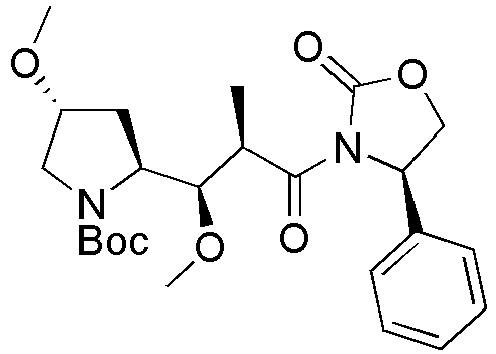
- With the exception that the compound (VI-2) obtained in Preparation Example 2-2 was used instead of the compound (VI-1) obtained in Preparation Example 2-1, the same procedure as in Preparation Example 3-1 was repeated to afford the title compound. 1.6g (45%).
1H NMR (400 MHz, CDCl3): δ 1.21 (m, 3H), 1.47 (m, 9H), 1.92 (m, 1H), 2.16 (m, 1H), 3.33 (m, 3H), 3.47 (m, 3H), 3.76-4.10 (m, 6H), 4.24 (m, 1H), 4.66 (m, 1H), 5.30-5.39 (m, 1H), 7.33 (m, 5H) -

- With the exception that the compound (VI-3) obtained in Preparation Example 2-3 was used instead of the compound (VI-1) obtained in Preparation Example 2-1, the same procedure as in Preparation Example 3-1 was repeated to afford the title compound. 6.5g (71%).
1H NMR (400 MHz, CDCl3): δ 0.05 (s, 6H), 0.86 (s, 9H), 1.18~1.20 (d, 3H), 1.45~1.49 (d, 9H), 1.87 (m, 1H), 2.16~2.18 (m, 1H), 3.29~3.30 (m, 1H), 3.41 (s, 3H), 3.69~3.80 (m, 1H), 3.89~3.93 (m, 1H), 3.99~4.07 (m, 1H), 4.23~4.26 (m ,1H), 4.38 (m ,1H), 4.63~4.66 (m, 1H), 5.38~5.49 (m, 1H), 7.26~7.39 (m ,5H) -

- A solution of the compound (VII-1) (5.7 g, 13.2 mmol) obtained in Preparation Example 3-1 in 65 mL of tetrahydrofuran was cooled to 0°C, added with 30% hydrogen peroxide (6.6 mL, 66.0 mmol) and 0.4 N lithium hydroxide (66 mL, 26.4 mmol), and stirred for 3 hrs.
- The reaction was completed with 1 M sodium sulfite (72.6 mL, 72.6 mmol), and the reaction mixture was stirred at 20-25°C for 16 hrs and then extracted with saturated sodium hydrogen carbonate and dichloromethane, both cold to 0∼5°C. Using 1 N HCl, the aqueous layer was adjusted to a pH of 2, followed by three rounds of extraction with ethylacetate. The organic layers thus obtained were pooled, dried over anhydrous magnesium sulfate, and concentrated in a vacuum to afford the title compound. 3.8 g (99%).
[α]D 25= -57°(c= 1, MeOH)
1H NMR (400 MHz, CDCl3): δ 1.28 (m, 3H), 1.45 (m, 9H), 1.75 (m, 1H), 1.95 (m, 1H), 2.50 (m, 1H), 3.25 (m, 1H), 3.45 (s, 3H), 3.97 (m, 1H), 3.80-3.98 (m, 2H), 11.1 (br, 1H) -
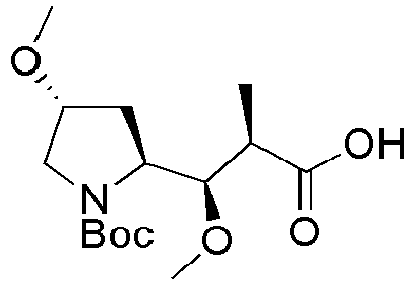
- With the exception that the compound (VII-2) obtained in Preparation Example 3-2 was used instead of the compound (VII-1) obtained in Preparation Example 3-1, the same procedure as in Preparation Example 4-1 was repeated to afford the title compound. 1.5g (93%).
1H NMR (400 MHz, CDCl3): δ 1.28 (m, 3H), 1.47 (m, 9H), 1.99-2.55 (m, 4H), 3.30 (s, 3H), 3.46 (s, 3H), 3.55-4.15 (m, 4H) -

- With the exception that the compound (VII-3) obtained in Preparation Example 3-3 was used instead of the compound (VII-1) obtained in Preparation Example 3-1, the same procedure as in Preparation Example 4-1 was repeated to afford the title compound. 1.04g (100 %).
1H NMR (400 MHz, CDCl3): δ 0.05 (s, 6H), 0.86 (s, 9H), 1.26 (d, 3H), 1.48 (s, 9H), 1.84 (m, 1H), 2.07 (m, 1H), 2.45~2.57 (m, 1H), 3.27~3.30 (m, 1H), 3.34~3.53 (m, 1H), 3.46 (S, 3H), 3.86~3.87 (m, 1H), 4.05 (m, 1H), 4.37 (m, 1H) -

- To a solution of the compound (VII-3) (6.4g, 11.55mmol) obtained in Preparation Example 3-3 in 50 mL of tetrahydrofuran was slowly added pyridine hydrofluoride (1.0ml, 69.3mmol) while stirring at 20 - 25 °C for 3 hrs. After completion of the reaction, the reaction mixture was added with 50 mL of an aqueous saturated sodium hydrogen carbonate solution, and then extracted with 50 mL of ethylacetate. The organic layer thus formed was washed with 50 mL of 1 N HCl, dried over anhydrous sodium sulfate, and concentrated in a vacuum to afford (2S,4R)-t-butyl 4-hydroxy-2-((1R,2R)-1-methoxy-2-methyl-3-oxo-3-((R)-2-oxo-4-phenyloxazolidin-3-yl)propyl)pyrrolidine-1-carboxylate. 5.4g (104%).
- The concentrate was dissolved in 120 mL of tetrahydrofuran in an argon atmosphere, added with triphenylphosphine (4.71g, 17.75mmol), and cooled to 0 ∼ 5°C. The reaction solution was mixed with formic acid (0.67ml, 17.75mmol), followed by slow addition of drops of diisopropyl azodicarboxylate (3.5g, 17.75 mmol). Subsequently, stirring was conducted at 0 - 5°C for 30 min and then at 20 - 25°C for 16 hrs. When the reaction was completed, the reaction mixture was concentrated in a vacuum to obtain (2S,4S)-t-butyl 4-(formyloxy)-2-((1R,2R)-1-methoxy-2-methyl-3-oxo-3-((R)-2-oxo-4-phenyloxazolidin-3-yl)propyl)pyrrolidine-1-carboxylate.
- The residue was cooled to 0 ~ 5°C, and slowly added with drops of hydrogen peroxide (11.1ml, 115.5mmol) and then with 1 M lithium hydroxide (2.42g, 57.8 mmol). This reaction solution was stirred at 0 ∼ 5°C for 4 hrs, after which tetrahydrofuran was removed by vacuum concentration. The residue was extracted with 100 mL of dichloromethane and 100 mL of water. The aqueous layer was isolated, adjusted with 1 N HCl to a pH of 2, and extracted twice with 100 mL of ethylacetate. The organic layers thus obtained were pooled, dried over magnesium sulfate, and concentrated in a vacuum to afford the title compound. 3.18 g (91%).
1H NMR (400 MHz, CDCl3): δ 1.34 (d, 3H, J = 7.2 Hz), 1.47 (m, 9H), 1.97~2.00 (m, 1H), 2.19~2.23 (m, 1H), 2.54~2.57 (m, 1H), 3.40~3.59 (m, 2H), 3.49 (s, 3H), 3.87~3.99 (m, 1H), 4.08~4.15 (m, 1H), 4.24~4.28 (m, 1H)
LC-MS m/z : 302.1 [M-H] -

- With the exception that diphenyl phosphoryl azide was used instead of diisopropyl azodicarboxylate, the same procedure as in Preparation Example 4-4 was repeated to afford the title compound. 4.94g (90%).
[α]D 25= -13.6° (c=1, MeOH)
1H NMR (400 MHz, CDCl3): δ 1.28 (d, 3H, J = 6.8 Hz), 1.47 (s, 9H), 2.05 (m, 1H), 2.23~2.30 (m, 1H), 2.46~2.48 (m, 1H), 3.05 (m, 1H), 3.48 (s, 3H), 3.88~3.04 (m, 3H) -

- With the exception that (R)-t-butyl-4-((1R,2R)-1-methoxy-2-methyl-3-oxo-3-((R)-2-oxo-4-phenyloxazolidin-3-yl)propyl)thiazolidine-3-carboxylate was used instead of the compound (VII-1) obtained in Preparation Example 3-1, the same procedure as in Preparation Example 4-1 was repeated to afford the title compound. 0.89g (100 %).
1H NMR (400 MHz, CDCl3): δ 1.17-1.25 (d, 3H), 1.47 (s, 9H), 2.65~3.12 (m, 4H), 3.42 (S, 3H), 3.77~4.18 (m, 2H), 4.16~4.21 (m, 2H) -

- 2-(2,6-Difluorophenyl)acetonitrile (2.34 g, 15.28 mmol) was added to potassium boron hydride (3.29 g, 61.12 mmol) and Raney nickel (0.897 g, 15.28 mmol) in 50 mL of absolute ethanol while stirring. Then, vigorously stirring was continued at room temperature for 5 hrs.
- After completion of the reaction, the reaction mixture was filtered through celite, and concentrated in a vacuum. The residue was extracted with ether and water, and washed with brine. The organic layer was dried over anhydrous magnesium sulfate to afford the title compound as a dark yellow oil.
1H NMR (400 MHz, CDCl3): δ 2.88 (m, 2H), 2.98 (m, 2H), 5.11 (br, 1H), 7.32(m, 2H), 7.59 (m, 1H) -

- With the exception that 2-(3-fluorophenyl)acetonitrile was used instead of 2-(2,6-difluorophenyl)acetonitrile, the same procedure as in Preparation Example 5-1 was repeated to afford the title compound.
1H NMR (400 MHz, CDCl3): δ 2.88 (m, 2H), 2.98 (m, 2H), 5.11 (br, 1H), 6.83 (m, 1H), 7.06 (m, 2H), 7.38 (m, 1H) -

- With the exception that 2-(2,4-dichloro-5-fluorophenyl)acetonitrile was used instead of 2-(2,6-difluorophenyl)acetonitrile, the same procedure as in Preparation Example 5-1 was repeated to afford the title compound.
1H NMR (400 MHz, CDCl3): δ 2.83 (m, 2H), 2.98 (m, 2H), 5.11 (br, 1H), 6.71 (m, 1H), 7.62 (m, 1H) -

- To a solution of 2-azido-1-(2-fluoro-4-methoxyphenyl)ethanone (4.80 g, 25.36 mmol) in 100 mL of tetrahydrofuran were added triphenylphosphine (6.65 g, 25.36 mmol) and p-toluenesulfonic acid (14.5 g, 76.11 mmol), followed by stirring at room temperature for 16 hrs.
- The precipitate that was formed as the reaction terminated was filtered, washed with cold tetrahydrofuran, and dried at 35°C to afford the title compound as a white solid. 5.12 g (61%).
1H NMR (400 MHz, DMSO-d6): δ 3.83 (s, 3H), 4.33 (s, 2H), 6.92 (m, 1H), 7.06 (m, 1H), 7.88 (m, 1H), 7.91 (m, 2H), 8.17 (br, 1H) -

- A solution of (R)-t-butyl(1-(methoxy(methyl)amino)-1-oxopropan-2-yl)carbamate (5.0 g, 21.5 mmol) in 50 mL of tetrahydrofuran was cooled to -20°C. 4-Methoxyphenylmagnesium bromide was prepared by stirring magnesium (2.1 g, 86.1 mmol), 4-methoxybromobenzene (16.1 g, 86.1 mmol), and a catalytically effective amount of iodide in 100 mL of tetrahydrofuran, and dropwise added to the solution. A reaction was conducted at 20~25°C for 16 hrs while stirring.
- When the reaction was completed, the addition of 100 mL of 1 N HCl gave two separated layers. The aqueous layer was extracted three times with 100 mL of ethylacetate. The organic layers were pooled, dried over anhydrous magnesium sulfate, and concentrated in a vacuum. The residue was isolated and purified by column chromatography to afford the title compound. 6.2 g (66.2%).
1H NMR (400MHz, CDCl3): δ 1.40 (d, 3H), 1.46 (s, 9H), 3.88 (s, 3H), 5.24 (m, 1H), 5.62 (br, 1H), 6.96 (d, 2H), 7.96 (d, 2H) -

- With the exception that 2-methoxybromobenzene was used instead of 4-methoxybromobenzene, the same procedure as in Preparation Example 5-5 was repeated to afford the title compound. 2.31 g (75.9%).
1H NMR (400MHz, CDCl3): δ 1.32 (d, 3H), 1.45 (s, 9H), 3.92 (s, 3H), 5.32 (m, 1H), 5.59 (br, 1H), 7.0 (m, 2H), 7.49 (m, 1H), 7.76 (m, 1H) -
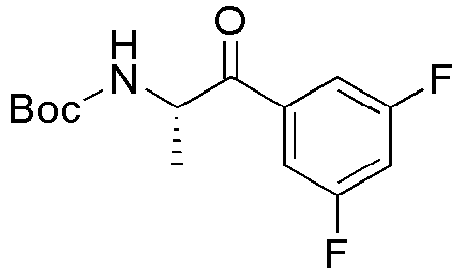
- With the exception that (S)-t-butyl(1-(methoxy(methyl)amino)-1-oxopropan-2-yl)carbamate and 1-bromo-3,5-difluorobenzene were used instead of (R)-t-butyl(1-(methoxy(methyl)amino)-1-oxopropan-2-yl)carbamate and 4-methoxybromobenzene, respectively, the same procedure as in Preparation Example 5-5 was repeated to afford the title compound. 1.3g (46 %).
1H NMR (400MHz, CDCl3): δ 1.40 (d, J = 7.2Hz, 3H), 1.46 (s, 9H), 5.15∼5.19 (m, 1H), 5.41∼5.43 (m, 1H), 7.03~7.08 (m, 1H), 7.48∼7.50 (m, 2H) -

- With the exception that 1-bromo-2,6-difluorobenzene was used instead of 4-methoxybromobenzene, the same procedure as in Preparation Example 5-5 was repeated to afford the title compound. 0.16 g (10%).
1H NMR (400MHz, CDCl3): δ 1.39 (d, J = 7.2Hz, 3H), 1.41 (s, 9H), 4.87~5.19 (m, 1H), 5.30~5.31 (m, 1H), 6.94~7.0 (m, 2H), 7.39~7.46 (m, 1H) -

- With the exception that (S)-t-butyl(1-(methoxy(methyl)amino)-1-oxopropan-2-yl)carbamate and 1-bromo-2,6-difluorobenzene were used instead of (R)-t-butyl(1-(methoxy(methyl)amino)-1-oxopropan-2-yl)carbamate and 4-methoxybromobenzene,respectively, the same procedure as in Preparation Example 5-5 was repeated to afford the title compound. 0.26 g (17%).
1H NMR (400MHz, CDCl3): δ 1.39 (d, J = 7.2Hz, 3H), 1.41 (s, 9H), 4.83~4.87 (m, 1H), 5.30~5.31 (m, 1H), 6.94~6.99 (m, 2H), 7.39~7.46 (m, 1H) -

- With the exception that 3-methoxybromobenzene was used instead of 4-methoxybromobenzene, the same procedure as in Preparation Example 5-5 was repeated to afford the title compound. 2.56 g (71%).
1H NMR (400MHz, CDCl3): δ 1.32 (d, 3H), 1.45 (s, 9H), 3.94 (s, 3H), 5.32 (m, 1H), 5.61 (br, 1H), 7.12 (m, 3H), 7.62 (m, 1H) -

- The compound (IX-10) (0.3 g, 1.1 mmol) obtained in Preparation Example 5-10, hydroxylamine hydrochloride (0.18 g, 2.7 mmol), and sodium acetate (0.2 g, 2.7 mmol) were dissolved in 15 mL of a mixture of ethanol and water (5/1), and heated for 3 hrs under reflux.
- After completion of the reaction, the reaction mixture was cooled to 20-25 °C, neutralized with 1.3 mL of a saturated sodium carbonate solution, and concentrated by vacuum distillation. The concentrate was dissolved in 15 mL of water and 20 mL of ethylacetate. The aqueous layer was extracted three times with 20 mL of ethylacetate. The organic layers thus obtained were pooled, dried over anhydrous magnesium sulfate, and concentrated in a vacuum. The concentrate was purified by column chromatography to afford the title compound as a mixture of E and Z-isomers (1:2). 0.27 g (85.2%).
1H NMR (400MHz, CDCl3): δ 1.39 (s, 9H), 1.43 (m, 3H), 3.78 (s, 3H), 4.69 (m, 1H), 5.26 (br, 1H), 7.33~6.89 (m, 4H) (E-isomer)
1H NMR (400MHz, CDCl3): δ 1.39 (s, 9H), 1.43 (m, 3H), 3.78 (s, 3H), 5.05 (m, 1H), 5.82 (br, 1H), 7.33~6.89 (m, 4H) (Z-isomer) -

- In a reaction vessel that was vacuumed and then purged with argon, (R)-t-butyl [1-phenyl-1-oxopropan-2-yl]carbamate (0.75 g (3.0 mmol)) and ammonium chloride (0.24 g (4.5 mmol)) were placed. Then, dry tetrahydrofuran (15 mL) and triethylamine (0.63 mL (4.5 mmol)) was added to the reaction vessel, followed by titanium tetraisopropoxide (1.32 mL (4.5 mmol)). At room temperature, the reaction mixture was stirred for 8∼10 hrs. After addition of ammonium borane, the reaction mixture was again stirred for 8~10 hrs.
- Extraction with 1 M ammonia water (15 mL) and ether (15 mL) was performed, after which the organic layer was washed with 9 mL of 1 M HCl. The aqueous layer was adjusted to a pH of 7~8 with 1 M sodium hydroxide, and extracted with 15 mL of ether. The organic layer thus obtained was washed with brine, dried over anhydrous sodium sulfate, and concentrated in a vacuum to afford the title compound. 0.096 g (17%).
1H NMR (400MHz, CDCl3): δ 0.95 (d, 1H), 1.02 (d, 3H), 1.20 (d, 1H), 1.46 (s, 9H), 7.26~7.34 (m, 5H) -

- To the compound (IX-12) (0.37 g (1.47 mmol)) obtained in Preparation Example 5-12, 5 mL of dichloromethane and 0.45 mL (3.23 mmol) of triethylamine was added, followed by slow addition of benzylchloroformate at 0°C. After stirring at room temperature at 12~18 hrs, extraction was performed with water and ethylacetate. The organic layer was dried over anhydrous sodium sulfate and concentrated in a vacuum to afford the title compound. 0.37 g (49%).
1H NMR (400MHz, CDCl3): δ 1.09 (d, 3H), 1.42 (s, 9H), 3.93~4.42 (m, 2H), 4.70~4.75 (m, 1H) 4.97~5.17 (m, 2H), 6.02~6.33 (d, 1H), 6.92~7.34 (m, 5H) -

- With the exception that (S)-t-butyl [1-phenyl-1-oxopropan-2-yl]carbamate was used instead of (R)-t-butyl [1-phenyl-1-oxopropan-2-yl]carbamate, the same procedure as in Preparation Example 5-12 was repeated to afford the title compound. 0.5 g (67%).
1H NMR (400MHz, CDCl3): δ 0.95 (d, 1H), 1.01 (d, 3H), 1.20 (d, 1H), 1.45 (s, 9H), 7.24~7.34 (m, 5H) -

- With the exception that the compound (IX-12) obtained in Preparation Example 5-14 was used instead of the compound (IX-14) obtained in Preparation Example 5-12, the same procedure as in Preparation Example 5-13 was repeated to afford the title compound. 0.22 g (28%).
1H NMR (400MHz, CDCl3): δ 0.98 (d, 3H), 1.40 (s, 9H), 3.93~4.41 (m, 1H), 4.68~4.73 (m, 1H), 4.97~5.18 (m, 2H), 6.03~6.33 (d, 1H), 7.21~7.52 (m, 5H) -

- To a solution of the compound (VIII-2) (1.00 g, 3.48 mmol) obtained in Preparation Example 4-2 in 10 mL of dimethylformamide was dropwise added the compound (IX-1) (0.66 g, 4.18 mmol) of Preparation Example 5-1 at 0°C. Then, diisopropylethylamine (1.73 mL, 10.44 mmol) and benzotriazol-1-yl-oxy-tris(dimethylamino)phosphonium hexafluorophosphate (1.54 g, 3.48 mmol) were added before stirring at 20~25 °C for 16 hrs.
- When the reaction was completed, the reaction solvent was removed by vacuum concentration, and the residue was dissolved in ethylacetate, extracted twice with water, and washed with brine. The organic layer was dried over anhydrous magnesium sulfate, and concentrated in a vacuum, followed by purification through column chromatography (ethylacetate : hexane = 1 : 3 → ethylacetate : hexane = 1 : 1) to afford the title compound as a white oil. 1.31 g (85%).
1H NMR (400 MHz, CDCl3): δ 1.22 (d, 3H), 1.46 (s, 9H), 1.65~1.86 (m, 4H), 2.33~3.37 (m, 1H), 2.82 (t, 2H), 3.22~3.24 (m, 1H), 3.29 (s, 3H), 3.4 (s, 3H), 3.48~3.55 (m, 2H), 3.75~3.83 (m, 2H), 5.77~6.51 (m, 1H), 6.65~6.74 (m, 3H) -

- With the exception that the compound (IX-1) obtained in Preparation Example 5-1 was used instead of the compound (IX-3) obtained in Preparation Example 5-3, the same procedure as in Preparation Example 6-1 was repeated to afford the title compound. 0.65 g (78%).
1H NMR (400 MHz, CDCl3): δ 1.25 (d, 3H), 1.49 (s, 9H), 1.67~1.88 (m, 4H), 2.33~3.35 (m, 1H), 2.94 (t, 2H), 3.23 (m, 1H), 3.24 (s, 3H), 3.41 (s, 3H), 3.46~3.52 (m, 2H), 3.77∼3.82 (m, 2H), 5.79∼6.58 (m, 1H), 7.10 (m, 1H), 7.40 (m, 1H) -

- With the exception that the compound (IX-2) obtained in Preparation Example 5-2 was used instead of the compound (IX-1) obtained in Preparation Example 5-1, the same procedure as in Preparation Example 6-1 was repeated to afford the title compound. 0.65 g (95%).
1H NMR (400 MHz, CDCl3): δ 1.24 (m, 3H), 1.48 (s, 9H), 1.68 (m, 3H), 1.85 (m, 2H), 2.34 (m, 1H), 2.83 (t, 2H), 3.20~3.41 (m, 1H), 3.29 (s, 3H), 3.43 (s, 3H), 3.51∼3.56 (m, 2H), 3.66~3.83 (m, 2H), 5.71∼6.38 (m, 1H), 6.92 (d, 1H), 6.99 (d, 1H), 7.24 (m, 2H) -
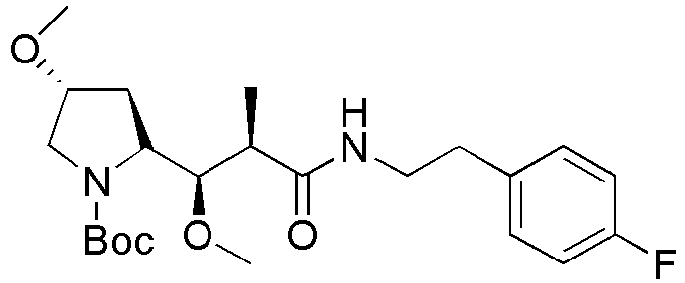
- With the exception that 2-(4-fluorophenyl)ethanamine was used instead of the compound (IX-1) obtained in Preparation Example 5-1, the same procedure as in Preparation Example 6-1 was repeated to afford the title compound. 0.66 g (93%).
1H NMR (400 MHz, CDCl3): δ 1.24 (m, 3H), 1.49 (s, 9H), 1.65 (m, 3H), 1.76 (m, 2H), 2.32 (m, 1H), 2.80 (t, 2H), 3.22 (m, 1H), 3.23 (s, 3H), 3.27 (s, 3H), 3.43 (s, 3H), 3.48~3.55 (m, 2H), 3.72~3.82 (m, 2H), 5.68~6.32 (m, 1H), 6.97 (s, 2H), 7.16 (d, 2H) -

- With the exception that the compound (VIII-3) obtained in Preparation Example 4-3 and 2-phenetamine were used instead of the compound (VIII-2) obtained in Preparation Example 4-2 and the compound (IX-1) obtained in Preparation Example 5-1, respectively, the same procedure as in Preparation Example 6-1 was repeated to afford the title compound. 0.71 g (95%).
1H NMR (400 MHz, CDCl3) δ 0.04 (s, 6H), 0.85(s, 9H), 1.09(m, 3H), 1.46 (s, 9H), 1.70~2.82 (m, 3H), 3.26~3.33 (m, 2H), 3.37 (s, 3H), 3.74 (m, 2H), 3.86~4.3 (m, 4H), 5.70~6.25 (m, 2H), 7.21~7.30(m, 5H) -

- With the exception that (2R,3R)-3-((R)-1-(t-butoxycarbonyl)-4-oxopyrrolidin-2-yl)-3-methoxy-2-methylpropionic acid and 2-phenetamine were used instead of the compounds (VIII-2 and IX-1) obtained in Preparation Examples 4-2 and 5-1, respectively, the same procedure as in Preparation Example 6-1 was repeated to afford the title compound. 0.33 g (85%).
1H NMR (400 MHz, CDCl3): δ 1.08~1.17 (m, 3H), 1.20~1.27 (m, 2H), 1.57 (s, 9H), 1.73 (m, 1H), 1.99~2.06 (m, 1H), 2.39~2.56 (m, 2H), 2.79~2.88 (m, 2H), 3.34 (s, 3H), 3.47~3.67 (m, 2H), 3.72~3.97 (m, 3H), 4.31~4.41 (m, 1H), 5.67~5.81 (m, 2H), 7.06~7.43 (m, 5H) -

- With the exception that the compound (IX-4) obtained in Preparation Example 5-4 was used instead of the compound (IX-1) obtained in Preparation Example 5-1, the same procedure as in Preparation Example 6-1 was repeated to afford the title compound. 0.87 g (93%).
1H NMR (400 MHz, CDCl3): δ 1.24 (m, 3H), 1.46 (s. 9H), 1.67∼1.92 (m, 4H), 2.41~2.45 (m. 1H), 3.19~3.21 (m, 1H), 3.28 (s, 3H), 3.42 (s, 3H), 3.78 (m, 1H), 3.85 (s, 3H), 3.92 (m, 1H), 4.60 (s, 2H), 6.77 (m, 2H), 7.95 (m, 1H) -

- With the exception that 2-amino-1-phenylethanone was used instead of the compound (IX-1) obtained in Preparation Example 5-1, the same procedure as in Preparation Example 6-1 was repeated to afford the title compound. 1.7 g (93%).
1H NMR (400 MHz, CDCl3): δ 1.27 (d, 3H), 1.49 (s, 9H), 1.68~1.73 (m, 1H), 1.82~1.95 (m, 3H), 2.5 (m, 1H), 3.21~3.27 (m, 1H), 3.29 (s, 3H), 3.38~3.65 (m, 1H), 3.48 (s, 3H), 3.82~3.99 (m, 2H), 4.7 (S, 2H), 7.5 (m, 2H), 7.61 (m, 1H), 7.97 (d, 1H) -

- With the exception that 2-amino-1-(p-tolyl)ethanone was used instead of the compound (IX-1) obtained in Preparation Example 5-1, the same procedure as in Preparation Example 6-1 was repeated to afford the title compound. 0.33 g (81 %).
1H NMR (400 MHz, CDCl3): δ 1.25 (m, 3H), 1.47 (s. 9H), 1.71∼1.95 (m, 4H), 2.43 (s. 3H), 2.47~2.55 (m. 1H), 3.21~3.27 (m, 1H), 3.39~3.42 (m, 1H), 3.48 (s, 3H), 3.81 (m, 1H), 3.92~3.96 (m, 1H), 4.73 (s, 2H), 7.30 (d, J = 8.0Hz, 2H), 7.88 (d, J = 8.0Hz, 2H) -

- With the exception that 2-amino-1-(4-fluorophenyl)ethanone was used instead of the compound (IX-1) obtained in Preparation Example 5-1, the same procedure as in Preparation Example 6-1 was repeated to afford the title compound. 0.56 g (81%).
1H NMR (400 MHz, CDCl3): δ 1.26~1.33 (m, 3H), 1.49 (s, 9H), 1.69~1.95 (m, 4H), 2.48~2.56 (m, 1H), 3.21~3.27 (m, 1H), 3.29 (s, 3H), 3.43~3.47 (m, 1H), 3.48 (s, 3H), 3.80~3.82 (m, 1H), 3.92~3.98 (m, 1H), 4.73 (s, 2H), 7.61 (m, 2H), 8.01~8.02 (m, 2H) -

- With the exception that (2R,3R)-3-((2R,4S)-1-(t-butoxycarbonyl)-4-methoxypyrrolidin-2-yl)-3-methoxy-2-methylpropionic acid and 2-phenetamine were used instead of the compound (VIII-2 and IX-1) obtained in Preparation Example 4-2, and 5-1, respectively, the same procedure as in Preparation Example 6-1 was repeated to afford the title compound. 0.26 g (61%).
1H NMR (400 MHz, CDCl3): δ 1.18 (d, 3H), 1.47 (s, 9H), 1.94~2.01 (m, 4H), 2.26~2.38 (m, 1H), 2.83 (t, 2H), 2.98 (m, 1H), 3.32 (s, 3H), 3.39 (s, 3H), 3.48~3.52 (m, 2H), 3.73~3.79 (m, 2H), 5.67~6.07 (m, 1H), 6.99~7.32 (m, 4H) -

- With the exception that 2-amino-1-phenylethanol was used instead of the compound (IX-1) obtained in Preparation Example 5-1, the same procedure as in Preparation Example 6-1 was repeated to afford the title compound. 0.43 g (100%).
1H NMR (400 MHz, CDCl3): δ 1.23~1.31 (m, 3H), 1.49 (s, 9H), 1.73∼1.99 (m, 4H), 2.34~2.41 (m, 1H), 3.06~3.43 (m, 3H), 3.29 (s, 3H), 3.45 (s, 3H), 3.52~4.84 (m, 4H), 4.33~4.99 (m, 2H), 7.28~7.45 (m, 5H) -

- With the exception that the compound (IX-13) obtained in Preparation Example 5-13 was used instead of the compound (IX-1) obtained in Preparation Example 5-1, the same procedure as in Preparation Example 6-1 was repeated to afford the title compound. 68 mg (39%).
1H NMR (400MHz, CDCl3): δ 0.98~1.28 (m, 7H), 1.43 (s, 9H), 1.71~2.29 (m, 4H), 3.21~3.30 (m, 2H), 3.27 (s, 3H), 3.38 (s, 3H), 3.72~3.75 (m, 2H), 4.33~4.69 (m, 1H), 5.0 (s, 2H), 5.82~6.13 (m, 1H), 6.46~7.0 (m, 1H), 7.21~7.40 (m, 10H) -

- With the exception that the compound (IX-15) obtained in Preparation Example 5-15 was used instead of the compound (IX-1) obtained in Preparation Example 5-1, the same procedure as in Preparation Example 6-1 was repeated to afford the title compound. 0.13 g (73%).
1H NMR (400MHz, CDCl3): δ 0.98~1.26 (m, 7H), 1.40 (s, 9H), 1.71~2.29 (m, 4H), 3.20~3.26 (m, 2H), 3.29 (s, 3H), 3.37 (s, 3H), 3.46~3.72 (m, 2H), 4.28~4.43 (m, 1H), 5.0 (s, 2H), 5.82~6.13 (m, 1H), 6.46~7.0 (m, 1H), 7.21~7.40 (m, 10H) -

- With the exception that 2-(pyridin-2-yl)ethylamine was used instead of the compound (IX-1) obtained in Preparation Example 5-1, the same procedure as in Preparation Example 6-1 was repeated to afford the title compound. 0.5 g (64%).
1H NMR (400MHz, CDCl3): δ 1.20 (s, 3H), 1.47 (d, J = 6.8Hz, 9H), 1.71 (m, 2H), 1.72 (m, 2H), 1.99 (s, 1.H), 2.31 (m, 1H), 3.00 (t, 2H), 3.21 (t, 1H), 3.27 (s, 3H), 3.39 (s, 3H), 3.53~3.84 (m, 4H), 7.16 (t, 2H), 7.61 (t, 1H), 8.52 (m, 1H) -

- With the exception that 2-(thiophen-2-yl)ethylamine was used instead of the compound (IX-1) obtained in Preparation Example 5-1, the same procedure as in Preparation Example 6-1 was repeated to afford the title compound. 0.8 g (99%).
1H NMR (400MHz, CDCl3): δ 1.21 (m, 3H), 1.48 (d, J = 12.8Hz, 9H), 1.74 (m, 2H), 1.88 (m, 2H), 2.28~2.38 (m, 1H), 3.05 (t, J = 6.4Hz, 2H), 3.21 (m, 1H), 3.25 (s, 3H), 3.39 (s, 3H), 3.53~3.57 (m, 2H), 3.74~3.86 (m, 2H), 6.85 (s, 1H), 6.94 (t, J = 3.6Hz, 1H), 7.15 (s, 1H) -

- To a solution of the compound (IX-7) (0.36 g, 1.26 mmol) obtained in Preparation Example 5-7 in 5 mL of dichloromethane was dropwise added 4 mL of trifluoroacetic acid while stirring at 20~25°C for 3 hrs. After completion of the reaction, the reaction solvent was removed by vacuum concentration. Toluene was added twice in an amount of 5 mL to completely remove the trifluoroacetic acid before a reaction was continued.
- The reaction concentrate (TFA salt) and the compound (VIII-2) (0.40 g, 1.26 mmol) obtained in Preparation Example 4-2 were dissolved in 5 mL of dimethylformamide. Diethyl cyanophosphonate (DEPC) (0.19 mL, 1.32 mmol) and triethylamine (0.89 mL, 6.30 mmol) were added at 0 °C to the solution that was then stirred at 20~25°C for 16 hrs. When the reaction was completed, the reaction solvent was removed by vacuum concentration. The residue was dissolved in ethylacetate, and extracted with 1 M potassium hydrogen sulfite, water, a saturated sodium hydrogen carbonate solution, and brine, and the organic layer thus obtained was dried over anhydrous sodium sulfate, and concentrated in a vacuum. The concentrate was purified by column chromatography (ethylacetate : hexane = 2 : 1 → ethylacetate) to afford the title compound. 0.53 g (94%).
1H NMR (400 MHz, CDCl3): δ 1.19 (m, 3H), 1.38 (s. 9H), 1.52 (m, 3H), 1.85~1.91 (m, 5H), 2.92~2.94 (m. 2H), 3.30 (s, 6H), 3.61~3.67 (m, 4H), 5.27 (m, 1H), 6.86 (m, 1H), 7.32 (m, 2H), 8.03 (br, 1H) -

- With the exception that compound (IX-6) obtained in Preparation Example 5-6 was used instead of the compound (IX-7) obtained in Preparation Example 5-7, the same procedure as in Preparation Example 6-17 was repeated to afford the title compound. 0.21 g (75%).
1H NMR (400 MHz, CDCl3): δ 1.26 (m, 3H), 1.34 (m, 3H), 1.49 (s, 9H), 1.71~2.45 (m, 4H), 3.25 (s. 3H), 3.33 (m, 1H), 3.47 (s, 3H), 3.71~3.89 (m, 2H), 3.94 (s, 3H), 4.05 (m, 1H), 5.55 (m, 1H), 6.82 (d, 1H), 7.03 (m, 2H), 7.52 (m, 1H), 7.76 (d, 1H) -

- With the exception that (R)-t-butyl (1-(3-methoxyphenyl)-1-oxopropan-2-yl)carbamate was used instead of the compound (IX-7) obtained in Preparation Example 5-7, the same procedure as in Preparation Example 6-17 was repeated to afford the title compound. 0.18 g (64%).
1H NMR (400 MHz, CDCl3): δ 1.26 (m, 3H), 1.34 (m, 3H), 1.49 (s, 9H), 1.71~2.45 (m, 4H), 3.22 (s. 3H), 3.33 (m, 1H), 3.47 (s, 3H), 3.71~3.80 (m, 2H), 3.83 (s, 3H), 4.05 (m, 1H), 5.55 (m, 1H), 6.77 (d, 1H), 7.16 (m, 1H) 7.40 (m, 1H), 7.49 (m, 1H), 7.58 (d, 1H) -

- With the exception that the compound (IX-5) obtained in Preparation Example 5-5 was used instead of the compound (IX-7) obtained in Preparation Example 5-7, the same procedure as in Preparation Example 6-17 was repeated to afford the title compound. 0.23 g (82%).
1H NMR (400 MHz, CDCl3): δ 1.26 (m, 3H), 1.34 (m, 3H), 1.49 (s, 9H), 1.71~2.45 (m, 4H), 3.21 (s. 3H), 3.33 (m, 1H), 3.46 (s, 3H), 3.71~3.80 (m, 2H), 3.86 (s, 3H), 4.05 (m, 1H), 5.35 (m, 1H), 6.79 (d, 1H), 6.98 (m, 2H), 7.98 (m, 2H) -

- With the exception that the compound (IX-8) obtained in Preparation Example 5-8 was used instead of the compound (IX-7) obtained in Preparation Example 5-7, the same procedure as in Preparation Example 6-17 was repeated to afford the title compound. 0.13 g (46%).
1H NMR (400 MHz, CDCl3): δ 1.26 (m, 3H), 1.34 (m, 3H), 1.49 (s, 9H), 1.71~2.45 (m, 4H), 3.21 (s. 3H), 3.33 (m, 1H), 3.46 (s, 3H), 3.71~3.80 (m, 2H), 4.05 (m, 1H), 5.35 (m, 1H), 6.79 (d, 1H), 7.09 (m, 2H), 7.46 (m, 1H) -
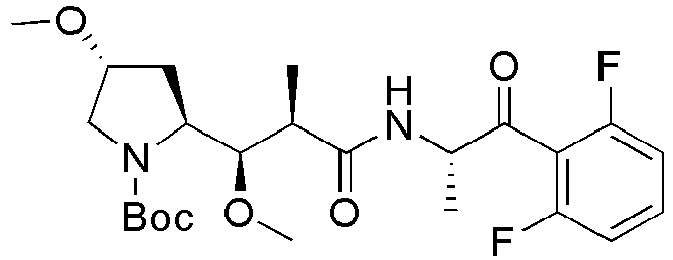
- With the exception that the compound (IX-9) obtained in Preparation Example 5-0 was used instead of the compound (IX-7) obtained in Preparation Example 5-7, the same procedure as in Preparation Example 6-17 was repeated to afford the title compound. 0.13 g (46%).
1H NMR (400 MHz, CDCl3): δ 1.26 (m, 3H), 1.34 (m, 3H), 1.49 (s, 9H), 1.71~2.45 (m, 4H), 3.21 (s. 3H), 3.33 (m, 1H), 3.46 (s, 3H), 3.71~3.80 (m, 2H), 4.05 (m, 1H), 5.35 (m, 1H), 6.79 (d, 1H), 7.09 (m, 2H), 7.46 (m, 1H) -

- With the exception that the compound (IX-11) obtained in Preparation Example 5-11 was used instead of the compound (IX-7) obtained in Preparation Example 5-7, the same procedure as in Preparation Example 6-17 was repeated to afford the title compound. 0.23 g (52%).
1H NMR (400 MHz, CDCl3): δ 1.28 (m, 6H), 1.45 (m, 9H), 1.75 (m, 1H), 1.95 (m, 1H), 2.50 (m, 1H), 3.25 (m, 1H), 3.30 (s, 3H), 3.45 (s, 3H), 3.77 (s, 3H), 3.80-3.98 (m, 2H), 5.05 (m, 1H), 5.83 (m, 1H), 6.90 (m, 2H), 7.15 (m, 1H), 7.30 (m. 1H) -

- With the exception that the compound (VIII-4) obtained in Preparation Example 4-4 was used instead of the compound (VIII-2) obtained in Preparation Example 4-2, the same procedure as in Preparation Example 6-1 was repeated to afford the title compound. 0.32 g (64%).
1H NMR (400 MHz, CDCl3): δ 1.17~1.25 (d, 3H), 1.47 (s, 9H), 2.65~3.12 (m, 8H), 3.42 (S, 3H), 3.77~4.18 (m, 2H), 4.16~4.21 (m, 2H), 5.11 (br, 1H), 7.32 (m, 2H), 7.59 (m, 1H) -

- With the exception that the compound (VIII-4) obtained in Preparation Example 4-4 was used instead of the compound (VIII-2) obtained in Preparation Example 4-2, the same procedure as in Preparation Example 6-1 was repeated to afford the title compound. 3.5 g (75%).
1H NMR (400 MHz, CDCl3): δ 1.26 (m, 3H), 1.48 (d, 9H), 1.62∼1.66 (m, 2H),1.81∼1.89 (m, 1H), 2.07~2.14 (m, 1H), 2.22~2.36 (m, 1H), 2.87~2.92 (m, 2H), 3.36~3.41 (m, 2H), 3.52 (s, 6H), 3.81~3.91 (m, 1H), 3.98~4.00 (m, 1H), 4.11~4.13 (m, 1H), 4.62~4.64 (d, 1H), 5.59 (brs, 1H), 6.03 (brs, 1H), 6.87 (m, 2H), 7.18~7.19 (m, 1H) -

- With the exception that the compounds (VIII-4) obtained in Preparation Example 4-4 and (S)-t-butyl (1-(4-fluorophenyl)-1-oxopropan-2-yl)carbamate were used instead of the compounds (VIII-2 and IX-7) obtained in Preparation Examples 4-2 and 5-7, respectively, the same procedure as in Preparation Example 6-17 was repeated to afford the title compound. 0.25 g (81%).
LC-MS m/z : [M+]+ -

- With the exception that the compound (VIII-5) obtained in Preparation Example 4-5 was used instead of the compound (VIII-2) obtained in Preparation Example 4-2, the same procedure as in Preparation Example 6-1 was repeated to afford the title compound. 5.9 g (94%).
[α]D 25= -17.35° (c=1, MeOH)
1H NMR (400 MHz, CDCl3): δ 1.18 (d, 3H), 1.47 (s, 9H), 1.97~2.00 (m, 1H), 2.05~2.39 (m, 2H), 2.90~2.93 (t, 2H), 2.95~2.99 (m, 1H), 3.43 (s, 3H), 3.48~3.53 (m, 2H), 3.75~4.06 (m, 4H), 5.73 (brs, 1H), 6.08 (brs, 1H), 6.87 (t, 2H, J = 7.6Hz, 15.2Hz), 7.15~7.21 (m, 1H) -

- A solution of the compound (X-27) (5.37g, 11.5mmol) obtained in Preparation Example 6-27 in 100 mL of methanol was stirred for 16 hrs in the presence of 10% palladium carbon (0.5g) in a hydrogen atmosphere. After completion of the reaction, the reaction mixture was filtered through celite, and the filtrate was washed several times with methanol. Removal of the solvent in a vacuum left (2S,4S)-t-butyl 4-amino-2-((1R,2R)-3-((2,6-difluorophenethyl)amino)-1-methoxy-2-methyl-3-oxopropyl)pyrrolidine-1-carboxylate4.96 g (98%).
[α]D 25= -39.65° (c=1, MeOH)
1H NMR (400 MHz, CDCl3): δ 1.17 (m, 3H), 1.47 (m, 9H), 1.88 (m, 2H), 2.94~2.00 (m, 1H), 2.10 (s, 3H), 2.23~2.45 (m, 1H), 2.76~2.78 (m, 1H), 2.89~2.92 (m, 2H), 2.98~3.03 (m, 1H), 3.44~3.55(m, 1H), 3.47 (s, 3H), 3.78~4.05 (m, 3H), 5.80 (brs, 1H), 6.28 (brs, 1H), 6.84 (t, 2H, J = 7.6Hz, 15.2Hz), 7.12~7.33 (m, 7H) - The residue was dissolved in 100 mL of methanol in an argon atmosphere. This solution was added with benzaldehyde (1.07ml, 10.6mmol) and stirred at 20~25°C for 1 hr. Sodium cyanoborohydride (0.67g, 10.6mmol) was added to the solution that was then stirred for 16 hrs. Again, the resulting solution was mixed with paraformaldehyde (0.91g, lO.1mmol) while stirring for 2 hrs, and then with sodium cyanoborohydride (0.67g, 10.6 mmol) while stirring for 4 hrs. When the reaction was completed, methanol was removed by vacuum concentration, and the residue was dissolved in 100 mL of ethylacetate, and washed with a saturated sodium hydrogen carbonate solution. The aqueous layer thus formed was extracted twice with ethylacetate. The organic layers were pooled, dried over anhydrous sodium sulfate, and concentrated in a vacuum to dryness. The residue was purified by column chromatography to afford the title compound. 2.74 g (50%).
LC-MS m/z : 545.7[M+H]+
1H NMR (400 MHz, CDCl3): δ 1.19 (m, 3H), 1.51 (m, 9H), 1.88 (m, 2H), 2.94~2.00 (m, 1H), 2.21 (s, 3H), 2.27~2.41 (m, 1H), 2.76~2.78 (m, 1H), 2.89~2.92 (m, 2H), 2.98~3.03 (m, 1H), 3.44~3.55 (m, 1H), 3.47 (s, 3H), 3.78~4.05 (m, 3H), 5.8 (brs, 1H), 6.28 (brs, 1H), 7.12~7.19 (m, 1H), 7.22∼7.25 (m, 1H) -

- To a solution of the compound (X-1) (0.87 g, 2.04 mmol) obtained in Preparation Example 6-1 in 3 mL of dichloromethane was dropwise added 2 mL of trifluoroacetic acid, followed by stirring at 20∼25°C for 3 hrs. After completion of the reaction, the reaction solvent was removed by vacuum concentration. Toluene was added twice in an amount of 5 mL to completely remove the trifluoroacetic acid before a reaction was continued.
- The reaction concentrate (TFA salt) and (5S,8S,11S,12R)-11-((S)-sec-butyl)-5,8-diisopropyl-12-methoxy-4,10-dimethyl-3,6,9-trioxo-1-phenyl-2-oxa-4,7,10-triazatetradecan-14-oic acid (compound II-1) (1.00 g, 2.04 mmol) were dissolved in 5 mL of dimethylformamide. Diethyl cyanophosphonate (DEPC) (0.34 mL, 2.05 mmol) and triethylamine (1.44 mL, 10.22 mmol) were added at 0 °C to the solution that was then stirred at room temperature for 16 hrs. When the reaction was completed, the reaction solvent was removed by vacuum concentration. The residue was dissolved in 20 mL of ethylacetate, and extracted with 1 M potassium hydrogen sulfite, water, a saturated sodium hydrogen carbonate solution, and brine, and the organic layer thus obtained was dried over anhydrous sodium sulfate, and concentrated in a vacuum. The concentrate was purified by column chromatography (ethylacetate : hexane = 2 : 1 → ethylacetate) to afford a compound in which the N-terminal amino group of compound (I-1) was protected, as a pale yellow oil. 1.29 g (74%).
1H NMR (400 MHz, CDCl3): δ 0.75∼0.98 (m, 19H), 1.06 (m, 1H), 1.18~1.27 (m, 4H), 1.38 (m, 1H) 1.91~2.04 (m, 4H), 2.21∼2.52 (m, 4H), 2.87~2.91 (m, 5H), 2.99 (m, 2H), 3.1 (s, 1H), 3.31 (s, 6H), 3.37 (s, 3H), 3.43∼3.51 (m, 3H), 3.82 (dd, 1H), 4.09∼4.15 (m, 2H), 4.68 (m, 1H), 5.12∼5.23 (m, 2H), 6.52 (m, 1H), 6.82~6.87 (m, 2H), 7.13~7.17 (m, 1H), 7.30~7.34 (m, 5H) - The compound (1.29 g, 1.47 mmol) in which the N-terminal amino group of compound (I-1) was protected was dissolved in 9 mL of t-butylalcohol and 1 mL of water and reacted in the presence of 10 % palladium carbon (0.1 g) in a hydrogen atmosphere for 3 hrs while stirring. After completion of the reaction, the reaction mixture was filtered through celite, and washed several times with methanol. Removal of the solvent in a vacuum left the title compound as a pale yellowish solid. 1.06 g (100%).
1H NMR (400 MHz, CDCl3): δ 0.78~0.98 (m, 20H), 1.06 (m, 1H), 1.16~1.27 (m, 4H), 1.38 (m, 1H) 1.65∼1.76 (m, 7H), 1.89~2.02 (m, 5H), 2.31~2.38 (m, 5H), 2.71∼2.75 (m, 1H), 2.88~2.89 (m, 2H) 3.00 (s, 2H), 3.10 (d, 1H), 3.29 (s, 6H), 3.35 (s, 3H), 3.41~3.48 (m, 3H), 3.79~3.82 (dd, 1H), 4.08∼4.15 (m, 2H), 4.72~4.86 (m, 2H), 6.56 (m, 1H), 6.79∼6.85 (m, 2H), 7.10∼7.15 (m, 1H), 7.16~7.22 (m, 1H), 7.55 (d, 1H) -

- With the exception that the compound (X-3) obtained in Preparation Example 6-3 was used instead of the compound (X-1) obtained in Preparation Example 6-1, the same procedure as in Example 6-1 was repeated to afford a compound in which the N-terminal amino group of compound (1-2) was protected. 0.58 g (84%).
1H NMR (400 MHz, CDCl3): δ 0.78~0.99 (m, 19H), 1.06 (m, 1H), 1.19∼1.25 (m, 4H), 1.34 (m, 1H) 1.67~1.74 (m, 4H), 2.16~2.38 (m, 4H), 2.83~2.91 (m, 5H), 3.00~3.12 (m, 2H) 3.10 (s, 1H), 3.29 (s, 3H), 3.31 (s, 3H), 3.38 (s, 3H), 3.44∼3.51 (m, 3H), 3.82 (dd, 1H), 4.09∼4.15 (m, 2H), 4.78 (m, 1H), 5.19∼5.22 (m, 2H), 6.52 (m, 1H), 6.89~6.98 (m, 3H), 7.23 (m, 1H), 7.31~7.34 (m, 5H) - The title compound was prepared in the same manner as in Example 1, with the exception of using the compound in which the N-terminal amino group of compound (1-2) was protected. 0.48 g (100%).
1H NMR (400 MHz, CDCl3): δ 0.81~0.98 (m, 20H), 1.06 (m, 1H), 1.19∼1.25 (m, 4H), 1.38 (m, 1H) 1.65∼1.79 (m, 7H), 1.90~2.06 (m, 5H), 2.31∼2.41 (m, 5H), 2.71∼2.75 (m, 1H), 2.88~2.89 (m, 2H) 3.03 (s, 2H), 3.10 (d, 1H), 3.31 (s, 6H), 3.37 (s, 3H), 3.4∼3.56 (m, 3H), 3.82∼3.85 (dd, 1H), 4.02~4.13 (m, 2H), 4.75∼4.79 (m, 2H), 6.64 (m, 1H), 6.93~7.02 (m, 2H), 7.12~7.18 (m, 2H) -

- With the exception that the compound (X-4) obtained in Preparation Example 6-4 was used instead of the compound (X-1) obtained in Preparation Example 6-1, the same procedure as in Example 1 was repeated to afford a compound in which the N-terminal amino group of compound (1-3) was protected. 1.57 g (92 %).
1H NMR (400 MHz, CDCl3): δ 0.78~0.99 (m, 19H), 1.06 (m, 1H), 1.19∼1.27 (m, 4H), 1.38 (m, 1H) 1.91∼2.04 (m, 4H), 2.17∼2.38 (m, 4H), 2.77~2.91 (m, 5H), 3.00~3.12 (m, 2H) 3.10 (s, 1H), 3.29 (s, 3H), 3.31 (s, 3H), 3.38 (s, 3H), 3.44∼3.51 (m, 3H), 3.82 (dd, 1H), 4.09∼4.15 (m, 2H), 4.68 (m, 1H), 5.12∼5.22 (m, 2H), 6.52 (m, 1H), 6.93~6.98 (m, 3H), 7.14~7.18 (m, 3H), 7.31~7.34 (m, 6H) - The title compound was prepared in the same manner as in Example 1, with the exception of using the compound in which the N-terminal amino group of compound (1-3) was protected. 0.60 g (100%).
1H NMR (400 MHz, CDCl3): δ 0.81~0.98 (m, 20H), 1.06 (m, 1H), 1.19∼1.25 (m, 4H), 1.38 (m, 1H) 1.65∼1.79 (m, 7H), 1.90~2.06 (m, 5H), 2.31∼2.41 (m, 5H), 2.71∼2.75 (m, 1H), 2.88~2.89 (m, 2H) 3.03 (s, 2H), 3.10 (d, 1H), 3.31 (s, 6H), 3.37 (s, 3H), 3.41∼3.56 (m, 3H), 3.82∼3.85 (dd, 1H), 4.02~4.13 (m, 2H), 4.75∼4.79 (m, 2H), 6.64 (m, 1H), 6.86~7.00 (m, 3H), 7.57∼7.60 (m, 1H) -

- With the exception that the compound (X-2) obtained in Preparation Example 6-2 was used instead of the compound (X-1) obtained in Preparation Example 6-1, the same procedure as in Example 1 was repeated to afford a compound in which the N-terminal amino group of compound (1-4) was protected. 0.94 g (75%).
1H NMR (400 MHz, CDCl3): δ 0.68~0.97 (m, 19H), 1.07 (m, 1H), 1.19∼1.25 (m, 4H), 1.34 (m, 1H) 1.70∼1.78 (m, 4H), 1.91∼2.04 (m, 3H), 2.21∼2.42 (m, 3H), 2.87~2.91 (m, 5H), 3.27 (s, 3H), 3.31 (s, 3H), 3.38 (s, 3H), 3.44∼3.51 (m, 3H), 3.82 (dd, 1H), 4.09∼4.15 (m, 2H), 4.66~4.70 (m, 1H), 5.09∼5.22 (m, 2H), 6.52 (m, 1H), 6.87 (m, 1H), 7.09~7.11 (m, 1H), 7.30~7.34 (m, 5H), 7.40~7.44 (m, 1H) - The title compound was prepared in the same manner as in Example 1, with the exception of using the compound in which the N-terminal amino group of compound (1-4) was protected. 0.70 g (92%).
1H NMR (400 MHz, CDCl3): δ 0.71~0.99 (m, 19H), 1.05 (m, 1H), 1.19∼1.25 (m, 4H), 1.34 (m, 1H) 1.70∼1.78 (m, 4H), 1.91∼2.04 (m, 3H), 2.21∼2.42 (m, 3H), 2.87~2.91 (m, 5H), 3.31 (s, 6H), 3.38 (s, 3H), 3.44∼3.51 (m, 3H), 3.82 (dd, 1H), 4.09∼4.15 (m, 2H), 4.68~4.72 (m, 1H), 5.09∼5.22 (m, 2H), 6.52 (m, 1H), 6.90 (m, 1H), 7.09~7.11 (m, 1H), 7.30~7.34 (m, 5H), 7.40~7.44 (m, 1H) -

- With the exception that (2S,4R)-t-butyl 4-methoxy-2-((1R,2R)-1-methoxy-3-((2-(4-methoxyphenyl)-2-oxoethyl)amino)-2-methyl-3-oxopropyl)pyrrolidine-1-carboxylate was used instead of the compound (X-1) obtained in Preparation Example 6-1, the same procedure as in Example 1 was repeated to afford a compound in which the N-terminal amino group of compound (1-5) was protected. 0.35 g (78%).
1H NMR (400 MHz, CDCl3): δ 0.71∼0.88 (m, 12H), 0.95∼1.07 (m, 1H), 0.96 (d, J = 6.8Hz, 3H), 1.26∼1.33 (m, 1H), 1.32 (d, J = 6.8 Hz, 3H), 1.62 (s, 3H), 1.67∼1.86 (m, 2H), 2.00∼2.08 (m, 3H), 2.24∼2.32 (m, 2H), 2.41∼2.47 (m, 2H), 2.59 (t, J = 7.2Hz, 1H), 2.87∼2.99 (m, 4 H), 3.08 (br, 1 H), 3.24 (s, 3H), 3.28∼3.55 (m, 2H), 3.33 (s, 1H), 3.46 (s, 3H), 3.89 (s, 3H), 3.99∼4.11 (m, 2H), 4.13∼4.15 (m, 2H), 4.24 (m, 1H), 4.67∼4.71 (m, 4H), 5.09∼5.23 (m, 3H), 6.49 (d, J = 9.2 Hz, 2H), 6.96 (d, J = 8.8 Hz, 2H), 7.09 (br, 1H), 7.21∼7.34 (m, 5H), 7.95 (d, J = 8.8 Hz, 2H) - The title compound was prepared in the same manner as in Example 1, with the exception of using the compound in which the N-terminal amino group of compound (1-5) was protected. 0.26 g (90%).
MALDI-TOF MS m/z : 731.8 [M+H]+
1H NMR (400 MHz, CDCl3): δ 0.79∼0.84 (m, 3H), 0.90∼1.03 (m, 12H), 1.25∼1.33 (m, 3H), 1.68∼1.89 (m, 6H), 2.02∼2.05 (m, 3H), 2.33 (s, 3H), 2.38∼2.61 (m, 2H), 2.74 (d, J = 5.2 Hz, 1H), 3.02∼3.03 (m, 3H), 3.29 (s, 3H), 3.32∼3.34 (m, 3H), 3.40∼3.46 (m, 6H), 3.78 (s, 3H), 3.89 (s, 2H), 3.99∼4.16 (m, 3H), 4.25 (br, 1H), 4.70∼4.78 (m, 4H), 6.70 (m, 1H), 6.96 (d, J = 8.8 Hz, 2H), 7.10 (br, 1H), 7.60 (m, 2H), 7.95 (d, J = 8.8 Hz, 2H) -

- With the exception that (2S,4R)-t-butyl 4-methoxy-2-((1R,2R)-1-methoxy-2-methyl-3-oxo-3-(((R)-1-oxo-1-phenylpropan-2-yl)amino)propyl)pyrrolidine-1-carboxylate was used instead of the compound (X-1) obtained in Preparation Example 6-1, the same procedure as in Example 1 was repeated to afford a compound in which the N-terminal amino group of compound (1-6) was protected. 0.27 g (88%).
ES-MS m/z : 850 [M+H]+
1H NMR (400 MHz, CDCl3): δ 0.77∼0.90 (m, 12H), 0.96 (d, J = 7.2 Hz, 3H), 1.29 (d, J = 7.2 Hz, 3H), 1.42 (d, J = 7.2 Hz, 3H), 1.73∼1.81 (m, 5H), 1.97∼2.00 (m, 3H), 2.20∼2.33 (m, 3H), 2.42∼2.53 (m, 2H), 2.90 (s, 3H), 2.99 (s, 6H), 3.28 (s, 1H), 3.33 (s, 1H), 3.37∼3.50 (m, 2H), 3.43 (s, 3H), 3.97 (dd, J = 2.8, 7.2 Hz, 1H), 4.12∼4.15 (m, 3H), 4.61∼4.70 (m, 2H), 5.09∼5.21 (m, 3H), 5.56 (t, J = 7.2 Hz, 1H), 6.51 (br, J = 8.8 Hz, 1H), 7.08 (br, J = 7.2 Hz, 1H), 7.29∼7.35 (m, 5H), 7.49 (t, J = 7.2 Hz, 2H), 7.60 (t, J = 7.2 Hz, 1H), 7.99 (d, J = 7.2 Hz, 2H) - The title compound was prepared in the same manner as in Example 1, with the exception of using the compound in which the N-terminal amino group of compound (1-6) was protected. 0.22 g (98%).
MALDI-TOF MS m/z : 715.7 [M+H]+ ' 738.1 [M+Na]+
1H NMR (400 MHz, CDCl3): δ 0.81∼1.04 (m, 9H), 0.94 (d, J = 6.8 Hz, 3H), 0.99 (d, J = 6.8 Hz, 3H), 1.18 (d, J = 7.2 Hz, 3H), 1.20 (d, J = 7.2 Hz, 3H), 1.34∼1.42 (m, 1H), 1.68∼1.86 (m, 5H), 1.91∼2.09 (m, 5H), 2.31∼2.49 (m, 4H), 2.33 (s, 3H), 2.74 (m, 1H), 3.04 (s, 3H), 3.31 (s, 6H), 3.36 (s, 3 H), 3.41 (s, 1H), 3.43∼3.53 (m, 1H), 3.73∼3.93 (m, 2H), 4.08∼4.19 (m, 2H), 4.65 (d, J = 6.0 Hz, 1H), 4.73∼ 4.86 (m, 2H), 6.92 (br, J = 7.6 Hz, 1H), 7.21∼7.40 (m, 5H), 7.59∼7.62 (m, 1H) -

- With the exception that (2S,4R)-t-butyl 4-methoxy-2-((1R,2R)-1-methoxy-2-methyl-3-oxo-3-(((S)-1-oxo-1-phenylpropan-2-yl)amino)propyl)pyrrolidine-1-carboxylate was used instead of the compound (X-1) obtained in Preparation Example 6-1, the same procedure as in Example 1 was repeated to afford a compound in which the N-terminal amino group of compound (1-7) was protected. 0.31 g (90%).
ES-MS m/z : 850 [M+H]+
1H NMR (400 MHz, CDCl3): δ 0.78∼0.91 (m, 12H), 0.97 (d, J = 6.8Hz, 3H), 1.29 (d, J = 6.8Hz, 3H), 1.43 (d, J = 7.2Hz, 3H), 1.73∼1.82 (m, 5H), 1.97∼2.06 (m, 3H), 2.23∼2.43 (m, 4H), 2.49 (t, J = 7.2Hz, 1H), 2.90 (s, 3H), 2.99 (s, 6H), 3.14 (s, 1H), 3.23∼3.53 (m, 2H), 3.34 (s, 3H), 3.43 (s, 3H), 4.00 (dd, J = 2.4, 7.2Hz, 1H), 4.13∼4.16 (m, 2H), 4.27∼4.29 (m, 1H), 4.67∼4.81 (m, 2H), 5.10∼5.23 (m, 3H), 5.52 (t, J = 7.2Hz, 1H), 6.51 (br, J = 8.8Hz, 1H), 7.27∼7.35 (m, 5H), 7.48 (t, J = 7.2Hz, 2H), 7.51∼7.61 (m, 1H), 7.59 (t, J = 7.2Hz, 1H), 7.98 (d, J = 7.2Hz, 2H) - The title compound was prepared in the same manner as in Example 1, with the exception of using the compound in which the N-terminal amino group of compound (1-7) was protected. 0.24 g (93%).
MALDI-TOF MS m/z : 716.0 [M+H]+, 738.0 [M+Na]+
1H NMR (400 MHz, CDCl3): δ 0.82∼1.01 (m, 12H), 1.14 (d, J = 6.8Hz, 3H), 1.26 (d, J = 6.8Hz, 3H), 1.30 (d, J = 7.2Hz, 3H), 1.98∼2.12 (m, 3H), 2.33 (s, 3H), 2.34 (s, 3H), 2.36∼2.50 (m, 2H), 2.73∼2.76 (m, 2 H), 3.01∼3.04 (m, 3H), 3.32∼3.54 (m, 2H), 3.30 (s, 6H), 3.39 (s, 3H), 3.45 (s, 3H), 3.81∼3.85 (m, 2H), 4.07∼4.08 (m, 2H), 4.32∼4.48 (m, 2H), 4.58∼4.60 (m, 1H), 4.73∼4.79 (m, 2H), 6.35 (br, J = 8.8Hz, 1H), 6.64 (br, J = 8.0Hz, 1H), 7.21∼7.44 (m, 6H), 7.56∼7.60 (m, 1H) -

- With the exception that the compound (X-5) obtained in Preparation Example 6-5 and (3R,4S,5S)-4-((S)-2-((S)-2-(dimethylamino)-3-methylbutaneamido)-N,3-dimethylbutaneamido)-3-methoxy-5-methylheptanic acid (compound II-2) were used instead of the compound (X-1) obtained in Preparation Example 6-1 and the compound (II-1), respectively, the same procedure as in Example 1 was repeated to afford a compound in which the hydroxy group of compound (1-8) was protected. 0.36 g (68%).
MALDI-TOF MS m/z : 832.9 [M+H]+
1H NMR (400 MHz, CDCl3): δ 0.04 (s, 6H), 0.92~1.05 (m, 20H), 1.09 (m, 3H), 1.46 (m, 4H), 1.62 (s, 2H), 1.97~2.17 (m, 3H), 2.44~2.46 (m, 3H), 2.71~2.80 (m, 3H), 2.81~2.89 (m, 1H), 2.91~2.94 (m, 2H), 2.71~2.80 (m, 3H) 3.04 (s, 3H), 3.05 (s, 3H), 3.26~3.33 (m, 2H), 3.37 (s, 3H), 3.74 (m, 2H), 3.86~4.30 (m, 4H), 5.70~6.25 (m, 2H), 7.21~7.30 (m, 5H) - The compound (0.07 g, 0.08 mmol) in which the hydroxy of the compound (1-8) was protected was dissolved in 6 mL of tetrahydrofuran, and reacted with 1.0 M tetrabutylammonium fluoride (0.3 mL, 0.25 mmol) for 5 hrs while stirring. The reaction was terminated with a saturated ammonium chloride solution, and the reaction mixture was extracted with 30 mL of ethylacetate and 20 mL of water, followed by vacuum concentration. The residue was purified by column chromatography (dichloromethane : methanol = 9 : 1) to afford the title compound. 54 mg (90%).
1H NMR (400 MHz, CDCl3): δ 0.92~1.05 (m, 20H), 1.09 (m, 3H), 1.46 (m, 4H), 1.62 (s, 2H), 1.97~2.17 (m, 3H), 2.44~2.46 (m, 3H), 2.71~2.80 (m, 3H), 2.81~2.89 (m, 1H), 2.91~2.94 (m, 2H), 2.71~2.80 (m, 3H) 3.04 (s, 3H), 3.05 (s, 3H), 3.26~3.33 (m, 2H), 3.37 (s, 3H), 3.74 (m, 2H), 3.86~4.3 (m, 4H), 5.70~6.25 (m, 2H), 7.21~7.30 (m, 5H) -

- With the exception that the compound (X-6) obtained in Preparation Example 6-6 and compound (II-2) were used instead of the compound (X-1) obtained in Preparation Example 6-1 and the compound (II-1), respectively, the same procedure as in Example 1 was repeated to afford the title compound. 0.25 g (72%).
1H NMR (400 MHz, CDCl3): δ 0.80-0.88 (m, 3H), 0.92-1.05 (m, 15H), 1.09∼1.25 (m, 4H), 1.60 (m, 3H), 1.99-2.17 (m, 4H), 2.24-2.37 (m, 6H), 2.43-2.50 (m, 5H), 2.81-2.84 (m, 2H), 3.04 (s, 3H), 3.28 (s, 3H), 3.38 (s, 3H), 3.53 (m, 3H), 3.73-4.3 (m, 4H), 4.71-4.79 (m, 2H), 5.70 (m, 1H), 7.18-7.36 (m, 5H) -

- With the exception that the compound (X-11) obtained in Preparation Example 6-11 and compound (II-2) were used instead of the compound (X-1) obtained in Preparation Example 6-1 and the compound (II-2), respectively, the same procedure as in Example 1 was repeated to afford the title compound. 0.80 g (73%).
1H NMR (400 MHz, CDCl3): δ 0.80~0.83 (m, 3H), 0.92~1.02 (m, 16H), 1.18~1.22 (m, 4H), 1.83 (m, 3H), 2.07~2.17 (m, 4H), 2.24~2.37 (m, 6H), 2.43∼2.50 (m, 4H), 2.81~2.88 (m, 2H), 3.02 (s, 3H), 3.27 (s, 3H), 3.38 (s, 3H), 3.49∼3.53 (m, 3H), 3.87~4.22 (m, 4H), 4.76~4.79 (m, 1H), 6.40 (m, 1H), 7.18~7.38 (m, 5H) -

- With the exception that (2R,4R)-t-butyl 2-((1R,2R)-3-(((R)-1-(4-fluorophenyl)-1-oxopropan-2-yl)amino)-1-methoxy-2-methyl-3-oxopropyl)-4-methoxypyrrolidine-1-carboxylate was used instead of the compound (X-1) obtained in Preparation Example 6-1, the same procedure as in Example 1 was repeated to afford a compound in which the N-terminal amino group of compound (I-11) was protected. 0.55 g (68%).
1H NMR (400 MHz, CDCl3): δ 0.71~1.03 (m, 20H), 1.22 (d, 3H), 1.33~1.37 (m, 4H), 1.40~1.44 (m, 3H), 1.60~1.81 (m, 4H), 1.98 (m, 2H), 2.26 (m, 2H), 2.90 (s, 3H), 3.21 (s, 3H), 3.32 (s, 3H), 3.43 (s, 3H), 4.06~4.15 (m, 2H), 4.22~4.27 (m, 2H), 4.64~4.69 (m, 2H), 5.09~5.13 (m, 2H), 5.23~5.30 (m, 2H), 5.50 (m, 1H), 7.18 (t, 2H), 7.34 (m, 5H), 8.01~8.05 (m, 2H) - The title compound was prepared in the same manner as in Example 1, with the exception of using the compound in which the N-terminal amino group of compound (I-11) was protected. 0.44 g (100%).
1H NMR (400 MHz, CDCl3): δ 0.71~1.03 (m, 20H), 1.22 (d, 3H), 1.33~1.37 (m, 4H), 1.40~1.44 (m, 3H), 1.60~1.81 (m, 4H), 1.98 (m, 2H), 2.26 (m, 2H), 2.90 (s, 3H), 3.21 (s, 3H), 3.32 (s, 3H), 3.43 (s, 3H), 4.06~4.15 (m, 2H), 4.22~4.27 (m, 2H), 4.64~4.69 (m, 2H), 5.09~5.13 (m, 2H), 5.23~5.30 (m, 2H), 5.50 (m, 1H), 7.18 (t, 2H), 8.01~8.05 (m, 2H) -

- With the exception that (2R,4R)-t-butyl 2-((1R,2R)-3-(((S)-1-(4-fluorophenyl)-1-oxopropan-2-yl)amino)-1-methoxy-2-methyl-3-oxopropyl)-4-methoxypyrrolidine-1-carboxylate was used instead of the compound (X-1) obtained in Preparation Example 6-1, the same procedure as in Example 1 was repeated to afford a compound in which the N-terminal amino group of compound (I-12) was protected. 0.54 g (67%).
1H NMR (400 MHz, CDCl3): δ 0.71~1.03 (m, 20H), 1.22 (d, 3H), 1.33~1.37 (m, 4H), 1.40~1.44 (m, 3H), 1.60~1.81 (m, 4H), 1.98 (m, 2H), 2.26 (m, 2H), 2.90 (s, 3H), 3.21 (s, 3H), 3.32 (s, 3H), 3.43 (s, 3H), 4.06~4.15 (m, 2H), 4.22~4.27 (m, 2H), 4.64~4.69 (m, 2H), 5.09~5.13 (m, 2H), 5.23~5.30 (m, 2H), 5.50 (m, 1H), 7.18 (t, 2H), 7.34 (m, 5H), 8.01~8.05 (m, 2H) - The title compound was prepared in the same manner as in Example 1, with the exception of using the compound in which the N-terminal amino group of compound (I-12) was protected. 0.45 g (100%).
1H NMR (400 MHz, CDCl3): δ 0.71~1.03 (m, 20H), 1.22 (d, 3H), 1.33~1.37 (m, 4H), 1.40~1.44 (m, 3H), 1.60~1.81 (m, 4H), 1.98 (m, 2H), 2.26 (m, 2H), 2.90 (s, 3H), 3.21 (s, 3H), 3.32 (s, 3H), 3.43 (s, 3H), 4.06~4.15 (m, 2H), 4.22~4.27 (m, 2H), 4.64~4.69 (m, 2H), 5.09~5.13 (m, 2H), 5.23~5.30 (m, 2H), 5.50 (m, 1H), 7.18 (t, 2H), 8.01~8.05 (m, 2H) -

- With the exception that the compound (X-18) obtained in Preparation Example 6-18 was used instead of the compound (X-1) obtained in Preparation Example 6-1, the same procedure as in Example 1 was repeated to afford a compound in which the N-terminal amino group of compound (I-13) was protected. 0.23 g (69%).
1H NMR (400 MHz, CDCl3): δ 0.78~0.99 (m, 19H), 1.29~1.42 (m, 6H), 1.69 (m, 6H), 1.95~2.04 (m, 2H), 2.21~2.43 (m, 3H), 2.55 (m, 1H), 2.90~3.00 (m, 6H), 3.21~3.42 (m, 7H), 3.55 (m, 1H), 3.86 (m, 2H), 4.01~4.26 (m, 3H), 4.66- 4.69 (m, 2H), 5.12~5.22 (m, 2H), 5.52 (m, 1H), 6.54 (d, 1H), 7.02 (m, 2H), 7.34 (m, 5H), 7.52 (m, 1H), 7.75 (m, 1H) - The title compound was prepared in the same manner as in Example 1, with the exception of using the compound in which the N-terminal amino group of compound (I-13) was protected. 0.16 g (100%).
1H NMR (400 MHz, CDCl3): δ 0.78~0.99 (m, 19H), 1.29~1.42 (m, 6H), 1.69 (m, 6H), 1.95~2.04 (m, 2H), 2.21~2.43 (m, 3H), 2.55 (m, 1H), 2.90~3.00 (m, 6H), 3.21~3.42 (m, 7H), 3.55 (m, 1H), 3.86 (m, 2H), 4.01~4.26 (m, 3H), 4.66~4.69 (m, 2H), 5.12~5.22 (m, 2H), 5.52 (m, 1H), 6.54 (d, 1H), 7.52 (m, 2H), 7.75 (m, 1H) -

- With the exception that the compound (X-19) obtained in Preparation Example 6-19 was used instead of the compound (X-1) obtained in Preparation Example 6-1, the same procedure as in Example 1 was repeated to afford a compound in which the N-terminal amino group of compound (I-14) was protected. 0.18 g (60%).
1H NMR (400 MHz, CDCl3): δ 0.78~0.99 (m, 19H), 1.29~1.42 (m, 6H), 1.69 (m, 6H), 1.95~2.04 (m, 2H), 2.21~2.43 (m, 3H), 2.55 (m, 1H), 2.90~3.00 (m, 6H), 3.21~3.42 (m, 7H), 3.55 (m, 1H), 3.86 (m, 2H), 4.01~4.26 (m, 3H), 4.66~4.69 (m, 2H), 5.12~5.22 (m, 2H), 5.52 (m, 1H), 6.54 (d, 1H), 7.16 (m, 1H), 7.34 (m, 5H) - The title compound was prepared in the same manner as in Example 1, with the exception of using the compound in which the N-terminal amino group of compound (I-14) was protected. 0.12 g (94%).
1H NMR (400 MHz, CDCl3): δ 0.78~0.99 (m, 19H), 1.29~1.42 (m, 6H), 1.69 (m, 6H), 1.95~2.04 (m, 2H), 2.21~2.43 (m, 3H), 2.55 (m, 1H), 2.90~3.00 (m, 6H), 3.21~3.42 (m, 7H), 3.55 (m, 1H), 3.86 (m, 2H), 4.01~4.26 (m, 3H), 4.66~4.69 (m, 2H), 5.12~5.22 (m, 2H), 5.52 (m, 1H), 6.54 (d, 2H), 7.16 (m, 2H) -

- With the exception that the compound (X-20) obtained in Preparation Example 6-20 was used instead of the compound (X-1) obtained in Preparation Example 6-1, the same procedure as in Example 1 was repeated to afford a compound in which the N-terminal amino group of compound (I-15) was protected. 0.26 g (62%)
1H NMR (400 MHz, CDCl3): δ 0.73~0.81 (m, 19H), 0.90~0.96 (m, 6H), 1.25~1.30 (m, 3H), 1.34~1.42 (m, 7H), 1.95~2.04 (m, 2H), 2.21~2.43 (m, 3H), 2.55 (m, 1H), 2.90~3.00 (m, 6H), 3.21∼3.42 (m, 7H), 3.55 (m, 1H), 3.86 (m, 2H), 4.01∼4.26 (m, 3H), 4.66~4.69 (m, 2H), 5.12~5.22 (m, 2H), 5.52 (m, 1H), 6.54 (d, 1H), 6.95~7.05 (m, 3H), 7.30~7.34 (m, 5H), 7.95~7.98 (m, 2H) - The title compound was prepared in the same manner as in Example 1, with the exception of using the compound in which the N-terminal amino group of compound (I-15) was protected. 0.21 g (95%).
1H NMR (400 MHz, CDCl3): δ 0.73~0.81 (m, 19H), 0.90~0.96 (m, 6H), 1.25~1.30 (m, 3H), 1.34~1.42 (m, 7H), 1.95~2.04 (m, 2H), 2.21~2.43 (m, 3H), 2.55 (m, 1H), 2.90~3.00 (m, 6H), 3.21∼3.42 (m, 7H), 3.55 (m, 1H), 3.86 (m, 2H), 4.01∼4.26 (m, 3H), 4.66~4.69 (m, 2H), 5.12~5.22 (m, 2H), 5.52 (m, 1H), 6.54 (d, 2H), 7.95~7.98 (d, 2H) -

- With the exception that the compound (X-17) obtained in Preparation Example 6-1 was used instead of the compound (X-1) obtained in Preparation Example 6-1, the same procedure as in Example 1 was repeated to afford a compound in which the N-terminal amino group of compound (I-16) was protected. 0.43 g (61%).
1H NMR (400 MHz, CDCl3): δ 0.79~1.02 (m, 20H), 1.29 (m, 3H), 1.34~1.44 (m, 4H), 2.21~2.43 (m, 4H), 2.77 (m, 2H), 3.00 (m, 2H), 3.29 (s, 3H), 3.34 (s, 3H), 3.42 (s, 3H), 3.61 (m, 1H), 3.99~4.14 (m, 3H), 4.15~4.37 (m, 3H), 4.70 (m, 1H), 5.21∼5.23 (m, 2H), 5.36 (m, 1H), 7.03 (m, 1H), 7.18 (m, 1H), 7.34 (m, 5H), 7.49 (m, 1H) - The title compound was prepared in the same manner as in Example 1, with the exception of using the compound in which the N-terminal amino group of compound (I-16) was protected. 0.35 g (100%).
1H NMR (400 MHz, CDCl3): δ 0.79~1.02 (m, 20H), 1.29 (m, 3H), 1.34~1.44 (m, 4H), 2.21~2.43 (m, 4H), 2.77 (m, 2H), 3.00 (m, 2H), 3.29 (s, 3H), 3.34 (s, 3H), 3.42 (s, 3H), 3.61 (m, 1H), 3.99~4.14 (m, 3H), 4.15~4.37 (m, 3H), 4.70 (m, 1H), 5.21∼5.23 (m, 2H), 5.36 (m, 1H), 7.03 (m, 1H), 7.49 (m, 2H) -

- With the exception that the compound (X-22) obtained in Preparation Example 6-22 was used instead of the compound (X-1) obtained in Preparation Example 6-1, the same procedure as in Example 1 was repeated to afford a compound in which the N-terminal amino group of compound (I-17) was protected. 0.16 g (67%).
1H NMR (400 MHz, CDCl3): δ 0.81~0.98 (m, 20H), 1.29 (m, 3H), 1.34-1.44 (m, 4H), 2.21~2.43 (m, 4H), 2.77 (m, 2H), 3.00 (m, 2H), 3.29 (s, 3H), 3.34 (s, 3H), 3.42 (s, 3H), 3.61 (m, 1H), 3.99~4.14 (m, 3H), 4.15~4.37 (m, 3H), 4.70 (m, 1H), 5.21-5.23 (m, 2H), 5.36 (m, 1H), 7.03 (m, 1H), 7.18 (m, 1H), 7.35 (m, 5H), 7.49 (m, 1H) - The title compound was prepared in the same manner as in Example 1, with the exception of using the compound in which the N-terminal amino group of compound (I-17) was protected. 0.11 g (92%).
1H NMR (400 MHz, CDCl3): δ 0.81~0.98 (m, 20H), 1.29 (m, 3H), 1.34~1.44 (m, 4H), 2.21~2.43 (m, 4H), 2.77 (m, 2H), 3.00 (m, 2H), 3.29 (s, 3H), 3.34 (s, 3H), 3.42 (s, 3H), 3.61 (m, 1H), 3.99~4.14 (m, 3H), 4.15~4.37 (m, 3H), 4.70 (m, 1H), 5.21∼5.23 (m, 2H), 5.36 (m, 1H), 7.03 (m, 1H), 7.18 (m, 1H), 7.49 (m, 1H) -

- With the exception that the compound (X-21) obtained in Preparation Example 6-21 was used instead of the compound (X-1) obtained in Preparation Example 6-1, the same procedure as in Example 1 was repeated to afford a compound in which the N-terminal amino group of compound (I-18) was protected. 0.16 g (67%).
1H NMR (400 MHz, CDCl3): δ 0.81~0.98 (m, 20H), 1.29 (m, 3H), 1.34~1.44 (m, 4H), 2.21~2.43 (m, 4H), 2.77 (m, 2H), 3.00 (m, 2H), 3.29 (s, 3H), 3.34 (s, 3H), 3.42 (s, 3H), 3.61 (m, 1H), 3.99~4.14 (m, 3H), 4.15~4.37 (m, 3H), 4.70 (m, 1H), 5.21∼5.23 (m, 2H), 5.36 (m, 1H), 7.03 (m, 1H), 7.18 (m, 1H), 7.35 (m, 5H), 7.49 (m, 1H) - The title compound was prepared in the same manner as in Example 1, with the exception of using the compound in which the N-terminal amino group of compound (I-18) was protected. 0.07 g (92%).
1H NMR (400 MHz, CDCl3): δ 0.81~0.98 (m, 20H), 1.29 (m, 3H), 1.34~1.44 (m, 4H), 2.21~2.43 (m, 4H), 2.77 (m, 2H), 3.00 (m, 2H), 3.29 (s, 3H), 3.34 (s, 3H), 3.42 (s, 3H), 3.61 (m, 1H), 3.99~4.14 (m, 3H), 4.15~4.37 (m, 3H), 4.70 (m,1H), 5.21∼5.23 (m, 2H), 5.36 (m, 1H), 7.03 (m, 1H), 7.18 (m, 1H), 7.49 (m, 1H) -

- With the exception that the compound (X-23) obtained in Preparation Example 6-23 was used instead of the compound (X-1) obtained in Preparation Example 6-1, the same procedure as in Example 1 was repeated to afford a compound in which the N-terminal amino group of compound (I-19) was protected. 0.28 g (62%).
1H NMR (400 MHz, CDCl3): δ 0.79~0.98 (m, 20H), 1.01 (m, 4H), 1.19∼1.27 (m, 4H), 2.21~2.43 (m, 4H), 2.77 (m, 2H), 3.00 (m, 2H), 3.29 (s, 6H), 3.34 (s, 3H), 3.42 (s, 3H), 3.61 (m, 1H), 3.99~4.14 (m, 3H), 4.15~4.37 (m, 3H), 4.70 (m, 1H), 5.21∼5.23 (m, 2H), 5.36 (m, 1H), 7.03 (m, 1H), 7.15 (m, 2H), 7.30 (m. 1H), 7.35 (m, 5H), 7.49 (m, 1H) - The title compound was prepared in the same manner as in Example 1, with the exception of using the compound in which the N-terminal amino group of compound (I-19) was protected. 0.17 g (94%).
1H NMR (400 MHz, CDCl3): δ 0.79~0.98 (m, 20H), 1.01 (m, 4H), 1.19∼1.27 (m, 4H), 2.21~2.43 (m, 4H), 2.77 (m, 2H), 3.00 (m, 2H), 3.29 (s, 6H), 3.34 (s, 3H), 3.42 (s, 3H), 3.61 (m, 1H), 3.99~4.14 (m, 3H), 4.15~4.37 (m, 3H), 4.70 (m, 1H), 5.21∼5.23 (m, 2H), 5.36 (m, 1H), 7.03 (m, 1H), 7.15 (m, 2H), 7.49 (m, 1H) -

- With the exception that the compound (X-23) obtained in Preparation Example 6-23 and the compound (II-2) were used instead of the compound (X-1) obtained in Preparation Example 6-1 and the compound (II-1), respectively, the same procedure as in Example 1 was repeated to afford the title compound. 0.23 g (58%).
1H NMR (400 MHz, CDCl3): δ 0.76~0.98 (m, 20H), 1.01~1.12 (m, 4H), 1.19∼1.27 (m, 4H), 2.21~2.43 (m, 4H), 2.77 (m, 2H), 3.00 (m, 2H), 3.29 (s, 6H), 3.34 (s, 3H), 3.42 (s, 6H), 3.61 (m, 1H), 3.99~4.14 (m, 3H), 4.15~4.37 (m, 3H), 4.70 (m, 1H), 5.21∼5.23 (m, 2H), 5.36 (m, 1H), 7.03 (m, 1H), 7.15 (m, 2H), 7.49 (m, 1H) -

- With the exception that (2R,4R)-t-butyl 2-((1R,2R)-3-(((R)-1-(4-fluorophenyl)-1-(hydroxyimino)propan-2-yl)amino)-1-methoxy-2-methyl-3-oxopropyl)-4-methoxypyrrolidine-1-carboxylate and the compound (II-2) were used instead of the compound (X-1) obtained in Preparation Example 6-1 and the compound (II-1), respectively, the same procedure as in Example 1 was repeated to afford the title compound. 0.17 g (63%).
1H NMR (400 MHz, CDCl3): δ 0.76~0.98 (m, 20H), 1.01~1.12 (m, 4H), 1.19∼1.27 (m, 4H), 2.25~2.43 (m, 4H), 2.77 (m, 2H), 3.00 (m, 2H), 3.29 (s, 6H), 3.34 (s, 3H), 3.42 (s, 6H), 3.61 (m, 1H), 3.99~4.14 (m, 3H), 4.15~4.37 (m, 3H), 4.70 (m, 1H), 5.19~5.23 (m, 2H), 5.36 (m, 1H), 7.20 (t, 2H), 8.01~8.05 (m, 2H) -

- With the exception that (2R,4R)-t-butyl 2-((1R,2R)-3-((2-(5-bromo-2-methylphenyl)-2-(hydroxyimino)ethyl)amino)-1-methoxy-2-methyl-3-oxopropyl)-4-methoxypyrrolidine-1-carboxylate and the compound (II-2) were used instead of the compound (X-1) obtained in Preparation Example 6-1 and the compound (II-1), respectively, the same procedure as in Example 1 was repeated to afford the title compound. 35 mg (36%).
1H NMR (400 MHz, CDCl3): δ 0.73~0.97 (m, 20H), 1.01~1.12 (m, 4H), 1.19∼1.23 (m, 4H), 2.28~2.42 (m, 4H), 2.52 (s, 3H), 2.77 (m, 2H), 3.03 (m, 2H), 3.30 (s, 6H), 3.34 (s, 3H), 3.42 (s, 6H), 3.59 (m, 1H), 3.01~4.14 (m, 3H), 4.17~4.37 (m, 3H), 4.70 (m, 1H), 5.19~5.23 (m, 2H), 5.36 (m, 1H), 7.15 (m, 1H), 7.65 (m, 2H) -

- With the exception that (2R,4R)-t-butyl 2-((1R,2R)-3-((2-(4-fluoro-2-methylphenyl)-2-(hydroxyimino)ethyl)amino)-1-methoxy-2-methyl-3-oxopropyl)-4-methoxypyrrolidine-1-carboxylate and the compound (II-2) were used instead of the compound (X-1) obtained in Preparation Example 6-1 and the compound (II-1), respectively, the same procedure as in Example 1 was repeated to afford the title compound. 0.14 g (74%).
1H NMR (400 MHz, CDCl3): δ 0.76∼0.95 (m, 20H), 1.01~1.12 (m, 4H), 1.19∼1.23 (m, 4H), 2.25∼2.42 (m, 4H), 2.48 (s, 3H), 2.77 (m, 2H), 3.00 (m, 2H), 3.29 (s, 6H), 3.34 (s, 3H), 3.42 (s, 6H), 3.59 (m, 1H), 3.01~4.14 (m, 3H), 4.17~4.37 (m, 3H), 4.70 (m, 1H), 5.19∼5.23 (m, 2H), 5.36 (m, 1H), 7.20 (m, 1H), 7.71 (m, 2H) -

- With the exception that (2R,4R)-t-butyl 2-((1R,2R)-3-((2-(4-fluoro-2-methylphenyl)-2-(hydroxyimino)ethyl)amino)-1-methoxy-2-methyl-3-oxopropyl)-4-methoxypyrrolidine-1-carboxylate was used instead of the compound (X-1) obtained in Preparation Example 6-1, the same procedure as in Example 1 was repeated to afford a compound in which the N-terminal amino group of compound (I-24) was protected. 0.23 g (77%).
1H NMR (400 MHz, CDCl3): δ 0.70~0.91 (m, 14H), 0.96∼1.12 (m, 3H), 1.32 (d, J = 6.8Hz, 2H), 1.74~2.08 (m, 4H), 2.19~2.60 (m, 3H), 2.68 (s, 3H), 2.89~2.92 (m, 3H), 2.93~3.01 (m, 3H), 3.23 (s, 3H), 3.36 (s, 3H), 3.38~3.46 (m, 1H), 3.49 (s, 3H), 3.87 (s, 3H), 4.01 (dd, J = 7.6Hz, 2.4Hz, 1H), 4.03~4.06 (m, 1H), 4.11~4.18 (m, 2H), 4.23~4.28 (m, 2H), 4.60~4.64 (m, 2H), 4.64~4.72 (m, 1H), 5.04~5.25 (m, 2H), 6.64 (dd, J = 13.2Hz, 2.0Hz, 2H), 6.78 (dd, J = 8.8Hz, 2.4Hz, 2H), 7.34 (m, 5H), 7.87~7.98 (m, 2H) - The title compound was prepared in the same manner as in Example 1, with the exception of using the compound in which the N-terminal amino group of compound (I-24) was protected. 0.18g (91%).
MALDI-TOF MS m/z : 803 [M+23]+
1H NMR (400 MHz, CDCl3): δ 0.73~0.92 (m, 20H), 1.01~1.12 (m, 4H), 1.19∼1.23 (m, 4H), 2.25~2.42 (m, 4H), 2.48 (s, 3H), 2.77 (m, 2H), 3.00 (m, 2H), 3.29 (s, 6H), 3.34 (s, 3H), 3.42 (s, 3H), 3.59 (m, 1H), 3.01~4.14 (m, 3H), 4.17~4.37 (m, 3H), 4.70 (m, 1H), 5.19∼5.23 (m, 2H), 5.36 (m, 1H), 7.20 (m, 1H), 7.71 (m, 2H) -

- With the exception that (2S,4R)-t-butyl 2-((1R,2R)-3-(((E)-2-(2-fluoro-4-methoxyphenyl)-2-(hydroxyimino)ethyl)amino)-1-methoxy-2-methyl-3-oxopropyl)-4-methoxypyrrolidine-1-carboxylate was used instead of the compound (X-1) obtained in Preparation Example 6-1, the same procedure as in Example 1 was repeated to afford a compound in which the N-terminal amino group of compound (I-25) was protected. 0.35 g (65%).
1H NMR (400 MHz, CDCl3): δ 0.72~0.92 (m, 14H), 0.96 (d, J = 6.4Hz, 2H), 1.02 (d, J = 6.8Hz, 2H), 1.32 (d, J = 6.8Hz, 2H), 1.76~2.10 (m, 4H), 2.19~2.60 (m, 3H), 2.89~2.92 (m, 3H), 2.95~3.01 (m, 3H), 3.24 (s, 3H), 3.34 (s, 3H), 3.35~3.44 (m, 1H), 3.46 (s, 3H), 3.87 (s, 3H), 3.98 (dd, J = 7.6Hz, 2.4Hz, 1H), 4.00~4.06 (m, 1H), 4.11~4.15 (m, 2H), 4.24~4.28 (m, 2H), 4.62~4.64 (m, 2H), 4.68~4.70 (m,, 1H), 5.09~5.23 (m, 2H), 6.64 (dd, J = 13.2Hz, 2.0Hz, 2H), 6.78 (dd, J = 8.8Hz, 2.4Hz, 2H), 7.34 (m, 5H), 7.95 (t, J = 8.4Hz, 2H) - The title compound was prepared in the same manner as in Example 1, with the exception of using the compound in which the N-terminal amino group of compound (I-25) was protected. 0.15 g (96%).
1H NMR (400 MHz, CDCl3): δ 0.80~0.84 (m, 3H), 0.88~1.03 (m, 17H), 1.32 (d, J = 7.2Hz, 3H), 1.35~1.39 (m, 2H), 1.98~2.10 (m, 4H), 2.35 (s, 3H), 2.36~2.51 (m, 3H), 2.74 (m,, 1H), 3.02 (m, 3H), 3.29 (s, 3H), 3.34 (s, 3H), 3.45 (s, 3H), 3.46~3.56 (m, 1H), 3.87 (s, 3H), 3.99 (dd, J = 7.6Hz, 2.8Hz, 1H), 4.10∼4.15 (m, 1H), 4.25~4.28 (m, 1H), 4.58~4.64 (m, 2H), 4.73~4.78 (m, 1H), 6.67 (m, 1H), 6.78 (qd, J = 10.4Hz, 2.8Hz, 1H), 7.95 (m, 1H) -
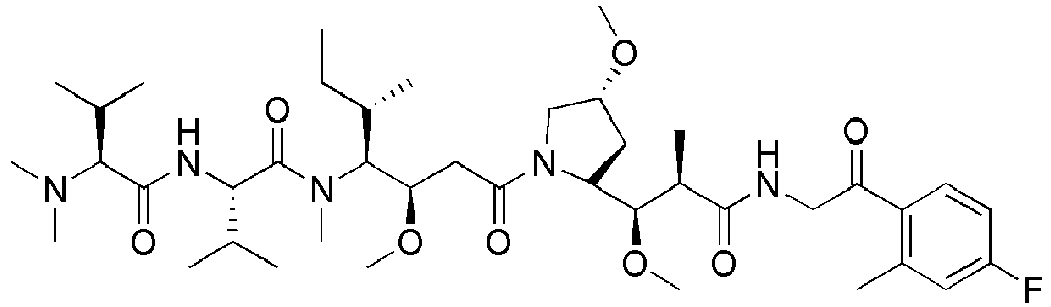
- With the exception that (2R,4R)-t-butyl 2-((1R,2R)-3-((2-(4-fluoro-2-methylphenyl)-2-(oxoethyl)amino)-1-methoxy-2-methyl-3-oxopropyl)-4-methoxypyrrolidine-1-carboxylate and the compound (II-2) were used instead of the compound (X-1) obtained in Preparation Example 6-1 and the compound (II-1), respectively, the same procedure as in Example 1 was repeated to afford the title compound. 0.19 g (60%).
1H NMR (400 MHz, CDCl3): δ 0.76~0.95 (m, 20H), 1.01~1.12 (m, 4H), 1.19∼1.23 (m, 4H), 2.25~2.42 (m, 4H), 2.44 (s, 3H), 2.73 (m, 2H), 3.00 (m, 2H), 3.29 (s, 6H), 3.34 (s, 3H), 3.42 (s, 6H), 3.59 (m, 1H), 3.01~4.14 (m, 3H), 4.17~4.37 (m, 3H), 4.70 (m, 1H), 5.17~5.21 (m, 2H), 5.36 (m, 1H), 7.21 (m, 1H), 7.75~7.81 (m, 2H) -

- With the exception that (2R,4R)-t-butyl 2-((1R,2R)-3-((2-(4-fluoro-2-methylphenyl)-2-(oxoethyl)amino)-1-methoxy-2-methyl-3-oxopropyl)-4-methoxypyrrolidine-1-carboxylate was used instead of the compound (X-1) obtained in Preparation Example 6-1, the same procedure as in Example 1 was repeated to afford a compound in which the N-terminal amino group of compound (I-27) was protected. 0.51 g (68%).
1H NMR (400 MHz, CDCl3): δ 0.70~0.91 (m, 14H), 0.96~1.12 (m, 3H), 1.32 (d, J = 6.8Hz, 2H), 1.74~2.08 (m, 4H), 2.19~2.60 (m, 3H), 2.68 (s, 3H), 2.89~2.92 (m, 3H), 2.93~3.01 (m, 3H), 3.23 (s, 3H), 3.36 (s, 3H), 3.38~3.46 (m, 1H), 3.49 (s, 3H), 3.87 (s, 3H), 4.01 (dd, J = 7.6Hz, 2.4Hz, 1H), 4.03~4.06 (m, 1H), 4.11~4.18 (m, 2H), 4.23~4.28 (m, 2H), 4.60~4.64 (m, 2H), 4.64~4.72 (m, 1H), 5.04~5.25 (m, 2H), 6.64 (dd, J = 13.2Hz, 2.0Hz, 2H), 6.78 (dd, J = 8.8Hz, 2.4Hz, 2H), 7.34 (m, 5H), 7.87~7.98 (m, 2H) - The title compound was prepared in the same manner as in Example 1, with the exception of using the compound in which the N-terminal amino group of compound (I-27) was protected. 0.39 g (93%).
MALDI-TOF MS m/z : 765 [M+1]+
1H NMR (400 MHz, CDCl3): δ 0.73~0.92 (m, 20H), 1.01~1.12 (m, 4H), 1.17~1.21 (m, 4H), 2.23~2.41 (m, 4H), 2.45 (s, 3H), 2.77 (m, 2H), 3.02 (m, 2H), 3.29 (s, 6H), 3.34 (s, 3H), 3.41 (s, 3H), 3.59 (m, 1H), 3.01~4.14 (m, 3H), 4.17~4.37 (m, 3H), 4.70 (m, 1H), 5.19∼5.23 (m, 2H), 5.36 (m, 1H), 7.25 (m, 1H), 7.73~7.89 (m, 2H) -

- With the exception that (2S,4R)-t-butyl 4-methoxy-2-((1R,2R)-1-methoxy-2-methyl-3-oxo-3-((2-oxo-2-(o-tolyl)ethyl)amino)propyl)pyrrolidine-1-carboxylate was used instead of the compound (X-1) obtained in Preparation Example 6-1, the same procedure as in Example 1 was repeated to afford a compound in which the N-terminal amino group of compound (I-28) was protected. 0.15 g (24%).
1H NMR (400 MHz, CDCl3): δ 0.76~0.86 (m, 11H), 0.87 (d, J = 6.8Hz, 6H), 0.96 (d, J = 6.8Hz, 3H), 1.33 (d, J = 4.8Hz, 2H), 1.72~2.01 (m, 4H), 2.22~2.60 (m, 3H), 2.43 (s, 3H), 2.89~2.93 (m, 3H), 2.95~3.01 (m, 3H), 3.27 (s, 3H), 3.33 (s, 3H), 3.35~3.41 (m, 1H), 3.46 (s, 3H), 4.01~4.17 (m, 3H), 4.23~4.25 (m, 2H), 4.67~4.69 (m, 2H), 4.72~4.74 (m, 2H), 5.12~5.22 (m, 2H), 7.27 (d, J = 8.4Hz, 2H), 7.29~7.34 (m, 5H), 7.85~7.94 (m, 2H) - The title compound was prepared in the same manner as in Example 1, with the exception of using the compound in which the N-terminal amino group of compound (I-28) was protected. 60 mg (46%).
MALDI-TOF MS m/z : 747 [M+1]+
1H NMR (400 MHz, CDCl3): δ 0.81~0.85 (m, 3H), 0.92~1.03 (m, 17H), 1.26~1.29 (m, 3H), 1.31~1.44 (m, 2H), 1.96~2.08 (m, 4H), 2.35 (s, 6H), 2.38~2.53 (m, 3H), 2.77 (d, J = 4.8Hz,, 1H), 3.03 (m, 3H), 3.29 (s, 3H), 3.33 (s, 3H), 3.34~3.40 (m, 1H), 3.44 (d, J = 8.4Hz, 3H), 3.45~3.55 (m, 1H), 3.80~3.84 (m, 1H), 3.89~3.98 (m, 1H), 4.07 (m, 2H), 4.75~4.79 (m, 2H), 4.85~4.91 (m, 1H), 7.09~7.16 (m, 2H), 7.31~7.38 (m, 2H) -

- With the exception that the compound (X-9) obtained in Preparation Example 6-9 was used instead of the compound (X-1) obtained in Preparation Example 6-1, the same procedure as in Example 1 was repeated to afford a compound in which the N-terminal amino group of compound (I-29) was protected. 0.24 g (95%).
1H NMR (400 MHz, CDCl3): δ 0.76-0.86 (m, 11H), 0.87 (d, J = 6.8Hz, 6H), 0.96 (d, J = 6.8Hz, 3H), 1.33 (d, J = 4.8Hz, 2H), 1.74~2.03 (m, 4H), 2.20~2.61 (m, 3H), 2.43 (s, 3H), 2.89~2.93 (m, 3H), 2.95∼3.01 (m, 3H), 3.27 (s, 3H), 3.33 (s, 3H), 3.35∼3.44 (m, 1H), 3.46 (s, 3H), 4.00 (dd, J = 7.5Hz, 2.8Hz, 1H), 4.12∼4.15 (m, 2H), 4.23∼4.25 (m, 2H), 4.67~4.69 (m, 2H), 4.72~4.74 (m, 2H), 5.12∼5.22 (m, 2H), 7.27 (d, J = 8.4Hz, 2H), 7.29~7.34 (m, 5H), 7.87 (d, J = 8.4Hz, 2H) - The title compound was prepared in the same manner as in Example 1, with the exception of using the compound in which the N-terminal amino group of compound (I-29) was protected. 0.19 g (95%).
1H NMR (400 MHz, CDCl3): δ 0.81~0.85 (m, 3H), 0.92~1.03 (m, 17H), 1.26~1.29 (m, 3H), 1.31~1.44 (m, 2H), 1.96~2.10 (m, 4H), 2.33 (s, 6H), 2.37∼2.51 (m, 3H), 2.74 (d, J = 4.8Hz, 1H), 3.03 (m, 3H), 3.29 (s, 3H), 3.33 (s, 3H), 3.34~3.40 (m, 1H), 3.42 (d, J = 8.4Hz, 3H), 3.47∼3.56 (m, 1H), 3.80~3.84 (m, 1H), 3.91~3.98 (m, 1H), 4.07 (m, 2H), 4.75∼4.79 (m, 2H), 4.85∼4.91 (m, 1H), 7.15 (m, 2H), 7.30 (m, 2H) -

- With the exception that the compound (X-10) obtained in Preparation Example 6-10 was used instead of the compound (X-1) obtained in Preparation Example 6-1, the same procedure as in Example 1 was repeated to afford a compound in which the N-terminal amino group of compound (I-30) was protected. 0.25 g (97%).
1H NMR (400 MHz, CDCl3): δ 0.75~0.86 (m, 11H), 0.88 (d, J = 6.4Hz, 6H), 0.96 (d, J = 6.8Hz, 3H), 1.32 (d, J = 7.2Hz, 2H), 1.76~2.03 (m, 4H), 2.20~2.61 (m, 3H), 2.89~2.93 (m, 3H), 2.95~3.01 (m, 3H), 3.23 (s, 3H), 3.34 (s, 3H), 3.35~3.44 (m, 1H), 3.46 (s, 3H), 4.00 (dd, J = 7.5Hz, 2.8Hz, 1H), 4.00~4.06 (m, 1H), 4.12~4.15 (m, 2H), 4.24~4.26 (m, 2H), 4.67~4.69 (m, 2H), 4.72 (d, J = 4.8Hz, 2H), 5.09~5.23 (m, 2H), 7.17 (t, J = 8.8Hz, 2H), 7.34 (m, 5H), 8.00 (dd, J = 8.8Hz, 5.2Hz, 2H) - The title compound was prepared in the same manner as in Example 1, with the exception of using the compound in which the N-terminal amino group of compound (I-30) was protected. 0.2 g (95%).
1H NMR (400 MHz, CDCl3): δ 0.74~0.83 (m, 4H), 0.86~1.03 (m, 16H), 1.25~1.29 (m, 2H), 1.33 (d, J = 6.8, 3H), 1.98~2.10 (m, 4H), 2.33 (s, 3H), 2.37~2.51 (m, 3H), 2.74 (d, J = 4.8Hz, 1H), 3.02 (m, 3H), 3.29 (s, 3H), 3.34 (d, J = 6.4Hz, 3H), 3.35~3.40 (m, 1H), 3.46 (s, 3H), 3.91~4.05 (m, 2H), 4.10∼4.17 (m, 1H), 4.18~4.26 (m, 1H), 4.72 (d, J = 4.8Hz, 2H), 4.75~4.82 (m, 2H), 7.10 (t, J = 8.8Hz, 1H), 7.17 (t, J = 8.8Hz, 1H), 7.38 (m, 1H), 8.02(m, 1H) -

- With the exception that the compound (X-7) obtained in Preparation Example 6-7 was used instead of the compound (X-1) obtained in Preparation Example 6-1, the same procedure as in Example 1 was repeated to afford a compound in which the N-terminal amino group of compound (I-31) was protected. 0.24 g (95%).
1H NMR (400 MHz, CDCl3) δ 0.72~0.92 (m, 14H), 0.96 (d, J = 6.4Hz, 2H), 1.02 (d, J = 6.8Hz, 2H), 1.32 (d, J = 6.8Hz, 2H), 1.76~2.10 (m, 4H), 2.19~2.60 (m, 3H), 2.89~2.92 (m, 3H), 2.95~3.01 (m, 3H), 3.24 (s, 3H), 3.34 (s, 3H), 3.35~3.44 (m, 1H), 3.46 (s, 3H), 3.87 (s, 3H), 3.98 (dd, J = 7.6Hz, 2.4Hz, 1H), 4.00~4.06 (m, 1H), 4.11~4.15 (m, 2H), 4.24~4.28 (m, 2H), 4.62~4.64 (m, 2H), 4.68~4.70 (m,, 1H), 5.09~5.23 (m, 2H), 6.64 (dd, J = 13.2Hz, 2.0Hz, 2H), 6.78 (dd, J = 8.8Hz, 2.4Hz, 2H), 7.34 (m, 5H), 7.95 (t, J = 8.4Hz, 2H) - The title compound was prepared in the same manner as in Example 1, with the exception of using the compound in which the N-terminal amino group of compound (I-31) was protected. 0.18g (89%).
1H NMR (400 MHz, CDCl3): δ 0.80~0.84 (m, 3H), 0.88~1.03 (m, 17H), 1.32 (d, J = 7.2Hz, 3H), 1.35~1.39 (m, 2H), 1.98~2.10 (m, 4H), 2.35 (s, 3H), 2.36~2.51 (m, 3H), 2.74 (m, 1H), 3.02 (m, 3H), 3.29 (s, 3H), 3.34 (s, 3H), 3.45 (s, 3H), 3.46~3.56 (m, 1H), 3.87 (s, 3H), 3.99 (dd, J = 7.6Hz, 2.8Hz, 1H), 4.10∼4.15 (m, 1H), 4.25~4.28 (m, 1H), 4.58~4.64 (m, 2H), 4.73~4.78 (m, 1H), 6.67 (m, 1H), 6.78 (qd, J = 10.4Hz, 2.8Hz, 1H), 7.95 (m, 1H) -

- With the exception that the compound (X-24) obtained in Preparation Example 6-24 was used instead of the compound (X-1) obtained in Preparation Example 6-1, the same procedure as in Example 1 was repeated to afford a compound in which the N-terminal amino group of compound (I-32) was protected. 0.23 g (70%).
1H NMR (400 MHz, CDCl3): δ 0.74~1.05 (m, 18H), 1.17~1.25 (d, 3H), 1.47 (s, 9H), 1.61 (s, 2H), 2.21~2.47 (m, 3H), 2.65~3.12 (m, 8H), 2.88 (s, 3H), 2.98 (s, 3H), 3.35 (s, 3H), 3.42 (S, 3H), 3.77~4.18 (m, 3H), 4.16~4.21 (m, 3H), 4.66~4.70 (m, 2H), 5.09~5.23 (m, 3H), 7.32 (m, 7H), 7.59 (m, 1H) - The title compound was prepared in the same manner as in Example 1, with the exception of using the compound in which the N-terminal amino group of compound 1-32 was protected. 0.17 g (90%).
MALDI-TOF MS m/z : 742.9 [M+1]+
1H NMR (400 MHz, CDCl3): δ 0.74~1.05 (m, 18H), 1.17~1.25 (d, 3H), 1.47 (s, 9H), 1.61 (s, 2H), 2.21~2.47 (m, 3H), 2.65~3.12 (m, 8H), 2.88 (s, 3H), 2.98 (s, 3H), 3.35 (s, 3H), 3.42 (S, 3H), 3.77~4.18 (m, 3H), 4.16~4.21 (m, 3H), 4.66~4.70 (m, 2H), 5.16 (br, 1H), 7.32~7.37 (m, 2H), 7.59 (m, 1H) -
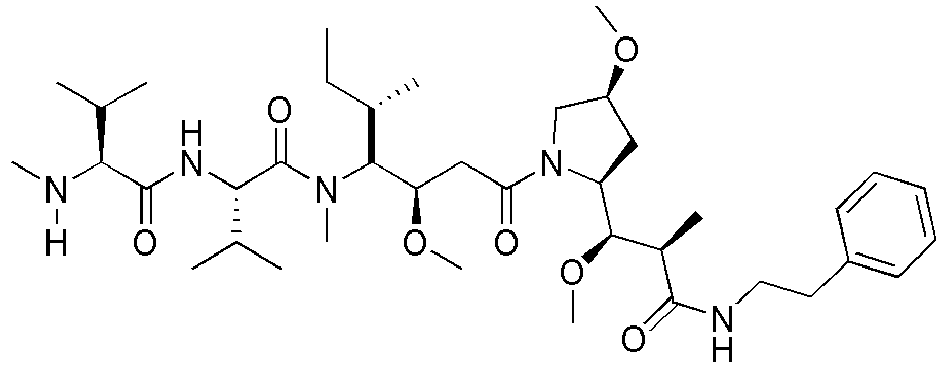
- With the exception that the compound (X-11) obtained in Preparation Example 6-11 was used instead of the compound (X-1) obtained in Preparation Example 6-1, the same procedure as in Example 1 was repeated to afford a compound in which the N-terminal amino group of compound (I-33) was protected. 0.40 g (77%).
1H NMR (400 MHz, CDCl3): δ 0.79~1.06 (m, 15H), 1.73~1.38 (m, 5H), 1.76~2.03 (m, 6H), 2.98~2.37 (m, 4H), 2.77~2.82 (m, 2H), 2.90~3.01 (m, 3H), 3.0 (s, 3H), 3.25∼3.28 (m, 1H), 3.3 (s, 3H), 3.33 (s, 3H), 3.36 (s, 3H), 3.38∼3.54 (m, 3H), 3.74∼3.75 (m, 1H), 3. 81∼3.96 (m, 1H), 3.93~3.96 (m, 1H), 4.09~4.11 (m, 1H), 4.68~4.69 (m, 1H), 5.09∼5.23 (m, 2H), 6.16~6.17 (m, 1H) 6.53∼6.54 (m, 1H), 7.17~7.34 (m, 10H) - The title compound was prepared in the same manner as in Example 1, with the exception of using the compound in which the N-terminal amino group of compound (I-33) was protected. 0.31 g (93%).
1H NMR (400 MHz, CDCl3): δ 0.81~0.85 (m, 3H), 0.92∼1.16 (m, 15H), 1.16~1.24 (d, 3H), 1.27~1.37 (m, 1H), 1.89~2.12 (m, 5H), 2.33 (s, 3H), 2.36~2.37 (m, 3H), 2.74~2.96 (m, 4H), 3.03 (s, 3H), 3.23∼3.28(m, 1H), 3.31 (s, 3H), 3.36 (s, 3H), 3.4 (s, 3H), 3.51∼3.62 (m, 3H), 3.7~3.78 (m, 1H), 3.81~3.96 (m, 1H), 3.91~3.97 (m, 1H), 4.11∼4.15 (m, 2H) 4.44~4.88 (m, 2H), 6.2 (m, 1H), 7.17~7.34 (m, 5H), 7.57∼7.60 (m, 1H) -

- With the exception that the compound (X-8) obtained in Preparation Example 6-8 was used instead of the compound (X-1) obtained in Preparation Example 6-1, the same procedure as in Example 1 was repeated to afford a compound in which the N-terminal amino group of compound (I-34) was protected. 2.36 g (81%).
1H NMR (400 MHz, CDCl3): δ 0.71~1.04 (m, 17H), 1.31~1.32 (m, 4H), 1.77∼1.81 (m, 2H) 1.92~2.04 (m, 4H), 2.17~2.61 (m, 4H), 2.89∼2.95 (m, 3H), 2.99 (s, 3H), 3.31 (s, 6H), 3.46 (s, 3H), 3.43~3.52 (m, 1H), 3.99~4.01 (m, 1H), 4.09∼4.15 (m, 1H), 4.24 (m, 1H), 4.69~4.73 (m, 4H), 4.74~4.76 (d, 2H), 5.09∼5.23 (m, 2H), 6.46~6.49 (m, 1H) 7.12 (m, 1H), 7.26~7.34 (m, 5H), 7.48∼7.51 (t, 2H), 7.6~7.64 (t, 1H), 7.96~8.04 (d, 2H) - The title compound was prepared in the same manner as in Example 1, with the exception of using the compound in which the N-terminal amino group of compound (I-34) was protected. 1.89 g (96%).
1H NMR (400 MHz, CDCl3): δ 0.81~0.85 (m, 3H), 0.92∼1.14 (m, 13H), 1.25∼1.43 (m, 5H), 1.46~1.89 (m, 6H), 1.92~2.22 (m, 5H), 2.33 (s, 3H), 2.45∼2.54 (m, 2H), 2.73~2.74 (d, 1H), 3.02 (s, 3H), 3.32 (s, 6H), 3.41 (d, 3H), 3.52∼3.84 (m, 3H), 3.92~4.06 (m, 3H), 4.75∼4.8(m, 2H), 4.94∼5.23 (m, 1H), 6.76~6.94 (m, 1H), 7.34~7.43 (m, 4H), 7.60 (m, 1H) -

- With the exception that the compound (X-12) obtained in Preparation Example 6-12 was used instead of the compound (X-1) obtained in Preparation Example 6-1, the same procedure as in Example 1 was repeated to afford a compound in which the N-terminal amino group of compound (I-35) was protected. 0.24 g (57%).
1H NMR (400 MHz, CDCl3): δ 0.71~0.97 (m, 17H), 1.22~1.29 (m, 4H), 1.77∼1.81 (m, 2H) 1.92~2.04 (m, 4H), 2.17~2.61 (m, 4H), 2.88∼2.95 (m, 3H), 2.99 (s, 3H), 3.32 (s, 6H), 3.46 (s, 3H), 3.43∼3.52 (m, 1H), 3.52∼4.04 (m, 5H), 4.51∼4.96 (m, 5H), 5.09∼5.23 (m, 2H), 6.46~6.49 (m, 1H) 7.12 (m, 1H), 7.26~7.43 (m, 10H) - The title compound was prepared in the same manner as in Example 1, with the exception of using the compound in which the N-terminal amino group of compound (I-35) was protected. 0.20 g (99%).
1H NMR (400 MHz, CDCl3): δ 0.81~0.86 (m, 3H), 0.93~1.03 (m, 12H), 1.18 (d, 1H), 1.20~1.31 (m, 3H), 1.53∼1.79 (m, 6H), 2.01~2.08 (m, 3H), 2.35 (s, 3H), 2.34~2.39 (m, 1H), 2.73~2.74 (d, 1H), 3.03 (d, 1H), 3.06 (s, 2H), 3.32 (s, 6H), 3.38~3.48 (m, 3H), 3.92~4.18 (m, 5H), 4.75∼4.95 (m, 2H), 7.23~7.4 (m, 5H) -

- With the exception that the compound (X-13) obtained in Preparation Example 6-13 and the compound (II-2) were used instead of the compound (X-1) obtained in Preparation Example 6-1 and the compound (II-1), respectively, the same procedure as in Example 1 was repeated to afford a compound in which the N-terminal amino group of compound (I-36) was protected. 55 mg (52%).
1H NMR (400 MHz, CDCl3): δ 0.79~0.81 (m, 3H) 0.92~1.09 (m, 12H), 1.11~1.25 (m, 6H) 1.72~2.24 (m, 9H), 2.24 (s, 3H), 2.45 (m, 2H), 2.98~2.93 (m, 3H), 3.33 (s, 6H), 3.35 (s, 3H), 3.45~3.54 (m, 2H), 3.71 (d, 1H), 4.01~4.15 (m, 2H), 4.23~4.37 (m, 2H), 4.69~4.75 (m, 2H), 5.12~5.22 (m, 2H), 6.74~6.88 (m, 1H), 7.26~7.33 (m, 10H) - The title compound was prepared in the same manner as in Example 1, with the exception of using the compound in which the N-terminal amino group of compound (I-36) was protected. 44 mg (95%).
MALDI-TOF MS m/z : 731.6 [M+1]+ -
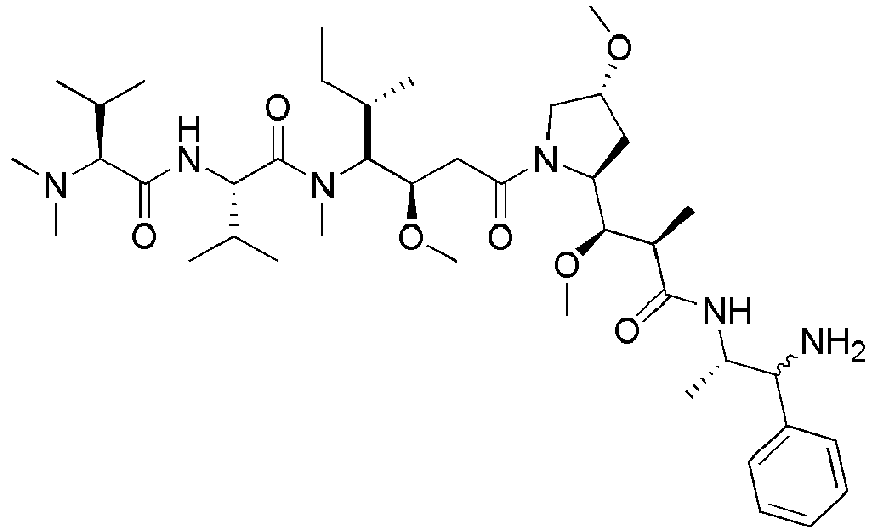
- With the exception that the compound (X-14) obtained in Preparation Example 6-14 and the compound (II-2) were used instead of the compound (X-1) obtained in Preparation Example 6-1 and the compound (II-1), respectively, the same procedure as in Example 1 was repeated to afford a compound in which the N-terminal amino group of compound (I-37) was protected. 96 mg (48%).
1H NMR (400 MHz, CDCl3): δ 0.79~0.81 (m, 3H), 0.92~1.09 (m, 12H), 1.11∼1.25 (m, 6H), 1.72~2.24 (m, 9H), 2.24 (s, 3H), 2.45 (m, 2H), 2.98~2.93 (m, 3H), 3.33 (s, 6H), 3.35 (s, 3H), 3.45~3.54 (m, 2H), 3.71 (d, 1H), 4.01~4.15 (m, 2H), 4.23~4.37 (m, 2H), 4.69~4.75 (m, 2H), 5.12~5.22 (m, 2H), 6.74~6.88 (m, 1H), 7.26~7.33 (m, 10H) - The title compound was prepared in the same manner as in Example 1, with the exception of using the compound in which the N-terminal amino group of compound (I-37) was protected. 75 mg (95%).
MALDI-TOF MS m/z : 730.9 [M+1]+ -
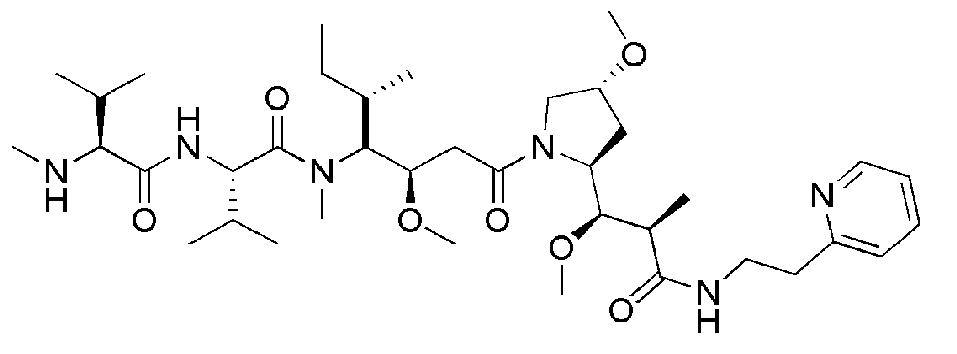
- With the exception that the compound (X-15) obtained in Preparation Example 6-15 was used instead of the compound (X-1) obtained in Preparation Example 6-1, the same procedure as in Example 1 was repeated to afford a compound in which the N-terminal amino group of compound (I-38) was protected. 0.35 g (35%).
1H NMR (400 MHz, CDCl3): δ 0.75~1.00 (m, 18H), 1.19~1.24 (m, 3H), 1.94∼1.97 (m, 4H), 2.04 (s, 1.H), 2.23~2.26 (m, 2H), 2.35~2.49 (m, 2H), 2.87~2.92 (m, 3H), 2.96~3.12 (m, 3H), 3.31 (s, 4H), 3.37 (d, 3H), 3.42~3.49 (m, 3H), 3.61~3.68 (m, 3H), 3.86~3.89 (m, 1H), 4.11~4.19 (m 1H), 4.70 (m, 1H), 5.10∼5.23 (m, 2H), 6.92 (m, 1H), 7.12~7.20 (m, 2H), 7.33 (m, 5H), 7.58~7.63 (m, 2H), 8.51~8.21 (m, 1H) - The title compound was prepared in the same manner as in Example 1, with the exception of using the compound in which the N-terminal amino group of compound (I-38) was protected. 0.25 g (86%).
1H NMR (400 MHz, CDCl3): δ 0.81~0.84 (m, 3H), 0.92~1.00 (m, 15H), 1.19~1.25 (m, 3H), 1.76~2.03 (m, 4H), 2.34 (m, 3H), 2.37~2.42 (m, 1H), 2.27~2.77 (m, 1H), 2.99~3.03 (m, 3H), 3.15 (s, 1H), 3.32 (s, 6H), 3.38 (d, J = 4Hz, 3H), 3.64 (m, 2H), 3.88 (m, 1H), 4.12 (m, 2H), 4.77 (m, 1H), 6.93 (m, 1H), 7.12~7.19 (m, 2H), 7.58~7.65 (m, 2H), 8.52 (m, 1H) -

- With the exception that the compound (X-16) obtained in Preparation Example 6-16 was used instead of the compound (X-1) obtained in Preparation Example 6-1, the same procedure as in Example 1 was repeated to afford a compound in which the N-terminal amino group of the title compound (I-39) was protected. 0.8 g (99%).
1H NMR (400 MHz, CDCl3): δ 0.79~1.00 (m, 18H), 1.01~1.25 (m, 3H), 1.75∼1.82 (m, 4H), 2.04 (s, 1.H), 2.24~2.42 (m, 2H), 2.35~2.49 (m, 2H), 2.88~2.92 (m, 3H), 3.00~3.07 (m, 4H), 3.27 (s, 3H), 3.33 (m, 3H), 3.38 (m, 3H), 3.45~3.57 (m, 3H), 3.85~3.87 (m, 1H), 4.08~4.16 (m, 1H), 4.71 (m, 1H), 5.13~5.23 (m, 2H), 6.57 (m, 1H), 6.84 (d, J = 2.8Hz, 1H), 6.91∼6.93 (m, 1H), 7.13 (d, J = 2.1Hz, 1H), 7.34 (m, 5H) - The title compound was prepared in the same manner as in Example 1, with the exception of using the compound in which the N-terminal amino group of compound (I-39) was protected. 70 mg (10%).
1H NMR (400MHz, CDCl3): δ 0.81~0.85 (m, 3H), 0.88~1.00 (m, 15H), 1.22~1.26 (m, 3H), 2.03 (m, 3H), 2.34~2.37 (m, 3H), 3.01~3.07 (m, 3H), 3.15 (s, 4H), 3.33 (d, 3H), 3.38 (d, 3H), 3.43~3.58 (m, 2H), 3.85~3.87 (m, 1H), 4.09~4.13 (m, 2H), 4.75~4.79 (m, 1H), 6.62 (m, 1H), 6.90 (m, 1H), 6.91∼6.93 (m, 1H), 7.13~7.20 (m, 1H) -

- With the exception that the compound (X-25) obtained in Preparation Example 6-25 and (3R,4S,5S)-4-((S)-2-((S)-2-(dimethylamino)-3-methylbutaneamido)-N,3-dimethylbutaneamido)-3-methoxy-5-methylheptanic acid (compound II-2) were used instead of the compound (X-1) obtained in Preparation Example 6-1 and the compound (II-1), respectively, the same procedure as in Example 1 was repeated to afford the title compound. 2.25 g (76%).
[α]D 25= -40.5° (c=1, MeOH)
1H NMR (400 MHz, CDCl3): δ 0.79 - 1.05 (m, 19 H), 1.26 (m, 3 H), 1.45 (m, 2 H), 1.66 (m, 2 H), 1.97 - 2.17 (m, 3 H), 2.44 - 2.46 (m, 3 H), 2.71 - 2.80 (m, 3 H), 2.81 - 2.89 (m, 1 H), 2.91 - 2.94 (m, 2 H), 2.71 - 2.80 (m, 3 H), 3.04 (s, 3 H), 3.26 - 3.33 (m, 2 H), 3.37 (s, 3 H), 3.74 (m, 2 H), 4.28 - 4.31 (m, 2 H), 4.75 - 4.82 (m, 2 H), 6.18 (m, 1 H), 6.84 - 6.89 (m, 2 H), 7.15 - 7.19 (m, 1 H), 7.58 (d, 1 H)
LC-MS m/z : 754[M+]+ -

- With the exception that the compound (X-26) obtained in Preparation Example 6-26 and (3R,4S,5S)-4-((S)-2-((S)-2-(dimethylamino)-3-methylbutaneamido)-N,3-dimethylbutaneamido)-3-methoxy-5-methylheptanic acid (compound II-2) were used instead of the compound (X-1) obtained in Preparation Example 6-1 and the compound (II-1), respectively, the same procedure as in Example 1 was repeated to afford the title compound. 3.4 g (58%).
1H NMR (400 MHz, CDCl3): δ 0.80~0.83 (m, 3H), 0.92~1.04 (m, 9H), 1.22~1.31 (m, 3H), 1.35~1.42 (m, 1H), 1.43~1.45 (m, 3H), 1.97~2.09 (m, 3H), 2.21~2.22 (m, 1H), 2.30~2.38 (m, 6H), 2.20~2.58 (m, 3H), 2.72~2.76 (m, 1H), 3.01 (d, 2H), 3.35 (d, 3H), 3.35~3.62 (m, 1H), 3.55 (d, 3H), 4.08~4.15 (m, 2H), 4.31~4.37 (m, 1H), 4.73~4.79 (m, 1H), 5.43~5.54 (m,1H), 7.15~7.17 (m, 2H), 7.53~7.61 (m, 1H), 8.02~8.09 (m, 2H)
LC-MS m/z : 764[M+]+ -

- With the exception that the compound (X-25) obtained in Preparation Example 6-25 was used instead of the compound (X-1) obtained in Preparation Example 6-1, the same procedure as in Example 1 was repeated to afford a compound in which the N-terminal amino group of compound 1-42 was protected. 4.37 g (63%).
ES-MS m/z : 874 [M+H]+ - The title compound was prepared in the same manner as in Example 1, with the exception of using the compound in which the N-terminal amino group of compound (I-42) was protected. 2.98 g (85%).
1H NMR (400 MHz, CDCl3): δ 0.80~0.85 (m, 3H), 0.92~1.00 (m, 15H), 1.01~1.08 (m, 1H), 1.26 (d, 3H, J = 7.2 Hz), 1.31~1.38 (m, 1H), 1.81~2.17 (m, 4H), 2.36 (s, 3H), 2.40~2.42 (m, 2H), 2.76~2.78 (m, 1H), 2.90~2.93 (m, 2H), 3.03 (s, 3H), 3.31 (s, 3H), 3.35~3.57 (m, 4H), 3.49 (s, 3H), 4.03~4.10 (m, 2H), 4.28~4.30 (m, 2H), 4.75~4.89 (m, 2H), 6.21 (m, 1H), 6.82~6.91 (m, 2 H), 7.13~7.21 (m, 1H), 7.58 (d, 1H, J = 9.2 Hz)
LC-MS m/z : 740[M+]+ -

- With the exception that the compound (X-26) obtained in Preparation Example 6-26 was used instead of the compound (X-1) obtained in Preparation Example 6-1, the same procedure as in Example 1 was repeated to afford the title compound. 0.12g (51%).
1H NMR (400 MHz, CDCl3): δ 0.77~0.83 (m, 3H), 0.92~1.04 (m, 9H), 1.32~1.35 (m, 3H), 1.34~1.41 (m, 1H), 1.41~1.42 (m, 3H), 1.97~2.09 (m, 3H), 2.21~2.22 (m, 1H), 2.33~2.35 (m, 3H), 2.23~2.56 (m, 3H), 2.72~2.76 (m, 1H), 3.01 (d, 2H), 3.35 (d, 3H), 3.35~3.62 (m, 1H), 3.55 (d, 3H), 4.08~4.15 (m, 2H), 4.31~4.37 (m, 1H), 4.73~4.79 (m, 1H), 5.43~5.54 (m,1H), 7.15~7.17 (m, 2H), 7.57~7.60 (m, 1H), 8.00~8.07 (m, 2H)
LC-MS m/z : 750[M+]+, 772[M+Na]+ -

- With the exception that the compound (X-27) obtained in Preparation Example 6-27 and (3R,4S,5S)-4-((S)-2-((S)-2-(dimethylamino)-3-methylbutaneamido)-N,3-dimethylbutaneamido)-3-methoxy-5-methylheptanic acid (compound II-2) was used instead of the compound (X-1) obtained in Preparation Example 6-1 and compound (II-1), respectively, the same procedure as in Example 1 was repeated to give an azide compound of compound (1-44). 0.42 g (76%).
1H NMR (400 MHz, CDCl3): δ 0.79 - 1.07 (m, 15 H), 1.20 (d, 2 H), 1.99 -2.11 (m, 4 H), 2.18 - 2.28 (m, 5 H), 2.33 - 2.45 (m, 4 H), 2.90 - 3.27 (m, 6 H), 3.32 - 3.42 (m, 6 H), 3.47 - 3.54 (m, 2 H), 3.75 - 3.78 (m, 1 H), 3.85 - 3.98 (m, 2 H), 4.19 - 4.21 (m, 1 H), 4.39 - 4.44 (m, 1 H), 4.46 - 4.80 (m, 1 H), 4.87 - 4.90 (m, 1 H), 6.17 (m, 1 H), 6.84 - 6.95 (m, 2 H), 7.14 - 7.26 (m, 1 H) - The azide compound of compound (I-44) was dissolved in 10 mL of methyl alcohol, and reacted for 14 hrs in the present of 10% palladium carbon (15 mg) in a hydrogen atmosphere while stirring. After completion of the reaction, the reaction mixture was filtered through celite, and washed several times with methanol. Removal of the solvent in a vacuum left the title compound as a white solid. 0.23 g (99%).
1H NMR (400 MHz, CDCl3): δ 0.79 - 1.03 (m, 14 H), 1.21 - 1.22 (m, 5 H), 2.06 - 2.45 (m, 6 H), 2.89 - 3.02 (m, 4 H), 3.30 - 3.44 (m, 5 H), 3.47 - 3.52 (m, 2 H), 3.67 - 3.69 (m, 1 H), 3.71 - 4.39 (m, 3 H), 4.78 - 4.80 (m, 1 H), 6.17 (m, 1 H), 6.84 - 6.95 (m, 2 H), 7.14 - 7.26 (m, 1 H)
LC-MS m/z : 753[M+]+, 775[M+Na]+ -

- With the exception that the compound (X-28) obtained in Preparation Example 6-28 and (3R,4S,5S)-4-((S)-2-((S)-2-(dimethylamino)-3-methylbutaneamido)-N,3-dimethylbutaneamido)-3-methoxy-5-methylheptanic acid (compound II-2) were used instead of the compound (X-1) obtained in Preparation Example 6-1 and compound (II-1), respectively, the same procedure as in Example 1 was repeated to afford a compound in which the amino group of compound (I-45) was protected. 0.13 g (64%).
LC-MS m/z : 857.5[M+]+ - The compound in which the amino group of compound (I-45) was protected was dissolved in 10 mL of methyl alcohol, and reacted in the presence of 20% palladium hydroxide (66 mg) under a hydrogen pressure (55 psi) for 12 hrs while stirring. After completion of the reaction, the reaction mixture was filtered through celite, and washed several times with methanol. Removal of the solvent in a vacuum left the title compound as a white solid. 115 mg (100%).
1H NMR (400 MHz, CDCl3): δ 0.79 - 1.03 (m, 14 H), 1.21 - 1.22 (m, 5 H), 2.06 - 2.45 (m, 6 H), 2.89 - 3.02 (m, 4 H), 3.30 - 3.44 (m, 5 H), 3.47 - 3.52 (m, 2 H), 3.67 - 3.69 (m, 1 H), 3.71 - 4.39 (m, 3 H), 4.78 - 4.80 (m, 1 H), 6.17 (m, 1 H), 6.84 - 6.95 (m, 2 H), 7.14 - 7.26 (m, 1 H)
LC-MS m/z : 767.6[M+]+, 789.4[M+Na]+ - The compounds of the present invention were assayed for inhibitory activity against 7 cancer cell lines as breast cancer (BT-474), human epithelial cancer (A-431), non-small cell lung cancer (NCI-H460), colon cancer (HT-29), colon cancer (SW-620), breast cancer (MDA-MB-231) and breast cancer (MCF-7).
- Briefly, a suspension of each cancer cell line was serially diluted, and plated at a density of 2∼3x10³ cells/well into 96-well microplates, followed by incubation at 37°C for 4 day in a 5 % CO2 atmosphere. Cell growth in a monolayer was measured using WST-8 reagemt (Dojindo, Japan).
- IC50 values of the compounds against the cancer cell lines were calculated as compound concentrations at which the cells were grown by 50 % OD of the control. The results are summarized in Table 1, below.
TABLE 1 Cpd. IC50 (nM) BT-474 A-431 NCI-H460 HT-29 SW-620 MGA-MB-231 MCF-7 Doxorubein 150 1.840 290 850 460 Paclitaxel 14.4 442 26.80 19.54 26.75 90 27.09 Dolastatin 10 0.56 I-1 0.12 I-2 0.70 I-3 1.10 37.9 I-4 2.44 21.1 I-5 0.53 61.2 I-6 0.32 I-7 0.62 I-8 0.68 1.5 2.9 27.0 I-9 5.23 10.9 27.7 27,0 I-10 0.24 I-11 0.78 I-12 0.57 I-13 0.41 I-14 0.29 I-15 0.51 I-16 0.65 I-17 0.25 I-18 0.88 I-19 0.09 I-20 0.47 I-21 0.59 I-22 0.91 I-23 0.98 I-24 1.34 I-25 0.41 I-26 0.79 I-27 0.50 I-28 0.65 I-29 0.61 I-30 0.77 I-31 0.54 I-32 0.64 I-33 0.68 9.4 2.82 5.49 2.23 1.82 I-34 9.71 10.9 I-35 0.23 1.5 4.2 2.1 I-36 0.51 I-37 2.82 I-38 1.32 I-39 0.67 I-40 0.23 I-41 1.83 I-42 0.74 I-43 6.43 I-44 0.17 I-45 0.34
Claims (14)
- A dolastatin-10 derivative, represented by the following Chemical Formula I:

whereinR1, R2, R3, R4, and R5 are each independently hydrogen or C1-C4 alkyl,R6 is hydrogen, hydroxy, C1-C4 alkoxy, amino, oxo(=O), or hydroxyimino(=N-OH),Ar is aryl,X is a carbon, oxygen or sulfur atom, andR7 is hydroxy, amino, C1-C4 alkoxy, C1-C4 alkylamino, or oxo (=O) when X is a carbon atom, and is absent when X is an oxygen or sulfur atom. - The dolastatin-10 derivative or a pharmaceutically acceptable salt thereof of claim 1, wherein
R1, R3 and R4 are each C1-C4 alkyl,
R2 and R5 are each independently hydrogen or C1-C4 alkyl,
R6 is hydrogen, hydroxy, C1-C4 alkoxy, amino, oxo(=O) or hydroxyimino(=N-OH),
Ar is phenyl unsubstituted or substituted with at least one selected from the group consisting of C1-C4 alkyl, C1-C4 alkoxy, and halogen,
X is a carbon atom, and
R7 is hydroxy, amino, C1-C4 alkoxy or C1-C4 alkylamino. - The dolastatin-10 derivative or a pharmaceutically acceptable salt thereof of claim 1, wherein
R1, R3 and R4 are each methyl,
R2 and R5 are each independently hydrogen or methyl,
R6 is hydrogen, hydroxy, methoxy, amino, oxo (=O) or hydroxyimino (=N-OH),
Ar is phenyl unsubstituted or substituted with at least one selected from the group consisting of methyl, methoxy and halogen,
X is a carbon atom, and
R7 is hydroxy, amino, methoxy, or N-methylamino. - A dolastatin-10 derivative, represented by the following Chemical Formula Ia:

wherein
R1, R2, R3, R4, and R5 are each independently hydrogen or C1-C4 alkyl,
R6 is hydrogen, hydroxy, C1-C4 alkoxy, amino, oxo(=O), or hydroxyimino(=N-OH),
Ar is aryl,
X is a carbon, oxygen or sulfur atom, and
R7 is hydroxy, amino, C1-C4 alkoxy, C1-C4 alkylamino, or oxo (=O) when X is a carbon atom, and is absent when X is an oxygen or sulfur atom. - The dolastatin-10 derivative or a pharmaceutically acceptable salt thereof of claim 1, being selected from the group consisting of:(S)-N-((3R,4S,5S)-1-((2R,4R)-2-((1R,2R)-3-((2,6-difluorophenethyl)amino)-1-methoxy-2-methyl-3-oxopropyl)-4-methoxypyrrolidin-1-yl)-3-methoxy-5-methyl-1-oxoheptan-4-yl)-N,3-dimethyl-2-((S)-3-methyl-2-(methylamino)butaneamido)butanamide (I-1);(S)-N-((3R,4S,5S)-1-((2R,4R)-2-((1R,2R)-3-((3-fluorophenethyl)amino)-1-methoxy-2-methyl-3-oxopropyl)-4-methoxypyrrolidin-1-yl)-3-methoxy-5-methyl-1-oxoheptan-4-yl)-N,3-dimethyl-2-((S)-3-methyl-2-(methylamino)butaneamido)butanamide (I-2);(S)-N-((3R,4S,5S)-1-((2R,4R)-2-((1R,2R)-3-((4-fluorophenethyl)amino)-1-methoxy-2-methyl-3-oxopropyl)-4-methoxypyrrolidin-1-yl)-3-methoxy-5-methyl-1-oxoheptan-4-yl)-N,3-dimethyl-2-((S)-3-methyl-2-(methylamino)butaneamido)butanamide (I-3);(S)-N-((3R,4S,5S)-1-((2R,4R)-2-((1R,2R)-3-((2,4-dichloro-5-fluorophenethyl)amino)-1-methoxy-2-methyl-3-oxopropyl)-4-methoxypyrrolidin-1-yl)-3-methoxy-5-methyl-1-oxoheptan-4-yl)-N,3-dimethyl-2-((S)-3-methyl-2-(methylamino)butaneamido)butanamide (I-4);(2S)-N-((3R,4S)-3-methoxy-1-((2R,4R)-4-methoxy-2-((1R,2R)-1-methoxy-3-((2-(4-methoxyphenyl)-2-oxoethyl)amino)-2-methyl-3-oxopropyl)pyrrolidin-1-yl)-5-methyl-1-oxoheptan-4-yl)-N,3-dimethyl-2-((S)-3-methyl-2-(methylamino)butaneamido)butanamide (I-5);(2S)-N-((3R,4S)-3-methoxy-1-((2R,4R)-4-methoxy-2-((1R,2R)-1-methoxy-2-methyl-3-oxo-3-(((R)-1-oxo-1-phenylpropan-2-yl)amino)propyl)pyrrolidin-1-yl)-5-methyl-1-oxoheptan-4-yl)-N,3-dimethyl-2-((S)-3-methyl-2-(methylamino)butaneamido)butanamide (I-6);(2S)-N-((3R,4S)-3-methoxy-1-((2S,4R)-4-methoxy-2-((1R,2R)-1-methoxy-2-methyl-3-oxo-3-(((S)-1-oxo-1-phenylpropan-2-yl)amino)propyl)pyrrolidin-1-yl)-5-methyl-1-oxoheptan-4-yl)-N,3-dimethyl-2-((S)-3-methyl-2-(methylamino)butaneamido)butanamide (I-7);(S)-2-((S)-2-(dimethylamino)-3-methylbutaneamido)-N-((3R,4S,5S)-1-((2R,4R)-4-hydroxy-2-((1R,2R)-1-methoxy-2-methyl-3-oxo-3-(phenethylamino)propyl)pyrrolidin-1-yl)-3-methoxy-5-methyl-1-oxoheptan-4-yl)-N,3-dimethylbutanamide (I-8);(S)-2-((S)-2-(dimethylamino)-3-methylbutaneamido)-N-((3R,4S,5S)-3-methoxy-1-((R)-2-((1R,2R)-1-methoxy-2-methyl-3-oxo-3-(phenethylamino)propyl)-4-oxopyrrolidin-1-yl)-5-methyl-1-oxoheptan-4-yl)-N,3-dimethylbutanamide (I-9);(S)-2-((S)-2-(dimethylamino)-3-methylbutaneamido)-N-((3R,4S,5S)-3-methoxy-1-((2R,4S)-4-methoxy-2-((1R,2R)-1-methoxy-2-methyl-3-oxo-3-(phenethylamino)propyl)pyrrolidin-1-yl)-5-methyl-1-oxoheptan-4-yl)-N,3-dimethylbutanamide (I-10);(S)-N-((3R,4S,5S)-1-((2R,4R)-2-((1R,2R)-3-(((R)-1-(4-fluorophenyl)-1-oxopropan-2-yl)amino)-1-methoxy-2-methyl-3-oxopropyl)-4-methoxypyrrolidin-1-yl)-3-methoxy-5-methyl-1-oxoheptan-4-yl)-N,3-dimethyl-2-((S)-3-methyl-2-(methylamino)butaneamido)butanamide (I-11);(S)-N-((3R,4S,5S)-1-((2R,4R)-2-((1R,2R)-3-(((S)-1-(4-fluorophenyl)-1-oxopropan-2-yl)amino)-1-methoxy-2-methyl-3-oxopropyl)-4-methoxypyrrolidin-1-yl)-3-methoxy-5-methyl-1-oxoheptan-4-yl)-N,3-dimethyl-2-((S)-3-methyl-2-(methylamino)butaneamido)butanamide (I-12);(S)-N-((3R,4S,5S)-3-methoxy-1-((2R,4R)-4-methoxy-2-((1R,2R)-1-methoxy-3-(((R)-1-(2-methoxyphenyl)-1-oxopropan-2-yl)amino)-2-methyl-3-oxopropyl)pyrrolidin-1-yl)-5-methyl-1-oxoheptan-4-yl)-N,3-dimethyl-2-((S)-3-methyl-2-(methylamino)butaneamido)butanamide (I-13);(S)-N-((3R,4S,5S)-3-methoxy-1-((2R,4R)-4-methoxy-2-((1R,2R)-1-methoxy-3-(((R)-1-(3-methoxyphenyl)-1-oxopropan-2-yl)amino)-2-methyl-3-oxopropyl)pyrrolidin-1-yl)-5-methyl-1-oxoheptan-4-yl)-N,3-dimethyl-2-((S)-3-methyl-2-(methylamino)butaneamido)butanamide (I-14);(S)-N-((3R,4S,5S)-3-methoxy-1-((2R,4R)-4-methoxy-2-((1R,2R)-1-methoxy-3-(((R)-1-(4-methoxyphenyl)-1-oxopropan-2-yl)amino)-2-methyl-3-oxopropyl)pyrrolidin-1-yl)-5-methyl-1-oxoheptan-4-yl)-N,3-dimethyl-2-((S)-3-methyl-2-(methylamino)butaneamido)butanamide (I-15);(S)-N-((3R,4S,5S)-1-((2R,4R)-2-((1R,2R)-3-(((S)-1-(3,5-difluorophenyl)-1-oxopropan-2-yl)amino)-1-methoxy-2-methyl-3-oxopropyl)-4-methoxypyrrolidin-1-yl)-3-methoxy-5-methyl-1-oxoheptan-4-yl)-N,3-dimethyl-2-((S)-3-methyl-2-(methylamino)butaneamido)butanamide (I-16);(S)-N-((3R,4S,5S)-1-((2R,4R)-2-((1R,2R)-3-(((S)-1-(2,6-difluorophenyl)-1-oxopropan-2-yl)amino)-1-methoxy-2-methyl-3-oxopropyl)-4-methoxypyrrolidin-1-yl)-3-methoxy-5-methyl-1-oxoheptan-4-yl)-N,3-dimethyl-2-((S)-3-methyl-2-(methylamino)butaneamido)butanamide (I-17);(S)-N-((3R,4S,5S)-1-((2R,4R)-2-((1R,2R)-3-(((R)-1-(2,6-difluorophenyl)-1-oxopropan-2-yl)amino)-1-methoxy-2-methyl-3-oxopropyl)-4-methoxypyrrolidin-1-yl)-3-methoxy-5-methyl-1-oxoheptan-4-yl)-N,3-dimethyl-2-((S)-3-methyl-2-(methylamino)butaneamido)butanamide (I-18);(S)-N-((3R,4S,5S)-1-((2R,4R)-2-((1R,2R)-3-(((R,Z)-1-(hydroxyimino)-1-(3-methoxyphenyl)propan-2-yl)amino)-1-methoxy-2-methyl-3-oxopropyl)-4-methoxypyrrolidin-1-yl)-3-methoxy-5-methyl-1-oxoheptan-4-yl)-N,3-dimethyl-2-((S)-3-methyl-2-(methylamino)butaneamido)butanamide (I-19);(S)-2-((S)-2-(dimethylamino)-3-methylbutaneamido)-N-((3R,4S,5S)-1-((2R,4R)-2-((1R,2R)-3-(((R)-1-(hydroxyimino)-1-(3-methoxyphenyl)propan-2-yl)amino)-1-methoxy-2-methyl-3-oxopropyl)-4-methoxypyrrolidin-1-yl)-3-methoxy-5-methyl-1-oxoheptan-4-yl)-N,3-dimethylbutanamide (I-20);(S)-2-((S)-2-(dimethylamino)-3-methylbutaneamido)-N-((3R,4S,5S)-1-((2R,4R)-2-((1 R,2R)-3-(((R)-1-(4-fluorophenyl)-1-(hydroxyimino)propan-2-yl)amino)-1-methoxy-2-methyl-3-oxopropyl)-4-methoxypyrrolidin-1-yl)-3-methoxy-5-methyl-1-oxoheptan-4-yl)-N,3-dimethylbutanamide (I-21);(S)-N-((3R,4S,5S)-1-((2R,4R)-2-((1R,2R)-3-((2-(5-bromo-2-methylphenyl)-2-(hydroxyimino)ethyl)amino)-1-methoxy-2-methyl-3-oxopropyl)-4-methoxypyrrolidin-1-yl)-3-methoxy-5-methyl-1-oxoheptan-4-yl)-2-((S)-2-(dimethylamino)-3-methylbutaneamido)-N,3-dimethylbutanamide (I-22);(S)-2-((S)-2-(dimethylamino)-3-methylbutaneamido)-N-((3R,4S,5S)-1-((2R,4R)-2-((1R,2R)-3-((2-(4-fluoro-2-methylphenyl)-2-(hydroxyimino)ethyl)amino)-1-methoxy-2-methyl-3-oxopropyl)-4-methoxypyrrolidin-1-yl)-3-methoxy-5-methyl-1-oxoheptan-4-yl)-N,3-dimethylbutanamide (1-23);(S)-N-((3R,4S,5S)-1-((2R,4R)-2-((1R,2R)-3-((2-(4-fluoro-2-methylphenyl)-2-(hydroxyimino)ethyl)amino)-1-methoxy-2-methyl-3-oxopropyl)-4-methoxypyrrolidin-1-yl)-3-methoxy-5-methyl-1-oxoheptan-4-yl)-N,3-dimethyl-2-((S)-3-methyl-2-(methylamino)butaneamido)butanamide (I-24);(S)-N-((3R,4S,5S)-1-((2S,4R)-2-((1R,2R)-3-(((E)-2-(2-fluoro-4-methoxyphenyl)-2-hydroxyimino)ethyl)amino)-1-methoxy-2-methyl-3-oxopropyl)-4-methoxypyrrolidin-1-yl)-3-methoxy-5-methyl-1-oxoheptan-4-yl)-N,3-dimethyl-2-((S)-3-methyl-2-(methylamino)butaneamido)butanamide (I-25);(S)-2-((S)-2-(dimethylamino)-3-methylbutaneamido)-N-((3R,4S,5S)-1-((2R,4R)-2-((1R,2R)-3-((2-(4-fluoro-2-methylphenyl)-2-(oxoethyl)amino)-1-methoxy-2-methyl-3-oxopropyl)-4-methoxypyrrolidin-1-yl)-3-methoxy-5-methyl-1-oxoheptan-4-yl)-N,3-dimethylbutanamide (I-26);(S)-N-((3R,4S,5S)-1-((2R,4R)-2-((1R,2R)-3-((2-(4-fluoro-2-methylphenyl)-2-(oxoethyl)amino)-1-methoxy-2-methyl-3-oxopropyl)-4-methoxypyrrolidin-1-yl)-3-methoxy-5-methyl-1-oxoheptan-4-yl)-N,3-dimethyl-2-((S)-3-methyl-2-(methylamino)butaneamido)butanamide (I-27);(S)-N-((3R,4S,5S)-3-methoxy-1-((2S,4R)-4-methoxy-2-((1R,2R)-1-methoxy-2-methyl-3-oxo-3-((2-oxo-2-(o-tolyl)ethyl)amino)propyl)pyrrolidin-1-yl)-5-methyl-1-oxoheptan-4-yl)-N,3-dimethyl-2-((S)-3-methyl-2-(methylamino)butaneamido)butanamide (I-28);(S)-N-((3R,4S,5S)-3-methoxy-1-((2S,4R)-4-methoxy-2-((1R,2R)-1-methoxy-2-methyl-3-oxo-3-((2-oxo-2-(p-tolyl)ethyl)amino)propyl)pyrrolidin-1-yl)-5-methyl-1-oxoheptan-4-yl)-N,3-dimethyl-2-((S)-3-methyl-2-(methylamino)butaneamido)butanamide (I-29);(S)-N-((3R,4S,5S)-1-((2S,4R)-2-((1R,2R)-3-(2-(4-fluorophenyl)-2-oxoethyl)amino)-1-methoxy-2-methyl-3-oxopropyl)-4-methoxypyrrolidin-1-yl)-3-methoxy-5-methyl-1-oxoheptan-4-yl)-N,3-dimethyl-2-((S)-3-methyl-2-(methylamino)butaneamido)butanamide (I-30);(S)-N-((3R,4S,5S)-1-((2S,4R)-2-((1R,2R)-3-(2-(2-fluoro-4-methoxyphenyl)-2-oxoethyl)amino)-1-methoxy-2-methyl-3-oxopropyl)-4-methoxypyrrolidin-1-yl)-3-methoxy-5-methyl-1-oxoheptan-4-yl)-N,3-dimethyl-2-((S)-3-methyl-2-(methylamino)butaneamido)butanamide (I-31);(S)-N-((3R,4S,5S)-1-((S)-4-((1R,2R)-3-((2,6-difluorophenethyl)amino)-1-methoxy-2-methyl-3-oxopropyl)thiazolidin-3-yl)-3-methoxy-5-methyl-1-oxoheptan-4-yl)-N,3-dimethyl-2-((S)-3-methyl-2-(methylamino)butaneamido)butanamide (I-32);(2S)-N-((3R,4S)-3-methoxy-1-((2S,4S)-4-methoxy-2-((1R,2R)-1-methoxy-2-methyl-3-oxo-3-(phenethylamino)propyl)pyrrolidin-1-yl)-5-methyl-1-oxoheptan-4-yl)-N,3-dimethyl-2-((S)-3-methyl-2-(methylamino)butaneamido)butanamide (I-33);(2S)-N-((3R,4S)-3-methoxy-1-((2S,4R)-4-methoxy-2-((1R,2R)-1-methoxy-2-methyl-3-oxo-3-((2-oxo-2-phenylethyl)amino)propyl)pyrrolidin-1-yl)-5-methyl-1-oxoheptan-4-yl)-N,3-dimethyl-2-((S)-3-methyl-2-(methylamino)butaneamido)butanamide (I-34);(2S)-N-((3R,4S)-1-((2S,4R)-2-((1R,2R)-3-(2-(2-hydroxy-2-phenylethyl)amino)-1-methoxy-2-methyl-3-oxopropyl)-4-methoxypyrrolidin-1-yl)-3-methoxy-5-methyl-1-oxoheptan-4-yl)-N,3-dimethyl-2-((S)-3-methyl-2-(methylamino)butaneamido)butanamide (I-35);(2S)-N-((3R,4S)-1-((2S)-2-((1R,2R)-3-(((2R)-1-amino-1-phenylpropan-2-yl)amino)-1-methoxy-2-methyl-3-oxopropyl)-4-methoxypyrrolidin-1-yl)-3-methoxy-5-methyl-1-oxoheptan-4-yl)-2-((S)-2-(dimethylamino)-3-methylbutaneamido)-N,3-dimethylbutanamide (1-36);(2S)-N-((3R,4S)-1-((2S,4R)-2-((1R,2R)-3-(((2S)-1-amino-1-phenylpropan-2-yl)amino)-1-methoxy-2-methyl-3-oxopropyl)-4-methoxypyrrolidin-1-yl)-3-methoxy-5-methyl-1-oxoheptan-4-yl)-2-((S)-2-(dimethylamino)-3-methylbutaneamido)-N,3-dimethylbutanamide (I-37);(2S)-N-((3R,4S)-3-methoxy-1-((2S,4R)-4-methoxy-2-((1R,2R)-1-methoxy-2-methyl-3-oxo-3-((2-(pyridin-2-yl)ethyl)amino)propyl)pyrrolidin-1-yl)-5-methyl-1-oxoheptan-4-yl)-N,3-dimethyl-2-((S)-3-methyl-2-(methylamino)butaneamido)butanamide (I-38);(2S)-N-((3R,4S)-3-methoxy-1-((2S,4R)-4-methoxy-2-((1R,2R)-1-methoxy-2-methyl-3-oxo-3-((2-(thiophen-2-yl)ethyl)amino)propyl)pyrrolidin-1-yl)-5-methyl-1-oxoheptan-4-yl)-N,3-dimethyl-2-((S)-3-methyl-2-(methylamino)butaneamido)butanamide (I-39);(2S)-N-((3R,4S)-1-((2S,4S)-2-((1R,2R)-3-((2,6-difluorophenethyl)amino)-1-methoxy-2-methyl-3-oxopropyl)-4-hydroxypyrrolidin-1-yl)-3-methoxy-5-methyl-1-oxoheptan-4-yl)-2-((S)-2-(dimethylamino)-3-methylbutaneamido)-N,3-dimethylbutanamide (I-40);(2S)-2-((S)-2-(dimethylamino)-3-methylbutaneamido)-N-((3R,4S)-1-((2S,4S)-2-((1R,2R)-3-(((S)-1-(4-fluorophenyl)-1-oxopropan-2-yl)amino)-1-methoxy-2-methyl-3-oxopropyl)-4-hydroxypyrrolidin-1-yl)-3-methoxy-5-methyl-1-oxoheptan-4-yl)-N,3-dimethylbutanamide (I-41);(2S)-N-((3R,4S)-1-((2S,4S)-2-((1R,2R)-3-((2,6-difluorophenethyl)amino)-1-methoxy-2-methyl-3-oxopropyl)-4-hydroxypyrrolidin-1-yl)-3-methoxy-5-methyl-1-oxoheptan-4-yl)-N,3-dimethyl-2-((S)-3-methyl-2-(methylamino)butaneamido)butanamide (I-42);(2S)-N-((3R,4S)-1-((2S,4S)-2-((1R,2R)-3-(((S)-1-(4-fluorophenyl)-1-oxopropan-2-yl)amino)-1-methoxy-2-methyl-3-oxopropyl)-4-hydroxypyrrolidin-1-yl)-3-methoxy-5-methyl-1-oxoheptan-4-yl)-N,3-dimethyl-2-((S)-3-methyl-2-(methylamino)butaneamido)butanamide (I-43);(2S)-N-((3R,4S)-1-((2S,4S)-4-amino-2-((1R,2R)-3-((2,6-difluorophenethyl)amino)-1-methoxy-2-methyl-3-oxopropyl)pyrrolidin-1-yl)-3-methoxy-5-methyl-1-oxoheptan-4-yl)-2-((S)-2-(dimethylamino)-3-methylbutaneamido)-N,3-dimethylbutanamide (1-44); and(2S)-N-((3R,4S)-1-((2S,4S)-2-((1R,2R)-3-((2,6-difluorophenethyl)amino)-1-methoxy-2-methyl-3-oxopropyl)-4-(methylamino)pyrrolidin-1-yl)-3-methoxy-5-methyl-1-oxoheptan-4-yl)-2-((S)-2-(dimethylamino)-3-methylbutaneamido)-N,3-dimethylbutanamide (I-45).
- A method of producing a dolastatin-10 derivative represented by the following Chemical Formula I, comprising condensing a compound represented by the following Chemical Formula II with a compound represented by the following Chemical Formula III, and deprotecting the condensate if a protecting group exists.


 R1 and R2 are each independently hydrogen, C1-C4 alkyl, or an amino protecting group,R3, R4 and R5 are each independently hydrogen or C1-C4 alkyl,R6 is hydrogen, protected or unprotected hydroxy, C1-C4 alkoxy, protected or unprotected amino, oxo(=O), or hydroxyimino (=N-OH),Ar is aryl,X is a carbon, oxygen or sulfur atom, andR7 is protected or unprotected hydroxy, protected or unprotected amino, C1-C4 alkoxy, protected or unprotected C1-C4 alkylamino, or oxo(=O) when X is a carbon atom, and is absent when X is an oxygen or sulfur atom.
 - The method of claim 6, wherein the amino protecting group is t-butoxycarbonyl(t-Boc), carbobenzyloxy(Cbz), 9-fluorenylmethoxycarbonyl(Fmoc) or benzyl(Bn).
- The method of claim 6, wherein the hydroxy protecting group is t-butyldimethylsilyl.
- The method of claim 6, wherein the compound of Chemical Formula III is in a form of hydrochloride or trifluoroacetate (TFA).
- The method of claim 6, wherein the condensation reaction is carried out in presence of a coupling agent selected from the group consisting of dicyclohexylcarbodiimide(DCC), diphenylphosphorylazide(DPPA), diethyl cyanophosphonate(DEPC) and benzotriazol-1-yl-oxy-tris(dimethylamino)phosphoniumhexafluorophosphate (BOP reagent), and an organic base selected from the group consisting of triethylamine and diisopropylethylamine (DIPEA).
- The method of claim 6, wherein the deprotecting reaction of the amino protecting group is carried out using 10% palladium carbon or 20% palladium hydroxide.
- The method of claim 6, wherein the deprotecting reaction of the hydroxy amino protecting group is carried out using tetrabutylammonium fluoride.
- An anticancer drug composition, comprising the dolastatin-10 derivative of any one of claims 1 to 5, or a pharmaceutically acceptable salt thereof, and a pharmaceutically acceptable carrier.
- The anticancer drug composition of claim 13, wherein the anticancer drug is applicable to treatment of breast cancer.
Applications Claiming Priority (2)
| Application Number | Priority Date | Filing Date | Title |
|---|---|---|---|
| KR20120104710 | 2012-09-20 | ||
| PCT/KR2013/008371 WO2014046441A1 (en) | 2012-09-20 | 2013-09-16 | Dolastatin-10 derivative, method of producing same and anticancer drug composition containing same |
Publications (3)
| Publication Number | Publication Date |
|---|---|
| EP2889287A1 EP2889287A1 (en) | 2015-07-01 |
| EP2889287A4 EP2889287A4 (en) | 2015-08-19 |
| EP2889287B1 true EP2889287B1 (en) | 2016-08-31 |
Family
ID=50341676
Family Applications (1)
| Application Number | Title | Priority Date | Filing Date |
|---|---|---|---|
| EP13839929.0A Not-in-force EP2889287B1 (en) | 2012-09-20 | 2013-09-16 | Dolastatin-10 derivative, method of producing same and anticancer drug composition containing same |
Country Status (8)
| Country | Link |
|---|---|
| US (1) | US9278996B2 (en) |
| EP (1) | EP2889287B1 (en) |
| JP (1) | JP6089108B2 (en) |
| KR (1) | KR101520302B1 (en) |
| AU (1) | AU2013318779B2 (en) |
| CA (1) | CA2885973C (en) |
| ES (1) | ES2604766T3 (en) |
| WO (1) | WO2014046441A1 (en) |
Families Citing this family (7)
| Publication number | Priority date | Publication date | Assignee | Title |
|---|---|---|---|---|
| ES2604766T3 (en) | 2012-09-20 | 2017-03-09 | Celltrion, Inc. | Dolastatin-10 derivative, its production process and anticancer drug composition containing the same |
| ES2881776T3 (en) | 2016-03-08 | 2021-11-30 | Novartis Ag | Tricyclic compounds useful for treating orthomyxovirus infections |
| JOP20170169A1 (en) | 2016-08-29 | 2019-01-30 | Novartis Ag | Fused tricyclic pyridazinone compounds useful to treat orthomyxovirus infections |
| CN107089915B (en) * | 2017-05-19 | 2020-04-28 | 中国科学院过程工程研究所 | Low-temperature liquid-phase preparation method of acrylic ester |
| US11629167B2 (en) | 2017-11-09 | 2023-04-18 | Arizona Board Of Regents On Behalf Of Arizona State University | Betulastatin compounds |
| EA202091696A1 (en) | 2018-02-28 | 2021-01-27 | Новартис Аг | DERIVATIVES 10- (DI (PENYL) METHYL) -4-HYDROXY-8,9,9a, 10-TETRAHYDRO-7H-PYRROLO [1 ', 2': 4,5] PYRAZINO [1,2-b] PYRIDAZIN-3 , 5-DIONE AND RELATED COMPOUNDS AS ORTHOMYXOVIRUS REPLICATION INHIBITORS FOR THE TREATMENT OF INFLUENZA |
| EP4400121A1 (en) | 2021-09-03 | 2024-07-17 | Toray Industries, Inc. | Pharmaceutical composition for treating and/or preventing cancer |
Family Cites Families (7)
| Publication number | Priority date | Publication date | Assignee | Title |
|---|---|---|---|---|
| JPH07120767B2 (en) | 1986-09-19 | 1995-12-20 | キヤノン株式会社 | Photoelectric conversion device |
| SG87056A1 (en) | 1991-08-09 | 2002-03-19 | Teikoku Hormone Mfg Co Ltd | Novel tetrapeptide derivative |
| US6569834B1 (en) * | 1992-12-03 | 2003-05-27 | George R. Pettit | Elucidation and synthesis of antineoplastic tetrapeptide w-aminoalkyl-amides |
| US5599902A (en) | 1994-11-10 | 1997-02-04 | Arizona Board Of Regents Acting On Behalf Of Arizona State University | Cancer inhibitory peptides |
| US6737409B2 (en) | 2001-07-19 | 2004-05-18 | Hoffmann-La Roche Inc. | Dolastatin 10 derivatives |
| EP3434275A1 (en) | 2003-11-06 | 2019-01-30 | Seattle Genetics, Inc. | Assay for cancer cells based on the use of auristatin conjugates with antibodies |
| ES2604766T3 (en) | 2012-09-20 | 2017-03-09 | Celltrion, Inc. | Dolastatin-10 derivative, its production process and anticancer drug composition containing the same |
-
2013
- 2013-09-16 ES ES13839929.0T patent/ES2604766T3/en active Active
- 2013-09-16 US US14/430,059 patent/US9278996B2/en active Active
- 2013-09-16 WO PCT/KR2013/008371 patent/WO2014046441A1/en not_active Ceased
- 2013-09-16 KR KR1020130111137A patent/KR101520302B1/en active Active
- 2013-09-16 CA CA2885973A patent/CA2885973C/en not_active Expired - Fee Related
- 2013-09-16 JP JP2015532955A patent/JP6089108B2/en not_active Expired - Fee Related
- 2013-09-16 EP EP13839929.0A patent/EP2889287B1/en not_active Not-in-force
- 2013-09-16 AU AU2013318779A patent/AU2013318779B2/en not_active Ceased
Also Published As
| Publication number | Publication date |
|---|---|
| WO2014046441A1 (en) | 2014-03-27 |
| EP2889287A1 (en) | 2015-07-01 |
| ES2604766T3 (en) | 2017-03-09 |
| JP2015530403A (en) | 2015-10-15 |
| KR101520302B1 (en) | 2015-05-15 |
| KR20140038324A (en) | 2014-03-28 |
| JP6089108B2 (en) | 2017-03-01 |
| AU2013318779A1 (en) | 2015-04-09 |
| AU2013318779B2 (en) | 2016-07-28 |
| CA2885973A1 (en) | 2014-03-27 |
| CA2885973C (en) | 2017-09-05 |
| US9278996B2 (en) | 2016-03-08 |
| CN104640842A (en) | 2015-05-20 |
| EP2889287A4 (en) | 2015-08-19 |
| US20150225455A1 (en) | 2015-08-13 |
Similar Documents
| Publication | Publication Date | Title |
|---|---|---|
| US9278996B2 (en) | Dolastatin-10 derivative, method of producing the same and anticancer drug composition containing the same | |
| EP0303697B1 (en) | Derivatives of physiologically active substance k-252 | |
| WO2023280283A1 (en) | Compound used as shp2 inhibitor and use thereof | |
| US6458768B1 (en) | Benzoheterocyclic distamycin derivatives, process for preparing them, and their use as antitumor agents | |
| EP4255892A1 (en) | Method of preparing pralsetinib | |
| CA2379035A1 (en) | Staurosporin derivatives | |
| JP7744022B2 (en) | Tricyclic Janus Kinase (JAK) Inhibitors and Their Use in Treating Autoimmune Diseases | |
| KR20060098368A (en) | 6-[(substituted) phenyl] triazolopyrimidine as anticancer agent | |
| KR20250073120A (en) | Method for producing 2-hydroxyethyl aminocaproate compound and use thereof | |
| JP3163391B2 (en) | Stilbene derivatives and anticancer agents containing the same | |
| US7501423B2 (en) | Tubulin inhibitor and process for its preparation | |
| TWI321566B (en) | Pyrido[2,3-d]pyrimidine derivatives, preparation thereof, therapeutic use thereof | |
| JP2022503943A (en) | 3,9-Diazaspiro [5,5] undecane compounds as inhibitors of FLT3 and AXL | |
| US20150239890A1 (en) | Crystal of n-[2-(amino)-2-methylpropyl]-2-methylpyrazolo[1,5-a]pyrimidine-6-carboxamide | |
| US20240400516A1 (en) | Processes for the preparation of 1,2,3,5,6,7-hexahydro-s-indacene derivataives | |
| JP2921760B2 (en) | Phthalimide derivatives and pharmaceuticals containing these derivatives | |
| CN104640842B (en) | Aplysiatoxin-10 derivant, its preparation method and comprise its anticancer pharmaceutical composition | |
| EP1847536A1 (en) | Synthesis and uses of pyroglutamic acid derivatives | |
| US20250082657A1 (en) | Conjugates of chemotherapy agents and tissue-binding small molecules, compositions and methods thereof | |
| CN103450164B (en) | Geldanamycin derivatives as well as preparation methods and uses thereof | |
| EP1891052A1 (en) | Tubulin inhibitor and process for its preparation | |
| KR20070087025A (en) | New one-step synthesis of useful disubstituted amines | |
| CN115703817A (en) | Bifunctional molecule for targeted degradation of EGFR mutant and preparation method and application thereof | |
| HK40100130A (en) | Method of preparing pralsetinib | |
| HK40050245A (en) | Cell necrosis inhibitor, preparation method therefor and use thereof |
Legal Events
| Date | Code | Title | Description |
|---|---|---|---|
| PUAI | Public reference made under article 153(3) epc to a published international application that has entered the european phase |
Free format text: ORIGINAL CODE: 0009012 |
|
| 17P | Request for examination filed |
Effective date: 20150327 |
|
| AK | Designated contracting states |
Kind code of ref document: A1 Designated state(s): AL AT BE BG CH CY CZ DE DK EE ES FI FR GB GR HR HU IE IS IT LI LT LU LV MC MK MT NL NO PL PT RO RS SE SI SK SM TR |
|
| AX | Request for extension of the european patent |
Extension state: BA ME |
|
| REG | Reference to a national code |
Ref country code: DE Ref legal event code: R079 Ref document number: 602013011002 Country of ref document: DE Free format text: PREVIOUS MAIN CLASS: C07D0207120000 Ipc: C07K0005020000 |
|
| RA4 | Supplementary search report drawn up and despatched (corrected) |
Effective date: 20150721 |
|
| RIC1 | Information provided on ipc code assigned before grant |
Ipc: A61P 35/00 20060101ALI20150715BHEP Ipc: C07D 207/12 20060101ALI20150715BHEP Ipc: A61K 31/40 20060101ALI20150715BHEP Ipc: C07K 5/02 20060101AFI20150715BHEP |
|
| DAX | Request for extension of the european patent (deleted) | ||
| GRAP | Despatch of communication of intention to grant a patent |
Free format text: ORIGINAL CODE: EPIDOSNIGR1 |
|
| GRAS | Grant fee paid |
Free format text: ORIGINAL CODE: EPIDOSNIGR3 |
|
| INTG | Intention to grant announced |
Effective date: 20160204 |
|
| GRAF | Information related to payment of grant fee modified |
Free format text: ORIGINAL CODE: EPIDOSCIGR3 |
|
| GRAA | (expected) grant |
Free format text: ORIGINAL CODE: 0009210 |
|
| AK | Designated contracting states |
Kind code of ref document: B1 Designated state(s): AL AT BE BG CH CY CZ DE DK EE ES FI FR GB GR HR HU IE IS IT LI LT LU LV MC MK MT NL NO PL PT RO RS SE SI SK SM TR |
|
| REG | Reference to a national code |
Ref country code: CH Ref legal event code: EP Ref country code: GB Ref legal event code: FG4D |
|
| REG | Reference to a national code |
Ref country code: FR Ref legal event code: PLFP Year of fee payment: 4 |
|
| REG | Reference to a national code |
Ref country code: IE Ref legal event code: FG4D |
|
| REG | Reference to a national code |
Ref country code: DE Ref legal event code: R096 Ref document number: 602013011002 Country of ref document: DE |
|
| REG | Reference to a national code |
Ref country code: AT Ref legal event code: REF Ref document number: 824912 Country of ref document: AT Kind code of ref document: T Effective date: 20161015 |
|
| REG | Reference to a national code |
Ref country code: LT Ref legal event code: MG4D |
|
| REG | Reference to a national code |
Ref country code: NL Ref legal event code: MP Effective date: 20160831 |
|
| REG | Reference to a national code |
Ref country code: AT Ref legal event code: MK05 Ref document number: 824912 Country of ref document: AT Kind code of ref document: T Effective date: 20160831 |
|
| PG25 | Lapsed in a contracting state [announced via postgrant information from national office to epo] |
Ref country code: RS Free format text: LAPSE BECAUSE OF FAILURE TO SUBMIT A TRANSLATION OF THE DESCRIPTION OR TO PAY THE FEE WITHIN THE PRESCRIBED TIME-LIMIT Effective date: 20160831 Ref country code: NO Free format text: LAPSE BECAUSE OF FAILURE TO SUBMIT A TRANSLATION OF THE DESCRIPTION OR TO PAY THE FEE WITHIN THE PRESCRIBED TIME-LIMIT Effective date: 20161130 Ref country code: HR Free format text: LAPSE BECAUSE OF FAILURE TO SUBMIT A TRANSLATION OF THE DESCRIPTION OR TO PAY THE FEE WITHIN THE PRESCRIBED TIME-LIMIT Effective date: 20160831 Ref country code: FI Free format text: LAPSE BECAUSE OF FAILURE TO SUBMIT A TRANSLATION OF THE DESCRIPTION OR TO PAY THE FEE WITHIN THE PRESCRIBED TIME-LIMIT Effective date: 20160831 Ref country code: LT Free format text: LAPSE BECAUSE OF FAILURE TO SUBMIT A TRANSLATION OF THE DESCRIPTION OR TO PAY THE FEE WITHIN THE PRESCRIBED TIME-LIMIT Effective date: 20160831 |
|
| PG25 | Lapsed in a contracting state [announced via postgrant information from national office to epo] |
Ref country code: GR Free format text: LAPSE BECAUSE OF FAILURE TO SUBMIT A TRANSLATION OF THE DESCRIPTION OR TO PAY THE FEE WITHIN THE PRESCRIBED TIME-LIMIT Effective date: 20161201 Ref country code: LV Free format text: LAPSE BECAUSE OF FAILURE TO SUBMIT A TRANSLATION OF THE DESCRIPTION OR TO PAY THE FEE WITHIN THE PRESCRIBED TIME-LIMIT Effective date: 20160831 Ref country code: NL Free format text: LAPSE BECAUSE OF FAILURE TO SUBMIT A TRANSLATION OF THE DESCRIPTION OR TO PAY THE FEE WITHIN THE PRESCRIBED TIME-LIMIT Effective date: 20160831 Ref country code: AT Free format text: LAPSE BECAUSE OF FAILURE TO SUBMIT A TRANSLATION OF THE DESCRIPTION OR TO PAY THE FEE WITHIN THE PRESCRIBED TIME-LIMIT Effective date: 20160831 Ref country code: SE Free format text: LAPSE BECAUSE OF FAILURE TO SUBMIT A TRANSLATION OF THE DESCRIPTION OR TO PAY THE FEE WITHIN THE PRESCRIBED TIME-LIMIT Effective date: 20160831 Ref country code: BE Free format text: LAPSE BECAUSE OF NON-PAYMENT OF DUE FEES Effective date: 20160930 |
|
| REG | Reference to a national code |
Ref country code: ES Ref legal event code: FG2A Ref document number: 2604766 Country of ref document: ES Kind code of ref document: T3 Effective date: 20170309 |
|
| PG25 | Lapsed in a contracting state [announced via postgrant information from national office to epo] |
Ref country code: RO Free format text: LAPSE BECAUSE OF FAILURE TO SUBMIT A TRANSLATION OF THE DESCRIPTION OR TO PAY THE FEE WITHIN THE PRESCRIBED TIME-LIMIT Effective date: 20160831 Ref country code: EE Free format text: LAPSE BECAUSE OF FAILURE TO SUBMIT A TRANSLATION OF THE DESCRIPTION OR TO PAY THE FEE WITHIN THE PRESCRIBED TIME-LIMIT Effective date: 20160831 |
|
| REG | Reference to a national code |
Ref country code: CH Ref legal event code: PL |
|
| PG25 | Lapsed in a contracting state [announced via postgrant information from national office to epo] |
Ref country code: SK Free format text: LAPSE BECAUSE OF FAILURE TO SUBMIT A TRANSLATION OF THE DESCRIPTION OR TO PAY THE FEE WITHIN THE PRESCRIBED TIME-LIMIT Effective date: 20160831 Ref country code: PT Free format text: LAPSE BECAUSE OF FAILURE TO SUBMIT A TRANSLATION OF THE DESCRIPTION OR TO PAY THE FEE WITHIN THE PRESCRIBED TIME-LIMIT Effective date: 20170102 Ref country code: CZ Free format text: LAPSE BECAUSE OF FAILURE TO SUBMIT A TRANSLATION OF THE DESCRIPTION OR TO PAY THE FEE WITHIN THE PRESCRIBED TIME-LIMIT Effective date: 20160831 Ref country code: BG Free format text: LAPSE BECAUSE OF FAILURE TO SUBMIT A TRANSLATION OF THE DESCRIPTION OR TO PAY THE FEE WITHIN THE PRESCRIBED TIME-LIMIT Effective date: 20161130 Ref country code: BE Free format text: LAPSE BECAUSE OF FAILURE TO SUBMIT A TRANSLATION OF THE DESCRIPTION OR TO PAY THE FEE WITHIN THE PRESCRIBED TIME-LIMIT Effective date: 20160831 Ref country code: DK Free format text: LAPSE BECAUSE OF FAILURE TO SUBMIT A TRANSLATION OF THE DESCRIPTION OR TO PAY THE FEE WITHIN THE PRESCRIBED TIME-LIMIT Effective date: 20160831 Ref country code: SM Free format text: LAPSE BECAUSE OF FAILURE TO SUBMIT A TRANSLATION OF THE DESCRIPTION OR TO PAY THE FEE WITHIN THE PRESCRIBED TIME-LIMIT Effective date: 20160831 Ref country code: PL Free format text: LAPSE BECAUSE OF FAILURE TO SUBMIT A TRANSLATION OF THE DESCRIPTION OR TO PAY THE FEE WITHIN THE PRESCRIBED TIME-LIMIT Effective date: 20160831 |
|
| REG | Reference to a national code |
Ref country code: DE Ref legal event code: R097 Ref document number: 602013011002 Country of ref document: DE |
|
| REG | Reference to a national code |
Ref country code: IE Ref legal event code: MM4A |
|
| PLBE | No opposition filed within time limit |
Free format text: ORIGINAL CODE: 0009261 |
|
| STAA | Information on the status of an ep patent application or granted ep patent |
Free format text: STATUS: NO OPPOSITION FILED WITHIN TIME LIMIT |
|
| PG25 | Lapsed in a contracting state [announced via postgrant information from national office to epo] |
Ref country code: IE Free format text: LAPSE BECAUSE OF NON-PAYMENT OF DUE FEES Effective date: 20160916 Ref country code: CH Free format text: LAPSE BECAUSE OF NON-PAYMENT OF DUE FEES Effective date: 20160930 Ref country code: LI Free format text: LAPSE BECAUSE OF NON-PAYMENT OF DUE FEES Effective date: 20160930 |
|
| 26N | No opposition filed |
Effective date: 20170601 |
|
| PG25 | Lapsed in a contracting state [announced via postgrant information from national office to epo] |
Ref country code: LU Free format text: LAPSE BECAUSE OF NON-PAYMENT OF DUE FEES Effective date: 20160916 Ref country code: SI Free format text: LAPSE BECAUSE OF FAILURE TO SUBMIT A TRANSLATION OF THE DESCRIPTION OR TO PAY THE FEE WITHIN THE PRESCRIBED TIME-LIMIT Effective date: 20160831 |
|
| REG | Reference to a national code |
Ref country code: FR Ref legal event code: PLFP Year of fee payment: 5 |
|
| PG25 | Lapsed in a contracting state [announced via postgrant information from national office to epo] |
Ref country code: HU Free format text: LAPSE BECAUSE OF FAILURE TO SUBMIT A TRANSLATION OF THE DESCRIPTION OR TO PAY THE FEE WITHIN THE PRESCRIBED TIME-LIMIT; INVALID AB INITIO Effective date: 20130916 |
|
| PG25 | Lapsed in a contracting state [announced via postgrant information from national office to epo] |
Ref country code: MC Free format text: LAPSE BECAUSE OF FAILURE TO SUBMIT A TRANSLATION OF THE DESCRIPTION OR TO PAY THE FEE WITHIN THE PRESCRIBED TIME-LIMIT Effective date: 20160831 Ref country code: IS Free format text: LAPSE BECAUSE OF FAILURE TO SUBMIT A TRANSLATION OF THE DESCRIPTION OR TO PAY THE FEE WITHIN THE PRESCRIBED TIME-LIMIT Effective date: 20160831 Ref country code: MT Free format text: LAPSE BECAUSE OF NON-PAYMENT OF DUE FEES Effective date: 20160930 Ref country code: CY Free format text: LAPSE BECAUSE OF FAILURE TO SUBMIT A TRANSLATION OF THE DESCRIPTION OR TO PAY THE FEE WITHIN THE PRESCRIBED TIME-LIMIT Effective date: 20160831 Ref country code: MK Free format text: LAPSE BECAUSE OF FAILURE TO SUBMIT A TRANSLATION OF THE DESCRIPTION OR TO PAY THE FEE WITHIN THE PRESCRIBED TIME-LIMIT Effective date: 20160831 |
|
| REG | Reference to a national code |
Ref country code: FR Ref legal event code: PLFP Year of fee payment: 6 |
|
| PG25 | Lapsed in a contracting state [announced via postgrant information from national office to epo] |
Ref country code: AL Free format text: LAPSE BECAUSE OF FAILURE TO SUBMIT A TRANSLATION OF THE DESCRIPTION OR TO PAY THE FEE WITHIN THE PRESCRIBED TIME-LIMIT Effective date: 20160831 Ref country code: TR Free format text: LAPSE BECAUSE OF FAILURE TO SUBMIT A TRANSLATION OF THE DESCRIPTION OR TO PAY THE FEE WITHIN THE PRESCRIBED TIME-LIMIT Effective date: 20160831 |
|
| PGFP | Annual fee paid to national office [announced via postgrant information from national office to epo] |
Ref country code: IT Payment date: 20180926 Year of fee payment: 6 Ref country code: FR Payment date: 20180925 Year of fee payment: 6 |
|
| PGFP | Annual fee paid to national office [announced via postgrant information from national office to epo] |
Ref country code: DE Payment date: 20181009 Year of fee payment: 6 |
|
| PGFP | Annual fee paid to national office [announced via postgrant information from national office to epo] |
Ref country code: GB Payment date: 20181017 Year of fee payment: 6 Ref country code: ES Payment date: 20181126 Year of fee payment: 6 |
|
| REG | Reference to a national code |
Ref country code: DE Ref legal event code: R119 Ref document number: 602013011002 Country of ref document: DE |
|
| PG25 | Lapsed in a contracting state [announced via postgrant information from national office to epo] |
Ref country code: DE Free format text: LAPSE BECAUSE OF NON-PAYMENT OF DUE FEES Effective date: 20200401 |
|
| PG25 | Lapsed in a contracting state [announced via postgrant information from national office to epo] |
Ref country code: IT Free format text: LAPSE BECAUSE OF NON-PAYMENT OF DUE FEES Effective date: 20190916 |
|
| GBPC | Gb: european patent ceased through non-payment of renewal fee |
Effective date: 20190916 |
|
| PG25 | Lapsed in a contracting state [announced via postgrant information from national office to epo] |
Ref country code: FR Free format text: LAPSE BECAUSE OF NON-PAYMENT OF DUE FEES Effective date: 20190930 Ref country code: GB Free format text: LAPSE BECAUSE OF NON-PAYMENT OF DUE FEES Effective date: 20190916 |
|
| REG | Reference to a national code |
Ref country code: ES Ref legal event code: FD2A Effective date: 20210129 |
|
| PG25 | Lapsed in a contracting state [announced via postgrant information from national office to epo] |
Ref country code: ES Free format text: LAPSE BECAUSE OF NON-PAYMENT OF DUE FEES Effective date: 20190917 |