EP2888268B1 - Novel spirooxindole derivative and process for producing the same - Google Patents
Novel spirooxindole derivative and process for producing the same Download PDFInfo
- Publication number
- EP2888268B1 EP2888268B1 EP13846040.7A EP13846040A EP2888268B1 EP 2888268 B1 EP2888268 B1 EP 2888268B1 EP 13846040 A EP13846040 A EP 13846040A EP 2888268 B1 EP2888268 B1 EP 2888268B1
- Authority
- EP
- European Patent Office
- Prior art keywords
- indoline
- pyran
- dihydrospiro
- dione
- propyl
- Prior art date
- Legal status (The legal status is an assumption and is not a legal conclusion. Google has not performed a legal analysis and makes no representation as to the accuracy of the status listed.)
- Active
Links
- 0 C*(*)Cc(cc1C2(C3)OC(*)CC3=O)ccc1N(*)C2=O Chemical compound C*(*)Cc(cc1C2(C3)OC(*)CC3=O)ccc1N(*)C2=O 0.000 description 6
- JVHQYXOREXLJNU-ABAIWWIYSA-N CCC[C@H](CC(C1)=O)O[C@@]1(c(c(N1)c2)ccc2Cl)C1=O Chemical compound CCC[C@H](CC(C1)=O)O[C@@]1(c(c(N1)c2)ccc2Cl)C1=O JVHQYXOREXLJNU-ABAIWWIYSA-N 0.000 description 1
- IFNMAHILDZXMOC-HFAKWTLXSA-N CCC[C@H](C[C@H](C1)O)O[C@@]1(c1ccccc1N1)C1=O Chemical compound CCC[C@H](C[C@H](C1)O)O[C@@]1(c1ccccc1N1)C1=O IFNMAHILDZXMOC-HFAKWTLXSA-N 0.000 description 1
- JXDYKVIHCLTXOP-UHFFFAOYSA-N O=C(c1ccccc1N1)C1=O Chemical compound O=C(c1ccccc1N1)C1=O JXDYKVIHCLTXOP-UHFFFAOYSA-N 0.000 description 1
Classifications
-
- C—CHEMISTRY; METALLURGY
- C07—ORGANIC CHEMISTRY
- C07D—HETEROCYCLIC COMPOUNDS
- C07D491/00—Heterocyclic compounds containing in the condensed ring system both one or more rings having oxygen atoms as the only ring hetero atoms and one or more rings having nitrogen atoms as the only ring hetero atoms, not provided for by groups C07D451/00 - C07D459/00, C07D463/00, C07D477/00 or C07D489/00
- C07D491/02—Heterocyclic compounds containing in the condensed ring system both one or more rings having oxygen atoms as the only ring hetero atoms and one or more rings having nitrogen atoms as the only ring hetero atoms, not provided for by groups C07D451/00 - C07D459/00, C07D463/00, C07D477/00 or C07D489/00 in which the condensed system contains two hetero rings
- C07D491/10—Spiro-condensed systems
- C07D491/107—Spiro-condensed systems with only one oxygen atom as ring hetero atom in the oxygen-containing ring
-
- A—HUMAN NECESSITIES
- A61—MEDICAL OR VETERINARY SCIENCE; HYGIENE
- A61P—SPECIFIC THERAPEUTIC ACTIVITY OF CHEMICAL COMPOUNDS OR MEDICINAL PREPARATIONS
- A61P19/00—Drugs for skeletal disorders
-
- A—HUMAN NECESSITIES
- A61—MEDICAL OR VETERINARY SCIENCE; HYGIENE
- A61P—SPECIFIC THERAPEUTIC ACTIVITY OF CHEMICAL COMPOUNDS OR MEDICINAL PREPARATIONS
- A61P35/00—Antineoplastic agents
-
- A—HUMAN NECESSITIES
- A61—MEDICAL OR VETERINARY SCIENCE; HYGIENE
- A61P—SPECIFIC THERAPEUTIC ACTIVITY OF CHEMICAL COMPOUNDS OR MEDICINAL PREPARATIONS
- A61P5/00—Drugs for disorders of the endocrine system
-
- A—HUMAN NECESSITIES
- A61—MEDICAL OR VETERINARY SCIENCE; HYGIENE
- A61P—SPECIFIC THERAPEUTIC ACTIVITY OF CHEMICAL COMPOUNDS OR MEDICINAL PREPARATIONS
- A61P9/00—Drugs for disorders of the cardiovascular system
Definitions
- the present invention relates to novel spirooxindole derivatives, their synthetic process, pharmaceutical compositions containing them and the spirooxindole derivatives for use as therapeutic active substances.
- Spirooxindole frameworks are common in bioactive natural products and pharmaceutical leads.
- the spirooxindole alkaloids such as mitraphylline, pteropodine, speciophylline and uncarine F are a class of natural products containing a priviledged bicyclic architecture.
- the development of efficient synthetic strategies to access spirooxindole motifs has been a challenge.
- the demand for concise asymmetric methods that provide a set of highly enantiomerically enriched spirooxindoles is high.
- Non-Patent Literature 1 Tetrahydropyranones are important core structures and they can be transformed to substituted tetrahydropyrans and related derivatives, spirooxindole tetrahydropyranones should also be useful for further diversification.
- hDA Formal hetero-Diels-Alder reactions, including highly enantioselective versions, are common routes to tetrahydropyranones. Most of the reported hDA reactions that afford tetrahydropyranones, however, use silyl enol ether-derived dienes or siloxybutadiene derivatives as dienes whether the catalysts are metal catalysts (see Non-Patent Literature 2) or hydrogen bonding-providing catalysts (see Non-Patent Literature 3).
- WO 00/66556 discloses indoline derivatives as progesterone antagonists.
- WO 00/66555 discloses thio-oxindole derivatives.
- the present invention relates to a process for the manufacture of compounds of formula I and intermediates or pharmaceutical compositions thereof.
- the present invention also relates to medicaments containing the said compounds or their pharmaceutically acceptable salts, to compounds or their pharmaceutically acceptable salts for use in the treatment or prophylaxis of illnesses, especially for use in the treatment or prophylaxis of proliferative diseases.
- halogen and "halo" are used interchangeably herein and denote fluoro, chloro, bromo, or iodo. Particular halogens are chloro and fluoro.
- lower alkyl denotes a monovalent linear or branched saturated hydrocarbon group of 1 to 12 carbon atoms, in particular of 1 to 7 carbon atoms, more particular of 1 to 4 carbon atoms, for example, methyl, ethyl, n-propyl, isopropyl, n-butyl, iso-butyl, sec-butyl, and tert-butyl.
- Particular alkyl groups include methyl, ethyl, n-propyl and isopropyl. More particular alkyl group is methyl.
- lower cycloalkyl denotes a monovalent saturated monocyclic or bicyclic hydrocarbon group of 3 to 10 ring carbon atoms, particularly a monovalent saturated monocyclic hydrocarbon group of 3 to 8 ring carbon atoms.
- Particular cycloalkyl groups are monocyclic. Examples for monocyclic cycloalkyl are cyclopropyl, cyclobutanyl, cyclopentyl, cyclohexyl or cycloheptyl.
- lower alkoxy denotes a group of the formula -O-R', wherein R' is an alkyl group.
- alkoxy group include methoxy, ethoxy, n-propoxy, isopropoxy, n- butoxy, isobutoxy and tert-butoxy.
- Particular alkoxy group include methoxy, ethoxy, n- propoxy and isopropoxy.
- halo-alkyl denotes an alkyl group wherein at least one of the hydrogen atoms of the alkyl group has been replaced by same or different halogen atoms.
- haloalkyl include fluoromethyl, difluoromethyl, trifluoromethyl, trifluoroethyl, trifluoromethylethyl and pentafluoroethyl.
- Particular haloalkyl group is trifluoromethyl.
- halo-alkoxy denotes an alkoxy group wherein at least one of the hydrogen atoms of the alkoxy group has been replaced by same or different halogen atoms.
- haloalkoxy include fluoromethoxy, difluoromethoxy, trifluoromethoxy, trifluoroethoxy, trifluoromethylethoxy, trifluorodimethylethoxy and pentafluoroethoxy.
- Particular haloalkoxy groups are trifluoromethoxy and trifluoroethoxy.
- alkenyl signifies an alkyl group of 2 to 12 carbon atoms, in particular of 2 to 7 carbon atoms, more particular of 2 to 4 as defined above, wherein one or more carbon-carbon single bond is replaced by a carbon-carbon double bond.
- alkenyl are ethenyl, n-propenyl, isopropenyl, n-butenyl or isobutenyl.
- Preferred alkenyl are ethenyl and n-propenyl.
- alkynyl signifies an alkyl group of 2 to 12 carbon atoms, in particular of 2 to 7 carbon atoms, more particular of 2 to 4 as defined above, wherein one or more carbon-carbon single bond is replaced by a carbon-carbon triple bond.
- alkynyl are ethynyl, n-propynyl, isopropynyl, n-butynyl or isobutynyl.
- Preferred alkenyl are ethynyl and n-propynyl.
- hydroxyl alone or in combination with other groups, refers to -OH.
- oxo-lower-alkyl denotes a lower alkyl wherein two geminal hydrogens atoms of the lower alkyl have been replaced by an oxo group.
- Particular example is 3-oxo-n-propyl, 3-oxo-n-butyl, 3-oxo-n-pentyl.
- oxo-lower-cycloalkyl denotes a cycloalkyl wherein two geminal hydrogens atoms of the cycloalkyl have been replaced by an oxo group.
- Particular example is 3-oxo-cyclobutyl, 3-oxo-cyclopentyl, 3-oxo-cyclohexyl.
- nitro alone or in combination with other groups, refers to -NO 2 .
- sulfonyl alone or in combination with other groups, refers to -SO 2 -.
- protecting group denotes the group which selectively blocks a reactive site in a multifunctional compound such that a chemical reaction can be carried out selectively at another unprotected reactive site in the meaning conventionally associated with it in synthetic chemistry.
- Protecting groups can be removed at the appropriate point.
- Exemplary protecting groups are amino-protecting groups or hydroxy-protecting groups.
- Amino-protecting groups are tert-butoxycarbonyl (Boc), benzyloxycarbonyl (Cbz), fluorenylmethoxycarbonyl (Fmoc) and benzyl (Bn).
- Hydroxy-protecting groups are and methoxymethyl (MOM), 2-methoxyethoxymethyl (MEM), tetrahydropyranyl (THP), trimethylsilyl (TMS), tert-butyldimethylsilyl (TBS or TMDMS), tert-butyldimethylphenylsilyl (TBDPS), and benzyl (Bn).
- MOM methoxymethyl
- MEM 2-methoxyethoxymethyl
- THP tetrahydropyranyl
- TMS trimethylsilyl
- TBS or TMDMS tert-butyldimethylsilyl
- TDPS tert-butyldimethylphenylsilyl
- Bn benzyl
- aryl refers to an aromatic carbocyclic group comprising 6 to 14, preferably 6 to 10, carbon atoms and having at least one aromatic ring or multiple condensed rings in which at least one ring is aromatic.
- aryl include benzyl, biphenyl, indanyl, naphthyl, phenyl (Ph) and the like.
- Preferred “aryl” is phenyl.
- heteroaryl refers to an aromatic carbocyclic group of having a single 4 to 8 membered ring or multiple condensed rings comprising 6 to 14, more preferably 6 to 10, ring atoms and containing 1, 2 or 3 heteroatoms individually selected from N, O and S, in particular N and O, in which group at least one heterocyclic ring is aromatic.
- heteroaryl examples include benzofuryl, benzoimidazolyl, benzooxazinyl, benzo thiazinyl, benzo thiazolyl, benzo thienyl, benzo triazolyl, furyl, imidazolyl, indazolyl, indolyl, isoquinolinyl, isothiazolyl, isoxazolyl, oxazolyl, pyrazinyl, pyrazolyl (pyrazyl), pyrazolo[1,5-a]pyridinyl, pyridazinyl, pyridinyl, pyrimidinyl, pyrrolyl, quinolinyl, tetrazolyl, thiazolyl, thienyl, triazolyl and the like.
- salts refers to those salts which retain the biological effectiveness and properties of the free bases or free acids, which are not biologically or otherwise undesirable.
- the salts are formed with inorganic acids such as hydrochloric acid, hydrobromic acid, sulfuric acid, nitric acid, phosphoric acid and the like, in particular hydrochloric acid, and organic acids such as acetic acid, propionic acid, glycolic acid, pyruvic acid, oxalic acid, maleic acid, malonic acid, succinic acid, methanesulfonic acid, ethanesulfonic acid, p-toluenesulfonic acid, salicylic acid, N-acetylcystein and the like.
- salts derived from an inorganic base include, but are not limited to, the sodium, potassium, lithium, ammonium, calcium, magnesium salts and the like.
- Salts derived from organic bases include, but are not limited to salts of primary, secondary, and tertiary amines, substituted amines including naturally occurring substituted amines, cyclic amines and basic ion exchange resins, such as isopropylamine, trimethylamine, diethylamine, triethylamine, tripropylamine, ethanolamine, lysine, arginine, N- ethylpiperidine, piperidine, polyimine resins and the like.
- Particular pharmaceutically acceptable salts of compounds of formula (I) are the hydrochloride salts, methanesulfonic acid salts and citric acid salts.
- the compounds of formula I can contain several asymmetric centers and can be present in the form of optically pure enantiomers, mixtures of enantiomers such as, for example, racemates, optically pure diastereioisomers, mixtures of diastereoisomers, diastereoisomeric racemates or mixtures of diastereoisomeric racemates.
- the asymmetric carbon atom can be of the "R” or "S” configuration.
- An embodiment of the present invention is a compound of formula I: wherein
- a further embodiment of the present invention is the compound of formula I as described herein, wherein
- Another further embodiment of the present invention is the compound of formula I as described herein, wherein
- R 1 is chloro, fluoro, bromo, methyl, ethyl, n-propyl, isopropyl, ethenyl (vinyl), n-propenyl (allyl), isopropenyl, ethynyl, n-propynyl, isopropynyl, hydroxyl, methoxy, ethyoxy, n-propoxy, isopropoxy, tert-butyldimethylsilyloxy, phenyl, 4-methyl-phenyl, 4-methoxy-phenyl, 4-hydroxy-phenyl, 4-cyano-phenyl, or 1,3-dioxoisoindolin-2-yl.
- a particular embodiment of the present invention is the compound of formula I as described herein, wherein R 1 is chloro, methyl, ethyl, isopropyl, ethenyl (vinyl), n-propenyl (allyl), isopropenyl, ethynyl, hydroxyl, tert-butyldimethylsilyloxy, phenyl, or 1,3-dioxoisoindolin-2-yl.
- a further embodiment of the present invention is the compound of formula I as described herein, wherein R 2 is hydrogen, chloro, fluoro, bromo, methyl, ethyl, n-propyl, isopropyl, methoxy, ethyoxy, n-propoxy, isopropoxy.
- a particular embodiment of the present invention is the compound of formula I as described herein, wherein R 2 is hydrogen, chloro, bromo, or methyl.
- a further embodiment of the present invention is the compound of formula I as described herein, wherein R 3 is hydrogen, methyl, ethyl, n-propyl, isopropyl, cyclopropyl, cyclobutyl, cylcopentyl, cyclohexyl, phenyl, benzyl, 3-oxo-n-propyl, 3-oxo-n-butyl, 3-oxo-n-pentyl, 3-oxo-cyclobutyl ,3-oxo-cyclopentyl, 3-oxo-cyclohexyl, methylsulphonyl, ethylsulphonyl, n-propylsulphonyl, isopropylsulphonyl, phenylsulphonyl, 4-methyl-phenyl-suphonyl.
- a further embodiment of the present invention is the compound of formula I as described herein, wherein R 3 is hydrogen, methyl, ethyl, n-propyl, isopropyl, cyclopropyl, cyclobutyl, cylcopentyl, cyclohexyl, phenyl, benzyl, 3-oxo-n-propyl, 3-oxo-n-butyl, 3-oxo-n-pentyl, 3-oxo-cyclobutyl, 3-oxo-cyclopentyl, 3-oxo-cyclohexyl, methylsulphonyl, ethylsulphonyl, n-propylsulphonyl, isopropylsulphonyl, phenylsulphonyl, 4-methyl-phenyl-suphonyl.
- a particular embodiment of the present invention is the compound of formula I as described herein, wherein R 3 is hydrogen, methyl, benzyl, 3-oxo-n-butyl, 3-oxo-cyclohexyl, methylsulphonyl, phenylsulphonyl, 4-methyl-phenyl-suphonyl.
- a further embodiment of the present invention is the compound of formula I as described herein, wherein R 4 and R 5 are each independently hydrogen, methyl, ethyl, n-propyl, isopropyl, ethenyl (vinyl), n-propenyl (allyl), isopropenyl, ethynyl, n-propynyl, isopropynyl, hydroxyl, methoxy, ethyoxy, n-propoxy, isopropoxy, amino, diemthylamino, benzylamino.
- a particular embodiment of the present invention is the compound of formula I as described herein, wherein R 4 and R 5 are each independently hydrogen, methyl, n-propenyl (allyl), hydroxyl, methoxy, amino, benzylamino.
- a further embodiment of the present invention is the compound of formula I as described herein, wherein n is 0, 1, or 2.
- a further embodiment of the present invention is the compound of formula I as described herein, wherein m is 0 or 1.
- Compound of formula I can be prepared by hetero Diels-Alder reaction of compound of formula II (enones) and compound of formula IV (isatins) to form compound of formula II, followed by transformation of carbonyl group, wherein R 1 , R 2 R 3 , R 4 ,and R 5 are defined above (Scheme 1).
- Compound of formula III can be prepared by oxidation of alcohol, wherein R 1 is defined above, followed by reaction with 1-(triphenylphosphoranylidene)-2-propanone according to methods know in the art (Scheme 2). Oxidation of alcohol is achieved by oxidant such as PDC, PCC, and PCC/celite in the solvent such as CH 2 Cl 2 and CHCl 3 .
- oxidant such as PDC, PCC, and PCC/celite
- the protecting group can be cleaved according to methods know in the art.
- R 1 is hydroxyl group
- R 1 can be modified to obtain ester, carbonate, or carbamate derivatives according to methods know in the art.
- R 1 is amino group
- R 1 can be modified to obtain amide or urea derivatives according to methods know in the art.
- Compound of formula IV is commercially available or can be prepared by oxidatinon of compound of formula IV' (indole derivatives), wherein R 2 and R 3 are defined above according to methods know in the art such as by use of PCC in 1,2-dicloroethane, at rt to reflux described in Synlett, (13), 2013-2027; 2008 (Scheme 3-1).
- Compound of formula IV is commercially available or can be prepared by reaction of compound of formula IV'" (aniline derivatives) with 2,2,2-trichloroethane-1,1-diol wherein R 2 and R 3 are defined above according to methods know in the art such as by use of HCl, H 2 NOH, and Na 2 SO 4 in H 2 O at rt to 80 °C described in Journal of Medicinal Chemistry, 48(8), 3045-3050; 2005 : Journal of Medicinal Chemistry, 50(1), 40-64; 2007 , etc. (Scheme 3-2).
- Compound of formula IV is commercially available or can be prepared by introduction of R 3 group on indole nitrogen of compound of formula IV", wherein R 2 and R 3 are defined above according to methods know in the art (Scheme 4).
- R 3 group on indole nitrogen can be achieved by nuclephilic substitution by use of R 3 -X
- R 3 is, for example, alkyl, halo-alkyl, halo-cycloalkyl, alkenyl, halo-alkeynl, alkynyl, halo-alkynyl, N-protecting group such as benzyl, 4-methoxybenzyl, MOM (methoxy-methyl-), phenyl acetyl, N,N-dimethylaminosulfonyl, mesithylenesulfonyl, p-methoxyphenylsulfonyl, benzensulfonyl, toluensulfonamideand the like;
- X is chloro, bromo, or iodo), optionally in the presence of base such as NaH, NaOH, Et 3 N, DBU, imidazole and the like, in the solvent such as CH 2 Cl 2 and
- R 3 group on indole nitrogen can be achieved by 1,4-addition by use of ⁇ , ⁇ -unsaturated ketones such as methyl vinyl ketone and 2-cyclohexen-1-one, optionally in the presence of base such as DBU, or triphenylphosphine (PPh 3 ) and the like, in the solvent such as CH 2 Cl 2 and DMSO.
- introduction of R 3 group on indole nitrogen can be achieved by carbamation by use of (Boc) 2 O, TrocCl, TeocCl and the like optionally in the presence of base such as NaH, NaOH, Et 3 N, DBU and the like, in the solvent such as CH 2 Cl 2 and DMSO.
- Compound of formula II can be prepared by Hetero Diels-Alder reaction of Enone II and Isatin IV, wherein R 1 , R 2 and R 3 are defined above (Scheme 5).
- Compound of formula II' can be prepared by Hetero Diels-Alder reaction of Enone II and Isatin IV', wherein R 1 and R 2 are defined above (Scheme 6).
- An embodiment of the present inventon is a process for preparing a compound of formula II: wherein R 1 , R 2 , R 3 , n, m is as defined in claim 1, or stereoisomers thereof, which process comprises reacting a compound of formula III: wherein R 1 is as defined in the above; with a compound of formula IV: wherein R 2 ,R 3 , m are as defined in the above; in the presence of at least one amine selected from the group consisting of the following compounds represented by formulae A, B, C, D, E, F, G, H, and stereoisomers thereof and in the presence of at least one acid selected from the group consisting of the following compounds represented by formulae I, J, K, L, M, N, and stereoisomers thereof, and with or without additive O or molecular sieves 4A
- a process for preparing a compound of formula II': wherein R 1 , R 2 , R 3 , n, m is as defined in claim 1, or stereoisomers thereof which process comprises reacting a compound of formula III: wherein R 1 is as defined in the above; with a compound of formula IV": wherein R 2 , m are as defined in the above; in the presence of at least one amine selected from the group consisting of the following compounds represented by formulae A, B, C, D, E, F, G, H, and stereoisomers thereof and in the presence of at least one acid selected from the group consisting of the following compounds represented by formulae I, J, K, L, M, N, and stereoisomers thereof, and with or without additive O or molecular sieves 4A
- the amine is A or F.
- the acid is I or J.
- the additive is O.
- R 1 is lower alkyl
- the amine is A
- acid is J
- the additive is O.
- a compound of formula II is a compound of formula
- spirooxindole derivatives of formula I is spirooxindole derivatives of compound II-1.
- the molar ratio of the unsaturated ketones to the amine is 1: 0.02 to 0.2
- the molar ratio of the unsaturated ketones to the additive is 1: 0.02 to 0.2
- reaction is carried out in a solvent.
- the solvent is selected from aromatic hydrocarbons, in particular toluene, trimethylbenzene or trifluoromethylbenzene.
- Compound of formula II can be prepared by introduction of R 3 group on indole nitrogen of compound of formula II', wherein R 1 , R 2 , and R 3 are defined above according to methods know in the art such as analogy to Scheme 4 (Scheme 7).
- Compound of formula I can be prepared by introduction of R 3 group on indole nitrogen of compound of formula I', wherein R 1 , R 2 , and R 3 are defined above according to methods know in the art such as analogy to Scheme 4 (Scheme 8).
- Compound of formula I-a can be prepared by reduction of carbonyl moiety of compound of formula II, wherein R 1 , R 2 , and R 3 are defined above according to methods know in the art (Scheme 9). Reduction of carbonyl moiety of compound of formula II can be achieved by use of reductant such as NaBH 4 , NaBH 3 CN, and NaBH(OAc) 3 , etc. in the solvent such as MeOH, CH 2 Cl 2 , and THF, etc at 0°C to room temperature.
- reductant such as NaBH 4 , NaBH 3 CN, and NaBH(OAc) 3
- Compound of formula I-b can be prepared by reductive amination of carbonyl moiety of compound of formula II, wherein R 1 , R 2 , and R 3 are defined above, and R and R' are each independently hydrogen, lower alkyl, lower cycloalkyl, lower alkenyl, lower alkynl, phenyl, benzyl, or tolyl optionally substituted by halogen; or R and R' taken together with nitrogen atom to which they are attached to form cyclic amine according to methods know in the art (Scheme 10).
- Reductive amination of carbonyl moiety of compound of formula II can be achieved by use of reductant such as NaBH 4 , NaBH 3 CN, and NaBH(OAc) 3 , etc., amine (RR'NH) such as methyl amine, dimethyl amine, cyclopropyl amine, pheyl amine, benzyl amine, piperidine, and piperazine, etc., in the solvent such as CH 2 Cl 2 and THF etc., at 0°C to room temperature.
- reductant such as NaBH 4 , NaBH 3 CN, and NaBH(OAc) 3 , etc.
- amine (RR'NH) such as methyl amine, dimethyl amine, cyclopropyl amine, pheyl amine, benzyl amine, piperidine, and piperazine, etc.
- Compound of formula I-c can be prepared by nucleophilic addition of carbonyl moiety of compound of formula II, wherein R 1 , R 2 , and R 3 are defined above, and R is lower alkyl, lower cycloalkyl, lower alkenyl, lower alkynl, phenyl, or benzyl, optionally substituted by halogen according to methods know in the art (Scheme 11).
- Nucleophilic addition of carbonyl moiety of compound of formula II can be achieved by use of nucleophilic reagent such as RLi, RMgBr, and R2CuLi, or metal such as Li Mg, Cu, In and alkyl halide (RX) such as methyl bromide, allyl bromide, benzyl bromide, etc. in the solvent such as CH 2 Cl 2 , DMF, and THF etc., at -78°C to room temperature.
- nucleophilic reagent such as RLi, RMgBr, and R2CuLi
- metal such as Li Mg, Cu, In and alkyl halide (RX) such as methyl bromide, allyl bromide, benzyl bromide, etc.
- solvent such as CH 2 Cl 2 , DMF, and THF etc.
- Compound of formula I-d can be prepared by oximation of carbonyl moiety of compound of formula II, wherein R 1 , R 2 , and R 3 are defined above, and R and R' are each independently hydrogen, lower alkyl, lower cycloalkyl, lower alkenyl, lower alkynl, phenyl, benzyl, optionally substituted by halogen or lower alkyl sulfonyl, aryl sulfonyl; or R and R' taken together with nitrogen atom to which they are attached to form heteroaryl according to methods know in the art (Scheme 12).
- Hydrazination of carbonyl moiety of compound of formula II can be achieved by use of hydrazine derivative (H 2 N-NRR') such as methyl hydrazine, dimethyl hydrazine, phenyl hydrazine, benzyl hydrazine, piperidine hydrazine, p-tosyl hydrazine, and 1-phthalazinylhydrazine etc. in the solvent such as CH 2 Cl 2 arid THF etc., at 0°C to room temperature.
- hydrazine derivative H 2 N-NRR'
- the solvent such as CH 2 Cl 2 arid THF etc.
- Compound of formula I-e can be prepared by oximation of carbonyl moiety of compound of formula II, wherein R 1 , R 2 , and R 3 are defined above, and R is hydrogen, lower alkyl, lower cycloalkyl, lower alkenyl, lower alkynl, phenyl, benzyl, or tolyl optionally substituted by halogen according to methods know in the art (Scheme 13).
- Oximation of carbonyl moiety of compound of formula II can be achieved by use of alkoxy amine derivative (H 2 N-OR') such as methoxy amine, phenyl amine, and benzyloxy amine, etc. in the solvent such as CH 2 Cl 2 and THF etc., at 0°C to room temperature.
- Acetalization of carbonyl moiety of compound of formula II can be achieved by use of alcohol such as methanol, ethanol, and benzyl alcohol etc. in the presence of acid such as HCl, TsOH, and TFA etc., in the solvent such as CH 2 Cl 2 , THF, and acetone etc., at 0°C to room temperature.
- an object of the present invention is a compound according to formula I as described herein for use as therapeutically active substance.
- a compound according to formula I as described herein for use as therapeutically active substance for the treatment or prophylaxis of proliferative diseases.
- a compound according to formula I as described herein for use as therapeutically active substance for the treatment or prophylaxis of cancers.
- an object of the present invention is a pharmaceutical composition
- a pharmaceutical composition comprising a compound according to formula I as described herein and a pharmaceutically acceptable adjuvant.
- a particular embodiment of the present inventron is the pharmaceutical composition as described herein for use in the treatment or prophylaxis of proliferative diseases.
- a particular embodiment of the present inventon is the pharmaceutical composition as described herein for use in the treatment or prophylaxis of cancers.
- an object of the present invention is a compound according to fomula I as described herein for use in the treatment or prophylaxis of proliferative diseases.
- an object of the present invention is the use of a compound according to fomula I as described herein for use in the treatment or prophylaxis of cancers.
- the compound of formula I and their pharmaceutically acceptable salts possess valuable pharmacological properties. It has been found that the compounds of the present invention are associated with anti-cancer activity, endocrine/cardiovascular activity, and function in bone formation. The compounds were investigated in accordance with the test given hereinafter.
- K562 cells (American Type Culture Collection) were cultured in a culture medium containing 10% (v/v) fetal calf serum (FCS) (manufactures by Sigma) to logarithmic phase.
- FCS fetal calf serum
- the cells were seeded in 96-well microtiter plate at a density of 5000 cells/well in 100 ⁇ L cell culture medium and incubated at 37°C and 5% CO 2 in a humidified incubator overnight.
- the test compounds of various concentrations were added in a well at 10 fold concentration in 1/10 volume of medium without FCS.
- the assay readout is correlated with the viable cell numbers. Small values correspond to high inhibition and larger values to low inhibition of the cell growth.
- IC 50 values i.e. the concentration inhibiting the cell growth by 50%
- several assays were made with a range of concentrations chosen empirically to give low, high and intermediate inhibition of the growth and determined using the curve fitting software.
- the exemplified compounds according to formula I have an inhibitory activity in this assays (IC 50 ) particular less than 1000 ⁇ M, more particular less than 100 ⁇ M.
- IC 50 values can be converted logarithmically to pIC 50 values (-log IC 50 ), in which higher values indicate exponentially greater potency.
- the IC 50 value is not an absolute value but depends on experimental conditions e.g. concentrations employed.
- HK-II Hexokinase-II
- HK-II a key enzyme of glycolysis, catalyzes the first step in the conversion of glucose to glucose-6-phosphate.
- HK-II is highly expressed in many types of tumors and its expression is correlated with glucose uptake, tumor aggressiveness, and poor survival prognosis. Inhibition of HK-II activity attenuates tumor cell growth and induces apoptosis.
- test compounds were added to a typical reaction mixture of HK-II, and the produced ADP concentrations were determined using Transcreener® ADP 2 FI Assay (BellBrook Labs, Madison, WI, USA).
- the compound of formula I as well as their pharmaceutical acceptable salts can be used as medicaments, e.g. in the form of pharmaceutical preparations.
- the pharmaceutical preparations can be administered orally, e.g. in the form of tablets, coated tablets, dragees, hard and soft capsules, solutions, emulsions or suspensions.
- the administration can however, also be effected rectally, e.g. in the form of suppositories, or parenterally, e.g. in the form of injection solutions.
- the compounds of formula I and their pharmaceutical acceptable salts can be processed with pharmaceutically inert, inorganic or organic excipients for the production of tablets, coated tablets, gragees and hard gelatine capsules. Lactose, corn starch or derivatives thereof, talc, stearic acid or its salts etc can be used as such excipients e.g. for tablets, dragees and hard gelatine capsules.
- Suitable excipients for soft gelatine capsules are e.g. vegetable oils, waxes, fats, semisolid and liquid polyols etc.
- Suitable excipients for the manufacture of solutions and syrups are e.g. water, polyols, saccharose, invert sugar, glucose etc.
- Suitable excipients for injection solutions are e.g. water, alcohols, polyols, glycerol, vegetable oils etc.
- Suitable excipients for suppositories are e.g. natural or hardened oils, waxes, fats, semi-liquid or liquid polyols etc.
- the pharmaceutical preparations can contain preservatives, solubilizers, stabilizers, wetting agents, emulsifiers, sweeteners, colorants, flavorants, salts for varying the osmotic pressure, buffers, masking agents or antioxidants. They can also contain still other therapeutically valuable substances.
- the dosage can be vary within wide limits and will, of course, be fitted to the individual requirements in each particular case. In general, in the case of oral administration a daily dosage of about 10 to 1000 mg per person of a compound of general formula I should be appropriate, although the above upper limit can be exceeded when necessary.
- the pure enantiomers or diastereomers can be separated by methods described herein or by methods known to the person skilled in the art, such as e. g. chiral chromatography or crystallization.
- Enone 1a was purchased from Alfa Aesar and used without purification.
- Enone 1b, and 1c was purchased from Wako Pure Chemical Industries and used without further purification.
- Enone 1c was purchased from Tokyo Chemical Industry and used without further purification.
- Enone 1j was purchased from Aldrich and used without further purification.
- Isatine 2a was purchased from Nacalai tesque and used without purification.
- Isatine 2b was purchased from Tokyo Chemical Industry and used without purification.
- Isatine 2c was purchased from Tokyo Chemical Industry and used without purification.
- Isatine 2d was purchased from Tokyo Chemical Industry and used without purification.
- Isatine 2e was purchased from Tokyo Chemical Industry and used without purification.
- Isatine 2f was purchased from Tokyo Chemical Industry and used without purification.
- Amine A was synthesized by the reported procedure.
- the azide derivative was dissolved in THF/H 2 O (7:1, 70 mL) and triphenylphosphine (2.0 g, 6.3 mmol) was added. The mixture was stirred at 50°C for 22 h. After being cooled to room temperature, the mixture was concentrated and extracted with aqueous HCl (1 N, 10 mL x 2). Aqueous layers were combined, washed with CH 2 Cl 2 (10 mL x 3), made alkaline with saturated K 2 CO 3 , and extracted with CH 2 Cl 2 (100 mL x 3). Organic layers were combined, washed with brine (100 mL x 2), dried over Na 2 SO 4 , concentrated.
- Amines B and C were synthesized from the corresponding cinchona alkaloid alcohols by the procedure used for the synthesis of amine A.
- Amine D was synthesized from amine A and by the reported procedure.
- Amine H was synthesized by the reported procedure.
- Amines E, F, and G were each purchased from Tokyo Chemical Industry, Wako Pure Chemical Industries, and Aldrich, and used without purification.
- Acids I to N were purchased from Wako Pure Chemical Industries and used without purification.
- Thiourea O was purchased from Tokyo Chemical Industry and used without purification.
- the minor diastereomer (if existed) was obtained with the major diastereomer.
- the dr was determined by 1 H NMR analysis before purification; the reaction mixture was diluted with CDCl 3 and this mixture was analyzed. Yield in Tables 2 and 3 was the yield of the major diastereomer of 3 (for dr >14:1 in the crude mixture) or of the combined yield of the major and minor diastereomers.
- the ee of the major diastereomer was determined by chiral-phase HPLC.
- the title compound was prepared in analogy to Example 1 from enone 1a, and isatin 2b by use of amine A, acid J, and thiourea O.
- the title compound was prepared in analogy to Example 1 from enone 1a, and isatin 2c by use of amine A, acid J, and thiourea O.
- the title compound was prepared in analogy to Example 1 from enone 1a and isatin 2d by use of amine A, acid J, and thiourea O.
- the title compound was prepared in analogy to Example 1 from enone 1a and isatin 2e by use of amine A, acid J, and thiourea O.
- the title compound was prepared in analogy to Example 1 from enone 1a and isatin 2f by use of amine A, acid J, and thiourea O.
- the title compound was prepared in analogy to Example 1 from enone 1b and isatin 2a by use of amine A, acid J, and thiourea O.
- the title compound was prepared in analogy to Example 1 from enone 1c and isatin 2a by use of amine A, acid J, and thiourea O. Pale yellow gum.
- the title compound was prepared in analogy to Example 1 from enone 1d and isatin 2a by use of amine A, acid J, and thiourea O.
- the title compound was prepared in analogy to Example 1 from enone 1e and isatin 2a by use of amine A, acid J, and thiourea O.
- the title compound was prepared in analogy to Example 1 from enone 1f and isatin 2a by use of amine A, acid J, and thiourea O.
- the title compound was prepared in analogy to Example 1 from enone 1g and isatin 2a by use of amine A, acid J, and thiourea O.
- the title compound was prepared in analogy to Example 1 from enone 1h and isatin 2a by use of amine A, acid J, and thiourea O.
- the title compound was prepared in analogy to Example 1 from enone 1i and isatin 2a by use of amine A, acid J, and thiourea O.
- the title compound was prepared in analogy to Example 11 from enone 1j and isatin 2a by use of amine F and acid J.
- Catalyst systems were screened as follows. To a solution of amine (0.02 mmol) and acid (0.04 mmol) in toluene (0.2 mL) were added the thiourea (if used, 0.02 mmol), enone 1 (0.5 mmol) and isatin 2a (0.1 mmol) at room temperature (24 °C). The mixture (initially suspension) was stirred at the same temperature and the progress of the reaction was monitored by TLC. At the indicated time point in the Table, a portion of the mixture (solution) was diluted with CDCl 3 and analyzed 1 H NMR to determine the dr.
Landscapes
- Organic Chemistry (AREA)
- Chemical & Material Sciences (AREA)
- Health & Medical Sciences (AREA)
- Pharmacology & Pharmacy (AREA)
- Nuclear Medicine, Radiotherapy & Molecular Imaging (AREA)
- Veterinary Medicine (AREA)
- Chemical Kinetics & Catalysis (AREA)
- General Chemical & Material Sciences (AREA)
- Medicinal Chemistry (AREA)
- Life Sciences & Earth Sciences (AREA)
- Public Health (AREA)
- General Health & Medical Sciences (AREA)
- Animal Behavior & Ethology (AREA)
- Bioinformatics & Cheminformatics (AREA)
- Engineering & Computer Science (AREA)
- Endocrinology (AREA)
- Diabetes (AREA)
- Cardiology (AREA)
- Heart & Thoracic Surgery (AREA)
- Physical Education & Sports Medicine (AREA)
- Pharmaceuticals Containing Other Organic And Inorganic Compounds (AREA)
- Nitrogen Condensed Heterocyclic Rings (AREA)
Description
- The present invention relates to novel spirooxindole derivatives, their synthetic process, pharmaceutical compositions containing them and the spirooxindole derivatives for use as therapeutic active substances.
- Spirooxindole frameworks are common in bioactive natural products and pharmaceutical leads. The spirooxindole alkaloids such as mitraphylline, pteropodine, speciophylline and uncarine F are a class of natural products containing a priviledged bicyclic architecture. The development of efficient synthetic strategies to access spirooxindole motifs has been a challenge. The demand for concise asymmetric methods that provide a set of highly enantiomerically enriched spirooxindoles is high. Although syntheses of many types of spirooxindoles, including spirooxindole-derived cyclohexanones and lactols, have been reported, there are groups of spirooxindole motifs of interest that have not been efficiently and/or enantioselectively synthesized. The spirooxindole tetrahydropyranones (see Non-Patent Literature 1) are one such group. Tetrahydropyranones are important core structures and they can be transformed to substituted tetrahydropyrans and related derivatives, spirooxindole tetrahydropyranones should also be useful for further diversification.
- Formal hetero-Diels-Alder (hDA) reactions, including highly enantioselective versions, are common routes to tetrahydropyranones. Most of the reported hDA reactions that afford tetrahydropyranones, however, use silyl enol ether-derived dienes or siloxybutadiene derivatives as dienes whether the catalysts are metal catalysts (see Non-Patent Literature 2) or hydrogen bonding-providing catalysts (see Non-Patent Literature 3).
-
WO 00/66556 WO 00/66555 -
- [Non-Patent Literature 1] J. Wang, E. A. Crane, K. A. Scheidt, Org. Lett. 2011, 13, 3086-3089.
- [Non-Patent Literature 2] M. Anada, T. Washio, N. Shimada, S. Kitagaki, M. Nakajima, M. Shiro, S. Hashimoto, Angew. Chem. 2004, 116, 2719-2722
- [Non-Patent Literature 3] N. Momiyama, H. Tabuse, M. Terada, J. Am. Chem. Soc. 2009, 131, 12882-12883
- The present inventors reasoned that enamine activation of enones in situ should provide concise, atom economical routes to tetrahydropyranones, and have found that concise, catalytic enantioselective formal hetero-Diels-Alder (hDA) reactions of enones with isatins that afford spirooxindole tetrahydropyranones. These findings have led to the present invention.
- According to the present invention there is provided a compound of Formula I according to claim 1. In one aspect, the present invention relates to novel compounds of formula I:

- R1 is chloro, fluoro, bromo, methyl, ethyl, n-propyl, isopropyl, ethenyl, n-propenyl, isopropenyl, ethynyl, n-propynyl, isopropynyl, hydroxyl, methoxy, ethyoxy, n-propoxy, isopropoxy, tert-butyldimethylsilyloxy, phenyl, 4-methyl-phenyl, 4-methoxy-phenyl, 4-hydroxy-phenyl, 4-cyano-phenyl, or 1,3-dioxoisoindolin-2-yl;
- R2 is, each independently, hydrogen, halogen; lower alkyl, lower alkoxy wherein these substituents are optionally substituted with halogen.
- R3 is hydrogen; lower alkyl, lower cycloalkyl wherein these substituents are optionally substituted with halogen or oxo;
- lower alkyl-sulfonyl, aryl-sulfonyl; N-protecting group;
- aryl, heteroaryl wherein these substituents are optionally substituted with alkyl, alkoxy, halogen, or hydroxyl;
- R4 and R5 are each independently hydrogen, lower alkyl, lower alkenyl, lower alkynyl, lower alkoxy, hydroxyl optionally protected with an appropriate protective group, or amino optionally protected with an appropriate protective group, -NRaRb,
- R4 and R5 taken together with the carbon atom to which they are attached, form carbonyl (C=O), oxime (C=NORc), hydrazone (C=N-NRcRd), acetal (C(ORc)ORd),
- Rc and Rd, are each independently hydrogen, lower alkyl, lower alkenyl, lower alkynyl, N-protecting group, or O-protecting group;
- n is 0 to 12,
- m is 0 to 4,
- 1 is 2 to 8
- In another aspect, the present invention relates to a process for the manufacture of compounds of formula I and intermediates or pharmaceutical compositions thereof. The present invention also relates to medicaments containing the said compounds or their pharmaceutically acceptable salts, to compounds or their pharmaceutically acceptable salts for use in the treatment or prophylaxis of illnesses, especially for use in the treatment or prophylaxis of proliferative diseases.
- The term "halogen" and "halo" are used interchangeably herein and denote fluoro, chloro, bromo, or iodo. Particular halogens are chloro and fluoro.
- The term "lower alkyl" denotes a monovalent linear or branched saturated hydrocarbon group of 1 to 12 carbon atoms, in particular of 1 to 7 carbon atoms, more particular of 1 to 4 carbon atoms, for example, methyl, ethyl, n-propyl, isopropyl, n-butyl, iso-butyl, sec-butyl, and tert-butyl. Particular alkyl groups include methyl, ethyl, n-propyl and isopropyl. More particular alkyl group is methyl.
- The term "lower cycloalkyl", alone or in combination with other groups, denotes a monovalent saturated monocyclic or bicyclic hydrocarbon group of 3 to 10 ring carbon atoms, particularly a monovalent saturated monocyclic hydrocarbon group of 3 to 8 ring carbon atoms. Particular cycloalkyl groups are monocyclic. Examples for monocyclic cycloalkyl are cyclopropyl, cyclobutanyl, cyclopentyl, cyclohexyl or cycloheptyl.
- The term "lower alkoxy" denotes a group of the formula -O-R', wherein R' is an alkyl group. Examples of alkoxy group include methoxy, ethoxy, n-propoxy, isopropoxy, n- butoxy, isobutoxy and tert-butoxy. Particular alkoxy group include methoxy, ethoxy, n- propoxy and isopropoxy.
- The term "halo-alkyl" denotes an alkyl group wherein at least one of the hydrogen atoms of the alkyl group has been replaced by same or different halogen atoms. Examples of haloalkyl include fluoromethyl, difluoromethyl, trifluoromethyl, trifluoroethyl, trifluoromethylethyl and pentafluoroethyl. Particular haloalkyl group is trifluoromethyl.
- The term "halo-alkoxy" denotes an alkoxy group wherein at least one of the hydrogen atoms of the alkoxy group has been replaced by same or different halogen atoms. Examples of haloalkoxy include fluoromethoxy, difluoromethoxy, trifluoromethoxy, trifluoroethoxy, trifluoromethylethoxy, trifluorodimethylethoxy and pentafluoroethoxy. Particular haloalkoxy groups are trifluoromethoxy and trifluoroethoxy.
- The term "alkenyl", alone or in combination, signifies an alkyl group of 2 to 12 carbon atoms, in particular of 2 to 7 carbon atoms, more particular of 2 to 4 as defined above, wherein one or more carbon-carbon single bond is replaced by a carbon-carbon double bond. Examples of alkenyl are ethenyl, n-propenyl, isopropenyl, n-butenyl or isobutenyl. Preferred alkenyl are ethenyl and n-propenyl.
- The term "alkynyl", alone or in combination, signifies an alkyl group of 2 to 12 carbon atoms, in particular of 2 to 7 carbon atoms, more particular of 2 to 4 as defined above, wherein one or more carbon-carbon single bond is replaced by a carbon-carbon triple bond. Examples of alkynyl are ethynyl, n-propynyl, isopropynyl, n-butynyl or isobutynyl. Preferred alkenyl are ethynyl and n-propynyl.
- The term "hydroxyl", alone or in combination with other groups, refers to -OH.
- The term "oxo" denotes a divalent oxygen atom =O.
- The term "oxo-lower-alkyl" denotes a lower alkyl wherein two geminal hydrogens atoms of the lower alkyl have been replaced by an oxo group. Particular example is 3-oxo-n-propyl, 3-oxo-n-butyl, 3-oxo-n-pentyl.
- The term "oxo-lower-cycloalkyl" denotes a cycloalkyl wherein two geminal hydrogens atoms of the cycloalkyl have been replaced by an oxo group. Particular example is 3-oxo-cyclobutyl, 3-oxo-cyclopentyl, 3-oxo-cyclohexyl.
- The term "cyano", alone or in combination with other groups, refers to -CN
- The term "nitro", alone or in combination with other groups, refers to -NO2.
- The term "sulfonyl", alone or in combination with other groups, refers to -SO2-.
- The term "protecting group" (PG) denotes the group which selectively blocks a reactive site in a multifunctional compound such that a chemical reaction can be carried out selectively at another unprotected reactive site in the meaning conventionally associated with it in synthetic chemistry. Protecting groups can be removed at the appropriate point. Exemplary protecting groups are amino-protecting groups or hydroxy-protecting groups.
- Amino-protecting groups are tert-butoxycarbonyl (Boc), benzyloxycarbonyl (Cbz), fluorenylmethoxycarbonyl (Fmoc) and benzyl (Bn).
- Hydroxy-protecting groups are and methoxymethyl (MOM), 2-methoxyethoxymethyl (MEM), tetrahydropyranyl (THP), trimethylsilyl (TMS), tert-butyldimethylsilyl (TBS or TMDMS), tert-butyldimethylphenylsilyl (TBDPS), and benzyl (Bn).
- The term "aryl", alone or in combination with other groups, refers to an aromatic carbocyclic group comprising 6 to 14, preferably 6 to 10, carbon atoms and having at least one aromatic ring or multiple condensed rings in which at least one ring is aromatic. Examples of "aryl" include benzyl, biphenyl, indanyl, naphthyl, phenyl (Ph) and the like. Preferred "aryl" is phenyl.
- The term "heteroaryl", alone or in combination with other groups, refers to an aromatic carbocyclic group of having a single 4 to 8 membered ring or multiple condensed rings comprising 6 to 14, more preferably 6 to 10, ring atoms and containing 1, 2 or 3 heteroatoms individually selected from N, O and S, in particular N and O, in which group at least one heterocyclic ring is aromatic. Examples of "heteroaryl" include benzofuryl, benzoimidazolyl, benzooxazinyl, benzo thiazinyl, benzo thiazolyl, benzo thienyl, benzo triazolyl, furyl, imidazolyl, indazolyl, indolyl, isoquinolinyl, isothiazolyl, isoxazolyl, oxazolyl, pyrazinyl, pyrazolyl (pyrazyl), pyrazolo[1,5-a]pyridinyl, pyridazinyl, pyridinyl, pyrimidinyl, pyrrolyl, quinolinyl, tetrazolyl, thiazolyl, thienyl, triazolyl and the like. Preferred are 1H-pyrazolyl, furyl, isoxazolyl, oxazolyl, pyrazinyl, pyrazolyl, pyridazinyl, pyridinyl, pyridinyl-N-oxide and pyrimidinyl. More preferred heteroaryls are pyridinyl, pyrazolyl, pyrazinyl and pyrimidinyl. Most preferred are pyridin-2-yl, pyrazin-2-yl, 1H-pyrazol-3-yl and pyrimidin-2-yl.
- The term "pharmaceutically acceptable salts" refers to those salts which retain the biological effectiveness and properties of the free bases or free acids, which are not biologically or otherwise undesirable. The salts are formed with inorganic acids such as hydrochloric acid, hydrobromic acid, sulfuric acid, nitric acid, phosphoric acid and the like, in particular hydrochloric acid, and organic acids such as acetic acid, propionic acid, glycolic acid, pyruvic acid, oxalic acid, maleic acid, malonic acid, succinic acid, methanesulfonic acid, ethanesulfonic acid, p-toluenesulfonic acid, salicylic acid, N-acetylcystein and the like. In addition these salts may be prepared by addition of an inorganic base or an organic base to the free acid. Salts derived from an inorganic base include, but are not limited to, the sodium, potassium, lithium, ammonium, calcium, magnesium salts and the like. Salts derived from organic bases include, but are not limited to salts of primary, secondary, and tertiary amines, substituted amines including naturally occurring substituted amines, cyclic amines and basic ion exchange resins, such as isopropylamine, trimethylamine, diethylamine, triethylamine, tripropylamine, ethanolamine, lysine, arginine, N- ethylpiperidine, piperidine, polyimine resins and the like. Particular pharmaceutically acceptable salts of compounds of formula (I) are the hydrochloride salts, methanesulfonic acid salts and citric acid salts.
- The compounds of formula I can contain several asymmetric centers and can be present in the form of optically pure enantiomers, mixtures of enantiomers such as, for example, racemates, optically pure diastereioisomers, mixtures of diastereoisomers, diastereoisomeric racemates or mixtures of diastereoisomeric racemates.
- According to the Cahn-Ingold-Prelog Convention the asymmetric carbon atom can be of the "R" or "S" configuration.
- An embodiment of the present invention is a compound of formula I:

- R1 is chloro, fluoro, bromo, methyl, ethyl, n-propyl, isopropyl, ethenyl, n-propenyl, isopropenyl, ethynyl, n-propynyl, isopropynyl, hydroxyl, methoxy, ethyoxy, n-propoxy, isopropoxy, tert-butyldimethylsilyloxy, phenyl, 4-methyl-phenyl, 4-methoxy-phenyl, 4-hydroxy-phenyl, 4-cyano-phenyl, or 1,3-dioxoisoindolin-2-yl,
- R2 is, each independently, hydrogen, halogen, hydroxyl; lower alkyl, lower alkoxy wherein these substituents are optionally substituted with halogen,
- R3 is hydrogen; lower alkyl, lower cycloalkyl wherein these substituents are optionally substituted with halogen or oxo;
- lower alkyl-sulfonyl, aryl-sulfonyl; N-protecting group;
- aryl, heteroaryl wherein these substituents are optionally substituted with alkyl, alkoxy, halogen, or hydroxyl;
- R4 and R5 are each independently hydrogen, lower alkyl, lower alkenyl, lower alkynyl, lower alkoxy, hydroxyl optionally protected with an appropriate protective group, or amino optionally protected with an appropriate protective group, -NRaRb,
- R4 and R5 taken together with the carbon atom to which they are attached, form carbonyl (C=O), oxime (C=NORc), hydrazone (C=N-NRcRd), acetal (C(ORc)ORd),
- Rc and Rd, are each independently hydrogen, lower alkyl, lower alkenyl, lower alkynyl, N-protecting group, or O-protecting group;
- n is 0 to 12,
- m is 0 to 4,
- 1 is 2 to 8
- A further embodiment of the present invention is the compound of formula I as described herein,
wherein - R1 is chloro, fluoro, bromo, methyl, ethyl, n-propyl, isopropyl, ethenyl, n-propenyl, isopropenyl, ethynyl, n-propynyl, isopropynyl, hydroxyl, methoxy, ethyoxy, n-propoxy, isopropoxy, tert-butyldimethylsilyloxy, phenyl, 4-methyl-phenyl, 4-methoxy-phenyl, 4-hydroxy-phenyl, 4-cyano-phenyl, or 1,3-dioxoisoindolin-2-yl,
- R2 is, each independently, hydrogen, halogen, hydroxyl; lower alkyl, lower alkoxy wherein these substituents are optionally substituted with halogen,
- R3 is hydrogen; lower alkyl, lower cycloalkyl which is optionally substituted with halogen or oxo; lower alkyl-sulfonyl, aryl-sulfonyl; or N-protecting group;
- R4 and R5 are each independently hydrogen, lower alkyl, lower alkenyl, lower alkynyl, hydroxyl optionally protected with an appropriate protective group, amino optionally protected with an appropriate protective group,
- R4 and R5 taken together with the carbon atom to which they are attached, form carbonyl (C=O), oxime (C=NORc), hydrazone (C=N-NRcRd),
- Rc and Rd are each independently hydrogen, lower alkyl, lower alkenyl, lower alkynyl, O-protecting group, N-protecting group;
- n is 0 to 8,
- m is 0 to 4,
- 1 is 2 to 4
- Another further embodiment of the present invention is the compound of formula I as described herein,
wherein - R1 is chloro, fluoro, bromo, methyl, ethyl, n-propyl, isopropyl, ethenyl, n-propenyl, isopropenyl, ethynyl, n-propynyl, isopropynyl, hydroxyl, methoxy, ethyoxy, n-propoxy, isopropoxy, tert-butyldimethylsilyloxy, phenyl, 4-methyl-phenyl, 4-methoxy-phenyl, 4-hydroxy-phenyl, 4-cyano-phenyl, or 1,3-dioxoisoindolin-2-yl,
- R2 is, each independently, hydrogen, halogen; lower alkyl, lower alkoxy wherein these substituents are optionally substituted with halogen,
- R3 is hydrogen; lower alkyl, lower cycloalkyl which is optionally substituted with halogen or oxo; lower alkyl-sulfonyl, or aryl-sulfonyl;
- R4 and R5 are each independently hydrogen, lower alkyl, lower alkenyl, lower alkynyl, hydroxyl, amino optionally protected with an appropriate protective group,
- R4 and R5 taken together with the carbon atom to which they are attached, form carbonyl (C=O), hydrazone (C=N-NRcRd),
- Rc and Rd is hydrogen and benzyl;
- n is 0 to 6,
- m is 0 to 2
- In the compound of formula I as described herein, R1 is chloro, fluoro, bromo, methyl, ethyl, n-propyl, isopropyl, ethenyl (vinyl), n-propenyl (allyl), isopropenyl, ethynyl, n-propynyl, isopropynyl, hydroxyl, methoxy, ethyoxy, n-propoxy, isopropoxy, tert-butyldimethylsilyloxy, phenyl, 4-methyl-phenyl, 4-methoxy-phenyl, 4-hydroxy-phenyl, 4-cyano-phenyl, or 1,3-dioxoisoindolin-2-yl.
- A particular embodiment of the present invention is the compound of formula I as described herein, wherein R1 is chloro, methyl, ethyl, isopropyl, ethenyl (vinyl), n-propenyl (allyl), isopropenyl, ethynyl, hydroxyl, tert-butyldimethylsilyloxy, phenyl, or 1,3-dioxoisoindolin-2-yl.
- A further embodiment of the present invention is the compound of formula I as described herein, wherein R2 is hydrogen, chloro, fluoro, bromo, methyl, ethyl, n-propyl, isopropyl, methoxy, ethyoxy, n-propoxy, isopropoxy.
- A particular embodiment of the present invention is the compound of formula I as described herein, wherein R2 is hydrogen, chloro, bromo, or methyl.
- A further embodiment of the present invention is the compound of formula I as described herein, wherein R3 is hydrogen, methyl, ethyl, n-propyl, isopropyl, cyclopropyl, cyclobutyl, cylcopentyl, cyclohexyl, phenyl, benzyl, 3-oxo-n-propyl, 3-oxo-n-butyl, 3-oxo-n-pentyl, 3-oxo-cyclobutyl ,3-oxo-cyclopentyl, 3-oxo-cyclohexyl, methylsulphonyl, ethylsulphonyl, n-propylsulphonyl, isopropylsulphonyl, phenylsulphonyl, 4-methyl-phenyl-suphonyl.
- A further embodiment of the present invention is the compound of formula I as described herein, wherein R3 is hydrogen, methyl, ethyl, n-propyl, isopropyl, cyclopropyl, cyclobutyl, cylcopentyl, cyclohexyl, phenyl, benzyl, 3-oxo-n-propyl, 3-oxo-n-butyl, 3-oxo-n-pentyl, 3-oxo-cyclobutyl, 3-oxo-cyclopentyl, 3-oxo-cyclohexyl, methylsulphonyl, ethylsulphonyl, n-propylsulphonyl, isopropylsulphonyl, phenylsulphonyl, 4-methyl-phenyl-suphonyl.
- A particular embodiment of the present invention is the compound of formula I as described herein, wherein R3 is hydrogen, methyl, benzyl, 3-oxo-n-butyl, 3-oxo-cyclohexyl, methylsulphonyl, phenylsulphonyl, 4-methyl-phenyl-suphonyl.
- A further embodiment of the present invention is the compound of formula I as described herein, wherein R4 and R5 are each independently hydrogen, methyl, ethyl, n-propyl, isopropyl, ethenyl (vinyl), n-propenyl (allyl), isopropenyl, ethynyl, n-propynyl, isopropynyl, hydroxyl, methoxy, ethyoxy, n-propoxy, isopropoxy, amino, diemthylamino, benzylamino.
- A particular embodiment of the present invention is the compound of formula I as described herein, wherein R4 and R5 are each independently hydrogen, methyl, n-propenyl (allyl), hydroxyl, methoxy, amino, benzylamino.
- A further embodiment of the present invention is the compound of formula I as described herein, wherein R4 and R5 are taken together with the carbon atom to which they are attached, form C=O, C=NOH, C=N-NHBn.
- A further embodiment of the present invention is the compound of formula I as described herein, wherein n is 0, 1, or 2.
- A further embodiment of the present invention is the compound of formula I as described herein, wherein m is 0 or 1.
- A particular embodiment of the compound of formula I as described herein, selected from the group consisting of:

- Particular examples of a compound of formula I as described herein, selected from the group consisting of:
- (2'S,6'R)-6'-Propyl-5',6'-dihydrospiro[indoline-3,2'-pyran)-2,4'(3'H)-dione,
- (2'S,6'S)-6'-Propyl-5',6'-dihydrospiro[indoline-3,2'-pyran)-2,4'(3'H)-dione,
- (2'R,6'S)-6'-Propyl-5',6'-dihydrospiro[indoline-3,2'-pyran)-2,4'(3'H)-dione,
- (2'R,6'R)-6'-Propyl-5',6'-dihydrospiro[indoline-3,2'-pyran)-2,4'(3'H)-dione,
- (2'S,6'R)-4-chloro-6'-propyl-5',6'-dihydrospiro[indoline-3,2'-pyran]-2,4'(3'H)-dione,
- (2'S,6'S)-4-chloro-6'-propyl-5',6'-dihydrospiro[indoline-3,2'-pyran]-2,4'(3'H)-dione,
- (2'R,6',S)-4-chloro-6'-propyl-5',6'-dihydrospiro[indoline-3,2'-pyran]-2,4'(3'H)-dione,.
- (2'R,6'R)-4-chloro-6'-propyl-5',6'-dihydrospiro[indoline-3,2'-pyran]-2,4'(3'H)-dione,
- (2'S,6'R)-4-bromo-6'-propyl-5',6'-dihydrospiro[indoline-3,2'-pyran]-2,4'(3'H)-dione,
- (2'S,6'S)-4-bromo-6'-propyl-5',6'-dihydrospiro[indoline-3,2'-pyran]-2,4'(3'H)-dione,
- (2'R,6'S)-4-bromo-6'-propyl-5',6'-dihydrospiro[indoline-3,2'-pyran]-2,4'(3'H)-dione,
- (2'R,6'R)-4-bromo-6'-propyl-5',6'-dihydrospiro[indoline-3,2'-pyran]-2,4'(3'H)-dione,
- (2'S,6'R)-5-methyl-6'-propyl-5',6'-dihydrospiro[indoline-3,2'-pyran]-2,4'(3'H)-dione,
- (2'S,6'S)-5-methyl-6'-propyl-5',6'-dihydrospiro[indoline-3,2'-pyran]-2,4'(3'H)-dione,
- (2'R,6'S)-5-methyl-6'-propyl-5',6'-dihydrospiro[indoline-3,2'-pyran]-2,4'(3'H)-dione,
- (2'R,6'R)-5-methyl-6'-propyl-5',6'-dihydrospiro[indoline-3,2'-pyran]-2,4'(3'H)-dione,
- (2'S,6'R)-5-bromo-6'-propyl-5',6'-dihydrospiro[indoline-3,2'-pyran]-2,4'(3'H)-dione,
- (2'S,6'S)-5-bromo-6'-propyl-5',6'-dihydrospiro[indoline-3,2'-pyran]-2,4'(3'H)-dione,
- (2'R,6'S)-5-bromo-6'-propyl-5',6'-dihydrospiro[indoline-3,2'-pyran]-2,4'(3'H)-dione,
- (2'R,6'R)-5-bromo-6'-propyl-5',6'-dihydrospiro[indoline-3,2'-pyran]-2,4'(3'H)-dione,
- (2'S,6'R)-6-chloro-6'-propyl-5',6'-dihydrospiro[indoline-3,2'-pyran]-2,4'(3'H)-dione,
- (2'S,6'S)-6-chloro-6'-propyl-5',6'-dihydrospiro[indoline-3,2'-pyran]-2,4'(3'H)-dione,
- (2'R,6'S)-6-chloro-6'-propyl-5',6'-dihydrospiro[indoline-3,2'-pyran]-2,4'(3'H)-dione,
- (2'R,6'R)-6-chloro-6'-propyl-5',6'-dihydrospiro[indoline-3,2'-pyran]-2,4'(3'H)-dione,
- (2'S,6'R)-6'-hexyl-5',6'-dihydrospiro[indoline-3,2'-pyran]-2,4'(3'H)-dione,
- (2'S,6'S)-6'-hexyl-5',6'-dihydrospiro[indoline-3,2'-pyran]-2,4'(3'H)-dione,
- (2'R,6'S)-6'-hexyl-5',6'-dihydrospiro[indoline-3,2'-pyran]-2,4'(3'H)-dione,
- (2'R,6'R)-6'-hexyl-5',6'-dihydrospiro[indoline-3,2'-pyran]-2,4'(3'H)-dione,
- (2'S,6'S)-6'-isopropyl-5',6'-dihydrospiro[indoline-3,2'-pyran]-2,4'(3'H)-dione,
- (2'S,6'R)-6'-isopropyl-5',6'-dihydrospiro[indoline-3,2'-pyran]-2,4'(3'H)-dione,
- (2'R,6'R)-6'-isopropyl-5',6'-dihydrospiro[indoline-3,2'-pyran]-2,4'(3'H)-dione,
- (2'R,6'S)-6'-isopropyl-5',6'-dihydrospiro[indoline-3,2'-pyran]-2,4'(3'H)-dione,
- (2'S,6'R)-6'-phenethyl-5',6'-dihydrospiro[indoline-3,2'-pyran]-2,4'(3'H)-dione,
- (2'S,6'S)-6'-phenethyl-5',6'-dihydrospiro[indoline-3,2'-pyran]-2,4'(3H)-dione,
- (2'R,6'S)-6'-phenethyl-5',6'-dihydrospiro[indoline-3,2'-pyran]-2,4'(3'H)-dione,
- (2'R,6'R)-phenethyl-5',6'-dihydrospiro[indoline-3,2'-pyran]-2,4'(3'H)-dione,
- (2'S,6'R)-6'-(but-3-yn-1-yl)-5',6'-dihydrospiro[indoline-3,2'-pyran]-2,4(3'H)-dione,
- (2'S,6'S)-6'-(but-3-yn-1-yl)-5',6'-dihydrospiro[indoline-3,2'-pyran]-2,4'(3'H)-dione,
- (2'R,6'S)-6'-(but-3-yn-1-yl)-5',6'-dihydrospiro[indoline-3,2'-pyran]-2,4'(3'H)-dione,
- (2'R,6'R)-6'-(but-3-yn-1-yl)-5',6'-dihydrospiro[indoline-3,2'-pyran]-2,4'(3'H)-dione,
- (2'S,6'R)-6'-(but-3-en-1-yl)-5',6'-dihydrospiro[indoline-3,2'-pyran]-2,4'(3'H)-dione,
- (2'S,6'S)-6'-(but-3-en-1-yl)-5',6'-dihydrospiro[indoline-3,2'-pyran]-2,4'(3'H)-dione,
- (2'R,6'S)-6'-(but-3-en-1-yl)-5',6'-dihydrospiro[indoline-3,2'-pyran]-2,4'(3'H)-dione,
- (2'R,6'R)-6'-(but-3-en-1-yl)-5',6'-dihydrospiro[indoline-3,2'-pyran]-2,4'(3'H)-dione,
- (2'S,6'R)-6'-(2-(1,3-dioxoisoindolin-2-yl)ethyl)-5',6'-dihydrospiro[indoline-3,2'-pyran]-2 ,4'(3'H)-dione,
- (2'S,6'S)-6'-(2-(1,3-dioxoisoindolin-2-y|)ethyl)-5',6'-dihydrospiro[indoline-3,2'-pyran]-2, 4'(3'H)-dione,
- (2'R,6'S)-6'-(2-(1,3-dioxoisoindolin-2-yl)ethyl)-5',6'-dihydrospiro[indoline-3,2'-pyran]-2 ,4'(3 'H)-dione,
- (2'R,6'R)-6'-(2-(1,3-dioxoisoindolin-2-yl)ethyl)-5',6'-dihydrospiro[indoline-3,2'-pyran]-2 ,4'(3 'H)-dione,
- (2'S,6'R)-6'-(3-((tert-butyldimethylsilyl)oxy)propyl)-5',6'-dihydrospiro[indoline-3,2'-pyran]-2,4'(3'H)-dione,
- (2'S,6'S)-6'-(3-((tert-butyldimethylsilyl)oxy)propyl)-5',6'-dihydrospiro[indoline-3,2'-pyran]-2,4'(3 'H)-dione,
- (2'R,6'S)-6'-(3-((tert-butyldimethylsilyl)oxy)propyl)-5',6'-dihydrospiro[indoline-3,2'-pyran]-2,4'(3 'H)-dione,
- (2'R,6'R)-6'-(3-((tert-butyldimethylsilyl)oxy)propyl)-5',6'-dihydrospiro[indoline-3,2'-pyran]-2,4'(3'H)-dione,
- (2'S,6'R)-6'-(3-chloropropyl)-5',6'-dihydrospiro[indoline-3,2'-pyran]-2,4'(3'H)-dione,
- (2'S,6'S)-6'-(3-chloropropyl)-5',6'-dihydrospiro[indoline-3,2'-pyran]-2,4'(3'H)-dione,
- (2R,6'S)-6'-(3-chloropropyl)-5',6'-dihydrospiro[indoline-3,2'-pyran]-2,4'(3'H)-dione,
- (2'R,6'R)-6'-(3-chloropropyl)-5',6'-dihydrospiro[indoline-3,2'-pyran]-2,4'(3'H)-dione,
- (2'R,6'R)-6'-phenyl-5',6'-dihydrospiro[indoline-3,2'-pyran]-2,4'(3'H)-dione,
- (2'R,6'S)-6'-phenyl-5',6'-dihydrospiro[indoline-3,2'-pyran]-2,4'(3'H)-dione,
- (2'S,6'S)-6'-phenyl-5',6'-dihydrospiro[indoline-3,2'-pyran]-2,4'(3'H)-dione,
- (2'S,6'R)-6'-phenyl-5',6'-dihydrospiro[indoline-3,2'-pyran]-2,4'(3'H)-dione,
- (2'S,4'R,6'R)-4'-hydroxy-6'-propyl-3',4',5',6'-tetrahydrospiro[indoline-3,2'-pyran]-2-one,
- (2'S,4'R,6'S)-4'-hydroxy-6'-propyl-3',4',5',6'-tetrahydrospiro[indoline-3,2'-pyran]-2-one,
- (2'S,4'S,6'R)-4'-hydroxy-6'-propyl-3',4',5',6'-tetrahydrospiro[indoline-3,2'-pyran]-2-one,
- (2'R,4'R,6'R)-4'-hydroxy-6'-propyl-3',4',5',6'-tetrahydrospiro[indoline-3,2'-pyran]-2-one,
- (2'R,4'S,6'S)-4'-hydroxy-6'-propyl-3',4',5',6'-tetrahydrospiro[indoline-3,2'-pyran]-2-one,
- (2'R,4'S,6'R)-4'-hydroxy-6'-propyl-3',4',5',6'-tetrahydrospiro[indoline-3,2'-pyran]-2-one,
- (2'R,4'R,6'S)-4'-hydroxy-6'-propyl-3',4',5',6'-tetrahydrospiro[indoline-3,2'-pyran]-2-one,
- (2'S,4'S,6'S)-4'-hydroxy-6'-propyl-3',4',5',6'-tetrahydrospiro[indoline-3,2'-pyran]-2-one,
- (2'S,4'R,6'R)-4'-(benzylamino)-6'-propyl-3',4',5',6'-tetrahydrospiro[indoline-3,2'-pyran]-2-one,
- (2'S,4'R,6'S)-4'-(benzylamino)-6'-propyl-3',4',5',6'-tetrahydrospiro[indoline-3,2'-pyran]-2 -one,
- (2'S,4'S,6'R)-4'-(benzylamino)-6'-propyl-3',4',5',6'-tetrahydrospiro[indoline-3,2'-pyran]-2 -one,
- (2'R,4'R,6'R)-4'-(benzylamino)-6'-propyl-3',4',5',6'-tetrahydrospiro[indoline-3,2'-pyran]-2-one,
- (2'R,4'S,6'S)-4'-(benzylamino)-6'-propyl-3',4',5',6'-tetrahydrospiro[indoline-3,2'-pyran]-2 -one,
- (2'R,4'S,6'R)-4'-(benzylamino)-6'-propyl-3',4',5',6'-tetrahydrospiro[indoline-3,2'-pyran]-2-one,
- (2'R,4'R,6'S)-4'-(benzylamino)-6'-propyl-3',4',5',6'-tetrahydrospiro[indoline-3,2'-pyran]-2-one,
- (2'S,4'S,6'S)-4'-(benzylamino)-6'-propyl-3',4',5',6'-tetrahydrospiro[indoline-3,2'-pyran]-2 -one,
- (2'S,4'R,6'R)-4'-allyl-4'-hydroxy-6'-propyl-3',4',5',6'-tetrahydrospiro[indoline-3,2'-pyran] -2-one,
- (2'S,4'R,6'S)-4'-allyl-4'-hydroxy-6'-propyl-3',4',5',6'-tetrahydrospiro[indoline-3,2'-pyran] -2-one,
- (2'S,4'S,6'R)-4'-allyl-4'-hydroxy-6'-propyl-3',4',5',6'-tetrahydrospiro[indoline-3,2'-pyran] -2-one,
- (2'R,4'R,6'R)-4'-allyl-4'-hydroxy-6'-propyl-3',4',5',6'-tetrahydrospiro[indoline-3,2'-pyran] -2-one,
- (2'R,4'S,6'S)-4'-allyl-4'-hydroxy-6'-propyl-3',4',5',6'-tetrahydrospiro[indoline-3,2'-pyran] -2-one,
- (2'R,4'S,6'R)-4'-allyl-4'-hydroxy-6'-propyl-3',4',5',6'-tetrahydrospiro[indoline-3,2'-pyran] -2-one,
- (2'R,4'R,6'S)-4'-allyl-4'-hydroxy-6'-propyl-3',4',5',6'-tetrahydrospiro[indoline-3,2'-pyran] -2-one,
- (2'S,4'S,6'S)-4'-allyl-4'-hydroxy-6'-propyl-3',4',5',6'-tetrahydrospiro[indoline-3,2'-pyran]-2-one,
- 4-Methyl-N'-((2'S,6'R)-2-oxo-6'-propyl-5',6'-dihydrospiro[indoline-3,2'-pyran]-4'(3'H)-ylidene)benzenesulfonohydrazide,
- 4-Methyl-N'-((2'S,6'S)-2-oxo-6'-propyl-5',6'-dihydrospiro[indoline-3,2'-pyran]-4'(3'H)-ylidene)benzenesulfonohydrazide,
- 4-Methyl-N'-((2'R,6'S)-2-oxo-6'-propyl-5',6'-dihydrospiro[indoline-3,2'-pyran]-4'(3'H)-ylidene)benzenesulfonohydrazide, and
- 4-Methyl-N'-((2'R,6'R)-2-oxo-6'-propyl-5',6'-dihydrospiro[indoline-3,2'-pyran]-4'(3'H)-ylidene)benzenesulfonohydrazide,
- Processes for the manufacture of compounds of formula (I) as described herein are an object of the invention.
- Syntheses of the invention are shown in the following general schemes. The skills required for carrying out the reaction and purification of the resulting products are known to those persons skilled in the art. In case a mixture of enantiomers or diastereoisomers is produced during a reaction, these enantiomers or diastereoisomers can be separated by methods described herein or known to the man skilled in the art such as e.g. chiral chromatography or crystallization. The substituents and indices used in the following description of the processes have the significance given herein.
-

- Compound of formula I can be prepared by hetero Diels-Alder reaction of compound of formula II (enones) and compound of formula IV (isatins) to form compound of formula II, followed by transformation of carbonyl group, wherein R1, R2 R3, R4,and R5 are defined above (Scheme 1).
-

- Compound of formula III can be prepared by oxidation of alcohol, wherein R1 is defined above, followed by reaction with 1-(triphenylphosphoranylidene)-2-propanone according to methods know in the art (Scheme 2). Oxidation of alcohol is achieved by oxidant such as PDC, PCC, and PCC/celite in the solvent such as CH2Cl2 and CHCl3. In case R1 is N-protecting group or O-protecting group, the protecting group can be cleaved according to methods know in the art. In case R1 is hydroxyl group, R1 can be modified to obtain ester, carbonate, or carbamate derivatives according to methods know in the art. In case R1 is amino group, R1 can be modified to obtain amide or urea derivatives according to methods know in the art.
-

- Compound of formula IV is commercially available or can be prepared by oxidatinon of compound of formula IV' (indole derivatives), wherein R2 and R3 are defined above according to methods know in the art such as by use of PCC in 1,2-dicloroethane, at rt to reflux described in Synlett, (13), 2013-2027; 2008 (Scheme 3-1).
-

- Compound of formula IV" is commercially available or can be prepared by reaction of compound of formula IV'" (aniline derivatives) with 2,2,2-trichloroethane-1,1-diol wherein R2 and R3 are defined above according to methods know in the art such as by use of HCl, H2NOH, and Na2SO4 in H2O at rt to 80 °C described in Journal of Medicinal Chemistry, 48(8), 3045-3050; 2005: Journal of Medicinal Chemistry, 50(1), 40-64; 2007, etc. (Scheme 3-2).
-

- Compound of formula IV is commercially available or can be prepared by introduction of R3 group on indole nitrogen of compound of formula IV", wherein R2 and R3 are defined above according to methods know in the art (Scheme 4).
- Introduction of R3 group on indole nitrogen can be achieved by nuclephilic substitution by use of R3-X (R3 is, for example, alkyl, halo-alkyl, halo-cycloalkyl, alkenyl, halo-alkeynl, alkynyl, halo-alkynyl, N-protecting group such as benzyl, 4-methoxybenzyl, MOM (methoxy-methyl-), phenyl acetyl, N,N-dimethylaminosulfonyl, mesithylenesulfonyl, p-methoxyphenylsulfonyl, benzensulfonyl, toluensulfonamideand the like; X is chloro, bromo, or iodo), optionally in the presence of base such as NaH, NaOH, Et3N, DBU, imidazole and the like, in the solvent such as CH2Cl2 and DMSO. Introduction of R3 group on indole nitrogen can be achieved by 1,4-addition by use of α,β-unsaturated ketones such as methyl vinyl ketone and 2-cyclohexen-1-one, optionally in the presence of base such as DBU, or triphenylphosphine (PPh3) and the like, in the solvent such as CH2Cl2 and DMSO. Alternatively, introduction of R3 group on indole nitrogen can be achieved by carbamation by use of (Boc)2O, TrocCl, TeocCl and the like optionally in the presence of base such as NaH, NaOH, Et3N, DBU and the like, in the solvent such as CH2Cl2 and DMSO.
-

- Compound of formula II can be prepared by Hetero Diels-Alder reaction of Enone II and Isatin IV, wherein R1, R2 and R3 are defined above (Scheme 5).
-
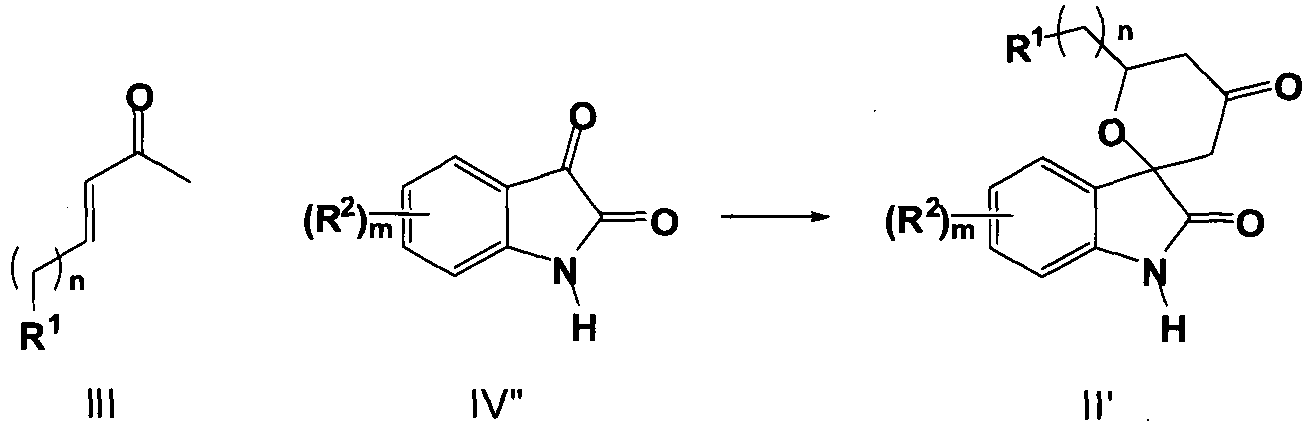
- Compound of formula II' can be prepared by Hetero Diels-Alder reaction of Enone II and Isatin IV', wherein R1 and R2 are defined above (Scheme 6).
- An embodiment of the present inventon is a process for preparing a compound of formula II:

which process comprises reacting a compound of formula III:
with a compound of formula IV:
in the presence of at least one amine selected from the group consisting of the following compounds represented by formulae A, B, C, D, E, F, G, H, and stereoisomers thereof and in the presence of at least one acid selected from the group consisting of the following compounds represented by formulae I, J, K, L, M, N, and stereoisomers thereof, and with or without additive O or molecular sieves 4A
-
- (S)-quinolin-4-yl((1S,2S,4S,5R)-5-vinylquinuclidin-2-yl)methanamine (Amine A)
- (S)-(6-methoxyquinolin-4-yl)((1S,2S,4S,5R)-5-vinylquinuclidin-2-yl)methanamine (Amine B)
- (R)-(6-methoxyquinolin-4-yl)((1S,2S,4S,5R)-5-vinylquinuclidin-2-yl)methanamine (Amine C)
- (S)-N-((S)-quinolin-4-yl((1 S,2S,4S,5R)-5-vinylquinuclidin-2-yl)methyl)pyrrolidine-2-carboxamide (Amine D)
- (R)-2-amino-4-methylpentan-1-ol (Amine E)
- (1S,2S)-cyclohexane-1,2-diamine (Amine F)
- (1S,2S)-1,2-diphenylethane-1,2-diamine (Amine G)
- 1-((1S,2S)-2-aminocyclohexyl)-3-(3,5-bis(trifluoromethyl)phenyl)thiourea (Amine H)
- (S)-2-((tert-butoxycarbonyl)amino)-3-methylbutanoic acid (Acid I)
- (2S,3R)-3-(tert-butoxy)-2-((tert-butoxycarbonyl)amino)butanoic acid (Acid J)
- acetic acid (Acid K)
- 2,2,2-trifluoroacetic acid (Acid L)
- (S)-1-(tert-butoxycarbonyl)pyrrolidine-2-carboxylic acid (Acid M)
- (R)-1-(tert-butoxycarbonyl)pyrrolidine-2-carboxylic acid (Acid N)
- 1,3-bis(3,5-bis(trifluoromethyl)phenyl)thiourea (Thiourea O)
- In a preferred embodiment of the present invention, a process for preparing a compound of formula II':

or stereoisomers thereof,
which process comprises reacting a compound of formula III:
with a compound of formula IV":
in the presence of at least one amine selected from the group consisting of the following compounds represented by formulae A, B, C, D, E, F, G, H, and stereoisomers thereof and in the presence of at least one acid selected from the group consisting of the following compounds represented by formulae I, J, K, L, M, N, and stereoisomers thereof, and with or without additive O or molecular sieves 4A - In a preferred embodiment of the present invention, the amine is A or F.
- In a preferred embodiment of the present invention, the acid is I or J.
- In a preferred embodiment of the present invention, the additive is O.
- In a further preferred embodiment of the present invention, R1 is lower alkyl, the amine is A, acid is J, and the additive is O.
- In a further preferred embodiment of the present invention, R1 is aryl, n=0, the amine is F, and acid is I or J.
- In a further preferred embodiment of the present invention, a compound of formula II is a compound of formula

- In a further preferred embodiment of the present invention, spirooxindole derivatives of formula I is spirooxindole derivatives of compound II-1.
- In a preferred embodiment of the present invention, the molar ratio of the unsaturated ketones to the amine is 1: 0.02 to 0.2
- In a further preferred embodiment of the present invention, the molar ratio of the unsaturated ketones to the additive is 1: 0.02 to 0.2
- In a preferred embodiment of the present invention, the reaction is carried out in a solvent.
- In a further preferred embodiment of the present invention, the solvent is selected from aromatic hydrocarbons, in particular toluene, trimethylbenzene or trifluoromethylbenzene.
-

- Compound of formula II can be prepared by introduction of R3 group on indole nitrogen of compound of formula II', wherein R1, R2, and R3 are defined above according to methods know in the art such as analogy to Scheme 4 (Scheme 7).
-

- Compound of formula I can be prepared by introduction of R3 group on indole nitrogen of compound of formula I', wherein R1, R2, and R3 are defined above according to methods know in the art such as analogy to Scheme 4 (Scheme 8).
-

- Compound of formula I-a can be prepared by reduction of carbonyl moiety of compound of formula II, wherein R1, R2, and R3 are defined above according to methods know in the art (Scheme 9). Reduction of carbonyl moiety of compound of formula II can be achieved by use of reductant such as NaBH4, NaBH3CN, and NaBH(OAc)3, etc. in the solvent such as MeOH, CH2Cl2, and THF, etc at 0°C to room temperature.
-

- Compound of formula I-b can be prepared by reductive amination of carbonyl moiety of compound of formula II, wherein R1, R2, and R3 are defined above, and R and R' are each independently hydrogen, lower alkyl, lower cycloalkyl, lower alkenyl, lower alkynl, phenyl, benzyl, or tolyl optionally substituted by halogen; or R and R' taken together with nitrogen atom to which they are attached to form cyclic amine according to methods know in the art (Scheme 10). Reductive amination of carbonyl moiety of compound of formula II can be achieved by use of reductant such as NaBH4, NaBH3CN, and NaBH(OAc)3, etc., amine (RR'NH) such as methyl amine, dimethyl amine, cyclopropyl amine, pheyl amine, benzyl amine, piperidine, and piperazine, etc., in the solvent such as CH2Cl2 and THF etc., at 0°C to room temperature.
-

- Compound of formula I-c can be prepared by nucleophilic addition of carbonyl moiety of compound of formula II, wherein R1, R2, and R3 are defined above, and R is lower alkyl, lower cycloalkyl, lower alkenyl, lower alkynl, phenyl, or benzyl, optionally substituted by halogen according to methods know in the art (Scheme 11). Nucleophilic addition of carbonyl moiety of compound of formula II can be achieved by use of nucleophilic reagent such as RLi, RMgBr, and R2CuLi, or metal such as Li Mg, Cu, In and alkyl halide (RX) such as methyl bromide, allyl bromide, benzyl bromide, etc. in the solvent such as CH2Cl2, DMF, and THF etc., at -78°C to room temperature.
-

- Compound of formula I-d can be prepared by oximation of carbonyl moiety of compound of formula II, wherein R1, R2, and R3 are defined above, and R and R' are each independently hydrogen, lower alkyl, lower cycloalkyl, lower alkenyl, lower alkynl, phenyl, benzyl, optionally substituted by halogen or lower alkyl sulfonyl, aryl sulfonyl; or R and R' taken together with nitrogen atom to which they are attached to form heteroaryl according to methods know in the art (Scheme 12). Hydrazination of carbonyl moiety of compound of formula II can be achieved by use of hydrazine derivative (H2N-NRR') such as methyl hydrazine, dimethyl hydrazine, phenyl hydrazine, benzyl hydrazine, piperidine hydrazine, p-tosyl hydrazine, and 1-phthalazinylhydrazine etc. in the solvent such as CH2Cl2 arid THF etc., at 0°C to room temperature.
-

- Compound of formula I-e can be prepared by oximation of carbonyl moiety of compound of formula II, wherein R1, R2, and R3 are defined above, and R is hydrogen, lower alkyl, lower cycloalkyl, lower alkenyl, lower alkynl, phenyl, benzyl, or tolyl optionally substituted by halogen according to methods know in the art (Scheme 13). Oximation of carbonyl moiety of compound of formula II can be achieved by use of alkoxy amine derivative (H2N-OR') such as methoxy amine, phenyl amine, and benzyloxy amine, etc. in the solvent such as CH2Cl2 and THF etc., at 0°C to room temperature.
-

- Compound of formula I-f can be prepared by acetalization of carbonyl moiety of compound of formula II, wherein R1, R2, and R3 are defined above, and R and R' are lower alkyl, benzyl,or R and R' together form -(CH2)n- (n=2 or 3), according to methods know in the art (Scheme 14). Acetalization of carbonyl moiety of compound of formula II can be achieved by use of alcohol such as methanol, ethanol, and benzyl alcohol etc. in the presence of acid such as HCl, TsOH, and TFA etc., in the solvent such as CH2Cl2, THF, and acetone etc., at 0°C to room temperature.
- Also an object of the present invention is a compound according to formula I as described herein for use as therapeutically active substance.
- In a preferred embodiment of the present invention is a compound according to formula I as described herein for use as therapeutically active substance for the treatment or prophylaxis of proliferative diseases.
- In a preferred embodiment of the present invention is a compound according to formula I as described herein for use as therapeutically active substance for the treatment or prophylaxis of cancers.
- Likewise an object of the present invention is a pharmaceutical composition comprising a compound according to formula I as described herein and a pharmaceutically acceptable adjuvant.
- A particular embodiment of the present inventron is the pharmaceutical composition as described herein for use in the treatment or prophylaxis of proliferative diseases.
- A particular embodiment of the present inventon is the pharmaceutical composition as described herein for use in the treatment or prophylaxis of cancers.
- Also an object of the present invention is a compound according to fomula I as described herein for use in the treatment or prophylaxis of proliferative diseases.
- Also an object of the present invention is the use of a compound according to fomula I as described herein for use in the treatment or prophylaxis of cancers.
- The compound of formula I and their pharmaceutically acceptable salts possess valuable pharmacological properties. It has been found that the compounds of the present invention are associated with anti-cancer activity, endocrine/cardiovascular activity, and function in bone formation. The compounds were investigated in accordance with the test given hereinafter.
- K562 cells (American Type Culture Collection) were cultured in a culture medium containing 10% (v/v) fetal calf serum (FCS) (manufactures by Sigma) to logarithmic phase. The cells were seeded in 96-well microtiter plate at a density of 5000 cells/well in 100 µL cell culture medium and incubated at 37°C and 5% CO2 in a humidified incubator overnight. The test compounds of various concentrations were added in a well at 10 fold concentration in 1/10 volume of medium without FCS. After 6-48 hrs incubation at 37°C in the CO2 incubator, 10 µL solution of the viable cell counting reagent, Cell counting Kit-8 (5mmol/L WST-8, 0.2mmol/L 1-Methoxy PMS, 150mmol/L NaCl) (manufactured by Dojindo) was added to each well, and reacted for 1 to 4 hours in the CO2 incubator. After the incubation, an absorbance of formazan, generated by reduction of WST-8 was determined at 450 nm using a microplate reader.
- The assay readout is correlated with the viable cell numbers. Small values correspond to high inhibition and larger values to low inhibition of the cell growth. To determine IC50 values (i.e. the concentration inhibiting the cell growth by 50%) of the compound of formula I, several assays were made with a range of concentrations chosen empirically to give low, high and intermediate inhibition of the growth and determined using the curve fitting software.
- The exemplified compounds according to formula I have an inhibitory activity in this assays (IC50) particular less than 1000 µM, more particular less than 100 µM. IC50 values can be converted logarithmically to pIC50 values (-log IC50), in which higher values indicate exponentially greater potency. The IC50 value is not an absolute value but depends on experimental conditions e.g. concentrations employed.
- It is well known that tumor cells mainly rely on glycolysis for energy generation and intermediary metabolism, a phenomenon known as the Warburg effect. Hexokinase-II (HK-II), a key enzyme of glycolysis, catalyzes the first step in the conversion of glucose to glucose-6-phosphate. HK-II is highly expressed in many types of tumors and its expression is correlated with glucose uptake, tumor aggressiveness, and poor survival prognosis. Inhibition of HK-II activity attenuates tumor cell growth and induces apoptosis.
- The test compounds were added to a typical reaction mixture of HK-II, and the produced ADP concentrations were determined using Transcreener® ADP2 FI Assay (BellBrook Labs, Madison, WI, USA).
- The results are shown in Table 1.
Table 1 Example No. Compou nd No. Structure HK-II Inhibition ADP-FP (% inhibition at 20 µM) Cytotoxicity K562 IC50 (µM) 11 3aa 
not tested 125 µM (99% ee: 130 µM) 26 5 
not tested >245 µM (92% ee: >245 µM) 28 7 
not tested >212 µM (87% ee: >212 µM) 22 3ga 
not tested 91% ee: 113 µM 13 3ac 
not tested 82% ee: 16 µM 12 3ab 
not tested 15 µM 15 3ae 
not tested 20 µM 16 3af 
not tested 21 µM 14 3ad 
not tested not tested 27 6 
37.7% not tested 25 3ja 
33.8% not tested - In addition, some of the above compounds, such as compound Nos. 3ac, 3ab, 3ae, 3af and 3ja showed an activity selectively lethal to tumor cells in which both WNT and KRas signaling pathways are activated.
- The compound of formula I as well as their pharmaceutical acceptable salts can be used as medicaments, e.g. in the form of pharmaceutical preparations. The pharmaceutical preparations can be administered orally, e.g. in the form of tablets, coated tablets, dragees, hard and soft capsules, solutions, emulsions or suspensions. The administration can however, also be effected rectally, e.g. in the form of suppositories, or parenterally, e.g. in the form of injection solutions.
- The compounds of formula I and their pharmaceutical acceptable salts can be processed with pharmaceutically inert, inorganic or organic excipients for the production of tablets, coated tablets, gragees and hard gelatine capsules. Lactose, corn starch or derivatives thereof, talc, stearic acid or its salts etc can be used as such excipients e.g. for tablets, dragees and hard gelatine capsules.
- Suitable excipients for soft gelatine capsules are e.g. vegetable oils, waxes, fats, semisolid and liquid polyols etc.
- Suitable excipients for the manufacture of solutions and syrups are e.g. water, polyols, saccharose, invert sugar, glucose etc.
- Suitable excipients for injection solutions are e.g. water, alcohols, polyols, glycerol, vegetable oils etc.
- Suitable excipients for suppositories are e.g. natural or hardened oils, waxes, fats, semi-liquid or liquid polyols etc.
- Moreover, the pharmaceutical preparations can contain preservatives, solubilizers, stabilizers, wetting agents, emulsifiers, sweeteners, colorants, flavorants, salts for varying the osmotic pressure, buffers, masking agents or antioxidants. They can also contain still other therapeutically valuable substances.
- The dosage can be vary within wide limits and will, of course, be fitted to the individual requirements in each particular case. In general, in the case of oral administration a daily dosage of about 10 to 1000 mg per person of a compound of general formula I should be appropriate, although the above upper limit can be exceeded when necessary.
- The invention in illustrated hereinafter by Examples, which have no limiting character.
- In case the preparative examples are obtained as a mixture of enantiomers and diastereomers, the pure enantiomers or diastereomers can be separated by methods described herein or by methods known to the person skilled in the art, such as e. g. chiral chromatography or crystallization.
-

- Enone 1a was purchased from Alfa Aesar and used without purification.
-

- Enone 1b, and 1c was purchased from Wako Pure Chemical Industries and used without further purification.
-

- Enone 1c was purchased from Tokyo Chemical Industry and used without further purification.
-

- 3-phenylpropan-1-al (5.0 mmol) was dissolved in CH2Cl2 (15 mL). To this solution, 1-(triphenylphosphoranylidene)-2-propanone (5.0 mmol) was added and the solution was refluxed for 24 h. The mixture was concentrated and purified by flash column chromatography (hexane/EtOAc) to give enone 1d. 63%; colorless oil.
-
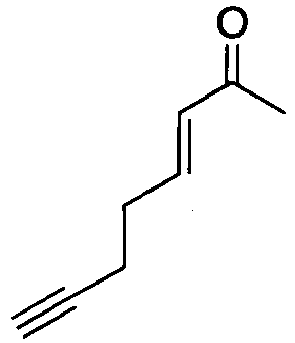
- A mixture of pent-4-yn-1-ol (10 mmol), PCC (4.3 g, 20 mmol), and celite (4.3 g) in CH2Cl2 (30 mL) was stirred at room temperature for 1h. The mixture was diluted with CH2Cl2, filtered, and concentrated. The resulting pale yellow oil was dissolved in CH2Cl2 (30 mL). To this solution, 1-(triphenylphosphoranylidene)-2-propanone (33mmol) was added and the solution was refluxed for 24 h. The mixture was concentrated and purified by flash column chromatography (hexane/EtOAc) to give enone 1e. 30%; colorless oil. The spectroscopic data matched those reported previously in H. Wu, S. Radomkit, J. M. O'Brien, A. M.; Hoveyda, J. Am. Chem. Soc. 2012, 134, 8277.
-

- The title compound was prepared in analogy to enone 1e from pent-4-en-1-ol. 44%; colorless oil. 1H NMR (400 MHz, CDCl3): δ 6.80 (m, 1H), 6.09 (m, 1H), 5.81 (m, 1H), 5.09-5.01 (m, 2H), 2.35-2.30 (m, 2H), 2.30-2.17 (m, 5H). 13C NMR (100 MHz, CDCl3): δ 198.6, 147.4, 137.0, 131.6, 115.7, 32.1, 31.7, 26.9.
-

- The title compound was prepared in analogy to enone 1e from 2-(3-hydroxypropyl)isoindoline-1,3-dione. 58%; colorless solid; mp: 93-95. 1H NMR (400 MHz, CDCl3): δ 7.77-7.74 (m, 2H), 7.68-7.64 (m, 2H), 6.71 (dt, J = 16.0 Hz, 7.2 Hz, 1H), 6.00 (d, J = 16.0 Hz, 1H), 3.79 (t, J = 7.2 Hz, 2H), 2.59-2.53 (m, 2H), 2.16 (s, 3H). 13C NMR (100 MHz, CDCl3): δ 198.2, 168.1, 143.6, 134.1, 133.3, 131.8, 123.3, 36.3, 31.6, 26.7.
-

- The title compound was prepared in analogy to enone 1e from 3-((tert-butyldimethylsilyl)oxy)propan-1-ol. 41%; colorless oil. 1H NMR (400 MHz, CDCl3): δ 6.83 (dt, J = 16.0 Hz, 7.2 Hz, 1H), 6.09 (dt, J = 16.0 Hz, 1.6 Hz, 1H), 3.64 (t, J = 6.4 Hz, 2H), 2.32-2.27 (m, 2H), 2.24 (s, 3H), 1.72-1.65 (m, 2H), 0.90 (s, 9H), 0.05 (s, 6H). 13C NMR (100 MHz, CDCl3): δ 198.6, 148.2, 131.4, 62.2, 31.2, 29.0, 26.8, 25.9, 18.3, -5.34.
-

- The title compound was prepared in analogy to enone 1e from 3-chloropropan-1-ol. 81%; colorless oil. 1H NMR (400 MHz, CDCl3): δ 6.78 (dt, J = 16.0 Hz, 6.8 Hz, 1H), 6.13 (dt, J = 16.0 Hz, 1.2 Hz, 1H), 3.57 (t, J = 6.4 Hz, 2H), 2.44-2.38 (m, 2H), 2.26 (s, 3H) 2.00-1.92 (m, 2H). 13C NMR (100 MHz, CDCl3): δ 198.3, 146.0, 132.0, 44.0, 30.8, 29.5, 27.1.
-

- Enone 1j was purchased from Aldrich and used without further purification.
-

- Isatine 2a was purchased from Nacalai tesque and used without purification.
-

- Isatine 2b was purchased from Tokyo Chemical Industry and used without purification.
-

- Isatine 2c was purchased from Tokyo Chemical Industry and used without purification.
-

- Isatine 2d was purchased from Tokyo Chemical Industry and used without purification.
-

- Isatine 2e was purchased from Tokyo Chemical Industry and used without purification.
-

- Isatine 2f was purchased from Tokyo Chemical Industry and used without purification.
- Amine A was synthesized by the reported procedure.

- To a solution of cinchonidine (2.9 g, 10 mmol), triethylamine (4.2 mL, 30 mmol) in CH2Cl2 (200 mL) was added methanesulfonyl chloride (1.56 mL, 20 mmol) dropwise at 0 °C and the mixture was stirred at the same temperature. After 1h, the mixture was washed with sat NaHCO3 (100 mL x 3) and brine (100 mL x 2), dried over Na2SO4 and concentrated. The residue was dissolved in DMF/H2O (5:1, 60 mL). To this solution was added NaN3 (1.3 g, 20 mmol) and the resulting mixture was stirred at 90°C for 4 h. After being cooled to room temperature, the mixture was poured into water and extracted with EtOAc (100 mL x 3). Organic layers were combined, washed with water (100 mL x 2) and brine (100 mL x 2), dried over Na2SO4, and concentrated. The residue was purified by flash column chromatography (CH2Cl2/MeOH = 40/1 to 20/1) to afford the corresponding azide derivative as a yellow oil (2.0 g, 63% yield). The azide derivative was dissolved in THF/H2O (7:1, 70 mL) and triphenylphosphine (2.0 g, 6.3 mmol) was added. The mixture was stirred at 50°C for 22 h. After being cooled to room temperature, the mixture was concentrated and extracted with aqueous HCl (1 N, 10 mL x 2). Aqueous layers were combined, washed with CH2Cl2 (10 mL x 3), made alkaline with saturated K2CO3, and extracted with CH2Cl2 (100 mL x 3). Organic layers were combined, washed with brine (100 mL x 2), dried over Na2SO4, concentrated. The residue was purified by flash column chromatography
(CH2Cl2/MeOH = 20/1 to CH2Cl2/MeOH/triethylamine = 10/1/1) to afford amine A as a pale yellow viscous oil (1.23 g, 67 %). 1H NMR (400 MHz, CDCl3): δ 8.88 (d, J = 4.4 Hz, 1H), 8.34 (brs, 1H), 8.20 (d, J = 8.4 Hz, 1H), 7.69 (m, 1H), 7.57 (m, 1H), 7.50 (brd, J = 4.4 Hz, 1H), 5.78 (ddd, J = 17.2 Hz, 10.0 Hz, 7.6 Hz, 1H), 5.00-4.93 (m, 2H), 4.69 (brd, J = 8.0 Hz, 1H), 3.28-3.14 (m, 2H), 3.05 (br, 1H), 2.82-2.73 (m, 2H), 2.27-2.24 (m, 1H), 1.97 (brs, 2H), 1.59-1.51 (m, 3H), 1.42-1.37 (m, 1H), 0.75-0.69 (m, 1H). 13C NMR (100 MHz, CDCl3): δ 150.4, 148.6, 148.5, 141.9, 130.54, 130.47, 129.0, 127.7, 126.5, 123.3, 119.6, 114.3, 62.0, 56.3, 41.0, 39.9, 28.1, 27.6, 26.0. ESI-HRMS: calcd for C19H24N3 (MH+) 294.1970, found 294.1967. - Amines B and C were synthesized from the corresponding cinchona alkaloid alcohols by the procedure used for the synthesis of amine A. Amine D was synthesized from amine A and by the reported procedure. Amine H was synthesized by the reported procedure.
- Amines E, F, and G were each purchased from Tokyo Chemical Industry, Wako Pure Chemical Industries, and Aldrich, and used without purification.
- Acids I to N were purchased from Wako Pure Chemical Industries and used without purification.
- Thiourea O was purchased from Tokyo Chemical Industry and used without purification.
- To a solution of amine A (0.04 mmol, 11.8 mg) and acid J (0.08 mmol, 22.0 mg) in toluene (super dehydrated, 0.4 mL) were added thiourea O (0.04 mmol, 20.0 mg), enone 1a (1.0 mmol), and isatin 2a (0.2 mmol, 29.4 mg). The mixture (initially suspension) was stirred at room temperature (24 °C) until isatin was consumed (monitored by TLC). The mixture was purified by flash column chromatography (hexane/EtOAc = 2:1 or hexane/acetone = 3:1) to give product 3aa. The major diastereomer was separated from the minor diastereomer. The minor diastereomer (if existed) was obtained with the major diastereomer. The dr was determined by 1H NMR analysis before purification; the reaction mixture was diluted with CDCl3 and this mixture was analyzed. Yield in Tables 2 and 3 was the yield of the major diastereomer of 3 (for dr >14:1 in the crude mixture) or of the combined yield of the major and minor diastereomers. The ee of the major diastereomer was determined by chiral-phase HPLC.

- Colorless crystals; mp 118-120 °C (from hexane/CH2Cl2, 99% ee). [α]20 D +126.1 (c 0.50, CH2Cl2, 99% ee). 1H NMR (400 MHz, CDCl3): δ 8.65 (s, 1H), 7.31 (t, J = 7.6 Hz, 1H), 7.18 (d, J = 7.6 Hz, 1H), 7.02 (t, J = 7.6 Hz, 1H), 6.96 (d, J = 7.6 Hz, 1H), 4.33 (m, 1H), 3.09 (d, J = 14.2 Hz, 1H), 2.66-2.61 (m, 2H), 2.42 (d, J = 14.2 Hz, 1H), 1.75-1.70 (m, 1H), 1.58-1.53 (m, 1H), 1.41-1.26 (m, 2H), 0.84 (t, J = 7.6 Hz, 3H). 13C NMR (100 MHz, CDCl3): δ 205.5, 175.3, 140.5, 130.3, 128.3, 125.5, 122.8, 111.0, 78.8, 73.0, 47.7, 45.5, 38.3, 18.2, 13.7. ESI-HRMS: calcd for C15H17NO3Na (MNa+) 282.1106, found 282.1107. HPLC (Daicel Chiralpak IB, hexane/i-PrOH = 90/10, flow rate 0.6 mL/min, λ = 254 nm): t R (major diastereomer, major enantiomer, (2'S,6'R)-3aa) = 18.9 min, t R (major diastereomer, minor enantiomer, (2'R,6'S)-3aa) = 21.1 min, t R (mimor diastereomers (2'S*,6'S*)-3aa) = 17.0 min and 18.0 min.
Product 3aa [(2'S,6'R)-3aa/(2'S*,6'S*)-3aa = 1:1.4]. 1H NMR (400 MHz, CDCl3, * donates (2'S*,6'S*)-3aa): δ 8.65 (s, 1H x 1/2.4), 8.31 (s, 1H* x 1.4/2.4), 7.35-6.87 (m, 4H), 4.90 (m, 1H* x 1.4/2.4), 4.33 (m, 1H x 1/2.4), 3.09 (d, J = 14.2 Hz, 1H x 1/2.4), 2.77 (d, J = 14.8 Hz, 1H* x 1.4/2.4), 2.70-2.39 (m, 3H), 1.80-1.26 (m, 4H), 0.89 (t, J = 7.2 Hz, 3H* x 1.4/2.4), 0.84 (t, J = 7.6 Hz, 3H x 1/2.4). 13C NMR (100 MHz, CDCl3, *donates (2'S*,6'S*)-3aa): δ 205.5, 204.7*, 176.8*, 175.3, 140.5, 140.3*, 130.3, 129.4*, 128.3, 125.5, 124.3*, 123.4*, 122.8, 111.0, 110.4*, 78.8, 78.0*, 73.0, 71.6*, 47.4, 46.9*, 45.6*, 45.5, 38.6*, 38.3, 18.2, 18.1*, 13.9*, 13.7.
Product (2'S*,6'S*)-3aa (minor diastereomer). (signals used for the determination of dr): 1H NMR (400 MHz, CDCl3): δ 4.90 (m, 1H, CH2CHO). - The title compound was prepared in analogy to Example 1 from enone 1a, and isatin 2b by use of amine A, acid J, and thiourea O.

- Pale yellow gum. [α]20 D-68.2 (c 1.05, CH2Cl2, 81% ee). 1H NMR (400 MHz, CDCl3): δ 9.04 (s, 1H), 7.22 (t, J = 8.0 Hz, 1H), 7.03 (d, J = 8.0 Hz, 1H), 6.82 (d, J = 8.0 Hz, 1H), 4.68 (m, 1H), 3.53 (d, J = 16.8 Hz, 1H), 2.84 (dd, J = 18.0 Hz, 12.0 Hz, 1H), 2.58 (dd, J = 18.0 Hz, 2.0 Hz, 1H), 2.43 (d, J = 16.8 Hz, 1H), 1.72-1.63 (m, 1H), 1.58-1.34 (m, 3H), 0.92 (t, J = 7.6 Hz, 3H). 13C NMR (100 MHz, CDCl3): δ 206.1, 177.9, 142.3, 131.4, 126.5, 124.2, 109.6, 78.6, 72.5, 46.0, 40.8, 18.3, 13.9. ESI-HRMS: calcd for C15H16ClNO3Na (MNa+) 316.0716, found 316.0717. HPLC (Daicel Chiralpak IB, hexane/i-PrOH = 90/10, 0.6 mL/min, λ = 254 nm): t R (major diastereomer, major enantiomer, (2'S,6'R)-3ab) = 22.0 min, t R (major diastereomer, minor enantiomer, (2'R,6'S)-3ab) = 25.6 min.
- The title compound was prepared in analogy to Example 1 from enone 1a, and isatin 2c by use of amine A, acid J, and thiourea O.

- Pale yellow amorphous solid. [α]20 D -84.7 (c 1.24, CH2Cl2, 82% ee). 1H NMR (400 MHz, CDCl3): δ 8.26 (s, 1H), 7.22 (d, J = 7.6 Hz, 1H), 7.14 (t, J = 7.6 Hz, 1H), 6.82 (d, J = 7.6 Hz, 1H), 4.78-4.73 (m, 1H), 3.66 (d, J = 16.8 Hz, 1H), 2.97 (dd, J = 18.4 Hz, 12.4 Hz, 1H), 2.56 (dd, J = 18.4 Hz, 2.0 Hz, 1H), 2.36 (d, J = 16.8 Hz, 1H), 1.71-1.41 (m, 4H), 0.94 (t, J = 7.2 Hz, 3H). 13C NMR (100 MHz, CDCl3): δ 206.3, 178.2, 142.5, 131.5, 128.1, 127.2, 119.5, 110.1, 79.1, 72.4, 45.9, 40.7, 37.7, 18.6, 14.1. ESI-HRMS: calcd for C15H16BrNO3Na (MNa+) 360.0211, found 360.0212. HPLC (Daicel Chiralpak IB, hexane/i-PrOH = 90/10, 0.6 mL/min, λ = 254 nm): t R (major diastereomer, major enantiomer, (2'S,6'R)-3ac) = 22.7 min, t R (major diastereomer, minor enantiomer, (2'R,6'S)-3ac) = 26.6 min.
- The title compound was prepared in analogy to Example 1 from enone 1a and isatin 2d by use of amine A, acid J, and thiourea O.

- Pale yellow gum. [α]20 D+90.0 (c 0.90, CH2Cl2, 93% ee). 1H NMR (400 MHz, CDCl3): δ 8.37 (s, 1H), 7.10 (d, J = 7.6 Hz, 1H), 6.97 (s, 1H), 6.84 (d, J = 7.6 Hz, 1H), 4.33 (m, 1H), 3.07 (d, J = 14.4 Hz, 1H), 2.69-2.60 (m, 2H), 2.40 (d, J = 14.4 Hz, 1H), 2.31 (s, 3H), 1.78-1.69 (m, 1H), 1.60-1.52 (m, 1H), 1.45-1.25 (m, 2H), 0.85 (t, J = 7.2 Hz, 3H). 13C NMR (100 MHz, CDCl3): δ 205.9, 175.4, 138.2, 132.7, 130.9, 128.7, 126.5, 111.0, 79.2, 73.3, 48.0, 45.8, 38.7, 21.4, 18.5, 14.1. ESI-HRMS: calcd for C16H19NO3Na (MNa+) 296.1263, found 296.1264. HPLC (Daicel Chiralpak IB, hexane/i-PrOH = 90/10, 0.6 mL/min, λ = 254 nm): t R (major diastereomer, major enantiomer, (2'S,6'R)-3ad) = 16.1 min, t R (major diastereomer, minor enantiomer, (2'R,6'S)-3ad) = 18.5 min.
- The title compound was prepared in analogy to Example 1 from enone 1a and isatin 2e by use of amine A, acid J, and thiourea O.

- Pale yellow amorphous solid. [α]20 D +55.2 (c 0.87, CH2Cl2, 86% ee). 1H NMR (400 MHz, CDCl3): δ 9.03 (s, 1H), 7.45 (dd, J = 8.0 Hz, 2.0 Hz, 1H), 7.30 (d, J = 2.0 Hz, 1H), 6.87 (d, J = 8.0 Hz, 1H), 4.31-4.28 (m, 1H), 3.04 (d, J = 14.4 Hz, 1H), 2.71-2.60 (m, 2H), 2.45 (d, J = 14.4 Hz, 1H), 1.78-1.68 (m, 1H), 1.60-1.53 (m, 1H), 1.45-1.26 (m, 2H), 0.86 (t, J = 7.6 Hz, 3H). 13C NMR (100 MHz, CDCl3): δ 204.8, 175.3, 139.5, 133.3, 130.4, 128.3, 115.5, 112.6, 78.8, 73.4, 47.4, 45.5, 38.3, 19.1, 18.1. ESI-HRMS: calcd for C15H16BrNO3Na (MNa+) 360.0211, found 360.0215. HPLC (Daicel Chiralpak IB, hexane/i-PrOH = 90/10, 1.0 mL/min, λ = 254 nm): t R (major diastereomer, major enantiomer, (2'S,6'R)-3ae) = 11.7 min, t R (major diastereomer, minor enantiomer, (2'R,6'S)-3ae) = 14.0 min
Product (2'S*,6'S*)-3ae (minor diastereomer). 1H NMR (400 MHz, CDCl3): δ 4.89-4.82 (m, 1H, CH2CHO). - The title compound was prepared in analogy to Example 1 from enone 1a and isatin 2f by use of amine A, acid J, and thiourea O.

- Pale yellow gum. [α]20 D+78.2 (c 0.61, CH2Cl2, 90% ee). 1H NMR (400 MHz, CDCl3): δ 8.99 (s, 1H), 7.10 (d, J = 8.4, Hz, 1H), 7.02-7.00 (m, 2H), 4.30-4.24 (m, 1H), 3.07 (d, J = 14.0 Hz, 1H), 2.71-2.59 (m, 2H), 2.40 (dd, J = 14.0 Hz, 1.2 Hz, 1H), 1.78-1.69 (m, 1H), 1.59-1.51 (m, 1H), 1.42-1.25 (m, 2H), 0.84 (t, J = 7.6 Hz, 3H). 13C NMR (100 MHz, CDCl3): δ 205.2, 175.5, 141.8, 136.3, 126.7, 126.3, 122.8, 111.8, 78.5, 73.3, 47.6, 45.3, 38.3, 18.2, 13.7. ESI-HRMS: calcd for C15H16ClNO3Na (MNa+) 316.0716, found 316.0718. HPLC (Daicel Chiralpak IB, hexane/i-PrOH = 90/10, 1.0 mL/min, λ = 254 nm): t R (major diastereomer, major enantiomer, (2'S,6'R)-3af) = 11.8 min, t R (major diastereomer, minor enantiomer, (2'R,6'S)-3ae) = 13.2 min.
Product (2*S*,6'S*)-3af (minor diastereomer). 1H NMR (400 MHz, CDCl3): δ 4.88-4.80 (m, 1H, CH2CHO) ppm. - The title compound was prepared in analogy to Example 1 from enone 1b and isatin 2a by use of amine A, acid J, and thiourea O.

- Pale yellow gum. [α]20 D+72.9 (c 0.70, CH2Cl2, 91% ee). 1H NMR (400 MHz, CDCl3): δ 8.82 (s, 1H), 7.31 (ddd, J = 8.0 Hz, 7.6 Hz, 0.8 Hz, 1H), 7.18 (d, J = 7.2 Hz, 1H), 7.02 (ddd, J = 7.6 Hz, 7.2 Hz, 0.8 Hz, 1H), 6.97 (d, J = 8.0 Hz, 1H), 4.34-4.30 (m, 1H), 3.09 (d, J = 14.0 Hz, 1H), 2.66-2.64 (m, 2H), 2.41 (d, J = 14.0 Hz, 1H), 1.75-1.72 (m, 1H), 1.61-1.55 (m, 1H), 1.36-1.18 (m, 8H), 0.83 (t, J = 6.8 Hz, 3H). 13C NMR (100 MHz, CDCl3): δ 205.5, 175.5, 140.5, 130.3, 128.3, 125.5, 122.8, 111.1, 78.9, 73.4, 47.7, 45.5, 36.3, 31.6, 28.9, 24.8, 22.5, 14.0. ESI-HRMS: calcd for C18H23NO3Na (MNa+) 324.1576, found 324.1573. HPLC (Daicel Chiralpak IB, hexane/i-PrOH = 90/10, 1.0 mL/min, λ = 254 nm): t R (major diastereomer, major enantiomer, (2'S,6'R)-3ba) = 9.9 min, t R (major diastereomer, minor enantiomer, (2'R,6'S)-3ba) = 11.0 min.
Product (2'S*,6'S*)-3ba (minor diastereomer). 1H NMR (400 MHz, CDCl3): δ 4.90-4.82 (m, 1H, CH2CHO). - The title compound was prepared in analogy to Example 1 from enone 1c and isatin 2a by use of amine A, acid J, and thiourea O.
Pale yellow gum.
- [α]20 D +90.3 (c 0.70, CH2Cl2, 93% ee). 1H NMR (400 MHz, CDCl3): δ 8.97 (s, 1H), 7.27 (dt, J = 7.6, 1.2 Hz, 1H), 7.15 (d, J = 7.6 Hz, 1H), 7.00 (dt, J = 7.6, 1.2 Hz, 1H), 6.94 (d, J = 7.6 Hz, 1H), 4.01 (m, 1H), 3.04 (d, J = 14.4 Hz, 1H), 2.65-2.57 (m, 2H), 2.40 (dd, J = 14.4, 1.2 Hz, 1H), 1.88-1.76 (m, 1H), 0.89 (d, J = 6.8 Hz, 3H), 0.83 (d, J = 6.8 Hz, 3H). 13C NMR (100 MHz, CDCl3): δ 206.1, 175.7, 140.6, 130.3, 128.4, 125.4, 122.8, 111.1, 78.7, 77.9, 45.4, 44.7, 33.2, 18.3, 17.6. ESI-HRMS: calcd for C15H17NO3Na (MNa+) 282.1106, found 282.1100. HPLC (Daicel Chiralpak IB, hexane/i-PrOH = 95/5, 0.6 mL/min, λ = 254 nm): t R (major diastereomer, major enantiomer, (2'S,6'S)-3ca) = 32.8 min, t R (major diastereomer, minor enantiomer, (2'R,6'R)-3ca) = 36.9 min, t R (minor diastereomers) = 30.7 min and 35.2 min.
Product 3ca (2'S,6'S)-3ca/(2'S*,6'R*)-3ca = 2.2:1]. 1H NMR (400 MHz, CDCl3, * donates (2'S*,6'R*)-3ca): δ 8.97 (s, 1H x 2.2/3.2), 8.57 (s, 1H* x 1/3.2), 7.36-6.89 (4H), 4.65 (m, 1H* x 1/3.2), 4.01 (m, 1H x 2.2/3.2), 3.04 (d, J = 14.4 Hz, 1H x 2.2/3.2), 2.77 (d, J = 14.8 Hz, 1H* x 1/3.2), 2.67-2.40 (3H), 1.98-1.76 (m, 1H), 0.95-0.83 (6H). 13C NMR (100 MHz, CDCl3, *donates (2'S*,6'R*)-3ca): δ 206.2, 205.3*, 177.1*, 175.6, 140.6, 140.3*, 130.3, 129.5*, 128.4, 125.4, 124.2*, 123.3*, 122.7, 111.1, 110.5*, 78.7, 48.0, 76.2*, 45.7*, 45.5, 44.7, 43.6*, 33.2, 33.1*, 18.3, 18.1*, 17.6, 17.3*.
Product (2'S*,6'R*)-3ca (minor diastereomer). (signals used for the determination of dr): 1H NMR (400 MHz, CDCl3): δ 4.65 (m, 1H, CH2CHO). - The title compound was prepared in analogy to Example 1 from enone 1d and isatin 2a by use of amine A, acid J, and thiourea O.

- Pale yellow gum. [α]20 D +101.3 (c 0.98, CH2Cl2, 91% ee). 1H NMR (400 MHz, CDCl3): δ 9.22 (s, 1H), 7.33 (t, J = 7.6 Hz, 1H), 7.12-7.08 (m, 3H), 7.03 (t, J = 7.6 Hz, 2H), 6.97 (t, J = 7.6 Hz, 1H), 6.93-6.90 (m, 2H), 4.25 (m, 1H), 3.11 (d, J = 14.0 Hz, 1H), 2.74-2.53 (m, 4H), 2.42 (dd, J = 14.0 Hz, 1.6 Hz, 1H), 2.10 (m, 1H), 1.80 (m, 1H). 13C NMR (100 MHz, CDCl3): δ 205.2, 175.7, 140.9, 140.6, 130.4, 128.5, 128.3, 128.2, 125.9, 125.6, 122.8, 111.2, 79.0, 71.6, 47.7, 45.3, 37.8, 31.0. ESI-HRMS: calcd for C20H19NO3Na (MNa+) 344.1263, found 344.1259. HPLC (Daicel Chiralpak IB, hexane/i-PrOH = 90/10, 0.6 mL/min, λ = 254 nm): t R (major diastereomer, major enantiomer, (2'S,6'R)-3da) = 25.3 min, t R (major diastereomer, minor enantiomer, (2'R,6'S)-3da) = 29.6 min, t R (minor diastereomers) = 26.9 min and 33.4 min..
Product (2'S*,6'S*)-3da (minor diastereomer). 1H NMR (400 MHz, CDCl3): δ 4.94-4.86 (m, 1H, CH2CHO). - The title compound was prepared in analogy to Example 1 from enone 1e and isatin 2a by use of amine A, acid J, and thiourea O.

- Pale yellow gum. [α]20 D +110.6 (c 0.86, CH2Cl2, 92% ee). 1H NMR (400 MHz, CDCl3): δ 8.97 (s, 1H), 7.31 (dt, J = 7.6 Hz, 0.8 Hz, 1H), 7.21 (d, J = 7.6 Hz, 1H), 7.02 (dt, J = 7.6, 0.8 Hz, 1H), 6.97 (d, J = 7.6 Hz, 1H), 4.54 (m, 1H), 3.08 (d, J = 14.4 Hz, 1H), 2.75-2.63 (m, 2H), 2.47 (dd, J = 14.4 Hz, 1.2 Hz, 1H), 2.27-2.20 (m, 2H), 2.02-1.91 (m, 1H), 1.82 (t, J = 2.4 Hz, 1H), 1.81-1.74 (m, 1H). 13C NMR (100 MHz, CDCl3): δ 204.8, 175.5, 140.5, 130.4, 128.1, 125.5, 122.8, 111.1, 82.9, 78.9, 71.6, 69.0, 47.3, 45.4, 34.6, 14.4. ESI-HRMS: calcd for C16H15NO3Na (MNa+) 292.0950, found 292.0947. HPLC (Daicel Chiralpak IB, hexane/i-PrOH = 90/10, 1.0 mL/min, λ = 254 nm): t R (major diastereomer, major enantiomer, (2'S,6'R)-3ea) = 16.6 min, t R (major diastereomer, minor enantiomer, (2'R,6'S)-3ea) = 18.6 min.
Product (2'S*,6'S*)-3ea (minor diastereomer). 1H NMR (400 MHz, CDCl3): δ 5.06-4.98 (m, 1H, CH2CHO). - The title compound was prepared in analogy to Example 1 from enone 1f and isatin 2a by use of amine A, acid J, and thiourea O.

- Pale yellow gum. [α]20 D+87.2 (c 0.66, CH2Cl2, 93% ee). 1H NMR (400 MHz, CDCl3): δ 9.12 (s, 1H), 7.31 (dt, J = 8.0 Hz, 1.2 Hz, 1H), 7.17 (d, J = 7.2 Hz, 1H), 7.04-6.97 (m, 2H), 5.67 (ddt, J = 17.2 Hz, 10.4 Hz, 6.4 Hz, 1H), 4.88-4.82 (m, 2H), 4.39-4.32 (m, 1H), 3.10 (d, J = 14.0 Hz, 1H), 2.72-2.60 (m, 2H), 2.44 (dd, J = 14.0 Hz, 1.2 Hz, 1H), 2.19-2.00 (m, 2H), 1.91-1.82 (m, 1H), 1.69-1.60 (m, 1H). 13C NMR (100 MHz, CDCl3): δ 205.2, 175.6, 140.6, 137.2, 130.4, 128.2, 125.5, 122.8, 115.4, 111.1, 78.9, 72.4, 47.6, 45.4, 35.2, 29.1. ESI-HRMS: calcd for C16H17NO3Na (MNa+) 294.1106, found 294.1120. HPLC (Daicel Chiralpak IB, hexane/i-PrOH = 90/10, 1.0 mL/min, λ = 254 nm): t R (major diastereomer, major enantiomer, (2'S,6'R)-3fa) = 12.3 min, t R (major diastereomer, minor enantiomer, (2'R,6'S)-3fa) = 13.6 min.
Product (2'S*,6'S*)-3fa (minor diastereomer). 1H NMR (400 MHz, CDCl3): δ 8.80 (s, 1H, CONH). - The title compound was prepared in analogy to Example 1 from enone 1g and isatin 2a by use of amine A, acid J, and thiourea O.

- Colorless solid; mp: 199-201 (91% ee). [α]20 D +67.7 (c 0.74, CH2Cl2, 91% ee). 1H NMR (400 MHz, CDCl3): δ 8.21 (brs, 1H), 7.73-7.64 (m, 4H), 7.24 (dt, J = 7.6 Hz, 1.2 Hz, 1H), 7.05 (d, J = 7.6 Hz, 1H), 6.92 (d, J = 7.6 Hz, 1H), 6.84 (dt, J = 7.6 Hz, 0.8 Hz, 1H), 4.38 (m, 1H), 3.82 (dt, J = 14.0, 6.8 Hz, 1H), 3.72 (dt, J = 14.0 Hz, 6.8 Hz, 1H), 3.05 (d, J = 14.4 Hz, 1H), 2.74 (dd, J = 14.4 Hz, 11.2 Hz, 1H), 2.61 (ddd, J = 14.4 Hz, 2.4 Hz, 1.6 Hz, 1H), 2.39 (dd, J= 14.4 Hz, 1.6 Hz, 1H), 2.22-2.13 (m, 1H), 2.09-2.02 (m, 1H). 13C NMR (100 MHz, CDCl3): δ 204.5, 174.5, 168.1, 140.5, 133.8, 131.8, 130.4, 127.8, 125.4, 123.2, 122.6, 110.9, 78.7, 70.9, 47.3, 45.3. ESI-HRMS: calcd for C22H18N2O5Na (MNa+) 413.1113, found 413.1105. HPLC (Daicel Chiralpak IB, hexane/i-PrOH = 90/10, 0.6 mL/min, λ = 254 nm): t R (major diastereomer, major enantiomer, (2'S,6'R)-3ga) = 23.9 min, t R (major diastereomer, minor enantiomer, (2'R,6'S)-3ga) = 32.8 min.
- The title compound was prepared in analogy to Example 1 from enone 1h and isatin 2a by use of amine A, acid J, and thiourea O.

- Pale yellow gum. [α]20 D+70.2 (c 1.32, CH2Cl2, 92% ee). 1H NMR (400 MHz, CDCl3): δ 8.84 (s, 1H), 7.28 (dt, J = 7.6 Hz, 0.8 Hz, 1H), 7.17 (d, J = 7.6 Hz, 1H), 7.01 (dt, J = 7.6 Hz, 0.8 Hz, 1H), 6.96 (d, J = 7.6 Hz, 1H), 4.38-4.31 (m, 1H), 3.51 (t, J = 6.4 Hz, 2H), 3.08 (d, J = 14.0 Hz, 1H), 2.67-2.64 (m, 2H), 2.41 (d, J = 14.0 Hz, 1H), 1.80-1.45 (m, 4H), 0.84 (s, 9H), -0.02 (s, 6H). 13C NMR (100 MHz, CDCl3): δ 205.4, 175.7, 140.6, 130.4, 128.2, 125.4, 122.8, 111.1, 78.9, 73.1, 62.5, 47.7, 45.5, 32.7, 28.2, 25.9, 18.3, -5.39. ESI-HRMS: calcd for C21H31NO4SiNa (MNa+) 412.1920, found 412.1915. HPLC (Daicel Chiralpak IB, hexane/i-PrOH = 90/10, 1.0 mL/min, λ = 254 nm): t R (major diastereomer, major enantiomer, (2'S,6'R)-3ha) = 8.63 min, t R (major diastereomer, minor enantiomer, (2'R,6'S)-3ha) = 9.19 min.
Product (2'S*,6'S*)-3ha (minor diastereomer). 1H NMR (400 MHz, CDCl3): δ 4.96-4.88 (m, 1H, CH2CHO). - The title compound was prepared in analogy to Example 1 from enone 1i and isatin 2a by use of amine A, acid J, and thiourea O.

- Pale yellow gum. [α]20 D +81.1 (c 1.0, CH2Cl2, 93% ee). 1H NMR (400 MHz, CDCl3): δ 8.98 (s, 1H), 7.32 (dt, J = 7.6Hz, 0.8 Hz, 1H), 7.18 (d, J = 7.6 Hz, 1H), 7.03 (t, J = 7.6 Hz, 1H), 6.99 (d, J = 7.6 Hz, 1H), 4.40-4.34 (m, 1H), 3.46 (t, J = 6.4 Hz, 2H), 3.09 (d, J = 14.4 Hz, 1H), 2.71 (dd, J = 14.4 Hz, 10.8 Hz, 1H), 2.64 (ddd, J = 14.4 Hz, 3.2 Hz, 1.6 Hz, 1H), 2.44 (dd, J = 14.4 Hz, 1.6 Hz, 1H), 1.94-1.71 (m, 4H). 13C NMR (100 MHz, CDCl3): δ 204.9, 175.4, 140.5, 130.5, 128.1, 125.4, 122.9, 111.2, 78.9, 72.5, 47.6, 45.4, 44.6, 33.5, 28.1. ESI-HRMS: calcd for C15H16ClNO3Na (MNa+) 316.0716, found 316.0717. HPLC (Daicel Chiralpak IB, hexane/i-PrOH = 80/20, 1.0 mL/min, λ = 254 nm): t R (major diastereomer, major enantiomer, (2'S,6'R)-3ia) = 9.6 min, t R (major diastereomer, minor enantiomer, (2'R,6'S)-3ia) = 10.5 min, t R (minor diastereomers) = 9.2 min.
Product (2'S*,6'S*)-3ia (minor diastereomer). 1H NMR (400 MHz, CDCl3): δ 4.94-4.88 (m, 1H, CH2CHO). - The title compound was prepared in analogy to Example 11 from enone 1j and isatin 2a by use of amine F and acid J.

- Relative and absolute stereochemistries were assigned by analogy. Rf 0.23 (hexane/EtOAc = 2:1). Pale yellow amorphous solid. [α]20 D +18.1 (c 0.6, CH2Cl2, 77% ee). 1H NMR (400 MHz, CDCl3): δ 8.18 (s, 1H), 7.43-7.41 (m, 2H), 7.38-7.29 (m, 5H), 7.08 (t, J = 7.2 Hz, 1H), 6.96 (d, J = 8.4 Hz, 1H), 5.37 (dd, J = 11.6 Hz, 2.4 Hz, 1H), 3.22 (d, J = 14.8 Hz, 1H), 3.04 (dd, J = 14.8 Hz, 11.6 Hz, 1H), 2.87 (ddd, J = 14.8 Hz, 2.4 Hz, 1.6 Hz, 1H), 2.59 (dd, J = 14.8 Hz, 1.6 Hz, 1H). 13C NMR (100 MHz, CDCl3): δ 204.7, 174.7, 140.5, 139.8, 130.6, 128.7, 128.4, 128.1, 126.0, 125.4, 122.9, 111.0, 78.9, 75.0, 49.6, 45.1. ESI-HRMS: calcd for C18H15NO3Na (MNa+) 316.0905, found 316.0944. HPLC (Daicel Chiralpak IA, hexane/i-PrOH = 80/20, 0.8 mL/min, λ = 254 nm): t R (major diastereomer, major enantiomer) = 21.2 min, t R (major diastereomer, minor enantiomer) = 31.5 min, t R (minor diastereomers) = 15.2 min and 18.0 min.
Product 3ja (minor diastereomer). Rf 0.30 (hexane/EtOAc = 2:1). Pale yellow amorphous solid. 1H NMR (400 MHz, CDCl3): δ 7.66 (s, 1H), 7.46 (d, J = 7.6 Hz, 1H), 7.43-7.41 (m, 2H), 7.34-7.28 (m, 4H), 7.13 (t, J= 7.6 Hz, 1H), 6.87 (d, J= 8.0 Hz, 1H), 5.95 (dd, J = 11.2, 3.2 Hz, 1H), 2.95 (d, J = 14.8 Hz, 1H), 2.89-2.84 (m, 1H), 2.74 (dd, J = 14.8 Hz, 11.2 Hz, 1H), 2.61 (dd, J = 14.8 Hz, 1.6 Hz, 1H). 13C NMR (100 MHz, CDCl3): δ = 203.4, 175.9, 140.6, 140.2, 130.6, 129.0, 128.7, 128.3, 126.0, 124.5, 123.5, 110.3, 78.2, 73.6, 48.8, 45.6. -

- To a solution of 3aa (93% ee, 27.0 mg, 0.10 mmol) in MeOH (1.0 mL) was added NaBH4 (7.9 mg, 0.21 mmol) at 0 °C and the mixture was stirred at the same temperature for 1 h (consumption of 3aa was analyzed by TLC). Acetic acid (30 µL) was added to the mixture at same temperature and the solvent was removed in vacuo. The residue was purified by flash column chromatography (hexane/EtOAc = 2:1) to give 5 (19.6 mg, 72%, single diastereomer, 92% ee). Colorless solid; mp: 169-171. [α]20 D +56.0 (c 0.94, CH2Cl2, 92% ee). 1H NMR (400 MHz, CDCl3): δ 8.10 (d, J = 7.6 Hz, 1H), 7.97 (s, 1H), 7.23 (dd, J = 7.6 Hz, 1.2 Hz, 1H), 7.03 (td, J = 7.6 Hz, 1.2 Hz, 1H), 6.87 (d, J = 7.6 Hz, 1H), 4.53 (m, 1H), 4.35 (m, 1H), 2.36 (dd, J = 14.4 Hz, 3.6 Hz, 1H), 1.85-1.82 (m, 2H), 1.74 (dd, J = 14.4, 2.0 Hz, 1H), 1.70 (d, J = 2.0 Hz, 1H), 1.59-1.52 (m, 1H), 1.44-1.20 (m, 3H), 0.81 (t, J = 7.2 Hz, 3H). 13C NMR (100 MHz, CDCl3): δ = 177.6, 140.5, 131.0, 129.2, 127.9, 122.5, 110.1, 77.2, 66.8, 64.3, 38.0, 37.4, 36.0, 18.4, 13.9. ESI-HRMS: calcd for C15H19NO3Na (MNa+) 284.1263, found 284.1259. HPLC (Daicel Chiralpak IB, hexane/i-PrOH = 90/10, 0.6 mL/min, λ = 254 nm): t R (major enantiomer, (2'S,4'R,6'R)-5) = 25.2 min, t R (minor enantiomer) = 23.2 min. Configuration at the 4'-position of 5 was determined based on the relative stereochemistry analyzed by NOESY experiments.
-
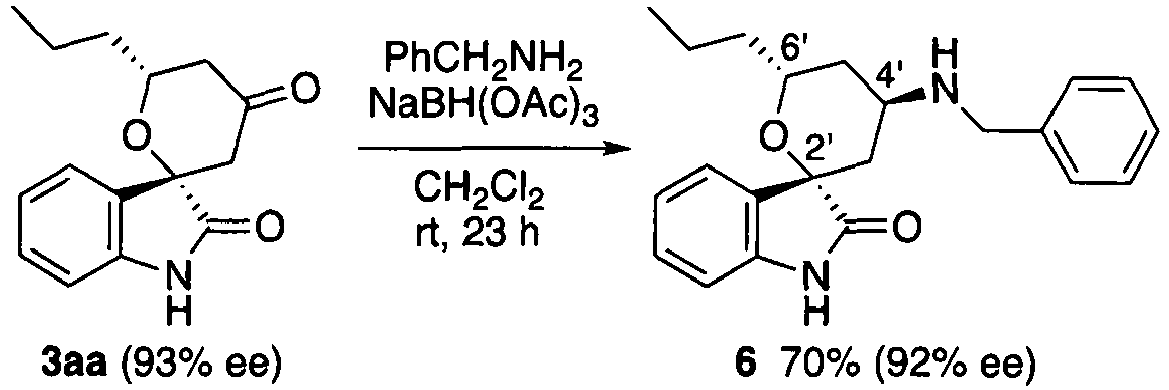
- To a solution of 3aa (93% ee, 20.0 mg, 0.077 mmol) in CH2Cl2 (1.5 mL) were added benzylamine (25.1 µL, 0.23 mmol) and NaBH(OAc)3 (49.1 mg, 0.23 mmol). The mixture was stirred at room temperature for 23 h (consumption of 3aa was analyzed by TLC). After addition of aqueous NaOH (1 N, 0.5 mL), the mixture was extracted with CH2Cl2 (x 3), washed with brine, dried over Na2SO4, filtered, and concentrated. The residue was purified by flash column chromatography (hexane/EtOAc = 1:1) gave 6 (18.8 mg, 70%, single diastereomer, 92% ee). Pale yellow gum. [α]20 D -5.2 (c 0.93, CH2Cl2, 92% ee). 1H NMR (400 MHz, CDCl3): δ 8.35, (s, 1H), 8.34 (d, J= 7.6 Hz, 1H), 7.37-7.27 (m, 5H), 7.23 (dt, J= 7.6 Hz, 0.8 Hz, 1H), 7.03 (dt, J= 7.6 Hz, 0.8 Hz, 1H), 6.87 (d, J = 7.6 Hz, 1H), 4.38-4.31 (m, 1H), 3.74 (d, J = 12.4 Hz, 1H), 3.70 (d, J = 12.4 Hz, 1H), 3.46 (quintet, J = 4.0 Hz, 1H), 2.28 (dd, J = 14.4 Hz, 4.0 Hz, 1H), 1.88 (ddd, J = 14.0 Hz, 10.8 Hz, 4.0 Hz, 1H), 1.78 (ddd, J = 14.4 Hz, 4.0 Hz, 1.2 Hz, 1H), 1.69 (d, J = 14.4 Hz, 1H), 1.59-1.52 (m, 2H), 1.41-1.27 (m, 3H), 0.82 (t, J = 7.2 Hz, 3H). 13C NMR (100 MHz, CDCl3): δ 178.4, 140.4, 140.3, 131.6, 129.0, 128.5, 128.2, 128.1, 127.1, 122.4, 110.0, 77.7, 67.9, 52.1, 49.7, 38.1, 36.2, 33.4, 18.6, 13.9. ESI-HRMS: calcd for C22H27N2O2 (MH+) 351.2073, found 351.2068. HPLC (Daicel Chiralpak IA, hexane/i-PrOH = 90/10, 1.0 mL/min, λ = 254 nm): t R (major enantiomer, (2'S',4'R,6'R)-6) = 16.4 min, t R (minor enantiomer) = 13.9 min. Configuration at the 4'-position of 6 was determined based on the relative stereochemistry analyzed by NOESY experiments.
-
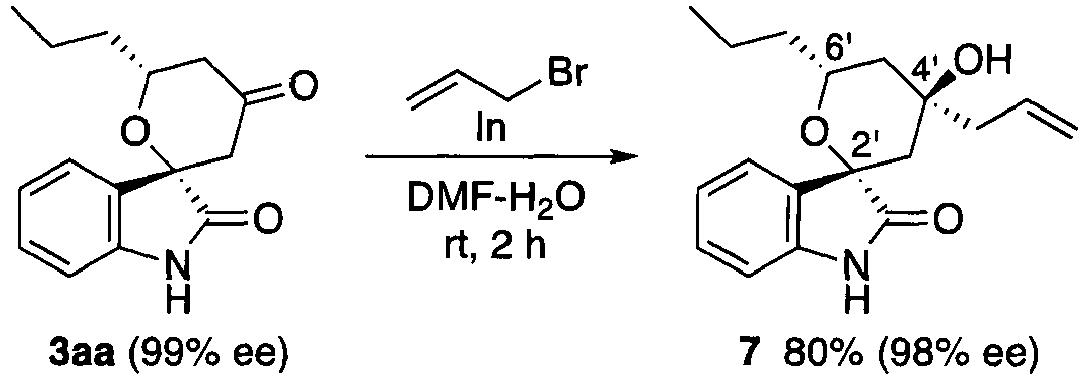
- A mixture of 3aa (99% ee, 26.0 mg, 0.1 mmol), allylbromide (0.26 mL, 3.0 mmol), and In (45.9 mg, 0.4 mmol) in DMF (0.8 mL)-H2O (0.1 mL) was stirred at room temperature for 2 h. The mixture was added to saturated NH4Cl and extracted with CH2Cl2 (x 3). Organic layers were combined and washed with brine, dried with Na2SO4, and concentrated. The residue was purified by flash column chromatography (hexane/EtOAc = 1:1) to give 7 (24.1 mg, 80%, single diastereomer, 98% ee). Colorless solid; mp: 189-191. [α]30 D +76.3 (c 0.80, CH2Cl2, 98% ee). 1H NMR (400 MHz, CDCl3): δ 8.96 (s, 1H), 8.14 (d, J = 8.0 Hz, 1H), 7.22 (td, J = 8.0, 1.2 Hz, 1H), 7.00 (dt, J = 8.0 Hz, 1.2 Hz, 1H), 6.91 (d, J = 8.0 Hz, 1H), 5.88 (m, 1H), 5.25-5.16 (m, 2H), 4.38-4.32 (m, 1H), 2.35 (d, J = 14.0 Hz, 1H), 2.30 (d, J = 14.0 Hz, 1H), 2.18 (d, J = 14.0 Hz, 1H), 1.80 (s, 1H), 1.74 (dt, J = 14.0 Hz, 2.0 Hz, 1H), 1.66-1.23 (m, 6H), 0.81 (t, J = 7.2 Hz, 3H). 13C NMR (100 MHz, CDCl3): δ 178.4, 140.8, 132.0, 131.0, 129.1, 128.2, 122.4, 120.7, 110.4, 78.2, 69.8, 68.3, 49.2, 42.0, 40.2, 37.9, 18.5, 13.9. ESI-HRMS: calcd for C18H24NO3 (MH+) 302.1756, found 302.1768. HPLC (Daicel Chiralpak IA, hexane/i-PrOH = 90/10, 1.0 mL/min, λ = 254 nm): t R (major enantiomer, (2'S,4'R,6'R)-7) = 14.3 min, t R (minor enantiomer) = 13.5 min. Configuration at the 4'-position of 7 was determined based on the relative stereochemistry analyzed by NOESY experiments.
-

- A solution of 3aa (93% ee, 59.0 mg, 0.23 mmol) and p-toluenesulfonyl hydrazide (42.8 mg, 0.23 mmol) in MeOH (2.3 mL) was refluxed for 2 h. After being cooled to room temperature, generated precipitate was collected and washed with hexane/EtOAc (10:1) to give 8 (82%). Pale yellow solid; mp 197-199. [α]20 D +204.3 (c 0.10, CH2Cl2). 1H NMR (400 MHz, DMSO-d6): δ 10.52, (s, 1H), 10.48, (s, 1H), 7.72 (d, J = 8.4 Hz, 2H), 7.37 (d, J= 8.4 Hz, 2H), 7.20 (t, J = 7.6 Hz, 1H), 6.81 (d, J= 7.6 Hz, 1H), 6.70 (d, J = 7.6 Hz, 1H), 6.58 (t, J = 7.6 Hz, 1H), 3.91-3.85 (m, 1H), 3.04 (d, J = 14.0 Hz, 1H), 2.62 (d, J = 14.0 Hz, 1H), 2.38 (s, 3H), 2.12 (d, J = 14.0 Hz, 1H), 2.00 (dd, J = 14.0 Hz, 11.6 Hz, 1H), 1.52-1.37 (m, 2H), 1.33-1.13 (m, 2H), 0.77 (t, J = 7.2 Hz, 3H). 13C NMR (100 MHz, DMSO-d6): δ 174.2, 154.4, 143.1, 141.6, 136.1, 129.4, 128.3, 127.4, 125.3, 121.0, 110.2, 99.6, 77.8, 70.6, 38.6, 37.6, 33.6, 21.0, 17.8, 13.7. ESI-HRMS: calcd for C22H26N3O4S (MH+) 428.1644, found 428.1659.
- Solvent Systems in the Formal Hetero-Dield-Alder Reaction between enone 1a and isatin 2a were screened.


Table entry amine acid solvent time (h) conversion b (%) drc ee d (%) 1 A K toluene 48 78 2.0:1 83 2 A K CH2Cl2 70 45 1.1:1 75 3 A K CH3CN 48 44 3.2:1 46 4 A K THF 48 42 2.6:1 63 5 A K DMF 48 <10 - - 6e A I - (neat) 48 100 4.7:1 78 7 A I PhCF3 48 100 4.7:1 78 8 A I 1,3,5-trimethylbenzene 48 88 4.7:1 82 9f A I toluene 48 90 5.2:1 84 a Reaction was performed using enone 1a (0.5 mmol) and isatin 2a (0.1 mmol) in the presence of amine A (0.02 mmol) and acid (0.04 mmol) in solvent (0.2 mL) at 24 °C except as indicated.b Conversion was determined as consumption of 2a based on the ratio of 3aa to 2a; determined by 1H NMR.c Diastereomer ratio of 3aa was determined by 1H NMR.d Enantiomer excess of the major diastereomer of 3aa was determined by HPLC.e Enone 1a (2.3 mmol, i.e., 0.5 mmol plus 0.2 mL) was used as the solvent.f Table 1, entry 1. - Catalyst systems were screened as follows. To a solution of amine (0.02 mmol) and acid (0.04 mmol) in toluene (0.2 mL) were added the thiourea (if used, 0.02 mmol), enone 1 (0.5 mmol) and isatin 2a (0.1 mmol) at room temperature (24 °C). The mixture (initially suspension) was stirred at the same temperature and the progress of the reaction was monitored by TLC. At the indicated time point in the Table, a portion of the mixture (solution) was diluted with CDCl3 and analyzed 1H NMR to determine the dr. Remaining portion of the mixture (solution) was applied to a short pad of silica gel and the pad was washed with hexane/EtOAc (2:1) (the amine and acid were removed). The eluted mixture was concentrated (enone 1a was removed with the solvents). The resulting mixture was analyzed by 1H NMR to determine the conversion and by HPLC (Daicel Chiralpak IB, hexane/i-PrOH = 90:10, 0.6 mL/min, λ = 254 nm) to determine the ee of the major diastereomer of 3aa.
entry amine acid + additive time (h) conversion (%)[b] dr[c] ee (%)[d] 1 A I 48 90 5.2:1 84 2 B I 48 42 5.5:1 79 3 C I 48 88 3.2:1 -71 4 D I 22 93 1.1:1 45 5 E I 28 100 2.4:1 83 6 F I 20 100 8.0:1 -85 7 G I 48 34 1.6:1 28 8 H I 36 100 1.0:1 -65 9 A J 48 77 11:1 87 10 A K 48 78 2.0:1 83 11 A L 48 71 1.7:1 15 12 A M 48 75 4.6:1 79 13 A N 48 76 3.8:1 77 14 F J 17 100 17:1 -79 15[e] A I 48 53 1.8:1 31 16[f] A I 48 100 5.4:1 79 17[g] A J + O 18 100 18:1 93 18[h] A O 48 100 1.0:1 62 19[i] A J + O 48 59 8.0:1 94 20[g] F I + O 5.5 100 8.7:1 -75 [a] Reaction was performed using enone 1a (0.5 mmol) and isatin 2a (0.1 mmol) in the presence of amine (0.02 mmol) and acid (0.04 mmol) in toluene (0.2 mL) at 24 °C except as indicated. [b[ Determined by 1H NMR based on the ratio of 3aa to 2a. [c] Determined by 1H NMR. [d] The major diastereomer of 3aa; determined by HPLC. [e] Molecular sieves 4Å were added. [f] Acid I (0.06 mmol) was used. [g] Thiourea O (0.02 mmol) was used. [h] Thiourea O (0.06 mmol) was used. [i] Amine A (0.01 mmol), acid J (0.02 mmol), and thiourea O (0.01 mmol) were used.
or racemate, enantiomer, diastereomer, mixture thereof, or pharmaceutically acceptable salt thereof,
with the proviso that the following compounds are excluded:
(2'R,6'S)-1-Methyl-6'-phenyl-5',6'-dihydrospiro[indoline-3,2'-pyran]-2,4'(3'H)-dione,and 6'-Hydroxy-3' ,4' ,5' ,6' -tetrahydrospiro[indoline-3,2'-pyran]-2-one.
or racemate, enantiomer, diastereomer, mixture thereof, or pharmaceutically acceptable salt thereof,
with the proviso that the following compounds are excluded:
(2'R,6'S)-l-Methyl-6'-phenyl-5',6'-dihydrospiro[indoline-3,2'-pyran]-2,4'(3'H)-dione, and 6' -Hydroxy-3' ,4' ,5' ,6'-tetrahydrospiro[indoline-3,2'-pyran]-2-one.
or racemate, enantiomer, diastereomer, mixture thereof, or pharmaceutically acceptable salt thereof,
with the proviso that the following compounds are excluded:
(2'R,6'S)-1-Methyl-6'-phenyl-5',6'-dihydrospiro[indoline-3,2'-pyran]-2,4'(3'H)-dione, and 6' -Hydroxy-3' ,4' ,5' ,6'-tetrahydrospiro[indoline-3,2' -pyran]-2-one.
or racemate, enantiomer, diastereomer, mixture thereof, or pharmaceutically acceptable salt thereof, with the proviso that the following compounds are excluded:
(2'R,6'S)-1-Methyl-6'-phenyl-5',6'-dihydrospiro[indoline-3,2'-pyran]-2,4'(3'H)-dione, and 6' -Hydroxy-3',4',5',6'-tetrahydrospiro[indoline-3,2'-pyran]-2-one.
Claims (14)
- A compound of formula I:
 whereinR1 is chloro, fluoro, bromo, methyl, ethyl, n-propyl, isopropyl, ethenyl, n-propenyl, isopropenyl, ethynyl, n-propynyl, isopropynyl, hydroxyl, methoxy, ethyoxy, n-propoxy, isopropoxy, tert-butyldimethylsilyloxy, phenyl, 4-methyl-phenyl, 4-methoxy-phenyl, 4-hydroxyphenyl, 4-cyano-phenyl, or 1,3-dioxoisoindolin-2-yl,R2 is, each independently, hydrogen, halogen, hydroxyl; C1-12 alkyl, C1-12 alkoxy wherein these substituents are optionally substituted with halogen,R3 is hydrogen; C1-12 alkyl, C3-10 cycloalkyl wherein these substituents are optionally substituted with halogen or oxo;C1-12 alkyl-sulfonyl, aryl-sulfonyl;N-protecting group;aryl, heteroaryl wherein these substituents are optionally substituted with alkyl, alkoxy, halogen, or hydroxyl;R4 and R5 are each independently hydrogen, C1-12 alkyl, C2-12 alkenyl, C2-12 alkynyl, C1-12 alkoxy, hydroxyl optionally protected with a protective group selected from the group consisting of methoxymethyl, 2-methoxyethoxymethyl, tetrahydropyranyl, trimethylsilyl, tert-butyldimethylsilyl, tert-butyldimethylphenylsilyl and benzyl, or amino optionally protected with a protective group selected from the group consisting of tert-butoxycarbonyl, benzyloxycarbonyl, fluorenylmethoxycarbonyl and benzyl, -NRaRb,R4 and R5 taken together with the carbon atom to which they are attached, form carbonyl (C=O), oxime (C=NORc), hydrazone (C=N-NRcRd), acetal (C(ORc)ORd),Rc and Rd, are each independently hydrogen, C1-12 alkyl, C2-12 alkenyl, C2-12 alkynyl, N-protecting group, or O-protecting group;n is 0 to 12,m is 0 to 4,l is 2 to 8wherein the N-protecting group is selected from the group consisting of tert-butoxycarbonyl, benzyloxycarbonyl, fluorenylmethoxycarbonyl and benzyl and the O-protecting group is selected from the group consisting of methoxymethyl, 2-methoxyethoxymethyl, tetrahydropyranyl, trimethylsilyl, tert-butyldimethylsilyl, tert-butyldimethylphenylsilyl, and benzyl,
or racemate, enantiomer, diastereomer, mixture thereof, or pharmaceutically acceptable salt thereof,
with the proviso that the following compounds are excluded:
(2'R,6'S)-1-Methyl-6'-phenyl-5',6'-dihydrospiro[indoline-3,2'-pyran]-2,4'(3'H)-dione, and 6'-Hydroxy-3',4',5',6'-tetrahydrospiro[indoline-3,2'-pyran]-2-one. - The compound of formula I according to claim 1,whereinR1 is chloro, fluoro, bromo, methyl, ethyl, n-propyl, isopropyl, ethenyl, n-propenyl, isopropenyl, ethynyl, n-propynyl, isopropynyl, hydroxyl, methoxy, ethyoxy, n-propoxy, isopropoxy, tert-butyldimethylsilyloxy, phenyl, 4-methyl-phenyl, 4-methoxy-phenyl, 4-hydroxyphenyl, 4-cyano-phenyl, or 1,3-dioxoisoindolin-2-yl,R2 is, each independently, hydrogen, halogen hydroxyl; C1-12 alkyl, C1-12 alkoxy wherein these substituents are optionally substituted with halogen,R3 is hydrogen; C1-12 alkyl, C3-10 cycloalkyl which is optionally substituted with halogen or oxo; C1-12 alkyl-sulfonyl, aryl-sulfonyl; or N-protecting group;R4 and R5 are each independently hydrogen, C1-12 alkyl, C2-12 alkenyl, C2-12 alkynyl, C1-12 alkoxy, hydroxyl optionally protected with a protective group selected from the group consisting of methoxymethyl, 2-methoxyethoxymethyl, tetrahydropyranyl, trimethylsilyl, tert-butyldimethylsilyl, tert-butyldimethylphenylsilyl and benzyl, amino optionally protected with a protective group selected from the group consisting of tert-butoxycarbonyl, benzyloxycarbonyl, fluorenylmethoxycarbonyl and benzyl,R4 and R5 taken together with the carbon atom to which they are attached, form carbonyl (C=O), oxime (C=NORc), hydrazone (C=N-NRcRd)Rc and Rd are each independently hydrogen, C1-12 alkyl, C2-12 alkenyl, C2-12 alkynyl, O-protecting group, N-protecting group;n is 0 to 8,m is 0 to 4,l is 2 to 4,wherein the N-protecting group is selected from the group consisting of tert-butoxycarbonyl, benzyloxycarbonyl, fluorenylmethoxycarbonyl and benzyl and the O-protecting group is selected from the group consisting of methoxymethyl, 2-methoxyethoxymethyl, tetrahydropyranyl, trimethylsilyl, tert-butyldimethylsilyl, tert-butyldimethylphenylsilyl, and benzyl,
or racemate, enantiomer, diastereomer, mixture thereof, or pharmaceutically acceptable salt thereof. - The compound of formula I according to claim 1,whereinR1 is chloro, fluoro, bromo, methyl, ethyl, n-propyl, isopropyl, ethenyl, n-propenyl, isopropenyl, ethynyl, n-propynyl, isopropynyl, hydroxyl, methoxy, ethyoxy, n-propoxy, isopropoxy, tert-butyldimethylsilyloxy, phenyl, 4-methyl-phenyl, 4-methoxy-phenyl, 4-hydroxyphenyl, 4-cyano-phenyl, or 1,3-dioxoisoindolin-2-yl.R2 is, each independently, hydrogen, halogen; C1-12 alkyl, C1-12 alkoxy wherein these substituents are optionally substituted with halogen,R3 is hydrogen; C1-12alkyl, C3-10 cycloalkyl which is optionally substituted with halogen or oxo; C1-12alkyl-sulfonyl, or aryl-sulfonyl;R4 and R5 are each independently hydrogen, C1-12 alkyl, C2-12 alkenyl, C2-12 alkynyl, hydroxyl, amino optionally protected with a protective group selected from the group consisting of tert-butoxycarbonyl, benzyloxycarbonyl, fluorenylmethoxycarbonyl and benzyl,R4 and R5 taken together with the carbon atom to which they are attached, form carbonyl (C=O), hydrazone (C=N-NRcRd),Rc and Rd is hydrogen and benzyl;n is 0 to 6,m is 0 to 2,wherein the N-protecting group is selected from the group consisting of tert-butoxycarbonyl, benzyloxycarbonyl, fluorenylmethoxycarbonyl and benzyl and the O-protecting group is selected from the group consisting of methoxymethyl, 2-methoxyethoxymethyl, tetrahydropyranyl, trimethylsilyl, tert-butyldimethylsilyl, tert-butyldimethylphenylsilyl, and benzyl,
or racemate, enantiomer, diastereomer, mixture thereof, or pharmaceutically acceptable salt thereof. - The compound of formula I according to claim 1, selected from the group consisting of:(2'S,6'R)-6'-Propyl-5',6'-dihydrospiro[indoline-3,2'-pyran)-2,4'(3'H)-dione,(2'S,6'S)-6'-Propyl-5',6'-dihydrospiro[indoline-3,2'-pyran)-2,4'(3'H)-dione,(2'R,6'S)-6'-Propyl-5',6'-dihydrospiro[indoline-3,2'-pyran)-2,4'(3'H)-dione,(2'R,6'R)-6'-Propyl-5',6'-dihydrospiro[indoline-3,2'-pyran)-2,4'(3'H)-dione,(2'S,6'R)-4-chloro-6'-propyl-5',6'-dihydrospiro[indoline-3,2'-pyran]-2,4'(3'H)-dione,(2'S,6'S)-4-chloro-6'-propyl-5',6'-dihydrospiro[indoline-3,2'-pyran]-2,4'(3'H)-dione,(2'R,6'S)-4-chloro-6'-propyl-5',6'-dihydrospiro[indoline-3,2'-pyran]-2,4'(3'H)-dione,.(2'R,6'R)-4-chloro-6'-propyl-5',6'-dihydrospiro[indoline-3,2'-pyran]-2,4'(3'H)-dione,(2'S,6'R)-4-bromo-6'-propyl-5',6'-dihydrospiro[indoline-3,2'-pyran]-2,4'(3'H)-dione,(2'S,6'S)-4-bromo-6'-propyl-5',6'-dihydrospiro[indoline-3,2'-pyran]-2,4'(3'H)-dione,(2'R,6'S)-4-bromo-6'-propyl-5',6'-dihydrospiro[indoline-3,2'-pyran]-2,4'(3'H)-dione,(2'R,6'R)-4-bromo-6'-propyl-5',6'-dihydrospiro[indoline-3,2'-pyran]-2,4'(3'H)-dione,(2'S,6'R)-5-methyl-6'-propyl-5',6'-dihydrospiro[indoline-3,2'-pyran]-2,4'(3'H)-dione,(2'S,6'S)-5-methyl-6'-propyl-5',6'-dihydrospiro[indoline-3,2'-pyran]-2,4'(3'H)-dione,(2'R,6'S)-5-methyl-6'-propyl-5',6'-dihydrospiro[indoline-3,2'-pyran]-2,4'(3'H)-dione,(2'R,6'R)-5-methyl-6'-propyl-5',6'-dihydrospiro[indoline-3,2'-pyran]-2,4'(3'H)-dione,(2'S,6'R)-5-bromo-6'-propyl-5',6'-dihydrospiro[indoline-3,2'-pyran]-2,4'(3'H)-dione,(2'S,6'S)-5-bromo-6'-propyl-5',6'-dihydrospiro[indoline-3,2'-pyran]-2,4'(3'H)-dione,(2'R,6'S)-5-bromo-6'-propyl-5',6'-dihydrospiro[indoline-3,2'-pyran]-2,4'(3'H)-dione,(2'R,6'R)-5-bromo-6'-propyl-5',6'-dihydrospiro[indoline-3,2'-pyran]-2,4'(3'H)-dione,(2'S,6'R)-6-chloro-6'-propyl-5',6'-dihydrospiro[indoline-3,2'-pyran]-2,4'(3'H)-dione,(2'S,6'S)-6-chloro-6'-propyl-5',6'-dihydrospiro[indoline-3,2'-pyran]-2,4'(3'H)-dione,(2'R,6'S)-6-chloro-6'-propyl-5',6'-dihydrospiro[indoline-3,2'-pyran]-2,4'(3'H)-dione,(2'R,6'R)-6-chloro-6'-propyl-5',6'-dihydrospiro[indoline-3,2'-pyran]-2,4'(3'H)-dione,(2'S,6'R)-6'-hexyl-5',6'-dihydrospiro[indoline-3,2'-pyran]-2,4'(3'H)-dione,(2'S,6'S)-6'-hexyl-5',6'-dihydrospiro[indoline-3,2'-pyran]-2,4'(3'H)-dione,(2'R,6'S)-6'-hexyl-5',6'-dihydrospiro[indoline-3,2'-pyran]-2,4'(3'H)-dione,(2'R,6'R)-6'-hexyl-5',6'-dihydrospiro[indoline-3,2'-pyran]-2,4'(3'H)-dione,(2'S,6'S)-6'-isopropyl-5',6'-dihydrospiro[indoline-3,2'-pyran]-2,4'(3'H)-dione,(2'S,6'R)-6'-isopropyl-5',6'-dihydrospiro[indoline-3,2'-pyran]-2,4'(3'H)-dione,(2'R,6'R)-6'-isopropyl-5',6'-dihydrospiro[indoline-3,2'-pyran]-2,4'(3'H)-dione,(2'R,6'S)-6'-isopropyl-5',6'-dihydrospiro[indoline-3,2'-pyran]-2,4'(3'H)-dione,(2'S,6'R)-6'-phenethyl-5',6'-dihydrospiro[indoline-3,2'-pyran]-2,4'(3'H)-dione,(2'S,6'S)-6'-phenethyl-5',6'-dihydrospiro[indoline-3,2'-pyran]-2,4'(3'H)-dione,(2'R,6'S) -6'-phenethyl-5',6'-dihydrospiro[indoline-3,2'-pyran]-2,4'(3'H)-dione,(2'R,6'R)-6'-phenethyl-5',6'-dihydrospiro[indoline-3,2'-pyran]-2,4'(3'H)-dione,(2'S,6'R)-6'-(but-3-yn-1-yl)-5',6'-dihydrospiro[indoline-3,2'-pyran]-2,4'(3'H)-dione,(2'S,6'S)-6'-(but-3-yn-1-yl)-5',6'-dihydrospiro[indoline-3,2'-pyran]-2,4'(3'H)-dione,(2'R,6'S)-6'-(but-3-yn-1-yl)-5',6'-dihydrospiro[indoline-3,2'-pyran]-2,4'(3'H)-dione,(2'R,6'R)-6'-(but-3-yn-1-yl)-5',6'-dihydrospiro[indoline-3,2'-pyran]-2,4'(3'H)-dione,(2'S,6'R)-6'-(but-3-en-1-yl)-5',6'-dihydrospiro[indoline-3,2'-pyran]-2,4'(3'H)-dione,(2'S,6'S)-6'-(but-3-en-1-yl)-5',6'-dihydrospiro[indoline-3,2'-pyran]-2,4'(3'H)-dione,(2'R,6'S)-6'-(but-3-en-1-yl)-5',6'-dihydrospiro[indoline-3,2'-pyran]-2,4'(3'H)-dione,(2'R,6'R)-6'-(but-3-en-1-yl)-5',6'-dihydrospiro[indoline-3,2'-pyran]-2,4'(3'H)-dione,(2'S,6'R)-6'-(2-(1,3-dioxoisoindolin-2-yl)ethyl)-5',6'-dihydrospiro[indoline-3,2'-pyran]-2,4'(3'H)-dione,(2'S,6'S)-6'-(2-(1,3-dioxoisoindolin-2-yl)ethyl)-5',6'-dihydrospiro[indoline-3,2'-pyran]-2,4'(3'H)-dione,(2'R,6'S)-6'-(2-(1,3-dioxoisoindolin-2-yl)ethyl)-5',6'-dihydrospiro[indoline-3,2'-pyran]-2,4'(3'H)-dione,(2'R,6'R)-6'-(2-(1,3-dioxoisoindolin-2-yl)ethyl)-5',6'-dihydrospiro[indoline-3,2'-pyran]-2,4'(3'H)-dione,(2'S,6'R)-6'-(3-((tert-butyldimethylsilyl)oxy)propyl)-5',6'-dihydrospiro[indoline-3,2'-pyran]-2,4'(3'H)-dione,(2'S,6'S)-6'-(3-((tert-butyldimethylsilyl)oxy)propyl)-5',6'-dihydrospiro[indoline-3,2'-pyran]-2,4'(3'H)-dione,(2'R,6'S)-6'-(3-((tert-butyldimethylsilyl)oxy)propyl)-5',6'-dihydrospiro[indoline-3,2'-pyran]-2,4'(3'H)-dione,(2'R,6'R)-6'-(3-((tert-butyldimethylsilyl)oxy)propyl)-5',6'-dihydrospiro[indoline-3,2'-pyran]-2,4'(3'H)-dione,(2'S,6'R)-6'-(3-chloropropyl)-5',6'-dihydrospiro[indoline-3,2'-pyran]-2,4'(3'H)-dione,(2'S,6'S)-6'-(3-chloropropyl)-5',6'-dihydrospiro[indoline-3,2'-pyran]-2,4'(3'H)-dione,(2'R,6'S)-6'-(3-chloropropyl)-5',6'-dihydrospiro[indoline-3,2'-pyran]-2,4'(3'H)-dione,(2'R,6'R)-6'-(3-chloropropyl)-5',6'-dihydrospiro[indoline-3,2'-pyran]-2,4'(3'H)-dione,(2'R,6'R)-6'-phenyl-5',6'-dihydrospiro[indoline-3,2'-pyran]-2,4'(3'H)-dione,(2'R,6'S)-6'-phenyl-5',6'-dihydrospiro[indoline-3,2'-pyran]-2,4'(3'H)-dione,(2'S,6'S)-6'-phenyl-5',6'-dihydrospiro[indoline-3,2'-pyran]-2,4'(3'H)-dione,(2'S,6'R)-6'-phenyl-5',6'-dihydrospiro[indoline-3,2'-pyran]-2,4'(3'H)-dione,(2'S,4'R,6'R)-4'-hydroxy-6'-propyl-3',4',5',6'-tetrahydrospiro[indoline-3,2'-pyran]-2-one,(2'S,4'R,6'S)-4'-hydroxy-6'-propyl-3',4',5',6'-tetrahydrospiro[indoline-3,2'-pyran]-2-one,(2'S,4'S,6'R)-4'-hydroxy-6'-propyl-3',4',5',6'-tetrahydrospiro[indoline-3,2'-pyran]-2-one,(2'R,4'R,6'R)-4'-hydroxy-6'-propyl-3',4',5',6'-tetrahydrospiro[indoline-3,2'-pyran]-2-one,(2'R,4'S,6'S)-4'-hydroxy-6'-propyl-3',4',5',6'-tetrahydrospiro[indoline-3,2'-pyran]-2-one,(2'R,4'S,6'R)-4'-hydroxy-6'-propyl-3',4',5',6'-tetrahydrospiro[indoline-3,2'-pyran]-2-one,(2'R,4'R,6'S)-4'-hydroxy-6'-propyl-3',4',5',6'-tetrahydrospiro[indoline-3,2'-pyran]-2-one,(2'S,4'S,6'S)-4'-hydroxy-6'-propyl-3',4',5',6'-tetrahydrospiro[indoline-3,2'-pyran]-2-one,(2'S,4'R,6'R)-4'-(benzylamino)-6'-propyl-3',4',5',6'-tetrahydrospiro[indoline-3,2'-pyran]-2-one,(2'S,4'R,6'S)-4'-(benzylamino)-6'-propyl-3',4',5',6'-tetrahydrospiro[indoline-3,2'-pyran]-2-one,(2'S,4'S,6'R)-4'-(benzylamino)-6'-propyl-3',4',5',6'-tetrahydrospiro[indoline-3,2'-pyran]-2-one,(2'R,4'R,6'R)-4'-(benzylamino)-6'-propyl-3',4',5',6'-tetrahydrospiro[indoline-3,2'-pyran]-2-one,(2'R,4'S,6'S)-4'-(benzylamino)-6'-propyl-3',4',5',6'-tetrahydrospiro[indoline-3,2'-pyran]-2-one,(2'R,4'S,6'R)-4'-(benzylamino)-6'-propyl-3',4',5',6'-tetrahydrospiro[indoline-3,2'-pyran]-2-one,(2'R,4'R,6'S)-4'-(benzylamino)-6'-propyl-3',4',5',6'-tetrahydrospiro[indoline-3,2'-pyran]-2-one,(2'S,4'S,6'S)-4'-(benzylamino)-6'-propyl-3',4',5',6'-tetrahydrospiro[indoline-3,2'-pyran]-2-one,(2'S,4'R,6'R)-4'-allyl-4'-hydroxy-6'-propyl-3',4',5',6'-tetrahydrospiro[indoline-3,2'-pyran]-2-one,(2'S,4'R,6'S)-4'-allyl-4'-hydroxy-6'-propyl-3',4',5',6'-tetrahydrospiro[indoline-3,2'-pyran]-2-one,(2'S,4'S,6'R)-4'-allyl-4'-hydroxy-6'-propyl-3',4',5',6'-tetrahydrospiro[indoline-3,2'-pyran]-2-one,(2'R,4'R,6'R)-4'-allyl-4'-hydroxy-6'-propyl-3',4',5',6'-tetrahydrospiro[indoline-3,2'-pyran]-2-one,(2'R,4'S,6'S)-4'-allyl-4'-hydroxy-6'-propyl-3',4',5',6'-tetrahydrospiro[indoline-3,2'-pyran]-2-one,(2'R,4'S,6'R)-4'-allyl-4'-hydroxy-6'-propyl-3',4',5',6'-tetrahydrospiro[indoline-3,2'-pyran]-2-one,(2'R,4'R,6'S)-4'-allyl-4'-hydroxy-6'-propyl-3',4',5',6'-tetrahydrospiro[indoline-3,2'-pyran]-2-one,(2'S,4'S,6'S)-4'-allyl-4'-hydroxy-6'-propyl-3',4',5',6'-tetrahydrospiro[indoline-3,2'-pyran]-2-one,4-Methyl-N'-((2'S,6'R)-2-oxo-6'-propyl-5',6'-dihydrospiro[indoline-3,2'-pyran]-4'(3'H)-ylidene)benzenesulfonohydrazide,4-Methyl-N'-((2'S,6'S)-2-oxo-6'-propyl-5',6'-dihydrospiro[indoline-3,2'-pyran]-4'(3'H)-ylidene)benzenesulfonohydrazide,4-Methyl-N'-((2'R,6'S)-2-oxo-6'-propyl-5',6'-dihydrospiro[indoline-3,2'-pyran]-4'(3'H)-ylidene)benzenesulfonohydrazide, and4-Methyl-N'-((2'R,6'R)-2-oxo-6'-propyl-5',6'-dihydrospiro[indoline-3,2'-pyran]-4'(3'H)-ylidene)benzenesulfonohydrazide,or pharmaceutically acceptable salts thereof.
- A process for preparing a compound of formula II:

or stereoisomers thereof,
which process comprises reacting a compound of formula III:
with a compound of formula IV:
in the presence of at least one amine selected from the group consisting of the following compounds represented by formulae A, B, C, D, E, F, G, H, and stereoisomers thereof and in the presence of at least one acid selected from the group consisting of the following compounds represented by formulae I, J, K, L, M, N, and stereoisomers thereof, and with or without additive O or molecular sieves 4A,
- The process according to claim 5, wherein the amine is A or F.
- The process according to claim 5, wherein the acid is I or J.
- The process according to claim 5, wherein the additive is O.
- The process according to claim 5, wherein R1 is C1-12 alkyl, the amine is A, acid is J, and the additive is O.
- The process according to claim 5, wherein R1 is aryl, n=0, the amine is F, and acid is I or J.
- A process for preparing a compound of formula I:

which process comprisesa) reduction of carbonyl moiety of reacting a compound of formula II: b) reductive amination of carbonyl moiety of a compound of formula II as defined above,c) nucleophilic addition of carbonyl moiety of a compound of formula II as defined above,d) oximation of carbonyl moiety of a compound of formula II as defined above,e) hydrazination of carbonyl moiety of a compound of formula II as defined above, orf) acetalization of carbonyl moiety of a compound of formula II as defined above.
 - A process for preparing a compound of formula I
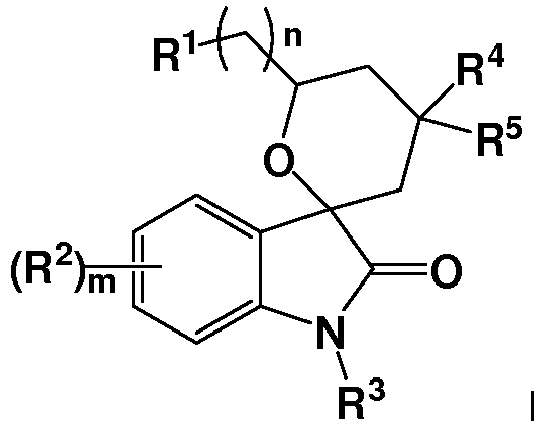 a) alkylation of indole nitrogen of a compound of formula I':
 b) amidation of indole nitrogen of a compound of formula I' as defined above:c) sulfonamidation of indole nitrogen of a compound of formula I' as defined above.
 - A pharmaceutical composition comprising a compound of formula I according to claim 1, and a pharmaceutically acceptable adjuvant.
- The pharmaceutical composition according to claim 13 for the treatment of proliferative diseases.
Applications Claiming Priority (5)
| Application Number | Priority Date | Filing Date | Title |
|---|---|---|---|
| US201261713221P | 2012-10-12 | 2012-10-12 | |
| US201261717935P | 2012-10-24 | 2012-10-24 | |
| US201261725756P | 2012-11-13 | 2012-11-13 | |
| US201361782831P | 2013-03-14 | 2013-03-14 | |
| PCT/JP2013/077682 WO2014058035A1 (en) | 2012-10-12 | 2013-10-04 | Novel spirooxindole derivative and process for producing the same |
Publications (3)
| Publication Number | Publication Date |
|---|---|
| EP2888268A1 EP2888268A1 (en) | 2015-07-01 |
| EP2888268A4 EP2888268A4 (en) | 2016-03-02 |
| EP2888268B1 true EP2888268B1 (en) | 2018-08-22 |
Family
ID=50477498
Family Applications (1)
| Application Number | Title | Priority Date | Filing Date |
|---|---|---|---|
| EP13846040.7A Active EP2888268B1 (en) | 2012-10-12 | 2013-10-04 | Novel spirooxindole derivative and process for producing the same |
Country Status (5)
| Country | Link |
|---|---|
| US (1) | US9309261B2 (en) |
| EP (1) | EP2888268B1 (en) |
| JP (1) | JP6281879B2 (en) |
| CN (1) | CN104995194B (en) |
| WO (1) | WO2014058035A1 (en) |
Families Citing this family (8)
| Publication number | Priority date | Publication date | Assignee | Title |
|---|---|---|---|---|
| US11306100B2 (en) | 2017-03-10 | 2022-04-19 | Council Of Scientific & Industrial Research | Spirooxindole compounds as GSK3B inhibitors and process for preparation thereof |
| US9822128B1 (en) | 2017-06-01 | 2017-11-21 | King Saud University | Substituted spirooxindoles |
| EP3814358B1 (en) * | 2019-07-11 | 2025-09-03 | Ascentage Pharma (Suzhou) Co., Ltd. | Method for preparing 2-indolinospirone compounds and intermediates thereof |
| CN113980028B (en) * | 2021-11-01 | 2023-03-03 | 浙江理工大学龙港研究院有限公司 | A kind of preparation method of chiral spiro indolinone compound |
| CN115403588A (en) * | 2022-08-04 | 2022-11-29 | 青岛农业大学 | Oxindole spirodibenzo[b,f]oxacycloctane compound and preparation method thereof |
| CN116554185B (en) * | 2023-01-03 | 2025-07-08 | 中国科学技术大学 | A chiral spirocyclic oxidized indole compound and preparation method thereof |
| CN116854700A (en) * | 2023-05-24 | 2023-10-10 | 江苏师范大学 | Isoindolone spiroisochromene compound and synthesis method thereof |
| WO2025013907A1 (en) * | 2023-07-10 | 2025-01-16 | Okinawa Institute Of Science And Technology School Corporation | Use of spirooxindole oxirane derivative for modifying peptide and/or protein |
Family Cites Families (3)
| Publication number | Priority date | Publication date | Assignee | Title |
|---|---|---|---|---|
| BR0010216A (en) * | 1999-05-04 | 2002-03-19 | American Home Prod | Thio-oxindole derivatives |
| US6355648B1 (en) | 1999-05-04 | 2002-03-12 | American Home Products Corporation | Thio-oxindole derivatives |
| US6391907B1 (en) * | 1999-05-04 | 2002-05-21 | American Home Products Corporation | Indoline derivatives |
-
2013
- 2013-10-04 CN CN201380051394.7A patent/CN104995194B/en active Active
- 2013-10-04 US US14/431,935 patent/US9309261B2/en active Active
- 2013-10-04 EP EP13846040.7A patent/EP2888268B1/en active Active
- 2013-10-04 WO PCT/JP2013/077682 patent/WO2014058035A1/en not_active Ceased
- 2013-10-04 JP JP2015517510A patent/JP6281879B2/en active Active
Non-Patent Citations (1)
| Title |
|---|
| None * |
Also Published As
| Publication number | Publication date |
|---|---|
| WO2014058035A1 (en) | 2014-04-17 |
| JP2015533115A (en) | 2015-11-19 |
| EP2888268A1 (en) | 2015-07-01 |
| CN104995194A (en) | 2015-10-21 |
| US9309261B2 (en) | 2016-04-12 |
| JP6281879B2 (en) | 2018-02-21 |
| US20150246927A1 (en) | 2015-09-03 |
| EP2888268A4 (en) | 2016-03-02 |
| CN104995194B (en) | 2017-08-29 |
Similar Documents
| Publication | Publication Date | Title |
|---|---|---|
| US9309261B2 (en) | Spirooxindole derivative and process for producing the same | |
| JP2932693B2 (en) | Pyrimidine compounds | |
| EP1144413B1 (en) | 2,5-diazabicyclo 2.2.1]heptane derivatives, their preparation and therapeutic uses | |
| EP0994100B1 (en) | 3-anilino-2-cycloalkenone derivates | |
| JP7781122B2 (en) | Novel modulators of sigma-2 receptors and methods of use thereof | |
| US9040738B2 (en) | Intermediate compounds of tamiflu, methods of preparation and uses thereof | |
| KR100551183B1 (en) | Process for preparing 1,3-substituted indene and aryl-fused azapolycyclic compounds | |
| AU2006275870A1 (en) | Novel 1-aryl-3-azabicyclo[3.1.0]hexanes: preparation and use to treat neuropsychiatric disorders | |
| CA2188427C (en) | Neurotransmitter release enhancers | |
| KR100420423B1 (en) | Aryl fused azapolycyclic compounds | |
| EP0151539A2 (en) | Benzobicyclic lactam acids, their derivatives, an intermediate in the preparation thereof and processes for the production thereof | |
| JPH10500138A (en) | Bicyclic amidine derivatives as nitric oxide synthase inhibitors | |
| US8252941B2 (en) | Process of making alpha-aminooxyketone/alpha-aminooxyaldehyde and alpha-hydroxyketone/alpha-hydroxyaldehyde compounds and a process making reaction products from cyclic alpha, beta-unsaturated ketone substrates and nitroso substrates | |
| EP3250549B1 (en) | Cyclopropylmethanamines as selective 5-ht(2c) receptor agonists | |
| JP2016505584A (en) | 3,5-Diarylazaindoles as DYRK1A protein inhibitors for the treatment of cognitive deficits associated with Down syndrome and Alzheimer's disease | |
| US20220127252A9 (en) | Methods of synthesizing a difluorolactam analog | |
| Mizutani et al. | A formal synthesis of a muscarinic M1 receptor antagonist,(-)-TAN1251A | |
| JPS604183A (en) | Imidazolidinedione derivative | |
| EP0947506A1 (en) | 2-Aza-bicyclo[2.2.1]heptane derivatives and their use as rotamase inhibitors | |
| Nagata et al. | Enantioselective synthesis of ent-Sedridine and (+)-coniine via Proline-catalyzed Mannich reaction | |
| MXPA05005517A (en) | Improved process for the preparation of 1,3-substituted indenes. | |
| US20160031817A1 (en) | 3-piperidone compounds and their use as neurokinin-1 (nk1) receptor antagonists | |
| FR2792635A1 (en) | 2-Amino-cyclobutene-3,4-dione cyclohexane carboxamide derivatives are phosphodiesterase inhibitors useful for treating e.g. incontinence, dysmenorrhea, premature labor, sexual dysfunction, angina and asthma | |
| US20070270400A1 (en) | New compounds 303 | |
| US20070270399A1 (en) | New compounds 302 |
Legal Events
| Date | Code | Title | Description |
|---|---|---|---|
| PUAI | Public reference made under article 153(3) epc to a published international application that has entered the european phase |
Free format text: ORIGINAL CODE: 0009012 |
|
| 17P | Request for examination filed |
Effective date: 20150324 |
|
| AK | Designated contracting states |
Kind code of ref document: A1 Designated state(s): AL AT BE BG CH CY CZ DE DK EE ES FI FR GB GR HR HU IE IS IT LI LT LU LV MC MK MT NL NO PL PT RO RS SE SI SK SM TR |
|
| AX | Request for extension of the european patent |
Extension state: BA ME |
|
| DAX | Request for extension of the european patent (deleted) | ||
| RA4 | Supplementary search report drawn up and despatched (corrected) |
Effective date: 20160128 |
|
| RIC1 | Information provided on ipc code assigned before grant |
Ipc: A61P 35/00 20060101ALI20160122BHEP Ipc: C07D 491/107 20060101AFI20160122BHEP Ipc: A61K 31/407 20060101ALI20160122BHEP |
|
| STAA | Information on the status of an ep patent application or granted ep patent |
Free format text: STATUS: EXAMINATION IS IN PROGRESS |
|
| 17Q | First examination report despatched |
Effective date: 20161024 |
|
| GRAP | Despatch of communication of intention to grant a patent |
Free format text: ORIGINAL CODE: EPIDOSNIGR1 |
|
| STAA | Information on the status of an ep patent application or granted ep patent |
Free format text: STATUS: GRANT OF PATENT IS INTENDED |
|
| INTG | Intention to grant announced |
Effective date: 20180326 |
|
| GRAS | Grant fee paid |
Free format text: ORIGINAL CODE: EPIDOSNIGR3 |
|
| GRAA | (expected) grant |
Free format text: ORIGINAL CODE: 0009210 |
|
| STAA | Information on the status of an ep patent application or granted ep patent |
Free format text: STATUS: THE PATENT HAS BEEN GRANTED |
|
| AK | Designated contracting states |
Kind code of ref document: B1 Designated state(s): AL AT BE BG CH CY CZ DE DK EE ES FI FR GB GR HR HU IE IS IT LI LT LU LV MC MK MT NL NO PL PT RO RS SE SI SK SM TR |
|
| REG | Reference to a national code |
Ref country code: GB Ref legal event code: FG4D |
|
| REG | Reference to a national code |
Ref country code: CH Ref legal event code: EP |
|
| REG | Reference to a national code |
Ref country code: AT Ref legal event code: REF Ref document number: 1032329 Country of ref document: AT Kind code of ref document: T Effective date: 20180915 |
|
| REG | Reference to a national code |
Ref country code: IE Ref legal event code: FG4D |
|
| REG | Reference to a national code |
Ref country code: DE Ref legal event code: R096 Ref document number: 602013042542 Country of ref document: DE |
|
| REG | Reference to a national code |
Ref country code: CH Ref legal event code: NV Representative=s name: LATSCHA SCHOELLHORN PARTNER AG, CH |
|
| REG | Reference to a national code |
Ref country code: CH Ref legal event code: PCOW |
|
| REG | Reference to a national code |
Ref country code: NL Ref legal event code: MP Effective date: 20180822 |
|
| REG | Reference to a national code |
Ref country code: LT Ref legal event code: MG4D |
|
| PG25 | Lapsed in a contracting state [announced via postgrant information from national office to epo] |
Ref country code: FI Free format text: LAPSE BECAUSE OF FAILURE TO SUBMIT A TRANSLATION OF THE DESCRIPTION OR TO PAY THE FEE WITHIN THE PRESCRIBED TIME-LIMIT Effective date: 20180822 Ref country code: IS Free format text: LAPSE BECAUSE OF FAILURE TO SUBMIT A TRANSLATION OF THE DESCRIPTION OR TO PAY THE FEE WITHIN THE PRESCRIBED TIME-LIMIT Effective date: 20181222 Ref country code: RS Free format text: LAPSE BECAUSE OF FAILURE TO SUBMIT A TRANSLATION OF THE DESCRIPTION OR TO PAY THE FEE WITHIN THE PRESCRIBED TIME-LIMIT Effective date: 20180822 Ref country code: GR Free format text: LAPSE BECAUSE OF FAILURE TO SUBMIT A TRANSLATION OF THE DESCRIPTION OR TO PAY THE FEE WITHIN THE PRESCRIBED TIME-LIMIT Effective date: 20181123 Ref country code: NO Free format text: LAPSE BECAUSE OF FAILURE TO SUBMIT A TRANSLATION OF THE DESCRIPTION OR TO PAY THE FEE WITHIN THE PRESCRIBED TIME-LIMIT Effective date: 20181122 Ref country code: NL Free format text: LAPSE BECAUSE OF FAILURE TO SUBMIT A TRANSLATION OF THE DESCRIPTION OR TO PAY THE FEE WITHIN THE PRESCRIBED TIME-LIMIT Effective date: 20180822 Ref country code: SE Free format text: LAPSE BECAUSE OF FAILURE TO SUBMIT A TRANSLATION OF THE DESCRIPTION OR TO PAY THE FEE WITHIN THE PRESCRIBED TIME-LIMIT Effective date: 20180822 Ref country code: BG Free format text: LAPSE BECAUSE OF FAILURE TO SUBMIT A TRANSLATION OF THE DESCRIPTION OR TO PAY THE FEE WITHIN THE PRESCRIBED TIME-LIMIT Effective date: 20181122 Ref country code: LT Free format text: LAPSE BECAUSE OF FAILURE TO SUBMIT A TRANSLATION OF THE DESCRIPTION OR TO PAY THE FEE WITHIN THE PRESCRIBED TIME-LIMIT Effective date: 20180822 |
|
| REG | Reference to a national code |
Ref country code: AT Ref legal event code: MK05 Ref document number: 1032329 Country of ref document: AT Kind code of ref document: T Effective date: 20180822 |
|
| PG25 | Lapsed in a contracting state [announced via postgrant information from national office to epo] |
Ref country code: HR Free format text: LAPSE BECAUSE OF FAILURE TO SUBMIT A TRANSLATION OF THE DESCRIPTION OR TO PAY THE FEE WITHIN THE PRESCRIBED TIME-LIMIT Effective date: 20180822 Ref country code: LV Free format text: LAPSE BECAUSE OF FAILURE TO SUBMIT A TRANSLATION OF THE DESCRIPTION OR TO PAY THE FEE WITHIN THE PRESCRIBED TIME-LIMIT Effective date: 20180822 Ref country code: AL Free format text: LAPSE BECAUSE OF FAILURE TO SUBMIT A TRANSLATION OF THE DESCRIPTION OR TO PAY THE FEE WITHIN THE PRESCRIBED TIME-LIMIT Effective date: 20180822 |
|
| PG25 | Lapsed in a contracting state [announced via postgrant information from national office to epo] |
Ref country code: ES Free format text: LAPSE BECAUSE OF FAILURE TO SUBMIT A TRANSLATION OF THE DESCRIPTION OR TO PAY THE FEE WITHIN THE PRESCRIBED TIME-LIMIT Effective date: 20180822 Ref country code: CZ Free format text: LAPSE BECAUSE OF FAILURE TO SUBMIT A TRANSLATION OF THE DESCRIPTION OR TO PAY THE FEE WITHIN THE PRESCRIBED TIME-LIMIT Effective date: 20180822 Ref country code: PL Free format text: LAPSE BECAUSE OF FAILURE TO SUBMIT A TRANSLATION OF THE DESCRIPTION OR TO PAY THE FEE WITHIN THE PRESCRIBED TIME-LIMIT Effective date: 20180822 Ref country code: RO Free format text: LAPSE BECAUSE OF FAILURE TO SUBMIT A TRANSLATION OF THE DESCRIPTION OR TO PAY THE FEE WITHIN THE PRESCRIBED TIME-LIMIT Effective date: 20180822 Ref country code: AT Free format text: LAPSE BECAUSE OF FAILURE TO SUBMIT A TRANSLATION OF THE DESCRIPTION OR TO PAY THE FEE WITHIN THE PRESCRIBED TIME-LIMIT Effective date: 20180822 Ref country code: EE Free format text: LAPSE BECAUSE OF FAILURE TO SUBMIT A TRANSLATION OF THE DESCRIPTION OR TO PAY THE FEE WITHIN THE PRESCRIBED TIME-LIMIT Effective date: 20180822 Ref country code: IT Free format text: LAPSE BECAUSE OF FAILURE TO SUBMIT A TRANSLATION OF THE DESCRIPTION OR TO PAY THE FEE WITHIN THE PRESCRIBED TIME-LIMIT Effective date: 20180822 |
|
| REG | Reference to a national code |
Ref country code: DE Ref legal event code: R097 Ref document number: 602013042542 Country of ref document: DE |
|
| PG25 | Lapsed in a contracting state [announced via postgrant information from national office to epo] |
Ref country code: SM Free format text: LAPSE BECAUSE OF FAILURE TO SUBMIT A TRANSLATION OF THE DESCRIPTION OR TO PAY THE FEE WITHIN THE PRESCRIBED TIME-LIMIT Effective date: 20180822 Ref country code: DK Free format text: LAPSE BECAUSE OF FAILURE TO SUBMIT A TRANSLATION OF THE DESCRIPTION OR TO PAY THE FEE WITHIN THE PRESCRIBED TIME-LIMIT Effective date: 20180822 Ref country code: SK Free format text: LAPSE BECAUSE OF FAILURE TO SUBMIT A TRANSLATION OF THE DESCRIPTION OR TO PAY THE FEE WITHIN THE PRESCRIBED TIME-LIMIT Effective date: 20180822 |
|
| REG | Reference to a national code |
Ref country code: BE Ref legal event code: MM Effective date: 20181031 |
|
| PG25 | Lapsed in a contracting state [announced via postgrant information from national office to epo] |
Ref country code: LU Free format text: LAPSE BECAUSE OF NON-PAYMENT OF DUE FEES Effective date: 20181004 Ref country code: MC Free format text: LAPSE BECAUSE OF FAILURE TO SUBMIT A TRANSLATION OF THE DESCRIPTION OR TO PAY THE FEE WITHIN THE PRESCRIBED TIME-LIMIT Effective date: 20180822 |
|
| PLBE | No opposition filed within time limit |
Free format text: ORIGINAL CODE: 0009261 |
|
| STAA | Information on the status of an ep patent application or granted ep patent |
Free format text: STATUS: NO OPPOSITION FILED WITHIN TIME LIMIT |
|
| REG | Reference to a national code |
Ref country code: IE Ref legal event code: MM4A |
|
| 26N | No opposition filed |
Effective date: 20190523 |
|
| PG25 | Lapsed in a contracting state [announced via postgrant information from national office to epo] |
Ref country code: FR Free format text: LAPSE BECAUSE OF NON-PAYMENT OF DUE FEES Effective date: 20181022 Ref country code: SI Free format text: LAPSE BECAUSE OF FAILURE TO SUBMIT A TRANSLATION OF THE DESCRIPTION OR TO PAY THE FEE WITHIN THE PRESCRIBED TIME-LIMIT Effective date: 20180822 Ref country code: BE Free format text: LAPSE BECAUSE OF NON-PAYMENT OF DUE FEES Effective date: 20181031 |
|
| PG25 | Lapsed in a contracting state [announced via postgrant information from national office to epo] |
Ref country code: IE Free format text: LAPSE BECAUSE OF NON-PAYMENT OF DUE FEES Effective date: 20181004 |
|
| PG25 | Lapsed in a contracting state [announced via postgrant information from national office to epo] |
Ref country code: MT Free format text: LAPSE BECAUSE OF NON-PAYMENT OF DUE FEES Effective date: 20181004 |
|
| PG25 | Lapsed in a contracting state [announced via postgrant information from national office to epo] |
Ref country code: TR Free format text: LAPSE BECAUSE OF FAILURE TO SUBMIT A TRANSLATION OF THE DESCRIPTION OR TO PAY THE FEE WITHIN THE PRESCRIBED TIME-LIMIT Effective date: 20180822 |
|
| PG25 | Lapsed in a contracting state [announced via postgrant information from national office to epo] |
Ref country code: PT Free format text: LAPSE BECAUSE OF FAILURE TO SUBMIT A TRANSLATION OF THE DESCRIPTION OR TO PAY THE FEE WITHIN THE PRESCRIBED TIME-LIMIT Effective date: 20180822 |
|
| PG25 | Lapsed in a contracting state [announced via postgrant information from national office to epo] |
Ref country code: MK Free format text: LAPSE BECAUSE OF NON-PAYMENT OF DUE FEES Effective date: 20180822 Ref country code: HU Free format text: LAPSE BECAUSE OF FAILURE TO SUBMIT A TRANSLATION OF THE DESCRIPTION OR TO PAY THE FEE WITHIN THE PRESCRIBED TIME-LIMIT; INVALID AB INITIO Effective date: 20131004 Ref country code: CY Free format text: LAPSE BECAUSE OF FAILURE TO SUBMIT A TRANSLATION OF THE DESCRIPTION OR TO PAY THE FEE WITHIN THE PRESCRIBED TIME-LIMIT Effective date: 20180822 |
|
| PGFP | Annual fee paid to national office [announced via postgrant information from national office to epo] |
Ref country code: GB Payment date: 20250828 Year of fee payment: 13 |
|
| REG | Reference to a national code |
Ref country code: CH Ref legal event code: U11 Free format text: ST27 STATUS EVENT CODE: U-0-0-U10-U11 (AS PROVIDED BY THE NATIONAL OFFICE) Effective date: 20251101 |
|
| PGFP | Annual fee paid to national office [announced via postgrant information from national office to epo] |
Ref country code: DE Payment date: 20250902 Year of fee payment: 13 |
|
| PGFP | Annual fee paid to national office [announced via postgrant information from national office to epo] |
Ref country code: CH Payment date: 20251101 Year of fee payment: 13 |