EP2887718B1 - Method and apparatus for registering devices capable of device-to-device communication in server - Google Patents
Method and apparatus for registering devices capable of device-to-device communication in server Download PDFInfo
- Publication number
- EP2887718B1 EP2887718B1 EP14195769.6A EP14195769A EP2887718B1 EP 2887718 B1 EP2887718 B1 EP 2887718B1 EP 14195769 A EP14195769 A EP 14195769A EP 2887718 B1 EP2887718 B1 EP 2887718B1
- Authority
- EP
- European Patent Office
- Prior art keywords
- communication
- server
- information
- communication device
- mobile terminal
- Prior art date
- Legal status (The legal status is an assumption and is not a legal conclusion. Google has not performed a legal analysis and makes no representation as to the accuracy of the status listed.)
- Not-in-force
Links
Images


Classifications
-
- H—ELECTRICITY
- H04—ELECTRIC COMMUNICATION TECHNIQUE
- H04L—TRANSMISSION OF DIGITAL INFORMATION, e.g. TELEGRAPHIC COMMUNICATION
- H04L9/00—Cryptographic mechanisms or cryptographic arrangements for secret or secure communications; Network security protocols
- H04L9/32—Cryptographic mechanisms or cryptographic arrangements for secret or secure communications; Network security protocols including means for verifying the identity or authority of a user of the system or for message authentication, e.g. authorization, entity authentication, data integrity or data verification, non-repudiation, key authentication or verification of credentials
- H04L9/3247—Cryptographic mechanisms or cryptographic arrangements for secret or secure communications; Network security protocols including means for verifying the identity or authority of a user of the system or for message authentication, e.g. authorization, entity authentication, data integrity or data verification, non-repudiation, key authentication or verification of credentials involving digital signatures
-
- H—ELECTRICITY
- H04—ELECTRIC COMMUNICATION TECHNIQUE
- H04L—TRANSMISSION OF DIGITAL INFORMATION, e.g. TELEGRAPHIC COMMUNICATION
- H04L9/00—Cryptographic mechanisms or cryptographic arrangements for secret or secure communications; Network security protocols
- H04L9/32—Cryptographic mechanisms or cryptographic arrangements for secret or secure communications; Network security protocols including means for verifying the identity or authority of a user of the system or for message authentication, e.g. authorization, entity authentication, data integrity or data verification, non-repudiation, key authentication or verification of credentials
-
- H—ELECTRICITY
- H04—ELECTRIC COMMUNICATION TECHNIQUE
- H04W—WIRELESS COMMUNICATION NETWORKS
- H04W12/00—Security arrangements; Authentication; Protecting privacy or anonymity
- H04W12/06—Authentication
-
- H—ELECTRICITY
- H04—ELECTRIC COMMUNICATION TECHNIQUE
- H04W—WIRELESS COMMUNICATION NETWORKS
- H04W12/00—Security arrangements; Authentication; Protecting privacy or anonymity
- H04W12/04—Key management, e.g. using generic bootstrapping architecture [GBA]
-
- H—ELECTRICITY
- H04—ELECTRIC COMMUNICATION TECHNIQUE
- H04W—WIRELESS COMMUNICATION NETWORKS
- H04W12/00—Security arrangements; Authentication; Protecting privacy or anonymity
- H04W12/50—Secure pairing of devices
-
- H—ELECTRICITY
- H04—ELECTRIC COMMUNICATION TECHNIQUE
- H04L—TRANSMISSION OF DIGITAL INFORMATION, e.g. TELEGRAPHIC COMMUNICATION
- H04L12/00—Data switching networks
- H04L12/28—Data switching networks characterised by path configuration, e.g. LAN [Local Area Networks] or WAN [Wide Area Networks]
- H04L12/2803—Home automation networks
- H04L2012/284—Home automation networks characterised by the type of medium used
- H04L2012/2841—Wireless
-
- H—ELECTRICITY
- H04—ELECTRIC COMMUNICATION TECHNIQUE
- H04L—TRANSMISSION OF DIGITAL INFORMATION, e.g. TELEGRAPHIC COMMUNICATION
- H04L12/00—Data switching networks
- H04L12/28—Data switching networks characterised by path configuration, e.g. LAN [Local Area Networks] or WAN [Wide Area Networks]
- H04L12/2803—Home automation networks
- H04L2012/2847—Home automation networks characterised by the type of home appliance used
- H04L2012/285—Generic home appliances, e.g. refrigerators
-
- H—ELECTRICITY
- H04—ELECTRIC COMMUNICATION TECHNIQUE
- H04W—WIRELESS COMMUNICATION NETWORKS
- H04W12/00—Security arrangements; Authentication; Protecting privacy or anonymity
- H04W12/60—Context-dependent security
- H04W12/69—Identity-dependent
- H04W12/77—Graphical identity
-
- H—ELECTRICITY
- H04—ELECTRIC COMMUNICATION TECHNIQUE
- H04W—WIRELESS COMMUNICATION NETWORKS
- H04W60/00—Affiliation to network, e.g. registration; Terminating affiliation with the network, e.g. de-registration
Definitions
- the present disclosure relates to a method and 1st D2D communication device for registering devices capable of device-to-device communication (hereinafter, D2D communication devices) in a server. More particularly, the present disclosure relates to a method and apparatus for validating D2D communication devices in a server via a mobile terminal.
- D2D communication devices capable of device-to-device communication
- Devices such as home appliances, etc., need registration and validation from a server to receive services from the server.
- Device users can input validation information (e.g., a PIN code, etc.) for validation from a server.
- Validation information can be transmitted from devices to a server or via additional equipment. When the validation information is transmitted from a device to a server via additional equipment, the device would need to be paired with that additional equipment.
- the pairing process may fail due to user faults, interference with equipment, etc. Accordingly, devices that users didn't consider for connection may engage in pairing between the user's devices.
- users can also directly input the device information and the digital signature information into the devices in order to transmit it to a server; however, this causes the user inconvenience.
- US-2013/145163 -A1 discloses a near field communication (NFC) sticker which stores a key is attached to a new client device.
- NFC near field communication
- a remote commander in a home network reads the key using a NFC interface and IR-transmits it to a home network server.
- the client Once the client is connected to the network, it encrypts its own device information with the key and sends the encrypted information to the server, which decrypts the data with the key sent from the remote commander. In this way, client device registration is executed easily and securely.
- US-2006/161774-A1 discloses an authentication method and system for devices in a home network.
- the device authentication method includes: storing a secret key list that contains IDs of computationally weak devices without public key operational capabilities, each ID being provided from the respective computationally weak device, and secret keys corresponding to the IDs; receiving session information including a session from a computationally weak device; operating the session information based on the secret key list, and authenticating the computationally weak device; if the computationally weak device is authenticated, generating authentication acknowledgement information about the session information and the authentication of the computationally weak device, and transmitting the information to a general device with public key operational capabilities; and at the general device, carrying out an operation on the received session information and extracting the session.
- US-2013/173811-A1 discloses a network system of a home appliance configured to set up a network of the home appliance by using a terminal, and a network set-up method of the same, after converting a home appliance having built with a WIFI module into an AP to enable the terminal to be connected to an AP home appliance, the information stored at the terminal is transmitted to the AP home appliance, and thus the WIFI may be set up without a separate manipulation of a user at the time of setting up the WIFI of the home appliance without adding an input/output apparatus such as a display apparatus or an interface, the set-up value of the AP, the device information, and the device authentication key may be changed, and thus is safer from hack attacks, an AP is not needed to be provided, and thus a cost-related advantage may be obtained.
- D2D communication devices capable of device-to-device communication
- a method for registering a 1st device-to-device, D2D, communication device in a server includes transmitting, by the 1st D2D communication device, digital signature information of the 1st D2D communication device to a mobile terminal via D2D communication, receiving, by the 1st D2D communication device, when the digital signature information is successfully authenticated in the server, server public encryption information, from the mobile terminal via D2D communication, and transmitting, by the 1st D2D communication device, device information of the 1st D2D communication device, which is encrypted using the server public encryption information, to the server for registration of the 1st D2D communication device in by server.
- a 1 st D2D communication device includes a communication unit configured to communicate with a mobile terminal via D2D communication, and a controller.
- the controller is configured to control the communication unit to transmit digital signature information of the 1st D2D communication device to the mobile terminal, receive, when the digital signature information is successfully authenticated in a server, server public encryption information, from the mobile terminal, and transmit device information of the 1st D2D communication device, which is encrypted using the server public encryption information, to the server for registration of the 1 st D2D communication device by the server.
- 'Mobile terminals' refer to electronic devices that can communicate with base stations, devices, and additional equipment via device-to-device (D2D) communication. It should be understood that the described examples can be applied to all information communication devices, multimedia devices, and their applications, for example, IP multimedia subsystem (IMS), terminals, personal computers (PCs), tablet PCs, Portable Multimedia Players (PMPs), Personal Digital Assistants (PDAs), smart phones, mobile phones, digital albums, etc.
- IMS IP multimedia subsystem
- PCs personal computers
- PMPs Portable Multimedia Players
- PDAs Personal Digital Assistants
- smart phones mobile phones, digital albums, etc.
- D2D communication refers to direct communication between electronic devices and includes, for example, 'Wi-Fi Direct,' 'Bluetooth,' Radio Frequency Identification (RFID),' Infrared Data Association (IrDA),' Near Field Communication (NFC),' ZigBee,' etc.
- RFID Radio Frequency Identification
- IrDA Infrared Data Association
- NFC Near Field Communication
- ZigBee ZigBee
- 'Wi-Fi Direct' implements Peer-To-Peer (P2P) transmission by direct communication between electronic devices without requiring an Internet access or a wireless Access Point (AP).
- P2P Peer-To-Peer
- AP wireless Access Point
- 'Wi-Fi Direct' is a standard that defines wireless P2P communication and enhances the communication performance.
- 'Wi-Fi Direct' is called Wi-Fi P2P.
- 'Wi-Fi Direct' has a type of infrastructure, not ad hoc, and supports direct communication between terminals, so that the security is enhanced, as compared to an ad hoc network.
- 'Wi-Fi Direct' can also provide Internet service support with more ease.
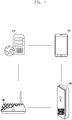
- FIG. 1 illustrates a system for registering a 1st device capable of device-to-device communication (1st D2D communication device) in a server according to an embodiment of the present disclosure.
- the system includes a server 110, a mobile terminal 120, a 1 st device 130, and a 2nd device 140.
- the server 110 authenticates devices, registers the devices if validated, and provides services to the authenticated devices.
- the server 110 also checks the states of home appliances, controls the home appliances, and provides corresponding services to the home appliances.
- the mobile terminal 120 communicates with additional equipment or the server 110.
- the 1st device 130 supports a D2D communication function.
- the 1st device 130 may include fixed or portable devices, e.g., televisions, refrigerators, air-conditioners, electric fans, headphones, vacuum cleaners, washing machines, humidifiers, gas stoves, water purifiers, electric ovens, etc. It should be understood that the 1st device 130 is not limited to home appliances.
- the 1st device 130 may include all types of devices that can support a D2D communication function and make D2D communication with the server 110.
- the 1 st device 130 can be connected to the 2nd device 140 or the mobile terminal 120 via D2D communication.
- the 1st device 130 may include a tag (e.g., a Quick Response (QR) code, an NFC tag, a RFID tag or a barcode).
- the tag of the 1st device 130 may be attached to or built in the 1st device 130, and may be in the form of a pattern.
- QR Quick Response
- the tag of the 1st device 130 may be implemented to be separate from the 1st device 130, e.g., disposed on a wall near the 1st device 130, on the user manual of the 1st device 130, on other devices, or the like.
- the 1 st device 130 may activate or deactivate a D2D communication function according to a user's input.
- the 1st device 130 may activate or deactivate a Wi-Fi Direct function when the user presses a particular button.
- the 2nd device 140 is connected to the server 110 via a wired or wireless connection, and serves as an AP.
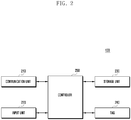
- FIG. 2 illustrates a block diagram of a 1st D2D communication device according to an embodiment of the present disclosure.
- the 1st device 130 includes a communication unit 210, an input unit 220, a storage unit 230, a tag 240, and a controller 250.
- the communication unit 210 performs D2D communication with other devices.
- D2D communication may include Wi-Fi Direct.
- the 1st device 130 can be connected to the mobile terminal 120 via a Wi-Fi Direct link.
- the 1st device 130 may be placed in a station mode and can be connected to the 2nd device 140. That is, the 1 st device may serve as an AP via Wi-Fi.
- the input unit 220 receives a user's input. That is, the 1st device 130 detects a user's input via the input unit 220.
- the input unit 220 may be implemented with input devices for performing functions of the 1st device 130.
- the input unit 220 includes a registration button for activating Wi-Fi Direct and initiating server authentication procedure.
- the registration button may be implemented with a soft key, a hard key, etc.
- the storage unit 230 includes volatile and non-volatile storage devices such as cache memory, Dynamic Random Access Memory (DRAM), Static Random Access Memory (SRAM), flash memory, magnetic disk storage, optical disc storage, etc.
- the storage unit 230 stores information of the 1st device 130, digital signature information of the 1st device 130, server public encryption information, private encryption information of the 1st device 130, public encryption information of the 1st device 130, etc.
- the tag 240 is an information system for the 1st device 130 and may be attached to the 1 st device 130.
- the tag 240 may include a QR code, an NFC tag, a RFID tag, a barcode, etc.
- the tag 240 includes information that the mobile terminal 120 needs to connect to the 1st device 130 via D2D communication (e.g., a Media Access Control (MAC) address of the 1st device 130, a Service Set Identifier (SSID), a Password, and a Secure Option, etc.), which is required for Wi-Fi Direct connection to the 1st device 130.
- MAC Media Access Control
- SSID Service Set Identifier
- Password e.g., a Password, and a Secure Option, etc.
- the tag 240 may also include at least one of the following: a Universal Resource Information (URI) of a server, public encryption information of the 1st device 130, a Certificate Authority (CA) signature, and device information of the 1st device 130.
- the public encryption information of the 1st device 130 may include a public key of the 1st device 130.
- the controller 250 transmits digital signature information of the 1st device 130 to the mobile terminal 120.
- server public encryption information is transmitted to the mobile terminal 120.
- the controller 250 encrypts device information of the 1st device 130 and controls the communication unit 210 to transmit the encrypted device information of the 1st device 130 to the server, thereby registering the 1st device in the server 110.
- the controller 250 detects a user's input via the input unit 220, the controller 250 controls the communication unit 210 to activate D2D communication.
- FIG. 3 illustrates a flow chart of a method for registering a 1st D2D communication device in a server according to an embodiment of the present disclosure.
- the controller controls the communication unit to activate D2D communication at operation S310.
- the 1st device initiates Wi-Fi Direct communication (i.e., an AP mode).
- the mobile terminal acquires validation information, which is required to be connected to the 1st device via D2D communication, from the tag of the 1st device.
- the validation information may be device information of the 1st device.
- the tag of the 1st device may include at least one of a QR code, an NFC tag, a RFID tag and a barcode.
- the mobile terminal is connected to the 1st device via D2D communication by using the information from the tag.
- the mobile terminal is connected to the 1st device by using MAC address of the 1st device, a SSID, a password, and a Secure Option, which may be required for Wi-Fi Direct connection to the 1st device.
- the 1st device transmits the digital signature information to the mobile terminal via D2D communication at operation S320.
- the mobile terminal transmits the device information and digital signature information of the 1st device to the server.
- the server authenticates the digital signature information of the 1st device and transmits the validation result to the mobile terminal.
- the server transmits the server public encryption information to the mobile terminal.
- the mobile terminal then transmits the server public encryption information to the 1 st device via D2D communication.
- the 1st device may perform a registration procedure to the server with the transmission of the encrypted device information to the server as follows.
- the 1st device disables D2D communication at operation S340 and then connects to the 2nd device via Wi-Fi at operation S350. That is, disabling D2D communication terminates the Wi-Fi Direct communication and places the 1st device in a station mode.
- the 1st device transmits the encrypted device information of the 1st device to the server via the 2nd device at operation S360.
- FIG. 4 illustrates a block diagram of a mobile terminal according to an embodiment of the present disclosure.
- the mobile terminal 120 includes a communication unit 410, an input unit 420, a camera unit 430, a storage unit 440, a display unit 450, a sensing unit 460, and a controller 470.
- the communication unit 410 establishes communication channels for a voice call, a video call, data transmission/reception such as videos, text messages, etc., under the control of the controller 470.
- the communication unit 410 communications with the 1 st device or the server via wired or wireless connections.
- the input unit 420 includes a number of keys and function keys for receiving number or characters and performing functions to the mobile terminal 120, according to the user's inputs/operations.
- the input unit 420 is an input system for receiving a user's inputs.
- the input unit 420 may be implemented with a touch panel, a microphone, buttons, mouse devices, a remote controller, a jog wheel, a jog switch, etc.
- the input unit 420 detects inputs for executing applications for recognizing, reading or capturing the tag 240 of the 1 st device 130.
- the camera unit 430 processes video frames captured by an image sensor in photographing mode or video call mode, etc., e.g., still images or moving images, etc.
- the processed video frames may be displayed on the display unit 450.
- the mobile terminal 120 can acquire the information of the 1st device from the tag 240 via the communication unit 410 or the camera unit 430.
- the tag of the 1 st device includes a QR code, an NFC tag, a RFID tag, and a barcode.
- the storage unit 440 includes volatile and non-volatile memory devices such as cache memory, DRAM, SRAM, flash memory, magnetic disk storage, optical disc storage, etc.
- the storage unit 440 stores information from the tag 240, digital signature information of the 1st device transmitted, a validation result of the 1st device that is received from the server, or server public encryption information.
- the storage unit 440 stores a video frame of a QR code captured by the camera unit 430 or the analysis result of the QR code from the video frame by the controller 470.
- the display unit 450 may be implemented with a Liquid Crystal Display (LCD), Light Emitting Diodes (LEDs), Organic Light Emitting Diodes (OLEDs), or the like.
- the display unit 450 displays images for user interface, pointer images, objects, etc.
- the display unit 450 displays applications for recognizing, reading or capturing the tag 240 of the 1 st device 130.
- the sensing unit 460 may include a various types of sensors for sending user's environment. Examples of the sensing unit 460 are a geomagnetic sensor, a temperature sensor, a pressure sensor, a proximity sensor, a luminance sensor, a Global Positioning System (GPS) sensor, an acceleration sensor, an angular velocity sensor, a speed sensor, a gravity sensor, a tilt sensor, a gyro sensor, etc.
- GPS Global Positioning System
- the controller 470 may include a microprocessor or microcomputer such as a central processing unit (CPU), a digital signal processor (DSP), etc.
- the controller 470 controls the communication unit 410 to receive the digital signature information of the 1st device 130 via D2D communication and transmit the digital signature information to the server 110.
- the controller 470 controls the communication unit 410 to receive the server public encryption information from the server 110, which the server 110 creates when the digital signature information of the 1st device is successfully authenticated by the server 110. After receiving the server public encryption information, the controller transmits the server public encryption information to the 1st device 130 via D2D communication.
- the controller 470 when transmitting the server public encryption information to the 1st device 130, may also transmit information required to be connected with the 2nd device 140 to the 1st device 130.
- the controller 470 analyzes a video frame of a QR code captured by the camera unit 430, acquires the information included in the QR code, and stores it in the storage unit 440.
- FIG. 5 illustrates a flow chart of a method for registering a 1st D2D communication device in a server by a mobile terminal according to an embodiment of the present disclosure.
- the mobile terminal acquires information required to be connected to the 1st device from a tag of the 1st device via D2D communication at operation S510.
- the information required to be connected to the 1 st device may include public encryption information of the 1 st device.
- the tag of the 1st device may include at least one of a QR code, an NFC tag, a RFID tag, a barcode, etc.
- the mobile terminal is connected to the 1st device using the acquired information.
- the mobile terminal receives digital signature information from the 1st device via D2D communication at operation S520, and transmits the digital signature information to the server at operation S530.
- the server authenticates the digital signature information of the 1st device and transmits the validation result to the mobile terminal.
- the mobile terminal receives the server public encryption information from the server at operation S540.
- the mobile terminal encrypts the received server public encryption information using the public encryption information of the 1st device at operation S550.
- the mobile terminal transmits the encrypted server public encryption information to the 1st device via D2D communication at operation S560.
- the mobile terminal when transmitting the server public encryption information to the 1st device, can also transmit information required to connect to the 2nd device.
- the information required to connect to the 2nd device may include at least one of a SSID of the 2nd device, a password, and a Secure Option.
- FIG. 6 illustrates a flow diagram of a method for registering a 1st device capable of D2D communication device (a 1st D2D communication device) in a server according to an embodiment of the present disclosure.
- a 1st D2D communication device 130 when a 1st D2D communication device 130 receives an input by a user pressing the registration button, the 1st D2D device 130 performs a mode switching operation and operates in Wi-Fi Direct AP mode at operation S605.
- the user can read information included in the tag of the 1st device via the mobile terminal.
- the camera unit of the mobile terminal can scan a QR code attached to the 1st device at operation S610. Reading information from a tag may include reading an NFC tag attached to the 1st device via the communication unit of the mobile terminal.
- the mobile terminal 120 acquires information from the NFC tag of the 1st device 130, which includes device information of the 1st device and public encryption information of the 1st device, at operation S615.
- the device information of the 1st device includes a MAC Address of the 1st device.
- the public encryption information of the 1st device includes a public key of the 1st device.
- the information acquired from the tag may further include information required for D2D communication with the 1st device (e.g., a SSID, a password, and a Secure Option, etc.), a URI of a server, and CA signature.
- the authentication procedure for the 1st device can be triggered by pressing the registration button and scanning the QR code.
- the mobile terminal When the authentication procedure for the 1st device is triggered, the mobile terminal is connected to the 1st device using the information acquired from the tag of the 1 st device.
- the mobile terminal is connected to the 1 st device, via Wi-Fi, by using the acquired from the tag at operation S620.
- the 1 st device encrypts the digital signature information of the 1st device by the private key of the 1st device and transmits the encrypted digital signature information to the mobile terminal via Wi-Fi at operation S625.
- the digital signature information may include a device signature.
- the mobile terminal When receiving the digital signature information of the 1st device, the mobile terminal is connected to the server via a mobile communication network (e.g., 3rd Generation Partnership Project (3GPP), Long Term Evolution (LTE), etc.) at operation S630. In that case, the mobile terminal and server can be connected to each other via a secure channel.
- the mobile terminal transmits the device information of the 1 st device and the digital signature information of the 1 st device to the server at operation S635.
- the digital signature information of the 1st device may include CA signature and Device Signature.
- the server After receiving the device information of the 1st device and the digital signature information of the 1st device, the server authenticates the received information at operation S640. The server transmits the validation result to the mobile terminal.
- the server transmits the server public encryption information and the validation result to the mobile terminal at operation S645.
- the server public encryption information may include a public key of the server.
- the server transmits a CA Signature, a validation result of the 1 st device, and the server public encryption information to the mobile terminal.
- the mobile terminal After receiving the server public encryption information, the mobile terminal encrypts information required to be connect to the 2nd device and the server public encryption information using public encryption information of the 1st device and transmits the encrypted information to the 1st device at operation S650.
- the information required to connect to the 2nd device may include a SSID, a password, and a Secure Option.
- the 1st device After receiving the encrypted information, decrypts the encrypted information using the private encryption information.
- the private encryption information of the 1 st device may include a private key of the 1st device.
- the mobile terminal also disables D2D communication.
- the 1st device performs a mode switching operation and operates in a station mode at operation S655.
- the 1st device is connected to the 2nd device using the information required to connect to the 2nd device at operation S660.
- the 1st device transmits the device information of the 1st device, encrypted by the server public encryption information, to the server via the 2nd device at operation S665.
- the server decrypts the encrypted device information and registers the 1st device therein at operation S670.
- the server provides services to the 1st device. For example, if the 1st device is a home appliance, the server can periodically check the states of the home appliance and transmit corresponding commands to the home appliance.
- the present disclosure is implemented in such a way that authentication information of devices that required for D2D communication can be stored in tags. That is, information needed to register the device in a server is stored in tags, and a mobile terminal can read the stored information from the tags, if necessary. This makes device users reduce information input time and increase user convenience.
- the present disclosure receives public encryption information from the server and the D2D communication devices and performs information transmission/reception by using the public encryption information, thereby increasing security.
Landscapes
- Engineering & Computer Science (AREA)
- Computer Security & Cryptography (AREA)
- Computer Networks & Wireless Communication (AREA)
- Signal Processing (AREA)
- Mobile Radio Communication Systems (AREA)
- Telephone Function (AREA)
- Telephonic Communication Services (AREA)
Description
- The present disclosure relates to a method and 1st D2D communication device for registering devices capable of device-to-device communication (hereinafter, D2D communication devices) in a server. More particularly, the present disclosure relates to a method and apparatus for validating D2D communication devices in a server via a mobile terminal.
- Devices, such as home appliances, etc., need registration and validation from a server to receive services from the server. Device users can input validation information (e.g., a PIN code, etc.) for validation from a server. Validation information can be transmitted from devices to a server or via additional equipment. When the validation information is transmitted from a device to a server via additional equipment, the device would need to be paired with that additional equipment.
- However, the pairing process may fail due to user faults, interference with equipment, etc. Accordingly, devices that users didn't consider for connection may engage in pairing between the user's devices. In addition, users can also directly input the device information and the digital signature information into the devices in order to transmit it to a server; however, this causes the user inconvenience.
- The above information is presented as background information only to assist with an understanding of the present disclosure. No determination has been made, and no assertion is made, as to whether any of the above might be applicable as prior art with regard to the present disclosure.
-
US-2013/145163 -A1 discloses a near field communication (NFC) sticker which stores a key is attached to a new client device. A remote commander in a home network reads the key using a NFC interface and IR-transmits it to a home network server. Once the client is connected to the network, it encrypts its own device information with the key and sends the encrypted information to the server, which decrypts the data with the key sent from the remote commander. In this way, client device registration is executed easily and securely. -
US-2006/161774-A1 discloses an authentication method and system for devices in a home network. The device authentication method includes: storing a secret key list that contains IDs of computationally weak devices without public key operational capabilities, each ID being provided from the respective computationally weak device, and secret keys corresponding to the IDs; receiving session information including a session from a computationally weak device; operating the session information based on the secret key list, and authenticating the computationally weak device; if the computationally weak device is authenticated, generating authentication acknowledgement information about the session information and the authentication of the computationally weak device, and transmitting the information to a general device with public key operational capabilities; and at the general device, carrying out an operation on the received session information and extracting the session. -
US-2013/173811-A1 discloses a network system of a home appliance configured to set up a network of the home appliance by using a terminal, and a network set-up method of the same, after converting a home appliance having built with a WIFI module into an AP to enable the terminal to be connected to an AP home appliance, the information stored at the terminal is transmitted to the AP home appliance, and thus the WIFI may be set up without a separate manipulation of a user at the time of setting up the WIFI of the home appliance without adding an input/output apparatus such as a display apparatus or an interface, the set-up value of the AP, the device information, and the device authentication key may be changed, and thus is safer from hack attacks, an AP is not needed to be provided, and thus a cost-related advantage may be obtained. - It is an aim of certain embodiments of the present invention to provide a method and 1st D2D communication device for registering devices capable of device-to-device communication (D2D communication devices) in a server, and validating the devices via a mobile terminal.
- In accordance with a first aspect of the present invention, a method for registering a 1st device-to-device, D2D, communication device in a server is provided. The method includes transmitting, by the 1st D2D communication device, digital signature information of the 1st D2D communication device to a mobile terminal via D2D communication, receiving, by the 1st D2D communication device, when the digital signature information is successfully authenticated in the server, server public encryption information, from the mobile terminal via D2D communication, and transmitting, by the 1st D2D communication device, device information of the 1st D2D communication device, which is encrypted using the server public encryption information, to the server for registration of the 1st D2D communication device in by server.
- In accordance with a second aspect of the present invention, a 1 st D2D communication device is provided. The device includes a communication unit configured to communicate with a mobile terminal via D2D communication, and a controller. The controller is configured to control the communication unit to transmit digital signature information of the 1st D2D communication device to the mobile terminal, receive, when the digital signature information is successfully authenticated in a server, server public encryption information, from the mobile terminal, and transmit device information of the 1st D2D communication device, which is encrypted using the server public encryption information, to the server for registration of the 1 st D2D communication device by the server.
- Other aspects, advantages, and salient features of the disclosure will become apparent to those skilled in the art from the following detailed description, which, taken in conjunction with the annexed drawings, discloses various embodiments of the present disclosure.
- The above and other aspects, features, and advantages of certain embodiments of the present disclosure will be more apparent from the following description taken in conjunction with the accompanying drawings, in which:
-
FIG. 1 illustrates a system for registering a 1st device capable of device-to-device communication (1st D2D communication device) in a server according to an embodiment of the present disclosure; -
FIG. 2 illustrates a block diagram of a 1st D2D communication device according to an embodiment of the present disclosure; -
FIG. 3 illustrates a flow chart of a method for registering a 1st D2D communication device in a server according to an embodiment of the present disclosure; -
FIG. 4 illustrates a block diagram of a mobile terminal according to an embodiment of the present disclosure; -
FIG. 5 illustrates a flow chart of a method for registering a 1st D2D communication device in a server by a mobile terminal according to an embodiment of the present disclosure; and -
FIG. 6 illustrates a flow diagram of a method for registering a 1st D2D communication device in a server according to an embodiment of the present disclosure. - Throughout the drawings, it should be noted that like reference numbers are used to depict the same or similar elements, features, and structures.
- The following description with reference to the accompanying drawings is provided to assist in a comprehensive understanding of various embodiments of the present disclosure as defined by the claims and their equivalents. It includes various specific details to assist in that understanding but these are to be regarded as merely exemplary. In addition, descriptions of well-known functions and constructions may be omitted for clarity and conciseness.
- The terms and words used in the following description and claims are not limited to the bibliographical meanings, but, are merely used by the inventor to enable a clear and consistent understanding of the present disclosure.
- It is to be understood that the singular forms "a," "an," and "the" include plural referents unless the context clearly dictates otherwise. Thus, for example, reference to "a component surface" includes reference to one or more of such surfaces.
- It will be further understood that the terms "includes," "comprises," "including" and/or "comprising," when used in this specification, specify the presence of stated features, integers, steps, operations, elements, and/or components, but do not preclude the presence or addition of one or more other features, integers, steps, operations, elements, components, and/or groups thereof. It will be understood that when an element is referred to as being "connected" or "coupled" to another element, it can be directly connected or coupled to the other element or intervening elements may be present. Furthermore, "connected" or "coupled" as used herein may include wirelessly connected or coupled. As used herein, the term "and/or" includes any and all combinations of one or more of the associated listed items.
- 'Mobile terminals' refer to electronic devices that can communicate with base stations, devices, and additional equipment via device-to-device (D2D) communication. It should be understood that the described examples can be applied to all information communication devices, multimedia devices, and their applications, for example, IP multimedia subsystem (IMS), terminals, personal computers (PCs), tablet PCs, Portable Multimedia Players (PMPs), Personal Digital Assistants (PDAs), smart phones, mobile phones, digital albums, etc.
- D2D communication refers to direct communication between electronic devices and includes, for example, 'Wi-Fi Direct,' 'Bluetooth,' Radio Frequency Identification (RFID),' Infrared Data Association (IrDA),' Near Field Communication (NFC),' ZigBee,' etc.
- For example, 'Wi-Fi Direct' implements Peer-To-Peer (P2P) transmission by direct communication between electronic devices without requiring an Internet access or a wireless Access Point (AP). 'Wi-Fi Direct' is a standard that defines wireless P2P communication and enhances the communication performance. 'Wi-Fi Direct' is called Wi-Fi P2P. 'Wi-Fi Direct' has a type of infrastructure, not ad hoc, and supports direct communication between terminals, so that the security is enhanced, as compared to an ad hoc network. 'Wi-Fi Direct' can also provide Internet service support with more ease.
- Preferred embodiments according to the disclosure will be described in detail with reference to the accompanying drawings. The embodiment of the disclosure is provided such that those skilled in the art completely understand the disclosure. Therefore, the shapes of elements in the drawings are exaggerated to focus on the disclosure. In the drawings, the same or similar elements are denoted by the same reference numerals even though they are depicted in different drawings.
-
FIG. 1 illustrates a system for registering a 1st device capable of device-to-device communication (1st D2D communication device) in a server according to an embodiment of the present disclosure. - Referring to
FIG. 1 , the system includes aserver 110, amobile terminal 120, a 1st device 130, and a2nd device 140. - The
server 110 authenticates devices, registers the devices if validated, and provides services to the authenticated devices. Theserver 110 also checks the states of home appliances, controls the home appliances, and provides corresponding services to the home appliances. Themobile terminal 120 communicates with additional equipment or theserver 110. The1st device 130 supports a D2D communication function. The1st device 130 may include fixed or portable devices, e.g., televisions, refrigerators, air-conditioners, electric fans, headphones, vacuum cleaners, washing machines, humidifiers, gas stoves, water purifiers, electric ovens, etc. It should be understood that the1st device 130 is not limited to home appliances. That is, the1st device 130 may include all types of devices that can support a D2D communication function and make D2D communication with theserver 110. The 1st device 130 can be connected to the2nd device 140 or themobile terminal 120 via D2D communication. The1st device 130 may include a tag (e.g., a Quick Response (QR) code, an NFC tag, a RFID tag or a barcode). The tag of the1st device 130 may be attached to or built in the1st device 130, and may be in the form of a pattern. The tag of the1st device 130 may be implemented to be separate from the1st device 130, e.g., disposed on a wall near the1st device 130, on the user manual of the1st device 130, on other devices, or the like. In an embodiment of the present disclosure, the 1st device 130 may activate or deactivate a D2D communication function according to a user's input. For example, the1st device 130 may activate or deactivate a Wi-Fi Direct function when the user presses a particular button. The2nd device 140 is connected to theserver 110 via a wired or wireless connection, and serves as an AP. -
FIG. 2 illustrates a block diagram of a 1st D2D communication device according to an embodiment of the present disclosure. - Referring to
FIG. 2 , the1st device 130 includes acommunication unit 210, aninput unit 220, astorage unit 230, atag 240, and acontroller 250. - The
communication unit 210 performs D2D communication with other devices. In an embodiment of the present disclosure, D2D communication may include Wi-Fi Direct. Thus, the1st device 130 can be connected to themobile terminal 120 via a Wi-Fi Direct link. In an embodiment of the present disclosure, the1st device 130 may be placed in a station mode and can be connected to the2nd device 140. That is, the 1 st device may serve as an AP via Wi-Fi. - The
input unit 220 receives a user's input. That is, the1st device 130 detects a user's input via theinput unit 220. Theinput unit 220 may be implemented with input devices for performing functions of the1st device 130. For example, theinput unit 220 includes a registration button for activating Wi-Fi Direct and initiating server authentication procedure. The registration button may be implemented with a soft key, a hard key, etc. - The
storage unit 230 includes volatile and non-volatile storage devices such as cache memory, Dynamic Random Access Memory (DRAM), Static Random Access Memory (SRAM), flash memory, magnetic disk storage, optical disc storage, etc. Thestorage unit 230 stores information of the1st device 130, digital signature information of the1st device 130, server public encryption information, private encryption information of the1st device 130, public encryption information of the1st device 130, etc. - The
tag 240 is an information system for the1st device 130 and may be attached to the 1st device 130. Thetag 240 may include a QR code, an NFC tag, a RFID tag, a barcode, etc. Thetag 240 includes information that themobile terminal 120 needs to connect to the1st device 130 via D2D communication (e.g., a Media Access Control (MAC) address of the1st device 130, a Service Set Identifier (SSID), a Password, and a Secure Option, etc.), which is required for Wi-Fi Direct connection to the1st device 130. Thetag 240 may also include at least one of the following: a Universal Resource Information (URI) of a server, public encryption information of the1st device 130, a Certificate Authority (CA) signature, and device information of the1st device 130. The public encryption information of the1st device 130 may include a public key of the1st device 130. - The
controller 250 transmits digital signature information of the1st device 130 to themobile terminal 120. When authentication of the digital signature information is successful in theserver 110, server public encryption information is transmitted to themobile terminal 120. Using the received server public encryption information, thecontroller 250 encrypts device information of the1st device 130 and controls thecommunication unit 210 to transmit the encrypted device information of the1st device 130 to the server, thereby registering the 1st device in theserver 110. When thecontroller 250 detects a user's input via theinput unit 220, thecontroller 250 controls thecommunication unit 210 to activate D2D communication. -
FIG. 3 illustrates a flow chart of a method for registering a 1st D2D communication device in a server according to an embodiment of the present disclosure. - Referring to
FIG. 3 , when the 1st device detects a user's input, the controller controls the communication unit to activate D2D communication at operation S310. For example, when a user presses a server registration button on the 1st device, the 1st device initiates Wi-Fi Direct communication (i.e., an AP mode). The mobile terminal acquires validation information, which is required to be connected to the 1st device via D2D communication, from the tag of the 1st device. The validation information may be device information of the 1st device. The tag of the 1st device may include at least one of a QR code, an NFC tag, a RFID tag and a barcode. - The mobile terminal is connected to the 1st device via D2D communication by using the information from the tag. For example, the mobile terminal is connected to the 1st device by using MAC address of the 1st device, a SSID, a password, and a Secure Option, which may be required for Wi-Fi Direct connection to the 1st device. The 1st device transmits the digital signature information to the mobile terminal via D2D communication at operation S320. The mobile terminal transmits the device information and digital signature information of the 1st device to the server. The server authenticates the digital signature information of the 1st device and transmits the validation result to the mobile terminal. When the server successfully authenticates the digital signature information of the 1st device, the server transmits the server public encryption information to the mobile terminal. The mobile terminal then transmits the server public encryption information to the 1 st device via D2D communication.
- After receiving the server public encryption information from the mobile terminal via D2D communication at operation S330, the 1st device may perform a registration procedure to the server with the transmission of the encrypted device information to the server as follows. The 1st device disables D2D communication at operation S340 and then connects to the 2nd device via Wi-Fi at operation S350. That is, disabling D2D communication terminates the Wi-Fi Direct communication and places the 1st device in a station mode. When the 2nd device is connected to the server, the 1st device transmits the encrypted device information of the 1st device to the server via the 2nd device at operation S360.
-
FIG. 4 illustrates a block diagram of a mobile terminal according to an embodiment of the present disclosure. - Referring to
FIG. 4 , themobile terminal 120 includes acommunication unit 410, aninput unit 420, acamera unit 430, astorage unit 440, adisplay unit 450, asensing unit 460, and acontroller 470. - The
communication unit 410 establishes communication channels for a voice call, a video call, data transmission/reception such as videos, text messages, etc., under the control of thecontroller 470. Thecommunication unit 410 communications with the 1 st device or the server via wired or wireless connections. - The
input unit 420 includes a number of keys and function keys for receiving number or characters and performing functions to themobile terminal 120, according to the user's inputs/operations. Theinput unit 420 is an input system for receiving a user's inputs. Theinput unit 420 may be implemented with a touch panel, a microphone, buttons, mouse devices, a remote controller, a jog wheel, a jog switch, etc. Theinput unit 420 detects inputs for executing applications for recognizing, reading or capturing thetag 240 of the 1st device 130. - The
camera unit 430 processes video frames captured by an image sensor in photographing mode or video call mode, etc., e.g., still images or moving images, etc. The processed video frames may be displayed on thedisplay unit 450. - The
mobile terminal 120 can acquire the information of the 1st device from thetag 240 via thecommunication unit 410 or thecamera unit 430. The tag of the 1 st device includes a QR code, an NFC tag, a RFID tag, and a barcode. - The
storage unit 440 includes volatile and non-volatile memory devices such as cache memory, DRAM, SRAM, flash memory, magnetic disk storage, optical disc storage, etc. Thestorage unit 440 stores information from thetag 240, digital signature information of the 1st device transmitted, a validation result of the 1st device that is received from the server, or server public encryption information. For example, thestorage unit 440 stores a video frame of a QR code captured by thecamera unit 430 or the analysis result of the QR code from the video frame by thecontroller 470. - The
display unit 450 may be implemented with a Liquid Crystal Display (LCD), Light Emitting Diodes (LEDs), Organic Light Emitting Diodes (OLEDs), or the like. Thedisplay unit 450 displays images for user interface, pointer images, objects, etc. Thedisplay unit 450 displays applications for recognizing, reading or capturing thetag 240 of the 1st device 130. - The
sensing unit 460 may include a various types of sensors for sending user's environment. Examples of thesensing unit 460 are a geomagnetic sensor, a temperature sensor, a pressure sensor, a proximity sensor, a luminance sensor, a Global Positioning System (GPS) sensor, an acceleration sensor, an angular velocity sensor, a speed sensor, a gravity sensor, a tilt sensor, a gyro sensor, etc. - The
controller 470 may include a microprocessor or microcomputer such as a central processing unit (CPU), a digital signal processor (DSP), etc. Thecontroller 470 controls thecommunication unit 410 to receive the digital signature information of the1st device 130 via D2D communication and transmit the digital signature information to theserver 110. Thecontroller 470 controls thecommunication unit 410 to receive the server public encryption information from theserver 110, which theserver 110 creates when the digital signature information of the 1st device is successfully authenticated by theserver 110. After receiving the server public encryption information, the controller transmits the server public encryption information to the1st device 130 via D2D communication. In an embodiment of the present disclosure, when transmitting the server public encryption information to the1st device 130, thecontroller 470 may also transmit information required to be connected with the2nd device 140 to the1st device 130. Thecontroller 470 analyzes a video frame of a QR code captured by thecamera unit 430, acquires the information included in the QR code, and stores it in thestorage unit 440. -
FIG. 5 illustrates a flow chart of a method for registering a 1st D2D communication device in a server by a mobile terminal according to an embodiment of the present disclosure. - Referring to
FIG. 5 , the mobile terminal acquires information required to be connected to the 1st device from a tag of the 1st device via D2D communication at operation S510. The information required to be connected to the 1 st device may include public encryption information of the 1 st device. The tag of the 1st device may include at least one of a QR code, an NFC tag, a RFID tag, a barcode, etc. - The mobile terminal is connected to the 1st device using the acquired information. The mobile terminal receives digital signature information from the 1st device via D2D communication at operation S520, and transmits the digital signature information to the server at operation S530.
- The server authenticates the digital signature information of the 1st device and transmits the validation result to the mobile terminal. When the digital signature information is successfully authenticated, the mobile terminal receives the server public encryption information from the server at operation S540. The mobile terminal encrypts the received server public encryption information using the public encryption information of the 1st device at operation S550. The mobile terminal transmits the encrypted server public encryption information to the 1st device via D2D communication at operation S560. In an embodiment of the present disclosure, when transmitting the server public encryption information to the 1st device, the mobile terminal can also transmit information required to connect to the 2nd device. The information required to connect to the 2nd device may include at least one of a SSID of the 2nd device, a password, and a Secure Option.
-
FIG. 6 illustrates a flow diagram of a method for registering a 1st device capable of D2D communication device (a 1st D2D communication device) in a server according to an embodiment of the present disclosure. - Referring to
FIG. 6 , when a 1stD2D communication device 130 receives an input by a user pressing the registration button, the1st D2D device 130 performs a mode switching operation and operates in Wi-Fi Direct AP mode at operation S605. The user can read information included in the tag of the 1st device via the mobile terminal. The camera unit of the mobile terminal can scan a QR code attached to the 1st device at operation S610. Reading information from a tag may include reading an NFC tag attached to the 1st device via the communication unit of the mobile terminal. Themobile terminal 120 acquires information from the NFC tag of the1st device 130, which includes device information of the 1st device and public encryption information of the 1st device, at operation S615. The device information of the 1st device includes a MAC Address of the 1st device. The public encryption information of the 1st device includes a public key of the 1st device. The information acquired from the tag may further include information required for D2D communication with the 1st device (e.g., a SSID, a password, and a Secure Option, etc.), a URI of a server, and CA signature. In an embodiment of the present disclosure, the authentication procedure for the 1st device can be triggered by pressing the registration button and scanning the QR code. - When the authentication procedure for the 1st device is triggered, the mobile terminal is connected to the 1st device using the information acquired from the tag of the 1 st device. The mobile terminal is connected to the 1 st device, via Wi-Fi, by using the acquired from the tag at operation S620. The 1 st device encrypts the digital signature information of the 1st device by the private key of the 1st device and transmits the encrypted digital signature information to the mobile terminal via Wi-Fi at operation S625. The digital signature information may include a device signature.
- When receiving the digital signature information of the 1st device, the mobile terminal is connected to the server via a mobile communication network (e.g., 3rd Generation Partnership Project (3GPP), Long Term Evolution (LTE), etc.) at operation S630. In that case, the mobile terminal and server can be connected to each other via a secure channel. The mobile terminal transmits the device information of the 1 st device and the digital signature information of the 1 st device to the server at operation S635. The digital signature information of the 1st device may include CA signature and Device Signature. After receiving the device information of the 1st device and the digital signature information of the 1st device, the server authenticates the received information at operation S640. The server transmits the validation result to the mobile terminal. When the digital signature information of the 1st device is authenticated, the server transmits the server public encryption information and the validation result to the mobile terminal at operation S645. The server public encryption information may include a public key of the server. In an embodiment of the present disclosure, the server transmits a CA Signature, a validation result of the 1 st device, and the server public encryption information to the mobile terminal.
- After receiving the server public encryption information, the mobile terminal encrypts information required to be connect to the 2nd device and the server public encryption information using public encryption information of the 1st device and transmits the encrypted information to the 1st device at operation S650. The information required to connect to the 2nd device may include a SSID, a password, and a Secure Option. After receiving the encrypted information, the 1st device decrypts the encrypted information using the private encryption information. The private encryption information of the 1 st device may include a private key of the 1st device. The mobile terminal also disables D2D communication. The 1st device performs a mode switching operation and operates in a station mode at operation S655. After that, the 1st device is connected to the 2nd device using the information required to connect to the 2nd device at operation S660. After connecting to the 2nd device, the 1st device transmits the device information of the 1st device, encrypted by the server public encryption information, to the server via the 2nd device at operation S665. When receiving the encrypted device information of the 1st device, the server decrypts the encrypted device information and registers the 1st device therein at operation S670. After that, the server provides services to the 1st device. For example, if the 1st device is a home appliance, the server can periodically check the states of the home appliance and transmit corresponding commands to the home appliance.
- As described above, the present disclosure is implemented in such a way that authentication information of devices that required for D2D communication can be stored in tags. That is, information needed to register the device in a server is stored in tags, and a mobile terminal can read the stored information from the tags, if necessary. This makes device users reduce information input time and increase user convenience. The present disclosure receives public encryption information from the server and the D2D communication devices and performs information transmission/reception by using the public encryption information, thereby increasing security.
Claims (12)
- A method for registering a 1st device-to-device, D2D, communication device (130) in a server (110), the method comprising:transmitting (S625), by the 1st D2D communication device (130), digital signature information of the 1st D2D communication device (130) to a mobile terminal (120) via D2D communication;receiving (S650), by the 1st D2D communication device (130), when the digital signature information is successfully authenticated in the server (110), server public encryption information, from the mobile terminal (120) via D2D communication; andtransmitting (S665), by the 1st D2D communication device (130), device information of the 1st D2D communication device, which is encrypted using the server public encryption information, to the server for registration of the 1st D2D communication device (130) by the server (110).
- The method of claim 1, further comprising:activating (S605) D2D communication when sensing a user's input.
- The method of claim 2, wherein the D2D communication comprises Wi-Fi Direct.
- The method of claim 1, wherein the mobile terminal (120) acquires (S615) information required to connect to the 1st D2D communication device (130) via D2D communication, from a tag attached to the 1st D2D communication device (130).
- The method of claim 4, wherein the tag comprises:at least one of a Quick Response, QR, code, a Near Field Communication, NFC, tag, a Radio Frequency Identification, RFID, tag, and a barcode.
- The method of claim 1, wherein the transmission (S665) of the device information encrypted and the registration of the 1st D2D communication device (130) comprises:deactivating D2D communication;connecting (S660) to a 2nd device (140); andtransmitting (S665) the encrypted device information of the 1st D2D communication device (130) to the server (110) via the 2nd device (140).
- A 1st device-to-device, D2D, communication device (130), the 1st D2D communication device (130) comprising:a communication unit (210) configured to communicate with a mobile terminal via D2D communication; anda controller (250) configured:to control the communication unit (210) to transmit (S625) digital signature information of the 1st D2D communication device (130) to the mobile terminal (120);to receive (S650), when the digital signature information is successfully authenticated in a server (110), server public encryption information from the mobile terminal (120); andto transmit (S665) device information of the 1st D2D communication device (130), which is encrypted using the server public encryption information, to the server for registration of the 1st D2D communication device (130) by the server (110).
- The 1st D2D communication device (130) of claim 7, further comprising:an input unit (220) configured to sense a user's input;wherein the controller (250) is further configured to activate (S605) D2D communication when sensing a user's input via the input unit (220).
- The 1st D2D communication device (130) of claim 7, further comprising:a tag (240) attached to the 1st D2D communication device (130);wherein the tag (240) comprises information that the mobile terminal (120) needs to connect to the 1st D2D communication device (130) via D2D communication.
- The 1st D2D communication device (130) of claim 9, wherein the tag (240) further comprises:at least one of a Quick Response, QR, code, a Near Field Communication, NFC, tag, a Radio Frequency Identification, RFID, tag, and a barcode.
- The 1st D2D communication device (130) of claim 8, wherein the D2D communication comprises Wi-Fi Direct.
- The 1st D2D communication device (130) of claim 7, wherein the controller (250) is further configured to:deactivate D2D communication;connect (S660) to a 2nd device (140); andtransmit (S665) the encrypted device information of the 1st D2D communication device to the server (110) via the 2nd device (140).
Priority Applications (1)
| Application Number | Priority Date | Filing Date | Title |
|---|---|---|---|
| EP17178229.5A EP3247143B1 (en) | 2013-12-17 | 2014-12-02 | Registering a device capable of device-to-device communication in server |
Applications Claiming Priority (1)
| Application Number | Priority Date | Filing Date | Title |
|---|---|---|---|
| KR1020130157442A KR102136543B1 (en) | 2013-12-17 | 2013-12-17 | Method and apparatus for registering device capable of device-to-device communication to server |
Related Child Applications (1)
| Application Number | Title | Priority Date | Filing Date |
|---|---|---|---|
| EP17178229.5A Division EP3247143B1 (en) | 2013-12-17 | 2014-12-02 | Registering a device capable of device-to-device communication in server |
Publications (2)
| Publication Number | Publication Date |
|---|---|
| EP2887718A1 EP2887718A1 (en) | 2015-06-24 |
| EP2887718B1 true EP2887718B1 (en) | 2017-06-28 |
Family
ID=52015880
Family Applications (2)
| Application Number | Title | Priority Date | Filing Date |
|---|---|---|---|
| EP17178229.5A Not-in-force EP3247143B1 (en) | 2013-12-17 | 2014-12-02 | Registering a device capable of device-to-device communication in server |
| EP14195769.6A Not-in-force EP2887718B1 (en) | 2013-12-17 | 2014-12-02 | Method and apparatus for registering devices capable of device-to-device communication in server |
Family Applications Before (1)
| Application Number | Title | Priority Date | Filing Date |
|---|---|---|---|
| EP17178229.5A Not-in-force EP3247143B1 (en) | 2013-12-17 | 2014-12-02 | Registering a device capable of device-to-device communication in server |
Country Status (3)
| Country | Link |
|---|---|
| US (1) | US9509515B2 (en) |
| EP (2) | EP3247143B1 (en) |
| KR (1) | KR102136543B1 (en) |
Families Citing this family (22)
| Publication number | Priority date | Publication date | Assignee | Title |
|---|---|---|---|---|
| US10631162B2 (en) * | 2013-10-30 | 2020-04-21 | Samsung Electronics Co., Ltd. | Method and apparatus to perform device to device communication in wireless communication network |
| CN106488379A (en) * | 2015-08-24 | 2017-03-08 | 深圳富泰宏精密工业有限公司 | Access the Apparatus and method for of wireless network |
| CN105246128B (en) * | 2015-10-20 | 2017-07-21 | 广东欧珀移动通信有限公司 | The network-building method and device of a kind of intelligent terminal |
| WO2017096513A1 (en) * | 2015-12-07 | 2017-06-15 | Motorola Solutions, Inc. | Method and apparatus for establishing a secure wireless connection for a provisioning of configuration information |
| JP6827773B2 (en) * | 2016-01-18 | 2021-02-10 | キヤノン株式会社 | Communication equipment, communication methods and programs |
| JP6704738B2 (en) * | 2016-01-26 | 2020-06-03 | キヤノン株式会社 | Communication device, communication method, and program |
| KR102470455B1 (en) * | 2016-02-01 | 2022-11-24 | 삼성전자 주식회사 | Electronic device, display apparatus and control method thereof |
| US10425450B2 (en) * | 2016-02-27 | 2019-09-24 | Ofinno, Llc | Mission critical communications |
| EP3253095B1 (en) * | 2016-05-31 | 2020-04-08 | Advanced Digital Broadcast S.A. | An iot-enabled device and a method for manufacturing an iot device |
| KR102314690B1 (en) * | 2017-04-11 | 2021-10-20 | 삼성전자주식회사 | Device And Communication Connection Method Thereof |
| US10547613B1 (en) * | 2017-05-17 | 2020-01-28 | Amazon Technologies, Inc. | Simplified association of devices with a network using unique codes on the devices and side channel communication |
| CN109905877B (en) | 2017-12-08 | 2020-11-10 | 大唐移动通信设备有限公司 | Message verification method of communication network system, communication method and communication network system |
| CN108055284B (en) * | 2018-01-05 | 2021-06-04 | 上海大学 | A data forwarding method on D2D link based on Wi-Fi Direct |
| US11777715B2 (en) * | 2019-05-15 | 2023-10-03 | Amir Keyvan Khandani | Method and apparatus for generating shared secrets |
| US11197071B2 (en) * | 2019-10-24 | 2021-12-07 | Sling Media Pvt Ltd | Methods and systems for automated media device communications configuration |
| US12236840B2 (en) | 2020-10-20 | 2025-02-25 | Samsung Electronics Co., Ltd. | Display apparatus, electronic apparatus and methods thereof |
| CN121151365A (en) * | 2021-03-24 | 2025-12-16 | 佳能株式会社 | Image/information processing equipment, systems, methods, server equipment and media |
| JP7669302B2 (en) * | 2021-03-24 | 2025-04-28 | キヤノン株式会社 | Information processing system, image processing device and program |
| US12244585B2 (en) | 2021-12-20 | 2025-03-04 | Samsung Electronics Co., Ltd. | Apparatus and method of authenticating device through infrared transmission |
| KR20230093908A (en) * | 2021-12-20 | 2023-06-27 | 삼성전자주식회사 | Apparatus and method for authenticating device via infrared transmission |
| US20250080977A1 (en) * | 2023-09-01 | 2025-03-06 | Haier Us Appliance Solutions, Inc. | Methods and systems for secure communication between two or more appliances |
| DE102024206935A1 (en) * | 2024-07-23 | 2026-01-29 | BSH Hausgeräte GmbH | Cleaning robot with wireless connection to an external location |
Family Cites Families (13)
| Publication number | Priority date | Publication date | Assignee | Title |
|---|---|---|---|---|
| KR100599131B1 (en) * | 2004-12-09 | 2006-07-12 | 삼성전자주식회사 | Security device for home network and its security setting method |
| KR100675380B1 (en) | 2005-01-14 | 2007-01-29 | 삼성전자주식회사 | Authentication method and system between author-owned device and general device using public key |
| KR100740197B1 (en) * | 2005-02-18 | 2007-07-18 | 삼성전자주식회사 | Location recognition system and home server of home network using electronic tag |
| US7957528B2 (en) | 2007-08-21 | 2011-06-07 | Sony Corporation | Near field registration of home system audio-video device |
| KR100979205B1 (en) * | 2007-12-17 | 2010-09-01 | 한국전자통신연구원 | Device authentication method and system |
| KR101007375B1 (en) * | 2008-07-29 | 2011-01-13 | 주식회사 케이티 | Smart card certificate management device and method |
| US20110150266A1 (en) | 2009-12-22 | 2011-06-23 | Dirk Hohndel | Automated security control using encoded security information |
| US8224246B2 (en) * | 2010-05-10 | 2012-07-17 | Nokia Corporation | Device to device connection setup using near-field communication |
| US20120203695A1 (en) | 2011-02-09 | 2012-08-09 | American Express Travel Related Services Company, Inc. | Systems and methods for facilitating secure transactions |
| US20130046695A1 (en) | 2011-08-19 | 2013-02-21 | General Electric Company | Systems and Methods for Energy Management Between a Utility Provider and a Consumer |
| KR101844211B1 (en) * | 2011-12-28 | 2018-05-15 | 삼성전자주식회사 | Network system of home appliance and network set up method the same |
| US9232391B2 (en) * | 2012-05-07 | 2016-01-05 | Industrial Technology Research Institute | Authentication system for device-to-device communication and authentication method therefor |
| WO2014011454A2 (en) * | 2012-07-09 | 2014-01-16 | Jvl Ventures, Llc | Systems, methods, and computer program products for integrating third party services with a mobile wallet |
-
2013
- 2013-12-17 KR KR1020130157442A patent/KR102136543B1/en active Active
-
2014
- 2014-12-02 US US14/557,921 patent/US9509515B2/en active Active
- 2014-12-02 EP EP17178229.5A patent/EP3247143B1/en not_active Not-in-force
- 2014-12-02 EP EP14195769.6A patent/EP2887718B1/en not_active Not-in-force
Also Published As
| Publication number | Publication date |
|---|---|
| EP2887718A1 (en) | 2015-06-24 |
| KR20150070813A (en) | 2015-06-25 |
| KR102136543B1 (en) | 2020-08-13 |
| US9509515B2 (en) | 2016-11-29 |
| EP3247143A1 (en) | 2017-11-22 |
| US20150172061A1 (en) | 2015-06-18 |
| EP3247143B1 (en) | 2018-08-29 |
Similar Documents
| Publication | Publication Date | Title |
|---|---|---|
| EP3247143B1 (en) | Registering a device capable of device-to-device communication in server | |
| US10298398B2 (en) | Peer discovery, connection, and data transfer | |
| EP3823329B1 (en) | Network configuration method and device | |
| EP3484196B1 (en) | Method and apparatus for registering wireless device in wireless communication system | |
| US10362613B2 (en) | Pairing management method, recording medium, and terminal apparatus | |
| CN107483715B (en) | Method and system for communication between terminal and equipment, terminal and storage medium | |
| JP6250922B2 (en) | Wireless connection system | |
| JP6211011B2 (en) | Sensor-based configuration and control of network devices | |
| US9578511B2 (en) | Systems and techniques for wireless device configuration | |
| EP3058694B1 (en) | Establishing a secure connection between a master device and a slave device | |
| JP2012050096A (en) | Secure wireless link between two devices using probes | |
| CN105682253A (en) | Method, device, terminal and computer-readable storage medium for establishing communication | |
| CN111556216A (en) | Method of configuring wireless connection and image forming apparatus performing the same | |
| US10268436B2 (en) | Communication apparatus, control method therefor, and non-transitory computer-readable storage medium | |
| JP7532220B2 (en) | COMMUNICATION DEVICE, CONTROL METHOD FOR COMMUNICATION DEVICE, AND PROGRAM | |
| JP6122924B2 (en) | Providing device, terminal device, providing method, providing program, and authentication processing system | |
| CN111404933A (en) | Authentication method, electronic equipment and authentication server | |
| JP2025107454A (en) | Information processing method, information processing program, information processing device, and information processing system | |
| US9843932B2 (en) | Communication apparatus, method for controlling the same, and program | |
| JP6480886B2 (en) | Wireless communication device and wireless setting method and system | |
| JP6407394B2 (en) | Wireless connection system | |
| JP6486228B2 (en) | Communication apparatus, control method, and program | |
| JP2017073835A (en) | Provision device, terminal device, provision method, provision program, and authentication processing system | |
| TW201543938A (en) | Rapid and secure method of establishing connection and wireless access point device | |
| KR20150096038A (en) | Object apparatus and method for controlling thereof |
Legal Events
| Date | Code | Title | Description |
|---|---|---|---|
| PUAI | Public reference made under article 153(3) epc to a published international application that has entered the european phase |
Free format text: ORIGINAL CODE: 0009012 |
|
| 17P | Request for examination filed |
Effective date: 20141202 |
|
| AK | Designated contracting states |
Kind code of ref document: A1 Designated state(s): AL AT BE BG CH CY CZ DE DK EE ES FI FR GB GR HR HU IE IS IT LI LT LU LV MC MK MT NL NO PL PT RO RS SE SI SK SM TR |
|
| AX | Request for extension of the european patent |
Extension state: BA ME |
|
| R17P | Request for examination filed (corrected) |
Effective date: 20151223 |
|
| RBV | Designated contracting states (corrected) |
Designated state(s): AL AT BE BG CH CY CZ DE DK EE ES FI FR GB GR HR HU IE IS IT LI LT LU LV MC MK MT NL NO PL PT RO RS SE SI SK SM TR |
|
| RIC1 | Information provided on ipc code assigned before grant |
Ipc: H04W 60/00 20090101ALN20161123BHEP Ipc: H04W 12/06 20090101AFI20161123BHEP Ipc: H04L 12/28 20060101ALN20161123BHEP Ipc: H04W 12/04 20090101ALN20161123BHEP |
|
| RIC1 | Information provided on ipc code assigned before grant |
Ipc: H04W 12/04 20090101ALN20161125BHEP Ipc: H04W 12/06 20090101AFI20161125BHEP Ipc: H04W 60/00 20090101ALN20161125BHEP Ipc: H04L 12/28 20060101ALN20161125BHEP |
|
| GRAP | Despatch of communication of intention to grant a patent |
Free format text: ORIGINAL CODE: EPIDOSNIGR1 |
|
| STAA | Information on the status of an ep patent application or granted ep patent |
Free format text: STATUS: GRANT OF PATENT IS INTENDED |
|
| INTG | Intention to grant announced |
Effective date: 20170125 |
|
| RAP1 | Party data changed (applicant data changed or rights of an application transferred) |
Owner name: SAMSUNG ELECTRONICS CO., LTD. |
|
| GRAS | Grant fee paid |
Free format text: ORIGINAL CODE: EPIDOSNIGR3 |
|
| GRAA | (expected) grant |
Free format text: ORIGINAL CODE: 0009210 |
|
| STAA | Information on the status of an ep patent application or granted ep patent |
Free format text: STATUS: THE PATENT HAS BEEN GRANTED |
|
| AK | Designated contracting states |
Kind code of ref document: B1 Designated state(s): AL AT BE BG CH CY CZ DE DK EE ES FI FR GB GR HR HU IE IS IT LI LT LU LV MC MK MT NL NO PL PT RO RS SE SI SK SM TR |
|
| REG | Reference to a national code |
Ref country code: GB Ref legal event code: FG4D |
|
| REG | Reference to a national code |
Ref country code: CH Ref legal event code: EP |
|
| REG | Reference to a national code |
Ref country code: AT Ref legal event code: REF Ref document number: 905802 Country of ref document: AT Kind code of ref document: T Effective date: 20170715 |
|
| REG | Reference to a national code |
Ref country code: IE Ref legal event code: FG4D |
|
| REG | Reference to a national code |
Ref country code: DE Ref legal event code: R096 Ref document number: 602014011188 Country of ref document: DE |
|
| REG | Reference to a national code |
Ref country code: NL Ref legal event code: FP |
|
| PG25 | Lapsed in a contracting state [announced via postgrant information from national office to epo] |
Ref country code: LT Free format text: LAPSE BECAUSE OF FAILURE TO SUBMIT A TRANSLATION OF THE DESCRIPTION OR TO PAY THE FEE WITHIN THE PRESCRIBED TIME-LIMIT Effective date: 20170628 Ref country code: FI Free format text: LAPSE BECAUSE OF FAILURE TO SUBMIT A TRANSLATION OF THE DESCRIPTION OR TO PAY THE FEE WITHIN THE PRESCRIBED TIME-LIMIT Effective date: 20170628 Ref country code: HR Free format text: LAPSE BECAUSE OF FAILURE TO SUBMIT A TRANSLATION OF THE DESCRIPTION OR TO PAY THE FEE WITHIN THE PRESCRIBED TIME-LIMIT Effective date: 20170628 Ref country code: NO Free format text: LAPSE BECAUSE OF FAILURE TO SUBMIT A TRANSLATION OF THE DESCRIPTION OR TO PAY THE FEE WITHIN THE PRESCRIBED TIME-LIMIT Effective date: 20170928 Ref country code: GR Free format text: LAPSE BECAUSE OF FAILURE TO SUBMIT A TRANSLATION OF THE DESCRIPTION OR TO PAY THE FEE WITHIN THE PRESCRIBED TIME-LIMIT Effective date: 20170929 |
|
| REG | Reference to a national code |
Ref country code: LT Ref legal event code: MG4D |
|
| REG | Reference to a national code |
Ref country code: AT Ref legal event code: MK05 Ref document number: 905802 Country of ref document: AT Kind code of ref document: T Effective date: 20170628 |
|
| REG | Reference to a national code |
Ref country code: FR Ref legal event code: PLFP Year of fee payment: 4 |
|
| PG25 | Lapsed in a contracting state [announced via postgrant information from national office to epo] |
Ref country code: SE Free format text: LAPSE BECAUSE OF FAILURE TO SUBMIT A TRANSLATION OF THE DESCRIPTION OR TO PAY THE FEE WITHIN THE PRESCRIBED TIME-LIMIT Effective date: 20170628 Ref country code: RS Free format text: LAPSE BECAUSE OF FAILURE TO SUBMIT A TRANSLATION OF THE DESCRIPTION OR TO PAY THE FEE WITHIN THE PRESCRIBED TIME-LIMIT Effective date: 20170628 Ref country code: BG Free format text: LAPSE BECAUSE OF FAILURE TO SUBMIT A TRANSLATION OF THE DESCRIPTION OR TO PAY THE FEE WITHIN THE PRESCRIBED TIME-LIMIT Effective date: 20170928 Ref country code: LV Free format text: LAPSE BECAUSE OF FAILURE TO SUBMIT A TRANSLATION OF THE DESCRIPTION OR TO PAY THE FEE WITHIN THE PRESCRIBED TIME-LIMIT Effective date: 20170628 |
|
| PG25 | Lapsed in a contracting state [announced via postgrant information from national office to epo] |
Ref country code: CZ Free format text: LAPSE BECAUSE OF FAILURE TO SUBMIT A TRANSLATION OF THE DESCRIPTION OR TO PAY THE FEE WITHIN THE PRESCRIBED TIME-LIMIT Effective date: 20170628 Ref country code: AT Free format text: LAPSE BECAUSE OF FAILURE TO SUBMIT A TRANSLATION OF THE DESCRIPTION OR TO PAY THE FEE WITHIN THE PRESCRIBED TIME-LIMIT Effective date: 20170628 Ref country code: SK Free format text: LAPSE BECAUSE OF FAILURE TO SUBMIT A TRANSLATION OF THE DESCRIPTION OR TO PAY THE FEE WITHIN THE PRESCRIBED TIME-LIMIT Effective date: 20170628 Ref country code: RO Free format text: LAPSE BECAUSE OF FAILURE TO SUBMIT A TRANSLATION OF THE DESCRIPTION OR TO PAY THE FEE WITHIN THE PRESCRIBED TIME-LIMIT Effective date: 20170628 Ref country code: EE Free format text: LAPSE BECAUSE OF FAILURE TO SUBMIT A TRANSLATION OF THE DESCRIPTION OR TO PAY THE FEE WITHIN THE PRESCRIBED TIME-LIMIT Effective date: 20170628 |
|
| PG25 | Lapsed in a contracting state [announced via postgrant information from national office to epo] |
Ref country code: PL Free format text: LAPSE BECAUSE OF FAILURE TO SUBMIT A TRANSLATION OF THE DESCRIPTION OR TO PAY THE FEE WITHIN THE PRESCRIBED TIME-LIMIT Effective date: 20170628 Ref country code: IT Free format text: LAPSE BECAUSE OF FAILURE TO SUBMIT A TRANSLATION OF THE DESCRIPTION OR TO PAY THE FEE WITHIN THE PRESCRIBED TIME-LIMIT Effective date: 20170628 Ref country code: ES Free format text: LAPSE BECAUSE OF FAILURE TO SUBMIT A TRANSLATION OF THE DESCRIPTION OR TO PAY THE FEE WITHIN THE PRESCRIBED TIME-LIMIT Effective date: 20170628 Ref country code: IS Free format text: LAPSE BECAUSE OF FAILURE TO SUBMIT A TRANSLATION OF THE DESCRIPTION OR TO PAY THE FEE WITHIN THE PRESCRIBED TIME-LIMIT Effective date: 20171028 Ref country code: SM Free format text: LAPSE BECAUSE OF FAILURE TO SUBMIT A TRANSLATION OF THE DESCRIPTION OR TO PAY THE FEE WITHIN THE PRESCRIBED TIME-LIMIT Effective date: 20170628 |
|
| REG | Reference to a national code |
Ref country code: DE Ref legal event code: R097 Ref document number: 602014011188 Country of ref document: DE |
|
| PG25 | Lapsed in a contracting state [announced via postgrant information from national office to epo] |
Ref country code: DK Free format text: LAPSE BECAUSE OF FAILURE TO SUBMIT A TRANSLATION OF THE DESCRIPTION OR TO PAY THE FEE WITHIN THE PRESCRIBED TIME-LIMIT Effective date: 20170628 |
|
| PLBE | No opposition filed within time limit |
Free format text: ORIGINAL CODE: 0009261 |
|
| STAA | Information on the status of an ep patent application or granted ep patent |
Free format text: STATUS: NO OPPOSITION FILED WITHIN TIME LIMIT |
|
| 26N | No opposition filed |
Effective date: 20180329 |
|
| REG | Reference to a national code |
Ref country code: CH Ref legal event code: PL |
|
| PG25 | Lapsed in a contracting state [announced via postgrant information from national office to epo] |
Ref country code: SI Free format text: LAPSE BECAUSE OF FAILURE TO SUBMIT A TRANSLATION OF THE DESCRIPTION OR TO PAY THE FEE WITHIN THE PRESCRIBED TIME-LIMIT Effective date: 20170628 |
|
| REG | Reference to a national code |
Ref country code: IE Ref legal event code: MM4A |
|
| PG25 | Lapsed in a contracting state [announced via postgrant information from national office to epo] |
Ref country code: MT Free format text: LAPSE BECAUSE OF NON-PAYMENT OF DUE FEES Effective date: 20171202 Ref country code: LU Free format text: LAPSE BECAUSE OF NON-PAYMENT OF DUE FEES Effective date: 20171202 |
|
| REG | Reference to a national code |
Ref country code: BE Ref legal event code: MM Effective date: 20171231 |
|
| PG25 | Lapsed in a contracting state [announced via postgrant information from national office to epo] |
Ref country code: IE Free format text: LAPSE BECAUSE OF NON-PAYMENT OF DUE FEES Effective date: 20171202 |
|
| PG25 | Lapsed in a contracting state [announced via postgrant information from national office to epo] |
Ref country code: BE Free format text: LAPSE BECAUSE OF NON-PAYMENT OF DUE FEES Effective date: 20171231 Ref country code: CH Free format text: LAPSE BECAUSE OF NON-PAYMENT OF DUE FEES Effective date: 20171231 Ref country code: LI Free format text: LAPSE BECAUSE OF NON-PAYMENT OF DUE FEES Effective date: 20171231 |
|
| PG25 | Lapsed in a contracting state [announced via postgrant information from national office to epo] |
Ref country code: HU Free format text: LAPSE BECAUSE OF FAILURE TO SUBMIT A TRANSLATION OF THE DESCRIPTION OR TO PAY THE FEE WITHIN THE PRESCRIBED TIME-LIMIT; INVALID AB INITIO Effective date: 20141202 Ref country code: MC Free format text: LAPSE BECAUSE OF FAILURE TO SUBMIT A TRANSLATION OF THE DESCRIPTION OR TO PAY THE FEE WITHIN THE PRESCRIBED TIME-LIMIT Effective date: 20170628 |
|
| PG25 | Lapsed in a contracting state [announced via postgrant information from national office to epo] |
Ref country code: CY Free format text: LAPSE BECAUSE OF FAILURE TO SUBMIT A TRANSLATION OF THE DESCRIPTION OR TO PAY THE FEE WITHIN THE PRESCRIBED TIME-LIMIT Effective date: 20170628 |
|
| PG25 | Lapsed in a contracting state [announced via postgrant information from national office to epo] |
Ref country code: MK Free format text: LAPSE BECAUSE OF FAILURE TO SUBMIT A TRANSLATION OF THE DESCRIPTION OR TO PAY THE FEE WITHIN THE PRESCRIBED TIME-LIMIT Effective date: 20170628 |
|
| PGFP | Annual fee paid to national office [announced via postgrant information from national office to epo] |
Ref country code: NL Payment date: 20191122 Year of fee payment: 6 |
|
| PGFP | Annual fee paid to national office [announced via postgrant information from national office to epo] |
Ref country code: FR Payment date: 20191122 Year of fee payment: 6 |
|
| PG25 | Lapsed in a contracting state [announced via postgrant information from national office to epo] |
Ref country code: TR Free format text: LAPSE BECAUSE OF FAILURE TO SUBMIT A TRANSLATION OF THE DESCRIPTION OR TO PAY THE FEE WITHIN THE PRESCRIBED TIME-LIMIT Effective date: 20170628 |
|
| PG25 | Lapsed in a contracting state [announced via postgrant information from national office to epo] |
Ref country code: PT Free format text: LAPSE BECAUSE OF FAILURE TO SUBMIT A TRANSLATION OF THE DESCRIPTION OR TO PAY THE FEE WITHIN THE PRESCRIBED TIME-LIMIT Effective date: 20170628 |
|
| PG25 | Lapsed in a contracting state [announced via postgrant information from national office to epo] |
Ref country code: AL Free format text: LAPSE BECAUSE OF FAILURE TO SUBMIT A TRANSLATION OF THE DESCRIPTION OR TO PAY THE FEE WITHIN THE PRESCRIBED TIME-LIMIT Effective date: 20170628 |
|
| PGFP | Annual fee paid to national office [announced via postgrant information from national office to epo] |
Ref country code: DE Payment date: 20201120 Year of fee payment: 7 Ref country code: GB Payment date: 20201125 Year of fee payment: 7 |
|
| REG | Reference to a national code |
Ref country code: NL Ref legal event code: MM Effective date: 20210101 |
|
| PG25 | Lapsed in a contracting state [announced via postgrant information from national office to epo] |
Ref country code: NL Free format text: LAPSE BECAUSE OF NON-PAYMENT OF DUE FEES Effective date: 20210101 |
|
| PG25 | Lapsed in a contracting state [announced via postgrant information from national office to epo] |
Ref country code: FR Free format text: LAPSE BECAUSE OF NON-PAYMENT OF DUE FEES Effective date: 20201231 |
|
| REG | Reference to a national code |
Ref country code: DE Ref legal event code: R119 Ref document number: 602014011188 Country of ref document: DE |
|
| GBPC | Gb: european patent ceased through non-payment of renewal fee |
Effective date: 20211202 |
|
| PG25 | Lapsed in a contracting state [announced via postgrant information from national office to epo] |
Ref country code: GB Free format text: LAPSE BECAUSE OF NON-PAYMENT OF DUE FEES Effective date: 20211202 Ref country code: DE Free format text: LAPSE BECAUSE OF NON-PAYMENT OF DUE FEES Effective date: 20220701 |