EP2887254A1 - Procédé et dispositif de vérification de symboles sélectionnés parmi les séries de symboles superposés affichés par un dispositif électronique coopérant avec un élément de sécurité - Google Patents
Procédé et dispositif de vérification de symboles sélectionnés parmi les séries de symboles superposés affichés par un dispositif électronique coopérant avec un élément de sécurité Download PDFInfo
- Publication number
- EP2887254A1 EP2887254A1 EP13306784.3A EP13306784A EP2887254A1 EP 2887254 A1 EP2887254 A1 EP 2887254A1 EP 13306784 A EP13306784 A EP 13306784A EP 2887254 A1 EP2887254 A1 EP 2887254A1
- Authority
- EP
- European Patent Office
- Prior art keywords
- secret code
- symbols
- security element
- symbol
- group
- Prior art date
- Legal status (The legal status is an assumption and is not a legal conclusion. Google has not performed a legal analysis and makes no representation as to the accuracy of the status listed.)
- Withdrawn
Links
Images

Classifications
-
- G—PHYSICS
- G06—COMPUTING OR CALCULATING; COUNTING
- G06F—ELECTRIC DIGITAL DATA PROCESSING
- G06F21/00—Security arrangements for protecting computers, components thereof, programs or data against unauthorised activity
- G06F21/30—Authentication, i.e. establishing the identity or authorisation of security principals
- G06F21/31—User authentication
- G06F21/36—User authentication by graphic or iconic representation
Definitions
- the present invention relates to verification of user secret codes (or credentials) by security elements storing secret codes (or credentials) and cooperating with electronic devices.
- the number of user authentication operations keeps increasing on non-secured electronic devices, like connected PCs, smartphones or tablets, or in non-secured environments, like automated teller machines (or ATMs) or automated banking machines (or ABMs), or else cashpoints.
- non-secured electronic devices like connected PCs, smartphones or tablets
- non-secured environments like automated teller machines (or ATMs) or automated banking machines (or ABMs)
- ATMs automated teller machines
- ABMs automated banking machines
- an objective of the invention is to improve the situation.
- the invention provides notably a method, intended for verifying a selection of symbols displayed onto a display means of an electronic device cooperating with a security element storing a secret code defined by symbols, and comprising:
- the method according to the invention may include additional characteristics considered separately or combined, and notably:
- the invention also provides a computer program product comprising a set of instructions arranged, when it is executed by processing means, for performing a method such as the one above introduced to allow verifying a selection of symbols displayed onto a display means of an electronic device cooperating with a security element storing a secret code defined by symbols.
- the invention also provides a device, intended for verifying a selection of symbols displayed onto a display means of an electronic device cooperating with a security element storing a secret code defined by symbols, and arranged, when this security element has received positions of symbols successively selected by a user into an image displayed onto the display means and comprising a plurality of different sets of at least two superposed symbols, including the ones defining this secret code, whose positions into this generated image are memorised by the security element in the order in which they should be verified, for comparing the memorised position(s) of each secret code symbol with each transmitted position in this order, and in case of position identities, for considering that this secret code has been provided by the user.
- the invention also provides a security element, intended for storing a secret code defined by symbols and for cooperating with an electronic device comprising a display means, and comprising a device such as the one above introduced.
- Such a security element may be chosen from a group comprising at least a SIM card, a USIM card, a smart card and a Host/Hardware Security Module (or HSM), for instance.
- the invention aims, notably, at offering a verification method, and an associated verification device D, intended for verifying a selection of symbols displayed onto a display means DM of an electronic device ED cooperating with a security element SE storing a secret code (or credentials) defined by symbols.
- the electronic device ED is an automated teller machine (or ATM) or an automated banking machine (or ABM). But the invention is not limited to this type of electronic device. It concerns a lot of electronic devices, portable or not, and arranged for cooperating with a security element SE. So, it concerns also card readers, mobile telephones (like smartphones), electronic tablets, set-top boxes, residential gateways, laptops, personal computers, connected televisions and game consoles, for instance.
- the security element (or data medium) SE is a smart card.
- the invention is not limited to this type of security element. Indeed, it concerns any type of security element comprising a memory means MM, storing a user secret code (or credentials) defined by symbols, and that can be read by an electronic device after having been coupled to the latter, and notably a SIM card, a USIM card, a chip card, an integrated circuit card or a Host/Hardware Security Module.
- the electronic device ED comprises a display means DM (such as a screen) and a card reader CR arranged for reading data stored into memory means MM of a security element SE that is introduced by a user into its slot.
- a display means DM such as a screen
- a card reader CR arranged for reading data stored into memory means MM of a security element SE that is introduced by a user into its slot.
- This electronic device ED further comprises a human/machine interface HI arranged for allowing a user to select symbols comprised into an image displayed by its display means DM.
- the display means DM is a classical screen.
- the human/machine interface HI comprises a computer mouse CM defining a symbol selection means.
- the human/machine interface HI may comprise a detection means defining a symbol selection means and integrated into this touch screen.
- the human/machine interface HI may also comprise a touch pad TP allowing a user to provide the electronic device ED with data, for instance for chosing an item associated with an alphanumeric symbol in a displayed menu or for defining a number.
- this electronic device ED may be also capable of establishing communications (of a wireless type or a wired type) with at least one communication network CN, to which may be coupled at least one service server SS.
- the invention proposes notably a verification method intended for verifying a selection of symbols displayed onto the display means DM of the electronic device ED when it cooperates with a security element SE.
- a verification method comprises four steps (i), (ii), (iii) and (iv).
- the security element SE In the first step (i) of this verification method the security element SE generates an image comprising a plurality of different sets of at least two superposed symbols, including the ones defining the secret code (stored into the memory means MM of this security element SE). Then, the security element SE memorises the position of each secret code symbol in the generated image and the order in which they should be verified.
- This first step (i) corresponds to the sub step 10 of the example of algorithm illustrated in figure 2 . It may be implemented by a verification device VD that may be made of software modules, for instance stored into the memory means MM of the electronic device ED. In this case it constitutes a computer program product comprising a set of instructions arranged for performing the first (i) and fourth (iv) steps of the verification method when it is executed by processing means of the electronic device ED. But this is not mandatory. Indeed, it may be made of a combination of electronic circuit(s) (or hardware module(s)) and software modules.
- an image comprises at least two sets that either have no common symbol, or may have at least one common symbol.
- a symbol appears only one time in an image and therefore belongs to only one set of this image.
- a symbol may appears several times (for instance, two, three or four times) in an image and therefore belongs to several sets of this image.
- the combination of symbols into the different sets and the positions of the sets may vary randomly from an image to another one.
- symbols may be used into an image. For instance, they may be chosen from a group comprising at least a first sub-group of digits and/or a second sub-group of shapes and/or a third sub-group of alphabetical characters and/or a fourth sub-group of signs.
- some of the symbols may be associated to a colour chosen from a group of colours and participating to the secret code.
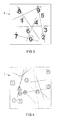
- a first example of image comprising sets of two superposed symbols is schematically illustrated in figure 3 .
- the image symbols are chosen into the first sub-group of digits (here 1 to 9) and the third sub-group of alphabetical characters (here A to Z), and each symbol appears only one time in the image and therefore belongs to only one set of this image.
- a second example of image comprising sets of two superposed symbols associated to colours is schematically illustrated in figure 4 .
- the image symbols are chosen into the first sub-group of digits (here 1 to 9) and the second sub-group of shapes (triangle, square, circle, pentagon, hexagon), the different shapes and digits may be respectively associated to different colours (here represented in four different grey levels), and each symbol appears only one time in the image and therefore belongs to only one set of this image.
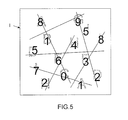
- a third example of image comprising sets of two superposed symbols is schematically illustrated in figure 5 .
- the image symbols are chosen into the first sub-group of digits (here 1 to 9) and the third sub-group of alphabetical characters (here A to Z), and some symbols appear two times in the image and therefore belongs to two sets of this image.
- each set could comprise three or four superposed symbols, possibly associated to different colours.
- an image may be a CAPTCHA®.
- the image generated in the first step (i) is displayed onto the display means DM (after having been transferred from the verification device VD of the security element SE to the display control means of the electronic device ED).
- This second step (ii) corresponds to the sub step 20 of the example of algorithm illustrated in figure 2 .
- the user of the security element SE selects successively each symbol defining his secret code into the displayed image.
- he uses (here) the computer mouse CM of the electronic device ED to move the mouse pointer and clicks successively on each set comprising a symbol belonging to his secret code, in the order of occurrence of these symbols into his secret code.
- Each position of the mouse pointer where the user has clicked, and which corresponds to a selected symbol, is registered.
- one (the human/machine interface HI) transmits successively the (registered) positions of the selected symbols to the security element SE in their order of selection.
- This third step (iii) corresponds to the sub steps 30 and 40 of the example of algorithm illustrated in figure 2 .
- each click is explicit because it is intended for selecting a chosen symbol of a set, but for a third party, such as a hacker, there is uncertainty on which symbol has been effectively selected into each "clicked set".
- the user secret code is AD51 and that the generated image is the one illustrated in figure 3
- the user must click on a first set comprising A and 8, then on a second set comprising D and 2, then on a third set comprising J and 5, and finally on a fourth set comprising B and 1.
- the hacker cannot determine if the first click was intended for selecting A or 8, if the second click was intended for selecting D or 2, if the third click was intended for selecting J or 5, and if the fourth click was intended for selecting B or 1.
- the security element SE (and more precisely its verification device VD) compares the memorised position(s) of each secret code symbol with each transmitted position in the order (of verification).
- the security element SE (and more precisely its verification device VD) finds that each transmitted position is identical to a memorised position of a secret code symbol in the right order, it considers that this secret code has been provided by the user. If at least one memorised position of a secret code symbol is not identical to a corresponding transmitted position, while taking into account the order, the security element SE (and more precisely its verification device VD) generates an error message intended for being displayed by the display means DM and requesting the user to carry out a new symbol selection.
- This fourth step (iv) corresponds to the sub step 50 of the example of algorithm illustrated in figure 2 .
- step (iv) in the case where the generated image comprises sets that have no common symbol, the security element SE (and more precisely its verification device VD) compares each memorised position of each secret code symbol with each transmitted position in the order. Indeed, if a secret code symbol has a known position in the generated image, then if there is a transmitted position identical to this known position in the corresponding position (according to the order), this means that the user has effectively selected this secret code symbol in the right order.
- step (iv) in the case where the generated image comprises sets having common symbols, at least one symbol of the secret code may be located in at least two different positions into the generated image. So, the security element SE (and more precisely its verification device VD) must compare every memorised position of each secret code symbol with each transmitted position in the order. Then, in the case where it has found that each transmitted position is identical to one of the memorised positions of a secret code symbol in the right order, it may consider that the secret code has been correctly provided by the user.
- the invention prevents an ill-intentioned person from determining the user secret code (or user credential) from a single capture of a displayed image and from the user entry (i.e. the sets selected into this displayed image). So, multiple captures (whose number depends on the chosen complexity) must be carried out and then analysed by an ill-intentioned person in order to retrieve, through combination analysis, the user secret code (or credential).
- This invention is particularly useful to prevent fraud at ATMs through use of a hidden camera. Indeed, it is very improbable that the same user will come at least twice at the same ATM when the camera is present. This invention also makes theft of user secret codes (or credentials) on mobile devices more difficult, as the ill-intentioned persons would have to wait until several user selections have been performed and then spend the time to analyse these user selections.
Landscapes
- Engineering & Computer Science (AREA)
- Computer Security & Cryptography (AREA)
- Theoretical Computer Science (AREA)
- Computer Hardware Design (AREA)
- Software Systems (AREA)
- Physics & Mathematics (AREA)
- General Engineering & Computer Science (AREA)
- General Physics & Mathematics (AREA)
- User Interface Of Digital Computer (AREA)
Priority Applications (2)
| Application Number | Priority Date | Filing Date | Title |
|---|---|---|---|
| EP13306784.3A EP2887254A1 (fr) | 2013-12-19 | 2013-12-19 | Procédé et dispositif de vérification de symboles sélectionnés parmi les séries de symboles superposés affichés par un dispositif électronique coopérant avec un élément de sécurité |
| PCT/EP2014/076792 WO2015091035A1 (fr) | 2013-12-19 | 2014-12-05 | Procédé et dispositif pour vérifier des symboles sélectionnés parmi des ensembles de symboles superposés affichés par un dispositif électronique coopérant avec un élément de sécurité |
Applications Claiming Priority (1)
| Application Number | Priority Date | Filing Date | Title |
|---|---|---|---|
| EP13306784.3A EP2887254A1 (fr) | 2013-12-19 | 2013-12-19 | Procédé et dispositif de vérification de symboles sélectionnés parmi les séries de symboles superposés affichés par un dispositif électronique coopérant avec un élément de sécurité |
Publications (1)
| Publication Number | Publication Date |
|---|---|
| EP2887254A1 true EP2887254A1 (fr) | 2015-06-24 |
Family
ID=50002423
Family Applications (1)
| Application Number | Title | Priority Date | Filing Date |
|---|---|---|---|
| EP13306784.3A Withdrawn EP2887254A1 (fr) | 2013-12-19 | 2013-12-19 | Procédé et dispositif de vérification de symboles sélectionnés parmi les séries de symboles superposés affichés par un dispositif électronique coopérant avec un élément de sécurité |
Country Status (2)
| Country | Link |
|---|---|
| EP (1) | EP2887254A1 (fr) |
| WO (1) | WO2015091035A1 (fr) |
Families Citing this family (2)
| Publication number | Priority date | Publication date | Assignee | Title |
|---|---|---|---|---|
| US9325503B2 (en) * | 2014-06-12 | 2016-04-26 | Echostar Technologies L.L.C. | Methods and systems for user authentication |
| CN119622707A (zh) * | 2024-11-21 | 2025-03-14 | 杭州联汇科技股份有限公司 | 一种动态密码验证方法 |
Citations (1)
| Publication number | Priority date | Publication date | Assignee | Title |
|---|---|---|---|---|
| WO2006064241A2 (fr) * | 2004-12-16 | 2006-06-22 | Mark Dwight Bedworth | Validation d'utilisateur au moyen d'images |
Family Cites Families (2)
| Publication number | Priority date | Publication date | Assignee | Title |
|---|---|---|---|---|
| NO20050051D0 (no) * | 2005-01-05 | 2005-01-05 | Lumex As | Fremgangsmate og system for autentiseringsinformasjon matet inn i datamaskinsystemer |
| US20100043079A1 (en) * | 2006-09-07 | 2010-02-18 | France Telecom | Code securing for a personal entity |
-
2013
- 2013-12-19 EP EP13306784.3A patent/EP2887254A1/fr not_active Withdrawn
-
2014
- 2014-12-05 WO PCT/EP2014/076792 patent/WO2015091035A1/fr not_active Ceased
Patent Citations (1)
| Publication number | Priority date | Publication date | Assignee | Title |
|---|---|---|---|---|
| WO2006064241A2 (fr) * | 2004-12-16 | 2006-06-22 | Mark Dwight Bedworth | Validation d'utilisateur au moyen d'images |
Also Published As
| Publication number | Publication date |
|---|---|
| WO2015091035A1 (fr) | 2015-06-25 |
Similar Documents
| Publication | Publication Date | Title |
|---|---|---|
| US8881251B1 (en) | Electronic authentication using pictures and images | |
| Jansen | Authenticating users on handheld devices | |
| US10592653B2 (en) | Encoding methods and systems | |
| US9531710B2 (en) | Behavioral authentication system using a biometric fingerprint sensor and user behavior for authentication | |
| EP2732579B1 (fr) | Authentification d'un justificatif d'identité guidée par les événements et basée sur un second facteur | |
| US20140201831A1 (en) | Method and apparatus for authenticating password of user terminal | |
| JP4547447B2 (ja) | パスワード認証装置およびパスワード認証方法 | |
| EP1879127A1 (fr) | Procédé et système d'autentification de l'utilisateur et système de gestion de mot de passe | |
| US11171968B1 (en) | Method and system for user credential security | |
| US8661532B2 (en) | Method and apparatus for authenticating password | |
| CN105323073A (zh) | 一种身份验证方法、装置和系统 | |
| US12402002B2 (en) | Mobile app login and device registration | |
| KR101267229B1 (ko) | 입력패턴을 이용한 인증 방법 및 시스템 | |
| Guerar et al. | Color wheel pin: Usable and resilient ATM authentication | |
| EP3786820B1 (fr) | Système d'authentification, dispositif d'authentification, procédé d'authentification et programme | |
| US9992193B2 (en) | High-safety user multi-authentication system and method | |
| WO2015091035A1 (fr) | Procédé et dispositif pour vérifier des symboles sélectionnés parmi des ensembles de symboles superposés affichés par un dispositif électronique coopérant avec un élément de sécurité | |
| US20200201977A1 (en) | Method for authenticating a first user and corresponding first device and system | |
| Tangawar et al. | Survey paper on graphical password authentication system in terms of usability and security attribute | |
| CN101303755A (zh) | 电子移动装置及电子交易方法 | |
| US12273724B1 (en) | Authentication based on user interaction with images or objects | |
| KR101188016B1 (ko) | 진동을 이용한 패스워드 입력 방법 | |
| Adithya et al. | Security enhancement in automated teller machine | |
| Chabbi et al. | A new security solution enhancing the dynamic array pin protocol | |
| JP2019050014A (ja) | 口座開設システム、口座開設方法、及びプログラム |
Legal Events
| Date | Code | Title | Description |
|---|---|---|---|
| PUAI | Public reference made under article 153(3) epc to a published international application that has entered the european phase |
Free format text: ORIGINAL CODE: 0009012 |
|
| 17P | Request for examination filed |
Effective date: 20131219 |
|
| AK | Designated contracting states |
Kind code of ref document: A1 Designated state(s): AL AT BE BG CH CY CZ DE DK EE ES FI FR GB GR HR HU IE IS IT LI LT LU LV MC MK MT NL NO PL PT RO RS SE SI SK SM TR |
|
| AX | Request for extension of the european patent |
Extension state: BA ME |
|
| STAA | Information on the status of an ep patent application or granted ep patent |
Free format text: STATUS: THE APPLICATION IS DEEMED TO BE WITHDRAWN |
|
| 18D | Application deemed to be withdrawn |
Effective date: 20160105 |