EP2886560A1 - Process for the manufacture of vinyl chloride polymers - Google Patents
Process for the manufacture of vinyl chloride polymers Download PDFInfo
- Publication number
- EP2886560A1 EP2886560A1 EP14170966.7A EP14170966A EP2886560A1 EP 2886560 A1 EP2886560 A1 EP 2886560A1 EP 14170966 A EP14170966 A EP 14170966A EP 2886560 A1 EP2886560 A1 EP 2886560A1
- Authority
- EP
- European Patent Office
- Prior art keywords
- vinyl chloride
- formula
- polymerization
- copper
- process according
- Prior art date
- Legal status (The legal status is an assumption and is not a legal conclusion. Google has not performed a legal analysis and makes no representation as to the accuracy of the status listed.)
- Granted
Links
- BZHJMEDXRYGGRV-UHFFFAOYSA-N Vinyl chloride Chemical compound ClC=C BZHJMEDXRYGGRV-UHFFFAOYSA-N 0.000 title claims abstract description 53
- 238000000034 method Methods 0.000 title claims abstract description 28
- 230000008569 process Effects 0.000 title claims abstract description 25
- 229920000642 polymer Polymers 0.000 title claims abstract description 24
- 238000004519 manufacturing process Methods 0.000 title claims abstract description 8
- 238000006116 polymerization reaction Methods 0.000 claims abstract description 38
- 239000003054 catalyst Substances 0.000 claims abstract description 34
- JJFLDSOAQUJVBF-UHFFFAOYSA-N copper monohydride Chemical compound [CuH] JJFLDSOAQUJVBF-UHFFFAOYSA-N 0.000 claims abstract description 25
- 239000010949 copper Substances 0.000 claims description 15
- MUALRAIOVNYAIW-UHFFFAOYSA-N binap Chemical group C1=CC=CC=C1P(C=1C(=C2C=CC=CC2=CC=1)C=1C2=CC=CC=C2C=CC=1P(C=1C=CC=CC=1)C=1C=CC=CC=1)C1=CC=CC=C1 MUALRAIOVNYAIW-UHFFFAOYSA-N 0.000 claims description 14
- RIOQSEWOXXDEQQ-UHFFFAOYSA-N triphenylphosphine Chemical compound C1=CC=CC=C1P(C=1C=CC=CC=1)C1=CC=CC=C1 RIOQSEWOXXDEQQ-UHFFFAOYSA-N 0.000 claims description 14
- 239000000178 monomer Substances 0.000 claims description 13
- 229910000050 copper hydride Inorganic materials 0.000 claims description 9
- VMQMZMRVKUZKQL-UHFFFAOYSA-N Cu+ Chemical group [Cu+] VMQMZMRVKUZKQL-UHFFFAOYSA-N 0.000 claims description 8
- 229920001577 copolymer Polymers 0.000 claims description 8
- 229920001519 homopolymer Polymers 0.000 claims description 8
- 239000003446 ligand Substances 0.000 claims description 8
- XYFCBTPGUUZFHI-UHFFFAOYSA-N Phosphine Chemical compound P XYFCBTPGUUZFHI-UHFFFAOYSA-N 0.000 claims description 7
- 229910000073 phosphorus hydride Inorganic materials 0.000 claims description 7
- FIQMHBFVRAXMOP-UHFFFAOYSA-N triphenylphosphane oxide Chemical compound C=1C=CC=CC=1P(C=1C=CC=CC=1)(=O)C1=CC=CC=C1 FIQMHBFVRAXMOP-UHFFFAOYSA-N 0.000 claims description 7
- 238000011065 in-situ storage Methods 0.000 claims description 6
- 239000000203 mixture Substances 0.000 claims description 6
- -1 diphenylphosphino- Chemical class 0.000 claims description 5
- UFHFLCQGNIYNRP-UHFFFAOYSA-N Hydrogen Chemical compound [H][H] UFHFLCQGNIYNRP-UHFFFAOYSA-N 0.000 claims description 4
- XTXRWKRVRITETP-UHFFFAOYSA-N Vinyl acetate Chemical compound CC(=O)OC=C XTXRWKRVRITETP-UHFFFAOYSA-N 0.000 claims description 4
- 239000001257 hydrogen Substances 0.000 claims description 4
- 229910052739 hydrogen Inorganic materials 0.000 claims description 4
- NIXOWILDQLNWCW-UHFFFAOYSA-N acrylic acid group Chemical group C(C=C)(=O)O NIXOWILDQLNWCW-UHFFFAOYSA-N 0.000 claims description 3
- YZCKVEUIGOORGS-OUBTZVSYSA-N Deuterium Chemical compound [2H] YZCKVEUIGOORGS-OUBTZVSYSA-N 0.000 claims description 2
- 229910052805 deuterium Inorganic materials 0.000 claims description 2
- 125000002348 vinylic group Chemical group 0.000 claims description 2
- OKKJLVBELUTLKV-UHFFFAOYSA-N Methanol Chemical compound OC OKKJLVBELUTLKV-UHFFFAOYSA-N 0.000 description 18
- 238000003780 insertion Methods 0.000 description 13
- 230000037431 insertion Effects 0.000 description 11
- WYURNTSHIVDZCO-UHFFFAOYSA-N Tetrahydrofuran Chemical compound C1CCOC1 WYURNTSHIVDZCO-UHFFFAOYSA-N 0.000 description 10
- IJGRMHOSHXDMSA-UHFFFAOYSA-N Atomic nitrogen Chemical compound N#N IJGRMHOSHXDMSA-UHFFFAOYSA-N 0.000 description 8
- 239000000243 solution Substances 0.000 description 8
- 239000002244 precipitate Substances 0.000 description 6
- RYGMFSIKBFXOCR-UHFFFAOYSA-N Copper Chemical compound [Cu] RYGMFSIKBFXOCR-UHFFFAOYSA-N 0.000 description 5
- VGGSQFUCUMXWEO-UHFFFAOYSA-N Ethene Chemical compound C=C VGGSQFUCUMXWEO-UHFFFAOYSA-N 0.000 description 5
- 239000005977 Ethylene Substances 0.000 description 5
- 230000015572 biosynthetic process Effects 0.000 description 5
- 229910052802 copper Inorganic materials 0.000 description 5
- 229920000915 polyvinyl chloride Polymers 0.000 description 5
- 239000004800 polyvinyl chloride Substances 0.000 description 5
- 239000000047 product Substances 0.000 description 5
- YLQBMQCUIZJEEH-UHFFFAOYSA-N tetrahydrofuran Natural products C=1C=COC=1 YLQBMQCUIZJEEH-UHFFFAOYSA-N 0.000 description 5
- KDLHZDBZIXYQEI-UHFFFAOYSA-N Palladium Chemical compound [Pd] KDLHZDBZIXYQEI-UHFFFAOYSA-N 0.000 description 4
- 229910052757 nitrogen Inorganic materials 0.000 description 4
- 229920001843 polymethylhydrosiloxane Polymers 0.000 description 4
- 238000001644 13C nuclear magnetic resonance spectroscopy Methods 0.000 description 3
- 238000005160 1H NMR spectroscopy Methods 0.000 description 3
- YXFVVABEGXRONW-UHFFFAOYSA-N Toluene Chemical compound CC1=CC=CC=C1 YXFVVABEGXRONW-UHFFFAOYSA-N 0.000 description 3
- 239000007983 Tris buffer Substances 0.000 description 3
- 238000012512 characterization method Methods 0.000 description 3
- 238000007334 copolymerization reaction Methods 0.000 description 3
- BMRUOURRLCCWHB-UHFFFAOYSA-M copper(i) fluoride Chemical compound [Cu]F BMRUOURRLCCWHB-UHFFFAOYSA-M 0.000 description 3
- GWFAVIIMQDUCRA-UHFFFAOYSA-L copper(ii) fluoride Chemical compound [F-].[F-].[Cu+2] GWFAVIIMQDUCRA-UHFFFAOYSA-L 0.000 description 3
- 230000004907 flux Effects 0.000 description 3
- 238000003760 magnetic stirring Methods 0.000 description 3
- 239000003960 organic solvent Substances 0.000 description 3
- 238000002360 preparation method Methods 0.000 description 3
- 239000000523 sample Substances 0.000 description 3
- 238000003786 synthesis reaction Methods 0.000 description 3
- 125000000391 vinyl group Chemical group [H]C([*])=C([H])[H] 0.000 description 3
- 229920002554 vinyl polymer Polymers 0.000 description 3
- XKRFYHLGVUSROY-UHFFFAOYSA-N Argon Chemical compound [Ar] XKRFYHLGVUSROY-UHFFFAOYSA-N 0.000 description 2
- ZAMOUSCENKQFHK-UHFFFAOYSA-N Chlorine atom Chemical compound [Cl] ZAMOUSCENKQFHK-UHFFFAOYSA-N 0.000 description 2
- 229910021594 Copper(II) fluoride Inorganic materials 0.000 description 2
- BAPJBEWLBFYGME-UHFFFAOYSA-N Methyl acrylate Chemical compound COC(=O)C=C BAPJBEWLBFYGME-UHFFFAOYSA-N 0.000 description 2
- 238000013019 agitation Methods 0.000 description 2
- 150000001336 alkenes Chemical class 0.000 description 2
- 238000010923 batch production Methods 0.000 description 2
- 229910052799 carbon Inorganic materials 0.000 description 2
- 238000010516 chain-walking reaction Methods 0.000 description 2
- 239000000460 chlorine Substances 0.000 description 2
- 229910052801 chlorine Inorganic materials 0.000 description 2
- OKJARODAQSGFQE-UHFFFAOYSA-M copper(1+);triphenylphosphane;fluoride Chemical compound [Cu]F.C1=CC=CC=C1P(C=1C=CC=CC=1)C1=CC=CC=C1.C1=CC=CC=C1P(C=1C=CC=CC=1)C1=CC=CC=C1.C1=CC=CC=C1P(C=1C=CC=CC=1)C1=CC=CC=C1 OKJARODAQSGFQE-UHFFFAOYSA-M 0.000 description 2
- 239000013078 crystal Substances 0.000 description 2
- 230000008030 elimination Effects 0.000 description 2
- 238000003379 elimination reaction Methods 0.000 description 2
- 150000004678 hydrides Chemical class 0.000 description 2
- 229910052763 palladium Inorganic materials 0.000 description 2
- 239000002685 polymerization catalyst Substances 0.000 description 2
- 230000009257 reactivity Effects 0.000 description 2
- 229910001220 stainless steel Inorganic materials 0.000 description 2
- 239000010935 stainless steel Substances 0.000 description 2
- 230000007704 transition Effects 0.000 description 2
- UHUUYVZLXJHWDV-UHFFFAOYSA-N trimethyl(methylsilyloxy)silane Chemical compound C[SiH2]O[Si](C)(C)C UHUUYVZLXJHWDV-UHFFFAOYSA-N 0.000 description 2
- SMZOUWXMTYCWNB-UHFFFAOYSA-N 2-(2-methoxy-5-methylphenyl)ethanamine Chemical compound COC1=CC=C(C)C=C1CCN SMZOUWXMTYCWNB-UHFFFAOYSA-N 0.000 description 1
- NLHHRLWOUZZQLW-UHFFFAOYSA-N Acrylonitrile Chemical compound C=CC#N NLHHRLWOUZZQLW-UHFFFAOYSA-N 0.000 description 1
- NLZUEZXRPGMBCV-UHFFFAOYSA-N Butylhydroxytoluene Chemical compound CC1=CC(C(C)(C)C)=C(O)C(C(C)(C)C)=C1 NLZUEZXRPGMBCV-UHFFFAOYSA-N 0.000 description 1
- 229910020308 Cl3SiH Inorganic materials 0.000 description 1
- VVQNEPGJFQJSBK-UHFFFAOYSA-N Methyl methacrylate Chemical compound COC(=O)C(C)=C VVQNEPGJFQJSBK-UHFFFAOYSA-N 0.000 description 1
- GAYMWACCKNFSNA-UHFFFAOYSA-N P.[PH3]=O Chemical compound P.[PH3]=O GAYMWACCKNFSNA-UHFFFAOYSA-N 0.000 description 1
- 150000003926 acrylamides Chemical class 0.000 description 1
- 150000001252 acrylic acid derivatives Chemical class 0.000 description 1
- 238000012644 addition polymerization Methods 0.000 description 1
- 125000000746 allylic group Chemical group 0.000 description 1
- 229910052786 argon Inorganic materials 0.000 description 1
- CQEYYJKEWSMYFG-UHFFFAOYSA-N butyl acrylate Chemical compound CCCCOC(=O)C=C CQEYYJKEWSMYFG-UHFFFAOYSA-N 0.000 description 1
- 235000010354 butylated hydroxytoluene Nutrition 0.000 description 1
- 125000002091 cationic group Chemical group 0.000 description 1
- 125000001309 chloro group Chemical group Cl* 0.000 description 1
- 150000001868 cobalt Chemical class 0.000 description 1
- 239000012612 commercial material Substances 0.000 description 1
- 150000001875 compounds Chemical class 0.000 description 1
- 238000010924 continuous production Methods 0.000 description 1
- ARUVKPQLZAKDPS-UHFFFAOYSA-L copper(II) sulfate Chemical compound [Cu+2].[O-][S+2]([O-])([O-])[O-] ARUVKPQLZAKDPS-UHFFFAOYSA-L 0.000 description 1
- 229910000366 copper(II) sulfate Inorganic materials 0.000 description 1
- 239000012043 crude product Substances 0.000 description 1
- 230000001627 detrimental effect Effects 0.000 description 1
- 229910000071 diazene Inorganic materials 0.000 description 1
- 150000002012 dioxanes Chemical class 0.000 description 1
- VDCSGNNYCFPWFK-UHFFFAOYSA-N diphenylsilane Chemical compound C=1C=CC=CC=1[SiH2]C1=CC=CC=C1 VDCSGNNYCFPWFK-UHFFFAOYSA-N 0.000 description 1
- 229920001038 ethylene copolymer Polymers 0.000 description 1
- XUCNUKMRBVNAPB-UHFFFAOYSA-N fluoroethene Chemical compound FC=C XUCNUKMRBVNAPB-UHFFFAOYSA-N 0.000 description 1
- 239000005337 ground glass Substances 0.000 description 1
- 238000010348 incorporation Methods 0.000 description 1
- IBOFHQZUWNBWNJ-UHFFFAOYSA-N iron;pyridine-2,3-diimine Chemical compound [Fe].N=C1C=CC=NC1=N IBOFHQZUWNBWNJ-UHFFFAOYSA-N 0.000 description 1
- 229920002521 macromolecule Polymers 0.000 description 1
- 239000000463 material Substances 0.000 description 1
- 238000002156 mixing Methods 0.000 description 1
- 239000002808 molecular sieve Substances 0.000 description 1
- 150000002815 nickel Chemical class 0.000 description 1
- JRZJOMJEPLMPRA-UHFFFAOYSA-N olefin Natural products CCCCCCCC=C JRZJOMJEPLMPRA-UHFFFAOYSA-N 0.000 description 1
- 125000002524 organometallic group Chemical group 0.000 description 1
- 230000003647 oxidation Effects 0.000 description 1
- 238000007254 oxidation reaction Methods 0.000 description 1
- WYURNTSHIVDZCO-SVYQBANQSA-N oxolane-d8 Chemical compound [2H]C1([2H])OC([2H])([2H])C([2H])([2H])C1([2H])[2H] WYURNTSHIVDZCO-SVYQBANQSA-N 0.000 description 1
- PARWUHTVGZSQPD-UHFFFAOYSA-N phenylsilane Chemical compound [SiH3]C1=CC=CC=C1 PARWUHTVGZSQPD-UHFFFAOYSA-N 0.000 description 1
- 229920000573 polyethylene Polymers 0.000 description 1
- 230000037048 polymerization activity Effects 0.000 description 1
- QQONPFPTGQHPMA-UHFFFAOYSA-N propylene Natural products CC=C QQONPFPTGQHPMA-UHFFFAOYSA-N 0.000 description 1
- 125000004805 propylene group Chemical group [H]C([H])([H])C([H])([*:1])C([H])([H])[*:2] 0.000 description 1
- 239000012429 reaction media Substances 0.000 description 1
- 239000011541 reaction mixture Substances 0.000 description 1
- 238000010992 reflux Methods 0.000 description 1
- 230000001105 regulatory effect Effects 0.000 description 1
- 238000007086 side reaction Methods 0.000 description 1
- URGAHOPLAPQHLN-UHFFFAOYSA-N sodium aluminosilicate Chemical compound [Na+].[Al+3].[O-][Si]([O-])=O.[O-][Si]([O-])=O URGAHOPLAPQHLN-UHFFFAOYSA-N 0.000 description 1
- 239000007787 solid Substances 0.000 description 1
- 239000002904 solvent Substances 0.000 description 1
- 239000003381 stabilizer Substances 0.000 description 1
- 238000003756 stirring Methods 0.000 description 1
- 238000003860 storage Methods 0.000 description 1
- 230000001629 suppression Effects 0.000 description 1
- 239000000725 suspension Substances 0.000 description 1
- ZDHXKXAHOVTTAH-UHFFFAOYSA-N trichlorosilane Chemical compound Cl[SiH](Cl)Cl ZDHXKXAHOVTTAH-UHFFFAOYSA-N 0.000 description 1
- YUYCVXFAYWRXLS-UHFFFAOYSA-N trimethoxysilane Chemical compound CO[SiH](OC)OC YUYCVXFAYWRXLS-UHFFFAOYSA-N 0.000 description 1
- LENZDBCJOHFCAS-UHFFFAOYSA-N tris Chemical compound OCC(N)(CO)CO LENZDBCJOHFCAS-UHFFFAOYSA-N 0.000 description 1
- 230000007306 turnover Effects 0.000 description 1
Classifications
-
- C—CHEMISTRY; METALLURGY
- C08—ORGANIC MACROMOLECULAR COMPOUNDS; THEIR PREPARATION OR CHEMICAL WORKING-UP; COMPOSITIONS BASED THEREON
- C08F—MACROMOLECULAR COMPOUNDS OBTAINED BY REACTIONS ONLY INVOLVING CARBON-TO-CARBON UNSATURATED BONDS
- C08F14/00—Homopolymers and copolymers of compounds having one or more unsaturated aliphatic radicals, each having only one carbon-to-carbon double bond, and at least one being terminated by a halogen
- C08F14/02—Monomers containing chlorine
- C08F14/04—Monomers containing two carbon atoms
- C08F14/06—Vinyl chloride
-
- C—CHEMISTRY; METALLURGY
- C08—ORGANIC MACROMOLECULAR COMPOUNDS; THEIR PREPARATION OR CHEMICAL WORKING-UP; COMPOSITIONS BASED THEREON
- C08F—MACROMOLECULAR COMPOUNDS OBTAINED BY REACTIONS ONLY INVOLVING CARBON-TO-CARBON UNSATURATED BONDS
- C08F114/00—Homopolymers of compounds having one or more unsaturated aliphatic radicals, each having only one carbon-to-carbon double bond, and at least one being terminated by a halogen
- C08F114/02—Monomers containing chlorine
- C08F114/04—Monomers containing two carbon atoms
- C08F114/06—Vinyl chloride
-
- C—CHEMISTRY; METALLURGY
- C08—ORGANIC MACROMOLECULAR COMPOUNDS; THEIR PREPARATION OR CHEMICAL WORKING-UP; COMPOSITIONS BASED THEREON
- C08F—MACROMOLECULAR COMPOUNDS OBTAINED BY REACTIONS ONLY INVOLVING CARBON-TO-CARBON UNSATURATED BONDS
- C08F4/00—Polymerisation catalysts
- C08F4/42—Metals; Metal hydrides; Metallo-organic compounds; Use thereof as catalyst precursors
- C08F4/44—Metals; Metal hydrides; Metallo-organic compounds; Use thereof as catalyst precursors selected from light metals, zinc, cadmium, mercury, copper, silver, gold, boron, gallium, indium, thallium, rare earths or actinides
- C08F4/50—Metals; Metal hydrides; Metallo-organic compounds; Use thereof as catalyst precursors selected from light metals, zinc, cadmium, mercury, copper, silver, gold, boron, gallium, indium, thallium, rare earths or actinides selected from alkaline earth metals, zinc, cadmium, mercury, copper or silver
Definitions
- the present invention relates to a process for the manufacture of vinyl chloride polymers.
- vinyl chloride (VC) is a particularly attractive monomer for coordination - insertion polymerization/copolymerization because polyvinyl chloride polymers (PVC) and VC copolymers are important commercial materials.
- the present invention aims to overcome the above-mentioned drawbacks by providing a process allowing the manufacture of VC polymers.
- the present invention relates to a process for the manufacture of a vinyl chloride polymer by polymerization of vinyl chloride and possibly of at least one comonomer of vinyl chloride, characterized in that the catalyst used for the polymerization comprises at least one copper (I) hydride.
- copper (I) it is meant in the text of the present specification, copper at the oxidation stage I.
- At least one copper (I) hydride it is meant in the text of the present specification, that the catalyst used for the polymerisation comprises one or more than one copper (I) hydride.
- the catalyst used for the polymerization comprises
- the catalyst may comprise other catalyst(s) and/or cocatalyst(s), preferably cocatalyst(s), different from than the copper(I) hydride(s).
- the catalyst used for the polymerization preferably consists essentially of, more preferably consists of, at least one copper(I) hydride.
- the copper (I) hydride responds advantageously to Formula 1 n L----Cu-R Formula 1 in which Cu is copper (I), R is H (hydrogen) or D (deuterium), L is a ligand and n is an integer equal to or higher than 1 representing the number of coordination link(s) between Cu and L.
- L in n L can be the same ligand or different ligands.
- n is preferably an integer equal to 1, 2, 3 or 4; more preferably an integer equal to 1, 2 or 3 and most preferably an integer equal to 1 or 2 and particularly most preferably n is equal to 2.
- L the ligand
- Ph 3 triphenyl phosphine
- OPPh 3 triphenyl phosphine oxide
- BINAP 2,2'-bis(diphenylphosphino)-1,1'-binaphthyl
- BINAP can be the racemic or the chiral compound.
- the catalyst used for the polymerization comprises at least one copper (I) hydride which preferably responds to Formula 1 in which Cu is copper (I), R is H (hydrogen), L is a ligand selected from triphenyl phosphine (PPh 3 ), triphenyl phosphine oxide (OPPh 3 ), 2,2'-bis(diphenylphosphino)-1,1'-binaphthyl (BINAP) or a mixture thereof, and n is an integer equal to 1, 2, 3 or 4.
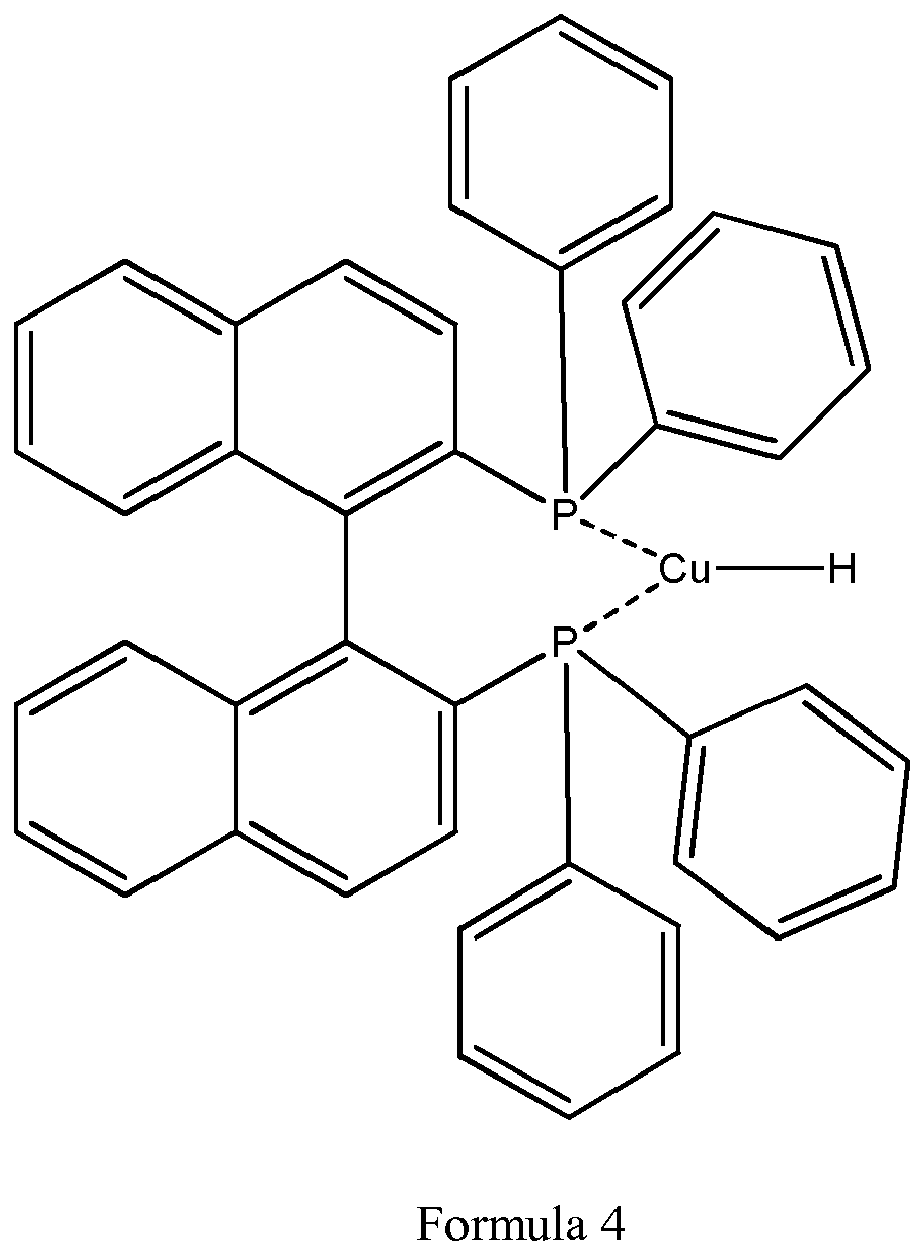
- the catalyst used for the polymerization comprises at least one copper (I) hydride which more preferably comprises either (BINAP)Cu(I)H named [2,2'-bis(diphenylphosphino- ⁇ - P )-1,1'-binaphthyl] hydridocopper (I) responding to Formula 4 (first embodiment), or (PPh 3 ) 2 Cu(I)H named [bis(triphenylphosphine- ⁇ - P )] hydridocopper (I) responding to Formula 5 (second embodiment) or (OPPh 3 ) 2 Cu(I)H named [bis(triphenylphosphine oxide- ⁇ - O )] hydridocopper (I) responding to Formula 6 (third embodiment).
- BINAP copper
- Cu(I)H named [2,2'-bis(diphenylphosphino- ⁇ - P )-1,1'-binaphthyl] hydridocopper (I) responding to
- copper (I) hydride which comprises it is meant in the text of the present specification, that the copper (I) hydride, for each embodiment from first to third, comprises at least the copper (I) hydride mentioned above.
- the catalyst used for the polymerization can be prepared while being isolated from the media used for its preparation or it can be prepared in-situ, before use in polymerization. Preferably, it is prepared in-situ before use in polymerization.
- the catalyst is prepared and used in polymerization without being separated from the media used for its preparation.
- the catalyst can be prepared by any process.
- a preferred process, particularly when it is prepared in-situ, is that the catalyst is formed by mixing 3 components i.e. a component (1) which is a source of copper (I), a component (2) which is the ligand L as defined above and a component (3) which is a source of hydride, in an organic solvent.
- Preferred component (1) is CuF(PPh 3 ) 3 which can be prepared from CuF 2 or from CuSO 4 and HF, as source of copper.
- components (3) are siloxanes responding to formula RSiH among which TMDS (tetramethyldisiloxane), PhSiH 3 , Ph 2 SiH 2 , Ph 3 SiH, Et 3 SiH, (EtO) 2 MeSiH, PhMe 2 SiH, (MeO) 3 SiH, Cl 3 SiH and PMHS (polymethylhydrosiloxane) responding to Formula 3
- the organic solvent can be any appropriate organic solvent and is advantageously THF or toluene.
- the process according to the invention is a process for the manufacture of a vinyl chloride polymer involving the use of a copper catalyst.
- the process according to the invention is a process for the manufacture of a vinyl chloride polymer by coordination - insertion polymerization of vinyl chloride and possibly of at least one comonomer of vinyl chloride.
- coordination - insertion polymerization is understood to mean, for the purposes of the present invention, an addition polymerization in which monomer adds to a growing macromolecule through an organometallic active center. This kind of polymerization is also often simply called insertion polymerization.
- the polymer manufactured by the process according to the present invention is a vinyl chloride polymer.
- vinyl chloride polymer is understood to mean, for the purposes of the present invention, all polymers containing advantageously at least 50 %, preferably at least 60 %, more preferably at least 70 %, most preferably at least 75 % and particularly most preferably at least 85 % by weight of monomeric units derived from vinyl chloride (monomer).
- polymers are therefore advantageously either vinyl chloride homopolymers (containing 100 % by weight of units derived from vinyl chloride) or copolymers of vinyl chloride with one or more than one ethylenically unsaturated monomers (called comonomers) selected from the vinylic esters (preferably vinyl acetate) and the (meth) acrylic monomers (preferably n-butyl acrylate and methylmethacrylate).
- the polymer manufactured by the process according to the invention is preferably a vinyl chloride homopolymer or a copolymer of vinyl chloride with vinyl acetate and is more preferably a vinyl chloride homopolymer.
- the polymerization takes place at a temperature advantageously of at least - 75, preferably of at least - 50, more preferably of at least - 25, particularly more preferably of at least 5, most preferably of at least 20 and particularly most preferably of at least 40°C.
- the polymerization takes place at a temperature advantageously of at most 110, preferably of at most 100, more preferably of at most 90, particularly more preferably of at most 80, most preferably of at most 70 and particularly most preferably of at most 60°C.
- the ratio of the number of moles of VC and possibly of the at least one comonomer of vinyl chloride, to the number of moles of catalyst (i.e. n VC :n cat ), advantageously at the beginning of the polymerization, is comprised advantageously between 100 and 10 000 000, preferably between 100 and 1 000 000, more preferably between 100 and 500 000, particularly more preferably between 100 and 100 000, most preferably between 100 and 50 000 and particularly most preferably between 100 and 25 000. Good results can be obtained when such ratio is comprised between 100 and 10 000. Very good results can be obtained when such ratio is comprised between 100 and 4000.
- the process according to the invention can be a batch process or a continuous process.
- the process according to the invention is a batch process.
- the catalyst A used in example 1 comprising [2,2'-bis(diphenylphosphino- ⁇ -P)- 1,1 ' -binaphthyl] hydridocopper (I) was synthesized in two steps as described below.
- Catalyst A was prepared in-situ before use in polymerization. 50 ml of THF previously degassed under a flux of nitrogen during 1 hour at ambient temperature were introduced in a stainless steel autoclave fitted with a magnetic stirring bar. [Tris(triphenylphosphine- ⁇ - P )] fluorocopper (I) obtained in step 1 (0.149 g, 0.16 mmol, 1.0 equiv.) and 2,2'-bis(diphenylphosphino)-1,1'-binaphthyl (BINAP) (0.100 g, 0.16 mmol, 1.0 equiv.) were then introduced into the autoclave.
- reaction media was then placed under agitation during 5 minutes at the end of which the solution took a yellowish color.
- Polymethylhydrosiloxane (0.051 g, 0.80 mmol, 5.0 equiv.) was then added as hydride source and the solution took immediately an orange color.
- the magnetic stirring bar was removed from the autoclave and the autoclave containing the catalyst A comprising [2,2'-bis(diphenylphosphino- ⁇ -P )-1,1'-binaphthyl] hydridocopper (I) freshly prepared (solution A) was then carefully closed.
- the catalyst B used in example 2 comprising [bis(triphenylphosphine oxide- ⁇ - O )] hydridocopper (I) was synthesized in two steps according to the same procedure as described above for catalyst A but by replacing 1.0 equiv. of BINAP by 4.0 equiv. of OPPh 3 (0.234 g, 0.84 mmol) and by using 0.196 g (0.21 mmol; 1 equiv.) of [tris(triphenylphosphine- ⁇ - P )] fluorocopper (I) and 0.067 g (1.05 mmol, 5 equiv.) of polymethylhydrosiloxane.
- Tetrahydrofuran (THF) absolute over molecular sieve (H 2 O ⁇ 0.005%), containing ⁇ 0.025% 2,6-di-tert-butyl-4-methylphenol as stabilizer, ⁇ 99.5% (GC) supplied by Sigma-Aldrich.
- Polymerization was performed in a stainless steel autoclave equipped with a probe for temperature and pressure. The temperature was regulated thanks to a thermostat bath.
- the autoclave in which 50 ml of freshly prepared solution A or of freshly prepared solution B have been introduced was placed under nitrogen flux during 5 minutes under gentle agitation ( ⁇ 100 rpm). Nitrogen flux was then stopped and VC (10 g, 0.154 mol) was introduced at room temperature. The exact amount of VC was determined by weighting the storage cylinder before and after the polymerization. The mixture was then stirred with 300 rpm and the autoclave was warmed to 50°C. After 24 hours, the autoclave was brought to room temperature.
- the VC was vented slowly and the autoclave was purged with nitrogen with a cannula for at least 1 hour.
- Methanol (1 g, 0.031 mol) was then introduced in the autoclave and the mixture was transferred into a 250 ml roundbottom flask. The solvent was removed in vacuo to yield a crude product which was solubilised in 5 ml THF and suspended in 20 ml methanol leading to the formation of a precipitate which was then filtered off. The precipitate was then dried in vacuum at 25°C and weighted.
- the product obtained at the issue of the polymerization was characterized by 1 H NMR on a Bruker AVANCE 500 MHz spectrometer (sample dissolved in deuterated THF, 30°C) and by 13 C NMR on a Bruker AVANCE 400 MHz (sample dissolved in deuterated dioxane, 50°C).
- n VC :n cat is the ratio of the number of moles of VC to the number of moles of copper catalyst at the beginning of the polymerization.
- TON is the turnover number i.e. the ratio of the number of moles of monomer in polymer to the number of moles of copper catalyst.
- Table 1 Example Catalyst T (°C) Amount catalyst [mmol] VC [mmol] n VC :n cat Weight of precipitate [mg] TON 1 Solution A 50 0,16 154 962 80 8 2 Solution B 50 0.21 154 733 22 1.7
- the characterization of the obtained products (precipitates) by 1 H NMR identified the signals which are characteristic of PVC i.e. the signal between 2 and 2.7 ppm for the -CHCl-C H 2 - group and the one between 4.3 and 4.8 ppm for the -C H Cl-CH 2 - group.
- the obtained polymers are therefore PVC without any doubt.
Landscapes
- Chemical & Material Sciences (AREA)
- Health & Medical Sciences (AREA)
- Chemical Kinetics & Catalysis (AREA)
- Medicinal Chemistry (AREA)
- Polymers & Plastics (AREA)
- Organic Chemistry (AREA)
- Engineering & Computer Science (AREA)
- Materials Engineering (AREA)
- Addition Polymer Or Copolymer, Post-Treatments, Or Chemical Modifications (AREA)
Abstract
Description
- The present invention relates to a process for the manufacture of vinyl chloride polymers.
- Metal-catalyzed coordination - insertion polymerization of olefins, like ethylene and propylene, is practiced on a large scale. However, coordination-insertion polymerization of polar vinyl monomers still remains a significant challenge in polymer synthesis (A. Nakamura et al., Chem. Rev., 2009, 109, 5215-5244).
- With the development of late transition polymerization catalysts, significant progress in the copolymerization of polar vinyl monomers has been made, such that ethylene copolymers with acrylates, acrylonitrile, vinyl acetate, vinyl fluoride, allylic monomers, acrylic acid, acrylamides are now available by insertion polymerization. Even the homooligomerization of methyl acrylate has been reported.
- Among the polar vinyl monomers, vinyl chloride (VC) is a particularly attractive monomer for coordination - insertion polymerization/copolymerization because polyvinyl chloride polymers (PVC) and VC copolymers are important commercial materials.
- First attempts made to polymerize VC by coordination - insertion led to the conclusion that the polymerization is problematic due to the side reactions arising from the activated chlorine atom, particularly β-chloride elimination. The reason of this reactivity is not the reluctance of VC to insert into a metal-carbon bond, but the high thermodynamic propensity for β-chloride elimination after net 1,2-VC insertion to form olefin products and catalytically inactive metal-chloro complexes. While calculations using density functional theory (DFT) (Harold W. Boone, Phillip S. Athey, Michael J. Mullins, Dean Philipp, Richard Muller and William A. Goddard, J. Am. Chem. Soc., 2002, 124, 8790-8791 and Dean M. Philipp, Richard P. Muller, William A. Goddard, III, Joey Storer, Mark McAdon and Mike Mullins, J. Am. Chem. Soc., 2002, 124, 10198-10210) and experimental evidence point to an initial 2,1-insertion of VC into the metal-carbon bond, the propensity of late transition polymerization catalysts for "chain-walking" has been identified as source of the detrimental 1,2-net insertion of VC in, e.g. α-diimine palladium catalysts (Stephen R. Foley, Robert A. Stockland, Jr., Han Shen and Richard F. Jordan, J. Am. Chem. Soc., 2003, 125, 4350-4361 and Stefan M. Kilyanek, Edward J. Stoebenau, III, Nawaporn Vinayavekhin and Richard F. Jordan, Organometallics, 2010, 29, 1750-1760). A similar reactivity towards VC has been experimentally disclosed for bis(imino)pyridine- iron and cobalt complexes, for salicylaldiminato- and for phosphineenolato nickel complexes (Stephen R. Foley, Robert A. Stockland, Jr., Han Shen and Richard F. Jordan, J. Am. Chem. Soc., 2003, 125, 4350-4361).
- Recently, cationic phosphine-phosphine oxide palladium catalysts have been reported to exhibit reduced ethylene polymerization activity in the presence of VC (Brad P. Carrow and Kyoko Nozaki, J. Am. Chem. Soc., 2012, 134, 8802-8805). However, ethylene homopolymer without detectable chlorine content was formed by these catalysts.
- Very recently, it was however demonstrated that specific phosphine-sulfonato palladium complexes catalyze the formation of chlorinated copolymers from ethylene and VC owing to a partial suppression of chain walking after monomer insertion (Hannes Leicht, Inigo Göttker-Schnetmann and Stefan Mecking, Angew. Chem. Int. Ed., 2013, 52, 3963-3966). This was the first time that an insertion copolymerization of VC with ethylene has yielded chlorine-containing copolymers.
- However, while this study led to the incorporation of VC units into a ethylene polymer chain, it did not lead to the preparation of VC polymers. It therefore remains a need to obtain such polymers.
- The present invention aims to overcome the above-mentioned drawbacks by providing a process allowing the manufacture of VC polymers.
- Accordingly, the present invention relates to a process for the manufacture of a vinyl chloride polymer by polymerization of vinyl chloride and possibly of at least one comonomer of vinyl chloride, characterized in that the catalyst used for the polymerization comprises at least one copper (I) hydride.
- By copper (I), it is meant in the text of the present specification, copper at the oxidation stage I.
- By at least one copper (I) hydride, it is meant in the text of the present specification, that the catalyst used for the polymerisation comprises one or more than one copper (I) hydride.
- By "the catalyst used for the polymerization comprises", it is meant in the text of the present application, that the catalyst may comprise other catalyst(s) and/or cocatalyst(s), preferably cocatalyst(s), different from than the copper(I) hydride(s). The catalyst used for the polymerization preferably consists essentially of, more preferably consists of, at least one copper(I) hydride.
- The copper (I) hydride responds advantageously to Formula 1
nL----Cu-R Formula 1
in which Cu is copper (I), R is H (hydrogen) or D (deuterium), L is a ligand and n is an integer equal to or higher than 1 representing the number of coordination link(s) between Cu and L. - When n is higher than 1, L in nL can be the same ligand or different ligands.
- n is preferably an integer equal to 1, 2, 3 or 4; more preferably an integer equal to 1, 2 or 3 and most preferably an integer equal to 1 or 2 and particularly most preferably n is equal to 2.
- L, the ligand, is preferably selected from triphenyl phosphine (PPh3), triphenyl phosphine oxide (OPPh3), 2,2'-bis(diphenylphosphino)-1,1'-binaphthyl (BINAP) the formula of which is represented by Formula 2 below or a mixture thereof

- BINAP can be the racemic or the chiral compound.
- The catalyst used for the polymerization comprises at least one copper (I) hydride which preferably responds to Formula 1 in which Cu is copper (I), R is H (hydrogen), L is a ligand selected from triphenyl phosphine (PPh3), triphenyl phosphine oxide (OPPh3), 2,2'-bis(diphenylphosphino)-1,1'-binaphthyl (BINAP) or a mixture thereof, and n is an integer equal to 1, 2, 3 or 4.
- The catalyst used for the polymerization comprises at least one copper (I) hydride which more preferably comprises either (BINAP)Cu(I)H named [2,2'-bis(diphenylphosphino-κ-P)-1,1'-binaphthyl] hydridocopper (I) responding to Formula 4 (first embodiment), or (PPh3)2Cu(I)H named [bis(triphenylphosphine-κ-P)] hydridocopper (I) responding to Formula 5 (second embodiment) or (OPPh3)2Cu(I)H named [bis(triphenylphosphine oxide-κ-O)] hydridocopper (I) responding to Formula 6 (third embodiment).


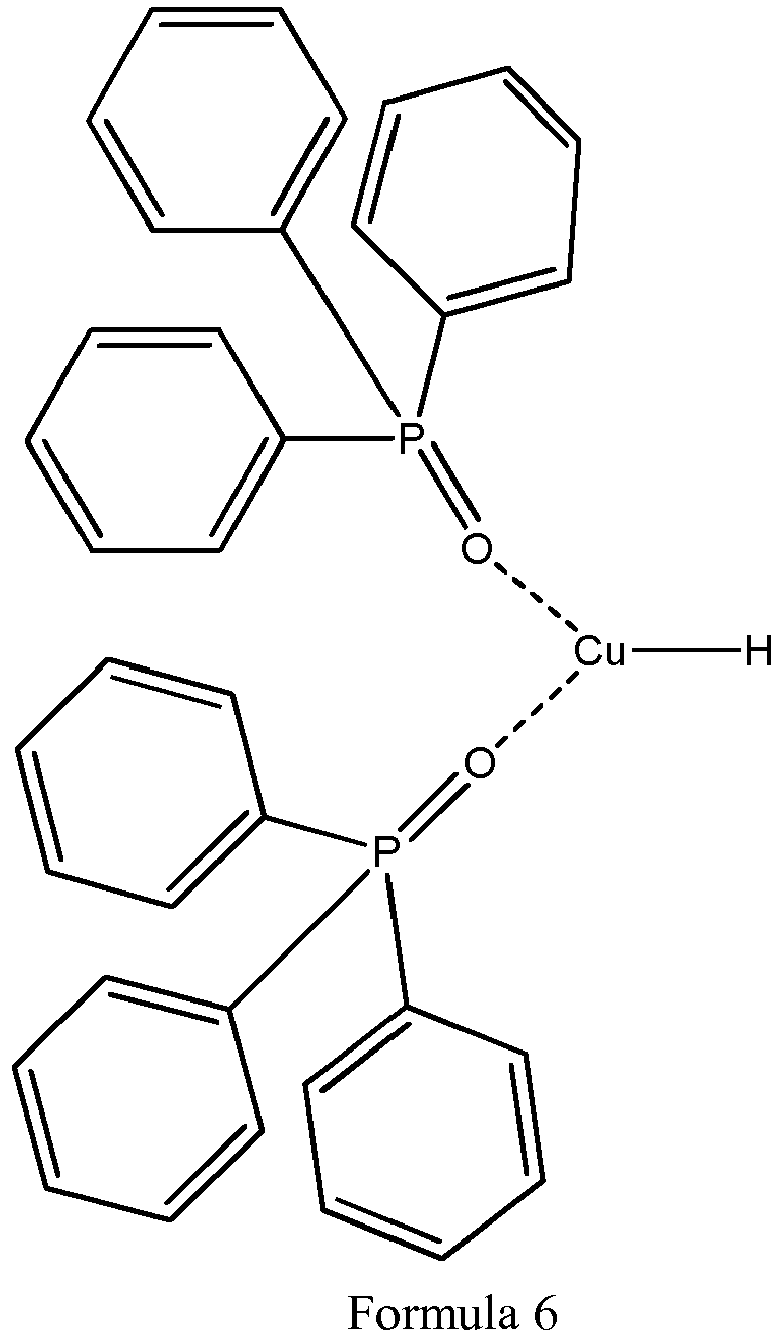
- By the wording "copper (I) hydride which comprises", it is meant in the text of the present specification, that the copper (I) hydride, for each embodiment from first to third, comprises at least the copper (I) hydride mentioned above.
- The catalyst used for the polymerization can be prepared while being isolated from the media used for its preparation or it can be prepared in-situ, before use in polymerization. Preferably, it is prepared in-situ before use in polymerization.
- By the wording in-situ, it is meant in the present specification, that the catalyst is prepared and used in polymerization without being separated from the media used for its preparation.
- The catalyst can be prepared by any process. A preferred process, particularly when it is prepared in-situ, is that the catalyst is formed by mixing 3 components i.e. a component (1) which is a source of copper (I), a component (2) which is the ligand L as defined above and a component (3) which is a source of hydride, in an organic solvent.
- Preferred component (1) is CuF(PPh3)3 which can be prepared from CuF2 or from CuSO4 and HF, as source of copper.
- Examples of components (3) are siloxanes responding to formula RSiH among which TMDS (tetramethyldisiloxane), PhSiH3, Ph2SiH2, Ph3SiH, Et3SiH, (EtO)2MeSiH, PhMe2SiH, (MeO)3SiH, Cl3SiH and PMHS (polymethylhydrosiloxane) responding to Formula 3

- The organic solvent can be any appropriate organic solvent and is advantageously THF or toluene.
- The process according to the invention is a process for the manufacture of a vinyl chloride polymer involving the use of a copper catalyst. Advantageously, the process according to the invention is a process for the manufacture of a vinyl chloride polymer by coordination - insertion polymerization of vinyl chloride and possibly of at least one comonomer of vinyl chloride.
- The expression "coordination - insertion polymerization" is understood to mean, for the purposes of the present invention, an addition polymerization in which monomer adds to a growing macromolecule through an organometallic active center. This kind of polymerization is also often simply called insertion polymerization.
- The polymer manufactured by the process according to the present invention is a vinyl chloride polymer.
- In the text of the present specification, the terms "polymer", "copolymer", and "homopolymer" are used indifferently in the singular as well as in the plural.
- The expression "vinyl chloride polymer" is understood to mean, for the purposes of the present invention, all polymers containing advantageously at least 50 %, preferably at least 60 %, more preferably at least 70 %, most preferably at least 75 % and particularly most preferably at least 85 % by weight of monomeric units derived from vinyl chloride (monomer). These polymers are therefore advantageously either vinyl chloride homopolymers (containing 100 % by weight of units derived from vinyl chloride) or copolymers of vinyl chloride with one or more than one ethylenically unsaturated monomers (called comonomers) selected from the vinylic esters (preferably vinyl acetate) and the (meth) acrylic monomers (preferably n-butyl acrylate and methylmethacrylate). The polymer manufactured by the process according to the invention is preferably a vinyl chloride homopolymer or a copolymer of vinyl chloride with vinyl acetate and is more preferably a vinyl chloride homopolymer.
- The polymerization takes place at a temperature advantageously of at least - 75, preferably of at least - 50, more preferably of at least - 25, particularly more preferably of at least 5, most preferably of at least 20 and particularly most preferably of at least 40°C.
- The polymerization takes place at a temperature advantageously of at most 110, preferably of at most 100, more preferably of at most 90, particularly more preferably of at most 80, most preferably of at most 70 and particularly most preferably of at most 60°C.
- Good results can be obtained when the polymerization takes place at a temperature comprised between 5 and 90°C. Very good results can be obtained when the polymerization takes place at temperature comprised between 20 and 80°C.
- The ratio of the number of moles of VC and possibly of the at least one comonomer of vinyl chloride, to the number of moles of catalyst (i.e. nVC:ncat), advantageously at the beginning of the polymerization, is comprised advantageously between 100 and 10 000 000, preferably between 100 and 1 000 000, more preferably between 100 and 500 000, particularly more preferably between 100 and 100 000, most preferably between 100 and 50 000 and particularly most preferably between 100 and 25 000. Good results can be obtained when such ratio is comprised between 100 and 10 000. Very good results can be obtained when such ratio is comprised between 100 and 4000.
- The process according to the invention can be a batch process or a continuous process. Preferably, the process according to the invention is a batch process.
- The following examples are intended to illustrate the invention without however limiting the scope thereof.
- The catalyst A used in example 1 comprising [2,2'-bis(diphenylphosphino-κ-P)-1,1'-binaphthyl] hydridocopper (I) was synthesized in two steps as described below.
- In a 250 ml flask fitted with a ground glass neck and a magnetic stirring bar, topped with a condenser and an argon balloon, difluorocopper (II) (CuF2) (1.03 g, 10.0 mmol, 1.0 equiv.) and triphenyl phosphine (PPh3) (9.18 g, 35.0 mmol, 3.5 equiv.) were placed in suspension in non-distilled methanol (100 ml). The reaction mixture was heated to reflux during 2h30. The solution was then hot filtered in order to remove any solid residue still present then the methanol was reduced to a volume of 40 ml. After one night in a cold chamber at 4°C, white crystals were formed. These were filtered, rinsed with a few cold methanol and air dried. The mother liquors were again concentrated under vacuum in methanol (20 ml). After a night in a cold chamber, white crystals were again isolated.
- Catalyst A was prepared in-situ before use in polymerization. 50 ml of THF previously degassed under a flux of nitrogen during 1 hour at ambient temperature were introduced in a stainless steel autoclave fitted with a magnetic stirring bar. [Tris(triphenylphosphine-κ-P)] fluorocopper (I) obtained in step 1 (0.149 g, 0.16 mmol, 1.0 equiv.) and 2,2'-bis(diphenylphosphino)-1,1'-binaphthyl (BINAP) (0.100 g, 0.16 mmol, 1.0 equiv.) were then introduced into the autoclave. The reaction media was then placed under agitation during 5 minutes at the end of which the solution took a yellowish color. Polymethylhydrosiloxane (0.051 g, 0.80 mmol, 5.0 equiv.) was then added as hydride source and the solution took immediately an orange color. After stirring during 5 minutes, the magnetic stirring bar was removed from the autoclave and the autoclave containing the catalyst A comprising [2,2'-bis(diphenylphosphino-κ-P)-1,1'-binaphthyl] hydridocopper (I) freshly prepared (solution A) was then carefully closed.
- The catalyst B used in example 2 comprising [bis(triphenylphosphine oxide-κ-O)] hydridocopper (I) was synthesized in two steps according to the same procedure as described above for catalyst A but by replacing 1.0 equiv. of BINAP by 4.0 equiv. of OPPh3 (0.234 g, 0.84 mmol) and by using 0.196 g (0.21 mmol; 1 equiv.) of [tris(triphenylphosphine-κ-P)] fluorocopper (I) and 0.067 g (1.05 mmol, 5 equiv.) of polymethylhydrosiloxane.
- Vinyl chloride supplied by SOLVAY S.A.
- Tetrahydrofuran (THF) absolute, over molecular sieve (H2O ≤0.005%), containing ∼0.025% 2,6-di-tert-butyl-4-methylphenol as stabilizer, ≥99.5% (GC) supplied by Sigma-Aldrich.
- Polymerization was performed in a stainless steel autoclave equipped with a probe for temperature and pressure. The temperature was regulated thanks to a thermostat bath. The autoclave in which 50 ml of freshly prepared solution A or of freshly prepared solution B have been introduced was placed under nitrogen flux during 5 minutes under gentle agitation (< 100 rpm). Nitrogen flux was then stopped and VC (10 g, 0.154 mol) was introduced at room temperature. The exact amount of VC was determined by weighting the storage cylinder before and after the polymerization. The mixture was then stirred with 300 rpm and the autoclave was warmed to 50°C. After 24 hours, the autoclave was brought to room temperature. The VC was vented slowly and the autoclave was purged with nitrogen with a cannula for at least 1 hour. Methanol (1 g, 0.031 mol) was then introduced in the autoclave and the mixture was transferred into a 250 ml roundbottom flask. The solvent was removed in vacuo to yield a crude product which was solubilised in 5 ml THF and suspended in 20 ml methanol leading to the formation of a precipitate which was then filtered off. The precipitate was then dried in vacuum at 25°C and weighted.
- The product obtained at the issue of the polymerization (the precipitate) was characterized by 1H NMR on a Bruker AVANCE 500 MHz spectrometer (sample dissolved in deuterated THF, 30°C) and by 13C NMR on a Bruker AVANCE 400 MHz (sample dissolved in deuterated dioxane, 50°C).
- Examples 1 and 2 were performed according to the general procedure for the polymerization detailed above. All the conditions and results are summarized in Table 1 below.
- nVC:ncat is the ratio of the number of moles of VC to the number of moles of copper catalyst at the beginning of the polymerization.
- TON is the turnover number i.e. the ratio of the number of moles of monomer in polymer to the number of moles of copper catalyst.
Table 1 Example Catalyst T (°C) Amount catalyst [mmol] VC [mmol] nVC:ncat Weight of precipitate [mg] TON 1 Solution A 50 0,16 154 962 80 8 2 Solution B 50 0.21 154 733 22 1.7 - The characterization of the obtained products (precipitates) by 1H NMR identified the signals which are characteristic of PVC i.e. the signal between 2 and 2.7 ppm for the -CHCl-CH2 - group and the one between 4.3 and 4.8 ppm for the -CHCl-CH2- group.
- The characterization of the obtained products (precipitates) by 13C NMR identified the signal which is characteristic of PVC i.e. the one at about 56 ppm for the -CHCl- group.
- The obtained polymers are therefore PVC without any doubt.
Claims (10)
- Process for the manufacture of a vinyl chloride polymer by polymerization of vinyl chloride and possibly of at least one comonomer of vinyl chloride, characterized in that the catalyst used for the polymerization comprises at least one copper (I) hydride.
- Process according to Claim 1, wherein the copper (I) hydride responds to Formula 1
nL----Cu-R Formula 1
in which Cu is copper (I), R is H (hydrogen) or D (deuterium), L is a ligand and n is an integer equal to or higher than 1 representing the number of coordination link(s) between Cu and L. - Process according to Claim 2, wherein n is an integer equal to 1, 2, 3 or 4.
- Process according to either Claim 2 or 3, wherein L is selected from triphenyl phosphine (PPh3), triphenyl phosphine oxide (OPPh3), 2,2'-bis(diphenylphosphino)-1,1'-binaphthyl (BINAP) the formula of which is represented by Formula 2 below or a mixture thereof.

- Process according to any one of Claims 1 to 4, characterized in that the catalyst used for the polymerization comprises at least one copper (I) hydride which responds to Formula 1
nL----Cu-R Formula 1
in which Cu is copper (I), R is H (hydrogen), L is a ligand selected from triphenyl phosphine (PPh3), triphenyl phosphine oxide (OPPh3), 2,2'-bis(diphenylphosphino)-1,1'-binaphthyl (BINAP) or a mixture thereof, and n is an integer equal to 1, 2, 3 or 4. - Process according to any one of Claims 1 to 5, characterized in that the catalyst used for the polymerization comprises at least one copper (I) hydride which comprises either (BINAP)Cu(I)H named [2,2'-bis(diphenylphosphino-κ-P)-1,1'-binaphthyl] hydridocopper (I) responding to Formula 4, or (PPh3)2Cu(I)H named [bis(triphenylphosphine-κ-P)] hydridocopper (I) responding to Formula 5 or (OPPh3)2Cu(I)H named [bis(triphenylphosphine oxide-κ-O)] hydridocopper (I) responding to Formula 6.


- Process according to any one of Claims 1 to 6, characterized in that the catalyst is prepared in-situ before use in polymerization.
- Process according to any one of Claims 1 to 7 wherein the vinyl chloride polymer is either a vinyl chloride homopolymer or a copolymer of vinyl chloride with one or more than one ethylenically unsaturated monomers selected from the vinylic esters and the (meth) acrylic monomers.
- Process according to any one of Claims 1 to 8, wherein the vinyl chloride polymer is a vinyl chloride homopolymer or a copolymer of vinyl chloride with vinyl acetate.
- Process according to any one of Claims 1 to 9, wherein the vinyl chloride polymer is a vinyl chloride homopolymer.
Priority Applications (1)
| Application Number | Priority Date | Filing Date | Title |
|---|---|---|---|
| EP14170966.7A EP2886560B1 (en) | 2013-12-20 | 2014-06-03 | Process for the manufacture of vinyl chloride polymers |
Applications Claiming Priority (2)
| Application Number | Priority Date | Filing Date | Title |
|---|---|---|---|
| EP13199036 | 2013-12-20 | ||
| EP14170966.7A EP2886560B1 (en) | 2013-12-20 | 2014-06-03 | Process for the manufacture of vinyl chloride polymers |
Publications (2)
| Publication Number | Publication Date |
|---|---|
| EP2886560A1 true EP2886560A1 (en) | 2015-06-24 |
| EP2886560B1 EP2886560B1 (en) | 2017-05-10 |
Family
ID=49876458
Family Applications (1)
| Application Number | Title | Priority Date | Filing Date |
|---|---|---|---|
| EP14170966.7A Not-in-force EP2886560B1 (en) | 2013-12-20 | 2014-06-03 | Process for the manufacture of vinyl chloride polymers |
Country Status (1)
| Country | Link |
|---|---|
| EP (1) | EP2886560B1 (en) |
Cited By (1)
| Publication number | Priority date | Publication date | Assignee | Title |
|---|---|---|---|---|
| CN105669663A (en) * | 2016-03-16 | 2016-06-15 | 安徽师范大学 | Hexafluorophosphate containing copper coordination compound and preparation method thereof |
-
2014
- 2014-06-03 EP EP14170966.7A patent/EP2886560B1/en not_active Not-in-force
Non-Patent Citations (8)
| Title |
|---|
| A. NAKAMURA ET AL., CHEM. REV., vol. 109, 2009, pages 5215 - 5244 |
| BRAD P. CARROW; KYOKO NOZAKI, J. AM. CHEM. SOC., vol. 134, 2012, pages 8802 - 8805 |
| DEAN M. PHILIPP; RICHARD P. MULLER; WILLIAM A. GODDARD, III; JOEY STORER; MARK MCADON; MIKE MULLINS, J. AM. CHEM. SOC., vol. 124, 2002, pages 10198 - 10210 |
| HANNES LEICHT: "Incorporation of Vinyl Chloride in Insertion Polymerization", ANGEW. CHEM. INT. ED., vol. 52, 2013, pages 3963 - 3966, XP002731973 * |
| HANNES LEICHT: "Inigo G6ttker-Schnetmann and Stefan Mecking", ANGEW. CHEM. INT. ED., vol. 52, 2013, pages 3963 - 3966 |
| HAROLD W. BOONE; PHILLIP S. ATHEY; MICHAEL J. MULLINS; DEAN PHILIPP; RICHARD MULLER; WILLIAM A. GODDARD, J. AM. CHEM. SOC., vol. 124, 2002, pages 8790 - 8791 |
| STEFAN M. KILYANEK; EDWARD J. STOEBENAU, III; NAWAPOM VINAYAVEKHIN; RICHARD F. JORDAN, ORGANOMETALLICS, vol. 29, 2010, pages 1750 - 1760 |
| STEPHEN R. FOLEY; ROBERT A. STOCKLAND, JR.; HAN SHEN; RICHARD F. JORDAN, J. AM. CHEM. SOC., vol. 125, 2003, pages 4350 - 4361 |
Cited By (1)
| Publication number | Priority date | Publication date | Assignee | Title |
|---|---|---|---|---|
| CN105669663A (en) * | 2016-03-16 | 2016-06-15 | 安徽师范大学 | Hexafluorophosphate containing copper coordination compound and preparation method thereof |
Also Published As
| Publication number | Publication date |
|---|---|
| EP2886560B1 (en) | 2017-05-10 |
Similar Documents
| Publication | Publication Date | Title |
|---|---|---|
| CN109563116A (en) | Pre-formed catalyst system comprising rare earth metal cyclopentadienyl | |
| CN101045770A (en) | Ethylene/butadiene copolymers, catalytic system of producing same and production of said polymers | |
| JP2011068881A (en) | Production method of copolymer of polar group-containing allyl monomer | |
| EP2614091A2 (en) | Catalyst for polymerizing norbornene monomers and a method for producing norbornene polymer | |
| EP2886560B1 (en) | Process for the manufacture of vinyl chloride polymers | |
| JP2012122033A (en) | Method for producing vinyl chloride polymer | |
| JP3516812B2 (en) | Method for producing acrylic block copolymer | |
| JP5834017B2 (en) | Norbornene-based monomer polymerization catalyst and method for producing norbornene-based polymer | |
| US7649079B2 (en) | Method for removing metal and method for producing polymer | |
| EP2738187B1 (en) | Process for the manufacture of vinyl chloride-containing copolymers | |
| EP0393751A2 (en) | Polymerization catalyst, the process for its preparation and its use in ethylene homo and copolymerization | |
| EP2886561A1 (en) | Process for the manufacture of vinyl chloride polymers | |
| JP5864966B2 (en) | Method for producing norbornene polymer | |
| JPH0217166A (en) | Ethylenic unsaturated urea derivative and production thereof | |
| JP2004500450A (en) | (Co) polymerization method of polar monomer and non-polar monomer | |
| EP2886562A1 (en) | Process for the manufacture of vinyl chloride polymers | |
| US20040181018A1 (en) | Process for the production of an azo-catalyst for the polymerization of olefins | |
| JPH03106890A (en) | Silyl derivative of 2-allyl phenol | |
| CN120059012A (en) | Catalyst system, ethylene/acrylic acid (ester) copolymer and preparation method thereof | |
| JPH0350210A (en) | Alternating copolymer, and preparation and use thereof | |
| CN119343382A (en) | Coupling polyethylene or coupling copolymer of ethylene and 1,3-diene and preparation method thereof | |
| JPH0344378A (en) | Method for producing 5-fluorouracil derivatives and polymers thereof | |
| DE19836926A1 (en) | Polymerization-active, non-bridged, mononuclear bisalkyl metal half-sandwich complexes based on rare earth metals and their use as catalysts for the (co) polymerization of polar and non-polar olefinically unsaturated monomers | |
| JP2946035B1 (en) | Polar vinyl monomer polymerization catalyst and method for producing polar vinyl polymer | |
| CN120059013A (en) | Ethylene/(meth) acrylic ester copolymer, and preparation method and application thereof |
Legal Events
| Date | Code | Title | Description |
|---|---|---|---|
| PUAI | Public reference made under article 153(3) epc to a published international application that has entered the european phase |
Free format text: ORIGINAL CODE: 0009012 |
|
| 17P | Request for examination filed |
Effective date: 20140603 |
|
| AK | Designated contracting states |
Kind code of ref document: A1 Designated state(s): AL AT BE BG CH CY CZ DE DK EE ES FI FR GB GR HR HU IE IS IT LI LT LU LV MC MK MT NL NO PL PT RO RS SE SI SK SM TR |
|
| AX | Request for extension of the european patent |
Extension state: BA ME |
|
| R17P | Request for examination filed (corrected) |
Effective date: 20160104 |
|
| RBV | Designated contracting states (corrected) |
Designated state(s): AL AT BE BG CH CY CZ DE DK EE ES FI FR GB GR HR HU IE IS IT LI LT LU LV MC MK MT NL NO PL PT RO RS SE SI SK SM TR |
|
| REG | Reference to a national code |
Ref country code: DE Ref legal event code: R079 Ref document number: 602014009571 Country of ref document: DE Free format text: PREVIOUS MAIN CLASS: C08F0014060000 Ipc: C08F0114060000 |
|
| GRAP | Despatch of communication of intention to grant a patent |
Free format text: ORIGINAL CODE: EPIDOSNIGR1 |
|
| RIC1 | Information provided on ipc code assigned before grant |
Ipc: C08F 14/06 20060101ALI20161206BHEP Ipc: C08F 114/06 20060101AFI20161206BHEP Ipc: C08F 2/06 20060101ALI20161206BHEP Ipc: C08F 4/50 20060101ALI20161206BHEP |
|
| INTG | Intention to grant announced |
Effective date: 20161220 |
|
| GRAS | Grant fee paid |
Free format text: ORIGINAL CODE: EPIDOSNIGR3 |
|
| GRAA | (expected) grant |
Free format text: ORIGINAL CODE: 0009210 |
|
| AK | Designated contracting states |
Kind code of ref document: B1 Designated state(s): AL AT BE BG CH CY CZ DE DK EE ES FI FR GB GR HR HU IE IS IT LI LT LU LV MC MK MT NL NO PL PT RO RS SE SI SK SM TR |
|
| REG | Reference to a national code |
Ref country code: GB Ref legal event code: FG4D |
|
| REG | Reference to a national code |
Ref country code: AT Ref legal event code: REF Ref document number: 892249 Country of ref document: AT Kind code of ref document: T Effective date: 20170515 Ref country code: CH Ref legal event code: EP |
|
| REG | Reference to a national code |
Ref country code: IE Ref legal event code: FG4D |
|
| REG | Reference to a national code |
Ref country code: DE Ref legal event code: R096 Ref document number: 602014009571 Country of ref document: DE |
|
| REG | Reference to a national code |
Ref country code: NL Ref legal event code: MP Effective date: 20170510 |
|
| REG | Reference to a national code |
Ref country code: LT Ref legal event code: MG4D |
|
| REG | Reference to a national code |
Ref country code: AT Ref legal event code: MK05 Ref document number: 892249 Country of ref document: AT Kind code of ref document: T Effective date: 20170510 |
|
| PG25 | Lapsed in a contracting state [announced via postgrant information from national office to epo] |
Ref country code: HR Free format text: LAPSE BECAUSE OF FAILURE TO SUBMIT A TRANSLATION OF THE DESCRIPTION OR TO PAY THE FEE WITHIN THE PRESCRIBED TIME-LIMIT Effective date: 20170510 Ref country code: NO Free format text: LAPSE BECAUSE OF FAILURE TO SUBMIT A TRANSLATION OF THE DESCRIPTION OR TO PAY THE FEE WITHIN THE PRESCRIBED TIME-LIMIT Effective date: 20170810 Ref country code: ES Free format text: LAPSE BECAUSE OF FAILURE TO SUBMIT A TRANSLATION OF THE DESCRIPTION OR TO PAY THE FEE WITHIN THE PRESCRIBED TIME-LIMIT Effective date: 20170510 Ref country code: LT Free format text: LAPSE BECAUSE OF FAILURE TO SUBMIT A TRANSLATION OF THE DESCRIPTION OR TO PAY THE FEE WITHIN THE PRESCRIBED TIME-LIMIT Effective date: 20170510 Ref country code: AT Free format text: LAPSE BECAUSE OF FAILURE TO SUBMIT A TRANSLATION OF THE DESCRIPTION OR TO PAY THE FEE WITHIN THE PRESCRIBED TIME-LIMIT Effective date: 20170510 Ref country code: FI Free format text: LAPSE BECAUSE OF FAILURE TO SUBMIT A TRANSLATION OF THE DESCRIPTION OR TO PAY THE FEE WITHIN THE PRESCRIBED TIME-LIMIT Effective date: 20170510 |
|
| PG25 | Lapsed in a contracting state [announced via postgrant information from national office to epo] |
Ref country code: IS Free format text: LAPSE BECAUSE OF FAILURE TO SUBMIT A TRANSLATION OF THE DESCRIPTION OR TO PAY THE FEE WITHIN THE PRESCRIBED TIME-LIMIT Effective date: 20170910 Ref country code: SE Free format text: LAPSE BECAUSE OF FAILURE TO SUBMIT A TRANSLATION OF THE DESCRIPTION OR TO PAY THE FEE WITHIN THE PRESCRIBED TIME-LIMIT Effective date: 20170510 Ref country code: NL Free format text: LAPSE BECAUSE OF FAILURE TO SUBMIT A TRANSLATION OF THE DESCRIPTION OR TO PAY THE FEE WITHIN THE PRESCRIBED TIME-LIMIT Effective date: 20170510 Ref country code: LV Free format text: LAPSE BECAUSE OF FAILURE TO SUBMIT A TRANSLATION OF THE DESCRIPTION OR TO PAY THE FEE WITHIN THE PRESCRIBED TIME-LIMIT Effective date: 20170510 Ref country code: PL Free format text: LAPSE BECAUSE OF FAILURE TO SUBMIT A TRANSLATION OF THE DESCRIPTION OR TO PAY THE FEE WITHIN THE PRESCRIBED TIME-LIMIT Effective date: 20170510 Ref country code: RS Free format text: LAPSE BECAUSE OF FAILURE TO SUBMIT A TRANSLATION OF THE DESCRIPTION OR TO PAY THE FEE WITHIN THE PRESCRIBED TIME-LIMIT Effective date: 20170510 Ref country code: BG Free format text: LAPSE BECAUSE OF FAILURE TO SUBMIT A TRANSLATION OF THE DESCRIPTION OR TO PAY THE FEE WITHIN THE PRESCRIBED TIME-LIMIT Effective date: 20170810 |
|
| REG | Reference to a national code |
Ref country code: DE Ref legal event code: R119 Ref document number: 602014009571 Country of ref document: DE |
|
| PG25 | Lapsed in a contracting state [announced via postgrant information from national office to epo] |
Ref country code: EE Free format text: LAPSE BECAUSE OF FAILURE TO SUBMIT A TRANSLATION OF THE DESCRIPTION OR TO PAY THE FEE WITHIN THE PRESCRIBED TIME-LIMIT Effective date: 20170510 Ref country code: DK Free format text: LAPSE BECAUSE OF FAILURE TO SUBMIT A TRANSLATION OF THE DESCRIPTION OR TO PAY THE FEE WITHIN THE PRESCRIBED TIME-LIMIT Effective date: 20170510 Ref country code: SK Free format text: LAPSE BECAUSE OF FAILURE TO SUBMIT A TRANSLATION OF THE DESCRIPTION OR TO PAY THE FEE WITHIN THE PRESCRIBED TIME-LIMIT Effective date: 20170510 Ref country code: RO Free format text: LAPSE BECAUSE OF FAILURE TO SUBMIT A TRANSLATION OF THE DESCRIPTION OR TO PAY THE FEE WITHIN THE PRESCRIBED TIME-LIMIT Effective date: 20170510 Ref country code: CZ Free format text: LAPSE BECAUSE OF FAILURE TO SUBMIT A TRANSLATION OF THE DESCRIPTION OR TO PAY THE FEE WITHIN THE PRESCRIBED TIME-LIMIT Effective date: 20170510 |
|
| REG | Reference to a national code |
Ref country code: CH Ref legal event code: PL |
|
| PG25 | Lapsed in a contracting state [announced via postgrant information from national office to epo] |
Ref country code: SM Free format text: LAPSE BECAUSE OF FAILURE TO SUBMIT A TRANSLATION OF THE DESCRIPTION OR TO PAY THE FEE WITHIN THE PRESCRIBED TIME-LIMIT Effective date: 20170510 Ref country code: IT Free format text: LAPSE BECAUSE OF FAILURE TO SUBMIT A TRANSLATION OF THE DESCRIPTION OR TO PAY THE FEE WITHIN THE PRESCRIBED TIME-LIMIT Effective date: 20170510 |
|
| PLBE | No opposition filed within time limit |
Free format text: ORIGINAL CODE: 0009261 |
|
| STAA | Information on the status of an ep patent application or granted ep patent |
Free format text: STATUS: NO OPPOSITION FILED WITHIN TIME LIMIT |
|
| REG | Reference to a national code |
Ref country code: IE Ref legal event code: MM4A |
|
| REG | Reference to a national code |
Ref country code: FR Ref legal event code: ST Effective date: 20180228 |
|
| 26N | No opposition filed |
Effective date: 20180213 |
|
| PG25 | Lapsed in a contracting state [announced via postgrant information from national office to epo] |
Ref country code: LI Free format text: LAPSE BECAUSE OF NON-PAYMENT OF DUE FEES Effective date: 20170630 Ref country code: CH Free format text: LAPSE BECAUSE OF NON-PAYMENT OF DUE FEES Effective date: 20170630 Ref country code: LU Free format text: LAPSE BECAUSE OF NON-PAYMENT OF DUE FEES Effective date: 20170603 Ref country code: DE Free format text: LAPSE BECAUSE OF NON-PAYMENT OF DUE FEES Effective date: 20180103 Ref country code: IE Free format text: LAPSE BECAUSE OF NON-PAYMENT OF DUE FEES Effective date: 20170603 |
|
| PG25 | Lapsed in a contracting state [announced via postgrant information from national office to epo] |
Ref country code: SI Free format text: LAPSE BECAUSE OF FAILURE TO SUBMIT A TRANSLATION OF THE DESCRIPTION OR TO PAY THE FEE WITHIN THE PRESCRIBED TIME-LIMIT Effective date: 20170510 Ref country code: FR Free format text: LAPSE BECAUSE OF NON-PAYMENT OF DUE FEES Effective date: 20170710 |
|
| REG | Reference to a national code |
Ref country code: BE Ref legal event code: MM Effective date: 20170630 |
|
| PG25 | Lapsed in a contracting state [announced via postgrant information from national office to epo] |
Ref country code: BE Free format text: LAPSE BECAUSE OF NON-PAYMENT OF DUE FEES Effective date: 20170630 |
|
| PG25 | Lapsed in a contracting state [announced via postgrant information from national office to epo] |
Ref country code: MT Free format text: LAPSE BECAUSE OF NON-PAYMENT OF DUE FEES Effective date: 20170603 |
|
| GBPC | Gb: european patent ceased through non-payment of renewal fee |
Effective date: 20180603 |
|
| PG25 | Lapsed in a contracting state [announced via postgrant information from national office to epo] |
Ref country code: GB Free format text: LAPSE BECAUSE OF NON-PAYMENT OF DUE FEES Effective date: 20180603 |
|
| PG25 | Lapsed in a contracting state [announced via postgrant information from national office to epo] |
Ref country code: MC Free format text: LAPSE BECAUSE OF FAILURE TO SUBMIT A TRANSLATION OF THE DESCRIPTION OR TO PAY THE FEE WITHIN THE PRESCRIBED TIME-LIMIT Effective date: 20170510 Ref country code: HU Free format text: LAPSE BECAUSE OF FAILURE TO SUBMIT A TRANSLATION OF THE DESCRIPTION OR TO PAY THE FEE WITHIN THE PRESCRIBED TIME-LIMIT; INVALID AB INITIO Effective date: 20140603 |
|
| PG25 | Lapsed in a contracting state [announced via postgrant information from national office to epo] |
Ref country code: CY Free format text: LAPSE BECAUSE OF FAILURE TO SUBMIT A TRANSLATION OF THE DESCRIPTION OR TO PAY THE FEE WITHIN THE PRESCRIBED TIME-LIMIT Effective date: 20170510 |
|
| PG25 | Lapsed in a contracting state [announced via postgrant information from national office to epo] |
Ref country code: MK Free format text: LAPSE BECAUSE OF FAILURE TO SUBMIT A TRANSLATION OF THE DESCRIPTION OR TO PAY THE FEE WITHIN THE PRESCRIBED TIME-LIMIT Effective date: 20170510 |
|
| PG25 | Lapsed in a contracting state [announced via postgrant information from national office to epo] |
Ref country code: TR Free format text: LAPSE BECAUSE OF FAILURE TO SUBMIT A TRANSLATION OF THE DESCRIPTION OR TO PAY THE FEE WITHIN THE PRESCRIBED TIME-LIMIT Effective date: 20170510 |
|
| PG25 | Lapsed in a contracting state [announced via postgrant information from national office to epo] |
Ref country code: PT Free format text: LAPSE BECAUSE OF FAILURE TO SUBMIT A TRANSLATION OF THE DESCRIPTION OR TO PAY THE FEE WITHIN THE PRESCRIBED TIME-LIMIT Effective date: 20170510 |
|
| PG25 | Lapsed in a contracting state [announced via postgrant information from national office to epo] |
Ref country code: GR Free format text: LAPSE BECAUSE OF FAILURE TO SUBMIT A TRANSLATION OF THE DESCRIPTION OR TO PAY THE FEE WITHIN THE PRESCRIBED TIME-LIMIT Effective date: 20170510 |
|
| PG25 | Lapsed in a contracting state [announced via postgrant information from national office to epo] |
Ref country code: AL Free format text: LAPSE BECAUSE OF FAILURE TO SUBMIT A TRANSLATION OF THE DESCRIPTION OR TO PAY THE FEE WITHIN THE PRESCRIBED TIME-LIMIT Effective date: 20170510 |