EP2886531A1 - Aspartic acid derivatives - Google Patents
Aspartic acid derivatives Download PDFInfo
- Publication number
- EP2886531A1 EP2886531A1 EP14003926.4A EP14003926A EP2886531A1 EP 2886531 A1 EP2886531 A1 EP 2886531A1 EP 14003926 A EP14003926 A EP 14003926A EP 2886531 A1 EP2886531 A1 EP 2886531A1
- Authority
- EP
- European Patent Office
- Prior art keywords
- fmoc
- asp
- peptide
- aspartimide
- aspartic acid
- Prior art date
- Legal status (The legal status is an assumption and is not a legal conclusion. Google has not performed a legal analysis and makes no representation as to the accuracy of the status listed.)
- Granted
Links
- FRGMXMDQWNSGNX-NDEPHWFRSA-N CCCCC(CCCC)(CCCC)OC(C[C@@H](C(O)=O)NC(OCC1c(cccc2)c2-c2ccccc12)=O)=O Chemical compound CCCCC(CCCC)(CCCC)OC(C[C@@H](C(O)=O)NC(OCC1c(cccc2)c2-c2ccccc12)=O)=O FRGMXMDQWNSGNX-NDEPHWFRSA-N 0.000 description 1
Images



Classifications
-
- C—CHEMISTRY; METALLURGY
- C07—ORGANIC CHEMISTRY
- C07C—ACYCLIC OR CARBOCYCLIC COMPOUNDS
- C07C229/00—Compounds containing amino and carboxyl groups bound to the same carbon skeleton
- C07C229/02—Compounds containing amino and carboxyl groups bound to the same carbon skeleton having amino and carboxyl groups bound to acyclic carbon atoms of the same carbon skeleton
- C07C229/04—Compounds containing amino and carboxyl groups bound to the same carbon skeleton having amino and carboxyl groups bound to acyclic carbon atoms of the same carbon skeleton the carbon skeleton being acyclic and saturated
- C07C229/24—Compounds containing amino and carboxyl groups bound to the same carbon skeleton having amino and carboxyl groups bound to acyclic carbon atoms of the same carbon skeleton the carbon skeleton being acyclic and saturated having more than one carboxyl group bound to the carbon skeleton, e.g. aspartic acid
-
- C—CHEMISTRY; METALLURGY
- C07—ORGANIC CHEMISTRY
- C07C—ACYCLIC OR CARBOCYCLIC COMPOUNDS
- C07C271/00—Derivatives of carbamic acids, i.e. compounds containing any of the groups, the nitrogen atom not being part of nitro or nitroso groups
- C07C271/06—Esters of carbamic acids
- C07C271/08—Esters of carbamic acids having oxygen atoms of carbamate groups bound to acyclic carbon atoms
- C07C271/10—Esters of carbamic acids having oxygen atoms of carbamate groups bound to acyclic carbon atoms with the nitrogen atoms of the carbamate groups bound to hydrogen atoms or to acyclic carbon atoms
- C07C271/22—Esters of carbamic acids having oxygen atoms of carbamate groups bound to acyclic carbon atoms with the nitrogen atoms of the carbamate groups bound to hydrogen atoms or to acyclic carbon atoms to carbon atoms of hydrocarbon radicals substituted by carboxyl groups
-
- C—CHEMISTRY; METALLURGY
- C07—ORGANIC CHEMISTRY
- C07K—PEPTIDES
- C07K1/00—General methods for the preparation of peptides, i.e. processes for the organic chemical preparation of peptides or proteins of any length
- C07K1/04—General methods for the preparation of peptides, i.e. processes for the organic chemical preparation of peptides or proteins of any length on carriers
-
- C—CHEMISTRY; METALLURGY
- C07—ORGANIC CHEMISTRY
- C07K—PEPTIDES
- C07K1/00—General methods for the preparation of peptides, i.e. processes for the organic chemical preparation of peptides or proteins of any length
- C07K1/06—General methods for the preparation of peptides, i.e. processes for the organic chemical preparation of peptides or proteins of any length using protecting groups or activating agents
- C07K1/061—General methods for the preparation of peptides, i.e. processes for the organic chemical preparation of peptides or proteins of any length using protecting groups or activating agents using protecting groups
- C07K1/062—General methods for the preparation of peptides, i.e. processes for the organic chemical preparation of peptides or proteins of any length using protecting groups or activating agents using protecting groups for alpha- or omega-carboxy functions
-
- C—CHEMISTRY; METALLURGY
- C07—ORGANIC CHEMISTRY
- C07C—ACYCLIC OR CARBOCYCLIC COMPOUNDS
- C07C2603/00—Systems containing at least three condensed rings
- C07C2603/02—Ortho- or ortho- and peri-condensed systems
- C07C2603/04—Ortho- or ortho- and peri-condensed systems containing three rings
- C07C2603/06—Ortho- or ortho- and peri-condensed systems containing three rings containing at least one ring with less than six ring members
- C07C2603/10—Ortho- or ortho- and peri-condensed systems containing three rings containing at least one ring with less than six ring members containing five-membered rings
- C07C2603/12—Ortho- or ortho- and peri-condensed systems containing three rings containing at least one ring with less than six ring members containing five-membered rings only one five-membered ring
- C07C2603/18—Fluorenes; Hydrogenated fluorenes
-
- Y—GENERAL TAGGING OF NEW TECHNOLOGICAL DEVELOPMENTS; GENERAL TAGGING OF CROSS-SECTIONAL TECHNOLOGIES SPANNING OVER SEVERAL SECTIONS OF THE IPC; TECHNICAL SUBJECTS COVERED BY FORMER USPC CROSS-REFERENCE ART COLLECTIONS [XRACs] AND DIGESTS
- Y02—TECHNOLOGIES OR APPLICATIONS FOR MITIGATION OR ADAPTATION AGAINST CLIMATE CHANGE
- Y02P—CLIMATE CHANGE MITIGATION TECHNOLOGIES IN THE PRODUCTION OR PROCESSING OF GOODS
- Y02P20/00—Technologies relating to chemical industry
- Y02P20/50—Improvements relating to the production of bulk chemicals
- Y02P20/55—Design of synthesis routes, e.g. reducing the use of auxiliary or protecting groups
Definitions
- the present invention is directed to derivatives of aspartic acid with a new type of side-chain protecting group.
- the present invention is further directed to methods of their preparation and their use in Fmoc based solid phase peptide synthesis as well as the Z/tBu based solution synthesis of peptides.
- the use of the aspartic acid derivatives according to the present invention leads to the minimization of base catalyzed aspartimide formation during peptide synthesis and supports the prevention of aspartimide derived impurities.
- Peptides can be manufactured by solid-phase synthesis.
- One widely used approach of peptide manufacturing is the Fmoc/tBu based solid phase peptide synthesis (Fmoc SPPS) which involves the use of 9-Fluorenylmethyloxycarbonyl (Fmoc) protection for the alpha-amino acid building blocks.
- Fmoc SPPS Fmoc/tBu based solid phase peptide synthesis
- Fmoc SPPS solid phase peptide synthesis
- the side-chain functionalities in trifunctional amino acids are herein protected by acid labile groups like tert -butyl esters leaving only the C-terminus open for specific stepwise peptide chain elongation.
- To assemble the peptide from the C- to the N-terminus the first C-terminal amino acid is immobilized on a solid support like a crosslinked polystyrene resin.
- peptides can be manufactured via convergent synthesis.
- Peptide fragments mostly of six to ten amino acid length are assembled by Fmoc SPPS or alternatively in solution where the N-terminal benzyloxycarbonyl protection (Z) is predominantely used.
- aspartimide is one of the most severe issues (see Subirós-Funosas R. et al., Tetrahedron, 67: 8595-8606, (2011 )).
- susceptible sequences it occures in all preceeding Fmoc deprotection steps and amide bond formations using tertiary amine catalysis after the introduction of aspartic acid. Thereby it leads to a significant accumulation of related by-products.
- the aspartimide is generated by the base catalyzed cyclization of the side-chain carboxylic group with the C-terminal amide nitrogen.
- Ring opening of the succinimide moiety is then accompanied by epimerization and beta-isomerization forming eight by-products either through its hydrolysis or piperidine addition ( Figure 1 ). All these by-products are modifications of the peptide core and are present in the desired peptide as well as in any deletion or truncated sequences containing the aspartic acid side-chain. Thereby a complex mixture of peptidic impurities is formed which emposes difficulties to separation of the desired compound. In solution this side reaction occurs merely during amide bond formation using tertiary amine catalysis (see Martinez, J.; Bodanszky, M. Int. J. Pept. Protein Res., 12:277-283 (1978 )).
- Sequences particularly susceptible to aspartimide formation are -Asp-Gly-, - Asp-Asp-, -Asp-Asn-, -Asp-Arg- and -Asp-Cys- (see Mergler M., et al., J. Peptide Sci., 9: 518-526 (2003 )). While for any other sequence the standard Fmoc-Asp(OtBu)-OH derivative may be sufficient, the best currently commercially available derivative Fmoc-Asp(OMpe)-OH is still not sufficiently protecting against aspartimide formation in the above mentioned sequences.
- microwave heating is particularly advantageous for long or aggregation prone peptides as the acceleration of coupling and deprotection reaction leads to shorter cycle times, higher repetitive yields, and ultimately purer peptides (see Pedersen L., et al., Chem. Soc. Rev., 41: 1826-1844 (2012 )).
- the use of microwave energy also leads to increased levels of typical SPPS by-products including aspartimide formation which can only be limited by routine use of optimized methods (see Palasek S. A., et al., J. Peptide Sci., 13, 143-148 (2007 )).
- WO 95/26975 discloses aliphatic brached alkyl groups as constituents of protective groups for side chains of amino acids. Basis of this approach is the generation of sterically demanding, bulky protective groups to avoid side reactions like aspartimide formation. But these protective groups never gained much interest as due to the sterically demaning group also the reactivity of the protected amino acids in peptide synthesis is reduced. Also Mergler M., et al., J. Peptide Sci., 9: 518-526 (2003 ) discuss the use of bulky alkyl groups for side chain protection of aspartic acid but conclude that a total suppression of the aspartimide formation cannot be achieved by simply increasing the bulk of the side chain protection.
- GLP-2 glucagon-like peptide 2
- Revestive® teduglutide
- Revestive® teduglutide
- an effective synthetic production method would be an interesting alternative to lower the production costs and to omit animal-derived starting materials as well as to reduce the endotoxine burden.
- these peptides contain an Asp-Gly as well as an Asp-Asn sequence which reduces their synthetical accessability due to aspartimide derived by-products (see WO 2012/028602 ).
- the present invention is therefore directed to compounds of formula la and/or Ib wherein
- Formula II shows the benzyloxycarbonyl or the 9-fluorenyl methoxycarbonyl group.
- P represents a phenyl- or 9-fluorenyl group.
- the two formula Ia and Ib represent the D and the L (R and S) enantiomers of aspartic acid.
- the compound can be either the pure D enantiomer or the pure L enantiomer or any mixture of the D and L enantiomers. Preferred is the L enantiomer.
- R 1 , R 2 , R 3 all have the same number of carbon atoms.
- R 1 , R 2 , R 3 are -CH 2 -CH 3 or -CH 2 -CH 2 -CH 3 .
- the present invention is further directed to a method of manufacturing the compounds of formula la and/or Ib by
- step b) the esterification of step b) is performed with a carbodiimde, preferentially dicyclohexylcarbodiimide.
- the present invention is further directed to a method for peptide synthesis by
- the alkaline treatment of step c) is performed with one or more secondary amines, preferably piperidine, 1,8-diazabicyclo[5.4.0]undec-7-en (DBU), pyrrolidine and/or diethylamine.
- one or more secondary amines preferably piperidine, 1,8-diazabicyclo[5.4.0]undec-7-en (DBU), pyrrolidine and/or diethylamine.
- the alkaline treatment of step c) is performed with a mixture comprising one or more secondary amines and an organic acid or preferably an acidic alcohol, e.g. ethyl cyanoglyoxylate-2-oxime.
- concentration of the organic acid or the acidic alcohol should be chosen such that it is sub-stoechiometric as compared to the secondary amines.
- the reaction in step b) is performed in the presence of HBTU, TBTU, HATU, TATU, HCTU, TCTU and/or PyBOP.
- An organic acid acid according to the present invention is an organic compound with acidic properties.
- the most common organic acids are the carboxylic acids, whose acidity is associated with their carboxyl group- COOH.
- Sulfonic acids, containing the group-SO 2 OH are relatively stronger acids.
- Alcohols, with -OH can act as acids but they are usually very weak.
- the relative stability of the conjugate base of the acid determines its acidity.
- Other groups can also confer acidity, usually weakly: the thiol group-SH, the enol group, and the phenol group.
- Preferred organic acids according to the present invention are acidic alcohols.
- An acidic alcohol according to the present invention is an alcohol with an OH group that can act acidic.
- Examples are (Z)-ethyl cyanoglyoxylate-2-oxime (Oxyma Pure), N-hydroxybenzotriazole and phenols.
- the present invention provides derivatives of aspartic acid for the peptide synthesis either in solution or on a solid support.
- the side-chain protection comprises an ester bonded tertiary alcohol having a tertiary C-atom with straight hydrocarbon chains with two to six carbon atoms.
- the side chain protected aspartic acid derivatives according to the present invention are shown in formula la and Ib. wherein
- R 1 , R 2 and R 3 have the same number of carbon atoms. That means all three alkyl chains have the same length. It has further been found that very good results concerning the suppression of the aspartimide formation can even be achieved when using comparably short chains with two or three carbon atoms length.
- R 1 , R 2 and R 3 are -CH 2 -CH 3 or R 1 , R 2 and R 3 are -CH 2 -CH 2 -CH 3 .
- the present invention is further directed to a method of manufacturing the compounds of formula la and/or Ib. This is preferably done by first providing an aspartic acid with hydrogenizable protecting groups at the N and C terminus. Suitable protecting groups for the N and C terminus are for example benzyloxycarbonyl (Z) and benzyl respectively. A person skilled in the art knows how to introduce such protecting groups. Further information can be found in example 1 and 2.
- step a) the side chain carboxylic acid of the aspartic acid derivative of step a) is reacted with a tertiary alcohol according to formula III HO-CR 1 R 2 R 3 Formula III whereby R 1 , R 2 , R 3 represent, independently of each other, a linear hydrocarbon chain of two to six carbon atoms length, e.g. -CH 2 -CH 3 ,CH 2 -CH 2 -CH 3 , -CH 2 -CH 2 -CH 2 -CH 3 , -CH 2 -CH 2 -CH 2 -CH 3 , -CH 2 -CH 2 -CH 2 -CH 2 -CH 3 , -CH 2 -CH 2 -CH 2 -CH 2 -CH 3 .
- the side chain protecting group is introduced.
- the esterification - step is performed with acyl ureas derived from carbodiimdes, preferentially dicyclohexylcarbodiimide or diisopropylcarbodiimide in the presence of N,N-dimethylaminopyridine (see Neises, B. and Steglich, W. Angew. Chem.-Int. Ed., 17: 522 - 524 (1978 )).
- the hydrogenizable protecting groups at the N and C terminus are split off by hydrogenolysis. This step is known to a person skilled in the art. It is typically performed with hydrogen and a Pd/C catalyst.
- a fluorenylmethoxycarbonyl or a benzyloxycarbonyl group is introduced at the N-terminus.
- the introduction of such protecting groups is known to a person skilled in the art of peptide synthesis. It is typically done by N-hydroxysuccinimide activation using Fmoc-OSu or Z-OSu.
- the side chain protected aspartic acid derivatives according to the present invention can then be used for solid or liquid phase peptide synthesis. They are typically used in the same manner as e.g. tBu side-chain protected aspartic acid derivatives.
- the solid phase peptide synthesis is preferably done according to the Fmoc/tBu strategy ( Atherton E., et.al., J.Chem. Soc., Chem. Comm., 539 (1978 )).
- the side chain protected aspartic acid derivatives according to the present invention can for example be used as follows: In a first step, an amino acid or a peptide bound to a solid phase via its C-terminus is provided. Afterwards, the solid phase bound amino acid or peptide of step a) is reacted with compounds of formula Ia and/or Ib whereby the compounds of formula Ia and/or Ib are attached to the N-terminus. In preferred embodiment, this reaction is performed in the presence of HBTU, TBTU, HATU, TATU, HCTU, TCTU or PyBOP.
- Cleavage of the Fmoc group is performed by alkaline treatment. Suitable procedures and reagents are known to a person skilled in the art.
- the alkaline treatment is performed with one or more amines like piperidine, diethylamine, pyrrolidine or DBU, preferably secondary amines, very preferred with 20% piperidine in dimethylformamide.
- the alkaline treatment of step c) is performed with a mixture comprising one or more amines, preferably secondary amines, e.g.
- piperidine and an organic acid like formic acid, acetic acid, or preferably an acidic alcohol like phenol or 2,4-dichlorophenole, (Z)-ethyl cyanoglyoxylate-2-oxime, commercially available as Oxyma Pure (Merck KGaA, Germany, formula IV) or hydroxybenzotriazole.
- organic acid like formic acid, acetic acid, or preferably an acidic alcohol like phenol or 2,4-dichlorophenole, (Z)-ethyl cyanoglyoxylate-2-oxime, commercially available as Oxyma Pure (Merck KGaA, Germany, formula IV) or hydroxybenzotriazole.
- the concentration of the organic acid or the acidic alcohol should be chosen such that it is sub-stoechiometric as compared to the amines.
- the molar ratio of the organic acid or the acidic alcohol compared to the amines is between 0.01 : 1 and 0.4 : 1, preferably between 0.1 : 1 and 0.4 : 1, most preferred between 0.35 : 1 and 0.37 : 1.
- the invention is also directed to the usage of the inventive aspartic acid side-chain protected derivatives for the peptide synthesis in solution applying the N-terminal Z group.
- the Z group is cleaved by hydrogenation which doesn't affect the ester bond of the tertiary alcohols. This orthogonality is especially valuable for the preparation of aspartic acid containing peptides in solution (see Subirós-Funosas R. et al., Tetrahedron, 67: 8595-8606, (2011 )).
- the aspartic acid side-chain protection of the invention is designed to suppress any by-product formed through the base catalyzed aspartimide formation.
- Any Fmoc SPPS and Z-based solution phase synthesis can be performed or modified with the inventive derivatives.
- the said derivatives are stable against the treatment with secondary and tertiary amines like piperidine, pyrrolidine, triethylamine or ethyldiisopropylamine as well as against hydrogenation and are cleaved with strong acids like trifluoroacetic acid. Therefore the derivatives represent a group of semi-permanent side-chain protections.
- the steric hinderance is leveraged by the growing length of straight alkyl chains of tertiary alcohols.
- this homologization builts up a rather flexible bulky structure capable of closely approaching the peptide backbone and thereby hindering aspartimde formation as well as adding enough flexibilty to the system to allow for the efficient coupling of any preceeding amino acid.
- this invention is directed to the combination of the said aspartic acid derivatives and the usage of slightly acidic alcohols like Oxyma Pure or hydroxybenzotriazole in the Fmoc cleavage solutions. This combination reveals to be a powerful method to reduce the aspartimide formation. Hence the base catalyzed aspartimide arises especially during Fmoc cleavage the said derivatives are tested in Fmoc SPPS.
- the hexapeptide sequences of scporpion toxin II (H-Val-Lys- Asp - Gly -Tyr-Ile-OH) is chosen as model peptide following previous studies and a variant of this hexapeptide (H-Val-Lys- Asp - Asn -Tyr-Ile-OH) representing a second Asp-Asn motif with proven susceptibility to aspartimide formation (see Mergler M., et al., J. Peptide Sci., 9: 36-46 (2003 )).
- the said side-chain protections are compared to the standard compound Fmoc-Asp(OtBu)-OH and Fmoc-Asp(OMpe)-OH, the best commercially available compound, in respect of aspartimide prevention.
- As one result no Asp deletion and no deletions of any preceeding amino acid could be detected when using the Asp derivatives according to the present invention.
- the aspartic acid derivatives provided in this invention do not affect the coupling efficiency in peptide synthesis.
- the results of the piperidine treatment prove that the Fmoc-Asp(OPhp)-OH derivative according to the invention is significantly more effective in preventing aspartimide formation than the other tested derivatives.
- the Fmoc-Asp(OPhp)-OH derivative nearly inhibits the apartimide side reaction when combined with a Fmoc removal solution of 1 M Oxyma Pure in piperidine/DMF 1:4, even in the Asp-Gly sequence showing the highest susceptibility in previous studies.
- the reaction is continued at ambient temperature over four days by adding daily 1.65 g (8.0 mmol) of dicyclohexyl carbodiimide over the first three days yielding a thick suspension.
- the excess of dicyclohexyl carbodiimide is destroyed with acetic acid.
- the suspension is dilluted with 500 ml toluene/ethyl acetate (95:5) and filtered over 40 g of silica gel.
- the filtrate is dilluted with 300 ml dioxane/water (8:2) and the pH adjusted to 8 with 2 g of sodiumbicarbonate.
- 10.0 g (29.6 mmol) Fmoc-OSu are added at room temperature and the mixture left to react over night.
- the reaction mixture is purified by extraction and the combined organic layers evaporated. After evaporation to dryness the residue is dissolved in a minimum amount of a mixture of dichloromethane/methanol 98:2 and purified by column chromatography using 500 g SiO 2 as solid phase and dichloromethane/ methanol 98:2 as eluent. After evaporation of the product fractions 10.0 g of the title compound were obtained.
- the material is purified by a second column chromatography run using 300 g SiO 2 as solid phase and cyclohexane/ethyl acetate/acetic acid (6:4:0.005) as eluent. After evaporation of the product fractions 6.5 g of the title compound are obtained as an off-white wax (12.1 mmol, 45 % of theory).
- the solid phase peptide synthesis is carried out following the Fmoc/tBu strategy ( Atherton E., et.al., J.Chem. Soc., Chem. Comm. , 539 (1978 )). 0.44 g of Fmoc-Ile-Wang resin (0.54 mmol/g) are used in an ABI 431 for automated peptide synthesis employing HBTU/ ethyldiisopropylamine (3.6 eq./8.0 eq.) activation for amide bond formation and a solution of 20 % piperidine in dimethylformamide for Fmoc removal.
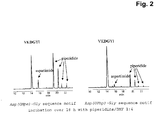
- FIG. 1 illustrates the amounts of by-products after prolonged piperidine treatment in comparison to Fmoc-Asp(OPhp)-OH.
- Table 1 the amounts of by-products after prolonged piperidine treatment are summarized. The treatment with piperidine over 18 hours equals 108 Fmoc removal cycles a 10 minutes. Therefore this experiment correlates to a Fmoc SPPS assembly of an 100mer after introducing the aspartic acid residue.
- Example 5 Synthesis of H-Val-Lys-Asp-Asn-Tyr-Ile-OH (VKDNYI) using Fmoc-Asp(OEpe)-OH, Fmoc-Asp(OPhp)-OH, Fmoc-Asp(OBno)-OH, Fmoc-Asp(OMpe)-OH and Fmoc-Asp(OtBu)-OH
- LC-conditions CHS 18 1,7 ⁇ m (100x2.1 mm) at 40°C; water acetonitril gradient of 5% to 35 % B over 10 min where buffer A is 0.1 % formic acid in water and buffer B is 0.1 % formic acid in acetonitrile, flow 0.6 ml/min).
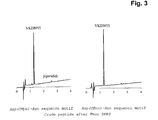
- Figure 3 shows the UPLC traces of the crude peptides directly after the synthesis for the most sterical demanding Asp(OBno) derivative in comparison to Asp(OMpe). To the limit of detection no Asp deletion and no deletions of a proceeding amino acid are detected.
- the Asp-Gly sequence motif the results for the Asp-Asn motif exhibited different levels of decompositions in respect to the applied side-chain protection.
- the Bno protecting group displaying the most sterically demanding group in this run does not impose any hinderance to the peptide synthesis used under standard conditions, but is capable to limit the aspartimide side reaction during the Fmoc removals to a rate of 0.05% per cycle with a half-life of more than 1500 cycles.
- the best commercially available Fmoc-Asp(OMpe)-OH derivative yielded ten times more aspartimide per Fmoc removal cycle with a half-life of 140 cycles.
- Figure 6 shows the HPLC traces of the crude peptides directly after the synthesis for the most sterical demanding Asp(OBno) derivative in comparison to Asp(OMpe). To the limit of detection no Asp deletion and no deletions of a proceeding amino acid are detected.
- the Asp-Arg sequence motif showed in complete accordance to the previous results reduced levels of decompositions especially when a symmetric shield is applied to the side-chain protection.
- the optimized steric shield on the other hand is very well capable to suppress the aspartimide side reaction during the Fmoc removals to less than 0.06% per cycle with a half-life per cycle of greater 1000.
- the best commercially available Fmoc-Asp(OMpe)-OH derivative yielded approximtely seven times more aspartimide per Fmoc removal cycle with a half-life of approx. 170 cycles.
- microwave heating to SPPS is accelerating coupling and deprotection reactions leading to shorter cycle times, higher repititive yields, and ultimately purer peptides.
- microwave energy can also lead to increased levels of aspartimide by-products.
- Example 7 Synthesis of H-Val-Lys-Asp-Gly-Tyr-Ile-OH (VKDGYI) using Fmoc-Asp(OEpe)-OH, Fmoc-Asp(OPhp)-OH, Fmoc-Asp(OMpe)-OH and Fmoc-Asp(OtBu)-OH as well as 1 M Oxyma Pure in the Fmoc cleavage solution
Landscapes
- Chemical & Material Sciences (AREA)
- Organic Chemistry (AREA)
- Analytical Chemistry (AREA)
- Health & Medical Sciences (AREA)
- Life Sciences & Earth Sciences (AREA)
- Biochemistry (AREA)
- Biophysics (AREA)
- General Health & Medical Sciences (AREA)
- Genetics & Genomics (AREA)
- Medicinal Chemistry (AREA)
- Molecular Biology (AREA)
- Proteomics, Peptides & Aminoacids (AREA)
- Peptides Or Proteins (AREA)
Abstract
Description
- The present invention is directed to derivatives of aspartic acid with a new type of side-chain protecting group. The present invention is further directed to methods of their preparation and their use in Fmoc based solid phase peptide synthesis as well as the Z/tBu based solution synthesis of peptides. The use of the aspartic acid derivatives according to the present invention leads to the minimization of base catalyzed aspartimide formation during peptide synthesis and supports the prevention of aspartimide derived impurities.
- Peptides can be manufactured by solid-phase synthesis. One widely used approach of peptide manufacturing is the Fmoc/tBu based solid phase peptide synthesis (Fmoc SPPS) which involves the use of 9-Fluorenylmethyloxycarbonyl (Fmoc) protection for the alpha-amino acid building blocks. The side-chain functionalities in trifunctional amino acids are herein protected by acid labile groups like tert-butyl esters leaving only the C-terminus open for specific stepwise peptide chain elongation. To assemble the peptide from the C- to the N-terminus the first C-terminal amino acid is immobilized on a solid support like a crosslinked polystyrene resin. An automatable cylce of Fmoc deprotection and peptide bond formation facilitates the peptide assembly. Complete conversions in the amide bond formation are ensured by an excess of the Fmoc amino acid and in-situ coupling reagent (see Sheppard. R.C., J. Peptide Sci., 9: 545-552 (2003)).
- Besides, peptides can be manufactured via convergent synthesis. Peptide fragments mostly of six to ten amino acid length are assembled by Fmoc SPPS or alternatively in solution where the N-terminal benzyloxycarbonyl protection (Z) is predominantely used.
- Among all side reactions in the Fmoc SPPS as well as in the Z based solution synthesis the appearance of aspartimide is one of the most severe issues (see Subirós-Funosas R. et al., Tetrahedron, 67: 8595-8606, (2011)). In susceptible sequences it occures in all preceeding Fmoc deprotection steps and amide bond formations using tertiary amine catalysis after the introduction of aspartic acid. Thereby it leads to a significant accumulation of related by-products. The aspartimide is generated by the base catalyzed cyclization of the side-chain carboxylic group with the C-terminal amide nitrogen. Ring opening of the succinimide moiety is then accompanied by epimerization and beta-isomerization forming eight by-products either through its hydrolysis or piperidine addition (
Figure 1 ). All these by-products are modifications of the peptide core and are present in the desired peptide as well as in any deletion or truncated sequences containing the aspartic acid side-chain. Thereby a complex mixture of peptidic impurities is formed which emposes difficulties to separation of the desired compound. In solution this side reaction occurs merely during amide bond formation using tertiary amine catalysis (see Martinez, J.; Bodanszky, M. Int. J. Pept. Protein Res., 12:277-283 (1978)). Sequences particularly susceptible to aspartimide formation are -Asp-Gly-, - Asp-Asp-, -Asp-Asn-, -Asp-Arg- and -Asp-Cys- (see Mergler M., et al., J. Peptide Sci., 9: 518-526 (2003)). While for any other sequence the standard Fmoc-Asp(OtBu)-OH derivative may be sufficient, the best currently commercially available derivative Fmoc-Asp(OMpe)-OH is still not sufficiently protecting against aspartimide formation in the above mentioned sequences. - The application of microwave heating to SPPS is particularly advantageous for long or aggregation prone peptides as the acceleration of coupling and deprotection reaction leads to shorter cycle times, higher repetitive yields, and ultimately purer peptides (see Pedersen L., et al., Chem. Soc. Rev., 41: 1826-1844 (2012)). However, the use of microwave energy also leads to increased levels of typical SPPS by-products including aspartimide formation which can only be limited by routine use of optimized methods (see Palasek S. A., et al., J. Peptide Sci., 13, 143-148 (2007)).
-
WO 95/26975 - One example of a therapeutically important peptide family suffering from significant levels of aspartimide formation is glucagon-like peptide 2 (GLP-2) and its related analogs (
WO 2012/028602 ). These peptides are suggested for the treatment of Crohne's desease, osteoporosis and as adjuvant therapy in chemotherapy. The most prominent example is Revestive® (teduglutide) which is used for the treatment of the short bowel syndrom. GLP-2 analogs like Revestive® are currently manufactured recombinantly and an effective synthetic production method would be an interesting alternative to lower the production costs and to omit animal-derived starting materials as well as to reduce the endotoxine burden. However, these peptides contain an Asp-Gly as well as an Asp-Asn sequence which reduces their synthetical accessability due to aspartimide derived by-products (seeWO 2012/028602 ). - Clearly, the aspartimide issue still imposes drawbacks to the peptide synthesis and there remains a need in the art for a versatile and efficient protecting group of the aspartic acid side-chain preventing this side reaction and it gives a legitimate cause of concern that important peptide therapautics encounter severe difficulties in their synthetic manufacturing.
- It has been found that aspartic acid side chain protection groups having a tertiary O-linked carbon atom with only linear aliphatic substituents can be efficiently used for peptide synthesis. Surprisingly, this type of protecting group combines effective hindrance of the side reaction with high reactivity of the protected aspartic acid in peptide synthesis.
- The present invention is therefore directed to compounds of formula la and/or Ib

- R1, R2, R3 represent, independently of each other, a linear hydrocarbon chain of two to six carbon atoms length, e.g. -CH2-CH3, -CH2-CH2-CH3, -CH2-CH2-CH2-CH3, -CH2-CH2-CH2-CH2-CH3, -CH2-CH2-CH2-CH2-CH2-CH3.
- R4 represents a benzyloxycarbonyl or a 9-fluorenyl methoxycarbonyl group or H.
- Formula II shows the benzyloxycarbonyl or the 9-fluorenyl methoxycarbonyl group.

- In formula II P represents a phenyl- or 9-fluorenyl group.
- The two formula Ia and Ib represent the D and the L (R and S) enantiomers of aspartic acid. The compound can be either the pure D enantiomer or the pure L enantiomer or any mixture of the D and L enantiomers. Preferred is the L enantiomer.
- In a preferred embodiment, R1, R2, R3 all have the same number of carbon atoms.
- In another preferred embodiment, R1, R2, R3 are -CH2-CH3 or -CH2-CH2-CH3.
- The present invention is further directed to a method of manufacturing the compounds of formula la and/or Ib by
- a) Providing an aspartic acid with hydrogenizable protecting groups at the N and C terminus
- b) Esterification of the side chain carboxylic acid with the tertiary alcohol according to formula III
HO-CR1R2R3 formula III
whereby R1, R2, R3 represent, independently of each other, a linear hydrocarbon chain of two to six carbon atoms length, e.g. -CH2-CH3,-CH2-CH2-CH3, -CH2-CH2-CH2-CH3, -CH2-CH2-CH2-CH2-CH3, -CH2-CH2-CH2-CH2-CH2-CH3 - c) Hydrogenolysis of the hydrogenizable protecting groups at the N and C terminus
- d) Introduction of a fluorenylmethoxycarbonyl or a benzyloxycarbonyl group at the N-terminus.
- In a preferred embodiment, the esterification of step b) is performed with a carbodiimde, preferentially dicyclohexylcarbodiimide.
- The present invention is further directed to a method for peptide synthesis by
- a) Providing an amino acid or a peptide bound to a solid phase via its C-terminus
- b) Reacting the solid phase bound amino acid or peptide of step a) with a compound of formula Ia and/or formula Ib whereby the compound of formula Ia and/or Ib is attached to the N-terminus
- c) Cleavage of the Fmoc group by alkaline treatment
- In a preferred embodiment, the alkaline treatment of step c) is performed with one or more secondary amines, preferably piperidine, 1,8-diazabicyclo[5.4.0]undec-7-en (DBU), pyrrolidine and/or diethylamine.
- In a very preferred embodiment, the alkaline treatment of step c) is performed with a mixture comprising one or more secondary amines and an organic acid or preferably an acidic alcohol, e.g. ethyl cyanoglyoxylate-2-oxime. The concentration of the organic acid or the acidic alcohol should be chosen such that it is sub-stoechiometric as compared to the secondary amines.
- In another preferred embodiment, the reaction in step b) is performed in the presence of HBTU, TBTU, HATU, TATU, HCTU, TCTU and/or PyBOP.
-
-
Figure 1 . Mechanism of the formation of the aspartimide derived by-products. -
Figures 2-7 show HPLC and UPLC traces related to the examples. - An organic acid acid according to the present invention is an organic compound with acidic properties. The most common organic acids are the carboxylic acids, whose acidity is associated with their carboxyl group- COOH. Sulfonic acids, containing the group-SO2OH, are relatively stronger acids. Alcohols, with -OH, can act as acids but they are usually very weak. The relative stability of the conjugate base of the acid determines its acidity. Other groups can also confer acidity, usually weakly: the thiol group-SH, the enol group, and the phenol group. Preferred organic acids according to the present invention are acidic alcohols.
- An acidic alcohol according to the present invention is an alcohol with an OH group that can act acidic. Examples are (Z)-ethyl cyanoglyoxylate-2-oxime (Oxyma Pure), N-hydroxybenzotriazole and phenols.
- The present invention provides derivatives of aspartic acid for the peptide synthesis either in solution or on a solid support. The side-chain protection comprises an ester bonded tertiary alcohol having a tertiary C-atom with straight hydrocarbon chains with two to six carbon atoms. The side chain protected aspartic acid derivatives according to the present invention are shown in formula la and Ib.

- R1, R2, R3 represent, independently of each other, a linear hydrocarbon chain of two to six carbon atoms length, e.g. -CH2-CH3, -CH2-CH2-CH3, -CH2-CH2-CH2-CH3, -CH2-CH2-CH2-CH2-CH3, -CH2-CH2-CH2-CH2-CH2-CH3
- R4 represents a benzyloxycarbonyl or a 9-fluorenylmethoxycarbonyl group or H.
- The two formula la and Ib represent the D and the L (R and S) enantiomers of aspartic acid. The enantiomers can be used as pure D or L compound or as a mixture.
- It has been found that it is favourable if R1, R2 and R3 have the same number of carbon atoms. That means all three alkyl chains have the same length.
It has further been found that very good results concerning the suppression of the aspartimide formation can even be achieved when using comparably short chains with two or three carbon atoms length. Preferably, R1, R2 and R3 are -CH2-CH3 or R1, R2 and R3 are -CH2-CH2-CH3. - The present invention is further directed to a method of manufacturing the compounds of formula la and/or Ib. This is preferably done by first providing an aspartic acid with hydrogenizable protecting groups at the N and C terminus. Suitable protecting groups for the N and C terminus are for example benzyloxycarbonyl (Z) and benzyl respectively. A person skilled in the art knows how to introduce such protecting groups. Further information can be found in example 1 and 2.
- In a next step the side chain carboxylic acid of the aspartic acid derivative of step a) is reacted with a tertiary alcohol according to formula III
HO-CR1R2R3 Formula III
whereby R1, R2, R3 represent, independently of each other, a linear hydrocarbon chain of two to six carbon atoms length, e.g. -CH2-CH3,CH2-CH2-CH3, -CH2-CH2-CH2-CH3, -CH2-CH2-CH2-CH2-CH3, -CH2-CH2-CH2-CH2-CH2-CH3. - In this step the side chain protecting group is introduced. In a preferred embodiment, the esterification - step is performed with acyl ureas derived from carbodiimdes, preferentially dicyclohexylcarbodiimide or diisopropylcarbodiimide in the presence of N,N-dimethylaminopyridine (see Neises, B. and Steglich, W. Angew. Chem.-Int. Ed., 17: 522 - 524 (1978)). After introduction of the side chain protecting group according to the present invention, the hydrogenizable protecting groups at the N and C terminus are split off by hydrogenolysis. This step is known to a person skilled in the art. It is typically performed with hydrogen and a Pd/C catalyst. For use of the aspartic acid derivative in peptide synthesis, finally, a fluorenylmethoxycarbonyl or a benzyloxycarbonyl group is introduced at the N-terminus. Also the introduction of such protecting groups is known to a person skilled in the art of peptide synthesis. It is typically done by N-hydroxysuccinimide activation using Fmoc-OSu or Z-OSu.
- The side chain protected aspartic acid derivatives according to the present invention can then be used for solid or liquid phase peptide synthesis. They are typically used in the same manner as e.g. tBu side-chain protected aspartic acid derivatives. The solid phase peptide synthesis is preferably done according to the Fmoc/tBu strategy (Atherton E., et.al., J.Chem. Soc., Chem. Comm., 539 (1978)).
- For solid phase synthesis the side chain protected aspartic acid derivatives according to the present invention can for example be used as follows:
In a first step, an amino acid or a peptide bound to a solid phase via its C-terminus is provided. Afterwards, the solid phase bound amino acid or peptide of step a) is reacted with compounds of formula Ia and/or Ib whereby the compounds of formula Ia and/or Ib are attached to the N-terminus. In preferred embodiment, this reaction is performed in the presence of HBTU, TBTU, HATU, TATU, HCTU, TCTU or PyBOP. - Cleavage of the Fmoc group is performed by alkaline treatment. Suitable procedures and reagents are known to a person skilled in the art.
In a preferred embodiment, the alkaline treatment is performed with one or more amines like piperidine, diethylamine, pyrrolidine or DBU, preferably secondary amines, very preferred with 20% piperidine in dimethylformamide.
In a very preferred embodiment, the alkaline treatment of step c) is performed with a mixture comprising one or more amines, preferably secondary amines, e.g. piperidine, and an organic acid like formic acid, acetic acid, or preferably an acidic alcohol like phenol or 2,4-dichlorophenole, (Z)-ethyl cyanoglyoxylate-2-oxime, commercially available as Oxyma Pure (Merck KGaA, Germany, formula IV) or hydroxybenzotriazole.
- The concentration of the organic acid or the acidic alcohol should be chosen such that it is sub-stoechiometric as compared to the amines. Preferably, the molar ratio of the organic acid or the acidic alcohol compared to the amines (acid : amine) is between 0.01 : 1 and 0.4 : 1, preferably between 0.1 : 1 and 0.4 : 1, most preferred between 0.35 : 1 and 0.37 : 1.
- It has been found that the addition of the organic acid or preferably the acidic alcohol additionally reduces the formation of aspartimide. It has been further found that ethyl cyanoglyoxylate-2-oxime is especially suitable in molar ratios (acid:amine) between 0.1 : 1 and 0.4 : 1, preferably between 0.35 : 1 and 0.37 : 1. Consequently, the combination of the inventive aspartic acid derivative according to formula la and/or Ib and the addition of a substoechiometric amount of an organic acid or an acidic alcohol when removing the Fmoc protecting group provide optimum conditions for avoiding aspartimide formation.
- The invention is also directed to the usage of the inventive aspartic acid side-chain protected derivatives for the peptide synthesis in solution applying the N-terminal Z group. The Z group is cleaved by hydrogenation which doesn't affect the ester bond of the tertiary alcohols. This orthogonality is especially valuable for the preparation of aspartic acid containing peptides in solution (see Subirós-Funosas R. et al., Tetrahedron, 67: 8595-8606, (2011)).
- The aspartic acid side-chain protection of the invention is designed to suppress any by-product formed through the base catalyzed aspartimide formation. Any Fmoc SPPS and Z-based solution phase synthesis can be performed or modified with the inventive derivatives. Typically, the said derivatives are stable against the treatment with secondary and tertiary amines like piperidine, pyrrolidine, triethylamine or ethyldiisopropylamine as well as against hydrogenation and are cleaved with strong acids like trifluoroacetic acid. Therefore the derivatives represent a group of semi-permanent side-chain protections. In the present invention the steric hinderance is leveraged by the growing length of straight alkyl chains of tertiary alcohols. It has been found that this homologization builts up a rather flexible bulky structure capable of closely approaching the peptide backbone and thereby hindering aspartimde formation as well as adding enough flexibilty to the system to allow for the efficient coupling of any preceeding amino acid.
In a further aspect this invention is directed to the combination of the said aspartic acid derivatives and the usage of slightly acidic alcohols like Oxyma Pure or hydroxybenzotriazole in the Fmoc cleavage solutions. This combination reveals to be a powerful method to reduce the aspartimide formation.
Hence the base catalyzed aspartimide arises especially during Fmoc cleavage the said derivatives are tested in Fmoc SPPS. To investigate the appearance of aspartimide, in the Examples, the hexapeptide sequences of scporpion toxin II (H-Val-Lys-Asp-Gly-Tyr-Ile-OH) is chosen as model peptide following previous studies and a variant of this hexapeptide (H-Val-Lys-Asp-Asn-Tyr-Ile-OH) representing a second Asp-Asn motif with proven susceptibility to aspartimide formation (see Mergler M., et al., J. Peptide Sci., 9: 36-46 (2003)). The impact of multiple Fmoc removals in long peptide stepwise synthesis and harsher Fmoc removal conditions necessary in aggregation prone peptide sequences are systematically examined. Therefore, the hexapeptide resins are on the one hand exposed to prolonged piperidine treatments and on the other hand exposed to 1,8-diazabicyclo[5.4.0]undec-7-en (DBU) treatments. To fully monitor the appearance of aspartimide side reaction all aspartimide derived by-products are identified by LCMS analysis and quantified by HPLC or UPLC analysis. In the Examples the said side-chain protections are compared to the standard compound Fmoc-Asp(OtBu)-OH and Fmoc-Asp(OMpe)-OH, the best commercially available compound, in respect of aspartimide prevention.
As one result no Asp deletion and no deletions of any preceeding amino acid could be detected when using the Asp derivatives according to the present invention. It can be assumed that the aspartic acid derivatives provided in this invention do not affect the coupling efficiency in peptide synthesis. Furthermore, the results of the piperidine treatment prove that the Fmoc-Asp(OPhp)-OH derivative according to the invention is significantly more effective in preventing aspartimide formation than the other tested derivatives.
In addition, the Fmoc-Asp(OPhp)-OH derivative nearly inhibits the apartimide side reaction when combined with a Fmoc removal solution of 1 M Oxyma Pure in piperidine/DMF 1:4, even in the Asp-Gly sequence showing the highest susceptibility in previous studies. - The entire disclosures of all applications, patents, and publications cited above and below as well as EP patent application
EP13005920.7, filed December 19, 2013 - The present invention is further described in the following examples which should not be construed as limiting.
- Materials: All reagents and solvents are purchased in their best available quality either from Merck-Millipore or Sigma-Aldrich. The carbinols 3-ethyl-3-pentanol and 4-(n-propyl)-4-heptanol are purchased from ABCR. The carbinol 5-(n-butyl)-5-nonanol was prepared by standard Grignard reaction.
-

- 6.7 g (18.7 mmol) of Z-Asp-Obzl (N-benzyloxycarbonylaspartic acid-1-benzylester) are dissolved in 30 ml dichloromethane at room temperature. After addition of 6.6 g (57.1 mmol) of 3-ethyl-pentan-3-ol, the mixture is cooled to 2-3°C and 0.5 g (4.1 mmol) of 4-(N,N-dimethylamino)pyridine is added. Afterwards 4.6 g (22.3 mmol) of dicyclohexyl carbodiimide are added in 4 equal portions over 32 hours. The cooling is stopped after the addition of the first dicyclohexyl carbodiimide portion. The reaction is continued for two days at ambient temperature yielding a thick suspension. The excess of dicyclohexyl carbodiimide is destroyed with acetic acid and the precipitate is filtered off and the solvent evaporated to dryness. The residue is dissolved in a minimum amount of a mixture of toluene/ethylacetate 95:5 and purified by column chromatography using SiO2 as solid phase and toluene/ethylacetate 95:5 as eluent. After evaporation of the product fractions 8.0 g (17.6 mmol, 94 % of theory) of the title compound were obtained as a colorless solid. 1H-NMR in CDCl3 (TMS as internal standard), chemical shift in ppm: 7.41-7.25 (m, 10H, Phenyl), 5.81 (d, 1H, NH), 5.18 (s, 2H, CH2, bzl), 5.10 (s, 2H, CH2, bzl), 4.62(m, CHα, 1H), 3.05 + 2.78 (d, 2H, CH2β), 1.82-1.68 (m, 6H, 3x alkyl-CH2), 0.74-0.68 (t, 9H, 3x alkyl-CH3).
-

- 8.0 g (17.6 mmol) of Z-Asp(OEpe)-Obzl (N-benzyloxycarbonylaspartic acid α-benzyl-γ-(3-ethyl)pent-3-yl)ester) are dissolved in 80 ml dioxane at room temperature transferred into an autoclave. 1 g of 5 % Pd/C suspended in 10 ml of water are added and the solution is flushed with nitrogen for inertization. Afterwards the hydrogenation is carried out at a pressure of 0.5 bar hydrogen for 7 hours. The catalyst is filtered off and the resulting filtrate directly applied to the Fmoc protection. For this 38 ml of a 5 % NaHCO3 solution and a solution of 5.9 g (17.6 mmol) Fmoc-OSu in 50 ml dioxane are added at room temperature. After 4 hours the solvent is removed and the residue purified by extraction. The residual solvent is removed by constant-boiling mixture with methyl-tert-butylether to yield 5.0 g (10.9 mmol, 62 % of theory) of an off white foam. HPLC-purity: 95.2 area %, retention time 22.7 min (column: ACE C18-AR, 5 µm, 150x4.6 mm, linear acetonitrile gradient of 0 % to 100 % B over 30 min, buffer A = 2 % acetonitrile and 0.1 % trifluoroacetic acid in water, buffer B = 0.1 % trifluoroacetic acid in acetonitrile,
flow 1 ml/min); 1H-NMR in CDCl3 (TMS as internal standard), chemical shift in ppm: 7.78 (d, 2H, Fmoc), 7.62 (m, 2H, Fmoc), 7.45-7.25 (m, 4H, Fmoc), 5.82 (d, 1H, NH), 4.68 (d, 1H, CH, Fmoc), 4.48-4.28 (m, 2H, Fmoc), 4.24-4.17 (m, 1H, CHα), 3.05 + 2.78 (d, 2H, CH2β), 1.91-1.78 (m, 6H, 3x alkyl-CH2), 0.94-0.75 (t, 9H, 3x alkyl-CH3); ESI-MS: monoisotopic MW calc. = 453.2, MW [M+Na]+ = 476.1. -

- 25.0 g (70.0 mmol) of Z-Asp-Obzl (N-benzyloxycarbonylaspartic acid-1-benzylester) are dissolved in 100 ml dichloromethane at room temperature. After addition of 12.2 g (77.0 mmol) of 4-(n-propyl)-4-heptanol, the mixture is cooled to 2-3°C and 1.7 g (14.0 mmol) of 4-(N,N-dimethylamino)pyridine is added. Afterwards 10.6 g (84.0 mmol) of diisopropyl carbodiimide are added in 4 equal portions over 48 hours. The cooling is removed after the addition of the first dicyclohexyl carbodiimide portion. The reaction is continued for two days at ambient temperature. The excess of diisopropyl carbodiimide is destroyed with acetic acid and the reaction mixture is filtered over silica gel and the product fractions evaporated to dryness. The residue is purified by column chromatography using SiO2 as solid phase and toluene/ethylacetate 95:5 as eluent. After evaporation of the product fractions 19.4 g (39.0 mmol, 56 % of theory) of the title compound were obtained as a colorless foam. 1H-NMR in CDCl3 (TMS as internal standard), chemical shift in ppm: 7.41-7.25 (m, 10H, Phenyl), 5.79 (d, 1H, NH), 5.18 (m, 2H, CH2, bzl), 5.10 (s, 2H, CH2, bzl), 4.62(m, CHα, 1H), 3.00 + 2.71 (d, 2H, CH2β), 1.77-1.61 (t, 6H, 3x alkyl-CH2), 1.32-1.08 (m, 6H, 3x alkyl-CH2), 0.95-0.78 (t, 9H, 3x alkyl-CH3).
-

- 18.0 g (36.2 mmol) of Z-Asp(OPhp)-Obzl (N-benzyloxycarbonylaspartic acid α-benzyl-γ-(4-(n-propyl)hept-4-yl)ester) are dissolved in 200 ml dioxane at room temperature transferred into an autoclave. 2.8 g of 5 % Pd/C suspended in 20 ml of water are added and the solution is flushed with nitrogen for inertization. Afterwards the hydrogenation is carried out at a pressure of 0.5 bar hydrogen for 7 hours. The catalyst is filtered off and the resulting filtrate directly applyed to the Fmoc protection. Therefore 20 ml of a 10 % NaHCO3 solution and 13.5 g (40.0 mmol) Fmoc-OSu are added at room temperature. After 6 hours the solvent is removed and the residue purified by extraction. The residual solvent is removed by constant-boiling mixture with methyl-tert-butylether. The resulting oil is purified by RP-HPLC. The product fractions are freeze dryed to yield 1.4 g (2.8 mmol, 8 % of therory) of an white foam. HPLC-purity: 97.1 area %, retention time 25.4 min (column: ACE C18-AR, 5 µm, 150x4.6 mm, linear acetonitrile gradient of 0 % to 100 % B over 30 min, buffer A = 2 % acetonitrile and 0.1 % TFA in water, buffer B = 0.1 % TFA in acetonitrile,
flow 1 ml/min); 1H-NMR in CDCl3 (TMS as internal standard), chemical shift in ppm: 7.82 (d, 2H, Fmoc), 7.63 (m, 2H, Fmoc), 7.25-7.45 (m, 4H, Fmoc), 5.87 (d, 1H, NH), 4.65 (m, 1H, CH, Fmoc), 4.28-4.48 (m, 2H, Fmoc), 4.17-4.25 (m, 1H, CHα), 2.72 + 3.05 (2xd, 2H, CH2β), 1.68-1.85 (m, 6H, 3x alkyl-CH2), 1.18-1.37 (m, 6H, 3x alkyl-CH2), 0.82-1.01 (t, 9H, 3x alkyl-CH3); ESI-MS: monoisotopic MW calc. = 495.26, MW [M+Na]+ = 518.26. -

- 14.3 g (40.0 mmol) of Z-Asp-OBzl (N-benzyloxycarbonylaspartic acid-1-benzylester) are dissolved in 60 ml dichloromethane at room temperature. After addition of 23.2 g (116 mmol) of 5-n-butyl-5-nonanol, the mixture is cooled to 0°C and the first portion of 4.1 g (20.0 mmol) of dicyclohexyl carbodiimide is added. After 15 minutes preactivation at 0°C 1.0 g (8.0 mmol) of 4-(N,N-dimethylamino)pyridine is added. The reaction is continued at ambient temperature over four days by adding daily 1.65 g (8.0 mmol) of dicyclohexyl carbodiimide over the first three days yielding a thick suspension. The excess of dicyclohexyl carbodiimide is destroyed with acetic acid. The suspension is dilluted with 500 ml toluene/ethyl acetate (95:5) and filtered over 40 g of silica gel. After evaporation to dryness the residue is dissolved in a minimum amount of a mixture of cyclohexane/ethylacetate 9:1 and purified by column chromatography using 500 g SiO2 as solid phase and cyclohexane/ethylacetate 9:1 as eluent. After evaporation of the product fractions 15.3 g (28.4 mmol, 71 % of theory) of the title compound are obtained as a off white liquid wax. 1H-NMR in CDCl3 (TMS as internal standard), chemical shift in ppm: 7.39-7.25 (m, 10H, Phenyl), 5.82 (d, 1H, NH), 5.07-5.25 (m, 2H, CH2, bzl), 5.10 (s, 2H, CH2, bzl), 4.54-4.65 (m, 1 H, CHα), 2.78 + 3.01 (2xd, 2H, CH2β), 1.65-1.81 (m, 6H, 3x alkyl-CH2), 1.09-1.34 (m, 12H, 6x alkyl-CH2), 0.83-0.96 (t, 9H, 3x alkyl-CH3)).
-
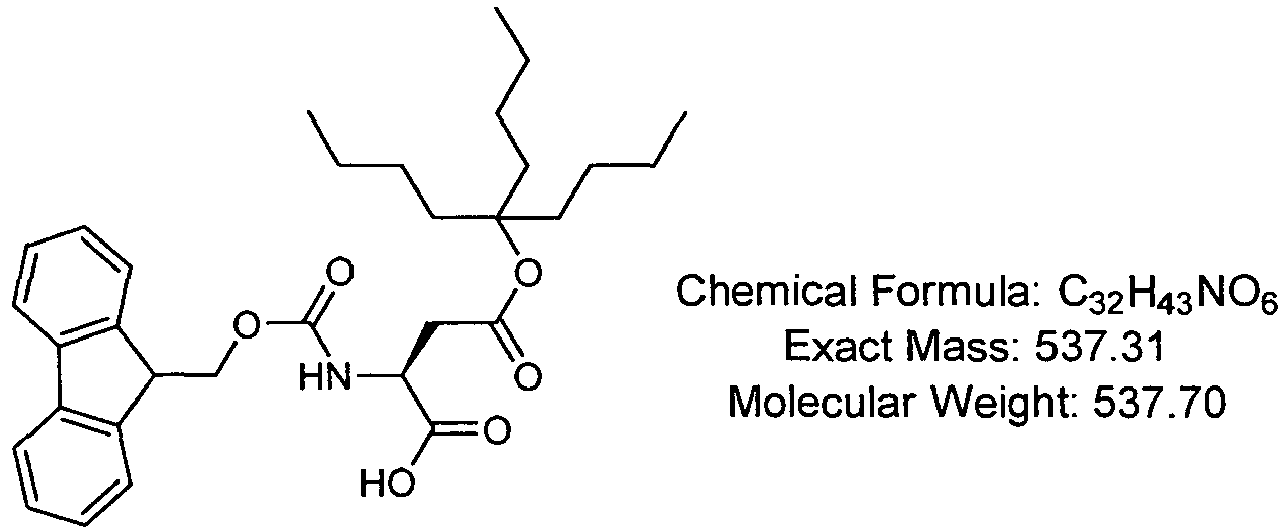
- 14.6 g (26.9 mmol) of Z-Asp(OBno)-Obzl (N-benzyloxycarbonylaspartic acid α-benzyl-γ-(5-(n-butyl)nonan-5-yl)ester) are dissolved in 120 ml dioxane at room temperature transferred into an autoclave. 2.4 g of 10 % Pd/C are added and the solution is flushed with argon for inertization. Afterwards the hydrogenation is carried out at a pressure of 0.5 bar hydrogen for 27 hours. The pH is kept between 7.5 to 8 during the hydrogenation by the addition of sodiumcarbonate. The catalyst is filtered off and the resulting filtrate is directly applied to Fmoc protection. To this end the filtrate is dilluted with 300 ml dioxane/water (8:2) and the pH adjusted to 8 with 2 g of sodiumbicarbonate. 10.0 g (29.6 mmol) Fmoc-OSu are added at room temperature and the mixture left to react over night. The reaction mixture is purified by extraction and the combined organic layers evaporated. After evaporation to dryness the residue is dissolved in a minimum amount of a mixture of dichloromethane/methanol 98:2 and purified by column chromatography using 500 g SiO2 as solid phase and dichloromethane/ methanol 98:2 as eluent. After evaporation of the product fractions 10.0 g of the title compound were obtained. To further improve purity the material is purified by a second column chromatography run using 300 g SiO2 as solid phase and cyclohexane/ethyl acetate/acetic acid (6:4:0.005) as eluent. After evaporation of the product fractions 6.5 g of the title compound are obtained as an off-white wax (12.1 mmol, 45 % of theory). (HPLC-purity: 99.0 area %, retention time 27.6 min (column: ACE C18-AR, 5 µm, 150x4.6 mm, linear acetonitrile gradient of 0 % to 100 % B over 30 min, buffer A = 2 % acetonitrile and 0.1 % trifluoroacetic acid in water, buffer B = 0.1 % trifluoroacetic acid in acetonitrile,
flow 1 ml/min); 1H-NMR in CDCl3 (TMS as internal standard), chemical shift in ppm: 10.33 (s, 1H, COOH), 7.75 (d, 2H, Fmoc), 7.55 (m, 2H, Fmoc), 7.19-7.43 (m, 4H, Fmoc), 5.90 (d, 1 H, NH), 4.66 (d, 1 H, CH, Fmoc), 4.26-4.52 (m, 2H, Fmoc), 4.14-4.26 (m, 1H, CHα), 3.05 + 2.81 (d, 2H, CH2β), 1.62-1.83 (m, 6H, 3x alkyl-CH2), 1.07-1.38 (m, 12H, 6x alkyl-CH2), 0.79-0.95 (t, 9H, 3x alkyl-CH3); ESI-MS: monoisotopic MW calc. = 537.3, MW [M+Na]+ = 560.3. -

- The solid phase peptide synthesis is carried out following the Fmoc/tBu strategy (Atherton E., et.al., J.Chem. Soc., Chem. Comm. , 539 (1978)). 0.44 g of Fmoc-Ile-Wang resin (0.54 mmol/g) are used in an ABI 431 for automated peptide synthesis employing HBTU/ ethyldiisopropylamine (3.6 eq./8.0 eq.) activation for amide bond formation and a solution of 20 % piperidine in dimethylformamide for Fmoc removal. The corresponding amino acids Fmoc-Val-OH, Fmoc-Lys(Boc)-OH, Fmoc-Asp(OtBu/OMpe/ OEpe/OPhp)-OH, Fmoc-Gly-OH and Fmoc-Tyr(tBu)-OH are used in an four fold excess. 50 mg samples of the resulting peptide resins are exposed to 0.5 ml 95% TFA in water for 1.5 hours, the resin filtered off and the peptide filtrate precipitated in diisopropylether to yield the crude fully deprotected peptides.
- Further 50 mg peptide resin samples are treated with a solution of 20 % piperidine in dimethylformamide over 18 hours to simulate multiple Fmoc removals. Afterwards the peptide resin samples are exposed to 95% TFA in water for final cleavage in analogy to the above described protocol and all relevant impurities are identified by MS analysis (Xevo Waters Q-TOF-1, lock mass = 556.277 (leu-enkephaline)) and quantified by HPLC analysis (HPLC conditions:
Halo Peptide 2,7 µm (150x4.6 mm) at 40 °C; water acetonitril gradient of 5 % to 35 % B over 30 min where buffer A is 0.1% TFA and 2 % acetonitrile in water and buffer B is 0.1 % TFA in acetonitrile,flow 1 ml/min). - As expected the prolonged exposure of the peptide resins to piperidine exhibited different levels of decompositions in respect to the applied side-chain protection.
Figure 2 illustrates the corresponding HPLC traces for the best commercially available Fmoc-Asp(OMpe)-OH derivative in comparison to Fmoc-Asp(OPhp)-OH. In table 1 the amounts of by-products after prolonged piperidine treatment are summarized. The treatment with piperidine over 18 hours equals 108 Fmoc removal cycles a 10 minutes. Therefore this experiment correlates to a Fmoc SPPS assembly of an 100mer after introducing the aspartic acid residue.Table 1: Results after 110 Fmoc removal cylces using piperidine, target peptide = VKDGYI, the aspartimide (Asu) derived by-products are the aspartimde itself and the sum of piperidides Asp(OR) R= target [%] Asu [%] piperidides [%] Asu per 10' cycle [%] Half-life in 10' cycles tBu 8.0 6.4 85.6 2.3 30 Mpe 42.3 6.7 51.0 0.8 90 Epe 64.4 4.1 31.5 0.4 175 Php 80.6 2.9 16.5 0.2 356 - As seen in table 1 the half-life of the target peptide containing the most susceptible Asp-Gly sequence is increased by more than 10 fold using Php protection instead of tBu and by 4 fold in respect of Mpe. Of special interest is the comparison of the Epe vs. the Mpe protection since their main difference is a symmetric vs. an asymmetric shield of the γ-carboxy group of the aspartyl residue. Epe protection minimizes the aspartimide formation by a factor two compared to Mpe which is a first evidence for the advantageous properties of the side chain protections presented in this invention to overcome aspartimide formation.
-

- Automated peptide synthesis, piperidine treatments of the resin samples and final TFA cleavages are performed as described in the protocols of example 3. In addition, 50 mg peptide resin samples are treated with a solution of DBU/piperidine/DMF (1:19:79) over 225 minutes to investigate the aspartimide formation at harsher Fmoc deprotection conditions often used for complete Fmoc removals in aggregation prone sequences.
- The resulting peptide samples are analysed and all relevant impurities identified by UPLC-MS analysis (Xevo Waters Q-TOF-1, lock mass = 556.277 (leu-enkephaline), LC-conditions:
CHS 18 1,7 µm (100x2.1 mm) at 40°C; water acetonitril gradient of 5% to 35 % B over 10 min where buffer A is 0.1 % formic acid in water and buffer B is 0.1 % formic acid in acetonitrile, flow 0.6 ml/min). -
Figure 3 shows the UPLC traces of the crude peptides directly after the synthesis for the most sterical demanding Asp(OBno) derivative in comparison to Asp(OMpe). To the limit of detection no Asp deletion and no deletions of a proceding amino acid are detected. - In table 2 the amounts of by-products formed after the prolonged exposure of the peptide resins to piperidine (110 Fmoc removal cycles) are summarized for all side-chain protections used in this invention.
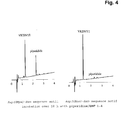
Figure 4 shows the corresponding UPLC traces for the Fmoc-Asp(OMpe)-OH derivative in comparison to Fmoc-Asp(OBno)-OH.Table 2: Results after 110 Fmoc removal cylces using piperidine, target peptide = VKDNYI, the aspartimide (Asu) derived by-products are the aspartimde itself and the sum of piperidides Asp(OR) R= target [%] D/L-Asu [%] piperidides [%] Asu per 10' cycle Half-life in cycles tBu 16.1 4.9 79.0 1.6 40 Mpe 58.2 4.3 37.5 0.5 140 Epe 81.0 3.0 16.0 0.2 365 Php 90.8 1.0 8.2 0.09 800 Bno 95.5 0.9 3.6 0.04 1670 - In analogy to example 4, the Asp-Gly sequence motif, the results for the Asp-Asn motif exhibited different levels of decompositions in respect to the applied side-chain protection. The Bno protecting group displaying the most sterically demanding group in this run does not impose any hinderance to the peptide synthesis used under standard conditions, but is capable to limit the aspartimide side reaction during the Fmoc removals to a rate of 0.05% per cycle with a half-life of more than 1500 cycles. In comparison, the best commercially available Fmoc-Asp(OMpe)-OH derivative yielded ten times more aspartimide per Fmoc removal cycle with a half-life of 140 cycles.
- In table 3 the amounts of by-products formed after prolonged DBU treatments are summarized for all side-chain protections used in this invention.
Figure 5 shows the corresponding UPLC traces for the Fmoc-Asp(OMpe)-OH derivative in comparison to Fmoc-Asp(OBno)-OH. Since the DBU mediated Fmoc removals are much quicker than the piperidine mediated, this experiment again represents a Fmoc SPPS assembly of an 100mer after introducing the aspartic acid residue using exclusively DBU for Fmoc cleavage.Table 3: Results after 110 Fmoc removal cylces using DBU, target peptide = VKDNYI, the aspartimide (Asu) derived by-products are the aspartimde itself and the sum of piperidides Asp(OR) R= target [%] D/L-Asu [%] piperides [%] Asu per 2' cycle Half-life in cycles tBu 0.3 2.6 97.1 5.2 13 Mpe 18.8 7.5 73.7 1.5 46 Epe 57.1 5.6 37.3 0.5 138 Php 71.0 3.3 25.7 0.4 192 Bno 74.5 3.5 22.0 0.3 263 - In case of aggregation prone sequences incomplete coupling efficiency is often accompanied by incomplete Fmoc removals during standard SPPS. Harsher Fmoc removal conditions need to be be employed to solve the later issue. However, DBU treatments give rise to aspartimide derived impurities in all Asp-Xaa sequence motifs (see Mergler M., et al., J. Peptide Sci., 9: 36-46 (2003)). This fact stongly limits the use of harsher Fmoc removal conditions in Fmoc SPPS. In our experiments the Bno protection represents the best solution for this situation reducing the aspartimide formation to less than 0.3% per 2 minute Fmoc removal cycle with a half-life of 260 cycles. Thereby Bno for the first time allows to weigh up the advantages of complete Fmoc removals versus the associated risk of DBU mediated aspartimide formation.
-

- Automated peptide synthesis, piperidine treatments of the resin samples and final TFA cleavages are performed as described in the protocols of example 3. In addition, to evaluate the advantage of the protecting groups used in this invention in heat accelerated SPPS we treat 50 mg peptide resin samples with a solution of 20% piperidine in DMF at 60°C over 200 minutes. Microwave assisted peptide synthesis conditions are often used to shorten peptide synthesis times and increase coupling reaction and Fmoc deprotection.
- All relevant impurities are quantified by HPLC analysis analysis (HPLC conditions: Kinetex XB-
C18 2,6 µm (150x4.6 mm) column at 50 °C; water acetonitril gradient of 5 % to 30 % B over 18 min where buffer A is 20 mM ammonium formiate and 2 % acetonitrile in water and buffer B is 20 mM ammonium formiate in acetonitrile,flow 1 ml/min) and identified by MS analysis (Xevo Waters Q-TOF-1, lock mass = 556.277 (leu-enkephaline)) -
Figure 6 shows the HPLC traces of the crude peptides directly after the synthesis for the most sterical demanding Asp(OBno) derivative in comparison to Asp(OMpe). To the limit of detection no Asp deletion and no deletions of a proceeding amino acid are detected. - In table 4 the amounts of by-products formed after the prolonged exposure of the peptide resins to piperidine (110 Fmoc removal cycles) are summarized for all side-chain protections used in this invention.
Table 4: Results after 110 Fmoc removal cylces using piperidine, target peptide sequence = VKDRYI, the aspartimide (Asu) derived by-products are the aspartimde itself and the sum of piperidides Asp(OR) R= target [%] D/L-Asu [%] piperidides [%] Asu per 10' cycle Half-life in cycles tBu 24.7 16.9 58.4 1.3 55 Mpe 64.2 6.9 28.9 0.4 173 Epe 86.7 3.90 9.4 0.1 539 Php 91.3 3.2 5.5 0.08 845 Bno 93.8 2.6 3.6 0.06 1202 - The Asp-Arg sequence motif showed in complete accordance to the previous results reduced levels of decompositions especially when a symmetric shield is applied to the side-chain protection. Although the Bno protecting group displayes the most sterically demanding group it does not impose any hinderance to the peptide synthesis used under standard conditions. The optimized steric shield on the other hand is very well capable to suppress the aspartimide side reaction during the Fmoc removals to less than 0.06% per cycle with a half-life per cycle of greater 1000. In comparison, the best commercially available Fmoc-Asp(OMpe)-OH derivative yielded approximtely seven times more aspartimide per Fmoc removal cycle with a half-life of approx. 170 cycles.
- The application of microwave heating to SPPS is accelerating coupling and deprotection reactions leading to shorter cycle times, higher repititive yields, and ultimately purer peptides. On the other hand, microwave energy can also lead to increased levels of aspartimide by-products. To overcome that drawback we evaluated the advantage of the side-chain protections used in this invention by exposing the peptide resins to Fmoc removal cycles at 60 degrees Celcius.
- In table 5 the amounts of by-products formed after the prolonged exposure of the peptide resins to piperidine at 60 degree Celcius (100 Fmoc removal cycles) are summarized for all side-chain protections used in this invention.
Figure 7 shows the corresponding HPLC traces for the Fmoc-Asp(OMpe)-OH derivative in comparison to Fmoc-Asp(OBno)-OH.Table 5: Results after 100 Fmoc removal cylces using piperidine at 60°C, target peptide sequence = VKDRYI, the aspartimide (Asu) derived by-products are the aspartimde itself and the sum of piperidides Asp(OR) R= target [%] D/L-Asu [%] piperidides [%] Asu per 10' cycle Half-life in cycles tBu 30.3 28.7 41.0 1.2 58 Mpe 63.5 16.9 19.6 0.5 153 Epe 85.4 7.8 6.8 0.2 439 Php 87.8 7.1 5.1 0.1 532 Bno 90.8 4.9 4.3 0.1 718 - First of all the results show that the Asp-Arg sequence is highly susceptible to aspartimide formation under microwave heating. Using the asymmetric Mpe protecting group 0.5% aspartimide by-products per cycle are formed which is represented by a half-life of 153 cycles whereas the symmetrical Epe group leads only to 0.2% of aspartimide formation with a half-life of 439 cycle. This may be attributed to the weak point of the Mpe protection beeing composed of only two ethyl and one methyl branch. However, due to the Brownian motion differences within the homologs are becoming marginal at 60 degree Celcius.
- This expample demonstrates that the optimized steric shields in the side-chain protections used in this invention can be applied to efficiently suppress aspartimide side reactions, even at elevated temperatures, for the sensitive Asp-Arg sequence motif.
-

- 50 mg samples of the corresponding aspartic acid derivatives of example 3 are treated over 18 hours with a solution of 1 M Oxyma Pure and 20 % piperidine in dimethylformamide. The peptides are cleaved off the resin with 95 % TFA and analysed with HPLC as well as MS to identify all aspartimide related products (conditions see example 4). The results are summarized in table 6:
Table 6: Results after 110 Fmoc removal cylces using an acidic modifier in the piperidine mediated Fmoc removal cocktails, target peptide = VKDGYI, the aspartimide derived by-products are the aspartimde itself and the sum of piperidides Asp(OR) R= Oxyma Pure target [%] Asu [%] piperides [%] Asu per 10' cycle tBu + 61.1 8.8 30.1 0.45 - 8.0 6.4 85.6 2.3 Mpe + 84.2 3.8 12.0 0.16 - 42.3 6.7 51.0 0.8 Epe + 85.7 2.6 11.7 0.14 - 64.4 4.1 31.5 0.4 Php + 95.4 1.3 3.3 0.04 - 80.6 2.9 16.5 0.2 - Besides to the fact that the additon of Oxyma Pure to the standard piperidine Fmoc removal cocktail generally decreases the occurance of aspartimide side reaction (see R. Subiros-Funosas, et al., Chem. Eur. J., 2009, 9394) to our surprise a synergistic effect is observed combining this method with side-chain protections of the present invention especially in case of the Php protection. Since the peptide resin treatments again resemble 110 Fmoc deprotection cycles the combination of Asp(OPhp) with 1 M Oxyma Pure in 20 % piperidine leads to an negligible level of 0.05 % of aspartimide derived by-products per Fmoc removal with a half-life greater than 1500 cycles. Since this applies for the most susceptible Asp-Gly sequence motif the Asp(OPhp) protection in combination with a mild Fmoc deprotection method represents an highly efficient solution for the aspartimide problem in Fmoc SPPS in general. However, it is important to note that Fmoc removal cocktails containing an acidic modifier are sometimes to weak to drive the Fmoc cleavage to completion within 10 minutes. Prolonged exposure is often necessary.
-
- Fmoc-OSu
- N-(9-Fluorenylmethoxycarbonyloxy)-succinimid
- Asp(OPhp)
- aspartic acid-4-(4-(n-propyl)hept-4-yl-) ester
- Asp(OMpe)
- aspartic acid-4-(3-methylpent-3yl-) ester
- Asp(OEpe)
- aspartic acid-4-(3-ethylpent-3-yl-) ester
- Php
- 4-(n-propyl)hept-4-yl-
- Mpe
- 3-methylpent-3yl-
- Epe
- 3-ethylpent-3-yl-
- tBu
- tert-butyl
- DBU
- 1,8-diazabicyclo[5.4.0]undec-7-en
- HBTU
- 2-(1H-Benzotriazole-1-yl)-1,1,3,3-tetramethyluronium hexafluorophosphate
- HATU
- 2-(7-Aza-1-H-benzotriazole-1-yl)-1,1,3,3-tetramethylaminium hexafluorophosphate
- HCTU
- 2-(6-Chloro-1-H-benzotriazole-1-yl)-1,1,3,3-tetramethylaminium hexafluorophosphate
- PyBOP
- Benzotriazole-1-yl-oxy-tris-pyrrolidino-phosphonium hexafluorophosphate
- TBTU
- 2-(1H-Benzotriazole-1-yl)-1,1,3,3-tetramethyluronium tetrafluoroborate
- TATU
- 2-(7-Aza-1-H-benzotriazole-1-yl)-1,1,3,3-tetramethylaminium tetrafluoroborate
- TCTU
- 2-(6-Chloro-1-H-benzotriazole-1-yl)-1,1,3,3-tetramethylaminium tetrafluoroborate
Claims (9)
- Compounds of formula la and/or Ib
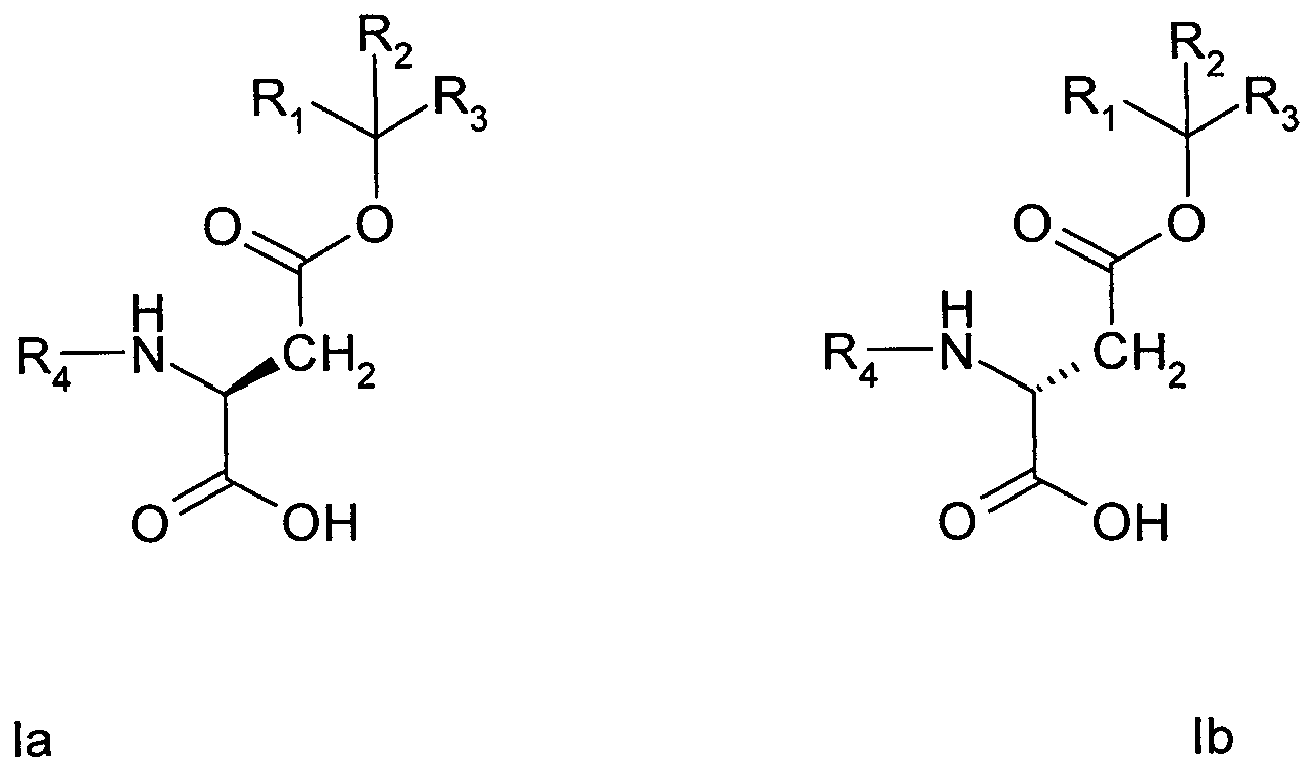 R1, R2, R3 represent, independently of each other, a linear hydrocarbon chain of two to six carbon atoms length,R4 represents benzyloxycarbonyl, 9-fluorenylmethoxycarbonyl or H.
 - Compound according to claim 1, characterized in that R1, R2, R3 all have the same number of carbon atoms.
- Compound according to claim 1 or 2, characterized in that R1, R2, R3 are -CH2-CH3 or -CH2-CH2-CH3.
- A method of manufacturing the compound of formula la and/or Ib bya) Providing an aspartic acid with hydrogenizable protecting groups at the N and C terminusb) Esterification of the side chain carboxylic acid with the tertiary alcohol according to formula III
HO-CR1R2R3 formula III
whereby R1, R2, R3 represent, independently of each other, a linear hydrocarbon chain of two to six carbon atoms lengthc) Hydrogenolysis of the hydrogenizable protecting groups at the N and C terminusd) Introduction of a fluorenylmethoxycarbonyl or a benzyloxycarbonyl group at the N-terminus. - Method according to claim 4, characterized in that the esterification of step b) is performed with a carbodiimde.
- A method for peptide synthesis bya) Providing an amino acid or a peptide bound to a solid phase via its C-terminusb) Reacting the solid phase bound amino acid or peptide of step a) with a compound of formula la and/or Ib whereby the compound of formula la and/or Ib is attached to the N-terminusc) Cleavage of the Fmoc group by alkaline treatment
- Method according to claim 6 characterized in that the alkaline treatment of step c) is performed with one or more secondary amines.
- Method according to claim 6 or 7 characterized in that the alkaline treatment of step c) is performed with a mixture comprising one or more secondary amines and an organic acid and/or an acidic alcohol.
- Method according to one or more of claims 6 to 8 characterized in that the reaction in step b) is performed in the presence of HBTU, TBTU, HATU, TATU, HCTU, TCTU or PyBOP.
Priority Applications (1)
| Application Number | Priority Date | Filing Date | Title |
|---|---|---|---|
| EP14003926.4A EP2886531B1 (en) | 2013-12-19 | 2014-11-21 | Aspartic acid derivatives |
Applications Claiming Priority (2)
| Application Number | Priority Date | Filing Date | Title |
|---|---|---|---|
| EP13005920 | 2013-12-19 | ||
| EP14003926.4A EP2886531B1 (en) | 2013-12-19 | 2014-11-21 | Aspartic acid derivatives |
Publications (2)
| Publication Number | Publication Date |
|---|---|
| EP2886531A1 true EP2886531A1 (en) | 2015-06-24 |
| EP2886531B1 EP2886531B1 (en) | 2016-06-08 |
Family
ID=49876345
Family Applications (1)
| Application Number | Title | Priority Date | Filing Date |
|---|---|---|---|
| EP14003926.4A Active EP2886531B1 (en) | 2013-12-19 | 2014-11-21 | Aspartic acid derivatives |
Country Status (3)
| Country | Link |
|---|---|
| EP (1) | EP2886531B1 (en) |
| DK (1) | DK2886531T3 (en) |
| ES (1) | ES2589884T3 (en) |
Cited By (2)
| Publication number | Priority date | Publication date | Assignee | Title |
|---|---|---|---|---|
| WO2020047994A1 (en) * | 2018-09-06 | 2020-03-12 | 深圳翰宇药业股份有限公司 | Solid-phase synthesis method of abaloparatide |
| WO2024028350A1 (en) * | 2022-08-01 | 2024-02-08 | Universität Bern | Dipropylamine as base for the use in fmoc deprotection in solid-phase peptide synthesis |
Citations (3)
| Publication number | Priority date | Publication date | Assignee | Title |
|---|---|---|---|---|
| WO1995026975A1 (en) | 1994-03-30 | 1995-10-12 | Unden Anders | Acyclic aliphatic branched alkyl groups as constituents of protective groups bound to side chains of amino-acid moieties, and their use in the preparation of peptide, polypeptide or protein structures |
| CN102260327A (en) * | 2010-05-28 | 2011-11-30 | 吉尔生化(上海)有限公司 | Preparation method of Melanotan II |
| WO2012028602A1 (en) | 2010-08-30 | 2012-03-08 | Nycomed Gmbh | Solid phase synthesis of h(gly2)glp-2 |
-
2014
- 2014-11-21 ES ES14003926.4T patent/ES2589884T3/en active Active
- 2014-11-21 EP EP14003926.4A patent/EP2886531B1/en active Active
- 2014-11-21 DK DK14003926.4T patent/DK2886531T3/en active
Patent Citations (3)
| Publication number | Priority date | Publication date | Assignee | Title |
|---|---|---|---|---|
| WO1995026975A1 (en) | 1994-03-30 | 1995-10-12 | Unden Anders | Acyclic aliphatic branched alkyl groups as constituents of protective groups bound to side chains of amino-acid moieties, and their use in the preparation of peptide, polypeptide or protein structures |
| CN102260327A (en) * | 2010-05-28 | 2011-11-30 | 吉尔生化(上海)有限公司 | Preparation method of Melanotan II |
| WO2012028602A1 (en) | 2010-08-30 | 2012-03-08 | Nycomed Gmbh | Solid phase synthesis of h(gly2)glp-2 |
Non-Patent Citations (12)
| Title |
|---|
| ATHERTON E., J.CHEM. SOC., CHEM. COMM., 1978, pages 539 |
| KARLSTROM A ET AL: "A New Protecting Group For Aspartic Acid That Minimizes Piperidine-Catalyzed Aspartimide Formation In Fmoc Solid Phase Peptide Synthesis", TETRAHEDRON LETTERS, PERGAMON, GB, vol. 37, no. 24, 10 June 1996 (1996-06-10), pages 4243 - 4246, XP004029127, ISSN: 0040-4039, DOI: 10.1016/0040-4039(96)00807-6 * |
| M. MERGLER ET AL: "The aspartimide problem in Fmoc-based SPPS. Part III", JOURNAL OF PEPTIDE SCIENCE, vol. 11, no. 10, 1 October 2005 (2005-10-01), pages 650 - 657, XP055181875, ISSN: 1075-2617, DOI: 10.1002/psc.668 * |
| MARTINEZ, J.; BODANSZKY, M., INT. J. PEPT. PROTEIN RES., vol. 12, 1978, pages 277 - 283 |
| MERGLER M. ET AL., J. PEPTIDE SCI., vol. 9, 2003, pages 36 - 46 |
| MERGLER M. ET AL., J. PEPTIDE SCI., vol. 9, 2003, pages 518 - 526 |
| NEISES, B.; STEGLICH, W., ANGEW. CHEM.-INT. ED., vol. 17, 1978, pages 522 - 524 |
| PALASEK S. A. ET AL., J. PEPTIDE SCI., vol. 13, 2007, pages 143 - 148 |
| PEDERSEN L. ET AL., CHEM. SOC. REV., vol. 41, 2012, pages 1826 - 1844 |
| RAMON SUBIRS-FUNOSAS ET AL: "Aspartimide formation in peptide chemistry: occurrence, prevention strategies and the role of-hydroxylamines", TETRAHEDRON, vol. 67, no. 45, 2011, pages 8595 - 8606, XP028308691, ISSN: 0040-4020, [retrieved on 20110823], DOI: 10.1016/J.TET.2011.08.046 * |
| SHEPPARD. R.C., J. PEPTIDE SCI., vol. 9, 2003, pages 545 - 552 |
| SUBIR6S-FUNOSAS R. ET AL., TETRAHEDRON, vol. 67, 2011, pages 8595 - 8606 |
Cited By (2)
| Publication number | Priority date | Publication date | Assignee | Title |
|---|---|---|---|---|
| WO2020047994A1 (en) * | 2018-09-06 | 2020-03-12 | 深圳翰宇药业股份有限公司 | Solid-phase synthesis method of abaloparatide |
| WO2024028350A1 (en) * | 2022-08-01 | 2024-02-08 | Universität Bern | Dipropylamine as base for the use in fmoc deprotection in solid-phase peptide synthesis |
Also Published As
| Publication number | Publication date |
|---|---|
| EP2886531B1 (en) | 2016-06-08 |
| DK2886531T3 (en) | 2016-09-05 |
| ES2589884T3 (en) | 2016-11-16 |
Similar Documents
| Publication | Publication Date | Title |
|---|---|---|
| Barlos et al. | Efficient" one-pot" synthesis of N-tritylamino acids | |
| EP2873677B1 (en) | Method of producing self-assembling peptide derivative | |
| METZGER et al. | Synthesis of Nα‐Fmoc protected derivatives of S‐(2, 3‐dihydroxypropyl)‐cysteine and their application in peptide synthesis | |
| EP4269422A1 (en) | Method for producing peptide compound containing n-substituted-amino acid residue | |
| JPH02503923A (en) | Urethane protected amino acid-N-carboxy anhydride | |
| JP2000256397A (en) | Novel cyclic tetrapeptide derivatives and their pharmaceutical uses | |
| ES2885869T3 (en) | Procedure for the manufacture of degarelix and its intermediate products | |
| CS204011B2 (en) | Process for preparing substituted pentapeptides | |
| WO2019231760A1 (en) | Method for solution-phase peptide synthesis and protecting strategies therefore | |
| JPH0354957B2 (en) | ||
| US6184345B1 (en) | Branched building units for synthesizing cyclic peptides | |
| EP2886531B1 (en) | Aspartic acid derivatives | |
| KR20200078999A (en) | Process for the Preparation of Tripeptide | |
| Obrecht et al. | Design and synthesis of novel nonpolar host peptides for the determination of the 310‐and α‐helix compatibilities of α‐amino acid buildig blocks: An assessment of α, α‐disubstituted glycines | |
| JP6788376B2 (en) | Method for Producing Peptide Containing Aspartic Acid Residue | |
| KR20250148640A (en) | Method for preparing a tetrapeptide fragment of liraglutide | |
| JP2020023555A (en) | Process for liquid phase synthesis of h-inp-(d)bal-(d)trp-phe-apc-nh2 and pharmaceutically acceptable salts thereof | |
| Demin et al. | Synthesis of glutaryl-containing derivatives of GRGD and KRGD peptides | |
| US8981049B2 (en) | Aziridine mediated native chemical ligation | |
| KR101171095B1 (en) | Process for the Preparation of Leuprolide | |
| JPS61293995A (en) | Tripeptide | |
| CN114945579B (en) | Heme derivatives and their preparation and use | |
| JP5097104B2 (en) | New isodipeptide | |
| JPH04221394A (en) | Peptide lipid | |
| AU7810000A (en) | Process for preparing peptide intermediates |
Legal Events
| Date | Code | Title | Description |
|---|---|---|---|
| PUAI | Public reference made under article 153(3) epc to a published international application that has entered the european phase |
Free format text: ORIGINAL CODE: 0009012 |
|
| 17P | Request for examination filed |
Effective date: 20141121 |
|
| AK | Designated contracting states |
Kind code of ref document: A1 Designated state(s): AL AT BE BG CH CY CZ DE DK EE ES FI FR GB GR HR HU IE IS IT LI LT LU LV MC MK MT NL NO PL PT RO RS SE SI SK SM TR |
|
| AX | Request for extension of the european patent |
Extension state: BA ME |
|
| GRAP | Despatch of communication of intention to grant a patent |
Free format text: ORIGINAL CODE: EPIDOSNIGR1 |
|
| RIC1 | Information provided on ipc code assigned before grant |
Ipc: C07C 229/24 20060101ALI20151208BHEP Ipc: C07C 271/22 20060101AFI20151208BHEP Ipc: C07K 1/06 20060101ALI20151208BHEP |
|
| INTG | Intention to grant announced |
Effective date: 20160107 |
|
| GRAS | Grant fee paid |
Free format text: ORIGINAL CODE: EPIDOSNIGR3 |
|
| GRAA | (expected) grant |
Free format text: ORIGINAL CODE: 0009210 |
|
| AK | Designated contracting states |
Kind code of ref document: B1 Designated state(s): AL AT BE BG CH CY CZ DE DK EE ES FI FR GB GR HR HU IE IS IT LI LT LU LV MC MK MT NL NO PL PT RO RS SE SI SK SM TR |
|
| REG | Reference to a national code |
Ref country code: GB Ref legal event code: FG4D |
|
| REG | Reference to a national code |
Ref country code: CH Ref legal event code: EP |
|
| REG | Reference to a national code |
Ref country code: IE Ref legal event code: FG4D |
|
| REG | Reference to a national code |
Ref country code: AT Ref legal event code: REF Ref document number: 805124 Country of ref document: AT Kind code of ref document: T Effective date: 20160715 |
|
| REG | Reference to a national code |
Ref country code: DE Ref legal event code: R096 Ref document number: 602014002210 Country of ref document: DE |
|
| REG | Reference to a national code |
Ref country code: DK Ref legal event code: T3 Effective date: 20160901 |
|
| REG | Reference to a national code |
Ref country code: SE Ref legal event code: TRGR |
|
| REG | Reference to a national code |
Ref country code: LT Ref legal event code: MG4D |
|
| REG | Reference to a national code |
Ref country code: NL Ref legal event code: MP Effective date: 20160608 |
|
| REG | Reference to a national code |
Ref country code: FR Ref legal event code: PLFP Year of fee payment: 3 |
|
| PG25 | Lapsed in a contracting state [announced via postgrant information from national office to epo] |
Ref country code: FI Free format text: LAPSE BECAUSE OF FAILURE TO SUBMIT A TRANSLATION OF THE DESCRIPTION OR TO PAY THE FEE WITHIN THE PRESCRIBED TIME-LIMIT Effective date: 20160608 Ref country code: NO Free format text: LAPSE BECAUSE OF FAILURE TO SUBMIT A TRANSLATION OF THE DESCRIPTION OR TO PAY THE FEE WITHIN THE PRESCRIBED TIME-LIMIT Effective date: 20160908 Ref country code: LT Free format text: LAPSE BECAUSE OF FAILURE TO SUBMIT A TRANSLATION OF THE DESCRIPTION OR TO PAY THE FEE WITHIN THE PRESCRIBED TIME-LIMIT Effective date: 20160608 |
|
| REG | Reference to a national code |
Ref country code: ES Ref legal event code: FG2A Ref document number: 2589884 Country of ref document: ES Kind code of ref document: T3 Effective date: 20161116 |
|
| PG25 | Lapsed in a contracting state [announced via postgrant information from national office to epo] |
Ref country code: HR Free format text: LAPSE BECAUSE OF FAILURE TO SUBMIT A TRANSLATION OF THE DESCRIPTION OR TO PAY THE FEE WITHIN THE PRESCRIBED TIME-LIMIT Effective date: 20160608 Ref country code: LV Free format text: LAPSE BECAUSE OF FAILURE TO SUBMIT A TRANSLATION OF THE DESCRIPTION OR TO PAY THE FEE WITHIN THE PRESCRIBED TIME-LIMIT Effective date: 20160608 Ref country code: RS Free format text: LAPSE BECAUSE OF FAILURE TO SUBMIT A TRANSLATION OF THE DESCRIPTION OR TO PAY THE FEE WITHIN THE PRESCRIBED TIME-LIMIT Effective date: 20160608 Ref country code: NL Free format text: LAPSE BECAUSE OF FAILURE TO SUBMIT A TRANSLATION OF THE DESCRIPTION OR TO PAY THE FEE WITHIN THE PRESCRIBED TIME-LIMIT Effective date: 20160608 |
|
| PG25 | Lapsed in a contracting state [announced via postgrant information from national office to epo] |
Ref country code: RO Free format text: LAPSE BECAUSE OF FAILURE TO SUBMIT A TRANSLATION OF THE DESCRIPTION OR TO PAY THE FEE WITHIN THE PRESCRIBED TIME-LIMIT Effective date: 20160608 Ref country code: EE Free format text: LAPSE BECAUSE OF FAILURE TO SUBMIT A TRANSLATION OF THE DESCRIPTION OR TO PAY THE FEE WITHIN THE PRESCRIBED TIME-LIMIT Effective date: 20160608 Ref country code: CZ Free format text: LAPSE BECAUSE OF FAILURE TO SUBMIT A TRANSLATION OF THE DESCRIPTION OR TO PAY THE FEE WITHIN THE PRESCRIBED TIME-LIMIT Effective date: 20160608 Ref country code: SK Free format text: LAPSE BECAUSE OF FAILURE TO SUBMIT A TRANSLATION OF THE DESCRIPTION OR TO PAY THE FEE WITHIN THE PRESCRIBED TIME-LIMIT Effective date: 20160608 Ref country code: IS Free format text: LAPSE BECAUSE OF FAILURE TO SUBMIT A TRANSLATION OF THE DESCRIPTION OR TO PAY THE FEE WITHIN THE PRESCRIBED TIME-LIMIT Effective date: 20161008 |
|
| REG | Reference to a national code |
Ref country code: GR Ref legal event code: EP Ref document number: 20160402019 Country of ref document: GR Effective date: 20161118 |
|
| PG25 | Lapsed in a contracting state [announced via postgrant information from national office to epo] |
Ref country code: PL Free format text: LAPSE BECAUSE OF FAILURE TO SUBMIT A TRANSLATION OF THE DESCRIPTION OR TO PAY THE FEE WITHIN THE PRESCRIBED TIME-LIMIT Effective date: 20160608 Ref country code: SM Free format text: LAPSE BECAUSE OF FAILURE TO SUBMIT A TRANSLATION OF THE DESCRIPTION OR TO PAY THE FEE WITHIN THE PRESCRIBED TIME-LIMIT Effective date: 20160608 Ref country code: PT Free format text: LAPSE BECAUSE OF FAILURE TO SUBMIT A TRANSLATION OF THE DESCRIPTION OR TO PAY THE FEE WITHIN THE PRESCRIBED TIME-LIMIT Effective date: 20161010 |
|
| REG | Reference to a national code |
Ref country code: DE Ref legal event code: R097 Ref document number: 602014002210 Country of ref document: DE |
|
| PLBE | No opposition filed within time limit |
Free format text: ORIGINAL CODE: 0009261 |
|
| STAA | Information on the status of an ep patent application or granted ep patent |
Free format text: STATUS: NO OPPOSITION FILED WITHIN TIME LIMIT |
|
| 26N | No opposition filed |
Effective date: 20170309 |
|
| PG25 | Lapsed in a contracting state [announced via postgrant information from national office to epo] |
Ref country code: SI Free format text: LAPSE BECAUSE OF FAILURE TO SUBMIT A TRANSLATION OF THE DESCRIPTION OR TO PAY THE FEE WITHIN THE PRESCRIBED TIME-LIMIT Effective date: 20160608 |
|
| PG25 | Lapsed in a contracting state [announced via postgrant information from national office to epo] |
Ref country code: LU Free format text: LAPSE BECAUSE OF NON-PAYMENT OF DUE FEES Effective date: 20161130 |
|
| REG | Reference to a national code |
Ref country code: FR Ref legal event code: PLFP Year of fee payment: 4 |
|
| PG25 | Lapsed in a contracting state [announced via postgrant information from national office to epo] |
Ref country code: HU Free format text: LAPSE BECAUSE OF FAILURE TO SUBMIT A TRANSLATION OF THE DESCRIPTION OR TO PAY THE FEE WITHIN THE PRESCRIBED TIME-LIMIT; INVALID AB INITIO Effective date: 20141121 |
|
| PG25 | Lapsed in a contracting state [announced via postgrant information from national office to epo] |
Ref country code: MC Free format text: LAPSE BECAUSE OF FAILURE TO SUBMIT A TRANSLATION OF THE DESCRIPTION OR TO PAY THE FEE WITHIN THE PRESCRIBED TIME-LIMIT Effective date: 20160608 Ref country code: CY Free format text: LAPSE BECAUSE OF FAILURE TO SUBMIT A TRANSLATION OF THE DESCRIPTION OR TO PAY THE FEE WITHIN THE PRESCRIBED TIME-LIMIT Effective date: 20160608 Ref country code: MK Free format text: LAPSE BECAUSE OF FAILURE TO SUBMIT A TRANSLATION OF THE DESCRIPTION OR TO PAY THE FEE WITHIN THE PRESCRIBED TIME-LIMIT Effective date: 20160608 |
|
| PG25 | Lapsed in a contracting state [announced via postgrant information from national office to epo] |
Ref country code: BG Free format text: LAPSE BECAUSE OF FAILURE TO SUBMIT A TRANSLATION OF THE DESCRIPTION OR TO PAY THE FEE WITHIN THE PRESCRIBED TIME-LIMIT Effective date: 20160608 |
|
| PG25 | Lapsed in a contracting state [announced via postgrant information from national office to epo] |
Ref country code: MT Free format text: LAPSE BECAUSE OF NON-PAYMENT OF DUE FEES Effective date: 20161121 |
|
| REG | Reference to a national code |
Ref country code: FR Ref legal event code: PLFP Year of fee payment: 5 |
|
| PG25 | Lapsed in a contracting state [announced via postgrant information from national office to epo] |
Ref country code: TR Free format text: LAPSE BECAUSE OF FAILURE TO SUBMIT A TRANSLATION OF THE DESCRIPTION OR TO PAY THE FEE WITHIN THE PRESCRIBED TIME-LIMIT Effective date: 20160608 Ref country code: AL Free format text: LAPSE BECAUSE OF FAILURE TO SUBMIT A TRANSLATION OF THE DESCRIPTION OR TO PAY THE FEE WITHIN THE PRESCRIBED TIME-LIMIT Effective date: 20160608 |
|
| REG | Reference to a national code |
Ref country code: AT Ref legal event code: UEP Ref document number: 805124 Country of ref document: AT Kind code of ref document: T Effective date: 20160608 |
|
| P01 | Opt-out of the competence of the unified patent court (upc) registered |
Effective date: 20230518 |
|
| REG | Reference to a national code |
Ref country code: CH Ref legal event code: U11 Free format text: ST27 STATUS EVENT CODE: U-0-0-U10-U11 (AS PROVIDED BY THE NATIONAL OFFICE) Effective date: 20251201 |
|
| PGFP | Annual fee paid to national office [announced via postgrant information from national office to epo] |
Ref country code: DE Payment date: 20251022 Year of fee payment: 12 |
|
| PGFP | Annual fee paid to national office [announced via postgrant information from national office to epo] |
Ref country code: GB Payment date: 20251023 Year of fee payment: 12 |
|
| PGFP | Annual fee paid to national office [announced via postgrant information from national office to epo] |
Ref country code: AT Payment date: 20251024 Year of fee payment: 12 |
|
| PGFP | Annual fee paid to national office [announced via postgrant information from national office to epo] |
Ref country code: DK Payment date: 20251022 Year of fee payment: 12 Ref country code: IT Payment date: 20251022 Year of fee payment: 12 |
|
| PGFP | Annual fee paid to national office [announced via postgrant information from national office to epo] |
Ref country code: FR Payment date: 20251023 Year of fee payment: 12 |
|
| PGFP | Annual fee paid to national office [announced via postgrant information from national office to epo] |
Ref country code: GR Payment date: 20251024 Year of fee payment: 12 Ref country code: BE Payment date: 20251022 Year of fee payment: 12 |
|
| PGFP | Annual fee paid to national office [announced via postgrant information from national office to epo] |
Ref country code: CH Payment date: 20251201 Year of fee payment: 12 Ref country code: SE Payment date: 20251022 Year of fee payment: 12 |
|
| PGFP | Annual fee paid to national office [announced via postgrant information from national office to epo] |
Ref country code: IE Payment date: 20251024 Year of fee payment: 12 |
|
| PGFP | Annual fee paid to national office [announced via postgrant information from national office to epo] |
Ref country code: ES Payment date: 20251201 Year of fee payment: 12 |