EP2884424A1 - Method of programming a neural network computer - Google Patents
Method of programming a neural network computer Download PDFInfo
- Publication number
- EP2884424A1 EP2884424A1 EP14195322.4A EP14195322A EP2884424A1 EP 2884424 A1 EP2884424 A1 EP 2884424A1 EP 14195322 A EP14195322 A EP 14195322A EP 2884424 A1 EP2884424 A1 EP 2884424A1
- Authority
- EP
- European Patent Office
- Prior art keywords
- neural network
- network computer
- signals
- observer
- arranging
- Prior art date
- Legal status (The legal status is an assumption and is not a legal conclusion. Google has not performed a legal analysis and makes no representation as to the accuracy of the status listed.)
- Ceased
Links
Images

Classifications
-
- G—PHYSICS
- G06—COMPUTING OR CALCULATING; COUNTING
- G06N—COMPUTING ARRANGEMENTS BASED ON SPECIFIC COMPUTATIONAL MODELS
- G06N3/00—Computing arrangements based on biological models
- G06N3/02—Neural networks
-
- G—PHYSICS
- G06—COMPUTING OR CALCULATING; COUNTING
- G06V—IMAGE OR VIDEO RECOGNITION OR UNDERSTANDING
- G06V20/00—Scenes; Scene-specific elements
- G06V20/50—Context or environment of the image
- G06V20/59—Context or environment of the image inside of a vehicle, e.g. relating to seat occupancy, driver state or inner lighting conditions
Definitions
- Embodiments herein relate to a method of programming a target neural network computer for use in cognitive computing systems in automotive safety applications.
- computers today are nothing more than very fast number-crunchers which have the ability to process lots of data, although usually restricted to perform a number of pre-programmed instructions in response to certain input signals.
- cognitive computing systems can process unstructured data and learn by experience, much in the same way humans do.
- GB 2495265 relates to relates to an artificial memory system and a method of continuous learning for predicting and anticipating human operator's action as response to ego intention as well as environmental influences during machine operation.
- the artificial memory system comprises a Hierarchical Temporal Memory (HTM), which is a biomimetic model based on the memory prediction theory of the brain neocortex, it combines and extends the approaches used in Bayesian networks, spatial and temporal clustering algorithms and uses a hierarchy of nodes like a neural network.
- HTM is trained so that it can classify, predict and/or filter signals coming from sensor inputs.
- the signals generated are collected by the Artificial Memory System, which is equipped with memory patterns describing the behavior of the car. By exploiting this memory this module can classify, predict or filter the sensors data coming from the car and then send back the computation results.
- a database stores "raw" unexpected input pattern that may be used for improving the system performance.
- a Pattern Recorder feeds the previously stored patterns in the database to the artificial memory system to train it over them. By this combination of signals the artificial memory system is learning the new patterns provided by the Pattern Recorder module.
- Embodiments herein aim to provide an improved cost effective method of programming a target neural network computer for use in cognitive computing systems in automotive safety applications.
- Programming a target neural network computer for use in cognitive computing systems in automotive safety applications provides for combining the "experience" of numerous observer neural network computers such that target neural network computer based active safety systems for use in future vehicles can benefit from the experience of numerous drivers.
- said step of arranging each respective observer neural network computer to observe signals from a forward facing camera of its respective vehicle comprises arranging each respective observer neural network computer to observe signals from a forward facing pedestrian detection camera of its respective vehicle.
- each respective observer neural network computer Through observing signals from a forward facing pedestrian detection camera and allowing each respective observer neural network computer to correlate what it sees through its pedestrian detection camera with actions taken by the driver of its respective vehicle, the respective observer neural network computer is able to program itself. If the driver's action results in an accident or corrective actions, the observer neural network computer will learn what to avoid.
- said step of arranging each respective observer neural network computer to observe signals from one or more driver action monitoring devices of its respective vehicle comprises arranging each respective observer neural network computer to observe signals from at least one driver monitoring camera.
- each respective observer neural network computer Through arranging each respective observer neural network computer to observe signals from at least one driver monitoring camera self-learning programming of the observer neural network computer will benefit from having access to a camera that observes the driver's actions in various situations.
- said step of arranging each respective observer neural network computer to process said observed signals from said respective forward facing camera of its respective vehicle comprises arranging each respective observer neural network computer to process said observed signals from said respective forward facing camera of its respective vehicle to recognize visual patterns and to correlate said visual patterns with said observed signals from said respective one or more driver action monitoring devices of its respective vehicle.
- each respective observer neural network computer is designed for recognition of visual patterns
- said provision of arranging each respective observer neural network computer to process said observed signals from said respective forward facing camera of its respective vehicle to recognize visual patterns is a suitable setup for processing signals from forward facing cameras, such as commonly available pedestrian detection cameras.
- said step of arranging each respective observer neural network computer to observe signals from one or more driver action monitoring devices of its respective vehicle comprises arranging each respective observer neural network computer to observe signals from at least one of a steering wheel angle sensor, a throttle position sensor, a brake pedal position sensor, activation of a turn indicator, activation of a hazard warning, activation of headlights and activation of windscreen wipers.
- each respective observer neural network computer to observe signals from at least one of a steering wheel angle sensor, a throttle position sensor, a brake pedal position sensor, activation of a turn indicator, activation of a hazard warning, activation of headlights and activation of windscreen wipers, etc., provides for the provision of diverse and multi-faceted input signals to the observer neural network computer, enhancing its self-learning programming experience.
- said step of integrating a respective observer neural network computer into respective active safety systems of a plurality of vehicles only to observe signals comprises integrating a respective observer neural network computer into respective active safety systems of at least one hundred vehicles.
- said step of combining correlated signals from said plurality of said observer neural network computers comprises combining correlated signals from at least one hundred vehicles
- the provision of combining correlated signals from at least one hundred vehicles provides for enhancing programming of said target neural network computer as programming thereof will be based on the experience of hundreds of vehicle drivers, possibly from all around the world.
- Figure 1 is a schematic illustration of the method of programming a target neural network computer 1, e.g. embodied as a target neural network computer chip (not shown), for use in cognitive computing systems in automotive safety applications according to embodiments hereof.
- a target neural network computer e.g. embodied as a target neural network computer chip (not shown)
- a respective observer neural network computer 2 is integrated into respective active safety systems (not shown) of a plurality of vehicles 3 1 , 3 2 , ..., 3 n-1 , 3 n only to observe signals.
- the observer neural network computer 2 will not affect a respective vehicle 3 or its active safety system at all but simply observe signals therein, as described in the following.
- a respective observer neural network computer 2 is integrated into respective active safety systems (not shown) of at least one hundred vehicles 3.
- each respective observer neural network computer 2 is arranged to observe signals 4 from a forward facing camera 5 of its respective vehicle 3, and each respective observer neural network computer 2 is further arranged to observe signals 6 from one or more driver action monitoring devices 7 of its respective vehicle 3.
- each respective observer neural network computer 2 is arranged to observe signals from a forward facing pedestrian detection camera 5 of its respective vehicle. This is a convenient arrangement, as many active safety systems in vehicles already comprise such a forward facing pedestrian detection camera 5.
- each respective observer neural network computer 2 is arranged to observe signals 6 from at least one of a steering wheel angle sensor 7 2 , a throttle position sensor 7 3 , a brake pedal position sensor 7 4 . Additional examples of driver actions that can monitored are: activation of turn indicator and hazard warning, activation of headlights, activation of windscreen wipers, etc..
- each respective observer neural network computer 2 Through arranging each respective observer neural network computer 2 to observe signals 6 from such driver action monitoring devices 7 as at least one of a steering wheel angle sensor 7 2 , a throttle position sensor 7 3 , a brake pedal position sensor 7 4 , activation of a turn indicator, activation of a hazard warning, activation of headlights and activation of windscreen wipers, etc., is, in further embodiments, allowed the provision of diverse and multi-faceted input signals 6 to said observer neural network computer 2, enhancing its self-learning programming experience.
- each respective observer neural network computer 2 is arranged to process said observed signals 4 from said respective forward facing camera 5 of its respective vehicle 3 to recognize visual patterns and to correlate said visual patterns with said observed signals 6 from said respective one or more driver action monitoring devices 7 of its respective vehicle 3.
- each respective observer neural network computer 2 is arranged to process said observed signals 4 from said respective forward facing camera 5 of its respective vehicle 3 to recognize visual patterns.
- said provision of arranging each respective observer neural network computer 2 to process said observed signals 4 from said respective forward facing camera 5 of its respective vehicle 3 to recognize visual patterns is a suitable setup for processing signals 4 from forward facing cameras 5, such as commonly available pedestrian detection cameras 5.
- each respective observer neural network computer 2 is arranged to observe signals 6 from at least one driver monitoring camera 7 1 .
- Said observer neural network computer 2 will benefit from, and improve its learning, through having access to a driver monitoring camera 7 1 that observes a driver's 9 actions in various situations.
- each respective observer neural network computer 2 is arranged to process said observed signals 4 from said respective forward facing camera 5 of its respective vehicle 3 and to correlate them with said observed signals 6 from said respective one or more driver action monitoring devices 7 of its respective vehicle 3.
- correlated signals 8 1 , 8 2 , ..., 8 n-1 , 8 n from at least one hundred vehicles 3 are combined.
- programming a target neural network computer 1 for use in cognitive computing systems in automotive safety applications provides for combining the "experience" of numerous observer neural network computers 2 1 , 2 2 , ..., 2 n-1 , 2 n , preferably hundreds, such that target neural network computer 1 based active safety systems for use in future vehicles can benefit from the experience of numerous drivers and vehicles.
- target neural network computers 1 will be exposed to large number of input patterns that should trigger certain responses preparing the target neural network computers 1 for use in active safety systems of future vehicles.
- each respective observer neural network computer 2 Through observing signals 4 from a forward facing camera 5, such as a forward facing pedestrian detection camera 5, and allowing each respective observer neural network computer 2 to correlate what it sees through its forward facing camera 5 with actions taken by a driver 9 of its respective vehicle 3, each respective observer neural network computer 2 is able to program itself. If a driver's action results in an accident or corrective actions, said observer neural network computer 2 will learn what to avoid.
- a main purpose of monitoring driver actions is to correlate non-action or incorrect-action by a driver that can be attributed to distraction and mental state.
- the point of using an observer neural network computer 2 is that the correlation of what is observed by the camera 5 and driver actions occurs real-time in a vehicle 3 and is learned / remembered by the observer neural network computer 2. This greatly reduces the amount of processing required, thus making it possible to combine data from more than one hundred drivers for programming a target neural network computer 1.
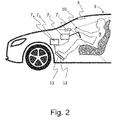
- Figure 2 illustrates driver action monitoring devices 7 in a vehicle 3 having an observer neural network computer 2 integrated into an active safety system (not shown) thereof suitable for use with embodiments of the proposed method.
- said driver action monitoring devices 7 comprises a driver monitoring camera 7 1 arranged to observe a driver's 9 actions in various situations, a steering wheel angle sensor 7 2 , a throttle position sensor 7 3 and a brake pedal position sensor 7 4 .
- driver actions that can be monitored, although not illustrated in figure 2 , are: activation of turn indicator and hazard warning, activation of headlights, activation of windscreen wipers, etc.. All of the above driver action monitoring devices 7 being arranged to provide signals 6 to be observed by said observer neural network computer 2 of its respective vehicle 3 to enhance the learning experience thereof.
Landscapes
- Engineering & Computer Science (AREA)
- Physics & Mathematics (AREA)
- Theoretical Computer Science (AREA)
- General Physics & Mathematics (AREA)
- Multimedia (AREA)
- Computational Linguistics (AREA)
- Evolutionary Computation (AREA)
- Artificial Intelligence (AREA)
- Biomedical Technology (AREA)
- Biophysics (AREA)
- Health & Medical Sciences (AREA)
- Data Mining & Analysis (AREA)
- Life Sciences & Earth Sciences (AREA)
- General Health & Medical Sciences (AREA)
- Molecular Biology (AREA)
- Computing Systems (AREA)
- General Engineering & Computer Science (AREA)
- Mathematical Physics (AREA)
- Software Systems (AREA)
- Traffic Control Systems (AREA)
Abstract
Description
- Embodiments herein relate to a method of programming a target neural network computer for use in cognitive computing systems in automotive safety applications.
- One area of automotive vehicle technology that is evolving rapidly is the area of automotive safety applications, such as vehicle borne active safety systems. Currently most active safety systems comprises computers for handling information input from numerous sensors and vehicle systems in order to assess risk and provide safety enhancing support to vehicle drivers.
- However, in many ways computers today are nothing more than very fast number-crunchers which have the ability to process lots of data, although usually restricted to perform a number of pre-programmed instructions in response to certain input signals.
- In automotive safety applications, however, the number of input signals available in a vehicle grows larger, faster and more diverse by the day. Thus, this traditional type of computing model is inadequate to process and make sense of the volumes of information that the automotive safety applications of tomorrow will need to deal with.
- Also, a lot of input data in automotive safety applications now comes in unstructured forms such as video, images, symbols and similar. Thus, a new computing model is needed in order for automotive safety applications to process and make sense of it. Such a new computing model is provided by cognitive computing systems, such as developed by IBM and others under US DARPA SyNAPSE (Systems of Neuromorphic Adaptive Plastic Scalable Electronics) project.
- Rather than being programmed to anticipate every possible answer or action needed to perform a function or set of tasks in response to certain input signals, cognitive computing systems can process unstructured data and learn by experience, much in the same way humans do.
- When utilizing such new cognitive computing systems in automotive safety applications, such as vehicle borne active safety systems, comes the need for new ways of programming these cognitive computing systems to enable the development of new sensory-based cognitive computing applications.
- A previous document,
GB 2495265 - A specific deployment of this system according to
GB 2495265 - However, cognitive computing systems get better over time as they build knowledge and learn a domain, its processes and its preferred methods of interacting. Thus, although
GB 2495265 - Embodiments herein aim to provide an improved cost effective method of programming a target neural network computer for use in cognitive computing systems in automotive safety applications.
- This is provided through a method comprising the steps of:
- integrating a respective observer neural network computer into respective active safety systems of a plurality of vehicles only to observe signals;
- arranging each respective observer neural network computer to observe signals from a forward facing camera of its respective vehicle;
- arranging each respective observer neural network computer to observe signals from one or more driver action monitoring devices of its respective vehicle;
- arranging each respective observer neural network computer to process said observed signals from said respective forward facing camera of its respective vehicle and to correlate them with said observed signals from said respective one or more driver action monitoring devices of its respective vehicle;
- combining correlated signals from said plurality of said observer neural network computers;
- programming said target neural network computer for use in cognitive computing systems in automotive safety applications based on said combined correlated signals.
- Programming a target neural network computer for use in cognitive computing systems in automotive safety applications according to the above method provides for combining the "experience" of numerous observer neural network computers such that target neural network computer based active safety systems for use in future vehicles can benefit from the experience of numerous drivers.
- According to a second aspect said step of arranging each respective observer neural network computer to observe signals from a forward facing camera of its respective vehicle comprises arranging each respective observer neural network computer to observe signals from a forward facing pedestrian detection camera of its respective vehicle.
- Through observing signals from a forward facing pedestrian detection camera and allowing each respective observer neural network computer to correlate what it sees through its pedestrian detection camera with actions taken by the driver of its respective vehicle, the respective observer neural network computer is able to program itself. If the driver's action results in an accident or corrective actions, the observer neural network computer will learn what to avoid.
- According to a third aspect said step of arranging each respective observer neural network computer to observe signals from one or more driver action monitoring devices of its respective vehicle comprises arranging each respective observer neural network computer to observe signals from at least one driver monitoring camera.
- Through arranging each respective observer neural network computer to observe signals from at least one driver monitoring camera self-learning programming of the observer neural network computer will benefit from having access to a camera that observes the driver's actions in various situations.
- According to a fourth aspect said step of arranging each respective observer neural network computer to process said observed signals from said respective forward facing camera of its respective vehicle comprises arranging each respective observer neural network computer to process said observed signals from said respective forward facing camera of its respective vehicle to recognize visual patterns and to correlate said visual patterns with said observed signals from said respective one or more driver action monitoring devices of its respective vehicle.
- As currently available observer neural network computers are designed for recognition of visual patterns said provision of arranging each respective observer neural network computer to process said observed signals from said respective forward facing camera of its respective vehicle to recognize visual patterns is a suitable setup for processing signals from forward facing cameras, such as commonly available pedestrian detection cameras.
- According to a fifth aspect said step of arranging each respective observer neural network computer to observe signals from one or more driver action monitoring devices of its respective vehicle comprises arranging each respective observer neural network computer to observe signals from at least one of a steering wheel angle sensor, a throttle position sensor, a brake pedal position sensor, activation of a turn indicator, activation of a hazard warning, activation of headlights and activation of windscreen wipers.
- The provision of arranging each respective observer neural network computer to observe signals from at least one of a steering wheel angle sensor, a throttle position sensor, a brake pedal position sensor, activation of a turn indicator, activation of a hazard warning, activation of headlights and activation of windscreen wipers, etc., provides for the provision of diverse and multi-faceted input signals to the observer neural network computer, enhancing its self-learning programming experience.
- According to a sixth aspect said step of integrating a respective observer neural network computer into respective active safety systems of a plurality of vehicles only to observe signals comprises integrating a respective observer neural network computer into respective active safety systems of at least one hundred vehicles.
- The provision of integrating a respective observer neural network computer into respective active safety systems of at least one hundred vehicles provides a basis for enhancing its self-learning programming experience as this now can be based on the experience of hundreds of vehicle drivers, possibly from all around the world.
- According to a seventh aspect said step of combining correlated signals from said plurality of said observer neural network computers comprises combining correlated signals from at least one hundred vehicles
- The provision of combining correlated signals from at least one hundred vehicles provides for enhancing programming of said target neural network computer as programming thereof will be based on the experience of hundreds of vehicle drivers, possibly from all around the world.
- In the following, embodiments herein will be described in greater detail by way of example only with reference to attached drawings, in which
-
Fig. 1 is a schematic illustration of the method of programming a target neural network computer for use in cognitive computing systems in automotive safety applications according to embodiments hereof. -
Fig. 2 is a schematic illustration of driver action monitoring devices in a vehicle having an observer neural network computer integrated into an active safety system thereof. - Still other objects and features of embodiments herein will become apparent from the following detailed description considered in conjunction with the accompanying drawings. It is to be understood, however, that the drawings are designed solely for purposes of illustration and not as a definition of the limits hereof, for which reference should be made to the appended claims. It should be further understood that the drawings are not necessarily drawn to scale and that, unless otherwise indicated, they are merely intended to conceptually illustrate the structures and procedures described herein. Like reference numerals designate like elements throughout the specification. In the specification, unless explicitly described to the contrary, the word "comprise" and variations such as "comprises" or "comprising" will be understood to imply the inclusion of stated elements but not the exclusion of any other elements.
-
Figure 1 is a schematic illustration of the method of programming a targetneural network computer 1, e.g. embodied as a target neural network computer chip (not shown), for use in cognitive computing systems in automotive safety applications according to embodiments hereof. - In accordance with the proposed method, and as illustrated at the top level of
figure 1 , a respective observerneural network computer 2 is integrated into respective active safety systems (not shown) of a plurality ofvehicles neural network computer 2 will not affect arespective vehicle 3 or its active safety system at all but simply observe signals therein, as described in the following. According to preferred embodiments hereof a respective observerneural network computer 2 is integrated into respective active safety systems (not shown) of at least one hundredvehicles 3. - Moving now one level down in the method flow illustrated in
figure 1 is illustrated onevehicle 3 out of said plurality ofvehicles neural network computer 2 is arranged to observe signals 4 from a forward facingcamera 5 of itsrespective vehicle 3, and each respective observerneural network computer 2 is further arranged to observesignals 6 from one or more driveraction monitoring devices 7 of itsrespective vehicle 3. - According to some embodiments hereof each respective observer
neural network computer 2 is arranged to observe signals from a forward facingpedestrian detection camera 5 of its respective vehicle. This is a convenient arrangement, as many active safety systems in vehicles already comprise such a forward facingpedestrian detection camera 5. - In yet some embodiments hereof each respective observer
neural network computer 2 is arranged to observesignals 6 from at least one of a steeringwheel angle sensor 72, athrottle position sensor 73, a brakepedal position sensor 74. Additional examples of driver actions that can monitored are: activation of turn indicator and hazard warning, activation of headlights, activation of windscreen wipers, etc.. - Through arranging each respective observer
neural network computer 2 to observesignals 6 from such driveraction monitoring devices 7 as at least one of a steeringwheel angle sensor 72, athrottle position sensor 73, a brakepedal position sensor 74, activation of a turn indicator, activation of a hazard warning, activation of headlights and activation of windscreen wipers, etc., is, in further embodiments, allowed the provision of diverse andmulti-faceted input signals 6 to said observerneural network computer 2, enhancing its self-learning programming experience. - According to still further embodiments hereof each respective observer
neural network computer 2 is arranged to process said observed signals 4 from said respectiveforward facing camera 5 of itsrespective vehicle 3 to recognize visual patterns and to correlate said visual patterns with said observedsignals 6 from said respective one or more driveraction monitoring devices 7 of itsrespective vehicle 3. - This is particularly advantageous as currently available observer
neural network computers 2 are designed for recognition of visual patterns. Hence, said provision of arranging each respective observerneural network computer 2 to process said observed signals 4 from said respectiveforward facing camera 5 of itsrespective vehicle 3 to recognize visual patterns is a suitable setup for processing signals 4 from forward facingcameras 5, such as commonly availablepedestrian detection cameras 5. - In yet further embodiments hereof each respective observer
neural network computer 2 is arranged to observesignals 6 from at least onedriver monitoring camera 71. Said observerneural network computer 2 will benefit from, and improve its learning, through having access to adriver monitoring camera 71 that observes a driver's 9 actions in various situations. - Furthermore, each respective observer
neural network computer 2 is arranged to process said observed signals 4 from said respectiveforward facing camera 5 of itsrespective vehicle 3 and to correlate them with said observedsignals 6 from said respective one or more driveraction monitoring devices 7 of itsrespective vehicle 3. - Thereafter, moving yet one level down in the method flow illustrated in
figure 1 , is illustrated how correlated signals 81, 82, ..., 8n-1, 8n from said plurality of said observerneural network computers figure 1 , said targetneural network computer 1 for use in cognitive computing systems in automotive safety applications is programmed based on said combined correlated signals. - In preferred embodiments hereof correlated signals 81, 82, ..., 8n-1, 8n from at least one hundred
vehicles 3 are combined. - Through combining correlated signals 81, 82, ..., 8n-1, 8n from at least one hundred
vehicles 3 provides for enhancing programming of said targetneural network computer 1 as programming thereof will be based on the experience of hundreds ofvehicle drivers 9, possibly from all around the world. - Thus, programming a target
neural network computer 1 for use in cognitive computing systems in automotive safety applications according to the herein proposed method provides for combining the "experience" of numerous observerneural network computers neural network computer 1 based active safety systems for use in future vehicles can benefit from the experience of numerous drivers and vehicles. - Thus, according to the proposed method of programming, such target
neural network computers 1 will be exposed to large number of input patterns that should trigger certain responses preparing the targetneural network computers 1 for use in active safety systems of future vehicles. - In conclusion, through integrating a respective observer
neural network computer 2 into respective active safety systems of at least one hundredvehicles 3 is provided a basis for enhancing the self-learning programming experience of said observerneural network computer 2, this in particular as this self-learning programming experience now can be based on the experience of hundreds ofvehicle drivers 9, possibly from all around the world. - Through observing signals 4 from a forward facing
camera 5, such as a forward facingpedestrian detection camera 5, and allowing each respective observerneural network computer 2 to correlate what it sees through itsforward facing camera 5 with actions taken by adriver 9 of itsrespective vehicle 3, each respective observerneural network computer 2 is able to program itself. If a driver's action results in an accident or corrective actions, said observerneural network computer 2 will learn what to avoid. Thus, a main purpose of monitoring driver actions is to correlate non-action or incorrect-action by a driver that can be attributed to distraction and mental state. - The point of using an observer
neural network computer 2 is that the correlation of what is observed by thecamera 5 and driver actions occurs real-time in avehicle 3 and is learned / remembered by the observerneural network computer 2. This greatly reduces the amount of processing required, thus making it possible to combine data from more than one hundred drivers for programming a targetneural network computer 1. - Further, since there is no actual recording of a driver's actions, privacy is preserved through the proposed method. However, it is envisaged that an owner of said observer
neural network computers 2 could pay a fee to, or otherwise remunerate, an owner/driver 9 of eachrespective vehicle 3 for "teaching" said observerneural network computers 2, and thus providing a knowledge base for programming of said targetneural network computers 1. - Thus, "teaching" said observer and consequently target
neural network computers vehicle 3 manufacturers and/orvehicle 3 owners/drivers 9. -
Figure 2 illustrates driveraction monitoring devices 7 in avehicle 3 having an observerneural network computer 2 integrated into an active safety system (not shown) thereof suitable for use with embodiments of the proposed method. - As illustrated in
figure 2 , said driveraction monitoring devices 7 comprises adriver monitoring camera 71 arranged to observe a driver's 9 actions in various situations, a steeringwheel angle sensor 72, athrottle position sensor 73 and a brakepedal position sensor 74. Additional examples of driver actions that can be monitored, although not illustrated infigure 2 , are: activation of turn indicator and hazard warning, activation of headlights, activation of windscreen wipers, etc.. All of the above driveraction monitoring devices 7 being arranged to providesignals 6 to be observed by said observerneural network computer 2 of itsrespective vehicle 3 to enhance the learning experience thereof. - Thus, while there have been shown and described and pointed out fundamental novel features of the embodiments herein, it will be understood that various omissions and substitutions and changes in the form and details of the devices illustrated, and in their operation, may be made by those skilled in the art. For example, it is expressly intended that all combinations of those elements and/or method steps which perform substantially the same function in substantially the same way to achieve the same results are equivalent. Moreover, it should be recognized that structures and/or elements and/or method steps shown and/or described in connection with any disclosed form or embodiment herein may be incorporated in any other disclosed or described or suggested form or embodiment as a general matter of design choice.
Claims (7)
- A method of programming a target neural network computer for use in cognitive computing systems in automotive safety applications,
comprising the steps of:integrating a respective observer neural network computer into respective active safety systems of a plurality of vehicles only to observe signals;arranging each respective observer neural network computer to observe signals from a forward facing camera of its respective vehicle;arranging each respective observer neural network computer to observe signals from one or more driver action monitoring devices of its respective vehicle;arranging each respective observer neural network computer to process said observed signals from said respective forward facing camera of its respective vehicle and to correlate them with said observed signals from said respective one or more driver action monitoring devices of its respective vehicle;combining correlated signals from said plurality of said observer neural network computers;programming said target neural network computer for use in cognitive computing systems in automotive safety applications based on said combined correlated signals. - A method according to claim 1, wherein said step of arranging each respective observer neural network computer to observe signals from a forward facing camera of its respective vehicle comprises arranging each respective observer neural network computer to observe signals from a forward facing pedestrian detection camera of its respective vehicle.
- A method according to any one of claims 1 or 2, wherein said step of arranging each respective observer neural network computer to observe signals from one or more driver action monitoring devices of its respective vehicle comprises arranging each respective observer neural network computer to observe signals from at least one driver monitoring camera.
- A method according to any one of claims 1 - 3, wherein said step of arranging each respective observer neural network computer to process said observed signals from said respective forward facing camera of its respective vehicle comprises arranging each respective observer neural network computer to process said observed signals from said respective forward facing camera of its respective vehicle to recognize visual patterns and to correlate said visual patterns with said observed signals from said respective one or more driver action monitoring devices of its respective vehicle.
- A method according to any one of claims 1 - 4, wherein said step of arranging each respective observer neural network computer to observe signals from one or more driver action monitoring devices of its respective vehicle comprises arranging each respective observer neural network computer to observe signals from at least one of a steering wheel angle sensor, a throttle position sensor, a brake pedal position sensor, activation of a turn indicator, activation of a hazard warning, activation of headlights and activation of windscreen wipers.
- A method according to claim 5, wherein said step of integrating a respective observer neural network computer into respective active safety systems of a plurality of vehicles only to observe signals comprises integrating a respective observer neural network computer into respective active safety systems of at least one hundred vehicles.
- A method according to any one of the preceding claims, wherein said step of combining correlated signals from said plurality of said observer neural network computers comprises combining correlated signals from at least one hundred vehicles.
Applications Claiming Priority (1)
| Application Number | Priority Date | Filing Date | Title |
|---|---|---|---|
| US14/102,874 US9361575B2 (en) | 2013-12-11 | 2013-12-11 | Method of programming a neural network computer |
Publications (1)
| Publication Number | Publication Date |
|---|---|
| EP2884424A1 true EP2884424A1 (en) | 2015-06-17 |
Family
ID=52002760
Family Applications (1)
| Application Number | Title | Priority Date | Filing Date |
|---|---|---|---|
| EP14195322.4A Ceased EP2884424A1 (en) | 2013-12-11 | 2014-11-28 | Method of programming a neural network computer |
Country Status (3)
| Country | Link |
|---|---|
| US (1) | US9361575B2 (en) |
| EP (1) | EP2884424A1 (en) |
| CN (1) | CN104709288B (en) |
Cited By (1)
| Publication number | Priority date | Publication date | Assignee | Title |
|---|---|---|---|---|
| DE102016121691A1 (en) | 2016-11-11 | 2018-05-17 | Automotive Safety Technologies Gmbh | Method and system for operating a motor vehicle |
Families Citing this family (11)
| Publication number | Priority date | Publication date | Assignee | Title |
|---|---|---|---|---|
| EP3345127A4 (en) * | 2015-08-31 | 2019-08-21 | SRI International | METHOD AND SYSTEM FOR MONITORING DRIVING BEHAVIORS |
| CN108885712B (en) | 2015-11-12 | 2022-06-10 | 渊慧科技有限公司 | Neural programming |
| US10282615B2 (en) | 2016-12-21 | 2019-05-07 | Volkswagen Ag | System and method for root association in image data |
| US10789495B2 (en) | 2016-12-21 | 2020-09-29 | Volkswagen Ag | System and method for 1D root association providing sparsity guarantee in image data |
| US10235565B2 (en) | 2016-12-21 | 2019-03-19 | Volkswagen Ag | System and methodologies for occupant monitoring utilizing digital neuromorphic (NM) data and fovea tracking |
| US10229341B2 (en) | 2016-12-21 | 2019-03-12 | Volkswagen Ag | Vector engine and methodologies using digital neuromorphic (NM) data |
| US10133944B2 (en) | 2016-12-21 | 2018-11-20 | Volkswagen Ag | Digital neuromorphic (NM) sensor array, detector, engine and methodologies |
| SE541635C2 (en) | 2018-03-12 | 2019-11-19 | Scania Cv Ab | Method, control arrangement and machine learning based system for proactively acting on situations involving an increased traffic accident risk |
| US11267393B2 (en) * | 2019-05-16 | 2022-03-08 | Magna Electronics Inc. | Vehicular alert system for alerting drivers of other vehicles responsive to a change in driving conditions |
| US10922824B1 (en) | 2019-08-13 | 2021-02-16 | Volkswagen Ag | Object tracking using contour filters and scalers |
| EP4124017A4 (en) * | 2020-03-16 | 2023-09-06 | Sony Semiconductor Solutions Corporation | Signal processing device and signal processing method |
Citations (1)
| Publication number | Priority date | Publication date | Assignee | Title |
|---|---|---|---|---|
| GB2495265A (en) | 2011-07-07 | 2013-04-10 | Toyota Motor Europe Nv Sa | Artificial memory system for predicting behaviours in order to assist in the control of a system, e.g. stability control in a vehicle |
Family Cites Families (20)
| Publication number | Priority date | Publication date | Assignee | Title |
|---|---|---|---|---|
| US5613039A (en) * | 1991-01-31 | 1997-03-18 | Ail Systems, Inc. | Apparatus and method for motion detection and tracking of objects in a region for collision avoidance utilizing a real-time adaptive probabilistic neural network |
| US7788008B2 (en) * | 1995-06-07 | 2010-08-31 | Automotive Technologies International, Inc. | Eye monitoring system and method for vehicular occupants |
| JPH0785280B2 (en) * | 1992-08-04 | 1995-09-13 | タカタ株式会社 | Collision prediction judgment system by neural network |
| US5434927A (en) * | 1993-12-08 | 1995-07-18 | Minnesota Mining And Manufacturing Company | Method and apparatus for machine vision classification and tracking |
| US7783403B2 (en) * | 1994-05-23 | 2010-08-24 | Automotive Technologies International, Inc. | System and method for preventing vehicular accidents |
| US6526352B1 (en) * | 2001-07-19 | 2003-02-25 | Intelligent Technologies International, Inc. | Method and arrangement for mapping a road |
| IL117279A (en) * | 1996-02-27 | 2000-01-31 | Israel Aircraft Ind Ltd | System for detecting obstacles on a railway track |
| DE19926559A1 (en) * | 1999-06-11 | 2000-12-21 | Daimler Chrysler Ag | Method and device for detecting objects in the vicinity of a road vehicle up to a great distance |
| US7920102B2 (en) * | 1999-12-15 | 2011-04-05 | Automotive Technologies International, Inc. | Vehicular heads-up display system |
| JP2003536137A (en) * | 2000-06-09 | 2003-12-02 | オートモーティブ システムズ ラボラトリー インコーポレーテッド | Situation awareness processor |
| JP3885999B2 (en) * | 2001-12-28 | 2007-02-28 | 本田技研工業株式会社 | Object detection device |
| US6950014B2 (en) * | 2002-02-13 | 2005-09-27 | Ford Global Technologies Llc | Method for operating a pre-crash sensing system in a vehicle having external airbags |
| US7676062B2 (en) * | 2002-09-03 | 2010-03-09 | Automotive Technologies International Inc. | Image processing for vehicular applications applying image comparisons |
| US7467115B2 (en) * | 2004-07-15 | 2008-12-16 | Neurosciences Research Foundation, Inc. | Mobile brain-based device having a simulated nervous system based on the hippocampus |
| WO2006014974A2 (en) * | 2004-07-26 | 2006-02-09 | Automotive Systems Laboratory, Inc. | Vulnerable road user protection system |
| US7613569B2 (en) | 2005-07-19 | 2009-11-03 | Toyota Motor Engineering & Manufacturing North America, Inc. | Crash prediction network with visual input for vehicle |
| US7954579B2 (en) * | 2008-02-04 | 2011-06-07 | Illinois Institute Of Technology | Adaptive control strategy and method for optimizing hybrid electric vehicles |
| CA2649731C (en) * | 2008-11-05 | 2015-07-21 | The George Washington University | An unobtrusive driver drowsiness detection method |
| US9015093B1 (en) * | 2010-10-26 | 2015-04-21 | Michael Lamport Commons | Intelligent control with hierarchical stacked neural networks |
| JP2013191072A (en) * | 2012-03-14 | 2013-09-26 | Hitachi Automotive Systems Ltd | Object detection device |
-
2013
- 2013-12-11 US US14/102,874 patent/US9361575B2/en active Active
-
2014
- 2014-11-28 EP EP14195322.4A patent/EP2884424A1/en not_active Ceased
- 2014-12-04 CN CN201410730305.8A patent/CN104709288B/en active Active
Patent Citations (1)
| Publication number | Priority date | Publication date | Assignee | Title |
|---|---|---|---|---|
| GB2495265A (en) | 2011-07-07 | 2013-04-10 | Toyota Motor Europe Nv Sa | Artificial memory system for predicting behaviours in order to assist in the control of a system, e.g. stability control in a vehicle |
Non-Patent Citations (3)
| Title |
|---|
| AMIR ARNON ET AL: "Cognitive computing programming paradigm: A Corelet Language for composing networks of neurosynaptic cores", THE 2013 INTERNATIONAL JOINT CONFERENCE ON NEURAL NETWORKS (IJCNN), IEEE, 4 August 2013 (2013-08-04), pages 1 - 10, XP032542182, ISSN: 2161-4393, [retrieved on 20140108], DOI: 10.1109/IJCNN.2013.6707078 * |
| CASSIDY ANDREW S ET AL: "Cognitive computing building block: A versatile and efficient digital neuron model for neurosynaptic cores", THE 2013 INTERNATIONAL JOINT CONFERENCE ON NEURAL NETWORKS (IJCNN), IEEE, 4 August 2013 (2013-08-04), pages 1 - 10, XP032542126, ISSN: 2161-4393, [retrieved on 20140108], DOI: 10.1109/IJCNN.2013.6707077 * |
| ESSER STEVE K ET AL: "Cognitive computing systems: Algorithms and applications for networks of neurosynaptic cores", THE 2013 INTERNATIONAL JOINT CONFERENCE ON NEURAL NETWORKS (IJCNN), IEEE, 4 August 2013 (2013-08-04), pages 1 - 10, XP032542370, ISSN: 2161-4393, [retrieved on 20140108], DOI: 10.1109/IJCNN.2013.6706746 * |
Cited By (2)
| Publication number | Priority date | Publication date | Assignee | Title |
|---|---|---|---|---|
| DE102016121691A1 (en) | 2016-11-11 | 2018-05-17 | Automotive Safety Technologies Gmbh | Method and system for operating a motor vehicle |
| WO2018087321A1 (en) | 2016-11-11 | 2018-05-17 | Automotive Safety Technologies Gmbh | Method and system for operating a motor vehicle |
Also Published As
| Publication number | Publication date |
|---|---|
| CN104709288A (en) | 2015-06-17 |
| US20150161505A1 (en) | 2015-06-11 |
| US9361575B2 (en) | 2016-06-07 |
| CN104709288B (en) | 2018-09-18 |
Similar Documents
| Publication | Publication Date | Title |
|---|---|---|
| US9361575B2 (en) | Method of programming a neural network computer | |
| US20200216080A1 (en) | Detecting and diagnosing anomalous driving behavior using driving behavior models | |
| CN110654396B (en) | Method and apparatus for generating control commands for an autonomous road vehicle | |
| Cheng et al. | Turn-intent analysis using body pose for intelligent driver assistance | |
| JP7593328B2 (en) | Information processing device, information processing method, and information processing program | |
| WO2020140897A1 (en) | Detecting vehicle intrusion using command pattern models | |
| CN111527014B (en) | Determine the undesired motion of the vehicle | |
| JP2017084352A (en) | Method and system for assisting driver of vehicle when driving vehicle, vehicle, and computer program | |
| CN107848478A (en) | The automatic identification of low speed collision and assessment | |
| US11657635B2 (en) | Measuring confidence in deep neural networks | |
| Ammal et al. | Artificial intelligence and sensor technology in the automotive industry: An overview | |
| JP2011121577A (en) | Behavior-based learning of visual characteristic from real-world traffic scene for driver assistance system | |
| US12019449B2 (en) | Rare event simulation in autonomous vehicle motion planning | |
| CN112319456A (en) | Vehicle threat detection and response | |
| Cheng et al. | Spatio-temporal image representation and deep-learning-based decision framework for automated vehicles | |
| Jami et al. | Augmented driver behavior models for high‐fidelity simulation study of crash detection algorithms | |
| KR102529123B1 (en) | Apparatus and method for preventing car accident | |
| CN114222689B (en) | Methods for quantifying extreme traffic behavior | |
| US20210209381A1 (en) | Temporal cnn rear impact alert system | |
| Watanabe et al. | Verisimilar percept sequences tests for autonomous driving intelligent agent assessment | |
| US12287629B2 (en) | Detection of autonomous operation of a vehicle | |
| Nicolae et al. | A short review of the ADAS progress in the last decade and the potential concept of Human-Machine Symbiosis (HMS) | |
| Vasudevan et al. | Cloud-Integrated Deep Learning for Predictive Emergency Braking in Autonomous Vehicles | |
| Trappe | No need for speed: More signal processing innovation is required before adopting automated vehicles [In the Spotlight] | |
| KR20250175153A (en) | Server and In-Vehicle Device for Diagnosing Abnormal Condition of a Vehicle |
Legal Events
| Date | Code | Title | Description |
|---|---|---|---|
| PUAI | Public reference made under article 153(3) epc to a published international application that has entered the european phase |
Free format text: ORIGINAL CODE: 0009012 |
|
| 17P | Request for examination filed |
Effective date: 20141128 |
|
| AK | Designated contracting states |
Kind code of ref document: A1 Designated state(s): AL AT BE BG CH CY CZ DE DK EE ES FI FR GB GR HR HU IE IS IT LI LT LU LV MC MK MT NL NO PL PT RO RS SE SI SK SM TR |
|
| AX | Request for extension of the european patent |
Extension state: BA ME |
|
| R17P | Request for examination filed (corrected) |
Effective date: 20151217 |
|
| RBV | Designated contracting states (corrected) |
Designated state(s): AL AT BE BG CH CY CZ DE DK EE ES FI FR GB GR HR HU IE IS IT LI LT LU LV MC MK MT NL NO PL PT RO RS SE SI SK SM TR |
|
| 17Q | First examination report despatched |
Effective date: 20160524 |
|
| STAA | Information on the status of an ep patent application or granted ep patent |
Free format text: STATUS: THE APPLICATION HAS BEEN REFUSED |
|
| 18R | Application refused |
Effective date: 20170530 |