EP2884387A1 - Efficient modular addition resistant to side-channel attacks - Google Patents
Efficient modular addition resistant to side-channel attacks Download PDFInfo
- Publication number
- EP2884387A1 EP2884387A1 EP13306721.5A EP13306721A EP2884387A1 EP 2884387 A1 EP2884387 A1 EP 2884387A1 EP 13306721 A EP13306721 A EP 13306721A EP 2884387 A1 EP2884387 A1 EP 2884387A1
- Authority
- EP
- European Patent Office
- Prior art keywords
- masked
- mask
- value
- input
- values
- Prior art date
- Legal status (The legal status is an assumption and is not a legal conclusion. Google has not performed a legal analysis and makes no representation as to the accuracy of the status listed.)
- Granted
Links
Images


Classifications
-
- H—ELECTRICITY
- H04—ELECTRIC COMMUNICATION TECHNIQUE
- H04L—TRANSMISSION OF DIGITAL INFORMATION, e.g. TELEGRAPHIC COMMUNICATION
- H04L9/00—Cryptographic mechanisms or cryptographic arrangements for secret or secure communications; Network security protocols
- H04L9/002—Countermeasures against attacks on cryptographic mechanisms
- H04L9/003—Countermeasures against attacks on cryptographic mechanisms for power analysis, e.g. differential power analysis [DPA] or simple power analysis [SPA]
-
- G—PHYSICS
- G06—COMPUTING OR CALCULATING; COUNTING
- G06F—ELECTRIC DIGITAL DATA PROCESSING
- G06F7/00—Methods or arrangements for processing data by operating upon the order or content of the data handled
- G06F7/60—Methods or arrangements for performing computations using a digital non-denominational number representation, i.e. number representation without radix; Computing devices using combinations of denominational and non-denominational quantity representations, e.g. using difunction pulse trains, STEELE computers, phase computers
- G06F7/72—Methods or arrangements for performing computations using a digital non-denominational number representation, i.e. number representation without radix; Computing devices using combinations of denominational and non-denominational quantity representations, e.g. using difunction pulse trains, STEELE computers, phase computers using residue arithmetic
-
- G—PHYSICS
- G06—COMPUTING OR CALCULATING; COUNTING
- G06F—ELECTRIC DIGITAL DATA PROCESSING
- G06F7/00—Methods or arrangements for processing data by operating upon the order or content of the data handled
- G06F7/60—Methods or arrangements for performing computations using a digital non-denominational number representation, i.e. number representation without radix; Computing devices using combinations of denominational and non-denominational quantity representations, e.g. using difunction pulse trains, STEELE computers, phase computers
- G06F7/72—Methods or arrangements for performing computations using a digital non-denominational number representation, i.e. number representation without radix; Computing devices using combinations of denominational and non-denominational quantity representations, e.g. using difunction pulse trains, STEELE computers, phase computers using residue arithmetic
- G06F7/727—Modulo N arithmetic, with N being either (2**n)-1,2**n or (2**n)+1, e.g. mod 3, mod 4 or mod 5
-
- H—ELECTRICITY
- H04—ELECTRIC COMMUNICATION TECHNIQUE
- H04L—TRANSMISSION OF DIGITAL INFORMATION, e.g. TELEGRAPHIC COMMUNICATION
- H04L9/00—Cryptographic mechanisms or cryptographic arrangements for secret or secure communications; Network security protocols
- H04L9/06—Cryptographic mechanisms or cryptographic arrangements for secret or secure communications; Network security protocols the encryption apparatus using shift registers or memories for block-wise or stream coding, e.g. DES systems or RC4; Hash functions; Pseudorandom sequence generators
- H04L9/0618—Block ciphers, i.e. encrypting groups of characters of a plain text message using fixed encryption transformation
- H04L9/0625—Block ciphers, i.e. encrypting groups of characters of a plain text message using fixed encryption transformation with splitting of the data block into left and right halves, e.g. Feistel based algorithms, DES, FEAL, IDEA or KASUMI
-
- G—PHYSICS
- G06—COMPUTING OR CALCULATING; COUNTING
- G06F—ELECTRIC DIGITAL DATA PROCESSING
- G06F2207/00—Indexing scheme relating to methods or arrangements for processing data by operating upon the order or content of the data handled
- G06F2207/72—Indexing scheme relating to groups G06F7/72 - G06F7/729
- G06F2207/7219—Countermeasures against side channel or fault attacks
- G06F2207/7223—Randomisation as countermeasure against side channel attacks
- G06F2207/7233—Masking, e.g. (A**e)+r mod n
- G06F2207/7238—Operand masking, i.e. message blinding, e.g. (A+r)**e mod n; k.(P+R)
-
- H—ELECTRICITY
- H04—ELECTRIC COMMUNICATION TECHNIQUE
- H04L—TRANSMISSION OF DIGITAL INFORMATION, e.g. TELEGRAPHIC COMMUNICATION
- H04L2209/00—Additional information or applications relating to cryptographic mechanisms or cryptographic arrangements for secret or secure communication H04L9/00
- H04L2209/12—Details relating to cryptographic hardware or logic circuitry
Definitions
- the present invention relates generally to cryptography and in particular to a modular addition algorithm secure against Differential Power Analysis (DPA) attacks.
- DPA Differential Power Analysis
- Modular addition is used in many cryptographic implementations.
- a well-known constant-time addition algorithm is the following, where ⁇ is a bitwise XOR operation and A a bitwise AND operation.
- Algorithm 1 in some cases can be attacked using Differential Power Analysis (DPA) and related attacks introduced by Kocher et al. [see Paul Kocher, Joshua Jaffe, and Benjamin Jun. Differential power analysis. In M. Wiener, editor, Advances in Cryptology - CRYPTO'99, volume 1666 of Lecture Notes in Computer Science, pages 388-397. Springer-Verlag, 1999 .]. Such attacks exploit side-channel leakage to uncover secret information. During the execution of a cryptographic algorithm, the secret key or some related information may be revealed by monitoring the power consumption of the electronic device executing the cryptographic algorithm. DPA-type attacks potentially apply to all cryptosystems, including popular block-ciphers like DES or AES.
- DPA Differential Power Analysis
- Boolean masking generally by applying an XOR
- arithmetic masking by applying an +
- the masking problem for modular addition can be stated as how to securely compute the addition of k -bit operands x and y from Boolean masked inputs ( x ⁇ , ⁇ ) while the k -bit result is still Boolean masked.
- a modular addition is a carried out with classical switching methods in three steps:
- the correction term ⁇ is the same for each iteration. This term can thus be computed once and then passed along to all iterations of the masked carry-chain calculation.
- the skilled person will appreciate that it is preferred to use a new random mask for each new addition to ensure the uniform distribution of masks remains between two algorithm executions.
- the invention is directed to a method of performing modular addition between a first integer value x and a second integer value y .
- a processor obtains a first masked input x ⁇ , a second masked input ⁇ , a first mask r x and a second mask r y , the first masked input x ⁇ resulting from the first integer value x masked by the first mask r x and the second masked input ⁇ resulting from the second integer value y masked by the second mask r y ; computes a first iteration carry value c 1 , using the first masked input x ⁇ , the second masked input ⁇ , the first mask r x , the second mask r y ; recursively updates intermediate carry values c i to obtain a final carry value c k -1 , wherein an intermediate carry value is updated using the first masked input x ⁇ , the second masked input ⁇ , the
- the first iteration carry value, the intermediate carry values and the final carry value are masked and the first iteration carry value c 1 is computed using also a carry mask value ⁇ and the intermediate carry values c i are updated using also the carry mask value ⁇ ; and the masked result is obtained by combining the first masked input x ⁇ and the second masked input ⁇ and the final masked carry value to obtain an intermediate value; and combining the intermediate value with the carry mask value to obtain a masked result.
- the intermediate value and the masked result are obtained using XOR between the combined values.
- the processor further outputs a combination of the first mask r x and the second mask r y ; the combination of the first mask r x and the second mask r y can be obtained using XOR.
- the modular addition is used to subtract the second integer value y from the first integer value x
- the processor further: between the obtaining and the computing, sets the first masked input x ⁇ to the bitwise complementation of the first masked input x ⁇ ; and between the combining and the outputting, sets the masked result to the bitwise complementation of the masked result.
- the invention is directed to a method of performing modular addition between n integer values x 1 ... x n , wherein n ⁇ 3.
- a processor obtains n masked inputs x ⁇ 1 ... x ⁇ n and n masks r 1 ...
- each masked input x ⁇ i results from a combination between an integer value x i and a corresponding mask r i ; generates a first intermediate couple of a masked value and a mask ( A i , R A1 ) using masked inputs x ⁇ 1 , x ⁇ 2 , x ⁇ 3 and the corresponding masks r 1 , r 2 , r 3 ; generates a second intermediate couple of masked value and a mask ( B 1 , R B1 ) using masked inputs x ⁇ 1 , x ⁇ 2 , x ⁇ 3 and the corresponding masks r 1 , r 2 , r 3 ; if n > 3, performs n -3 iterations, where k is a present iteration, of: computing a k -th first intermediate couple of a masked value and a mask ( A k , R Ak ), using the first intermediate couple of a m
- the intermediate masked values A 1 ,..., A k are a combination of masked inputs x ⁇ 1 ... x ⁇ n and the combinations are obtained using a XOR between the input values, and where the masks R A1 ,..., R Ak are random or a combination of masks r 1 ... r n , and where the combinations are obtained using XOR between the mask values; and the intermediate masked values B 1 ,..., B k are combinations of masked inputs x ⁇ 1 ... x ⁇ n and the combinations are obtained using a XOR and an AND between the input values and where the masks R B1 ,..., R Bk are random or combinations of masks r 1 ... r n , and the combinations are obtained using a XOR between the mask values.
- the invention is directed to a device for performing modular addition between a first integer value x and a second integer value y .
- the device comprises a processor configured to: obtain a first masked input x ⁇ , a second masked input ⁇ , a first mask r x and a second mask r y , the first masked input x ⁇ resulting from the first integer value x masked by the first mask r x and the second masked input ⁇ resulting from the second integer value y masked by the second mask r y ; compute a first iteration carry value c 1 , using the first masked input x ⁇ , the second masked input ⁇ , the first mask r x , the second mask r y ; recursively update intermediate carry values c i to obtain a final carry value c k -1 , wherein an intermediate carry value is updated using the first masked input x ⁇ , the second masked input
- the first iteration carry value, the intermediate carry values and the final carry value are masked and the first iteration carry value c 1 is computed using also a carry mask value ⁇ ; and the intermediate carry values c i are updated using also the carry mask value ⁇ ; and the masked result is obtained by: combining the first masked input x ⁇ and the second masked input ⁇ and the final masked carry value to obtain an intermediate value and combining the intermediate value with the carry mask value to obtain a masked result. It is advantageous that the intermediate value and the masked result are obtained using XOR between the combined values. It is also advantageous that the processor outputs a combination of the first mask r x and the second mask r y .
- the modular addition is used to subtract the second integer value y from the first integer value x .
- the processor further between the obtaining and the computing, sets the first masked input x ⁇ to the bitwise complementation of the first masked input x ⁇ ; and between the combining and the outputting, sets the masked result to the bitwise complementation of the masked result.
- the invention is directed to a device for performing modular addition between n integer values x ⁇ 1 ... x n , wherein n ⁇ 3.
- the device comprises a processor configured to: obtain n masked inputs x ⁇ 1 ... x ⁇ n and n masks r 1 ...
- each masked input x ⁇ i results from a combination between an integer value x i and a corresponding mask r i ; generate a first intermediate couple of masked and mask values ( A i , R A1 ) using masked inputs x ⁇ 1 , x ⁇ 2 , x ⁇ 3 and the corresponding masks r 1 , r 2 , r 3 ; generate a second intermediate couple of masked and mask values ( B 1 , R B1 ) using masked inputs x ⁇ 1 , x ⁇ 2 , x ⁇ 3 and the corresponding masks r 1 , r 2 , r 3 ; if n > 3, perform n -3 iterations, where k is a present iteration, of: computing a k -th first intermediate couple of masked and mask values ( A k , R Ak ), using the first intermediate couple of masked and mask values ( A k-1 , R Ak-1
- the intermediate masked values A 1 ,..., A k are a combination of masked inputs x ⁇ 1 ... x ⁇ n and the combinations are obtained using a XOR between the input values, and where mask values R A1 ,..., R Ak are random or a combination of masks r 1 ... r n , and where the combinations are obtained using XOR between the mask values; and the intermediate masked value B 1 ,..., B k are combinations of masked inputs x ⁇ 1 ... x ⁇ n and the combinations are obtained using a XOR and an AND between the input values and where the mask values R B1 ,..., R Bk are random or combinations of masks r 1 ... r n , and the combinations are obtained using a XOR between the mask values.
- FIG. 1 illustrates a cryptographic device according to a preferred embodiment of the present invention.
- a main idea of the present invention is to compute addition from Boolean masked inputs by implementing a secure version of the modular addition, that is an implementation where the input values of x and y and the successive values of the carry c i are kept always masked and where the algorithm outputs a Boolean masked result.
- This approach is effective if an addition modulo 2 k occurs in combination with a Boolean operation (e.g. a XOR or any operation that is compatible with Boolean masking like logical Shifts and Rotations).
- ⁇ can then be calculated from the inputs x ⁇ , ⁇ , r x , ry and ⁇ as follows:
- This pre-computation enables the update of ⁇ i inside the main loop using only two additional operations when compared to Algorithm 2 (one AND and one XOR).
- Algorithm 3 uses 4 additional temporary variables (C, D, T and ⁇ ), generates one random and takes 5 k + 8 operations: 2 k + 6 XORs, 2 k + 2 ANDs and k logical shifts.
- Algorithm 4 provides a faster algorithm.
- the main difference to Algorithm 3 is in the initialization step where some operations can be saved as only one operand is masked.
- the secure version of the carry-save addition using blinded input x 1 ⁇ , x 2 ⁇ , ... , x m ⁇ and from masks r 1 , r 2 , ... , r m works as follows :
- T ⁇ R A ⁇ R B ; D ⁇ D ⁇ T /* Compute 2[ ⁇ ⁇ x ⁇ i +2 ⁇ ( A ⁇ B )] */ 8.
- the secure addition algorithm (Algorithm 3) readily extends to output the results over the integers.
- the algorithm can indeed accommodate operands of arbitrary length and compute their blinded sum by running it modulo 2 k + 1 for any k ⁇ max(bit-length(x), bit-length( y )) - where "bit-length” denotes the binary length.
- the secure addition algorithm (Algorithm 3) can also be used for subtraction.
- the secure subtraction algorithm runs in three steps:
- This subtraction algorithm can also be adapted to work with more than two operands and over the integers, as described for the addition algorithm.
- FIG. 1 illustrates a cryptographic device according to a preferred embodiment of the present invention.
- the cryptographic device 100 comprises an input unit 111 for receiving input and an output unit 113 for outputting data.
- the cryptographic device further comprises a processor 112 configured to receive two or more input operands (one in the single-variable variant) and to perform secure modular addition according to any of the embodiments described herein.
- a software implementation of the present invention provides modular addition algorithms that is resistant against DPA attacks.
- the algorithms work with modular subtraction as well and are more efficient than Goubin's method. Using same number of registers 13 elementary operations can be saved when two masked operands are used and 10 elementary operations are saved when only one masked operand is used.
- the gain of the algorithm is significant as it represents a decrease of about 21.3%. It will thus be appreciated that the algorithm provides the optimal choice regarding memory versus speed complexity, which makes the algorithm attractive for resource-constraint devices.
- the algorithm can be used for protecting the International Data Encryption Algorithm (IDEA) and TEA family block ciphers (TEA, XTEA, XXTEA) as well as Hash Message Authentication Code (HMAC) algorithms based on SHA-1 or SHA-2 against DPA attacks.
- IDEA uses 16-bit operands whereas SHA-1 or SHA-2 uses 32-bit operands.
- SAFER Secure And Fast Encryption Routine
- SAFER encryption uses additions modulo 28.
- the algorithm is also applicable to the SKEIN hash function or the Threefish block-cipher that work with variables of 64-bit size.
- the method of the present invention is particularly suited for devices with limited resources, in particular memory that otherwise for example could be used to store lookup tables.
Landscapes
- Engineering & Computer Science (AREA)
- Physics & Mathematics (AREA)
- General Physics & Mathematics (AREA)
- Mathematical Optimization (AREA)
- Theoretical Computer Science (AREA)
- Computational Mathematics (AREA)
- Pure & Applied Mathematics (AREA)
- Mathematical Analysis (AREA)
- Computer Security & Cryptography (AREA)
- Computer Networks & Wireless Communication (AREA)
- Signal Processing (AREA)
- Computing Systems (AREA)
- Mathematical Physics (AREA)
- General Engineering & Computer Science (AREA)
- Digital Transmission Methods That Use Modulated Carrier Waves (AREA)
- Complex Calculations (AREA)
- Image Processing (AREA)
- Optical Communication System (AREA)
Abstract
Description
- The present invention relates generally to cryptography and in particular to a modular addition algorithm secure against Differential Power Analysis (DPA) attacks.
- This section is intended to introduce the reader to various aspects of art, which may be related to various aspects of the present invention that are described and/or claimed below. This discussion is believed to be helpful in providing the reader with background information to facilitate a better understanding of the various aspects of the present invention. Accordingly, it should be understood that these statements are to be read in this light, and not as admissions of prior art.
- Modular addition is used in many cryptographic implementations. A well-known constant-time addition algorithm is the following, where ⊕ is a bitwise XOR operation and A a bitwise AND operation.
Algorithm 1 Adder algorithm (constant-time)Input: two k-bit operands (x, y) Output: A = x + y mod 2 k/* Initialization */ 1: A ← x ⊕ y 2: B ← x Λ y 3: C ← 0 /* Main loop */ 4: for i = 1 to k - 1 do 5: C ← C Λ A 6: C ← C ⊕ B 7: C ← 2C 8: end for /* Aggregation */ 9: A ← A ⊕ C 10: return A - With this algorithm, the carry ci computed in step i using the register C is recursively defined as

- Once the last carry c k-1 has been computed, the addition result is obtained as

- It will be appreciated that
Algorithm 1 in some cases can be attacked using Differential Power Analysis (DPA) and related attacks introduced by Kocher et al. [see Paul Kocher, Joshua Jaffe, and Benjamin Jun. Differential power analysis. In M. Wiener, editor, Advances in Cryptology - CRYPTO'99, volume 1666 of Lecture Notes in Computer Science, pages 388-397. Springer-Verlag, 1999.]. Such attacks exploit side-channel leakage to uncover secret information. During the execution of a cryptographic algorithm, the secret key or some related information may be revealed by monitoring the power consumption of the electronic device executing the cryptographic algorithm. DPA-type attacks potentially apply to all cryptosystems, including popular block-ciphers like DES or AES. - The commonly suggested way to thwart DPA-type attacks for implementations of block-ciphers is random masking. The idea is to blind sensitive data with a random mask at the beginning of the algorithm. The algorithm is then executed as usual. Of course, at some step within a round the value of the mask (or a value derived thereof) must be known in order to correct the corresponding output value.
- For cryptographic algorithms involving different types of operations, two masking techniques usually have to be used: a Boolean masking (generally by applying an XOR) and an arithmetic masking (by applying an +). Furthermore, it is useful to have efficient and secure methods for switching from Boolean masking to arithmetic masking, and conversely.
- Two secure algorithms were proposed by Goubin [see Louis Goubin. A sound method for switching between Boolean and arithmetic masking. In Ç. K. Koç, D. Naccache, and C. Paar, editors, Cryptographic Hardware and Embedded Systems - CHES 2001, volume 2162 of Lecture Notes in Computer Science, pages 3-15. Springer-Verlag, 2001.]. Each algorithm work in one direction: the first converts from Boolean to arithmetic and the second from arithmetic to Boolean. The secure Arithmetic-to-Boolean conversion is however less efficient than the secure Boolean-to-Arithmetic conversion. The cost of the latter depends on the length of the masked operands that is 5 · k +5 operations, where k is the length of the operands. Thus, typically 5 · 32 + 5 = 165 operations are required for 32-bit inputs.
- Generally expressed, the masking problem for modular addition, can be stated as how to securely compute the addition of k-bit operands x and y from Boolean masked inputs (x̂,ŷ) while the k-bit result is still Boolean masked. A modular addition is a carried out with classical switching methods in three steps:
- 1. Convert first the Boolean masked inputs x̂ = x ⊕ rx and ŷ = y ⊕ ry to arithmetic masked inputs Ax = x - rx and Ay = y - ry using Boolean-to-Arithmetic conversion algorithm. This operation is efficient and takes 7 elementary operations (see Goubin's paper) for each conversion.
- 2. Perform two separate additions, one with the masked data and the other with the masks (Ax + Ay = x - rx + y - ry, rx + ry ). This costs 2 operations; and
- 3. Convert the addition result of masked data back to a Boolean masked output ẑ = (x + y) ⊕ (rx + ry ) using an Arithmetic-to-Boolean conversion algorithm.
- The overall computation cost for one secure addition is then 5k + 5 + 2 · 7 + 2 = 5k + 21 operations using Goubin's conversion methods. A typical cost for one secure addition is thus 5 · 32 + 21 = 181 operations for 32-bit inputs.
- To make
Algorithm 1 masked, it must be ensured that the computations do not leak information about x, y or the carry ci . It is easily seen that the carry ci is a function of x and y. Thus, if the carry is not masked, it would leak information about x and y and this information could be used by an attacker to launch a side-channel attack (such as DPA). In his Arithmetic-to-Boolean conversion algorithm, Goubin proposed to blind the carry value using a random λ as ĉ i-1 = c i-1 ⊕ 2λ. This idea can be applied toAlgorithm 1, which gives the following constant-time algorithm.Algorithm 2 Adder algorithm (with blinded carry)Input: 
Output: x + y (mod 2 k ) /* Initialization */ 1: A ← x ⊕ y 2: B ← x Λ y 3: C ← λ /* Ω = λ ⊕ (x Λ y) ⊕ 2λ Λ (x ⊕ y) */ 4: B ← B ⊕ C 5: C ← 2C 6: Ω ← C Λ A 7: Ω ← Ω ⊕ B /* Main loop */ 8: for i = 1 to k - 1 do 9: B ← B Λ A 10: B ← B ⊕ Ω 11: B ← 2B 12: end for /* Aggregation */ 13 A ← A ⊕ B 14: A ← A ⊕ C 15: return A - From an efficiency perspective, it is interesting to re-use the same mask 2λ for all the successive carries. In
Algorithm 2, a mask correction value Ω should thus be computed for each round as Ω = [2λ Λ (x ⊕ y) ⊕ (x Λ y)] ⊕ λ. As 2λ is re-used for every iteration, the correction term Ω is the same for each iteration. This term can thus be computed once and then passed along to all iterations of the masked carry-chain calculation. The skilled person will appreciate that it is preferred to use a new random mask for each new addition to ensure the uniform distribution of masks remains between two algorithm executions. - The masked version of the carry equation is as follows:

- At the end, ĉ k-1 = c k-1 ⊕ 2λ. Therefore, x + y can be obtained using two additional XOR operations in the Aggregation phase by calculating

- In previous algorithm only the carry is masked. It will be appreciated that it is desired to make such an addition more efficient and work with blinded inputs x and y. In other words to have a solution that is secure and uses less operations for the addition. The present invention provides such a solution.
- In a first aspect, the invention is directed to a method of performing modular addition between a first integer value x and a second integer value y. A processor obtains a first masked input x̂, a second masked input ŷ, a first mask rx and a second mask ry , the first masked input x̂ resulting from the first integer value x masked by the first mask rx and the second masked input ŷ resulting from the second integer value y masked by the second mask ry ; computes a first iteration carry value c 1, using the first masked input x̂, the second masked input ŷ, the first mask rx, the second mask ry ; recursively updates intermediate carry values ci to obtain a final carry value c k-1, wherein an intermediate carry value is updated using the first masked input x̂, the second masked input ŷ, the first mask rx and the second mask ry ; combines the first masked input x̂ and the second masked input ŷ and the final carry value c k-1 to obtain a masked result; and outputs the masked result.
- In a first embodiment, the first iteration carry value, the intermediate carry values and the final carry value are masked and the first iteration carry value c 1 is computed using also a carry mask value λ and the intermediate carry values ci are updated using also the carry mask value λ; and the masked result is obtained by combining the first masked input x̂ and the second masked input ŷ and the final masked carry value to obtain an intermediate value; and combining the intermediate value with the carry mask value to obtain a masked result. It is advantageous that the intermediate value and the masked result are obtained using XOR between the combined values. It is also advantageous that the processor further outputs a combination of the first mask rx and the second mask ry ; the combination of the first mask rx and the second mask ry can be obtained using XOR.
- In a second embodiment, the modular addition is used to subtract the second integer value y from the first integer value x, the processor further: between the obtaining and the computing, sets the first masked input x̂ to the bitwise complementation of the first masked input x̂; and between the combining and the outputting, sets the masked result to the bitwise complementation of the masked result.
- In a second aspect, the invention is directed to a method of performing modular addition between n integer values x 1 ... xn , wherein n ≥ 3. A processor obtains n masked inputs x̂ 1 ... x̂n and n masks r 1 ... rn , wherein each masked input x̂i results from a combination between an integer value xi and a corresponding mask ri ; generates a first intermediate couple of a masked value and a mask (Ai , RA1 ) using masked inputs x̂ 1, x̂ 2, x̂ 3 and the corresponding masks r 1, r 2, r 3; generates a second intermediate couple of masked value and a mask (B1 , RB1 ) using masked inputs x̂ 1, x̂ 2, x̂ 3 and the corresponding masks r 1, r 2, r 3; if n > 3, performs n-3 iterations, where k is a present iteration, of: computing a k-th first intermediate couple of a masked value and a mask (Ak , RAk ), using the first intermediate couple of a masked value and a (Ak-1 , RAk-1 ) the second intermediate couple of a masked value and a mask (Bk-1 , RBk-1 ), and a masked input and a mask (x̂ k+3, r k+3); and computing a k-th first intermediate couple of a masked value and a mask (Bk , RBk ), using the first intermediate couple of a masked value and a mask (Ak-1 , RAk-1 ) the second intermediate couple of a masked value and a mask (Bk-1 , RBk-1 ), and a couple of input (x̂ k+3, r k+3). The processor further performs a modular addition between the first intermediate couple value (Ak , RAk ), and the second intermediate couple values (Bk , RBk ), to obtain a masked result; and outputs the masked result.
- In a first embodiment, the intermediate masked values A1 ,...,Ak are a combination of masked inputs x̂ 1 ... x̂n and the combinations are obtained using a XOR between the input values, and where the masks RA1 ,...,RAk are random or a combination of masks r 1 ... rn , and where the combinations are obtained using XOR between the mask values; and the intermediate masked values B1 ,...,Bk are combinations of masked inputs x̂ 1 ... x̂n and the combinations are obtained using a XOR and an AND between the input values and where the masks RB1 ,...,RBk are random or combinations of masks r 1 ... rn , and the combinations are obtained using a XOR between the mask values.
- In a third aspect, the invention is directed to a device for performing modular addition between a first integer value x and a second integer value y. The device comprises a processor configured to: obtain a first masked input x̂, a second masked input ŷ, a first mask rx and a second mask ry , the first masked input x̂ resulting from the first integer value x masked by the first mask rx and the second masked input ŷ resulting from the second integer value y masked by the second mask ry ; compute a first iteration carry value c 1, using the first masked input x̂, the second masked input ŷ, the first mask rx , the second mask ry ; recursively update intermediate carry values ci to obtain a final carry value c k-1, wherein an intermediate carry value is updated using the first masked input x̂, the second masked input ŷ, the first mask rx and the second mask ry ; combine the first masked input x̂ and the second masked input ŷ and the final carry value c k-1 to obtain a masked result; and output the masked result.
- In a first embodiment, the first iteration carry value, the intermediate carry values and the final carry value are masked and the first iteration carry value c 1 is computed using also a carry mask value λ; and the intermediate carry values ci are updated using also the carry mask value λ; and the masked result is obtained by: combining the first masked input x̂ and the second masked input ŷ and the final masked carry value to obtain an intermediate value and combining the intermediate value with the carry mask value to obtain a masked result. It is advantageous that the intermediate value and the masked result are obtained using XOR between the combined values. It is also advantageous that the processor outputs a combination of the first mask rx and the second mask ry .
- In a second embodiment, the modular addition is used to subtract the second integer value y from the first integer value x. The processor further between the obtaining and the computing, sets the first masked input x̂ to the bitwise complementation of the first masked input x̂; and between the combining and the outputting, sets the masked result to the bitwise complementation of the masked result.
- In a fourth aspect, the invention is directed to a device for performing modular addition between n integer values x̂ 1 ... xn , wherein n ≥ 3. The device comprises a processor configured to: obtain n masked inputs x̂ 1 ... x̂n and n masks r 1 ... rn , wherein each masked input x̂i results from a combination between an integer value xi and a corresponding mask ri ; generate a first intermediate couple of masked and mask values (Ai , RA1 ) using masked inputs x̂ 1, x̂ 2, x̂ 3 and the corresponding masks r 1, r 2, r 3; generate a second intermediate couple of masked and mask values (B1, RB1 ) using masked inputs x̂1, x̂ 2, x̂ 3 and the corresponding masks r 1, r 2, r 3; if n > 3, perform n-3 iterations, where k is a present iteration, of: computing a k-th first intermediate couple of masked and mask values (Ak , RAk ), using the first intermediate couple of masked and mask values (Ak-1 , RAk-1 ) the second intermediate couple of masked and mask values (Bk-1 ,RBk-1 ), and a couple of input (x̂ k+3, r k+3); and computing a k-th first intermediate couple of masked and mask values (Bk , RBk ), using the first intermediate couple of masked and mask values (Ak-1 ,RAk-1 ) the second intermediate couple of masked and mask values (Bk-1 , RBk-1 ), and a couple of input (x̂ k+3, r k+3). The processor is further configured to perform a modular addition between the first intermediate couple value (Ak , RAk ), and the second intermediate couple values (Bk , RBk ), to obtain a masked result; and output the masked result.
- In a first embodiment, the intermediate masked values A1 ,...,Ak are a combination of masked inputs x̂ 1 ... x̂n and the combinations are obtained using a XOR between the input values, and where mask values RA1 ,...,RAk are random or a combination of masks r 1 ... rn , and where the combinations are obtained using XOR between the mask values; and the intermediate masked value B1 ,...,Bk are combinations of masked inputs x̂ 1 ... x̂n and the combinations are obtained using a XOR and an AND between the input values and where the mask values RB1 ,...,RBk are random or combinations of masks r 1 ... rn , and the combinations are obtained using a XOR between the mask values.
- Preferred features of the present invention will now be described, by way of non-limiting example, with reference to the accompanying drawings, in which
Figure 1 illustrates a cryptographic device according to a preferred embodiment of the present invention. - A main idea of the present invention is to compute addition from Boolean masked inputs by implementing a secure version of the modular addition, that is an implementation where the input values of x and y and the successive values of the carry ci are kept always masked and where the algorithm outputs a Boolean masked result. This approach is effective if an addition modulo 2 k occurs in combination with a Boolean operation (e.g. a XOR or any operation that is compatible with Boolean masking like logical Shifts and Rotations).
- In the algorithm of the present invention, it is ensured that the computations do not leak information about x and y, nor about the successive carries ci .
- Goubin's idea is followed and the carry with 2λ is masked, but a change is introduced. Indeed, it is remarked that both the first round carry c 1 and Ω can be computed from the same value Ω0 = (x Λ y) ⊕ λ. It is then proposed to reorder the operations for computing Ω. The reordering allows saving a few operations in the secure version of the algorithm.
- Given that ĉ 0 = 2λ and the definition of Ω, the masked version of the carry equation simplifies to:

where Ω = [2λ Λ (x ⊕ y)] ⊕ Ω0 is pre-computed once and is the same for round i = 1 and for all rounds i ∈ {2, ..., k - 1}. This means that the first loop iteration is saved and three operations (one AND, one XOR and one Shift) are traded against one Shift operation. The main loop for the blinded carry addition algorithm then becomes:
      /* First round iteration (i = 1) */
      B ← 2Ω
      /* Main loop */
      for i = 2 to k-1 do
           B ← B Λ A
           B ← B ⊕ Ω
           B ← 2B
      end for


- 1. Compute Ω0 = λ ⊕ x Λ y using the equation hereinbefore.
- 2. Computed Ω = Ω0 ⊕ A.
- 3. Compute Ω = Ω ⊕ R.
- 1. Compute Λ̂ i = ĉ i-1 Λ (x̂ ⊕ ŷ).
- 2. Compute r Λi = ĉ i-1 Λ̂ (rx ⊕ ry ).
| Algorithm 3 Secure addition |
| Input: (x̂, ŷ, rx , ry ) where x̂ = x ⊕ rx and ŷ = y ⊕ ry |
| Output: (A, R) where A = (x + y) ⊕ rx ⊕ ry and R = rx ⊕ ry |
| /* Initialization */ |
| 1: C ← λ (random that can be pre-generated) |
| /* Compute Ω 0 = λ ⊕ x Λy */ |
| 2: T ← rx Λ ry |
| 3: Ω ← T ⊕ C |
| 4: T ← ŷ Λ rx |
| 5: Ω ← Ω ⊕ T |
| 6: T ← x̂ Λ ŷ |
| 7: Ω ← Ω ⊕ T |
| 8: T ← x̂ Λ ry |
| 9: Ω ← Ω ⊕ T |
| /* Compute Ω = Ω 0 ⊕ 2λ Λ (x ⊕ y) */ |
| 10: A ← x̂ ⊕ ŷ |
| 11: R ←rx ⊕ r y |
| 12: C ← 2C |
| 13: T ← C Λ A |
| 14: Ω ← Ω ⊕ T |
| 15: T- C Λ R |
| 16: Ω ← Ω ⊕ T |
| /* First round (i = 1) */ |
| 17: D ← 2Ω |
| /* Main loop */ |
| 18: for i = 2 to k - 1 do |
| 19: T ← D Λ R |
| 20: D ← D Λ A |
| 21: D ← D ⊕ Ω |
| 22: D ← D ⊕ T |
| 23: D ← 2D |
| 24: end for |
| /* XOR with the final carry */ |
| 25: A ← A ⊕ D |
| /* Remove the carry mask 2λ */ |
| 26: A ← A ⊕ C |
| 27: return (A, R) |
| Algorithm 4 Secure addition with one masked operand |
| Input: (x̂, K, rx ) where x̂ = x ⊕ rx |
| Output: A = (x + K) ⊕ rx mod 2 k |
| /* Initialization */ |
| 1: C ← λ (random that can be pre-generated) |
| /* Compute Ω = λ ⊕ K Λ rx ⊕ x̂ ΛK */ |
| 2: Ω - K Λ rx |
| 3: Ω ← Ω ⊕ C |
| 4: T ← x̂ Λ K |
| 5: Ω ← Ω ⊕ T |
| /* Compute Ω = Ω ⊕ 2λ Λ (x̂ ⊕ K) ⊕ 2λ Λrx */ |
| 6: A ← x̂ ⊕ K |
| 7: C ← 2C |
| 8: T ← C Λ A |
| 9: Ω ← Ω ⊕ T |
| 10: T ← C Λ rx |
| 11: Ω ← Ω ⊕ T |
| /* First round (i = 1) */ |
| 12: D ← 2Ω |
| /* Main loop */ |
| 13: for i = 2 to k - 1 do |
| 14: T ← D Λrx |
| 15: D ← D Λ A |
| 16: D ← D ⊕ Ω |
| 17: D ← D ⊕ T |
| 18: D ← 2D |
| 19: end for |
| /* XOR with the final carry */ |
| 20: A ← A ⊕ D |
| /* Remove the carry mask 2λ */ |
| 21: A ← A ⊕ C |
| 22: return A |


The secure version of the carry-save addition using blinded input

- 1. A is securely evaluated as:
- Â = Â ⊕ B̂ ⊕ Ĉ, RA = RA ⊕ RB ⊕ RC.


- 2. B is computed from Â, B̂, Ĉ and from masks RA , RB , RC . as follows:
- i) Compute T̂ 1 = λ ⊕ x 1 Λ x 2 as a secure AND using Â, B̂, RA, RB and a random λ with Trichina's method.
- ii)
Compute 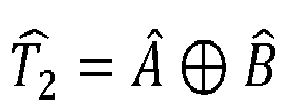

- iii) Compute B̂ = [x 3 Λ (x 1 ⊕ x 2) ⊕ (x 1 Λ x 2)] ⊕ λ using T̂ 1, T̂ 2, Ĉ, λ, R T
2 , RC with a variant of Trichina's method. - iv) Finally set B̂ = 2B̂ and RB = 2λ.


| Algorithm 5 Secure binary addition with m blinded operands |
Input:  |
Output: (ŝ, rs ) where  |
| 1: λ ← random(2 k ); |
| 2: A ← x̂ 1; RA ← r 1; B ← x̂ 2; RB ← r 2 |
| 3: for i = 1 to m - 2 do |
| /* Compute Δ = λ ⊕ (A Λ B) */ |
| 4. T ← A Λ B; D ← T ⊕ λ |
| 5. T ← A Λ RB; D ← D ⊕ T |
| 6. T ← RA Λ B; D ← D ⊕ T |
| 7. T ← RA Λ RB; D ← D ⊕ T |
| /* Compute 2[Δ ⊕ x̂i +2 Λ (A ⊕ B)] */ |
| 8. A ← A⊕B; RA ← RA ⊕RB |
| 9. T ← x̂ i+2 Λ A; B ← T ⊕ D |
| 10. T ← x̂ i+2 Λ RA; B ← B ⊕ T |
| 11. T ← r i+2 Λ A; B ← B ⊕ T |
| 12. T ← r i+2 Λ RA; B ← B ⊕ T |
| 13. B ← 2B; RB ← 2λ |
| /* A ⊕ x i+2 */ |
| 14. A ← A ⊕ x̂ i+2; RA ← RA ← ⊕ r i+2 |
| 15. end for |
| 16. SecureAdd(A, B, RA, RB) using Algorithm 3 |
- 1. Compute x̂;
- 2. Use Algorithm 3 on input (
x , ŷ, rx, ry ) and obtain (ŝ, rs ) where ŝ = (x + y) ⊕ rs and rs = rx + ry ; - 3. Set ŵ =
ŝ and rw = rs , and return (ŵ, rw )
Claims (15)
- A method of performing modular addition between a first integer value x and a second integer value y, the method comprising, in a processor (112) the steps of:- obtaining a first masked input x̂, a second masked input ŷ, a first mask rx and a second mask ry , the first masked input x̂ resulting from the first integer value x masked by the first mask rx and the second masked input ŷ resulting from the second integer value y masked by the second mask ry ;- computing a first iteration carry value c 1, using the first masked input x̂, the second masked input ŷ, the first mask rx, the second mask ry ;- recursively updating intermediate carry values ci to obtain a final carry value c k-1, wherein an intermediate carry value is updated using the first masked input x̂, the second masked input ŷ, the first mask rx and the second mask ry ;- combining the first masked input x̂ and the second masked input ŷ and the final carry value c k-1 to obtain a masked result; and- outputting the masked result.
- The method of claim 1, wherein the first iteration carry value, the intermediate carry values and the final carry value are masked and:- the first iteration carry value c 1 is computed using also a carry mask value λ; and- the intermediate carry values ci are updated using also the carry mask value λ; and
wherein the masked result is obtained by:- combining the first masked input x̂ and the second masked input ŷ and the final masked carry value to obtain an intermediate value; and- combining the intermediate value with the carry mask value to obtain a masked result. - The method of claim 2, wherein the intermediate value and the masked result are obtained using XOR between the combined values.
- The method of claim 2, further comprising the step of outputting a combination of the first mask rx and the second mask ry .
- The method of claim 4, wherein the combination of the first mask rx and the second mask ry is obtained using XOR.
- The method of claim 1, wherein the modular addition is used to subtract the second integer value y from the first integer value x, the method further comprising:between the obtaining step and the computing step, setting the first masked input x̂ to the bitwise complementation of the first masked input x̂; andbetween the combining step and the outputting step, setting the masked result to the bitwise complementation of the masked result.
- A method of performing modular addition between n integer values x̂ 1 ... xn , wherein n ≥ 3, the method comprising the steps, in a processor (112), of:- obtaining n masked inputs x̂ 1 ... x̂n and n masks r 1 ... rn , wherein each masked input x̂i results from a combination between an integer value xi and a corresponding mask ri ;- generating a first intermediate couple of a masked value and a mask (Ai , RA1 ) using masked inputs x̂ 1, x̂ 2, x̂ 3 and the corresponding masks r 1, r 2, r 3;- generating a second intermediate couple of masked value and a mask (B1 , RB1 ) using masked inputs x̂ 1, x̂ 2, x̂ 3 and the corresponding masks r 1, r 2, r 3;
if n > 3, performing n-3 iterations, where k is a present iteration, of:- computing a k-th first intermediate couple of a masked value and a mask (Ak , RAk ), using the first intermediate couple of a masked value and a (Ak-1 , RAk-1 ) the second intermediate couple of a masked value and a mask (Bk1 , RBk-1 ), and a masked input and a mask (x̂ k+3, r k+3); and- computing a k-th first intermediate couple of a masked value and a mask (Bk , RBk ), using the first intermediate couple of a masked value and a mask (Ak-1 , RAk-1 ) the second intermediate couple of a masked value and a mask (Bk-1 , RBk-1 ), and a couple of input (x̂ k+3, r k+3); and- performing a modular addition between the first intermediate couple value (Ak , RAk ), and the second intermediate couple values (Bk , RBk ), to obtain a masked result; and- outputting the masked result. - The method of claim 7, wherein:- the intermediate masked values A1 ,...,Ak are a combination of masked inputs x̂ 1 ... x̂n and the combinations are obtained using a XOR between the input values, and where the masks RA1 ,...,RAk are random or a combination of masks r 1 ... rn , and where the combinations are obtained using XOR between the mask values; and- the intermediate masked values B1 ,...,Bk are combinations of masked inputs x̂ 1 ... x̂n and the combinations are obtained using a XOR and an AND between the input values and where the masks RB1 ,...,RBk are random or combinations of masks r 1 ... rn , and the combinations are obtained using a XOR between the mask values.
- A device (110) for performing modular addition between a first integer value x and a second integer value y, the device comprising a processor (112) configured to:- obtain a first masked input x̂, a second masked input ŷ, a first mask rx and a second mask ry , the first masked input x̂ resulting from the first integer value x masked by the first mask rx and the second masked input ŷ resulting from the second integer value y masked by the second mask ry ;- compute a first iteration carry value c 1, using the first masked input x̂, the second masked input ŷ, the first mask rx, the second mask ry ;- recursively update intermediate carry values ci to obtain a final carry value c k1, wherein an intermediate carry value is updated using the first masked input x̂, the second masked input ŷ, the first mask rx and the second mask ry ;- combine the first masked input x̂ and the second masked input ŷ and the final carry value c k-1 to obtain a masked result; and- output the masked result.
- The device of claim 9, wherein the first iteration carry value, the intermediate carry values and the final carry value are masked and:- the first iteration carry value c1 is computed using also a carry mask value λ; and- the intermediate carry values ci are updated using also the carry mask value λ; and
wherein the masked result is obtained by:- combining the first masked input x̂ and the second masked input ŷ and the final masked carry value to obtain an intermediate value; and- combining the intermediate value with the carry mask value to obtain a masked result. - The device of claim 10, wherein the intermediate value and the masked result are obtained using XOR between the combined values.
- The device of claim 10, further comprising the step of outputting a combination of the first mask rx and the second mask ry .
- The device of claim 9, wherein the modular addition is used to subtract the second integer value y from the first integer value x, the method further comprising:between the obtaining step and the computing step, setting the first masked input x̂ to the bitwise complementation of the first masked input x̂; andbetween the combining step and the outputting step, setting the masked result to the bitwise complementation of the masked result.
- A device (110) for performing modular addition between n integer values x 1 ... xn , wherein n ≥ 3, the device comprising a processor (112) configured to:- obtain n masked inputs x̂ 1 ... x̂n and n masks r 1 ... rn , wherein each masked input x̂i results from a combination between an integer value xi and a corresponding mask ri ;- generate a first intermediate couple of masked and mask values (Ai , RA1 ) using masked inputs x̂ 1, x̂ 2, x̂ 3 and the corresponding masks r 1, r 2, r 3;- generate a second intermediate couple of masked and mask values (B1 , RB1 ) using masked inputs x̂ 1, xx̂ 2, x̂ 3 and the corresponding masks r 1, r 2, r 3;
if n > 3, perform n-3 iterations, where k is a present iteration, of:- computing a k-th first intermediate couple of masked and mask values (Ak , RAk ), using the first intermediate couple of masked and mask values (Ak1,RAk-1 ) the second intermediate couple of masked and mask values (Bk-1,RBk1 ), and a couple of input (x̂ k+3, r k+3); and- computing a k-th first intermediate couple of masked and mask values (Bk , RBk ), using the first intermediate couple of masked and mask values (Ak1,R Ak-1) the second intermediate couple of masked and mask values (Bk-1 , RBk-1 ), and a couple of input (x̂ k+3, r k+3); and- perform a modular addition between the first intermediate couple value (Ak , RAk ), and the second intermediate couple values (Bk , Rek ), to obtain a masked result; and- output the masked result. - The device of claim 14, wherein- the intermediate masked values A1 ,...,Ak are a combination of masked inputs x̂ 1 ... x̂n and the combinations are obtained using a XOR between the input values, and where mask values RA1 ,...,RAk are random or a combination of masks r 1 ... rn , and where the combinations are obtained using XOR between the mask values; and- the intermediate masked value B1 ,...,Bk are combinations of masked inputs x̂ 1 ... x̂n and the combinations are obtained using a XOR and an AND between the input values and where the mask values RB1 ,...,RBk are random or combinations of masks r 1 ... rn , and the combinations are obtained using a XOR between the mask values.
Priority Applications (2)
| Application Number | Priority Date | Filing Date | Title |
|---|---|---|---|
| EP13306721.5A EP2884387B1 (en) | 2013-12-13 | 2013-12-13 | Efficient modular addition resistant to side-channel attacks |
| US14/568,556 US9544131B2 (en) | 2013-12-13 | 2014-12-12 | Efficient modular addition resistant to side channel attacks |
Applications Claiming Priority (1)
| Application Number | Priority Date | Filing Date | Title |
|---|---|---|---|
| EP13306721.5A EP2884387B1 (en) | 2013-12-13 | 2013-12-13 | Efficient modular addition resistant to side-channel attacks |
Publications (2)
| Publication Number | Publication Date |
|---|---|
| EP2884387A1 true EP2884387A1 (en) | 2015-06-17 |
| EP2884387B1 EP2884387B1 (en) | 2016-09-14 |
Family
ID=50472956
Family Applications (1)
| Application Number | Title | Priority Date | Filing Date |
|---|---|---|---|
| EP13306721.5A Not-in-force EP2884387B1 (en) | 2013-12-13 | 2013-12-13 | Efficient modular addition resistant to side-channel attacks |
Country Status (2)
| Country | Link |
|---|---|
| US (1) | US9544131B2 (en) |
| EP (1) | EP2884387B1 (en) |
Cited By (3)
| Publication number | Priority date | Publication date | Assignee | Title |
|---|---|---|---|---|
| CN107547194A (en) * | 2016-06-28 | 2018-01-05 | 埃沙尔公司 | Guard method and equipment from side Multiple Channel Analysis |
| US10354065B2 (en) | 2015-10-27 | 2019-07-16 | Infineon Technologies Ag | Method for protecting data and data processing device |
| WO2019201944A1 (en) | 2018-04-17 | 2019-10-24 | Thales Dis France Sa | Method secured against side-channel attacks performing an arithmetic operation of a cryptographic algorithm mixing boolean and arithmetic operations |
Families Citing this family (12)
| Publication number | Priority date | Publication date | Assignee | Title |
|---|---|---|---|---|
| ITUB20152708A1 (en) * | 2015-07-31 | 2017-01-31 | St Microelectronics Srl | PROCEDURE FOR OPERATING A CRITTOGRAPHY WITH SENSITIVE DATA MASKING, CRITTOGRAPHY AND CORRESPONDENT COMPUTER PRODUCT |
| US10855443B2 (en) * | 2016-07-29 | 2020-12-01 | Cryptography Research Inc. | Protecting polynomial hash functions from external monitoring attacks |
| CN109791517B (en) * | 2016-12-21 | 2023-09-08 | 密码研究公司 | Protecting parallel multiplication operations from external monitoring attacks |
| DE102017002153A1 (en) * | 2017-03-06 | 2018-09-06 | Giesecke+Devrient Mobile Security Gmbh | Transition from Boolean masking to arithmetic masking |
| US10778407B2 (en) * | 2018-03-25 | 2020-09-15 | Nuvoton Technology Corporation | Multiplier protected against power analysis attacks |
| DE102018107114A1 (en) * | 2018-03-26 | 2019-09-26 | Infineon Technologies Ag | Side channel hardened operation |
| EP3874364A4 (en) * | 2018-10-29 | 2022-08-03 | Cryptography Research, Inc. | SECURE CONSTANT DURATION ARITHMETIC-BOOLEAN MASK CONVERSION |
| FR3101980B1 (en) | 2019-10-11 | 2021-12-10 | St Microelectronics Grenoble 2 | Processor |
| FR3101982B1 (en) | 2019-10-11 | 2024-03-08 | St Microelectronics Grenoble 2 | Determining an indicator bit |
| FR3101983B1 (en) * | 2019-10-11 | 2021-11-12 | St Microelectronics Grenoble 2 | Determining an indicator bit |
| DE102021003275B3 (en) | 2021-06-24 | 2022-07-14 | Giesecke+Devrient Mobile Security Gmbh | Method for computing a transition from a Boolean to an arithmetic masking |
| DE102023111991A1 (en) * | 2023-05-08 | 2024-11-14 | Giesecke+Devrient Mobile Security Germany Gmbh | Processor device comprising an implementation of a cryptographic algorithm |
Family Cites Families (15)
| Publication number | Priority date | Publication date | Assignee | Title |
|---|---|---|---|---|
| US6278783B1 (en) * | 1998-06-03 | 2001-08-21 | Cryptography Research, Inc. | Des and other cryptographic, processes with leak minimization for smartcards and other cryptosystems |
| US7848514B2 (en) * | 2004-05-24 | 2010-12-07 | Research In Motion Limited | Table masking for resistance to power analysis attacks |
| US8065532B2 (en) * | 2004-06-08 | 2011-11-22 | Hrl Laboratories, Llc | Cryptographic architecture with random instruction masking to thwart differential power analysis |
| DE102006025673B9 (en) * | 2005-10-28 | 2010-12-16 | Infineon Technologies Ag | Calculator for reducing an input number with respect to a module |
| EP1840732A1 (en) * | 2006-03-31 | 2007-10-03 | Axalto SA | Protection against side channel attacks |
| US8027466B2 (en) * | 2007-03-07 | 2011-09-27 | Research In Motion Limited | Power analysis attack countermeasure for the ECDSA |
| FR2917197B1 (en) * | 2007-06-07 | 2009-11-06 | Thales Sa | METHOD OF MASKING THE RESULT OF A MODULAR MULTIPLICATION OPERATION AND ASSOCIATED DEVICE |
| US8781111B2 (en) * | 2007-07-05 | 2014-07-15 | Broadcom Corporation | System and methods for side-channel attack prevention |
| US8091139B2 (en) * | 2007-11-01 | 2012-01-03 | Discretix Technologies Ltd. | System and method for masking arbitrary Boolean functions |
| KR101026439B1 (en) * | 2009-07-20 | 2011-04-07 | 한국전자통신연구원 | Masking Method to Defend Differential Power Analysis Attacks in SEED Encryption |
| US8971526B2 (en) * | 2011-07-26 | 2015-03-03 | Crocus-Technology Sa | Method of counter-measuring against side-channel attacks |
| GB2494731B (en) * | 2011-09-06 | 2013-11-20 | Nds Ltd | Preventing data extraction by sidechannel attack |
| EP2634953A1 (en) | 2012-03-02 | 2013-09-04 | Gemalto SA | Countermeasure method against side channel analysis for cryptographic algorithms using boolean operations and arithmetic operations |
| DE102012018924A1 (en) * | 2012-09-25 | 2014-03-27 | Giesecke & Devrient Gmbh | Side channel protected masking |
| US9959429B2 (en) * | 2013-03-15 | 2018-05-01 | Cryptography Research, Inc. | Asymmetrically masked multiplication |
-
2013
- 2013-12-13 EP EP13306721.5A patent/EP2884387B1/en not_active Not-in-force
-
2014
- 2014-12-12 US US14/568,556 patent/US9544131B2/en not_active Expired - Fee Related
Non-Patent Citations (7)
| Title |
|---|
| ANONYMOUS: "Bitwise operations in C - Wikipedia, the free encyclopedia", 11 December 2013 (2013-12-11), XP055120451, Retrieved from the Internet <URL:http://en.wikipedia.org/w/index.php?title=Bitwise_operations_in_C&oldid=585527867> [retrieved on 20140527] * |
| ELENA TRICHINA: "Combinational Logic Design for AES Subbyte Transformation on Masked Data", IACR CRYPTOLOGY EPRINT ARCHIVE, vol. 2003, 2003, pages 236 |
| ELENA TRICHINA: "Combinational Logic Design for AES SubByte Transformation on Masked Data", INTERNATIONAL ASSOCIATION FOR CRYPTOLOGIC RESEARCH,, vol. 20031112:135420, 12 November 2003 (2003-11-12), pages 1 - 13, XP061000655 * |
| ERNST SCHULTE-GEERS: "On CCZ-equivalence of addition mod 2", DESIGNS, CODES AND CRYPTOGRAPHY, KLUWER ACADEMIC PUBLISHERS, BO, vol. 66, no. 1 - 3, 25 May 2012 (2012-05-25), pages 111 - 127, XP035160876, ISSN: 1573-7586, DOI: 10.1007/S10623-012-9668-4 * |
| GOUBIN L ED - KOC C K ET AL: "A SOUND METHOD FOR SWITCHING BETWEEN BOOLEAN AND ARITHMETIC MASKING", CRYPTOGRAPHIC HARDWARE AND EMBEDDED SYSTEMS. 3RD INTERNATIONAL WORKSHOP, CHES 2001, PARIS, FRANCCE, MAY 14 - 16, 2001 PROCEEDINGS; [LECTURE NOTES IN COMPUTER SCIENCE], BERLIN : SPRINGER, DE, vol. 2162, 14 May 2001 (2001-05-14), pages 3 - 15, XP008002644, ISBN: 978-3-540-42521-2 * |
| LOUIS GOUBIN: "Cryptographic Hardware and Embedded Systems - CHES 2001, volume 2162 of Lecture Notes in Computer Science", vol. 2162, 2001, SPRINGER-VERLAG, article "A sound method for switching between Boolean and arithmetic masking", pages: 3 - 15 |
| PAUL KOCHER; JOSHUA JAFFE; BENJAMIN JUN: "Advances in Cryptology - CRYPTO'99, volume 1666 of Lecture Notes in Computer Science", vol. 1666, 1999, SPRINGER-VERLAG, article "Differential power analysis", pages: 388 - 397 |
Cited By (3)
| Publication number | Priority date | Publication date | Assignee | Title |
|---|---|---|---|---|
| US10354065B2 (en) | 2015-10-27 | 2019-07-16 | Infineon Technologies Ag | Method for protecting data and data processing device |
| CN107547194A (en) * | 2016-06-28 | 2018-01-05 | 埃沙尔公司 | Guard method and equipment from side Multiple Channel Analysis |
| WO2019201944A1 (en) | 2018-04-17 | 2019-10-24 | Thales Dis France Sa | Method secured against side-channel attacks performing an arithmetic operation of a cryptographic algorithm mixing boolean and arithmetic operations |
Also Published As
| Publication number | Publication date |
|---|---|
| US20150172042A1 (en) | 2015-06-18 |
| EP2884387B1 (en) | 2016-09-14 |
| US9544131B2 (en) | 2017-01-10 |
Similar Documents
| Publication | Publication Date | Title |
|---|---|---|
| EP2884387B1 (en) | Efficient modular addition resistant to side-channel attacks | |
| EP3559811B1 (en) | Protecting parallel multiplication operations from external monitoring attacks | |
| Coron et al. | Conversion from arithmetic to boolean masking with logarithmic complexity | |
| US8913739B2 (en) | Method for scalar multiplication in elliptic curve groups over prime fields for side-channel attack resistant cryptosystems | |
| US7864951B2 (en) | Scalar multiplication method with inherent countermeasures | |
| EP2820791B1 (en) | Countermeasure method against side channel analysis for cryptographic algorithms using boolean operations and arithmetic operations | |
| US8243920B2 (en) | Method for scalar multiplication in elliptic curve groups over binary polynomial fields for side-channel attack-resistant cryptosystems | |
| US8767955B2 (en) | Protection of a modular exponentiation calculation by multiplication by a random quantity | |
| EP3452897B1 (en) | Countermeasure to safe-error fault injection attacks on cryptographic exponentiation algorithms | |
| US7853013B2 (en) | Cryptographic method and system for encrypting input data | |
| US20130016826A1 (en) | Protection of a modular exponentiation calculation by addition of a random quantity | |
| Fumaroli et al. | Blinded fault resistant exponentiation | |
| US20210152331A1 (en) | Protecting polynomial hash functions from external monitoring attacks | |
| Karroumi et al. | Addition with blinded operands | |
| KR100834096B1 (en) | Encryption method of block cipher algorithm ARRIA corresponding to higher power analysis attack | |
| EP2535805A1 (en) | Fault-resistant exponentiation algorithm | |
| US9722773B2 (en) | Method of determining a representation of a product of a first element and a second element of a finite set, method of evaluating a function applied to an element of a finite set and associated devices | |
| US8290145B2 (en) | Transition between masked representations of a value during cryptographic calculations | |
| Wang et al. | Higher-order masking in practice: A vector implementation of masked AES for ARM NEON | |
| US20250286740A1 (en) | Decomposition of masked values | |
| CN101213512A (en) | Apparatus and method for protecting data processing equipment against attack or analysis | |
| EP4606053A1 (en) | Protection of polynomial cryptographic operations against side-channel attacks with change-of-variable transformations | |
| Tunstall et al. | Coordinate blinding over large prime fields | |
| Tunstall et al. | Boolean exponent splitting | |
| Jin et al. | Compact and efficient constant-time GCD and modular inversion with short-iteration |
Legal Events
| Date | Code | Title | Description |
|---|---|---|---|
| PUAI | Public reference made under article 153(3) epc to a published international application that has entered the european phase |
Free format text: ORIGINAL CODE: 0009012 |
|
| 17P | Request for examination filed |
Effective date: 20131213 |
|
| AK | Designated contracting states |
Kind code of ref document: A1 Designated state(s): AL AT BE BG CH CY CZ DE DK EE ES FI FR GB GR HR HU IE IS IT LI LT LU LV MC MK MT NL NO PL PT RO RS SE SI SK SM TR |
|
| AX | Request for extension of the european patent |
Extension state: BA ME |
|
| R17P | Request for examination filed (corrected) |
Effective date: 20151023 |
|
| RBV | Designated contracting states (corrected) |
Designated state(s): AL AT BE BG CH CY CZ DE DK EE ES FI FR GB GR HR HU IE IS IT LI LT LU LV MC MK MT NL NO PL PT RO RS SE SI SK SM TR |
|
| GRAP | Despatch of communication of intention to grant a patent |
Free format text: ORIGINAL CODE: EPIDOSNIGR1 |
|
| INTG | Intention to grant announced |
Effective date: 20160418 |
|
| GRAS | Grant fee paid |
Free format text: ORIGINAL CODE: EPIDOSNIGR3 |
|
| GRAA | (expected) grant |
Free format text: ORIGINAL CODE: 0009210 |
|
| AK | Designated contracting states |
Kind code of ref document: B1 Designated state(s): AL AT BE BG CH CY CZ DE DK EE ES FI FR GB GR HR HU IE IS IT LI LT LU LV MC MK MT NL NO PL PT RO RS SE SI SK SM TR |
|
| REG | Reference to a national code |
Ref country code: GB Ref legal event code: FG4D |
|
| REG | Reference to a national code |
Ref country code: CH Ref legal event code: EP |
|
| REG | Reference to a national code |
Ref country code: IE Ref legal event code: FG4D |
|
| REG | Reference to a national code |
Ref country code: AT Ref legal event code: REF Ref document number: 829679 Country of ref document: AT Kind code of ref document: T Effective date: 20161015 |
|
| REG | Reference to a national code |
Ref country code: DE Ref legal event code: R096 Ref document number: 602013011457 Country of ref document: DE |
|
| REG | Reference to a national code |
Ref country code: DE Ref legal event code: R084 Ref document number: 602013011457 Country of ref document: DE |
|
| REG | Reference to a national code |
Ref country code: FR Ref legal event code: PLFP Year of fee payment: 4 |
|
| REG | Reference to a national code |
Ref country code: LT Ref legal event code: MG4D |
|
| REG | Reference to a national code |
Ref country code: NL Ref legal event code: MP Effective date: 20160914 |
|
| PG25 | Lapsed in a contracting state [announced via postgrant information from national office to epo] |
Ref country code: RS Free format text: LAPSE BECAUSE OF FAILURE TO SUBMIT A TRANSLATION OF THE DESCRIPTION OR TO PAY THE FEE WITHIN THE PRESCRIBED TIME-LIMIT Effective date: 20160914 Ref country code: NO Free format text: LAPSE BECAUSE OF FAILURE TO SUBMIT A TRANSLATION OF THE DESCRIPTION OR TO PAY THE FEE WITHIN THE PRESCRIBED TIME-LIMIT Effective date: 20161214 Ref country code: FI Free format text: LAPSE BECAUSE OF FAILURE TO SUBMIT A TRANSLATION OF THE DESCRIPTION OR TO PAY THE FEE WITHIN THE PRESCRIBED TIME-LIMIT Effective date: 20160914 Ref country code: HR Free format text: LAPSE BECAUSE OF FAILURE TO SUBMIT A TRANSLATION OF THE DESCRIPTION OR TO PAY THE FEE WITHIN THE PRESCRIBED TIME-LIMIT Effective date: 20160914 Ref country code: LT Free format text: LAPSE BECAUSE OF FAILURE TO SUBMIT A TRANSLATION OF THE DESCRIPTION OR TO PAY THE FEE WITHIN THE PRESCRIBED TIME-LIMIT Effective date: 20160914 |
|
| REG | Reference to a national code |
Ref country code: AT Ref legal event code: MK05 Ref document number: 829679 Country of ref document: AT Kind code of ref document: T Effective date: 20160914 |
|
| PG25 | Lapsed in a contracting state [announced via postgrant information from national office to epo] |
Ref country code: NL Free format text: LAPSE BECAUSE OF FAILURE TO SUBMIT A TRANSLATION OF THE DESCRIPTION OR TO PAY THE FEE WITHIN THE PRESCRIBED TIME-LIMIT Effective date: 20160914 Ref country code: LV Free format text: LAPSE BECAUSE OF FAILURE TO SUBMIT A TRANSLATION OF THE DESCRIPTION OR TO PAY THE FEE WITHIN THE PRESCRIBED TIME-LIMIT Effective date: 20160914 Ref country code: GR Free format text: LAPSE BECAUSE OF FAILURE TO SUBMIT A TRANSLATION OF THE DESCRIPTION OR TO PAY THE FEE WITHIN THE PRESCRIBED TIME-LIMIT Effective date: 20161215 Ref country code: SE Free format text: LAPSE BECAUSE OF FAILURE TO SUBMIT A TRANSLATION OF THE DESCRIPTION OR TO PAY THE FEE WITHIN THE PRESCRIBED TIME-LIMIT Effective date: 20160914 |
|
| PG25 | Lapsed in a contracting state [announced via postgrant information from national office to epo] |
Ref country code: EE Free format text: LAPSE BECAUSE OF FAILURE TO SUBMIT A TRANSLATION OF THE DESCRIPTION OR TO PAY THE FEE WITHIN THE PRESCRIBED TIME-LIMIT Effective date: 20160914 Ref country code: RO Free format text: LAPSE BECAUSE OF FAILURE TO SUBMIT A TRANSLATION OF THE DESCRIPTION OR TO PAY THE FEE WITHIN THE PRESCRIBED TIME-LIMIT Effective date: 20160914 |
|
| PG25 | Lapsed in a contracting state [announced via postgrant information from national office to epo] |
Ref country code: BE Free format text: LAPSE BECAUSE OF FAILURE TO SUBMIT A TRANSLATION OF THE DESCRIPTION OR TO PAY THE FEE WITHIN THE PRESCRIBED TIME-LIMIT Effective date: 20160914 Ref country code: SM Free format text: LAPSE BECAUSE OF FAILURE TO SUBMIT A TRANSLATION OF THE DESCRIPTION OR TO PAY THE FEE WITHIN THE PRESCRIBED TIME-LIMIT Effective date: 20160914 Ref country code: CZ Free format text: LAPSE BECAUSE OF FAILURE TO SUBMIT A TRANSLATION OF THE DESCRIPTION OR TO PAY THE FEE WITHIN THE PRESCRIBED TIME-LIMIT Effective date: 20160914 Ref country code: PL Free format text: LAPSE BECAUSE OF FAILURE TO SUBMIT A TRANSLATION OF THE DESCRIPTION OR TO PAY THE FEE WITHIN THE PRESCRIBED TIME-LIMIT Effective date: 20160914 Ref country code: ES Free format text: LAPSE BECAUSE OF FAILURE TO SUBMIT A TRANSLATION OF THE DESCRIPTION OR TO PAY THE FEE WITHIN THE PRESCRIBED TIME-LIMIT Effective date: 20160914 Ref country code: IS Free format text: LAPSE BECAUSE OF FAILURE TO SUBMIT A TRANSLATION OF THE DESCRIPTION OR TO PAY THE FEE WITHIN THE PRESCRIBED TIME-LIMIT Effective date: 20170114 Ref country code: SK Free format text: LAPSE BECAUSE OF FAILURE TO SUBMIT A TRANSLATION OF THE DESCRIPTION OR TO PAY THE FEE WITHIN THE PRESCRIBED TIME-LIMIT Effective date: 20160914 Ref country code: BG Free format text: LAPSE BECAUSE OF FAILURE TO SUBMIT A TRANSLATION OF THE DESCRIPTION OR TO PAY THE FEE WITHIN THE PRESCRIBED TIME-LIMIT Effective date: 20161214 Ref country code: AT Free format text: LAPSE BECAUSE OF FAILURE TO SUBMIT A TRANSLATION OF THE DESCRIPTION OR TO PAY THE FEE WITHIN THE PRESCRIBED TIME-LIMIT Effective date: 20160914 Ref country code: PT Free format text: LAPSE BECAUSE OF FAILURE TO SUBMIT A TRANSLATION OF THE DESCRIPTION OR TO PAY THE FEE WITHIN THE PRESCRIBED TIME-LIMIT Effective date: 20170116 |
|
| REG | Reference to a national code |
Ref country code: DE Ref legal event code: R097 Ref document number: 602013011457 Country of ref document: DE |
|
| PG25 | Lapsed in a contracting state [announced via postgrant information from national office to epo] |
Ref country code: IT Free format text: LAPSE BECAUSE OF FAILURE TO SUBMIT A TRANSLATION OF THE DESCRIPTION OR TO PAY THE FEE WITHIN THE PRESCRIBED TIME-LIMIT Effective date: 20160914 |
|
| PLBE | No opposition filed within time limit |
Free format text: ORIGINAL CODE: 0009261 |
|
| STAA | Information on the status of an ep patent application or granted ep patent |
Free format text: STATUS: NO OPPOSITION FILED WITHIN TIME LIMIT |
|
| PG25 | Lapsed in a contracting state [announced via postgrant information from national office to epo] |
Ref country code: DK Free format text: LAPSE BECAUSE OF FAILURE TO SUBMIT A TRANSLATION OF THE DESCRIPTION OR TO PAY THE FEE WITHIN THE PRESCRIBED TIME-LIMIT Effective date: 20160914 |
|
| REG | Reference to a national code |
Ref country code: CH Ref legal event code: PL |
|
| 26N | No opposition filed |
Effective date: 20170615 |
|
| PG25 | Lapsed in a contracting state [announced via postgrant information from national office to epo] |
Ref country code: MC Free format text: LAPSE BECAUSE OF FAILURE TO SUBMIT A TRANSLATION OF THE DESCRIPTION OR TO PAY THE FEE WITHIN THE PRESCRIBED TIME-LIMIT Effective date: 20160914 |
|
| REG | Reference to a national code |
Ref country code: IE Ref legal event code: MM4A |
|
| PG25 | Lapsed in a contracting state [announced via postgrant information from national office to epo] |
Ref country code: CH Free format text: LAPSE BECAUSE OF NON-PAYMENT OF DUE FEES Effective date: 20161231 Ref country code: LI Free format text: LAPSE BECAUSE OF NON-PAYMENT OF DUE FEES Effective date: 20161231 Ref country code: LU Free format text: LAPSE BECAUSE OF NON-PAYMENT OF DUE FEES Effective date: 20161213 |
|
| PG25 | Lapsed in a contracting state [announced via postgrant information from national office to epo] |
Ref country code: IE Free format text: LAPSE BECAUSE OF NON-PAYMENT OF DUE FEES Effective date: 20161213 Ref country code: SI Free format text: LAPSE BECAUSE OF FAILURE TO SUBMIT A TRANSLATION OF THE DESCRIPTION OR TO PAY THE FEE WITHIN THE PRESCRIBED TIME-LIMIT Effective date: 20160914 |
|
| REG | Reference to a national code |
Ref country code: FR Ref legal event code: PLFP Year of fee payment: 5 |
|
| PGFP | Annual fee paid to national office [announced via postgrant information from national office to epo] |
Ref country code: FR Payment date: 20171222 Year of fee payment: 5 |
|
| PGFP | Annual fee paid to national office [announced via postgrant information from national office to epo] |
Ref country code: DE Payment date: 20171218 Year of fee payment: 5 |
|
| PG25 | Lapsed in a contracting state [announced via postgrant information from national office to epo] |
Ref country code: HU Free format text: LAPSE BECAUSE OF FAILURE TO SUBMIT A TRANSLATION OF THE DESCRIPTION OR TO PAY THE FEE WITHIN THE PRESCRIBED TIME-LIMIT; INVALID AB INITIO Effective date: 20131213 |
|
| PG25 | Lapsed in a contracting state [announced via postgrant information from national office to epo] |
Ref country code: CY Free format text: LAPSE BECAUSE OF FAILURE TO SUBMIT A TRANSLATION OF THE DESCRIPTION OR TO PAY THE FEE WITHIN THE PRESCRIBED TIME-LIMIT Effective date: 20160914 Ref country code: MK Free format text: LAPSE BECAUSE OF FAILURE TO SUBMIT A TRANSLATION OF THE DESCRIPTION OR TO PAY THE FEE WITHIN THE PRESCRIBED TIME-LIMIT Effective date: 20160914 |
|
| GBPC | Gb: european patent ceased through non-payment of renewal fee |
Effective date: 20171213 |
|
| PG25 | Lapsed in a contracting state [announced via postgrant information from national office to epo] |
Ref country code: MT Free format text: LAPSE BECAUSE OF NON-PAYMENT OF DUE FEES Effective date: 20161213 |
|
| PG25 | Lapsed in a contracting state [announced via postgrant information from national office to epo] |
Ref country code: AL Free format text: LAPSE BECAUSE OF FAILURE TO SUBMIT A TRANSLATION OF THE DESCRIPTION OR TO PAY THE FEE WITHIN THE PRESCRIBED TIME-LIMIT Effective date: 20160914 Ref country code: TR Free format text: LAPSE BECAUSE OF FAILURE TO SUBMIT A TRANSLATION OF THE DESCRIPTION OR TO PAY THE FEE WITHIN THE PRESCRIBED TIME-LIMIT Effective date: 20160914 |
|
| PG25 | Lapsed in a contracting state [announced via postgrant information from national office to epo] |
Ref country code: GB Free format text: LAPSE BECAUSE OF NON-PAYMENT OF DUE FEES Effective date: 20171213 |
|
| REG | Reference to a national code |
Ref country code: DE Ref legal event code: R119 Ref document number: 602013011457 Country of ref document: DE |
|
| PG25 | Lapsed in a contracting state [announced via postgrant information from national office to epo] |
Ref country code: FR Free format text: LAPSE BECAUSE OF NON-PAYMENT OF DUE FEES Effective date: 20181231 Ref country code: DE Free format text: LAPSE BECAUSE OF NON-PAYMENT OF DUE FEES Effective date: 20190702 |