EP2883970A1 - Copper alloy trolley wire and method for manufacturing copper alloy trolley wire - Google Patents
Copper alloy trolley wire and method for manufacturing copper alloy trolley wire Download PDFInfo
- Publication number
- EP2883970A1 EP2883970A1 EP12882251.7A EP12882251A EP2883970A1 EP 2883970 A1 EP2883970 A1 EP 2883970A1 EP 12882251 A EP12882251 A EP 12882251A EP 2883970 A1 EP2883970 A1 EP 2883970A1
- Authority
- EP
- European Patent Office
- Prior art keywords
- mass
- copper alloy
- trolley wire
- precipitates
- copper
- Prior art date
- Legal status (The legal status is an assumption and is not a legal conclusion. Google has not performed a legal analysis and makes no representation as to the accuracy of the status listed.)
- Withdrawn
Links
- 229910000881 Cu alloy Inorganic materials 0.000 title claims abstract description 81
- 238000000034 method Methods 0.000 title claims description 64
- 238000004519 manufacturing process Methods 0.000 title claims description 18
- 239000002244 precipitate Substances 0.000 claims abstract description 58
- 239000010949 copper Substances 0.000 claims abstract description 40
- 239000012535 impurity Substances 0.000 claims abstract description 6
- 230000008569 process Effects 0.000 claims description 42
- 238000010438 heat treatment Methods 0.000 claims description 34
- 238000005482 strain hardening Methods 0.000 claims description 31
- 230000032683 aging Effects 0.000 claims description 27
- RYGMFSIKBFXOCR-UHFFFAOYSA-N Copper Chemical compound [Cu] RYGMFSIKBFXOCR-UHFFFAOYSA-N 0.000 description 55
- 229910052802 copper Inorganic materials 0.000 description 34
- 238000009749 continuous casting Methods 0.000 description 25
- 238000005096 rolling process Methods 0.000 description 19
- 239000011159 matrix material Substances 0.000 description 17
- 230000000052 comparative effect Effects 0.000 description 15
- 229910052726 zirconium Inorganic materials 0.000 description 13
- 238000005266 casting Methods 0.000 description 10
- 230000000694 effects Effects 0.000 description 9
- 239000000203 mixture Substances 0.000 description 9
- 238000001556 precipitation Methods 0.000 description 8
- 229910052804 chromium Inorganic materials 0.000 description 7
- 150000001875 compounds Chemical class 0.000 description 7
- 239000000463 material Substances 0.000 description 7
- 229910052749 magnesium Inorganic materials 0.000 description 6
- 229910052709 silver Inorganic materials 0.000 description 6
- 238000005728 strengthening Methods 0.000 description 6
- 229910052725 zinc Inorganic materials 0.000 description 6
- NINIDFKCEFEMDL-UHFFFAOYSA-N Sulfur Chemical compound [S] NINIDFKCEFEMDL-UHFFFAOYSA-N 0.000 description 5
- 230000001965 increasing effect Effects 0.000 description 5
- 239000000243 solution Substances 0.000 description 5
- 229910052717 sulfur Inorganic materials 0.000 description 5
- 239000011593 sulfur Substances 0.000 description 5
- 230000005540 biological transmission Effects 0.000 description 4
- 230000009467 reduction Effects 0.000 description 4
- 230000009471 action Effects 0.000 description 3
- 238000005260 corrosion Methods 0.000 description 3
- 230000007797 corrosion Effects 0.000 description 3
- 230000002708 enhancing effect Effects 0.000 description 3
- 238000002844 melting Methods 0.000 description 3
- 230000008018 melting Effects 0.000 description 3
- 230000000007 visual effect Effects 0.000 description 3
- 238000009825 accumulation Methods 0.000 description 2
- 229910045601 alloy Inorganic materials 0.000 description 2
- 239000000956 alloy Substances 0.000 description 2
- 230000015556 catabolic process Effects 0.000 description 2
- 238000012790 confirmation Methods 0.000 description 2
- 238000001816 cooling Methods 0.000 description 2
- 238000006731 degradation reaction Methods 0.000 description 2
- 239000006185 dispersion Substances 0.000 description 2
- 239000011261 inert gas Substances 0.000 description 2
- 239000002344 surface layer Substances 0.000 description 2
- 238000012360 testing method Methods 0.000 description 2
- 229910052718 tin Inorganic materials 0.000 description 2
- DHKVCYCWBUNNQH-UHFFFAOYSA-N 2-[5-[2-(2,3-dihydro-1H-inden-2-ylamino)pyrimidin-5-yl]-1,3,4-oxadiazol-2-yl]-1-(1,4,5,7-tetrahydropyrazolo[3,4-c]pyridin-6-yl)ethanone Chemical compound C1C(CC2=CC=CC=C12)NC1=NC=C(C=N1)C1=NN=C(O1)CC(=O)N1CC2=C(CC1)C=NN2 DHKVCYCWBUNNQH-UHFFFAOYSA-N 0.000 description 1
- QVGXLLKOCUKJST-UHFFFAOYSA-N atomic oxygen Chemical compound [O] QVGXLLKOCUKJST-UHFFFAOYSA-N 0.000 description 1
- 238000002485 combustion reaction Methods 0.000 description 1
- 238000007872 degassing Methods 0.000 description 1
- 230000006866 deterioration Effects 0.000 description 1
- 238000011156 evaluation Methods 0.000 description 1
- 238000001125 extrusion Methods 0.000 description 1
- 239000012467 final product Substances 0.000 description 1
- 239000007789 gas Substances 0.000 description 1
- 230000006872 improvement Effects 0.000 description 1
- 239000000314 lubricant Substances 0.000 description 1
- 238000005259 measurement Methods 0.000 description 1
- 238000012986 modification Methods 0.000 description 1
- 230000004048 modification Effects 0.000 description 1
- 229910052760 oxygen Inorganic materials 0.000 description 1
- 239000001301 oxygen Substances 0.000 description 1
- 230000001376 precipitating effect Effects 0.000 description 1
- 239000002994 raw material Substances 0.000 description 1
- 239000006104 solid solution Substances 0.000 description 1
- 238000003756 stirring Methods 0.000 description 1
- 238000003860 storage Methods 0.000 description 1
- 238000005406 washing Methods 0.000 description 1
- 238000005491 wire drawing Methods 0.000 description 1
Images
Classifications
-
- C—CHEMISTRY; METALLURGY
- C22—METALLURGY; FERROUS OR NON-FERROUS ALLOYS; TREATMENT OF ALLOYS OR NON-FERROUS METALS
- C22C—ALLOYS
- C22C9/00—Alloys based on copper
-
- C—CHEMISTRY; METALLURGY
- C22—METALLURGY; FERROUS OR NON-FERROUS ALLOYS; TREATMENT OF ALLOYS OR NON-FERROUS METALS
- C22F—CHANGING THE PHYSICAL STRUCTURE OF NON-FERROUS METALS AND NON-FERROUS ALLOYS
- C22F1/00—Changing the physical structure of non-ferrous metals or alloys by heat treatment or by hot or cold working
- C22F1/08—Changing the physical structure of non-ferrous metals or alloys by heat treatment or by hot or cold working of copper or alloys based thereon
-
- C—CHEMISTRY; METALLURGY
- C22—METALLURGY; FERROUS OR NON-FERROUS ALLOYS; TREATMENT OF ALLOYS OR NON-FERROUS METALS
- C22C—ALLOYS
- C22C9/00—Alloys based on copper
- C22C9/02—Alloys based on copper with tin as the next major constituent
-
- C—CHEMISTRY; METALLURGY
- C22—METALLURGY; FERROUS OR NON-FERROUS ALLOYS; TREATMENT OF ALLOYS OR NON-FERROUS METALS
- C22C—ALLOYS
- C22C9/00—Alloys based on copper
- C22C9/06—Alloys based on copper with nickel or cobalt as the next major constituent
-
- C—CHEMISTRY; METALLURGY
- C22—METALLURGY; FERROUS OR NON-FERROUS ALLOYS; TREATMENT OF ALLOYS OR NON-FERROUS METALS
- C22F—CHANGING THE PHYSICAL STRUCTURE OF NON-FERROUS METALS AND NON-FERROUS ALLOYS
- C22F1/00—Changing the physical structure of non-ferrous metals or alloys by heat treatment or by hot or cold working
-
- H—ELECTRICITY
- H01—ELECTRIC ELEMENTS
- H01B—CABLES; CONDUCTORS; INSULATORS; SELECTION OF MATERIALS FOR THEIR CONDUCTIVE, INSULATING OR DIELECTRIC PROPERTIES
- H01B1/00—Conductors or conductive bodies characterised by the conductive materials; Selection of materials as conductors
- H01B1/02—Conductors or conductive bodies characterised by the conductive materials; Selection of materials as conductors mainly consisting of metals or alloys
- H01B1/026—Alloys based on copper
Definitions
- the present invention relates to a copper alloy trolley wire which comes in sliding contact with a current collector such as a pantograph provided on a train or the like to supply power to the train or the like, and a method for manufacturing the same.
- a trolley wire for railways used in a train or the like is configured to come in sliding contact with a current collector such as a pantograph to be supplied with power as described above and thus needs to secure a predetermined strength, wear resistance, electrical conductivity, heat resistance, and the like.
- a trolley wire made of Sn-containing copper which contains 0.25 weight% to 0.35 weight% of Sn is provided.
- the Sn-containing copper is a solid solution strengthening type copper alloy which is strengthened by solid-solving Sn in the matrix of copper and has excellent wear resistance and the like.
- a trolley wire made of a copper alloy containing Cr, Zr, and the like is suggested.
- the copper alloy containing Cr, Zr, and the like is a precipitation strengthening type copper alloy in which the strength thereof is enhanced by precipitating and dispersing a compound that contains Cr or Zr as main components in the matrix, and thus has further improved strength and electrical conductivity.
- the precipitation strengthening type copper alloy containing Cr, Zr, and the like described in PTLs 2 to 4 Cr and Zr are solid-solved in the matrix in a solution heat treatment process, the resultant is shaped into a predetermined shape in a cold working process, and thereafter a compound that contains Cr or Zr as main components is precipitated in an aging heat treatment process.
- the trolley wire made of the precipitation strengthening type copper alloy the strength and electrical conductivity thereof are changed by a dispersion state of the precipitates, and thus the dispersion state of the precipitates is controlled by adjusting heat treatment conditions of the aging heat treatment process.
- the copper alloy containing Cr, Zr, and the like when the cold working is performed after the aging heat treatment, performance such as electrical conductivity is significantly changed, and thus the aging heat treatment process has to be performed on the copper alloy having a shape that is similar to a final product. Therefore, there is a problem in that the shape after being subjected to the aging heat treatment cannot be sufficiently corrected. For example, in a case of a grooved trolley wire shown in FIG. 1 , the aging heat treatment needs to be performed after forming grooves thereon.
- the present invention has been made taking the foregoing circumstances into consideration, and an object thereof is to provide a copper alloy trolley wire having excellent strength, electrical conductivity, wear resistance, and heat resistance and having excellent shape accuracy, and a method for manufacturing the copper alloy trolley wire.
- the copper alloy trolley wire according to the present invention described above has a composition containing: 0.12 mass% to 0.40 mass% of Co; 0.040 mass% to 0.16 mass% of P; 0.005 mass% to 0.70 mass% of Sn; and the balance including Cu and unavoidable impurities, precipitates made of compounds with Co and P are dispersed in the matrix of copper. Accordingly, it is possible to achieve the enhancement of strength and electrical conductivity.
- the Co content and the P content are lower than the lower limit, the number of precipitates is insufficient, and thus strength cannot be sufficiently enhanced.
- the Co content and the P content are higher than the upper limit, a large number of elements that do not contribute to the enhancement of strength are present, and there is concern that a reduction in electrical conductivity and the like may be caused. Therefore, the Co content and the P content are set to the above ranges.
- Sn is an element having an action of solid-solving in the matrix of copper to enhance strength.
- Sn also has an effect of accelerating the precipitation of precipitates containing Co and P as main components or can enhance heat resistance and corrosion resistance.
- the Sn content needs to be equal to or higher than 0.005 mass%.
- the Sn content needs to be equal to or less than 0.70 mass%.
- the precipitation strengthening type copper alloy further include 0.01 mass% to 0.15 mass% ofNi.
- the copper alloy wire having the above composition contains Ni in the above range and thus can suppress the coarsening of grains, thereby further enhancing strength.
- the precipitates have an average grain size of equal to or greater than 10 nm and the number of precipitates having a grain size of equal to or greater than 5 nm is 90% or higher of the total number of observed precipitates, it is possible to enhance strength, electrical conductivity, and heat resistance.
- the grain size of the precipitate is less than 10 nm, the precipitate containing Co and P as main components is re-solid-solved in the matrix in the subsequent cold working, resulting in a reduction in electrical conductivity.
- the strength thereof is further enhanced by performing the cold working after the aging heat treatment. Accordingly, the shape thereof can be sufficiently corrected by performing the cold working after the aging heat treatment, and thus it is possible to provide the copper alloy trolley wire having excellent shape accuracy.
- the heat resistance HR defined by HR TS 1 /TS 0 ⁇ 100 in which TS 0 is the initial tensile strength and TS 1 is the tensile strength after holding the copper alloy trolley wire at 400°C for 2 hours, is equal to or higher than 90%, even in a case where the temperature of the copper alloy trolley wire is increased by frictional heat and the like, the tensile strength is sufficiently secured and thus the overhead wire tension of the copper alloy trolley wire can be set to be high. Accordingly, it is possible to apply the copper alloy trolley wire to high-speed railways and the like.
- a method for manufacturing a copper alloy trolley wire of the present invention is a method for manufacturing the above-described copper alloy trolley wire and includes: an aging heat treatment process; and a cold working process performed after the aging heat treatment process, wherein a working ratio in the cold working process is set to 20% to 65%.
- the method for manufacturing the copper alloy trolley wire having the above composition after the precipitates containing Co and P as main components are precipitated in the aging heat treatment process, working is performed at a working ratio of 20% to 65% in the cold working process. Therefore, a dislocation loop is formed in parts of the precipitates, and thus it is possible to reliably enhance strength.
- the cold working is performed at a working ratio of equal to or higher than 20% after the aging heat treatment process, it is possible to enhance the shape accuracy of the trolley wire.
- the working ratio in the cold working process is set to be in a range of 20% to 65%.
- the present invention it is possible to provide a copper alloy trolley wire having excellent strength, electrical conductivity, and heat resistance and having excellent shape accuracy, and a method for manufacturing the copper alloy trolley wire.
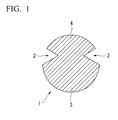
- FIG. 1 shows an example of a copper alloy trolley wire 1 of the embodiment of the present invention.
- the copper alloy trolley wire 1 of this embodiment is a grooved trolley wire in which grooves 2 to which clasps are attached are formed as shown in FIG. 1 .
- the copper alloy trolley wire 1 includes a first arc portion 3 provided on one side of the grooves 2 (lower side in FIG. 1 ) and a second arc portion 4 provided on the other side of the grooves 2 (upper side in FIG. 1 ) and is configured so that the first arc portion 3 comes in sliding contact with a pantograph.
- trolley wires for railways are standardized according to cross-sectional areas, and the copper alloy trolley wire 1 of this embodiment has a cross-sectional area of 110 mm 2 .
- the copper alloy trolley wire 1 is made of a copper alloy having a composition containing: 0.12 mass% to 0.40 mass% of Co; 0.040 mass% to 0.16 mass% of P; 0.005 mass% to 0.70 mass% of Sn; and the balance including Cu and unavoidable impurities.
- the precipitation strengthening type copper alloy further include 0.01 mass% to 0.15 mass% of Ni.
- the copper alloy may further contain at least any one type of 0.002 mass% to 0.5 mass% of Zn, 0.002 mass% to 0.25 mass% of Mg, 0.002 mass% to 0.25 mass% of Ag, and 0.001 mass% to 0.1 mass% of Zr.
- the copper alloy having the above composition contains at least any one type or two or more types of Zn, Mg, Ag, and Zr in the above ranges. Accordingly, such elements form compounds with sulfur (S) to suppress the sulfur (S) from being solid-solved in the matrix of copper, thereby suppressing the deterioration of mechanical properties such as strength.
- Co and P are elements that form precipitates which are dispersed in the matrix of copper.
- the Co content is less than 0.12 mass% and the P content is less than 0.040 mass%
- the number of precipitates is insufficient and there is concern that the strength may not be sufficiently enhanced.
- the Co content is higher than 0.40 mass% and the P content is higher than 0.16 mass%
- a large number of elements that do not contribute to the enhancement of strength are present, and there is concern that a reduction in electrical conductivity and the like may be caused.
- the Co content is set to 0.12 mass% to 0.40 mass% and the P content is set to 0.040 mass% to 0.16 mass%.
- Sn is an element having an action of solid-solving in the matrix of copper to enhance strength.
- Sn also has an effect of accelerating the precipitation of precipitates containing Co and P as main components and also has an action of enhancing heat resistance and corrosion resistance.
- the Sn content is set to a range of 0.005 mass% to 0.07 mass%.
- Ni is an element having an effect of being replaced with a portion of Co and suppressing the coarsening of grains.
- the Ni content be 0.01 mass% to 0.15 mass%.
- Elements Zn, Mg, Ag, and Zr are elements having an effect of forming compounds with sulfur (S) to suppress the sulfur (S) from being solid-solved in the matrix of copper.
- the elements Zn, Mg, Ag, and Zr are contained in the copper alloy, it is preferable that the elements be in the above-described ranges.
- precipitates have an average grain size of equal to or greater than 10 nm, and the number of precipitates having a grain size of equal to or greater than 5 nm is 90% or higher of the total number of observed precipitates.
- the precipitates were observed as follows.
- the precipitates were observed by a transmission electron microscope at magnifications of 150,000x and 750,000x, the area of the corresponding precipitates was calculated, and a diameter equivalent to a circle thereof is calculated as a grain size.
- the precipitates having grain sizes of 11 nm to 100 nm were measured at a magnification of 150,000x, and the precipitates having grain sizes of 1 nm to 10 nm were measured at a magnification of 750,000x.
- the precipitates having a grain size of less than 1 nm cannot be clearly determined, and thus the total number of observed precipitates is the number of precipitates having a grain size of equal to or greater than 1 nm.
- the observation by the transmission electron microscope was performed on a visual field area of about 4x 10 5 nm 2 in the case of the magnification of 150,000x and was performed on a visual field area of about 2 ⁇ 10 4 nm 2 in the case of the magnification of 750,000x.
- the measurement of the tensile strength of the copper alloy trolley wire 1 was performed based on JIS Z 2241.
- the tensile strength TS 1 after a heat treatment was measured at normal temperature after holding the copper alloy trolley wire 1 at 400°C for 2 hours.
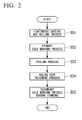
- FIG. 2 shows a flowchart of the method for manufacturing the copper alloy trolley wire 1 of the embodiment of the invention.
- a copper wire rod 50 made of the copper alloy is continuously produced according to a continuous casting and rolling method (continuous casting and rolling process S01).
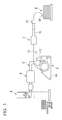
- a continuous casting and rolling process S01 for example, a continuous casting and rolling facility shown in FIG. 3 is used.
- the continuous casting and rolling facility shown in FIG. 3 includes a melting furnace A, a holding furnace B, a casting launder C, a belt-wheel type continuous casting machine D, a continuous rolling device E, and a coiler F.
- a shaft furnace which includes a cylindrical furnace body is used as the melting furnace A.
- a plurality of burners (not shown) are arranged in the circumferential direction in the lower part of the furnace body and are arranged in a multi-stage form in the vertical direction.
- electrolytic copper cathode which is a raw material is inserted from the upper part of the furnace body and is melted by the combustion of the burners, thereby continuously producing molten copper.
- the holding furnace B temporarily stores the molten copper produced in the melting furnace A while being held at a predetermined temperature and transfers a constant amount of the molten copper to the casting launder C.
- the casting launder C transfers the molten copper tranferred from the holding furnace B to a tundish 11 disposed above the belt-wheel type continuous casting machine D.
- the casting launder C is sealed by, for example, an inert gas such as Ar or a reducing gas.
- degassing means (not shown) for stirring the molten copper using the inert gas to remove oxygen and the like in the molten copper is provided.
- the tundish 11 is a storage tank provided to continuously supply the molten copper to the belt-wheel type continuous casting machine D.
- a pouring nozzle 12 is disposed so that the molten copper in the tundish 11 is supplied to the belt-wheel type continuous casting machine D via the pouring nozzle 12.
- alloy element adding means (not shown) is provided in the casting launder C and the tundish 11, the alloy element adding means being configured to add the above-mentioned elements (Co, P, and Sn) to the molten copper.
- the belt-wheel type continuous casting machine D includes a casting wheel 13 having a groove formed in the outer circumferential surface, and an endless belt 14, which revolves around the outer circumferential surface of the casting wheel 13 so as to come into contact with a part of the outer circumferential surface of the casting wheel 13.
- the molten copper is poured into a space formed between the groove and the endless belt 14 via the pouring nozzle 12, and the molten copper is cooled and solidified, thereby continuously casting a rod-like cast copper 21.
- the continuous rolling device E is connected to the downstream side of the belt-wheel type continuous casting machine D.
- the continuous rolling device E continuously rolls the cast copper 21 produced from the belt-wheel type continuous casting machine D, thereby producing a copper wire rod 50 having a predetermined outside diameter.
- the copper wire rod 50 produced from the continuous rolling device E passes through a washing and cooling device 15 and a flaw detector 16 and is wound around the coiler F.
- the outside diameter of the copper wire rod 50 produced by the continuous casting and rolling facility described above is, for example, 8 mm to 30 mm, and in this embodiment, is 27 mm.
- the cast copper 21 is held at a relatively high temperature of, for example, 800°C to 1000°C, and therefore, a large amount of the elements, such as Co and P, are solid-solved in the matrix of copper.
- the copper wire rod 50 produced in the continuous casting and rolling process S01 is subjected to the cold working (primary cold working process S02).
- the copper wire rod 50 is processed into a copper wire material having a predetermined cross-sectional shape by a die wire drawing method, a rolling method, swaging, or the like.
- an oil-based lubricant is used for the purpose of reducing working resistance, reducing wear of a die or a roll, cooling materials, and the like.
- the copper wire material is peeled (peeling process S03).
- peeling process 03 a surface layer of 0.1 to 0.5 mm, preferably, a surface layer of 0.1 to 0.2 mm is removed by using a peeling die.
- the copper wire material obtained in the peeling process S03 has a diameter of about 13 to 22 mm, and in this embodiment, is 18 mm.
- the copper wire material after the peeling process S03 is subjected to an aging heat treatment (aging heat treatment process S04).
- aging heat treatment process S04 precipitates made of a compound that contains Co and P as a main component are precipitated.
- the aging heat treatment is performed under the conditions of a temperature increase rate of 50 °C/h to 300 °C/h, a heat treatment temperature of 300°C to 600°C, and a holding time of 0.5 hours to 6 hours.
- the copper wire material after the aging heat treatment process S04 is subjected to cold working to produce a copper alloy trolley wire having a predetermined cross-sectional shape (secondary cold working process S05).
- a working ratio in the secondary cold working process S05 is set to be 20% to 65%.
- the copper wire material having a circular cross-section is subjected to groove forming to produce the copper alloy trolley wire 1 having the cross-sectional shape shown in FIG. 1 .
- the composition thereof contains: 0.12 mass% to 0.40 mass% of Co; 0.040 mass% to 0.16 mass% of P; 0.005 mass% to 0.70 mass% of Sn; and the balance including Cu and unavoidable impurities. Accordingly, precipitates made of compounds of Co and P are dispersed in the matrix of copper, and thus it is possible to achieve the enhancement of strength and electrical conductivity.
- the Co content is set to a range of 0.12 mass% to 0.40 mass% and the P content is set to a range of 0.040 mass% to 0.16 mass%, the number of precipitates is secured and thus strength can be sufficiently enhanced.
- the number of extra Co and P that does not contribute to the enhancement of strength is not large and thus electrical conductivity can be secured.
- the Sn content is equal to or higher than 0.005 mass%. Therefore, Sn is solid-solved in the matrix of copper and thereby strength can be enhanced, and the precipitation of a precipitate containing Co and P as main components can be accelerated and thereby enhancing heat resistance and corrosion resistance. On the other hand, since the Sn content is equal to or less than 0.70 mass%, the degradation of electrical conductivity can be suppressed.
- the composition contains any one or more types of 0.002 mass% to 0.5 mass% of Zn, 0.002 mass% to 0.25 mass% of Mg, 0.002 mass% to 0.25 mass% of Ag, and 0.001 mass% to 0.1 mass% of Zr.
- Zn 0.002 mass% to 0.5 mass% of Zn
- Mg 0.002 mass% to 0.25 mass%
- Ag 0.002 mass% to 0.25 mass%
- Zr 0.001 mass% to 0.1 mass%
- the precipitates have an average grain size of equal to or greater than 10 nm, and the number of precipitates having a grain size of equal to or greater than 5 nm is 90% or higher of the total number of observed precipitates. Therefore, it is possible to enhance strength, electrical conductivity, and heat resistance.
- the strength thereof is further enhanced by being subjected to the cold working after the aging heat treatment. Accordingly, the shape thereof can be sufficiently corrected by performing the cold working after the aging heat treatment, and thus it is possible to provide the copper alloy trolley wire 1 having excellent shape accuracy.
- a heat resistance HR defined by HR TS 1 /TS 0 ⁇ 100 in which TS 0 is the initial tensile strength and TS 1 is the tensile strength after holding the copper alloy trolley wire 1 at 400°C for 2 hours, is equal to or higher than 90%, even in a case where the temperature of the copper alloy trolley wire 1 is increased by frictional heat and the like, the tensile strength is sufficiently secured and thus the overhead wire tension of the copper alloy trolley wire 1 can be set to be high. Accordingly, it is possible to apply the copper alloy trolley wire 1 to high-speed railways and the like.
- the aging heat treatment process S04 and the secondary cold working process S05 performed after the aging heat treatment process S04 are provided, and working is performed at a working ratio of 20% to 65% in the secondary cold working process S05. Therefore, strength can be reliably enhanced and it is possible to secure electrical conductivity. That is, in a case where the working ratio is less than 20% in the secondary cold working process S05, there is concern that the enhancement of strength may be insufficient. In addition, in a case where the working ratio is higher than 65% in the secondary cold working process S05, there is concern that the electrical conductivity may be degraded due to the accumulation of dislocations and re-solid-solving of the precipitates.
- the size and the density of the precipitates dispersed in the matrix of copper can be adjusted.
- the average grain size thereof can be set to equal to or greater than 10 nm and the number of precipitates having a grain size of equal to or greater than 5 nm can be set to 90% or higher of the total number of observed precipitates. Accordingly, the enhancement of strength can be achieved.
- the copper wire rod 50 is produced in the continuous casting and rolling process S01, the copper wire rod 50 can be efficiently produced.
- the copper wire rod 50 is held for a predetermined time in a high temperature state of, for example, 800 to 1000°C, the elements Co, P, and the like are solid-solved in the matrix of copper. Accordingly, an additional solution heat treatment is not necessary.
- the copper alloy trolley wire having the cross-sectional shape shown in FIG. 1 is described in this embodiment.
- the present invention is not limited thereto, and a copper alloy trolley wire having another cross-sectional shape may also be applied.
- the trolley wire for railways has been described.
- the present invention is not limited thereto, and the copper alloy trolley wire may also be used for transport equipment such as a crane.
- the copper wire rod is manufactured by the continuous casting and rolling process in the description.
- the present invention is not limited thereto, and a columnar ingot (billet) may be produced and the ingot may be extruded and cold-worked to produce the copper wire rod.
- a columnar ingot (billet) may be produced and the ingot may be extruded and cold-worked to produce the copper wire rod.
- an additional solution heat treatment needs to be performed.
- a solution heat treatment may also be performed thereon.
- the continuous casting and rolling process is performed by using the belt-wheel type continuous casting machine shown in FIG. 3 in the description.
- the present invention is not limited thereto, and another continuous casting method may also be employed.
- a copper wire rod (a diameter of 27 mm) made of a copper alloy having a composition shown in Table 1 was produced.
- the copper wire rod was subjected to primary cold working to have a diameter of 20 nm, to peeling. and then to an aging heat treatment under the conditions shown in Table 1. Thereafter, secondary cold working was performed under the conditions shown in Table 1, thereby manufacturing a grooved trolley wire having a cross-sectional area of 110 mm 2 .
- precipitates were observed by using the manufactured grooved trolley wire.
- the observation of the precipitates was performed by using a transmission electron image of a transmission electron microscope (TEM, model name: H-800, HF-2000, and HF-2200 made by Hitachi, Ltd., and JEM-2010F made by JEOL Ltd.), and an equivalent grain size was calculated from the area of each precipitate.
- the observation was performed at magnifications of 150,000x and 750,000x on visual field areas of about 4 ⁇ 10 5 nm 2 and 2 ⁇ 10 4 nm 2 , respectively.
- the average grain size of the precipitates and the ratio of the number of the precipitates having a grain size of equal to or greater than 5 mm to the total number of the observed precipitates were calculated. The results are shown in Table 2.
- the tensile strength and the elongation were measured by using the AG-100kNX made by Shimadzu Corporation on the basis of JIS Z 2241 as described above.
- the electrical conductivity was measured on the basis of JIS H 0505 according to a double bridge method.
- the present invention relates to a copper alloy trolley wire having excellent strength, electrical conductivity, wear resistance, and heat resistance and having excellent shape accuracy, and a method for manufacturing the copper alloy trolley wire.
Landscapes
- Chemical & Material Sciences (AREA)
- Engineering & Computer Science (AREA)
- Materials Engineering (AREA)
- Mechanical Engineering (AREA)
- Metallurgy (AREA)
- Organic Chemistry (AREA)
- Physics & Mathematics (AREA)
- Thermal Sciences (AREA)
- Crystallography & Structural Chemistry (AREA)
- Conductive Materials (AREA)
- Non-Insulated Conductors (AREA)
Abstract
Description
- The present invention relates to a copper alloy trolley wire which comes in sliding contact with a current collector such as a pantograph provided on a train or the like to supply power to the train or the like, and a method for manufacturing the same.
- A trolley wire for railways used in a train or the like is configured to come in sliding contact with a current collector such as a pantograph to be supplied with power as described above and thus needs to secure a predetermined strength, wear resistance, electrical conductivity, heat resistance, and the like.
- Hitherto, as the trolley wire, for example, as disclosed in PTL 1, a trolley wire made of Sn-containing copper which contains 0.25 weight% to 0.35 weight% of Sn is provided. The Sn-containing copper is a solid solution strengthening type copper alloy which is strengthened by solid-solving Sn in the matrix of copper and has excellent wear resistance and the like.
- In recent years, an increase in the running speed of trains has been achieved. However, for high-speed railways such as Shinkansen [bullet trains], when the running speed of the train becomes faster than the propagation speed of waves generated in an overhead wire such as a trolley wire, contact between the current collector such as a pantograph and the trolley wire becomes unstable, and there is concern that stable power supply cannot be performed.
- Here, by increasing the overhead wire tension of the trolley wire, the propagation speed of waves in the trolley wire can be increased. Therefore, a trolley wire having a higher strength than that in the related art is required.
- Accordingly, for example, in
PTLs 2 to 4, a trolley wire made of a copper alloy containing Cr, Zr, and the like is suggested. The copper alloy containing Cr, Zr, and the like is a precipitation strengthening type copper alloy in which the strength thereof is enhanced by precipitating and dispersing a compound that contains Cr or Zr as main components in the matrix, and thus has further improved strength and electrical conductivity. -
- [PTL 1] Japanese Examined Patent Application, Second Publication No.
S59-043332 - [PTL 2] Japanese Unexamined Patent Application, First Publication No.
H03-056632 - [PTL 3] Japanese Unexamined Patent Application, First Publication No.
H05-311284 - [PTL 4] Japanese Unexamined Patent Application, First Publication No.
H07-266939 - However, regarding the precipitation strengthening type copper alloy containing Cr, Zr, and the like described in
PTLs 2 to 4, Cr and Zr are solid-solved in the matrix in a solution heat treatment process, the resultant is shaped into a predetermined shape in a cold working process, and thereafter a compound that contains Cr or Zr as main components is precipitated in an aging heat treatment process. Here, regarding the trolley wire made of the precipitation strengthening type copper alloy, the strength and electrical conductivity thereof are changed by a dispersion state of the precipitates, and thus the dispersion state of the precipitates is controlled by adjusting heat treatment conditions of the aging heat treatment process. - However, regarding the copper alloy containing Cr, Zr, and the like, when the cold working is performed after the aging heat treatment, performance such as electrical conductivity is significantly changed, and thus the aging heat treatment process has to be performed on the copper alloy having a shape that is similar to a final product. Therefore, there is a problem in that the shape after being subjected to the aging heat treatment cannot be sufficiently corrected. For example, in a case of a grooved trolley wire shown in
FIG. 1 , the aging heat treatment needs to be performed after forming grooves thereon. - In addition, due to an increase in the running speed of trains, a high frictional force is applied to the trolley wire, and thus the temperature of the trolley wire is increased by the frictional heat. Therefore, an improvement in heat resistance further than that according to the related art is required. That is, even in a high temperature state of 200°C, sufficient tensile strength and overhead wire tension needs to be secured.
- The present invention has been made taking the foregoing circumstances into consideration, and an object thereof is to provide a copper alloy trolley wire having excellent strength, electrical conductivity, wear resistance, and heat resistance and having excellent shape accuracy, and a method for manufacturing the copper alloy trolley wire.
- In order to solve the above-described problems, a copper alloy trolley wire according to the present invention includes: 0.12 mass% to 0.40 mass% of Co; 0.040 mass% to 0.16 mass% of P; 0.005 mass% to 0.70 mass% of Sn; and the balance including Cu and unavoidable impurities, wherein precipitates have an average grain size of equal to or greater than 10 nm, and the number of precipitates having a grain size of equal to or greater than 5 nm is 90% or higher of the total number of observed precipitates, and a heat resistance HR defined by HR=TS1/TS0×100 in which TS0 is an initial tensile strength and TS1 is a tensile strength after holding the copper alloy trolley wire at 400°C for 2 hours, is equal to or higher than 90%.
- Since the copper alloy trolley wire according to the present invention described above has a composition containing: 0.12 mass% to 0.40 mass% of Co; 0.040 mass% to 0.16 mass% of P; 0.005 mass% to 0.70 mass% of Sn; and the balance including Cu and unavoidable impurities, precipitates made of compounds with Co and P are dispersed in the matrix of copper. Accordingly, it is possible to achieve the enhancement of strength and electrical conductivity.
- In addition, when the Co content and the P content are lower than the lower limit, the number of precipitates is insufficient, and thus strength cannot be sufficiently enhanced. On the contrary, when the Co content and the P content are higher than the upper limit, a large number of elements that do not contribute to the enhancement of strength are present, and there is concern that a reduction in electrical conductivity and the like may be caused. Therefore, the Co content and the P content are set to the above ranges.
- In addition, Sn is an element having an action of solid-solving in the matrix of copper to enhance strength. In addition, Sn also has an effect of accelerating the precipitation of precipitates containing Co and P as main components or can enhance heat resistance and corrosion resistance. In order to reliably achieve the effect, the Sn content needs to be equal to or higher than 0.005 mass%. In addition, in a case where Sn is excessively added, a reduction in electrical conductivity is caused. Therefore, the Sn content needs to be equal to or less than 0.70 mass%.
- In addition, it is preferable that the precipitation strengthening type copper alloy further include 0.01 mass% to 0.15 mass% ofNi.
- The copper alloy wire having the above composition contains Ni in the above range and thus can suppress the coarsening of grains, thereby further enhancing strength.
- In addition, in the copper alloy trolley wire according to the present invention, since the precipitates have an average grain size of equal to or greater than 10 nm and the number of precipitates having a grain size of equal to or greater than 5 nm is 90% or higher of the total number of observed precipitates, it is possible to enhance strength, electrical conductivity, and heat resistance. Here, in a case where the grain size of the precipitate is less than 10 nm, the precipitate containing Co and P as main components is re-solid-solved in the matrix in the subsequent cold working, resulting in a reduction in electrical conductivity.
- As described above, in the copper alloy trolley wire of the present invention, the strength thereof is further enhanced by performing the cold working after the aging heat treatment. Accordingly, the shape thereof can be sufficiently corrected by performing the cold working after the aging heat treatment, and thus it is possible to provide the copper alloy trolley wire having excellent shape accuracy.
- Furthermore, in the copper alloy trolley wire of the present invention, since the heat resistance HR defined by HR=TS1/TS0×100 in which TS0 is the initial tensile strength and TS1 is the tensile strength after holding the copper alloy trolley wire at 400°C for 2 hours, is equal to or higher than 90%, even in a case where the temperature of the copper alloy trolley wire is increased by frictional heat and the like, the tensile strength is sufficiently secured and thus the overhead wire tension of the copper alloy trolley wire can be set to be high. Accordingly, it is possible to apply the copper alloy trolley wire to high-speed railways and the like.
- A method for manufacturing a copper alloy trolley wire of the present invention is a method for manufacturing the above-described copper alloy trolley wire and includes: an aging heat treatment process; and a cold working process performed after the aging heat treatment process, wherein a working ratio in the cold working process is set to 20% to 65%.
- According to the method for manufacturing the copper alloy trolley wire having the above composition, after the precipitates containing Co and P as main components are precipitated in the aging heat treatment process, working is performed at a working ratio of 20% to 65% in the cold working process. Therefore, a dislocation loop is formed in parts of the precipitates, and thus it is possible to reliably enhance strength.
- In addition, since the cold working is performed at a working ratio of equal to or higher than 20% after the aging heat treatment process, it is possible to enhance the shape accuracy of the trolley wire.
- Here, in a case where the working ratio is less than 20% in the cold working process, there is concern that the enhancement of strength may be insufficient. In addition, in a case where the working ratio is higher than 65% in the cold working process, there is concern that the electrical conductivity may be degraded due to the accumulation of dislocations and re-solid-solving of the precipitates. Therefore, from the viewpoint of securing strength and electrical conductivity, the working ratio in the cold working process is set to be in a range of 20% to 65%.
- According to the present invention, it is possible to provide a copper alloy trolley wire having excellent strength, electrical conductivity, and heat resistance and having excellent shape accuracy, and a method for manufacturing the copper alloy trolley wire.
-
-
FIG. 1 is a cross-sectional explanatory view of a copper alloy trolley wire of an embodiment of the present invention. -
FIG. 2 is a flowchart of a method for manufacturing the copper alloy trolley wire of the embodiment of the present invention. -
FIG. 3 is a schematic explanatory view of a continuous casting and rolling facility used in the method for manufacturing the copper alloy trolley wire of the embodiment of the present invention. - Hereinafter, a copper alloy trolley wire according to an embodiment of the present invention and a method for manufacturing the copper alloy trolley wire will be described with reference to the accompanying drawings.
-
FIG. 1 shows an example of a copper alloy trolley wire 1 of the embodiment of the present invention. - The copper alloy trolley wire 1 of this embodiment is a grooved trolley wire in which
grooves 2 to which clasps are attached are formed as shown inFIG. 1 . The copper alloy trolley wire 1 includes afirst arc portion 3 provided on one side of the grooves 2 (lower side inFIG. 1 ) and asecond arc portion 4 provided on the other side of the grooves 2 (upper side inFIG. 1 ) and is configured so that thefirst arc portion 3 comes in sliding contact with a pantograph. - Here, trolley wires for railways are standardized according to cross-sectional areas, and the copper alloy trolley wire 1 of this embodiment has a cross-sectional area of 110 mm2.
- The copper alloy trolley wire 1 is made of a copper alloy having a composition containing: 0.12 mass% to 0.40 mass% of Co; 0.040 mass% to 0.16 mass% of P; 0.005 mass% to 0.70 mass% of Sn; and the balance including Cu and unavoidable impurities.
- In addition, it is preferable that the precipitation strengthening type copper alloy further include 0.01 mass% to 0.15 mass% of Ni.
- In addition, the copper alloy may further contain at least any one type of 0.002 mass% to 0.5 mass% of Zn, 0.002 mass% to 0.25 mass% of Mg, 0.002 mass% to 0.25 mass% of Ag, and 0.001 mass% to 0.1 mass% of Zr.
- The copper alloy having the above composition contains at least any one type or two or more types of Zn, Mg, Ag, and Zr in the above ranges. Accordingly, such elements form compounds with sulfur (S) to suppress the sulfur (S) from being solid-solved in the matrix of copper, thereby suppressing the deterioration of mechanical properties such as strength.
- Hereinafter, the reason that the amount of each of the elements is set to the above range will be described.
- Co and P are elements that form precipitates which are dispersed in the matrix of copper.
- Here, in a case where the Co content is less than 0.12 mass% and the P content is less than 0.040 mass%, the number of precipitates is insufficient and there is concern that the strength may not be sufficiently enhanced. On the contrary, in a case where the Co content is higher than 0.40 mass% and the P content is higher than 0.16 mass%, a large number of elements that do not contribute to the enhancement of strength are present, and there is concern that a reduction in electrical conductivity and the like may be caused.
- Therefore, the Co content is set to 0.12 mass% to 0.40 mass% and the P content is set to 0.040 mass% to 0.16 mass%.
- Sn is an element having an action of solid-solving in the matrix of copper to enhance strength. In addition, Sn also has an effect of accelerating the precipitation of precipitates containing Co and P as main components and also has an action of enhancing heat resistance and corrosion resistance.
- Here, in a case where a Sn content is less than 0.005 mass%, there is concern that the above-described effect may not be reliably achieved. On the contrary, in a case where the Sn content is higher than 0.70 mass%, there is concern that the electrical conductivity may not be secured.
- Therefore, the Sn content is set to a range of 0.005 mass% to 0.07 mass%.
- Ni is an element having an effect of being replaced with a portion of Co and suppressing the coarsening of grains.
- Here, in a case where a Ni content is less than 0.01 mass%, there is concern that the above-described effect may not be reliably achieved. On the contrary, in a case where the Ni content is higher than 0.15 mass%, there is concern that the electrical conductivity may not be secured.
- Therefore, in a case where Ni is contained, it is preferable that the Ni content be 0.01 mass% to 0.15 mass%.
- Elements Zn, Mg, Ag, and Zr are elements having an effect of forming compounds with sulfur (S) to suppress the sulfur (S) from being solid-solved in the matrix of copper.
- Here, in a case where the contents of the elements Zn, Mg, Ag, and Zr are less than the above-described lower limits, the effect of suppressing the sulfur (S) from being solid-solved in the matrix of copper cannot be sufficiently achieved. On the contrary, in a case where the amounts of the elements Zn, Mg, Ag, and Zr are higher than the above-described upper limits, there is concern that the electrical conductivity may not be secured.
- Therefore, in a case where the elements Zn, Mg, Ag, and Zr are contained in the copper alloy, it is preferable that the elements be in the above-described ranges.
- In addition, in the copper alloy trolley wire 1 of this embodiment, precipitates have an average grain size of equal to or greater than 10 nm, and the number of precipitates having a grain size of equal to or greater than 5 nm is 90% or higher of the total number of observed precipitates.
- Here, the precipitates were observed as follows. The precipitates were observed by a transmission electron microscope at magnifications of 150,000x and 750,000x, the area of the corresponding precipitates was calculated, and a diameter equivalent to a circle thereof is calculated as a grain size. In addition, the precipitates having grain sizes of 11 nm to 100 nm were measured at a magnification of 150,000x, and the precipitates having grain sizes of 1 nm to 10 nm were measured at a magnification of 750,000x. In the observation at the magnification of 750,000x, the precipitates having a grain size of less than 1 nm cannot be clearly determined, and thus the total number of observed precipitates is the number of precipitates having a grain size of equal to or greater than 1 nm. In addition, the observation by the transmission electron microscope was performed on a visual field area of about 4x 10⁵ nm2 in the case of the magnification of 150,000x and was performed on a visual field area of about 2×10⁴ nm2 in the case of the magnification of 750,000x.
- In addition, in the copper alloy trolley wire 1 of this embodiment, a heat resistance HR defined by HR=TS1/TS0×100 in which TS0 is the initial tensile strength and TS1 is the tensile strength after holding the copper alloy trolley wire 1 at 400°C for 2 hours is equal to or higher than 90%.
- In addition, in this embodiment, the measurement of the tensile strength of the copper alloy trolley wire 1 was performed based on JIS Z 2241. In addition, the tensile strength TS1 after a heat treatment was measured at normal temperature after holding the copper alloy trolley wire 1 at 400°C for 2 hours.
- Next, a method for manufacturing the above-described copper alloy trolley wire 1 will be described.
FIG. 2 shows a flowchart of the method for manufacturing the copper alloy trolley wire 1 of the embodiment of the invention. - First, a
copper wire rod 50 made of the copper alloy is continuously produced according to a continuous casting and rolling method (continuous casting and rolling process S01). In the continuous casting and rolling process S01, for example, a continuous casting and rolling facility shown inFIG. 3 is used. - The continuous casting and rolling facility shown in
FIG. 3 includes a melting furnace A, a holding furnace B, a casting launder C, a belt-wheel type continuous casting machine D, a continuous rolling device E, and a coiler F. - In this embodiment, as the melting furnace A, a shaft furnace which includes a cylindrical furnace body is used. A plurality of burners (not shown) are arranged in the circumferential direction in the lower part of the furnace body and are arranged in a multi-stage form in the vertical direction. In addition, electrolytic copper cathode which is a raw material is inserted from the upper part of the furnace body and is melted by the combustion of the burners, thereby continuously producing molten copper.
- The holding furnace B temporarily stores the molten copper produced in the melting furnace A while being held at a predetermined temperature and transfers a constant amount of the molten copper to the casting launder C.
- The casting launder C transfers the molten copper tranferred from the holding furnace B to a
tundish 11 disposed above the belt-wheel type continuous casting machine D. The casting launder C is sealed by, for example, an inert gas such as Ar or a reducing gas. In addition, in the casting launder C, degassing means (not shown) for stirring the molten copper using the inert gas to remove oxygen and the like in the molten copper is provided. - The
tundish 11 is a storage tank provided to continuously supply the molten copper to the belt-wheel type continuous casting machine D. On the end side of thetundish 11 in the flowing direction of the molten copper, a pouringnozzle 12 is disposed so that the molten copper in thetundish 11 is supplied to the belt-wheel type continuous casting machine D via the pouringnozzle 12. - Here, in this embodiment, alloy element adding means (not shown) is provided in the casting launder C and the
tundish 11, the alloy element adding means being configured to add the above-mentioned elements (Co, P, and Sn) to the molten copper. - The belt-wheel type continuous casting machine D includes a
casting wheel 13 having a groove formed in the outer circumferential surface, and anendless belt 14, which revolves around the outer circumferential surface of thecasting wheel 13 so as to come into contact with a part of the outer circumferential surface of thecasting wheel 13. In the belt-wheel type continuous casting machine D, the molten copper is poured into a space formed between the groove and theendless belt 14 via the pouringnozzle 12, and the molten copper is cooled and solidified, thereby continuously casting a rod-like cast copper 21. - The continuous rolling device E is connected to the downstream side of the belt-wheel type continuous casting machine D. The continuous rolling device E continuously rolls the
cast copper 21 produced from the belt-wheel type continuous casting machine D, thereby producing acopper wire rod 50 having a predetermined outside diameter. - The
copper wire rod 50 produced from the continuous rolling device E passes through a washing andcooling device 15 and aflaw detector 16 and is wound around the coiler F. - Here, the outside diameter of the
copper wire rod 50 produced by the continuous casting and rolling facility described above is, for example, 8 mm to 30 mm, and in this embodiment, is 27 mm. - In addition, in the continuous casting and rolling process S01, the
cast copper 21 is held at a relatively high temperature of, for example, 800°C to 1000°C, and therefore, a large amount of the elements, such as Co and P, are solid-solved in the matrix of copper. - Next, as shown in
FIG. 2 , thecopper wire rod 50 produced in the continuous casting and rolling process S01 is subjected to the cold working (primary cold working process S02). In the primary cold working process S02, thecopper wire rod 50 is processed into a copper wire material having a predetermined cross-sectional shape by a die wire drawing method, a rolling method, swaging, or the like. At this time, for the purpose of reducing working resistance, reducing wear of a die or a roll, cooling materials, and the like, an oil-based lubricant is used. - Next, the copper wire material is peeled (peeling process S03). In the peeling process 03, a surface layer of 0.1 to 0.5 mm, preferably, a surface layer of 0.1 to 0.2 mm is removed by using a peeling die. The copper wire material obtained in the peeling process S03 has a diameter of about 13 to 22 mm, and in this embodiment, is 18 mm.
- Next, the copper wire material after the peeling process S03 is subjected to an aging heat treatment (aging heat treatment process S04). In the aging heat treatment process S04, precipitates made of a compound that contains Co and P as a main component are precipitated.
- Here, in the aging heat treatment process S04, the aging heat treatment is performed under the conditions of a temperature increase rate of 50 °C/h to 300 °C/h, a heat treatment temperature of 300°C to 600°C, and a holding time of 0.5 hours to 6 hours.
- Next, the copper wire material after the aging heat treatment process S04 is subjected to cold working to produce a copper alloy trolley wire having a predetermined cross-sectional shape (secondary cold working process S05).
- Here, a working ratio in the secondary cold working process S05 is set to be 20% to 65%.
- In the secondary cold working process S05, the copper wire material having a circular cross-section is subjected to groove forming to produce the copper alloy trolley wire 1 having the cross-sectional shape shown in
FIG. 1 . - According to the copper alloy trolley wire 1 of the embodiment configured as described above and the method for manufacturing the copper alloy trolley wire 1, the composition thereof contains: 0.12 mass% to 0.40 mass% of Co; 0.040 mass% to 0.16 mass% of P; 0.005 mass% to 0.70 mass% of Sn; and the balance including Cu and unavoidable impurities. Accordingly, precipitates made of compounds of Co and P are dispersed in the matrix of copper, and thus it is possible to achieve the enhancement of strength and electrical conductivity.
- Here, in this embodiment, since the Co content is set to a range of 0.12 mass% to 0.40 mass% and the P content is set to a range of 0.040 mass% to 0.16 mass%, the number of precipitates is secured and thus strength can be sufficiently enhanced. In addition, the number of extra Co and P that does not contribute to the enhancement of strength is not large and thus electrical conductivity can be secured.
- In addition, the Sn content is equal to or higher than 0.005 mass%. Therefore, Sn is solid-solved in the matrix of copper and thereby strength can be enhanced, and the precipitation of a precipitate containing Co and P as main components can be accelerated and thereby enhancing heat resistance and corrosion resistance. On the other hand, since the Sn content is equal to or less than 0.70 mass%, the degradation of electrical conductivity can be suppressed.
- In addition, in this embodiment, as necessary, the composition contains any one or more types of 0.002 mass% to 0.5 mass% of Zn, 0.002 mass% to 0.25 mass% of Mg, 0.002 mass% to 0.25 mass% of Ag, and 0.001 mass% to 0.1 mass% of Zr. When such elements are added, S is prevented from being solid-solved in the matrix of copper, and thus the degradation of performance due to the S can be prevented. Furthermore, with such elements, a further enhancement of strength can be achieved.
- In the copper alloy trolley wire 1 of this embodiment, the precipitates have an average grain size of equal to or greater than 10 nm, and the number of precipitates having a grain size of equal to or greater than 5 nm is 90% or higher of the total number of observed precipitates. Therefore, it is possible to enhance strength, electrical conductivity, and heat resistance.
- In addition, in the copper alloy trolley wire 1 of this embodiment, the strength thereof is further enhanced by being subjected to the cold working after the aging heat treatment. Accordingly, the shape thereof can be sufficiently corrected by performing the cold working after the aging heat treatment, and thus it is possible to provide the copper alloy trolley wire 1 having excellent shape accuracy.
- Furthermore, in the copper alloy trolley wire 1 of this embodiment, since a heat resistance HR defined by HR=TS1/TS0×100 in which TS0 is the initial tensile strength and TS1 is the tensile strength after holding the copper alloy trolley wire 1 at 400°C for 2 hours, is equal to or higher than 90%, even in a case where the temperature of the copper alloy trolley wire 1 is increased by frictional heat and the like, the tensile strength is sufficiently secured and thus the overhead wire tension of the copper alloy trolley wire 1 can be set to be high. Accordingly, it is possible to apply the copper alloy trolley wire 1 to high-speed railways and the like.
- In addition, in the method for manufacturing the copper alloy trolley wire 1 of this embodiment, the aging heat treatment process S04 and the secondary cold working process S05 performed after the aging heat treatment process S04 are provided, and working is performed at a working ratio of 20% to 65% in the secondary cold working process S05. Therefore, strength can be reliably enhanced and it is possible to secure electrical conductivity. That is, in a case where the working ratio is less than 20% in the secondary cold working process S05, there is concern that the enhancement of strength may be insufficient. In addition, in a case where the working ratio is higher than 65% in the secondary cold working process S05, there is concern that the electrical conductivity may be degraded due to the accumulation of dislocations and re-solid-solving of the precipitates.
- Furthermore, in this embodiment, since the aging treatment process S04 of performing a heat treatment at 300°C to 600°C for 0.5 hours to 6 hours to precipitate precipitates is provided before the secondary cold working process S05, the size and the density of the precipitates dispersed in the matrix of copper can be adjusted. For example, the average grain size thereof can be set to equal to or greater than 10 nm and the number of precipitates having a grain size of equal to or greater than 5 nm can be set to 90% or higher of the total number of observed precipitates. Accordingly, the enhancement of strength can be achieved.
- In addition, in the method for manufacturing the copper alloy trolley wire 1 of this embodiment, since the
copper wire rod 50 is produced in the continuous casting and rolling process S01, thecopper wire rod 50 can be efficiently produced. In addition, since thecopper wire rod 50 is held for a predetermined time in a high temperature state of, for example, 800 to 1000°C, the elements Co, P, and the like are solid-solved in the matrix of copper. Accordingly, an additional solution heat treatment is not necessary. - While the embodiment of the present invention has been described, the present invention is not limited thereto, and modifications can be appropriately made without departing from the technical spirit of the present invention.
- For example, the copper alloy trolley wire having the cross-sectional shape shown in
FIG. 1 is described in this embodiment. However, the present invention is not limited thereto, and a copper alloy trolley wire having another cross-sectional shape may also be applied. In addition, the trolley wire for railways has been described. However, the present invention is not limited thereto, and the copper alloy trolley wire may also be used for transport equipment such as a crane. - In addition, in this embodiment, the copper wire rod is manufactured by the continuous casting and rolling process in the description. However, the present invention is not limited thereto, and a columnar ingot (billet) may be produced and the ingot may be extruded and cold-worked to produce the copper wire rod. In a case where the copper wire rod is produced by the extrusion method, an additional solution heat treatment needs to be performed. Furthermore, even in a case where the copper wire rod is manufactured by the continuous casting and rolling process, a solution heat treatment may also be performed thereon.
- In addition, in this embodiment, the continuous casting and rolling process is performed by using the belt-wheel type continuous casting machine shown in
FIG. 3 in the description. However, the present invention is not limited thereto, and another continuous casting method may also be employed. - Hereinafter, the results of a confirmation test performed to check the effectiveness of the present invention will be described.
- By using a continuous casting and rolling facility provided with a belt-wheel type continuous casting machine, a copper wire rod (a diameter of 27 mm) made of a copper alloy having a composition shown in Table 1 was produced. The copper wire rod was subjected to primary cold working to have a diameter of 20 nm, to peeling. and then to an aging heat treatment under the conditions shown in Table 1. Thereafter, secondary cold working was performed under the conditions shown in Table 1, thereby manufacturing a grooved trolley wire having a cross-sectional area of 110 mm2.
- In addition, precipitates were observed by using the manufactured grooved trolley wire. The observation of the precipitates was performed by using a transmission electron image of a transmission electron microscope (TEM, model name: H-800, HF-2000, and HF-2200 made by Hitachi, Ltd., and JEM-2010F made by JEOL Ltd.), and an equivalent grain size was calculated from the area of each precipitate. In addition, the observation was performed at magnifications of 150,000x and 750,000x on visual field areas of about 4×10⁵ nm2 and 2×10⁴ nm2, respectively. In addition, the average grain size of the precipitates and the ratio of the number of the precipitates having a grain size of equal to or greater than 5 mm to the total number of the observed precipitates were calculated. The results are shown in Table 2.
- In addition, by using the manufactured grooved trolley wires, heat resistance HR, tensile strength, elongation, and electrical conductivity were evaluated.
- The heat resistance HR is defined by HR=TS1/TS0×100 in which TS0 is the initial tensile strength and TS1 is the tensile strength after holding the trolley wire at 400°C for 2 hours, and was calculated by measuring the initial tensile strength TS0 and the tensile strength TS1 after holding the trolley wire at 400°C for 2 hours by using AG-100kNX made by Shimadzu Corporation on the basis of JIS Z 2241.
- The tensile strength and the elongation were measured by using the AG-100kNX made by Shimadzu Corporation on the basis of JIS Z 2241 as described above.
- The electrical conductivity was measured on the basis of JIS H 0505 according to a double bridge method.
- In addition, for tough pitch copper as Related Art Example 1 and Cu-0.3wt%Sn as Related Art Example 2, heat resistance, tensile strength, elongation, and electrical conductivity were measured.
- The evaluation results are shown in Table 2.
[Table 1] Composition (wt%) Aging heat treatment process Secondary cold working process Co P Sn Others Temperature (°C) Time (h) Working ratio (%) Invention Example 1 0.25 0.08 0.10 - 520 1 50 Invention Example 2 0.40 0.16 0.16 - 520 1 50 Invention Example 3 0.12 0.04 0.08 - 520 1 50 Invention Example 4 0.30 0.11 0.70 - 520 1 50 Invention Example 5 0.22 0.07 0.005 - 520 1 50 Invention Example 6 0.25 0.09 0.09 - 520 1 65 Invention Example 7 0.27 0.08 0.11 - 520 1 20 Invention Example 8 0.26 0.09 0.08 - 500 1 50 Invention Example 9 0.24 0.08 0.09 - 540 4 50 Comparative Example 1 0.42 0.20 0.08 - 520 1 50 Comparative Example 2 0.10 0.02 0.12 - 520 1 50 Comparative Example 3 0.26 0.08 0.75 - 520 1 50 Comparative Example 4 0.27 0.09 0.003 - 520 1 50 Comparative Example 5 0.25 0.08 0.08 - 480 1 50 Related Art Example 1 Tough pitch copper Related Art Example 2 Cu-0.3Sn [Table 2] Observation results of precipitates Heat resistance Tensile strength Elongation Electrical conductivity Average grain size (nm) Ratio of 5 nm or greater (%) (%) (MPa) (%) (%IACS) Invention Example 1 13 93 92 520 5 80 Invention Example 2 14 92 93 580 4 76 Invention Example 3 11 91 91 460 5 82 Invention Example 4 11 91 93 590 4 76 Invention Example 5 14 90 91 450 5 84 Invention Example 6 12 90 92 540 4 76 Invention Example 7 13 94 91 470 5 82 Invention Example 8 11 91 91 500 5 78 Invention Example 9 17 95 91 480 5 82 Comparative Example 1 15 89 91 600 3 74 Comparative Example 2 9 89 89 420 5 82 Comparative Example 3 11 89 90 600 3 73 Comparative Example 4 8 92 89 400 4 83 Comparative Example 5 9 87 88 520 5 73 Related Art Example 1 - - 70 350 5 97 Related Art Example 2 - - 60 440 4 78 - In Comparative Example 1 in which the Co content and P content were higher than the upper limit of the present invention, it was confirmed that the electrical conductivity was low.
- In Comparative Example 2 in which the Co content and P content were lower than the lower limit of the present invention, the tensile strength was insufficient.
- In Comparative Example 3 in which the Sn content was higher than the upper limit of the present invention, it was confirmed that the electrical conductivity was low.
- In Comparative Example 4 in which the Sn content was lower than the lower limit of the present invention, the tensile strength was insufficient.
- In Comparative Example 5 in which the average grain size of the precipitates and the ratio of the number of the precipitates having a grain size of equal to or greater than 5 mm to the total number of the observed precipitates were not in the range of the present invention, the electrical conductivity was low.
- In addition, in Related Art Examples 1 and 2, the tensile strength was insufficient and the heat resistance was also insufficient.
- Contrary to this, in Invention Examples 1 to 9, it was confirmed that strength, electrical conductivity, and heat resistance were excellent.
- From the above results of the confirmation test, according to the present invention, it was confirmed that it is possible to stably provide a copper alloy trolley wire having excellent strength, electrical conductivity, and heat resistance.
- The present invention relates to a copper alloy trolley wire having excellent strength, electrical conductivity, wear resistance, and heat resistance and having excellent shape accuracy, and a method for manufacturing the copper alloy trolley wire.
-
- 1
- COPPER ALLOY TROLLEY WIRE
- 2
- GROOVE
- 3
- FIRST ARC PORTION
- 4
- SECOND ARC PORTION
Claims (2)
- A copper alloy trolley wire comprising:0.12 mass% to 0.40 mass% of Co;0.040 mass% to 0.16 mass% of P;0.005 mass% to 0.70 mass% of Sn; andthe balance including Cu and unavoidable impurities,wherein precipitates have an average grain size of equal to or greater than 10 nm, and the number of precipitates having a grain size of equal to or greater than 5 nm is 90% or greater of the total number of observed precipitates, anda heat resistance HR defined by HR=TS1/TS0×100 in which TS0 is an initial tensile strength and TS1 is a tensile strength after holding the copper alloy trolley wire at 400°C for 2 hours, is equal to or greater than 90%.
- A method for manufacturing the copper alloy trolley wire according to claim 1, comprising:an aging heat treatment process; anda cold working process performed after the aging heat treatment process,wherein a working ratio in the cold working process is set to 20% to 65%.
Applications Claiming Priority (1)
| Application Number | Priority Date | Filing Date | Title |
|---|---|---|---|
| PCT/JP2012/069493 WO2014020707A1 (en) | 2012-07-31 | 2012-07-31 | Copper alloy trolley wire and method for manufacturing copper alloy trolley wire |
Publications (2)
| Publication Number | Publication Date |
|---|---|
| EP2883970A1 true EP2883970A1 (en) | 2015-06-17 |
| EP2883970A4 EP2883970A4 (en) | 2016-06-29 |
Family
ID=50027437
Family Applications (1)
| Application Number | Title | Priority Date | Filing Date |
|---|---|---|---|
| EP12882251.7A Withdrawn EP2883970A4 (en) | 2012-07-31 | 2012-07-31 | Copper alloy trolley wire and method for manufacturing copper alloy trolley wire |
Country Status (6)
| Country | Link |
|---|---|
| US (1) | US20150144235A1 (en) |
| EP (1) | EP2883970A4 (en) |
| KR (1) | KR20150035779A (en) |
| CN (1) | CN104379783A (en) |
| IN (1) | IN2015DN00537A (en) |
| WO (1) | WO2014020707A1 (en) |
Families Citing this family (4)
| Publication number | Priority date | Publication date | Assignee | Title |
|---|---|---|---|---|
| CN104379782A (en) * | 2012-07-31 | 2015-02-25 | 三菱综合材料株式会社 | Copper alloy wire and copper alloy wire manufacturing method |
| JP6202131B1 (en) * | 2016-04-12 | 2017-09-27 | 三菱マテリアル株式会社 | Copper alloy backing tube and method for producing copper alloy backing tube |
| JP6965511B2 (en) * | 2016-11-24 | 2021-11-10 | 三菱マテリアル株式会社 | Manufacturing method of copper alloy wire |
| CN117831837B (en) * | 2024-03-01 | 2024-05-24 | 云南百冠电线电缆有限公司 | Anti-creeping separable double-layer insulated wire with tin-plated copper conductor and processing technology |
Family Cites Families (11)
| Publication number | Priority date | Publication date | Assignee | Title |
|---|---|---|---|---|
| JPS5943332B2 (en) | 1981-02-25 | 1984-10-22 | 日本国有鉄道 | trolley wire |
| JP2677874B2 (en) | 1989-07-25 | 1997-11-17 | 古河電気工業株式会社 | Copper alloy for trolley wire |
| JP2593107B2 (en) * | 1990-11-15 | 1997-03-26 | 同和鉱業株式会社 | Manufacturing method of high strength and high conductivity copper base alloy |
| JP2531325B2 (en) | 1992-05-08 | 1996-09-04 | 財団法人鉄道総合技術研究所 | Copper alloy trolley wire |
| JPH07266939A (en) | 1994-03-31 | 1995-10-17 | Mitsubishi Cable Ind Ltd | Manufacture of trolley wire |
| ATE414182T1 (en) * | 2003-03-03 | 2008-11-15 | Mitsubishi Shindo Kk | HEAT RESISTANT COPPER ALLOY MATERIALS |
| BRPI0907018B1 (en) * | 2008-02-26 | 2017-12-19 | Mitsubishi Shindoh Co., Ltd. | COPPER ROD OR WIRE AND METHOD FOR PRODUCING ROD OR WIRE |
| EP2258882B1 (en) * | 2008-03-28 | 2016-05-25 | Mitsubishi Shindoh Co., Ltd. | High-strength and high-electroconductivity copper alloy pipe, bar, and wire rod |
| JP5380117B2 (en) * | 2009-03-11 | 2014-01-08 | 三菱伸銅株式会社 | Wire conductor manufacturing method, wire conductor, insulated wire, and wire harness |
| MX2014015451A (en) * | 2012-07-31 | 2015-07-14 | Mitsubishi Materials Corp | Copper alloy wire and copper alloy wire manufacturing method. |
| CN104379782A (en) * | 2012-07-31 | 2015-02-25 | 三菱综合材料株式会社 | Copper alloy wire and copper alloy wire manufacturing method |
-
2012
- 2012-07-31 CN CN201280074155.9A patent/CN104379783A/en active Pending
- 2012-07-31 KR KR20147036659A patent/KR20150035779A/en not_active Ceased
- 2012-07-31 WO PCT/JP2012/069493 patent/WO2014020707A1/en not_active Ceased
- 2012-07-31 EP EP12882251.7A patent/EP2883970A4/en not_active Withdrawn
- 2012-07-31 US US14/415,951 patent/US20150144235A1/en not_active Abandoned
- 2012-07-31 IN IN537DEN2015 patent/IN2015DN00537A/en unknown
Also Published As
| Publication number | Publication date |
|---|---|
| KR20150035779A (en) | 2015-04-07 |
| IN2015DN00537A (en) | 2015-06-26 |
| WO2014020707A1 (en) | 2014-02-06 |
| US20150144235A1 (en) | 2015-05-28 |
| EP2883970A4 (en) | 2016-06-29 |
| CN104379783A (en) | 2015-02-25 |
Similar Documents
| Publication | Publication Date | Title |
|---|---|---|
| EP3006582B1 (en) | Copper alloy wire | |
| EP2479297B1 (en) | Copper alloy wire and process for producing same | |
| JP6027807B2 (en) | Copper alloy trolley wire and method for producing copper alloy trolley wire | |
| EP2479298B1 (en) | Copper alloy foil, flexible printed wiring board obtained using same, and process for producing copper alloy foil | |
| JP6946765B2 (en) | Copper alloys, copper alloy ingots and copper alloy solution materials | |
| EP2881476A1 (en) | Copper alloy wire and copper alloy wire manufacturing method | |
| US20150144235A1 (en) | Copper alloy trolley wire and method for manufacturing copper alloy trolley wire | |
| KR101939555B1 (en) | Copper alloy wire and copper alloy wire manufacturing method | |
| JP6131542B2 (en) | Copper alloy wire, copper alloy wire manufacturing method, stranded wire | |
| JP6131543B2 (en) | Copper alloy wire, copper alloy wire manufacturing method, stranded wire | |
| JP6965511B2 (en) | Manufacturing method of copper alloy wire | |
| JP7022320B2 (en) | Copper alloy wire | |
| JP2010095777A (en) | Copper alloy conductor, trolley wire and cable using the same and method for manufacturing the copper alloy conductor | |
| AU2017282513B2 (en) | Copper alloy, copper alloy ingot, copper alloy solution forming material, copper alloy trolley wire and method for producing copper alloy trolley wire |
Legal Events
| Date | Code | Title | Description |
|---|---|---|---|
| PUAI | Public reference made under article 153(3) epc to a published international application that has entered the european phase |
Free format text: ORIGINAL CODE: 0009012 |
|
| 17P | Request for examination filed |
Effective date: 20150126 |
|
| AK | Designated contracting states |
Kind code of ref document: A1 Designated state(s): AL AT BE BG CH CY CZ DE DK EE ES FI FR GB GR HR HU IE IS IT LI LT LU LV MC MK MT NL NO PL PT RO RS SE SI SK SM TR |
|
| AX | Request for extension of the european patent |
Extension state: BA ME |
|
| DAX | Request for extension of the european patent (deleted) | ||
| RA4 | Supplementary search report drawn up and despatched (corrected) |
Effective date: 20160601 |
|
| RIC1 | Information provided on ipc code assigned before grant |
Ipc: C22C 9/02 20060101AFI20160525BHEP Ipc: H01B 1/02 20060101ALI20160525BHEP Ipc: C22F 1/08 20060101ALI20160525BHEP Ipc: C22C 9/06 20060101ALI20160525BHEP |
|
| 17Q | First examination report despatched |
Effective date: 20170120 |
|
| STAA | Information on the status of an ep patent application or granted ep patent |
Free format text: STATUS: THE APPLICATION IS DEEMED TO BE WITHDRAWN |
|
| 18D | Application deemed to be withdrawn |
Effective date: 20170531 |