EP2883876A1 - Stereoselective synthesis of substituted pyrrolidines - Google Patents
Stereoselective synthesis of substituted pyrrolidines Download PDFInfo
- Publication number
- EP2883876A1 EP2883876A1 EP13197481.8A EP13197481A EP2883876A1 EP 2883876 A1 EP2883876 A1 EP 2883876A1 EP 13197481 A EP13197481 A EP 13197481A EP 2883876 A1 EP2883876 A1 EP 2883876A1
- Authority
- EP
- European Patent Office
- Prior art keywords
- formula
- compound
- hydroxy
- tert
- methyl
- Prior art date
- Legal status (The legal status is an assumption and is not a legal conclusion. Google has not performed a legal analysis and makes no representation as to the accuracy of the status listed.)
- Withdrawn
Links
- 230000015572 biosynthetic process Effects 0.000 title claims description 8
- 238000003786 synthesis reaction Methods 0.000 title claims description 7
- 230000000707 stereoselective effect Effects 0.000 title abstract description 6
- 150000003235 pyrrolidines Chemical class 0.000 title 1
- 150000001875 compounds Chemical class 0.000 claims abstract description 60
- 238000000034 method Methods 0.000 claims abstract description 58
- 238000007245 halolactonization reaction Methods 0.000 claims abstract description 22
- 230000009466 transformation Effects 0.000 claims abstract description 5
- ZMXDDKWLCZADIW-UHFFFAOYSA-N N,N-dimethylformamide Substances CN(C)C=O ZMXDDKWLCZADIW-UHFFFAOYSA-N 0.000 claims description 47
- XLYOFNOQVPJJNP-UHFFFAOYSA-N water Substances O XLYOFNOQVPJJNP-UHFFFAOYSA-N 0.000 claims description 44
- 239000002904 solvent Substances 0.000 claims description 36
- 239000000203 mixture Substances 0.000 claims description 31
- -1 alkali metal hydrogen carbonate Chemical class 0.000 claims description 23
- 239000002585 base Substances 0.000 claims description 16
- 238000007142 ring opening reaction Methods 0.000 claims description 16
- GDTBXPJZTBHREO-UHFFFAOYSA-N bromine Substances BrBr GDTBXPJZTBHREO-UHFFFAOYSA-N 0.000 claims description 14
- WKBOTKDWSSQWDR-UHFFFAOYSA-N Bromine atom Chemical compound [Br] WKBOTKDWSSQWDR-UHFFFAOYSA-N 0.000 claims description 13
- 229910052794 bromium Inorganic materials 0.000 claims description 13
- 150000002596 lactones Chemical group 0.000 claims description 13
- QJGQUHMNIGDVPM-UHFFFAOYSA-N nitrogen group Chemical group [N] QJGQUHMNIGDVPM-UHFFFAOYSA-N 0.000 claims description 13
- ZCYVEMRRCGMTRW-UHFFFAOYSA-N 7553-56-2 Chemical compound [I] ZCYVEMRRCGMTRW-UHFFFAOYSA-N 0.000 claims description 12
- 239000011630 iodine Substances 0.000 claims description 12
- 229910052740 iodine Inorganic materials 0.000 claims description 12
- 125000004169 (C1-C6) alkyl group Chemical group 0.000 claims description 11
- 239000001257 hydrogen Substances 0.000 claims description 9
- 229910052739 hydrogen Inorganic materials 0.000 claims description 9
- NIGRNYKKOVUAHF-WRWORJQWSA-N tert-butyl (1S,4S)-1-(iodomethyl)-3-oxo-2-oxa-5-azabicyclo[2.2.1]heptane-5-carboxylate Chemical compound C(C)(C)(C)OC(=O)N1[C@@H]2C(O[C@](C1)(C2)CI)=O NIGRNYKKOVUAHF-WRWORJQWSA-N 0.000 claims description 9
- LFQSCWFLJHTTHZ-UHFFFAOYSA-N Ethanol Chemical compound CCO LFQSCWFLJHTTHZ-UHFFFAOYSA-N 0.000 claims description 8
- 125000004209 (C1-C8) alkyl group Chemical group 0.000 claims description 7
- 229910052783 alkali metal Inorganic materials 0.000 claims description 7
- RTZKZFJDLAIYFH-UHFFFAOYSA-N Diethyl ether Chemical compound CCOCC RTZKZFJDLAIYFH-UHFFFAOYSA-N 0.000 claims description 6
- 125000003545 alkoxy group Chemical group 0.000 claims description 6
- DTNYHPINCXXGER-WCQYABFASA-N (1S,4S)-1-(iodomethyl)-5-(4-methylphenyl)sulfonyl-2-oxa-5-azabicyclo[2.2.1]heptan-3-one Chemical compound IC[C@@]12OC([C@@H](N(C1)S(=O)(=O)C1=CC=C(C)C=C1)C2)=O DTNYHPINCXXGER-WCQYABFASA-N 0.000 claims description 5
- 125000003277 amino group Chemical group 0.000 claims description 5
- 150000002431 hydrogen Chemical class 0.000 claims description 5
- 230000000269 nucleophilic effect Effects 0.000 claims description 5
- MWELZJHFWPJNCK-CPCISQLKSA-N (2S,4S)-4-hydroxy-4-(hydroxymethyl)-1-[(2-methylpropan-2-yl)oxycarbonyl]pyrrolidine-2-carboxylic acid Chemical compound C(C)(C)(C)OC(=O)N1[C@@H](C[C@](C1)(CO)O)C(=O)O MWELZJHFWPJNCK-CPCISQLKSA-N 0.000 claims description 4
- FAIWVRGTQMZUCO-XPTSAGLGSA-N (5s,8s)-2,2-dimethyl-7-[(2-methylpropan-2-yl)oxycarbonyl]-1,3-dioxa-7-azaspiro[4.4]nonane-8-carboxylic acid Chemical compound C1[C@@H](C(O)=O)N(C(=O)OC(C)(C)C)C[C@@]11OC(C)(C)OC1 FAIWVRGTQMZUCO-XPTSAGLGSA-N 0.000 claims description 4
- UFHFLCQGNIYNRP-UHFFFAOYSA-N Hydrogen Chemical compound [H][H] UFHFLCQGNIYNRP-UHFFFAOYSA-N 0.000 claims description 4
- PNDPGZBMCMUPRI-UHFFFAOYSA-N iodine Chemical compound II PNDPGZBMCMUPRI-UHFFFAOYSA-N 0.000 claims description 4
- NWRHRYFEKQIOHO-GXTWGEPZSA-N methyl (2S,4S)-4-hydroxy-4-(iodomethyl)-1-(4-methylphenyl)sulfonylpyrrolidine-2-carboxylate Chemical compound O[C@]1(C[C@H](N(C1)S(=O)(=O)C1=CC=C(C)C=C1)C(=O)OC)CI NWRHRYFEKQIOHO-GXTWGEPZSA-N 0.000 claims description 4
- 239000002798 polar solvent Substances 0.000 claims description 4
- XABFVOWWKGNLDH-WCQYABFASA-N (2S,4R)-4-(aminomethyl)-4-hydroxy-1-(4-methylphenyl)sulfonylpyrrolidine-2-carboxylic acid Chemical compound NC[C@@]1(C[C@H](N(C1)S(=O)(=O)C1=CC=C(C)C=C1)C(=O)O)O XABFVOWWKGNLDH-WCQYABFASA-N 0.000 claims description 3
- GLTHVHXEYIFHKK-KBXCAEBGSA-N (2S,4R)-4-[(benzylamino)methyl]-4-hydroxy-1-[(2-methylpropan-2-yl)oxycarbonyl]pyrrolidine-2-carboxylic acid Chemical compound C(C1=CC=CC=C1)NC[C@@]1(C[C@H](N(C1)C(=O)OC(C)(C)C)C(=O)O)O GLTHVHXEYIFHKK-KBXCAEBGSA-N 0.000 claims description 3
- HOHBSYMDNMANRR-JSGCOSHPSA-N (2S,4S)-4-hydroxy-4-(methoxymethyl)-1-(4-methylphenyl)sulfonylpyrrolidine-2-carboxylic acid Chemical compound O[C@]1(C[C@H](N(C1)S(=O)(=O)C1=CC=C(C)C=C1)C(=O)O)COC HOHBSYMDNMANRR-JSGCOSHPSA-N 0.000 claims description 3
- XRYTUYIEAMJOKQ-UFBFGSQYSA-N (2S,4S)-4-hydroxy-4-(methoxymethyl)-1-[(2-methylpropan-2-yl)oxycarbonyl]pyrrolidine-2-carboxylic acid Chemical compound C(C)(C)(C)OC(=O)N1[C@@H](C[C@](C1)(COC)O)C(=O)O XRYTUYIEAMJOKQ-UFBFGSQYSA-N 0.000 claims description 3
- 229910000288 alkali metal carbonate Inorganic materials 0.000 claims description 3
- 150000008041 alkali metal carbonates Chemical class 0.000 claims description 3
- 239000003849 aromatic solvent Substances 0.000 claims description 3
- FUYFEEGPEVXPCE-SMDDNHRTSA-N benzyl (1S,4S)-1-(iodomethyl)-3-oxo-2-oxa-5-azabicyclo[2.2.1]heptane-5-carboxylate Chemical compound C(C1=CC=CC=C1)OC(=O)N1[C@@H]2C(O[C@](C1)(C2)CI)=O FUYFEEGPEVXPCE-SMDDNHRTSA-N 0.000 claims description 3
- CWPOOVHQYMZQCY-JSGCOSHPSA-N benzyl (2S,4S)-4-hydroxy-2-(hydroxymethyl)-4-methylpyrrolidine-1-carboxylate Chemical compound C(C1=CC=CC=C1)OC(=O)N1[C@@H](C[C@](C1)(C)O)CO CWPOOVHQYMZQCY-JSGCOSHPSA-N 0.000 claims description 3
- OVZBLFRTBHRXRR-PGRDOPGGSA-N methyl (2S,4R)-4-[(1,3-dioxoisoindol-2-yl)methyl]-4-hydroxy-1-(4-methylphenyl)sulfonylpyrrolidine-2-carboxylate Chemical compound COC(=O)[C@H]1N(C[C@](C1)(O)CN1C(C2=CC=CC=C2C1=O)=O)S(=O)(=O)C1=CC=C(C)C=C1 OVZBLFRTBHRXRR-PGRDOPGGSA-N 0.000 claims description 3
- 239000003960 organic solvent Substances 0.000 claims description 3
- HFIHZIHPTHFGQM-GZMMTYOYSA-N tert-butyl (2S,4S)-4-hydroxy-2-(hydroxymethyl)-4-(iodomethyl)pyrrolidine-1-carboxylate Chemical compound C(C)(C)(C)OC(=O)N1[C@@H](C[C@](C1)(CI)O)CO HFIHZIHPTHFGQM-GZMMTYOYSA-N 0.000 claims description 3
- KZYDUANPAMOMNF-CMPLNLGQSA-N (1S,4S)-1-(iodomethyl)-5-(2-nitrophenyl)-2-oxa-5-azabicyclo[2.2.1]heptan-3-one Chemical compound IC[C@@]12OC([C@@H](N(C1)C1=C(C=CC=C1)[N+](=O)[O-])C2)=O KZYDUANPAMOMNF-CMPLNLGQSA-N 0.000 claims description 2
- KKLXSRSSKOCYID-GXFFZTMASA-N (1S,4S)-5-benzoyl-1-(iodomethyl)-2-oxa-5-azabicyclo[2.2.1]heptan-3-one Chemical compound C(C1=CC=CC=C1)(=O)N1[C@@H]2C(O[C@](C1)(C2)CI)=O KKLXSRSSKOCYID-GXFFZTMASA-N 0.000 claims description 2
- ONIBWKKTOPOVIA-SCSAIBSYSA-N D-Proline Chemical class OC(=O)[C@H]1CCCN1 ONIBWKKTOPOVIA-SCSAIBSYSA-N 0.000 claims description 2
- 238000007171 acid catalysis Methods 0.000 claims description 2
- 230000007935 neutral effect Effects 0.000 claims description 2
- AHGJMEODBALWMA-WRWORJQWSA-N tert-butyl (1S,4S)-1-(bromomethyl)-3-oxo-2-oxa-5-azabicyclo[2.2.1]heptane-5-carboxylate Chemical compound C(C)(C)(C)OC(=O)N1[C@@H]2C(O[C@](C1)(C2)CBr)=O AHGJMEODBALWMA-WRWORJQWSA-N 0.000 claims description 2
- 125000002887 hydroxy group Chemical group [H]O* 0.000 claims 1
- 238000002360 preparation method Methods 0.000 abstract description 3
- IAZDPXIOMUYVGZ-UHFFFAOYSA-N Dimethylsulphoxide Chemical compound CS(C)=O IAZDPXIOMUYVGZ-UHFFFAOYSA-N 0.000 description 94
- YMWUJEATGCHHMB-UHFFFAOYSA-N Dichloromethane Chemical compound ClCCl YMWUJEATGCHHMB-UHFFFAOYSA-N 0.000 description 64
- 239000000243 solution Substances 0.000 description 52
- 238000006243 chemical reaction Methods 0.000 description 48
- XEKOWRVHYACXOJ-UHFFFAOYSA-N Ethyl acetate Chemical compound CCOC(C)=O XEKOWRVHYACXOJ-UHFFFAOYSA-N 0.000 description 44
- HEMHJVSKTPXQMS-UHFFFAOYSA-M Sodium hydroxide Chemical compound [OH-].[Na+] HEMHJVSKTPXQMS-UHFFFAOYSA-M 0.000 description 39
- IJGRMHOSHXDMSA-UHFFFAOYSA-N nitrogen Substances N#N IJGRMHOSHXDMSA-UHFFFAOYSA-N 0.000 description 39
- 238000004895 liquid chromatography mass spectrometry Methods 0.000 description 33
- UIIMBOGNXHQVGW-UHFFFAOYSA-M Sodium bicarbonate Chemical compound [Na+].OC([O-])=O UIIMBOGNXHQVGW-UHFFFAOYSA-M 0.000 description 32
- 239000010410 layer Substances 0.000 description 32
- 239000012044 organic layer Substances 0.000 description 31
- OKKJLVBELUTLKV-UHFFFAOYSA-N Methanol Chemical compound OC OKKJLVBELUTLKV-UHFFFAOYSA-N 0.000 description 30
- 125000000325 methylidene group Chemical group [H]C([H])=* 0.000 description 28
- 229910052757 nitrogen Inorganic materials 0.000 description 27
- 238000005160 1H NMR spectroscopy Methods 0.000 description 25
- 238000012369 In process control Methods 0.000 description 22
- WYURNTSHIVDZCO-UHFFFAOYSA-N Tetrahydrofuran Chemical compound C1CCOC1 WYURNTSHIVDZCO-UHFFFAOYSA-N 0.000 description 20
- WEVYAHXRMPXWCK-UHFFFAOYSA-N Acetonitrile Chemical compound CC#N WEVYAHXRMPXWCK-UHFFFAOYSA-N 0.000 description 18
- IMNFDUFMRHMDMM-UHFFFAOYSA-N N-Heptane Chemical compound CCCCCCC IMNFDUFMRHMDMM-UHFFFAOYSA-N 0.000 description 16
- 229910000030 sodium bicarbonate Inorganic materials 0.000 description 16
- 239000002253 acid Substances 0.000 description 15
- KRKNYBCHXYNGOX-UHFFFAOYSA-N citric acid Chemical compound OC(=O)CC(O)(C(O)=O)CC(O)=O KRKNYBCHXYNGOX-UHFFFAOYSA-N 0.000 description 15
- 239000011541 reaction mixture Substances 0.000 description 15
- 239000007787 solid Substances 0.000 description 15
- BZLVMXJERCGZMT-UHFFFAOYSA-N Methyl tert-butyl ether Chemical compound COC(C)(C)C BZLVMXJERCGZMT-UHFFFAOYSA-N 0.000 description 14
- 125000004432 carbon atom Chemical group C* 0.000 description 14
- JMMWKPVZQRWMSS-UHFFFAOYSA-N isopropanol acetate Natural products CC(C)OC(C)=O JMMWKPVZQRWMSS-UHFFFAOYSA-N 0.000 description 14
- 239000003921 oil Substances 0.000 description 14
- 235000019198 oils Nutrition 0.000 description 14
- 239000000047 product Substances 0.000 description 12
- 238000003756 stirring Methods 0.000 description 12
- 235000019439 ethyl acetate Nutrition 0.000 description 11
- 125000001072 heteroaryl group Chemical group 0.000 description 11
- 125000002496 methyl group Chemical group [H]C([H])([H])* 0.000 description 11
- 238000001644 13C nuclear magnetic resonance spectroscopy Methods 0.000 description 10
- 125000001424 substituent group Chemical group 0.000 description 10
- 229940093499 ethyl acetate Drugs 0.000 description 9
- LRHPLDYGYMQRHN-UHFFFAOYSA-N N-Butanol Chemical compound CCCCO LRHPLDYGYMQRHN-UHFFFAOYSA-N 0.000 description 8
- WQDUMFSSJAZKTM-UHFFFAOYSA-N Sodium methoxide Chemical compound [Na+].[O-]C WQDUMFSSJAZKTM-UHFFFAOYSA-N 0.000 description 8
- HEDRZPFGACZZDS-MICDWDOJSA-N Trichloro(2H)methane Chemical compound [2H]C(Cl)(Cl)Cl HEDRZPFGACZZDS-MICDWDOJSA-N 0.000 description 8
- XSQUKJJJFZCRTK-UHFFFAOYSA-N Urea Chemical compound NC(N)=O XSQUKJJJFZCRTK-UHFFFAOYSA-N 0.000 description 8
- 150000001408 amides Chemical class 0.000 description 8
- 239000012043 crude product Substances 0.000 description 8
- 238000000926 separation method Methods 0.000 description 8
- 238000004809 thin layer chromatography Methods 0.000 description 8
- DWAQJAXMDSEUJJ-UHFFFAOYSA-M Sodium bisulfite Chemical compound [Na+].OS([O-])=O DWAQJAXMDSEUJJ-UHFFFAOYSA-M 0.000 description 7
- 125000000217 alkyl group Chemical group 0.000 description 7
- 239000002243 precursor Substances 0.000 description 7
- 238000002953 preparative HPLC Methods 0.000 description 7
- 239000000725 suspension Substances 0.000 description 7
- 125000004178 (C1-C4) alkyl group Chemical group 0.000 description 6
- RFFLAFLAYFXFSW-UHFFFAOYSA-N 1,2-dichlorobenzene Chemical compound ClC1=CC=CC=C1Cl RFFLAFLAYFXFSW-UHFFFAOYSA-N 0.000 description 6
- SECXISVLQFMRJM-UHFFFAOYSA-N N-Methylpyrrolidone Chemical compound CN1CCCC1=O SECXISVLQFMRJM-UHFFFAOYSA-N 0.000 description 6
- YXFVVABEGXRONW-UHFFFAOYSA-N Toluene Chemical compound CC1=CC=CC=C1 YXFVVABEGXRONW-UHFFFAOYSA-N 0.000 description 6
- QVGXLLKOCUKJST-UHFFFAOYSA-N atomic oxygen Chemical compound [O] QVGXLLKOCUKJST-UHFFFAOYSA-N 0.000 description 6
- 150000002148 esters Chemical class 0.000 description 6
- 229910052731 fluorine Inorganic materials 0.000 description 6
- 239000011737 fluorine Substances 0.000 description 6
- 239000007788 liquid Substances 0.000 description 6
- 239000001301 oxygen Substances 0.000 description 6
- 229910052760 oxygen Inorganic materials 0.000 description 6
- 150000003839 salts Chemical class 0.000 description 6
- 125000003107 substituted aryl group Chemical group 0.000 description 6
- VHUUQVKOLVNVRT-UHFFFAOYSA-N Ammonium hydroxide Chemical compound [NH4+].[OH-] VHUUQVKOLVNVRT-UHFFFAOYSA-N 0.000 description 5
- KXDHJXZQYSOELW-UHFFFAOYSA-M Carbamate Chemical compound NC([O-])=O KXDHJXZQYSOELW-UHFFFAOYSA-M 0.000 description 5
- VYPSYNLAJGMNEJ-UHFFFAOYSA-N Silicium dioxide Chemical compound O=[Si]=O VYPSYNLAJGMNEJ-UHFFFAOYSA-N 0.000 description 5
- 150000001340 alkali metals Chemical class 0.000 description 5
- 125000003118 aryl group Chemical group 0.000 description 5
- 150000004702 methyl esters Chemical class 0.000 description 5
- 238000000746 purification Methods 0.000 description 5
- 239000007858 starting material Substances 0.000 description 5
- IIACRCGMVDHOTQ-UHFFFAOYSA-M sulfamate Chemical compound NS([O-])(=O)=O IIACRCGMVDHOTQ-UHFFFAOYSA-M 0.000 description 5
- NVBFHJWHLNUMCV-UHFFFAOYSA-N sulfamide Chemical group NS(N)(=O)=O NVBFHJWHLNUMCV-UHFFFAOYSA-N 0.000 description 5
- 125000006273 (C1-C3) alkyl group Chemical group 0.000 description 4
- 125000005913 (C3-C6) cycloalkyl group Chemical group 0.000 description 4
- 125000003236 benzoyl group Chemical group [H]C1=C([H])C([H])=C(C([H])=C1[H])C(*)=O 0.000 description 4
- 239000004202 carbamide Substances 0.000 description 4
- 239000003153 chemical reaction reagent Substances 0.000 description 4
- MVPPADPHJFYWMZ-UHFFFAOYSA-N chlorobenzene Chemical compound ClC1=CC=CC=C1 MVPPADPHJFYWMZ-UHFFFAOYSA-N 0.000 description 4
- 238000001914 filtration Methods 0.000 description 4
- 238000003818 flash chromatography Methods 0.000 description 4
- 125000001153 fluoro group Chemical group F* 0.000 description 4
- 239000006260 foam Substances 0.000 description 4
- 239000007789 gas Substances 0.000 description 4
- 229910052736 halogen Inorganic materials 0.000 description 4
- 150000002367 halogens Chemical class 0.000 description 4
- 125000005842 heteroatom Chemical group 0.000 description 4
- 125000004435 hydrogen atom Chemical group [H]* 0.000 description 4
- ZJJKQHRENJKUJF-RGMNGODLSA-N methyl (2s)-4-methylidenepyrrolidin-1-ium-2-carboxylate;chloride Chemical compound [Cl-].COC(=O)[C@@H]1CC(=C)C[NH2+]1 ZJJKQHRENJKUJF-RGMNGODLSA-N 0.000 description 4
- SCVFZCLFOSHCOH-UHFFFAOYSA-M potassium acetate Chemical compound [K+].CC([O-])=O SCVFZCLFOSHCOH-UHFFFAOYSA-M 0.000 description 4
- BWHMMNNQKKPAPP-UHFFFAOYSA-L potassium carbonate Chemical compound [K+].[K+].[O-]C([O-])=O BWHMMNNQKKPAPP-UHFFFAOYSA-L 0.000 description 4
- 229920006395 saturated elastomer Polymers 0.000 description 4
- 229940124530 sulfonamide Drugs 0.000 description 4
- 150000003456 sulfonamides Chemical class 0.000 description 4
- ULLGRIBXGPATMA-QMMMGPOBSA-N (2s)-4-methylidene-1-[(2-methylpropan-2-yl)oxycarbonyl]pyrrolidine-2-carboxylic acid Chemical compound CC(C)(C)OC(=O)N1CC(=C)C[C@H]1C(O)=O ULLGRIBXGPATMA-QMMMGPOBSA-N 0.000 description 3
- 125000000229 (C1-C4)alkoxy group Chemical group 0.000 description 3
- RYHBNJHYFVUHQT-UHFFFAOYSA-N 1,4-Dioxane Chemical compound C1COCCO1 RYHBNJHYFVUHQT-UHFFFAOYSA-N 0.000 description 3
- FDNDGECOSPBSGV-QPUJVOFHSA-N 1-O-tert-butyl 2-O-methyl (2S,4S)-4-hydroxy-4-(iodomethyl)pyrrolidine-1,2-dicarboxylate Chemical compound O[C@]1(C[C@H](N(C1)C(=O)OC(C)(C)C)C(=O)OC)CI FDNDGECOSPBSGV-QPUJVOFHSA-N 0.000 description 3
- QTBSBXVTEAMEQO-UHFFFAOYSA-N Acetic acid Chemical compound CC(O)=O QTBSBXVTEAMEQO-UHFFFAOYSA-N 0.000 description 3
- CSCPPACGZOOCGX-UHFFFAOYSA-N Acetone Chemical compound CC(C)=O CSCPPACGZOOCGX-UHFFFAOYSA-N 0.000 description 3
- WVDDGKGOMKODPV-UHFFFAOYSA-N Benzyl alcohol Chemical compound OCC1=CC=CC=C1 WVDDGKGOMKODPV-UHFFFAOYSA-N 0.000 description 3
- WMFOQBRAJBCJND-UHFFFAOYSA-M Lithium hydroxide Chemical compound [Li+].[OH-] WMFOQBRAJBCJND-UHFFFAOYSA-M 0.000 description 3
- FXHOOIRPVKKKFG-UHFFFAOYSA-N N,N-Dimethylacetamide Chemical compound CN(C)C(C)=O FXHOOIRPVKKKFG-UHFFFAOYSA-N 0.000 description 3
- AHVYPIQETPWLSZ-UHFFFAOYSA-N N-methyl-pyrrolidine Natural products CN1CC=CC1 AHVYPIQETPWLSZ-UHFFFAOYSA-N 0.000 description 3
- RWRDLPDLKQPQOW-UHFFFAOYSA-N Pyrrolidine Chemical group C1CCNC1 RWRDLPDLKQPQOW-UHFFFAOYSA-N 0.000 description 3
- QAOWNCQODCNURD-UHFFFAOYSA-N Sulfuric acid Chemical group OS(O)(=O)=O QAOWNCQODCNURD-UHFFFAOYSA-N 0.000 description 3
- ZMANZCXQSJIPKH-UHFFFAOYSA-N Triethylamine Chemical compound CCN(CC)CC ZMANZCXQSJIPKH-UHFFFAOYSA-N 0.000 description 3
- 239000003377 acid catalyst Substances 0.000 description 3
- 239000013543 active substance Substances 0.000 description 3
- 150000008044 alkali metal hydroxides Chemical class 0.000 description 3
- 239000000908 ammonium hydroxide Substances 0.000 description 3
- 239000012062 aqueous buffer Substances 0.000 description 3
- 125000004391 aryl sulfonyl group Chemical group 0.000 description 3
- 125000001584 benzyloxycarbonyl group Chemical group C(=O)(OCC1=CC=CC=C1)* 0.000 description 3
- 150000001732 carboxylic acid derivatives Chemical class 0.000 description 3
- 239000003054 catalyst Substances 0.000 description 3
- 238000001816 cooling Methods 0.000 description 3
- 125000000753 cycloalkyl group Chemical group 0.000 description 3
- 238000001704 evaporation Methods 0.000 description 3
- 125000004428 fluoroalkoxy group Chemical group 0.000 description 3
- 125000003709 fluoroalkyl group Chemical group 0.000 description 3
- 239000011521 glass Substances 0.000 description 3
- 125000004356 hydroxy functional group Chemical group O* 0.000 description 3
- 238000005657 iodolactonization reaction Methods 0.000 description 3
- BYXYCUABYHCYLY-UHFFFAOYSA-N isoindole-1,3-dione;potassium Chemical compound [K].C1=CC=C2C(=O)NC(=O)C2=C1 BYXYCUABYHCYLY-UHFFFAOYSA-N 0.000 description 3
- 238000002844 melting Methods 0.000 description 3
- 230000008018 melting Effects 0.000 description 3
- 125000004433 nitrogen atom Chemical group N* 0.000 description 3
- UYWQUFXKFGHYNT-UHFFFAOYSA-N phenylmethyl ester of formic acid Natural products O=COCC1=CC=CC=C1 UYWQUFXKFGHYNT-UHFFFAOYSA-N 0.000 description 3
- 239000000741 silica gel Substances 0.000 description 3
- 229910002027 silica gel Inorganic materials 0.000 description 3
- 239000000126 substance Substances 0.000 description 3
- 239000003643 water by type Substances 0.000 description 3
- XTRLHTVJIPZNDF-NSHDSACASA-N (2S)-1-benzoyl-4-methylidenepyrrolidine-2-carboxylic acid Chemical compound C(C1=CC=CC=C1)(=O)N1[C@@H](CC(C1)=C)C(=O)O XTRLHTVJIPZNDF-NSHDSACASA-N 0.000 description 2
- RKXCTNWPXYWXCZ-NSHDSACASA-N (2S)-4-methylidene-1-(2-nitrophenyl)pyrrolidine-2-carboxylic acid Chemical compound C=C1C[C@H](N(C1)C1=C(C=CC=C1)[N+](=O)[O-])C(=O)O RKXCTNWPXYWXCZ-NSHDSACASA-N 0.000 description 2
- DSGLGIUHDMHCCQ-LBPRGKRZSA-N (2s)-4-methylidene-1-phenylmethoxycarbonylpyrrolidine-2-carboxylic acid Chemical compound OC(=O)[C@@H]1CC(=C)CN1C(=O)OCC1=CC=CC=C1 DSGLGIUHDMHCCQ-LBPRGKRZSA-N 0.000 description 2
- WSLDOOZREJYCGB-UHFFFAOYSA-N 1,2-Dichloroethane Chemical compound ClCCCl WSLDOOZREJYCGB-UHFFFAOYSA-N 0.000 description 2
- DANAWUSFPWAVRG-ZANVPECISA-N 1-O-tert-butyl 2-O-methyl (2S,4S)-4-hydroxy-4-(methoxymethyl)pyrrolidine-1,2-dicarboxylate Chemical compound O[C@]1(C[C@H](N(C1)C(=O)OC(C)(C)C)C(=O)OC)COC DANAWUSFPWAVRG-ZANVPECISA-N 0.000 description 2
- HEWZVZIVELJPQZ-UHFFFAOYSA-N 2,2-dimethoxypropane Chemical compound COC(C)(C)OC HEWZVZIVELJPQZ-UHFFFAOYSA-N 0.000 description 2
- VHYFNPMBLIVWCW-UHFFFAOYSA-N 4-Dimethylaminopyridine Chemical compound CN(C)C1=CC=NC=C1 VHYFNPMBLIVWCW-UHFFFAOYSA-N 0.000 description 2
- YYROPELSRYBVMQ-UHFFFAOYSA-N 4-toluenesulfonyl chloride Chemical compound CC1=CC=C(S(Cl)(=O)=O)C=C1 YYROPELSRYBVMQ-UHFFFAOYSA-N 0.000 description 2
- ZAMOUSCENKQFHK-UHFFFAOYSA-N Chlorine atom Chemical compound [Cl] ZAMOUSCENKQFHK-UHFFFAOYSA-N 0.000 description 2
- PXGOKWXKJXAPGV-UHFFFAOYSA-N Fluorine Chemical compound FF PXGOKWXKJXAPGV-UHFFFAOYSA-N 0.000 description 2
- 239000012448 Lithium borohydride Substances 0.000 description 2
- PCLIMKBDDGJMGD-UHFFFAOYSA-N N-bromosuccinimide Chemical compound BrN1C(=O)CCC1=O PCLIMKBDDGJMGD-UHFFFAOYSA-N 0.000 description 2
- LQZMLBORDGWNPD-UHFFFAOYSA-N N-iodosuccinimide Chemical compound IN1C(=O)CCC1=O LQZMLBORDGWNPD-UHFFFAOYSA-N 0.000 description 2
- JUJWROOIHBZHMG-UHFFFAOYSA-N Pyridine Chemical compound C1=CC=NC=C1 JUJWROOIHBZHMG-UHFFFAOYSA-N 0.000 description 2
- 102000012479 Serine Proteases Human genes 0.000 description 2
- 108010022999 Serine Proteases Proteins 0.000 description 2
- CDBYLPFSWZWCQE-UHFFFAOYSA-L Sodium Carbonate Chemical compound [Na+].[Na+].[O-]C([O-])=O CDBYLPFSWZWCQE-UHFFFAOYSA-L 0.000 description 2
- HCHKCACWOHOZIP-UHFFFAOYSA-N Zinc Chemical compound [Zn] HCHKCACWOHOZIP-UHFFFAOYSA-N 0.000 description 2
- 150000001412 amines Chemical class 0.000 description 2
- WPYMKLBDIGXBTP-UHFFFAOYSA-N benzoic acid Chemical compound OC(=O)C1=CC=CC=C1 WPYMKLBDIGXBTP-UHFFFAOYSA-N 0.000 description 2
- WGQKYBSKWIADBV-UHFFFAOYSA-N benzylamine Chemical compound NCC1=CC=CC=C1 WGQKYBSKWIADBV-UHFFFAOYSA-N 0.000 description 2
- 239000000872 buffer Substances 0.000 description 2
- DKPFZGUDAPQIHT-UHFFFAOYSA-N butyl acetate Chemical compound CCCCOC(C)=O DKPFZGUDAPQIHT-UHFFFAOYSA-N 0.000 description 2
- FJDQFPXHSGXQBY-UHFFFAOYSA-L caesium carbonate Chemical compound [Cs+].[Cs+].[O-]C([O-])=O FJDQFPXHSGXQBY-UHFFFAOYSA-L 0.000 description 2
- 125000002915 carbonyl group Chemical group [*:2]C([*:1])=O 0.000 description 2
- 125000003178 carboxy group Chemical group [H]OC(*)=O 0.000 description 2
- 239000000460 chlorine Substances 0.000 description 2
- 229910052801 chlorine Inorganic materials 0.000 description 2
- 238000004587 chromatography analysis Methods 0.000 description 2
- 239000012230 colorless oil Substances 0.000 description 2
- 238000004440 column chromatography Methods 0.000 description 2
- 238000002425 crystallisation Methods 0.000 description 2
- 230000008025 crystallization Effects 0.000 description 2
- 125000004093 cyano group Chemical group *C#N 0.000 description 2
- 125000001559 cyclopropyl group Chemical group [H]C1([H])C([H])([H])C1([H])* 0.000 description 2
- VRLDVERQJMEPIF-UHFFFAOYSA-N dbdmh Chemical compound CC1(C)N(Br)C(=O)N(Br)C1=O VRLDVERQJMEPIF-UHFFFAOYSA-N 0.000 description 2
- IJKVHSBPTUYDLN-UHFFFAOYSA-N dihydroxy(oxo)silane Chemical compound O[Si](O)=O IJKVHSBPTUYDLN-UHFFFAOYSA-N 0.000 description 2
- 239000003814 drug Substances 0.000 description 2
- 238000001035 drying Methods 0.000 description 2
- 239000000839 emulsion Substances 0.000 description 2
- 239000004210 ether based solvent Substances 0.000 description 2
- 125000001495 ethyl group Chemical group [H]C([H])([H])C([H])([H])* 0.000 description 2
- 230000008020 evaporation Effects 0.000 description 2
- 238000005187 foaming Methods 0.000 description 2
- 238000004108 freeze drying Methods 0.000 description 2
- 238000002290 gas chromatography-mass spectrometry Methods 0.000 description 2
- 150000004678 hydrides Chemical class 0.000 description 2
- 230000007062 hydrolysis Effects 0.000 description 2
- 238000006460 hydrolysis reaction Methods 0.000 description 2
- 238000010965 in-process control Methods 0.000 description 2
- 239000012442 inert solvent Substances 0.000 description 2
- 239000000543 intermediate Substances 0.000 description 2
- 229940011051 isopropyl acetate Drugs 0.000 description 2
- GWYFCOCPABKNJV-UHFFFAOYSA-N isovaleric acid Chemical compound CC(C)CC(O)=O GWYFCOCPABKNJV-UHFFFAOYSA-N 0.000 description 2
- 238000000622 liquid--liquid extraction Methods 0.000 description 2
- BDAGIHXWWSANSR-UHFFFAOYSA-N methanoic acid Natural products OC=O BDAGIHXWWSANSR-UHFFFAOYSA-N 0.000 description 2
- URBGVSZPSLTRJJ-ZDUSSCGKSA-N methyl (2s)-4-methylidene-1-(4-methylphenyl)sulfonylpyrrolidine-2-carboxylate Chemical compound COC(=O)[C@@H]1CC(=C)CN1S(=O)(=O)C1=CC=C(C)C=C1 URBGVSZPSLTRJJ-ZDUSSCGKSA-N 0.000 description 2
- 125000002950 monocyclic group Chemical group 0.000 description 2
- 125000000449 nitro group Chemical group [O-][N+](*)=O 0.000 description 2
- 235000020030 perry Nutrition 0.000 description 2
- 125000001997 phenyl group Chemical group [H]C1=C([H])C([H])=C(*)C([H])=C1[H] 0.000 description 2
- XKJCHHZQLQNZHY-UHFFFAOYSA-N phthalimide Chemical compound C1=CC=C2C(=O)NC(=O)C2=C1 XKJCHHZQLQNZHY-UHFFFAOYSA-N 0.000 description 2
- 235000011056 potassium acetate Nutrition 0.000 description 2
- 229910000027 potassium carbonate Inorganic materials 0.000 description 2
- 239000012286 potassium permanganate Substances 0.000 description 2
- LPNYRYFBWFDTMA-UHFFFAOYSA-N potassium tert-butoxide Chemical compound [K+].CC(C)(C)[O-] LPNYRYFBWFDTMA-UHFFFAOYSA-N 0.000 description 2
- 125000002943 quinolinyl group Chemical class N1=C(C=CC2=CC=CC=C12)* 0.000 description 2
- 239000000376 reactant Substances 0.000 description 2
- 238000005834 sharpless asymmetric dihydroxylation reaction Methods 0.000 description 2
- 239000012279 sodium borohydride Substances 0.000 description 2
- 229910000033 sodium borohydride Inorganic materials 0.000 description 2
- QDRKDTQENPPHOJ-UHFFFAOYSA-N sodium ethoxide Chemical compound [Na+].CC[O-] QDRKDTQENPPHOJ-UHFFFAOYSA-N 0.000 description 2
- 238000000638 solvent extraction Methods 0.000 description 2
- 125000000565 sulfonamide group Chemical group 0.000 description 2
- DYHSDKLCOJIUFX-UHFFFAOYSA-N tert-butoxycarbonyl anhydride Chemical compound CC(C)(C)OC(=O)OC(=O)OC(C)(C)C DYHSDKLCOJIUFX-UHFFFAOYSA-N 0.000 description 2
- 125000005931 tert-butyloxycarbonyl group Chemical group [H]C([H])([H])C(OC(*)=O)(C([H])([H])[H])C([H])([H])[H] 0.000 description 2
- 125000005147 toluenesulfonyl group Chemical group C=1(C(=CC=CC1)S(=O)(=O)*)C 0.000 description 2
- 231100000331 toxic Toxicity 0.000 description 2
- 230000002588 toxic effect Effects 0.000 description 2
- 125000002023 trifluoromethyl group Chemical group FC(F)(F)* 0.000 description 2
- 238000005406 washing Methods 0.000 description 2
- 229910052725 zinc Inorganic materials 0.000 description 2
- 239000011701 zinc Substances 0.000 description 2
- CVICWGTYZZKWCD-NSHDSACASA-N (2S)-N-tert-butyl-1-(2-methylpropyl)-4-oxopyrrolidine-2-carboxamide Chemical compound C(C)(C)(C)NC([C@H]1N(CC(C1)=O)CC(C)C)=O CVICWGTYZZKWCD-NSHDSACASA-N 0.000 description 1
- ROGPDKUBOBERBY-KSSFIOAISA-N (2S,4S)-4-hydroxy-1-[(2-methylpropan-2-yl)oxycarbonyl]-4-(phenylmethoxymethyl)pyrrolidine-2-carboxylic acid Chemical compound C(C1=CC=CC=C1)OC[C@@]1(C[C@H](N(C1)C(=O)OC(C)(C)C)C(=O)O)O ROGPDKUBOBERBY-KSSFIOAISA-N 0.000 description 1
- ASOKPJOREAFHNY-UHFFFAOYSA-N 1-Hydroxybenzotriazole Chemical compound C1=CC=C2N(O)N=NC2=C1 ASOKPJOREAFHNY-UHFFFAOYSA-N 0.000 description 1
- YHNFUDBHGHDTIV-XOBRGWDASA-N 1-O-tert-butyl 2-O-methyl (2S,4R)-4-[(1,3-dioxoisoindol-2-yl)methyl]-4-hydroxypyrrolidine-1,2-dicarboxylate Chemical compound O=C1N(C(C2=CC=CC=C12)=O)C[C@@]1(C[C@H](N(C1)C(=O)OC(C)(C)C)C(=O)OC)O YHNFUDBHGHDTIV-XOBRGWDASA-N 0.000 description 1
- PWKNBLFSJAVFAB-UHFFFAOYSA-N 1-fluoro-2-nitrobenzene Chemical compound [O-][N+](=O)C1=CC=CC=C1F PWKNBLFSJAVFAB-UHFFFAOYSA-N 0.000 description 1
- 125000004793 2,2,2-trifluoroethoxy group Chemical group FC(CO*)(F)F 0.000 description 1
- 125000004206 2,2,2-trifluoroethyl group Chemical group [H]C([H])(*)C(F)(F)F 0.000 description 1
- 125000004778 2,2-difluoroethyl group Chemical group [H]C([H])(*)C([H])(F)F 0.000 description 1
- UPYFUWFQGBJVQO-LRHAYUFXSA-N 2-O-benzyl 1-O-tert-butyl (2R)-2,3-dihydroxypyrrolidine-1,2-dicarboxylate Chemical compound C(C1=CC=CC=C1)OC([C@]1(N(CCC1O)C(=O)OC(C)(C)C)O)=O UPYFUWFQGBJVQO-LRHAYUFXSA-N 0.000 description 1
- 125000004777 2-fluoroethyl group Chemical group [H]C([H])(F)C([H])([H])* 0.000 description 1
- OSWFIVFLDKOXQC-UHFFFAOYSA-N 4-(3-methoxyphenyl)aniline Chemical compound COC1=CC=CC(C=2C=CC(N)=CC=2)=C1 OSWFIVFLDKOXQC-UHFFFAOYSA-N 0.000 description 1
- HBAQYPYDRFILMT-UHFFFAOYSA-N 8-[3-(1-cyclopropylpyrazol-4-yl)-1H-pyrazolo[4,3-d]pyrimidin-5-yl]-3-methyl-3,8-diazabicyclo[3.2.1]octan-2-one Chemical class C1(CC1)N1N=CC(=C1)C1=NNC2=C1N=C(N=C2)N1C2C(N(CC1CC2)C)=O HBAQYPYDRFILMT-UHFFFAOYSA-N 0.000 description 1
- 239000005711 Benzoic acid Substances 0.000 description 1
- BVKZGUZCCUSVTD-UHFFFAOYSA-M Bicarbonate Chemical compound OC([O-])=O BVKZGUZCCUSVTD-UHFFFAOYSA-M 0.000 description 1
- 239000007848 Bronsted acid Substances 0.000 description 1
- QWOJMRHUQHTCJG-UHFFFAOYSA-N CC([CH2-])=O Chemical compound CC([CH2-])=O QWOJMRHUQHTCJG-UHFFFAOYSA-N 0.000 description 1
- 0 CCC(C*1)(C[C@@]1O)OC Chemical compound CCC(C*1)(C[C@@]1O)OC 0.000 description 1
- 229920000742 Cotton Polymers 0.000 description 1
- 238000006969 Curtius rearrangement reaction Methods 0.000 description 1
- XDTMQSROBMDMFD-UHFFFAOYSA-N Cyclohexane Chemical compound C1CCCCC1 XDTMQSROBMDMFD-UHFFFAOYSA-N 0.000 description 1
- 108010016183 Human immunodeficiency virus 1 p16 protease Proteins 0.000 description 1
- PMMYEEVYMWASQN-DMTCNVIQSA-N Hydroxyproline Chemical compound O[C@H]1CN[C@H](C(O)=O)C1 PMMYEEVYMWASQN-DMTCNVIQSA-N 0.000 description 1
- DGAQECJNVWCQMB-PUAWFVPOSA-M Ilexoside XXIX Chemical compound C[C@@H]1CC[C@@]2(CC[C@@]3(C(=CC[C@H]4[C@]3(CC[C@@H]5[C@@]4(CC[C@@H](C5(C)C)OS(=O)(=O)[O-])C)C)[C@@H]2[C@]1(C)O)C)C(=O)O[C@H]6[C@@H]([C@H]([C@@H]([C@H](O6)CO)O)O)O.[Na+] DGAQECJNVWCQMB-PUAWFVPOSA-M 0.000 description 1
- 125000000174 L-prolyl group Chemical class [H]N1C([H])([H])C([H])([H])C([H])([H])[C@@]1([H])C(*)=O 0.000 description 1
- 239000002841 Lewis acid Substances 0.000 description 1
- 238000005481 NMR spectroscopy Methods 0.000 description 1
- 235000019502 Orange oil Nutrition 0.000 description 1
- NINIDFKCEFEMDL-UHFFFAOYSA-N Sulfur Chemical group [S] NINIDFKCEFEMDL-UHFFFAOYSA-N 0.000 description 1
- 238000007295 Wittig olefination reaction Methods 0.000 description 1
- QCWXUUIWCKQGHC-UHFFFAOYSA-N Zirconium Chemical compound [Zr] QCWXUUIWCKQGHC-UHFFFAOYSA-N 0.000 description 1
- 238000010521 absorption reaction Methods 0.000 description 1
- 230000002378 acidificating effect Effects 0.000 description 1
- 230000003213 activating effect Effects 0.000 description 1
- 206010064930 age-related macular degeneration Diseases 0.000 description 1
- 230000001476 alcoholic effect Effects 0.000 description 1
- RDOXTESZEPMUJZ-UHFFFAOYSA-N anisole Chemical compound COC1=CC=CC=C1 RDOXTESZEPMUJZ-UHFFFAOYSA-N 0.000 description 1
- 229940027991 antiseptic and disinfectant quinoline derivative Drugs 0.000 description 1
- 239000000010 aprotic solvent Substances 0.000 description 1
- 125000005141 aryl amino sulfonyl group Chemical group 0.000 description 1
- 125000005142 aryl oxy sulfonyl group Chemical group 0.000 description 1
- 238000003556 assay Methods 0.000 description 1
- 239000012298 atmosphere Substances 0.000 description 1
- 238000000998 batch distillation Methods 0.000 description 1
- 125000003785 benzimidazolyl group Chemical group N1=C(NC2=C1C=CC=C2)* 0.000 description 1
- 125000004603 benzisoxazolyl group Chemical group O1N=C(C2=C1C=CC=C2)* 0.000 description 1
- 125000000499 benzofuranyl group Chemical group O1C(=CC2=C1C=CC=C2)* 0.000 description 1
- 235000010233 benzoic acid Nutrition 0.000 description 1
- 125000005872 benzooxazolyl group Chemical group 0.000 description 1
- 125000005874 benzothiadiazolyl group Chemical group 0.000 description 1
- 125000001164 benzothiazolyl group Chemical group S1C(=NC2=C1C=CC=C2)* 0.000 description 1
- 125000004196 benzothienyl group Chemical group S1C(=CC2=C1C=CC=C2)* 0.000 description 1
- 125000003354 benzotriazolyl group Chemical group N1N=NC2=C1C=CC=C2* 0.000 description 1
- 125000004541 benzoxazolyl group Chemical group O1C(=NC2=C1C=CC=C2)* 0.000 description 1
- 235000019445 benzyl alcohol Nutrition 0.000 description 1
- HSDAJNMJOMSNEV-UHFFFAOYSA-N benzyl chloroformate Chemical compound ClC(=O)OCC1=CC=CC=C1 HSDAJNMJOMSNEV-UHFFFAOYSA-N 0.000 description 1
- 125000001797 benzyl group Chemical group [H]C1=C([H])C([H])=C(C([H])=C1[H])C([H])([H])* 0.000 description 1
- 125000002619 bicyclic group Chemical group 0.000 description 1
- KVNRLNFWIYMESJ-UHFFFAOYSA-N butyronitrile Chemical compound CCCC#N KVNRLNFWIYMESJ-UHFFFAOYSA-N 0.000 description 1
- 229910000025 caesium bicarbonate Inorganic materials 0.000 description 1
- 229910000024 caesium carbonate Inorganic materials 0.000 description 1
- JJNHBFYGCSOONU-UHFFFAOYSA-M carbanide;cyclopenta-1,3-diene;dimethylaluminum;titanium(4+);chloride Chemical compound [CH3-].[Ti+3]Cl.C[Al]C.C=1C=C[CH-]C=1.C=1C=C[CH-]C=1 JJNHBFYGCSOONU-UHFFFAOYSA-M 0.000 description 1
- 125000002837 carbocyclic group Chemical group 0.000 description 1
- 230000015556 catabolic process Effects 0.000 description 1
- 238000005119 centrifugation Methods 0.000 description 1
- 238000013375 chromatographic separation Methods 0.000 description 1
- 125000000259 cinnolinyl group Chemical group N1=NC(=CC2=CC=CC=C12)* 0.000 description 1
- 238000003776 cleavage reaction Methods 0.000 description 1
- 238000001944 continuous distillation Methods 0.000 description 1
- 239000006184 cosolvent Substances 0.000 description 1
- 230000008878 coupling Effects 0.000 description 1
- 238000010168 coupling process Methods 0.000 description 1
- 238000005859 coupling reaction Methods 0.000 description 1
- 125000006165 cyclic alkyl group Chemical group 0.000 description 1
- 238000006352 cycloaddition reaction Methods 0.000 description 1
- 125000001995 cyclobutyl group Chemical group [H]C1([H])C([H])([H])C([H])(*)C1([H])[H] 0.000 description 1
- 125000000113 cyclohexyl group Chemical group [H]C1([H])C([H])([H])C([H])([H])C([H])(*)C([H])([H])C1([H])[H] 0.000 description 1
- 125000001511 cyclopentyl group Chemical group [H]C1([H])C([H])([H])C([H])([H])C([H])(*)C1([H])[H] 0.000 description 1
- DEZRYPDIMOWBDS-UHFFFAOYSA-N dcm dichloromethane Chemical compound ClCCl.ClCCl DEZRYPDIMOWBDS-UHFFFAOYSA-N 0.000 description 1
- 238000006731 degradation reaction Methods 0.000 description 1
- 238000001212 derivatisation Methods 0.000 description 1
- FJBFPHVGVWTDIP-UHFFFAOYSA-N dibromomethane Chemical compound BrCBr FJBFPHVGVWTDIP-UHFFFAOYSA-N 0.000 description 1
- 125000004786 difluoromethoxy group Chemical group [H]C(F)(F)O* 0.000 description 1
- UXGNZZKBCMGWAZ-UHFFFAOYSA-N dimethylformamide dmf Chemical compound CN(C)C=O.CN(C)C=O UXGNZZKBCMGWAZ-UHFFFAOYSA-N 0.000 description 1
- 229940042399 direct acting antivirals protease inhibitors Drugs 0.000 description 1
- 238000004821 distillation Methods 0.000 description 1
- MPNWQUWKRDADHK-JTQLQIEISA-N ditert-butyl (2s)-4-oxopyrrolidine-1,2-dicarboxylate Chemical compound CC(C)(C)OC(=O)[C@@H]1CC(=O)CN1C(=O)OC(C)(C)C MPNWQUWKRDADHK-JTQLQIEISA-N 0.000 description 1
- PMMYEEVYMWASQN-UHFFFAOYSA-N dl-hydroxyproline Natural products OC1C[NH2+]C(C([O-])=O)C1 PMMYEEVYMWASQN-UHFFFAOYSA-N 0.000 description 1
- CETRZFQIITUQQL-UHFFFAOYSA-N dmso dimethylsulfoxide Chemical compound CS(C)=O.CS(C)=O CETRZFQIITUQQL-UHFFFAOYSA-N 0.000 description 1
- 230000000694 effects Effects 0.000 description 1
- 150000002118 epoxides Chemical class 0.000 description 1
- 125000001301 ethoxy group Chemical group [H]C([H])([H])C([H])([H])O* 0.000 description 1
- PQJJJMRNHATNKG-UHFFFAOYSA-N ethyl bromoacetate Chemical compound CCOC(=O)CBr PQJJJMRNHATNKG-UHFFFAOYSA-N 0.000 description 1
- PQVSTLUFSYVLTO-UHFFFAOYSA-N ethyl n-ethoxycarbonylcarbamate Chemical compound CCOC(=O)NC(=O)OCC PQVSTLUFSYVLTO-UHFFFAOYSA-N 0.000 description 1
- OJCSPXHYDFONPU-UHFFFAOYSA-N etoac etoac Chemical compound CCOC(C)=O.CCOC(C)=O OJCSPXHYDFONPU-UHFFFAOYSA-N 0.000 description 1
- 238000002474 experimental method Methods 0.000 description 1
- 238000000605 extraction Methods 0.000 description 1
- 239000012065 filter cake Substances 0.000 description 1
- 239000000706 filtrate Substances 0.000 description 1
- 239000012530 fluid Substances 0.000 description 1
- 235000019253 formic acid Nutrition 0.000 description 1
- 125000000524 functional group Chemical group 0.000 description 1
- 125000002541 furyl group Chemical group 0.000 description 1
- 230000005484 gravity Effects 0.000 description 1
- 208000010710 hepatitis C virus infection Diseases 0.000 description 1
- 125000000623 heterocyclic group Chemical group 0.000 description 1
- 229960002591 hydroxyproline Drugs 0.000 description 1
- 125000005946 imidazo[1,2-a]pyridyl group Chemical group 0.000 description 1
- 125000002883 imidazolyl group Chemical group 0.000 description 1
- 238000011065 in-situ storage Methods 0.000 description 1
- 125000003453 indazolyl group Chemical group N1N=C(C2=C1C=CC=C2)* 0.000 description 1
- 125000001041 indolyl group Chemical group 0.000 description 1
- 239000003112 inhibitor Substances 0.000 description 1
- 230000026045 iodination Effects 0.000 description 1
- 238000006192 iodination reaction Methods 0.000 description 1
- 125000001977 isobenzofuranyl group Chemical group C=1(OC=C2C=CC=CC12)* 0.000 description 1
- 125000000959 isobutyl group Chemical group [H]C([H])([H])C([H])(C([H])([H])[H])C([H])([H])* 0.000 description 1
- 125000000904 isoindolyl group Chemical group C=1(NC=C2C=CC=CC12)* 0.000 description 1
- 125000001449 isopropyl group Chemical group [H]C([H])([H])C([H])(*)C([H])([H])[H] 0.000 description 1
- 125000002183 isoquinolinyl group Chemical group C1(=NC=CC2=CC=CC=C12)* 0.000 description 1
- 125000001786 isothiazolyl group Chemical group 0.000 description 1
- 125000000842 isoxazolyl group Chemical group 0.000 description 1
- 150000007517 lewis acids Chemical class 0.000 description 1
- 229910052808 lithium carbonate Inorganic materials 0.000 description 1
- XGZVUEUWXADBQD-UHFFFAOYSA-L lithium carbonate Chemical compound [Li+].[Li+].[O-]C([O-])=O XGZVUEUWXADBQD-UHFFFAOYSA-L 0.000 description 1
- 229910000032 lithium hydrogen carbonate Inorganic materials 0.000 description 1
- GLXDVVHUTZTUQK-UHFFFAOYSA-M lithium hydroxide monohydrate Substances [Li+].O.[OH-] GLXDVVHUTZTUQK-UHFFFAOYSA-M 0.000 description 1
- 229940040692 lithium hydroxide monohydrate Drugs 0.000 description 1
- 208000002780 macular degeneration Diseases 0.000 description 1
- 230000014759 maintenance of location Effects 0.000 description 1
- 239000000463 material Substances 0.000 description 1
- 238000003328 mesylation reaction Methods 0.000 description 1
- 229910052751 metal Inorganic materials 0.000 description 1
- 239000002184 metal Substances 0.000 description 1
- 125000000956 methoxy group Chemical group [H]C([H])([H])O* 0.000 description 1
- 239000012452 mother liquor Substances 0.000 description 1
- JHJNPOSPVGRIAN-SFHVURJKSA-N n-[3-[(1s)-1-[[6-(3,4-dimethoxyphenyl)pyrazin-2-yl]amino]ethyl]phenyl]-5-methylpyridine-3-carboxamide Chemical compound C1=C(OC)C(OC)=CC=C1C1=CN=CC(N[C@@H](C)C=2C=C(NC(=O)C=3C=C(C)C=NC=3)C=CC=2)=N1 JHJNPOSPVGRIAN-SFHVURJKSA-N 0.000 description 1
- SYSQUGFVNFXIIT-UHFFFAOYSA-N n-[4-(1,3-benzoxazol-2-yl)phenyl]-4-nitrobenzenesulfonamide Chemical class C1=CC([N+](=O)[O-])=CC=C1S(=O)(=O)NC1=CC=C(C=2OC3=CC=CC=C3N=2)C=C1 SYSQUGFVNFXIIT-UHFFFAOYSA-N 0.000 description 1
- 125000004108 n-butyl group Chemical group [H]C([H])([H])C([H])([H])C([H])([H])C([H])([H])* 0.000 description 1
- 125000001624 naphthyl group Chemical group 0.000 description 1
- 125000004593 naphthyridinyl group Chemical group N1=C(C=CC2=CC=CN=C12)* 0.000 description 1
- 150000002825 nitriles Chemical class 0.000 description 1
- 150000002829 nitrogen Chemical class 0.000 description 1
- 239000010502 orange oil Substances 0.000 description 1
- 229910052762 osmium Inorganic materials 0.000 description 1
- SYQBFIAQOQZEGI-UHFFFAOYSA-N osmium atom Chemical compound [Os] SYQBFIAQOQZEGI-UHFFFAOYSA-N 0.000 description 1
- 125000001715 oxadiazolyl group Chemical group 0.000 description 1
- 125000002971 oxazolyl group Chemical group 0.000 description 1
- 239000000137 peptide hydrolase inhibitor Substances 0.000 description 1
- JTJMJGYZQZDUJJ-UHFFFAOYSA-N phencyclidine Chemical class C1CCCCN1C1(C=2C=CC=CC=2)CCCCC1 JTJMJGYZQZDUJJ-UHFFFAOYSA-N 0.000 description 1
- 125000004592 phthalazinyl group Chemical group C1(=NN=CC2=CC=CC=C12)* 0.000 description 1
- 125000005543 phthalimide group Chemical group 0.000 description 1
- 239000011736 potassium bicarbonate Substances 0.000 description 1
- 229910000028 potassium bicarbonate Inorganic materials 0.000 description 1
- TYJJADVDDVDEDZ-UHFFFAOYSA-M potassium hydrogencarbonate Chemical compound [K+].OC([O-])=O TYJJADVDDVDEDZ-UHFFFAOYSA-M 0.000 description 1
- 239000008057 potassium phosphate buffer Substances 0.000 description 1
- 150000003147 proline derivatives Chemical class 0.000 description 1
- 125000001436 propyl group Chemical group [H]C([*])([H])C([H])([H])C([H])([H])[H] 0.000 description 1
- 125000006239 protecting group Chemical group 0.000 description 1
- 125000003373 pyrazinyl group Chemical group 0.000 description 1
- 125000003226 pyrazolyl group Chemical group 0.000 description 1
- 125000002098 pyridazinyl group Chemical group 0.000 description 1
- UMJSCPRVCHMLSP-UHFFFAOYSA-N pyridine Natural products COC1=CC=CN=C1 UMJSCPRVCHMLSP-UHFFFAOYSA-N 0.000 description 1
- JQRYUMGHOUYJFW-UHFFFAOYSA-N pyridine;trihydrobromide Chemical compound [Br-].[Br-].[Br-].C1=CC=[NH+]C=C1.C1=CC=[NH+]C=C1.C1=CC=[NH+]C=C1 JQRYUMGHOUYJFW-UHFFFAOYSA-N 0.000 description 1
- 125000004076 pyridyl group Chemical group 0.000 description 1
- 125000000714 pyrimidinyl group Chemical group 0.000 description 1
- 125000000168 pyrrolyl group Chemical group 0.000 description 1
- 125000002294 quinazolinyl group Chemical group N1=C(N=CC2=CC=CC=C12)* 0.000 description 1
- 125000001567 quinoxalinyl group Chemical group N1=C(C=NC2=CC=CC=C12)* 0.000 description 1
- 238000010992 reflux Methods 0.000 description 1
- 230000002441 reversible effect Effects 0.000 description 1
- 239000012047 saturated solution Substances 0.000 description 1
- 230000007017 scission Effects 0.000 description 1
- 238000004062 sedimentation Methods 0.000 description 1
- WBHQBSYUUJJSRZ-UHFFFAOYSA-M sodium bisulfate Chemical compound [Na+].OS([O-])(=O)=O WBHQBSYUUJJSRZ-UHFFFAOYSA-M 0.000 description 1
- 229910000342 sodium bisulfate Inorganic materials 0.000 description 1
- 229910000029 sodium carbonate Inorganic materials 0.000 description 1
- 239000012064 sodium phosphate buffer Substances 0.000 description 1
- 239000000758 substrate Substances 0.000 description 1
- 125000005537 sulfoxonium group Chemical group 0.000 description 1
- 229910052717 sulfur Chemical group 0.000 description 1
- 239000011593 sulfur Chemical group 0.000 description 1
- 238000010189 synthetic method Methods 0.000 description 1
- WHRNULOCNSKMGB-UHFFFAOYSA-N tetrahydrofuran thf Chemical compound C1CCOC1.C1CCOC1 WHRNULOCNSKMGB-UHFFFAOYSA-N 0.000 description 1
- 125000003831 tetrazolyl group Chemical group 0.000 description 1
- WROMPOXWARCANT-UHFFFAOYSA-N tfa trifluoroacetic acid Chemical compound OC(=O)C(F)(F)F.OC(=O)C(F)(F)F WROMPOXWARCANT-UHFFFAOYSA-N 0.000 description 1
- 125000001113 thiadiazolyl group Chemical group 0.000 description 1
- 125000000335 thiazolyl group Chemical group 0.000 description 1
- 125000001544 thienyl group Chemical group 0.000 description 1
- 125000002088 tosyl group Chemical group [H]C1=C([H])C(=C([H])C([H])=C1C([H])([H])[H])S(*)(=O)=O 0.000 description 1
- FGMPLJWBKKVCDB-UHFFFAOYSA-N trans-L-hydroxy-proline Natural products ON1CCCC1C(O)=O FGMPLJWBKKVCDB-UHFFFAOYSA-N 0.000 description 1
- 238000000844 transformation Methods 0.000 description 1
- 125000001425 triazolyl group Chemical group 0.000 description 1
- DTQVDTLACAAQTR-UHFFFAOYSA-N trifluoroacetic acid Substances OC(=O)C(F)(F)F DTQVDTLACAAQTR-UHFFFAOYSA-N 0.000 description 1
- 125000000876 trifluoromethoxy group Chemical group FC(F)(F)O* 0.000 description 1
- RYFMWSXOAZQYPI-UHFFFAOYSA-K trisodium phosphate Chemical compound [Na+].[Na+].[Na+].[O-]P([O-])([O-])=O RYFMWSXOAZQYPI-UHFFFAOYSA-K 0.000 description 1
- 229910000406 trisodium phosphate Inorganic materials 0.000 description 1
- 229910052726 zirconium Inorganic materials 0.000 description 1
Classifications
-
- C—CHEMISTRY; METALLURGY
- C07—ORGANIC CHEMISTRY
- C07D—HETEROCYCLIC COMPOUNDS
- C07D491/00—Heterocyclic compounds containing in the condensed ring system both one or more rings having oxygen atoms as the only ring hetero atoms and one or more rings having nitrogen atoms as the only ring hetero atoms, not provided for by groups C07D451/00 - C07D459/00, C07D463/00, C07D477/00 or C07D489/00
- C07D491/02—Heterocyclic compounds containing in the condensed ring system both one or more rings having oxygen atoms as the only ring hetero atoms and one or more rings having nitrogen atoms as the only ring hetero atoms, not provided for by groups C07D451/00 - C07D459/00, C07D463/00, C07D477/00 or C07D489/00 in which the condensed system contains two hetero rings
- C07D491/08—Bridged systems
-
- C—CHEMISTRY; METALLURGY
- C07—ORGANIC CHEMISTRY
- C07D—HETEROCYCLIC COMPOUNDS
- C07D207/00—Heterocyclic compounds containing five-membered rings not condensed with other rings, with one nitrogen atom as the only ring hetero atom
- C07D207/02—Heterocyclic compounds containing five-membered rings not condensed with other rings, with one nitrogen atom as the only ring hetero atom with only hydrogen or carbon atoms directly attached to the ring nitrogen atom
- C07D207/04—Heterocyclic compounds containing five-membered rings not condensed with other rings, with one nitrogen atom as the only ring hetero atom with only hydrogen or carbon atoms directly attached to the ring nitrogen atom having no double bonds between ring members or between ring members and non-ring members
- C07D207/10—Heterocyclic compounds containing five-membered rings not condensed with other rings, with one nitrogen atom as the only ring hetero atom with only hydrogen or carbon atoms directly attached to the ring nitrogen atom having no double bonds between ring members or between ring members and non-ring members with hetero atoms or with carbon atoms having three bonds to hetero atoms with at the most one bond to halogen, e.g. ester or nitrile radicals, directly attached to ring carbon atoms
- C07D207/12—Oxygen or sulfur atoms
-
- C—CHEMISTRY; METALLURGY
- C07—ORGANIC CHEMISTRY
- C07D—HETEROCYCLIC COMPOUNDS
- C07D207/00—Heterocyclic compounds containing five-membered rings not condensed with other rings, with one nitrogen atom as the only ring hetero atom
- C07D207/02—Heterocyclic compounds containing five-membered rings not condensed with other rings, with one nitrogen atom as the only ring hetero atom with only hydrogen or carbon atoms directly attached to the ring nitrogen atom
- C07D207/04—Heterocyclic compounds containing five-membered rings not condensed with other rings, with one nitrogen atom as the only ring hetero atom with only hydrogen or carbon atoms directly attached to the ring nitrogen atom having no double bonds between ring members or between ring members and non-ring members
- C07D207/10—Heterocyclic compounds containing five-membered rings not condensed with other rings, with one nitrogen atom as the only ring hetero atom with only hydrogen or carbon atoms directly attached to the ring nitrogen atom having no double bonds between ring members or between ring members and non-ring members with hetero atoms or with carbon atoms having three bonds to hetero atoms with at the most one bond to halogen, e.g. ester or nitrile radicals, directly attached to ring carbon atoms
- C07D207/16—Carbon atoms having three bonds to hetero atoms with at the most one bond to halogen, e.g. ester or nitrile radicals
Definitions
- the present invention relates to a new process for the stereoselective preparation of protected 1-(halo-methyl)-3-oxo-2-oxa-5-azabicyclo[2.2.1]heptane derivatives of formula (II) by a stereoselective halo-lactonization protocol starting from protected exo-methylene proline derivatives of formula (I):
- the compounds of formula (II) can be further transformed into compounds of formula (III) which in turn can be used as versatile intermediates in the stereoselective preparation for example of pharmaceutically active compounds.
- Compounds of formula (III) contain orthogonally protected functional groups and have been used for the synthesis of pharmacologically active agents.
- the compound of structure 3a is an intermediate for the synthesis of pharmacologically active agents for the treatment of age-related macular degeneration ( WO2012/093101 ).
- the Sharpless dihydroxylation protocol was used for the transformation of the 4-exo-methylene Boc-proline into the dihydroxy Boc-proline benzyl ester of structure 3a. Impediments for larger scales are the use of the toxic osmium catalyst, the low selectivity requiring flash chromatography of the obtained diastereoisomers, and the high costs of the reagents. Similarly, compounds of structure 3b have been obtained from 4-exo-methylene Boc-proline by Sharpless dihydroxylation, followed by mesylation and iodination ( WO2013/052369 ).
- Spiroisoxazolines could be conceivably prepared from compounds of formula (II) by methods known to the person skilled in the art. These compounds have been prepared from exo-methylene Boc-proline derivatives in a 1,3-diploar cycloaddition with a nitrile oxide ( WO2007/025307 ), and are used as precursors for pharmacetically active agents to inhibit serine protease activity.
- Still other derivatives conceivably prepared from compounds of formula (II) by methods known to the person skilled in the art, are precursors for HIV-1 protease inhibitors ( Bioorg. Med. Chem. Lett. 1993, 3, 1485 ). These were obtained from ring opening of the precursor epoxide that was synthesized from N - iso -butyl 4-oxo proline tert -butylamide and sulfoxonium ylide as a mixture of diastereoisomers (2:1 in favor of the 4-( S ) isomer). Both diasteroisomers were separated by chromatography.
- halo-lactonization reactions are well known in chemistry, no precedence for the halo-lactonization involving an isolated five-membered heterocyclic ring such as the present pyrrolidine ring appears to be reported in the literature.
- the process of the present invention provides the stereospecific halo-lactonization of compounds of formula (I), which may readily available in enantiomerically pure form from the chiral pool, starting from the appropriate hydroxy-proline precursor.
- the halo-lactonization product of formula (II) is a versatile substrate for the synthesis of compounds of formula (III) and of novel proline derivatives with a quaternary stereocenter at C4.
- the present halo-lactonization process thus, leads in a reduced number of steps, avoiding the use of toxic metal catalysts, to highly complex chiral building blocks. Products may be obtained in high enantiomeric purity making chromatographic separation of isomers unnecessary.
- nitrogen protecting group as used for the substituent R 1 means any residue other than hydrogen which protects the nitrogen atom by forming a covalent bond to said nitrogen wherein said bond is not affected by the reaction conditions of the present halo-lactonization; and wherein preferably said residue itself is not chemically transformed under the conditions of the present halo-lactonization.
- the term includes residues which are not removed in subsequent steps (i.e. which may be synthetically useful for the further transformations of the compounds of formula (II) into the final target molecules thus incorporating such nitrogen protecting groups or derivatives thereof), thus residues other than generally recognized nitrogen protecting groups as listed for example in " Green's Protective Groups in Organic Synthesis", 4th edition, 2006, T.W. Greene, P.G.M.
- N protecting groups as defined herein-above which allow at least partly for a delocalization of the nitrogen lone pair (i.e. which may reduce the nitrogen basicity / nucleophilicity).
- the term "nitrogen protecting group" as used for the substituent R 1 represents optionally substituted aryl, optionally substituted heteroaryl; or especially a group forming together with the nitrogen of the pyrrolidine ring an amide, a carbamate, an urea, a sulfamate, a sulfonamide, or a sulfamide group.
- the term represents optionally substituted aryl; or, preferably, a group forming together with the nitrogen an amide, a carbamate, an urea, a sulfamate, a sulfonamide, or a sulfamide group.
- Such groups forming together with the nitrogen of the pyrrolidine ring an amide, a carbamate, an urea, a sulfamate, a sulfonamide, or a sulfamide group may be selected from:
- the term refers to the above groups forming together with the nitrogen an amide, a carbamate, or a sulfonamide group.
- nitrogen protecting groups are notably C 1 - 8 -alkoxy-carbonyl; C 1 - 8 -alkyl-carbonyl; C 1 - 3 -fluoroalkyl-carbonyl; optionally substituted aryloxy-sulfonyl, or C 1 - 8 -alkyloxy-sulfonyl (thus forming together with the nitrogen a sulfamate group); optionally substituted arylamino-sulfonyl, or C 1 - 8 -alkylamino-sulfonyl (thus forming together with the nitrogen a sulfamide group); and optionally substituted aryl-sulfonyl, or C 1 - 8 -alkylsulfonyl (thus forming together with the nitrogen a sulfonamide group).
- tert -butyloxycarbonyl benzyloxycarbonyl, optionally substituted aryl-sulfonyl (such as especially toluene-sulfonyl), optionally substituted benzoyl (such as especially unsubstituted benzoyl), and optionally substituted phenyl (such as especially 2-nitro-phenyl).
- Preferred examples are tert -butyloxycarbonyl, benzyloxycarbonyl, optionally substituted aryl-sulfonyl (especially toluene-sulfonyl), and optionally substituted benzoyl (especially unsubstituted benzoyl),
- optionally substituted amino group refers to a residue comprising at least one nitrogen atom that is covalently bonded to the rest of the molecule (wherein it is understood that said nitrogen which is part of said optionally substituted amino group R 2 , before being covalently bonded to the rest of the molecule, had nucleophilic properties and a free valency).
- Such optionally substituted amino group R 2 notably is a group - N R 7 R 8 , wherein R 7 and R 8 independently represent hydrogen or C 1 - 8 -alkyl, or R 7 and R 8 together with the nitrogen to which they are attached form a 4- to 8-membered ring optionally containing a further heteroatom selected from optionally substituted nitrogen and oxygen, or R 7 and R 8 together with the nitrogen to which they are attached form an optionally substituted phthalimide ring.
- the optional substituents are not particularly limited. Especially encompassed are substituents such as C 1-4 -alkyl, C 3-6 -cycloalkyl, C 1-3 -fluoroalkyl, C 1-4 -alkoxy-C 2-3 -alkyl, hydroxy-C 2-3 -alkyl, C 3-6 -cycloalkoxy- C 1-4 -alkyl, as well as "nitrogen protecting groups" forming together with the nitrogen an amide, a carbamate, an urea, a sulfamate, a sulfonamide, or a sulfamide group, as defined before.
- halogen means fluorine, chlorine, or bromine, preferably fluorine or chlorine.
- Hal refers to iodine or bromine, especially iodine.
- alkyl refers to a saturated straight or branched chain alkyl group containing one to eight carbon atoms.
- C x-y -alkyl refers to an alkyl group as defined before, containing x to y carbon atoms.
- a C 1-4 -alkyl group contains from one to four carbon atoms.
- alkyl groups are methyl, ethyl, propyl, isopropyl, n-butyl, isobutyl, sec.-butyl and tert.-butyl. Preferred are methyl and ethyl. Most preferred is methyl.
- cycloalkyl refers to a saturated cyclic alkyl group containing three to six carbon atoms.
- C x-y -cycloalkyl refers to a cycloalkyl group as defined before containing x to y carbon atoms.
- a C 3-6 -cycloalkyl group contains from three to six carbon atoms.
- Examples of cycloalkyl groups are cyclopropyl, cyclobutyl, cyclopentyl and cyclohexyl. Preferred is cyclopropyl.
- alkoxy refers to an alkyl-O- group wherein the alkyl group refers to a saturated straight or branched chain alkyl group containing one to eight carbon atoms.
- C x-y -alkoxy (x and y each being an integer) refers to an alkoxy group as defined before containing x to y carbon atoms.
- a C 1-4 -alkoxy group means a group of the formula C 1-4 -alkyl-O- in which the term "C 1-4 -alkyl" has the previously given significance.
- alkoxy groups are methoxy, ethoxy, n-propoxy, isopropoxy, n-butoxy, isobutoxy, sec.-butoxy and tert.-butoxy. Preferred are ethoxy and methoxy.
- fluoroalkyl refers to an alkyl group as defined before containing one to three carbon atoms in which one or more (and possibly all) hydrogen atoms have been replaced with fluorine.
- C x-y -fluoroalkyl (x and y each being an integer) refers to a fluoroalkyl group as defined before containing x to y carbon atoms.
- a C 1-3 -fluoroalkyl group contains from one to three carbon atoms in which one to seven hydrogen atoms have been replaced with fluorine.
- fluoroalkyl groups include trifluoromethyl, 2-fluoroethyl, 2,2-difluoroethyl and 2,2,2-trifluoroethyl.
- C 1 -fluoroalkyl groups such as trifluoromethyl.
- fluoroalkoxy refers to an alkoxy group as defined before containing one to three carbon atoms in which one or more (and possibly all) hydrogen atoms have been replaced with fluorine.
- C x-y -fluoroalkoxy (x and y each being an integer) refers to a fluoroalkoxy group as defined before containing x to y carbon atoms.
- a C 1-3 -fluoroalkoxy group contains from one to three carbon atoms in which one to seven hydrogen atoms have been replaced with fluorine.
- fluoroalkoxy groups include trifluoromethoxy, difluoromethoxy, 2-fluoroethoxy, 2,2-difluoroethoxy and 2,2,2-trifluoroethoxy.
- C 1 -fluoroalkoxy groups such as trifluoromethoxy and difluoromethoxy.
- aryl refers to a naphthyl or, preferably, to a phenyl group; wherein said group is unsubstituted or substituted as explicitly defined.
- aryl group is optionally substituted
- the optional substituents are not particularly limited. Especially encompassed are aryl groups wherein the aryl group is unsubstituted, or mono-, di-, or tri-substituted; wherein the substituents are independently selected from C 1-4 -alkyl, C 1-4 -alkoxy, C 3-6 -cycloalkyl, halogen, C 1-3 -fluoroalkyl, C 1-3 -fluoroalkoxy; hydroxy, C 1-4 -alkoxy-C 1-3 -alkyl, hydroxy-C 1-3 -alkyl, C 1-4 -alkoxy-C 2-3 -alkoxy, hydroxy-C 2-3 -alkoxy, carboxy, C 1-4 -alkoxy-carbonyl, C 3-6 -cycloalkoxy-carbonyl, nitro, and cyano.
- heteroaryl refers to a 5- to 10-membered monocyclic or bicyclic aromatic ring containing 1 to a maximum of 4 heteroatoms independently selected from oxygen, nitrogen and sulfur.
- heteroaryl groups are 5-membered monocyclic heteroaryl groups such as furanyl, oxazolyl, isoxazolyl, oxadiazolyl, thienyl, thiazolyl, isothiazolyl, thiadiazolyl, pyrrolyl, imidazolyl, pyrazolyl, triazolyl and tetrazolyl; 6-membered monocyclic heteroaryl such as pyridyl, pyrimidyl, pyridazinyl, and pyrazinyl; and 8- to 10-membered bicyclic heteroaryl such as indolyl, isoindolyl, benzofuranyl, isobenzofuranyl, benzothiopheny
- heteroaryl group is optionally substituted
- the optional substituents are not particularly limited. Especially encompassed are heteroaryl groups which are unsubstituted, or mono-, di-, or tri-substituted; wherein the substituents are independently selected from C 1-4 -alkyl, C 1-4 -alkoxy, C 3-6 -cycloalkyl, halogen, C 1-3 -fluoroalkyl, C 1-3 -fluoroalkoxy; hydroxy, C 1-4 -alkoxy-C 1-3 -alkyl, hydroxy-C 1-3 -alkyl, C 1-4 -alkoxy-C 2-3 -alkoxy, hydroxy-C 2-3 -alkoxy, carboxy, C 1-4 -alkoxy-carbonyl, C 3-6 -cycloalkoxy-carbonyl, nitro, and cyano.
- aryl-C 1-6 -alkyl In case more than one group are combined in one generic group (for example: aryl-C 1-6 -alkyl), it is understood that such group is to be read from left to right (i.e. in the above example: the aryl-C 1-6 -alkyl is attached to the rest of the molecule at the C 1-6 -alkyl group).
- solid-liquid separation refers to routine solid-liquid separation techniques well known to a skilled person (see for example Perry's Chemical Engineers' Handbook, 7th edition, Perry, R.H.; Green, D. W. McGraw-Hill 1997 ).
- the term includes techniques such as filtration, centrifugation, and gravity sedimentation; especially filtration.
- liquid-liquid extraction refers to routine liquid-liquid extraction or washing techniques well known to a skilled person (see for example Perry's Chemical Engineers' Handbook, 7th edition, Perry, R.H.; Green, D. W. McGraw-Hill 1997 ).
- the term includes washing or extraction techniques using settlers, cyclones, centrifuges, mixer-settler, all kinds of continuous contact equipment; distillation: batch and continuous distillation; and supercritical fluid separation techniques.
- the term "about” placed before a numerical value "X” refers in the current application to an interval extending from X minus 10% of X to X plus 10% of X, and preferably to an interval extending from X minus 5% of X to X plus 5% of X. In case the term about is placed before a range, the respective interval is to be applied to both values of the range. In the particular case of temperatures, the term “about” placed before a temperature “Y” refers in the current application to an interval extending from the temperature Y minus 10 °C to Y plus 10 °C, and preferably to an interval extending from Y minus 5 °C to Y plus 5 °C.
- the expression % w/w refers to a percentage by weight compared to the total weight of the composition considered.
- the expression v/v refers to a ratio by volume the two components considered.
- the expression % a/a refers to the purity with respect to area under the curve (i.e. integral) in a chromatogram, preferably measuring the UV absorption.
- vol signifies volumes (in L, e.g. of solvent) per weight (in kg, e.g. of reactant). For example 7 vol signifies 7 liters (of solvent) per kg (of reactant).
- enriched for example when used in the context of enantiomers or diastereoisomers is understood in the context of the present invention to mean especially that the respective enantiomer / diastereoisomer is present in a ratio (mutatis mutandis: purity) as explicitly specified; usually in a ratio of at least 60:40, especially of at least 70:30, and notably of at least 90:10 (mutatis mutandis: purity of 60% / 70% / 90%) with respect to the respective other enantiomer / diastereoisomer.
- the term refers to the respective essentially pure enantiomer / diastereoisomer.
- essentially for example when used in a term such as “essentially pure” is understood in the context of the present invention to mean especially that the respective stereoisomer / composition / compound etc. consists in an amount of at least 90, especially of at least 95, and notably of at least 99 per cent by weight of the respective pure stereoisomer / composition / compound etc..
- the reaction was diluted with AcOEt (700 mL), water (200 mL) and aq. soln. of NaHSO 3 40% (140 mL) during 10 min at 20-25 °C (strongly foaming).
- the layers were separated.
- the aq. layer was extracted 1x with AcOEt (250 mL).
- the combined org. layers were washed 1x with sat. aq. NaHCO 3 (250 mL) and 1x with water (250 mL).
- the org. layer was concentrated under reduced pressure to give 71 g (91%) of iodo lactone as a yellow-white solid.
- MP 131-133 °C.
- LC-MS: t R 1.34 min.
- MP 147-149 °C.
- LC-MS: t R 1.34 min.
- Step 2 Sat. aq. NaHCO 3 (55 mL) was added to a solution of ( S )-methyl 4-methylene-1-tosylpyrrolidine-2-carboxylate (4.8 g, 16.9 mmol) in DMF (12.5 mL). The resulting mixture was treated with a solution of iodine (12.9 g, 3.0 eq.) in DMF (22.5 ml). An IPC (LC-MS) showed complete conversion to product after 15 min at 20-30 min. The reaction was diluted with AcOEt (50 mL), aq. 20% NaHSO 3 (17 mL), water (50 mL) and DCM (100 mL). The layers were separated. The aq.
- Step 2 Sat. aq. NaHCO 3 solution (55 mL) was added to a solution of (S)-1-((benzyloxy)carbonyl)-4-methylenepyrrolidine-2-carboxylic acid (4.95 g,. 18.9 mmol) in DMF (15.5 mL) at 20-25 °C. After stirring during 10-15 min a solution of iodine (14.4 g, 3 eq) in DMF (22.5 ml) was added during 30 min at 25-35 °C. After completion of addition an IPC showed complete consumption of starting material. The reaction was diluted with AcOEt (50 mL) and aq. 40% NaHSO 3 (9 mL) in water (100 mL).
- aqueous layer was extracted with ethyl acetate (2x 100 mL). Each organic layer was washed with sat aq. NaHCO 3 (2x 100 mL) and with water (100 mL). The organic layers were combined and evaporated to give the crude product as an oil still containing DMF. The oil was re-dissolved in iPrOAc (100 mL). The solution was washed with water (3x 100 mL). The aqeous layers were reextracted with iPrOAc (100 mL). The combined organic layers were evaporated to give 6.45 g of crude iodolactone. No further purification was performed.
- Benzoic acid (3.6 g, 1.05 eq.) was dissolved in water (15 mL). The pH of the solution was adjusted to approx. 4 by addition of aq. 1 M NaOH (1 mL). Then 1-hydroxy-benzotriazole (4.6 g, 1.2 eq.) was added and the pH was again adjusted with aq. 32% NaOH (2 mL) to 4-5. Then a solution of ( S )-methyl 4-methylenepyrrolidine-2-carboxylate hydrochloride (5 g, 28.1 mmol) in THF (25 ml) was added at 20-25 °C. The pH was readjusted from 1 to 4-5 by addition of aq. 32% NaOH (2 mL).
- the reaction was treated with a solution of 1-(3-dimethylaminopropyl)-3-ethylcarbodiimide HCl salt (6.5 g, 1.2 eq) in water (15 mL) at 20 - 33 °C during 10 min. After completion of addition the pH was adjusted from 3 to 5 with aq. 32% NaOH (1 mL). After 1 h 40 min at 20-25 °C an IPC (LC-MS and TLC (heptane/AcOEt 1:1; KMnO 4 )) showed complete conversion to the amide. The reaction was diluted with DCM (20 mL) and sat. aq. NaHCO 3 solution (20 mL).
- Step 2 Sat. aq. NaHCO 3 (32 mL) was placed into a flask and a solution of 2.9 g (12.4 mmol) of (S)-1-benzoyl-4-methylenepyrrolidine-2-carboxylic acid in DMF (7 mL) was added at 20-30 °C. The resulting reaction mixture was treated with a solution of iodine (30.6 mmol, 3.0 eq) in DMF (13 mL) at 20-30 °C. After stirring 1 h at 20-25 °C an IPC (LC-MS) showed > 99% conversion to iodolactone. The reaction was diluted with AcOEt (29 mL) and with aq.
- Step 2 A solution of (S)-4-methylene-1-(2-nitrophenyl)pyrrolidine-2-carboxylic acid (200 mg, 0.8 mmol) in DMF (0.5 mL) was added to sat. aq. NaHCO 3 (2.2 mL) at 20-25 °C. After the gas evolution ceased a solution of iodine (813 mg, 3 eq) in DMF (0.9 mL) was added. Another amount of DMF (3 mL) was required to enable stirring. After 2 h at 20-25 °C an IPC (LC-MS) showed complete conversion to lactone. The reaction was diluted with AcOEt (2 mL) and was carefully treated with aq.
Landscapes
- Chemical & Material Sciences (AREA)
- Organic Chemistry (AREA)
- Plural Heterocyclic Compounds (AREA)
Abstract
The present invention relates to a halo-lactonization process for the stereoselective preparation of protected 1-(halo-methyl)-3-oxo-2-oxa-5-azabicyclo[2.2.1]heptane derivatives of formula (II)

wherein Hal and R1 are as defined in the description. The invention further relates to the novel compounds of formula (II), and to their further transformation to the compounds of formula (III)
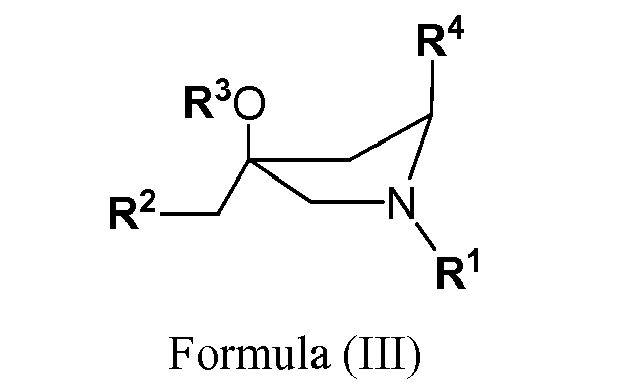
wherein R1, R2, R3, and R4 are as defined in the description.
Description
- The present invention relates to a new process for the stereoselective preparation of protected 1-(halo-methyl)-3-oxo-2-oxa-5-azabicyclo[2.2.1]heptane derivatives of formula (II) by a stereoselective halo-lactonization protocol starting from protected exo-methylene proline derivatives of formula (I):

- Thus, starting for example from enantiopure (S)-exo-methylene Boc-proline [Structure 1a, CAS 84348-38-9], the corresponding (1S,4S)-tert-butyl 1-(iodomethyl)-3-oxo-2-oxa-5-azabicyclo[2.2.1]heptane-5-carboxylate (Structure 2a) is obtained through a iodolactonization reaction:

- Synthetic methods to obtain the (S)-exo-methylene Boc-proline derivatives of formula (I) are reported in the literature. For example, the compound of structure 1a was prepared using a standard Wittig olefination protocol (
WO2008/106058 , Vertex Pharmaceuticals Ltd, p.94). The Cbz-protected methyl ester derivative was prepared with a Zirconium variant of Tebbe's reagent in the presence of zinc and dibromomethane (WO2007/069020 , Vicuron Pharmaceuticals Inc.). - The compounds of formula (II) can be further transformed into compounds of formula (III) which in turn can be used as versatile intermediates in the stereoselective preparation for example of pharmaceutically active compounds.

- Compounds of formula (III) contain orthogonally protected functional groups and have been used for the synthesis of pharmacologically active agents. For example, the compound of structure 3a is an intermediate for the synthesis of pharmacologically active agents for the treatment of age-related macular degeneration (
WO2012/093101 ).
- The Sharpless dihydroxylation protocol was used for the transformation of the 4-exo-methylene Boc-proline into the dihydroxy Boc-proline benzyl ester of structure 3a. Impediments for larger scales are the use of the toxic osmium catalyst, the low selectivity requiring flash chromatography of the obtained diastereoisomers, and the high costs of the reagents. Similarly, compounds of structure 3b have been obtained from 4-exo-methylene Boc-proline by Sharpless dihydroxylation, followed by mesylation and iodination (
WO2013/052369 ).
- Other derivatives, conceivably prepared from compounds of formula (II) using well known experimental procedures (see for example
WO2008/106058 , Vertex, ,are precursors for quinoline derivatives and analogs for use in the treatment of hepatitis C virus infection. Inhibitors of serine protease (WO2008/106058 , Vertex) have been prepared from N-Boc 4-oxo-proline tert-butyl ester and the zinc enolate of ethyl bromoacetate as a 4:1 mixture of diastereoisomer (in favor of the 4-(S) isomer), followed by a Curtius rearrangement. The diastereoisomers have been separated by chromatography.
- Spiroisoxazolines could be conceivably prepared from compounds of formula (II) by methods known to the person skilled in the art. These compounds have been prepared from exo-methylene Boc-proline derivatives in a 1,3-diploar cycloaddition with a nitrile oxide (
WO2007/025307 ), and are used as precursors for pharmacetically active agents to inhibit serine protease activity. - Still other derivatives, conceivably prepared from compounds of formula (II) by methods known to the person skilled in the art, are precursors for HIV-1 protease inhibitors (Bioorg. Med. Chem. Lett. 1993, 3, 1485). These were obtained from ring opening of the precursor epoxide that was synthesized from N-iso-butyl 4-oxo proline tert-butylamide and sulfoxonium ylide as a mixture of diastereoisomers (2:1 in favor of the 4-(S) isomer). Both diasteroisomers were separated by chromatography.
- Iodolactonization reactions involving a five-membered carbocyclic ring are known for example from J. Chem. Soc., Perkin Transactions 1, 1990, 6, 1535 and Tetrahedron Letters 1986, 27, 5467.
- Surprisingly, despite the fact that halo-lactonization reactions are well known in chemistry, no precedence for the halo-lactonization involving an isolated five-membered heterocyclic ring such as the present pyrrolidine ring appears to be reported in the literature. The process of the present invention provides the stereospecific halo-lactonization of compounds of formula (I), which may readily available in enantiomerically pure form from the chiral pool, starting from the appropriate hydroxy-proline precursor. The halo-lactonization product of formula (II) is a versatile substrate for the synthesis of compounds of formula (III) and of novel proline derivatives with a quaternary stereocenter at C4. The present halo-lactonization process, thus, leads in a reduced number of steps, avoiding the use of toxic metal catalysts, to highly complex chiral building blocks. Products may be obtained in high enantiomeric purity making chromatographic separation of isomers unnecessary.
-
- 1) In a first embodiment, the invention relates to a process for the synthesis of 1-(halo-methyl)-3-oxo-2-oxa-5-azabicyclo[2.2.1]heptane derivatives of the formula (II)


- Hal represents iodine or bromine (especially iodine); and
- R1 represents a nitrogen protecting group.
- 2) A second embodiment relates to the process according to embodiment 1), wherein said process is performed starting from the enantiomerically enriched L- or D- proline derivative of formula (Ia), respectively formula (Ib):

thus, the process leads to the 1-(halo-methyl)-3-oxo-2-oxa-5-azabicyclo[2.2.1]heptane derivatives in enantiomerically enriched in the absolute configuration as depicted in formula (IIa), respectively, as depicted in formula (IIb):
- 3) A further embodiment relates to the process of embodiments 1) or 2), wherein said halo-lactonization is performed in presence of a solvent.
Solvents that may be used for the process of embodiment 1) are known in the art as being suitable for the well-known halo-lactonization reaction conditions. Such solvents may be aromatic solvents such as toluene, and anisol; ether solvents such as tert. butyl methyl ether (TBME), tetrahydrofurane (THF), dioxane, and 2-methyl-THF; chlorinated organic solvents such as dichloromethane, 1,2-dichloroethane, chlorobenzene, and 1,2-dichlorobenzene; esters such as ethyl acetate, isopropyl acetate, and n-butyl acetate; aprotic polar solvents such as DMF, dimethylacetamide, NMP, DMSO or acetonitrile; water; or mixtures of such solvents. Preferred solvents are the above-mentioned aprotic polar solvents such as especially DMF, dimethylacetamide, and NMP; or a mixture of water with such solvents. All solvents can be used as purchased without additional drying procedures. - 4) A further embodiment relates to the process of embodiments 1) or 2), wherein said halo-lactonization is performed in presence of a solvent selected from DMF, water, or a mixture thereof.
- 5) A further embodiment relates to the process of any one of embodiments 1) to 4), wherein iodine or bromine; or an iodine- or bromine precursor (such as N-iodo-succinimide, N-bromosuccinimide, DBDMH (1,3-dibromo-5,5-dimethylhydantoin), or pyridine perbromide (pyridinium tribromide)) is used to perform the halo-lactonization.
- 6) A further embodiment relates to the process of embodiment 5), wherein about 1 to 10 equivalents, especially about 1 to 5 equivalents, of iodine, respectively bromine, respectively said iodine- or bromine precursor, with respect to the compound of Formula (I) are used.
- 7) A further embodiment relates to the process of embodiment 5), wherein about 3 equivalents, of iodine, respectively bromine, with respect to the compound of Formula (I) are used.
- 8) A further embodiment relates to the process of any one of embodiments 1) to 7), wherein said halo-lactonization is performed in presence of a base, or in absence of a base. In a preferred sub-embodiment, the process of any one of embodiments 1) to 7) is performed in presence of a base.
Bases that are suitable for the halo-lactonization reaction are well known in the art and not particularly limited. Preferred are well known readily available and cheap bases; which in addition are commercially available implicating low cost of goods. Preferably, such base, when added to the reaction mixture, leads to a pH of about 7 to 14 (especially 8 to 10) in the reaction mixture. Preferred examples of such bases are aqueous base solutions, or aqueous buffer solutions; or mixtures thereof. In addition, under aprotic solvent reaction conditions for example alkali metal alcoholates may be used: N-iodoscuccinimide (NIS), potassium tert butoxide (KOtBu) or sodium ethoxide (NaOEt), DMF (tetrahedron 1979, 35, 2337 and Tetrahedron Latters 1990, 31, 5973).
Most preferred bases are aq. base solutions. Examples of aqueous base solutions are alkali metal carbonate solutions, or an alkali metal hydrogen carbonate solutions, such as especially aq. Na2CO3, aq. NaHCO3, aq. Li2CO3, aq. LiHCO3, aq. K2CO3, aq. KHCO3, aq. Cs2CO3, or aq. CsHCO3; wherein said solutions may be saturated or diluted as appropriate.
An aqueous buffer solution is notably sodium or potassium phosphate buffer (wherein said buffer may be diluted as appropriate (for example a 20 mM Na3PO4 buffer) adjusted to the appropriate pH; such as for example a pH of about 8-10) or other aqueous buffer systems known to the person skilled in the art.
The above-mentioned aqueous base is usually present in large excess, especially in case a saturated solution is used, such aqueous base is present in amounts of about 1 to 15 vol, notably about 5 to 12 vol with respect to the compound of Formula (I).
In the absence of a base, the halo-lactonization is reversible, and the thermodynamically most stable product is formed [using for example I2, KI, acetonitrile (J. Am. Chem. Soc. 1978, 100, 3950)] - 9) A further embodiment relates to the process of any one of embodiments 1) to 7), wherein said halo-lactonization is performed in presence of an aqueous alkali metal carbonate or hydrogen carbonate solution.
- 10) A further embodiment relates to the process of any one of embodiments 1) to 9), wherein said halo-lactonization is performed at a temperature of about -20°C to 50°C (especially at about 0°C to 40°C, notably at about room temperature.
- 11) A further embodiment relates to the process of any one of embodiments 1) to 10), wherein said compound of Formula (II) is obtained by liquid-liquid separation and / or solid-liquid separation.
- 12) A further aspect of the present invention relates to a process according to any one of embodiments 1) to 11), wherein the compound of the formula (II) is further transformed to a compound of the formula (III):

- R1 represents a nitrogen protecting group;
- R2 represents hydrogen, iodine, bromine, hydroxy, alkoxy, or an optionally substituted amino group;
- R3 represents hydrogen;
- R4 represents -CH2-OH; or COO-R41 , wherein R41 represents hydrogen, C1-8-alkyl, C1-3-fluroroalkyl, or optionally substituted aryl-C1-6-alkyl (especially hydrogen, C1-4-alkyl, or optionally substituted benzyl).
- 13) A further embodiment relates to the process of embodiment 12), wherein said transformation of the compound of formula (II) to the compound of formula (III) comprises a ring opening reaction of the lactone ring of the compounds of formula (II).
- 14) A further embodiment relates to the process of embodiment 13), wherein said ring opening of the lactone ring of the compounds of formula (II) is achieved under acid catalysis; or said ring opening of the lactone ring of the compounds of formula (II) is achieved by nucleophilic attack under neutral or basic conditions.
Acid catalysts suitable for the ring opening of a lactone (i.e. acid catalysts capable of activating the carbonyl group part of the lactone ring for a subsequent nucleophilic attack by a compound of formula HO-R41) are well-known in the art and encompass Lewis acids and Bronsted acids. A particularly suitable example is H2SO4.
Reagents capable of a nucleophilic attack on the lactone ring (i.e. on the carbonyl group part of the lactone ring) are for example well-known hydride reagents (such as NaBH4 or LiBH4); or a compound of the formula HO-R41, a salt thereof (wherein such salt may be formed in situ); or a mixture of a compound of the formula HO-R41 and a salt thereof. - 15) A further embodiment relates to the process of any one of embodiments 12) to 14), wherein said process is performed in presence of one or more solvents.
Solvents that are suitable for the well-known ring opening of lactones and that in consequence may be used for the process of embodiments 12) to 14) are known in the art.
In some instances, the nucleophil used for the ring opening of the lactone ring may serve as a solvent, for example in case it is water or an alcohol; or said nucleophil is a salt of said solvent (e.g. an alkali metal alcoholate; an alkali metal hydroxide; or ammonium hydroxide) and the reaction performed in presence of a mixture / solution of said solvent and a suitable amount of said salt of the solvent.
Chemically inert solvents that may be used (in some instances in addition to the nucleophil being itself a solvent as described above) are for example: aromatic solvents such as toluene; ether solvents such as tert. butyl methyl ether (TBME), tetrahydrofurane (THF), dioxane, and 2-methyl-THF; chlorinated organic solvents such as dichloromethane, 1,2-dichloroethane, chlorobenzene, and 1,2-dichlorobenzene; aprotic polar solvents such as DMF, dimethylacetamide, acetonitrile, NMP, or DMSO; water; or mixtures of such solvents. All solvents can be used as purchased without additional drying procedures.
Preferably, the process of embodiments 12) to 14) is performed in- ➢ an alcoholic solvent in case the nucleophil is an alkali metal alcoholate;
- ➢ in DMSO or THF in case the nucleophil is a hydride reagent such as an alkali metal borohydride;
- ➢ in an ether solvent (such as especially TBME) in case an acid catalyst is used in presence of an alcohol nucleophil (wherein said alcohol may serve as a co-solvent); or
- ➢ in a mixture of an ether solvent (such as especially THF) and water in case the nucleophil is an alkali metal hydroxide or ammonium hydroxide.
- 16) A further embodiment relates to the process of any one of embodiments 12) to 15), wherein the nucleophil itself serves as a solvent; especially such nucleophil is an alcohol or water; wherein it is understood that said nucleophil may be present in free form or, at least partly, in salt form, optionally in a mixture with one or more chemically inert solvent(s).
- 17) A further embodiment relates to the process of any one of embodiments 12) to 16), wherein at least about 5 to 10 equivalents, especially at least about 5 to 10 equivalents, of nucleophil, with respect to the compound of Formula (II) are used.
- 18) A further embodiment relates to the process of any one of embodiments 12) to 17), wherein said ring opening is performed in presence of an acidic catalyst.
- 19) A further embodiment relates to the process of embodiment 18), wherein said ring opening is performed in presence of an alcohol.
- 20) A further embodiment relates to the process of any one of embodiments 12) to 17), wherein said ring opening is performed under basic conditions.
- 21) A further embodiment relates to the process of any one of embodiments 20), wherein said ring opening is performed in presence of an aqueous alkali metal hydroxide, or in presence of aqueous ammonium hydroxide.
- 22) A further embodiment relates to the process of embodiments 12) to 15), or 20), wherein said ring opening is performed in presence of an alkali metal borohydride.
- 23) A further embodiment relates to the process of any one of embodiments 12) to 22), wherein said ring opening is performed at a temperature of about -20°C to 100°C (especially at about 0°C to 40°C, notably at about room temperature).
- 24) A further embodiment relates to the process of any one of embodiments 12) to 23), wherein said compound of Formula (III) is obtained by liquid-liquid separation and / or solid-liquid separation.
- 25) A further aspect of the present invention relates to novel compounds of the formula (II):

- R1 represents a nitrogen protecting group; and
- Hal represents bromine, or especially iodine;
- wherein in a sub-embodiment the compound of formula (II) is enantiomerically enriched in the absolute configuration as depicted in formula (IIa), respectively, as depicted in formula (IIb).
- 26) A further aspect of the present invention relates to novel compounds of the formula (III):

- (2S,4S)-1-(tert-butoxycarbonyl)-4-hydroxy-4-(methoxymethyl)-pyrrolidine-2-carboxylic acid;
- (2S,4S)-1-(tert-butoxycarbonyl)-4-hydroxy-4-(hydroxymethyl)-pyrrolidine-2-carboxylic acid;
- (2S,4S)-4-hydroxy-4-(methoxymethyl)-1-tosylpyrrolidine-2-carboxylic acid;
- (2S,4R)-4-((benzylamino)methyl)-1-(tert-butoxycarbonyl)-4-hydroxypyrrolidine-2-carboxylic acid;
- (2S,4R)-4-(aminomethyl)-4-hydroxy-1-tosylpyrrolidine-2-carboxylic acid;
- (2S,4S)-methyl 4-hydroxy-4-(iodomethyl)-1-tosyl-pyrrolidine-2-carboxylate;
- (2S,4R)-1-tert-butyl-2-methyl-4-((1,3-dioxoisoindolin-2-yl)methyl)-4-hydroxypyrrolidine-1,2-dicarboxylate;
- (2S,4R)-methyl-4-((1,3-dioxoisoindolin-2-yl)methyl)-4-hydroxy-1-tosylpyrrolidine-2-carboxylate;
- (2S,4S)-benzyl-4-hydroxy-2-(hydroxymethyl)-4-methyl-pyrrolidine-1-carboxylate; or
- (2S,4S)-tert-butyl-4-hydroxy-2-(hydroxymethyl)-4-(iodomethyl)-pyrrolidine-1-carboxylate.
- 27) A further aspect of the present invention relates to the compound (5S,8S)-7-(tert-butoxycarbonyl)-2,2-dimethyl-1,3-dioxa-7-azaspiro[4.4]nonane-8-carboxylic acid.
- The term "nitrogen protecting group" as used for the substituent R1 means any residue other than hydrogen which protects the nitrogen atom by forming a covalent bond to said nitrogen wherein said bond is not affected by the reaction conditions of the present halo-lactonization; and wherein preferably said residue itself is not chemically transformed under the conditions of the present halo-lactonization. The term includes residues which are not removed in subsequent steps (i.e. which may be synthetically useful for the further transformations of the compounds of formula (II) into the final target molecules thus incorporating such nitrogen protecting groups or derivatives thereof), thus residues other than generally recognized nitrogen protecting groups as listed for example in "Green's Protective Groups in Organic Synthesis", 4th edition, 2006, T.W. Greene, P.G.M. Wuts, Wiley-Interscience, 2006, which is incorporated by reference. Preferred are nitrogen protecting groups as defined herein-above which allow at least partly for a delocalization of the nitrogen lone pair (i.e. which may reduce the nitrogen basicity / nucleophilicity).
- In a sub-embodiment, the term "nitrogen protecting group" as used for the substituent R1 represents optionally substituted aryl, optionally substituted heteroaryl; or especially a group forming together with the nitrogen of the pyrrolidine ring an amide, a carbamate, an urea, a sulfamate, a sulfonamide, or a sulfamide group. Notably, the term represents optionally substituted aryl; or, preferably, a group forming together with the nitrogen an amide, a carbamate, an urea, a sulfamate, a sulfonamide, or a sulfamide group.
- Such groups forming together with the nitrogen of the pyrrolidine ring an amide, a carbamate, an urea, a sulfamate, a sulfonamide, or a sulfamide group may be selected from:
- ➢ R11-X-CO- wherein
- ■ X represents a direct bond, oxygen, or NR5 wherein R5 represents C1-8-alkyl, C1-3-fluroroalkyl, optionally substituted aryl, optionally substituted aryl-C1-6-alkyl-, optionally substituted heteroaryl, optionally substituted heteroaryl-C1-6-alkyl-; and
- ■ R11 represents C1-8-alkyl, C1-3-fluroroalkyl, optionally substituted aryl, optionally substituted aryl-C1-6-alkyl-, optionally substituted heteroaryl, optionally substituted heteroaryl-C1-6-alkyl-, or
- ■ in case X represents NR5 , R11 together with R5 and the nitrogen to which both are attached may form a 4 to 8 membered ring optionally containing a further heteroatom selected from nitrogen and oxygen;
- ➢ R12-Y-SO2- wherein
- ■ Y represents a direct bond, oxygen, or NR6 wherein R6 represents C1-8-alkyl, C1-3-fluroroalkyl, optionally substituted aryl, optionally substituted aryl-C1-6-alkyl-, optionally substituted heteroaryl, optionally substituted heteroaryl-C1-6-alkyl-;
- ■ R12 represents C1-8-alkyl, C1-3-fluroroalkyl, optionally substituted aryl, optionally substituted aryl-C1-6-alkyl-, optionally substituted heteroaryl, optionally substituted heteroaryl-C1-6-alkyl-, or
- ■ in case Y represents NR6 , R12 together with R6 and the nitrogen to which both are attached may form a 4- to 8-membered ring optionally containing a further heteroatom selected from nitrogen and oxygen.
- In particular the term refers to the above groups forming together with the nitrogen an amide, a carbamate, or a sulfonamide group.
- Examples of such "nitrogen protecting groups" as used for the substituent R1 are notably C1-8-alkoxy-carbonyl; C1-8-alkyl-carbonyl; C1-3-fluoroalkyl-carbonyl; optionally substituted aryloxy-sulfonyl, or C1-8-alkyloxy-sulfonyl (thus forming together with the nitrogen a sulfamate group); optionally substituted arylamino-sulfonyl, or C1-8-alkylamino-sulfonyl (thus forming together with the nitrogen a sulfamide group); and optionally substituted aryl-sulfonyl, or C1-8-alkylsulfonyl (thus forming together with the nitrogen a sulfonamide group). Particular examples are tert-butyloxycarbonyl, benzyloxycarbonyl, optionally substituted aryl-sulfonyl (such as especially toluene-sulfonyl), optionally substituted benzoyl (such as especially unsubstituted benzoyl), and optionally substituted phenyl (such as especially 2-nitro-phenyl). Preferred examples are tert-butyloxycarbonyl, benzyloxycarbonyl, optionally substituted aryl-sulfonyl (especially toluene-sulfonyl), and optionally substituted benzoyl (especially unsubstituted benzoyl),
- The term "optionally substituted amino group" as used for the substituent R2 refers to a residue comprising at least one nitrogen atom that is covalently bonded to the rest of the molecule (wherein it is understood that said nitrogen which is part of said optionally substituted amino group R2, before being covalently bonded to the rest of the molecule, had nucleophilic properties and a free valency). Such optionally substituted amino group R2 notably is a group - NR7R8 , wherein R7 and R8 independently represent hydrogen or C1-8-alkyl, or R7 and R8 together with the nitrogen to which they are attached form a 4- to 8-membered ring optionally containing a further heteroatom selected from optionally substituted nitrogen and oxygen, or R7 and R8 together with the nitrogen to which they are attached form an optionally substituted phthalimide ring.
- In case a nitrogen atom is optionally substituted, the optional substituents are not particularly limited. Especially encompassed are substituents such as C1-4-alkyl, C3-6-cycloalkyl, C1-3-fluoroalkyl, C1-4-alkoxy-C2-3-alkyl, hydroxy-C2-3-alkyl, C3-6-cycloalkoxy- C1-4-alkyl, as well as "nitrogen protecting groups" forming together with the nitrogen an amide, a carbamate, an urea, a sulfamate, a sulfonamide, or a sulfamide group, as defined before.
- The term "halogen" means fluorine, chlorine, or bromine, preferably fluorine or chlorine. As a sub-group of halogen, the term Hal refers to iodine or bromine, especially iodine.
- The term "alkyl", used alone or in combination, refers to a saturated straight or branched chain alkyl group containing one to eight carbon atoms. The term "Cx-y-alkyl" (x and y each being an integer), refers to an alkyl group as defined before, containing x to y carbon atoms. For example a C1-4-alkyl group contains from one to four carbon atoms. Examples of alkyl groups are methyl, ethyl, propyl, isopropyl, n-butyl, isobutyl, sec.-butyl and tert.-butyl. Preferred are methyl and ethyl. Most preferred is methyl.
- The term "cycloalkyl", used alone or in combination, refers to a saturated cyclic alkyl group containing three to six carbon atoms. The term "Cx-y-cycloalkyl" (x and y each being an integer), refers to a cycloalkyl group as defined before containing x to y carbon atoms. For example a C3-6-cycloalkyl group contains from three to six carbon atoms. Examples of cycloalkyl groups are cyclopropyl, cyclobutyl, cyclopentyl and cyclohexyl. Preferred is cyclopropyl.
- The term "alkoxy", used alone or in combination, refers to an alkyl-O- group wherein the alkyl group refers to a saturated straight or branched chain alkyl group containing one to eight carbon atoms. The term "Cx-y-alkoxy" (x and y each being an integer) refers to an alkoxy group as defined before containing x to y carbon atoms. For example a C1-4-alkoxy group means a group of the formula C1-4-alkyl-O- in which the term "C1-4-alkyl" has the previously given significance. Examples of alkoxy groups are methoxy, ethoxy, n-propoxy, isopropoxy, n-butoxy, isobutoxy, sec.-butoxy and tert.-butoxy. Preferred are ethoxy and methoxy.
- The term "fluoroalkyl" refers to an alkyl group as defined before containing one to three carbon atoms in which one or more (and possibly all) hydrogen atoms have been replaced with fluorine. The term "Cx-y-fluoroalkyl" (x and y each being an integer) refers to a fluoroalkyl group as defined before containing x to y carbon atoms. For example a C1-3-fluoroalkyl group contains from one to three carbon atoms in which one to seven hydrogen atoms have been replaced with fluorine. Representative examples of fluoroalkyl groups include trifluoromethyl, 2-fluoroethyl, 2,2-difluoroethyl and 2,2,2-trifluoroethyl. Preferred are C1-fluoroalkyl groups such as trifluoromethyl.
- The term "fluoroalkoxy" refers to an alkoxy group as defined before containing one to three carbon atoms in which one or more (and possibly all) hydrogen atoms have been replaced with fluorine. The term "Cx-y-fluoroalkoxy" (x and y each being an integer) refers to a fluoroalkoxy group as defined before containing x to y carbon atoms. For example a C1-3-fluoroalkoxy group contains from one to three carbon atoms in which one to seven hydrogen atoms have been replaced with fluorine. Representative examples of fluoroalkoxy groups include trifluoromethoxy, difluoromethoxy, 2-fluoroethoxy, 2,2-difluoroethoxy and 2,2,2-trifluoroethoxy. Preferred are C1-fluoroalkoxy groups such as trifluoromethoxy and difluoromethoxy.
- The term "aryl" refers to a naphthyl or, preferably, to a phenyl group; wherein said group is unsubstituted or substituted as explicitly defined.
- In case an aryl group is optionally substituted, the optional substituents are not particularly limited. Especially encompassed are aryl groups wherein the aryl group is unsubstituted, or mono-, di-, or tri-substituted; wherein the substituents are independently selected from C1-4-alkyl, C1-4-alkoxy, C3-6-cycloalkyl, halogen, C1-3-fluoroalkyl, C1-3-fluoroalkoxy; hydroxy, C1-4-alkoxy-C1-3-alkyl, hydroxy-C1-3-alkyl, C1-4-alkoxy-C2-3-alkoxy, hydroxy-C2-3-alkoxy, carboxy, C1-4-alkoxy-carbonyl, C3-6-cycloalkoxy-carbonyl, nitro, and cyano.
- The term "heteroaryl", if not explicitly stated otherwise, refers to a 5- to 10-membered monocyclic or bicyclic aromatic ring containing 1 to a maximum of 4 heteroatoms independently selected from oxygen, nitrogen and sulfur. Examples of such heteroaryl groups are 5-membered monocyclic heteroaryl groups such as furanyl, oxazolyl, isoxazolyl, oxadiazolyl, thienyl, thiazolyl, isothiazolyl, thiadiazolyl, pyrrolyl, imidazolyl, pyrazolyl, triazolyl and tetrazolyl; 6-membered monocyclic heteroaryl such as pyridyl, pyrimidyl, pyridazinyl, and pyrazinyl; and 8- to 10-membered bicyclic heteroaryl such as indolyl, isoindolyl, benzofuranyl, isobenzofuranyl, benzothiophenyl, indazolyl, benzimidazolyl, benzoxazolyl (or benzooxazolyl), benzisoxazolyl, benzothiazolyl, benzoisothiazolyl, benzotriazolyl, benzoxadiazolyl, benzothiadiazolyl, quinolinyl, isoquinolinyl, naphthyridinyl, cinnolinyl, quinazolinyl, quinoxalinyl, phthalazinyl, pyrazolo[1,5-a]pyridyl, pyrazolo[1,5-a]pyrimidyl, imidazo[1,2-a]pyridyl, 1H-pyrrolo[3,2-b]pyridyl, 1H-pyrrolo[2,3-b]pyridyl, pyrrolo[3,2-d]pyrimidinyl, pyrrolo[2,3-d]pyrimidinyl, 4H-furo[3,2-b]pyrrolyl, pyrrolo[2,1-b]thiazolyl, and imidazo[2,1-b]thiazolyl. The above-mentioned heteroaryl groups are unsubstituted or substituted as explicitly defined.
- In case a heteroaryl group is optionally substituted, the optional substituents are not particularly limited. Especially encompassed are heteroaryl groups which are unsubstituted, or mono-, di-, or tri-substituted; wherein the substituents are independently selected from C1-4-alkyl, C1-4-alkoxy, C3-6-cycloalkyl, halogen, C1-3-fluoroalkyl, C1-3-fluoroalkoxy; hydroxy, C1-4-alkoxy-C1-3-alkyl, hydroxy-C1-3-alkyl, C1-4-alkoxy-C2-3-alkoxy, hydroxy-C2-3-alkoxy, carboxy, C1-4-alkoxy-carbonyl, C3-6-cycloalkoxy-carbonyl, nitro, and cyano.
- In case more than one group are combined in one generic group (for example: aryl-C1-6-alkyl), it is understood that such group is to be read from left to right (i.e. in the above example: the aryl-C1-6-alkyl is attached to the rest of the molecule at the C1-6-alkyl group).
- The term "solid-liquid separation" refers to routine solid-liquid separation techniques well known to a skilled person (see for example Perry's Chemical Engineers' Handbook, 7th edition, Perry, R.H.; Green, D. W. McGraw-Hill 1997). In particular, the term includes techniques such as filtration, centrifugation, and gravity sedimentation; especially filtration.
- The term "liquid-liquid extraction" refers to routine liquid-liquid extraction or washing techniques well known to a skilled person (see for example Perry's Chemical Engineers' Handbook, 7th edition, Perry, R.H.; Green, D. W. McGraw-Hill 1997). In particular the term includes washing or extraction techniques using settlers, cyclones, centrifuges, mixer-settler, all kinds of continuous contact equipment; distillation: batch and continuous distillation; and supercritical fluid separation techniques.
- Unless used regarding temperatures, the term "about" placed before a numerical value "X" refers in the current application to an interval extending from X minus 10% of X to X plus 10% of X, and preferably to an interval extending from X minus 5% of X to X plus 5% of X. In case the term about is placed before a range, the respective interval is to be applied to both values of the range. In the particular case of temperatures, the term "about" placed before a temperature "Y" refers in the current application to an interval extending from the temperature Y minus 10 °C to Y plus 10 °C, and preferably to an interval extending from Y minus 5 °C to Y plus 5 °C.
- Whenever the word "between" or "to" is used to describe a numerical range, it is to be understood that the end points of the indicated range are explicitly included in the range. For example: if a temperature range is described to be between 40°C and 80°C (or 40°C to 80°C), this means that the end points 40°C and 80°C are included in the range; or if a variable is defined as being an integer between 1 and 4 (or 1 to 4), this means that the variable is the integer 1, 2, 3, or 4.
- The expression % w/w refers to a percentage by weight compared to the total weight of the composition considered. Likewise, the expression v/v refers to a ratio by volume the two components considered. Likewise, the expression % a/a refers to the purity with respect to area under the curve (i.e. integral) in a chromatogram, preferably measuring the UV absorption. The expression "vol" signifies volumes (in L, e.g. of solvent) per weight (in kg, e.g. of reactant). For example 7 vol signifies 7 liters (of solvent) per kg (of reactant).
- The term "enriched", for example when used in the context of enantiomers or diastereoisomers is understood in the context of the present invention to mean especially that the respective enantiomer / diastereoisomer is present in a ratio (mutatis mutandis: purity) as explicitly specified; usually in a ratio of at least 60:40, especially of at least 70:30, and notably of at least 90:10 (mutatis mutandis: purity of 60% / 70% / 90%) with respect to the respective other enantiomer / diastereoisomer. Preferably the term refers to the respective essentially pure enantiomer / diastereoisomer.
- The term "essentially", for example when used in a term such as "essentially pure" is understood in the context of the present invention to mean especially that the respective stereoisomer / composition / compound etc. consists in an amount of at least 90, especially of at least 95, and notably of at least 99 per cent by weight of the respective pure stereoisomer / composition / compound etc..
- The following examples illustrate the invention but do not at all limit the scope thereof.
- All temperatures are stated in °C. Compounds are characterized by 1H-NMR (400MHz) or 13C-NMR (100MHz) (Brucker; chemical shifts are given in ppm relative to the solvent used; multiplicities: s = singlet, d = doublet, t = triplet; p = pentuplet, hex = hexet, hept = heptet, m = multiplet, br = broad, coupling constants are given in Hz); by LC-MS (Finnigan Navigator with HP 1100 Binary Pump and DAD, column: 4.6x50 mm, Zorbax SB-AQ, 3.5 m, 120A, gradient: 5-95% acetonitrile in water/NH3 13 mmol/L, 1 min, with NH4(COO) 10 mmol/L, flow: 4.5 ml/min) or column: 4.6x50 mm, Zorbax SB-AQ, 3.5 m, 120A, gradient: 5-95% acetonitrile in water, 1 min, with 0.04% TFA, flow: 4.5 ml/min), tR is given in min; by TLC (TLC-plates from Merck, Silica gel 60 F254); or by melting point. Compounds are purified by flash chromatography, crystallization or preparative HPLC (Pump: Gilson 333/334; Column: Waters Atlantis T3 30x75 mm 10 µm, Waters XBridge C18, 30x75 mm, 10 µm, Waters C18, 50x150 mm, 10 µm; flow rate: 75 mL/min for 30x75 mm or 150 ml/min for 50x150 mm; mobile phase: A: water + 0.5% formic acid or water + 0.5% ammonium hydroxid 25%, B: acetonitrile).
-
- aq.
- aqueous
- AcOEt
- ethyl acetate
- atm
- atmosphere
- Bn
- benzyl
- Boc
- tert.-butyloxycarbonyl
- CAM
- CBz
- benzyloxycarbonyl
- DCM
- dichloromethane
- DMF
- dimethylformamide
- DMSO
- dimethylsulfoxide
- ee
- enantiomeric excess
- equ.
- equivalent(s)
- e.r.
- enantiomeric ratio
- ET
- external temperature
- EtOAc
- ethyl acetate
- IPC
- In Process Control
- iPrOAc
- isopropyl acetate
- GC-MS
- Gas Chromatography - Mass Spectroscopy
- h
- hour(s)
- HV
- high vacuum conditions
- IPC
- In process control
- LC-MS
- Liquid Chromatography - Mass Spectrometry
- m.p.
- melting point
- min
- minutes
- org.
- organic
- rt
- room temperature
- sat.
- saturated
- soln.
- solution
- tR
- retention time
- TBME
- tert.-butyl methyl ether
- TFA
- trifluoroacetic acid
- THF
- tetrahydrofuran
- TLC
- thin layer chromatography
- Ts
- tosyl (para-toluene-sulfonyl)
- % w/w
- Mass % (NMR assay)
- % a/a
- Area % (purity by area%)
-

- A solution of N-Boc-4-methylene-L-proline (50 g, 0.22 mol) in DMF (50 mL, 7 vol) was added to sat. aq. NaHCO3 soln. (600 mL, 12 vol) at 20-25 °C during 20 min (evolution of gas, pH at the end of addition = 8-9). The resulting solution was treated with a solution of I2 (167.5 g, 0.66 mol, 3.0 equ) in DMF (350 mL, 7 vol) and water (100 ml, 2 vol) at 20-25 °C during 30 min (evolution of gas). The reaction was further stirred at 20-25 °C for 1.5 h at 20-25 °C.
The reaction was diluted with AcOEt (700 mL), water (200 mL) and aq. soln. of NaHSO3 40% (140 mL) during 10 min at 20-25 °C (strongly foaming). The layers were separated. The aq. layer was extracted 1x with AcOEt (250 mL). The combined org. layers were washed 1x with sat. aq. NaHCO3 (250 mL) and 1x with water (250 mL). The org. layer was concentrated under reduced pressure to give 71 g (91%) of iodo lactone as a yellow-white solid. MP = 131-133 °C. LC-MS: tR = 1.34 min. 1H-NMR (D6 DMSO, 400MHz) δ 4.61 (s, 1 H), 3.80-3.70 (m, 2 H), 3.62-3.53 (m, 1 H), 3.34-3.27 (m, 1 H), 2.2.23-2.14 (m, 2 H), 1.43-1.34 (m, 9 H). - The absolute configuration of the obtained title compound was confirmed by X-ray.
-

- A solution of N-Boc-4-Methylene-L-proline (7.1 g, 0.03 mol) in DMF (15 mL, 2.1 vol) was added to sat. aq. NaHCO3 soln. (50 mL, 7 vol) at 20-25 °C during 7 min (evolution of gas). The resulting solution was treated with a solution of Br2 (10.0 g, 0.06 mol, 2.0 equ) in DMF (20 mL, 3 vol) at 20-25 °C during 15 min. The reaction was further stirred at 20-25 °C for 2 h at 20-25 °C. The reaction was diluted with AcOEt (50 mL). Then it was quenched by addition of aq. soln. of NaHSO3 40% (12 mL) during 5 min at 20-25 °C (strongly foaming). The layers were separated. The aq. layer was extracted 1x with AcOEt (35 mL). The combined org. layers were washed with sat. aq. 10% NaHSO3 (1x 35 mL), with sat. aq. NaHCO3 soln. (1x 35 mL) and with water (1x 35 mL). The org. layer was concentrated under reduced pressure to give crude bromo lactone as a yellow oil (3.7 g). The crude product was further purified by a plug filtration over silica gel (55 g) using heptane/ethyl acetate 4:1 (1.7 L) to give 2.37 and and a column chromatography (Biotage Snap 25 g; gradient = heptane (100 ml) then heptane/ethylacetate 0-30% (700 mL) then heptante/ethylacetate 7:3 (200 ml)) to give 1.11 g (12%) of pure bromo lactone as a white solid. MP = 147-149 °C. LC-MS: tR = 1.34 min. 1H-NMR (CDCl3, ppm, 400MHz) δ 4.66 (s, broad, 1H), 3.75 (s, 2 H), 3.67-3.61 (m, 1 H), 3.55-3.4 (m, 1 H), 2.23-2.10 (m, 2 H), 1.49 (s, 9 H).
-

- A suspension of (S)-methyl 4-methylenepyrrolidine-2-carboxylate hydrochloride (4.0 g, 22.5 mmol) in DCM (32 mL) was treated with triethylamine (7.8 mL, 2.5 eq.) and p-toluenesulfonylchloride (4.8 g, 1.1 eq.) at 25-43 °C. After 1.5 h stirring at 20-25 °C an IPC (TLC) showed complete consumption of starting material. After standing over night the reaction mixture was extracted with aq. 1 N HCl (2x 20 mL). The organic layer was evaporated at 50 °C under reduced pressure to give the crude ester (5.9 g) as a brown oil. It was dissolved in THF (17 mL) and with aq. 1 N NaOH (15 mL) at 20-25 °C. The reaction mixture was stirred at 20-25 °C. After 30 min an IPC (LC-MS) showed >99% conversion to acid. The reaction mixture was extracted with TBME (30 mL) and was acidified with aq. 32% HCl (3 mL; resulting pH was < 1). The mixture was extracted with DCM (30 mL). The organic layer was evaporated to give 6.3 g of crude acid. The crude product was further purified by flash chromatography (silica gel; ethyl acetate/methanol/acetic acid 400:10:1) to give 3.5 g (62%) of acid as a brown oil. The purity was >99% a/a. LC-MS: tR = 0.74 min, [M+1]+ = 282. 1H-NMR (CDCl3, 400MHz) δ 12.89 (s, broad, 1 H), 7.73 (d, J = 8.2 Hz, 2 H), 7.43 (d, J = 8.2 Hz, 2 H), 4.98-4.93 (m, 2 H), 4.33 (dd, J 1 = 3.4 Hz, J 2 = 9.1 Hz, 1 H), 3.98-3.82 (m, 2 H), 2.55-2.48 (m, 2 H), 2.40 (s, 3 H).
- Step 2: Sat. aq. NaHCO3 (55 mL) was added to a solution of (S)-methyl 4-methylene-1-tosylpyrrolidine-2-carboxylate (4.8 g, 16.9 mmol) in DMF (12.5 mL). The resulting mixture was treated with a solution of iodine (12.9 g, 3.0 eq.) in DMF (22.5 ml). An IPC (LC-MS) showed complete conversion to product after 15 min at 20-30 min. The reaction was diluted with AcOEt (50 mL), aq. 20% NaHSO3 (17 mL), water (50 mL) and DCM (100 mL). The layers were separated. The aq. layer was extracted with DCM (1x 100 mL). The organic layers were each washed with sat. aq. NaHCO3 soln. (100 mL) and water (3x 100 mL). Then they were combined and evaporated under reduced pressure at 50 °C. After evaporating the solvents 5.6 g of crude iodolactone was obtained. It was suspended in AcOEt (25 mL). The mixture was heated to reflux. After cooling down to 0-5 °C 2.8 g of crystalline iodo lactone were isolated. The mother liquor was evaporated and the residue was subjected to a second crystallization from AcOEt to give a second crop of 0.7 g acid. The combined yield was 3.5 g (51%) as a off white solid. MP = 165-166 °C. LC-MS: tR = 0.86 min. 1H-NMR (D6 DMSO, 400MHz) δ 7.72 (d, J = 8.3 Hz, 2 H), 7.46 (d, J = 8.2 Hz, 2 H), 4.68 (s, 1 H), 3.75-3.55 (m, 3 H), 3.26 (dd, J 1 = 1.1 Hz, J 2 = 9.9 Hz, 1 H), 2.42 (s, 3 H), 2.17 (d, J = 11.0 Hz, 1 H), 1.93 (dd, J 1 = 1.7 Hz, J 2 = 10.9 Hz, 1 H). 13C-NMR (D6 DMSO, 100 MHz) δ 170 (C); 145 (C), 134 (C), 130 (CH), 128 (CH), 89 (C), 62 (CH), 54 (CH2), 42 (CH2), 22 (CH3), 2 (CH2).
-

- (S)-methyl 4-methylenepyrrolidine-2-carboxylate hydrochloride (4.0 g, 23 mmol) was dissolved in THF/water 1:1 (48 mL). The solution was cooled to 0-5°C. After treatment with NaHCO3 (8.5 g, 4.5 eq) the solution had pH 8. Z-chloride (3.9 mL, 1.2 eq) was added during 5 min at 0-5 °C. After 1 h stirring at 20-25 °C the reaction was diluted with DCM (50 mL). The layers were separated and the aq. layer was extracted with dichloromethane (1x 50 mL). The combined organic layers were washed with water (50 mL) and evaporated in vacuo at 50 °C to give 6 g of the crude ester. The crude methylester was dissolved in THF (12 mL). The solution was diluted with aq. 1 N NaOH (36 mL, 1.5 eq) at 20-25 °C. The resulting emulsion was stirred at 20-25 °C during 1 h. An IPC (LC-MS) showed complete conversion to free acid. The reaction mixture was diluted with water (100 mL) and the basic mixture was washed with DCM (2x 100 mL). The aqueous layer was acidified and extracted with DCM (3x 70 mL). The combined organic layers were evaporated to give 5.0 g of the free acid as a brown oil. LC-MS: tR = 0.74 min, [M+1]+ = 262. 1H-NMR (D6 DMSO, 400MHz) δ 12.82 (s, broad, 1 H), 7.42-7.24 (m, 5 H), 5.15-5.00 (m, 4 H), 4.49-4.36 (m, 1 H), 4.13-3.95 (m, 2 H), 3.09-2.97 (m, 1 H), 2.61-2.44 (m, 1H).
- Step 2: Sat. aq. NaHCO3 solution (55 mL) was added to a solution of (S)-1-((benzyloxy)carbonyl)-4-methylenepyrrolidine-2-carboxylic acid (4.95 g,. 18.9 mmol) in DMF (15.5 mL) at 20-25 °C. After stirring during 10-15 min a solution of iodine (14.4 g, 3 eq) in DMF (22.5 ml) was added during 30 min at 25-35 °C. After completion of addition an IPC showed complete consumption of starting material. The reaction was diluted with AcOEt (50 mL) and aq. 40% NaHSO3 (9 mL) in water (100 mL). After separation of layers the aqueous layer was extracted with ethyl acetate (2x 100 mL). Each organic layer was washed with sat aq. NaHCO3 (2x 100 mL) and with water (100 mL). The organic layers were combined and evaporated to give the crude product as an oil still containing DMF. The oil was re-dissolved in iPrOAc (100 mL). The solution was washed with water (3x 100 mL). The aqeous layers were reextracted with iPrOAc (100 mL). The combined organic layers were evaporated to give 6.45 g of crude iodolactone. No further purification was performed. LC-MS: tR = 0.86 min, [M+1]+ = 388. 1H-NMR (D6 DMSO, 400MHz) δ 7.41-7.34 (m, 5 H), 5.16-5.1 (m, 2 H), 4.75 (s, 1 H), 3.84-3.67 (m, 3 H), 3.39-3.32 (m, 1 H), 2.34-2.21 (m, 1 H). 13C-NMR (D6 DMSO, 100 MHz) δ 171 (C), 163 (C), 154 (C), 137 (C), 129 (CH), 129 (CH), 128 (CH), 89 (C), 67 (CH2), 60 (CH), 54 (CH2), 43 (CH2), 2 (CH2)
-

- Benzoic acid (3.6 g, 1.05 eq.) was dissolved in water (15 mL). The pH of the solution was adjusted to approx. 4 by addition of aq. 1 M NaOH (1 mL). Then 1-hydroxy-benzotriazole (4.6 g, 1.2 eq.) was added and the pH was again adjusted with aq. 32% NaOH (2 mL) to 4-5. Then a solution of (S)-methyl 4-methylenepyrrolidine-2-carboxylate hydrochloride (5 g, 28.1 mmol) in THF (25 ml) was added at 20-25 °C. The pH was readjusted from 1 to 4-5 by addition of aq. 32% NaOH (2 mL). The reaction was treated with a solution of 1-(3-dimethylaminopropyl)-3-ethylcarbodiimide HCl salt (6.5 g, 1.2 eq) in water (15 mL) at 20 - 33 °C during 10 min. After completion of addition the pH was adjusted from 3 to 5 with aq. 32% NaOH (1 mL). After 1 h 40 min at 20-25 °C an IPC (LC-MS and TLC (heptane/AcOEt 1:1; KMnO4)) showed complete conversion to the amide. The reaction was diluted with DCM (20 mL) and sat. aq. NaHCO3 solution (20 mL). The layers were separated, the organic layer was washed with aq. 10% citric acid (20 mL) and water (20 mL). Evaporation of all solvents gave 5.5 g of crude amide which was taken into the next step. Crude amide (5.5 g) was dissolved in THF (16 mL). The solution was treated with aq. 1 M NaOH (32 mL) at 20-25 °C was stirred during 1 h at 20-25 °C. An IPC (LC-MS) revealed complete hydrolysis of the ester. The reaction was extracted with TBME (25 mL). The aqueous layer was set to pH 1 and extracted DCM (2x 25 mL). The combined organic layers were evaporated to give 5.1 g of crude acid as a brown oil. Further purification was achieved by flash chromatography (150 g of silica gel; AcOEt/heptane 3:1, 2.1 L) to give 2.9 g (56%) of pure acid as a white solid. LC-MS: tR = 0.62 min. 1H-NMR (D6 DMSO, 400MHz) δ 12.8 (s, broad, 1 H), 7.56-7.36 (m, 5 H), 5.13-4.95 (m, 2 H), 4.7-3.92 (m, several rotamers, 3 H), 3.14-2.95 (m, 1 H), 2.62 (d, J = 15.9 Hz, 1 H).
- Step 2: Sat. aq. NaHCO3 (32 mL) was placed into a flask and a solution of 2.9 g (12.4 mmol) of (S)-1-benzoyl-4-methylenepyrrolidine-2-carboxylic acid in DMF (7 mL) was added at 20-30 °C. The resulting reaction mixture was treated with a solution of iodine (30.6 mmol, 3.0 eq) in DMF (13 mL) at 20-30 °C. After stirring 1 h at 20-25 °C an IPC (LC-MS) showed > 99% conversion to iodolactone. The reaction was diluted with AcOEt (29 mL) and with aq. 40% NaHSO3 (6 ml, 2.5 eq). The layers were separated and the aq. layer was extracted with DCM (100 mL). The organic layers were washed with water (100 mL). Evaporation of the combined organic layers gave 2.4 g (51%) of the iodolactone as a white solid. LC-MS: tR = 0.75 min, [M+1]+ = 358. 1H-NMR (D6 DMSO, 400MHz) δ 7.64-7.48 (m, 5 H), 5.21-4.61 (m, rotamers, 1 H), 4.0-3.34 (m, broad, 4 H), 2.35-2.27 (m, 2 H). 13C-NMR (D6 DMSO, 100 MHz) δ 135 (C), 131 (C), 129 (CH), 128, (CH), 89 (C), 63 (CH2), 35 (CH), 31 (CH), 21 (CH); 2 (CH2).
-

- (S)-methyl 4-methylenepyrrolidine-2-carboxylate hydrochloride (1.0 g, 5.6 mmol) in DMF (4 mL) was treated with potassium carbonate (1.63 g, 2.1 eq) at 20-25 °C. Then 1-fluoro-2-nitrobenzene (0.63 mL, 1.05 eq) was added dropwise at 0-5 °C. After 1 h the ice bath was removed. An IPC showed no reaction. Then the reaction was stirred over night at 20-25 °C. An IPC showed formation of both free acid and methylester of the product. After further 3 days at 20-25 ° and 1 day at 60 °C the reaction mixture was diluted with DCM (20 mL) and aq. 1 N NaOH (50 mL). It was stirred 1 h at 20-30 °C. The layers were separated and the aq. layer was acidified and extracted with DCM (50 mL). The organic layer was evaporated to give 620 mg crude product which was further purified by preparative HPLC. Purification gave 340 mg (24%) of the free acid as an orange oil. LC-MS: tR = 0.77 min, [M+1]+ = 249. 1H-NMR (D6 DMSO, 400MHz) δ 12.93 (s, broad, 1 H), 7.71 (dd, J 1 = 1.4 Hz, J 2 = 8.1 Hz, 1 H), 7.50 (m, 1 H), 6.99 (d, J = 8.6 Hz, 1 H), 6.89 (t, J = 7.4 Hz, 1 H), 5.06 (d, J = 1.7 Hz, 2 H), 4.51 (dd, J 1 = 3.9 Hz, J 2 = 8.6 Hz, 1 H), 3.92 (m, 1 H), 3.78 (m, 1 H), 3.06 (m, 1 H), 2.72 (dd, J 1 = 1.8 Hz, J 2 = 15.7 Hz, 1 H). 13C-NMR (D6 DMSO, 100 MHz) δ 173 (C), 144 (C), 141 (C), 139 (C), 134 (CH), 126 (CH), 118 (CH), 108 (CH2), 62 (CH), 54 (CH2), 36 (CH2).
- Step 2: A solution of (S)-4-methylene-1-(2-nitrophenyl)pyrrolidine-2-carboxylic acid (200 mg, 0.8 mmol) in DMF (0.5 mL) was added to sat. aq. NaHCO3 (2.2 mL) at 20-25 °C. After the gas evolution ceased a solution of iodine (813 mg, 3 eq) in DMF (0.9 mL) was added. Another amount of DMF (3 mL) was required to enable stirring. After 2 h at 20-25 °C an IPC (LC-MS) showed complete conversion to lactone. The reaction was diluted with AcOEt (2 mL) and was carefully treated with aq. 40% NaHSO3 (0.4 mL, 2.8 eq). Strong foam formation was observed. The reaction was further diluted with DCM (50 mL) and water (30 mL). The pH was adjusted to 10. The layers were separated. The aq. layer was extracted with DCM (2x 50 mL). All organic layers were washed with water (1x 50 mL) the combined organic layer was evaporated to give 260 mg (96%) of the iodolactone as a yellow solid. MP = 141 - 143 °C. LC-MS: tR = 0.87 min, [M+1]+ = 375. 1H-NMR (D6 DMSO, 400MHz) δ 7.83 (m, 1 H), 7.59 (m, 1 H), 7.30 (d, J = 8.1 Hz, 1 H), 7.04 (m, 1 H), 5.07 (s, 1 H), 3.87-3.75 (m, 3 H), 2.57 (d, J = 9.8 Hz, 1 H), 2.35 (m, 2 H). 13C-NMR (D6 DMSO, 100 MHz) δ 170 (C), 141 (C), 139 (C), 134 (CH), 127 (C), 120 (CH), 119 (CH), 87 (C), 61 (CH), 59 (CH2), 43 (CH2), 2 (CH2).
-

- (1S,4S)-tert-butyl 1-(iodomethyl)-3-oxo-2-oxa-5-azabicyclo[2.2.1]heptane-5-carboxylate (Example 1; 5.3 g, 15 mmol) were suspended in TBME (20 ml) and MeOH (10 ml). To the resulting suspension H2SO4 conc. (0.1 ml) was added at 20-25 °C. The reaction was stirred at 20-25 °C during 3 h and was turned thereby into a turbid solution. The reaction was quenched by addition of sat. aq. NaHCO3 (10 ml). Water (10 ml), TBME (20 ml). The layers were separated. The org. layer was washed 1x with water (10 ml). All solvents were removed to give 5.3 g of crude ester. Further purification was performed by column chromatography: Silica gel 60, EA:Heptane 1:3 gave 4.06 g (70%) of the ester as a purple oil that solidified slowly. TLC: Heptane/EtOAc 1:1, KMnO4 or CAM stain. Rf(starting material) approx 0.7); Rf(product) approx 0.6. MP = 92 93 °C. LC-MS: tR = 0.76 min, [M+1]+ = 386. 1H-NMR (D6 DMSO, ppm, 400MHz) δ 5.30 (d, J = 17.2 Hz, 1 H), 4.40-4.26 (m, 1 H), 3.66-3.61 (m, 2 H), 3.48-3.32 (m, 5 H), 2.39-2.30 (m, 1 H), 2.08-2.05 (m, 1 H), 1.42-1.28 (m, 9 H).
-

- (2S,4S)-1-tert-butyl 2-methyl 4-hydroxy-4-(iodomethyl)pyrrolidine-1,2-dicarboxylate (Example 1; 14 g, 36 mmol) were dissolved in methanol (70 mL). Then sodium methoxide 25% in methanol (17 mL, 2.0 eq.) was added at 20-25 °C. After 3 h stirring at 20-25 °C another amount of sodium methoxide 25% in methanol (8.3 mL, 1 eq.) was added. The reaction was stirred over night at 20-25 °C. Then it was poured onto 20% aq. citric acid at 20-25 °C.
- The resulting pH was 5. The mixture was extracted with DCM (2x 70 mL). The organic layer was evaporated to dryness to give 9.7 g (93%) of the methoxylated product as a yellow oil.
- (1S,4S)-tert-butyl 1-(iodomethyl)-3-oxo-2-oxa-5-azabicyclo[2.2.1]heptane-5-carboxylate (Example 1; 1.0 g, 2.8 mmol) was dissolved in methanol (6 mL). The solution was treated with sodium methoxide 25% in methanol (2 mL, 8.5 mmol) at 20-25 °C. After 3 h at 20-25 °C a TLC showed only product. The reaction was quenched with aq. 20% citric acid (6 mL) at 20-25 °C. The reaction mixture was extracted with DCM (6 mL). The organic layer was evaporated to dryness to give 840 mg (103%) of the methoxylated product as a yellow oil. LC-MS: tR = 0.62 min, [M+1]+ = 290. 1H-NMR (CDCl3, 400MHz) δ 4.45-4.27 (m, 1 H), 3.79-3.76 (m, rotamers, 3 H), 3.59-3.38 (m, 7 H), 2.42-2.26 (m, 1 H), 2.08-2.01 (m, 1 H), 1.44 (d, J = 16.9 Hz), 1.48-1.40 (m, 9 H).
-

- (2S,4S)-1-tert-butyl 2-methyl 4-hydroxy-4-(methoxymethyl)pyrrolidine-1,2-dicarboxylat (Example 8; 9.7 g, 33.5 mmol) was dissolved in THF (40 mL) and water (40 mL). Then lithium hydroxide monohydrate (2.8 g, 2 eq.) was added at 20-25 °C. The reaction was stirred over night at 20-25 °C. Then it was extracted with DCM (2x 50 mL). The combined organic layers were evaporated to dryness to give 3.3 g of the crude carboxylic acid as a yellow oil. The aqueous layer was acidified with aq. 1 N HCl (55 mL) and extracted with n-butanol (100 + 50 mL). The solvents were evaporated under reduced pressure at 75 °C to give 7 g of a brown foam. This second crop was a mixture of carboxylic acid and methylester. It was therefore again dissolved in THF (30 mL) and water (30 mL) and treated with lithium hydroxide (2.8 g, 2 eq.). The reaction was again stirred during 2 h at 20-25 °C. Then it was acidified with aq. 1 N HCl and extracted with n-butyronitrile (3x 35 mL). The combined organic layers were evaporated at 70 °C to dryness to give 2.6 g of a second crop of the carboxylic acid. The total yield was 5.8 g (63%). LC-MS: tR = 0.58 min, [M+1]+ = 276. 1H-NMR (D6 DMSO, 400MHz) 4.15 (m, 1 H), 3.29 (m, 11 H), 2.26 (m, 1 H), 1.86 (m, 1 H), 1.37 (m, 10 H).
-

- (1S,4S)-tert-butyl 1-(iodomethyl)-3-oxo-2-oxa-5-azabicyclo[2.2.1]heptane-5-carboxylate (Example 1; 6 g, 17 mmol) were dissolved in THF (18 mL) and aq. 1 M NaOH (60 mL). Then potassium acetate (3.3 g, 2 eq.) were added. The reaction was heated to 60 °C. After 1.5 h a TLC showed complete hydrolysis. After cooling down to 20-25 °C the pH was set to <1 with aq. 32% HCl (6 mL). The mixture was extracted with n-butanol (3x 80 mL). The combined organic layers were concentrated at 60 °C. After removal of the major amount of solvents coevaporation with cyclohexane (2x 120 mL) was performed until a yellow suspension was formed. This suspension was cooled to 0-5 °C. The solid was separated by filtration and was dried at 50 °C under reduced pressure to give 3.54 g of the acid as a white solid. MP =degradation above 215 °C. 1H-NMR (D6 DMSO, 400MHz) δ 5.77 (s, 1 H), 4.83 (s, broad, 1 H), 3.95-3.87 (m, 1 H), 3.46-3.16 (m, 4 H), 2.19-2.08 (m, 1 H), 1.50 (d, J = 12.8 Hz, 1 H), 1.40-1.32 (m, 9 H).
-

- In analogy to the method described for Example 10, (1S,4S)-tert-butyl 1-(iodomethyl)-3-oxo-2-oxa-5-azabicyclo[2.2.1]heptane-5-carboxylate (Example 1; 20 g, 57 mmol) was dissolved in THF (50 mL). Then potassium acetate (11 g, 0.11 mol) was added. The resulting suspension was treated with aq. 1 N NaOH (160 mL) at 20-25 °C. After 4 h at 20-25 °C the reaction mixture was set to pH 3-4 with aq. 32% HCl (15 mL). The reaction mixture was extracted with n-butanol (3x 50 mL). The combined organic layers were washed with aq. 10% citric acid (2x 40 ml). The organic layer was evaporated at 70 °C under reduced pressure to give 19 g of a brown glass.
- This crude product was dissolved in aq. 1 N NaOH (100 mL). The solution was stirred over night at 20-25 °C. The reaction was set to pH 3-4 with aq. 1 N HCl. The reaction mixture was extracted with n-butanol (3x 50 mL). The combined organic layers were evaporated under reduced pressure at 70 °C to give 14 g of a brown glass. This material was used in the next step without further purification.
- (2S,4S)-1-(tert-butoxycarbonyl)-4-hydroxy-4-(hydroxymethyl)pyrrolidine-2-carboxylic acid (12.9 g, 50 mmol) was dissolved in acetone dimethylacetal (65 mL). At 20-25 °C toluolsulfonic acid (130 mg, 0.7 mmol) was added. The reaction was stirred over night at 20-25 °C. An IPC showed 94% conversion. Again toluolsulfonic acid (130 mg, 0.7 mmol) was added. After 2 h at 20-25 °C the reaction proceeded to > 99% conversion. The reaction mixture was filtered over a piece of cotton wool. The filter was washed with aceton dimethyl acetal (10 mL). Then all solvents were evaporated at ET = 60 °C to give 12.5 g of a brown sticky solid. This solid was dissolved in ethylacetate (100 mL). The solution was washed with water (100 ml). The organic layer was evaporated in vacuo at 50 °C to give 8.2 g (56%) of a beige solid. MP = 141 - 143 °C °C (degrades after melting). LC-MS: tR = 0.55 min, [M-1]- = 301. 1H-NMR (D6 DMSO, 400MHz) δ 4.19-4.14 (m, 1 H), 3.90 (s, 2 H), 3.52-3.46 (m, 1 H), 3.31 (d, J = 11.0 Hz, 1 H), 2.43-2.33 (m, 1 H), 2.05 (dd, J 1 = 5.4 Hz, J 2 = 13.0 Hz, 1 H), 1.44-1.42 (m, 15 H).
-

- (5S,8S)-7-(tert-butoxycarbonyl)-2,2-dimethyl-1,3-dioxa-7-azaspiro[4.4]nonane-8-carboxylic acid (Example 11; 1 g, 3.3 mmol) was suspended in DCM (8.5 mL). To the suspension benzyl alcohol (435 mg, 1.2 eq.) was added at 20-25 °C. Then N,N-dicyclohexyl-carbodiimid (822 mg, 1.2 eq.) and 4-dimethylaminopyridine (20 mg, 0.05 eq.) were added. After approx. 4 h at 20-25 °C an IPC showed complete consumption of starting acid. The reaction was filtered and the filter cake was washed with DCM (3 mL). The filtrated was treated with 4 N HCl in dioxane (4 mL, 1.2 eq.) at 20-25 °C. After 2 h stirring complete cleavage of Boc and acetonide occurred. All solvents were removed in vacuo at 50 °C. The residue was take up in water and was basified with aq. 32% NaOH. Then Boc-anhydride (800 mg, 1.2 eq.) was added as a solution in THF (20 mL). After 30 min. complete consumption of free amine was detected. The mixture was extracted with TBME (2x 50 mL). The combined organic layers were evaporated and the residue was further purified by preparative HPLC to give 190 mg (16%) of the benzyl ester as a colorless oil. LC-MS: tR = 0.89 min, [M+1]+ = 352. 1H-NMR (D6 DMSO, 400MHz) δ 7.39-7.24 (m, 5 H), 5.24-5.09 (m, 2 H), 4.51-4.45 (m, 1 H), 3.75 (dd, J 1 = 12.1 Hz, J 2 = 17.6 Hz, 1 H), 3.22-3.18 (m, 1 H), 2.95-2.68 (m, 3 H), 1.81-1.71 (m, 1 H), 1.41-1.24 (m, 9 H).
-

- (1S,4S)-1-(iodomethyl)-5-tosyl-2-oxa-5-azabicyclo[2.2.1]heptan-3-one (Example 3; 500 mg, 1.2 mmol) were suspended in methanol (3 mL). Sodium methoxide 25% in methanol (0.6 ml, 2 eq) was added at 20-25 °C. After stirring 15 h at 20-25 °C water (1 mL) was added and the mixture was stirred during another 2 h at 20-25 °C. The reaction mixture was diluted with DCM (40 mL). The layers were separated and the pH of the aqueous layer was set to 1 with aq. 32% HCl. Then the resulting solution was extracted with DCM (2x 40 mL). The combined organic layers were evaporated to give 260 mg of a colorless oil. This oil was taken up in DMF (1 mL) and was subjected to preparative HPLC to give 120 mg (30%) of the desired acid as a white solid. MP = 132-134 °C. LC-MS: tR = 0.64 min, [M+1]+ = 330. 1H-NMR (D6 DMSO, 400MHz) δ 7.72 (d, J = 8.2 Hz, 2 H), 7.43 (d, J = 8.1 Hz, 2 H), 4.20 (dd, J 1 = 4.5 Hz, J 2 = 9.0 Hz, 1 H), 3.23-3.14 (m, 2 H), 3.05 (s, 3 H), 2.96-2.87 (m, 2 H), 2.41 (s, 3 H), 2.00-1.85 (m, 2 H). 13C-NMR (D6 CDCl3, 100 MHz) δ 173 (C), 144 (C), 135 (C), 130 (CH), 128 (CH), 78 (C), 76 (CH2), 60 (CH), 59 (CH3), 56 (CH2), 40 (CH2), 21 (CH3).
-

- (1S,4S)-1-(iodomethyl)-5-tosyl-2-oxa-5-azabicyclo[2.2.1]heptan-3-one (Example 3; 1 g, 2.5 mmol) was dissolved in methanol (4 mL) and TBME (20 mL). Then conc. H2SO4 (approx. 0.1 mL) was added. The reaction was stirred during 2 days at 20-25 °C. After the first day dichloromethane (10 mL) was added to obtain a solution. After 2 days a IPC showed complete consumption of the iodo-lactone. The reaction mixture was evaporated to dryness and re-dissolved in DCM (40 mL). The solution was washed with sat. aq. NaHCO3 soln. (40 mL) and water (40 mL). The aq. layer was extracted with DCM (40 mL). The combined organic layers were evaporated to give a beige solid which was triturated from TBME to give 0.8 g (75%) of the methyl ester as a white solid. LC-MS: tR = 0.80 min, [M+1]+ = 440. 1H-NMR (D6 DMSO, 400MHz) δ 7.76 (d, J = 8.2 Hz, 2 H), 7.44 (d, J = 8.1 Hz, 2 H), 5.45 (s, 1 H), 4.56-4.51 (m, 1 H), 3.64 (s, 3 H), 3.52-3.15 (m, 4 H), 2.41 (s, 3 H), 2.11-2.06 (m, 2 H). 13C-NMR (D6 DMSO, 100 MHz) δ 172 (C), 144 (C), 135 (C), 130 (CH), 128 (CH), 77 (C), 61 (CH2), 58 (CH2), 53 (CH3), 42 (CH2), 22 (CH3), 16 (CH2).
-

- (1S,4S)-benzyl 1-(iodomethyl)-3-oxo-2-oxa-5-azabicyclo[2.2.1]heptane-5-carboxylate (Example 4; 150 mg, 0.57 mmol) was dissolved in DMSO (1.5 mL). The resulting solution was treated with sodium borohydride (32 mg, 1.5 eq.) at 20-25 °C. The mixture was heated up to 100 °C. After 4 h stirring at 100 °C the starting material was completely consumed. After cooling down to 20-25 °C the reaction was diluted with iPrOAc (50 mL). The mixture was washed with aq. 4% NaHSO4 soln. (2x 50 mL) and water (2x 50 mL). All solvents were removed under reduced pressure at 50 °C to give 90 mg of crude product. This was further purified by preparative HPLC. The fractions containing the product were pooled and evaporated by lyophilisation to give 40 mg of the alcohol as a colourless oil. LC-MS: tR = 0.65 min, [M+1]+ = 266. 1H-NMR (D6 DMSO, 400MHz) δ 7.39-7.30 (m, 5 H), 5.19-4.99 (m, 4 H), 3.85-3.81 (m, 1 H), 3.72-3.65 (m, 1 H), 3.56-3.50 (m, 1 H), 3.36-3.23 (m, 4 H), 1.98-1.92 (m, 2 H), 1.23 (s, 3 H).
-

- (2S,4S)-1-tert-butyl 2-methyl 4-hydroxy-4-(iodomethyl)pyrrolidine-1,2-dicarboxylate (Example 7; 300 mg, 0.8 mmol) was dissolved in DMF (1.5 mL). The solution was treated with phtalimide potassium salt (159 mg, 1.1 eq) at 20-25 °C. After 4 days of stirring another amount of phtalimide potassium salt (144 mg, 1.0 eq) was added. After 6 days at 20-25 °C the reaction was diluted with iPrOAc (50 mL). The mixture was washed with water (3x 40 mL). The organic layer was evaporated to dryness to give 270 mg of crude product which was purified by preparative HPLC to give 128 mg (41%) of pure phtalimide as a white solid. MP = 128-129 °C. LC-MS: tR = 0.79 min, [M+1]+ = 405. 1H-NMR (D6 DMSO, 400MHz) δ 7.9-7.85 (m, 4 H), 5.19 (s, broad, 1 H), 3.72-3.58 (m, 4 H), 3.50-3.26 (m, 4 H), 2.38-2.34 (m, 1 H), 1.95-1.87 (m, 1 H), 1.46-1.24 (m, 9 H).
-

-

-

- (1S,4S)-1-(iodomethyl)-5-tosyl-2-oxa-5-azabicyclo[2.2.1]heptan-3-one (Example 3; 500 mg, 1.2 mmol) was dissolved in THF (0.5 mL). Then aq. 25% NH4OH solution was added at 20-25 °C. After stirring 40 min at 20-25 °C a brown solution was obtained and an IPC showed complete conversion to the amine. The reaction was diluted with water (25 mL) and was extracted with DCM (2x 20 mL). The aq. layer was concentrated by lyophilisation to dryness to give 460 mg (119 %) of a beige foam. LC-MS: tR = 0.65 min, [M+ACN]+ = 355. 1H-NMR (D6 DMSO, 400MHz) δ 7.75 (d, J = 7.9 Hz, 2 H), 7.54-7.45 (m, 2 H), 4.08 (dd, J 1 = 1.9 Hz, J 2 = 9.3 Hz, 1 H), 3.37 (d, J = 9.9 Hz, 1 H), 3.09 (d, J = 9.9 Hz, 1 H), 2.67 (s, 2 H), 2.43 (s, 3 H), 1.98-1.84 (m, 2 H). 13C-NMR (D6 DMSO, 100 MHz) δ 175 (C), 144 (C), 134 (C), 130 (CH), 128 (CH), 77 (C), 61 (CH), 59 (CH2), 45 (CH2), 40 (CH2), 22 (CH3).
-

- (1S,4S)-tert-butyl 1-(iodomethyl)-3-oxo-2-oxa-5-azabicyclo[2.2.1]heptane-5-carboxylate (Example 1, 19.9 g, 56 mmol) was dissolved THF (120 ml). The solution was cooled to 0-5 °C. Then LiBH4 (28 ml, 2 M in THF, 56 mmol) was added at 0-15 °C. After 40 min stirring at 0-5 °C an IPC showed complete consumption of starting material. The reaction was carefully quenched sequentially with acetone (11 ml, 153 mmol) and aq. 10% citric acid (100 ml). The mixture was extracted with EtOAc (100 ml). The aq. layer was extracted with ethylacetate. The organic layers were washed with sat. aq. NaHCO3 solution (100 ml) and water (100 ml). Then all solvents were removed on a rotavapor under vacuum and 50 °C to give 19.5 g (97%) of the alcohol as a yellow oil.
- 1H-NMR (D6DMSO, 400MHz) δ 5.4 (s, 1 H), 5.05-5.0 (m, 1 H), 3.80-3.70 (m, 1 H), 3.60-3.10 (m, 6 H), 2.10-1.90 (m, 2 H), 1.41 (s, 9 H).
Claims (12)
- A process for the synthesis of 1-(halo-methyl)-3-oxo-2-oxa-5-azabicyclo[2.2.1]heptane derivatives of the formula (II)

 Hal represents iodine or bromine; andR1 represents a nitrogen protecting group.
 - A process according to claim 1, wherein said process is performed starting from the enantiomerically enriched L- or D- proline derivative of formula (Ia), respectively formula (Ib)

- A process according to claims 1 or 2, wherein said halo-lactonization is performed in presence of a solvent selected from DMF, water, or a mixture thereof.
- A process according to claims 1 to 3, wherein said halo-lactonization is performed in presence of a base.
- A process according to claim 4, wherein said base is a alkali metal carbonate solution, or an alkali metal hydrogen carbonate solution.
- A process according to any one of claims 1 to 5, wherein the compound of the formula (II) is further transformed to a compound of the formula (III):
 R1 represents a nitrogen protecting group;R2 represents hydrogen, iodine, bromine, hydroxy, alkoxy, or an optionally substituted amino group;R3 represents hydrogen;R4 represents -CH2-OH; or COO-R41 , wherein R41 represents hydrogen, C1-8-alkyl, C1-3-fluroroalkyl, or optionally substituted aryl-C1-6-alkyl.
 - A process according to claim 6, wherein said transformation of the compound of formula (II) to the compound of formula (III) comprises a ring opening reaction of the lactone ring of the compounds of formula (II); and wherein said ring opening of the lactone ring of the compounds of formula (II) is achieved under acid catalysis; or said ring opening of the lactone ring of the compounds of formula (II) is achieved by nucleophilic attack under neutral or basic conditions.
- A process according to claim 7, wherein said process is performed in presence of a solvent selected from an alcohol, an aromatic solvent; an ether solvent; a chlorinated organic solvent, an aprotic polar solvent, water; or a mixture thereof.
- A compound of the formula (II):
 R1 represents a nitrogen protecting group; andHal represents bromine, or especially iodine.
 - A compound according to claim 9, wherein said compound is:(1S,4S)-tert-butyl-1-(iodomethyl)-3-oxo-2-oxa-5-azabicyclo[2.2.1]heptane-5 carboxylate;(1S,4S)-tert-butyl-1-(bromomethyl)-3-oxo-2-oxa-5-azabicyclo[2.2.1]heptane-5-carboxylate;(1S,4S)-1-(iodomethyl)-5-tosyl-2-oxa-5-azabicyclo[2.2.1]heptan-3-one;(1S,4S)-benzyl-1-(iodomethyl)-3-oxo-2-oxa-5-azabicyclo[2.2.1]heptane-5-carboxylate;(1S,4S)-5-benzoyl-1-(iodomethyl)-2-oxa-5-azabicyclo[2.2.1]heptan-3-one; or(1S,4S)-1-(iodomethyl)-5-(2-nitrophenyl)-2-oxa-5-azabicyclo[2.2.1]heptan-3-one.
- A compound of formula (III) as defined for the process of claim 6, wherein said compound is:(2S,4S)-1-(tert-butoxycarbonyl)-4-hydroxy-4-(methoxymethyl)-pyrrolidine-2-carboxylic acid;(2S,4S)-1-(tert-butoxycarbonyl)-4-hydroxy-4-(hydroxymethyl)-pyrrolidine-2-carboxylic acid;(2S,4S)-4-hydroxy-4-(methoxymethyl)-1-tosylpyrrolidine-2-carboxylic acid;(2S,4R)-4-((benzylamino)methyl)-1-(tert-butoxycarbonyl)-4-hydroxypyrrolidine-2-carboxylic acid;(2S,4R)-4-(aminomethyl)-4-hydroxy-1-tosylpyrrolidine-2-carboxylic acid;(2S,4S)-methyl 4-hydroxy-4-(iodomethyl)-1-tosyl-pyrrolidine-2-carboxylate;(2S,4R)-1-tert-butyl-2-methyl-4-((1,3-dioxoisoindolin-2-yl)methyl)-4-hydroxypyrrolidine-1,2-dicarboxylate;(2S,4R)-methyl-4-((1,3-dioxoisoindolin-2-yl)methyl)-4-hydroxy-1-tosylpyrrolidine-2-carboxylate;(2S,4S)-benzyl-4-hydroxy-2-(hydroxymethyl)-4-methyl-pyrrolidine-1-carboxylate; or(2S,4S)-tert-butyl-4-hydroxy-2-(hydroxymethyl)-4-(iodomethyl)-pyrrolidine-1-carboxylate.
- The compound (5S,8S)-7-(tert-butoxycarbonyl)-2,2-dimethyl-1,3-dioxa-7-azaspiro[4.4]nonane-8-carboxylic acid.
Priority Applications (1)
| Application Number | Priority Date | Filing Date | Title |
|---|---|---|---|
| EP13197481.8A EP2883876A1 (en) | 2013-12-16 | 2013-12-16 | Stereoselective synthesis of substituted pyrrolidines |
Applications Claiming Priority (1)
| Application Number | Priority Date | Filing Date | Title |
|---|---|---|---|
| EP13197481.8A EP2883876A1 (en) | 2013-12-16 | 2013-12-16 | Stereoselective synthesis of substituted pyrrolidines |
Publications (1)
| Publication Number | Publication Date |
|---|---|
| EP2883876A1 true EP2883876A1 (en) | 2015-06-17 |
Family
ID=49765391
Family Applications (1)
| Application Number | Title | Priority Date | Filing Date |
|---|---|---|---|
| EP13197481.8A Withdrawn EP2883876A1 (en) | 2013-12-16 | 2013-12-16 | Stereoselective synthesis of substituted pyrrolidines |
Country Status (1)
| Country | Link |
|---|---|
| EP (1) | EP2883876A1 (en) |
Cited By (1)
| Publication number | Priority date | Publication date | Assignee | Title |
|---|---|---|---|---|
| WO2022087630A1 (en) * | 2020-10-23 | 2022-04-28 | Icahn School Of Medicine At Mount Sinai | Inhibitors of amino acid transport |
Citations (6)
| Publication number | Priority date | Publication date | Assignee | Title |
|---|---|---|---|---|
| WO2007025307A2 (en) | 2005-08-26 | 2007-03-01 | Vertex Pharmaceuticals Incorporated | Inhibitors of serine proteases |
| WO2007069020A2 (en) | 2005-12-15 | 2007-06-21 | Vicuron Pharmaceuticals Inc. | N-hydroxyamide derivatives possessing antibacterial activity |
| WO2008106058A2 (en) | 2007-02-27 | 2008-09-04 | Vertex Pharmaceuticals Incorporated | Inhibitors of serine proteases |
| WO2012093101A1 (en) | 2011-01-04 | 2012-07-12 | Novartis Ag | Indole compounds or analogues thereof useful for the treatment of age-related macular degeneration (amd) |
| WO2013052369A1 (en) | 2011-10-04 | 2013-04-11 | Enanta Pharmaceuticals, Inc. | Novel benzimidazole derivatives |
| US20130324740A1 (en) * | 2012-06-05 | 2013-12-05 | Gilead Sciences, Inc. | Synthesis of antiviral compound |
-
2013
- 2013-12-16 EP EP13197481.8A patent/EP2883876A1/en not_active Withdrawn
Patent Citations (6)
| Publication number | Priority date | Publication date | Assignee | Title |
|---|---|---|---|---|
| WO2007025307A2 (en) | 2005-08-26 | 2007-03-01 | Vertex Pharmaceuticals Incorporated | Inhibitors of serine proteases |
| WO2007069020A2 (en) | 2005-12-15 | 2007-06-21 | Vicuron Pharmaceuticals Inc. | N-hydroxyamide derivatives possessing antibacterial activity |
| WO2008106058A2 (en) | 2007-02-27 | 2008-09-04 | Vertex Pharmaceuticals Incorporated | Inhibitors of serine proteases |
| WO2012093101A1 (en) | 2011-01-04 | 2012-07-12 | Novartis Ag | Indole compounds or analogues thereof useful for the treatment of age-related macular degeneration (amd) |
| WO2013052369A1 (en) | 2011-10-04 | 2013-04-11 | Enanta Pharmaceuticals, Inc. | Novel benzimidazole derivatives |
| US20130324740A1 (en) * | 2012-06-05 | 2013-12-05 | Gilead Sciences, Inc. | Synthesis of antiviral compound |
Non-Patent Citations (9)
| Title |
|---|
| BIOORG. MED. CHEM. LETT., vol. 3, 1993, pages 1485 |
| J. ARN. CHEM. SOC., vol. 100, 1978, pages 3950 |
| J. CHEM. SOC., PERKIN TRANSACTIONS 1, vol. 6, 1990, pages 1535 |
| PERRY, R.H.; GREEN, D. W.: "Perry's Chemical Engineers' Handbook", 1997, MCGRAW-HILL |
| PERRY, R.H; GREEN, D. W.: "Perry's Chemical Engineers' Handbook", 1997, MCGRAW-HILL |
| T.W. GREENE; P.G.M. WUTS: "Green's Protective Groups in Organic Synthesis", 2006, WILEY-INTERSCIENCE |
| TETRAHEDRON LETTERS, vol. 27, 1986, pages 5467 |
| TETRAHEDRON LETTERS, vol. 31, 1990, pages 5973 |
| TETRAHEDRON, vol. 35, 1979, pages 2337 |
Cited By (1)
| Publication number | Priority date | Publication date | Assignee | Title |
|---|---|---|---|---|
| WO2022087630A1 (en) * | 2020-10-23 | 2022-04-28 | Icahn School Of Medicine At Mount Sinai | Inhibitors of amino acid transport |
Similar Documents
| Publication | Publication Date | Title |
|---|---|---|
| EP2546256B1 (en) | Process for the synthesis of E1 activating enzyme inhibitors | |
| MX2014009917A (en) | Methods and compounds useful in the synthesis of orexin-2 receptor antagonists. | |
| CN102317289A (en) | Lactams as beta secretase inhibitors | |
| KR20140042814A (en) | New hexahydrocyclopentapyrrolone, hexahydropyrrolopyrrolone, octahydropyrrolopyridinone and octahydropyridinone compounds | |
| EP4237419A1 (en) | Galectin-3 inhibiting 2-hydroxycycloalkane-1 -carbamoyl derivatives | |
| KR101216965B1 (en) | Method for producing aminoacetylpyrrolidinecarbonitrile derivative and production intermediate thereof | |
| CA3195024A1 (en) | A process toward the manufacture of (6r,10s)-10-{4-[5-chloro-2-(4-chloro-1h-1,2,3-triazol-1-yl)phenyl]-6-oxo-1(6h)-pyrimidinyl}-1-(difluoromethyl)-6-methyl-1,4,7,8,9,10-hexahydro-11,15-(metheno)pyrazolo[4,3-b] [1,7]diazacyclotetradecin-5(6h)-one | |
| US20090005575A1 (en) | Preparation of diazapentalene derivatives via epoxydation of dihydropyrroles | |
| RU2628081C2 (en) | Methods and intermediate compounds for obtaining macrocyclic inhibitors of protease hcv | |
| EP2307401A2 (en) | Antineoplastic derivatives of 4-oxo-1,4-dihydro-quinoline, preparation thereof, and therapeutic use thereof | |
| WO2018053057A2 (en) | Process for preparing beta-lactamase inhibitor hydroxylurea intermediates | |
| ES2536897T3 (en) | Preparation of bicyclo compounds [2,2,2] octan-2-one | |
| AU2011260964B2 (en) | Process for preparation of 3-substituted-4-fluoropyrrolidine derivatives | |
| JP2013544787A (en) | Method for preparing azaindazole derivatives | |
| DK2630120T3 (en) | DIASTEREOSELECTIVE PREPARATION OF BICYCLO [2.2.2] OCTAN-2-ON COMPOUNDS | |
| EP1213281A1 (en) | Novel amide derivatives | |
| JPWO2006123767A1 (en) | Preparation of asymmetric tetrasubstituted carbon atom-containing compounds | |
| CA2786646A1 (en) | Method for producing 3,4-disubstituted pyrrolidine derivative and production intermediate thereof | |
| CN121399129A (en) | IRAK4 degradation agent and application thereof | |
| KR20250019219A (en) | Novel indoline derivatives as pd-l1 inhibitor | |
| TW202211918A (en) | Novel inhibitors of autotaxin | |
| Tadano et al. | Synthesis of Tetrasubstituted Pyrrolidine Derivatives Employing β-Lactam as a Chiral Building Block | |
| HK1260638A1 (en) | Prodrug of amino acid derivative | |
| HK1260638B (en) | Prodrug of amino acid derivative | |
| HK1178895B (en) | Process for the synthesis of e1 activating enzyme inhibitors |
Legal Events
| Date | Code | Title | Description |
|---|---|---|---|
| PUAI | Public reference made under article 153(3) epc to a published international application that has entered the european phase |
Free format text: ORIGINAL CODE: 0009012 |
|
| 17P | Request for examination filed |
Effective date: 20131216 |
|
| AK | Designated contracting states |
Kind code of ref document: A1 Designated state(s): AL AT BE BG CH CY CZ DE DK EE ES FI FR GB GR HR HU IE IS IT LI LT LU LV MC MK MT NL NO PL PT RO RS SE SI SK SM TR |
|
| AX | Request for extension of the european patent |
Extension state: BA ME |
|
| STAA | Information on the status of an ep patent application or granted ep patent |
Free format text: STATUS: THE APPLICATION IS DEEMED TO BE WITHDRAWN |
|
| 18D | Application deemed to be withdrawn |
Effective date: 20151218 |