EP2883873A1 - Six-membered cyclic biscarbonates for the preparation of polymers - Google Patents
Six-membered cyclic biscarbonates for the preparation of polymers Download PDFInfo
- Publication number
- EP2883873A1 EP2883873A1 EP13306735.5A EP13306735A EP2883873A1 EP 2883873 A1 EP2883873 A1 EP 2883873A1 EP 13306735 A EP13306735 A EP 13306735A EP 2883873 A1 EP2883873 A1 EP 2883873A1
- Authority
- EP
- European Patent Office
- Prior art keywords
- formula
- compound
- linear
- polymer
- reaction
- Prior art date
- Legal status (The legal status is an assumption and is not a legal conclusion. Google has not performed a legal analysis and makes no representation as to the accuracy of the status listed.)
- Withdrawn
Links
- 229920000642 polymer Polymers 0.000 title claims abstract description 34
- 238000002360 preparation method Methods 0.000 title claims abstract description 15
- 125000004122 cyclic group Chemical group 0.000 title abstract description 10
- -1 poly(hydroxyurethane) Polymers 0.000 claims abstract description 47
- 125000004435 hydrogen atom Chemical group [H]* 0.000 claims abstract description 10
- 125000004430 oxygen atom Chemical group O* 0.000 claims abstract description 5
- 150000001875 compounds Chemical class 0.000 claims description 88
- 238000006243 chemical reaction Methods 0.000 claims description 25
- 239000002904 solvent Substances 0.000 claims description 19
- ZMXDDKWLCZADIW-UHFFFAOYSA-N N,N-Dimethylformamide Chemical compound CN(C)C=O ZMXDDKWLCZADIW-UHFFFAOYSA-N 0.000 claims description 18
- 238000000034 method Methods 0.000 claims description 15
- 125000004432 carbon atom Chemical group C* 0.000 claims description 13
- 239000003054 catalyst Substances 0.000 claims description 13
- 238000006116 polymerization reaction Methods 0.000 claims description 11
- 150000004985 diamines Chemical class 0.000 claims description 10
- 238000005649 metathesis reaction Methods 0.000 claims description 9
- 238000003786 synthesis reaction Methods 0.000 claims description 9
- 230000008878 coupling Effects 0.000 claims description 8
- 238000010168 coupling process Methods 0.000 claims description 8
- 238000005859 coupling reaction Methods 0.000 claims description 8
- 230000015572 biosynthetic process Effects 0.000 claims description 7
- 229910052987 metal hydride Inorganic materials 0.000 claims description 7
- 150000004681 metal hydrides Chemical class 0.000 claims description 7
- 229920000768 polyamine Polymers 0.000 claims description 7
- 239000004417 polycarbonate Substances 0.000 claims description 7
- 229920000515 polycarbonate Polymers 0.000 claims description 7
- 230000003252 repetitive effect Effects 0.000 claims description 6
- 238000007363 ring formation reaction Methods 0.000 claims description 6
- 239000012280 lithium aluminium hydride Substances 0.000 claims description 5
- 238000006596 Alder-ene reaction Methods 0.000 claims description 4
- KDLHZDBZIXYQEI-UHFFFAOYSA-N Palladium Chemical compound [Pd] KDLHZDBZIXYQEI-UHFFFAOYSA-N 0.000 claims description 4
- OXBLVCZKDOZZOJ-UHFFFAOYSA-N 2,3-Dihydrothiophene Chemical compound C1CC=CS1 OXBLVCZKDOZZOJ-UHFFFAOYSA-N 0.000 claims description 3
- 239000003610 charcoal Substances 0.000 claims description 2
- 229910052763 palladium Inorganic materials 0.000 claims description 2
- 229910010084 LiAlH4 Inorganic materials 0.000 claims 1
- 239000000543 intermediate Substances 0.000 claims 1
- HEDRZPFGACZZDS-MICDWDOJSA-N Trichloro(2H)methane Chemical compound [2H]C(Cl)(Cl)Cl HEDRZPFGACZZDS-MICDWDOJSA-N 0.000 description 20
- XEKOWRVHYACXOJ-UHFFFAOYSA-N Ethyl acetate Chemical compound CCOC(C)=O XEKOWRVHYACXOJ-UHFFFAOYSA-N 0.000 description 18
- WYURNTSHIVDZCO-UHFFFAOYSA-N Tetrahydrofuran Chemical compound C1CCOC1 WYURNTSHIVDZCO-UHFFFAOYSA-N 0.000 description 16
- 150000005676 cyclic carbonates Chemical class 0.000 description 16
- 238000005160 1H NMR spectroscopy Methods 0.000 description 13
- ZMANZCXQSJIPKH-UHFFFAOYSA-N Triethylamine Chemical compound CCN(CC)CC ZMANZCXQSJIPKH-UHFFFAOYSA-N 0.000 description 11
- IAZDPXIOMUYVGZ-WFGJKAKNSA-N Dimethyl sulfoxide Chemical compound [2H]C([2H])([2H])S(=O)C([2H])([2H])[2H] IAZDPXIOMUYVGZ-WFGJKAKNSA-N 0.000 description 10
- 239000011541 reaction mixture Substances 0.000 description 9
- BMVXCPBXGZKUPN-UHFFFAOYSA-N 1-hexanamine Chemical compound CCCCCCN BMVXCPBXGZKUPN-UHFFFAOYSA-N 0.000 description 8
- 239000000203 mixture Substances 0.000 description 8
- 238000001644 13C nuclear magnetic resonance spectroscopy Methods 0.000 description 7
- RTZKZFJDLAIYFH-UHFFFAOYSA-N Diethyl ether Chemical compound CCOCC RTZKZFJDLAIYFH-UHFFFAOYSA-N 0.000 description 6
- 235000014113 dietary fatty acids Nutrition 0.000 description 6
- 239000000194 fatty acid Substances 0.000 description 6
- 229930195729 fatty acid Natural products 0.000 description 6
- 150000004665 fatty acids Chemical class 0.000 description 6
- 239000000243 solution Substances 0.000 description 6
- XDTMQSROBMDMFD-UHFFFAOYSA-N Cyclohexane Chemical compound C1CCCCC1 XDTMQSROBMDMFD-UHFFFAOYSA-N 0.000 description 5
- 125000000217 alkyl group Chemical group 0.000 description 5
- IEJIGPNLZYLLBP-UHFFFAOYSA-N dimethyl carbonate Chemical group COC(=O)OC IEJIGPNLZYLLBP-UHFFFAOYSA-N 0.000 description 5
- QFTYSVGGYOXFRQ-UHFFFAOYSA-N dodecane-1,12-diamine Chemical compound NCCCCCCCCCCCCN QFTYSVGGYOXFRQ-UHFFFAOYSA-N 0.000 description 5
- 238000002474 experimental method Methods 0.000 description 5
- 239000000047 product Substances 0.000 description 5
- YLQBMQCUIZJEEH-UHFFFAOYSA-N tetrahydrofuran Natural products C=1C=COC=1 YLQBMQCUIZJEEH-UHFFFAOYSA-N 0.000 description 5
- 235000015112 vegetable and seed oil Nutrition 0.000 description 5
- 239000008158 vegetable oil Substances 0.000 description 5
- 125000003903 2-propenyl group Chemical group [H]C([*])([H])C([H])=C([H])[H] 0.000 description 4
- JFMGYULNQJPJCY-UHFFFAOYSA-N 4-(hydroxymethyl)-1,3-dioxolan-2-one Chemical compound OCC1COC(=O)O1 JFMGYULNQJPJCY-UHFFFAOYSA-N 0.000 description 4
- 238000005481 NMR spectroscopy Methods 0.000 description 4
- OFBQJSOFQDEBGM-UHFFFAOYSA-N Pentane Chemical compound CCCCC OFBQJSOFQDEBGM-UHFFFAOYSA-N 0.000 description 4
- FJKIXWOMBXYWOQ-UHFFFAOYSA-N ethenoxyethane Chemical compound CCOC=C FJKIXWOMBXYWOQ-UHFFFAOYSA-N 0.000 description 4
- 238000003818 flash chromatography Methods 0.000 description 4
- 239000012948 isocyanate Substances 0.000 description 4
- 150000002513 isocyanates Chemical class 0.000 description 4
- 239000000178 monomer Substances 0.000 description 4
- YFHICDDUDORKJB-UHFFFAOYSA-N trimethylene carbonate Chemical compound O=C1OCCCO1 YFHICDDUDORKJB-UHFFFAOYSA-N 0.000 description 4
- BVKZGUZCCUSVTD-UHFFFAOYSA-L Carbonate Chemical compound [O-]C([O-])=O BVKZGUZCCUSVTD-UHFFFAOYSA-L 0.000 description 3
- YMWUJEATGCHHMB-UHFFFAOYSA-N Dichloromethane Chemical compound ClCCl YMWUJEATGCHHMB-UHFFFAOYSA-N 0.000 description 3
- KMTRUDSVKNLOMY-UHFFFAOYSA-N Ethylene carbonate Chemical compound O=C1OCCO1 KMTRUDSVKNLOMY-UHFFFAOYSA-N 0.000 description 3
- VEXZGXHMUGYJMC-UHFFFAOYSA-N Hydrochloric acid Chemical compound Cl VEXZGXHMUGYJMC-UHFFFAOYSA-N 0.000 description 3
- OKKJLVBELUTLKV-UHFFFAOYSA-N Methanol Chemical compound OC OKKJLVBELUTLKV-UHFFFAOYSA-N 0.000 description 3
- YGYAWVDWMABLBF-UHFFFAOYSA-N Phosgene Chemical compound ClC(Cl)=O YGYAWVDWMABLBF-UHFFFAOYSA-N 0.000 description 3
- 150000001412 amines Chemical class 0.000 description 3
- PNPBGYBHLCEVMK-UHFFFAOYSA-N benzylidene(dichloro)ruthenium;tricyclohexylphosphanium Chemical compound Cl[Ru](Cl)=CC1=CC=CC=C1.C1CCCCC1[PH+](C1CCCCC1)C1CCCCC1.C1CCCCC1[PH+](C1CCCCC1)C1CCCCC1 PNPBGYBHLCEVMK-UHFFFAOYSA-N 0.000 description 3
- 125000002619 bicyclic group Chemical group 0.000 description 3
- 230000001588 bifunctional effect Effects 0.000 description 3
- 229910052799 carbon Inorganic materials 0.000 description 3
- 239000003153 chemical reaction reagent Substances 0.000 description 3
- RIFGWPKJUGCATF-UHFFFAOYSA-N ethyl chloroformate Chemical group CCOC(Cl)=O RIFGWPKJUGCATF-UHFFFAOYSA-N 0.000 description 3
- 239000011984 grubbs catalyst Substances 0.000 description 3
- 238000010438 heat treatment Methods 0.000 description 3
- 239000002480 mineral oil Substances 0.000 description 3
- 235000010446 mineral oil Nutrition 0.000 description 3
- 125000002950 monocyclic group Chemical group 0.000 description 3
- 229920002635 polyurethane Polymers 0.000 description 3
- 239000004814 polyurethane Substances 0.000 description 3
- RUOJZAUFBMNUDX-UHFFFAOYSA-N propylene carbonate Chemical compound CC1COC(=O)O1 RUOJZAUFBMNUDX-UHFFFAOYSA-N 0.000 description 3
- KIDHWZJUCRJVML-UHFFFAOYSA-N putrescine Chemical compound NCCCCN KIDHWZJUCRJVML-UHFFFAOYSA-N 0.000 description 3
- 229920001169 thermoplastic Polymers 0.000 description 3
- 229940086542 triethylamine Drugs 0.000 description 3
- XLYOFNOQVPJJNP-UHFFFAOYSA-N water Substances O XLYOFNOQVPJJNP-UHFFFAOYSA-N 0.000 description 3
- QPFMBZIOSGYJDE-QDNHWIQGSA-N 1,1,2,2-tetrachlorethane-d2 Chemical compound [2H]C(Cl)(Cl)C([2H])(Cl)Cl QPFMBZIOSGYJDE-QDNHWIQGSA-N 0.000 description 2
- RYHBNJHYFVUHQT-UHFFFAOYSA-N 1,4-Dioxane Chemical compound C1COCCO1 RYHBNJHYFVUHQT-UHFFFAOYSA-N 0.000 description 2
- RNLHGQLZWXBQNY-UHFFFAOYSA-N 3-(aminomethyl)-3,5,5-trimethylcyclohexan-1-amine Chemical compound CC1(C)CC(N)CC(C)(CN)C1 RNLHGQLZWXBQNY-UHFFFAOYSA-N 0.000 description 2
- BJWMSGRKJIOCNR-UHFFFAOYSA-N 4-ethenyl-1,3-dioxolan-2-one Chemical compound C=CC1COC(=O)O1 BJWMSGRKJIOCNR-UHFFFAOYSA-N 0.000 description 2
- IJGRMHOSHXDMSA-UHFFFAOYSA-N Atomic nitrogen Chemical compound N#N IJGRMHOSHXDMSA-UHFFFAOYSA-N 0.000 description 2
- HEDRZPFGACZZDS-UHFFFAOYSA-N Chloroform Chemical compound ClC(Cl)Cl HEDRZPFGACZZDS-UHFFFAOYSA-N 0.000 description 2
- LFQSCWFLJHTTHZ-UHFFFAOYSA-N Ethanol Chemical compound CCO LFQSCWFLJHTTHZ-UHFFFAOYSA-N 0.000 description 2
- PMZURENOXWZQFD-UHFFFAOYSA-L Sodium Sulfate Chemical compound [Na+].[Na+].[O-]S([O-])(=O)=O PMZURENOXWZQFD-UHFFFAOYSA-L 0.000 description 2
- FAPWRFPIFSIZLT-UHFFFAOYSA-M Sodium chloride Chemical compound [Na+].[Cl-] FAPWRFPIFSIZLT-UHFFFAOYSA-M 0.000 description 2
- HEMHJVSKTPXQMS-UHFFFAOYSA-M Sodium hydroxide Chemical compound [OH-].[Na+] HEMHJVSKTPXQMS-UHFFFAOYSA-M 0.000 description 2
- 125000002947 alkylene group Chemical group 0.000 description 2
- SMTOKHQOVJRXLK-UHFFFAOYSA-N butane-1,4-dithiol Chemical compound SCCCCS SMTOKHQOVJRXLK-UHFFFAOYSA-N 0.000 description 2
- 150000004649 carbonic acid derivatives Chemical class 0.000 description 2
- 238000012512 characterization method Methods 0.000 description 2
- 238000000113 differential scanning calorimetry Methods 0.000 description 2
- 230000008034 disappearance Effects 0.000 description 2
- 239000006185 dispersion Substances 0.000 description 2
- 230000009477 glass transition Effects 0.000 description 2
- 239000007788 liquid Substances 0.000 description 2
- 238000002844 melting Methods 0.000 description 2
- 230000008018 melting Effects 0.000 description 2
- 125000002496 methyl group Chemical group [H]C([H])([H])* 0.000 description 2
- KISVAASFGZJBCY-UHFFFAOYSA-N methyl undecenate Chemical compound COC(=O)CCCCCCCCC=C KISVAASFGZJBCY-UHFFFAOYSA-N 0.000 description 2
- 230000009257 reactivity Effects 0.000 description 2
- 239000007787 solid Substances 0.000 description 2
- 239000000758 substrate Substances 0.000 description 2
- 238000002411 thermogravimetry Methods 0.000 description 2
- 239000004416 thermosoftening plastic Substances 0.000 description 2
- 238000009281 ultraviolet germicidal irradiation Methods 0.000 description 2
- RELMFMZEBKVZJC-UHFFFAOYSA-N 1,2,3-trichlorobenzene Chemical compound ClC1=CC=CC(Cl)=C1Cl RELMFMZEBKVZJC-UHFFFAOYSA-N 0.000 description 1
- 150000000185 1,3-diols Chemical class 0.000 description 1
- 229910016455 AlBN Inorganic materials 0.000 description 1
- BPPOUQRCFKCCGU-NSCUHMNNSA-N C/C=C/NC(CO1)COC1=O Chemical compound C/C=C/NC(CO1)COC1=O BPPOUQRCFKCCGU-NSCUHMNNSA-N 0.000 description 1
- OFOBLEOULBTSOW-UHFFFAOYSA-L Malonate Chemical compound [O-]C(=O)CC([O-])=O OFOBLEOULBTSOW-UHFFFAOYSA-L 0.000 description 1
- LTKQCBMSXMWPAA-OWOJBTEDSA-N O=C1OCC(CCCCCCC/C=C/CCCCCCCC(CO2)COC2=O)CO1 Chemical compound O=C1OCC(CCCCCCC/C=C/CCCCCCCC(CO2)COC2=O)CO1 LTKQCBMSXMWPAA-OWOJBTEDSA-N 0.000 description 1
- 239000005700 Putrescine Substances 0.000 description 1
- 239000004433 Thermoplastic polyurethane Substances 0.000 description 1
- 230000003213 activating effect Effects 0.000 description 1
- 125000001931 aliphatic group Chemical group 0.000 description 1
- 238000004458 analytical method Methods 0.000 description 1
- 125000000732 arylene group Chemical group 0.000 description 1
- 230000015556 catabolic process Effects 0.000 description 1
- 125000002993 cycloalkylene group Chemical group 0.000 description 1
- 238000006731 degradation reaction Methods 0.000 description 1
- 238000010790 dilution Methods 0.000 description 1
- 239000012895 dilution Substances 0.000 description 1
- 239000012153 distilled water Substances 0.000 description 1
- 239000003480 eluent Substances 0.000 description 1
- 125000001495 ethyl group Chemical group [H]C([H])([H])C([H])([H])* 0.000 description 1
- 239000000706 filtrate Substances 0.000 description 1
- 238000000769 gas chromatography-flame ionisation detection Methods 0.000 description 1
- 239000003999 initiator Substances 0.000 description 1
- 229920005684 linear copolymer Polymers 0.000 description 1
- 238000003760 magnetic stirring Methods 0.000 description 1
- 238000001840 matrix-assisted laser desorption--ionisation time-of-flight mass spectrometry Methods 0.000 description 1
- 239000002808 molecular sieve Substances 0.000 description 1
- 238000012544 monitoring process Methods 0.000 description 1
- 229910052757 nitrogen Inorganic materials 0.000 description 1
- 239000012299 nitrogen atmosphere Substances 0.000 description 1
- 239000003921 oil Substances 0.000 description 1
- 235000019198 oils Nutrition 0.000 description 1
- 239000012044 organic layer Substances 0.000 description 1
- 239000012074 organic phase Substances 0.000 description 1
- 238000001556 precipitation Methods 0.000 description 1
- 125000001436 propyl group Chemical group [H]C([*])([H])C([H])([H])C([H])([H])[H] 0.000 description 1
- 238000000425 proton nuclear magnetic resonance spectrum Methods 0.000 description 1
- 150000003254 radicals Chemical class 0.000 description 1
- 239000000376 reactant Substances 0.000 description 1
- 238000001953 recrystallisation Methods 0.000 description 1
- 238000007151 ring opening polymerisation reaction Methods 0.000 description 1
- 229920006395 saturated elastomer Polymers 0.000 description 1
- 229930195734 saturated hydrocarbon Natural products 0.000 description 1
- 239000012047 saturated solution Substances 0.000 description 1
- URGAHOPLAPQHLN-UHFFFAOYSA-N sodium aluminosilicate Chemical compound [Na+].[Al+3].[O-][Si]([O-])=O.[O-][Si]([O-])=O URGAHOPLAPQHLN-UHFFFAOYSA-N 0.000 description 1
- 239000011780 sodium chloride Substances 0.000 description 1
- 235000011121 sodium hydroxide Nutrition 0.000 description 1
- 239000000126 substance Substances 0.000 description 1
- 229910052717 sulfur Inorganic materials 0.000 description 1
- 125000004434 sulfur atom Chemical group 0.000 description 1
- 229920002803 thermoplastic polyurethane Polymers 0.000 description 1
- ILWRPSCZWQJDMK-UHFFFAOYSA-N triethylazanium;chloride Chemical compound Cl.CCN(CC)CC ILWRPSCZWQJDMK-UHFFFAOYSA-N 0.000 description 1
Classifications
-
- C—CHEMISTRY; METALLURGY
- C07—ORGANIC CHEMISTRY
- C07D—HETEROCYCLIC COMPOUNDS
- C07D319/00—Heterocyclic compounds containing six-membered rings having two oxygen atoms as the only ring hetero atoms
- C07D319/04—1,3-Dioxanes; Hydrogenated 1,3-dioxanes
- C07D319/06—1,3-Dioxanes; Hydrogenated 1,3-dioxanes not condensed with other rings
-
- C—CHEMISTRY; METALLURGY
- C08—ORGANIC MACROMOLECULAR COMPOUNDS; THEIR PREPARATION OR CHEMICAL WORKING-UP; COMPOSITIONS BASED THEREON
- C08G—MACROMOLECULAR COMPOUNDS OBTAINED OTHERWISE THAN BY REACTIONS ONLY INVOLVING UNSATURATED CARBON-TO-CARBON BONDS
- C08G64/00—Macromolecular compounds obtained by reactions forming a carbonic ester link in the main chain of the macromolecule
- C08G64/02—Aliphatic polycarbonates
- C08G64/0291—Aliphatic polycarbonates unsaturated
-
- C—CHEMISTRY; METALLURGY
- C08—ORGANIC MACROMOLECULAR COMPOUNDS; THEIR PREPARATION OR CHEMICAL WORKING-UP; COMPOSITIONS BASED THEREON
- C08G—MACROMOLECULAR COMPOUNDS OBTAINED OTHERWISE THAN BY REACTIONS ONLY INVOLVING UNSATURATED CARBON-TO-CARBON BONDS
- C08G64/00—Macromolecular compounds obtained by reactions forming a carbonic ester link in the main chain of the macromolecule
- C08G64/20—General preparatory processes
- C08G64/30—General preparatory processes using carbonates
-
- C—CHEMISTRY; METALLURGY
- C08—ORGANIC MACROMOLECULAR COMPOUNDS; THEIR PREPARATION OR CHEMICAL WORKING-UP; COMPOSITIONS BASED THEREON
- C08G—MACROMOLECULAR COMPOUNDS OBTAINED OTHERWISE THAN BY REACTIONS ONLY INVOLVING UNSATURATED CARBON-TO-CARBON BONDS
- C08G71/00—Macromolecular compounds obtained by reactions forming a ureide or urethane link, otherwise, than from isocyanate radicals in the main chain of the macromolecule
- C08G71/04—Polyurethanes
-
- C—CHEMISTRY; METALLURGY
- C08—ORGANIC MACROMOLECULAR COMPOUNDS; THEIR PREPARATION OR CHEMICAL WORKING-UP; COMPOSITIONS BASED THEREON
- C08G—MACROMOLECULAR COMPOUNDS OBTAINED OTHERWISE THAN BY REACTIONS ONLY INVOLVING UNSATURATED CARBON-TO-CARBON BONDS
- C08G73/00—Macromolecular compounds obtained by reactions forming a linkage containing nitrogen with or without oxygen or carbon in the main chain of the macromolecule, not provided for in groups C08G12/00 - C08G71/00
Definitions
- the present invention concerns six-membered cyclic biscarbonates and their use for the preparation of polymers, such as poly(hydroxyurethane)s.
- the present invention provides 6-membered cyclic bifunctional carbonates, also called biscarbonates 6CC, which are useful for the preparation of non-phosgene and non-isocyanate polyurethanes.
- the 6-membered cyclic bifunctional carbonates of the invention are obtained from renewable sources, such as fatty acids comprised in vegetable oils.
- the present invention relates to a compound of formula (I): wherein:
- alkyl means a saturated aliphatic hydrocarbon group, which may be linear or branched, having 1 to 24 carbon atoms in the chain.
- Branched means that one or more alkyl groups such as methyl, ethyl or propyl are attached to a linear alkyl chain.
- alkylene means a divalent saturated aliphatic hydrocarbon radical, which may be linear or branched, having 1 to 24 carbon atoms in the chain.
- the compounds of the invention are even more reactive than the corresponding 5-membered cyclic carbonates, also called 5CC.
- the biscarbonates 6CC of the invention are useful for the preparation of bio-based non isocyanate thermoplastic polyurethanes under milder conditions than those requested for biscarbonates 5CC.
- A' and A" are in C 6 -C 12 , advantageously in C 7 -C 12 , for example in C 7 .
- the compounds of the invention are obtained from fatty acids and are thus based on renewable sources.
- R is a linear alkylene radical in C 2 -C 6 , for example in C 4 .
- the chain -A'-A-A"- comprises from 4 to 30 carbon atoms, preferably from 12 to 30 carbon atoms, advantageously from 16 to 24 carbon atoms.
- R' and R" are identical.
- R' and R" are a hydrogen atom.
- the compounds of the invention are of formula (I-1): wherein A' and A" are as defined above in formula (I).
- A' and A" are preferably linear alkylene radicals in C 6 -C 12 , preferably in C 7 -C 12 , for example in C 7 .
- the present invention relates to the following compound (called UndC20-b6CC in the examples below):
- UndC20-b6CC corresponds to a compound of formula (I-1) wherein A' and A" are -C 7 H 14 -.
- the present invention also relates to a method for preparing the compound of formula (I-1) as defined above.
- a method for preparing the compounds of formula (I-1) as defined above comprises a coupling step by metathesis reaction between a compound of formula (II-1): and a compound of formula (II-2): wherein A', A", R' and R" are as defined above in formula (I); said step being carried out in a solvent in the presence of a metathesis catalyst, preferably selected from the Grubbs' catalysts.
- A' and A" are linear alkylene radicals in C 6 -C 12 , preferably in C 7 -C 12 , for example in C 7 .
- R' and R" are a hydrogen atom.
- a "metathesis catalyst” is a catalyst suitable for coupling a compound of formula (II-1) and a compound of formula (II-2) by metathesis.
- One may cite the catalysts developed by Grubbs (also referred as Grubbs' catalysts), such as the first generation, the second generation and the third generation Grubbs catalyst.
- the coupling step by metathesis reaction is preferably carried out in pentane at room temperature.
- the compounds of the invention are of formula (I-2): wherein A', A", R, R' and R" are as defined above in formula (I).
- A is preferably -CH 2 CH 2 -S-R-S-CH 2 CH 2 -, R being as defined above in formula (I), and A' and A" are preferably linear alkylene radicals in C 6 -C 12 , preferably in C 7 -C 12 , for example in C 7 .
- the present invention relates to the following compound (called UndS-b6CC in the examples below):
- UndS-b6CC corresponds to a compound of formula (I) wherein A' and A" are -C 7 H 14 -and A is -CH 2 CH 2 -S-CH 2 CH 2 CH 2 CH 2 -S-CH 2 CH 2 -.
- UndS-b6CC corresponds to a compound of formula (I-2) wherein A' and A" are -C 7 H 14 -, R is -CH 2 CH 2 CH 2 CH 2 -, and R' and R" are H.
- the present invention also relates to a method for preparing the compound of formula (I-2) as defined above.
- a method for preparing the compounds of formula (I-2) as defined above comprises a coupling step by thiol-ene reaction between a compound of formula (II-1): and a compound of formula (II-2): in the presence of a compound of formula HS-R-SH, preferably used as a solvent, wherein A', A", R, R' and R" are as defined above in formula (I).
- A' and A" are linear alkylene radicals in C 6 -C 12 , preferably in C 7 -C 12 , for example in C 7 .
- R' and R" are a hydrogen atom.
- “used as a solvent” means that, in the coupling step reaction, the compounds of formula (II-1) and (II-2) are in the presence of a large excess of the compound of formula HS-R-SH.
- the reaction mixture consists essentially of the compounds of formula (II-1) and (II-2) and the compound of formula HS-R-SH.
- the coupling step by thiol-ene reaction is preferably carried out under UV-irradiation (for example at 264 nm), at room temperature.
- the reaction may be carried out by heating the mixture of the compounds of formulae (II-1) and (II-2) and the compound of formula HS-R-SH in the presence of a radical initiator, such as AlBN.
- a radical initiator such as AlBN.
- the reaction may also be carried out under UV-irradiation and heating.
- the compounds of formula (II-1) and (II-2) are obtained from fatty acids.
- the method of preparation of the invention enables the preparation of biscarbonates compounds from renewable sources, such as fatty acids comprised in vegetable oils.
- the compound of formula (II-1) and the compound of formula (II-2) may be prepared by a cyclization step of a compound of formula (III): in the presence of a base and a compound of formula X-C(O)-O-R 1 , wherein:
- R"' is a hydrogen atom.
- A"' is a linear alkylene radical in C 6 -C 12 , preferably in C 7 -C 12 , for example in C 7 .
- the base is an organic amine, such as triethylamine.
- the compound of formula X-C(O)-O-R 1 is ethyl chloroformate.
- the cyclization step is carried out in a solvent, such as tetrahydrofuran, dioxane or diethyl ether.
- a solvent such as tetrahydrofuran, dioxane or diethyl ether.
- the solvent is tetrahydrofuran.
- the cyclization step is generally carried out at room temperature.
- the compound of formula (III) may be prepared by a reduction step of a compound of formula (IV): wherein:
- the solvent when a metal hydride is used, the solvent may be selected form the group consisting of tetrahydrofuran, diethyl ether or dioxane.
- the solvent is tetrahydrofuran.
- the solvent when pressurized H 2 is used, the solvent may be selected form the group consisting of ethanol, methanol, chloroform, tetrahydrofuran or dichloromethane.
- the cyclization step is generally carried out at a temperature comprised from 50°C to 100°C, for example at about 80 °C.
- the compound of formula (IV) may be prepared by a reaction step between a compound of formula (V): and a compound of formula R 4 O-C(O)-OR 4 , wherein:
- the metal hydride is generally used in excess in respect of the compound of formula (V), i.e. in an amount of at least 4 equivalents.
- the compound of formula R 4 O-C(O)-OR 4 is generally used in large excess in respect of the compound of formula (V), i.e. in an amount of at least 10 equivalents.
- the compound of formula R 4 O-C(O)-OR 4 is dimethyl carbonate.
- the above reaction step is generally carried out at a temperature comprised from 40°C to 80°C, for example at about 60°C.
- the present invention also relates to the use of a compound of formula (I) as defined above, for the preparation of poly(hydroxyurethane)s.
- the present invention also relates to the polymer susceptible to be obtained by polymerization of a compound of formula (I) as defined above and at least one polyamine.
- Said polymer is a poly(hydroxyurethane).
- the polyamine is a diamine of formula H 2 N-B-NH 2 , wherein B is chosen from the group consisting of:
- arylene means a monocyclic, dicyclic, or tricyclic divalent aromatic hydrocarbon radical, having 6 to 14 carbon atoms.
- cycloalkylene means a monocyclic, dicyclic, or tricyclic divalent saturated hydrocarbon radical, monocyclic, dicyclic or tricyclic, having 3 to 20 carbon atoms.
- the diamine may be:
- the polyamine is a diamine of formula H 2 N-B-NH 2 , wherein B is a linear alkylene radical in C 2 -C 24 , preferably in C 6 -C 18 , for example in C 12 .
- the polyamine is 1,12-diaminododecane.
- the poly(hydroxyurethane)s of the invention are thermoplastic linear copolymers.
- the polymer susceptible to be obtained by polymerization of a compound of formula (I) and a diamine of formula H 2 N-B-NH 2 (also called polymer P1) consists in n repetitive units of formula (U-1): wherein n is comprised from 2 to 200, preferably from 10 to 200, A is as defined above in formula (I), and A' and A" are as defined above in formula (I), (II-1) and (II-2).
- the polymer P1 may consist in n repetitive units of formula (U-1-1): wherein n is comprised from 2 to 200, preferably from 10 to 200, A' and A" are as defined above in formula (U-1).
- the polymer P1 may consist in n repetitive units of formula (U-1-2): wherein n is comprised from 2 to 200, preferably from 10 to 200, A' and A" are as defined above in formula (U-1), R, R' and R" are as defined in above formula (I).
- A' and A" are linear alkylene radicals in C 6 -C 12 , preferably in C 7 -C 12 , for example in C 7 .
- R' and R" are hydrogen atoms.
- the present invention also relates to a method for preparing the above-defined polymer P1.
- the present invention also relates to a method for preparing the above-defined polymer P1, comprising a step of polymerization of a compound of formula (I) with a diamine of formula H 2 N-B-NH 2 as defined above, said step being carried out in bulk or in a solvent and at a temperature comprised from 20°C to 100°C, preferably from 20°C to 60°C.
- in bulk means that the polymerization is carried out with a mixture consisting of at least one compound of formula (I) and at least one diamine of formula H 2 N-B-NH 2 , without any solvent.
- the polymerization is preferably carried out in dimethylformamide.
- the dilution of the reaction mixture comprising the monomers may be of about 1 mol.L -1 .
- the polymerization is carried out at a temperature comprised from 20°C to 100°C, for example either at room temperature or at 50°C.
- 6-membered cyclic biscarbonates of the invention poly(hydroxyurethane)s are obtained at a lower temperature compared to the corresponding 5-membered cyclic biscarbonates.
- the present invention also relates to the use of the compound of formula (I) as defined above, for the preparation of polycarbonates.
- the present invention also relates to the polymer susceptible to be obtained by homopolymerization of a compound of formula (I) as defined above.
- the present invention also relates to a compound of formula (II-1): wherein:
- A' is a linear alkylene in C 7 -C 12 , for example in C 7 .
- R' is a hydrogen atom.
- the compounds of formula (II-1) are also called monocarbonates.
- the present invention also relates to the use of a compound of formula (II-1) as defined above, for the preparation of polycarbonates.
- the compounds of formula (II-1) are useful for the preparation of polymers by polymerization.
- the monocarbonates of formula (II-1) may be obtained from fatty acids. Thus they represent an interesting way to produce polymer from renewable sources.
- the present invention also relates to the polymer susceptible to be obtained by homopolymerization of a compound of formula (II-1) as defined above (also called polymer P2).
- Said polymer P2 is a linear polycarbonate, preferably a thermoplastic polycarbonate.
- Polycarbonates may be obtained by ring-opening polymerization of the compounds of formula (II-1), preferably in the presence of a catalyst such as a base, in bulk or in a solvent, at a temperature comprised from 50°C to 150°C.
- a catalyst such as a base
- the polymer P2 susceptible to be obtained by polymerization of a compound of formula (II-1) consists in n repetitive units of formula (U-2): wherein n is comprised from 2 to 200, preferably from 10 to 200, A' and R' are as defined above in formula (II-1).
- the present invention also relates to a method for preparing the above-defined polymer P2, comprising a step of polymerization of a compound of formula (II-1) as defined above, said step being carried out in bulk or in a solvent and at a temperature comprised from 30°C to 150°C.
- Methyl 10-undecenoate >96.0%
- 1,3-dioxane-2-one trimethylene carbonate, >98%)
- 4-(hydroxymethyl)-1,3-dioxolan-2-one glycerol carbonate, 5CCOH, >90%) were supplied by TCI, Europe.
- DMC dimethyl carbonate
- TEA triethyl amine
- the methyl undecenoate (20 g, 100.9 mmol) was stirred with DMC (340 mL, 4.0 mol, 40 eq), NaH via a 60 wt% dispersion in mineral oil (6 g, 252.1 mmol, 2.5 eq) and DMF (7.8-mL, 109.9 mmol, 1 eq) at 60°C. After 24 hours of reaction, 435 mL of diluted hydrochloric acid was slowly added to the reaction mixture. The organic phase was then washed twice with water, dried over anhydrous sodium sulfate, filtered and then the remaining DMC was removed on rotary evaporator.
- Step 2 Reduction of the malonate: 1, 3-diol (Und-1,3-diol) synthesis
- Step 4A Metathesis reaction: 6-membered cyclic biscarbonate synthesis (UndC20-b6CC)
- the Und-6CC obtained following Step 3 (4 g, 17.7 mmol) was charged with dried pentane (40mL) and 3 rd generation Grubbs catalyst (78.2 mg, 0.088 mmol). The contents were vigorously stirred at room temperature for 4 hours. Afterwards, 3.8 mL of ethylvinyl ether was added to deactivate the Grubbs catalyst. The equilibrium was drived thank to the precipitation of the formed product. The product was then purified with flash chromatography using a mixture of cyclohexane and ethyl acetate as eluent. UndC20-b6CC was obtained as a grey solid.
- Step 4B Thiol-ene reaction: 6-membered cyclic biscarbonate synthesis (UndS-b6CC)
- cyclic carbonate substrates such as trimethylene carbonate, Und-6CC, ethylene carbonate, vinyl ethylene carbonate, glycerol carbonate and propylene carbonate have been investigated on the reaction with hexylamine at 50°C and 1 mol.L -1 in DMSO-d6, using TCB as a reference. Otherwise mentioned, the ratio between cyclic carbonate and amine was 1:1. With the 1 H NMR spectra at the initial times, a ratio of 1:1.0 to 1:1.18 was confirmed.
- the hexylamine (66 ⁇ L, 0.5 mmol, 1 eq.) was then added just before putting the tube in the NRM apparatus.
- the reaction mixture was then heated at the reaction temperature.
- the reaction was monitored with 1 H NMR spectroscopy with the disappearance of the cyclic carbonate protons.
- the NMR tube was placed in an oil bath at the desired temperature and reanalyzed later.
- the concentration 0.5 mol.L -1 and 5 mol.L -1
- the temperature (30°C and 70°C) were modulated.
- 1 H NMR, 13 C NMR and IR detail are given below only for the reaction between Und-6CC+hexylamine.
- reaction rate constants k app for the reaction were calculated according to the 1 H NMR values.
- Poly(hydroxyurethane)s were prepared from the 6-membered cyclic biscarbonates (UndC20-b6CC and UndS-b6CC) and 1,12-diaminododecane (12DA). Poly(hydroxyurethane) syntheses were performed in DMF at room temperature or at 50°C into a schlenk tube under magnetic stirring and nitrogen atmosphere for 2 days. TCB was used as a reference. No catalysts were added for the polymerization reactions. Prior to MALDI-TOF MS analyses, the aliquots were quenched with hexylamine.
- Thermal stability of poly(hydroxyurethane)s was investigated by TGA (Thermal Gravimetric Analysis) under a nitrogen stream at a heating rate of 10°C.min -1 . Degradation temperatures after 5 wt% loss were obtained up to 313°C.
- the poly(hydroxyurethane)s were further analyzed by DSC (Differential Scanning Calorimetry) experiments.
- the poly(hydroxyurethane)s from UndC20-b6CC were amorphous and present glass transition temperatures around -0°C.
- the poly(hydroxyurethane) from UndS-b6CC was amorphous as well with a glass transition temperature of -20°C. This lower T g can be explained by the presence of the sulfur atom, which is known to impart flexibility to the polymer chains.
- poly(hydroxyurethane)s obtained from the biscarbonates of the invention are thermoplastic polymers.
Landscapes
- Chemical & Material Sciences (AREA)
- Organic Chemistry (AREA)
- Health & Medical Sciences (AREA)
- Chemical Kinetics & Catalysis (AREA)
- Medicinal Chemistry (AREA)
- Polymers & Plastics (AREA)
- Organic Low-Molecular-Weight Compounds And Preparation Thereof (AREA)
Abstract
The present invention relates to six-membered cyclic biscarbonates of formula:

wherein:
- A is selected from the group consisting of -CH=CH- and -CH2CHR'-S-R-S-CHR"CH2-, wherein R is a linear or branched alkylene radical in C2-C6, optionally interrupted by one or more oxygen atoms, and wherein R' and R", identical or different, are selected from the group consisting of hydrogen atom and linear alkyl radicals in C1-C10; and
- A' and A", identical or different, are linear or branched alkylene radicals in C1-C12,
on the proviso that, when A is -CH2CH2-S-R-S-CH2CH2-, A' and A" are in C2-C12, and their use for the preparation of polymers, such as poly(hydroxyurethane)s.
- A is selected from the group consisting of -CH=CH- and -CH2CHR'-S-R-S-CHR"CH2-, wherein R is a linear or branched alkylene radical in C2-C6, optionally interrupted by one or more oxygen atoms, and wherein R' and R", identical or different, are selected from the group consisting of hydrogen atom and linear alkyl radicals in C1-C10; and
- A' and A", identical or different, are linear or branched alkylene radicals in C1-C12,
on the proviso that, when A is -CH2CH2-S-R-S-CH2CH2-, A' and A" are in C2-C12, and their use for the preparation of polymers, such as poly(hydroxyurethane)s.
Description
- The present invention concerns six-membered cyclic biscarbonates and their use for the preparation of polymers, such as poly(hydroxyurethane)s.
- The most explored alternative route to non-phosgene and non-isocyanate polyurethanes is based on the reaction of 5-membered cyclic carbonates and amines. This strategy has been investigated to prepare cross-linked as well as linear poly(hydroxyurethane)s.
- However, the reactivity of 5-membered cyclic carbonates needs to be increased.
- Indeed, while regarding the literature, few authors have developed poly(hydroxyurethane)s from more reactive cyclic carbonates. For instance, Tomita et al. synthesized 6 and 7-membered cyclic carbonates and their corresponding poly(hydroxyurethane)s and bifunctional compounds (Tomita et al. Journal of Polymer Science Part A: Polymer Chemistry, 2000, 39, 162-168; Tomita et al. Journal of Polymer Science Part A: Polymer Chemistry, 2001, 39, 860-867; Tomita et al. Journal of Polymer Science Part A: Polymer Chemistry, 2001, 39, 4091-4100). Tomita et al. demonstrated that 6-membered cyclic carbonates are more reactive than 5-membered ones.
- Thus, there is a need for more reactive carbonate monomers, suitable for the preparation of polymers, such as polyurethanes.
- While vegetable oil-based 5-membered cyclic carbonates have been studied as poly(hydroxyurethane)s monomers, no literature has been published on the preparation of vegetable oil-based 6-membered cyclic carbonates.
- Thus, there is a need for vegetable oil-based carbonate monomers, suitable for the preparation of non-phosgene and non-isocyanate polymers.
- Therefore, the present invention provides 6-membered cyclic bifunctional carbonates, also called biscarbonates 6CC, which are useful for the preparation of non-phosgene and non-isocyanate polyurethanes.
- Preferably, the 6-membered cyclic bifunctional carbonates of the invention are obtained from renewable sources, such as fatty acids comprised in vegetable oils.
- The present invention relates to a compound of formula (I):

- A is selected from the group consisting of -CH=CH- and -CH2CHR'-S-R-S-CHR"CH2-, wherein R is a linear or branched alkylene radical in C2-C6, preferably in C4, optionally interrupted by one or more oxygen atoms, and wherein R' and R", identical or different, are selected from the group consisting of hydrogen atom and linear alkyl radicals in C1-C10; and
- A' and A", identical or different, are linear or branched alkylene radicals in C1-C12, preferably in C6-C12,
- Within the framework of the present invention, the term "alkyl" means a saturated aliphatic hydrocarbon group, which may be linear or branched, having 1 to 24 carbon atoms in the chain. "Branched" means that one or more alkyl groups such as methyl, ethyl or propyl are attached to a linear alkyl chain.
- Within the framework of the present invention, the term "alkylene" means a divalent saturated aliphatic hydrocarbon radical, which may be linear or branched, having 1 to 24 carbon atoms in the chain.
- The compounds of the invention are even more reactive than the corresponding 5-membered cyclic carbonates, also called 5CC.
- The biscarbonates 6CC of the invention are useful for the preparation of bio-based non isocyanate thermoplastic polyurethanes under milder conditions than those requested for biscarbonates 5CC.
- Preferably, in formula (I), A' and A" are in C6-C12, advantageously in C7-C12, for example in C7.
- According to one embodiment, the compounds of the invention are obtained from fatty acids and are thus based on renewable sources.
- Preferably, in formula (I), R is a linear alkylene radical in C2-C6, for example in C4.
- Preferably, in formula (I), A is -CH=CH-.
- According to one embodiment, in formula (I), the chain -A'-A-A"- comprises from 4 to 30 carbon atoms, preferably from 12 to 30 carbon atoms, advantageously from 16 to 24 carbon atoms.
- According to one embodiment, in formula (I), A' and A" are identical.
- According to one embodiment, in formula (I), R' and R" are identical.
- Preferably, in formula (I), R' and R" are a hydrogen atom.
- According to one variant of the present invention, when A is -CH=CH-, the compounds of the invention are of formula (I-1):

- According to this variant of the present invention, in formula (I-1), A' and A" are preferably linear alkylene radicals in C6-C12, preferably in C7-C12, for example in C7.
- In particular, the present invention relates to the following compound (called UndC20-b6CC in the examples below):

- UndC20-b6CC corresponds to a compound of formula (I) wherein A' and A" are -C7H14- and A is -CH=CH-.
- UndC20-b6CC corresponds to a compound of formula (I-1) wherein A' and A" are -C7H14-.
- The present invention also relates to a method for preparing the compound of formula (I-1) as defined above.
- A method for preparing the compounds of formula (I-1) as defined above comprises a coupling step by metathesis reaction between a compound of formula (II-1):


said step being carried out in a solvent in the presence of a metathesis catalyst, preferably selected from the Grubbs' catalysts. - According to one embodiment, in formulae (II-1) and (II-2), A' and A" are linear alkylene radicals in C6-C12, preferably in C7-C12, for example in C7.
- According to one embodiment, in formulae (II-1) and (II-2), R' and R" are a hydrogen atom.
- The double bonds of the compounds of formulae (II-1) and (II-2) are more reactive when R' = R" = H.
- According to one embodiment, in formulae (II-1) and (II-2), A' and A" are identical, and R' and R" are identical.
- According to the present invention, a "metathesis catalyst" is a catalyst suitable for coupling a compound of formula (II-1) and a compound of formula (II-2) by metathesis. One may cite the catalysts developed by Grubbs (also referred as Grubbs' catalysts), such as the first generation, the second generation and the third generation Grubbs catalyst.
- The coupling step by metathesis reaction is preferably carried out in pentane at room temperature.
- According to another variant of the present invention, when A is -CH2CHR'-S-R-S-CHR"CH2-, the compounds of the invention are of formula (I-2):

- According to this other variant of the present invention, in formula (I-2), A is preferably -CH2CH2-S-R-S-CH2CH2-, R being as defined above in formula (I), and A' and A" are preferably linear alkylene radicals in C6-C12, preferably in C7-C12, for example in C7.
- In particular, the present invention relates to the following compound (called UndS-b6CC in the examples below):

- UndS-b6CC corresponds to a compound of formula (I) wherein A' and A" are -C7H14-and A is -CH2CH2-S-CH2CH2CH2CH2-S-CH2CH2-.
- UndS-b6CC corresponds to a compound of formula (I-2) wherein A' and A" are -C7H14-, R is -CH2CH2CH2CH2-, and R' and R" are H.
- The present invention also relates to a method for preparing the compound of formula (I-2) as defined above.
- A method for preparing the compounds of formula (I-2) as defined above comprises a coupling step by thiol-ene reaction between a compound of formula (II-1):


wherein A', A", R, R' and R" are as defined above in formula (I). - According to one embodiment, in formulae (II-1) and (II-2), A' and A" are linear alkylene radicals in C6-C12, preferably in C7-C12, for example in C7.
- According to one embodiment, in formulae (II-1) and (II-2), R' and R" are a hydrogen atom.
- The double bonds of the compounds of formulae (II-1) and (II-2) are more reactive when R' = R" = H.
- According to one embodiment, in formulae (II-1) and (II-2), A' and A" are identical, and R' and R" are identical.
- According to the present invention, "used as a solvent" means that, in the coupling step reaction, the compounds of formula (II-1) and (II-2) are in the presence of a large excess of the compound of formula HS-R-SH. Preferably, the reaction mixture consists essentially of the compounds of formula (II-1) and (II-2) and the compound of formula HS-R-SH.
- The coupling step by thiol-ene reaction is preferably carried out under UV-irradiation (for example at 264 nm), at room temperature. Alternatively, the reaction may be carried out by heating the mixture of the compounds of formulae (II-1) and (II-2) and the compound of formula HS-R-SH in the presence of a radical initiator, such as AlBN. The reaction may also be carried out under UV-irradiation and heating.
- According to one embodiment, the compounds of formula (II-1) and (II-2) are obtained from fatty acids. The method of preparation of the invention enables the preparation of biscarbonates compounds from renewable sources, such as fatty acids comprised in vegetable oils.
- According to the present invention, the compound of formula (II-1) and the compound of formula (II-2) may be prepared by a cyclization step of a compound of formula (III):

- A"' represents either A' or A", A' and A" being as defined above in formula (I), (II-1) and (II-2),
- R"' represents either R' or R", R' and R" being as defined above in formula (I), (II-1) and (II-2),
- X is OR2, Br or Cl, preferably Cl, and
- R1 and R2, identical or different, are linear alkyl radicals in C1-C6, preferably in C1-C2.
- According to one embodiment, in formula (III), R"' is a hydrogen atom.
- According to one embodiment, in formulae (III), A"' is a linear alkylene radical in C6-C12, preferably in C7-C12, for example in C7.
- Preferably, the base is an organic amine, such as triethylamine.
- Preferably, the compound of formula X-C(O)-O-R1 is ethyl chloroformate.
- Preferably, the cyclization step is carried out in a solvent, such as tetrahydrofuran, dioxane or diethyl ether. Preferably, the solvent is tetrahydrofuran.
- The cyclization step is generally carried out at room temperature.
- According to the present invention, the compound of formula (III) may be prepared by a reduction step of a compound of formula (IV):

- A"' and R"' are as defined above in formula (III), and
- R3 and R4, identical or different, are linear alkyl radicals in C1-C6, preferably in C1,
- In the above reduction step, when a metal hydride is used, it is generally used in excess in respect of the compound of formula (IV), i.e. in an amount of at least 4 equivalents.
- In the above reduction step, when a metal hydride is used, the solvent may be selected form the group consisting of tetrahydrofuran, diethyl ether or dioxane. Preferably, the solvent is tetrahydrofuran.
- In the above reduction step, when pressurized H2 is used, the solvent may be selected form the group consisting of ethanol, methanol, chloroform, tetrahydrofuran or dichloromethane.
- The cyclization step is generally carried out at a temperature comprised from 50°C to 100°C, for example at about 80 °C.
- According to the present invention, the compound of formula (IV) may be prepared by a reaction step between a compound of formula (V):
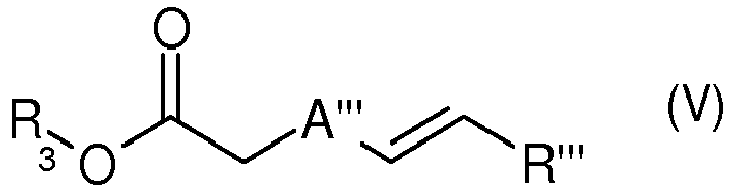
wherein: - A"' and R"' are as defined above in formula (IV), and
- R3 and R4 are as defined above in formula (IV),
- In the above reaction step, the metal hydride is generally used in excess in respect of the compound of formula (V), i.e. in an amount of at least 4 equivalents.
- In the above reaction step, the compound of formula R4O-C(O)-OR4 is generally used in large excess in respect of the compound of formula (V), i.e. in an amount of at least 10 equivalents.
- Preferably, the compound of formula R4O-C(O)-OR4 is dimethyl carbonate.
- The above reaction step is generally carried out at a temperature comprised from 40°C to 80°C, for example at about 60°C.
- The present invention also relates to the use of a compound of formula (I) as defined above, for the preparation of poly(hydroxyurethane)s.
- The present invention also relates to the polymer susceptible to be obtained by polymerization of a compound of formula (I) as defined above and at least one polyamine.
- Said polymer is a poly(hydroxyurethane).
- According to one embodiment, the polyamine is a diamine of formula H2N-B-NH2, wherein B is chosen from the group consisting of:
- a linear or branched alkylene radical in C1-C200, preferably in C1-C30, wherein one or more carbon atom(s) is optionally replaced by an oxygen atom;
- an arylene radical, preferably in C6, optionally functionalized in ortho, meta or para with a linear or branched alkyl group in C1-C10 wherein one or more carbon atom(s) is optionally replaced by an oxygen atom; and
- a radical of formula -B1-B2- wherein:
- o B1 is a cycloalkylene radical in C3-C15, wherein one or more carbon atom(s) is optionally substituted by at least one alkyl group in C1-C15, and
- o B2 is a linear or branched alkylene radical in C1-C15.
- Within the framework of the present invention, the term "arylene" means a monocyclic, dicyclic, or tricyclic divalent aromatic hydrocarbon radical, having 6 to 14 carbon atoms.
- Within the framework of the present invention, the term "cycloalkylene" means a monocyclic, dicyclic, or tricyclic divalent saturated hydrocarbon radical, monocyclic, dicyclic or tricyclic, having 3 to 20 carbon atoms.
- The diamine may be:
- 1,4-diaminobutane (4DA):

- 1,12-diaminododecane (12DA):

- isophorone diamine (IPDA):

- Priamine 1075 from CRODA,
- the diamines derived from dimerized fatty acids, such as diacids Empol® (from BASF) or Unidyme® from Arizona Chemical, or
- a diamine of formula:

- According to one embodiment, the polyamine is a diamine of formula H2N-B-NH2, wherein B is a linear alkylene radical in C2-C24, preferably in C6-C18, for example in C12.
- Preferably, the polyamine is 1,12-diaminododecane.
- When the polyamine is a diamine, such as 12DA, the poly(hydroxyurethane)s of the invention are thermoplastic linear copolymers.
- According to this embodiment, the polymer susceptible to be obtained by polymerization of a compound of formula (I) and a diamine of formula H2N-B-NH2 (also called polymer P1) consists in n repetitive units of formula (U-1):

- According to one embodiment, the polymer P1 may consist in n repetitive units of formula (U-1-1):

- According to another embodiment, the polymer P1 may consist in n repetitive units of formula (U-1-2):

- Preferably, in formulae (U-1), (U-1-1) and (U-1-2), A' and A" are linear alkylene radicals in C6-C12, preferably in C7-C12, for example in C7.
- Preferably, in formula (U-1-2), R' and R" are hydrogen atoms.
- The present invention also relates to a method for preparing the above-defined polymer P1.
- The present invention also relates to a method for preparing the above-defined polymer P1, comprising a step of polymerization of a compound of formula (I) with a diamine of formula H2N-B-NH2 as defined above, said step being carried out in bulk or in a solvent and at a temperature comprised from 20°C to 100°C, preferably from 20°C to 60°C.
- According to the present invention, "in bulk" means that the polymerization is carried out with a mixture consisting of at least one compound of formula (I) and at least one diamine of formula H2N-B-NH2, without any solvent.
- The polymerization is preferably carried out in dimethylformamide. The dilution of the reaction mixture comprising the monomers may be of about 1 mol.L-1. The polymerization is carried out at a temperature comprised from 20°C to 100°C, for example either at room temperature or at 50°C.
- With the 6-membered cyclic biscarbonates of the invention, poly(hydroxyurethane)s are obtained at a lower temperature compared to the corresponding 5-membered cyclic biscarbonates.
- The present invention also relates to the use of the compound of formula (I) as defined above, for the preparation of polycarbonates.
- The present invention also relates to the polymer susceptible to be obtained by homopolymerization of a compound of formula (I) as defined above.
- The present invention also relates to a compound of formula (II-1):

- A' is a linear or branched alkylene radical in C2-C12, preferably in C6-C12, and
- R' is selected from the group consisting of hydrogen atom and linear alkyl radicals in C1-C10.
- According to one embodiment, in formula (II-1), A' is a linear alkylene in C7-C12, for example in C7.
- According to one embodiment, in formula (II-1), R' is a hydrogen atom.
- The compounds of formula (II-1) are also called monocarbonates.
- The present invention also relates to the use of a compound of formula (II-1) as defined above, for the preparation of polycarbonates.
- The compounds of formula (II-1) are useful for the preparation of polymers by polymerization. The monocarbonates of formula (II-1) may be obtained from fatty acids. Thus they represent an interesting way to produce polymer from renewable sources.
- The present invention also relates to the polymer susceptible to be obtained by homopolymerization of a compound of formula (II-1) as defined above (also called polymer P2).
- Said polymer P2 is a linear polycarbonate, preferably a thermoplastic polycarbonate.
- Polycarbonates may be obtained by ring-opening polymerization of the compounds of formula (II-1), preferably in the presence of a catalyst such as a base, in bulk or in a solvent, at a temperature comprised from 50°C to 150°C.
- According to one embodiment, the polymer P2 susceptible to be obtained by polymerization of a compound of formula (II-1) consists in n repetitive units of formula (U-2):

- The present invention also relates to a method for preparing the above-defined polymer P2, comprising a step of polymerization of a compound of formula (II-1) as defined above, said step being carried out in bulk or in a solvent and at a temperature comprised from 30°C to 150°C.
- Methyl 10-undecenoate (>96.0%), dodecane-1,12-diamine (12DA, >98%), 1,3-dioxane-2-one (trimethylene carbonate, >98%), and 4-(hydroxymethyl)-1,3-dioxolan-2-one (glycerol carbonate, 5CCOH, >90%) were supplied by TCI, Europe.
- Dimethyl carbonate (DMC, 99%) and triethyl amine (TEA, 99%), were purchased from Alfa Aesar.
- Sodium hydrate (NaH) (60 % dispersion in mineral oil), N,N-dimethylformamide (DMF, anhydrous grade), lithium aluminum hydride (LiAlH4) (95%), ethyl chloroformate (97%), 1,4-butanedithiol (>97%), ethylvinyl ether (99%), Grubbs 3rd generation metathesis catalyst, hexylamine (99%), and ethylene carbonate (5CC, 98%) were obtained from Sigma-Aldrich.
- Propylene carbonate (5CCMe, 99.5%) was obtained from Fisher.
- All products and solvents (reagent grade) were used as received except otherwise mentioned. The solvents were of reagent grade quality and were purified wherever necessary according to the methods reported in the literature.
-

- The methyl undecenoate (20 g, 100.9 mmol) was stirred with DMC (340 mL, 4.0 mol, 40 eq), NaH via a 60 wt% dispersion in mineral oil (6 g, 252.1 mmol, 2.5 eq) and DMF (7.8-mL, 109.9 mmol, 1 eq) at 60°C. After 24 hours of reaction, 435 mL of diluted hydrochloric acid was slowly added to the reaction mixture. The organic phase was then washed twice with water, dried over anhydrous sodium sulfate, filtered and then the remaining DMC was removed on rotary evaporator. The compound Und-malonate was purified by flash chromatography using a mixture of cyclohexane and ethyl acetate and obtained as a viscous liquid. Yield=58%. 1H NMR (CDCl3, 25°C, 400 MHz) δ (ppm): 5.79 (m, 1 H), 4.95 (m, 2H), 3.73 and 3.71 (s, 6H), 3.35 (t, 1 H), 2.04 (m, 2H), 1.88 (m, 2H), 1.29 (m, 10H). 13C NMR (CDCl3, 25°C, 100 MHz) δ (ppm): 170.12 (COOCH3), 139.28 (CH=CH2), 114.32 (CH=CH2), 52.57 (C=OOCH3), 51.87 (CH-(C=OOCH3)2), 33.89 (CH2-CH=CH2), 29.27-27.46 (CH2). IR (cm-1): 2924, 2854, 1734.
-

- A solution of Und-malonate obtained following Step 1 (10 g, 39.0 mmol) in THF (10 mL) was added to a solution of LiAlH4 (6.1 g, 160.9 mmol, 4.1 eq.) in THF (80 mL) at 0°C. After the addition was completed, the reaction mixture was allowed to reach slowly room temperature and was refluxed at 80°C for 2 h. The reaction mixture was then cooled to 0°C, and distilled water followed by hydrochloric acid solution (2N) was added dropwise. The product was then extracted three times with ethyl acetate. The organic layer was washed twice with NaCl saturated solution and water, dried over anhydrous sodium sulfate, filtered and then the solvent was removed on rotary evaporator. The Und-1,3-diol was purified by flash chromatography using a mixture of cyclohexane and ethyl acetate. Yield=66%. 1H NMR (CDCl3, 25°C, 400 MHz) δ (ppm): 5.81 (m, 1 H), 4.93 (m, 2H), 3.78-3.63 (m, 4H), 2.96 (s, 2.OH), 2.02 (m, 2H), 1.75 (m, 1 H), 1.36-1.22 (m, 12H). 13C NMR (CDCl3, 25°C, 100 MHz) δ (ppm): 139.42 (CH=CH2), 114.41 (CH=CH2), 67.02 (CH-CH2-OH), 42.18 (CH-CH2-OH), 34.02 (CH2-CH=CH2), 30.05-27.44 (CH2). IR (cm-1): 3277, 2919, 2850.
-

- To a solution of triethylamine (10.1 g, 100 mmol, 2 eq.) in THF (400 mL), Und-1,3-diol obtained following Step 2 (10 g, 50 mmol) was added. Then, ethyl chloroformate (10.8 g, 100 mmol) was added to the mixture at 0°C. The reaction mixture was stirred at room temperature for 7 hours. Precipitated triethylamine hydrochloride was filtered off, and the filtrate was concentrated under vacuum. The Und-6CC was isolated from the reaction mixture by flash chromatography using a mixture of cyclohexane and ethyl acetate and obtained as a viscous liquid with 99.5% purity determined by GC-FID. Yield=75%. 1H NMR (CDCl3, 25°C, 400 MHz) δ (ppm): 5.81 (m, 1 H), 4.96 (m, 2H), 4.40 (m, 2H), 4.09 (m, 2H), 2.21 (m, 1 H), 2.05 (m, 2H), 1.35-1.30 (m, 12H). 13C NMR (CDCl3, 25°C, 100 MHz) δ (ppm): 148.72 (OCOO), 139.14 (CH=CH2), 114.42 (CH=CH2), 72.24 (CH2-OCOO), 33.84 (CH2-CH=CH2), 31.39 (CH-CH2-OCOO), 29.53-26.69 (CH2). IR (cm-1): 2924, 2856, 1753.
-

- Into a round-bottom flask equipped with a mineral oil bubbler, the Und-6CC obtained following Step 3 (4 g, 17.7 mmol) was charged with dried pentane (40mL) and 3rd generation Grubbs catalyst (78.2 mg, 0.088 mmol). The contents were vigorously stirred at room temperature for 4 hours. Afterwards, 3.8 mL of ethylvinyl ether was added to deactivate the Grubbs catalyst. The equilibrium was drived thank to the precipitation of the formed product. The product was then purified with flash chromatography using a mixture of cyclohexane and ethyl acetate as eluent. UndC20-b6CC was obtained as a grey solid. Yield=51.5%. 1H NMR (CDCl3, 25°C, 400 MHz) δ (ppm): 5.37 (m, 2H), 4.41 (m, 4H), 4.09 (m, 4H), 2.20 (m, 2H), 1.97 (m, 4H), 1.35-1.28 (m, 22H). 13C NMR (CDCl3, 25°C, 100 MHz) δ (ppm): 148.71 (OCOO), 130.46 (CH=CH), 72.22 (CH-CH2-OCO), 32.55 (CH2-CH=CH), 31.32 (CH-CH2-OCO), 29.25-26.68 (CH2). IR (cm-1): 2918, 2850, 1726. Tm=59°C (melting temperature).
-

- The Und-6CC obtained following Step 3 (4 g, 17.7 mmol) and 1,4-butanedithiol (2.38 g, 19.4 mmol, 1.1 eq.) were weighed into a flask. The reaction mixture was then UV-irradiated (254 nm) at room temperature. The reaction was monitored with 1H NMR spectroscopy with the disappearance of the double bond. After completion of the reaction, UndS-b6CC was purified by recrystallization in a mixture of cyclohexane and ethyl acetate (70:30) and obtained as a white solid. Yield=37%. 1H NMR (CDCl3, 25°C, 400 MHz) δ (ppm): 4.40 (m, 4H), 4.09 (m, 4H), 2.52 (m, 8H), 2.20 (m, 2H), 1.68 (m, 4H), 1.57 (m, 4H), 1.35-1.28 (m, 28H). 13C NMR (CDCl3, 25°C, 100 MHz) δ (ppm): 148.71 (OCOO), 72.24 (CH-CH2-OCO), 32.31 and 31.90 (CH2-S-CH2), 31.42 (CH-CH2-OCO), 29.78 and 26.72 (CH2-CH2-S-CH2-CH2), 29.60-26.72 (CH2). IR (cm-1): 2922, 2850, 1750, 1727. Tm=82°C (melting temperature).
- In order to identify precisely the difference in reactivity between 6-membered and 5-membered cyclic carbonates (activating or not) kinetic experiments have been performed. The monitoring of the kinetic of the reaction was carried out directly in NMR apparatus at the selected temperature. For the different substrates, the conversions were calculated from the decrease of the peaks corresponding to the cyclic carbonates. Then, based on the resulting kinetic curves, the orders of the reactions were determined together with the reaction rate constants.

- Various cyclic carbonate substrates such as trimethylene carbonate, Und-6CC, ethylene carbonate, vinyl ethylene carbonate, glycerol carbonate and propylene carbonate have been investigated on the reaction with hexylamine at 50°C and 1 mol.L-1 in DMSO-d6, using TCB as a reference. Otherwise mentioned, the ratio between cyclic carbonate and amine was 1:1. With the 1H NMR spectra at the initial times, a ratio of 1:1.0 to 1:1.18 was confirmed.
- The kinetic experiments were performed in NMR tube at 50°C and 1 mol.L-1 in DMSO-d6 and with a ratio 1:1 between cyclic carbonate and hexylamine. All reagents were dried before the reaction: on CaH2 for hexylamine and on molecular sieves otherwise. For instance; a pre-solution of trimethyl carbonate (153 mg, 1.5 mmol, 3 eq.) and DMSO-d6 1.5 mL) is first prepared. Then, one third of this solution and trichlorobenzene as internal reference (12.5 µL, 0.1 mmol, 0.2 eq.) were added into an NMR tube. The hexylamine (66 µL, 0.5 mmol, 1 eq.) was then added just before putting the tube in the NRM apparatus. The reaction mixture was then heated at the reaction temperature. The reaction was monitored with 1H NMR spectroscopy with the disappearance of the cyclic carbonate protons. After 7 hours or 15 hours, if the reaction was not completed, the NMR tube was placed in an oil bath at the desired temperature and reanalyzed later. For some experiments, the concentration (0.5 mol.L-1 and 5 mol.L-1) and the temperature (30°C and 70°C) were modulated. 1H NMR, 13C NMR and IR detail are given below only for the reaction between Und-6CC+hexylamine.
- The reaction rate constants kapp for the reaction were calculated according to the 1H NMR values.
- The results are given in the following table:
Cyclic carbonate Concentration (mol.L-1) T (°C) kapp (L.mol-1.h-1) Und-6CC 1 30 0.46 1 50 0.93 1 70 1.92 0.2 50 0.15 5 50 1.77 Trimethylene carbonate 1 50 1.41 1 50 1.86 1 50 1.39 Ethylene carbonate 1 50 0.56 Vinyl ethylene carbonate 1 50 0.37 Glycerol carbonate 1 50 0.17 Propylene carbonate 1 50 0.08 - Product of the reaction between Und-6CC+hexylamine: 1H NMR (DMSO-d6, 70°C, 400 MHz) δ (ppm): 6.71 (NH), 5.79 (m, 1 H), 4.97 (m, 2H), 3.94 (m, 2H), 3.41 (m, 2H), 2.98 (m, 2H), 2.02 (m, 2H), 1.66 (m, 1 H), 1.29 (m, 20H), 0.88 (t, 3H). 13C NMR (DMSO-d6, 70°C, 100 MHz) δ (ppm): 148.72 (OCOO), 139.14 (CH=CH2), 114.62 (CH=CH2), 64.62 (CH-CH2-OCONH), 61.80 (CH-CH2-OH), 41.83 (OH-CH2-CH-CH2-OCONH), 40.8 (CH2-NHCOO), 33.50 (CH2-CH=CH2), 33.65-22.40 (CH2), 13.94 (CH3). IR (cm-1): 3384, 2924, 2858, 1705.
- Poly(hydroxyurethane)s were prepared from the 6-membered cyclic biscarbonates (UndC20-b6CC and UndS-b6CC) and 1,12-diaminododecane (12DA). Poly(hydroxyurethane) syntheses were performed in DMF at room temperature or at 50°C into a schlenk tube under magnetic stirring and nitrogen atmosphere for 2 days. TCB was used as a reference. No catalysts were added for the polymerization reactions. Prior to MALDI-TOF MS analyses, the aliquots were quenched with hexylamine.
- PHU-2[UndC20-b6CC+12DA]: 1H NMR (TCE-d2, 25°C, 400 MHz) δ (ppm): 5.39 (s, 2H), 4.86 (s, 2NH), 4.17-4.02 (m, 4H), 3.52-3.45 (m, 4H), 3.13 (m, 4H), 1.96 (m, 4H), 1.71 (m, 2H), 1.48-1.27 (m, CH2). IR (cm-1): 3620-3158, 2925, 2852, 1686, 1534, 1466, 1266, 1244, 1027, 962.
- PHU-3 [UndS-b6CC+12DA]: 1H NMR (TCE-d2, 25°C, 400 MHz) δ (ppm): 4.89 (s, 2.NH), 4.23-4.09 (m, 4H), 3.58-3.49 (m, 4H), 3.17 (m, 4H), 2.57 (m, 8H), 1.77-1.72 (m, 6H), 1.62 (m, 4H), 1.51-1.33 (m, CH2). IR (cm-1): 3620-3158, 2925, 2852, 1686, 1534, 1466, 1266, 1244, 1027.
- Thermal stability of poly(hydroxyurethane)s was investigated by TGA (Thermal Gravimetric Analysis) under a nitrogen stream at a heating rate of 10°C.min-1. Degradation temperatures after 5 wt% loss were obtained up to 313°C.
- The poly(hydroxyurethane)s were further analyzed by DSC (Differential Scanning Calorimetry) experiments.
- The poly(hydroxyurethane)s from UndC20-b6CC were amorphous and present glass transition temperatures around -0°C.
- The poly(hydroxyurethane) from UndS-b6CC was amorphous as well with a glass transition temperature of -20°C. This lower Tg can be explained by the presence of the sulfur atom, which is known to impart flexibility to the polymer chains.
- Thus, the poly(hydroxyurethane)s obtained from the biscarbonates of the invention are thermoplastic polymers.
Claims (15)
- A compound of formula (I):
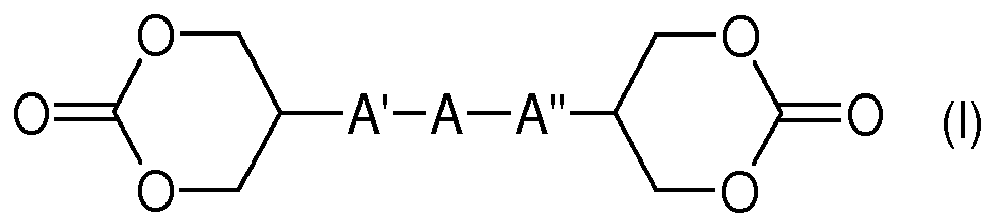 - A is selected from the group consisting of -CH=CH- and -CH2CHR'-S-R-S-CHR"CH2-, wherein R is a linear or branched alkylene radical in C2-C6, preferably in C4, optionally interrupted by one or more oxygen atoms, and wherein R' and R", identical or different, are selected from the group consisting of hydrogen atom and linear alkyl radicals in C1-C10; and- A' and A", identical or different, are linear or branched alkylene radicals in C1-C12, preferably in C6-C12,on the proviso that, when A is -CH2CH2-S-R-S-CH2CH2-, A' and A" are in C2-C12.
 - The compound according to claim 1, wherein the chain -A'-A-A"-comprises from 4 to 30 carbon atoms, preferably from 12 to 30 carbon atoms, advantageously from 16 to 24 carbon atoms.
- The compound according to any one of claim 1 or 2, wherein:- A is -CH=CH-, and- A' and A" are linear alkylene radicals in C6-C12, preferably in C7.
- The compound according to any one of claim 1 or 2, wherein:- A is -CH2CH2-S-R-S-CH2CH2-, R being as defined in claim 1, and- A' and A" are linear alkylene radicals in C6-C12, preferably in C7.
- A compound having one of the following formulae:


- A method for preparing a compound of formula (I) according to any one of claims 1 to 3 wherein A is -CH=CH-, comprising a coupling step by metathesis reaction between a compound of formula (II-1):


said step being carried out in a solvent in the presence of a metathesis catalyst, preferably selected from the Grubbs' catalysts. - A method for preparing a compound of formula (I) according to any one of claims 1, 2 and 4, wherein A is -CH2CHR'-S-R-S-CHR"CH2-, comprising a coupling step by thiol-ene reaction between a compound of formula (II-1):


- The method according to any one of claim 6 or 7, wherein the compound of formula (II-1) and the compound of formula (II-2) are prepared by a cyclization step of a compound of formula (III):

wherein:- A"' represents either A' or A", A' and A" being as defined in any one of claims 1 to 4,- R"' represents either R' or R", R' and R" being as defined in claim 1,- X is OR2, Br or Cl, preferably Cl, and- R1 and R2, identical or different, are linear alkyl radicals in C1-C6, preferably in C1-C2. - The method according to claim 8, wherein the compound of formula (III) is prepared by a reduction step of a compound of formula (IV):
 - A"' and R"' are as defined in claim 8, and- R3 and R4, identical or different, are linear alkyl radicals in C1-C6, preferably in C1,this step being conducted in a solvent in the presence of a metal hydride, such as LiAlH4, or under pressurized H2 in the presence of a catalyst, such as palladium over charcoal.
 - The method according to claim 9, wherein the compound of formula (IV) is prepared by a reaction step between a compound of formula (V):

wherein:- A"' and R"' are as defined in claim 8, and- R3 and R4 are as defined in claim 9,this step being conducted in the presence of dimethylformamide and a metal hydride, such as NaH. - The use of a compound of formula (I) according to any one of claims 1 to 5, for the preparation of poly(hydroxyurethane)s or polycarbonates.
- Polymer susceptible to be obtained by polymerization of a compound of formula (I) according to any one of claims 1 to 5 and at least one polyamine, said polyamine being in particular a diamine of formula H2N-B-NH2, wherein B is a linear alkylene radical in C2-C24, preferably in C6-C18, for example in C12.
- Polymer according to claim 12, said polymer consisting in n repetitive units of formula (U-1):

- Synthesis intermediates having one of the following formulae:


- Polymer susceptible to be obtained by homopolymerization of a compound of formula (II-1) according to claim 14, said polymer preferably consisting in n repetitive units of formula (U-2):

Priority Applications (2)
| Application Number | Priority Date | Filing Date | Title |
|---|---|---|---|
| EP13306735.5A EP2883873A1 (en) | 2013-12-16 | 2013-12-16 | Six-membered cyclic biscarbonates for the preparation of polymers |
| PCT/EP2014/077983 WO2015091499A1 (en) | 2013-12-16 | 2014-12-16 | Six-membered cyclic biscarbonates |
Applications Claiming Priority (1)
| Application Number | Priority Date | Filing Date | Title |
|---|---|---|---|
| EP13306735.5A EP2883873A1 (en) | 2013-12-16 | 2013-12-16 | Six-membered cyclic biscarbonates for the preparation of polymers |
Publications (1)
| Publication Number | Publication Date |
|---|---|
| EP2883873A1 true EP2883873A1 (en) | 2015-06-17 |
Family
ID=49989453
Family Applications (1)
| Application Number | Title | Priority Date | Filing Date |
|---|---|---|---|
| EP13306735.5A Withdrawn EP2883873A1 (en) | 2013-12-16 | 2013-12-16 | Six-membered cyclic biscarbonates for the preparation of polymers |
Country Status (2)
| Country | Link |
|---|---|
| EP (1) | EP2883873A1 (en) |
| WO (1) | WO2015091499A1 (en) |
Cited By (2)
| Publication number | Priority date | Publication date | Assignee | Title |
|---|---|---|---|---|
| CN111393680A (en) * | 2020-04-01 | 2020-07-10 | 四川大学 | Recyclable rubber and preparation method thereof |
| CN111484613A (en) * | 2020-06-09 | 2020-08-04 | 广西民族大学 | A kind of temperature-sensitive non-isocyanate polyurethane and its preparation method and application |
Citations (1)
| Publication number | Priority date | Publication date | Assignee | Title |
|---|---|---|---|---|
| JP2001131170A (en) * | 1999-10-29 | 2001-05-15 | Japan Chemical Innovation Institute | Method for producing polyfunctional six-membered ring carbonate compound and polyfunctional six-membered ring carbonate compound |
-
2013
- 2013-12-16 EP EP13306735.5A patent/EP2883873A1/en not_active Withdrawn
-
2014
- 2014-12-16 WO PCT/EP2014/077983 patent/WO2015091499A1/en not_active Ceased
Patent Citations (1)
| Publication number | Priority date | Publication date | Assignee | Title |
|---|---|---|---|---|
| JP2001131170A (en) * | 1999-10-29 | 2001-05-15 | Japan Chemical Innovation Institute | Method for producing polyfunctional six-membered ring carbonate compound and polyfunctional six-membered ring carbonate compound |
Non-Patent Citations (9)
| Title |
|---|
| B. K. WASSON ET AL: "TETRAHYDROFURANS I. 2,2-DIILlETIIYL-4-SUBSTITUTED-4-HYDROXYMETHYLTETRAHYDROFURANS AND RELATED COMPOUNDS1", CANADIAN JOURNAL OF CHEMISTRY, vol. 39, 1 January 1961 (1961-01-01), pages 923 - 932, XP055101485 * |
| G M RAMOS ET AL: "SYNTHESIS OF BOTH ENANTlOMERlC FORMS OF 2-SUBSTITUTED 1.3-PROPANEDIOL MONOACETATES STARTING FROM A COMP'ON PROCHIRAL PRECURSOR, USING ENZYMATIC TRANSFORMATIONS IN AQUEOUS AND IN ORGANIC MEDIA", 1 January 1986 (1986-01-01), pages 5707 - 5710, XP055101488, Retrieved from the Internet <URL:http://www.sciencedirect.com/science/article/pii/S004040390085306X/pdf?md5=f70c9f8963659eaabd96be3202329ace&pid=1-s2.0-S004040390085306X-main.pdf> [retrieved on 20140211] * |
| GUY FOURNET ET AL: "Formation de cyclopentanes lors de reactions de heck", TETRAHEDRON, vol. 4600, 1 January 1990 (1990-01-01), pages 7763 - 7774, XP055101561 * |
| HANESSIAN S ET AL: "DESIGN AND SYNTHESIS OF A CEPHALOSPRORIN-CARBOPLATINUM PRODRUG ACTIVATABLE BY A BETA-LACTAMASE", CANADIAN JOURNAL OF CHEMISTRY, NRC RESEARCH PRESS, CA, vol. 71, no. 6, 1 January 1993 (1993-01-01), pages 896, XP009025793, ISSN: 0008-4042, DOI: 10.1139/V93-119 * |
| HIDETOSHI TOMITA ET AL: "Polyaddition Behavior of bis(Five- and Six-Membered Cyclic Carbonate)s with Diamine", JOURNAL OF POLYMER SCIENCE PART A: POLYMER CHEMISTRY, WILEY, vol. 39, 1 January 2001 (2001-01-01), pages 860 - 867, XP007921630, ISSN: 0887-624X * |
| T LESIAK ET AL: "Neue Polyole aus 2-Furaldehyd und deren Verwendung zur Synthese von Polyurethanen New Polyole from Furfural and their Application for the Syntheses of Polyurethanes", JOURNAL FÜR PRAKTISCHE CHEMIE, vol. 324, 1 January 1982 (1982-01-01), pages 673 - 681, XP055101558 * |
| TOMITA ET AL., JOURNAL OF POLYMER SCIENCE PART A: POLYMER CHEMISTRY, vol. 39, 2000, pages 162 - 168 |
| TOMITA ET AL., JOURNAL OF POLYMER SCIENCE PART A: POLYMER CHEMISTRY, vol. 39, 2001, pages 4091 - 4100 |
| TOMITA ET AL., JOURNAL OF POLYMER SCIENCE PART A: POLYMER CHEMISTRY, vol. 39, 2001, pages 860 - 867 |
Cited By (4)
| Publication number | Priority date | Publication date | Assignee | Title |
|---|---|---|---|---|
| CN111393680A (en) * | 2020-04-01 | 2020-07-10 | 四川大学 | Recyclable rubber and preparation method thereof |
| CN111393680B (en) * | 2020-04-01 | 2021-04-13 | 四川大学 | A kind of recyclable rubber and preparation method thereof |
| CN111484613A (en) * | 2020-06-09 | 2020-08-04 | 广西民族大学 | A kind of temperature-sensitive non-isocyanate polyurethane and its preparation method and application |
| CN111484613B (en) * | 2020-06-09 | 2022-07-12 | 广西民族大学 | Temperature-sensitive non-isocyanate polyurethane and preparation method and application thereof |
Also Published As
| Publication number | Publication date |
|---|---|
| WO2015091499A1 (en) | 2015-06-25 |
Similar Documents
| Publication | Publication Date | Title |
|---|---|---|
| van Velthoven et al. | Poly (hydroxy urethane) s based on renewable diglycerol dicarbonate | |
| JP4358317B2 (en) | Triazine ring-containing compound | |
| Maisonneuve et al. | Novel green fatty acid-based bis-cyclic carbonates for the synthesis of isocyanate-free poly (hydroxyurethane amide) s | |
| He et al. | Synthesis, characterization, and application of a bifunctional coupler containing a five-and a six-membered ring carbonate | |
| JP6453888B2 (en) | 5-membered ring biscarbonates with amide linking groups, their preparation and their use for the preparation of polymers | |
| US20140378648A1 (en) | Method for preparing a compound comprising at least one beta-hydroxy-urethane unit and/or at least one upsilon-hydroxy-urethane unit | |
| AU2014301613B2 (en) | 2-oxo-1,3-dioxolane-4-acyl halides, their preparation and use | |
| EP2280977B1 (en) | Method for producing bicyclic guanidines by use of a cyclic thiourea | |
| KR102828201B1 (en) | Monomers comprising at least one 4-(2-oxyethylidene)-1,3-dioxolan-2-one unit and uses thereof | |
| WO2015091499A1 (en) | Six-membered cyclic biscarbonates | |
| KR101685400B1 (en) | Process for producing 1-substituted 3,5-diaminobenzen, and compounds using thereof and process for their production | |
| JP7594368B2 (en) | Method for producing bifunctional cyclic carbonate having a spiro structure and method for producing polyhydroxyurethane | |
| JP5615372B2 (en) | Polyurethane synthesis by self-condensation | |
| JP2012036155A (en) | Bis(oxetane vinyl ether) compound, and method for producing the same | |
| Relles et al. | Dichloromaleimide chemistry. IV. Preparation of poly (maleimide–ethers) from the reaction of bisdichloromaleimides with bisphenols | |
| Okamoto et al. | Synthesis of reactive polyureas bearing vinylcyclopropane moiety in main chain and their radical cross‐linking with multifunctional thiols | |
| CN112442070A (en) | Phosphorus-containing flame retardant with isocyanate group and preparation method and application thereof | |
| US8901355B2 (en) | Dendrimers and methods for their preparation | |
| Hagiwara et al. | Preparation of Novel Poly [2] catenanes by Direct Bonding of [2] Catenanes | |
| CN119841787A (en) | Preparation method of polyurethane with controllable main chain function and sequence | |
| Kricheldorf et al. | Polymers of carbonic acid—7. Synthesis and characterization of aliphatic polyallophanates | |
| Burdukovskii et al. | Synthesis of aromatic polyamides from dinitriles and bisphenols in ionic liquids | |
| Lu et al. | Synthesis of diols containing nucleic acid bases and their polyesters | |
| Nobis et al. | Poly (arylazophosphonate) s: New Arylazophosphonate‐Containing Monomers for Synthesis of Laser‐Structurable Polymers | |
| JP2018177718A (en) | Benzoxazine compounds and benzoxazine resins |
Legal Events
| Date | Code | Title | Description |
|---|---|---|---|
| PUAI | Public reference made under article 153(3) epc to a published international application that has entered the european phase |
Free format text: ORIGINAL CODE: 0009012 |
|
| 17P | Request for examination filed |
Effective date: 20131216 |
|
| AK | Designated contracting states |
Kind code of ref document: A1 Designated state(s): AL AT BE BG CH CY CZ DE DK EE ES FI FR GB GR HR HU IE IS IT LI LT LU LV MC MK MT NL NO PL PT RO RS SE SI SK SM TR |
|
| AX | Request for extension of the european patent |
Extension state: BA ME |
|
| STAA | Information on the status of an ep patent application or granted ep patent |
Free format text: STATUS: THE APPLICATION IS DEEMED TO BE WITHDRAWN |
|
| 18D | Application deemed to be withdrawn |
Effective date: 20151218 |