EP2883869A1 - Crystals containing unsaturated carboxylic acid amide compound and method for producing same - Google Patents
Crystals containing unsaturated carboxylic acid amide compound and method for producing same Download PDFInfo
- Publication number
- EP2883869A1 EP2883869A1 EP13828290.0A EP13828290A EP2883869A1 EP 2883869 A1 EP2883869 A1 EP 2883869A1 EP 13828290 A EP13828290 A EP 13828290A EP 2883869 A1 EP2883869 A1 EP 2883869A1
- Authority
- EP
- European Patent Office
- Prior art keywords
- carboxylic acid
- unsaturated carboxylic
- formula
- crystal
- acid amide
- Prior art date
- Legal status (The legal status is an assumption and is not a legal conclusion. Google has not performed a legal analysis and makes no representation as to the accuracy of the status listed.)
- Withdrawn
Links
- 239000013078 crystal Substances 0.000 title claims abstract description 82
- 150000001732 carboxylic acid derivatives Chemical class 0.000 title claims abstract description 64
- 150000001875 compounds Chemical class 0.000 title claims description 45
- 238000004519 manufacturing process Methods 0.000 title claims description 16
- 125000004432 carbon atom Chemical group C* 0.000 claims abstract description 27
- 125000003118 aryl group Chemical group 0.000 claims abstract description 20
- 125000000217 alkyl group Chemical group 0.000 claims abstract description 19
- 229910052739 hydrogen Inorganic materials 0.000 claims abstract description 15
- 239000001257 hydrogen Substances 0.000 claims abstract description 15
- 125000004435 hydrogen atom Chemical group [H]* 0.000 claims abstract description 15
- 125000003545 alkoxy group Chemical group 0.000 claims abstract description 9
- 125000002883 imidazolyl group Chemical group 0.000 claims abstract description 8
- 125000002887 hydroxy group Chemical group [H]O* 0.000 claims abstract description 7
- 125000000449 nitro group Chemical group [O-][N+](*)=O 0.000 claims abstract description 7
- 238000006243 chemical reaction Methods 0.000 claims description 63
- FYSNRJHAOHDILO-UHFFFAOYSA-N thionyl chloride Chemical compound ClS(Cl)=O FYSNRJHAOHDILO-UHFFFAOYSA-N 0.000 claims description 54
- 238000000034 method Methods 0.000 claims description 35
- RAXXELZNTBOGNW-UHFFFAOYSA-N imidazole Natural products C1=CNC=N1 RAXXELZNTBOGNW-UHFFFAOYSA-N 0.000 claims description 30
- 238000002425 crystallisation Methods 0.000 claims description 27
- 230000008025 crystallization Effects 0.000 claims description 27
- ZAMOUSCENKQFHK-UHFFFAOYSA-N Chlorine atom Chemical compound [Cl] ZAMOUSCENKQFHK-UHFFFAOYSA-N 0.000 claims description 18
- 239000000460 chlorine Substances 0.000 claims description 18
- 229910052801 chlorine Inorganic materials 0.000 claims description 18
- XLYOFNOQVPJJNP-UHFFFAOYSA-N water Substances O XLYOFNOQVPJJNP-UHFFFAOYSA-N 0.000 claims description 16
- 238000002441 X-ray diffraction Methods 0.000 claims description 14
- -1 imidazole compound Chemical class 0.000 claims description 13
- 239000007795 chemical reaction product Substances 0.000 claims description 11
- 238000004458 analytical method Methods 0.000 claims description 9
- 239000003463 adsorbent Substances 0.000 claims description 6
- 238000004817 gas chromatography Methods 0.000 claims description 4
- 238000002347 injection Methods 0.000 claims description 4
- 239000007924 injection Substances 0.000 claims description 4
- 238000010438 heat treatment Methods 0.000 claims description 3
- 239000000463 material Substances 0.000 abstract description 20
- 239000003905 agrochemical Substances 0.000 abstract description 5
- 239000003814 drug Substances 0.000 abstract description 5
- 239000000543 intermediate Substances 0.000 abstract description 5
- 239000012847 fine chemical Substances 0.000 abstract description 4
- 239000008204 material by function Substances 0.000 abstract description 4
- 239000002904 solvent Substances 0.000 description 37
- YXFVVABEGXRONW-UHFFFAOYSA-N Toluene Chemical compound CC1=CC=CC=C1 YXFVVABEGXRONW-UHFFFAOYSA-N 0.000 description 30
- XEKOWRVHYACXOJ-UHFFFAOYSA-N Ethyl acetate Chemical compound CCOC(C)=O XEKOWRVHYACXOJ-UHFFFAOYSA-N 0.000 description 18
- 239000012761 high-performance material Substances 0.000 description 14
- 239000004065 semiconductor Substances 0.000 description 13
- 238000000746 purification Methods 0.000 description 12
- 239000007789 gas Substances 0.000 description 11
- RTZKZFJDLAIYFH-UHFFFAOYSA-N Diethyl ether Chemical compound CCOCC RTZKZFJDLAIYFH-UHFFFAOYSA-N 0.000 description 10
- UHOVQNZJYSORNB-UHFFFAOYSA-N Benzene Chemical compound C1=CC=CC=C1 UHOVQNZJYSORNB-UHFFFAOYSA-N 0.000 description 9
- ZMANZCXQSJIPKH-UHFFFAOYSA-N Triethylamine Chemical compound CCN(CC)CC ZMANZCXQSJIPKH-UHFFFAOYSA-N 0.000 description 9
- 238000000926 separation method Methods 0.000 description 8
- 239000000126 substance Substances 0.000 description 8
- AFDXODALSZRGIH-QPJJXVBHSA-N (E)-3-(4-methoxyphenyl)prop-2-enoic acid Chemical compound COC1=CC=C(\C=C\C(O)=O)C=C1 AFDXODALSZRGIH-QPJJXVBHSA-N 0.000 description 7
- AFDXODALSZRGIH-UHFFFAOYSA-N p-coumaric acid methyl ether Natural products COC1=CC=C(C=CC(O)=O)C=C1 AFDXODALSZRGIH-UHFFFAOYSA-N 0.000 description 7
- 239000000203 mixture Substances 0.000 description 6
- VLKZOEOYAKHREP-UHFFFAOYSA-N n-Hexane Chemical compound CCCCCC VLKZOEOYAKHREP-UHFFFAOYSA-N 0.000 description 6
- 239000000047 product Substances 0.000 description 6
- 230000002378 acidificating effect Effects 0.000 description 5
- 150000001412 amines Chemical class 0.000 description 5
- 150000004945 aromatic hydrocarbons Chemical class 0.000 description 5
- 238000005660 chlorination reaction Methods 0.000 description 5
- 238000004821 distillation Methods 0.000 description 5
- 238000005406 washing Methods 0.000 description 5
- CSCPPACGZOOCGX-UHFFFAOYSA-N Acetone Chemical compound CC(C)=O CSCPPACGZOOCGX-UHFFFAOYSA-N 0.000 description 4
- XTHFKEDIFFGKHM-UHFFFAOYSA-N Dimethoxyethane Chemical compound COCCOC XTHFKEDIFFGKHM-UHFFFAOYSA-N 0.000 description 4
- IMNFDUFMRHMDMM-UHFFFAOYSA-N N-Heptane Chemical compound CCCCCCC IMNFDUFMRHMDMM-UHFFFAOYSA-N 0.000 description 4
- OFBQJSOFQDEBGM-UHFFFAOYSA-N Pentane Chemical compound CCCCC OFBQJSOFQDEBGM-UHFFFAOYSA-N 0.000 description 4
- UIIMBOGNXHQVGW-UHFFFAOYSA-M Sodium bicarbonate Chemical compound [Na+].OC([O-])=O UIIMBOGNXHQVGW-UHFFFAOYSA-M 0.000 description 4
- WYURNTSHIVDZCO-UHFFFAOYSA-N Tetrahydrofuran Chemical compound C1CCOC1 WYURNTSHIVDZCO-UHFFFAOYSA-N 0.000 description 4
- 238000009835 boiling Methods 0.000 description 4
- 230000000052 comparative effect Effects 0.000 description 4
- 238000001035 drying Methods 0.000 description 4
- 238000000605 extraction Methods 0.000 description 4
- 238000011049 filling Methods 0.000 description 4
- 150000008282 halocarbons Chemical class 0.000 description 4
- 239000004973 liquid crystal related substance Substances 0.000 description 4
- 239000012044 organic layer Substances 0.000 description 4
- 239000005022 packaging material Substances 0.000 description 4
- 238000001179 sorption measurement Methods 0.000 description 4
- CGOJOQBYEAVATL-QPJJXVBHSA-N (e)-3-(4-methoxyphenyl)prop-2-enoyl chloride Chemical compound COC1=CC=C(\C=C\C(Cl)=O)C=C1 CGOJOQBYEAVATL-QPJJXVBHSA-N 0.000 description 3
- UQGJAZKPYKZBSG-UHFFFAOYSA-N 1-imidazol-1-yl-3-(4-methoxyphenyl)prop-2-en-1-one Chemical compound C1=CC(OC)=CC=C1C=CC(=O)N1C=NC=C1 UQGJAZKPYKZBSG-UHFFFAOYSA-N 0.000 description 3
- ZWEHNKRNPOVVGH-UHFFFAOYSA-N 2-Butanone Chemical compound CCC(C)=O ZWEHNKRNPOVVGH-UHFFFAOYSA-N 0.000 description 3
- WEVYAHXRMPXWCK-UHFFFAOYSA-N Acetonitrile Chemical compound CC#N WEVYAHXRMPXWCK-UHFFFAOYSA-N 0.000 description 3
- OKTJSMMVPCPJKN-UHFFFAOYSA-N Carbon Chemical group [C] OKTJSMMVPCPJKN-UHFFFAOYSA-N 0.000 description 3
- YMWUJEATGCHHMB-UHFFFAOYSA-N Dichloromethane Chemical compound ClCCl YMWUJEATGCHHMB-UHFFFAOYSA-N 0.000 description 3
- ZMXDDKWLCZADIW-UHFFFAOYSA-N N,N-Dimethylformamide Chemical compound CN(C)C=O ZMXDDKWLCZADIW-UHFFFAOYSA-N 0.000 description 3
- KWYUFKZDYYNOTN-UHFFFAOYSA-M Potassium hydroxide Chemical compound [OH-].[K+] KWYUFKZDYYNOTN-UHFFFAOYSA-M 0.000 description 3
- RWRDLPDLKQPQOW-UHFFFAOYSA-N Pyrrolidine Chemical compound C1CCNC1 RWRDLPDLKQPQOW-UHFFFAOYSA-N 0.000 description 3
- HEMHJVSKTPXQMS-UHFFFAOYSA-M Sodium hydroxide Chemical compound [OH-].[Na+] HEMHJVSKTPXQMS-UHFFFAOYSA-M 0.000 description 3
- JFDZBHWFFUWGJE-UHFFFAOYSA-N benzonitrile Chemical compound N#CC1=CC=CC=C1 JFDZBHWFFUWGJE-UHFFFAOYSA-N 0.000 description 3
- 239000006227 byproduct Substances 0.000 description 3
- 239000007810 chemical reaction solvent Substances 0.000 description 3
- 239000003795 chemical substances by application Substances 0.000 description 3
- 238000001816 cooling Methods 0.000 description 3
- 238000007872 degassing Methods 0.000 description 3
- UAOMVDZJSHZZME-UHFFFAOYSA-N diisopropylamine Chemical compound CC(C)NC(C)C UAOMVDZJSHZZME-UHFFFAOYSA-N 0.000 description 3
- 238000004090 dissolution Methods 0.000 description 3
- 125000001495 ethyl group Chemical group [H]C([H])([H])C([H])([H])* 0.000 description 3
- 238000001914 filtration Methods 0.000 description 3
- 125000002496 methyl group Chemical group [H]C([H])([H])* 0.000 description 3
- 238000000199 molecular distillation Methods 0.000 description 3
- 125000001997 phenyl group Chemical group [H]C1=C([H])C([H])=C(*)C([H])=C1[H] 0.000 description 3
- 239000000843 powder Substances 0.000 description 3
- 125000001436 propyl group Chemical group [H]C([*])([H])C([H])([H])C([H])([H])[H] 0.000 description 3
- 239000002994 raw material Substances 0.000 description 3
- 239000000243 solution Substances 0.000 description 3
- 239000013076 target substance Substances 0.000 description 3
- RYHBNJHYFVUHQT-UHFFFAOYSA-N 1,4-Dioxane Chemical compound C1COCCO1 RYHBNJHYFVUHQT-UHFFFAOYSA-N 0.000 description 2
- DURPTKYDGMDSBL-UHFFFAOYSA-N 1-butoxybutane Chemical compound CCCCOCCCC DURPTKYDGMDSBL-UHFFFAOYSA-N 0.000 description 2
- VVJKKWFAADXIJK-UHFFFAOYSA-N Allylamine Chemical compound NCC=C VVJKKWFAADXIJK-UHFFFAOYSA-N 0.000 description 2
- PAYRUJLWNCNPSJ-UHFFFAOYSA-N Aniline Chemical compound NC1=CC=CC=C1 PAYRUJLWNCNPSJ-UHFFFAOYSA-N 0.000 description 2
- HEDRZPFGACZZDS-UHFFFAOYSA-N Chloroform Chemical compound ClC(Cl)Cl HEDRZPFGACZZDS-UHFFFAOYSA-N 0.000 description 2
- RGSFGYAAUTVSQA-UHFFFAOYSA-N Cyclopentane Chemical compound C1CCCC1 RGSFGYAAUTVSQA-UHFFFAOYSA-N 0.000 description 2
- ZAFNJMIOTHYJRJ-UHFFFAOYSA-N Diisopropyl ether Chemical compound CC(C)OC(C)C ZAFNJMIOTHYJRJ-UHFFFAOYSA-N 0.000 description 2
- ROSDSFDQCJNGOL-UHFFFAOYSA-N Dimethylamine Chemical compound CNC ROSDSFDQCJNGOL-UHFFFAOYSA-N 0.000 description 2
- IAZDPXIOMUYVGZ-UHFFFAOYSA-N Dimethylsulphoxide Chemical compound CS(C)=O IAZDPXIOMUYVGZ-UHFFFAOYSA-N 0.000 description 2
- QUSNBJAOOMFDIB-UHFFFAOYSA-N Ethylamine Chemical compound CCN QUSNBJAOOMFDIB-UHFFFAOYSA-N 0.000 description 2
- VEXZGXHMUGYJMC-UHFFFAOYSA-N Hydrochloric acid Chemical compound Cl VEXZGXHMUGYJMC-UHFFFAOYSA-N 0.000 description 2
- CPLXHLVBOLITMK-UHFFFAOYSA-N Magnesium oxide Chemical compound [Mg]=O CPLXHLVBOLITMK-UHFFFAOYSA-N 0.000 description 2
- BAVYZALUXZFZLV-UHFFFAOYSA-N Methylamine Chemical compound NC BAVYZALUXZFZLV-UHFFFAOYSA-N 0.000 description 2
- YNAVUWVOSKDBBP-UHFFFAOYSA-N Morpholine Chemical compound C1COCCN1 YNAVUWVOSKDBBP-UHFFFAOYSA-N 0.000 description 2
- AFBPFSWMIHJQDM-UHFFFAOYSA-N N-methylaniline Chemical compound CNC1=CC=CC=C1 AFBPFSWMIHJQDM-UHFFFAOYSA-N 0.000 description 2
- UFWIBTONFRDIAS-UHFFFAOYSA-N Naphthalene Chemical compound C1=CC=CC2=CC=CC=C21 UFWIBTONFRDIAS-UHFFFAOYSA-N 0.000 description 2
- GLUUGHFHXGJENI-UHFFFAOYSA-N Piperazine Chemical compound C1CNCCN1 GLUUGHFHXGJENI-UHFFFAOYSA-N 0.000 description 2
- NQRYJNQNLNOLGT-UHFFFAOYSA-N Piperidine Chemical compound C1CCNCC1 NQRYJNQNLNOLGT-UHFFFAOYSA-N 0.000 description 2
- JUJWROOIHBZHMG-UHFFFAOYSA-N Pyridine Chemical compound C1=CC=NC=C1 JUJWROOIHBZHMG-UHFFFAOYSA-N 0.000 description 2
- VYPSYNLAJGMNEJ-UHFFFAOYSA-N Silicium dioxide Chemical compound O=[Si]=O VYPSYNLAJGMNEJ-UHFFFAOYSA-N 0.000 description 2
- CDBYLPFSWZWCQE-UHFFFAOYSA-L Sodium Carbonate Chemical compound [Na+].[Na+].[O-]C([O-])=O CDBYLPFSWZWCQE-UHFFFAOYSA-L 0.000 description 2
- RAHZWNYVWXNFOC-UHFFFAOYSA-N Sulphur dioxide Chemical compound O=S=O RAHZWNYVWXNFOC-UHFFFAOYSA-N 0.000 description 2
- 238000010521 absorption reaction Methods 0.000 description 2
- ORILYTVJVMAKLC-UHFFFAOYSA-N adamantane Chemical compound C1C(C2)CC3CC1CC2C3 ORILYTVJVMAKLC-UHFFFAOYSA-N 0.000 description 2
- 230000002411 adverse Effects 0.000 description 2
- WGQKYBSKWIADBV-UHFFFAOYSA-N benzylamine Chemical compound NCC1=CC=CC=C1 WGQKYBSKWIADBV-UHFFFAOYSA-N 0.000 description 2
- 230000015572 biosynthetic process Effects 0.000 description 2
- QARVLSVVCXYDNA-UHFFFAOYSA-N bromobenzene Chemical compound BrC1=CC=CC=C1 QARVLSVVCXYDNA-UHFFFAOYSA-N 0.000 description 2
- HQABUPZFAYXKJW-UHFFFAOYSA-N butan-1-amine Chemical compound CCCCN HQABUPZFAYXKJW-UHFFFAOYSA-N 0.000 description 2
- 125000000484 butyl group Chemical group [H]C([*])([H])C([H])([H])C([H])([H])C([H])([H])[H] 0.000 description 2
- MVPPADPHJFYWMZ-UHFFFAOYSA-N chlorobenzene Chemical compound ClC1=CC=CC=C1 MVPPADPHJFYWMZ-UHFFFAOYSA-N 0.000 description 2
- 238000004587 chromatography analysis Methods 0.000 description 2
- HGCIXCUEYOPUTN-UHFFFAOYSA-N cyclohexene Chemical compound C1CCC=CC1 HGCIXCUEYOPUTN-UHFFFAOYSA-N 0.000 description 2
- PAFZNILMFXTMIY-UHFFFAOYSA-N cyclohexylamine Chemical compound NC1CCCCC1 PAFZNILMFXTMIY-UHFFFAOYSA-N 0.000 description 2
- 230000018044 dehydration Effects 0.000 description 2
- 238000006297 dehydration reaction Methods 0.000 description 2
- JQVDAXLFBXTEQA-UHFFFAOYSA-N dibutylamine Chemical compound CCCCNCCCC JQVDAXLFBXTEQA-UHFFFAOYSA-N 0.000 description 2
- DMBHHRLKUKUOEG-UHFFFAOYSA-N diphenylamine Chemical compound C=1C=CC=CC=1NC1=CC=CC=C1 DMBHHRLKUKUOEG-UHFFFAOYSA-N 0.000 description 2
- 239000006185 dispersion Substances 0.000 description 2
- 230000000694 effects Effects 0.000 description 2
- 239000004210 ether based solvent Substances 0.000 description 2
- IXCSERBJSXMMFS-UHFFFAOYSA-N hydrogen chloride Substances Cl.Cl IXCSERBJSXMMFS-UHFFFAOYSA-N 0.000 description 2
- 229910000041 hydrogen chloride Inorganic materials 0.000 description 2
- 239000012535 impurity Substances 0.000 description 2
- 125000001449 isopropyl group Chemical group [H]C([H])([H])C([H])(*)C([H])([H])[H] 0.000 description 2
- 238000005259 measurement Methods 0.000 description 2
- SKTCDJAMAYNROS-UHFFFAOYSA-N methoxycyclopentane Chemical compound COC1CCCC1 SKTCDJAMAYNROS-UHFFFAOYSA-N 0.000 description 2
- 125000001624 naphthyl group Chemical group 0.000 description 2
- TVMXDCGIABBOFY-UHFFFAOYSA-N octane Chemical compound CCCCCCCC TVMXDCGIABBOFY-UHFFFAOYSA-N 0.000 description 2
- 239000002245 particle Substances 0.000 description 2
- DPBLXKKOBLCELK-UHFFFAOYSA-N pentan-1-amine Chemical compound CCCCCN DPBLXKKOBLCELK-UHFFFAOYSA-N 0.000 description 2
- 239000003208 petroleum Substances 0.000 description 2
- BWHMMNNQKKPAPP-UHFFFAOYSA-L potassium carbonate Chemical compound [K+].[K+].[O-]C([O-])=O BWHMMNNQKKPAPP-UHFFFAOYSA-L 0.000 description 2
- WGYKZJWCGVVSQN-UHFFFAOYSA-N propylamine Chemical compound CCCN WGYKZJWCGVVSQN-UHFFFAOYSA-N 0.000 description 2
- 239000000376 reactant Substances 0.000 description 2
- 230000000630 rising effect Effects 0.000 description 2
- 229920006395 saturated elastomer Polymers 0.000 description 2
- 229930195734 saturated hydrocarbon Natural products 0.000 description 2
- 230000035945 sensitivity Effects 0.000 description 2
- 239000000741 silica gel Substances 0.000 description 2
- 229910002027 silica gel Inorganic materials 0.000 description 2
- 229910000030 sodium bicarbonate Inorganic materials 0.000 description 2
- 235000017557 sodium bicarbonate Nutrition 0.000 description 2
- 125000001424 substituent group Chemical group 0.000 description 2
- HXJUTPCZVOIRIF-UHFFFAOYSA-N sulfolane Chemical compound O=S1(=O)CCCC1 HXJUTPCZVOIRIF-UHFFFAOYSA-N 0.000 description 2
- 239000000725 suspension Substances 0.000 description 2
- YLQBMQCUIZJEEH-UHFFFAOYSA-N tetrahydrofuran Natural products C=1C=COC=1 YLQBMQCUIZJEEH-UHFFFAOYSA-N 0.000 description 2
- 229930195735 unsaturated hydrocarbon Natural products 0.000 description 2
- 239000008096 xylene Substances 0.000 description 2
- 150000003738 xylenes Chemical class 0.000 description 2
- WSLDOOZREJYCGB-UHFFFAOYSA-N 1,2-Dichloroethane Chemical compound ClCCCl WSLDOOZREJYCGB-UHFFFAOYSA-N 0.000 description 1
- RAIPHJJURHTUIC-UHFFFAOYSA-N 1,3-thiazol-2-amine Chemical compound NC1=NC=CS1 RAIPHJJURHTUIC-UHFFFAOYSA-N 0.000 description 1
- BMVXCPBXGZKUPN-UHFFFAOYSA-N 1-hexanamine Chemical compound CCCCCCN BMVXCPBXGZKUPN-UHFFFAOYSA-N 0.000 description 1
- RUFPHBVGCFYCNW-UHFFFAOYSA-N 1-naphthylamine Chemical compound C1=CC=C2C(N)=CC=CC2=C1 RUFPHBVGCFYCNW-UHFFFAOYSA-N 0.000 description 1
- WJFKNYWRSNBZNX-UHFFFAOYSA-N 10H-phenothiazine Chemical compound C1=CC=C2NC3=CC=CC=C3SC2=C1 WJFKNYWRSNBZNX-UHFFFAOYSA-N 0.000 description 1
- HYZJCKYKOHLVJF-UHFFFAOYSA-N 1H-benzimidazole Chemical compound C1=CC=C2NC=NC2=C1 HYZJCKYKOHLVJF-UHFFFAOYSA-N 0.000 description 1
- CDULGHZNHURECF-UHFFFAOYSA-N 2,3-dimethylaniline 2,4-dimethylaniline 2,5-dimethylaniline 2,6-dimethylaniline 3,4-dimethylaniline 3,5-dimethylaniline Chemical group CC1=CC=C(N)C(C)=C1.CC1=CC=C(C)C(N)=C1.CC1=CC(C)=CC(N)=C1.CC1=CC=C(N)C=C1C.CC1=CC=CC(N)=C1C.CC1=CC=CC(C)=C1N CDULGHZNHURECF-UHFFFAOYSA-N 0.000 description 1
- BOBATFKNMFWLFG-UHFFFAOYSA-N 2-amino-2-cyano-n-methylacetamide Chemical compound CNC(=O)C(N)C#N BOBATFKNMFWLFG-UHFFFAOYSA-N 0.000 description 1
- LTHNHFOGQMKPOV-UHFFFAOYSA-N 2-ethylhexan-1-amine Chemical compound CCCCC(CC)CN LTHNHFOGQMKPOV-UHFFFAOYSA-N 0.000 description 1
- LXBGSDVWAMZHDD-UHFFFAOYSA-N 2-methyl-1h-imidazole Chemical compound CC1=NC=CN1 LXBGSDVWAMZHDD-UHFFFAOYSA-N 0.000 description 1
- DWYHDSLIWMUSOO-UHFFFAOYSA-N 2-phenyl-1h-benzimidazole Chemical compound C1=CC=CC=C1C1=NC2=CC=CC=C2N1 DWYHDSLIWMUSOO-UHFFFAOYSA-N 0.000 description 1
- ZCUJYXPAKHMBAZ-UHFFFAOYSA-N 2-phenyl-1h-imidazole Chemical compound C1=CNC(C=2C=CC=CC=2)=N1 ZCUJYXPAKHMBAZ-UHFFFAOYSA-N 0.000 description 1
- WGPCXUHHAIEMGI-UHFFFAOYSA-N 3-(2-hydroxyphenyl)prop-2-enamide Chemical compound NC(=O)C=CC1=CC=CC=C1O WGPCXUHHAIEMGI-UHFFFAOYSA-N 0.000 description 1
- LQGHBKPIJSBKEY-UHFFFAOYSA-N 3-(4-methoxyphenyl)prop-2-enamide Chemical compound COC1=CC=C(C=CC(N)=O)C=C1 LQGHBKPIJSBKEY-UHFFFAOYSA-N 0.000 description 1
- ULKLGIFJWFIQFF-UHFFFAOYSA-N 5K8XI641G3 Chemical compound CCC1=NC=C(C)N1 ULKLGIFJWFIQFF-UHFFFAOYSA-N 0.000 description 1
- NOWKCMXCCJGMRR-UHFFFAOYSA-N Aziridine Chemical compound C1CN1 NOWKCMXCCJGMRR-UHFFFAOYSA-N 0.000 description 1
- SAIKULLUBZKPDA-UHFFFAOYSA-N Bis(2-ethylhexyl) amine Chemical compound CCCCC(CC)CNCC(CC)CCCC SAIKULLUBZKPDA-UHFFFAOYSA-N 0.000 description 1
- DKPFZGUDAPQIHT-UHFFFAOYSA-N Butyl acetate Natural products CCCCOC(C)=O DKPFZGUDAPQIHT-UHFFFAOYSA-N 0.000 description 1
- XTWRKQIWSYUAHR-UHFFFAOYSA-N C1(=CC=CC=C1)C.COC1=CC=C(C=CC(=O)Cl)C=C1 Chemical compound C1(=CC=CC=C1)C.COC1=CC=C(C=CC(=O)Cl)C=C1 XTWRKQIWSYUAHR-UHFFFAOYSA-N 0.000 description 1
- VEXZGXHMUGYJMC-UHFFFAOYSA-M Chloride anion Chemical compound [Cl-] VEXZGXHMUGYJMC-UHFFFAOYSA-M 0.000 description 1
- PMPVIKIVABFJJI-UHFFFAOYSA-N Cyclobutane Chemical compound C1CCC1 PMPVIKIVABFJJI-UHFFFAOYSA-N 0.000 description 1
- XDTMQSROBMDMFD-UHFFFAOYSA-N Cyclohexane Chemical compound C1CCCCC1 XDTMQSROBMDMFD-UHFFFAOYSA-N 0.000 description 1
- SNRUBQQJIBEYMU-UHFFFAOYSA-N Dodecane Natural products CCCCCCCCCCCC SNRUBQQJIBEYMU-UHFFFAOYSA-N 0.000 description 1
- 206010020751 Hypersensitivity Diseases 0.000 description 1
- XBDQKXXYIPTUBI-UHFFFAOYSA-M Propionate Chemical compound CCC([O-])=O XBDQKXXYIPTUBI-UHFFFAOYSA-M 0.000 description 1
- WTKZEGDFNFYCGP-UHFFFAOYSA-N Pyrazole Chemical compound C=1C=NNC=1 WTKZEGDFNFYCGP-UHFFFAOYSA-N 0.000 description 1
- KXKVLQRXCPHEJC-UHFFFAOYSA-N acetic acid trimethyl ester Natural products COC(C)=O KXKVLQRXCPHEJC-UHFFFAOYSA-N 0.000 description 1
- 239000002253 acid Substances 0.000 description 1
- 150000001298 alcohols Chemical class 0.000 description 1
- 208000030961 allergic reaction Diseases 0.000 description 1
- PNEYBMLMFCGWSK-UHFFFAOYSA-N aluminium oxide Inorganic materials [O-2].[O-2].[O-2].[Al+3].[Al+3] PNEYBMLMFCGWSK-UHFFFAOYSA-N 0.000 description 1
- 150000001408 amides Chemical class 0.000 description 1
- 125000005577 anthracene group Chemical group 0.000 description 1
- 239000007864 aqueous solution Substances 0.000 description 1
- 150000004982 aromatic amines Chemical class 0.000 description 1
- 150000001718 carbodiimides Chemical class 0.000 description 1
- 229910052799 carbon Inorganic materials 0.000 description 1
- PFKFTWBEEFSNDU-UHFFFAOYSA-N carbonyldiimidazole Chemical compound C1=CN=CN1C(=O)N1C=CN=C1 PFKFTWBEEFSNDU-UHFFFAOYSA-N 0.000 description 1
- 150000001805 chlorine compounds Chemical class 0.000 description 1
- 238000004440 column chromatography Methods 0.000 description 1
- 238000002485 combustion reaction Methods 0.000 description 1
- 230000007797 corrosion Effects 0.000 description 1
- 238000005260 corrosion Methods 0.000 description 1
- 150000001924 cycloalkanes Chemical class 0.000 description 1
- 150000001925 cycloalkenes Chemical class 0.000 description 1
- DDTBPAQBQHZRDW-UHFFFAOYSA-N cyclododecane Chemical compound C1CCCCCCCCCCC1 DDTBPAQBQHZRDW-UHFFFAOYSA-N 0.000 description 1
- WJTCGQSWYFHTAC-UHFFFAOYSA-N cyclooctane Chemical compound C1CCCCCCC1 WJTCGQSWYFHTAC-UHFFFAOYSA-N 0.000 description 1
- 239000004914 cyclooctane Substances 0.000 description 1
- NISGSNTVMOOSJQ-UHFFFAOYSA-N cyclopentanamine Chemical compound NC1CCCC1 NISGSNTVMOOSJQ-UHFFFAOYSA-N 0.000 description 1
- 238000000354 decomposition reaction Methods 0.000 description 1
- 125000002704 decyl group Chemical group [H]C([H])([H])C([H])([H])C([H])([H])C([H])([H])C([H])([H])C([H])([H])C([H])([H])C([H])([H])C([H])([H])C([H])([H])* 0.000 description 1
- 230000006866 deterioration Effects 0.000 description 1
- GDVKFRBCXAPAQJ-UHFFFAOYSA-A dialuminum;hexamagnesium;carbonate;hexadecahydroxide Chemical compound [OH-].[OH-].[OH-].[OH-].[OH-].[OH-].[OH-].[OH-].[OH-].[OH-].[OH-].[OH-].[OH-].[OH-].[OH-].[OH-].[Mg+2].[Mg+2].[Mg+2].[Mg+2].[Mg+2].[Mg+2].[Al+3].[Al+3].[O-]C([O-])=O GDVKFRBCXAPAQJ-UHFFFAOYSA-A 0.000 description 1
- HPNMFZURTQLUMO-UHFFFAOYSA-N diethylamine Chemical compound CCNCC HPNMFZURTQLUMO-UHFFFAOYSA-N 0.000 description 1
- 229940043279 diisopropylamine Drugs 0.000 description 1
- 238000007865 diluting Methods 0.000 description 1
- LAWOZCWGWDVVSG-UHFFFAOYSA-N dioctylamine Chemical compound CCCCCCCCNCCCCCCCC LAWOZCWGWDVVSG-UHFFFAOYSA-N 0.000 description 1
- WEHWNAOGRSTTBQ-UHFFFAOYSA-N dipropylamine Chemical compound CCCNCCC WEHWNAOGRSTTBQ-UHFFFAOYSA-N 0.000 description 1
- 125000003438 dodecyl group Chemical group [H]C([H])([H])C([H])([H])C([H])([H])C([H])([H])C([H])([H])C([H])([H])C([H])([H])C([H])([H])C([H])([H])C([H])([H])C([H])([H])C([H])([H])* 0.000 description 1
- 239000003759 ester based solvent Substances 0.000 description 1
- 238000007429 general method Methods 0.000 description 1
- 229910052736 halogen Inorganic materials 0.000 description 1
- 125000005843 halogen group Chemical group 0.000 description 1
- DMEGYFMYUHOHGS-UHFFFAOYSA-N heptamethylene Natural products C1CCCCCC1 DMEGYFMYUHOHGS-UHFFFAOYSA-N 0.000 description 1
- FUZZWVXGSFPDMH-UHFFFAOYSA-N hexanoic acid Chemical compound CCCCCC(O)=O FUZZWVXGSFPDMH-UHFFFAOYSA-N 0.000 description 1
- 125000004051 hexyl group Chemical group [H]C([H])([H])C([H])([H])C([H])([H])C([H])([H])C([H])([H])C([H])([H])* 0.000 description 1
- 230000000887 hydrating effect Effects 0.000 description 1
- 150000002430 hydrocarbons Chemical group 0.000 description 1
- 229960001545 hydrotalcite Drugs 0.000 description 1
- 229910001701 hydrotalcite Inorganic materials 0.000 description 1
- 239000004615 ingredient Substances 0.000 description 1
- 230000000977 initiatory effect Effects 0.000 description 1
- 150000007529 inorganic bases Chemical class 0.000 description 1
- 238000009413 insulation Methods 0.000 description 1
- 238000011835 investigation Methods 0.000 description 1
- 238000004255 ion exchange chromatography Methods 0.000 description 1
- 125000000959 isobutyl group Chemical group [H]C([H])([H])C([H])(C([H])([H])[H])C([H])([H])* 0.000 description 1
- JMMWKPVZQRWMSS-UHFFFAOYSA-N isopropanol acetate Natural products CC(C)OC(C)=O JMMWKPVZQRWMSS-UHFFFAOYSA-N 0.000 description 1
- 229940011051 isopropyl acetate Drugs 0.000 description 1
- JJWLVOIRVHMVIS-UHFFFAOYSA-N isopropylamine Chemical compound CC(C)N JJWLVOIRVHMVIS-UHFFFAOYSA-N 0.000 description 1
- GWYFCOCPABKNJV-UHFFFAOYSA-N isovaleric acid Chemical compound CC(C)CC(O)=O GWYFCOCPABKNJV-UHFFFAOYSA-N 0.000 description 1
- 150000002576 ketones Chemical class 0.000 description 1
- 239000000395 magnesium oxide Substances 0.000 description 1
- 125000000956 methoxy group Chemical group [H]C([H])([H])O* 0.000 description 1
- JACMPVXHEARCBO-UHFFFAOYSA-N n-pentylpentan-1-amine Chemical compound CCCCCNCCCCC JACMPVXHEARCBO-UHFFFAOYSA-N 0.000 description 1
- DYUWTXWIYMHBQS-UHFFFAOYSA-N n-prop-2-enylprop-2-en-1-amine Chemical compound C=CCNCC=C DYUWTXWIYMHBQS-UHFFFAOYSA-N 0.000 description 1
- 150000002825 nitriles Chemical class 0.000 description 1
- UMRZSTCPUPJPOJ-KNVOCYPGSA-N norbornane Chemical compound C1C[C@H]2CC[C@@H]1C2 UMRZSTCPUPJPOJ-KNVOCYPGSA-N 0.000 description 1
- 125000003518 norbornenyl group Chemical group C12(C=CC(CC1)C2)* 0.000 description 1
- PMOWTIHVNWZYFI-UHFFFAOYSA-N o-Coumaric acid Natural products OC(=O)C=CC1=CC=CC=C1O PMOWTIHVNWZYFI-UHFFFAOYSA-N 0.000 description 1
- IOQPZZOEVPZRBK-UHFFFAOYSA-N octan-1-amine Chemical compound CCCCCCCCN IOQPZZOEVPZRBK-UHFFFAOYSA-N 0.000 description 1
- 150000004045 organic chlorine compounds Chemical class 0.000 description 1
- NRNCYVBFPDDJNE-UHFFFAOYSA-N pemoline Chemical compound O1C(N)=NC(=O)C1C1=CC=CC=C1 NRNCYVBFPDDJNE-UHFFFAOYSA-N 0.000 description 1
- 125000004115 pentoxy group Chemical group [*]OC([H])([H])C([H])([H])C([H])([H])C(C([H])([H])[H])([H])[H] 0.000 description 1
- 125000001147 pentyl group Chemical group C(CCCC)* 0.000 description 1
- 229940100684 pentylamine Drugs 0.000 description 1
- 229950000688 phenothiazine Drugs 0.000 description 1
- 239000011736 potassium bicarbonate Substances 0.000 description 1
- 229910000028 potassium bicarbonate Inorganic materials 0.000 description 1
- 235000015497 potassium bicarbonate Nutrition 0.000 description 1
- 229910000027 potassium carbonate Inorganic materials 0.000 description 1
- 235000011181 potassium carbonates Nutrition 0.000 description 1
- TYJJADVDDVDEDZ-UHFFFAOYSA-M potassium hydrogencarbonate Chemical compound [K+].OC([O-])=O TYJJADVDDVDEDZ-UHFFFAOYSA-M 0.000 description 1
- 229940086066 potassium hydrogencarbonate Drugs 0.000 description 1
- 235000011118 potassium hydroxide Nutrition 0.000 description 1
- 150000003141 primary amines Chemical class 0.000 description 1
- UMJSCPRVCHMLSP-UHFFFAOYSA-N pyridine Natural products COC1=CC=CN=C1 UMJSCPRVCHMLSP-UHFFFAOYSA-N 0.000 description 1
- 230000005855 radiation Effects 0.000 description 1
- 230000035484 reaction time Effects 0.000 description 1
- 238000001953 recrystallisation Methods 0.000 description 1
- 238000010992 reflux Methods 0.000 description 1
- 125000002914 sec-butyl group Chemical group [H]C([H])([H])C([H])([H])C([H])(*)C([H])([H])[H] 0.000 description 1
- 150000003335 secondary amines Chemical class 0.000 description 1
- 238000010898 silica gel chromatography Methods 0.000 description 1
- 229920002545 silicone oil Polymers 0.000 description 1
- 239000002002 slurry Substances 0.000 description 1
- 229910000029 sodium carbonate Inorganic materials 0.000 description 1
- 235000017550 sodium carbonate Nutrition 0.000 description 1
- 235000011121 sodium hydroxide Nutrition 0.000 description 1
- 150000003462 sulfoxides Chemical class 0.000 description 1
- 238000003786 synthesis reaction Methods 0.000 description 1
- 125000000999 tert-butyl group Chemical group [H]C([H])([H])C(*)(C([H])([H])[H])C([H])([H])[H] 0.000 description 1
- 150000003512 tertiary amines Chemical class 0.000 description 1
- 150000004992 toluidines Chemical class 0.000 description 1
- IMFACGCPASFAPR-UHFFFAOYSA-N tributylamine Chemical compound CCCCN(CCCC)CCCC IMFACGCPASFAPR-UHFFFAOYSA-N 0.000 description 1
- 239000011800 void material Substances 0.000 description 1
Images
Classifications
-
- C—CHEMISTRY; METALLURGY
- C07—ORGANIC CHEMISTRY
- C07D—HETEROCYCLIC COMPOUNDS
- C07D233/00—Heterocyclic compounds containing 1,3-diazole or hydrogenated 1,3-diazole rings, not condensed with other rings
- C07D233/54—Heterocyclic compounds containing 1,3-diazole or hydrogenated 1,3-diazole rings, not condensed with other rings having two double bonds between ring members or between ring members and non-ring members
- C07D233/64—Heterocyclic compounds containing 1,3-diazole or hydrogenated 1,3-diazole rings, not condensed with other rings having two double bonds between ring members or between ring members and non-ring members with substituted hydrocarbon radicals attached to ring carbon atoms, e.g. histidine
-
- C—CHEMISTRY; METALLURGY
- C07—ORGANIC CHEMISTRY
- C07D—HETEROCYCLIC COMPOUNDS
- C07D235/00—Heterocyclic compounds containing 1,3-diazole or hydrogenated 1,3-diazole rings, condensed with other rings
- C07D235/02—Heterocyclic compounds containing 1,3-diazole or hydrogenated 1,3-diazole rings, condensed with other rings condensed with carbocyclic rings or ring systems
- C07D235/04—Benzimidazoles; Hydrogenated benzimidazoles
- C07D235/18—Benzimidazoles; Hydrogenated benzimidazoles with aryl radicals directly attached in position 2
-
- C—CHEMISTRY; METALLURGY
- C07—ORGANIC CHEMISTRY
- C07D—HETEROCYCLIC COMPOUNDS
- C07D233/00—Heterocyclic compounds containing 1,3-diazole or hydrogenated 1,3-diazole rings, not condensed with other rings
- C07D233/54—Heterocyclic compounds containing 1,3-diazole or hydrogenated 1,3-diazole rings, not condensed with other rings having two double bonds between ring members or between ring members and non-ring members
- C07D233/56—Heterocyclic compounds containing 1,3-diazole or hydrogenated 1,3-diazole rings, not condensed with other rings having two double bonds between ring members or between ring members and non-ring members with only hydrogen atoms or radicals containing only hydrogen and carbon atoms, attached to ring carbon atoms
- C07D233/60—Heterocyclic compounds containing 1,3-diazole or hydrogenated 1,3-diazole rings, not condensed with other rings having two double bonds between ring members or between ring members and non-ring members with only hydrogen atoms or radicals containing only hydrogen and carbon atoms, attached to ring carbon atoms with hydrocarbon radicals, substituted by oxygen or sulfur atoms, attached to ring nitrogen atoms
-
- C—CHEMISTRY; METALLURGY
- C07—ORGANIC CHEMISTRY
- C07D—HETEROCYCLIC COMPOUNDS
- C07D235/00—Heterocyclic compounds containing 1,3-diazole or hydrogenated 1,3-diazole rings, condensed with other rings
- C07D235/02—Heterocyclic compounds containing 1,3-diazole or hydrogenated 1,3-diazole rings, condensed with other rings condensed with carbocyclic rings or ring systems
- C07D235/04—Benzimidazoles; Hydrogenated benzimidazoles
- C07D235/06—Benzimidazoles; Hydrogenated benzimidazoles with only hydrogen atoms, hydrocarbon or substituted hydrocarbon radicals, directly attached in position 2
- C07D235/12—Radicals substituted by oxygen atoms
Definitions
- the present invention relates to crystals including unsaturated carboxylic acid amide compounds, and methods for producing such crystals.
- the unsaturated carboxylic acid amide compounds are useful as fine chemicals such as pharmaceuticals, agricultural chemicals, polymeric materials, functional materials, and intermediates of them.
- Patent Literature (PTL) 1 describes a method of dehydratively condensing 2-hydroxycinnamic acid with an amine using a carbodiimide as a dehydrating-condensing agent to give 2-hydroxycinnamamide.
- Non Patent Literature (NPL) 1 describes a method of dehydratively condensing 4-methoxycinnamic acid with an amine using N,N-carbonyldiimidazole as a dehydrating-condensing agent to give 4-methoxycinnamic acid amide.
- unsaturated carboxylic acid amides are often synthetically produced by a method of allowing an unsaturated carboxylic acid chloride to react with an amine.
- the unsaturated carboxylic acid chloride is most generally produced by a method of allowing an unsaturated carboxylic acid to react with thionyl chloride.
- the method is advantageous typically in that thionyl chloride has a relatively low boiling point and, if remained in excess, can be easily removed.
- NPL 2 an unsaturated carboxylic acid is mixed with 8.6 times the mole of thionyl chloride with cooling and, after the initiation of reaction, the mixture is heated to reflux to give an unsaturated carboxylic acid chloride.
- an unsaturated carboxylic acid amide is generally produced by a method in which an unsaturated carboxylic acid is allowed to react with thionyl chloride to synthetically give an unsaturated carboxylic acid chloride, and the prepared unsaturated carboxylic acid chloride is allowed to react with an amine to synthetically give the target unsaturated carboxylic acid amide.
- highly-functional materials include photosensitive high-performance materials (resist materials) for use in the production of electrical and electronic components.
- photosensitive high-performance materials resist materials
- those particularly requiring high reliability include semiconductor encapsulating materials; packaging materials for semiconductors (semiconductor devices) and MEMS (micro electro mechanical systems); and photosensitive materials for semiconductor devices, liquid crystal displays, and MEMS.
- These materials should include ingredients with higher and higher purity.
- impurities or by-products chlorine-containing compounds are known to significantly affect the performance of electrical and electronic components.
- PTL 2 discloses that a halogen atom contained in by-products becomes a halogen anion upon exposure (light irradiation), thus reduces the effect of an acid generator, and lowers the sensitivity.
- PTL 3 discloses as follows. Assume that a compound contains, as impurities, large amounts of organic chlorine compounds such as hydrolyzable chlorine that liberates a chlorine ion upon moisture absorption. This compound, when used in the production of an electrical/electronic component, causes the electrical/electronic component to be susceptible to corrosion and/or a break of interconnections and deterioration in insulation quality and to have inferior reliability.
- the crystal is useful as fine chemicals, has a high purity, is not bulky, and can be handled excellently.
- the fine chemicals are exemplified by pharmaceuticals, agricultural chemicals, polymeric materials, functional materials, and intermediates of them.
- an unsaturated carboxylic acid amide is produced by a method that includes chlorinating an unsaturated carboxylic acid with thionyl chloride to give an unsaturated carboxylic acid chloride, and allowing the unsaturated carboxylic acid chloride to react with an imidazole compound. Further assume that the production method further includes control of the amount of thionyl chloride within a specific range, or further includes a reaction step of purifying a reaction product using an adsorbent after the reaction. This production method can yield an unsaturated carboxylic acid amide having a very low chlorine-containing compound content.
- the production method further includes, after the reaction, washing with water, azeotropic dehydration to a water content of 0.3 percent by weight or less, and crystallization in the specified sequence.
- This production method can give a crystal of an unsaturated carboxylic acid amide, where the crystal has a high purity and is not bulky.
- the present invention has been made based on these findings.
- the present invention provides, in one aspect, a crystal including an unsaturated carboxylic acid amide in an amount of 95 percent by area or more and having a bulk density of from 0.2 to 0.7 g/mL.
- the unsaturated carboxylic acid amide is represented by Formula (1): [Chem. 1] where R 1 to R 5 are, identically or differently, selected from hydrogen, alkyl, hydroxyl, alkoxy, and nitro. At least two of R 1 to R 5 may be linked to form a ring together with carbon atoms constituting the specified aromatic ring.
- R 6 , R 7 , and R 8 are, identically or differently, selected from hydrogen, alkyl, and aryl.
- R 7 and R 8 may be linked to form a ring together with carbon atoms constituting the specified imidazole ring.
- the amount of the unsaturated carboxylic acid amide is measured by gas chromatography under analysis conditions as follows. Specifically, the gas chromatographic analysis is performed using a DB-1701 column of 0.25 mm in diameter by 30 m in length, at a film thickness of 0.25 ⁇ m, a split ratio of 1:50, a flow rate of 1 mL/min (He), an injection volume of 1 ⁇ L, an inlet temperature of 250°C, and a detector temperature of 280°C, with a temperature program of holding at 50°C for 4 minutes, subsequently heating at a rate of 15°C/min up to 280°C, and holding at 280°C for 10 minutes. The analysis is performed for an analysis time of 30 min.
- the crystal in X-ray diffraction, exhibits a peak at 28 in at least one range selected from the group consisting of 6.0 to 8.0, 13.5 to 15.5, and 16.5 to 18.0 and exhibits approximately no peak at 2 ⁇ in ranges of 9.0 to 10.5, 12.5 to 13.5, and 29.0 to 30.0.
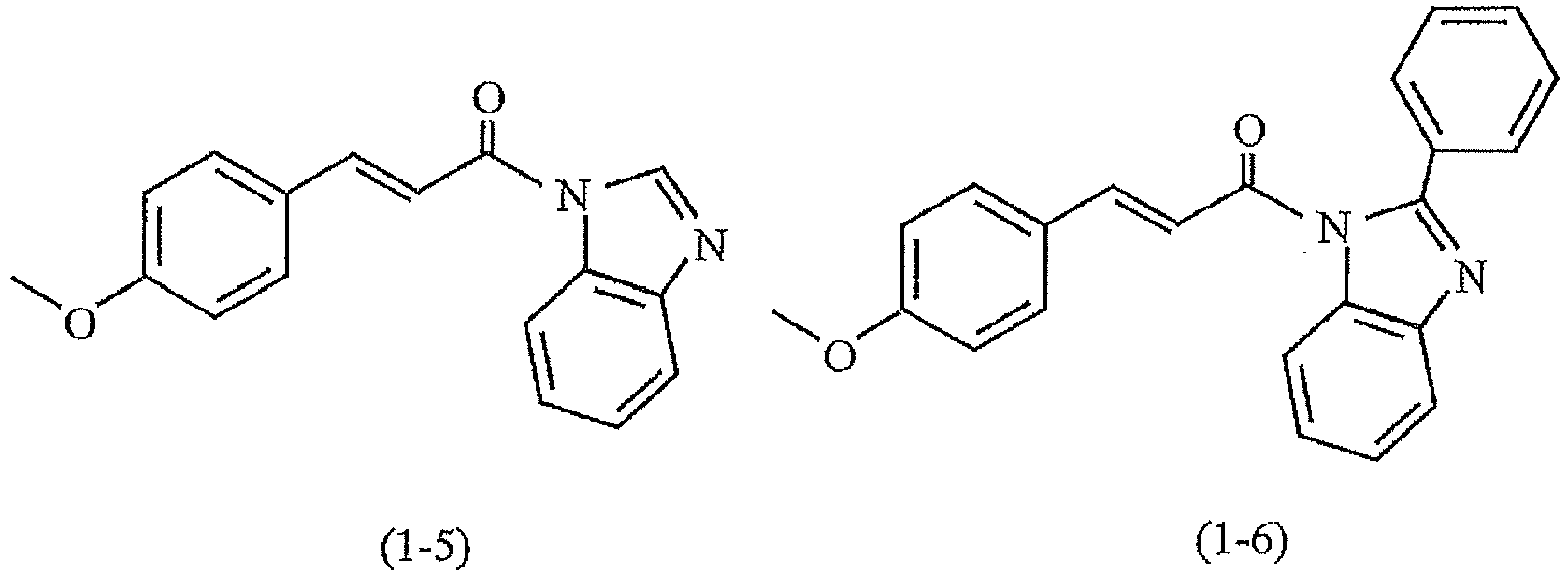
- the unsaturated carboxylic acid amide preferably includes at least one compound selected from compounds represented by Formulae (1-1) to (1-6): [Chem. 2]
- the present invention provides a method for producing the crystal.
- the method includes a reaction step 1 (step a)), a reaction step 2 (step b)), and a purification step (step c)).
- an unsaturated carboxylic acid represented by Formula (2) is chlorinated with thionyl chloride to give a compound represented by Formula (3).
- the prepared compound represented by Formula (3) is allowed to react with an imidazole compound represented by Formula (4) to give an unsaturated carboxylic acid amide represented by Formula (1) as a reaction product.
- the purification step the reaction product is purified to give the target crystal.
- the method includes at least one of using thionyl chloride in an amount of 0.5 to 3.0 times the mole of the unsaturated carboxylic acid represented by Formula (2) in the reaction step 1; and separating/removing a chlorine-containing compound using an adsorbent in the purification step.
- the purification step includes adding water to the reaction system to wash the reaction product.
- the reaction product after washing is azeotropically dehydrated to a water content of 0.3 percent by weight or less, and is then subjected to crystallization.
- Formulae (2), (3), (4), and (1) are expressed as follows: [Chem.
- R 1 to R 5 are, identically or differently, selected from hydrogen, alkyl, hydroxyl, alkoxy, and nitro, where at least two of R 1 to R 5 may be linked to form a ring together with carbon atoms constituting the specified aromatic ring, [Chem. 4] where R 1 to R 5 are as defined above, [Chem. 5] where R 6 , R 7 , and R 8 are, identically or differently, selected from hydrogen, alkyl, and aryl, where R 7 and R 8 may be linked to form a ring together with carbon atoms constituting the specified imidazole ring, [Chem. 6] where R 1 to R 8 are as defined above.
- the crystal according to the present invention includes the unsaturated carboxylic acid amide represented by Formula (1) in an amount of 95 percent by area or more and has a bulk density of from 0.2 to 0.7 g/mL.
- the crystal has a high purity, is not bulky, and can be handled excellently (e.g., can be processed and transported excellently).
- the crystal is therefore useful particularly as raw materials for industrial products and is advantageously usable as or for pharmaceuticals, agricultural chemicals, polymeric materials, high-performance materials, and intermediates of them.
- the high-performance materials are exemplified by photosensitive high-performance materials (resist materials) for use in the production of electrical and electronic components.
- the crystal is advantageously usable as or for materials requiring high reliability, such as semiconductor encapsulating materials, packaging materials typically for semiconductor devices and MEMS (micro electro mechanical systems), and photosensitive materials for semiconductor devices, liquid crystal displays, and MEMS.
- the crystal according to the present invention includes an unsaturated carboxylic acid amide represented by Formula (1) in an amount of 95 percent by area or more and has a bulk density of from 0.2 to 0.7 g/mL.
- Formula (1) is expressed as follows: [Chem. 7] where R 1 to R 5 are, identically or differently, selected from hydrogen, alkyl, hydroxyl, alkoxy, and nitro. At least two of R 1 to R 5 may be linked to form a ring together with carbon atoms constituting the specified aromatic ring.
- R 6 , R 7 , and R 8 are, identically or differently, selected from hydrogen, alkyl, and aryl. R 7 and R 8 may be linked to form a ring together with carbon atoms constituting the specified imidazole ring.
- the crystal according to the present invention may be produced by a method as follows.
- the method includes a reaction step 1, a reaction step 2, and a purification step.
- an unsaturated carboxylic acid represented by Formula (2) is chlorinated with thionyl chloride to give a compound represented by Formula (3).
- the prepared compound represented by Formula (3) is allowed to react with an imidazole compound represented by Formula (4) to give an unsaturated carboxylic acid amide represented by Formula (1).
- Formulae (2), (3), (4), and (1) are expressed as follows: [Chem.
- R 1 to R 5 are, identically or differently, selected from hydrogen, alkyl, hydroxyl, alkoxy, and nitro, where at least two of R 1 to R 5 may be linked to form a ring together with carbon atoms constituting the specified aromatic ring, [Chem. 9] where R 1 to R 5 are as defined above, [Chem. 10] where R 6 , R 7 , and R 8 are, identically or differently, selected from hydrogen, alkyl, and aryl, where R 7 and R 8 may be linked to form a ring together with carbon atoms constituting the specified imidazole ring, [Chem. 11] where R 1 to R 8 are as defined above.
- the method is performed under both conditions 1 and 2 as follows.
- the alkyl is exemplified by alkyl containing 1 to about 4 carbon atoms, such as methyl, ethyl, propyl, isopropyl, and butyl.
- the alkoxy is exemplified by alkoxy containing 1 to about 6 carbon atoms, such as methoxy, ethoxy, isopropoxy, butoxy, isobutoxy, sec-butoxy, tert-butoxy, and pentoxy.
- at least two of R 1 to R 5 are linked to form a ring together with carbon atoms constituting the specified aromatic ring.
- the formed ring is exemplified by aromatic rings containing about 6 to about 20 carbon atoms, such as benzene, naphthalene, and anthracene rings, of which those containing 6 to 14 carbon atoms are preferred; and hydrocarbon rings (e.g., cycloalkane, cycloalkene, and bridged carbon rings) containing 3 to about 20 members, such as cyclobutane, cyclopentane, cyclohexane, cyclohexene, cyclooctane, cyclododecane, adamantane, norbornane, and norbornene rings, of which those containing 3 to 15 members are preferred, and those containing 5 to 12 members are particularly preferred.
- R 1 , R 2 , R 4 , and R 5 are hydrogen
- R 3 is methoxy. This can give a compound having excellent absorption sensitivity from easily available raw materials.
- the alkyl is exemplified by alkyl containing 1 to about 20 carbon atoms, such as methyl, ethyl, propyl, isopropyl, butyl, isobutyl, s-butyl, t-butyl, pentyl, hexyl, decyl, and dodecyl, of which those containing 1 to 10 carbon atoms are preferred.
- the aryl is exemplified by aryl containing about 6 to about 20 carbon atoms, such as phenyl and naphthyl, of which those containing 6 to 14 carbon atoms are preferred.
- R 7 and R 8 are linked to form a ring together with carbon atoms constituting the specified imidazole ring.
- the formed ring is exemplified by aromatic rings such as benzene ring.
- the ring may have one or more substituents.
- the substituents are exemplified by alkyl containing 1 to about 3 carbon atoms, such as methyl, ethyl, and propyl; and aryl containing about 6 to about 20 carbon atoms, such as phenyl and naphthyl, of which those containing 6 to 14 carbon atoms are preferred.
- the imidazole compound represented by Formula (4) is exemplified by imidazole, 2-methylimidazole, 2-ethyl-4-methylimidazole, 2-phenylimidazole, benzimidazole, and 2-phenylbenzimidazole.
- the unsaturated carboxylic acid amide represented by Formula (1) is exemplified by compounds represented by Formulae (1-1) to (1-6) below.
- the crystal according to the present invention preferably includes the compound represented by Formula (1-1). [Chem. 12]
- the reaction step 1 is the step of chlorinating the unsaturated carboxylic acid represented by Formula (2) with thionyl chloride to give the compound represented by Formula (3).
- the thionyl chloride is used in an amount of from about 0.5 to about 3.0 times, preferably from 0.8 to 2.5 times, more preferably from 0.9 to 1.8 times, particularly preferably from 1.0 to 1.5 times, and most preferably from 1.0 to 1.3 times, the mole of the unsaturated carboxylic acid represented by Formula (2).
- the thionyl chloride if used in an amount greater than the range, may readily cause chlorine-containing compounds to be by-produced in larger amounts. This may impede the use of the target product as a photosensitive high-performance material. In contrast, the thionyl chloride, if used in an amount less than the range, may readily cause the target product to be obtained in a lower yield.
- chlorine-containing compound(s) refers to all compounds that contain chlorine and are by-produced in the method for producing an unsaturated carboxylic acid amide according to the present invention.
- Major chlorine-containing compounds are exemplified by chlorinated derivatives (chlorides) of the unsaturated carboxylic acid amide represented by Formula (1), and analogues of them.
- the chlorination reaction may be performed in the presence of, or in the absence of, a solvent.
- the solvent is exemplified by saturated or unsaturated hydrocarbon solvents such as pentane, hexane, heptane, octane, and petroleum ether; aromatic hydrocarbon solvents such as benzene, toluene, and xylenes; halogenated hydrocarbon solvents such as methylene chloride, chloroform, 1,2-dichloroethane, chlorobenzene, and bromobenzene; ether solvents such as diethyl ether, diisopropyl ether, dibutyl ether, tetrahydrofuran, dioxane, 1,2-dimethoxyethane, and cyclopentyl methyl ether; nitrile solvents such as acetonitrile and benzonitrile; sulfoxide solvents such as dimethyl sulfoxide; sulfolane solvent
- aromatic hydrocarbon solvents and halogenated hydrocarbon solvents are particularly preferably usable.
- Such an aromatic hydrocarbon solvent and/or a halogenated hydrocarbon solvent may be used in an amount of typically 10 percent by weight or more, preferably 30 percent by weight or more, particularly preferably 50 percent by weight or more, and most preferably 80 percent by weight or more, of the total amount (100 percent by weight) of all solvents used in the chlorination reaction.
- the “amount” herein refers to a "total amount" when two or more solvents selected from aromatic hydrocarbon solvents and halogenated hydrocarbon solvents are used in combination.
- the solvent(s) may be used in an amount of typically from about 1 to about 100000 parts by weight, and preferably from 1 to 10000 parts by weight, per 1 part by weight of the unsaturated carboxylic acid represented by Formula (2), although the amount is not critical, within such a range as to allow dissolution or dispersion of reactants and as not to impair properties such as economic efficiency.
- the chlorination reaction may be performed typically by adding thionyl chloride dropwise to a system including the unsaturated carboxylic acid represented by Formula (2).
- the reaction is performed for a reaction time of typically from about 0.5 to about 48 hours, preferably from 1 to 36 hours, and particularly preferably from 2 to 24 hours.
- the thionyl chloride dropwise addition may be performed at a temperature of typically from 40°C up to the boiling point(s) of substances present in the reaction system, preferably from 55°C to 120°C, and particularly preferably from 60°C to 75°C.
- the reaction after the completion of thionyl chloride dropwise addition may be performed at a temperature of typically from 55°C up to the boiling point(s) of substances present in the reaction system, preferably from 55°C to 120°C, and particularly preferably from 60°C to 75°C.
- the thionyl chloride dropwise addition and the reaction after the completion of dropwise addition may be performed at identical or different temperatures.
- the thionyl chloride dropwise addition and the reaction after the completion of dropwise addition if each performed at a temperature lower than the range, may readily cause the compound represented by Formula (3) to be prepared in a lower yield.
- the thionyl chloride dropwise addition and the reaction after the completion of dropwise addition may cause chlorine-containing compounds to be by-produced in larger amounts. This may impede the use of the resulting product as a photosensitive high-performance material.
- the chlorination reaction may be performed under any of a pressure (under a load), normal atmospheric pressure, and reduced pressure (typically from about 0.0001 to about 0.1 MPa, and preferably from 0.001 to 0.1 MPa).
- the chlorination reaction may be often performed under normal atmospheric pressure or under reduced pressure.
- the method according to the present invention preferably includes an operation of removing excessive thionyl chloride during or after the completion of the reaction step 1. This is preferred for a lower content of chlorine-containing compounds in the crystal.
- the removal of the excessive thionyl chloride may be performed by separation using a common process such as degassing, extraction, distillation, rectification, molecular distillation, and/or adsorption. Such process or operation may be performed continuously or discontinuously (batchwise). The operation may be performed under either of reduced pressure and normal atmospheric pressure.
- the reaction may be performed while continuously separating a by-produced acidic gas from the reaction system, where the acidic gas is exemplified by hydrogen chloride and sulfur dioxide gases. This is preferred for a lower content of chlorine-containing compounds in the crystal.
- the separation of the by-produced acidic gas may be performed by separation using a common procedure such as degassing, extraction, distillation, rectification, molecular distillation, and/or adsorption. Such operation or procedure may be performed continuously or discontinuously (batchwise). The operation may be performed under either of reduced pressure and normal atmospheric pressure.
- the reaction step 2 is the step of allowing the compound represented by Formula (3) prepared in the reaction step 1 to react with the imidazole compound represented by Formula (4) to give the unsaturated carboxylic acid amide represented by Formula (1).
- the imidazole compound represented by Formula (4) may be used in an amount of typically from about 0.5 to about 20.0 times, preferably from 0.8 to 8.0 times, and particularly preferably from 1.0 to 3.0 times, the mole of the compound represented by Formula (3).
- the imidazole compound represented by Formula (4) if used in an amount greater than the range, may readily adversely affect the reaction operability and economic efficiency.
- the imidazole compound represented by Formula (4) if used in an amount less than the range, may readily cause the unsaturated carboxylic acid amide represented by Formula (1) to be prepared in a lower yield.
- the reaction may be performed in the presence of, or in the absence of, a solvent.
- the solvent is exemplified as with the solvents usable in the reaction step 1.
- the solvent may be used in an amount of typically from about 1 to about 100000 parts by weight, and preferably from 1 to 10000 parts by weight, per 1 part by weight of the compound represented by Formula (3), although the amount is not critical within such a range as to allow the dissolution or dispersion of reactants and as not to adversely affect properties such as economic efficiency.
- the solvent used in the reaction step 1 may be used commonly as the solvent for use in the reaction step 2. In this case, the solvent used in the reaction step 1 may be used in the reaction step 2 as intact or after adjusting the concentration by concentrating or diluting after the completion of the reaction step 1.
- the reaction in the reaction step 2 may be performed at a temperature of typically from -50°C to 150°C, preferably from -10°C to 80°C, and particularly preferably from 10°C to 50°C.
- the reaction may be performed under any of a pressure (under a load), normal atmospheric pressure, and reduced pressure (typically from about 0.0001 to about 0.1 MPa, and preferably from 0.001 to 0.1 MPa).
- the reaction is often performed under normal atmospheric pressure or under reduced pressure.
- the reaction may be performed in any system selected from batch, semi-batch, and continuous systems.
- an acidic gas (hydrogen chloride) and/or an amine hydrochloride gas is by-produced with reaction progress.
- these substances are removed so as to accelerate the reaction progress and to inhibit the formation of by-products such as chlorine-containing compounds.
- a way to remove these substances is exemplified by a method of adding a base so as to trap or scavenge the substances, where the base is inert to the reaction or does not affect the obtaining of the target substance; and a method of performing the reaction while separating them from the reaction system continuously or discontinuously (batchwise) by a separation process such as degassing, extraction, distillation, rectification, molecular distillation, and/or adsorption.
- the separation operation may be performed under either of reduced pressure and normal atmospheric pressure.
- the base that is inert to the reaction or does not affect the obtaining of the target substance is exemplified by inorganic bases such as sodium hydrogencarbonate, sodium carbonate, potassium carbonate, potassium hydrogencarbonate, sodium hydroxide, and potassium hydroxide; aromatic amines such as pyridine; primary amines such as methylamine, ethylamine, propylamine, isopropylamine, allylamine, butylamine, pentylamine, hexylamine, octylamine, 2-ethylhexylamine, benzylamine, cyclopentylamine, cyclohexylamine, aniline, toluidine, xylidine, naphthylamine, and 2-aminothiazole; secondary amines such as dimethylamine, diethylamine, dipropylamine, diisopropylamine, diallylamine, dibutylamine, dipentylamine, dioctylamine, di(
- the base that is inert to the reaction or does not affect the obtaining of the target substance may be used in an amount of typically from about 0.5 to about 10.0 times, and preferably from 0.8 to 3.0 times, the mole of the compound represented by Formula (3).
- a reaction product obtained through the reaction step 2 is subsequently subjected to a purification step.
- the purification step may employ a separation process such as filtration, concentration, distillation, extraction, crystallization, adsorption, recrystallization, or column chromatography, or a separation process as any combination of them.
- chlorine-containing compounds are separated and removed using an adsorbent.
- the adsorbent usable herein is exemplified by silica gel, alumina, activated carbon, magnesia, and hydrotalcite.
- silica gel is preferred herein for satisfactory separation and/or removal efficiency.
- the chlorine-containing compounds are most preferably separated and removed using silica gel column chromatography.
- the reaction system is washed with water as added, azeotropically dehydrated to a water content of 0.3 percent by weight or less (preferably 0.1 percent by weight or less), and then subjected to crystallization.
- Water if present in crystallization in an amount greater than the range, may cause a fluffy crystal to precipitate or crystallize more readily as compared with a powdery crystal in a relationship with solubility and may thereby cause the resulting crystal to have a lower bulk density.
- reaction solvent after the completion of the reaction step 2 is separated and recovered by distillation, and a crystallization solvent is newly added to perform the crystallization.
- reaction solvent is used as the crystallization solvent to perform the crystallization.
- the crystallization solvent is exemplified by saturated or unsaturated hydrocarbon solvents such as pentane, hexane, heptane, octane, and petroleum ether; ketones such as methyl ethyl ketone; ester solvents such as methyl acetate, ethyl acetate, isopropyl acetate, and butyl acetate; aromatic hydrocarbon solvents such as benzene, toluene, and xylenes; and ether solvents such as diethyl ether, diisopropyl ether, dibutyl ether, tetrahydrofuran, dioxane, 1,2-dimethoxyethane, and cyclopentyl methyl ether.
- saturated or unsaturated hydrocarbon solvents such as pentane, hexane, heptane, octane, and petroleum ether
- ketones such as methyl ethyl ketone
- the reaction solvent may be used as intact as the crystallization solvent for easy/simple operation and economical efficiency.
- the crystallization may be performed by any process such as concentration crystallization, poor-solvent crystallization, and cooling crystallization, alone or in combination.
- the crystallization solvent may be used in an amount of typically from about 1 to about 20 times, and preferably from 1 to 15 times, the weight of the unsaturated carboxylic acid represented by Formula (2).
- the crystallization may be performed at a temperature of typically from about -5°C to about 70°C, and, in particular, preferably from 10°C to 50°C in concentration crystallization, and preferably from 0°C to 10°C in cooling crystallization.
- the crystallization may be performed for a time of typically from about 3 to about 24 hours, whereas the crystallization time may be adjusted as appropriate depending on the reactor scale.
- Crystals crystallized by the crystallization operation can be separated and recovered from the crystallization solvent by filtration.
- the solvent contained in the recovered crystals can be removed by heat drying.
- the crystal obtained by the production method contains the unsaturated carboxylic acid amide represented by Formula (1) in a content of 95 percent by area or more, preferably 98 percent by area or more, particularly preferably 99 percent by area or more, and most preferably 99.5 percent by area or more.
- the crystal if containing the unsaturated carboxylic acid amide represented by Formula (1) in a content less than the range, may have difficulty in use as a high-performance material.
- the crystal may have a content of chlorine-containing compounds of preferably about 1000 ppm or less, more preferably 800 ppm or less, and particularly preferably 500 ppm or less, based on the total amount of the crystal.
- the content of chlorine-containing compounds may be measured typically using combustion ion chromatography.
- the content of the unsaturated carboxylic acid amide represented by Formula (1) in the crystal may be measured by gas chromatography under analysis conditions as follows. Gas Chromatography Analysis Conditions
- the crystal obtained by the production method may have a bulk density (apparent density) of from 0.2 to 0.7 g/mL, and preferably from 0.3 to 0.7 g/mL.
- the term "bulk density” refers to the ratio of the mass of an untapped (i.e., loose) powder sample to its volume including the contribution of the interparticulate void volume.
- the bulk density depends on both the density of powder particles and the spatial arrangement of particles in the powder bed.
- the crystal according to the present invention may exhibit, in X-ray diffraction, a peak at 2 ⁇ in at least one range selected from 6.0 to 8.0, 13.5 to 15.5, and 16.5 to 18.0 and exhibit approximately no peak at 2 ⁇ in the ranges of 9.0 to 10.5, 12.5 to 13.5, and 29.0 to 30.0.
- the crystal preferably exhibits at least one peak at 2 ⁇ in each of the ranges of 6.0 to 8.0, 13.5 to 15.5, and 16.5 to 18.0.
- the crystal according to the present invention contains the unsaturated carboxylic acid amide represented by Formula (1) with a high purity, is not bulky, and can be handled excellently (e.g., can be processed and transported excellently).
- the crystal according to the present invention is advantageously usable as or for high-performance materials such as photosensitive high-performance materials (resist materials) for use in the production of electrical and electronic components.
- the crystal is advantageously usable as or for high-performance materials requiring high reliability, such as semiconductor encapsulating materials, packaging materials typically for semiconductor devices and MEMS (micro electro mechanical systems), and photosensitive materials for semiconductor devices, liquid crystal displays, and MEMS.
- the mixture in the reactor was stirred for one hour and combined with 12.5 kg of ion-exchanged water for washing.
- the resulting mixture was separated, from which an organic layer was obtained.
- the obtained organic layer was uninterruptedly washed with 12.5 kg of a 8% sodium hydrogencarbonate aqueous solution, and further washed twice with 12.5 kg of ion-exchanged water.
- Part of the organic layer after the completion of washing was concentrated, combined with ethyl acetate in an amount of two times the weight of 4-methoxycinnamic acid, and azeotropically dehydrated to a water content of 0.1 percent by weight or less, from which ethyl acetate and toluene were distilled off under reduced pressure.
- the obtained crystals were powdery. An aliquot (70 g) of the crystals was weighed and gently introduced into a 250-mL graduated cylinder. The volume was read and found to be 236 mL. Based on this, the bulk density was found to be 0.297 g/mL. Again, 70 g of the crystals were weighed, the volume of which was read by the procedure as above, and was found to be 226 mL. Based on this, the bulk density was found to be 0.310 g/mL. Accordingly, the crystals obtained by the method were found to have an (average) bulk density of 0.30 g/mL.
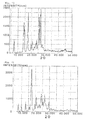
- Fig. 1 The obtained crystals were subjected to X-ray diffractometry (XRD). The result thereof is indicated in Fig. 1 .
- XRD X-ray diffractometry
- 1-(3-(4-methoxyphenyl)acryloyl)-imidazole was produced using 17 kg of 4-methoxycinnamic acid, 76.5 kg of toluene, 11.9 kg of thionyl chloride, 7.1 kg of imidazole, 13.5 kg of triethylamine, and 115 kg of ethyl acetate.
- the organic layer was not subjected to azeotropic dehydration, but, as intact as containing water in a content of 1.5%, subjected to distilling off of ethyl acetate and toluene under reduced pressure, and then to crystallization.
- the crystals herein were bulky (had a large volume with respect to a weight) and were inferior in properties in handling, transportation, and charging (filling).
- the crystals required a larger-sized apparatus in the drying reaction step or, when being dried in plural installments, required a larger number of drying processes; and required a larger number of filling containers in a charging (filling) reaction step, as compared with the crystals obtained in Example 1 upon handling.
- the purities of the crystals obtained in the example and the comparative example were determined in the following manner.
- An aliquot (0.01 to 0.02 g) of crystals to be tested was weighed, diluted with 1.5 to 2 g of acetone (supplied by Wako Pure Chemical Industries, Ltd., JIS Special Grade), and yielded a sample.
- the sample was subjected to a gas chromatographic measurement to give a chromatogram.
- the peak area (%) of the target compound was divided by the total sum of peak areas of all components observed in the chromatogram (excluding the peak area detected upon gas chromatographic measurement using acetone alone) to give the purity of the target compound.
- the X-ray diffractometry (XRD) of the crystals obtained in the example and the comparative example was performed using an apparatus under conditions as follows.
- the crystal according to the present invention has a high purity, is still not bulky, and can be handled excellently (e.g., can be processed and transported excellently).
- the crystal is therefore particularly useful as raw materials for industrial products.
- the crystal is advantageously usable as or for pharmaceuticals, agricultural chemicals, polymeric materials, high-performance materials, and intermediates of them.
- the high-performance materials are exemplified by photosensitive high-performance materials (resist materials) for use in the production of electrical and electronic components.
- the crystal is advantageously usable as or for such materials requiring high reliability, such as semiconductor encapsulating materials, packaging materials typically for semiconductor devices and MEMS (micro electro mechanical systems), and photosensitive materials for semiconductor devices, liquid crystal displays, and MEMS.
Landscapes
- Chemical & Material Sciences (AREA)
- Organic Chemistry (AREA)
- Organic Low-Molecular-Weight Compounds And Preparation Thereof (AREA)
Abstract
Provided is a crystal of an unsaturated carboxylic acid amide. The crystal is useful as or for fine chemicals such as pharmaceuticals, agricultural chemicals, polymeric materials, functional materials, and intermediates of them, has a high purity, still is not bulky, and can be handled excellently.
The crystal includes an unsaturated carboxylic acid amide represented by Formula (1) in an amount of 95 percent by area or more and has a bulk density of 0.2 to 0.7 g/mL. In the formula, R1 to R5 are independently selected from hydrogen, alkyl, hydroxyl, alkoxy, and nitro. At least two of R1 to R5 may be linked to form a ring together with carbon atoms constituting the specified aromatic ring. R6, R7, and R8 are independently selected from hydrogen, alkyl, and aryl. R7 and R8 may be linked to form a ring together with carbon atoms constituting the specified imidazole ring.
[Chem. 1]
[Chem. 1]
Description
- The present invention relates to crystals including unsaturated carboxylic acid amide compounds, and methods for producing such crystals. The unsaturated carboxylic acid amide compounds are useful as fine chemicals such as pharmaceuticals, agricultural chemicals, polymeric materials, functional materials, and intermediates of them.
- Unsaturated carboxylic acid amide compounds have been produced typically by methods in which an unsaturated carboxylic acid is dehydratively condensed with an amine. Patent Literature (PTL) 1 describes a method of dehydratively condensing 2-hydroxycinnamic acid with an amine using a carbodiimide as a dehydrating-condensing agent to give 2-hydroxycinnamamide. Non Patent Literature (NPL) 1 describes a method of dehydratively condensing 4-methoxycinnamic acid with an amine using N,N-carbonyldiimidazole as a dehydrating-condensing agent to give 4-methoxycinnamic acid amide. Unfortunately, the dehydrating-condensing agents used in these methods are expensive and may cause a severe allergic reaction. The methods are therefore not considered as industrially advantageous methods. Independently, unsaturated carboxylic acid amides have been produced by a method of hydrating unsaturated carboxylic acid nitriles. Unfortunately, however, the method suffers typically from inferior reaction selectivity in some kinds of the unsaturated carboxylic acid moiety and is not always considered as a popular or general method.
- Under such circumstances, unsaturated carboxylic acid amides are often synthetically produced by a method of allowing an unsaturated carboxylic acid chloride to react with an amine. The unsaturated carboxylic acid chloride is most generally produced by a method of allowing an unsaturated carboxylic acid to react with thionyl chloride. The method is advantageous typically in that thionyl chloride has a relatively low boiling point and, if remained in excess, can be easily removed. In a method described in NPL 2, an unsaturated carboxylic acid is mixed with 8.6 times the mole of thionyl chloride with cooling and, after the initiation of reaction, the mixture is heated to reflux to give an unsaturated carboxylic acid chloride.
- Specifically, an unsaturated carboxylic acid amide is generally produced by a method in which an unsaturated carboxylic acid is allowed to react with thionyl chloride to synthetically give an unsaturated carboxylic acid chloride, and the prepared unsaturated carboxylic acid chloride is allowed to react with an amine to synthetically give the target unsaturated carboxylic acid amide.
- Independently, highly-functional materials (high-performance materials) include photosensitive high-performance materials (resist materials) for use in the production of electrical and electronic components. Among them, those particularly requiring high reliability include semiconductor encapsulating materials; packaging materials for semiconductors (semiconductor devices) and MEMS (micro electro mechanical systems); and photosensitive materials for semiconductor devices, liquid crystal displays, and MEMS. These materials should include ingredients with higher and higher purity. Of impurities or by-products, chlorine-containing compounds are known to significantly affect the performance of electrical and electronic components. PTL 2 discloses that a halogen atom contained in by-products becomes a halogen anion upon exposure (light irradiation), thus reduces the effect of an acid generator, and lowers the sensitivity. PTL 3 discloses as follows. Assume that a compound contains, as impurities, large amounts of organic chlorine compounds such as hydrolyzable chlorine that liberates a chlorine ion upon moisture absorption. This compound, when used in the production of an electrical/electronic component, causes the electrical/electronic component to be susceptible to corrosion and/or a break of interconnections and deterioration in insulation quality and to have inferior reliability.
- For these reasons, it is important to perform purification treatment so as to give a crystal including an unsaturated carboxylic acid amide with a high purity. Disadvantageously, however, conventional purification processes give crystals of unsaturated carboxylic acid amide compounds that are fluffy and bulky with a low bulk density, although they have a high purity. Thus, the crystals are not handled satisfactorily. Typically, the crystals should be dried in a large dryer or be dried in small divided portions in multiple times. In addition, the crystals have poor properties in transportation and filling (charging).
-
- PTL 1: PCT International Publication Number
WO2009/123122 - PTL 2: Japanese Unexamined Patent Application Publication (JP-A) No.
2002-187868 - PTL 3:
JP-A No. 2009-263543 -
- NPL 1: Journal of Organic Chemistry, volume 69, p. 4216 (2004)
- NPL 2: J ournal of American Chemical Society, volume 72, p. 3885 (1950)
- NPL 3: Synthesis, p. 598 (1989)
- Accordingly, it is an object of the present invention to provide a crystal of an unsaturated carboxylic acid amide, where the crystal is useful as fine chemicals, has a high purity, is not bulky, and can be handled excellently. The fine chemicals are exemplified by pharmaceuticals, agricultural chemicals, polymeric materials, functional materials, and intermediates of them.
- It is another object of the present invention to provide a method for producing the crystal of the unsaturated carboxylic acid amide, where the crystal has a high purity, is not bulky, and can be handled excellently. Solution to Problem
- After intensive investigations to achieve the objects, the present inventor has found as follows. Assume that an unsaturated carboxylic acid amide is produced by a method that includes chlorinating an unsaturated carboxylic acid with thionyl chloride to give an unsaturated carboxylic acid chloride, and allowing the unsaturated carboxylic acid chloride to react with an imidazole compound. Further assume that the production method further includes control of the amount of thionyl chloride within a specific range, or further includes a reaction step of purifying a reaction product using an adsorbent after the reaction. This production method can yield an unsaturated carboxylic acid amide having a very low chlorine-containing compound content. Still further assume that the production method further includes, after the reaction, washing with water, azeotropic dehydration to a water content of 0.3 percent by weight or less, and crystallization in the specified sequence. This production method can give a crystal of an unsaturated carboxylic acid amide, where the crystal has a high purity and is not bulky. The present invention has been made based on these findings.
- Specifically, the present invention provides, in one aspect, a crystal including an unsaturated carboxylic acid amide in an amount of 95 percent by area or more and having a bulk density of from 0.2 to 0.7 g/mL. The unsaturated carboxylic acid amide is represented by Formula (1):
[Chem. 1]
- Preferably, the crystal, in X-ray diffraction, exhibits a peak at 28 in at least one range selected from the group consisting of 6.0 to 8.0, 13.5 to 15.5, and 16.5 to 18.0 and exhibits approximately no peak at 2θ in ranges of 9.0 to 10.5, 12.5 to 13.5, and 29.0 to 30.0.
- The unsaturated carboxylic acid amide preferably includes at least one compound selected from compounds represented by Formulae (1-1) to (1-6):
[Chem. 2]

- In addition and advantageously, the present invention provides a method for producing the crystal. The method includes a reaction step 1 (step a)), a reaction step 2 (step b)), and a purification step (step c)). In the reaction step 1, an unsaturated carboxylic acid represented by Formula (2) is chlorinated with thionyl chloride to give a compound represented by Formula (3). In the reaction step 2, the prepared compound represented by Formula (3) is allowed to react with an imidazole compound represented by Formula (4) to give an unsaturated carboxylic acid amide represented by Formula (1) as a reaction product. In the purification step, the reaction product is purified to give the target crystal. The method includes at least one of using thionyl chloride in an amount of 0.5 to 3.0 times the mole of the unsaturated carboxylic acid represented by Formula (2) in the reaction step 1; and separating/removing a chlorine-containing compound using an adsorbent in the purification step. The purification step includes adding water to the reaction system to wash the reaction product. The reaction product after washing is azeotropically dehydrated to a water content of 0.3 percent by weight or less, and is then subjected to crystallization. Formulae (2), (3), (4), and (1) are expressed as follows:
[Chem. 3]
[Chem. 4]
[Chem. 5]
[Chem. 6]
- The crystal according to the present invention includes the unsaturated carboxylic acid amide represented by Formula (1) in an amount of 95 percent by area or more and has a bulk density of from 0.2 to 0.7 g/mL. The crystal has a high purity, is not bulky, and can be handled excellently (e.g., can be processed and transported excellently). The crystal is therefore useful particularly as raw materials for industrial products and is advantageously usable as or for pharmaceuticals, agricultural chemicals, polymeric materials, high-performance materials, and intermediates of them. The high-performance materials are exemplified by photosensitive high-performance materials (resist materials) for use in the production of electrical and electronic components. In particular, the crystal is advantageously usable as or for materials requiring high reliability, such as semiconductor encapsulating materials, packaging materials typically for semiconductor devices and MEMS
(micro electro mechanical systems), and photosensitive materials for semiconductor devices, liquid crystal displays, and MEMS. -
- [
Fig. 1] Fig. 1 is an X-ray diffraction (XRD) chart of crystals prepared in Example 1. - [
Fig. 2] Fig. 2 is an X-ray diffraction (XRD) chart of crystals prepared in Comparative Example 1. - The crystal according to the present invention includes an unsaturated carboxylic acid amide represented by Formula (1) in an amount of 95 percent by area or more and has a bulk density of from 0.2 to 0.7 g/mL. Formula (1) is expressed as follows:
[Chem. 7]
- The crystal according to the present invention may be produced by a method as follows. The method includes a reaction step 1, a reaction step 2, and a purification step. In the reaction step 1, an unsaturated carboxylic acid represented by Formula (2) is chlorinated with thionyl chloride to give a compound represented by Formula (3). In the reaction step 2, the prepared compound represented by Formula (3) is allowed to react with an imidazole compound represented by Formula (4) to give an unsaturated carboxylic acid amide represented by Formula (1). Formulae (2), (3), (4), and (1) are expressed as follows:
[Chem. 8]
[Chem. 9]
[Chem. 10]
[Chem. 11]
The method is performed under both conditions 1 and 2 as follows. - 1. In the reaction step 1, thionyl chloride is used in an amount 0.5 to 3.0 times the mole of the unsaturated carboxylic acid represented by Formula (2), and/or, in the purification step, a chlorine-containing compound is separated and removed using an adsorbent.
- 2. The purification step includes washing the reaction system with water. The resulting mixture is azeotropically dehydrated to a water content of 0.3 percent by weight or less, and then subjected to crystallization.
- As R1 to R5, the alkyl is exemplified by alkyl containing 1 to about 4 carbon atoms, such as methyl, ethyl, propyl, isopropyl, and butyl. The alkoxy is exemplified by alkoxy containing 1 to about 6 carbon atoms, such as methoxy, ethoxy, isopropoxy, butoxy, isobutoxy, sec-butoxy, tert-butoxy, and pentoxy. In an embodiment, at least two of R1 to R5 are linked to form a ring together with carbon atoms constituting the specified aromatic ring. The formed ring is exemplified by aromatic rings containing about 6 to about 20 carbon atoms, such as benzene, naphthalene, and anthracene rings, of which those containing 6 to 14 carbon atoms are preferred; and hydrocarbon rings (e.g., cycloalkane, cycloalkene, and bridged carbon rings) containing 3 to about 20 members, such as cyclobutane, cyclopentane, cyclohexane, cyclohexene, cyclooctane, cyclododecane, adamantane, norbornane, and norbornene rings, of which those containing 3 to 15 members are preferred, and those containing 5 to 12 members are particularly preferred. In a preferred embodiment of the present invention, R1, R2, R4, and R5 are hydrogen, and R3 is methoxy. This can give a compound having excellent absorption sensitivity from easily available raw materials.
- As R6, R7, and R8, the alkyl is exemplified by alkyl containing 1 to about 20 carbon atoms, such as methyl, ethyl, propyl, isopropyl, butyl, isobutyl, s-butyl, t-butyl, pentyl, hexyl, decyl, and dodecyl, of which those containing 1 to 10 carbon atoms are preferred. The aryl is exemplified by aryl containing about 6 to about 20 carbon atoms, such as phenyl and naphthyl, of which those containing 6 to 14 carbon atoms are preferred.
- In an embodiment, R7 and R8 are linked to form a ring together with carbon atoms constituting the specified imidazole ring. The formed ring is exemplified by aromatic rings such as benzene ring. The ring may have one or more substituents. The substituents are exemplified by alkyl containing 1 to about 3 carbon atoms, such as methyl, ethyl, and propyl; and aryl containing about 6 to about 20 carbon atoms, such as phenyl and naphthyl, of which those containing 6 to 14 carbon atoms are preferred.
- Specifically, the imidazole compound represented by Formula (4) is exemplified by imidazole, 2-methylimidazole, 2-ethyl-4-methylimidazole, 2-phenylimidazole, benzimidazole, and 2-phenylbenzimidazole.
- Also specifically, the unsaturated carboxylic acid amide represented by Formula (1) is exemplified by compounds represented by Formulae (1-1) to (1-6) below. In particular, the crystal according to the present invention preferably includes the compound represented by Formula (1-1).
[Chem. 12]


- The reaction step 1 is the step of chlorinating the unsaturated carboxylic acid represented by Formula (2) with thionyl chloride to give the compound represented by Formula (3).
- The thionyl chloride is used in an amount of from about 0.5 to about 3.0 times, preferably from 0.8 to 2.5 times, more preferably from 0.9 to 1.8 times, particularly preferably from 1.0 to 1.5 times, and most preferably from 1.0 to 1.3 times, the mole of the unsaturated carboxylic acid represented by Formula (2). The thionyl chloride, if used in an amount greater than the range, may readily cause chlorine-containing compounds to be by-produced in larger amounts. This may impede the use of the target product as a photosensitive high-performance material. In contrast, the thionyl chloride, if used in an amount less than the range, may readily cause the target product to be obtained in a lower yield. As used herein the term "chlorine-containing compound(s)" refers to all compounds that contain chlorine and are by-produced in the method for producing an unsaturated carboxylic acid amide according to the present invention. Major chlorine-containing compounds are exemplified by chlorinated derivatives (chlorides) of the unsaturated carboxylic acid amide represented by Formula (1), and analogues of them.
- The chlorination reaction may be performed in the presence of, or in the absence of, a solvent. The solvent is exemplified by saturated or unsaturated hydrocarbon solvents such as pentane, hexane, heptane, octane, and petroleum ether; aromatic hydrocarbon solvents such as benzene, toluene, and xylenes; halogenated hydrocarbon solvents such as methylene chloride, chloroform, 1,2-dichloroethane, chlorobenzene, and bromobenzene; ether solvents such as diethyl ether, diisopropyl ether, dibutyl ether, tetrahydrofuran, dioxane, 1,2-dimethoxyethane, and cyclopentyl methyl ether; nitrile solvents such as acetonitrile and benzonitrile; sulfoxide solvents such as dimethyl sulfoxide; sulfolane solvents such as sulfolane; amide solvents such as dimethylformamide; and high-boiling solvents such as silicone oils. Each of them may be used alone or in combination.
- Among them, aromatic hydrocarbon solvents and halogenated hydrocarbon solvents are particularly preferably usable. Such an aromatic hydrocarbon solvent and/or a halogenated hydrocarbon solvent may be used in an amount of typically 10 percent by weight or more, preferably 30 percent by weight or more, particularly preferably 50 percent by weight or more, and most preferably 80 percent by weight or more, of the total amount (100 percent by weight) of all solvents used in the chlorination reaction. The "amount" herein refers to a "total amount" when two or more solvents selected from aromatic hydrocarbon solvents and halogenated hydrocarbon solvents are used in combination.
- The solvent(s) may be used in an amount of typically from about 1 to about 100000 parts by weight, and preferably from 1 to 10000 parts by weight, per 1 part by weight of the unsaturated carboxylic acid represented by Formula (2), although the amount is not critical, within such a range as to allow dissolution or dispersion of reactants and as not to impair properties such as economic efficiency.
- The chlorination reaction may be performed typically by adding thionyl chloride dropwise to a system including the unsaturated carboxylic acid represented by Formula (2). The reaction is performed for a reaction time of typically from about 0.5 to about 48 hours, preferably from 1 to 36 hours, and particularly preferably from 2 to 24 hours. The thionyl chloride dropwise addition may be performed at a temperature of typically from 40°C up to the boiling point(s) of substances present in the reaction system, preferably from 55°C to 120°C, and particularly preferably from 60°C to 75°C. The reaction after the completion of thionyl chloride dropwise addition may be performed at a temperature of typically from 55°C up to the boiling point(s) of substances present in the reaction system, preferably from 55°C to 120°C, and particularly preferably from 60°C to 75°C. The thionyl chloride dropwise addition and the reaction after the completion of dropwise addition may be performed at identical or different temperatures. The thionyl chloride dropwise addition and the reaction after the completion of dropwise addition, if each performed at a temperature lower than the range, may readily cause the compound represented by Formula (3) to be prepared in a lower yield. In contrast, the thionyl chloride dropwise addition and the reaction after the completion of dropwise addition, if each performed at a temperature higher than the range, may cause chlorine-containing compounds to be by-produced in larger amounts. This may impede the use of the resulting product as a photosensitive high-performance material.
- The chlorination reaction may be performed under any of a pressure (under a load), normal atmospheric pressure, and reduced pressure (typically from about 0.0001 to about 0.1 MPa, and preferably from 0.001 to 0.1 MPa). The chlorination reaction may be often performed under normal atmospheric pressure or under reduced pressure.
- The method according to the present invention preferably includes an operation of removing excessive thionyl chloride during or after the completion of the reaction step 1. This is preferred for a lower content of chlorine-containing compounds in the crystal. The removal of the excessive thionyl chloride may be performed by separation using a common process such as degassing, extraction, distillation, rectification, molecular distillation, and/or adsorption. Such process or operation may be performed continuously or discontinuously (batchwise). The operation may be performed under either of reduced pressure and normal atmospheric pressure.
- In a preferred embodiment in the reaction step 1, the reaction may be performed while continuously separating a by-produced acidic gas from the reaction system, where the acidic gas is exemplified by hydrogen chloride and sulfur dioxide gases. This is preferred for a lower content of chlorine-containing compounds in the crystal. The separation of the by-produced acidic gas may be performed by separation using a common procedure such as degassing, extraction, distillation, rectification, molecular distillation, and/or adsorption. Such operation or procedure may be performed continuously or discontinuously (batchwise). The operation may be performed under either of reduced pressure and normal atmospheric pressure.
- The reaction step 2 is the step of allowing the compound represented by Formula (3) prepared in the reaction step 1 to react with the imidazole compound represented by Formula (4) to give the unsaturated carboxylic acid amide represented by Formula (1).
- The imidazole compound represented by Formula (4) may be used in an amount of typically from about 0.5 to about 20.0 times, preferably from 0.8 to 8.0 times, and particularly preferably from 1.0 to 3.0 times, the mole of the compound represented by Formula (3). The imidazole compound represented by Formula (4), if used in an amount greater than the range, may readily adversely affect the reaction operability and economic efficiency. In contrast, the imidazole compound represented by Formula (4), if used in an amount less than the range, may readily cause the unsaturated carboxylic acid amide represented by Formula (1) to be prepared in a lower yield.
- The reaction may be performed in the presence of, or in the absence of, a solvent. The solvent is exemplified as with the solvents usable in the reaction step 1. The solvent may be used in an amount of typically from about 1 to about 100000 parts by weight, and preferably from 1 to 10000 parts by weight, per 1 part by weight of the compound represented by Formula (3), although the amount is not critical within such a range as to allow the dissolution or dispersion of reactants and as not to adversely affect properties such as economic efficiency. The solvent used in the reaction step 1 may be used commonly as the solvent for use in the reaction step 2. In this case, the solvent used in the reaction step 1 may be used in the reaction step 2 as intact or after adjusting the concentration by concentrating or diluting after the completion of the reaction step 1.
- The reaction in the reaction step 2 may be performed at a temperature of typically from -50°C to 150°C, preferably from -10°C to 80°C, and particularly preferably from 10°C to 50°C. The reaction may be performed under any of a pressure (under a load), normal atmospheric pressure, and reduced pressure (typically from about 0.0001 to about 0.1 MPa, and preferably from 0.001 to 0.1 MPa). The reaction is often performed under normal atmospheric pressure or under reduced pressure. The reaction may be performed in any system selected from batch, semi-batch, and continuous systems.
- In the reaction step 2, an acidic gas (hydrogen chloride) and/or an amine hydrochloride gas is by-produced with reaction progress. In a preferred embodiment of the present invention, these substances are removed so as to accelerate the reaction progress and to inhibit the formation of by-products such as chlorine-containing compounds. A way to remove these substances is exemplified by a method of adding a base so as to trap or scavenge the substances, where the base is inert to the reaction or does not affect the obtaining of the target substance; and a method of performing the reaction while separating them from the reaction system continuously or discontinuously (batchwise) by a separation process such as degassing, extraction, distillation, rectification, molecular distillation, and/or adsorption. The separation operation may be performed under either of reduced pressure and normal atmospheric pressure.
- The base that is inert to the reaction or does not affect the obtaining of the target substance is exemplified by inorganic bases such as sodium hydrogencarbonate, sodium carbonate, potassium carbonate, potassium hydrogencarbonate, sodium hydroxide, and potassium hydroxide; aromatic amines such as pyridine; primary amines such as methylamine, ethylamine, propylamine, isopropylamine, allylamine, butylamine, pentylamine, hexylamine, octylamine, 2-ethylhexylamine, benzylamine, cyclopentylamine, cyclohexylamine, aniline, toluidine, xylidine, naphthylamine, and 2-aminothiazole; secondary amines such as dimethylamine, diethylamine, dipropylamine, diisopropylamine, diallylamine, dibutylamine, dipentylamine, dioctylamine, di(2-ethylhexyl)amine, ethylenimine, pyrrolidine, piperidine, piperazine, morpholine, N-methylaniline, diphenylamine, phenothiazine, and pyrazole; and tertiary amines such as triethylamine and tributylamine. Each of them may be used alone or in combination. The base that is inert to the reaction or does not affect the obtaining of the target substance may be used in an amount of typically from about 0.5 to about 10.0 times, and preferably from 0.8 to 3.0 times, the mole of the compound represented by Formula (3).
- A reaction product obtained through the reaction step 2 is subsequently subjected to a purification step. The purification step may employ a separation process such as filtration, concentration, distillation, extraction, crystallization, adsorption, recrystallization, or column chromatography, or a separation process as any combination of them.
- In a preferred embodiment herein, chlorine-containing compounds are separated and removed using an adsorbent. The adsorbent usable herein is exemplified by silica gel, alumina, activated carbon, magnesia, and hydrotalcite. In particular, silica gel is preferred herein for satisfactory separation and/or removal efficiency. Specifically, the chlorine-containing compounds are most preferably separated and removed using silica gel column chromatography.
- In a preferred embodiment of the present invention, the reaction system is washed with water as added, azeotropically dehydrated to a water content of 0.3 percent by weight or less (preferably 0.1 percent by weight or less), and then subjected to crystallization.
- Water, if present in crystallization in an amount greater than the range, may cause a fluffy crystal to precipitate or crystallize more readily as compared with a powdery crystal in a relationship with solubility and may thereby cause the resulting crystal to have a lower bulk density.
- In an embodiment, the reaction solvent after the completion of the reaction step 2 is separated and recovered by distillation, and a crystallization solvent is newly added to perform the crystallization. In another embodiment, the reaction solvent is used as the crystallization solvent to perform the crystallization.
- The crystallization solvent is exemplified by saturated or unsaturated hydrocarbon solvents such as pentane, hexane, heptane, octane, and petroleum ether; ketones such as methyl ethyl ketone; ester solvents such as methyl acetate, ethyl acetate, isopropyl acetate, and butyl acetate; aromatic hydrocarbon solvents such as benzene, toluene, and xylenes; and ether solvents such as diethyl ether, diisopropyl ether, dibutyl ether, tetrahydrofuran, dioxane, 1,2-dimethoxyethane, and cyclopentyl methyl ether. Alcohols and water cause the decomposition of the unsaturated carboxylic acid amide represented by Formula (1) and are not preferred as the crystallization solvent. In a preferred embodiment of the present invention, the reaction solvent may be used as intact as the crystallization solvent for easy/simple operation and economical efficiency.
- The crystallization may be performed by any process such as concentration crystallization, poor-solvent crystallization, and cooling crystallization, alone or in combination.
- The crystallization solvent may be used in an amount of typically from about 1 to about 20 times, and preferably from 1 to 15 times, the weight of the unsaturated carboxylic acid represented by Formula (2).
- The crystallization may be performed at a temperature of typically from about -5°C to about 70°C, and, in particular, preferably from 10°C to 50°C in concentration crystallization, and preferably from 0°C to 10°C in cooling crystallization.
- The crystallization may be performed for a time of typically from about 3 to about 24 hours, whereas the crystallization time may be adjusted as appropriate depending on the reactor scale.
- Crystals crystallized by the crystallization operation can be separated and recovered from the crystallization solvent by filtration. The solvent contained in the recovered crystals can be removed by heat drying.
- The crystal obtained by the production method contains the unsaturated carboxylic acid amide represented by Formula (1) in a content of 95 percent by area or more, preferably 98 percent by area or more, particularly preferably 99 percent by area or more, and most preferably 99.5 percent by area or more. The crystal, if containing the unsaturated carboxylic acid amide represented by Formula (1) in a content less than the range, may have difficulty in use as a high-performance material. The crystal may have a content of chlorine-containing compounds of preferably about 1000 ppm or less, more preferably 800 ppm or less, and particularly preferably 500 ppm or less, based on the total amount of the crystal. The content of chlorine-containing compounds may be measured typically using combustion ion chromatography. The content of the unsaturated carboxylic acid amide represented by Formula (1) in the crystal may be measured by gas chromatography under analysis conditions as follows.
Gas Chromatography Analysis Conditions - Column: DB-1701
- Diameter by length: 0.25 mm by 30 m
- Film thickness: 0.25 µm
- Split ratio: 1:50
- Flow rate: 1 mL/min (He)
- Injection volume: 1 µL
- Inlet temperature: 250°C
- Detector temperature: 280°C
- Temperature program: holding at 50°C for 4 min, subsequent temperature rising at a rate of 15°C/min, and subsequent holding at 280°C for 10 min
- Analysis time: 30 min
- The crystal obtained by the production method may have a bulk density (apparent density) of from 0.2 to 0.7 g/mL, and preferably from 0.3 to 0.7 g/mL.
- As used herein the term "bulk density" refers to the ratio of the mass of an untapped (i.e., loose) powder sample to its volume including the contribution of the interparticulate void volume. The bulk density depends on both the density of powder particles and the spatial arrangement of particles in the powder bed. The "bulk density" in the present invention may be determined in the following manner. Into a dry 250-mL graduated cylinder (readable to 2 mL), approximately 100 g (W0 in gram) of a sample weighed with 0.1% accuracy is gently introduced without compacting. The volume (V0 in mL) is read to the nearest graduated unit. The bulk density is calculated by the formula:

- In another preferred embodiment, the crystal according to the present invention may exhibit, in X-ray diffraction, a peak at 2θ in at least one range selected from 6.0 to 8.0, 13.5 to 15.5, and 16.5 to 18.0 and exhibit approximately no peak at 2θ in the ranges of 9.0 to 10.5, 12.5 to 13.5, and 29.0 to 30.0. In particular, the crystal preferably exhibits at least one peak at 2θ in each of the ranges of 6.0 to 8.0, 13.5 to 15.5, and 16.5 to 18.0.
- The crystal according to the present invention contains the unsaturated carboxylic acid amide represented by Formula (1) with a high purity, is not bulky, and can be handled excellently (e.g., can be processed and transported excellently). The crystal according to the present invention is advantageously usable as or for high-performance materials such as photosensitive high-performance materials (resist materials) for use in the production of electrical and electronic components. In particular, the crystal is advantageously usable as or for high-performance materials requiring high reliability, such as semiconductor encapsulating materials, packaging materials typically for semiconductor devices and MEMS (micro electro mechanical systems), and photosensitive materials for semiconductor devices, liquid crystal displays, and MEMS.
- The present invention will be illustrated in further detail with reference to an example below. It should be noted, however, that the example is by no means intended to limit the scope of the present invention.
- In a 50-L reactor, 2.5 kg of 4-methoxycinnamic acid and 11 kg of toluene were placed to give a suspension. This suspension was combined with 1.75 kg of thionyl chloride (1.05 times the mole of 4-methoxycinnamic acid) added dropwise while maintaining the reactor inside temperature at 70±2°C. After the dropwise addition, the reaction was continued until the conversion from 4-methoxycinnamic acid reached 99% or more. After the completion of reaction, about two-tenths of toluene were distilled off together with unreacted thionyl chloride and an acidic gas at 60°C under reduced pressure. After the concentration, the resulting mixture was combined with toluene in an amount equal to the distilled-off amount and yielded 15 kg of a solution of 4-methoxycinnamoyl chloride in toluene.
- Next, 1.05 kg of imidazole (1.1 times the mole of 4-methoxycinnamoyl chloride), 1.42 kg of triethylamine (1.0 time the mole of 4-methoxycinnamoyl chloride), 19.5 kg of ethyl acetate were placed and mixed with one another in another reactor. After checking the dissolution of imidazole, the mixture was combined with 15 kg of the 4-methoxycinnamoyl chloride toluene solution added dropwise while maintaining the reactor inside temperature at 30±5°C.
- After the completion of dropwise addition, the mixture in the reactor was stirred for one hour and combined with 12.5 kg of ion-exchanged water for washing. The resulting mixture was separated, from which an organic layer was obtained. The obtained organic layer was uninterruptedly washed with 12.5 kg of a 8% sodium hydrogencarbonate aqueous solution, and further washed twice with 12.5 kg of ion-exchanged water. Part of the organic layer after the completion of washing was concentrated, combined with ethyl acetate in an amount of two times the weight of 4-methoxycinnamic acid, and azeotropically dehydrated to a water content of 0.1 percent by weight or less, from which ethyl acetate and toluene were distilled off under reduced pressure. In the midway of the concentration by distilling off, toluene was added in an amount two times the weight of 4-methoxycinnamic acid. Thus, the concentrated substance was obtained as a slurry, cooled down to 5°C or lower, and filtrated to give wet crystals. The wet crystals were dried in vacuo with heating at 60°C and yielded 2.5 kg of crystals including 1-(3-(4-methoxyphenyl)acryloyl)-imidazole with a purity of 100 percent by area.
- The obtained crystals were powdery. An aliquot (70 g) of the crystals was weighed and gently introduced into a 250-mL graduated cylinder. The volume was read and found to be 236 mL. Based on this, the bulk density was found to be 0.297 g/mL. Again, 70 g of the crystals were weighed, the volume of which was read by the procedure as above, and was found to be 226 mL. Based on this, the bulk density was found to be 0.310 g/mL. Accordingly, the crystals obtained by the method were found to have an (average) bulk density of 0.30 g/mL.
- The obtained crystals were subjected to X-ray diffractometry (XRD). The result thereof is indicated in
Fig. 1 . The data demonstrate that representative X-ray diffraction peaks were detected at 2θ of 7.3, 14.5, and 17.3; and that no peak was detected at 2θ in the ranges of 9.0 to 10.5, 12.5 to 13.5, and 29.0 to 30.0. - By the procedure of Example 1, 1-(3-(4-methoxyphenyl)acryloyl)-imidazole was produced using 17 kg of 4-methoxycinnamic acid, 76.5 kg of toluene, 11.9 kg of thionyl chloride, 7.1 kg of imidazole, 13.5 kg of triethylamine, and 115 kg of ethyl acetate. However, the organic layer was not subjected to azeotropic dehydration, but, as intact as containing water in a content of 1.5%, subjected to distilling off of ethyl acetate and toluene under reduced pressure, and then to crystallization.
- Filtration and drying of crystallized products yielded 17 kg of crystals including 1-(3-(4-methoxyphenyl)acryloyl)-imidazole with a purity of 99.0 percent by area. The obtained crystals were fluffy. An aliquot (20 g) of the crystals was weighed and gently introduced into a 250-mL graduated cylinder, the volume of which was read and found to be 198 mL. Based on this, the bulk density was found to be 0.101 g/mL. Again, 20 g of the crystals were weighed, the volume of which was read by the above procedure, and found to be 197 mL. Based on this, the bulk density was found to be 0.102 g/mL. Accordingly, the crystals obtained by the method were found to have an (average) bulk density of 0.10 g/mL.
- The obtained crystals were subjected to X-ray diffractometry (XRD). The result thereof is indicated in
Fig. 2 . The data demonstrate that representative X-ray diffraction peaks were detected at 2θ of 9.9, 13.0, and 29.5. These peaks were not detected in the crystals obtained in Example 1. - The crystals herein were bulky (had a large volume with respect to a weight) and were inferior in properties in handling, transportation, and charging (filling). For example, the crystals required a larger-sized apparatus in the drying reaction step or, when being dried in plural installments, required a larger number of drying processes; and required a larger number of filling containers in a charging (filling) reaction step, as compared with the crystals obtained in Example 1 upon handling.
- The purities of the crystals obtained in the example and the comparative example were determined in the following manner. An aliquot (0.01 to 0.02 g) of crystals to be tested was weighed, diluted with 1.5 to 2 g of acetone (supplied by Wako Pure Chemical Industries, Ltd., JIS Special Grade), and yielded a sample. The sample was subjected to a gas chromatographic measurement to give a chromatogram. The peak area (%) of the target compound was divided by the total sum of peak areas of all components observed in the chromatogram (excluding the peak area detected upon gas chromatographic measurement using acetone alone) to give the purity of the target compound.
- The gas chromatographic analysis was performed under conditions as follows.
Analysis Conditions - Column: DB-1701
- Diameter by length: 0.25 mm by 30 m
- Film thickness: 0.25 µm
- Split ratio: 1:50
- Flow rate: 1 mL/min (He)
- Injection volume: 1 µL
- Inlet temperature: 250°C
- Detector temperature: 280°C
- Temperature program: holding at 50°C for 4 min, subsequent temperature rising at a rate of 15°C/min, and subsequent holding at 280°C for 10 min
- Analysis time: 30 min.
- The X-ray diffractometry (XRD) of the crystals obtained in the example and the comparative example was performed using an apparatus under conditions as follows.
- X-ray diffractometer: MiniFlex II (trade name, supplied by Rigaku Corporation)
- X-ray source: Cu Kα radiation, 30 kV, 15 mA
- Scan rate: 4.00/min
- Divergence slit: 0.625
- Scattering slit: 1.25
- The crystal according to the present invention has a high purity, is still not bulky, and can be handled excellently (e.g., can be processed and transported excellently). The crystal is therefore particularly useful as raw materials for industrial products. The crystal is advantageously usable as or for pharmaceuticals, agricultural chemicals, polymeric materials, high-performance materials, and intermediates of them. The high-performance materials are exemplified by photosensitive high-performance materials (resist materials) for use in the production of electrical and electronic components. In particular, the crystal is advantageously usable as or for such materials requiring high reliability, such as semiconductor encapsulating materials, packaging materials typically for semiconductor devices and MEMS (micro electro mechanical systems), and photosensitive materials for semiconductor devices, liquid crystal displays, and MEMS.
Claims (4)
- A crystal comprising
an unsaturated carboxylic acid amide in an amount of 95 percent by area or more,
the crystal having a bulk density of from 0.2 to 0.7 g/mL,
the unsaturated carboxylic acid amide being represented by Formula (1):
[Chem. 1]
and R6, R7, and R8 are, identically or differently, selected from hydrogen, alkyl, and aryl, where R7 and R8 may be linked to form a ring together with carbon atoms constituting the specified imidazole ring,
the amount of the unsaturated carboxylic acid amide being measured by gas chromatography under conditions as follows:column: DB-1701,diameter by length: 0.25 mm by 30 m,film thickness: 0.25 µm,split ratio: 1:50,flow rate: 1 mL/min (He),injection volume: 1 µL,inlet temperature: 250°C,detector temperature: 280°C,temperature program: holding at 50°C for 4 minutes, subsequently heating at a rate of 15°C/min up to 280°C, and holding at 280°C for 10 minutes, andanalysis time: 30 min. - The crystal according to claim 1,
wherein, in X-ray diffraction, the crystal exhibits a peak at 2θ in at least one range selected from the group consisting of 6.0 to 8.0, 13.5 to 15.5, and 16.5 to 18.0, and
wherein, in X-ray diffraction, the crystal exhibits approximately no peak at 2θ in ranges of 9.0 to 10.5, 12.5 to 13.5, and 29.0 to 30.0. - The crystal according to one of claims 1 and 2,
wherein the unsaturated carboxylic acid amide comprises at least one compound selected from the group consisting of compounds represented by Formulae (1-1) to (1-6):
[Chem. 2]


- A method for producing a crystal, the method comprising the steps of:a) chlorinating an unsaturated carboxylic acid represented by Formula (2) with thionyl chloride to give a compound represented by Formula (3);b) allowing the prepared compound represented by Formula (3) to react with an imidazole compound represented by Formula (4) to give an unsaturated carboxylic acid amide represented by Formula (1) as a reaction product; andc) purifying the reaction product to give the crystal according to any one of claims 1 to 3,the method comprising at least one of:using the thionyl chloride in an amount of 0.5 to 3.0 times the mole of the unsaturated carboxylic acid represented by Formula (2) in the step a); andseparating and removing a chlorine-containing compound using an adsorbent in the step c),Formulae (2), (3), (4), and (1) expressed as follows:
the step c) comprising the successive substeps of:adding water to a reaction system to wash the reaction product;azeotropically dehydrating the reaction product to a water content of 0.3 percent by weight or less; andsubjecting the reaction product to crystallization,
[Chem. 3]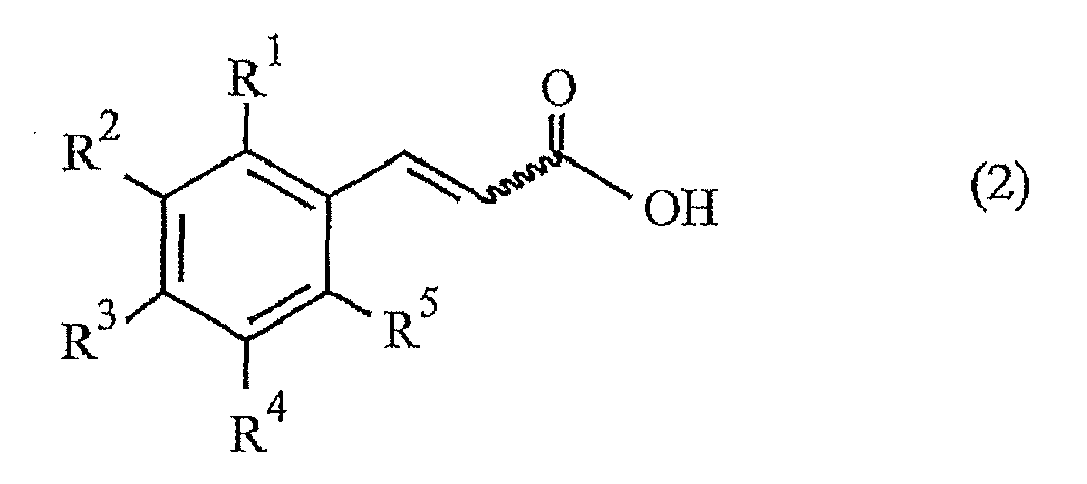
[Chem. 4]
[Chem. 5]
selected from hydrogen, alkyl, and aryl, where R7 and R8 may be linked to form a ring together with carbon atoms constituting the specified imidazole ring,
[Chem. 6]
Applications Claiming Priority (2)
| Application Number | Priority Date | Filing Date | Title |
|---|---|---|---|
| JP2012178482 | 2012-08-10 | ||
| PCT/JP2013/071147 WO2014024844A1 (en) | 2012-08-10 | 2013-08-05 | Crystals containing unsaturated carboxylic acid amide compound and method for producing same |
Publications (1)
| Publication Number | Publication Date |
|---|---|
| EP2883869A1 true EP2883869A1 (en) | 2015-06-17 |
Family
ID=50068069
Family Applications (1)
| Application Number | Title | Priority Date | Filing Date |
|---|---|---|---|
| EP13828290.0A Withdrawn EP2883869A1 (en) | 2012-08-10 | 2013-08-05 | Crystals containing unsaturated carboxylic acid amide compound and method for producing same |
Country Status (6)
| Country | Link |
|---|---|
| US (1) | US20150158820A1 (en) |
| EP (1) | EP2883869A1 (en) |
| JP (1) | JP6231479B2 (en) |
| KR (1) | KR20150040282A (en) |
| CN (1) | CN104470901A (en) |
| WO (1) | WO2014024844A1 (en) |
Families Citing this family (2)
| Publication number | Priority date | Publication date | Assignee | Title |
|---|---|---|---|---|
| ES2996890T3 (en) | 2015-11-18 | 2025-02-13 | Monsanto Technology Llc | Method of controlling insect pests |
| CN106324169B (en) * | 2016-08-16 | 2017-11-10 | 韩超 | The SPE gas-chromatography tandem mass spectrum detection method of acid amide fungicides in grape wine |
Family Cites Families (13)
| Publication number | Priority date | Publication date | Assignee | Title |
|---|---|---|---|---|
| FR2579461B1 (en) * | 1985-03-28 | 1988-08-26 | Strasbourg Universite L Pasteu | AMIDES OF PARA-METHOXYCINNAMIC ACID AND UROCANIC ACID FOR USE AS SOLAR FILTERS; PROCESSES FOR OBTAINING, DERMO-PHARMACEUTICAL AND COSMETIC COMPOSITIONS CONTAINING THEM AND APPLICATIONS |
| SE468434B (en) * | 1987-01-21 | 1993-01-18 | Nobel Kemi Ab | PROCEDURE FOR PURIFICATION OF HNS (2,2 ', 4,4', 6,6'-HEXANITROSTILBEN) AND PREPARATION OF HNSII |
| JPH07118222A (en) * | 1993-10-20 | 1995-05-09 | Nitto Chem Ind Co Ltd | Method for obtaining high bulk density tetracyanoquinodimethane double salt |
| AU1618697A (en) * | 1996-02-06 | 1997-08-28 | Japan Tobacco Inc. | Novel compounds and pharmaceutical use thereof |
| JP3292119B2 (en) * | 1997-11-26 | 2002-06-17 | 住友化学工業株式会社 | Method for producing methionine |
| JP5602981B2 (en) | 2000-12-18 | 2014-10-08 | 株式会社ダイセル | Method for producing high purity methacrylic acid derivatives |
| US7057040B2 (en) * | 2002-02-07 | 2006-06-06 | Council Of Scientific And Industrial Research | Substituted aryl alkenoic acid heterocyclic amides |
| US8614233B2 (en) * | 2007-05-29 | 2013-12-24 | Universite De Montreal | Cinnamoyl inhibitors of transglutaminase |
| KR101552371B1 (en) * | 2008-03-31 | 2015-09-10 | 다이니폰 인사츠 가부시키가이샤 | Base-generating agent, photosensitive resin composition, pattern-forming material comprising the photosensitive resin composition, pattern formation method using the photosensitive resin composition, and article |
| JP2009263543A (en) | 2008-04-25 | 2009-11-12 | Nippon Kayaku Co Ltd | Epoxy resin, epoxy resin composition, and cured product thereof |
| JP5797476B2 (en) * | 2011-06-24 | 2015-10-21 | 株式会社ダイセル | Process for producing unsaturated carboxylic acid amide composition |
| EP2725011B1 (en) * | 2011-06-24 | 2021-10-27 | Tokyo Ohka Kogyo Co., Ltd. | Novel base generator and adhesion enhancer |
| JP6263120B2 (en) * | 2012-08-10 | 2018-01-17 | 株式会社ダイセル | Crystal containing unsaturated carboxylic acid amide compound and method for producing the same |
-
2013
- 2013-08-05 JP JP2014529491A patent/JP6231479B2/en active Active
- 2013-08-05 CN CN201380037985.9A patent/CN104470901A/en active Pending
- 2013-08-05 EP EP13828290.0A patent/EP2883869A1/en not_active Withdrawn
- 2013-08-05 WO PCT/JP2013/071147 patent/WO2014024844A1/en not_active Ceased
- 2013-08-05 KR KR20157002477A patent/KR20150040282A/en not_active Withdrawn
- 2013-08-05 US US14/417,775 patent/US20150158820A1/en not_active Abandoned
Non-Patent Citations (1)
| Title |
|---|
| See references of WO2014024844A1 * |
Also Published As
| Publication number | Publication date |
|---|---|
| US20150158820A1 (en) | 2015-06-11 |
| WO2014024844A1 (en) | 2014-02-13 |
| JP6231479B2 (en) | 2017-11-15 |
| JPWO2014024844A1 (en) | 2016-07-25 |
| KR20150040282A (en) | 2015-04-14 |
| CN104470901A (en) | 2015-03-25 |
Similar Documents
| Publication | Publication Date | Title |
|---|---|---|
| JP2016540743A (en) | A novel initiator for the production of alkanesulfonic acids from alkanes and fuming sulfuric acid | |
| CN105153016A (en) | Preparation method of pimavanserin | |
| WO2012086808A1 (en) | Process for production of aromatic alcohol or heterocyclic aromatic alcohol | |
| EP2883868B1 (en) | Crystal containing unsaturated carboxylic acid amide compound and method for producing same | |
| Butov et al. | One-step preparation method for adamantyl-containing isocyanates, precursors of epoxide hydrolase inhibitors | |
| US20150158820A1 (en) | Crystals containing unsaturated carboxylic acid amide compound and method for producing same | |
| JP5797476B2 (en) | Process for producing unsaturated carboxylic acid amide composition | |
| JP6180717B2 (en) | Method for producing lithium iodide aqueous solution and use thereof | |
| JPH08231473A (en) | Method of treating amine hydrofluoride complex | |
| KR20250129788A (en) | Method for preparing N-substituted-2-oxazolidinone | |
| EP4069672B1 (en) | Process for the purification of a mixture comprising n-alkyl-hydroxylammonium salts | |
| US3401203A (en) | Preparation of amines | |
| JP5434919B2 (en) | Method for producing carbamate compound | |
| JP2020189827A (en) | Method for producing 9,9-bis (4-aminophenyl) fluorene compound | |
| RU2848366C1 (en) | A phosphorus-free method for obtaining 4,4'-methylendiphenyldiisoccyanate | |
| JP7607049B2 (en) | Method for producing 9,9-bis(3,5-dialkyl-4-aminophenyl)fluorene compound | |
| WO1994021594A1 (en) | Process for producing n,n-disubstituted aminophenol | |
| KR20250134136A (en) | One-step reaction for the catalytic synthesis of cyclic urea derivatives | |
| JP2021024854A (en) | 9,9-bis(4-aminophenyl)fluorene compound and production method thereof | |
| JPH05310651A (en) | Purification of diaminodiphenyl compound | |
| US20130123545A1 (en) | Method for synthesizing diketopyracene | |
| JP2006028145A (en) | Process for producing mono-substituted N-alkylanilines | |
| EA003286B1 (en) | Process for producing salt of cyanobenzylamine | |
| GB2076802A (en) | Preparation of Isocyanates | |
| JP2002179662A (en) | Method for producing N-monoacylpiperazines |
Legal Events
| Date | Code | Title | Description |
|---|---|---|---|
| PUAI | Public reference made under article 153(3) epc to a published international application that has entered the european phase |
Free format text: ORIGINAL CODE: 0009012 |
|
| STAA | Information on the status of an ep patent application or granted ep patent |
Free format text: STATUS: THE APPLICATION HAS BEEN WITHDRAWN |
|
| 17P | Request for examination filed |
Effective date: 20150305 |
|
| AK | Designated contracting states |
Kind code of ref document: A1 Designated state(s): AL AT BE BG CH CY CZ DE DK EE ES FI FR GB GR HR HU IE IS IT LI LT LU LV MC MK MT NL NO PL PT RO RS SE SI SK SM TR |
|
| AX | Request for extension of the european patent |
Extension state: BA ME |
|
| 18W | Application withdrawn |
Effective date: 20150608 |