EP2882683B1 - Process for the colloidal synthesis of lithium iron phosphate - Google Patents
Process for the colloidal synthesis of lithium iron phosphate Download PDFInfo
- Publication number
- EP2882683B1 EP2882683B1 EP13777139.0A EP13777139A EP2882683B1 EP 2882683 B1 EP2882683 B1 EP 2882683B1 EP 13777139 A EP13777139 A EP 13777139A EP 2882683 B1 EP2882683 B1 EP 2882683B1
- Authority
- EP
- European Patent Office
- Prior art keywords
- iron
- lithium
- manganese
- process according
- phosphate
- Prior art date
- Legal status (The legal status is an assumption and is not a legal conclusion. Google has not performed a legal analysis and makes no representation as to the accuracy of the status listed.)
- Not-in-force
Links
Images


Classifications
-
- H—ELECTRICITY
- H01—ELECTRIC ELEMENTS
- H01M—PROCESSES OR MEANS, e.g. BATTERIES, FOR THE DIRECT CONVERSION OF CHEMICAL ENERGY INTO ELECTRICAL ENERGY
- H01M4/00—Electrodes
- H01M4/02—Electrodes composed of, or comprising, active material
- H01M4/13—Electrodes for accumulators with non-aqueous electrolyte, e.g. for lithium-accumulators; Processes of manufacture thereof
- H01M4/136—Electrodes based on inorganic compounds other than oxides or hydroxides, e.g. sulfides, selenides, tellurides, halogenides or LiCoFy
-
- C—CHEMISTRY; METALLURGY
- C01—INORGANIC CHEMISTRY
- C01B—NON-METALLIC ELEMENTS; COMPOUNDS THEREOF; METALLOIDS OR COMPOUNDS THEREOF NOT COVERED BY SUBCLASS C01C
- C01B25/00—Phosphorus; Compounds thereof
- C01B25/16—Oxyacids of phosphorus; Salts thereof
- C01B25/26—Phosphates
- C01B25/45—Phosphates containing plural metal, or metal and ammonium
-
- H—ELECTRICITY
- H01—ELECTRIC ELEMENTS
- H01M—PROCESSES OR MEANS, e.g. BATTERIES, FOR THE DIRECT CONVERSION OF CHEMICAL ENERGY INTO ELECTRICAL ENERGY
- H01M4/00—Electrodes
- H01M4/02—Electrodes composed of, or comprising, active material
- H01M4/36—Selection of substances as active materials, active masses, active liquids
- H01M4/58—Selection of substances as active materials, active masses, active liquids of inorganic compounds other than oxides or hydroxides, e.g. sulfides, selenides, tellurides, halogenides or LiCoFy; of polyanionic structures, e.g. phosphates, silicates or borates
- H01M4/5825—Oxygenated metallic salts or polyanionic structures, e.g. borates, phosphates, silicates, olivines
-
- H—ELECTRICITY
- H01—ELECTRIC ELEMENTS
- H01M—PROCESSES OR MEANS, e.g. BATTERIES, FOR THE DIRECT CONVERSION OF CHEMICAL ENERGY INTO ELECTRICAL ENERGY
- H01M4/00—Electrodes
- H01M4/02—Electrodes composed of, or comprising, active material
- H01M2004/026—Electrodes composed of, or comprising, active material characterised by the polarity
- H01M2004/028—Positive electrodes
-
- Y—GENERAL TAGGING OF NEW TECHNOLOGICAL DEVELOPMENTS; GENERAL TAGGING OF CROSS-SECTIONAL TECHNOLOGIES SPANNING OVER SEVERAL SECTIONS OF THE IPC; TECHNICAL SUBJECTS COVERED BY FORMER USPC CROSS-REFERENCE ART COLLECTIONS [XRACs] AND DIGESTS
- Y02—TECHNOLOGIES OR APPLICATIONS FOR MITIGATION OR ADAPTATION AGAINST CLIMATE CHANGE
- Y02E—REDUCTION OF GREENHOUSE GAS [GHG] EMISSIONS, RELATED TO ENERGY GENERATION, TRANSMISSION OR DISTRIBUTION
- Y02E60/00—Enabling technologies; Technologies with a potential or indirect contribution to GHG emissions mitigation
- Y02E60/10—Energy storage using batteries
Definitions
- the present invention relates to a process for preparing lithium iron phosphate, via a colloidal synthesis which makes it possible to obtain nanocrystals that may be used as cathodes in lithium batteries.
- Lithium iron phosphate which has an olivine structure, is a material of appreciable interest in the power sector, particularly as a cathode material for lithium batteries. Its main advantages over lithium cobalt oxide lie in its low cost and its low environmental impact.
- Lithium iron phosphate has an olivine structure in which the lithium present between the layers may be extracted and transferred to the anode in the charging process, compensated for by the oxidation of the iron, which passes from its oxidation state +2 to +3. This process may be hampered by impurities, and, as a result, there is particular interest in producing lithium iron phosphate that is substantially free of impurities.
- the theoretical capacity of the electron extraction process is 170 mAh.g -1 ; the main limitation of the material is its low conductivity; this problem may be solved by making use, after the synthesis, of a carbon coating.
- the main processes for producing lithium iron phosphate comprise:
- the above processes When compared with the solid-state reaction processes, the above processes have the advantage of affording better homogeneity and mixing of the starting compounds at the molecular level; among the solution processes mentioned above, the hydrothermal route is often adopted.
- LiFePO 4 is synthesized by reacting iron sulfate, ammonium phosphate and lithium hydroxide (in a 2:1:1 ratio). Sucrose is added to the mixture, which presumably acts as a growth regulator. The reaction is performed at about 220°C in a Teflon tube for 18 hours.
- Microparticles composed of an assembly of nanoleaflets with a thickness of 80 nm are produced: the structure has a high surface area. Once coated with carbon, the microparticles achieve a capacity of 120 mAh.g -1 .
- Peng et al. in J. Power Source (2010) DOI:10.1016/j.jpowsour.2010.10.065 proposed a sol-gel synthesis of lithium iron phosphate/carbon in which iron(II) phosphate, LiOH.2H 2 O, oxalic acid and glucose are dissolved in water and stirred at 90°, and the solution is then heated to 300° under an argon atmosphere; the process includes a final calcination of the crystals at 600° for 6 hours, to produce crystals of submicron size.
- hydrothermal processes are suitable for working at relatively low temperatures, but long reaction times are however required (up to 24 hours).
- One object of the present invention is to provide a novel process for producing lithium iron phosphate, which is suitable for working at low temperature, which is quick and economical and which is suitable for obtaining a nanocrystalline product.
- Another object of the invention is to provide a process which is suitable for obtaining lithium iron phosphate that is substantially free of iron oxide impurities.
- the lithium salt is preferably chosen from the acetate, carbonate, hydroxide and halide, in particular chloride, bromide and iodide.
- the iron (or manganese) halide is preferably iron(II) (or manganese(II)) chloride.
- the phosphorus compound which is capable of releasing the phosphate ion under the reaction conditions, is ammonium phosphate or dibasic ammonium phosphate.
- the use of the abovementioned phosphorus compound improves the purity of the lithium iron phosphate, in particular by avoiding the formation of other phosphates such as lithium phosphate and iron hydrogen phosphate (see Example 4).
- the synthetic reaction is performed in the presence of an organic surfactant or a mixture of organic surfactants, comprising a long-chain alkylamine or alkenylamine containing from 14 to 20 carbon atoms, the said organic surfactant being capable of dissolving the lithium salt and the iron (and/or manganese) halide, where used, i.e. the components of the surfactant mixture being individually capable of dissolving, respectively, the lithium salt and the iron (and/or manganese) halide.
- an organic surfactant or a mixture of organic surfactants comprising a long-chain alkylamine or alkenylamine containing from 14 to 20 carbon atoms, the said organic surfactant being capable of dissolving the lithium salt and the iron (and/or manganese) halide, where used, i.e. the components of the surfactant mixture being individually capable of dissolving, respectively, the lithium salt and the iron (and/or manganese) halide.
- oleylamine and/or octadecylamine or a mixture of surfactants comprising oleylamine and/or octadecylamine in combination with oleic acid and/or hexadecanediol may be used as organic surfactant.
- the mole ratio between the surfactant or mixture of surfactants and iron or manganese may preferably be between 4 and 45.
- the organic solvent is a compound that is liquid at room temperature, in which the said surfactant or mixture of surfactants is fully soluble; it is preferred to use 1-octadecene since it allows better control over the growth of the nanocrystals; however, other solvents may be used, for instance hexyl ether (C 6 H 13 ) 2 O, octyl ether (C 8 H 17 ) 2 O, phenyl ether (C 6 H 5 ) 2 O and benzyl ether (C 7 H 7 ) 2 O.
- the preferred embodiment of the process according to the invention envisages the reaction of lithium iodide with iron(II) (and/or manganese(II)) chloride, and with dibasic ammonium phosphate, in the presence of oleylamine or octadecylamine, in 1-octadecene as solvent.
- the lithium iodide used as lithium precursor and similarly the iron(II) chloride and the manganese(II) chloride used, respectively, as iron and manganese precursors are soluble in the alkylamine or alkenylamine, and as such it is possible to use a single surfactant.
- This embodiment of the process is suitable for avoiding the formation of iron oxide, which would constitute an undesired impurity that would have to be removed.
- dibasic ammonium phosphate (NH 4 ) 2 HPO 4 is preferred.
- phosphoric acid the possible reaction of phosphoric acid with iron (or with manganese), may lead to the production of iron (or manganese) oxide.
- oleylamine is preferred relative to the use of octadecylamine since oleylamine is liquid, whereas octadecylamine is solid and its use entails laborious operations for cleaning the reactor.
- the mole ratio between the amine and iron or manganese may be between 15 and 45.
- the process according to the invention may be performed using a lithium salt chosen from the acetate, carbonate, hydroxide, chloride or bromide.
- the abovementioned lithium salts are insoluble in amine, wherein the use of oleic acid or hexadecanediol to dissolve the lithium salt is required.
- a lithium/iron or Mn/PO 4 atomic ratio of between 1:1:1 and 3:1:1 is preferably used, the optimum condition being considered to be a 1.5:1:1 ratio.
- the reaction is generally performed at a temperature of between 250 and 400°C for times preferably of between 30 minutes and 180 minutes, preferably under an inert atmosphere (stream of nitrogen or argon); temperatures close to the upper value of 400°C, for example 380°C, allow the use of an atomic ratio close or equal to 3:1:1; the use of excess lithium in such a ratio is not desirable since a large excess of lithium impedes the formation of lithium iron phosphate.
- the process comprises a first phase of heating to an intermediate temperature of about 100-120°C and maintaining the reaction mixture at this temperature for a time sufficient to achieve degassing of the solution; for example, the degassing may be performed for 1 hour at 120°C.
- the solution is preferably heated to 250°C, for example for 30 minutes.
- the subsequent phases of the process include cooling the solution to room temperature, the addition of a solvent, for example toluene, and a phase of precipitation of the nanocrystals, preferably by addition of an alcohol such as methanol, under an inert atmosphere.
- a solvent for example toluene
- a phase of precipitation of the nanocrystals preferably by addition of an alcohol such as methanol
- the precipitate may be redissolved in toluene, from which the nanocrystals may be precipitated again by adding ethanol or methanol; this last procedure may be repeated several times to eliminate the impurities.
- the process enables the production of crystals with a size of between 400 nm and 200 nm.
- lithium iodide 0.060 g of dibasic ammonium phosphate, 0.063 g of anhydrous iron chloride, 5 ml of oleylamine and 5 ml of 1-octadecene are mixed together in a 50 ml Pyrex glass round-bottomed flask.
- the solution is degassed at 120°C for 1 hour and then heated to 250°C and maintained at this temperature for 3 hours, under a stream of nitrogen, until it becomes white. At this point, lithium iron phosphate is obtained.
- the solution is cooled to room temperature, 5 ml of toluene are added and the resulting solution is transferred into a glove box, where the nanocrystals are precipitated out by adding methanol under an inert atmosphere.
- the precipitate is then dissolved in toluene, from which the nanocrystals may be precipitated again by adding ethanol. This last procedure may be repeated several times to remove the various impurities.
- Example 2 is repeated under the same conditions and with the same reagents, but using 1.5 ml of oleic acid (6 mmol) instead of hexadecanediol.
- Example 1 was repeated, as described, replacing 0.060 g of dibasic ammonium phosphate with an equimolar amount of tris(2-ethylhexyl) phosphate (0.5 mmol, 0.21 g, 0.23 ml).
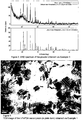
- Lithium iron phosphate incorporating impurities of hydrated iron phosphate (vivianite) and iron hydrogen phosphate was obtained, as illustrated by the diffraction diagram in Figure 7b ).
- the process according to the invention makes it possible to exert control over the particle sizes, since the organic surfactants used regulate the growth of the crystal and its phase.
- the process makes it possible to work at atmospheric pressure with relatively low temperatures compared with other conventional syntheses, with the possibility of using a fithium/iron/PO 4 ratio of 1.5:1:1, which is low relative to that generally used in the literature (3:1:1) and makes it possible to use a reduced amount of lithium for the production of lithium iron phosphate.
Landscapes
- Chemical & Material Sciences (AREA)
- Inorganic Chemistry (AREA)
- Organic Chemistry (AREA)
- Chemical Kinetics & Catalysis (AREA)
- Electrochemistry (AREA)
- General Chemical & Material Sciences (AREA)
- Crystallography & Structural Chemistry (AREA)
- Engineering & Computer Science (AREA)
- Materials Engineering (AREA)
- Battery Electrode And Active Subsutance (AREA)
- Compounds Of Iron (AREA)
Description
- The present invention relates to a process for preparing lithium iron phosphate, via a colloidal synthesis which makes it possible to obtain nanocrystals that may be used as cathodes in lithium batteries.
- Lithium iron phosphate (LiFePO4), which has an olivine structure, is a material of appreciable interest in the power sector, particularly as a cathode material for lithium batteries. Its main advantages over lithium cobalt oxide lie in its low cost and its low environmental impact.
- Lithium iron phosphate has an olivine structure in which the lithium present between the layers may be extracted and transferred to the anode in the charging process, compensated for by the oxidation of the iron, which passes from its oxidation state +2 to +3. This process may be hampered by impurities, and, as a result, there is particular interest in producing lithium iron phosphate that is substantially free of impurities.
- The theoretical capacity of the electron extraction process is 170 mAh.g-1; the main limitation of the material is its low conductivity; this problem may be solved by making use, after the synthesis, of a carbon coating.
- To solve the problem of the low conductivity, other routes were explored, including reduction of the particle sizes and the production of a uniform particle size distribution, adaptation of the morphology and structure of the particles via low-temperature synthetic processes and selective doping with multivalent cations to increase the intrinsic conductivity. In this context, the synthesis of nanocrystalline materials also assumes relevance.
- There is, therefore, a need for novel production processes, which operate at low temperature and which can produce nanocrystalline particles with a narrow particle size distribution.
- A full review of the state of the art relating to processes for synthesizing lithium iron phosphate powders is given by Jugovic D. et al in Journal of Power Sources 190 (2009) 538-544 , the content of which is incorporated herein by way of reference.
- In summary, the main processes for producing lithium iron phosphate comprise:
- synthesis by solid-state reaction, in which stoichiometric amounts of iron(II) acetate, ammonium phosphate and lithium carbonate are heated to the decomposition temperature of 300 to 400°C, under an inert atmosphere, and are then calcined at a temperature of 400 to 800°C in an oven. Via this method, it is, however, not possible to control the size of the particles, which are very large;
- solid-state microwave synthesis, in which the precursors in solid state, rather than being calcined, are irradiated with microwave radiation, by virtue of the fact that iron(II) lactate or acetate acts as a radiation absorber;
- solution synthesis via hydrothermal/solvothermal, sol-gel or coprecipitation processes.
- When compared with the solid-state reaction processes, the above processes have the advantage of affording better homogeneity and mixing of the starting compounds at the molecular level;
among the solution processes mentioned above, the hydrothermal route is often adopted. - Tajimi et al. in Solid State Ionics 175 (2004), 287-290 proposed a synthesis in an autoclave by mixing LiOH·H2O, FeSO4·7H2O and H3PO4 in a 3:1:1 ratio in water. The addition of PEG (in excess relative to the lithium with a 2:1 ratio) makes it possible to reduce the sizes to a level of one micron.
- Huang et al. in Materials Characterization 61 (2010), 720-725 proposed a synthesis of nanorods with orders of magnitude of 400-500 nm via a hydrothermal route. LiFePO4 is synthesized by reacting iron sulfate, ammonium phosphate and lithium hydroxide (in a 2:1:1 ratio). Sucrose is added to the mixture, which presumably acts as a growth regulator. The reaction is performed at about 220°C in a Teflon tube for 18 hours.
- Recently, Goodenough et al. in J. Am. Chem. Soc. (2011), 133, 2132-2135 proposed a hydrothermal synthesis using ethylene glycol and ethylenediamine as complexing agents. Microparticles composed of an assembly of nanoleaflets with a thickness of 80 nm are produced: the structure has a high surface area. Once coated with carbon, the microparticles achieve a capacity of 120 mAh.g-1.
- Aimable et al. in Solid State Ionics 180 (2009), 861-866 proposed a hydrothermal synthesis under supercritical conditions via a continuous synthetic process.
- Peng et al. in J. Power Source (2010) DOI:10.1016/j.jpowsour.2010.10.065 proposed a sol-gel synthesis of lithium iron phosphate/carbon in which iron(II) phosphate, LiOH.2H2O, oxalic acid and glucose are dissolved in water and stirred at 90°, and the solution is then heated to 300° under an argon atmosphere; the process includes a final calcination of the crystals at 600° for 6 hours, to produce crystals of submicron size.
- In general, the hydrothermal processes are suitable for working at relatively low temperatures, but long reaction times are however required (up to 24 hours).
- Further synthetic routes comprise a microemulsion reaction, described by Xu et al. in Materials Chemistry and Physics 105 (2007), 80-85 , and pyrolytic synthesis, described by Konarova et al. in Journal of Power Sources 194 (2009) 1029-1035 . In this synthesis, lithium acetate, iron(II) chloride and phosphoric acid are mixed together in water in a stoichiometric ratio, the solution is atomized and the drops are conveyed into a chamber heated to about 500°; the crystals are subsequently milled by wet-ball milling, to obtain crystals of the order of a micron. The process therefore requires high temperatures and subsequent processing of the prepared product.
- Jie Jiang et al., "ACS applied materials and interfaces", American Chemical Society US, Vol. 4, No. 6, 31 May 2012, pages 3062-3068 describes a process for the preparation of lithium iron phosphate comprising preparing a precursor solution by mixing lithium acetate dehydrate, iron(III)acetylacetonate and tris(2-ethylhexyl) phosphate with oleic acid and oleylamine.
- One object of the present invention is to provide a novel process for producing lithium iron phosphate, which is suitable for working at low temperature, which is quick and economical and which is suitable for obtaining a nanocrystalline product.
- Another object of the invention is to provide a process which is suitable for obtaining lithium iron phosphate that is substantially free of iron oxide impurities.
- The abovementioned objects are achieved by means of a colloidal synthetic process having the characteristics defined in the claims hereinbelow, which are also related to the production of lithium manganese phosphate and lithium iron manganese phosphate, the process according to the invention being suitable for the production of these salts.
- In the colloidal synthesis that is the subject of the invention, the lithium salt is preferably chosen from the acetate, carbonate, hydroxide and halide, in particular chloride, bromide and iodide.
- The iron (or manganese) halide is preferably iron(II) (or manganese(II)) chloride.
- The phosphorus compound, which is capable of releasing the phosphate ion under the reaction conditions, is ammonium phosphate or dibasic ammonium phosphate.
- The use of the abovementioned phosphorus compound improves the purity of the lithium iron phosphate, in particular by avoiding the formation of other phosphates such as lithium phosphate and iron hydrogen phosphate (see Example 4).
- The synthetic reaction is performed in the presence of an organic surfactant or a mixture of organic surfactants, comprising a long-chain alkylamine or alkenylamine containing from 14 to 20 carbon atoms, the said organic surfactant being capable of dissolving the lithium salt and the iron (and/or manganese) halide, where used, i.e. the components of the surfactant mixture being individually capable of dissolving, respectively, the lithium salt and the iron (and/or manganese) halide.
- In particular, oleylamine and/or octadecylamine or a mixture of surfactants comprising oleylamine and/or octadecylamine in combination with oleic acid and/or hexadecanediol may be used as organic surfactant.
- The mole ratio between the surfactant or mixture of surfactants and iron or manganese may preferably be between 4 and 45.
- The organic solvent is a compound that is liquid at room temperature, in which the said surfactant or mixture of surfactants is fully soluble; it is preferred to use 1-octadecene since it allows better control over the growth of the nanocrystals; however, other solvents may be used, for instance hexyl ether (C6H13)2O, octyl ether (C8H17)2O, phenyl ether (C6H5)2O and benzyl ether (C7H7)2O.
- The preferred embodiment of the process according to the invention envisages the reaction of lithium iodide with iron(II) (and/or manganese(II)) chloride, and with dibasic ammonium phosphate, in the presence of oleylamine or octadecylamine, in 1-octadecene as solvent.
- In this embodiment, it is particularly preferred to use oleylamine.
- In this embodiment, the lithium iodide used as lithium precursor and similarly the iron(II) chloride and the manganese(II) chloride used, respectively, as iron and manganese precursors, are soluble in the alkylamine or alkenylamine, and as such it is possible to use a single surfactant. This embodiment of the process is suitable for avoiding the formation of iron oxide, which would constitute an undesired impurity that would have to be removed.
- The use of dibasic ammonium phosphate (NH4)2HPO4 is preferred. With the use of phosphoric acid, the possible reaction of phosphoric acid with iron (or with manganese), may lead to the production of iron (or manganese) oxide.
- The use of oleylamine is preferred relative to the use of octadecylamine since oleylamine is liquid, whereas octadecylamine is solid and its use entails laborious operations for cleaning the reactor.
- It is preferred to use a total amount of amine so as to maintain a (highly) reducing medium; the mole ratio between the amine and iron or manganese may be between 15 and 45.
- In another embodiment, which is, however, less preferred relative to that described previously, the process according to the invention may be performed using a lithium salt chosen from the acetate, carbonate, hydroxide, chloride or bromide.
- In this case, the abovementioned lithium salts are insoluble in amine, wherein the use of oleic acid or hexadecanediol to dissolve the lithium salt is required.
- In the process according to the invention, a lithium/iron or Mn/PO4 atomic ratio of between 1:1:1 and 3:1:1 is preferably used, the optimum condition being considered to be a 1.5:1:1 ratio. The reaction is generally performed at a temperature of between 250 and 400°C for times preferably of between 30 minutes and 180 minutes, preferably under an inert atmosphere (stream of nitrogen or argon); temperatures close to the upper value of 400°C, for example 380°C, allow the use of an atomic ratio close or equal to 3:1:1; the use of excess lithium in such a ratio is not desirable since a large excess of lithium impedes the formation of lithium iron phosphate.
- In a preferred embodiment, the process comprises a first phase of heating to an intermediate temperature of about 100-120°C and maintaining the reaction mixture at this temperature for a time sufficient to achieve degassing of the solution; for example, the degassing may be performed for 1 hour at 120°C.
- Next, under a stream of nitrogen (or argon), the solution is preferably heated to 250°C, for example for 30 minutes.
- It was noted that at a temperature of about 300°C, the powder obtained starts to become magnetic, presumably due to a reaction between the iron and the phosphate.
- The subsequent phases of the process include cooling the solution to room temperature, the addition of a solvent, for example toluene, and a phase of precipitation of the nanocrystals, preferably by addition of an alcohol such as methanol, under an inert atmosphere.
- The precipitate may be redissolved in toluene, from which the nanocrystals may be precipitated again by adding ethanol or methanol; this last procedure may be repeated several times to eliminate the impurities.
- The process enables the production of crystals with a size of between 400 nm and 200 nm.
- In the attached drawings:
-
Figures 1, 2 and3 are powder XRD spectra of lithium iron phosphate obtained according to Examples 1 to 3; -
Figure 4 shows the LiFePO4 nanoplatelets obtained via Example 1; -
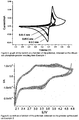
Figure 5 is a graph of the current as a function of the potential, obtained on the lithium iron phosphate powder resulting from Example 1 which follows, at various sweep speeds (0.01C, 0.05C and 0.1C); -
Figure 6 is a graph of the current as a function of the potential, obtained on the lithium iron phosphate powder resulting from Example 2 which follows;
at 3.9 V the flexion of the curve corresponds to the redox energy on passing from LiFePO4 to FePO4, whereas the flexion at 3.3 V corresponds to the oxidation process; and -
Figure 7a ) is a TEM image of the nanocrystals resulting from Example 4 andFigure 7b ) is the corresponding XRD spectrum. - 0.090 g of lithium iodide, 0.060 g of dibasic ammonium phosphate, 0.063 g of anhydrous iron chloride, 5 ml of oleylamine and 5 ml of 1-octadecene are mixed together in a 50 ml Pyrex glass round-bottomed flask. The solution is degassed at 120°C for 1 hour and then heated to 250°C and maintained at this temperature for 3 hours, under a stream of nitrogen, until it becomes white. At this point, lithium iron phosphate is obtained. Next, the solution is cooled to room temperature, 5 ml of toluene are added and the resulting solution is transferred into a glove box, where the nanocrystals are precipitated out by adding methanol under an inert atmosphere. The precipitate is then dissolved in toluene, from which the nanocrystals may be precipitated again by adding ethanol. This last procedure may be repeated several times to remove the various impurities.
- The XRD spectrum of the powder obtained is shown in
Figure 1 . - 0.060 g of lithium acetate (0.9 mmol), 0.066 g of phosphoric acid (0.7 mmol), 0.063 g of iron(II) chloride (0.5 mmol), 0.50 g of hexadecanediol (2 mmol), 0.53 g of octadecylamine (2 mmol) and 10 ml of 1-octadecene are mixed together in a 50 ml Pyrex glass round-bottomed flask. The mixture is degassed at 120°C under vacuum until the solution becomes black. After about 1 hour, the vacuum is broken and a stream of inert gas (nitrogen or argon) is passed through the flask, after which the temperature of the mixture is raised to 300°C and maintained at this value for 30 minutes, while maintaining a moderate stream of inert gas. The subsequent precipitation and purification phases are performed in accordance with that described in Example 1.
- The spectrum of the lithium iron phosphate obtained according to Example 2 is shown in
Figure 2 . - Example 2 is repeated under the same conditions and with the same reagents, but using 1.5 ml of oleic acid (6 mmol) instead of hexadecanediol.
- The spectrum of the lithium iron phosphate obtained according to Example 3 is shown in
Figure 3 . - Example 1 was repeated, as described, replacing 0.060 g of dibasic ammonium phosphate with an equimolar amount of tris(2-ethylhexyl) phosphate (0.5 mmol, 0.21 g, 0.23 ml).
- Lithium iron phosphate incorporating impurities of hydrated iron phosphate (vivianite) and iron hydrogen phosphate was obtained, as illustrated by the diffraction diagram in
Figure 7b ). - The process according to the invention makes it possible to exert control over the particle sizes, since the organic surfactants used regulate the growth of the crystal and its phase.
- The process makes it possible to work at atmospheric pressure with relatively low temperatures compared with other conventional syntheses, with the possibility of using a fithium/iron/PO4 ratio of 1.5:1:1, which is low relative to that generally used in the literature (3:1:1) and makes it possible to use a reduced amount of lithium for the production of lithium iron phosphate.
- The electrochemical novelty of the product obtained may be summarized in three points:
- higher charging and discharging speed of the crystal (lithiation and delithiation) relative to known products,
- the crystal structure is very stable during the charging and discharging processes, and
- the reduced dimensions allow the insertion of crystals into polymer matrices.
Claims (11)
- Process for the production of lithium iron phosphate or lithium manganese phosphate or lithium iron manganese phosphate, through colloidal synthesis, comprising the step of reacting a lithium salt, an iron (II) halide and/or a manganese (II) halide and a phosphorus compound which, under the reaction conditions, is capable of releasing the phosphate ion, selected from ammonium phosphate and dibasic ammonium phosphate, in the presence of an organic surfactant or mixture of organic surfactants comprising an alkyl- or alkenylamine having from 14 to 20 carbon atoms, where said surfactant or mixture of surfactants is capable of dissolving the lithium salt and the iron halide and/or the manganese (II) halide, where used, in an organic solvent which is liquid at room temperature and in which said surfactant or mixture of surfactants is soluble, the reaction being conducted at a temperature not lower than 250°C.
- Process according to claim 1, characterised in that said lithium salt is selected from acetate, carbonate, hydroxide and a halide, in turn selected from the group consisting of chloride, bromide and iodide.
- Process according to claim 1 or 2, characterised in that said iron (II) halide is iron chloride and said manganese (II) halide is manganese chloride.
- Process according to any one of the preceding claims, characterised in that said surfactant comprises oleylamine and/or octadecylamine, optionally in combination with oleic acid and/or hexadecanediol.
- Process according to claim 4, characterised in that said organic solvent is 1-octadecene.
- Process according to any one of the preceding claims, characterised in that it comprises the reaction of lithium iodide with iron (II) chloride and/or manganese (II) chloride and dibasic ammonium phosphate, in the presence of oleylamine and/or octadecylamine, in 1-octadecene as a solvent.
- Process according to claim 6, characterised in that the phosphorus compound is dibasic ammonium phosphate and in that oleylamine is used as the sole surfactant.
- Process according to claim 6 or 7 wherein the mole ratio between amine and iron or manganese is between 15 and 45.
- Process according to any one of the preceding claims, characterised in that the reaction is carried out at a temperature between 250 and 400°C, preferably at atmospheric pressure and in an inert atmosphere.
- Process according to claim 9, characterised in that it comprises an initial stage of degassing the mixture of reagents at a temperature above 100°C and preferably at about 120°C, followed by heating at a temperature between 250 and 400°C, for a time from 30 minutes to three hours.
- Process according to any one of the preceding claims, wherein in the mixture of reagents, the atomic ratio lithium/iron (and/or manganese)/PO4 is between 1:1:1 and 3:1:1, preferably 1.5:1:1.
Applications Claiming Priority (2)
| Application Number | Priority Date | Filing Date | Title |
|---|---|---|---|
| IT000709A ITTO20120709A1 (en) | 2012-08-07 | 2012-08-07 | PROCEDURE OF COLLOIDAL SYNTHESIS OF LITHIUM FOSFATE IRON |
| PCT/IB2013/056465 WO2014024149A2 (en) | 2012-08-07 | 2013-08-07 | Process for the colloidal synthesis of lithium iron phosphate |
Publications (2)
| Publication Number | Publication Date |
|---|---|
| EP2882683A2 EP2882683A2 (en) | 2015-06-17 |
| EP2882683B1 true EP2882683B1 (en) | 2019-06-19 |
Family
ID=47018378
Family Applications (1)
| Application Number | Title | Priority Date | Filing Date |
|---|---|---|---|
| EP13777139.0A Not-in-force EP2882683B1 (en) | 2012-08-07 | 2013-08-07 | Process for the colloidal synthesis of lithium iron phosphate |
Country Status (4)
| Country | Link |
|---|---|
| US (1) | US9401507B2 (en) |
| EP (1) | EP2882683B1 (en) |
| IT (1) | ITTO20120709A1 (en) |
| WO (1) | WO2014024149A2 (en) |
Families Citing this family (12)
| Publication number | Priority date | Publication date | Assignee | Title |
|---|---|---|---|---|
| CN107628594B (en) * | 2017-08-22 | 2020-01-07 | 西安建筑科技大学 | A solvothermal preparation method for lithium iron phosphate cathode materials assembled into 3D flower-like two-dimensional nanosheets |
| US11325096B2 (en) | 2018-07-24 | 2022-05-10 | Toyota Motor Engineering & Manufacturing North America, Inc. | Microwave synthesis of lithium thiophosphate composite materials |
| CN109950500A (en) * | 2019-03-29 | 2019-06-28 | 北京航空航天大学 | A manganese dioxide positive electrode material for rechargeable zinc ion battery and its preparation method and battery |
| CN110857216B (en) * | 2019-09-29 | 2021-11-12 | 湖南雅城新材料有限公司 | Battery-grade iron phosphate precursor, lithium iron phosphate, and preparation method and application thereof |
| CN112670481A (en) * | 2020-12-23 | 2021-04-16 | 沁新集团(天津)新能源技术研究院有限公司 | Lithium iron phosphate modified material, preparation method thereof and lithium battery using modified material |
| CN112670475A (en) * | 2020-12-23 | 2021-04-16 | 沁新集团(天津)新能源技术研究院有限公司 | Lithium iron phosphate composite material, preparation method thereof, lithium battery using composite material and battery power vehicle |
| CN114604838B (en) * | 2022-05-10 | 2022-08-05 | 兰州兰石中科纳米科技有限公司 | Drying and calcining method for iron phosphate |
| CN117023539A (en) * | 2022-06-20 | 2023-11-10 | 贵州芭田生态工程有限公司 | A kind of lithium iron phosphate prepared from high-purity iron phosphate and lithium source and its preparation method |
| CN116314707A (en) * | 2023-03-30 | 2023-06-23 | 安徽得壹能源科技有限公司 | A high-magnification nano-lithium manganese iron phosphate positive electrode material and preparation method thereof |
| WO2024215357A1 (en) * | 2023-04-13 | 2024-10-17 | Sylvatex, Inc. | Method for the manufacture of lithium metal oxides and phosphates |
| CN117199345A (en) * | 2023-09-11 | 2023-12-08 | 湖北亿纬动力有限公司 | Lithium iron phosphate and preparation method and application thereof |
| CN117208879B (en) * | 2023-10-07 | 2026-02-17 | 山东锂源科技有限公司 | Preparation method of high-compaction high-performance lithium iron phosphate |
Family Cites Families (4)
| Publication number | Priority date | Publication date | Assignee | Title |
|---|---|---|---|---|
| CN102378738A (en) * | 2009-04-03 | 2012-03-14 | 旭硝子株式会社 | Manufacturing method of lithium iron phosphate particles and manufacturing method of secondary battery |
| US9139429B2 (en) * | 2010-03-02 | 2015-09-22 | Guiqing Huang | High performance cathode material LiFePO4, its precursors and methods of making thereof |
| CN102390824B (en) * | 2011-08-10 | 2013-02-20 | 朱叙国 | Preparation method of lithium iron phosphate |
| CN102522551A (en) * | 2011-12-26 | 2012-06-27 | 彩虹集团公司 | Preparation method for LiFePO4 (lithium iron phosphate) superfine powder serving as power battery anode materials |
-
2012
- 2012-08-07 IT IT000709A patent/ITTO20120709A1/en unknown
-
2013
- 2013-08-07 EP EP13777139.0A patent/EP2882683B1/en not_active Not-in-force
- 2013-08-07 WO PCT/IB2013/056465 patent/WO2014024149A2/en not_active Ceased
- 2013-08-07 US US14/419,941 patent/US9401507B2/en not_active Expired - Fee Related
Non-Patent Citations (1)
| Title |
|---|
| None * |
Also Published As
| Publication number | Publication date |
|---|---|
| WO2014024149A2 (en) | 2014-02-13 |
| EP2882683A2 (en) | 2015-06-17 |
| US9401507B2 (en) | 2016-07-26 |
| ITTO20120709A1 (en) | 2014-02-08 |
| WO2014024149A3 (en) | 2014-04-10 |
| US20150171415A1 (en) | 2015-06-18 |
Similar Documents
| Publication | Publication Date | Title |
|---|---|---|
| US9401507B2 (en) | Methods for the colloidal synthesis of lithium iron phosphate | |
| US9590245B2 (en) | Method for producing inorganic compounds | |
| Gummow et al. | Recent progress in the development of Li2MnSiO4 cathode materials | |
| JP5473894B2 (en) | Room temperature single phase Li insertion / extraction material for use in Li-based batteries | |
| US20250388469A1 (en) | Phosphate precursor and preparation method therefor, cathode material and preparation therefor, cathode sheet and secondary battery | |
| EP2407426A1 (en) | Process for producing lithium borate compound | |
| JP2015502325A (en) | Metal phosphate and its manufacturing process | |
| Liu et al. | Synthesis of flower-like LiMnPO4/C with precipitated NH4MnPO4· H2O as precursor | |
| WO2013084396A1 (en) | Lithium silicate compound, method for producing same, positive electrode active material and positive electrode for secondary batteries, and secondary battery | |
| US20240034626A1 (en) | Method for preparing high performance lithium iron phosphate nanopowder | |
| KR102574245B1 (en) | Liquid method for preparing vanadium phosphate-carbon composite materials | |
| US20210261411A1 (en) | Method of making anhydrous metal sulfide nanocrystals | |
| Zong et al. | Novel precursor of Mn (PO3 (OH))· 3H2O for synthesizing LiMn0. 5Fe0. 5PO4 cathode material | |
| KR102294409B1 (en) | Method for producing lithium difluorophosphate | |
| CN107108212A (en) | Suitable for the phosphate compounds for the negative electrode for producing Li ion batteries | |
| JP4823545B2 (en) | Method for producing positive electrode active material for lithium battery, positive electrode active material for lithium battery, and lithium battery | |
| Zharov et al. | New Approaches to Synthesizing Nanostructured Electrode Materials Based on Double Lithium and Cobalt Phosphates in Salt Melts | |
| Lim et al. | Synthesis of LiMPO4 (M= Fe, Mn, Co) nanocrystals in polyol medium and their electrochemical properties | |
| JP7609365B2 (en) | Method for producing cubic lithium manganate particles | |
| EP4424691A1 (en) | Cyclic phosphine compound preparation method | |
| Boyadzhieva et al. | Comparative study on the formation of lithium and sodium manganese phospho-olivines | |
| El Aggadi et al. | Recent Progress on the Elaboration of Sodium Manganese Phosphate Based Nanostructures as Cathodes for Energy Storage | |
| Demopoulos | Hydrothermal Synthesis and Processing of Li-Ion Battery Materials: A New Pressure Hydrometallurgy Frontier | |
| Zeng et al. | Hydrothermal Production of Lithium Metal Silicate Powders with Controlled Properties for Application to Li-ion Batteries | |
| Andaraarachchi et al. | GE-SN HETEROSTRUCTURES: FROM THEORY TO EXPERIMENT |
Legal Events
| Date | Code | Title | Description |
|---|---|---|---|
| PUAI | Public reference made under article 153(3) epc to a published international application that has entered the european phase |
Free format text: ORIGINAL CODE: 0009012 |
|
| 17P | Request for examination filed |
Effective date: 20150203 |
|
| AK | Designated contracting states |
Kind code of ref document: A2 Designated state(s): AL AT BE BG CH CY CZ DE DK EE ES FI FR GB GR HR HU IE IS IT LI LT LU LV MC MK MT NL NO PL PT RO RS SE SI SK SM TR |
|
| AX | Request for extension of the european patent |
Extension state: BA ME |
|
| RIN1 | Information on inventor provided before grant (corrected) |
Inventor name: GENOVESE, ALESSANDRO Inventor name: CINGOLANI, ROBERTO Inventor name: MANNA, LIBERATO Inventor name: PRATO, MIRKO Inventor name: CHANDRAMOHAN, GEORGE Inventor name: POVIA, MAURO Inventor name: PAOLELLA, ANDREA |
|
| DAX | Request for extension of the european patent (deleted) | ||
| 17Q | First examination report despatched |
Effective date: 20161017 |
|
| STAA | Information on the status of an ep patent application or granted ep patent |
Free format text: STATUS: EXAMINATION IS IN PROGRESS |
|
| GRAP | Despatch of communication of intention to grant a patent |
Free format text: ORIGINAL CODE: EPIDOSNIGR1 |
|
| STAA | Information on the status of an ep patent application or granted ep patent |
Free format text: STATUS: GRANT OF PATENT IS INTENDED |
|
| INTG | Intention to grant announced |
Effective date: 20190111 |
|
| GRAS | Grant fee paid |
Free format text: ORIGINAL CODE: EPIDOSNIGR3 |
|
| GRAA | (expected) grant |
Free format text: ORIGINAL CODE: 0009210 |
|
| STAA | Information on the status of an ep patent application or granted ep patent |
Free format text: STATUS: THE PATENT HAS BEEN GRANTED |
|
| AK | Designated contracting states |
Kind code of ref document: B1 Designated state(s): AL AT BE BG CH CY CZ DE DK EE ES FI FR GB GR HR HU IE IS IT LI LT LU LV MC MK MT NL NO PL PT RO RS SE SI SK SM TR |
|
| REG | Reference to a national code |
Ref country code: GB Ref legal event code: FG4D |
|
| REG | Reference to a national code |
Ref country code: CH Ref legal event code: EP |
|
| REG | Reference to a national code |
Ref country code: IE Ref legal event code: FG4D |
|
| REG | Reference to a national code |
Ref country code: DE Ref legal event code: R096 Ref document number: 602013056840 Country of ref document: DE |
|
| REG | Reference to a national code |
Ref country code: AT Ref legal event code: REF Ref document number: 1145271 Country of ref document: AT Kind code of ref document: T Effective date: 20190715 |
|
| REG | Reference to a national code |
Ref country code: NL Ref legal event code: MP Effective date: 20190619 |
|
| PG25 | Lapsed in a contracting state [announced via postgrant information from national office to epo] |
Ref country code: FI Free format text: LAPSE BECAUSE OF FAILURE TO SUBMIT A TRANSLATION OF THE DESCRIPTION OR TO PAY THE FEE WITHIN THE PRESCRIBED TIME-LIMIT Effective date: 20190619 Ref country code: LT Free format text: LAPSE BECAUSE OF FAILURE TO SUBMIT A TRANSLATION OF THE DESCRIPTION OR TO PAY THE FEE WITHIN THE PRESCRIBED TIME-LIMIT Effective date: 20190619 Ref country code: AL Free format text: LAPSE BECAUSE OF FAILURE TO SUBMIT A TRANSLATION OF THE DESCRIPTION OR TO PAY THE FEE WITHIN THE PRESCRIBED TIME-LIMIT Effective date: 20190619 Ref country code: SE Free format text: LAPSE BECAUSE OF FAILURE TO SUBMIT A TRANSLATION OF THE DESCRIPTION OR TO PAY THE FEE WITHIN THE PRESCRIBED TIME-LIMIT Effective date: 20190619 Ref country code: HR Free format text: LAPSE BECAUSE OF FAILURE TO SUBMIT A TRANSLATION OF THE DESCRIPTION OR TO PAY THE FEE WITHIN THE PRESCRIBED TIME-LIMIT Effective date: 20190619 Ref country code: NO Free format text: LAPSE BECAUSE OF FAILURE TO SUBMIT A TRANSLATION OF THE DESCRIPTION OR TO PAY THE FEE WITHIN THE PRESCRIBED TIME-LIMIT Effective date: 20190919 |
|
| REG | Reference to a national code |
Ref country code: LT Ref legal event code: MG4D |
|
| PG25 | Lapsed in a contracting state [announced via postgrant information from national office to epo] |
Ref country code: LV Free format text: LAPSE BECAUSE OF FAILURE TO SUBMIT A TRANSLATION OF THE DESCRIPTION OR TO PAY THE FEE WITHIN THE PRESCRIBED TIME-LIMIT Effective date: 20190619 Ref country code: GR Free format text: LAPSE BECAUSE OF FAILURE TO SUBMIT A TRANSLATION OF THE DESCRIPTION OR TO PAY THE FEE WITHIN THE PRESCRIBED TIME-LIMIT Effective date: 20190920 Ref country code: BG Free format text: LAPSE BECAUSE OF FAILURE TO SUBMIT A TRANSLATION OF THE DESCRIPTION OR TO PAY THE FEE WITHIN THE PRESCRIBED TIME-LIMIT Effective date: 20190919 Ref country code: RS Free format text: LAPSE BECAUSE OF FAILURE TO SUBMIT A TRANSLATION OF THE DESCRIPTION OR TO PAY THE FEE WITHIN THE PRESCRIBED TIME-LIMIT Effective date: 20190619 |
|
| REG | Reference to a national code |
Ref country code: AT Ref legal event code: MK05 Ref document number: 1145271 Country of ref document: AT Kind code of ref document: T Effective date: 20190619 |
|
| PG25 | Lapsed in a contracting state [announced via postgrant information from national office to epo] |
Ref country code: EE Free format text: LAPSE BECAUSE OF FAILURE TO SUBMIT A TRANSLATION OF THE DESCRIPTION OR TO PAY THE FEE WITHIN THE PRESCRIBED TIME-LIMIT Effective date: 20190619 Ref country code: PT Free format text: LAPSE BECAUSE OF FAILURE TO SUBMIT A TRANSLATION OF THE DESCRIPTION OR TO PAY THE FEE WITHIN THE PRESCRIBED TIME-LIMIT Effective date: 20191021 Ref country code: CZ Free format text: LAPSE BECAUSE OF FAILURE TO SUBMIT A TRANSLATION OF THE DESCRIPTION OR TO PAY THE FEE WITHIN THE PRESCRIBED TIME-LIMIT Effective date: 20190619 Ref country code: AT Free format text: LAPSE BECAUSE OF FAILURE TO SUBMIT A TRANSLATION OF THE DESCRIPTION OR TO PAY THE FEE WITHIN THE PRESCRIBED TIME-LIMIT Effective date: 20190619 Ref country code: RO Free format text: LAPSE BECAUSE OF FAILURE TO SUBMIT A TRANSLATION OF THE DESCRIPTION OR TO PAY THE FEE WITHIN THE PRESCRIBED TIME-LIMIT Effective date: 20190619 Ref country code: NL Free format text: LAPSE BECAUSE OF FAILURE TO SUBMIT A TRANSLATION OF THE DESCRIPTION OR TO PAY THE FEE WITHIN THE PRESCRIBED TIME-LIMIT Effective date: 20190619 Ref country code: SK Free format text: LAPSE BECAUSE OF FAILURE TO SUBMIT A TRANSLATION OF THE DESCRIPTION OR TO PAY THE FEE WITHIN THE PRESCRIBED TIME-LIMIT Effective date: 20190619 |
|
| PG25 | Lapsed in a contracting state [announced via postgrant information from national office to epo] |
Ref country code: SM Free format text: LAPSE BECAUSE OF FAILURE TO SUBMIT A TRANSLATION OF THE DESCRIPTION OR TO PAY THE FEE WITHIN THE PRESCRIBED TIME-LIMIT Effective date: 20190619 Ref country code: IS Free format text: LAPSE BECAUSE OF FAILURE TO SUBMIT A TRANSLATION OF THE DESCRIPTION OR TO PAY THE FEE WITHIN THE PRESCRIBED TIME-LIMIT Effective date: 20191019 Ref country code: ES Free format text: LAPSE BECAUSE OF FAILURE TO SUBMIT A TRANSLATION OF THE DESCRIPTION OR TO PAY THE FEE WITHIN THE PRESCRIBED TIME-LIMIT Effective date: 20190619 |
|
| PG25 | Lapsed in a contracting state [announced via postgrant information from national office to epo] |
Ref country code: TR Free format text: LAPSE BECAUSE OF FAILURE TO SUBMIT A TRANSLATION OF THE DESCRIPTION OR TO PAY THE FEE WITHIN THE PRESCRIBED TIME-LIMIT Effective date: 20190619 |
|
| PG25 | Lapsed in a contracting state [announced via postgrant information from national office to epo] |
Ref country code: PL Free format text: LAPSE BECAUSE OF FAILURE TO SUBMIT A TRANSLATION OF THE DESCRIPTION OR TO PAY THE FEE WITHIN THE PRESCRIBED TIME-LIMIT Effective date: 20190619 Ref country code: DK Free format text: LAPSE BECAUSE OF FAILURE TO SUBMIT A TRANSLATION OF THE DESCRIPTION OR TO PAY THE FEE WITHIN THE PRESCRIBED TIME-LIMIT Effective date: 20190619 |
|
| PG25 | Lapsed in a contracting state [announced via postgrant information from national office to epo] |
Ref country code: IS Free format text: LAPSE BECAUSE OF FAILURE TO SUBMIT A TRANSLATION OF THE DESCRIPTION OR TO PAY THE FEE WITHIN THE PRESCRIBED TIME-LIMIT Effective date: 20200224 Ref country code: LU Free format text: LAPSE BECAUSE OF NON-PAYMENT OF DUE FEES Effective date: 20190807 Ref country code: MC Free format text: LAPSE BECAUSE OF FAILURE TO SUBMIT A TRANSLATION OF THE DESCRIPTION OR TO PAY THE FEE WITHIN THE PRESCRIBED TIME-LIMIT Effective date: 20190619 Ref country code: LI Free format text: LAPSE BECAUSE OF NON-PAYMENT OF DUE FEES Effective date: 20190831 Ref country code: CH Free format text: LAPSE BECAUSE OF NON-PAYMENT OF DUE FEES Effective date: 20190831 |
|
| REG | Reference to a national code |
Ref country code: BE Ref legal event code: MM Effective date: 20190831 |
|
| REG | Reference to a national code |
Ref country code: DE Ref legal event code: R097 Ref document number: 602013056840 Country of ref document: DE |
|
| PLBE | No opposition filed within time limit |
Free format text: ORIGINAL CODE: 0009261 |
|
| STAA | Information on the status of an ep patent application or granted ep patent |
Free format text: STATUS: NO OPPOSITION FILED WITHIN TIME LIMIT |
|
| PG2D | Information on lapse in contracting state deleted |
Ref country code: IS |
|
| PG25 | Lapsed in a contracting state [announced via postgrant information from national office to epo] |
Ref country code: IE Free format text: LAPSE BECAUSE OF NON-PAYMENT OF DUE FEES Effective date: 20190807 |
|
| 26N | No opposition filed |
Effective date: 20200603 |
|
| PG25 | Lapsed in a contracting state [announced via postgrant information from national office to epo] |
Ref country code: SI Free format text: LAPSE BECAUSE OF FAILURE TO SUBMIT A TRANSLATION OF THE DESCRIPTION OR TO PAY THE FEE WITHIN THE PRESCRIBED TIME-LIMIT Effective date: 20190619 Ref country code: BE Free format text: LAPSE BECAUSE OF NON-PAYMENT OF DUE FEES Effective date: 20190831 |
|
| PG25 | Lapsed in a contracting state [announced via postgrant information from national office to epo] |
Ref country code: CY Free format text: LAPSE BECAUSE OF FAILURE TO SUBMIT A TRANSLATION OF THE DESCRIPTION OR TO PAY THE FEE WITHIN THE PRESCRIBED TIME-LIMIT Effective date: 20190619 |
|
| PG25 | Lapsed in a contracting state [announced via postgrant information from national office to epo] |
Ref country code: HU Free format text: LAPSE BECAUSE OF FAILURE TO SUBMIT A TRANSLATION OF THE DESCRIPTION OR TO PAY THE FEE WITHIN THE PRESCRIBED TIME-LIMIT; INVALID AB INITIO Effective date: 20130807 Ref country code: MT Free format text: LAPSE BECAUSE OF FAILURE TO SUBMIT A TRANSLATION OF THE DESCRIPTION OR TO PAY THE FEE WITHIN THE PRESCRIBED TIME-LIMIT Effective date: 20190619 |
|
| PG25 | Lapsed in a contracting state [announced via postgrant information from national office to epo] |
Ref country code: MK Free format text: LAPSE BECAUSE OF FAILURE TO SUBMIT A TRANSLATION OF THE DESCRIPTION OR TO PAY THE FEE WITHIN THE PRESCRIBED TIME-LIMIT Effective date: 20190619 |
|
| REG | Reference to a national code |
Ref country code: DE Ref legal event code: R082 Ref document number: 602013056840 Country of ref document: DE Representative=s name: ALPSPITZ IP ALLGAYER UND PARTNER PATENTANWAELT, DE |
|
| PGFP | Annual fee paid to national office [announced via postgrant information from national office to epo] |
Ref country code: GB Payment date: 20230822 Year of fee payment: 11 |
|
| PGFP | Annual fee paid to national office [announced via postgrant information from national office to epo] |
Ref country code: FR Payment date: 20230828 Year of fee payment: 11 Ref country code: DE Payment date: 20230821 Year of fee payment: 11 |
|
| PGFP | Annual fee paid to national office [announced via postgrant information from national office to epo] |
Ref country code: IT Payment date: 20240607 Year of fee payment: 12 |
|
| REG | Reference to a national code |
Ref country code: DE Ref legal event code: R119 Ref document number: 602013056840 Country of ref document: DE |
|
| GBPC | Gb: european patent ceased through non-payment of renewal fee |
Effective date: 20240807 |
|
| PG25 | Lapsed in a contracting state [announced via postgrant information from national office to epo] |
Ref country code: DE Free format text: LAPSE BECAUSE OF NON-PAYMENT OF DUE FEES Effective date: 20250301 |
|
| PG25 | Lapsed in a contracting state [announced via postgrant information from national office to epo] |
Ref country code: GB Free format text: LAPSE BECAUSE OF NON-PAYMENT OF DUE FEES Effective date: 20240807 |
|
| PG25 | Lapsed in a contracting state [announced via postgrant information from national office to epo] |
Ref country code: FR Free format text: LAPSE BECAUSE OF NON-PAYMENT OF DUE FEES Effective date: 20240831 |
|
| PG25 | Lapsed in a contracting state [announced via postgrant information from national office to epo] |
Ref country code: IT Free format text: LAPSE BECAUSE OF NON-PAYMENT OF DUE FEES Effective date: 20250807 |