EP2881677A1 - Operation system for home electric appliances and program for operating home electric appliances - Google Patents
Operation system for home electric appliances and program for operating home electric appliances Download PDFInfo
- Publication number
- EP2881677A1 EP2881677A1 EP13825886.8A EP13825886A EP2881677A1 EP 2881677 A1 EP2881677 A1 EP 2881677A1 EP 13825886 A EP13825886 A EP 13825886A EP 2881677 A1 EP2881677 A1 EP 2881677A1
- Authority
- EP
- European Patent Office
- Prior art keywords
- mobile terminal
- air conditioner
- electrical appliance
- household electrical
- communication device
- Prior art date
- Legal status (The legal status is an assumption and is not a legal conclusion. Google has not performed a legal analysis and makes no representation as to the accuracy of the status listed.)
- Granted
Links
Images






Classifications
-
- F—MECHANICAL ENGINEERING; LIGHTING; HEATING; WEAPONS; BLASTING
- F24—HEATING; RANGES; VENTILATING
- F24F—AIR-CONDITIONING; AIR-HUMIDIFICATION; VENTILATION; USE OF AIR CURRENTS FOR SCREENING
- F24F11/00—Control or safety arrangements
- F24F11/50—Control or safety arrangements characterised by user interfaces or communication
- F24F11/56—Remote control
- F24F11/58—Remote control using Internet communication
-
- F—MECHANICAL ENGINEERING; LIGHTING; HEATING; WEAPONS; BLASTING
- F24—HEATING; RANGES; VENTILATING
- F24F—AIR-CONDITIONING; AIR-HUMIDIFICATION; VENTILATION; USE OF AIR CURRENTS FOR SCREENING
- F24F11/00—Control or safety arrangements
- F24F11/30—Control or safety arrangements for purposes related to the operation of the system, e.g. for safety or monitoring
-
- F—MECHANICAL ENGINEERING; LIGHTING; HEATING; WEAPONS; BLASTING
- F24—HEATING; RANGES; VENTILATING
- F24F—AIR-CONDITIONING; AIR-HUMIDIFICATION; VENTILATION; USE OF AIR CURRENTS FOR SCREENING
- F24F11/00—Control or safety arrangements
- F24F11/30—Control or safety arrangements for purposes related to the operation of the system, e.g. for safety or monitoring
- F24F11/32—Responding to malfunctions or emergencies
- F24F11/38—Failure diagnosis
-
- F—MECHANICAL ENGINEERING; LIGHTING; HEATING; WEAPONS; BLASTING
- F24—HEATING; RANGES; VENTILATING
- F24F—AIR-CONDITIONING; AIR-HUMIDIFICATION; VENTILATION; USE OF AIR CURRENTS FOR SCREENING
- F24F11/00—Control or safety arrangements
- F24F11/50—Control or safety arrangements characterised by user interfaces or communication
- F24F11/52—Indication arrangements, e.g. displays
- F24F11/523—Indication arrangements, e.g. displays for displaying temperature data
-
- F—MECHANICAL ENGINEERING; LIGHTING; HEATING; WEAPONS; BLASTING
- F24—HEATING; RANGES; VENTILATING
- F24F—AIR-CONDITIONING; AIR-HUMIDIFICATION; VENTILATION; USE OF AIR CURRENTS FOR SCREENING
- F24F11/00—Control or safety arrangements
- F24F11/62—Control or safety arrangements characterised by the type of control or by internal processing, e.g. using fuzzy logic, adaptive control or estimation of values
-
- F—MECHANICAL ENGINEERING; LIGHTING; HEATING; WEAPONS; BLASTING
- F24—HEATING; RANGES; VENTILATING
- F24F—AIR-CONDITIONING; AIR-HUMIDIFICATION; VENTILATION; USE OF AIR CURRENTS FOR SCREENING
- F24F11/00—Control or safety arrangements
- F24F11/62—Control or safety arrangements characterised by the type of control or by internal processing, e.g. using fuzzy logic, adaptive control or estimation of values
- F24F11/63—Electronic processing
- F24F11/65—Electronic processing for selecting an operating mode
-
- F—MECHANICAL ENGINEERING; LIGHTING; HEATING; WEAPONS; BLASTING
- F24—HEATING; RANGES; VENTILATING
- F24F—AIR-CONDITIONING; AIR-HUMIDIFICATION; VENTILATION; USE OF AIR CURRENTS FOR SCREENING
- F24F13/00—Details common to, or for air-conditioning, air-humidification, ventilation or use of air currents for screening
- F24F13/20—Casings or covers
-
- G—PHYSICS
- G08—SIGNALLING
- G08C—TRANSMISSION SYSTEMS FOR MEASURED VALUES, CONTROL OR SIMILAR SIGNALS
- G08C17/00—Arrangements for transmitting signals characterised by the use of a wireless electrical link
- G08C17/02—Arrangements for transmitting signals characterised by the use of a wireless electrical link using a radio link
-
- F—MECHANICAL ENGINEERING; LIGHTING; HEATING; WEAPONS; BLASTING
- F24—HEATING; RANGES; VENTILATING
- F24F—AIR-CONDITIONING; AIR-HUMIDIFICATION; VENTILATION; USE OF AIR CURRENTS FOR SCREENING
- F24F11/00—Control or safety arrangements
- F24F11/50—Control or safety arrangements characterised by user interfaces or communication
- F24F11/56—Remote control
-
- F—MECHANICAL ENGINEERING; LIGHTING; HEATING; WEAPONS; BLASTING
- F24—HEATING; RANGES; VENTILATING
- F24F—AIR-CONDITIONING; AIR-HUMIDIFICATION; VENTILATION; USE OF AIR CURRENTS FOR SCREENING
- F24F13/00—Details common to, or for air-conditioning, air-humidification, ventilation or use of air currents for screening
- F24F13/20—Casings or covers
- F24F2013/207—Casings or covers with control knobs; Mounting controlling members or control units therein
-
- G—PHYSICS
- G08—SIGNALLING
- G08C—TRANSMISSION SYSTEMS FOR MEASURED VALUES, CONTROL OR SIMILAR SIGNALS
- G08C2201/00—Transmission systems of control signals via wireless link
- G08C2201/40—Remote control systems using repeaters, converters, gateways
-
- G—PHYSICS
- G08—SIGNALLING
- G08C—TRANSMISSION SYSTEMS FOR MEASURED VALUES, CONTROL OR SIMILAR SIGNALS
- G08C2201/00—Transmission systems of control signals via wireless link
- G08C2201/50—Receiving or transmitting feedback, e.g. replies, status updates, acknowledgements, from the controlled devices
-
- G—PHYSICS
- G08—SIGNALLING
- G08C—TRANSMISSION SYSTEMS FOR MEASURED VALUES, CONTROL OR SIMILAR SIGNALS
- G08C2201/00—Transmission systems of control signals via wireless link
- G08C2201/90—Additional features
- G08C2201/93—Remote control using other portable devices, e.g. mobile phone, PDA, laptop
Definitions
- the invention relates to a control system for controlling a household electrical appliance by the use of a mobile terminal and a program for controlling a household electrical appliance.
- a control of a household electrical appliance by the use of a mobile terminal such as mobile telephone is performed.
- a control system for a household electrical appliance described in Patent document 1 is adapted to be controlled by the use of a mobile telephone through an internet.
- the control system for the a household electrical appliance of Patent document 1 is adapted, after the household electrical appliance is controlled by user through the mobile telephone, to inform through the mobile telephone the user that the household electrical appliance actually acts on the basis of the user controls. Consequently, the user can receive a notice that the household electrical appliance start to act in response to the controls of the mobile telephone.
- Patent Document 1 Japanese Patent No. 4621643
- a household electrical appliance is controlled by the use of a mobile terminal such as mobile telephone, to inform the user of an operational status of the household electrical appliance controlled by the mobile terminal, as appropriate.
- the present invention has the following constitutions.
- control system for controlling a household electrical appliance comprising:
- a program for controlling a household electrical appliance installed in a communicatable mobile terminal the program for controlling the household electrical appliance making the mobile terminal function as, a means for sending a control signal for controlling the household electrical appliance to a communication device which is connected to the household electrical appliance, which receives the control signal from the mobile terminal, and which sends the received the control signal to the household electrical appliance, a means for sending a request signal to the communication device by a user controls, the request signal is a signal for requesting the communication device to send an information about an operational status of the household electrical appliance after receiving the control signal to the mobile terminal, a means for informing the user of the information about the operational status of the household electrical appliance after receiving the control signal sent from the communication device, and a means for informing the user of a notice about a transmission completion of the control signal to the household electrical appliance and simultaneously suggesting the user perform a controls for sending the request signal.
- the user in case that the household electrical appliance is controlled by the use of the mobile terminal, the user can be informed of an operational status of the household electrical appliance controlled by the mobile terminal, as appropriate.
- a aspect of the invention is a control system for controlling a household electrical appliance, the control system for controlling the household electrical appliance comprising:
- the user can be informed of the operational status of the household electrical appliance controlled by the mobile terminal, as appropriate.
- the control system for controlling the household electrical appliance may have a router device connected to an internet and a relay device relaying communication between the communication device and the mobile terminal.
- the mobile terminal and the relay device are adapted to be able to have a first communication between the mobile terminal and the relay device only through the router device and a second communication between the mobile terminal and the relay device through both the internet and the router device, and the mobile terminal is adapted such that the user can select the first or second communication by the use of the mobile terminal.
- the household electrical appliance can be controlled by the mobile terminal outside of a house in which the household electrical appliance is placed.
- the user can control the household electrical appliance by the use of the mobile terminal in a stress-free situation.
- the household electrical appliance may be an air conditioner, and the communication device may be connected to an operation control part of the air conditioner for controlling an air-conditioning operation.
- the air conditioner can be controlled by the mobile terminal.
- the communication device may have a communication device body communicating with the relay device, a connecter detachably connecting to a communication device connection terminal of the operation control part of the air conditioner, a lead wire connecting the communication device body and the connector, and an attachment for attaching the communication device body to the air conditioner or a room in which the air conditioner is placed.
- the communication device can be attached to the air conditioner or a house in which the air conditioner is placed on the basis of a communication condition between the communication device and the relay device. Consequently, the communication between the communication device and the relay device becomes stable and thus the user surely can control the air conditioner by the use of the mobile terminal.
- the air conditioner may have a body and a front panel openably covering a front portion of the body, the communication device connection terminal of the operation control part of the air conditioner is disposed on the front portion of the body of the air conditioner, and the attachment of the communication device is adapted to hold a housing rim of the body of the air conditioner.
- the connector of the communication device can be connected to the communication device connection terminal disposed on the front portion of the body of the air conditioner shortly after the front panel is opened.
- the communication device body of the communication device can be attached easily to the air conditioner since the attachment holds the housing rim of the body of the air conditioner. Consequently, communication device can be attached easily to the air conditioner in a short time.
- the housing rim of the body of the air conditioner held by the attachment may be positioned at a position at which the communication device with the attachment holding the housing rim is not opened up to an air blown from an outtake opening of the air conditioner.
- the operation control part of the air conditioner may be disposed on a front portion of a body of the air conditioner, and the communication device connection terminal may be mounted directly on the operation control part.
- a program for controlling a household electrical appliance installed in a communicatable mobile terminal the program for controlling the household electrical appliance making the mobile terminal function as, a means for sending a control signal for controlling the household electrical appliance to a communication device which is connected to the household electrical appliance, which receives the control signal from the mobile terminal, and which sends the received the control signal to the household electrical appliance, a means for sending a request signal to the communication device by a user controls, the request signal is a signal for requesting the communication device to send an information about an operational status of the household electrical appliance after receiving the control signal to the mobile terminal, a means for informing the user of the information about the operational status of the household electrical appliance after receiving the control signal sent from the communication device, and a means for informing the user of a notice about a transmission completion of the control signal to the household electrical appliance and simultaneously suggesting the user perform a controls for sending the request signal.
- the household electrical appliance can be controlled by a mobile terminal used widely such as smartphone.
- Fig. 1 schematically shows a configuration of a control system for a household electrical appliance according to an embodiment of the invention.
- the control system for the household electrical appliance explained below is a control system for an air conditioner as an example of the household electrical appliance, the household electrical appliance of the invention is not limited to the air conditioner.
- the control system 10 for the air conditioner shown in Fig. 1 is a system for controlling at least one air conditioner by the use of a mobile terminal.
- the control system 10 for the air conditioner has at least one air conditioner 12, wireless communication adaptors (communication devices) 14 provided on the air conditioner 12 respectively, a mobile terminal 16 owned by a user, a gateway device (relay device) 18 for relaying communication between the wireless communication adaptors 14 and the mobile terminal 16, an internet 20, and a server device 22 connected to the internet 20.
- the air conditioners 12 are placed in a house 24 owned by the user owning the mobile terminal 16.
- the wireless communication adaptors 14 are connected to the air conditioners 12 respectively.
- the wireless communication adaptors 14 are connected to an operation control part (not shown) of the air conditioners 12. Details of the connection of the air conditioner 12 and the wireless communication adaptor are explained below.
- the wireless communication adaptors 14 are adapted to communicate with the gateway device 18.
- the wireless communication adaptor 14, as described below, receive a control signal for controlling the air conditioner sent from the mobile terminal 16 thorough the gateway device 18, and then send the received control signal to the operation control part of the air conditioners 12.
- the operation control part controls an air conditioning operation of the air conditioner 12 on the basis of the control signal.
- the wireless communication adaptor 14 also, as described below, are adapted to obtain an information about an operational status of the air conditioner 12 form the operation control part of the air conditioner 12 and then send it to the gateway device 18.
- the mobile terminal 16 is, for example, a portable terminal used widely such as smartphone, tablet PC (personal computer), and has, in the embodiment, functions to connect to the internet 20 and to communicate with the gateway device 18.
- the mobile terminal 16 for example, a smartphone is adapted to connect to the internet 20 through a telephone network (for example, 3G network).
- a telephone network for example, 3G network
- the mobile terminal 16, for example, is adapted to have a Wi-Fi communication function for communicating with the internet 20 through a public wireless network.
- the mobile terminal 16 By connecting to the internet 20, the mobile terminal 16, for example can obtain a program for controlling the air conditioner 12 from a home page of a manufacturer manufacturing the air conditioner12 through the internet 20.
- the obtained program is installed in the mobile terminal 16.
- the air conditioner 12 By activating the installed program, the air conditioner 12 can be controlled by the mobile terminal 16. That is, the mobile terminal 16 becomes available to generate a control signal for controlling the air conditioner 12 and send it.
- the mobile terminal 16 also is adapted to connect to a router device 26 by no use of the internet 20 through a communication technology used widely such as, for example, Wi-Fi communication, Bluetooth (trademark), infrared communication, and then to communicate with the gateway device 18 through the router device 26.
- a communication technology used widely such as, for example, Wi-Fi communication, Bluetooth (trademark), infrared communication, and then to communicate with the gateway device 18 through the router device 26.
- the necessary device (such as Wi-Fi antenna) is incorporated in the mobile terminal 16.
- the gateway device 18 is a device for relaying communication between the wireless communication adaptors 14 and the mobile terminal 16, and thus is configured to communicate with the wireless communication adaptor 14 and the mobile terminal 16.
- the gateway device 18 also is placed in the user's house 24 in which the air conditioners 12 are placed and is connected to the router device 26 connecting to the internet 20.
- the gateway device 18 is adapted to communicate with the wireless communication adaptor 14 by the use of a frequency of a signal within a specified low power radio-specified small band (924.0-928.0MHz).
- a frequency band of communication between the gateway device 18 and the wireless communication adaptor 14 preferably is a low frequency band within which a signal can far-reach.
- the gateway device 18 also is adapted to connect to the mobile terminal 16 through the router device 26. That is, the gateway device 18 is adapted to have a communication (first communication) with the mobile terminal 16 only through the router device 26 without passing through the internet 20.
- the gateway device 18 is adapted to be able to connect to the internet 20 through the router device 26. Therefore, the gateway device 18 can have a communication (second communication) with the mobile terminal 16 and have a communication with the server device 22, through the internet 20 and the router device 26.
- the gateway device 18 is adapted to communicate with the mobile terminal 16 not by the use of the internet 20 (the first communication only through the router device 26) and by the use of the internet 20 (the second communication through the internet 20 and the router device 26). This reason is explained below.
- the server device 22 is a server device arranged by the manufacturer of the air conditioner 12 and stores an information associated with the air conditioners 12, wireless communication adaptors 14, mobile terminal 16, and gateway device 1 so as to perform an authentication of the mobile terminal 16 accessing the gateway device 18 and like.
- the mobile terminal 16 is a smartphone having a touch panel 16a and is with an installed control program for the air conditioner having already been started.
- the mobile terminal 16 is Wi-Fi communicated with the router device 26.
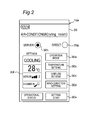
- Fig. 2 shows an example of a control screen 30 for the air conditioner 12 displayed in the touch panel 16a of the mobile terminal 16.
- the mobile terminal 16 is adapted to display the control screen 30 in the touch panel 16a when the air conditioner is operated.
- the mobile terminal 16 is adapted to display a selection screen for the air conditioners such that the user can select the air conditioner operated by the mobile terminal 16.
- the control screen 30 for controlling the air conditioner 12 includes a plurality of buttons 30a-30e for setting an operation of the air conditioner.
- the control screen 30 shown in Fig. 2 is a control screen for operating the air conditioner 12 placed in a living room.
- An “operation mode” button 30a is a button through which the user selects an operation mode.
- the mobile terminal 16 displays, for example, an operation mode select window (not shown), through which the user selects one air-conditioning operation mode from a plurality of air-conditioning operation mode such as heating operation, cooling operation, and dehumidifying operation, in the touch panel 16a.
- the mobile terminal 16 displays the user-selected operation mode in a current settings indicating part 30f in the control screen 30 and stores it in a memory part (not shown).
- a "temperature setting” button 30b is a button through which the user sets a temperature of an air blown from the air conditioner 12.
- the mobile terminal 16 displays, for example, a temperature entry window (not shown), through which the user enters a desired temperature, in the touch panel 16a.
- the mobile terminal 16 displays the user-entered temperature in the current settings indicating part 30f in the control screen 30 and stores it in the memory part.
- An “airflow setting” button 30c is a button through which the user sets a flow of the air blown from the air conditioner 12.
- the mobile terminal 16 displays, for example, an airflow entry window (not shown), through which the user enters a desired flow, in the touch panel 16a.
- the mobile terminal 16 displays the user-entered flow in the current settings indicating part 30f in the control screen 30 and stores it in the memory part.
- a "wind-direction setting" button 30d is a button through which the user sets a direction of the air blown from the air conditioner 12.
- the mobile terminal 16 displays, for example, a wind-direction entry window (not shown), through which the user enter a desired wind-direction, in the touch panel 16a.
- the mobile terminal 16 displays the user-entered wind-direction in the current settings indicating part 30f in the control screen 30 and stores it in the memory part.
- a "settings send” button 30e is a button for sending an information including the operation mode, temperature, airflow, and wind-direction set by the user by the use of the mobile terminal 16 to the air conditioner 12.
- the mobile terminal 16 is adapted to send the gateway device 18 a control signal for the air conditioner 12 including the information about the operation mode, temperature, airflow, and wind-direction set by the user and stored in the memory part, that is, indicated in the current settings indicating part 30f, when the user touches the "setting send" button 30e.
- the control signal includes an identification information of the air conditioner 12 to be controlled. Therefore, the gateway device 18 can send the control signal to the wireless communication adaptor 14 connected to the air conditioner 12 controlled by the mobile terminal 16.
- the mobile terminal 16 sends the control signal for the air conditioner 12 to the gateway device 18 only through the router device 26 without passing through the internet 20 or through both the internet 20 and the router device 26.
- the mobile terminal 16 is adapted to send the control signal to the gateway device 18 on the basis of a transmission setting at the timing at which the user touches the "settings send" button 30e.
- control screen 30 is provided with buttons 30g and 30h for the transmission setting, in particular, through which the user selects whether the communication between the mobile terminal 16 and the gateway device 18 is only through the router device 26 without passing through the internet 20 or through both the internet 20 and the router device 26.
- the mobile terminal 16 is adapted to configure a "direct" communication for communicating only through the router device 26 as the communication between the mobile terminal 16 and the gateway device 18, when the user touches the "direct” button 30g.
- control signal for the air conditioner 12 is sent from the mobile terminal 16 to the gateway device 18 only through the router device 26, when the user touches the "settings send” button 30e.
- the mobile terminal 16 is adapted to configure a "server” communication for communicating through both the internet 20 and the router device 26 as the communication between the mobile terminal 16 and the gateway device 18, when the user touches the "server” button 30h.
- control signal for the air conditioner 12 is sent from the mobile terminal 16 to the server device 22 through the internet 20 and the router device 26.
- the server device 22 then sends the received control signal to the gateway device 18 through the internet 20 and the router device 26.
- the control signal for the air conditioner may be sent from the mobile terminal 16 to the gateway device 18 through the internet 20 and the router device 26 without passing through the server device 22.
- the user selects methods of the communication between the mobile terminal 16 and the gateway device 18. This reason is that there are a case where the mobile terminal 16 is used outside of the user's house 24 (solid line) and a case where the mobile terminal 16 is used in the house 24 (two-dot chain line), as shown in Fig. 1 .
- the mobile terminal 16 can control the air conditioner 12 by communicating with the gateway device 18 through the internet 20 and the router device 26. That is, the user, which is outside of the house 24, touches the "server" button 30h so as to set to the "server” communication, and thereby enable the user to control the air conditioner 12 through the mobile terminal 16.
- the mobile terminal 16 in the case where the mobile terminal 16 is in the house 24, in the broad sense, in the case where the mobile terminal 16 is at a position at which the mobile terminal 16 can communicate with the router device 26 directly, the mobile terminal 16 can communicate with the gateway device 18 only through the router device 26 or through the internet 20 and the router device 26. That is, the user can select one of the "direct" communication and the "server" communication.
- the "server" communication through the use of the internet 20 and the router device 26 is unsuitable as the communication between the mobile terminal 16 and the gateway device 18. This reason is that it is possible to cause a delay of a response to the user controls from the air conditioner 12 to the mobile terminal 16 by the reason of a congestion of the internet 20 and like. Consequently, the user may not control the air conditioner 12 by the use of the mobile terminal 12 in a stress-free situation.
- control system of the air conditioner 12 is adapted to have a communication unaffected by the congestion of the internet 20 and like, that is, communication between the mobile terminal 16 and the gateway device 18 only through the router device 26 without passing through the internet 20. Since the mobile terminal 16 communicates with the gateway device 18 only through the router device 26, the user can control the air conditioner 12 in a stress-free situation by the use of the mobile terminal 16, as well as by the use of a remote controller of the air conditioner 12.
- the user selects the communication methods between the mobile terminal 16 and the gateway device 18 because only the user knows a frequency of controls to the air conditioner 12 by the use of the mobile terminal 16.
- control screen 30 of the mobile terminal 16 includes, besides the buttons described above, a button for on-off controlling the operation of the air conditioner 12 and a button for setting a timer by which an operation of the air conditioner 12 is automatically started at a given time.
- the mobile terminal 16 sends the control signal for the air conditioner to the wireless communication adaptor 14 (through the gateway device 18), as noted above.
- step S300 the wireless communication adaptor 14 receives (through the gateway device 18) the control signal from the mobile terminal 16 (acknowledges the control signal). Then, in step S310, the wireless communication adaptor 14 sends the received control signal to the operation control part of the air conditioner 12. Thus, the air conditioner 12 starts to perform the operation corresponding to the control signal.
- the mobile terminal 16 displays a transmission completion notice window 32 in the touch panel 16a.
- the transmission completion notice window 32 shows a message 32a for informing the user of the notice about the transmission completion of the control signal, and an information 32b about the operation mode, temperature, airflow, and wind-direction included in the control signal sent from the mobile terminal 16 to the air conditioner 12.
- the user can read the transmission completion of the control signal from the mobile terminal 16 to the air conditioner 12, that is, success of the transmission.
- step S150 determines whether an elapsed time after sending the control signal for the air conditioner at step S110 runs over a given time (for example, 30 seconds) or not, that is, checks time-out. If the elapsed time after sending the control signal for the air conditioner 12 runs over the given time (time-out), the action of step S160 is executed. If not, the process is returned to step S120.
- a given time for example, 30 seconds
- step S160 the mobile terminal 16 informs the user of a notice that the transmission of the control signal from the mobile terminal 16 to the air conditioner 12 failed.
- the mobile terminal 16 displays a transmission failure notice window 34 in the touch panel 16a.
- the transmission failure notice window 34 shows a message 34a for informing the user of a notice about a transmission failure of the control signal.
- the user can read the transmission failure of the control signal from the mobile terminal 16 to the air conditioner 12.
- the transmission failure notice window 34 includes a "retry" button 34b for re-sending the control signal for the air conditioner 12 from the mobile terminal 16 to the wireless communication adaptor 14.
- the mobile terminal 16 re-sends the control signal to the wireless communication adaptor 14, that is, the process is returned to step S110, when the user touches the "retry" button 34b.
- step S140 the mobile terminal 16 displays a "operational status" button 32c for providing the user with an information about the operational status of the air conditioner 12 after receiving the control signal in the touch panel 16a. That is, the mobile terminal 16 is adapted to suggest the user check the operational status of the air conditioner 12 after receiving the control signal.
- the transmission completion notice window 32 and the "operational status" button 32c are displayed simultaneously.
- the "operational status" button 32c is displayed in the transmission completion notice window 32. Therefore, the mobile terminal 16 can inform the user of a notice about the transmission completion of the control signal to the air conditioner 12 while suggest the user have the control for checking the operational status of the air conditioner 12 after receiving the control signal. Consequently, the user can check whether the air conditioner 12 takes action corresponding to the user controls on the mobile terminal 16 or not, without forgetting, shortly after receiving from the mobile terminal 16 the notice about the transmission completion of the control signal to the air conditioner 12.
- the mobile terminal 16 After the user touches the "operational status" button 32c at step S170 (the mobile terminal 16 detects the controls on the "operational status” button 32c), the mobile terminal 16 , in the succeeding step S180, sends an operational status request signal to the wireless communication adaptor 14.
- the operational status request signal is a signal for requesting the wireless communication adaptor 14 to send the information about the operational status of the air conditioner 12 after receiving the control signal to the mobile terminal 16 so that the mobile terminal 16 obtains such information.
- step S170 If the user controls on the "operational status" button 32c is not at step S170, the process is returned to step S100.
- the wireless communication adaptor 14 receives the operational status request signal (detects the operational status request signal).
- the wireless communication adaptor 14 obtains the information about a current operational status from the operation control part of the air conditioner 12, that is, the information about the operational status of the air conditioner 12 being in the operation corresponding to the control signal from the mobile terminal 16.
- the wireless communication adaptor 14 obtains an information about the operation mode, temperature, airflow, and wind-direction currently configured for the air conditioner 12.
- the wireless communication adaptor 14 may obtain an information about an indoor temperature, indoor humidity, and outdoor temperature, if the air conditioner 12 has sensors for detecting the indoor temperature, indoor humidity, and outdoor temperature.
- the wireless communication adaptor 14 after obtaining the information about the operational status of the air conditioner 12 at step S340, in step S350, sends the obtained information of the operational status to the mobile terminal 16.
- the mobile terminal 16 in step S190, receives from the wireless communication adaptor 14 the information about the operational status of the air conditioner 12 (detects the information of the operational status). In succeeding step S200, the mobile terminal 16 informs the user of the received information of the operational status.
- the mobile terminal 16 displays an operational status information window 36 in the touch panel 16a.
- the operational status information window 36 shows an information 36a about the current operational status, that is, the operational status of the air conditioner 12 after receiving the control signal.
- the information 32a about the operation mode, temperature, airflow, and wind-direction currently configured for air conditioner 12 is displayed.
- the wireless communication adaptor 14 obtains from the air conditioner 12 the information about the indoor temperature, indoor humidity, and outdoor temperature and send it as the information of the operational status to the mobile terminal 16
- the operational status information window 36 shows the information 36b about the indoor temperature, indoor humidity, and outdoor temperature.
- the user can read the operational status of the air conditioner 12 after receiving the control signal from the mobile terminal 16. That is, the user can understand that the air conditioner 12 starts to perform the operation corresponding to the controls to the mobile terminal 16.
- step S210 determines whether an elapsed time after sending the operational status request signal at step S180 runs over a given time (for example, 30seconds) or not that is, checks time-out. If the elapsed time after sending the operational status request signal runs over the given time (time-out), the action of step S220 is executed. If not, the process is returned to step S190.
- a given time for example, 30seconds
- step S220 the mobile terminal 16 informs the user of a notice that the mobile terminal 16 fails to acknowledge the information of the operational status from the wireless communication adaptor 14.
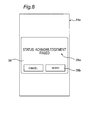
- the mobile terminal 16 displays a status acknowledgement failure notice window 38 in the touch panel 16a.
- the status acknowledgement failure notice window 38 shows a message 38a for informing the user of a notice that the mobile terminal 16 fails to acknowledge the operational status of the air conditioner 12.
- the status acknowledgement failure notice window 38 the user can understand that the mobile terminal 16 fails to acknowledge the operational status of the air conditioner 12.
- the status acknowledgement failure notice window 38 includes a "retry" button 38b for re-sending the operation status request signal from the mobile terminal 16 to the wireless communication adaptor 14.
- the mobile terminal 16 re-sends the operational status request signal to the wireless communication adaptor 14, that is, the process is returned to step S180, when the user touches the "retry" button 38b.
- the user receives the notice about the transmission completion or transmission failure to the air conditioner 12 of the control signal for controlling the air conditioner 12, and receives the information about the operational status of the air conditioner 12 after receiving the control signal. Therefore, the user can understand (guess) the reason that the air conditioner 12 does not operate after the user controls the mobile terminal 16.
- the notices that the user receives from the mobile terminal, are of three types in after the user performs an input for controlling the air conditioner 12 to the mobile terminal 16.
- the user receives a first notice, as the notice for giving the user understanding of the transmission failure of the control signal from the mobile terminal 16 to the air conditioner 12, from the mobile terminal 16 through, for example, the transmission failure notice window 34 shown in Fig. 6 .
- the user also receives a second notice, as the notice for giving the user understanding of the transmission completion of the control signal from the mobile terminal 16 to the air conditioner 12 and the mobile terminal's failure to obtain the information about the operational status of the air conditioner 12, from the mobile terminal 16 through, for example, the transmission completion notice window 34 shown in Fig. 5 and the status acknowledgement failure notice window 38 shown in Fig. 8 .
- the user further receives a third notice, as the notice for giving the user understanding of the transmission completion of the control signal from the mobile terminal 16 to the air conditioner 12 and the acknowledgement completion of the information about the operational status of the air conditioner 12, from the mobile terminal 16 through, for example, the transmission completion notice window 34 shown in Fig. 5 and the operational status information window 36 shown in Fig. 7 .
- the user has a knowledge about presences of the first to third notice. Therefore, when the user receives the first notice from the mobile terminal 16, the user can guess that the communication between the mobile terminal 16 and the air conditioner 12 (wireless communication adaptor 14) cannot be performed temporarily or semipermanently by the reason of, for example, a congestion of the internet 20 or a disconnection of lines. Consequently, the user can retry to control the air conditioner 12 by the use of the mobile terminal 18 after a few moments.
- the user can guess that the control signal from the mobile terminal 16 has reached to the air conditioner 12 (wireless communication adaptor 14) while the air conditioner 12 does not operate for some reason.
- the user can guess a breakdown of the air conditioner 12, disconnection of a main power supply, and like. Therefore, it is suppressed that the user mistakes that the control signal from the mobile terminal 16 has not reached to the air conditioner 12 by the reasons of the temporarily congestion of the internet 20 and thus makes a repeat control of the mobile terminal 16 for the air conditioner 12 without avail.
- the user can guess that the air conditioner 12 operates so as to correspond to the controls of the mobile terminal 16.
- providing the user with the information about the operational status of the air conditioner 12 after receiving the control signal from the mobile terminal 16 is performed, when the user touches the "operational status" button 32c in the transmission completion notice window 32 for example, that is, when the user needs it.
- the information about the operational status of the air conditioner 12 after receiving the control signal is not provided automatically to the user.
- the user could be in a position with a view of the air conditioner 12. That is, the user in the position with the view of the air conditioner 12 can check the operational status of the air conditioner 12 by looking it directly and thus does not need to be provided with the information of the operational status from the mobile terminal 16. Therefore, it is suppressed that the notice about the operational status of the air conditioner 12 is provided unnecessarily to the user in the position with the view of the air conditioner 12 through the mobile terminal 16.
- Fig. 9 is a perspective view showing an appearance of the air conditioner 12.
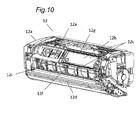
- Fig. 10 is a perspective view showing an inside of the air conditioner 12.
- the air conditioner 12 has a body 12a made up mostly of an underframe and a front panel 12b openably covering a front portion of the body 12a (a portion on the face-side of the air conditioner 12).
- the body 12a and the front panel 12b are made mostly from synthetic resin.
- the air conditioner 12 has intake openings 12c which is formed on a top portion and the front portion of the air conditioner 12 and through which an air is introduced into the body 12 a, and an outtake opening 12d which is formed on a bottom portion and through which the air in the body 12a is blown outside (in the house 24).
- intake openings 12c which is formed on a top portion and the front portion of the air conditioner 12 and through which an air is introduced into the body 12 a
- an outtake opening 12d which is formed on a bottom portion and through which the air in the body 12a is blown outside (in the house 24).
- a fan 12e generating a flow of the air from the intake openings 12c to the outtake opening 12d and a heat exchanger (not shown) exchanging heat with the air introduced into the body 12a are disposed.
- a control box 12g for controlling the air conditioner 12 is attached to a frame 12f positioned at a top-front portion of the body 12a of the air conditioner 12.
- the operation control part 12h is accommodated in the control box 12g.
- the operation control part 12h has a control substrate on which an adaptor connection terminal 12i for connecting the control substrate and the wireless communication adaptor 14 is mounted directly.
- the air conditioner 12 performs an air conditioning operation on the basis of a control sequence incorporated into the operation control part 12h.
- the wireless communication adaptor 14 has, as shown in Fig. 11 , a communication device body 14b communicating with the gateway device 18, a connector 14c detachable connecting to the adaptor connection terminal 12i of the operation control part 12h of the air conditioner 12, and a lead wire 14d connecting the communication device body 14b and the connector 14c.
- the wireless communication adaptor 14 has an attachment 14e for attaching the communication device body 14b to the air conditioner 12 (the body 12a) or the room of the house 24 in which the air conditioner 12 is placed (for example, a wall surface on which the air conditioner 12 is mounted , a post of the indoor close to the air conditioner 12, and like).
- the attachment 14e for the wireless communication adaptor 14 is a clip-like member made by doubling up a piece of metal sheet in a U-shape.
- the attachment 14e also is fixed to a back surface of the communication device body 14b through a base part 14f thereof.
- the base part 14f of the attachment 14e has a through hole 14g formed thereon.
- the communication device body 14b has a protrusion 14h engaging with the through hole 14g and formed on the back surface thereof.
- the communication device body 14b also has a pair of engaging parts 14i formed on the back surface thereof..
- the base part 14f of the attachment 14e is moved along the back surface of the communication device body 14b and then inserted between the pair of engaging parts 14i.
- the attachment 14e of the wireless communication adaptor 14 has an opposed part 14j opposite to the base part 14f at intervals.
- the communication device body 14b of the wireless communication adaptor 14 can be attached to the air conditioner 12 by sandwiching a housing rim 12j of the body 12a of the air conditioner 12 between the base part 14f and the opposed part 14j of the attachment 14e.
- the communication device body 14b of the wireless communication adaptor 14 may be attached to the body 12a of the air conditioner 12 without exposing to outside, instead of with the communication device body 14b exposed outside of the body 12a as shown in Fig. 12 .
- the rim 12j sandwiched by the attachment 14e of the wireless communication adaptor 14 preferably is positioned away from the outtake opening 12d.
- the rim 12j sandwiched by the attachment 14e preferably is positioned such that the communication device body 14b with the attachment 14e thereof holding the rim 12j of the body 12a is not opened up directly to the air blown from the outtake opening 12d. Therefore, it is suppressed that, in the cooling operation of the air conditioner 12, the communication device body 14b of the wireless communication device 14 is opened up to a volume of cold air blown from the outtake opening 12d.
- the attachment 14e of the wireless communication adaptor 14 further has a keyhole-like mounting hole 14k formed on the opposed part 14j and used when the communication device body 14b is mounted on the room of the house 24.
- the communication device body 14b of the wireless communication adaptor 14 can be mounted on the room by engaging the mounting hole 14k and a screw 14l mounted on a wall surface of the room.
- the communication device body 14b of the wireless communication adaptor 14 can be attached to the air conditioner 12 or on the room of the house 24 in which the air conditioner 12 is placed. Thereby improves an arbitrary property in the position of the communication device body 14b of the wireless communication adaptor 14.
- the communication device body 14b of the wireless communication adaptor 14 When the communication device body 14b of the wireless communication adaptor 14 is inside of the air conditioner 12, for example, when the housing rim 12j of the body 12a of the air conditioner 12 is held by the attachment 14e as shown in Fig. 12 , it is suppressed that the communication device body 14b spoils a design of the appearance of the air conditioner 12.
- lead wire 14d of the wireless communication adaptor 14 is laid at any position inside of the air conditioner 12 and connected to the adaptor connection terminal 12i of the operation control part 12h. For example, as shown in Figs.
- the lead wire 14d is connected to the adaptor connection terminal 12i of the operation control part 12 by passing through a lead wire guide groove 12k formed on the control box 12g accommodating the operation control part 12h and guiding lead wire 14d and a duct 12l disposed on the outer-side of the fan 12e.
- a stability in the communication between the communication device 14b and the gateway device 18 degrades, if the communication device body 14b of the wireless communication adaptor 14 is disposed inside the air conditioner 12 without exposing outside.
- the communication device body 14b of the wireless communication adaptor 14 is disposed inside the air conditioner 12 without exposing outside.
- the air conditioner 12 is mounted on the wall surface of the room in the house 24 through a metal mounting plate (not shown)
- the communication between the communication device body 14b and the gateway device 18 is interrupted by the metal mounting plate. If there is such possibility, as shown in Fig. 12 , the communication device body 14b of the wireless communication adaptor 14 is attached to the air conditioner 12 through the attachment 14e with it exposing outside of the air conditioner 12.
- the communication device body 14b of the wireless communication adaptor 14 is attached to the air conditioner 12 with it exposing outside, it is possible to degrade the stability of in the communication between the communication device body 14b and the gateway device 18.
- the communication device body 14b is disposed away from the air conditioner 12.
- the communication device body 14b is attached on the wall surface of the room by engaging the mounting hole 14k of the attachment 14e and the screw 14l mounted on a portion of the wall surface of the room in the house 24 positioned away from the air conditioner 12.
- a part of lead wire 14d is extended from inside of the air conditioner 12 and laid on the wall surface of the room, for example.
- the communication device body 14 can be disposed at position such that the communication between the communication device body 14b of the wireless adaptor 14 and the gateway device 18 can become stable.
- the adaptor connection terminal 12i of the operation control part 12h connected to the lead wire 14d (the connector 14c) preferably is disposed on the front portion of the body 12a of the air conditioner 12.
- the operation control part 12h is disposed on the front portion of the body 12a of the air conditioner 12 and the adaptor connection terminal 12i is mounted directly on the operation control part 12h. Therefore, the lead wire 14d can is connected easily to the adaptor connection terminal 12i of the operation control part 12h after the front panel 12b opened. Consequently, a working times for installing the wireless communication adaptor 14 including laying of the lead wire 14d can be compressed.
- the user in case that the air conditioner 12 is controlled by the use of the mobile terminal 16, the user can be informed of an operational status of the air conditioner 12 controlled by the mobile terminal 16, as appropriate.
- the communication between the mobile terminal 16 and the wireless communication adaptor 14 is performed through the gateway device 18 which is a relay device.
- the control system 10 of the air conditioner may have a configuration with the gateway device 18 deleted from the configuration shown in Fig. 1 .
- the wireless communication adaptor 14 is adapted to connect to the internet 20 and/or the wireless communication adaptor 14 and the mobile terminal 16 are adapted to communicate with each other.
- the user can be informed of the information about the operational status of the air conditioner 12 after the control signal have been sent from the mobile terminal 16 to the air conditioner 12.
- the control system of the air conditioner may be adapted to inform the user of the information about the operational status of the air conditioner when the user wants it, that is, at any time.
- the mobile terminal for controlling the air conditioner is a mobile terminal used widely such as a smartphone.
- the invention is not limited to this.
- a mobile terminal dedicating the controls of the air conditioner may be used.
- the wireless communication adaptor 14 sends the control signal to the air conditioner 12 and then sends the transmission completion signal to the mobile terminal 16.
- the mobile terminal 16 receives the transmission completion signal and informs the user of the notice about the transmission completion of the control signal.
- the mobile terminal 16 may be adapted to inform the user of the notice about transmission completion of the control signal after sending the control signal to the wireless communication adaptor 14.
- the adaptor connection terminal 14i connected to the wireless communication adaptor 14 may be mounted indirectly on the operation control part 12h of the air conditioner 12 through a lead wire, instead of directly to the operation control part 12h.
- the adaptor connection terminal 14i can be disposed at any position in the air conditioner 12.
- the adaptor connection terminal 14i may be disposed on an outer surface of the air conditioner 12.
- the adaptor connection terminal 14i is covered by a cap for example when the wireless communication adaptor 14 is not connected to the adaptor connection terminal 14i.
- a lead wire and like becomes unnecessary and thereby improves a workability in an assembly and decreases a cost.
- the wireless communication adaptor 14 may be a part of the air conditioner 12 incorporated integrally into the air conditioner 12, instead of detachably into air conditioner 12, that is, instead of an optional part attachable to the air conditioner 12.
Landscapes
- Engineering & Computer Science (AREA)
- Chemical & Material Sciences (AREA)
- Combustion & Propulsion (AREA)
- Mechanical Engineering (AREA)
- General Engineering & Computer Science (AREA)
- Signal Processing (AREA)
- Physics & Mathematics (AREA)
- Human Computer Interaction (AREA)
- Fuzzy Systems (AREA)
- Mathematical Physics (AREA)
- Health & Medical Sciences (AREA)
- Biomedical Technology (AREA)
- Computer Networks & Wireless Communication (AREA)
- General Physics & Mathematics (AREA)
- Air Conditioning Control Device (AREA)
- Selective Calling Equipment (AREA)
Description
- The invention relates to a control system for controlling a household electrical appliance by the use of a mobile terminal and a program for controlling a household electrical appliance.
- Conventionally, a control of a household electrical appliance by the use of a mobile terminal such as mobile telephone is performed. For example, a control system for a household electrical appliance described in Patent document 1 is adapted to be controlled by the use of a mobile telephone through an internet. The control system for the a household electrical appliance of Patent document 1 is adapted, after the household electrical appliance is controlled by user through the mobile telephone, to inform through the mobile telephone the user that the household electrical appliance actually acts on the basis of the user controls. Consequently, the user can receive a notice that the household electrical appliance start to act in response to the controls of the mobile telephone.
- Patent Document 1: Japanese Patent No.
4621643 - However, in the control system for the household electrical appliance described in Patent document 1, the user in a position with a view of the household electrical appliance unnecessarily receives the notice about an operational status of the household electrical appliance through the mobile telephone.
- Accordingly, it is an object of the invention, in case that a household electrical appliance is controlled by the use of a mobile terminal such as mobile telephone, to inform the user of an operational status of the household electrical appliance controlled by the mobile terminal, as appropriate.
- In order to achieve the above object, the present invention has the following constitutions.
- In one aspect of the invention, there is provided a control system for controlling a household electrical appliance, the control system for controlling the household electrical appliance comprising:
- a mobile terminal sending a control signal for controlling the household electrical appliance; and
- a communication device connected to the household electrical appliance, receiving the control signal from the mobile terminal, and sending the received the control signal to the household electrical appliance,
- wherein the mobile terminal is adapted to send a request signal to the communication device by a user controls,
- the request signal is a signal for requesting the communication device to send an information about an operational status of the household electrical appliance after receiving the control signal to the mobile terminal,
- the communication device is, after receiving the request signal from the mobile terminal, adapted to obtain and send the information about the operational status of the household electrical appliance after receiving the control signal,
- the mobile terminal further is adapted to inform the user of the information about the operational status of the household electrical appliance after receiving the control signal sent from the communication device, and
- the mobile terminal yet further is adapted to inform the user of a notice about a transmission completion of the control signal to the household electrical appliance and simultaneously suggest the user perform a controls for sending the request signal.
- In another aspect of the invention, there is provided a program for controlling a household electrical appliance installed in a communicatable mobile terminal, the program for controlling the household electrical appliance making the mobile terminal function as,
a means for sending a control signal for controlling the household electrical appliance to a communication device which is connected to the household electrical appliance, which receives the control signal from the mobile terminal, and which sends the received the control signal to the household electrical appliance,
a means for sending a request signal to the communication device by a user controls, the request signal is a signal for requesting the communication device to send an information about an operational status of the household electrical appliance after receiving the control signal to the mobile terminal,
a means for informing the user of the information about the operational status of the household electrical appliance after receiving the control signal sent from the communication device, and
a means for informing the user of a notice about a transmission completion of the control signal to the household electrical appliance and simultaneously suggesting the user perform a controls for sending the request signal. - According to the invention, in case that the household electrical appliance is controlled by the use of the mobile terminal, the user can be informed of an operational status of the household electrical appliance controlled by the mobile terminal, as appropriate.
- The above aspects and features of the present invention will become more apparent from the following description of preferred embodiments thereof with reference to the accompanying drawings, and wherein:
-
Fig. 1 schematically shows a configuration of a control system for an air conditioner according to an embodiment of the invention, -
Fig. 2 shows an example of a control screen for the air conditioner, -
Fig. 3 is a flow diagram showing an anterior part of an exemplary sequence of actions of a mobile terminal and wireless communication adaptor, -
Fig. 4 is a flow diagram showing a posterior part of the exemplary sequence of actions of the mobile terminal and wireless communication adaptor, -
Fig. 5 shows an exemplary window for informing about transmission completion, -
Fig. 6 shows an exemplary window for informing about a transmission failure, -
Fig. 7 shows an exemplary windows for informing about an operational status, -
Fig. 8 shows an exemplary windows for informing about a status acknowledgement failure, -
Fig. 9 is a perspective view showing an appearance of the air conditioner connected to the wireless communication adaptor, -
Fig. 10 is a perspective view showing an inside of the air conditioner, -
Fig. 11 is a perspective view showing a configuration of the wireless communication adaptor, -
Fig. 12 shows an attachment the wireless communication adaptor to the air conditioner, -
Fig. 13 is a front view of a part of the air conditioner and shows an exemplary wiring layout of a lead wire of the wireless communication adaptor, and -
Fig. 14 is a perspective view of a part of the air conditioner and show an exemplary wiring layout of a lead wire of the wireless communication adaptor. - A aspect of the invention is a control system for controlling a household electrical appliance, the control system for controlling the household electrical appliance comprising:
- a mobile terminal sending a control signal for controlling the household electrical appliance; and
- a communication device connected to the household electrical appliance, receiving the control signal from the mobile terminal, and sending the received the control signal to the household electrical appliance,
- wherein the mobile terminal is adapted to send a request signal to the communication device by a user controls,
- the request signal is a signal for requesting the communication device to send an information about an operational status of the household electrical appliance after receiving the control signal to the mobile terminal,
- the communication device is, after receiving the request signal from the mobile terminal, adapted to obtain and send the information about the operational status of the household electrical appliance after receiving the control signal,
- the mobile terminal further is adapted to inform the user of the information about the operational status of the household electrical appliance after receiving the control signal sent from the communication device, and
- the mobile terminal yet further is adapted to inform the user of a notice about a transmission completion of the control signal to the household electrical appliance and simultaneously suggest the user perform a controls for sending the request signal.
- According to the aspect of the invention, the user can be informed of the operational status of the household electrical appliance controlled by the mobile terminal, as appropriate.
- The control system for controlling the household electrical appliance may have a router device connected to an internet and a relay device relaying communication between the communication device and the mobile terminal. In this case, the mobile terminal and the relay device are adapted to be able to have a first communication between the mobile terminal and the relay device only through the router device and a second communication between the mobile terminal and the relay device through both the internet and the router device, and the mobile terminal is adapted such that the user can select the first or second communication by the use of the mobile terminal.
- According to such configuration, through the internet, the household electrical appliance can be controlled by the mobile terminal outside of a house in which the household electrical appliance is placed. In the house, without the internet, the user can control the household electrical appliance by the use of the mobile terminal in a stress-free situation.
- The household electrical appliance may be an air conditioner, and the communication device may be connected to an operation control part of the air conditioner for controlling an air-conditioning operation.
- According to such configuration, the air conditioner can be controlled by the mobile terminal.
- In the case where the household electrical appliance is the air conditioner, the communication device may have a communication device body communicating with the relay device, a connecter detachably connecting to a communication device connection terminal of the operation control part of the air conditioner, a lead wire connecting the communication device body and the connector, and an attachment for attaching the communication device body to the air conditioner or a room in which the air conditioner is placed.
- According to such configuration, the communication device can be attached to the air conditioner or a house in which the air conditioner is placed on the basis of a communication condition between the communication device and the relay device. Consequently, the communication between the communication device and the relay device becomes stable and thus the user surely can control the air conditioner by the use of the mobile terminal.
- The air conditioner may have a body and a front panel openably covering a front portion of the body, the communication device connection terminal of the operation control part of the air conditioner is disposed on the front portion of the body of the air conditioner, and the attachment of the communication device is adapted to hold a housing rim of the body of the air conditioner.
- According to such configuration, the connector of the communication device can be connected to the communication device connection terminal disposed on the front portion of the body of the air conditioner shortly after the front panel is opened. Also, the communication device body of the communication device can be attached easily to the air conditioner since the attachment holds the housing rim of the body of the air conditioner. Consequently, communication device can be attached easily to the air conditioner in a short time.
- The housing rim of the body of the air conditioner held by the attachment may be positioned at a position at which the communication device with the attachment holding the housing rim is not opened up to an air blown from an outtake opening of the air conditioner.
- According to such configuration, it is suppressed that, during a cooling operation, a dew condensation (beading) occurs on a surface of the communication device body of the communication device opened up to a cold air. Therefore, it is suppressed that the dew condensation interrupts the communication between the communication device body and the relay device. Consequently, during the cooling operation of the air conditioner, a quality in the communication between the communication device body and the relay device is highly maintained, and thus a reliability of the communication is improved.
- The operation control part of the air conditioner may be disposed on a front portion of a body of the air conditioner, and the communication device connection terminal may be mounted directly on the operation control part.
- According to such configuration, as compared with the case where the communication device connection terminal is mounted indirectly on the operational control part through a lead wire for example, workability in an assembly is improved and a cost is decreased.
- It is preferable to provide a program for controlling a household electrical appliance installed in a communicatable mobile terminal, the program for controlling the household electrical appliance making the mobile terminal function as,
a means for sending a control signal for controlling the household electrical appliance to a communication device which is connected to the household electrical appliance, which receives the control signal from the mobile terminal, and which sends the received the control signal to the household electrical appliance,
a means for sending a request signal to the communication device by a user controls, the request signal is a signal for requesting the communication device to send an information about an operational status of the household electrical appliance after receiving the control signal to the mobile terminal,
a means for informing the user of the information about the operational status of the household electrical appliance after receiving the control signal sent from the communication device, and
a means for informing the user of a notice about a transmission completion of the control signal to the household electrical appliance and simultaneously suggesting the user perform a controls for sending the request signal. - According to such program, the household electrical appliance can be controlled by a mobile terminal used widely such as smartphone.
- Hereinbelow, embodiments of the present invention will be described with reference to the accompanying drawings. It is noted that the invention is not limited by the following embodiments.
-
Fig. 1 schematically shows a configuration of a control system for a household electrical appliance according to an embodiment of the invention.
Although the control system for the household electrical appliance explained below is a control system for an air conditioner as an example of the household electrical appliance, the household electrical appliance of the invention is not limited to the air conditioner. - The
control system 10 for the air conditioner shown inFig. 1 is a system for controlling at least one air conditioner by the use of a mobile terminal.
As shown inFig. 1 , thecontrol system 10 for the air conditioner has at least oneair conditioner 12, wireless communication adaptors (communication devices) 14 provided on theair conditioner 12 respectively, amobile terminal 16 owned by a user, a gateway device (relay device) 18 for relaying communication between thewireless communication adaptors 14 and themobile terminal 16, aninternet 20, and aserver device 22 connected to theinternet 20. - The
air conditioners 12 are placed in ahouse 24 owned by the user owning themobile terminal 16. Thewireless communication adaptors 14 are connected to theair conditioners 12 respectively. - The
wireless communication adaptors 14 are connected to an operation control part (not shown) of theair conditioners 12. Details of the connection of theair conditioner 12 and the wireless communication adaptor are explained below. Thewireless communication adaptors 14 are adapted to communicate with thegateway device 18. Thewireless communication adaptor 14, as described below, receive a control signal for controlling the air conditioner sent from themobile terminal 16 thorough thegateway device 18, and then send the received control signal to the operation control part of theair conditioners 12. The operation control part controls an air conditioning operation of theair conditioner 12 on the basis of the control signal. - The
wireless communication adaptor 14 also, as described below, are adapted to obtain an information about an operational status of theair conditioner 12 form the operation control part of theair conditioner 12 and then send it to thegateway device 18. - The
mobile terminal 16 is, for example, a portable terminal used widely such as smartphone, tablet PC (personal computer), and has, in the embodiment, functions to connect to theinternet 20 and to communicate with thegateway device 18. - The
mobile terminal 16, for example, a smartphone is adapted to connect to theinternet 20 through a telephone network (for example, 3G network).
In addition to or alternatively, themobile terminal 16, for example, is adapted to have a Wi-Fi communication function for communicating with theinternet 20 through a public wireless network. - By connecting to the
internet 20, themobile terminal 16, for example can obtain a program for controlling theair conditioner 12 from a home page of a manufacturer manufacturing the air conditioner12 through theinternet 20. The obtained program is installed in themobile terminal 16. By activating the installed program, theair conditioner 12 can be controlled by themobile terminal 16. That is, themobile terminal 16 becomes available to generate a control signal for controlling theair conditioner 12 and send it. - The
mobile terminal 16 also is adapted to connect to arouter device 26 by no use of theinternet 20 through a communication technology used widely such as, for example, Wi-Fi communication, Bluetooth (trademark), infrared communication, and then to communicate with thegateway device 18 through therouter device 26. The necessary device (such as Wi-Fi antenna) is incorporated in themobile terminal 16. - The
gateway device 18 is a device for relaying communication between thewireless communication adaptors 14 and themobile terminal 16, and thus is configured to communicate with thewireless communication adaptor 14 and themobile terminal 16. Thegateway device 18 also is placed in the user'shouse 24 in which theair conditioners 12 are placed and is connected to therouter device 26 connecting to theinternet 20. - For example, the
gateway device 18 is adapted to communicate with thewireless communication adaptor 14 by the use of a frequency of a signal within a specified low power radio-specified small band (924.0-928.0MHz). A frequency band of communication between thegateway device 18 and thewireless communication adaptor 14 preferably is a low frequency band within which a signal can far-reach. - The
gateway device 18 also is adapted to connect to themobile terminal 16 through therouter device 26. That is, thegateway device 18 is adapted to have a communication (first communication) with themobile terminal 16 only through therouter device 26 without passing through theinternet 20. - Further, the
gateway device 18 is adapted to be able to connect to theinternet 20 through therouter device 26. Therefore, thegateway device 18 can have a communication (second communication) with themobile terminal 16 and have a communication with theserver device 22, through theinternet 20 and therouter device 26. - That is, the
gateway device 18 is adapted to communicate with themobile terminal 16 not by the use of the internet 20 (the first communication only through the router device 26) and by the use of the internet 20 (the second communication through theinternet 20 and the router device 26). This reason is explained below. - The
server device 22 is a server device arranged by the manufacturer of theair conditioner 12 and stores an information associated with theair conditioners 12,wireless communication adaptors 14,mobile terminal 16, and gateway device 1 so as to perform an authentication of themobile terminal 16 accessing thegateway device 18 and like. - Hereinbelow, an example of control of the
air conditioner 12 by the use of themobile terminal 16 is explained. In this example, themobile terminal 16 is a smartphone having atouch panel 16a and is with an installed control program for the air conditioner having already been started. In this example, themobile terminal 16 is Wi-Fi communicated with therouter device 26. -
Fig. 2 shows an example of acontrol screen 30 for theair conditioner 12 displayed in thetouch panel 16a of themobile terminal 16. Themobile terminal 16 is adapted to display thecontrol screen 30 in thetouch panel 16a when the air conditioner is operated. - When there are a plurality of
air conditioners 12, themobile terminal 16 is adapted to display a selection screen for the air conditioners such that the user can select the air conditioner operated by themobile terminal 16. - As shown in
Fig. 2 , thecontrol screen 30 for controlling theair conditioner 12 includes a plurality ofbuttons 30a-30e for setting an operation of the air conditioner. Thecontrol screen 30 shown inFig. 2 is a control screen for operating theair conditioner 12 placed in a living room. - An "operation mode"
button 30a is a button through which the user selects an operation mode. When the user touches the "operation mode"button 30a, themobile terminal 16 displays, for example, an operation mode select window (not shown), through which the user selects one air-conditioning operation mode from a plurality of air-conditioning operation mode such as heating operation, cooling operation, and dehumidifying operation, in thetouch panel 16a. Themobile terminal 16 displays the user-selected operation mode in a currentsettings indicating part 30f in thecontrol screen 30 and stores it in a memory part (not shown). - A "temperature setting"
button 30b is a button through which the user sets a temperature of an air blown from theair conditioner 12. When the user touches the "temperature setting"button 30b, themobile terminal 16 displays, for example, a temperature entry window (not shown), through which the user enters a desired temperature, in thetouch panel 16a. Themobile terminal 16 displays the user-entered temperature in the currentsettings indicating part 30f in thecontrol screen 30 and stores it in the memory part. - An "airflow setting"
button 30c is a button through which the user sets a flow of the air blown from theair conditioner 12. When the user touches the "airflow setting"button 30c, themobile terminal 16 displays, for example, an airflow entry window (not shown), through which the user enters a desired flow, in thetouch panel 16a. Themobile terminal 16 displays the user-entered flow in the currentsettings indicating part 30f in thecontrol screen 30 and stores it in the memory part. - A "wind-direction setting"
button 30d is a button through which the user sets a direction of the air blown from theair conditioner 12. When the user touches the "wind-direction setting"button 30d, themobile terminal 16 displays, for example, a wind-direction entry window (not shown), through which the user enter a desired wind-direction, in thetouch panel 16a. Themobile terminal 16 displays the user-entered wind-direction in the currentsettings indicating part 30f in thecontrol screen 30 and stores it in the memory part. - A "settings send"
button 30e is a button for sending an information including the operation mode, temperature, airflow, and wind-direction set by the user by the use of themobile terminal 16 to theair conditioner 12. - The
mobile terminal 16 is adapted to send the gateway device 18 a control signal for theair conditioner 12 including the information about the operation mode, temperature, airflow, and wind-direction set by the user and stored in the memory part, that is, indicated in the currentsettings indicating part 30f, when the user touches the "setting send"button 30e. - The control signal includes an identification information of the
air conditioner 12 to be controlled. Therefore, thegateway device 18 can send the control signal to thewireless communication adaptor 14 connected to theair conditioner 12 controlled by themobile terminal 16. - Then, the
mobile terminal 16 sends the control signal for theair conditioner 12 to thegateway device 18 only through therouter device 26 without passing through theinternet 20 or through both theinternet 20 and therouter device 26. Specifically, themobile terminal 16 is adapted to send the control signal to thegateway device 18 on the basis of a transmission setting at the timing at which the user touches the "settings send"button 30e. - As shown in
Fig. 2 , thecontrol screen 30 is provided withbuttons mobile terminal 16 and thegateway device 18 is only through therouter device 26 without passing through theinternet 20 or through both theinternet 20 and therouter device 26. - The
mobile terminal 16 is adapted to configure a "direct" communication for communicating only through therouter device 26 as the communication between themobile terminal 16 and thegateway device 18, when the user touches the "direct"button 30g. - In the "direct" communication configuration, the control signal for the
air conditioner 12 is sent from themobile terminal 16 to thegateway device 18 only through therouter device 26, when the user touches the "settings send"button 30e. - On the other hand, the
mobile terminal 16 is adapted to configure a "server" communication for communicating through both theinternet 20 and therouter device 26 as the communication between themobile terminal 16 and thegateway device 18, when the user touches the "server"button 30h. - In the "server" configuration, the control signal for the
air conditioner 12 is sent from themobile terminal 16 to theserver device 22 through theinternet 20 and therouter device 26. Theserver device 22 then sends the received control signal to thegateway device 18 through theinternet 20 and therouter device 26. - The control signal for the air conditioner may be sent from the
mobile terminal 16 to thegateway device 18 through theinternet 20 and therouter device 26 without passing through theserver device 22. - As noted above, the user selects methods of the communication between the
mobile terminal 16 and thegateway device 18. This reason is that there are a case where themobile terminal 16 is used outside of the user's house 24 (solid line) and a case where themobile terminal 16 is used in the house 24 (two-dot chain line), as shown inFig. 1 . - As shown by the solid line in
Fig. 1 , In the case where themobile terminal 16 is outside of thehouse 24, in the broad sense, in the case where themobile terminal 16 is at a position at which themobile terminal 16 cannot communicate with therouter device 26 directly, themobile terminal 16 can control theair conditioner 12 by communicating with thegateway device 18 through theinternet 20 and therouter device 26. That is, the user, which is outside of thehouse 24, touches the "server"button 30h so as to set to the "server" communication, and thereby enable the user to control theair conditioner 12 through themobile terminal 16. - On the other hand, as shown by the two-dot chain line in
Fig. 1 , in the case where themobile terminal 16 is in thehouse 24, in the broad sense, in the case where themobile terminal 16 is at a position at which themobile terminal 16 can communicate with therouter device 26 directly, themobile terminal 16 can communicate with thegateway device 18 only through therouter device 26 or through theinternet 20 and therouter device 26. That is, the user can select one of the "direct" communication and the "server" communication. - However, if the user in the
house 24 wishes to frequently control theair conditioner 12 by the use of themobile terminal 16, the "server" communication through the use of theinternet 20 and therouter device 26 is unsuitable as the communication between themobile terminal 16 and thegateway device 18. This reason is that it is possible to cause a delay of a response to the user controls from theair conditioner 12 to themobile terminal 16 by the reason of a congestion of theinternet 20 and like. Consequently, the user may not control theair conditioner 12 by the use of themobile terminal 12 in a stress-free situation. - In order to overcome this problem, the control system of the
air conditioner 12 is adapted to have a communication unaffected by the congestion of theinternet 20 and like, that is, communication between themobile terminal 16 and thegateway device 18 only through therouter device 26 without passing through theinternet 20. Since themobile terminal 16 communicates with thegateway device 18 only through therouter device 26, the user can control theair conditioner 12 in a stress-free situation by the use of themobile terminal 16, as well as by the use of a remote controller of theair conditioner 12. - The user selects the communication methods between the
mobile terminal 16 and thegateway device 18 because only the user knows a frequency of controls to theair conditioner 12 by the use of themobile terminal 16. - As not shown in the figure, the
control screen 30 of themobile terminal 16 includes, besides the buttons described above, a button for on-off controlling the operation of theair conditioner 12 and a button for setting a timer by which an operation of theair conditioner 12 is automatically started at a given time. - Hereinbelow, actions of the
mobile terminal 16 and thewireless communication adaptor 14 after the control signal is sent from themobile terminal 16 are explained with reference to flow diagrams shown inFigs. 3 and4 . The flow on the left side inFigs. 3 and4 shows an example of an action sequence of themobile terminal 16. The flow on the right side inFigs. 3 and4 shows an example of an action sequence of thewireless communication adaptor 14. - As shown in
Fig. 3 , In steps S100 and S110, themobile terminal 16 sends the control signal for the air conditioner to the wireless communication adaptor 14 (through the gateway device 18), as noted above. - On the other hand, in step S300, the
wireless communication adaptor 14 receives (through the gateway device 18) the control signal from the mobile terminal 16 (acknowledges the control signal). Then, in step S310, thewireless communication adaptor 14 sends the received control signal to the operation control part of theair conditioner 12. Thus, theair conditioner 12 starts to perform the operation corresponding to the control signal. - The
wireless communication adaptor 14, in the succeeding step S320, sends a transmission completion signal to the mobile terminal 16 (through the gateway device 18) so as to give to the mobile terminal 16 a notice that the control signal have been sent to theair conditioner 12. - The
mobile terminal 16, in step S120, receives the transmission completion signal from thewireless communication adaptor 14. Then, themobile terminal 16, in the succeeding step S130, informs the user of a notice about a transmission completion of the control signal to theair conditioner 12. - For example, as shown in
Fig. 5 , themobile terminal 16 displays a transmissioncompletion notice window 32 in thetouch panel 16a. The transmissioncompletion notice window 32 shows amessage 32a for informing the user of the notice about the transmission completion of the control signal, and aninformation 32b about the operation mode, temperature, airflow, and wind-direction included in the control signal sent from themobile terminal 16 to theair conditioner 12. Through the transmissioncompletion notice window 32, the user can read the transmission completion of the control signal from themobile terminal 16 to theair conditioner 12, that is, success of the transmission. - By contrast, if the transmission completion signal from the
wireless communication adaptor 14 is not acknowledged at step S120, themobile terminal 16, in step S150, determines whether an elapsed time after sending the control signal for the air conditioner at step S110 runs over a given time (for example, 30 seconds) or not, that is, checks time-out. If the elapsed time after sending the control signal for theair conditioner 12 runs over the given time (time-out), the action of step S160 is executed. If not, the process is returned to step S120. - In the case where the
mobile terminal 16 cannot receive the transmission completion signal from thewireless communication adaptor 14 after a lapse of the given time since the control signal for theair conditioner 12 is sent, in step S160, themobile terminal 16 informs the user of a notice that the transmission of the control signal from themobile terminal 16 to theair conditioner 12 failed. - For example, as shown in
Fig. 6 , themobile terminal 16 displays a transmissionfailure notice window 34 in thetouch panel 16a. The transmissionfailure notice window 34 shows amessage 34a for informing the user of a notice about a transmission failure of the control signal. Through the transmissionfailure notice window 34, the user can read the transmission failure of the control signal from themobile terminal 16 to theair conditioner 12. - As shown in
Fig. 6 , the transmissionfailure notice window 34 includes a "retry"button 34b for re-sending the control signal for theair conditioner 12 from themobile terminal 16 to thewireless communication adaptor 14. Themobile terminal 16 re-sends the control signal to thewireless communication adaptor 14, that is, the process is returned to step S110, when the user touches the "retry"button 34b. - After the
mobile terminal 16 displays the transmissioncompletion notice window 32 in thetouch panel 16a at step S130, in step S140, themobile terminal 16 displays a "operational status"button 32c for providing the user with an information about the operational status of theair conditioner 12 after receiving the control signal in thetouch panel 16a. That is, themobile terminal 16 is adapted to suggest the user check the operational status of theair conditioner 12 after receiving the control signal. - In this embodiment, the transmission
completion notice window 32 and the "operational status"button 32c are displayed simultaneously. For example, as shown inFig. 5 , the "operational status"button 32c is displayed in the transmissioncompletion notice window 32. Therefore, themobile terminal 16 can inform the user of a notice about the transmission completion of the control signal to theair conditioner 12 while suggest the user have the control for checking the operational status of theair conditioner 12 after receiving the control signal. Consequently, the user can check whether theair conditioner 12 takes action corresponding to the user controls on themobile terminal 16 or not, without forgetting, shortly after receiving from themobile terminal 16 the notice about the transmission completion of the control signal to theair conditioner 12. - As shown in
Fig. 4 , after the user touches the "operational status"button 32c at step S170 (themobile terminal 16 detects the controls on the "operational status"button 32c), themobile terminal 16 , in the succeeding step S180, sends an operational status request signal to thewireless communication adaptor 14. - The operational status request signal is a signal for requesting the
wireless communication adaptor 14 to send the information about the operational status of theair conditioner 12 after receiving the control signal to themobile terminal 16 so that themobile terminal 16 obtains such information. - If the user controls on the "operational status"
button 32c is not at step S170, the process is returned to step S100. - On the other hand, in step S330, the
wireless communication adaptor 14 receives the operational status request signal (detects the operational status request signal). In the succeeding step S340, thewireless communication adaptor 14 obtains the information about a current operational status from the operation control part of theair conditioner 12, that is, the information about the operational status of theair conditioner 12 being in the operation corresponding to the control signal from themobile terminal 16. For example, thewireless communication adaptor 14 obtains an information about the operation mode, temperature, airflow, and wind-direction currently configured for theair conditioner 12. Thewireless communication adaptor 14 may obtain an information about an indoor temperature, indoor humidity, and outdoor temperature, if theair conditioner 12 has sensors for detecting the indoor temperature, indoor humidity, and outdoor temperature. - The
wireless communication adaptor 14, after obtaining the information about the operational status of theair conditioner 12 at step S340, in step S350, sends the obtained information of the operational status to themobile terminal 16. - The
mobile terminal 16, in step S190, receives from thewireless communication adaptor 14 the information about the operational status of the air conditioner 12 (detects the information of the operational status). In succeeding step S200, themobile terminal 16 informs the user of the received information of the operational status. - For example, as shown in
Fig. 7 , themobile terminal 16 displays an operationalstatus information window 36 in thetouch panel 16a. The operationalstatus information window 36 shows aninformation 36a about the current operational status, that is, the operational status of theair conditioner 12 after receiving the control signal. For example, theinformation 32a about the operation mode, temperature, airflow, and wind-direction currently configured forair conditioner 12 is displayed. If thewireless communication adaptor 14 obtains from theair conditioner 12 the information about the indoor temperature, indoor humidity, and outdoor temperature and send it as the information of the operational status to themobile terminal 16, the operationalstatus information window 36 shows theinformation 36b about the indoor temperature, indoor humidity, and outdoor temperature. Through the operationalstatus information window 36, the user can read the operational status of theair conditioner 12 after receiving the control signal from themobile terminal 16. That is, the user can understand that theair conditioner 12 starts to perform the operation corresponding to the controls to themobile terminal 16. - If the information of the operational status of the
air conditioner 12 from thewireless communication adaptor 14 is not acknowledged at step S190, themobile terminal 16, in step S210, determines whether an elapsed time after sending the operational status request signal at step S180 runs over a given time (for example, 30seconds) or not that is, checks time-out. If the elapsed time after sending the operational status request signal runs over the given time (time-out), the action of step S220 is executed. If not, the process is returned to step S190. - In the case where the
mobile terminal 16 cannot receive the information about the operational status of theair conditioner 12 from thewireless communication adaptor 14 after a lapse of the given time since the operational status request is sent, in step S220, themobile terminal 16 informs the user of a notice that themobile terminal 16 fails to acknowledge the information of the operational status from thewireless communication adaptor 14. - For example, as shown in
Fig. 8 , themobile terminal 16 displays a status acknowledgementfailure notice window 38 in thetouch panel 16a. The status acknowledgementfailure notice window 38 shows amessage 38a for informing the user of a notice that themobile terminal 16 fails to acknowledge the operational status of theair conditioner 12. Through the status acknowledgementfailure notice window 38, the user can understand that themobile terminal 16 fails to acknowledge the operational status of theair conditioner 12. - As shown in
Fig. 8 , the status acknowledgementfailure notice window 38 includes a "retry"button 38b for re-sending the operation status request signal from themobile terminal 16 to thewireless communication adaptor 14. Themobile terminal 16 re-sends the operational status request signal to thewireless communication adaptor 14, that is, the process is returned to step S180, when the user touches the "retry"button 38b. - According to the configuration of the
operation system 10 for the air conditioner, the user receives the notice about the transmission completion or transmission failure to theair conditioner 12 of the control signal for controlling theair conditioner 12, and receives the information about the operational status of theair conditioner 12 after receiving the control signal. Therefore, the user can understand (guess) the reason that theair conditioner 12 does not operate after the user controls themobile terminal 16. - Specifically, the notices, that the user receives from the mobile terminal, are of three types in after the user performs an input for controlling the
air conditioner 12 to themobile terminal 16. - The user receives a first notice, as the notice for giving the user understanding of the transmission failure of the control signal from the
mobile terminal 16 to theair conditioner 12, from themobile terminal 16 through, for example, the transmissionfailure notice window 34 shown inFig. 6 . - The user also receives a second notice, as the notice for giving the user understanding of the transmission completion of the control signal from the
mobile terminal 16 to theair conditioner 12 and the mobile terminal's failure to obtain the information about the operational status of theair conditioner 12, from themobile terminal 16 through, for example, the transmissioncompletion notice window 34 shown inFig. 5 and the status acknowledgementfailure notice window 38 shown inFig. 8 . - The user further receives a third notice, as the notice for giving the user understanding of the transmission completion of the control signal from the
mobile terminal 16 to theair conditioner 12 and the acknowledgement completion of the information about the operational status of theair conditioner 12, from themobile terminal 16 through, for example, the transmissioncompletion notice window 34 shown inFig. 5 and the operationalstatus information window 36 shown inFig. 7 . - The user has a knowledge about presences of the first to third notice.
Therefore, when the user receives the first notice from themobile terminal 16, the user can guess that the communication between themobile terminal 16 and the air conditioner 12 (wireless communication adaptor 14) cannot be performed temporarily or semipermanently by the reason of, for example, a congestion of theinternet 20 or a disconnection of lines. Consequently, the user can retry to control theair conditioner 12 by the use of themobile terminal 18 after a few moments. - When the user receives the second notice from the
mobile terminal 16, the user can guess that the control signal from themobile terminal 16 has reached to the air conditioner 12 (wireless communication adaptor 14) while theair conditioner 12 does not operate for some reason. The user can guess a breakdown of theair conditioner 12, disconnection of a main power supply, and like. Therefore, it is suppressed that the user mistakes that the control signal from themobile terminal 16 has not reached to theair conditioner 12 by the reasons of the temporarily congestion of theinternet 20 and thus makes a repeat control of themobile terminal 16 for theair conditioner 12 without avail. - When the user receives the third notice from the
mobile terminal 16, the user can guess that theair conditioner 12 operates so as to correspond to the controls of themobile terminal 16. - As noted above, providing the user with the information about the operational status of the
air conditioner 12 after receiving the control signal from themobile terminal 16 is performed, when the user touches the "operational status"button 32c in the transmissioncompletion notice window 32 for example, that is, when the user needs it. In other words, the information about the operational status of theair conditioner 12 after receiving the control signal is not provided automatically to the user. This reason is that the user could be in a position with a view of theair conditioner 12. That is, the user in the position with the view of theair conditioner 12 can check the operational status of theair conditioner 12 by looking it directly and thus does not need to be provided with the information of the operational status from themobile terminal 16. Therefore, it is suppressed that the notice about the operational status of theair conditioner 12 is provided unnecessarily to the user in the position with the view of theair conditioner 12 through themobile terminal 16. - Hereinbelow, the connection between the
air conditioner 12 and thewireless communication adaptor 14 is explained in detail. -
Fig. 9 is a perspective view showing an appearance of theair conditioner 12.Fig. 10 is a perspective view showing an inside of theair conditioner 12. - As shown in
Fig. 9 , theair conditioner 12 has abody 12a made up mostly of an underframe and afront panel 12b openably covering a front portion of thebody 12a (a portion on the face-side of the air conditioner 12). Thebody 12a and thefront panel 12b are made mostly from synthetic resin. - As shown in
Fig. 10 in which thefront panel 12 is omitted, theair conditioner 12 hasintake openings 12c which is formed on a top portion and the front portion of theair conditioner 12 and through which an air is introduced into thebody 12 a, and anouttake opening 12d which is formed on a bottom portion and through which the air in thebody 12a is blown outside (in the house 24). When the air is introduced into thebody 12a through theintake openings 12c, thefront panel 12b is opened so as to expose theintake opening 12c formed on the front portion of thebody 12a. Between theintake openings 12c and theouttake opening 12d, afan 12e generating a flow of the air from theintake openings 12c to the outtake opening 12d and a heat exchanger (not shown) exchanging heat with the air introduced into thebody 12a are disposed. - To a
frame 12f positioned at a top-front portion of thebody 12a of theair conditioner 12, acontrol box 12g for controlling theair conditioner 12 is attached. Theoperation control part 12h is accommodated in thecontrol box 12g. - The
operation control part 12h has a control substrate on which anadaptor connection terminal 12i for connecting the control substrate and thewireless communication adaptor 14 is mounted directly. - If the
wireless connection adaptor 14 through which theair conditioner 12 is controlled by the use of themobile terminal 16 is not connected with theadaptor connection terminal 12i of theoperation control part 12h, theair conditioner 12 performs an air conditioning operation on the basis of a control sequence incorporated into theoperation control part 12h. - The
wireless communication adaptor 14 has, as shown inFig. 11 , acommunication device body 14b communicating with thegateway device 18, aconnector 14c detachable connecting to theadaptor connection terminal 12i of theoperation control part 12h of theair conditioner 12, and alead wire 14d connecting thecommunication device body 14b and theconnector 14c. - The
wireless communication adaptor 14 has anattachment 14e for attaching thecommunication device body 14b to the air conditioner 12 (thebody 12a) or the room of thehouse 24 in which theair conditioner 12 is placed (for example, a wall surface on which theair conditioner 12 is mounted , a post of the indoor close to theair conditioner 12, and like). - Specifically, in the embodiment, the
attachment 14e for thewireless communication adaptor 14 , as shown inFig. 11 , is a clip-like member made by doubling up a piece of metal sheet in a U-shape. Theattachment 14e also is fixed to a back surface of thecommunication device body 14b through abase part 14f thereof. In the embodiment, thebase part 14f of theattachment 14e has a throughhole 14g formed thereon. Thecommunication device body 14b has aprotrusion 14h engaging with the throughhole 14g and formed on the back surface thereof. Thecommunication device body 14b also has a pair of engagingparts 14i formed on the back surface thereof.. Thebase part 14f of theattachment 14e is moved along the back surface of thecommunication device body 14b and then inserted between the pair of engagingparts 14i. - The
attachment 14e of thewireless communication adaptor 14 has an opposedpart 14j opposite to thebase part 14f at intervals. As shown inFig. 12 , thecommunication device body 14b of thewireless communication adaptor 14 can be attached to theair conditioner 12 by sandwiching ahousing rim 12j of thebody 12a of theair conditioner 12 between thebase part 14f and theopposed part 14j of theattachment 14e. Thecommunication device body 14b of thewireless communication adaptor 14 may be attached to thebody 12a of theair conditioner 12 without exposing to outside, instead of with thecommunication device body 14b exposed outside of thebody 12a as shown inFig. 12 . - In the housing of the
body 12a of theair conditioner 12, therim 12j sandwiched by theattachment 14e of thewireless communication adaptor 14 preferably is positioned away from theouttake opening 12d. Specifically, in the housing of thebody 12a of theair conditioner 12, therim 12j sandwiched by theattachment 14e preferably is positioned such that thecommunication device body 14b with theattachment 14e thereof holding therim 12j of thebody 12a is not opened up directly to the air blown from theouttake opening 12d. Therefore, it is suppressed that, in the cooling operation of theair conditioner 12, thecommunication device body 14b of thewireless communication device 14 is opened up to a volume of cold air blown from theouttake opening 12d. Consequently, it is suppressed that a dew condensation (beading) occurs on a surface of thecommunication device body 14b of thewireless communication adaptor 14, and thereby avoids the dew condensation interrupting the communication between thecommunication device body 14b and thegateway device 18. That is, during the cooling operation of theair conditioner 12, a quality in the communication between thewireless communication adaptor 14 and thegateway device 18 is highly maintained, and thus a reliability of the communication is improved. - The
attachment 14e of thewireless communication adaptor 14 further has a keyhole-like mounting hole 14k formed on theopposed part 14j and used when thecommunication device body 14b is mounted on the room of thehouse 24. Thecommunication device body 14b of thewireless communication adaptor 14 can be mounted on the room by engaging the mountinghole 14k and a screw 14l mounted on a wall surface of the room. - By the use of the
attachment 14e, thecommunication device body 14b of thewireless communication adaptor 14 can be attached to theair conditioner 12 or on the room of thehouse 24 in which theair conditioner 12 is placed. Thereby improves an arbitrary property in the position of thecommunication device body 14b of thewireless communication adaptor 14. - When the
communication device body 14b of thewireless communication adaptor 14 is inside of theair conditioner 12, for example, when thehousing rim 12j of thebody 12a of theair conditioner 12 is held by theattachment 14e as shown inFig. 12 , it is suppressed that thecommunication device body 14b spoils a design of the appearance of theair conditioner 12. In this case,lead wire 14d of thewireless communication adaptor 14 is laid at any position inside of theair conditioner 12 and connected to theadaptor connection terminal 12i of theoperation control part 12h. For example, as shown inFigs. 13 and14 , thelead wire 14d is connected to theadaptor connection terminal 12i of theoperation control part 12 by passing through a leadwire guide groove 12k formed on thecontrol box 12g accommodating theoperation control part 12h and guidinglead wire 14d and a duct 12l disposed on the outer-side of thefan 12e. - It is possible that a stability in the communication between the
communication device 14b and thegateway device 18 degrades, if thecommunication device body 14b of thewireless communication adaptor 14 is disposed inside theair conditioner 12 without exposing outside. For example, when theair conditioner 12 is mounted on the wall surface of the room in thehouse 24 through a metal mounting plate (not shown), it is possible that the communication between thecommunication device body 14b and thegateway device 18 is interrupted by the metal mounting plate. If there is such possibility, as shown inFig. 12 , thecommunication device body 14b of thewireless communication adaptor 14 is attached to theair conditioner 12 through theattachment 14e with it exposing outside of theair conditioner 12. - Although the
communication device body 14b of thewireless communication adaptor 14 is attached to theair conditioner 12 with it exposing outside, it is possible to degrade the stability of in the communication between thecommunication device body 14b and thegateway device 18. In this case, thecommunication device body 14b is disposed away from theair conditioner 12. For example, thecommunication device body 14b is attached on the wall surface of the room by engaging the mountinghole 14k of theattachment 14e and the screw 14l mounted on a portion of the wall surface of the room in thehouse 24 positioned away from theair conditioner 12. In this case, a part oflead wire 14d is extended from inside of theair conditioner 12 and laid on the wall surface of the room, for example. - As noted above, since the arbitrary property in the position of the
communication device body 14b of thewireless communication adaptor 14 is high, thecommunication device body 14 can be disposed at position such that the communication between thecommunication device body 14b of thewireless adaptor 14 and thegateway device 18 can become stable. - Concerning the layout of the
lead wire 14d of thewireless communication adaptor 14, as shown inFig. 10 , theadaptor connection terminal 12i of theoperation control part 12h connected to thelead wire 14d (theconnector 14c) preferably is disposed on the front portion of thebody 12a of theair conditioner 12. For example, as shown inFig. 10 , theoperation control part 12h is disposed on the front portion of thebody 12a of theair conditioner 12 and theadaptor connection terminal 12i is mounted directly on theoperation control part 12h. Therefore, thelead wire 14d can is connected easily to theadaptor connection terminal 12i of theoperation control part 12h after thefront panel 12b opened. Consequently, a working times for installing thewireless communication adaptor 14 including laying of thelead wire 14d can be compressed. - According to the embodiment, in case that the
air conditioner 12 is controlled by the use of themobile terminal 16, the user can be informed of an operational status of theair conditioner 12 controlled by themobile terminal 16, as appropriate. - The invention has described with reference to the embodiment described above, however, the invention is not limited to the embodiment.
- For example, in the above embodiment, the communication between the
mobile terminal 16 and thewireless communication adaptor 14 is performed through thegateway device 18 which is a relay device. However, the invention is not limited to this. Thecontrol system 10 of the air conditioner may have a configuration with thegateway device 18 deleted from the configuration shown inFig. 1 . In this case, thewireless communication adaptor 14 is adapted to connect to theinternet 20 and/or thewireless communication adaptor 14 and themobile terminal 16 are adapted to communicate with each other. - Also, in the above embodiment, the user can be informed of the information about the operational status of the
air conditioner 12 after the control signal have been sent from themobile terminal 16 to theair conditioner 12. However, the invention is not limited to this. For example, the control system of the air conditioner may be adapted to inform the user of the information about the operational status of the air conditioner when the user wants it, that is, at any time. - Further, in the above embodiment, the mobile terminal for controlling the air conditioner is a mobile terminal used widely such as a smartphone. However, the invention is not limited to this. For example, a mobile terminal dedicating the controls of the air conditioner may be used.
- Moreover, in the above embodiment, as shown in
Fig. 3 , thewireless communication adaptor 14 sends the control signal to theair conditioner 12 and then sends the transmission completion signal to themobile terminal 16. Themobile terminal 16 receives the transmission completion signal and informs the user of the notice about the transmission completion of the control signal. However, the invention is not limited to this. Themobile terminal 16 may be adapted to inform the user of the notice about transmission completion of the control signal after sending the control signal to thewireless communication adaptor 14. - Moreover, as shown in
Fig. 13 , theadaptor connection terminal 14i connected to thewireless communication adaptor 14 may be mounted indirectly on theoperation control part 12h of theair conditioner 12 through a lead wire, instead of directly to theoperation control part 12h. In this case, theadaptor connection terminal 14i can be disposed at any position in theair conditioner 12. For example, theadaptor connection terminal 14i may be disposed on an outer surface of theair conditioner 12. In this case, theadaptor connection terminal 14i is covered by a cap for example when thewireless communication adaptor 14 is not connected to theadaptor connection terminal 14i. Additionally, if theadaptor connection terminal 12i is mounted directly on theoperation control part 12h as shown inFig. 13 , a lead wire and like becomes unnecessary and thereby improves a workability in an assembly and decreases a cost. - Moreover, the
wireless communication adaptor 14 may be a part of theair conditioner 12 incorporated integrally into theair conditioner 12, instead of detachably intoair conditioner 12, that is, instead of an optional part attachable to theair conditioner 12. - Although the present invention has been fully described in connection with the preferred embodiments thereof with reference to the accompanying drawings, it is to be noted that various changes and modifications are apparent to those skilled in the art. Such changes and modifications are to be understood as included within the scope of the present invention as defined by the appended claims unless they depart therefrom.
- The entire disclosure of Japanese Patent Applications No.
2012-167971 filed on July 30, 2012 2012-172265 filed on August 2, 2012
Claims (8)
- A control system for controlling a household electrical appliance, the control system for controlling the household electrical appliance comprising:a mobile terminal sending a control signal for controlling the household electrical appliance; anda communication device connected to the household electrical appliance, receiving the control signal from the mobile terminal, and sending the received the control signal to the household electrical appliance,wherein the mobile terminal is adapted to send a request signal to the communication device by a user controls,the request signal is a signal for requesting the communication device to send an information about an operational status of the household electrical appliance after receiving the control signal to the mobile terminal,the communication device is, after receiving the request signal from the mobile terminal, adapted to obtain and send the information about the operational status of the household electrical appliance after receiving the control signal,the mobile terminal further is adapted to inform the user of the information about the operational status of the household electrical appliance after receiving the control signal sent from the communication device, andthe mobile terminal yet further is adapted to inform the user of a notice about a transmission completion of the control signal to the household electrical appliance and simultaneously suggest the user perform a controls for sending the request signal.
- The control system for controlling the household electrical appliance according to claim1, further comprising:a router device connected to an internet; anda relay device relaying communication between the communication device and the mobile terminal,wherein the mobile terminal and the relay device are adapted to be able to have a first communication between the mobile terminal and the relay device only through the router device and a second communication between the mobile terminal and the relay device through both the internet and the router device, andthe mobile terminal is adapted such that the user can select the first or second communication by the use of the mobile terminal.
- The control system for controlling the household electrical appliance according to claim 1 or 2,
wherein the household electrical appliance is an air conditioner, and
the communication device is connected to an operation control part of the air conditioner for controlling an air-conditioning operation. - The control system for controlling the household electrical appliance according to claim 3,
wherein the communication device has a communication device body communicating with the relay device, a connecter detachably connecting to a communication device connection terminal of the operation control part of the air conditioner, a lead wire connecting the communication device body and the connector, and an attachment for attaching the communication device body to the air conditioner or a room in which the air conditioner is placed. - The control system for controlling the household electrical appliance according to claim 4,
wherein the air conditioner has a body and a front panel openably covering a front portion of the body,
the communication device connection terminal of the operation control part of the air conditioner is disposed on the front portion of the body of the air conditioner, and
the attachment of the communication device is adapted to hold a housing rim of the body of the air conditioner. - The control system for controlling the household electrical appliance according to claim 5,
wherein the housing rim of the body of the air conditioner held by the attachment is positioned at a position at which the communication device with the attachment holding the housing rim is not opened up to an air blown from an outtake opening of the air conditioner. - The control system for controlling the household electrical appliance according to claim 4,
wherein the operation control part of the air conditioner is disposed on a front portion of a body of the air conditioner, and
the communication device connection terminal is mounted directly on the operation control part. - A program for controlling a household electrical appliance installed in a communicatable mobile terminal, the program for controlling the household electrical appliance making the mobile terminal function as,
a means for sending a control signal for controlling the household electrical appliance to a communication device which is connected to the household electrical appliance, which receives the control signal from the mobile terminal, and which sends the received the control signal to the household electrical appliance,
a means for sending a request signal to the communication device by a user controls, the request signal is a signal for requesting the communication device to send an information about an operational status of the household electrical appliance after receiving the control signal to the mobile terminal,
a means for informing the user of the information about the operational status of the household electrical appliance after receiving the control signal sent from the communication device, and
a means for informing the user of a notice about a transmission completion of the control signal to the household electrical appliance and simultaneously suggesting the user perform a controls for sending the request signal.
Applications Claiming Priority (3)
| Application Number | Priority Date | Filing Date | Title |
|---|---|---|---|
| JP2012167971 | 2012-07-30 | ||
| JP2012172265 | 2012-08-02 | ||
| PCT/JP2013/004557 WO2014020879A1 (en) | 2012-07-30 | 2013-07-26 | Operation system for home electric appliances and program for operating home electric appliances |
Publications (3)
| Publication Number | Publication Date |
|---|---|
| EP2881677A1 true EP2881677A1 (en) | 2015-06-10 |
| EP2881677A4 EP2881677A4 (en) | 2015-08-12 |
| EP2881677B1 EP2881677B1 (en) | 2018-09-05 |
Family
ID=50027586
Family Applications (1)
| Application Number | Title | Priority Date | Filing Date |
|---|---|---|---|
| EP13825886.8A Active EP2881677B1 (en) | 2012-07-30 | 2013-07-26 | Operation system for home electric appliances and program for operating home electric appliances |
Country Status (4)
| Country | Link |
|---|---|
| EP (1) | EP2881677B1 (en) |
| JP (1) | JP6094836B2 (en) |
| CN (1) | CN104508391B (en) |
| WO (1) | WO2014020879A1 (en) |
Cited By (3)
| Publication number | Priority date | Publication date | Assignee | Title |
|---|---|---|---|---|
| US10374822B2 (en) | 2015-06-30 | 2019-08-06 | K4Connect Inc. | Home automation (HA) system including desired scene implementation based upon user-selectable list of addressable HA devices and related methods |
| EP3573246A4 (en) * | 2017-01-20 | 2020-01-29 | Mitsubishi Electric Corporation | FASTENING DEVICE FOR COMMUNICATION ADAPTER |
| US11368328B2 (en) | 2014-05-29 | 2022-06-21 | Panasonic Intellectual Property Corporation Of America | Method for controlling terminal apparatus that remotely controls air conditioner, non-transitory recording medium storing program executed by terminal apparatus, recommend method executed by terminal apparatus, and terminal apparatus |
Families Citing this family (8)
| Publication number | Priority date | Publication date | Assignee | Title |
|---|---|---|---|---|
| CN103955179A (en) * | 2014-04-08 | 2014-07-30 | 小米科技有限责任公司 | Remote intelligent control method and device |
| JP6314051B2 (en) * | 2014-05-29 | 2018-04-18 | パナソニック インテレクチュアル プロパティ コーポレーション オブ アメリカPanasonic Intellectual Property Corporation of America | Terminal device control method for remotely controlling air-conditioning equipment, program executed by terminal device, and recommendation method executed by terminal device |
| CN104330973B (en) | 2014-09-23 | 2017-02-15 | 小米科技有限责任公司 | Equipment control method and apparatus |
| CN105157176A (en) * | 2015-09-15 | 2015-12-16 | 北京爱普道尔科技有限公司 | Temperature controller conversion adapter system |
| JP7342363B2 (en) * | 2019-01-16 | 2023-09-12 | 株式会社富士通ゼネラル | Adapter, update notification method and air conditioning system |
| CN112368689B (en) * | 2019-03-26 | 2024-08-06 | 松下知识产权经营株式会社 | Information notification system and information notification method |
| JP7366734B2 (en) * | 2019-12-19 | 2023-10-23 | 東芝ライフスタイル株式会社 | notification system |
| JP7490956B2 (en) * | 2019-12-25 | 2024-05-28 | 株式会社富士通ゼネラル | Air Conditioning System |
Family Cites Families (15)
| Publication number | Priority date | Publication date | Assignee | Title |
|---|---|---|---|---|
| JPS63209393A (en) * | 1987-02-26 | 1988-08-30 | Toshiba Corp | Remote control device |
| JPH0879831A (en) * | 1994-09-08 | 1996-03-22 | Matsushita Electric Ind Co Ltd | Wireless mobile control system |
| US6263064B1 (en) * | 1999-01-29 | 2001-07-17 | International Thinklink Corporation | Centralized communication control center for visually and audibly updating communication options associated with communication services of a unified messaging system and methods therefor |
| JP2001256156A (en) * | 2000-03-10 | 2001-09-21 | Victor Co Of Japan Ltd | Control information system and control information transmission method |
| JP3908546B2 (en) * | 2002-01-30 | 2007-04-25 | オリンパス株式会社 | Control system and medical control system |
| JP2003111156A (en) * | 2001-09-27 | 2003-04-11 | Toshiba Corp | Digital home appliances |
| JP2004032330A (en) * | 2002-06-25 | 2004-01-29 | Moritex Corp | Remote support system for various devices |
| JP4432753B2 (en) * | 2004-07-08 | 2010-03-17 | 三菱電機株式会社 | Adapter, network system |
| JP4589696B2 (en) * | 2004-10-29 | 2010-12-01 | 株式会社東芝 | Network home appliance control system |
| JP4368293B2 (en) * | 2004-12-06 | 2009-11-18 | 東京瓦斯株式会社 | HA remote control system abnormality detection method and abnormality detection device |
| JP4207928B2 (en) * | 2005-06-27 | 2009-01-14 | ブラザー工業株式会社 | Facsimile device with cordless cordless handset |
| JP4621643B2 (en) * | 2006-08-17 | 2011-01-26 | 株式会社東芝 | Home appliance network system |
| KR20110047764A (en) * | 2009-10-30 | 2011-05-09 | 삼성전자주식회사 | Method and apparatus for controlling home network system using mobile terminal |
| JP2011114519A (en) * | 2009-11-26 | 2011-06-09 | Panasonic Corp | Method for notifying reception of remote control signal |
| CN103179256B (en) * | 2011-12-23 | 2016-03-30 | 东保电子有限公司 | Cordless telephone and its communication method |
-
2013
- 2013-07-26 EP EP13825886.8A patent/EP2881677B1/en active Active
- 2013-07-26 CN CN201380040351.9A patent/CN104508391B/en active Active
- 2013-07-26 WO PCT/JP2013/004557 patent/WO2014020879A1/en not_active Ceased
- 2013-07-26 JP JP2014527976A patent/JP6094836B2/en not_active Expired - Fee Related
Cited By (4)
| Publication number | Priority date | Publication date | Assignee | Title |
|---|---|---|---|---|
| US11368328B2 (en) | 2014-05-29 | 2022-06-21 | Panasonic Intellectual Property Corporation Of America | Method for controlling terminal apparatus that remotely controls air conditioner, non-transitory recording medium storing program executed by terminal apparatus, recommend method executed by terminal apparatus, and terminal apparatus |
| US10374822B2 (en) | 2015-06-30 | 2019-08-06 | K4Connect Inc. | Home automation (HA) system including desired scene implementation based upon user-selectable list of addressable HA devices and related methods |
| EP3573246A4 (en) * | 2017-01-20 | 2020-01-29 | Mitsubishi Electric Corporation | FASTENING DEVICE FOR COMMUNICATION ADAPTER |
| US10666308B2 (en) | 2017-01-20 | 2020-05-26 | Mitsubishi Electric Corporation | Communication-adapter mounting device |
Also Published As
| Publication number | Publication date |
|---|---|
| CN104508391A (en) | 2015-04-08 |
| WO2014020879A1 (en) | 2014-02-06 |
| JP6094836B2 (en) | 2017-03-15 |
| JPWO2014020879A1 (en) | 2016-07-21 |
| EP2881677A4 (en) | 2015-08-12 |
| EP2881677B1 (en) | 2018-09-05 |
| CN104508391B (en) | 2018-04-10 |
Similar Documents
| Publication | Publication Date | Title |
|---|---|---|
| EP2881677B1 (en) | Operation system for home electric appliances and program for operating home electric appliances | |
| EP2881676B1 (en) | Operation system for home electric appliances and program for operating home electric appliances | |
| CN110057033B (en) | Air conditioning system and computer readable storage medium | |
| US10194296B2 (en) | Multifunction pass-through wall power plug with communication relay and related method | |
| US20120193437A1 (en) | Wireless thermostat adapter system | |
| CN108139854B (en) | Integrated Antenna System and Related Component Management for Smart Thermostats | |
| EP2511619B1 (en) | Air conditioner | |
| EP2884760A1 (en) | Household electrical device, household electrical system, and server device | |
| JP6380981B2 (en) | Indoor unit control device, air conditioning system including the same, indoor unit control method, and control program | |
| JP2020197350A (en) | Air conditioner | |
| CN111094861A (en) | Network system | |
| JP2015025616A (en) | Air conditioner | |
| CN206817705U (en) | Line control machine and air-conditioning system | |
| JP2010130873A (en) | Power monitoring apparatus | |
| JP6111988B2 (en) | Air conditioner | |
| JP6745916B2 (en) | Air conditioner | |
| CN118605633A (en) | Control method and temperature controller | |
| US20180347847A1 (en) | Air conditioner | |
| KR20070043374A (en) | Ventilation system linked with network and control method | |
| JP2001112075A (en) | Electric device, power control method for electric device, and operation command control method for electric device | |
| JP2019029679A (en) | Remote controller and operating device | |
| CN210166639U (en) | Intelligent switch and intelligent equipment control system | |
| JP7490956B2 (en) | Air Conditioning System | |
| JP7829311B2 (en) | equipment | |
| KR101125546B1 (en) | Control apparatus for the air conditioner |
Legal Events
| Date | Code | Title | Description |
|---|---|---|---|
| PUAI | Public reference made under article 153(3) epc to a published international application that has entered the european phase |
Free format text: ORIGINAL CODE: 0009012 |
|
| 17P | Request for examination filed |
Effective date: 20150302 |
|
| AK | Designated contracting states |
Kind code of ref document: A1 Designated state(s): AL AT BE BG CH CY CZ DE DK EE ES FI FR GB GR HR HU IE IS IT LI LT LU LV MC MK MT NL NO PL PT RO RS SE SI SK SM TR |
|
| AX | Request for extension of the european patent |
Extension state: BA ME |
|
| RA4 | Supplementary search report drawn up and despatched (corrected) |
Effective date: 20150715 |
|
| RIC1 | Information provided on ipc code assigned before grant |
Ipc: F24F 13/20 20060101ALI20150709BHEP Ipc: H04Q 9/00 20060101ALI20150709BHEP Ipc: F24F 11/02 20060101AFI20150709BHEP |
|
| DAX | Request for extension of the european patent (deleted) | ||
| REG | Reference to a national code |
Ref country code: DE Ref legal event code: R079 Ref document number: 602013043299 Country of ref document: DE Free format text: PREVIOUS MAIN CLASS: F24F0011020000 Ipc: F24F0013200000 |
|
| GRAP | Despatch of communication of intention to grant a patent |
Free format text: ORIGINAL CODE: EPIDOSNIGR1 |
|
| STAA | Information on the status of an ep patent application or granted ep patent |
Free format text: STATUS: GRANT OF PATENT IS INTENDED |
|
| RIC1 | Information provided on ipc code assigned before grant |
Ipc: G08C 17/02 20060101ALI20180209BHEP Ipc: F24F 13/20 20060101AFI20180209BHEP |
|
| INTG | Intention to grant announced |
Effective date: 20180313 |
|
| GRAS | Grant fee paid |
Free format text: ORIGINAL CODE: EPIDOSNIGR3 |
|
| GRAA | (expected) grant |
Free format text: ORIGINAL CODE: 0009210 |
|
| STAA | Information on the status of an ep patent application or granted ep patent |
Free format text: STATUS: THE PATENT HAS BEEN GRANTED |
|
| RIN1 | Information on inventor provided before grant (corrected) |
Inventor name: MAKI, MASAHIRO Inventor name: IUCHI, AKIRA Inventor name: KODA, TOSHIMITSU Inventor name: SAKATA, TSUYOSHI Inventor name: NITTA, TAKEHIKO Inventor name: KAMODA, HIROKAZU Inventor name: YAMAOKA, MASARU |
|
| AK | Designated contracting states |
Kind code of ref document: B1 Designated state(s): AL AT BE BG CH CY CZ DE DK EE ES FI FR GB GR HR HU IE IS IT LI LT LU LV MC MK MT NL NO PL PT RO RS SE SI SK SM TR |
|
| REG | Reference to a national code |
Ref country code: GB Ref legal event code: FG4D |
|
| REG | Reference to a national code |
Ref country code: CH Ref legal event code: EP |
|
| REG | Reference to a national code |
Ref country code: AT Ref legal event code: REF Ref document number: 1038277 Country of ref document: AT Kind code of ref document: T Effective date: 20180915 |
|
| REG | Reference to a national code |
Ref country code: IE Ref legal event code: FG4D |
|
| REG | Reference to a national code |
Ref country code: DE Ref legal event code: R096 Ref document number: 602013043299 Country of ref document: DE |
|
| REG | Reference to a national code |
Ref country code: NL Ref legal event code: MP Effective date: 20180905 |
|
| REG | Reference to a national code |
Ref country code: LT Ref legal event code: MG4D |
|
| PG25 | Lapsed in a contracting state [announced via postgrant information from national office to epo] |
Ref country code: FI Free format text: LAPSE BECAUSE OF FAILURE TO SUBMIT A TRANSLATION OF THE DESCRIPTION OR TO PAY THE FEE WITHIN THE PRESCRIBED TIME-LIMIT Effective date: 20180905 Ref country code: RS Free format text: LAPSE BECAUSE OF FAILURE TO SUBMIT A TRANSLATION OF THE DESCRIPTION OR TO PAY THE FEE WITHIN THE PRESCRIBED TIME-LIMIT Effective date: 20180905 Ref country code: GR Free format text: LAPSE BECAUSE OF FAILURE TO SUBMIT A TRANSLATION OF THE DESCRIPTION OR TO PAY THE FEE WITHIN THE PRESCRIBED TIME-LIMIT Effective date: 20181206 Ref country code: NO Free format text: LAPSE BECAUSE OF FAILURE TO SUBMIT A TRANSLATION OF THE DESCRIPTION OR TO PAY THE FEE WITHIN THE PRESCRIBED TIME-LIMIT Effective date: 20181205 Ref country code: BG Free format text: LAPSE BECAUSE OF FAILURE TO SUBMIT A TRANSLATION OF THE DESCRIPTION OR TO PAY THE FEE WITHIN THE PRESCRIBED TIME-LIMIT Effective date: 20181205 Ref country code: SE Free format text: LAPSE BECAUSE OF FAILURE TO SUBMIT A TRANSLATION OF THE DESCRIPTION OR TO PAY THE FEE WITHIN THE PRESCRIBED TIME-LIMIT Effective date: 20180905 Ref country code: LT Free format text: LAPSE BECAUSE OF FAILURE TO SUBMIT A TRANSLATION OF THE DESCRIPTION OR TO PAY THE FEE WITHIN THE PRESCRIBED TIME-LIMIT Effective date: 20180905 |
|
| REG | Reference to a national code |
Ref country code: AT Ref legal event code: MK05 Ref document number: 1038277 Country of ref document: AT Kind code of ref document: T Effective date: 20180905 |
|
| PG25 | Lapsed in a contracting state [announced via postgrant information from national office to epo] |
Ref country code: AL Free format text: LAPSE BECAUSE OF FAILURE TO SUBMIT A TRANSLATION OF THE DESCRIPTION OR TO PAY THE FEE WITHIN THE PRESCRIBED TIME-LIMIT Effective date: 20180905 Ref country code: LV Free format text: LAPSE BECAUSE OF FAILURE TO SUBMIT A TRANSLATION OF THE DESCRIPTION OR TO PAY THE FEE WITHIN THE PRESCRIBED TIME-LIMIT Effective date: 20180905 Ref country code: HR Free format text: LAPSE BECAUSE OF FAILURE TO SUBMIT A TRANSLATION OF THE DESCRIPTION OR TO PAY THE FEE WITHIN THE PRESCRIBED TIME-LIMIT Effective date: 20180905 |
|
| PG25 | Lapsed in a contracting state [announced via postgrant information from national office to epo] |
Ref country code: ES Free format text: LAPSE BECAUSE OF FAILURE TO SUBMIT A TRANSLATION OF THE DESCRIPTION OR TO PAY THE FEE WITHIN THE PRESCRIBED TIME-LIMIT Effective date: 20180905 Ref country code: IS Free format text: LAPSE BECAUSE OF FAILURE TO SUBMIT A TRANSLATION OF THE DESCRIPTION OR TO PAY THE FEE WITHIN THE PRESCRIBED TIME-LIMIT Effective date: 20190105 Ref country code: PL Free format text: LAPSE BECAUSE OF FAILURE TO SUBMIT A TRANSLATION OF THE DESCRIPTION OR TO PAY THE FEE WITHIN THE PRESCRIBED TIME-LIMIT Effective date: 20180905 Ref country code: AT Free format text: LAPSE BECAUSE OF FAILURE TO SUBMIT A TRANSLATION OF THE DESCRIPTION OR TO PAY THE FEE WITHIN THE PRESCRIBED TIME-LIMIT Effective date: 20180905 Ref country code: NL Free format text: LAPSE BECAUSE OF FAILURE TO SUBMIT A TRANSLATION OF THE DESCRIPTION OR TO PAY THE FEE WITHIN THE PRESCRIBED TIME-LIMIT Effective date: 20180905 Ref country code: RO Free format text: LAPSE BECAUSE OF FAILURE TO SUBMIT A TRANSLATION OF THE DESCRIPTION OR TO PAY THE FEE WITHIN THE PRESCRIBED TIME-LIMIT Effective date: 20180905 Ref country code: CZ Free format text: LAPSE BECAUSE OF FAILURE TO SUBMIT A TRANSLATION OF THE DESCRIPTION OR TO PAY THE FEE WITHIN THE PRESCRIBED TIME-LIMIT Effective date: 20180905 Ref country code: IT Free format text: LAPSE BECAUSE OF FAILURE TO SUBMIT A TRANSLATION OF THE DESCRIPTION OR TO PAY THE FEE WITHIN THE PRESCRIBED TIME-LIMIT Effective date: 20180905 Ref country code: EE Free format text: LAPSE BECAUSE OF FAILURE TO SUBMIT A TRANSLATION OF THE DESCRIPTION OR TO PAY THE FEE WITHIN THE PRESCRIBED TIME-LIMIT Effective date: 20180905 |
|
| PG25 | Lapsed in a contracting state [announced via postgrant information from national office to epo] |
Ref country code: SM Free format text: LAPSE BECAUSE OF FAILURE TO SUBMIT A TRANSLATION OF THE DESCRIPTION OR TO PAY THE FEE WITHIN THE PRESCRIBED TIME-LIMIT Effective date: 20180905 Ref country code: PT Free format text: LAPSE BECAUSE OF FAILURE TO SUBMIT A TRANSLATION OF THE DESCRIPTION OR TO PAY THE FEE WITHIN THE PRESCRIBED TIME-LIMIT Effective date: 20190105 Ref country code: SK Free format text: LAPSE BECAUSE OF FAILURE TO SUBMIT A TRANSLATION OF THE DESCRIPTION OR TO PAY THE FEE WITHIN THE PRESCRIBED TIME-LIMIT Effective date: 20180905 |
|
| REG | Reference to a national code |
Ref country code: DE Ref legal event code: R097 Ref document number: 602013043299 Country of ref document: DE |
|
| PLBE | No opposition filed within time limit |
Free format text: ORIGINAL CODE: 0009261 |
|
| STAA | Information on the status of an ep patent application or granted ep patent |
Free format text: STATUS: NO OPPOSITION FILED WITHIN TIME LIMIT |
|
| PG25 | Lapsed in a contracting state [announced via postgrant information from national office to epo] |
Ref country code: DK Free format text: LAPSE BECAUSE OF FAILURE TO SUBMIT A TRANSLATION OF THE DESCRIPTION OR TO PAY THE FEE WITHIN THE PRESCRIBED TIME-LIMIT Effective date: 20180905 |
|
| 26N | No opposition filed |
Effective date: 20190606 |
|
| PG25 | Lapsed in a contracting state [announced via postgrant information from national office to epo] |
Ref country code: SI Free format text: LAPSE BECAUSE OF FAILURE TO SUBMIT A TRANSLATION OF THE DESCRIPTION OR TO PAY THE FEE WITHIN THE PRESCRIBED TIME-LIMIT Effective date: 20180905 |
|
| PG25 | Lapsed in a contracting state [announced via postgrant information from national office to epo] |
Ref country code: MC Free format text: LAPSE BECAUSE OF FAILURE TO SUBMIT A TRANSLATION OF THE DESCRIPTION OR TO PAY THE FEE WITHIN THE PRESCRIBED TIME-LIMIT Effective date: 20180905 |
|
| REG | Reference to a national code |
Ref country code: CH Ref legal event code: PL |
|
| GBPC | Gb: european patent ceased through non-payment of renewal fee |
Effective date: 20190726 |
|
| PG25 | Lapsed in a contracting state [announced via postgrant information from national office to epo] |
Ref country code: TR Free format text: LAPSE BECAUSE OF FAILURE TO SUBMIT A TRANSLATION OF THE DESCRIPTION OR TO PAY THE FEE WITHIN THE PRESCRIBED TIME-LIMIT Effective date: 20180905 |
|
| REG | Reference to a national code |
Ref country code: BE Ref legal event code: MM Effective date: 20190731 |
|
| PG25 | Lapsed in a contracting state [announced via postgrant information from national office to epo] |
Ref country code: GB Free format text: LAPSE BECAUSE OF NON-PAYMENT OF DUE FEES Effective date: 20190726 |
|
| PG25 | Lapsed in a contracting state [announced via postgrant information from national office to epo] |
Ref country code: BE Free format text: LAPSE BECAUSE OF NON-PAYMENT OF DUE FEES Effective date: 20190731 Ref country code: LU Free format text: LAPSE BECAUSE OF NON-PAYMENT OF DUE FEES Effective date: 20190726 Ref country code: LI Free format text: LAPSE BECAUSE OF NON-PAYMENT OF DUE FEES Effective date: 20190731 Ref country code: CH Free format text: LAPSE BECAUSE OF NON-PAYMENT OF DUE FEES Effective date: 20190731 |
|
| PG25 | Lapsed in a contracting state [announced via postgrant information from national office to epo] |
Ref country code: FR Free format text: LAPSE BECAUSE OF NON-PAYMENT OF DUE FEES Effective date: 20190731 |
|
| PG25 | Lapsed in a contracting state [announced via postgrant information from national office to epo] |
Ref country code: IE Free format text: LAPSE BECAUSE OF NON-PAYMENT OF DUE FEES Effective date: 20190726 |
|
| PG25 | Lapsed in a contracting state [announced via postgrant information from national office to epo] |
Ref country code: CY Free format text: LAPSE BECAUSE OF FAILURE TO SUBMIT A TRANSLATION OF THE DESCRIPTION OR TO PAY THE FEE WITHIN THE PRESCRIBED TIME-LIMIT Effective date: 20180905 |
|
| PG25 | Lapsed in a contracting state [announced via postgrant information from national office to epo] |
Ref country code: MT Free format text: LAPSE BECAUSE OF FAILURE TO SUBMIT A TRANSLATION OF THE DESCRIPTION OR TO PAY THE FEE WITHIN THE PRESCRIBED TIME-LIMIT Effective date: 20180905 Ref country code: HU Free format text: LAPSE BECAUSE OF FAILURE TO SUBMIT A TRANSLATION OF THE DESCRIPTION OR TO PAY THE FEE WITHIN THE PRESCRIBED TIME-LIMIT; INVALID AB INITIO Effective date: 20130726 |
|
| PG25 | Lapsed in a contracting state [announced via postgrant information from national office to epo] |
Ref country code: MK Free format text: LAPSE BECAUSE OF FAILURE TO SUBMIT A TRANSLATION OF THE DESCRIPTION OR TO PAY THE FEE WITHIN THE PRESCRIBED TIME-LIMIT Effective date: 20180905 |
|
| PGFP | Annual fee paid to national office [announced via postgrant information from national office to epo] |
Ref country code: DE Payment date: 20250722 Year of fee payment: 13 |