EP2881398A1 - Method for preparing aminoarylborane compounds or derivatives thereof - Google Patents
Method for preparing aminoarylborane compounds or derivatives thereof Download PDFInfo
- Publication number
- EP2881398A1 EP2881398A1 EP13306667.0A EP13306667A EP2881398A1 EP 2881398 A1 EP2881398 A1 EP 2881398A1 EP 13306667 A EP13306667 A EP 13306667A EP 2881398 A1 EP2881398 A1 EP 2881398A1
- Authority
- EP
- European Patent Office
- Prior art keywords
- group
- carbon atoms
- optionally substituted
- atom
- compound
- Prior art date
- Legal status (The legal status is an assumption and is not a legal conclusion. Google has not performed a legal analysis and makes no representation as to the accuracy of the status listed.)
- Withdrawn
Links
- 238000000034 method Methods 0.000 title claims abstract description 146
- 150000001875 compounds Chemical class 0.000 title claims abstract description 84
- -1 aminoborane compound Chemical class 0.000 claims abstract description 173
- 230000008569 process Effects 0.000 claims abstract description 132
- 230000003197 catalytic effect Effects 0.000 claims abstract description 121
- 150000001500 aryl chlorides Chemical class 0.000 claims abstract description 75
- 238000002360 preparation method Methods 0.000 claims abstract description 73
- 238000006254 arylation reaction Methods 0.000 claims abstract description 60
- TVJORGWKNPGCDW-UHFFFAOYSA-N aminoboron Chemical compound N[B] TVJORGWKNPGCDW-UHFFFAOYSA-N 0.000 claims abstract description 12
- 125000004432 carbon atom Chemical group C* 0.000 claims description 243
- ZMANZCXQSJIPKH-UHFFFAOYSA-N Triethylamine Chemical compound CCN(CC)CC ZMANZCXQSJIPKH-UHFFFAOYSA-N 0.000 claims description 175
- NLKNQRATVPKPDG-UHFFFAOYSA-M potassium iodide Substances [K+].[I-] NLKNQRATVPKPDG-UHFFFAOYSA-M 0.000 claims description 160
- YJVFFLUZDVXJQI-UHFFFAOYSA-L palladium(ii) acetate Chemical compound [Pd+2].CC([O-])=O.CC([O-])=O YJVFFLUZDVXJQI-UHFFFAOYSA-L 0.000 claims description 137
- 125000000217 alkyl group Chemical group 0.000 claims description 136
- XEKOWRVHYACXOJ-UHFFFAOYSA-N Ethyl acetate Chemical compound CCOC(C)=O XEKOWRVHYACXOJ-UHFFFAOYSA-N 0.000 claims description 131
- IVDFJHOHABJVEH-UHFFFAOYSA-N pinacol Chemical compound CC(C)(O)C(C)(C)O IVDFJHOHABJVEH-UHFFFAOYSA-N 0.000 claims description 126
- UGOMMVLRQDMAQQ-UHFFFAOYSA-N xphos Chemical compound CC(C)C1=CC(C(C)C)=CC(C(C)C)=C1C1=CC=CC=C1P(C1CCCCC1)C1CCCCC1 UGOMMVLRQDMAQQ-UHFFFAOYSA-N 0.000 claims description 113
- OKKJLVBELUTLKV-UHFFFAOYSA-N Methanol Chemical compound OC OKKJLVBELUTLKV-UHFFFAOYSA-N 0.000 claims description 102
- 229910052799 carbon Inorganic materials 0.000 claims description 95
- 125000003118 aryl group Chemical group 0.000 claims description 76
- 239000003446 ligand Substances 0.000 claims description 69
- 239000002904 solvent Substances 0.000 claims description 65
- 150000001721 carbon Chemical class 0.000 claims description 61
- 125000001424 substituent group Chemical group 0.000 claims description 61
- 235000019439 ethyl acetate Nutrition 0.000 claims description 58
- 239000000203 mixture Substances 0.000 claims description 58
- 125000003545 alkoxy group Chemical group 0.000 claims description 54
- RYHBNJHYFVUHQT-UHFFFAOYSA-N 1,4-Dioxane Chemical compound C1COCCO1 RYHBNJHYFVUHQT-UHFFFAOYSA-N 0.000 claims description 51
- 229910052796 boron Inorganic materials 0.000 claims description 45
- 125000002496 methyl group Chemical group [H]C([H])([H])* 0.000 claims description 44
- YCIMNLLNPGFGHC-UHFFFAOYSA-N catechol Chemical compound OC1=CC=CC=C1O YCIMNLLNPGFGHC-UHFFFAOYSA-N 0.000 claims description 40
- UFXPFCDHJCIVDO-UHFFFAOYSA-N [di(propan-2-yl)amino]boron Chemical compound CC(C)N([B])C(C)C UFXPFCDHJCIVDO-UHFFFAOYSA-N 0.000 claims description 38
- JUJWROOIHBZHMG-UHFFFAOYSA-N Pyridine Chemical compound C1=CC=NC=C1 JUJWROOIHBZHMG-UHFFFAOYSA-N 0.000 claims description 32
- 239000012429 reaction media Substances 0.000 claims description 31
- ZOXJGFHDIHLPTG-UHFFFAOYSA-N Boron Chemical group [B] ZOXJGFHDIHLPTG-UHFFFAOYSA-N 0.000 claims description 30
- 125000004435 hydrogen atom Chemical group [H]* 0.000 claims description 30
- 239000002798 polar solvent Substances 0.000 claims description 30
- 229910052757 nitrogen Inorganic materials 0.000 claims description 29
- 125000002947 alkylene group Chemical group 0.000 claims description 28
- OKTJSMMVPCPJKN-UHFFFAOYSA-N Carbon Chemical compound [C] OKTJSMMVPCPJKN-UHFFFAOYSA-N 0.000 claims description 27
- 125000001997 phenyl group Chemical group [H]C1=C([H])C([H])=C(*)C([H])=C1[H] 0.000 claims description 27
- CDBYLPFSWZWCQE-UHFFFAOYSA-L Sodium Carbonate Chemical compound [Na+].[Na+].[O-]C([O-])=O CDBYLPFSWZWCQE-UHFFFAOYSA-L 0.000 claims description 26
- 150000002430 hydrocarbons Chemical group 0.000 claims description 25
- 125000001309 chloro group Chemical group Cl* 0.000 claims description 24
- LYCAIKOWRPUZTN-UHFFFAOYSA-N Ethylene glycol Chemical compound OCCO LYCAIKOWRPUZTN-UHFFFAOYSA-N 0.000 claims description 23
- 125000001797 benzyl group Chemical group [H]C1=C([H])C([H])=C(C([H])=C1[H])C([H])([H])* 0.000 claims description 22
- 125000000753 cycloalkyl group Chemical group 0.000 claims description 22
- BWHMMNNQKKPAPP-UHFFFAOYSA-L potassium carbonate Chemical compound [K+].[K+].[O-]C([O-])=O BWHMMNNQKKPAPP-UHFFFAOYSA-L 0.000 claims description 22
- 125000004430 oxygen atom Chemical group O* 0.000 claims description 21
- MOILFCKRQFQVFS-BDNRQGISSA-N (1r,3s,4r,5r)-4,6,6-trimethylbicyclo[3.1.1]heptane-3,4-diol Chemical compound C1[C@@H]2C(C)(C)[C@H]1C[C@H](O)[C@@]2(O)C MOILFCKRQFQVFS-BDNRQGISSA-N 0.000 claims description 20
- SVTBMSDMJJWYQN-UHFFFAOYSA-N 2-methylpentane-2,4-diol Chemical compound CC(O)CC(C)(C)O SVTBMSDMJJWYQN-UHFFFAOYSA-N 0.000 claims description 20
- 125000002877 alkyl aryl group Chemical group 0.000 claims description 20
- 125000004433 nitrogen atom Chemical group N* 0.000 claims description 20
- YPFDHNVEDLHUCE-UHFFFAOYSA-N propane-1,3-diol Chemical compound OCCCO YPFDHNVEDLHUCE-UHFFFAOYSA-N 0.000 claims description 20
- 125000001743 benzylic group Chemical group 0.000 claims description 19
- 229910052751 metal Inorganic materials 0.000 claims description 19
- 239000002184 metal Substances 0.000 claims description 19
- RAXXELZNTBOGNW-UHFFFAOYSA-N imidazole Natural products C1=CNC=N1 RAXXELZNTBOGNW-UHFFFAOYSA-N 0.000 claims description 18
- 150000007530 organic bases Chemical class 0.000 claims description 18
- 150000003839 salts Chemical class 0.000 claims description 18
- FVAUCKIRQBBSSJ-UHFFFAOYSA-M sodium iodide Inorganic materials [Na+].[I-] FVAUCKIRQBBSSJ-UHFFFAOYSA-M 0.000 claims description 18
- VNFWTIYUKDMAOP-UHFFFAOYSA-N sphos Chemical compound COC1=CC=CC(OC)=C1C1=CC=CC=C1P(C1CCCCC1)C1CCCCC1 VNFWTIYUKDMAOP-UHFFFAOYSA-N 0.000 claims description 17
- YLQBMQCUIZJEEH-UHFFFAOYSA-N Furan Chemical compound C=1C=COC=1 YLQBMQCUIZJEEH-UHFFFAOYSA-N 0.000 claims description 16
- FAPWRFPIFSIZLT-UHFFFAOYSA-M Sodium chloride Chemical compound [Na+].[Cl-] FAPWRFPIFSIZLT-UHFFFAOYSA-M 0.000 claims description 16
- 229910052786 argon Inorganic materials 0.000 claims description 16
- UAOMVDZJSHZZME-UHFFFAOYSA-N diisopropylamine Chemical compound CC(C)NC(C)C UAOMVDZJSHZZME-UHFFFAOYSA-N 0.000 claims description 16
- 150000007529 inorganic bases Chemical class 0.000 claims description 16
- UMJSCPRVCHMLSP-UHFFFAOYSA-N pyridine Natural products COC1=CC=CN=C1 UMJSCPRVCHMLSP-UHFFFAOYSA-N 0.000 claims description 16
- 229910052723 transition metal Inorganic materials 0.000 claims description 16
- 150000003624 transition metals Chemical class 0.000 claims description 16
- FJDQFPXHSGXQBY-UHFFFAOYSA-L caesium carbonate Chemical compound [Cs+].[Cs+].[O-]C([O-])=O FJDQFPXHSGXQBY-UHFFFAOYSA-L 0.000 claims description 15
- 229940093499 ethyl acetate Drugs 0.000 claims description 15
- 125000001072 heteroaryl group Chemical group 0.000 claims description 15
- XBDQKXXYIPTUBI-UHFFFAOYSA-M Propionate Chemical compound CCC([O-])=O XBDQKXXYIPTUBI-UHFFFAOYSA-M 0.000 claims description 14
- KXKVLQRXCPHEJC-UHFFFAOYSA-N acetic acid trimethyl ester Natural products COC(C)=O KXKVLQRXCPHEJC-UHFFFAOYSA-N 0.000 claims description 14
- JMMWKPVZQRWMSS-UHFFFAOYSA-N isopropanol acetate Natural products CC(C)OC(C)=O JMMWKPVZQRWMSS-UHFFFAOYSA-N 0.000 claims description 14
- 229940011051 isopropyl acetate Drugs 0.000 claims description 14
- GWYFCOCPABKNJV-UHFFFAOYSA-N isovaleric acid Chemical compound CC(C)CC(O)=O GWYFCOCPABKNJV-UHFFFAOYSA-N 0.000 claims description 14
- HZVOZRGWRWCICA-UHFFFAOYSA-N methanediyl Chemical compound [CH2] HZVOZRGWRWCICA-UHFFFAOYSA-N 0.000 claims description 14
- BZLVMXJERCGZMT-UHFFFAOYSA-N Methyl tert-butyl ether Chemical compound COC(C)(C)C BZLVMXJERCGZMT-UHFFFAOYSA-N 0.000 claims description 13
- 229910021605 Palladium(II) bromide Inorganic materials 0.000 claims description 13
- 229910021606 Palladium(II) iodide Inorganic materials 0.000 claims description 13
- 229910002666 PdCl2 Inorganic materials 0.000 claims description 13
- 229910052763 palladium Inorganic materials 0.000 claims description 13
- PIBWKRNGBLPSSY-UHFFFAOYSA-L palladium(II) chloride Chemical compound Cl[Pd]Cl PIBWKRNGBLPSSY-UHFFFAOYSA-L 0.000 claims description 13
- INIOZDBICVTGEO-UHFFFAOYSA-L palladium(ii) bromide Chemical compound Br[Pd]Br INIOZDBICVTGEO-UHFFFAOYSA-L 0.000 claims description 13
- HNNUTDROYPGBMR-UHFFFAOYSA-L palladium(ii) iodide Chemical compound [Pd+2].[I-].[I-] HNNUTDROYPGBMR-UHFFFAOYSA-L 0.000 claims description 13
- 229910000029 sodium carbonate Inorganic materials 0.000 claims description 13
- WLPUWLXVBWGYMZ-UHFFFAOYSA-N tricyclohexylphosphine Chemical compound C1CCCCC1P(C1CCCCC1)C1CCCCC1 WLPUWLXVBWGYMZ-UHFFFAOYSA-N 0.000 claims description 13
- FCEHBMOGCRZNNI-UHFFFAOYSA-N 1-benzothiophene Chemical compound C1=CC=C2SC=CC2=C1 FCEHBMOGCRZNNI-UHFFFAOYSA-N 0.000 claims description 12
- WCUXLLCKKVVCTQ-UHFFFAOYSA-M Potassium chloride Chemical compound [Cl-].[K+] WCUXLLCKKVVCTQ-UHFFFAOYSA-M 0.000 claims description 12
- KYQCOXFCLRTKLS-UHFFFAOYSA-N Pyrazine Chemical compound C1=CN=CC=N1 KYQCOXFCLRTKLS-UHFFFAOYSA-N 0.000 claims description 12
- VMHLLURERBWHNL-UHFFFAOYSA-M Sodium acetate Chemical compound [Na+].CC([O-])=O VMHLLURERBWHNL-UHFFFAOYSA-M 0.000 claims description 12
- YTPLMLYBLZKORZ-UHFFFAOYSA-N Thiophene Chemical compound C=1C=CSC=1 YTPLMLYBLZKORZ-UHFFFAOYSA-N 0.000 claims description 12
- 125000003277 amino group Chemical group 0.000 claims description 12
- LYQFWZFBNBDLEO-UHFFFAOYSA-M caesium bromide Chemical compound [Br-].[Cs+] LYQFWZFBNBDLEO-UHFFFAOYSA-M 0.000 claims description 12
- AIYUHDOJVYHVIT-UHFFFAOYSA-M caesium chloride Chemical compound [Cl-].[Cs+] AIYUHDOJVYHVIT-UHFFFAOYSA-M 0.000 claims description 12
- 125000005842 heteroatom Chemical group 0.000 claims description 12
- AWJUIBRHMBBTKR-UHFFFAOYSA-N isoquinoline Chemical compound C1=NC=CC2=CC=CC=C21 AWJUIBRHMBBTKR-UHFFFAOYSA-N 0.000 claims description 12
- IOLCXVTUBQKXJR-UHFFFAOYSA-M potassium bromide Chemical compound [K+].[Br-] IOLCXVTUBQKXJR-UHFFFAOYSA-M 0.000 claims description 12
- 238000000746 purification Methods 0.000 claims description 12
- 229910052701 rubidium Inorganic materials 0.000 claims description 12
- JHJLBTNAGRQEKS-UHFFFAOYSA-M sodium bromide Chemical compound [Na+].[Br-] JHJLBTNAGRQEKS-UHFFFAOYSA-M 0.000 claims description 12
- 125000004122 cyclic group Chemical group 0.000 claims description 11
- 150000002009 diols Chemical class 0.000 claims description 11
- 229910000027 potassium carbonate Inorganic materials 0.000 claims description 11
- JHNRZXQVBKRYKN-VQHVLOKHSA-N (ne)-n-(1-phenylethylidene)hydroxylamine Chemical compound O\N=C(/C)C1=CC=CC=C1 JHNRZXQVBKRYKN-VQHVLOKHSA-N 0.000 claims description 10
- IDEOPBXRUBNYBN-UHFFFAOYSA-N 2-methylbutane-2,3-diol Chemical compound CC(O)C(C)(C)O IDEOPBXRUBNYBN-UHFFFAOYSA-N 0.000 claims description 10
- LFQSCWFLJHTTHZ-UHFFFAOYSA-N Ethanol Chemical compound CCO LFQSCWFLJHTTHZ-UHFFFAOYSA-N 0.000 claims description 10
- JGFZNNIVVJXRND-UHFFFAOYSA-N N,N-Diisopropylethylamine (DIPEA) Chemical compound CCN(C(C)C)C(C)C JGFZNNIVVJXRND-UHFFFAOYSA-N 0.000 claims description 10
- 229910052736 halogen Inorganic materials 0.000 claims description 10
- 150000002367 halogens Chemical class 0.000 claims description 10
- IHPDTPWNFBQHEB-UHFFFAOYSA-N hydrobenzoin Chemical compound C=1C=CC=CC=1C(O)C(O)C1=CC=CC=C1 IHPDTPWNFBQHEB-UHFFFAOYSA-N 0.000 claims description 10
- 229910052739 hydrogen Inorganic materials 0.000 claims description 10
- 125000003668 acetyloxy group Chemical group [H]C([H])([H])C(=O)O[*] 0.000 claims description 9
- 238000006136 alcoholysis reaction Methods 0.000 claims description 9
- NMMPMZWIIQCZBA-UHFFFAOYSA-M chloropalladium(1+);dicyclohexyl-[2-[2,4,6-tri(propan-2-yl)phenyl]phenyl]phosphane;2-phenylethanamine Chemical compound [Pd+]Cl.NCCC1=CC=CC=[C-]1.CC(C)C1=CC(C(C)C)=CC(C(C)C)=C1C1=CC=CC=C1P(C1CCCCC1)C1CCCCC1 NMMPMZWIIQCZBA-UHFFFAOYSA-M 0.000 claims description 9
- 239000001257 hydrogen Substances 0.000 claims description 9
- 125000002887 hydroxy group Chemical group [H]O* 0.000 claims description 9
- BPLUKJNHPBNVQL-UHFFFAOYSA-N triphenylarsine Chemical compound C1=CC=CC=C1[As](C=1C=CC=CC=1)C1=CC=CC=C1 BPLUKJNHPBNVQL-UHFFFAOYSA-N 0.000 claims description 9
- NKPKVNRBHXOADG-UHFFFAOYSA-N 4,6,11-trioxa-1-aza-5-borabicyclo[3.3.3]undecane Chemical group C1COB2OCCN1CCO2 NKPKVNRBHXOADG-UHFFFAOYSA-N 0.000 claims description 8
- 239000000010 aprotic solvent Substances 0.000 claims description 8
- 229910000024 caesium carbonate Inorganic materials 0.000 claims description 8
- 238000002955 isolation Methods 0.000 claims description 8
- 125000001449 isopropyl group Chemical group [H]C([H])([H])C([H])(*)C([H])([H])[H] 0.000 claims description 8
- 239000011780 sodium chloride Substances 0.000 claims description 8
- 238000005809 transesterification reaction Methods 0.000 claims description 8
- 125000000008 (C1-C10) alkyl group Chemical group 0.000 claims description 7
- UFHFLCQGNIYNRP-UHFFFAOYSA-N Hydrogen Chemical compound [H][H] UFHFLCQGNIYNRP-UHFFFAOYSA-N 0.000 claims description 7
- 150000002148 esters Chemical class 0.000 claims description 7
- 229910052760 oxygen Inorganic materials 0.000 claims description 7
- 229910052717 sulfur Inorganic materials 0.000 claims description 7
- FTNJQNQLEGKTGD-UHFFFAOYSA-N 1,3-benzodioxole Chemical compound C1=CC=C2OCOC2=C1 FTNJQNQLEGKTGD-UHFFFAOYSA-N 0.000 claims description 6
- BCMCBBGGLRIHSE-UHFFFAOYSA-N 1,3-benzoxazole Chemical compound C1=CC=C2OC=NC2=C1 BCMCBBGGLRIHSE-UHFFFAOYSA-N 0.000 claims description 6
- IANQTJSKSUMEQM-UHFFFAOYSA-N 1-benzofuran Chemical compound C1=CC=C2OC=CC2=C1 IANQTJSKSUMEQM-UHFFFAOYSA-N 0.000 claims description 6
- VHMICKWLTGFITH-UHFFFAOYSA-N 2H-isoindole Chemical compound C1=CC=CC2=CNC=C21 VHMICKWLTGFITH-UHFFFAOYSA-N 0.000 claims description 6
- MSTDXOZUKAQDRL-UHFFFAOYSA-N 4-Chromanone Chemical compound C1=CC=C2C(=O)CCOC2=C1 MSTDXOZUKAQDRL-UHFFFAOYSA-N 0.000 claims description 6
- ADLVDYMTBOSDFE-UHFFFAOYSA-N 5-chloro-6-nitroisoindole-1,3-dione Chemical compound C1=C(Cl)C([N+](=O)[O-])=CC2=C1C(=O)NC2=O ADLVDYMTBOSDFE-UHFFFAOYSA-N 0.000 claims description 6
- ZCQWOFVYLHDMMC-UHFFFAOYSA-N Oxazole Chemical compound C1=COC=N1 ZCQWOFVYLHDMMC-UHFFFAOYSA-N 0.000 claims description 6
- PCNDJXKNXGMECE-UHFFFAOYSA-N Phenazine Natural products C1=CC=CC2=NC3=CC=CC=C3N=C21 PCNDJXKNXGMECE-UHFFFAOYSA-N 0.000 claims description 6
- WTKZEGDFNFYCGP-UHFFFAOYSA-N Pyrazole Chemical compound C=1C=NNC=1 WTKZEGDFNFYCGP-UHFFFAOYSA-N 0.000 claims description 6
- XQPRBTXUXXVTKB-UHFFFAOYSA-M caesium iodide Inorganic materials [I-].[Cs+] XQPRBTXUXXVTKB-UHFFFAOYSA-M 0.000 claims description 6
- 229910052801 chlorine Inorganic materials 0.000 claims description 6
- 239000000460 chlorine Substances 0.000 claims description 6
- 230000003647 oxidation Effects 0.000 claims description 6
- 238000007254 oxidation reaction Methods 0.000 claims description 6
- SCVFZCLFOSHCOH-UHFFFAOYSA-M potassium acetate Chemical compound [K+].CC([O-])=O SCVFZCLFOSHCOH-UHFFFAOYSA-M 0.000 claims description 6
- 229930192474 thiophene Natural products 0.000 claims description 6
- 125000005843 halogen group Chemical group 0.000 claims description 5
- 125000002768 hydroxyalkyl group Chemical group 0.000 claims description 5
- XWSGEVNYFYKXCP-UHFFFAOYSA-N 2-[carboxymethyl(methyl)amino]acetic acid Chemical compound OC(=O)CN(C)CC(O)=O XWSGEVNYFYKXCP-UHFFFAOYSA-N 0.000 claims description 4
- 125000004414 alkyl thio group Chemical group 0.000 claims description 4
- 125000002619 bicyclic group Chemical group 0.000 claims description 4
- 229910052802 copper Inorganic materials 0.000 claims description 4
- ZUOUZKKEUPVFJK-UHFFFAOYSA-N diphenyl Chemical compound C1=CC=CC=C1C1=CC=CC=C1 ZUOUZKKEUPVFJK-UHFFFAOYSA-N 0.000 claims description 4
- 229910052742 iron Inorganic materials 0.000 claims description 4
- 229910052759 nickel Inorganic materials 0.000 claims description 4
- DFPSKSUPYBRMPF-UHFFFAOYSA-N 2-(hydroxymethyl)-2-methylpropane-1,3-diol Chemical compound OCC(C)(CO)CO.OCC(C)(CO)CO DFPSKSUPYBRMPF-UHFFFAOYSA-N 0.000 claims description 3
- XSTXAVWGXDQKEL-UHFFFAOYSA-N Trichloroethylene Chemical compound ClC=C(Cl)Cl XSTXAVWGXDQKEL-UHFFFAOYSA-N 0.000 claims description 3
- 125000003282 alkyl amino group Chemical group 0.000 claims description 3
- 125000002178 anthracenyl group Chemical group C1(=CC=CC2=CC3=CC=CC=C3C=C12)* 0.000 claims description 3
- 150000001543 aryl boronic acids Chemical class 0.000 claims description 3
- WTEOIRVLGSZEPR-UHFFFAOYSA-N boron trifluoride Chemical group FB(F)F WTEOIRVLGSZEPR-UHFFFAOYSA-N 0.000 claims description 3
- 125000003178 carboxy group Chemical group [H]OC(*)=O 0.000 claims description 3
- 125000004185 ester group Chemical group 0.000 claims description 3
- NJTGANWAUPEOAX-UHFFFAOYSA-N molport-023-220-454 Chemical compound OCC(O)CO.OCC(O)CO NJTGANWAUPEOAX-UHFFFAOYSA-N 0.000 claims description 3
- 150000002923 oximes Chemical class 0.000 claims description 3
- 125000001792 phenanthrenyl group Chemical group C1(=CC=CC=2C3=CC=CC=C3C=CC12)* 0.000 claims description 3
- 239000012041 precatalyst Substances 0.000 claims description 3
- 125000000027 (C1-C10) alkoxy group Chemical group 0.000 claims description 2
- 235000010290 biphenyl Nutrition 0.000 claims description 2
- 239000004305 biphenyl Substances 0.000 claims description 2
- 230000007062 hydrolysis Effects 0.000 claims description 2
- 238000006460 hydrolysis reaction Methods 0.000 claims description 2
- BDOLXPFAFMNDOK-UHFFFAOYSA-N oxazaborolidine Chemical group B1CCON1 BDOLXPFAFMNDOK-UHFFFAOYSA-N 0.000 claims description 2
- 125000003107 substituted aryl group Chemical group 0.000 claims description 2
- 229910052727 yttrium Inorganic materials 0.000 claims description 2
- 238000011084 recovery Methods 0.000 claims 4
- NLXLAEXVIDQMFP-UHFFFAOYSA-N Ammonia chloride Chemical compound [NH4+].[Cl-] NLXLAEXVIDQMFP-UHFFFAOYSA-N 0.000 claims 1
- SWLVFNYSXGMGBS-UHFFFAOYSA-N ammonium bromide Chemical compound [NH4+].[Br-] SWLVFNYSXGMGBS-UHFFFAOYSA-N 0.000 claims 1
- UKFWSNCTAHXBQN-UHFFFAOYSA-N ammonium iodide Chemical compound [NH4+].[I-] UKFWSNCTAHXBQN-UHFFFAOYSA-N 0.000 claims 1
- KGBXLFKZBHKPEV-UHFFFAOYSA-N boric acid Chemical group OB(O)O KGBXLFKZBHKPEV-UHFFFAOYSA-N 0.000 claims 1
- 230000009466 transformation Effects 0.000 abstract description 2
- HEDRZPFGACZZDS-MICDWDOJSA-N Trichloro(2H)methane Chemical compound [2H]C(Cl)(Cl)Cl HEDRZPFGACZZDS-MICDWDOJSA-N 0.000 description 176
- 238000006243 chemical reaction Methods 0.000 description 120
- RTZKZFJDLAIYFH-UHFFFAOYSA-N Diethyl ether Chemical compound CCOCC RTZKZFJDLAIYFH-UHFFFAOYSA-N 0.000 description 101
- KDLHZDBZIXYQEI-UHFFFAOYSA-N Palladium Chemical compound [Pd] KDLHZDBZIXYQEI-UHFFFAOYSA-N 0.000 description 34
- VYPSYNLAJGMNEJ-UHFFFAOYSA-N Silicium dioxide Chemical compound O=[Si]=O VYPSYNLAJGMNEJ-UHFFFAOYSA-N 0.000 description 30
- 239000012300 argon atmosphere Substances 0.000 description 30
- 239000007858 starting material Substances 0.000 description 30
- 239000007832 Na2SO4 Substances 0.000 description 29
- PMZURENOXWZQFD-UHFFFAOYSA-L Sodium Sulfate Chemical compound [Na+].[Na+].[O-]S([O-])(=O)=O PMZURENOXWZQFD-UHFFFAOYSA-L 0.000 description 29
- 239000012074 organic phase Substances 0.000 description 29
- 239000000741 silica gel Substances 0.000 description 29
- 229910002027 silica gel Inorganic materials 0.000 description 29
- 229910052938 sodium sulfate Inorganic materials 0.000 description 29
- 239000000243 solution Substances 0.000 description 29
- 238000004607 11B NMR spectroscopy Methods 0.000 description 28
- 238000001644 13C nuclear magnetic resonance spectroscopy Methods 0.000 description 28
- 238000005160 1H NMR spectroscopy Methods 0.000 description 28
- 229910021592 Copper(II) chloride Inorganic materials 0.000 description 28
- 239000007864 aqueous solution Substances 0.000 description 28
- ORTQZVOHEJQUHG-UHFFFAOYSA-L copper(II) chloride Chemical compound Cl[Cu]Cl ORTQZVOHEJQUHG-UHFFFAOYSA-L 0.000 description 28
- 239000010779 crude oil Substances 0.000 description 28
- 239000000706 filtrate Substances 0.000 description 28
- 239000011541 reaction mixture Substances 0.000 description 28
- 239000003039 volatile agent Substances 0.000 description 28
- 238000002330 electrospray ionisation mass spectrometry Methods 0.000 description 27
- VEXZGXHMUGYJMC-UHFFFAOYSA-N Hydrochloric acid Chemical compound Cl VEXZGXHMUGYJMC-UHFFFAOYSA-N 0.000 description 26
- WYURNTSHIVDZCO-UHFFFAOYSA-N Tetrahydrofuran Chemical compound C1CCOC1 WYURNTSHIVDZCO-UHFFFAOYSA-N 0.000 description 20
- WEVYAHXRMPXWCK-UHFFFAOYSA-N Acetonitrile Chemical compound CC#N WEVYAHXRMPXWCK-UHFFFAOYSA-N 0.000 description 18
- SECXISVLQFMRJM-UHFFFAOYSA-N N-Methylpyrrolidone Chemical compound CN1CCCC1=O SECXISVLQFMRJM-UHFFFAOYSA-N 0.000 description 18
- YXFVVABEGXRONW-UHFFFAOYSA-N Toluene Chemical compound CC1=CC=CC=C1 YXFVVABEGXRONW-UHFFFAOYSA-N 0.000 description 12
- 238000011068 loading method Methods 0.000 description 12
- PXHVJJICTQNCMI-UHFFFAOYSA-N nickel Substances [Ni] PXHVJJICTQNCMI-UHFFFAOYSA-N 0.000 description 11
- FXHOOIRPVKKKFG-UHFFFAOYSA-N N,N-Dimethylacetamide Chemical compound CN(C)C(C)=O FXHOOIRPVKKKFG-UHFFFAOYSA-N 0.000 description 10
- 239000003054 catalyst Substances 0.000 description 9
- 150000003003 phosphines Chemical class 0.000 description 9
- IJGRMHOSHXDMSA-UHFFFAOYSA-N Atomic nitrogen Chemical compound N#N IJGRMHOSHXDMSA-UHFFFAOYSA-N 0.000 description 8
- 238000006795 borylation reaction Methods 0.000 description 8
- 239000003153 chemical reaction reagent Substances 0.000 description 8
- RIOQSEWOXXDEQQ-UHFFFAOYSA-N triphenylphosphine Chemical compound C1=CC=CC=C1P(C=1C=CC=CC=1)C1=CC=CC=C1 RIOQSEWOXXDEQQ-UHFFFAOYSA-N 0.000 description 8
- 125000000623 heterocyclic group Chemical group 0.000 description 7
- 238000003786 synthesis reaction Methods 0.000 description 7
- 238000004293 19F NMR spectroscopy Methods 0.000 description 6
- 230000015572 biosynthetic process Effects 0.000 description 6
- BASFCYQUMIYNBI-UHFFFAOYSA-N platinum Substances [Pt] BASFCYQUMIYNBI-UHFFFAOYSA-N 0.000 description 6
- 239000000126 substance Substances 0.000 description 6
- 238000004809 thin layer chromatography Methods 0.000 description 6
- KKAXNAVSOBXHTE-UHFFFAOYSA-N boranamine Chemical class NB KKAXNAVSOBXHTE-UHFFFAOYSA-N 0.000 description 5
- 229910000085 borane Inorganic materials 0.000 description 5
- 229960004132 diethyl ether Drugs 0.000 description 5
- SBZXBUIDTXKZTM-UHFFFAOYSA-N diglyme Chemical compound COCCOCCOC SBZXBUIDTXKZTM-UHFFFAOYSA-N 0.000 description 5
- 239000000047 product Substances 0.000 description 5
- UORVGPXVDQYIDP-UHFFFAOYSA-N trihydridoboron Substances B UORVGPXVDQYIDP-UHFFFAOYSA-N 0.000 description 5
- LWIHDJKSTIGBAC-UHFFFAOYSA-K tripotassium phosphate Chemical compound [K+].[K+].[K+].[O-]P([O-])([O-])=O LWIHDJKSTIGBAC-UHFFFAOYSA-K 0.000 description 5
- CZYHRTIJLUONKY-UHFFFAOYSA-N 2-(3,5-dimethoxyphenyl)-4,4,5,5-tetramethyl-1,3,2-dioxaborolane Chemical compound COC1=CC(OC)=CC(B2OC(C)(C)C(C)(C)O2)=C1 CZYHRTIJLUONKY-UHFFFAOYSA-N 0.000 description 4
- DMKREZLZDOSDQU-UHFFFAOYSA-N 2-(3-methoxyphenyl)-4,4,5,5-tetramethyl-1,3,2-dioxaborolane Chemical compound COC1=CC=CC(B2OC(C)(C)C(C)(C)O2)=C1 DMKREZLZDOSDQU-UHFFFAOYSA-N 0.000 description 4
- LZPWAYBEOJRFAX-UHFFFAOYSA-N 4,4,5,5-tetramethyl-1,3,2$l^{2}-dioxaborolane Chemical compound CC1(C)O[B]OC1(C)C LZPWAYBEOJRFAX-UHFFFAOYSA-N 0.000 description 4
- XKRFYHLGVUSROY-UHFFFAOYSA-N Argon Chemical compound [Ar] XKRFYHLGVUSROY-UHFFFAOYSA-N 0.000 description 4
- NINIDFKCEFEMDL-UHFFFAOYSA-N Sulfur Chemical group [S] NINIDFKCEFEMDL-UHFFFAOYSA-N 0.000 description 4
- 230000004913 activation Effects 0.000 description 4
- 125000004429 atom Chemical group 0.000 description 4
- MVPPADPHJFYWMZ-UHFFFAOYSA-N chlorobenzene Chemical compound ClC1=CC=CC=C1 MVPPADPHJFYWMZ-UHFFFAOYSA-N 0.000 description 4
- 229910052731 fluorine Inorganic materials 0.000 description 4
- 238000004817 gas chromatography Methods 0.000 description 4
- XEEYBQQBJWHFJM-UHFFFAOYSA-N iron Substances [Fe] XEEYBQQBJWHFJM-UHFFFAOYSA-N 0.000 description 4
- 125000002524 organometallic group Chemical group 0.000 description 4
- 229910052697 platinum Inorganic materials 0.000 description 4
- JJZONEUCDUQVGR-WXUKJITCSA-N (NE)-N-[(2E)-2-hydroxyimino-1,2-diphenylethylidene]hydroxylamine Chemical compound c1ccccc1\C(=N/O)\C(=N\O)\c1ccccc1 JJZONEUCDUQVGR-WXUKJITCSA-N 0.000 description 3
- LJHFIVQEAFAURQ-ZPUQHVIOSA-N (NE)-N-[(2E)-2-hydroxyiminoethylidene]hydroxylamine Chemical compound O\N=C\C=N\O LJHFIVQEAFAURQ-ZPUQHVIOSA-N 0.000 description 3
- JQLYKUPEQYNDFF-UHFFFAOYSA-N 1-methyl-5-(4,4,5,5-tetramethyl-1,3,2-dioxaborolan-2-yl)indole Chemical compound C=1C=C2N(C)C=CC2=CC=1B1OC(C)(C)C(C)(C)O1 JQLYKUPEQYNDFF-UHFFFAOYSA-N 0.000 description 3
- AYJLGLUJQKZRDL-UHFFFAOYSA-N 1-methyl-6-(4,4,5,5-tetramethyl-1,3,2-dioxaborolan-2-yl)indole Chemical compound C1=C2N(C)C=CC2=CC=C1B1OC(C)(C)C(C)(C)O1 AYJLGLUJQKZRDL-UHFFFAOYSA-N 0.000 description 3
- OZPPRBAFKGOJLZ-UHFFFAOYSA-N 2-(1,3-benzodioxol-5-yl)-4,4,5,5-tetramethyl-1,3,2-dioxaborolane Chemical compound O1C(C)(C)C(C)(C)OB1C1=CC=C(OCO2)C2=C1 OZPPRBAFKGOJLZ-UHFFFAOYSA-N 0.000 description 3
- WNHQMCOFRAYOJV-UHFFFAOYSA-N 2-(2,5-difluorophenyl)-4,4,5,5-tetramethyl-1,3,2-dioxaborolane Chemical compound O1C(C)(C)C(C)(C)OB1C1=CC(F)=CC=C1F WNHQMCOFRAYOJV-UHFFFAOYSA-N 0.000 description 3
- ASDFSWMHZSWXPO-UHFFFAOYSA-N 2-(2-methoxyphenyl)-4,4,5,5-tetramethyl-1,3,2-dioxaborolane Chemical compound COC1=CC=CC=C1B1OC(C)(C)C(C)(C)O1 ASDFSWMHZSWXPO-UHFFFAOYSA-N 0.000 description 3
- VJTCPZZOSKBSCP-UHFFFAOYSA-N 2-(3,4-difluorophenyl)-4,4,5,5-tetramethyl-1,3,2-dioxaborolane Chemical compound O1C(C)(C)C(C)(C)OB1C1=CC=C(F)C(F)=C1 VJTCPZZOSKBSCP-UHFFFAOYSA-N 0.000 description 3
- HWIMTTLCFONAAB-UHFFFAOYSA-N 2-(3,4-dimethylphenyl)-4,4,5,5-tetramethyl-1,3,2-dioxaborolane Chemical compound C1=C(C)C(C)=CC=C1B1OC(C)(C)C(C)(C)O1 HWIMTTLCFONAAB-UHFFFAOYSA-N 0.000 description 3
- NBMGRDOMOTUSOT-UHFFFAOYSA-N 2-(3,5-difluorophenyl)-4,4,5,5-tetramethyl-1,3,2-dioxaborolane Chemical compound O1C(C)(C)C(C)(C)OB1C1=CC(F)=CC(F)=C1 NBMGRDOMOTUSOT-UHFFFAOYSA-N 0.000 description 3
- WFZZMEOXDLWFHI-UHFFFAOYSA-N 2-(3-methoxy-2-methylphenyl)-4,4,5,5-tetramethyl-1,3,2-dioxaborolane Chemical compound COC1=CC=CC(B2OC(C)(C)C(C)(C)O2)=C1C WFZZMEOXDLWFHI-UHFFFAOYSA-N 0.000 description 3
- SBWKQMCGTSWDPE-UHFFFAOYSA-N 2-(4-fluorophenyl)-4,4,5,5-tetramethyl-1,3,2-dioxaborolane Chemical compound O1C(C)(C)C(C)(C)OB1C1=CC=C(F)C=C1 SBWKQMCGTSWDPE-UHFFFAOYSA-N 0.000 description 3
- KMHWSWITVAWIEB-UHFFFAOYSA-N 2-(4-methoxy-3-methylphenyl)-4,4,5,5-tetramethyl-1,3,2-dioxaborolane Chemical compound C1=C(C)C(OC)=CC=C1B1OC(C)(C)C(C)(C)O1 KMHWSWITVAWIEB-UHFFFAOYSA-N 0.000 description 3
- VFIKPDSQDNROGM-UHFFFAOYSA-N 2-(4-methoxyphenyl)-4,4,5,5-tetramethyl-1,3,2-dioxaborolane Chemical compound C1=CC(OC)=CC=C1B1OC(C)(C)C(C)(C)O1 VFIKPDSQDNROGM-UHFFFAOYSA-N 0.000 description 3
- NUFSJKMRPYGNHV-UHFFFAOYSA-N 4,4,5,5-tetramethyl-2-(2-methylphenyl)-1,3,2-dioxaborolane Chemical compound CC1=CC=CC=C1B1OC(C)(C)C(C)(C)O1 NUFSJKMRPYGNHV-UHFFFAOYSA-N 0.000 description 3
- XDKYCZBGHPGKEP-UHFFFAOYSA-N 4,4,5,5-tetramethyl-2-(3-methylphenyl)-1,3,2-dioxaborolane Chemical compound CC1=CC=CC(B2OC(C)(C)C(C)(C)O2)=C1 XDKYCZBGHPGKEP-UHFFFAOYSA-N 0.000 description 3
- SVJUVGVKTGZKCG-UHFFFAOYSA-N 4,4,5,5-tetramethyl-2-(3-methylsulfanylphenyl)-1,3,2-dioxaborolane Chemical compound CSC1=CC=CC(B2OC(C)(C)C(C)(C)O2)=C1 SVJUVGVKTGZKCG-UHFFFAOYSA-N 0.000 description 3
- GKSSEDDAXXEPCP-UHFFFAOYSA-N 4,4,5,5-tetramethyl-2-(4-methylphenyl)-1,3,2-dioxaborolane Chemical compound C1=CC(C)=CC=C1B1OC(C)(C)C(C)(C)O1 GKSSEDDAXXEPCP-UHFFFAOYSA-N 0.000 description 3
- UOJCDDLTVQJPGH-UHFFFAOYSA-N 4,4,5,5-tetramethyl-2-[4-(4,4,5,5-tetramethyl-1,3,2-dioxaborolan-2-yl)phenyl]-1,3,2-dioxaborolane Chemical compound O1C(C)(C)C(C)(C)OB1C1=CC=C(B2OC(C)(C)C(C)(C)O2)C=C1 UOJCDDLTVQJPGH-UHFFFAOYSA-N 0.000 description 3
- GCQADNWXVSTJQW-UHFFFAOYSA-N 4,4,5,5-tetramethyl-2-[4-(trifluoromethyl)phenyl]-1,3,2-dioxaborolane Chemical compound O1C(C)(C)C(C)(C)OB1C1=CC=C(C(F)(F)F)C=C1 GCQADNWXVSTJQW-UHFFFAOYSA-N 0.000 description 3
- AOJXAKMKFDBHHT-UHFFFAOYSA-N 4,4,5,5-tetramethyl-2-[5-(4,4,5,5-tetramethyl-1,3,2-dioxaborolan-2-yl)thiophen-2-yl]-1,3,2-dioxaborolane Chemical compound O1C(C)(C)C(C)(C)OB1C1=CC=C(B2OC(C)(C)C(C)(C)O2)S1 AOJXAKMKFDBHHT-UHFFFAOYSA-N 0.000 description 3
- FFZHICFAHSDFKZ-UHFFFAOYSA-N 4,4,5,5-tetramethyl-2-thiophen-2-yl-1,3,2-dioxaborolane Chemical compound O1C(C)(C)C(C)(C)OB1C1=CC=CS1 FFZHICFAHSDFKZ-UHFFFAOYSA-N 0.000 description 3
- HQXQOBAEDQBINI-UHFFFAOYSA-N 4,4,5,5-tetramethyl-2-thiophen-3-yl-1,3,2-dioxaborolane Chemical compound O1C(C)(C)C(C)(C)OB1C1=CSC=C1 HQXQOBAEDQBINI-UHFFFAOYSA-N 0.000 description 3
- CHLWHHUKKHNQTH-UHFFFAOYSA-N 5-(4,4,5,5-tetramethyl-1,3,2-dioxaborolan-2-yl)-1,3-benzoxazole Chemical compound O1C(C)(C)C(C)(C)OB1C1=CC=C(OC=N2)C2=C1 CHLWHHUKKHNQTH-UHFFFAOYSA-N 0.000 description 3
- GICPIMWRGWLXCN-UHFFFAOYSA-N 6-(4,4,5,5-tetramethyl-1,3,2-dioxaborolan-2-yl)-2,3-dihydrochromen-4-one Chemical compound O1C(C)(C)C(C)(C)OB1C1=CC=C(OCCC2=O)C2=C1 GICPIMWRGWLXCN-UHFFFAOYSA-N 0.000 description 3
- ZCYVEMRRCGMTRW-UHFFFAOYSA-N 7553-56-2 Chemical compound [I] ZCYVEMRRCGMTRW-UHFFFAOYSA-N 0.000 description 3
- 0 C[C@](C=C1)*=CC=C1Cl Chemical compound C[C@](C=C1)*=CC=C1Cl 0.000 description 3
- SEIUXEVPODCFDS-UHFFFAOYSA-N ClCC=1C(=CC2=C(OCO2)C1)B1OC(C(O1)(C)C)(C)C Chemical compound ClCC=1C(=CC2=C(OCO2)C1)B1OC(C(O1)(C)C)(C)C SEIUXEVPODCFDS-UHFFFAOYSA-N 0.000 description 3
- YMWUJEATGCHHMB-UHFFFAOYSA-N Dichloromethane Chemical compound ClCCl YMWUJEATGCHHMB-UHFFFAOYSA-N 0.000 description 3
- ZMXDDKWLCZADIW-UHFFFAOYSA-N N,N-Dimethylformamide Chemical compound CN(C)C=O ZMXDDKWLCZADIW-UHFFFAOYSA-N 0.000 description 3
- 230000008901 benefit Effects 0.000 description 3
- JFDZBHWFFUWGJE-UHFFFAOYSA-N benzonitrile Chemical compound N#CC1=CC=CC=C1 JFDZBHWFFUWGJE-UHFFFAOYSA-N 0.000 description 3
- 150000001638 boron Chemical class 0.000 description 3
- GDTBXPJZTBHREO-UHFFFAOYSA-N bromine Substances BrBr GDTBXPJZTBHREO-UHFFFAOYSA-N 0.000 description 3
- 125000000484 butyl group Chemical group [H]C([*])([H])C([H])([H])C([H])([H])C([H])([H])[H] 0.000 description 3
- KVNRLNFWIYMESJ-UHFFFAOYSA-N butyronitrile Chemical compound CCCC#N KVNRLNFWIYMESJ-UHFFFAOYSA-N 0.000 description 3
- 239000010949 copper Substances 0.000 description 3
- 238000005886 esterification reaction Methods 0.000 description 3
- 125000002541 furyl group Chemical group 0.000 description 3
- 150000004820 halides Chemical class 0.000 description 3
- 229910052740 iodine Inorganic materials 0.000 description 3
- 125000000959 isobutyl group Chemical group [H]C([H])([H])C([H])(C([H])([H])[H])C([H])([H])* 0.000 description 3
- JGBZTJWQMWZVNX-UHFFFAOYSA-N palladium;tricyclohexylphosphane Chemical compound [Pd].C1CCCCC1P(C1CCCCC1)C1CCCCC1.C1CCCCC1P(C1CCCCC1)C1CCCCC1 JGBZTJWQMWZVNX-UHFFFAOYSA-N 0.000 description 3
- FVSKHRXBFJPNKK-UHFFFAOYSA-N propionitrile Chemical compound CCC#N FVSKHRXBFJPNKK-UHFFFAOYSA-N 0.000 description 3
- 125000004076 pyridyl group Chemical group 0.000 description 3
- 239000000376 reactant Substances 0.000 description 3
- 125000002914 sec-butyl group Chemical group [H]C([H])([H])C([H])([H])C([H])(*)C([H])([H])[H] 0.000 description 3
- 125000000999 tert-butyl group Chemical group [H]C([H])([H])C(*)(C([H])([H])[H])C([H])([H])[H] 0.000 description 3
- XLYOFNOQVPJJNP-UHFFFAOYSA-N water Substances O XLYOFNOQVPJJNP-UHFFFAOYSA-N 0.000 description 3
- KFTHGQZJWAXFGG-ZUVMSYQZSA-N (NE)-N-[(1E)-1-hydroxyiminopropan-2-ylidene]hydroxylamine Chemical compound C\C(\C=N\O)=N/O KFTHGQZJWAXFGG-ZUVMSYQZSA-N 0.000 description 2
- WQHNWJBSROXROL-UHFFFAOYSA-N 1-chloro-3,5-dimethoxybenzene Chemical compound COC1=CC(Cl)=CC(OC)=C1 WQHNWJBSROXROL-UHFFFAOYSA-N 0.000 description 2
- XJCGLLQYWCVCSS-UHFFFAOYSA-N 2-(2,5-dimethoxyphenyl)-4,4,5,5-tetramethyl-1,3,2-dioxaborolane Chemical compound COC1=CC=C(OC)C(B2OC(C)(C)C(C)(C)O2)=C1 XJCGLLQYWCVCSS-UHFFFAOYSA-N 0.000 description 2
- 125000004493 2-methylbut-1-yl group Chemical group CC(C*)CC 0.000 description 2
- NPDACUSDTOMAMK-UHFFFAOYSA-N 4-Chlorotoluene Chemical compound CC1=CC=C(Cl)C=C1 NPDACUSDTOMAMK-UHFFFAOYSA-N 0.000 description 2
- ODQPZHOXLYATLC-UHFFFAOYSA-N 5-chloro-1,3-benzodioxole Chemical compound ClC1=CC=C2OCOC2=C1 ODQPZHOXLYATLC-UHFFFAOYSA-N 0.000 description 2
- CSCPPACGZOOCGX-UHFFFAOYSA-N Acetone Chemical compound CC(C)=O CSCPPACGZOOCGX-UHFFFAOYSA-N 0.000 description 2
- ASAKMNNXNNDZFQ-UHFFFAOYSA-N C(C)(C)N(C(C)C)BC=1C=C2C(CCOC2=CC1)=O Chemical compound C(C)(C)N(C(C)C)BC=1C=C2C(CCOC2=CC1)=O ASAKMNNXNNDZFQ-UHFFFAOYSA-N 0.000 description 2
- FDCOKHWZOIFWCD-UHFFFAOYSA-N C(C)(C)N(C(C)C)BC=1C=CC2=C(N=CO2)C1 Chemical compound C(C)(C)N(C(C)C)BC=1C=CC2=C(N=CO2)C1 FDCOKHWZOIFWCD-UHFFFAOYSA-N 0.000 description 2
- DJDRYEKYBFSIFN-UHFFFAOYSA-N C1OC=2C=C(C=CC2O1)BN(C(C)C)C(C)C Chemical compound C1OC=2C=C(C=CC2O1)BN(C(C)C)C(C)C DJDRYEKYBFSIFN-UHFFFAOYSA-N 0.000 description 2
- JRPZPFASGHCPHG-UHFFFAOYSA-N CC1=C(C=CC=C1)BN(C(C)C)C(C)C Chemical compound CC1=C(C=CC=C1)BN(C(C)C)C(C)C JRPZPFASGHCPHG-UHFFFAOYSA-N 0.000 description 2
- PQLIMBGWSBAGQQ-UHFFFAOYSA-N CC1=C(C=CC=C1OC)BN(C(C)C)C(C)C Chemical compound CC1=C(C=CC=C1OC)BN(C(C)C)C(C)C PQLIMBGWSBAGQQ-UHFFFAOYSA-N 0.000 description 2
- AJTAJLWPFAXSSP-UHFFFAOYSA-N CC=1C=C(C=CC1C)BN(C(C)C)C(C)C Chemical compound CC=1C=C(C=CC1C)BN(C(C)C)C(C)C AJTAJLWPFAXSSP-UHFFFAOYSA-N 0.000 description 2
- MYPPXFJMDWTYNX-UHFFFAOYSA-N CC=1C=C(C=CC1OC)BN(C(C)C)C(C)C Chemical compound CC=1C=C(C=CC1OC)BN(C(C)C)C(C)C MYPPXFJMDWTYNX-UHFFFAOYSA-N 0.000 description 2
- MFZGVENNXWZWAF-UHFFFAOYSA-N CN1C=CC2=CC(=CC=C12)BN(C(C)C)C(C)C Chemical compound CN1C=CC2=CC(=CC=C12)BN(C(C)C)C(C)C MFZGVENNXWZWAF-UHFFFAOYSA-N 0.000 description 2
- QANBRSAYKKSUDL-UHFFFAOYSA-N CN1C=CC2=CC=C(C=C12)BN(C(C)C)C(C)C Chemical compound CN1C=CC2=CC=C(C=C12)BN(C(C)C)C(C)C QANBRSAYKKSUDL-UHFFFAOYSA-N 0.000 description 2
- SCMINWBWTPLQLF-UHFFFAOYSA-N COC1=C(C=CC(=C1)OC)BN(C(C)C)C(C)C Chemical compound COC1=C(C=CC(=C1)OC)BN(C(C)C)C(C)C SCMINWBWTPLQLF-UHFFFAOYSA-N 0.000 description 2
- NDPOCSDDZKBKDY-UHFFFAOYSA-N COC=1C=C(C=C(C1)OC)BN(C(C)C)C(C)C Chemical compound COC=1C=C(C=C(C1)OC)BN(C(C)C)C(C)C NDPOCSDDZKBKDY-UHFFFAOYSA-N 0.000 description 2
- HEDRZPFGACZZDS-UHFFFAOYSA-N Chloroform Chemical compound ClC(Cl)Cl HEDRZPFGACZZDS-UHFFFAOYSA-N 0.000 description 2
- LPDVAZPKQJGWIN-UHFFFAOYSA-N ClCC=1C(=CC2=C(OCO2)C1)BN(C(C)C)C(C)C Chemical compound ClCC=1C(=CC2=C(OCO2)C1)BN(C(C)C)C(C)C LPDVAZPKQJGWIN-UHFFFAOYSA-N 0.000 description 2
- XFXPMWWXUTWYJX-UHFFFAOYSA-N Cyanide Chemical compound N#[C-] XFXPMWWXUTWYJX-UHFFFAOYSA-N 0.000 description 2
- IAZDPXIOMUYVGZ-UHFFFAOYSA-N Dimethylsulphoxide Chemical compound CS(C)=O IAZDPXIOMUYVGZ-UHFFFAOYSA-N 0.000 description 2
- QUSNBJAOOMFDIB-UHFFFAOYSA-N Ethylamine Chemical compound CCN QUSNBJAOOMFDIB-UHFFFAOYSA-N 0.000 description 2
- TZIHGNGPXWQLNP-UHFFFAOYSA-N FC(C1=CC=C(C=C1)BN(C(C)C)C(C)C)(F)F Chemical compound FC(C1=CC=C(C=C1)BN(C(C)C)C(C)C)(F)F TZIHGNGPXWQLNP-UHFFFAOYSA-N 0.000 description 2
- RMKUDHUJBTWIPQ-UHFFFAOYSA-N FC1=C(C=C(C=C1)F)BN(C(C)C)C(C)C Chemical compound FC1=C(C=C(C=C1)F)BN(C(C)C)C(C)C RMKUDHUJBTWIPQ-UHFFFAOYSA-N 0.000 description 2
- NCBZJUBOSRRGBP-UHFFFAOYSA-N FC=1C=C(C=C(C1)F)BN(C(C)C)C(C)C Chemical compound FC=1C=C(C=C(C1)F)BN(C(C)C)C(C)C NCBZJUBOSRRGBP-UHFFFAOYSA-N 0.000 description 2
- CDUCMRJJLNCERP-UHFFFAOYSA-N FC=1C=C(C=CC1F)BN(C(C)C)C(C)C Chemical compound FC=1C=C(C=CC1F)BN(C(C)C)C(C)C CDUCMRJJLNCERP-UHFFFAOYSA-N 0.000 description 2
- DGAQECJNVWCQMB-PUAWFVPOSA-M Ilexoside XXIX Chemical compound C[C@@H]1CC[C@@]2(CC[C@@]3(C(=CC[C@H]4[C@]3(CC[C@@H]5[C@@]4(CC[C@@H](C5(C)C)OS(=O)(=O)[O-])C)C)[C@@H]2[C@]1(C)O)C)C(=O)O[C@H]6[C@@H]([C@H]([C@@H]([C@H](O6)CO)O)O)O.[Na+] DGAQECJNVWCQMB-PUAWFVPOSA-M 0.000 description 2
- YZZQDNMWEAXARO-UHFFFAOYSA-N N-(2-methoxyphenyl)boranyl-N-propan-2-ylpropan-2-amine Chemical compound COC1=C(C=CC=C1)BN(C(C)C)C(C)C YZZQDNMWEAXARO-UHFFFAOYSA-N 0.000 description 2
- LCYLCHBWNRWESU-UHFFFAOYSA-N N-(3-methoxyphenyl)boranyl-N-propan-2-ylpropan-2-amine Chemical compound COC=1C=C(C=CC1)BN(C(C)C)C(C)C LCYLCHBWNRWESU-UHFFFAOYSA-N 0.000 description 2
- OZNNUKYCBMWPKP-UHFFFAOYSA-N N-(3-methylphenyl)boranyl-N-propan-2-ylpropan-2-amine Chemical compound CC=1C=C(C=CC1)BN(C(C)C)C(C)C OZNNUKYCBMWPKP-UHFFFAOYSA-N 0.000 description 2
- UYAYCYXMCSEDAE-UHFFFAOYSA-N N-(4-fluorophenyl)boranyl-N-propan-2-ylpropan-2-amine Chemical compound FC1=CC=C(C=C1)BN(C(C)C)C(C)C UYAYCYXMCSEDAE-UHFFFAOYSA-N 0.000 description 2
- LIHOOVJWLMOKDN-UHFFFAOYSA-N N-(4-methoxyphenyl)boranyl-N-propan-2-ylpropan-2-amine Chemical compound COC1=CC=C(C=C1)BN(C(C)C)C(C)C LIHOOVJWLMOKDN-UHFFFAOYSA-N 0.000 description 2
- BYGQHOGJJNSILK-UHFFFAOYSA-N N-(4-methylphenyl)boranyl-N-propan-2-ylpropan-2-amine Chemical compound CC(C)N(C(C)C)BC1=CC=C(C)C=C1 BYGQHOGJJNSILK-UHFFFAOYSA-N 0.000 description 2
- 238000005481 NMR spectroscopy Methods 0.000 description 2
- CTQNGGLPUBDAKN-UHFFFAOYSA-N O-Xylene Chemical compound CC1=CC=CC=C1C CTQNGGLPUBDAKN-UHFFFAOYSA-N 0.000 description 2
- VTWKXBJHBHYJBI-SOFGYWHQSA-N O/N=C/c1ccccc1 Chemical compound O/N=C/c1ccccc1 VTWKXBJHBHYJBI-SOFGYWHQSA-N 0.000 description 2
- 229910019142 PO4 Inorganic materials 0.000 description 2
- 239000004721 Polyphenylene oxide Chemical group 0.000 description 2
- AOUKQKKVMBLJPX-UHFFFAOYSA-N S1C(=CC=C1)BN(C(C)C)C(C)C Chemical compound S1C(=CC=C1)BN(C(C)C)C(C)C AOUKQKKVMBLJPX-UHFFFAOYSA-N 0.000 description 2
- QBXKUIXIMYJKED-UHFFFAOYSA-N S1C=C(C=C1)BN(C(C)C)C(C)C Chemical compound S1C=C(C=C1)BN(C(C)C)C(C)C QBXKUIXIMYJKED-UHFFFAOYSA-N 0.000 description 2
- TZHYBRCGYCPGBQ-UHFFFAOYSA-N [B].[N] Chemical compound [B].[N] TZHYBRCGYCPGBQ-UHFFFAOYSA-N 0.000 description 2
- 150000001336 alkenes Chemical class 0.000 description 2
- 125000003368 amide group Chemical group 0.000 description 2
- ROBVIMPUHSLWNV-UHFFFAOYSA-N aminoglutethimide Chemical compound C=1C=C(N)C=CC=1C1(CC)CCC(=O)NC1=O ROBVIMPUHSLWNV-UHFFFAOYSA-N 0.000 description 2
- 229960003437 aminoglutethimide Drugs 0.000 description 2
- QVGXLLKOCUKJST-UHFFFAOYSA-N atomic oxygen Chemical compound [O] QVGXLLKOCUKJST-UHFFFAOYSA-N 0.000 description 2
- 125000004619 benzopyranyl group Chemical group O1C(C=CC2=C1C=CC=C2)* 0.000 description 2
- 125000004196 benzothienyl group Chemical group S1C(=CC2=C1C=CC=C2)* 0.000 description 2
- 125000006267 biphenyl group Chemical group 0.000 description 2
- CCBRRSUORFMQCZ-UHFFFAOYSA-N bis(1-adamantyl)-(2-morpholin-4-ylphenyl)phosphane Chemical compound C1COCCN1C1=CC=CC=C1P(C12CC3CC(CC(C3)C1)C2)C1(C2)CC(C3)CC2CC3C1 CCBRRSUORFMQCZ-UHFFFAOYSA-N 0.000 description 2
- 150000001642 boronic acid derivatives Chemical class 0.000 description 2
- 229910052794 bromium Inorganic materials 0.000 description 2
- HQABUPZFAYXKJW-UHFFFAOYSA-N butan-1-amine Chemical compound CCCCN HQABUPZFAYXKJW-UHFFFAOYSA-N 0.000 description 2
- 238000006555 catalytic reaction Methods 0.000 description 2
- 238000005859 coupling reaction Methods 0.000 description 2
- DRNAQRXLOSUHBQ-UHFFFAOYSA-N cphos Chemical compound CN(C)C1=CC=CC(N(C)C)=C1C1=CC=CC=C1P(C1CCCCC1)C1CCCCC1 DRNAQRXLOSUHBQ-UHFFFAOYSA-N 0.000 description 2
- 230000001419 dependent effect Effects 0.000 description 2
- 125000005265 dialkylamine group Chemical group 0.000 description 2
- JQVDAXLFBXTEQA-UHFFFAOYSA-N dibutylamine Chemical compound CCCCNCCCC JQVDAXLFBXTEQA-UHFFFAOYSA-N 0.000 description 2
- 229940043279 diisopropylamine Drugs 0.000 description 2
- JGUQDUKBUKFFRO-CIIODKQPSA-N dimethylglyoxime Chemical compound O/N=C(/C)\C(\C)=N\O JGUQDUKBUKFFRO-CIIODKQPSA-N 0.000 description 2
- 238000004821 distillation Methods 0.000 description 2
- 230000032050 esterification Effects 0.000 description 2
- 125000001495 ethyl group Chemical group [H]C([H])([H])C([H])([H])* 0.000 description 2
- 238000002290 gas chromatography-mass spectrometry Methods 0.000 description 2
- 239000011630 iodine Substances 0.000 description 2
- 125000001972 isopentyl group Chemical group [H]C([H])([H])C([H])(C([H])([H])[H])C([H])([H])C([H])([H])* 0.000 description 2
- 239000012035 limiting reagent Substances 0.000 description 2
- 150000002736 metal compounds Chemical class 0.000 description 2
- 125000001570 methylene group Chemical group [H]C([H])([*:1])[*:2] 0.000 description 2
- 125000001971 neopentyl group Chemical group [H]C([*])([H])C(C([H])([H])[H])(C([H])([H])[H])C([H])([H])[H] 0.000 description 2
- 150000002825 nitriles Chemical class 0.000 description 2
- 239000003960 organic solvent Substances 0.000 description 2
- 239000001301 oxygen Substances 0.000 description 2
- XDASSWBZWFFNPX-UHFFFAOYSA-N palladium(ii) cyanide Chemical compound [Pd+2].N#[C-].N#[C-] XDASSWBZWFFNPX-UHFFFAOYSA-N 0.000 description 2
- 125000003538 pentan-3-yl group Chemical group [H]C([H])([H])C([H])([H])C([H])(*)C([H])([H])C([H])([H])[H] 0.000 description 2
- 125000001147 pentyl group Chemical group C(CCCC)* 0.000 description 2
- 239000012071 phase Substances 0.000 description 2
- 235000021317 phosphate Nutrition 0.000 description 2
- AQSJGOWTSHOLKH-UHFFFAOYSA-N phosphite(3-) Chemical class [O-]P([O-])[O-] AQSJGOWTSHOLKH-UHFFFAOYSA-N 0.000 description 2
- 150000003013 phosphoric acid derivatives Chemical class 0.000 description 2
- 229920000570 polyether Chemical group 0.000 description 2
- 229920001343 polytetrafluoroethylene Polymers 0.000 description 2
- 239000004810 polytetrafluoroethylene Substances 0.000 description 2
- 229910000160 potassium phosphate Inorganic materials 0.000 description 2
- 235000011009 potassium phosphates Nutrition 0.000 description 2
- 239000002243 precursor Substances 0.000 description 2
- 125000001436 propyl group Chemical group [H]C([*])([H])C([H])([H])C([H])([H])[H] 0.000 description 2
- WGYKZJWCGVVSQN-UHFFFAOYSA-N propylamine Chemical compound CCCN WGYKZJWCGVVSQN-UHFFFAOYSA-N 0.000 description 2
- YAAWASYJIRZXSZ-UHFFFAOYSA-N pyrimidine-2,4-diamine Chemical compound NC1=CC=NC(N)=N1 YAAWASYJIRZXSZ-UHFFFAOYSA-N 0.000 description 2
- 230000035484 reaction time Effects 0.000 description 2
- 125000003548 sec-pentyl group Chemical group [H]C([H])([H])C([H])([H])C([H])([H])C([H])(*)C([H])([H])[H] 0.000 description 2
- 239000011734 sodium Substances 0.000 description 2
- 229910052708 sodium Inorganic materials 0.000 description 2
- 125000004434 sulfur atom Chemical group 0.000 description 2
- 125000001544 thienyl group Chemical group 0.000 description 2
- YWWDBCBWQNCYNR-UHFFFAOYSA-N trimethylphosphine Chemical compound CP(C)C YWWDBCBWQNCYNR-UHFFFAOYSA-N 0.000 description 2
- 239000008096 xylene Substances 0.000 description 2
- VCGRFBXVSFAGGA-UHFFFAOYSA-N (1,1-dioxo-1,4-thiazinan-4-yl)-[6-[[3-(4-fluorophenyl)-5-methyl-1,2-oxazol-4-yl]methoxy]pyridin-3-yl]methanone Chemical compound CC=1ON=C(C=2C=CC(F)=CC=2)C=1COC(N=C1)=CC=C1C(=O)N1CCS(=O)(=O)CC1 VCGRFBXVSFAGGA-UHFFFAOYSA-N 0.000 description 1
- KTQVJAPIQPIIPF-IOBHVTPZSA-N (1Z,2Z)-N,N'-dihydroxyethanediimidoyl dichloride Chemical compound O\N=C(/Cl)\C(\Cl)=N\O KTQVJAPIQPIIPF-IOBHVTPZSA-N 0.000 description 1
- CYLKDXWGFWIWOJ-UHFFFAOYSA-N (2,5-dimethylphenyl)-dipentylphosphane Chemical compound CCCCCP(CCCCC)C1=CC(C)=CC=C1C CYLKDXWGFWIWOJ-UHFFFAOYSA-N 0.000 description 1
- GEBKFMWLWUHKMC-UHFFFAOYSA-N (2,5-dimethylphenyl)-dipropylphosphane Chemical compound C(CC)P(C1=C(C=CC(=C1)C)C)CCC GEBKFMWLWUHKMC-UHFFFAOYSA-N 0.000 description 1
- MLBZLJCMHFCTQM-UHFFFAOYSA-N (2-methylphenyl)-diphenylphosphane Chemical compound CC1=CC=CC=C1P(C=1C=CC=CC=1)C1=CC=CC=C1 MLBZLJCMHFCTQM-UHFFFAOYSA-N 0.000 description 1
- GPEBBESSMGOXRD-UHFFFAOYSA-N (3,4-dimethylphenyl)-dimethylphosphane Chemical compound CP(C)C1=CC=C(C)C(C)=C1 GPEBBESSMGOXRD-UHFFFAOYSA-N 0.000 description 1
- OVMJISVCUBXFNC-UHFFFAOYSA-N (4-benzylphenyl)-dimethylphosphane Chemical compound CP(C1=CC=C(C=C1)CC1=CC=CC=C1)C OVMJISVCUBXFNC-UHFFFAOYSA-N 0.000 description 1
- 125000004178 (C1-C4) alkyl group Chemical group 0.000 description 1
- 125000006527 (C1-C5) alkyl group Chemical group 0.000 description 1
- 125000003161 (C1-C6) alkylene group Chemical group 0.000 description 1
- OHOFOAMRUFMQPH-BDFJVSTISA-N (NE)-N-[(1E)-1-hydroxyimino-1-phenylpropan-2-ylidene]hydroxylamine Chemical compound C\C(=N/O)\C(=N\O)\c1ccccc1 OHOFOAMRUFMQPH-BDFJVSTISA-N 0.000 description 1
- RBOZTFPIXJBLPK-WGDLNXRISA-N (NZ)-N-[(2Z)-1,2-bis(furan-2-yl)-2-hydroxyiminoethylidene]hydroxylamine Chemical compound O\N=C(\C(=N\O)\c1ccco1)/c1ccco1 RBOZTFPIXJBLPK-WGDLNXRISA-N 0.000 description 1
- ROBVIMPUHSLWNV-CYBMUJFWSA-N (R)-aminoglutethimide Chemical compound C=1C=C(N)C=CC=1[C@@]1(CC)CCC(=O)NC1=O ROBVIMPUHSLWNV-CYBMUJFWSA-N 0.000 description 1
- DHNWBEYWLRLFHM-FMIVXFBMSA-N (ne)-n-[[4-(diethylamino)phenyl]methylidene]hydroxylamine Chemical compound CCN(CC)C1=CC=C(\C=N\O)C=C1 DHNWBEYWLRLFHM-FMIVXFBMSA-N 0.000 description 1
- QGLWBTPVKHMVHM-KTKRTIGZSA-N (z)-octadec-9-en-1-amine Chemical compound CCCCCCCC\C=C/CCCCCCCCN QGLWBTPVKHMVHM-KTKRTIGZSA-N 0.000 description 1
- ZFDVOTAFEZKEBC-UHFFFAOYSA-N 1,1'-biphenyl bis(2-methylphenyl)phosphane Chemical compound C1(=C(C=CC=C1)PC1=C(C=CC=C1)C)C.C1(=CC=CC=C1)C1=CC=CC=C1 ZFDVOTAFEZKEBC-UHFFFAOYSA-N 0.000 description 1
- 125000005919 1,2,2-trimethylpropyl group Chemical group 0.000 description 1
- WSLDOOZREJYCGB-UHFFFAOYSA-N 1,2-Dichloroethane Chemical compound ClCCCl WSLDOOZREJYCGB-UHFFFAOYSA-N 0.000 description 1
- 150000004345 1,2-dihydroxyanthraquinones Chemical class 0.000 description 1
- 125000005918 1,2-dimethylbutyl group Chemical group 0.000 description 1
- LWPXTYZKAWSRIP-UHFFFAOYSA-M 1,3-bis[2,6-di(propan-2-yl)phenyl]-4,5-dihydroimidazol-1-ium;chloride Chemical compound [Cl-].CC(C)C1=CC=CC(C(C)C)=C1N1C=[N+](C=2C(=CC=CC=2C(C)C)C(C)C)CC1 LWPXTYZKAWSRIP-UHFFFAOYSA-M 0.000 description 1
- WNXJIVFYUVYPPR-UHFFFAOYSA-N 1,3-dioxolane Chemical compound C1COCO1 WNXJIVFYUVYPPR-UHFFFAOYSA-N 0.000 description 1
- VXNZUUAINFGPBY-UHFFFAOYSA-N 1-Butene Chemical group CCC=C VXNZUUAINFGPBY-UHFFFAOYSA-N 0.000 description 1
- BFXWFQSYMVKOCJ-UHFFFAOYSA-N 1-N',2-N'-dihydroxyethanediimidamide Chemical compound ON=C(N)C(N)=NO BFXWFQSYMVKOCJ-UHFFFAOYSA-N 0.000 description 1
- QGRPVMLBTFGQDQ-UHFFFAOYSA-N 1-chloro-2-methoxybenzene Chemical compound COC1=CC=CC=C1Cl QGRPVMLBTFGQDQ-UHFFFAOYSA-N 0.000 description 1
- IBSQPLPBRSHTTG-UHFFFAOYSA-N 1-chloro-2-methylbenzene Chemical compound CC1=CC=CC=C1Cl IBSQPLPBRSHTTG-UHFFFAOYSA-N 0.000 description 1
- RFKBODCWHNDUTJ-UHFFFAOYSA-N 1-chloro-3,5-difluorobenzene Chemical compound FC1=CC(F)=CC(Cl)=C1 RFKBODCWHNDUTJ-UHFFFAOYSA-N 0.000 description 1
- LTVRGAWOEOKGJZ-UHFFFAOYSA-N 1-chloro-3-methoxy-2-methylbenzene Chemical compound COC1=CC=CC(Cl)=C1C LTVRGAWOEOKGJZ-UHFFFAOYSA-N 0.000 description 1
- YUKILTJWFRTXGB-UHFFFAOYSA-N 1-chloro-3-methoxybenzene Chemical compound COC1=CC=CC(Cl)=C1 YUKILTJWFRTXGB-UHFFFAOYSA-N 0.000 description 1
- OSOUNOBYRMOXQQ-UHFFFAOYSA-N 1-chloro-3-methylbenzene Chemical compound CC1=CC=CC(Cl)=C1 OSOUNOBYRMOXQQ-UHFFFAOYSA-N 0.000 description 1
- PTGSDZVASWKUHK-UHFFFAOYSA-N 1-chloro-3-methylsulfanylbenzene Chemical compound CSC1=CC=CC(Cl)=C1 PTGSDZVASWKUHK-UHFFFAOYSA-N 0.000 description 1
- RJCGZNCCVKIBHO-UHFFFAOYSA-N 1-chloro-4-fluorobenzene Chemical compound FC1=CC=C(Cl)C=C1 RJCGZNCCVKIBHO-UHFFFAOYSA-N 0.000 description 1
- GWQSENYKCGJTRI-UHFFFAOYSA-N 1-chloro-4-iodobenzene Chemical compound ClC1=CC=C(I)C=C1 GWQSENYKCGJTRI-UHFFFAOYSA-N 0.000 description 1
- YRGAYAGBVIXNAQ-UHFFFAOYSA-N 1-chloro-4-methoxybenzene Chemical compound COC1=CC=C(Cl)C=C1 YRGAYAGBVIXNAQ-UHFFFAOYSA-N 0.000 description 1
- 125000006218 1-ethylbutyl group Chemical group [H]C([H])([H])C([H])([H])C([H])([H])C([H])(*)C([H])([H])C([H])([H])[H] 0.000 description 1
- BMVXCPBXGZKUPN-UHFFFAOYSA-N 1-hexanamine Chemical compound CCCCCCN BMVXCPBXGZKUPN-UHFFFAOYSA-N 0.000 description 1
- DJMUYABFXCIYSC-UHFFFAOYSA-N 1H-phosphole Chemical class C=1C=CPC=1 DJMUYABFXCIYSC-UHFFFAOYSA-N 0.000 description 1
- FGYBDASKYMSNCX-UHFFFAOYSA-N 2,5-dichlorothiophene Chemical compound ClC1=CC=C(Cl)S1 FGYBDASKYMSNCX-UHFFFAOYSA-N 0.000 description 1
- MILNYLCUWRWYBI-UHFFFAOYSA-N 2-[bis(1-adamantyl)phosphanyl]-n,n-dimethylaniline Chemical compound CN(C)C1=CC=CC=C1P(C12CC3CC(CC(C3)C1)C2)C1(C2)CC(C3)CC2CC3C1 MILNYLCUWRWYBI-UHFFFAOYSA-N 0.000 description 1
- CFZHYRNQLHEHJS-UHFFFAOYSA-N 2-amino-n'-hydroxybenzenecarboximidamide Chemical compound ON=C(N)C1=CC=CC=C1N CFZHYRNQLHEHJS-UHFFFAOYSA-N 0.000 description 1
- XWCKSJOUZQHFKI-UHFFFAOYSA-N 2-chloro-1,4-difluorobenzene Chemical compound FC1=CC=C(F)C(Cl)=C1 XWCKSJOUZQHFKI-UHFFFAOYSA-N 0.000 description 1
- GSFNQBFZFXUTBN-UHFFFAOYSA-N 2-chlorothiophene Chemical compound ClC1=CC=CS1 GSFNQBFZFXUTBN-UHFFFAOYSA-N 0.000 description 1
- 125000006176 2-ethylbutyl group Chemical group [H]C([H])([H])C([H])([H])C([H])(C([H])([H])*)C([H])([H])C([H])([H])[H] 0.000 description 1
- 125000005916 2-methylpentyl group Chemical group 0.000 description 1
- 125000006088 2-oxoazepinyl group Chemical group 0.000 description 1
- 125000004638 2-oxopiperazinyl group Chemical group O=C1N(CCNC1)* 0.000 description 1
- 125000004637 2-oxopiperidinyl group Chemical group O=C1N(CCCC1)* 0.000 description 1
- 125000006087 2-oxopyrrolodinyl group Chemical group 0.000 description 1
- 125000004105 2-pyridyl group Chemical group N1=C([*])C([H])=C([H])C([H])=C1[H] 0.000 description 1
- 125000004610 3,4-dihydro-4-oxo-quinazolinyl group Chemical group O=C1NC(=NC2=CC=CC=C12)* 0.000 description 1
- OPGWBTKZYLRPRW-UHFFFAOYSA-N 3-amino-n'-hydroxybenzenecarboximidamide Chemical compound O\N=C(/N)C1=CC=CC(N)=C1 OPGWBTKZYLRPRW-UHFFFAOYSA-N 0.000 description 1
- QUBJDMPBDURTJT-UHFFFAOYSA-N 3-chlorothiophene Chemical compound ClC=1C=CSC=1 QUBJDMPBDURTJT-UHFFFAOYSA-N 0.000 description 1
- 125000003542 3-methylbutan-2-yl group Chemical group [H]C([H])([H])C([H])(*)C([H])(C([H])([H])[H])C([H])([H])[H] 0.000 description 1
- 125000005917 3-methylpentyl group Chemical group 0.000 description 1
- XXIJFHJUUXTXIX-UHFFFAOYSA-N 3-nitroso-1H-indol-2-ol Chemical compound Oc1[nH]c2ccccc2c1N=O XXIJFHJUUXTXIX-UHFFFAOYSA-N 0.000 description 1
- 125000003349 3-pyridyl group Chemical group N1=C([H])C([*])=C([H])C([H])=C1[H] 0.000 description 1
- 238000004679 31P NMR spectroscopy Methods 0.000 description 1
- PPAULTVPKLVLII-UHFFFAOYSA-N 4,5-diaminopyrimidine Chemical compound NC1=CN=CN=C1N PPAULTVPKLVLII-UHFFFAOYSA-N 0.000 description 1
- CNFNMMJKXWOLPY-UHFFFAOYSA-N 4-amino-n'-hydroxybenzenecarboximidamide Chemical compound ON=C(N)C1=CC=C(N)C=C1 CNFNMMJKXWOLPY-UHFFFAOYSA-N 0.000 description 1
- OPQMRQYYRSTBME-UHFFFAOYSA-N 4-chloro-1,2-difluorobenzene Chemical compound FC1=CC=C(Cl)C=C1F OPQMRQYYRSTBME-UHFFFAOYSA-N 0.000 description 1
- HNQLMBJUMVLFCF-UHFFFAOYSA-N 4-chloro-1,2-dimethylbenzene Chemical compound CC1=CC=C(Cl)C=C1C HNQLMBJUMVLFCF-UHFFFAOYSA-N 0.000 description 1
- VDYDAUQHTVCCBX-UHFFFAOYSA-N 4-chloro-1-methoxy-2-methylbenzene Chemical compound COC1=CC=C(Cl)C=C1C VDYDAUQHTVCCBX-UHFFFAOYSA-N 0.000 description 1
- 125000005986 4-piperidonyl group Chemical group 0.000 description 1
- VWMQXAYLHOSRKA-UHFFFAOYSA-N 5-chloro-1,3-benzoxazole Chemical compound ClC1=CC=C2OC=NC2=C1 VWMQXAYLHOSRKA-UHFFFAOYSA-N 0.000 description 1
- UAUJZFNYIBXEDG-UHFFFAOYSA-N 5-chloro-1-methylindole Chemical compound ClC1=CC=C2N(C)C=CC2=C1 UAUJZFNYIBXEDG-UHFFFAOYSA-N 0.000 description 1
- APJKOQPCHGXQBI-UHFFFAOYSA-N 5-chloro-6-(chloromethyl)-1,3-benzodioxole Chemical compound C1=C(Cl)C(CCl)=CC2=C1OCO2 APJKOQPCHGXQBI-UHFFFAOYSA-N 0.000 description 1
- YDLOPHRVGMIZDX-UHFFFAOYSA-N 6-chloro-1-methylindole Chemical compound C1=C(Cl)C=C2N(C)C=CC2=C1 YDLOPHRVGMIZDX-UHFFFAOYSA-N 0.000 description 1
- LLTDYHFVIVSQPJ-UHFFFAOYSA-N 6-chloro-2,3-dihydrochromen-4-one Chemical compound O1CCC(=O)C2=CC(Cl)=CC=C21 LLTDYHFVIVSQPJ-UHFFFAOYSA-N 0.000 description 1
- CYJRNFFLTBEQSQ-UHFFFAOYSA-N 8-(3-methyl-1-benzothiophen-5-yl)-N-(4-methylsulfonylpyridin-3-yl)quinoxalin-6-amine Chemical compound CS(=O)(=O)C1=C(C=NC=C1)NC=1C=C2N=CC=NC2=C(C=1)C=1C=CC2=C(C(=CS2)C)C=1 CYJRNFFLTBEQSQ-UHFFFAOYSA-N 0.000 description 1
- 102000016893 Amine Oxidase (Copper-Containing) Human genes 0.000 description 1
- 108010028700 Amine Oxidase (Copper-Containing) Proteins 0.000 description 1
- RMMXTBMQSGEXHJ-UHFFFAOYSA-N Aminophenazone Chemical compound O=C1C(N(C)C)=C(C)N(C)N1C1=CC=CC=C1 RMMXTBMQSGEXHJ-UHFFFAOYSA-N 0.000 description 1
- XOHQSILSONRWQA-UHFFFAOYSA-N CCCN(Bc(cc1)ccc1F)CCC Chemical compound CCCN(Bc(cc1)ccc1F)CCC XOHQSILSONRWQA-UHFFFAOYSA-N 0.000 description 1
- JQDJJYXHHSXVRS-UHFFFAOYSA-N CCCN(Bc1cc(OC)ccc1)C Chemical compound CCCN(Bc1cc(OC)ccc1)C JQDJJYXHHSXVRS-UHFFFAOYSA-N 0.000 description 1
- MFRZPPXGWAPJSI-UHFFFAOYSA-N CCO[N](C)(C)C(C)(C)C Chemical compound CCO[N](C)(C)C(C)(C)C MFRZPPXGWAPJSI-UHFFFAOYSA-N 0.000 description 1
- 101100189618 Caenorhabditis elegans pdi-2 gene Proteins 0.000 description 1
- VEXZGXHMUGYJMC-UHFFFAOYSA-M Chloride anion Chemical compound [Cl-] VEXZGXHMUGYJMC-UHFFFAOYSA-M 0.000 description 1
- KZBUYRJDOAKODT-UHFFFAOYSA-N Chlorine Chemical compound ClCl KZBUYRJDOAKODT-UHFFFAOYSA-N 0.000 description 1
- RYGMFSIKBFXOCR-UHFFFAOYSA-N Copper Chemical compound [Cu] RYGMFSIKBFXOCR-UHFFFAOYSA-N 0.000 description 1
- XTHFKEDIFFGKHM-UHFFFAOYSA-N Dimethoxyethane Chemical compound COCCOC XTHFKEDIFFGKHM-UHFFFAOYSA-N 0.000 description 1
- PXGOKWXKJXAPGV-UHFFFAOYSA-N Fluorine Chemical compound FF PXGOKWXKJXAPGV-UHFFFAOYSA-N 0.000 description 1
- VQTUBCCKSQIDNK-UHFFFAOYSA-N Isobutene Chemical group CC(C)=C VQTUBCCKSQIDNK-UHFFFAOYSA-N 0.000 description 1
- 239000002841 Lewis acid Substances 0.000 description 1
- PWHULOQIROXLJO-UHFFFAOYSA-N Manganese Chemical compound [Mn] PWHULOQIROXLJO-UHFFFAOYSA-N 0.000 description 1
- ALOIKBOYVKRVOU-UHFFFAOYSA-N N-(11-hydroxyiminoicosan-10-ylidene)hydroxylamine Chemical compound C(CCCCCCCC)C(C(=NO)CCCCCCCCC)=NO ALOIKBOYVKRVOU-UHFFFAOYSA-N 0.000 description 1
- CNFGCAPESARWTB-UHFFFAOYSA-N N-(15-hydroxyiminooctacosan-14-ylidene)hydroxylamine Chemical compound C(CCCCCCCCCCCC)C(C(=NO)CCCCCCCCCCCCC)=NO CNFGCAPESARWTB-UHFFFAOYSA-N 0.000 description 1
- SGAKCJKAXKKZDG-UHFFFAOYSA-N N-(2-hydroxyimino-4-methylpentan-3-ylidene)hydroxylamine Chemical compound CC(C)C(=NO)C(C)=NO SGAKCJKAXKKZDG-UHFFFAOYSA-N 0.000 description 1
- URUAALIFOBRKBK-UHFFFAOYSA-N N-(2-hydroxyiminononadecan-3-ylidene)hydroxylamine Chemical compound CC(C(=NO)CCCCCCCCCCCCCCCC)=NO URUAALIFOBRKBK-UHFFFAOYSA-N 0.000 description 1
- AYCPARAPKDAOEN-LJQANCHMSA-N N-[(1S)-2-(dimethylamino)-1-phenylethyl]-6,6-dimethyl-3-[(2-methyl-4-thieno[3,2-d]pyrimidinyl)amino]-1,4-dihydropyrrolo[3,4-c]pyrazole-5-carboxamide Chemical compound C1([C@H](NC(=O)N2C(C=3NN=C(NC=4C=5SC=CC=5N=C(C)N=4)C=3C2)(C)C)CN(C)C)=CC=CC=C1 AYCPARAPKDAOEN-LJQANCHMSA-N 0.000 description 1
- WSGJMRQJDWLTJM-UHFFFAOYSA-N N-[2-hydroxyimino-1,2-bis(2,4,6-trimethylphenyl)ethylidene]hydroxylamine Chemical compound CC1=C(C(=CC(=C1)C)C)C(C(=NO)C1=C(C=C(C=C1C)C)C)=NO WSGJMRQJDWLTJM-UHFFFAOYSA-N 0.000 description 1
- SNVMBQVBJBFCRJ-UHFFFAOYSA-N N-[2-hydroxyimino-1,2-bis(6-methylquinolin-2-yl)ethylidene]hydroxylamine Chemical compound CC=1C=C2C=CC(=NC2=CC1)C(C(=NO)C1=NC2=CC=C(C=C2C=C1)C)=NO SNVMBQVBJBFCRJ-UHFFFAOYSA-N 0.000 description 1
- REYJJPSVUYRZGE-UHFFFAOYSA-N Octadecylamine Chemical compound CCCCCCCCCCCCCCCCCCN REYJJPSVUYRZGE-UHFFFAOYSA-N 0.000 description 1
- YNPNZTXNASCQKK-UHFFFAOYSA-N Phenanthrene Natural products C1=CC=C2C3=CC=CC=C3C=CC2=C1 YNPNZTXNASCQKK-UHFFFAOYSA-N 0.000 description 1
- OAICVXFJPJFONN-UHFFFAOYSA-N Phosphorus Chemical compound [P] OAICVXFJPJFONN-UHFFFAOYSA-N 0.000 description 1
- QAOWNCQODCNURD-UHFFFAOYSA-N Sulfuric acid Chemical compound OS(O)(=O)=O QAOWNCQODCNURD-UHFFFAOYSA-N 0.000 description 1
- DGEZNRSVGBDHLK-UHFFFAOYSA-N [1,10]phenanthroline Chemical compound C1=CN=C2C3=NC=CC=C3C=CC2=C1 DGEZNRSVGBDHLK-UHFFFAOYSA-N 0.000 description 1
- RYXZOQOZERSHHQ-UHFFFAOYSA-N [2-(2-diphenylphosphanylphenoxy)phenyl]-diphenylphosphane Chemical compound C=1C=CC=C(P(C=2C=CC=CC=2)C=2C=CC=CC=2)C=1OC1=CC=CC=C1P(C=1C=CC=CC=1)C1=CC=CC=C1 RYXZOQOZERSHHQ-UHFFFAOYSA-N 0.000 description 1
- SZKMTZNASRXXCE-UHFFFAOYSA-N [2-[2-(diphenylphosphanylmethyl)phenyl]phenyl]methyl-diphenylphosphane Chemical compound C=1C=CC=C(C=2C(=CC=CC=2)CP(C=2C=CC=CC=2)C=2C=CC=CC=2)C=1CP(C=1C=CC=CC=1)C1=CC=CC=C1 SZKMTZNASRXXCE-UHFFFAOYSA-N 0.000 description 1
- KSBICGPPDLADKG-UHFFFAOYSA-N [4-methyl-3-(2-methylphenyl)phenyl]-phenylphosphane Chemical compound C1(=CC=CC=C1)PC1=CC(=C(C=C1)C)C1=C(C=CC=C1)C KSBICGPPDLADKG-UHFFFAOYSA-N 0.000 description 1
- CXADQLLYLMBGTG-UHFFFAOYSA-N acetonitrile;1,4-dioxane Chemical compound CC#N.C1COCCO1 CXADQLLYLMBGTG-UHFFFAOYSA-N 0.000 description 1
- 125000005595 acetylacetonate group Chemical group 0.000 description 1
- 239000002253 acid Substances 0.000 description 1
- 125000000641 acridinyl group Chemical group C1(=CC=CC2=NC3=CC=CC=C3C=C12)* 0.000 description 1
- 125000005073 adamantyl group Chemical group C12(CC3CC(CC(C1)C3)C2)* 0.000 description 1
- 125000001931 aliphatic group Chemical group 0.000 description 1
- 125000002009 alkene group Chemical group 0.000 description 1
- 125000003342 alkenyl group Chemical group 0.000 description 1
- 150000003973 alkyl amines Chemical class 0.000 description 1
- 125000000304 alkynyl group Chemical group 0.000 description 1
- TWKVUTXHANJYGH-UHFFFAOYSA-L allyl palladium chloride Chemical compound Cl[Pd]CC=C.Cl[Pd]CC=C TWKVUTXHANJYGH-UHFFFAOYSA-L 0.000 description 1
- 150000001412 amines Chemical class 0.000 description 1
- 125000004103 aminoalkyl group Chemical group 0.000 description 1
- 229960000212 aminophenazone Drugs 0.000 description 1
- 238000004458 analytical method Methods 0.000 description 1
- 150000004945 aromatic hydrocarbons Chemical class 0.000 description 1
- RBFQJDQYXXHULB-UHFFFAOYSA-N arsane Chemical compound [AsH3] RBFQJDQYXXHULB-UHFFFAOYSA-N 0.000 description 1
- 150000001499 aryl bromides Chemical class 0.000 description 1
- 125000002785 azepinyl group Chemical group 0.000 description 1
- 125000003785 benzimidazolyl group Chemical group N1=C(NC2=C1C=CC=C2)* 0.000 description 1
- 125000002047 benzodioxolyl group Chemical group O1OC(C2=C1C=CC=C2)* 0.000 description 1
- 125000000499 benzofuranyl group Chemical group O1C(=CC2=C1C=CC=C2)* 0.000 description 1
- 125000004618 benzofuryl group Chemical group O1C(=CC2=C1C=CC=C2)* 0.000 description 1
- 235000010233 benzoic acid Nutrition 0.000 description 1
- 150000001559 benzoic acids Chemical class 0.000 description 1
- 125000001164 benzothiazolyl group Chemical group S1C(=NC2=C1C=CC=C2)* 0.000 description 1
- 125000004541 benzoxazolyl group Chemical group O1C(=NC2=C1C=CC=C2)* 0.000 description 1
- UZCPNEBHTFYJNY-UHFFFAOYSA-N benzyl(diphenyl)phosphane Chemical compound C=1C=CC=CC=1CP(C=1C=CC=CC=1)C1=CC=CC=C1 UZCPNEBHTFYJNY-UHFFFAOYSA-N 0.000 description 1
- 125000002618 bicyclic heterocycle group Chemical group 0.000 description 1
- AEQGDZLJIXIKSB-UHFFFAOYSA-N bis(1-adamantyl)-(1-piperidin-1-ylcyclohexa-2,4-dien-1-yl)phosphane Chemical compound C12(CC3CC(CC(C1)C3)C2)P(C2(CC=CC=C2)N2CCCCC2)C23CC1CC(CC(C2)C1)C3 AEQGDZLJIXIKSB-UHFFFAOYSA-N 0.000 description 1
- UORVGPXVDQYIDP-BJUDXGSMSA-N borane Chemical class [10BH3] UORVGPXVDQYIDP-BJUDXGSMSA-N 0.000 description 1
- ZADPBFCGQRWHPN-UHFFFAOYSA-N boronic acid Chemical compound OBO ZADPBFCGQRWHPN-UHFFFAOYSA-N 0.000 description 1
- 230000005587 bubbling Effects 0.000 description 1
- BHWOFJARJXORKD-UHFFFAOYSA-N butyl-ethyl-methylphosphane Chemical compound CCCCP(C)CC BHWOFJARJXORKD-UHFFFAOYSA-N 0.000 description 1
- 125000000609 carbazolyl group Chemical group C1(=CC=CC=2C3=CC=CC=C3NC12)* 0.000 description 1
- 150000004649 carbonic acid derivatives Chemical class 0.000 description 1
- 125000005586 carbonic acid group Chemical group 0.000 description 1
- 159000000006 cesium salts Chemical class 0.000 description 1
- 238000005660 chlorination reaction Methods 0.000 description 1
- 125000004617 chromonyl group Chemical group O1C(=CC(C2=CC=CC=C12)=O)* 0.000 description 1
- 125000000259 cinnolinyl group Chemical group N1=NC(=CC2=CC=CC=C12)* 0.000 description 1
- 230000000536 complexating effect Effects 0.000 description 1
- 238000009833 condensation Methods 0.000 description 1
- 230000005494 condensation Effects 0.000 description 1
- 238000007796 conventional method Methods 0.000 description 1
- 125000000332 coumarinyl group Chemical group O1C(=O)C(=CC2=CC=CC=C12)* 0.000 description 1
- 230000008878 coupling Effects 0.000 description 1
- 238000010168 coupling process Methods 0.000 description 1
- 238000002425 crystallisation Methods 0.000 description 1
- 230000008025 crystallization Effects 0.000 description 1
- 125000006165 cyclic alkyl group Chemical group 0.000 description 1
- 125000001995 cyclobutyl group Chemical group [H]C1([H])C([H])([H])C([H])(*)C1([H])[H] 0.000 description 1
- 125000004976 cyclobutylene group Chemical group 0.000 description 1
- 125000000582 cycloheptyl group Chemical group [H]C1([H])C([H])([H])C([H])([H])C([H])([H])C([H])(*)C([H])([H])C1([H])[H] 0.000 description 1
- 125000000113 cyclohexyl group Chemical group [H]C1([H])C([H])([H])C([H])([H])C([H])(*)C([H])([H])C1([H])[H] 0.000 description 1
- UIXNOFOTEDKIIH-UHFFFAOYSA-N cyclohexyl(dimethyl)phosphane Chemical compound CP(C)C1CCCCC1 UIXNOFOTEDKIIH-UHFFFAOYSA-N 0.000 description 1
- 125000004956 cyclohexylene group Chemical group 0.000 description 1
- 125000000640 cyclooctyl group Chemical group [H]C1([H])C([H])([H])C([H])([H])C([H])([H])C([H])(*)C([H])([H])C([H])([H])C1([H])[H] 0.000 description 1
- 125000001511 cyclopentyl group Chemical group [H]C1([H])C([H])([H])C([H])([H])C([H])(*)C1([H])[H] 0.000 description 1
- 125000004979 cyclopentylene group Chemical group 0.000 description 1
- 125000001559 cyclopropyl group Chemical group [H]C1([H])C([H])([H])C1([H])* 0.000 description 1
- 125000004980 cyclopropylene group Chemical group 0.000 description 1
- 125000002704 decyl group Chemical group [H]C([H])([H])C([H])([H])C([H])([H])C([H])([H])C([H])([H])C([H])([H])C([H])([H])C([H])([H])C([H])([H])C([H])([H])* 0.000 description 1
- 238000006356 dehydrogenation reaction Methods 0.000 description 1
- 238000001514 detection method Methods 0.000 description 1
- GCDOQBMEKCEJBD-UHFFFAOYSA-N dibutyl(dodecyl)phosphane Chemical compound CCCCCCCCCCCCP(CCCC)CCCC GCDOQBMEKCEJBD-UHFFFAOYSA-N 0.000 description 1
- ORICWOYODJGJMY-UHFFFAOYSA-N dibutyl(phenyl)phosphane Chemical compound CCCCP(CCCC)C1=CC=CC=C1 ORICWOYODJGJMY-UHFFFAOYSA-N 0.000 description 1
- IRUZBSXYWMIFPP-UHFFFAOYSA-N dibutyl-(4-methylphenyl)phosphane Chemical compound CCCCP(CCCC)C1=CC=C(C)C=C1 IRUZBSXYWMIFPP-UHFFFAOYSA-N 0.000 description 1
- ZCOXVHJRXGJPFC-UHFFFAOYSA-N dicyclohexylmethylphosphane (4-methylcyclohexyl)-dipentylphosphane Chemical compound CC1CCC(CC1)P(CCCCC)CCCCC.C1(CCCCC1)C(C1CCCCC1)P ZCOXVHJRXGJPFC-UHFFFAOYSA-N 0.000 description 1
- FDKWNECZBSLLJK-UHFFFAOYSA-N diethyl(3-methylbutyl)phosphane Chemical compound C(C)P(CCC(C)C)CC FDKWNECZBSLLJK-UHFFFAOYSA-N 0.000 description 1
- HZHUAESPXGNNFV-UHFFFAOYSA-N diethyl(methyl)phosphane Chemical compound CCP(C)CC HZHUAESPXGNNFV-UHFFFAOYSA-N 0.000 description 1
- LVTCZSBUROAWTE-UHFFFAOYSA-N diethyl(phenyl)phosphane Chemical compound CCP(CC)C1=CC=CC=C1 LVTCZSBUROAWTE-UHFFFAOYSA-N 0.000 description 1
- SHCATAMMUJGPTD-UHFFFAOYSA-N diethyl(propyl)phosphane Chemical compound CCCP(CC)CC SHCATAMMUJGPTD-UHFFFAOYSA-N 0.000 description 1
- HPNMFZURTQLUMO-UHFFFAOYSA-N diethylamine Chemical compound CCNCC HPNMFZURTQLUMO-UHFFFAOYSA-N 0.000 description 1
- 125000004611 dihydroisoindolyl group Chemical group C1(NCC2=CC=CC=C12)* 0.000 description 1
- 125000004609 dihydroquinazolinyl group Chemical group N1(CN=CC2=CC=CC=C12)* 0.000 description 1
- IJKVHSBPTUYDLN-UHFFFAOYSA-N dihydroxy(oxo)silane Chemical compound O[Si](O)=O IJKVHSBPTUYDLN-UHFFFAOYSA-N 0.000 description 1
- HASCQPSFPAKVEK-UHFFFAOYSA-N dimethyl(phenyl)phosphine Chemical compound CP(C)C1=CC=CC=C1 HASCQPSFPAKVEK-UHFFFAOYSA-N 0.000 description 1
- SBKKNXWJUVBJKE-UHFFFAOYSA-N dimethyl-(4-methylphenyl)phosphane Chemical compound CP(C)C1=CC=C(C)C=C1 SBKKNXWJUVBJKE-UHFFFAOYSA-N 0.000 description 1
- LAWOZCWGWDVVSG-UHFFFAOYSA-N dioctylamine Chemical compound CCCCCCCCNCCCCCCCC LAWOZCWGWDVVSG-UHFFFAOYSA-N 0.000 description 1
- VPNOHCYAOXWMAR-UHFFFAOYSA-N docosan-1-amine Chemical compound CCCCCCCCCCCCCCCCCCCCCCN VPNOHCYAOXWMAR-UHFFFAOYSA-N 0.000 description 1
- JRBPAEWTRLWTQC-UHFFFAOYSA-N dodecylamine Chemical compound CCCCCCCCCCCCN JRBPAEWTRLWTQC-UHFFFAOYSA-N 0.000 description 1
- 231100000673 dose–response relationship Toxicity 0.000 description 1
- 238000002101 electrospray ionisation tandem mass spectrometry Methods 0.000 description 1
- 150000002170 ethers Chemical class 0.000 description 1
- 229940052303 ethers for general anesthesia Drugs 0.000 description 1
- QRKFRBPGYVAXCV-UHFFFAOYSA-N ethyl(4-pent-1-enylhexadecyl)phosphane Chemical compound C(=CCCC)C(CCCPCC)CCCCCCCCCCCC QRKFRBPGYVAXCV-UHFFFAOYSA-N 0.000 description 1
- HRJJVCGLLPYZNH-UHFFFAOYSA-N ethyl-(2-methylpropyl)-propan-2-ylphosphane Chemical compound CCP(C(C)C)CC(C)C HRJJVCGLLPYZNH-UHFFFAOYSA-N 0.000 description 1
- GUZQPNDMHDZWCJ-UHFFFAOYSA-N ethyl-di(propan-2-yl)phosphane Chemical compound CCP(C(C)C)C(C)C GUZQPNDMHDZWCJ-UHFFFAOYSA-N 0.000 description 1
- 229940093476 ethylene glycol Drugs 0.000 description 1
- 125000000816 ethylene group Chemical group [H]C([H])([*:1])C([H])([H])[*:2] 0.000 description 1
- 238000003818 flash chromatography Methods 0.000 description 1
- 239000011737 fluorine Substances 0.000 description 1
- 150000002222 fluorine compounds Chemical class 0.000 description 1
- 239000012634 fragment Substances 0.000 description 1
- 125000000524 functional group Chemical group 0.000 description 1
- 125000004615 furo[2,3-b]pyridinyl group Chemical group O1C(=CC=2C1=NC=CC2)* 0.000 description 1
- 125000004613 furo[2,3-c]pyridinyl group Chemical group O1C(=CC=2C1=CN=CC2)* 0.000 description 1
- 125000006086 furo[3,2-b]pyridinyl] group Chemical group 0.000 description 1
- 125000004612 furopyridinyl group Chemical group O1C(=CC2=C1C=CC=N2)* 0.000 description 1
- 239000007789 gas Substances 0.000 description 1
- 230000008570 general process Effects 0.000 description 1
- 125000005059 halophenyl group Chemical group 0.000 description 1
- 125000003187 heptyl group Chemical group [H]C([*])([H])C([H])([H])C([H])([H])C([H])([H])C([H])([H])C([H])([H])C([H])([H])[H] 0.000 description 1
- 150000002391 heterocyclic compounds Chemical class 0.000 description 1
- GNOIPBMMFNIUFM-UHFFFAOYSA-N hexamethylphosphoric triamide Chemical compound CN(C)P(=O)(N(C)C)N(C)C GNOIPBMMFNIUFM-UHFFFAOYSA-N 0.000 description 1
- 125000004051 hexyl group Chemical group [H]C([H])([H])C([H])([H])C([H])([H])C([H])([H])C([H])([H])C([H])([H])* 0.000 description 1
- 238000004128 high performance liquid chromatography Methods 0.000 description 1
- XMBWDFGMSWQBCA-UHFFFAOYSA-N hydrogen iodide Chemical compound I XMBWDFGMSWQBCA-UHFFFAOYSA-N 0.000 description 1
- BUHXFUSLEBPCEB-UHFFFAOYSA-N icosan-1-amine Chemical compound CCCCCCCCCCCCCCCCCCCCN BUHXFUSLEBPCEB-UHFFFAOYSA-N 0.000 description 1
- 125000002632 imidazolidinyl group Chemical group 0.000 description 1
- 125000002636 imidazolinyl group Chemical group 0.000 description 1
- 125000002883 imidazolyl group Chemical group 0.000 description 1
- 239000012535 impurity Substances 0.000 description 1
- 125000003453 indazolyl group Chemical group N1N=C(C2=C1C=CC=C2)* 0.000 description 1
- 125000003406 indolizinyl group Chemical group C=1(C=CN2C=CC=CC12)* 0.000 description 1
- 125000001041 indolyl group Chemical group 0.000 description 1
- 239000000543 intermediate Substances 0.000 description 1
- 239000013067 intermediate product Substances 0.000 description 1
- 150000002500 ions Chemical class 0.000 description 1
- 229910052741 iridium Inorganic materials 0.000 description 1
- GKOZUEZYRPOHIO-UHFFFAOYSA-N iridium atom Chemical compound [Ir] GKOZUEZYRPOHIO-UHFFFAOYSA-N 0.000 description 1
- ZRKSVHFXTRFQFL-UHFFFAOYSA-N isocyanomethane Chemical compound C[N+]#[C-] ZRKSVHFXTRFQFL-UHFFFAOYSA-N 0.000 description 1
- 125000004491 isohexyl group Chemical group C(CCC(C)C)* 0.000 description 1
- 150000002527 isonitriles Chemical class 0.000 description 1
- JJWLVOIRVHMVIS-UHFFFAOYSA-N isopropylamine Chemical compound CC(C)N JJWLVOIRVHMVIS-UHFFFAOYSA-N 0.000 description 1
- 125000002183 isoquinolinyl group Chemical group C1(=NC=CC2=CC=CC=C12)* 0.000 description 1
- 125000004628 isothiazolidinyl group Chemical group S1N(CCC1)* 0.000 description 1
- 125000001786 isothiazolyl group Chemical group 0.000 description 1
- 125000003971 isoxazolinyl group Chemical group 0.000 description 1
- 125000000842 isoxazolyl group Chemical group 0.000 description 1
- 150000007517 lewis acids Chemical class 0.000 description 1
- 239000007788 liquid Substances 0.000 description 1
- 238000001294 liquid chromatography-tandem mass spectrometry Methods 0.000 description 1
- 239000012263 liquid product Substances 0.000 description 1
- 230000014759 maintenance of location Effects 0.000 description 1
- 229910052748 manganese Inorganic materials 0.000 description 1
- 239000011572 manganese Substances 0.000 description 1
- 238000004519 manufacturing process Methods 0.000 description 1
- 238000001819 mass spectrum Methods 0.000 description 1
- ZRTAAYMWRLONEN-UHFFFAOYSA-N methyl 9,10-bis(hydroxyimino)octadecanoate Chemical compound C(CCCCCCC)C(C(=NO)CCCCCCCC(=O)OC)=NO ZRTAAYMWRLONEN-UHFFFAOYSA-N 0.000 description 1
- UJNZOIKQAUQOCN-UHFFFAOYSA-N methyl(diphenyl)phosphane Chemical compound C=1C=CC=CC=1P(C)C1=CC=CC=C1 UJNZOIKQAUQOCN-UHFFFAOYSA-N 0.000 description 1
- 238000012544 monitoring process Methods 0.000 description 1
- 125000002950 monocyclic group Chemical group 0.000 description 1
- 125000002911 monocyclic heterocycle group Chemical group 0.000 description 1
- 125000002757 morpholinyl group Chemical group 0.000 description 1
- 238000007040 multi-step synthesis reaction Methods 0.000 description 1
- QHCCDDQKNUYGNC-UHFFFAOYSA-N n-ethylbutan-1-amine Chemical compound CCCCNCC QHCCDDQKNUYGNC-UHFFFAOYSA-N 0.000 description 1
- PXSXRABJBXYMFT-UHFFFAOYSA-N n-hexylhexan-1-amine Chemical compound CCCCCCNCCCCCC PXSXRABJBXYMFT-UHFFFAOYSA-N 0.000 description 1
- 229960001935 nandrolone decanoate Drugs 0.000 description 1
- SQBMJJRYGSAXQC-UHFFFAOYSA-N naphthalen-1-yl(diphenyl)phosphane Chemical compound C1=CC=CC=C1P(C=1C2=CC=CC=C2C=CC=1)C1=CC=CC=C1 SQBMJJRYGSAXQC-UHFFFAOYSA-N 0.000 description 1
- 125000001624 naphthyl group Chemical group 0.000 description 1
- QJGQUHMNIGDVPM-UHFFFAOYSA-N nitrogen group Chemical group [N] QJGQUHMNIGDVPM-UHFFFAOYSA-N 0.000 description 1
- 125000006574 non-aromatic ring group Chemical group 0.000 description 1
- 125000001400 nonyl group Chemical group [H]C([*])([H])C([H])([H])C([H])([H])C([H])([H])C([H])([H])C([H])([H])C([H])([H])C([H])([H])C([H])([H])[H] 0.000 description 1
- IOQPZZOEVPZRBK-UHFFFAOYSA-N octan-1-amine Chemical compound CCCCCCCCN IOQPZZOEVPZRBK-UHFFFAOYSA-N 0.000 description 1
- 125000002347 octyl group Chemical group [H]C([*])([H])C([H])([H])C([H])([H])C([H])([H])C([H])([H])C([H])([H])C([H])([H])C([H])([H])[H] 0.000 description 1
- JRZJOMJEPLMPRA-UHFFFAOYSA-N olefin Natural products CCCCCCCC=C JRZJOMJEPLMPRA-UHFFFAOYSA-N 0.000 description 1
- 238000005457 optimization Methods 0.000 description 1
- 150000002900 organolithium compounds Chemical class 0.000 description 1
- 125000001979 organolithium group Chemical group 0.000 description 1
- 150000002901 organomagnesium compounds Chemical class 0.000 description 1
- 125000002734 organomagnesium group Chemical group 0.000 description 1
- 150000002903 organophosphorus compounds Chemical class 0.000 description 1
- 125000001715 oxadiazolyl group Chemical group 0.000 description 1
- 125000000160 oxazolidinyl group Chemical group 0.000 description 1
- 125000002971 oxazolyl group Chemical group 0.000 description 1
- 125000003566 oxetanyl group Chemical group 0.000 description 1
- JKDRQYIYVJVOPF-FDGPNNRMSA-L palladium(ii) acetylacetonate Chemical compound [Pd+2].C\C([O-])=C\C(C)=O.C\C([O-])=C\C(C)=O JKDRQYIYVJVOPF-FDGPNNRMSA-L 0.000 description 1
- QULYNCCPRWKEMF-UHFFFAOYSA-N parachlorobenzotrifluoride Chemical compound FC(F)(F)C1=CC=C(Cl)C=C1 QULYNCCPRWKEMF-UHFFFAOYSA-N 0.000 description 1
- RGSFGYAAUTVSQA-UHFFFAOYSA-N pentamethylene Natural products C1CCCC1 RGSFGYAAUTVSQA-UHFFFAOYSA-N 0.000 description 1
- 125000004934 phenanthridinyl group Chemical group C1(=CC=CC2=NC=C3C=CC=CC3=C12)* 0.000 description 1
- 150000005041 phenanthrolines Chemical class 0.000 description 1
- 125000004625 phenanthrolinyl group Chemical group N1=C(C=CC2=CC=C3C=CC=NC3=C12)* 0.000 description 1
- DDBREPKUVSBGFI-UHFFFAOYSA-N phenobarbital Chemical compound C=1C=CC=CC=1C1(CC)C(=O)NC(=O)NC1=O DDBREPKUVSBGFI-UHFFFAOYSA-N 0.000 description 1
- 150000002989 phenols Chemical class 0.000 description 1
- OSRKWUXYLYWDOH-UHFFFAOYSA-N phenyl(dipropyl)phosphane Chemical compound CCCP(CCC)C1=CC=CC=C1 OSRKWUXYLYWDOH-UHFFFAOYSA-N 0.000 description 1
- DYFXGORUJGZJCA-UHFFFAOYSA-N phenylmethanediamine Chemical compound NC(N)C1=CC=CC=C1 DYFXGORUJGZJCA-UHFFFAOYSA-N 0.000 description 1
- NMHMNPHRMNGLLB-UHFFFAOYSA-N phloretic acid Chemical compound OC(=O)CCC1=CC=C(O)C=C1 NMHMNPHRMNGLLB-UHFFFAOYSA-N 0.000 description 1
- ABLZXFCXXLZCGV-UHFFFAOYSA-N phosphonic acid group Chemical group P(O)(O)=O ABLZXFCXXLZCGV-UHFFFAOYSA-N 0.000 description 1
- 125000005496 phosphonium group Chemical group 0.000 description 1
- 125000004437 phosphorous atom Chemical group 0.000 description 1
- 229910052698 phosphorus Inorganic materials 0.000 description 1
- 239000011574 phosphorus Substances 0.000 description 1
- 125000002743 phosphorus functional group Chemical group 0.000 description 1
- 125000004193 piperazinyl group Chemical group 0.000 description 1
- 125000003386 piperidinyl group Chemical group 0.000 description 1
- 125000003367 polycyclic group Chemical group 0.000 description 1
- 229920000642 polymer Polymers 0.000 description 1
- 150000004032 porphyrins Chemical class 0.000 description 1
- 235000015320 potassium carbonate Nutrition 0.000 description 1
- 239000000843 powder Substances 0.000 description 1
- 238000001556 precipitation Methods 0.000 description 1
- 230000000135 prohibitive effect Effects 0.000 description 1
- 125000004805 propylene group Chemical group [H]C([H])([H])C([H])([*:1])C([H])([H])[*:2] 0.000 description 1
- 230000001681 protective effect Effects 0.000 description 1
- 125000003373 pyrazinyl group Chemical group 0.000 description 1
- 125000002755 pyrazolinyl group Chemical group 0.000 description 1
- 125000003226 pyrazolyl group Chemical group 0.000 description 1
- 125000002098 pyridazinyl group Chemical group 0.000 description 1
- DNACGYGXUFTEHO-UHFFFAOYSA-N pyrimidine-2,5-diamine Chemical compound NC1=CN=C(N)N=C1 DNACGYGXUFTEHO-UHFFFAOYSA-N 0.000 description 1
- MISVBCMQSJUHMH-UHFFFAOYSA-N pyrimidine-4,6-diamine Chemical compound NC1=CC(N)=NC=N1 MISVBCMQSJUHMH-UHFFFAOYSA-N 0.000 description 1
- 125000000714 pyrimidinyl group Chemical group 0.000 description 1
- 125000000719 pyrrolidinyl group Chemical group 0.000 description 1
- 125000006085 pyrrolopyridyl group Chemical group 0.000 description 1
- 125000000168 pyrrolyl group Chemical group 0.000 description 1
- 125000002294 quinazolinyl group Chemical group N1=C(N=CC2=CC=CC=C12)* 0.000 description 1
- 125000002943 quinolinyl group Chemical group N1=C(C=CC2=CC=CC=C12)* 0.000 description 1
- 125000001567 quinoxalinyl group Chemical group N1=C(C=NC2=CC=CC=C12)* 0.000 description 1
- 125000004621 quinuclidinyl group Chemical group N12C(CC(CC1)CC2)* 0.000 description 1
- 238000012552 review Methods 0.000 description 1
- 229910052703 rhodium Inorganic materials 0.000 description 1
- 239000010948 rhodium Substances 0.000 description 1
- 239000004576 sand Substances 0.000 description 1
- 229920006395 saturated elastomer Polymers 0.000 description 1
- 238000013341 scale-up Methods 0.000 description 1
- 238000007086 side reaction Methods 0.000 description 1
- XGVXKJKTISMIOW-ZDUSSCGKSA-N simurosertib Chemical compound N1N=CC(C=2SC=3C(=O)NC(=NC=3C=2)[C@H]2N3CCC(CC3)C2)=C1C XGVXKJKTISMIOW-ZDUSSCGKSA-N 0.000 description 1
- 239000012279 sodium borohydride Substances 0.000 description 1
- 229910000033 sodium borohydride Inorganic materials 0.000 description 1
- NTUROZDXWLPVHB-UHFFFAOYSA-M sodium;3-diphenylphosphanylbenzenesulfonate Chemical compound [Na+].[O-]S(=O)(=O)C1=CC=CC(P(C=2C=CC=CC=2)C=2C=CC=CC=2)=C1 NTUROZDXWLPVHB-UHFFFAOYSA-M 0.000 description 1
- 239000012265 solid product Substances 0.000 description 1
- 238000001228 spectrum Methods 0.000 description 1
- 238000003756 stirring Methods 0.000 description 1
- 239000000758 substrate Substances 0.000 description 1
- BDHFUVZGWQCTTF-UHFFFAOYSA-M sulfonate Chemical compound [O-]S(=O)=O BDHFUVZGWQCTTF-UHFFFAOYSA-M 0.000 description 1
- 125000000542 sulfonic acid group Chemical group 0.000 description 1
- FAGLEPBREOXSAC-UHFFFAOYSA-N tert-butyl isocyanide Chemical compound CC(C)(C)[N+]#[C-] FAGLEPBREOXSAC-UHFFFAOYSA-N 0.000 description 1
- 125000001973 tert-pentyl group Chemical group [H]C([H])([H])C([H])([H])C(*)(C([H])([H])[H])C([H])([H])[H] 0.000 description 1
- 125000006092 tetrahydro-1,1-dioxothienyl group Chemical group 0.000 description 1
- 125000003718 tetrahydrofuranyl group Chemical group 0.000 description 1
- 125000003039 tetrahydroisoquinolinyl group Chemical group C1(NCCC2=CC=CC=C12)* 0.000 description 1
- 125000001412 tetrahydropyranyl group Chemical group 0.000 description 1
- 125000000147 tetrahydroquinolinyl group Chemical group N1(CCCC2=CC=CC=C12)* 0.000 description 1
- 125000001113 thiadiazolyl group Chemical group 0.000 description 1
- 125000006090 thiamorpholinyl sulfone group Chemical group 0.000 description 1
- 125000006089 thiamorpholinyl sulfoxide group Chemical group 0.000 description 1
- 125000001984 thiazolidinyl group Chemical group 0.000 description 1
- 125000000335 thiazolyl group Chemical group 0.000 description 1
- 125000004568 thiomorpholinyl group Chemical group 0.000 description 1
- 231100000331 toxic Toxicity 0.000 description 1
- 230000002588 toxic effect Effects 0.000 description 1
- 125000004306 triazinyl group Chemical group 0.000 description 1
- 125000001425 triazolyl group Chemical group 0.000 description 1
- IFXORIIYQORRMJ-UHFFFAOYSA-N tribenzylphosphane Chemical compound C=1C=CC=CC=1CP(CC=1C=CC=CC=1)CC1=CC=CC=C1 IFXORIIYQORRMJ-UHFFFAOYSA-N 0.000 description 1
- GRAKJTASWCEOQI-UHFFFAOYSA-N tridodecylphosphane Chemical compound CCCCCCCCCCCCP(CCCCCCCCCCCC)CCCCCCCCCCCC GRAKJTASWCEOQI-UHFFFAOYSA-N 0.000 description 1
- RXJKFRMDXUJTEX-UHFFFAOYSA-N triethylphosphine Chemical compound CCP(CC)CC RXJKFRMDXUJTEX-UHFFFAOYSA-N 0.000 description 1
- YHLFKRHUIBDYJG-UHFFFAOYSA-N trihexadecylphosphane Chemical compound CCCCCCCCCCCCCCCCP(CCCCCCCCCCCCCCCC)CCCCCCCCCCCCCCCC YHLFKRHUIBDYJG-UHFFFAOYSA-N 0.000 description 1
- IGNTWNVBGLNYDV-UHFFFAOYSA-N triisopropylphosphine Chemical compound CC(C)P(C(C)C)C(C)C IGNTWNVBGLNYDV-UHFFFAOYSA-N 0.000 description 1
- DMEUUKUNSVFYAA-UHFFFAOYSA-N trinaphthalen-1-ylphosphane Chemical compound C1=CC=C2C(P(C=3C4=CC=CC=C4C=CC=3)C=3C4=CC=CC=C4C=CC=3)=CC=CC2=C1 DMEUUKUNSVFYAA-UHFFFAOYSA-N 0.000 description 1
- RMZAYIKUYWXQPB-UHFFFAOYSA-N trioctylphosphane Chemical compound CCCCCCCCP(CCCCCCCC)CCCCCCCC RMZAYIKUYWXQPB-UHFFFAOYSA-N 0.000 description 1
- 229910000404 tripotassium phosphate Inorganic materials 0.000 description 1
- 235000019798 tripotassium phosphate Nutrition 0.000 description 1
- KCTAHLRCZMOTKM-UHFFFAOYSA-N tripropylphosphane Chemical compound CCCP(CCC)CCC KCTAHLRCZMOTKM-UHFFFAOYSA-N 0.000 description 1
- MHYHSSKZIBQGCA-UHFFFAOYSA-N tris(2,4,5-trimethylphenyl)phosphane Chemical compound C1=C(C)C(C)=CC(C)=C1P(C=1C(=CC(C)=C(C)C=1)C)C1=CC(C)=C(C)C=C1C MHYHSSKZIBQGCA-UHFFFAOYSA-N 0.000 description 1
- XDHRVAHAGMMFMC-UHFFFAOYSA-N tris(2,4-dimethylphenyl)phosphane Chemical compound CC1=CC(C)=CC=C1P(C=1C(=CC(C)=CC=1)C)C1=CC=C(C)C=C1C XDHRVAHAGMMFMC-UHFFFAOYSA-N 0.000 description 1
- COIOYMYWGDAQPM-UHFFFAOYSA-N tris(2-methylphenyl)phosphane Chemical compound CC1=CC=CC=C1P(C=1C(=CC=CC=1)C)C1=CC=CC=C1C COIOYMYWGDAQPM-UHFFFAOYSA-N 0.000 description 1
- DAGQYUCAQQEEJD-UHFFFAOYSA-N tris(2-methylpropyl)phosphane Chemical compound CC(C)CP(CC(C)C)CC(C)C DAGQYUCAQQEEJD-UHFFFAOYSA-N 0.000 description 1
- DKSQNJOUNGHPJI-UHFFFAOYSA-N tris(2-phenylethyl)phosphane Chemical compound C=1C=CC=CC=1CCP(CCC=1C=CC=CC=1)CCC1=CC=CC=C1 DKSQNJOUNGHPJI-UHFFFAOYSA-N 0.000 description 1
- WXAZIUYTQHYBFW-UHFFFAOYSA-N tris(4-methylphenyl)phosphane Chemical compound C1=CC(C)=CC=C1P(C=1C=CC(C)=CC=1)C1=CC=C(C)C=C1 WXAZIUYTQHYBFW-UHFFFAOYSA-N 0.000 description 1
- CZHWCZVVGQDERO-UHFFFAOYSA-N tris(4-phenylphenyl)phosphane Chemical compound C1=CC=CC=C1C1=CC=C(P(C=2C=CC(=CC=2)C=2C=CC=CC=2)C=2C=CC(=CC=2)C=2C=CC=CC=2)C=C1 CZHWCZVVGQDERO-UHFFFAOYSA-N 0.000 description 1
- DLQYXUGCCKQSRJ-UHFFFAOYSA-N tris(furan-2-yl)phosphane Chemical compound C1=COC(P(C=2OC=CC=2)C=2OC=CC=2)=C1 DLQYXUGCCKQSRJ-UHFFFAOYSA-N 0.000 description 1
- CEOWJSJIKKUVMX-UHFFFAOYSA-N tris(hex-2-enyl)phosphane Chemical compound C(C=CCCC)P(CC=CCCC)CC=CCCC CEOWJSJIKKUVMX-UHFFFAOYSA-N 0.000 description 1
- GNFABDZKXNKQKN-UHFFFAOYSA-N tris(prop-2-enyl)phosphane Chemical compound C=CCP(CC=C)CC=C GNFABDZKXNKQKN-UHFFFAOYSA-N 0.000 description 1
- 125000001834 xanthenyl group Chemical group C1=CC=CC=2OC3=CC=CC=C3C(C12)* 0.000 description 1
Classifications
-
- C—CHEMISTRY; METALLURGY
- C07—ORGANIC CHEMISTRY
- C07F—ACYCLIC, CARBOCYCLIC OR HETEROCYCLIC COMPOUNDS CONTAINING ELEMENTS OTHER THAN CARBON, HYDROGEN, HALOGEN, OXYGEN, NITROGEN, SULFUR, SELENIUM OR TELLURIUM
- C07F5/00—Compounds containing elements of Groups 3 or 13 of the Periodic Table
- C07F5/02—Boron compounds
- C07F5/027—Organoboranes and organoborohydrides
-
- C—CHEMISTRY; METALLURGY
- C07—ORGANIC CHEMISTRY
- C07F—ACYCLIC, CARBOCYCLIC OR HETEROCYCLIC COMPOUNDS CONTAINING ELEMENTS OTHER THAN CARBON, HYDROGEN, HALOGEN, OXYGEN, NITROGEN, SULFUR, SELENIUM OR TELLURIUM
- C07F5/00—Compounds containing elements of Groups 3 or 13 of the Periodic Table
- C07F5/02—Boron compounds
- C07F5/04—Esters of boric acids
Definitions
- the present invention relates to a process for the preparation of aminoarylborane compounds and derivatives thereof.
- boron derivatives are considered as key intermediates in organic synthesis.
- boron derivatives are usually little toxic making them even more attractive, in particular for the green industry.
- a major obstacle to a widespread use of boron derivatives is their cost price which can be prohibitive. Indeed, known methods for preparing said compounds require reagents often expensive and specific conditions making it difficult to carry out scale up in industry.
- Aryl borane derivatives such as arylboronic acids and esters, can be prepared by borylation of organomagnesium or organolithium derivatives.
- the reaction consists in a condensation of an aromatic organometallic reagent with a borate derivative.
- These reactions must be carried out at cryogenic temperature (usually below -60°C) to avoid side reactions and undesired products. Such conditions are difficult to handle, especially on a large scale and final products when obtained, have to be separated and purified which is cost and time consuming.
- cryogenic temperature usually below -60°C
- WO 2001064688 describes the borylation of aromatic or cyclic hydrocarbons by C-H bonds activation catalyzed by rhodium organometallic complexes.
- Alternative methods have been developed to avoid the implementation of organometallics at very low temperatures. These methods involve palladium activation of carbon-halide bond (Miyaura borylation), ( US 20040024237 A1 ) or iridium activation of Aryl-H (Hartwig borylation), ( US 20060281939 A1 ).
- the aim of present invention is to provide a method which palliates the problems cited above.
- the present invention provides a new and easy process for preparing aminoarylboranes and ultimately arylboranes compounds which can be implemented in a large scale, , with good yields.
- the present invention also provides an improved process for the preparation of aminoarylborane compounds, more environment friendly, by reducing the cost and the use of dangerous or difficult to handle reagents.
- the inventors succeeded in using an aryl chloride compound for the implementation of a borylation process involving an arylation reaction in the presence of a catalytic system, leading to an aminoarylborane compound or a derivative thereof.
- the invention provides a borylation process involving an arylation reaction of an aminoborane by using an aryl chloride compound in the presence of a catalytic system, leading to an aminoarylborane compound or a derivative thereof.
- said arylation reaction involves the use of an aryl chloride compound, an aminoborane compound and a halide salt in the presence of a catalytic system leading to an arylborane compound.
- the arylation process involves the use of an aryl chloride compound, an aminoborane compound, a halide salt in the presence of a catalytic system and a base leading to an arylborane compound.
- the arylation process involves the use of an aryl chloride compound, an aminoborane compound, a halide salt, in the presence of a catalytic system and a base in a reaction medium containing an aprotic polar solvent.
- the invention provides a use of an aryl chloride compound and of an aminoborane compound in the presence of a catalytic system, for the implementation of a process involving an arylation reaction leading to an aminoarylborane compound or a derivative thereof.
- the inventors discovered that it was possible to implement a process, in particular a borylation process, for the preparation of an arylborane compound, or a derivative thereof, which comprises a step of arylation by reacting an aryl chloride with an aminoborane compound in the presence of a catalytic system, in a reaction medium containing a solvent.
- the use according to the invention comprised a step of arylation in the presence of a catalytic system and/or a base and in the absence of halide salt.
- the present invention provides a process for the preparation of an aminoarylborane compound, or a derivative thereof, which comprises a step of arylation by reacting an aryl chloride with an aminoborane compound in the presence of a catalytic system, in a reaction medium containing a solvent, to obtain an aminoarylborane compound, optionally isolated and purified, an optional step of converting the aminoarylborane compound by refunctionalisation into an arylborane derivative.
- the present invention provides a process for the preparation of an aminoarylborane compound, or a derivative thereof, which comprises a step of arylation by reacting an aryl chloride with an aminoborane compound in the presence of a catalytic system allowing a carbone-chloride (C-Cl) bond and Boron-Nitrogen (B-H) bond activation.
- the step (1) of arylation is a step of arylation implemented in the presence of a catalytic system, in a reaction medium containing an apolar and aprotic solvent, at least a halide salt and/or at least a base, at a temperature of 20°C.
- the process or the use according to the invention comprises a step (1) of arylation in the presence of a catalytic system, in a reaction medium containing a polar and aprotic solvent, and at least one base, preferably an inorganic base, and more preferably at least one organic base.
- the inventors identified such experimental conditions allowing arylation of an aminoborane compound using an aryl chloride compound.
- the present invention provides a process according to the above, wherein said catalytic system is optionally under the form of a preformed complex and comprises :
- said catalytic system comprises a transition metal derivative or salt selected from PdCl 2 , PdI 2 , PdBr 2 Pd(OAc) 2 and a ligand XPhos, CPhos, DAL-Phos or Sphos, NHC carbene catalytic system, acetophenone oxime.
- said catalytic system comprises a metal derivative or salt selected from PdCl 2 , PdI 2 , PdBr 2 Pd(OAc) 2 and a ligand NHC carbene catalytic system, acetophenone oxime.
- said catalytic system comprises Pd(OAc) 2 and XPhos as a ligand.
- the process provided is a process according to any one of the above process wherein the arylation reaction is conducted in presence of a halide salt, in particular a halide salt selected from the group comprising KI, NaI, CsI, KBr, NaBr, CsBr, KCl, NaCl, CsCl, more particularly KI and NaI, or a mixture thereof.
- a halide salt selected from the group comprising KI, NaI, CsI, KBr, NaBr, CsBr, KCl, NaCl, CsCl, more particularly KI and NaI, or a mixture thereof.
- arylation reaction further comprises a halide salt, in particular a halide salt selected from the group comprising KI, NaI, CsI, KBr, NaBr, CsBr, KCl, NaCl, CsCl, more particularly KI and NaI, or a mixture thereof.
- a halide salt selected from the group comprising KI, NaI, CsI, KBr, NaBr, CsBr, KCl, NaCl, CsCl, more particularly KI and NaI, or a mixture thereof.
- the halide salt is KI.
- the addition of a catalytic amount of halide salt improves the arylation reaction yield implemented in the present process according to the invention.
- a catalytic amount of halide salt means an amount of halide salt improving the arylation reaction of an aminoborane.
- the process provided is a process according to any one of the above wherein the amount of halide salt is comprised from 0.001 % to 50 %, in particular from 0.01 % to 20 %, and even more particularly from 0.1% to 20% or from 0.1% to 5% expressed as a percentage of the number of moles of the aryl chloride (molar percentage) in the arylation reaction.
- the process provided is a process according to any of the above, wherein the arylation reaction is conducted in the absence of halide salt.
- the absence of halide salt means that no halide salt is added into the reaction medium.
- "In the absence of halide salt” means less than 0.0001 % of halide salt or undetectable amount of halide salt is present in the reaction medium.
- Detection may be performed as known in the art for example by a method described in Thirumurthy Velpandian, Jayabalan Nirmal, Beauty Arora, Alok Kumar Ravi & Ankita Kotnala Understanding the Charge Issues in Mono and di-Quaternary Ammonium Compounds for Their Determination by LC/ESI-MS/MS. Analytical Letter. Volume 45, Issue 16, 2012. Pages 2367-2376 .
- the process provided is a process according to any one of the above, for the preparation of
- the process provided is a process according to any one of the above comprising a step of contacting an aryl chloride of formula Ar-Cl with an aminoborane compound, wherein Cl is a chlorine atom,
- each group when substituted, is carrying one or several identical or different substituent(s), also defined as "R" selected from the group comprising:
- R-MIDA groups are described in Lee, S. J. et al. J. Am. Chem. Soc. 2008, 130, 466 . Knapp DM, Gillis EP, Burke MD. J. Am. Chem. Soc. 2009; 131:6961-6963 and in
- Advantgeous substituents for Ar group (also defined as R) in Ar-Cl are halogen, in particular F, Cl, alkyl, in particular C 1-4 alkyl, and preferably, methyl, O-alkyl, and preferably O-Me, CF3, halogen preferably, F or Cl, the aminoborane compound to be arylated is an aminoborane of the general following formula wherein
- the process provided is a process according to any one of the above comprising a step of reacting an aryl chloride of formula Ar-Cl, with an aminoborane compound wherein Ar is an aryl group, preferably a phenyl group, optionally substituted (R) with one or several substituents in particular with 1 to 3 substituents and more preferably with 2 or 3 substituents selected from the group comprising:
- the process provided is process according to any one of the above, comprising a step of contacting an aryl chloride of formula Ar-Cl, with an aminoborane compound, in presence of a halide salt, wherein Ar is selected from the group comprising pyridine, pyrazine, imidazole, pyrazole, oxazole, isoquinoline, thiophene, benzothiophene, furane, benzofurane, isoindole, benzoxazole, benzodioxole, chromanone, optionally carrying at least one substituent as defined above for aryl groups.
- Ar is selected from the group comprising pyridine, pyrazine, imidazole, pyrazole, oxazole, isoquinoline, thiophene, benzothiophene, furane, benzofurane, isoindole, benzoxazole, benzodioxole, chromanone, optionally carrying
- Ar is selected from the group comprising a benzyl optionally substituted and a phenyl group optionally substituted, with one or several substituents, in particular one to 3 substituents and more preferably 2 or 3 substituents selected from the group comprising:
- the process provided is a process according to the above embodiments implemented in the absence of halide salt.
- the process according the invention is comprising a step of reacting an aryl chloride of formula Ar-Cl, with an aminoborane compound wherein Ar is an aryl group, is selected from the group comprising pyridine, pyrazine, imidazole, pyrazole, oxazole, isoquinoline, thiophene, benzothiophene, furane, benzofurane, isoindole, benzoxazole, benzodioxole, and chromanone, in particular from the group comprising a benzyl and a phenyl group, preferably a phenyl group, optionally substituted with one or several substituents in particular with one to 3 substituents and more preferably with 2 or 3 substituents selected from the group comprising:
- the process provided is a process according to any one of the above embodiment, wherein the solvent is aprotic and polar, in particular the solvent is selected from the group comprising cyclic etheroxides, in particular dioxanne or tetrahydrofuran (THF), or the group comprising dialkyl etheroxides, in particular, 2-methoxy-2-methylpropane (MTBE), diethylether, glymes, more particularly diglyme, or the esters group in particular methylacetate, ethylacetate, isopropylacetate, or the alkylnitrile group in particular acetonitrile, propionitrile, butyronitrile, or the amide group in particular dimethylacetamide (DMAc), N-methyl-2-pyrrolidone (NMP), or a mixture thereof, more particularly from methylacetate, ethylacetate, isopropylacetate, dioxanne or glymes, more particularly diglyme or a mixture thereof.
- the aprotic and polar solvent is selected from the group consisting of dioxanne, in particular distilled dioxanne, tetrahydrofuran, 2-methoxy-2-methylpropane, 2-methoxy-2-methylpropane, diglime, acetonitrile, dimethylacetamide, and a mixture thereof.
- the aprotic and polar solvent is selected from the group consisting of dioxanne, EtOAc, tBuOMe.
- the aprotic and polar solvent is freshly distilled dioxanne or freshly distilled EtOAc.
- the process provided is a process according to any one of the above wherein the arylation reaction is conducted in presence of a base; the base may be organic and /or inorganic.
- a base may be organic and /or inorganic.
- the process provided is a process wherein the arylation reaction comprises at least one base, said base being organic or inorganic.
- the process provided is a process wherein the arylation reaction is conducted in presence of, or comprises, an organic base, in particular an organic base selected from the group comprising Et 3 N, BuNMe 2 , i Pr 2 NEt, i Pr 2 NH, pyridine.
- an organic base in particular an organic base selected from the group comprising Et 3 N, BuNMe 2 , i Pr 2 NEt, i Pr 2 NH, pyridine.
- the organic base is Et 3 N, BuNMe 2 , and more preferably Et 3 N.
- the process provided is a process wherein the arylation reaction is conducted in presence of, or comprises, an inorganic base, in particular an inorganic base selected from the group comprising Na 2 CO 3 , NaOAc, K 2 CO 3 , Cs2CO3, KOAc.
- an inorganic base selected from the group comprising Na 2 CO 3 , NaOAc, K 2 CO 3 , Cs2CO3, KOAc.
- the inorganic base is Na 2 CO 3 , NaOAc, and more preferably Na 2 CO 3 .
- said base is selected from the group comprising Et 3 N, BuNMe 2 , i Pr 2 NEt, i Pr 2 NH, pyridine a mixture of organic bases, Na 2 CO 3 , NaOAc, K 2 CO 3 , Cs2CO3, KOAc, a mixture of inorganic bases.
- the present invention relates to a process for the preparation of an aminoarylborane compound, or a derivative thereof, which comprises a step of arylation by reacting an aryl chloride with an aminoborane compound in the presence of a catalytic system, in a reaction medium containing a solvent, a halide salt, to obtain an aminoarylborane compound, isolated and purified, and a step of converting the aminoarylborane compound by refunctionalisation into an arylborane derivative, by treating said aminoarylborane compound by alcoholysis using a first alcohol, and then by a second alcohol such as a diol selected from the group comprising ethane-1,2-diol, propane-1,3-diol, 2,3-dimethylbutane-2,3-diol (pinacol), pinanediol, 2-methylbutane-2,3-diol, 1,2-diphenylethane-1,2-diol,
- the process provided is a process according to any one of the above for the preparation of an aminoarylborane compound which comprises:
- said process is a process for the preparation of an aminoarylborane compound of formula V, and comprises an optional step of isolation and purification of the aminoarylborane compound of formula V from the reaction medium, in particular in an aprotic and polar solvent selected from the group consisting of dioxane, EtOAc, and tBuOMe.
- said process is a process for the preparation of a diisopropylaminoarylborane comprising a step of reacting an aryl chloride with the diisopropylaminoborane of following formula II A for the preparation of a diisopropylaminoarylborane compound of formula V A , wherein Ar has the meanings mentioned according to the invention, i -Pr is isopropyl, in an advantageous embodiment, the reaction medium comprises a solvent, in particular in dioxanne or Et 3 N said process comprising a possible step of isolation and purification of the diisopropylaminoarylborane compound of formula V A from the reaction medium.
- said process for the preparation of a diisopropylaminoarylborane compound comprises a step of reacting an aryl chloride with a diisopropylaminoborane of following formula II A in a reaction medium containing a solvent, wherein the catalytic system is selected from the group comprising the Pd(OAc) 2 /XPhos catalytic system, the PdCl 2 /XPhos catalytic system, the PdBr 2 /XPhos catalytic system, the PdI 2 /XPhos catalytic system, the Pd(OAc) 2 /SPhos catalytic system, the Pd(OAc) 2 /DALPhos catalytic system, a Pd(OAc) 2 /NHC carbene catalytic system, a Pd(OAc) 2 /acetophenone oxime catalytic system or a Pd (PCy 3 ) 2 precatalyst a Pd(OAc) 2
- the process provided is a process according to any one of the above wherein the step of reacting an aryl chloride with an aminoborane compound is performed in an aprotic polar solvent, in particular an aprotic polar solvent selected from methylacetate, ethylacetate, isopropylacetate, and dioxanne, or a mixture thereof,
- said process is carried out at a temperature comprised from 10 °C to 120 °C, in particular comprised from 18 °C to 30 °C, more advantageously equal to 20 °C, during a time ranging from 1 h to 24 h, even more advantageously from 12 h to 20 h, for the preparation of an aminoarylborane compound
- said process is a process wherein the step of reacting an aryl chloride with an aminoborane compound is performed in an aprotic polar solvent, in particular an aprotic polar solvent selected from methylacetate, ethylacetate, isopropylacetate, di
- the present invention encompasses a process according to any of the above embodiments, implemented in the absence of halide salt.
- the process provided is a process according to any one of the above wherein the step of converting an aminoarylborane compound into a aminoarylborane compound derivative comprises a treatment of said aminoarylborane compound by alcoholysis with an alcohol, in particular with methanol, optionally followed by a transesterification with a second alcohol, preferably with a diol selected from the group comprising ethane-1,2-diol, propane-1,3-diol, 2,3-dimethylbutane-2,3-diol (pinacol), pinanediol, 2-methylbutane-2,3-diol, 1,2-diphenylethane-1,2-diol, 2-methylpentane-2,4-diol, 1,2-dihydroxybenzene (catechol), in particular pinacol or pinanediol, for the preparation of an arylboronic ester or aryl boronate of the following formula VI wherein
- the process provided is a process according to any one of the above for the preparation of a diisopropylaminoarylborane of following formula selected from: and corresponding to 4-trifluoromethylphenyl- N,N -di iso propylaminoborane, 2-methylphenyl- N,N -di iso propylaminoborane, 3,5-difluorophenyl- N,N -diisopropylaminoborane, 3,4-dimethylphenyl- N,N -di iso propylaminoborane, 4-methylphenyl- N,N- diisopropylaminoborane, 2-methoxyphenyl- N,N -di iso propylaminoborane, 2-thiophenyl- N,N -di iso propylaminoborane, 3-thiophenyl- N,N -di iso propylaminoborane, 3-
- the process provided is a process according to the above which comprises in addition to a step of contacting an aryl chloride with a diisopropylaminoborane compound of following formula II A in a reaction medium containing a solvent, advantageously a solvent, a halide salt and a base, and more advantageously a aprotic and polar solvent, a halide salt and a base, a step of converting said diisopropylaminoborane compound of formula II A into a diisopropylaminoborane compound of formula II A derivative, wherein said step is a step of treating said aminoarylborane of formula V A directly or after an optional phase of isolation and purification, by alcoholysis, preferably a treatment with methanol, followed by a transesterification with pinacol.
- the process provided is a process according to the above, for the preparation of an arylpinacolborane having one of the following formula: and wherein -B(pin) represents: corresponding to 2-(4-trifluoromethylphenyl)-4,4,5,5-tetramethyl-1,3,2-dioxaborolane, 2-(2-methylphenyl)-4,4,5,5-tetramethyl-1,3,2-dioxaborolane, 2-(3,5-difluorophenyl)-4,4,5,5-tetramethyl-1,3,2-dioxaborolane, 2-(3,4-dimethylphenyl)-4,4,5,5-tetramethyl-1,3,2-dioxaborolane, 2-(4-methylphenyl)-4,4,5,5-tetramethyl-1,3,2-dioxaborolane, 2-(4-methylphenyl)-4,4,5,5-tetramethyl-1,3,2-dioxaborolane, 2-(2-methoxyphenyl)
- halogen means fluorine, chlorine, bromine and iodine atom.
- halogen, and OH may be optional substituents of Ar groups in R-Ar-Cl or of R in R-Ar-Cl, only.
- hydrocarbon chain or hydrocarbon group means alkyl, alkene, alkenyl, alkynyl, alkylaryl, aryl, in particular straight, branched carbon chains and cyclic hydrocarbon group.
- the number of carbons atoms in the hydrocarbon group is from 1 to 20 or from 3 to 20 (C1-20, C3-20), in particular embodiments, the number of carbon atoms is from 5 to 20, from 1 to 12, from 1 to 10 or from 1 to 5 as indicated as follows: C5-20, C1-12, C1-10, C1-5, more preferably C4-6, C1-10, C1-5.
- a hydrocarbon group optionally includes a heteroatom, nitrogen atom, oxygen atom or sulfur atom (N, O, S), and is optionally substituted.
- Optional substituents of a hydrocarbon group include a linear alkyl group, in particular C1-10-alkyl group, O-alkyl group.
- alkylene or alkene group examples include C 1-6 alkylene groups such as a methylene group, an ethylene group, an n-propylene group, an isopropylene group, a cyclopropylene group, an n-butylene group, an isobutylene group, a sec-butylene group, a tert-butylene group, a cyclobutylene group, a 1-methyl-cyclopropylene group, a 2-methyl-cyclopropylene group, an n-pentylene group, a 1-methyl-n-butylene group, a 2-methyl-n-butylene group, a 3-methyl-n-butylene group, a 1,1-dimethyl-n-propylene group, a 1,2-dimethyl-n-propylene group, a 2,2-dimethyl-n-propylene group, a 1-ethyl-n-propylene group, a cyclopentylene group, a 1-methyl-cyclo
- linear alkylene group having 2 or 3 carbon atoms or branched alkylene group having from 3 to 5 carbon atoms, are preferred.
- a linear or cyclic hydrocarbon group means an alkyl group, in particular linear alkyl group, a branched alkyl group, a cycloalkyl group.
- alkyl group examples include, but are not limited to, methyl, ethyl, propyl, 1-methyl ethyl, butyl, 1-methylpropyl, 2-methylpropyl, 1,1-dimethylethyl, pentyl, 1-methylbutyl, 2-methylbutyl, 3-methylbutyl, 2,2-dimethylpropyl, 1-ethylpropyl, hexyl, 1,1-dimethylpropyl, 1,2-dimethylpropyl, 1-methylpentyl, 2-methylpentyl, 3-methylpentyl, 4-methylpentyl, 1,1-dimethylbutyl, 1,2-dimethylbutyl, 1,3-dimethylbutyl, 2,2-dimethylbutyl, 2,3-dimethylbutyl, 3,3-dimethylbutyl, 1-ethylbutyl, 2-ethylbutyl, 1,1,2-trimethylpropyl, 1,2,2-trimethyl
- C1-5-alkyl means for example methyl, ethyl, propyl, 1-methylethyl, butyl, 1-methylpropyl, 2-methylpropyl or 1,1-dimethylethyl, butyl, 1-methylpropyl, 2-methylpropyl, 1,1-dimethylethyl, pentyl, 1-methylbutyl, 2-methylbutyl, 3-methylbutyl, 2,2-dimethylpropyl, 1-ethylpropyl.
- Cyclic alkyl groups which are encompassed by the term “alkyl”, may be referred to as “cycloalkyl” and include those with 3 to 20 carbon atoms having single or multiple fused rings.
- Non-limiting examples of cycloalkyl groups include adamantyl, cyclopropyl, cyclobutyl, cyclopentyl, cyclohexyl, cycloheptyl, cyclooctyl.
- Heterocycle, heterocyclic, heterocyclyl or heterocyclo refers to fully saturated or unsaturated cyclic groups, for example, 4 to 7 membered monocyclic, 7 to 11 membered bicyclic, or 5 to 20 membered tricyclic ring systems, which have at least one heteroatom in the ring.
- Each ring of the heterocyclic group containing a heteroatom may have 1, 2, 3 or 4 heteroatoms selected from nitrogen atom, oxygen atom and sulfur atom, where the nitrogen and sulfur heteroatoms may optionally be oxidized and the nitrogen heteroatoms may optionally be quaternized.
- the heterocyclic group may be attached at any heteroatom or carbon atom of the ring or ring system.
- Aryl refers to a C5-20 aromatic carbocyclic ring structure having a single ring or multiple fused rings, and optionally having one or more oxygen, nitrogen, and sulfur heteroatoms also referring to heteroaryl as defined below.
- the aryl ring may be fused to a non-aromatic ring, as long as the point of attachment to the core structure is through the aromatic ring.
- Aryl groups include, but are not limited to, phenyl, biphenyl, and naphthyl.
- Alkyl aryl group examples are benzyl ⁇ -methylbenzyl eventually optically active (R or S) but are not limited to these examples
- Heteroaryl refers to an aromatic ring of from 5 to 20 atoms, preferably from 5 to 15 atoms, having one or more oxygen, nitrogen, and sulfur heteroatoms within the ring, preferably 1 to 4 heteroatoms, or 1 to 3 heteroatoms.
- the nitrogen and sulfur heteroatoms may optionally be oxidized.
- Such heteroaryl groups can have a single ring (e.g., pyridyl or furyl) or multiple fused rings provided that the point of attachment is through a heteroaryl ring atom.
- Preferred heteroaryls include pyridyl, piridazinyl, pyrimidinyl, triazinyl, pyrrolyl, quinolinyl, isoquinolinyl, quinazolinyl, quinoxalinnyl, furanyl, thienyl, furyl, imidazolyl, oxazolyl, isoxazolyl, isothiazolyl, pyrazolyl, benzofuranyl, and benzothienyl.
- Heteroaryl rings may be optionally substituted by one or more substituents as described for aryl.
- Exemplary monocyclic heterocyclic or heteroaryl groups also include, but are not limited to, pyrrolidinyl, oxetanyl, pyrazolinyl, imidazolinyl, imidazolidinyl, oxazolidinyl, isoxazolinyl, thiazolyl, thiadiazolyl, thiazolidinyl, isothiazolidinyl, tetrahydrofuryl, thienyl, oxadiazolyl, piperidinyl, piperazinyl, 2-oxopiperazinyl, 2-oxopiperidinyl, 2-oxopyrrolodinyl, 2-oxoazepinyl, azepinyl, 4-piperidonyl, pyridinyl, pyrazinyl, pyridazinyl, tetrahydropyranyl, morpholinyl, thiamorpholinyl, thiamorpholinyl
- bicyclic heterocyclic groups include, but are not limited to, indolyl, benzothiazolyl, benzoxazolyl, benzodioxolyl, benzothienyl, quinuclidinyl, tetra-hydroisoquinolinyl, benzimidazolyl, benzopyranyl, indolizinyl, benzofuryl, chromonyl, coumarinyl, benzopyranyl, cinnolinyl, quinoxalinyl, indazolyl, pyrrolopyridyl, furopyridinyl (such as furo[2,3-c]pyridinyl, furo[3,2-b]pyridinyl] or furo[2,3-b]pyridinyl), dihydroisoindolyl, dihydroquinazolinyl (such as 3,4-dihydro-4-oxo-quinazolinyl), tetrahydro
- Exemplary tricyclic heterocyclic groups include, but are not limited to, carbazolyl, benzidolyl, phenanthrolinyl, acridinyl, phenanthridinyl, xanthenyl.
- Preferred aryl and heteroaryl are phenyl, naphtalenyl, anthracenyl, phenanthrenyl, biphenyl group, pyridine, pyrazine, imidazole, pyrazole, oxazole, isoquinoline, thiophene, benzothiophene, furane, benzofurane, isoindole, benzoxazole, benzodioxole, chromanone.
- Substituents of hydrocarbon group in particular aryl group, aryl of alkylaryl group or of heteroaryl group are selected from:
- alkylamines or dialkylamines having 2 to 24 carbon atoms are for example ethylamine, propylamine, isopropylamine, butylamine, hexylamine, octylamine, dodecylamine, octadecylamine, behenylamine, eicosylamine; alkenylamines oleylamine;
- dialkylamines examples include diethylamine, diisopropylamine, dibutylamine, ethylbutylamine, dihexylamine, dioctylamine
- Aryl chlorides compounds may be prepared in a general way by chlorination of an aromatic derivative or according to any of the process previously described in documents herein incorporated by reference US2009012293 (A1), US2002016512 (A1 ), EP0846676 (A1 ), US3622639 (A ), US3197503 (A ), US3226450 (A ).
- Aminoborane compounds may be prepared according to any of the process previously described in documents herein incorporated by reference.
- US2012065430 A1
- US2005107633 A1
- JP3477490 B2
- JP3591866 B2
- JPH06312991 A
- EP0181721 A1
- GB1323219 A
- US3201465 A
- GB935121 A
- GB857176 A
- the step of arylation is implemented by contacting an aryl chloride with an aminoborane compound in the presence of a catalytic system, in a reaction medium containing a solvent.
- an aryl chloride compound together with an amino borane compound, a catalytic system, optionally a halide salt and/or a base are placed in a reaction vessel under protective gas and the mixture is heated and then maintained at a constant temperature while stirring.
- the reactants may be combined at ambient temperature. Once the reactants are combined, the reactions are typically performed at temperatures from 10 to 120°C, preferably 50 to 70° and in a preferred embodiment at 20°C.
- solid products are then precipitated and can be filtered off and, for example, washed appropriately, for example with water.
- Liquid products can be extracted by means of an organic solvent for example, by distillation. Products are, if appropriate, are purified further by, for example, by crystallization or precipitation.
- the step (2) of converting an aminoarylborane compound into an aminoarylborane compound derivative, such as into an arylborane compound comprises a treatment of said aminoarylborane compound by alcoholysis with an alcohol, such as with methanol, followed by a transesterification with a second alcohol, preferably with a diol selected from the group comprising ethane-1,2-diol, propane-1,3-diol, 2,3-dimethylbutane-2,3-diol (pinacol), pinanediol, 2-methylbutane-2,3-diol, 1,2-diphenylethane-1,2-diol, 2-methylpentane-2,4-diol, 1,2-dihydroxybenzene (catechol), in particular pinacol or pinanediol.
- a diol selected from the group comprising ethane-1,2-diol, propane-1,3-diol, 2,3-
- step (1) the following compounds are obtained after step (1):
- a catalytic system means a system catalyzing an arylation reaction of an aminoborane BH bond.
- the catalytic systems are organometallic complexes comprising at least one metal (transition metal) or at least one metal (transition metal) and at least one ligand.
- a catalytic system may include further a base and/or a halide salt, in a suitable solvent.
- the catalytic system is a preformed complex obtained by reacting at least one metal compound or derivative with one ligand.
- the metal is palladium, copper, iron, nickel, platinum and manganese (Pd, Cu, Fe, Ni, Pt), preferably platinum or palladium, and more preferably palladium.
- More preferred metal compounds or derivatives include salts, including ketonates, acetylacetonates, (nitrile) halides, (olefin) halides, halides, allylhalides and biscarboxylates.
- palladium metal compounds include PdXPhos (second generation), palladium acetate Pd(OAc) 2 , palladium diacetylacetonate Pd(acac) 2 , palladium cyanide Pd(CN) 2 , PdBr2, PdI2, and/or PdCl 2 , palladium cyanide Pd(CN) 2 or allylpalladium chloride (CH 2 .dbd.CHCH 2 PdCl).
- PdXPhos second generation
- palladium acetate Pd(OAc) 2 palladium diacetylacetonate Pd(acac) 2
- palladium cyanide Pd(CN) 2 , PdBr2, PdI2, and/or PdCl 2 palladium cyanide Pd(CN) 2 or allylpalladium chloride (CH 2 .dbd.CHCH 2 PdCl).
- Ligand means a compound that binds to the metal, in particular said ligand also participates to the catalytic selectivity of the catalytic system for the desired coupling reaction.
- Suitable groups that can be added to ligands include sulfonic acid groups, carbonic acid groups, phosphonic acid groups, phosphonium groups, peralkylammonium groups, hydroxyl groups, and polyether groups having an appropriate chain length, salts thereof, and combinations thereof.
- ligands are the following types of compound eventually substituted by the above groups:
- diaminoglyoxime examples are 2-Aminobenzamide oxime, 3-Amino-benzamide oxime, 4-Aminobenzamide oxime, 4-Diethylaminobenzaldehydeoxime, Aminoglutethimide, DL-Aminoglutethimide, Aminopyrine, Anti-diphenylglyoxime, Desaminotyrosine, Dexaminoglutethimide, Diamine oxidase, Diaminoarea polymer, 2,4-Diaminopyrimidine, 2,5-Diaminopyrimidine, 2,6-Diaminopyrimidine, 4,5-Diaminopyrimidine, 4,6-Diaminopyrimidine, Dichloroglyoxime, Diaminotoluene, Durabolin oxime, Dimethylglyoxime, Diphenylglyoxime, Isatin-3-oxime, Methylglyoxime. 5-Chloro-1,3-benzodioxole is preferred
- the ligand can be an arsine, such as, for example, triphenylarsine, an aromatic or nonaromatic nitrile, for example chosen from acetonitrile or benzonitrile, an isonitrile, for example chosen from methyl isonitrile or tert-butyl isonitrile, an aromatic or heteroaromatic imine, such as, for example, N-methylbenzylimine, or an imidazo-2-ylidene, such as, for example, N,N'-dibenzylimidazo-2-ylidene.
- arsine such as, for example, triphenylarsine
- an aromatic or nonaromatic nitrile for example chosen from acetonitrile or benzonitrile
- an isonitrile for example chosen from methyl isonitrile or tert-butyl isonitrile
- an aromatic or heteroaromatic imine such as, for example, N-methylbenzylimine
- mixtures of two or more different ligands can also be used.
- the three substituents on the phosphorus can be identical or different, chiral or achiral, where one or more of the ligands can link the phosphorus groups of a plurality of phosphines, and where a part of this linkage can also be one or more metal atoms, phosphites, phosphinous esters and phosphinous esters, phosphols, dibenzophosphols and cyclic or oligocyclic and polycyclic compounds containing phosphorus atoms.
- Suitable groups of complexing ligands include, for example, bipyridines, phenanthrolines, porphyrins and alizarins.
- trialkylphosphines are set forth, for example, in G. M. Kosolapoff, entitled Organophosphorus Compounds (New York, Wiley, 1950 ).
- trialkylphosphines which may be used in the process of the invention may be listed, for example, trimethylphosphine, triethylphosphine, tri-n-propylphosphine, triisopropylphosphine, triisobutylphosphine, tri-2-amylphosphine, trioctylphosphine, tridodecylphosphine, trihexadecylphosphine, etc., as well as mixed trialkyl phosphines such as etbyldimethylphosphine, diethylmethylphosphine, diethylpropylphosphine, diethylisoamylphosphine, ethyldiisopropylphosphine, di-n-butyldodecylphosphine, ethylisobutylisopropylphosphine, butylethylmethylpho
- triarylphosphines are triphenylphosphine, tri-o-tolylphosphine, tri-p-tolylphosphine, tri- 2,4 xylylphosphine, tris-(2,4,5-trimethylphenyl)phosphine, tri-1-naphthylphosphine, tri-4-biphenylylphosphine, biphenyl-di-o-tolylphosphine, diphenyl-o-tolylphosphine, phenyl-o-tolyl-p-tolylphosphine, 1-naphthyldiphenylphosphine.
- alkylarylphosphines such as methyldiphenylphosphine, dimethylphenylphosphine, dimethyl-p-tolylphosphine, dimethyl(4-benzylphenyl)phosphine, dimethyl-3,4-xylylphosphine, diethylphenylphosphine, dipropylphenylphosphine, dipropyl-2,5-xylylphosphine, dibutylphenylphosphine, dibutyl-p-tolylphosphine, diamyl-2,5xylylphosphine.
- alkylarylphosphines such as methyldiphenylphosphine, dimethylphenylphosphine, dimethyl-p-tolylphosphine, dimethyl(4-benzylphenyl)phosphine, dimethyl-3,4-xylylphosphine, diethylphenylphosphine, diprop
- triphenylphosphine sulfonate TPPMS
- triphenylphosphine disulfonate TPPDS
- triphenylphosphine trisulfonate TPPTS
- AMPHOS 1,2-N,N,N-trimethyl)amino-2-diphenylphosphinoethane iodide
- AMPHOS 1,2-N,N,N-trimethyl)amino-2-diphenylphosphinoethane iodide
- BIOSBI sodium tetrasulfonated-[2,2'-bis(diphenylphosphinomethyl)]-1,1'-biphenyl
- PHEN 4,7-di-(p-sulfonated)phenyl-1,10-phenanthronline
- cycloallcylphosphines are cyclohexyldimethylphosphine, dicyclohexylmethylphosphine (4 methylcyclohexyl) diamylphosphine, etc.; aralkylphosphines such as tribenzylphosphine, benzyldiphenylphosphine, triphenethylphosphine, etc; and cyclic phosphines such as 1,4-butylenylphenylphosphine, 1,5-pentylenyl-p-tolylphosphine.
- alkenylphosphines are triallylphosphine, tris-(Z-methyl-Z-propenyDphosphine, tri-2-hexenylphosphine, diallylrnethylphosphine, diallylethylphosphine, di-Z-butenyl-n-butylphosphine, 4-pentenylethylhexadecylphosphine.
- Patent US 3,031,509 describes the preparation of dialkylphosphines and is incorporated herein by reference.
- a preferred dialkylphosphine is fluorenyldialkylphosphine.
- mixed arylalkylphosphines is diadamantylalkylphosphine
- ligands are tricyclohexylphosphine (PCy 3 ), bis(2-diphenylphosphinophenyl)ether (DPEPhos) : Ligand, ligands containing di(1-adamantyl)phosphino [P(1-Ad) 2 ] fragment (DALPhos Ligands), in particular Di(1-adamantyl)-2-morpholinophenylphosphine (Mor-DalPhos), Di(1-adamantyl)-2-dimethylaminophenylphosphine (Me-Dalphos), Di(1-adamantyl)-1-piperidinylphenylphosphine, Xphos ligands such as 2-Dicyclohexylphosphino-2',4',6'-triisopropylbiphenyl, Sphos Ligand such as 2-Dicyclohexylphosphino-2',6'-triisopropy
- More preferred ligands are PCy 3 , AsPh 3 , XPhos, SPhos, DALPhos, NHC carbene, acetophenone oxime.
- the amount of ligand used in the present process is dependent upon the amount of transition metal used. For example, a monodentate ligand requires approximately 2 equivalents of ligand relative to the palladium catalyst whereas a bidentate ligand would require only 1 equivalent.
- the amount of ligand(s) may be selected such that the ratio of the transition metal to the ligand(s) is from 0.1: 1 to 100: 1, such as 0.8: 1 to 2: 1, in particular 1:1, 1:2, or 1:3.
- a molar percentage of the metal relative to the aryl chloride is from 0.01 % to 10 %, in particular comprised from 0.1 % to 5 %, more particularly comprised from 0.2 % to 2 %, preferably equal to 0.2 %, or 1 %, or 2%.
- the catalyst is employed catalytically (0.005-10 mole percent) relative to the aryl chloride compound. More typically, 0.05 to about 5 mole percent is employed while most typically, 0.5 to about 1.5 mole percent is employed.
- Metal/ligand(s) are advantageous: Pd(OA C ) 2 /XPhos, PdCl 2 /XPhos PdBr 2 /XPhos, PdI 2 /XPhos, Pd(OAc) 2 /SPhos, Pd(OAc) 2 /DALPhos, Pd(OAc) 2 /NHC carbene, Pd(OAc) 2 /acetophenone oxime, Pd XPhos precatalyst, more preferably Pd(OAc) 2 /XPhos, Pd(OAc) 2 /SPhos,Pd(OAc) 2 /DALPhos, Pd(OAc) 2 /NHC carbene, Pd XPhos precatalyst.
- the arylation reaction of the present invention is conducted in presence of a halide salt, in particular a halide salt selected from the group comprising KI, NaI, CsI, KBr, NaBr, CsBr, KCl, NaCl, CsCl, more particularly KI and NaI, or a mixture thereof, for example, KI and NaCl.
- a halide salt selected from the group comprising KI, NaI, CsI, KBr, NaBr, CsBr, KCl, NaCl, CsCl, more particularly KI and NaI, or a mixture thereof, for example, KI and NaCl.
- the amount of halide salt required to effectively implement the arylation reaction according to the present invention may vary compared to total reactant weight from about 0.001 percent to about 50 percent. It is preferred to employ the halide salt in amounts from 0.01 % to 20 %, and even more particularly from 0.1% to 20 or from 0.1 to 5% expressed as a percentage of the number of moles of the aryl chloride (molar percentage) in the arylation reaction.
- the amount of halide salt can be expressed in equivalent in relation to the number of moles of the limiting reactant. In a preferred embodiment the amount of halide salt is expressed in equivalent in relation to the number of moles of aryl chloride.
- the amount of halide salt represents therefore 0.01 to 10 equivalents (Eq), from 0.01 to 5 (Eq), more preferably from 0.5, 1 or 2 Eq. relative to the amount of the limiting reagent (in mole). In a preferred embodiment, the amount of halide salt represents 0.01 to 10 equivalents (Eq), from 0.01 to 5 (Eq), more preferably from 0.5, 1 or 2 Eq. relative to the amount of aryl chloride.
- the process of the present invention is conducted in presence of a least one base.
- the process according invention is conducted in presence of an organic base.
- organic base according to the invention is Et 3 N,
- BuNMe 2 , i Pr 2 NEt, i Pr 2 NH, pyridine preferably a base is selected from the group consisting in Et 3 N, BuNMe 2 , i Pr 2 NEt, i Pr 2 NH, pyridine, and a mixture thereof.
- the arylation reaction is conducted in presence of an inorganic base.
- any inorganic bases compatible with the solvent are suitable as for these reactions.
- Most preferred bases include, but are not limited to, CsOAc, CsF, K3PO4, KOAc, K2CO3, Cs2CO3 and any other carbonates, phosphates, or fluorides or mixtures or combinations thereof.
- Potassium phosphate affords somewhat better selectivity for monoarylation and is cheaper than cesium salts. Potassium phosphate is used in all subsequent reactions for the arylation of heterocycles, and thus constitutes the most preferred base.
- Cesium carbonate is the most preferred base for the arylation of benzoic acids and phenols.
- Advantgeous inorganic bases are Na 2 CO 3 , NaOAc, K 2 CO 3, Cs2CO3, preferably Na 2 CO 3 , NaOAc, K 2 CO 3 .
- the process is conducted in presence of a least one base added into the arylation reaction in an amount corresponding to from 2 to about 6 equivalents, relative to the aryl chloride compounds.
- the solvent is an aprotic polar solvent selected from the group consisting of methylacetate, ethylacetate, isopropylacetate, dioxane acetonitrile, propionitrile, butyronitrile, dimethylacetamide (DMAc), N-methyl-2-pyrrolidone (NMP), 2-methoxy-2-methylpropane (MTBE) or tetrahydrofuran (THF), glymes, diglymes and a mixture thereof.
- aprotic polar solvent selected from the group consisting of methylacetate, ethylacetate, isopropylacetate, dioxane acetonitrile, propionitrile, butyronitrile, dimethylacetamide (DMAc), N-methyl-2-pyrrolidone (NMP), 2-methoxy-2-methylpropane (MTBE) or tetrahydrofuran (THF), glymes, diglymes and a mixture thereof.
- the solvent is aprotic and polar
- the solvent is selected from the group comprising cyclic etheroxides, in particular dioxanne or tetrahydrofuran (THF), or the group comprising dialkyl etheroxides, in particular, 2-methoxy-2-methylpropane (MTBE), diethylether, glymes, more particularly diglyme, or the esters group in particular methylacetate, ethylacetate, isopropylacetate, or the alkylnitrile group in particular acetonitrile, propionitrile, butyronitrile, or the amide group in particular dimethylacetamide (DMAc), N-methyl-2-pyrrolidone (NMP), or a mixture thereof, more particularly from methylacetate, ethylacetate, isopropylacetate, dioxanne or glymes, more particularly diglyme or a mixture thereof.
- the solvent is selected from the group consisting in methylacetate
- Dioxane and "dioxanne” are used indifferently.
- Dioxanne is preferably freshly distilled dioxanne.
- the arylation reaction may take place in the presence of another additional suitable solvent.
- suitable solvent refers to any solvent, or mixture of solvents, that allows the desired reaction to proceed, said reaction being arylation, esterification, isolation, purification etc as defined in step (1) and (2) and optional step(s).
- Suitable solvents include for example methylene chloride, chloroform, 1,2-dichloroethane, diethyl ether, acetonitrile, ethyl acetate, 1,3-dimethyl-2-inudazolidinone, 1,4-dioxane, tetrahydrofuran, dimethylformamide, toluene, chlorobenzene, dimethylsulfoxide, N-methylpyrrolidinone, dimethylacetamide, hexamethylphosphoramide, toluene, xylene, halophenyl solvents such as chlorobenzene, etheral solvents such as glyme, diglyme and ethyleneglycol diether ether, mixtures thereof.
- the process of the invention is carried out at a temperature from 10°C to 120°C, from 20°C to 120°, from 31 to 80°C, from 50 to 70°C.
- the process according to the invention is carried out at a temperature from 18 °C to 30 °C, preferably equal to 20 °C.
- a process or a use according to the invention is carried out at a temperature comprised from 20°C to 70°C, and even more preferably from 50°C to 70°C, at at 20°C, at 50°C, at 90°C or at 110°C.
- An advantage of the process of the invention is that it can be carried out at 20°C or at room temperature.
- Room temperature means from 18°C to 25°C, and in particular at 20°C.
- an aryl chloride according to the present invention or the process of arylation according to the present invention may be carry out at a temperature comprised between 10 and 120°C, in particular 20°C to 110°C and more particularly between 50°C and 110 °C.
- the reaction time of the process according to the invention can be, for example, from 1 hour to 24 hours; preference is given to from 10 to 20 hours. In a preferred embodiment the reaction time is 12 hours, in a more preferred embodiment the reaxtion time is 16 hours.
- the time required to implement the overall process will be dependent upon the temperature at which the reactions are run.
- the time is ranging from 1 h to 24 h, preferably from 12 h to 20 h, and more preferably between 16 h and 18 h, even more preferably 16 h at 20°C
- the progress of the reactions should be monitored via conventional techniques, for example by High-performance liquid chromatography (HPLC), thin layer chromatography or gas chromatography to determine when the reactions are substantially complete.
- HPLC High-performance liquid chromatography
- thin layer chromatography thin layer chromatography
- gas chromatography gas chromatography
- the process according to the invention is aimed at simplifying the preparation of a aminoarylborane derivative by the use of substrates that are easily available on the market, and cheaper, moving from multi-step synthesis methods known in the art including steps of isolation of intermediate products to a process having a single step that leads directly to the desired product with a good yield.
- GC-MS analysis were performed with a HP 6890 series GC-system equipped with a J&W Scientific DB-1701 capillary column, a HP 5973 mass selective detector (EI) using the following method : 70°C for 1 min then 20°C.min -1 until 230 °C then 6 min at 230 °C. 1H, 11B, 13C, 19F and 31P NMR were recorded on 300 MHz Avance I and 400 MHz Avance II spectrometers, The chemical shifts ( ⁇ ) and coupling constants (J) are expressed in ppm and Hertz respectively.
- Pinacol and pinacolborane were purchased from Sigma-Aldrich. Pinacol was distilled before use. Diisopropylaminoborane was prepared as described in literature. All catalytic reactions were carried out under argon atmosphere unless specified. All chemicals were stored under argon. Acetonitrile was distilled over CaH 2 . Silica gel (230-400 mesh) purchased from Merck was used for flash chromatography. Analytical TLC silica gel 60 F254 were used.
- Aryl chlorides and Halide salt were purchased from TCI, Alfa Aesar and Sigma Aldrich. Catalytic systems, including lignads are commercially available at Strem Chemicals and Johnson Matthey.
- synthesis of diisopropylaminoborane may be as follows: To a stirred solution of diisopropylamine (70.6 mL, 0.5 mol, 1 eq) in THF (200 mL) were added at 0 °C 20.4 mL of H 2 SO 4 (0.75 mol, 0.5 eq). After 15 min at 0 °C, 28.4 g of NaBH 4 (0.75 mol, 1.1 eq) in powder were carefully added. The mixture was allowed to warm to room temperature and stirred for 3h. The crude was concentrated under vacuum and the residue was taken with toluene, washed with water (4 x 100 mL).
- the organic phase was dried over Na 2 SO 4 and concentrated under reduced pressure to give the amine-borane complex.
- the amine-borane complex was refluxed at 210 °C with a sand bath in the presence of a bubbling device to observe the formation of hydrogen.
- a distillation apparatus was installed and the aminoborane was distilled under argon (bp: 80-85/760 mmbar) to give a 5 1 g of colorless liquid (90 % yield).
- reaction flask was charged with a catalytic system, (metal precursor, ligand, and optionally halide salt) and then with a solvent, optionally a base, arylchloride or formula R-Ar-Cl as defined below and aminoborane of formula H-B-NR1R2 wherein NR1R2 is as defined below under argon atmosphere.
- a solvent optionally a base, arylchloride or formula R-Ar-Cl as defined below and aminoborane of formula H-B-NR1R2 wherein NR1R2 is as defined below under argon atmosphere.
- the reaction was optionally heated to reach a given temperature.Total consumption of either starting material was determined by gas chromatography (GC) or thin layer chromatography (TLC) analysis.
- GC gas chromatography
- TLC thin layer chromatography
- the amino aryl borane compound obtained is optionally isolated and purified.
- a first alcohol 1 was added to the amino aryl borane of formula Ar-B(Y)NR1R2 obtained at the step one of arylation and the mixture was stirred for 1 h at room temperature (20°C); a second alcohol (2) in particular a diol was added to the reaction and stirred for 4 h at room temperature.
- a pure aryl boronate means an aryl boronate with 0 to 0.01 % impurities.
- Table 1, 2 and 3 represents experimental conditions implemented according to the process of the present invention for the preparation of a specific compound:
- Examples 1-10 are examples of suitable solvents to implement the process according to the invention and correspond to experimental condition (line 1, 9 to 12) in Table 1 and (line 20, 26 to 29) in Table 2.
- the process of the present invention can be implemented by a two-stage process as illustrated according to the following reaction scheme:
- an aryl chloride compound of formula R-chlorophenyl wherein R is as defined in Table 1, or 2 (1 equivalent) reacts with an aminoborane compound of formula BH 2 NiPr 2 (2 equivalents) in the presence of a suitable solvent at a concentration of 0.5 M (mol/L).
- a suitable solvent is a solvent allowing the reaction to proceed and results in a yield > 1(%).
- the reaction medium contains 1 mol% of Pd(OAc) 2 , 3 mol% of XPhos, 1 mol% of KI, and 3 equivalents (eq.) Et 3 N.
- reagents are mixed according to the invention at a temperature comprised between 20 and 90°C for 16 hours.
- the amine-borane complex is submitted to alcoholysis using for example methanol (0.5 M), for at least one hour at room temperature.
- the organic solvent of the second stage is preferably chosen from ethers, amines and aromatic hydrocarbons. Mention may in particular be made of diethyl ether, acetone, dioxane, THF, toluene and xylene.
- the process according to the invention contains therefore at least one aprotic polar solvent.
- Examples 11 to 41 are examples corresponding to experimental conditions of lines 1 to 12 and 19 in Table 1, of lines 20 to 27, 30, and32 to 34 in Table 2 and lines 35 to 38, 47 and 48 in Table3
- the process of the present invention can be implemented by a two-stage process as illustrated according to the following reaction scheme:
- an aryl chloride compound of formula R-chlorophenyl wherein R is as defined in Table 1, or 2 (1 equivalent) reacts with an aminoborane compound of formula BH 2 N i Pr 2 (2 equivalents) in the presence of a catalytic system comprising a transition metal and at least one ligand.
- the reaction medium contains a halide salt (KI at 1 mol%), and 3 equivalents (eq.) of Et 3 N in dioxane (0.5 M) .
- Reagents are mixed according to the invention at a temperature comprised between 20 and 110 °C for 16 hours.
- Examples in Table 1 line 1 and 3 show that the yield of the arylation reaction is improved when the process is implemented in the presence of a catalytic system Pd(OAc) 2 : XPhos in a ratio 1:3 at a concentration X (corresponding to 1 mol% Pd(OAc) 2 and to 3mol% XPhos) and at a concentration 5 times lower.
- an aryl chloride compound of formula R-chlorophenyl wherein R is as defined in Table 1, 2 or 3 (1 equivalent) reacts with an aminoborane compound of formula BH 2 N i Pr 2 (2 equivalents) in the presence of a catalytic system comprising a transition metal and at least one ligand.
- the reaction medium contains a various amount of halide salt (KI at 2 mol% or 50 mol%), and 3 equivalents (eq.) of Et 3 N in EtOAc (0.5 M). The reaction proceeds at 50°C for 16 hours.
- Preformed catalyst is as active in the process according to the invention.
- Examples 11 to 37 show that the process according to the invention is implemented in the presence of a catalytic system. Yields are dose dependent and may be optimal at a metal:ligand ratio of 1:3 in an amount ranging between about 0.8 to 8 eq. Preformed catalysts are as active as heterogenous catalysts.
- EXAMPLES 42 to 48 Examples of suitable amount of salt to implement the process according to the invention are illustrated in Table 3 and correspond to lines 39, 41 and 51 to 55
- the reaction medium contains a catalytic system comprising a transition metal Pd(OAc) 2 (2 mol%) and at least one ligand XPhos (6 mol%), and 3 equivalents (eq.) of Et 3 N in EtOAc (0.5 M).
- Table 3 lines 39, 41 and 51 to 55 show that the process according to the invention is implemented in the absence of KI.
- the yield is improved in the presence of KI, preferably in the presence of 0.5 Eq.
- EXAMPLES 49 to 61 Examples of suitable base to implement the process according to the invention are illustrated in Tables 1, 2 and 3and correspond to lines 13 to 17 in Table 1, lines 18 and 31 in Table 2 and lines 41 to 45 and 49 in Table 3
- the reaction medium contains a base (3eq.), a catalytic system comprising a transition metal Pd(OAc) 2 (1 mol%) and at least one ligand XPhos (3 mol%) and a halide salt KI (1 mol%) in dioxane (0.5 M).
- the process is carried out at a temperature of 50°C or 100°C for 16 hours.
- Table 1 lines 13 to 17 correspond to a process according to the invention implemented in the presence of an inorganic base.
- the reaction medium contains a catalytic system comprising a transition metal Pd(OAc) 2 (2 mol%) and at least one ligand XPhos (6 mol%), and and a halide salt KI (50 mol%) in EtOAc (0.5 M).
- the process is carried out at a temperature of 50°C for 16 hours.
- Table 1 line 18, Table 2 line 31 and Table 3 lines 41 to 45 and line 49 show that the process according to the invention is implemented in the absence of base.
- the yield is improved in the presence of base, preferably in the presence of an organic base.
- the base improves the yield.
- the process according to the present invention allows an aryl chloride to be substituted with at least one, and in particular two aminoborane compounds.
- reaction was cooled at -5 °C, quenched with anhydrous MeOH (2 mL) and stirred for 1 h at room temperature. All volatiles were removed under vacuum before adding pinacol (153 mg, 1.3 mmol) in Et 2 O (2 mL), and the mixture was stirred for 4 h at room temperature.
- the reaction mixture was diluted with Et 2 O (10 mL), and the organic phase was washed first with a solution of HCl (0.1 N, 2x10 mL), followed by an aqueous solution of CuCl 2 (50g/L, 3x10 mL), dried over anhydrous Na 2 SO 4 filtered and concentrated under vacuum.
- reaction was cooled at -5 °C, quenched with anhydrous MeOH (2 mL) and stirred for 1 h at room temperature. All volatiles were removed under vacuum before adding pinacol (153 mg, 1.3 mmol) in Et 2 O (2 mL), and the mixture was stirred for 4 h at room temperature.
- the reaction mixture was diluted with Et 2 O (10 mL), and the organic phase was washed first with a solution of HCl (0.1 N, 2x10 mL), followed by an aqueous solution of CuCl 2 (50g/L, 3x10 mL), dried over anhydrous Na 2 SO 4 , filtered and concentrated under vacuum.
- reaction was cooled at -5 °C, quenched with anhydrous MeOH (2 mL) and stirred for 1 h at room temperature. All volatiles were removed under vacuum before adding pinacol (153 mg, 1.3 mmol) in Et 2 O (2 mL), and the mixture was stirred for 4 h at room temperature.
- the reaction mixture was diluted with Et 2 O (10 mL), and the organic phase was washed first with a solution of HCl (0.1 N, 2x10 mL), followed by an aqueous solution of CuCl 2 (50g/L, 3x10 mL), dried over anhydrous Na 2 SO 4 filtered and concentrated under vacuum.
- reaction was cooled at -5 °C, quenched with anhydrous MeOH (2 mL) and stirred for 1 h at room temperature. All volatiles were removed under vacuum before adding pinacol (153 mg, 1.3 mmol) in Et 2 O (2 mL), and the mixture was stirred for 4 h at room temperature.
- the reaction mixture was diluted with Et 2 O (10 mL), and the organic phase was washed first with a solution of HCl (0.1 N, 2x10 mL), followed by an aqueous solution of CuCl 2 (50g/L, 3x10 mL), dried over anhydrous Na 2 SO 4 filtered and concentrated under vacuum.
- reaction was cooled at -5 °C, quenched with anhydrous MeOH (2 mL) and stirred for 1 h at room temperature. All volatiles were removed under vacuum before adding pinacol (153 mg, 1.3 mmol) in Et 2 O (2 mL), and the mixture was stirred for 4 h at room temperature.
- the reaction mixture was diluted with Et 2 O (10 mL), and the organic phase was washed first with a solution of HCl (0.1 N, 2x10 mL), followed by an aqueous solution of CuCl 2 (50g/L, 3x10 mL), dried over anhydrous Na 2 SO 4 filtered and concentrated under vacuum.
- reaction was cooled at -5 °C, quenched with anhydrous MeOH (2 mL) and stirred for 1 h at room temperature. All volatiles were removed under vacuum before adding pinacol (153 mg, 1.3 mmol) in Et 2 O (2 mL), and the mixture was stirred for 4 h at room temperature.
- the reaction mixture was diluted with Et 2 O (10 mL), and the organic phase was washed first with a solution of HCl (0.1 N, 2x10 mL), followed by an aqueous solution of CuCl 2 (50g/L, 3x10 mL), dried over anhydrous Na 2 SO 4 filtered and concentrated under vacuum.
- reaction was cooled at -5 °C, quenched with anhydrous MeOH (2 mL) and stirred for 1 h at room temperature. All volatiles were removed under vacuum before adding pinacol (153 mg, 1.3 mmol) in Et 2 O (2 mL), and the mixture was stirred for 4 h at room temperature.
- the reaction mixture was diluted with Et 2 O (10 mL), and the organic phase was washed first with a solution of HCl (0.1 N, 2x10 mL), followed by an aqueous solution of CuCl 2 (50g/L, 3x10 mL), dried over anhydrous Na 2 SO 4 , filtered and concentrated under vacuum.
- reaction was cooled at -5 °C, quenched with anhydrous MeOH (2 mL) and stirred for 1 h at room temperature. All volatiles were removed under vacuum before adding pinacol (153 mg, 1.3 mmol) in Et 2 O (2 mL), and the mixture was stirred for 4 h at room temperature.
- the reaction mixture was diluted with Et 2 O (10 mL), and the organic phase was washed first with a solution of HCl (0.1 N, 2x10 mL), followed by an aqueous solution of CuCl 2 (50g/L, 3x10 mL), dried over anhydrous Na 2 SO 4 , filtered and concentrated under vacuum.
- reaction was cooled at -5 °C, quenched with anhydrous MeOH (2 mL) and stirred for 1 h at room temperature. All volatiles were removed under vacuum before adding pinacol (153 mg, 1.3 mmol) in Et 2 O (2 mL), and the mixture was stirred for 4 h at room temperature.
- the reaction mixture was diluted with Et 2 O (10 mL), and the organic phase was washed first with a solution of HCl (0.1 N, 2x10 mL), followed by an aqueous solution of CuCl 2 (50g/L, 3x10 mL), dried over anhydrous Na 2 SO 4 filtered and concentrated under vacuum.
- reaction was cooled at -5 °C, quenched with anhydrous MeOH (2 mL) and stirred for 1 h at room temperature. All volatiles were removed under vacuum before adding pinacol (153 mg, 1.3 mmol) in Et 2 O (2 mL), and the mixture was stirred for 4 h at room temperature.
- the reaction mixture was diluted with Et 2 O (10 mL), and the organic phase was washed first with a solution of HCl (0.1 N, 2x10 mL), followed by an aqueous solution of CuCl 2 (50g/L, 3x10 mL), dried over anhydrous Na 2 SO 4 filtered and concentrated under vacuum.
- reaction was cooled at -5 °C, quenched with anhydrous MeOH (2 mL) and stirred for 1 h at room temperature. All volatiles were removed under vacuum before adding pinacol (153 mg, 1.3 mmol) in Et 2 O (2 mL), and the mixture was stirred for 4 h at room temperature.
- the reaction mixture was diluted with Et 2 O (10 mL), and the organic phase was washed first with a solution of HCl (0.1 N, 2x10 mL), followed by an aqueous solution of CuCl 2 (50g/L, 3x10 mL), dried over anhydrous Na 2 SO 4 , filtered and concentrated under vacuum.
- reaction was cooled at -5 °C, quenched with anhydrous MeOH (2 mL) and stirred for 1 h at room temperature. All volatiles were removed under vacuum before adding pinacol (153 mg, 1.3 mmol) in Et 2 O (2 mL), and the mixture was stirred for 4 h at room temperature.
- the reaction mixture was diluted with Et 2 O (10 mL), and the organic phase was washed first with a solution of HCl (0.1 N, 2x10 mL), followed by an aqueous solution of CuCl 2 (50g/L, 3x10 mL), dried over anhydrous Na 2 SO 4 , filtered and concentrated under vacuum.
- reaction was cooled at -5 °C, quenched with anhydrous MeOH (2 mL) and stirred for 1 h at room temperature. All volatiles were removed under vacuum before adding pinacol (153 mg, 1.3 mmol) in Et 2 O (2 mL), and the mixture was stirred for 4 h at room temperature.
- the reaction mixture was diluted with Et 2 O (10 mL), and the organic phase was washed first with a solution of HCl (0.1 N, 2x10 mL), followed by an aqueous solution of CuCl 2 (50g/L, 3x10 mL), dried over anhydrous Na 2 SO 4 , filtered and concentrated under vacuum.
- reaction was cooled at -5 °C, quenched with anhydrous MeOH (2 mL) and stirred for 1 h at room temperature. All volatiles were removed under vacuum before adding pinacol (153 mg, 1.3 mmol) in Et 2 O (2 mL), and the mixture was stirred for 4 h at room temperature.
- the reaction mixture was diluted with Et 2 O (10 mL), and the organic phase was washed first with a solution of HCl (0.1 N, 2x10 mL), followed by an aqueous solution of CuCl 2 (50g/L, 3x10 mL), dried over anhydrous Na 2 SO 4 , filtered and concentrated under vacuum.
- reaction was cooled at -5 °C, quenched with anhydrous MeOH (2 mL) and stirred for 1 h at room temperature. All volatiles were removed under vacuum before adding pinacol (153 mg, 1.3 mmol) in Et 2 O (2 mL), and the mixture was stirred for 4 h at room temperature.
- the reaction mixture was diluted with Et 2 O (10 mL), and the organic phase was washed first with a solution of HCl (0.1 N, 2x10 mL), followed by an aqueous solution of CuCl 2 (50g/L, 3x10 mL), dried over anhydrous Na 2 SO 4 filtered and concentrated under vacuum.
- reaction was cooled at -5 °C, quenched with anhydrous MeOH (2 mL) and stirred for 1 h at room temperature. All volatiles were removed under vacuum before adding pinacol (153 mg, 1.3 mmol) in Et 2 O (2 mL), and the mixture was stirred for 4 h at room temperature.
- the reaction mixture was diluted with Et 2 O (10 mL), and the organic phase was washed first with a solution ofHCl (0.1 N, 2x10 mL), followed by an aqueous solution of CuCl 2 (50g/L, 3x10 mL), dried over anhydrous Na 2 SO 4 filtered and concentrated under vacuum.
- reaction was cooled at -5 °C, quenched with anhydrous MeOH (2 mL) and stirred for 1 h at room temperature. All volatiles were removed under vacuum before adding pinacol (153 mg, 1.3 mmol) in Et 2 O (2 mL), and the mixture was stirred for 4 h at room temperature.
- the reaction mixture was diluted with Et 2 O (10 mL), and the organic phase was washed first with a solution of HCl (0.1 N, 2x10 mL), followed by an aqueous solution of CuCl 2 (50g/L, 3x10 mL), dried over anhydrous Na 2 SO 4 filtered and concentrated under vacuum.
- reaction was cooled at -5 °C, quenched with anhydrous MeOH (2 mL) and stirred for 1 h at room temperature. All volatiles were removed under vacuum before adding pinacol (306 mg, 2.6 mmol) in Et 2 O (4 mL), and the mixture was stirred for 4 h at room temperature.
- the reaction mixture was diluted with Et 2 O (10 mL), and the organic phase was washed first with a solution of HCl (0.1 N, 2x10 mL), followed by an aqueous solution of CuCl 2 (50g/L, 3x10 mL), dried over anhydrous Na 2 SO 4 , filtered and concentrated under vacuum.
- reaction was cooled at -5 °C, quenched with anhydrous MeOH (2 mL) and stirred for 1 h at room temperature. All volatiles were removed under vacuum before adding pinacol (153 mg, 1.3 mmol) in Et 2 O (2 mL), and the mixture was stirred for 4 h at room temperature.
- the reaction mixture was diluted with Et 2 O (10 mL), and the organic phase was washed first with a solution ofHCl (0.1 N, 2x10 mL), followed by an aqueous solution of CuCl 2 (50g/L, 3x10 mL), dried over anhydrous Na 2 SO 4 , filtered and concentrated under vacuum.
- reaction was cooled at -5 °C, quenched with anhydrous MeOH (2 mL) and stirred for 1 h at room temperature. All volatiles were removed under vacuum before adding pinacol (306 mg, 2.6 mmol) in Et 2 O (4 mL), and the mixture was stirred for 4 h at room temperature.
- the reaction mixture was diluted with Et 2 O (10 mL), and the organic phase was washed first with a solution of HCl (0.1 N, 2x10 mL), followed by an aqueous solution of CuCl 2 (50g/L, 3x10 mL), dried over anhydrous Na 2 SO 4 , filtered and concentrated under vacuum.
- reaction was cooled at -5 °C, quenched with anhydrous MeOH (2 mL) and stirred for 1 h at room temperature. All volatiles were removed under vacuum before adding pinacol (153 mg, 1.3 mmol) in Et 2 O (2 mL), and the mixture was stirred for 4 h at room temperature.
- the reaction mixture was diluted with Et 2 O (10 mL), and the organic phase was washed first with a solution of HCl (0.1 N, 2x10 mL), followed by an aqueous solution of CuCl 2 (50g/L, 3x10 mL), dried over anhydrous Na 2 SO 4 , filtered and concentrated under vacuum.
- reaction was cooled at -5 °C, quenched with anhydrous MeOH (2 mL) and stirred for 1 h at room temperature. All volatiles were removed under vacuum before adding pinacol (153 mg, 1.3 mmol) in Et 2 O (2 mL), and the mixture was stirred for 4 h at room temperature.
- the reaction mixture was diluted with Et 2 O (10 mL), and the organic phase was washed first with a solution of HCl (0.1 N, 2x10 mL), followed by an aqueous solution of CuCl 2 (50g/L, 3x10 mL), dried over anhydrous Na 2 SO 4 , filtered and concentrated under vacuum.
- reaction was cooled at -5 °C, quenched with anhydrous MeOH (2 mL) and stirred for 1 h at room temperature. All volatiles were removed under vacuum before adding pinacol (153 mg, 1.3 mmol) in Et 2 O (2 mL), and the mixture was stirred for 4 h at room temperature.
- the reaction mixture was diluted with Et 2 O (10 mL), and the organic phase was washed first with a solution of HCl (0.1 N, 2x10 mL), followed by an aqueous solution of CuCl 2 (50g/L, 3x10 mL), dried over anhydrous Na 2 SO 4 , filtered and concentrated under vacuum.
Landscapes
- Chemical & Material Sciences (AREA)
- Organic Chemistry (AREA)
- Organic Low-Molecular-Weight Compounds And Preparation Thereof (AREA)
- Low-Molecular Organic Synthesis Reactions Using Catalysts (AREA)
Abstract
The present invention provides a process for the preparation of aminoarylborane compounds and derivatives thereof comprising a step of arylation by reacting an aryl chloride with an aminoborane compound in the presence of a catalytic system.
Typically, the transformation comprises, converting Aryl-chloride Ar-Cl with an aminoborane such as 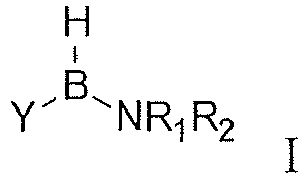
into an aminoarylborane compound of the following formula:
Typically, the transformation comprises, converting Aryl-chloride Ar-Cl with an aminoborane such as
Description
- The present invention relates to a process for the preparation of aminoarylborane compounds and derivatives thereof.
- The creation of a carbon-boron bond and its subsequent transformation have proved to be a powerful tool in organic synthesis. Thus, boron derivatives are considered as key intermediates in organic synthesis. Moreover, boron derivatives are usually little toxic making them even more attractive, in particular for the green industry. A major obstacle to a widespread use of boron derivatives is their cost price which can be prohibitive. Indeed, known methods for preparing said compounds require reagents often expensive and specific conditions making it difficult to carry out scale up in industry.
- Aryl borane derivatives, such as arylboronic acids and esters, can be prepared by borylation of organomagnesium or organolithium derivatives. The reaction consists in a condensation of an aromatic organometallic reagent with a borate derivative. These reactions must be carried out at cryogenic temperature (usually below -60°C) to avoid side reactions and undesired products. Such conditions are difficult to handle, especially on a large scale and final products when obtained, have to be separated and purified which is cost and time consuming. Moreover, the chemoselectivity of these reactions is limited because of the limited compatibility between numerous functional groups and organometallic reagents.
-
WO 2001064688 describes the borylation of aromatic or cyclic hydrocarbons by C-H bonds activation catalyzed by rhodium organometallic complexes. Alternative methods have been developed to avoid the implementation of organometallics at very low temperatures. These methods involve palladium activation of carbon-halide bond (Miyaura borylation), (US 20040024237 A1 ) or iridium activation of Aryl-H (Hartwig borylation), (US 20060281939 A1 ). - These methods consist for example in reacting tetra alkoxydiboron compounds, (T. Ishiyama et al., J. Org. Chem., 1995, 60, 7508), pinacolborane (M. Murata et al., J. Org. Chem., 1997, 62, 6458) or aminoborane compounds (diisopropylaminoborane, iPr2N-BH2,
WO 03/053981 A1 - These methods do not involve organomagnesium or organolithium compounds but brominated and iodinated derivatives which remain expensive. Further, the existing reagents do not allow the synthesis of a large spectrum of borane derivatives and the yields can be very low. Furthermore, half of the boron starting material is lost when pinacolatodiboron is used as a reagent.
- There is therefore a need to develop less expensive and easier to implement methods allowing the synthesis of a less restricted number of stable boronic compounds, in particular in a large scale, with a good yield.
- The aim of present invention is to provide a method which palliates the problems cited above.
- The present invention provides a new and easy process for preparing aminoarylboranes and ultimately arylboranes compounds which can be implemented in a large scale, , with good yields. The present invention also provides an improved process for the preparation of aminoarylborane compounds, more environment friendly, by reducing the cost and the use of dangerous or difficult to handle reagents.
- Unexpectedly, the inventors succeeded in using an aryl chloride compound for the implementation of a borylation process involving an arylation reaction in the presence of a catalytic system, leading to an aminoarylborane compound or a derivative thereof.
- In a general aspect, the invention provides a borylation process involving an arylation reaction of an aminoborane by using an aryl chloride compound in the presence of a catalytic system, leading to an aminoarylborane compound or a derivative thereof.
- In an advantageous embodiment, said arylation reaction involves the use of an aryl chloride compound, an aminoborane compound and a halide salt in the presence of a catalytic system leading to an arylborane compound.
- In another advantageous embodiment, the arylation process involves the use of an aryl chloride compound, an aminoborane compound, a halide salt in the presence of a catalytic system and a base leading to an arylborane compound.
- In another even more advantageous embodiment, the arylation process involves the use of an aryl chloride compound, an aminoborane compound, a halide salt, in the presence of a catalytic system and a base in a reaction medium containing an aprotic polar solvent.
- In a first aspect, the invention provides a use of an aryl chloride compound and of an aminoborane compound in the presence of a catalytic system, for the implementation of a process involving an arylation reaction leading to an aminoarylborane compound or a derivative thereof.
- The inventors discovered that it was possible to implement a process, in particular a borylation process, for the preparation of an arylborane compound, or a derivative thereof, which comprises a step of arylation by reacting an aryl chloride with an aminoborane compound in the presence of a catalytic system, in a reaction medium containing a solvent.
- In a particular embodiment, the use according to the invention comprised a step of arylation in the presence of a catalytic system and/or a base and in the absence of halide salt.
- As a second aspect, the present invention provides a process for the preparation of an aminoarylborane compound, or a derivative thereof, which comprises a step of arylation by reacting an aryl chloride with an aminoborane compound in the presence of a catalytic system, in a reaction medium containing a solvent, to obtain an aminoarylborane compound, optionally isolated and purified, an optional step of converting the aminoarylborane compound by refunctionalisation into an arylborane derivative.
- In an advantageous embodiment, the present invention provides a process for the preparation of an aminoarylborane compound, or a derivative thereof, which comprises a step of arylation by reacting an aryl chloride with an aminoborane compound in the presence of a catalytic system allowing a carbone-chloride (C-Cl) bond and Boron-Nitrogen (B-H) bond activation.
- In a preferred embodiment, the step (1) of arylation is a step of arylation implemented in the presence of a catalytic system, in a reaction medium containing an apolar and aprotic solvent, at least a halide salt and/or at least a base, at a temperature of 20°C.
- In another preferred embodiment, the process or the use according to the invention comprises a step (1) of arylation in the presence of a catalytic system, in a reaction medium containing a polar and aprotic solvent, and at least one base, preferably an inorganic base, and more preferably at least one organic base.
- Inventors discovered that conditions of arylation of an aminoborane compound using an aryl bromide or iodine do not apply to arylation of an aminoborane compound using an aryl chloride.
- Further, it was not obvious to transpose the experimental conditions of borylation of an aryl-chloride using pinacolborane (a dialkoxyborane with one BH bond) to an aminoborane, due to the fact that aminoborane compounds used in the reaction are weaker Lewis acids than pinacolborane and furthermore bear two BH bonds.
- Thus, catalytic system usually used in prior art for implementing an arylation reaction of an aminoborane compound with aryl bromine or iodine does not apply to aryl chloride. Furthermore, it was not obvious to identify experimental conditions under which both C-C1 bond of the aryl chloride and a BH bond of the aminoborane would be activated during the same catalytic cycle.
- The inventors identified such experimental conditions allowing arylation of an aminoborane compound using an aryl chloride compound.
- The present invention provides a process according to the above, wherein said catalytic system is optionally under the form of a preformed complex and comprises :
- at least a transition metal, in particular a transition metal selected from the group comprising Pd, Cu, Fe, Ni, and Pt, and
- at least a ligand, in particular a ligand selected from the group comprising a trialkylphosphine, a dialkylarylphosphine, more particularly an alkylbiarylphosphine, a C-based ligand, more particularly a N-heterocyclic carbene, and a N-based ligand, more particularly an oxime ligand.
- In an advantageous embodiment, said catalytic system comprises a transition metal derivative or salt selected from PdCl2, PdI2, PdBr2 Pd(OAc)2 and a ligand XPhos, CPhos, DAL-Phos or Sphos, NHC carbene catalytic system, acetophenone oxime.
- In more advantageous embodiment said catalytic system comprises a metal derivative or salt selected from PdCl2, PdI2, PdBr2 Pd(OAc)2 and a ligand NHC carbene catalytic system, acetophenone oxime.
- In an even more advantageous embodiment said catalytic system comprises Pd(OAc)2 and XPhos as a ligand.
- In another embodiment, the process provided is a process according to any one of the above process wherein the arylation reaction is conducted in presence of a halide salt, in particular a halide salt selected from the group comprising KI, NaI, CsI, KBr, NaBr, CsBr, KCl, NaCl, CsCl, more particularly KI and NaI, or a mixture thereof.
- The process provided is a process according to any one of the above wherein the arylation reaction further comprises a halide salt, in particular a halide salt selected from the group comprising KI, NaI, CsI, KBr, NaBr, CsBr, KCl, NaCl, CsCl, more particularly KI and NaI, or a mixture thereof.
- In an advantageous embodiment the halide salt is KI.
- Advantageously, the addition of a catalytic amount of halide salt improves the arylation reaction yield implemented in the present process according to the invention.
- A catalytic amount of halide salt means an amount of halide salt improving the arylation reaction of an aminoborane.
- In an advantageous embodiment, the process provided is a process according to any one of the above wherein the amount of halide salt is comprised from 0.001 % to 50 %, in particular from 0.01 % to 20 %, and even more particularly from 0.1% to 20% or from 0.1% to 5% expressed as a percentage of the number of moles of the aryl chloride (molar percentage) in the arylation reaction.
- In a particular embodiment, the process provided is a process according to any of the above, wherein the arylation reaction is conducted in the absence of halide salt. In the absence of halide salt means that no halide salt is added into the reaction medium. "In the absence of halide salt" means less than 0.0001 % of halide salt or undetectable amount of halide salt is present in the reaction medium.
- Detection may be performed as known in the art for example by a method described in Thirumurthy Velpandian, Jayabalan Nirmal, Beauty Arora, Alok Kumar Ravi & Ankita Kotnala Understanding the Charge Issues in Mono and di-Quaternary Ammonium Compounds for Their Determination by LC/ESI-MS/MS. Analytical Letter. Volume 45, Issue 16, 2012. Pages 2367-2376.
- In yet another embodiment, the process provided is a process according to any one of the above, for the preparation of
- ■ an aminoarylborane compound of the following formula:

- H is a hydrogen atom
- B is a boron atom
- Ar is an aryl group which is optionally substituted, in particular a heteroaryl group containing one or several heteroatom(s) selected from O, N or S,
- NR1R2 is an amino group, wherein R1 and R2, are identical or different, selected from the group comprising:
- a hydrogen atom,
- an optionally substituted hydrocarbon group, in particular
- a linear alkyl group having from 1 to 20 carbon atoms,
- a branched alkyl group having from 3 to 20 carbon atoms,
- a cycloalkyl group having from 3 to 20 carbon atoms,
- an alkylaryl group, in particular a benzyl group, optionally substituted on the aromatic ring by one or several substituent (s) selected from alkyl group having from 1 to 10 carbon atoms, in particular from 1 to 5 carbon atoms, alkoxy group having from 1 to 10 carbon atoms, in particular from 1 to 5 carbon atoms, and/or optionally substituted on the benzylic carbon by an alkyl group, more specifically a methyl group, this carbon being eventually chiral.
- an aryl group which is optionally substituted, in particular a phenyl group optionally substituted on the aromatic ring by one or several substituent (s) selected from alkyl group having from 1 to 10 carbon atoms, in particular from 1 to 5 carbon atoms, alkoxy group having from 1 to 10 carbon atoms, in particular from 1 to 5 carbon atoms,
- ■ an arylboronic acid compound of the following formula

- ■ a dialkoxyarylborane compound of the following formula

- OR7 and -OR7a are identical or different, each represents an alkoxy group, wherein R7 and R72, identical or different, each represents:
- a hydrogen atom,
- an optionally substituted hydrocarbon group, in particular
- a linear alkyl group having from 1 to 20 carbon atoms,
- a branched alkyl group having from 3 to 20 carbon atoms,
- a cycloalkyl group having from 3 to 20 carbon atoms,
- an alkylaryl group, in particular a benzyl group, optionally substituted on the aromatic ring by one or several substituent (s) selected from alkyl group having from 1 to 10 carbon atoms, in particular from 1 to 5 carbon atoms, alkoxy group having from 1 to 10 carbon atoms, in particular from 1 to 5 carbon atoms, and/or optionally substituted on the benzylic carbon by an alkyl group, more specifically a methyl group, this carbon being eventually chiral.
- an aryl group which is optionally substituted, in particular a phenyl group optionally substituted on the aromatic ring by one or several substituent (s) selected from alkyl group having from 1 to 10 carbon atoms, in particular from 1 to 5 carbon atoms, alkoxy group having from 1 to 10 carbon atoms, in particular from 1 to 5 carbon atoms,
- OR7 and -OR7a are identical or different, each represents an alkoxy group, wherein R7 and R72, identical or different, each represents:
- ■ an alkoxyaminoarylborane compound of following formula

- -NR1R2 is an amino group, R1 and R2 have the above mentioned meanings,
- -OR8 is an alkoxy group and R8 has the above mentioned meanings for R7
the carbon atom linked to the oxygen atom in -OR8 and /or to the nitrogen atom in NR1R2 is optionally substituted by an alkyl group having from 1 to 10 carbon atoms, in particular by a methyl group, said carbon atom being optionally chiral, - ■ a diaminoarylborane compound of following formula

NR1R2 and NR1a R2a is an amino group, R1 and R2 have the above mentioned meanings, R1a has the same meaning as R1, R2a has the same meaning as R2 and R1, R2, R1a, R2a are identical or different from one or from other(s),
the amino groups -NR1NR2 and NR1a R2a are optionally connected to form a ring including the boron atom, or a derivative thereof,
said compound is in particular an aminoarylborane or a cyclic diaminoarylborane or a derivative thereof. - In an embodiment, the process provided is a process according to any one of the above comprising a step of contacting an aryl chloride of formula Ar-Cl with an aminoborane compound, wherein Cl is a chlorine atom,
- Ar is an aryl group which is optionally substituted, an heteroaryl group optionally substituted containing one or several heteroatom (s) selected from N, O or S, more particularly an aryl group or a heteroaryl group group which is optionally substituted, selected from the group comprising a phenyl, a naphtalenyl, an anthracenyl, a phenanthrenyl, a biphenyl group, a pyridine, pyrazine, imidazole, pyrazole, oxazole, isoquinoline, thiophene, benzothiophene, furane, benzofurane, isoindole, benzoxazole, benzodioxole, chromanone.
- In an advantageous embodiment the following aryl choride are preferred
- The following substituted aryl chlorides are preferred:

- In a preferred embodiment, each group, when substituted, is carrying one or several identical or different substituent(s), also defined as "R" selected from the group comprising:
- □ - a halogen atom selected from - F, -Cl, -Br or -I,
- □ -SO2-NH2, or a salt thereof,
- □ -SO2-R9, or -SO3-R9 wherein R9, represents
- a hydrogen atom,
- an optionally substituted hydrocarbon group, in particular
- a linear alkyl group having from 1 to 20 carbon atoms,
- a branched alkyl group having from 3 to 20 carbon atoms,
- a cycloalkyl group having from 3 to 20 carbon atoms,
substituted by one or several substituent (s) selected from halogen, hydroxyl, alkyl group having from 1 to 10 carbon atoms, in particular from 1 to 5 carbon atoms, alkoxy group having from 1 to 10 carbon atoms, in particular from 1 to 5 carbon atoms, - an alkylaryl group, in particular a benzyl group, optionally substituted on the aromatic ring by one or several substituent (s) selected from halogen, hydroxyl, alkyl group having from 1 to 10 carbon atoms, in particular from 1 to 5 carbon atoms, alkoxy group having from 1 to 10 carbon atoms, in particular from 1 to 5 carbon atoms,
and/or optionally substituted on the benzylic carbon by an alkyl group, more specifically a methyl group, this carbon being eventually chiral. - an aryl group which is optionally substituted, in particular a phenyl group optionally substituted on the aromatic ring by one or several substituent (s) selected from halogen, alkyl group having from 1 to 10 carbon atoms, in particular from 1 to 5 carbon atoms, alkoxy group having from 1 to 10 carbon atoms, in particular from 1 to 5 carbon atoms,
- □ -NO2,
- □ -CF3,
- □ -CN,
- □ -R10, wherein R10 has the same meanings as R9,
- □ -OR11, wherein R11 has the same meaning as R9,
- □ -OSitBuPh2,
- □ -OSitBuMe2,
- □ -SR12, wherein R12 has the same meaning as R9,
- □ -COOH, or -CO-NH2 or a salt thereof,
- □ -COOR13, wherein R13 has the same meaning as R9
- □ -CO-NR14R14a, wherein R14 and R14a are identical or different and have the same meaning as R1 and R2, the carbon atom in R14 and/or R14a linked to the nitrogen atom, is optionally substituted by an alkyl group having from 1 to 10 carbon atoms, in particular by a methyl group, said carbon atom being optionally chiral,
- □ -NR15R15a or a salt thereof, wherein R15 and R15a are identical of different and have the same meaning as R1 and R2 the carbon atom in R15 and/or R15a linked to the nitrogen atom, is optionally substituted by an alkyl group having from 1 to 10 carbon atoms, in particular by a methyl group, said carbon atom being optionally chiral,
- □ -SiR16 3, wherein R16 has the same meaning as R9,
- □ a borylated group in which B is a boron atom (oxidation state III) B(III), said group being in particular a dialkoxyboryl group of formula:

R17 and R17a, are identical or different, each represents:- a hydrogen atom,
- an optionally substituted hydrocarbon group, in particular
- a linear alkyl group having from 1 to 20 carbon atoms,
- a branched alkyl group having from 3 to 20 carbon atoms,
- a cycloalkyl group having from 3 to 20 carbon atoms,
- an alkylaryl group, in particular a benzyl group, optionally substituted on the aromatic ring by one or several substituent (s) selected from alkyl group having from 1 to 10 carbon atoms, in particular from 1 to 5 carbon atoms, alkoxy group having from 1 to 10 carbon atoms, in particular from 1 to 5 carbon atoms, and/or optionally substituted on the benzylic carbon by an alkyl group, more specifically a methyl group, this carbon being eventually chiral.
- an aryl group which is optionally substituted, in particular a phenyl group optionally substituted on the aromatic ring by one or several substituent (s) selected from alkyl group having from 1 to 10 carbon atoms, in particular from 1 to 5 carbon atoms, alkoxy group having from 1 to 10 carbon atoms, in particular from 1 to 5 carbon atoms,
the alkoxy groups -OR17 and -R17a are optionally connected and form a ring including the boron atom and the two oxygen atoms, in particular a 5 to 7 membered ring derived from (or comprising a dialkoxy moiety of the diol selected from) a diol selected from ethane-1,2-diol, propane-1,3-diol, 2,3-dimethylbutane-2,3-diol (pinacol), pinanediol, 2-methylbutane-2,3-diol, 1,2-diphenylethane-1,2-diol, 2-methylpentane-2,4-diol, 1,2-dihydroxybenzene (catechol), in particular pinacol or pinanediol, - □ a borylated group wherein B is boron atom (oxidation state IV) of formula B(IV), in particular:
- ■ a trifluoroborate group,
- ■ a trialkylborate group, -B(ORa)3, wherein Ra is an alkyl group having from 1 to 10 carbon atoms, (ORa)3 is optionally forming a bicyclic system including the boron atom and the three oxygen atoms, representing a trialkoxy moiety of a triol selected from the group comprising 1,2,3-propane triol (glycerol) or 1,1,1-tris(hydroxymethyl)ethane (2-(hydroxymethyl)-2-methyl-1,3-propanediol),
- ■ a boratrane group, in particular a borotrane group wherein a N,N-bis(hydroxyalkyl)alkylamine derivative of formula HO-Rb-NRc-Rb'-OH forms a ring with the boron atom.
Rb and Rb', are identical or different, each represents a linear alkylene group having 2 or 3 carbon atoms, or branched alkylene group having from 3 to 5 carbon atoms,
Rc is a hydrogen atom or an alkyl group having 1 to 4 carbon atoms,
in particular a N,N-bis(hydroxyalkyl)alkylamine group of formula HO-Rb-NRc-Rb'-OH forming a [4,0,4], or [4,0,5] or [5,0,5] bicyclic boratrane heterocycle with the boron atom,
wherein Rb and Rb', are identical or different, each represents a linear alkylene group having 2 or 3 carbon atoms, or branched alkylene group having from 3 to 5 carbon atoms,
Rc is a hydrogen atom or an alkyl group having 1 to 4 carbon atoms. - ■ a methyliminodiacetic acid (MIDA) borate group of the following formula

- Examples of R-MIDA groups are described in Lee, S. J. et al. J. Am. Chem. Soc. 2008, 130, 466. Knapp DM, Gillis EP, Burke MD. J. Am. Chem. Soc. 2009; 131:6961-6963 and in
- Gillis EP, Burke MD. J. Am. Chem. Sco. 2007; 129:6716-6717, incorporated herein by reference.
- Advantgeous substituents for Ar group (also defined as R) in Ar-Cl are halogen, in particular F, Cl, alkyl, in particular C1-4 alkyl, and preferably, methyl, O-alkyl, and preferably O-Me, CF3, halogen preferably, F or Cl,
the aminoborane compound to be arylated is an aminoborane of the general following formula
- H is a hydrogen atom,
- B is a boron atom,
- NR1R2 is an amino group, wherein
R1 and R2, are identical or different, are as defined above :- ■ Y represents:
- □ - a hydrogen atom,
- □ -NR1aR2a,
- □ -R7a,
- □ -OR8a, wherein
- a hydrogen atom,
- an optionally substituted hydrocarbon group, in particular
- a linear alkyl group having from 1 to 20 carbon atoms,
- a branched alkyl group having from 3 to 20 carbon atoms,
- a cycloalkyl group having from 3 to 20 carbon atoms,
- an alkylaryl group, in particular a benzyl group, optionally substituted on the aromatic ring by one or several substituent (s) selected from alkyl group having from 1 to 10 carbon atoms, in particular from 1 to 5 carbon atoms, alkoxy group having from 1 to 10 carbon atoms, in particular from 1 to 5 carbon atoms,
and/or optionally substituted on the benzylic carbon by an alkyl group, more specifically a methyl group, this carbon being eventually chiral,
In a particular embodiment, the benzyl group is optionally substituted on the benzylic carbon, by one or several substituent (s) selected from the group comprising, alkyl group having from 1 to 10 carbon atoms, , in particular from 1 to 5 carbon atoms, alkoxy group having from 1 to 10 carbon atoms, in particular from 1 to 5 carbon atoms, - an aryl group which is optionally substituted, in particular a phenyl group optionally substituted on the aromatic ring by one or several substituent (s) selected from alkyl group having from 1 to 10 carbon atoms, in particular from 1 to 5 carbon atoms, alkoxy group having from 1 to 10 carbon atoms, in particular from 1 to 5 carbon atoms,
R1a and R2a optionally form an alkylene group corresponding to the formula -CR3R4-(CH2)n-CR5R6, in which n is ranging from 0 to 4, and the R3 to R6 substituents are selected, independently of one another, from hydrogen and alkyl groups having from 1 to 20 carbon atoms, in particular said alkylene being 1,1,5,5-tetramethylpentylene,
the carbon atom in R1a and/or in R2a linked to the nitrogen atom in -NR1aR2a is optionally substituted by an alkyl group having from 1 to 10 carbon atoms, in particular by a methyl group, said carbon(s) atom being optionally chiral, - R7a represents
- a hydrogen atom,
- an optionally substituted hydrocarbon group, in particular
- a linear alkyl group having from 1 to 20 carbon atoms,
- a branched alkyl group having from 3 to 20 carbon atoms,
- a cycloalkyl group having from 3 to 20 carbon atoms,
- an alkylaryl group, in particular a benzyl group, optionally substituted on the aromatic ring by one or several substituent (s) selected from alkyl group having from 1 to 10 carbon atoms, in particular from 1 to 5 carbon atoms, alkoxy group having from 1 to 10 carbon atoms, in particular from 1 to 5 carbon atoms, and/or optionally substituted on the benzylic carbon by an alkyl group, more specifically a methyl group, this carbon being eventually chiral.
- an aryl group which is optionally substituted, in particular a phenyl group optionally substituted on the aromatic ring by one or several substituent (s) selected from alkyl group having from 1 to 10 carbon atoms, in particular from 1 to 5 carbon atoms, alkoxy group having from 1 to 10 carbon atoms, in particular from 1 to 5 carbon atoms,
- -OR8a represents an acetoxy group wherein R8a has the same meaning as R7a,
particular by a methyl group, said carbon atom being optionally chiral, the carbon atom in R1 and/or R2 linked to the nitrogen atom
the carbon atom in R1a and/or R2a linked to the nitrogen atom,
and/or
the carbon atom in R8a linked to the oxygen atom,
is optionally substituted by an alkyl group having from 1 to 10 carbon atoms, in particular by a methyl group, said carbon(s) atom being optionally chiral,
for the preparation of an aminoarylborane or an aminoheteroarylborane of following formula IV:
- ■ Y represents:
- In an embodiment, the process provided is a process according to any one of the above comprising a step of reacting an aryl chloride of formula Ar-Cl, with an aminoborane compound wherein Ar is an aryl group, preferably a phenyl group, optionally substituted (R) with one or several substituents in particular with 1 to 3 substituents and more preferably with 2 or 3 substituents selected from the group comprising:
- □ -R9,
- □ -OR11, wherein OR11 is an alkoxy group or an acetoxy group,
- □ - a halogen atom in particular F, Cl,
- □ -OSitBuPh2 of formula:

- □ -OSitBuMe2 of formula :

- □ -SR12, wherein -SR12 is an alkylthio group,
- □ -NR16R16a or a salt thereof,
- In an embodiment, the process provided is process according to any one of the above, comprising a step of contacting an aryl chloride of formula Ar-Cl, with an aminoborane compound, in presence of a halide salt, wherein Ar is selected from the group comprising pyridine, pyrazine, imidazole, pyrazole, oxazole, isoquinoline, thiophene, benzothiophene, furane, benzofurane, isoindole, benzoxazole, benzodioxole, chromanone, optionally carrying at least one substituent as defined above for aryl groups.
- In an advantageous embodiment Ar is selected from the group comprising a benzyl optionally substituted and a phenyl group optionally substituted, with one or several substituents, in particular one to 3 substituents and more preferably 2 or 3 substituents selected from the group comprising:
- □NO2,
- □ alkyl group, in particular a C1-10alkyl,
- □-C1-10alkoxy group of formula O-C1-10,
- □ Alkylthio group of formula S-C1-10,
- □ CF3,
- □ CN,
- □ a halogen atom selected from - F, -Cl, -Br or -I,
- □ an ester group of formula -COO-R13 wherein R13 has the same meaning as R9 above,
- In yet another embodiment, the process provided is a process according to the above embodiments implemented in the absence of halide salt.
- In one aspect, the process according the invention is comprising a step of reacting an aryl chloride of formula Ar-Cl, with an aminoborane compound wherein Ar is an aryl group, is selected from the group comprising pyridine, pyrazine, imidazole, pyrazole, oxazole, isoquinoline, thiophene, benzothiophene, furane, benzofurane, isoindole, benzoxazole, benzodioxole, and chromanone, in particular from the group comprising a benzyl and a phenyl group, preferably a phenyl group, optionally substituted with one or several substituents in particular with one to 3 substituents and more preferably with 2 or 3 substituents selected from the group comprising:
- □ NO2,
- □ -R9 in particular R9 is a C1-10alkyl
- □ -OR11, wherein OR11 is an alkoxy group or an acetoxy group, in particular an C1-10 alkoxy group of formula O-C1-10 ,
- □ -OSitBuPh2 of formula :

- □ -OSitBuMe2 of formula :

- □ -SR12, wherein -SR12 is an alkylthio group of formula S-C1-10,
- □ CF3,
- □ CN,
- □ a halogen atom selected from - F, -Cl, -Br or -I
- □ an ester group of formula -COO-R13
- □ -NR14R14a or a salt thereof,
- In an embodiment, the process provided is a process according to any one of the above embodiment, wherein the solvent is aprotic and polar, in particular the solvent is selected from the group comprising cyclic etheroxides, in particular dioxanne or tetrahydrofuran (THF), or the group comprising dialkyl etheroxides, in particular, 2-methoxy-2-methylpropane (MTBE), diethylether, glymes, more particularly diglyme, or the esters group in particular methylacetate, ethylacetate, isopropylacetate, or the alkylnitrile group in particular acetonitrile, propionitrile, butyronitrile, or the amide group in particular dimethylacetamide (DMAc), N-methyl-2-pyrrolidone (NMP), or a mixture thereof, more particularly from methylacetate, ethylacetate, isopropylacetate, dioxanne or glymes, more particularly diglyme or a mixture thereof.
- In an advantageous embodiment, the aprotic and polar solvent is selected from the group consisting of dioxanne, in particular distilled dioxanne, tetrahydrofuran, 2-methoxy-2-methylpropane, 2-methoxy-2-methylpropane, diglime, acetonitrile, dimethylacetamide, and a mixture thereof. In a more advantageous embodiment, the aprotic and polar solvent is selected from the group consisting of dioxanne, EtOAc, tBuOMe. In a even more advantageous embodiment, the aprotic and polar solvent is freshly distilled dioxanne or freshly distilled EtOAc.
- In an embodiment, the process provided is a process according to any one of the above wherein the arylation reaction is conducted in presence of a base; the base may be organic and /or inorganic. One advantage of using a base is to improve the yield of the arylation reaction.
- In another embodiment, the process provided is a process wherein the arylation reaction comprises at least one base, said base being organic or inorganic.
- In a particular embodiment, the process provided is a process wherein the arylation reaction is conducted in presence of, or comprises, an organic base, in particular an organic base selected from the group comprising Et3N, BuNMe2, iPr2NEt, iPr2NH, pyridine. In a preferred embodiment the organic base is Et3N, BuNMe2, and more preferably Et3N.
- In another embodiment, the process provided is a process wherein the arylation reaction is conducted in presence of, or comprises, an inorganic base, in particular an inorganic base selected from the group comprising Na2CO3, NaOAc, K2CO3, Cs2CO3, KOAc. In an advantageous embodiment the inorganic base is Na2CO3, NaOAc, and more preferably Na2CO3.
- In another embodiment, said base is selected from the group comprising Et3N, BuNMe2, iPr2NEt, iPr2NH, pyridine a mixture of organic bases, Na2CO3, NaOAc, K2CO3, Cs2CO3, KOAc, a mixture of inorganic bases.
- In another general aspect the present invention relates to a process for the preparation of an aminoarylborane compound, or a derivative thereof, which comprises a step of arylation by reacting an aryl chloride with an aminoborane compound in the presence of a catalytic system, in a reaction medium containing a solvent, a halide salt, to obtain an aminoarylborane compound, isolated and purified, and a step of converting the aminoarylborane compound by refunctionalisation into an arylborane derivative, by treating said aminoarylborane compound by alcoholysis using a first alcohol, and then by a second alcohol such as a diol selected from the group comprising ethane-1,2-diol, propane-1,3-diol, 2,3-dimethylbutane-2,3-diol (pinacol), pinanediol, 2-methylbutane-2,3-diol, 1,2-diphenylethane-1,2-diol, 2-methylpentane-2,4-diol, 1,2-dihydroxybenzene (catechol), in particular pinacol and pinanediol for a step of transesterification that is followed by a step of purification.
- In an embodiment, the process provided is a process according to any one of the above for the preparation of an aminoarylborane compound which comprises:
- a step of reacting an aryl chloride Ar-Cl with an aminoborane compound of following formula II

and R1 and/or R2 is an isopropyl group and when R1 or R2 is an isopropyl group, the other R1 or R2 has the following meaning:- a hydrogen atom,
- an optionally substituted hydrocarbon group in particular
- a linear alkyl group having from 1 to 20 carbon atoms,
- a branched alkyl group having from 3 to 20 carbon atoms,
- a cycloalkyl group having from 3 to 20 carbon atoms,
- an alkylaryl group, in particular a benzyl group, optionally substituted on the aromatic ring by one or several substituent (s) selected from alkyl group having from 1 to 10 carbon atoms, in particular from 1 to 5 carbon atoms, alkoxy group having from 1 to 10 carbon atoms, in particular from 1 to 5 carbon atoms, and/or optionally substituted on the benzylic carbon by an alkyl group, more specifically a methyl group, this carbon being eventually chiral.
- an aryl group which is optionally substituted, in particular a phenyl group optionally substituted on the aromatic ring by one or several substituent (s) selected from alkyl group having from 1 to 10 carbon atoms, in particular from 1 to 5 carbon atoms, alkoxy group having from 1 to 10 carbon atoms, in particular from 1 to 5 carbon atoms, or any aryl group substituents,
- R1 and R2 optionally form an alkylene group corresponding to the formula -CR3R4-(CH2)n-CR5R6, in which n is ranging from 0 to 4, and R3 to R6 are selected independently of one another, from hydrogen and alkyl groups having from 1 to 20 carbon atoms in particular said alkylene being 1,1,5,5-tetramethylpentylene,
- In an advantageous embodiment said process is a process for the preparation of an aminoarylborane compound of formula V,

- In another advantageous embodiment, said process is a process for the preparation of a diisopropylaminoarylborane comprising a step of reacting an aryl chloride with the diisopropylaminoborane of following formula IIA


in an advantageous embodiment, the reaction medium comprises a solvent, in particular in dioxanne or Et3N said process comprising a possible step of isolation and purification of the diisopropylaminoarylborane compound of formula VA from the reaction medium. - In a more advantageous embodiment, said process for the preparation of a diisopropylaminoarylborane compound comprises a step of reacting an aryl chloride with a diisopropylaminoborane of following formula IIA

the Pd(OAc)2/XPhos catalytic system,
the PdCl2/XPhos catalytic system,
the PdBr2/XPhos catalytic system,
the PdI2/XPhos catalytic system,
the Pd(OAc)2/SPhos catalytic system,
the Pd(OAc)2/DALPhos catalytic system,
a Pd(OAc)2/NHC carbene catalytic system,
a Pd(OAc)2/acetophenone oxime catalytic system or
a Pd (PCy3)2 precatalyst
a Pd(OAc)2/ PCy3 catalytic system
a Pd(OAc)2/ AsPh3 catalytic system,
for the preparation of a diisopropylaminoarylborane compound of formula VA,
and a possible step of isolation and purification of the diisopropylaminoarylborane compound of formula VA from the reaction medium. - In an embodiment, the process provided is a process according to any one of the above wherein the step of reacting an aryl chloride with an aminoborane compound is performed in an aprotic polar solvent, in particular an aprotic polar solvent selected from methylacetate, ethylacetate, isopropylacetate, and dioxanne, or a mixture thereof,
Advantageously, said process is carried out at a temperature comprised from 10 °C to 120 °C, in particular comprised from 18 °C to 30 °C, more advantageously equal to 20 °C, during a time ranging from 1 h to 24 h, even more advantageously from 12 h to 20 h, for the preparation of an aminoarylborane compound,
or said process is a process wherein the step of reacting an aryl chloride with an aminoborane compound is performed in an aprotic polar solvent, in particular an aprotic polar solvent selected from methylacetate, ethylacetate, isopropylacetate, dioxanne and a mixture thereof,
at a temperature comprised from 10 °C to 120 °C, in particular comprised from 18 °C to 30 °C, preferably equal to 20 °C, during a time ranging from 1 h to 24 h, preferably from 12 h to 20 h,
and wherein said catalytic system is selected from the group comprising
the Pd(OAc)2/XPhos catalytic system,
the Pd(OAc)2/SPhos catalytic system,
the Pd(OAc)2/DALPhos catalytic system,
a Pd(OAc)2/NHC carbene catalytic system or
a Pd XPhos precatalyst,
with a molar percentage of the metal relative to the aryl chloride comprised from 0,01 % to 10 %, in particular comprised from 0,1 % to 5 %, more particularly comprised from 0,2 % to 2 %, preferably equal to 0,2 %, or about 1 %, or 2%
for the preparation of an aminoarylborane compound,
or said process is a process wherein the step of reacting an aryl chloride with an aminoborane compound is performed in an aprotic polar solvent, in particular an aprotic polar solvent selected from methylacetate, ethylacetate, isopropylacetate, and dioxanne, and a mixture thereof,
at a temperature comprised from 10 °C to 100 °C, in particular comprised from 18 °C to 30 °C, preferably equal to 20 °C, during a time ranging from 1 h to 24 h, preferably from 12 h to 20 h, from 16h to 18h,
and wherein said catalytic system is selected from the group comprising the Pd(OAc)2/XPhos catalytic system,
the PdCl2/XPhos catalytic system,
the PdBr2/XPhos catalytic system,
the PdI2/XPhos catalytic system,
the Pd(OAc)2/SPhos catalytic system,
the Pd(OAc)2/DALPhos catalytic system,
a Pd(OAc)2/NHC carbene catalytic system,
a Pd(OAc)2/acetophenone oxime catalytic system
or a Pd XPhos precatalyst,
with a molar percentage of the metal relative to the aryl chloride from 0,01 % to 10 %, in particular comprised from 0,1 % to 5 %, more particularly comprised from 0,2 % to 2 %, preferably equal to 0,2 %, or 1 %, or 2%,
in the presence of an organic base, in particular an organic base selected from Et3N, BuNMe2, iPr2NEt, iPr2NH, pyridine,
or an inorganic base, in particular an inorganique base selected from Na2CO3, NaOAc, K2CO3, KOAc, and Cs2CO3, for the preparation of an aminoarylborane compound,
or said process is a process wherein the step of reacting an aryl chloride with an aminoborane compound is performed in an aprotic polar solvent, in particular in an aprotic polar solvent selected from methylacetate, ethylacetate, isopropylacetate, and dioxanne, and a mixture thereof,
at a temperature comprised from 10 °C to 100 °C, in particular comprised from 18 °C to 30 °C, preferably equal to 20 °C, during a time ranging from 1 h to 24 h, preferably from 12 h to 20 h, and wherein said catalytic system, is selected from the group comprising : - the Pd(OAc)2/XPhos catalytic system,
- the PdCl2/XPhos catalytic system,
- the PdBr2/XPhos catalytic system,
- the PdI2/XPhos catalytic system,
- the Pd(OAc)2/SPhos catalytic system,
- the Pd(OAc)2/DALPhos catalytic system,
- a Pd(OAc)2/NHC carbene catalytic system,
- a Pd(OAc)2/acetophenone oxime catalytic system or
- a Pd XPhos precatalyst,
- with a molar percentage of the metal relative to the aryl chloride comprised from 0,01 % to 10 %, in particular comprised from 0,1 % to 5 %, more particularly comprised from 0,2 % to 2 %, preferably equal to 0,2 %, or 1 %, or 2%,
- in the presence of an organic base, in particular an organic base selected from Et3N, BuNMe2, iPr2NEt, iPr2NH, pyridine, or an inorganic base, in particular an inorganic base selected from Na2CO3, NaOAc, K2CO3,
- KOAc, Cs2CO3,
- and in the presence of a halide salt, in particular in the presence of
- 0,001 % to 50 %, in particular from 0,01 % to 20 %, and even more particularly from 0.1 % to 20 or from 0.1 to 5% of said halide salt expressed as a percentage of the number of moles of the aryl chloride (molar percentage) in the arylation reaction, said halide salt being in particular selected from KI, NaI, CsI, KBr, NaBr, CsBr, KCl, NaCl, CsCl, more particularly KI or NaI.
- for the preparation of an aminoarylborane compound.
- The present invention encompasses a process according to any of the above embodiments, implemented in the absence of halide salt.
- In even more advantageous embodiment, the process provided is a process according to any one of the above wherein the step of converting an aminoarylborane compound into a aminoarylborane compound derivative comprises a treatment of said aminoarylborane compound by alcoholysis with an alcohol, in particular with methanol,
optionally followed by a transesterification with a second alcohol, preferably with a diol selected from the group comprising ethane-1,2-diol, propane-1,3-diol, 2,3-dimethylbutane-2,3-diol (pinacol), pinanediol, 2-methylbutane-2,3-diol, 1,2-diphenylethane-1,2-diol, 2-methylpentane-2,4-diol, 1,2-dihydroxybenzene (catechol), in particular pinacol or pinanediol,
for the preparation of an arylboronic ester or aryl boronate of the following formula VI
in particular for the preparation of a cyclic aryldialkoxyborane,
preferably for the preparation of an arylpinacolborane of the following formula VIA
- or said treatment comprises a hydrolysis treatment to obtain an arylboronic acid of formula VII

- In another embodiment, the process provided is a process according to any one of the above for the preparation of a diisopropylaminoarylborane of following formula selected from:


- In an embodiment, the process provided is a process according to the above which comprises in addition to a step of contacting an aryl chloride with a diisopropylaminoborane compound of following formula IIA

a step of converting said diisopropylaminoborane compound of formula IIA into a diisopropylaminoborane compound of formula IIA derivative, wherein said step is a step of treating said aminoarylborane of formula VA directly or after an optional phase of isolation and purification, by alcoholysis, preferably a treatment with methanol, followed by a transesterification with pinacol. - In an embodiment, the process provided is a process according to the above, for the preparation of an arylpinacolborane having one of the following formula:


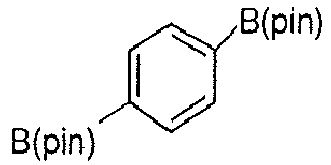

- General terms used in the description bear their usual meanings.
- In the present invention, the term "halogen" means fluorine, chlorine, bromine and iodine atom.
- In the present invention halogen, and OH, may be optional substituents of Ar groups in R-Ar-Cl or of R in R-Ar-Cl, only.
- In the present invention, hydrocarbon chain or hydrocarbon group means alkyl, alkene, alkenyl, alkynyl, alkylaryl, aryl, in particular straight, branched carbon chains and cyclic hydrocarbon group. The number of carbons atoms in the hydrocarbon group is from 1 to 20 or from 3 to 20 (C1-20, C3-20), in particular embodiments, the number of carbon atoms is from 5 to 20, from 1 to 12, from 1 to 10 or from 1 to 5 as indicated as follows: C5-20, C1-12, C1-10, C1-5, more preferably C4-6, C1-10, C1-5.
- A hydrocarbon group optionally includes a heteroatom, nitrogen atom, oxygen atom or sulfur atom (N, O, S), and is optionally substituted. Optional substituents of a hydrocarbon group include a linear alkyl group, in particular C1-10-alkyl group, O-alkyl group.
- Examples of the alkylene or alkene group include C1-6 alkylene groups such as a methylene group, an ethylene group, an n-propylene group, an isopropylene group, a cyclopropylene group, an n-butylene group, an isobutylene group, a sec-butylene group, a tert-butylene group, a cyclobutylene group, a 1-methyl-cyclopropylene group, a 2-methyl-cyclopropylene group, an n-pentylene group, a 1-methyl-n-butylene group, a 2-methyl-n-butylene group, a 3-methyl-n-butylene group, a 1,1-dimethyl-n-propylene group, a 1,2-dimethyl-n-propylene group, a 2,2-dimethyl-n-propylene group, a 1-ethyl-n-propylene group, a cyclopentylene group, a 1-methyl-cyclobutylene group, a 2-methyl-cyclobutylene group, a 3-methyl-cyclobutylene group, a 1,2-dimethyl-cyclopropylene group, a 2,3-dimethyl-cyclopropylene group, a 1-ethyl-cyclopropylene group, a 2-ethyl-cyclopropylene group, an n-hexylene group, a 1-methyl-n-pentylene group, a 2-methyl-n-pentylene group, a 3-methyl-n-pentylene group, a 4-methyl-n-pentylene group, a 1,1-dimetlryl-n-butylene group, a 1,2-dimethyl-n-butylene group, a 1,3-dimethyl-n-butylene group, a 2,2-dimethyl-n-butylene group, a 2,3-dimethyl-n-butylene group, a 3,3-dimethyl-n-butylene group, a 1-ethyl-n-butylene group, a 2-ethyl-n-butylene group, a 1,1,2-trimethyl-n-propylene group, a 1,2,2-trimethyl-n-propylene group, a 1-ethyl-1-methyl-n-propylene group, a 1-ethyl-2-methyl-n-propylene group, a cyclohexylene group, a 1-methyl-cyclopentylene group, a 2-methyl-cyclopentylene group, a 3-methyl-cyclopentylene group, a 1-ethyl-cyclobutylene group, a 2-ethyl-cyclobutylene group, a 3-ethyl-cyclobutylene group, a 1,2-dimethyl-cyclobutylene group, a 1,3-dimethyl-cyclobutylene group, a 2,2-dimethyl-cyclobutylene group, a 2,3-dimethyl-cyclobutylene group, a 2,4-dimethyl-cyclobutylene group, a 3,3-dimethyl-cyclobutylene group, a 1-n-propyl-cyclopropylene group, a 2-n-propyl-cyclopropylene group, a 1-isopropyl-cyclopropylene group, a 2-isopropyl-cyclopropylene group, a 1,2,2-trimethyl-cyclopropylene group, a 1,2,3-trimethyl-cyclopropylene group, a 2,2,3-trimethyl-cyclopropylene group, a 1-ethyl-2-methyl-cyclopropylene group, a 2-ethyl-1-methyl-cyclopropylene group, a 2-ethyl-2-methyl-cyclopropylene group, a 2-ethyl-3-methyl-cyclopropylene group. C2-3 alkylene groups are particularly preferable.
- Examples of linear alkylene group having 2 or 3 carbon atoms, or branched alkylene group having from 3 to 5 carbon atoms, are preferred.
- A linear or cyclic hydrocarbon group means an alkyl group, in particular linear alkyl group, a branched alkyl group, a cycloalkyl group.
- Examples of alkyl group are C1-10 alkyl group that include, but are not limited to, methyl, ethyl, propyl, 1-methyl ethyl, butyl, 1-methylpropyl, 2-methylpropyl, 1,1-dimethylethyl, pentyl, 1-methylbutyl, 2-methylbutyl, 3-methylbutyl, 2,2-dimethylpropyl, 1-ethylpropyl, hexyl, 1,1-dimethylpropyl, 1,2-dimethylpropyl, 1-methylpentyl, 2-methylpentyl, 3-methylpentyl, 4-methylpentyl, 1,1-dimethylbutyl, 1,2-dimethylbutyl, 1,3-dimethylbutyl, 2,2-dimethylbutyl, 2,3-dimethylbutyl, 3,3-dimethylbutyl, 1-ethylbutyl, 2-ethylbutyl, 1,1,2-trimethylpropyl, 1,2,2-trimethylpropyl, 1-ethyl-1-methylpropyl, 1-ethyl-2-methylpropyl, heptyl, octyl, 2-ethylhexyl, nonyl and decyl and their isomers.
- C1-5-alkyl means for example methyl, ethyl, propyl, 1-methylethyl, butyl, 1-methylpropyl, 2-methylpropyl or 1,1-dimethylethyl, butyl, 1-methylpropyl, 2-methylpropyl, 1,1-dimethylethyl, pentyl, 1-methylbutyl, 2-methylbutyl, 3-methylbutyl, 2,2-dimethylpropyl, 1-ethylpropyl.
- Cyclic alkyl groups, which are encompassed by the term "alkyl", may be referred to as "cycloalkyl" and include those with 3 to 20 carbon atoms having single or multiple fused rings. Non-limiting examples of cycloalkyl groups include adamantyl, cyclopropyl, cyclobutyl, cyclopentyl, cyclohexyl, cycloheptyl, cyclooctyl.
- Heterocycle, heterocyclic, heterocyclyl or heterocyclo refers to fully saturated or unsaturated cyclic groups, for example, 4 to 7 membered monocyclic, 7 to 11 membered bicyclic, or 5 to 20 membered tricyclic ring systems, which have at least one heteroatom in the ring. Each ring of the heterocyclic group containing a heteroatom may have 1, 2, 3 or 4 heteroatoms selected from nitrogen atom, oxygen atom and sulfur atom, where the nitrogen and sulfur heteroatoms may optionally be oxidized and the nitrogen heteroatoms may optionally be quaternized. The heterocyclic group may be attached at any heteroatom or carbon atom of the ring or ring system.
- Aryl refers to a C5-20 aromatic carbocyclic ring structure having a single ring or multiple fused rings, and optionally having one or more oxygen, nitrogen, and sulfur heteroatoms also referring to heteroaryl as defined below. In some embodiments, the aryl ring may be fused to a non-aromatic ring, as long as the point of attachment to the core structure is through the aromatic ring. Aryl groups include, but are not limited to, phenyl, biphenyl, and naphthyl.
- Exemples of Alkyl aryl group are benzyl α-methylbenzyl eventually optically active (R or S) but are not limited to these examples
- Heteroaryl refers to an aromatic ring of from 5 to 20 atoms, preferably from 5 to 15 atoms, having one or more oxygen, nitrogen, and sulfur heteroatoms within the ring, preferably 1 to 4 heteroatoms, or 1 to 3 heteroatoms. The nitrogen and sulfur heteroatoms may optionally be oxidized. Such heteroaryl groups can have a single ring (e.g., pyridyl or furyl) or multiple fused rings provided that the point of attachment is through a heteroaryl ring atom. Preferred heteroaryls include pyridyl, piridazinyl, pyrimidinyl, triazinyl, pyrrolyl, quinolinyl, isoquinolinyl, quinazolinyl, quinoxalinnyl, furanyl, thienyl, furyl, imidazolyl, oxazolyl, isoxazolyl, isothiazolyl, pyrazolyl, benzofuranyl, and benzothienyl.
- Heteroaryl rings may be optionally substituted by one or more substituents as described for aryl.
- Exemplary monocyclic heterocyclic or heteroaryl groups also include, but are not limited to, pyrrolidinyl, oxetanyl, pyrazolinyl, imidazolinyl, imidazolidinyl, oxazolidinyl, isoxazolinyl, thiazolyl, thiadiazolyl, thiazolidinyl, isothiazolidinyl, tetrahydrofuryl, thienyl, oxadiazolyl, piperidinyl, piperazinyl, 2-oxopiperazinyl, 2-oxopiperidinyl, 2-oxopyrrolodinyl, 2-oxoazepinyl, azepinyl, 4-piperidonyl, pyridinyl, pyrazinyl, pyridazinyl, tetrahydropyranyl, morpholinyl, thiamorpholinyl, thiamorpholinyl sulfoxide, thiamorpholinyl sulfone, 1,3-dioxolane and tetrahydro-1,1-dioxothienyl, triazolyl. Exemplary bicyclic heterocyclic groups include, but are not limited to, indolyl, benzothiazolyl, benzoxazolyl, benzodioxolyl, benzothienyl, quinuclidinyl, tetra-hydroisoquinolinyl, benzimidazolyl, benzopyranyl, indolizinyl, benzofuryl, chromonyl, coumarinyl, benzopyranyl, cinnolinyl, quinoxalinyl, indazolyl, pyrrolopyridyl, furopyridinyl (such as furo[2,3-c]pyridinyl, furo[3,2-b]pyridinyl] or furo[2,3-b]pyridinyl), dihydroisoindolyl, dihydroquinazolinyl (such as 3,4-dihydro-4-oxo-quinazolinyl), tetrahydroquinolinyl.
- Exemplary tricyclic heterocyclic groups include, but are not limited to, carbazolyl, benzidolyl, phenanthrolinyl, acridinyl, phenanthridinyl, xanthenyl.
- Preferred aryl and heteroaryl are phenyl, naphtalenyl, anthracenyl, phenanthrenyl, biphenyl group, pyridine, pyrazine, imidazole, pyrazole, oxazole, isoquinoline, thiophene, benzothiophene, furane, benzofurane, isoindole, benzoxazole, benzodioxole, chromanone.
- Substituents of hydrocarbon group, in particular aryl group, aryl of alkylaryl group or of heteroaryl group are selected from:
- hydrogen atom
- □ - halogen atom selected from - F, -Cl, -Br or -I, when aryl, aryl of alkylaryl or of heteroaryl is Ar or R in R-Ar-Cl,
- □ -SO2-NH2, or a salt thereof,
- □ -SO2-R9, or -SO3-R9 wherein R9, represents
- a hydrogen atom,
- an optionally substituted hydrocarbon group, in particular
- a linear alkyl group having from 1 to 20 carbon atoms,
- a branched alkyl group having from 3 to 20 carbon atoms,
- a cycloalkyl group having from 3 to 20 carbon atoms,
- an alkylaryl group, in particular a benzyl group, optionally substituted on the aromatic ring by one or several substituent (s) selected from alkyl group having from 1 to 10 carbon atoms, in particular from 1 to 5 carbon atoms, alkoxy group having from 1 to 10 carbon atoms, in particular from 1 to 5 carbon atoms, and/or optionally substituted on the benzylic carbon by an alkyl group, more specifically a methyl group, this carbon being eventually chiral.
- an aryl group which is optionally substituted, in particular a phenyl group optionally substituted on the aromatic ring by one or several substituent (s) selected alkyl group having from 1 to 10 carbon atoms, in particular from 1 to 5 carbon atoms, alkoxy group having from 1 to 10 carbon atoms, in particular from 1 to 5 carbon atoms,
- □ -NO2,
- □ -CF3,
- □ -CN,
- □ -R10, wherein R10 has the same meanings as R9
- □ -OR11, wherein R11 has the same meaning as R9
- □ -OSitBuPh2
- □ -OSitBuMe2
- □ -SR12, wherein R12 has the same meaning as R9
- □ -COOH, or -CO-NH2 or a salt thereof,
- □ -COOR13, wherein R13 has the same meaning as R9
- □ -CO-NR14R14a, wherein R14 and R14a are identical or different and have the same meaning as R1 and R2, the carbon atom in R14 and/or R14a linked to the nitrogen atom, is optionally substituted by an alkyl group having from 1 to 10 carbon atoms, in particular by a methyl group, said carbon atom being optionally chiral,
- □ -NR15R15, or a salt thereof, wherein R15 and R15a are identical of different and have the same meaning as R1 and R2
the carbon atom in R15 and/or R15a linked to the nitrogen atom, is optionally substituted by an alkyl group having from 1 to 10 carbon atoms, in particular by a methyl group, said carbon atom being optionally chiral, - □ -SiR16 3, wherein R16 has the same meaning as R9
- □ a benzyl group which is optionally substituted on the benzylic carbon, by one or several substituent (s) selected from the group comprising alkyl group having from 1 to 10 carbon atoms, alkoxy group having from 1 to 10 carbon atoms,
- □ a borylated group in which B is a boron atom (oxidation state III) B(III), said group being in particular a dialkoxyboryl group of formula

R17 and R17a, are identical or different, each represents:- a hydrogen atom,
- an optionally substituted hydrocarbon group, in particular
- a linear alkyl group having from 1 to 20 carbon atoms,
- a branched alkyl group having from 3 to 20 carbon atoms,
- a cycloalkyl group having from 3 to 20 carbon atoms,
- an alkylaryl group, in particular a benzyl group, optionally substituted on the aromatic ring by one or several substituent (s) selected from alkyl group having from 1 to 10 carbon atoms, in particular from 1 to 5 carbon atoms, alkoxy group having from 1 to 10 carbon atoms, in particular from 1 to 5 carbon atoms, and/or optionally substituted on the benzylic carbon by an alkyl group, more specifically a methyl group, this carbon being eventually chiral.
- an aryl group which is optionally substituted, in particular a phenyl group optionally substituted on the aromatic ring by one or several substituent (s) selected from alkyl group having from 1 to 10 carbon atoms, in particular from 1 to 5 carbon atoms, alkoxy group having from 1 to 10 carbon atoms, in particular from 1 to 5 carbon atoms,
the alkoxy groups -OR17 and -OR17a are optionally connected and form a ring including the boron atom and the two oxygen atoms, in particular a 5 to 7 membered ring derived from a diol selected from ethane-1,2-diol, propane-1,3-diol, 2,3-dimethylbutane-2,3-diol (pinacol), pinanediol, 2-methylbutane-2,3-diol, 1,2-diphenylethane-1,2-diol, 2-methylpentane-2,4-diol, 1,2-dihydroxybenzene (catechol), in particular pinacol or pinanediol,
said 5 to 7 membered ring comprising a dialkoxy moiety of the diol selected from ethane-1,2-diol, propane-1,3-diol, 2,3-dimethylbutane-2,3-diol (pinacol), pinanediol, 2-methylbutane-2,3-diol, 1,2-diphenylethane-1,2-diol, 2-methylpentane-2,4-diol, 1,2-dihydroxybenzene (catechol), in particular pinacol or pinanediol), - □ a borylated group wherein B is boron atom (oxidation state IV) of formula B(IV), in particular:
- ■ a trifluoroborate group,
- ■ a trialkylborate group, -B(ORa)3, wherein Ra is an alkyl group having from 1 to 10 carbon atoms, (ORa)3 is optionally forming a bicyclic system including the boron atom and the three oxygen atoms, representing a trialkoxy moiety of a triol selected from the group comprising 1,2,3-propane triol (glycerol) or 1,1,1-tris(hydroxymethyl)ethane (2-(hydroxymethyl)-2-methyl-1,3-propanediol),
- ■ a boratrane group, in particular a borotrane group wherein a N,N-bis(hydroxyalkyl)alkylamine derivative of formula HO-Rb-NRc-Rb'-OH forms a ring with the boron atom.
Rb and Rb', are identical or different, each represents a linear alkylene group having 2 or 3 carbon atoms, or branched alkylene group having from 3 to 5 carbon atoms,
Rc is a hydrogen atom or an alkyl group having 1 to 4 carbon atoms, in particular a N,N-bis(hydroxyalkyl)alkylamine group of formula HO-Rb-NRc-Rb'-OH forming a [4,0,4], or [4,0,5] or [5,0,5] bicyclic boratrane heterocycle with the boron atom,
wherein Rb and Rb', are identical or different, each represents a linear alkylene group having 2 or 3 carbon atoms, or branched alkylene group having from 3 to 5 carbon atoms,
Rc is a hydrogen atom or an alkyl group having 1 to 4 carbon atoms.
In general, a boratrane group is an atrane group with a boron atom as a heteroatom.
Boratrane groups may be derived from any of the atrane groups herewith incorporated by references in Verkade, John G. (1994). "Main group atranes: Chemical and structural features". Coordination Chemistry Reviews 137: 233;
In a preferred embodiment, said boratrane group may be obtained by transesterification of a boronate or boronique acid with. N,N-bis(hydroxyalkyl)alkylamine derivative
Other examples of boratrane group according to the present invention may be as in Yu. I. Bolgova, G. A. Kuznetsova, O. M. Trofimova, M. G. Voronkov. Convenient and fast synthesis of boratrane in water medium. Chemistry of Heterocyclic Compounds, 2013, 49 (8), pp 1246-1248 herewith incorporated by reference. - ■ a MIDA borate group of the following formula

Acetoxy refers to --O- CO- alkyl wherein alkyl is as defined above, in particular a C1-10 alkyl or a C1-5 alkyl. - Examples of alkylamines or dialkylamines, having 2 to 24 carbon atoms are for example ethylamine, propylamine, isopropylamine, butylamine, hexylamine, octylamine, dodecylamine, octadecylamine, behenylamine, eicosylamine; alkenylamines oleylamine;
- Examples of dialkylamines are diethylamine, diisopropylamine, dibutylamine, ethylbutylamine, dihexylamine, dioctylamine
- Aryl chlorides compounds may be prepared in a general way by chlorination of an aromatic derivative or according to any of the process previously described in documents herein incorporated by reference
US2009012293 (A1),US2002016512 (A1 ),EP0846676 (A1 ),US3622639 (A ),US3197503 (A ),US3226450 (A ). - Aminoborane compounds may be prepared according to any of the process previously described in documents herein incorporated by reference.
US2012065430 (A1 ),US2005107633 (A1 ),JP3477490 (B2 JP3591866 (B2 JPH06312991 (A EP0181721 (A1 ),GB1323219 (A US3201465 (A ),GB935121 (A GB857176 (A - In general, the step of arylation is implemented by contacting an aryl chloride with an aminoborane compound in the presence of a catalytic system, in a reaction medium containing a solvent.
- In general, an aryl chloride compound together with an amino borane compound, a catalytic system, optionally a halide salt and/or a base are placed in a reaction vessel under protective gas and the mixture is heated and then maintained at a constant temperature while stirring.
- In general, the reactants may be combined at ambient temperature. Once the reactants are combined, the reactions are typically performed at temperatures from 10 to 120°C, preferably 50 to 70° and in a preferred embodiment at 20°C.
- After the arylation reaction is completed, the reaction is quenched. An aminoarylborane compound is obtained.
- In a preferred embodiment, after the arylation reaction is quenched, solid products are then precipitated and can be filtered off and, for example, washed appropriately, for example with water. Liquid products can be extracted by means of an organic solvent for example, by distillation. Products are, if appropriate, are purified further by, for example, by crystallization or precipitation.
- In general, the step (2) of converting an aminoarylborane compound into an aminoarylborane compound derivative, such as into an arylborane compound, comprises a treatment of said aminoarylborane compound by alcoholysis with an alcohol, such as with methanol, followed by a transesterification with a second alcohol, preferably with a diol selected from the group comprising ethane-1,2-diol, propane-1,3-diol, 2,3-dimethylbutane-2,3-diol (pinacol), pinanediol, 2-methylbutane-2,3-diol, 1,2-diphenylethane-1,2-diol, 2-methylpentane-2,4-diol, 1,2-dihydroxybenzene (catechol), in particular pinacol or pinanediol.
- In a preferred embodiment, the following compounds are obtained after step (1):
- an aminoarylborane compound of the following formula:

- ■ an alkoxyaminoarylborane compound of following formula

- ■ an a diaminoarylborane compound of following formula

- H, B and Ar, NR1, R2, NR1aR2a -OR8 are as defined above.
In a more preferred embodiment the following compounds are also obtained after step (1) and (2): - ■ an arylboronic acid compound of the following formula

- ■ a dialkoxyarylborane compound of the following formula:

- ■ an alkoxyaminoarylborane compound of following formula
- For purposes of the present invention, a catalytic system means a system catalyzing an arylation reaction of an aminoborane BH bond. The catalytic systems are organometallic complexes comprising at least one metal (transition metal) or at least one metal (transition metal) and at least one ligand.
- A catalytic system may include further a base and/or a halide salt, in a suitable solvent.
- In a preferred embodiment, the catalytic system is a preformed complex obtained by reacting at least one metal compound or derivative with one ligand.
- In another preferred embodiment, the metal is palladium, copper, iron, nickel, platinum and manganese (Pd, Cu, Fe, Ni, Pt), preferably platinum or palladium, and more preferably palladium.
- More preferred metal compounds or derivatives include salts, including ketonates, acetylacetonates, (nitrile) halides, (olefin) halides, halides, allylhalides and biscarboxylates.
- Even more preferred palladium metal compounds include PdXPhos (second generation), palladium acetate Pd(OAc)2, palladium diacetylacetonate Pd(acac)2, palladium cyanide Pd(CN)2, PdBr2, PdI2, and/or PdCl2, palladium cyanide Pd(CN)2 or allylpalladium chloride (CH2.dbd.CHCH2PdCl).
- Ligand means a compound that binds to the metal, in particular said ligand also participates to the catalytic selectivity of the catalytic system for the desired coupling reaction.
- Examples of suitable groups that can be added to ligands include sulfonic acid groups, carbonic acid groups, phosphonic acid groups, phosphonium groups, peralkylammonium groups, hydroxyl groups, and polyether groups having an appropriate chain length, salts thereof, and combinations thereof.
- Examples of ligands are the following types of compound eventually substituted by the above groups:
- I. Phospines compounds, in particular dialkylphosphines trialkylphosphines, tricycloalkylphosphines, triarylphosphines, alkylbiarylphosphine dialkylarylphosphines, alkyldiarylphosphines and heteroarylphosphines such as tripyridylphosphine and trifurylphosphine,
- II. C-based Ligands in particular, N-based ligand, in particular N-heterocyclic carbene ligands. As N-heterocyclic carbene ligands, N-heterocyclic carbene ligands described in N-Heterocyclic Carbenes: A NewConcept in Organometallic Catalysis, by Wolfgang A. Herrmann. Angew. Chem. Int. Ed. 2002, 41, 1290 - 1309 WILEY-VCH VerlagGmbH, 69451 Weinheim, Germany, 2002 1433-7851/02/4108-1291 are herein incorporated by reference.
Preferred examples of N-heterocyclic carbene ligands are 1,3-Diisopropylimidazolium tetrafluoroborate, 1,3-Bis(1-adamantanyl)imidazolium tetrafluoroborate, 1,3-Bis-(tert-butyl)-4,5-dihydro-1H-imidazolium tetrafluoroborate , N,N'-(2,4,6-Trimethyl)dihydroimidazolium chloride, N,N'-(2,6 Diisopropylphenyl)dihydroimidazolium chloride. - III. Oximes ligands, in particular glyoxime, or glyoxime derivatives, such as alkyl glyoximes, or diaminoglyoxilne may be used.
As alkyl glyoxime, methyl glyoxime, dimethyl glyoxime, methyl isopropyl glyoxime, methyl hexadecyl glyoxime, dinonyl glyoxime, octyl carbomethoxyheptyl glyoxime, diphenyl glyoxime, methyl phenyl glyoxime, pentamethylene glyoxime, decamethylene glyoxime, tetramethylene glyoxime, di-2-furyl-glyoxime, di-n-tridecyl glyoxime, phenyl 4-methoxyphenyl glyoxinie, di(2,4,6-trimethyl phenyl) glyoxime, di-lnaphthyl glyoxime, and di-(6-methyl-2-quinolyl) glyoxime may be used. The aliphatic and non-aromatic alicyclic glyoximes are preferred. - Example of diaminoglyoxime, are 2-Aminobenzamide oxime, 3-Amino-benzamide oxime, 4-Aminobenzamide oxime, 4-Diethylaminobenzaldehydeoxime, Aminoglutethimide, DL-Aminoglutethimide, Aminopyrine, Anti-diphenylglyoxime, Desaminotyrosine, Dexaminoglutethimide, Diamine oxidase, Diaminoarea polymer, 2,4-Diaminopyrimidine, 2,5-Diaminopyrimidine, 2,6-Diaminopyrimidine, 4,5-Diaminopyrimidine, 4,6-Diaminopyrimidine, Dichloroglyoxime, Diaminotoluene, Durabolin oxime, Dimethylglyoxime, Diphenylglyoxime, Isatin-3-oxime, Methylglyoxime. 5-Chloro-1,3-benzodioxole is preferred.
- The ligand can be an arsine, such as, for example, triphenylarsine, an aromatic or nonaromatic nitrile, for example chosen from acetonitrile or benzonitrile, an isonitrile, for example chosen from methyl isonitrile or tert-butyl isonitrile, an aromatic or heteroaromatic imine, such as, for example, N-methylbenzylimine, or an imidazo-2-ylidene, such as, for example, N,N'-dibenzylimidazo-2-ylidene.
- If desired, mixtures of two or more different ligands can also be used.
- In the group I, the three substituents on the phosphorus can be identical or different, chiral or achiral, where one or more of the ligands can link the phosphorus groups of a plurality of phosphines, and where a part of this linkage can also be one or more metal atoms, phosphites, phosphinous esters and phosphinous esters, phosphols, dibenzophosphols and cyclic or oligocyclic and polycyclic compounds containing phosphorus atoms.
- Further suitable groups of complexing ligands include, for example, bipyridines, phenanthrolines, porphyrins and alizarins.
- Examples of advantageous ligands of the group I include the following:
- (i) sulfonated phosphines, including sulfonated phosphines having the following formula: R3-nP(p-c6H4SO3K)nR=C6H5, 2-pyridyl, 3-pyridyl; n=1-3 P[p-OC6II4SO3 (NII(i-octyl)3]3;
- (ii) phosphines having hydrophilic groups in the periphery;
- (iii) phosphines having quaternized aminoalkyl and aminoaryl substituents;
- (iv) carboxylated phosphines;
- (v) Phosphates having hydroxyalkyl or polyether substituents;
- (vi) phosphinoalkylphosphonium salts;
- (vii) phosphites;
- (viii) halogenated phosphines
- Examples of trialkylphosphines are set forth, for example, in G. M. Kosolapoff, entitled Organophosphorus Compounds (New York, Wiley, 1950).
- As examples of trialkylphosphines which may be used in the process of the invention may be listed, for example, trimethylphosphine, triethylphosphine, tri-n-propylphosphine, triisopropylphosphine, triisobutylphosphine, tri-2-amylphosphine, trioctylphosphine, tridodecylphosphine, trihexadecylphosphine, etc., as well as mixed trialkyl phosphines such as etbyldimethylphosphine, diethylmethylphosphine, diethylpropylphosphine, diethylisoamylphosphine, ethyldiisopropylphosphine, di-n-butyldodecylphosphine, ethylisobutylisopropylphosphine, butylethylmethylphosphine.
- Examples of triarylphosphines are triphenylphosphine, tri-o-tolylphosphine, tri-p-tolylphosphine, tri- 2,4 xylylphosphine, tris-(2,4,5-trimethylphenyl)phosphine, tri-1-naphthylphosphine, tri-4-biphenylylphosphine, biphenyl-di-o-tolylphosphine, diphenyl-o-tolylphosphine, phenyl-o-tolyl-p-tolylphosphine, 1-naphthyldiphenylphosphine.
- Another class of basic phosphines useful in the present process includes alkylarylphosphines such as methyldiphenylphosphine, dimethylphenylphosphine, dimethyl-p-tolylphosphine, dimethyl(4-benzylphenyl)phosphine, dimethyl-3,4-xylylphosphine, diethylphenylphosphine, dipropylphenylphosphine, dipropyl-2,5-xylylphosphine, dibutylphenylphosphine, dibutyl-p-tolylphosphine, diamyl-2,5xylylphosphine.
- More particularly, triphenylphosphine sulfonate (TPPMS), triphenylphosphine disulfonate (TPPDS), triphenylphosphine trisulfonate (TPPTS), (1-N,N,N-trimethyl)amino-2-diphenylphosphinoethane iodide (AMPHOS), sodium tetrasulfonated-[2,2'-bis(diphenylphosphinomethyl)]-1,1'-biphenyl (BISBI), sodium 4,7-di-(p-sulfonated)phenyl-1,10-phenanthronline (PHEN), may be used.
- Examples of cycloallcylphosphines are cyclohexyldimethylphosphine, dicyclohexylmethylphosphine (4 methylcyclohexyl) diamylphosphine, etc.; aralkylphosphines such as tribenzylphosphine, benzyldiphenylphosphine, triphenethylphosphine, etc; and cyclic phosphines such as 1,4-butylenylphenylphosphine, 1,5-pentylenyl-p-tolylphosphine.
- Examples of alkenylphosphines are triallylphosphine, tris-(Z-methyl-Z-propenyDphosphine, tri-2-hexenylphosphine, diallylrnethylphosphine, diallylethylphosphine, di-Z-butenyl-n-butylphosphine, 4-pentenylethylhexadecylphosphine.
- Patent
US 3,031,509 describes the preparation of dialkylphosphines and is incorporated herein by reference. A preferred dialkylphosphine is fluorenyldialkylphosphine. - An example of mixed arylalkylphosphines is diadamantylalkylphosphine,
- In a preferred embodiment, ligands are tricyclohexylphosphine (PCy3), bis(2-diphenylphosphinophenyl)ether (DPEPhos) : Ligand, ligands containing di(1-adamantyl)phosphino [P(1-Ad)2] fragment (DALPhos Ligands), in particular Di(1-adamantyl)-2-morpholinophenylphosphine (Mor-DalPhos), Di(1-adamantyl)-2-dimethylaminophenylphosphine (Me-Dalphos), Di(1-adamantyl)-1-piperidinylphenylphosphine, Xphos ligands such as 2-Dicyclohexylphosphino-2',4',6'-triisopropylbiphenyl, Sphos Ligand such as 2-Dicyclohexylphosphino-2',6'-dimethoxybiphenyl,C-Phos Ligand, 2-(2-dicyclohexylphosphanylphenyl)-N1,N1,N3,N3-tetramethyl-benzene-1,3-diamine;

- More preferred ligands are PCy3, AsPh3, XPhos, SPhos, DALPhos, NHC carbene, acetophenone oxime.
- The amount of ligand used in the present process is dependent upon the amount of transition metal used. For example, a monodentate ligand requires approximately 2 equivalents of ligand relative to the palladium catalyst whereas a bidentate ligand would require only 1 equivalent.
- As an example, the amount of ligand(s) may be selected such that the ratio of the transition metal to the ligand(s) is from 0.1: 1 to 100: 1, such as 0.8: 1 to 2: 1, in particular 1:1, 1:2, or 1:3.
- A molar percentage of the metal relative to the aryl chloride is from 0.01 % to 10 %, in particular comprised from 0.1 % to 5 %, more particularly comprised from 0.2 % to 2 %, preferably equal to 0.2 %, or 1 %, or 2%.
- In general, the catalyst (metal+ligand) is employed catalytically (0.005-10 mole percent) relative to the aryl chloride compound. More typically, 0.05 to about 5 mole percent is employed while most typically, 0.5 to about 1.5 mole percent is employed.
- It is clear to a person skilled in the art that, in the reaction according to the present invention, it is possible to use preformed catalysts and catalysts for which the complex-ligand(s) coordination occurs during said reaction.
- The following combinations of Metal/ligand(s) are advantageous: Pd(OAC)2/XPhos, PdCl2/XPhos PdBr2/XPhos, PdI2/XPhos, Pd(OAc)2/SPhos, Pd(OAc)2/DALPhos, Pd(OAc)2/NHC carbene, Pd(OAc)2/acetophenone oxime, Pd XPhos precatalyst, more preferably Pd(OAc)2/XPhos, Pd(OAc)2/SPhos,Pd(OAc)2/DALPhos, Pd(OAc)2/NHC carbene, Pd XPhos precatalyst.
- According to an advantageous embodiment, the arylation reaction of the present invention is conducted in presence of a halide salt, in particular a halide salt selected from the group comprising KI, NaI, CsI, KBr, NaBr, CsBr, KCl, NaCl, CsCl, more particularly KI and NaI, or a mixture thereof, for example, KI and NaCl.
- The amount of halide salt required to effectively implement the arylation reaction according to the present invention may vary compared to total reactant weight from about 0.001 percent to about 50 percent. It is preferred to employ the halide salt in amounts from 0.01 % to 20 %, and even more particularly from 0.1% to 20 or from 0.1 to 5% expressed as a percentage of the number of moles of the aryl chloride (molar percentage) in the arylation reaction.
- The amount of halide salt can be expressed in equivalent in relation to the number of moles of the limiting reactant. In a preferred embodiment the amount of halide salt is expressed in equivalent in relation to the number of moles of aryl chloride.
- The amount of halide salt represents therefore 0.01 to 10 equivalents (Eq), from 0.01 to 5 (Eq), more preferably from 0.5, 1 or 2 Eq. relative to the amount of the limiting reagent (in mole). In a preferred embodiment, the amount of halide salt represents 0.01 to 10 equivalents (Eq), from 0.01 to 5 (Eq), more preferably from 0.5, 1 or 2 Eq. relative to the amount of aryl chloride.
- It is a feature of the process of the present invention that arylation is carried out in the presence of base. Under these conditions the yield of arylation reaction is increased.
- Any organic bases compatible with the solvent are suitable as for these reactions.
- In a preferred embodiment the process of the present invention is conducted in presence of a least one base. In a more preferred aspect, the process according invention is conducted in presence of an organic base. An example of organic base according to the invention is Et3N,
- BuNMe2, iPr2NEt, iPr2NH, pyridine, preferably a base is selected from the group consisting in Et3N, BuNMe2, iPr2NEt, iPr2NH, pyridine, and a mixture thereof.
- In another preferred embodiment, the arylation reaction is conducted in presence of an inorganic base.
- Any inorganic bases compatible with the solvent are suitable as for these reactions. Most preferred bases include, but are not limited to, CsOAc, CsF, K3PO4, KOAc, K2CO3, Cs2CO3 and any other carbonates, phosphates, or fluorides or mixtures or combinations thereof. Potassium phosphate affords somewhat better selectivity for monoarylation and is cheaper than cesium salts. Potassium phosphate is used in all subsequent reactions for the arylation of heterocycles, and thus constitutes the most preferred base. Cesium carbonate is the most preferred base for the arylation of benzoic acids and phenols. Advantgeous inorganic bases are Na2CO3, NaOAc, K2CO3, Cs2CO3, preferably Na2CO3, NaOAc, K2CO3.
- Preferably, the process is conducted in presence of a least one base added into the arylation reaction in an amount corresponding to from 2 to about 6 equivalents, relative to the aryl chloride compounds.
- More typically, 3.0 to about 6.0 equivalents are employed while most typically, 3.5 to about 4.5 equivalents are employed.
- It is a feature of the process of the present invention that arylation is carried out in the presence of an aprotic polar solvent. Less secondary products are obtained in the presence of an aprotic polar solvent and yield is much improved.
- Advantageously, the solvent is an aprotic polar solvent selected from the group consisting of methylacetate, ethylacetate, isopropylacetate, dioxane acetonitrile, propionitrile, butyronitrile, dimethylacetamide (DMAc), N-methyl-2-pyrrolidone (NMP), 2-methoxy-2-methylpropane (MTBE) or tetrahydrofuran (THF), glymes, diglymes and a mixture thereof.
- Preferably, the solvent is aprotic and polar, in particular the solvent is selected from the group comprising cyclic etheroxides, in particular dioxanne or tetrahydrofuran (THF), or the group comprising dialkyl etheroxides, in particular, 2-methoxy-2-methylpropane (MTBE), diethylether, glymes, more particularly diglyme, or the esters group in particular methylacetate, ethylacetate, isopropylacetate, or the alkylnitrile group in particular acetonitrile, propionitrile, butyronitrile, or the amide group in particular dimethylacetamide (DMAc), N-methyl-2-pyrrolidone (NMP), or a mixture thereof, more particularly from methylacetate, ethylacetate, isopropylacetate, dioxanne or glymes, more particularly diglyme or a mixture thereof. More preferably, the solvent is selected from the group consisting in methylacetate, ethylacetate, isopropylacetate, dioxanne, preferably distilled dioxanne, glymes and diglymes.
- In the present study, term "dioxane" and "dioxanne" are used indifferently. Dioxanne, is preferably freshly distilled dioxanne.
- The arylation reaction may take place in the presence of another additional suitable solvent.
- The term "suitable solvent" refers to any solvent, or mixture of solvents, that allows the desired reaction to proceed, said reaction being arylation, esterification, isolation, purification etc as defined in step (1) and (2) and optional step(s).
- Suitable solvents include for example methylene chloride, chloroform, 1,2-dichloroethane, diethyl ether, acetonitrile, ethyl acetate, 1,3-dimethyl-2-inudazolidinone, 1,4-dioxane, tetrahydrofuran, dimethylformamide, toluene, chlorobenzene, dimethylsulfoxide, N-methylpyrrolidinone, dimethylacetamide, hexamethylphosphoramide, toluene, xylene, halophenyl solvents such as chlorobenzene, etheral solvents such as glyme, diglyme and ethyleneglycol diether ether, mixtures thereof.
- It is an important condition according to a preferred embodiment of the invention to use a combination of a halide salt and a catalytic system in an aprotic polar solvent to improve the yield of the arylation reaction.
- The process of the invention is carried out at a temperature from 10°C to 120°C, from 20°C to 120°, from 31 to 80°C, from 50 to 70°C. In a preferred embodiment, the process according to the invention is carried out at a temperature from 18 °C to 30 °C, preferably equal to 20 °C.
- In another embodiment, a process or a use according to the invention is carried out at a temperature comprised from 20°C to 70°C, and even more preferably from 50°C to 70°C, at at 20°C, at 50°C, at 90°C or at 110°C.
- An advantage of the process of the invention is that it can be carried out at 20°C or at room temperature. Room temperature means from 18°C to 25°C, and in particular at 20°C.
- The use of an aryl chloride according to the present invention or the process of arylation according to the present invention may be carry out at a temperature comprised between 10 and 120°C, in particular 20°C to 110°C and more particularly between 50°C and 110 °C.
- The reaction time of the process according to the invention can be, for example, from 1 hour to 24 hours; preference is given to from 10 to 20 hours. In a preferred embodiment the reaction time is 12 hours, in a more preferred embodiment the reaxtion time is 16 hours.
- Typically, the time required to implement the overall process will be dependent upon the temperature at which the reactions are run.
- In a particular embodiment, the time is ranging from 1 h to 24 h, preferably from 12 h to 20 h, and more preferably between 16 h and 18 h, even more preferably 16 h at 20°C
- Therefore, the progress of the reactions should be monitored via conventional techniques, for example by High-performance liquid chromatography (HPLC), thin layer chromatography or gas chromatography to determine when the reactions are substantially complete. Monitoring the progress of chemical reactions is well within the ordinarily skilled artisan's capability.
- Therefore, the process according to the invention is aimed at simplifying the preparation of a aminoarylborane derivative by the use of substrates that are easily available on the market, and cheaper, moving from multi-step synthesis methods known in the art including steps of isolation of intermediate products to a process having a single step that leads directly to the desired product with a good yield.
- These and other objects and advantages of the invention, which will become even more apparent in light of the detailed description of examples below and achieved through the process of the invention described herein.
-
- NMR: nuclear magnetic resonance, and to describe the nmltiplicities: s = singlet, d =doublet, m = multiplet.
- TLC: thin layer chromatography
- GC-MS: gas chromatography - mass spectrum
- tR: retention time
- wt: weight
- m refers to the molecular or atomic mass number
- z to the charge number of the ion.
- m/z is a dimensionless quantity
- PTFE: polytetrafluoroethylene
- i.d.: internal diameter
- M: mol/L
- DMAc: dimethylacetamide
- NMP: N-methyl-2-pyrrolidone
- CDCl3 : deuterated chloroform
- GC-MS analysis were performed with a HP 6890 series GC-system equipped with a J&W Scientific DB-1701 capillary column, a HP 5973 mass selective detector (EI) using the following method : 70°C for 1 min then 20°C.min-1 until 230 °C then 6 min at 230 °C. 1H, 11B, 13C, 19F and 31P NMR were recorded on 300 MHz Avance I and 400 MHz Avance II spectrometers, The chemical shifts (δ) and coupling constants (J) are expressed in ppm and Hertz respectively.
- Pinacol and pinacolborane were purchased from Sigma-Aldrich. Pinacol was distilled before use. Diisopropylaminoborane was prepared as described in literature. All catalytic reactions were carried out under argon atmosphere unless specified. All chemicals were stored under argon. Acetonitrile was distilled over CaH2. Silica gel (230-400 mesh) purchased from Merck was used for flash chromatography. Analytical TLC silica gel 60 F254 were used.
- Aryl chlorides and Halide salt were purchased from TCI, Alfa Aesar and Sigma Aldrich. Catalytic systems, including lignads are commercially available at Strem Chemicals and Johnson Matthey.
- As a way of example, synthesis of diisopropylaminoborane may be as follows: To a stirred solution of diisopropylamine (70.6 mL, 0.5 mol, 1 eq) in THF (200 mL) were added at 0 °C 20.4 mL of H2SO4 (0.75 mol, 0.5 eq). After 15 min at 0 °C, 28.4 g of NaBH4 (0.75 mol, 1.1 eq) in powder were carefully added. The mixture was allowed to warm to room temperature and stirred for 3h. The crude was concentrated under vacuum and the residue was taken with toluene, washed with water (4 x 100 mL). The organic phase was dried over Na2SO4 and concentrated under reduced pressure to give the amine-borane complex. The amine-borane complex was refluxed at 210 °C with a sand bath in the presence of a bubbling device to observe the formation of hydrogen. After the completion of the dehydrogenation (about 1h30), a distillation apparatus was installed and the aminoborane was distilled under argon (bp: 80-85/760 mmbar) to give a 5 1 g of colorless liquid (90 % yield).
- General procedure for catalytic system optimization

- A reaction flask was charged with a catalytic system, (metal precursor, ligand, and optionally halide salt) and then with a solvent, optionally a base, arylchloride or formula R-Ar-Cl as defined below and aminoborane of formula H-B-NR1R2 wherein NR1R2 is as defined below under argon atmosphere. The reaction was optionally heated to reach a given temperature.Total consumption of either starting material was determined by gas chromatography (GC) or thin layer chromatography (TLC) analysis.
- The amino aryl borane compound obtained is optionally isolated and purified.
-

- A first alcohol 1 was added to the amino aryl borane of formula Ar-B(Y)NR1R2 obtained at the step one of arylation and the mixture was stirred for 1 h at room temperature (20°C); a second alcohol (2) in particular a diol was added to the reaction and stirred for 4 h at room temperature.
- Optionally, the resulting compound was purified and filtered, then concentrated under vacuum to afford an isolated pure aryl boronate. A pure aryl boronate means an aryl boronate with 0 to 0.01 % impurities.
- Few specific reactions are illustrated by reaction schemes below through examples given in each of the cases for an aminoborane compound as defined above and an aryl chloride as defined above.
- In a reaction flask charged with a metal precursor, optionally a halide salt and a ligand under argon atmosphere were added in this following order: anhydrous solvent (2 mL), optionnaly a base, an arylchloride (1 mmol) or formula Ar-Cl wherein Ar is R-phenyl and R is as defined below for aryl substituents in Ar-Cl; advantageously, R (substituents for Ar-Cl) is CF3, methyl, O-methyl; and diisopropylaminoborane (0.3 mL, 2 mmol). The reaction was then heated at a given temperature for a given time. After total consumption of either starting material, the reaction was cooled at -5 °C, quenched with anhydrous MeOH (2 mL) and stirred for 1 h at room temperature (20°C).
- All volatiles were removed under vacuum before adding pinacol (153 mg, 1.3 mmol) in Et2O (2 mL), and the mixture was stirred for 4 h at room temperature. The reaction mixture was diluted with Et2O (10 mL), and the organic phase was washed first with a solution of HCl (0.1 N, 2x10 mL), followed by an aqueous solution of CuCl2 (50g/L, 3x10 mL), dried over anhydrous Na2SO4, filtered and concentrated under vacuum. The crude oil was passed through a pad of silica gel, eluting with Et2O. The resulting filtrate was concentrated under vacuum to afford the 100% aryl boronate.
- Table 1, 2 and 3 represents experimental conditions implemented according to the process of the present invention for the preparation of a specific compound:
- Each experimental condition is numbered from 1 to 55 and illustrates a particular example as define below:
Table1 
Entry Pd source Pd loading Ligand Ligand loading MX MX loading Base Base loading Temperature Solvent Time Yield 1 Pd(OAc)2 1mol% XPhos 3mol% KI 1mol% Et3N 3eq 90°C Dioxane 16h 79% 2 Pd(OAc)2 1mol% Sphos 3mol% KI 1mol% Et3N 3eq 50°C Dioxane 16h 53% 3 Pd(OAc)2 0.2mol% Xphos 0.6mol% KI 1mol% Et3N 3eq 90°C Dioxane 16h 25% 4 PdXPhos (2nd generation) 2mol% - - KI 2mol% Et3N 3eq 50°C EtOAc 16h 99% 5 Pd(PCy3)2 2mol% - - KI 50mol% Et3N 3eq 50°C EtOAc t 16h 22% 6 PdCl2 2mol% XPhos 6mol% KI 50mol% Et3N 3eq 50°C EtOAc 16h 29% 7 PdBr2 2mol% XPhos 6mol% KI 50mol% Et3N 3eq 50°C EtOAc 16h 66% 8 PdI2 2mol% XPhos 6mol% KI 50mol% Et3N 3eq 50°C EtOAc 16h 30% 9 Pd(OAc)2 1mol% XPhos 3mol% KI 1mol% Et3N 3eq 50°C Dioxane 16h 83% 10 Pd(OAc)2 1mol% XPhos 3mol% KI 1mol% Et3N 3eq 50°C EtOAc 16h 90% 11 Pd(OAc)2 1mol% XPhos 3mol% KI 1mol% Et3N 3eq 20°C Dioxane 16h 99% 12 Pd(OAc)2 1mol% XPhos 3mol% KI 1mol% Et3N 3eq 70°C Dioxane 16h 80% 13 Pd(OAc)2 1mol% XPhos 3mol% KI 1mol% Na2CO3 3eq 50°C Dioxane 16h 40% 14 Pd(OAc)2 1mol% XPhos 3mol% KI 1mol% Na2CO3 3eq 100°C Dioxane 16h 30% 15 Pd(OAc)2 1mol% XPhos 3mol% KI 1mol% NaOAc 3eq 50°C Dioxane 16h 32% 16 Pd(OAc)2 1mol% XPhos 3mol% KI 1mol% NaOAc 3eq 100°C Dioxane 16h 9% 17 Pd(OAc)2 1mol% XPhos 3mol% KI 1mol% K2CO3 3eq 100°C Dioxane 16h 13% 18 Pd(OAc)2 2mol% XPhos 6mol% KI 2mol% - - 50°C EtOAc t 16h 26% 19 Pd(OAc)2 2mol% PCy3 6mol% KI 2mol% Et3N 3eq 50°C EtOAc 16h 46% Table2 
Entry Pd source Pd loading Ligand Ligand loading MX MX loading Base Base loading Temperature Solvent Time Yield 20 Pd(OAc)2 1mol% XPhos 3mol% KI 1mol% Et3N 3eq 90°C Dioxane 16h 45% 21 Pd(OAc)2 2mol% DALPHOS 4mol% KI 1mol% Et3N 3eq 110°C Dioxane 16h 36% 22 Pd(OAc)2 2mol% 
2mol% KI 1mol% Et3N 3eq 110°C Dioxane 16h 22% 23 Pd(OAc)2 2mol% 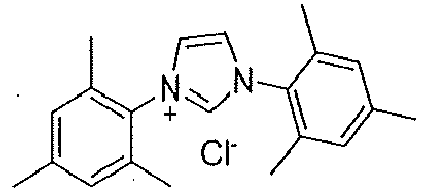
2mol% KI 1mol% Et3N 3eq 110°C Dioxane 16h 23% 24 Pd(OAc)2 1mol% SPhos 3mol% KI 1mol% Et3N 3eq 50°C Dioxane 16h 18% 25 PdXPhos (2nd generation) 2mol% - - KI 2mol% Et3N 3eq 50°C EtOAc t 16h 72% 26 Pd(OAc)2 1mol% XPhos 3mol% KI 1mol% Et3N 3eq 20°C Dioxane 16h 84% 27 Pd(OAc)2 1mol% XPhos 3mol% KI 1mol% Et3N 3eq 50°C Dioxane 16h 84% 28 Pd(OAc)2 1mol% XPhos 3mol% KI 2mol% Et3N 3eq 50°C MTBE 16h 51% 29 Pd(OAc)2 1mol% XPhos 3mol% KI 1mol% Et3N 3eq 50°C EtOAc t 16h 99% 30 Pd(OAc)2 2mol% XPhos 2mol% KI 1mol% Et3N 3eq 90°C Dioxane 16h 41% 31 Pd(OAc)2 2mol% XPhos 6mol% KI 2mol% - - 50°C EtOAc t 16h 32% 32 Pd(OAc)2 2mol% XPhos 4mol% KI 1mol% Et3N 3eq 90°C Dioxane 16h 62% 33 Pd(OAc)2 2mol% XPhos 6mol% KI 1mol% Et3N 3eq 90°C Dioxane 16h 77% 34 Pd(OAc)2 2mol% PCy3 6mol% KI 2mol% Et3N 3eq 50°C EtOAc t 16h 9% Table 3 
Entry Pd source Pd loading Ligand Ligand loading MX MX loading Base Base loading Temperature Solvent Time Yield 35 PdXPhos (2nd generation) 2mol% - - KI 2mol% Et3N 3eq 50°C EtOAc 16h 28% 36 PdCl2 2mol% XPhos 6mol% KI 50mol% Et3N 3eq 50°C EtOAc 16h 77% 37 PdBr2 2mol% XPhos 6mol% KI 50mol% Et3N 3eq 50°C EtOAc 16h 72% 38 PdI2 2mol% XPhos 6mol% KI 50mol% Et3N 3eq 50°C EtOAc 16h 67% 39 Pd(OAc)2 2mol% XPhos 6mol% KI 50mol% Et3N 3eq 50°C EtOAc 16h 99% 40 Pd(OAc)2 2mol% XPhos 6mol% KI 50mol% Et3N 3eq 70°C EtOAc 16h 95% 41 Pd(OAc)2 2mol% XPhos 6mol% KI 2mol% Et3N 3eq 50°C EtOAc 16h 60% 42 Pd(OAc)2 2mol% XPhos 6mol% KI 2mol% iPr2NEt 3eq 50°C EtOAc 16h 39% 43 Pd(OAc)2 2mol% XPhos 6mol% KI 2mol% iPr2NH 3eq 50°C EtOAc 16h 21% 44 Pd(OAc)2 2mol% XPhos 6mol% KI 2mol% Me2NBu 3eq 50°C EtOAc 16h 57% 45 Pd(OAc)2 2mol% XPhos 6mol% KI 2mol% pyridine 3eq 50°C EtOAc 16h 10% 46 Pd(PCy3)2 2mol% - - KI 50mol% Et3N 3eq 50°C EtOAc 16h 3.5% 47 Pd(OAc)2 2mol% AsPh3 6mol% KI 50mol% Et3N 3eq 50°C EtOAc 16h 9% 48 Pd(OAc)2 2mol% PCy3 6mol% KI 2mol% Et3N 3eq 50°C EtOAc 16h 11% 49 Pd(OAc)2 2mol% XPhos 6mol% KI 2mol% - - 50°C EtOAc 16h 12% 50 Pd(OAc)2 2mol% XPhos 6mol% KI+NaCl 25mol%+25mol% Et3N 3eq 50°C EtOAc 16h 43% 51 Pd(OAc)2 2mol% XPhos 6mol% - - Et3N 3eq 50°C EtOAc 16h 3% 52 Pd(OAc)2 2mol% XPhos 6mol% KI 5mol% Et3N 3eq 50°C EtOAc 16h 54% 53 Pd(OAc)2 2mol% XPhos 6mol% KI 20mol% Et3N 3eq 50°C EtOAc 16h 73% 54 Pd(OAc)2 2mol% XPhos 6mol% KI 100mol% Et3N 3eq 50°C EtOAc 16h 81% 55 Pd(OAc)2 2mol% XPhos 6mol% KI 200mol% Et3N 3eq 50°C EtOAc 16h 78% - EXAMPLES 1-10: Examples 1-10 are examples of suitable solvents to implement the process according to the invention and correspond to experimental condition (line 1, 9 to 12) in Table 1 and (line 20, 26 to 29) in Table 2.
- The process of the present invention can be implemented by a two-stage process as illustrated according to the following reaction scheme:

- In the first stage, an aryl chloride compound of formula R-chlorophenyl wherein R is as defined in Table 1, or 2 (1 equivalent), reacts with an aminoborane compound of formula BH2NiPr2 (2 equivalents) in the presence of a suitable solvent at a concentration of 0.5 M (mol/L). In general, a suitable solvent is a solvent allowing the reaction to proceed and results in a yield > 1(%).
- In particular examples, the reaction medium contains 1 mol% of Pd(OAc)2, 3 mol% of XPhos, 1 mol% of KI, and 3 equivalents (eq.) Et3N.
- The results in Table 1 (line 1, 9 to 12) and table 2 (line 20, 26 to 29) show the yield in (%) obtained in the presence of various aprotic polar solvents Dioxane, MTBE and EtOAc.
- Under these experimental conditions, reagents are mixed according to the invention at a temperature comprised between 20 and 90°C for 16 hours.
- In a second stage, the amine-borane complex is submitted to alcoholysis using for example methanol (0.5 M), for at least one hour at room temperature.
- The organic solvent of the second stage is preferably chosen from ethers, amines and aromatic hydrocarbons. Mention may in particular be made of diethyl ether, acetone, dioxane, THF, toluene and xylene.
- This stage is then followed by an esterification reaction using pinacol (1.3 eq) in diethyl ether (0.5 M) at room temperature.
- The process according to the invention contains therefore at least one aprotic polar solvent.
- EXAMPLES 11 to 41: Examples 11 to 41 are examples corresponding to experimental conditions of lines 1 to 12 and 19 in Table 1, of lines 20 to 27, 30, and32 to 34 in Table 2 and lines 35 to 38, 47 and 48 in Table3
- The process of the present invention can be implemented by a two-stage process as illustrated according to the following reaction scheme:

- In the first stage, an aryl chloride compound of formula R-chlorophenyl wherein R is as defined in Table 1, or 2 (1 equivalent), reacts with an aminoborane compound of formula BH2NiPr2 (2 equivalents) in the presence of a catalytic system comprising a transition metal and at least one ligand.
- Examples in Table 1 line 1 to 2, line 9 to 12 and in Table 2 line 20 to 24, line 26 to 27, line 30 and line 32 to 33, 1 or 2 mol% of Pd(OAc)2 is combined to 2, 3, 4 or 6 mol% of a ligand selected from the group DALPhos, XPhos, L*1, NHC Carbene and SPhos and the results show the yield in (%).
L*1 is
- In particular examples, the reaction medium contains a halide salt (KI at 1 mol%), and 3 equivalents (eq.) of Et3N in dioxane (0.5 M) .
- Reagents are mixed according to the invention at a temperature comprised between 20 and 110 °C for 16 hours.
- Examples in Table 2 line 30, 32 to 33: Various amounts of ligand XPhos are combined to constant amount of Pd(OAc)2, so that the ratio metal:ligand is 1, 2 or 3 and the total amount of catalytic system is ranging from 0.8 to 8 equivalents.
- Examples in Table 1 line 1 and 3 show that the yield of the arylation reaction is improved when the process is implemented in the presence of a catalytic system Pd(OAc)2: XPhos in a ratio 1:3 at a concentration X (corresponding to 1 mol% Pd(OAc)2 and to 3mol% XPhos) and at a concentration 5 times lower.
- In another embodiment, the process according to present invention can be implemented as illustrated according to the following reaction scheme:

- In the first stage, an aryl chloride compound of formula R-chlorophenyl wherein R is as defined in Table 1, 2 or 3 (1 equivalent), reacts with an aminoborane compound of formula BH2NiPr2 (2 equivalents) in the presence of a catalytic system comprising a transition metal and at least one ligand.
- Examples in Table 1 line 19, in Table 2 line 34 and in Table 3 lines 47 to 48, 2 mol% of Pd(OAc)2 is combined to 6 mol% of a ligand selected from the group AsPh3 and PCy3 and the results show the yield in (%).
- In particular examples, the reaction medium contains a various amount of halide salt (KI at 2 mol% or 50 mol%), and 3 equivalents (eq.) of Et3N in EtOAc (0.5 M). The reaction proceeds at 50°C for 16 hours.
- In another embodiment, the process according to present invention can be implemented as illustrated according to the following reaction scheme:

- An aryl chloride compound of formula R-Chlorophenyl wherein R is as defined in Table 1, 2 and 3 (1 equivalent), reacts with an aminoborane compound of formula BH2NiPr2 (2 equivalents) in the presence of a catalytic system comprising a transition metal and at least one ligand under a preformed complex (commercial source: Strem chemicals).
- Examples Table 1 line 4 to 5, Table 2 line 25 and Table 3 line 35 and line 47: Preformed PdXPhos (2nd generation) or Pd(PCy3)2, catalytic system was used at 2 mol%. The reaction medium contains a various amount of halide salt KI (2 mol% and 50 mol%), and 3 equivalents (eq.) of Et3N in EtOAc (0.5 M). The reaction proceeds at 50°C for 16 hours.
- Preformed catalyst is as active in the process according to the invention.
- In another embodiment, the process according to present invention can be implemented as illustrated according to the following reaction scheme:

- An aryl chloride compound of formula R-Chlorophenyl wherein R is as defined in Table 1 and 3 (1 equivalent), reacts with an aminoborane compound of formula BH2NiPr2 (2 equivalents) in the presence of a catalytic system comprising a transition metal and at least one ligand.
- Examples in table 1 line 6 to 8 and in table 3 line 36 to 38: Various catalysts PdCl2, PdI2, PdBr2 were used at 2 mol% and combined to XPhos ligand (6 mol%) in a constant ratio of 1:3. The reaction medium contains a halide salt KI (0.5 eq), and 3 equivalents (eq.) of Et3N in EtOAc (0.5 M). The reaction proceeds at 50°C for 16 hours.
- Examples 11 to 37 show that the process according to the invention is implemented in the presence of a catalytic system. Yields are dose dependent and may be optimal at a metal:ligand ratio of 1:3 in an amount ranging between about 0.8 to 8 eq. Preformed catalysts are as active as heterogenous catalysts.
- EXAMPLES 42 to 48: Examples of suitable amount of salt to implement the process according to the invention are illustrated in Table 3 and correspond to lines 39, 41 and 51 to 55
- The process of the present invention can be implemented as illustrated according to the following reaction scheme:

- An aryl chloride compound of formula R-Chlorophenyl wherein R is as defined in Table 3 (1 equivalent), reacts with an aminoborane compound of formula BH2NiPr2 (2 equivalents) in the absence of KI (table 3 line 51) or in the presence of various amounts KI.
- The reaction medium contains a catalytic system comprising a transition metal Pd(OAc)2 (2 mol%) and at least one ligand XPhos (6 mol%), and 3 equivalents (eq.) of Et3N in EtOAc (0.5 M).
- Examples Table 3 lines 39, 41 and 51 to 55 show that the process according to the invention is implemented in the absence of KI. The yield is improved in the presence of KI, preferably in the presence of 0.5 Eq.
- EXAMPLES 49 to 61: Examples of suitable base to implement the process according to the invention are illustrated in Tables 1, 2 and 3and correspond to lines 13 to 17 in Table 1, lines 18 and 31 in Table 2 and lines 41 to 45 and 49 in Table 3
- The process of the present invention can be implemented as illustrated according to the following reaction scheme:

- An aryl chloride compound of formula R-Chlorophenyl wherein R is as defined in Table 1 (1 equivalent), reacts with an aminoborane compound of formula BH2NiPr2 (2 equivalents) in the presence of a base.
- The reaction medium contains a base (3eq.), a catalytic system comprising a transition metal Pd(OAc)2 (1 mol%) and at least one ligand XPhos (3 mol%) and a halide salt KI (1 mol%) in dioxane (0.5 M). The process is carried out at a temperature of 50°C or 100°C for 16 hours.
- Examples Table 1 lines 13 to 17 correspond to a process according to the invention implemented in the presence of an inorganic base.
- The process of the present invention can be implemented as illustrated according to the following reaction scheme:

- An aryl chloride compound of formula R-Chlorophenyl wherein R is as defined in Table 1, 2 and 3 (1 equivalent), reacts with an aminoborane compound of formula BH2NiPr2 (2 equivalents) in the absence of base or in the presence of various bases.
- The reaction medium contains a catalytic system comprising a transition metal Pd(OAc)2 (2 mol%) and at least one ligand XPhos (6 mol%), and and a halide salt KI (50 mol%) in EtOAc (0.5 M). The process is carried out at a temperature of 50°C for 16 hours.
- Examples Table 1 line 18, Table 2 line 31 and Table 3 lines 41 to 45 and line 49 show that the process according to the invention is implemented in the absence of base. The yield is improved in the presence of base, preferably in the presence of an organic base.
- The base improves the yield.
- The process according to the present invention allows the following compounds to be prepared :
-

-

-

-

-

-

-

-

-

-

-

-

-

-

-

-

-

-

-

-

-
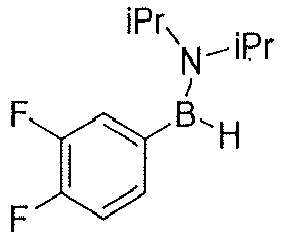
-

-

-

-

-

-

- The process according to the present invention allows an aryl chloride to be substituted with at least one, and in particular two aminoborane compounds.
-

- In a reaction flask charged with Pd(OAc)2 (4.5 mg, 0.02 mmol), potassium iodide (83 mg, 0.5 mmol), and XPhos (28 mg, 0.06 mmol) under argon atmosphere was added, in this following order: anhydrous solvent (2 mL), Et3N (0.4 mL, 3 mmol), 1-chloro-4-(trifluoromethyl)benzene (0.13 mL, 1 mmol) and diisopropylaminoborane (0.3 mL, 2 mmol). The reaction was then heated at 50 °C. After total consumption of either starting material, the reaction was cooled at -5 °C, quenched with anhydrous MeOH (2 mL) and stirred for 1 h at room temperature. All volatiles were removed under vacuum before adding pinacol (153 mg, 1.3 mmol) in Et2O (2 mL), and the mixture was stirred for 4 h at room temperature. The reaction mixture was diluted with Et2O (10 mL), and the organic phase was washed first with a solution of HCl (0.1 N, 2x10 mL), followed by an aqueous solution of CuCl2 (50g/L, 3x10 mL), dried over anhydrous Na2SO4 filtered and concentrated under vacuum. The crude oil was passed through a pad of silica gel, eluting with Et2O. The resulting filtrate was concentrated under vacuum to afford 4,4,5,5-tetramethyl-2-(4-(trifluoromethyl)phenyl)-1,3,2-dioxaborolane (256 mg, 94%). 1H NMR (300 MHz, CDCl3) δ 7.92 (d, 2H, J = 8.0 Hz), 7,62 (d, 2H, J = 8.0 Hz), 1,36 (s, 12H); 13C NMR (100 MHz, CDCl3) δ 135.16, 133.19, 132.77, 129.71, 126.10, 124.53, 124.48, 124.43, 124.38, 122.50, 84.42, 25.00; 11B NMR (96 MHz, CDCl3) δ +31.19; 19F NMR (376,5 MHz, CDCl3) δ -64.07; MS (EI) tR = 6.984 min; m/z: 272 (M+, 100%).
-

- In a reaction flask charged with Pd(OAc)2 (4.5 mg, 0.02 mmol), potassium iodide (83 mg, 0.5 mmol), and XPhos (28 mg, 0.06 mmol) under argon atmosphere was added, in this following order: anhydrous solvent (2 mL), Et3N (0.4 mL, 3 mmol), 4-chlorotoluene (0.12 mL, 1 mmol) and diisopropylaminoborane (0.3 mL, 2 mmol). The reaction was then heated at 50 °C. After total consumption of either starting material, the reaction was cooled at -5 °C, quenched with anhydrous MeOH (2 mL) and stirred for 1 h at room temperature. All volatiles were removed under vacuum before adding pinacol (153 mg, 1.3 mmol) in Et2O (2 mL), and the mixture was stirred for 4 h at room temperature. The reaction mixture was diluted with Et2O (10 mL), and the organic phase was washed first with a solution of HCl (0.1 N, 2x10 mL), followed by an aqueous solution of CuCl2 (50g/L, 3x10 mL), dried over anhydrous Na2SO4, filtered and concentrated under vacuum. The crude oil was passed through a pad of silica gel, eluting with Et2O. The resulting filtrate was concentrated under vacuum to afford 4,4,5,5-tetramethyl-2-(p-tolyl)-1,3,2-dioxaborolane (215 mg, 99%). 1H NMR (300 MHz, CDCl3) δ 7.75 (d, 2H, J = 8.0 Hz), 7,23 (d, 2H, J = 8.0 Hz), 2.41 (s, 3H); 1,38 (s, 12H); 13C NMR (100 MHz, CDCl3) δ 141.53, 134.95, 128.65, 83.75, 25.0, 21.87; 11B NMR (96 MHz, CDCl3) δ +30.99; MS (EI) tR = 7.918 min; m/z: 218 (M+, 100%).
-

- In a reaction flask charged with Pd(OAc)2 (4.5 mg, 0.02 mmol), potassium iodide (3.3 mg, 0.02 mmol), and XPhos (28 mg, 0.06 mmol) under argon atmosphere was added, in this following order: anhydrous solvent (2 mL), Et3N (0.4 mL, 3 mmol), 1-chloro-4-methoxybenzene (0.12 mL, 1 mmol) and diisopropylaminoborane (0.3 mL, 2 mmol). The reaction was then heated at 50 °C. After total consumption of either starting material, the reaction was cooled at -5 °C, quenched with anhydrous MeOH (2 mL) and stirred for 1 h at room temperature. All volatiles were removed under vacuum before adding pinacol (153 mg, 1.3 mmol) in Et2O (2 mL), and the mixture was stirred for 4 h at room temperature. The reaction mixture was diluted with Et2O (10 mL), and the organic phase was washed first with a solution of HCl (0.1 N, 2x10 mL), followed by an aqueous solution of CuCl2 (50g/L, 3x10 mL), dried over anhydrous Na2SO4 filtered and concentrated under vacuum. The crude oil was passed through a pad of silica gel, eluting with Et2O. The resulting filtrate was concentrated under vacuum to afford 2-(4-methoxyphenyl)-4,4,5,5-tetramethyl-1,3,2-dioxaborolane (231 mg, 99%). 1H NMR (300 MHz, CDCl3) δ 7.80 (d, 2H, J = 8.7 Hz), 6.94 (d, 2H, J = 8.7 Hz), 3.87 (s, 3H); 1,36 (s, 12H); 13C NMR (100 MHz, CDCl3) δ 162.15, 136.51, 113.30, 83.54, 55.08, 24.86; 11B NMR (96 MHz, CDCl3) δ +30.11; MS (EI) tR = 9.032 min; m/z: 234 (M+, 100%).
-

- In a reaction flask charged with Pd(OAc)2 (4.5 mg, 0.02 mmol), potassium iodide (83 mg, 0.5 mmol), and XPhos (28 mg, 0.06 mmol) under argon atmosphere was added, in this following order: anhydrous solvent (2 mL), Et3N (0.4 mL, 3 mmol), 2-chlorotoluene (0.12 mL, 1 mmol) and diisopropylaminoborane (0.3 mL, 2 mmol). The reaction was then heated at 50 °C. After total consumption of either starting material, the reaction was cooled at -5 °C, quenched with anhydrous MeOH (2 mL) and stirred for 1 h at room temperature. All volatiles were removed under vacuum before adding pinacol (153 mg, 1.3 mmol) in Et2O (2 mL), and the mixture was stirred for 4 h at room temperature. The reaction mixture was diluted with Et2O (10 mL), and the organic phase was washed first with a solution of HCl (0.1 N, 2x10 mL), followed by an aqueous solution of CuCl2 (50g/L, 3x10 mL), dried over anhydrous Na2SO4 filtered and concentrated under vacuum. The crude oil was passed through a pad of silica gel, eluting with Et2O. The resulting filtrate was concentrated under vacuum to afford 4,4,5,5-tetramethyl-2-(o-tolyl)-1,3,2-dioxaborolane (192 mg, 88%). 1H NMR (300 MHz, CDCl3) δ 7.81 (dd, 1H, J = 7.6, 1.2 Hz), 7.37 (td, 1H, J = 7.5, 1.5 Hz), 7.23-7.19 (m, 2H); 2.59 (s, 3H); 1.40 (s, 12H); 13C NMR (100 MHz, CDCl3) δ 144.97, 136.00,130.92, 129.91, 124.84, 83.54, 25.09, 22.36; 11B NMR (96 MHz, CDCl3) δ +31.47; MS (EI) tR = 7.813 min; m/z: 218 (M+, 100%).
-

- In a reaction flask charged with Pd(OAc)2 (4.5 mg, 0.02 mmol), potassium iodide (83 mg, 0.5 mmol), and XPhos (28 mg, 0.06 mmol) under argon atmosphere were added, in this following order: anhydrous solvent (2 mL), Et3N (0.4 mL, 3 mmol), 1-chloro-3,5-difluorobenzene (0.17 mL, 1 mmol) and diisopropylaminoborane (0.3 mL, 2 mmol). The reaction was then heated at 50 °C. After total consumption of either starting material, the reaction was cooled at -5 °C, quenched with anhydrous MeOH (2 mL) and stirred for 1 h at room temperature. All volatiles were removed under vacuum before adding pinacol (153 mg, 1.3 mmol) in Et2O (2 mL), and the mixture was stirred for 4 h at room temperature. The reaction mixture was diluted with Et2O (10 mL), and the organic phase was washed first with a solution of HCl (0.1 N, 2x10 mL), followed by an aqueous solution of CuCl2 (50g/L, 3x10 mL), dried over anhydrous Na2SO4 filtered and concentrated under vacuum. The crude oil was passed through a pad of silica gel, eluting with Et2O. The resulting filtrate was concentrated under vacuum to afford 2-(3,5-difluorophenyl)-4,4,5,5-tetramethyl-1,3,2-dioxaborolane (142 mg, 59%). 1H NMR (300 MHz, CDCl3) δ 7.31-7.30 (m, 2H), 6.93-6.87 (m, 1H), 1.35 (s, 12H); 13C NMR (100 MHz, CDCl3) δ 164.24, 161.65, 116.89, 106.56, 84.62, 25.04; 11B NMR (96 MHz, CDCl3) δ +30.19; 19F NMR (96 MHz, CDCl3) δ -112.30; MS (EI) tR = 6.795 min; m/z: 240 (M+, 100%).
-

- In a reaction flask charged with Pd(OAc)2 (4.5 mg, 0.02 mmol), potassium iodide (83 mg, 0.5 mmol), and XPhos (28 mg, 0.06 mmol) under argon atmosphere were added, in this following order: anhydrous solvent (2 mL), Et3N (0.4 mL, 3 mmol), 4-chloro-1,2-dimethylbenzene (0.14 mL, 1 mmol) and diisopropylaminoborane (0.3 mL, 2 nunol). The reaction was then heated at 50 °C. After total consumption of either starting material, the reaction was cooled at -5 °C, quenched with anhydrous MeOH (2 mL) and stirred for 1 h at room temperature. All volatiles were removed under vacuum before adding pinacol (153 mg, 1.3 mmol) in Et2O (2 mL), and the mixture was stirred for 4 h at room temperature. The reaction mixture was diluted with Et2O (10 mL), and the organic phase was washed first with a solution of HCl (0.1 N, 2x10 mL), followed by an aqueous solution of CuCl2 (50g/L, 3x10 mL), dried over anhydrous Na2SO4 filtered and concentrated under vacuum. The crude oil was passed through a pad of silica gel, eluting with Et2O. The resulting filtrate was concentrated under vacuum to afford 2-(3,4-dimethylphenyl)-4,4,5,5-tetramethyl-1,3,2-dioxaborolane (229 mg, 99%). 1H NMR (300 MHz, CDCl3) δ 7.65 (s, 1H), 7.62 (d, 1H, J = 7.5 Hz), 7.21 (d, 1H, J = 7.5 Hz), 2.34 (s, 3H), 2.33 (s, 3H), 1,38 (s, 12H); 13C NMR (100 MHz, CDCl3) δ 140.25, 136.07, 135.99, 132.54, 129.29, 83.70, 24.97, 20.13, 19.59; 11B NMR (96 MHz, CDCl3) δ +31.01; MS (EI) tR = 8.713 min; m/z: 232 (M+, 100%).
-

- In a reaction flask charged with Pd(OAc)2 (4.5 mg, 0.02 mmol), potassium iodide (3.3 mg, 0.02 mmol), and XPhos (28 mg, 0.06 mmol) under argon atmosphere was added, in this following order: anhydrous solvent (2 mL), Et3N (0.4 mL, 3 mmol), 1-chloro-2-methoxybenzene (0.19 mL, 1 mmol) and diisopropylaminoborane (0.3 mL, 2 mmol). The reaction was then heated at 50 °C. After total consumption of either starting material, the reaction was cooled at -5 °C, quenched with anhydrous MeOH (2 mL) and stirred for 1 h at room temperature. All volatiles were removed under vacuum before adding pinacol (153 mg, 1.3 mmol) in Et2O (2 mL), and the mixture was stirred for 4 h at room temperature. The reaction mixture was diluted with Et2O (10 mL), and the organic phase was washed first with a solution of HCl (0.1 N, 2x10 mL), followed by an aqueous solution of CuCl2 (50g/L, 3x10 mL), dried over anhydrous Na2SO4, filtered and concentrated under vacuum. The crude oil was passed through a pad of silica gel, eluting with Et2O. The resulting filtrate was concentrated under vacuum to afford 2-(2-methoxyphenyl)-4,4,5,5-tetramethyl-1,3,2-dioxaborolane (206 mg, 88%). 1H NMR (300 MHz, CDCl3) δ 7.67 (dd, 1H, J = 7.3, 1.8 Hz), 7.62 (d, 1H, J = 7.5 Hz), 7.39 (ddd, 1H, J = 8.4, 7.4, 1.9 Hz), 6.94 (td, 1H, J = 7.3, 0.8 Hz), 6.86 (d, 1H, J = 8.3 Hz); 3.83 (s, 3H), 1,36 (s, 12H); 13C NMR (100 MHz, CDCl3) δ 164.30, 136.82, 132.57, 120.32, 110.59, 83.57, 55.94, 24.96; 11B NMR (96 MHz, CDCl3) δ +31.02; MS (EI) tR = 8.663 min; m/z: 234 (M+, 100%).
-

- In a reaction flask charged with Pd(OAc)2 (4.5 mg, 0.02 mmol), potassium iodide (83 mg, 0.5 mmol), and XPhos (28 mg, 0.06 mmol) under argon atmosphere was added, in this following order: anhydrous solvent (2 mL), Et3N (0.4 mL, 3 mmol), 2-chlorothiophene (0.09 mL, 1 mmol) and diisopropylaminoborane (0.3 mL, 2 mmol). The reaction was then heated at 50 °C. After total consumption of either starting material, the reaction was cooled at -5 °C, quenched with anhydrous MeOH (2 mL) and stirred for 1 h at room temperature. All volatiles were removed under vacuum before adding pinacol (153 mg, 1.3 mmol) in Et2O (2 mL), and the mixture was stirred for 4 h at room temperature. The reaction mixture was diluted with Et2O (10 mL), and the organic phase was washed first with a solution of HCl (0.1 N, 2x10 mL), followed by an aqueous solution of CuCl2 (50g/L, 3x10 mL), dried over anhydrous Na2SO4, filtered and concentrated under vacuum. The crude oil was passed through a pad of silica gel, eluting with Et2O. The resulting filtrate was concentrated under vacuum to afford 4,4,5,5-tetramethyl-2-(thiophen-2-yl)-1,3,2-dioxaborolane (197 mg, 94%). 1H NMR (300 MHz, CDCl3) δ 7.71-7.67 (m, 2H), 7.24 (d, 1H, J = 4.7, 3.5 Hz), 1,39 (s, 12H); 13C NMR (100 MHz, CDCl3) δ 137.30, 132.50, 128.36, 84.22, 24.91; 11B NMR (96 MHz, CDCl3) δ +29.05; MS (EI) tR = 7.346 min; m/z: 210 (M+, 100%).
-

- In a reaction flask charged with Pd(OAc)2 (4.5 mg, 0.02 mmol), potassium iodide (83 mg, 0.5 mmol), and XPhos (28 mg, 0.06 mmol) under argon atmosphere was added, in this following order: anhydrous solvent (2 mL), Et3N (0.4 mL, 3 mmol), 3-chlorothiophene (0.09 mL, 1 mmol) and diisopropylaminoborane (0.3 mL, 2 mmol). The reaction was then heated at 50 °C. After total consumption of either starting material, the reaction was cooled at -5 °C, quenched with anhydrous MeOH (2 mL) and stirred for 1 h at room temperature. All volatiles were removed under vacuum before adding pinacol (153 mg, 1.3 mmol) in Et2O (2 mL), and the mixture was stirred for 4 h at room temperature. The reaction mixture was diluted with Et2O (10 mL), and the organic phase was washed first with a solution of HCl (0.1 N, 2x10 mL), followed by an aqueous solution of CuCl2 (50g/L, 3x10 mL), dried over anhydrous Na2SO4 filtered and concentrated under vacuum. The crude oil was passed through a pad of silica gel, eluting with Et2O. The resulting filtrate was concentrated under vacuum to afford 4,4,5,5-tetramethyl-2-(thiophen-3-yl)-1,3,2-dioxaborolane (149 mg, 71%). 1H NMR (300 MHz, CDCl3) δ 7.95 (dd, 1H, J = 2.7, 1.0 Hz), 7.44 (dd, 1H, J = 4.8, 1.0 Hz), 7.3 6 (dd, 1H, J = 4.8, 2.7 Hz), 1,36 (s, 12H); 13C NMR (100 MHz, CDCl3) δ 136.66, 132.06, 125.52, 83.86, 25.04; 11B NMR (96 MHz, CDCl3) δ ++28.99; MS (EI) tR = 7.258 min; m/z: 210 (M+, 100%).
-

- In a reaction flask charged with Pd(OAc)2 (4.5 mg, 0.02 mmol), potassium iodide (3.3 mg, 0.02 mmol), and XPhos (28 mg, 0.06 mmol) under argon atmosphere was added, in this following order: anhydrous solvent (2 mL), Et3N (0.4 mL, 3 mmol), 3-chlorotoluene (0.17 mL, 1 mmol) and diisopropylaminoborane (0.3 mL, 2 mmol). The reaction was then heated at 50 °C. After total consumption of either starting material, the reaction was cooled at -5 °C, quenched with anhydrous MeOH (2 mL) and stirred for 1 h at room temperature. All volatiles were removed under vacuum before adding pinacol (153 mg, 1.3 mmol) in Et2O (2 mL), and the mixture was stirred for 4 h at room temperature. The reaction mixture was diluted with Et2O (10 mL), and the organic phase was washed first with a solution of HCl (0.1 N, 2x10 mL), followed by an aqueous solution of CuCl2 (50g/L, 3x10 mL), dried over anhydrous Na2SO4, filtered and concentrated under vacuum. The crude oil was passed through a pad of silica gel, eluting with Et2O. The resulting filtrate was concentrated under vacuum to afford 4,4,5,5-tetramethyl-2-(m-tolyl)-1,3,2-dioxaborolane (192 mg, 88%). 1H NMR (300 MHz, CDCl3) δ 7.64-7.60 (m, 2H), 7.28-7.26 (m, 2H,); 2.36 (s, 3H); 1,35 (s, 12H); 13C NMR (100 MHz, CDCl3) δ 141.53, 134.95, 128.65, 83.75, 25.00, 21.87; 11B NMR (96 MHz, CDCl3) δ +31.15; MS (EI) tR = 7.837 min; m/z: 218 (M+, 100%).
-

- In a reaction flask charged with Pd(OAc)2 (4.5 mg, 0.02 mmol), potassium iodide (83 mg, 0.5 mmol), and XPhos (28 mg, 0.06 mmol) under argon atmosphere was added, in this following order: anhydrous solvent (2 mL), Et3N (0.4 mL, 3 mmol), 2-chloro-1,4-difluorobenzene (0.17 mL, 1 mmol) and diisopropylaminoborane (0.3 mL, 2 mmol). The reaction was then heated at 50 °C. After total consumption of either starting material, the reaction was cooled at -5 °C, quenched with anhydrous MeOH (2 mL) and stirred for 1 h at room temperature. All volatiles were removed under vacuum before adding pinacol (153 mg, 1.3 mmol) in Et2O (2 mL), and the mixture was stirred for 4 h at room temperature. The reaction mixture was diluted with Et2O (10 mL), and the organic phase was washed first with a solution of HCl (0.1 N, 2x10 mL), followed by an aqueous solution of CuCl2 (50g/L, 3x10 mL), dried over anhydrous Na2SO4 filtered and concentrated under vacuum. The crude oil was passed through a pad of silica gel, eluting with Et2O. The resulting filtrate was concentrated under vacuum to afford 2-(2,5-difluorophenyl)-4,4,5,5-tetramethyl-1,3,2-dioxaborolane (149 mg, 62%). 1H NMR (300 MHz, CDCl3) δ 7.43-7.39 (m, 1H), 7.14-7.08 (m, 1H), 7.03-6.97 (m, 1H), 1.38 (s, 12H); 13C NMR (100 MHz, CDCl3) δ 164.34, 161.88, 159.79, 157.38, 122.54, 122.45, 122.32, 122.23, 120.01, 119.92, 119.77, 119.68, 116.88, 116.61, 116.53, 84.38, 24.93; 11B NMR (96 MHz, CDCl3) δ +29.91; 19F NMR (96 MHz, CDCl3) δ -110.66, 121.86; MS (EI) tR = 7.356 min; m/z: 240 (M+, 100%).
-

- In a reaction flask charged with Pd(OAc)2 (4.5 mg, 0.02 mmol), potassium iodide (3.3 mg, 0.02 mmol), and XPhos (28 mg, 0.06 mmol) under argon atmosphere was added, in this following order: anhydrous solvent (2 mL), Et3N (0.4 mL, 3 mmol), 1-chloro-4-fluorobenzene (0.16 mL, 1 mmol) and diisopropylaminoborane (0.3 mL, 2 mmol). The reaction was then heated at 50 °C. After total consumption of either starting material, the reaction was cooled at -5 °C, quenched with anhydrous MeOH (2 mL) and stirred for 1 h at room temperature. All volatiles were removed under vacuum before adding pinacol (153 mg, 1.3 mmol) in Et2O (2 mL), and the mixture was stirred for 4 h at room temperature. The reaction mixture was diluted with Et2O (10 mL), and the organic phase was washed first with a solution of HCl (0.1 N, 2x10 mL), followed by an aqueous solution of CuCl2 (50g/L, 3x10 mL), dried over anhydrous Na2SO4 filtered and concentrated under vacuum. The crude oil was passed through a pad of silica gel, eluting with Et2O. The resulting filtrate was concentrated under vacuum to afford 2-(4-fluorophenyl)-4,4,5,5-tetramethyl-1,3,2-dioxaborolane (219 mg, 99%). 1H NMR (300 MHz, CDCl3) δ 7.85-7.82 (m, 2H), 7.10-7.06 (m, 2H), 1,39 (s, 12H); 13C NMR (100 MHz, CDCl3) δ 166.19, 164.07, 137.24, 115.33, 83.88, 25.05; 11B NMR (96 MHz, CDCl3) δ +30.62; 19F NMR (96 MHz, CDCl3) δ -109.65; MS (EI) tR = 7.049 min; m/z: 222 (M+, 100%).
-

- In a reaction flask charged with Pd(OAc)2 (4.5 mg, 0.02 mmol), potassium iodide (3.3 mg, 0.02 mmol), and XPhos (28 mg, 0,06 mmol) under argon atmosphere was added, in this following order: anhydrous solvent (2 mL), Et3N (0.4 mL, 3 mmol), (3-chlorophenyl)(methyl)sulfane (0.2 mL, 1 mmol) and diisopropylaminoborane (0.3 mL, 2 mmol). The reaction was then heated at 50 °C. After total consumption of either starting material, the reaction was cooled at -5 °C, quenched with anhydrous MeOH (2 mL) and stirred for 1 h at room temperature. All volatiles were removed under vacuum before adding pinacol (153 mg, 1.3 mmol) in Et2O (2 mL), and the mixture was stirred for 4 h at room temperature. The reaction mixture was diluted with Et2O (10 mL), and the organic phase was washed first with a solution of HCl (0.1 N, 2x10 mL), followed by an aqueous solution of CuCl2 (50g/L, 3x10 mL), dried over anhydrous Na2SO4, filtered and concentrated under vacuum. The crude oil was passed through a pad of silica gel, eluting with Et2O. The resulting filtrate was concentrated under vacuum to afford 4,4,5,5-tetramethyl-2-(3-(methylthio)phenyl)-1,3,2-dioxaborolane (247 mg, 99%). 1H NMR (300 MHz, CDCl3) δ 7.71-7.70 (m, 1H), 7.52 (dt, 1H, J 7.1, 1.2 Hz), 7.39-7.32 (m, 1H), 7.31-7.27 (m, 1H), 2.50 (s, 3H), 1.34 (s, 12H); 13C NMR (100 MHz, CDCl3) δ 137.99, 133.00, 131.56, 129.70, 128.32, 84.04, 24.99, 16.08; 11B NMR (96 MHz, CDCl3) δ +30.48; MS (EI) tR = 9.999 min; m/z: 250 (M+, 100%).
-

- In a reaction flask charged with Pd(OAc)2 (4.5 mg, 0.02 mmol), potassium iodide (83 mg, 0.5 mmol), and XPhos (28 mg, 0.06 mmol) under argon atmosphere was added, in this following order: anhydrous solvent (2 mL), Et3N (0.4 mL, 3 mmol), 1-chloro-3-methoxy-2-methylbenzene (0.14 mL, 1 mmol) and diisopropylaminoborane (0.3 mL, 2 mmol). The reaction was then heated at 50 °C. After total consumption of either starting material, the reaction was cooled at -5 °C, quenched with anhydrous MeOH (2 mL) and stirred for 1 h at room temperature. All volatiles were removed under vacuum before adding pinacol (153 mg, 1.3 mmol) in Et2O (2 mL), and the mixture was stirred for 4 h at room temperature. The reaction mixture was diluted with Et2O (10 mL), and the organic phase was washed first with a solution of HCl (0.1 N, 2x10 mL), followed by an aqueous solution of CuCl2 (50g/L, 3x10 mL), dried over anhydrous Na2SO4, filtered and concentrated under vacuum. The crude oil was passed through a pad of silica gel, eluting with Et2O. The resulting filtrate was concentrated under vacuum to afford 2-(3-methoxy-2-methylphenyl)-4,4,5,5-tetramethyl-1,3,2-dioxaborolane (252 mg, 92%). 1H NMR (300 MHz, CDCl3) δ 7.35 (dd, 1H, J 7.4, 0.9 Hz), 7.17 (t, 1H, J 7.8 Hz), 6.96 (dd, 1H, J 7.5, 1.0 Hz), 3.82 (s, 3H), 2.44 (s, 3H), 1.36 (s, 12H); 13C NMR (100 MHz, CDCl3) δ 157.62, 133.43, 127.69, 125.93, 112.74, 83.60, 55.57, 24.99, 14.75; 11B NMR (96 MHz, CDCl3) δ +31.52; MS (EI) tR = 9.496 min; m/z: 248 (M+, 100%).
-

- In a reaction flask charged with Pd(OAc)2 (4.5 mg, 0.02 mmol), potassium iodide (83 mg, 0.5 mmol), and XPhos (28 mg, 0.06 mmol) under argon atmosphere was added, in this following order: anhydrous solvent (2 mL), Et3N (0.4 mL, 3 mmol), 1-chloro-3,5-dimethoxybenzene (0.17 mL, 1 mmol) and diisopropylaminoborane (0.3 mL, 2 mmol). The reaction was then heated at 50 °C. After total consumption of either starting material, the reaction was cooled at -5 °C, quenched with anhydrous MeOH (2 mL) and stirred for 1 h at room temperature. All volatiles were removed under vacuum before adding pinacol (153 mg, 1.3 mmol) in Et2O (2 mL), and the mixture was stirred for 4 h at room temperature. The reaction mixture was diluted with Et2O (10 mL), and the organic phase was washed first with a solution of HCl (0.1 N, 2x10 mL), followed by an aqueous solution of CuCl2 (50g/L, 3x10 mL), dried over anhydrous Na2SO4, filtered and concentrated under vacuum. The crude oil was passed through a pad of silica gel, eluting with Et2O. The resulting filtrate was concentrated under vacuum to afford 2-(3,5-dimethoxyphenyl)-4,4,5,5-tetramethyl-1,3,2-dioxaborolane (254 mg, 95%). 1H NMR (300 MHz, CDCl3) δ 7.35 (dd, 1H, J 7.4, 0.9 Hz), 7.17 (t, 1H, J 7.8 Hz), 6.96 (dd, 1H, J 7.5, 1.0 Hz), 3.82 (s, 3H), 2.44 (s, 3H), 1.36 (s, 12H); 13C NMR (100 MHz, CDCl3) δ 160.50, 111.72, 104.59, 83.96, 55.47, 24.94; 11B NMR (96 MHz, CDCl3) δ +30.29; MS (EI) tR = 10.527 min; m/z: 264 (M+, 100%).
-

- In a reaction flask charged with Pd(OAc)2 (4.5 mg, 0.02 mmol), potassium iodide (83 mg, 0.5 mmol), and XPhos (28 mg, 0,06 mmol) under argon atmosphere was added, in this following order: anhydrous solvent (2 mL), Et3N (0.4 mL, 3 mmol), 1-chloro-3,5-dimethoxybenzene (0.17 mL, 1 mmol) and diisopropylaminoborane (0.3 mL, 2 mmol). The reaction was then heated at 50 °C. After total consumption of either starting material, the reaction was cooled at -5 °C, quenched with anhydrous MeOH (2 mL) and stirred for 1 h at room temperature. All volatiles were removed under vacuum before adding pinacol (153 mg, 1.3 mmol) in Et2O (2 mL), and the mixture was stirred for 4 h at room temperature. The reaction mixture was diluted with Et2O (10 mL), and the organic phase was washed first with a solution of HCl (0.1 N, 2x10 mL), followed by an aqueous solution of CuCl2 (50g/L, 3x10 mL), dried over anhydrous Na2SO4, filtered and concentrated under vacuum. The crude oil was passed through a pad of silica gel, eluting with Et2O. The resulting filtrate was concentrated under vacuum to afford 2-(3,5-dimethoxyphenyl)-4,4,5,5-tetramethyl-1,3,2-dioxaborolane (257 mg, 97%). 1H NMR (300 MHz, CDCl3) δ 7.21 (d, 1H, J 3.2 Hz), 6.93 (dd, 1H, J 8.9, 3.2 Hz), 6.83 (d, 1H, J 8.9 Hz), 3.79 (s, 3H), 3.78 (s, 3H), 1.35 (s, 12H); 13C NMR (100 MHz, CDCl3) δ 158.61, 153.29, 121.09, 118.04, 114.66, 83.56, 56.75, 55.82, 24.81; 11B NMR (96 MHz, CDCl3) δ +30.29; MS (EI) tR = 10.173 min; m/z: 264 (M+, 100%).
-

- In a reaction flask charged with Pd(OAc)2 (4.5 mg, 0.02 mmol), potassium iodide (83 mg, 0.5 mmol), and XPhos (28 mg, 0;06 mmol) under argon atmosphere was added, in this following order: anhydrous solvent (2 mL), Et3N (0.4 mL, 3 mmol), 4-chloro-1-methoxy-2-methylbenzene (0.16 mL, 1 mmol) and diisopropylaminoborane (0.3 mL, 2 mmol). The reaction was then heated at 50 °C. After total consumption of either starting material, the reaction was cooled at -5 °C, quenched with anhydrous MeOH (2 mL) and stirred for 1 h at room temperature. All volatiles were removed under vacuum before adding pinacol (153 mg, 1.3 mmol) in Et2O (2 mL), and the mixture was stirred for 4 h at room temperature. The reaction mixture was diluted with Et2O (10 mL), and the organic phase was washed first with a solution of HCl (0.1 N, 2x10 mL), followed by an aqueous solution of CuCl2 (50g/L, 3x10 mL), dried over anhydrous Na2SO4 filtered and concentrated under vacuum. The crude oil was passed through a pad of silica gel, eluting with Et2O. The resulting filtrate was concentrated under vacuum to afford 2-(4-methoxy-3-methylphenyl)-4,4,5,5-tetramethyl-1,3,2-dioxaborolane (189 mg, 76%). 1H NMR (300 MHz, CDCl3) δ 7.69 (d, 1H, J 8.1 Hz), 7.64 (s, 1H), 6.87 (d, 1H, J 8.1 Hz), 3.89 (s, 3H), 2.26 (s, 3H), 1.38 (s, 12H); 13C NMR (100 MHz, CDCl3) δ 160.44, 137.15, 134.29, 125.90, 109.26, 83.50, 55.18, 24.87, 15.99; 11B NMR (96 MHz, CDCl3) δ +31.03; MS (EI) tR = 9.448 min; m/z: 248 (M+, 100%).
-

- In a reaction flask charged with Pd(OAc)2 (4.5 mg, 0.02 mmol), potassium iodide (83 mg, 0.5 mmol), and XPhos (28 mg, 0.06 mmol) under argon atmosphere was added, in this following order: anhydrous solvent (2 mL), Et3N (0.4 mL, 3 mmol), 5-chlorobenzo[d][1,3]dioxole (0.12 mL, 1 mmol) and diisopropylaminoborane (0.3 mL, 2 mmol). The reaction was then heated at 50 °C. After total consumption of either starting material, the reaction was cooled at -5 °C, quenched with anhydrous MeOH (2 mL) and stirred for 1 h at room temperature. All volatiles were removed under vacuum before adding pinacol (153 mg, 1.3 mmol) in Et2O (2 mL), and the mixture was stirred for 4 h at room temperature. The reaction mixture was diluted with Et2O (10 mL), and the organic phase was washed first with a solution ofHCl (0.1 N, 2x10 mL), followed by an aqueous solution of CuCl2 (50g/L, 3x10 mL), dried over anhydrous Na2SO4 filtered and concentrated under vacuum. The crude oil was passed through a pad of silica gel, eluting with Et2O. The resulting filtrate was concentrated under vacuum to afford 5- (4,4,5,5-tetramethyl-1,3,2-dioxaborolan-2-yl)-1,3-benzodioxole (218 mg, 88%). 1H NMR (300 MHz, CDCl3) δ 7.35 (dd, 1H, J 7.7, 1.1 Hz), 7.24 (d, 1H, J 0.8 Hz), 6.83 (d, 1H, J 7.7 Hz), 5.95 (s, 2H), 1.32 (s, 12H); 13C NMR (100 MHz, CDCl3) δ 163.48, 161.84, 130.42, 129.59, 121.04, 118.38, 84.24, 25.0; 11B NMR (96 MHz, CDCl3) δ +30.63; MS (EI) tR = 9.594 min; m/z: 248 (M+, 100%).
-

- In a reaction flask charged with Pd(OAc)2 (4.5 mg, 0.02 mmol), potassium iodide (83 mg, 0.5 mmol), and XPhos (28 mg, 0.06 mmol) under argon atmosphere was added, in this following order: anhydrous solvent (2 mL), Et3N (0.4 mL, 3 mmol), 6-chlorochroman-4-one (183 mg, 1 mmol) and diisopropylaminoborane (0.3 mL, 2 mmol). The reaction was then heated at 50 °C. After total consumption of either starting material, the reaction was cooled at -5 °C, quenched with anhydrous MeOH (2 mL) and stirred for 1 h at room temperature. All volatiles were removed under vacuum before adding pinacol (153 mg, 1.3 mmol) in Et2O (2 mL), and the mixture was stirred for 4 h at room temperature. The reaction mixture was diluted with Et2O (10 mL), and the organic phase was washed first with a solution of HCl (0.1 N, 2x10 mL), followed by an aqueous solution of CuCl2 (50g/L, 3x10 mL), dried over anhydrous Na2SO4 filtered and concentrated under vacuum. The crude oil was passed through a pad of silica gel, eluting with Et2O. The resulting filtrate was concentrated under vacuum to afford 2,3-dihydro-6-(4,4,5,5-tetramethyl-1,3,2-dioxaborolan-2-yl)-4H-1-Benzopyran-4-one (242 mg, 89%). 1H NMR (300 MHz, CDCl3) δ 8.36 (d, 1H, J 1.6 Hz), 7.85 (dd, 1H, J 8.3, 1.7 Hz), 6.92 (d, 1H, J 8.3 Hz), 4.51 (t, 2H, J 8 Hz), 2.78 (t, 2H, J 8 Hz), 1.30 (s, 12H); 13C NMR (100 MHz, CDCl3) δ 191.67, 164.14, 142.14, 134.85, 117.38, 84.04, 67.16, 37.87, 24.97; 11B NMR (96 MHz, CDCl3) δ +30.86; MS (EI) tR = 14.150 min; m/z: 274 (M+, 100%).
-

- In a reaction flask charged with Pd(OAc)2 (4.5 mg, 0.02 mmol), potassium iodide (166 mg, 1 mmol), and XPhos (28 mg, 0.06 mmol) under argon atmosphere was added, in this following order: anhydrous solvent (2 mL), Et3N (0.4 mL, 3 mmol), 4-chloro-1,2-difluorobenzene (0.11 mL, 1 mmol) and diisopropylaminoborane (0.3 mL, 2 mmol). The reaction was then heated at 50 °C. After total consumption of either starting material, the reaction was cooled at -5 °C, quenched with anhydrous MeOH (2 mL) and stirred for 1 h at room temperature. All volatiles were removed under vacuum before adding pinacol (153 mg, 1.3 mmol) in Et2O (2 mL), and the mixture was stirred for 4 h at room temperature. The reaction mixture was diluted with Et2O (10 mL), and the organic phase was washed first with a solution of HCl (0.1 N, 2x10 mL), followed by an aqueous solution of CuCl2 (50g/L, 3x10 mL), dried over anhydrous Na2SO4 filtered and concentrated under vacuum. The crude oil was passed through a pad of silica gel, eluting with Et2O. The resulting filtrate was concentrated under vacuum to afford 2-(3,4-difluorophenyl)-4,4,5,5-tetramethyl-1,3,2-dioxaborolane (274 mg, 99%). 1H NMR (300 MHz, CDCl3) δ 7.61-7.50 (m, 2H), 7.14 (dt, 1H, J = 10.6, 7.9 Hz), 1.34 (s, 12H); 13C NMR (100 MHz, CDCl3) δ 153.65, 153.57, 151.98, 151.90, 151.18, 151.10, 149.53, 149.45, 131.53, 123.49, 123.39, 117.11, 117.00, 84.37, 24.96; 11B NMR (96 MHz, CDCl3) δ +30.15; 19F NMR (96 MHz, CDCl3) δ -135.10, -140.74; MS (EI) tR = 7.078 min; m/z: 240 (M+, 100%).
-

- In a reaction flask charged with Pd(OAc)2 (4.5 mg, 0.02 mmol), potassium iodide (83 mg, 0.5 mmol), and XPhos (28 mg, 0.06 mmol) under argon atmosphere was added, in this following order: anhydrous solvent (2 mL), Et3N (0.4 mL, 3 mmol), 5-chloro-6-(chloromethyl)benzo[d][1,3]dioxole (205 mg, 1 mmol) and diisopropylaminoborane (0.3 mL, 2 mmol). The reaction was then heated at 50 °C. time is not given After total consumption of either starting material, the reaction was cooled at -5 °C, quenched with anhydrous MeOH (2 mL) and stirred for 1 h at room temperature. All volatiles were removed under vacuum before adding pinacol (153 mg, 1.3 mmol) in Et2O (2 mL), and the mixture was stirred for 4 h at room temperature. The reaction mixture was diluted with Et2O (10 mL), and the organic phase was washed first with a solution of HCl (0.1 N, 2x10 mL), followed by an aqueous solution of CuCl2 (50g/L, 3x10 mL), dried over anhydrous Na2SO4 filtered and concentrated under vacuum. The crude oil was passed through a pad of silica gel, eluting with Et2O. The resulting filtrate was concentrated under vacuum to afford 2- (6-(chloromethyl)benzo[d][1,3]dioxol-5-yl)-4,4,5,5-tetramethyl-1,3,2-dioxaborolane (268 mg, 91%). 1H NMR (300 MHz, CDCl3) δ 6.80 (s, 1H), 6.71 (s, 1H), 5.91 (s, 2H), 2.27 (s, 2H), 1.24 (s, 12H); 13C NMR (100 MHz, CDCl3) δ 146.58, 145.98, 130.36, 125.15, 110.52, 109.65, 101.51, 83.70, 24.87; 11B NMR (96 MHz, CDCl3) δ +33.06; MS (EI) tR = 11.276 min; m/z: 296 (M+, 100%).
-

- In a reaction flask charged with Pd(OAc)2 (4.5 mg, 0.02 mmol), potassium iodide (83 mg, 0.5 mmol), and XPhos (28 mg, 0,06 mmol) under argon atmosphere was added, in this following order: anhydrous solvent (2 mL), Et3N (0.4 mL, 3 mmol), 1-chloro-4-iodobenzene (239 mg, 1 mmol) and diisopropylaminoborane (0.6 mL, 4 mmol). The reaction was then heated at 50 °C. After total consumption of either starting material, the reaction was cooled at -5 °C, quenched with anhydrous MeOH (2 mL) and stirred for 1 h at room temperature. All volatiles were removed under vacuum before adding pinacol (306 mg, 2.6 mmol) in Et2O (4 mL), and the mixture was stirred for 4 h at room temperature. The reaction mixture was diluted with Et2O (10 mL), and the organic phase was washed first with a solution of HCl (0.1 N, 2x10 mL), followed by an aqueous solution of CuCl2 (50g/L, 3x10 mL), dried over anhydrous Na2SO4, filtered and concentrated under vacuum. The crude oil was passed through a pad of silica gel, eluting with Et2O. The resulting filtrate was concentrated under vacuum to afford 1,4-bis(4,4,5,5-tetramethyl-1,3,2-dioxaborolan-2-yl)benzene (321 mg, 97%). 1H NMR (300 MHz, CDCl3) δ 7.80 (s, 2H), 1.35 (s, 12H); 13C NMR (100 MHz, CDCl3) δ 134.02, 83.98, 26.01; 11B NMR (96 MHz, CDCl3) δ +30.18; MS (EI) tR = 13.061 min; m/z: 330 (M+, 100%).
-

- In a reaction flask charged with Pd(OAc)2 (4.5 mg, 0.02 mmol), potassium iodide (166 mg, 1 mmol), and XPhos (28 mg, 0.06 mmol) under argon atmosphere was added, in this following order: anhydrous solvent (2 mL), Et3N (0.4 mL, 3 mmol), 5-chlorobenzo[d]oxazole (158 mg, 1 mmol) and diisopropylaminoborane (0.3 mL, 2 mmol). The reaction was then heated at 50 °C. After total consumption of either starting material, the reaction was cooled at -5 °C, quenched with anhydrous MeOH (2 mL) and stirred for 1 h at room temperature. All volatiles were removed under vacuum before adding pinacol (153 mg, 1.3 mmol) in Et2O (2 mL), and the mixture was stirred for 4 h at room temperature. The reaction mixture was diluted with Et2O (10 mL), and the organic phase was washed first with a solution ofHCl (0.1 N, 2x10 mL), followed by an aqueous solution of CuCl2 (50g/L, 3x10 mL), dried over anhydrous Na2SO4, filtered and concentrated under vacuum. The crude oil was passed through a pad of silica gel, eluting with Et2O. The resulting filtrate was concentrated under vacuum to afford 5-(4,4,5,5-tetramethyl-1,3,2-dioxaborolan-2-yl)-benzoxazole (154 mg, 63%). 1H NMR (300 MHz, CDCl3) δ 8.23 (s, 1H), 8.07 (s, 1H), 7.82 (d, 1H, J 8.3 Hz), 7.53 (d, 1H, J 8.2 Hz), 1.32 (s, 12H); 13C NMR (100 MHz, CDCl3) δ 152.56, 152.19, 139.87, 132.16, 127.50, 110.47, 84.03, 24.91; 11B NMR (96 MHz, CDCl3) δ +30.49; MS (EI) tR = 9.774 min; m/z: 245 (M+, 100%).
-

- In a reaction flask charged with Pd(OAc)2 (4.5 mg, 0.02 mmol), potassium iodide (83 mg, 0.5 mmol), and XPhos (28 mg, 0.06 mmol) under argon atmosphere was added, in this following order: anhydrous solvent (2 mL), Et3N (0.4 mL, 3 mmol), 2,5-dichlorothiophene (0.11 mL, 1 mmol) and diisopropylaminoborane (0.6 mL, 4 mmol). The reaction was then heated at 50 °C. After total consumption of either starting material, the reaction was cooled at -5 °C, quenched with anhydrous MeOH (2 mL) and stirred for 1 h at room temperature. All volatiles were removed under vacuum before adding pinacol (306 mg, 2.6 mmol) in Et2O (4 mL), and the mixture was stirred for 4 h at room temperature. The reaction mixture was diluted with Et2O (10 mL), and the organic phase was washed first with a solution of HCl (0.1 N, 2x10 mL), followed by an aqueous solution of CuCl2 (50g/L, 3x10 mL), dried over anhydrous Na2SO4, filtered and concentrated under vacuum. The crude oil was passed through a pad of silica gel, eluting with Et2O. The resulting filtrate was concentrated under vacuum to afford 2,5-bis(4,4,5,5-tetramethyl-1,3,2-dioxaborolan-2-yl)thiophene (236 mg, 70%).
- 1H NMR (300 MHz, CDCl3) δ 7.67 (s, 2H), 1.34 (s, 24H); 13C NMR (100 MHz, CDCl3) δ 137.80, 84.25, 24.89; 11B NMR (96 MHz, CDCl3) δ +29.49; MS (EI) tR = 13.150 min; m/z: 336 (M+, 100%).
-

- In a reaction flask charged with Pd(OAc)2 (4.5 mg, 0.02 mmol), potassium iodide (83 mg, 0.5 mmol), and XPhos (28 mg, 0.06 mmol) under argon atmosphere was added, in this following order: anhydrous solvent (2 mL), Et3N (0.4 mL, 3 mmol), 6-chloro-1-methyl-1H-indole (166 mg, 0.5 mmol) and diisopropylaminoborane (0.3 mL, 2 mmol). The reaction was then heated at 50 °C. After total consumption of either starting material, the reaction was cooled at -5 °C, quenched with anhydrous MeOH (2 mL) and stirred for 1 h at room temperature. All volatiles were removed under vacuum before adding pinacol (153 mg, 1.3 mmol) in Et2O (2 mL), and the mixture was stirred for 4 h at room temperature. The reaction mixture was diluted with Et2O (10 mL), and the organic phase was washed first with a solution of HCl (0.1 N, 2x10 mL), followed by an aqueous solution of CuCl2 (50g/L, 3x10 mL), dried over anhydrous Na2SO4, filtered and concentrated under vacuum. The crude oil was passed through a pad of silica gel, eluting with Et2O. The resulting filtrate was concentrated under vacuum to afford 1-methyl-6-(4,4,5,5-tetramethyl-1,3,2-dioxaborolan-2-yl)-1H-Indole (185 mg, 72%). 1H NMR (300 MHz, CDCl3) δ 7.86 (d, 1H, J 0.6 Hz), 7.65 (dd, 1H, J 7.9, 0.7 Hz), 7.57 (dd, 1H, J 7.9, 0.7 Hz), 7.11 (d, 1H, J 3.1 Hz), 6.49 (dd, 1H, J 3.0, 0.8 Hz), 3.84 (s, 3H), 1.39 (s, 12H); 13C NMR (100 MHz, CDCl3) δ 136.56, 131.18, 130.31, 125.29, 120.28, 116.31, 101.10, 83.66, 33.09, 25.04; 11B NMR (96 MHz, CDCl3) δ +32.32; MS (EI) tR = 12.683 min; m/z: 257 (M+, 100%).
-

- In a reaction flask charged with Pd(OAc)2 (4.5 mg, 0.02 mmol), potassium iodide (83 mg, 0.5 mmol), and XPhos (28 mg, 0.06 mmol) under argon atmosphere was added, in this following order: anhydrous solvent (2 mL), Et3N (0.4 mL, 3 mmol), 5-chloro-1-methyl-1H-indole (166 mg, 0.5 mmol) and diisopropylaminoborane (0.3 mL, 2 mmol). The reaction was then heated at 50 °C. After total consumption of either starting material, the reaction was cooled at -5 °C, quenched with anhydrous MeOH (2 mL) and stirred for 1 h at room temperature. All volatiles were removed under vacuum before adding pinacol (153 mg, 1.3 mmol) in Et2O (2 mL), and the mixture was stirred for 4 h at room temperature. The reaction mixture was diluted with Et2O (10 mL), and the organic phase was washed first with a solution of HCl (0.1 N, 2x10 mL), followed by an aqueous solution of CuCl2 (50g/L, 3x10 mL), dried over anhydrous Na2SO4, filtered and concentrated under vacuum. The crude oil was passed through a pad of silica gel, eluting with Et2O. The resulting filtrate was concentrated under vacuum to afford 1-methyl-5-(4,4,5,5-tetramethyl-1,3,2-dioxaborolan-2-yl)-1H-Indole (125 mg, 49%). 1H NMR (300 MHz, CDCl3) δ 8.19 (s, 1H), 7.70 (d, 1H, J 8.3 Hz), 7.33 (d, 1H, J 8.3 Hz), 7.04 (d, 1H, J 3.1 Hz), 6.52 (d, 1H, J 3.1 Hz), 3.79 (s, 3H), 1.39 (s, 12H); 13C NMR (100 MHz, CDCl3) δ 138.74, 129.01, 128.93, 128.33, 127.73, 108.69, 101.77, 83.50, 32.90, 25.0; 11B NMR (96 MHz, CDCl3) δ +31.55; MS (EI) tR = 13.172 min; m/z: 257 (M+, 100%).
-

- In a reaction flask charged with Pd(OAc)2 (4.5 mg, 0.02 mmol), potassium iodide (3.3 mg, 0.02 mmol), and XPhos (28 mg, 0.06 mmol) under argon atmosphere was added, in this following order: anhydrous solvent (2 mL), Et3N (0.4 mL, 3 mmol), 1-chloro-3-methoxybenzene (0.12 mL, 1 mmol) and diisopropylaminoborane (0.3 mL, 2 mmol). The reaction was then heated at 50 °C. After total consumption of either starting material, the reaction was cooled at -5 °C, quenched with anhydrous MeOH (2 mL) and stirred for 1 h at room temperature. All volatiles were removed under vacuum before adding pinacol (153 mg, 1.3 mmol) in Et2O (2 mL), and the mixture was stirred for 4 h at room temperature. The reaction mixture was diluted with Et2O (10 mL), and the organic phase was washed first with a solution of HCl (0.1 N, 2x10 mL), followed by an aqueous solution of CuCl2 (50g/L, 3x10 mL), dried over anhydrous Na2SO4, filtered and concentrated under vacuum. The crude oil was passed through a pad of silica gel, eluting with Et2O. The resulting filtrate was concentrated under vacuum to afford 2-(3-methoxyphenyl)-4,4,5,5-tetramethyl-1,3,2-dioxaborolane (229 mg, 98%). 1H NMR (300 MHz, CDCl3) δ 7.42-7.39 (m, 1H), 7.34-7.27 (m, 2H),7.01 (ddd, 1H, J = 8.2, 2.8, 1.1 Hz), 3.84 (s, 3H), 1,35 (s, 12H); 13C NMR (100 MHz, CDCl3) δ 159.19, 129.08, 127.33, 118.84, 118.05, 83.97, 55.39, 25.01; 11B NMR (96 MHz, CDCl3) δ +31.66; MS (EI) tR = 8.872 min; m/z: 234 (M+, 100%).
Claims (15)
- Use of an aryl chloride and of an aminoborane compound in the presence of a catalytic system for the implementation of a process involving an arylation reaction leading to an aminoarylborane compound or a derivative thereof.
- Process for the preparation of an aminoarylborane compound, or a derivative thereof, which comprises:(1) a step of arylation by reacting an aryl chloride with an aminoborane compound in the presence of a catalytic system, in a reaction medium containing a solvent, to obtain an aminoarylborane compound, optionally isolated and purified,(2) an optional step of converting the aminoarylborane compound by refunctionalisation into an arylborane derivative.
- Process according to claim 2, wherein said catalytic system, optionally under the form of a preformed complex, comprises- a transition metal, in particular a transition metal selected from the group comprising Pd, Cu, Fe, Ni, or Pt, and- at least a ligand, in particular a ligand selected from the group comprising a trialkylphosphine, a dialkylarylphosphine, more particularly an alkylbiarylphosphine, a C-based ligand, more particularly a N-heterocyclic carbene, and a N-based ligand, more particularly an oxime ligand.
- Process according to any one of claims 2 to 3, wherein the arylation reaction is conducted in presence of a halide salt, in particular a halide salt selected from the group comprising KI, NaI, CsI, KBr, NaBr, CsBr, KCl, NaCl, CsCl, more particularly KI and NaI or a mixture thereof.
- Process according to claim 4 wherein the amount of halide salt is comprised from 0.001 % to 50 %, in particular from 0.01 % to 20 %, and even more particularly from 0.1% to 20% or from 0.1% to 5% expressed as a percentage of the number of moles of the aryl chloride (molar percentage) in the arylation reaction.
- Process according to anyone of claims 2 to 5, for the preparation of■ an aminoarylborane compound of the following formula:
 - H is a hydrogen atom- B is a boron atom- Ar is an aryl group which is optionally substituted, in particular a heteroaryl group containing one or several heteroatom(s) selected from O, N or S,- NR1R2 is an amino group, wherein R1 and R2, are identical or different, selected from the group comprising:• a hydrogen atom,• an optionally substituted hydrocarbon group, in particular• a linear alkyl group having from 1 to 20 carbon atoms,• a branched alkyl group having from 3 to 20 carbon atoms,• a cycloalkyl group having from 3 to 20 carbon atoms,• an alkylaryl group, in particular a benzyl group, optionally substituted on the aromatic ring by one or several substituent (s) selected from alkyl group having from 1 to 10 carbon atoms, in particular from 1 to 5 carbon atoms, alkoxy group having from 1 to 10 carbon atoms, in particular from 1 to 5 carbon atoms, and/or optionally substituted on the benzylic carbon by an alkyl group, more specifically a methyl group, this carbon being eventually chiral.• an aryl group which is optionally substituted, in particular a phenyl group optionally substituted on the aromatic ring by one or several substituent (s) selected from alkyl group having from 1 to 10 carbon atoms, in particular from 1 to 5 carbon atoms, alkoxy group having from 1 to 10 carbon atoms, in particular from 1 to 5 carbon atoms,the carbon atom in R1 and/or R2 linked to the nitrogen atom in -NR1R2 is optionally substituted by an alkyl group having from 1 to 10 carbon atoms, in particular by a methyl group, said carbon atom being optionally chiral,
R1 and R2 optionally form an alkylene group corresponding to the formula CR3R4-(CH2)n-CR5R6, in which n is ranging from 0 to 4, and R3 to R6 are selected independently of one another, from hydrogen and alkyl groups having from 1 to 20 carbon atoms, in particular said alkylene being 1,1,5,5-tetramethylpentylene,■ an arylboronic acid compound of the following formula ■ a dialkoxyarylborane compound of the following formula
-OR7 and -OR7a are identical or different, each represents an alkoxy group, wherein R7 and R7a, identical or different, each represents:• a hydrogen atom,• an optionally substituted hydrocarbon group, in particular• a linear alkyl group having from 1 to 20 carbon atoms,• a branched alkyl group having from 3 to 20 carbon atoms,• a cycloalkyl group having from 3 to 20 carbon atoms,• an alkylaryl group, in particular a benzyl group, optionally substituted on the aromatic ring by one or several substituent (s) selected from alkyl group having from 1 to 10 carbon atoms, in particular from 1 to 5 carbon atoms, alkoxy group having from 1 to 10 carbon atoms, in particular from 1 to 5 carbon atoms, and/or optionally substituted on the benzylic carbon by an alkyl group, more specifically a methyl group, this carbon being eventually chiral.• an aryl group which is optionally substituted, in particular a phenyl group optionally substituted on the aromatic ring by one or several substituent (s) selected from alkyl group having from 1 to 10 carbon atoms, in particular from 1 to 5 carbon atoms, alkoxy group having from 1 to 10 carbon atoms, in particular from 1 to 5 carbon atoms,the alkoxy groups -OR7 and -OR7a are optionally connected to form a ring including the boron atom and the two oxygen atoms, and more particularly a 5 to 7 membered ring derived from ethane-1,2-diol, propane-1,3-diol, 2,3-dimethylbutane-2,3-diol (pinacol), pinanediol, 2-methylbutane-2,3-diol, 1,2-diphenylethane-1,2-diol, 2-methylpentane-2,4-diol, 1,2-dihydroxybenzene (catechol), in particular pinacol or pinanediol), 2,2,-dimethylpropane-1,3-diol, the carbon atom of -OR7, and /or -OR7a linked to the oxygen atom is optionally substituted by an alkyl group having from 1 to 10 carbon atoms, in particular by a methyl group, said carbon atom being optionally chiral,■ an alkoxyaminoarylborane compound of following formula • -NR1R2 is an amino group, R1 and R2 have the above mentioned meanings,• -OR8 is an alkoxy group and R8 has the above mentioned meanings for R7the alkoxy group -OR8 and the amino group -NR1NR2 are optionally connected to form a ring including the boron atom, and more particularly a 5 to 7 membered ring, and more particularly an oxazaborolidine ring.
the carbon atom linked to the oxygen atom in -OR8 and /or to the nitrogen atom in NR1R2 is optionally substituted by an alkyl group having from 1 to 10 carbon atoms, in particular by a methyl group, said carbon atom being optionally chiral,■ a diaminoarylborane compound of following formula
NR1R2 and NR1a R2a is an amino group, R1 and R2 have the above mentioned meanings, R1a has the same meaning as R1, R2a has the same meaning as R2 and R1, R2, R1a, R2a are identical or different from one or from other(s),
the amino groups -NR1NR2 and NR1a R2a are optionally connected to form a ring including the boron atom, or a derivative thereof,
said compound is in particular an aminoarylborane or a cyclic diaminoarylborane or a derivative thereof. - Process according to any one of claims 2 to 6, comprising a step of contacting an aryl chloride of formula Ar-Cl with an aminoborane compound, wherein
Cl is a chlorine atom,
Ar is an aryl group which is optionally substituted, an heteroaryl group which is optionally substituted containing one or several heteroatom (s) selected from N, O or S, more particularly an optionally substituted aryl group or a heteroaryl group, selected from the group comprising phenyl, naphtalenyl, anthracenyl, phenanthrenyl, biphenyl, pyridine, pyrazine, imidazole, pyrazole, oxazole, isoquinoline, thiophene, benzothiophene, furane, benzofurane, isoindole, benzoxazole, benzodioxole, chromanone, each group, when substituted, is carrying one or several identical or different substituent(s), also defined as "R" selected from the group comprising:□ - halogen atom selected from - F, -Cl, -Br or -I,□ -SO2-NH2, or a salt thereof,□ -SO2-R9, or -SO3-R9 wherein R9, represents• a hydrogen atom,• an optionally substituted hydrocarbon group, in particular• a linear alkyl group having from 1 to 20 carbon atoms,• a branched alkyl group having from 3 to 20 carbon atoms,• a cycloalkyl group having from 3 to 20 carbon atoms,• an alkylaryl group, in particular a benzyl group, optionally substituted on the aromatic ring by one or several substituent (s) selected from halogen, hydroxyl, alkyl group having from 1 to 10 carbon atoms, in particular from 1 to 5 carbon atoms, alkoxy group having from 1 to 10 carbon atoms, in particular from 1 to 5 carbon atoms, and/or optionally substituted on the benzylic carbon by an alkyl group, more specifically a methyl group, this carbon being eventually chiral.• an aryl group which is optionally substituted, in particular a phenyl group optionally substituted on the aromatic ring by one or several substituent (s) selected from halogen, hydroxyl group, alkyl group having from 1 to 10 carbon atoms, in particular from 1 to 5 carbon atoms, alkoxy group having from 1 to 10 carbon atoms, in particular from 1 to 5 carbon atoms,□ -NO2,□ -CF3,□ -CN,□ -R10, wherein R10 has the same meanings as R9□ -OR11, wherein R11 has the same meaning as R9□ -OSitBuPh2□ -OSitBuMe2□ -SR12, wherein R12 has the same meaning as R9□ -COOH, or -CO-NH2 or a salt thereof,□ -COOR13, wherein R13 has the same meaning as R9□ -CO-NR14R14a, wherein R14 and R14a are identical or different and have the same meaning as R1 and R2, as defined in claim 6, the carbon atom in R14 and/or R14a linked to the nitrogen atom, is optionally substituted by an alkyl group having from 1 to 10 carbon atoms, in particular by a methyl group, said carbon atom being optionally chiral,□ -NR15R15a or a salt thereof, wherein R15 and R15a are identical of different and have the same meaning as R1 and R2 as defined in claim 6,the carbon atom in R15 and/or R15a linked to the nitrogen atom, is optionally substituted by an alkyl group having from 1 to 10 carbon atoms, in particular by a methyl group, said carbon atom being optionally chiral,□ -SiR16 3, wherein R16 has the same meaning as R9□ a borylated group in which B is a boron atom (oxidation state III) B(III), said group being in particular a dialkoxyboryl group of formula wherein OR17 and OR17a represents an alkyloxy group or an acetoxy groupR17 and R17a, are identical or different, each represents:• a hydrogen atom,• an optionally substituted hydrocarbon group, in particular• a linear alkyl group having from 1 to 20 carbon atoms,• a branched alkyl group having from 3 to 20 carbon atoms,• a cycloalkyl group having from 3 to 20 carbon atoms,• an alkylaryl group, in particular a benzyl group, optionally substituted on the aromatic ring by one or several substituent (s) selected from alkyl group having from 1 to 10 carbon atoms, in particular from 1 to 5 carbon atoms, alkoxy group having from 1 to 10 carbon atoms, in particular from 1 to 5 carbon atoms, and/or optionally substituted on the benzylic carbon by an alkyl group, more specifically a methyl group, this carbon being eventually chiral.• an aryl group which is optionally substituted, in particular a phenyl group optionally substituted on the aromatic ring by one or several substituent (s) selected from alkyl group having from 1 to 10 carbon atoms, in particular from 1 to 5 carbon atoms, alkoxy group having from 1 to 10 carbon atoms, in particular from 1 to 5 carbon atoms,the carbon atom in OR17 and/or OR17a linked to the oxygen atom, is optionally substituted by an alkyl group having from 1 to 10 carbon atoms, in particular by a methyl group, said carbon(s) atom being optionally chiral,
the alkoxy groups -OR17 and -OR17a are optionally connected and form a ring including the boron atom and the two oxygen atoms, in particular a 5 to 7 membered ring derived from a diol selected from ethane-1,2-diol, propane-1,3-diol, 2,3-dimethylbutane-2,3-diol (pinacol), pinanediol, 2-methylbutane-2,3-diol, 1,2-diphenylethane-1,2-diol, 2-methylpentane-2,4-diol, 1,2-dihydroxybenzene (catechol), in particular pinacol or pinanediol,□ a borylated group wherein B is boron atom (oxidation state IV) of formula B(IV), in particular:■ a trifluoroborate group,■ a trialkylborate group, -B(ORa)3, wherein Ra is an alkyl group having from 1 to 10 carbon atoms, (ORa)3 is optionally forming a bicyclic system including the boron atom and the three oxygen atoms, representing a trialkoxy moiety of a triol selected from the group comprising 1,2,3-propane triol (glycerol) or 1,1,1-tris(hydroxymethyl)ethane (2-(hydroxymethyl)-2-methyl-1,3-propanediol),■ a boratrane group, in particular a borotrane group wherein a N,N-bis(hydroxyalkyl)alkylamine derivative of formula HO-Rb-NRc-Rb'-OH forms a ring with the boron atom.Rb and Rb', are identical or different, each represents a linear alkylene group having 2 or 3 carbon atoms, or branched alkylene group having from 3 to 5 carbon atoms,
Rc is a hydrogen atom or an alkyl group having 1 to 4 carbon atoms,
in particular a N,N-bis(hydroxyalkyl)alkylamine group of formula HO-Rb-NRc-Rb'-OH forming a [4,0,4], or [4,0,5] or [5,0,5] bicyclic boratrane heterocycle with the boron atom,
wherein Rb and Rb', are identical or different, each represents a linear alkylene group having 2 or 3 carbon atoms, or branched alkylene group having from 3 to 5 carbon atoms,
Rc is a hydrogen atom or an alkyl group having 1 to 4 carbon atoms.■ a methyliminodiacetic acid (MIDA) borate group of the following formula
the aminoborane compound to be arylated is an aminoborane of the general following formula
- H is a hydrogen atom,
- B is a boron atom,
-NR1R2 is an amino group, wherein
R1 and R2, are identical or different, are as defined in claim 6:■ Y represents:□ -H,-NR1aR2a,□ -R7a,□ OR8a whereinR1a and R2a are identical or different, and each represents:• a hydrogen atom,• an optionally substituted hydrocarbon group, in particular• a linear alkyl group having from 1 to 20 carbon atoms,• a branched alkyl group having from 3 to 20 carbon atoms,• a cycloalkyl group having from 3 to 20 carbon atoms,• an alkylaryl group, in particular a benzyl group, optionally substituted on the aromatic ring by one or several substituent (s) selected from alkyl group having from 1 to 10 carbon atoms, in particular from 1 to 5 carbon atoms, alkoxy group having from 1 to 10 carbon atoms, in particular from 1 to 5 carbon atoms,
and/or optionally substituted on the benzylic carbon by an alkyl group, more specifically a methyl group, this carbon being eventually chiral,• an aryl group which is optionally substituted, in particular a phenyl group optionally substituted on the aromatic ring by one or several substituent (s) selected from alkyl group having from 1 to 10 carbon atoms, in particular from 1 to 5 carbon atoms, alkoxy group having from 1 to 10 carbon atoms, in particular from 1 to 5 carbon atoms, R1a and R2a optionally form an alkylene group corresponding to the formula -CR3R4-(CH2)n-CR5R6, in which n is ranging from 0 to 4, and the R3 to R6 substituents are selected, independently of one another, from hydrogen and alkyl groups having from 1 to 20 carbon atoms, in particular said alkylene being 1,1,5,5-tetramethylpentylene,the carbon atom in R1a and/or in R2a linked to the nitrogen atom in -NR1aR2a is optionally substituted by an alkyl group having from 1 to 10 carbon atoms, in particular by a methyl group, said carbon(s) atom being optionally chiral,• R7a representsthe carbon atom in R1 and/or R2 linked to the nitrogen atom• a hydrogen atom,• an optionally substituted hydrocarbon group, in particular• a linear alkyl group having from 1 to 20 carbon atoms,• a branched alkyl group having from 3 to 20 carbon atoms,• a cycloalkyl group having from 3 to 20 carbon atoms,• an alkylaryl group, in particular a benzyl group, optionally substituted on the aromatic ring by one or several substituent (s) selected from alkyl group having from 1 to 10 carbon atoms, in particular from 1 to 5 carbon atoms, alkoxy group having from 1 to 10 carbon atoms, in particular from 1 to 5 carbon atoms, and/or optionally substituted on the benzylic carbon by an alkyl group, more specifically a methyl group, this carbon being eventually chiral.• an aryl group which is optionally substituted, in particular a phenyl group optionally substituted on the aromatic ring by one or several substituent (s) selected from alkyl group having from 1 to 10 carbon atoms, in particular from 1 to 5 carbon atoms, alkoxy group having from 1 to 10 carbon atoms, in particular from 1 to 5 carbon atoms,• -OR8a represents an acetoxy group wherein R8a has the same meaning as R7a,the carbon atom in -OR8a linked to the oxygen atom, is optionally substituted by an alkyl group having from 1 to 10 carbon atoms, in particular by a methyl group, said carbon atom being optionally chiral,
and/or
the carbon atom in R1a and/or R2a linked to the nitrogen atom,
and/or
the carbon atom in R8a linked to the oxygen atom,
is optionally substituted by an alkyl group having from 1 to 10 carbon atoms, in particular by a methyl group, said carbon(s) atom being optionally chiral,
for the preparation of an aminoarylborane or an aminoheteroarylborane of following formula IV
- Process according to any one of claims 2 to 7, comprising a step of reacting an aryl chloride of formula Ar-Cl, with an aminoborane compound wherein Ar is an aryl group, is selected from the group comprising pyridine, pyrazine, imidazole, pyrazole, oxazole, isoquinoline, thiophene, benzothiophene, furane, benzofurane, isoindole, benzoxazole, benzodioxole, and chromanone, in particular from the group comprising a benzyl and a phenyl group, preferably a phenyl group, optionally substituted with one or several substituents in particular with one to 3 substituents and more preferably with 2 or 3 substituents selected from the group comprising:□NO2,□ -R9 in particular R9 is a C1-10 alkyl□ -OR11, wherein OR11 is an alkoxy group or an acetoxy group, in particular an C1-10 alkoxy group of formula O-C1-10 ,□ -OSitBuPh2 of formula
 □ -OSitBuMe2 of formula
 □ -SR12, wherein -SR12 is an alkylthio group of formula S-C1-10,□ CF3,□ CN,□ a halogen atom selected from - F, -Cl, -Br or -I□ an ester group of formula -COO-R13□ -NR14R14a or a salt thereof,wherein,R9, R11, R12, R13, R14, R14a, -OR11, -NR14R14a are as defined in claim 7.
 - Process according to anyone of claims 2 to 8, wherein the arylation reaction is conducted in presence of at least one base, said base being organic or inorganic and selected from the group comprising Et3N, BuNMe2, iPr2NEt, iPr2NH, pyridine, a mixture of organic bases, Na2CO3, NaOAc, K2CO3, Cs2CO3, KOAc, a mixture of inorganic bases.
- Process according to any one of claims 2 to 9, for the preparation of an aminoarylborane compound which comprises:(1) a step of reacting an aryl chloride Ar-Cl with an aminoborane compound of following formula II

and R1 and/or R2 is an isopropyl group and when R1 or R2 is an isopropyl group, the other R1 or R2 has the following meaning:• a hydrogen atom,• an optionally substituted hydrocarbon group in particular• a linear alkyl group having from 1 to 20 carbon atoms,• a branched alkyl group having from 3 to 20 carbon atoms,• a cycloalkyl group having from 3 to 20 carbon atoms,• an alkylaryl group, in particular a benzyl group, optionally substituted on the aromatic ring by one or several substituent (s) selected from alkyl group having from 1 to 10 carbon atoms, in particular from 1 to 5 carbon atoms, alkoxy group having from 1 to 10 carbon atoms, in particular from 1 to 5 carbon atoms, and/or optionally substituted on the benzylic carbon by an alkyl group, more specifically a methyl group, this carbon being eventually chiral,• an aryl group which is optionally substituted, in particular a phenyl group optionally substituted on the aromatic ring by one or several substituent (s) selected from alkyl group having from 1 to 10 carbon atoms, in particular from 1 to 5 carbon atoms, alkoxy group having from 1 to 10 carbon atoms, in particular from 1 to 5 carbon atoms, or any aryl group substituents,• R1 and R2 optionally form an alkylene group corresponding to the formula -CR3R4-(CH2)n-CR5R6, in which n is ranging from 0 to 4, and R3 to R6 are selected independently of one another, from hydrogen and alkyl groups having from 1 to 20 carbon atoms in particular said alkylene being 1,1,5,5-tetramethylpentylene,for the preparation of an aminoarylborane compound of formula V,
the carbon atom in R1 and/or R2 linked to the nitrogen atom is optionally substituted by an alkyl group having from 1 to 10 carbon atoms, in particular by a methyl group, said carbon atom being optionally chiral, (2) a possible step of recovery and purification of the aminoarylborane compound of formula V from the reaction medium,■ in particular, for the preparation of a diisopropylaminoarylborane which comprises(1) a step of reacting an aryl chloride with the diisopropylaminoborane of following formula IIAin a reaction medium containing a solvent,
for the preparation of a diisopropylaminoarylborane compound of formula VA ,
a possible step of recovery and purification of the diisopropylaminoarylborane compound of formula VA from the reaction medium,■ in particular for the preparation of a diisopropylaminoarylborane compound which comprises:(1) a step of reacting an aryl chloride with the diisopropylaminoborane of following formula IIA
the Pd(OAc)2/XPhos catalytic system,
the PdCl2/XPhos catalytic system,
the PdBr2/XPhos catalytic system,
the PdI2/XPhos catalytic system,
the Pd(OAc)2/SPhos catalytic system,
the Pd(OAc)2/DALPhos catalytic system,
a Pd(OAc)2/NHC carbene catalytic system,
a Pd(OAc)2/acetophenone oxime catalytic system or a Pd (PCy3)2 precatalyst
a Pd(OAc)2/ PCy3 catalytic system a Pd(OAc)2/ AsPh3 catalytic system,
a Pd XPhos precatalyst,
a Pd (PCy3)2 precatalyst
a Pd(OAc)2/ PCy3 catalytic system
a Pd(OAc)2/ AsPh3 catalytic system,
for the preparation of a diisopropylaminoarylborane compound of formula VA,
and a possible step of recovery and purification of the diisopropylaminoarylborane compound of formula VA from the reaction medium. - Process according to any one of claims 2 to 10, wherein the step of reacting an aryl chloride with an aminoborane compound is performed in an aprotic polar solvent, in particular an aprotic polar solvent selected from methylacetate, ethylacetate, isopropylacetate, dioxanne, and in a mixture thereof,
at a temperature comprised from 10 °C to 120 °C, in particular comprised from 18 °C to 30 °C, preferably equal to 20 °C, during a time ranging from 1 h to 24 h, preferably from 12 h to 20 h, for the preparation of an aminoarylborane,
or wherein the step of reacting an aryl chloride with an aminoborane compound is performed in an aprotic polar solvent, in particular an aprotic polar solvent selected from methylacetate, ethylacetate, isopropylacetate, dioxanne and a mixture thereof,
at a temperature comprised from 10 °C to 120 °C, in particular comprised from 18 °C to 30 °C, preferably equal to 20 °C, during a time ranging from 1 h to 24 h, preferably from 12 h to 20 h,
and wherein said catalytic system is selected from the group comprising the Pd(OAc)2/XPhos catalytic system,
the Pd(OAc)2/SPhos catalytic system,
the Pd(OAc)2/DALPhos catalytic system,
a Pd(OAc)2/NHC carbene catalytic system or
a Pd XPhos precatalyst,
with a molar percentage of the metal relative to the aryl chloride
comprised from 0,01 % to 10 %, in particular comprised from 0,1 % to 5 %, more particularly comprised from 0,2 % to 2 %, preferably equal to 0,2 %, or about 1 %, or 2% for the preparation of an aminoarylborane compound,
or wherein the step of reacting an aryl chloride with an aminoborane compound is performed in an aprotic polar solvent, in particular an aprotic polar solvent selected from methylacetate, ethylacetate, isopropylacetate, and dioxanne, and a mixture thereof,
at a temperature comprised from 10 °C to 100 °C, in particular comprised from 18 °C to 30 °C, preferably equal to 20 °C, during a time ranging from 1 h to 24 h, preferably from 12 h to 20 h, from 16h to 18h.
and wherein said catalytic system is selected from the group comprising the Pd(OAc)2/XPhos catalytic system,
the PdCl2/XPhos catalytic system,
the PdBr2/XPhos catalytic system,
the PdI2/XPhos catalytic system,
the Pd(OAc)2/SPhos catalytic system,
the Pd(OAc)2/DALPhos catalytic system,
a Pd(OAc)2/NHC carbene catalytic system,
a Pd(OAc)2/acetophenone oxime catalytic system
or a Pd XPhos precatalyst,
with a molar percentage of the metal relative to the aryl chloride comprised from 0,01 % to 10 %, in particular comprised from 0,1 % to 5 %, more particularly comprised from 0,2 % to 2 %, preferably equal to 0,2 %, or 1 %, or 2%,
in the presence of an organic base, in particular an organic base selected from Et3N, BuNMe2, iPr2NEt, iPr2NH, pyridine, or an inorganic base, in particular an inorganique base selected from Na2CO3, NaOAc, K2CO3,
for the preparation of an aminoarylborane compound,
or wherein the step of reacting an aryl chloride with an aminoborane compound is performed in an aprotic polar solvent, in particular in an aprotic polar solvent selected from methylacetate, ethylacetate, isopropylacetate, and dioxanne, and a mixture thereof at a temperature comprised from 10 °C to 100 °C, in particular comprised from 18 °C to 30 °C, preferably equal to 20 °C, during a time ranging from 1 h to 24 h, preferably from 12 h to 20 h, from 16 h to 18 h.
and wherein said catalytic system, is selected from the group comprising :the Pd(OAc)2/XPhos catalytic system,the PdCl2/XPhos catalytic system,the PdBr2/XPhos catalytic system,the PdI2/XPhos catalytic system,the Pd(OAc)2/SPhos catalytic system,the Pd(OAc)2/DALPhos catalytic system,a Pd(OAc)2/NHC carbene catalytic system,a Pd(OAc)2/acetophenone oxime catalytic system ora Pd XPhos precatalyst,with a molar percentage of the metal relative to the aryl chloride comprised from 0,01 % to 10 %, in particular comprised from 0,1 % to 5 %, more particularly comprised from 0,2 % to 2 %, preferably equal to 0,2 %, or 1 %, or 2%,in the presence of an organic base, in particular an organic base selected from Et3N, BuNMe2, iPr2NEt, iPr2NH, pyridine, or an inorganic base, in particular an inorganic base selected from Na2CO3, NaOAc, K2CO3,and in the presence of a halide salt, in particular in the presence of 0,001 % to 50 %, in particular from 0,01 % to 20 %, and even more particularly from 0.1% to 20 or from 0.1 to 5% of said halide salt expressed as a percentage of the number of moles of the aryl chloride (molar percentage) in the arylation reaction, said halide salt being in particular selected from KI, NaI, CsI, KBr, NaBr, CsBr, KCl, NaCl, CsCl, NH4I, NH4Br, NH4Cl, more particularly KI or NaI,for the preparation of an aminoarylborane compound. - Process according to any one of claims 2 to 11, wherein the step (2) of converting an aminoarylborane compound into a aminoarylborane compound derivative comprises a treatment of said aminoarylborane compound by alcoholysis with an alcohol, in particular with methanol,
optionally followed by a transesterification with a second alcohol, preferably with a diol selected from the group comprising ethane-1,2-diol, propane-1,3-diol, 2,3-dimethylbutane-2,3-diol (pinacol), pinanediol, 2-methylbutane-2,3-diol, 1,2-diphenylethane-1,2-diol, 2-methylpentane-2,4-diol, 1,2-dihydroxybenzene (catechol), in particular pinacol or pinanediol, for the preparation of an arylboronic ester of the following formula VI
in particular for the preparation of a cyclic aryldialkoxyborane,
preferably for the preparation of an arylpinacolborane of the following formula VIA • or said treatment comprises a hydrolysis treatment to obtain an arylboronic acid of formula VIIwherein Ar and B have the meanings or Ar and B in claim 7.
- Process according to any one of claims 2 to 12, for the preparation of diisopropylaminoarylborane of formula selected from :


- Process according to claim 13, which comprises in addition to step (1) of contacting an aryl chloride with a diisopropylaminoborane compound of following formula IIA

a step (2) of converting said diisopropylaminoborane compound of formula IIA into a diisopropylaminoborane compound of formula IIA derivative,
wherein step (2) is a step of treating said aminoarylborane of formula VA obtained at step (1) or after an optional phase of recovery and purification, by alcoholysis, preferably a treatment with methanol, followed by a transesterification with pinacol. - Process according to claim 14 for the preparation of an arylpinacolborane having one of the following formulae:


Priority Applications (2)
| Application Number | Priority Date | Filing Date | Title |
|---|---|---|---|
| EP13306667.0A EP2881398A1 (en) | 2013-12-04 | 2013-12-04 | Method for preparing aminoarylborane compounds or derivatives thereof |
| PCT/EP2014/076531 WO2015082592A2 (en) | 2013-12-04 | 2014-12-04 | Method for preparing aminoarylborane compounds or derivatives thereof |
Applications Claiming Priority (1)
| Application Number | Priority Date | Filing Date | Title |
|---|---|---|---|
| EP13306667.0A EP2881398A1 (en) | 2013-12-04 | 2013-12-04 | Method for preparing aminoarylborane compounds or derivatives thereof |
Publications (1)
| Publication Number | Publication Date |
|---|---|
| EP2881398A1 true EP2881398A1 (en) | 2015-06-10 |
Family
ID=49916948
Family Applications (1)
| Application Number | Title | Priority Date | Filing Date |
|---|---|---|---|
| EP13306667.0A Withdrawn EP2881398A1 (en) | 2013-12-04 | 2013-12-04 | Method for preparing aminoarylborane compounds or derivatives thereof |
Country Status (2)
| Country | Link |
|---|---|
| EP (1) | EP2881398A1 (en) |
| WO (1) | WO2015082592A2 (en) |
Families Citing this family (1)
| Publication number | Priority date | Publication date | Assignee | Title |
|---|---|---|---|---|
| FR3037585A1 (en) * | 2015-06-16 | 2016-12-23 | Univ Bordeaux | PROCESS FOR THE PREPARATION OF A BORONIC ACID, A BORINIC ACID OR THEIR DERIVATIVES |
Citations (20)
| Publication number | Priority date | Publication date | Assignee | Title |
|---|---|---|---|---|
| GB857176A (en) | 1958-06-30 | 1960-12-29 | United States Borax Chem | Preparation of aminoboranes |
| US3031509A (en) | 1959-08-06 | 1962-04-24 | Monsanto Chemicals | Preparation of dialkyl phosphines |
| GB935121A (en) | 1960-02-13 | 1963-08-28 | Studiengesellschaft Kohle Mbh | Heterocyclic boron compounds |
| US3197503A (en) | 1962-12-14 | 1965-07-27 | Monsanto Co | N-(aryl) oxamic acid chlorides |
| US3201465A (en) | 1962-03-20 | 1965-08-17 | United States Borax Chem | Cyclic aminoborane compounds |
| US3226450A (en) | 1961-09-21 | 1965-12-28 | Bayer Ag | Process for the production of aryl magnesium chlorides |
| US3622639A (en) | 1967-10-24 | 1971-11-23 | Du Pont | Process for preparing halogenated compounds |
| GB1323219A (en) | 1970-12-01 | 1973-07-11 | Rhone Poulenc Sa | Organoboranes and their use in the preparation of amino-10,11- dihydrodibenzo-b,f-azepines |
| EP0181721A1 (en) | 1984-10-25 | 1986-05-21 | Duke University | Esters of boron analogues of amino acids |
| EP0846676A1 (en) | 1996-12-04 | 1998-06-10 | Hoechst Aktiengesellschaft | Process for the preparation of aromatic amines from aryl chlorides |
| WO2001064688A1 (en) | 2000-03-01 | 2001-09-07 | Shell Internationale Research Maatschappij B.V. | Selective, catalytic, thermal functionalization of secondary or aromatic c-h cyclic hydrocarbon bonds |
| US20020016512A1 (en) | 2000-07-17 | 2002-02-07 | Yongkui Sun | Heterogeneously catalyzed process for cross coupling aryl chlorides with aryl boronic acids |
| WO2003053981A1 (en) | 2001-12-21 | 2003-07-03 | Centre National De La Recherche Scientifique | (aryl) (amino) borane compounds, method for preparing same |
| JP3477490B2 (en) | 1994-05-31 | 2003-12-10 | クラリアント ジャパン 株式会社 | Method for producing polyborosilazane |
| US20040024237A1 (en) | 2002-07-19 | 2004-02-05 | Board Of Trustees Of Michigan State University | Synthesis of aminoarylboronic esters and substituted anilines from arenes via catalytic C-H activation/borylation/amination and uses thereof |
| JP3591866B2 (en) | 1994-03-14 | 2004-11-24 | クラリアント ジャパン 株式会社 | Aminoborane compound and method for producing the same |
| US20060281939A1 (en) | 2005-06-09 | 2006-12-14 | Board Of Trustees Of Michigan State University | Process for producing cyano substituted arene boranes and compounds |
| US20090012293A1 (en) | 2007-02-06 | 2009-01-08 | The University Of Houston System | Use of aryl chlorides in palladium-catalyzed c-h bond functionalization |
| US20120065430A1 (en) | 2010-09-10 | 2012-03-15 | Ping Chen | Application of Metal Amidoborane and Their Derivatives in Reduction Reaction |
| EP2684887A1 (en) * | 2012-07-13 | 2014-01-15 | Universite De Bordeaux I | New process for preparing arylboranes by arylation of organoboron compounds |
Family Cites Families (1)
| Publication number | Priority date | Publication date | Assignee | Title |
|---|---|---|---|---|
| JPH06312991A (en) | 1993-03-02 | 1994-11-08 | Yasuo Kikukawa | Production of aminoborane |
-
2013
- 2013-12-04 EP EP13306667.0A patent/EP2881398A1/en not_active Withdrawn
-
2014
- 2014-12-04 WO PCT/EP2014/076531 patent/WO2015082592A2/en not_active Ceased
Patent Citations (21)
| Publication number | Priority date | Publication date | Assignee | Title |
|---|---|---|---|---|
| GB857176A (en) | 1958-06-30 | 1960-12-29 | United States Borax Chem | Preparation of aminoboranes |
| US3031509A (en) | 1959-08-06 | 1962-04-24 | Monsanto Chemicals | Preparation of dialkyl phosphines |
| GB935121A (en) | 1960-02-13 | 1963-08-28 | Studiengesellschaft Kohle Mbh | Heterocyclic boron compounds |
| US3226450A (en) | 1961-09-21 | 1965-12-28 | Bayer Ag | Process for the production of aryl magnesium chlorides |
| US3201465A (en) | 1962-03-20 | 1965-08-17 | United States Borax Chem | Cyclic aminoborane compounds |
| US3197503A (en) | 1962-12-14 | 1965-07-27 | Monsanto Co | N-(aryl) oxamic acid chlorides |
| US3622639A (en) | 1967-10-24 | 1971-11-23 | Du Pont | Process for preparing halogenated compounds |
| GB1323219A (en) | 1970-12-01 | 1973-07-11 | Rhone Poulenc Sa | Organoboranes and their use in the preparation of amino-10,11- dihydrodibenzo-b,f-azepines |
| EP0181721A1 (en) | 1984-10-25 | 1986-05-21 | Duke University | Esters of boron analogues of amino acids |
| JP3591866B2 (en) | 1994-03-14 | 2004-11-24 | クラリアント ジャパン 株式会社 | Aminoborane compound and method for producing the same |
| JP3477490B2 (en) | 1994-05-31 | 2003-12-10 | クラリアント ジャパン 株式会社 | Method for producing polyborosilazane |
| EP0846676A1 (en) | 1996-12-04 | 1998-06-10 | Hoechst Aktiengesellschaft | Process for the preparation of aromatic amines from aryl chlorides |
| WO2001064688A1 (en) | 2000-03-01 | 2001-09-07 | Shell Internationale Research Maatschappij B.V. | Selective, catalytic, thermal functionalization of secondary or aromatic c-h cyclic hydrocarbon bonds |
| US20020016512A1 (en) | 2000-07-17 | 2002-02-07 | Yongkui Sun | Heterogeneously catalyzed process for cross coupling aryl chlorides with aryl boronic acids |
| WO2003053981A1 (en) | 2001-12-21 | 2003-07-03 | Centre National De La Recherche Scientifique | (aryl) (amino) borane compounds, method for preparing same |
| US20050107633A1 (en) | 2001-12-21 | 2005-05-19 | Michel Vaultier | (Aryl)(amino) borane compounds, method for preparing same |
| US20040024237A1 (en) | 2002-07-19 | 2004-02-05 | Board Of Trustees Of Michigan State University | Synthesis of aminoarylboronic esters and substituted anilines from arenes via catalytic C-H activation/borylation/amination and uses thereof |
| US20060281939A1 (en) | 2005-06-09 | 2006-12-14 | Board Of Trustees Of Michigan State University | Process for producing cyano substituted arene boranes and compounds |
| US20090012293A1 (en) | 2007-02-06 | 2009-01-08 | The University Of Houston System | Use of aryl chlorides in palladium-catalyzed c-h bond functionalization |
| US20120065430A1 (en) | 2010-09-10 | 2012-03-15 | Ping Chen | Application of Metal Amidoborane and Their Derivatives in Reduction Reaction |
| EP2684887A1 (en) * | 2012-07-13 | 2014-01-15 | Universite De Bordeaux I | New process for preparing arylboranes by arylation of organoboron compounds |
Non-Patent Citations (14)
| Title |
|---|
| G. M. KOSOLAPOFF: "Organophosphorus Compounds", 1950, WILEY |
| GILLIS EP; BURKE MD, J. AM. CHEM. SCO., vol. 129, 2007, pages 6716 - 6717 |
| HIROYOSHI NOGUCHI ET AL: "Differentially Protected Benzenediboronic Acids: Divalent Cross-Coupling Modules for the Efficient Synthesis of Boron-Substituted Oligoarenes", ORGANIC LETTERS, vol. 10, no. 3, 1 October 2008 (2008-10-01), pages 377 - 380, XP055097254, ISSN: 1523-7060, DOI: 10.1021/ol702420x * |
| IWADATE N ET AL: "Synthesis of masked haloareneboronic acids via iridium-catalyzed aromatic C-H borylation with 1,8-naphthalenediaminatoborane (danBH)", JOURNAL OF ORGANOMETALLIC CHEMISTRY, ELSEVIER-SEQUOIA S.A. LAUSANNE, CH, vol. 694, no. 11, 11 December 2008 (2008-12-11), pages 1713 - 1717, XP026063038, ISSN: 0022-328X, [retrieved on 20081211], DOI: 10.1016/J.JORGANCHEM.2008.11.068 * |
| KNAPP DM; GILLIS EP; BURKE MD, J. AM. CHEM. SOC., vol. 131, 2009, pages 6961 - 6963 |
| LEE, S. J. ET AL., J. AM. CHEM. SOC., vol. 130, 2008, pages 466 |
| LUDOVIC D. MARCIASINI ET AL: "Iron-Catalysed Borylation of Arenediazonium Salts to Give Access to Arylboron Derivatives via Aryl(amino)boranes at Room Temperature", ADVANCED SYNTHESIS & CATALYSIS, vol. 355, no. 6, 15 April 2013 (2013-04-15), pages 1083 - 1088, XP055116208, ISSN: 1615-4150, DOI: 10.1002/adsc.201200942 * |
| LUDOVIC MARCIASINI ET AL: "Aminoborylation/Suzuki-Miyaura tandem cross coupling of aryl iodides as efficient and selective synthesis of unsymmetrical biaryls", CHEMICAL COMMUNICATIONS, vol. 48, no. 10, 2012, pages 1553, XP055116232, ISSN: 1359-7345, DOI: 10.1039/c1cc14605j * |
| M. MURATA ET AL., J. ORG. CHEM., vol. 62, 1997, pages 6458 |
| T. ISHIYAMA ET AL., J. ORG. CHEM., vol. 60, 1995, pages 7508 |
| THIRUMURTHY VELPANDIAN; JAYABALAN NIRMAL; BEAUTY ARORA; ALOK KUMAR RAVI; ANKITA KOTNALA: "Understanding the Charge Issues in Mono and di-Quaternary Ammonium Compounds for Their Determination by LC/ESI-MS/MS", ANALYTICAL LETTER, vol. 45, no. 16, 2012, pages 2367 - 2376 |
| VERKADE, JOHN G.: "Main group atranes: Chemical and structural features", COORDINATION CHEMISTRY REVIEWS, vol. 137, 1994, pages 233 |
| WOLFGANG A. HERRMANN: "Angew. Chem. Int. Ed.", vol. 41, 2002, WILEY-VCH VERLAGGMBH, article "N-Heterocyclic Carbenes: A NewConcept in Organometallic Catalysis", pages: 1290 - 1309 |
| YU. 1. BOLGOVA; G. A. KUZNETSOVA; O. M. TROFIMOVA; M. G. VORONKOV: "Convenient and fast synthesis of boratrane in water medium", CHEMISTRY OF HETEROCYCLIC COMPOUNDS, vol. 49, no. 8, 2013, pages 1246 - 1248 |
Also Published As
| Publication number | Publication date |
|---|---|
| WO2015082592A2 (en) | 2015-06-11 |
| WO2015082592A3 (en) | 2015-08-06 |
Similar Documents
| Publication | Publication Date | Title |
|---|---|---|
| Kaiser et al. | 1, 2-Boron shifts of β-boryl radicals generated from bis-boronic esters using photoredox catalysis | |
| Tomita et al. | Nucleophilic activation of alkenyl and aryl boronates by a chiral CuIF complex: catalytic enantioselective alkenylation and arylation of aldehydes | |
| Dow et al. | Decarboxylative borylation and cross-coupling of (hetero) aryl acids enabled by copper charge transfer catalysis | |
| Fleige et al. | Lewis acid catalysis: catalytic hydroboration of alkynes initiated by Piers' borane | |
| Sagadevan et al. | Photo‐Induced Sonogashira C C Coupling Reaction Catalyzed by Simple Copper (I) Chloride Salt at Room Temperature | |
| Karthikeyan et al. | Palladium complexes with abnormal N-heterocyclic carbene ligands derived from 1, 2, 3-triazolium ions and their application in Suzuki coupling | |
| Fan et al. | AN-Phosphinoamidinato NHC-Diborene Catalyst for Hydroboration | |
| Kleeberg et al. | Copper‐catalyzed 1, 2‐addition of nucleophilic silicon to aldehydes: mechanistic insight and catalytic systems | |
| Xiao et al. | Recent progress in the transition‐metal‐catalyzed activation of Si− Si bonds to form C− Si bonds | |
| Fu et al. | Nickel‐Catalyzed Difluoromethylation of Arylboronic Acids with Bromodifluoromethane | |
| Lu et al. | Free radical pathway cleavage of C—O bonds for the synthesis of alkylboron compounds | |
| Daini et al. | Nickel‐Catalyzed Cyclizative trans‐Carboboration of Alkynes through Activation of Boron–Chlorine Bonds by Using Organometallic Reagents as Donors of Organic Groups | |
| Zhang et al. | Rh (I)‐Catalyzed Reaction of Trifluoromethylketone N‐Tosylhydrazones and Arylboronates | |
| Kohlmann et al. | Suzuki–Miyaura Cross‐Coupling Reactions of Highly Fluorinated Arylboronic Esters: Catalytic Studies and Stoichiometric Model Reactions on the Transmetallation Step | |
| Shabalin et al. | The influence of the nature of phosphine ligand on palladium catalysts for cross-coupling of weakly nucleophilic potassium pentafluorophenyltrifluoroborate with ArHal and PhCH2Hal (Hal= Br, Cl) | |
| Dai et al. | Iron dihydride complexes: synthesis, reactivity, and catalytic applications | |
| Siddiqui et al. | Iron-based catalyst for borylation of unactivated alkyl halides without using highly basic organometallic reagents | |
| Rasool et al. | Recent advances in Cu-catalyzed transformations of internal alkynes to alkenes and heterocycles | |
| Endo et al. | Silver (I) Oxide-promoted Chemoselective Cross-coupling Reaction of (Diborylmethyl) trimethylsilane | |
| Phanopoulos et al. | Heavy-Metal-Free Fischer–Tropsch Type Reaction: Sequential Homologation of Alkylborane Using a Combination of CO and Hydrides as Methylene Source | |
| Sasidharan et al. | 1, 2, 3-Triazolylidene palladium complex with triazole ligand: Synthesis, characterization and application in Suzuki–Miyaura coupling reaction in water | |
| Xia et al. | Mononuclear Palladium (I) Aryl Complexes Perform Cross-Coupling Reactions with Organic Halides | |
| Molotkov et al. | Iridium Halide Complexes [1, 1‐X2‐8‐SMe2‐1, 2, 8‐IrC2B9H10] 2 (X= Cl, Br, I): Synthesis, Reactivity and Catalytic Activity | |
| Zhang et al. | Pd (ii)-catalyzed B (9)-alkynylation of o/m-carboranes | |
| Kliś et al. | Organoboron compounds in visible light-driven photoredox catalysis |
Legal Events
| Date | Code | Title | Description |
|---|---|---|---|
| PUAI | Public reference made under article 153(3) epc to a published international application that has entered the european phase |
Free format text: ORIGINAL CODE: 0009012 |
|
| 17P | Request for examination filed |
Effective date: 20131204 |
|
| AK | Designated contracting states |
Kind code of ref document: A1 Designated state(s): AL AT BE BG CH CY CZ DE DK EE ES FI FR GB GR HR HU IE IS IT LI LT LU LV MC MK MT NL NO PL PT RO RS SE SI SK SM TR |
|
| AX | Request for extension of the european patent |
Extension state: BA ME |
|
| STAA | Information on the status of an ep patent application or granted ep patent |
Free format text: STATUS: THE APPLICATION IS DEEMED TO BE WITHDRAWN |
|
| 18D | Application deemed to be withdrawn |
Effective date: 20151211 |