EP2881391A1 - Spiroindoline carbocycle derivatives and pharmaceutical compositions thereof - Google Patents
Spiroindoline carbocycle derivatives and pharmaceutical compositions thereof Download PDFInfo
- Publication number
- EP2881391A1 EP2881391A1 EP13195957.9A EP13195957A EP2881391A1 EP 2881391 A1 EP2881391 A1 EP 2881391A1 EP 13195957 A EP13195957 A EP 13195957A EP 2881391 A1 EP2881391 A1 EP 2881391A1
- Authority
- EP
- European Patent Office
- Prior art keywords
- alkyl
- hydroxy
- trifluoromethyl
- cyclohexane
- sulfonyl
- Prior art date
- Legal status (The legal status is an assumption and is not a legal conclusion. Google has not performed a legal analysis and makes no representation as to the accuracy of the status listed.)
- Withdrawn
Links
- 239000008194 pharmaceutical composition Substances 0.000 title claims abstract description 17
- 238000011282 treatment Methods 0.000 claims abstract description 22
- 201000010260 leiomyoma Diseases 0.000 claims abstract description 11
- 206010046798 Uterine leiomyoma Diseases 0.000 claims abstract description 10
- 201000009273 Endometriosis Diseases 0.000 claims abstract description 7
- 206010028980 Neoplasm Diseases 0.000 claims abstract description 6
- 239000003814 drug Substances 0.000 claims abstract description 5
- 238000002560 therapeutic procedure Methods 0.000 claims abstract description 5
- 206010004446 Benign prostatic hyperplasia Diseases 0.000 claims abstract description 4
- 208000004403 Prostatic Hyperplasia Diseases 0.000 claims abstract description 4
- 230000001419 dependent effect Effects 0.000 claims abstract description 4
- 230000002710 gonadal effect Effects 0.000 claims abstract description 4
- 208000006155 precocious puberty Diseases 0.000 claims abstract description 4
- 230000001850 reproductive effect Effects 0.000 claims abstract description 4
- 150000003431 steroids Chemical class 0.000 claims abstract description 4
- 206010020112 Hirsutism Diseases 0.000 claims abstract description 3
- 208000007913 Pituitary Neoplasms Diseases 0.000 claims abstract description 3
- 206010036618 Premenstrual syndrome Diseases 0.000 claims abstract description 3
- 210000000481 breast Anatomy 0.000 claims abstract description 3
- 230000004720 fertilization Effects 0.000 claims abstract description 3
- 238000000338 in vitro Methods 0.000 claims abstract description 3
- 208000000509 infertility Diseases 0.000 claims abstract description 3
- 230000036512 infertility Effects 0.000 claims abstract description 3
- 231100000535 infertility Toxicity 0.000 claims abstract description 3
- 208000002551 irritable bowel syndrome Diseases 0.000 claims abstract description 3
- 230000009826 neoplastic cell growth Effects 0.000 claims abstract description 3
- 210000001672 ovary Anatomy 0.000 claims abstract description 3
- 201000010065 polycystic ovary syndrome Diseases 0.000 claims abstract description 3
- 210000002307 prostate Anatomy 0.000 claims abstract description 3
- 201000002859 sleep apnea Diseases 0.000 claims abstract description 3
- 125000004169 (C1-C6) alkyl group Chemical group 0.000 claims description 231
- -1 halo-C1-C6-alkoxy Chemical group 0.000 claims description 141
- 150000001875 compounds Chemical class 0.000 claims description 133
- 229910052736 halogen Inorganic materials 0.000 claims description 53
- 150000002367 halogens Chemical group 0.000 claims description 53
- 125000003118 aryl group Chemical group 0.000 claims description 48
- 239000001257 hydrogen Substances 0.000 claims description 45
- 229910052739 hydrogen Inorganic materials 0.000 claims description 45
- 125000001072 heteroaryl group Chemical group 0.000 claims description 44
- 125000004191 (C1-C6) alkoxy group Chemical group 0.000 claims description 36
- 125000003178 carboxy group Chemical group [H]OC(*)=O 0.000 claims description 34
- 125000000217 alkyl group Chemical group 0.000 claims description 30
- 125000002887 hydroxy group Chemical group [H]O* 0.000 claims description 29
- 125000000753 cycloalkyl group Chemical group 0.000 claims description 21
- 125000002496 methyl group Chemical group [H]C([H])([H])* 0.000 claims description 20
- 125000004737 (C1-C6) haloalkoxy group Chemical group 0.000 claims description 19
- 125000000171 (C1-C6) haloalkyl group Chemical group 0.000 claims description 19
- 125000000882 C2-C6 alkenyl group Chemical group 0.000 claims description 18
- 125000003917 carbamoyl group Chemical group [H]N([H])C(*)=O 0.000 claims description 18
- 125000003601 C2-C6 alkynyl group Chemical group 0.000 claims description 12
- 125000000472 sulfonyl group Chemical group *S(*)(=O)=O 0.000 claims description 10
- 125000004043 oxo group Chemical group O=* 0.000 claims description 9
- 125000003544 oxime group Chemical group 0.000 claims description 8
- 125000005913 (C3-C6) cycloalkyl group Chemical group 0.000 claims description 7
- 125000003277 amino group Chemical group 0.000 claims description 7
- 229910052799 carbon Inorganic materials 0.000 claims description 6
- 125000004122 cyclic group Chemical group 0.000 claims description 6
- FUQDCPSDVXXWKL-UHFFFAOYSA-N 1-(4-fluorophenyl)sulfonyl-4'-hydroxy-2-(3-methylbut-2-enyl)-4'-(trifluoromethyl)-N-[[3-(trifluoromethyl)pyridin-2-yl]methyl]spiro[2H-indole-3,1'-cyclohexane]-5-carboxamide Chemical compound FC1=CC=C(C=C1)S(=O)(=O)N1C(C2(C3=CC(=CC=C13)C(=O)NCC1=NC=CC=C1C(F)(F)F)CCC(CC2)(C(F)(F)F)O)CC=C(C)C FUQDCPSDVXXWKL-UHFFFAOYSA-N 0.000 claims description 4
- RBBLKOWEWVLLNY-UHFFFAOYSA-N 1-(4-fluorophenyl)sulfonyl-4'-hydroxy-2-(3-methylbut-2-enyl)-N-(1,3-oxazol-2-yl)-4'-(trifluoromethyl)spiro[2H-indole-3,1'-cyclohexane]-5-carboxamide Chemical compound FC1=CC=C(C=C1)S(=O)(=O)N1C(C2(C3=CC(=CC=C13)C(=O)NC=1OC=CN=1)CCC(CC2)(C(F)(F)F)O)CC=C(C)C RBBLKOWEWVLLNY-UHFFFAOYSA-N 0.000 claims description 4
- LIBUMNBOVDXWAL-UHFFFAOYSA-N 1-(4-fluorophenyl)sulfonyl-4'-hydroxy-2-(3-methylbut-2-enyl)-N-(3-methylphenyl)-4'-(trifluoromethyl)spiro[2H-indole-3,1'-cyclohexane]-5-carboxamide Chemical compound FC1=CC=C(C=C1)S(=O)(=O)N1C(C2(C3=CC(=CC=C13)C(=O)NC1=CC(=CC=C1)C)CCC(CC2)(C(F)(F)F)O)CC=C(C)C LIBUMNBOVDXWAL-UHFFFAOYSA-N 0.000 claims description 4
- UUEZWMUKPWYXRC-UHFFFAOYSA-N 3-[5-[(2-chlorophenyl)methylcarbamoyl]-2-cyclopropylspiro[2H-indole-3,1'-cyclohexane]-1-yl]sulfonylbenzoic acid Chemical compound ClC1=C(CNC(=O)C=2C=C3C(=CC2)N(C(C32CCCCC2)C2CC2)S(=O)(=O)C=2C=C(C(=O)O)C=CC2)C=CC=C1 UUEZWMUKPWYXRC-UHFFFAOYSA-N 0.000 claims description 4
- MEVGRHGATYYJQF-UHFFFAOYSA-N N-[(2-chlorophenyl)methyl]-2-cyclopropyl-1-(4-fluorophenyl)sulfonyl-1'-hydroxy-1'-methylspiro[2H-indole-3,4'-cyclohexane]-5-carboxamide Chemical compound ClC1=C(CNC(=O)C=2C=C3C(=CC2)N(C(C32CCC(CC2)(C)O)C2CC2)S(=O)(=O)C2=CC=C(C=C2)F)C=CC=C1 MEVGRHGATYYJQF-UHFFFAOYSA-N 0.000 claims description 4
- VPCVVYILRFAWLX-UHFFFAOYSA-N N-[(2-chlorophenyl)methyl]-2-cyclopropyl-1-(4-fluorophenyl)sulfonyl-4'-hydroxyiminospiro[2H-indole-3,1'-cyclohexane]-5-carboxamide Chemical compound ClC1=C(CNC(=O)C=2C=C3C(=CC2)N(C(C32CCC(CC2)=NO)C2CC2)S(=O)(=O)C2=CC=C(C=C2)F)C=CC=C1 VPCVVYILRFAWLX-UHFFFAOYSA-N 0.000 claims description 4
- DXHNZHUMISETCG-UHFFFAOYSA-N N-[(2-chlorophenyl)methyl]-2-cyclopropyl-1-(4-fluorophenyl)sulfonyl-4'-hydroxyspiro[2H-indole-3,1'-cyclohexane]-5-carboxamide Chemical compound ClC1=C(CNC(=O)C=2C=C3C(=CC2)N(C(C32CCC(CC2)O)C2CC2)S(=O)(=O)C2=CC=C(C=C2)F)C=CC=C1 DXHNZHUMISETCG-UHFFFAOYSA-N 0.000 claims description 4
- AAAVWKGKRQESQH-UHFFFAOYSA-N N-[(2-chlorophenyl)methyl]-2-cyclopropyl-1-(4-fluorophenyl)sulfonyl-4'-oxospiro[2H-indole-3,1'-cyclohexane]-5-carboxamide Chemical compound ClC1=C(CNC(=O)C=2C=C3C(=CC2)N(C(C32CCC(CC2)=O)C2CC2)S(=O)(=O)C2=CC=C(C=C2)F)C=CC=C1 AAAVWKGKRQESQH-UHFFFAOYSA-N 0.000 claims description 4
- OYHZCBLFBWTDFD-UHFFFAOYSA-N N-[(2-chlorophenyl)methyl]-2-cyclopropyl-4',4'-difluoro-1-(4-fluorophenyl)sulfonylspiro[2H-indole-3,1'-cyclohexane]-5-carboxamide Chemical compound ClC1=C(CNC(=O)C=2C=C3C(=CC2)N(C(C32CCC(CC2)(F)F)C2CC2)S(=O)(=O)C2=CC=C(C=C2)F)C=CC=C1 OYHZCBLFBWTDFD-UHFFFAOYSA-N 0.000 claims description 4
- JYESJPPTMCJDOS-UHFFFAOYSA-N N-[[3-chloro-5-(trifluoromethyl)pyridin-2-yl]methyl]-2-cyclopropyl-1-(4-fluorophenyl)sulfonyl-4'-hydroxyspiro[2H-indole-3,1'-cyclohexane]-5-carboxamide Chemical compound ClC=1C(=NC=C(C1)C(F)(F)F)CNC(=O)C=1C=C2C(=CC1)N(C(C21CCC(CC1)O)C1CC1)S(=O)(=O)C1=CC=C(C=C1)F JYESJPPTMCJDOS-UHFFFAOYSA-N 0.000 claims description 4
- SZNGFOUGNRPFCZ-UHFFFAOYSA-N N-[[3-chloro-5-(trifluoromethyl)pyridin-2-yl]methyl]-2-cyclopropyl-1-(4-fluorophenyl)sulfonyl-4'-oxospiro[2H-indole-3,1'-cyclohexane]-5-carboxamide Chemical compound ClC=1C(=NC=C(C1)C(F)(F)F)CNC(=O)C=1C=C2C(=CC1)N(C(C21CCC(CC1)=O)C1CC1)S(=O)(=O)C1=CC=C(C=C1)F SZNGFOUGNRPFCZ-UHFFFAOYSA-N 0.000 claims description 4
- 125000001997 phenyl group Chemical group [H]C1=C([H])C([H])=C(*)C([H])=C1[H] 0.000 claims description 4
- PQYOJONFNHRJLQ-UHFFFAOYSA-N 1-(4-fluorophenyl)sulfonyl-4'-hydroxy-2-(3-methylbut-2-enyl)-4'-(trifluoromethyl)-N-[5-(trifluoromethyl)pyridin-3-yl]spiro[2H-indole-3,1'-cyclohexane]-5-carboxamide Chemical compound FC1=CC=C(C=C1)S(=O)(=O)N1C(C2(C3=CC(=CC=C13)C(=O)NC=1C=NC=C(C=1)C(F)(F)F)CCC(CC2)(C(F)(F)F)O)CC=C(C)C PQYOJONFNHRJLQ-UHFFFAOYSA-N 0.000 claims description 3
- FEPOZPYDECHODY-UHFFFAOYSA-N 1-(4-fluorophenyl)sulfonyl-4'-hydroxy-2-(3-methylbut-2-enyl)-N-(1,2-oxazol-3-yl)-4'-(trifluoromethyl)spiro[2H-indole-3,1'-cyclohexane]-5-carboxamide Chemical compound FC1=CC=C(C=C1)S(=O)(=O)N1C(C2(C3=CC(=CC=C13)C(=O)NC1=NOC=C1)CCC(CC2)(C(F)(F)F)O)CC=C(C)C FEPOZPYDECHODY-UHFFFAOYSA-N 0.000 claims description 3
- IHXAOFJEGLLPFZ-UHFFFAOYSA-N 1-(4-fluorophenyl)sulfonyl-4'-hydroxy-2-(3-methylbut-2-enyl)-N-(1H-pyrazol-5-yl)-4'-(trifluoromethyl)spiro[2H-indole-3,1'-cyclohexane]-5-carboxamide Chemical compound FC1=CC=C(C=C1)S(=O)(=O)N1C(C2(C3=CC(=CC=C13)C(=O)NC1=NNC=C1)CCC(CC2)(C(F)(F)F)O)CC=C(C)C IHXAOFJEGLLPFZ-UHFFFAOYSA-N 0.000 claims description 3
- MUMWHMLFDANEHC-UHFFFAOYSA-N 1-(4-fluorophenyl)sulfonyl-4'-hydroxy-2-(3-methylbut-2-enyl)-N-(3-sulfamoylphenyl)-4'-(trifluoromethyl)spiro[2H-indole-3,1'-cyclohexane]-5-carboxamide Chemical compound FC1=CC=C(C=C1)S(=O)(=O)N1C(C2(C3=CC(=CC=C13)C(=O)NC1=CC(=CC=C1)S(N)(=O)=O)CCC(CC2)(C(F)(F)F)O)CC=C(C)C MUMWHMLFDANEHC-UHFFFAOYSA-N 0.000 claims description 3
- WYRUOUNXHWLMRK-UHFFFAOYSA-N 1-(4-fluorophenyl)sulfonyl-4'-hydroxy-2-(3-methylbut-2-enyl)-N-(5-methylpyridin-3-yl)-4'-(trifluoromethyl)spiro[2H-indole-3,1'-cyclohexane]-5-carboxamide Chemical compound FC1=CC=C(C=C1)S(=O)(=O)N1C(C2(C3=CC(=CC=C13)C(=O)NC=1C=NC=C(C=1)C)CCC(CC2)(C(F)(F)F)O)CC=C(C)C WYRUOUNXHWLMRK-UHFFFAOYSA-N 0.000 claims description 3
- OVHMSGWVVCUBFB-UHFFFAOYSA-N 1-[3-(azetidine-1-carbonyl)phenyl]sulfonyl-2-cyclopropyl-4'-hydroxy-4'-(trifluoromethyl)-N-[[3-(trifluoromethyl)pyridin-2-yl]methyl]spiro[2H-indole-3,1'-cyclohexane]-5-carboxamide Chemical compound N1(CCC1)C(=O)C=1C=C(C=CC=1)S(=O)(=O)N1C(C2(C3=CC(=CC=C13)C(=O)NCC1=NC=CC=C1C(F)(F)F)CCC(CC2)(C(F)(F)F)O)C1CC1 OVHMSGWVVCUBFB-UHFFFAOYSA-N 0.000 claims description 3
- VYEMMOAMCKCSPY-UHFFFAOYSA-N 1-[3-(azetidine-1-carbonyl)phenyl]sulfonyl-2-cyclopropyl-4'-hydroxy-N-(1,2-oxazol-3-yl)-4'-(trifluoromethyl)spiro[2H-indole-3,1'-cyclohexane]-5-carboxamide Chemical compound N1(CCC1)C(=O)C=1C=C(C=CC=1)S(=O)(=O)N1C(C2(C3=CC(=CC=C13)C(=O)NC1=NOC=C1)CCC(CC2)(C(F)(F)F)O)C1CC1 VYEMMOAMCKCSPY-UHFFFAOYSA-N 0.000 claims description 3
- URGGAVQQYMOYMV-UHFFFAOYSA-N 2-cyclopropyl-1-(4-fluorophenyl)sulfonyl-4'-hydroxy-4'-(trifluoromethyl)-N-[5-(trifluoromethyl)pyridin-3-yl]spiro[2H-indole-3,1'-cyclohexane]-5-carboxamide Chemical compound C1(CC1)C1N(C2=CC=C(C=C2C11CCC(CC1)(C(F)(F)F)O)C(=O)NC=1C=NC=C(C=1)C(F)(F)F)S(=O)(=O)C1=CC=C(C=C1)F URGGAVQQYMOYMV-UHFFFAOYSA-N 0.000 claims description 3
- OKCZXMRTDORZHO-UHFFFAOYSA-N 2-cyclopropyl-1-(4-fluorophenyl)sulfonyl-4'-hydroxy-4'-(trifluoromethyl)-N-[[3-(trifluoromethyl)pyridin-2-yl]methyl]spiro[2H-indole-3,1'-cyclohexane]-5-carboxamide Chemical compound C1(CC1)C1N(C2=CC=C(C=C2C11CCC(CC1)(C(F)(F)F)O)C(=O)NCC1=NC=CC=C1C(F)(F)F)S(=O)(=O)C1=CC=C(C=C1)F OKCZXMRTDORZHO-UHFFFAOYSA-N 0.000 claims description 3
- PROJROSLXGGBQA-UHFFFAOYSA-N 2-cyclopropyl-1-(4-fluorophenyl)sulfonyl-4'-hydroxy-N-(1,2-oxazol-3-yl)-4'-(trifluoromethyl)spiro[2H-indole-3,1'-cyclohexane]-5-carboxamide Chemical compound C1(CC1)C1N(C2=CC=C(C=C2C11CCC(CC1)(C(F)(F)F)O)C(=O)NC1=NOC=C1)S(=O)(=O)C1=CC=C(C=C1)F PROJROSLXGGBQA-UHFFFAOYSA-N 0.000 claims description 3
- GINVVCSGMNSNGI-UHFFFAOYSA-N 2-cyclopropyl-1-(4-fluorophenyl)sulfonyl-4'-hydroxy-N-(1H-pyrazol-5-yl)-4'-(trifluoromethyl)spiro[2H-indole-3,1'-cyclohexane]-5-carboxamide Chemical compound C1(CC1)C1N(C2=CC=C(C=C2C11CCC(CC1)(C(F)(F)F)O)C(=O)NC1=NNC=C1)S(=O)(=O)C1=CC=C(C=C1)F GINVVCSGMNSNGI-UHFFFAOYSA-N 0.000 claims description 3
- NUPFFBDZLXABKM-UHFFFAOYSA-N 2-cyclopropyl-1-(4-fluorophenyl)sulfonyl-4'-hydroxy-N-(3-methylphenyl)-4'-(trifluoromethyl)spiro[2H-indole-3,1'-cyclohexane]-5-carboxamide Chemical compound C1(CC1)C1N(C2=CC=C(C=C2C11CCC(CC1)(C(F)(F)F)O)C(=O)NC1=CC(=CC=C1)C)S(=O)(=O)C1=CC=C(C=C1)F NUPFFBDZLXABKM-UHFFFAOYSA-N 0.000 claims description 3
- JTMYNSLSUCCYPT-UHFFFAOYSA-N 2-cyclopropyl-1-(4-fluorophenyl)sulfonyl-4'-hydroxy-N-(5-methylpyridin-3-yl)-4'-(trifluoromethyl)spiro[2H-indole-3,1'-cyclohexane]-5-carboxamide Chemical compound C1(CC1)C1N(C2=CC=C(C=C2C11CCC(CC1)(C(F)(F)F)O)C(=O)NC=1C=NC=C(C=1)C)S(=O)(=O)C1=CC=C(C=C1)F JTMYNSLSUCCYPT-UHFFFAOYSA-N 0.000 claims description 3
- LLPLONDFFYHAOK-UHFFFAOYSA-N 2-cyclopropyl-N-(2,3-dihydro-1H-inden-1-yl)-1-(4-fluorophenyl)sulfonyl-4'-hydroxy-4'-(trifluoromethyl)spiro[2H-indole-3,1'-cyclohexane]-5-carboxamide Chemical compound C1(CC1)C1N(C2=CC=C(C=C2C11CCC(CC1)(C(F)(F)F)O)C(=O)NC1CCC2=CC=CC=C12)S(=O)(=O)C1=CC=C(C=C1)F LLPLONDFFYHAOK-UHFFFAOYSA-N 0.000 claims description 3
- VMONJHNJOOWNGQ-UHFFFAOYSA-N 2-cyclopropyl-N-(cyclopropylmethyl)-1-(4-fluorophenyl)sulfonyl-4'-hydroxy-4'-(trifluoromethyl)spiro[2H-indole-3,1'-cyclohexane]-5-carboxamide Chemical compound C1(CC1)C1N(C2=CC=C(C=C2C11CCC(CC1)(C(F)(F)F)O)C(=O)NCC1CC1)S(=O)(=O)C1=CC=C(C=C1)F VMONJHNJOOWNGQ-UHFFFAOYSA-N 0.000 claims description 3
- UZWJHMMQILZBQV-UHFFFAOYSA-N 3-[2-cyclopropyl-4'-hydroxy-4'-(trifluoromethyl)-5-[[3-(trifluoromethyl)pyridin-2-yl]methylcarbamoyl]spiro[2H-indole-3,1'-cyclohexane]-1-yl]sulfonylbenzoic acid Chemical compound C1(CC1)C1N(C2=CC=C(C=C2C11CCC(CC1)(C(F)(F)F)O)C(NCC1=NC=CC=C1C(F)(F)F)=O)S(=O)(=O)C=1C=C(C(=O)O)C=CC=1 UZWJHMMQILZBQV-UHFFFAOYSA-N 0.000 claims description 3
- XLQNYOPILPFIMS-UHFFFAOYSA-N 3-[2-cyclopropyl-4'-hydroxy-5-(1,2-oxazol-3-ylcarbamoyl)-4'-(trifluoromethyl)spiro[2H-indole-3,1'-cyclohexane]-1-yl]sulfonylbenzoic acid Chemical compound C1(CC1)C1N(C2=CC=C(C=C2C11CCC(CC1)(C(F)(F)F)O)C(NC1=NOC=C1)=O)S(=O)(=O)C=1C=C(C(=O)O)C=CC=1 XLQNYOPILPFIMS-UHFFFAOYSA-N 0.000 claims description 3
- JVRYCSZQDQTWKJ-UHFFFAOYSA-N 3-[2-cyclopropyl-5-[[3-fluoro-5-(trifluoromethyl)pyridin-2-yl]methylcarbamoyl]-4'-hydroxy-4'-(trifluoromethyl)spiro[2H-indole-3,1'-cyclohexane]-1-yl]sulfonylbenzoic acid Chemical compound C1(CC1)C1N(C2=CC=C(C=C2C11CCC(CC1)(C(F)(F)F)O)C(NCC1=NC=C(C=C1F)C(F)(F)F)=O)S(=O)(=O)C=1C=C(C(=O)O)C=CC=1 JVRYCSZQDQTWKJ-UHFFFAOYSA-N 0.000 claims description 3
- KSOXUXJVYXJPIL-UHFFFAOYSA-N 3-[[1-(4-fluorophenyl)sulfonyl-4'-hydroxy-2-(3-methylbut-2-enyl)-4'-(trifluoromethyl)spiro[2H-indole-3,1'-cyclohexane]-5-carbonyl]amino]benzoic acid Chemical compound FC1=CC=C(C=C1)S(=O)(=O)N1C(C2(C3=CC(=CC=C13)C(=O)NC=1C=C(C(=O)O)C=CC=1)CCC(CC2)(C(F)(F)F)O)CC=C(C)C KSOXUXJVYXJPIL-UHFFFAOYSA-N 0.000 claims description 3
- XVVJAFCPYGJUNC-UHFFFAOYSA-N N-(3-chlorophenyl)-2-cyclopropyl-1-(4-fluorophenyl)sulfonyl-4'-hydroxy-4'-(trifluoromethyl)spiro[2H-indole-3,1'-cyclohexane]-5-carboxamide Chemical compound ClC=1C=C(C=CC=1)NC(=O)C=1C=C2C3(C(N(C2=CC=1)S(=O)(=O)C1=CC=C(C=C1)F)C1CC1)CCC(CC3)(C(F)(F)F)O XVVJAFCPYGJUNC-UHFFFAOYSA-N 0.000 claims description 3
- FSXYDFRKEPMORN-UHFFFAOYSA-N N-(cyclohexylmethyl)-1-(4-fluorophenyl)sulfonyl-4'-hydroxy-2-(3-methylbut-2-enyl)-4'-(trifluoromethyl)spiro[2H-indole-3,1'-cyclohexane]-5-carboxamide Chemical compound C1(CCCCC1)CNC(=O)C=1C=C2C3(C(N(C2=CC=1)S(=O)(=O)C1=CC=C(C=C1)F)CC=C(C)C)CCC(CC3)(C(F)(F)F)O FSXYDFRKEPMORN-UHFFFAOYSA-N 0.000 claims description 3
- ZZTNXQZPQCBBCY-UHFFFAOYSA-N N-(cyclohexylmethyl)-2-cyclopropyl-1-(4-fluorophenyl)sulfonyl-4'-hydroxy-4'-(trifluoromethyl)spiro[2H-indole-3,1'-cyclohexane]-5-carboxamide Chemical compound C1(CCCCC1)CNC(=O)C=1C=C2C3(C(N(C2=CC=1)S(=O)(=O)C1=CC=C(C=C1)F)C1CC1)CCC(CC3)(C(F)(F)F)O ZZTNXQZPQCBBCY-UHFFFAOYSA-N 0.000 claims description 3
- HUGUEDPHRQUQTR-UHFFFAOYSA-N N-[(2-chloro-4-fluorophenyl)methyl]-2-cyclopropyl-1-(4-fluorophenyl)sulfonyl-4'-hydroxy-4'-(trifluoromethyl)spiro[2H-indole-3,1'-cyclohexane]-5-carboxamide Chemical compound ClC1=C(CNC(=O)C=2C=C3C4(C(N(C3=CC=2)S(=O)(=O)C2=CC=C(C=C2)F)C2CC2)CCC(CC4)(C(F)(F)F)O)C=CC(=C1)F HUGUEDPHRQUQTR-UHFFFAOYSA-N 0.000 claims description 3
- JJHDYPDXRZIABM-UHFFFAOYSA-N N-[(2-chlorophenyl)methyl]-1-(4-fluorophenyl)sulfonyl-4'-hydroxy-2-(3-methylbut-2-enyl)-4'-(trifluoromethyl)spiro[2H-indole-3,1'-cyclohexane]-5-carboxamide Chemical compound ClC1=C(CNC(=O)C=2C=C3C4(C(N(C3=CC=2)S(=O)(=O)C2=CC=C(C=C2)F)CC=C(C)C)CCC(CC4)(C(F)(F)F)O)C=CC=C1 JJHDYPDXRZIABM-UHFFFAOYSA-N 0.000 claims description 3
- YXXZBOSODIZQRC-UHFFFAOYSA-N N-[(2-chlorophenyl)methyl]-1-(4-fluorophenyl)sulfonyl-4'-hydroxy-2-methyl-4'-(trifluoromethyl)spiro[2H-indole-3,1'-cyclohexane]-5-carboxamide Chemical compound ClC1=C(CNC(=O)C=2C=C3C4(C(N(C3=CC=2)S(=O)(=O)C2=CC=C(C=C2)F)C)CCC(CC4)(C(F)(F)F)O)C=CC=C1 YXXZBOSODIZQRC-UHFFFAOYSA-N 0.000 claims description 3
- PPXCYZPIUAAYBW-UHFFFAOYSA-N N-[(2-chlorophenyl)methyl]-2-cyclopropyl-1-(4-fluorophenyl)sulfonyl-4'-hydroxy-4'-(trifluoromethyl)spiro[2H-indole-3,1'-cyclohexane]-5-carboxamide Chemical compound ClC1=C(CNC(=O)C=2C=C3C4(C(N(C3=CC=2)S(=O)(=O)C2=CC=C(C=C2)F)C2CC2)CCC(CC4)(C(F)(F)F)O)C=CC=C1 PPXCYZPIUAAYBW-UHFFFAOYSA-N 0.000 claims description 3
- LCAKCXRSNJWWOS-UHFFFAOYSA-N N-[(3-chloro-5-fluoropyridin-2-yl)methyl]-2-cyclopropyl-1-(4-fluorophenyl)sulfonyl-4'-hydroxy-4'-(trifluoromethyl)spiro[2H-indole-3,1'-cyclohexane]-5-carboxamide Chemical compound ClC=1C(=NC=C(C=1)F)CNC(=O)C=1C=C2C3(C(N(C2=CC=1)S(=O)(=O)C1=CC=C(C=C1)F)C1CC1)CCC(CC3)(C(F)(F)F)O LCAKCXRSNJWWOS-UHFFFAOYSA-N 0.000 claims description 3
- RFJVJXOVNXWKOW-UHFFFAOYSA-N N-[(3-chloropyridin-2-yl)methyl]-2-cyclopropyl-1-(4-fluorophenyl)sulfonyl-4'-hydroxy-4'-(trifluoromethyl)spiro[2H-indole-3,1'-cyclohexane]-5-carboxamide Chemical compound ClC=1C(=NC=CC=1)CNC(=O)C=1C=C2C3(C(N(C2=CC=1)S(=O)(=O)C1=CC=C(C=C1)F)C1CC1)CCC(CC3)(C(F)(F)F)O RFJVJXOVNXWKOW-UHFFFAOYSA-N 0.000 claims description 3
- LFJXFHBOJNRPRA-UHFFFAOYSA-N methyl 3-[5-[(2-chlorophenyl)methylcarbamoyl]-2-cyclopropylspiro[2H-indole-3,1'-cyclohexane]-1-yl]sulfonylbenzoate Chemical compound ClC1=C(CNC(=O)C=2C=C3C(=CC2)N(C(C32CCCCC2)C2CC2)S(=O)(=O)C=2C=C(C(=O)OC)C=CC2)C=CC=C1 LFJXFHBOJNRPRA-UHFFFAOYSA-N 0.000 claims description 3
- LWHNOBRDYHOQPU-UHFFFAOYSA-N methyl 3-[5-[(3-chloropyridin-2-yl)methylcarbamoyl]-2-cyclopropylspiro[2H-indole-3,1'-cyclohexane]-1-yl]sulfonylbenzoate Chemical compound ClC=1C(=NC=CC1)CNC(=O)C=1C=C2C(=CC1)N(C(C21CCCCC1)C1CC1)S(=O)(=O)C=1C=C(C(=O)OC)C=CC1 LWHNOBRDYHOQPU-UHFFFAOYSA-N 0.000 claims description 3
- JZLYAIXHPKEBCT-UHFFFAOYSA-N 1-(4-fluorophenyl)sulfonyl-4'-hydroxy-2-(3-methylbut-2-enyl)-N-(3-methylsulfonylphenyl)-4'-(trifluoromethyl)spiro[2H-indole-3,1'-cyclohexane]-5-carboxamide Chemical compound FC1=CC=C(C=C1)S(=O)(=O)N1C(C2(C3=CC(=CC=C13)C(=O)NC1=CC(=CC=C1)S(=O)(=O)C)CCC(CC2)(C(F)(F)F)O)CC=C(C)C JZLYAIXHPKEBCT-UHFFFAOYSA-N 0.000 claims description 2
- ZILOMMQBFCPZFX-UHFFFAOYSA-N 2-cyclopropyl-1-(4-fluorophenyl)sulfonyl-4'-hydroxy-4'-(trifluoromethyl)-N-[3-(trifluoromethyl)phenyl]spiro[2H-indole-3,1'-cyclohexane]-5-carboxamide Chemical compound C1(CC1)C1N(C2=CC=C(C=C2C11CCC(CC1)(C(F)(F)F)O)C(=O)NC1=CC(=CC=C1)C(F)(F)F)S(=O)(=O)C1=CC=C(C=C1)F ZILOMMQBFCPZFX-UHFFFAOYSA-N 0.000 claims description 2
- WNLSRBKESGIETC-UHFFFAOYSA-N 2-cyclopropyl-1-(4-fluorophenyl)sulfonyl-4'-hydroxy-N-(3-methylsulfonylphenyl)-4'-(trifluoromethyl)spiro[2H-indole-3,1'-cyclohexane]-5-carboxamide Chemical compound C1(CC1)C1N(C2=CC=C(C=C2C11CCC(CC1)(C(F)(F)F)O)C(=O)NC1=CC(=CC=C1)S(=O)(=O)C)S(=O)(=O)C1=CC=C(C=C1)F WNLSRBKESGIETC-UHFFFAOYSA-N 0.000 claims description 2
- CMFSSYGKIMEKTO-UHFFFAOYSA-N 2-cyclopropyl-1-(4-fluorophenyl)sulfonyl-4'-hydroxy-N-(3-sulfamoylphenyl)-4'-(trifluoromethyl)spiro[2H-indole-3,1'-cyclohexane]-5-carboxamide Chemical compound C1(CC1)C1N(C2=CC=C(C=C2C11CCC(CC1)(C(F)(F)F)O)C(=O)NC1=CC(=CC=C1)S(N)(=O)=O)S(=O)(=O)C1=CC=C(C=C1)F CMFSSYGKIMEKTO-UHFFFAOYSA-N 0.000 claims description 2
- UEFNEECDSSBOKS-UHFFFAOYSA-N 2-cyclopropyl-4'-hydroxy-1-(3-methoxyphenyl)sulfonyl-4'-(trifluoromethyl)-N-[5-(trifluoromethyl)pyridin-3-yl]spiro[2H-indole-3,1'-cyclohexane]-5-carboxamide Chemical compound C1(CC1)C1N(C2=CC=C(C=C2C11CCC(CC1)(C(F)(F)F)O)C(=O)NC=1C=NC=C(C=1)C(F)(F)F)S(=O)(=O)C1=CC(=CC=C1)OC UEFNEECDSSBOKS-UHFFFAOYSA-N 0.000 claims description 2
- LQMNPACTIHBMCS-UHFFFAOYSA-N 2-cyclopropyl-4'-hydroxy-1-(3-methoxyphenyl)sulfonyl-4'-(trifluoromethyl)-N-[[3-(trifluoromethyl)pyridin-2-yl]methyl]spiro[2H-indole-3,1'-cyclohexane]-5-carboxamide Chemical compound C1(CC1)C1N(C2=CC=C(C=C2C11CCC(CC1)(C(F)(F)F)O)C(=O)NCC1=NC=CC=C1C(F)(F)F)S(=O)(=O)C1=CC(=CC=C1)OC LQMNPACTIHBMCS-UHFFFAOYSA-N 0.000 claims description 2
- ZBEKUDOAUXJOAX-UHFFFAOYSA-N 2-cyclopropyl-4'-hydroxy-1-(3-methoxyphenyl)sulfonyl-N-(1,2-oxazol-3-yl)-4'-(trifluoromethyl)spiro[2H-indole-3,1'-cyclohexane]-5-carboxamide Chemical compound C1(CC1)C1N(C2=CC=C(C=C2C11CCC(CC1)(C(F)(F)F)O)C(=O)NC1=NOC=C1)S(=O)(=O)C1=CC(=CC=C1)OC ZBEKUDOAUXJOAX-UHFFFAOYSA-N 0.000 claims description 2
- KAKFMOQFFMDHPS-UHFFFAOYSA-N 2-cyclopropyl-4'-hydroxy-1-(3-methoxyphenyl)sulfonyl-N-(1,3-oxazol-2-yl)-4'-(trifluoromethyl)spiro[2H-indole-3,1'-cyclohexane]-5-carboxamide Chemical compound C1(CC1)C1N(C2=CC=C(C=C2C11CCC(CC1)(C(F)(F)F)O)C(=O)NC=1OC=CN=1)S(=O)(=O)C1=CC(=CC=C1)OC KAKFMOQFFMDHPS-UHFFFAOYSA-N 0.000 claims description 2
- TYLOIDFVWWYYMS-UHFFFAOYSA-N 2-cyclopropyl-4'-hydroxy-1-(3-methoxyphenyl)sulfonyl-N-(1H-pyrazol-5-yl)-4'-(trifluoromethyl)spiro[2H-indole-3,1'-cyclohexane]-5-carboxamide Chemical compound C1(CC1)C1N(C2=CC=C(C=C2C11CCC(CC1)(C(F)(F)F)O)C(=O)NC1=NNC=C1)S(=O)(=O)C1=CC(=CC=C1)OC TYLOIDFVWWYYMS-UHFFFAOYSA-N 0.000 claims description 2
- CRZMOYJZRWYIFE-UHFFFAOYSA-N 2-cyclopropyl-4'-hydroxy-1-(3-methoxyphenyl)sulfonyl-N-(3-methylphenyl)-4'-(trifluoromethyl)spiro[2H-indole-3,1'-cyclohexane]-5-carboxamide Chemical compound C1(CC1)C1N(C2=CC=C(C=C2C11CCC(CC1)(C(F)(F)F)O)C(=O)NC1=CC(=CC=C1)C)S(=O)(=O)C1=CC(=CC=C1)OC CRZMOYJZRWYIFE-UHFFFAOYSA-N 0.000 claims description 2
- YJPUAKDQZRLTMX-UHFFFAOYSA-N 2-cyclopropyl-4'-hydroxy-1-(3-methoxyphenyl)sulfonyl-N-(3-methylsulfonylphenyl)-4'-(trifluoromethyl)spiro[2H-indole-3,1'-cyclohexane]-5-carboxamide Chemical compound C1(CC1)C1N(C2=CC=C(C=C2C11CCC(CC1)(C(F)(F)F)O)C(=O)NC1=CC(=CC=C1)S(=O)(=O)C)S(=O)(=O)C1=CC(=CC=C1)OC YJPUAKDQZRLTMX-UHFFFAOYSA-N 0.000 claims description 2
- QFQGUNFIVHFPIQ-UHFFFAOYSA-N 2-cyclopropyl-4'-hydroxy-1-(3-methoxyphenyl)sulfonyl-N-(3-sulfamoylphenyl)-4'-(trifluoromethyl)spiro[2H-indole-3,1'-cyclohexane]-5-carboxamide Chemical compound C1(CC1)C1N(C2=CC=C(C=C2C11CCC(CC1)(C(F)(F)F)O)C(=O)NC1=CC(=CC=C1)S(N)(=O)=O)S(=O)(=O)C1=CC(=CC=C1)OC QFQGUNFIVHFPIQ-UHFFFAOYSA-N 0.000 claims description 2
- QZDQEWFKTLEYRN-UHFFFAOYSA-N 2-cyclopropyl-4'-hydroxy-1-(3-methoxyphenyl)sulfonyl-N-(5-methylpyridin-3-yl)-4'-(trifluoromethyl)spiro[2H-indole-3,1'-cyclohexane]-5-carboxamide Chemical compound C1(CC1)C1N(C2=CC=C(C=C2C11CCC(CC1)(C(F)(F)F)O)C(=O)NC=1C=NC=C(C=1)C)S(=O)(=O)C1=CC(=CC=C1)OC QZDQEWFKTLEYRN-UHFFFAOYSA-N 0.000 claims description 2
- 125000004105 2-pyridyl group Chemical group N1=C([*])C([H])=C([H])C([H])=C1[H] 0.000 claims description 2
- KLLLVKBBSXQLES-UHFFFAOYSA-N 3-[[2-cyclopropyl-4'-hydroxy-1-(3-methoxyphenyl)sulfonyl-4'-(trifluoromethyl)spiro[2H-indole-3,1'-cyclohexane]-5-carbonyl]amino]benzoic acid Chemical compound C1(CC1)C1N(C2=CC=C(C=C2C11CCC(CC1)(C(F)(F)F)O)C(=O)NC=1C=C(C(=O)O)C=CC=1)S(=O)(=O)C1=CC(=CC=C1)OC KLLLVKBBSXQLES-UHFFFAOYSA-N 0.000 claims description 2
- 206010056438 Growth hormone deficiency Diseases 0.000 claims description 2
- BXQQWJWMVDZIHV-UHFFFAOYSA-N N-(cyclohexylmethyl)-2-cyclopropyl-4'-hydroxy-1-(3-methoxyphenyl)sulfonyl-4'-(trifluoromethyl)spiro[2H-indole-3,1'-cyclohexane]-5-carboxamide Chemical compound C1(CCCCC1)CNC(=O)C=1C=C2C3(C(N(C2=CC=1)S(=O)(=O)C1=CC(=CC=C1)OC)C1CC1)CCC(CC3)(C(F)(F)F)O BXQQWJWMVDZIHV-UHFFFAOYSA-N 0.000 claims description 2
- QVHWFCQTPFIFLX-UHFFFAOYSA-N N-[(2-chlorophenyl)methyl]-2-cyclopropyl-4'-hydroxy-1-(3-methoxyphenyl)sulfonyl-4'-(trifluoromethyl)spiro[2H-indole-3,1'-cyclohexane]-5-carboxamide Chemical compound ClC1=C(CNC(=O)C=2C=C3C4(C(N(C3=CC=2)S(=O)(=O)C2=CC(=CC=C2)OC)C2CC2)CCC(CC4)(C(F)(F)F)O)C=CC=C1 QVHWFCQTPFIFLX-UHFFFAOYSA-N 0.000 claims description 2
- FUINRLFZAGWIBR-UHFFFAOYSA-N N-[(3-chloropyridin-2-yl)methyl]-2-cyclopropyl-4'-hydroxy-1-(3-methoxyphenyl)sulfonyl-4'-(trifluoromethyl)spiro[2H-indole-3,1'-cyclohexane]-5-carboxamide Chemical compound ClC=1C(=NC=CC=1)CNC(=O)C=1C=C2C3(C(N(C2=CC=1)S(=O)(=O)C1=CC(=CC=C1)OC)C1CC1)CCC(CC3)(C(F)(F)F)O FUINRLFZAGWIBR-UHFFFAOYSA-N 0.000 claims description 2
- PYEQLPUXDSUDGI-UHFFFAOYSA-N N-[1-(4-chlorophenyl)cyclopropyl]-2-cyclopropyl-1-(4-fluorophenyl)sulfonyl-4'-hydroxy-4'-(trifluoromethyl)spiro[2H-indole-3,1'-cyclohexane]-5-carboxamide Chemical compound ClC1=CC=C(C=C1)C1(CC1)NC(=O)C=1C=C2C3(C(N(C2=CC=1)S(=O)(=O)C1=CC=C(C=C1)F)C1CC1)CCC(CC3)(C(F)(F)F)O PYEQLPUXDSUDGI-UHFFFAOYSA-N 0.000 claims description 2
- 208000020221 Short stature Diseases 0.000 claims description 2
- 239000003433 contraceptive agent Substances 0.000 claims description 2
- 230000002254 contraceptive effect Effects 0.000 claims description 2
- UKZBPUJHDRDBRI-UHFFFAOYSA-N methyl 3-[2-cyclopropyl-4'-hydroxy-4'-(trifluoromethyl)-5-[[3-(trifluoromethyl)pyridin-2-yl]methylcarbamoyl]spiro[2H-indole-3,1'-cyclohexane]-1-yl]sulfonylbenzoate Chemical compound C1(CC1)C1N(C2=CC=C(C=C2C11CCC(CC1)(C(F)(F)F)O)C(NCC1=NC=CC=C1C(F)(F)F)=O)S(=O)(=O)C=1C=C(C(=O)OC)C=CC=1 UKZBPUJHDRDBRI-UHFFFAOYSA-N 0.000 claims description 2
- BZNHMYPETLLLMX-UHFFFAOYSA-N methyl 3-[2-cyclopropyl-4'-hydroxy-5-(1,2-oxazol-3-ylcarbamoyl)-4'-(trifluoromethyl)spiro[2H-indole-3,1'-cyclohexane]-1-yl]sulfonylbenzoate Chemical compound C1(CC1)C1N(C2=CC=C(C=C2C11CCC(CC1)(C(F)(F)F)O)C(NC1=NOC=C1)=O)S(=O)(=O)C=1C=C(C(=O)OC)C=CC=1 BZNHMYPETLLLMX-UHFFFAOYSA-N 0.000 claims description 2
- RWAJDMUNMQFHOS-UHFFFAOYSA-N methyl 3-[2-cyclopropyl-5-[[3-fluoro-5-(trifluoromethyl)pyridin-2-yl]methylcarbamoyl]-4'-hydroxy-4'-(trifluoromethyl)spiro[2H-indole-3,1'-cyclohexane]-1-yl]sulfonylbenzoate Chemical compound C1(CC1)C1N(C2=CC=C(C=C2C11CCC(CC1)(C(F)(F)F)O)C(NCC1=NC=C(C=C1F)C(F)(F)F)=O)S(=O)(=O)C=1C=C(C(=O)OC)C=CC=1 RWAJDMUNMQFHOS-UHFFFAOYSA-N 0.000 claims description 2
- RMEFJBCGTXIODC-UHFFFAOYSA-N methyl 3-[[2-cyclopropyl-1-(4-fluorophenyl)sulfonyl-4'-hydroxy-4'-(trifluoromethyl)spiro[2H-indole-3,1'-cyclohexane]-5-carbonyl]amino]benzoate Chemical compound C1(CC1)C1N(C2=CC=C(C=C2C11CCC(CC1)(C(F)(F)F)O)C(=O)NC=1C=C(C(=O)OC)C=CC=1)S(=O)(=O)C1=CC=C(C=C1)F RMEFJBCGTXIODC-UHFFFAOYSA-N 0.000 claims description 2
- BHKUCXPAWQTWCI-UHFFFAOYSA-N methyl 3-[[2-cyclopropyl-4'-hydroxy-1-(3-methoxyphenyl)sulfonyl-4'-(trifluoromethyl)spiro[2H-indole-3,1'-cyclohexane]-5-carbonyl]amino]benzoate Chemical compound C1(CC1)C1N(C2=CC=C(C=C2C11CCC(CC1)(C(F)(F)F)O)C(=O)NC=1C=C(C(=O)OC)C=CC=1)S(=O)(=O)C1=CC(=CC=C1)OC BHKUCXPAWQTWCI-UHFFFAOYSA-N 0.000 claims description 2
- 201000000596 systemic lupus erythematosus Diseases 0.000 claims description 2
- 201000007954 uterine fibroid Diseases 0.000 claims description 2
- 150000002431 hydrogen Chemical group 0.000 claims 17
- 208000005171 Dysmenorrhea Diseases 0.000 claims 1
- 206010013935 Dysmenorrhoea Diseases 0.000 claims 1
- 208000007106 menorrhagia Diseases 0.000 claims 1
- IYKCHENXYLRFJZ-UHFFFAOYSA-N methyl 3-[[1-(4-fluorophenyl)sulfonyl-4'-hydroxy-2-(3-methylbut-2-enyl)-4'-(trifluoromethyl)spiro[2H-indole-3,1'-cyclohexane]-5-carbonyl]amino]benzoate Chemical compound FC1=CC=C(C=C1)S(=O)(=O)N1C(C2(C3=CC(=CC=C13)C(=O)NC=1C=C(C(=O)OC)C=CC=1)CCC(CC2)(C(F)(F)F)O)CC=C(C)C IYKCHENXYLRFJZ-UHFFFAOYSA-N 0.000 claims 1
- 238000000034 method Methods 0.000 abstract description 44
- 239000000579 Gonadotropin-Releasing Hormone Substances 0.000 abstract description 24
- 239000002464 receptor antagonist Substances 0.000 abstract description 22
- 229940044551 receptor antagonist Drugs 0.000 abstract description 22
- 101000857870 Squalus acanthias Gonadoliberin Proteins 0.000 abstract description 20
- XLXSAKCOAKORKW-AQJXLSMYSA-N gonadorelin Chemical compound C([C@@H](C(=O)NCC(=O)N[C@@H](CC(C)C)C(=O)N[C@@H](CCCNC(N)=N)C(=O)N1[C@@H](CCC1)C(=O)NCC(N)=O)NC(=O)[C@H](CO)NC(=O)[C@H](CC=1C2=CC=CC=C2NC=1)NC(=O)[C@H](CC=1N=CNC=1)NC(=O)[C@H]1NC(=O)CC1)C1=CC=C(O)C=C1 XLXSAKCOAKORKW-AQJXLSMYSA-N 0.000 abstract description 20
- 229940035638 gonadotropin-releasing hormone Drugs 0.000 abstract description 20
- 208000037265 diseases, disorders, signs and symptoms Diseases 0.000 abstract description 16
- 230000008569 process Effects 0.000 abstract description 11
- 201000010099 disease Diseases 0.000 abstract description 8
- 238000004519 manufacturing process Methods 0.000 abstract description 5
- 239000003163 gonadal steroid hormone Substances 0.000 abstract description 4
- 238000002360 preparation method Methods 0.000 abstract description 3
- 238000011321 prophylaxis Methods 0.000 abstract 2
- XEKOWRVHYACXOJ-UHFFFAOYSA-N Ethyl acetate Chemical compound CCOC(C)=O XEKOWRVHYACXOJ-UHFFFAOYSA-N 0.000 description 126
- 238000001946 ultra-performance liquid chromatography-mass spectrometry Methods 0.000 description 92
- OKKJLVBELUTLKV-UHFFFAOYSA-N Methanol Chemical compound OC OKKJLVBELUTLKV-UHFFFAOYSA-N 0.000 description 66
- 239000000203 mixture Substances 0.000 description 60
- IAZDPXIOMUYVGZ-WFGJKAKNSA-N Dimethyl sulfoxide Chemical compound [2H]C([2H])([2H])S(=O)C([2H])([2H])[2H] IAZDPXIOMUYVGZ-WFGJKAKNSA-N 0.000 description 58
- LFQSCWFLJHTTHZ-UHFFFAOYSA-N Ethanol Chemical compound CCO LFQSCWFLJHTTHZ-UHFFFAOYSA-N 0.000 description 57
- YMWUJEATGCHHMB-UHFFFAOYSA-N Dichloromethane Chemical compound ClCCl YMWUJEATGCHHMB-UHFFFAOYSA-N 0.000 description 53
- ZMANZCXQSJIPKH-UHFFFAOYSA-N Triethylamine Chemical compound CCN(CC)CC ZMANZCXQSJIPKH-UHFFFAOYSA-N 0.000 description 46
- WYURNTSHIVDZCO-UHFFFAOYSA-N Tetrahydrofuran Chemical compound C1CCOC1 WYURNTSHIVDZCO-UHFFFAOYSA-N 0.000 description 43
- 239000000243 solution Substances 0.000 description 43
- 229940093499 ethyl acetate Drugs 0.000 description 42
- 235000019439 ethyl acetate Nutrition 0.000 description 42
- VLKZOEOYAKHREP-UHFFFAOYSA-N n-Hexane Chemical compound CCCCCC VLKZOEOYAKHREP-UHFFFAOYSA-N 0.000 description 42
- 239000000543 intermediate Substances 0.000 description 41
- 238000005160 1H NMR spectroscopy Methods 0.000 description 38
- 239000002904 solvent Substances 0.000 description 36
- 125000004435 hydrogen atom Chemical class [H]* 0.000 description 27
- 150000003839 salts Chemical class 0.000 description 26
- XLYOFNOQVPJJNP-UHFFFAOYSA-N water Substances O XLYOFNOQVPJJNP-UHFFFAOYSA-N 0.000 description 26
- 102100033851 Gonadotropin-releasing hormone receptor Human genes 0.000 description 24
- 239000000460 chlorine Substances 0.000 description 24
- 125000004432 carbon atom Chemical group C* 0.000 description 22
- WEVYAHXRMPXWCK-UHFFFAOYSA-N Acetonitrile Chemical compound CC#N WEVYAHXRMPXWCK-UHFFFAOYSA-N 0.000 description 21
- 108010021290 LHRH Receptors Proteins 0.000 description 21
- 239000011541 reaction mixture Substances 0.000 description 20
- ZWVMLYRJXORSEP-LURJTMIESA-N (2s)-hexane-1,2,6-triol Chemical compound OCCCC[C@H](O)CO ZWVMLYRJXORSEP-LURJTMIESA-N 0.000 description 19
- IAZDPXIOMUYVGZ-UHFFFAOYSA-N Dimethylsulphoxide Chemical compound CS(C)=O IAZDPXIOMUYVGZ-UHFFFAOYSA-N 0.000 description 19
- 238000006243 chemical reaction Methods 0.000 description 19
- HEDRZPFGACZZDS-MICDWDOJSA-N Trichloro(2H)methane Chemical compound [2H]C(Cl)(Cl)Cl HEDRZPFGACZZDS-MICDWDOJSA-N 0.000 description 18
- 238000003818 flash chromatography Methods 0.000 description 18
- 239000012044 organic layer Substances 0.000 description 17
- PMZURENOXWZQFD-UHFFFAOYSA-L Sodium Sulfate Chemical compound [Na+].[Na+].[O-]S([O-])(=O)=O PMZURENOXWZQFD-UHFFFAOYSA-L 0.000 description 16
- 239000012267 brine Substances 0.000 description 16
- 229910052938 sodium sulfate Inorganic materials 0.000 description 16
- 235000011152 sodium sulphate Nutrition 0.000 description 16
- HPALAKNZSZLMCH-UHFFFAOYSA-M sodium;chloride;hydrate Chemical compound O.[Na+].[Cl-] HPALAKNZSZLMCH-UHFFFAOYSA-M 0.000 description 16
- 230000015572 biosynthetic process Effects 0.000 description 15
- 238000009835 boiling Methods 0.000 description 15
- 238000002347 injection Methods 0.000 description 15
- 239000007924 injection Substances 0.000 description 15
- 125000004207 3-methoxyphenyl group Chemical group [H]C1=C([H])C(*)=C([H])C(OC([H])([H])[H])=C1[H] 0.000 description 14
- UGFAIRIUMAVXCW-UHFFFAOYSA-N Carbon monoxide Chemical compound [O+]#[C-] UGFAIRIUMAVXCW-UHFFFAOYSA-N 0.000 description 14
- VEXZGXHMUGYJMC-UHFFFAOYSA-N Hydrochloric acid Chemical class Cl VEXZGXHMUGYJMC-UHFFFAOYSA-N 0.000 description 14
- KDLHZDBZIXYQEI-UHFFFAOYSA-N Palladium Chemical compound [Pd] KDLHZDBZIXYQEI-UHFFFAOYSA-N 0.000 description 14
- DTQVDTLACAAQTR-UHFFFAOYSA-N Trifluoroacetic acid Chemical class OC(=O)C(F)(F)F DTQVDTLACAAQTR-UHFFFAOYSA-N 0.000 description 14
- 229910002091 carbon monoxide Inorganic materials 0.000 description 14
- 238000000746 purification Methods 0.000 description 14
- 238000003786 synthesis reaction Methods 0.000 description 14
- 229920006395 saturated elastomer Polymers 0.000 description 13
- 239000003643 water by type Substances 0.000 description 13
- WMFOQBRAJBCJND-UHFFFAOYSA-M Lithium hydroxide Chemical compound [Li+].[OH-] WMFOQBRAJBCJND-UHFFFAOYSA-M 0.000 description 12
- 239000002253 acid Substances 0.000 description 12
- 238000001514 detection method Methods 0.000 description 12
- 239000012453 solvate Substances 0.000 description 12
- VYPSYNLAJGMNEJ-UHFFFAOYSA-N Silicium dioxide Chemical compound O=[Si]=O VYPSYNLAJGMNEJ-UHFFFAOYSA-N 0.000 description 11
- 238000003556 assay Methods 0.000 description 11
- 239000012071 phase Substances 0.000 description 11
- 239000000047 product Substances 0.000 description 11
- QTBSBXVTEAMEQO-UHFFFAOYSA-N Acetic acid Chemical class CC(O)=O QTBSBXVTEAMEQO-UHFFFAOYSA-N 0.000 description 10
- ZMXDDKWLCZADIW-UHFFFAOYSA-N N,N-Dimethylformamide Chemical compound CN(C)C=O ZMXDDKWLCZADIW-UHFFFAOYSA-N 0.000 description 10
- 239000008346 aqueous phase Substances 0.000 description 10
- 239000002585 base Substances 0.000 description 10
- 210000004027 cell Anatomy 0.000 description 10
- 230000000694 effects Effects 0.000 description 10
- RKJUIXBNRJVNHR-UHFFFAOYSA-N indolenine group Chemical group N1=CCC2=CC=CC=C12 RKJUIXBNRJVNHR-UHFFFAOYSA-N 0.000 description 10
- 239000003960 organic solvent Substances 0.000 description 10
- JGFZNNIVVJXRND-UHFFFAOYSA-N N,N-Diisopropylethylamine (DIPEA) Chemical compound CCN(C(C)C)C(C)C JGFZNNIVVJXRND-UHFFFAOYSA-N 0.000 description 9
- 150000001732 carboxylic acid derivatives Chemical class 0.000 description 9
- 125000005843 halogen group Chemical group 0.000 description 9
- 150000002430 hydrocarbons Chemical group 0.000 description 9
- HEDRZPFGACZZDS-UHFFFAOYSA-N Chloroform Chemical compound ClC(Cl)Cl HEDRZPFGACZZDS-UHFFFAOYSA-N 0.000 description 8
- UIIMBOGNXHQVGW-UHFFFAOYSA-M Sodium bicarbonate Chemical class [Na+].OC([O-])=O UIIMBOGNXHQVGW-UHFFFAOYSA-M 0.000 description 8
- 208000035475 disorder Diseases 0.000 description 8
- 239000003480 eluent Substances 0.000 description 8
- 238000002868 homogeneous time resolved fluorescence Methods 0.000 description 8
- BDAGIHXWWSANSR-UHFFFAOYSA-N methanoic acid Natural products OC=O BDAGIHXWWSANSR-UHFFFAOYSA-N 0.000 description 8
- 239000000651 prodrug Substances 0.000 description 8
- 229940002612 prodrug Drugs 0.000 description 8
- QGZKDVFQNNGYKY-UHFFFAOYSA-N Ammonia Chemical compound N QGZKDVFQNNGYKY-UHFFFAOYSA-N 0.000 description 7
- 238000006783 Fischer indole synthesis reaction Methods 0.000 description 7
- 241000124008 Mammalia Species 0.000 description 7
- 150000001412 amines Chemical class 0.000 description 7
- 150000001499 aryl bromides Chemical class 0.000 description 7
- WPYMKLBDIGXBTP-UHFFFAOYSA-N benzoic acid Chemical class OC(=O)C1=CC=CC=C1 WPYMKLBDIGXBTP-UHFFFAOYSA-N 0.000 description 7
- 150000001735 carboxylic acids Chemical class 0.000 description 7
- INAPMGSXUVUWAF-UOTPTPDRSA-N 1D-myo-inositol 1-phosphate Chemical compound O[C@H]1[C@H](O)[C@@H](O)[C@H](OP(O)(O)=O)[C@H](O)[C@@H]1O INAPMGSXUVUWAF-UOTPTPDRSA-N 0.000 description 6
- RTZKZFJDLAIYFH-UHFFFAOYSA-N Diethyl ether Chemical compound CCOCC RTZKZFJDLAIYFH-UHFFFAOYSA-N 0.000 description 6
- SJRJJKPEHAURKC-UHFFFAOYSA-N N-Methylmorpholine Chemical compound CN1CCOCC1 SJRJJKPEHAURKC-UHFFFAOYSA-N 0.000 description 6
- JUJWROOIHBZHMG-UHFFFAOYSA-N Pyridine Chemical compound C1=CC=NC=C1 JUJWROOIHBZHMG-UHFFFAOYSA-N 0.000 description 6
- CDBYLPFSWZWCQE-UHFFFAOYSA-L Sodium Carbonate Chemical compound [Na+].[Na+].[O-]C([O-])=O CDBYLPFSWZWCQE-UHFFFAOYSA-L 0.000 description 6
- YXFVVABEGXRONW-UHFFFAOYSA-N Toluene Chemical compound CC1=CC=CC=C1 YXFVVABEGXRONW-UHFFFAOYSA-N 0.000 description 6
- 239000000556 agonist Substances 0.000 description 6
- 150000001448 anilines Chemical class 0.000 description 6
- 239000005557 antagonist Substances 0.000 description 6
- 238000004166 bioassay Methods 0.000 description 6
- 229910052796 boron Inorganic materials 0.000 description 6
- 229960002719 buserelin Drugs 0.000 description 6
- 239000012043 crude product Substances 0.000 description 6
- 150000002476 indolines Chemical class 0.000 description 6
- 229910052763 palladium Inorganic materials 0.000 description 6
- 230000009467 reduction Effects 0.000 description 6
- HBAQYPYDRFILMT-UHFFFAOYSA-N 8-[3-(1-cyclopropylpyrazol-4-yl)-1H-pyrazolo[4,3-d]pyrimidin-5-yl]-3-methyl-3,8-diazabicyclo[3.2.1]octan-2-one Chemical class C1(CC1)N1N=CC(=C1)C1=NNC2=C1N=C(N=C2)N1C2C(N(CC1CC2)C)=O HBAQYPYDRFILMT-UHFFFAOYSA-N 0.000 description 5
- KZMGYPLQYOPHEL-UHFFFAOYSA-N Boron trifluoride etherate Chemical compound FB(F)F.CCOCC KZMGYPLQYOPHEL-UHFFFAOYSA-N 0.000 description 5
- UFHFLCQGNIYNRP-UHFFFAOYSA-N Hydrogen Chemical compound [H][H] UFHFLCQGNIYNRP-UHFFFAOYSA-N 0.000 description 5
- SIKJAQJRHWYJAI-UHFFFAOYSA-N Indole Chemical compound C1=CC=C2NC=CC2=C1 SIKJAQJRHWYJAI-UHFFFAOYSA-N 0.000 description 5
- ZOKXTWBITQBERF-UHFFFAOYSA-N Molybdenum Chemical compound [Mo] ZOKXTWBITQBERF-UHFFFAOYSA-N 0.000 description 5
- 239000012298 atmosphere Substances 0.000 description 5
- 239000003054 catalyst Substances 0.000 description 5
- 239000003085 diluting agent Substances 0.000 description 5
- 239000003937 drug carrier Substances 0.000 description 5
- 229910052731 fluorine Inorganic materials 0.000 description 5
- 150000004702 methyl esters Chemical class 0.000 description 5
- 229910052750 molybdenum Inorganic materials 0.000 description 5
- 239000011733 molybdenum Substances 0.000 description 5
- LXNAVEXFUKBNMK-UHFFFAOYSA-N palladium(II) acetate Substances [Pd].CC(O)=O.CC(O)=O LXNAVEXFUKBNMK-UHFFFAOYSA-N 0.000 description 5
- YJVFFLUZDVXJQI-UHFFFAOYSA-L palladium(ii) acetate Chemical compound [Pd+2].CC([O-])=O.CC([O-])=O YJVFFLUZDVXJQI-UHFFFAOYSA-L 0.000 description 5
- 125000002924 primary amino group Chemical group [H]N([H])* 0.000 description 5
- 125000006239 protecting group Chemical group 0.000 description 5
- 239000000126 substance Substances 0.000 description 5
- FPGGTKZVZWFYPV-UHFFFAOYSA-M tetrabutylammonium fluoride Chemical compound [F-].CCCC[N+](CCCC)(CCCC)CCCC FPGGTKZVZWFYPV-UHFFFAOYSA-M 0.000 description 5
- 230000009466 transformation Effects 0.000 description 5
- 238000000844 transformation Methods 0.000 description 5
- 238000004704 ultra performance liquid chromatography Methods 0.000 description 5
- KDDNKZCVYQDGKE-UHFFFAOYSA-N (2-chlorophenyl)methanamine Chemical compound NCC1=CC=CC=C1Cl KDDNKZCVYQDGKE-UHFFFAOYSA-N 0.000 description 4
- RYHBNJHYFVUHQT-UHFFFAOYSA-N 1,4-Dioxane Chemical compound C1COCCO1 RYHBNJHYFVUHQT-UHFFFAOYSA-N 0.000 description 4
- OSWFIVFLDKOXQC-UHFFFAOYSA-N 4-(3-methoxyphenyl)aniline Chemical compound COC1=CC=CC(C=2C=CC(N)=CC=2)=C1 OSWFIVFLDKOXQC-UHFFFAOYSA-N 0.000 description 4
- VHYFNPMBLIVWCW-UHFFFAOYSA-N 4-Dimethylaminopyridine Chemical compound CN(C)C1=CC=NC=C1 VHYFNPMBLIVWCW-UHFFFAOYSA-N 0.000 description 4
- BFXHJFKKRGVUMU-UHFFFAOYSA-N 4-fluorobenzenesulfonyl chloride Chemical compound FC1=CC=C(S(Cl)(=O)=O)C=C1 BFXHJFKKRGVUMU-UHFFFAOYSA-N 0.000 description 4
- 125000001255 4-fluorophenyl group Chemical group [H]C1=C([H])C(*)=C([H])C([H])=C1F 0.000 description 4
- NLXLAEXVIDQMFP-UHFFFAOYSA-N Ammonia chloride Chemical compound [NH4+].[Cl-] NLXLAEXVIDQMFP-UHFFFAOYSA-N 0.000 description 4
- PAYRUJLWNCNPSJ-UHFFFAOYSA-N Aniline Chemical compound NC1=CC=CC=C1 PAYRUJLWNCNPSJ-UHFFFAOYSA-N 0.000 description 4
- 108010037003 Buserelin Proteins 0.000 description 4
- 108700012941 GNRH1 Proteins 0.000 description 4
- 108010086677 Gonadotropins Proteins 0.000 description 4
- 102000006771 Gonadotropins Human genes 0.000 description 4
- 239000007821 HATU Substances 0.000 description 4
- CSNNHWWHGAXBCP-UHFFFAOYSA-L Magnesium sulfate Chemical compound [Mg+2].[O-][S+2]([O-])([O-])[O-] CSNNHWWHGAXBCP-UHFFFAOYSA-L 0.000 description 4
- QAOWNCQODCNURD-UHFFFAOYSA-N Sulfuric acid Chemical class OS(O)(=O)=O QAOWNCQODCNURD-UHFFFAOYSA-N 0.000 description 4
- DKGAVHZHDRPRBM-UHFFFAOYSA-N Tert-Butanol Chemical compound CC(C)(C)O DKGAVHZHDRPRBM-UHFFFAOYSA-N 0.000 description 4
- 239000000654 additive Substances 0.000 description 4
- YNHIGQDRGKUECZ-UHFFFAOYSA-L bis(triphenylphosphine)palladium(ii) dichloride Chemical compound [Cl-].[Cl-].[Pd+2].C1=CC=CC=C1P(C=1C=CC=CC=1)C1=CC=CC=C1.C1=CC=CC=C1P(C=1C=CC=CC=1)C1=CC=CC=C1 YNHIGQDRGKUECZ-UHFFFAOYSA-L 0.000 description 4
- 150000001649 bromium compounds Chemical class 0.000 description 4
- 239000000872 buffer Substances 0.000 description 4
- CUWODFFVMXJOKD-UVLQAERKSA-N buserelin Chemical compound CCNC(=O)[C@@H]1CCCN1C(=O)[C@H](CCCN=C(N)N)NC(=O)[C@H](CC(C)C)NC(=O)[C@@H](COC(C)(C)C)NC(=O)[C@@H](NC(=O)[C@H](CO)NC(=O)[C@H](CC=1C2=CC=CC=C2NC=1)NC(=O)[C@H](CC=1NC=NC=1)NC(=O)[C@H]1NC(=O)CC1)CC1=CC=C(O)C=C1 CUWODFFVMXJOKD-UVLQAERKSA-N 0.000 description 4
- 230000006315 carbonylation Effects 0.000 description 4
- 238000005810 carbonylation reaction Methods 0.000 description 4
- 239000003795 chemical substances by application Substances 0.000 description 4
- 238000003776 cleavage reaction Methods 0.000 description 4
- 229910052681 coesite Inorganic materials 0.000 description 4
- 229910052906 cristobalite Inorganic materials 0.000 description 4
- NKLCNNUWBJBICK-UHFFFAOYSA-N dess–martin periodinane Chemical compound C1=CC=C2I(OC(=O)C)(OC(C)=O)(OC(C)=O)OC(=O)C2=C1 NKLCNNUWBJBICK-UHFFFAOYSA-N 0.000 description 4
- 239000012039 electrophile Substances 0.000 description 4
- 235000019253 formic acid Nutrition 0.000 description 4
- 239000002622 gonadotropin Substances 0.000 description 4
- 238000004128 high performance liquid chromatography Methods 0.000 description 4
- 230000005764 inhibitory process Effects 0.000 description 4
- 239000003446 ligand Substances 0.000 description 4
- 238000004895 liquid chromatography mass spectrometry Methods 0.000 description 4
- KWGKDLIKAYFUFQ-UHFFFAOYSA-M lithium chloride Chemical compound [Li+].[Cl-] KWGKDLIKAYFUFQ-UHFFFAOYSA-M 0.000 description 4
- ZCSHNCUQKCANBX-UHFFFAOYSA-N lithium diisopropylamide Chemical compound [Li+].CC(C)[N-]C(C)C ZCSHNCUQKCANBX-UHFFFAOYSA-N 0.000 description 4
- 125000002950 monocyclic group Chemical group 0.000 description 4
- 230000001817 pituitary effect Effects 0.000 description 4
- SCVFZCLFOSHCOH-UHFFFAOYSA-M potassium acetate Chemical compound [K+].CC([O-])=O SCVFZCLFOSHCOH-UHFFFAOYSA-M 0.000 description 4
- 102000005962 receptors Human genes 0.000 description 4
- 108020003175 receptors Proteins 0.000 description 4
- 230000007017 scission Effects 0.000 description 4
- 239000000377 silicon dioxide Substances 0.000 description 4
- 229910052682 stishovite Inorganic materials 0.000 description 4
- 125000001424 substituent group Chemical group 0.000 description 4
- 238000004809 thin layer chromatography Methods 0.000 description 4
- 229910052905 tridymite Inorganic materials 0.000 description 4
- RGGOWBBBHWTTRE-UHFFFAOYSA-N (4-bromophenyl)hydrazine;hydron;chloride Chemical compound Cl.NNC1=CC=C(Br)C=C1 RGGOWBBBHWTTRE-UHFFFAOYSA-N 0.000 description 3
- HNSDLXPSAYFUHK-UHFFFAOYSA-N 1,4-bis(2-ethylhexyl) sulfosuccinate Chemical compound CCCCC(CC)COC(=O)CC(S(O)(=O)=O)C(=O)OCC(CC)CCCC HNSDLXPSAYFUHK-UHFFFAOYSA-N 0.000 description 3
- JFQNDXPZGKNKGP-UHFFFAOYSA-N 5'-bromo-1-(trifluoromethyl)spiro[cyclohexane-4,3'-indole]-1-ol Chemical compound BrC=1C=C2C(=CC1)N=CC21CCC(CC1)(O)C(F)(F)F JFQNDXPZGKNKGP-UHFFFAOYSA-N 0.000 description 3
- 102000012673 Follicle Stimulating Hormone Human genes 0.000 description 3
- 108010079345 Follicle Stimulating Hormone Proteins 0.000 description 3
- 101710082444 Gonadotropin-releasing hormone receptor Proteins 0.000 description 3
- 239000007818 Grignard reagent Substances 0.000 description 3
- 101000996727 Homo sapiens Gonadotropin-releasing hormone receptor Proteins 0.000 description 3
- 102000009151 Luteinizing Hormone Human genes 0.000 description 3
- 108010073521 Luteinizing Hormone Proteins 0.000 description 3
- 238000005481 NMR spectroscopy Methods 0.000 description 3
- KWYUFKZDYYNOTN-UHFFFAOYSA-M Potassium hydroxide Chemical compound [OH-].[K+] KWYUFKZDYYNOTN-UHFFFAOYSA-M 0.000 description 3
- FAPWRFPIFSIZLT-UHFFFAOYSA-M Sodium chloride Chemical compound [Na+].[Cl-] FAPWRFPIFSIZLT-UHFFFAOYSA-M 0.000 description 3
- HEMHJVSKTPXQMS-UHFFFAOYSA-M Sodium hydroxide Chemical compound [OH-].[Na+] HEMHJVSKTPXQMS-UHFFFAOYSA-M 0.000 description 3
- MMWCIQZXVOZEGG-HOZKJCLWSA-N [(1S,2R,3S,4S,5R,6S)-2,3,5-trihydroxy-4,6-diphosphonooxycyclohexyl] dihydrogen phosphate Chemical compound O[C@H]1[C@@H](O)[C@H](OP(O)(O)=O)[C@@H](OP(O)(O)=O)[C@H](O)[C@H]1OP(O)(O)=O MMWCIQZXVOZEGG-HOZKJCLWSA-N 0.000 description 3
- 230000002378 acidificating effect Effects 0.000 description 3
- 125000003342 alkenyl group Chemical group 0.000 description 3
- 238000010640 amide synthesis reaction Methods 0.000 description 3
- 229910021529 ammonia Inorganic materials 0.000 description 3
- 230000008901 benefit Effects 0.000 description 3
- 125000005605 benzo group Chemical group 0.000 description 3
- 125000002619 bicyclic group Chemical group 0.000 description 3
- 239000003153 chemical reaction reagent Substances 0.000 description 3
- 239000013058 crude material Substances 0.000 description 3
- JHIVVAPYMSGYDF-UHFFFAOYSA-N cyclohexanone Chemical compound O=C1CCCCC1 JHIVVAPYMSGYDF-UHFFFAOYSA-N 0.000 description 3
- 238000010790 dilution Methods 0.000 description 3
- 239000012895 dilution Substances 0.000 description 3
- 150000002084 enol ethers Chemical class 0.000 description 3
- 238000000105 evaporative light scattering detection Methods 0.000 description 3
- 229940028334 follicle stimulating hormone Drugs 0.000 description 3
- 239000012458 free base Substances 0.000 description 3
- 229940121381 gonadotrophin releasing hormone (gnrh) antagonists Drugs 0.000 description 3
- 229940094892 gonadotropins Drugs 0.000 description 3
- 150000004795 grignard reagents Chemical class 0.000 description 3
- 125000005842 heteroatom Chemical group 0.000 description 3
- 239000007788 liquid Substances 0.000 description 3
- 229940040129 luteinizing hormone Drugs 0.000 description 3
- VFZXMEQGIIWBFJ-UHFFFAOYSA-M magnesium;cyclopropane;bromide Chemical compound [Mg+2].[Br-].C1C[CH-]1 VFZXMEQGIIWBFJ-UHFFFAOYSA-M 0.000 description 3
- 239000000463 material Substances 0.000 description 3
- 238000005259 measurement Methods 0.000 description 3
- SJFNDMHZXCUXSA-UHFFFAOYSA-M methoxymethyl(triphenyl)phosphanium;chloride Chemical compound [Cl-].C=1C=CC=CC=1[P+](C=1C=CC=CC=1)(COC)C1=CC=CC=C1 SJFNDMHZXCUXSA-UHFFFAOYSA-M 0.000 description 3
- HKOOXMFOFWEVGF-UHFFFAOYSA-N phenylhydrazine Chemical compound NNC1=CC=CC=C1 HKOOXMFOFWEVGF-UHFFFAOYSA-N 0.000 description 3
- 229940067157 phenylhydrazine Drugs 0.000 description 3
- 238000002953 preparative HPLC Methods 0.000 description 3
- 230000002265 prevention Effects 0.000 description 3
- 108090000765 processed proteins & peptides Proteins 0.000 description 3
- UMJSCPRVCHMLSP-UHFFFAOYSA-N pyridine Natural products COC1=CC=CN=C1 UMJSCPRVCHMLSP-UHFFFAOYSA-N 0.000 description 3
- 230000019491 signal transduction Effects 0.000 description 3
- 229910000029 sodium carbonate Inorganic materials 0.000 description 3
- 230000000638 stimulation Effects 0.000 description 3
- 238000003756 stirring Methods 0.000 description 3
- 150000003512 tertiary amines Chemical class 0.000 description 3
- 238000012360 testing method Methods 0.000 description 3
- QPRZPKGMUJBNPY-UHFFFAOYSA-N (3-chloropyridin-2-yl)methanamine Chemical compound NCC1=NC=CC=C1Cl QPRZPKGMUJBNPY-UHFFFAOYSA-N 0.000 description 2
- OYXCTHVMOQFONQ-UHFFFAOYSA-N (3-chloropyridin-2-yl)methanamine;dihydrochloride Chemical compound Cl.Cl.NCC1=NC=CC=C1Cl OYXCTHVMOQFONQ-UHFFFAOYSA-N 0.000 description 2
- XQDLUIGZMQYVOL-UHFFFAOYSA-N (5'-bromospiro[cyclohexane-4,3'-indole]-1-yl)oxy-tert-butyl-dimethylsilane Chemical compound BrC=1C=C2C(=CC1)N=CC21CCC(CC1)O[Si](C)(C)C(C)(C)C XQDLUIGZMQYVOL-UHFFFAOYSA-N 0.000 description 2
- KZPYGQFFRCFCPP-UHFFFAOYSA-N 1,1'-bis(diphenylphosphino)ferrocene Chemical compound [Fe+2].C1=CC=C[C-]1P(C=1C=CC=CC=1)C1=CC=CC=C1.C1=CC=C[C-]1P(C=1C=CC=CC=1)C1=CC=CC=C1 KZPYGQFFRCFCPP-UHFFFAOYSA-N 0.000 description 2
- WSLDOOZREJYCGB-UHFFFAOYSA-N 1,2-Dichloroethane Chemical compound ClCCCl WSLDOOZREJYCGB-UHFFFAOYSA-N 0.000 description 2
- JUXAVSAMVBLDKO-UHFFFAOYSA-N 1-(1-azabicyclo[2.2.2]octan-3-yl)-3-[3-(1h-indol-3-yl)-1-oxo-1-spiro[1,2-dihydroindene-3,4'-piperidine]-1'-ylpropan-2-yl]urea Chemical compound C1N(CC2)CCC2C1NC(=O)NC(C(=O)N1CCC2(C3=CC=CC=C3CC2)CC1)CC1=CNC2=CC=CC=C12 JUXAVSAMVBLDKO-UHFFFAOYSA-N 0.000 description 2
- PAMIQIKDUOTOBW-UHFFFAOYSA-N 1-methylpiperidine Chemical compound CN1CCCCC1 PAMIQIKDUOTOBW-UHFFFAOYSA-N 0.000 description 2
- 125000003903 2-propenyl group Chemical group [H]C([*])([H])C([H])=C([H])[H] 0.000 description 2
- HXKBGMNGSYGPRB-UHFFFAOYSA-N 4-[tert-butyl(dimethyl)silyl]oxycyclohexan-1-one Chemical compound CC(C)(C)[Si](C)(C)OC1CCC(=O)CC1 HXKBGMNGSYGPRB-UHFFFAOYSA-N 0.000 description 2
- WQEVHVUXWMPHQO-UHFFFAOYSA-N 4-hydroxy-4-(trifluoromethyl)cyclohexan-1-one Chemical compound FC(F)(F)C1(O)CCC(=O)CC1 WQEVHVUXWMPHQO-UHFFFAOYSA-N 0.000 description 2
- LXOHZWVJIZVSCT-UHFFFAOYSA-N 5'-bromospiro[cyclohexane-1,3'-indole] Chemical compound C12=CC(Br)=CC=C2N=CC21CCCCC2 LXOHZWVJIZVSCT-UHFFFAOYSA-N 0.000 description 2
- IJGRMHOSHXDMSA-UHFFFAOYSA-N Atomic nitrogen Chemical compound N#N IJGRMHOSHXDMSA-UHFFFAOYSA-N 0.000 description 2
- OYPRJOBELJOOCE-UHFFFAOYSA-N Calcium Chemical compound [Ca] OYPRJOBELJOOCE-UHFFFAOYSA-N 0.000 description 2
- CURLTUGMZLYLDI-UHFFFAOYSA-N Carbon dioxide Chemical compound O=C=O CURLTUGMZLYLDI-UHFFFAOYSA-N 0.000 description 2
- 241000131009 Copris Species 0.000 description 2
- ZAFNJMIOTHYJRJ-UHFFFAOYSA-N Diisopropyl ether Chemical compound CC(C)OC(C)C ZAFNJMIOTHYJRJ-UHFFFAOYSA-N 0.000 description 2
- QUSNBJAOOMFDIB-UHFFFAOYSA-N Ethylamine Chemical compound CCN QUSNBJAOOMFDIB-UHFFFAOYSA-N 0.000 description 2
- AEMRFAOFKBGASW-UHFFFAOYSA-N Glycolic acid Chemical class OCC(O)=O AEMRFAOFKBGASW-UHFFFAOYSA-N 0.000 description 2
- NTYJJOPFIAHURM-UHFFFAOYSA-N Histamine Chemical compound NCCC1=CN=CN1 NTYJJOPFIAHURM-UHFFFAOYSA-N 0.000 description 2
- AVXURJPOCDRRFD-UHFFFAOYSA-N Hydroxylamine Chemical compound ON AVXURJPOCDRRFD-UHFFFAOYSA-N 0.000 description 2
- WTDHULULXKLSOZ-UHFFFAOYSA-N Hydroxylamine hydrochloride Chemical compound Cl.ON WTDHULULXKLSOZ-UHFFFAOYSA-N 0.000 description 2
- 206010062767 Hypophysitis Diseases 0.000 description 2
- JVTAAEKCZFNVCJ-UHFFFAOYSA-N Lactic Acid Chemical class CC(O)C(O)=O JVTAAEKCZFNVCJ-UHFFFAOYSA-N 0.000 description 2
- TWRXJAOTZQYOKJ-UHFFFAOYSA-L Magnesium chloride Chemical compound [Mg+2].[Cl-].[Cl-] TWRXJAOTZQYOKJ-UHFFFAOYSA-L 0.000 description 2
- 241001465754 Metazoa Species 0.000 description 2
- AFVFQIVMOAPDHO-UHFFFAOYSA-N Methanesulfonic acid Chemical class CS(O)(=O)=O AFVFQIVMOAPDHO-UHFFFAOYSA-N 0.000 description 2
- GRYLNZFGIOXLOG-UHFFFAOYSA-N Nitric acid Chemical compound O[N+]([O-])=O GRYLNZFGIOXLOG-UHFFFAOYSA-N 0.000 description 2
- PCKPVGOLPKLUHR-UHFFFAOYSA-N OH-Indolxyl Natural products C1=CC=C2C(O)=CNC2=C1 PCKPVGOLPKLUHR-UHFFFAOYSA-N 0.000 description 2
- MUBZPKHOEPUJKR-UHFFFAOYSA-N Oxalic acid Chemical class OC(=O)C(O)=O MUBZPKHOEPUJKR-UHFFFAOYSA-N 0.000 description 2
- NBIIXXVUZAFLBC-UHFFFAOYSA-N Phosphoric acid Chemical class OP(O)(O)=O NBIIXXVUZAFLBC-UHFFFAOYSA-N 0.000 description 2
- 229910000831 Steel Inorganic materials 0.000 description 2
- FEWJPZIEWOKRBE-UHFFFAOYSA-N Tartaric acid Chemical class [H+].[H+].[O-]C(=O)C(O)C(O)C([O-])=O FEWJPZIEWOKRBE-UHFFFAOYSA-N 0.000 description 2
- 150000007513 acids Chemical class 0.000 description 2
- 125000000304 alkynyl group Chemical group 0.000 description 2
- HSFWRNGVRCDJHI-UHFFFAOYSA-N alpha-acetylene Natural products C#C HSFWRNGVRCDJHI-UHFFFAOYSA-N 0.000 description 2
- 150000001408 amides Chemical class 0.000 description 2
- 235000019270 ammonium chloride Nutrition 0.000 description 2
- 150000003863 ammonium salts Chemical class 0.000 description 2
- 239000003098 androgen Substances 0.000 description 2
- 229940030486 androgens Drugs 0.000 description 2
- 239000003963 antioxidant agent Substances 0.000 description 2
- 239000012300 argon atmosphere Substances 0.000 description 2
- 125000004429 atom Chemical group 0.000 description 2
- 150000001540 azides Chemical class 0.000 description 2
- 125000004196 benzothienyl group Chemical group S1C(=CC2=C1C=CC=C2)* 0.000 description 2
- WGQKYBSKWIADBV-UHFFFAOYSA-N benzylamine Chemical compound NCC1=CC=CC=C1 WGQKYBSKWIADBV-UHFFFAOYSA-N 0.000 description 2
- GDTBXPJZTBHREO-UHFFFAOYSA-N bromine Chemical compound BrBr GDTBXPJZTBHREO-UHFFFAOYSA-N 0.000 description 2
- 239000011575 calcium Substances 0.000 description 2
- 229910052791 calcium Inorganic materials 0.000 description 2
- 239000002775 capsule Substances 0.000 description 2
- 150000001733 carboxylic acid esters Chemical class 0.000 description 2
- 239000000969 carrier Substances 0.000 description 2
- 239000006285 cell suspension Substances 0.000 description 2
- 229910052801 chlorine Inorganic materials 0.000 description 2
- 238000002425 crystallisation Methods 0.000 description 2
- 230000008025 crystallization Effects 0.000 description 2
- 125000001559 cyclopropyl group Chemical group [H]C1([H])C([H])([H])C1([H])* 0.000 description 2
- 238000010511 deprotection reaction Methods 0.000 description 2
- 229960004132 diethyl ether Drugs 0.000 description 2
- HPNMFZURTQLUMO-UHFFFAOYSA-N diethylamine Chemical compound CCNCC HPNMFZURTQLUMO-UHFFFAOYSA-N 0.000 description 2
- MKRTXPORKIRPDG-UHFFFAOYSA-N diphenylphosphoryl azide Chemical compound C=1C=CC=CC=1P(=O)(N=[N+]=[N-])C1=CC=CC=C1 MKRTXPORKIRPDG-UHFFFAOYSA-N 0.000 description 2
- 238000000132 electrospray ionisation Methods 0.000 description 2
- 229940011871 estrogen Drugs 0.000 description 2
- 239000000262 estrogen Substances 0.000 description 2
- 125000001495 ethyl group Chemical group [H]C([H])([H])C([H])([H])* 0.000 description 2
- 125000002534 ethynyl group Chemical group [H]C#C* 0.000 description 2
- 239000011737 fluorine Substances 0.000 description 2
- 125000002485 formyl group Chemical class [H]C(*)=O 0.000 description 2
- 125000000524 functional group Chemical group 0.000 description 2
- 125000002541 furyl group Chemical group 0.000 description 2
- 239000008187 granular material Substances 0.000 description 2
- 230000026030 halogenation Effects 0.000 description 2
- 238000005658 halogenation reaction Methods 0.000 description 2
- 238000000589 high-performance liquid chromatography-mass spectrometry Methods 0.000 description 2
- 150000004677 hydrates Chemical class 0.000 description 2
- 230000007062 hydrolysis Effects 0.000 description 2
- 238000006460 hydrolysis reaction Methods 0.000 description 2
- 238000001727 in vivo Methods 0.000 description 2
- JYGFTBXVXVMTGB-UHFFFAOYSA-N indolin-2-one Chemical compound C1=CC=C2NC(=O)CC2=C1 JYGFTBXVXVMTGB-UHFFFAOYSA-N 0.000 description 2
- CDAISMWEOUEBRE-GPIVLXJGSA-N inositol Chemical compound O[C@H]1[C@H](O)[C@@H](O)[C@H](O)[C@H](O)[C@@H]1O CDAISMWEOUEBRE-GPIVLXJGSA-N 0.000 description 2
- 229960000367 inositol Drugs 0.000 description 2
- 125000001449 isopropyl group Chemical group [H]C([H])([H])C([H])(*)C([H])([H])[H] 0.000 description 2
- GFIJNRVAKGFPGQ-LIJARHBVSA-N leuprolide Chemical compound CCNC(=O)[C@@H]1CCCN1C(=O)[C@H](CCCNC(N)=N)NC(=O)[C@H](CC(C)C)NC(=O)[C@@H](CC(C)C)NC(=O)[C@@H](NC(=O)[C@H](CO)NC(=O)[C@H](CC=1C2=CC=CC=C2NC=1)NC(=O)[C@H](CC=1N=CNC=1)NC(=O)[C@H]1NC(=O)CC1)CC1=CC=C(O)C=C1 GFIJNRVAKGFPGQ-LIJARHBVSA-N 0.000 description 2
- 230000000670 limiting effect Effects 0.000 description 2
- 229910052943 magnesium sulfate Inorganic materials 0.000 description 2
- 235000019341 magnesium sulphate Nutrition 0.000 description 2
- 230000014759 maintenance of location Effects 0.000 description 2
- 239000012528 membrane Substances 0.000 description 2
- 229910052751 metal Inorganic materials 0.000 description 2
- 239000002184 metal Substances 0.000 description 2
- XSYNCAAZZTYJQK-UHFFFAOYSA-N methoxymethylidenecyclohexane Chemical compound COC=C1CCCCC1 XSYNCAAZZTYJQK-UHFFFAOYSA-N 0.000 description 2
- ZIOYNKFEUTZXSB-UHFFFAOYSA-N methyl 3-(5-bromo-2-cyclopropylspiro[2H-indole-3,1'-cyclohexane]-1-yl)sulfonylbenzoate Chemical compound BrC=1C=C2C(=CC1)N(C(C21CCCCC1)C1CC1)S(=O)(=O)C=1C=C(C(=O)OC)C=CC1 ZIOYNKFEUTZXSB-UHFFFAOYSA-N 0.000 description 2
- SQIBNKUEUWGZBH-UHFFFAOYSA-N methyl 3-chlorosulfonylbenzoate Chemical compound COC(=O)C1=CC=CC(S(Cl)(=O)=O)=C1 SQIBNKUEUWGZBH-UHFFFAOYSA-N 0.000 description 2
- 230000004048 modification Effects 0.000 description 2
- 238000012986 modification Methods 0.000 description 2
- PSHKMPUSSFXUIA-UHFFFAOYSA-N n,n-dimethylpyridin-2-amine Chemical compound CN(C)C1=CC=CC=N1 PSHKMPUSSFXUIA-UHFFFAOYSA-N 0.000 description 2
- IPCSVZSSVZVIGE-UHFFFAOYSA-N n-hexadecanoic acid Chemical class CCCCCCCCCCCCCCCC(O)=O IPCSVZSSVZVIGE-UHFFFAOYSA-N 0.000 description 2
- 238000006396 nitration reaction Methods 0.000 description 2
- 229910017604 nitric acid Inorganic materials 0.000 description 2
- 239000012038 nucleophile Substances 0.000 description 2
- 239000012074 organic phase Substances 0.000 description 2
- CTSLXHKWHWQRSH-UHFFFAOYSA-N oxalyl chloride Chemical compound ClC(=O)C(Cl)=O CTSLXHKWHWQRSH-UHFFFAOYSA-N 0.000 description 2
- 125000002971 oxazolyl group Chemical group 0.000 description 2
- 239000006187 pill Substances 0.000 description 2
- 210000003635 pituitary gland Anatomy 0.000 description 2
- 239000003880 polar aprotic solvent Substances 0.000 description 2
- 235000011056 potassium acetate Nutrition 0.000 description 2
- 239000000583 progesterone congener Substances 0.000 description 2
- 125000004076 pyridyl group Chemical group 0.000 description 2
- 125000002294 quinazolinyl group Chemical group N1=C(N=CC2=CC=CC=C12)* 0.000 description 2
- 230000035484 reaction time Effects 0.000 description 2
- 238000011160 research Methods 0.000 description 2
- CDAISMWEOUEBRE-UHFFFAOYSA-N scyllo-inosotol Natural products OC1C(O)C(O)C(O)C(O)C1O CDAISMWEOUEBRE-UHFFFAOYSA-N 0.000 description 2
- 239000000333 selective estrogen receptor modulator Substances 0.000 description 2
- 235000017557 sodium bicarbonate Nutrition 0.000 description 2
- 229910000030 sodium bicarbonate Inorganic materials 0.000 description 2
- 239000011780 sodium chloride Substances 0.000 description 2
- 241000894007 species Species 0.000 description 2
- 238000001228 spectrum Methods 0.000 description 2
- 239000007858 starting material Substances 0.000 description 2
- 239000010959 steel Substances 0.000 description 2
- 229940124530 sulfonamide Drugs 0.000 description 2
- 150000003456 sulfonamides Chemical class 0.000 description 2
- 238000007910 systemic administration Methods 0.000 description 2
- 239000003826 tablet Substances 0.000 description 2
- LOQXZAYVNDHXBY-UHFFFAOYSA-N tert-butyl-[4-(methoxymethylidene)cyclohexyl]oxy-dimethylsilane Chemical compound C(C)(C)(C)[Si](C)(C)OC1CCC(CC1)=COC LOQXZAYVNDHXBY-UHFFFAOYSA-N 0.000 description 2
- 125000000335 thiazolyl group Chemical group 0.000 description 2
- 125000001544 thienyl group Chemical group 0.000 description 2
- 125000003396 thiol group Chemical group [H]S* 0.000 description 2
- FYSNRJHAOHDILO-UHFFFAOYSA-N thionyl chloride Chemical compound ClS(Cl)=O FYSNRJHAOHDILO-UHFFFAOYSA-N 0.000 description 2
- 125000002023 trifluoromethyl group Chemical group FC(F)(F)* 0.000 description 2
- 125000000391 vinyl group Chemical group [H]C([*])=C([H])[H] 0.000 description 2
- 229920002554 vinyl polymer Polymers 0.000 description 2
- 238000010626 work up procedure Methods 0.000 description 2
- JVVXZOOGOGPDRZ-UHFFFAOYSA-N (1,4a-dimethyl-7-propan-2-yl-2,3,4,9,10,10a-hexahydrophenanthren-1-yl)methanamine Chemical compound NCC1(C)CCCC2(C)C3=CC=C(C(C)C)C=C3CCC21 JVVXZOOGOGPDRZ-UHFFFAOYSA-N 0.000 description 1
- HFVMEOPYDLEHBR-UHFFFAOYSA-N (2-fluorophenyl)-phenylmethanol Chemical class C=1C=CC=C(F)C=1C(O)C1=CC=CC=C1 HFVMEOPYDLEHBR-UHFFFAOYSA-N 0.000 description 1
- YTGUSZXVPKIWPK-UHFFFAOYSA-N (5-bromo-2-cyclopropylspiro[1,2-dihydroindole-3,4'-cyclohexane]-1'-yl)oxy-tert-butyl-dimethylsilane Chemical compound BrC=1C=C2C(=CC1)NC(C21CCC(CC1)O[Si](C)(C)C(C)(C)C)C1CC1 YTGUSZXVPKIWPK-UHFFFAOYSA-N 0.000 description 1
- 125000006273 (C1-C3) alkyl group Chemical group 0.000 description 1
- 125000006376 (C3-C10) cycloalkyl group Chemical group 0.000 description 1
- WBYWAXJHAXSJNI-VOTSOKGWSA-M .beta-Phenylacrylic acid Chemical class [O-]C(=O)\C=C\C1=CC=CC=C1 WBYWAXJHAXSJNI-VOTSOKGWSA-M 0.000 description 1
- 125000005918 1,2-dimethylbutyl group Chemical group 0.000 description 1
- FJQZXCPWAGYPSD-UHFFFAOYSA-N 1,3,4,6-tetrachloro-3a,6a-diphenylimidazo[4,5-d]imidazole-2,5-dione Chemical compound ClN1C(=O)N(Cl)C2(C=3C=CC=CC=3)N(Cl)C(=O)N(Cl)C12C1=CC=CC=C1 FJQZXCPWAGYPSD-UHFFFAOYSA-N 0.000 description 1
- BDNKZNFMNDZQMI-UHFFFAOYSA-N 1,3-diisopropylcarbodiimide Chemical compound CC(C)N=C=NC(C)C BDNKZNFMNDZQMI-UHFFFAOYSA-N 0.000 description 1
- XVIZLUKINWKTML-UHFFFAOYSA-N 1-(4-fluorophenyl)sulfonyl-4'-hydroxy-N-(3-sulfamoylphenyl)-4'-(trifluoromethyl)spiro[2H-indole-3,1'-cyclohexane]-5-carboxamide Chemical compound FC1=CC=C(C=C1)S(=O)(=O)N1CC2(CCC(CC2)(C(F)(F)F)O)C2=CC(=CC=C12)C(=O)NC1=CC(=CC=C1)S(N)(=O)=O XVIZLUKINWKTML-UHFFFAOYSA-N 0.000 description 1
- 125000004972 1-butynyl group Chemical group [H]C([H])([H])C([H])([H])C#C* 0.000 description 1
- QXQAPNSHUJORMC-UHFFFAOYSA-N 1-chloro-4-propylbenzene Chemical class CCCC1=CC=C(Cl)C=C1 QXQAPNSHUJORMC-UHFFFAOYSA-N 0.000 description 1
- 125000006218 1-ethylbutyl group Chemical group [H]C([H])([H])C([H])([H])C([H])([H])C([H])(*)C([H])([H])C([H])([H])[H] 0.000 description 1
- MKDCJAPHKZPKOU-UHFFFAOYSA-N 1-nitro-2,3-dihydroindole Chemical compound C1=CC=C2N([N+](=O)[O-])CCC2=C1 MKDCJAPHKZPKOU-UHFFFAOYSA-N 0.000 description 1
- ABEXEQSGABRUHS-UHFFFAOYSA-N 16-methylheptadecyl 16-methylheptadecanoate Chemical compound CC(C)CCCCCCCCCCCCCCCOC(=O)CCCCCCCCCCCCCCC(C)C ABEXEQSGABRUHS-UHFFFAOYSA-N 0.000 description 1
- DPZHKLJPVMYFCU-UHFFFAOYSA-N 2-(5-bromopyridin-2-yl)acetonitrile Chemical class BrC1=CC=C(CC#N)N=C1 DPZHKLJPVMYFCU-UHFFFAOYSA-N 0.000 description 1
- HZAXFHJVJLSVMW-UHFFFAOYSA-N 2-Aminoethan-1-ol Chemical compound NCCO HZAXFHJVJLSVMW-UHFFFAOYSA-N 0.000 description 1
- LBLYYCQCTBFVLH-UHFFFAOYSA-N 2-Methylbenzenesulfonic acid Chemical class CC1=CC=CC=C1S(O)(=O)=O LBLYYCQCTBFVLH-UHFFFAOYSA-N 0.000 description 1
- JKMHFZQWWAIEOD-UHFFFAOYSA-N 2-[4-(2-hydroxyethyl)piperazin-1-yl]ethanesulfonic acid Chemical compound OCC[NH+]1CCN(CCS([O-])(=O)=O)CC1 JKMHFZQWWAIEOD-UHFFFAOYSA-N 0.000 description 1
- 125000000069 2-butynyl group Chemical group [H]C([H])([H])C#CC([H])([H])* 0.000 description 1
- HOJRESKGHXQKDG-UHFFFAOYSA-N 2-cyclopropyl-1-(3-methoxycarbonylphenyl)sulfonylspiro[2H-indole-3,1'-cyclohexane]-5-carboxylic acid Chemical compound C1(CC1)C1N(C2=CC=C(C=C2C12CCCCC2)C(=O)O)S(=O)(=O)C2=CC(=CC=C2)C(=O)OC HOJRESKGHXQKDG-UHFFFAOYSA-N 0.000 description 1
- RSSQRBFCTFDBHW-UHFFFAOYSA-N 2-cyclopropyl-1-(4-fluorophenyl)sulfonyl-4'-hydroxy-4'-(trifluoromethyl)spiro[2H-indole-3,1'-cyclohexane]-5-carboxylic acid Chemical compound C1(CC1)C1N(C2=CC=C(C=C2C12CCC(CC2)(C(F)(F)F)O)C(=O)O)S(=O)(=O)C2=CC=C(C=C2)F RSSQRBFCTFDBHW-UHFFFAOYSA-N 0.000 description 1
- 125000006176 2-ethylbutyl group Chemical group [H]C([H])([H])C([H])([H])C([H])(C([H])([H])*)C([H])([H])C([H])([H])[H] 0.000 description 1
- 125000004493 2-methylbut-1-yl group Chemical group CC(C*)CC 0.000 description 1
- 125000005916 2-methylpentyl group Chemical group 0.000 description 1
- YOETUEMZNOLGDB-UHFFFAOYSA-N 2-methylpropyl carbonochloridate Chemical compound CC(C)COC(Cl)=O YOETUEMZNOLGDB-UHFFFAOYSA-N 0.000 description 1
- JMTMSDXUXJISAY-UHFFFAOYSA-N 2H-benzotriazol-4-ol Chemical compound OC1=CC=CC2=C1N=NN2 JMTMSDXUXJISAY-UHFFFAOYSA-N 0.000 description 1
- ISCMYZGMRHODRP-UHFFFAOYSA-N 3-(iminomethylideneamino)-n,n-dimethylpropan-1-amine Chemical compound CN(C)CCCN=C=N ISCMYZGMRHODRP-UHFFFAOYSA-N 0.000 description 1
- BMYNFMYTOJXKLE-UHFFFAOYSA-N 3-azaniumyl-2-hydroxypropanoate Chemical class NCC(O)C(O)=O BMYNFMYTOJXKLE-UHFFFAOYSA-N 0.000 description 1
- 125000000474 3-butynyl group Chemical group [H]C#CC([H])([H])C([H])([H])* 0.000 description 1
- RRRCPCOJPQLWEP-UHFFFAOYSA-N 3-hydroxytriazolo[4,5-b]pyridine Chemical compound C1=CN=C2N(O)N=NC2=C1.C1=CN=C2N(O)N=NC2=C1 RRRCPCOJPQLWEP-UHFFFAOYSA-N 0.000 description 1
- 125000003542 3-methylbutan-2-yl group Chemical group [H]C([H])([H])C([H])(*)C([H])(C([H])([H])[H])C([H])([H])[H] 0.000 description 1
- 125000005917 3-methylpentyl group Chemical group 0.000 description 1
- MDCBBHMOMQTJHX-UHFFFAOYSA-N 4'-[tert-butyl(dimethyl)silyl]oxy-2-cyclopropyl-1-(4-fluorophenyl)sulfonylspiro[2H-indole-3,1'-cyclohexane]-5-carboxylic acid Chemical compound C(C)(C)(C)[Si](OC1CCC2(CC1)C(N(C1=CC=C(C=C12)C(=O)O)S(=O)(=O)C1=CC=C(C=C1)F)C1CC1)(C)C MDCBBHMOMQTJHX-UHFFFAOYSA-N 0.000 description 1
- FJBVMWQNUYHYLD-UHFFFAOYSA-N 4'-[tert-butyl(dimethyl)silyl]oxy-N-[(2-chlorophenyl)methyl]-2-cyclopropyl-1-(4-fluorophenyl)sulfonylspiro[2H-indole-3,1'-cyclohexane]-5-carboxamide Chemical compound C(C)(C)(C)[Si](OC1CCC2(CC1)C(N(C1=CC=C(C=C12)C(=O)NCC1=C(C=CC=C1)Cl)S(=O)(=O)C1=CC=C(C=C1)F)C1CC1)(C)C FJBVMWQNUYHYLD-UHFFFAOYSA-N 0.000 description 1
- JEMRWHRGUTUUJY-UHFFFAOYSA-N 4-(methoxymethylidene)-1-(trifluoromethyl)cyclohexan-1-ol Chemical compound COC=C1CCC(CC1)(O)C(F)(F)F JEMRWHRGUTUUJY-UHFFFAOYSA-N 0.000 description 1
- QISOBCMNUJQOJU-UHFFFAOYSA-N 4-bromo-1h-pyrazole-5-carboxylic acid Chemical class OC(=O)C=1NN=CC=1Br QISOBCMNUJQOJU-UHFFFAOYSA-N 0.000 description 1
- PXRKCOCTEMYUEG-UHFFFAOYSA-N 5-aminoisoindole-1,3-dione Chemical class NC1=CC=C2C(=O)NC(=O)C2=C1 PXRKCOCTEMYUEG-UHFFFAOYSA-N 0.000 description 1
- QWKVCNPOHXARRG-UHFFFAOYSA-N 5-bromo-2-cyclopropyl-1'-(trifluoromethyl)spiro[1,2-dihydroindole-3,4'-cyclohexane]-1'-ol Chemical compound BrC=1C=C2C(=CC1)NC(C21CCC(CC1)(O)C(F)(F)F)C1CC1 QWKVCNPOHXARRG-UHFFFAOYSA-N 0.000 description 1
- WGONZELTGMJLBT-UHFFFAOYSA-N 5-bromo-2-cyclopropyl-1-(4-fluorophenyl)sulfonyl-1'-(trifluoromethyl)spiro[2H-indole-3,4'-cyclohexane]-1'-ol Chemical compound BrC=1C=C2C(=CC1)N(C(C21CCC(CC1)(O)C(F)(F)F)C1CC1)S(=O)(=O)C1=CC=C(C=C1)F WGONZELTGMJLBT-UHFFFAOYSA-N 0.000 description 1
- BKSBYAHPNIEZQC-UHFFFAOYSA-N 5-bromo-2-cyclopropylspiro[1,2-dihydroindole-3,1'-cyclohexane] Chemical compound BrC=1C=C2C(=CC1)NC(C21CCCCC1)C1CC1 BKSBYAHPNIEZQC-UHFFFAOYSA-N 0.000 description 1
- ZCYVEMRRCGMTRW-UHFFFAOYSA-N 7553-56-2 Chemical group [I] ZCYVEMRRCGMTRW-UHFFFAOYSA-N 0.000 description 1
- 239000005541 ACE inhibitor Substances 0.000 description 1
- QTBSBXVTEAMEQO-UHFFFAOYSA-M Acetate Chemical compound CC([O-])=O QTBSBXVTEAMEQO-UHFFFAOYSA-M 0.000 description 1
- VHUUQVKOLVNVRT-UHFFFAOYSA-N Ammonium hydroxide Chemical compound [NH4+].[OH-] VHUUQVKOLVNVRT-UHFFFAOYSA-N 0.000 description 1
- 101710129690 Angiotensin-converting enzyme inhibitor Proteins 0.000 description 1
- 239000004475 Arginine Substances 0.000 description 1
- CIWBSHSKHKDKBQ-JLAZNSOCSA-N Ascorbic acid Chemical class OC[C@H](O)[C@H]1OC(=O)C(O)=C1O CIWBSHSKHKDKBQ-JLAZNSOCSA-N 0.000 description 1
- CKLJMWTZIZZHCS-UHFFFAOYSA-N Aspartic acid Chemical class OC(=O)C(N)CC(O)=O CKLJMWTZIZZHCS-UHFFFAOYSA-N 0.000 description 1
- 239000005711 Benzoic acid Substances 0.000 description 1
- 229940122361 Bisphosphonate Drugs 0.000 description 1
- 206010065687 Bone loss Diseases 0.000 description 1
- 241000283690 Bos taurus Species 0.000 description 1
- 101710086378 Bradykinin-potentiating and C-type natriuretic peptides Proteins 0.000 description 1
- 206010006187 Breast cancer Diseases 0.000 description 1
- 208000026310 Breast neoplasm Diseases 0.000 description 1
- 125000005865 C2-C10alkynyl group Chemical group 0.000 description 1
- 125000005915 C6-C14 aryl group Chemical group 0.000 description 1
- XHXUIAOVYJGNQF-UHFFFAOYSA-N CC(C)(C)[SiH-](C)(C)OC(CC1)CCC1(C1C2CC2)c2cc(Br)ccc2N1S(c(cc1)ccc1F)(=O)=O Chemical compound CC(C)(C)[SiH-](C)(C)OC(CC1)CCC1(C1C2CC2)c2cc(Br)ccc2N1S(c(cc1)ccc1F)(=O)=O XHXUIAOVYJGNQF-UHFFFAOYSA-N 0.000 description 1
- ZLIADJSSDABFQV-VFZOUXHRSA-N CC[C@H](CF)/N=C(/CNC(CCC(C(CC)(CCC(C)(C(F)(F)F)O)C1C2CC2)=C(C2CC2)N1[S](/C(/C)=C/CCF)(#[O])#[O])=O)\C(Cl)=C Chemical compound CC[C@H](CF)/N=C(/CNC(CCC(C(CC)(CCC(C)(C(F)(F)F)O)C1C2CC2)=C(C2CC2)N1[S](/C(/C)=C/CCF)(#[O])#[O])=O)\C(Cl)=C ZLIADJSSDABFQV-VFZOUXHRSA-N 0.000 description 1
- 0 CNC(C(C=CC12)=CC1C(CC1)(CCC1(C(F)(F)F)O)C(C1CC1)N2S(C1=CC=CCC(*)=C1)(=O)=O)=O Chemical compound CNC(C(C=CC12)=CC1C(CC1)(CCC1(C(F)(F)F)O)C(C1CC1)N2S(C1=CC=CCC(*)=C1)(=O)=O)=O 0.000 description 1
- UXVMQQNJUSDDNG-UHFFFAOYSA-L Calcium chloride Chemical compound [Cl-].[Cl-].[Ca+2] UXVMQQNJUSDDNG-UHFFFAOYSA-L 0.000 description 1
- 241000282472 Canis lupus familiaris Species 0.000 description 1
- KZBUYRJDOAKODT-UHFFFAOYSA-N Chlorine Chemical compound ClCl KZBUYRJDOAKODT-UHFFFAOYSA-N 0.000 description 1
- WBYWAXJHAXSJNI-SREVYHEPSA-N Cinnamic acid Chemical class OC(=O)\C=C/C1=CC=CC=C1 WBYWAXJHAXSJNI-SREVYHEPSA-N 0.000 description 1
- 229910021591 Copper(I) chloride Inorganic materials 0.000 description 1
- 241000938605 Crocodylia Species 0.000 description 1
- 238000006969 Curtius rearrangement reaction Methods 0.000 description 1
- RGHNJXZEOKUKBD-UHFFFAOYSA-N D-gluconic acid Chemical class OCC(O)C(O)C(O)C(O)C(O)=O RGHNJXZEOKUKBD-UHFFFAOYSA-N 0.000 description 1
- BWLUMTFWVZZZND-UHFFFAOYSA-N Dibenzylamine Chemical compound C=1C=CC=CC=1CNCC1=CC=CC=C1 BWLUMTFWVZZZND-UHFFFAOYSA-N 0.000 description 1
- XBPCUCUWBYBCDP-UHFFFAOYSA-N Dicyclohexylamine Chemical compound C1CCCCC1NC1CCCCC1 XBPCUCUWBYBCDP-UHFFFAOYSA-N 0.000 description 1
- QOSSAOTZNIDXMA-UHFFFAOYSA-N Dicylcohexylcarbodiimide Chemical compound C1CCCCC1N=C=NC1CCCCC1 QOSSAOTZNIDXMA-UHFFFAOYSA-N 0.000 description 1
- PIICEJLVQHRZGT-UHFFFAOYSA-N Ethylenediamine Chemical compound NCCN PIICEJLVQHRZGT-UHFFFAOYSA-N 0.000 description 1
- 241000282326 Felis catus Species 0.000 description 1
- PXGOKWXKJXAPGV-UHFFFAOYSA-N Fluorine Chemical compound FF PXGOKWXKJXAPGV-UHFFFAOYSA-N 0.000 description 1
- YCKRFDGAMUMZLT-UHFFFAOYSA-N Fluorine atom Chemical compound [F] YCKRFDGAMUMZLT-UHFFFAOYSA-N 0.000 description 1
- BDAGIHXWWSANSR-UHFFFAOYSA-M Formate Chemical compound [O-]C=O BDAGIHXWWSANSR-UHFFFAOYSA-M 0.000 description 1
- 101150110792 GNRHR gene Proteins 0.000 description 1
- 241000287828 Gallus gallus Species 0.000 description 1
- RGHNJXZEOKUKBD-SQOUGZDYSA-N Gluconic acid Chemical class OC[C@@H](O)[C@@H](O)[C@H](O)[C@@H](O)C(O)=O RGHNJXZEOKUKBD-SQOUGZDYSA-N 0.000 description 1
- WQZGKKKJIJFFOK-GASJEMHNSA-N Glucose Natural products OC[C@H]1OC(O)[C@H](O)[C@@H](O)[C@@H]1O WQZGKKKJIJFFOK-GASJEMHNSA-N 0.000 description 1
- WHUUTDBJXJRKMK-UHFFFAOYSA-N Glutamic acid Chemical class OC(=O)C(N)CCC(O)=O WHUUTDBJXJRKMK-UHFFFAOYSA-N 0.000 description 1
- 108091006068 Gq proteins Proteins 0.000 description 1
- 102000052606 Gq-G11 GTP-Binding Protein alpha Subunits Human genes 0.000 description 1
- 241000282412 Homo Species 0.000 description 1
- 206010060800 Hot flush Diseases 0.000 description 1
- DGAQECJNVWCQMB-PUAWFVPOSA-M Ilexoside XXIX Chemical compound C[C@@H]1CC[C@@]2(CC[C@@]3(C(=CC[C@H]4[C@]3(CC[C@@H]5[C@@]4(CC[C@@H](C5(C)C)OS(=O)(=O)[O-])C)C)[C@@H]2[C@]1(C)O)C)C(=O)O[C@H]6[C@@H]([C@H]([C@@H]([C@H](O6)CO)O)O)O.[Na+] DGAQECJNVWCQMB-PUAWFVPOSA-M 0.000 description 1
- 241000764238 Isis Species 0.000 description 1
- ODKSFYDXXFIFQN-BYPYZUCNSA-P L-argininium(2+) Chemical compound NC(=[NH2+])NCCC[C@H]([NH3+])C(O)=O ODKSFYDXXFIFQN-BYPYZUCNSA-P 0.000 description 1
- WHUUTDBJXJRKMK-VKHMYHEASA-N L-glutamic acid Chemical class OC(=O)[C@@H](N)CCC(O)=O WHUUTDBJXJRKMK-VKHMYHEASA-N 0.000 description 1
- KDXKERNSBIXSRK-YFKPBYRVSA-N L-lysine Chemical compound NCCCC[C@H](N)C(O)=O KDXKERNSBIXSRK-YFKPBYRVSA-N 0.000 description 1
- 108010000817 Leuprolide Proteins 0.000 description 1
- 239000002841 Lewis acid Substances 0.000 description 1
- WHXSMMKQMYFTQS-UHFFFAOYSA-N Lithium Chemical compound [Li] WHXSMMKQMYFTQS-UHFFFAOYSA-N 0.000 description 1
- KDXKERNSBIXSRK-UHFFFAOYSA-N Lysine Natural products NCCCCC(N)C(O)=O KDXKERNSBIXSRK-UHFFFAOYSA-N 0.000 description 1
- 239000004472 Lysine Substances 0.000 description 1
- 241000699670 Mus sp. Species 0.000 description 1
- WMGRVNOFXLQNET-UHFFFAOYSA-N N-(cyclohexylmethyl)-1'-(4-fluorophenyl)sulfonyl-4-hydroxy-2'-(3-methylbut-2-enyl)-2',4-bis(trifluoromethyl)spiro[cyclohexane-1,3'-indole]-5'-carboxamide Chemical compound C1(CCCCC1)CNC(=O)C=1C=C2C3(C(N(C2=CC=1)S(=O)(=O)C1=CC=C(C=C1)F)(CC=C(C)C)C(F)(F)F)CCC(CC3)(C(F)(F)F)O WMGRVNOFXLQNET-UHFFFAOYSA-N 0.000 description 1
- SECXISVLQFMRJM-UHFFFAOYSA-N N-Methylpyrrolidone Chemical compound CN1CCCC1=O SECXISVLQFMRJM-UHFFFAOYSA-N 0.000 description 1
- UPRYNKKVYHJANI-UHFFFAOYSA-N N-[(3-chloropyridin-2-yl)methyl]-1-(4-fluorophenyl)sulfonyl-4'-hydroxy-2-methyl-4'-(trifluoromethyl)spiro[2H-indole-3,1'-cyclohexane]-5-carboxamide Chemical compound ClC=1C(=NC=CC1)CNC(=O)C=1C=C2C(=CC1)N(C(C21CCC(CC1)(C(F)(F)F)O)C)S(=O)(=O)C1=CC=C(C=C1)F UPRYNKKVYHJANI-UHFFFAOYSA-N 0.000 description 1
- UEEJHVSXFDXPFK-UHFFFAOYSA-N N-dimethylaminoethanol Chemical compound CN(C)CCO UEEJHVSXFDXPFK-UHFFFAOYSA-N 0.000 description 1
- 206010033128 Ovarian cancer Diseases 0.000 description 1
- 206010061535 Ovarian neoplasm Diseases 0.000 description 1
- 101150037263 PIP2 gene Proteins 0.000 description 1
- 229910019142 PO4 Inorganic materials 0.000 description 1
- 241001494479 Pecora Species 0.000 description 1
- 206010060862 Prostate cancer Diseases 0.000 description 1
- 208000000236 Prostatic Neoplasms Diseases 0.000 description 1
- IWYDHOAUDWTVEP-UHFFFAOYSA-N R-2-phenyl-2-hydroxyacetic acid Chemical class OC(=O)C(O)C1=CC=CC=C1 IWYDHOAUDWTVEP-UHFFFAOYSA-N 0.000 description 1
- 241000283984 Rodentia Species 0.000 description 1
- 101100262439 Saccharomyces cerevisiae (strain ATCC 204508 / S288c) UBA2 gene Proteins 0.000 description 1
- YGSDEFSMJLZEOE-UHFFFAOYSA-N Salicylic acid Chemical class OC(=O)C1=CC=CC=C1O YGSDEFSMJLZEOE-UHFFFAOYSA-N 0.000 description 1
- NINIDFKCEFEMDL-UHFFFAOYSA-N Sulfur Chemical compound [S] NINIDFKCEFEMDL-UHFFFAOYSA-N 0.000 description 1
- GSEJCLTVZPLZKY-UHFFFAOYSA-N Triethanolamine Chemical compound OCCN(CCO)CCO GSEJCLTVZPLZKY-UHFFFAOYSA-N 0.000 description 1
- DTQVDTLACAAQTR-UHFFFAOYSA-M Trifluoroacetate Chemical compound [O-]C(=O)C(F)(F)F DTQVDTLACAAQTR-UHFFFAOYSA-M 0.000 description 1
- GXBMIBRIOWHPDT-UHFFFAOYSA-N Vasopressin Natural products N1C(=O)C(CC=2C=C(O)C=CC=2)NC(=O)C(N)CSSCC(C(=O)N2C(CCC2)C(=O)NC(CCCN=C(N)N)C(=O)NCC(N)=O)NC(=O)C(CC(N)=O)NC(=O)C(CCC(N)=O)NC(=O)C1CC1=CC=CC=C1 GXBMIBRIOWHPDT-UHFFFAOYSA-N 0.000 description 1
- 229940116211 Vasopressin antagonist Drugs 0.000 description 1
- 108010004977 Vasopressins Proteins 0.000 description 1
- 102000002852 Vasopressins Human genes 0.000 description 1
- 241000251539 Vertebrata <Metazoa> Species 0.000 description 1
- DIEGHTBYTFRSDU-UHFFFAOYSA-N [3-chloro-5-(trifluoromethyl)pyridin-2-yl]methanamine;hydrochloride Chemical compound Cl.NCC1=NC=C(C(F)(F)F)C=C1Cl DIEGHTBYTFRSDU-UHFFFAOYSA-N 0.000 description 1
- NOOJUGVUFDJADV-UHFFFAOYSA-N [5-bromo-2-cyclopropyl-1-(4-fluorophenyl)sulfonylspiro[2H-indole-3,4'-cyclohexane]-1'-yl]oxy-tert-butyl-dimethylsilane Chemical compound BrC=1C=C2C(=CC1)N(C(C21CCC(CC1)O[Si](C)(C)C(C)(C)C)C1CC1)S(=O)(=O)C1=CC=C(C=C1)F NOOJUGVUFDJADV-UHFFFAOYSA-N 0.000 description 1
- 231100000230 acceptable toxicity Toxicity 0.000 description 1
- 238000009825 accumulation Methods 0.000 description 1
- 125000002777 acetyl group Chemical group [H]C([H])([H])C(*)=O 0.000 description 1
- 150000008065 acid anhydrides Chemical class 0.000 description 1
- 125000000641 acridinyl group Chemical group C1(=CC=CC2=NC3=CC=CC=C3C=C12)* 0.000 description 1
- 230000003213 activating effect Effects 0.000 description 1
- 230000004913 activation Effects 0.000 description 1
- 239000004480 active ingredient Substances 0.000 description 1
- 229910052783 alkali metal Inorganic materials 0.000 description 1
- 229910052784 alkaline earth metal Inorganic materials 0.000 description 1
- 230000029936 alkylation Effects 0.000 description 1
- 238000005804 alkylation reaction Methods 0.000 description 1
- WQZGKKKJIJFFOK-DVKNGEFBSA-N alpha-D-glucose Chemical compound OC[C@H]1O[C@H](O)[C@H](O)[C@@H](O)[C@@H]1O WQZGKKKJIJFFOK-DVKNGEFBSA-N 0.000 description 1
- 229910000147 aluminium phosphate Inorganic materials 0.000 description 1
- 239000002333 angiotensin II receptor antagonist Substances 0.000 description 1
- 229940126317 angiotensin II receptor antagonist Drugs 0.000 description 1
- 229940044094 angiotensin-converting-enzyme inhibitor Drugs 0.000 description 1
- 125000005427 anthranyl group Chemical group 0.000 description 1
- 229940046836 anti-estrogen Drugs 0.000 description 1
- 230000001833 anti-estrogenic effect Effects 0.000 description 1
- 230000000708 anti-progestin effect Effects 0.000 description 1
- 239000003418 antiprogestin Substances 0.000 description 1
- 239000007864 aqueous solution Substances 0.000 description 1
- ODKSFYDXXFIFQN-UHFFFAOYSA-N arginine Natural products OC(=O)C(N)CCCNC(N)=N ODKSFYDXXFIFQN-UHFFFAOYSA-N 0.000 description 1
- KBZOIRJILGZLEJ-LGYYRGKSSA-N argipressin Chemical compound C([C@H]1C(=O)N[C@@H](CCC(N)=O)C(=O)N[C@@H](CC(N)=O)C(=O)N[C@@H](CSSC[C@@H](C(N[C@@H](CC=2C=CC(O)=CC=2)C(=O)N1)=O)N)C(=O)N1[C@@H](CCC1)C(=O)N[C@@H](CCCN=C(N)N)C(=O)NCC(N)=O)C1=CC=CC=C1 KBZOIRJILGZLEJ-LGYYRGKSSA-N 0.000 description 1
- QVGXLLKOCUKJST-UHFFFAOYSA-N atomic oxygen Chemical compound [O] QVGXLLKOCUKJST-UHFFFAOYSA-N 0.000 description 1
- 125000004931 azocinyl group Chemical group N1=C(C=CC=CC=C1)* 0.000 description 1
- SRSXLGNVWSONIS-UHFFFAOYSA-N benzenesulfonic acid Chemical class OS(=O)(=O)C1=CC=CC=C1 SRSXLGNVWSONIS-UHFFFAOYSA-N 0.000 description 1
- 229940092714 benzenesulfonic acid Drugs 0.000 description 1
- 125000003785 benzimidazolyl group Chemical group N1=C(NC2=C1C=CC=C2)* 0.000 description 1
- 125000004603 benzisoxazolyl group Chemical group O1N=C(C2=C1C=CC=C2)* 0.000 description 1
- 125000000499 benzofuranyl group Chemical group O1C(=CC2=C1C=CC=C2)* 0.000 description 1
- 235000010233 benzoic acid Nutrition 0.000 description 1
- 150000001558 benzoic acid derivatives Chemical class 0.000 description 1
- 125000003354 benzotriazolyl group Chemical group N1N=NC2=C1C=CC=C2* 0.000 description 1
- 125000004541 benzoxazolyl group Chemical group O1C(=NC2=C1C=CC=C2)* 0.000 description 1
- OQFSQFPPLPISGP-UHFFFAOYSA-N beta-carboxyaspartic acid Chemical class OC(=O)C(N)C(C(O)=O)C(O)=O OQFSQFPPLPISGP-UHFFFAOYSA-N 0.000 description 1
- 239000011230 binding agent Substances 0.000 description 1
- 230000004071 biological effect Effects 0.000 description 1
- 230000033228 biological regulation Effects 0.000 description 1
- 125000006267 biphenyl group Chemical group 0.000 description 1
- 150000004663 bisphosphonates Chemical class 0.000 description 1
- 230000004097 bone metabolism Effects 0.000 description 1
- 229910052794 bromium Inorganic materials 0.000 description 1
- 125000000484 butyl group Chemical group [H]C([*])([H])C([H])([H])C([H])([H])C([H])([H])[H] 0.000 description 1
- 239000001110 calcium chloride Substances 0.000 description 1
- 235000011148 calcium chloride Nutrition 0.000 description 1
- 229910001628 calcium chloride Inorganic materials 0.000 description 1
- 230000003185 calcium uptake Effects 0.000 description 1
- 150000004657 carbamic acid derivatives Chemical class 0.000 description 1
- 235000013877 carbamide Nutrition 0.000 description 1
- 125000000609 carbazolyl group Chemical group C1(=CC=CC=2C3=CC=CC=C3NC12)* 0.000 description 1
- 150000001718 carbodiimides Chemical class 0.000 description 1
- 239000001569 carbon dioxide Substances 0.000 description 1
- 229910002092 carbon dioxide Inorganic materials 0.000 description 1
- 150000001728 carbonyl compounds Chemical class 0.000 description 1
- 125000002915 carbonyl group Chemical group [*:2]C([*:1])=O 0.000 description 1
- PFKFTWBEEFSNDU-UHFFFAOYSA-N carbonyldiimidazole Chemical compound C1=CN=CN1C(=O)N1C=CN=C1 PFKFTWBEEFSNDU-UHFFFAOYSA-N 0.000 description 1
- 230000015556 catabolic process Effects 0.000 description 1
- 238000004113 cell culture Methods 0.000 description 1
- 239000013592 cell lysate Substances 0.000 description 1
- 230000006037 cell lysis Effects 0.000 description 1
- 125000003636 chemical group Chemical group 0.000 description 1
- 239000003638 chemical reducing agent Substances 0.000 description 1
- 235000013330 chicken meat Nutrition 0.000 description 1
- 210000004978 chinese hamster ovary cell Anatomy 0.000 description 1
- 238000004296 chiral HPLC Methods 0.000 description 1
- AOGYCOYQMAVAFD-UHFFFAOYSA-N chlorocarbonic acid Chemical class OC(Cl)=O AOGYCOYQMAVAFD-UHFFFAOYSA-N 0.000 description 1
- 238000004587 chromatography analysis Methods 0.000 description 1
- 230000001684 chronic effect Effects 0.000 description 1
- 229930016911 cinnamic acid Chemical class 0.000 description 1
- 125000000259 cinnolinyl group Chemical group N1=NC(=CC2=CC=CC=C12)* 0.000 description 1
- KRKNYBCHXYNGOX-UHFFFAOYSA-N citric acid Chemical class OC(=O)CC(O)(C(O)=O)CC(O)=O KRKNYBCHXYNGOX-UHFFFAOYSA-N 0.000 description 1
- 239000012230 colorless oil Substances 0.000 description 1
- 238000009833 condensation Methods 0.000 description 1
- 230000005494 condensation Effects 0.000 description 1
- OXBLHERUFWYNTN-UHFFFAOYSA-M copper(I) chloride Chemical compound [Cu]Cl OXBLHERUFWYNTN-UHFFFAOYSA-M 0.000 description 1
- WZHCOOQXZCIUNC-UHFFFAOYSA-N cyclandelate Chemical class C1C(C)(C)CC(C)CC1OC(=O)C(O)C1=CC=CC=C1 WZHCOOQXZCIUNC-UHFFFAOYSA-N 0.000 description 1
- 125000000392 cycloalkenyl group Chemical group 0.000 description 1
- 125000001047 cyclobutenyl group Chemical group C1(=CCC1)* 0.000 description 1
- 125000001995 cyclobutyl group Chemical group [H]C1([H])C([H])([H])C([H])(*)C1([H])[H] 0.000 description 1
- 125000001162 cycloheptenyl group Chemical group C1(=CCCCCC1)* 0.000 description 1
- 125000000582 cycloheptyl group Chemical group [H]C1([H])C([H])([H])C([H])([H])C([H])([H])C([H])(*)C([H])([H])C1([H])[H] 0.000 description 1
- 125000000596 cyclohexenyl group Chemical group C1(=CCCCC1)* 0.000 description 1
- 125000000113 cyclohexyl group Chemical group [H]C1([H])C([H])([H])C([H])([H])C([H])(*)C([H])([H])C1([H])[H] 0.000 description 1
- 125000004090 cyclononenyl group Chemical group C1(=CCCCCCCC1)* 0.000 description 1
- 125000006547 cyclononyl group Chemical group [H]C1([H])C([H])([H])C([H])([H])C([H])([H])C([H])([H])C([H])(*)C([H])([H])C([H])([H])C1([H])[H] 0.000 description 1
- 125000000522 cyclooctenyl group Chemical group C1(=CCCCCCC1)* 0.000 description 1
- 125000000640 cyclooctyl group Chemical group [H]C1([H])C([H])([H])C([H])([H])C([H])([H])C([H])(*)C([H])([H])C([H])([H])C1([H])[H] 0.000 description 1
- 125000002433 cyclopentenyl group Chemical group C1(=CCCC1)* 0.000 description 1
- 125000001511 cyclopentyl group Chemical group [H]C1([H])C([H])([H])C([H])([H])C([H])(*)C1([H])[H] 0.000 description 1
- 125000000298 cyclopropenyl group Chemical group [H]C1=C([H])C1([H])* 0.000 description 1
- DEZRYPDIMOWBDS-UHFFFAOYSA-N dcm dichloromethane Chemical compound ClCCl.ClCCl DEZRYPDIMOWBDS-UHFFFAOYSA-N 0.000 description 1
- 229960002887 deanol Drugs 0.000 description 1
- 125000004855 decalinyl group Chemical group C1(CCCC2CCCCC12)* 0.000 description 1
- 230000007423 decrease Effects 0.000 description 1
- 238000006731 degradation reaction Methods 0.000 description 1
- 238000005695 dehalogenation reaction Methods 0.000 description 1
- 238000006392 deoxygenation reaction Methods 0.000 description 1
- 150000001982 diacylglycerols Chemical class 0.000 description 1
- ZBCBWPMODOFKDW-UHFFFAOYSA-N diethanolamine Chemical compound OCCNCCO ZBCBWPMODOFKDW-UHFFFAOYSA-N 0.000 description 1
- CSJLBAMHHLJAAS-UHFFFAOYSA-N diethylaminosulfur trifluoride Chemical compound CCN(CC)S(F)(F)F CSJLBAMHHLJAAS-UHFFFAOYSA-N 0.000 description 1
- 150000004683 dihydrates Chemical class 0.000 description 1
- 125000005046 dihydronaphthyl group Chemical group 0.000 description 1
- BGRWYRAHAFMIBJ-UHFFFAOYSA-N diisopropylcarbodiimide Natural products CC(C)NC(=O)NC(C)C BGRWYRAHAFMIBJ-UHFFFAOYSA-N 0.000 description 1
- JMRYOSQOYJBDOI-UHFFFAOYSA-N dilithium;di(propan-2-yl)azanide Chemical compound [Li+].CC(C)[N-]C(C)C.CC(C)N([Li])C(C)C JMRYOSQOYJBDOI-UHFFFAOYSA-N 0.000 description 1
- UXGNZZKBCMGWAZ-UHFFFAOYSA-N dimethylformamide dmf Chemical compound CN(C)C=O.CN(C)C=O UXGNZZKBCMGWAZ-UHFFFAOYSA-N 0.000 description 1
- XBDQKXXYIPTUBI-UHFFFAOYSA-N dimethylselenoniopropionate Chemical class CCC(O)=O XBDQKXXYIPTUBI-UHFFFAOYSA-N 0.000 description 1
- 239000002270 dispersing agent Substances 0.000 description 1
- CETRZFQIITUQQL-UHFFFAOYSA-N dmso dimethylsulfoxide Chemical compound CS(C)=O.CS(C)=O CETRZFQIITUQQL-UHFFFAOYSA-N 0.000 description 1
- 230000003828 downregulation Effects 0.000 description 1
- 238000010828 elution Methods 0.000 description 1
- 239000003995 emulsifying agent Substances 0.000 description 1
- 239000000839 emulsion Substances 0.000 description 1
- 238000005516 engineering process Methods 0.000 description 1
- 150000002148 esters Chemical class 0.000 description 1
- 239000000328 estrogen antagonist Substances 0.000 description 1
- CCIVGXIOQKPBKL-UHFFFAOYSA-M ethanesulfonate Chemical class CCS([O-])(=O)=O CCIVGXIOQKPBKL-UHFFFAOYSA-M 0.000 description 1
- 125000004494 ethyl ester group Chemical group 0.000 description 1
- 239000012065 filter cake Substances 0.000 description 1
- 239000000706 filtrate Substances 0.000 description 1
- 239000000796 flavoring agent Substances 0.000 description 1
- 235000019634 flavors Nutrition 0.000 description 1
- 125000003983 fluorenyl group Chemical group C1(=CC=CC=2C3=CC=CC=C3CC12)* 0.000 description 1
- 125000001153 fluoro group Chemical group F* 0.000 description 1
- 230000008217 follicular development Effects 0.000 description 1
- 150000003948 formamides Chemical class 0.000 description 1
- 150000004675 formic acid derivatives Chemical class 0.000 description 1
- 238000007429 general method Methods 0.000 description 1
- 239000004220 glutamic acid Chemical class 0.000 description 1
- 235000013922 glutamic acid Nutrition 0.000 description 1
- 239000002474 gonadorelin antagonist Substances 0.000 description 1
- 230000001456 gonadotroph Effects 0.000 description 1
- 150000004820 halides Chemical class 0.000 description 1
- 230000036541 health Effects 0.000 description 1
- 238000010438 heat treatment Methods 0.000 description 1
- 125000004051 hexyl group Chemical group [H]C([H])([H])C([H])([H])C([H])([H])C([H])([H])C([H])([H])C([H])([H])* 0.000 description 1
- 125000003707 hexyloxy group Chemical group [H]C([H])([H])C([H])([H])C([H])([H])C([H])([H])C([H])([H])C([H])([H])O* 0.000 description 1
- 229960001340 histamine Drugs 0.000 description 1
- 229940088597 hormone Drugs 0.000 description 1
- 239000005556 hormone Substances 0.000 description 1
- 150000007857 hydrazones Chemical class 0.000 description 1
- 150000002440 hydroxy compounds Chemical class 0.000 description 1
- NPZTUJOABDZTLV-UHFFFAOYSA-N hydroxybenzotriazole Substances O=C1C=CC=C2NNN=C12 NPZTUJOABDZTLV-UHFFFAOYSA-N 0.000 description 1
- 210000003016 hypothalamus Anatomy 0.000 description 1
- 239000005457 ice water Substances 0.000 description 1
- 238000005417 image-selected in vivo spectroscopy Methods 0.000 description 1
- JBFYUZGYRGXSFL-UHFFFAOYSA-N imidazolide Chemical compound C1=C[N-]C=N1 JBFYUZGYRGXSFL-UHFFFAOYSA-N 0.000 description 1
- 125000002883 imidazolyl group Chemical group 0.000 description 1
- 150000002466 imines Chemical class 0.000 description 1
- 239000012535 impurity Substances 0.000 description 1
- 238000011534 incubation Methods 0.000 description 1
- 125000003392 indanyl group Chemical group C1(CCC2=CC=CC=C12)* 0.000 description 1
- 125000003453 indazolyl group Chemical group N1N=C(C2=C1C=CC=C2)* 0.000 description 1
- 125000003454 indenyl group Chemical group C1(C=CC2=CC=CC=C12)* 0.000 description 1
- 125000003406 indolizinyl group Chemical group C=1(C=CN2C=CC=CC12)* 0.000 description 1
- 125000001041 indolyl group Chemical group 0.000 description 1
- 230000002401 inhibitory effect Effects 0.000 description 1
- 239000003999 initiator Substances 0.000 description 1
- 150000007529 inorganic bases Chemical class 0.000 description 1
- 229910052500 inorganic mineral Inorganic materials 0.000 description 1
- 239000002917 insecticide Substances 0.000 description 1
- 238000012739 integrated shape imaging system Methods 0.000 description 1
- 230000003993 interaction Effects 0.000 description 1
- 229910052740 iodine Inorganic materials 0.000 description 1
- 125000000959 isobutyl group Chemical group [H]C([H])([H])C([H])(C([H])([H])[H])C([H])([H])* 0.000 description 1
- 239000012948 isocyanate Substances 0.000 description 1
- 150000002513 isocyanates Chemical class 0.000 description 1
- 125000004491 isohexyl group Chemical group C(CCC(C)C)* 0.000 description 1
- 125000000904 isoindolyl group Chemical group C=1(NC=C2C=CC=CC12)* 0.000 description 1
- 125000001972 isopentyl group Chemical group [H]C([H])([H])C([H])(C([H])([H])[H])C([H])([H])C([H])([H])* 0.000 description 1
- 125000000555 isopropenyl group Chemical group [H]\C([H])=C(\*)C([H])([H])[H] 0.000 description 1
- 125000002183 isoquinolinyl group Chemical group C1(=NC=CC2=CC=CC=C12)* 0.000 description 1
- 125000001786 isothiazolyl group Chemical group 0.000 description 1
- 125000000842 isoxazolyl group Chemical group 0.000 description 1
- 150000002576 ketones Chemical class 0.000 description 1
- 239000010410 layer Substances 0.000 description 1
- 229960004338 leuprorelin Drugs 0.000 description 1
- 150000007517 lewis acids Chemical class 0.000 description 1
- 239000006193 liquid solution Substances 0.000 description 1
- 229910052744 lithium Inorganic materials 0.000 description 1
- 239000000314 lubricant Substances 0.000 description 1
- 239000012139 lysis buffer Substances 0.000 description 1
- 229910001629 magnesium chloride Inorganic materials 0.000 description 1
- 159000000003 magnesium salts Chemical class 0.000 description 1
- VZCYOOQTPOCHFL-UPHRSURJSA-N maleic acid Chemical class OC(=O)\C=C/C(O)=O VZCYOOQTPOCHFL-UPHRSURJSA-N 0.000 description 1
- 238000004949 mass spectrometry Methods 0.000 description 1
- 230000001404 mediated effect Effects 0.000 description 1
- 230000004060 metabolic process Effects 0.000 description 1
- 238000006263 metalation reaction Methods 0.000 description 1
- 229940098779 methanesulfonic acid Drugs 0.000 description 1
- 125000000956 methoxy group Chemical group [H]C([H])([H])O* 0.000 description 1
- UPOBVWGAZSMWIO-UHFFFAOYSA-N methyl 2-cyclopropyl-1-(4-fluorophenyl)sulfonyl-4'-hydroxy-4'-(trifluoromethyl)spiro[2H-indole-3,1'-cyclohexane]-5-carboxylate Chemical compound C1(CC1)C1N(C2=CC=C(C=C2C12CCC(CC2)(C(F)(F)F)O)C(=O)OC)S(=O)(=O)C2=CC=C(C=C2)F UPOBVWGAZSMWIO-UHFFFAOYSA-N 0.000 description 1
- ZOEFXTIAORJDJP-UHFFFAOYSA-N methyl 4'-[tert-butyl(dimethyl)silyl]oxy-2-cyclopropyl-1-(4-fluorophenyl)sulfonylspiro[2H-indole-3,1'-cyclohexane]-5-carboxylate Chemical compound C(C)(C)(C)[Si](OC1CCC2(CC1)C(N(C1=CC=C(C=C12)C(=O)OC)S(=O)(=O)C1=CC=C(C=C1)F)C1CC1)(C)C ZOEFXTIAORJDJP-UHFFFAOYSA-N 0.000 description 1
- WBYWAXJHAXSJNI-UHFFFAOYSA-N methyl p-hydroxycinnamate Chemical class OC(=O)C=CC1=CC=CC=C1 WBYWAXJHAXSJNI-UHFFFAOYSA-N 0.000 description 1
- DVSDBMFJEQPWNO-UHFFFAOYSA-N methyllithium Chemical compound C[Li] DVSDBMFJEQPWNO-UHFFFAOYSA-N 0.000 description 1
- GRVDJDISBSALJP-UHFFFAOYSA-N methyloxidanyl Chemical group [O]C GRVDJDISBSALJP-UHFFFAOYSA-N 0.000 description 1
- 235000010755 mineral Nutrition 0.000 description 1
- 239000011707 mineral Substances 0.000 description 1
- 239000002808 molecular sieve Substances 0.000 description 1
- 150000004682 monohydrates Chemical class 0.000 description 1
- WQEPLUUGTLDZJY-UHFFFAOYSA-N n-Pentadecanoic acid Chemical class CCCCCCCCCCCCCCC(O)=O WQEPLUUGTLDZJY-UHFFFAOYSA-N 0.000 description 1
- WOOWBQQQJXZGIE-UHFFFAOYSA-N n-ethyl-n-propan-2-ylpropan-2-amine Chemical compound CCN(C(C)C)C(C)C.CCN(C(C)C)C(C)C WOOWBQQQJXZGIE-UHFFFAOYSA-N 0.000 description 1
- YZMHQCWXYHARLS-UHFFFAOYSA-N naphthalene-1,2-disulfonic acid Chemical class C1=CC=CC2=C(S(O)(=O)=O)C(S(=O)(=O)O)=CC=C21 YZMHQCWXYHARLS-UHFFFAOYSA-N 0.000 description 1
- 125000001624 naphthyl group Chemical group 0.000 description 1
- 125000001971 neopentyl group Chemical group [H]C([*])([H])C(C([H])([H])[H])(C([H])([H])[H])C([H])([H])[H] 0.000 description 1
- 229910052757 nitrogen Inorganic materials 0.000 description 1
- 125000004433 nitrogen atom Chemical group N* 0.000 description 1
- 238000005935 nucleophilic addition reaction Methods 0.000 description 1
- QIQXTHQIDYTFRH-UHFFFAOYSA-N octadecanoic acid Chemical class CCCCCCCCCCCCCCCCCC(O)=O QIQXTHQIDYTFRH-UHFFFAOYSA-N 0.000 description 1
- OQCDKBAXFALNLD-UHFFFAOYSA-N octadecanoic acid Chemical class CCCCCCCC(C)CCCCCCCCC(O)=O OQCDKBAXFALNLD-UHFFFAOYSA-N 0.000 description 1
- 239000003921 oil Substances 0.000 description 1
- 238000005580 one pot reaction Methods 0.000 description 1
- 150000007530 organic bases Chemical class 0.000 description 1
- 150000002894 organic compounds Chemical class 0.000 description 1
- 230000011599 ovarian follicle development Effects 0.000 description 1
- 230000016087 ovulation Effects 0.000 description 1
- 125000001715 oxadiazolyl group Chemical group 0.000 description 1
- 125000003585 oxepinyl group Chemical group 0.000 description 1
- 230000003647 oxidation Effects 0.000 description 1
- 238000007254 oxidation reaction Methods 0.000 description 1
- 150000002923 oximes Chemical class 0.000 description 1
- 239000001301 oxygen Substances 0.000 description 1
- 229910052760 oxygen Inorganic materials 0.000 description 1
- 125000004430 oxygen atom Chemical group O* 0.000 description 1
- 239000003336 oxytocin antagonist Substances 0.000 description 1
- 229940121361 oxytocin antagonists Drugs 0.000 description 1
- FJKROLUGYXJWQN-UHFFFAOYSA-N papa-hydroxy-benzoic acid Chemical class OC(=O)C1=CC=C(O)C=C1 FJKROLUGYXJWQN-UHFFFAOYSA-N 0.000 description 1
- 238000007911 parenteral administration Methods 0.000 description 1
- 239000002245 particle Substances 0.000 description 1
- 125000006340 pentafluoro ethyl group Chemical group FC(F)(F)C(F)(F)* 0.000 description 1
- 125000003538 pentan-3-yl group Chemical group [H]C([H])([H])C([H])([H])C([H])(*)C([H])([H])C([H])([H])[H] 0.000 description 1
- 125000001147 pentyl group Chemical group C(CCCC)* 0.000 description 1
- 230000003285 pharmacodynamic effect Effects 0.000 description 1
- 125000001791 phenazinyl group Chemical group C1(=CC=CC2=NC3=CC=CC=C3N=C12)* 0.000 description 1
- 125000001484 phenothiazinyl group Chemical group C1(=CC=CC=2SC3=CC=CC=C3NC12)* 0.000 description 1
- 125000001644 phenoxazinyl group Chemical group C1(=CC=CC=2OC3=CC=CC=C3NC12)* 0.000 description 1
- 150000004031 phenylhydrazines Chemical class 0.000 description 1
- NBIIXXVUZAFLBC-UHFFFAOYSA-K phosphate Chemical compound [O-]P([O-])([O-])=O NBIIXXVUZAFLBC-UHFFFAOYSA-K 0.000 description 1
- 239000010452 phosphate Substances 0.000 description 1
- 125000004592 phthalazinyl group Chemical group C1(=NN=CC2=CC=CC=C12)* 0.000 description 1
- 239000002798 polar solvent Substances 0.000 description 1
- 238000000524 positive electrospray ionisation mass spectrometry Methods 0.000 description 1
- 159000000001 potassium salts Chemical class 0.000 description 1
- LPNYRYFBWFDTMA-UHFFFAOYSA-N potassium tert-butoxide Chemical compound [K+].CC(C)(C)[O-] LPNYRYFBWFDTMA-UHFFFAOYSA-N 0.000 description 1
- 239000000843 powder Substances 0.000 description 1
- 239000002244 precipitate Substances 0.000 description 1
- 239000002243 precursor Substances 0.000 description 1
- 238000012746 preparative thin layer chromatography Methods 0.000 description 1
- 239000003755 preservative agent Substances 0.000 description 1
- 230000000069 prophylactic effect Effects 0.000 description 1
- 125000001436 propyl group Chemical group [H]C([*])([H])C([H])([H])C([H])([H])[H] 0.000 description 1
- 238000000159 protein binding assay Methods 0.000 description 1
- 125000001042 pteridinyl group Chemical group N1=C(N=CC2=NC=CN=C12)* 0.000 description 1
- 125000000561 purinyl group Chemical group N1=C(N=C2N=CNC2=C1)* 0.000 description 1
- 125000003373 pyrazinyl group Chemical group 0.000 description 1
- 125000003226 pyrazolyl group Chemical group 0.000 description 1
- 125000002098 pyridazinyl group Chemical group 0.000 description 1
- 125000000714 pyrimidinyl group Chemical group 0.000 description 1
- 125000000168 pyrrolyl group Chemical group 0.000 description 1
- IUVKMZGDUIUOCP-BTNSXGMBSA-N quinbolone Chemical class O([C@H]1CC[C@H]2[C@H]3[C@@H]([C@]4(C=CC(=O)C=C4CC3)C)CC[C@@]21C)C1=CCCC1 IUVKMZGDUIUOCP-BTNSXGMBSA-N 0.000 description 1
- 125000002943 quinolinyl group Chemical group N1=C(C=CC2=CC=CC=C12)* 0.000 description 1
- 125000001567 quinoxalinyl group Chemical group N1=C(C=NC2=CC=CC=C12)* 0.000 description 1
- 238000000163 radioactive labelling Methods 0.000 description 1
- 239000000700 radioactive tracer Substances 0.000 description 1
- 238000003127 radioimmunoassay Methods 0.000 description 1
- 239000002287 radioligand Substances 0.000 description 1
- 239000002461 renin inhibitor Substances 0.000 description 1
- 229940086526 renin-inhibitors Drugs 0.000 description 1
- 238000002165 resonance energy transfer Methods 0.000 description 1
- 230000004044 response Effects 0.000 description 1
- 238000004007 reversed phase HPLC Methods 0.000 description 1
- 230000002441 reversible effect Effects 0.000 description 1
- 238000007363 ring formation reaction Methods 0.000 description 1
- 125000006413 ring segment Chemical group 0.000 description 1
- 238000007127 saponification reaction Methods 0.000 description 1
- 125000002914 sec-butyl group Chemical group [H]C([H])([H])C([H])([H])C([H])(*)C([H])([H])[H] 0.000 description 1
- 125000003548 sec-pentyl group Chemical group [H]C([H])([H])C([H])([H])C([H])([H])C([H])(*)C([H])([H])[H] 0.000 description 1
- 238000000926 separation method Methods 0.000 description 1
- 239000000741 silica gel Substances 0.000 description 1
- 229910002027 silica gel Inorganic materials 0.000 description 1
- 150000003384 small molecules Chemical class 0.000 description 1
- 239000011734 sodium Substances 0.000 description 1
- 229910052708 sodium Inorganic materials 0.000 description 1
- URGAHOPLAPQHLN-UHFFFAOYSA-N sodium aluminosilicate Chemical compound [Na+].[Al+3].[O-][Si]([O-])=O.[O-][Si]([O-])=O URGAHOPLAPQHLN-UHFFFAOYSA-N 0.000 description 1
- 239000012279 sodium borohydride Substances 0.000 description 1
- 229910000033 sodium borohydride Inorganic materials 0.000 description 1
- BEOOHQFXGBMRKU-UHFFFAOYSA-N sodium cyanoborohydride Chemical compound [Na+].[B-]C#N BEOOHQFXGBMRKU-UHFFFAOYSA-N 0.000 description 1
- FVAUCKIRQBBSSJ-FXMLPJBTSA-M sodium;iodine-125(1-) Chemical compound [Na+].[125I-] FVAUCKIRQBBSSJ-FXMLPJBTSA-M 0.000 description 1
- 239000007787 solid Substances 0.000 description 1
- 230000021595 spermatogenesis Effects 0.000 description 1
- 125000003003 spiro group Chemical group 0.000 description 1
- 238000010561 standard procedure Methods 0.000 description 1
- 239000008223 sterile water Substances 0.000 description 1
- 230000003637 steroidlike Effects 0.000 description 1
- 239000011550 stock solution Substances 0.000 description 1
- 238000006467 substitution reaction Methods 0.000 description 1
- 150000003460 sulfonic acids Chemical class 0.000 description 1
- 229910052717 sulfur Inorganic materials 0.000 description 1
- 239000011593 sulfur Substances 0.000 description 1
- YBBRCQOCSYXUOC-UHFFFAOYSA-N sulfuryl dichloride Chemical compound ClS(Cl)(=O)=O YBBRCQOCSYXUOC-UHFFFAOYSA-N 0.000 description 1
- 230000002483 superagonistic effect Effects 0.000 description 1
- 239000004094 surface-active agent Substances 0.000 description 1
- 239000000375 suspending agent Substances 0.000 description 1
- 239000000725 suspension Substances 0.000 description 1
- 208000024891 symptom Diseases 0.000 description 1
- 239000006188 syrup Substances 0.000 description 1
- 235000020357 syrup Nutrition 0.000 description 1
- 125000000999 tert-butyl group Chemical group [H]C([H])([H])C(*)(C([H])([H])[H])C([H])([H])[H] 0.000 description 1
- 125000005931 tert-butyloxycarbonyl group Chemical group [H]C([H])([H])C(OC(*)=O)(C([H])([H])[H])C([H])([H])[H] 0.000 description 1
- 125000001973 tert-pentyl group Chemical group [H]C([H])([H])C([H])([H])C(*)(C([H])([H])[H])C([H])([H])[H] 0.000 description 1
- WHRNULOCNSKMGB-UHFFFAOYSA-N tetrahydrofuran thf Chemical compound C1CCOC1.C1CCOC1 WHRNULOCNSKMGB-UHFFFAOYSA-N 0.000 description 1
- 125000005329 tetralinyl group Chemical group C1(CCCC2=CC=CC=C12)* 0.000 description 1
- 125000003831 tetrazolyl group Chemical group 0.000 description 1
- WROMPOXWARCANT-UHFFFAOYSA-N tfa trifluoroacetic acid Chemical compound OC(=O)C(F)(F)F.OC(=O)C(F)(F)F WROMPOXWARCANT-UHFFFAOYSA-N 0.000 description 1
- 125000001113 thiadiazolyl group Chemical group 0.000 description 1
- 230000008719 thickening Effects 0.000 description 1
- 239000002562 thickening agent Substances 0.000 description 1
- 125000004306 triazinyl group Chemical group 0.000 description 1
- 125000001425 triazolyl group Chemical group 0.000 description 1
- 125000000876 trifluoromethoxy group Chemical group FC(F)(F)O* 0.000 description 1
- 150000003672 ureas Chemical class 0.000 description 1
- 239000003038 vasopressin antagonist Substances 0.000 description 1
- 238000003466 welding Methods 0.000 description 1
- 125000001834 xanthenyl group Chemical group C1=CC=CC=2OC3=CC=CC=C3C(C12)* 0.000 description 1
Classifications
-
- C—CHEMISTRY; METALLURGY
- C07—ORGANIC CHEMISTRY
- C07D—HETEROCYCLIC COMPOUNDS
- C07D209/00—Heterocyclic compounds containing five-membered rings, condensed with other rings, with one nitrogen atom as the only ring hetero atom
- C07D209/56—Ring systems containing three or more rings
- C07D209/96—Spiro-condensed ring systems
-
- C—CHEMISTRY; METALLURGY
- C07—ORGANIC CHEMISTRY
- C07D—HETEROCYCLIC COMPOUNDS
- C07D403/00—Heterocyclic compounds containing two or more hetero rings, having nitrogen atoms as the only ring hetero atoms, not provided for by group C07D401/00
- C07D403/02—Heterocyclic compounds containing two or more hetero rings, having nitrogen atoms as the only ring hetero atoms, not provided for by group C07D401/00 containing two hetero rings
- C07D403/12—Heterocyclic compounds containing two or more hetero rings, having nitrogen atoms as the only ring hetero atoms, not provided for by group C07D401/00 containing two hetero rings linked by a chain containing hetero atoms as chain links
-
- C—CHEMISTRY; METALLURGY
- C07—ORGANIC CHEMISTRY
- C07D—HETEROCYCLIC COMPOUNDS
- C07D413/00—Heterocyclic compounds containing two or more hetero rings, at least one ring having nitrogen and oxygen atoms as the only ring hetero atoms
- C07D413/02—Heterocyclic compounds containing two or more hetero rings, at least one ring having nitrogen and oxygen atoms as the only ring hetero atoms containing two hetero rings
- C07D413/12—Heterocyclic compounds containing two or more hetero rings, at least one ring having nitrogen and oxygen atoms as the only ring hetero atoms containing two hetero rings linked by a chain containing hetero atoms as chain links
Definitions
- the present invention refers to spiroindoline derivatives as gonadotropin-releasing hormone (GnRH) receptor antagonists, pharmaceutical compositions containing a spiroindoline derivative according to the invention and methods of treating disorders by administration of a spiroindoline derivative according to invention to a mammal, particularly a human, in need thereof.
- GnRH gonadotropin-releasing hormone
- Gonadotropin-releasing hormone is a decapeptide (pGlu-His-Trp-Ser-Tyr-Gly-Leu-Arg-Pro-Gly-NH 2 ) released from the hypothalamus, also known as luteinizing hormone-releasing hormone (LHRH).
- LHRH luteinizing hormone-releasing hormone
- LH released from the pituitary gland is responsible for the regulation of gonadal steroid production in both genders and late ovarian follicle development and ovulation in female mammals, FSH regulates spermatogenesis in males and early follicular development in females.
- GnRH plays a key role in human reproduction.
- synthetic antagonists and agonists to GnRH have been the center of several research activities, particularly in the field of endometriosis, uterine leiomyoma (fibroids), prostate cancer, breast cancer, ovarian cancer, prostatic hyperplasia, assisted reproductive therapy and precocious puberty.
- peptidic GnRH agonists such as leuprorelin (pGlu-His-Trp-Ser-Tyr-d-Leu-Leu-Arg-Pro-NHEt), are described for the use in the treatment of such conditions ( The Lancet 2001, 358, 1793 - 1803 ; Mol. Cell. Endo. 2000, 166, 9 - 14 ).
- Said agonists initially induce the synthesis and release of gonadotropins, by binding to the GnRH receptor on the pituitary gonadotrophic cells ('flare-up').
- chronic administration of GnRH agonists reduces gonadotropin release from the pituitary and results in the down-regulation of the receptor, with the consequence of suppressing sex steroidal hormone production after some period of treatment.
- GnRH antagonists are supposed to suppress gonadotropins from the onset, offering several advantages, in particular a lack of side effects associated with the flare up seen under GnRH superagonist treatment.
- Several peptidic antagonists with low histamine release potential are known in the art. Said peptidic products show low oral bioavailability which limits their clinical use.
- GnRH receptor ligands especially compounds which are active as antagonists as well as pharmaceutical compositions containing such GnRH receptor antagonists and methods relating to the use thereof to treat, for example, sex-hormone-related conditions, in particular for the treatment of leiomyoma are still highly required in the pharmaceutical field.
- the spiroindoline derivatives according to the present invention aim to fulfill such unmet need, and provide at the same time further advantages over the known art.
- Spiroindoline derivatives are known in the art as pharmaceutically active ingredients and as insecticides but their activity as GnRH receptor antagonists has been described in WO2013/107743 for the first time.
- Liu et al. describes the synthesis of a spirotetrahydropyrane in a similar manner in a one-pot reaction ( Tetrahedron 2010, 66, 3, 573-577 ).
- WO93/15051 discloses a generic oxindole as potential vasopressin/oxytocin antagonists.
- the aim of the present invention is to provide gonadotropin-releasing hormone (GnRH) receptor antagonists, as well as the methods for their preparation and use, and pharmaceutical compositions containing the same.
- GnRH gonadotropin-releasing hormone
- the present invention relates to compounds according to formula (I) in which
- Compounds according to the invention are the compounds of the formula (I), and the salts, solvates and solvates of the salts thereof, the compounds which are encompassed by formula (I), and are of the formulae mentioned hereinafter, and the salts, solvates and solvates of the salts thereof, and the compounds which are encompassed by formula (I), and are mentioned hereinafter as exemplary embodiments, and the salts, solvates and solvates of the salts thereof, insofar as the compounds encompassed by formula (I) and mentioned hereinafter are not already salts, solvates and solvates of the salts.
- Hydrates of the compounds of the invention or their salts are stoichiometric compositions of the compounds with water, such as, for example, hemi-, mono- or dihydrates.
- Solvates of the compounds of the invention or their salts are stoichiometric compositions of the compounds with solvents.
- Solvates which are preferred for the purposes of the present invention are hydrates.
- Salts for the purposes of the present invention are preferably pharmaceutically acceptable salts of the compounds according to the invention (for example, see S. M. Berge et al., "Pharmaceutical Salts", J. Pharm. Sci. 1977, 66, 1-19 ).
- Pharmaceutically acceptable salts include acid addition salts of mineral acids, carboxylic acids and sulfonic acids, for example salts of hydrochloric acid, hydrobromic acid, sulfuric acid, phosphoric acid, methanesulfonic acid, ethanesulfonic acid, toluenesulfonic acid, benzenesulfonic acid, naphthalenedisulfonic acid, maleic, fumaric, benzoic, ascorbic, succinic, acetic, trifluoroacetic, oxalic, propionic, tartaric, salicylic, citric, gluconic, lactic, mandelic, cinnamic, aspartic, stearic, palmitic, glycolic, and glutamic acid.
- hydrochloric acid hydrobromic acid
- sulfuric acid sulfuric acid
- phosphoric acid methanesulfonic acid
- ethanesulfonic acid toluenesulfonic acid
- Pharmaceutically acceptable salts also include salts of customary bases, such as for example and preferably alkali metal salts (for example sodium, lithium and potassium salts), alkaline earth metal salts (for example calcium and magnesium salts), and ammonium salts derived from ammonia or organic amines, such as illustratively and preferably ethylamine, diethylamine, triethylamine, ethyldiisopropylamine, monoethanolamine, diethanolamine, triethanolamine, dicyclohexylamine, dimethylaminoethanol, benzylamine, dibenzylamine, N-methylmorpholine, N-methylpiperidine, dihydroabietyl- amine, arginine, lysine, and ethylenediamine.
- alkali metal salts for example sodium, lithium and potassium salts
- alkaline earth metal salts for example calcium and magnesium salts
- ammonium salts derived from ammonia or organic amines such as illust
- salts which are themselves unsuitable for pharmaceutical uses but can be used for example for isolating or purifying the compounds of the invention.
- the present invention additionally encompasses prodrugs of the compounds of the invention.
- prodrugs encompasses compounds which themselves may be biologically active or inactive, but are converted during their residence time in the body into compounds of the invention (for example by metabolism or hydrolysis).
- the present invention includes all possible stereoisomers of the compounds of the present invention as single stereoisomers, or as any mixture of said stereoisomers, e.g. R- or S- isomers, or E- or Z-isomers, in any ratio.
- the compounds of the invention may occur in tautomeric forms, the present invention encompasses all tautomeric forms.
- halogen halogen atom
- halo a fluorine, chlorine, bromine or iodine atom
- C 1 -C 6 -alkyl is to be understood as preferably meaning a linear or branched, saturated, monovalent hydrocarbon group having 1, 2, 3, 4, 5 or 6 carbon atoms, e.g. a methyl, ethyl, propyl, butyl, pentyl, hexyl, isopropyl, isobutyl, sec-butyl, tert -butyl, isopentyl, 2-methylbutyl, 1-methylbutyl, 1-ethylpropyl, 1,2-dimethylpropyl, neopentyl, 1,1-dimethylpropyl, 4-methylpentyl, 3-methylpentyl, 2-methylpentyl, 1-methylpentyl, 2-ethylbutyl, 1-ethylbutyl, 3,3-dimethylbutyl, 2,2-dimethylbutyl, 1,1-dimethylbutyl, 2,3-dimethylbutyl, 1,3-
- halo-C 1 -C 6 -alkyl is to be understood as preferably meaning a linear or branched, saturated, monovalent hydrocarbon group in which the term "C 1 -C 6 -alkyl” is defined supra, and in which one or more hydrogen atoms is replaced by a halogen atom, in the same way or differently, i.e. one halogen atom being independent from another. Particularly, said halogen atom is F.
- Said halo-C 1 -C 6 -alkyl group is, in particular -CF 3 , -CHF 2 , -CH 2 F, -CF 2 CF 3 , -CF 2 CH 3 , or -CH 2 CF 3 .
- C 1 -C 6 -alkoxy is to be understood as preferably meaning a linear or branched, saturated, monovalent, hydrocarbon group of formula -O-alkyl, in which the term “alkyl” is defined supra , e.g. a methoxy, ethoxy, propoxy, isopropoxy, butoxy, isobutoxy, tert -butoxy, sec-butoxy, pentyloxy, isopentyloxy, or hexyloxy group, or an isomer thereof.
- halo-C 1 -C 6 -alkoxy is to be understood as preferably meaning a linear or branched, saturated, monovalent C 1 -C 6 -alkoxy group, as defined supra , in which one or more of the hydrogen atoms is replaced, in the same way or differently, by a halogen atom.
- said halogen atom is F.
- Said halo-C 1 -C 6 -alkoxy group is, for example, -OCF 3 , -OCHF 2 , -OCH 2 F, -OCF 2 CF 3 , or -OCH 2 CF 3 .
- C 1 -C 6 -alkoxy-C 1 -C 6 -alkyl is to be understood as preferably meaning a linear or branched, saturated, monovalent alkyl group, as defined supra, in which one or more of the hydrogen atoms is replaced, in the same way or differently, by a C 1 -C 6 -alkoxy group, as defined supra , e.g.
- halo-C 1 -C 6 -alkoxy-C 1 -C 6 -alkyl is to be understood as preferably meaning a linear or branched, saturated, monovalent C 1 -C 6 -alkoxy-C 1 -C 6 -alkyl group, as defined supra, in which one or more of the hydrogen atoms is replaced, in the same way or differently, by a halogen atom.
- said halogen atom is F.
- Said halo-C 1 -C 6 -alkoxy-C 1 -C 6 -alkyl group is, for example, -CH 2 CH 2 OCF 3 , -CH 2 CH 2 OCHF 2 , -CH 2 CH 2 OCH 2 F, -CH 2 CH 2 OCF 2 CF 3 , or - CH 2 CH 2 OCH 2 CF 3 .
- C 2 -C 6 -alkenyl is to be understood as preferably meaning a linear or branched, monovalent hydrocarbon group, which contains one or more double bonds, and which has 2, 3, 4, 5, 6 carbon atoms, particularly 2 or 3 carbon atoms ("C 2 -C 3 -alkenyl”), it being understood that in the case in which said alkenyl group contains more than one double bond, then said double bonds may be isolated from, or conjugated with, each other.
- Said alkenyl group is, for example, a vinyl, allyl, (E)-2-methylvinyl, (Z)-2-methylvinyl, homoallyl, (E)-but-2-enyl, (Z)-but-2-enyl, (E)-but-1-enyl, (Z)-but-1-enyl, pent-4-enyl, (E)-pent-3-enyl, (Z)-pent-3-enyl, (E)-pent-2-enyl, (Z)-pent-2-enyl, (E)-pent-1-enyl, (Z)-pent-1-enyl, hex-5-enyl, (E)-hex-4-enyl, (Z)-hex-4-enyl, (E)-hex-3-enyl, (Z)-hex-3-enyl, (E)-hex-2-enyl, (Z)-hex-2-enyl, (E)-he
- C 2 -C 6 -alkynyl is to be understood as preferably meaning a linear or branched, monovalent hydrocarbon group which contains one or more triple bonds, and which contains 2, 3, 4, 5, 6 carbon atoms, particularly 2 or 3 carbon atoms ("C 2 -C 3 -alkynyl").
- Said C 2 -C 10 -alkynyl group is, for example, ethynyl, prop-1-ynyl, prop-2-ynyl, but-1-ynyl, but-2-ynyl, but-3-ynyl, pent-1-ynyl, pent-2-ynyl, pent-3-ynyl, pent-4-ynyl, hex-1-ynyl, hex-2-inyl, hex-3-inyl, hex-4-ynyl, hex-5-ynyl, 1-methylprop-2-ynyl, 2-methylbut-3-ynyl, 1-methylbut-3-ynyl, 1-methylbut-2-ynyl, 3-methylbut-1-ynyl, 1-ethylprop-2-ynyl, 3-methylpent-4-ynyl, 2-methylpent-4-ynyl, 1-methylpent-4-ynyl, 2-methylpent-4
- C 3 -C 10 -cycloalkyl is to be understood as preferably meaning a saturated, monovalent, mono-, or bicyclic hydrocarbon ring which contains 3, 4, 5, 6, 7, 8, 9, or 10 carbon atoms, particularly 3, 4, 5, or 6 carbon atoms ("C 3 -C 6 -cycloalkyl").
- Said C 3 -C 10 -cycloalkyl group is for example, a monocyclic hydrocarbon ring, e.g.
- cyclopropyl cyclobutyl, cyclopentyl, cyclohexyl, cycloheptyl, cyclooctyl, cyclononyl or cyclodecyl group, or a bicyclic hydrocarbon ring, e.g. a perhydropentalenylene or decalin ring.
- Said cycloalkyl ring can optionally contain one or more double bonds e.g.
- cycloalkenyl such as a cyclopropenyl, cyclobutenyl, cyclopentenyl, cyclohexenyl, cycloheptenyl, cyclooctenyl, cyclononenyl, or cyclodecenyl group, wherein the bond between said ring with the rest of the molecule may be to any carbon atom of said ring, be it saturated or unsaturated.
- aryl is to be understood as preferably meaning a monovalent, aromatic or partially aromatic, mono-, bi- or tricyclic hydrocarbon ring having 6, 7, 8, 9, 10, 11, 12, 13 or 14 carbon atoms (a "C 6 -C 14 -aryl” group), particularly a ring having 6 carbon atoms (a "C 6 -aryl” group), e.g. a phenyl group, or a biphenyl group, or a ring having 9 carbon atoms (a "C 9 -aryl” group), e.g. an indanyl or indenyl group, or a ring having 10 carbon atoms (a "C 10 -aryl” group), e.g.
- a tetralinyl, dihydronaphthyl, or naphthyl group or a ring having 13 carbon atoms, (a "C 13 -aryl” group), e.g. a fluorenyl group, or a ring having 14 carbon atoms, (a "C 14 -aryl” group), e.g. an anthranyl group.
- heteroaryl is understood as preferably meaning a monovalent, aromatic or partially aromatic, mono- or bicyclic ring system having 5, 6, 7, 8, 9, 10, 11, 12, 13 or 14 ring atoms (a "5- to 14-membered heteroaryl” group), particularly 5 or 6 or 9 or 10 atoms, and which can partially be saturated, and which contains at least one heteroatom which may be identical or different, said heteroatom being such as oxygen, nitrogen or sulfur, and can be monocyclic, bicyclic, or tricyclic, and in addition in each case can be benzocondensed.
- heteroaryl is selected from thienyl, furanyl, pyrrolyl, oxazolyl, thiazolyl, imidazolyl, pyrazolyl, isoxazolyl, isothiazolyl, oxadiazolyl, triazolyl, thiadiazolyl, thia-4H-pyrazolyl, tetrazolyl and benzo derivatives thereof, such as, for example, benzofuranyl, benzothienyl, benzoxazolyl, benzisoxazolyl, benzimidazolyl, benzotriazolyl, indazolyl, indolyl, isoindolyl,; or pyridyl, pyridazinyl, pyrimidinyl, pyrazinyl, triazinyl, etc.
- heteroaryl is selected from thienyl, oxazolyl, thiazolyl, 1H-tetrazol-5-yl, pyridyl, benzothienyl, or furanyl.
- C 1 -C 6 as used throughout this text, e.g. in the context of the definition of "C 1 -C 6 -alkyl", “C 1 -C 6 -haloalkyl", “C 1 -C 6 -alkoxy”, or “C 1 -C 6 -haloalkoxy” is to be understood as meaning an alkyl group having a finite number of carbon atoms of 1 to 6, i.e. 1, 2, 3, 4, 5, or 6 carbon atoms. It is to be understood further that said term “C 1 -C 6 " is to be interpreted as any sub-range comprised therein, e.g.
- C 2 -C 6 as used throughout this text, e.g. in the context of the definitions of "C 2 -C 6 -alkenyl” and “C 2 -C 6 -alkynyl”, is to be understood as meaning an alkenyl group or an alkynyl group having a finite number of carbon atoms of 2 to 6, i.e. 2, 3, 4, 5, or 6 carbon atoms. It is to be understood further that said term “C 2 -C 6 " is to be interpreted as any sub-range comprised therein, e.g. C 2 -C 6 , C 3 -C 5 , C 3 -C 4 , C 2 -C 3 , C 2 -C 4 , C 2 -C 5; particularly C 2 -C 3 .
- C 3 -C 10 as used throughout this text, e.g. in the context of the definition of "C 3 -C 10 -cycloalkyl”, is to be understood as meaning a cycloalkyl group having a finite number of carbon atoms of 3 to 10, i.e. 3, 4, 5, 6, 7, 8, 9 or 10 carbon atoms, particularly 3, 4, 5 or 6 carbon atoms. It is to be understood further that said term “C 3 -C 10 " is to be interpreted as any sub-range comprised therein, e.g. C 3 -C 10 , C 4 -C 9 , C 5 -C 8 , C 6 -C 7 ; particularly C 3 -C 6 .
- Oxo represents a double-bonded oxygen atom.
- the term "one or more times”, e.g. in the definition of the substituents of the compounds of the general formulae of the present invention, is understood as meaning “one, two, three, four or five times, particularly one, two, three or four times, more particularly one, two or three times, even more particularly one or two times".
- a compound according to the present invention comprises a group R 1 being C 3 -C 6 -cycloalky or C 2 -C 6 -alkenyl.
- a compound according to the present invention comprises a group R 3 being a C(O)NH(R 5a ).
- a compound according to the invention specifically coprises a group R 4 being a single group in para or meta position and being selected from the group consisting of halogen, hydroxy, CN, C 1 -C 6 -alkyl, halo-C 1 -C 6 -alkyl, C 1 -C 6 -alkoxy, halo-C 1 -C 6 -alkoxy, C(O)OH, C(O)O-C 1 -C 6 -alkyl; more specifically R 4 is a single group in para or meta position selected from the group consisting of halogen, in particular F, C 1 -C 6 -alkoxy, C(O)OH, C(O)O-C 1 -C 6 -alkyl; even more specifically R 4 is a single group in para position selected from the group consisting of F, C(O)OH, C(O)OCH 3 .
- a compound of formula (I) , (Ia) or (Ib) the grounps R 5a , R 5b or R 6 are selected, independently from one another, from the group consisting of hydrogen, C 3 -C 10 -cycloalkyl-C 1 -C 6 -alkyl-, aryl, aryl-C 1 -C 6 -alkyl-, aryl-cyclopropyl, heteroaryl, heteroaryl-C 1 -C 6 -alkyl-, in which said cycloalkyl, aryl, heteroaryl groups are optionally substituted up to three times with halogen, C 1 -C 6 -alkyl, C 1 -C 6 -haloalkyl, C 1 -C 6 -alkoxy, C 1 -C 6 -haloalkoxy, C(O)OH, C(O)O-C 1 -C 6 -alkyl, S(O) 2 -
- R 9 is hydrogen, halogen
- a compound of formula (I) , (Ia) , (Ib), (IIa) or (IIb) according to the invention specifically coprises a group R 5a is selected from the group consisting of C 3 -C 10 -cycloalkyl-C 1 -C 6 -alkyl-, aryl, aryl-C 1 -C 6 -alkyl-, aryl-cyclopropyl, heteroaryl, heteroaryl-C 1 -C 6 -alkyl-, in which said cycloalkyl, aryl, heteroaryl groups are optionally substituted up to three times with a halogen, halo-C 1 -C 4 -alkyl, or more particularly a group R 5a which is selected from the group consisting of C 3 -C 10 -cycloalkyl-C 1 -C 6 -alkyl-, aryl, aryl-C 1 -C 6 -alkyl-, aryl-cycloprop
- Another embodiment of the present invention provides compounds according to general formula (I) , (Ia) , (Ib) , (IIa) or (IIb) and related specific embodiments for use as a medicament.
- the present invention provides a method of treating GnRH related disorder in a patient in need of such treatment, comprising administering to the patient an effective amount of a compound according to the invention as defined above.
- the invention provides use of a compound according to the invention as defined above for manufacturing a pharmaceutical composition for the treatment or prevention of GnRH related disorders.
- treating or “treatment” as stated throughout this document is used conventionally, e.g., the management or care of a subject for the purpose of combating, alleviating, reducing, relieving, improving the condition of a disease or disorder, such as for example endometriosis and uterine fibroids.
- subject or “patient” includes organisms which are capable of suffering from a disorder or who could otherwise benefit from the administration of a compound of the invention, such as human and non-human animals.
- Preferred humans include human patients suffering from or prone to suffering from disorders, such as for example endometriosis and uterine fibroids.
- non-human animals includes vertebrates, e.g., mammals, such as non-human primates, sheep, cows, dogs, cats and rodents, e.g., mice, and non-mammals, such as chickens, amphibians, reptiles, etc.
- the invention provides a pharmaceutical composition
- a pharmaceutical composition comprising a compound according to the invention, together with a pharmaceutically acceptable carrier.
- the invention provides a process for preparing a pharmaceutical composition.
- the process includes the step of combining at least one compound according to the invention as defined above with at least one pharmaceutically acceptable carrier, and bringing the resulting combination into a suitable administration form.
- the compounds according to general formula (I) , (Ia) , (Ib), (IIa) or (IIb) are used as a medicament.
- said compounds are used to treat sexual hormone-related conditions in both men and women, as well as a mammal in general (also referred to herein as a "subject").
- such conditions include endometriosis, uterine fibroids, polycystic ovarian disease, hirsutism, precocious puberty, gonadal steroid-dependent neoplasia such as cancers of the prostate, breast and ovary, gonadotrope pituitary adenomas, sleep apnea, irritable bowel syndrome, premenstrual syndrome, benign prostatic hypertrophy, and infertility (e.g., assisted reproductive therapy such as in vitro fertilization).
- endometriosis uterine fibroids
- polycystic ovarian disease hirsutism
- precocious puberty gonadal steroid-dependent neoplasia
- gonadotrope pituitary adenomas sleep apnea
- sleep apnea irritable bowel syndrome
- premenstrual syndrome benign prostatic hypertrophy
- infertility e.g., assisted reproductive
- the compounds of this invention are also useful as an adjunct to treatment of growth hormone deficiency and short stature, and for the treatment of systemic lupus erythematosus.
- the compounds according to general formula (I) , (Ia) , (Ib), (IIa) or (IIb) are also useful and can be used in combination with androgens, estrogens, progestins, SERMs, antiestrogens and antiprogestins for the treatment of endometriosis, uterine fibroids, and in contraception, as well as in combination with an angiotensin-converting enzyme inhibitor, an angiotensin II-receptor antagonist, or a renin inhibitor for the treatment of uterine fibroids.
- a combination of compounds according to general formula (I) , (Ia) , (Ib), (IIa) or (IIb) with bisphosphonates and other agents for the treatment and/or prevention of disturbances of calcium, phosphate and bone metabolism, and in combination with estrogens, SERMs, progestins and/or androgens for the prevention or treatment of bone loss or hypogonadal symptoms such as hot flushes during therapy with a GnRH antagonist is also part of the present invention.
- the methods of this invention include administering an effective amount of a GnRH receptor antagonist, preferably in the form of a pharmaceutical composition, to a mammal in need thereof.
- a GnRH receptor antagonist preferably in the form of a pharmaceutical composition
- pharmaceutical compositions are disclosed containing one or more GnRH receptor antagonists of this invention in combination with a pharmaceutically acceptable carrier and/or diluent.
- the compounds of the present invention may generally be utilized as the free acid or free base. Alternatively, the compounds of this invention may be used in the form of acid or base addition salts.
- prodrugs are also included within the context of this invention.
- Prodrugs are any covalently bonded carriers that release a compound of general formula (I) , (Ia) , (Ib) , (IIa) or (IIb) in vivo when such prodrug is administered to a patient.
- Prodrugs are generally prepared by modifying functional groups in a way such that the modification is cleaved, either by routine manipulation or in vivo , yielding the parent compound.
- Prodrugs include, for example, compounds of this invention wherein hydroxy, amine or sulfhydryl groups are bonded to any group that, when administered to a patient, cleaves to form the hydroxy, amine or sulfhydryl groups.
- prodrugs include (but are not limited to) acetate, formate and benzoate derivatives of alcohol and amine functional groups of the compounds of general formula (I) , (Ia) , (Ib), (IIa) or (IIb) .
- esters may be employed, such as methyl esters, ethyl esters, and the like.
- the compounds of general formula (I) , (Ia) , (Ib), (IIa) or (IIb) may have chiral centers and may occur as racemates, racemic mixtures and as individual enantiomers or diastereomers. All such isomeric forms are included within the present invention, including mixtures thereof. Furthermore, some of the crystalline forms of the compounds of general formula (I) , (Ia) , (Ib), (IIa) or (IIb) may exist as polymorphs, which are included in the present invention.
- the effectiveness of a compound as a GnRH receptor antagonist may be determined by various assay techniques.
- Assay techniques well known in the field include the use of cultured pituitary cells for measuring GnRH activity ( Vale et al., Endocrinology 1972, 91, 562 - 572 ) and the measurement of radioligand binding to rat pituitary membranes ( Perrin et al., Mol. Pharmacol. 1983, 23, 44 - 51 ) or to membranes from cells expressing cloned receptors as described below.
- assay techniques include (but are not limited to) measurement of the effects of GnRH receptor antagonists on the inhibition of GnRH-stimulated calcium flux, modulation of phosphoinositol hydrolysis, and the circulating concentrations of gonadotropins in the castrate animal. Descriptions of these techniques, the synthesis of radiolabeled ligand, the employment of radiolabeled ligand in radioimmunoassay, and the measurement of the effectiveness of a compound as a GnRH receptor antagonist follow.
- compositions containing one or more GnRH receptor antagonists are disclosed.
- the compounds of the present invention may be formulated as pharmaceutical compositions.
- compositions of the present invention comprise a GnRH receptor antagonist of the present invention and a pharmaceutically acceptable carrier and/or diluent.
- the GnRH receptor antagonist is present in the composition in an amount which is effective to treat a particular disorder that is, in an amount sufficient to achieve GnRH receptor antagonist activity, and preferably with acceptable toxicity to the patient.
- the pharmaceutical compositions of the present invention may include a GnRH receptor antagonist in an amount from 0.1 mg to 500 mg per day dosage depending upon the route of administration, and more typically from 0.5 mg to 150 mg per day. Appropriate concentrations and dosages can be readily determined by one skilled in the art.
- a therapeutically effective amount or a prophylactically effective amount of the compounds of the invention can be readily made by the physician or veterinarian (the "attending clinician"), as one skilled in the art, by the use of known techniques and by observing results obtained under analogous circumstances.
- the dosages may be varied depending upon the requirements of the patient in the judgment of the attending clinician; the severity of the condition being treated and the particular compound being employed.
- the therapeutically effective amount or dose and the prophylactically effective amount or dose, a number of factors are considered by the attending clinician, including, but not limited to: the specific GnRH mediated disorder involved; pharmacodynamic characteristics of the particular agent and its mode and route of administration; the desired time course of treatment; the species of mammal; its size, age, and general health; the specific disease involved; the degree of or involvement or the severity of the disease; the response of the individual patient; the particular compound administered; the mode of administration; the bioavailability characteristics of the preparation administered; the dose regimen selected; the kind of concurrent treatment (i.e., the interaction of the compound of the invention with other coadministered therapeutics); and other relevant circumstances.
- the specific GnRH mediated disorder involved pharmacodynamic characteristics of the particular agent and its mode and route of administration
- the desired time course of treatment the species of mammal
- its size, age, and general health the specific disease involved
- the degree of or involvement or the severity of the disease the response of the individual patient
- the particular compound administered
- Treatment can be initiated with smaller dosages, which are less than the optimum dose of the compound. Thereafter, the dosage may be increased by small increments until the optimum effect under the circumstances is reached. For convenience, the total daily dosage may be divided and administered in portions during the day if desired.
- compositions formulated as liquid solutions include saline and sterile water, and may optionally include antioxidants, buffers, bacteriostats and other common additives.
- the compositions can also be formulated as pills, capsules, granules, or tablets which contain, in addition to a GnRH receptor antagonist, diluents, dispersing and surface active agents, binders, and lubricants.
- GnRH receptor antagonist diluents, dispersing and surface active agents, binders, and lubricants.
- One skilled in this art may further formulate the GnRH receptor antagonist in an appropriate manner, and in accordance with accepted practices, such as those disclosed in Remington's Pharmaceutical Sciences, Gennaro, Ed., Mack Publishing Co., Easton, PA 1990 .
- the present invention provides a method for treating sex-hormone-related conditions as discussed above.
- Such methods include administering of a compound of the present invention to a warm-blooded animal in an amount sufficient to treat the condition.
- "treat” includes prophylactic administration.
- Such methods include systemic administration of a GnRH receptor antagonist of this invention, preferably in the form of a pharmaceutical composition as discussed above.
- systemic administration includes oral and parenteral methods of administration.
- suitable pharmaceutical compositions of GnRH receptor antagonists include powders, granules, pills, tablets, and capsules as well as liquids, syrups, suspensions, and emulsions.
- compositions may also include flavorants, preservatives, suspending, thickening and emulsifying agents, and other pharmaceutically acceptable additives.
- the compounds of the present invention can be prepared in aqueous injection solutions which may contain, in addition to the GnRH receptor antagonist, buffers, antioxidants, bacteriostats, and other additives commonly employed in such solutions.
- GnRH receptor antagonists of this invention may be assayed by the general methods disclosed above, while the following examples disclose the synthesis of representative compounds of this invention.
- NMR peak forms are stated as they appear in the spectra, possible higher order effects have not been considered. Chemical shifts are given in ppm; all spectra were calibrated to solvent residual peak. Integrals are given as integers.
- Reactions employing microwave irradiation may be run with a Biotage Initiator ® microwave oven optionally equipped with a robotic unit.
- the reported reaction times employing microwave heating are intended to be understood as fixed reaction times after reaching the indicated reaction temperature.
- the compounds and intermediates produced according to the methods of the invention may require purification. Purification of organic compounds is well known to the person skilled in the art and there may be several ways of purifying the same compound. In some cases, no purification may be necessary. In some cases, the compounds may be purified by crystallization. In some cases, impurities may be stirred out using a suitable solvent. In some cases, the compounds may be purified by chromatography, particularly flash column chromatography, using for example prepacked silica gel cartridges, e.g.
- the compounds may be purified by preparative HPLC using for example a Waters autopurifier equipped with a diode array detector and/or on-line electrospray ionization mass spectrometer in combination with a suitable prepacked reverse phase column and eluents such as gradients of water and acetonitrile which may contain additives such as trifluoroacetic acid, formic acid or aqueous ammonia.
- purification methods as described above can provide those compounds of the present invention which possess a sufficiently basic or acidic functionality in the form of a salt, such as, in the case of a compound of the present invention which is sufficiently basic, a trifluoroacetate or formate salt for example, or, in the case of a compound of the present invention which is sufficiently acidic, an ammonium salt for example.
- a salt of this type can either be transformed into its free base or free acid form, respectively, by various methods known to the persion skilled in the art, or be used as salts in subsequent biological assays. It is to be understood that the specific form (e.g. salt, free base etc.) of a compound of the present invention as isolated and as described herein is not necessarily the only form in which said compound can be applied to a biological assay in order to quantify the specific biological activity.
- the acids of general formula 7 can be reacted with an appropriate amine in aprotic polar solvents, such as for example DMF, acetonitrile or N -methylpyrrolid-2-one via an activated acid derivative, which is obtainable for example with hydroxybenzotriazole and a carbodiimide such as for example diisopropylcarbodiimide, or else with preformed reagents, such as for example O-(7-azabenzotriazol-1-yl)-1,1,3,3-tetramethyluronium hexafluorophosphate (see for example Chem. Comm.
- aprotic polar solvents such as for example DMF, acetonitrile or N -methylpyrrolid-2-one
- an activated acid derivative which is obtainable for example with hydroxybenzotriazole and a carbodiimide such as for example diisopropylcarbodiimide
- preformed reagents such as for example O-(7-
- activating agents such as dicyclohexylcarbodiimide / N,N -dimethylaminopyridine or N -ethyl- N ', N '-dimethylaminopropylcarbodiimide / N,N -dimethylaminopyridine.
- a suitable base such as for example N-methylmorpholine, TEA or DIPEA may be necessary.
- the activated acid derivative might be isolated prior to the reaction with the amine.
- Amide formation may also be accomplished via the acid halide (which can be formed from a carboxylic acid by reaction with e.g.
- oxalyl chloride thionyl chloride or sulfuryl chloride
- mixed acid anhydride which can be formed from a carboxylic acid by reaction with e.g. isobutylchloroformate
- imidazolide which can be formed from a carboxylic acid by reaction with e.g. carbonyldiimidazole
- azide which can be formed from a carboxylic acid by reaction with e.g. diphenylphosphorylazide.
- Carboxylic acids of general formula 7 in turn can be obtained from carboxylic esters of formula 6 by saponification with inorganic bases such as lithium hydroxide, potassium hydroxide or sodium hydroxide in a suitable solvent such as methanol, THF, water or mixtures thereof at temperatures between 0°C and the boiling point of the solvent(mixture), typically at room temperature.
- carboxylic acids of general formula 7 may be directly formed from aryl bromides of general formula 5 under palladium catalyzed carbonylation conditions.
- bromides of formula 5 can be reacted in a suitable solvent such as for example dimethyl sulfoxide in the presence of a carbon monoxide source such as for example molybdenum hexacarbonyl or under a carbon monoxide atmosphere at pressures between 1 and 20 bar and in the presence of a palladium catalyst system such as for example palladium(II) acetate / 1,1'-bis(diphenylphosphino)ferrocene and a base such as potassium acetate at temperatures between room temperature and the boiling point of the solvent, preferably at 100°C.
- a suitable solvent such as for example dimethyl sulfoxide in the presence of a carbon monoxide source such as for example molybdenum hexacarbonyl or under a carbon monoxide atmosphere at pressures between 1 and 20 bar
- a palladium catalyst system such as for example palladium(II) acetate / 1,1'-bis(diphenylphosphino)ferrocene and
- Carboxylic esters of general formula 6 can be synthesized from aryl bromides of formula 5 by reaction with an appropriate alcohol under palladium catalyzed carbonylation conditions.
- Bromides of formula 5 might be reacted in a polar aprotic solvent such as for example dimethylsulfoxide with an appropriate alcohol such as methanol in the presence of a carbon monoxide source such as for example molybdenum hexacarbonyl or under a carbon monoxide atmosphere at pressures between 1 and 20 bar and in the presence of a suitable palladium catalyst such as bis(triphenylphosphine) palladium (II) dichloride and a base such as for example triethylamine at temperatures between room temperature and the boiling point of the solvent, preferably at 100°C.
- a polar aprotic solvent such as for example dimethylsulfoxide
- an appropriate alcohol such as methanol
- a carbon monoxide source such as for example molybdenum hexacarbon
- amides of general formula 8 may be directly synthesized from aryl bromides of formula 5 by reaction with appropriate amines HN(R 5a )(R 5b ) 10 under palladium catalyzed carbonylation conditions.
- amines HN(R 5a )(R 5b ) 10 under palladium catalyzed carbonylation conditions.
- palladium catalyzed carbonylation all processes that are known to the person skilled in the art may be applied.
- Bromides of formula 5 can be reacted in a polar aprotic solvent such as for example dioxane with an appropriate amine in the presence of a carbon monoxide source such as for example molybdenum hexacarbonyl or under a carbon monoxide atmosphere at pressures between 1 and 20 bar and in the presence of a palladium catalyst such as for example palladium(II) acetate and a base such as sodium carbonate at temperatures between room temperature and the boiling point of the solvent, preferably at 110°C. It might be necessary to add a ligand such as tri-tert-butylphosphonium tetrafluoroborate to the mixture.
- a polar aprotic solvent such as for example dioxane
- a carbon monoxide source such as for example molybdenum hexacarbonyl or under a carbon monoxide atmosphere at pressures between 1 and 20 bar
- a palladium catalyst such as for example palladium(II) acetate and
- Sulfonamides of general formula 5 in turn can be formed from indolines of general formula 4 by reaction with electrophiles of formula R 2 -SO 2 -Cl in an organic solvent such as dichloromethane, 1,2-dichloroethane or acetonitrile in the presence of a tertiary amine base such as triethylamine or DIPEA and optionally in the presence of 4-dimethylaminopyridine at temperatures between room temperature and the boiling point of the solvent, typically at 80°C.
- organic solvent such as dichloromethane, 1,2-dichloroethane or acetonitrile
- a tertiary amine base such as triethylamine or DIPEA
- 4-dimethylaminopyridine at temperatures between room temperature and the boiling point of the solvent, typically at 80°C.
- indolines of general formula 4 may be reacted with electrophiles of formula R 2 -SO 2 -Cl without additional solvent in the presence of a tertiary base such as triethylamine or pyridine at room temperature to give sulfonamides of general formula 5.
- electrophiles R 2 -SO 2 -Cl are either commercially available, known compounds or may be formed from known compounds by known methods by a person skilled in the art.
- Indolines of general formula 4 can be synthesized from suitably functionalized indolenines of general formula 3 by either reduction or addition of a nucleophile.
- the indolenines 3 can be reacted in a suitable organic solvent such as for example methanol in the presence of a reducing agent such as for example sodium borohydride, sodium (triacetoxy)borohydride or sodium cyanoborohydride at temperatures between 0°C and the boiling point of the solvent, typically at room temperature.
- a suitable organic solvent such as for example methanol
- a reducing agent such as for example sodium borohydride, sodium (triacetoxy)borohydride or sodium cyanoborohydride at temperatures between 0°C and the boiling point of the solvent, typically at room temperature.
- the indolenines 3 can be reacted in a suitable organic solvent such as for example THF with a nucleophile R 1 -M (where M is a metallic species; R 1 -M is for example a Grignard reagent) at temperatures between 0°C and the boiling point of the solvent, typically at room temperature (see WO06/090261 , pp. 67-68 for a similar procedure). It might be necessary to add a Lewis acid such as boron trifluoride diethyl etherate to the mixture.
- a suitable organic solvent such as for example THF
- R 1 -M where M is a metallic species; R 1 -M is for example a Grignard reagent
- 3 can be reacted in a suitable organic solvent such as for example toluene with a Grignard reagent R 1 -M in the presence of copper(I) chloride at temperatures between room temperature and the boiling point of the solvent, typically at 120°C to give indolines of general formula 4 (see J. Chem. Soc. Perkin Trans. 1, 1988, 3243-3247 ).
- Indolenines of general formula 3 can be obtained from suitably functionalized enol ethers of general formula 2 and a phenylhydrazine of formula 9 by condensation to give a hydrazone intermediate and a subsequent cyclization reaction (Fischer indole synthesis) in an organic solvent such as for example chloroform or acetic acid and in the presence of a suitable acid such as for example trifluoroacetic acid or hydrochloric acid at temperatures between 0°C and the boiling point of the solvent (see for example Liu et al., Tetrahedron 2010, 66, 3, 573-577 or WO10/151737 , p. 224 for similar procedures).
- an organic solvent such as for example chloroform or acetic acid
- a suitable acid such as for example trifluoroacetic acid or hydrochloric acid
- Enol ethers of general formula 2 which can also be obtained from ketones of general formula 1 and phenylhydrazines of general formula 9 , are either commercially available, known compounds or may be formed from known compounds by known methods by a person skilled in the art.
- the obtained indolines of general formula 8 may be chiral and their diastereomers and/or enantiomers can be separated by chiral HPLC.
- R 8a is a protected hydroxyl group
- the compounds of general formula 17 can be used to prepare hydroxy compounds of general formula 11 by cleavage of the protecting group.
- the compounds of general formula 11 can be oxidized to carbonyl compounds of general formula 12 .
- the carbonyl group in the compounds of general formula 12 can be modified e.g. by halogenation, alkylation, oxime formation etc.
- anilines of general formula 15 can be reacted with appropriate isocyanates in a suitable organic solvent such as for example DMF and optionally in the presence of a tertiary amine base such as triethylamine or DIPEA at temperatures between 0°C and the boiling point of the solvent to form ureas of general formula (I) wherein R 3 is N(H)C(O)N(R 5 a)(R 5b ).
- a suitable organic solvent such as for example DMF
- a tertiary amine base such as triethylamine or DIPEA
- anilines of general formula 15 can be reacted with appropriate chloroformates or 4-nitrophenylcarbonates in a suitable organic solvent such as for example THF and in the presence of a tertiary amine base such as triethylamine or DIPEA at temperatures between 0°C and the boiling point of the solvent to form carbamates of general formula (I) wherein R 3 is N(H)C(O)OR 7 .
- a suitable organic solvent such as for example THF
- a tertiary amine base such as triethylamine or DIPEA
- Anilines of general formula 15 can be obtained from nitroarenes of general formula 14 by reduction.
- Nitroarenes 14 can be hydrogenated under an atmosphere of hydrogen at pressures between 1 bar and 100 bar in a suitable solvent such as for example ethyl acetate, methanol or ethanol or by passing hydrogen into the solution in the presence of a metal catalyst such as for example palladium on charcoal at temperatures between 0°C and the boiling point of the solvent, typically at room temperature.
- a suitable acid such as for example hydrochloric acid or acetic acid may be necessary.
- Nitroarenes of general formula 14 can be synthesized from compounds of general formula 13 by regioselective nitration. For nitration, all processes that are known to the person skilled in the art may be applied. Compounds of formula 13 can be reacted with a mixture of concentrated nitric acid and sulfuric acid or with a mixture of concentrated nitric acid and acetic acid at temperatures between 0°C and the boiling point of the solvent, typically at room temperature.
- Compounds of general formula 13 can be obtained from aryl bromides of general formula 5 by dehalogenation methods which are known by a person skilled in the art.
- the bromides of formula 5 can be hydrogenated under an atmosphere of hydrogen at pressures between 1 bar and 100 bar in a suitable solvent such as for example ethyl acetate, tetrahydrofurane, methanol, ethanol or mixtures thereof or by passing hydrogen into the reaction mixture in the presence of a metal catalyst such as for example palladium on charcoal at temperatures between 0°C and the boiling point of the solvent, typically at room temperature.
- a suitable solvent such as for example ethyl acetate, tetrahydrofurane, methanol, ethanol or mixtures thereof
- a metal catalyst such as for example palladium on charcoal at temperatures between 0°C and the boiling point of the solvent, typically at room temperature.
- Aryl bromides of general formula 5 are obtainable according to the procedures described in Scheme 1.
- anilines of general formula 15 can be obtained from carboxylic acids of general formula 7 by a two step protocol involving Curtius rearrangement followed by deprotection as shown in Scheme 4.
- tert -butyloxycarbonyl (Boc) groups all processes that are known to the person skilled in the art may be applied.
- the protected aniline of general formula 16 can be reacted in an organic solvent such as for example dichloromethane, diethyl ether or 1,4-dioxane with an acid such as for example trifluoroacetic acid or hydrochloric acid at temperatures between 0°C and the boiling point of the solvent, preferably at room temperature to give 15.
- the protected aniline of general formula 16 can be obtained from carboxylic acids of general formula 7 by reaction in an organic solvent such as tert -butanol with an azide source such as for example diphenylphosphoryl azide in the presence of an organic base such as for example triethylamine at temperatures between 40°C and 150°C, preferably at 85°C. It might be necessary to add molecular sieves to the mixture.
- an organic solvent such as tert -butanol
- an azide source such as for example diphenylphosphoryl azide
- an organic base such as for example triethylamine
- Step 1 tert -butyl ⁇ [4-(methoxymethylidene)cyclohexyl]oxy ⁇ dimethylsilane
- step 1 (Methoxymethyl)triphenylphosphonium chloride (22.5 g, 65.7 mmol), LDA (32.8 ml of a 2 M solution in THF, 65.7 mmol) and 4- ⁇ [tert-butyl(dimethyl)silyl]oxy ⁇ cyclohexanone (CAS-No. [55145-45-4];10.0 g, 43.8 mmol) were reacted in THF (150 ml) at 0°C for 35 min and at rt for 2 h.
- step 2 Tert -butyl ⁇ [4-(methoxymethylidene)cyclohexyl]oxy ⁇ dimethylsilane (8.80 g, 34.3 mmol), 4-bromophenylhydrazine hydrochloride (7.67 g, 34.3 mmol) and trifluoroacetic acid (8.72 ml, 113 mmol) were reacted in chloroform (480 ml) at 60°C for 2.5 h. The crude product obtained (14.3 g) was used without further purification.
- UPLC-MS (ESI+): [M + H]+ 394/396 (Br isotope pattern); Rt in min 1.81
- step 1 (Methoxymethyl)triphenylphosphonium chloride (26.2 g, 76.4 mmol), LDA (38.2 ml of a 2 M solution in THF, 76.4 mmol) and cyclohexanone (CAS-No. [108-94-1]; 5.0 g, 51 mmol) were reacted in THF (130 ml) at 0°C for 35 min and at rt for 1.5 h. The crude product (30 g) was used without further purification.
- step 2 (Methoxymethylidene)cyclohexane (6.4 g, 51 mmol), 4-bromophenylhydrazine hydrochloride (11.4 g, 50.9 mmol) and trifluoroacetic acid (13 ml, 168 mmol) were reacted in chloroform (300 ml) at 50°C for 2.25 h.
- the crude product obtained was used without further purification.
- UPLC-MS (ESI+): [M + H] + 264/266 (Br isotope pattern); Rt in min 1.35 .
- the reaction was cooled to rt, the pressure released and the reaction mixture concentrated in vacuo and redissolved in ethyl acetate / water.
- the layers were separated, the aqueous phase extracted with ethyl acetate, the combined organic layers washed with water and brine, dried with sodium sulfate and the solvents removed in vacuo.
- the crude product was purified by flash chromatography (SiO 2 -hexane / ethyl acetate) to yield the desired methyl ester (2.02 g, 67%).
- the reaction was cooled to rt, the pressure released and the reaction mixture partitioned between aqueous saturated sodium hydrogencarbonate solution and ethyl acetate. The phases were separated and the aqueous phase extracted with ethyl acetate. The combined organic layers were washed with brine, dried with sodium sulfate and concentrated in vacuo. The obtained crude material was purified by flash chromatography (SiO 2 -hexane/ethyl acetate) to yield the desired methyl ester D.2 (232 mg, 39%) as a mixture of diastereomers.
- the aryl bromide C.3 (100 mg, 0.198 mmol) was placed into a steel autoclave under argon atmosphere and dissolved in 10 ml DMSO. Palladium(II) acetate (2.2 mg, 0.010 mmol), 1,1'-bis(di-phenylphosphino)ferrocene (23 mg, 0.040 mmol) and potassium acetate (78 mg, 0.79 mmol) were added. The mixture was purged three times with carbon monoxide and stirred for 30 min at 20°C under a carbon monoxide pressure of 10.5 bar.
- reaction mixture was filtrated over Celite ® and the filter cake rinsed with ethyl acetate.
- the filtrate was concentrated in vacuo and subjected to flash chromatography (SiO 2 -hexane/ethyl acetate) to give the title compound F.1 (504 mg, 37%) as a mixture of diastereomers.
- Buserelin was purchased from Welding (Frankfurt/Main, Germany) or USbiological (#B8995, Swampscott, USA) for IP-One HTRF® assays and LHRH from Sigma-Aldrich® (Munich, Germany). Labelled cells, Tag-Lite buffer, labelled and unlabelled GnRHR binding peptide for Tag-lite® binding assay was purchased by Cisbio Bioassays (Bagnols-sur-Cèze Cedex, France).
- the radio labelling was performed in the Department of Isotope Chemistry of Bayer Pharma AG (Berlin, Germany) by the iodogen method using [ 125 I]sodium iodide (2000 Ci/mmol; PerkinElmer Life and Analytical Sciences, USA) yielding [ 125 I]monoiodo-buserelin.
- the radio-tracer was purified by reversed phase HPLC on a Spherisorb ODS II column (250 x 4 mm, particle size 3 ⁇ m) by elution with acetonitrile / water (34 : 66) containing 39 mM trifluoracetic acid at a flow rate of 1 ml / min.
- the retention time of [ 125 I]monoiodo-buserelin was approximately 17 min. All other chemicals were obtained from commercial sources at the highest purity grade available.
- HTRF homogenous time-resolved fluorescence resonance energy transfer
- IP1 Inositol-1-phosphate
- Inositol-1-phosphate Inositol-1-phosphate
- lithium chloride lithium chloride
- IP1 can be detected via an antibody-based HTRF detection technology, where IP1 can displace the FRET acceptor IP1-d2 from binding by Terbium-labelled anti-IP1 antibody as donor resulting in a signal decrease.
- Compounds were tested for their capability of inhibiting GnRH-R activation by buserelin.
- IP-One HTRF® assays reagents of Cisbio Bioassays (IP-One Tb Jumbo kit, #62IPAPEJ; Cisbio Bioassays, Bagnols sur Cèze Cedex, France) were used.
- a cell suspension (3.33x10 6 cells/ml) containing IP1-d2 (dilution 1:40) was prepared and incubated at 37°C. After 1 h 3 ⁇ l of the cell suspension were added to 50 nl of a 100-fold concentrated solution of the test compound in DMSO pre-dispensed in a well of a white low-volume 384-well microtiter plate (Greiner Bio-One, Frickenhausen, Germany). The mixture was incubated for 20 min at 22°C to allow for pre-binding of the test compound to the GnRH-R.
- the receptor signaling cascade was stimulated by addition of 2 ⁇ l buserelin or LHRH (at EC 50 or EC 80 ) in stimulation buffer (10 mM Hepes pH 7.4, 1 mM CaCl2, 0.5 mM MgCl2, 4.2 mM KCI, 146 mM NaCl, 5.5 mM ⁇ -D-Glucose, 0.05% BSA, 125 mM LiCl (final assay concentration 50 mM) in aqua dest.). Plates were incubated for 1 h at 37°C and 5% carbon dioxide before the cells were lysed by adding 3 ⁇ l Terbium-labelled anti-IP1 antibody (1:40) diluted in Conjugate & Lysis buffer as supplied with the kit.
Landscapes
- Chemical & Material Sciences (AREA)
- Organic Chemistry (AREA)
- Pharmaceuticals Containing Other Organic And Inorganic Compounds (AREA)
Abstract
Spiroindoline carbocycle derivatives, process for their preparation and pharmaceutical compositions thereof, their use for the treatment and/or prophylaxis of diseases, and their use for the manufacture of medicaments for the treatment and/or prophylaxis of diseases, especially sex-hormone-related diseases in both men and women, in particularly those selcted from the group of endometriosis, uterine fibroids, polycystic ovarian disease, hirsutism, precocious puberty, gonadal steroid-dependent neoplasia such as cancers of the prostate, breast and ovary, gonadotrope pituitary adenomas, sleep apnea, irritable bowel syndrome, premenstrual syndrome, benign prostatic hypertrophy, contraception and infertility (e.g., assisted reproductive therapy such as in vitro fertilization). The present application relates in particular to spiroindoline derivatives as gonadotropin-releasing hormone (GnRH) receptor antagonists.
Description
- The present invention refers to spiroindoline derivatives as gonadotropin-releasing hormone (GnRH) receptor antagonists, pharmaceutical compositions containing a spiroindoline derivative according to the invention and methods of treating disorders by administration of a spiroindoline derivative according to invention to a mammal, particularly a human, in need thereof.
- Gonadotropin-releasing hormone (GnRH) is a decapeptide (pGlu-His-Trp-Ser-Tyr-Gly-Leu-Arg-Pro-Gly-NH2) released from the hypothalamus, also known as luteinizing hormone-releasing hormone (LHRH). GnRH acts on the pituitary gland to stimulate the biosynthesis and release of luteinizing hormone (LH) and follicle-stimulating hormone (FSH). LH released from the pituitary gland is responsible for the regulation of gonadal steroid production in both genders and late ovarian follicle development and ovulation in female mammals, FSH regulates spermatogenesis in males and early follicular development in females. Thus GnRH plays a key role in human reproduction.
As a consequence of its biological significance, synthetic antagonists and agonists to GnRH have been the center of several research activities, particularly in the field of endometriosis, uterine leiomyoma (fibroids), prostate cancer, breast cancer, ovarian cancer, prostatic hyperplasia, assisted reproductive therapy and precocious puberty. - For example, peptidic GnRH agonists, such as leuprorelin (pGlu-His-Trp-Ser-Tyr-d-Leu-Leu-Arg-Pro-NHEt), are described for the use in the treatment of such conditions (The Lancet 2001, 358, 1793 - 1803; Mol. Cell. Endo. 2000, 166, 9 - 14). Said agonists initially induce the synthesis and release of gonadotropins, by binding to the GnRH receptor on the pituitary gonadotrophic cells ('flare-up'). However, chronic administration of GnRH agonists reduces gonadotropin release from the pituitary and results in the down-regulation of the receptor, with the consequence of suppressing sex steroidal hormone production after some period of treatment.
- GnRH antagonists, on the contrary, are supposed to suppress gonadotropins from the onset, offering several advantages, in particular a lack of side effects associated with the flare up seen under GnRH superagonist treatment. Several peptidic antagonists with low histamine release potential are known in the art. Said peptidic products show low oral bioavailability which limits their clinical use.
- The state of the art involves a number of nonpeptidic compounds for use as GnRH receptor antagonists, for example in
WO2011/076687 ,WO05/007165 WO03/064429 WO04/067535 - Nevertheless, effective small molecule GnRH receptor ligands, especially compounds which are active as antagonists as well as pharmaceutical compositions containing such GnRH receptor antagonists and methods relating to the use thereof to treat, for example, sex-hormone-related conditions, in particular for the treatment of leiomyoma are still highly required in the pharmaceutical field.
- The spiroindoline derivatives according to the present invention aim to fulfill such unmet need, and provide at the same time further advantages over the known art.
- Spiroindoline derivatives are known in the art as pharmaceutically active ingredients and as insecticides but their activity as GnRH receptor antagonists has been described in
WO2013/107743 for the first time. - The document
WO00/66554 - The document
US2006/63791 , page 20, describes the synthesis of a nitroindoline by condensing an aldehyde and a phenylhydrazine under acidic conditions (Fischer indole synthesis) and subsequent reduction of the indolenine intermediate. - Liu et al. describes the synthesis of a spirotetrahydropyrane in a similar manner in a one-pot reaction (Tetrahedron 2010, 66, 3, 573-577).
- The document
WO10/151737 - The document
WO06/090261 - The document
WO08/157741 - The document
WO93/15051 - Further spiroindoline derivatives with pharmaceutical properties were disclosed for example in the documents
WO1994/29309 WO1999/6400 WO2002/47679 - The aim of the present invention is to provide gonadotropin-releasing hormone (GnRH) receptor antagonists, as well as the methods for their preparation and use, and pharmaceutical compositions containing the same.
In particular, the present invention relates to compounds according to formula (I)
- R1
- is selected from the group consisting of hydrogen, C1-C6-alkyl, C3-C6-cycloalkyl, C2-C6-alkenyl, C2-C6-alkynyl, aryl, hydroxy-C1-C6-alkyl, C1-C6-alkoxy-C1-C6-alky;
- R2
- is an aryl or heteroaryl group which can be unsubstituted or substituted one to three times with a group R4;
- R3
- is selected from the group consisting of C(O)N(R5a)(R5b), N(H)C(O)R6, N(H)C(O)N(R5a)(R5b) or N(H)C(O)OR7;
- R4
- is selected from the group consisting of halogen, hydroxy, CN, C1-C6-alkyl, halo-C1-C6-alkyl, C1-C6-alkoxy, halo-C1-C6-alkoxy, C(O)OH, C(O)O-C1-C6-alkyl, C(O)NH2, C(O)NH-C1-C6-alkyl, C(O)N(C1-C6-alkyl)2 in which the two alkyl groups are independent from each other or together form a 4-, 5-, 6- or 7-membered cyclic amine group;
- R5a, R5b and R6
- are selected, independently from one another, from the group consisting of hydrogen, C1-C6-alkyl, halo-C1-C6-alkyl, hydroxy-C1-C6-alkyl; C2-C6-alkenyl, C2-C6-alkynyl, C1-C6-alkoxy-C1-C6-alkyl, C3-C10-cycloalkyl, C3-C10-cycloalkyl-C1-C6-alkyl-, aryl, aryl-C1-C6-alkyl-, aryl-cyclopropyl, heteroaryl, heteroaryl-C1-C6-alkyl-, in which said cycloalkyl, aryl, heteroaryl groups are optionally substituted up to three times with halogen, hydroxy, C1-C6-alkyl, C1-C6-haloalkyl, C1-C6-alkoxy, C1-C6-haloalkoxy, C(O)OH, C(O)O-C1-C6-alkyl, CN, C(O)NH2, S(O)2-C1-C6-alkyl, S(O)2NH2, S(O)2N(C1-C6-alkyl)2 in which the two alkyl groups are independent from each other;
- R7
- is selected from the group consisting of C1-C6-alkyl, halo-C1-C6-alkyl, hydroxy-C1-C6-alkyl, C2-C6-alkenyl, C2-C6-alkynyl, C1-C6-alkoxy-C1-C6-alkyl, C3-C10-cyclalkyl, C3-C10-cycloalkyl-C1-C6-alkyl, aryl, aryl-C1-C6-alkyl, heteroaryl, or heteroaryl-C1-C6-alkyl in which said cycloalkyl, aryl, heteroaryl group is optionally substituted up to three times with a halogen, hydroxy, C1-C6-alkyl, C1-C6-haloalkyl, C1-C6-alkoxy, C1-C6-haloalkoxy, C(O)OH, C(O)O-C1-C6-alkyl, CN, C(O)NH2, S(O)2-C1-C6-alkyl, S(O)2NH2, S(O)2N(C1-C6-alkyl)2 in which the two alkyl groups are independent from each other;
- R8a
- is selected from the group consisting of hydrogen, hydroxy, halogen, C1-C6-alkyl, halo-C1-C6-alkyl;
- R8b
- is selected from the group consisting of hydrogen, halogen, C1-C6-alkyl, halo-C1-C6-alkyl;
or R8a and R8b together form an oxo group or an oxime group - R9
- is hydrogen, halogen, hydroxy, CN, C1-C6-alkyl, halo-C1-C6-alkyl, C1-C6-alkoxy, halo-C1-C6-alkoxy, C(O)OH, C(O)O-C1-C6-alkyl, C(O)NH2, C(O)NH-C1-C6-alkyl, C(O)N(C1-C6-alkyl)2 in which the two alkyl groups are independent from each other.
- Compounds according to the invention are the compounds of the formula (I), and the salts, solvates and solvates of the salts thereof, the compounds which are encompassed by formula (I), and are of the formulae mentioned hereinafter, and the salts, solvates and solvates of the salts thereof, and the compounds which are encompassed by formula (I), and are mentioned hereinafter as exemplary embodiments, and the salts, solvates and solvates of the salts thereof, insofar as the compounds encompassed by formula (I) and mentioned hereinafter are not already salts, solvates and solvates of the salts.
- Hydrates of the compounds of the invention or their salts are stoichiometric compositions of the compounds with water, such as, for example, hemi-, mono- or dihydrates.
- Solvates of the compounds of the invention or their salts are stoichiometric compositions of the compounds with solvents.
- Solvates which are preferred for the purposes of the present invention are hydrates.
- Salts for the purposes of the present invention are preferably pharmaceutically acceptable salts of the compounds according to the invention (for example, see S. M. Berge et al., "Pharmaceutical Salts", J. Pharm. Sci. 1977, 66, 1-19).
Pharmaceutically acceptable salts include acid addition salts of mineral acids, carboxylic acids and sulfonic acids, for example salts of hydrochloric acid, hydrobromic acid, sulfuric acid, phosphoric acid, methanesulfonic acid, ethanesulfonic acid, toluenesulfonic acid, benzenesulfonic acid, naphthalenedisulfonic acid, maleic, fumaric, benzoic, ascorbic, succinic, acetic, trifluoroacetic, oxalic, propionic, tartaric, salicylic, citric, gluconic, lactic, mandelic, cinnamic, aspartic, stearic, palmitic, glycolic, and glutamic acid. - Pharmaceutically acceptable salts also include salts of customary bases, such as for example and preferably alkali metal salts (for example sodium, lithium and potassium salts), alkaline earth metal salts (for example calcium and magnesium salts), and ammonium salts derived from ammonia or organic amines, such as illustratively and preferably ethylamine, diethylamine, triethylamine, ethyldiisopropylamine, monoethanolamine, diethanolamine, triethanolamine, dicyclohexylamine, dimethylaminoethanol, benzylamine, dibenzylamine, N-methylmorpholine, N-methylpiperidine, dihydroabietyl- amine, arginine, lysine, and ethylenediamine.
- Also encompassed are salts which are themselves unsuitable for pharmaceutical uses but can be used for example for isolating or purifying the compounds of the invention.
- The present invention additionally encompasses prodrugs of the compounds of the invention. The term "prodrugs" encompasses compounds which themselves may be biologically active or inactive, but are converted during their residence time in the body into compounds of the invention (for example by metabolism or hydrolysis).
- The present invention includes all possible stereoisomers of the compounds of the present invention as single stereoisomers, or as any mixture of said stereoisomers,
e.g. R- or S- isomers, or E- or Z-isomers, in any ratio. - All isomers, whether separated, pure, partially pure, or in racemic mixture, of the compounds of this invention are encompassed within the scope of this invention. The purification of said isomers and the separation of said isomeric mixtures may be accomplished by standard techniques known in the art. For example, diastereomeric mixtures can be separated into the individual isomers by chromatographic processes or crystallization, and racemates can be separated into the respective enantiomers either by chromatographic processes on chiral phases or by resolution.
- If the compounds of the invention may occur in tautomeric forms, the present invention encompasses all tautomeric forms.
- Unless otherwise stated, the following definitions apply for the substituents and residues used throughout this specification and claims. The particularly named chemical groups and atoms (for example fluorine, methyl, methyloxy and so on) should be considered as particular forms of embodiment for the respective groups in compounds according to the invention.
- The term "halogen", "halogen atom" or "halo" is to be understood as meaning a fluorine, chlorine, bromine or iodine atom.
- The term "C1-C6-alkyl" is to be understood as preferably meaning a linear or branched, saturated, monovalent hydrocarbon group having 1, 2, 3, 4, 5 or 6 carbon atoms, e.g. a methyl, ethyl, propyl, butyl, pentyl, hexyl, isopropyl, isobutyl, sec-butyl, tert-butyl, isopentyl, 2-methylbutyl, 1-methylbutyl, 1-ethylpropyl, 1,2-dimethylpropyl, neopentyl, 1,1-dimethylpropyl, 4-methylpentyl, 3-methylpentyl, 2-methylpentyl, 1-methylpentyl, 2-ethylbutyl, 1-ethylbutyl, 3,3-dimethylbutyl, 2,2-dimethylbutyl, 1,1-dimethylbutyl, 2,3-dimethylbutyl, 1,3-dimethylbutyl, or 1,2-dimethylbutyl group, or an isomer thereof. Particularly, said group has 1, 2 or 3 carbon atoms ("C1-C3-alkyl"), methyl, ethyl, n-propyl- or iso-propyl.
- The term "halo-C1-C6-alkyl" is to be understood as preferably meaning a linear or branched, saturated, monovalent hydrocarbon group in which the term "C1-C6-alkyl" is defined supra, and in which one or more hydrogen atoms is replaced by a halogen atom, in the same way or differently, i.e. one halogen atom being independent from another.
Particularly, said halogen atom is F. Said halo-C1-C6-alkyl group is, in particular -CF3, -CHF2, -CH2F, -CF2CF3, -CF2CH3, or -CH2CF3. - The term "C1-C6-alkoxy" is to be understood as preferably meaning a linear or branched, saturated, monovalent, hydrocarbon group of formula -O-alkyl, in which the term "alkyl" is defined supra, e.g. a methoxy, ethoxy, propoxy, isopropoxy, butoxy, isobutoxy, tert-butoxy, sec-butoxy, pentyloxy, isopentyloxy, or hexyloxy group, or an isomer thereof.
- The term "halo-C1-C6-alkoxy" is to be understood as preferably meaning a linear or branched, saturated, monovalent C1-C6-alkoxy group, as defined supra, in which one or more of the hydrogen atoms is replaced, in the same way or differently, by a halogen atom.
Particularly, said halogen atom is F. Said halo-C1-C6-alkoxy group is, for example, -OCF3, -OCHF2, -OCH2F, -OCF2CF3, or -OCH2CF3. - The term "C1-C6-alkoxy-C1-C6-alkyl" is to be understood as preferably meaning a linear or branched, saturated, monovalent alkyl group, as defined supra, in which one or more of the hydrogen atoms is replaced, in the same way or differently, by a C1-C6-alkoxy group, as defined supra, e.g. methoxyalkyl, ethoxyalkyl, propoxyalkyl, isopropoxyalkyl, butoxyalkyl, isobutoxyalkyl, tert-butoxyalkyl, sec-butoxyalkyl, pentyloxyalkyl, isopentyloxyalkyl, hexyloxyalkyl group, in which the term "C1-C6-alkyl" is defined supra, or an isomer thereof.
- The term "halo-C1-C6-alkoxy-C1-C6-alkyl" is to be understood as preferably meaning a linear or branched, saturated, monovalent C1-C6-alkoxy-C1-C6-alkyl group, as defined supra, in which one or more of the hydrogen atoms is replaced, in the same way or differently, by a halogen atom.
Particularly, said halogen atom is F. Said halo-C1-C6-alkoxy-C1-C6-alkyl group is, for example, -CH2CH2OCF3, -CH2CH2OCHF2, -CH2CH2OCH2F, -CH2CH2OCF2CF3, or - CH2CH2OCH2CF3. - The term "C2-C6-alkenyl" is to be understood as preferably meaning a linear or branched, monovalent hydrocarbon group, which contains one or more double bonds, and which has 2, 3, 4, 5, 6 carbon atoms, particularly 2 or 3 carbon atoms ("C2-C3-alkenyl"), it being understood that in the case in which said alkenyl group contains more than one double bond, then said double bonds may be isolated from, or conjugated with, each other.
Said alkenyl group is, for example, a vinyl, allyl, (E)-2-methylvinyl, (Z)-2-methylvinyl, homoallyl, (E)-but-2-enyl, (Z)-but-2-enyl, (E)-but-1-enyl, (Z)-but-1-enyl, pent-4-enyl, (E)-pent-3-enyl, (Z)-pent-3-enyl, (E)-pent-2-enyl, (Z)-pent-2-enyl, (E)-pent-1-enyl, (Z)-pent-1-enyl, hex-5-enyl, (E)-hex-4-enyl, (Z)-hex-4-enyl, (E)-hex-3-enyl, (Z)-hex-3-enyl, (E)-hex-2-enyl, (Z)-hex-2-enyl, (E)-hex-1-enyl, (Z)-hex-1-enyl, isopropenyl, 2-methylprop-2-enyl, 1-methylprop-2-enyl, 2-methylprop-1-enyl, (E)-1-methylprop-1-enyl, (Z)-1-methylprop-1-enyl, 3-methylbut-3-enyl, 2-methylbut-3-enyl, 1-methylbut-3-enyl, 3-methylbut-2-enyl, (E)-2-methylbut-2-enyl, (Z)-2-methylbut-2-enyl, (E)-1-methylbut-2-enyl, (Z)-1-methylbut-2-enyl, (E)-3-methylbut-1-enyl, (Z)-3-methylbut-1-enyl, (E)-2-methylbut-1-enyl, (Z)-2-methylbut-1-enyl, (E)-1-methylbut-1-enyl, (Z)-1-methylbut-1-enyl, 1,1-dimethylprop-2-enyl, 1-ethylprop-1-enyl, 1-propylvinyl, 1-isopropylvinyl, 4-methylpent-4-enyl, 3-methylpent-4-enyl, 2-methylpent-4-enyl, 1-methylpent-4-enyl, 4-methylpent-3-enyl, (E)-3-methylpent-3-enyl, (Z)-3-methylpent-3-enyl, (E)-2-methylpent-3-enyl, (Z)-2-methylpent-3-enyl, (E)-1-methylpent-3-enyl, (Z)-1-methylpent-3-enyl, (E)-4-methylpent-2-enyl, (Z)-4-methylpent-2-enyl, (E)-3-methylpent-2-enyl, (Z)-3-methylpent-2-enyl, (E)-2-methylpent-2-enyl, (Z)-2-methylpent-2-enyl, (E)-1-methylpent-2-enyl, (Z)-1-methylpent-2-enyl, (E)-4-methylpent-1-enyl, (Z)-4-methylpent-1-enyl, (E)-3-methylpent-1-enyl, (Z)-3-methylpent-1-enyl, (E)-2-methylpent-1-enyl, (Z)-2-methylpent-1-enyl, (E)-1-methylpent-1-enyl, (Z)-1-methylpent-1-enyl, 3-ethylbut-3-enyl, 2-ethylbut-3-enyl, 1-ethylbut-3-enyl, (E)-3-ethylbut-2-enyl, (Z)-3-ethylbut-2-enyl, (E)-2-ethylbut-2-enyl, (Z)-2-ethylbut-2-enyl, (E)-1-ethylbut-2-enyl, (Z)-1-ethylbut-2-enyl, (E)-3-ethylbut-1-enyl, (Z)-3-ethylbut-1-enyl, 2-ethylbut-1-enyl, (E)-1-ethylbut-1-enyl, (Z)-1-ethylbut-1-enyl, 2-propylprop-2-enyl, 1-propylprop-2-enyl, 2-isopropylprop-2-enyl, 1-isopropylprop-2-enyl, (E)-2-propylprop-1-enyl, (Z)-2-propylprop-1-enyl, (E)-1-propylprop-1-enyl, (Z)-1-propylprop-1-enyl, (E)-2-isopropyl prop- 1 -enyl, (Z)-2-isopropyl prop- 1 -enyl, (E)-1-isopropylprop-1-enyl, (Z)-1-isopropylprop-1-enyl, (E)-3,3-dimethylprop-1-enyl, (Z)-3,3-dimethylprop-1-enyl, 1-(1,1-dimethylethyl)vinyl, buta-1,3-dienyl, penta-1,4-dienyl, hexa-1,5-dienyl, or methylhexadienyl group. Particularly, said group is vinyl or allyl. - The term "C2-C6-alkynyl" is to be understood as preferably meaning a linear or branched, monovalent hydrocarbon group which contains one or more triple bonds, and which contains 2, 3, 4, 5, 6 carbon atoms, particularly 2 or 3 carbon atoms ("C2-C3-alkynyl").
Said C2-C10-alkynyl group is, for example, ethynyl, prop-1-ynyl, prop-2-ynyl, but-1-ynyl, but-2-ynyl, but-3-ynyl, pent-1-ynyl, pent-2-ynyl, pent-3-ynyl, pent-4-ynyl, hex-1-ynyl, hex-2-inyl, hex-3-inyl, hex-4-ynyl, hex-5-ynyl, 1-methylprop-2-ynyl, 2-methylbut-3-ynyl, 1-methylbut-3-ynyl, 1-methylbut-2-ynyl, 3-methylbut-1-ynyl, 1-ethylprop-2-ynyl, 3-methylpent-4-ynyl, 2-methylpent-4-ynyl, 1-methylpent-4-ynyl, 2-methylpent-3-ynyl, 1-methylpent-3-ynyl, 4-methylpent-2-ynyl, 1-methylpent-2-ynyl, 4-methylpent-1-ynyl, 3-methylpent-1-ynyl, 2-ethylbut-3-ynyl, 1-ethylbut-3-ynyl, 1-ethylbut-2-ynyl, 1-propylprop-2-ynyl, 1-isopropylprop-2-ynyl, 2,2-dimethylbut-3-inyl, 1,1-dimethylbut-3-ynyl, 1,1-dimethylbut-2-ynyl, or 3,3-dimethylbut-1-ynyl group. Particularly, said alkynyl group is ethynyl, prop-1-ynyl, or prop-2-ynyl. - The term "C3-C10-cycloalkyl" is to be understood as preferably meaning a saturated, monovalent, mono-, or bicyclic hydrocarbon ring which contains 3, 4, 5, 6, 7, 8, 9, or 10 carbon atoms, particularly 3, 4, 5, or 6 carbon atoms ("C3-C6-cycloalkyl").
Said C3-C10-cycloalkyl group is for example, a monocyclic hydrocarbon ring, e.g. a cyclopropyl, cyclobutyl, cyclopentyl, cyclohexyl, cycloheptyl, cyclooctyl, cyclononyl or cyclodecyl group, or a bicyclic hydrocarbon ring, e.g. a perhydropentalenylene or decalin ring. Said cycloalkyl ring can optionally contain one or more double bonds e.g. cycloalkenyl, such as a cyclopropenyl, cyclobutenyl, cyclopentenyl, cyclohexenyl, cycloheptenyl, cyclooctenyl, cyclononenyl, or cyclodecenyl group, wherein the bond between said ring with the rest of the molecule may be to any carbon atom of said ring, be it saturated or unsaturated. - The term "aryl" is to be understood as preferably meaning a monovalent, aromatic or partially aromatic, mono-, bi- or tricyclic hydrocarbon ring having 6, 7, 8, 9, 10, 11, 12, 13 or 14 carbon atoms (a "C6-C14-aryl" group), particularly a ring having 6 carbon atoms (a "C6-aryl" group), e.g. a phenyl group, or a biphenyl group, or a ring having 9 carbon atoms (a "C9-aryl" group), e.g. an indanyl or indenyl group, or a ring having 10 carbon atoms (a "C10-aryl" group), e.g. a tetralinyl, dihydronaphthyl, or naphthyl group, or a ring having 13 carbon atoms, (a "C13-aryl" group), e.g. a fluorenyl group, or a ring having 14 carbon atoms, (a "C14-aryl" group), e.g. an anthranyl group.
- The term "heteroaryl" is understood as preferably meaning a monovalent, aromatic or partially aromatic, mono- or bicyclic ring system having 5, 6, 7, 8, 9, 10, 11, 12, 13 or 14 ring atoms (a "5- to 14-membered heteroaryl" group), particularly 5 or 6 or 9 or 10 atoms, and which can partially be saturated, and which contains at least one heteroatom which may be identical or different, said heteroatom being such as oxygen, nitrogen or sulfur, and can be monocyclic, bicyclic, or tricyclic, and in addition in each case can be benzocondensed. Preference is given to 6-membered heteroaryl radicals having up to 2 nitrogen atoms, and to 5-membered heteroaryl radicals having up to 3 heteroatoms. Particularly, heteroaryl is selected from thienyl, furanyl, pyrrolyl, oxazolyl, thiazolyl, imidazolyl, pyrazolyl, isoxazolyl, isothiazolyl, oxadiazolyl, triazolyl, thiadiazolyl, thia-4H-pyrazolyl, tetrazolyl and benzo derivatives thereof, such as, for example, benzofuranyl, benzothienyl, benzoxazolyl, benzisoxazolyl, benzimidazolyl, benzotriazolyl, indazolyl, indolyl, isoindolyl,; or pyridyl, pyridazinyl, pyrimidinyl, pyrazinyl, triazinyl, etc., and benzo derivatives thereof, such as, for example, quinolinyl, quinazolinyl, isoquinolinyl, etc.; or azocinyl, indolizinyl, purinyl and benzo derivatives thereof; or cinnolinyl, phthalazinyl, quinazolinyl, quinoxalinyl, naphthpyridinyl, pteridinyl, carbazolyl, acridinyl, phenazinyl, phenothiazinyl, phenoxazinyl, xanthenyl, or oxepinyl. More particularly, heteroaryl is selected from thienyl, oxazolyl, thiazolyl, 1H-tetrazol-5-yl, pyridyl, benzothienyl, or furanyl.
- The term "C1-C6", as used throughout this text, e.g. in the context of the definition of "C1-C6-alkyl", "C1-C6-haloalkyl", "C1-C6-alkoxy", or "C1-C6-haloalkoxy" is to be understood as meaning an alkyl group having a finite number of carbon atoms of 1 to 6, i.e. 1, 2, 3, 4, 5, or 6 carbon atoms. It is to be understood further that said term "C1-C6" is to be interpreted as any sub-range comprised therein, e.g. C1-C6, C2-C5, C3-C4, C1-C2, C1-C3, C1-C4, C1-C5 , C1-C6; particularly C1-C2, C1-C3, C1-C4, C1-C5 , C1-C6; more particularly C1-C4; in the case of "C1-C6-haloalkyl" or "C1-C6-haloalkoxy" even more particularly C1-C2.
- Similarly, as used herein, the term "C2-C6", as used throughout this text, e.g. in the context of the definitions of "C2-C6-alkenyl" and "C2-C6-alkynyl", is to be understood as meaning an alkenyl group or an alkynyl group having a finite number of carbon atoms of 2 to 6, i.e. 2, 3, 4, 5, or 6 carbon atoms. It is to be understood further that said term "C2-C6" is to be interpreted as any sub-range comprised therein, e.g. C2-C6, C3-C5, C3-C4, C2-C3, C2-C4, C2-C5; particularly C2-C3.
- Further, as used herein, the term "C3-C10", as used throughout this text, e.g. in the context of the definition of "C3-C10-cycloalkyl", is to be understood as meaning a cycloalkyl group having a finite number of carbon atoms of 3 to 10, i.e. 3, 4, 5, 6, 7, 8, 9 or 10 carbon atoms, particularly 3, 4, 5 or 6 carbon atoms. It is to be understood further that said term "C3-C10" is to be interpreted as any sub-range comprised therein, e.g. C3-C10, C4-C9, C5-C8, C6-C7 ; particularly C3-C6.
- Oxo represents a double-bonded oxygen atom.
- Oxim represents an imine with the general formula =N-OH.
- As used herein, the term "one or more times", e.g. in the definition of the substituents of the compounds of the general formulae of the present invention, is understood as meaning "one, two, three, four or five times, particularly one, two, three or four times, more particularly one, two or three times, even more particularly one or two times".
- Throughout this document, for the sake of simplicity, the use of singular language is given preference over plural language, but is generally meant to include the plural language if not otherwise stated. E.g., the expression "A method of treating a disease in a patient, comprising administering to a patient an effective amount of a compound of formula (I)" is meant to include the simultaneous treatment of more than one disease as well as the administration of more than one compound of formula (I).
- Particular forms of embodiment of compounds of the general formula (I) as described above are going to be illustrated in the following.
- In conjunction with the above or below definitions and embodiments, compounds according to formula (I), are in particular those of formula (Ia)

- R1
- is selected from the group consisting of hydrogen, C1-C6-alkyl, C3-C6-cycloalkyl, C2-C6-alkenyl;
- R3
- is selected from the group consisting of C(O)N(R5a)(R5b), C(O)NH(R5a), and N(H)C(O)R6;
- R4
- is selected from the group consisting of halogen, hydroxy, CN, C1-C6-alkyl, halo-C1-C6-alkyl, C1-C6-alkoxy, halo-C1-C6-alkoxy, C(O)OH, C(O)O-C1-C6-alkyl, C(O)NH2, C(O)NH-C1-C6-alkyl, C(O)N(C1-C6-alkyl)2 in which the two alkyl groups are independent from each other or together form a 4-, 5-, 6- or 7-membered cyclic amine group;
- R5a, R5b and R6
- are selected, independently from one another, from the group consisting of hydrogen, C3-C10-cycloalkyl-C1-C6-alkyl-, aryl, aryl-C1-C6-alkyl-, aryl-cyclopropyl, heteroaryl, heteroaryl-C1-C6-alkyl-, in which said cycloalkyl, aryl, heteroaryl groups are optionally substituted up to three times with halogen, C1-C6-alkyl, C1-C6-haloalkyl, C1-C6-alkoxy, C1-C6-haloalkoxy, C(O)OH, C(O)O-C1-C6-alkyl, S(O)2-C1-C6-alkyl, S(O)2NH2, S(O)2N(C1-C6-alkyl)2 in which the two alkyl groups are independent from each other;
- R7
- is selected from the group consisting of C1-C6-alkyl, halo-C1-C6-alkyl, hydroxy-C1-C6-alkyl, C2-C6-alkenyl, C2-C6-alkynyl, C1-C6-alkoxy-C1-C6-alkyl, C3-C10-cyclolkyl, C3-C10-cycloalkyl-C1-C6-alkyl, aryl, aryl-C1-C6-alkyl-, heteroaryl, or heteroaryl-C1-C6-alkyl- in which said cycloalkyl, aryl, heteroaryl group is optionally substituted up to three times with a halogen, hydroxy, an C1-C6-alkyl, C1-C6-haloalkyl, C1-C6-alkoxy, C1-C6-haloalkoxy, C(O)OH, C(O)O-C1-C6-alkyl, CN, C(O)NH2, S(O)2-C1-C6-alkyl, S(O)2NH2, S(O)2N(C1-C6-alkyl)2 in which the two alkyl groups are independent from each other.
- R8a
- is selected from the group consisting of hydrogen, hydroxy, halogen, C1-C6-alkyl, halo-C1-C6-alkyl;
- R8b
- is selected from the group consisting of hydrogen, halogen, C1-C6-alkyl, halo-C1-C6-alkyl; or
- R8a and R8b
- together form an oxo group or an oxime group;
- R9
- is hydrogen, halogen, hydroxy, CN, C1-C6-alkyl, halo-C1-C6-alkyl, C1-C6-alkoxy, halo-C1-C6-alkoxy, C(O)OH, C(O)O-C1-C6-alkyl, C(O)NH2, C(O)NH-C1-C6-alkyl, C(O)N(C1-C6-alkyl)2 in which the two alkyl groups are independent from each other.
- Furthermore, in conjunction with the above or below definitions and embodiments, compounds according to formula (I), are in particular those of formula (Ib)

- R1
- is selected from the group consisting of hydrogen, C1-C6-alkyl, C3-C6-cycloalkyl, C2-C6-alkenyl;
- R4
- is selected from the group consisting of halogen, hydroxy, CN, C1-C6-alkyl, halo-C1-C6-alkyl, C1-C6-alkoxy, halo-C1-C6-alkoxy, C(O)OH, C(O)O-C1-C6-alkyl, C(O)NH2, C(O)NH-C1-C6-alkyl, C(O)N(C1-C6-alkyl)2 in which the two alkyl groups are independent from each other or together form a 4-, 5-, 6- or 7-membered cyclic amine group;
- R5a and R5b
- are selected, independently from one another, from the group consisting of hydrogen, C3-C10-cycloalkyl-C1-C6-alkyl-, aryl, aryl-C1-C6-alkyl-, aryl-cyclopropyl, heteroaryl, heteroaryl-C1-C6-alkyl-, in which said cycloalkyl, aryl, heteroaryl groups are optionally substituted up to three times with halogen, C1-C6-alkyl, C1-C6-haloalkyl, C1-C6-alkoxy, C1-C6-haloalkoxy, C(O)OH, C(O)O-C1-C6-alkyl, S(O)2-C1-C6-alkyl, S(O)2NH2, S(O)2N(C1-C6-alkyl)2 in which the two alkyl groups are independent from each other;
- R7
- is selected from the group consisting of C1-C6-alkyl, halo-C1-C6-alkyl, hydroxy-C1-C6-alkyl, C2-C6-alkenyl, C2-C6-alkynyl, C1-C6-alkoxy-C1-C6-alkyl, C3-C10-cyclalkyl, C3-C10-cycloalkyl-C1-C6-alkyl, aryl, aryl-C1-C6-alkyl-, heteroaryl, or heteroaryl-C1-C6-alkyl- in which said cycloalkyl, aryl, heteroaryl group is optionally substituted up to three times with a halogen, hydroxy, an C1-C6-alkyl, C1-C6-haloalkyl, C1-C6-alkoxy, C1-C6-haloalkoxy, C(O)OH, C(O)O-C1-C6-alkyl, CN, C(O)NH2, S(O)2-C1-C6-alkyl, S(O)2NH2, S(O)2N(C1-C6-alkyl)2 in which the two alkyl groups are independent from each other.
- R8a
- is selected from the group consisting of hydrogen, hydroxy, halogen, C1-C6-alkyl, halo-C1-C6-alkyl;
- R8b
- is selected from the group consisting of hydrogen, halogen, C1-C6-alkyl, halo-C1-C6-alkyl; or
- R8a and R8b
- together form an oxo group or an oxime group
- According to a particular a form of embodiment, a compound according to the present invention comprises a group R1 being C3-C6-cycloalky or C2-C6-alkenyl.
- According to a further particular a form of embodiment, a compound according to the present invention comprises a group R3 being a C(O)NH(R5a).
- A compound according to the invention specifically coprises a group R4 being a single group in para or meta position and being selected from the group consisting of halogen, hydroxy, CN, C1-C6-alkyl, halo-C1-C6-alkyl, C1-C6-alkoxy, halo-C1-C6-alkoxy, C(O)OH, C(O)O-C1-C6-alkyl; more specifically R4 is a single group in para or meta position selected from the group consisting of halogen, in particular F, C1-C6-alkoxy, C(O)OH, C(O)O-C1-C6-alkyl; even more specifically R4 is a single group in para position selected from the group consisting of F, C(O)OH, C(O)OCH3.
- According to a particular form of embodiment, a compound of formula (I), (Ia) or (Ib) the grounps R5a , R5b or R6 are selected, independently from one another, from the group consisting of hydrogen, C3-C10-cycloalkyl-C1-C6-alkyl-, aryl, aryl-C1-C6-alkyl-, aryl-cyclopropyl, heteroaryl, heteroaryl-C1-C6-alkyl-, in which said cycloalkyl, aryl, heteroaryl groups are optionally substituted up to three times with halogen, C1-C6-alkyl, C1-C6-haloalkyl, C1-C6-alkoxy, C1-C6-haloalkoxy, C(O)OH, C(O)O-C1-C6-alkyl, S(O)2-C1-C6-alkyl, S(O)2NH2, S(O)2N(C1-C6-alkyl)2 in which the two alkyl groups are independent from each other; Furthermore, R8a in a compound according to the present invention is selected from the group consisting of hydrogen, hydroxy, halogen, and R8b is selected from the group consisting of hydrogen, halogen, C1-C6-alkyl, halo-C1-C6-alkyl; more particularly R8a and R8b together form an oxo group or an oxime group.
- In accordance to a further particular form of embodiment of the present invention R9 is hydrogen, halogen;
- Furthermore, in conjunction with the above or below definitions and embodiments, compounds according to formula (I), are in particular those of formula (Ia) in which
- R1
- is C3-C10-cycloalkyl;
- R4
- is a fluorine atom in para position;
- R3
- is selected from the group consisting of C(O)N(R5a)(R5b), C(O)NH(R5a), and N(H)C(O)R6
- R5a, R5b or R6
- are selected, independently from one another, from the group consisting of hydrogen, C3-C10-cycloalkyl-C1-C6-alkyl-, aryl, aryl-C1-C6-alkyl-, aryl-cyclopropyl, heteroaryl, heteroaryl-C1-C6-alkyl-, in which said cycloalkyl, aryl, heteroaryl groups are optionally substituted up to three times with halogen, C1-C6-alkyl, C1-C6-haloalkyl, C1-C6-alkoxy, C1-C6-haloalkoxy, C(O)OH, C(O)O-C1-C6-alkyl, S(O)2-C1-C6-alkyl, S(O)2NH2, S(O)2N(C1-C6-alkyl)2 in which the two alkyl groups are independent from each other;
- R8a
- is selected from the group consisting of hydrogen, hydroxy, halogen; and
- R8b
- is selected from the group consisting of hydrogen, halogen, C1-C6-alkyl, halo-C1-C6-alkyl;
- R9
- is a hydrogen.
- Furthermore, in conjunction with the above or below definitions and embodiments, compounds according to formula (I), are in particular those of formula (IIa)

- R1
- single group in para or meta position and is selected from the group consisting of halogen, in particular an F, C1-C6-alkoxy, C(O)OH, C(O)O-C1-C6-alkyl,
- R5a
- is selected from the group consisting of hydrogen, C3-C10-cycloalkyl-C1-C6-alkyl-, aryl, aryl-C1-C6-alkyl-, aryl-cyclopropyl, heteroaryl, heteroaryl-C1-C6-alkyl-, in which said cycloalkyl, aryl, heteroaryl groups are optionally substituted up to three times with halogen, C1-C6-alkyl, C1-C6-haloalkyl, C1-C6-alkoxy, C1-C6-haloalkoxy, C(O)OH, C(O)O-C1-C6-alkyl, S(O)2-C1-C6-alkyl, S(O)2NH2, S(O)2N(C1-C6-alkyl)2 in which the two alkyl groups are independent from each other.
- Further compounds according to formula (I) are as also those of formula (IIb)

- R1
- single group in para or meta position and is selected from the group consisting of halogen, C1-C6-alkoxy, C(O)OH, C(O)O-C1-C6-alkyl,
- R5a
- is selected from the group consisting of hydrogen, C3-C10-cycloalkyl-C1-C6-alkyl-, aryl, aryl-C1-C6-alkyl-, aryl-cyclopropyl, heteroaryl, heteroaryl-C1-C6-alkyl-, in which said cycloalkyl, aryl, heteroaryl groups are optionally substituted up to three times with halogen, C1-C6-alkyl, C1-C6-haloalkyl, C1-C6-alkoxy, C1-C6-haloalkoxy, C(O)OH, C(O)O-C1-C6-alkyl, S(O)2-C1-C6-alkyl, S(O)2NH2, S(O)2N(C1-C6-alkyl)2 in which the two alkyl groups are independent from each other;
- A compound of formula (I), (Ia), (Ib), (IIa) or (IIb) according to the invention specifically coprises a group R5a is selected from the group consisting of C3-C10-cycloalkyl-C1-C6-alkyl-, aryl, aryl-C1-C6-alkyl-, aryl-cyclopropyl, heteroaryl, heteroaryl-C1-C6-alkyl-, in which said cycloalkyl, aryl, heteroaryl groups are optionally substituted up to three times with a halogen, halo-C1-C4-alkyl, or more particularly a group R5a which is selected from the group consisting of C3-C10-cycloalkyl-C1-C6-alkyl-, aryl, aryl-C1-C6-alkyl-, aryl-cyclopropyl, heteroaryl, heteroaryl-C1-C6-alkyl-, in which said cycloalkyl, aryl, heteroaryl groups are optionally substituted up to three times with a F, Cl, CF3.
- Compounds according to the invention are:
- N-[(3-chloropyridin-2-yl)methyl]-2'-cyclopropyl-1'-[(4-fluorophenyl)sulfonyl]-4-hydroxy-4-(trifluoromethyl)-1',2'-dihydrospiro[cyclohexane-1,3'-indole]-5'-carboxamide
- N-(2-chlorobenzyl)-2'-cyclopropyl-1'-[(4-fluorophenyl)sulfonyl]-4-hydroxy-1',2'-dihydrospiro[cyclohexane-1,3'-indole]-5'-carboxamide
- N-(2-chlorobenzyl)-2'-cyclopropyl-1'-[(4-fluorophenyl)sulfonyl]-4-oxo-1',2'-dihydrospiro[cyclohexane-1,3'-indole]-5'-carboxamide
- N-(2-chlorobenzyl)-2'-cyclopropyl-1'-[(4-fluorophenyl)sulfonyl]-4-hydroxy-4-methyl-1',2'-dihydrospiro[cyclohexane-1,3'-indole]-5'-carboxamide
- N-(2-chlorobenzyl)-2'-cyclopropyl-1'-[(4-fluorophenyl)sulfonyl]-4-(hydroxyimino)-1',2'-dihydrospiro[cyclohexane-1,3'-indole]-5'-carboxamide
- N-(2-chlorobenzyl)-2'-cyclopropyl-4,4-difluoro-1'-[(4-fluorophenyl)sulfonyl]-1',2'-dihydrospiro[cyclohexane-1,3'-indole]-5'-carboxamide
- N-{[3-chloro-5-(trifluoromethyl)pyridin-2-yl]methyl}-2'-cyclopropyl-1'-[(4-fluorophenyl)sulfonyl]-4-hydroxy-1',2'-dihydrospiro[cyclohexane-1,3'-indole]-5'-carboxamide
- N-{[3-chloro-5-(trifluoromethyl)pyridin-2-yl]methyl}-2'-cyclopropyl-1'-[(4-fluorophenyl)sulfonyl]-4-oxo-1',2'-dihydrospiro[cyclohexane-1,3'-indole]-5'-carboxamide
- methyl 3-({5'-[(2-chlorobenzyl)carbamoyl]-2'-cyclopropylspiro[cyclohexane-1,3'-indol]-1'(2'H)-yl}sulfonyl)benzoate
- 3-({5'-[(2-chlorobenzyl)carbamoyl]-2'-cyclopropylspiro[cyclohexane-1,3'-indol]-1'(2'H)-yl}sulfonyl)benzoic acid
- methyl 3-{[5'-{[(3-chloropyridin-2-yl)methyl]carbamoyl}-2'-cyclopropylspiro[cyclohexane-1,3'-indol]-1'(2'H)-yl]sulfonyl}benzoate
- 1'-[(4-fluorophenyl)sulfonyl]-4-hydroxy-2'-(3-methylbut-2-en-1-yl)-N-(1H-pyrazol-3-yl)-4-(trifluoromethyl)-1',2'-dihydrospiro[cyclohexane-1,3'-indole]-5'-carboxamide
- 1'-[(4-fluorophenyl)sulfonyl]-4-hydroxy-2'-(3-methylbut-2-en-1-yl)-N-(3-methylphenyl)-4-(trifluoromethyl)-1',2'-dihydrospiro[cyclohexane-1,3'-indole]-5'-carboxamide
- 3-[({1'-[(4-fluorophenyl)sulfonyl]-4-hydroxy-2'-(3-methylbut-2-en-1-yl)-4-(trifluoromethyl)-1',2'-dihydrospiro[cyclohexane-1,3'-indol]-5'-yl}carbonyl)amino]benzoic acid
- 1'-[(4-fluorophenyl)sulfonyl]-4-hydroxy-2'-(3-methylbut-2-en-1-yl)-N-[3-(methylsulfonyl)phenyl]-4-(trifluoromethyl)-1',2'-dihydrospiro[cyclohexane-1,3'-indole]-5'-carboxamide
- 1'-[(4-fluorophenyl)sulfonyl]-4-hydroxy-2'-(3-methylbut-2-en-1-yl)-N-(3-sulfamoylphenyl)-4-(trifluoromethyl)-1',2'-dihydrospiro[cyclohexane-1,3'-indole]-5'-carboxamide
- 1'-[(4-fluorophenyl)sulfonyl]-4-hydroxy-2'-(3-methylbut-2-en-1-yl)-N-(1,2-oxazol-3-yl)-4-(trifluoromethyl)-1',2'-dihydrospiro[cyclohexane-1,3'-indole]-5'-carboxamide
- 1'-[(4-fluorophenyl)sulfonyl]-4-hydroxy-2'-(3-methylbut-2-en-1-yl)-N-(5-methylpyridin-3-yl)-4-(trifluoromethyl)-1',2'-dihydrospiro[cyclohexane-1,3'-indole]-5'-carboxamide
- 1'-[(4-fluorophenyl)sulfonyl]-4-hydroxy-2'-(3-methylbut-2-en-1-yl)-4-(trifluoromethyl)-N-[5-(trifluoromethyl)pyridin-3-yl]-1',2'-dihydrospiro[cyclohexane-1,3'-indole]-5'-carboxamide
- 1'-[(4-fluorophenyl)sulfonyl]-4-hydroxy-2'-(3-methylbut-2-en-1-yl)-N-(1,3-oxazol-2-yl)-4-(trifluoromethyl)-1',2'-dihydrospiro[cyclohexane-1,3'-indole]-5'-carboxamide
- N-(cyclohexylmethyl)-1'-[(4-fluorophenyl)sulfonyl]-4-hydroxy-2'-(3-methylbut-2-en-1-yl)-4-(trifluoromethyl)-1',2'-dihydrospiro[cyclohexane-1,3'-indole]-5'-carboxamide
- N-(2-chlorobenzyl)-1'-[(4-fluorophenyl)sulfonyl]-4-hydroxy-2'-(3-methylbut-2-en-1-yl)-4-(trifluoromethyl)-1',2'-dihydrospiro[cyclohexane-1,3'-indole]-5'-carboxamide
- 1'-[(4-fluorophenyl)sulfonyl]-4-hydroxy-2'-(3-methylbut-2-en-1-yl)-4-(trifluoromethyl)-N-{[3-(trifluoromethyl)pyridin-2-yl]methyl}-1',2'-dihydrospiro[cyclohexane-1,3'-indole]-5'-carboxamide
- 2'-cyclopropyl-1'-[(4-fluorophenyl)sulfonyl]-4-hydroxy-N-(3-methylphenyl)-4-(trifluoromethyl)-1',2'-dihydrospiro[cyclohexane-1,3'-indole]-5'-carboxamide
- 2'-cyclopropyl-1'-[(4-fluorophenyl)sulfonyl]-4-hydroxy-N-(5-methylpyridin-3-yl)-4-(trifluoromethyl)-1',2'-dihydrospiro[cyclohexane-1,3'-indole]-5'-carboxamide
- N-(2-chlorobenzyl)-1'-[(4-fluorophenyl)sulfonyl]-4-hydroxy-2'-methyl-4-(trifluoromethyl)-1',2'-dihydrospiro[cyclohexane-1,3'-indole]-5'-carboxamide
- methyl 3-{[2'-cyclopropyl-4-hydroxy-5'-(1,2-oxazol-3-ylcarbamoyl)-4-(trifluoromethyl)spiro[cyclohexane-1,3'-indol]-1'(2'H)-yl]sulfonyl}benzoate
- methyl 3-{[2'-cyclopropyl-5'-({[3-fluoro-5-(trifluoromethyl)pyridin-2-yl]methyl}carbamoyl)-4-hydroxy-4-(trifluoromethyl)spiro[cyclohexane-1,3'-indol]-1'(2'H)-yl]sulfonyl}benzoate
- methyl 3-{[2'-cyclopropyl-4-hydroxy-4-(trifluoromethyl)-5'-({[3-(trifluoromethyl)pyridin-2-yl]methyl}carbamoyl)spiro[cyclohexane-1,3'-indol]-1'(2'H)-yl]sulfonyl}benzoate
- methyl 3-[({2'-cyclopropyl-1'-[(4-fluorophenyl)sulfonyl]-4-hydroxy-4-(trifluoromethyl)-1',2'-dihydrospiro[cyclohexane-1,3'-indol]-5'-yl}carbonyl)amino]benzoate
- methyl 3-[({2'-cyclopropyl-4-hydroxy-1'-[(3-methoxyphenyl)sulfonyl]-4-(trifluoromethyl)-1',2'-dihydrospiro[cyclohexane-1,3'-indol]-5'-yl}carbonyl)amino]benzoate
- methyl 3-[({1'-[(4-fluorophenylsulfonyl]-4-hydroxy-2'-(3-methylbut-2-en-1-yl)-4-(trifluoromethyl)-1',2'-dihydrospiro[cyclohexane-1,3'-indol]-5'-yl}carbonyl)amino]benzoate
- 2'-cyclopropyl-4-hydroxy-1'-[(3-methoxyphenyl)sulfonyl]-N-(1 H-pyrazol-3-yl)-4-(trifluoromethyl)-1',2'-dihydrospiro[cyclohexane-1,3'-indole]-5'-carboxamide
- 2'-cyclopropyl-4-hydroxy-1'-[(3-methoxyphenyl)sulfonyl]-N-(3-methylphenyl)-4-(trifluoromethyl)-1',2'-dihydrospiro[cyclohexane-1,3'-indole]-5'-carboxamide
- 3-[({2'-cyclopropyl-4-hydroxy-1'-[(3-methoxyphenyl)sulfonyl]-4-(trifluoromethyl)-1',2'-dihydrospiro[cyclohexane-1,3'-indol]-5'-yl}carbonyl)amino]benzoic acid
- 2'-cyclopropyl-4-hydroxy-1'-[(3-methoxyphenyl)sulfonyl]-N-[3-(methylsulfonyl)phenyl]-4-(trifluoromethyl)-1',2'-dihydrospiro[cyclohexane-1,3'-indole]-5'-carboxamide
- 2'-cyclopropyl-4-hydroxy-1'-[(3-methoxyphenyl)sulfonyl]-N-(3-sulfamoylphenyl)-4-(trifluoromethyl)-1',2'-dihydrospiro[cyclohexane-1,3'-indole]-5'-carboxamide
- 2'-cyclopropyl-4-hydroxy-1'-[(3-methoxyphenyl)sulfonyl]-N-(1,2-oxazol-3-yl)-4-(trifluoromethyl)-1',2'-dihydrospiro[cyclohexane-1,3'-indole]-5'-carboxamide
- 2'-cyclopropyl-4-hydroxy-1'-[(3-methoxyphenyl)sulfonyl]-N-(5-methylpyridin-3-yl)-4-(trifluoromethyl)-1',2'-dihydrospiro[cyclohexane-1,3'-indole]-5'-carboxamide
- 2'-cyclopropyl-4-hydroxy-1'-[(3-methoxyphenyl)sulfonyl]-4-(trifluoromethyl)-N-[5-(trifluoromethyl)pyridin-3-yl]-1',2'-dihydrospiro[cyclohexane-1,3'-indole]-5'-carboxamide
- 2'-cyclopropyl-4-hydroxy-1'-[(3-methoxyphenyl)sulfonyl]-N-(1,3-oxazol-2-yl)-4-(trifluoromethyl)-1',2'-dihydrospiro[cyclohexane-1,3'-indole]-5'-carboxamide
- N-(cyclohexylmethyl)-2'-cyclopropyl-4-hydroxy-1'-[(3-methoxyphenyl)sulfonyl]-4-(trifluoromethyl)-1',2'-dihydrospiro[cyclohexane-1,3'-indole]-5'-carboxamide
- N-(2-chlorobenzyl)-2'-cyclopropyl-4-hydroxy-1'-[(3-methoxyphenyl)sulfonyl]-4-(trifluoromethyl)-1',2'-dihydrospiro[cyclohexane-1,3'-indole]-5'-carboxamide
- 2'-cyclopropyl-4-hydroxy-1'-[(3-methoxyphenyl)sulfonyl]-4-(trifluoromethyl)-N-{[3-(trifluoromethyl)pyridin-2-yl]methyl}-1',2'-dihydrospiro[cyclohexane-1,3'-indole]-5'-carboxamide
- N-[(3-chloropyridin-2-yl)methyl]-2'-cyclopropyl-4-hydroxy-1'-[(3-methoxyphenyl)sulfonyl]-4-(trifluoromethyl)-1',2'-dihydrospiro[cyclohexane-1,3'-indole]-5'-carboxamide
- 2'-cyclopropyl-1'-[(4-fluorophenyl)sulfonyl]-4-hydroxy-N-[3-(methylsulfonyl)phenyl]-4-(trifluoromethyl)-1',2'-dihydrospiro[cyclohexane-1,3'-indole]-5'-carboxamide
- 2'-cyclopropyl-1'-[(4-fluorophenyl)sulfonyl]-4-hydroxy-N-(3-sulfamoylphenyl)-4-(trifluoromethyl)-1',2'-dihydrospiro[cyclohexane-1,3'-indole]-5'-carboxamide
- 3-{[2'-cyclopropyl-4-hydroxy-5'-(1,2-oxazol-3-ylcarbamoyl)-4-(trifluoromethyl)spiro[cyclohexane-1,3'-indol]-1'(2'H)-yl]sulfonyl}benzoic acid
- 3-{[2'-cyclopropyl-5'-({[3-fluoro-5-(trifluoromethyl)pyridin-2-yl]methyl}carbamoyl)-4-hydroxy-4-(trifluoromethyl)spiro[cyclohexane-1,3'-indol]-1'(2'H)-yl]sulfonyl}benzoic acid
- 3-{[2'-cyclopropyl-4-hydroxy-4-(trifluoromethyl)-5'-({[3-(trifluoromethyl)pyridin-2-yl]methyl}carbamoyl)spiro[cyclohexane-1,3'-indol]-1'(2'H)-yl]sulfonyl}benzoic acid
- N-[1-(4-chlorophenyl)cyclopropyl]-2'-cyclopropyl-1'-[(4-fluorophenyl)sulfonyl]-4-hydroxy-4-(trifluoromethyl)-1',2'-dihydrospiro[cyclohexane-1,3'-indole]-5'-carboxamide
- 2'-cyclopropyl-1'-[(4-fluorophenyl)sulfonyl]-4-hydroxy-N-(1H-pyrazol-3-yl)-4-(trifluoromethyl)-1',2'-dihydrospiro[cyclohexane-1,3'-indole]-5'-carboxamide
- 2'-cyclopropyl-N-(2,3-dihydro-1H-inden-1-yl)-1'-[(4-fluorophenyl)sulfonyl]-4-hydroxy-4-(trifluoromethyl)-1',2'-dihydrospiro[cyclohexane-1,3'-indole]-5'-carboxamide
- 2'-cyclopropyl-1'-[(4-fluorophenyl)sulfonyl]-4-hydroxy-4-(trifluoromethyl)-N-[3-(trifluoromethyl)phenyl]-1',2'-dihydrospiro[cyclohexane-1,3'-indole]-5'-carboxamide
- N-(3-chlorophenyl)-2'-cyclopropyl-1'-[(4-fluorophenyl)sulfonyl]-4-hydroxy-4-(trifluoromethyl)-1',2'-dihydrospiro[cyclohexane-1,3'-indole]-5'-carboxamide
- 2'-cyclopropyl-1'-[(4-fluorophenyl)sulfonyl]-4-hydroxy-N-(1,2-oxazol-3-yl)-4-(trifluoromethyl)-1',2'-dihydrospiro[cyclohexane-1,3'-indole]-5'-carboxamide
- 1'-{[3-(azetidin-1-ylcarbonyl)phenyl]sulfonyl}-2'-cyclopropyl-4-hydroxy-N-(1,2-oxazol-3-yl)-4-(trifluoromethyl)-1',2'-dihydrospiro[cyclohexane-1,3'-indole]-5'-carboxamide
- 2'-cyclopropyl-1'-[(4-fluorophenyl)sulfonyl]-4-hydroxy-4-(trifluoromethyl)-N-[5-(trifluoromethyl)pyridin-3-yl]-1',2'-dihydrospiro[cyclohexane-1,3'-indole]-5'-carboxamide
- 2'-cyclopropyl-N-(cyclopropylmethyl)-1'-[(4-fluorophenyl)sulfonyl]-4-hydroxy-4-(trifluoromethyl)-1',2'-dihydrospiro[cyclohexane-1,3'-indole]-5'-carboxamide
- N-(2-chloro-4-fluorobenzyl)-2'-cyclopropyl-1'-[(4-fluorophenyl)sulfonyl]-4-hydroxy-4-(trifluoromethyl)-1',2'-dihydrospiro[cyclohexane-1,3'-indole]-5'-carboxamide
- N-(cyclohexylmethyl)-2'-cyclopropyl-1'-[(4-fluorophenyl)sulfonyl]-4-hydroxy-4-(trifluoromethyl)-1',2'-dihydrospiro[cyclohexane-1,3'-indole]-5'-carboxamide
- N-(2-chlorobenzyl)-2'-cyclopropyl-1'-[(4-fluorophenyl)sulfonyl]-4-hydroxy-4-(trifluoromethyl)-1',2'-dihydrospiro[cyclohexane-1,3'-indole]-5'-carboxamide
- 1'-{[3-(azetidin-1-ylcarbonyl)phenyl]sulfonyl)-2'-cyclopropyl-N-{[3-fluoro-5-(trifluoromethyl)pyridin-2-yl]methyl}-4-hydroxy-4-(trifluoromethyl)-1',2'-dihydrospiro[cyclohexane-1,3'-indole]-5'-carboxamide
- N-[(3-chloro-5-fluoropyridin-2-yl)methyl]-2'-cyclopropyl-1'-[(4-fluorophenyl)sulfonyl]-4-hydroxy-4-(trifluoromethyl)-1',2'-dihydrospiro[cyclohexane-1,3'-indole]-5'-carboxamide
- 2'-cyclopropyl-1'-[(4-fluorophenyl)sulfonyl]-4-hydroxy-4-(trifluoromethyl)-N-{[3-(trifluoromethyl)pyridin-2-yl]methyl}-1',2'-dihydrospiro[cyclohexane-1,3'-indole]-5'-carboxamide
- 1'-{[3-(azetidin-1-ylcarbonyl)phenyl]sulfonyl)-2'-cyclopropyl-4-hydroxy-4-(trifluoromethyl)-N-{[3-(trifluoromethyl)pyridin-2-yl]methyl}-1',2'-dihydrospiro[cyclohexane-1,3'-indole]-5'-carboxamide
- Another embodiment of the present invention provides compounds according to general formula (I), (Ia), (Ib), (IIa) or (IIb) and related specific embodiments for use as a medicament.
- In another embodiment, the present invention provides a method of treating GnRH related disorder in a patient in need of such treatment, comprising administering to the patient an effective amount of a compound according to the invention as defined above.
- In still another aspect, the invention provides use of a compound according to the invention as defined above for manufacturing a pharmaceutical composition for the treatment or prevention of GnRH related disorders.
- The term "treating" or "treatment" as stated throughout this document is used conventionally, e.g., the management or care of a subject for the purpose of combating, alleviating, reducing, relieving, improving the condition of a disease or disorder, such as for example endometriosis and uterine fibroids.
- The term "subject" or "patient" includes organisms which are capable of suffering from a disorder or who could otherwise benefit from the administration of a compound of the invention, such as human and non-human animals. Preferred humans include human patients suffering from or prone to suffering from disorders, such as for example endometriosis and uterine fibroids. The term "non-human animals" includes vertebrates, e.g., mammals, such as non-human primates, sheep, cows, dogs, cats and rodents, e.g., mice, and non-mammals, such as chickens, amphibians, reptiles, etc.
- In another aspect, the invention provides a pharmaceutical composition comprising a compound according to the invention, together with a pharmaceutically acceptable carrier.
- In still another aspect, the invention provides a process for preparing a pharmaceutical composition. The process includes the step of combining at least one compound according to the invention as defined above with at least one pharmaceutically acceptable carrier, and bringing the resulting combination into a suitable administration form.
- The compounds according to general formula (I), (Ia), (Ib), (IIa) or (IIb) are used as a medicament. In particular, said compounds are used to treat sexual hormone-related conditions in both men and women, as well as a mammal in general (also referred to herein as a "subject"). For example, such conditions include endometriosis, uterine fibroids, polycystic ovarian disease, hirsutism, precocious puberty, gonadal steroid-dependent neoplasia such as cancers of the prostate, breast and ovary, gonadotrope pituitary adenomas, sleep apnea, irritable bowel syndrome, premenstrual syndrome, benign prostatic hypertrophy, and infertility (e.g., assisted reproductive therapy such as in vitro fertilization).
- The compounds according to general formula (I), (Ia), (Ib), (IIa) or (IIb) are further used as contraceptive.
- The compounds of this invention are also useful as an adjunct to treatment of growth hormone deficiency and short stature, and for the treatment of systemic lupus erythematosus.
- According to a further embodiment of the present invention the compounds according to general formula (I), (Ia), (Ib), (IIa) or (IIb) are also useful and can be used in combination with androgens, estrogens, progestins, SERMs, antiestrogens and antiprogestins for the treatment of endometriosis, uterine fibroids, and in contraception, as well as in combination with an angiotensin-converting enzyme inhibitor, an angiotensin II-receptor antagonist, or a renin inhibitor for the treatment of uterine fibroids.
- A combination of compounds according to general formula (I), (Ia), (Ib), (IIa) or (IIb) with bisphosphonates and other agents for the treatment and/or prevention of disturbances of calcium, phosphate and bone metabolism, and in combination with estrogens, SERMs, progestins and/or androgens for the prevention or treatment of bone loss or hypogonadal symptoms such as hot flushes during therapy with a GnRH antagonist is also part of the present invention.
- The methods of this invention include administering an effective amount of a GnRH receptor antagonist, preferably in the form of a pharmaceutical composition, to a mammal in need thereof. Thus, in still a further embodiment, pharmaceutical compositions are disclosed containing one or more GnRH receptor antagonists of this invention in combination with a pharmaceutically acceptable carrier and/or diluent.
- These and other aspects of the invention will be apparent upon reference to the following detailed description. To this end, various references are set forth herein which describe in more detail certain background information, procedures, compounds and/or compositions, and are each hereby incorporated by reference in their entirety.
- The compounds of the present invention may generally be utilized as the free acid or free base. Alternatively, the compounds of this invention may be used in the form of acid or base addition salts.
- Thus, the term "pharmaceutically acceptable salt" of compounds of general formula (I), (Ia), (Ib), (IIa) or (IIb) is intended to encompass any and all acceptable salt forms.
- In addition, prodrugs are also included within the context of this invention. Prodrugs are any covalently bonded carriers that release a compound of general formula (I), (Ia), (Ib), (IIa) or (IIb) in vivo when such prodrug is administered to a patient. Prodrugs are generally prepared by modifying functional groups in a way such that the modification is cleaved, either by routine manipulation or in vivo, yielding the parent compound.
Prodrugs include, for example, compounds of this invention wherein hydroxy, amine or sulfhydryl groups are bonded to any group that, when administered to a patient, cleaves to form the hydroxy, amine or sulfhydryl groups. Thus, representative examples of prodrugs include (but are not limited to) acetate, formate and benzoate derivatives of alcohol and amine functional groups of the compounds of general formula (I), (Ia), (Ib), (IIa) or (IIb). Further, in the case of a carboxylic acid (-COOH), esters may be employed, such as methyl esters, ethyl esters, and the like. - With regard to stereoisomers, the compounds of general formula (I), (Ia), (Ib), (IIa) or (IIb) may have chiral centers and may occur as racemates, racemic mixtures and as individual enantiomers or diastereomers. All such isomeric forms are included within the present invention, including mixtures thereof. Furthermore, some of the crystalline forms of the compounds of general formula (I), (Ia), (Ib), (IIa) or (IIb) may exist as polymorphs, which are included in the present invention. In addition, some of the compounds of general formula (I), (Ia), (Ib), (IIa) or (IIb) may also form solvates with water or other organic solvents. Such solvates are similarly included within the scope of this invention.
- The effectiveness of a compound as a GnRH receptor antagonist may be determined by various assay techniques. Assay techniques well known in the field include the use of cultured pituitary cells for measuring GnRH activity (Vale et al., Endocrinology 1972, 91, 562 - 572) and the measurement of radioligand binding to rat pituitary membranes (Perrin et al., Mol. Pharmacol. 1983, 23, 44 - 51) or to membranes from cells expressing cloned receptors as described below. Other assay techniques include (but are not limited to) measurement of the effects of GnRH receptor antagonists on the inhibition of GnRH-stimulated calcium flux, modulation of phosphoinositol hydrolysis, and the circulating concentrations of gonadotropins in the castrate animal. Descriptions of these techniques, the synthesis of radiolabeled ligand, the employment of radiolabeled ligand in radioimmunoassay, and the measurement of the effectiveness of a compound as a GnRH receptor antagonist follow.
- In another embodiment of the invention, pharmaceutical compositions containing one or more GnRH receptor antagonists are disclosed. For the purposes of administration, the compounds of the present invention may be formulated as pharmaceutical compositions.
- Pharmaceutical compositions of the present invention comprise a GnRH receptor antagonist of the present invention and a pharmaceutically acceptable carrier and/or diluent. The GnRH receptor antagonist is present in the composition in an amount which is effective to treat a particular disorder that is, in an amount sufficient to achieve GnRH receptor antagonist activity, and preferably with acceptable toxicity to the patient. Typically, the pharmaceutical compositions of the present invention may include a GnRH receptor antagonist in an amount from 0.1 mg to 500 mg per day dosage depending upon the route of administration, and more typically from 0.5 mg to 150 mg per day. Appropriate concentrations and dosages can be readily determined by one skilled in the art.
- Determination of a therapeutically effective amount or a prophylactically effective amount of the compounds of the invention can be readily made by the physician or veterinarian (the "attending clinician"), as one skilled in the art, by the use of known techniques and by observing results obtained under analogous circumstances. The dosages may be varied depending upon the requirements of the patient in the judgment of the attending clinician; the severity of the condition being treated and the particular compound being employed. In determining the therapeutically effective amount or dose, and the prophylactically effective amount or dose, a number of factors are considered by the attending clinician, including, but not limited to: the specific GnRH mediated disorder involved; pharmacodynamic characteristics of the particular agent and its mode and route of administration; the desired time course of treatment; the species of mammal; its size, age, and general health; the specific disease involved; the degree of or involvement or the severity of the disease; the response of the individual patient; the particular compound administered; the mode of administration; the bioavailability characteristics of the preparation administered; the dose regimen selected; the kind of concurrent treatment (i.e., the interaction of the compound of the invention with other coadministered therapeutics); and other relevant circumstances.
- Treatment can be initiated with smaller dosages, which are less than the optimum dose of the compound. Thereafter, the dosage may be increased by small increments until the optimum effect under the circumstances is reached. For convenience, the total daily dosage may be divided and administered in portions during the day if desired.
- Pharmaceutically acceptable carrier and/or diluents are familiar to those skilled in the art. For compositions formulated as liquid solutions, acceptable carriers and/or diluents include saline and sterile water, and may optionally include antioxidants, buffers, bacteriostats and other common additives. The compositions can also be formulated as pills, capsules, granules, or tablets which contain, in addition to a GnRH receptor antagonist, diluents, dispersing and surface active agents, binders, and lubricants. One skilled in this art may further formulate the GnRH receptor antagonist in an appropriate manner, and in accordance with accepted practices, such as those disclosed in Remington's Pharmaceutical Sciences, Gennaro, Ed., Mack Publishing Co., Easton, PA 1990.
- In another embodiment, the present invention provides a method for treating sex-hormone-related conditions as discussed above. Such methods include administering of a compound of the present invention to a warm-blooded animal in an amount sufficient to treat the condition. In this context, "treat" includes prophylactic administration. Such methods include systemic administration of a GnRH receptor antagonist of this invention, preferably in the form of a pharmaceutical composition as discussed above. As used herein, systemic administration includes oral and parenteral methods of administration. For oral administration, suitable pharmaceutical compositions of GnRH receptor antagonists include powders, granules, pills, tablets, and capsules as well as liquids, syrups, suspensions, and emulsions. These compositions may also include flavorants, preservatives, suspending, thickening and emulsifying agents, and other pharmaceutically acceptable additives. For parenteral administration, the compounds of the present invention can be prepared in aqueous injection solutions which may contain, in addition to the GnRH receptor antagonist, buffers, antioxidants, bacteriostats, and other additives commonly employed in such solutions.
- The following examples are provided for purposes of illustration, not limitation. In summary, the GnRH receptor antagonists of this invention may be assayed by the general methods disclosed above, while the following examples disclose the synthesis of representative compounds of this invention.
- The following table lists the abbreviations used in this paragraph and in the examples section as far as they are not explained within the text body.
Abbreviation Meaning Ac acetyl aq. aqueous BOC tert-butyloxycarbonyl br. s. broad singlet d doublet dbr broad doublet dd doublet of doublets dt doublet of triplets DCM dichloromethane DIPEA N,N-diisopropylethylamine DMF N,N-dimethylformamide DMSO dimethyl sulfoxide eq. equivalent(s) ESI electrospray ionization HATU 2-(7-aza-1 H-benzotriazole-1-yl)-1,1,3,3-tetramethyluronium hexafluorophosphate) HOAt 1-hydroxy-7-azabenzotriazole HPLC high performance liquid chromatography LCMS liquid chromatography mass spectrometry LDA lithium diisopropylamide m multiplet mc centred multiplet MS mass spectrometry NMR nuclear magnetic resonance spectroscopy: chemical shifts (δ) are given in ppm q quartet qbr broad quartet Rt retention time r.t. or rt or room temp. room temperature s singlet sat. saturated t triplet TBAF tetrabutylammonium fluoride TEA triethylamine TLC thin layer chromatography TFA trifluoroacetic acid THF tetrahydrofuran UPLC ultra performance liquid chromatography UPLC-MS ultra performance liquid chromatography - mass spectrometry - NMR peak forms are stated as they appear in the spectra, possible higher order effects have not been considered. Chemical shifts are given in ppm; all spectra were calibrated to solvent residual peak. Integrals are given as integers.
- Ultra performance liquid chromatography / liquid chromatography mass spectrometry - methods:
- The terms "UPLC-MS (ESI+)" or "UPLC-MS (ESI-)" refer to the following conditions: Instrument: Waters Acquity UPLC-MS SQD 3001; column: Acquity UPLC BEH C18 1.7 50x2.1 mm; eluent A: water + 0.1 % vol. formic acid (99%), eluent B: acetonitrile; gradient: 0-1.6 min 1-99% B, 1.6-2.0 min 99% B; flow 0.8 mL/min; temperature: 60 °C; injection: 2 µl; DAD scan: 210-400 nm; ELSD; or
- Instrument: Waters Acquity UPLC-MS SQD 3001; column: Acquity UPLC BEH C18 1.7 50x2.1 mm; eluent A: water + 0.05% vol. formic acid (98%), eluent B: acetonitrile + 0.05% vol. formic acid (98%); gradient: 0-1.6 min 1-99% B, 1.6-2.0 min 99% B; flow 0.8 mL/min; temperature: 60 °C; injection: 2 µl;DAD scan: 210-400 nm; ELSD; or
- Instrument: Waters Acquity UPLC-MS SQD 3001; column: Acquity UPLC BEH C18 1.7 50x2.1 mm; Eluent A: water + 0.2% vol. ammonia (32%), eluent B: acetonitrile; gradient: 0-1.6 min 1-99% B, 1.6-2.0 min 99% B; flow 0.8 mL/min; temperature: 60 °C; injection: 2 µl; DAD scan: 210-400 nm; ELSD
- Chemical names were generated according to the IUPAC rules [ACD/Name Batch ver. 12.00] or using AutoNom2000 as implemented in MDL ISIS Draw [MDL Information Systems Inc. (Elsevier MDL)]. In some cases generally accepted names of commercially available reagents were used in place of IUPAC names or AutoNom2000 generated names. Stereodescriptors are used according to Chemical Abstracts.
- Reactions employing microwave irradiation may be run with a Biotage Initiator® microwave oven optionally equipped with a robotic unit. The reported reaction times employing microwave heating are intended to be understood as fixed reaction times after reaching the indicated reaction temperature.
- The compounds and intermediates produced according to the methods of the invention may require purification. Purification of organic compounds is well known to the person skilled in the art and there may be several ways of purifying the same compound. In some cases, no purification may be necessary. In some cases, the compounds may be purified by crystallization. In some cases, impurities may be stirred out using a suitable solvent. In some cases, the compounds may be purified by chromatography, particularly flash column chromatography, using for example prepacked silica gel cartridges, e.g. Biotage SNAP cartidges KP-Sil® or KP-NH® in combination with a Biotage autopurifier system (SP4® or Isolera Four®) and eluents such as gradients of hexane/ethyl acetate or DCM/methanol. In some cases, the compounds may be purified by preparative HPLC using for example a Waters autopurifier equipped with a diode array detector and/or on-line electrospray ionization mass spectrometer in combination with a suitable prepacked reverse phase column and eluents such as gradients of water and acetonitrile which may contain additives such as trifluoroacetic acid, formic acid or aqueous ammonia.
- In some cases, purification methods as described above can provide those compounds of the present invention which possess a sufficiently basic or acidic functionality in the form of a salt, such as, in the case of a compound of the present invention which is sufficiently basic, a trifluoroacetate or formate salt for example, or, in the case of a compound of the present invention which is sufficiently acidic, an ammonium salt for example. A salt of this type can either be transformed into its free base or free acid form, respectively, by various methods known to the persion skilled in the art, or be used as salts in subsequent biological assays. It is to be understood that the specific form (e.g. salt, free base etc.) of a compound of the present invention as isolated and as described herein is not necessarily the only form in which said compound can be applied to a biological assay in order to quantify the specific biological activity.
- The following scheme and general procedures illustrate general synthetic routes to the compounds of general formula (I) of the invention and are not intended to be limiting. It is obvious to the person skilled in the art that the order of transformations as exemplified in Scheme 1 can be modified in various ways. The order of transformations exemplified in Scheme 1 is therefore not intended to be limiting. In addition, interconversion of substituents, for example of residues R1, R2, R3, R4, R5, R5a and R5b can be achieved before and/or after the exemplified transformations. These modifications can be such as the introduction of protecting groups, cleavage of protecting groups, reduction or oxidation of functional groups, halogenation, metallation, substitution or other reactions known to the person skilled in the art. These transformations include those which introduce a functionality which allows for further interconversion of substituents. Appropriate protecting groups and their introduction and cleavage are well-known to the person skilled in the art (see for example T.W. Greene and P.G.M. Wuts, Protective Groups in Organic Synthesis, 3rd edition, Wiley 1999).
- Compounds of general formula 8 can be synthesized according to the procedures depicted in Scheme 1 from suitably functionalized carboxylic acids of formula 7 by reaction with appropriate amines HN(R5a)(R5b) 10. For amide formation, however, all processes that are known from peptide chemistry to the person skilled in the art may be applied. The acids of general formula 7 can be reacted with an appropriate amine in aprotic polar solvents, such as for example DMF, acetonitrile or N-methylpyrrolid-2-one via an activated acid derivative, which is obtainable for example with hydroxybenzotriazole and a carbodiimide such as for example diisopropylcarbodiimide, or else with preformed reagents, such as for example O-(7-azabenzotriazol-1-yl)-1,1,3,3-tetramethyluronium hexafluorophosphate (see for example Chem. Comm. 1994, 201 - 203), or else with activating agents such as dicyclohexylcarbodiimide / N,N-dimethylaminopyridine or N-ethyl-N',N'-dimethylaminopropylcarbodiimide / N,N-dimethylaminopyridine. The addition of a suitable base such as for example N-methylmorpholine, TEA or DIPEA may be necessary. In certain cases, the activated acid derivative might be isolated prior to the reaction with the amine. Amide formation may also be accomplished via the acid halide (which can be formed from a carboxylic acid by reaction with e.g. oxalyl chloride, thionyl chloride or sulfuryl chloride), mixed acid anhydride (which can be formed from a carboxylic acid by reaction with e.g. isobutylchloroformate), imidazolide (which can be formed from a carboxylic acid by reaction with e.g. carbonyldiimidazole) or azide (which can be formed from a carboxylic acid by reaction with e.g. diphenylphosphorylazide).
- Carboxylic acids of general formula 7 in turn can be obtained from carboxylic esters of formula 6 by saponification with inorganic bases such as lithium hydroxide, potassium hydroxide or sodium hydroxide in a suitable solvent such as methanol, THF, water or mixtures thereof at temperatures between 0°C and the boiling point of the solvent(mixture), typically at room temperature. Alternatively, carboxylic acids of general formula 7 may be directly formed from aryl bromides of general formula 5 under palladium catalyzed carbonylation conditions. Thus, bromides of formula 5 can be reacted in a suitable solvent such as for example dimethyl sulfoxide in the presence of a carbon monoxide source such as for example molybdenum hexacarbonyl or under a carbon monoxide atmosphere at pressures between 1 and 20 bar and in the presence of a palladium catalyst system such as for example palladium(II) acetate / 1,1'-bis(diphenylphosphino)ferrocene and a base such as potassium acetate at temperatures between room temperature and the boiling point of the solvent, preferably at 100°C.
- Carboxylic esters of general formula 6 can be synthesized from aryl bromides of formula 5 by reaction with an appropriate alcohol under palladium catalyzed carbonylation conditions. Bromides of formula 5 might be reacted in a polar aprotic solvent such as for example dimethylsulfoxide with an appropriate alcohol such as methanol in the presence of a carbon monoxide source such as for example molybdenum hexacarbonyl or under a carbon monoxide atmosphere at pressures between 1 and 20 bar and in the presence of a suitable palladium catalyst such as bis(triphenylphosphine) palladium (II) dichloride and a base such as for example triethylamine at temperatures between room temperature and the boiling point of the solvent, preferably at 100°C.
- Alternatively, amides of general formula 8 may be directly synthesized from aryl bromides of formula 5 by reaction with appropriate amines HN(R5a)(R5b) 10 under palladium catalyzed carbonylation conditions. For this carbonylation all processes that are known to the person skilled in the art may be applied. Bromides of formula 5 can be reacted in a polar aprotic solvent such as for example dioxane with an appropriate amine in the presence of a carbon monoxide source such as for example molybdenum hexacarbonyl or under a carbon monoxide atmosphere at pressures between 1 and 20 bar and in the presence of a palladium catalyst such as for example palladium(II) acetate and a base such as sodium carbonate at temperatures between room temperature and the boiling point of the solvent, preferably at 110°C. It might be necessary to add a ligand such as tri-tert-butylphosphonium tetrafluoroborate to the mixture.
- Sulfonamides of general formula 5 in turn can be formed from indolines of general formula 4 by reaction with electrophiles of formula R2-SO2-Cl in an organic solvent such as dichloromethane, 1,2-dichloroethane or acetonitrile in the presence of a tertiary amine base such as triethylamine or DIPEA and optionally in the presence of 4-dimethylaminopyridine at temperatures between room temperature and the boiling point of the solvent, typically at 80°C. Alternatively, indolines of general formula 4 may be reacted with electrophiles of formula R2-SO2-Cl without additional solvent in the presence of a tertiary base such as triethylamine or pyridine at room temperature to give sulfonamides of general formula 5. In the above procedures, electrophiles R2-SO2-Cl are either commercially available, known compounds or may be formed from known compounds by known methods by a person skilled in the art.
- Indolines of general formula 4 can be synthesized from suitably functionalized indolenines of general formula 3 by either reduction or addition of a nucleophile. For reduction, the indolenines 3 can be reacted in a suitable organic solvent such as for example methanol in the presence of a reducing agent such as for example sodium borohydride, sodium (triacetoxy)borohydride or sodium cyanoborohydride at temperatures between 0°C and the boiling point of the solvent, typically at room temperature. In case of a nucleophilic addition, the indolenines 3 can be reacted in a suitable organic solvent such as for example THF with a nucleophile R1-M (where M is a metallic species; R1-M is for example a Grignard reagent) at temperatures between 0°C and the boiling point of the solvent, typically at room temperature (see
WO06/090261 - Alternatively, 3 can be reacted in a suitable organic solvent such as for example toluene with a Grignard reagent R1-M in the presence of copper(I) chloride at temperatures between room temperature and the boiling point of the solvent, typically at 120°C to give indolines of general formula 4 (see J. Chem. Soc. Perkin Trans. 1, 1988, 3243-3247).
- Indolenines of general formula 3 can be obtained from suitably functionalized enol ethers of general formula 2 and a phenylhydrazine of formula 9 by condensation to give a hydrazone intermediate and a subsequent cyclization reaction (Fischer indole synthesis) in an organic solvent such as for example chloroform or acetic acid and in the presence of a suitable acid such as for example trifluoroacetic acid or hydrochloric acid at temperatures between 0°C and the boiling point of the solvent (see for example Liu et al., Tetrahedron 2010, 66, 3, 573-577 or
WO10/151737 - Enol ethers of general formula 2, which can also be obtained from ketones of general formula 1 and phenylhydrazines of general formula 9, are either commercially available, known compounds or may be formed from known compounds by known methods by a person skilled in the art.
- The synthesis of similar compounds is also described in
WO 2013/107743 . - The obtained indolines of general formula 8 may be chiral and their diastereomers and/or enantiomers can be separated by chiral HPLC.


- If R8a is a protected hydroxyl group, the compounds of general formula 17 can be used to prepare hydroxy compounds of general formula 11 by cleavage of the protecting group. The compounds of general formula 11 can be oxidized to carbonyl compounds of general formula 12. The carbonyl group in the compounds of general formula 12 can be modified e.g. by halogenation, alkylation, oxime formation etc.
- The above transformations can be done by known methods by a person skilled in the art (see examples 2 - 6 and 8).

- Compounds of general formula (I) wherein R3 is N(H)C(O)R6, N(H)C(O)N(R5a)(R5b) or N(H)C(O)OR7 can be synthesized according to the procedures depicted in Scheme 3 from suitably functionalized anilines of general formula 15 by reaction with electrophiles. Thus, anilines of formula 15 can be reacted with appropriate carboxylic acids to form amides of general formula (I) wherein R3 is N(H)C(O)R6. For amide formation, however, all processes that are known from peptide chemistry to the person skilled in the art may be applied (see the synthesis of compounds of formula 8 in Scheme 1).
- Furthermore, anilines of general formula 15 can be reacted with appropriate isocyanates in a suitable organic solvent such as for example DMF and optionally in the presence of a tertiary amine base such as triethylamine or DIPEA at temperatures between 0°C and the boiling point of the solvent to form ureas of general formula (I) wherein R3 is N(H)C(O)N(R5a)(R5b). Additionally, anilines of general formula 15 can be reacted with appropriate chloroformates or 4-nitrophenylcarbonates in a suitable organic solvent such as for example THF and in the presence of a tertiary amine base such as triethylamine or DIPEA at temperatures between 0°C and the boiling point of the solvent to form carbamates of general formula (I) wherein R3 is N(H)C(O)OR7.
- Anilines of general formula 15 can be obtained from nitroarenes of general formula 14 by reduction. For reduction, all processes that are known to the person skilled in the art can be applied. Nitroarenes 14 can be hydrogenated under an atmosphere of hydrogen at pressures between 1 bar and 100 bar in a suitable solvent such as for example ethyl acetate, methanol or ethanol or by passing hydrogen into the solution in the presence of a metal catalyst such as for example palladium on charcoal at temperatures between 0°C and the boiling point of the solvent, typically at room temperature. The addition of a suitable acid such as for example hydrochloric acid or acetic acid may be necessary.
- Nitroarenes of general formula 14 can be synthesized from compounds of general formula 13 by regioselective nitration. For nitration, all processes that are known to the person skilled in the art may be applied. Compounds of formula 13 can be reacted with a mixture of concentrated nitric acid and sulfuric acid or with a mixture of concentrated nitric acid and acetic acid at temperatures between 0°C and the boiling point of the solvent, typically at room temperature.
- Compounds of general formula 13 can be obtained from aryl bromides of general formula 5 by dehalogenation methods which are known by a person skilled in the art. For example, the bromides of formula 5 can be hydrogenated under an atmosphere of hydrogen at pressures between 1 bar and 100 bar in a suitable solvent such as for example ethyl acetate, tetrahydrofurane, methanol, ethanol or mixtures thereof or by passing hydrogen into the reaction mixture in the presence of a metal catalyst such as for example palladium on charcoal at temperatures between 0°C and the boiling point of the solvent, typically at room temperature.
- Aryl bromides of general formula 5 are obtainable according to the procedures described in Scheme 1.
- The synthesis of similar compounds is also described in
WO 2013/107743 . - Alternatively, anilines of general formula 15 can be obtained from carboxylic acids of general formula 7 by a two step protocol involving Curtius rearrangement followed by deprotection as shown in Scheme 4. For deprotection of tert-butyloxycarbonyl (Boc) groups, all processes that are known to the person skilled in the art may be applied. The protected aniline of general formula 16 can be reacted in an organic solvent such as for example dichloromethane, diethyl ether or 1,4-dioxane with an acid such as for example trifluoroacetic acid or hydrochloric acid at temperatures between 0°C and the boiling point of the solvent, preferably at room temperature to give 15.

- The protected aniline of general formula 16 can be obtained from carboxylic acids of general formula 7 by reaction in an organic solvent such as tert-butanol with an azide source such as for example diphenylphosphoryl azide in the presence of an organic base such as for example triethylamine at temperatures between 40°C and 150°C, preferably at 85°C. It might be necessary to add molecular sieves to the mixture.
- The synthesis of similar compounds is also described in
WO 2013/107743 . -

- 42.0 g (122 mmol) (methoxymethyl)triphenylphosphonium chloride in THF (330 ml) were cooled to 0°C and 22.9 g (204 mmol) KOtBu were added portionwise keeping the temperature below 4°C. After 30 min at 0°C 14.8 g (81.6 mmol) 4-hydroxy-4-(trifluoromethyl)cyclohexanone (CAS [120929-90-0]) dissolved in THF were added dropwise to the orange-red reaction mixture, keeping the temperature below 10°C. After further 30 min, the mixture was allowed to reach rt. Then it was poured into water and extracted three times with ethyl acetate. The combined organic phases were washed with brine, dried with sodium sulfate and concentrated in vacuo. The residue was purified by flash chromatography (SiO2, hexane/ethyl acetate 0-20%) to obtain 17.6 g (92%) of the desired product as a colorless oil.
1H-NMR (400MHz, DMSO-d6): Shift [ppm] = 1.30 - 1.40 (m, 2H), 1.69 - 1.79 (m, 2H), 1.83 - 1.95 (m, 2H), 2.09 - 2.19 (m, 1 H), 2.49 - 2.55 (m, 1 H), 3.47 (s, 3H), 5.74 (s, 1 H), 5.88 (s, 1 H) -

- 20.4 g (91.3 mmol) 4-bromo-phenylhydrazine hydrochloride and 4-(methoxymethylene)-1-(trifluoromethyl)cyclohexanol (19.2 g, 91.3 mmol) were dissolved in 1 l chloroform. The solution was cooled to 0°C and 23.2 ml (300 mmol) trifluoroacetic acid were added dropwise. The reaction was heated to 50°C for 6 h, then cooled to room temperature and stirred overnight. An aqueous solution of ammonia (25%) was carefully added to reach a pH of about 8. The phases were separated and the organic layer extracted with methylene chloride. The combined organic layers were washed with water, dried with sodium sulfate and the solvents removed. The crude product (34.5 g) was put to the next step without further purification.
UPLC-MS (ESI+): [M + H]+ = 348/350 (Br isotope pattern) -

- Prepared in analogy to intermediate A.1 (step 1): (Methoxymethyl)triphenylphosphonium chloride (22.5 g, 65.7 mmol), LDA (32.8 ml of a 2 M solution in THF, 65.7 mmol) and 4-{[tert-butyl(dimethyl)silyl]oxy}cyclohexanone (CAS-No. [55145-45-4];10.0 g, 43.8 mmol) were reacted in THF (150 ml) at 0°C for 35 min and at rt for 2 h. The crude product was purified by flash chromatography (SiO2[KP-NH]-hexane/ethyl acetate) to give the desired enol ether (8.89 g, 79%) as a colourless oil.
1H-NMR (300MHz, DMSO-d6): Shift [ppm]= 0.02 - 0.04 (m, 6H), 0.85 - 0.86 (m, 9H), 1.17 - 1.34 (m, 2H), 1.60 - 1.71 (m, 2H), 1.77 - 1.89 (m, 2H), 2.04 - 2.12 (m, 1 H), 2.33 - 2.42 (m, 1 H), 3.45 (s, 3H), 3.74 - 3.83 (m, 1 H), 5.82 (s, 1 H)
UPLC-MS (ESI+): [M + H]+ = 257; Rt in min 1.75 -

- Prepared in analogy to intermediate A.1 (step 2): Tert-butyl{[4-(methoxymethylidene)cyclohexyl]oxy}dimethylsilane (8.80 g, 34.3 mmol), 4-bromophenylhydrazine hydrochloride (7.67 g, 34.3 mmol) and trifluoroacetic acid (8.72 ml, 113 mmol) were reacted in chloroform (480 ml) at 60°C for 2.5 h. The crude product obtained (14.3 g) was used without further purification.
UPLC-MS (ESI+): [M + H]+ = 394/396 (Br isotope pattern); Rt in min 1.81 -
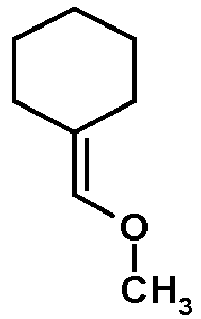
- Prepared in analogy to intermediate A.1 (step 1): (Methoxymethyl)triphenylphosphonium chloride (26.2 g, 76.4 mmol), LDA (38.2 ml of a 2 M solution in THF, 76.4 mmol) and cyclohexanone (CAS-No. [108-94-1]; 5.0 g, 51 mmol) were reacted in THF (130 ml) at 0°C for 35 min and at rt for 1.5 h. The crude product (30 g) was used without further purification.
-

- Prepared in analogy to intermediate A.1 (step 2): (Methoxymethylidene)cyclohexane (6.4 g, 51 mmol), 4-bromophenylhydrazine hydrochloride (11.4 g, 50.9 mmol) and trifluoroacetic acid (13 ml, 168 mmol) were reacted in chloroform (300 ml) at 50°C for 2.25 h. The crude product obtained was used without further purification. UPLC-MS (ESI+): [M + H]+ = 264/266 (Br isotope pattern); Rt in min 1.35 .
-

- To a stirred solution of intermediate A.1 (14.9 g, 42.8 mmol) in 350 ml THF, 12.2 g (86 mmol) boron trifluoride diethylether complex was added dropwise at 0°C. After 5 min of stirring, 300 ml (150 mmol) cyclopropylmagnesium bromide (0.5 M in THF) were added dropwise, keeping the temperature of the mixture at 5 - 10°C. The mixture was allowed to warm to room temperature and stirred 3 h. Then saturated aqueous ammonium chloride solution was added and the mixture partitioned between ethyl acetate and water. The aqueous phase was extracted with ethyl acetate, the combined organic phases were washed with brine, dried with sodium sulfate, concentrated and purified by flash chromatography (SiO2-hexane/ethylacetate) to yield 8.85 g (45%) of intermediate B.1.
1H-NMR (400MHz, DMSO-d6): Shift [ppm] = 0.13 - 0.19 (m, 1H), 0.21 - 0.26 (m, 1H), 0.35 - 0.41 (m, 1 H), 0.45 - 0.52 (m, 1 H), 0.81 - 0.89 (m, 1 H), 1.51 - 2.01 (m, 8H), 2.85 (d, 1 H), 5.74 (s, 1 H), 5.79 (s, 1 H), 6.38 (d, 1 H), 6.94 (d, 1 H), 6.99 (dd, 1 H) -

- Prepared in analogy to intermediate B.1: Intermediate A.2 (14.3 g, 36.3 mmol), boron trifluoride diethylether complex (13.8 ml, 109 mmol) and 290 ml (145 mmol) cyclopropylmagnesium bromide (0.5 M in THF) were reacted in THF (400 ml) at 0°C for 2 h. After aqueous work up and purification by flash chromatography (SiO2[KP-NH]-hexane/ethyl acetate) the desired indoline (5.72 g, 32%) was obtained as a mixture of diastereomers.
1H-NMR (300MHz, DMSO-d6, major isomer): Shift [ppm]= 0.01 - 0.10 (m, 6H), 0.12 - 0.20 (m, 1 H), 0.30 - 0.53 (m, 3H), 0.85 - 0.90 (m, 10H), 1.47 - 1.91 (m, 8H), 2.75 (d, 1 H) [minor isomer: 2.85 (d, 1 H)], 3.82 - 3.89 (m, 1 H) [minor isomer: 3.69 - 3.82 (m, 1 H)], 5.76 (s, 1 H), 6.43 (d, 1 H), 6.98 - 7.12 (m, 2H)
UPLC-MS (ESI+): [M + H]+ = 436/438 (Br isotope pattern); Rt in min 1.91 -

- Prepared in analogy to intermediate B.1: Intermediate A.3 (13.5 g, 50.9 mmol), boron trifluoride diethylether complex (24.5 ml, 194 mmol) and cyclopropylmagnesium bromide (509 ml, 0.5 M in THF, 255 mmol) were reacted in THF (413 ml) at 0°C for 4 h. After aqueous work up and purification by flash chromatography (SiO2-hexane/ethyl acetate) the desired indoline (6.1 g, 39%) was obtained.
1H-NMR (400MHz, CDCl3): Shift [ppm]= 0.13 - 0.19 (m, 1 H), 0.36 - 0.42 (m, 1 H), 0.44 - 0.51 (m, 1 H), 0.62 - 0.69 (m, 1 H), 0.82 - 0.91 (m, 2H), 0.94 - 1.03 (m, 1 H), 1.41 - 1.60 (m, 4H), 1.67 - 1.81 (m, 3H), 1.97 - 2.03 (m, 1 H), 2.74 (d, 1 H), 3.89 (br. s., 1 H), 6.50 (d, 1 H), 7.11 (dd, 1H), 7.25 (d, 1H) -

- To a solution of indoline B.1 (610 mg, 1.56 mmol) in 15 ml 1,2-dichloroethane 912 mg 4-fluorobenzenesulfonyl chloride (CAS No. [349-88-2], 4.7 mmol), 1.3 ml triethylamine (9.4 mmol) and 9.5 mg (0.08 mmol) 4-dimethylaminopyridine were added at rt and the mixture was stirred at 70°C for 4 h. The reaction mixture was partitioned between water and dichloromethane and extracted with dichloromethane. The combined organic layers were washed with water, dried with sodium sulfate, concentrated and purified by flash chromatography (SiO2-hexane/ethylacetate) to obtain 690 mg (72%) of the desired product.
1H-NMR (400MHz, DMSO-d6): Shift [ppm] = 0.28 (d, 1 H), 0.34 - 0.41 (m, 1 H), 0.42 - 0.48 (m, 1 H), 0.52 - 0.63 (m, 2H), 0.91 - 0.99 (m, 1 H), 1.04 - 1.12 (m, 1 H), 1.15 - 1.24 (m, 1 H), 1.60 - 1.77 (m, 3H), 1.88 - 1.96 (m, 1 H), 2.04 - 2.12 (m, 1 H), 3. 86 (d, 1 H), 7.22 (d, 1 H), 7.34 - 7.45 (m, 4H), 7.82 - 7.88 (m, 2H)
HPLC-MS (Cl+): [M + H]+ = 548 / 550 (Br isotope pattern) -

- A mixture of indoline B.2 (750 mg, 1.72 mmol), 4-fluorobenzenesulfonyl chloride (CAS No. [349-88-2]; 502 mg, 2.58 mmol) and pyridine (10 eq., 1.4 ml, 17 mmol) was stirred at rt for 4.5 h. The reaction mixture was partitioned between aqueous saturated sodium hydrogencarbonate solution and dichloromethane and extracted with dichloromethane. The combined organic layers were washed with brine, dried with sodium sulfate and concentrated in vacuo. The obtained crude material was purified by flash chromatography (SiO2-hexane/ethyl acetate) to give the title compound (780 mg, 62%) as a mixture of diastereomers.
1H-NMR (400MHz, CDCl3, major isomer): Shift [ppm]= 0.02 - 0.11 (m, 7H), 0.39 - 0.46 (m, 1H), 0.51 - 0.58 (m, 1 H), 0.62 - 0.68 (m, 2H), 0.88 - 0.98 (m, 10H), 1.21 - 1.28 (m, 2H), 1.33 - 1.40 (m, 1H), 1.59 - 1.68 (m, 1H), 1.73 - 1.78 (m, 1H), 1.84 - 1.88 (m, 1H), 2.18 (dt, 1H), 3.81 (d, 1 H), 3.94 (mc, 1H), 7.06 - 7.12 (m, 2H), 7.16 (d, 1H), 7.33 (dd, 1 H), 7.47 (d, 1H), 7.73 - 7.78 (m, 2H)
UPLC-MS (ESI-): [M + HCO2]- = 638/640 (Br isotope pattern); Rt in min 1.95 -

- A mixture of indoline B.3 (2.80 g, 9.14 mmol), methyl 3-(chlorosulfonyl)benzoate (CAS No. [63555-50-0]; 3.22 g, 13.7 mmol) and pyridine (7.4 ml, 91 mmol) was stirred at rt for 17 h. The reaction mixture was partitioned between aqueous saturated sodium hydrogencarbonate solution and dichloromethane and extracted with dichloromethane. The combined organic layers were washed with brine, dried with sodium sulfate and concentrated in vacuo. The obtained crude material was purified by flash chromatography (SiO2[KP-NH]-hexane/ethyl acetate) to give the title compound (3.1 g, 67%).
1H-NMR (400MHz, CDCl3): Shift [ppm]= 0.14 - 0.17 (m, 1H), 0.40 - 0.47 (m, 1 H), 0.51 - 0.57 (m, 1 H), 0.63 - 0.76 (m, 3H), 0.95 - 1.03 (m, 1 H), 1.14 - 1.29 (m, 3H), 1.41 - 1.52 (m, 1 H), 1.64 - 1.71 (m, 2H), 1.76 - 1.81 (m, 1 H), 2.11 - 2.14 (m, 1 H), 3.94 - 3.96 (m, 4H), 7.13 (d, 1 H), 7.32 (dd, 1 H), 7.47 - 7.52 (m, 2H), 7.90 (dd, 1 H), 8.19 (dd, 1 H), 8.46 - 8.47 (m, 1 H) -

- 3.0 g (5.47 mmol) intermediate C.1 were placed into a steel autoclave under argon atmosphere and dissolved in 115 ml methanol, 12 ml DMSO and 1.7 ml triethylamine (12 mmol). 784 mg (1.09 mmol) trans-bis(triphenylphosphine) palladium(II) dichloride were added. The mixture was purged three times with carbon monoxide and then stirred for 30 min at 20°C under a carbon monoxide pressure of 9.5 bar. The autoclave was set under vacuo again, then a carbon monoxide pressure of 8.6 bar was applied and the mixture heated to 100°C for 22 h, yielding a maximum pressure of 10.6 bar. The reaction was cooled to rt, the pressure released and the reaction mixture concentrated in vacuo and redissolved in ethyl acetate / water. The layers were separated, the aqueous phase extracted with ethyl acetate, the combined organic layers washed with water and brine, dried with sodium sulfate and the solvents removed in vacuo. The crude product was purified by flash chromatography (SiO2-hexane / ethyl acetate) to yield the desired methyl ester (2.02 g, 67%).
1H-NMR (300MHz, DMSO-d6): Shift [ppm] = -0.23 (d, 1H), 0.33 - 0.43 (m, 1H), 0.44 - 0.51 (m, 1H), 0.52 - 0.65 (m, 2H), 0.90 - 1.23 (m, 3H), 1.61 - 1.79 (m, 3H), 1.92 - 2.00 (m, 1 H), 2.07 - 2.17 (m, 1 H), 3.79 (s, 3H), 3. 94 (d, 1 H), 5.76 (s, 1H), 7.34 - 7.40 (m, 2H), 7.57 - 7.62 (m, 2H), 7.85 - 7.92 (m, 3H) -

- Prepared in analogy to intermediate D.1: The aryl bromide C.2 (506 mg, 0.851 mmol) was carbonylated in a mixture of 20 ml methanol, 2 ml DMSO and triethylamine (0.260 ml, 1.87 mmol) in the presence of trans-bis(triphenylphosphine) palladium(II) dichloride (120 mg, 0.17 mmol). A carbon monoxide pressure of 12 bar was applied at 20°C, after evacuation a carbon monoxide pressure of 13 bar was applied and the autoclave was heated to 100°C internal temperature for 23 h to reach a pressure of 17.6 bar. The reaction was cooled to rt, the pressure released and the reaction mixture partitioned between aqueous saturated sodium hydrogencarbonate solution and ethyl acetate. The phases were separated and the aqueous phase extracted with ethyl acetate. The combined organic layers were washed with brine, dried with sodium sulfate and concentrated in vacuo. The obtained crude material was purified by flash chromatography (SiO2-hexane/ethyl acetate) to yield the desired methyl ester D.2 (232 mg, 39%) as a mixture of diastereomers.
1H-NMR (300MHz, CDCl3, major isomer): Shift [ppm]= 0.02 - 0.13 (m, 7H), 0.38 - 0.47 (m, 1 H), 0.52 - 0.61 (m, 1 H), 0.62 - 0.70 (m, 2H), 0.91 - 0.99 (m, 10H), 1.24 - 1.46 (m, 3H), 1.61 - 1.70 (m, 1 H), 1.77 - 1.93 (m, 2H), 2.32 (dt, 1H), 3.87 (d, 1H), 3.88 - 3.90 (m, 3H), 3.93 - 3.99 (m, 1 H), 7.06 - 7.12 (m, 2H), 7.62 (d, 1 H), 7.76 - 7.81 (m, 3H), 7.94 (dd, 1 H).
UPLC-MS (ESI+): [M + H]+ = 574; Rt in min 1.82 -

- 7.46 g (14.1 mmol) methyl ester intermediate D.1 were dissolved in a mixture of 140 ml THF and 30 ml water and 508 mg (21.2 mmol) lithium hydroxide were added. The mixture was stirred at rt until TLC and/or LCMS indicated complete consumption of the starting material (18 h). The mixture was set to pH 4 by addition of 2M aqueous hydrochloric acid and extracted with ethyl acetate. The combined organic layers were washed with brine, dried with sodium sulfate and concentrated in vacuo. The product (7.26 g, 100 %) was used without further purification.
1H-NMR (300MHz, DMSO-d6): Shift [ppm] = -0.23 (d, 1 H), 0.33 - 0.44 (m, 1 H), 0.44 - 0.64 (m, 3H), 0.90 - 1.24 (m, 3H), 1.61 - 1.79 (m, 3H), 1.93 - 2.00 (m, 1 H), 2.07 - 2.19 (m, 1 H), 3. 93 (d, 1 H), 5.77 (s, 1 H), 7.34 - 7.40 (m, 2H), 7.56 - 7.59 (m, 2H), 7.84 - 7.91 (m, 3H) -

- A solution of methyl ester D.2 (667 mg, 1.16 mmol) in 27 ml THF was treated with an aqueous lithium hydroxide solution (11.6 mmol, 278 mg in 5 ml water) and stirred at 60°C for 18 h. The mixture was set to pH 5 by addition of 2M aqueous hydrochloric acid and extracted with ethyl acetate. The combined organic layers were washed with brine, dried with sodium sulfate and concentrated in vacuo. The obtained diastereomeric mixture of E.2 (651 mg, 100%) was used without further purification.
1H-NMR (300MHz, CDCl3, major isomer): Shift [ppm]= 0.03 - 0.17 (m, 7H), 0.38 - 0.50 (m, 1 H), 0.52 - 0.70 (m, 3H), 0.91 - 1.01 (m, 10H), 1.23 - 1.48 (m, 3H), 1.62 - 1.71 (m, 1 H), 1.78 - 1.94 (m, 2H), 2.34 (dt, 1 H), 3.89 (d, 1 H), 3.97 - 4.01 (m, 1 H), 7.08 - 7.14 (m, 2H), 7.64 - 7.69 (m, 1H), 7.75 - 7.82 (m, 3H), 8.02 (dd, 1 H) -

- The aryl bromide C.3 (100 mg, 0.198 mmol) was placed into a steel autoclave under argon atmosphere and dissolved in 10 ml DMSO. Palladium(II) acetate (2.2 mg, 0.010 mmol), 1,1'-bis(di-phenylphosphino)ferrocene (23 mg, 0.040 mmol) and potassium acetate (78 mg, 0.79 mmol) were added. The mixture was purged three times with carbon monoxide and stirred for 30 min at 20°C under a carbon monoxide pressure of 10.5 bar. The autoclave was set under vacuo again, a carbon monoxide pressure of 12 bar was applied and the mixture heated to 100°C (internal temperature) for 24 h to reach a pressure of 14.3 bar. The reaction was cooled to rt, the pressure released and the reaction mixture partitioned between aqueous saturated sodium hydrogencarbonate solution and ethyl acetate. The phases were separated and the aqueous phase extracted with ethyl acetate. The combined organic layers were washed with brine, dried with sodium sulfate and concentrated in vacuo. The obtained product (50 mg, 54%) was used without further purification.
HPLC-MS (ES+): [M + H]+ = 470 -

- To a solution of intermediate C.2 (1.17 g, 1.97 mmol) in 42 ml 1,4-dioxane (containing ca. 1% water) 1-(2-chlorophenyl)methanamine (CAS No. [89-97-4]; 836 mg, 5.91 mmol), molybdenum hexacarbonyl (519 mg, 1.97 mmol), sodium carbonate (626 mg, 5.91 mmol), tri-tert-butylphosphonium tetrafluoroborate (57 mg, 0.20 mmol) and palladium(II) acetate (44 mg, 0.20 mmol) were added. The reaction mixture was vigorously stirred at 140°C for 8 h and at rt overnight. The reaction mixture was filtrated over Celite® and the filter cake rinsed with ethyl acetate. The filtrate was concentrated in vacuo and subjected to flash chromatography (SiO2-hexane/ethyl acetate) to give the title compound F.1 (504 mg, 37%) as a mixture of diastereomers.
1H-NMR (300MHz, DMSO-d6, major isomer): Shift [ppm]= -0.08 - 0.04 (m, 7H), 0.36 - 0.48 (m, 2H), 0.57 - 0.72 (m, 2H), 0.85 - 0.86 (m, 9H), 0.91 - 1.10 (m, 3H), 1.32 - 1.47 (m, 1 H), 1.56 - 1.62 (m, 1 H), 1.70 - 1.76 (m, 1 H), 1.83 - 1.86 (m, 1 H), 2.21 (dt, 1 H), 3.92 - 3.97 (m, 2H) [minor isomer: 3.57 - 3.64 (m, 1 H)], 4.44 - 4.58 (m, 2H), 7.27 - 7.46 (m, 6H), 7.55 (d,
1 H), 7.61 (d, 1 H) [minor isomer: 7.73 (d, 1 H)], 7.83 - 7.91 (m, 3H), 9.01 (td, 1 H) [minor isomer: 8.90 (t, 1 H)]
UPLC-MS (ESI+): [M + H]+ = 683/685 (Cl isotope pattern); Rt in min 1.82 -

- 300 mg (0.58 mmol) carboxylic acid intermediate E.1 were dissolved in 4.5 ml DMF. 100 mg (0.70 mmol) 1-(3-chlorpyridin-2-yl)methylamine (CAS No. [500305-98-6]), 267 mg (0.70 mmol) HATU and 0.30 ml (2.16 mmol) triethylamine were added. The reaction mixture was stirred at rt until TLC and/or LCMS indicated complete consumption of the starting material (2 h), then water was added. The formed precipitate was filtered off, washed with water and dried in vacuo at 40°C to yield 371 mg (87%) of the desired amide.
1H-NMR (400MHz, DMSO-d6): Shift [ppm]= -0.22 (d, 1 H), 0.37 - 0.44 (m, 1 H), 0.45 - 0.52 (m, 1 H), 0.56 - 0.67 (m, 2H), 0.94 - 1.02 (m, 1 H), 1.10 - 1.28 (m, 2H), 1.64 - 1.80 (m, 3H), 1.94 - 2.02 (m, 1 H), 2.17 - 2.26 (m, 1 H), 3. 95 (d, 1 H), 4.65 (d, 2H), 5.75 (s, 1 H), 7.34 - 7.42 (m, 3H), 7.58 (d, 1 H), 7.70 (d, 1 H), 7.85 - 7.93 (m, 4H), 8.47 (dd, 1 H), 8.96 (t, 1 H) - The enantiomers of the racemic material of example 1 were separated by chiral preparative HPLC (System: Dionex: Pump P 580, Gilson: Liquid Handler 215, Knauer: UV-Detektor K-2501; Column: Chiralpak AD-H 5µm 250x30 mm; Solvent hexane / ethanol 70:30 (v/v); Flow: 40 ml/min; Temperature: rt; Injection: 10x0.5 ml, 72 mg/ml EtOH/MeOH; Detection: UV 280 nm) and analytically characterized by HPLC System: Waters: Alliance 2695, DAD 996, ESA: Corona ; Column:Chiralpak AD-H 5µm 150x4.6 mm ; Solvent:Hexan / Ethanol 70:30 (v/v) ; Flow:1.0 ml/min ; Temperature: 25°C ; Solution: 1.0 mg/ml EtOH/MeOH 1:1 ; Injection:5.0 µl ; Detection: DAD 280 nm
-

- A solution of intermediate F.1 (500 mg, 0.659 mmol) in 3 ml THF was treated with tetra-n-butylammonium fluoride (0.99 ml of a 1M solution in THF, 0.99 mmol) and stirred at rt overnight. The reaction mixture was partitioned between ethyl acetate and water, the phases separated and the aqueous phase extracted with ethyl acetate. The combined organic layers were washed with brine, dried with sodium sulfate and concentrated in vacuo to give the title compound (480 mg, 100%) as a mixture of diastereomers.
1H-NMR (300MHz, DMSO-d6, major isomer): Shift [ppm]= -0.17 - -0.12 (m, 1 H), 0.32 - 0.46 (m, 2H), 0.54 - 0.72 (m, 2H), 0.83 - 1.17 (m, 4H), 1.48 - 1.57 (m, 1 H), 1.70 - 1.82 (m, 2H), 2.19 - 2.29 (m, 1 H), 3.76 (br. s., 1 H), 3.91 (d, 1 H), 4.42 (d, 1 H) [minor isomer: 4.57 (d, 1 H)], 4.52 (d, 2H), 7.26 - 7.46 (m, 6H), 7.55 (d, 1 H), 7.77 (s, 1 H) [minor isomer: 7.70 (d, 1 H)], 7.83 - 7.88 (m, 3H), 9.04 (t, 1 H) [minor isomer: 8.93 (t, 1 H)]
UPLC-MS (ESI+): [M + H]+ = 569/571 (Cl isotope pattern); Rt in min 1.30 and 1.33 min -

- To a freshly prepared solution of Dess-Martin periodinane (350 mg, 0.825 mmol) in 5 ml dichloromethane was added dropwise a solution of example 2 (430 mg, 0.688 mmol) in 5 ml dichloromethane at rt and stirring at rt continued for 1.5 h. The reaction mixture was concentrated in vacuo and subjected to flash chromatography (SiO2-hexane/ethyl acetate) to give the title compound (266 mg, 65%).
1H-NMR (300MHz, DMSO-d6): Shift [ppm]= 0.30 - 0.35 (m, 1H), 0.39 - 0.67 (m, 3H), 0.80 - 0.88 (m, 1 H), 1.03 - 1.15 (m, 1 H), 1.22 (dt, 1 H), 1.74 - 1.79 (m, 1 H), 2.32 - 2.36 (m, 3H), 2.54 - 2.73 (m, 2H), 4.27 (d, 1 H), 4.51 (d, 2H), 7.28 - 7.46 (m, 6H), 7.59 (d, 1 H), 7.80 (d, 1 H), 7.86 - 7.92 (m, 3H), 8.92 (t, 1 H)
UPLC-MS (ESI+): [M + H]+ = 567/569 (Cl isotope pattern); Rt in min 1.36 - The enantiomers of the racemic material of example 3 were separated by chiral preparative HPLC (System: Dionex: Pump P 580, Gilson: Liquid Handler 215, Knauer: UV-Detector K-2501; Column: Chiralcel OZ-H 5µm 250x30 mm; Solvent: ethanol / methanol 50:50 (v/v); Flow: 30 ml/min; Temperature: RT; Injection: 0.5 ml/run, 50 mg/ml EtOH / MeOH 1:1; Detection: UV 280 nm) and analytically characterized by HPLC System: Waters: Alliance 2695, DAD 996, ESA: Corona; Column: Chiralcel OZ-H 5µm 150x4.6 mm; Solvent: ethanol / methanol 50:50 (v/v); Flow: 1.0 ml/min; Temperature: 25°C; Solution: 1.0 mg/ml EtOH / MeOH 1:1; Injection: 5.0 µl; Detection: DAD 280 nm:
-

- A solution of example 3 (50 mg, 0.084 mmol) in 1.5 ml THF was cooled to -78°C and treated with methyllithium (120 µl of a 1.6M solution in diethyl ether, 0.193 mmol). The mixture was stirred at 0°C for 3 h and at rt overnight. The reaction mixture was partitioned between ethyl acetate and saturated aqueous ammonium chloride solution. The phases were separated and the aqueous phase extracted with ethyl acetate. The combined organic layers were washed with brine, dried with magnesium sulfate and concentrated in vacuo. The product was purified by flash chromatography (SiO2-hexane/ethyl acetate) to give the title compound (9 mg, 17%) as a mixture of diastereomers.
1H-NMR (400MHz, DMSO-d6, major isomer): Shift [ppm]= -0.30 (d, 1H), 0.34 - 0.42 (m, 2H), 0.54 - 0.61 (m, 1 H), 0.66 - 0.73 (m, 1 H), 0.91 - 0.97 (m, 1H), 1.01 - 1.04 (m, 1 H), 1.12 - 1.18 (m, 4H), 1.41 -1.58 (m, 3H), 1.81 - 1.84 (m, 1 H), 2.24 (dt, 1 H), 3.98 (d, 1 H), 4.05 (s, 1 H), 4.52 (d, 2H), 7.26 - 7.46 (m, 6H), 7.55 (d, 1 H), 7.72 (d, 1 H), 7.82 - 7.86 (m, 3H), 9.02 (t, 1 H) [minor isomer: 8.94 (t, 1 H)]
UPLC-MS (ESI+): [M + H]+ = 583/585 (Cl isotope pattern); Rt in min 1.38 -

- A solution of example 3 (50 mg, 0.084 mmol) in a mixture of toluene and tert-butanol (2 ml, 1:1) was treated with hydroxylamine hydrochloride (28 mg, 0.40 mmol) and the mixture heated to 100°C for 4 h. The reaction mixture was cooled, partitioned between ethyl acetate and water, the phases separated and the aqueous phase extracted with ethyl acetate. The combined organic layers were washed with brine, dried with sodium sulfate and concentrated in vacuo to give the product (48 mg, 89%) as a mixture of E/Z isomers.
1H-NMR (300MHz, DMSO-d6): Shift [ppm]= 0.09 - 0.24 (m, 1H), 0.37 - 0.55 (m, 2H), 0.58 - 0.67 (m, 1 H), 0.74 - 0.95 (m, 2H), 0.98 - 1.07 (m, 1 H), 1.77 - 2.07 (m, 3H), 2.19 - 2.36 (m, 2H), 2.50 - 2.61 (m, 1H), 4.09 - 4.14 (m, 1 H), 4.51 (d, 2H), 7.25 - 7.46 (m, 6H), 7.58 (d, 1 H), 7.78 (dd, 1 H), 7.84 - 7.92 (m, 3H), 8.91 (t, 1 H), 10.27 - 10.32 (m, 1 H)
UPLC-MS (ESI+): [M + H]+ = 582/584 (Cl isotope pattern); Rt in min 1.31 -

- To (diethylamino)sulfur trifluoride (34 µL, 0.26 mmol) at rt was added dropwise a solution of example 3 (50 mg, 0.084 mmol) in 1 ml dichloromethane and the mixture stirred at rt overnight. The reaction mixture was poured onto ice-water, stirred for 20 min and neutralized with aqueous sodium hydrogencarbonate solution (4%). The phases were separated and the aqueous phase extracted with ethyl acetate. The combined organic layers were washed with brine, dried with magnesium sulfate and concentrated in vacuo. The obtained product was purified by flash chromatography (SiO2-hexane/ethyl acetate) to give the title compound (34 mg, 62%).
1H-NMR (400MHz, DMSO-d6): Shift [ppm]= 0.09 - 0.12 (m, 1 H), 0.37 - 0.64 (m, 3H), 0.74 - 0.80 (m, 1 H), 0.97 - 1.04 (m, 2H), 1.47 - 1.59 (m, 1 H), 1.97 - 2.21 (m, 4H), 2.50 - 2.58 (m, 1H), 4.13 (d, 1H), 4.52 (d, 2H), 7.27 - 7.46 (m, 6H), 7.55 - 7.61 (m, 1 H), 7.73 - 7.77 (m, 1 H), 7.84 - 7.94 (m, 3H), 8.91 - 8.98 (m, 1 H)
UPLC-MS (ESI+): [M + H]+ = 589/591 (Cl isotope pattern); Rt in min 1.49 -

- A solution of the carboxylic acid intermediate E.2 (250 mg, 0.447 mmol) in 5 ml DMF was treated with HATU (255 mg, 0.670 mmol), triethylamine (93 µl, 0.67 mmol) and 1-[3-chloro-5-(trifluoromethyl)pyridin-2-yl]methanamine hydrochloride (CAS No. [175277-74-4], 470 mg, 2.23 mmol) and the mixture stirred at rt for 1 h. The reaction mixture was partitioned between dichloromethane and water, the phases separated and the aqueous phase extracted with dichloromethane. The combined organic layers were washed with brine, dried with sodium sulfate and concentrated in vacuo. The obtained product was purified by flash chromatography (SiO2-hexane/ethyl acetate) to give the title compound (194 mg, 68%) as a mixture of diastereomers.
1H-NMR (300MHz, DMSO-d6, major isomer): Shift [ppm]= -0.20 - -0.13 (m, 1 H), 0.35 - 0.44 (m, 2H), 0.56 - 0.70 (m, 2H), 0.83 - 1.17 (m, 4H), 1.47 - 1.56 (m, 1 H), 1.70 - 1.81 (m, 2H), 2.19 - 2.27 (m, 1 H), 3.76 (br. s., 1 H), 3.92 (d, 1 H), 4.43 (d, 1 H) [minor isomer: 4.45 (d, 1 H)], 4.72 (d, 2H), 7.37 - 7.43 (m, 2H), 7.55 (d, 1 H) [minor isomer: 7.60 (d, 1 H)], 7.76 (d, 1 H) [minor isomer: 7.70 (s, 1 H)], 7.81 - 7.91 (m, 3H), 8.47 (s, 1 H), 8.90 (s, 1 H), 9.10 (t, 1 H) UPLC-MS (ESI+): [M + H]+ = 638/640 (Cl isotope pattern); Rt in min 1.36 and 1.39 -

- To a freshly prepared solution of Dess-Martin periodinane (140 mg, 0.331 mmol) in 3 ml dichloromethane was added dropwise a solution of example 7 (176 mg, 0.276 mmol) in 3 ml dichloromethane at rt. Stirring was continued at rt for 24 h. The reaction mixture was concentrated in vacuo and subjected to flash chromatography (SiO2-hexane/ethyl acetate) to give the title compound (90 mg, 48%).
1H-NMR (300MHz, DMSO-d6): Shift [ppm]= 0.33 - 0.38 (m, 1H), 0.41 - 0.67 (m, 3H), 0.80 - 0.88 (m, 1H), 1.05 - 1.26 (m, 2H), 1.75 - 1.80 (m, 1 H), 2.32 - 2.37 (m, 3H), 2.57 - 2.69 (m, 2H), 4.26 (d, 1 H), 4.72 (d, 2H), 7.38 - 7.44 (m, 2H), 7.59 (d, 1 H), 7.79 (s, 1 H), 7.84 - 7.92 (m, 3H), 8.45 (d, 1 H), 8.89 (d, 1 H), 8.95 (t, 1 H)
UPLC-MS (ESI+): [M + H]+ = 636/638 (Cl isotope pattern); Rt in min 1.39 -

- Prepared in analogy to intermediate F.1: Intermediate C.3 (300 mg, 0.595 mmol), 1-(2-chlorophenyl)methanamine (CAS No. [89-97-4]; 253 mg, 1.78 mmol), molybdenum hexacarbonyl (157 mg, 0.595 mmol), sodium carbonate (189 mg, 1.78 mmol), tri-tert-butylphosphonium tetrafluoroborate (17 mg, 0.059 mmol) and palladium(II) acetate (13 mg, 0.059 mmol) were reacted in 18 ml 1,4-dioxane (containing ca. 1 % water) at 120°C for 4 h. The reaction mixture was concentrated in vacuo and subjected to flash chromatography (SiO2-hexane/ethyl acetate) to give the title compound (208 mg, 59%).
1H-NMR (400MHz, CDCl3): Shift [ppm]= 0.18 (d, 1 H), 0.38 - 0.45 (m, 1H), 0.51 - 0.57 (m, 1 H), 0.64 - 0.77 (m, 3H), 0.95 - 1.02 (m, 1 H), 1.18 - 1.30 (m, 3H), 1.41 - 1.52 (m, 1 H), 1.63 - 1.66 (m, 1H), 1.77 - 1.84 (m, 2H), 2.12 - 2.16 (m, 1 H), 3.92 (s, 3H), 4.00 (d, 1H), 4.72 (d, 2H), 6.51 (t, 1 H), 7.21 - 7.26 (m, 2H), 7.39 - 7.42 (m, 1 H), 7.46 - 7.50 (m, 2H), 7.54 - 7.63 (m, 3H), 7.89 - 7.92 (m, 1 H), 8.16 - 8.18 (m, 1 H), 8.47 - 8.48 (m, 1 H)
UPLC-MS (ESI+): [M + H]+ = 593/595 (Cl isotope pattern); Rt in min 1.54 -

- A solution of example 9 (170 mg, 0.286 mmol) in 7.4 ml THF was treated with an aqueous lithium hydroxide solution (2.86 mmol, 68.4 mg in 1 ml water) and stirred at rt for 21.5 h. The mixture was set to pH 2 by addition of 2M aqueous hydrochloric acid and extracted with ethyl acetate. The combined organic layers were washed with brine, dried with sodium sulfate and concentrated in vacuo. The product was stirred in a mixture of dichloromethane and diisopropylether, the solid filtered off, washed with diisopropylether and dried in vacuo to yield the title compound (117 mg, 61 %).
1H-NMR (300MHz, DMSO-d6): Shift [ppm]= -0.03 (d, 1 H), 0.34 - 0.47 (m, 2H), 0.57 - 0.78 (m, 3H), 0.92 - 1.01 (m, 1 H), 1.06 - 1.19 (m, 2H), 1.25 - 1.35 (m, 1 H), 1.42 - 1.59 (m, 2H), 1.70 - 1.74 (m, 1 H), 1.83 (dt, 1 H), 2.04 - 2.08 (m, 1 H), 3.97 (d, 1 H), 4.51 (d, 2H), 7.25 - 7.37 (m, 3H), 7.43 - 7.46 (m, 1 H), 7.55 (d, 1 H), 7.67 (t, 1 H), 7.72 (d, 1 H), 7.85 (dd, 1 H), 7.99 - 8.01 (m, 1 H), 8.15 - 8.18 (m, 1 H), 8.26 - 8.27 (m, 1H), 8.95 (t, 1 H)
UPLC-MS (ESI+): [M + H]+ = 579/581 (Cl isotope pattern); Rt in min 1.40 -

- A solution of the carboxylic acid intermediate E.3 (50 mg, 0.11 mmol) in 3 ml DMF was treated with HATU (61 mg, 0.16 mmol), triethylamine (74 µl, 0.53 mmol) and 1-(3-chloropyridin-2-yl)methanamine dihydrochloride (CAS No. [342816-31-3]; 34 mg, 0.16 mmol) and the mixture stirred at rt for 20 h. The reaction mixture was partitioned between ethyl acetate and saturated aqueous sodium hydrogencarbonate solution, the phases separated and the aqueous phase extracted with ethyl acetate. The combined organic layers were washed with brine, dried with sodium sulfate and concentrated in vacuo. The obtained product was purified by preparative TLC to give the title compound (14 mg, 23%).
1H-NMR (300MHz, CDCl3): Shift [ppm]= 0.21 (d, 1H), 0.38 - 0.48 (m, 1H), 0.52 - 0.61 (m, 1H), 0.64 - 0.83 (m, 3H), 0.95 - 1.06 (m, 1 H), 1.19 - 1.27 (m, 3H), 1.42 - 1.52 (m, 1 H), 1.65 - 1.67 (m, 1 H), 1.81 - 1.91 (m, 2H), 2.15 - 2.19 (m, 1 H), 3.93 (s, 3H), 4.01 (d, 1H), 4.83 (d, 2H), 7.23 - 7.27 (m, 1 H), 7.49 (t, 1 H), 7.65 - 7.67 (m, 2H), 7.72 - 7.76 (m, 2H), 7.82 (t, 1 H), 7.92 - 7.95 (m, 1 H), 8.16 - 8.20 (m, 1 H), 8.49 - 8.53 (m, 2H)
UPLC-MS (ESI+): [M + H]+ = 594/596 (Cl isotope pattern); Rt in min 1.46Table 1:The following examples were prepared in analogy to example 1 starting from the appropriate carboxylic acid intermediate and commercially available amines. Example No Structure Name Analytical data 1 
N-[(3-chloropyridin-2-yl)methyl]-2'-cyclopropyl-1'-[(4-fluorophenyl)sulfo nyl]-4-hydroxy-4-(trifluoromethyl)-1',2'-dihydrospiro[cyclo hexane-1,3'-indole]-5'-carboxamide 1H-NMR (400MHz, DMSO-d6): Shift [ppm]= -0.22 (d, 1H), 0.37 - 0.44 (m, 1H), 0.45 - 0.52 (m, 1H), 0.56 - 0.67 (m, 2H), 0.94 - 1.02 (m, 1H), 1.10 - 1.28 (m, 2H), 1.64 - 1.80 (m, 3H), 1.94 - 2.02 (m, 1H), 2.17 - 2.26 (m, 1H), 3.95 (d, 1H), 4.65 (d, 2H), 5.75 (s, 1H), 7.34 - 7.42 (m, 3H), 7.58 (d, 1H), 7.70 (d, 1H), 7.85 - 7.93 (m, 4H), 8.47 (dd, 1H), 8.96 (t, 1H) 1-1 Enantiomer 1 of Ex. 1 System: Waters: Alliance 2695, DAD 996, ESA: Corona ; Column:Chiralpak AD-H 5µm 150x4.6 mm ; Solvent:Hexan / Ethanol 70:30 (v/v) ;; Flow:1.0 ml/min ; Temperature: 25°C ; Solution: 1.0 mg/ml EtOH/MeOH 1:1 ; Injection:5.0 µl ; Detection:; DAD 280 nm; Rt in min 4.04 1-2 Enantiomer 2 of Ex. 1 Rt in min 6.83 2 
N-(2-chlorobenzyl)-2'-cyclopropyl-1'-[(4-fluorophenyl)sulfo nyl]-4-hydroxy-1',2'-dihydrospiro[cyclo hexane-1,3'-indole]-5'-carboxamide [ca. 85:15 Mixture of Diastereomers]; 1H-NMR (300MHz, DMSO-d6, major isomer): Shift [ppm]= -0.17 - -0.12 (m, 1H), 0.32 - 0.46 (m, 2H), 0.54 - 0.72 (m, 2H), 0.83 - 1.17 (m, 4H), 1.48 - 1.57 (m, 1H), 1.70 - 1.82 (m, 2H), 2.19 - 2.29 (m, 1H), 3.76 (br. s., 1H), 3.91 (d, 1H), 4.42 (d, 1H) [minor isomer: 4.57 (d, 1H)], 4.52 (d, 2H), 7.26 - 7.46 (m, 6H), 7.55 (d, 1H), 7.77 (s, 1H) [minor isomer: 7.70 (d, 1H)], 7.83 - 7.88 (m, 3H), 9.04 (t, 1H) [minor isomer: 8.93 (t, 1H)] UPLC-MS (ESI+): [M + H]+ = 569/571 (Cl isotope pattern).; Rt in min 1.30; 1.33 3 
N-(2-chlorobenzyl)-2'-cyclopropyl-1'-[(4-fluorophenyl)sulfo nyl]-4-oxo-1',2'-dihydrospiro[cyclo hexane-1,3'-indole]-5'-carboxamide 1H-NMR (300MHz, DMSO-d6): Shift [ppm]= 0.30 - 0.35 (m, 1H), 0.39 - 0.67 (m, 3H), 0.80 - 0.88 (m, 1H), 1.03 - 1.15 (m, 1H), 1.22 (dt, 1H), 1.74 - 1.79 (m, 1H), 2.32 - 2.36 (m, 3H), 2.54 - 2.73 (m, 2H), 4.27 (d, 1H), 4.51 (d, 2H), 7.28 - 7.46 (m, 6H), 7.59 (d, 1H), 7.80 (d, 1H), 7.86 - 7.92 (m, 3H), 8.92 (t, 1H) UPLC-MS (ESI+): [M + H]+ = 567/569 (Cl isotope pattern).; Rt in min 1.36 3-1 Enantiomer 1 of Ex. 3 System: Waters: Alliance 2695, DAD 996, ESA: Corona; Column: Chiralcel OZ-H 5µm 150x4.6 mm; Solvent: ethanol / methanol 50:50 (v/v); Flow: 1.0 ml/min; Temperature: 25°C; Solution: 1.0 mg/ml EtOH / MeOH 1:1; Injection: 5.0 µl; Detection: DAD 280 nm; #1: Rt in min 2.33/3.78 (rotamers) 3-2 Enantiomer 2 of Ex. 3 Rt in min 2.81/4.54 (rotamers) 4 
N-(2-chlorobenzyl)-2'-cyclopropyl-1'-[(4-fluorophenyl)sulfo nyl]-4-hydroxy-4-methyl-1',2'-dihydrospiro[cyclo hexane-1,3'-indole]-5'-carboxamide [ca. 90:10 Mixture of Diastereomers]; 1H-NMR (400MHz, DMSO-d6, major isomer): Shift [ppm]= -0.30 (d, 1H), 0.34 - 0.42 (m, 2H), 0.54 - 0.61 (m, 1H), 0.66 - 0.73 (m, 1H), 0.91 - 0.97 (m, 1H), 1.01 - 1.04 (m, 1H), 1.12 - 1.18 (m, 4H), 1.41 - 1.58 (m, 3H), 1.81 - 1.84 (m, 1H), 2.24 (dt, 1H), 3.98 (d, 1H), 4.05 (s, 1H), 4.52 (d, 2H), 7.26 - 7.46 (m, 6H), 7.55 (d, 1 H), 7.72 (d, 1H), 7.82 - 7.86 (m, 3H), 9.02 (t, 1H) [minor isomer: 8.94 (t, 1H)] UPLC-MS (ESI+): [M + H]+ = 583/585 (Cl isotope pattern).; Rt in min 1.38 5 
N-(2-chlorobenzyl)-2'-cyclopropyl-1'-[(4-fluorophenyl)sulfo nyl]-4-(hydroxyimino)-1',2'-dihydrospiro[cyclo hexane-1,3'-indole]-5'-carboxamide [ca. 1:1 Mixture of E/Z-Isomers]; 1H-NMR (300MHz, DMSO-d6): Shift [ppm]= 0.09 - 0.24 (m, 1H), 0.37 - 0.55 (m, 2H), 0.58 - 0.67 (m, 1H), 0.74 - 0.95 (m, 2H), 0.98 - 1.07 (m, 1H), 1.77 - 2.07 (m, 3H), 2.19 - 2.36 (m, 2H), 2.50 - 2.61 (m, 1H), 4.09 - 4.14 (m, 1H), 4.51 (d, 2H), 7.25 - 7.46 (m, 6H), 7.58 (d, 1H), 7.78 (dd, 1H), 7.84 - 7.92 (m, 3H), 8.91 (t, 1H), 10.27 - 10.32 (m, 1H) UPLC-MS (ESI+): [M + H]+ = 582/584 (Cl isotope pattern).; Rt in min 1.31 6 
N-(2-chlorobenzyl)-2'-cyclopropyl-4,4-difluoro-1'-[(4-fluorophenyl)sulfo nyl]-1',2'-dihydrospiro[cyclo hexane-1,3'-indole]-5'-carboxamide 1H-NMR (400MHz, DMSO-d6): Shift [ppm]= 0.09 - 0.12 (m, 1H), 0.37 - 0.64 (m, 3H), 0.74 - 0.80 (m, 1H), 0.97 - 1.04 (m, 2H), 1.47 - 1.59 (m, 1H), 1.97 - 2.21 (m, 4H), 2.50 - 2.58 (m, 1H), 4.13 (d, 1H), 4.52 (d, 2H), 7.27 - 7.46 (m, 6H), 7.55 - 7.61 (m, 1H), 7.73 - 7.77 (m, 1H), 7.84 - 7.94 (m, 3H), 8.91 - 8.98 (m, 1H) UPLC-MS (ESI+): [M + H]+ = 589/591 (Cl isotope pattern).; Rt in min 1.49 7 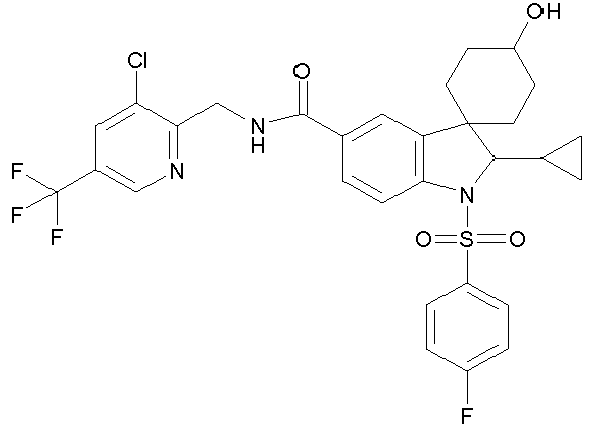
N-{[3-chloro-5-(trifluoromethyl)py ridin-2-yl]methyl}-2'-cyclopropyl-1'-[(4-fluorophenyl)sulfo nyl]-4-hydroxy-1',2'-dihydrospiro[cyclo hexane-1,3'-indole]-5'-carboxamide [ca. 75:25 Mixture of Diastereomers]; 1H-NMR (300MHz, DMSO-d6, major isomer): Shift [ppm]= -0.20 - -0.13 (m, 1H), 0.35 - 0.44 (m, 2H), 0.56 - 0.70 (m, 2H), 0.83 - 1.17 (m, 4H), 1.47 - 1.56 (m, 1H), 1.70 - 1.81 (m, 2H), 2.19 - 2.27 (m, 1H), 3.76 (br. s., 1H), 3.92 (d, 1H), 4.43 (d, 1H) [minor isomer: 4.45 (d, 1H)], 4.72 (d, 2H), 7.37 - 7.43 (m, 2H), 7.55 (d, 1H) [minor isomer: 7.60 (d, 1H)], 7.76 (d, 1H) [minor isomer: 7.70 (s, 1H)], 7.81 - 7.91 (m, 3H), 8.47 (s, 1H), 8.90 (s, 1H), 9.10 (t, 1H) UPLC-MS (ESI+): [M + H]+ = 638/640 (Cl isotope pattern).; Rt in min 1.36; 1.39 8 
N-{[3-chloro-5-(trifluoromethyl)py ridin-2-yl]methyl}-2'-cyclopropyl-1'-[(4-fluorophenyl)sulfo nyl]-4-oxo-1',2'-dihydrospiro[cyclo hexane-1,3'-indole]-5'-carboxamide 1H-NMR (300MHz, DMSO-d6): Shift [ppm]= 0.33 - 0.38 (m, 1H), 0.41 - 0.67 (m, 3H), 0.80 - 0.88 (m, 1H), 1.05 - 1.26 (m, 2H), 1.75 - 1.80 (m, 1H), 2.32 - 2.37 (m, 3H), 2.57 - 2.69 (m, 2H), 4.26 (d, 1H), 4.72 (d, 2H), 7.38 - 7.44 (m, 2H), 7.59 (d, 1H), 7.79 (s, 1H), 7.84 - 7.92 (m, 3H), 8.45 (d, 1H), 8.89 (d, 1H), 8.95 (t, 1H) UPLC-MS (ESI+): [M + H]+ = 636/638 (Cl isotope pattern).; Rt in min 1.39 9 
methyl 3-({5'-[(2-chlorobenzyl)carb amoyl]-2'-cyclopropylspiro[c yclohexane-1,3'-indol]-1'(2'H)-yl}sulfonyl)benzoa te 1H-NMR (400MHz, CDCl3): Shift [ppm]= 0.18 (d, 1H), 0.38 - 0.45 (m, 1H), 0.51 - 0.57 (m, 1H), 0.64 - 0.77 (m, 3H), 0.95 - 1.02 (m, 1H), 1.18 - 1.30 (m, 3H), 1.41 - 1.52 (m, 1H), 1.63 - 1.66 (m, 1H), 1.77 - 1.84 (m, 2H), 2.12 - 2.16 (m, 1H), 3.92 (s, 3H), 4.00 (d, 1H), 4.72 (d, 2H), 6.51 (t, 1H), 7.21 - 7.26 (m, 2H), 7.39 - 7.42 (m, 1H), 7.46 - 7.50 (m, 2H), 7.54 - 7.63 (m, 3H), 7.89 - 7.92 (m, 1H), 8.16 - 8.18 (m, 1H), 8.47 - 8.48 (m, 1H) UPLC-MS (ESI+): [M + H]+ = 593/595 (Cl isotope pattern).; Rt in min 1.54 10 
3-({5'-[(2-chlorobenzyl)carb amoyl]-2'-cyclopropylspiro[c yclohexane-1,3'-indol]-1'(2'H)-yl}sulfonyl)benzoic acid 1H-NMR (300MHz, DMSO-d6): Shift [ppm]= -0.03 (d, 1H), 0.34 - 0.47 (m, 2H), 0.57 - 0.78 (m, 3H), 0.92 - 1.01 (m, 1H), 1.06 - 1.19 (m, 2H), 1.25 - 1.35 (m, 1H), 1.42 - 1.59 (m, 2H), 1.70 - 1.74 (m, 1H), 1.83 (dt, 1H), 2.04 - 2.08 (m, 1 H), 3.97 (d, 1H), 4.51 (d, 2H), 7.25 - 7.37 (m, 3H), 7.43 - 7.46 (m, 1H), 7.55 (d, 1H), 7.67 (t, 1H), 7.72 (d, 1H), 7.85 (dd, 1H), 7.99 - 8.01 (m, 1H), 8.15 - 8.18 (m, 1H), 8.26 - 8.27 (m, 1H), 8.95 (t, 1H) UPLC-MS (ESI+): [M + H]+ = 579/581 (Cl isotope pattern).; Rt in min 1.40 11 
methyl 3-{[5'-{[(3-chloropyridin-2-yl)methyl]carbamo yl}-2'-cyclopropylspiro[c yclohexane-1,3'-indol]-1'(2'H)-yl]sulfonyl}benzoa te 1H-NMR (300MHz, CDCl3): Shift [ppm]= 0.21 (d, 1H), 0.38 - 0.48 (m, 1H), 0.52 - 0.61 (m, 1H), 0.64 - 0.83 (m, 3H), 0.95 - 1.06 (m, 1H), 1.19 - 1.27 (m, 3H), 1.42 - 1.52 (m, 1H), 1.65 - 1.67 (m, 1H), 1.81 - 1.91 (m, 2H), 2.15 - 2.19 (m, 1H), 3.93 (s, 3H), 4.01 (d, 1H), 4.83 (d, 2H), 7.23 - 7.27 (m, 1H), 7.49 (t, 1H), 7.65 - 7.67 (m, 2H), 7.72 - 7.76 (m, 2H), 7.82 (t, 1H), 7.92 - 7.95 (m, 1 H), 8.16 - 8.20 (m, 1 H), 8.49 - 8.53 (m, 2H) UPLC-MS (ESI+): [M + H]+ = 594/596 (Cl isotope pattern).; Rt in min 1.46 12 
1'-[(4-fluorophenyl)sulfo nyl]-4-hydroxy-2'-(3-methylbut-2-en-1-yl)-N-(1H-pyrazol-3-yl)-4-(trifluoromethyl)-1',2'-dihydrospiro[cyclo hexane-1,3'-indole]-5'-carboxamide UPLC-MS (ESI+): [M + H]+ = 607 Rt in min 1.37 13 
1'-[(4-fluorophenyl)sulfo nyl]-4-hydroxy-2'-(3-methylbut-2-en-1-yl)-N-(3-methylphenyl)-4-(trifluoromethyl)-1',2'-dihydrospiro[cyclo hexane-1,3'-indole]-5'-carboxamide UPLC-MS (ESI+): [M + H]+ = 631 Rt in min 1.57 14 
3-[({1'-[(4-fluorophenyl)sulfo nyl]-4-hydroxy-2'-(3-methylbut-2-en-1-yl)-4-(trifluoromethyl)-1',2'-dihydrospiro[cyclo hexane-1,3'-indol]-5'-yl}carbonyl)amino] benzoic acid UPLC-MS (ESI+): [M + H]+ = 661 Rt in min 1.40 15 
1'-[(4-fluorophenyl)sulfo nyl]-4-hydroxy-2'-(3-methylbut-2-en-1-yl)-N-[3-(methylsulfonyl)ph enyl]-4-(trifluoromethyl)-1',2'-dihydrospiro[cyclo hexane-1,3'-indole]-5'-carboxamide UPLC-MS (ESI+): [M + H]+ = 695 Rt in min 1.45 16 
1'-[(4-fluorophenyl)sulfo nyl]-4-hydroxy-2'-(3-methylbut-2-en-1-yl)-N-(3-sulfamoylphenyl)-4-(trifluoromethyl)-1',2'-dihydrospiro[cyclo hexane-1,3'-indole]-5'-carboxamide UPLC-MS (ESI+): [M + H]+ = 696 Rt in min 1.41 17 
1'-[(4-fluorophenyl)sulfo nyl]-4-hydroxy-2'-(3-methylbut-2-en-1-yl)-N-(1,2-oxazol-3-yl)-4-(trifluoromethyl)-1',2'-dihydrospiro[cyclo hexane-1,3'-indole]-5'-carboxamide UPLC-MS (ESI+): [M + H]+ = 608 Rt in min 1.43 18 
1'-[(4-fluorophenyl)sulfo nyl]-4-hydroxy-2'-(3-methylbut-2-en-1-yl)-N-(5-methylpyridin-3-yl)-4-(trifluoromethyl)-1',2'-dihydrospiro[cyclo hexane-1,3'-indole]-5'-carboxamide UPLC-MS (ESI+): [M + H]+ = 632 Rt in min 1.32 19 
1'-[(4-fluorophenyl)sulfo nyl]-4-hydroxy-2'-(3-methylbut-2-en-1-yl)-4-(trifluoromethyl)-N-[5-(trifluoromethyl)py ridin-3-yl]-1',2'-dihydrospiro[cyclo hexane-1,3'-indole]-5'-carboxamide UPLC-MS (ESI+): [M + H]+ = 686 Rt in min 1.55 20 
1'-[(4-fluorophenyl)sulfo nyl]-4-hydroxy-2'-(3-methylbut-2-en-1-yl)-N-(1,3-oxazol-2-yl)-4-(trifluoromethyl)-1',2'-dihydrospiro[cyclo hexane-1,3'-indole]-5'-carboxamide UPLC-MS (ESI+): [M + H]+ = 608 Rt in min 1.39 21 
N-(cyclohexylmethyl) -1'-[(4-fluorophenyl)sulfo nyl]-4-hydroxy-2'-(3-methylbut-2-en-1-yl)-4-(trifluoromethyl)-(trifluoromethyl)-1',2'-dihydrospiro[cyclo hexane-1,3'-indole]-5'-carboxamide UPLC-MS (ESI+): [M + H]+ = 637 Rt in min 1.56 22 
N-(2-chlorobenzyl)-1'-[(4-fluorophenyl)sulfo nyl]-4-hydroxy-2'-(3-methylbut-2-en-1-yl)-4-(trifluoromethyl)-1',2'-dihydrospiro[cyclo hexane-1,3'-indole]-5'-carboxamide UPLC-MS (ESI+): [M + H]+ = 665 Rt in min 1.52 23 
1'-[(4-fluorophenyl)sulfo nyl]-4-hydroxy-2'-(3-methylbut-2-en-1-yl)-4-(trifluoromethyl)-N-{[3-(trifluoromethyl)py ridin-2-yl]methyl}-1',2'-dihydrospiro[cyclo hexane-1,3'-indole]-5'-carboxamide UPLC-MS (ESI+): [M + H]+ = 700 Rt in min 1.48 24 
2'-cyclopropyl-1'-[(4-fluorophenyl)sulfo nyl]-4-hydroxy-N-(3-methylphenyl)-4-(trifluoromethyl)-1',2'-dihydrospiro[cyclo hexane-1,3'-indole]-5'-carboxamide UPLC-MS (ESI+): [M + H]+ = 603 Rt in min 1.45 25 
2'-cyclopropyl-1'-[(4-fluorophenyl)sulfo nyl]-4-hydroxy-N-(5-methylpyridin-3-yl)-4-(trifluoromethyl)-1',2'-dihydrospiro[cyclo hexane-1,3'-indole]-5'-carboxamide UPLC-MS (ESI+): [M + H]+ = 604 Rt in min 1.17 26 
N-(2-chlorobenzyl)-1'-[(4-fluorophenyl)sulfo nyl]-4-hydroxy-2'-methyl-4-(trifluoromethyl)-1',2'-dihydrospiro[cyclo hexane-1,3'-indole]-5'-carboxamide UPLC-MS (ESI+): [M + H]+ = 611 Rt in min 1.39 27 
methyl 3-{[2'-cyclopropyl-4-hydroxy-5'-(1,2-oxazol-3-ylcarbamoyl)-4-(trifluoromethyl)spi ro[cyclohexane-1,3'-indol]-1'(2'H)-yl]sulfonyl}benzoa te UPLC-MS (ESI+): [M + H]+ = 620 Rt in min 1.37 28 
methyl 3-{[2'-cyclopropyl-5'-({[3-fluoro-5-(trifluoromethyl)py ridin-2-yl]methyl}carbamo yl)-4-hydroxy-4-(trifluoromethyl)spi ro[cyclohexane-1,3'-indol]-1'(2'H)-yl]sulfonyl}benzoa te UPLC-MS (ESI+): [M + H]+ = 730 Rt in min 1.43 29 
methyl 3-{[2'-cyclopropyl-4-hydroxy-4-(trifluoromethyl)-5'-({[3-(trifluoromethyl)py ridin-2-yl]methyl}carbamo yl)spiro[cyclohexa ne-1,3'-indol]-1'(2'H)-yl]sulfonyl}benzoa te UPLC-MS (ESI+): [M + H]+ = 712 Rt in min 1.40 30 
methyl 3-[({2'-cyclopropyl-1'-[(4-fluorophenyl)sulfo nyl]-4-hydroxy-4-(trifluoromethyl)-1',2'-dihydrospiro[cyclo hexane-1,3'-indol]-5'-yl}carbonyl)amino] benzoate UPLC-MS (ESI+): [M + H]+ = 647 Rt in min 1.42 30-1 Enantiomer 1 of Ex. 30 System: Waters: Alliance 2695, DAD 996, ESA: Corona; Column: Chiralpak IA 5µm 150x4.6 mm; Solvent: hexane / ethanol 90:10(v/v); Flow: 1.0 ml/min; Temperature: 25°C; Solution: 1.0 mg/ml EtOH/MeOH 2:1; Injection: 5.0 µl; Detection: DAD 280 nm; Rt in min 12.9 30-2 Enantiomer 2 of Ex. 30 Rt in min 17.2 31 
methyl 3-[({2'-cyclopropyl-4-hydroxy-1'-[(3-methoxyphenyl)su Ifonyl]-4-(trifluoromethyl)-1',2'-dihydrospiro[cyclo hexane-1,3'-indol]-5'-yl}carbonyl)amino] benzoate UPLC-MS (ESI+): [M + H]+ = 659 Rt in min 1.43 32 
methyl 3-[({1'-[(4-fluorophenyl)sulfo nyl]-4-hyd roxy-2'-(3-methylbut-2-en-1-yl)-4-(trifluoromethyl)-1',2'-dihydrospiro[cyclo hexane-1,3'-indol]-5'-yl}carbonyl)amino] benzoate UPLC-MS (ESI+): [M + H]+ = 675 Rt in min 1.54 33 
2'-cyclopropyl-4-hydroxy-1'-[(3-methoxyphenyl)su Ifonyl]-N-(1H-pyrazol-3-yl)-4-(trifluoromethyl)-1',2'-dihydrospiro[cyclo hexane-1,3'-indole]-5'-carboxamide UPLC-MS (ESI+): [M + H]+ = 591 Rt in min 1.30 34 
2'-cyclopropyl-4-hydroxy-1'-[(3-methoxyphenyl)su Ifonyl]-N-(3-methylphenyl)-4-(trifluoromethyl)-1',2'-dihydrospiro[cyclo hexane-1,3'-indole]-5'-carboxamide UPLC-MS (ESI+): [M + H]+ = 615 Rt in min 1.46 35 
3-[({2'-cyclopropyl-4-hyd roxy-1 '-[(3-methoxyphenyl)su Ifonyl]-4-(trifluoromethyl)-1',2'-dihydrospiro[cyclo hexane-1,3'-indol]-5'-yl}carbonyl)amino] benzoic acid UPLC-MS (ESI+): [M + H]+ = 645 Rt in min 1.33 36 
2'-cyclopropyl-4-hydroxy-1'-[(3-methoxyphenyl)su Ifonyl]-N-[3-(methylsulfonyl)ph enyl]-4-(trifluoromethyl)-1',2'-dihydrospiro[cyclo hexane-1,3'-indole]-5'-carboxamide UPLC-MS (ESI+): [M + H]+ = 679 Rt in min 1.34 37 
2'-cyclopropyl-4-hydroxy-1'-[(3-methoxyphenyl)su Ifonyl]-N-(3-sulfamoylphenyl)-4-(trifluoromethyl)-1',2'-dihydrospiro[cyclo hexane-1,3'-indole]-5'-carboxamide UPLC-MS (ESI+): [M + H]+ = 680 Rt in min 1.29 38 
2'-cyclopropyl-4-hydroxy-1'-[(3-methoxyphenyl)su Ifonyl]-N-(1,2-oxazol-3-yl)-4-(trifluoromethyl)-1',2'-dihydrospiro[cyclo hexane-1,3'-indole]-5'-carboxamide UPLC-MS (ESI+): [M + H]+ = 592 Rt in min 1.29 39 
2'-cyclopropyl-4-hydroxy-1'-[(3-methoxyphenyl)su Ifonyl]-N-(5-methylpyridin-3-yl)-4-(trifluoromethyl)-1',2'-dihydrospiro[cyclo hexane-1,3'-indole]-5'-carboxamide UPLC-MS (ESI+): [M + H]+ = 616 Rt in min 1.20 40 
2'-cyclopropyl-4-hydroxy-1'-[(3-methoxyphenyl)su Ifonyl]-4-(trifluoromethyl)-N-[5-(trifluoromethyl)py ridin-3-yl]-1',2'-dihydrospiro[cyclo hexane-1,3'-indole]-5'-carboxamide UPLC-MS (ESI+): [M + H]+ = 670 Rt in min 1.45 41 
2'-cyclopropyl-4-hydroxy-1'-[(3-methoxyphenyl)su Ifonyl]-N-(1,3-oxazol-2-yl)-4-(trifluoromethyl)-1',2'-dihydrospiro[cyclo hexane-1,3'-indole]-5'-carboxamide UPLC-MS (ESI+): [M + H]+ = 592 Rt in min 1.27 42 
N-(cyclohexylmethyl) -2'-cyclopropyl-4-hydroxy-1'-[(3-methoxyphenyl)su Ifonyl]-4-(trifluoromethyl)-1',2'-dihydrospiro[cyclo hexane-1,3'-indole]-5'-carboxamide UPLC-MS (ESI+): [M + H]+ = 621 Rt in min 1.49 43 
N-(2-chlorobenzyl)-2'-cyclopropyl-4-hydroxy-1'-[(3-methoxyphenyl)su Ifonyl]-4-(trifluoromethyl)-1',2'-dihydrospiro[cyclo hexane-1,3'-indole]-5'-carboxamide UPLC-MS (ESI+): [M + H]+ = 649 Rt in min 1.44 44 
2'-cyclopropyl-4-hydroxy-1'-[(3-methoxyphenyl)su Ifonyl]-4-(trifluoromethyl)-N-{[3-(trifluoromethyl)py ridin-2-yl]methyl}-1',2'-dihydrospiro[cyclo hexane-1,3'-indole]-5'-carboxamide UPLC-MS (ESI+): [M + H]+ = 684 Rt in min 1.40 45 
N-[(3-chloropyridin-2-yl)methyl]-2'-cyclopropyl-4-hydroxy-1'-[(3-methoxyphenyl)su Ifonyl]-4-(trifluoromethyl)-1',2'-dihydrospiro[cyclo hexane-1,3'-indole]-5'-carboxamide UPLC-MS (ESI+): [M + H]+ = 650 Rt in min 1.39 46 
2'-cyclopropyl-1'-[(4-fluorophenyl)sulfo nyl]-4-hydroxy-N-[3-(methylsulfonyl)ph enyl]-4-(trifluoromethyl)-1',2'-dihydrospiro[cyclo hexane-1,3'-indole]-5'-carboxamide UPLC-MS (ESI+): [M + H]+ = 667 Rt in min 1.37 47 
2'-cyclopropyl-1 [(4-fluorophenyl)sulfo nyl]-4-hydroxy-N-(3-sulfamoylphenyl)-4-(trifluoromethyl)-1',2'-dihydrospiro[cyclo hexane-1,3'-indole]-5'-carboxamide UPLC-MS (ESI+): [M + H]+ = 668 Rt in min 1.32 48 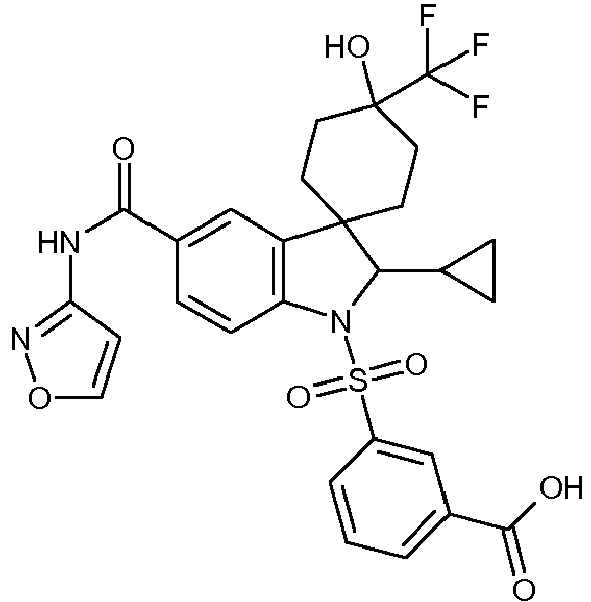
3-{[2'-cyclopropyl-4-hydroxy-5'-(1,2-oxazol-3-ylcarbamoyl)-4-(trifluoromethyl)spi ro[cyclohexane-1,3'-indol]-1'(2'H)-yl]sulfonyl}benzoic acid UPLC-MS (ESI+): [M + H]+ = 605 Rt in min 1.20 49 
3-{[2'-cyclopropyl-5'-({[3-fluoro-5-(trifluoromethyl)py ridin-2-yl]methyl}carbamo yl)-4-hydroxy-4-(trifluoromethyl)spi ro[cyclohexane-1,3'-indol]-1'(2'H)-yl]sulfonyl}benzoic acid UPLC-MS (ESI+): [M + H]+ = 716 Rt in min 1.30 50 
3-{[2'-cyclopropyl-4-hydroxy-4-(trifluoromethyl)-5'-({[3-(trifluoromethyl)py ridin-2-yl]methyl}carbamo yl)spiro[cyclohexa ne-1,3'-indol]-1'(2'H)-yl]sulfonyl}benzoic acid UPLC-MS (ESI+): [M + H]+ = 698 Rt in min 1.27 51 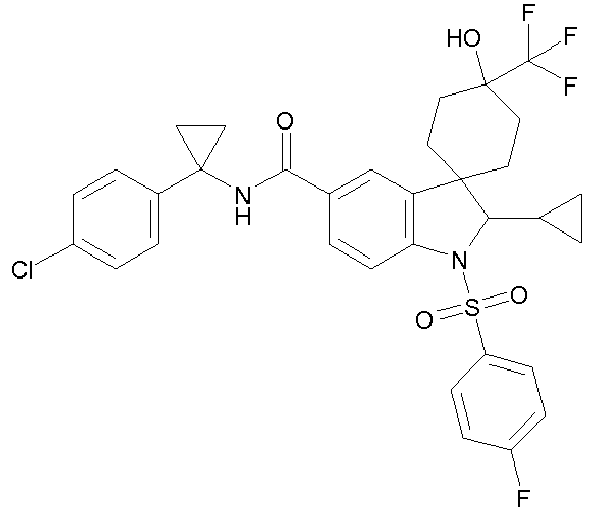
N-[1-(4-chlorophenyl)cycl opropyl]-2'-cyclopropyl-1'-[(4-fluorophenyl)sulfo nyl]-4-hydroxy-4-(trifluoromethyl)-1',2'-dihydrospiro[cyclo hexane-1,3'-indole]-5'-carboxamide UPLC-MS (ESI+): [M + H]+ = 663 Rt in min 1.51 52 
2'-cyclopropyl-1'-[(4-fluorophenyl)sulfo nyl]-4-hydroxy-N-(1H-pyrazol-3-yl)-4-(trifluoromethyl)-1',2'-dihydrospiro[cyclo hexane-1,3'-indole]-5'-carboxamide UPLC-MS (ESI+): [M + H]+ = 579 Rt in min 1.30 53 
2'-cyclopropyl-N-(2,3-dihydro-1H-inden-1-yl)-1'-[(4-fluorophenyl)sulfo nyl]-4-hydroxy-4-(trifluoromethyl)-1',2'-dihydrospiro[cyclo hexane-1,3'-indole]-5'-carboxamide UPLC-MS (ESI+): [M + H]+ = 629 Rt in min 1.45 54 
2'-cyclopropyl-1 [(4-fluorophenyl)sulfo nyl]-4-hydroxy-4-(trifluoromethyl)-N-[3-(trifluoromethyl)ph enyl]-1',2'-dihydrospiro[cyclo hexane-1,3'-indole]-5'-carboxamide UPLC-MS (ESI+): [M + H]+ = 657 Rt in min 1.51 55 
N-(3-chlorophenyl)-2'-cyclopropyl-1'-[(4-fluorophenyl)sulfo nyl]-4-hydroxy-4-(trifluoromethyl)-1',2'-dihydrospiro[cyclo hexane-1,3'-indole]-5'-carboxamide UPLC-MS (ESI+): [M + H]+ = 623 Rt in min 1.49 56 
2'-cyclopropyl-1' [(4-fluorophenyl)sulfo nyl]-4-hydroxy-N-(1,2-oxazol-3-yl)-4-(trifluoromethyl)-1',2'-dihydrospiro[cyclo hexane-1,3'-indole]-5'-carboxamide 1H-NMR (400MHz, DMSO-d6): Shift [ppm]= -0.23 (d, 1H), 0.35 - 0.42 (m, 1 H), 0.45 - 0.52 (m, 1H), 0.54 - 0.65 (m, 2H), 0.92 - 1.00 (m, 1H), 1.18 - 1.26 (m, 2H), 1.64 - 1.79 (m, 3H), 1.94 - 2.00 (m, 1H), 2.20 - 2.26 (m, 1H), 3. 94 (d, 1 H), 5.75 (s, 1H), 6.99 (d, 1H), 7.36 - 7. 40 (m, 2H), 7.59 (d, 1H), 7.86 - 7.91 (m, 3H), 7.95 (dd, 1H), 8.81 (d, 1H), 11.43 (s, 1H) UPLC-MS (ESI+): [M + H]+ = 580 Rt in min 1.36 56-1 Enantiomer 1 of Ex. 56 System: Waters: Alliance 2695, DAD 996, ESA: Corona; Column: Chiralpak IC 5µm 150x4.6 mm; Solvent: hexane / ethanol 70:30(v/v); Flow: 1.0 ml/min; Temperature: 25°C; Solution: 1.0 mg/ml EtOH/MeOH 1:1; Injection: 5.0 µl; Detection: DAD 280 nm; Rt in min 2.75 56-2 Enantiomer 2 of Ex. 56 Rt in min 4.95 57 
1'-{[3-(azetidin-1-ylcarbonyl)phenyl] sulfonyl}-2'-cyclopropyl-4-hydroxy-N-(1,2-oxazol-3-yl)-4-(trifluoromethyl)-1',2'-dihydrospiro[cyclo hexane-1,3'-indole]-5'-carboxamide UPLC-MS (ESI+): [M + H]+ = 645 Rt in min 1.22 58 
2'-cyclopropyl-1'-[(4-fluorophenyl)sulfo nyl]-4-hydroxy-4-(trifluoromethyl)-N-[5-(trifluoromethyl)py ridin-3-yl]-1',2'-dihydrospiro[cyclo hexane-1,3'-indole]-5'-carboxamide UPLC-MS (ESI+): [M + H]+ = 658 Rt in min 1.47 59 
2'-cyclopropyl-N-(cyclopropylmethy l)-1'-[(4-fluorophenyl)sulfo nyl]-4-hydroxy-4-(trifluoromethyl)-1',2'-dihydrospiro[cyclo hexane-1,3'-indole]-5'-carboxamide UPLC-MS (ESI+): [M + H]+ = 567 Rt in min 1.38 60 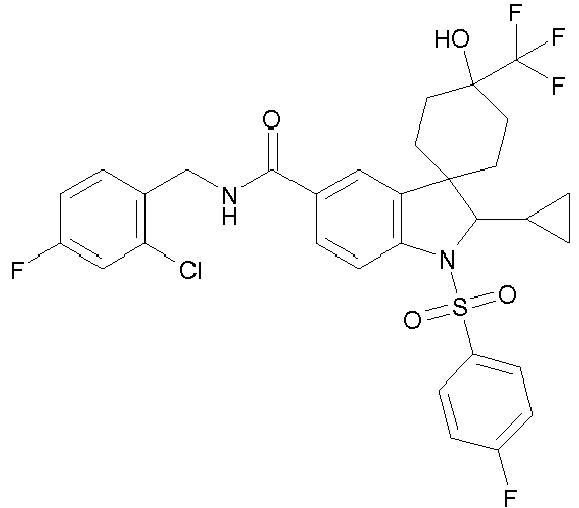
N-(2-chloro-4-fluorobenzyl)-2'-cyclopropyl-1'-[(4-fluorophenyl)sulfo nyl]-4-hydroxy-4-(trifluoromethyl)-1',2'-dihydrospiro[cyclo hexane-1,3'-indole]-5'-carboxamide UPLC-MS (ESI+): [M + H]+ = 655 Rt in min 1.49 61 
N-(cyclohexylmethyl) -2'-cyclopropyl-1'-[(4-fluorophenyl)sulfo nyl]-4-hydroxy-4-(trifluoromethyl)-1',2'-dihydrospiro[cyclo hexane-1,3'-indole]-5'-carboxamide UPLC-MS (ESI+): [M + H]+ = 609 Rt in min 1.52 62 
N-(2-chlorobenzyl)-2'-cyclopropyl-1'-[(4-fluorophenyl)sulfo nyl]-4-hydroxy-4-(trifluoromethyl)-1',2'-dihydrospiro[cyclo hexane-1,3'-indole]-5'-carboxamide 1H-NMR (300MHz, DMSO-d6): Shift [ppm]= -0.22 (d, 1H), 0.33 - 0.43 (m, 1H), 0.44 - 0.50 (m, 1H), 0.52 - 0.65 (m, 2H), 0.89 - 1.01 (m, 1H), 1.06 - 1.28 (m, 2H), 1.60 - 1.78 (m, 3H), 1.91 - 2.01 (m, 1H), 2.14 - 2.26 (m, 1H),3. 93 (d, 1 H), 4.49 (d, 2H), 5.72 (s, 1H), 7.22 - 7.43 (m, 6H), 7.55 (d, 1H), 7.68 (d, 1H), 7.83 - 7.92 (m, 3H), 9.00 (t, 1H) UPLC-MS (ESI+): [M + H]+ = 637 Rt in min 1.45 62-1 Enantiomer 1 of Ex. 62 System: Waters: Alliance 2695, DAD 996, ESA: Corona; Column: Chiralpak IA 5µm 150x4.6 mm; Solvent: hexane / IPA 80:20(v/v); Flow: 1.0 ml/min; Temperature: 25°C; Solution: 1.0 mg/ml EtOH/MeOH 1:1; Injection: 5.0 µl; Detection: DAD 280 nm; Rt in min 5.39 62-2 Enantiomer 2 of Ex. 62 Rt in min 6.77 63 
1'-{[3-(azetidin-1-ylcarbonyl)phenyl] sulfonyl}-2'-cyclopropyl-N-{[3-fluoro-5-(trifluoromethyl)py ridin-2-yl]methyl}-4-hydroxy-4-(trifluoromethyl)-1',2'-dihydrospiro[cyclo hexane-1,3'-indole]-5'-carboxamide UPLC-MS (ESI+): [M + H]+ = 755 Rt in min 1.35 64 
N-[(3-chloro-5-fluoropyridin-2-yl)methyl]-2'-cyclopropyl-1'-[(4-fluorophenyl)sulfo nyl]-4-hydroxy-4-(trifluoromethyl)-1',2'-dihydrospiro[cyclo hexane-1,3'-indole]-5'-carboxamide UPLC-MS (ESI+): [M + H]+ = 656 Rt in min 1.43 65 
2'-cyclopropyl-1'-[(4-fluorophenyl)sulfo nyl]-4-hydroxy-4-(trifluoromethyl)-N-{[3-(trifluoromethyl)py ridin-2-yl]methyl}-1',2'-dihydrospiro[cyclo hexane-1,3'-indole]-5'-carboxamide 1H-NMR (400MHz, DMSO-d6): Shift [ppm]= -0.23 (d, 1H), 0.34 - 0.41 (m, 1H), 0.43 - 0.49 (m, 1H), 0.54 - 0.64 (m, 2H), 0.92 - 1.00 (m, 1H), 1.08 - 1.16 (m, 1H), 1.19 - 1.26 (m, 1H), 1.63 - 1.78 (m, 3H), 1.93 - 1.99 (m, 1H), 2.16 - 2.24 (m, 1H),3. 93 (d, 1H), 4.69 (d, 2H), 5.73 (s, 1H), 7.35 - 7. 39 (m, 2H), 7.50 (dd, 1H), 7.55 (d, 1H), 7.68 (d, 1 H), 7.82 - 7.92 (m, 3H), 8.14 (d, 1H), 8.76 (d, 1H), 8.99 (t, 1H) UPLC-MS (ESI+): [M + H]+ = 672 Rt in min 1.41 65-1 Enantiomer 1 of Ex. 65 System: Dionex: Pump 680, ASI 100, Waters: UV-Detektor 2487; Column: Chiralpak AD-H 5µm 150x4.6 mm; Solvent: hexane / IPA / Diethylamine 80:20:0.1 (v/v/v); Flow: 1.0 ml/min; Temperature: 25°C; Solution: 1.0 mg/ml EtOH/MeOH 2:1; Injection: 5.0 µl; Detection: DAD 254 nm; Rt in min 3.91 65-2 Enantiomer 1 of Ex. 65 Rt in min 6.29 66 
1'-{[3-(azetidin-1-ylcarbonyl)phenyl] sulfonyl}-2'-cyclopropyl-4-hydroxy-4-(trifluoromethyl)-N-{[3-(trifluoromethyl)py ridin-2-yl]methyl}-1',2'-dihydrospiro[cyclo hexane-1,3'-indole]-5'-carboxamide UPLC-MS (ESI+): [M + H]+ = 737 Rt in min 1.30 66-1 Enantiomer 1 of Ex. 66 System: Waters: Alliance 2695, DAD 996, ESA: Corona; Column:Chiralpak IC 3µm 100x4.6 mm; Solvent: hexane / ethanol 50:50(v/v); Flow: 1.0 ml/min; Temperature: 25°C; Solution: 1.0 mg/ml EtOH/MeOH 1:1; Injection: 5.0 µl; Detection: DAD 254 nm; Rt in min 2.69 66-2 Enantiomer 2 of Ex. 66 Rt in min 4.55 - Buserelin was purchased from Welding (Frankfurt/Main, Germany) or USbiological (#B8995, Swampscott, USA) for IP-One HTRF® assays and LHRH from Sigma-Aldrich® (Munich, Germany). Labelled cells, Tag-Lite buffer, labelled and unlabelled GnRHR binding peptide for Tag-lite® binding assay was purchased by Cisbio Bioassays (Bagnols-sur-Cèze Cedex, France). The radio labelling was performed in the Department of Isotope Chemistry of Bayer Pharma AG (Berlin, Germany) by the iodogen method using [125I]sodium iodide (2000 Ci/mmol; PerkinElmer Life and Analytical Sciences, USA) yielding [125I]monoiodo-buserelin. The radio-tracer was purified by reversed phase HPLC on a Spherisorb ODS II column (250 x 4 mm, particle size 3 µm) by elution with acetonitrile / water (34 : 66) containing 39 mM trifluoracetic acid at a flow rate of 1 ml / min.
The retention time of [125I]monoiodo-buserelin was approximately 17 min. All other chemicals were obtained from commercial sources at the highest purity grade available. - By using homogenous time-resolved fluorescence resonance energy transfer (HTRF), the generation of one component of the GnRH-R signalling cascade can be measured. After stimulation of CHO cells stably expressing human GnRH receptor (established by Prof. Thomas Gudermann, currently University of Marburg, Germany; supplied as frozen cell aliquots by Cell Culture Services, Hamburg, Germany) with the EC80 of the GnRH agonist buserelin, Gq protein-coupled receptor signalling cascade is activated resulting in PLC-dependent cleavage of PIP2 to Inositol-1,4,5-triphosphate (IP3) and Diacylglycerol. The second messenger IP3 is degraded intracellularly to myo-inositol. Inhibition of the final degradation step from Inositol-1-phosphate (IP1) to myo-inositol by addition of lithium chloride leads to accumulation of IP1 in the cells. In cell lysates, IP1 can be detected via an antibody-based HTRF detection technology, where IP1 can displace the FRET acceptor IP1-d2 from binding by Terbium-labelled anti-IP1 antibody as donor resulting in a signal decrease. Compounds were tested for their capability of inhibiting GnRH-R activation by buserelin.
For all IP-One HTRF® assays reagents of Cisbio Bioassays (IP-One Tb Jumbo kit, #62IPAPEJ; Cisbio Bioassays, Bagnols sur Cèze Cedex, France) were used. - For the assay, frozen cell aliquots were thawed and a cell suspension (3.33x10⁶ cells/ml) containing IP1-d2 (dilution 1:40) was prepared and incubated at 37°C. After 1 h 3 µl of the cell suspension were added to 50 nl of a 100-fold concentrated solution of the test compound in DMSO pre-dispensed in a well of a white low-volume 384-well microtiter plate (Greiner Bio-One, Frickenhausen, Germany). The mixture was incubated for 20 min at 22°C to allow for pre-binding of the test compound to the GnRH-R. The receptor signaling cascade was stimulated by addition of 2 µl buserelin or LHRH (at EC50 or EC80) in stimulation buffer (10 mM Hepes pH 7.4, 1 mM CaCl2, 0.5 mM MgCl2, 4.2 mM KCI, 146 mM NaCl, 5.5 mM α-D-Glucose, 0.05% BSA, 125 mM LiCl (final assay concentration 50 mM) in aqua dest.). Plates were incubated for 1 h at 37°C and 5% carbon dioxide before the cells were lysed by adding 3 µl Terbium-labelled anti-IP1 antibody (1:40) diluted in Conjugate & Lysis buffer as supplied with the kit. After an incubation for 1 h at 22°C to enable complete cell lysis and antibody binding to free IP1 or IP1-d2, plates were measured in an HTRF reader, e.g. a RUBYstar, PHERAstar (both BMG Labtechnologies, Offenburg, Germany) or a Viewlux (PerkinElmer LAS, Rodgau-Jügesheim, Germany).
From the fluorescence emissions at 665 nm (FRET) and at 620 nm (background signal of Terbium-antibody), the ratio (emission at 665 nm divided by emission at 620 nm) was calculated and the data were normalized (reaction without test compound = 0% inhibition; all other assay components except agonist = 100% inhibition). On the same microtiter plate, compounds were tested at 10 different concentrations in the range of 20 µM to 1 nM (20 µM, 6.7 µM, 2.2 µM, 0.74 µM, 0.25 µM, 82 nM, 27 nM, 9.2 nM, 3.1 nM and 1 nM; dilution series prepared before the assay at the level of the 100-fold conc. stock solutions by serial 1:3 dilutions in 100% DMSO) in duplicate values for each concentration. By using an in-house software, the IC50 values were calculated by a 4 parameter fit.
The data reveal that the compounds of the present invention have antagonist activities on the human GnRH receptor.
Within the meaning of the present invention the antagonist activity is reflected by the ability of a compound of the invention to antagonize human GnRH receptor stimulation in IP-One HTRF® assay at least three times the standard deviation over the background level.

Claims (15)
- A compound according to formula (I)
 R1 is selected from the group consisting of hydrogen, C1-C6-alkyl, C3-C6-cycloalkyl, C2-C6-alkenyl, C2-C6-alkynyl, aryl, hydroxy-C1-C6-alkyl, C1-C6-alkoxy-C1-C6-alky;R2 is an aryl or heteroaryl group which can be unsubstituted or substituted one to three times with a group R4;R3 is selected from the group consisting of C(O)N(R5a)(R5b), N(H)C(O)R6, N(H)C(O)N(R5a)(R5b) or N(H)C(O)OR7;R4 is selected from the group consisting of halogen, hydroxy, CN, C1-C6-alkyl, halo-C1-C6-alkyl, C1-C6-alkoxy, halo-C1-C6-alkoxy, C(O)OH, C(O)O-C1-C6-alkyl, C(O)NH2, C(O)NH-C1-C6-alkyl, C(O)N(C1-C6-alkyl)2 in which the two alkyl groups are independent from each other or together form a 4-, 5-, 6- or 7-membered cyclic amine group;R5a, R5b and R6 are selected, independently from one another, from the group consisting of hydrogen, C1-C6-alkyl, halo-C1-C6-alkyl, hydroxy-C1-C6-alkyl; C2-C6-alkenyl, C2-C6-alkynyl, C1-C6-alkoxy-C1-C6-alkyl, C3-C10-cycloalkyl, C3-C10-cycloalkyl-C1-C6-alkyl-, aryl, aryl-C1-C6-alkyl-, aryl-cyclopropyl, heteroaryl, heteroaryl-C1-C6-alkyl-, in which said cycloalkyl, aryl, heteroaryl groups are optionally substituted up to three times with halogen, hydroxy, C1-C6-alkyl, C1-C6-haloalkyl, C1-C6-alkoxy, C1-C6-haloalkoxy, C(O)OH, C(O)O-C1-C6-alkyl, CN, C(O)NH2, S(O)2-C1-C6-alkyl, S(O)2NH2, S(O)2N(C1-C6-alkyl)2 in which the two alkyl groups are independent from each other;R7 is selected from the group consisting of C1-C6-alkyl, halo-C1-C6-alkyl, hydroxy-C1-C6-alkyl, C2-C6-alkenyl, C2-C6-alkynyl, C1-C6-alkoxy-C1-C6-alkyl, C3-C10-cycloalkyl, C3-C10-cycloalkyl-C1-C6-alkyl, aryl, aryl-C1-C6-alkyl, heteroaryl, or heteroaryl-C1-C6-alkyl in which said cycloalkyl, aryl, heteroaryl group is optionally substituted up to three times with a halogen, hydroxy, C1-C6-alkyl, C1-C6-haloalkyl, C1-C6-alkoxy, C1-C6-haloalkoxy, C(O)OH, C(O)O-C1-C6-alkyl, CN, C(O)NH2, S(O)2-C1-C6-alkyl, S(O)2NH2, S(O)2N(C1-C6-alkyl)2 in which the two alkyl groups are independent from each other;R8a is selected from the group consisting of hydrogen, hydroxy, halogen, C1-C6-alkyl, halo-C1-C6-alkyl;R8b is selected from the group consisting of hydrogen, halogen, C1-C6-alkyl, halo-C1-C6-alkyl;
or R8a and R8b together form an oxo group or an oxime groupR9 is hydrogen, halogen, hydroxy, CN, C1-C6-alkyl, halo-C1-C6-alkyl, C1-C6-alkoxy, halo-C1-C6-alkoxy, C(O)OH, C(O)O-C1-C6-alkyl, C(O)NH2, C(O)NH-C1-C6-alkyl, C(O)N(C1-C6-alkyl)2 in which the two alkyl groups are independent from each other. - A compound according to claim 1 characterized in thatR2 is an aryl group which can be unsubstituted or substituted one to three times with a group R4;
- A Compound according to claim 1 or 2 of formula (Ia)
 R1 is selected from the group consisting of hydrogen, C1-C6-alkyl, C3-C6-cycloalkyl, C2-C6-alkenyl;R3 is selected from the group consisting of C(O)N(R5a)(R5b), C(O)NH(R5a), and N(H)C(O)R6;R4 is selected from the group consisting of halogen, hydroxy, CN, C1-C6-alkyl, halo-C1-C6-alkyl, C1-C6-alkoxy, halo-C1-C6-alkoxy, C(O)OH, C(O)O-C1-C6-alkyl, C(O)NH2, C(O)NH-C1-C6-alkyl, C(O)N(C1-C6-alkyl)2 in which the two alkyl groups are independent from each other or together form a 4-, 5-, 6- or 7-membered cyclic amine group;R5a, R5b and R6 are selected, independently from one another, from the group consisting of hydrogen, C3-C10-cycloalkyl-C1-C6-alkyl-, aryl, aryl-C1-C6-alkyl-, aryl-cyclopropyl, heteroaryl, heteroaryl-C1-C6-alkyl-, in which said cycloalkyl, aryl, heteroaryl groups are optionally substituted up to three times with halogen, C1-C6-alkyl, C1-C6-haloalkyl, C1-C6-alkoxy, C1-C6-haloalkoxy, C(O)OH, C(O)O-C1-C6-alkyl, S(O)2-C1-C6-alkyl, S(O)2NH2, S(O)2N(C1-C6-alkyl)2 in which the two alkyl groups are independent from each other;R7 is selected from the group consisting of C1-C6-alkyl, halo-C1-C6-alkyl, hydroxy-C1-C6-alkyl, C2-C6-alkenyl, C2-C6-alkynyl, C1-C6-alkoxy-C1-C6-alkyl, C3-C10-cycloalkyl, C3-C10-cycloalkyl-C1-C6-alkyl, aryl, aryl-C1-C6-alkyl-, heteroaryl, or heteroaryl-C1-C6-alkyl- in which said cycloalkyl, aryl, heteroaryl group is optionally substituted up to three times with a halogen, hydroxy, an C1-C6-alkyl, C1-C6-haloalkyl, C1-C6-alkoxy, C1-C6-haloalkoxy, C(O)OH, C(O)O-C1-C6-alkyl, CN, C(O)NH2, S(O)2-C1-C6-alkyl, S(O)2NH2, S(O)2N(C1-C6-alkyl)2 in which the two alkyl groups are independent from each other.R8a is selected from the group consisting of hydrogen, hydroxy, halogen, C1-C6-alkyl, halo-C1-C6-alkyl;R8b is selected from the group consisting of hydrogen, halogen, C1-C6-alkyl, halo-C1-C6-alkyl; orR8a and R8b together form an oxo group or an oxime group;R9 is hydrogen, halogen, hydroxy, CN, C1-C6-alkyl, halo-C1-C6-alkyl, C1-C6-alkoxy, halo-C1-C6-alkoxy, C(O)OH, C(O)O-C1-C6-alkyl, C(O)NH2, C(O)NH-C1-C6-alkyl, C(O)N(C1-C6-alkyl)2 in which the two alkyl groups are independent from each other.
 - A compound according to any one of the claims 1 to3 of formula (Ib)
 R1 is selected from the group consisting of hydrogen, C1-C6-alkyl, C3-C6-cycloalkyl, C2-C6-alkenyl;R4 is selected from the group consisting of halogen, hydroxy, CN, C1-C6-alkyl, halo-C1-C6-alkyl, C1-C6-alkoxy, halo-C1-C6-alkoxy, C(O)OH, C(O)O-C1-C6-alkyl, C(O)NH2, C(O)NH-C1-C6-alkyl, C(O)N(C1-C6-alkyl)2 in which the two alkyl groups are independent from each other or together form a 4-, 5-, 6- or 7-membered cyclic amine group;R5a and R5b are selected, independently from one another, from the group consisting of hydrogen, C3-C10-cycloalkyl-C1-C6-alkyl-, aryl, aryl-C1-C6-alkyl-, aryl-cyclopropyl, heteroaryl, heteroaryl-C1-C6-alkyl-, in which said cycloalkyl, aryl, heteroaryl groups are optionally substituted up to three times with halogen, C1-C6-alkyl, C1-C6-haloalkyl, C1-C6-alkoxy, C1-C6-haloalkoxy, C(O)OH, C(O)O-C1-C6-alkyl, S(O)2-C1-C6-alkyl, S(O)2NH2, S(O)2N(C1-C6-alkyl)2 in which the two alkyl groups are independent from each other;R7 is selected from the group consisting of C1-C6-alkyl, halo-C1-C6-alkyl, hydroxy-C1-C6-alkyl, C2-C6-alkenyl, C2-C6-alkynyl, C1-C6-alkoxy-C1-C6-alkyl, C3-C10-cycloalkyl, C3-C10-cycloalkyl-C1-C6-alkyl, aryl, aryl-C1-C6-alkyl-, heteroaryl, or heteroaryl-C1-C6-alkyl- in which said cycloalkyl, aryl, heteroaryl group is optionally substituted up to three times with a halogen, hydroxy, an C1-C6-alkyl, C1-C6-haloalkyl, C1-C6-alkoxy, C1-C6-haloalkoxy, C(O)OH, C(O)O-C1-C6-alkyl, CN, C(O)NH2, S(O)2-C1-C6-alkyl, S(O)2NH2, S(O)2N(C1-C6-alkyl)2 in which the two alkyl groups are independent from each other.R8a is selected from the group consisting of hydrogen, hydroxy, halogen, C1-C6-alkyl, halo-C1-C6-alkyl;R8b is selected from the group consisting of hydrogen, halogen, C1-C6-alkyl, halo-C1-C6-alkyl; orR8a and R8b together form an oxo group or an oxime group.
 - A compound according to any one of the claims 1 to 4 characterized in thatR1 is,C3-C6-cycloalky or C2-C6-alkenyl I;
- A compound according to any one of the claims 1 to 5 characterized in thatR3 is a C(O)NH(R5a);
- A compound according to any one of the claims 1 to 6 characterized in thatR4 is a single group in para or meta position selected from the group consisting of halogen, C1-C6-alkoxy, C(O)OH, C(O)O-C1-C6-alkyl.
- A compound according to any one of the claims 1 to 7 characterized in thatR5a , R5b or R6 are selected, independently from one another, from the group consisting of hydrogen, C3-C10-cycloalkyl-C1-C6-alkyl-, aryl, aryl-C1-C6-alkyl-, aryl-cyclopropyl, heteroaryl, heteroaryl-C1-C6-alkyl-, in which said cycloalkyl, aryl, heteroaryl groups are optionally substituted up to three times with halogen, C1-C6-alkyl, C1-C6-haloalkyl, C1-C6-alkoxy, C1-C6-haloalkoxy, C(O)OH, C(O)O-C1-C6-alkyl, S(O)2-C1-C6-alkyl, S(O)2NH2, S(O)2N(C1-C6-alkyl)2 in which the two alkyl groups are independent from each other.
- A compound according to any one of the claims 1 to 8 characterized in thatR8a is selected from the group consisting of hydrogen, hydroxy, halogen; andR8b is selected from the group consisting of hydrogen, halogen, C1-C6-alkyl, halo-C1-C6-alkyl.
- A compound according to any one of the claims 1 to 9 characterized in thatR8a and R8b together form an oxo group or an oxime group
- A compound according to claim 1 with the following formula:N-[(3-chloropyridin-2-yl)methyl]-2'-cyclopropyl-1'-[(4-fluorophenyl)sulfonyl]-4-hydroxy-4-(trifluoromethyl)-1',2'-dihydrospiro[cyclohexane-1,3'-indole]-5'-carboxamideN-(2-chlorobenzyl)-2'-cyclopropyl-1'-[(4-fluorophenyl)sulfonyl]-4-hydroxy-1',2'-dihydrospiro[cyclohexane-1,3'-indole]-5'-carboxamideN-(2-chlorobenzyl)-2'-cyclopropyl-1'-[(4-fluorophenyl)sulfonyl]-4-oxo-1',2'-dihydrospiro[cyclohexane-1,3'-indole]-5'-carboxamideN-(2-chlorobenzyl)-2'-cyclopropyl-1'-[(4-fluorophenyl)sulfonyl]-4-hydroxy-4-methyl-1',2'-dihydrospiro[cyclohexane-1,3'-indole]-5'-carboxamideN-(2-chlorobenzyl)-2'-cyclopropyl-1'-[(4-fluorophenyl)sulfonyl]-4-(hydroxyimino)-1',2'-dihydrospiro[cyclohexane-1,3'-indole]-5'-carboxamideN-(2-chlorobenzyl)-2'-cyclopropyl-4,4-difluoro-1'-[(4-fluorophenyl)sulfonyl]-1',2'-dihydrospiro[cyclohexane-1,3'-indole]-5'-carboxamideN-{[3-chloro-5-(trifluoromethyl)pyridin-2-yl]methyl}-2'-cyclopropyl-1'-[(4-fluorophenyl)sulfonyl]-4-hydroxy-1',2'-dihydrospiro[cyclohexane-1,3'-indole]-5'-carboxamideN-{[3-chloro-5-(trifluoromethyl)pyridin-2-yl]methyl}-2'-cyclopropyl-1'-[(4-fluorophenyl)sulfonyl]-4-oxo-1',2'-dihydrospiro[cyclohexane-1,3'-indole]-5'-carboxamidemethyl3-({5'-[(2-chlorobenzyl)carbamoyl]-2'-cyclopropylspiro[cyclohexane-1,3'-indol]-1'(2'H)-yl}sulfonyl)benzoate3-({5'-[(2-chlorobenzyl)carbamoyl]-2'-cyclopropylspiro[cyclohexane-1,3'-indol]-1'(2'H)-yl}sulfonyl)benzoic acidmethyl3-{[5'-{[(3-chloropyridin-2-yl)methyl]carbamoyl}-2'-cyclopropylspiro[cyclohexane-1,3'-indol]-1'(2'H)-yl]sulfonyl}benzoate1'-[(4-fluorophenyl)sulfonyl]-4-hydroxy-2'-(3-methylbut-2-en-1-yl)-N-(1H-pyrazol-3-yl)-4-(trifluoromethyl)-1',2'-dihydrospiro[cyclohexane-1,3'-indole]-5'-carboxamide1'-[(4-fluorophenyl)sulfonyl]-4-hydroxy-2'-(3-methylbut-2-en-1-yl)-N-(3-methylphenyl)-4-(trifluoromethyl)-1',2'-dihydrospiro[cyclohexane-1,3'-indole]-5'-carboxamide3-[({1'-[(4-fluorophenyl)sulfonyl]-4-hydroxy-2'-(3-methylbut-2-en-1-yl)-4-(trifluoromethyl)-1',2'-dihydrospiro[cyclohexane-1,3'-indol]-5'-yl}carbonyl)amino]benzoic acid1'-[(4-fluorophenyl)sulfonyl]-4-hydroxy-2'-(3-methylbut-2-en-1-yl)-N-[3-(methylsulfonyl)phenyl]-4-(trifluoromethyl)-1',2'-dihydrospiro[cyclohexane-1,3'-indole]-5'-carboxamide1'-[(4-fluorophenyl)sulfonyl]-4-hydroxy-2'-(3-methylbut-2-en-1-yl)-N-(3-sulfamoylphenyl)-4-(trifluoromethyl)-1',2'-dihydrospiro[cyclohexane-1,3'-indole]-5'-carboxamide1'-[(4-fluorophenyl)sulfonyl]-4-hydroxy-2'-(3-methylbut-2-en-1-yl)-N-(1,2-oxazol-3-yl)-4-(trifluoromethyl)-1',2'-dihydrospiro[cyclohexane-1,3'-indole]-5'-carboxamide1'-[(4-fluorophenyl)sulfonyl]-4-hydroxy-2'-(3-methylbut-2-en-1-yl)-N-(5-methylpyridin-3-yl)-4-(trifluoromethyl)-1',2'-dihydrospiro[cyclohexane-1,3'-indole]-5'-carboxamide1'-[(4-fluorophenyl)sulfonyl]-4-hydroxy-2'-(3-methylbut-2-en-1-yl)-4-(trifluoromethyl)-N-[5-(trifluoromethyl)pyridin-3-yl]-1',2'-dihydrospiro[cyclohexane-1,3'-indole]-5'-carboxamide1'-[(4-fluorophenyl)sulfonyl]-4-hydroxy-2'-(3-methylbut-2-en-1-yl)-N-(1,3-oxazol-2-yl)-4-(trifluoromethyl)-1',2'-dihydrospiro[cyclohexane-1,3'-indole]-5'-carboxamideN-(cyclohexylmethyl)-1'-[(4-fluorophenyl)sulfonyl]-4-hydroxy-2'-(3-methylbut-2-en-1-yl)-4-(trifluoromethyl)-1',2'-dihydrospiro[cyclohexane-1,3'-indole]-5'-carboxamideN-(2-chlorobenzyl)-1'-[(4-fluorophenyl)sulfonyl]-4-hydroxy-2'-(3-methylbut-2-en-1-yl)-4-(trifluoromethyl)-1',2'-dihydrospiro[cyclohexane-1,3'-indole]-5'-carboxamide1'-[(4-fluorophenyl)sulfonyl]-4-hydroxy-2'-(3-methylbut-2-en-1-yl)-4-(trifluoromethyl)-N-{[3-(trifluoromethyl)pyridin-2-yl]methyl}-1',2'-dihydrospiro[cyclohexane-1,3'-indole]-5'-carboxamide2'-cyclopropyl-1'-[(4-fluorophenyl)sulfonyl]-4-hydroxy-N-(3-methylphenyl)-4-(trifluoromethyl)-1',2'-dihydrospiro[cyclohexane-1,3'-indole]-5'-carboxamide2'-cyclopropyl-1'-[(4-fluorophenyl)sulfonyl]-4-hydroxy-N-(5-methylpyridin-3-yl)-4-(trifluoromethyl)-1',2'-dihydrospiro[cyclohexane-1,3'-indole]-5'-carboxamideN-(2-chlorobenzyl)-1'-[(4-fluorophenyl)sulfonyl]-4-hydroxy-2'-methyl-4-(trifluoromethyl)-1',2'-dihydrospiro[cyclohexane-1,3'-indole]-5'-carboxamidemethyl 3-{[2'-cyclopropyl-4-hydroxy-5'-(1,2-oxazol-3-ylcarbamoyl)-4-(trifluoromethyl)spiro[cyclohexane-1,3'-indol]-1'(2'H)-yl]sulfonyl}benzoatemethyl 3-{[2'-cyclopropyl-5'-({[3-fluoro-5-(trifluoromethyl)pyridin-2-yl]methyl}carbamoyl)-4-hydroxy-4-(trifluoromethyl)spiro[cyclohexane-1,3'-indol]-1'(2'H)-yl]sulfonyl}benzoatemethyl 3-{[2'-cyclopropyl-4-hydroxy-4-(trifluoromethyl)-5'-({[3-(trifluoromethyl)pyridin-2-yl]methyl}carbamoyl)spiro[cyclohexane-1,3'-indol]-1'(2'H)-yl]sulfonyl}benzoatemethyl 3-[({2'-cyclopropyl-1'-[(4-fluorophenyl)sulfonyl]-4-hydroxy-4-(trifluoromethyl)-1',2'-dihydrospiro[cyclohexane-1,3'-indol]-5'-yl}carbonyl)amino]benzoatemethyl 3-[({2'-cyclopropyl-4-hydroxy-1'-[(3-methoxyphenyl)sulfonyl]-4-(trifluoromethyl)-1',2'-dihydrospiro[cyclohexane-1,3'-indol]-5'-yl}carbonyl)amino]benzoatemethyl 3-[({1'-[(4-fluorophenyl)sulfonyl]-4-hydroxy-2'-(3-methylbut-2-en-1-yl)-4-(trifluoromethyl)-1',2'-dihydrospiro[cyclohexane-1,3'-indol]-5'-yl}carbonyl)amino]benzoate2'-cyclopropyl-4-hydroxy-1'-[(3-methoxyphenyl)sulfonyl]-N-(1H-pyrazol-3-yl)-4-(trifluoromethyl)-1',2'-dihydrospiro[cyclohexane-1,3'-indole]-5'-carboxamide2'-cyclopropyl-4-hydroxy-1'-[(3-methoxyphenyl)sulfonyl]-N-(3-methylphenyl)-4-(trifluoromethyl)-1',2'-dihydrospiro[cyclohexane-1,3'-indole]-5'-carboxamide3-[({2'-cyclopropyl-4-hydroxy-1'-[(3-methoxyphenyl)sulfonyl]-4-(trifluoromethyl)-1',2'-dihydrospiro[cyclohexane-1,3'-indol]-5'-yl}carbonyl)amino]benzoic acid2'-cyclopropyl-4-hydroxy-1'-[(3-methoxyphenyl)sulfonyl]-N-[3-(methylsulfonyl)phenyl]-4-(trifluoromethyl)-1',2'-dihydrospiro[cyclohexane-1,3'-indole]-5'-carboxamide2'-cyclopropyl-4-hydroxy-1'-[(3-methoxyphenyl)sulfonyl]-N-(3-sulfamoylphenyl)-4-(trifluoromethyl)-1',2'-dihydrospiro[cyclohexane-1,3'-indole]-5'-carboxamide2'-cyclopropyl-4-hydroxy-1'-[(3-methoxyphenyl)sulfonyl]-N-(1,2-oxazol-3-yl)-4-(trifluoromethyl)-1',2'-dihydrospiro[cyclohexane-1,3'-indole]-5'-carboxamide2'-cyclopropyl-4-hydroxy-1'-[(3-methoxyphenyl)sulfonyl]-N-(5-methylpyridin-3-yl)-4-(trifluoromethyl)-1',2'-dihydrospiro[cyclohexane-1,3'-indole]-5'-carboxamide2'-cyclopropyl-4-hydroxy-1'-[(3-methoxyphenyl)sulfonyl]-4-(trifluoromethyl)-N-[5-(trifluoromethyl)pyridin-3-yl]-1',2'-dihydrospiro[cyclohexane-1,3'-indole]-5'-carboxamide2'-cyclopropyl-4-hydroxy-1'-[(3-methoxyphenyl)sulfonyl]-N-(1,3-oxazol-2-yl)-4-(trifluoromethyl)-1',2'-dihydrospiro[cyclohexane-1,3'-indole]-5'-carboxamideN-(cyclohexylmethyl)-2'-cyclopropyl-4-hydroxy-1'-[(3-methoxyphenyl)sulfonyl]-4-(trifluoromethyl)-1',2'-dihydrospiro[cyclohexane-1,3'-indole]-5'-carboxamideN-(2-chlorobenzyl)-2'-cyclopropyl-4-hydroxy-1'-[(3-methoxyphenyl)sulfonyl]-4-(trifluoromethyl)-1',2'-dihydrospiro[cyclohexane-1,3'-indole]-5'-carboxamide2'-cyclopropyl-4-hydroxy-1'-[(3-methoxyphenyl)sulfonyl]-4-(trifluoromethyl)-N-{[3-(trifluoromethyl)pyridin-2-yl]methyl}-1',2'-dihydrospiro[cyclohexane-1,3'-indole]-5'-carboxamideN-[(3-chloropyridin-2-yl)methyl]-2'-cyclopropyl-4-hydroxy-1'-[(3-methoxyphenyl)sulfonyl]-4-(trifluoromethyl)-1',2'-dihydrospiro[cyclohexane-1,3'-indole]-5'-carboxamide2'-cyclopropyl-1'-[(4-fluorophenyl)sulfonyl]-4-hydroxy-N-[3-(methylsulfonyl)phenyl]-4-(trifluoromethyl)-1',2'-dihydrospiro[cyclohexane-1,3'-indole]-5'-carboxamide2'-cyclopropyl-1'-[(4-fluorophenyl)sulfonyl]-4-hydroxy-N-(3-sulfamoylphenyl)-4-(trifluoromethyl)-1',2'-dihydrospiro[cyclohexane-1,3'-indole]-5'-carboxamide3-{[2'-cyclopropyl-4-hydroxy-5'-(1,2-oxazol-3-ylcarbamoyl)-4-(trifluoromethyl)spiro[cyclohexane-1,3'-indol]-1'(2'H)-yl]sulfonyl}benzoic acid3-{[2'-cyclopropyl-5'-({[3-fluoro-5-(trifluoromethyl)pyridin-2-yl]methyl}carbamoyl)-4-hydroxy-4-(trifluoromethyl)spiro[cyclohexane-1,3'-indol]-1'(2'H)-yl]sulfonyl}benzoic acid3-{[2'-cyclopropyl-4-hydroxy-4-(trifluoromethyl)-5'-({[3-(trifluoromethyl)pyridin-2-yl]methyl}carbamoyl)spiro[cyclohexane-1,3'-indol]-1'(2'H)-yl]sulfonyl}benzoic acidN-[1-(4-chlorophenyl)cyclopropyl]-2'-cyclopropyl-1'-[(4-fluorophenyl)sulfonyl]-4-hydroxy-4-(trifluoromethyl)-1',2'-dihydrospiro[cyclohexane-1,3'-indole]-5'-carboxamide2'-cyclopropyl-1'-[(4-fluorophenyl)sulfonyl]-4-hydroxy-N-(1H-pyrazol-3-yl)-4-(trifluoromethyl)-1',2'-dihydrospiro[cyclohexane-1,3'-indole]-5'-carboxamide2'-cyclopropyl-N-(2,3-dihydro-1H-inden-1-yl)-1'-[(4-fluorophenyl)sulfonyl]-4-hydroxy-4-(trifluoromethyl)-1',2'-dihydrospiro[cyclohexane-1,3'-indole]-5'-carboxamide2'-cyclopropyl-1'-[(4-fluorophenyl)sulfonyl]-4-hydroxy-4-(trifluoromethyl)-N-[3-(trifluoromethyl)phenyl]-1',2'-dihydrospiro[cyclohexane-1,3'-indole]-5'-carboxamideN-(3-chlorophenyl)-2'-cyclopropyl-1'-[(4-fluorophenyl)sulfonyl]-4-hydroxy-4-(trifluoromethyl)-1',2'-dihydrospiro[cyclohexane-1,3'-indole]-5'-carboxamide2'-cyclopropyl-1'-[(4-fluorophenyl)sulfonyl]-4-hydroxy-N-(1,2-oxazol-3-yl)-4-(trifluoromethyl)-1',2'-dihydrospiro[cyclohexane-1,3'-indole]-5'-carboxamide1'-{[3-(azetidin-1-ylcarbonyl)phenyl]sulfonyl}-2'-cyclopropyl-4-hydroxy-N-(1,2-oxazol-3-yl)-4-(trifluoromethyl)-1',2'-dihydrospiro[cyclohexane-1,3'-indole]-5'-carboxamide2'-cyclopropyl-1'-[(4-fluorophenyl)sulfonyl]-4-hydroxy-4-(trifluoromethyl)-N-[5-(trifluoromethyl)pyridin-3-yl]-1',2'-dihydrospiro[cyclohexane-1,3'-indole]-5'-carboxamide2'-cyclopropyl-N-(cyclopropylmethyl)-1'-[(4-fluorophenyl)sulfonyl]-4-hydroxy-4-(trifluoromethyl)-1',2'-dihydrospiro[cyclohexane-1,3'-indole]-5'-carboxamideN-(2-chloro-4-fluorobenzyl)-2'-cyclopropyl-1'-[(4-fluorophenyl)sulfonyl]-4-hydroxy-4-(trifluoromethyl)-1',2'-dihydrospiro[cyclohexane-1,3'-indole]-5'-carboxamideN-(cyclohexylmethyl)-2'-cyclopropyl-1'-[(4-fluorophenyl)sulfonyl]-4-hydroxy-4-(trifluoromethyl)-1',2'-dihydrospiro[cyclohexane-1,3'-indole]-5'-carboxamideN-(2-chlorobenzyl)-2'-cyclopropyl-1'-[(4-fluorophenyl)sulfonyl]-4-hydroxy-4-(trifluoromethyl)-1',2'-dihydrospiro[cyclohexane-1,3'-indole]-5'-carboxamide1'-{[3-(azetidin-1-ylcarbonyl)phenyl]sulfonyl}-2'-cyclopropyl-N-{[3-fluoro-5-(trifluoromethyl)pyridin-2-yl]methyl}-4-hydroxy-4-(trifluoromethyl)-1',2'-dihydrospiro[cyclohexane-1,3'-indole]-5'-carboxamideN-[(3-chloro-5-fluoropyridin-2-yl)methyl]-2'-cyclopropyl-1'-[(4-fluorophenyl)sulfonyl]-4-hydroxy-4-(trifluoromethyl)-1',2'-dihydrospiro[cyclohexane-1,3'-indole]-5'-carboxamide2'-cyclopropyl-1'-[(4-fluorophenyl)sulfonyl]-4-hydroxy-4-(trifluoromethyl)-N-{[3-(trifluoromethyl)pyridin-2-yl]methyl}-1',2'-dihydrospiro[cyclohexane-1,3'-indole]-5'-carboxamide1'-{[3-(azetidin-1-ylcarbonyl)phenyl]sulfonyl}-2'-cyclopropyl-4-hydroxy-4-(trifluoromethyl)-N-{[3-(trifluoromethyl)pyridin-2-yl]methyl}-1',2'-dihydrospiro[cyclohexane-1,3'-indole]-5'-carboxamide
- A compound according to any one of the claims 1 to 15 for use as a medicament.
- A compound according to any one of the claims 1 to 15 for use in the treatment of endometriosis, uterine leiomyoma (fibroids), polycystic ovarian disease, menorrhagia, dysmenorrhea, hirsutism, precocious puberty, gonadal steroid-dependent neoplasia such as cancers of the prostate, breast and ovary, gonadotrope pituitary adenomas, sleep apnea, irritable bowel syndrome, premenstrual syndrome, benign prostatic hypertrophy, contraception, infertility, assisted reproductive therapy such as in vitro fertilization, in the treatment of growth hormone deficiency and short stature, and in the treatment of systemic lupus erythematosus.
- A compound according to any one of the claims 1 to 15 for use as contraceptive.
- A pharmaceutical composition comprising a compound according to any one of the claims 1 to 15.
Priority Applications (1)
| Application Number | Priority Date | Filing Date | Title |
|---|---|---|---|
| EP13195957.9A EP2881391A1 (en) | 2013-12-05 | 2013-12-05 | Spiroindoline carbocycle derivatives and pharmaceutical compositions thereof |
Applications Claiming Priority (1)
| Application Number | Priority Date | Filing Date | Title |
|---|---|---|---|
| EP13195957.9A EP2881391A1 (en) | 2013-12-05 | 2013-12-05 | Spiroindoline carbocycle derivatives and pharmaceutical compositions thereof |
Publications (1)
| Publication Number | Publication Date |
|---|---|
| EP2881391A1 true EP2881391A1 (en) | 2015-06-10 |
Family
ID=49726585
Family Applications (1)
| Application Number | Title | Priority Date | Filing Date |
|---|---|---|---|
| EP13195957.9A Withdrawn EP2881391A1 (en) | 2013-12-05 | 2013-12-05 | Spiroindoline carbocycle derivatives and pharmaceutical compositions thereof |
Country Status (1)
| Country | Link |
|---|---|
| EP (1) | EP2881391A1 (en) |
Citations (15)
| Publication number | Priority date | Publication date | Assignee | Title |
|---|---|---|---|---|
| WO1993015051A1 (en) | 1992-01-30 | 1993-08-05 | Elf Sanofi | N-sulphonyl-2-oxoindole derivatives having affinity for vasopressin and/or ocytocin receptors |
| WO1994029309A1 (en) | 1993-06-07 | 1994-12-22 | Merck & Co., Inc. | Spiro-substituted azacycles as neurokinin antagonists |
| US5849780A (en) * | 1992-01-30 | 1998-12-15 | Sanofi | 1-benzenesulfonyl-1-1,3-dihydroindol-2-one derivatives, their preparation and pharmaceutical compositions in which they are present |
| WO1999064002A1 (en) | 1998-06-11 | 1999-12-16 | Merck & Co., Inc. | Spiropiperidine derivatives as melanocortin receptor agonists |
| WO2000066554A1 (en) | 1999-05-04 | 2000-11-09 | American Home Products Corporation | 3,3-substituted indoline derivatives |
| WO2002047679A2 (en) | 2000-12-15 | 2002-06-20 | Emory University | Nonpeptide agonists and antagonists of vasopressin receptors |
| WO2003064429A1 (en) | 2002-01-30 | 2003-08-07 | Takeda Chemical Industries, Ltd. | Thienopyrimidines, process for preparing the same and use thereof |
| WO2004067535A1 (en) | 2003-01-29 | 2004-08-12 | Takeda Pharmaceutical Company Limited | Thienopyrimidine compounds and use thereof |
| WO2005007165A1 (en) | 2003-07-07 | 2005-01-27 | Neurocrine Biosciences, Inc. | Pyrimidine-2, 4-dione derivatives as gonadotropin-releasing hormone receptor antagonists |
| US20060063791A1 (en) | 2004-09-17 | 2006-03-23 | An-Hu Li | (Spirocyclylamido)aminothiophene compounds |
| WO2006090261A1 (en) | 2005-02-24 | 2006-08-31 | Pfizer Products Inc. | Bicyclic heteroaromatic derivatives useful as anticancer agents |
| WO2008157741A1 (en) | 2007-06-20 | 2008-12-24 | Glaxo Group Limited | Spiroindolines as modulators of chemokine receptors |
| WO2010151737A2 (en) | 2009-06-25 | 2010-12-29 | Amgen Inc. | Heterocyclic compounds and their uses |
| WO2011076687A1 (en) | 2009-12-22 | 2011-06-30 | Bayer Schering Pharma Aktiengesellschaft | Pyridinone derivatives and pharmaceutical compositions thereof |
| WO2013107743A1 (en) | 2012-01-16 | 2013-07-25 | Bayer Intellectual Property Gmbh | Spiroindoline derivatives as gonadotropin- releasing hormone receptor antagonists |
-
2013
- 2013-12-05 EP EP13195957.9A patent/EP2881391A1/en not_active Withdrawn
Patent Citations (15)
| Publication number | Priority date | Publication date | Assignee | Title |
|---|---|---|---|---|
| WO1993015051A1 (en) | 1992-01-30 | 1993-08-05 | Elf Sanofi | N-sulphonyl-2-oxoindole derivatives having affinity for vasopressin and/or ocytocin receptors |
| US5849780A (en) * | 1992-01-30 | 1998-12-15 | Sanofi | 1-benzenesulfonyl-1-1,3-dihydroindol-2-one derivatives, their preparation and pharmaceutical compositions in which they are present |
| WO1994029309A1 (en) | 1993-06-07 | 1994-12-22 | Merck & Co., Inc. | Spiro-substituted azacycles as neurokinin antagonists |
| WO1999064002A1 (en) | 1998-06-11 | 1999-12-16 | Merck & Co., Inc. | Spiropiperidine derivatives as melanocortin receptor agonists |
| WO2000066554A1 (en) | 1999-05-04 | 2000-11-09 | American Home Products Corporation | 3,3-substituted indoline derivatives |
| WO2002047679A2 (en) | 2000-12-15 | 2002-06-20 | Emory University | Nonpeptide agonists and antagonists of vasopressin receptors |
| WO2003064429A1 (en) | 2002-01-30 | 2003-08-07 | Takeda Chemical Industries, Ltd. | Thienopyrimidines, process for preparing the same and use thereof |
| WO2004067535A1 (en) | 2003-01-29 | 2004-08-12 | Takeda Pharmaceutical Company Limited | Thienopyrimidine compounds and use thereof |
| WO2005007165A1 (en) | 2003-07-07 | 2005-01-27 | Neurocrine Biosciences, Inc. | Pyrimidine-2, 4-dione derivatives as gonadotropin-releasing hormone receptor antagonists |
| US20060063791A1 (en) | 2004-09-17 | 2006-03-23 | An-Hu Li | (Spirocyclylamido)aminothiophene compounds |
| WO2006090261A1 (en) | 2005-02-24 | 2006-08-31 | Pfizer Products Inc. | Bicyclic heteroaromatic derivatives useful as anticancer agents |
| WO2008157741A1 (en) | 2007-06-20 | 2008-12-24 | Glaxo Group Limited | Spiroindolines as modulators of chemokine receptors |
| WO2010151737A2 (en) | 2009-06-25 | 2010-12-29 | Amgen Inc. | Heterocyclic compounds and their uses |
| WO2011076687A1 (en) | 2009-12-22 | 2011-06-30 | Bayer Schering Pharma Aktiengesellschaft | Pyridinone derivatives and pharmaceutical compositions thereof |
| WO2013107743A1 (en) | 2012-01-16 | 2013-07-25 | Bayer Intellectual Property Gmbh | Spiroindoline derivatives as gonadotropin- releasing hormone receptor antagonists |
Non-Patent Citations (11)
| Title |
|---|
| CHEM. COMM., 1994, pages 201 - 203 |
| GENNARO,: "Remington's Pharmaceutical Sciences", 1990, MACK PUBLISHING CO. |
| J. CHEM. SOC. PERKIN TRANS., vol. 1, 1988, pages 3243 - 3247 |
| LIU ET AL., TETRAHEDRON, vol. 66, no. 3, 2010, pages 573 - 577 |
| LIU ET AL.: "synthesis of a spirotetrahydropyrane in a similar manner in a one-pot reaction", TETRAHEDRON, vol. 66, no. 3, 2010, pages 573 - 577 |
| MOL. CELL. ENDO., vol. 166, 2000, pages 9 - 14 |
| PERRIN ET AL., MOL. PHARMACOL., vol. 23, 1983, pages 44 - 51 |
| S. M. BERGE ET AL.: "Pharmaceutical Salts", J. PHARM. SCI., vol. 66, 1977, pages 1 - 19 |
| T. W GREENE; P. G.M. WUTS: "Protective Groups in Organic Synthesis", 1999, WILEY |
| THE LANCET, vol. 358, 2001, pages 1793 - 1803 |
| VALE ET AL., ENDOCRINOLOGY, vol. 91, 1972, pages 562 - 572 |
Similar Documents
| Publication | Publication Date | Title |
|---|---|---|
| EP3873898B1 (en) | Histone acetylation writer inhibitor development and uses thereof | |
| US20140357655A1 (en) | Spiroindoline derivatives as gonadotropin- releasing hormone receptor antagonists | |
| TWI667233B (en) | Novel indazolecarboxamides, processes for their preparation, pharmaceutical preparations comprising them and their use for producing medicaments | |
| ES2518919T3 (en) | 4- (Indol-7-ylcarbonylaminomethyl) cyclohexanecarboxylic acid derivatives as EP4 receptor antagonists useful for the treatment of chronic renal failure or diabetic nephropathy | |
| CN103596957B (en) | Imidazolopyridazines as AKT Kinase Inhibitors | |
| UA108486C2 (en) | TRIAZOLOPYRIDINE | |
| US10328082B2 (en) | Methods of use and combinations | |
| EP4155302A1 (en) | Preparation method for fused pyrazole-type compound | |
| CN104341396A (en) | Diaryl hydantoin derivative, as well as preparation method, medicine composition and application thereof | |
| WO2012175514A1 (en) | Pyridinone derivatives and pharmaceutical compositions thereof | |
| WO2011076687A1 (en) | Pyridinone derivatives and pharmaceutical compositions thereof | |
| JP2017511309A (en) | Inhibitors of WNT signaling pathway | |
| WO2015091315A1 (en) | Spiro[indolin-3,4'-piperidine] derivatives as gnrh receptor antagonists | |
| EP2881391A1 (en) | Spiroindoline carbocycle derivatives and pharmaceutical compositions thereof | |
| TW202430530A (en) | Camptothecin derivatives, pharmaceutical compositions and preparation methods and applications thereof | |
| WO2004013104A1 (en) | Novel tetrahydroquinoline derivatives | |
| WO2015082374A1 (en) | Spiroindoline-thiopyran-imine-oxide derivatives as gonadotropin-releasing hormone receptor antagonists and pharmaceutical compositions thereof | |
| TW201542564A (en) | Spiroindoline derivatives and pharmaceutical compositions thereof | |
| AU2014253232A1 (en) | Spiroindoline derivatives for use as gonadotropin-releasing hormone receptor antagonists | |
| CN112759541B (en) | Indole-like derivatives and uses thereof | |
| WO2022214009A1 (en) | High-activity hpk1 kinase inhibitor | |
| CN103649087B (en) | Substituted imidazopyridine and intermediate thereof | |
| DE102005038632A1 (en) | New acyltryptophanols useful for fertility control in men or in women, and for preventing or treating osteoporosis | |
| WO2019001342A1 (en) | Amino alcohol derivative, pharmaceutical composition and application thereof |
Legal Events
| Date | Code | Title | Description |
|---|---|---|---|
| PUAI | Public reference made under article 153(3) epc to a published international application that has entered the european phase |
Free format text: ORIGINAL CODE: 0009012 |
|
| 17P | Request for examination filed |
Effective date: 20131205 |
|
| AK | Designated contracting states |
Kind code of ref document: A1 Designated state(s): AL AT BE BG CH CY CZ DE DK EE ES FI FR GB GR HR HU IE IS IT LI LT LU LV MC MK MT NL NO PL PT RO RS SE SI SK SM TR |
|
| AX | Request for extension of the european patent |
Extension state: BA ME |
|
| STAA | Information on the status of an ep patent application or granted ep patent |
Free format text: STATUS: THE APPLICATION IS DEEMED TO BE WITHDRAWN |
|
| 18D | Application deemed to be withdrawn |
Effective date: 20151211 |