EP2880046B1 - Novel chartreusin analogues - Google Patents
Novel chartreusin analogues Download PDFInfo
- Publication number
- EP2880046B1 EP2880046B1 EP13744970.8A EP13744970A EP2880046B1 EP 2880046 B1 EP2880046 B1 EP 2880046B1 EP 13744970 A EP13744970 A EP 13744970A EP 2880046 B1 EP2880046 B1 EP 2880046B1
- Authority
- EP
- European Patent Office
- Prior art keywords
- group
- esi
- nmr
- mhz
- see table
- Prior art date
- Legal status (The legal status is an assumption and is not a legal conclusion. Google has not performed a legal analysis and makes no representation as to the accuracy of the status listed.)
- Not-in-force
Links
- PONPPNYZKHNPKZ-RYBWXQSLSA-N Chartreusin Chemical class O[C@@H]1[C@@H](OC)[C@@H](O)[C@@H](C)O[C@@H]1O[C@@H]1[C@@H](O)[C@@H](O)[C@@H](C)O[C@H]1OC1=CC=CC2=C(O)C(C(O3)=O)=C4C5=C3C=CC(C)=C5C(=O)OC4=C12 PONPPNYZKHNPKZ-RYBWXQSLSA-N 0.000 title description 39
- 150000001875 compounds Chemical class 0.000 claims description 98
- 125000004435 hydrogen atom Chemical group [H]* 0.000 claims description 46
- 239000000203 mixture Substances 0.000 claims description 30
- 239000001257 hydrogen Substances 0.000 claims description 24
- 229910052739 hydrogen Inorganic materials 0.000 claims description 24
- 125000000217 alkyl group Chemical group 0.000 claims description 20
- 150000003839 salts Chemical class 0.000 claims description 16
- 125000005843 halogen group Chemical group 0.000 claims description 14
- 125000004648 C2-C8 alkenyl group Chemical group 0.000 claims description 13
- 206010028980 Neoplasm Diseases 0.000 claims description 13
- 125000000391 vinyl group Chemical group [H]C([*])=C([H])[H] 0.000 claims description 13
- 125000003545 alkoxy group Chemical group 0.000 claims description 12
- 125000004649 C2-C8 alkynyl group Chemical group 0.000 claims description 11
- 125000001495 ethyl group Chemical group [H]C([H])([H])C([H])([H])* 0.000 claims description 11
- 125000001188 haloalkyl group Chemical group 0.000 claims description 11
- 125000002887 hydroxy group Chemical group [H]O* 0.000 claims description 11
- FJWVEDMJFKIJFB-UHFFFAOYSA-N 1,4'-bipiperidine-1'-carboxylic acid Chemical group C1CN(C(=O)O)CCC1N1CCCCC1 FJWVEDMJFKIJFB-UHFFFAOYSA-N 0.000 claims description 10
- 201000011510 cancer Diseases 0.000 claims description 10
- 239000012453 solvate Substances 0.000 claims description 10
- 238000009472 formulation Methods 0.000 claims description 9
- 239000008194 pharmaceutical composition Substances 0.000 claims description 7
- 125000004209 (C1-C8) alkyl group Chemical group 0.000 claims description 4
- 125000006648 (C1-C8) haloalkyl group Chemical group 0.000 claims description 4
- 208000035143 Bacterial infection Diseases 0.000 claims description 4
- 125000002947 alkylene group Chemical group 0.000 claims description 4
- 208000022362 bacterial infectious disease Diseases 0.000 claims description 4
- 150000004044 tetrasaccharides Chemical class 0.000 claims description 4
- 150000004043 trisaccharides Chemical class 0.000 claims description 4
- 201000004681 Psoriasis Diseases 0.000 claims description 3
- 150000001241 acetals Chemical class 0.000 claims description 3
- 150000001242 acetic acid derivatives Chemical class 0.000 claims description 3
- 125000000600 disaccharide group Chemical group 0.000 claims description 2
- 239000003937 drug carrier Substances 0.000 claims description 2
- 150000005217 methyl ethers Chemical class 0.000 claims description 2
- 230000000063 preceeding effect Effects 0.000 claims 2
- OKKJLVBELUTLKV-UHFFFAOYSA-N Methanol Chemical compound OC OKKJLVBELUTLKV-UHFFFAOYSA-N 0.000 description 186
- HEDRZPFGACZZDS-UHFFFAOYSA-N Chloroform Chemical compound ClC(Cl)Cl HEDRZPFGACZZDS-UHFFFAOYSA-N 0.000 description 116
- HEDRZPFGACZZDS-MICDWDOJSA-N Trichloro(2H)methane Chemical compound [2H]C(Cl)(Cl)Cl HEDRZPFGACZZDS-MICDWDOJSA-N 0.000 description 91
- XEKOWRVHYACXOJ-UHFFFAOYSA-N Ethyl acetate Chemical compound CCOC(C)=O XEKOWRVHYACXOJ-UHFFFAOYSA-N 0.000 description 75
- YMWUJEATGCHHMB-UHFFFAOYSA-N Dichloromethane Chemical compound ClCCl YMWUJEATGCHHMB-UHFFFAOYSA-N 0.000 description 73
- 239000000243 solution Substances 0.000 description 71
- 238000001644 13C nuclear magnetic resonance spectroscopy Methods 0.000 description 52
- 238000005160 1H NMR spectroscopy Methods 0.000 description 52
- 239000007787 solid Substances 0.000 description 51
- YMWUJEATGCHHMB-DICFDUPASA-N dichloromethane-d2 Chemical compound [2H]C([2H])(Cl)Cl YMWUJEATGCHHMB-DICFDUPASA-N 0.000 description 48
- VYPSYNLAJGMNEJ-UHFFFAOYSA-N Silicium dioxide Chemical compound O=[Si]=O VYPSYNLAJGMNEJ-UHFFFAOYSA-N 0.000 description 45
- 239000000741 silica gel Substances 0.000 description 38
- 229910002027 silica gel Inorganic materials 0.000 description 38
- 229960001866 silicon dioxide Drugs 0.000 description 38
- PONPPNYZKHNPKZ-UHFFFAOYSA-N Lambdamycin Natural products OC1C(OC)C(O)C(C)OC1OC1C(O)C(O)C(C)OC1OC1=CC=CC2=C(O)C(C(O3)=O)=C4C5=C3C=CC(C)=C5C(=O)OC4=C12 PONPPNYZKHNPKZ-UHFFFAOYSA-N 0.000 description 33
- MXJSQPACGKUSQB-UHFFFAOYSA-N chartreusin Natural products COC1C(O)C(C)OC(OC2C(O)C(O)C(C)OC2Oc3cccc4c(O)c5C(=O)Oc6ccc(C)c7C(=O)Cc(c5c67)c34)C1O MXJSQPACGKUSQB-UHFFFAOYSA-N 0.000 description 33
- XKRFYHLGVUSROY-UHFFFAOYSA-N Argon Chemical compound [Ar] XKRFYHLGVUSROY-UHFFFAOYSA-N 0.000 description 32
- 238000002451 electron ionisation mass spectrometry Methods 0.000 description 32
- BJKRNJVOUMFTHV-UHFFFAOYSA-N methyl 2-oxo-7-(2-trimethylsilylethynyl)chromene-5-carboxylate Chemical compound O1C(=O)C=CC2=C1C=C(C#C[Si](C)(C)C)C=C2C(=O)OC BJKRNJVOUMFTHV-UHFFFAOYSA-N 0.000 description 32
- 238000000034 method Methods 0.000 description 30
- 238000000132 electrospray ionisation Methods 0.000 description 28
- 238000000855 fermentation Methods 0.000 description 28
- 230000004151 fermentation Effects 0.000 description 28
- XLYOFNOQVPJJNP-UHFFFAOYSA-N water Substances O XLYOFNOQVPJJNP-UHFFFAOYSA-N 0.000 description 28
- WYURNTSHIVDZCO-UHFFFAOYSA-N Tetrahydrofuran Chemical compound C1CCOC1 WYURNTSHIVDZCO-UHFFFAOYSA-N 0.000 description 25
- 238000006243 chemical reaction Methods 0.000 description 25
- 229910001868 water Inorganic materials 0.000 description 24
- WEVYAHXRMPXWCK-UHFFFAOYSA-N Acetonitrile Chemical compound CC#N WEVYAHXRMPXWCK-UHFFFAOYSA-N 0.000 description 22
- XDTMQSROBMDMFD-UHFFFAOYSA-N Cyclohexane Chemical compound C1CCCCC1 XDTMQSROBMDMFD-UHFFFAOYSA-N 0.000 description 22
- 238000002330 electrospray ionisation mass spectrometry Methods 0.000 description 22
- IJKVHSBPTUYDLN-UHFFFAOYSA-N dihydroxy(oxo)silane Chemical compound O[Si](O)=O IJKVHSBPTUYDLN-UHFFFAOYSA-N 0.000 description 20
- RTZKZFJDLAIYFH-UHFFFAOYSA-N Diethyl ether Chemical compound CCOCC RTZKZFJDLAIYFH-UHFFFAOYSA-N 0.000 description 19
- VEXZGXHMUGYJMC-UHFFFAOYSA-N Hydrochloric acid Chemical compound Cl VEXZGXHMUGYJMC-UHFFFAOYSA-N 0.000 description 16
- ZMXDDKWLCZADIW-UHFFFAOYSA-N N,N-Dimethylformamide Chemical compound CN(C)C=O ZMXDDKWLCZADIW-UHFFFAOYSA-N 0.000 description 16
- PMZURENOXWZQFD-UHFFFAOYSA-L Sodium Sulfate Chemical compound [Na+].[Na+].[O-]S([O-])(=O)=O PMZURENOXWZQFD-UHFFFAOYSA-L 0.000 description 16
- 229910052786 argon Inorganic materials 0.000 description 16
- 210000004027 cell Anatomy 0.000 description 16
- 239000000047 product Substances 0.000 description 16
- 229910052938 sodium sulfate Inorganic materials 0.000 description 16
- 235000011152 sodium sulphate Nutrition 0.000 description 16
- 230000015572 biosynthetic process Effects 0.000 description 15
- 125000004432 carbon atom Chemical group C* 0.000 description 15
- 238000002101 electrospray ionisation tandem mass spectrometry Methods 0.000 description 14
- 239000002904 solvent Substances 0.000 description 14
- 108020004414 DNA Proteins 0.000 description 13
- UIIMBOGNXHQVGW-UHFFFAOYSA-M Sodium bicarbonate Chemical class [Na+].OC([O-])=O UIIMBOGNXHQVGW-UHFFFAOYSA-M 0.000 description 13
- 238000010719 annulation reaction Methods 0.000 description 13
- 238000001816 cooling Methods 0.000 description 13
- 230000014509 gene expression Effects 0.000 description 13
- 238000002955 isolation Methods 0.000 description 13
- -1 small-molecule compounds Chemical class 0.000 description 13
- 239000011734 sodium Substances 0.000 description 13
- IAZDPXIOMUYVGZ-UHFFFAOYSA-N Dimethylsulphoxide Chemical compound CS(C)=O IAZDPXIOMUYVGZ-UHFFFAOYSA-N 0.000 description 12
- OFBQJSOFQDEBGM-UHFFFAOYSA-N Pentane Chemical compound CCCCC OFBQJSOFQDEBGM-UHFFFAOYSA-N 0.000 description 12
- 125000002485 formyl group Chemical group [H]C(*)=O 0.000 description 12
- 239000012074 organic phase Substances 0.000 description 12
- 238000004440 column chromatography Methods 0.000 description 10
- ZYGHJZDHTFUPRJ-UHFFFAOYSA-N coumarin Chemical compound C1=CC=C2OC(=O)C=CC2=C1 ZYGHJZDHTFUPRJ-UHFFFAOYSA-N 0.000 description 10
- 238000010511 deprotection reaction Methods 0.000 description 10
- 125000000956 methoxy group Chemical group [H]C([H])([H])O* 0.000 description 10
- 125000002496 methyl group Chemical group [H]C([H])([H])* 0.000 description 10
- 239000000725 suspension Substances 0.000 description 10
- DTQVDTLACAAQTR-UHFFFAOYSA-N Trifluoroacetic acid Chemical compound OC(=O)C(F)(F)F DTQVDTLACAAQTR-UHFFFAOYSA-N 0.000 description 9
- UVQJAVUEWNSVSK-UHFFFAOYSA-N chartarin Chemical compound O1C(=O)C(C2=3)=C(O)C4=CC=CC(O)=C4C=3OC(=O)C3=C2C1=CC=C3C UVQJAVUEWNSVSK-UHFFFAOYSA-N 0.000 description 9
- 125000001160 methoxycarbonyl group Chemical group [H]C([H])([H])OC(*)=O 0.000 description 9
- 238000003786 synthesis reaction Methods 0.000 description 9
- 239000012634 fragment Substances 0.000 description 8
- OJABDXVCZPVZEE-UHFFFAOYSA-N methyl 6-hydroxy-2-oxochromene-5-carboxylate Chemical compound O1C(=O)C=CC2=C1C=CC(O)=C2C(=O)OC OJABDXVCZPVZEE-UHFFFAOYSA-N 0.000 description 8
- 239000003921 oil Substances 0.000 description 8
- 238000000746 purification Methods 0.000 description 8
- WNZQDUSMALZDQF-UHFFFAOYSA-N 2-benzofuran-1(3H)-one Chemical compound C1=CC=C2C(=O)OCC2=C1 WNZQDUSMALZDQF-UHFFFAOYSA-N 0.000 description 7
- PDRYIORVTZLHGR-UHFFFAOYSA-N 7-(methoxymethoxy)-3-oxo-1h-2-benzofuran-1-carbonitrile Chemical compound COCOC1=CC=CC2=C1C(C#N)OC2=O PDRYIORVTZLHGR-UHFFFAOYSA-N 0.000 description 7
- 230000000694 effects Effects 0.000 description 7
- 238000004128 high performance liquid chromatography Methods 0.000 description 7
- OBTDCNFHKBHVFA-UHFFFAOYSA-N methyl 2-oxo-6-(trifluoromethylsulfonyloxy)chromene-5-carboxylate Chemical compound O1C(=O)C=CC2=C1C=CC(OS(=O)(=O)C(F)(F)F)=C2C(=O)OC OBTDCNFHKBHVFA-UHFFFAOYSA-N 0.000 description 7
- VCIUITMGHPJDTE-UHFFFAOYSA-N methyl 5-bromo-2-formyl-3-hydroxybenzoate Chemical compound COC(=O)C1=CC(Br)=CC(O)=C1C=O VCIUITMGHPJDTE-UHFFFAOYSA-N 0.000 description 7
- 238000002953 preparative HPLC Methods 0.000 description 7
- 108090000623 proteins and genes Proteins 0.000 description 7
- 238000010992 reflux Methods 0.000 description 7
- QTBSBXVTEAMEQO-UHFFFAOYSA-N Acetic acid Chemical compound CC(O)=O QTBSBXVTEAMEQO-UHFFFAOYSA-N 0.000 description 6
- CSCPPACGZOOCGX-UHFFFAOYSA-N Acetone Chemical compound CC(C)=O CSCPPACGZOOCGX-UHFFFAOYSA-N 0.000 description 6
- CURLTUGMZLYLDI-UHFFFAOYSA-N Carbon dioxide Chemical compound O=C=O CURLTUGMZLYLDI-UHFFFAOYSA-N 0.000 description 6
- LFQSCWFLJHTTHZ-UHFFFAOYSA-N Ethanol Chemical compound CCO LFQSCWFLJHTTHZ-UHFFFAOYSA-N 0.000 description 6
- ISWSIDIOOBJBQZ-UHFFFAOYSA-N Phenol Chemical compound OC1=CC=CC=C1 ISWSIDIOOBJBQZ-UHFFFAOYSA-N 0.000 description 6
- 108010030975 Polyketide Synthases Proteins 0.000 description 6
- KWYUFKZDYYNOTN-UHFFFAOYSA-M Potassium hydroxide Chemical compound [OH-].[K+] KWYUFKZDYYNOTN-UHFFFAOYSA-M 0.000 description 6
- 241000191963 Staphylococcus epidermidis Species 0.000 description 6
- YXFVVABEGXRONW-UHFFFAOYSA-N Toluene Chemical compound CC1=CC=CC=C1 YXFVVABEGXRONW-UHFFFAOYSA-N 0.000 description 6
- 238000004458 analytical method Methods 0.000 description 6
- 239000012043 crude product Substances 0.000 description 6
- 230000001472 cytotoxic effect Effects 0.000 description 6
- VKYKSIONXSXAKP-UHFFFAOYSA-N hexamethylenetetramine Chemical compound C1N(C2)CN3CN1CN2C3 VKYKSIONXSXAKP-UHFFFAOYSA-N 0.000 description 6
- KWGKDLIKAYFUFQ-UHFFFAOYSA-M lithium chloride Chemical compound [Li+].[Cl-] KWGKDLIKAYFUFQ-UHFFFAOYSA-M 0.000 description 6
- 238000004519 manufacturing process Methods 0.000 description 6
- HUSYFRLJYKSKON-UHFFFAOYSA-N methyl 6-bromo-2-formyl-3-hydroxybenzoate Chemical compound COC(=O)C1=C(Br)C=CC(O)=C1C=O HUSYFRLJYKSKON-UHFFFAOYSA-N 0.000 description 6
- WLRWPGFTSGFSNX-UHFFFAOYSA-N n,n-diethyl-3-(methoxymethoxy)benzamide Chemical compound CCN(CC)C(=O)C1=CC=CC(OCOC)=C1 WLRWPGFTSGFSNX-UHFFFAOYSA-N 0.000 description 6
- KDLHZDBZIXYQEI-UHFFFAOYSA-N palladium Substances [Pd] KDLHZDBZIXYQEI-UHFFFAOYSA-N 0.000 description 6
- NFHFRUOZVGFOOS-UHFFFAOYSA-N palladium;triphenylphosphane Chemical compound [Pd].C1=CC=CC=C1P(C=1C=CC=CC=1)C1=CC=CC=C1.C1=CC=CC=C1P(C=1C=CC=CC=1)C1=CC=CC=C1.C1=CC=CC=C1P(C=1C=CC=CC=1)C1=CC=CC=C1.C1=CC=CC=C1P(C=1C=CC=CC=1)C1=CC=CC=C1 NFHFRUOZVGFOOS-UHFFFAOYSA-N 0.000 description 6
- 239000000843 powder Substances 0.000 description 6
- 239000000758 substrate Substances 0.000 description 6
- 241000588724 Escherichia coli Species 0.000 description 5
- PEDCQBHIVMGVHV-UHFFFAOYSA-N Glycerine Chemical compound OCC(O)CO PEDCQBHIVMGVHV-UHFFFAOYSA-N 0.000 description 5
- QAOWNCQODCNURD-UHFFFAOYSA-N Sulfuric acid Chemical compound OS(O)(=O)=O QAOWNCQODCNURD-UHFFFAOYSA-N 0.000 description 5
- 230000001028 anti-proliverative effect Effects 0.000 description 5
- 238000003556 assay Methods 0.000 description 5
- 239000000287 crude extract Substances 0.000 description 5
- 231100000433 cytotoxic Toxicity 0.000 description 5
- 239000007788 liquid Substances 0.000 description 5
- 125000004184 methoxymethyl group Chemical group [H]C([H])([H])OC([H])([H])* 0.000 description 5
- ZGGSXNKLOOICDY-UHFFFAOYSA-N methyl 2-bromo-4-formyl-5-hydroxybenzoate Chemical compound COC(=O)C1=CC(O)=C(C=O)C=C1Br ZGGSXNKLOOICDY-UHFFFAOYSA-N 0.000 description 5
- AIWIFVOBRBJANE-UHFFFAOYSA-N methyl 2-bromo-5-hydroxybenzoate Chemical compound COC(=O)C1=CC(O)=CC=C1Br AIWIFVOBRBJANE-UHFFFAOYSA-N 0.000 description 5
- XYKOBPZMQOZPCZ-UHFFFAOYSA-N methyl 2-formyl-3,6-dihydroxybenzoate Chemical compound COC(=O)C1=C(O)C=CC(O)=C1C=O XYKOBPZMQOZPCZ-UHFFFAOYSA-N 0.000 description 5
- VPZKBFKWHCDEOS-UHFFFAOYSA-N methyl 7-bromo-2-oxochromene-5-carboxylate Chemical compound BrC=1C=C(C=2C=CC(OC2C1)=O)C(=O)OC VPZKBFKWHCDEOS-UHFFFAOYSA-N 0.000 description 5
- 239000002953 phosphate buffered saline Substances 0.000 description 5
- 229910000030 sodium bicarbonate Inorganic materials 0.000 description 5
- 235000017557 sodium bicarbonate Nutrition 0.000 description 5
- 229920002554 vinyl polymer Polymers 0.000 description 5
- 0 *c(c1c(c(-c(c2c(*)cc3)c3O3)c4C3=O)OC2=O)cccc1c4O Chemical compound *c(c1c(c(-c(c2c(*)cc3)c3O3)c4C3=O)OC2=O)cccc1c4O 0.000 description 4
- DZCTYFCCOGXULA-UHFFFAOYSA-N 3-bromochromen-2-one Chemical compound C1=CC=C2OC(=O)C(Br)=CC2=C1 DZCTYFCCOGXULA-UHFFFAOYSA-N 0.000 description 4
- TWCMVXMQHSVIOJ-UHFFFAOYSA-N Aglycone of yadanzioside D Natural products COC(=O)C12OCC34C(CC5C(=CC(O)C(O)C5(C)C3C(O)C1O)C)OC(=O)C(OC(=O)C)C24 TWCMVXMQHSVIOJ-UHFFFAOYSA-N 0.000 description 4
- NLXLAEXVIDQMFP-UHFFFAOYSA-N Ammonia chloride Chemical compound [NH4+].[Cl-] NLXLAEXVIDQMFP-UHFFFAOYSA-N 0.000 description 4
- PLMKQQMDOMTZGG-UHFFFAOYSA-N Astrantiagenin E-methylester Natural products CC12CCC(O)C(C)(CO)C1CCC1(C)C2CC=C2C3CC(C)(C)CCC3(C(=O)OC)CCC21C PLMKQQMDOMTZGG-UHFFFAOYSA-N 0.000 description 4
- 208000026310 Breast neoplasm Diseases 0.000 description 4
- 108020005124 DNA Adducts Proteins 0.000 description 4
- IAZDPXIOMUYVGZ-WFGJKAKNSA-N Dimethyl sulfoxide Chemical compound [2H]C([2H])([2H])S(=O)C([2H])([2H])[2H] IAZDPXIOMUYVGZ-WFGJKAKNSA-N 0.000 description 4
- XZNUGFQTQHRASN-XQENGBIVSA-N apramycin Chemical compound O([C@H]1O[C@@H]2[C@H](O)[C@@H]([C@H](O[C@H]2C[C@H]1N)O[C@@H]1[C@@H]([C@@H](O)[C@H](N)[C@@H](CO)O1)O)NC)[C@@H]1[C@@H](N)C[C@@H](N)[C@H](O)[C@H]1O XZNUGFQTQHRASN-XQENGBIVSA-N 0.000 description 4
- 229950006334 apramycin Drugs 0.000 description 4
- ILAHWRKJUDSMFH-UHFFFAOYSA-N boron tribromide Chemical compound BrB(Br)Br ILAHWRKJUDSMFH-UHFFFAOYSA-N 0.000 description 4
- GDTBXPJZTBHREO-UHFFFAOYSA-N bromine Chemical compound BrBr GDTBXPJZTBHREO-UHFFFAOYSA-N 0.000 description 4
- 239000000872 buffer Substances 0.000 description 4
- 239000003795 chemical substances by application Substances 0.000 description 4
- 208000029742 colonic neoplasm Diseases 0.000 description 4
- 230000021615 conjugation Effects 0.000 description 4
- 235000001671 coumarin Nutrition 0.000 description 4
- 229960000956 coumarin Drugs 0.000 description 4
- 239000003814 drug Substances 0.000 description 4
- 238000000589 high-performance liquid chromatography-mass spectrometry Methods 0.000 description 4
- PFOARMALXZGCHY-UHFFFAOYSA-N homoegonol Natural products C1=C(OC)C(OC)=CC=C1C1=CC2=CC(CCCO)=CC(OC)=C2O1 PFOARMALXZGCHY-UHFFFAOYSA-N 0.000 description 4
- QRWUHWVLCGLLOK-UHFFFAOYSA-N ist 622 Chemical compound C=1C2=C(C=3C4=5)OC(=O)C4=C(C)C=CC=5OC(=O)C=3C(OC(=O)CCOCC)=C2C=CC=1OC1OC(C)C2OC(C=3C=CC=CC=3)OC2C1OC1OC(C)C(O)C(OC)C1O QRWUHWVLCGLLOK-UHFFFAOYSA-N 0.000 description 4
- 239000002609 medium Substances 0.000 description 4
- 201000001441 melanoma Diseases 0.000 description 4
- BDAGIHXWWSANSR-UHFFFAOYSA-N methanoic acid Natural products OC=O BDAGIHXWWSANSR-UHFFFAOYSA-N 0.000 description 4
- MNXLJDUZJCMJCI-UHFFFAOYSA-N methyl 3-amino-5-bromobenzoate Chemical compound COC(=O)C1=CC(N)=CC(Br)=C1 MNXLJDUZJCMJCI-UHFFFAOYSA-N 0.000 description 4
- NVVBIBQGLOQKBC-UHFFFAOYSA-N methyl 3-bromo-4-formyl-5-hydroxybenzoate Chemical compound COC(=O)C1=CC(O)=C(C=O)C(Br)=C1 NVVBIBQGLOQKBC-UHFFFAOYSA-N 0.000 description 4
- KRTBWIIGEJIUSA-UHFFFAOYSA-N methyl 3-bromo-5-hydroxybenzoate Chemical compound COC(=O)C1=CC(O)=CC(Br)=C1 KRTBWIIGEJIUSA-UHFFFAOYSA-N 0.000 description 4
- DDJCZBFPZLYREP-UHFFFAOYSA-N methyl 3-bromo-5-nitrobenzoate Chemical compound COC(=O)C1=CC(Br)=CC([N+]([O-])=O)=C1 DDJCZBFPZLYREP-UHFFFAOYSA-N 0.000 description 4
- QDQUCSOCEMEZOC-UHFFFAOYSA-N n,n-diethyl-3-hydroxybenzamide Chemical compound CCN(CC)C(=O)C1=CC=CC(O)=C1 QDQUCSOCEMEZOC-UHFFFAOYSA-N 0.000 description 4
- 239000003208 petroleum Substances 0.000 description 4
- NROKBHXJSPEDAR-UHFFFAOYSA-M potassium fluoride Chemical compound [F-].[K+] NROKBHXJSPEDAR-UHFFFAOYSA-M 0.000 description 4
- 239000013605 shuttle vector Substances 0.000 description 4
- 239000002002 slurry Substances 0.000 description 4
- 239000007858 starting material Substances 0.000 description 4
- WJKHJLXJJJATHN-UHFFFAOYSA-N triflic anhydride Chemical compound FC(F)(F)S(=O)(=O)OS(=O)(=O)C(F)(F)F WJKHJLXJJJATHN-UHFFFAOYSA-N 0.000 description 4
- CWMFRHBXRUITQE-UHFFFAOYSA-N trimethylsilylacetylene Chemical group C[Si](C)(C)C#C CWMFRHBXRUITQE-UHFFFAOYSA-N 0.000 description 4
- 206010006187 Breast cancer Diseases 0.000 description 3
- WKBOTKDWSSQWDR-UHFFFAOYSA-N Bromine atom Chemical group [Br] WKBOTKDWSSQWDR-UHFFFAOYSA-N 0.000 description 3
- 229910014033 C-OH Inorganic materials 0.000 description 3
- KZBUYRJDOAKODT-UHFFFAOYSA-N Chlorine Chemical compound ClCl KZBUYRJDOAKODT-UHFFFAOYSA-N 0.000 description 3
- XJUZRXYOEPSWMB-UHFFFAOYSA-N Chloromethyl methyl ether Chemical compound COCCl XJUZRXYOEPSWMB-UHFFFAOYSA-N 0.000 description 3
- 229910014570 C—OH Inorganic materials 0.000 description 3
- ROSDSFDQCJNGOL-UHFFFAOYSA-N Dimethylamine Chemical compound CNC ROSDSFDQCJNGOL-UHFFFAOYSA-N 0.000 description 3
- 208000000461 Esophageal Neoplasms Diseases 0.000 description 3
- 239000001828 Gelatine Substances 0.000 description 3
- 201000010915 Glioblastoma multiforme Diseases 0.000 description 3
- WQZGKKKJIJFFOK-GASJEMHNSA-N Glucose Natural products OC[C@H]1OC(O)[C@H](O)[C@@H](O)[C@@H]1O WQZGKKKJIJFFOK-GASJEMHNSA-N 0.000 description 3
- 241001465754 Metazoa Species 0.000 description 3
- HEMHJVSKTPXQMS-UHFFFAOYSA-M Sodium hydroxide Chemical compound [OH-].[Na+] HEMHJVSKTPXQMS-UHFFFAOYSA-M 0.000 description 3
- 241000187747 Streptomyces Species 0.000 description 3
- ZMANZCXQSJIPKH-UHFFFAOYSA-N Triethylamine Chemical compound CCN(CC)CC ZMANZCXQSJIPKH-UHFFFAOYSA-N 0.000 description 3
- 239000002253 acid Substances 0.000 description 3
- 125000003342 alkenyl group Chemical group 0.000 description 3
- 125000000304 alkynyl group Chemical group 0.000 description 3
- 230000000259 anti-tumor effect Effects 0.000 description 3
- 239000002246 antineoplastic agent Substances 0.000 description 3
- 239000008346 aqueous phase Substances 0.000 description 3
- 230000001580 bacterial effect Effects 0.000 description 3
- WQZGKKKJIJFFOK-VFUOTHLCSA-N beta-D-glucose Chemical compound OC[C@H]1O[C@@H](O)[C@H](O)[C@@H](O)[C@@H]1O WQZGKKKJIJFFOK-VFUOTHLCSA-N 0.000 description 3
- 229910002092 carbon dioxide Inorganic materials 0.000 description 3
- 239000003153 chemical reaction reagent Substances 0.000 description 3
- 239000000460 chlorine Substances 0.000 description 3
- 229910052801 chlorine Inorganic materials 0.000 description 3
- 239000013078 crystal Substances 0.000 description 3
- 238000010790 dilution Methods 0.000 description 3
- 239000012895 dilution Substances 0.000 description 3
- AXAZMDOAUQTMOW-UHFFFAOYSA-N dimethylzinc Chemical compound C[Zn]C AXAZMDOAUQTMOW-UHFFFAOYSA-N 0.000 description 3
- MGQRRMONVLMKJL-KWJIQSIXSA-N elsamitrucin Chemical compound O1[C@H](C)[C@H](O)[C@H](OC)[C@@H](N)[C@H]1O[C@@H]1[C@](O)(C)[C@@H](O)[C@@H](C)O[C@H]1OC1=CC=CC2=C(O)C(C(O3)=O)=C4C5=C3C=CC(C)=C5C(=O)OC4=C12 MGQRRMONVLMKJL-KWJIQSIXSA-N 0.000 description 3
- 238000003818 flash chromatography Methods 0.000 description 3
- 238000002290 gas chromatography-mass spectrometry Methods 0.000 description 3
- 229920000159 gelatin Polymers 0.000 description 3
- 235000019322 gelatine Nutrition 0.000 description 3
- 208000005017 glioblastoma Diseases 0.000 description 3
- 230000013595 glycosylation Effects 0.000 description 3
- 238000006206 glycosylation reaction Methods 0.000 description 3
- 230000009036 growth inhibition Effects 0.000 description 3
- 150000002430 hydrocarbons Chemical group 0.000 description 3
- 238000002844 melting Methods 0.000 description 3
- 230000008018 melting Effects 0.000 description 3
- 239000002207 metabolite Substances 0.000 description 3
- ACADFFOTAOSNIA-UHFFFAOYSA-N methyl 6-bromo-2-oxochromene-5-carboxylate Chemical compound O1C(=O)C=CC2=C1C=CC(Br)=C2C(=O)OC ACADFFOTAOSNIA-UHFFFAOYSA-N 0.000 description 3
- FUPRIJQJHUHACV-UHFFFAOYSA-N methyl 7-methyl-2-oxochromene-5-carboxylate Chemical compound O1C(=O)C=CC2=C1C=C(C)C=C2C(=O)OC FUPRIJQJHUHACV-UHFFFAOYSA-N 0.000 description 3
- RAOFCHTZNYJDKM-UHFFFAOYSA-N n,n-diethyl-2-formyl-3-(methoxymethoxy)benzamide Chemical compound CCN(CC)C(=O)C1=CC=CC(OCOC)=C1C=O RAOFCHTZNYJDKM-UHFFFAOYSA-N 0.000 description 3
- MDLBXWLIKFQFFR-UHFFFAOYSA-N naphtho[1,2-f]chromen-1-one Chemical compound C1=CC=C2C3=C4C(=O)C=COC4=CC=C3C=CC2=C1 MDLBXWLIKFQFFR-UHFFFAOYSA-N 0.000 description 3
- 229930014626 natural product Natural products 0.000 description 3
- 239000013642 negative control Substances 0.000 description 3
- 230000003287 optical effect Effects 0.000 description 3
- 239000000546 pharmaceutical excipient Substances 0.000 description 3
- 239000012071 phase Substances 0.000 description 3
- 239000013612 plasmid Substances 0.000 description 3
- 229920005862 polyol Polymers 0.000 description 3
- 150000003077 polyols Chemical class 0.000 description 3
- SMQUZDBALVYZAC-UHFFFAOYSA-N salicylaldehyde Chemical compound OC1=CC=CC=C1C=O SMQUZDBALVYZAC-UHFFFAOYSA-N 0.000 description 3
- 238000000926 separation method Methods 0.000 description 3
- UNFWWIHTNXNPBV-WXKVUWSESA-N spectinomycin Chemical compound O([C@@H]1[C@@H](NC)[C@@H](O)[C@H]([C@@H]([C@H]1O1)O)NC)[C@]2(O)[C@H]1O[C@H](C)CC2=O UNFWWIHTNXNPBV-WXKVUWSESA-N 0.000 description 3
- 229960000268 spectinomycin Drugs 0.000 description 3
- 239000000126 substance Substances 0.000 description 3
- VZGDMQKNWNREIO-UHFFFAOYSA-N tetrachloromethane Chemical compound ClC(Cl)(Cl)Cl VZGDMQKNWNREIO-UHFFFAOYSA-N 0.000 description 3
- 238000004809 thin layer chromatography Methods 0.000 description 3
- 210000004881 tumor cell Anatomy 0.000 description 3
- 235000013311 vegetables Nutrition 0.000 description 3
- UBKCMQCDHVYUAF-UHFFFAOYSA-N (2,2-dichloro-3-diphenylphosphanylpropyl)-diphenylphosphane Chemical compound ClC(CP(C1=CC=CC=C1)C1=CC=CC=C1)(CP(C1=CC=CC=C1)C1=CC=CC=C1)Cl UBKCMQCDHVYUAF-UHFFFAOYSA-N 0.000 description 2
- HZAXFHJVJLSVMW-UHFFFAOYSA-N 2-Aminoethan-1-ol Chemical compound NCCO HZAXFHJVJLSVMW-UHFFFAOYSA-N 0.000 description 2
- DPGSPRJLAZGUBQ-UHFFFAOYSA-N 4,4,5,5-tetramethyl-2-vinyl-1,3,2-dioxaborolane Substances CC1(C)OB(C=C)OC1(C)C DPGSPRJLAZGUBQ-UHFFFAOYSA-N 0.000 description 2
- OSWFIVFLDKOXQC-UHFFFAOYSA-N 4-(3-methoxyphenyl)aniline Chemical compound COC1=CC=CC(C=2C=CC(N)=CC=2)=C1 OSWFIVFLDKOXQC-UHFFFAOYSA-N 0.000 description 2
- VHYFNPMBLIVWCW-UHFFFAOYSA-N 4-Dimethylaminopyridine Chemical compound CN(C)C1=CC=NC=C1 VHYFNPMBLIVWCW-UHFFFAOYSA-N 0.000 description 2
- HBAQYPYDRFILMT-UHFFFAOYSA-N 8-[3-(1-cyclopropylpyrazol-4-yl)-1H-pyrazolo[4,3-d]pyrimidin-5-yl]-3-methyl-3,8-diazabicyclo[3.2.1]octan-2-one Chemical class C1(CC1)N1N=CC(=C1)C1=NNC2=C1N=C(N=C2)N1C2C(N(CC1CC2)C)=O HBAQYPYDRFILMT-UHFFFAOYSA-N 0.000 description 2
- 102000057234 Acyl transferases Human genes 0.000 description 2
- 108700016155 Acyl transferases Proteins 0.000 description 2
- MDUVOMDREZPQPI-UHFFFAOYSA-N Aklavinone Natural products CCC1(O)CC(O)c2c(O)c3C(=O)C4C(C=CC=C4O)C(=O)c3cc2C1C(=O)OC MDUVOMDREZPQPI-UHFFFAOYSA-N 0.000 description 2
- 206010008342 Cervix carcinoma Diseases 0.000 description 2
- 206010009944 Colon cancer Diseases 0.000 description 2
- 208000001333 Colorectal Neoplasms Diseases 0.000 description 2
- 229910021595 Copper(I) iodide Inorganic materials 0.000 description 2
- 229930185938 Elsamicin Natural products 0.000 description 2
- MGQRRMONVLMKJL-UHFFFAOYSA-N Elsamicin A Natural products O1C(C)C(O)C(OC)C(N)C1OC1C(O)(C)C(O)C(C)OC1OC1=CC=CC2=C(O)C(C(O3)=O)=C4C5=C3C=CC(C)=C5C(=O)OC4=C12 MGQRRMONVLMKJL-UHFFFAOYSA-N 0.000 description 2
- 241000196324 Embryophyta Species 0.000 description 2
- 108090000790 Enzymes Proteins 0.000 description 2
- 102000004190 Enzymes Human genes 0.000 description 2
- DGAQECJNVWCQMB-PUAWFVPOSA-M Ilexoside XXIX Chemical compound C[C@@H]1CC[C@@]2(CC[C@@]3(C(=CC[C@H]4[C@]3(CC[C@@H]5[C@@]4(CC[C@@H](C5(C)C)OS(=O)(=O)[O-])C)C)[C@@H]2[C@]1(C)O)C)C(=O)O[C@H]6[C@@H]([C@H]([C@@H]([C@H](O6)CO)O)O)O.[Na+] DGAQECJNVWCQMB-PUAWFVPOSA-M 0.000 description 2
- XEEYBQQBJWHFJM-UHFFFAOYSA-N Iron Chemical compound [Fe] XEEYBQQBJWHFJM-UHFFFAOYSA-N 0.000 description 2
- 208000008839 Kidney Neoplasms Diseases 0.000 description 2
- TWRXJAOTZQYOKJ-UHFFFAOYSA-L Magnesium chloride Chemical compound [Mg+2].[Cl-].[Cl-] TWRXJAOTZQYOKJ-UHFFFAOYSA-L 0.000 description 2
- BAVYZALUXZFZLV-UHFFFAOYSA-N Methylamine Chemical compound NC BAVYZALUXZFZLV-UHFFFAOYSA-N 0.000 description 2
- YNAVUWVOSKDBBP-UHFFFAOYSA-N Morpholine Chemical compound C1COCCN1 YNAVUWVOSKDBBP-UHFFFAOYSA-N 0.000 description 2
- 241001529936 Murinae Species 0.000 description 2
- 241000187644 Mycobacterium vaccae Species 0.000 description 2
- KWYHDKDOAIKMQN-UHFFFAOYSA-N N,N,N',N'-tetramethylethylenediamine Chemical compound CN(C)CCN(C)C KWYHDKDOAIKMQN-UHFFFAOYSA-N 0.000 description 2
- JGFZNNIVVJXRND-UHFFFAOYSA-N N,N-Diisopropylethylamine (DIPEA) Chemical compound CCN(C(C)C)C(C)C JGFZNNIVVJXRND-UHFFFAOYSA-N 0.000 description 2
- JLTDJTHDQAWBAV-UHFFFAOYSA-N N,N-dimethylaniline Chemical compound CN(C)C1=CC=CC=C1 JLTDJTHDQAWBAV-UHFFFAOYSA-N 0.000 description 2
- UEEJHVSXFDXPFK-UHFFFAOYSA-N N-dimethylaminoethanol Chemical compound CN(C)CCO UEEJHVSXFDXPFK-UHFFFAOYSA-N 0.000 description 2
- NBIIXXVUZAFLBC-UHFFFAOYSA-N Phosphoric acid Chemical compound OP(O)(O)=O NBIIXXVUZAFLBC-UHFFFAOYSA-N 0.000 description 2
- NQRYJNQNLNOLGT-UHFFFAOYSA-N Piperidine Chemical compound C1CCNCC1 NQRYJNQNLNOLGT-UHFFFAOYSA-N 0.000 description 2
- XBDQKXXYIPTUBI-UHFFFAOYSA-M Propionate Chemical compound CCC([O-])=O XBDQKXXYIPTUBI-UHFFFAOYSA-M 0.000 description 2
- 206010038389 Renal cancer Diseases 0.000 description 2
- CZMRCDWAGMRECN-UGDNZRGBSA-N Sucrose Chemical compound O[C@H]1[C@H](O)[C@@H](CO)O[C@@]1(CO)O[C@@H]1[C@H](O)[C@@H](O)[C@H](O)[C@@H](CO)O1 CZMRCDWAGMRECN-UGDNZRGBSA-N 0.000 description 2
- 229930006000 Sucrose Natural products 0.000 description 2
- 102000007537 Type II DNA Topoisomerases Human genes 0.000 description 2
- 108010046308 Type II DNA Topoisomerases Proteins 0.000 description 2
- 208000007097 Urinary Bladder Neoplasms Diseases 0.000 description 2
- XQAXGZLFSSPBMK-UHFFFAOYSA-M [7-(dimethylamino)phenothiazin-3-ylidene]-dimethylazanium;chloride;trihydrate Chemical compound O.O.O.[Cl-].C1=CC(=[N+](C)C)C=C2SC3=CC(N(C)C)=CC=C3N=C21 XQAXGZLFSSPBMK-UHFFFAOYSA-M 0.000 description 2
- 229960000583 acetic acid Drugs 0.000 description 2
- 150000007513 acids Chemical class 0.000 description 2
- 239000000654 additive Substances 0.000 description 2
- 230000001464 adherent effect Effects 0.000 description 2
- 239000011543 agarose gel Substances 0.000 description 2
- RACGRCLGVYXIAO-YOKWENHESA-N aklavinone Chemical compound O=C1C2=C(O)C=CC=C2C(=O)C2=C1C(O)=C1[C@@H](O)C[C@@](CC)(O)[C@H](C(=O)OC)C1=C2 RACGRCLGVYXIAO-YOKWENHESA-N 0.000 description 2
- 229910052782 aluminium Inorganic materials 0.000 description 2
- XAGFODPZIPBFFR-UHFFFAOYSA-N aluminium Chemical compound [Al] XAGFODPZIPBFFR-UHFFFAOYSA-N 0.000 description 2
- 239000012298 atmosphere Substances 0.000 description 2
- 239000002585 base Substances 0.000 description 2
- HUMNYLRZRPPJDN-UHFFFAOYSA-N benzaldehyde Chemical compound O=CC1=CC=CC=C1 HUMNYLRZRPPJDN-UHFFFAOYSA-N 0.000 description 2
- 230000003115 biocidal effect Effects 0.000 description 2
- 229910052794 bromium Inorganic materials 0.000 description 2
- FJDQFPXHSGXQBY-UHFFFAOYSA-L caesium carbonate Chemical compound [Cs+].[Cs+].[O-]C([O-])=O FJDQFPXHSGXQBY-UHFFFAOYSA-L 0.000 description 2
- 229940041514 candida albicans extract Drugs 0.000 description 2
- 239000002775 capsule Substances 0.000 description 2
- 235000011089 carbon dioxide Nutrition 0.000 description 2
- MYSWGUAQZAJSOK-UHFFFAOYSA-N ciprofloxacin Chemical compound C12=CC(N3CCNCC3)=C(F)C=C2C(=O)C(C(=O)O)=CN1C1CC1 MYSWGUAQZAJSOK-UHFFFAOYSA-N 0.000 description 2
- 210000001072 colon Anatomy 0.000 description 2
- 201000010897 colon adenocarcinoma Diseases 0.000 description 2
- 230000000295 complement effect Effects 0.000 description 2
- LSXDOTMGLUJQCM-UHFFFAOYSA-M copper(i) iodide Chemical compound I[Cu] LSXDOTMGLUJQCM-UHFFFAOYSA-M 0.000 description 2
- GGSUCNLOZRCGPQ-UHFFFAOYSA-N diethylaniline Chemical compound CCN(CC)C1=CC=CC=C1 GGSUCNLOZRCGPQ-UHFFFAOYSA-N 0.000 description 2
- 201000010099 disease Diseases 0.000 description 2
- 208000037265 diseases, disorders, signs and symptoms Diseases 0.000 description 2
- 239000012153 distilled water Substances 0.000 description 2
- 239000008298 dragée Substances 0.000 description 2
- 229940079593 drug Drugs 0.000 description 2
- 238000001035 drying Methods 0.000 description 2
- HPVDVZANUAGIRR-ZAVMYBFASA-N elsamicin Chemical compound O[C@@H]1[C@@](C)(O)[C@@H](O)[C@@H](C)O[C@H]1OC1=CC=CC2=C(O)C(C(O3)=O)=C4C5=C3C=CC(C)=C5C(=O)OC4=C12 HPVDVZANUAGIRR-ZAVMYBFASA-N 0.000 description 2
- 239000000839 emulsion Substances 0.000 description 2
- 238000011067 equilibration Methods 0.000 description 2
- 238000001704 evaporation Methods 0.000 description 2
- 238000002474 experimental method Methods 0.000 description 2
- 238000000605 extraction Methods 0.000 description 2
- 210000002950 fibroblast Anatomy 0.000 description 2
- 239000012065 filter cake Substances 0.000 description 2
- 229910052731 fluorine Inorganic materials 0.000 description 2
- 210000003953 foreskin Anatomy 0.000 description 2
- 235000019253 formic acid Nutrition 0.000 description 2
- 239000005350 fused silica glass Substances 0.000 description 2
- 239000000499 gel Substances 0.000 description 2
- 238000001502 gel electrophoresis Methods 0.000 description 2
- 239000008103 glucose Substances 0.000 description 2
- 235000011187 glycerol Nutrition 0.000 description 2
- 229940094991 herring sperm dna Drugs 0.000 description 2
- 150000004677 hydrates Chemical class 0.000 description 2
- 238000000126 in silico method Methods 0.000 description 2
- 238000001727 in vivo Methods 0.000 description 2
- 238000011534 incubation Methods 0.000 description 2
- 239000003112 inhibitor Substances 0.000 description 2
- 201000010982 kidney cancer Diseases 0.000 description 2
- 150000002632 lipids Chemical class 0.000 description 2
- 239000012160 loading buffer Substances 0.000 description 2
- VFOYTMCWYOLKIF-UHFFFAOYSA-N methyl 2-oxo-6-(2-trimethylsilylethynyl)chromene-5-carboxylate Chemical compound O1C(=O)C=CC2=C1C=CC(C#C[Si](C)(C)C)=C2C(=O)OC VFOYTMCWYOLKIF-UHFFFAOYSA-N 0.000 description 2
- YKUCHDXIBAQWSF-UHFFFAOYSA-N methyl 3-hydroxybenzoate Chemical compound COC(=O)C1=CC=CC(O)=C1 YKUCHDXIBAQWSF-UHFFFAOYSA-N 0.000 description 2
- AXLYJLKKPUICKV-UHFFFAOYSA-N methyl 3-nitrobenzoate Chemical compound COC(=O)C1=CC=CC([N+]([O-])=O)=C1 AXLYJLKKPUICKV-UHFFFAOYSA-N 0.000 description 2
- GORHEHKKBVWTJY-UHFFFAOYSA-N methyl 6-(methoxymethoxy)-2-oxochromene-5-carboxylate Chemical compound O1C(=O)C=CC2=C(C(=O)OC)C(OCOC)=CC=C21 GORHEHKKBVWTJY-UHFFFAOYSA-N 0.000 description 2
- QHBPWQBFWAZXSQ-UHFFFAOYSA-N methyl 6-methoxy-2-oxochromene-5-carboxylate Chemical compound COC1=C(C=2C=CC(OC2C=C1)=O)C(=O)OC QHBPWQBFWAZXSQ-UHFFFAOYSA-N 0.000 description 2
- RFOCOWCWVCHRBH-UHFFFAOYSA-N methyl 7-ethenyl-2-oxochromene-5-carboxylate Chemical compound O1C(=O)C=CC2=C1C=C(C=C)C=C2C(=O)OC RFOCOWCWVCHRBH-UHFFFAOYSA-N 0.000 description 2
- QVJUORIZJNSSCN-UHFFFAOYSA-N methyl 7-ethyl-2-oxochromene-5-carboxylate Chemical compound C1=CC(=O)OC2=CC(CC)=CC(C(=O)OC)=C21 QVJUORIZJNSSCN-UHFFFAOYSA-N 0.000 description 2
- 229960000907 methylthioninium chloride Drugs 0.000 description 2
- 239000012452 mother liquor Substances 0.000 description 2
- 125000006237 oxymethylenoxy group Chemical group [H]C([H])([*:1])[*:2] 0.000 description 2
- 229910052763 palladium Inorganic materials 0.000 description 2
- 238000007911 parenteral administration Methods 0.000 description 2
- 150000003904 phospholipids Chemical class 0.000 description 2
- 239000006187 pill Substances 0.000 description 2
- 229930001119 polyketide Natural products 0.000 description 2
- BWHMMNNQKKPAPP-UHFFFAOYSA-L potassium carbonate Chemical compound [K+].[K+].[O-]C([O-])=O BWHMMNNQKKPAPP-UHFFFAOYSA-L 0.000 description 2
- 239000011698 potassium fluoride Substances 0.000 description 2
- 235000003270 potassium fluoride Nutrition 0.000 description 2
- 230000003389 potentiating effect Effects 0.000 description 2
- 238000002360 preparation method Methods 0.000 description 2
- YGSDEFSMJLZEOE-UHFFFAOYSA-N salicylic acid Chemical compound OC(=O)C1=CC=CC=C1O YGSDEFSMJLZEOE-UHFFFAOYSA-N 0.000 description 2
- 231100000241 scar Toxicity 0.000 description 2
- 229910052708 sodium Inorganic materials 0.000 description 2
- LPXPTNMVRIOKMN-UHFFFAOYSA-M sodium nitrite Chemical compound [Na+].[O-]N=O LPXPTNMVRIOKMN-UHFFFAOYSA-M 0.000 description 2
- 239000007901 soft capsule Substances 0.000 description 2
- 230000003595 spectral effect Effects 0.000 description 2
- 238000010254 subcutaneous injection Methods 0.000 description 2
- 239000007929 subcutaneous injection Substances 0.000 description 2
- 239000005720 sucrose Substances 0.000 description 2
- 230000009469 supplementation Effects 0.000 description 2
- 239000000829 suppository Substances 0.000 description 2
- 239000006188 syrup Substances 0.000 description 2
- 235000020357 syrup Nutrition 0.000 description 2
- VZCYOOQTPOCHFL-UHFFFAOYSA-N trans-butenedioic acid Natural products OC(=O)C=CC(O)=O VZCYOOQTPOCHFL-UHFFFAOYSA-N 0.000 description 2
- 108091006106 transcriptional activators Proteins 0.000 description 2
- QIWRFOJWQSSRJZ-UHFFFAOYSA-N tributyl(ethenyl)stannane Chemical compound CCCC[Sn](CCCC)(CCCC)C=C QIWRFOJWQSSRJZ-UHFFFAOYSA-N 0.000 description 2
- GETQZCLCWQTVFV-UHFFFAOYSA-N trimethylamine Chemical compound CN(C)C GETQZCLCWQTVFV-UHFFFAOYSA-N 0.000 description 2
- LEIMLDGFXIOXMT-UHFFFAOYSA-N trimethylsilyl cyanide Chemical compound C[Si](C)(C)C#N LEIMLDGFXIOXMT-UHFFFAOYSA-N 0.000 description 2
- 239000012138 yeast extract Substances 0.000 description 2
- HFVMEOPYDLEHBR-UHFFFAOYSA-N (2-fluorophenyl)-phenylmethanol Chemical compound C=1C=CC=C(F)C=1C(O)C1=CC=CC=C1 HFVMEOPYDLEHBR-UHFFFAOYSA-N 0.000 description 1
- RDEIXVOBVLKYNT-VQBXQJRRSA-N (2r,3r,4r,5r)-2-[(1s,2s,3r,4s,6r)-4,6-diamino-3-[(2r,3r,6s)-3-amino-6-(1-aminoethyl)oxan-2-yl]oxy-2-hydroxycyclohexyl]oxy-5-methyl-4-(methylamino)oxane-3,5-diol;(2r,3r,4r,5r)-2-[(1s,2s,3r,4s,6r)-4,6-diamino-3-[(2r,3r,6s)-3-amino-6-(aminomethyl)oxan-2-yl]o Chemical compound OS(O)(=O)=O.O1C[C@@](O)(C)[C@H](NC)[C@@H](O)[C@H]1O[C@@H]1[C@@H](O)[C@H](O[C@@H]2[C@@H](CC[C@@H](CN)O2)N)[C@@H](N)C[C@H]1N.O1C[C@@](O)(C)[C@H](NC)[C@@H](O)[C@H]1O[C@@H]1[C@@H](O)[C@H](O[C@@H]2[C@@H](CC[C@H](O2)C(C)N)N)[C@@H](N)C[C@H]1N.O1[C@H](C(C)NC)CC[C@@H](N)[C@H]1O[C@H]1[C@H](O)[C@@H](O[C@@H]2[C@@H]([C@@H](NC)[C@@](C)(O)CO2)O)[C@H](N)C[C@@H]1N RDEIXVOBVLKYNT-VQBXQJRRSA-N 0.000 description 1
- LVEYOSJUKRVCCF-UHFFFAOYSA-N 1,3-Bis(diphenylphosphino)propane Substances C=1C=CC=CC=1P(C=1C=CC=CC=1)CCCP(C=1C=CC=CC=1)C1=CC=CC=C1 LVEYOSJUKRVCCF-UHFFFAOYSA-N 0.000 description 1
- HHBCEKAWSILOOP-UHFFFAOYSA-N 1,3-dibromo-1,3,5-triazinane-2,4,6-trione Chemical compound BrN1C(=O)NC(=O)N(Br)C1=O HHBCEKAWSILOOP-UHFFFAOYSA-N 0.000 description 1
- RYHBNJHYFVUHQT-UHFFFAOYSA-N 1,4-Dioxane Chemical compound C1COCCO1 RYHBNJHYFVUHQT-UHFFFAOYSA-N 0.000 description 1
- XEZNGIUYQVAUSS-UHFFFAOYSA-N 18-crown-6 Chemical compound C1COCCOCCOCCOCCOCCO1 XEZNGIUYQVAUSS-UHFFFAOYSA-N 0.000 description 1
- 238000002223 1H--13C heteronuclear multiple bond coherence Methods 0.000 description 1
- 238000001026 1H--1H correlation spectroscopy Methods 0.000 description 1
- 238000004701 1H-13C HSQC Methods 0.000 description 1
- 125000000453 2,2,2-trichloroethyl group Chemical group [H]C([H])(*)C(Cl)(Cl)Cl 0.000 description 1
- 125000004206 2,2,2-trifluoroethyl group Chemical group [H]C([H])(*)C(F)(F)F 0.000 description 1
- HMBHAQMOBKLWRX-UHFFFAOYSA-N 2,3-dihydro-1,4-benzodioxine-3-carboxylic acid Chemical compound C1=CC=C2OC(C(=O)O)COC2=C1 HMBHAQMOBKLWRX-UHFFFAOYSA-N 0.000 description 1
- XILIYVSXLSWUAI-UHFFFAOYSA-N 2-(diethylamino)ethyl n'-phenylcarbamimidothioate;dihydrobromide Chemical compound Br.Br.CCN(CC)CCSC(N)=NC1=CC=CC=C1 XILIYVSXLSWUAI-UHFFFAOYSA-N 0.000 description 1
- MNASRBWCHRURHY-UHFFFAOYSA-N 2-(triphenyl-$l^{5}-phosphanylidene)ethenone Chemical compound C=1C=CC=CC=1P(C=1C=CC=CC=1)(=C=C=O)C1=CC=CC=C1 MNASRBWCHRURHY-UHFFFAOYSA-N 0.000 description 1
- 125000003903 2-propenyl group Chemical group [H]C([*])([H])C([H])=C([H])[H] 0.000 description 1
- 125000001494 2-propynyl group Chemical group [H]C#CC([H])([H])* 0.000 description 1
- 238000005084 2D-nuclear magnetic resonance Methods 0.000 description 1
- GOLORTLGFDVFDW-UHFFFAOYSA-N 3-(1h-benzimidazol-2-yl)-7-(diethylamino)chromen-2-one Chemical compound C1=CC=C2NC(C3=CC4=CC=C(C=C4OC3=O)N(CC)CC)=NC2=C1 GOLORTLGFDVFDW-UHFFFAOYSA-N 0.000 description 1
- BMYNFMYTOJXKLE-UHFFFAOYSA-N 3-azaniumyl-2-hydroxypropanoate Chemical compound NCC(O)C(O)=O BMYNFMYTOJXKLE-UHFFFAOYSA-N 0.000 description 1
- NGMMGKYJUWYIIG-UHFFFAOYSA-N 3-hydroxybenzamide Chemical compound NC(=O)C1=CC=CC(O)=C1 NGMMGKYJUWYIIG-UHFFFAOYSA-N 0.000 description 1
- CSDQQAQKBAQLLE-UHFFFAOYSA-N 4-(4-chlorophenyl)-4,5,6,7-tetrahydrothieno[3,2-c]pyridine Chemical compound C1=CC(Cl)=CC=C1C1C(C=CS2)=C2CCN1 CSDQQAQKBAQLLE-UHFFFAOYSA-N 0.000 description 1
- QISOBCMNUJQOJU-UHFFFAOYSA-N 4-bromo-1h-pyrazole-5-carboxylic acid Chemical compound OC(=O)C=1NN=CC=1Br QISOBCMNUJQOJU-UHFFFAOYSA-N 0.000 description 1
- YDNSNQRKIINKPV-UHFFFAOYSA-N 4-piperidin-1-ylpiperidine-1-carbonyl chloride Chemical compound C1CN(C(=O)Cl)CCC1N1CCCCC1 YDNSNQRKIINKPV-UHFFFAOYSA-N 0.000 description 1
- PXRKCOCTEMYUEG-UHFFFAOYSA-N 5-aminoisoindole-1,3-dione Chemical compound NC1=CC=C2C(=O)NC(=O)C2=C1 PXRKCOCTEMYUEG-UHFFFAOYSA-N 0.000 description 1
- ZCYVEMRRCGMTRW-UHFFFAOYSA-N 7553-56-2 Chemical group [I] ZCYVEMRRCGMTRW-UHFFFAOYSA-N 0.000 description 1
- 241000186361 Actinobacteria <class> Species 0.000 description 1
- 208000031261 Acute myeloid leukaemia Diseases 0.000 description 1
- 101710146995 Acyl carrier protein Proteins 0.000 description 1
- 108700037654 Acyl carrier protein (ACP) Proteins 0.000 description 1
- 102000048456 Acyl carrier protein (ACP) Human genes 0.000 description 1
- GUBGYTABKSRVRQ-XLOQQCSPSA-N Alpha-Lactose Chemical compound O[C@@H]1[C@@H](O)[C@@H](O)[C@@H](CO)O[C@H]1O[C@@H]1[C@@H](CO)O[C@H](O)[C@H](O)[C@H]1O GUBGYTABKSRVRQ-XLOQQCSPSA-N 0.000 description 1
- USFZMSVCRYTOJT-UHFFFAOYSA-N Ammonium acetate Chemical compound N.CC(O)=O USFZMSVCRYTOJT-UHFFFAOYSA-N 0.000 description 1
- IJGRMHOSHXDMSA-UHFFFAOYSA-N Atomic nitrogen Chemical compound N#N IJGRMHOSHXDMSA-UHFFFAOYSA-N 0.000 description 1
- 208000032791 BCR-ABL1 positive chronic myelogenous leukemia Diseases 0.000 description 1
- 241000894006 Bacteria Species 0.000 description 1
- 206010005003 Bladder cancer Diseases 0.000 description 1
- 108091003079 Bovine Serum Albumin Proteins 0.000 description 1
- 208000003174 Brain Neoplasms Diseases 0.000 description 1
- COVZYZSDYWQREU-UHFFFAOYSA-N Busulfan Chemical compound CS(=O)(=O)OCCCCOS(C)(=O)=O COVZYZSDYWQREU-UHFFFAOYSA-N 0.000 description 1
- HTZSHXPREYYUSJ-UHFFFAOYSA-N C(=O)(O)C[PH4] Chemical compound C(=O)(O)C[PH4] HTZSHXPREYYUSJ-UHFFFAOYSA-N 0.000 description 1
- WHMKCPLXYMZHKP-UHFFFAOYSA-N CC(N(CC1)CCC1N1CCCCC1)=O Chemical compound CC(N(CC1)CCC1N1CCCCC1)=O WHMKCPLXYMZHKP-UHFFFAOYSA-N 0.000 description 1
- ROJFPFFEBZOZQC-UHFFFAOYSA-N COc(c1c(c(-c(c2c(cc3)C#C)c3O3)c4C3=O)OC2=O)cccc1c4OC Chemical compound COc(c1c(c(-c(c2c(cc3)C#C)c3O3)c4C3=O)OC2=O)cccc1c4OC ROJFPFFEBZOZQC-UHFFFAOYSA-N 0.000 description 1
- JNWKBSXLLYRVGD-UHFFFAOYSA-N COc(c1c2-c3c4c(O)c(cccc5O)c5c3OC1=O)ccc2OC4=O Chemical compound COc(c1c2-c3c4c(O)c(cccc5O)c5c3OC1=O)ccc2OC4=O JNWKBSXLLYRVGD-UHFFFAOYSA-N 0.000 description 1
- OYPRJOBELJOOCE-UHFFFAOYSA-N Calcium Chemical compound [Ca] OYPRJOBELJOOCE-UHFFFAOYSA-N 0.000 description 1
- 201000009030 Carcinoma Diseases 0.000 description 1
- 208000010833 Chronic myeloid leukaemia Diseases 0.000 description 1
- 229920000858 Cyclodextrin Polymers 0.000 description 1
- FBPFZTCFMRRESA-KVTDHHQDSA-N D-Mannitol Chemical compound OC[C@@H](O)[C@@H](O)[C@H](O)[C@H](O)CO FBPFZTCFMRRESA-KVTDHHQDSA-N 0.000 description 1
- 238000007399 DNA isolation Methods 0.000 description 1
- ZAFNJMIOTHYJRJ-UHFFFAOYSA-N Diisopropyl ether Chemical compound CC(C)OC(C)C ZAFNJMIOTHYJRJ-UHFFFAOYSA-N 0.000 description 1
- KCXVZYZYPLLWCC-UHFFFAOYSA-N EDTA Chemical compound OC(=O)CN(CC(O)=O)CCN(CC(O)=O)CC(O)=O KCXVZYZYPLLWCC-UHFFFAOYSA-N 0.000 description 1
- 206010014733 Endometrial cancer Diseases 0.000 description 1
- 206010014759 Endometrial neoplasm Diseases 0.000 description 1
- 241000194033 Enterococcus Species 0.000 description 1
- 241001013691 Escherichia coli BW25113 Species 0.000 description 1
- PIICEJLVQHRZGT-UHFFFAOYSA-N Ethylenediamine Chemical compound NCCN PIICEJLVQHRZGT-UHFFFAOYSA-N 0.000 description 1
- 208000001382 Experimental Melanoma Diseases 0.000 description 1
- 108010046276 FLP recombinase Proteins 0.000 description 1
- PXGOKWXKJXAPGV-UHFFFAOYSA-N Fluorine Chemical compound FF PXGOKWXKJXAPGV-UHFFFAOYSA-N 0.000 description 1
- VZCYOOQTPOCHFL-OWOJBTEDSA-N Fumaric acid Natural products OC(=O)\C=C\C(O)=O VZCYOOQTPOCHFL-OWOJBTEDSA-N 0.000 description 1
- 241000233866 Fungi Species 0.000 description 1
- SXRSQZLOMIGNAQ-UHFFFAOYSA-N Glutaraldehyde Chemical compound O=CCCCC=O SXRSQZLOMIGNAQ-UHFFFAOYSA-N 0.000 description 1
- 244000068988 Glycine max Species 0.000 description 1
- 235000010469 Glycine max Nutrition 0.000 description 1
- 241000282412 Homo Species 0.000 description 1
- UFHFLCQGNIYNRP-UHFFFAOYSA-N Hydrogen Chemical compound [H][H] UFHFLCQGNIYNRP-UHFFFAOYSA-N 0.000 description 1
- KDXKERNSBIXSRK-YFKPBYRVSA-N L-lysine Chemical compound NCCCC[C@H](N)C(O)=O KDXKERNSBIXSRK-YFKPBYRVSA-N 0.000 description 1
- GUBGYTABKSRVRQ-QKKXKWKRSA-N Lactose Natural products OC[C@H]1O[C@@H](O[C@H]2[C@H](O)[C@@H](O)C(O)O[C@@H]2CO)[C@H](O)[C@@H](O)[C@H]1O GUBGYTABKSRVRQ-QKKXKWKRSA-N 0.000 description 1
- WHXSMMKQMYFTQS-UHFFFAOYSA-N Lithium Chemical compound [Li] WHXSMMKQMYFTQS-UHFFFAOYSA-N 0.000 description 1
- KDXKERNSBIXSRK-UHFFFAOYSA-N Lysine Natural products NCCCCC(N)C(O)=O KDXKERNSBIXSRK-UHFFFAOYSA-N 0.000 description 1
- 239000004472 Lysine Substances 0.000 description 1
- 229930195725 Mannitol Natural products 0.000 description 1
- RJQXTJLFIWVMTO-TYNCELHUSA-N Methicillin Chemical compound COC1=CC=CC(OC)=C1C(=O)N[C@@H]1C(=O)N2[C@@H](C(O)=O)C(C)(C)S[C@@H]21 RJQXTJLFIWVMTO-TYNCELHUSA-N 0.000 description 1
- 208000033761 Myelogenous Chronic BCR-ABL Positive Leukemia Diseases 0.000 description 1
- GXCLVBGFBYZDAG-UHFFFAOYSA-N N-[2-(1H-indol-3-yl)ethyl]-N-methylprop-2-en-1-amine Chemical compound CN(CCC1=CNC2=C1C=CC=C2)CC=C GXCLVBGFBYZDAG-UHFFFAOYSA-N 0.000 description 1
- MBBZMMPHUWSWHV-BDVNFPICSA-N N-methylglucamine Chemical compound CNC[C@H](O)[C@@H](O)[C@H](O)[C@H](O)CO MBBZMMPHUWSWHV-BDVNFPICSA-N 0.000 description 1
- 238000005481 NMR spectroscopy Methods 0.000 description 1
- 206010030155 Oesophageal carcinoma Diseases 0.000 description 1
- 240000007594 Oryza sativa Species 0.000 description 1
- 235000007164 Oryza sativa Nutrition 0.000 description 1
- 206010033128 Ovarian cancer Diseases 0.000 description 1
- 206010061535 Ovarian neoplasm Diseases 0.000 description 1
- 206010061902 Pancreatic neoplasm Diseases 0.000 description 1
- ZLMJMSJWJFRBEC-UHFFFAOYSA-N Potassium Chemical compound [K] ZLMJMSJWJFRBEC-UHFFFAOYSA-N 0.000 description 1
- OFOBLEOULBTSOW-UHFFFAOYSA-N Propanedioic acid Natural products OC(=O)CC(O)=O OFOBLEOULBTSOW-UHFFFAOYSA-N 0.000 description 1
- JUJWROOIHBZHMG-UHFFFAOYSA-N Pyridine Chemical compound C1=CC=NC=C1 JUJWROOIHBZHMG-UHFFFAOYSA-N 0.000 description 1
- 230000006819 RNA synthesis Effects 0.000 description 1
- 239000012980 RPMI-1640 medium Substances 0.000 description 1
- 241000593344 Rhizopus microsporus Species 0.000 description 1
- 206010039491 Sarcoma Diseases 0.000 description 1
- 238000004639 Schlenk technique Methods 0.000 description 1
- FAPWRFPIFSIZLT-UHFFFAOYSA-M Sodium chloride Chemical compound [Na+].[Cl-] FAPWRFPIFSIZLT-UHFFFAOYSA-M 0.000 description 1
- 208000021712 Soft tissue sarcoma Diseases 0.000 description 1
- 241000191967 Staphylococcus aureus Species 0.000 description 1
- 229920002472 Starch Polymers 0.000 description 1
- 208000005718 Stomach Neoplasms Diseases 0.000 description 1
- 241000187130 Streptomyces chartreusis Species 0.000 description 1
- KDYFGRWQOYBRFD-UHFFFAOYSA-N Succinic acid Natural products OC(=O)CCC(O)=O KDYFGRWQOYBRFD-UHFFFAOYSA-N 0.000 description 1
- NSFFHOGKXHRQEW-UHFFFAOYSA-N Thiostrepton B Natural products N1C(=O)C(C)NC(=O)C(=C)NC(=O)C(C)NC(=O)C(C(C)CC)NC(C(C2=N3)O)C=CC2=C(C(C)O)C=C3C(=O)OC(C)C(C=2SC=C(N=2)C2N=3)NC(=O)C(N=4)=CSC=4C(C(C)(O)C(C)O)NC(=O)C(N=4)CSC=4C(=CC)NC(=O)C(C(C)O)NC(=O)C(N=4)=CSC=4C21CCC=3C1=NC(C(=O)NC(=C)C(=O)NC(=C)C(N)=O)=CS1 NSFFHOGKXHRQEW-UHFFFAOYSA-N 0.000 description 1
- ATJFFYVFTNAWJD-UHFFFAOYSA-N Tin Chemical compound [Sn] ATJFFYVFTNAWJD-UHFFFAOYSA-N 0.000 description 1
- GSEJCLTVZPLZKY-UHFFFAOYSA-N Triethanolamine Chemical compound OCCN(CCO)CCO GSEJCLTVZPLZKY-UHFFFAOYSA-N 0.000 description 1
- 102000004142 Trypsin Human genes 0.000 description 1
- 108090000631 Trypsin Proteins 0.000 description 1
- 239000012963 UV stabilizer Substances 0.000 description 1
- 208000006105 Uterine Cervical Neoplasms Diseases 0.000 description 1
- 108010059993 Vancomycin Proteins 0.000 description 1
- 101150067314 aadA gene Proteins 0.000 description 1
- 238000010521 absorption reaction Methods 0.000 description 1
- 125000002777 acetyl group Chemical group [H]C([H])([H])C(*)=O 0.000 description 1
- 230000009471 action Effects 0.000 description 1
- 230000003213 activating effect Effects 0.000 description 1
- 239000004480 active ingredient Substances 0.000 description 1
- 239000002671 adjuvant Substances 0.000 description 1
- 239000000443 aerosol Substances 0.000 description 1
- 150000001298 alcohols Chemical class 0.000 description 1
- 150000001299 aldehydes Chemical class 0.000 description 1
- 239000003513 alkali Substances 0.000 description 1
- 229910052783 alkali metal Inorganic materials 0.000 description 1
- SHZGCJCMOBCMKK-PHYPRBDBSA-N alpha-D-fucose Chemical compound C[C@H]1O[C@H](O)[C@H](O)[C@@H](O)[C@H]1O SHZGCJCMOBCMKK-PHYPRBDBSA-N 0.000 description 1
- HSFWRNGVRCDJHI-UHFFFAOYSA-N alpha-acetylene Natural products C#C HSFWRNGVRCDJHI-UHFFFAOYSA-N 0.000 description 1
- 229910000147 aluminium phosphate Inorganic materials 0.000 description 1
- 150000001412 amines Chemical class 0.000 description 1
- 235000019270 ammonium chloride Nutrition 0.000 description 1
- 150000003863 ammonium salts Chemical class 0.000 description 1
- 229960000723 ampicillin Drugs 0.000 description 1
- AVKUERGKIZMTKX-NJBDSQKTSA-N ampicillin Chemical compound C1([C@@H](N)C(=O)N[C@H]2[C@H]3SC([C@@H](N3C2=O)C(O)=O)(C)C)=CC=CC=C1 AVKUERGKIZMTKX-NJBDSQKTSA-N 0.000 description 1
- 230000003698 anagen phase Effects 0.000 description 1
- 229940045799 anthracyclines and related substance Drugs 0.000 description 1
- 230000000845 anti-microbial effect Effects 0.000 description 1
- 230000002927 anti-mitotic effect Effects 0.000 description 1
- 229940041181 antineoplastic drug Drugs 0.000 description 1
- 239000003963 antioxidant agent Substances 0.000 description 1
- 230000006907 apoptotic process Effects 0.000 description 1
- 125000000637 arginyl group Chemical class N[C@@H](CCCNC(N)=N)C(=O)* 0.000 description 1
- QVGXLLKOCUKJST-UHFFFAOYSA-N atomic oxygen Chemical compound [O] QVGXLLKOCUKJST-UHFFFAOYSA-N 0.000 description 1
- 150000007514 bases Chemical class 0.000 description 1
- 239000012965 benzophenone Substances 0.000 description 1
- RWCCWEUUXYIKHB-UHFFFAOYSA-N benzophenone Chemical compound C=1C=CC=CC=1C(=O)C1=CC=CC=C1 RWCCWEUUXYIKHB-UHFFFAOYSA-N 0.000 description 1
- 230000001851 biosynthetic effect Effects 0.000 description 1
- 210000000481 breast Anatomy 0.000 description 1
- 239000012267 brine Substances 0.000 description 1
- SISAYUDTHCIGLM-UHFFFAOYSA-N bromine dioxide Inorganic materials O=Br=O SISAYUDTHCIGLM-UHFFFAOYSA-N 0.000 description 1
- 125000001246 bromo group Chemical group Br* 0.000 description 1
- 244000309464 bull Species 0.000 description 1
- 125000004369 butenyl group Chemical group C(=CCC)* 0.000 description 1
- 125000000480 butynyl group Chemical group [*]C#CC([H])([H])C([H])([H])[H] 0.000 description 1
- 239000006227 byproduct Substances 0.000 description 1
- 229910000024 caesium carbonate Inorganic materials 0.000 description 1
- 239000011575 calcium Substances 0.000 description 1
- 229910052791 calcium Inorganic materials 0.000 description 1
- 150000001720 carbohydrates Chemical group 0.000 description 1
- 239000001569 carbon dioxide Substances 0.000 description 1
- 229950005499 carbon tetrachloride Drugs 0.000 description 1
- 239000003054 catalyst Substances 0.000 description 1
- 230000022131 cell cycle Effects 0.000 description 1
- 230000032823 cell division Effects 0.000 description 1
- 201000010881 cervical cancer Diseases 0.000 description 1
- 208000019065 cervical carcinoma Diseases 0.000 description 1
- 101150000197 cha gene Proteins 0.000 description 1
- 230000008859 change Effects 0.000 description 1
- 238000012512 characterization method Methods 0.000 description 1
- PBAYDYUZOSNJGU-UHFFFAOYSA-N chelidonic acid Natural products OC(=O)C1=CC(=O)C=C(C(O)=O)O1 PBAYDYUZOSNJGU-UHFFFAOYSA-N 0.000 description 1
- 238000007385 chemical modification Methods 0.000 description 1
- 229940075419 choline hydroxide Drugs 0.000 description 1
- 238000013375 chromatographic separation Methods 0.000 description 1
- 238000004587 chromatography analysis Methods 0.000 description 1
- 208000032852 chronic lymphocytic leukemia Diseases 0.000 description 1
- 229960003405 ciprofloxacin Drugs 0.000 description 1
- KRKNYBCHXYNGOX-UHFFFAOYSA-N citric acid Natural products OC(=O)CC(O)(C(O)=O)CC(O)=O KRKNYBCHXYNGOX-UHFFFAOYSA-N 0.000 description 1
- 238000003776 cleavage reaction Methods 0.000 description 1
- 230000004186 co-expression Effects 0.000 description 1
- 239000011248 coating agent Substances 0.000 description 1
- 238000000576 coating method Methods 0.000 description 1
- 239000000498 cooling water Substances 0.000 description 1
- 208000035250 cutaneous malignant susceptibility to 1 melanoma Diseases 0.000 description 1
- 229940097362 cyclodextrins Drugs 0.000 description 1
- NXQGGXCHGDYOHB-UHFFFAOYSA-L cyclopenta-1,4-dien-1-yl(diphenyl)phosphane;dichloropalladium;iron(2+) Chemical compound [Fe+2].Cl[Pd]Cl.[CH-]1C=CC(P(C=2C=CC=CC=2)C=2C=CC=CC=2)=C1.[CH-]1C=CC(P(C=2C=CC=CC=2)C=2C=CC=CC=2)=C1 NXQGGXCHGDYOHB-UHFFFAOYSA-L 0.000 description 1
- 125000000151 cysteine group Chemical group N[C@@H](CS)C(=O)* 0.000 description 1
- 230000003013 cytotoxicity Effects 0.000 description 1
- 231100000135 cytotoxicity Toxicity 0.000 description 1
- 230000034994 death Effects 0.000 description 1
- 238000007872 degassing Methods 0.000 description 1
- 238000011161 development Methods 0.000 description 1
- 230000018109 developmental process Effects 0.000 description 1
- 239000008121 dextrose Substances 0.000 description 1
- HPNMFZURTQLUMO-UHFFFAOYSA-N diethylamine Chemical compound CCNCC HPNMFZURTQLUMO-UHFFFAOYSA-N 0.000 description 1
- HQWPLXHWEZZGKY-UHFFFAOYSA-N diethylzinc Chemical compound CC[Zn]CC HQWPLXHWEZZGKY-UHFFFAOYSA-N 0.000 description 1
- UAOMVDZJSHZZME-UHFFFAOYSA-N diisopropylamine Chemical compound CC(C)NC(C)C UAOMVDZJSHZZME-UHFFFAOYSA-N 0.000 description 1
- LOKCTEFSRHRXRJ-UHFFFAOYSA-I dipotassium trisodium dihydrogen phosphate hydrogen phosphate dichloride Chemical compound P(=O)(O)(O)[O-].[K+].P(=O)(O)([O-])[O-].[Na+].[Na+].[Cl-].[K+].[Cl-].[Na+] LOKCTEFSRHRXRJ-UHFFFAOYSA-I 0.000 description 1
- 238000004821 distillation Methods 0.000 description 1
- 238000011143 downstream manufacturing Methods 0.000 description 1
- 238000007876 drug discovery Methods 0.000 description 1
- 229950002339 elsamitrucin Drugs 0.000 description 1
- 239000003480 eluent Substances 0.000 description 1
- 238000010828 elution Methods 0.000 description 1
- 239000003995 emulsifying agent Substances 0.000 description 1
- 210000002889 endothelial cell Anatomy 0.000 description 1
- 201000004101 esophageal cancer Diseases 0.000 description 1
- ZMMJGEGLRURXTF-UHFFFAOYSA-N ethidium bromide Chemical compound [Br-].C12=CC(N)=CC=C2C2=CC=C(N)C=C2[N+](CC)=C1C1=CC=CC=C1 ZMMJGEGLRURXTF-UHFFFAOYSA-N 0.000 description 1
- 229960005542 ethidium bromide Drugs 0.000 description 1
- 125000001301 ethoxy group Chemical group [H]C([H])([H])C([H])([H])O* 0.000 description 1
- 125000002534 ethynyl group Chemical group [H]C#C* 0.000 description 1
- 230000008020 evaporation Effects 0.000 description 1
- 230000029142 excretion Effects 0.000 description 1
- 239000000284 extract Substances 0.000 description 1
- 239000012091 fetal bovine serum Substances 0.000 description 1
- 238000001914 filtration Methods 0.000 description 1
- 239000006562 flour medium Substances 0.000 description 1
- 239000007850 fluorescent dye Substances 0.000 description 1
- 239000011737 fluorine Substances 0.000 description 1
- 235000003599 food sweetener Nutrition 0.000 description 1
- 238000006170 formylation reaction Methods 0.000 description 1
- 125000000524 functional group Chemical group 0.000 description 1
- ZZUFCTLCJUWOSV-UHFFFAOYSA-N furosemide Chemical compound C1=C(Cl)C(S(=O)(=O)N)=CC(C(O)=O)=C1NCC1=CC=CO1 ZZUFCTLCJUWOSV-UHFFFAOYSA-N 0.000 description 1
- 239000007789 gas Substances 0.000 description 1
- 108091006104 gene-regulatory proteins Proteins 0.000 description 1
- 102000034356 gene-regulatory proteins Human genes 0.000 description 1
- 238000007429 general method Methods 0.000 description 1
- 238000010353 genetic engineering Methods 0.000 description 1
- 239000012362 glacial acetic acid Substances 0.000 description 1
- 229930182478 glucoside Natural products 0.000 description 1
- 150000008131 glucosides Chemical class 0.000 description 1
- 229930182470 glycoside Natural products 0.000 description 1
- 229940093915 gynecological organic acid Drugs 0.000 description 1
- 239000007902 hard capsule Substances 0.000 description 1
- 206010073071 hepatocellular carcinoma Diseases 0.000 description 1
- 231100000844 hepatocellular carcinoma Toxicity 0.000 description 1
- 239000004312 hexamethylene tetramine Substances 0.000 description 1
- 235000010299 hexamethylene tetramine Nutrition 0.000 description 1
- 210000005260 human cell Anatomy 0.000 description 1
- 230000036571 hydration Effects 0.000 description 1
- 238000006703 hydration reaction Methods 0.000 description 1
- 238000000338 in vitro Methods 0.000 description 1
- 230000002779 inactivation Effects 0.000 description 1
- 238000010348 incorporation Methods 0.000 description 1
- 125000000593 indol-1-yl group Chemical group [H]C1=C([H])C([H])=C2N([*])C([H])=C([H])C2=C1[H] 0.000 description 1
- 239000011261 inert gas Substances 0.000 description 1
- 208000015181 infectious disease Diseases 0.000 description 1
- 238000002329 infrared spectrum Methods 0.000 description 1
- 238000001802 infusion Methods 0.000 description 1
- 230000002401 inhibitory effect Effects 0.000 description 1
- 229940102223 injectable solution Drugs 0.000 description 1
- 229940102213 injectable suspension Drugs 0.000 description 1
- 239000008011 inorganic excipient Substances 0.000 description 1
- 229910052500 inorganic mineral Inorganic materials 0.000 description 1
- 238000009830 intercalation Methods 0.000 description 1
- 238000010255 intramuscular injection Methods 0.000 description 1
- 239000007927 intramuscular injection Substances 0.000 description 1
- 238000010253 intravenous injection Methods 0.000 description 1
- 229910052740 iodine Inorganic materials 0.000 description 1
- INQOMBQAUSQDDS-UHFFFAOYSA-N iodomethane Chemical compound IC INQOMBQAUSQDDS-UHFFFAOYSA-N 0.000 description 1
- 238000005040 ion trap Methods 0.000 description 1
- 229910052742 iron Inorganic materials 0.000 description 1
- 125000000959 isobutyl group Chemical group [H]C([H])([H])C([H])(C([H])([H])[H])C([H])([H])* 0.000 description 1
- 125000001972 isopentyl group Chemical group [H]C([H])([H])C([H])(C([H])([H])[H])C([H])([H])C([H])([H])* 0.000 description 1
- 125000000555 isopropenyl group Chemical group [H]\C([H])=C(\*)C([H])([H])[H] 0.000 description 1
- 125000001449 isopropyl group Chemical group [H]C([H])([H])C([H])(*)C([H])([H])[H] 0.000 description 1
- JVTAAEKCZFNVCJ-UHFFFAOYSA-N lactic acid Chemical compound CC(O)C(O)=O JVTAAEKCZFNVCJ-UHFFFAOYSA-N 0.000 description 1
- 239000008101 lactose Substances 0.000 description 1
- 206010023841 laryngeal neoplasm Diseases 0.000 description 1
- 208000032839 leukemia Diseases 0.000 description 1
- 239000011981 lindlar catalyst Substances 0.000 description 1
- 239000008263 liquid aerosol Substances 0.000 description 1
- 238000004895 liquid chromatography mass spectrometry Methods 0.000 description 1
- 239000006193 liquid solution Substances 0.000 description 1
- 229910052744 lithium Inorganic materials 0.000 description 1
- 239000012280 lithium aluminium hydride Substances 0.000 description 1
- LZWQNOHZMQIFBX-UHFFFAOYSA-N lithium;2-methylpropan-2-olate Chemical compound [Li+].CC(C)(C)[O-] LZWQNOHZMQIFBX-UHFFFAOYSA-N 0.000 description 1
- UBJFKNSINUCEAL-UHFFFAOYSA-N lithium;2-methylpropane Chemical compound [Li+].C[C-](C)C UBJFKNSINUCEAL-UHFFFAOYSA-N 0.000 description 1
- 210000004072 lung Anatomy 0.000 description 1
- 208000037841 lung tumor Diseases 0.000 description 1
- 229910001629 magnesium chloride Inorganic materials 0.000 description 1
- 159000000003 magnesium salts Chemical class 0.000 description 1
- VZCYOOQTPOCHFL-UPHRSURJSA-N maleic acid Chemical compound OC(=O)\C=C/C(O)=O VZCYOOQTPOCHFL-UPHRSURJSA-N 0.000 description 1
- 230000036210 malignancy Effects 0.000 description 1
- 208000015486 malignant pancreatic neoplasm Diseases 0.000 description 1
- 239000000594 mannitol Substances 0.000 description 1
- 235000010355 mannitol Nutrition 0.000 description 1
- 239000000463 material Substances 0.000 description 1
- 238000005259 measurement Methods 0.000 description 1
- 230000001404 mediated effect Effects 0.000 description 1
- 239000012528 membrane Substances 0.000 description 1
- XELZGAJCZANUQH-UHFFFAOYSA-N methyl 1-acetylthieno[3,2-c]pyrazole-5-carboxylate Chemical compound CC(=O)N1N=CC2=C1C=C(C(=O)OC)S2 XELZGAJCZANUQH-UHFFFAOYSA-N 0.000 description 1
- JZAJARGAUOHFCU-UHFFFAOYSA-N methyl 2-oxochromene-3-carboxylate Chemical compound C1=CC=C2OC(=O)C(C(=O)OC)=CC2=C1 JZAJARGAUOHFCU-UHFFFAOYSA-N 0.000 description 1
- 229940120152 methyl 3-hydroxybenzoate Drugs 0.000 description 1
- GRVDJDISBSALJP-UHFFFAOYSA-N methyloxidanyl Chemical group [O]C GRVDJDISBSALJP-UHFFFAOYSA-N 0.000 description 1
- 229960003085 meticillin Drugs 0.000 description 1
- 239000013081 microcrystal Substances 0.000 description 1
- 235000010755 mineral Nutrition 0.000 description 1
- 239000011707 mineral Substances 0.000 description 1
- 238000002156 mixing Methods 0.000 description 1
- 238000003032 molecular docking Methods 0.000 description 1
- 238000012544 monitoring process Methods 0.000 description 1
- 239000006870 ms-medium Substances 0.000 description 1
- 125000004108 n-butyl group Chemical group [H]C([H])([H])C([H])([H])C([H])([H])C([H])([H])* 0.000 description 1
- 125000001280 n-hexyl group Chemical group C(CCCCC)* 0.000 description 1
- 125000000740 n-pentyl group Chemical group [H]C([H])([H])C([H])([H])C([H])([H])C([H])([H])C([H])([H])* 0.000 description 1
- 238000006386 neutralization reaction Methods 0.000 description 1
- JCXJVPUVTGWSNB-UHFFFAOYSA-N nitrogen dioxide Inorganic materials O=[N]=O JCXJVPUVTGWSNB-UHFFFAOYSA-N 0.000 description 1
- 208000002154 non-small cell lung carcinoma Diseases 0.000 description 1
- 150000007524 organic acids Chemical class 0.000 description 1
- 235000005985 organic acids Nutrition 0.000 description 1
- 239000008012 organic excipient Substances 0.000 description 1
- 230000003204 osmotic effect Effects 0.000 description 1
- 201000008968 osteosarcoma Diseases 0.000 description 1
- 230000001590 oxidative effect Effects 0.000 description 1
- 229910052760 oxygen Inorganic materials 0.000 description 1
- 239000001301 oxygen Substances 0.000 description 1
- 125000004430 oxygen atom Chemical group O* 0.000 description 1
- 201000002528 pancreatic cancer Diseases 0.000 description 1
- 208000008443 pancreatic carcinoma Diseases 0.000 description 1
- FJKROLUGYXJWQN-UHFFFAOYSA-N papa-hydroxy-benzoic acid Natural products OC(=O)C1=CC=C(O)C=C1 FJKROLUGYXJWQN-UHFFFAOYSA-N 0.000 description 1
- QNGNSVIICDLXHT-UHFFFAOYSA-N para-ethylbenzaldehyde Natural products CCC1=CC=C(C=O)C=C1 QNGNSVIICDLXHT-UHFFFAOYSA-N 0.000 description 1
- 239000002245 particle Substances 0.000 description 1
- 230000003285 pharmacodynamic effect Effects 0.000 description 1
- 239000008363 phosphate buffer Substances 0.000 description 1
- 238000013492 plasmid preparation Methods 0.000 description 1
- 239000011505 plaster Substances 0.000 description 1
- 229920003023 plastic Polymers 0.000 description 1
- 239000004033 plastic Substances 0.000 description 1
- 150000003881 polyketide derivatives Chemical class 0.000 description 1
- 125000000830 polyketide group Chemical group 0.000 description 1
- 229920000137 polyphosphoric acid Polymers 0.000 description 1
- 239000004810 polytetrafluoroethylene Substances 0.000 description 1
- 229920001343 polytetrafluoroethylene Polymers 0.000 description 1
- 229910052700 potassium Inorganic materials 0.000 description 1
- 239000011591 potassium Substances 0.000 description 1
- 229910000027 potassium carbonate Inorganic materials 0.000 description 1
- NNFCIKHAZHQZJG-UHFFFAOYSA-N potassium cyanide Chemical compound [K+].N#[C-] NNFCIKHAZHQZJG-UHFFFAOYSA-N 0.000 description 1
- 230000003334 potential effect Effects 0.000 description 1
- 239000002244 precipitate Substances 0.000 description 1
- 239000002243 precursor Substances 0.000 description 1
- 238000004321 preservation Methods 0.000 description 1
- 230000008569 process Effects 0.000 description 1
- 229940002612 prodrug Drugs 0.000 description 1
- 239000000651 prodrug Substances 0.000 description 1
- 125000004368 propenyl group Chemical group C(=CC)* 0.000 description 1
- 125000001436 propyl group Chemical group [H]C([*])([H])C([H])([H])C([H])([H])[H] 0.000 description 1
- 125000002568 propynyl group Chemical group [*]C#CC([H])([H])[H] 0.000 description 1
- 208000023958 prostate neoplasm Diseases 0.000 description 1
- LISFMEBWQUVKPJ-UHFFFAOYSA-N quinolin-2-ol Chemical compound C1=CC=C2NC(=O)C=CC2=C1 LISFMEBWQUVKPJ-UHFFFAOYSA-N 0.000 description 1
- 150000003254 radicals Chemical class 0.000 description 1
- 239000000376 reactant Substances 0.000 description 1
- 230000008707 rearrangement Effects 0.000 description 1
- 238000001953 recrystallisation Methods 0.000 description 1
- 108091008146 restriction endonucleases Proteins 0.000 description 1
- 230000000717 retained effect Effects 0.000 description 1
- OWPCHSCAPHNHAV-LMONGJCWSA-N rhizoxin Chemical class C/C([C@H](OC)[C@@H](C)[C@@H]1C[C@H](O)[C@]2(C)O[C@@H]2/C=C/[C@@H](C)[C@]2([H])OC(=O)C[C@@](C2)(C[C@@H]2O[C@H]2C(=O)O1)[H])=C\C=C\C(\C)=C\C1=COC(C)=N1 OWPCHSCAPHNHAV-LMONGJCWSA-N 0.000 description 1
- 235000009566 rice Nutrition 0.000 description 1
- 229960004889 salicylic acid Drugs 0.000 description 1
- 229920006395 saturated elastomer Polymers 0.000 description 1
- 230000007017 scission Effects 0.000 description 1
- 125000002914 sec-butyl group Chemical group [H]C([H])([H])C([H])([H])C([H])(*)C([H])([H])[H] 0.000 description 1
- 239000000377 silicon dioxide Substances 0.000 description 1
- 230000007044 single strand scission Effects 0.000 description 1
- 235000020183 skimmed milk Nutrition 0.000 description 1
- 239000011780 sodium chloride Substances 0.000 description 1
- 235000010288 sodium nitrite Nutrition 0.000 description 1
- HPALAKNZSZLMCH-UHFFFAOYSA-M sodium;chloride;hydrate Chemical compound O.[Na+].[Cl-] HPALAKNZSZLMCH-UHFFFAOYSA-M 0.000 description 1
- 239000012265 solid product Substances 0.000 description 1
- 238000000527 sonication Methods 0.000 description 1
- 239000007921 spray Substances 0.000 description 1
- 230000006641 stabilisation Effects 0.000 description 1
- 238000011105 stabilization Methods 0.000 description 1
- 238000010561 standard procedure Methods 0.000 description 1
- 239000008107 starch Substances 0.000 description 1
- 235000019698 starch Nutrition 0.000 description 1
- 238000003756 stirring Methods 0.000 description 1
- VABRZWDEEDQLRD-UHFFFAOYSA-N streptomyces antibiotic uk-63052 Chemical compound CN1C(=O)C(N(C)C(=O)C(C)NC(=O)C(COC(=O)C2(C(C2)C)N(C)C2=O)NC(=O)C=3C(=CC4=CC=CC=C4N=3)O)C(SC(C)CC)SCC2N(C)C(=O)C(C)NC(=O)C(NC(=O)C=2C(=CC3=CC=CC=C3N=2)O)COC(=O)C21CC2C VABRZWDEEDQLRD-UHFFFAOYSA-N 0.000 description 1
- 125000001424 substituent group Chemical group 0.000 description 1
- 238000006467 substitution reaction Methods 0.000 description 1
- 239000003765 sweetening agent Substances 0.000 description 1
- 239000000454 talc Substances 0.000 description 1
- 229910052623 talc Inorganic materials 0.000 description 1
- 125000000999 tert-butyl group Chemical group [H]C([H])([H])C(*)(C([H])([H])[H])C([H])([H])[H] 0.000 description 1
- 238000012360 testing method Methods 0.000 description 1
- 229940124597 therapeutic agent Drugs 0.000 description 1
- 230000001225 therapeutic effect Effects 0.000 description 1
- NSFFHOGKXHRQEW-AIHSUZKVSA-N thiostrepton Chemical compound C([C@]12C=3SC=C(N=3)C(=O)N[C@H](C(=O)NC(/C=3SC[C@@H](N=3)C(=O)N[C@H](C=3SC=C(N=3)C(=O)N[C@H](C=3SC=C(N=3)[C@H]1N=1)[C@@H](C)OC(=O)C3=CC(=C4C=C[C@H]([C@@H](C4=N3)O)N[C@H](C(N[C@@H](C)C(=O)NC(=C)C(=O)N[C@@H](C)C(=O)N2)=O)[C@@H](C)CC)[C@H](C)O)[C@](C)(O)[C@@H](C)O)=C\C)[C@@H](C)O)CC=1C1=NC(C(=O)NC(=C)C(=O)NC(=C)C(N)=O)=CS1 NSFFHOGKXHRQEW-AIHSUZKVSA-N 0.000 description 1
- 229930188070 thiostrepton Natural products 0.000 description 1
- 229940063214 thiostrepton Drugs 0.000 description 1
- NSFFHOGKXHRQEW-OFMUQYBVSA-N thiostrepton A Natural products CC[C@H](C)[C@@H]1N[C@@H]2C=Cc3c(cc(nc3[C@H]2O)C(=O)O[C@H](C)[C@@H]4NC(=O)c5csc(n5)[C@@H](NC(=O)[C@H]6CSC(=N6)C(=CC)NC(=O)[C@@H](NC(=O)c7csc(n7)[C@]8(CCC(=N[C@@H]8c9csc4n9)c%10nc(cs%10)C(=O)NC(=C)C(=O)NC(=C)C(=O)N)NC(=O)[C@H](C)NC(=O)C(=C)NC(=O)[C@H](C)NC1=O)[C@@H](C)O)[C@](C)(O)[C@@H](C)O)[C@H](C)O NSFFHOGKXHRQEW-OFMUQYBVSA-N 0.000 description 1
- 238000004448 titration Methods 0.000 description 1
- JOXIMZWYDAKGHI-UHFFFAOYSA-N toluene-4-sulfonic acid Chemical compound CC1=CC=C(S(O)(=O)=O)C=C1 JOXIMZWYDAKGHI-UHFFFAOYSA-N 0.000 description 1
- 230000037317 transdermal delivery Effects 0.000 description 1
- IIHPVYJPDKJYOU-UHFFFAOYSA-N triphenylcarbethoxymethylenephosphorane Chemical compound C=1C=CC=CC=1P(C=1C=CC=CC=1)(=CC(=O)OCC)C1=CC=CC=C1 IIHPVYJPDKJYOU-UHFFFAOYSA-N 0.000 description 1
- RIOQSEWOXXDEQQ-UHFFFAOYSA-N triphenylphosphine Chemical compound C1=CC=CC=C1P(C=1C=CC=CC=1)C1=CC=CC=C1 RIOQSEWOXXDEQQ-UHFFFAOYSA-N 0.000 description 1
- 239000012588 trypsin Substances 0.000 description 1
- 239000012137 tryptone Substances 0.000 description 1
- 208000029729 tumor suppressor gene on chromosome 11 Diseases 0.000 description 1
- 238000002371 ultraviolet--visible spectrum Methods 0.000 description 1
- 210000003606 umbilical vein Anatomy 0.000 description 1
- 238000011144 upstream manufacturing Methods 0.000 description 1
- 201000005112 urinary bladder cancer Diseases 0.000 description 1
- 229960003165 vancomycin Drugs 0.000 description 1
- MYPYJXKWCTUITO-UHFFFAOYSA-N vancomycin Natural products O1C(C(=C2)Cl)=CC=C2C(O)C(C(NC(C2=CC(O)=CC(O)=C2C=2C(O)=CC=C3C=2)C(O)=O)=O)NC(=O)C3NC(=O)C2NC(=O)C(CC(N)=O)NC(=O)C(NC(=O)C(CC(C)C)NC)C(O)C(C=C3Cl)=CC=C3OC3=CC2=CC1=C3OC1OC(CO)C(O)C(O)C1OC1CC(C)(N)C(O)C(C)O1 MYPYJXKWCTUITO-UHFFFAOYSA-N 0.000 description 1
- MYPYJXKWCTUITO-LYRMYLQWSA-O vancomycin(1+) Chemical compound O([C@@H]1[C@@H](O)[C@H](O)[C@@H](CO)O[C@H]1OC1=C2C=C3C=C1OC1=CC=C(C=C1Cl)[C@@H](O)[C@H](C(N[C@@H](CC(N)=O)C(=O)N[C@H]3C(=O)N[C@H]1C(=O)N[C@H](C(N[C@@H](C3=CC(O)=CC(O)=C3C=3C(O)=CC=C1C=3)C([O-])=O)=O)[C@H](O)C1=CC=C(C(=C1)Cl)O2)=O)NC(=O)[C@@H](CC(C)C)[NH2+]C)[C@H]1C[C@](C)([NH3+])[C@H](O)[C@H](C)O1 MYPYJXKWCTUITO-LYRMYLQWSA-O 0.000 description 1
- 238000010792 warming Methods 0.000 description 1
- 238000005406 washing Methods 0.000 description 1
- 238000005303 weighing Methods 0.000 description 1
Images









Classifications
-
- C—CHEMISTRY; METALLURGY
- C07—ORGANIC CHEMISTRY
- C07H—SUGARS; DERIVATIVES THEREOF; NUCLEOSIDES; NUCLEOTIDES; NUCLEIC ACIDS
- C07H17/00—Compounds containing heterocyclic radicals directly attached to hetero atoms of saccharide radicals
- C07H17/04—Heterocyclic radicals containing only oxygen as ring hetero atoms
-
- A—HUMAN NECESSITIES
- A61—MEDICAL OR VETERINARY SCIENCE; HYGIENE
- A61P—SPECIFIC THERAPEUTIC ACTIVITY OF CHEMICAL COMPOUNDS OR MEDICINAL PREPARATIONS
- A61P17/00—Drugs for dermatological disorders
- A61P17/06—Antipsoriatics
-
- A—HUMAN NECESSITIES
- A61—MEDICAL OR VETERINARY SCIENCE; HYGIENE
- A61P—SPECIFIC THERAPEUTIC ACTIVITY OF CHEMICAL COMPOUNDS OR MEDICINAL PREPARATIONS
- A61P35/00—Antineoplastic agents
-
- C—CHEMISTRY; METALLURGY
- C07—ORGANIC CHEMISTRY
- C07D—HETEROCYCLIC COMPOUNDS
- C07D493/00—Heterocyclic compounds containing oxygen atoms as the only ring hetero atoms in the condensed system
- C07D493/02—Heterocyclic compounds containing oxygen atoms as the only ring hetero atoms in the condensed system in which the condensed system contains two hetero rings
- C07D493/06—Peri-condensed systems
-
- C—CHEMISTRY; METALLURGY
- C07—ORGANIC CHEMISTRY
- C07H—SUGARS; DERIVATIVES THEREOF; NUCLEOSIDES; NUCLEOTIDES; NUCLEIC ACIDS
- C07H17/00—Compounds containing heterocyclic radicals directly attached to hetero atoms of saccharide radicals
- C07H17/04—Heterocyclic radicals containing only oxygen as ring hetero atoms
- C07H17/08—Hetero rings containing eight or more ring members, e.g. erythromycins
Definitions
- the present invention relates to novel Chartreusin analogues, pharmaceutical compositions comprising the same and to their use for the treatment of cancer and other diseases.
- This rare chromophore is capable of intercalating into DNA, inhibiting RNA synthesis and causing radical-mediated single-strand scission of DNA.
- chartreusin and elsamicin efficiently inhibit topoisomerase II, a prime target of chemotherapeutics used to treat human malignancies ( Lorico, A. & Long, B. H. Biochemical-Characterization of Elsamicin and Other Coumarin-Related Antitumor Agents as Potent Inhibitors of Human Topoisomerase-Ii. Eur. J. Cancer 29A, 1985-1991 (1993 )).
- chartreusin proved to be highly effective against various cancer cell lines (such as murine P388, L1210 leukemia, and B16 melanoma cells). Additionally, recent in-silico docking studies suggested potential activity of chartreusin against glioblastoma multiforme, one of the most common and most malignant brain tumors ( Kirubakaran, P. et al. In silico studies on marine actinomycetes as potential inhibitors for Glioblastoma multiforme. Bioinformation 6, 100-106 (2011 )). Unfortunately, due to unfavorable pharmacokinetics and rapid biliary excretion, chartreusin has not yet found any clinical application ( Tashiro, T. et al.
- IST-622 A program focusing on the chemical modification of the hydroxyl moieties of chartreusin yielded a semi-synthetic derivative IST-622, which may be regarded as a prodrug with improved solubility.
- IST-622 has entered phase II of clinical trials in Japan for the treatment of patients with breast cancer ( Asai, G. et al. Pharmacokinetic and pharmacodynamic study of IST-622, a novel synthetic derivative of chartreusin, by oral administration in a phase II study of patients with breast cancer. Cancer Chemother. Pharmacol. 49, 468-472 (2002 )).
- the present invention provides compounds of formula (I) wherein
- alkyl refers to a saturated, straight-chain or branched hydrocarbon group that contains from 1 to 20 carbon atoms, preferably from 1 to 12 carbon atoms, especially from 1 to 6 (e.g. 1, 2, 3 or 4) carbon atoms, for example a methyl, ethyl, propyl, iso-propyl, n-butyl, iso-butyl, sec-butyl, tert-butyl, n-pentyl, iso-pentyl, n-hexyl, 2,2-dimethylbutyl or n-octyl group.
- (C 2 -C 8 ) alkyl refers to an alkyl group that contains from 2 to 8 (e.g. 2, 3 or 4) carbon atoms.
- alkoxy refers to an alkyl group as defined above which is bonded to an oxygen atom, i.e. to a group of formula alkyl-O-. for example a methyloxy (methoxy), ethyloxy (ethoxy), propyloxy, iso-propyloxy, n-butyloxy, iso-butyloxy, sec-butyloxy or tert-butyloxy group.
- the expression (C 1 -C 8 ) alkoxy group refers to a group of formula (C 1 -C 8 ) alkyl-O-.
- alkenyl refers to at least partially unsaturated, straight-chain or branched hydrocarbon groups that contain from 2 to 20 carbon atoms, preferably from 2 to 12 carbon atoms, especially from 2 to 6 (e.g. 2, 3 or 4) carbon atoms, for example an ethenyl (vinyl), propenyl (allyl), iso-propenyl, butenyl, isoprenyl or hex-2-enyl group.
- alkenyl groups have one or two (especially preferably one) double bond(s).
- alkenyl refers to an alkenyl group that contains from 2 to 8 (e.g. 2, 3 or 4) carbon atoms and preferably one or two (especially one) double bond(s).
- alkynyl refers to at least partially unsaturated, straight-chain or branched hydrocarbon groups that contain from 2 to 20 carbon atoms, preferably from 2 to 12 carbon atoms, especially from 2 to 6 (e.g. 2, 3 or 4) carbon atoms, for example an ethynyl (acetylenyl), propynyl, butynyl or propargyl group.
- alkynyl groups have one or two (especially preferably one) triple bond(s).
- alkynyl refers to an alkynyl group that contains from 2 to 8 (e.g. 2, 3 or 4) carbon atoms and preferably one or two (especially one) triple bond(s).
- haloalkyl refers to an alkyl group in which one or more hydrogen atoms (e.g. 1, 2, 3, 4 or 5) have been replaced by a halogen atom (preferably F or Cl) such as, for example, a 2,2,2-trichloroethyl or a 2,2,2-trifluoroethyl group.
- a halogen atom preferably F or Cl
- haloalkyl refers to a haloalkyl group that contains from 2 to 8 (e.g. 2, 3 or 4) carbon atoms.
- halogen atom refers to a fluorine, chlorine, bromine or iodine atom; preferably to a chlorine or bromine atom; especially preferably a bromine atom.
- mono-, di-, tri- or tetra saccharide refers to groups containing one, two, three or four saccharide moieties, preferably selected from glucoside, fucoside, digitaloside, elsaroside or elsamiside that are preferably bound to each other via a glycosidic bond.
- the term derivative thereof relates to acetates, methyethers or acetals (preferably of benzaldehyde) thereof.
- the present invention provides compounds of formula (I) wherein R 1 is hydrogen or a mono-, di-, tri- or tetra saccharide or a derivative thereof as defined above;
- R 3 is a group selected from a halogen atom, a (C 2 -C 8 ) alkyl group, a (C 2 -C 8 ) haloalkyl group, or a (C 2 -C 8 ) alkenyl group and R 4 is hydrogen; or R 3 is hydrogen and R 4 is a group selected from
- R 1 is hydrogen
- R 1 is a disaccharide or a derivative thereof as previosuly defined.
- R 1 is a 1,4'-bipiperidine-1'carboxylate group:
- R 1 is selected from the following groups:
- R 1 is fucose-digitalose or a 1,4'-bipiperidine-1'carboxylate group (especially most preferably, R 1 is fucose-digitalose).
- R 2 is a hydrogen atom.
- R 2 is a 1,4'-bipiperidine-1'carboxylate group.
- Y is a group of formula (CH 2 ) m , wherein m is an integer from 1 to 20.
- R 3 is an ethyl or a vinyl group and R 4 is a hydrogen atom.
- R 4 is an ethyl or a vinyl group and R 3 is a hydrogen atom.
- R 5 is hydrogen, methyl or ethyl.
- the compounds of formula (I) are selected from the following compounds: and
- the present invention further provides pharmaceutical compositions comprising one or more compounds of formula (I) or (II) as defined herein or a pharmaceutically acceptable salt, solvate or hydrate thereof, optionally in combination with a pharmaceutically acceptable carrier.
- a compound of formula (I) or (II) as defined herein or a pharmaceutical composition as defined herein for the preparation of a medicament for the treatment of cancer and/or one or more other diseases mentioned herein (e.g. psoriasis and bacterial infections).
- the compounds of the present invention are useful in the treatment of different cancers, such as, for example, breast, colon, lung and prostate tumors, as well as osteosarcoma, acute myeloid leukaemia, sporadic endometrial cancer, melanoma, malignant melanoma, soft tissue Sarcoma, B-cell chronic lymphocytic leukaemia, gastric cancers, cervical cancer, hepatocellular carcinoma, pancreatic cancer; renal cancer/kidney cancer and colorectal cancer, bladder cancer, esophageal cancer as well as cancers of glioblastoma multiforme as well as all other endoscopic accessable areas; and in the treatment of psoriasis; and in the treatment of bacterial infections (such as infections caused by mycobacteria).
- different cancers such as, for example, breast, colon, lung and prostate tumors, as well as osteosarcoma, acute myeloid leukaemia, sporadic endometrial cancer, melanoma, mal
- Examples of pharmacologically acceptable salts of sufficiently basic compounds of formula (I) or (II) are salts of physiologically acceptable mineral acids like hydrochloric, hydrobromic, sulfuric and phosphoric acid; or salts of organic acids like methanesulfonic, p-toluenesulfonic, lactic, acetic, trifluoroacetic, citric, succinic, fumaric, maleic and salicylic acid.
- a sufficiently acidic compound of formula (I) or (II) may form alkali or earth alkali metal salts, for example sodium, potassium, lithium, calcium or magnesium salts; ammonium salts; or organic base salts, for example methylamine, dimethylamine, trimethylamine, triethylamine, ethylenediamine, ethanolamine, choline hydroxide, meglumin, piperidine, morpholine, tris-(2-hydroxyethyl)amine, lysine or arginine salts; all of which are also further examples of salts of compounds of formula (I) or (II).
- Compounds of formula (I) or (II) may be solvated, especially hydrated.
- the hydratization/hydration may occur during the process of production or as a consequence of the hygroscopic nature of the initially water free compounds of formula (I) or (II).
- the solvates and/or hydrates may e.g. be present in solid or liquid form.
- the compounds of formula (I) or (II) may contain asymmetric C-atoms, they may be present either as achiral compounds, mixtures of diastereomers, mixtures of enantiomers or as optically pure compounds.
- the present invention comprises both all pure enantiomers and all pure diastereomers, and also the mixtures thereof in any mixing ratio.
- compositions according to the present invention comprise at least one compound of formula (I) or (II) and, optionally, carrier substances and/or adjuvants.
- therapeutically useful agents that contain compounds of formula (I) or (II), their solvates, salts or formulations are also comprised in the scope of the present invention.
- compounds of formula (I) or (II) will be administered by using the known and acceptable modes known in the art, either alone or in combination with any other therapeutic agent.
- therapeutically useful agents can be administered by one of the following routes: oral, e.g.
- TDS transdermal delivery system
- the therapeutically useful product may be mixed with pharmaceutically inert, inorganic or organic excipients as are e.g. lactose, sucrose, glucose, gelatine, malt, silica gel, starch or derivatives thereof, talc, stearinic acid or their salts, dried skim milk, and the like.
- pharmaceutically inert, inorganic or organic excipients as are e.g. lactose, sucrose, glucose, gelatine, malt, silica gel, starch or derivatives thereof, talc, stearinic acid or their salts, dried skim milk, and the like.
- excipients e.g. vegetable, petroleum, animal or synthetic oils, wax, fat, polyols.
- liquid solutions, emulsions or suspensions or syrups one may use as excipients e.g.
- excipients e.g. vegetable, petroleum, animal or synthetic oils, wax, fat and polyols.
- compressed gases suitable for this purpose as are e.g. oxygen, nitrogen and carbon dioxide.
- the pharmaceutically useful agents may also contain additives for conservation, stabilization, e.g. UV stabilizers, emulsifiers, sweetener, aromatizers, salts to change the osmotic pressure, buffers, coating additives and antioxidants.
- additives for conservation stabilization, e.g. UV stabilizers, emulsifiers, sweetener, aromatizers, salts to change the osmotic pressure, buffers, coating additives and antioxidants.
- the daily dosage can be administered as a single dose or in divided doses, or for parenteral administration, it may be given as continuous infusion or subcutaneous injection.
- Compounds of formula (I) can e.g. be prepared by biosynthesis employing anthracyclin starter unit genes.
- the methyl substituent at C-1 represents the methyl group of the acetyl starter unit of the cha polyketide synthase (PKS) ( Xu, Z., Jakobi, K., Welzel, K. & Hertweck, C. Biosynthesis of the antitumor agent chartreusin involves the oxidative rearrangement of an anthracyclic polyketide. Chem. Biol. 12, 579-588 (2005 )). It has been found that it is possible to exchange the chartreusin methyl substituent for another substituent (e.g. an ethyl substituent) by swapping the anthracycline precursors.
- PPS cha polyketide synthase
- the following modified synthetic route can be used:
- the methoxy substituent was exchanged for the more readily cleavable methoxymethyl (MOM) ether and also the synthesis of the building blocks employed in the annulation reaction has been streamlined.
- 3-hydroxy benzamide 3 was transformed into the corresponding MOM ether 4, and and ortho -directed lithiation-formylation sequence yielded 5.
- the aldehyde was converted into phthalide 6 in the presence of trimethyl silylcyanide and KCN-18- crown -6, followed by treatment with acetic acid.
- 10-MOM-protected chartarin 11 was obtained by Hauser annulation of phthalide 6 with coumarin 8 ( Mal, D., Patra, A. & Roy, H.
- DNA fragments 1.5 kb were treated with either chartreusin or 1-vinylchartreusin, and the effect of blue laser irradiation was compared to negative controls incubated in the dark or with daylight.
- a human foreskin fibroblast cell line (Hs27) has been chosen to evaluate the antiproliferative activity against human cells.
- Hs27 human foreskin fibroblast cell line
- a control group without light has been tested under standard conditions.
- One group was irradiated with a very homogenous LED cluster under the same conditions.
- the GI 50 value for 1-vinylchartreusin without light was 6.8 ⁇ g/mL whereas the value with light was more than 10 fold lower (0.5 ⁇ g/mL).
- Native chartreusin was not affected by treatment with light. This indicates the high potential of this new chartreusin-like structure motive as a drug for epithel cell carcinomas.
- Not only superficial areas like the skin in case of melanoma can be irradiated also endoscopic accessible areas like the bladder, colon, esophageal or laryngeal cancers are conceivable for a treatment.
- chartreusin derivatives In addition to the antitumor activity, the chartreusin derivatives also possess strong antibiotic properties including against methicillin-resistant Staphylococcus aureus (MRSA) and vancomycin-resistant Enterococcus (VRE).
- MRSA methicillin-resistant Staphylococcus aureus
- VRE vancomycin-resistant Enterococcus
- 1-Vinyl- and 2-ethynyl-chartreusin are as active as the natural product and are even more potent than the reference antibiotic ciprofloxacin.
- VRE vancomycin-resistant Enterococcus
- IR spectra were recorded on a Jasco FT/IR 4100 ATR spectrometer. All 1D ( 1 H, 13 C, DEPT) and 2D NMR ( 1 H- 1 H COSY, 1 H- 13 C HSQC, 1 H- 13 C HMBC) have been recorded in deuterated solvents on a Bruker AVANCE II 300, a AVANCE III 500 or 600 MHz instrument equipped with a Bruker Cryo Platform.
- HPLC-MS was performed on a Hewlett Packard Series 1100 system, equipped with a DAD and an electro spray ionization (ESI) - quadrupole mass analyzer. HRESI-MS measurements were conducted either on a Thermo Exactive or a TSQ Quantum Ultra apparatus. Melting points of solid products were studied with a Büchi Melting Point B-540 device and are uncorrected.
- Analytical HPLC was performed on a Shimadzu HPLC system consisting of an autosampler, high pressure pumps, column oven and PDA.
- HPLC conditions C18 column (Grom Sil 100 ODS 0AB, 3 ⁇ m, 250 ⁇ 4,6 mm) and gradient elution (MeCN/0.1 % TFA(H 2 O) 1/99 in 30 min to MeCN/0.1 % TFA (H 2 O) 100/0, MeCN 100 % for 10 min), flow rate 1 mL/min.
- Preparative HPLC was performed on a Shimadzu LC-8a series HPLC system with UV detector.
- Chartreusin producer Streptomyces chartreusis HKI-249 was obtained from the HKI strain collection.
- mutant and complementary strains were cultivated in MS medium (mannitol soya flour medium) [1] for 6 days at 30°C with shaking.
- Exconjugants were selected with apramycin (50 ⁇ g/mL) and thiostrepton (8 ⁇ g/mL) in both solid and liquid medium.
- E. coli strains XL1 blue was served as host for routine subcloning.
- E. coli ET12567 containing the RP4 derivative pUZ8002 was used.
- coli strains grew in LB medium supplemented with ampicillin (100 ⁇ g/mL), spectinomycin (100 ⁇ g/mL) or apramycin (50 ⁇ g/mL) for preservation of plasmids.
- DNA isolation, plasmid preparation, restriction digests, gel electrophoresis, and ligation reactions were conducted according to standard methods [2] . All the genetic manipulation regarding Streptomyces were according to the protocols provided in the handbook Practical Streptomyces Genetics [1] .
- the E. coli-Streptomyces shuttle vector pOJ436 [3] , pKJ55 [4] and pWHM4* [5] were used for expression experiments in Streptomyces. Restriction enzyme digested DNA fragments and PCR products were recovered from agarose gel by the GFX PCR DNA and Gel Band Purification Kit (Amersham).
- the chaABC null mutant was constructed by using the ⁇ red system according to the manual of the manufacturers (Plant Bioscience Limited). To amplify the spectinomycin resistance gene ( aadA ) flanked by FRT sites (FLP recognition targets), two long primers were designed.
- chaABC-PTL 5'-TCAATGGGCCGCACTTGTCGGCTCGAGAGGATTTCCATGATTCCGGGGATCCGTC GACC-3'
- chaABC-PTR 5'-GGCCCCGGCCCGGCTGCCGGGCCCGGTCCCGCTTCGTCATGTAGGCTGGAGCTGC TTC- 3'.
- the PCR product was introduced into E.
- the 5-gene-cassette was installed downstream of a constitutive promoter P ermE* on the multi-copy freestanding E.coli-Streptomyces shuttle vector pWHM4*.
- the resultant plasmid pMMK1 carried an operon encode the minimal PKS, consisting of ketosynthase (AknB), chain length factor (AknC), and acyl carrier protein (AknD), followed by the propionate starter unit synthase, the KASIII homolog lacking the active cysteine residue (AknE 2 ), and the acyltransferase homolog (AknF) [6] .
- This cassette was used to complement the cha PKS-null mutant S. albus ::pXU41 in parallel with pXU67.
- a transcriptional activator encoded by chaR1 was co-expressed with corresponding genes.
- the fragment containing chaR1 (1.2 kb) was extracted from the cha cluster by a double-digestion of PmII and StuI. It was then subjected to the EcoRV site of pXU55, which harbours oriT -site for conjugation and a constitutive promoter upstream of the multicloning site.
- the achieved oriT -promoter- chaR1 cassette was further subcloned into the E.coli-Streptomyces shuttle vector pWHM4* derivative, namely pXU343, for co-expression experiments.
- Figure 1 shows the supplementation of Cha minimal PKS-null mutant S. albus ::pXU41( chaABC cassette was replaced by an 81-bp scar) with freestanding chaR1ABC (pXU67) from original cha gene cluster and aknBCDE 2 F (pMMK1) out of aklavinone biosynthetic genes, respectively.
- Both constructs complemented the scarce of polyketide backbone of the mutant.
- the metabolite from each cassette was consequently tailored by Cha post-PKS enzymes to give rise to the authentic chartreusin and novel ethyl-chartreusin, respectively.
- chaR1ABC code for the Streptomyces antibiotic regulatory protein (SARP), ketosynthase (KS), chain length factor (CLF), and acyl carrier protein (ACP), respectively.
- SARP Streptomyces antibiotic regulatory protein
- KS ketosynthase
- CLF chain length factor
- ACP acyl carrier protein
- aknBCDE2F encode the minimal PKS (KS-CLF-ACP), the ketosynthase III homolog (AknE2), and acyltransferase homolog (AknF), which is responsible for the propionate starter unit incorporation.
- the strain was stored in 50% glycerol at -20°C.
- the strain was grown in a suitable Erlenmeyer flask with J Medium (tryptone, 30 g; sucrose, 100 g; yeast extract, 10.0 g; and MgCl 2 ⁇ 6H 2 O, 10.0 g, in 1.0 L distilled water) for 24 hrs at 28°C.
- One volume of this culture was used to inoculate 20 volumes containing Medium 10 (yeast extract, 4.0 g; malt extract, 10.0 g; glucose, 4.0 g in 1.0 L distilled water).
- the cultures were shaken on a rotary shaker (180 rpm) at 28°C for 1 day.
- the 0.08 volumes of substrate solution (1 mg/mL substrate in DMSO) were added and the cultures were shaken on a rotary shaker (180 rpm) at 28°C for 1 day.
- the culture was held at a pH range of 6.5-7.5. All media were treated with apramycin and thiostreptone to a final concentration of 50 ⁇ g/mL and 15 ⁇ g/mL respectively.
- the fermentation liquid was extracted three times with each the double volume of ethyl acetate.
- the solvent was removed and the crude extract was suspected to sephadex LH20 chromatography using chloroform/methanol 1:1 and silica gel column with a gradient from 100% chloroform to chloroform/methanol 9:1.
- the product was then ⁇ 90% pure (HPLC).
- HPLC HPLC
- the yellow solid was washed twice with DCM and dried to yield the pure product.
- the DCM solution was dried and suspected to preparative HPLC to yield the total fermentation amount.
- the entire fermentation broth was extracted with ethyl acetate and the combined extracts were concentrated under reduced pressure.
- the crude extract was separated by flash chromatography on silica gel using CHCl 3 /MeOH mixtures of increasing polarity as eluents (CHCl 3 :MeOH 98:2, CHCl 3 :MeOH 95:5, CHCl 3 :MeOH 90:10, CHCl 3 :MeOH 80:20) and a flow rate of 30 mL ⁇ min -1 .
- Metabolite-containing fractions were further purified by preparative HPLC (column: Nucleosil 100-5 250 ⁇ 20, gradient mode with MeCN/0.1 % TFA (H 2 O): 1% MeCN to 83% MeCN in 30 min, then 83% MeCN for 10 min, flow rate 12 mL ⁇ min -1 ).
- DNA-Adduct formation was carried out using a pure specified DNA fragment with the following sequence:
- the MOM protected phenol was weighed into a two necked round-bottom flask, evacuated and flushed 3 times with argon.
- the solid was dissolved in the minimal necessary amount of dry methylene chloride (about 1 mL per 1 mg of substrate) and treated with 5 eq. of a solution of boron tribromide in methylene chloride (1 mol/L).
- a saturated sodium bicarbonate solution was added (25% (v/v) of total solvent volume) where the solution changed to yellow and a yellow precipitate occurs.
- the methylene chloride was removed in vacuo and the resulting suspension was filtered.
- the filter cake was washed with water, acetone and pentane/ether 1:1 and then dried overnight in fine vacuum to yield the pure phenol as yellow powder.
- This compound was prepared as a yellow solid in (92)% yield by the reaction between (6) and (7) according to the general procedure for annulation as described.
- This compound was prepared as a yellow solid in (71)% yield by the reaction between (6) and (9) according to the general procedure for annulation as described.
- This compound was prepared as a yellow solid in (66)% yield by the reaction between (6) and (8) according to the general procedure for annulation as described.
- This compound was prepared as a yellow solid in (99)% yield by the reaction of (11) according to the general procedure for MOM-deprotection as described.
- This compound was prepared as a yellow solid in (93)% yield by the reaction of (10) according to the general procedure for MOM-deprotection as described.
- This compound was prepared as a yellow solid in qualitative yield by the reaction of (12) according to the general procedure for MOM-deprotection as described.
- This compound was isolated as a yellow solid by fermentation of (13) according to the general procedure for fermentation and isolation as described.
- This compound was isolated as a yellow solid by fermentation of (1b) according to the general procedure for fermentation and isolation as described.
- This compound was isolated as a yellow solid by fermentation of (15) according to the general procedure for fermentation and isolation as described.
- This compound was isolated as a yellow solid by fermentation of (14) according to the general procedure for fermentation and isolation as described.
- Methyl 3-hydroxybenzoate (40 g, 263 mmol, 1 eq.) was placed in a round bottom flask and dissolved in tetrachloromethane (600 mL). Then bromine (13.5 mL, 263 mmol, 1 eq.) was added and the solution was stirred for 5 h at 60°C. The resulting solution was concentrated and recrystallized from diisopropylether to yielding the title compound as white crystalline solid (24.74 g, 150 mmol, 57%).
- Methyl 2-bromo-5-hydroxybenzoate (28) (5 g, 21,6 mM, 1 eq.) and hexamethylenetetraamine (4.55 g, 32.5 mM, 1.5 eq.) were placed in a 50 mL MLS® fused quartz microwave vial and treated with trifluoroacetic acid (32 mL).
- the following microwave parameters were set: step time / min T/°C Maximum Power / W 1 2 70 100 2 3 80 100 3 5 120 100 4 1 120 100
- Methyl 6-bromo-2-formyl-3-hydroxybenzoate (30b) (800 mg, 3.09 mmol, 1.0 eq.) and (Triphenylphosphoranylidene)ketene (1.03 g, 3.4 mmol, 1.1 eq.) were placed in a Schlenk tube, flushed with argon three times and dissolved in THF (32 mL). The mixture was heated while refluxing for 2 h, cooled to rt, and concentrated under reduced pressure. The resulting solid was suspected to column chromatography with a gradient from cyclohexane to cyclohexane/ethyl acetate 4:1 yielding the title compound as pale yellow solid (633 mg, 2.24 mmol, 72%).
- methyl 3-nitrobenzoate (50) (85.4 g; 471 mmol, 1 eq.) were dissolved in concentrated sulfuric acid (500 mL). Then a solution of dibromoisocyanuric acid (67.6 g; 235 mmol, 0.5 eq.) in concentrated sulfuric acid (850 mL) was added. After stirring the clear solution for 2 hours the whole mixture were poured on 5 kg ice. The slurry was extracted 5 times with each 2 L of dichloromethane. The combined organic phases were dried over sodium sulfate. After evaporating of the solvent the crude product were recrystallized- from methanol to yield the title compound (105.8 g 406 mmol, 86%) as large pale yellow crystals.
- the crude product was flash purified using a silica gel pad with a gradient from chloroform to chloroform/methanol 95:5.
- the fraction with the desired product were collected, concentrated a suspected to recrystallization from petroleum ether/toluene to yield a yellow-brownish solid (7.57 g, 33 mmol, 44%).
- traces of colored side products cause the reddish brown color of the product, the purity (>95%) of the collected crystals was determined using NMR and GC-MS)
- methyl 3-bromo-5-hydroxybenzoate (53) (5 g 21.6 mmol, 1.0 eq.) was placed in a round bottom flask followed by poly phosphoric acid (20 mL).
- the reactor were equipped with a KPG-stirrer and heated in an oil bath to 120°C.
- the sequential addition of urotopine (4.55 g, 32.5 mmol, 1.5 eq.) was started after the phenol were melted and completely dissolved into the acid. After 45 min the oil bath were removed and to the cooled mixture water was added. After neutralization with sodium bicarbonate the slurry was extracted trice with ethyl acetate.
- the crude extract was dried over sodium sulfate, concentrated and suspected to column chromatography with a gradient from cyclohexane to cyclohexane/ethyl acetate 4:1.
- the fractions containing the product mixture were recrystallized from hot cyclohexane to yield pure methyl 5-bromo-2-formyl-3-hydroxybenzoate ( 54 ) (2.02 g, 7.8 mmol, 36%).
- Salicylic aldehyde (54) (1.5 g, 5.79 mmol, 1 eq.) and (carbethoxymethylen)-triphenylphosphorane (2.22 g, 6.37 mmol, 1.1 eq.) were placed in a Schlenk tube and flushed with argon three times. Then N,N -diethylaniline (30 mL) was added and the solution were refluxed for 20 min. After cooling the solution was diluted with ethyl acetate and extracted twice with 2N hydrochloric acid. After concentration the crude product was suspected to column chromatography with a gradient from cyclohexane to cyclohexane/ethyl acetate 4:1. The title compound was isolated as pale yellow powder in 89% yield.
- Bromocoumarin (56) 50 mg, 177 ⁇ mol, 1 eq.
- tetrakis(triphenylphosphine)palladium(0) 10.2 mg, 8.8 ( ⁇ mol, 0.05 eq.
- a degassed mixture of water and dioxane (1:1, v/v, 16 mL) was added followed by 45 ⁇ L (265 ⁇ mol, 1.5 eq.) vinylboronic acid pinacol ester.
- the mixture was stirred for 2.5 h at 95 °C. After cooling water was added.
- the solution was extracted trice with ethyl acetate.
- Bromocoumarin (56) (203 mg, 717 ⁇ mol, 1 eq.), copper(I)iodide (13.7 mg, 72 ⁇ mol, 0.1 eq.) and tetrakis(triphenylphosphine)palladium(0) (83 mg, 72 ⁇ mol, 0.1 eq.) were placed in a Schlenk tube and flushed with argon three times. Then of a degassed mixture of dithylamine and THF (16 mL, 1:1, v/v) was added followed by trimethylsilylacetylene (204 ⁇ L, 1.43 mmol, 2 eq.). The mixture was stirred overnight while refluxing. 2- and 4 hours after starting the reaction further 2 eq.
- This compound was prepared as a yellow solid in 92% yield by the reaction between (22) and (56) according to the general procedure for annulation as described.
- This compound was prepared as a yellow solid in 84% yield by the reaction between (22) and (57) according to the general procedure for annulation as described.
- This compound was prepared as a yellow solid in 60% yield by the reaction between (22) and (58) according to the general procedure for annulation as described.
- This compound was prepared as a yellow solid in 84% yield by the reaction between (22) and (60) according to the general procedure for annulation as described.
- This compound was prepared as a yellow solid in 86% yield by the reaction of (61) according to the general procedure for MOM-deprotection as described.
- This compound was prepared as a yellow solid in 86% yield by the reaction of (62) according to the general procedure for MOM-deprotection as described.
- This compound was prepared as a yellow solid in 96% yield by the reaction of (63) according to the general procedure for MOM-deprotection as described.
- This compound was isolated as a yellow solid by fermentation of (67) according to the general procedure for fermentation and isolation as described.
- This compound was isolated as a yellow solid by fermentation of (68) according to the general procedure for fermentation and isolation as described.
- This compound was isolated as a yellow solid by fermentation of (66) according to the general procedure for fermentation and isolation as described.
- This compound was isolated as a yellow solid by fermentation of (69) according to the general procedure for fermentation and isolation as described.
- Methyl 2-bromo-5-hydroxybenzoate (29) 500 mg, 3.29 mM, 1 eq.
- hexamethylenetetraamine 9.21 mg, 65.7 mM, 2 eq.
- the slurry was heated for 15 min in an aluminum block at 110 °C. After cooling the resulting yellow liquid was poured into water and neutralized with sodium bicarbonate. The aqueous phase was extracted trice with ethyl acetate.
- Methyl 2-formyl-3,6-dihydroxybenzoate (29) (100 mg, 510 ⁇ mol, 1.0 eq.) and carboxymethylphosphorane (195 mg, 561 ⁇ mol, 1.1 eq.) were placed in a Schlenk tube, flushed with argon three times and dissolved in N,N- dimethylaniline (1.6 mL). The mixture was heated while refluxing at a cooling finger for 20 min, cooled to rt, dissolved in ethyl acetate and extracted twice with 2 N hydrochloric acid, sodium bicarbonate solution and dried over sodium sulfate.
- Methyl 6-hydroxy-coumarin-5-carboxylate (33) 200 mg, , 0.91 mmol, 1 eq.
- Hünigs base 300 ⁇ L, 1.8 mmol, 2 eq.
- the solution was treated with methoxymethyl chloride (114 ⁇ L, 1.8 mmol, 2 eq.) and stirred for 2 h.
- the solution was treated with water (50 mL) and extracted with ethyl acetate (50 mL).
- the organic phase was extracted with a sodium hydroxide solution (1 mol ⁇ L -1 ) dried with sodium sulfate and concentrated to yield the title product as pale yellow solid (230 mg, 0.87 mmol, 96%).
- Methyl 6-hydroxy-coumarin-5-carboxylate (33) (264 mg, 1.20 mmol, 1 eq.) and potassium carbonate (330 mg, 2.4 mmol, 2 eq.) were suspended in 6 mL DMF and cooled to 0 °C in an ice bath. The mixture was treated with methyl iodide and stirred for 2 h while warming up to rt. The solution was treated with water (50 mL) and extracted tree times with ethyl acetate (50 mL each). The organic phase was dried over sodium sulfate and concentrated to yield the title product as pale yellow solid. (274 mg, 1.17 mmol, 98%).
- Methyl 6-hydroxy-coumarin-5-carboxylate (33) (1 g, 4.54 mmol, 1 eq.) was placed in a Schlenk tube and flushed with argon three times. Then dichloromethane (60 mL), Hünigs base (2.7 mL, 16.3 mmol, 3.6 eq.) and trifluoromethanesulfonic anhydride (0.92 mL, 5.4 mmol, 1.2 eq.) were added. The solution was stirred for 2h at rt. Then additional trifluoromethanesulfonic anhydride (0.2 mL, 1.5 mmol, 0.3 eq.) was added. The solution was stirred for further 1 h.
- Methyl 6-(trifluoromethylsulfonyloxy)-coumarin-5-carboxylate (29) 500 mg, 1.42 mmol, 1 eq.
- copper(I)iodide 27 mg, 142 ⁇ mol 0.1 eq.
- tetrakis(triphenylphosphine)-palladium(0) 164 mg, 142 ⁇ mol, 0.1 eq.
- 40 mL of a degassed mixture of diethylamine and THF (1:1, v/v) was added followed by trimethylsilylacetylene (401 ⁇ L, 2.84 mmol, 2 eq.).
- This compound was prepared in analogy to general protocol using 22 and 35. (yellow solid, 70% yield) This compound was used without further purification or analysis.
- This compound was prepared in analogy to general protocol using 40. (yellow solid) This compound was used without further purification or analysis.
- This compound was isolated as a yellow solid by fermentation of 43 according to the general procedure for fermentation and isolation as described.
- This compound was isolated as a yellow solid by fermentation of 44 according to the general procedure for fermentation and isolation as described.
- This compound was isolated as a yellow solid by fermentation of 45 according to the general procedure for fermentation and isolation as described.
- HUVEC human umbilical vein endothelial cells HUVEC (ATCC CRL-1730) and human chronic myeloid leukemia cells K-562 (DSM ACC 10) for their antiproliferative effects (GI 50 ) and against human cervix carcinoma cells HeLa (DSM ACC 57) for their cytotoxic effects (CC 50 ) as previously described
- Hs27 foreskin fibroblast cells were grown in RPMI 1640 (CAMBREX 12-167F) supplemented with 500 ⁇ l/1 gentamicin sulfate (Cambrex 17-518Z), 10% heat inactivated fetal bovine serum (PAA A15-104), at 37°C in plastic flasks (NUNC) in a humidified atmosphere containing 5% CO 2 .
- Hs27 The adherent cells of Hs27 were harvested at the logarithmic growth phase after soft trypsinization using 0.25% trypsin in PBS containing 0.02% EDTA (Biochrom KG L2163).
- Hs27 cells were seeded with 1 ⁇ 10 4 cells per 0.1 mL per well of the 96-well microplates (NUNC 167008). Then, the plates were prepared with dilutions of the compounds.
- the adherent Hs27 cells were fixed by glutaraldehyde (MERCK 1.04239.0250) and stained with a 0.05% solution of methylene blue (SERVA 29198) for 15 min. After gentle washing, the stain was eluted by 0.2 mL of 0.33 N HCl in the wells. The optical densities were measured at 660 nm in a microplate reader (Tecan "Sunrise", Austria). Under the experimental conditions, the signals from the methylene blue are proportional to the number of viable cells.
- herring sperm DNA 5 mg/mL in PBS-buffer, pH 7.5
- 20 ⁇ L 1 mg/mL in DMSO
- 500 ⁇ L 6N hydrochloric acid were added and the solution was heated in a closed HPLC vial for 4 min at 100°C. The solution was freeze dried. The residue was dissolved in methanol and suspected to LC-HRMS.
Landscapes
- Chemical & Material Sciences (AREA)
- Organic Chemistry (AREA)
- Health & Medical Sciences (AREA)
- General Health & Medical Sciences (AREA)
- Life Sciences & Earth Sciences (AREA)
- Engineering & Computer Science (AREA)
- Molecular Biology (AREA)
- Genetics & Genomics (AREA)
- Biotechnology (AREA)
- Biochemistry (AREA)
- Nuclear Medicine, Radiotherapy & Molecular Imaging (AREA)
- Public Health (AREA)
- Veterinary Medicine (AREA)
- Animal Behavior & Ethology (AREA)
- Pharmacology & Pharmacy (AREA)
- Medicinal Chemistry (AREA)
- General Chemical & Material Sciences (AREA)
- Chemical Kinetics & Catalysis (AREA)
- Bioinformatics & Cheminformatics (AREA)
- Dermatology (AREA)
- Pharmaceuticals Containing Other Organic And Inorganic Compounds (AREA)
Description
- The present invention relates to novel Chartreusin analogues, pharmaceutical compositions comprising the same and to their use for the treatment of cancer and other diseases.
- One of the biggest medicinal challenges is the treatment of cancer, which has recently become the second leading cause of death among seniors (Jemal, A. et al. Global Cancer Statistics. CA: A Cancer Journal for Clinicians 61, 69-90 (2011)). Although much progress has been made in the development of monoclonal antibodies and small-molecule compounds that specifically target tumor cells, natural products from plant, fungi and bacteria still represent the prime source of antitumoral agents that help expanding the life expectancy of the patients (Grothaus, P. G., Cragg, G. M. & Newman, D. J. Plant Natural Products in Anticancer Drug Discovery. Current Organic Chemistry 14, 1781-1791 (2010)). The most effective chemotherapeutics either interfere with the tumor cell cycle and division or bind to DNA and cause apoptosis through various downstream processes.
- This prominent mode of action is known for the bacterial metabolites chartreusin and elsamicin A. Common to both of these polyketide glycosides is the pentacyclic benzo-naphtho pyranone aglycone named chartarin.

- This rare chromophore is capable of intercalating into DNA, inhibiting RNA synthesis and causing radical-mediated single-strand scission of DNA. Moreover, chartreusin and elsamicin efficiently inhibit topoisomerase II, a prime target of chemotherapeutics used to treat human malignancies (Lorico, A. & Long, B. H. Biochemical-Characterization of Elsamicin and Other Coumarin-Related Antitumor Agents as Potent Inhibitors of Human Topoisomerase-Ii. Eur. J. Cancer 29A, 1985-1991 (1993)). Indeed, chartreusin proved to be highly effective against various cancer cell lines (such as murine P388, L1210 leukemia, and B16 melanoma cells). Additionally, recent in-silico docking studies suggested potential activity of chartreusin against glioblastoma multiforme, one of the most common and most malignant brain tumors (Kirubakaran, P. et al. In silico studies on marine actinomycetes as potential inhibitors for Glioblastoma multiforme. )). Unfortunately, due to unfavorable pharmacokinetics and rapid biliary excretion, chartreusin has not yet found any clinical application (Tashiro, T. et al. Antitumor effects of IST-622, a novel synthetic derivative of chartreusin, against murine and human tumor lines following oral administration. Cancer Chemother. Pharmacol. 34, 287-292 (1994)). Likewise, elsamicin A has so far not gone beyond phase II, as it was not effective enough in vivo (Verweij, J. et al. Phase-II Studies of Elsamitrucin in Breast-Cancer, Colorectal-Cancer, Nonsmall Cell Lung-Cancer and Ovarian-Cancer. Annals of Oncology 5, 375-376 (1994)). A program focusing on the chemical modification of the hydroxyl moieties of chartreusin yielded a semi-synthetic derivative IST-622, which may be regarded as a prodrug with improved solubility. IST-622 has entered phase II of clinical trials in Japan for the treatment of patients with breast cancer (Asai, G. et al. Pharmacokinetic and pharmacodynamic study of IST-622, a novel synthetic derivative of chartreusin, by oral administration in a phase II study of patients with breast cancer. Cancer Chemother. Pharmacol. 49, 468-472 (2002)).
- Accordingly, it has been the object of the present invention to provide new analogues of Chartreusin having improved properties.
- The present invention provides compounds of formula (I)

- R1 is hydrogen or a mono-, di-, tri- or tetra saccharide or a derivative thereof or a 1,4'-bipiperidine-1'carboxylate group;
- R2 is a hydrogen atom, or a 1,4'-bipiperidine-1'carboxylate group, or a group of formula -X-(CH2-CH2-O)n-R5 wherein X is a bond, a -C(=O)-, -C(=O)-O- or a -C(=O)-Y-O- group wherein Y is an alkylene group, n is an integer of from 2 to 100, and R5 is hydrogen or an alkyl group;
- R3 is selected from a hydrogen atom, a halogen atom, a hydroxy group, a (C1-C8) alkoxy group, a (C2-C8) alkyl group, a (C2-C8) haloalkyl group, a (C2-C8) alkenyl group, or a (C2-C8) alkynyl group and R4 is hydrogen; or
- R3 is hydrogen and R4 is selected from a hydrogen atom, a halogen atom, a hydroxy group, a (C1-C8) alkoxy group, a (C2-C8) alkyl group, a (C2-C8) haloalkyl group, a (C2-C8) alkenyl group, or a (C2-C8) alkynyl group;
- or a pharmaceutically acceptable salt, solvate or hydrate or a pharmaceutically acceptable formulation thereof;
- wherein the term derivative relates to acetates, methylethers or acetals.
- The expression alkyl refers to a saturated, straight-chain or branched hydrocarbon group that contains from 1 to 20 carbon atoms, preferably from 1 to 12 carbon atoms, especially from 1 to 6 (e.g. 1, 2, 3 or 4) carbon atoms, for example a methyl, ethyl, propyl, iso-propyl, n-butyl, iso-butyl, sec-butyl, tert-butyl, n-pentyl, iso-pentyl, n-hexyl, 2,2-dimethylbutyl or n-octyl group.
- The expression (C2-C8) alkyl refers to an alkyl group that contains from 2 to 8 (e.g. 2, 3 or 4) carbon atoms.
- The expression alkoxy refers to an alkyl group as defined above which is bonded to an oxygen atom, i.e. to a group of formula alkyl-O-. for example a methyloxy (methoxy), ethyloxy (ethoxy), propyloxy, iso-propyloxy, n-butyloxy, iso-butyloxy, sec-butyloxy or tert-butyloxy group. The expression (C1-C8) alkoxy group refers to a group of formula (C1-C8) alkyl-O-.
- The expression alkenyl refers to at least partially unsaturated, straight-chain or branched hydrocarbon groups that contain from 2 to 20 carbon atoms, preferably from 2 to 12 carbon atoms, especially from 2 to 6 (e.g. 2, 3 or 4) carbon atoms, for example an ethenyl (vinyl), propenyl (allyl), iso-propenyl, butenyl, isoprenyl or hex-2-enyl group. Preferably, alkenyl groups have one or two (especially preferably one) double bond(s).
- The expression (C2-C8) alkenyl refers to an alkenyl group that contains from 2 to 8 (e.g. 2, 3 or 4) carbon atoms and preferably one or two (especially one) double bond(s).
- The expression alkynyl refers to at least partially unsaturated, straight-chain or branched hydrocarbon groups that contain from 2 to 20 carbon atoms, preferably from 2 to 12 carbon atoms, especially from 2 to 6 (e.g. 2, 3 or 4) carbon atoms, for example an ethynyl (acetylenyl), propynyl, butynyl or propargyl group. Preferably, alkynyl groups have one or two (especially preferably one) triple bond(s).
- The expression (C2-C8) alkynyl refers to an alkynyl group that contains from 2 to 8 (e.g. 2, 3 or 4) carbon atoms and preferably one or two (especially one) triple bond(s).
- The term haloalkyl refers to an alkyl group in which one or more hydrogen atoms (e.g. 1, 2, 3, 4 or 5) have been replaced by a halogen atom (preferably F or Cl) such as, for example, a 2,2,2-trichloroethyl or a 2,2,2-trifluoroethyl group.
- The expression (C2-C8) haloalkyl refers to a haloalkyl group that contains from 2 to 8 (e.g. 2, 3 or 4) carbon atoms.
- The expression halogen atom refers to a fluorine, chlorine, bromine or iodine atom; preferably to a chlorine or bromine atom; especially preferably a bromine atom.
- The expression mono-, di-, tri- or tetra saccharide refers to groups containing one, two, three or four saccharide moieties, preferably selected from glucoside, fucoside, digitaloside, elsaroside or elsamiside that are preferably bound to each other via a glycosidic bond. The term derivative thereof relates to acetates, methyethers or acetals (preferably of benzaldehyde) thereof.
- According to a preferred embodiment, the present invention provides compounds of formula (I) wherein
R1 is hydrogen or a mono-, di-, tri- or tetra saccharide or a derivative thereof as defined above;
R2 is a hydrogen atom, or a group of formula -X-(CH2-CH2-O)n-R5 wherein X is a bond, a -C(=O)-, -C(=O)-O- or a -C(=O)-Y-O- group wherein Y is an alkylene group, n is an integer of from 2 to 100, and R5 is hydrogen or an alkyl group;
R3 is a group selected from a halogen atom, a (C2-C8) alkyl group, a (C2-C8) haloalkyl group, or a (C2-C8) alkenyl group and R4 is hydrogen; or
R3 is hydrogen and R4 is a group selected from a halogen atom, a (C2-C8) alkyl group, a (C2-C8) haloalkyl group, or a (C2-C8) alkenyl group;
or a pharmaceutically acceptable salt, solvate or hydrate or a pharmaceutically acceptable formulation thereof. - Preferably, R1 is hydrogen.
- Further preferably, R1 is a disaccharide or a derivative thereof as previosuly defined.
- Moreover preferably, R1 is a 1,4'-bipiperidine-1'carboxylate group:

- Especially preferably, R1 is selected from the following groups:

- Most preferably, R1 is fucose-digitalose or a 1,4'-bipiperidine-1'carboxylate group (especially most preferably, R1 is fucose-digitalose).
- Preferably, R2 is a hydrogen atom.
- Further preferably, R2 is a 1,4'-bipiperidine-1'carboxylate group.
- Further preferably, R2 is a group of formula -X-(CH2-CH2-O)n-R5 wherein X is a bond, a -C(=O)-, -C(=O)-O- or a -C(=O)-Y-O- group wherein Y is an alkylene group, n is an integer of from 2 to 100, and R5 is hydrogen or an alkyl group.
- Especially preferably, Y is a group of formula (CH2)m, wherein m is an integer from 1 to 20.
- Moreover preferably, R3 is an ethyl or a vinyl group and R4 is a hydrogen atom.
- Further preferably, R4 is an ethyl or a vinyl group and R3 is a hydrogen atom.
- Further preferably, R5 is hydrogen, methyl or ethyl.
- Especially preferably, the compounds of formula (I) are selected from the following compounds:


- Further preferred are compounds of formula (II):

- R3 is selected from a hydrogen atom, a halogen atom, a hydroxy group, a (C1-C8) alkoxy group, a (C1-C8) alkyl group, a (C1-C8) haloalkyl group, a (C2-C8) alkenyl group, or a (C2-C8) alkynyl group and R4 is hydrogen; or
- R3 is hydrogen and R4 is selected from a hydrogen atom, a halogen atom, a hydroxy group, a (C1-C8) alkoxy group, a (C1-C8) alkyl group, a (C1-C8) haloalkyl group, a (C2-C8) alkenyl group, or a (C2-C8) alkynyl group;
- or a pharmaceutically acceptable salt, solvate or hydrate or a pharmaceutically acceptable formulation thereof.
- Further preferred are compounds of formula (II) wherein R3 and R4 are as defined above for compounds of formula (I).
- The present invention further provides pharmaceutical compositions comprising one or more compounds of formula (I) or (II) as defined herein or a pharmaceutically acceptable salt, solvate or hydrate thereof, optionally in combination with a pharmaceutically acceptable carrier.
- It is a further object of the present invention to provide a compound of formula (I) or (II) as defined herein or a pharmaceutical composition as defined herein for the preparation of a medicament for the treatment of cancer and/or one or more other diseases mentioned herein (e.g. psoriasis and bacterial infections).
- The compounds of the present invention are useful in the treatment of different cancers, such as, for example, breast, colon, lung and prostate tumors, as well as osteosarcoma, acute myeloid leukaemia, sporadic endometrial cancer, melanoma, malignant melanoma, soft tissue Sarcoma, B-cell chronic lymphocytic leukaemia, gastric cancers, cervical cancer, hepatocellular carcinoma, pancreatic cancer; renal cancer/kidney cancer and colorectal cancer, bladder cancer, esophageal cancer as well as cancers of glioblastoma multiforme as well as all other endoscopic accessable areas; and in the treatment of psoriasis; and in the treatment of bacterial infections (such as infections caused by mycobacteria).
- Examples of pharmacologically acceptable salts of sufficiently basic compounds of formula (I) or (II) are salts of physiologically acceptable mineral acids like hydrochloric, hydrobromic, sulfuric and phosphoric acid; or salts of organic acids like methanesulfonic, p-toluenesulfonic, lactic, acetic, trifluoroacetic, citric, succinic, fumaric, maleic and salicylic acid. Further, a sufficiently acidic compound of formula (I) or (II) may form alkali or earth alkali metal salts, for example sodium, potassium, lithium, calcium or magnesium salts; ammonium salts; or organic base salts, for example methylamine, dimethylamine, trimethylamine, triethylamine, ethylenediamine, ethanolamine, choline hydroxide, meglumin, piperidine, morpholine, tris-(2-hydroxyethyl)amine, lysine or arginine salts; all of which are also further examples of salts of compounds of formula (I) or (II). Compounds of formula (I) or (II) may be solvated, especially hydrated. The hydratization/hydration may occur during the process of production or as a consequence of the hygroscopic nature of the initially water free compounds of formula (I) or (II). The solvates and/or hydrates may e.g. be present in solid or liquid form.
- It should be appreciated that certain compounds of formula (I) or (II) may have tautomeric forms from which only one might be specifically mentioned or depicted in the following description, different geometrical isomers (which are usually denoted as cis/trans isomers or more generally as (E) and (Z) isomers) or different optical isomers e.g. as a result of one or more chiral carbon atoms (which are usually nomenclatured under the Cahn-Ingold-Prelog or R/S system). All these tautomeric forms, geometrical or optical isomers (as well as racemates and diastereomers) and polymorphous forms are included in the invention. Since the compounds of formula (I) or (II) may contain asymmetric C-atoms, they may be present either as achiral compounds, mixtures of diastereomers, mixtures of enantiomers or as optically pure compounds. The present invention comprises both all pure enantiomers and all pure diastereomers, and also the mixtures thereof in any mixing ratio.
- Herein described is the therapeutic use of compounds according to formula (I) or (II), their pharmacologically acceptable salts, solvates and hydrates, respectively, as well as formulations and pharmaceutical compositions.
- The pharmaceutical compositions according to the present invention comprise at least one compound of formula (I) or (II) and, optionally, carrier substances and/or adjuvants.
As mentioned above, therapeutically useful agents that contain compounds of formula (I) or (II), their solvates, salts or formulations are also comprised in the scope of the present invention. In general, compounds of formula (I) or (II) will be administered by using the known and acceptable modes known in the art, either alone or in combination with any other therapeutic agent.
For oral administration such therapeutically useful agents can be administered by one of the following routes: oral, e.g. as tablets, dragees, coated tablets, pills, semisolids, soft or hard capsules, for example soft and hard gelatine capsules, aqueous or oily solutions, emulsions, suspensions or syrups, parenteral including intravenous, intramuscular and subcutaneous injection, e.g. as an injectable solution or suspension, rectal as suppositories, by inhalation or insufflation, e.g. as a powder formulation, as microcrystals or as a spray (e.g. liquid aerosol), transdermal, for example via an transdermal delivery system (TDS) such as a plaster containing the active ingredient or intranasal. For the production of such tablets, pills, semisolids, coated tablets, dragees and hard, e.g. gelatine, capsules the therapeutically useful product may be mixed with pharmaceutically inert, inorganic or organic excipients as are e.g. lactose, sucrose, glucose, gelatine, malt, silica gel, starch or derivatives thereof, talc, stearinic acid or their salts, dried skim milk, and the like. For the production of soft capsules one may use excipients as are e.g. vegetable, petroleum, animal or synthetic oils, wax, fat, polyols. For the production of liquid solutions, emulsions or suspensions or syrups one may use as excipients e.g. water, alcohols, aqueous saline, aqueous dextrose, polyols, glycerin, lipids, phospholipids, cyclodextrins, vegetable, petroleum, animal or synthetic oils. Especially preferred are lipids and more preferred are phospholipids (preferred of natural origin; especially preferred with a particle size between 300 to 350 nm) preferred in phosphate buffered saline (pH = 7 to 8, preferred 7.4). For suppositories one may use excipients as are e.g. vegetable, petroleum, animal or synthetic oils, wax, fat and polyols. For aerosol formulations one may use compressed gases suitable for this purpose, as are e.g. oxygen, nitrogen and carbon dioxide. The pharmaceutically useful agents may also contain additives for conservation, stabilization, e.g. UV stabilizers, emulsifiers, sweetener, aromatizers, salts to change the osmotic pressure, buffers, coating additives and antioxidants. - In general, in the case of oral or parenteral administration to adult humans weighing approximately 80 kg, a daily dosage of about 1 mg to about 10,000 mg, preferably from about 5 mg to about 1,000 mg, should be appropriate, although the upper limit may be exceeded when indicated. The daily dosage can be administered as a single dose or in divided doses, or for parenteral administration, it may be given as continuous infusion or subcutaneous injection.
- Compounds of formula (I) can e.g. be prepared by biosynthesis employing anthracyclin starter unit genes. The methyl substituent at C-1 represents the methyl group of the acetyl starter unit of the cha polyketide synthase (PKS) (Xu, Z., Jakobi, K., Welzel, K. & Hertweck, C. Biosynthesis of the antitumor agent chartreusin involves the oxidative rearrangement of an anthracyclic polyketide. Chem. Biol. 12, 579-588 (2005)). It has been found that it is possible to exchange the chartreusin methyl substituent for another substituent (e.g. an ethyl substituent) by swapping the anthracycline precursors.
- Alternatively, compounds of formula (I) may be prepared synthetically using e.g. the reaction sequence shown in Scheme 1:

-
Compounds 
- Reagents and conditions: a) CCl4, Br2, 5 h, rt, 57%; b) TFA, hexamethylenetetramine, 5-15 min, 120 °C, 29-48%; c) DMA, Ph3P=CH-COOMe, 20 min, reflux, 83%.
- Further, compounds of formula (I) may be prepared synthetically using e.g. the reaction sequence shown in Scheme 2:


- For the synthesis of chartarin variants a Hauser tandem annulation strategy can be employed, which has proven successful for the synthesis of the native aglycone (Mal, D., Patra, A. & Roy, H. Convergent and rapid assembly of benzonaphthopyranone cores of chartreusin, chrymutasins and hayumicins. Tetrahedron Lett. 45, 7895-7898 (2004)).
- Alternatively, the following modified synthetic route can be used: Therein, the methoxy substituent was exchanged for the more readily cleavable methoxymethyl (MOM) ether and also the synthesis of the building blocks employed in the annulation reaction has been streamlined. Specifically, 3-
hydroxy benzamide 3 was transformed into thecorresponding MOM ether 4, and and ortho-directed lithiation-formylation sequence yielded 5. The aldehyde was converted intophthalide 6 in the presence of trimethyl silylcyanide and KCN-18-crown-6, followed by treatment with acetic acid. 10-MOM-protectedchartarin 11 was obtained by Hauser annulation ofphthalide 6 with coumarin 8 (Mal, D., Patra, A. & Roy, H. Convergent and rapid assembly of benzonaphthopyranone cores of chartreusin, chrymutasins and hayumicins. Tetrahedron Lett. 45, 7895-7898 (2004); Harayama, T. et al. Convenient Synthesis of a Simple Coumarin from Salicylaldehyde and Wittig Reagent .2. Synthesis of Bromocoumarin and Methoxycarbonylcoumarin. Chem. Pharm. Bull. 42, 2170-2173 (1994)) (yield 66%). Finally, the MOM group was rapidly (<5 min) and nearly quantitatively removed using boron tribromide, and puresynthetic chartarin 1b was added to the ΔchaABC mutant (S. albus::pXU41/pXU343). HPLC-MS monitoring of the fermentation broth showed that the exogenously supplied aglycone was incorporated by the mutant and processed by glycosylation to restore chartreusin biosynthesis. - For the synthesis of the
desmethyl analogue 13,coumarin 7 was synthesized and subjected to Hauser annulation withphthalide 6. After deprotection, the expected structure of 13 was verified by NMR- and MS techniques. Glycosylation was carried out as described above. - Further, a vinyl residue as a photoreactive group has been introduced into chartreusin. For this purpose, a bromo substituent has been introduced that could be replaced for another functional group at a later stage in the synthesis. Indeed it has been found that bromo-
substitued coumarin 9 was a suitable reactant in the Hauser annulation, yielding the desiredbromochartarin 14 after deprotection. - Stille-type reactions with PdII salts in the presence of lithium chloride gave acceptable results for the synthesis of the vinyl-substituted aglycone. Best results (20% yield) were obtained with the bridged Pd(dppp)Cl2 catalyst. Glycosylation was carried out as described above.
- Further, compounds of formula (I) may be prepared synthetically using e.g. the reaction sequence shown in Scheme 3:


- Antimicrobial (MIC value [µM]), cytotoxic (CC50 [µM] for HeLa) and antiproliferative (GI50 [µM] for HUVEC, K-562, HT-29 and MEL-HO) activities of chartreusin and its derivatives. Test strain: Mycobacterium vaccae 10670.
Mycobacterium vaccae HUVEC K-562 HeLa HT-29 Mel-HO w/o light 420nm, 3x8h w/o light 420nm, 3x8h Norchartreusin 2,5 79,8 31,6 70,7 Chartreusin 1,2 6,24 1,56 12,6 7,96 7,65 1,56 2,34 Homochartreusin 9,6 7,18 2,14 23,10 Vinylchartreusin 4,8 32,8 3,06 24,7 7,05 0,61 0,11 0,08 Bromchartreusin 8,9 65,8 8,79 48,2 Ethinylchartreusin 19,2 >77 64,1 >77 33,2 26,9 Hydroxychartreusin 2,4 35,0 4,82 25,5 Methoxychartreusin 76 >76 >76 >76 (1→2)Abeo-chartreusin 4,87 5,78 2,03 14,2 (1→2)Abeo-homochartreusin 19,1 26,6 11,6 58,1 (1→2)Abeo-vinylchartreusin 19,2 16,9 4,90 33,7 9,35 3,06 1,03 0,48 (1→2)Abeo-bromchartreusin 17,7 25,1 8,65 26,1 (1→2)Abeo-ethinylchartreusin 19,2 7,84 3,23 13,4 8,61 1,69 2,00 1,38 Chartarin-1,10-bis-1,4'-bipiperidin-1'-carboxylat >100 4,43 3,18 10,1 Bromchartarin-1,10-bis-1,4'-bipiperidin-1'-carboxylat >100 10,0 9,27 20,2 Norchartarin-1,10-bis-1,4'-bipiperidin-1'-carboxylat >100 52,3 52,2 >71 Vinylchartarin-1,10-bis-1,4'-bipiperidin-1'-carboxylat >100 >68 >68 >68 - The GI50 values of both alkyl-substituted compounds (Chartreusin and Homochartreusin) against HUVEC were similarly low, but marked differences in the cytotoxic activities were found against HeLa cells. As can be seen from this data, the compound wherein R3 is an ethyl group therefore shows a higher selectivity.
- It has been found that vinylchartreusin shows an extraordinary photoreactivity. Therefore, 1-vinylchartreusin is a strong in vivo drug to form covalent DNA adducts.
- In standardized cytotoxic and antiproliferative assays the activity of vinylchartreusin was only slightly lower than chartreusin and homochartreusin using K562 and HeLa tumor cells, but about 4-fold less active than chartreusin using the HUVEC cell line. However, the situation changed substantially under photoinducing conditions. A GaN laser has been used for an induced DNA-adduct assay because a laser warrants high spectral purity combined with a high power density. Furthermore, the emission wavelength (405 nm) fits to the absorption maximum of chartreusin, which is a prerequisite to efficiently activating the molecule.
- For the assay defined DNA fragments (1.5 kb) were treated with either chartreusin or 1-vinylchartreusin, and the effect of blue laser irradiation was compared to negative controls incubated in the dark or with daylight.
- In the samples containing chartreusin or not irradiated 1-vinylchartreusin as well as negative controls the electrophoretic properties of the DNA fragment could be fully reserved. Irradiated DNA with 1-vinylchartreusin was affected in this manner that a clear band shift to a higher molecular mass is visible. Contrary to this, not irradiated 1-vinylchartreusin shows no shift.
- In order to verify the extraordinary in vitro photo induced activity a human foreskin fibroblast cell line (Hs27) has been chosen to evaluate the antiproliferative activity against human cells. During this assay a control group without light has been tested under standard conditions. One group was irradiated with a very homogenous LED cluster under the same conditions. The GI50 value for 1-vinylchartreusin without light was 6.8 µg/mL whereas the value with light was more than 10 fold lower (0.5 µg/mL). Native chartreusin was not affected by treatment with light. This indicates the high potential of this new chartreusin-like structure motive as a drug for epithel cell carcinomas. Not only superficial areas like the skin in case of melanoma can be irradiated also endoscopic accessible areas like the bladder, colon, esophageal or laryngeal cancers are conceivable for a treatment.
- In addition to the antitumor activity, the chartreusin derivatives also possess strong antibiotic properties including against methicillin-resistant Staphylococcus aureus (MRSA) and vancomycin-resistant Enterococcus (VRE). 1-Vinyl- and 2-ethynyl-chartreusin are as active as the natural product and are even more potent than the reference antibiotic ciprofloxacin. A similar scenario becomes apparent in case of the VRE assay. Chartreusin, 1-vinyl chartreusin and the compound of formula (I) wherein R1, R2, and R4 are H and R3 is OH are highly active against this strain (MIC 9.59 to 9.76 µM).
- Especially preferred are compounds of formula (I) wherein R3 and R4 are both hydrogen atoms for use in the treatment of bacterial infections.
- IR spectra were recorded on a Jasco FT/IR 4100 ATR spectrometer. All 1D (1H, 13C, DEPT) and 2D NMR (1H-1H COSY, 1H-13C HSQC, 1H-13C HMBC) have been recorded in deuterated solvents on a Bruker AVANCE II 300, a AVANCE III 500 or 600 MHz instrument equipped with a Bruker Cryo Platform. The chemical shifts are reported in ppm relative to the solvent residual peak (δ 1H (DMSO-D6) = 2.50 ppm, δ 13C (DMSO-D6) = 39.52 ppm, δ 1H (CDCl3) = 7.24 ppm, δ 13C (CDCl3) = 77.23 ppm, δ 1H (CD2Cl2) = 5.32 ppm, δ 13C (CD2Cl2) = 54.00 ppm, δ 1H (pyridine-D5) = 7.22 ppm, δ 13C (pyridine-D5) = 123.87 ppm, δ 1H (D 3CCOCD 3) = 2.05 ppm, δ 13C (D3 CCOCD3) = 29.92 ppm). Following abbreviations are used for multiplicities of resonance signals: s = singlet, d = doublet, t = triplet, q = quartet, br broad. HPLC-MS was performed on a Hewlett Packard Series 1100 system, equipped with a DAD and an electro spray ionization (ESI) - quadrupole mass analyzer. HRESI-MS measurements were conducted either on a Thermo Exactive or a TSQ Quantum Ultra apparatus. Melting points of solid products were studied with a Büchi Melting Point B-540 device and are uncorrected. Gas-chromatographic analytics were executed on a Thermo Trace GC Ultra equipped with Combi PAL auto sampler and coupled with a FID and a Thermo Polaris Q electron impact (EI) - ion trap mass spectrometer. Preparative HPLC was performed on a Gilson 321 Pump with a UV/VIS 156 detector system using a Phenomenex column Luna C18, 10 µm,
Ø 21 mm×250 mm at 21 mL/min and a gradient of water/acetonitrile. Flash chromatography was performed using a CombiFlash® RETRIEVE system by Teledyne Isco (Lincoln, NE) with 120 g RediSep™ silica columns. Analytical HPLC was performed on a Shimadzu HPLC system consisting of an autosampler, high pressure pumps, column oven and PDA. HPLC conditions: C18 column (Grom Sil 100 ODS 0AB, 3 µm, 250×4,6 mm) and gradient elution (MeCN/0.1 % TFA(H2O) 1/99 in 30 min to MeCN/0.1 % TFA (H2O) 100/0,MeCN 100 % for 10 min),flow rate 1 mL/min. Preparative HPLC was performed on a Shimadzu LC-8a series HPLC system with UV detector. - All reagents were obtained from commercial suppliers (Sigma Aldrich, Acros, TCI, etc.) and used without further purification unless otherwise explained. All solvents used were spectral grade or distilled prior to use. Reactions were carried out under inert gas (Ar) by using the Schlenk technique in dried solvents. Dry N,N' dimethylformamide (DMF) and dichloromethane (DCM) was generated by distillation from calcium hydride suspension. Tetrahydrofurane was pre dried over potassium hydroxide and freshly distilled over lithium aluminum hydride (note: sodium/benzophenone drying was not sufficient enough which resulted in lower yields). Amines were dried over potassium hydroxide and distilled.
- Methanol, dichloromethane, chloroform and ethyl acetate were distilled prior to use. Open column chromatographic separations were executed on silica gel (
Kieselgel 60, 15-40 µm, Merck KGaA). Reaction progresses were monitored by thin layer chromatography (TLC) (silica gel on aluminum sheets with fluorescent dye 254 nm, Merck KGaA), GC-MS or HPLC-MS. - Chartreusin producer Streptomyces chartreusis HKI-249 was obtained from the HKI strain collection. For chartreusin and derivatives production, mutant and complementary strains were cultivated in MS medium (mannitol soya flour medium)[1] for 6 days at 30°C with shaking. Exconjugants were selected with apramycin (50 µg/mL) and thiostrepton (8 µg/mL) in both solid and liquid medium. E. coli strains XL1 blue was served as host for routine subcloning. For intergenic conjugation, E. coli ET12567 containing the RP4 derivative pUZ8002 was used. E. coli strains grew in LB medium supplemented with ampicillin (100 µg/mL), spectinomycin (100 µg/mL) or apramycin (50 µg/mL) for preservation of plasmids. DNA isolation, plasmid preparation, restriction digests, gel electrophoresis, and ligation reactions were conducted according to standard methods[2]. All the genetic manipulation regarding Streptomyces were according to the protocols provided in the handbook Practical Streptomyces Genetics[1]. The E. coli-Streptomyces shuttle vector pOJ436[3], pKJ55[4] and pWHM4*[5] were used for expression experiments in Streptomyces. Restriction enzyme digested DNA fragments and PCR products were recovered from agarose gel by the GFX PCR DNA and Gel Band Purification Kit (Amersham).
- The chaABC null mutant was constructed by using the λred system according to the manual of the manufacturers (Plant Bioscience Limited). To amplify the spectinomycin resistance gene (aadA) flanked by FRT sites (FLP recognition targets), two long primers were designed. chaABC-PTL: 5'-TCAATGGGCCGCACTTGTCGGCTCGAGAGGATTTCCATGATTCCGGGGATCCGTC GACC-3', and chaABC-PTR: 5'-GGCCCCGGCCCGGCTGCCGGGCCCGGTCCCGCTTCGTCATGTAGGCTGGAGCTGC TTC- 3'. The PCR product was introduced into E. coli BW25113/pIJ790 containing cosmid pSC5P21 with concomitant substitution of the chaABC gene by the the spectinomycin cassette. The inserted cassette was removed through expression of the FLP-recombinase in E. coli DH5α_BT340, yielding an 81 bp "scar" in the preferred reading frame. The resulting plasmid, pXU41, was then introduced into S. albus by intergenic conjugation with the help of E. coli ET12567 containing the RP4 derivative pUZ8002. The exconjugant S. albus::pXU41 was selected by its apramycin resistance.
- A 3.4 kb-FspI-fragment containing chaABC and a 5.5 kb-NruI-fragment with addition of chaR1, respectively, downstream of a constitutive promoter were cloned into E. coli-Streptomyces shuttle vector pKJ01[4]. The resultant constructs pXU66 and pXU67 were respectively introduced into the minimal PKS null mutant S. albus::pXU41 via intergenic conjugation. For redirecting the biosynthesis of chartreusin, the 5 kb aklavinone synthase genes, aknBCDE2F, were applied to recombine with the retained Cha enzymes. The 5-gene-cassette was installed downstream of a constitutive promoter PermE* on the multi-copy freestanding E.coli-Streptomyces shuttle vector pWHM4*. The resultant plasmid pMMK1 carried an operon encode the minimal PKS, consisting of ketosynthase (AknB), chain length factor (AknC), and acyl carrier protein (AknD), followed by the propionate starter unit synthase, the KASIII homolog lacking the active cysteine residue (AknE2), and the acyltransferase homolog (AknF)[6]. This cassette was used to complement the cha PKS-null mutant S. albus::pXU41 in parallel with pXU67.
- In order to get higher production of chartreusin and its derivatives, a transcriptional activator encoded by chaR1 was co-expressed with corresponding genes. The fragment containing chaR1 (1.2 kb) was extracted from the cha cluster by a double-digestion of PmII and StuI. It was then subjected to the EcoRV site of pXU55, which harbours oriT-site for conjugation and a constitutive promoter upstream of the multicloning site. The achieved oriT-promoter-chaR1 cassette was further subcloned into the E.coli-Streptomyces shuttle vector pWHM4* derivative, namely pXU343, for co-expression experiments.
- [1] T. Kieser, M. J. Bibb, M. J. Buttner, K. F. Chater, D. A. Hopwood, Practical Streptomyces Genetics, The John Innes Foundation, Norwich, U.K., 2000.
- [2] J. Sambrook, E. F. Fritsch, T. Maniatis, Molecular Cloning: a Laboratory Manual, 2nd ed., Cold Spring Harbor, N.Y., 1989.
- [3] M. Bierman, R. Logan, K. O'Brien, E. T. Seno, R. N. Rao, B. E. Schoner, .
- [4] K. Jakobi, C. Hertweck, J Am Chem Soc 2004,126,2298.
- [5] J. Vara, M. Lewandowska-Skarbek, Y. G. Wang, S. Donadio, C. R. Hutchinson, J Bacteriol 1989, 171, 5872.
- [6] K. Raty, J. Kantola, A. Hautala, J. Hakala, K. Ylihonko, P. Mantsala, Gene 2002, 293, 115.
-
Figure 1 shows the supplementation of Cha minimal PKS-null mutant S. albus::pXU41(chaABC cassette was replaced by an 81-bp scar) with freestanding chaR1ABC (pXU67) from original cha gene cluster and aknBCDE2F (pMMK1) out of aklavinone biosynthetic genes, respectively. Both constructs complemented the scarce of polyketide backbone of the mutant. The metabolite from each cassette was consequently tailored by Cha post-PKS enzymes to give rise to the authentic chartreusin and novel ethyl-chartreusin, respectively. chaR1ABC code for the Streptomyces antibiotic regulatory protein (SARP), ketosynthase (KS), chain length factor (CLF), and acyl carrier protein (ACP), respectively. aknBCDE2F encode the minimal PKS (KS-CLF-ACP), the ketosynthase III homolog (AknE2), and acyltransferase homolog (AknF), which is responsible for the propionate starter unit incorporation. - The strain was stored in 50% glycerol at -20°C. The strain was grown in a suitable Erlenmeyer flask with J Medium (tryptone, 30 g; sucrose, 100 g; yeast extract, 10.0 g; and MgCl2·6H2O, 10.0 g, in 1.0 L distilled water) for 24 hrs at 28°C. One volume of this culture was used to inoculate 20 volumes containing Medium 10 (yeast extract, 4.0 g; malt extract, 10.0 g; glucose, 4.0 g in 1.0 L distilled water). The cultures were shaken on a rotary shaker (180 rpm) at 28°C for 1 day. Then the 0.08 volumes of substrate solution (1 mg/mL substrate in DMSO) were added and the cultures were shaken on a rotary shaker (180 rpm) at 28°C for 1 day.
- If the fermentation was carried out in a fermenter the culture was held at a pH range of 6.5-7.5. All media were treated with apramycin and thiostreptone to a final concentration of 50 µg/mL and 15 µg/mL respectively.
- The fermentation liquid was extracted three times with each the double volume of ethyl acetate. The solvent was removed and the crude extract was suspected to sephadex LH20 chromatography using chloroform/methanol 1:1 and silica gel column with a gradient from 100% chloroform to chloroform/methanol 9:1. The product was then ∼90% pure (HPLC). At this stage the yellow solid was washed twice with DCM and dried to yield the pure product. The DCM solution was dried and suspected to preparative HPLC to yield the total fermentation amount.
- The entire fermentation broth was extracted with ethyl acetate and the combined extracts were concentrated under reduced pressure. The crude extract was separated by flash chromatography on silica gel using CHCl3/MeOH mixtures of increasing polarity as eluents (CHCl3:MeOH 98:2, CHCl3:MeOH 95:5, CHCl3:MeOH 90:10, CHCl3:MeOH 80:20) and a flow rate of 30 mL·min-1. Metabolite-containing fractions were further purified by preparative HPLC (column: Nucleosil 100-5 250 × 20, gradient mode with MeCN/0.1 % TFA (H2O): 1% MeCN to 83% MeCN in 30 min, then 83% MeCN for 10 min,
flow rate 12 mL·min-1). - DNA-Adduct formation was carried out using a pure specified DNA fragment with the following sequence:


- 8 µL of water, 2 µL of DNA (25.7 ng/µL) were either directly treated with 2 µL loading buffer or were treated additionally with 0.1 µL (1 mg/mL in DMSO) substrate. The solution was irradiated with a laser (405 nm, 20 mW) for 30 sec. and then treated with loading buffer. The DNA was loaded on 1% agarose gel with ethidium bromide operating at 120 V (
Figure 2 ). -

- 10 g (51.8 mmol, 1 eq.) N,N-diethyl-3-hydroxybenzamide (3) were placed in a round bottom flask and dissolved in 160 mL dichloromethane. Then 9.7 mL, (56.9 mmol, 1.1 eq.) Diisoproyl amine (DIPEA) and 4.13 mL (54.4 mmol, 1.05 eq.) methoxy methylchloride were added and the reaction flask was equipped with a drying tube filed with blue gel. The solution was stirred for 18 h at RT. Then additional 0.79 mL (10.36 mmol, 0.2 eq.) methoxy methylchloride were added and the solution was stirred for further 24 h at RT until no changes in GC/MS could be observed. The solvent was removed under reduced pressure and the resulting oil was distilled at 2 mbar. The fraction from 156-158°C was collected to yield 8.15 g (35.9 mmol, 69%) of the desired product as a clear oil.
- Rf
-
silica gel 60; cyclohexane/ethyl acetate 2:1 = 0.25 - bp.
- 156-158°C at 2 mbar.
- 1H NMR
- (300 MHz; CDCl3): δ = 7.30-7.25 [m, 1H, Ar-CH-CH-CH]; 7.04-7.01 [m, 2H, Ar-CH-COMOM-CH]; 6.98-3.95 [m, 1H, Ar-CH-CH-CCONEt2]; 5.15 [s, 2H; OCH 2O]; 3.50 [br s, 2H, NCH' 2]; 3.44 [s, 3H, OCH 3]; 3.22 [br s, 2H, NCH 2]; 1.21 [br s, 3H, NCH2CH' 3]; 1.09 [br s, 3H, NCH2CH 3] ppm.
- 13C NMR
- (75 MHz; CDCl3): δ = 170.8 (CONEt2); 157.1 (Ar-COMOM); 138.5 (Ar-CCONEt2); 129.5 (Ar-CH-CH-CH-CCONEt2); 119.6 (Ar-CH-CH-CH-CCONEt2); 116.9 (Ar-CH-CH-CH-CCONEt2); 114.1 (Ar-COMOM-CH-CCONEt2); 94.4 (OCH2O); 55.9 (OCH3); 43.2 (NCH'2CH'3); 39.1 (NCH2CH3); 14.1 (NCH'2 CH'3); 12.8 (NCH2 CH3) ppm.
- IR
- (ATR): ṽ (Trel) = 3494 (w), 3247 (w), 3065 (w), 2971 (m), 2934 (m), 2900 (m), 2849 (w), 2826 (w), 2789 (w), 2069 (w), 2000 (w), 1928 (w), 1627 (s), 1578 (s), 1489 (m), 1470 (s), 1456 (s), 1437 (s), 1424 (s), 1381 (m), 1364 (m), 1349 (m), 1315 (m), 1288 (s), 1237 (s), 1219 (m), 1206 (m), 1150 (s), 1099 (s), 1078 (s), 1014 (s), 1006 (s), 987 (s), 944 (m), 922 (s), 905 (m), 879 (m), 824 (m), 793 (s), 751 (s), 706 (m), 688 (m), 667 (m) cm-1.
- EI-MS
- (EI+, 70 eV): m/z = 237 (30) [M]˙+, 236 (49), 192 (100), 165 (62), 164 (39), 135 (15), 121 (8), 107 (9), 77 (10).
- ESI-MS
- (ESI+): m/z = 238 (100) [M+H]-, 260 (21) [M+Na]+, 475 (25) [2M+H]+, 497 (68) [2M+Na]+ amu.
- HRMS
- (ESI+) 238.1438 for C11H8NO4 [M+H]+; 238.1439 found.
-

- 549 mg (2.31 mmol, 1 eq.) N,N-diethyl-3-(methoxymethoxy)benzamide (4) were placed in a Schlenk tube evacuated and flushed with
argon 3 times. Then 3.7 mL freshly prepared dry THF and 384 µL (2.55 mmol, 1.1 eq.) N,N,N',N'-tetramethyl-ethane-1,2-diamine (TMEDA) were added and the clear, colorless solution was cooled to -78°C in an ethanol/dry ice bath. After temperature equilibration (5 min) 1.1 eq. of tert-butyl lithium solution (1.7 mol/L in pentane) were added with a syringe pump with 1 mL/min. After 45 min 590 µL (7.64 mmol, 3.3 eq.) DMF were added as with a syringe pump at 0.7 mL/min. The yellow solution was allowed to warm to RT overnight. The solution was then quenched with water and extracted 3 times with diethyl ether. The solvent was removed in vacuo and the resulting suspension was suspected to column chromatography with cyclohexane/ethyl acetate 2:1 to yield 436 mg (1.65 mmol, 71%) of the desired product as a pale yellow oil. - Rf
-
silica gel 60; cyclohexane/ethyl acetate 2:1 = 0.06 - 1H NMR
- (300 MHz; CDCl3): δ = 10.47 [s, 1H, CHO]; 7.48 [m, 1H, Ar-CH-5]; 7.19 [d, 1H, 3JH-H=8.4Hz, Ar-CH-4]; 6.85 [d, 1H, 3JH-H=7.4Hz, Ar-CH-6]; 5.27 (s, 2H, OCH 2O]; 3.54 [q, 2H, 3JH-H=7.1Hz, NCH 2CH3]; 3.04 [q, 2H, 3JH-H=7.1Hz, NCH 2'CH3']; 1.28 [t, 3H, 3JH-H=7.1Hz, NCH2CH 3]; 0.98 [t, 3H, 3JH-H=7.1 Hz, NCH2'CH 3'] ppm.
- 13C NMR
- (75 MHz; CDCl3): δ = 189.2 (CHO); 169.6 (CON); 159.9 (Ar-C-3); 139.2 (Ar-C-1); 135.4 (Ar-CH-5); 121.8 (Ar-C-2); 120.1 (Ar-CH-6); 115.0 (Ar-CH-4); 94.7 (OCH 2O); 56.5 (OCH3); 42.4 (NCH2CH3); 38.6 (NCH2'CH3'); 13.5 (NCH2 CH3); 12.0 (NCH2'CH3') ppm.
- ESI-MS
- (ESI+): m/z = 266 (35) [M+H]+, 288 (100) [M+Na]+, 320 (36) [M+Na+MeOH]+, 531 (12) [2M+H]+ 553 (54) [2M+Na]+, 585 (14) [2M+Na+MeOH]+. (ESI+) with NH4OAc: m/z = 266 (100) [M+H]+, 531 (60) [2M+H]+.
- HRMS
- (ESI+) for C14H20NO4 [M+H]+ 266.1387; found. 266.1375.
-

- 418 mg (1.6 mmol, 1 eq.) N,N-diethyl-3-(methoxymethoxy)benzamide (5) were dissolved in 6.3 mL dichloro methane and treated with 1.6 mL (31.5 µmol, 0.02 eq.) of a 20 mmol/L potassium cyanide/18-crown-6 solution in THF and cooled to 0°C. Then 296 µL (2.4 mmol, 1.5 eq.) trimethylsilyl cyanide were added and the solution was stirred for 30 min at 0°C. The solvent was removed under reduced pressure and then 6.3 mL glacial acetic acid were added and the solution was stirred at RT over night. The clear solution was poured into 100 mL saturated sodium bicarbonate solution and extracted three times with each 100 mL ethyl acetate. The combined organics were washed with saturated sodium bicarbonate solution, brine solution and dried over sodium sulfate. After filtration the solvent was removed and the crude product was recystallized from cyclohexane to yield 273 mg (1.2 mmol, 79%) 7-(methoxymethoxy)-3-oxo-1,3-dihydroisobenzofuran-1-carbonitrile (6) as a white crystalline powder.
- Rf
-
silicagel 60; chloroform/methanol 95:5 = 0.91 - mp.
- 126.9°C
- 1H NMR
- (300 MHz; D3CCOCD3): δ =7.75 [m, 1H, Ar-CH 5]; 7.61 [dd, 1H, 3JH-H=8.5 Hz, 4JH-H=0.5 Hz, Ar-CH 6]; 7.58 [dd, 1H, 3JH-H=7.5 Hz, 4JH-H=0.5 Hz, Ar-CH 4]; 6.58 [s, 1H, CHCN]; 5.52 [d, 1H, 2JH-H=6.9 Hz, OCH 2O]; 5.45 [d, 1H, 2JH-H =6.9 Hz, OCH 2O], 3.52 [s, 3H, OCH 3] ppm.
- 13C NMR
- (75 MHz; D3CCOCD3): δ=168.4 (CO-3); 153.0 (Ar-C-4); 134.2 (Ar-CH-5); 131.5 (Ar-C-7a); 127.1 (Ar-C-3a); 120.9 (Ar-CH-6); 119.2 (Ar-CH-4); 114.9 (CN); 95.3 (OCH2O); 65.3 (CHCN); 56.8 (OCH3) ppm.
- IR
- (ATR) : ṽ (Trel) = 3093 (w), 3023 (w), 2973 (w), 2939 (w), 2852 (w), 2832 (w), 2529 (w), 2342 (w), 2191 (w), 2165 (w), 2068 (w), 2009 (w), 1957 (w), 1771 (s), 1737 (m), 1617 (m), 1486 (m), 1442 (m), 1404 (w), 1308 (m), 1281 (m), 1265 (s), 1255 (s), 1204 (m), 1173 (m), 1156 (s), 1088 (m), 1072 (m), 1055 (m), 1021 (m), 986 (s), 957 (s), 917 (s), 890 (s), 854 (m), 809 (m), 779 (m), 757 (s), 747 (s), 686 (m), 667 (m) cm-1.
- EI-MS
- (EI+, 70 eV): m/z = 219 (9) [M]˙+, 189 (23), 188 (24), 160 (13), 148 (27), 133 (21), 120 (91), 105 (16), 92 (60), 75 (91), 63 (100).
- ESI-MS
- (ESI-): m/z = 218 (100) [M-H]- amu.
- ESI-MS2
- (ESI-): m/z = 218 (15) [M-H]-; 173 (100); 117 (12) amu.
- HRMS
- (ESI-) for CnH8N4O [M-H]- 218.0459; found. 218.0419 amu.
- 1.0 eq. 7-(methoxymethoxy)-3-oxo-1,3-dihydroisobenzofuran-1-carbonitrile was weighed into a Schlenk flask, evacuated and flushed with
argon 3 times. Then freshly prepared dry THF was added and the clear, colorless solution was cooled to -60°C in an ethanol/dry ice bath. After equilibration (5 min) 3 eq. of lithium tert-butoxide solution (1 mol/L in THF) were added with a syringe pump with 12 mL/min. After 45 min the coumarin was added as solution in THF again with a syringe pump at 12 mL/min. After additional 1 h at -60°C the deep yellow-orange solution was allowed to warm to RT over night. The solution was then treated with 10% (m/v) ammonium chloride solution and stirred vigorously for 30 min at RT. The THF was removed in vacuo and the resulting suspension was filtered. The filter cake was washed with water, acetone and pentane/ether 1:1 and then dried overnight in fine vacuum to yield the pure product as a yellow powder. - The MOM protected phenol was weighed into a two necked round-bottom flask, evacuated and flushed 3 times with argon. The solid was dissolved in the minimal necessary amount of dry methylene chloride (about 1 mL per 1 mg of substrate) and treated with 5 eq. of a solution of boron tribromide in methylene chloride (1 mol/L). Immediately the yellow solution changed from yellow to red-orange. After 5 min a saturated sodium bicarbonate solution was added (25% (v/v) of total solvent volume) where the solution changed to yellow and a yellow precipitate occurs. The methylene chloride was removed in vacuo and the resulting suspension was filtered. The filter cake was washed with water, acetone and pentane/ether 1:1 and then dried overnight in fine vacuum to yield the pure phenol as yellow powder.
-

- This compound was prepared as a yellow solid in (92)% yield by the reaction between (6) and (7) according to the general procedure for annulation as described.
- Rf
-
silicagel 60; chloroform/methanol 95:5 = 0.91 - mp.
- 234.5°C
- 1H NMR
- (600 MHz; CD2Cl2): see Table 3.
- 13C NMR
- (150 MHz; CD2Cl2): see Table 4.
- IR
- (ATR) : ṽ (%T)= 3220 (w), 3096 (w), 3056 (w), 2981 (w), 2839 (w), 1733 (s), 1712 (s), 1611 (m), 1577 (w), 1550 (w), 1510 (m), 1496 (s), 1469 (m), 1442 (m), 1402 (m), 1378 (m), 1335 (m), 1281 (m), 1264 (m), 1240 (s), 1206 (s), 1153 (m), 1108 (s), 1081 (s), 1069 (s), 1017 (s), 986 (m), 941 (m), 930 (m), 905 (m), 875 (m), 819 (m), 778 (m), 761 (s), 743 (s), 707 (w), 685 (w), 668 (w), 659 (m) cm-1.
- ESI-MS
- (ESI-) : m/z = 363 (100) [M-H]-.
- HRMS
- (ESI-) for C20H11O7 [M-H]- 363.0510; found. 363.0513 amu.
-
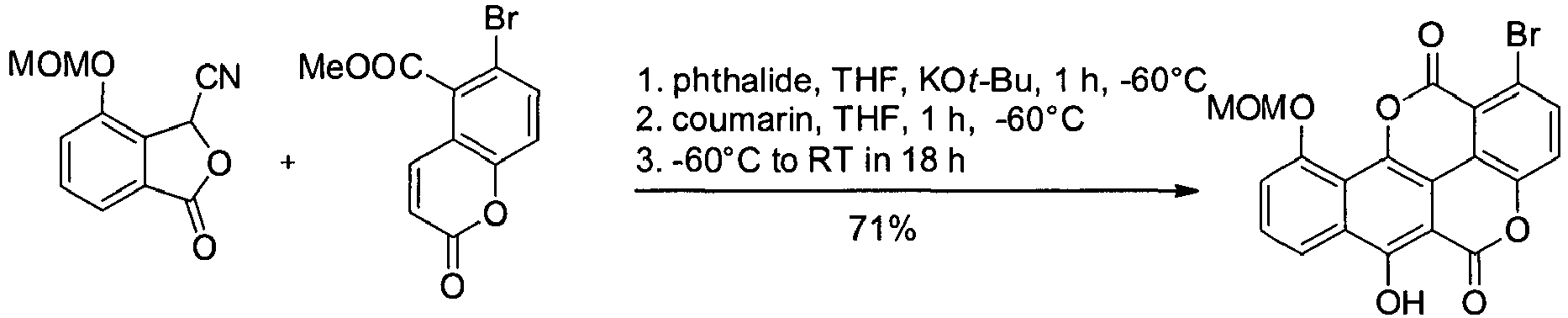
- This compound was prepared as a yellow solid in (71)% yield by the reaction between (6) and (9) according to the general procedure for annulation as described.
- Rf
-
silicagel 60; chloroform/methanol 95:5 = 0.93 - mp.
- 290.4°C
- 1H NMR
- (600 MHz; CD2Cl2): see Table 3.
- 13C NMR
- (150 MHz; CD2Cl2): see Table 4.
- IR
- (ATR): ṽ(%T)=3095 (w), 3008 (w), 2827 (w), 1739 (s), 1691 (s), 1633 (w), 1605 (m), 1588 (m), 1497 (m), 1463 (m), 1441 (m), 1395 (m), 1370 (s), 1342 (m), 1322 (m), 1310 (m), 1276 (m), 1252 (m), 1237 (s), 1211 (m), 1160 (s), 1140 (s), 1111 (m), 1091 (s), 1066 (s), 1010 (s), 924 (s), 873 (m), 836 (m), 816 (m), 788 (m), 774 (s), 720 (m), 702 (m), 685 (m), 677 (w), 660 (m) cm-1.
- HRMS
- (ESI-) for C20H10O7 79Br [M-H]- 440.9615; found. 440.9620 amu.
-

- This compound was prepared as a yellow solid in (66)% yield by the reaction between (6) and (8) according to the general procedure for annulation as described.
- Rf
-
silicagel 60; chloroform/methanol 95:5 = 0.91 - mp.
- 273.1°C
- 1H NMR
- (500 MHz; CD2Cl2): see Table 3.
- 13C NMR
- (125 MHz; CD2Cl2): see Table 4.
- IR
- (ATR): ṽ (%T)= 3078 (w), 2928 (w), 1727 (s), 1635 (w), 1588 (m), 1474 (w), 1397 (m), 1345 (m), 1255 (s), 1209 (m), 1143 (s), 1103 (m), 1065 (s), 933 (s), 832 (m), 794 (m), 724 (m), 661 (m), 2970 (w), 2831 (w), 1683 (m), 1609 (m), 1502 (m), 1448 (m), 1371 (s), 1316 (m), 1236 (s), 1155 (s), 1124 (m), 1083 (m), 1017 (s), 875 (m), 813 (m), 775 (s), 687 (w) cm-1.
- ESI-MS
- (ESI-) : m/z = 377 (100) [M-H]-.
- HRMS
- (ESI-) for C21H13O7 [M-H]- 377.0667; found. 377.0666 amu.
-

- This compound was prepared as a yellow solid in (99)% yield by the reaction of (11) according to the general procedure for MOM-deprotection as described.
- Rf
-
silicagel 60; chloroform/methanol 95:5 = 0.91 - mp.
- 306.5°C
- 1H NMR
- (500 MHz; pyridine-D5): see Table 1.
- 13C NMR
- (125 MHz; pyridine-D5): see Table 2.
- IR
- (ATR): ṽ(%T)=3055 (w), 2929 (w), 1688 (s), 1607 (m), 1534 (w), 1457 (w), 1392 (m), 1331 (m), 1290 (m), 1236 (m), 1180 (m), 1117 (m), 1036 (m), 971 (w), 943 (w), 882 (w), 815 (m), 722 (m), 687 (m), 3213 (w), 2968 (w), 1740 (w), 1636 (m), 1582 (m), 1505 (m), 1421 (m), 1371 (s), 1316 (m), 1254 (m), 1219 (s), 1149 (m), 1072 (m), 985 (m), 961 (m), 890 (w), 841 (m), 776 (s), 712 (m), 662 (m) cm-1.
- HRMS
- (ESI-) for C19H9O6 [M-H]- 333.0410; found. 333.0405 amu.
-

- This compound was prepared as a yellow solid in (93)% yield by the reaction of (10) according to the general procedure for MOM-deprotection as described.
- Rf
-
silicagel 60; chloroform/methanol 95:5 = 0.89 - mp.
- 329.9°C
- 1H NMR
- (600 MHz; pyridine-D5): see Table 1.
- 13C NMR
- (150 MHz; pyridine-D5): see Table 2.
- IR
- (ATR) : ṽ (%T)= 3206 (m), 1685 (s), 1617 (m), 1578 (m), 1507 (m), 1462 (w), 1368 (m), 1329 (m), 1264 (m), 1227 (m), 1144 (m), 1090 (s), 1022 (m), 977 (s), 913 (m), 879 (m), 811 (m), 747 (s), 678 (s), 1703 (m), 1634 (w), 1590 (w), 1534 (w), 1474 (m), 1421 (m), 1341 (m), 1288 (m), 1242 (m), 1202 (s), 1119 (s), 1061 (m), 997 (m), 929 (m), 903 (m), 827 (m), 773 (m), 711 (s) cm-1.
- HRMS
- (ESI-) for C18H7O6 [M-H]- 319.0248; found. 319.0255 amu.
-

- This compound was prepared as a yellow solid in qualitative yield by the reaction of (12) according to the general procedure for MOM-deprotection as described.
- Rf
-
silicagel 60; chloroform/methanol 95:5 = 0.91 - mp.
- 302.7°C
- 1H NMR
- (500 MHz; pyridine-D5): see Table 1.
- 13C NMR
- (125 MHz; pyridine-D5): see Table 2.
- IR
- (ATR) : ṽ (%T)= 3243 (m), 3080 (w), 1689 (s), 1605 (s), 1562 (w), 1499 (m), 1423 (m), 1325 (m), 1288 (s), 1220 (s), 1136 (s), 1095 (s), 1002 (w), 966 (m), 895 (m), 846 (m), 816 (m), 773 (s), 682 (s), 3099 (w), 1717 (m), 1632 (w), 1584 (m), 1532 (m), 1456 (m), 1360 (s), 1306 (m), 1252 (m), 1204 (s), 1114 (s), 1072 (s), 982 (m), 928 (s), 881 (m), 826 (m), 791 (m), 700 (s), 660 (s) cm-1.
- ESI-MS
- (ESI-) : m/z = 397(100) [M-H]-.
- HRMS
- (ESI-) for C18H6O6 79Br [M-H]- 396.9358; found. 396.9358 amu.
-

- 107 mg (267 µmol, 1.0 eq.) 1-bromochartarin (14), 57 mg (1.34 mmol, 5 eq.) lithium chloride and 39 mg (66.83 mmol), dichloro (1,3-bis(diphenylphosphino) propane) palladium were placed in a Schlenk tube, evacuated and flushed with argon for three times. Under argon counter flow 40 mL dried DMF and 390 µL (1.34 mmol, 5 eq.) tri-n-butyl(vinyl)tin were added. The Schlenk tube was equipped with a cooling finger and stirred at 90°C overnight. After cooling to RT 130 mg potassium fluoride were added and the slurry was stirred for 30 min. The solvent was removed and the resulting brownish solid was dissolved in dichloro methane and washed with water. The organic phase was flushed through Celite with 50% potassium fluoride. The Celite® was extracted with methanol. After evaporation 18.5 mg (53 µmol, 20%) 1-vinylchartarin(15) were yielded as a yellow solid. (Note: the yield is much higher, but the separation from tin organic residues limits the yield drastically)
- Rf
-
silicagel 60; chloroform/methanol 95:5 = 0.93 - 1H NMR
- (300 MHz; pyridine-D5): see Table 1.
- 13C NMR
- (75 MHz; pyridine-D5): see Table 2.
- ESI-MS
- (ESI-) : m/z = 345 (100) [M-H]-.
- HRMS
- (ESI-) for C20H9O6 [M-H]- 345.0405; found. 345.0412.
-

- This compound was isolated as a yellow solid by fermentation of (13) according to the general procedure for fermentation and isolation as described.
- Rf
-
silicagel 60; chloroform/methanol 95:5 = 0.07 - 1H NMR
- (600 MHz; pyridine-D5): see Table 5.
- 13C NMR
- (150 MHz; pyridine-D5): see Table 6.
- ESI-MS
- (ESI-): see Table 7.
- ESI-MS2
- (ESI-): see Table 7.
- HRMS
- (ESI-) for C31H29O14 [M-H]- 625.1563; found. 625.1556 amu.
-

- This compound was isolated as a yellow solid by fermentation of (1b) according to the general procedure for fermentation and isolation as described.
- Rf
-
silicagel 60; chloroform/methanol 95:5 = 0.53 - 1H NMR
- (600 MHz; pyridine-D5): see Table 5.
- 13C NMR
- (150 MHz; pyridine-D5): see Table 6.
- ESI-MS
- (ESI-): see Table 7.
- ESI-MS2
- (ESI-): see Table 7.
- HRMS
- (ESI-) for C32H31Ox4 [M-H]- 639.1719; found. 639.1732 amu.
-

- Rf
-
silicagel 60; chloroform/methanol 95:5 = 0.64 - 1H NMR
- (500 MHz; DMSO-D6): see Table 5.
- 13C NMR
- (125 MHz; DMSO-D6): see Table 6.
- ESI-MS
- (ESI-): see Table 7.
- ESI-MS
- (ESI+): m/z = 677 [M+Na]+
- ESI-MS2
- (ESI-): see Table 7.
- HRMS
- (ESI+) : 677.1864 [M+Na]+ (calcd. for C33H34O14Na 677.1846).
-

- This compound was isolated as a yellow solid by fermentation of (15) according to the general procedure for fermentation and isolation as described.
- Rf
-
silicagel 60; chloroform/methanol 95:5 = 0.53 - 1H NMR
- (500 MHz; pyridine-D5): see Table 5.
- 13C NMR
- (125 MHz; pyridine-D5): see Table 6.
- ESI-MS
- (ESI-): see Table 7.
- ESI-MS2
- (ESI-): see Table 7.
- HRMS
- (ESI-) for C33H31O14 [M-H]- 651.1719; found. 651.1723 .
-

- This compound was isolated as a yellow solid by fermentation of (14) according to the general procedure for fermentation and isolation as described.
- Rf
-
silicagel 60; chloroform/methanol 95:5 = 0.36 - 1H NMR
- (600 MHz; pyridine-D5): see Table 5.
- 13C NMR
- (150 MHz; pyridine-D5): see Table 6.
- ESI-MS
- (ESI-): see Table 7.
- ESI-MS2
- (ESI-): see Table 7.
- HRMS
- (ESI-) for C31H28O14 79Br [M-H]- 703.0668; found. 703.0685 amu.
-

- Methyl 3-hydroxybenzoate (40 g, 263 mmol, 1 eq.) was placed in a round bottom flask and dissolved in tetrachloromethane (600 mL). Then bromine (13.5 mL, 263 mmol, 1 eq.) was added and the solution was stirred for 5 h at 60°C. The resulting solution was concentrated and recrystallized from diisopropylether to yielding the title compound as white crystalline solid (24.74 g, 150 mmol, 57%).
- Rf
-
Silica gel 60; dichloromethane: 0.19. - mp.
- 96-98°C.
- 1H NMR
- (300 MHz; CDCl3): δ==7.46 [d; 1H; 3JH-H= 8.7 Hz; CH-3]; 7.28 [d; 1H; 4JH-H= 3,1 Hz; CH-6]; 6.83 dd; 1H; 3JH-H= 8.7 Hz; 4JH-H= 3.1 Hz; CH-4]; 5.77 [s; 1H; OH]; 3.91 [s; 3H; OCH 3] ppm.
- 13C NMR
- (75 MHz; CDCl3): δ = 166.9 (C=O); 154.9 (Ar-C-5); 135.3 (Ar-CH-3); 132.6 (Ar-C-1); 120.3 (Ar-CH-4); 118.3 (Ar-CH-6); 111.7 (Ar-C-2); 52.7 (OCH3) ppm.
- EI-MS
- (EI+, 70 eV) : m/z =230/232 (61), 199/201 (100), 171/173 (15), 143/145 (11), 110 (7), 63 (14).
- HRMS
- (ESI+) for C8H7O3Na [M+Na]+: 252.9471, found. 252.9447.
-

- Methyl 2-bromo-5-hydroxybenzoate (28) (5 g, 21,6 mM, 1 eq.) and hexamethylenetetraamine (4.55 g, 32.5 mM, 1.5 eq.) were placed in a 50 mL MLS® fused quartz microwave vial and treated with trifluoroacetic acid (32 mL). The following microwave parameters were set:
step time / min T/°C Maximum Power / W 1 2 70 100 2 3 80 100 3 5 120 100 4 1 120 100 - After cooling (15 min) the resulting brownish liquid was poured into water and neutralized with sodium bicarbonate. The aqueous phase was extracted trice with ethyl acetate. The crude extract was dried over sodium sulfate, concentrated and suspected to column chromatography with a gradient from chloroform to chloroform/methanol 98:2. The fractions containing the product mixture were recrystallized from hot cyclohexane to yield pure Methyl 6-bromo-2-formyl-3-hydroxybenzoate (29)(1.64 g, 6.33 mmol, 29.3%). A further separation of the mother liquor containing both isomers was carried out for analytical purposes with preparative HLPC using a
phenomenex Luna C18 10 µm 250 × 21.2 mm at 21 mL/min with a gradient from 20 to 83% acetonitrile/water in 30 min. -
- Rf
-
Silica gel 60;chloroform/methanol 95/5: 0.91. - mp.
- 75.6°C
- 1H NMR
- (300 MHz; CDCl3): δ = 11.52 [s, 1H, OH], 9.82 [s, 1H, CHO], 7.63 [d, 1H, 3JH-H= 9.0 Hz, CH-5], 6.94 [d, 1H, 3JH-H = 9.0 Hz, CH-4], 3.99 [s, 3H, OCH 3] ppm.
- 13C NMR
- (75 MHz; CDCl3): δ=194.0 (CHO), 165.9 (COOCH3), 161.3 (Ar-COH), 140.6 (Ar-CH-5), 138.6 (ArC-COOCH3), 121.2 (Ar-CH-4), 118.0 (Ar-CCHO), 108.9 (Ar-CBr), 53.3 (OCH3) ppm.
- IR
- (ATR): ṽ (Trel) = 3075 (w), 2955 (w), 2925 (w), 2846 (w), 1712 (s), 1654 (s), 1441 (s), 1330 (s), 1306 (s), 1279 (s), 1257 (s), 1197 (m), 1173 (s), 1160 (s), 1118 (s), 1011 (s), 928 (s), 828 (s), 799 (s), 752 (s), 742 (s), 707 (s), 653 (s) cm-1.
- EI-MS
- (EI+, 70 eV) : m/z = 258/260 (48), 243/245 (36), 230/232 (65), 199/201 (100), 171/173 (20), 170/172 (20), 143/145 (15), 63 (44).
- HRMS
- (ESI-) calc. for C9H6 79BrO4 [M+H]+: 256.9455, found. 256.9457.
-
- Rf
-
Silica gel 60;chloroform/methanol 95/5: 0.91. - mp.
- 72.3°C
- 1H NMR
- (300 MHz; CDCl3): δ = 10.75 [s, 1H, OH], 9.85 [s, 1H CHO], 7.77 [s, 1H, CH-3], 7.27 [s, 1H, CH-6], 3.91 [s, 3H, OCH 3] ppm.
- 13C NMR
- (75 MHz; CDCl3): δ=195.2 (CHO), 165.5 (COOCH3), 159.8 (Ar-COH), 139.5 (Ar-CCOOCH3), 138.0 (Ar-CH-3), 122.6 (Ar-CCHO), 120.4 (Ar-CH-6), 109.5 (Ar-CBr), 52.9 (COOCH3).
- IR
- (ATR): ṽ(Trel)=3197 (w), 2952 (w), 2879 (w), 1733 (s), 1666 (s), 1554 (m), 1473 (m), 1433 (m), 1297 (s), 1278 (s), 1213 (s), 1172 (s), 1115 (s), 1003 (s), 888 (s), 820 (s), 760 (s), 717 (s), 655 (s) cm-1.
- EI-MS
- (EI+, 70 eV) : m/z = 258/260 (94), 227/229 (100), 199/201 (19), 171/173 (8), 143/145 (19), 63 (29).
- HRMS
- (ESI-) calc. for C9H6 79BrO4 [M+H]+: 256.9455, found. 256.9457.
-

- Methyl 6-bromo-2-formyl-3-hydroxybenzoate (30b) (800 mg, 3.09 mmol, 1.0 eq.) and (Triphenylphosphoranylidene)ketene (1.03 g, 3.4 mmol, 1.1 eq.) were placed in a Schlenk tube, flushed with argon three times and dissolved in THF (32 mL). The mixture was heated while refluxing for 2 h, cooled to rt, and concentrated under reduced pressure. The resulting solid was suspected to column chromatography with a gradient from cyclohexane to cyclohexane/ethyl acetate 4:1 yielding the title compound as pale yellow solid (633 mg, 2.24 mmol, 72%).
-

- Rf
-
silica gel 60; chloroform/methanol 95:5 = 0.87. - mp.
- 74.1°C.
- 1H NMR
- (300 MHz; CHCl3): δ=8.75 (dd, 1H, 4JH-H 1=2.0 Hz, 4JH-H 2=1.4 Hz, CH-6); 8.51 (dd, 1H, 4JH-H 1=4JH-H 2 = 2.0 Hz, Ar-CH-4); 8.45 (dd, 1H, 4JH-H 1= 1.7 Hz, 4JH-H 2 = 1.5 Hz, Ar-CH-2); 3.96 (s, 3H, OCH 3) ppm.
- 13C NMR
- (75 MHz; CHCl3): δ=163.7 (COOMe), 148.7 (Ar-C-NO2), 138.2 (Ar-CH-2), 133.2 (Ar-CCOOMe), 130.4 (Ar-CH-4), 123.1 (Ar-CH-6), 123.0 (Ar-C-Br), 53.1 (OCH3) ppm.
- IR
- (ATR) : ṽ(Trel)= 3096 (w), 3082 (m), 2955 (w), 2917 (w), 2870 (w), 2847 (w), 1725 (s), 1607 (w), 1527 (m), 1446 (m), 1434 (m), 1420 (m), 1345 (s), 1284 (s), 1243 (m), 1197 (m), 1146 (m), 1087 (m), 980 (m), 919 (m), 902 (s), 842 (m), 770 (m), 733 (s), 726 (s), 653 (m) cm-1.
- EI-MS
- (EI+, 70 eV): m/z = 259/261 (65) [M]˙+, 228/230 (100), 213/215 (8), 182/184 (22), 172/172 (6), 154/156 (6), 75 (31), 74 (30).
- HRMS
- (ESI+) calc. for C8H6N79BrO4 [M+H]+: 258.9486, found 258.9480 amu.
-

- Rf
-
silica gel 60; chloroform/methanol 95:5 = 0.56. - mp.
- 190.8°C.
- 1H NMR
- (300 MHz; CDCl3): δ = 8.14 (s, 1H, NH 2), 7.57 (dd, 1H, 4JH-H1 = 4JH-H 2 =1.6 Hz, Ar-CH-2), 7.54 (dd, 1H, 4JH-H1 = 4JH-H2 = 1.7 Hz, Ar-CH-6), 7,42 (dd, 1H, 4
J H-H 1=4JH-H2=1.7 Hz, Ar-CH-4), 3.84 (s, 3H, COOCH 3) ppm. - 13C NMR
- (75 MHz; CDCl3): δ=164.8 (Ar-COOMe), 143.0 (Ar-C-NH2), 132.4 (Ar-C-1), 125.0(Ar-CH-4), 124.3 (Ar-CH-2), 122.1 (Ar-C-Br), 118.1 (Ar-CH-6), 52.6 (OCH3) ppm.
- IR
- (ATR): ṽ(Trel) = 3067 (w), 2952 (w), 2839 (m), 2583 (w), 1730 (s), 1536 (m), 1439 (m), 1428 (m), 1290 (s), 1210 (s), 1113 (m), 976 (m), 914 (w), 881 (m), 830 (m), 766 (s), 731 (m), 662 (m) cm-1.
- EI-MS
- (EI+, 70 eV): m/z = 229/231 (100) [M]•+,198/200 (48), 170/172 (30), 171/173 (35), 143/154 (5), 90/92 (15), 63 (26).
- HRMS
- (ESI-) calc. for C8H9N79BrO2 [M+H]+: 229.9811, found 229.9819 amu.
-

- A solution of concentrated sulfuric acid (30 mL) in water (200 mL) and methyl 3-amino-5-bromobenzoate (52) (17.08 g, 74 mmol, 1 eq.) were cooled with an ice bath to 0 °C. Then a solution sodium nitrite (5.12 g, 74 mmol, 1 eq.) was added drop wise while the solution turned to yellow. After additional 30 min the solution were heated and refluxed for 30 min. After cooling to rt the brownish solution were extracted four times with chloroform. The combined organic phases were dried over sodium sulfate and concentrated under reduced pressure. The crude product was flash purified using a silica gel pad with a gradient from chloroform to chloroform/methanol 95:5. The fraction with the desired product were collected, concentrated a suspected to recrystallization from petroleum ether/toluene to yield a yellow-brownish solid (7.57 g, 33 mmol, 44%). (Note: traces of colored side products cause the reddish brown color of the product, the purity (>95%) of the collected crystals was determined using NMR and GC-MS)
- Rf
-
silica gel 60; chloroform/methanol 95:5 = 0.44. - mp.
- 125°C.
- 1H NMR
- (300 MHz; CDCl3): δ = 7.98 (s, 1H, Ar-OHC), 7.65 (dd, 1H, 4JH-H1 = 4JH-H1 = 1.5 Hz, Ar-CH-2), 7.44 (dd, 1H, 4JH-H1 = 2.3 Hz, 4JH-H2 = 1.4 Hz, Ar-CH-6), 7.20 (dd, 1H, 4JH-H1 = 4JH-H2 = 2.1 Hz, Ar-CH-4), 3.87 (s, 3H, OCH 3), ppm.
- 13C NMR
- (75 MHz; CDCl3): δ = 166.0 (COOMe), 157.5 (Ar-C-OH), 132.5 (Ar-C-1), 124.1 (Ar-CH-2), 123.4 (Ar-CH-4), 122.6 (Ar-C-Br), 115.6 (Ar-CH-6), 52.5 (OCH 3) ppm.
- IR
- (ATR) : ṽ (Trel) = 3411 (m), 3094 (w), 3062 (w), 2955 (w), 1703 (s), 1591 (s), 1480 (m), 1432 (s), 1308 (s), 1279 (s), 1244 (s), 1214 (s), 1114 (m), 1001 (s), 915 (s), 874 (m), 835 (m), 762 (s), 731 (m), 667 (m) cm-1.
- EI-MS
- (EI+, 70 eV): m/z = 230/232 (92) [M]˙+,199/201 (100), 171/173 (24), 143/145 (14), 63 (24).
- HRMS
- (ESI-) calc. for C8H6 79BrO3 [M-H]-: 228.9503, found 228.9498 amu.
-

-
- Rf
-
silica gel 60; chloroform/methanol 95:5 = 0.78. - mp.
- 106.9°C.
- 1H NMR
- (300 MHz; CDCl3): δ =ppm. 12.28 (s, 1H, OH), 10.59 (s, 1H, CHO), 7.60 (d, 1H, 4JH-H = 1.9 Hz, Ar-CH-6), 7.34 (d, 1H, 4JH-H = 1.9 Hz, Ar-CH-4), 3.95 (s, 3H, OCH 3) ppm.
- 13C NMR
- (75 MHz; CDC13): δ = 196.9 (CHO), 165.1 (Ar-COOMe), 163.5 (Ar-C-OH), 134.4 (Ar-CH-1), 130.5 (Ar-C-Br), 125.6 (Ar-CH-6), 125.4 (Ar-CH-4), 117.3 (Ar-C-CHO), 53.1 (COOCH3) ppm.
- IR
- (ATR): ṽ(Trel) = 3091 (w), 3068 (w), 3023 (w), 2964 (w), 1713 (s), 1681 (w), 1637 (s), 1598 (m), 1558 (m), 1470 (m), 1447 (m), 1432 (m), 1416 (w), 1397 (m), 1335 (m), 1296 (s), 1251 (s), 1203 (s), 1172 (s), 1086 (s), 1019 (s), 927 (s), 882 (m), 868 (s), 859 (s), 792 (s), 768 (s), 718 (m), 668 (m) cm-1.
- EI-MS
- (EI+, 70 eV) : m/z = 258/260 (27) [M]˙+, 243/245 (100), 225/227 (28), 199/201 (37), 171/173 (13), 143/145 (10), 63 (33).
- HRMS
- (ESI+) calc. for C9H6 79BrO4 [M+H]+: 256.9455, found 256.9458 amu.
-
- Rf
-
silica gel 60; chloroform/methanol 95:5 = 0.78. - mp.
- 97.6°C.
- 1H NMR
- (300 MHz; CDCl3): δ = 11.88 (s, 1H, OH), 10.36(s, 1H, CHO), 7.76 (d, 1H, 4JH-H = 1.5 Hz, Ar-CH-2), 7.55 (d, 1H, 4JH-H = 1.5 Hz, Ar-CH-6), 3.92 (s, 3H, OCH 3) ppm.
- 13C NMR
- (75 MHz; CDCl3): δ = 197.7 (CHO), 164.4 (COOMe), 163.5 (Ar-C-OH), 137.8 (Ar-C-COOMe), 127.3 (Ar-C-Br), 124.8 (Ar-CH-2), 119.8 (Ar-C-CHO), 119.3 (Ar-CH-6), 52.9 (COO-CH3) ppm.
- IR
- (ATR): ṽ (Trel) = 3091 (w), 2961 (w), 2907 (w), 2849 (w), 1730 (s), 1654 (s), 1556 (s), 1439 (m), 1413 (m), 1387 (s), 1336 (m), 1280 (s), 1247 (s), 1200 (s), 1165 (s), 1092 (s), 1000 (s), 928 (s), 899 (m), 885 (m), 841 (m), 803 (s), 767 (s), 735 (s), 713 (s), 676 (m), 665 (m), 654 (m) cm-1.
- EI-MS
- (EI+, 70 eV) : m/z = 258/260 (100) [M]˙+,257/259 (66), 227/229 (50), 199/201 (16), 143/145 (16), 63 (37).
- HRMS
- (ESI+) calc. for C9H6 79BrO4 [M+H]+: 256.9455, found 256.9458 amu.
-

- Salicylic aldehyde (54) (1.5 g, 5.79 mmol, 1 eq.) and (carbethoxymethylen)-triphenylphosphorane (2.22 g, 6.37 mmol, 1.1 eq.) were placed in a Schlenk tube and flushed with argon three times. Then N,N-diethylaniline (30 mL) was added and the solution were refluxed for 20 min. After cooling the solution was diluted with ethyl acetate and extracted twice with 2N hydrochloric acid. After concentration the crude product was suspected to column chromatography with a gradient from cyclohexane to cyclohexane/ethyl acetate 4:1. The title compound was isolated as pale yellow powder in 89% yield.
- Rf
-
silicagel 60; dichloromethane = 0.67. - mp.
- 157.4-159.2°C.
- 1H NMR
- (300 MHz; CDCl3): see Table 8.
- 13C NMR
- (75 MHz; CDCl3): see Table 9.
- IR
- (ATR) : ṽ (Trel) = 3073 (m), 2958 (w), 2852 (w), 1716 (s), 1579 (s), 1460 (m), 1437 (m), 1398 (m), 1281 (s), 1240 (s), 1190 (s), 1106 (s), 1020 (s), 942 (s), 883 (s), 838 (s), 775 (s), 743 (s), 671 (m) cm-1.
- EI-MS
- (EI+, 70 eV) : m/z = 282/284 (100) [M]˙+,254/256 (87), 223/225 (65), 195/197 (27), 62 (46).
- HRMS
- (ESI+) calc. for C11H7 79BrO4 [M+H]+: 282.9600, found 282.9603 amu.
-

- To a solution of bromocoumarin (56) (308 mg, 1.09 mmol, 1 eq.) and [1,1'-bis(diphenylphosphino)ferrocene]dichloropalladium complex with dichloromethane (88.8 mg, 109 µmol, 0.1 eq.) in THF (15 mL) N,N-dimethylethanolamin (22 µL, 218 µmol, 0.2 eq.) and a dimethyl zinc solution in toluene (1.8 mL, 1.2 mol/L, 2.18 mmol, 2 eq.) was added. The yellow solution was stirred for 1 h. Then additional 1 N,N-dimethylethanolamin (0.2 eq.) and dimethyl zinc solution (2 eq.) were added and the mixture were heated to 60°C. After additional 1 h at 60°C the solution were quenched with a saturated ammonium chloride solution followed by extraction with ethyl acetate for three times. The combined organic phases were dried over sodium sulfate and concentrated in vacuum. The crude product was purified using flash chromatography on silica gel with a gradient from cyclohexane to cyclohexane/ethyl acetate 7:1. The combined fractions yielded 222.4 mg (1.02 mmol, 94%) of the title compound as a pale yellow powder.
- Rf
-
silicagel 60; dichloromethane = 0.59. - mp.
- 144.5 - 144.9°C.
- 1H NMR
- (300 MHz; CDCl3): see Table 8.
- 13C NMR
- (75 MHz; CDCl3): see Table 9.
- IR
- (ATR): ṽ (Trel) = 3415 (m), 3099 (w), 2952 (w), 2854 (w), 1712 (s), 1607 (m), 1551 (m), 1441 (m), 1393 (m), 1304 (s), 1243 (s), 1200 (s), 1134 (m), 1103 (s), 1031 (s), 998 (s), 876 (s), 830 (s), 759 (m), 714 (m)cm-1.
- EI-MS
- (EI+, 70 eV): m/z = 218 (100) [M]˙+,190 (80), 187 (31), 159 (83), 131 (48), 77 (27).
- HRMS
- (ESI+) calc. for C12H11O4 [M+H]+: 219.0652, found 219.0650 amu.
-

- See procedure of methyl 7-methyl-coumarin-5-carboxylate (56). Diethyl zinc was used instead of dimethyl zinc.
- Rf
-
silicagel 60; dichloromethane = 0.70. - mp.
- 119.1-119.7°C.
- 1H NMR
- (300 MHz; CDCl3): see Table 8.
- 13C NMR
- (75 MHz; CDCl3): see Table 9.
- IR
- (ATR): ṽ(Trel) = 3415 (m), 3099 (w), 2952 (w), 2854 (w), 1712 (s), 1441 (m), 1393 (m), 1304 (s), 1243 (s), 1200 (s), 1134 (m), 1103 (s), 1031 (s), 998 (s), 876 (s), 830 (s), 794 (m), 777 (m), 759 (m), 714 (m) cm-1.
- EI-MS
- (EI+, 70 eV) : m/z = 232 (87) [M]˙+, 217 (13), 204 (58), 201 (24), 189 (100), 173 (27), 161 (13), 145 (39), 133 (15), 115 (37), 102 (8), 91 (14), 77 (7), 63 (12).
- HRMS
- (ESI+) calc. for C13H13O4 [M+H]+: 233.0808, found 233.0807 amu.
-

- Bromocoumarin (56) (50 mg, 177 µmol, 1 eq.), and tetrakis(triphenylphosphine)palladium(0) (10.2 mg, 8.8 (µmol, 0.05 eq.) were placed in a Schlenk tube and flushed with argon three times. Then a degassed mixture of water and dioxane (1:1, v/v, 16 mL) was added followed by 45 µL (265 µmol, 1.5 eq.) vinylboronic acid pinacol ester. The mixture was stirred for 2.5 h at 95 °C. After cooling water was added. The solution was extracted trice with ethyl acetate. The combined organic phases were dried over sodium sulfate concentrated and suspected to column chromatography with a gradient from pentane to cyclohexane to cyclohexane/ethyl acetate 9:1. To yield of the title compound as white crystalline solid (29.7 mg, 127 µmol, 72%).
- Rf
-
silicagel 60; chloroform/methanol 95:5 = 0.9. - 1H NMR
- (300 MHz; CDCl3): see Table 8.
- 13C NMR
- (75 MHz; CDCl3): see Table 9.
- EI-MS
- (EI+, 70 eV): m/z = 230 (86) [M]˙+, 202 (70), 199 (23), 171 (92), 159 (23), 143 (42), 131 (27), 115 (100), 89 (33), 63 (26).
- HRMS
- (ESI+) calc. for C13H10O4Na [M+Na]+: 253.0471, found 253.0568 amu.
-

- Bromocoumarin (56) (203 mg, 717 µmol, 1 eq.), copper(I)iodide (13.7 mg, 72 µmol, 0.1 eq.) and tetrakis(triphenylphosphine)palladium(0) (83 mg, 72 µmol, 0.1 eq.) were placed in a Schlenk tube and flushed with argon three times. Then of a degassed mixture of dithylamine and THF (16 mL, 1:1, v/v) was added followed by trimethylsilylacetylene (204 µL, 1.43 mmol, 2 eq.). The mixture was stirred overnight while refluxing. 2- and 4 hours after starting the reaction further 2 eq. of trimethylsilylacetylene were added. After cooling mixture were quenched with 1 N hydrochloric acid. The solution was extracted trice with diethyl ether. The combined organic phases were dried over sodium sulfate concentrated and suspected to column chromatography with a gradient from pentane to cyclohexane to cyclohexane/ethyl acetate 9:1. To yield the title compound as white crystalline solid (179 mg, 596 µmol, 83%).
- Rf
-
silicagel 60; chloroform/methanol 95:5 = 0.5. - mp.
- 116.5-117.3°C.
- 1H NMR
- (300 MHz; CDCl3): see Table 8.
- 13C NMR
- (75 MHz; CDCl3): see Table 9.
- IR
- (ATR): ṽ(Trel) = 3072 (w), 2957 (w), 2899 (w), 1739 (s), 1599 (m), 1329 (m), 1306 (m), 1241 (m), 1200 (m), 1138 (m), 1110 (m), 1029 (m), 997 (m), 847 (s), 759 (m), 703 (m) cm-1.
- EI-MS
- (EI+, 70 eV) : m/z = 300 (33) [M]•+, 285 (100), 197 (14), 155 (5).
- HRMS
- (ESI+) calc. for C16H17O4Si [M+H]+: 301.0891, found 301.0889 amu.
-

- This compound was prepared as a yellow solid in 92% yield by the reaction between (22) and (56) according to the general procedure for annulation as described.
- Rf
-
silicagel 60; chloroform/methanol 95:5 = 0.95. - mp.
- 228°C→ brown.
- 1H NMR
- (600 MHz; CD2Cl2): see Table 10.
- 13C NMR
- (150 MHz; CD2Cl2): see Table 11.
- IR
- (ATR): ṽ (%T)= 3182 (w), 3081 (w), 2923 (w), 2851 (w), 1739 (s), 1709 (s), 1604 (m), 1582 (m), 1500 (m), 1455 (m), 1374 (m), 1317 (s), 1284 (s), 1210 (s), 1100 (s), 1071 (s), 1008 (s), 919 (s), 876 (m), 771 (s), 714 (s), 659 (m) cm-1.
- EI-MS
- (EI+, 70 eV) : m/z = 444/442 (39) [M]•+, 414/412 (100), 398/400 (37), 397/399 (43), 369/371 (47), 348 (48), 334 (41).
- HRMS
- (ESI-) calc. for C20H10 79BrO7 [M-H]-: 440.9615, found 440.9613 amu.
-

- This compound was prepared as a yellow solid in 84% yield by the reaction between (22) and (57) according to the general procedure for annulation as described.
- Rf
-
silicagel 60; chloroform/methanol 95:5 = 0.95. - mp.
- 246.2°C.
- 1H NMR
- (600 MHz; CD2Cl2): see Table 10.
- 13C NMR
- (150 MHz; CD2Cl2): see Table 11.
- IR
- (ATR): ṽ (%T)= 3229 (w), 2979 (w), 2843 (w), 1723 (s), 1621 (m), 1502 (s), 1449 (m), 1399 (s), 1371 (s), 1334 (m), 1279 (m), 1210 (s), 1153 (s), 1092 (s), 1078 (s), 1011 (s), 922 (s), 869 (m), 767 (s), 737 (m) cm-1.
- EI-MS
- (EI+, 70 eV): m/z = 378 (6) [M]•+,348 (11), 334 (21), 320 (100), 292 (25), 236 (27).
- HRMS
- (ESI-) calc. for C21H13O7 [M-H]-: 377.0667, found 377.0664 amu.
-

- This compound was prepared as a yellow solid in 60% yield by the reaction between (22) and (58) according to the general procedure for annulation as described.
- Rf
-
silicagel 60; chloroform/methanol 95:5 = 0.95. - mp.
- 213.6-214.5°C.
- 1H NMR
- (600 MHz; CD2Cl2): see Table 10.
- 13C NMR
- (150 MHz; CD2Cl2): see Table 11.
- IR
- (ATR): ṽ (%T)= 3229 (w), 3056 (w), 2969 (w), 2837 (w), 1706 (s), 1610 (m), 1507 (s), 1436 (s), 1372 (m), 1277 (m), 1209 (s), 1151 (s), 1090 (s), 1013 (s), 919 (s), 876 (m), 766 (s), 737 (m) cm-1,
- EI-MS
- (EI+, 70 eV): m/z = 392 (8) [M]•+, 362 (14), 334 (100), 320 (89), 306 (27).
- HRMS
- (ESI-) calc. for C22H15O7 [M-H]-: 391.0823, found 391.0827 amu.
-

- This compound was prepared as a yellow solid in 84% yield by the reaction between (22) and (60) according to the general procedure for annulation as described.
- Rf
-
silicagel 60; chloroform/methanol 95:5 = 0.95. - mp.
- 212-214°C.
- 1H NMR
- (600 MHz; CD2Cl2): see Table 10.
- 13C NMR
- (150 MHz; CD2Cl2): see Table 11.
- IR
- (ATR): ṽ(%T)= 3241 (w), 2953 (w), 2839 (w), 2160 (w), 1709 (s), 1608 (m), 1507 (s), 1427 (s), 1372 (m), 1317 (m), 1241 (m), 1209 (m), 1145 (m), 1095 (s), 1011 (s), 889 (m), 847 (s), 765 (s) cm-1.
- EI-MS
- (EI+, 70 eV) : m/z = 460 (10) [M]•+, 430 (14), 348 (72), 334 (31), 333 (31), 305 (24), 305 (23), 176 (100).
- HRMS
- (ESI-) calc. for C25H19O7Si [M-H]-: 459.0906, found 459.0910 amu.
-

- This compound was prepared as a yellow solid in 86% yield by the reaction of (61) according to the general procedure for MOM-deprotection as described.
- Rf
-
silicagel 60; chloroform/methanol 95:5 = 0.89. - mp.
- 350°C→ dark brown.
- 1H NMR
- (600 MHz; CD2Cl2): see Table 12.
- 13C NMR
- (150 MHz; CD2Cl2): see Table 13.
- IR
- (ATR): ṽ(%T)= 3264 (m), 3080 (w), 1703 (s), 1606 (m), 1580 (m), 1507 (m), 1427 (m), 1413 (m), 1368 (s), 1322 (m), 1271 (m), 1220 (s), 1134 (m), 1094 (m), 976 (m), 914 (m), 881 (m), 846 (w), 765 (s), 712 (s) cm-1.
- EI-MS
- (EI+, 70 eV): m/z = 398/400 (100) [M]•+, 370/372 (20), 314/316 (19),207 (17), 179 (18), 150/152 (18).
- HRMS
- (ESI-) calc. for C18H6 79BrO6 [M-H]-: 396.9353, found 396.9365 amu.
-

- This compound was prepared as a yellow solid in 86% yield by the reaction of (62) according to the general procedure for MOM-deprotection as described.
- Rf
-
silicagel 60; chloroform/methanol 95:5 = 0.95. - mp.
- 330°C → brown; 339°C → dark brown; 346-367°C → melting.
- 1H NMR
- (600 MHz; CD2Cl2): see Table 12.
- 13C NMR
- (150 MHz; CD2Cl2): see Table 13.
- IR
- (ATR): ṽ(%T)= 3246 (w), 3066 (w), 2915 (w), 1691 (s), 1626 (m), 1519 (m), 1453 (m), 1413 (m), 1371 (s), 1335 (s), 1276 (s), 1227 (s), 1121 (m), 1056 (m), 1029 (m), 980 (m), 945 (m), 884 (m), 768 (s), 714 (s) cm-1.
- EI-MS
- (EI+, 70 eV): m/z = 334 (100) [M]•+, 306 (20), 278 (9), 250 (16), 165 (13).
- HRMS
- (ESI-) calc. for C19H9O6 [M-H]-: 333.0412, found 333.0405 amu.
-

- This compound was prepared as a yellow solid in 96% yield by the reaction of (63) according to the general procedure for MOM-deprotection as described.
- Rf
-
silicagel 60; chloroform/methanol 95:5 = 0.95. - mp.
- 306°C.
- 1H NMR
- (600 MHz; CD2Cl2): see Table 12.
- 13C NMR
- (150 MHz; CD2Cl2): see Table 13.
- IR
- (ATR): ṽ(%T)= 3238 (m), 2968 (w), 2933 (w), 2879 (w), 1692 (s), 1618 (m), 1522 (m), 1453 (m), 1415 (m), 1373 (s), 1330 (s), 1283 (s), 1225 (s), 1135 (s), 1063 (m), 979 (m), 925 (m), 885 (m), 766 (s), 719 (s) cm-1.
- EI-MS
- (EI+, 70 eV): m/z = 348 (100) [M]•+, 333 (38), 320 (8), 305 (17), 249 (11), 221 (6), 165 (7).
- HRMS
- (ESI-) calc. for C20H11O7 [M-H]-: 347.0561, found 347.0571 amu.
-

- To a solution of (65) (131 mg, 283 µmol, 1 eq.) in dichloromethane (150 mL) a solution of caesium carbonate in methanol (30 mL, 10 mg/mL, 851 µmol, 3 eq.) was added. After 2 hours hydrochloric acid (100 mL, 1 N) was added. The organic phase was separated and the aqueous phase was further extracted twice with dichloro methane (100 mL) each. The combined organic phases were dried over sodium sulfate. TLC with chloroform indicates a spot at Rf = 0.42 whereas the educt shows a Rf value of 0.58. Also LC-MS analysis indicates the absence of the TMS-group ([M-H]-=387.0501 calc. for C22H11O7 [M-H]-: 387.0501 amu). The compound was used without further purification for cleavage of the MOM-group according to the general procedure for MOM-deprotection as described. The title compound was prepared as a yellow solid in 91% yield over both steps.
- Rf
-
silicagel 60; chloroform/methanol 95:5 = 0.91. - mp.
- 240°C → orange; 277°C → brown; .397°C → black.
- 1H NMR
- (600 MHz; CD2Cl2): see Table 12.
- 13C NMR
- (150 MHz; CD2Cl2): see Table 13.
- IR
- (ATR) : ṽ (%T)= 3513 (w), 3270 (m), 3089 (w), 2962 (w), 1749 (s), 1698 (s), 1617 (m), 1579 (m), 1514 (s), 1453 (m), 1411 (m), 1353 (s), 1317 (s), 1251 (s), 1200 (s), 1133 (s), 1095 (s), 1048 (s), 975 (m), 931 (m), 896 (m), 815 (m), 770 (s), 716 (s) cm-1.
- EI-MS
- (EI+, 70 eV) : m/z = 344 (100) [M]•+, 316 (17), 288 (7), 260 (19), 232 (9), 204 (5), 176(11).
- HRMS
- (ESI-) for C20H7O6 [M-H]-: 343.0248, found. 343.0240 amu.
-

- This compound was isolated as a yellow solid by fermentation of (67) according to the general procedure for fermentation and isolation as described.
- Rf
-
silicagel 60; chloroform/methanol 95:5 = 0.74. - 1H NMR
- (600 MHz; pyridine-D5): see Table 14a.
- 13C NMR
- (150 MHz; pyridine-D5): see Table 15a.
- ESI-MS
- (ESI-): see Table 16.
- ESI-MS2
- (ESI-): see Table 16.
- HRMS
- (ESI-) calc. for C32H31O14 [M-H]-: 639.1719, found 639.1737 amu.
-
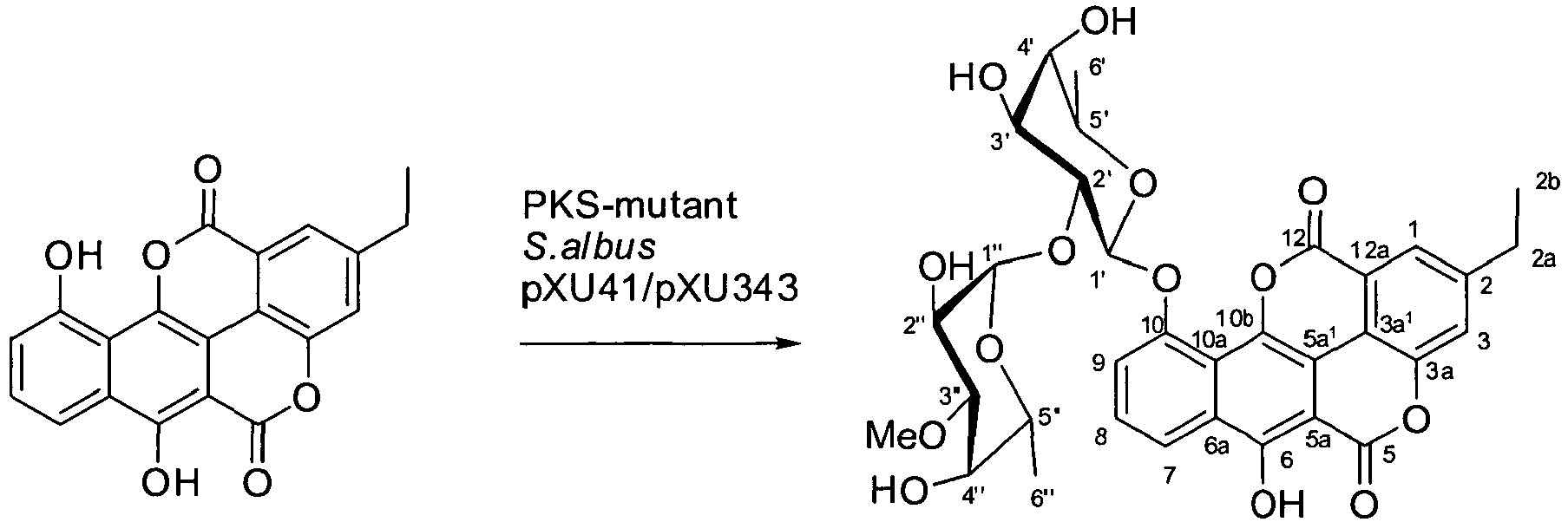
- This compound was isolated as a yellow solid by fermentation of (68) according to the general procedure for fermentation and isolation as described.
- Rf
-
silicagel 60; chloroform/methanol 95:5 = 0.75. - 1H NMR
- (600 MHz; pyridine-D5): see Table 14a.
- 13C NMR
- (150 MHz; pyridine-D5): see Table 15a.
- ESI-MS
- (ESI-): see Table 16.
- ESI-MS2
- (ESI-): see Table 16.
- HRMS
- (ESI-) calc. for C33H33O14 [M-H]-: 653.1876 found 653.1890 amu.
-

- This compound was isolated as a yellow solid by fermentation of (66) according to the general procedure for fermentation and isolation as described.
- Rf
-
silicagel 60; chloroform/methanol 95:5 = 0.70. - 1H NMR
- (600 MHz; pyridine-D5): see Table 14b.
- 13C NMR
- (150 MHz; pyridine-D5): see Table 15b.
- ESI-MS
- (ESI-): see Table 16.
- ESI-MS2
- (ESI-): see Table 16.
- HRMS
- (ESI-) calc. for C31H28 79BrO14 [M-H]-: 703.0668, found 703.0691 amu.
-

- This compound was isolated as a yellow solid by fermentation of (69) according to the general procedure for fermentation and isolation as described.
- Rf
-
silicagel 60; chloroform/methanol 95:5 = 0.66. - 1H NMR
- (600 MHz; pyridine-D5): see Table 14b.
- 13C NMR
- (150 MHz; pyridine-D5): see Table 15b.
- ESI-MS
- (ESI-): see Table 16.
- ESI-MS2
- (ESI-): see Table 16.
- HRMS
- (ESI-) calc. for C33H29O14 [M-H]-:649.1963, found 649.1561 amu.
-

- (1→2)-abeo-alkynylchartreusin (73) (4 mg, 6.15 µmol) was dissolved in 25 mL methanol. The solution was degassed in a temperature controlled ultrasonic bath at 20°C while argon was bubbled through the solution. After 10 min of degassing a suspension of Lindlar catalyst (2 mg, Aldrich) and quinolone (17.2 µL) in methanol (600 µL) was added. Then hydrogen was passed through the suspension while temperature controlled sonication. After 2 h the suspension was passed through a 0.2 µm PTFE filter membrane. HPLC-MS analysis showed total alkinine conversion. Beside to the vinyl product the corresponding ethyl derivative (71) could be detected. The ratio was determined as 8.2:1 (HPLC, λmax = 410 nm, vinyl/ethyl). The final purification was carried out using preparative HPLC yielding 2.3 mg (57%) of the desired vinyl derivative.
- Rf
-
silica gel 60; chloroform/methanol 95:5 = 0.64. - 1H NMR
- (600 MHz; pyridine-D5): see Table 14b.
- 13C NMR
- (150 MHz; pyridine-D5): see Table 15b.
- ESI-MS
- (ESI-): see Table 16.
- ESI-MS2
- (ESI-): see Table 16.
- HRMS
- (ESI-) calc.for C33H31O14 [M-H]-: 651.1719, found. 651.1722 amu.
-

- Methyl 2-bromo-5-hydroxybenzoate (29) (500 mg, 3.29 mM, 1 eq.) and hexamethylenetetraamine (9.21 mg, 65.7 mM, 2 eq.) were placed in a 6 mL Biotage® microwave vial and treated with trifluoroacetic acid (5 mL) and sealed. The slurry was heated for 15 min in an aluminum block at 110 °C. After cooling the resulting yellow liquid was poured into water and neutralized with sodium bicarbonate. The aqueous phase was extracted trice with ethyl acetate. The crude extract was dried over sodium sulfate, concentrated and subjected to column chromatography with a gradient from cyclohexane to cyclhexane/ethyl acetate 7:1. The fractions containing the product yield pure methyl 2-formyl-3,6-dihydroxybenzoate (72) (286 mg, 1.59 mmol, 48%).
- Rf
-
Silica gel 60; chloroform/methanol 95:5 = 0.63. - mp.
- 102.9-103.6°C
- 1H NMR
- (300 MHz; CDCl3): δ = 12.09 (s, 1H, OH-6), 10.56 (s, 1H, OH-3), 10.43 (s, 1H, CHO), 7.15 (d, 1H, 3JH-H = 9.3 Hz, CH-5), 7.08 (d, 1H, 3JH-H = 9.3 Hz,CH-4), 3.97 (s, 3H, OCH 3) ppm.
- 13C NMR
- (75 MHz; CDCl3): δ = 196.8 (CHO), 169.9 (COOMe), 157.7 (C-3-OH), 156.0 (C-6-OH), 128.2 (CH-5), 126.6 (CH-4), 116.2 (C-2*), 109.8 (C-1), 53.1 (OCH3) ppm.
- IR
- (ATR): ṽ(Trel) = 3083 (w), 3029 (w), 2958 (w), 2923 (w), 2852 (w), 1666 (m), 1637 (s), 1587 (m), 1443 (s), 1400 (m), 1329 (s), 1280 (s), 1194 (s), 1163 (s), 1132 (s), 1025 (m), 931 (s), 844 (s), 802 (s), 748 (s), 709 (s) cm-1.
- EI-MS
- (EI+, 70 eV): m/z =196 (78), 181 (17), 164 (73), 150 (17), 136 (100), 119 (16), 108 (97), 79 (11).
- HRMS
- (ESI+) calc. for C9H7O5 [M+H]+ = 195.0299; found: 195.0295.
-

- Methyl 2-formyl-3,6-dihydroxybenzoate (29) (100 mg, 510 µmol, 1.0 eq.) and carboxymethylphosphorane (195 mg, 561 µmol, 1.1 eq.) were placed in a Schlenk tube, flushed with argon three times and dissolved in N,N-dimethylaniline (1.6 mL). The mixture was heated while refluxing at a cooling finger for 20 min, cooled to rt, dissolved in ethyl acetate and extracted twice with 2 N hydrochloric acid, sodium bicarbonate solution and dried over sodium sulfate. The resulting solid was subjected to column chromatography with a gradient from cyclohexane to cyclohexane/ethyl acetate 7:1 yielding the title compound as pale yellow solid (93 mg, 422 µmol, 83%).
- Rf
-
Silica gel 60, chloroform/methanol 95:5 = 0.94 - mp.
- 159.3-160.6°C
- 1H NMR
- (300 MHz; CDCl3): δ = see Table 17a.
- 13C NMR
- (75 MHz; CDCl3): δ = see Table 18.
- IR
- (ATR): ṽ (Trel)==3117 (w), 3074 (m), 2950 (m), 2922 (m), 2852 (w), 1811 (w), 1715 (s), 1662 (s), 1563 (m), 1440 (s), 1330 (s), 1184 (s), 1123 (s), 1031 (s), 963 (m), 938 (m), 898 (s), 831 (s), 760 (s) cm-1.
- EI-MS
- (EI+, 70 eV): m/z = 220 (43), 188 (100), 160 (55), 132 (33), 76 (15).
- HRMS
- calc. for (ESI-) for C9H7O5 [M-H]-: 195.0299, found: 195.0295.
-

- Methyl 6-hydroxy-coumarin-5-carboxylate (33) (200 mg, , 0.91 mmol, 1 eq.) and Hünigs base (300 µL, 1.8 mmol, 2 eq.) were dissolved in 5 mL dichloromethan. The mixture was treated with methoxymethyl chloride (114 µL, 1.8 mmol, 2 eq.) and stirred for 2 h. The solution was treated with water (50 mL) and extracted with ethyl acetate (50 mL). The organic phase was extracted with a sodium hydroxide solution (1 mol·L-1) dried with sodium sulfate and concentrated to yield the title product as pale yellow solid (230 mg, 0.87 mmol, 96%).
- Rf
-
Silica gel 60; dichloromethane: 0.18. - mp.
- 126.8-127.2°C
- 1H NMR
- (300 MHz; CDCl3): δ = see Table 17a.
- 13C NMR
- (75 MHz; CDCl3): δ = see Table 18.
- IR
- (ATR): ṽ (Trel) = 3435 (w), 3096 (w), 3053 (w), 3000 (w), 2952 (w), 2916 (w), 2832 (w), 1718 (s), 1603 (m), 1567 (m), 1469 (m), 1422 (m), 1282 (m), 1251 (m), 1210 (s), 1154 (s), 1113 (m), 1091 (m), 1038 (s), 1002 (s), 921 (m), 891 (s), 839 (m), 820 (s), 765 (m), 694 (m), 650 (m), 604 (m) cm-1.
- EI-MS
- (EI+, 70 eV): m/z = 264 (57), 234 (96), 203 (32), 188 (100), 175 (34), 160 (75), 132 (66), 76 (55).
- HRMS
- calc. for (ESI+) for C11H9O5 [M+H]+: 221.0444, found:221.0446.
-
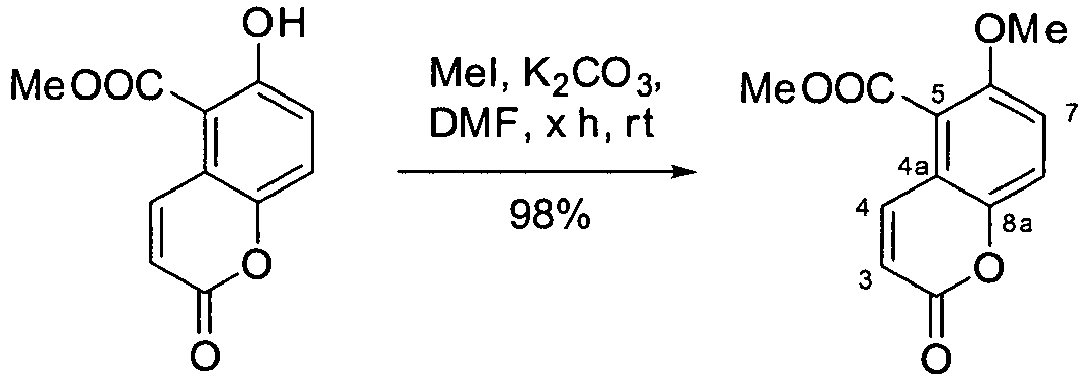
- Methyl 6-hydroxy-coumarin-5-carboxylate (33) (264 mg, 1.20 mmol, 1 eq.) and potassium carbonate (330 mg, 2.4 mmol, 2 eq.) were suspended in 6 mL DMF and cooled to 0 °C in an ice bath. The mixture was treated with methyl iodide and stirred for 2 h while warming up to rt. The solution was treated with water (50 mL) and extracted tree times with ethyl acetate (50 mL each). The organic phase was dried over sodium sulfate and concentrated to yield the title product as pale yellow solid. (274 mg, 1.17 mmol, 98%).
- Rf
-
Silica gel 60, dichloromethane: 0.15. - mp.
- 161.3-161.6°C
- 1H NMR
- (300 MHz; CDCl3): δ = see Table 17a.
- 13C NMR
- (75 MHz; CDCl3): δ = see Table 18.
- IR
- (ATR): ṽ (Trel) = 3097 (w), 3013 (w), 2952 (w), 2917 (w), 2844 (w), 1703 (s), 1569 (m), 1464 (m), 1380 (m), 1283 (s), 1244 (s), 1188 (s), 1118 (s), 1073 (s), 1020 (s), 948 (m), 915 (m), 884 (m), 820 (s), 689 (m), 623 (m) cm-1.
- EI-MS
- (EI+, 70 eV): m/z = 234 (100), 203 (74), 175 (71), 160 (22), 147 (14), 132 (15), 119 (14), 117 (13), 103 (7), 91 (14), 89 (15), 77 (17), 76 (17), 63 (15).
- HRMS
- (ESI+) calc. for C12H11O5 [M+H]+: 235.0601; found 235.0597.
-

- Methyl 6-hydroxy-coumarin-5-carboxylate (33) (1 g, 4.54 mmol, 1 eq.) was placed in a Schlenk tube and flushed with argon three times. Then dichloromethane (60 mL), Hünigs base (2.7 mL, 16.3 mmol, 3.6 eq.) and trifluoromethanesulfonic anhydride (0.92 mL, 5.4 mmol, 1.2 eq.) were added. The solution was stirred for 2h at rt. Then additional trifluoromethanesulfonic anhydride (0.2 mL, 1.5 mmol, 0.3 eq.) was added. The solution was stirred for further 1 h. The solution was extracted with saturated ammonium chloride solution and dried over sodium sulfate. The crude product was filtered through a silica gel pad and recrystallized from methanol/water, yielding the title compound as pale yellow crystals (1.24 g, 3.5 mmol, 78%).
- Rf
-
Silica gel 60; dichloromethane: 0.41. - mp.
- 93.7-94.4 °C
- 1H NMR
- (300 MHz; CDCl3): δ = see Table 17a.
- 13C NMR
- (75 MHz; CDCl3): δ = see Table 18.
- IR
- (ATR): ṽ (Trel) = 3435 (w), 3096 (w), 3000 (w), 2916 (w), 2832 (w), 2073 (w), 1718 (s), 1630 (w), 1567 (m), 1469 (m), 1454 (m), 1376 (w), 1326 (m), 1282 (m), 1210 (s), 1091 (m), 1038 (s), 938 (m), 839 (m), 820 (s), 784 (m), 765 (m), 743 (m), 694 (m), 650 (m), 626 (m), 604 (m) cm-1.
- EI-MS
- (EI+, 70 eV): m/z = 352 (42), 321 (18), 219 (100), 191 (23), 188 (26), 175 (39), 160 (51), 132 (27), 119 (18), 91 (24).
- HRMS
- calc. for (ESI+) for C12H8O7F3S [M+H]+: 352.9937, found: 352.9940.
-

- Methyl 6-(trifluoromethylsulfonyloxy)-coumarin-5-carboxylate (29) (500 mg, 1.42 mmol, 1 eq.), copper(I)iodide (27 mg, 142 µmol 0.1 eq.) and tetrakis(triphenylphosphine)-palladium(0) (164 mg, 142 µmol, 0.1 eq.) were placed into a Schlenk tube and flushed with
argon 3 times. Then 40 mL of a degassed mixture of diethylamine and THF (1:1, v/v) was added followed by trimethylsilylacetylene (401 µL, 2.84 mmol, 2 eq.). The mixture was stirred overnight while refluxing. Two and four hours after starting the reaction further trimethylsilylacetylene (2 eq.) was added. After cooling the mixture was quenched with 1 mol·L-1 hydrochloric acid. The solution was extracted trice with diethyl ether. The combined organic phases were dried over sodium sulfate concentrated and subjected to column chromatography with a gradient from pentane to cyclohexane/ethyl acetate 9:1. The title compound was isolated as a pale yellow solid. (269.7 mg 89.8 µmol, 63%) - Rf
-
Silica gel 60; dichloromethane: 0.25. - mp.
- 122.4-123.7°C
- 1H NMR
- (300 MHz; CDCl3): δ = see Table 17a.
- 13C NMR
- (75 MHz; CDCl3): δ = see Table 18.
- IR
- (ATR): ṽ (Trel) = 2953 (m), 2921 (m), 2851 (w), 2154 (w), 1714 (s), 1568 (m), 1463 (m), 1445 (m), 1325 (m), 1287 (m), 1248 (s), 1183 (m), 1108 (m), 1030 (m), 978 (m), 927 (m), 843 (s), 759 (s), 710 (m), 648 (m) cm-1.
- EI-MS
- (EI+, 70 eV): m/z = 300 (23), 285 (26), 255 (100), 227 (22).
- HRMS
- (ESI+) calc. for C16H17O4Si [M+H]+: 301.0902; found: 301.0892 amu.
-

- This compound was prepared in analogy to general protocol using 22 and 34. (yellow solid, 59% yield) This compound was used without further purification or analysis.
- EI-MS
- (EI+, 70 eV): m/z = 424 (71), 394 (52), 380 (30), 364 (20), 350 (100), 348 (74), 335 (53), 321 (27), 307 (47).
- HRMS
- (ESI-) calc. for C22H15O9 [M-H]-: 423.0722, found: 423.0732.
-

- This compound was prepared in analogy to general protocol using 22 and 35. (yellow solid, 70% yield) This compound was used without further purification or analysis.
- HRMS
- (ESI-) calc. for C21H13O8 [M-H]-: 393.0616, found: 393.0627.
-

- This compound was prepared in analogy to general protocol using 22 and 37. (yellow solid, 70% yield)
- mp.
- 223.7-224.9°C
- 1H NMR
- (300 MHz; CDCl3): δ = see Table 20.
- 13C NMR
- (75 MHz; CDCl3): δ = see Table 4.
- IR
- (ATR): ṽ (Trel) = 2957 (w), 1742 (m), 1695 (m), 1594 (w), 1497 (m), 1369 (m), 1234 (s), 1146 (s), 1067 (m), 1004 (s), 924 (m), 841 (s), 766 (s), 674 (m) cm-1.
- EI-MS
- (EI+, 70 eV): m/z = 460 (50), 445 (42), 430 (47), 415 (43), 400 (37), 372 (30), 356 (100).
- HRMS
- (ESI-) calc. for C25H19O7Si [M-H]-: 459.0895; found: 495.0915 amu.
-

- This compound was prepared in analogy to general protocol using 39. (yellow solid, quant. yield) This compound was used without further purification or analysis.
- ESI-MS
- (ESI+): m/z = 336 (100), 308 (12), 280 (15), 252 (15), 224 (8), 196 (6), 168 (9), 139(9).
- HRMS
- (ESI-) calc. for C18H7O7 [M-H]-: 335.0186, found 335.0200.
-

- This compound was prepared in analogy to general protocol using 40. (yellow solid) This compound was used without further purification or analysis.
- HRMS
- (ESI-) calc. for C19H9O7 [M-H]-: 349.0354, found: 349.0360 .
-

- This compound was prepared in analogy to 69 using 41. (yellow solid, 98% yield)
- mp.
- >410°C
- 1H NMR
- (300 MHz; CDCl3): δ = see Table 19.
- 13C NMR
- (75 MHz; CDCl3): δ = see Table 2.
- IR
- (ATR): ṽ (Trel) = 3460 (w), 3249 (m), 1755 (m), 1698 (s), 1584 (m), 1496 (m), 1366 (s), 1293 (m), 1232 (s), 1096 (s), 1051 (s), 946 (m), 840 (m), 771 (s), 731 (m), 672 (s) cm-1.
- EI-MS
- (EI+, 70 eV): m/z = 344 (100), 316 (26), 288 (10), 260 (20), 232 (13), 204 (8), 176(16), 150(9).
- HRMS
- (ESI-) calc. for C20H7O6 [M-H]-: 343.0248; found: 343.0251 amu.
-

- This compound was isolated as a yellow solid by fermentation of 43 according to the general procedure for fermentation and isolation as described.
- Rf
-
Silica gel 60; chloroform/methanol 95:5 = 0.2. - 1H NMR
- (600 MHz; pyridine-D5): see Table 21.
- 13C NMR
- (150 MHz; pyridine-D5): see Table 22.
- ESI-MS
- (ESI-): see Table 7.
- ESI-MS2
- (ESI-): see Table 7.
- HRMS
- (ESI-) for C31H29O15 [M-H]- 641.1512; found: 641.1542.
-

- This compound was isolated as a yellow solid by fermentation of 44 according to the general procedure for fermentation and isolation as described.
- Rf
-
Silica gel 60; chloroform/methanol 95:5 = 0.2. - 1H NMR
- (600 MHz; pyridine-D5): see Table 21.
- 13C NMR
- (150 MHz; pyridine-D5): see Table 22.
- ESI-MS
- (ESI-): see Table 7.
- ESI-MS2
- (ESI-): see Table 7.
- HRMS
- (ESI-) for C32H31O15 [M-H]- 655.1668; found: 655.1691.
-

- This compound was isolated as a yellow solid by fermentation of 45 according to the general procedure for fermentation and isolation as described.
- Rf
-
Silica gel 60; chloroform/methanol 95:5 = 0.07. - 1H NMR
- (600 MHz; pyridine-D5): see Table 21.
- 13C NMR
- (150 MHz; pyridine-D5): see Table 22.
- ESI-MS
- (ESI-): see Table 7.
- ESI-MS2
- (ESI-): see Table 7.
- HRMS
- (ESI-) for C33H29O14 [M-H]- 649.1552; found: 649.1574.
-

- Chartarin (1.0 eq.) 1,4'-bipiperidine-1'-carbonyl chloride (4.0 eq.), N,N-dimethylpyridin-4-amine was placed in a Schlenk tube and flushed with
argon 3 times. Then pyridin was added and the solution was stirred for 2 days at 60 °C. After cooling the solvent was removed and the resulting brownish solid was dissolved in Methanol/THF. The solution was suspected to preparative HPLC using a Phenomenex Kinetix XB-C18 column with a gradient from 10 to 83% acetonitrile in water with 0.1% formic acid. - HRMS
- (ESI+) calc. for C43H47O8N4 [M+H]+: 723.3402, found. 723.3395 amu.
-

-
- HRMS
- (ESI+) ber. für C40H44 79BrO8N4 [M+H]+: 787,2337, gef. 787,2333.
-

- 1-Bromochartarin (1.0 eq.), lithium chloride (5 eq.) and dichloro (1,3-bis(diphenylphosphino) propane) palladium (0.1 eq.) were placed in a Schlenk tube, evacuated and flushed with argon for three times. Under argon counter flow dried DMF and tri-n-butyl(vinyl)tin (5 eq.) were added. The Schlenk tube was equipped with a cooling finger and stirred at 90°C for 3 h. After cooling the solvent was removed and the resulting brownish solid was dissolved in Methanol/THF. The solution was suspected to preparative HPLC using a Phenomenex Kinetix XB-C18 column with a gradient from 10 to 83% acetonitrile in water with 0.1% formic acid. Both compounds were isolated in a ratio 1:4 as H:vinyl.
HRMS (ESI+) calc. for C40H45O8N4 [M+H]+: 709.3232, found. 709.3228 amu.
HRMS (ESI+) calc. for C42H47O8N4 [M+H]+: 735.3388, found. 735.3385 amu. - Determination of growth inhibition and cytotoxicity of HUVEC, K-562 and HeLa Compounds were assayed against human umbilical vein endothelial cells HUVEC (ATCC CRL-1730) and human chronic myeloid leukemia cells K-562 (DSM ACC 10) for their antiproliferative effects (GI50) and against human cervix carcinoma cells HeLa (DSM ACC 57) for their cytotoxic effects (CC50) as previously described (Scherlach, K., Partida-Martinez, L. P., Dahse, H. M. & Hertweck, C. Antimitotic rhizoxin derivatives from a cultured bacterial endosymbiont of the rice pathogenic fungus Rhizopus microsporus. Journal of the American Chemical Society 128, 11529-11536 (2006)).
- The Hs27 foreskin fibroblast cells (ATCC, CRL-1634) were grown in RPMI 1640 (CAMBREX 12-167F) supplemented with 500 µl/1 gentamicin sulfate (Cambrex 17-518Z), 10% heat inactivated fetal bovine serum (PAA A15-104), at 37°C in plastic flasks (NUNC) in a humidified atmosphere containing 5% CO2.
- The adherent cells of Hs27 were harvested at the logarithmic growth phase after soft trypsinization using 0.25% trypsin in PBS containing 0.02% EDTA (Biochrom KG L2163).
- Hs27 cells were seeded with 1×10⁴ cells per 0.1 mL per well of the 96-well microplates (NUNC 167008). Then, the plates were prepared with dilutions of the compounds.
- The influence of the different dilutions of compounds in the absence or presence of light (distance to the cells: 4 cm) were assayed for 72 hours at 37°C in a humidified atmosphere containing 5% CO2. After incubation time, the effect of compounds in the absence or presence of light were analyzed in compare to negative control.
- For this, the adherent Hs27 cells were fixed by glutaraldehyde (MERCK 1.04239.0250) and stained with a 0.05% solution of methylene blue (SERVA 29198) for 15 min. After gentle washing, the stain was eluted by 0.2 mL of 0.33 N HCl in the wells. The optical densities were measured at 660 nm in a microplate reader (Tecan "Sunrise", Austria). Under the experimental conditions, the signals from the methylene blue are proportional to the number of viable cells.
- Determination of growth inhibition of HT-29 and MEL-HO in the presence or absence of light The human HT-29 colon adenocarcinoma cells (ACC 299) and the human MEL-HO (ACC 62) melanoma cells were grown as previously described (Ueberschaar, N.; Dahse, H.-M.; Bretschneider, T.; Hertweck, C. Angew. Chem. Int. Ed. 2013, 52, 6185-6189).
- Whereas the antiproliferative effect of chartreusin, (1→2)abeo vinylchartreusin, (1→2)abeo-ethynylchartreusin, and vinylchartreusin against colon adenocarcinoma cell line HT-29 is rather low in the absence of light (7.0 - 9.4 µM), incubation in the presence of the blue LED substantially increased the activity of (1→2) abeo vinylchartreusin (GI50 3.1 µM vs. 9.4 µM) and vinylchartreusin (GI50 0.6 µM vs. 7.1 µM). Similarly, the activity of (1→2)abeo ethynylchartreusin was 5-fold higher in the presence of light (GI50 1.7 µM vs. GI50 8.6 µM):
Compound without light with light GI50 [µM] GI50 [µM] chartreusin 7.96 7.65 vinylchartreusin 7.05 0.61 (1→2) abeo-vinylchartreusin 9.35 3.06 (1→2) abeo-etynylchartreusin 8.61 1.69 - 500 µL of herring sperm DNA (5 mg/mL in PBS-buffer, pH 7.5) were threaded with 20 µL (1 mg/mL in DMSO) substrate. The solution was stirred for 1 h at RT and then irradiated for 3 min with a laser (λ = 405 nm, P = 20 mW). Then 500 µL 6N hydrochloric acid were added and the solution was heated in a closed HPLC vial for 4 min at 100°C. The solution was freeze dried. The residue was dissolved in methanol and suspected to LC-HRMS.
- A 1 mg/mL solution of chartreusin or its analogs in DMSO was diluted to 1 mL with PBS-buffer (pH 7.5) to a final concentration of 50 µmol/L in a fused quartz cuvette. Then a 10 mg/mL herring sperm DNA solution (GC content ≈43%, Mmiddle = 649.66 g/mol) in PBS buffer was added to give the ratios substrate : DNA as 1:0, 1:0.5, 1:1, 1:2, 1:5, 1:10, 1:20, 1:30, 1:50 and 1:100. After each dilution step a UV-VIS spectrum between 300 and 500 nm was recorded.
Claims (14)
- A compound of formula (I)
 R1 is hydrogen or a mono-, di-, tri- or tetra saccharide or a derivative thereof, or a 1,4'-bipiperidine-1'carboxylate group;R2 is a hydrogen atom, or a 1,4'-bipiperidine-1'carboxylate group, or a group of formula -X-(CH2-CH2-O)n-R5 wherein X is a bond, a -C(=O)-, -C(=O)-O- or a-C(=O)-Y-O- group wherein Y is an alkylene group, n is an integer of from 2 to 100, and R5 is hydrogen or an alkyl group;R3 is a hydrogen atom, a halogen atom, a hydroxy group, a (C1-C8) alkoxy group, a (C2-C8) alkyl group, a (C2-C8) haloalkyl group, a (C2-C8) alkenyl group, or a (C2-C8) alkynyl group and R4 is hydrogen; orR3 is hydrogen and R4 is a hydrogen atom, a halogen atom, a hydroxy group, a (C1-C8) alkoxy group, a (C2-C8) alkyl group, a (C2-C8) haloalkyl group, a (C2-C8) alkenyl group, or a (C2-C8) alkynyl group;or a pharmaceutically acceptable salt, solvate or hydrate or a pharmaceutically acceptable formulation thereof;wherein the term derivative relates to acetates, methylethers or acetals.
 - A compound according to claim 1 wherein R1 is hydrogen.
- A compound according to claim 1 wherein R1 is a disaccharide or a derivative thereof or a 1,4'-bipiperidine-1'carboxylate group.
- A compound according to claim 1 wherein R1 is selected from the following groups:


- A compound according to claim 1 wherein R1 is fucose-digitalose or a 1,4'-bipiperidine-1'carboxylate group.
- A compound according to any one of the preceeding claims, wherein R2 is a hydrogen atom or a 1,4'-bipiperidine-1'carboxylate group.
- A compound according to any one of claims 1 to 5, wherein R2 is a group of formula -X-(CH2-CH2-O)n-R5 wherein X is a bond, a -C(=O)-, -C(=O)-O- or a -C(=O)-Y-O-group, wherein Y is a group of formula (CH2)m, wherein m is an integer from 1 to 20, n is an integer of from 2 to 100, and R5 is hydrogen or an alkyl group.
- A compound according to any one of the preceeding claims, wherein R3 is an ethyl or a vinyl group and R4 is a hydrogen atom or wherein R4 is an ethyl or a vinyl group and R3 is a hydrogen atom.
- A compound according to claim 1, selected from the following compounds:
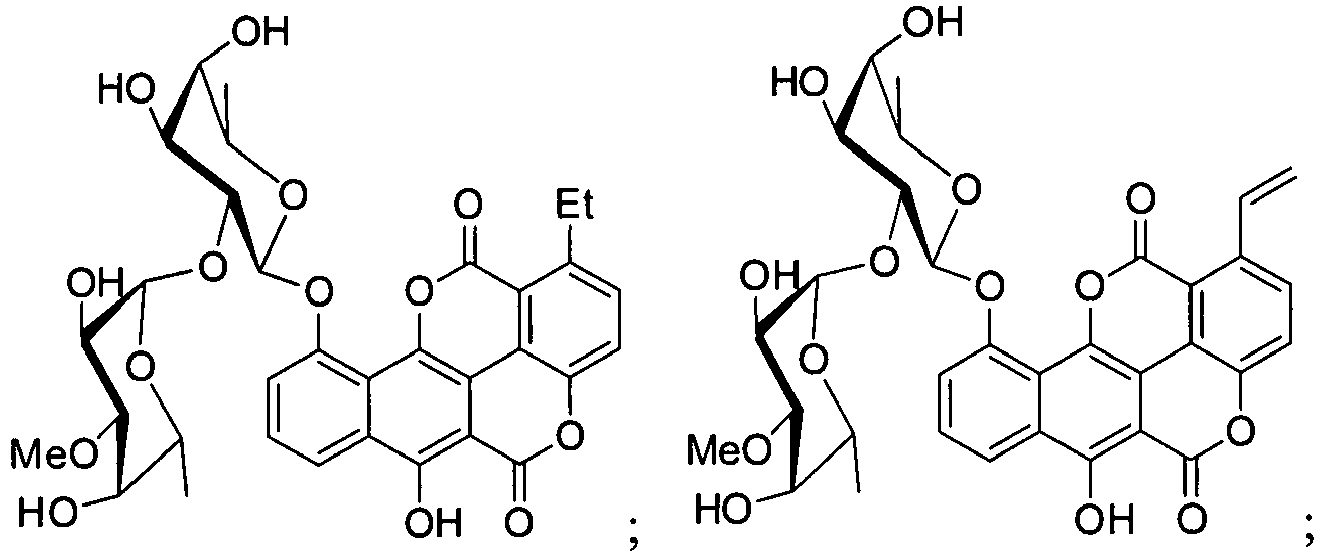

- A compound of formula (II):
 R3 is selected from a hydrogen atom, a halogen atom, a hydroxy group, a (C1-C8) alkoxy group, a (C1-C8) alkyl group, a (C1-C8) haloalkyl group, a (C2-C8) alkenyl group, or a (C2-C8) alkynyl group and R4 is hydrogen; orR3 is hydrogen and R4 is selected from a hydrogen atom, a halogen atom, a hydroxy group, a (C1-C8) alkoxy group, a (C1-C8) alkyl group, a (C1-C8) haloalkyl group, a (C2-C8) alkenyl group, or a (C2-C8) alkynyl group;or a pharmaceutically acceptable salt, solvate or hydrate or a pharmaceutically acceptable formulation thereof.
 - A compound according to claim 10, wherein R3 is a hydrogen atom, a halogen atom, a hydroxy group, a (C1-C8) alkoxy group, a (C2-C8) alkyl group, a (C2-C8) haloalkyl group, a (C2-C8) alkenyl group, or a (C2-C8) alkynyl group and R4 is hydrogen; or wherein R3 is hydrogen and R4 is a hydrogen atom, a halogen atom, a hydroxy group, a (C1-C8) alkoxy group, a (C2-C8) alkyl group, a (C2-C8) haloalkyl group, a (C2-C8) alkenyl group, or a (C2-C8) alkynyl group.
- A compound according to claim 10, wherein R3 is an ethyl or a vinyl group and R4 is a hydrogen atom or wherein R4 is an ethyl or a vinyl group and R3 is a hydrogen atom.
- A pharmaceutical composition comprising a compound according to anyone of the preceding claims or a pharmaceutically acceptable salt, solvate or hydrate thereof, optionally in combination with a pharmaceutically acceptable carrier.
- A compound according to anyone of claims 1 to 12 or pharmaceutical composition according to claim 13 for use in the treatment of cancer, psoriasis or bacterial infections.
Priority Applications (1)
| Application Number | Priority Date | Filing Date | Title |
|---|---|---|---|
| EP13744970.8A EP2880046B1 (en) | 2012-07-30 | 2013-07-30 | Novel chartreusin analogues |
Applications Claiming Priority (3)
| Application Number | Priority Date | Filing Date | Title |
|---|---|---|---|
| EP12005528 | 2012-07-30 | ||
| PCT/EP2013/002257 WO2014019685A1 (en) | 2012-07-30 | 2013-07-30 | Novel chartreusin analogues |
| EP13744970.8A EP2880046B1 (en) | 2012-07-30 | 2013-07-30 | Novel chartreusin analogues |
Publications (2)
| Publication Number | Publication Date |
|---|---|
| EP2880046A1 EP2880046A1 (en) | 2015-06-10 |
| EP2880046B1 true EP2880046B1 (en) | 2016-12-21 |
Family
ID=48915975
Family Applications (1)
| Application Number | Title | Priority Date | Filing Date |
|---|---|---|---|
| EP13744970.8A Not-in-force EP2880046B1 (en) | 2012-07-30 | 2013-07-30 | Novel chartreusin analogues |
Country Status (3)
| Country | Link |
|---|---|
| US (1) | US9522930B2 (en) |
| EP (1) | EP2880046B1 (en) |
| WO (1) | WO2014019685A1 (en) |
Families Citing this family (1)
| Publication number | Priority date | Publication date | Assignee | Title |
|---|---|---|---|---|
| CN111751469B (en) * | 2020-07-06 | 2022-06-14 | 江苏省中医院 | Method for measuring concentration of tebucin in plasma by liquid chromatography tandem mass spectrometry |
Family Cites Families (3)
| Publication number | Priority date | Publication date | Assignee | Title |
|---|---|---|---|---|
| FR2459449A1 (en) | 1979-06-18 | 1981-01-09 | Omnium Realisations Indles Cal | OPTICAL METHOD AND DEVICE FOR DENOMBRETING, LOCATING AND CLASSIFYING THE SIZE OF CIRCULAR-SHAPED OBJECTS BASED ON INTERCORRELATION BY HOLOGRAPHY |
| ATE72447T1 (en) * | 1985-10-23 | 1992-02-15 | Ishihara Sangyo Kaisha | CHARTREUS INDIVIDUALS AND SALTS, ANTITUMOR COMPOSITIONS CONTAINING THEM AND PROCESSES FOR THEIR PREPARATION. |
| ZA923817B (en) | 1991-05-30 | 1993-02-24 | Bristol Myers Squibb Co | Chemical modification of elsamicin a at the 3'and/or 4'oh groups |
-
2013
- 2013-07-30 US US14/418,010 patent/US9522930B2/en not_active Expired - Fee Related
- 2013-07-30 WO PCT/EP2013/002257 patent/WO2014019685A1/en not_active Ceased
- 2013-07-30 EP EP13744970.8A patent/EP2880046B1/en not_active Not-in-force
Non-Patent Citations (1)
| Title |
|---|
| None * |
Also Published As
| Publication number | Publication date |
|---|---|
| EP2880046A1 (en) | 2015-06-10 |
| US20150197539A1 (en) | 2015-07-16 |
| WO2014019685A1 (en) | 2014-02-06 |
| US9522930B2 (en) | 2016-12-20 |
Similar Documents
| Publication | Publication Date | Title |
|---|---|---|
| Remsing et al. | Mithramycin SK, A Novel Antitumor Drug with Improved Therapeutic Index, Mithramycin SA, and Demycarosyl-mithramycin SK: Three New Products Generated in the Mithramycin Producer Streptomyces a rgillaceus through Combinatorial Biosynthesis | |
| Tietze et al. | Duocarmycin-based prodrugs for cancer prodrug monotherapy | |
| Tilvi et al. | New bromotyrosine alkaloids from the marine sponge Psammaplysilla purpurea | |
| Ishibashi et al. | NOVEL ANTIBIOTICS, FURAQUINOCINS C, D, E, F, G AND H | |
| Tang et al. | Feigrisolides A, B, C and D, new lactones with antibacterial activities from Streptomyces griseus | |
| Jin et al. | Synthesis and biological evaluation of new spin-labeled derivatives of podophyllotoxin | |
| Zhou et al. | Antitumor agents. 144. New. gamma.-lactone ring-modified arylamino etoposide analogs as inhibitors of human DNA topoisomerase II | |
| Kim et al. | New anthracycline metabolites produced by the aklavinone 11-hydroxylase gene in Streptomyces galilaeus ATCC 31133 | |
| EP2130831A1 (en) | CDC25 inhibitors | |
| Liu et al. | Microbial transformations of taxadienes and the multi-drug resistant tumor reversal activities of the metabolites | |
| US9522930B2 (en) | Chartreusin analogues | |
| Komatsu et al. | SAR studies of brasilicardin A for immunosuppressive and cytotoxic activities | |
| CN110650954A (en) | anticancer compound | |
| Wang et al. | Synthesis and biological evaluation of Oblongifolin C derivatives as c-Met inhibitors | |
| PANG et al. | Production of 6, 8a-seco-6, 8a-deoxy derivatives of avermectins by a mutant strain of Streptomyces avermitilis | |
| Minagawa et al. | Bisabosquals, novel squalene synthase inhibitors II. Physico-chemical properties and structure elucidation | |
| Reddy et al. | Design, Synthesis, and Biological Testing of 4β‐[(4‐Substituted)‐1, 2, 3‐triazol‐1‐yl] podophyllotoxin Analogues as Antitumor Agents | |
| Zhang et al. | First synthesis and biological evaluation of novel spin-labeled derivatives of deoxypodophyllotoxin | |
| US4303785A (en) | Antitumor anthracycline antibiotics | |
| CN101805383B (en) | Strictosidine lactam derivatives and preparation method and use thereof | |
| ES2355032B1 (en) | DERIVATIVES OF �? AUREOLIC CIDES, ITS PROCEDURE OF OBTAINING AND ITS USES. | |
| Messaoudi et al. | Synthesis and biological activities of 7-aza rebeccamycin analogues bearing the sugar moiety on the nitrogen of the pyridine ring | |
| Siyu-Mao et al. | Two novel ansamitocin analogs from Actinosynnema pretiosum | |
| CN103483354B (en) | One class chromone compounds and preparation method thereof and antitumor with the application in enzyme inhibitor medicine in preparation | |
| Yi et al. | New metabolites from the marine-derived bacterium Pseudomonas sp. ZZ820R |
Legal Events
| Date | Code | Title | Description |
|---|---|---|---|
| PUAI | Public reference made under article 153(3) epc to a published international application that has entered the european phase |
Free format text: ORIGINAL CODE: 0009012 |
|
| 17P | Request for examination filed |
Effective date: 20141222 |
|
| AK | Designated contracting states |
Kind code of ref document: A1 Designated state(s): AL AT BE BG CH CY CZ DE DK EE ES FI FR GB GR HR HU IE IS IT LI LT LU LV MC MK MT NL NO PL PT RO RS SE SI SK SM TR |
|
| AX | Request for extension of the european patent |
Extension state: BA ME |
|
| DAX | Request for extension of the european patent (deleted) | ||
| GRAP | Despatch of communication of intention to grant a patent |
Free format text: ORIGINAL CODE: EPIDOSNIGR1 |
|
| INTG | Intention to grant announced |
Effective date: 20160707 |
|
| STAA | Information on the status of an ep patent application or granted ep patent |
Free format text: STATUS: GRANT OF PATENT IS INTENDED |
|
| GRAS | Grant fee paid |
Free format text: ORIGINAL CODE: EPIDOSNIGR3 |
|
| GRAA | (expected) grant |
Free format text: ORIGINAL CODE: 0009210 |
|
| STAA | Information on the status of an ep patent application or granted ep patent |
Free format text: STATUS: THE PATENT HAS BEEN GRANTED |
|
| AK | Designated contracting states |
Kind code of ref document: B1 Designated state(s): AL AT BE BG CH CY CZ DE DK EE ES FI FR GB GR HR HU IE IS IT LI LT LU LV MC MK MT NL NO PL PT RO RS SE SI SK SM TR |
|
| REG | Reference to a national code |
Ref country code: GB Ref legal event code: FG4D |
|
| REG | Reference to a national code |
Ref country code: CH Ref legal event code: EP |
|
| REG | Reference to a national code |
Ref country code: IE Ref legal event code: FG4D |
|
| REG | Reference to a national code |
Ref country code: AT Ref legal event code: REF Ref document number: 855391 Country of ref document: AT Kind code of ref document: T Effective date: 20170115 |
|
| REG | Reference to a national code |
Ref country code: DE Ref legal event code: R096 Ref document number: 602013015620 Country of ref document: DE |
|
| REG | Reference to a national code |
Ref country code: CH Ref legal event code: NV Representative=s name: E. BLUM AND CO. AG PATENT- UND MARKENANWAELTE , CH |
|
| PG25 | Lapsed in a contracting state [announced via postgrant information from national office to epo] |
Ref country code: LV Free format text: LAPSE BECAUSE OF FAILURE TO SUBMIT A TRANSLATION OF THE DESCRIPTION OR TO PAY THE FEE WITHIN THE PRESCRIBED TIME-LIMIT Effective date: 20161221 |
|
| REG | Reference to a national code |
Ref country code: LT Ref legal event code: MG4D |
|
| REG | Reference to a national code |
Ref country code: NL Ref legal event code: MP Effective date: 20161221 |
|
| PG25 | Lapsed in a contracting state [announced via postgrant information from national office to epo] |
Ref country code: LT Free format text: LAPSE BECAUSE OF FAILURE TO SUBMIT A TRANSLATION OF THE DESCRIPTION OR TO PAY THE FEE WITHIN THE PRESCRIBED TIME-LIMIT Effective date: 20161221 Ref country code: GR Free format text: LAPSE BECAUSE OF FAILURE TO SUBMIT A TRANSLATION OF THE DESCRIPTION OR TO PAY THE FEE WITHIN THE PRESCRIBED TIME-LIMIT Effective date: 20170322 Ref country code: NO Free format text: LAPSE BECAUSE OF FAILURE TO SUBMIT A TRANSLATION OF THE DESCRIPTION OR TO PAY THE FEE WITHIN THE PRESCRIBED TIME-LIMIT Effective date: 20170321 Ref country code: SE Free format text: LAPSE BECAUSE OF FAILURE TO SUBMIT A TRANSLATION OF THE DESCRIPTION OR TO PAY THE FEE WITHIN THE PRESCRIBED TIME-LIMIT Effective date: 20161221 |
|
| REG | Reference to a national code |
Ref country code: AT Ref legal event code: MK05 Ref document number: 855391 Country of ref document: AT Kind code of ref document: T Effective date: 20161221 |
|
| PG25 | Lapsed in a contracting state [announced via postgrant information from national office to epo] |
Ref country code: HR Free format text: LAPSE BECAUSE OF FAILURE TO SUBMIT A TRANSLATION OF THE DESCRIPTION OR TO PAY THE FEE WITHIN THE PRESCRIBED TIME-LIMIT Effective date: 20161221 Ref country code: RS Free format text: LAPSE BECAUSE OF FAILURE TO SUBMIT A TRANSLATION OF THE DESCRIPTION OR TO PAY THE FEE WITHIN THE PRESCRIBED TIME-LIMIT Effective date: 20161221 Ref country code: FI Free format text: LAPSE BECAUSE OF FAILURE TO SUBMIT A TRANSLATION OF THE DESCRIPTION OR TO PAY THE FEE WITHIN THE PRESCRIBED TIME-LIMIT Effective date: 20161221 |
|
| PG25 | Lapsed in a contracting state [announced via postgrant information from national office to epo] |
Ref country code: NL Free format text: LAPSE BECAUSE OF FAILURE TO SUBMIT A TRANSLATION OF THE DESCRIPTION OR TO PAY THE FEE WITHIN THE PRESCRIBED TIME-LIMIT Effective date: 20161221 |
|
| REG | Reference to a national code |
Ref country code: FR Ref legal event code: PLFP Year of fee payment: 5 |
|
| PG25 | Lapsed in a contracting state [announced via postgrant information from national office to epo] |
Ref country code: SK Free format text: LAPSE BECAUSE OF FAILURE TO SUBMIT A TRANSLATION OF THE DESCRIPTION OR TO PAY THE FEE WITHIN THE PRESCRIBED TIME-LIMIT Effective date: 20161221 Ref country code: RO Free format text: LAPSE BECAUSE OF FAILURE TO SUBMIT A TRANSLATION OF THE DESCRIPTION OR TO PAY THE FEE WITHIN THE PRESCRIBED TIME-LIMIT Effective date: 20161221 Ref country code: EE Free format text: LAPSE BECAUSE OF FAILURE TO SUBMIT A TRANSLATION OF THE DESCRIPTION OR TO PAY THE FEE WITHIN THE PRESCRIBED TIME-LIMIT Effective date: 20161221 Ref country code: IS Free format text: LAPSE BECAUSE OF FAILURE TO SUBMIT A TRANSLATION OF THE DESCRIPTION OR TO PAY THE FEE WITHIN THE PRESCRIBED TIME-LIMIT Effective date: 20170421 Ref country code: CZ Free format text: LAPSE BECAUSE OF FAILURE TO SUBMIT A TRANSLATION OF THE DESCRIPTION OR TO PAY THE FEE WITHIN THE PRESCRIBED TIME-LIMIT Effective date: 20161221 |
|
| PG25 | Lapsed in a contracting state [announced via postgrant information from national office to epo] |
Ref country code: AT Free format text: LAPSE BECAUSE OF FAILURE TO SUBMIT A TRANSLATION OF THE DESCRIPTION OR TO PAY THE FEE WITHIN THE PRESCRIBED TIME-LIMIT Effective date: 20161221 Ref country code: ES Free format text: LAPSE BECAUSE OF FAILURE TO SUBMIT A TRANSLATION OF THE DESCRIPTION OR TO PAY THE FEE WITHIN THE PRESCRIBED TIME-LIMIT Effective date: 20161221 Ref country code: SM Free format text: LAPSE BECAUSE OF FAILURE TO SUBMIT A TRANSLATION OF THE DESCRIPTION OR TO PAY THE FEE WITHIN THE PRESCRIBED TIME-LIMIT Effective date: 20161221 Ref country code: PL Free format text: LAPSE BECAUSE OF FAILURE TO SUBMIT A TRANSLATION OF THE DESCRIPTION OR TO PAY THE FEE WITHIN THE PRESCRIBED TIME-LIMIT Effective date: 20161221 Ref country code: IT Free format text: LAPSE BECAUSE OF FAILURE TO SUBMIT A TRANSLATION OF THE DESCRIPTION OR TO PAY THE FEE WITHIN THE PRESCRIBED TIME-LIMIT Effective date: 20161221 Ref country code: BG Free format text: LAPSE BECAUSE OF FAILURE TO SUBMIT A TRANSLATION OF THE DESCRIPTION OR TO PAY THE FEE WITHIN THE PRESCRIBED TIME-LIMIT Effective date: 20170321 Ref country code: PT Free format text: LAPSE BECAUSE OF FAILURE TO SUBMIT A TRANSLATION OF THE DESCRIPTION OR TO PAY THE FEE WITHIN THE PRESCRIBED TIME-LIMIT Effective date: 20170421 Ref country code: BE Free format text: LAPSE BECAUSE OF FAILURE TO SUBMIT A TRANSLATION OF THE DESCRIPTION OR TO PAY THE FEE WITHIN THE PRESCRIBED TIME-LIMIT Effective date: 20161221 |
|
| REG | Reference to a national code |
Ref country code: DE Ref legal event code: R097 Ref document number: 602013015620 Country of ref document: DE |
|
| PLBE | No opposition filed within time limit |
Free format text: ORIGINAL CODE: 0009261 |
|
| STAA | Information on the status of an ep patent application or granted ep patent |
Free format text: STATUS: NO OPPOSITION FILED WITHIN TIME LIMIT |
|
| 26N | No opposition filed |
Effective date: 20170922 |
|
| PG25 | Lapsed in a contracting state [announced via postgrant information from national office to epo] |
Ref country code: DK Free format text: LAPSE BECAUSE OF FAILURE TO SUBMIT A TRANSLATION OF THE DESCRIPTION OR TO PAY THE FEE WITHIN THE PRESCRIBED TIME-LIMIT Effective date: 20161221 |
|
| PG25 | Lapsed in a contracting state [announced via postgrant information from national office to epo] |
Ref country code: SI Free format text: LAPSE BECAUSE OF FAILURE TO SUBMIT A TRANSLATION OF THE DESCRIPTION OR TO PAY THE FEE WITHIN THE PRESCRIBED TIME-LIMIT Effective date: 20161221 |
|
| REG | Reference to a national code |
Ref country code: IE Ref legal event code: MM4A |
|
| PG25 | Lapsed in a contracting state [announced via postgrant information from national office to epo] |
Ref country code: LU Free format text: LAPSE BECAUSE OF NON-PAYMENT OF DUE FEES Effective date: 20170730 |
|
| REG | Reference to a national code |
Ref country code: FR Ref legal event code: PLFP Year of fee payment: 6 |
|
| PG25 | Lapsed in a contracting state [announced via postgrant information from national office to epo] |
Ref country code: IE Free format text: LAPSE BECAUSE OF NON-PAYMENT OF DUE FEES Effective date: 20170730 |
|
| PG25 | Lapsed in a contracting state [announced via postgrant information from national office to epo] |
Ref country code: MT Free format text: LAPSE BECAUSE OF NON-PAYMENT OF DUE FEES Effective date: 20170730 |
|
| PG25 | Lapsed in a contracting state [announced via postgrant information from national office to epo] |
Ref country code: HU Free format text: LAPSE BECAUSE OF FAILURE TO SUBMIT A TRANSLATION OF THE DESCRIPTION OR TO PAY THE FEE WITHIN THE PRESCRIBED TIME-LIMIT; INVALID AB INITIO Effective date: 20130730 Ref country code: MC Free format text: LAPSE BECAUSE OF FAILURE TO SUBMIT A TRANSLATION OF THE DESCRIPTION OR TO PAY THE FEE WITHIN THE PRESCRIBED TIME-LIMIT Effective date: 20161221 |
|
| PG25 | Lapsed in a contracting state [announced via postgrant information from national office to epo] |
Ref country code: CY Free format text: LAPSE BECAUSE OF FAILURE TO SUBMIT A TRANSLATION OF THE DESCRIPTION OR TO PAY THE FEE WITHIN THE PRESCRIBED TIME-LIMIT Effective date: 20161221 |
|
| PGFP | Annual fee paid to national office [announced via postgrant information from national office to epo] |
Ref country code: FR Payment date: 20190724 Year of fee payment: 7 Ref country code: DE Payment date: 20190724 Year of fee payment: 7 |
|
| PG25 | Lapsed in a contracting state [announced via postgrant information from national office to epo] |
Ref country code: MK Free format text: LAPSE BECAUSE OF FAILURE TO SUBMIT A TRANSLATION OF THE DESCRIPTION OR TO PAY THE FEE WITHIN THE PRESCRIBED TIME-LIMIT Effective date: 20161221 |
|
| PGFP | Annual fee paid to national office [announced via postgrant information from national office to epo] |
Ref country code: GB Payment date: 20190725 Year of fee payment: 7 |
|
| PGFP | Annual fee paid to national office [announced via postgrant information from national office to epo] |
Ref country code: CH Payment date: 20190725 Year of fee payment: 7 |
|
| PG25 | Lapsed in a contracting state [announced via postgrant information from national office to epo] |
Ref country code: TR Free format text: LAPSE BECAUSE OF FAILURE TO SUBMIT A TRANSLATION OF THE DESCRIPTION OR TO PAY THE FEE WITHIN THE PRESCRIBED TIME-LIMIT Effective date: 20161221 |
|
| PG25 | Lapsed in a contracting state [announced via postgrant information from national office to epo] |
Ref country code: AL Free format text: LAPSE BECAUSE OF FAILURE TO SUBMIT A TRANSLATION OF THE DESCRIPTION OR TO PAY THE FEE WITHIN THE PRESCRIBED TIME-LIMIT Effective date: 20161221 |
|
| REG | Reference to a national code |
Ref country code: DE Ref legal event code: R119 Ref document number: 602013015620 Country of ref document: DE |
|
| REG | Reference to a national code |
Ref country code: CH Ref legal event code: PL |
|
| GBPC | Gb: european patent ceased through non-payment of renewal fee |
Effective date: 20200730 |
|
| PG25 | Lapsed in a contracting state [announced via postgrant information from national office to epo] |
Ref country code: CH Free format text: LAPSE BECAUSE OF NON-PAYMENT OF DUE FEES Effective date: 20200731 Ref country code: LI Free format text: LAPSE BECAUSE OF NON-PAYMENT OF DUE FEES Effective date: 20200731 Ref country code: GB Free format text: LAPSE BECAUSE OF NON-PAYMENT OF DUE FEES Effective date: 20200730 Ref country code: FR Free format text: LAPSE BECAUSE OF NON-PAYMENT OF DUE FEES Effective date: 20200731 |
|
| PG25 | Lapsed in a contracting state [announced via postgrant information from national office to epo] |
Ref country code: DE Free format text: LAPSE BECAUSE OF NON-PAYMENT OF DUE FEES Effective date: 20210202 |