EP2880025B1 - Substituted pyrroles active as kinases inhibitors - Google Patents
Substituted pyrroles active as kinases inhibitors Download PDFInfo
- Publication number
- EP2880025B1 EP2880025B1 EP13740288.9A EP13740288A EP2880025B1 EP 2880025 B1 EP2880025 B1 EP 2880025B1 EP 13740288 A EP13740288 A EP 13740288A EP 2880025 B1 EP2880025 B1 EP 2880025B1
- Authority
- EP
- European Patent Office
- Prior art keywords
- pyrrole
- chloro
- compd
- phenyl
- carboxamide
- Prior art date
- Legal status (The legal status is an assumption and is not a legal conclusion. Google has not performed a legal analysis and makes no representation as to the accuracy of the status listed.)
- Active
Links
- 0 Cc1c[n](*)c(*)c1C#N Chemical compound Cc1c[n](*)c(*)c1C#N 0.000 description 12
- LJUZFOXLBOGBBH-UHFFFAOYSA-N CC(C)(C)OC([n]1c(-c2c(C)ccc(Cl)c2)cc(B2OC(C)(C)C(C)(C)O2)c1)=O Chemical compound CC(C)(C)OC([n]1c(-c2c(C)ccc(Cl)c2)cc(B2OC(C)(C)C(C)(C)O2)c1)=O LJUZFOXLBOGBBH-UHFFFAOYSA-N 0.000 description 1
- UHIDBPFJCZEHMM-UHFFFAOYSA-N CC(C)(C)OC([n]1c(-c2cc(Cl)ccc2C)cc(-c2cc(N)ncn2)c1)=O Chemical compound CC(C)(C)OC([n]1c(-c2cc(Cl)ccc2C)cc(-c2cc(N)ncn2)c1)=O UHIDBPFJCZEHMM-UHFFFAOYSA-N 0.000 description 1
- YLCPETHKVOFRJD-UHFFFAOYSA-N CC(C)(C)OC([n]1c(-c2cc(Cl)ccc2C)cc(I)c1)=O Chemical compound CC(C)(C)OC([n]1c(-c2cc(Cl)ccc2C)cc(I)c1)=O YLCPETHKVOFRJD-UHFFFAOYSA-N 0.000 description 1
- VTXFSTRBQFCMOI-UHFFFAOYSA-N CCc(c(-[n]1c(C#N)cc(Br)c1)c1)ccc1Cl Chemical compound CCc(c(-[n]1c(C#N)cc(Br)c1)c1)ccc1Cl VTXFSTRBQFCMOI-UHFFFAOYSA-N 0.000 description 1
- MAXQAJNYJWLZAC-UHFFFAOYSA-N CCc(c(-[n]1c(C#N)ccc1)c1)ccc1Cl Chemical compound CCc(c(-[n]1c(C#N)ccc1)c1)ccc1Cl MAXQAJNYJWLZAC-UHFFFAOYSA-N 0.000 description 1
- DHVIMENUJZOYEM-UHFFFAOYSA-N CCc(c(C(OC)=O)c1)ccc1Cl Chemical compound CCc(c(C(OC)=O)c1)ccc1Cl DHVIMENUJZOYEM-UHFFFAOYSA-N 0.000 description 1
- GXMFLLVURQXDPD-UHFFFAOYSA-N CCc(ccc(Cl)c1)c1N Chemical compound CCc(ccc(Cl)c1)c1N GXMFLLVURQXDPD-UHFFFAOYSA-N 0.000 description 1
- BIECSXCXIXHDBC-UHFFFAOYSA-N COC(c(cc(cc1)Cl)c1Br)=O Chemical compound COC(c(cc(cc1)Cl)c1Br)=O BIECSXCXIXHDBC-UHFFFAOYSA-N 0.000 description 1
- QLTOLEGOZASZTK-UHFFFAOYSA-N Cc(c(-c([nH]c(-c1cc(N)ncn1)c1)c1C(N)=O)c1)ccc1Cl Chemical compound Cc(c(-c([nH]c(-c1cc(N)ncn1)c1)c1C(N)=O)c1)ccc1Cl QLTOLEGOZASZTK-UHFFFAOYSA-N 0.000 description 1
- RNJWXGDSMRJQOS-UHFFFAOYSA-N Cc(c(-c([n](C)c(-c1cc(N)ncn1)c1)c1C(N)=O)c1)ccc1Cl Chemical compound Cc(c(-c([n](C)c(-c1cc(N)ncn1)c1)c1C(N)=O)c1)ccc1Cl RNJWXGDSMRJQOS-UHFFFAOYSA-N 0.000 description 1
- RYVXWZJVZPFCEE-UHFFFAOYSA-N Cc(c(-c1cc(-c2cc(N)ncn2)c[nH]1)c1)ccc1Cl Chemical compound Cc(c(-c1cc(-c2cc(N)ncn2)c[nH]1)c1)ccc1Cl RYVXWZJVZPFCEE-UHFFFAOYSA-N 0.000 description 1
- PSZMTRRKARIKBT-UHFFFAOYSA-N Cc(ccc(Cl)c1)c1-c(c(C#N)c1)c[n]1-c1ncnc(N)c1 Chemical compound Cc(ccc(Cl)c1)c1-c(c(C#N)c1)c[n]1-c1ncnc(N)c1 PSZMTRRKARIKBT-UHFFFAOYSA-N 0.000 description 1
- HFEJENUTWBNNAD-UHFFFAOYSA-N Cc(ccc(Cl)c1)c1-c1c[nH]cc1C#N Chemical compound Cc(ccc(Cl)c1)c1-c1c[nH]cc1C#N HFEJENUTWBNNAD-UHFFFAOYSA-N 0.000 description 1
- JJCAJMTUEJEHQJ-UHFFFAOYSA-N Cc(ccc(Cl)c1)c1-c1cc(-c2cc(N)ncn2)c[n]1C(NC)=O Chemical compound Cc(ccc(Cl)c1)c1-c1cc(-c2cc(N)ncn2)c[n]1C(NC)=O JJCAJMTUEJEHQJ-UHFFFAOYSA-N 0.000 description 1
Classifications
-
- C—CHEMISTRY; METALLURGY
- C07—ORGANIC CHEMISTRY
- C07D—HETEROCYCLIC COMPOUNDS
- C07D403/00—Heterocyclic compounds containing two or more hetero rings, having nitrogen atoms as the only ring hetero atoms, not provided for by group C07D401/00
- C07D403/02—Heterocyclic compounds containing two or more hetero rings, having nitrogen atoms as the only ring hetero atoms, not provided for by group C07D401/00 containing two hetero rings
- C07D403/04—Heterocyclic compounds containing two or more hetero rings, having nitrogen atoms as the only ring hetero atoms, not provided for by group C07D401/00 containing two hetero rings directly linked by a ring-member-to-ring-member bond
-
- A—HUMAN NECESSITIES
- A61—MEDICAL OR VETERINARY SCIENCE; HYGIENE
- A61K—PREPARATIONS FOR MEDICAL, DENTAL OR TOILETRY PURPOSES
- A61K31/00—Medicinal preparations containing organic active ingredients
- A61K31/33—Heterocyclic compounds
- A61K31/395—Heterocyclic compounds having nitrogen as a ring hetero atom, e.g. guanethidine or rifamycins
- A61K31/495—Heterocyclic compounds having nitrogen as a ring hetero atom, e.g. guanethidine or rifamycins having six-membered rings with two or more nitrogen atoms as the only ring heteroatoms, e.g. piperazine or tetrazines
- A61K31/505—Pyrimidines; Hydrogenated pyrimidines, e.g. trimethoprim
- A61K31/506—Pyrimidines; Hydrogenated pyrimidines, e.g. trimethoprim not condensed and containing further heterocyclic rings
-
- A—HUMAN NECESSITIES
- A61—MEDICAL OR VETERINARY SCIENCE; HYGIENE
- A61K—PREPARATIONS FOR MEDICAL, DENTAL OR TOILETRY PURPOSES
- A61K31/00—Medicinal preparations containing organic active ingredients
- A61K31/33—Heterocyclic compounds
- A61K31/395—Heterocyclic compounds having nitrogen as a ring hetero atom, e.g. guanethidine or rifamycins
- A61K31/495—Heterocyclic compounds having nitrogen as a ring hetero atom, e.g. guanethidine or rifamycins having six-membered rings with two or more nitrogen atoms as the only ring heteroatoms, e.g. piperazine or tetrazines
- A61K31/505—Pyrimidines; Hydrogenated pyrimidines, e.g. trimethoprim
- A61K31/519—Pyrimidines; Hydrogenated pyrimidines, e.g. trimethoprim ortho- or peri-condensed with heterocyclic rings
-
- A—HUMAN NECESSITIES
- A61—MEDICAL OR VETERINARY SCIENCE; HYGIENE
- A61K—PREPARATIONS FOR MEDICAL, DENTAL OR TOILETRY PURPOSES
- A61K31/00—Medicinal preparations containing organic active ingredients
- A61K31/33—Heterocyclic compounds
- A61K31/395—Heterocyclic compounds having nitrogen as a ring hetero atom, e.g. guanethidine or rifamycins
- A61K31/495—Heterocyclic compounds having nitrogen as a ring hetero atom, e.g. guanethidine or rifamycins having six-membered rings with two or more nitrogen atoms as the only ring heteroatoms, e.g. piperazine or tetrazines
- A61K31/505—Pyrimidines; Hydrogenated pyrimidines, e.g. trimethoprim
- A61K31/519—Pyrimidines; Hydrogenated pyrimidines, e.g. trimethoprim ortho- or peri-condensed with heterocyclic rings
- A61K31/52—Purines, e.g. adenine
-
- A—HUMAN NECESSITIES
- A61—MEDICAL OR VETERINARY SCIENCE; HYGIENE
- A61K—PREPARATIONS FOR MEDICAL, DENTAL OR TOILETRY PURPOSES
- A61K31/00—Medicinal preparations containing organic active ingredients
- A61K31/33—Heterocyclic compounds
- A61K31/395—Heterocyclic compounds having nitrogen as a ring hetero atom, e.g. guanethidine or rifamycins
- A61K31/53—Heterocyclic compounds having nitrogen as a ring hetero atom, e.g. guanethidine or rifamycins having six-membered rings with three nitrogens as the only ring hetero atoms, e.g. chlorazanil, melamine
-
- A—HUMAN NECESSITIES
- A61—MEDICAL OR VETERINARY SCIENCE; HYGIENE
- A61K—PREPARATIONS FOR MEDICAL, DENTAL OR TOILETRY PURPOSES
- A61K45/00—Medicinal preparations containing active ingredients not provided for in groups A61K31/00 - A61K41/00
- A61K45/06—Mixtures of active ingredients without chemical characterisation, e.g. antiphlogistics and cardiaca
-
- A—HUMAN NECESSITIES
- A61—MEDICAL OR VETERINARY SCIENCE; HYGIENE
- A61P—SPECIFIC THERAPEUTIC ACTIVITY OF CHEMICAL COMPOUNDS OR MEDICINAL PREPARATIONS
- A61P19/00—Drugs for skeletal disorders
- A61P19/02—Drugs for skeletal disorders for joint disorders, e.g. arthritis, arthrosis
-
- A—HUMAN NECESSITIES
- A61—MEDICAL OR VETERINARY SCIENCE; HYGIENE
- A61P—SPECIFIC THERAPEUTIC ACTIVITY OF CHEMICAL COMPOUNDS OR MEDICINAL PREPARATIONS
- A61P29/00—Non-central analgesic, antipyretic or antiinflammatory agents, e.g. antirheumatic agents; Non-steroidal antiinflammatory drugs [NSAID]
-
- A—HUMAN NECESSITIES
- A61—MEDICAL OR VETERINARY SCIENCE; HYGIENE
- A61P—SPECIFIC THERAPEUTIC ACTIVITY OF CHEMICAL COMPOUNDS OR MEDICINAL PREPARATIONS
- A61P35/00—Antineoplastic agents
-
- A—HUMAN NECESSITIES
- A61—MEDICAL OR VETERINARY SCIENCE; HYGIENE
- A61P—SPECIFIC THERAPEUTIC ACTIVITY OF CHEMICAL COMPOUNDS OR MEDICINAL PREPARATIONS
- A61P35/00—Antineoplastic agents
- A61P35/02—Antineoplastic agents specific for leukemia
-
- A—HUMAN NECESSITIES
- A61—MEDICAL OR VETERINARY SCIENCE; HYGIENE
- A61P—SPECIFIC THERAPEUTIC ACTIVITY OF CHEMICAL COMPOUNDS OR MEDICINAL PREPARATIONS
- A61P35/00—Antineoplastic agents
- A61P35/04—Antineoplastic agents specific for metastasis
-
- A—HUMAN NECESSITIES
- A61—MEDICAL OR VETERINARY SCIENCE; HYGIENE
- A61P—SPECIFIC THERAPEUTIC ACTIVITY OF CHEMICAL COMPOUNDS OR MEDICINAL PREPARATIONS
- A61P37/00—Drugs for immunological or allergic disorders
-
- A—HUMAN NECESSITIES
- A61—MEDICAL OR VETERINARY SCIENCE; HYGIENE
- A61P—SPECIFIC THERAPEUTIC ACTIVITY OF CHEMICAL COMPOUNDS OR MEDICINAL PREPARATIONS
- A61P37/00—Drugs for immunological or allergic disorders
- A61P37/02—Immunomodulators
- A61P37/06—Immunosuppressants, e.g. drugs for graft rejection
-
- C—CHEMISTRY; METALLURGY
- C07—ORGANIC CHEMISTRY
- C07D—HETEROCYCLIC COMPOUNDS
- C07D401/00—Heterocyclic compounds containing two or more hetero rings, having nitrogen atoms as the only ring hetero atoms, at least one ring being a six-membered ring with only one nitrogen atom
- C07D401/02—Heterocyclic compounds containing two or more hetero rings, having nitrogen atoms as the only ring hetero atoms, at least one ring being a six-membered ring with only one nitrogen atom containing two hetero rings
- C07D401/04—Heterocyclic compounds containing two or more hetero rings, having nitrogen atoms as the only ring hetero atoms, at least one ring being a six-membered ring with only one nitrogen atom containing two hetero rings directly linked by a ring-member-to-ring-member bond
-
- C—CHEMISTRY; METALLURGY
- C07—ORGANIC CHEMISTRY
- C07D—HETEROCYCLIC COMPOUNDS
- C07D471/00—Heterocyclic compounds containing nitrogen atoms as the only ring hetero atoms in the condensed system, at least one ring being a six-membered ring with one nitrogen atom, not provided for by groups C07D451/00 - C07D463/00
- C07D471/02—Heterocyclic compounds containing nitrogen atoms as the only ring hetero atoms in the condensed system, at least one ring being a six-membered ring with one nitrogen atom, not provided for by groups C07D451/00 - C07D463/00 in which the condensed system contains two hetero rings
- C07D471/04—Ortho-condensed systems
-
- C—CHEMISTRY; METALLURGY
- C07—ORGANIC CHEMISTRY
- C07D—HETEROCYCLIC COMPOUNDS
- C07D473/00—Heterocyclic compounds containing purine ring systems
-
- C—CHEMISTRY; METALLURGY
- C07—ORGANIC CHEMISTRY
- C07D—HETEROCYCLIC COMPOUNDS
- C07D487/00—Heterocyclic compounds containing nitrogen atoms as the only ring hetero atoms in the condensed system, not provided for by groups C07D451/00 - C07D477/00
- C07D487/02—Heterocyclic compounds containing nitrogen atoms as the only ring hetero atoms in the condensed system, not provided for by groups C07D451/00 - C07D477/00 in which the condensed system contains two hetero rings
- C07D487/04—Ortho-condensed systems
-
- C—CHEMISTRY; METALLURGY
- C07—ORGANIC CHEMISTRY
- C07F—ACYCLIC, CARBOCYCLIC OR HETEROCYCLIC COMPOUNDS CONTAINING ELEMENTS OTHER THAN CARBON, HYDROGEN, HALOGEN, OXYGEN, NITROGEN, SULFUR, SELENIUM OR TELLURIUM
- C07F5/00—Compounds containing elements of Groups 3 or 13 of the Periodic Table
- C07F5/02—Boron compounds
- C07F5/04—Esters of boric acids
-
- C—CHEMISTRY; METALLURGY
- C07—ORGANIC CHEMISTRY
- C07F—ACYCLIC, CARBOCYCLIC OR HETEROCYCLIC COMPOUNDS CONTAINING ELEMENTS OTHER THAN CARBON, HYDROGEN, HALOGEN, OXYGEN, NITROGEN, SULFUR, SELENIUM OR TELLURIUM
- C07F7/00—Compounds containing elements of Groups 4 or 14 of the Periodic Table
- C07F7/02—Silicon compounds
- C07F7/08—Compounds having one or more C—Si linkages
- C07F7/0803—Compounds with Si-C or Si-Si linkages
- C07F7/0825—Preparations of compounds not comprising Si-Si or Si-cyano linkages
- C07F7/083—Syntheses without formation of a Si-C bond
Definitions
- the present invention relates to certain substituted pyrrole compounds, which modulate the activity of protein kinases.
- the compounds of this invention are therefore useful in treating diseases related to dysregulated kinases activity, for example cancer, cell proliferative disorders, viral infections, immune disorders, neurodegenerative disorders, cardiovascular diseases and bone related diseases.
- the present invention also provides pharmaceutical compositions comprising these compounds and discloses methods for preparing these compounds and methods of treating diseases utilizing pharmaceutical compositions comprising these compounds.
- Protein kinases mediate intracellular signaling by affecting a phosphoryl transfer from a nucleoside triphosphate to a protein acceptor that is involved in a signaling pathway. These phosphorylation events act as molecular on/off switches that can modulate or regulate the target protein's biological function and are ultimately triggered in response to a variety of extracellular and other stimuli.
- Examples of such stimuli include environmental and chemical stress signals (e.g., osmotic shock, heat shock, ultraviolet radiation, bacterial endotoxin, and H 2 O 2 ), cytokines (e.g., interleukin-3 (IL-3), IL-2) and growth factors (e.g., granulocyte macrophage-colony-stimulating factor (GM-CSF), fibroblast growth factor (FGF) and Erythropoietin (EPO)).
- cytokines e.g., interleukin-3 (IL-3), IL-2
- growth factors e.g., granulocyte macrophage-colony-stimulating factor (GM-CSF), fibroblast growth factor (FGF) and Erythropoietin (EPO)
- An extracellular stimulus may affect one or more cellular responses related to cell growth, migration, differentiation, secretion of hormones, activation of transcription factors, muscle contraction, glucose metabolism, control of protein synthesis and regulation of the cell
- PKs protein kinases
- the enhanced activities of PKs are also implicated in many non-malignant diseases that include, but are not limited to, autoimmune diseases, inflammatory diseases, psoriasis, bone diseases, metabolic diseases, neurological and neurodegenerative diseases, cardiovascular diseases, allergies and asthma, Alzheimer's disease, and hormone-related diseases. Accordingly, there has been a substantial effort in medicinal chemistry to find protein kinase inhibitors that are effective as therapeutic agents.
- PKs malfunctioning or deregulation see Current Opinions in Chemical Biology 1999, 3: 459 - 465 ; Nature Rev. Drug Discov. 2002, 1: 309-315 and Carcinogenesis 2008, 29: 1087-191 .
- JAKs are a family of non-receptor tyrosine kinases consisting of JAK1, JAK2, JAK3 and TYK2. Whereas JAK1, JAK2 and TYK2 are expressed ubiquitously in mammals, JAK3 is primarily expressed in hematopoietic cells. The JAKs play a crucial role in hematopoietic cytokine and growth factors signaling ( Nature 1995, 377: 591-594 , Annu. Rev. Immunol. 1998, 16: 293-322 ) and are critically involved in cell growth, survival, development and differentiation of myeloid and immune cells.
- JAK/STAT signaling has been implicated in the mediation of many abnormal immune responses such as allergies, asthma, autoimmune diseases, transplant rejection, rheumatoid arthritis, amyotrophic lateral sclerosis and multiple sclerosis as well as in solid and hematological malignancies like leukemias and lymphomas ( Immunol Rev. 2009, 228: 273-287 ).
- JAK2 kinase is exclusively involved in the signal transduction mediated by Erythropoietin (EPO), Thrombopoietin (TPO), Growth Hormone (GH), Prolactin (PR) and by cytokines that signal through the common beta chain receptor IL-3, granulocyte-macrophage colony-stimulating factor (GM-CSF) and IL-5.
- EPO Erythropoietin
- TPO Thrombopoietin
- GH Growth Hormone
- PR Prolactin
- JAK2 together with JAK1 and/or TYK2 are important for the cytokines that signal through gp130 receptors (e.g.
- JAK3 kinase is primarily expressed in hematopoietic cells and is selectively associated with the common ⁇ chain ( ⁇ c), which is a shared component of the receptors for IL-2, IL-4, IL-7, IL-9, IL-15, and IL-21 that are cytokines involved in lymphoid development and function, and homeostasis of the immune system.
- ⁇ c common ⁇ chain
- TYK2 is primarily associated with Interferons, IL-12 and IL-23 involved in regulation of Th1 and Th17 cells that play a key role in autoimmune disease. All these growth factors and cytokines are mainly involved in proliferation and differentiation of Myeloid cells, inflammatory response and cancer ( Blood. 2009, 114: 1289-1298 , Clin Cancer Res. 2006, 12: 6270s-6273s , J Leukoc Biol. 2010, 88: 1145-1156 , Eur J Cancer. 2010, 46: 1223-1231 , J. Immunol. 2010, 184: 141-147 , J. Immunol. 2011, 187: 181-189 , Brain 2011, 134: 693-703 ).
- STAT Signal Transducers and Activators of Transcription proteins
- JAKs are responsible for transducing a signal from the cell surface to the nucleus through a tyrosine phosphorylation signalling mechanism ( J. Immun. 2007, 178:2623-2629 , Oncogene 2007, 26: 6724-6737 and Cell Biochem Biophys. 2006, 44: 213-222 ).
- JAKs are characterized by 7 distinct JAK homology regions (JH1 to JH7), among these the JH1 regions form the kinase domain and is immediately adjacent to the pseudo-kinase domain (JH2) within the C-terminal half of the protein.
- JH2 pseudo-kinase domain
- the function of the pseudo-kinase domain is to negatively regulate the activity of the kinase domain ( N. Engl. J. Med 2006, 355: 2452-2466 ). It should be point out that the majority of JAK activating mutations identified in tumors are in pseudo-kinase domain.
- JAK2 Valine to Phenylalanine substitution, JAK2-V617F
- JAK2-V617F Valine to Phenylalanine substitution
- MPLW515L/K TPO Receptor
- JAK2 is a suitable target for the development of a MPD specific therapy ( Curr. Onc. Reports 2009, 11: 117-124 ).
- JAK/STAT pathway has been shown to be activated not only by mutation but also by amplification, translocation, silencing of JAK/STAT pathway inhibitors SOCS proteins and overexpression of cytokines in solid and hematological malignancies like, but not limited to, AML, ALL, Hodgkin's Lymphoma, Diffuse large B cell Lymphoma and Mediastinal large B-Cell Lymphoma, Lung, Prostate, Colon and Breast cancer.
- JAK3 or TYK2 results in defined clinical disorders, which are also evident in mouse models.
- a striking phenotype associated with inactivating JAK3 mutations is severe combined immunodeficiency syndrome ( Science 1995, 270: 797-800 , Hum Mutat. 2001, 18: 255-63 ), whereas mutation of TYK2 results in another primary immunodeficiency termed autosomal recessive hyperimmunoglobulin E syndrome ( Immunity 2006, 25: 745-755 ).
- JAK inhibitors in several different diseases such as abnormal immune responses like allergies, asthma, autoimmune diseases, transplant rejection, rheumatoid arthritis, amyotrophic lateral sclerosis and multiple sclerosis as well as in solid and hematological malignancies like MPD, leukemias and lymphomas.
- J. Leukoc Biol. 2010, 88:1145-1156 Eur J. Cancer. 2010, 46: 1223-1231 , Immunol Rev. 2009, 228: 273-287 , Trends Blood. 2009, 114: 1289-1298 , Clin Cancer Res. 2008, 14:3716-3721 , Biochem.
- Heteroaryl substituted pyrrolo[2,3-B]pyridines and pyrimidines and their preparation have been disclosed in WO2007/070514 .
- this document discloses several substituted pyrazoles useful in the treatment of diseases related to activity of Janus kinase.
- substituted pyrroles described below are potent JAK inhibitors and are thus useful in therapy of cancer, cell proliferative disorders, viral infections, immune disorders, neurodegenerative disorders, cardiovascular diseases and bone related diseases.
- a first object of the present invention is to provide a substituted pyrrole compound or a pharmaceutically acceptable salt thereof which is selected from the group consisting of:
- the present disclosure also discloses methods of preparing the pyrrole compounds, prepared through a process consisting of standard synthetic transformations.
- the present disclosure also discloses a method for treating diseases caused by and/or associated with a dysregulated protein kinase activity, particularly ABL, ACK1, AKT1, ALK, AUR1, AUR2, BRK, BUB1, CDC7/DBF4, CDK2/CYCA, CHK1, CK2, EEF2K, EGFR1, EphA2, EphB4, ERK2, FAK, FGFR1, FLT3, GSK3beta, Haspin, IGFR1, IKK2, IR, JAK1, JAK2, JAK3, KIT, Lck, Lyn, MAPKAPK2, MELK, MET, MNK2, MPS1, MST4, NEK6, NIM1, P38alpha, PAK4, PDGFR, PDK1, PERK, PIM1, PIM2, PKAalpha, PKCbeta, PLK1, RET, ROS1, SULU1, Syk, TLK2, TRKA, TYK2, VEGFR2, VEGFR3, ZAP70, more particularly JAK family kin
- a further embodiment disclosed in the present disclosure is to provide a compound for use in treating a disease caused by and/or associated with a dysregulated protein kinase activity selected from the group consisting of cancer, cell proliferative disorders, viral infections, immune-related disorders, neurodegenerative disorders, cardiovascular diseases and bone related diseases.
- a dysregulated protein kinase activity selected from the group consisting of cancer, cell proliferative disorders, viral infections, immune-related disorders, neurodegenerative disorders, cardiovascular diseases and bone related diseases.
- carcinoma such as bladder, breast, brain, colon, kidney, liver, lung, including small cell lung cancer, head and neck, esophagus, gall-bladder, ovary, uterine, pancreas, stomach, cervix, thyroid, prostate, and skin, including squamous cell carcinoma; hematopoietic tumors of lymphoid lineage including leukaemia, T and B acute lymphoblastic leukemia (ALL), including DS-ALL, B-cell lymphoma, T-cell-lymphoma, Hodgkin's lymphoma, non-Hodgkin's lymphoma, Multiple Myeloma, hairy cell lymphoma, Burkett's lymphoma and mantle cell lymphoma; hematopoietic tumors of myeloid lineage, including acute and chronic myelogenous leukemias, acute megakaryo
- the present disclosure also disclosesa compound for use in treating specific types of cell proliferative disorders including but not limited to: benign prostate hyperplasia, psoriasis, vascular smooth cell proliferation associated with atherosclerosis, pulmonary fibrosis, arthritis, glomerulonephritis and post-surgical stenosis and restenosis.
- the present disclosure also disclosesa compound for use in treating viral infections comprising the prevention of AIDS development in HIV-infected individuals.
- the present disclosure also discloses a compound for use in treating immune-related disorders including but not limited to: transplant rejection, skin disorders like psoriasis, allergies, asthma and autoimmune-mediated diseases such as rheumatoid arthritis (RA), Multiple sclerosis, systemic lupus erythematosus (SLE), Crohn's disease and amyotrophic lateral sclerosis.
- RA rheumatoid arthritis
- SLE systemic lupus erythematosus
- SLE systemic lupus erythematosus
- amyotrophic lateral sclerosis amyotrophic lateral sclerosis.
- the present disclosure also discloses a compound for use in treating neurodegenerative disorders including but not limited to: Alzheimer's disease, degenerative nerve diseases, encephalitis, Stroke, Parkinson's Disease, Multiple Sclerosis, Amyotrophic Lateral Sclerosis (ALS or Lou Gehrig's Disease), Huntington's Disease and Pick's Disease.
- a compound for use in treating cardiovascular diseases including but not limited to: atherosclerosis primary or secondary to diabetes, heart attack and stroke.
- the present disclosure also discloses a compound for use in treating bone loss diseases including but not limited to osteoporosis and bone metastasis.
- the present disclosure also discloses a compound for use in tumor angiogenesis and metastasis inhibition as well as the treatment of organ transplant rejection and host versus graft disease.
- the present disclosure further comprises subjecting the mammal in need thereof to a radiation therapy or chemotherapy regimen in combination with at least one cytostatic or cytotoxic agent.
- the present invention also provides a pharmaceutical composition
- a pharmaceutical composition comprising a therapeutically effective amount of a compound of the present invention or a pharmaceutically acceptable salt thereof, as defined above, and at least one pharmaceutically acceptable excipient, carrier and/or diluent.
- the present invention provides a pharmaceutical composition of a compound of the above list further comprising one or more chemotherapeutic - e.g. cytostatic or cytotoxic - agents, antibiotic-type agents, alkylating agents, antimetabolite agents, hormonal agents, immunological agents, interferon-type agents, cyclooxygenase inhibitors (e.g. COX-2 inhibitors), matrixmetalloprotease inhibitors, telomerase inhibitors, tyrosine kinase inhibitors, anti-growth factor receptor agents like anti-HER agents, anti-EGFR agents, anti-Abl, anti-angiogenesis agents (e.g.
- chemotherapeutic e.g. cytostatic or cytotoxic - agents, antibiotic-type agents, alkylating agents, antimetabolite agents, hormonal agents, immunological agents, interferon-type agents, cyclooxygenase inhibitors (e.g. COX-2 inhibitors), matrixmetalloprotease inhibitors, telomerase inhibitors, ty
- angiogenesis inhibitors include farnesyl transferase inhibitors, histone deacetylases inhibitors, ras-raf signal transduction pathway inhibitors, Akt pathway inhibitors, cell cycle inhibitors, other CDK inhibitors, tubulin binding agents, topoisomerase I inhibitors, topoisomerase II inhibitors, and the like.
- the present invention further provides an in vitro method for inhibiting JAK family kinase proteins activity which comprises contacting the said protein with an effective amount of a compound of above list.
- the invention provides a product or kit comprising a compound of above list or a pharmaceutically acceptable salt thereof, as defined above, and one or more chemotherapeutic agents, as a combined preparation for simultaneous, separate or sequential use in anticancer therapy.
- the invention provides a compound of above list or a pharmaceutically acceptable salt thereof, as defined above, for use as a medicament.
- the invention provides a compound of above list or a pharmaceutically acceptable salt thereof, as defined above, for use in a method of treating cancer.
- salts of the compounds of the above list include the acid addition salts with inorganic or organic acids, e.g., nitric, hydrochloric, hydrobromic, sulfuric, perchloric, phosphoric, acetic, trifluoroacetic, propionic, glycolic, fumaric, lactic, oxalic, malonic, malic, maleic, tartaric, citric, benzoic, cinnamic, mandelic, methanesulphonic, isethionic and salicylic acid.
- inorganic or organic acids e.g., nitric, hydrochloric, hydrobromic, sulfuric, perchloric, phosphoric, acetic, trifluoroacetic, propionic, glycolic, fumaric, lactic, oxalic, malonic, malic, maleic, tartaric, citric, benzoic, cinnamic, mandelic, methanesulphonic, isethionic and salicylic acid.
- salts of the compounds of the above list also include the salts with inorganic or organic bases, e.g., alkali or alkaline-earth metals, especially sodium, potassium, calcium, ammonium or magnesium hydroxides, carbonates or bicarbonates, acyclic or cyclic amines.
- inorganic or organic bases e.g., alkali or alkaline-earth metals, especially sodium, potassium, calcium, ammonium or magnesium hydroxides, carbonates or bicarbonates, acyclic or cyclic amines.
- stereogenic center or another form of an isomeric center is present in a compound of the present invention
- all forms of such isomer or isomers, including enantiomers and diastereomers, are intended to be disclosed herein.
- Compounds containing a stereogenic center may be used as a racemic mixture, an enantiomerically enriched mixture, or the racemic mixture may be separated using well-known techniques and an individual enantiomer may be used alone.
- both the cis (Z) and trans (E) isomers are within the scope of this invention.
- each tautomeric form is contemplated as being disclosed within this disclosure whether existing in equilibrium or predominantly in one form.
- the following terms have the following meanings.
- aryl refers to a mono-, bi- or poly-carbocyclic hydrocarbon with from 1 to 4 ring systems, optionally further fused or linked to each other by single bonds, wherein at least one of the carbocyclic rings is "aromatic", wherein the term “aromatic” refers to completely conjugated ⁇ -electron bond system.
- the aryl ring can be optionally further fused or linked to aromatic and non-aromatic carbocyclic and heterocyclic rings.
- Non limiting examples of such aryl groups are phenyl, ⁇ - or ⁇ -naphthyl or biphenyl groups.
- heteroaryl refers to aromatic heterocyclic rings, typically 5- to 8-membered heterocycles with from 1 to 3 heteroatoms selected among N, O or S; the heteroaryl ring can be optionally further fused or linked to aromatic and non-aromatic carbocyclic and heterocyclic rings.
- heteroaryl groups are, for instance, pyridyl, pyrazinyl, pyrimidinyl, pyridazinyl, indolyl, imidazolyl, thiazolyl, isothiazolyl, pyrrolyl, phenyl-pyrrolyl, furyl, phenyl-furyl, oxazolyl, isoxazolyl, pyrazolyl, thienyl, benzothienyl, isoindolinyl, benzoimidazolyl, indazolyl, quinolinyl, isoquinolinyl, 1,2,3-triazolyl, 1-phenyl-1,2,3-triazolyl, 2,3-dihydroindolyl, 2,3-dihydrobenzofuranyl, 2,3-dihydrobenzothiophenyl, benzopyranyl, 2,3-dihydrobenzoxazinyl, 2,3-
- heterocyclyl also known as “heterocycloalkyl”
- heterocyclyl we intend a 3- to 7-membered, saturated or partially unsaturated carbocyclic ring where one or more carbon atoms are replaced by heteroatoms such as nitrogen, oxygen and sulfur.
- heterocyclyl groups are, for instance, pyrane, pyrrolidine, pyrroline, imidazoline, imidazolidine, pyrazolidine, pyrazoline, thiazoline, thiazolidine, dihydrofuran, tetrahydrofuran, 1,3-dioxolane, piperidine, piperazine, morpholine and the like.
- straight or branched C 1 -C 6 alkyl we intend any of the groups such as, for instance, methyl, ethyl, n-propyl, isopropyl, n-butyl, isobutyl, tert-butyl, sec-butyl, n-pentyl, n-hexyl, and the like.
- C 3 -C 7 cycloalkyl we intend, unless otherwise provided, 3- to 7-membered all-carbon monocyclic ring, which may contain one or more double bonds but does not have a completely conjugated ⁇ -electron system.
- cycloalkyl groups without limitation, are cyclopropane, cyclobutane, cyclopentane, cyclopentene, cyclohexane, cyclohexene, cyclohexadiene, cycloeptane, cycloeptene, cycloeptadiene.
- straight or branched C 2 -C 6 alkenyl we intend any of the groups such as, for instance, vinyl, allyl, 1-propenyl, isopropenyl, 1-butenyl, 2-butenyl, 3-butenyl, 2-pentenyl, 1-hexenyl, and the like.
- straight or branched C 2 -C 6 alkynyl we intend any of the groups such as, for instance, ethynyl, 2-propynyl, 4-pentynyl, and the like.
- each of the above substituent may be further substituted by one or more of the aforementioned groups.
- halogen atom we intend a fluorine, chlorine, bromine or iodine atom.
- polyfluorinated alkyl or alkoxy we intend any of the above straight or branched C 1 -C 6 alkyl or alkoxy groups which are substituted by more than one fluorine atom such as, for instance, trifluoromethyl, trifluoroethyl, 1,1,1,3,3,3-hexafluoropropyl, trifluoromethoxy and the like.
- alkoxy alkoxy
- cyclyloxy aryloxy
- heterocyclyloxy any of the above C 1 -C 6 alkyl, C 3 -C 7 cycloalkyl, aryl or heterocyclyl groups linked to the rest of the molecule through an oxygen atom (-O-).
- any group which name is a composite name such as, for instance, arylamino has to be intended as conventionally construed by the parts from which it derives, e.g. by an amino group which is further substituted by aryl, wherein aryl is as above defined.
- any of the terms such as, for instance, alkylthio, alkylamino, dialkylamino, alkoxycarbonyl, alkoxycarbonylamino, heterocyclylcarbonyl, heterocyclylcarbonylamino, cycloalkyloxycarbonyl and the like, include groups wherein the alkyl, alkoxy, aryl, C 3 -C 7 cycloalkyl and heterocyclyl moieties are as above defined.
- the present disclosure also discloses a process for the preparation of a compound of the above list, by using the reaction routes and synthetic schemes described below, employing the techniques available in the art and starting materials readily available.
- the preparation of certain embodiments of the present invention is described in the examples that follow.
- the compounds of this invention can be prepared from readily available starting materials using the following general methods and procedures. Unless otherwise indicated, the starting materials are known compounds or may be prepared from known compounds according to well known procedures. It will be appreciated that, where typical or preferred process conditions (i.e., reaction temperatures, times, mole ratios of reactants, solvents, pressures) are given, other process conditions can also be used unless otherwise stated. Optimum reaction conditions may vary with the particular reactants or solvent used, but such conditions can be determined by one skilled in the art by routine optimization procedures. Additionally, as will be apparent to those skilled in the art, conventional protecting groups may be necessary to prevent certain functional groups from undergoing undesired reactions.
- process conditions i.e., reaction temperatures, times, mole ratios of reactants, solvents, pressures
- Optimum reaction conditions may vary with the particular reactants or solvent used, but such conditions can be determined by one skilled in the art by routine optimization procedures. Additionally, as will be apparent to those skilled in the art, conventional protecting groups may be necessary to prevent certain functional groups from
- Suitable protecting groups for various functional groups as well as suitable conditions for protecting and deprotecting particular functional groups are well known in the art. For example, numerous protecting groups are described in T.W.Greene and P.G.M.Wuts, Protecting Groups in Organic Synthesis, Second Edition, Wiley, New York, 1991 , and references cited therein.
- a compound of the above list can be prepared according to the general synthetic processes described hereafter in Schemes A, B, C, D, E and F.
- R1 is an optionally substituted aryl or heteroaryl
- R3 is hydrogen, halo or an optionally substituted group selected from straight or branched C 1 -C 6 alkyl, C 3 -C 7 cycloalkyl, cycloalkyl-alkyl, heterocyclyl and heterocyclyl-alkyl,
- R4 is an optionally substituted heteroaryl group selected from wherein:
- R2 is CN and R5 is hydrogen.
- R1 is CN
- R5 is hydrogen
- X is halogen
- PG is a protecting group such as SEM, Boc or benzenesulfonyl.
- a process disclosed in the present disclosure comprises the following steps:
- the conversion of a compound of general formula (II) into a compound of formula (IV) can be accomplished by reaction with 2-isopropoxy-4,4,5,5-tetramethyl-1,3,2-dioxyborolane in the presence of lithium diisopropylamide in THF at -78 °C.
- Step 1a of Scheme A the conversion of a halo derivative of general formula (III) into a compound of formula (IV) can be accomplished by a subsequent halogen-lithium exchange and reaction with 2-isopropoxy-4,4,5,5-tetramethyl-1,3,2-dioxyborolane in THF at -78 °C ( Q. Jiang, M. Ryan, P. Zhichkin, J. Org. Chem., 2007, 72, 6618-6620 ).
- metal-catalyzed coupling reaction of a compound of formula (IV) with a halo derivative of general formula (V) to give a compound of formula (VI) can be accomplished in a variety of ways.
- a compound of formula (VI) can be prepared from an intermediate of formula (IV) by Pd-catalyzed Suzuki-Miyaura coupling.
- Transition metal-catalyzed couplings of (hetero)aryl halides with (hetero)aryl boronic acids or boronic-esters are well known to the person skilled in the art, see references: a) Miyaura, Norio; Suzuki, Akira (1979).
- Phosphine-palladium complexes such as tetrakis(triphenylphosphine)palladium(0) are used for this reaction but also bis(triphenylphosphine)palladium(II) chloride, [1,1'-bis(diphenylphosphino) ferrocene] dichloro palladium(II) may be employed.
- a base such as potassium phosphate, sodium carbonate, cesium carbonate, potassium carbonate, potassium t -butoxide, tetraethyl ammonium hydroxide, triethylamine is added and tetrahydrofurane, dioxane, N,N-dimethylformamide, ethanol and toluene may be used as reaction media.
- temperatures range from room temperature to 150 °C.
- Conventional heating along with microwave irradiation may be employed.
- Reaction duration ranges from about 30 min to about 96 hours.
- Various Pd-catalyst/base/solvent combinations have been described in the literature, which allow the fine-tuning of the reaction conditions in order to allow for a broad set of additional functional groups on both coupling partners.
- the removal of the protecting group PG on the pyrrole ring of a compound of formula (VI) may be carried out following procedures which are well known in the art ( Jolicoeur,B.; Chapman, E. E.; Thommpson, A.; Lubell, W. D. Tetrahedron 2006, 62, 11531 ).
- tert -butoxycarbonyl may be removed in the presence of TFA in DCM or by Na 2 CO 3 in DME, DMF at a temperature ranging from room temperature to 130 °C; 2-(trimethylsilyl)ethoxymethyl (SEM) and triisopropylsilyl (TIPS) may be removed with TBAF, HF.Py or TFA in solvents such as THF, DCM at room temperature or below; benzenesulfonyl (Bs) and toluensulfonyl (Ts) groups may be removed with KOH , NaOH, K 2 CO 3 , LiOH, Triton B, magnesium also in the presence of ammonium chloride in solvents such as methanol, tetrahydrofurane, dioxane at temperatures ranging from room temperature to reflux; trimethylsilylethylsulfonyl (SES) group may be removed using
- the present disclosure further discloses an alternative process for the preparation of a compound of formula (Ia) wherein R2 is CONR6R7, R5 is hydrogen and R1, R3, R4 are as defined above and R6 and R7 are independently hydrogen or an optionally substituted group selected from straight or branched C 1 -C 6 alkyl, straight or branched C 2 -C 6 alkenyl, straight or branched C 2 -C 6 alkynyl, C 3 -C 7 cycloalkyl, cycloalkyl-alkyl, aryl, aryl-alkyl, heteroaryl, heteroaryl-alkyl, heterocyclyl and heterocyclyl-alkyl, or R6 and R7, taken together with the nitrogen atom to which they are bonded, may form an optionally substituted 5 to 7 membered heterocyclyl group optionally containing one additional heteroatom selected from N, O and S.
- R2 is CONR6R7
- R5 is hydrogen
- R1, R3, R4, R6 and R7 are as defined above
- X is halogen
- PG is a protecting group such as benzenesulfonyl.
- a process disclosed in the present disclosure comprises the following steps:
- Step 4 of Scheme B the conversion of a compound of general formula (VII) into a compound of formula (VIII) can be accomplished by reaction already described in Step 1 of Scheme A.
- Step 5 of Scheme B metal-catalyzed coupling reaction of a compound of formula (VIII) with a halo derivative of general formula (V) to give a compound of formula (IX) can be accomplished in a variety of ways already described in Step 2 of Scheme A.
- hydrolysis of the resultant carboxylic ester of formula (IX) into the carboxylic acid of formula (X) can be accomplished in a variety of ways.
- LiOH.H 2 O in THF or NaOH or KOH in alcoholic solution is used, at a temperature ranging from room temperature to 150 °C, for a time ranging from about 30 min to about 96 hours.
- Conventional heating along with microwave irradiation may be employed. In the mean time removal of benzenesulfonyl-protecting group occurs.
- a carboxylic acid of formula (X) into a carboxamide of formula (Ia) can be accomplished in a variety of ways and experimental conditions, which are widely known in the art for the preparation of carboxamides.
- a compound of formula (X) can be converted into its corresponding acyl chloride in the presence of thionyl chloride or oxalyl chloride, in a suitable solvent, such as toluene, dichloromethane, chloroform, diethyl ether, tetrahydrofuran, dioxane, at a temperature ranging from about -10 °C to reflux and for a period of time varying from about 1 hour to about 96 hours.
- a suitable solvent such as toluene, dichloromethane, chloroform, diethyl ether, tetrahydrofuran, dioxane
- the acyl chloride can be isolated by evaporation of the solvent and further reacted with 33% ammonium hydroxide solution or with an amine NHR6R7 (XI) in a suitable solvent, such as toluene, dichloromethane, chloroform, diethyl ether, tetrahydrofuran, dioxane, at a temperature ranging from about -10 °C to reflux and for a period of time varying from about 1 hour to about 96 hours.
- a suitable solvent such as toluene, dichloromethane, chloroform, diethyl ether, tetrahydrofuran, dioxane
- a compound of formula (X) can be reacted with the ammonium salt of 1-hydroxybenzotriazole or with an amine NHR6R7 (XI) in the presence of a carbodiimide such as dicyclohexyl carbodiimide, diisopropyl carbodiimide, 1-ethyl-3-(3'-dimethylamino)carbodiimide hydrochloric acid salt and hydroxybenzotriazole.
- a carbodiimide such as dicyclohexyl carbodiimide, diisopropyl carbodiimide, 1-ethyl-3-(3'-dimethylamino)carbodiimide hydrochloric acid salt and hydroxybenzotriazole.
- this reaction is carried out in a suitable solvent such as, for instance, tetrahydrofuran, dichloromethane, toluene, dioxane, N , N -dimethylformamide and in the presence of a proton scavenger such as, for example, triethylamine, N , N -diisopropylethylamine, at a temperature ranging from room temperature to reflux, for a time ranging from about 30 min to about 96 hours.
- a suitable solvent such as, for instance, tetrahydrofuran, dichloromethane, toluene, dioxane, N , N -dimethylformamide
- a proton scavenger such as, for example, triethylamine, N , N -diisopropylethylamine
- R1, R3, R4 and R5 are as defined above, X is halogen and R2 is CN.
- a process disclosed in the present disclosure comprises the following steps:
- Step 8 of Scheme C the conversion of a halo derivative of general formula (XII) into a compound of formula (XIII) may be carried out under the condition already described in Step 1a of Scheme A.
- Step 9 of Scheme C metal-catalyzed coupling reaction of a compound of formula (XIII) with a halo derivative of general formula (V) to give a compound of formula (Ib) can be accomplished in a variety of ways already described in Step 2 of Scheme A.
- R1, R3, R4 and R5 are as defined above, X is halogen and R2 is CN.
- a process of the present invention comprises the following step:
- reaction of a compound of formula (XIV) with a halo derivative of general formula (V) to give a compound of formula (Ic) may be carried out in the presence of a base such as sodium hydride and tetrahydrofurane or dioxane may be used as reaction media.
- a base such as sodium hydride and tetrahydrofurane or dioxane may be used as reaction media.
- temperatures range from 5 °C to reflux.
- Reaction duration ranges from about 30 min to about 24 hours.
- metal-catalyzed coupling reaction of a compound of formula (XIV) with a halo derivative of general formula (V) to give a compound of formula (Ic) can be accomplished in the presence of tris(dibenzylideneacetone)dipalladium and tri- tert -butylphosphine.
- a base such as sodium carbonate, cesium carbonate, potassium carbonate is added and tetrahydrofurane, dioxane, N,N-dimethylformamide and toluene may be used as reaction media.
- temperatures range from room temperature to 150 °C. Conventional heating along with microwave irradiation may be employed.
- Reaction duration ranges from about 30 min to about 24 hours.
- R2 is CONR6R7
- R3 is hydrogen
- R1, R4, R5, R6 and R7 are as defined above
- X is halogen
- PG is a protecting group such as benzenesulfonyl.
- a process disclosed in the present disclosure comprises the following steps:
- Step 12 of Scheme E metal-catalyzed coupling reaction of a compound of formula (XVI) with a halo derivative of general formula (V) to give a compound of formula (XVII) can be accomplished in a variety of ways already described in Step 2 of Scheme A.
- R2 is CONR6R7 wherein R6 and R7 are as defined above, X is halogen and PG is a protecting group such as Boc.
- a process disclosed in the present disclosure comprises the following steps:
- Step 15 of Scheme F the conversion of a halo derivative of general formula (XIX) into a compound of formula (XX) may be carried out under the condition already described in Step 1a of Scheme A.
- Step 16 of Scheme F metal-catalyzed coupling reaction of a compound of formula (XX) with a halo derivative of general formula (V) to give a compound of formula (XXI) can be accomplished in a variety of ways already described in Step 2 of Scheme A.
- Step 18 of the Scheme F the compound of formula (XXII) is reacted with an amine of formula (XI) in the presence of triphosgene to give a compound of formula (Ie).
- the reaction is carried out in a suitable halogenated hydrocarbon, preferably dichloromethane, and in the presence of a suitable amine such as diisopropylethylamine or triethylamine at room temperature.
- a compound of the formula (Ia)-(Ie) which is prepared according to the processes object of the invention, can be conveniently converted into another compound of the formula (Ia)-(Ie) by operating according to well-known synthetic conditions, the following being examples of possible conversions:
- any of the intermediates of the above described processes could be converted into a different intermediate, if wanted and necessary, by operating in an analogous way as in any one of the conversion reaction here above described.
- the final compounds may be isolated and purified using conventional procedures, for example chromatography and/or crystallization and salt formation.
- the compounds of the above list can be converted into pharmaceutically acceptable salts.
- the compounds of the above list, or the pharmaceutically acceptable salts thereof, can be subsequently formulated with a pharmaceutically acceptable carrier or diluent to provide a pharmaceutical composition.
- a compound of the present invention can be conducted in a stepwise manner, whereby each intermediate is isolated and purified by standard purification techniques, like, for example, column chromatography, before carrying out the subsequent reaction.
- two or more steps of the synthetic sequence can be carried out in a so-called “one-pot” procedure, as known in the art, whereby only the compound resultant from the two or more steps is isolated and purified.
- a compound of the present invention contains one or more asymmetric centers
- said compound can be separated into the single isomers by procedures known to those skilled in the art. Such procedures comprise standard chromatographic techniques, including chromatography using a chiral stationary phase, or crystallization. General methods for separation of compounds containing one or more asymmetric centers are reported, for instance, in Jacques, Jean; Collet, Andre; Wilen, Samuel H., - Enantiomers, Racemates, and Resolutions, John Wiley & Sons Inc., New York (NY), 1981 .
- the starting materials and any other reactants are known or easily prepared according to known methods or as described in the experimental part below.
- the compounds of the present invention can be administered either as single agents or, alternatively, in combination with known anticancer treatments such as radiation therapy or chemotherapy regimen in combination with cytostatic or cytotoxic agents, antibiotic-type agents, alkylating agents, antimetabolite agents, hormonal agents, immunological agents, interferon-type agents, cyclooxygenase inhibitors (e.g. COX-2 inhibitors), matrixmetalloprotease inhibitors, telomerase inhibitors, tyrosine kinase inhibitors, anti-growth factor receptor agents, anti-HER agents, anti-EGFR agents, anti-angiogenesis agents (e.g.
- cytostatic or cytotoxic agents antibiotic-type agents, alkylating agents, antimetabolite agents, hormonal agents, immunological agents, interferon-type agents, cyclooxygenase inhibitors (e.g. COX-2 inhibitors), matrixmetalloprotease inhibitors, telomerase inhibitors, tyrosine kinase inhibitors, anti-growth factor receptor agents, anti
- angiogenesis inhibitors farnesyl transferase inhibitors, ras-raf signal transduction pathway inhibitors, cell cycle inhibitors, other cdks inhibitors, tubulin binding agents, topoisomerase I inhibitors, topoisomerase II inhibitors, and the like.
- such combination products employ the compounds of this invention within the dosage range described below and the other pharmaceutically active agent within the approved dosage range.
- the compounds of the present invention suitable for administration to a mammal, e.g., to humans, can be administered by the usual routes and the dosage level depends upon the age, weight, conditions of the patient and administration route.
- a suitable dosage adopted for oral administration of a compound of the present invention may range from about 10 to about 500 mg per dose, from 1 to 5 times daily.
- the compounds of the invention can be administered in a variety of dosage forms, e.g., orally, in the form tablets, capsules, sugar or film coated tablets, liquid solutions or suspensions; rectally in the form suppositories; parenterally, e.g., intramuscularly, or through intravenous and/or intrathecal and/or intraspinal injection or infusion.
- the present invention also includes pharmaceutical compositions comprising a compound of the above list or a pharmaceutically acceptable salt thereof in association with a pharmaceutically acceptable excipient, which may be a carrier or a diluent.
- a pharmaceutically acceptable excipient which may be a carrier or a diluent.
- compositions containing the compounds of the invention are usually prepared following conventional methods and are administered in a suitable pharmaceutical form.
- the solid oral forms may contain, together with the active compound, diluents, e.g., lactose, dextrose, saccharose, cellulose, corn starch or potato starch; lubricants, e.g., silica, talc, stearic acid, magnesium or calcium stearate, and/or polyethylene glycols; binding agents, e.g., starches, arabic gum, gelatine methylcellulose, carboxymethylcellulose or polyvinyl pyrrolidone; disintegrating agents, e.g., starch, alginic acid, alginates or sodium starch glycolate; effervescing mixtures; dyestuffs; sweeteners; wetting agents such as lecithin, polysorbates, laurylsulphates; and, in general, non-toxic and pharmacologically inactive substances used in pharmaceutical formulations.
- the liquid dispersions for oral administration may be, e.g., syrups, emulsions and suspensions.
- the syrups may contain, as carrier, saccharose or saccharose with glycerine and/or mannitol and sorbitol.
- the suspensions and the emulsions may contain, as examples of carriers, natural gum, agar, sodium alginate, pectin, methylcellulose, carboxymethylcellulose, or polyvinyl alcohol.
- the suspension or solutions for intramuscular injections may contain, together with the active compound, a pharmaceutically acceptable carrier, e.g., sterile water, olive oil, ethyl oleate, glycols, e.g., propylene glycol and, if desired, a suitable amount of lidocaine hydrochloride.
- the solutions for intravenous injections or infusions may contain, as a carrier, sterile water or preferably they may be in the form of sterile, aqueous, isotonic, saline solutions or they may contain propylene glycol as a carrier.
- the suppositories may contain, together with the active compound, a acceptable carrier, e.g., cocoa butter, polyethylene glycol, a polyoxyethylene sorbitan fatty acid ester surfactant or lecithin.
- a acceptable carrier e.g., cocoa butter, polyethylene glycol, a polyoxyethylene sorbitan fatty acid ester surfactant or lecithin.
- Thin-layer chromatography was performed on Merck silica gel 60 F 254 pre-coated plates. Column chromatography was conducted either under medium pressure on silica (Merck silica gel 40-63 ⁇ m) or performed by using a Biotage SP1 Flash Purification system with prepacked silica gel cartridges (Biotage or Varian). Components were visualized by UV light ( ⁇ : 254 nm) and by iodine vapor.
- Electrospray (ESI) mass spectra were obtained on a Finnigan LCQ ion trap.
- HPLC-UV-MS analyses used to assess compound purity, were carried out combining the ion trap MS instrument with HPLC system SSP4000 (Thermo Separation Products) equipped with an autosampler LC Pal (CTC Analytics) and UV6000LP diode array detector (UV detection 215-400 nm). Instrument control, data acquisition and processing were performed with the Xcalibur 1.2 software (Finnigan). HPLC chromatography was run at room temperature, and 1 mL/min flow rate, using a Waters X Terra RP 18 column (4.6x 50 mm; 3.5 ⁇ m).
- Mobile phase A was ammonium acetate 5 mM buffer (pH 5.5 with acetic acid): acetonitrile 90:10
- mobile phase B was ammonium acetate 5 mM buffer (pH 5.5 with acetic acid): acetonitrile 10:90; the gradient was from 0 to 100% B in 7 minutes then hold 100% B for 2 minutes before requilibration.
- the resulting reaction mixture was degassed four times back filling with argon each time and then warmed to 110 °C for 5 h.
- the reaction mixture was cooled to room temperature, filtered through a pad of Celite, washed with EtOAc and the filtrate was concentrated and then diluted with EtOAc (400 mL) and water (300 mL). The two layers were separated, and the aqueous layer was extracted with EtOAc (100 mL). The combined organic fractions were dried over Na 2 SO 4 , filtered and concentrated under reduced pressure. The residue was purified by flash chromatography (hexane/EtOAc 97/3) to afford the title compound (9.3 g, 78%).
- Step 2 3-(5-Chloro-2-methylphenyl)-3-[(2,2-diethoxyethyl)amino]prop-2-enenitrile
- Step 5 5-Bromo-2-(5-chloro-2-methylphenyl)-1- ⁇ [2-(trimethylsilyl)ethoxy]methyl ⁇ -1 H -pyrrole-3-carbonitrile
- Step 5a 5-Bromo-2-(5-chloro-2-methylphenyl)-1H-pyrrole-3-carbonitrile
- Step 1 Ethyl 3-oxo-3-phenylpropanoate-1 H -imidazole
- Carbonyldiimidazole (7.31 g, 45 mmol) was added to a solution of benzoic acid (5.0 g, 41 mmol) in DMF (50 mL). The mixture was stirred at room temperature. After 2 h magnesium chloride (4.68 g, 49 mmol) and potassium monoethyl malonate (14 g, 82 mmol) were added. The mixture was heated to 100 °C under stirring until reaction was complete, then cooled to room temperature and slowly added to 750 mL of iced water affording the precipitation of a solid. The solid was recovered by filtration affording the title compound (8.66 g, 81.1%), which was used in the next step without further purification.
- Acetyl chloride (4.17 g, 53.14 mmol) was added to a solution of 2,2-diethoxyethanamine (6.43 g, 48.3 mmol) and TEA (6.84 g, 67.62 mmol) in EtOAc (70 mL), at room temperature. After 1 h, EtOH (0.7 mL) was added. The resulting suspension was stirred for 1 h, and then filtered. EtOAc was removed by evaporation from the filtration liquors yielding N -(2,2-diethoxyethyl)acetamide as an oil, which was used without further purification in the next step.
- Step 3 Ethyl 2-phenyl-1-(phenylsulfonyl)-1 H -pyrrole-3-carboxylate
- the reaction mixture was cooled to room temperature, filtered through a pad of Celite, washed with EtOAc, and the filtrate was concentrated and then diluted with EtOAc and water. The two layers were separated, and the aqueous layer was extracted with EtOAc. The combined organic fractions were washed with aqueous brine, dried over Na 2 SO 4 , filtered and concentrated under reduced pressure. The residue was purified by flash chromatography (hexane/EtOAc 9/1) to afford the title compound (5.6 g, 64%).
- Step 2 1-(5-Chloro-2-ethylphenyl)-1 H -pyrrole-2-carbonitrile
- Step 3 4-Bromo-1-(5-chloro-2-ethylphenyl)-1 H -pyrrole-2-carbonitrile
- Step 1 ( E )-2-(5-Chloro-2-methylphenyl)ethenyl 4-methylphenyl sulfone
- reaction mixture was stirred at 0 °C for 30 min, then was cooled to -78 °C, followed by addition of a solution of 5-chloro-2-methyl-benzaldehyde (6.1 g, 39.6 mmol) in THF (10 mL). After stirring at -78 °C for 1 h, the temperature of the reaction mixture was allowed to rise to room temperature. Water was added (50 mL) and the reaction mixture was concentrated under reduced pressure to give a precipitated that was filtered, washed with water and oven-dried under reduced pressure to afford the title compound as a beige solid (8.24 g, 68%).
- Step 2 Ethyl 3-(5-chloro-2-methylphenyl)-1 H -pyrrole-2-carboxylate
- Step 2 6-Chloro-5-(2-chloroethyl)- N -(4-methoxybenzyl)pyrimidin-4-amine
- Step 3 4-Chloro-7-(4-methoxybenzyl)-6,7-dihydro-5 H -pyrrolo[2,3- d ]pyrimidine
- Step 2 Methyl 3-[acetyl(2,2-diethoxyethyl)amino]-3-(5-chloro-2-ethylphenyl)prop-2-enoate
- Methyl 3-(5-chloro-2-ethylphenyl)prop-2-ynoate 500 mg, 2.25 mmol
- DMF 4.5 mL
- 2,2-diethoxyethanamine 0.368 mL, 2.48 mmol
- the volatiles were evaporated under reduced pressure and the crude was heated under reflux in acetic anhydride (9 mL). After 10 h the reaction was completed and removal of the volatiles under reduced pressure afforded the title compound which was employed in the next step without further purification.
- Step 1a 2-(5-Chloro-2-methylphenyl)-5-(4,4,5,5-tetramethyl-1,3,2-dioxaborolan-2-yl)-1- ⁇ [2-(trimethylsilyl)ethoxy]methyl ⁇ -1 H -pyrrole-3-carbonitrile (IV)
- the resulting reaction mixture was degassed three times back filling with argon each time before being charged PdCl 2 (dppf) (182 mg, 0.223 mmol).
- the resulting reaction mixture was degassed four times back filling with argon each time and then warmed to 110 °C for 1 h.
- the reaction mixture was cooled to room temperature, filtered through a pad of Celite, washed with EtOAc, and the filtrate was concentrated and then diluted with EtOAc (30 mL) and water (10 mL). The two layers were separated, and the aqueous layer was extracted with EtOAc (25 mL).
- Step 3 5-(6-Aminopyrimidin-4-yl)-2-(5-chloro-2-methylphenyl)-1 H -pyrrole-3-carbonitrile
- Step 3 5-(6-Aminopyrimidin-4-yl)-2-(5-chloro-2-ethylphenyl)-1 H -pyrrole-3-carbonitrile
- the aqueous phase was slowly added to 1N HCl (7 mL) in iced water (70 mL) under stirring and the white solid was collected by filtration affording, after drying at 50 °C under vacuum, the title compound (153 mg, 85%).
- Step 7 5-(6-Aminopyrimidin-4-yl)-2-phenyl-1 H -pyrrole-3-carboxamide
- Step 8 1-(5-Chloro-2-methylphenyl)-4-(4,4,5,5-tetramethyl-1,3,2-dioxaborolan-2-yl)-1 H -pyrrole-2-carbonitrile (XIII)
- Step 9 4-(6-Aminopyrimidin-4-yl)-1-(5-chloro-2-methylphenyl)-1H-pyrrole-2-carbonitrile
- the resulting reaction mixture was degassed three times back filling with argon each time before being charged PdCl 2 (dppf) (163 mg, 0.2 mmol).
- the resulting reaction mixture was degassed four times back filling with argon each time and then warmed to 110 °C for 1 h.
- the reaction mixture was cooled to room temperature, filtered through a pad of Celite, washed with EtOAc, and the filtrate was concentrated and then diluted with EtOAc and water. The two layers were separated, and the aqueous layer was extracted with EtOAc.
- the combined organic fractions were washed with aqueous brine, dried over Na 2 SO 4 , filtered and concentrated under reduced pressure.
- the residue was purified by Biotage SP1 Flash Chromatography (DCM/MeOH/7N NH 3 in MeOH 95/5/0.5) to afford the title compound (291 mg, 47%, 2 steps).
- Step 8 1-[2-Chloro-5-(trifluoromethyl)phenyl]-4-(4,4,5,5-tetramethyl-1,3,2-dioxaborolan-2-yl)-1 H -pyrrole-2-carbonitrile (XIII)
- Step 9 1-[2-Chloro-5-(trifluoromethyl)phenyl]-4-(9 H -purin-6-yl)-1 H -pyrrole-2-carbonitrile
- the resulting reaction mixture was degassed three times back filling with argon each time before being charged PdCl 2 (dppf) (81.6 mg, 0.1 mmol).
- the resulting reaction mixture was degassed four times back filling with argon each time and then warmed to 110 °C for 2 h.
- the reaction mixture was cooled to room temperature, filtered through a pad of Celite, washed with EtOAc, and the filtrate was concentrated and then diluted with EtOAc and water. The two layers were separated, and the aqueous layer was extracted with EtOAc. The combined organic fractions were washed with aqueous brine, dried over Na 2 SO 4 , filtered and concentrated under reduced pressure.
- the resulting reaction mixture was degassed three times back filling with argon each time before being charged Pd 2 (dba) 3 (10 mg, 0.011 mmol) and tri- tert -butylphosphine (23 ⁇ L, 0.023 mmol, 1.0M in toluene).
- the resulting reaction mixture was degassed four times back filling with argon each time and then warmed to 100 °C for 6 h.
- reaction mixture was concentrated and purified by Biotage SP1 Flash Chromatography (gradient elution from 10% to 20% of EtOAc in hexane) to afford 4-(5-chloro-2-methylphenyl)-1-(7- ⁇ [2-(trimethylsilyl)ethoxy]methyl ⁇ -7 H -pyrrolo[2,3- d ]pyrimidin-4-yl)-1 H -pyrrole-3-carbonitrile (110 mg, 51%).
- Step 11 Ethyl 3-(5-chloro-2-methylphenyl)-1-(phenylsulfonyl)-5-(4,4,5,5-tetramethyl-1,3,2-dioxaborolan-2-yl)-1H-pyrrole-2-carboxylate (XVI)
- Step 12 Ethyl 5-(6-aminopyrimidin-4-yl)-3-(5-chloro-2-methylphenyl)-1-(phenylsulfonyl)-1 H -pyrrole-2-carboxylate (XVII)
- the resulting reaction mixture was degassed four times back filling with argon each time and then warmed to 110 °C for 30 min.
- the reaction mixture was cooled to room temperature, filtered through a pad of Celite, washed with EtOAc.
- the filtrate was concentrated and then diluted with EtOAc, washed with aqueous brine, dried over Na 2 SO 4 , filtered and concentrated under reduced pressure.
- the residue was purified by by Biotage SP1 Flash Chromatography (DCM/MeOH/7N NH 3 in MeOH 98/2/0.2) to afford the title compound (198 mg, 40%).
- Step 14 5-(6-Aminopyrimidin-4-yl)-3-(5-chloro-2-methylphenyl)-1 H -pyrrole-2-carboxamide
Landscapes
- Health & Medical Sciences (AREA)
- Chemical & Material Sciences (AREA)
- Organic Chemistry (AREA)
- Medicinal Chemistry (AREA)
- Pharmacology & Pharmacy (AREA)
- Life Sciences & Earth Sciences (AREA)
- Animal Behavior & Ethology (AREA)
- General Health & Medical Sciences (AREA)
- Public Health (AREA)
- Veterinary Medicine (AREA)
- Epidemiology (AREA)
- Chemical Kinetics & Catalysis (AREA)
- General Chemical & Material Sciences (AREA)
- Nuclear Medicine, Radiotherapy & Molecular Imaging (AREA)
- Immunology (AREA)
- Bioinformatics & Cheminformatics (AREA)
- Engineering & Computer Science (AREA)
- Rheumatology (AREA)
- Oncology (AREA)
- Physical Education & Sports Medicine (AREA)
- Orthopedic Medicine & Surgery (AREA)
- Pain & Pain Management (AREA)
- Transplantation (AREA)
- Hematology (AREA)
- Pharmaceuticals Containing Other Organic And Inorganic Compounds (AREA)
- Enzymes And Modification Thereof (AREA)
- Nitrogen Condensed Heterocyclic Rings (AREA)
- Plural Heterocyclic Compounds (AREA)
- Medicines That Contain Protein Lipid Enzymes And Other Medicines (AREA)
- Low-Molecular Organic Synthesis Reactions Using Catalysts (AREA)
Description
- The present invention relates to certain substituted pyrrole compounds, which modulate the activity of protein kinases. The compounds of this invention are therefore useful in treating diseases related to dysregulated kinases activity, for example cancer, cell proliferative disorders, viral infections, immune disorders, neurodegenerative disorders, cardiovascular diseases and bone related diseases.
- The present invention also provides pharmaceutical compositions comprising these compounds and discloses methods for preparing these compounds and methods of treating diseases utilizing pharmaceutical compositions comprising these compounds.
- Protein kinases mediate intracellular signaling by affecting a phosphoryl transfer from a nucleoside triphosphate to a protein acceptor that is involved in a signaling pathway. These phosphorylation events act as molecular on/off switches that can modulate or regulate the target protein's biological function and are ultimately triggered in response to a variety of extracellular and other stimuli. Examples of such stimuli include environmental and chemical stress signals (e.g., osmotic shock, heat shock, ultraviolet radiation, bacterial endotoxin, and H2O2), cytokines (e.g., interleukin-3 (IL-3), IL-2) and growth factors (e.g., granulocyte macrophage-colony-stimulating factor (GM-CSF), fibroblast growth factor (FGF) and Erythropoietin (EPO)). An extracellular stimulus may affect one or more cellular responses related to cell growth, migration, differentiation, secretion of hormones, activation of transcription factors, muscle contraction, glucose metabolism, control of protein synthesis and regulation of the cell cycle.
- The malfunction of protein kinases (PKs) is the hallmark of numerous diseases. A large share of the oncogenes and proto-oncogenes involved in human cancers encode for PKs. The enhanced activities of PKs are also implicated in many non-malignant diseases that include, but are not limited to, autoimmune diseases, inflammatory diseases, psoriasis, bone diseases, metabolic diseases, neurological and neurodegenerative diseases, cardiovascular diseases, allergies and asthma, Alzheimer's disease, and hormone-related diseases. Accordingly, there has been a substantial effort in medicinal chemistry to find protein kinase inhibitors that are effective as therapeutic agents. For a general reference to PKs malfunctioning or deregulation see Current Opinions in Chemical Biology 1999, 3: 459 - 465; Nature Rev. Drug Discov. 2002, 1: 309-315 and Carcinogenesis 2008, 29: 1087-191.
- The JAKs are a family of non-receptor tyrosine kinases consisting of JAK1, JAK2, JAK3 and TYK2. Whereas JAK1, JAK2 and TYK2 are expressed ubiquitously in mammals, JAK3 is primarily expressed in hematopoietic cells. The JAKs play a crucial role in hematopoietic cytokine and growth factors signaling (Nature 1995, 377: 591-594, Annu. Rev. Immunol. 1998, 16: 293-322) and are critically involved in cell growth, survival, development and differentiation of myeloid and immune cells. Effective innate and adaptive immune responses require functional JAK signaling to protect the organism from infections or tumors and mutations leading to loss of function make up some of the most common inherited severe immunodeficiencies. As a consequence JAK/STAT signaling has been implicated in the mediation of many abnormal immune responses such as allergies, asthma, autoimmune diseases, transplant rejection, rheumatoid arthritis, amyotrophic lateral sclerosis and multiple sclerosis as well as in solid and hematological malignancies like leukemias and lymphomas (Immunol Rev. 2009, 228: 273-287).
- In particular JAK2 kinase is exclusively involved in the signal transduction mediated by Erythropoietin (EPO), Thrombopoietin (TPO), Growth Hormone (GH), Prolactin (PR) and by cytokines that signal through the common beta chain receptor IL-3, granulocyte-macrophage colony-stimulating factor (GM-CSF) and IL-5. In addition, JAK2 together with JAK1 and/or TYK2 are important for the cytokines that signal through gp130 receptors (e.g. IL-6, IL-11), Type II cytokine receptors like IL-10, IL-19, IL-20 and IL-22, p40-containing containing cytokine receptors IL-12 and IL-23 and for the signal of Type I and II IFNs receptors (Immunol Rev. 2009; 228: 273-287). JAK3 kinase is primarily expressed in hematopoietic cells and is selectively associated with the common γ chain (γc), which is a shared component of the receptors for IL-2, IL-4, IL-7, IL-9, IL-15, and IL-21 that are cytokines involved in lymphoid development and function, and homeostasis of the immune system. TYK2 is primarily associated with Interferons, IL-12 and IL-23 involved in regulation of Th1 and Th17 cells that play a key role in autoimmune disease. All these growth factors and cytokines are mainly involved in proliferation and differentiation of Myeloid cells, inflammatory response and cancer (Blood. 2009, 114: 1289-1298, Clin Cancer Res. 2006, 12: 6270s-6273s, J Leukoc Biol. 2010, 88: 1145-1156, Eur J Cancer. 2010, 46: 1223-1231, J. Immunol. 2010, 184: 141-147, J. Immunol. 2011, 187: 181-189, Brain 2011, 134: 693-703).
- The binding of the ligand to the specific receptor seems to induce a conformational change in the receptor that allows trans- and/or autophosphorylation of the two bound JAK molecules. Activated JAK then phosphorylates specific tyrosine residues on the cytoplasmic tails of the receptors, creating docking sites for the SH2 domain of Signal Transducers and Activators of Transcription proteins (STAT). Once bound to the receptors, STATs are themselves phosphorylated by JAK on tyrosine residues. Phosphorylated STATs dimerize and translocate into the nucleus, where they regulate gene transcription. Thus, JAKs are responsible for transducing a signal from the cell surface to the nucleus through a tyrosine phosphorylation signalling mechanism (J. Immun. 2007, 178:2623-2629, Oncogene 2007, 26: 6724-6737 and Cell Biochem Biophys. 2006, 44: 213-222).
- JAKs are characterized by 7 distinct JAK homology regions (JH1 to JH7), among these the JH1 regions form the kinase domain and is immediately adjacent to the pseudo-kinase domain (JH2) within the C-terminal half of the protein. The function of the pseudo-kinase domain is to negatively regulate the activity of the kinase domain (N. Engl. J. Med 2006, 355: 2452-2466). It should be point out that the majority of JAK activating mutations identified in tumors are in pseudo-kinase domain. For example an activating point mutation of JAK2 (Valine to Phenylalanine substitution, JAK2-V617F) in the pseudo-kinase domain together with other activating mutations, in the JAK2 exon12 and in the TPO Receptor (MPLW515L/K), have been identified in Hematopoietic cells of patients with myeloproliferative disorders or MPD (Nature 2005, 434: 1144-8, N Engl J Med 2005, 352: 1779-90, Lancet 2005, 365: 1054-61, Cancer Cell 2005, 7: 387-97, Blood 2006, 108: 1427-1428 and Leukemia 2008, 22: 87-95). All of this data suggests that JAK2 is a suitable target for the development of a MPD specific therapy (Curr. Onc. Reports 2009, 11: 117-124). In addition, the JAK/STAT pathway has been shown to be activated not only by mutation but also by amplification, translocation, silencing of JAK/STAT pathway inhibitors SOCS proteins and overexpression of cytokines in solid and hematological malignancies like, but not limited to, AML, ALL, Hodgkin's Lymphoma, Diffuse large B cell Lymphoma and Mediastinal large B-Cell Lymphoma, Lung, Prostate, Colon and Breast cancer. General observation about the role of JAK in cancer refer to Science 1997, 278:1309-1312; Oncogene 2007, 26: 6724-6737; Trends in Biochemical Sciences 2007, 33: 122-131, PNAS 2009, 106: 9414-9418, Anti-Cancer Agents Med Chem 2007, 7, 643-650.
- Data from experimental mice and clinical observations have unraveled multiple signaling events mediated by JAKs in innate and adaptive immunity. Deficiency of JAK3 or TYK2 results in defined clinical disorders, which are also evident in mouse models. A striking phenotype associated with inactivating JAK3 mutations is severe combined immunodeficiency syndrome (Science 1995, 270: 797-800, Hum Mutat. 2001, 18: 255-63), whereas mutation of TYK2 results in another primary immunodeficiency termed autosomal recessive hyperimmunoglobulin E syndrome (Immunity 2006, 25: 745-755). Combined this data supports the use of JAK inhibitors in several different diseases such as abnormal immune responses like allergies, asthma, autoimmune diseases, transplant rejection, rheumatoid arthritis, amyotrophic lateral sclerosis and multiple sclerosis as well as in solid and hematological malignancies like MPD, leukemias and lymphomas. General observations about the pharmaceutical intervention in the JAK/STAT pathway have been reviewed in J. Leukoc Biol. 2010, 88:1145-1156, Eur J. Cancer. 2010, 46: 1223-1231, Immunol Rev. 2009, 228: 273-287, Trends Blood. 2009, 114: 1289-1298, Clin Cancer Res. 2008, 14:3716-3721, Biochem. Sciences, 2007, 33: 122-131, Clin Cancer Res. 2006, 12: 6270s-6273s, Cancer Res 2006, 66: 3162-3168, AJP 2004, 165: 1449-146, Eur J Hum Genet. 2009, 17: 1309-13.
- Substituted pyridyl- and pyrimidinyl-pyrrole derivatives and their preparation have been disclosed in
WO2007/110344 , and their use for the treatment of diseases associated with a dysregulated protein activity, in particular an altered Cdc7 kinase activity, was indicated. - Heteroaryl substituted pyrrolo[2,3-B]pyridines and pyrimidines and their preparation have been disclosed in
WO2007/070514 . In particular, this document discloses several substituted pyrazoles useful in the treatment of diseases related to activity of Janus kinase. - The present inventors have discovered that the substituted pyrroles described below are potent JAK inhibitors and are thus useful in therapy of cancer, cell proliferative disorders, viral infections, immune disorders, neurodegenerative disorders, cardiovascular diseases and bone related diseases.
- Accordingly, a first object of the present invention is to provide a substituted pyrrole compound or a pharmaceutically acceptable salt thereof which is selected from the group consisting of:
- 3-(5-Chloro-2-methylphenyl)-5-(7H-pyrrolo[2,3-d]pyrimidin-4-yl)-1H-pyrrole-2-carboxamide (compd 123);
- 3-(5-Chloro-2-ethylphenyl)-5-(7H-pyrrolo[2,3-d]pyrimidin-4-yl)-1H-pyrrole-2-carboxamide(compd 124);
- 3-[2-Ethyl-5-(trifluoromethyl)phenyl]-5-(7H-pyrrolo[2,3-d]pyrimidin-4-yl)-1H-pyrrole-2-carboxamide (compd 125);
- 3-(5-Chloro-2-methylphenyl)-N-methyl-5-(7H-pyrrolo[2,3-d]pyrimidin-4-yl)-1H-pyrrole-2-carboxamide (compd 129);
- 3-(5-Chloro-2-ethylphenyl)-N-methyl-5-(7H-pyrrolo[2,3-d]pyrimidin-4-yl)-1H-pyrrole-2-carboxamide (compd 130);
- 3-[2-Ethyl-5-(trifluoromethyl)phenyl]-N-methyl-5-(7H-pyrrolo[2,3-d]pyrimidin-4-yl)-1H-pyrrole-2-carboxamide(compd 131);
- 5-(6-Aminopyrimidin-4-yl)-2-(5-chloro-2-methylphenyl)-1H-pyrrole-3-carboxamide (compd 189);
- 2-(5-Chloro-2-methylphenyl)-5-[6-(methylamino)pyrimidin-4-yl]-1H-pyrrole-3-carboxamide (compd 190);
- 2-(5-Chioro-2-methyiphenyl)-5-(7H-pyrroio[2,3-d]pyrimidin-4-yl)-1H-pyrroie-3-carboxamide (compd 191);
- 5-(6-Aminopyrimidin-4-yl)-2-(5-chloro-2-ethylphenyl)-1H-pyrrole-3-carboxamide (compd 197);
- 2-(5-Chloro-2-ethylphenyl)-5-[6-(methylamino)pyrimidin-4-yl]-1H-pyrrole-3-carboxamide (compd 198);
- 2-(5-Chloro-2-ethylphenyl)-5-(7H-pyrrolo[2,3-d]pyrimidin-4-yl)-1H-pyrrole-3-carboxamide (compd 199);
- 5-(6-Aminopyrimidin-4-yl)-2-[2-chloro-5-(trifluoromethyl)phenyl]-1H-pyrrole-3-carboxamide (compd 204);
- 2-[2-Chloro-5-(trifluoromethyl)phenyl]-5-[6-(methylamino)pyrimidin-4-yl]-1H-pyrrole-3-carboxamide (compd 205);
- 2-[2-Chloro-5-(trifluoromethyl)phenyl]-5-(7H-pyrrolo[2,3-d]pyrimidin-4-yl)-1H-pyrrole-3-carboxamide (compd 206);
- 5-(6-Aminopyrimidin-4-yl)-2-[2-methyl-5-(trifluoromethyl)phenyl]-1H-pyrrole-3-carboxamide (compd 211);
- 5-[6-(Methylamino)pyrimidin-4-yl]-2-[2-methyl-5-(trifluoromethyl)phenyl]-1H-pyrrole-3-carboxamide (compd 212);
- 2-[2-Methyl-5-(trifluoromethyl)phenyl]-5-(7H-pyrrolo[2,3-d]pyrimidin-4-yl)-1H-pyrrole-3-carboxamide (compd 213);
- 5-(6-Aminopyrimidin-4-yl)-2-[2-ethyl-5-(trifluoromethyl)phenyl]-1H-pyrrole-3-carboxamide (compd 218);
- 2-[2-Ethyl-5-(trifluoromethyl)phenyl]-5-[6-(methylamino)pyrimidin-4-yl]-1H-pyrrole-3-carboxamide (compd 219);
- 2-[2-Ethyl-5-(trifluoromethyl)phenyl]-5-(7H-pyrrolo[2,3-d]pyrimidin-4-yl)-1H-pyrrole-3-carboxamide (compd 220);
- 1-(5-Chloro-2-methylphenyl)-4-(7H-pyrrolo[2,3-d]pyrimidin-4-yl)-1H-pyrrole-2-carboxamide (compd 229);
- 1-(5-Chloro-2-methylphenyl)-4-(6,7-dihydro-5H-pyrrolo[2,3-d]pyrimidin-4-yl)-1H-pyrrole-2-carboxamide (compd 234);
- 4-(6-Aminopyrimidin-4-yl)-1-(5-chloro-2-ethylphenyl)-1H-pyrrole-2-carboxamide (compd 235);
- 1-(5-Chloro-2-ethylphenyl)-4-[6-(methylamino)pyrimidin-4-yl]-1H-pyrrole-2-carboxamide (compd 236);
- 1-(5-Chloro-2-ethylphenyl)-4-(7H-pyrrolo[2,3-d]pyrimidin-4-yl)-1H-pyrrole-2-carboxamide (compd 237);
- 1-(5-Chloro-2-ethylphenyl)-4-(6,7-dihydro-5H-pyrrolo[2,3-d]pyrimidin-4-yl)-1H-pyrrole-2-carboxamide (compd 241);
- 1-[2-Chloro-5-(trifluoromethyl)phenyl]-4-(7H-pyrrolo[2,3-cdpyrimidin-4-yl)-1H-pyrrole-2-carboxamide (compd 244);
- 1-[2-Chloro-5-(trifluoromethyl)phenyl]-4-(9H-purin-6-yl)-1H-pyrrole-2-carboxamide (compd 245);
- 1-[2-Chloro-5-(trifluoromethyl)phenyl]-4-(1H-pyrazolo[3,4-d]pyrimidin-4-yl)-1H-pyrrole-2-carboxamide (compd 246);
- 4-(6-Aminopyrimidin-4-yl)-1-[2-ethyl-5-(trifluoromethyl)phenyl]-1H-pyrrole-2-carboxamide (compd 256);
- 4-(5-Chloro-2-methylphenyl)-1-(7H-pyrrolo[2,3-d]pyrimidin-4-yl)-1H-pyrrole-3-carboxamide (compd 270);
- 5-(6-Aminopyrimidin-4-yl)-2-(5-chloro-2-ethylphenyl)-N-methyl-1H-pyrrole-3-carboxamide (compd 301);
- 2-(5-Chloro-2-ethylphenyl)-N-methyl-5-[6-(methylamino)pyrimidin-4-yl]-1H-pyrrole-3-carboxamide(compd 302);
- 2-(5-Chloro-2-ethylphenyl)-N-methyl-5-(7H-pyrrolo[2,3-d]pyrimidin-4-yl)-1H-pyrrole-3-carboxamide (compd 303);
- 2-[2-Methyl-5-(trifluoromethyl)phenyl]-N-methyl-5-(7H-pyrrolo[2,3-d]pyrimidin-4-yl)-1H-pyrrole-3-carboxamide (compd 318);
- 5-(6-Aminopyrimidin-4-yl)-2-[2-ethyl-5-(trifluoromethyl)phenyl]-N-methyl-1H-pyrrole-3-carboxamide (compd 321);
- 2-[2-Ethyl-5-(trifluoromethyl)phenyl]-N-methyl-5-[6-(methylamino)pyrimidin-4-yl]-1H-pyrrole-3-carboxamide (compd 322);
- 2-[2-Ethyl-5-(trifluoromethyl)phenyl]-N-methyl-5-(7H-pyrrolo[2,3-d]pyrimidin-4-yl)-1H-pyrrole-3-carboxamide (compd 323);
- 5-(6-Aminopyrimidin-4-yl)-2-(5-chloro-2-methylphenyl)-1-(2-hydroxyethyl)-1H-pyrrole-3-carboxamide (compd 331) and
- 5-(6-Aminopyrimidin-4-yl)-3-(5-chloro-2-methylphenyl)-1-(2-hydroxyethyl)-1H-pyrrole-2-carboxamide (compd 335).
- The present disclosure also discloses methods of preparing the pyrrole compounds, prepared through a process consisting of standard synthetic transformations.
- The present disclosure also discloses a method for treating diseases caused by and/or associated with a dysregulated protein kinase activity, particularly ABL, ACK1, AKT1, ALK, AUR1, AUR2, BRK, BUB1, CDC7/DBF4, CDK2/CYCA, CHK1, CK2, EEF2K, EGFR1, EphA2, EphB4, ERK2, FAK, FGFR1, FLT3, GSK3beta, Haspin, IGFR1, IKK2, IR, JAK1, JAK2, JAK3, KIT, Lck, Lyn, MAPKAPK2, MELK, MET, MNK2, MPS1, MST4, NEK6, NIM1, P38alpha, PAK4, PDGFR, PDK1, PERK, PIM1, PIM2, PKAalpha, PKCbeta, PLK1, RET, ROS1, SULU1, Syk, TLK2, TRKA, TYK2, VEGFR2, VEGFR3, ZAP70, more particularly JAK family kinases, which comprises administering to a mammal in need thereof, more particularly a human, an effective amount of a substituted pyrrole compound represented by the above list.
- A further embodiment disclosed in the present disclosure is to provide a compound for use in treating a disease caused by and/or associated with a dysregulated protein kinase activity selected from the group consisting of cancer, cell proliferative disorders, viral infections, immune-related disorders, neurodegenerative disorders, cardiovascular diseases and bone related diseases.
- Another embodiment disclosed in the present disclosure is to provide a compound for use in treating specific types of cancer including but not limited to: carcinoma such as bladder, breast, brain, colon, kidney, liver, lung, including small cell lung cancer, head and neck, esophagus, gall-bladder, ovary, uterine, pancreas, stomach, cervix, thyroid, prostate, and skin, including squamous cell carcinoma; hematopoietic tumors of lymphoid lineage including leukaemia, T and B acute lymphoblastic leukemia (ALL), including DS-ALL, B-cell lymphoma, T-cell-lymphoma, Hodgkin's lymphoma, non-Hodgkin's lymphoma, Multiple Myeloma, hairy cell lymphoma, Burkett's lymphoma and mantle cell lymphoma; hematopoietic tumors of myeloid lineage, including acute and chronic myelogenous leukemias, acute megakaryoblastic leukemia, myelodysplastic syndrome and promyelocytic leukemia, myeloproliferative disorders like Polycythemia Vera (PV), Essential Thrombocythemia (ET), Primary myelofibrosis and myelofibrosis secondary to PV and ET, chronic myelomonocytic leukemia; tumors of mesenchymal origin, including sarcoma, fibrosarcoma and rhabdomyosarcoma; tumors of the central and peripheral nervous system, including astrocytoma neuroblastoma, glioma and schwannomas; other tumors, including melanoma, seminoma, teratocarcinoma, osteosarcoma, xeroderma pigmentosum, keratoxanthoma, thyroid follicular cancer, Kaposi's sarcoma, mesothelioma.
- The present disclosure also disclosesa compound for use in treating specific types of cell proliferative disorders including but not limited to: benign prostate hyperplasia, psoriasis, vascular smooth cell proliferation associated with atherosclerosis, pulmonary fibrosis, arthritis, glomerulonephritis and post-surgical stenosis and restenosis.
- The present disclosure also disclosesa compound for use in treating viral infections comprising the prevention of AIDS development in HIV-infected individuals.
- The present disclosure also discloses a compound for use in treating immune-related disorders including but not limited to: transplant rejection, skin disorders like psoriasis, allergies, asthma and autoimmune-mediated diseases such as rheumatoid arthritis (RA), Multiple sclerosis, systemic lupus erythematosus (SLE), Crohn's disease and amyotrophic lateral sclerosis.
- The present disclosure also discloses a compound for use in treating neurodegenerative disorders including but not limited to: Alzheimer's disease, degenerative nerve diseases, encephalitis, Stroke, Parkinson's Disease, Multiple Sclerosis, Amyotrophic Lateral Sclerosis (ALS or Lou Gehrig's Disease), Huntington's Disease and Pick's Disease. The present disclosure also discloses a compound for use in treating cardiovascular diseases including but not limited to: atherosclerosis primary or secondary to diabetes, heart attack and stroke.
- The present disclosurealso discloses a compound for use in treating bone loss diseases including but not limited to osteoporosis and bone metastasis.
- In addition, the the present disclosure also discloses a compound for use in tumor angiogenesis and metastasis inhibition as well as the treatment of organ transplant rejection and host versus graft disease.
- Moreover, the present disclosure further comprises subjecting the mammal in need thereof to a radiation therapy or chemotherapy regimen in combination with at least one cytostatic or cytotoxic agent.
- The present invention also provides a pharmaceutical composition comprising a therapeutically effective amount of a compound of the present invention or a pharmaceutically acceptable salt thereof, as defined above, and at least one pharmaceutically acceptable excipient, carrier and/or diluent.
- In addition the present invention provides a pharmaceutical composition of a compound of the above list further comprising one or more chemotherapeutic - e.g. cytostatic or cytotoxic - agents, antibiotic-type agents, alkylating agents, antimetabolite agents, hormonal agents, immunological agents, interferon-type agents, cyclooxygenase inhibitors (e.g. COX-2 inhibitors), matrixmetalloprotease inhibitors, telomerase inhibitors, tyrosine kinase inhibitors, anti-growth factor receptor agents like anti-HER agents, anti-EGFR agents, anti-Abl, anti-angiogenesis agents (e.g. angiogenesis inhibitors), farnesyl transferase inhibitors, histone deacetylases inhibitors, ras-raf signal transduction pathway inhibitors, Akt pathway inhibitors, cell cycle inhibitors, other CDK inhibitors, tubulin binding agents, topoisomerase I inhibitors, topoisomerase II inhibitors, and the like.
- The present invention further provides an in vitro method for inhibiting JAK family kinase proteins activity which comprises contacting the said protein with an effective amount of a compound of above list.
- Additionally, the invention provides a product or kit comprising a compound of above list or a pharmaceutically acceptable salt thereof, as defined above, and one or more chemotherapeutic agents, as a combined preparation for simultaneous, separate or sequential use in anticancer therapy.
- In yet another aspect the invention provides a compound of above list or a pharmaceutically acceptable salt thereof, as defined above, for use as a medicament.
- Moreover the invention provides a compound of above list or a pharmaceutically acceptable salt thereof, as defined above, for use in a method of treating cancer.
- Pharmaceutically acceptable salts of the compounds of the above list include the acid addition salts with inorganic or organic acids, e.g., nitric, hydrochloric, hydrobromic, sulfuric, perchloric, phosphoric, acetic, trifluoroacetic, propionic, glycolic, fumaric, lactic, oxalic, malonic, malic, maleic, tartaric, citric, benzoic, cinnamic, mandelic, methanesulphonic, isethionic and salicylic acid.
- Pharmaceutically acceptable salts of the compounds of the above list also include the salts with inorganic or organic bases, e.g., alkali or alkaline-earth metals, especially sodium, potassium, calcium, ammonium or magnesium hydroxides, carbonates or bicarbonates, acyclic or cyclic amines.
- If a stereogenic center or another form of an isomeric center is present in a compound of the present invention, all forms of such isomer or isomers, including enantiomers and diastereomers, are intended to be disclosed herein. Compounds containing a stereogenic center may be used as a racemic mixture, an enantiomerically enriched mixture, or the racemic mixture may be separated using well-known techniques and an individual enantiomer may be used alone. In cases in which compounds have unsaturated carbon-carbon double bonds, both the cis (Z) and trans (E) isomers are within the scope of this invention.
- In cases wherein compounds may exist in tautomeric forms, such as keto-enol tautomers, each tautomeric form is contemplated as being disclosed within this disclosure whether existing in equilibrium or predominantly in one form. In the present description, unless otherwise specified, the following terms have the following meanings.
- A pyrrole of formula (Ia), (Ib), (Ic), (Id) or (Ie)

- The term "aryl" refers to a mono-, bi- or poly-carbocyclic hydrocarbon with from 1 to 4 ring systems, optionally further fused or linked to each other by single bonds, wherein at least one of the carbocyclic rings is "aromatic", wherein the term "aromatic" refers to completely conjugated π-electron bond system. The aryl ring can be optionally further fused or linked to aromatic and non-aromatic carbocyclic and heterocyclic rings. Non limiting examples of such aryl groups are phenyl, α- or β-naphthyl or biphenyl groups.
- The term "heteroaryl" refers to aromatic heterocyclic rings, typically 5- to 8-membered heterocycles with from 1 to 3 heteroatoms selected among N, O or S; the heteroaryl ring can be optionally further fused or linked to aromatic and non-aromatic carbocyclic and heterocyclic rings. Not limiting examples of such heteroaryl groups are, for instance, pyridyl, pyrazinyl, pyrimidinyl, pyridazinyl, indolyl, imidazolyl, thiazolyl, isothiazolyl, pyrrolyl, phenyl-pyrrolyl, furyl, phenyl-furyl, oxazolyl, isoxazolyl, pyrazolyl, thienyl, benzothienyl, isoindolinyl, benzoimidazolyl, indazolyl, quinolinyl, isoquinolinyl, 1,2,3-triazolyl, 1-phenyl-1,2,3-triazolyl, 2,3-dihydroindolyl, 2,3-dihydrobenzofuranyl, 2,3-dihydrobenzothiophenyl, benzopyranyl, 2,3-dihydrobenzoxazinyl, 2,3-dihydroquinoxalinyl and the like.
- With the term "heterocyclyl" (also known as "heterocycloalkyl") we intend a 3- to 7-membered, saturated or partially unsaturated carbocyclic ring where one or more carbon atoms are replaced by heteroatoms such as nitrogen, oxygen and sulfur. Non limiting examples of heterocyclyl groups are, for instance, pyrane, pyrrolidine, pyrroline, imidazoline, imidazolidine, pyrazolidine, pyrazoline, thiazoline, thiazolidine, dihydrofuran, tetrahydrofuran, 1,3-dioxolane, piperidine, piperazine, morpholine and the like.
- With the term "straight or branched C1-C6 alkyl", we intend any of the groups such as, for instance, methyl, ethyl, n-propyl, isopropyl, n-butyl, isobutyl, tert-butyl, sec-butyl, n-pentyl, n-hexyl, and the like.
- With the term "C3-C7 cycloalkyl", we intend, unless otherwise provided, 3- to 7-membered all-carbon monocyclic ring, which may contain one or more double bonds but does not have a completely conjugated π-electron system. Examples of cycloalkyl groups, without limitation, are cyclopropane, cyclobutane, cyclopentane, cyclopentene, cyclohexane, cyclohexene, cyclohexadiene, cycloeptane, cycloeptene, cycloeptadiene.
- With the term "straight or branched C2-C6 alkenyl" we intend any of the groups such as, for instance, vinyl, allyl, 1-propenyl, isopropenyl, 1-butenyl, 2-butenyl, 3-butenyl, 2-pentenyl, 1-hexenyl, and the like.
- With the term "straight or branched C2-C6 alkynyl" we intend any of the groups such as, for instance, ethynyl, 2-propynyl, 4-pentynyl, and the like.
- According to the present description and unless otherwise provided, any of the above R1, R2, R3, R4, R5, R6, R7, R8, R9, R10, R11 and R12 group may be optionally substituted, in any of their free positions, by one or more groups, for instance 1 to 6 groups, independently selected from: halogen atom, nitro, oxo (=O), cyano, C1-C6 alkyl, polyfluorinated alkyl, polyfluorinated alkoxy, alkenyl, alkynyl, hydroxyalkyl, hydroxyalkylamino, hydroxyheterocyclyl, aryl, aryl-alkyl, heteroaryl, heteroaryl-alkyl, heterocyclyl, heterocyclyl-alkyl, C3-C7 cycloalkyl, cycloalky-alkyl, alkyl-aryl, alkyl-heteroaryl, alkyl-heterocyclyl, alkyl-cycloalkyl, alkyl-aryl-alkyl, alkyl-heteroaryl-alkyl, alkyl-heterocyclyl-alkyl, alkyl-cycloalkyl-alkyl, alkyl-heterocyclyl-heterocyclyl, heterocyclyl-heterocyclyl, heterocyclyl-alkyl-heterocyclyl, heterocyclyl-alkylamino, alkyl-heterocyclyl-alkyl-amino, hydroxy, alkoxy, aryloxy, heterocyclyloxy, alkyl-heterocyclyoxy, methylenedioxy, alkylcarbonyloxy, arylcarbonyloxy, cycloalkenyloxy, heterocyclylcarbonyloxy, alkylideneaminooxy, carboxy, alkoxycarbonyl, aryloxycarbonyl, cycloalkyloxycarbonyl, heterocyclyloxycarbonyl, amino, ureido, alkylamino, amino-alkylamino, dialkylamino, dialkylamino-heterocyclyl, dialkylamino-alkylamino, arylamino, arylalkylamino, diarylamino, heterocyclylamino, alkyl-heterocyclylamino, alkyl-heterocyclylcarbonyl, formylamino, alkylcarbonylamino, arylcarbonylamino, heterocyclylcarbonylamino, alkyl-heterocyclylcarbonylamino, aminocarbonyl, alkylaminocarbonyl, dialkylaminocarbonyl, arylaminocarbonyl, heterocyclylaminocarbonyl, alkoxycarbonylamino, alkoxycarbonylamino-alkylamino, alkoxycarbonylheterocyclyl-alkylamino, alkoxy-aryl-alkyl, hydroxylamino-carbonyl, alkoxyimino, alkylsulfonylamino, arylsulfonylamino, heterocyclylsulfonylamino, formyl, alkylcarbonyl, arylcarbonyl, cycloalkylcarbonyl, heterocyclylcarbonyl, alkylsulfonyl, arylsulfonyl, aminosulfonyl, alkylaminosulfonyl, dialkylaminosulfonyl, arylaminosulfonyl, heterocyclylaminosulfonyl, arylthio, alkylthio, phosphonate and alkylphosphonate.
- In their turn, whenever appropriate, each of the above substituent may be further substituted by one or more of the aforementioned groups.
- In this respect, with the term "halogen atom" we intend a fluorine, chlorine, bromine or iodine atom.
- With the term "cyano" we intend a -CN residue.
- With the term "nitro" we intend a -NO2 group.
- With the term "polyfluorinated alkyl or alkoxy" we intend any of the above straight or branched C1-C6 alkyl or alkoxy groups which are substituted by more than one fluorine atom such as, for instance, trifluoromethyl, trifluoroethyl, 1,1,1,3,3,3-hexafluoropropyl, trifluoromethoxy and the like.
- With the term "alkoxy", "cyclyloxy", "aryloxy", "heterocyclyloxy" and derivatives thereof we intend any of the above C1-C6 alkyl, C3-C7 cycloalkyl, aryl or heterocyclyl groups linked to the rest of the molecule through an oxygen atom (-O-). From all of the above, it is clear to the skilled person that any group which name is a composite name such as, for instance, arylamino has to be intended as conventionally construed by the parts from which it derives, e.g. by an amino group which is further substituted by aryl, wherein aryl is as above defined.
- Likewise, any of the terms such as, for instance, alkylthio, alkylamino, dialkylamino, alkoxycarbonyl, alkoxycarbonylamino, heterocyclylcarbonyl, heterocyclylcarbonylamino, cycloalkyloxycarbonyl and the like, include groups wherein the alkyl, alkoxy, aryl, C3-C7 cycloalkyl and heterocyclyl moieties are as above defined.
- The present disclosure also discloses a process for the preparation of a compound of the above list, by using the reaction routes and synthetic schemes described below, employing the techniques available in the art and starting materials readily available. The preparation of certain embodiments of the present invention is described in the examples that follow.
- The compounds of this invention can be prepared from readily available starting materials using the following general methods and procedures. Unless otherwise indicated, the starting materials are known compounds or may be prepared from known compounds according to well known procedures. It will be appreciated that, where typical or preferred process conditions (i.e., reaction temperatures, times, mole ratios of reactants, solvents, pressures) are given, other process conditions can also be used unless otherwise stated. Optimum reaction conditions may vary with the particular reactants or solvent used, but such conditions can be determined by one skilled in the art by routine optimization procedures. Additionally, as will be apparent to those skilled in the art, conventional protecting groups may be necessary to prevent certain functional groups from undergoing undesired reactions. Suitable protecting groups for various functional groups as well as suitable conditions for protecting and deprotecting particular functional groups are well known in the art. For example, numerous protecting groups are described in T.W.Greene and P.G.M.Wuts, Protecting Groups in Organic Synthesis, Second Edition, Wiley, New York, 1991, and references cited therein.
- A compound of the above list can be prepared according to the general synthetic processes described hereafter in Schemes A, B, C, D, E and F.
- The reported Scheme A shows the preparation of a compound of formula (Ia) wherein
- R1 is an optionally substituted aryl or heteroaryl,
- R3 is hydrogen, halo or an optionally substituted group selected from straight or branched C1-C6 alkyl, C3-C7 cycloalkyl, cycloalkyl-alkyl, heterocyclyl and heterocyclyl-alkyl,
- R4 is an optionally substituted heteroaryl group selected from

- R8 is hydrogen or an optionally substituted group selected from straight or branched C1-C6 alkyl, straight or branched C2-C6 alkenyl, straight or branched C2-C6 alkynyl, C3-C7 cycloalkyl, cycloalkyl-alkyl, aryl, aryl-alkyl, heteroaryl, heteroaryl-alkyl, heterocyclyl and heterocyclyl-alkyl, COR9, CONR10R11 and SO2R12,
- wherein:
- R9 is a group optionally substituted selected from straight or branched C1-C6 alkyl, straight or branched C2-C6 alkenyl, straight or branched C2-C6 alkynyl, C3-C7 cycloalkyl, cycloalkyl-alkyl, aryl, aryl-alkyl, heteroaryl, heteroaryl-alkyl, heterocyclyl and heterocyclyl-alkyl;
- R10 and R11 are independently hydrogen or an optionally substituted group selected from straight or branched C1-C6 alkyl, straight or branched C2-C6 alkenyl, straight or branched C2-C6 alkynyl, C3-C7 cycloalkyl, cycloalkyl-alkyl, aryl, aryl-alkyl, heteroaryl, heteroaryl-alkyl, heterocyclyl and heterocyclyl-alkyl, or R10 and R11, taken together with the nitrogen atom to which they are bonded, may form an optionally substituted 5 to 7 membered heterocyclyl group optionally containing one additional heteroatom selected from N, O and S;
- R12 is a group optionally substituted selected from straight or branched C1-C6 alkyl, straight or branched C2-C6 alkenyl, straight or branched C2-C6 alkynyl, C3-C7 cycloalkyl, cycloalkyl-alkyl, aryl, aryl-alkyl, heteroaryl, heteroaryl-alkyl, heterocyclyl and heterocyclyl-alkyl;
- R2 is CN and R5 is hydrogen.

- In the above Scheme R1, R3, R4 are as defined above, R2 is CN, R5 is hydrogen, X is halogen, and PG is a protecting group such as SEM, Boc or benzenesulfonyl.
- All those with ordinary skills in the art will appreciate that any transformation performed according to said methods may require standard modifications such as, for instance, protection of interfering groups, change to other suitable reagents known in the art, or make routine modifications of reaction conditions.
- Accordingly, a process disclosed in the present disclosure comprises the following steps:
- Step 1: reaction of a derivative of formula (II)

- wherein R1 and R3 are as defined above and PG is a protecting group such as benzenesulfonyl with 2-isopropoxy-4,4,5,5-tetramethyl-1,3,2-dioxyborolane;
Alternatively:- Step 1a: reaction of a halo derivative of formula (III)

- Step 1a: reaction of a halo derivative of formula (III)
- Step 2: metal-catalyzed coupling reaction of the resultant compound of formula (IV)

R4-X (V)
wherein R4 is as defined above and X is halogen; - Step 3: deprotection of the resultant compound of formula (VI)


optionally converting a compound of the formula (Ia) into another different compound of the formula (Ia), and, if desired, converting a compound of the formula (Ia) into a pharmaceutically acceptable salt thereof or converting a salt into the free compound (Ia). - According to the Step 1 of Scheme A, the conversion of a compound of general formula (II) into a compound of formula (IV) can be accomplished by reaction with 2-isopropoxy-4,4,5,5-tetramethyl-1,3,2-dioxyborolane in the presence of lithium diisopropylamide in THF at -78 °C.
- According to the Step 1a of Scheme A, the conversion of a halo derivative of general formula (III) into a compound of formula (IV) can be accomplished by a subsequent halogen-lithium exchange and reaction with 2-isopropoxy-4,4,5,5-tetramethyl-1,3,2-dioxyborolane in THF at -78 °C (Q. Jiang, M. Ryan, P. Zhichkin, J. Org. Chem., 2007, 72, 6618-6620).
- According to the Step 2 of Scheme A, metal-catalyzed coupling reaction of a compound of formula (IV) with a halo derivative of general formula (V) to give a compound of formula (VI) can be accomplished in a variety of ways. Preferably, a compound of formula (VI) can be prepared from an intermediate of formula (IV) by Pd-catalyzed Suzuki-Miyaura coupling. Transition metal-catalyzed couplings of (hetero)aryl halides with (hetero)aryl boronic acids or boronic-esters are well known to the person skilled in the art, see references: a) Miyaura, Norio; Suzuki, Akira (1979). "Palladium-Catalyzed Cross-Coupling Reactions of Organoboron Compounds". Chemical Reviews 95 (7): 2457-2483; b) Suzuki, A. In Metal-Catalyzed Cross-Coupling Reactions, Diederich, F., and Stang, P. J., Eds.; Wiley-VCH: New York, 1998, pp. 49-97. In the so called Suzuki-Miyaura reaction, coupling reaction of (hetero)aryl boronic acids or boronic-esters with (hetero)aryl halides is typically triggered by palladium complex. Phosphine-palladium complexes such as tetrakis(triphenylphosphine)palladium(0) are used for this reaction but also bis(triphenylphosphine)palladium(II) chloride, [1,1'-bis(diphenylphosphino) ferrocene] dichloro palladium(II) may be employed. A base such as potassium phosphate, sodium carbonate, cesium carbonate, potassium carbonate, potassium t-butoxide, tetraethyl ammonium hydroxide, triethylamine is added and tetrahydrofurane, dioxane, N,N-dimethylformamide, ethanol and toluene may be used as reaction media. Typically temperatures range from room temperature to 150 °C. Conventional heating along with microwave irradiation may be employed. Reaction duration ranges from about 30 min to about 96 hours. Various Pd-catalyst/base/solvent combinations have been described in the literature, which allow the fine-tuning of the reaction conditions in order to allow for a broad set of additional functional groups on both coupling partners.
- According to the Step 3 of Scheme A, the removal of the protecting group PG on the pyrrole ring of a compound of formula (VI) may be carried out following procedures which are well known in the art (Jolicoeur,B.; Chapman, E. E.; Thommpson, A.; Lubell, W. D. Tetrahedron 2006, 62, 11531). Depending on the protecting group of choice, the following conditions may be employed: tert-butoxycarbonyl (Boc) may be removed in the presence of TFA in DCM or by Na2CO3 in DME, DMF at a temperature ranging from room temperature to 130 °C; 2-(trimethylsilyl)ethoxymethyl (SEM) and triisopropylsilyl (TIPS) may be removed with TBAF, HF.Py or TFA in solvents such as THF, DCM at room temperature or below; benzenesulfonyl (Bs) and toluensulfonyl (Ts) groups may be removed with KOH , NaOH, K2CO3, LiOH, Triton B, magnesium also in the presence of ammonium chloride in solvents such as methanol, tetrahydrofurane, dioxane at temperatures ranging from room temperature to reflux; trimethylsilylethylsulfonyl (SES) group may be removed using TBAF in THF at room temperature; 4-methoxy-benzyl (MB) and 2,4-dimethoxybenzyl (DMB) groups may be removed by exposure to acid in the presence of anisole to trap the benzyl carbonium ion (e.g. 5% H2SO4, TFA, anisole).
- The present disclosure further discloses an alternative process for the preparation of a compound of formula (Ia) wherein R2 is CONR6R7, R5 is hydrogen and R1, R3, R4 are as defined above and R6 and R7 are independently hydrogen or an optionally substituted group selected from straight or branched C1-C6 alkyl, straight or branched C2-C6 alkenyl, straight or branched C2-C6 alkynyl, C3-C7 cycloalkyl, cycloalkyl-alkyl, aryl, aryl-alkyl, heteroaryl, heteroaryl-alkyl, heterocyclyl and heterocyclyl-alkyl, or R6 and R7, taken together with the nitrogen atom to which they are bonded, may form an optionally substituted 5 to 7 membered heterocyclyl group optionally containing one additional heteroatom selected from N, O and S.

- In the above Scheme R2 is CONR6R7, R5 is hydrogen, R1, R3, R4, R6 and R7 are as defined above, X is halogen and PG is a protecting group such as benzenesulfonyl.
- All those with ordinary skills in the art will appreciate that any transformation performed according to said methods may require standard modifications such as, for instance, protection of interfering groups, change to other suitable reagents known in the art, or make routine modifications of reaction conditions.
- Accordingly, a process disclosed in the present disclosure comprises the following steps:
- Step 4: reaction of a derivative of formula (VII)

- Step 5: metal-catalyzed coupling reaction of the resultant compound of formula (VIII)

- Step 6: hydrolysis under basic conditions of the resultant carboxylic ester of formula (IX)

- Step 7: amidation of the resultant carboxylic acid of formula (X)

NHR6R7 (XI)
wherein R6 and R7 are as defined above, to give a compound of formula (Ia)
optionally converting a compound of the formula (Ia) into another different compound of the formula (Ia), and, if desired, converting a compound of the formula (Ia) into a pharmaceutically acceptable salt thereof or converting a salt into the free compound (Ia). - According to the Step 4 of Scheme B, the conversion of a compound of general formula (VII) into a compound of formula (VIII) can be accomplished by reaction already described in Step 1 of Scheme A.
- According to the Step 5 of Scheme B, metal-catalyzed coupling reaction of a compound of formula (VIII) with a halo derivative of general formula (V) to give a compound of formula (IX) can be accomplished in a variety of ways already described in Step 2 of Scheme A.
- According to the Step 6 of Scheme B, hydrolysis of the resultant carboxylic ester of formula (IX) into the carboxylic acid of formula (X) can be accomplished in a variety of ways. Typically LiOH.H2O in THF or NaOH or KOH in alcoholic solution is used, at a temperature ranging from room temperature to 150 °C, for a time ranging from about 30 min to about 96 hours. Conventional heating along with microwave irradiation may be employed. In the mean time removal of benzenesulfonyl-protecting group occurs.
- According to the Step 7 of Scheme B, the conversion of a carboxylic acid of formula (X) into a carboxamide of formula (Ia) can be accomplished in a variety of ways and experimental conditions, which are widely known in the art for the preparation of carboxamides. As an example, a compound of formula (X) can be converted into its corresponding acyl chloride in the presence of thionyl chloride or oxalyl chloride, in a suitable solvent, such as toluene, dichloromethane, chloroform, diethyl ether, tetrahydrofuran, dioxane, at a temperature ranging from about -10 °C to reflux and for a period of time varying from about 1 hour to about 96 hours. The acyl chloride can be isolated by evaporation of the solvent and further reacted with 33% ammonium hydroxide solution or with an amine NHR6R7 (XI) in a suitable solvent, such as toluene, dichloromethane, chloroform, diethyl ether, tetrahydrofuran, dioxane, at a temperature ranging from about -10 °C to reflux and for a period of time varying from about 1 hour to about 96 hours. Alternatively, a compound of formula (X) can be reacted with the ammonium salt of 1-hydroxybenzotriazole or with an amine NHR6R7 (XI) in the presence of a carbodiimide such as dicyclohexyl carbodiimide, diisopropyl carbodiimide, 1-ethyl-3-(3'-dimethylamino)carbodiimide hydrochloric acid salt and hydroxybenzotriazole. Preferably, this reaction is carried out in a suitable solvent such as, for instance, tetrahydrofuran, dichloromethane, toluene, dioxane, N,N-dimethylformamide and in the presence of a proton scavenger such as, for example, triethylamine, N,N-diisopropylethylamine, at a temperature ranging from room temperature to reflux, for a time ranging from about 30 min to about 96 hours.
- The reported Scheme C shows the preparation of a compound of formula (Ib) wherein R1, R3, R4 are as defined above, R5 is hydrogen, halo or an optionally substituted group selected from straight or branched C1-C6 alkyl, C3-C7 cycloalkyl, cycloalkyl-alkyl, heterocyclyl and heterocyclyl-alkyl and R2 is CN.

- In the above Scheme R1, R3, R4 and R5 are as defined above, X is halogen and R2 is CN.
- All those with ordinary skills in the art will appreciate that any transformation performed according to said methods may require standard modifications such as, for instance, protection of interfering groups, change to other suitable reagents known in the art, or make routine modifications of reaction conditions.
- Accordingly, a process disclosed in the present disclosure comprises the following steps:
- Step 8: reaction of a halo derivative of formula (XII)

- Step 9: metal-catalyzed coupling reaction of the resultant compound of formula (XIII)


optionally converting a compound of the formula (Ib) into another different compound of the formula (Ib), and, if desired, converting a compound of the formula (Ib) into a pharmaceutically acceptable salt thereof or converting a salt into the free compound (Ib). - According to the Step 8 of Scheme C, the conversion of a halo derivative of general formula (XII) into a compound of formula (XIII) may be carried out under the condition already described in Step 1a of Scheme A.
- According to the Step 9 of Scheme C, metal-catalyzed coupling reaction of a compound of formula (XIII) with a halo derivative of general formula (V) to give a compound of formula (Ib) can be accomplished in a variety of ways already described in Step 2 of Scheme A.
- The reported Scheme D shows the preparation of a compound of formula (Ic) wherein R1, R3, R4 and R5 are as defined above and R2 is CN.

- In the above Scheme R1, R3, R4 and R5 are as defined above, X is halogen and R2 is CN.
- All those with ordinary skills in the art will appreciate that any transformation performed according to said methods may require standard modifications such as, for instance, protection of interfering groups, change to other suitable reagents known in the art, or make routine modifications of reaction conditions.
- Accordingly, a process of the present invention comprises the following step:
- Step 10: reaction of a derivative of formula (XIV)


optionally converting a compound of the formula (Ic) into another different compound of the formula (Ic), and, if desired, converting a compound of the formula (Ic) into a pharmaceutically acceptable salt thereof or converting a salt into the free compound (Ic). - According to the Step 10 of Scheme D, the reaction of a compound of formula (XIV) with a halo derivative of general formula (V) to give a compound of formula (Ic) may be carried out in the presence of a base such as sodium hydride and tetrahydrofurane or dioxane may be used as reaction media. Typically temperatures range from 5 °C to reflux. Reaction duration ranges from about 30 min to about 24 hours. Alternately, metal-catalyzed coupling reaction of a compound of formula (XIV) with a halo derivative of general formula (V) to give a compound of formula (Ic) can be accomplished in the presence of tris(dibenzylideneacetone)dipalladium and tri-tert-butylphosphine. A base such as sodium carbonate, cesium carbonate, potassium carbonate is added and tetrahydrofurane, dioxane, N,N-dimethylformamide and toluene may be used as reaction media. Typically temperatures range from room temperature to 150 °C. Conventional heating along with microwave irradiation may be employed. Reaction duration ranges from about 30 min to about 24 hours.
- The reported Scheme E shows the preparation of a compound of formula (Id) wherein R2 is CONR6R7, R3 is hydrogen and R1, R4, R5, R6 and R7 are as defined above.

- In the above Scheme R2 is CONR6R7, R3 is hydrogen, R1, R4, R5, R6 and R7 are as defined above, X is halogen and PG is a protecting group such as benzenesulfonyl.
- All those with ordinary skills in the art will appreciate that any transformation performed according to said methods may require standard modifications such as, for instance, protection of interfering groups, change to other suitable reagents known in the art, or make routine modifications of reaction conditions.
- Accordingly, a process disclosed in the present disclosure comprises the following steps:
- Step 11: reaction of a derivative of formula (XV)

- Step 12: metal-catalyzed coupling reaction of the resultant compound of formula (XVI)

- Step 13: hydrolysis under basic conditions of the resultant carboxylic ester of formula (XVII)

- Step 14: amidation of the resultant carboxylic acid of formula (XVIII)


optionally converting a compound of the formula (Id) into another different compound of the formula (Id), and, if desired, converting a compound of the formula (Id) into a pharmaceutically acceptable salt thereof or converting a salt into the free compound (Id). - According to the Step 11 of Scheme E, the conversion of a compound of general formula (XV) into a compound of formula (XVI) can be accomplished by reaction already described in Step 1 of Scheme A.
- According to the Step 12 of Scheme E, metal-catalyzed coupling reaction of a compound of formula (XVI) with a halo derivative of general formula (V) to give a compound of formula (XVII) can be accomplished in a variety of ways already described in Step 2 of Scheme A.
- According to the Step 13 of Scheme E, hydrolysis of the resultant carboxylic ester of formula (XVII) into the carboxylic acid of formula (XVIII) can be accomplished by reaction already described in Step 6 of Scheme B. According to the Step 14 of Scheme E, the conversion of a carboxylic acid of formula (XVIII) into a carboxamide of formula (Id) can be accomplished in a variety of ways and experimental conditions, already described in Step 7 of Scheme B.
- The reported Scheme F shows the preparation of a compound of formula (Ie) wherein R2 is CONR6R7 and R1, R3, R4, R5, R6 and R7 are as defined above.

- In the above Scheme R1, R3, R4 and R5 are as defined above, R2 is CONR6R7 wherein R6 and R7 are as defined above, X is halogen and PG is a protecting group such as Boc.
- All those with ordinary skills in the art will appreciate that any transformation performed according to said methods may require standard modifications such as, for instance, protection of interfering groups, change to other suitable reagents known in the art, or make routine modifications of reaction conditions.
- Accordingly, a process disclosed in the present disclosure comprises the following steps:
- Step 15: reaction of a halo derivative of formula (XIX)

- Step 16: metal-catalyzed coupling reaction of the resultant compound of formula (XX)

- Step 17: deprotection of the resultant compound of formula (XXI)
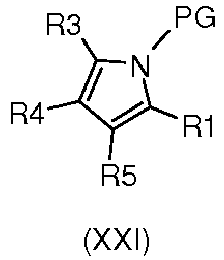
- Step 18: reaction of the resultant compound of formula (XXII)


- According to the Step 15 of Scheme F, the conversion of a halo derivative of general formula (XIX) into a compound of formula (XX) may be carried out under the condition already described in Step 1a of Scheme A.
- According to the Step 16 of Scheme F, metal-catalyzed coupling reaction of a compound of formula (XX) with a halo derivative of general formula (V) to give a compound of formula (XXI) can be accomplished in a variety of ways already described in Step 2 of Scheme A.
- According to the Step 17 of Scheme F, deprotection of the compound of formula (XXI) to give a compound of formula (XXII) may be carried out under the condition already described in Step 3 of Scheme A.
- According to Step 18 of the Scheme F, the compound of formula (XXII) is reacted with an amine of formula (XI) in the presence of triphosgene to give a compound of formula (Ie). The reaction is carried out in a suitable halogenated hydrocarbon, preferably dichloromethane, and in the presence of a suitable amine such as diisopropylethylamine or triethylamine at room temperature.
- As indicated above, a compound of the formula (Ia)-(Ie), which is prepared according to the processes object of the invention, can be conveniently converted into another compound of the formula (Ia)-(Ie) by operating according to well-known synthetic conditions, the following being examples of possible conversions:
- conv.1) converting a compound of the formula (Ia), (Ib), (Ic), wherein R2 is CN, into the corresponding compound of formula (Ia), (Ib), (Ic) wherein R2 is CONH2, by hydrolising in acidic conditions, preferably performed in glacial acetic acid or trifluoroacetic acid and concentrated sulfuric acid, more preferably in ratios between 1 to 1 and 5 to 1, optionally in the presence of water, at a temperature between room temperature and 120 °C, in particular at a temperature from 60 °C to 90 °C.
- conv.2) converting a compound of the formula (Id), (Ie) wherein R2 is CONH2, into the corresponding compound of formula (Id), (Ie), wherein R2 is CONR6R7 wherein R6 and R7 are as defined above but not both hydrogen; by hexaustive tert-butoxycarbonylation of a compound of the formula (Id)-(Ie), treatment with an amine derivative of formula (XXIII)
NHR6R7 (XXIII)
wherein R6 and R7 are as defined above but not both hydrogen and deprotection of tert-butoxycarbonyl protecting groups (Mild conversion of primary carboxamides to substituted amides (S. K. Davidsen et al. J. Org. Chem. 1991, 56, 5482-5485). - conv.3) converting a compound of the formula (Ia), wherein R5 is hydrogen or (Id) wherein R3 is hydrogen, into the corresponding compound of formula (Ia) or (Id), wherein R5 or R3 respectively is an optionally substituted group selected from straight or branched C1-C6 alkyl, C3-C7 cycloalkyl, cycloalkyl-alkyl, heterocyclyl and heterocyclyl-alkyl,


- Needless to say, also any of the intermediates of the above described processes could be converted into a different intermediate, if wanted and necessary, by operating in an analogous way as in any one of the conversion reaction here above described.
- From all of the above, it is clear to the skilled person that when preparing the compounds of the present invention according to any one of the aforementioned process variants, optional functional groups within the starting materials or the intermediates thereof that could give rise to unwanted side reactions, need to be properly protected according to conventional techniques. Likewise, the conversion of these latter into the free deprotected compounds may be carried out according to known procedures.
- As it will be readily appreciated, if the compounds of the present invention prepared according to the process described above are obtained as mixture of isomers, their separation using conventional techniques into the single isomers of the present invention, is described.
- The final compounds may be isolated and purified using conventional procedures, for example chromatography and/or crystallization and salt formation.
- The compounds of the above list can be converted into pharmaceutically acceptable salts. The compounds of the above list, or the pharmaceutically acceptable salts thereof, can be subsequently formulated with a pharmaceutically acceptable carrier or diluent to provide a pharmaceutical composition.
- The synthesis of a compound of the present invention, according to the synthetic process described above, can be conducted in a stepwise manner, whereby each intermediate is isolated and purified by standard purification techniques, like, for example, column chromatography, before carrying out the subsequent reaction. Alternatively, two or more steps of the synthetic sequence can be carried out in a so-called "one-pot" procedure, as known in the art, whereby only the compound resultant from the two or more steps is isolated and purified.
- In cases where a compound of the present invention contains one or more asymmetric centers, said compound can be separated into the single isomers by procedures known to those skilled in the art. Such procedures comprise standard chromatographic techniques, including chromatography using a chiral stationary phase, or crystallization. General methods for separation of compounds containing one or more asymmetric centers are reported, for instance, in Jacques, Jean; Collet, Andre; Wilen, Samuel H., - Enantiomers, Racemates, and Resolutions, John Wiley & Sons Inc., New York (NY), 1981 .
- According to any variant of the process for preparing the compounds of the present invention, the starting materials and any other reactants are known or easily prepared according to known methods or as described in the experimental part below.
- For example, the compounds of the formula (II) can be prepared as described in the experimental part, Preparation D; the compounds of the formula (III) can be prepared as described in the experimental part, Preparation C; the compounds of the formula (VII) can be prepared as described in the experimental part, Preparation E and O; the compounds of the formula (XII) can be prepared as described in the experimental part, Preparation H; the compounds of the formula (XIV) can be prepared as described in the experimental part, Preparation K; the compounds of the formula (XV) can be prepared as described in the experimental part, Preparation L; the compounds of the formula (XIX) can be prepared as described in the experimental part, Preparation M; the compounds of the formula (V) are either commercially available or can be prepared with known methods or can be prepared as described in the experimental part, Preparation N; the compounds of the formula (XI) are commercially available.
- The compounds of the present invention can be administered either as single agents or, alternatively, in combination with known anticancer treatments such as radiation therapy or chemotherapy regimen in combination with cytostatic or cytotoxic agents, antibiotic-type agents, alkylating agents, antimetabolite agents, hormonal agents, immunological agents, interferon-type agents, cyclooxygenase inhibitors (e.g. COX-2 inhibitors), matrixmetalloprotease inhibitors, telomerase inhibitors, tyrosine kinase inhibitors, anti-growth factor receptor agents, anti-HER agents, anti-EGFR agents, anti-angiogenesis agents (e.g. angiogenesis inhibitors), farnesyl transferase inhibitors, ras-raf signal transduction pathway inhibitors, cell cycle inhibitors, other cdks inhibitors, tubulin binding agents, topoisomerase I inhibitors, topoisomerase II inhibitors, and the like.
- If formulated as a fixed dose, such combination products employ the compounds of this invention within the dosage range described below and the other pharmaceutically active agent within the approved dosage range.
- Compounds of the above list may be used sequentially with known anticancer agents when a combination formulation is inappropriate.
- The compounds of the present invention, suitable for administration to a mammal, e.g., to humans, can be administered by the usual routes and the dosage level depends upon the age, weight, conditions of the patient and administration route.
- For example, a suitable dosage adopted for oral administration of a compound of the present invention may range from about 10 to about 500 mg per dose, from 1 to 5 times daily. The compounds of the invention can be administered in a variety of dosage forms, e.g., orally, in the form tablets, capsules, sugar or film coated tablets, liquid solutions or suspensions; rectally in the form suppositories; parenterally, e.g., intramuscularly, or through intravenous and/or intrathecal and/or intraspinal injection or infusion.
- The present invention also includes pharmaceutical compositions comprising a compound of the above list or a pharmaceutically acceptable salt thereof in association with a pharmaceutically acceptable excipient, which may be a carrier or a diluent.
- The pharmaceutical compositions containing the compounds of the invention are usually prepared following conventional methods and are administered in a suitable pharmaceutical form. For example, the solid oral forms may contain, together with the active compound, diluents, e.g., lactose, dextrose, saccharose, cellulose, corn starch or potato starch; lubricants, e.g., silica, talc, stearic acid, magnesium or calcium stearate, and/or polyethylene glycols; binding agents, e.g., starches, arabic gum, gelatine methylcellulose, carboxymethylcellulose or polyvinyl pyrrolidone; disintegrating agents, e.g., starch, alginic acid, alginates or sodium starch glycolate; effervescing mixtures; dyestuffs; sweeteners; wetting agents such as lecithin, polysorbates, laurylsulphates; and, in general, non-toxic and pharmacologically inactive substances used in pharmaceutical formulations. These pharmaceutical preparations may be manufactured in known manner, for example, by means of mixing, granulating, tabletting, sugar-coating, or film-coating processes.
- The liquid dispersions for oral administration may be, e.g., syrups, emulsions and suspensions. As an example, the syrups may contain, as carrier, saccharose or saccharose with glycerine and/or mannitol and sorbitol.
- The suspensions and the emulsions may contain, as examples of carriers, natural gum, agar, sodium alginate, pectin, methylcellulose, carboxymethylcellulose, or polyvinyl alcohol. The suspension or solutions for intramuscular injections may contain, together with the active compound, a pharmaceutically acceptable carrier, e.g., sterile water, olive oil, ethyl oleate, glycols, e.g., propylene glycol and, if desired, a suitable amount of lidocaine hydrochloride. The solutions for intravenous injections or infusions may contain, as a carrier, sterile water or preferably they may be in the form of sterile, aqueous, isotonic, saline solutions or they may contain propylene glycol as a carrier.
- The suppositories may contain, together with the active compound, a acceptable carrier, e.g., cocoa butter, polyethylene glycol, a polyoxyethylene sorbitan fatty acid ester surfactant or lecithin.
- With the aim of better illustrating the present invention, without posing any limitation to it, the following examples are now given.
- For a reference to the above list of compound of the invention, optionally in the form of a acceptable salt, see the experimental section (Examples 1, 2, 9, 11, 12, 13, 14 and 15) and claims. Referring to the examples that follow, compounds of the present invention were synthesized using the methods described herein, or other methods, which are well known in the art.
- Thin-layer chromatography was performed on Merck silica gel 60 F254 pre-coated plates. Column chromatography was conducted either under medium pressure on silica (Merck silica gel 40-63 µm) or performed by using a Biotage SP1 Flash Purification system with prepacked silica gel cartridges (Biotage or Varian). Components were visualized by UV light (λ: 254 nm) and by iodine vapor. When necessary, compounds were purified by preparative HPLC on a Waters Symmetry C18 (19 x 50 mm, 5 µm) column or on a Waters X Terra RP 18 (30 x 150 mm, 5 µm) column using a Waters preparative HPLC 600 equipped with a 996 Waters PDA detector and a Micromass mod. ZMD single quadrupole mass spectrometer, electron spray ionization, positive mode. Method 1: Phase A: 0.1% TFA/ACN 95/5; phase B: ACN/H2O 95/5. Gradient from 10 to 90% B in 8 min, hold 90% B 2 min; flow rate 20 mL/min. Method 2: Phase A: 0.05% NH4OH/ACN 95/5; Phase B: ACN/H2O 95/5. Gradient from 10 to 100% B in 8 min, hold 100% B 2 min. Flow rate 20 mL/min.
- 1H-NMR spectra were recorded in DMSO-d6 or CDCl3 on a Varian Inova 400 spectrometer operating at 400.50 MHz for 1H and on a Varian Inova 500 spectrometer operating at 499.75 MHz. Residual solvent signal was used as reference (δ = 2.50 or 7.27 ppm). Chemical shifts (δ) are reported in parts per million (ppm) and coupling constants (J) in Hz. The following abbreviations are used for multiplicities: s = singlet; br. s. = broad signal; d = doublet; t = triplet; m = multiplet; dd = doublet of doublets.
- Electrospray (ESI) mass spectra were obtained on a Finnigan LCQ ion trap.
- Unless otherwise specified, all final compounds were homogeneous (purity of not less than 95%), as determined by high-performance liquid chromatography (HPLC). HPLC-UV-MS analyses, used to assess compound purity, were carried out combining the ion trap MS instrument with HPLC system SSP4000 (Thermo Separation Products) equipped with an autosampler LC Pal (CTC Analytics) and UV6000LP diode array detector (UV detection 215-400 nm). Instrument control, data acquisition and processing were performed with the Xcalibur 1.2 software (Finnigan). HPLC chromatography was run at room temperature, and 1 mL/min flow rate, using a Waters X Terra RP 18 column (4.6x 50 mm; 3.5 µm). Mobile phase A was ammonium acetate 5 mM buffer (pH 5.5 with acetic acid): acetonitrile 90:10, and mobile phase B was ammonium acetate 5 mM buffer (pH 5.5 with acetic acid): acetonitrile 10:90; the gradient was from 0 to 100% B in 7 minutes then hold 100% B for 2 minutes before requilibration.
- ESI(+) high resolution mass spectra (HRMS) were obtained on a Waters Q-Tof Ultima directly connected with micro HPLC 1100 Agilent as previously described (Colombo, M.; Riccardi-Sirtori, F.; Rizzo, V.; Rapid Commun. Mass Spectrom. 2004, 18, 511-517).
- In the examples below as well as throughout the application, the following abbreviations have the following meanings. If not defined, the terms have their generally accepted meanings.
ABBREVIATIONS ACN acetonitrile LiOH.H2O lithium hydroxide monohydrate AcOH acetic acid M Molar Boc tert-butyloxycarbonyl MeOH Methanol n-BuLi n-butyllithium MeNH2 Methylamine Cs2CO3 cesium carbonate mg milligram(s) CuCl copper(I) chloride min Minutes CuI copper(I) iodide µL microliter(s) DCM dichloromethane mL milliliter(s) DIAD di-iso-propyl azadicarboxylate mmol millimole(s) DIPEA N,N-diisopropyethylamine mol mol(s) DMF N,N-dimethylformamide N Normal DMSO dimethyl sulfoxide NaCl sodium chloride eq equivalents Na2CO3 sodium carbonate ESI electrospray ionization Na2S2O3 sodium thiosulfate EtOAc ethyl acetate Na2SO4 sodium sulfate EDCI N-ethyl-N',N'-diisopropyl carbodiimide hydrochloride NaH sodium hydride Et2O diethyl ether NaHCO3 sodium hydrogen carbonate EtOH ethanol NaOH sodium hydroxide g gram(s) NBS N-Bromosuccinimide h hour(s) NH4Cl ammonium chloride HCl hydrochloric acid NHaOH ammonium hydroxide HOBt 1-hydroxybenzotriazole Pd(OAc)2 palladium(II)acetate HOBt.NH3 1H-benzotriazol-1-ol ammonium salt Pd2(dba)3 tris(dibenzylideneacetone)dipalladium(0) HPLC high performance liquid chromatography PdCl2(PPh3)2 bis(triphenylphosphine)-palladium(II) chloride K2CO3 potassium carbonate PdCl2(dppf) [1,1'-bis(diphenylphosphino)ferrocene] palladium(II)chloride K3PO4.3H2O potassium phosphate trihydrate Ph3P Triphenylphosphine KOH potassium hydroxide SEM 2-(trimethylsilyl)ethoxymethyl tBuOK potassium tert-butoxide SOCl2 thionyl chloride LDA lithium diisopropylamide TEA Triethylamine LiCl lithium chloride TFA trifluoroacetic acid LiHMDS lithium hexamethyldisilazide THF Tetrahydrofurane -

- To a solution of 2-chloro-5-(trifluoromethyl)benzoic acid (8.96 g, 40 mmol) in MeOH (40 mL) sulfuric acid (96%, 4 mL) was added drop wise. The reaction mixture was refluxed for 4 h. The reaction mixture was cooled to room temperature, poured into saturated solution of Na2CO3 at 5 °C under stirring, and then extracted with EtOAc. The organic phase was washed with water, with aqueous brine, dried over Na2SO4, filtered and concentrated under reduced pressure to afford the title compound as an oil (8.79 g, 92%).
- 1H NMR (400 MHz, DMSO-d 6) δ 8.15 (d, J = 2.2 Hz, 1H), 7.97 (dd, J = 2.2, 8.2 Hz, 1H), 7.85 (d, J = 8.2 Hz, 1H), 3.90 (s, 3H).
- According to this procedure, but starting from 2-methyl-5-(trifluoromethyl)benzoic acid, the following compound was prepared:
- 1H NMR (500 MHz, DMSO-d6) δ 8.08 (s, 1H), 7.86 (dd, J = 1.6, 7.9 Hz, 1H), 7.60 (d, J = 7.9 Hz, 1H), 3.87 (s, 3H), 2.60 (s, 3H).
- According to this procedure, but starting from 2-bromo-5-(trifluoromethyl)benzoic acid, the following compound was prepared:
- 1H NMR (400 MHz, DMSO-d 6) δ 8.10 (d, J = 1.6 Hz, 1H), 8.02 (d, J = 8.3 Hz, 1H), 7.85 (dd, J = 2.1, 8.4 Hz, 1H), 3.89 (s, 3H).
-
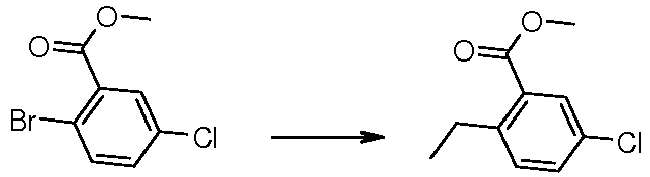
- Into a 500 mL round bottom flask equipped with a stir bar, condenser and 3-way valve connected to argon and vacuum methyl 2-bromo-5-chlorobenzoate (15.0 g, 60 mmol), ethylboronic acid (5.3 g, 72 mmol), K3PO4.3H2O (48.0 g, 180 mmol), tricyclohexylphosphine (1,7 g, 6 mmol) and toluene (250 mL) and water (12 mL) were charged at room temperature. The resulting reaction mixture was degassed three times back filling with argon each time before being charged Pd(OAc)2 (0.673 g, 3 mmol). The resulting reaction mixture was degassed four times back filling with argon each time and then warmed to 110 °C for 5 h. The reaction mixture was cooled to room temperature, filtered through a pad of Celite, washed with EtOAc and the filtrate was concentrated and then diluted with EtOAc (400 mL) and water (300 mL). The two layers were separated, and the aqueous layer was extracted with EtOAc (100 mL). The combined organic fractions were dried over Na2SO4, filtered and concentrated under reduced pressure. The residue was purified by flash chromatography (hexane/EtOAc 97/3) to afford the title compound (9.3 g, 78%).
- 1H NMR (600 MHz, DMSO-d 6) δ 7.74 (d, J = 2.4 Hz, 1H), 7.57 (dd, J = 2.4, 8.4 Hz, 1H), 7.39 (d, J = 8.2 Hz, 1H), 3.84 (s, 3H), 2.85 (q, J = 7.4 Hz, 2 H), 1.15 (t, J = 7.4 Hz, 3 H).
- According to this procedure, but starting from methyl 2-bromo-5-(trifluoromethyl)benzoate, the following compound was prepared:
- 1H NMR (600 MHz, DMSO-d 6) δ 8.04 (d, J = 1.10 Hz, 1H), 7.88 (dd, J = 1.5, 8.2 Hz, 1H), 7.62 (d, J = 8.1 Hz, 1H), 3.87 (s, 3H), 2.97 (q, J = 7.6 Hz, 2H), 1.18 (t, J = 7.6 Hz, 3H).
-

- To a solution of LiHMDS (76 mL, 1M solution) in THF (70 mL) cooled to -78°C was added ACN (4.1 mL, 79 mmol) drop wise. The solution was stirred at -78°C for 1 h, and a solution of methyl 5-chloro-2-methylbenzoate (7.38 g, 40 mmol) in THF (20 mL) was added. The reaction mixture was left to warm to room temperature over 16 h. Then NH4Cl (110 mL, 10% aqueous solution) was added, and the mixture was extracted with EtOAc (120 mL). The aqueous layer was further extracted with EtOAc (80 mL), dried over Na2SO4 and evaporated to dryness. The crude residue was purified by flash chromatography (hexane/EtOAc 85/15) to give the title compound (6.2 g, 80%).
- 1H NMR (400 MHz, DMSO-d 6) δ 7.88 (d, J = 2.1 Hz, 1H), 7.57 (dd, J = 2.1, 8.4 Hz, 1H), 7.29 - 7.47 (m, 1H), 4.69 (s, 2H), 2.41 (s, 3H).
- A mixture of 3-(5-chloro-2-methylphenyl)-3-oxopropanenitrile (4.65 g, 24 mmol), 2-aminoacetaldehyde diethyl acetal (3.85 mL, 26.5 mmol) and toluene (150 mL) was stirred under reflux overnight under nitrogen atmosphere in the Dean-Stark apparatus. The mixture was evaporated in vacuo and used in the next step without further purification.
- To TFA (20 mL) at 5 °C the crude 3-(5-chloro-2-methylphenyl)-3-[(2,2-diethoxyethyl)amino]prop-2-enenitrile dissolved in DCM (10 mL) was added. After stirring at room temperature for 30 min, the reaction mixture was concentrated and then diluted with EtOAc and a NaHCO3 saturated solution. The organic layer was separated, washed with water and brine, dried over Na2SO4 and concentrated. Column chromatography on silica gel (EtOAc/hexane, gradient elution from 0% to 20%) afforded the title compound (2.31 g, 45%, 2 steps).
- 1H NMR (400 MHz, DMSO-d 6) δ 11.99 (br. s., 1H), 7.42 - 7.47 (m, 1H), 7.39 - 7.42 (m, 1H), 7.38 (d, J = 2.2 Hz, 1H), 7.04 (t, J = 2.8 Hz, 1H), 6.59 (t, J = 2.8 Hz, 1H), 2.26 (s, 3H).
- According to this procedure, but starting from the suitable benzoate derivative, the following compounds were prepared:
- 1H NMR (400 MHz, DMSO-d 6) δ 11.99 (br. s., 1H), 7.47 - 7.52 (m, 1H), 7.41 - 7.46 (m, 1H), 7.31 - 7.37 (m, 1H), 7.02 (t, J = 2.81 Hz, 1H), 6.53 - 6.61 (m, 1H), 2.58 (q, J = 7.53 Hz, 2H), 0.99 (t, J = 7.51 Hz, 3H).
- 1H NMR (400 MHz, DMSO-d 6) δ 12.23 (br. s., 1H), 7.80 - 7.96 (m, 3H), 7.12 (t, J = 2.81 Hz, 1H), 6.65 (t, J = 2.69 Hz, 1H).
- 1H NMR (500 MHz, DMSO-d6) δ 12.08 (br. s., 1H), 7.74 (d, J= 7.96 Hz, 1H), 7.65 (s, 1H), 7.62 (d, J= 8.24 Hz, 1H), 7.08 (t, J = 2.75 Hz, 1H), 6.62 (t, J = 2.61 Hz, 1H), 2.36 - 2.39 (m, 3H).
- 1H NMR (600 MHz, DMSO-d6) δ 12.05 (br. s., 1H), 7.79 (dd, J = 1.46, 8.06 Hz, 1H), 7.66 (d, J = 8.24 Hz, 1H), 7.61 (s, 1H), 7.06 (t, J = 2.75 Hz, 1H), 6.61 (t, J = 2.75 Hz, 1H), 2.69 (q, J = 7.51 Hz, 1H), 2.07 (s, 1H), 1.11 - 1.52 (m, 1H), 1.04 (t, J= 7.51 Hz, 1H).
- 1H NMR (600 MHz, DMSO-d6) δ 12.15 (br. s., 1H), 7.94 (dd, J= 1.28, 8.42 Hz, 2H), 7.76 (dd, J= 1.28, 8.42 Hz, 2H), 7.49 - 7.54 (m, 2H), 7.36 - 7.42 (m, 1H), 7.02 (t, J = 2.84 Hz, 1H), 6.58 (dd, J = 2.38, 2.93 Hz, 1H).
- NaH (60% dispersion in mineral oil, 0.452 g, 11.3 mmol) was added to a suspension of 2-(5-chloro-2-methylphenyl)-1H-pyrrole-3-carbonitrile (1.733 g, 8.0 mmol) in dry THF (25 mL) at 0 °C. The reaction was kept at the same temperature for 20 min then 2-[(chloromethoxy)ethyl](trimethyl)silane (2.0 mL, 11.3 mmol) was added and the mixture was stirred at room temperature for 2 h. Saturated NaCl solution (30 mL) was added at 0 °C and the mixture was extracted with EtOAc (2 x 35 mL). The separated organic phase was dried over Na2SO4 and the solvent evaporated to afford the title compound (2.637 g, 95%).
- 1H NMR (400 MHz, DMSO-d 6) δ 7.50 (dd, J = 2.3, 8.3 Hz, 1H), 7.43 (d, J = 8.3 Hz, 1H), 7.37 (d, J = 2.3 Hz, 1H), 7.21 (d, J= 3.0 Hz, 1H), 6.64 (d, J= 3.0 Hz, 1H), 5.16 (d, J= 10.8 Hz, 1H), 4.95 (d, J= 10.8 Hz, 1H), 3.27 - 3.30 (m, 2H), 2.10 (s, 3H), 0.69 - 0.76 (m, 2H), -0.08 (s, 9H).
- HRMS (ESI) m/z calcd for C18H23CIN2OSi + H+ 347.1341, found 347.1345.
- To a solution of 2-(5-chloro-2-methylphenyl)-1-{[2-(trimethylsilyl)ethoxy]methyl}-1H-pyrrole-3-carbonitrile (2.5 g, 7.2 mmol) in MeOH/THF 2/1 (450 mL) was added NBS (1.281 g, 7.2 mmol) in three portions over 3 h at 5 °C. The mixture was allowed to stir at room temperature after every addition. The mixture was evaporated in vacuo. Saturated NaCl solution was added and the mixture was extracted with EtOAc. The separated organic phase was dried over Na2SO4, the solvent evaporated and the crude was purified by flash chromatography (hexane/EtOAc 9/1) to afford the title compound (2.14 g, 70%).
- 1H NMR (400 MHz, DMSO-d 6) δ 7.52 - 7.57 (m, 1H), 7.40 - 7.48 (m, 2H), 6.92 (s, 1H), 5.17 (d, J= 11.2 Hz, 1H), 4.94 (d, J = 11.2 Hz, 1H), 3.27 - 3.30 (m, 2H), 2.12 (s, 3H), 0.62 - 0.82 (m, 2H), -0.08 (s, 9H).
- HRMS (ESI) m/z calcd for C18H22BrCIN2OSi + H+ 425.0446, found 425.0441.
- According to this procedure, but starting from the suitable substituted carbonitrile, the following compounds were prepared:
- 1H NMR (600 MHz, DMSO-d 6) δ 7.59 (dd, J = 2.4, 8.4 Hz, 1H), 7.47 - 7.51 (m, 1H), 7.40 (d, J = 2.4 Hz, 1H), 6.91 (s, 1H), 5.15 (d, J= 11.2 Hz, 1H), 4.89 (d, J= 11.2 Hz, 1H), 2.40 - 2.47 (m, 1H), 2.29 - 2.36 (m, 1H), 1.05 (t, J= 7.5 Hz, 3H), 0.65 - 0.78 (m, 2H), -0.07 (s, 9H).
- HRMS (ESI) m/z calcd for C19H24BrCIN2OSi + Na+ 439.0603, found 439.0600.
- 1H NMR (400 MHz, DMSO-d 6) δ 8.03 (s, 1H), 7.93 - 8.01 (m, 2H), 6.98 (s, 1H), 5.23 (d, J = 11.4 Hz, 1H), 5.06 (d, J = 11.4 Hz, 1H), 3.27 - 3.30 (m, 2H), 0.61 - 0.77 (m, 2H), -0.11 (m, 9H).
- HRMS (ESI) m/z calcd for C18H19BrCIF3N2OSi + Na+ 500.9983, found 500.9982.
- 1H NMR (600 MHz, DMSO-d 6) δ 7.80 - 7.90 (m, 1H), 7.73 (s, 1H), 7.68 (d, J= 7.9 Hz, 1H), 6.94 (s, 1H), 5.15 (d, J = 11.2 Hz, 1H), 4.93 (d, J = 11.2 Hz, 1H), 3.28 - 3.30 (m, 2H), 2.22 (s, 3H), 0.62 - 0.75 (m, 2H), -0.10 (s, 9H).
- HRMS (ESI) m/z calcd for C19H22BrF3N2OSi + Na+ 481.0529, found 481.0531.
- 1H NMR (600 MHz, DMSO-d 6) δ 7.89 (dd, J = 1.5, 8.2 Hz, 1H), 7.71 (d, J = 8.1 Hz, 1H), 7.69 (s, 1H), 6.94 (s, 1H), 5.14 (d, J = 11.2 Hz, 1H), 4.88 (d, J = 11.2 Hz, 1H), 3.28 - 3.30 (m, 2H), 2.55 - 2.59 (m, 1H), 2.44 (qd, J = 7.4, 14.7 Hz, 1H), 1.08 - 1.12 (m, 3H), 0.65 - 0.76 (m, 2H), -0.09 (s, 9H).
- HRMS (ESI) m/z calcd for C20H24BrF3N2OSi + Na+ 495.0685, found 495.0689.
- 1H NMR (600 MHz, DMSO-d 6) δ 7.51 - 7.63 (m, 5H), 6.91 (s, 1H), 5.23 (s, 2H), 3.34 - 3.38 (m, 2H), 0.71 - 0.78 (m, 2H), -0.08 (s, 9H).
- HRMS (ESI) m/z calcd for C17H21BrN2OSi + H+ 377.0680, found 377.0685.
- To a solution of 2-(5-chloro-2-methylphenyl)-1H-pyrrole-3-carbonitrile (400 mg, 1.85 mmol) in ACN (20 mL) was added NBS (329 mg, 1.85 mmol) in two portions over 2 h at 5 °C. The mixture was allowed to stir at room temperature after every addition. The mixture was evaporated in vacuo and the crude was purified by flash chromatography (hexane/EtOAc 9/1) to afford the title compound (379 mg, 69%).
- 1H NMR (400 MHz, DMSO-d 6) δ 12.72 (br. s., 1H), 7.44 - 7.48 (m, 1H), 7.38 - 7.44 (m, 2H), 6.73 (s, 1H), 2.26 (s, 3H). According to this procedure, but starting from 2-(5-chloro-2-ethylphenyl)-1H-pyrrole-3-carbonitrile, the following compound was prepared:
- 1H NMR (400 MHz, DMSO-d 6) δ 12.73 (br. s., 1H), 7.51 (dd, J = 2.20, 8.43 Hz, 1H), 7.44 (d, J = 8.42 Hz, 1H), 7.39 (d, J = 2.38 Hz, 1H), 6.72 (s, 1H), 2.58 (q, J = 7.57 Hz, 2H), 1.02 (t, J = 7.60 Hz, 3H).
-

- To a solution of 2-(5-chloro-2-ethylphenyl)-pyrrole-3-carbonitrile (1.26 g, 5.46 mmol) in DMF (13 mL) NaH (60% dispersion in oil, 262 mg, 6.55 mmol) was added at 5 °C, under argon atmosphere. The reaction mixture was stirred for 1 h, then benzenesulfonyl chloride (0.766 mL, 6.01 mmol) was added dropwise. After 24 h the reaction mixture was added to water (50 mL) under stirring. EtOAc (75 mL) was added, the organic layer was separated and washed with water, brine, dried over Na2SO4, filtered, the solvent was evaporated under reduced pressure to give an oil, which was purified by Biotage SP1 Flash Chromatography (hexane/EtOAc 9/1) to afford the title compound (1.44 g, 71%).
- 1H NMR (600 MHz, DMSO-d 6) δ 7.79 - 7.87 (m, 1H), 7.61 (dd, J = 7.7, 8.4 Hz, 1H), 7.56 (dd, J = 2.2, 8.4 Hz, 1H), 7.51 (dd, J = 0.9, 8.4 Hz, 1H), 7.38 (d, J = 8.4 Hz, 1H), 6.95 (d, J=3.6 Hz, 1H), 6.80 (d, J = 2.2 Hz, 1H), 2.01 (q, J = 7.6 Hz, 1H), 0.96 (t, J= 7.6 Hz, 1H).
-
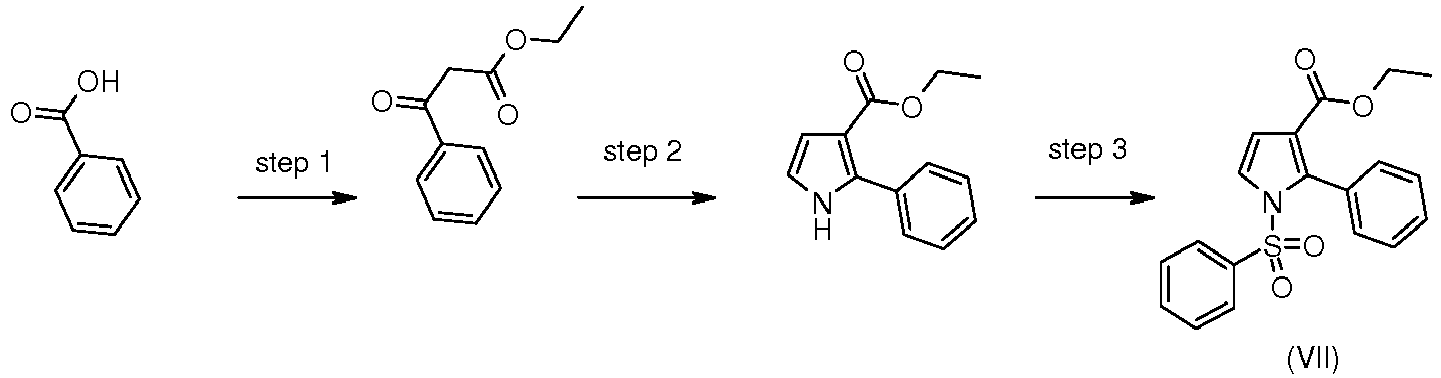
- Carbonyldiimidazole (7.31 g, 45 mmol) was added to a solution of benzoic acid (5.0 g, 41 mmol) in DMF (50 mL). The mixture was stirred at room temperature. After 2 h magnesium chloride (4.68 g, 49 mmol) and potassium monoethyl malonate (14 g, 82 mmol) were added. The mixture was heated to 100 °C under stirring until reaction was complete, then cooled to room temperature and slowly added to 750 mL of iced water affording the precipitation of a solid. The solid was recovered by filtration affording the title compound (8.66 g, 81.1%), which was used in the next step without further purification.
- 1H NMR (600 MHz, DMSO-d6) δ 11.99 (br. s., 1 H), 7.71 - 7.81 (m, 2H), 7.28 - 7.39 (m, 3H), 5.24 (s, 2H), 4.00 (q, J= 6.9 Hz, 2H), 1.16 (t, J =7.0 Hz, 3H).
- Acetyl chloride (4.17 g, 53.14 mmol) was added to a solution of 2,2-diethoxyethanamine (6.43 g, 48.3 mmol) and TEA (6.84 g, 67.62 mmol) in EtOAc (70 mL), at room temperature. After 1 h, EtOH (0.7 mL) was added. The resulting suspension was stirred for 1 h, and then filtered. EtOAc was removed by evaporation from the filtration liquors yielding N-(2,2-diethoxyethyl)acetamide as an oil, which was used without further purification in the next step. Ethyl 3-oxo-3-phenylpropanoate - 1H-imidazole (8.66 g, 33.26 mmol) in TFA (10.6 mL) was treated with N-(2,2-diethoxyethyl)acetamide (48.3 mmol). The reaction mixture was heated for 60 min at 60 °C, then TFA was removed by evaporation and the oily residue was dissolved in EtOAc, washed twice with water and a NaHCO3 saturated solution. The organic layer was recovered and the solvent was evaporated yielding a dark oil. The oil was treated with EtOH (28 mL) and 2N NaOH (14 mL), the resulting reaction mixture was stirred at room temperature overnight. The solution was slowly added to iced water affording after filtration the title compound (6.2 g, 55.8%).
- 1H NMR (600 MHz, DMSO-d6) δ 11.60 (br. s., 1H), 7.53 - 7.61 (m, 2H), 7.38 - 7.43 (m, 2H), 7.31 - 7.36 (m, 1H), 6.84 (t, J= 2.75 Hz, 1H), 6.53 (t, J= 2.75 Hz, 1H), 4.10 (q, J= 7.02 Hz, 2H), 1.17 (t, J= 7.14 Hz, 3H).
- To a solution of ethyl 2-phenyl-1H-pyrrole-3-carboxylate (1.0 g, 4.65 mmol) in DMF (12 mL) NaH (60% dispersion in oil, 223 mg, 5.58 mmol) was added at 5 °C, under argon atmosphere. The reaction mixture was stirred for 1 h, then benzenesulfonyl chloride (0.653 mL, 5.11 mmol) was added dropwise. After 2 h the reaction mixture was added to water and ice under stirring. EtOAc (150 mL) was added, the organic layer was separated and washed with water, brine, dried over Na2SO4, filtered, the solvent was evaporated under reduced pressure to give an oil, which was purified by Biotage SP1 Flash Chromatography (cyclohexane/EtOAc 9/1) to afford the title compound (1.24 g, 75%). 1H NMR (600 MHz, DMSO-d6) δ 7.70 - 7.75 (m, 1H), 7.62 - 7.65 (m, 1H), 7.50 - 7.55 (m, 2H), 7.40 - 7.43 (m, 1H), 7.37 - 7.39 (m, 2H), 7.24 - 7.30 (m, 2H), 6.90 - 6.98 (m, 2H), 6.72 - 6.76 (m, 1H), 3.88 - 3.94 (m, 2H), 0.82 - 0.96 (m, 3H).
-

- 4-Ethylaniline (10.3 mL, 82.5 mmol) was added drop wise to sulfuric acid (96%, 63 mL), cooled to 8 °C, maintaining the temperature below 10 °C. After the addition, the reaction mixture was cooled to -5 °C, before the addition of a mixture of nitric acid (100%, 4 mL) and sulfuric acid (96%, 10 mL), keeping the temperature below 0 °C. The reaction mixture was then stirred at the same temperature for 1 h. The reaction mixture was poured into ice (200 mL) and the precipitate filtered and washed with water. The solid was suspended with water (100 mL) and neutralized with NH4OH (35%). The precipitate was filtered and dried in the oven to obtain a light-brown solid (10.0 g, 73%).
- 1H NMR (400 MHz, DMSO-d6) δ 7.11 (d, J = 8.3 Hz, 1H), 7.04 (d, J = 2.4 Hz, 1H), 6.81 (dd, J = 2.4, 8.3 Hz, 1H), 5.53 (s, 2H), 2.63 (q, J = 7.4 Hz, 2H), 1.11 (t, J = 7.4 Hz, 3H).
- A solution of sodium nitrite in water (4.2 g, 60 mmol, 5 M, 12 mL) was added drop wise to a cooled (5 °C) solution of 4-ethyl-3-nitroaniline (10 g, 60 mmol) in conc. HCl (200 mL) and the reaction mixture was stirred at the same temperature for 1.5 h. CuCI (9.5 g, 96 mmol) was then added and the solution was stirred at room temperature for 1 h and then at 80 °C for an additional hour. After cooling down the reaction mixture was extracted with DCM (3 x 100 mL) and the combined organic layers were dried over Na2SO4. The crude was then purified by flash chromatography (hexane/EtOAc 9/1) to obtain the title compound as a yellow oil (6.28 g, 56%).
- 1H NMR (400 MHz, DMSO-d6) δ 8.03 (d, J = 2.3 Hz, 1H), 7.74 (dd, J = 2.2, 8.3 Hz, 1H), 7.57 (d, J = 8.4 Hz, 1H), 2.78 (q, J= 7.4 Hz, 2H), 1.19 (t, J = 7.4 Hz, 3H)
- A solution of hydrazine hydrate (6.95 mL, 134.7 mmol) in methanol (50 mL) was added drop wise to a solution of 4-chloro-1-ethyl-2-nitrobenzene (6.25 g, 33.7 mmol) in methanol (120 mL), in the presence of iron (III) chloride (547 mg, 3.4 mmol) and activated charcoal (547 mg) and the reaction mixture was stirred under reflux for 14 h. The solids were removed by filtration through Celite, the filtrate concentrated and purified by flash chromatography (hexane/EtOAc 9/1) to obtain the title compound as a light-pink oil (5.09 g, 97%).
- 1H NMR (400 MHz, DMSO-d6) δ 6.89 (d, J = 8.0 Hz, 1H), 6.62 (d, J = 2.2 Hz, 1H), 6.47 (dd, J = 2.2, 8.0 Hz, 1H), 5.12 (s, 2H), 2.39 (q, J = 7.5 Hz, 2H), 1.09 (t, J = 7.4 Hz, 3H).
-

- 1-Bromo-2-nitro-4-(trifluoromethyl)benzene (6.14 mL, 40.1 mmol) was dissolved in 2-propanol (200 mL). To this mixture TEA (19.8 mL, 140.3 mmol) and potassium vinyl trifluoroborate (6.44 g, 48.1 mmol) were added. The resulting reaction mixture was degassed three times back filling with argon each time before being charged PdCl2(dppf) (1.5 g, 2.0 mmol). The resulting reaction mixture was degassed four times back filling with argon each time and then warmed to reflux for 3 h. The reaction mixture was cooled to room temperature, filtered through a pad of Celite, washed with EtOAc, and the filtrate was concentrated and then diluted with EtOAc and water. The two layers were separated, and the aqueous layer was extracted with EtOAc. The combined organic fractions were washed with aqueous brine, dried over Na2SO4, filtered and concentrated under reduced pressure. The residue was purified by flash chromatography (hexane/EtOAc 9/1) to afford the title compound (5.6 g, 64%).
- 1H NMR (600 MHz, DMSO-d6) δ 8.34 (s, 1H), 8.09 (d, J = 8.2 Hz, 1H), 8.05 (d, J = 8.2 Hz, 1H), 7.03 (dd, J = 11.1, 17.3 Hz, 1H), 6.07 (d, J= 17.3 Hz, 1H), 5.68 (d, J= 11.1 Hz, 1H).
- 1-Ethenyl-2-nitro-4-(trifluoromethyl)benzene (2.2 g, 10.13 mmol) dissolved in THF (150 mL) was shaked at room temperature under H2 (40 psi) in the presence of 10% Pd/C (200 mg) for 8 h. The reaction mixture was filtered through a pad of Celite, washed with EtOAc, and the filtrate was concentrated. The residue was purified by flash chromatography (hexane/EtOAc 9/1) to afford the title compound (1.76 g, 92%).
- 1H NMR (600 MHz, DMSO-d6) δ 7.10 (d, J = 7.7 Hz, 1H), 6.89 (d, J = 1.5 Hz, 1H), 6.61 - 6.81 (d, J = 7.7 Hz, 1H), 5.30 (s, 2H), 2.48 (q, J = 7.5 Hz, 2 H), 1.13 (t, J = 7.5 Hz, 3H).
-

- 5-Chloro-2-ethylaniline (10.8 g, 69.44 mmol) and 2,5-dimethoxy-tetrahydrofuran (9.87 mL, 76.38 mmol) was refluxed for 3 h in AcOH (20 mL). The reaction mixture was evaporated and the residue was diluted in EtOAc, washed with water, NaHCO3 saturated solution, brine, and then dried over Na2SO4. The solvent was evaporated and the crude was purified by Biotage SP1 Flash Chromatography (gradient elution from 0% to 15% of EtOAc in hexane) to afford the title compound (12.52 g, 88%).
- 1H NMR (600 MHz, DMSO-d6) δ 7.36 - 7.47 (m, 2H), 7.31 (d, J = 1.3 Hz, 1H), 6.93 (t, J = 2.1 Hz, 2H), 6.23 (t, J = 2.1 Hz, 2H), 2.46 (q, J = 7.5 Hz, 2H), 0.99 (t, J = 7.5 Hz, 3H).
- To a solution of 1-(5-chloro-2-ethylphenyl)-1H-pyrrole (11.8 g, 57.56 mmol) in anhydrous ACN (150 ml) was added chlorosulfonyl isocyanate (5.32 mL, 61.11 mmol) drop wise at 0 °C. The mixture was stirred at the same temperature for 30 min and then DMF (12 mL) was added to this mixture drop wise. After stirring at the same temperature for 1 h, the reaction mixture was poured into ice-water, stirred for 10 min and then diluted with EtOAc. The organic layer was isolated and the aqueous layer was extracted with EtOAc twice. The combined organic phases were dried over Na2SO4 and evaporated in vacuo. The crude was purified by Biotage SP1 Flash Chromatography (gradient elution from 0% to 15% of EtOAc in hexane) to give the title compound (10.62 g, 80%).
- 1H NMR (600 MHz, DMSO-d6) δ 7.57 - 7.62 (m, 1H), 7.51 - 7.55 (m, 2H), 7.39 (dd, J= 1.5, 2.6 Hz, 1H), 7.19 (dd, J = 1.5, 3.9 Hz, 1H), 6.44 (dd, J = 2.7, 4.0 Hz, 1H), 2.33 (q, J = 7.5 Hz, 2H), 1.00 (t, J = 7.5 Hz, 3H).
- To a solution of 1-(5-chloro-2-ethylphenyl)-1H-pyrrole-2-carbonitrile (2.307 g, 10 mmol) in THF (50 mL) was added a solution of NBS (1.87 g, 10.5 mmol) in THF (50 mL). The mixture was allowed to stir at room temperature for 90 min and then a solution of NBS (356 mg, 2 mmol) in THF (10 mL) was added. The mixture was allowed to stir at room temperature for 90 min and then was evaporated in vacuo. Saturated NaCl solution was added and the mixture was extracted with EtOAc. The separated organic phase was dried over Na2SO4, the solvent evaporated and the crude was purified by Biotage SP1 Flash Chromatography (gradient elution from 0% to 15% of EtOAc in hexane) to afford the title compound (2.38 g, 77%).
- 1H NMR (600 MHz, DMSO-d6) δ 7.68 (d, J = 1.8 Hz, 1H), 7.60 - 7.64 (m, 2H), 7.53 (d, J = 8.8 Hz, 1H), 7.38 (d, J = 1.6 Hz, 1H), 2.34 (q, J = 7.3 Hz, 2H), 1.03 (t, J = 7.3 Hz, 3H).
- According to this procedure, but starting from the suitable aniline, the following compounds were prepared:
- 1H NMR (400 MHz, DMSO-d6) δ 7.66 (d, J = 1.7 Hz, 1H), 7.63 (d, J = 2.2 Hz, 1H), 7.55 - 7.59 (m, 1H), 7.50 (d, J = 8.5 Hz, 1H), 7.38 (d, J= 1.7 Hz, 1H), 2.06 (s, 1H).
- 1H NMR (400 MHz, DMSO-d6) δ 8.26 (s, 1H), 8.03 (d, J = 0.7 Hz, 2H), 7.77 (d, J = 1.8 Hz, 1H), 7.45 (d, J = 1.7 Hz, 1H).
- ESI (+) MS: m/z 330 (MH+).
- 1H NMR (600 MHz, DMSO-d6) δ 7.89 - 7.95 (m, 2H), 7.76 (d, J = 7.9 Hz, 1H), 7.74 (d, J = 1.6 Hz, 1H), 7.41 (d, J = 1.6 Hz, 1H), 2.44 (q, J= 7.3 Hz, 2H), 1.08 (t, J= 7.3 Hz, 3H).
- ESI (+) MS: m/z 248 (MH+).
-

- A mixture of 5-chloro-2-ethylaniline (3.35 g, 21.5 mmol), p-toluensulfonic acid (12.29 g, 64.6 mmol) and water (2.15 mL) were ground in a mortar for few minutes, to obtain a homogeneous paste to which solid sodium nitrite (3.71 g, 53.8 mmol) was added and the paste ground for 10 min. Solid potassium iodide (8.94 g, 53.8 mmol) was added and the paste ground for 20 min. The paste was then dissolved in water (50 mL) and treated with sodium sulfite (10% aq. sol.), before being extracted with EtOAc (3 x 100 mL). The combined organic layers were dried over Na2SO4 and the crude was purified by flash chromatography (hexane) to obtain the title compound as a light-yellow oil (4.35 g, 76%). 1H NMR (400 MHz, DMSO-d 6) δ 7.87 (d, J = 2.2 Hz, 1H), 7.42 (dd, J = 2.2, 8.30 Hz, 1H), 7.29 - 7.35 (m, 1H), 2.66 (q, J = 7.5 Hz, 2H), 1.12 (t, J = 7.5 Hz, 3H).
-

- A solution of 1-ethenyl-4-(trifluoromethyl)benzene (1.72 mL, 11.6 mmol) in THF (60 mL) was stirred in the presence of Pd/C (10%, 400 mg), under a hydrogen atmosphere (45 psi) for 7 h. The solid was filtered through celite (washed with DCM) and the filtrate was carefully concentrated, keeping the temperature of the bath below 20 °C at 200 mmHg. The concentrated solution thus obtained was used in the next step without further manipulation.
- 1H NMR (400 MHz, DMSO-d 6) δ 7.63 (d, J = 7.9 Hz, 2H). 7.44 (d, J = 7.9 Hz, 2H), 2.70 (q, J = 7.1 Hz, 2H), 1.20 (t, J = 7.6 Hz, 3H).
- Sulfuric acid (96%, 1.9 mL) was added drop wise to a solution of sodium periodate (3.73 g, 17.4 mmol) and iodine (2.95 g, 11.6 mmol) in a mixture of acetic acid (8.45 mL) and acetic anhydride (4.23 mL) at 0 °C, followed by the drop wise addition of 1-ethyl-4-(trifluoromethyl)benzene (2.0 g, 11.6 mmol). The reaction mixture was let warming up to room temperature while stirring for a period of 24 h. A solution of sodium metabisulfite (10 %) was added to quench the remaining iodine and successively NaOH (35%) was added to reach pH=7. The aqueous layer was extracted with DCM (3 x 50 mL) and the combined organic layers were dried over Na2SO4. Once the solvent was removed, the crude was used without further purification in the next step.
- 1H NMR (400 MHz, DMSO-d 6) δ 8.11 (dq, J = 1.9, 0.7 Hz, 1H), 7.69 - 7.75 (m, 1H), 7.53 (d, J = 8.0 Hz, 1H), 2.75 (q, J = 7.5 Hz, 2H), 1.16 (t, J = 7.51 Hz, 3H).
-

- To a solution of 4-chloro-2-iodo-1-methylbenzene (5.0 g, 19.8 mmol) in THF (40 mL) n-BuLi (2.5 M in hexane, 8.72 mL, 21.8 mmol) was slowly added dropwise at -78 °C under argon. The mixture was stirred at -78 °C for 1 h, then DMF (7.7 mL, 99 mmol) was added, followed by warming to room temperature in 4 h and quenching with 1N HCl (5 mL). The reaction mixture was stirred overnight, diluted with 1N HCl (50 mL) and Et2O, the organic phase was separated, washed with aqueous brine, dried over Na2SO4 and evaporated to give the title compound (3.14 g, 94%) as a yellow oil.
- 1H NMR (600 MHz, DMSO-d6) δ 10.17 (s, 1H), 7.80 (d, J = 2.2 Hz, 1H), 7.60 (dd, J = 2.4, 8.1 Hz, 1H), 7.37 (d, J = 8.1 Hz, 1H), 2.57 (s, 3H).
- To a suspension of NaH (60% dispersion in oil, 950 mg, 23.28 mmol) in dry THF (43 mL) a solution of diethyl cyanomethylphosphonate (3.67 ml, 23.28 mmol) in THF (17 mL) was added at 5 °C dropwise over 20 min, maintaining the reaction temperature below 10 °C. The suspension was stirred at 5 °C for 60 min. A solution of 5-chloro-2-methyl-benzaldehyde (2.99 g, 19.4 mmol) in THF (30 mL) was added dropwise over 20 min, maintaining the reaction temperature below 10 °C. The reaction mixture was allowed to warm to room temperature and stirred overnight. Water was added, the solvent was evaporated, the residue was partitioned between EtOAc and water. The aqueous layer was separated and extracted with EtOAc, the combined organic layers were washed with water, brine, dried over Na2SO4, filtered and the solvent was evaporated under reduced pressure to give the title compound (3.26 g, 95%) as a pale yellow oil.
- To a suspension of NaH (60% dispersion in oil, 263 mg, 6.58 mmol) in dry THF (40 mL) a solution of 3-(5-chloro-2-methylphenyl)-acrylonitrile (970 mg, 15.48 mmol) and (p-toluenesulfonyl)methylisocyanide (1.28 g, 6.58 mmol) in THF (20 mL) was added at 5 °C dropwise over 10 min, maintaining the reaction temperature below 5 °C. The reaction mixture was allowed to warm to room temperature and stirred overnight. Water was added, the solvent was evaporated, the residue was partitioned between DCM and water. The aqueous layer was separated and extracted with DCM, the combined organic layers were washed with water, brine, dried over Na2SO4, filtered, the solvent was evaporated under reduced pressure and the crude was purified by Biotage SP1 Flash Chromatography (hexane/EtOAc 7/3) to afford the title compound (497 mg, 42%).
- 1H NMR (600 MHz, DMSO-d6) δ 11.95 (br. s., 1H), 7.71 (s, 1H), 7.29 - 7.35 (m, 2H), 7.27 (d, J = 2.2 Hz, 1H), 7.08 (d, J =1.5 Hz, 1H), 2.27 (s, 3H).
- According to this procedure, but starting from the suitable substituted iodo-benzene, the following compounds were prepared:
- ESI (+) MS: m/z 231 (MH+).
- ESI (+) MS: m/z 271 (MH+).
- ESI (+) MS: m/z 251 (MH+).
- ESI (+) MS: m/z 265 (MH+).
- ESI (+) MS: m/z 169 (MH+).
-

- To a solution of methyl-(4-methylphenyl)sulphone (6.74 g, 39.6 mmol) in THF (200 mL) n-BuLi (2.5 M in hexane, 34.8 mL, 87.12 mmol) was added dropwise at 0 °C under argon atmosphere. After stirring for 30 min at 0 °C diethyl chlorophosphate (5.70 mL, 39.6 mmol) in THF (30 mL) was slowly added dropwise. The reaction mixture was stirred at 0 °C for 30 min, then was cooled to -78 °C, followed by addition of a solution of 5-chloro-2-methyl-benzaldehyde (6.1 g, 39.6 mmol) in THF (10 mL). After stirring at -78 °C for 1 h, the temperature of the reaction mixture was allowed to rise to room temperature. Water was added (50 mL) and the reaction mixture was concentrated under reduced pressure to give a precipitated that was filtered, washed with water and oven-dried under reduced pressure to afford the title compound as a beige solid (8.24 g, 68%).
- 1H NMR (600 MHz, DMSO-d6) δ 7.79 - 7.85 (m, 2H), 7.76 (d, J = 8.2 Hz, 1H), 7.68 - 7.72 (m, 1H), 7.62 - 7.67 (m, 1H), 7.47 (d, J= 8.0 Hz, 1H), 7.37 - 7.43 (m, 1H), 7.30 - 7.34 (m, 1H), 2.41 (s, 3H), 2.39 (s, 3H).
- To a suspension of NaH (60% dispersion in oil, 2.25 g, 56.19 mmol) in dry THF (140 mL) a solution of (E)-2-(5-chloro-2-methylphenyl)ethenyl 4-methylphenyl sulfone (8.18 g, 26.76 mmol) and ethyl isocyanoacetate (5.85 mL, 53.52 mmoL) in THF (200 mL) was added dropwise at room temperature over 1 h, under argon atmosphere. The reaction mixture was stirred for 2 h, then water and EtOAc were added. The organic layer was separated and washed with water, brine, dried over Na2SO4, filtered, the solvent was evaporated under reduced pressure to give a brown oil, which was purified by Biotage SP1 Flash Chromatography (hexane/EtOAc 9/1) to afford the title compound (3.44 g, 49%).
- 1H NMR (600 MHz, DMSO-d6) δ 11.90 (br. s., 1H), 7.19 - 7.28 (m, 2H), 7.13 (d, J= 1.6 Hz, 1H), 7.02 - 7.08 (m, 1H), 6.14 (t, J= 2.5 Hz, 1H), 4.06 (q, J= 7.1 Hz, 2H), 2.08 (s, 3H), 1.05 (t, J= 7.1 Hz, 1H).
- To a solution of ethyl 3-(5-chloro-2-methylphenyl)-1H-pyrrole-2-carboxylate (526 mg, 2 mmol) in DMF (5 mL) NaH (60% dispersion in oil, 96 mg, 2.4 mmol) was added at 5 °C, under argon atmosphere. The reaction mixture was stirred for 1 h, then benzenesulfonyl chloride (0.306 mL, 2.4 mmol) was added dropwise. After 2.5 h at room temperature the reaction mixture was added to water and ice under stirring. EtOAc was added, the organic layer was separated and washed with water, brine, dried over Na2SO4, filtered, the solvent was evaporated under reduced pressure to give an oil, which was purified by Biotage SP1 Flash Chromatography (hexane/EtOAc 9/1) to afford the title compound (783 mg, 97%).
- 1H NMR (600 MHz, DMSO-d6) δ 8.03 (dd, J = 1.0, 8.3 Hz, 2H), 7.85 (d, J = 3.3Hz, 1H), 7.78 - 7.83 (m, 1H), 7.62 - 7.75 (m, 2H), 7.29 - 7.35 (m, 1H), 7.23 - 7.28 (m, 1H), 7.11 (d, J = 2.2 Hz, 1H), 6.52 (d, J = 3.3 Hz, 1H), 3.96 (q, J = 7.1 Hz, 2H), 2.04 (s, 3H), 0.82 (t, J = 7.0 Hz, 3H).
- According to this procedure, but starting from the suitable substituted benzaldehyde, the following compounds were prepared:
- 1H NMR (600 MHz, DMSO-d6) δ 7.94 - 8.06 (m, 2H), 7.85 (d, J = 3.30 Hz, 1H), 7.77 - 7.82 (m, 1H), 7.68 - 7.73 (m, 2H), 7.34 - 7.37 (m, 1H), 7.28 - 7.31 (m, 1H), 7.08 (d, J = 2.38 Hz, 1H), 6.51 (d, J = 3.30 Hz, 1H), 3.93 (q, J = 7.08 Hz, 2H), 2.28 - 2.40 (m, 2H), 0.94 (t, J = 7.60 Hz, 3H), 0.78 (t, J = 7.05 Hz, 3H)
- ESI (+) MS: m/z 458 (MH+).
- ESI (+) MS: m/z 438 (MH+).
- 1H NMR (600 MHz, DMSO-d6) δ 8.04 (dd, J= 1.19, 8.52 Hz, 2H), 7.89 (d, J= 3.11 Hz, 1H), 7.79 -7.82 (m, 1H), 7.69 - 7.73 (m, 2H), 7.66 (d, J = 8.06 Hz, 1H), 7.52 (d, J = 8.06 Hz, 1H), 7.35 (s, 1H), 6.57 (d, J = 3.30 Hz, 1H), 3.88 (q, J = 7.02 Hz, 2H), 2.43 - 2.49 (m, 2H), 0.98 (t, J = 7.51 Hz, 3H), 0.71 (t, J = 7.14 Hz, 3H).
- ESI (+) MS: m/z 356 (MH+).
-

- PdCl2(PPh3)2 (70 mg, 0.10 mmol) and Cul (39 mg, 0.20 mmol) were placed under argon in a flame-dried screwcap vessel. Dry THF (25 mL) was added, and the mixture was degassed with argon. TEA (0.69 mL, 5.00 mmol), 5-chloro-2-methylbenzoyl chloride (945 mg, 5.00 mmol), and tert-butyl prop-2-ynylcarbamate (776 mg, 5.00 mmol) were successively added to the mixture which was then stirred at room temperature for 1 h. Sodium iodide (3.79 g, 25.0 mmol), toluene-4-sulfonic acid monohydrate (1.94 g, 10.0 mmol), and tert-butyl alcohol (5 mL) were successively added to the mixture, which was stirred at room temperature for 1 h. The reaction mixture was diluted with brine (50 mL), the phases were separated and the aqueous phase was extracted with DCM (3 x 25 mL). The combined organic layers were dried over Na2SO4. After removal of the solvents in vacuo, the residue was absorbed onto Celite and chromatographed on silica gel (hexane/EtOAc 95/5) to give the title compound (1.04 g, 50%) as a colorless solid.
- 1H NMR (600 MHz, DMSO-d6) δ 7.53 (d, J = 1.71 Hz, 1H,), 7.42 (dd, J = 8.09 Hz, 1H), 7.23 (dd, 1H), 7.20 (dd, 1H), 6.30 (d, J = 1.71 Hz, 1H) 2.38 (s, 3H), 1.44 (s, 9H).
- According to this procedure and using the suitable acyl chloride, the following compounds were prepared:
- ESI (+) MS: m/z 432 (MH+).
- ESI (+) MS: m/z 472 (MH+).
- ESI (+) MS: m/z 452 (MH+).
- ESI (+) MS: m/z 466 (MH+).
- ESI (+) MS: m/z 370 (MH+).
-
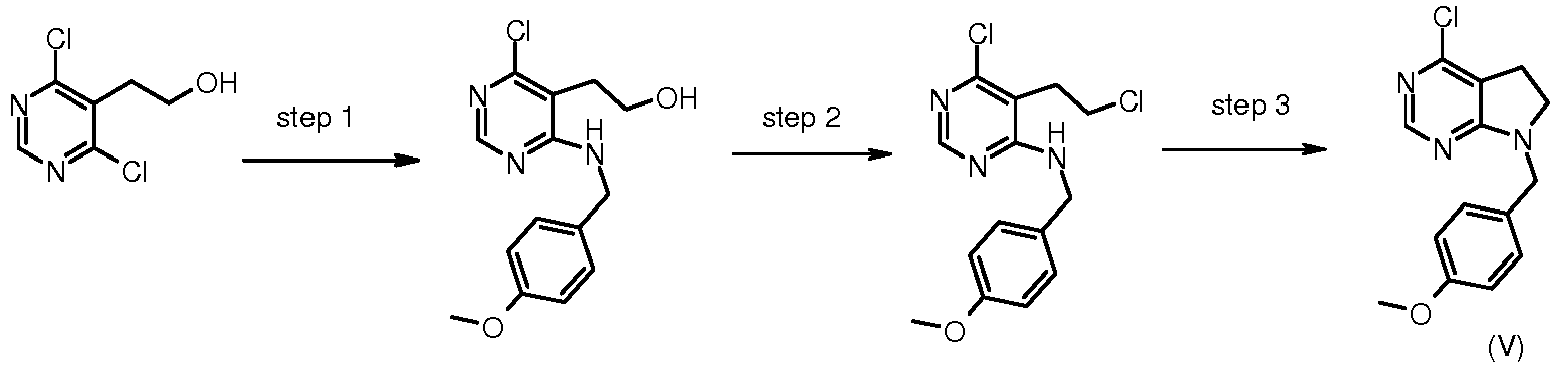
- To a solution of 2-(4,6-dichloropyrimidin-5-yl)ethanol (470 mg, 2.43 mmol) in EtOH (10 mL) DIPEA (592 µL, 2.9 mmol) and 4-methoxybenzylamine (380 µL, 3.40 mmol) were added. The solution was refluxed for 5 h. The solvent was removed in vacuo and the residue was diluted with EtOAc, washed with water, dried over Na2SO4, filtered and concentrated under reduced pressure to afford the title compound as an oil (520 mg, 73%).
- 1H NMR (600 MHz, DMSO-d6) δ 8.12 (s, 1H), 7.76 (t, J = 5.7 Hz, 1H), 7.22 (d, J = 8.6 Hz, 2H), 6.86 (d, J = 8.6 Hz, 2H), 4.82 (t, J= 5.2 Hz, 1H), 4.52 (d, J= 5.8 Hz, 2H), 3.71 (s, 3H), 3.51 - 3.61 (m, 2H), 2.81 (t, J= 6.8 Hz, 2H).
- 2-{4-Chloro-6-[(4-methoxybenzyl)amino]pyrimidin-5-yl}ethanol (293 mg, 1 mmol) in toluene (5 mL) was treated with SOCl2 (145 µL, 2 mmol). The reaction mixture was refluxed 1 h and then concentrated to give the title compound as an oil. The crude product was used for the next reaction without purification.
- 1H NMR (600 MHz, DMSO-d 6) δ 8.17 (s, 1H), 8.03 (t, J = 5.59 Hz, 1H), 7.22 (d, J = 8.6 Hz, 2H), 6.86 (d, J = 8.6 Hz, 2H), 4.53 (d, J = 5.8 Hz, 2H), 3.72 (t, J = 7.3 Hz, 2H), 3.71 (s, 3H), 3.13 (t, J = 7.3 Hz, 2H).
- To a solution of 6-chloro-5-(2-chloroethyl)-N-(4-methoxybenzyl)pyrimidin-4-amine in DMF (5 ml) K2CO3 (414 mg, 3 mmol) was added and then warmed to 110 °C for 2 h. The reaction mixture was diluted with water and extracted with EtOAc, dried over Na2SO4, filtered and concentrated under reduced pressure to obtain the title compound as an oil (261 mg, 95%).
- 1H NMR (600 MHz, DMSO-d 6) δ 8.15 (s, 1H), 7.21 (d, J = 8.6 Hz, 2H), 6.90 (d, J = 8.6 Hz, 2H), 4.50 (s, 2H), 3.73 (s, 3H), 3.53 (t, J = 8.7 Hz, 2H), 3.00 (t, J = 8.7 Hz, 2H).
-

- To a solution of 4-chloro-1-ethyl-2-iodo-benzene (2.66 g, 10 mmol) and methyl propiolate (1.79 mL, 20 mmol) in DMF (20 mL), Cu2O (1.43 g, 10 mmol) was added. The reaction was heated to 110 °C (oil bath temperature) for 20 h with mechanical stirring. The reaction was filtered over a plug of celite, the plug was washed with EtOAc (100 mL) and the filtrate was washed first with water, then with brine. Drying over sodium sulfate of the organic phase, evaporation and purification of the crude by chromatography over silica gel (heptane/Et2O 95/5) afforded the title compound as an oil (1.29 g, 58%).
- 1H NMR (400 MHz, DMSO-d6) δ 7.69 (d, J = 2.3 Hz, 1H), 7.56 (dd, J = 2.3, 8.4 Hz, 1H), 7.42 (d, J = 8.4 Hz, 1H), 3.80 (s, 3H), 2.75 (q, J = 7.6 Hz, 2H), 1.18 (t, J = 7.57 Hz, 3H).
- Methyl 3-(5-chloro-2-ethylphenyl)prop-2-ynoate (500 mg, 2.25 mmol) in DMF (4.5 mL) was treated with 2,2-diethoxyethanamine (0.368 mL, 2.48 mmol) and heated to 110 °C (oil bath temperature) for 18 h. The volatiles were evaporated under reduced pressure and the crude was heated under reflux in acetic anhydride (9 mL). After 10 h the reaction was completed and removal of the volatiles under reduced pressure afforded the title compound which was employed in the next step without further purification.
- Methyl 3-[acetyl(2,2-diethoxyethyl)amino]-3-(5-chloro-2-ethylphenyl)prop-2-enoate (2.25 mmol) in DCM (0.350 mL) was added to magnesium chloride (43 mg, 0.45 mmol) in TFA (0.6 mL), heated to 65°C (oil bath temperature). After 0.5 h the reaction was evaporated and the crude isolated by chromatography over silica gel (hexane:EtOAc 8:2) affording the title compound as a yellow crystalline solid (142 mg, 24%).
- ESI (+) MS: m/z 264 (MH+).
- To a solution of methyl 2-(5-chloro-2-ethylphenyl)-1H-pyrrole-3-carboxylate (0.2 g, 0.76 mmol) in DMF (3 mL) NaH (60% dispersion in oil, 36 mg, 0.91 mmol) was added at 5 °C, under argon atmosphere. The reaction mixture was stirred for 1 h, then benzenesulfonyl chloride (0.106 mL, 0.83 mmol) was added dropwise. After 2 h the reaction mixture was added to water and ice under stirring. EtOAc (30 mL) was added, the organic layer was separated and washed with water, brine, dried over Na2SO4, filtered, the solvent was evaporated under reduced pressure to give an oil, which was purified by Biotage SP1 Flash Chromatography (cyclohexane/EtOAc 9/1) to afford the title compound (248 mg, 81%).
- ESI (+) MS: m/z 404 (MH+).
-

- To a solution of 5-bromo-2-(5-chloro-2-methylphenyl)-1-{[2-(trimethylsilyl)ethoxy]methyl}-1H-pyrrole-3-carbonitrile (948 mg, 2.23 mmol) in THF (10 mL) 2-isopropoxy-4,4,5,5-tetramethyl-1,3,2-dioxyborolane (0.683 mL, 3.35 mmol) was added to the mixture at -78 °C under argon. n-BuLi (2.5 M in hexane, 1.95 mL, 5.025 mmol) was slowly added dropwise at -78 °C. The mixture was stirred at -78 °C for 1 h. MeOH (1.5 mL) was added and the resultant mixture was stirred at room temperature after slowly raising the temperature. NH4Cl solution (10 mL) was added and the mixture was extracted with EtOAc (30 mL), washed with aqueous brine, dried over Na2SO4, filtered, concentrated under reduced pressure and used in the next step without further purification.
- Into a 50 mL round bottom flask equipped with a stir bar, condenser and 3-way valve connected to argon and vacuum 2-(5-chloro-2-methylphenyl)-5-(4,4,5,5-tetramethyl-1,3,2-dioxaborolan-2-yl)-1-{[2-(trimethylsilyl)ethoxy] methyl}-1H-pyrrole-3-carbonitrile coming from the previous step, 6-iodopyrimidin-4-amine (740 mg, 3.35 mmol), 2M Na2CO3 (3.35 mL, 6.70 mmol) and dioxane (22 mL) were charged at room temperature. The resulting reaction mixture was degassed three times back filling with argon each time before being charged PdCl2(dppf) (182 mg, 0.223 mmol). The resulting reaction mixture was degassed four times back filling with argon each time and then warmed to 110 °C for 1 h. The reaction mixture was cooled to room temperature, filtered through a pad of Celite, washed with EtOAc, and the filtrate was concentrated and then diluted with EtOAc (30 mL) and water (10 mL). The two layers were separated, and the aqueous layer was extracted with EtOAc (25 mL). The combined organic fractions were washed with aqueous brine (2 x 20 mL), dried over Na2SO4, filtered and concentrated under reduced pressure. The residue was purified by Biotage SP1 Flash Chromatography (DCM/MeOH/7N NH3 in MeOH 97/2/1) to afford the title compound (343 mg, 35%, 2 steps).
- 1H NMR (400 MHz, DMSO-d 6) δ 8.40 (s, 1H), 7.52 - 7.58 (m, 1H), 7.39 - 7.51 (m, 2H), 7.15 (s, 1H), 7.01 (d, J = 3.6 Hz, 3H), 6.69 (s, 1H), 5.78 (d, J = 10.3 Hz, 1H), 5.40 (d, J = 10.3 Hz, 1H), 3.02 - 3.17 (m, 2H), 2.14 (s, 3H), 0.53 - 0.63 (m, 1H), -0.18 (s, 9H).
- HRMS (ESI) m/z calcd for C22H26CIN5OSi + H+ 440.1668, found 440.1671.
- TFA (1.4 mL) was added to a solution of 5-(6-aminopyrimidin-4-yl)-2-(5-chloro-2-methylphenyl)-1-{[2-(trimethylsilyl)ethoxy]methyl}-1H-pyrrole-3-carbonitrile (61 mg, 0.14 mmol) in dry DCM (2.8 mL) and stirred for 4 h at room temperature. After solvent removal, the residue was treated with EtOH (3 mL), 33% NH4OH (0.4 mL) and stirred for 0.5 h. The solvent was evaporated to dryness and the residue was purified by flash-chromatography (DCM/MeOH/7N NH3 in MeOH 93/7/0.7) to afford the title compound as a solid (28 mg, 65%).
- 1H NMR (600 MHz, DMSO-d6) δ 12.71 (br. s., 1H), 8.36 (d, J= 0.9 Hz, 1H), 7.48 - 7.53 (m, 1H), 7.44 (d, J= 8.4 Hz, 1H), 7.41 (d, J= 2.4 Hz, 1H), 7.22 (s, 1H), 6.89 (s, 2H), 6.73 (d, J= 1.1 Hz, 1H), 2.14 (s, 3H).
- According to this procedure, but using 6-chloro-N-methylpyrimidin-4-amine instead of 6-iodopyrimidin-4-amine in the step 2, the following compound was prepared:
- ESI (+) MS: m/z 324 (MH+).
- According to this procedure, but using 4-chioro-7-{[2-(trimethylsilyl)ethoxy]methyl}-7H-pyrrolo[2,3-d]pyrimidine instead of 6-iodopyrimidin-4-amine in the step 2, the following compound was prepared:
- ESI (+) MS: m/z 334 (MH+).
- According to this procedure, but using 4-chloro-1-{[2-(trimethylsilyl)ethoxy]methyl}-1H-pyrrolo[2,3-b]pyridine instead of 6-iodopyrimidin-4-amine in the step 2, the following compound was prepared:
- 1H NMR (400 MHz, DMSO-d6) δ 12.94 (br. s., 1H), 12.21 (br. s., 1H), 8.75 (s, 1H), 7.70 (br. s., 1H), 7.64 (dd, J= 2.5, 3.4 Hz, 1H), 7.45 - 7.52 (m, 2H), 7.39 - 7.43 (m, 1H), 7.09 (dd, J = 1.7, 3.5 Hz, 1H), 2.32 (s, 3H).
- HRMS (ESI) m/z calcd for C18H12CIN5 + H+ 334.0854, found 334.0860.
- According to this procedure, but using 6-chloro-9-(4-methoxybenzyl)-9H-purine instead of 6-iodopyrimidin-4-amine in the step 2, the following compound was prepared:
- ESI (+) MS: m/z 335 (MH+).
- According to this procedure, but using 4-chloro-1-{[2-(trimethylsilyl)ethoxy]methyl}-1H-pyrazolo[3,4-d]pyrimidine instead of 6-iodopyrimidin-4-amine in the step 2, the following compound was prepared:
- ESI (+) MS: m/z 335 (MH+).
- According to this procedure, but using 4-chloropyrrolo[2,1-f][1,2,4]triazine instead of 6-iodopyrimidin-4-amine in the step 2, the following compound was prepared:
- ESI (+) MS: m/z 334 (MH+).
- According to this procedure, but using 4-chloro-7-(4-methoxy-benzyl)-6,7-dihydro-5H-pyrrolo[2,3-d]pyrimidine instead of 6-iodopyrimidin-4-amine in the step 2, the following compound was prepared:
- ESI (+) MS: m/z 336 (MH+).
- According to this procedure, but starting from 5-bromo-2-(5-chloro-2-ethylphenyl)-1-{[2-(trimethylsilyl)ethoxy]methyl}-1H-pyrrole-3-carbonitrile in the step 1a, the following compound was prepared:
- 1H NMR (600 MHz, DMSO-d6) δ 12.71 (br. s., 1H), 8.36 (d, J= 0.9 Hz, 1H), 7.48 - 7.53 (m, 1H), 7.44 (d, J= 8.4 Hz, 1H), 7.41 (d, J= 2.4 Hz, 1H), 7.22 (s, 1H), 6.89 (s, 2H), 6.73 (d, J = 1.1 Hz, 1H), 2.61 (q, J = 7.6 Hz, 2H), 1.01 (t, J = 7.6 Hz, 3H).
- HRMS (ESI) calcd for C17H14CIN5 + H+ 324.1011, found 324.1007.
- According to this procedure, but starting from 5-bromo-2-(5-chloro-2-ethylphenyl)-1-{[2-(trimethylsilyl)ethoxy]methyl}-1H-pyrrole-3-carbonitrile in the step 1a and using 6-chloro-N-methylpyrimidin-4-amine instead of 6-iodopyrimidin-4-amine in the step 2, the following compound was prepared:
- 1H NMR (600 MHz, DMSO-d 6) δ 12.78 (br. s., 1H), 8.54 (br. s., 1H), 8.19 (br. s., 1H), 7.52 - 7.61 (m, 1H), 7.42 - 7.52 (m, 3H), 6.90 (br. s., 1H), 2.89 (br. s., 3H), 2.61 (q, J= 7.6 Hz, 2H), 1.01 (t, J= 7.6 Hz, 3H).
- HRMS (ESI) calcd for C18H16CIN5 + H+ 338.1167, found 338.1169.
- According to this procedure, but starting from 5-bromo-2-(5-chloro-2-ethylphenyl)-1-{[2-(trimethylsilyl)ethoxy]methyl}-1H-pyrrole-3-carbonitrile in the step 1a and using 4-chloro-7-{[2-(trimethylsilyl)ethoxy]methyl}-7H-pyrrolo[2,3-d]pyrimidine instead of 6-iodopyrimidin-4-amine in the step 2, the following compound was prepared:
- 1H NMR (600 MHz, DMSO-d 6) δ 12.96 (br. s., 1H), 12.21 (br. s., 1H), 8.73 (s, 1H), 7.71 (s, 1H), 7.60 - 7.66 (m, 1H), 7.50 - 7.55 (m, 1H), 7.40 - 7.47 (m, 2H), 7.09 (d, J = 2.0 Hz, 1H), 2.65 (q, J = 7.5 Hz, 2H), 1.03 (t, J = 7.5 Hz, 3H). HRMS (ESI) calcd for C19H14CIN5 + H+ 348.1011, found 348.1014.
- According to this procedure, but starting from 5-bromo-2-(5-chloro-2-ethylphenyl)-1-{[2-(trimethylsilyl)ethoxy]methyl}-1H-pyrrole-3-carbonitrile in the step 1a and using 6-chloro-9-(4-methoxybenzyl)-9H-purine instead of 6-iodopyrimidin-4-amine in the step 2, the following compound was prepared:
- ESI (+) MS: m/z 349 (MH+).
- According to this procedure, but starting from 5-bromo-2-(5-chloro-2-ethylphenyl)-1-{[2-(trimethylsilyl)ethoxy]methyl}-1H-pyrrole-3-carbonitrile in the step 1a and using 4-chloro-1-{[2-(trimethylsilyl)ethoxy]methyl}-1H-pyrazolo[3,4-d]pyrimidine instead of 6-iodopyrimidin-4-amine in the step 2, the following compound was prepared:
- ESI (+) MS: m/z 349 (MH+).
- According to this procedure, but starting from 5-bromo-2-(5-chloro-2-ethylphenyl)-1-{[2-(trimethylsilyl)ethoxy]methyl}-1H-pyrrole-3-carbonitrile in the step 1a and using 4-chloropyrrolo[2,1-f][1,2,4]triazine instead of 6-iodopyrimidin-4-amine in the step 2, the following compound was prepared:
- ESI (+) MS: m/z 348 (MH+).
- According to this procedure, but starting from 5-bromo-2-(5-chloro-2-ethylphenyl)-1-{[2-(trimethylsilyl)ethoxy]methyl}-1H-pyrrole-3-carbonitrile in the step 1a and using 4-chloro-7-(4-methoxy-benzyl)-6,7-dihydro-5H-pyrrolo[2,3-d]pyrimidine instead of 6-iodopyrimidin-4-amine in the step 2, the following compound was prepared:
- ESI (+) MS: m/z 350 (MH+).
- According to this procedure, but starting from 5-bromo-2-[2-chloro-5-(trifluoromethyl)phenyl]-1-{[2-(trimethylsilyl)ethoxy]methyl}-1H-pyrrole-3-carbonitrile in the step 1a, the following compound was prepared:
- 1H NMR (600 MHz, DMSO-d6) δ 12.90 (br. s., 1H), 8.38 (d, J = 1.1 Hz, 1H), 7.96 (s, 1H), 7.84 - 7.92 (m, 2H), 7.28 (s, 1H), 6.94 (s, 2H), 6.75 (d, J = 1.28 Hz, 1H).
- HRMS (ESI) calcd for C16H9ClF3N5 + H+ 364.0572, found 364.0572.
- According to this procedure, but starting from 5-bromo-2-[2-chloro-5-(trifluoromethyl)phenyl]-1-{[2-(trimethylsilyl)ethoxy]methyl}-1H-pyrrole-3-carbonitrile in the step 1a and using 6-chloro-N-methylpyrimidin-4-amine instead of 6-iodopyrimidin-4-amine in the step 2, the following compound was prepared:
- 1H NMR (600 MHz, DMSO-d6) δ 12.53 - 13.20 (m, 1H), 8.44 (br. s., 1H), 7.72 - 8.05 (m, 3H), 7.23 - 7.56 (m, 1H), 6.82 (br. s., 1H), 2.84 (d, J = 3.5 Hz, 3H).
- HRMS (ESI) calcd for C17H11ClF3N5 + H+ 378.0728, found 378.0732.
- According to this procedure, but starting from 5-bromo-2-[2-chloro-5-(trifluoromethyl)phenyl]-1-{[2-(trimethylsilyl)ethoxy]methyl}-1H-pyrrole-3-carbonitrile in the step 1a and using 4-chloro-7-{[2-(trimethylsilyl)ethoxy]methyl}-7H-pyrrolo[2,3-d]pyrimidine instead of 6-iodopyrimidin-4-amine in the step 2, the following compound was prepared:
- ESI (+) MS: m/z 388 (MH+).
- According to this procedure, but starting from 5-bromo-2-[2-chloro-5-(trifluoromethyl)phenyl]-1-{[2-(trimethylsilyl)ethoxy]methyl}-1H-pyrrole-3-carbonitrile in the step 1a and using 6-chloro-9-(4-methoxybenzyl)-9H-purine instead of 6-iodopyrimidin-4-amine in the step 2, the following compound was prepared:
- ESI (+) MS: m/z 389 (MH+).
- According to this procedure, but starting from 5-bromo-2-[2-chloro-5-(trifluoromethyl)phenyl]-1-{[2-(trimethylsilyl)ethoxy]methyl}-1H-pyrrole-3-carbonitrile in the step 1a and using 4-chloro-1-{[2-(trimethylsilyl)ethoxy]methyl}-1H-pyrazolo[3,4-d]pyrimidine instead of 6-iodopyrimidin-4-amine in the step 2, the following compound was prepared:
- ESI (+) MS: m/z 389 (MH+).
- According to this procedure, but starting from 5-bromo-2-[2-chloro-5-(trifluoromethyl)phenyl]-1-{[2-(trimethylsilyl)ethoxy]methyl}-1H-pyrrole-3-carbonitrile in the step 1a and using 4-chloropyrrolo[2,1-f][1,2,4]triazine instead of 6-iodopyrimidin-4-amine in the step 2, the following compound was prepared:
- According to this procedure, but starting from 5-bromo-2-[2-chloro-5-(trifluoromethyl)phenyl]-1-{[2-(trimethylsilyl)ethoxy]methyl}-1H-pyrrole-3-carbonitrile in the step 1a and using 4-chloro-7-(4-methoxy-benzyl)-6,7-dihydro-5H-pyrrolo[2,3-d]pyrimidine instead of 6-iodopyrimidin-4-amine in the step 2, the following compound was prepared:
- ESI (+) MS: m/z 390 (MH+).
- According to this procedure, but starting from 5-bromo-2-[2-methyl-5-(trifluoromethyl)phenyl]-1-{[2-(trimethylsilyl)ethoxy]methyl}-1H-pyrrole-3-carbonitrile in the step 1a, the following compound was prepared:
- 1H NMR (600 MHz, DMSO-d6) δ 12.77 (br. s., 1H), 8.37 (d, J = 0.9 Hz, 1H), 7.76 (d, J = 8.0 Hz, 1H), 7.71 (s, 1H), 7.62 (d, J = 8.0 Hz, 1H), 7.25 (s, 1H), 6.91 (s, 2H), 6.74 (d, J = 1.1 Hz, 1H), 2.41 (s, 3H).
- HRMS (ESI) calcd for C17H12F3N5 + H+ 344.1118, found 344.1116.
- According to this procedure, but starting from 5-bromo-2-[2-methyl-5-(trifluoromethyl)phenyl]-1-{[2-(trimethylsilyl)ethoxy]methyl}-1H-pyrrole-3-carbonitrile in the step 1a and using 6-chloro-N-methylpyrimidin-4-amine instead of 6-iodopyrimidin-4-amine in the step 2, the following compound was prepared:
- 1H NMR (600 MHz, DMSO-d6) δ 12.76 (br. s., 1H), 8.42 (br. s., 1 H), 7.76 (d, J = 7.9 Hz, 1H), 7.72 (s, 1H), 7.63 (d, J = 7.9 Hz, 1H), 7.35 (br. s., 2H), 6.81 (br. s., 1H), 2.83 (d, J = 4.21 Hz, 3H), 2.41 (s, 3H).
- HRMS (ESI) calcd for C18H14F3N5 + H+ 358.1274, found 358.1271.
- According to this procedure, but starting from 5-bromo-2-[2-methyl-5-(trifluoromethyl)phenyl]-1-{[2-(trimethylsilyl)ethoxy]methyl}-1H-pyrrole-3-carbonitrile in the step 1a and using 4-chloro-7-{[2-(trimethylsilyl)ethoxy]methyl}-7H-pyrrolo[2,3-d]pyrimidine instead of 6-iodopyrimidin-4-amine in the step 2, the following compound was prepared:
- ESI (+) MS: m/z 368 (MH+).
- According to this procedure, but starting from 5-bromo-2-[2-methyl-5-(trifluoromethyl)phenyl]-1-{[2-(trimethylsilyl)ethoxy]methyl}-1H-pyrrole-3-carbonitrile in the step 1a and using 4-chloropyrrolo[2,1-f][1,2,4]triazine instead of 6-iodopyrimidin-4-amine in the step 2, the following compound was prepared:
- ESI (+) MS: m/z 368 (MH+).
- According to this procedure, but starting from 5-bromo-2-[2-methyl-5-(trifluoromethyl)phenyl]-1-{[2-(trimethylsilyl)ethoxy]methyl}-1H-pyrrole-3-carbonitrile in the step 1a and using 4-chloro-7-(4-methoxy-benzyl)-6,7-dihydro-5H-pyrrolo[2,3-d]pyrimidine instead of 6-iodopyrimidin-4-amine in the step 2, the following compound was prepared:
- ESI (+) MS: m/z 370 (MH+).
- According to this procedure, but starting from 5-bromo-2-[2-ethyl-5-(trifluoromethyl)phenyl]-1-{[2-(trimethylsilyl)ethoxy]methyl}-1H-pyrrole-3-carbonitrile in the step 1a, the following compound was prepared:
- ESI (+) MS: m/z 358 (MH+).
- According to this procedure, but starting from 5-bromo-2-[2-ethyl-5-(trifluoromethyl)phenyl]-1-{[2-(trimethylsilyl)ethoxy]methyl}-1H-pyrrole-3-carbonitrile in the step 1a and using 6-chloro-N-methylpyrimidin-4-amine instead of 6-iodopyrimidin-4-amine in the step 2, the following compound was prepared:
- ESI (+) MS: m/z 372 (MH+).
- According to this procedure, but starting from 5-bromo-2-[2-ethyl-5-(trifluoromethyl)phenyl]-1-{[2-(trimethylsilyl)ethoxy]methyl}-1H-pyrrole-3-carbonitrile in the step 1a and using 4-chloro-7-{[2-(trimethylsilyl)ethoxy]methyl}-7H-pyrrolo[2,3-d]pyrimidine instead of 6-iodopyrimidin-4-amine in the step 2, the following compound was prepared:
- 1H NMR (600 MHz, DMSO-d6) δ 13.05 (br. s., 1H), 12.22 (br. s., 1H), 8.74 (s, 1H), 7.82 (d, J = 8.6 Hz, 1H), 7.74 (s, 1H), 7.72 (s, 1H), 7.67 (d, J = 8.0 Hz, 1H), 7.62 - 7.66 (m, J = 2.7 Hz, 1H), 7.10 (d, J = 2.4 Hz, 1H), 2.76 (q, J = 7.6 Hz, 2H), 1.08 (t, J = 7.5 Hz, 3H).
- ESI (+) MS: m/z 382 (MH+).
- According to this procedure, but starting from 5-bromo-2-[2-ethyl-5-(trifluoromethyl)phenyl]-1-{[2-(trimethylsilyl)ethoxy]methyl}-1H-pyrrole-3-carbonitrile in the step 1a and using 4-chloropyrrolo[2,1-f][1,2,4]triazine instead of 6-iodopyrimidin-4-amine in the step 2, the following compound was prepared:
- ESI (+) MS: m/z 382 (MH+).
- According to this procedure, but starting from 5-bromo-2-[2-ethyl-5-(trifluoromethyl)phenyl]-1-{[2-(trimethylsilyl)ethoxy]methyl}-1H-pyrrole-3-carbonitrile in the step 1a and using 4-chloro-7-(4-methoxy-benzyl)-6,7-dihydro-5H-pyrrolo[2,3-d]pyrimidine instead of 6-iodopyrimidin-4-amine in the step 2, the following compound was prepared:
- ESI (+) MS: m/z 384 (MH+).
- According to this procedure, but starting from 5-bromo-2-phenyl-1-{[2-(trimethylsilyl)ethoxy]methyl}-1H-pyrrole-3-carbonitrile in the step 1a, the following compound was prepared:
- ESI (+) MS: m/z 262 (MH+).
- According to this procedure, but starting from 5-bromo-2-phenyl-1-{[2-(trimethylsilyl)ethoxy]methyl}-1H-pyrrole-3-carbonitrile in the step 1a and using 6-chloro-N-methylpyrimidin-4-amine instead of 6-iodopyrimidin-4-amine in the step 2, the following compound was prepared:
- 1H NMR (600 MHz, DMSO-d6) δ 12.64 (br. s., 1H), 8.54 (br. s., 1H), 7.79 -7.88 (m, 1H), 7.57 (t, J = 7.7 Hz, 1H), 7.47 - 7.51 (m, 1H), 7.35 - 7.41 (m, 1H), 6.93 (br. s., 1H), 2.90 (d, J = 4.40 Hz, 3H).
- HRMS (ESI) calcd for C16H13N5 + H+ 276.1244, found 276.1243.
- According to this procedure, but starting from 5-bromo-2-phenyl-1-{[2-(trimethylsilyl)ethoxy]methyl}-1H-pyrrole-3-carbonitrile in the step 1a and using 4-chloro-7-{[2-(trimethylsilyl)ethoxy]methyl}-7H-pyrrolo[2,3-d]pyrimidine instead of 6-iodopyrimidin-4-amine in the step 2, the following compound was prepared:
- ESI (+) MS: m/z 286 (MH+).
- According to this procedure, but starting from 5-bromo-2-phenyl-1-{[2-(trimethylsilyl)ethoxy]methyl}-1H-pyrrole-3-carbonitrile in the step 1a and using 4-chloropyrrolo[2,1-f][1,2,4]triazine instead of 6-iodopyrimidin-4-amine in the step 2, the following compound was prepared:
- ESI (+) MS: m/z 286 (MH+).
- According to this procedure, but starting from 5-bromo-2-phenyl-1-{[2-(trimethylsilyl)ethoxy]methyl}-1H-pyrrole-3-carbonitrile in the step 1a and using 4-chloro-7-(4-methoxy-benzyl)-6,7-dihydro-5H-pyrrolo[2,3-d]pyrimidine instead of 6-iodopyrimidin-4-amine in the step 2, the following compound was prepared:
- ESI (+) MS: m/z 288 (MH+).
-

- To a solution of 2-(5-chloro-2-ethylphenyl)-1-(phenylsulfonyl)-1H-pyrrole-3-carbonitrile (1.02 g, 2.77 mmol) and 2-isopropoxy-4,4,5,5-tetramethyl-1,3,2-dioxyborolane (0.791 mL, 3.88 mmol) in THF (8.5 mL) LDA (2M in THF/heptane/ethylbenzene, 4.6 mL, 9.15 mmol) was slowly added dropwise at -78 °C under argon. After 50 min, MeOH (4 mL) was added, the temperature was allowed to rise and NH4Cl solution (20 mL) was added drop wise at room temperature. The reaction was then diluted with water and extracted with Et2O, dried over Na2SO4, filtered and the solvent was evaporated under reduced pressure to afford the title compound that was used without further purification.
- 2-(5-Chloro-2-ethylphenyl)-1-(phenylsulfonyl)-5-(4,4,5,5-tetramethyl-1,3,2-dioxaborolan-2-yl)-1H-pyrrole-3-carbonitrile (2.77 mmol), 6-iodopyrimidin-4-amine (918 mg, 4.16 mmol), PdCl2(dppf) (226 mg, 0.277 mmol) and Cs2CO3 (2.71 g, 8.31 mmol) were degassed and back filled with argon and then dissolved in dioxane (20 mL) and water (4 mL) under nitrogen. The reaction mixture was stirred at room temperature over night, then diluted with EtOAc, washed with aqueous brine, dried over Na2SO4, filtered and concentrated under reduced pressure. The residue was purified by Biotage SP1 Flash Chromatography (DCM/MeOH/NH3 7 N in MeOH 95/5/0.5) to afford the title compound (540 mg, 39%, 2 steps).
- 1H NMR (600 MHz, DMSO-d6) δ 8.45 (d, J = 0.92 Hz, 1H), 7.82 (t, J = 7.42 Hz, 1H), 7.71 - 7.78 (m, 1H), 7.59 - 7.63 (m, 1H), 7.56 (dd, J = 2.29, 8.33 Hz, 1H), 7.39 (d, J = 8.43 Hz, 1H), 7.11 (br. s., 1H), 7.09 (s, 1H), 6.83 (d, J = 2.20 Hz, 1H), 6.64 (d, J = 1.10 Hz, 1H), 2.03 - 2.24 (m, 2H), 1.01 (t, J = 7.60 Hz, 3H).
- HRMS (ESI) m/z calcd for C23H18N5O2SCl + H+ 464.0943, found 464.0938.
- 5-(6-Aminopyrimidin-4-yl)-2-(5-chloro-2-ethylphenyl)-1-(phenylsulfonyl)-1H-pyrrole-3-carbonitrile (299 mg, 0.647 mmol) in THF (6.5 mL) was treated with LiOH.H2O (109 mg, 2.59 mmol) in water (3 mL) and heated under reflux for two days. After cooling, the residue was diluted with water (20 mL) and washed with Et2O (20 mL). The aqueous
- phase was slowly added to 1N HCl (7 mL) in iced water (70 mL) under stirring and the white solid was collected by filtration affording after drying at 50 °C under vacuum, the title compound (157 mg, 70%).
- 1H NMR (600 MHz, DMSO-d6) δ 12.71 (br. s., 1H), 8.36 (d, J = 0.9 Hz, 1H), 7.48 - 7.53 (m, 1H), 7.44 (d, J = 8.4 Hz, 1H), 7.41 (d, J = 2.4 Hz, 1H), 7.22 (s, 1H), 6.89 (s, 2H), 6.73 (d, J = 1.1 Hz, 1H), 2.61 (q, J = 7.6 Hz, 2H), 1.01 (t, J = 7.6 Hz, 3H).
- HRMS (ESI) calcd for C17H14ClN5 + H+ 324.1011, found 324.1007.
-

- To a solution of ethyl 2-phenyl-1-(phenylsulfonyl)-1H-pyrrole-3-carboxylate (440 mg, 1.24 mmol) and 2-isopropoxy-4,4,5,5-tetramethyl-1,3,2-dioxyborolane (0.303 mL, 1.2 mmol) in THF (1.9 mL) LDA (2M in THF/heptane/ethylbenzene, 1.61 mL, 3.22 mmol) was slowly added dropwise at -78 °C under argon. After 50 min, MeOH (1 mL) was added, the temperature was allowed to rise and NH4Cl solution (2 mL) was added drop wise at room temperature. The reaction was the diluted with water and extracted with Et2O, dried over Na2SO4, filtered and the solvent was evaporated under reduced pressure to afford the title compound that was used without further purification.
- Ethyl 2-phenyl-1-(phenylsulfonyl)-5-(4,4,5,5-tetramethyl-1,3,2-dioxaborolan-2-yl)-1H-pyrrole-3-carboxylate (1.24 mmol), 6-iodopyrimidin-4-amine (411 mg, 1.86 mmol), PdCl2(dppf) (101 mg, 0.124 mmol) and Na2CO3 (394 mg, 3.72 mmol) were degassed and back filled with argon and then dissolved in dioxane (12 mL) and water (1.9 mL) under nitrogen. The reaction mixture was stirred at room temperature over night, then diluted with EtOAc, washed with aqueous brine, dried over Na2SO4, filtered and concentrated under reduced pressure. The residue was purified by Biotage SP1 Flash Chromatography (DCM/MeOH/NH3 7 N in MeOH 95/5/0.5) to afford the title compound (240 mg, 43%, 2 steps).
- 1H NMR (600 MHz, DMSO-d6) δ 8.42 (d, J = 1.1 Hz, 1H), 7.72 (quin, J = 4.3 Hz, 1H), 7.48 - 7.53 (m, 4H), 7.37 - 7.44 (m, 1H), 7.26 (t, J = 7.7 Hz, 2H), 7.00 (s, 2H), 6.96 (dd, J = 1.2, 8.1 Hz, 2H), 6.82 - 6.86 (m, 1H), 6.67 - 6.70 (m, 1H), 3.95 (q, J = 7.0 Hz, 2H), 0.87 - 1.01 (m, 3H).
- HRMS (ESI) m/z calcd for C23H20N4O4S + H+ 449.1278, found 449.1273.
- Ethyl 5-(6-aminopyrimidin-4-yl)-2-phenyl)-1-(phenylsulfonyl)-1H-pyrrole-3-carboxylate (290 mg, 0.647 mmol) in THF (6.5 mL) was treated with LiOH.H2O (109 mg, 2.59 mmol) in water (3 mL) and heated under reflux for two days. After cooling, the residue was diluted with water (20 mL) and washed with Et2O (20 mL). The aqueous phase was slowly added to 1N HCl (7 mL) in iced water (70 mL) under stirring and the white solid was collected by filtration affording, after drying at 50 °C under vacuum, the title compound (153 mg, 85%).
- 1H NMR (600 MHz, DMSO-d6) δ 12.42 (br. s., 1H), 12.10 (br. s., 1H), 8.53 (br. s., 1H), 7.63 (d, J = 6.8 Hz, 2H), 7.39 - 7.48 (m, 4H), 7.25 - 7.34 (m, 1H), 6.94 (br. s., 1H).
- HRMS (ESI) m/z calcd for C15H12N4O2 + H+ 281.1033, found 281.1033.
- A solution of 5-(6-aminopyrimidin-4-yl)-2-phenyl-1H-pyrrole-3-carboxylic acid (40 mg, 0.143 mmol) in DMF (0.5 mL) and DIPEA (99 µL, 0.571 mmol) was stirred at 0 °C. EDCI (55 mg, 0.286 mmol) and HOBT.NH3 (44 mg, 0.286 mmol) were added and the reaction mixture was stirred over night at room temperature. The mixture was diluted with saturated solution of NaHCO3 (20 mL), extracted with EtOAc (50 mL), dried over Na2SO4, filtered. The solvent was evaporated under reduced pressure and the crude was purified by Biotage SP1 Flash Chromatography (DCM/MeOH/NH3 7 N in MeOH 9/1/0.1) to afford the title compound (35 mg, 89%).
- 1H NMR (600 MHz, DMSO-d6) δ 11.77 (br. s., 1H), 8.33 (s, 1H), 7.64 (d, J = 7.1 Hz, 2H), 7.35 - 7.40 (m, 2H), 7.28 - 7.34 (m, 2H), 7.19 (s, 1H), 6.79 (br. s., 1H), 6.76 (s, 2H), 6.73 (d, J = 1.1 Hz, 1H).
- HRMS (ESI) m/z calcd for C15H13lN5O + H+ 280.1193, found 280.1196.
- According to this procedure, but using 6-chloro-N-methylpyrimidin-4-amine instead of 6-iodopyrimidin-4-amine in the step 5, the following compound was prepared:
- 1H NMR (600 MHz, DMSO-d 6) δ 11.77 (br. s., 1H), 8.36 (br. s., 1H), 7.62 - 7.65 (m, 2H), 7.37 - 7.42 (m, 2H), 7.32 - 7.36 (m, 1H), 7.30 (br. s., 1H), 7.26 (br. s., 1H), 7.18 (br. s., 1H), 6.80 (br. s., 2H), 2.82 (d, J = 4.58 Hz, 3H).
- HRMS (ESI) calcd for C16H15N5O + H+ 294.1350, found 294.1350.
- According to this procedure, but using 4-chloropyrrolo[2,1-f][1,2,4]triazine instead of 6-iodopyrimidin-4-amine in the step 5, the following compound was prepared:
- ESI (+) MS: m/z 304 (MH+).
- According to this procedure, but using methylamine in the step 7, the following compound was prepared:
- 1H NMR (600 MHz, DMSO-d6) δ 11.77 (br. s., 1H), 8.33 (d, J = 0.9 Hz, 1H), 7.83 (q, J = 4.2 Hz, 1H), 7.60 - 7.67 (m, 2H), 7.35 - 7.40 (m, 2H), 7.28 - 7.34 (m, 1H), 7.14 (s, 1H), 6.76 (s, 2H), 6.73 (d, J = 1.1 Hz, 1H), 2.67 (d, J = 4.6 Hz, 3H).
- HRMS (ESI) m/z calcd for C16H15N5O + H+ 294.1350, found 294.1348.
- According to this procedure, but using 6-chloro-N-methylpyrimidin-4-amine instead of 6-iodopyrimidin-4-amine in the step 5 and methylamine in the step 7, the following compound was prepared:
- 1H NMR (600 MHz, DMSO-d6) δ 11.78 (br. s., 1H), 8.37 (br. s., 1H), 7.83 (d, J = 4.58 Hz, 1H), 7.59 - 7.66 (m, 2H), 7.37 - 7.41 (m, 2H), 7.33 (d, J = 7.33 Hz, 1H), 7.21 (br. s., 2H), 6.81 (br. s., 1 H), 2.83 (d, J = 4.58 Hz, 3H), 2.67 (d, J = 4.58 Hz, 3H).
- HRMS (ESI) m/z calcd for C17H17N5O + H+ 308.1506, found 308.1501.
- According to this procedure, but using 4-chloropyrrolo[2,1-f][1,2,4]triazine instead of 6-iodopyrimidin-4-amine in the step 5 and methylamine in the step 7, the following compound was prepared:
- ESI (+) MS: m/z 318 (MH+).
-

- To a solution of 4-bromo-1-(5-chloro-2-methylphenyl)-1H-pyrrole-2-carbonitrile (591 mg, 2.0 mmol) in THF (10 mL) 2-isopropoxy-4,4,5,5-tetramethyl-1,3,2-dioxyborolane (0.446 mL, 2.2 mmol) was added to the mixture at -78 °C under argon. n-BuLi (2.5M in hexane, 0.88 mL, 2.2 mmol) was slowly added dropwise at -78 °C. The mixture was stirred at -78 °C for 1 h. MeOH (1.0 mL) was added and the resultant mixture was stirred at room temperature after slowly raising the temperature. NH4Cl solution (10 mL) was added and the mixture was extracted with EtOAc (3 x 30 mL), washed with aqueous brine, dried over Na2SO4, distilled under reduced pressure and used in the next step without further purification.
- 1H NMR (600 MHz, DMSO-d6) δ 7.59 (d, J = 1.5 Hz, 1H), 7.52 - 7.57 (m, 2H), 7.44 - 7.50 (m, 1H), 7.32 (d, J = 1.5 Hz, 1H), 2.03 (s, 3H), 1.27 (s, 12H).
- Into a 50 mL round bottom flask equipped with a stir bar, condenser and 3-way valve connected to argon and vacuum 1-(5-chloro-2-methylphenyl)-4-(4,4,5,5-tetramethyl-1,3,2-dioxaborolan-2-yl)-1H-pyrrole-2-carbonitrile coming from the previous step, 6-iodopyrimidin-4-amine (663 mg, 3.0 mmol), 2M Na2CO3 (3.0 mL, 6.0 mmol) and dioxane (20 mL) were charged at room temperature. The resulting reaction mixture was degassed three times back filling with argon each time before being charged PdCl2(dppf) (163 mg, 0.2 mmol). The resulting reaction mixture was degassed four times back filling with argon each time and then warmed to 110 °C for 1 h. The reaction mixture was cooled to room temperature, filtered through a pad of Celite, washed with EtOAc, and the filtrate was concentrated and then diluted with EtOAc and water. The two layers were separated, and the aqueous layer was extracted with EtOAc. The combined organic fractions were washed with aqueous brine, dried over Na2SO4, filtered and concentrated under reduced pressure. The residue was purified by Biotage SP1 Flash Chromatography (DCM/MeOH/7N NH3 in MeOH 95/5/0.5) to afford the title compound (291 mg, 47%, 2 steps).
- 1H NMR (400 MHz, DMSO-d 6) δ 8.33 (d, J = 0.98 Hz, 1H), 7.96 (d, J = 1.7 Hz, 1H), 7.64 - 7.69 (m, 2H), 7.55 - 7.61 (m, 1H), 7.50 -7.54 (m, 1H), 6.81 (s, 2H), 6.65 (d, J = 1.1 Hz, 1H), 2.10 (s, 3H).
- HRMS (ESI) m/z calcd for C16H12ClN5 + H+ 310.0854, found 310.0858.
- According to this procedure, but using 6-chloro-N-methylpyrimidin-4-amine instead of 6-iodopyrimidin-4-amine in the step 9, the following compound was prepared:
- 1H NMR (600 MHz, DMSO-d 6) δ 8.38 (br. s., 1H), 8.01 (br. s., 1H), 7.71 (br. s., 1H), 7.66 (d, J = 2.0 Hz, 1H), 7.58 (dd, J = 2.2, 8.4 Hz, 1H), 7.52 (d, J = 8.4 Hz, 1H), 7.25 (br. s., 1H), 6.72 (br. s., 1H), 2.82 (d, J = 4.4 Hz, 3H), 2.10 (s, 3H).
- HRMS (ESI) m/z calcd for C17H14ClN5 + H+ 324.1011, found 324.1014.
- According to this procedure, but using 4-chloropyrrolo[2,1-f][1,2,4]triazine instead of 6-iodopyrimidin-4-amine in the step 9, the following compound was prepared:
- 1H NMR (600 MHz, DMSO-d 6) δ 8.52 (s, 1H), 8.49 (d, J = 1.6 Hz, 1H), 8.11 (dd, J = 1.3, 2.6 Hz, 1H), 8.07 (d, J = 1.8 Hz, 1H), 7.77 (d, J = 2.3, 1H), 7.62 (dd, J = 2.3, 8.3 Hz, 1H), 7.56 (d, J = 8.3 Hz, 1H), 7.50 (dd, J = 1.3, 4.8 Hz, 1H), 7.03 - 7.09 (m, 1H), 2.14 (s, 3H).
- HRMS (ESI) m/z calcd for C18H12ClN5 + H+ 334.0854, found 334.0851.
- According to this procedure, but starting from 4-bromo-1-(5-chloro-2-ethylphenyl)-1H-pyrrole-2-carbonitrile in the step 8, the following compound was prepared:
- 1H NMR (600 MHz, DMSO-d 6) δ 8.33 (s, 1H), 7.97 (d, J = 1.5 Hz, 1H), 7.65 (s, 1H), 7.61 - 7.64 (m, 1H), 7.55 (d, J = 8.4 Hz, 1H), 6.81 (s, 2H), 6.65 (s, 1H) 2.39 (q, J = 7.3 Hz, 2H), 1.04 (t, J = 7.3 Hz, 3H).
- HRMS (ESI) calcd for C17H14ClN5 + H+ 324.1011, found 324.1006.
- According to this procedure, but starting from 4-bromo-1-(5-chloro-2-ethylphenyl)-1H-pyrrole-2-carbonitrile in the step 8 and using 6-chloro-N-methylpyrimidin-4-amine instead of 6-iodopyrimidin-4-amine in the step 9, the following compound was prepared:
- 1H NMR (600 MHz, DMSO-d 6) δ 8.38 (br. s., 1H), 8.02 (br. s., 1H), 7.71 (br. s., 1H), 7.66 (d, J = 2.0 Hz, 1H), 7.63 (dd, J = 2.2, 8.4 Hz, 1H), 7.56 (d, J = 8.4 Hz, 1H), 7.25 (br. s., 1H), 6.72 (br. s., 1H), 2.82 (d, J = 4.4 Hz, 3H), 2.39 (q, J = 7.33 Hz, 2H), 1.04 (t, J = 7.3 Hz, 3H).
- HRMS (ESI) calcd for C18H16ClN5 + H+ 338.1167, found 338.1164.
- According to this procedure, but starting from 4-bromo-1-(5-chloro-2-ethylphenyl)-1H-pyrrole-2-carbonitrile in the step 8 and using 4-chloropyrrolo[2,1-f][1,2,4]triazine instead of 6-iodopyrimidin-4-amine in the step 9, the following compound was prepared:
- 1H NMR (600 MHz, DMSO-d 6) δ 8.52 (s, 1H), 8.51 (d, J = 1.8 Hz, 1H), 8.11 (dd, J = 1.3, 2.6 Hz, 1H), 8.07 (d, J = 1.6 Hz, 1H), 7.77 (d, J = 2.2 Hz, 1H), 7.67 (dd, J = 2.2, 8.4 Hz, 1H), 7.59 (d, J = 8.4 Hz, 1H), 7.49 (d, J = 4.8 Hz, 1H), 7.06 (dd, J = 2.6, 4.8 Hz, 1H), 2.39 - 2.46 (q, J = 7.1 Hz, 2H), 1.06 (t, J = 7.6 Hz, 3H).
- HRMS (ESI) calcd for C19H14ClN5 + H+ 348.1011, found 348.1008.
- According to this procedure, but starting from 4-bromo-1-[2-chloro-5-(trifluoromethyl)phenyl]-1H-pyrrole-2-carbonitrile in the step 8, the following compound was prepared:
- 1H NMR (600 MHz, DMSO-d 6) δ 8.34 (d, J = 0.9 Hz, 1H), 8.27 (s, 1H), 8.07 (d, J = 1.8 Hz, 1H), 7.94 - 8.06 (m, 2H), 7.72 (d, J = 1.6 Hz, 1H), 6.84 (br. s., 2H), 6.67 (d, J = 1.1 Hz, 1H).
- HRMS (ESI) calcd for C16H9ClF3N5 + H+ 364.0572, found 364.0577.
- According to this procedure, but starting from 4-bromo-1-[2-chloro-5-(trifluoromethyl)phenyl]-1H-pyrrole-2-carbonitrile in the step 8 and using 6-chloro-N-methylpyrimidin-4-amine instead of 6-iodopyrimidin-4-amine in the step 9, the following compound was prepared:
- 1H NMR (600 MHz, DMSO-d 6) δ 8.39 (br. s., 1H), 8.26 (br. s., 1H), 8.10 (br. s., 1H), 8.03 (br. s., 2H), 7.77 (br. s., 1H), 7.28 (br. s., 1H), 6.73 (br. s., 1H), 2.82 (d, J = 4.4 Hz, 3H).
- HRMS (ESI) calcd for C17H11ClF3N5 + H+ 378.0728, found 378.0733.
- According to this procedure, but starting from 4-bromo-1-[2-chloro-5-(trifluoromethyl)phenyl]-1H-pyrrole-2-carbonitrile in the step 8 and using 4-chloropyrrolo[2,1-f][1,2,4]triazine instead of 6-iodopyrimidin-4-amine in the step 9, the following compound was prepared:
- 1H NMR (600 MHz, DMSO-d 6) δ 8.62 (d, J = 1.6 Hz, 1H), 8.54 (s, 1H), 8.40 (s, 1H), 8.10 - 8.14 (m, 2H), 8.08 (br. s., 2H), 7.45 - 7.50 (m, 1H), 7.08 (dd, J = 2.56, 4.58 Hz, 1H).
- HRMS (ESI) calcd for C18H9ClF3N5 + H+ 388.0572, found 388.0566.
- According to this procedure, but starting from 4-bromo-1-[2-methyl-5-(trifluoromethyl)phenyl]-1H-pyrrole-2-carbonitrile in the step 8, the following compound was prepared:
- ESI (+) MS: m/z 344 (MH+).
- According to this procedure, but starting from 4-bromo-1-[2-methyl-5-(trifluoromethyl)phenyl]-1H-pyrrole-2-carbonitrile in the step 8 and using 6-chloro-N-methylpyrimidin-4-amine instead of 6-iodopyrimidin-4-amine in the step 9, the following compound was prepared:
- ESI (+) MS: m/z 358 (MH+).
- According to this procedure, but starting from 4-bromo-1-[2-methyl-5-(trifluoromethyl)phenyl]-1H-pyrrole-2-carbonitrile in the step 8 and using 4-chloropyrrolo[2,1-f][1,2,4]triazine instead of 6-iodopyrimidin-4-amine in the step 9, the following compound was prepared:
- ESI (+) MS: m/z 368 (MH+).
- According to this procedure, but starting from 4-bromo-1-[2-ethyl-5-(trifluoromethyl)phenyl]-1H-pyrrole-2-carbonitrile in the step 8, the following compound was prepared:
- 1H NMR (600 MHz, DMSO-d 6) δ 8.31 - 8.36 (m, 1H), 8.03 (d, J = 1.65 Hz, 1H), 7.87 - 7.96 (m, 2H), 7.78 (d, J = 8.61 Hz, 1H), 7.68 (d, J = 1.65 Hz, 1H), 6.82 (s, 2H), 6.66 (d, J = 1.10 Hz, 1H), 2.52 (q, J = 7.3 Hz, 2H), 1.08 (t, J = 7.3 Hz, 3H).
- HRMS (ESI) calcd for C18H14F3N5 + H+ 358.1274, found 358.1279.
- According to this procedure, but starting from 4-bromo-1-[2-ethyl-5-(trifluoromethyl)phenyl]-1H-pyrrole-2-carbonitrile in the step 8 and using 6-chloro-N-methylpyrimidin-4-amine instead of 6-iodopyrimidin-4-amine in the step 9, the following compound was prepared:
- ESI (+) MS: m/z 372 (MH+).
- According to this procedure, but starting from 4-bromo-1-[2-ethyl-5-(trifluoromethyl)phenyl]-1H-pyrrole-2-carbonitrile in the step 8 and using 4-chloropyrrolo[2,1-f][1,2,4]triazine instead of 6-iodopyrimidin-4-amine in the step 9, the following compound was prepared:
- ESI (+) MS: m/z 382 (MH+).
- According to this procedure, but starting from 4-bromo-1-phenyl-1H-pyrrole-2-carbonitrile in the step 8, the following compound was prepared:
- ESI (+) MS: m/z 262 (MH+).
- According to this procedure, but starting from 4-bromo-1-phenyl-1H-pyrrole-2-carbonitrile in the step 8 and using 6-chloro-N-methylpyrimidin-4-amine instead of 6-iodopyrimidin-4-amine in the step 9, the following compound was prepared:
- ESI (+) MS: m/z 276 (MH+).
- According to this procedure, but starting from 4-bromo-1-phenyl-1H-pyrrole-2-carbonitrile in the step 8 and using 4-chloropyrrolo[2,1-f][1,2,4]triazine instead of 6-iodopyrimidin-4-amine in the step 9, the following compound was prepared:
- ESI (+) MS: m/z 286 (MH+).
-

- To a solution of 4-bromo-1-[2-chloro-5-(trifluoromethyl)phenyl]-1H-pyrrole-2-carbonitrile (349 mg, 1.0 mmol) in THF (4 mL) 2-isopropoxy-4,4,5,5-tetramethyl-1,3,2-dioxyborolane (0.230 mL, 1.1 mmol) was added to the mixture at -78 °C under argon. n-BuLi (2.5M in hexane, 0.440 mL, 1.1 mmol) was slowly added dropwise at -78 °C. The mixture was stirred at -78 °C for 1 h. MeOH (0.5 mL) was added and the resultant mixture was stirred at room temperature after slowly raising the temperature. NH4Cl solution (5 mL) was added and the mixture was diluted with water and extracted with EtOAc (30 mL), washed with aqueous brine, dried over Na2SO4, distilled under reduced pressure and used in the next step without further purification.
- 1H NMR (600 MHz, DMSO-d6) δ 7.59 (d, J = 1.5 Hz, 1H), 7.52 - 7.57 (m, 2H), 7.44 - 7.50 (m, 1H), 7.32 (d, J = 1.5 Hz, 1H), 2.03 (s, 3H), 1.27 (s, 12H).
- Into a 50 mL round bottom flask equipped with a stir bar, condenser and 3-way valve connected to argon and vacuum 1-[2-chloro-5-(trifluoromethyl)phenyl]-4-(4,4,5,5-tetramethyl-1,3,2-dioxaborolan-2-yl)-1H-pyrrole-2-carbo nitrile coming from the previous step, 6-chloro-9-(4-methoxybenzyl)-9H-purine (412 mg, 1.5 mmol), 2M Na2CO3 (1.5 mL, 3.0 mmol) and dioxane (8 mL) were charged at room temperature. The resulting reaction mixture was degassed three times back filling with argon each time before being charged PdCl2(dppf) (81.6 mg, 0.1 mmol). The resulting reaction mixture was degassed four times back filling with argon each time and then warmed to 110 °C for 2 h. The reaction mixture was cooled to room temperature, filtered through a pad of Celite, washed with EtOAc, and the filtrate was concentrated and then diluted with EtOAc and water. The two layers were separated, and the aqueous layer was extracted with EtOAc. The combined organic fractions were washed with aqueous brine, dried over Na2SO4, filtered and concentrated under reduced pressure. The residue was purified by Biotage SP1 Flash Chromatography (gradient elution from 30% to 50% of EtOAc in hexane) to afford 1-[2-chloro-5-(trifluoromethyl)phenyl]-4-[9-(4-methoxybenzyl)-9H-purin-6-yl]-1H-pyrrole-2-carbonitrile (178 mg, 35%, 2 steps).
- 1H NMR (600 MHz, DMSO-d 6) δ 8.87 (s, 1H), 8.72 (s, 1H), 8.54 (d, J = 1.65 Hz, 1H), 8.33 (s, 1H), 8.15 (d, J = 1.5 Hz, 1H), 7.97 - 8.05 (m, 2H), 7.33 (d, J = 8.8 Hz, 2H), 6.88 (d, J = 8.8 Hz, 2H), 5.42 (s, 2H), 3.69 (s, 3H).
- HRMS (ESI) m/z calcd for C25H16ClF3N6 + H+ 509.1099, found 509.1100.
- A solution of 1-[2-chloro-5-(trifluoromethyl)phenyl]-4-[9-(4-methoxybenzyl)-9H-purin-6-yl]-1H-pyrrole-2-carbonitrile (60 mg, 0.12 mmol) in TFA (1.0 mL) was stirred for 5 h at 70 °C. The solution was concentrated and then was diluted with DCM and washed with saturated solution of NaHCO3. The combined organic fractions were washed with aqueous brine, dried over Na2SO4, filtered and concentrated under reduced pressure. The residue was cristallized from Et2O to afford the title compound (33 mg, 72%).
- 1H NMR (600 MHz, DMSO-d6) δ 13.50 ((br. s., 1H), 8.85 (s, 1H), 8.59 (br. s., 1H), 8.56 (d, J = 1.5 Hz, 1H), 8.36 (s, 1H), 8.18 (d, J = 1.5 Hz, 1H), 7.98 - 8.11 (m, 2H).
- HRMS (ESI) m/z calcd for C17H8ClF3N6 + H+ 389.0524, found 389.0527.
- According to this procedure, but starting from 4-bromo-1-(5-chloro-2-methylphenyl)-1H-pyrrole-2-carbonitrile in the step 8 and using 4-chloro-7-{[2-(trimethylsilyl)ethoxy]methyl}-7H-pyrrolo[2,3-d]pyrimidine instead of 6-chloro-9-(4-methoxybenzyl)-9H-purine in the step 9, the following compound was prepared:
- 1H NMR (400 MHz, DMSO-d 6) δ 12.13 (br. s., 1H), 8.72 (br. s., 1H), 8.32 (d, J = 1.7 Hz, 1H), 8.01 (d, J = 1.7 Hz, 1H), 7.72 (d, J = 2.2 Hz, 1H), 7.51 - 7.65 (m, 3H), 7.09 (dd, J = 1.6, 3.6 Hz, 1H), 2.14 (s, 3H).
- HRMS (ESI) m/z calcd for C18H12ClN5 + H+ 334.0854, found 334.0859.
- According to this procedure, but starting from 4-bromo-1-(5-chloro-2-methylphenyl)-1H-pyrrole-2-carbonitrile in the step 8 and using 4-chloro-1-{[2-(trimethylsilyl)ethoxy]methyl}-1H-pyrrolo[2,3-b]pyridine instead of 6-chloro-9-(4-methoxybenzyl)-9H-purine in the step 9, the following compound was prepared:
- ESI (+) MS: m/z 333 (MH+).
- According to this procedure, but starting from 4-bromo-1-(5-chloro-2-methylphenyl)-1H-pyrrole-2-carbonitrile in the step 8, the following compound was prepared:
- ESI (+) MS: m/z 335 (MH+).
- According to this procedure, but starting from 4-bromo-1-(5-chloro-2-methylphenyl)-1H-pyrrole-2-carbonitrile in the step 8 using 4-chloro-1-{[2-(trimethylsilyl)ethoxy]methyl}-1H-pyrazolo[3,4-d]pyrimidine instead of 6-chloro-9-(4-methoxybenzyl)-9H-purine in the step 9, the following compound was prepared:
- ESI (+) MS: m/z 335 (MH+).
- According to this procedure, but starting from 4-bromo-1-(5-chloro-2-methylphenyl)-1H-pyrrole-2-carbonitrile in the step 8 using 4-chloro-7-(4-methoxybenzyl)-6,7-dihydro-5H-pyrrolo[2,3-d]pyrimidine instead of 6-chloro-9-(4-methoxybenzyl)-9H-purine in the step 9, the following compound was prepared:
- ESI (+) MS: m/z 336 (MH+).
- According to this procedure, but starting from 4-bromo-1-(5-chloro-2-ethylphenyl)-1H-pyrrole-2-carbonitrile in the step 8 and using 4-chloro-7-{[2-(trimethylsilyl)ethoxy]methyl}-7H-pyrrolo[2,3-d]pyrimidine in the step 9 instead of 6-chloro-9-(4-methoxybenzyl)-9H-purine, the following compound was prepared:
- 1H NMR (600 MHz, DMSO-d 6) δ 12.13 (br. s., 1H), 8.72 (s, 1H), 8.33 (d, J = 1.8 Hz, 1H), 8.01 (d, J = 1.65 Hz, 1H), 7.73 (d, J = 2.2 Hz, 1H), 7.63 - 7.67 (m, 1H), 7.56 - 7.61 (m, 3H), 7.08 (dd, J = 1.6, 3.6 Hz, 1H), 2.43 (q, J = 7.3 Hz, 2H), 1.06 (t, J = 7.5 Hz, 3H).
- HRMS (ESI) calcd for C19H14ClN5 + H+ 348.1011, found 348.1014.
- According to this procedure, but starting from 4-bromo-1-(5-chloro-2-ethylphenyl)-1H-pyrrole-2-carbonitrile in the step 8, the following compound was prepared:
- ESI (+) MS: m/z 349 (MH+).
- According to this procedure, but starting from 4-bromo-1-(5-chloro-2-ethylphenyl)-1H-pyrrole-2-carbonitrile in the step 8 and using 4-chloro-1-{[2-(trimethylsilyl)ethoxy]methyl}-1H-pyrazolo[3,4-d]pyrimidine instead of 6-chloro-9-(4-methoxybenzyl)-9H-purine in the step 9, the following compound was prepared:
- ESI (+) MS: m/z 349 (MH+).
- According to this procedure, but starting from 4-bromo-1-(5-chloro-2-ethylphenyl)-1H-pyrrole-2-carbonitrile in the step 8 and using 4-chloro-7-(4-methoxybenzyl)-6,7-dihydro-5H-pyrrolo[2,3-d]pyrimidine instead of 6-chloro-9-(4-methoxybenzyl)-9H-purine in the step 9, the following compound was prepared:
- ESI (+) MS: m/z 350 (MH+).
- According to this procedure, but using 4-chloro-7-{[2-(trimethylsilyl)ethoxy]methyl}-7H-pyrrolo[2,3-d]pyrimidine instead of 6-chloro-9-(4-methoxybenzyl)-9H-purine in the step 9, the following compound was prepared:
- 1H NMR (400 MHz, DMSO-d 6) 5 12.15 (br. s., 1H), 8.73 (s, 1H), 8.45 (d, J = 1.7 Hz, 1H), 8.36 (d, J = 0.8 Hz, 1H), 8.03 - 8.09 (m, 3H), 7.61 (dd, J = 2.4, 3.5 Hz, 1H), 7.07 (dd, J = 1.7, 3.6 Hz, 1H).
- HRMS (ESI) calcd for C18H9ClF3N5 + H+ 388.0572, found 388.0575.
- According to this procedure, but using 4-chloro-1-{[2-(trimethylsilyl)ethoxy]methyl}-1H-pyrazolo[3,4-d]pyrimidine instead of 6-chloro-9-(4-methoxybenzyl)-9H-purine in the step 9, the following compound was prepared:
- ESI (+) MS: m/z 389 (MH+).
- According to this procedure, but using 4-chloro-7-(4-methoxybenzyl)-6,7-dihydro-5H-pyrrolo[2,3-d]pyrimidine instead of 6-chloro-9-(4-methoxybenzyl)-9H-purine in the step 9, the following compound was prepared:
- ESI (+) MS: m/z 390 (MH+).
- According to this procedure, but starting from 4-bromo-1-[2-methyl-5-(trifluoromethyl)phenyl]-1H-pyrrole-2-carbonitrile in the step 8 and using 4-chloro-7-{[2-(trimethylsilyl)ethoxy]methyl}-7H-pyrrolo[2,3-d]pyrimidine instead of 6-chloro-9-(4-methoxybenzyl)-9H-purine in the step 9, the following compound was prepared:
- ESI (+) MS: m/z 368 (MH+).
- According to this procedure, but starting from 4-bromo-1-[2-methyl-5-(trifluoromethyl)phenyl]-1H-pyrrole-2-carbonitrile in the step 8, the following compound was prepared:
- ESI (+) MS: m/z 369 (MH+).
- According to this procedure, but starting from 4-bromo-1-[2-methyl-5-(trifluoromethyl)phenyl]-1H-pyrrole-2-carbonitrile in the step 8 and using 4-chloro-1-{[2-(trimethylsilyl)ethoxy]methyl}-1H-pyrazolo[3,4-d]pyrimidine instead of 6-chloro-9-(4-methoxybenzyl)-9H-purine in the step 9, the following compound was prepared:
- ESI (+) MS: m/z 369 (MH+).
- According to this procedure, but starting from 4-bromo-1-[2-methyl-5-(trifluoromethyl)phenyl]-1H-pyrrole-2-carbonitrile in the step 8 and using 4-chloro-7-(4-methoxybenzyl)-6,7-dihydro-5H-pyrrolo[2,3-d]pyrimidine instead of 6-chloro-9-(4-methoxybenzyl)-9H-purine in the step 9, the following compound was prepared:
- ESI (+) MS: m/z 370 (MH+).
- According to this procedure, but starting from 4-bromo-1-[2-ethyl-5-(trifluoromethyl)phenyl]-1H-pyrrole-2-carbonitrile in the step 8 and using 4-chloro-7-{[2-(trimethylsilyl)ethoxy]methyl}-7H-pyrrolo[2,3-d]pyrimidine instead of 6-chloro-9-(4-methoxybenzyl)-9H-purine in the step 9, the following compound was prepared:
- ESI (+) MS: m/z 382 (MH+).
- According to this procedure, but starting from 4-bromo-1-[2-ethyl-5-(trifluoromethyl)phenyl]-1H-pyrrole-2-carbonitrile in the step 8, the following compound was prepared:
- ESI (+) MS: m/z 383 (MH+).
- According to this procedure, but starting from 4-bromo-1-[2-ethyl-5-(trifluoromethyl)phenyl]-1H-pyrrole-2-carbonitrile in the step 8 and using 4-chloro-1-{[2-(trimethylsilyl)ethoxy]methyl}-1H-pyrazolo[3,4-d]pyrimidine instead of 6-chloro-9-(4-methoxybenzyl)-9H-purine in the step 9, the following compound was prepared:
- ESI (+) MS: m/z 383 (MH+).
- According to this procedure, but starting from 4-bromo-1-[2-ethyl-5-(trifluoromethyl)phenyl]-1H-pyrrole-2-carbonitrile in the step 8 and using 4-chloro-7-(4-methoxybenzyl)-6,7-dihydro-5H-pyrrolo[2,3-d]pyrimidine instead of 6-chloro-9-(4-methoxybenzyl)-9H-purine in the step 9, the following compound was prepared:
- ESI (+) MS: m/z 384 (MH+).
- According to this procedure, but starting from 4-bromo-1-phenyl-1H-pyrrole-2-carbonitrile in the step 8 and using 4-chloro-7-{[2-(trimethylsilyl)ethoxy]methyl}-7H-pyrrolo[2,3-d]pyrimidine instead of 6-chloro-9-(4-methoxybenzyl)-9H-purine in the step 9, the following compound was prepared:
- ESI (+) MS: m/z 286 (MH+).
- According to this procedure, but starting from 4-bromo-1-phenyl-1H-pyrrole-2-carbonitrile in the step 8, the following compound was prepared:
- ESI (+) MS: m/z 287 (MH+).
- According to this procedure, but starting from 4-bromo-1-phenyl-1H-pyrrole-2-carbonitrile in the step 8 and using 4-chloro-1-{[2-(trimethylsilyl)ethoxy]methyl}-1H-pyrazolo[3,4-d]pyrimidine instead of 6-chloro-9-(4-methoxybenzyl)-9H-purine in the step 9, the following compound was prepared:
- ESI (+) MS: m/z 287 (MH+).
- According to this procedure, but starting from 4-bromo-1-phenyl-1H-pyrrole-2-carbonitrile in the step 8 and using 4-chloro-7-(4-methoxybenzyl)-6,7-dihydro-5H-pyrrolo[2,3-d]pyrimidine instead of 6-chloro-9-(4-methoxybenzyl)-9H-purine in the step 9, the following compound was prepared:
- ESI (+) MS: m/z 288 (MH+).
-

- To a suspension of NaH (60% dispersion in oil, 60 mg, 1.5 mmol) in dry THF (4 mL) a solution of 4-(5-chloro-2-methylphenyl)-1H-pyrrole-3-carbonitrile (216 mg, 1 mmol) in THF (4 mL) was added at 5 °C dropwise over 20 min, maintaining the reaction temperature below 10 °C. The suspension was stirred at 5 °C for 60 min. A solution of 4,6-dichloropyrimidine (179 mg, 1.2 mmol) in THF (4 mL) was added dropwise over 10 min, maintaining the reaction temperature below 10 °C. The reaction mixture was allowed to warm to room temperature and stirred overnight. The reaction mixture was poured into a solution of NH4Cl and extracted with EtOAc (2x 30 mL). The combined organic layers were washed with water, brine, dried over Na2SO4, filtered and the solvent was evaporated under reduced pressure. The residue was purified by Biotage SP1 Flash Chromatography (hexane/EtOAc 8/2) to afford 4-(5-chloro-2-methylphenyl)-1-(6-chloropyrimidin-4-yl)-1H-pyrrole-3-carbonitrile (203 mg, 62%).
- 1H NMR (600 MHz, DMSO-d6) δ 9.01 (d, J = 0.9 Hz, 1H), 8.77 (d, J = 2.4 Hz, 1H), 8.28 (d, J = 0.9 Hz, 1H), 8.11 (d, J = 2.2 Hz, 1H), 7.36 - 7.44 (m, 3H), 2.33 (s, 3H).
- HRMS (ESI) m/z calcd for C16H10Cl2N4 + Na+ 351.0175, found 351.0172.
- 4-(5-Chloro-2-methylphenyl)-1-(6-chloropyrimidin-4-yl)-1H-pyrrole-3-carbonitrile (100 mg, 0.30 mmol) was treated with c. NH4OH (4 mL) in a closed vessel at 130 °C for 1 h in a microwave apparatus. After cooling, the precipitate was collected, washed with water to give the title compound (82 mg, 88%).
- 1H NMR (600 MHz, DMSO-d6) δ 8.52 (d, J = 2.2 Hz, 1H), 8.35 (s, 1H), 7.85 (d, J = 2.4 Hz, 1H), 7.33 - 7.46 (m, 3H), 7.24 (s, 2H), 6.66 (d, J = 0.7 Hz, 1H), 2.32 (s, 3H).
- HRMS (ESI) m/z calcd for C16H12ClN5 + H+ 310.0854, found 310.0852.
- According to this step, but using methylamine instead of NH4OH, the following compound was prepared:
- 1H NMR (600 MHz, DMSO-d6) δ 8.79 (d, J = 2.2 Hz, 1H), 8.10 (d, J = 2.2 Hz, 1H), 7.45 (s, 1H), 7.41 (s, 2H), 2.32 (s, 3H).
- HRMS (ESI) m/z calcd for C17H14ClN5 + H+ 324.1011, found 324.1013.
- According to this procedure, but starting from 4-(5-chloro-2-ethylphenyl)-1H-pyrrole-3-carbonitrile, the following compound was prepared:
- ESI (+) MS: m/z 324 (MH+).
- According to this procedure, but starting from 4-(5-chloro-2-ethylphenyl)-1H-pyrrole-3-carbonitrile and using methylamine instead of NH4OH, the following compound was prepared:
- HRMS (ESI) calcd for C18H16ClN5 + H+ 338.1167, found 338.1169.
- According to this procedure, but starting from 4-[2-chloro-5-(trifluoromethyl)phenyl]-1H-pyrrole-3-carbonitrile, the following compound was prepared:
- HRMS (ESI) calcd for C16H9ClF3N5 + H+ 364.0572, found 364.0575.
- According to this procedure, but starting from 4-[2-chloro-5-(trifluoromethyl)phenyl]-1H-pyrrole-3-carbonitrile and using methylamine instead of NH4OH, the following compound was prepared:
- HRMS (ESI) calcd for C17H11ClF3N5 + H+ 378.0728, found 378.0731.
- According to this procedure, but starting from 4-[2-methyl-5-(trifluoromethyl)phenyl]-1H-pyrrole-3-carbonitrile, the following compound was prepared:
- ESI (+) MS: m/z 344 (MH+).
- According to this procedure, but starting from 4-[2-methyl-5-(trifluoromethyl)phenyl]-1H-pyrrole-3-carbonitrile and using methylamine instead of NH4OH, the following compound was prepared:
- ESI (+) MS: m/z 358 (MH+).
- According to this procedure, but starting from 4-[2-ethyl-5-(trifluoromethyl)phenyl]-1H-pyrrole-3-carbonitrile, the following compound was prepared:
- HRMS (ESI) calcd for C18H14F3N5 + H+ 358.1274, found 358.1270.
- According to this procedure, but starting from 4-[2-ethyl-5-(trifluoromethyl)phenyl]-1H-pyrrole-3-carbonitrile and using methylamine instead of NH4OH, the following compound was prepared:
- ESI (+) MS: m/z 372 (MH+).
- According to this procedure, but starting from 4-phenyl-1H-pyrrole-3-carbonitrile, the following compound was prepared:
- ESI (+) MS: m/z 262 (MH+).
- According to this procedure, but starting from 4-phenyl-1H-pyrrole-3-carbonitrile and using methylamine instead of NH4OH, the following compound was prepared:
- ESI (+) MS: m/z 276 (MH+).
-

- To a suspension of NaH (60% dispersion in oil, 60 mg, 1.5 mmol) in dry THF (4 mL) a solution of 4-(5-chloro-2-methylphenyl)-1H-pyrrole-3-carbonitrile (216 mg, 1 mmol) in THF (4 mL) was added at 5 °C dropwise over 20 min, maintaining the reaction temperature below 10 °C. The suspension was stirred at 5 °C for 60 min. 4-Chloropyrrolo[2,1-f][1,2,4]triazine (183 mg, 1.2 mmol) was added and the reaction was stirred under reflux for 2 h. The reaction mixture was poured into a solution of NH4Cl and extracted with EtOAc (2x 30 mL). The combined organic layers were washed with water, brine, dried over Na2SO4, filtered and the solvent was evaporated under reduced pressure. The residue was purified by Biotage SP1 Flash Chromatography (hexane/EtOAc 85/15) to afford the title compound (183 mg, 55%).
- 1H NMR (600 MHz, DMSO-d6) δ 8.81 (d, J = 2.38 Hz, 1H), 8.54 (s, 1H), 8.32 (dd, J = 1.19, 2.66 Hz, 1H), 8.09 (d, J = 2.38 Hz, 1H), 7.59 (dd, J = 1.28, 4.76 Hz, 1H), 7.44 - 7.46 (m, 1H), 7.41 (d, J = 1.28 Hz, 2H), 7.19 (dd, J = 2.56, 4.76 Hz, 1H), 2.35 (s, 3H).
- HRMS (ESI) calcd for C18H12ClN5 + H+ 334.0854, found 334.0858.
- According to this procedure the following compounds were prepared:
- HRMS (ESI) calcd for C19H14ClN5 + H+ 348.1011, found 348.1013.
- HRMS (ESI) calcd for C18H9ClF3N5 + H+ 388.0572, found 388.0568.
- ESI (+) MS: m/z 368 (MH+).
- ESI (+) MS: m/z 382 (MH+).
- ESI (+) MS: m/z 286 (MH+).
-

- 4-Chloro-7-{[2-(trimethylsilyl)ethoxy]methyl}-7H-pyrrolo[2,3-d]pyrimidine (157 mg, 0.55 mmol), CS2CO3 (223 mg, 0.69 mmol), 4-(5-chloro-2-methylphenyl)-1H-pyrrole-3-carbonitrile (100 mg, 0.46 mmol) and dry toluene (2.5 mL) were charged at room temperature. The resulting reaction mixture was degassed three times back filling with argon each time before being charged Pd2(dba)3 (10 mg, 0.011 mmol) and tri-tert-butylphosphine (23 µL, 0.023 mmol, 1.0M in toluene). The resulting reaction mixture was degassed four times back filling with argon each time and then warmed to 100 °C for 6 h. The reaction mixture was concentrated and purified by Biotage SP1 Flash Chromatography (gradient elution from 10% to 20% of EtOAc in hexane) to afford 4-(5-chloro-2-methylphenyl)-1-(7-{[2-(trimethylsilyl)ethoxy]methyl}-7H-pyrrolo[2,3-d]pyrimidin-4-yl)-1H-pyrrole-3-carbonitrile (110 mg, 51%).
- 1H NMR (600 MHz, DMSO-d6) δ 8.80 (s, 1H), 8.79 (d, J = 2.2 Hz, 1H), 8.10 (d, J = 2.2 Hz, 1H), 7.94 (d, J = 3.8 Hz, 1H), 7.45 (s, 1H), 7.41 (s, 2H), 7.26 (d, J = 3.8 Hz, 1H), 5.69 (s, 2H), 3.56 (t, J = 8.0 Hz, 2H), 2.36 (s, 3H), 0.85 (t, J = 8.0 Hz, 2H), -0.09 (s, 9H).
- HRMS (ESI) m/z calcd for C24H26ClN5OSi + H+ 464.1668, found 464.1665.
- TFA (2.1 mL) was added to a solution of 4-(5-chloro-2-methylphenyl)-1-(7-{[2-(trimethylsilyl)ethoxy]methyl}-7H-pyrrolo[2,3-d]pyrimidin-4-yl)-1H-pyrrole-3-carbonitrile (100 mg, 0.21 mmol) in dry DCM (4.2 mL) and stirred for 5 h at room temperature. After solvent removal, the residue was treated with EtOH 96% (6 mL), 33% NH4OH (0.5 mL) and stirred for 1 h at room temperature. The precipitate was filtered and washed with EtOH to afford the title compound as a white solid (57 mg, 79%).
- 1H NMR (600 MHz, DMSO-d6) δ 12.57 (br. s., 1H), 8.74 (d, J = 2.2 Hz, 1H), 8.69 (s, 1H), 8.06 (d, J = 2.4 Hz, 1H), 7.73 (d, J = 3.5 Hz, 1H), 7.31 - 7.44 (m, 3H), 7.12 (d, J = 3.5 Hz, 1H), 2.33 (s, 3H).
- HRMS (ESI) m/z calcd for C18H12ClN5 + H+ 334.0854, found 334.0858.
- According to this procedure, but using 4-chloro-1-{[2-(trimethylsilyl)ethoxy]methyl}-1H-pyrrolo[2,3-b]pyridine instead of 4-chloro-7-{[2-(trimethylsilyl)ethoxy]methyl}-7H-pyrrolo[2,3-d]pyrimidine, the following compound was prepared:
- ESI (+) MS: m/z 333 (MH+).
- According to this procedure, but using 6-chloro-9-(4-methoxybenzyl)-9H-purine instead of 4-chloro-7-{[2-(trimethylsilyl)ethoxy]methyl}-7H-pyrrolo[2,3-d]pyrimidine, the following compound was prepared:
- ESI (+) MS: m/z 335 (MH+).
- According to this procedure, but using 4-chloro-1-{[2-(trimethylsilyl)ethoxy]methyl}-1H-pyrazolo[3,4-d]pyrimidine instead of 4-chloro-7-{[2-(trimethylsilyl)ethoxy]methyl}-7H-pyrrolo[2,3-d]pyrimidine, the following compound was prepared:
- ESI (+) MS: m/z 335 (MH+).
- According to this procedure, but using 4-chloro-7-(4-methoxy-benzyl)-6,7-dihydro-5H-pyrrolo[2,3-d]pyrimidine instead of 4-chloro-7-{[2-(trimethylsilyl)ethoxy]methyl}-7H-pyrrolo[2,3-d]pyrimidine, the following compound was prepared:
- ESI (+) MS: m/z 336 (MH+).
- According to this procedure, but starting from 4-(5-chloro-2-ethylphenyl)-1H-pyrrole-3-carbonitrile, the following compound was prepared:
- HRMS (ESI) calcd for C19H14ClN5 + H+ 348.1011, found 348.1015.
- According to this procedure, but starting from 4-(5-chloro-2-ethylphenyl)-1H-pyrrole-3-carbonitrile and using 4-chloro-7-(4-methoxy-benzyl)-6,7-dihydro-5H-pyrrolo[2,3-d]pyrimidine instead of 4-chloro-7-{[2-(trimethylsilyl)ethoxy]methyl}-7H-pyrrolo[2,3-d]pyrimidine, the following compound was prepared:
- ESI (+) MS: m/z 350 (MH+).
- According to this procedure, but starting from 4-[2-chloro-5-(trifluoromethyl)phenyl]-1H-pyrrole-3-carbonitrile, the following compound was prepared:
- HRMS (ESI) calcd for C18H9ClF3N5 + H+ 388.0572, found 388.0575.
- According to this procedure, but starting from 4-[2-chloro-5-(trifluoromethyl)phenyl]-1H-pyrrole-3-carbonitrile and using 4-chloro-7-(4-methoxy-benzyl)-6,7-dihydro-5H-pyrrolo[2,3-d]pyrimidine instead of 4-chloro-7-{[2-(trimethylsilyl)ethoxy]methyl}-7H-pyrrolo[2,3-d]pyrimidine, the following compound was prepared:
- ESI (+) MS: m/z 390 (MH+).
- According to this procedure, but starting from 4-[2-methyl-5-(trifluoromethyl)phenyl]-1H-pyrrole-3-carbonitrile, the following compound was prepared:
- ESI (+) MS: m/z 368 (MH+).
- According to this procedure, but starting from 4-[2-methyl-5-(trifluoromethyl)phenyl]-1H-pyrrole-3-carbonitrile and using 4-chloro-7-(4-methoxy-benzyl)-6,7-dihydro-5H-pyrrolo[2,3-d]pyrimidine instead of 4-chloro-7-{[2-(trimethylsilyl)ethoxy]methyl}-7H-pyrrolo[2,3-d]pyrimidine, the following compound was prepared:
- ESI (+) MS: m/z 370 (MH+).
- According to this procedure, but starting from 4-[2-ethyl-5-(trifluoromethyl)phenyl]-1H-pyrrole-3-carbonitrile, the following compound was prepared:
- ESI (+) MS: m/z 382 (MH+).
- According to this procedure, but starting from 4-[2-ethyl-5-(trifluoromethyl)phenyl]-1H-pyrrole-3-carbonitrile and using 4-chloro-7-(4-methoxy-benzyl)-6,7-dihydro-5H-pyrrolo[2,3-d]pyrimidine instead of 4-chloro-7-{[2-(trimethylsilyl)ethoxy]methyl}-7H-pyrrolo[2,3-d]pyrimidine, the following compound was prepared:
- ESI (+) MS: m/z 384 (MH+).
- According to this procedure, but starting from 4-phenyl-1H-pyrrole-3-carbonitrile, the following compound was prepared:
- ESI (+) MS: m/z 286 (MH+).
- According to this procedure, but starting from 4-phenyl-1H-pyrrole-3-carbonitrile and using 4-chloro-7-(4-methoxy-benzyl)-6,7-dihydro-5H-pyrrolo[2,3-d]pyrimidine instead of 4-chloro-7-{[2-(trimethylsilyl)ethoxy]methyl}-7H-pyrrolo[2,3-d]pyrimidine, the following compound was prepared:
- ESI (+) MS: m/z 288 (MH+).
-
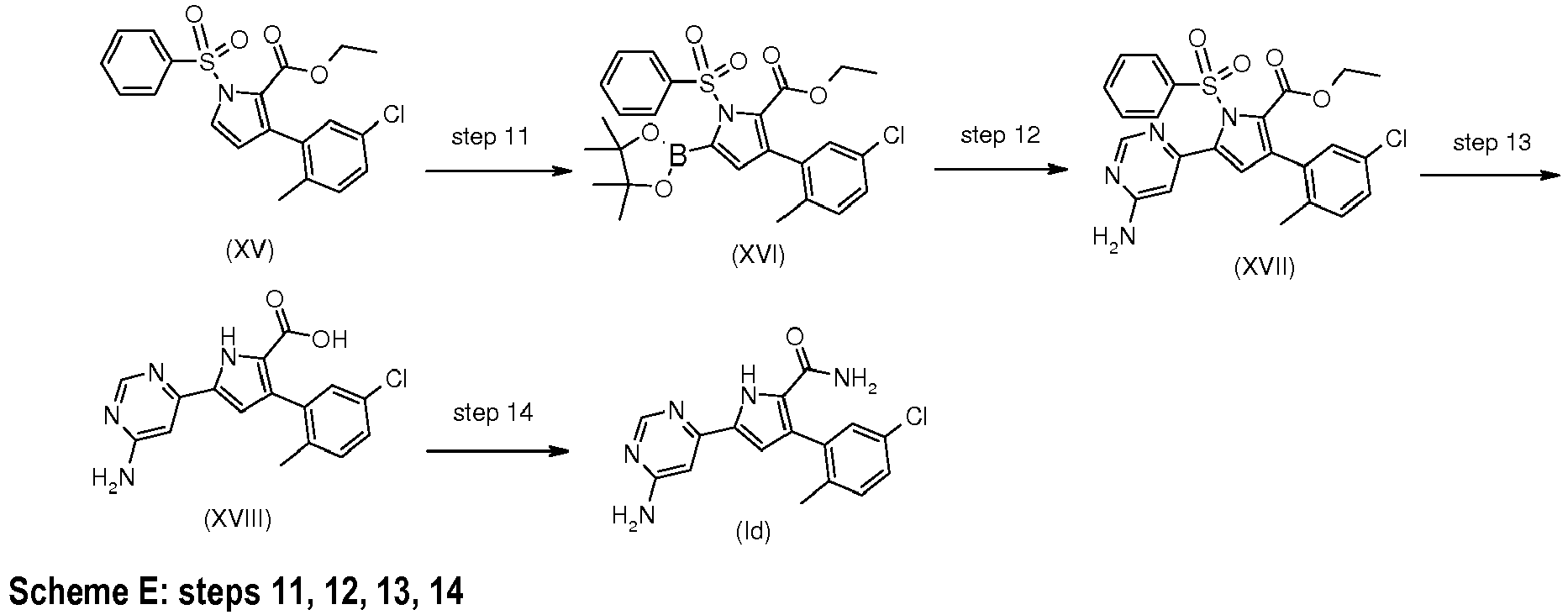
- To a solution of ethyl 3-(5-chloro-2-methylphenyl)-1-(phenylsulfonyl)-1H-pyrrole-2-carboxylate (403 mg, 1.0 mmol) in THF (5 mL) LDA (2M in THF/heptane/ethylbenzene, 0.55 mL, 1.1 mmol) was slowly added dropwise at -78 °C under argon. After 30 min, 2-isopropoxy-4,4,5,5-tetramethyl-1,3,2-dioxyborolane (0.230 mL, 1.1 mmol) was added to the mixture at -78 °C and stirred for 1 h. MeOH (0.5 mL) was added and the resultant mixture was stirred at room temperature after slowly raising the temperature, diluted with water and extracted with EtOAc (30 mL x 3), dried over Na2SO4, filtered and the solvent was evaporated under reduced pressure to afford the title compound that was used without further purification.
- Ethyl 3-(5-chloro-2-methylphenyl)-1-(phenylsulfonyl)-5-(4,4,5,5-tetramethyl-1,3,2-dioxaborolan-2-yl)-1H-pyrrole-2-carboxylate, 6-iodopyrimidin-4-amine (221 mg, 1 mmol) and Na2CO3 (318 mg, 3 mmol) were dissolved in dioxane/water (3/1, 10 mL). The resulting reaction mixture was degassed three times back filling with argon each time before being charged PdCl2(dppf) (81 mg, 0.1 mmol). The resulting reaction mixture was degassed four times back filling with argon each time and then warmed to 110 °C for 30 min. The reaction mixture was cooled to room temperature, filtered through a pad of Celite, washed with EtOAc. The filtrate was concentrated and then diluted with EtOAc, washed with aqueous brine, dried over Na2SO4, filtered and concentrated under reduced pressure. The residue was purified by by Biotage SP1 Flash Chromatography (DCM/MeOH/7N NH3 in MeOH 98/2/0.2) to afford the title compound (198 mg, 40%).
- 1H NMR (600 MHz, DMSO-d6) δ 8.23 - 8.30 (m, 3H), 7.77 - 7.83 (m, 1H), 7.66 - 7.73 (m, 2H), 7.33 - 7.37 (m, 1H), 7.29 - 7.32 (m, 1H), 7.17 (d, J = 2.20 Hz, 1H), 7.04 (s, 2H), 6.76 (s, 1H), 6.63 (d, J = 0.92 Hz, 1H), 3.99 - 4.10 (m, 2H), 2.11 (s, 3H), 0.90 (t, J = 7.11 Hz, 3H).
- HRMS (ESI) m/z calcd for C24H21ClN4O4S + H+ 497.1045, found 497.1049.
- According to this step, but using (4-chloro-7H-pyrrolo[2,3-d]pyrimidin-7-yl)methyl 2,2-dimethylpropanoate instead of 6-iodopyrimidin-4-amine, the following compound was prepared:
- 1H NMR (600 MHz, DMSO-d6) δ 8.78 (s, 1H), 8.35 (dd, J = 1.19, 8.52 Hz, 2H), 7.80 - 7.85 (m, 2H), 7.70 - 7.78 (m, 2H), 7.35 - 7.40 (m, 1H), 7.32 - 7.34 (m, 1H), 7.31 (d, J = 2.20 Hz, 1H), 7.09 (s, 1H), 6.88 (d, J = 3.66 Hz, 1H), 6.27 (s, 2H), 4.09 (q, J = 7.14 Hz, 2H), 2.17 (s, 3H), 1.11 (s, 9H), 0.92 (t, J = 7.05 Hz, 3H).
- According to this procedure, but starting from 3-(5-chloro-2-ethylphenyl)-1-(phenylsulfonyl)-1H-pyrrole-2-carboxylate, the following compound was prepared:
- ESI (+) MS: m/z 511 (MH+).
- According to this procedure, but starting from 3-(5-chloro-2-ethylphenyl)-1-(phenylsulfonyl)-1H-pyrrole-2-carboxylate and using 4-chloro-7H-pyrrolo[2,3-d]pyrimidin-7-yl)methyl 2,2-dimethylpropanoate instead of 6-iodopyrimidin-4-amine, the following compound was prepared:
- 1H NMR (600 MHz, DMSO-d6) δ 8.79 (s, 1H), 8.33 (dd, J = 1.01, 8.52 Hz, 2H), 7.80 - 7.85 (m, 2H), 7.70 - 7.78 (m, 2H), 7.39 - 7.44 (m, 1H), 7.31 - 7.38 (m, 1H), 7.27 (d, J = 2.20 Hz, 1H), 7.09 (s, 1H), 6.83 (d, J = 3.66 Hz, 1H), 6.27 (s, 2H), 3.99 - 4.10 (m, 2H), 1.11 (s, 9H), 1.02 - 1.07 (m, 3H), 0.88 (t, J = 7.14 Hz, 3H).
- According to this procedure, but starting from ethyl 3-[2-ethyl-5-(trifluoromethyl)phenyl]-1-(phenylsulfonyl)-1H-pyrrole-2-carboxylate, the following compound was prepared:
- ESI (+) MS: m/z 545 (MH+).
- According to this procedure, but starting from ethyl 3-[2-ethyl-5-(trifluoromethyl)phenyl]-1-(phenylsulfonyl)-1H-pyrrole-2-carboxylate and using (4-chloro-7H-pyrrolo[2,3-d]pyrimidin-7-yl)methyl 2,2-dimethylpropanoate instead of 6-iodopyrimidin-4-amine, the following compound was prepared:
- 1H NMR (600 MHz, DMSO-d6) δ 8.79 (s, 1H), 8.28 - 8.45 (m, 2H), 7.81 - 7.87 (m, 2H), 7.73 - 7.78 (m, 2H), 7.72 (d, J = 8.0 Hz, 1H), 7.58 (d, J = 8.0 Hz, 1H), 7.54 (s, 1H), 7.14 (s, 1H), 6.84 (d, J = 3.6 Hz, 1H), 6.27 (s, 2H), 4.02 (q, J = 6.9 Hz, 2H), 2.61 (q, J = 7.6 Hz, 2H), 1.11 (s, 9H), 1.06 - 1.10 (m, 3H), 0.81 (t, J = 7.0 Hz, 3H).
- Ethyl 5-(6-aminopyrimidin-4-yl)-3-(5-chloro-2-methylphenyl)-1-(phenylsulfonyl)-1H-pyrrole-2-carboxylate (80 mg, 0.161 mmol) in THF (0.5 mL) was treated with LiOH.H2O (27 mg, 0.644 mmol) at 150 °C in the microwave apparatus for 15 min. After cooling, the residue was concentrated, treated with 1N HCl (300 µL), neutralized with saturated solution of sodium hydrogen carbonate, the resulting precipitate was collected by filtration to afford the title compound (52 mg, 98%).
- ESI (+) MS: m/z 329 (MH+).
- According to this step the following compounds were prepared:
- ESI (+) MS: m/z 343 (MH+).
- ESI (+) MS: m/z 377 (MH+).
- ESI (+) MS: m/z 353 (MH+).
- 1H NMR (600 MHz, DMSO-d6) δ 12.42 - 12.89 (m, 1H), 12.24 (br. s., 1H), 11.39 (br. s., 1H), 8.79 (s, 1H), 7.62 (dd, J = 2.47, 3.39 Hz, 1H), 7.29 - 7.36 (m, 1H), 7.25 (d, J = 2.01 Hz, 1H), 7.19 (s, 1H), 7.01 (dd, J = 1.65, 3.48 Hz, 1H), 2.52 - 2.56 (m, 2H), 1.00 - 1.05 (m, 3H).
- ESI (+) MS: m/z 401 (MH+).
- A solution of 5-(6-aminopyrimidin-4-yl)-3-(5-chloro-2-methylphenyl)-1H-pyrrole-2-carboxylic acid (52 mg, 0.158 mmol) in DMF (1.0 mL) and DIPEA (55 µL, 0.634 mmol) was stirred at 0 °C. EDCI (60 mg, 0.317 mmol) and HOBT.NH3 (48 mg, 0.317 mmol) were added and the reaction mixture was stirred for 3 h at room temperature. The mixture was diluted with saturated solution of sodium hydrogen carbonate at 5 °C, stirred for 30 min, the resulting precipitate was collected by filtration to afford the title compound (42 mg, 80%).
- 1H NMR (600 MHz, DMSO-d6) δ 11.83 (br. s., 1H), 8.39 (s, 1H), 7.38 (br. s., 1H), 7.21 - 7.27 (m, 2H), 7.15 (s, 1H), 7.08 (br. s., 1H), 6.85 (s, 2H), 6.74 (s, 1H), 6.67 (s, 1H), 2.10 (s, 3H).
- HRMS (ESI) m/z calcd for C16H14ClN5O + H+ 328.0960, found 328.0955.
- According to this step the following compounds were prepared:
- ESI (+) MS: m/z 342 (MH+).
- ESI (+) MS: m/z 376 (MH+).
- 1H NMR (600 MHz, DMSO-d6) δ 12.16 (br. s., 1H), 12.04 (br. s., 1H), 8.78 (s, 1H), 7.63 - 7.76 (m, 1H), 7.58 (dd, J = 2.38, 3.48 Hz, 1H), 7.24 - 7.27 (m, 2H), 7.22 (d, J = 1.28 Hz, 1H), 7.14 - 7.18 (m, 1H), 7.12 (s, 1H), 7.01 (dd, J = 1.74, 3.57 Hz, 1H), 2.14 (s, 3H).
- HRMS (ESI) m/z calcd for C18H14ClN5O + H+ 352.0960, found 352.0961.
- 1H NMR (600 MHz, DMSO-d6) δ 12.17 (br. s., 1H), 12.03 (br. s., 1H), 8.78 (s, 1H), 7.64 (br. s., 1H), 7.58 (dd, J = 2.38, 3.48 Hz, 1H), 7.26 - 7.33 (m, 2H), 7.19 (d, J = 2.02 Hz, 1H), 7.14 (br. s., 1H), 7.12 (d, J = 2.20 Hz, 1H), 6.99 (dd, J = 1.83, 3.66 Hz, 1H), 1.01 (t, J = 7.51 Hz, 3H).
- HRMS (ESI) m/z calcd for C19H16ClN5O + H+ 366.1116, found 366.1111.
- 1H NMR (600 MHz, DMSO-d6) δ 12.17 (br. s., 1H), 12.14 (br. s., 1H), 8.79 (s, 1H), 7.79 (br. s., 1H), 7.60 (dd, J = 1.28, 8.06 Hz, 1H), 7.58 (dd, J = 2.56, 3.48 Hz, 1H), 7.49 (d, J = 8.06 Hz, 1H), 7.45 (d, J = 1.28 Hz, 1H), 7.17 (d, J = 1.65 Hz, 1H), 7.13 (br. s., 1H), 7.01 (dd, J = 1.74, 3.57 Hz, 1H), 2.60 (q, J = 7.51 Hz, 2H), 1.05 (t, J = 7.51 Hz, 3H). HRMS (ESI) m/z calcd for C20H16F3N5O + H+ 400.1380, found 400.1380.
- According to this step, but using methylamine, the following compounds were prepared:
- ESI (+) MS: m/z 342 (MH+).
- ESI (+) MS: m/z 356 (MH+).
- ESI (+) MS: m/z 390 (MH+).
- 1H NMR (600 MHz, DMSO-d6) δ 12.16 (br. s., 1H), 12.03 (br. s., 1H), 8.77 (s, 1H), 8.29 (q, J = 4.15 Hz, 1H), 7.58 (dd, J = 2.47, 3.39 Hz, 1H), 7.22 - 7.28 (m, 2H), 7.21 (d, J = 1.65 Hz, 1H), 7.13 (d, J = 2.01 Hz, 1H), 7.01 (dd, J = 1.65, 3.48 Hz, 1H), 2.70 (d, J = 4.58 Hz, 3H), 2.13 (s, 3H).
- HRMS (ESI) m/z calcd for C19H16ClN5O + H+ 366.1116, found 366.1119.
- 1H NMR (600 MHz, DMSO-d6) δ 12.16 (br. s., 1H), 12.03 (br. s., 1H), 8.78 (s, 1H), 8.27 (q, J = 4.33 Hz, 1H), 7.57 (dd, J = 2.38, 3.48 Hz, 1H), 7.29 - 7.32 (m, 1H), 7.26 - 7.28 (m, 1H), 7.17 (d, J = 2.20 Hz, 1H), 7.13 (d, J = 2.20 Hz, 1H), 6.99 (dd, J = 1.65, 3.66 Hz, 1H), 2.69 (d, J = 4.58 Hz, 3H), 2.45 - 2.48 (m, 1H), 1.00 (t, J = 7.60 Hz, 3H). HRMS (ESI) m/z calcd for C20H18ClN5O + H+ 380.1273, found 380.1272.
- 1H NMR (600 MHz, DMSO-d6) δ 12.16 (br. s., 1H), 12.12 (br. s., 1H), 8.78 (s, 1H), 8.38 (q, J = 4.03 Hz, 1H), 7.59 (dd, J = 1.37, 8.15 Hz, 1H), 7.57 (dd, J = 2.47, 3.39 Hz, 1H), 7.49 (d, J = 8.06 Hz, 1H), 7.44 (d, J = 1.10 Hz, 1H), 7.17 (d, J = 1.65 Hz, 1H), 7.01 (dd, J = 1.74, 3.57 Hz, 1H), 2.69 (d, J = 4.40 Hz, 3H), 2.58 (q, J = 7.51 Hz, 2H), 1.04 (t, J = 7.60 Hz, 3H).
- HRMS (ESI) m/z calcd for C21H18F3N5O + H+ 414.1536, found 414.1534.
- According to this procedure, but using 6-chloro-N-methylpyrimidin-4-amine instead of 6-iodopyrimidin-4-amine in the step 12, the following compound was prepared:
- ESI (+) MS: m/z 342 (MH+).
- According to this procedure, but using 4-chloropyrrolo[2,1-f][1,2,4]triazine instead of 6-iodopyrimidin-4-amine in the step 12, the following compound was prepared:
- ESI (+) MS: m/z 352 (MH+).
- According to this procedure, but using 4-chloro-7-(4-methoxy-benzyl)-6,7-dihydro-5H-pyrrolo[2,3-d]pyrimidine instead of 6-iodopyrimidin-4-amine in the step 12 and removing the 4-methoxy-benzyl protecting group with TFA in DCM, the following compound was prepared:
- ESI (+) MS: m/z 354 (MH+).
- According to this procedure, but starting from ethyl 3-(5-chloro-2-ethylphenyl)-1-(phenylsulfonyl)-1H-pyrrole-2-carboxylate in the step 11 and using 6-chloro-N-methylpyrimidin-4-amine instead of 6-iodopyrimidin-4-amine in the step 12, the following compound was prepared:
- ESI (+) MS: m/z 356 (MH+).
- According to this procedure, but starting from ethyl 3-(5-chloro-2-ethylphenyl)-1-(phenylsulfonyl)-1H-pyrrole-2-carboxylate in the step 11 and using 4-chloropyrrolo[2,1-f][1,2,4]triazine instead of 6-iodopyrimidin-4-amine in the step 12, the following compound was prepared:
- ESI (+) MS: m/z 366 (MH+).
- According to this procedure, but starting from ethyl 3-(5-chloro-2-ethylphenyl)-1-(phenylsulfonyl)-1H-pyrrole-2-carboxylate in the step 11, using 4-chloro-7-(4-methoxy-benzyl)-6,7-dihydro-5H-pyrrolo[2,3-d]pyrimidine instead of 6-iodopyrimidin-4-amine in the step 12 and removing the 4-methoxy-benzyl protecting group with TFA in DCM, the following compound was prepared:
- ESI (+) MS: m/z 368 (MH+).
- According to this procedure, but starting from ethyl 3-[2-chloro-5-(trifluoromethyl)phenyl]-1-(phenylsulfonyl)-1H-pyrrole-2-carboxylate in the step 11, the following compound was prepared:
- ESI (+) MS: m/z 382 (MH+).
- According to this procedure, but starting from ethyl 3-[2-chloro-5-(trifluoromethyl)phenyl]-1-(phenylsulfonyl)-1H-pyrrole-2-carboxylate in the step 11 and using 6-chloro-N-methylpyrimidin-4-amine instead of 6-iodopyrimidin-4-amine in the step 12, the following compound was prepared:
- ESI (+) MS: m/z 396 (MH+).
- According to this procedure, but starting from ethyl 3-[2-chloro-5-(trifluoromethyl)phenyl]-1-(phenylsulfonyl)-1H-pyrrole-2-carboxylate in the step 11 and using 4-chloro-7H-pyrrolo[2,3-d]pyrimidin-7-yl)methyl 2,2-dimethylpropanoate instead of 6-iodopyrimidin-4-amine in the step 12, the following compound was prepared:
- ESI (+) MS: m/z 406 (MH+).
- According to this procedure, but starting from ethyl 3-[2-chloro-5-(trifluoromethyl)phenyl]-1-(phenylsulfonyl)-1H-pyrrole-2-carboxylate in the step 11 and using 4-chloropyrrolo[2,1-f][1,2,4]triazine instead of 6-iodopyrimidin-4-amine in the step 12, the following compound was prepared:
- ESI (+) MS: m/z 406 (MH+).
- According to this procedure, but starting from ethyl 3-[2-chloro-5-(trifluoromethyl)phenyl]-1-(phenylsulfonyl)-1H-pyrrole-2-carboxylate in the step 11, using 4-chloro-7-(4-methoxy-benzyl)-6,7-dihydro-5H-pyrrolo[2,3-d]pyrimidine instead of 6-iodopyrimidin-4-amine in the step 12 and removing the 4-methoxy-benzyl protecting group with TFA in DCM, the following compound was prepared:
- ESI (+) MS: m/z 408 (MH+).
- According to this procedure, but starting from ethyl 3-[2-methyl-5-(trifluoromethyl)phenyl]-1-(phenylsulfonyl)-1H-pyrrole-2-carboxylate in the step 11, the following compound was prepared:
- ESI (+) MS: m/z 362 (MH+).
- According to this procedure, but starting from ethyl 3-[2-methyl-5-(trifluoromethyl)phenyl]-1-(phenylsulfonyl)-1H-pyrrole-2-carboxylate in the step 11 and using 6-chloro-N-methylpyrimidin-4-amine instead of 6-iodopyrimidin-4-amine in the step 12, the following compound was prepared:
- ESI (+) MS: m/z 376 (MH+).
- According to this procedure, but starting from ethyl 3-[2-methyl-5-(trifluoromethyl)phenyl]-1-(phenylsulfonyl)-1H-pyrrole-2-carboxylate in the step 11 and using 4-chloro-7H-pyrrolo[2,3-d]pyrimidin-7-yl)methyl 2,2-dimethylpropanoate instead of 6-iodopyrimidin-4-amine in the step 12, the following compound was prepared:
- ESI (+) MS: m/z 386 (MH+).
- According to this procedure, but starting from ethyl 3-[2-methyl-5-(trifluoromethyl)phenyl]-1-(phenylsulfonyl)-1H-pyrrole-2-carboxylate in the step 11 and using 4-chloropyrrolo[2,1-f][1,2,4]triazine instead of 6-iodopyrimidin-4-amine in the step 12, the following compound was prepared:
- ESI (+) MS: m/z 386 (MH+).
- According to this procedure, but starting from ethyl 3-[2-methyl-5-(trifluoromethyl)phenyl]-1-(phenylsulfonyl)-1H-pyrrole-2-carboxylate in the step 11, using 4-chloro-7-(4-methoxy-benzyl)-6,7-dihydro-5H-pyrrolo[2,3-d]pyrimidine instead of 6-iodopyrimidin-4-amine in the step 12 and removing the 4-methoxy-benzyl protecting group with TFA in DCM, the following compound was prepared:
- ESI (+) MS: m/z 388 (MH+).
- According to this procedure, but starting from ethyl 3-[2-ethyl-5-(trifluoromethyl)phenyl]-1-(phenylsulfonyl)-1H-pyrrole-2-carboxylate in the step 11, using 6-chloro-N-methylpyrimidin-4-amine instead of 6-iodopyrimidin-4-amine in the step 12, the following compound was prepared:
- ESI (+) MS: m/z 390 (MH+).
- According to this procedure, but starting from ethyl 3-[2-ethyl-5-(trifluoromethyl)phenyl]-1-(phenylsulfonyl)-1H-pyrrole-2-carboxylate in the step 11 and using 4-chloropyrrolo[2,1-f][1,2,4]triazine instead of 6-iodopyrimidin-4-amine in the step 12, the following compound was prepared:
- ESI (+) MS: m/z 400 (MH+).
- According to this procedure, but starting from ethyl 3-[2-ethyl-5-(trifluoromethyl)phenyl]-1-(phenylsulfonyl)-1H-pyrrole-2-carboxylate in the step 11, using 4-chloro-7-(4-methoxy-benzyl)-6,7-dihydro-5H-pyrrolo[2,3-d]pyrimidine instead of 6-iodopyrimidin-4-amine in the step 12 and removing the 4-methoxy-benzyl protecting group with TFA in DCM, the following compound was prepared:
- ESI (+) MS: m/z 402 (MH+).
- According to this procedure, but starting from ethyl 3-phenyl-1-(phenylsulfonyl)-1H-pyrrole-2-carboxylate in the step 11, the following compound was prepared:
- ESI (+) MS: m/z 280 (MH+).
- According to this procedure, but starting from ethyl 3-phenyl-1-(phenylsulfonyl)-1H-pyrrole-2-carboxylate in the step 11 and using 6-chloro-N-methylpyrimidin-4-amine instead of 6-iodopyrimidin-4-amine in the step 12, the following compound was prepared:
- ESI (+) MS: m/z 294 (MH+).
- According to this procedure, but starting from ethyl 3-phenyl-1-(phenylsulfonyl)-1H-pyrrole-2-carboxylate in the step 11 and using 4-chloro-7H-pyrrolo[2,3-d]pyrimidin-7-yl)methyl 2,2-dimethylpropanoate instead of 6-iodopyrimidin-4-amine in the step 12, the following compound was prepared:
- ESI (+) MS: m/z 304 (MH+).
- According to this procedure, but starting from ethyl 3-phenyl-1-(phenylsulfonyl)-1H-pyrrole-2-carboxylate in the step 11 and using 4-chloropyrrolo[2,1-f][1,2,4]triazine instead of 6-iodopyrimidin-4-amine in the step 12, the following compound was prepared:
- ESI (+) MS: m/z 304 (MH+).
- According to this procedure, but starting from ethyl 3-phenyl-1-(phenylsulfonyl)-1H-pyrrole-2-carboxylate in the step 11, using 4-chloro-7-(4-methoxy-benzyl)-6,7-dihydro-5H-pyrrolo[2,3-d]pyrimidine instead of 6-iodopyrimidin-4-amine in the step 12 and removing the 4-methoxy-benzyl protecting group with TFA in DCM, the following compound was prepared:
- ESI (+) MS: m/z 306 (MH+).
- According to this procedure, but using 6-chloro-N-methylpyrimidin-4-amine instead of 6-iodopyrimidin-4-amine in the step 12 and methylamine in the step 14, the following compound was prepared:
- ESI (+) MS: m/z 356 (MH+).
- According to this procedure, but using 4-chloropyrrolo[2,1-f][1,2,4]triazine instead of 6-iodopyrimidin-4-amine in the step 12 and methylamine in the step 14, the following compound was prepared:
- ESI (+) MS: m/z 366 (MH+).
- According to this procedure, but using 4-chloro-7-(4-methoxy-benzyl)-6,7-dihydro-5H-pyrrolo[2,3-d]pyrimidine instead of 6-iodopyrimidin-4-amine in the step 12 and methylamine in the step 14 and removing the 4-methoxy-benzyl protecting group with TFA in DCM, the following compound was prepared:
- ESI (+) MS: m/z 368 (MH+).
- According to this procedure, but starting from ethyl 3-(5-chloro-2-ethylphenyl)-1-(phenylsulfonyl)-1H-pyrrole-2-carboxylate in the step 11, using 6-chloro-N-methylpyrimidin-4-amine instead of 6-iodopyrimidin-4-amine in the step 12 and methylamine in the step 14, the following compound was prepared:
- ESI (+) MS: m/z 368 (MH+).
- According to this procedure, but starting from ethyl 3-(5-chloro-2-ethylphenyl)-1-(phenylsulfonyl)-1H-pyrrole-2-carboxylate in the step 11, using 4-chloropyrrolo[2,1-f][1,2,4]triazine instead of 6-iodopyrimidin-4-amine in the step 12 and methylamine in the step 14, the following compound was prepared:
- ESI (+) MS: m/z 380 (MH+).
- According to this procedure, but starting from ethyl 3-(5-chloro-2-ethylphenyl)-1-(phenylsulfonyl)-1H-pyrrole-2-carboxylate in the step 11, using 4-chloro-7-(4-methoxy-benzyl)-6,7-dihydro-5H-pyrrolo[2,3-d]pyrimidine instead of 6-iodopyrimidin-4-amine in the step 12 and methylamine in the step 14 and removing the 4-methoxy-benzyl protecting group with TFA in DCM, the following compound was prepared:
- ESI (+) MS: m/z 382 (MH+).
- According to this procedure, but starting from ethyl 3-[2-chloro-5-(trifluoromethyl)phenyl]-1-(phenylsulfonyl)-1H-pyrrole-2-carboxylate in the step 11 and using methylamine in the step 14, the following compound was prepared:
- ESI (+) MS: m/z 396 (MH+).
- According to this procedure, but starting from ethyl 3-[2-chloro-5-(trifluoromethyl)phenyl]-1-(phenylsulfonyl)-1H-pyrrole-2-carboxylate in the step 11, using 6-chloro-N-methylpyrimidin-4-amine instead of 6-iodopyrimidin-4-amine in the step 12 and methylamine in the step 14, the following compound was prepared:
- ESI (+) MS: m/z 410 (MH+).
- According to this procedure, but starting from ethyl 3-[2-chloro-5-(trifluoromethyl)phenyl]-1-(phenylsulfonyl)-1H-pyrrole-2-carboxylate in the step 11, using 4-chloro-7H-pyrrolo[2,3-d]pyrimidin-7-yl)methyl 2,2-dimethylpropanoate instead of 6-iodopyrimidin-4-amine in the step 12 and methylamine in the step 14, the following compound was prepared:
- ESI (+) MS: m/z 420 (MH+).
- According to this procedure, but starting from ethyl 3-[2-chloro-5-(trifluoromethyl)phenyl]-1-(phenylsulfonyl)-1H-pyrrole-2-carboxylate in the step 11, using 4-chloropyrrolo[2,1-f][1,2,4]triazine instead of 6-iodopyrimidin-4-amine in the step 12 and methylamine in the step 14, the following compound was prepared:
- ESI (+) MS: m/z 420 (MH+).
- According to this procedure, but starting from ethyl 3-[2-chloro-5-(trifluoromethyl)phenyl]-1-(phenylsulfonyl)-1H-pyrrole-2-carboxylate in the step 11, using 4-chloro-7-(4-methoxy-benzyl)-6,7-dihydro-5H-pyrrolo[2,3-d]pyrimidine instead of 6-iodopyrimidin-4-amine in the step 12 and methylamine in the step 14 and removing the 4-methoxy-benzyl protecting group with TFA in DCM, the following compound was prepared:
- ESI (+) MS: m/z 422 (MH+).
- According to this procedure, but starting from ethyl 3-[2-methyl-5-(trifluoromethyl)phenyl]-1-(phenylsulfonyl)-1H-pyrrole-2-carboxylate in the step 11 and using methylamine in the step 14, the following compound was prepared:
- ESI (+) MS: m/z 390 (MH+).
- According to this procedure, but starting from ethyl 3-[2-methyl-5-(trifluoromethyl)phenyl]-1-(phenylsulfonyl)-1H-pyrrole-2-carboxylate in the step 11, using 6-chloro-N-methylpyrimidin-4-amine instead of 6-iodopyrimidin-4-amine in the step 12 and methylamine in the step 14, the following compound was prepared:
- ESI (+) MS: m/z 404 (MH+).
- According to this procedure, but starting from ethyl 3-[2-methyl-5-(trifluoromethyl)phenyl]-1-(phenylsulfonyl)-1H-pyrrole-2-carboxylate in the step 11, using 4-chloro-7H-pyrrolo[2,3-d]pyrimidin-7-yl)methyl 2,2-dimethylpropanoate instead of 6-iodopyrimidin-4-amine in the step 12 and methylamine in the step 14, the following compound was prepared:
- ESI (+) MS: m/z 400 (MH+).
- According to this procedure, but starting from ethyl 3-[2-methyl-5-(trifluoromethyl)phenyl]-1-(phenylsulfonyl)-1H-pyrrole-2-carboxylate in the step 11, using 4-chloropyrrolo[2,1-f][1,2,4]triazine instead of 6-iodopyrimidin-4-amine in the step 12 and methylamine in the step 14, the following compound was prepared:
- ESI (+) MS: m/z 400 (MH+).
- According to this procedure, but starting from ethyl 3-[2-methyl-5-(trifluoromethyl)phenyl]-1-(phenylsulfonyl)-1H-pyrrole-2-carboxylate in the step 11, using 4-chloro-7-(4-methoxy-benzyl)-6,7-dihydro-5H-pyrrolo[2,3-d]pyrimidine instead of 6-iodopyrimidin-4-amine in the step 12 and methylamine in the step 14 and removing the 4-methoxy-benzyl protecting group with TFA in DCM, the following compound was prepared:
- ESI (+) MS: m/z 402 (MH+).
- According to this procedure, but starting from ethyl 3-[2-ethyl-5-(trifluoromethyl)phenyl]-1-(phenylsulfonyl)-1H-pyrrole-2-carboxylate in the step 11, using 6-chloro-N-methylpyrimidin-4-amine instead of 6-iodopyrimidin-4-amine in the step 12 and methylamine in the step 14, the following compound was prepared:
- ESI (+) MS: m/z 404 (MH+).
- According to this procedure, but starting from ethyl 3-[2-ethyl-5-(trifluoromethyl)phenyl]-1-(phenylsulfonyl)-1H-pyrrole-2-carboxylate in the step 11, using 4-chloropyrrolo[2,1-f][1,2,4]triazine instead of 6-iodopyrimidin-4-amine in the step 12 and methylamine in the step 14, the following compound was prepared:
- ESI (+) MS: m/z 414 (MH+).
- According to this procedure, but starting from ethyl 3-[2-ethyl-5-(trifluoromethyl)phenyl]-1-(phenylsulfonyl)-1H-pyrrole-2-carboxylate in the step 11, using 4-chloro-7-(4-methoxy-benzyl)-6,7-dihydro-5H-pyrrolo[2,3-d]pyrimidine instead of 6-iodopyrimidin-4-amine in the step 12 and methylamine in the step 14 and removing the 4-methoxy-benzyl protecting group with TFA in DCM, the following compound was prepared:
- ESI (+) MS: m/z 416 (MH+).
- According to this procedure, but starting from ethyl 3-phenyl-1-(phenylsulfonyl)-1H-pyrrole-2-carboxylate in the step 11 and methylamine in the step 14, the following compound was prepared:
- ESI (+) MS: m/z 294(MH+).
- According to this procedure, but starting from ethyl 3-phenyl-1-(phenylsulfonyl)-1H-pyrrole-2-carboxylate in the step 11, using 6-chloro-N-methylpyrimidin-4-amine instead of 6-iodopyrimidin-4-amine in the step 12 and methylamine in the step 14, the following compound was prepared:
- ESI (+) MS: m/z 306 (MH+).
- According to this procedure, but starting from ethyl 3-phenyl-1-(phenylsulfonyl)-1H-pyrrole-2-carboxylate in the step 11, using 4-chloro-7H-pyrrolo[2,3-d]pyrimidin-7-yl)methyl 2,2-dimethylpropanoate instead of 6-iodopyrimidin-4-amine in the step 12 and methylamine in the step 14, the following compound was prepared:
- ESI (+) MS: m/z 318 (MH+).
- According to this procedure, but starting from ethyl 3-phenyl-1-(phenylsulfonyl)-1H-pyrrole-2-carboxylate in the step 11, using 4-chloropyrrolo[2,1-f][1,2,4]triazine instead of 6-iodopyrimidin-4-amine in the step 12 and methylamine in the step 14, the following compound was prepared:
- ESI (+) MS: m/z 318 (MH+).
- According to this procedure, but starting from ethyl 3-phenyl-1-(phenylsulfonyl)-1H-pyrrole-2-carboxylate in the step 11, using 4-chloro-7-(4-methoxy-benzyl)-6,7-dihydro-5H-pyrrolo[2,3-d]pyrimidine instead of 6-iodopyrimidin-4-amine in the step 12 and methylamine in the step 14 and removing the 4-methoxy-benzyl protecting group with TFA in DCM, the following compound was prepared:
-

- tert-Butyl 2-(5-chloro-2-methylphenyl)-4-iodo-1H-pyrrole-1-carboxylate (442 mg,1.06 mmol) and 4,4,5,5-tetramethyl-2-(propan-2-yloxy)-1,3,2-dioxaborolane (217 mg, 1.16 mmol) in dry THF (1.6 mL), under argon at -78 °C was treated with n-BuLi (2M in hexane, 0.58 mL, 1.6 mmol) and the reaction mixture was stirred at -78 °C. After 2 h, MeOH (1 mL) was added, the temperature was allowed to rise and NH4Cl solution (2 mL) was added drop wise at room temperature. The solution was diluted with diethyl ether and washed in sequence with water and brine. The organic layer was dried over anhydrous Na2SO4 and evaporated to afford the title compound, which was used without further purification in the following reaction.
- The crude tert-butyl 2-(5-chloro-2-methylphenyl)-4-(4,4,5,5-tetramethyl-1,3,2-dioxaborolan-2-yl)-1H-pyrrole-1-carboxylate (392 mg, 0.94 mmol), Na2CO3 (250 mg, 2.36 mmol), PdCl2(dppf) (77 mg, 0.094 mmol) and 6-iodopyrimidin-4-amine (311 mg, 1.41 mmol) were degassed and purged with argon and suspended in degassed 1,4-dioxane (3 mL) and water (1 mL). The reaction mixture was heated to 110°C (oil bath temperature) for 2 h. The solution was diluted with EtOAc and washed with water. After drying over anhydrous Na2SO4, the organic layer was evaporated. The crude was purified by chromatography on silica gel (hexane/EtOAc 8:2) providing the title compound (220 mg, 58%).
- 1H NMR (600 MHz, DMSO-d6) δ 8.55 (s, 1 H), 7.79 (s, 1H), 7.41 (d, 1H), 7.29 (d, 1H), 7.16 (m, 1H), 6.98 (s, 1H), 6.66 (s, 1H), 2.30 (s, 3H), 1.44 (s, 9H).
- tert-Butyl 4-(6-aminopyrimidin-4-yl)-2-(5-chloro-2-methylphenyl)-1H-pyrrole-1-carboxylate (210 mg, 0.55 mmol) in DCM (11 mL) was treated with TFA (5.5 mL). The reaction mixture was stirred at room temperature for 3 days. The volatiles were evaporated and the solid obtained was suspended with EtOH and treated with ammonium hydroxide 30% until pH 9-10. The solution was diluted with EtOAc and washed first with 10% ammonium hydroxide then with brine and, after drying over anhydrous Na2SO4, the organic layer was evaporated leaving the title compound that was employed in the following step without further purification.
- 1H NMR (600 MHz, DMSO-d6) δ 8.46 (s, 1 H), 7.41 (m, 1H), 7.40 (m, 1H), 7.23 (m, 1H), 7.16 (m, 1H), 6.83 (s, 1H), 6.29 (s, 1H), 2.23 (s, 3H) .
- To a solution of triphosgene (97.5 mg, 0.325 mmol) in DCM (7 mL) was added a solution of 6-[5-(5-chloro-2-methylphenyl)-1H-pyrrol-3-yl]pyrimidin-4-amine (156 mg, 0.55 mmol) in DCM (10 mL) followed by DIPEA (373 µL, 2.15 mmol). After 3 h, a solution of methylamine (2M in tetrahydrofuran, 430 µL, 0.86 mmol) and DIPEA (97 µL, 0.56 mmol) in DCM (4 mL) was added. The reaction was stirred overnight at room temperature. The solution was washed with brine, the organic phase was dried over Na2SO4 and concentrated. The crude was purified by flash chromatography (DCM/MeOH 90/10) to afford the title compound (120 mg, 64%, 2 steps).
- 1H NMR (600 MHz, DMSO-d6) δ 8.45 (s, 1H), 7.40 (m, 1H), 8.05 (s, 1H), 7.40 (m, 1H), 7.30 (m, 1H), 6.90 (s, 1H), 6.58 (s, 1H), 2.78 (s, 3H), 2.22 (s, 3H).
- According to this procedure, but using 6-chloro-N-methylpyrimidin-4-amine instead of 6-iodopyrimidin-4-amine in the step 16, the following compound was prepared:
- ESI (+) MS: m/z 356 (MH+).
- According to this procedure, but using 4-chloro-7H-pyrrolo[2,3-d]pyrimidin-7-yl)methyl 2,2-dimethylpropanoate instead of 6-iodopyrimidin-4-amine in the step 16 and removing the 2,2-dimethylpropanoyl protecting group with LiOH.H2O in THF/water at room temperature, the following compound was prepared:
- ESI (+) MS: m/z 366 (MH+).
- According to this procedure, but starting from tert-butyl 2-(5-chloro-2-ethylphenyl)-4-iodo-1H-pyrrole-1-carboxylate the following compound was prepared:
- ESI (+) MS: m/z 356 (MH+).
- According to this procedure, but starting from tert-butyl 2-(5-chloro-2-ethylphenyl)-4-iodo-1H-pyrrole-1-carboxylate and using 6-chloro-N-methylpyrimidin-4-amine instead of 6-iodopyrimidin-4-amine in the step 16, the following compound was prepared:
- ESI (+) MS: m/z 370 (MH+).
- According to this procedure, but starting from tert-butyl 2-(5-chloro-2-ethylphenyl)-4-iodo-1H-pyrrole-1-carboxylate, using 4-chloro-7H-pyrrolo[2,3-d]pyrimidin-7-yl)methyl 2,2-dimethylpropanoate instead of 6-iodopyrimidin-4-amine in the step 16 and removing the 2,2-dimethylpropanoyl protecting group with LiOH.H2O in THF/water at room temperature, the following compound was prepared:
- ESI (+) MS: m/z 380 (MH+).
- According to this procedure, but starting from tert-butyl 2-[2-ethyl-5-(trifluoromethyl)phenyl]-4-iodo-1H-pyrrole-1-carboxylate the following compound was prepared:
- ESI (+) MS: m/z 390 (MH+).
- According to this procedure, but starting from tert-butyl 2-[2-ethyl-5-(trifluoromethyl)phenyl]-4-iodo-1H-pyrrole-1-carboxylate and using 6-chloro-N-methylpyrimidin-4-amine instead of 6-iodopyrimidin-4-amine in the step 16, the following compound was prepared:
- ESI (+) MS: m/z 404 (MH+).
- According to this procedure, but starting from tert-butyl 2-[2-ethyl-5-(trifluoromethyl)phenyl]-4-iodo-1H-pyrrole-1-carboxylate, using 4-chloro-7H-pyrrolo[2,3-d]pyrimidin-7-yl)methyl 2,2-dimethylpropanoate instead of 6-iodopyrimidin-4-amine in the step 16 and removing the 2,2-dimethylpropanoyl protecting group with LiOH.H2O in THF/water at room temperature, the following compound was prepared:
- ESI (+) MS: m/z 414 (MH+).
-

- To a solution of 5-(6-aminopyrimidin-4-yl)-2-(5-chloro-2-methylphenyl)-1H-pyrrole-3-carbonitrile (59 mg, 0.19 mmol) in TFA (0.90 mL) were sequentially added water (0.11 mL) and 96% sulfuric acid (0.22 mL) under efficient stirring. The mixture was allowed to stir for 5 h at 70 °C and then was diluted by drop wise addition of water (1.5 mL). The reaction mixture was made basic (pH 10-12) by adding 30% aqueous ammonia under stirring. The precipitated solid was collected by filtration, washed with water and finally dried in a vacuum oven at 50 °C affording the title compound as an off-white solid (42 mg, 68%).
- 1H NMR (400 MHz, DMSO-d 6) δ 11.91 (br. s., 1H), 8.31 (d, J = 0.8 Hz, 1H), 7.30 - 7.36 (m, 1H), 7.23 - 7.30 (m, 3H), 7.22 (br. s., 1 H),6.76 (s, 2H), 6.70 (br. s., 1H), 6.66 (d, J = 1.1 Hz, 1H), 2.12 (s, 3H).
- HRMS (ESI) m/z calcd for C16H14ClN5O + H+ 328.0960, found 328.0964.
- The above procedure was employed, starting from the suitable carbonitrile derivative, to synthesize the following compounds:
- 1H NMR (400 MHz, DMSO-d 6) δ 11.91 (br. s., 1H), 8.35 (s, 1H), 7.10 - 7.39 (m, 5H), 6.52 - 6.78 (m, 2H), 2.81 (d, J = 4.5 Hz, 3H), 2.12 (m, 3H).
- HRMS (ESI) m/z calcd for C17H16ClN5O + H+ 342.1116, found 342.1112.
- 1H NMR (400 MHz, DMSO-d 6) δ 12.16 (br. s., 1H), 12.08 (br. s., 1H), 8.66 (s, 1H), 7.71 (s, 1H), 7.61 (dd, J = 2.5, 3.3 Hz, 1H), 7.47 (br. s., 1H), 7.29 - 7.36 (m, 1H), 7.21 - 7.28 (m, 1H), 7.11 (dd, J = 1.6, 3.5 Hz, 1H), 6.79 (br. s., 1H), 2.14 (s, 3H).
- HRMS (ESI) m/z calcd for C18H14ClN5O + H+ 352.0960, found 352.0962.
- 1H NMR (400 MHz, DMSO-d 6) δ 11.85 (br. s., 1H), 11.65 (br. s., 1H), 8.16 (d, J = 5.0 Hz, 1H), 7.53 (d, J = 3.3 Hz, 1H), 7.44 (s, 2H), 7.39 (d, J = 5.1 Hz, 1H), 7.27 - 7.38 (m, 4H), 7.02 (d, J = 3.5 Hz, 1H), 6.74 (br. s., 1H), 2.17 (s, 3H). HRMS (ESI) m/z calcd for C19H15ClN4O + H+ 351.1007, found 351.1011.
- 1H NMR (500 MHz, DMSO-d 6) δ 12.21 (br. s., 1H), 8.78 (s, 1H), 8.59 (s, 1H), 7.99 (d, J = 2.20 Hz, 1H), 7.33 - 7.38 (m, 1H), 7.21 - 7.33 (m, 3H), 6.82 (br. s., 1H), 2.16 (s, 3H).
- HRMS (ESI) m/z calcd for C17H13ClN6O + H+ 353.0912, found 353.0917.
- 1H NMR (400 MHz, DMSO-d 6) δ 14.00 (s, 1H), 12.47 (br. s., 1H), 8.82 (s, 1H), 8.78 (s, 1H), 7.93 - 7.98 (m, 1H), 7.49 (br. s., 1H), 7.22 - 7.39 (m, 3H), 6.90 (br. s., 1H), 2.14 (s, 3H).
- HRMS (ESI) m/z calcd for C17H13ClN6O + H+ 353.0912, found 353.0914.
- 1H NMR (600 MHz, DMSO-d 6) δ 11.67 (s, 1H), 8.41 (s, 1H), 8.02 (dd, J = 1.3, 2.5 Hz, 1H), 7.91 (s, 1H), 7.54 (br. s., 1H), 7.47 (dd, J = 1.3, 4.7 Hz, 1H), 7.27 - 7.37 (m, 1H), 7.16 - 7.27 (m, 2H), 7.05 (dd, J = 2.5, 4.6 Hz, 1H), 6.85 (br. s., 1H), 2.10 (s, 3H).
- HRMS (ESI) m/z calcd for C18H14ClN5O + H+ 352.0960, found 352.0955.
- ESI (+) MS: m/z 354 (MH+).
- 1H NMR (600 MHz, DMSO-d 6) δ 11.94 (br. s., 1H), 8.31 (d, J = 0.9 Hz, 1H), 7.37 (dd, J = 2.4, 8.2 Hz, 1H), 7.30 (d, J = 8.2 Hz, 1H), 7.28 (s, 1H), 7.21 (d, J = 2.4 Hz, 1H), 7.16 (br. s., 1H), 6.76 (s, 1H), 6.68 (br. s., 1H), 6.66 (d, J = 1.1 Hz, 1H), 2.46 (q, J = 7.7 Hz, 2H), 0.96 (t, J = 7.6 Hz, 3H).
- HRMS (ESI) calcd for C17H16ClN5O + H+ 342.1116, found 342.1119.
- 1H NMR (600 MHz, DMSO-d 6) δ 11.94 (br. s., 1H), 8.35 (br. s., 1H), 7.39 (dd, J = 2.3, 8.3 Hz, 1H), 7.34 (br. s., 1H), 7.31 (d, J = 8.2 Hz, 1H), 7.23 (d, J = 2.0 Hz, 1H), 7.17 (br. s., 2H), 6.73 (br. s., 1H), 6.68 (br. s., 1H), 2.80 (br. s., 3H), 2.46 (q, J = 7.6 Hz, 2H), 0.97 (t, J = 7.6 Hz, 3H).
- HRMS (ESI) calcd for C18H15ClN5O + H+ 356.1273, found 356.1273.
- 1H NMR (600 MHz, DMSO-d 6) δ 12.17 (br. s., 1H), 12.08 (br. s., 1H), 8.65 (s, 1H), 7.71 (s, 1H), 7.61 (dd, J = 2.2, 3.3 Hz, 1H), 7.42 (br. s., 1H), 7.37 (dd, J = 2.3, 8.4 Hz, 1H), 7.29 (d, J = 8.4 Hz, 1H), 7.23 (d, J = 2.3 Hz, 1H), 7.00 - 7.14 (m, 1H), 6.76 (br. s., 1H), 2.45 (q, J = 7.5 Hz, 2H), 0.98 (t, J = 7.5 Hz, 3H).
- HRMS (ESI) calcd for C19H16ClN5O + H+ 366.1116, found 366.1116.
- ESI (+) MS: m/z 367 (MH+).
- ESI (+) MS: m/z 367 (MH+).
- ESI (+) MS: m/z 366 (MH+).
- ESI (+) MS: m/z 368 (MH+).
- 1H NMR (600 MHz, DMSO-d 6) δ 12.17 (br. s., 1H), 8.34 (s, 1H), 7.65 - 7.81 (m, 3H), 7.43 (br. s., 1H), 7.31 (s, 1H), 6.89 (br. s., 2H), 6.76 (br. s., 1H), 6.66 (s, 1H).
- HRMS (ESI) calcd for C16H11ClF3N5O + H+ 382.0677, found 382.0674.
- 1H NMR (400 MHz, DMSO-d 6) δ 12.13 (br. s., 1H), 8.38 (s, 1H), 7.62 - 7.87 (m, 3H), 7.40 (br. s., 1H), 7.34 (br. s., 1H), 7.26 (br. s., 1H), 6.74 (br. s., 1H), 6.70 (s, 1H), 2.82 (d, J = 4.39 Hz, 3H).
- HRMS (ESI) calcd for C17H13ClF3N5O + H+ 396.0834, found 396.0831.
- HRMS (ESI) calcd for C18H11ClF3N5O + H+ 406.0677, found 406.0679.
- 1H NMR (500 MHz, DMSO-d 6) δ 12.51 (br. s., 1H), 8.80 (s, 1H), 8.60 (s, 1H), 8.03 (d, J = 1.9 Hz, 1H), 7.68 - 7.81 (m, 3H), 7.56 (br. s., 1H), 6.83 (br. s., 1H).
- HRMS (ESI) calcd for C17H10ClF3N6O + H+ 407.0630, found 407.0625.
- 1H NMR (500 MHz, DMSO-d 6) δ 14.08 (br. s., 1H), 12.74 (br. s., 1H), 8.86 (s, 1H), 8.79 (s, 1H), 8.01 (s, 1H), 7.69 - 7.82 (m, 3H), 7.62 (br. s., 1H), 6.97 (br. s., 1H).
- HRMS (ESI) calcd for C17H10ClF3N6O + H+ 407.0630, found 407.0627.
- ESI (+) MS: m/z 406 (MH+).
- ESI (+) MS: m/z 408 (MH+).
- 1H NMR (600 MHz, DMSO-d 6) δ 12.00 (br. s., 1H), 8.32 (d, J = 0.9 Hz, 1H), 7.61 (d, J = 8.1 Hz, 1H), 7.51 (s, 1H), 7.47 (d, J = 7.9 Hz, 1H), 7.32 (br. s., 1H), 7.30 (s, 1H), 6.78 (br. s., 1H), 6.72 (br. s., 1H), 6.66 (d, J = 1.1 Hz, 1H), 2.23 (s, 3H).
- HRMS (ESI) calcd for C17H14F3N5O + H+ 362.1223, found 362.1223.
- 1H NMR (600 MHz, DMSO-d 6) δ 11.96 (br. s., 1H), 8.34 (br. s., 1H), 7.60 (d, J = 8.2 Hz, 1H), 7.50 (s, 1H), 7.44 - 7.48 (m, 1H), 7.33 (br. s., 1H), 7.29 (br. s., 1H), 7.20 (br. s., 1H), 6.70 (br. s., 2H), 2.78 (br. s., 3H), 2.20 (s, 3H).
- HRMS (ESI) calcd for C18H16F3N5O + H+ 376.1380, found 376.1380.
- 1H NMR (600 MHz, DMSO-d 6) δ 12.27 (br. s., 1H), 12.10 (br. s., 1H), 8.67 (s, 1H), 7.75 (s, 1H), 7.58 - 7.64 (m, 2H), 7.55 (br. s., 1H), 7.54 (s, 1H), 7.47 (d, J = 8.1 Hz, 1H), 7.12 (d, J = 2.6 Hz, 1H), 6.81 (br. s., 1H), 2.25 (s, 3H).
- HRMS (ESI) calcd for C19H14F3N5O + H+ 386.1223, found 386.1223.
- ESI (+) MS: m/z 387 (MH+).
- ESI (+) MS: m/z 387 (MH+).
- ESI (+) MS: m/z 386 (MH+).
- ESI (+) MS: m/z 388 (MH+).
- 1H NMR (600 MHz, DMSO-d 6) δ 12.00 (br. s., 1H), 8.31 (d, J = 1.10 Hz, 1H), 7.64-7.68 (m, 1H), 7.51 (d, J = 8.06 Hz, 1H), 7.47 (s, 1H), 7.31 (s, 1H), 7.28 (br. s., 1H), 6.77 (br. s., 2H), 6.68 (br. s., 1H), 6.66 (d, J = 1.10 Hz, 1H), 2.56 (q, J = 7.63 Hz, 2H), 1.00 (t, J = 7.63 Hz, 3H)
- HRMS (ESI) calcd for C18H16F3N5O + H+ 376.1380, found 376.1382.
- 1H NMR (600 MHz, DMSO-d 6) δ 12.00 (br. s., 1H), 8.35 (br. s., 1H), 7.68 (d, J = 7.51 Hz, 1H), 7.52 (d, J = 8.24 Hz, 1H), 7.49 (s, 1H), 7.36 (br. s., 1H), 7.27 (br. s., 1H), 7.20 (br. s., 1H), 6.70 (br. s., 1H), 6.68 (br. s., 1H),, 2.81 (br. s., 3H), 2.56 (q, J = 7.60 Hz, 2H), 1.01 (t, J = 7.60 Hz, 3H).
- HRMS (ESI) calcd for C19H18F3N5O + H+ 390.1536, found 390.1538.
- 1H NMR (600 MHz, DMSO-d 6) δ 12.27 (br. s., 1H), 12.09 (br. s., 1H), 8.66 (s, 1H), 7.75 (d, J = 0.55 Hz, 1H), 7.66 (dd, J = 1.28, 8.24 Hz, 1H), 7.62 (d, J = 3.11 Hz, 1H), 7.44 - 7.55 (m, 2H), 7.12 (d, J = 3.48 Hz, 1H), 6.78 (br. s., 1H), 2.59 (q, J = 7.61 Hz, 2H), 1.02 (t, J = 7.61 Hz, 3H).
- HRMS (ESI) calcd for C20H16F3N5O + H+ 400.1380, found 400.1385.
- ESI (+) MS: m/z 401 (MH+).
- ESI (+) MS: m/z 401 (MH+).
- ESI (+) MS: m/z 400 (MH+).
- ESI (+) MS: m/z 402 (MH+).
- 1H NMR (600 MHz, DMSO-d 6) δ 12.09 (br. s., 1H), 11.99 (br. s., 1H), 8.70 (s, 1H), 7.66 - 7.73 (m, 2H), 7.59 - 7.62 (m, 2H), 7.53 (br. s., 1H), 7.36 - 7.41 (m, 2H), 7.30 - 7.35 (m, 1H), 7.09 (dd, J = 1.74, 3.57 Hz, 1H), 6.87 (br. s., 1H). HRMS (ESI) calcd for C17H13N5O + H+ 304.1193, found 304.1188.
- ESI (+) MS: m/z 306 (MH+).
-

- To a solution of 4-(6-aminopyrimidin-4-yl)-1-(5-chloro-2-methylphenyl)-1H-pyrrole-2-carbonitrile (32 mg, 0.103 mmol) in TFA (0.512 mL) were sequentially added water (64 µL) and 95% sulfuric acid (128 µL) under efficient stirring. The mixture was allowed to stir for 4 h at 70 °C and then was diluted by drop wise addition of water (1.5 mL). The reaction mixture was made basic (pH 10-12) by adding 30% aqueous ammonia under stirring. The precipitated solid was collected by filtration, washed with water and finally dried in a vacuum oven at 50 °C affording the title compound as an off-white solid (18 mg, 53%).
- 1H NMR (400 MHz, DMSO-d 6) δ 8.30 (d, J = 1.0 Hz, 1H), 7.69 ((br. s., 1H), 7.45 - 7.51 (m, 2H), 7.36 - 7.40 (m, 1H), 7.27 - 7.35 (m, 2H), 6.92 (br. s., 1H), 6.71 (s, 2H), 6.57 (d, J = 1.1 Hz, 1H), 1.94 (s, 3H).
- HRMS (ESI) calcd for C16H14ClN5O + H+ 328.0960, found 328.0958.
- The above procedure was employed, starting from the suitable carbonitrile derivative, to synthesize the following compounds:
- 1H NMR (600 MHz, DMSO-d 6) δ 8.35 (br. s., 1H), 7.70 (br. s., 1H), 7.51 (br. s., 1H), 7.35 - 7.40 (m, 1H), 7.26 - 7.35 (m, 2H), 7.15 (br. s., 1H), 6.92 (br. s., 1H), 6.62 (s, 1H), 2.81 (d, J = 3.8 Hz, 3H), 1.94 (s, 3H).
- HRMS (ESI) m/z calcd for C17H16ClN5O + H+ 342.1116, found 342.1120.
- 1H NMR (400 MHz, DMSO-d 6) δ 12.16 (br. s., 1H), 12.08 (br. s., 1H), 8.66 (s, 1H), 7.71 (s, 1H), 7.61 (dd, J = 2.5, 3.3 Hz, 1H), 7.47 (br. s., 1H), 7.29 - 7.36 (m, 1H), 7.21 - 7.28 (m, 1H), 7.11 (dd, J = 1.6, 3.5 Hz, 1H), 6.79 (br. s., 1H), 2.14 (s, 3H).
- HRMS (ESI) m/z calcd for C18H14ClN5O + H+ 352.0960, found 352.0962.
- ESI (+) MS: m/z 351 (MH+).
- ESI (+) MS: m/z 353 (MH+).
- 1H NMR (400 MHz, DMSO-d 6) δ 13.97 (s, 1H), 8.85 (s, 1H), 8.80 (s, 1H), 8.06 (d, J = 1.8 Hz, 1H), 7.95 (d, J = 1.8 Hz, 1H), 7.85 (br. s., 1H), 7.41 - 7.45 (m, 1H), 7.40 (d, J = 2.0 Hz, 1H), 7.36 (d, J = 8.2 Hz, 1H), 7.06 (br. s., 1H), 1.98 (s, 3H).
- HRMS (ESI) m/z calcd for C17H13ClN6O + H+ 353.0912, found 353.0911.
- 1H NMR (600 MHz, DMSO-d 6) δ 8.46 (s, 1H), 8.05 (dd, J = 1.3, 2.5 Hz, 1H), 8.02 (d, J = 1.8 Hz, 1H), 7.90 (d, J = 1.8 Hz, 1H), 7.88 (br. s., 1H), 7.48 (dd, J = 1.1, 4.6 Hz, 1H), 7.41 - 7.45 (m, 1H), 7.40 (d, J = 2.0 Hz, 1H), 7.36 (d, J = 8.4 Hz, 1H), 7.06 (br. s., 1H), 7.02 (dd, J = 2.5, 4.6 Hz, 1H), 1.97 (s, 3H).
- HRMS (ESI) m/z calcd for C18H14ClN5O + H+ 352.0960, found 352.0956.
- 1H NMR (600 MHz, DMSO-d 6) δ 8.16 (s, 1H), 7.75 (br. s., 1H), 7.54 (d, J = 1.6 Hz, 1H), 7.36 - 7.42 (m, 1H), 7.34 (d, J = 1.6 Hz, 1H), 7.32 (d, J = 8.4 Hz, 1H), 7.30 (d, J = 2.0 Hz, 2H), 6.92 (br. s., 1H), 3.59 (t, J = 8.6 Hz, 2H), 3.20 (t, J = 8.6 Hz, 2H), 1.94 (s, 3H).
- HRMS (ESI) m/z calcd for C18H16ClN5O + H+ 354.1116, found 354.1116.
- 1H NMR (600 MHz, DMSO-d 6) δ 8.30 (d, J = 1.0 Hz, 1H), 7.71 (br. s., 1H), 7.49 (d, J = 1.8 Hz, 1H), 7.47 (d, J = 1.8 Hz, 1H), 7.40 - 7.45 (m, 1H), 7.33 - 7.38 (m, 1H), 7.29 (d, J = 2.2 Hz, 1H), 6.91 (br. s., 1H), 6.71 (s, 2H), 6.57 (d, J = 1.1 Hz, 1H), 2.25 (dq, J = 0.73, 7.53 Hz, 1H), 0.97 (t, J = 7.63 Hz, 3H).
- HRMS (ESI) calcd for C17H16ClN5O + H+ 342.1116, found 342.1120.
- 1H NMR (600 MHz, DMSO-d 6) δ 8.35 (br. s., 1H), 7.69 (br. s., 1H), 7.57 (br. s., 1H), 7.51 (br. s., 1H), 7.43 (dd, J = 2.3, 8.3 Hz, 1H), 7.36 (d, J = 8.2 Hz, 1H), 7.30 (d, J = 2.2 Hz, 1H), 7.15 (br. s., 1H), 6.91 (br. s., 1H), 6.62 (s, 1H), 2.81 (d, J = 4.0 Hz, 3H), 2.25 (dq, J = 2.5, 7.5 Hz, 2H), 0.98 (t, J = 7.6 Hz, 3H).
- HRMS (ESI) calcd for C18H15ClN5O + H+ 356.1273, found 356.1269.
- 1H NMR (600 MHz, DMSO-d 6) δ 12.03 (br. s., 1H), 8.66 (s, 1H), 7.87 (d, J = 1.8 Hz, 1H), 7.83 (d, J = 1.6 Hz, 2H), 7.55 (dd, J = 2.6, 3.5 Hz, 1H), 7.45 (dd, J = 2.2, 8.4 Hz, 1H), 7.38 (d, J = 8.4 Hz, 1H), 7.36 (d, J = 2.2 Hz, 1H), 7.07 (dd, J = 1.6, 3.5 Hz, 1H), 6.96 (br. s., 1H), 2.29 (dq, J = 2.5, 7.5 Hz, 2H), 1.00 (t, J = 7.5 Hz, 3H).
- HRMS (ESI) calcd for C19H16ClN5O + H+ 366.1116, found 366.1117.
- ESI (+) MS: m/z 367 (MH+).
- ESI (+) MS: m/z 367 (MH+).
- 1H NMR (600 MHz, DMSO-d 6) δ 8.46 (s, 1H), 7.98 - 8.10 (m, 2H), 7.90 (d, J = 1.8 Hz, 1H), 7.88 (br. s., 1H), 7.44-7.51 (m, 2H), 7.34 - 7.41 (m, 2H), 7.04 (br. s., 1H), 7.02 (dd, J = 2.6, 4.6 Hz, 1H), 2.21 - 2.34 (m, 2H), 1.00 (t, J = 7.5 Hz, 3H).
- HRMS (ESI) calcd for C19H16ClN5O + H+ 366.1116, found 366.1117.
- 1H NMR (600 MHz, DMSO-d 6) δ 8.41 (br. s., 1H), 7.81 (br. s., 1H), 7.60 (br. s., 1H), 7.44 - 7.52 (m, 2H), 7.39 (d, J = 8.4 Hz, 1H), 7.32 (d, J = 2.2 Hz, 1H), 7.09 (s, 1H), 3.79 (br. s., 2H), 2.18 - 2.32 (m, 2H), 0.98 (t, J = 7.6 Hz, 3H). HRMS (ESI) calcd for C19H18ClN5O + H+ 368.1273, found 368.1276.
- 1H NMR (600 MHz, DMSO-d 6) δ 8.31 (d, J = 1.1 Hz, 1H), 7.87 (s, 1H), 7.81 - 7.84 (m, 2H), 7.79 (br. s., 1H), 7.63 (d, J = 1.6 Hz, 1H), 7.53 (d, J = 1.6 Hz, 1H), 6.96 (br. s., 1H), 6.75 (br. s., 2H), 6.59 (d, J = 1.1 Hz, 1H).
- HRMS (ESI) calcd for C16H11ClF3N5O + H+ 382.0677, found 382.0681.
- 1H NMR (600 MHz, DMSO-d 6) δ 8.36 (br. s., 1H), 7.88 (s, 1H), 7.80 - 7.84 (m, 1H), 7.76 (br. s., 1H), 7.60 (br. s., 1H), 7.57 (br. s., 1H), 7.19 (br. s., 1H), 6.96 (br. s., 1H), 6.63 (s, 1H), 2.81 (d, J = 3.5 Hz, 3H).
- HRMS (ESI) calcd for C17H13ClF3N5O + H+ 396.0834, found 396.0836.
- 1H NMR (600 MHz, DMSO-d 6) δ 12.07 (br. s., 1H), 8.68 (s, 1H), 7.99 (d, J = 1.6 Hz, 1H), 7.92 - 7.97 (m, 2H), 7.91 (br. s., 1H), 7.78 - 7.87 (m, 2H), 7.57 (dd, J = 2.5, 3.3 Hz, 1H), 7.08 (dd, J = 1.6, 3.6 Hz, 1H), 7.04 (br. s., 1H). HRMS (ESI) calcd for C18H11ClF3N5O + H+ 406.0677, found 406.0680.
- 1H NMR (500 MHz, DMSO-d 6) δ 12.51 (br. s., 1H), 8.80 (s, 1H), 8.60 (s, 1H), 8.03 (d, J = 1.9 Hz, 1H), 7.68 - 7.81 (m, 3H), 7.56 (br. s., 1H), 6.83 (br. s., 1H).
- HRMS (ESI) calcd for C17H10ClF3N6O + H+ 407.0630, found 407.0630.
- 1H NMR (500 MHz, DMSO-d 6) δ 14.02 (s, 1H), 8.87 (s, 1H), 8.80 (s, 1H), 8.23 (d, J = 1.4 Hz, 1H), 8.00 (s, 2H), 7.92 (br. s., 1H), 7.81 - 7.89 (m, 2H), 7.12 (br. s., 1H).
- HRMS (ESI) calcd for C17H10ClF3N6O + H+ 407.0630, found 407.0627.
- 1H NMR (500 MHz, DMSO-d 6) δ 8.48 (d, J = 2.0 Hz, 1H), 8.19 (d, J = 1.6 Hz, 1H), 8.06 (d, J = 1.1 Hz, 1H), 7.98 (s, 1H), 7.96 (d, J = 1.6 Hz, 1H), 7.94 (br. s., 1H), 7.82 - 7.88 (m, 2H), 7.46 - 7.49 (m, 1H), 7.09 (br. s., 1H), 7.04 (dd, J = 2.4, 4.4 Hz, 1H).
- HRMS (ESI) calcd for C17H10ClF3N6O + H+ 406.0677, found 406.0674.
- ESI (+) MS: m/z 408 (MH+).
- ESI (+) MS: m/z 362 (MH+).
- ESI (+) MS: m/z 376 (MH+).
- ESI (+) MS: m/z 386 (MH+).
- ESI (+) MS: m/z 387 (MH+).
- ESI (+) MS: m/z 387 (MH+).
- ESI (+) MS: m/z 386 (MH+).
- ESI (+) MS: m/z 388 (MH+).
- 1H NMR (600 MHz, DMSO-d 6) δ 8.36 (br. s., 1H), 7.77 (br. s., 1H), 7.74 (dd, J = 1.28, 7.88 Hz, 1H), 7.57 - 7.64 (m, 2H), 7.55 (s, 1H), 7.51 (d, J = 1.83 Hz, 1H), 6.95 (br. s., 3H), 6.61 (s, 1H), 2.29 - 2.38 (m, 2H), 1.02 (t, J = 7.60 Hz, 3H).
- HRMS (ESI) calcd for C18H16F3N5O + H+ 376.1380, found 376.1383.
- ESI (+) MS: m/z 390 (MH+).
- ESI (+) MS: m/z 400 (MH+).
- ESI (+) MS: m/z 401 (MH+).
- ESI (+) MS: m/z 401 (MH+).
- ESI (+) MS: m/z 400 (MH+).
- ESI (+) MS: m/z 402 (MH+).
- ESI (+) MS: m/z 280 (MH+).
- ESI (+) MS: m/z 294 (MH+).
- ESI (+) MS: m/z 304 (MH+).
- ESI (+) MS: m/z 304 (MH+).
- ESI (+) MS: m/z 306 (MH+).
-

- To a solution of 1-(6-aminopyrimidin-4-yl)-4-(5-chloro-2-methylphenyl)-1H-pyrrole-3-carbonitrile (80 mg, 0.258 mmol) in TFA (1.3 mL) were sequentially added water (0.16 mL) and 95% sulfuric acid (0.32 mL) under efficient stirring. The mixture was allowed to stir for 8 h at 70 °C and then was diluted by drop wise addition of water (2.0 mL). The reaction mixture was made basic (pH 10-12) by adding 30% aqueous ammonia under stirring. The precipitated solid was collected by filtration, washed with water and finally dried in a vacuum oven at 50 °C. Purification by flash chromatography (DCM/MeOH 95/5) afforded the title compound (47 mg, 55%).
- 1H NMR (600 MHz, DMSO-d 6) δ 8.32 (d, J = 1.0 Hz, 1H), 8.25 (d, J = 2.4 Hz, 1H), 7.49 ((d, J = 2.4 Hz, 1H), 7.34 (br. s., 1H), 7.19 - 7.26 (m, 2H), 7.18 (d, J = 2.2 Hz, 1H), 7.10 (s, 2H), 6.84 (br. s., 1H), 6.56 (d, J = 1.0 Hz, 1H), 2.13 (s, 3H).
- HRMS (ESI) calcd for C16H14ClN5O + H+ 328.0960, found 328.0962.
- The above procedure was employed to synthesize the following compounds:
- 1H NMR (600 MHz, DMSO-d 6) δ 8.35 (br. s., 2H), 7.73 (br. s., 1H), 7.43 - 7.56 (m, 1H), 7.32 (br. s., 1H), 7.24 - 7.26 (m, 2H), 7.21 (s, 1H), 7.19 (d, J = 1.6 Hz, 1H), 6.84 (br. s., 1H), 6.63 (br. s., 1H), 2.85 (br. s., 3H), 2.11 - 2.15 (s, 3H). HRMS (ESI) calcd for C17H16ClN5O + H+ 342.1116, found 342.1112.
- 1H NMR (600 MHz, DMSO-d 6) δ 12.47 (br. s., 1H), 8.66 (s, 1H), 8.47 (d, J = 2.2 Hz, 1H), 7.78 (d, J = 2.2 Hz, 1H), 7.71 (br. s., 1H), 7.61 (br. s., 1H), 7.21 - 7.29 (m, 3H), 7.17 (d, J = 3.3 Hz, 1H), 6.91 (br. s., 1H), 2.17 (s, 3H).
- HRMS (ESI) calcd for C18H14ClN5O + H+ 352.0960, found 352.0960.
- ESI (+) MS: m/z 351 (MH+).
- ESI (+) MS: m/z 353 (MH+).
- HRMS (ESI) m/z calcd for C17H13ClN6O + H+ 353.0912, found 353.0909.
- 1H NMR (600 MHz, DMSO-d 6) δ 8.48 (s, 1H), 8.46 (d, J = 2.2 Hz, 1H), 8.25 (d, J = 1.3 Hz, 1H), 7.80 (d, J = 2.2 Hz, 1H), 7.68 (br. s., 1H), 7.62 (d, J = 4.2 Hz, 1H), 7.26 - 7.29 (m, 1H), 7.21 - 7.26 (m, 2H), 7.15 (dd, J = 2.7, 4.6 Hz, 1H), 7.00 (br. s., 1H), 2.16 (s, 3H).
- HRMS (ESI) calcd for C18H14ClN5O + H+ 352.0960, found 352.0960.
- HRMS (ESI) m/z calcd for C18H16ClN5O + H+ 354.1116, found 354.1120.
- HRMS (ESI) calcd for C17H16ClN5O + H+ 342.1116, found 342.1113.
- HRMS (ESI) calcd for C18H15ClN5O + H+ 356.1273, found 356.1267.
- HRMS (ESI) calcd for C19H16ClN5O + H+ 366.1116, found 366.1119.
- HRMS (ESI) calcd for C19H16ClN5O + H+ 366.1116, found 366.1111.
- HRMS (ESI) calcd for C19H18ClN5O + H+ 368.1273, found 368.1277.
- HRMS (ESI) calcd for C16H11ClF3N5O + H+ 382.0677, found 382.0681.
- HRMS (ESI) calcd for C17H13ClF3N5O + H+ 396.0834, found 396.0838.
- HRMS (ESI) calcd for C18H11ClF3N5O + H+ 406.0677, found 406.0674.
- HRMS (ESI) calcd for C17H10ClF3N6O + H+ 406.0677, found 406.0676.
- ESI (+) MS: m/z 408 (MH+).
- ESI (+) MS: m/z 362 (MH+).
- ESI (+) MS: m/z 376 (MH+).
- ESI (+) MS: m/z 386 (MH+).
- ESI (+) MS: m/z 386 (MH+).
- ESI (+) MS: m/z 388 (MH+).
- HRMS (ESI) calcd for C18H16F3N5O + H+ 376.1380, found 376.1385.
- ESI (+) MS: m/z 390 (MH+).
- ESI (+) MS: m/z 400 (MH+).
- ESI (+) MS: m/z 400 (MH+).
- ESI (+) MS: m/z 402 (MH+).
- ESI (+) MS: m/z 280 (MH+).
- ESI (+) MS: m/z 294 (MH+).
- ESI (+) MS: m/z 304 (MH+).
- ESI (+) MS: m/z 304 (MH+).
- ESI (+) MS: m/z 306 (MH+).
-

- A solution of 5-(6-aminopyrimidin-4-yl)-2-(5-chloro-2-ethylphenyl)-1H-pyrrole-3-carboxamide (341 mg, 1.0 mmol) in DMF (0.3 mL) and THF (6 mL) was treated with di-tert-butyl dicarbonate (1.309 g, 6 mmol) and DMAP (15.8 mg, 0.13 mmol). After 3 h at room temperature, the reaction mixture was diluted with water and extracted with EtOAc. The combined organic layers were washed with brine, dried over Na2SO4, filtered and the solvent was evaporated under reduced pressure. The residue dissolved in THF (2 mL) was treated with methyl amine (2M in THF, 2 mL, 4 mmol) and stirred overnight at room temperature. The reaction mixture was concentrated, dissolved in DCM (5 mL) and treated with TFA (5 mL). After 3 h at room temperature, the reaction mixture was concentrated, diluted with EtOAc, washed with 10% ammonia. The organic phase was separated, washed with aqueous brine, dried over Na2SO4, filtered and the solvent was evaporated under reduced pressure. Purification by flash chromatography (DCM/MeOH/7 N NH3 in MeOH 98/2/0.2) afforded the title compound (220 mg, 62%).
- 1H NMR (600 MHz, DMSO-d6) δ 11.93 (br. s., 1H), 8.30 (d, J = 1.10 Hz, 1H), 7.74 (q, J = 4.21 Hz, 1H), 7.37 (dd, J = 2.29, 8.33 Hz, 1H), 7.29 (d, J = 8.24 Hz, 1H), 7.25 (s, 1H), 7.20 (d, J = 2.38 Hz, 1H), 6.76 (br. s., 2H), 6.66 (d, J = 1.10 Hz, 1H), 2.61 (d, J = 4.58 Hz, 3H), 2.44 (q, J = 7.63 Hz, 2H), 0.95 (t, J = 7.51 Hz, 3H).
- HRMS (ESI) m/z calcd for C18H18ClN5O + H+ 356.1273, found 356.1272.
- The above procedure was employed to synthesize the following compounds:
- 1H NMR (600 MHz, DMSO-d6) δ 11.96 (br. s., 1H), 8.36 (br. s., 1H), 7.75 (d, J = 4.76 Hz, 1H), 7.39 (dd, J = 1.92, 8.15 Hz, 1H), 7.31 (d, J = 8.24 Hz, 2H), 7.23 (d, J = 1.65 Hz, 2H), 6.74 (br. s., 1H), 2.81 (br. s., 3H), 2.61 (d, J = 4.58 Hz, 4H), 2.44 (q, J = 7.63 Hz, 2H), 0.96 (t, J = 7.60 Hz, 3H).
- HRMS (ESI) m/z calcd for C19H20ClN5O + H+ 370.1429, found 370.1432.
- 1H NMR (600 MHz, DMSO-d6) δ 12.18 (br. s., 1H), 12.09 (br. s., 1H), 8.66 (s, 1H), 7.93 (q, J = 4.21 Hz, 1H), 7.68 (d, J = 1.10 Hz, 1H), 7.60 - 7.64 (m, J = 2.93 Hz, 1H), 7.36 (dd, J = 2.29, 8.33 Hz, 1H), 7.29 (d, J = 8.24 Hz, 1H), 7.22 (d, J = 2.20 Hz, 1H), 7.07 (d, J = 3.30 Hz, 1H), 2.67 (d, J = 4.58 Hz, 3H), 2.46 (q, J = 7.57 Hz, 2H), 0.97 (t, J = 7.60 Hz, 3H).
- HRMS (ESI) m/z calcd for C20H18ClN5O + H+ 380.1273, found 380.1275.
- ESI (+) MS: m/z 380 (MH+).
- ESI (+) MS: m/z 382 (MH+).
- ESI (+) MS: m/z 342 (MH+).
- ESI (+) MS: m/z 364 (MH+).
- ESI (+) MS: m/z 366 (MH+).
- ESI (+) MS: m/z 366 (MH+).
- ESI (+) MS: m/z 382 (MH+).
- ESI (+) MS: m/z 396 (MH+).
- ESI (+) MS: m/z 410 (MH+).
- ESI (+) MS: m/z 420 (MH+).
- ESI (+) MS: m/z 420 (MH+).
- ESI (+) MS: m/z 422 (MH+).
- 1H NMR (600 MHz, DMSO-d6) δ 12.00 (br. s., 1H), 8.32 (d, J = 1.10 Hz, 1H), 7.85 (q, J = 4.40 Hz, 1H), 7.58 - 7.63 (m, 1H), 7.51 (s, 1H), 7.47 (d, J = 8.24 Hz, 1H), 7.28 (d, J = 1.10 Hz, 1H), 6.79 (s, 2H), 6.66 (d, J = 1.10 Hz, 1H), 2.61 (d, J = 4.52 Hz, 3H), 2.20 (s, 3H)
- HRMS (ESI) m/z calcd for C18H16F3N5O + H+ 376.1380, found 376.1384.
- 1H NMR (600 MHz, DMSO-d6) δ 11.99 (br. s., 1H), 8.36 (br. s., 1H), 7.84 (q, J = 4.85 Hz, 1H), 7.63 (d, J = 7.88 Hz, 1H), 7.53 (s, 1H), 7.44 - 7.50 (m, 1H), 7.33 (br. s., 1H), 7.22 (br. s., 1H), 6.72 (br. s., 1H), 2.81 (br. s., 3H), 2.62 (d, J = 4.71 Hz, 3H), 2.21 (s, 3H)
- HRMS (ESI) m/z calcd for C19H18F3N5O + H+ 390.1536, found 390.1531.
- 1H NMR (600 MHz, DMSO-d6) δ 12.27 (br. s., 1H), 12.11 (br. s., 1H), 8.67 (s, 1H), 8.01 (q, J = 4.46 Hz, 1H), 7.71 (d, J = 1.28 Hz, 1H), 7.64 (dd, J = 2.56, 3.48 Hz, 1H), 7.61 (dd, J = 1.37, 8.15 Hz, 1H), 7.54 (s, 1H), 7.46 (d, J = 7.88 Hz, 1H), 7.09 (dd, J = 1.83, 3.48 Hz, 1H), 2.69 (d, J = 4.40 Hz, 3H), 2.23 (s, 3H)
- HRMS (ESI) m/z calcd for C20H16F3N5O + H+400.1380, found 400.1382.
- ESI (+) MS: m/z 400 (MH+).
- ESI (+) MS: m/z 402 (MH+).
- 1H NMR (600 MHz, DMSO-d6) δ 12.01 (br. s., 1H), 8.31 (d, J = 1.10 Hz, 1H), 7.82 (q, J = 4.52 Hz, 1H), 7.66 (dd, J = 1.56, 8.15 Hz, 1H), 7.50 (d, J = 8.24 Hz, 1H), 7.47 (s, 1H), 7.28 (s, 1H), 6.78 (s, 2H), 6.66 (d, J = 1.10 Hz, 1H), 2.61 (d, J = 4.58 Hz, 3H), 2.54 (q, J = 7.57 Hz, 2H), 0.99 (t, J = 7.60 Hz, 3H).
- HRMS (ESI) m/z calcd for C19H18F3N5O + H+ 390.1536, found 390.1541.
- 1H NMR (600 MHz, DMSO-d6) δ 12.00 (br. s., 1H), 8.35 (br. s., 1H), 7.83 (d, J = 4.58 Hz, 1H), 7.68 (d, J = 8.24 Hz, 1H), 7.52 (d, J = 8.24 Hz, 1H), 7.49 (s, 1H), 7.33 (br. s., 1H), 7.20 (br. s., 1H), 6.72 (br. s., 1H), 2.81 (br. s., 3H), 2.61 (d, J = 4.58 Hz, 3H), 2.55 (q, J = 7.63 Hz, 2H), 1.00 (t, J = 7.60 Hz, 3H)
- HRMS (ESI) m/z calcd for C20H20F3N5O + H+404.1693, found 404.1698.
- 1H NMR (600 MHz, DMSO-d6) δ 12.27 (br. s., 1H), 12.11 (br. s., 1H), 8.66 (s, 1H), 7.99 (q, J = 4.40 Hz, 1H), 7.72 (s, 1H), 7.66 (dd, J = 1.56, 7.97 Hz, 1H), 7.63 - 7.64 (m, 1H), 7.51 (br. s., 1H), 7.49 (br. s., 1H), 7.08 (dd, J = 1.83, 3.48 Hz, 1H), 2.68 (s, 3H), 2.57 (q, J = 7.51 Hz, 2H), 1.01 (t, J = 7.60 Hz, 3H)
- HRMS (ESI) m/z calcd for C21H18F3N5O + H+414.1536, found 414.1534.
- ESI (+) MS: m/z 414 (MH+).
- ESI (+) MS: m/z 416 (MH+).
- 1H NMR (600 MHz, DMSO-d6) δ 12.10 (br. s., 1H), 11.99 (br. s., 1H), 8.70 (s, 1H), 7.99 (q, J = 4.76 Hz, 1H), 7.66 - 7.73 (m, 2H), 7.61 (dd, J = 2.38, 3.48 Hz, 1H), 7.55 (s, 1H), 7.36 - 7.40 (m, 2H), 7.30 - 7.34 (m, 1H), 7.06 (dd, J = 1.74, 3.57 Hz, 1H), 2.73 (d, J = 4.58 Hz, 3H)
- HRMS (ESI) m/z calcd for C18H15N5O + H+ 318.1350, found 318.1350.
- ESI (+) MS: m/z 320 (MH+).
-

- To a solution of 5-(6-aminopyrimidin-4-yl)-2-(5-chloro-2-methylphenyl)-1H-pyrrole-3-carboxamide (98 mg, 0.3 mmol) in DMF (1 mL), CS2CO3 (107 mg, 0.33 mmol) and Mel (28 µL, 0.43 mmol) were added. The mixture was stirred at room temperature for 3 h, then the solvent was removed. To the residue EtOAc and water were added, the layers were separated, the aqueous layer was extracted with EtOAc and the combined organic layers were washed with water, dried over Na2SO4, filtered and concentrated. The crude material was purified by flash chromatography (DCM/MeOH/NH3 in MeOH 95/5/0.5) affording the title compound (43 mg, 42%).
- ESI (+) MS: m/z 342 (MH+).
- According to this procedure, but using iodo ethane, the following compound was prepared:
- ESI (+) MS: m/z 366 (MH+).
- According to this procedure, but using 2,2,2-trifluoroethyl trifluoromethanesulfonate, the following compound was prepared:
- ESI (+) MS: m/z 410 (MH+).
- According to this procedure, but using 2-(2-iodoethoxy)tetrahydro-2H-pyran and removing the tetrahydro-2H-pyran-2-yl protecting group with conc. HCl in EtOH, the following compound was prepared:
- ESI (+) MS: m/z 372 (MH+).
- According to this procedure, but starting from 5-(6-aminopyrimidin-4-yl)-3-(5-chloro-2-methylphenyl)-1H-pyrrole-2-carboxamide, the following compound was prepared:
- ESI (+) MS: m/z 342 (MH+).
- According to this procedure, but starting from 5-(6-aminopyrimidin-4-yl)-3-(5-chloro-2-methylphenyl)-1H-pyrrole-2-carboxamide and using iodo ethane, the following compound was prepared:
- ESI (+) MS: m/z 366 (MH+).
- According to this procedure, but starting from 5-(6-aminopyrimidin-4-yl)-3-(5-chloro-2-methylphenyl)-1H-pyrrole-2-carboxamide and using 2,2,2-trifluoroethyl trifluoromethanesulfonate, the following compound was prepared:
- ESI (+) MS: m/z 410 (MH+).
- According to this procedure, but starting from 5-(6-aminopyrimidin-4-yl)-3-(5-chloro-2-methylphenyl)-1H-pyrrole-2-carboxamide and using 2-(2-iodoethoxy)tetrahydro-2H-pyran and removing the tetrahydro-2H-pyran-2-yl protecting group with with conc. HCl in EtOH, the following compound was prepared:
- ESI (+) MS: m/z 372 (MH+).
- General Principle - Specific JAK2, JAK1 or JAK3 peptide subtrates are trans-phosphorylated by JAK kinases in the presence of ATP traced with 33P-γ-ATP. At the end of the phosphorylation reaction, the unreacted ATP, cold and radioactive, is captured by an excess of dowex ion exchange resin that eventually settles by gravity to the bottom of the reaction plate. The supernatant is subsequently withdrawn and transferred into a counting plate that is then evaluated by β-counting.
- Dowex resin preparation - 500 g of wet resin (SIGMA, custom prepared resin DOWEX 1x8 200-400 mesh, 2.5 Kg) are weighed out and diluted 2 to 1 in 150 mM sodium formate, pH 3.00. The resin is allowed to settle down overnight and then the supernatant is discarded. After three washes as above over a couple of days, the resin is allowed to settle and two volumes (with respect to the resin volume) of 150 mM sodium formate buffer are added.
- Kinase Buffer (KB) - Kinase buffer was composed of 50 mM HEPES pH 7.5 containing 10 mM MgCl2, 2.5 mM DTT, 10 µM Na3VO4 and 0.2 mg/mL BSA.
- Enzyme - Assays were performed with the commercially available JAK2 kinase domain (Invitrogen, Eugene, OR) that showed a linear kinetic without prephosphorylation.
- Assay conditions - The JAK2 kinase assay was run with a final enzyme concentration of 1 nM, in the presence of 60 µM ATP, 3 nM 33P-γ-ATP and 64 µM of substrate BioDBn*306 (Aminoacid sequence: LPLDKDYYWREPGQ-SEQ ID NO: 1). The peptidic substrate was purchased from American Peptide Company (Sunnyvale, CA).
- Enzyme - Assays were performed with the JAK1 kinase domain (residues 861-1152 of the 1154 amino acid long full-length sequence, accession number P23458 of UniProtKB/Swiss-Prot database).
- The JAK1 kinase domain was preactivated with ATP for 1h at 28 °C in order to obtain a linear kinetic.
- Assay conditions - The JAK1 kinase assay was run with a final pre activated enzyme concentration of 2.5 nM, in the presence of 100 µM ATP, 2 nM 33P-γ-ATP and 154 µM of substrate BioDBn*333 (Aminoacid sequence: KKHTDDGYMPMSPGVA - SEQ ID NO: 2). The peptidic substrate was purchased from American Peptide Company (Sunnyvale, CA).
- Enzyme - Assays were performed with the JAK3 kinase domain (residues 781-1124 of the 1124 amino acid long full-length sequence, accession number P52333 of UniProtKB/Swiss-Prot databse) that showed a linear kinetic without prephosphorylation.
- Assay conditions - The JAK3 kinase assay was run with a final enzyme concentration of 1 nM, in the presence of 22 µM ATP, 1 nM 33P-γ-ATP and 40 µM of substrate BioDBn*306 (Aminoacid sequence: LPLDKDYYWREPGQ-SEQ ID NO: 1). The peptidic substrate was purchased from American Peptide Company (Sunnyvale, CA).
- Enzyme - Assays were performed with the TYK2 kinase domain (residues 833-1187 of the 1187 amino acid long full-length sequence, accession number P29597 of UniProtKB/Swiss-Prot database) that showed a linear kinetic without prephosphorylation.
- Assay conditions - The TYK2 kinase assay was run with a final enzyme concentration of 3 nM, in the presence of 31 µM ATP, 0.8nM 33P-γ-ATP and 71 µM of substrate BioDBn*333 (Aminoacid sequence: KKHTDDGYMPMSPGVA - SEQ ID NO: 2). The peptidic substrate was purchased from American Peptide Company (Sunnyvale, CA).
- Cell lines: the JAK2 dependent human megakaryoblastic leukemia cell line SET-2 (DSMZ, Braunschweig GERMANY), and JAK2 independent human chronic myelogenous leukaemia cell line K562 (ECACC, Wiltshire, UK) were cultured in RPMI-1640 medium-Glutamax (Gibco BRL, Gaithesburg, MD, USA), supplemented with 10% fetal bovine serum (FBS) at 37 °C and 5% CO2. The IL-2 dependent human T lymphoma cell line DERL-7 (DSMZ, Braunschweig GERMANY) was used to test the activity of compounds in cells on JAK1/JAK3 kinases activated by IL-2. The DERL-7 cell lines were cultured in RPMI-1640 medium-Glutamax (Gibco BRL, Gaithesburg, MD, USA), supplemented with 20% FBS and 20 ng/ml of human IL-2 (Sigma-Aldrich, St. Louis, MO, USA).
- Cell proliferation assay: Approximately 5x10³ cells were plated into 384 microtiter plate wells in 50 µL of growth media with different concentrations of inhibitors. The cells were incubated at 37°C and 5 % CO2 for 72 hours, than the plates were processed using CellTiter-Glo assay (Promega, Madison, WI, USA) following the manufacturer's instruction. Briefly 25 µL/well reagent solution are added to each wells and after 5 minutes shacking micro-plates are read by Envision luminometer (PerkinElmer, Waltham, MA, USA).
- Data Fitting - Data are analyzed by Symix Assay Explorer software (Symix Technologies Inc.) that provides sigmoidal fitting algorithm of the 8 points dilutions curves for IC50 determination.
- Acute megakaryoblastic leukemia cell line SET-2 (107 cells) was inoculated s.c. in 5-6 weeks old female severe combined immunodeficient (SCID) mice (Charles River) previously exposed to gamma-irradiation (200 Rads of whole body gamma-irradiation). Mice bearing a palpable tumor (100-200 mm3) were treated with vehicle (0.5% Methocel) or a compound of present invention for 10 days, bid. Tumor dimensions were measured regularly using Vernier calipers and tumor growth inhibition (TGI) was calculated.
- In biochemical assays, the compounds of the above list tested as described above demonstrate a remarkably potent JAK inhibitory activity. See, as an example, the following Table A wherein is reported experimental data (IC50) of the compounds of the invention obtained for representative enzymes of JAK (i.e. JAK1 and JAK2) family kinases.
- In cellular assays, the compounds of the above list tested as described above show higher activity in JAK2 dependent SET-2 cell line in comparison to JAK2 independent K562 cell line (see Table A).
Table A Compd Number Compound name IC50 µM JAK1 JAK2 SET-2 K-562 9 5-(6-Aminopyrimidin-4-yl)-2-(5-chloro-2-ethylphenyl)-1H-pyrrole-3-carbonitrile 0.141 0.023 1.27 7.23 47 4-(6-aminopyrimidin-4-yl)-1-(5-chloro-2-ethylphenyl)-1 H-pyrrole-2-carbonitrile 0.869 0.066 3.07 >10 63 1-(5-Chloro-2-methylphenyl)4-(7H-pyrrolo[2,3-d]pyrimidin-4-yl)-1H-pyrrole-2-carbonitrile 0.015 0.004 1.38 1.89 68 1-(5-Chloro-2-ethylphenyl)-4-(7H-pyrrolo[2,3-d]pyrimidin-4-yl)-1 H-pyrrole-2-carbonitrile 0.014 0.006 0.34 4.13 72 1-[2-Chloro-5-(trifluoromethyl)phenyl]-4-(7H-pyrrolo[2,3-d]pyrimidin-4-yl)-1H-pyrrole-2-carbonitrile 0.017 0.007 0.51 6.61 123 3-(5-Chloro-2-methylphenyl)-5-(7H-pyrrolo[2,3-d]pyrimidin-4-yl)-1H-pyrrole-2-carboxamide 0.033 0.005 0.46 3.76 124 3-(5-Chloro-2-ethylphenyl)-5-(7H-pyrrolo[2,3-d]pyrimidin-4-yl)-1 H-pyrrole-2-carboxamide 0.018 0.004 0.33 9.66 125 3-[2-Ethyl-5-(trifluoromethyl)phenyl]-5-(7H-pyrrolo[2,3-d]pyrimidin-4-yl)-1 H-pyrrole-2-carboxamide 0.019 0.006 0.30 >10 129 3-(5-Chloro-2-methylphenyl)-N-methyl-5-(7H-pyrrolo[2,3-d]pyrimidin-4-yl)-1 H-pyrrole-2-carboxamide 0.038 0.009 0.69 >10 130 3-(5-Chloro-2-ethylphenyl)-N-methyl-5-(7H-pyrrolo[2,3-d]pyrimidin-4-yl)-1H-pyrrole-2-carboxamide 0.011 0.003 0.40 >10 131 3-[2-Ethyl-5-(trifluoromethyl)phenyl]-N-methyl-5-(7H-pvrrolo[2,3-d]pyrimidin-4-yl)-1H-pyrrole-2-carboxamide 0.025 0.009 0.48 2.80 189 5-(6-Aminopyrimidin-4-yl)-2-(5-chloro-2-methylphenyl)-1 H-pyrrole-3-carboxamide 0.139 0.019 0.89 >10 190 2-(5-Chloro-2-methylphenyl)-5-[6-(methylamino)pyrimidin-4-yl]-1H-pyrrole-3-carboxamide 0.052 0.022 0.75 >10 191 2-(5-Chloro-2-methylphenyl)-5-(7H-pyrrolo[2,3-d]pyrimidin-4-yl)-1 H-pyrrole-3-carboxamide 0.020 0.001 0.69 >10 192 2-(5-Chloro-2-methylphenyl)-5-(1H-pyrrolo[2,3-b]pyridin-4-yl)-1 H-pyrrole-3-carboxamide 0.111 0.013 0.86 >10 197 5-(6-Aminopyrimidin-4-yl)-2-(5-chloro-2-ethylphenyl)-1H-pyrrole-3-carboxamide 0.008 0.001 0.15 >10 198 2-(5-Chloro-2-ethylphenyl)-5-[6-(methylamino)pyrimidin-4-yl]-1H-pyrrole-3-carboxamide 0.008 0.002 0.19 >10 199 2-(5-Chloro-2-ethylphenyl)-5-(7H-pyrrolo[2,3-d]pyrimidin-4-yl)-1 H-pyrrole-3-carboxamide 0.007 0.001 0.10 >10 204 5-(6-Aminopyrimidin-4-yl)-2-[2-chloro-5-(trifluoromethyl)phenyl]-1 H-pyrrole-3-carboxamide 0.167 0.012 0.45 >10 205 2-[2-Chloro-5-(trifluoromethyl)phenyl]-5-[6-(methylamino)pyrimidin-4-yl]-1H-pyrrole-3-carboxamide 0.104 0.019 0.65 >10 206 2-[2-Chloro-5-(trifluoromethyl)phenyl]-5-(7H-pyrrolo[2,3-d]pyrimidin-4-yl)-1H-pyrrole-3-carboxamide 0.140 0.019 0.70 >10 211 5-(6-Aminopyrimidin-4-yl)-2-[2-methyl-5-(trifluoromethyl)phenyl]-1 H-pyrrole-3-carboxamide 0.108 0.011 0.59 >10 212 5-[6-(Methylamino)pyrimidin-4-yl]-2-[2-methyl-5-(trifluoromethyl)phenyl]-1 H-pyrrole-3-carboxamide 0.048 0.021 0.46 >10 213 2-[2-Methyl-5-(trifluoromethyl)phenyl]-5-(7H-pyrrolo[2,3-d]pyrimidin-4-yl)-1H-pyrrole-3-carboxamide 0.027 0.008 0.29 >10 218 5-(6-Aminopyrimidin-4-yl)-2-[2-ethyl-5-(trifluoromethyl)phenyl]-1 H-pyrrole-3-carboxamide 0.033 0.004 0.26 6.24 219 2-[2-Ethyl-5-(trifluoromethyl)phenyl]-5-[6-(methylamino)pyrimidin-4-yl]-1 H-pyrrole-3-carboxamide 0.014 0.004 0.27 >10 220 2-[2-Ethyl-5-(trifluoromethyl)phenyl]-5-(7H-pyrrolo[2,3-d]pyrimidin-4-yl)-1 H-pyrrole-3-carboxamide 0.019 0.002 0.15 6.87 227 4-(6-aminopyrimidin-4-yl)-1-(5-chloro-2-methylphenyl)-1 H-pyrrole-2-carboxamide 0.595 0.073 2.36 >10 229 1-(5-Chloro-2-methylphenyl)-4-(7H-pyrrolo[2,3-d]pyrimidin-4-yl)-1H-pyrrole-2-carboxamide 0.003 0.001 0.08 >10 232 1-(5-chloro-2-methylphenyl)-4-(1 H-pyrazolo[3,4-d]pyrimidin-4-yl)-1 H-pyrrole-2-carboxamide 0.315 0.033 1.68 >10 233 1-(5-chloro-2-methylphenyl)-4-(pyrrolo[2,1-f][1,2,4]triazin-4-yl)-1H-pyrrole-2-carboxamide 0.396 0.068 1.92 >10 234 1-(5-Chloro-2-methylphenyl)-4-(6,7-dihydro-5H-pyrrolo[2,3-d]pyrimidin-4-yl)-1H-pyrrole-2-carboxamide 0.008 0.006 0.26 >10 235 4-(6-Aminopyrimidin-4-yl)-1-(5-chloro-2-ethylphenyl)-1H-pyrrole-2-carboxamide 0.079 0.008 0.40 >10 236 1-(5-Chloro-2-ethylphenyl)-4-[6-(methylamino)pyrimidin-4-yl]-1H-pyrrole-2-carboxamide 0.093 0.012 0.50 >10 237 1-(5-Chloro-2-ethylphenyl)-4-(7H-pyrrolo[2,3-d]pyrimidin-4-yl)-1 H-pyrrole-2-carboxamide 0.001 0.001 0.03 >10 240 1-(5-Chloro-2-ethylphenyl)-4-(pyrrolo[2,1-f][1,2,4]triazin-4-yl)-1H-pyrrole-2-carboxamide 0.134 0.020 0.66 >10 241 1-(5-Chloro-2-ethylphenyl)-4-(6,7-dihydro-5H-pyrrolo[2,3-d]pyrimidin-4-yl)-1 H-pyrrole-2-carboxamide 0.008 0.005 0.31 >10 242 4-(6-Aminopyrimidin-4-yl)-1-[2-chloro-5-(trifluoromethyl)phenyl]-1 H-pyrrole-2-carboxamide 1.083 0.071 1.57 >10 244 1-[2-Chloro-5-(trifluoromethyl)phenyl]-4-(7H-pyrrolo[2,3-d]pyrimidin-4-yl)-1 0.004 0.001 0.06 7.23 245 1-[2-Chloro-5-(trifluoromethyl)phenyl]-4-(9H-purin-6-yl)-1H-pyrrole-2-carboxamide 0.386 0.027 1.23 >10 246 1-[2-Chloro-5-(trifluoromethyl)phenyl]-4-(1 H-pyrazolo[3,4-d]pyrimidin-4-yl)-1 H-pyrrole-2-carboxamide 0.212 0.018 1.20 3.49 247 1-[2-chloro-5-(trifluoromethyl)phenyl]-4-(pyrrolo[2,1-f][1,2,4]triazin-4-yl)-1H-pyrrole-2-carboxamide 0.991 0.085 2.34 >10 256 4-(6-Aminopyrimidin-4-yl)-1-[2-ethyl-5-(trifluoromethyl)phenyl]-1 H-pyrrole-2-carboxamide 0.053 0.006 0.62 >10 270 4-(5-Chloro-2-methylphenyl)-1-(7H-pyrrolo[2,3-d]pyrimidin-4-yl)-1H-pyrrole-3-carboxamide 0.085 0.017 0.55 1.89 301 5-(6-Aminopyrimidin-4-yl)-2-(5-chloro-2-ethylphenyl)-N-methyl-1 H-pyrrole-3-carboxamide 0.019 0.005 0.29 4.13 302 2-(5-Chloro-2-ethylphenyl)-N-methyl-5-[6-(methylamino)pyrimidin-4-yl]-1H-pyrrole-3-carboxamide 0.001 0.001 0.13 6.61 303 2-(5-Chloro-2-ethylphenyl)-N-methyl-5-(7H-pyrrolo[2,3-d]pyrimidin-4-yl)-1H-pyrrole-3-carboxamide 0.006 0.001 0.14 3.76 318 2-[2-Methyl-5-(trifluoromethyl)phenyl]-N-methyl-5-(7H-pyrrolo[2,3-d]pyrimidin-4-yl)-1 H-pyrrole-3-carboxamide 0.063 0.025 0.35 >10 321 5-(6-Aminopyrimidin-4-yl)-2-[2-ethyl-5-(trifluoromethyl)phenyl]-N-methyl-1H-pyrrole-3-carboxamide 0.009 0.003 0.25 >10 322 2-[2-Ethyl-5-(trifluoromethyl)phenyl]-N-methyl-5-[6-(methylamino)pyrimidin-4-yl]-1 H-pyrrole-3-carboxamide 0.013 0.004 0.22 2.80 323 2-[2-Ethyl-5-(trifluoromethyl)phenyl]-N-methyl-5-(7H-pyrrolo[2,3-d]pyrimidin-4-yl)-1 H-pyrrole-3-carboxamide 0.006 0.003 0.22 >10 - In biochemical assays, the compounds of the above list tested as described above demonstrate a remarkably potent TYK2 inhibitory activity. See, as an example, the following Table B wherein is reported experimental data (IC50) of the compounds of the invention obtained for TYK2 kinase (see Table B).
Table B Compd Number Compound name TYK2 IC50 µM 63 1-(5-Chloro-2-methylphenyl)-4-(7H-pyrrolo[2,3-d]pyrimidin-4-yl)-1H-pyrrole-2-carbonitrile 0.013 68 1-(5-Chloro-2-ethylphenyl)-4-(7H-pyrrolo[2,3-d]pyrimidin-4-yl)-1 H-pyrrole-2-carbonitrile 0.012 72 1-[2-Chloro-5-(trifluoromethyl)phenyl]-4-(7H-pyrrolo[2,3-d]pyrimidin-4-yl)-1H-pyrrole-2-carbonitrile 0.038 123 3-(5-Chloro-2-methylphenyl)-5-(7H-pyrrolo[2,3-d]pyrimidin-4-yl)-1 H-pyrrole-2-carboxamide 0.023 124 3-(5-Chloro-2-ethylphenyl)-5-(7H-pyrrolo[2,3-d]pyrimidin-4-yl)-1 H-pyrrole-2-carboxamide 0.009 125 3-[2-Ethyl-5-(trifluoromethyl)phenyl]-5-(7H-pyrrolo[2,3-d]pyrimidin-4-yl)-1 H-pyrrole-2-carboxamide 0.032 129 3-(5-Chloro-2-methylphenyl)-N-methyl-5-(7H-pyrrolo[2,3-d]pyrimidin-4-yl)-1 H-pyrrole-2-carboxamide 0.070 130 3-(5-Chloro-2-ethylphenyl)-N-methyl-5-(7H-pyrrolo[2,3-d]pyrimidin-4-yl)-1 H-pyrrole-2-carboxamide 0.007 131 3-[2-Ethyl-5-(trifluoromethyl)phenyl]-N-methyl-5-(7H-pvrrolo[2,3-d]pyrimidin-4-yl)-1H-pyrrole-2-carboxamide 0.087 190 2-(5-Chloro-2-methylphenyl)-5-[6-(methylamino)pyrimidin-4-yl]-1 H-pyrrole-3-carboxamide 0.094 191 2-(5-Chloro-2-methylphenyl)-5-(7H-pyrrolo[2,3-d]pyrimidin-4-yl)-1 H-pyrrole-3-carboxamide 0.007 192 2-(5-Chloro-2-methylphenyl)-5-(1H-pyrrolo[2,3-b]pyridin-4-yl)-1 H-pyrrole-3-carboxamide 0.051 197 5-(6-Aminopyrimidin-4-yl)-2-(5-chloro-2-ethylphenyl)-1H-pvrrole-3-carboxamide 0.010 198 2-(5-Chloro-2-ethylphenyl)-5-[6-(methylamino)pyrimidin-4-yl]-1 H-pyrrole-3-carboxamide 0.023 199 2-(5-Chloro-2-ethylphenyl)-5-(7H-pyrrolo[2,3-d]pyrimidin-4-yl)-1 H-pyrrole-3-carboxamide 0.003 213 2-[2-Methyl-5-(trifluoromethyl)phenyl]-5-(7H-pyrrolo[2,3-d]pyrimidin-4-yl)-1 H-pyrrole-3-carboxamide 0.073 218 5-(6-Aminopyrimidin-4-yl)-2-[2-ethyl-5-(trifluoromethyl)phenyl]-1 H-pyrrole-3-carboxamide 0.054 219 2-[2-Ethyl-5-(trifluoromethyl)phenyl]-5-[6-(methylamino)pyrimidin-4-yl]-1 H-pyrrole-3-carboxamide 0.046 220 2-[2-Ethyl-5-(trifluoromethyl)phenyl]-5-(7H-pyrrolo[2,3-d]pyrimidin-4-yl)-1 H-pyrrole-3-carboxamide 0.020 229 1-(5-Chloro-2-methylphenyl)-4-(7H-pyrrolo[2,3-d]pyrimidin-4-yl)-1 H-pyrrole-2-carboxamide 0.002 232 1-(5-Chloro-2-methylphenyl)-4-(1H-pyrazolo[3,4-d]pyrimidin-4-yl)-1 H-pyrrole-2-carboxamide 0.069 233 1-(5-Chloro-2-methylphenyl)-4-(pyrrolo[2,1-f][1,2,4]triazin-4-yl)-1 H-pyrrole-2-carboxamide 0.123 234 1-(5-Chloro-2-methylphenyl)-4-(6,7-dihydro-5H-pyrrolo[2,3-d]pyrimidin-4-yl)-1 H-pyrrole-2-carboxamide 0.008 235 4-(6-Aminopyrimidin-4-yl)-1-(5-chloro-2-ethylphenyl)-1 H-pyrrole-2-carboxamide 0.032 236 1-(5-Chloro-2-ethylphenyl)-4-[6-(methylamino)pyrimidin-4-yl]-1 H-pyrrole-2-carboxamide 0.048 237 1-(5-Chloro-2-ethylphenyl)-4-(7H-pyrrolo[2,3-d]pyrimidin-4-yl)-1 H-pyrrole-2-carboxamide 0.001 240 1-(5-Chloro-2-ethylphenyl)-4-(pyrrolo[2,1-f][1,2,4]triazin-4-yl)-1 H-pyrrole-2-carboxamide 0.027 241 1-(5-Chloro-2-ethylphenyl)-4-(6,7-dihydro-5H-pyrrolo[2,3-d]pyrimidin-4-yl)-1H-pyrrole-2-carboxamide 0.016 244 1-[2-Chloro-5-(trifluoromethyl)phenyl]-4-(7H-pyrrolo[2,3-d]pyrimidin-4-yl)-1H-pyrrole-2-carboxamide 0.003 246 1-[2-Chloro-5-(trifluoromethyl)phenyl]-4-(1 H-pyrazolo[3,4-d]pyrimidin-4-yl)-1 H-pyrrole-2-carboxamide 0.058 256 4-(6-Aminopyrimidin-4-yl)-1-[2-ethyl-5-(trifluoromethyl)phenyl]-1 H-pyrrole-2-carboxamide 0.031 270 4-(5-Chloro-2-methylphenyl)-1-(7H-pyrrolo[2,3-d]pyrimidin-4-yl)-1 H-pyrrole-3-carboxamide 0.043 301 5-(6-Aminopyrimidin-4-yl)-2-(5-chloro-2-ethylphenyl)-N-methyl-1 H-pyrrole-3-carboxamide 0.088 302 2-(5-Chloro-2-ethylphenyl)-N-methyl-5-[6-(methylamino)pyrimidin-4-yl]-1 H-pyrrole-3-carboxamide 0.010 303 2-(5-Chloro-2-ethylphenyl)-N-methyl-5-(7H-pyrrolo[2,3-d]pyrimidin-4-yl)-1 H-pyrrole-3-carboxamide 0.012 321 5-(6-Aminopyrimidin-4-yl)-2-[2-ethyl-5-(trifluoromethyl)phenyl]-N-methyl-1H-pyrrole-3-carboxamide 0.038 323 2-[2-Ethyl-5-(trifluoromethyl)phenyl]-N-methyl-5-(7H-pyrrolo[2,3-d]pyrimidin-4-yl)-1 H-pyrrole-3-carboxamide 0.022 - In cellular assays, the compounds of the above list tested as described above show high activity in JAK1/3 dependent human T lymphoma cell line DERL-7 (see Table C).
Table C Compd Number Compound name DERL7 IC50 µM 10 2-(5-Chloro-2-ethylphenyl)-5-[6-(methylamino)pyrimidin-4-yl]-1 H-pyrrole-3-carbonitrile 0.780 68 1-(5-Chloro-2-ethylphenyl)-4-(7H-pyrrolo[2,3-d]pyrimidin-4-yl)-1 H-pyrrole-2-carbonitrile 0.332 124 3-(5-Chloro-2-ethylphenyl)-5-(7H-pyrrolo[2,3-d]pyrimidin-4-yl)-1 H-pyrrole-2-carboxamide 1.071 125 3-[2-Ethyl-5-(trifluoromethyl)phenyl]-5-(7H-pyrrolo[2,3-d]pyrimidin-4-yl)-1 H-pyrrole-2-carboxamide 1.075 130 3-(5-Chloro-2-ethylphenyl)-N-methyl-5-(7H-pyrrolo[2,3-d]pyrimidin-4-yl)-1 H-pyrrole-2-carboxamide 1.599 197 5-(6-Aminopyrimidin-4-yl)-2-(5-chloro-2-ethylphenyl)-1H-pyrrole-3-carboxamide 0.257 198 2-(5-Chloro-2-ethylphenyl)-5-[6-(methylamino)pyrimidin-4-yl]-1 H-pyrrole-3-carboxamide 0.170 199 2-(5-Chloro-2-ethylphenyl)-5-(7H-pyrrolo[2,3-d]pyrimidin-4-yl)-1 H-pyrrole-3-carboxamide 0.194 219 2-[2-Ethyl-5-(trifluoromethyl)phenyl]-5-[6-(methylamino)pyrimidin-4-yl]-1H-pyrrole-3-carboxamide 0.392 220 2-[2-Ethyl-5-(trifluoromethyl)phenyl]-5-(7H-pyrrolo[2,3-d]pyrimidin-4-yl)-1 H-pyrrole-3-carboxamide 0.591 229 1-(5-Chloro-2-methylphenyl)-4-(7H-pyrrolo[2,3-d]pyrimidin-4-yl)-1 H-pyrrole-2-carboxamide 0.463 234 1-(5-Chloro-2-methylphenyl)-4-(6,7-dihydro-5H-pyrrolo[2,3-d]pyrimidin-4-yl)-1 H-pyrrole-2-carboxamide 0.208 237 1-(5-Chloro-2-ethylphenyl)-4-(7H-pyrrolo[2,3-d]pyrimidin-4-yl)-1 H-pyrrole-2-carboxamide 0.018 241 1-(5-Chloro-2-ethylphenyl)-4-(6,7-dihydro-5H-pyrrolo[2,3-d]pyrimidin-4-yl)-1H-pyrrole-2-carboxamide 1.296 244 1-[2-Chloro-5-(trifluoromethyl)phenyl]-4-(7H-pyrrolo[2,3-d]pyrimidin-4-yl)-1H-pyrrole-2-carboxamide 0.146 270 4-(5-Chloro-2-methylphenyl)-1-(7H-pyrrolo[2,3-d]pyrimidin-4-yl)-1 H-pyrrole-3-carboxamide 1.794 302 2-(5-Chloro-2-ethylphenyl)-N-methyl-5-[6-(methylamino)pyrimidin-4-yl]-1 H-pyrrole-3-carboxamide 0.469 321 5-(6-Aminopyrimidin-4-yl)-2-[2-ethyl-5-(trifluoromethyl)phenyl]-N-methyl-1H-pyrrole-3-carboxamide 0.548 322 2-[2-Ethyl-5-(trifluoromethyl)phenyl]-N-methyl-5-[6-(methylamino)pyrimidin-4-yl]-1 H-pyrrole-3-carboxamide 0.246 323 2-[2-Ethyl-5-(trifluoromethyl)phenyl]-N-methyl-5-(7H-pyrrolo[2,3-d]pyrimidin-4-yl)-1H-pyrrole-3-carboxamide 0.510 - So far, the novel compounds of the invention are endowed with a potent JAK and TYK2 inhibitory activity and are thus particularly advantageous, in therapy, against cancer and metastasis, cell proliferative disorders, viral infections, immune disorders, neurodegenerative disorders, cardiovascular diseases and bone related diseases.
-
- <110> Nerviano Medical Sciences S.r.1.
- <120> Substituted pyrroles active as kinase inhibitors
- <130> NMS 094
- <150>
EP 12178946
<151> 2012-08-02 - <160> 2
- <170> PatentIn version 3.3
- <210> 1
<211> 15
<212> PRT
<213> Artificial - <220>
<223> peptidic substrate - <400> 1

- <210> 2
<211> 16
<212> PRT
<213> Artificial - <220>
<223> Peptidic substrate - <400> 2

optionally converting a compound of the formula (Ie) into another different compound of the formula (Ie), and, if desired, converting a compound of the formula (Ie) into a pharmaceutically acceptable salt thereof or converting a salt into the free compound (Ie).
Claims (7)
- A compound or a pharmaceutically acceptable salt thereof which is selected from the group consisting of:3-(5-Chloro-2-methylphenyl)-5-(7H-pyrrolo[2,3-d]pyrimidin-4-yl)-1H-pyrrole-2-carboxamide (compd 123);3-(5-Chloro-2-ethylphenyl)-5-(7H-pyrrolo[2,3-d]pyrimidin-4-yl)-1H-pyrrole-2-carboxamide (compd 124);3-[2-Ethyl-5-(trifluoromethyl)phenyl]-5-(7H-pyrrolo[2,3-d]pyrimidin-4-yl)-1H-pyrrole-2-carboxamide (compd 125);3-(5-Chloro-2-methylphenyl)-N-methyl-5-(7H-pyrrolo[2,3-d]pyrimidin-4-yl)-1H-pyrrole-2-carboxamide (compd 129);3-(5-Chloro-2-ethylphenyl)-N-methyl-5-(7H-pyrrolo[2,3-d]pyrimidin-4-yl)-1H-pyrrole-2-carboxamide (compd 130);3-[2-Ethyl-5-(trifluoromethyl)phenyl]-N-methyl-5-(7H-pyrrolo[2,3-d]pyrimidin-4-yl)-1H-pyrrole-2-carboxamide (compd 131);5-(6-Aminopyrimidin-4-yl)-2-(5-chloro-2-methylphenyl)-1H-pyrrole-3-carboxamide (compd 189);2-(5-Chloro-2-methylphenyl)-5-[6-(methylamino)pyrimidin-4-yl]-1H-pyrrole-3-carboxamide (compd 190);2-(5-Chloro-2-methylphenyl)-5-(7H-pyrrolo[2,3-d]pyrimidin-4-yl)-1H-pyrrole-3-carboxamide (compd 191);5-(6-Aminopyrimidin-4-yl)-2-(5-chloro-2-ethylphenyl)-1H-pyrrole-3-carboxamide (compd 197);2-(5-Chloro-2-ethylphenyl)-5-[6-(methylamino)pyrimidin-4-yl]-1H-pyrrole-3-carboxamide (compd 198);2-(5-Chloro-2-ethylphenyl)-5-(7H-pyrrolo[2,3-d]pyrimidin-4-yl)-1H-pyrrole-3-carboxamide (compd 199);5-(6-Aminopyrimidin-4-yl)-2-[2-chloro-5-(trifluoromethyl)phenyl]-1H-pyrrole-3-carboxamide (compd 204);2-[2-Chloro-5-(trifluoromethyl)phenyl]-5-[6-(methylamino)pyrimidin-4-yl]-1H-pyrrole-3-carboxamide (compd 205);2-[2-Chloro-5-(trifluoromethyl)phenyl]-5-(7H-pyrrolo[2,3-d]pyrimidin-4-yl)-1H-pyrrole-3-carboxamide (compd 206);5-(6-Aminopyrimidin-4-yl)-2-[2-methyl-5-(trifluoromethyl)phenyl]-1H-pyrrole-3-carboxamide (compd 211);5-[6-(Methylamino)pyrimidin-4-yl]-2-[2-methyl-5-(trifluoromethyl)phenyl]-1H-pyrrole-3-carboxamide (compd 212);2-[2-Methyl-5-(trifluoromethyl)phenyl]-5-(7H-pyrrolo[2,3-d]pyrimidin-4-yl)-1H-pyrrole-3-carboxamide (compd 213);5-(6-Aminopyrimidin-4-yl)-2-[2-ethyl-5-(trifluoromethyl)phenyl]-1H-pyrrole-3-carboxamide (compd 218);2-[2-Ethyl-5-(trifluoromethyl)phenyl]-5-[6-(methylamino)pyrimidin-4-yl]-1H-pyrrole-3-carboxamide (compd 219);2-[2-Ethyl-5-(trifluoromethyl)phenyl]-5-(7H-pyrrolo[2,3-d]pyrimidin-4-yl)-1H-pyrrole-3-carboxamide (compd 220);1-(5-Chloro-2-methylphenyl)-4-(7H-pyrrolo[2,3-d]pyrimidin-4-yl)-1H-pyrrole-2-carboxamide (compd 229);1-(5-Chloro-2-methylphenyl)-4-(6,7-dihydro-5H-pyrrolo[2,3-d]pyrimidin-4-yl)-1H-pyrrole-2-carboxamide (compd 234);4-(6-Aminopyrimidin-4-yl)-1-(5-chloro-2-ethylphenyl)-1H-pyrrole-2-carboxamide (compd 235);1-(5-Chloro-2-ethylphenyl)-4-[6-(methylamino)pyrimidin-4-yl]-1H-pyrrole-2-carboxamide (compd 236);1-(5-Chloro-2-ethylphenyl)-4-(7H-pyrrolo[2,3-d]pyrimidin-4-yl)-1H-pyrrole-2-carboxamide (compd 237);1-(5-Chloro-2-ethylphenyl)-4-(6,7-dihydro-5H-pyrrolo[2,3-d]pyrimidin-4-yl)-1H-pyrrole-2-carboxamide (compd 241);1-[2-Chloro-5-(trifluoromethyl)phenyl]-4-(7H-pyrrolo[2,3-d]pyrimidin-4-yl)-1H-pyrrole-2-carboxamide (compd 244);1-[2-Chloro-5-(trifluoromethyl)phenyl]-4-(9H-purin-6-yl)-1H-pyrrole-2-carboxamide (compd 245);1-[2-Chloro-5-(trifluoromethyl)phenyl]-4-(1H-pyrazolo[3,4-d]pyrimidin-4-yl)-1H-pyrrole-2-carboxamide (compd 246);4-(6-Aminopyrimidin-4-yl)-1-[2-ethyl-5-(trifluoromethyl)phenyl]-1H-pyrrole-2-carboxamide (compd 256);4-(5-Chloro-2-methylphenyl)-1-(7H-pyrrolo[2,3-d]pyrimidin-4-yl)-1H-pyrrole-3-carboxamide (compd 270);5-(6-Aminopyrimidin-4-yl)-2-(5-chloro-2-ethylphenyl)-N-methyl-1H-pyrrole-3-carboxamide (compd 301);2-(5-Chloro-2-ethylphenyl)-N-methyl-5-[6-(methylamino)pyrimidin-4-yl]-1H-pyrrole-3-carboxamide (compd 302);2-(5-Chloro-2-ethylphenyl)-N-methyl-5-(7H-pyrrolo[2,3-d]pyrimidin-4-yl)-1H-pyrrole-3-carboxamide (compd 303);2-[2-Methyl-5-(trifluoromethyl)phenyl]-N-methyl-5-(7H-pyrrolo[2,3-d]pyrimidin-4-yl)-1H-pyrrole-3-carboxamide (compd 318);5-(6-Aminopyrimidin-4-yl)-2-[2-ethyl-5-(trifluoromethyl)phenyl]-N-methyl-1H-pyrrole-3-carboxamide (compd 321);2-[2-Ethyl-5-(trifluoromethyl)phenyl]-N-methyl-5-[6-(methylamino)pyrimidin-4-yl]-1H-pyrrole-3-carboxamide (compd 322);2-[2-Ethyl-5-(trifluoromethyl)phenyl]-N-methyl-5-(7H-pyrrolo[2,3-d]pyrimidin-4-yl)-1H-pyrrole-3-carboxamide (compd 323);5-(6-Aminopyrimidin-4-yl)-2-(5-chloro-2-methylphenyl)-1-(2-hydroxyethyl)-1H-pyrrole-3-carboxamide (compd 331) and5-(6-Aminopyrimidin-4-yl)-3-(5-chloro-2-methylphenyl)-1-(2-hydroxyethyl)-1H-pyrrole-2-carboxamide (compd 335).
- A pharmaceutical composition comprising a therapeutically effective amount of a compound, or a pharmaceutically acceptable salt thereof, as defined in claim 1, and at least one pharmaceutically acceptable excipient, carrier and/or diluent.
- A pharmaceutical composition, according to claim 2, further comprising one or more chemotherapeutic agents.
- An in vitro method for inhibiting the JAK family kinase proteins activity which comprises contacting the said protein with an effective amount of a compound as defined in claim 1.
- A product comprising a compound, or a pharmaceutically acceptable salt thereof, as defined in claim 1, and one or more chemotherapeutic agents, as a combined preparation for simultaneous, separate or sequential use in anticancer therapy.
- A compound, or a pharmaceutically acceptable salt thereof, as defined in claim 1, for use as a medicament.
- A compound, or a pharmaceutically acceptable salt thereof, as defined in claim 1, for use in a method of treating cancer.
Priority Applications (1)
| Application Number | Priority Date | Filing Date | Title |
|---|---|---|---|
| EP13740288.9A EP2880025B1 (en) | 2012-08-02 | 2013-07-24 | Substituted pyrroles active as kinases inhibitors |
Applications Claiming Priority (3)
| Application Number | Priority Date | Filing Date | Title |
|---|---|---|---|
| EP12178946 | 2012-08-02 | ||
| EP13740288.9A EP2880025B1 (en) | 2012-08-02 | 2013-07-24 | Substituted pyrroles active as kinases inhibitors |
| PCT/EP2013/065598 WO2014019908A2 (en) | 2012-08-02 | 2013-07-24 | Substituted pyrroles active as kinases inhibitors |
Publications (2)
| Publication Number | Publication Date |
|---|---|
| EP2880025A2 EP2880025A2 (en) | 2015-06-10 |
| EP2880025B1 true EP2880025B1 (en) | 2018-12-05 |
Family
ID=48874299
Family Applications (1)
| Application Number | Title | Priority Date | Filing Date |
|---|---|---|---|
| EP13740288.9A Active EP2880025B1 (en) | 2012-08-02 | 2013-07-24 | Substituted pyrroles active as kinases inhibitors |
Country Status (9)
| Country | Link |
|---|---|
| US (4) | US9688661B2 (en) |
| EP (1) | EP2880025B1 (en) |
| JP (1) | JP6276762B2 (en) |
| CN (1) | CN104507923B (en) |
| BR (1) | BR112015002152B1 (en) |
| DK (1) | DK2880025T3 (en) |
| ES (1) | ES2726833T3 (en) |
| RU (1) | RU2666538C2 (en) |
| WO (1) | WO2014019908A2 (en) |
Families Citing this family (48)
| Publication number | Priority date | Publication date | Assignee | Title |
|---|---|---|---|---|
| AR077468A1 (en) | 2009-07-09 | 2011-08-31 | Array Biopharma Inc | PIRAZOLO COMPOUNDS (1,5-A) PYRIMIDINE SUBSTITUTED AS TRK-QUINASA INHIBITORS |
| BR112015002152B1 (en) | 2012-08-02 | 2021-04-27 | Nerviano Medical Sciences S.R.L. | COMPOUNDS OF REPLACED PYRROILS ACTIVE AS KINASE INHIBITORS, PROCESS FOR THE PREPARATION OF SUCH COMPOUNDS, PHARMACEUTICAL COMPOSITION, IN VITRO METHOD FOR INHIBITION OF THE ACTIVITY OF KINASE PROTEINS OF THE JAK FAMILY |
| CR20170077A (en) | 2014-08-04 | 2017-06-26 | Nuevolution As | OPTIONALLY CONDENSED HEREROCICLYL PYRIMIDINE DERIVATIVES USEFUL FOR THE TREATMENT OF INFLAMMATORY, METABOLIC, ONCOLOGICAL AND AUTOINMUNITY DISEASES |
| BR112018000808A2 (en) | 2015-07-16 | 2018-09-04 | Array Biopharma Inc | substituted pyrazolo [1,5-a] pyridine compounds as retinase inhibitors |
| EP3368039A1 (en) | 2015-10-26 | 2018-09-05 | The Regents of The University of Colorado, A Body Corporate | Point mutations in trk inhibitor-resistant cancer and methods relating to the same |
| US9630968B1 (en) | 2015-12-23 | 2017-04-25 | Arqule, Inc. | Tetrahydropyranyl amino-pyrrolopyrimidinone and methods of use thereof |
| FI3439662T3 (en) | 2016-04-04 | 2024-09-04 | Loxo Oncology Inc | Liquid formulations of (s)-n-(5-((r)-2-(2,5-difluorophenyl)-pyrrolidin-1-yl)-pyrazolo[1,5-a]pyrimidin-3-yl)-3-hydroxypyrrolidine-1-carboxamide |
| US10045991B2 (en) | 2016-04-04 | 2018-08-14 | Loxo Oncology, Inc. | Methods of treating pediatric cancers |
| AU2017246547B2 (en) | 2016-04-04 | 2023-02-23 | Loxo Oncology, Inc. | Methods of treating pediatric cancers |
| EP3458456B1 (en) | 2016-05-18 | 2020-11-25 | Loxo Oncology Inc. | Preparation of (s)-n-(5-((r)-2-(2,5-difluorophenyl)pyrrolidin-1-yl)pyrazolo[1,5-a]pyrimidin-3-yl)-3-hydroxypyrrolidine-1-carboxamide |
| US10683292B2 (en) * | 2016-07-25 | 2020-06-16 | Nerviano Medical Sciences S.R.L. | Purine and 3-deazapurine analogues as choline kinase inhibitors |
| TW201811795A (en) | 2016-08-24 | 2018-04-01 | 美商亞闊股份有限公司 | Amino-pyrrolopyrimidinone compounds and methods of use thereof |
| IT201600092469A1 (en) * | 2016-09-14 | 2018-03-14 | Lundbeck Pharmaceuticals Italy S P A | Blonanserine production process |
| TWI704148B (en) | 2016-10-10 | 2020-09-11 | 美商亞雷生物製藥股份有限公司 | Substituted pyrazolo[1,5-a]pyridine compounds as ret kinase inhibitors |
| TWI752098B (en) | 2016-10-10 | 2022-01-11 | 美商亞雷生物製藥股份有限公司 | Substituted pyrazolo[1,5-a]pyridine compounds as ret kinase inhibitors |
| JOP20190092A1 (en) | 2016-10-26 | 2019-04-25 | Array Biopharma Inc | PROCESS FOR THE PREPARATION OF PYRAZOLO[1,5-a]PYRIMIDINES AND SALTS THEREOF |
| WO2018136663A1 (en) | 2017-01-18 | 2018-07-26 | Array Biopharma, Inc. | Ret inhibitors |
| WO2018136661A1 (en) | 2017-01-18 | 2018-07-26 | Andrews Steven W | SUBSTITUTED PYRAZOLO[1,5-a]PYRAZINE COMPOUNDS AS RET KINASE INHIBITORS |
| JOP20190213A1 (en) | 2017-03-16 | 2019-09-16 | Array Biopharma Inc | Macrocyclic compounds as ros1 kinase inhibitors |
| GB201708457D0 (en) * | 2017-05-26 | 2017-07-12 | Univ Oxford Innovation Ltd | Inhibitors of metallo-beta-lactamases |
| TWI876442B (en) | 2017-10-10 | 2025-03-11 | 美商絡速藥業公司 | Formulations of 6-(2-hydroxy-2-methylpropoxy)-4-(6-(6-((6-methoxypyridin-3-yl)methyl)-3,6-diazabicyclo[3.1.1]heptan-3-yl)pyridin-3-yl)pyrazolo[1,5-a]pyridine-3-carbonitrile |
| TWI791053B (en) | 2017-10-10 | 2023-02-01 | 美商亞雷生物製藥股份有限公司 | Crystalline forms of 6-(2-hydroxy-2-methylpropoxy)-4-(6-(6-((6-methoxypyridin-3-yl)methyl)-3,6-diazabicyclo[3.1.1]heptan-3-yl)pyridin-3-yl)pyrazolo[1,5-a]pyridine-3-carbonitrile and pharmaceutical composition thereof |
| EP3740490A1 (en) | 2018-01-18 | 2020-11-25 | Array Biopharma, Inc. | Substituted pyrazolo[3,4-d]pyrimidine compounds as ret kinase inhibitors |
| US11472802B2 (en) | 2018-01-18 | 2022-10-18 | Array Biopharma Inc. | Substituted pyrazolyl[4,3-c]pyridine compounds as RET kinase inhibitors |
| JP7060694B2 (en) | 2018-01-18 | 2022-04-26 | アレイ バイオファーマ インコーポレイテッド | Substituted pyrolo [2,3-D] pyrimidine compounds as RET kinase inhibitors |
| CN117285467A (en) | 2018-07-31 | 2023-12-26 | 罗索肿瘤学公司 | Spray-dried dispersions and formulations |
| CN112996794A (en) | 2018-09-10 | 2021-06-18 | 阿雷生物药品公司 | Fused heterocyclic compounds as RET kinase inhibitors |
| CN109020860B (en) * | 2018-09-25 | 2021-06-22 | 宝鸡文理学院 | A kind of 2-aryl-3-ester base polysubstituted pyrrole compound and its synthesis and purification method |
| EP3898626A1 (en) | 2018-12-19 | 2021-10-27 | Array Biopharma, Inc. | Substituted pyrazolo[1,5-a]pyridine compounds as inhibitors of fgfr tyrosine kinases |
| US12351571B2 (en) | 2018-12-19 | 2025-07-08 | Array Biopharma Inc. | Substituted quinoxaline compounds as inhibitors of FGFR tyrosine kinases |
| GB201905721D0 (en) | 2019-04-24 | 2019-06-05 | Univ Dundee | Compounds |
| US20220372135A1 (en) | 2019-09-27 | 2022-11-24 | Disc Medicine, Inc. | Methods for treating myelofibrosis and related conditions |
| US20230101747A1 (en) | 2019-12-06 | 2023-03-30 | Schrödinger, Inc. | Cyclic compounds and methods of using same |
| MX2022007265A (en) | 2019-12-20 | 2022-09-09 | Nuevolution As | Compounds active towards nuclear receptors. |
| UY38994A (en) | 2019-12-20 | 2021-07-30 | Nuevolution As | ACTIVE COMPOUNDS AGAINST NUCLEAR RECEPTORS |
| IL294214B2 (en) | 2019-12-27 | 2026-04-01 | Schrodinger Inc | Cyclic compounds and methods of using same |
| CN115916966A (en) * | 2020-01-30 | 2023-04-04 | 加利福尼亚大学董事会 | STRAD binders and uses thereof |
| WO2021198956A1 (en) | 2020-03-31 | 2021-10-07 | Nuevolution A/S | Compounds active towards nuclear receptors |
| AU2021245397A1 (en) | 2020-03-31 | 2022-10-20 | Nuevolution A/S | Compounds active towards nuclear receptors |
| KR20230012539A (en) | 2020-05-13 | 2023-01-26 | 디스크 메디슨, 인크. | Anti-hemojuvelin (HJV) antibodies to treat myelofibrosis |
| CN111825678A (en) * | 2020-06-05 | 2020-10-27 | 连庆泉 | Preparation method of carbamatinib |
| CN116490507A (en) | 2020-09-10 | 2023-07-25 | 薛定谔公司 | Heterocyclic inclusion condensed CDC7 kinase inhibitors for the treatment of cancer |
| EP4284804A1 (en) | 2021-01-26 | 2023-12-06 | Schrödinger, Inc. | Tricyclic compounds useful in the treatment of cancer, autoimmune and inflammatory disorders |
| WO2022166796A1 (en) * | 2021-02-05 | 2022-08-11 | 上海齐鲁制药研究中心有限公司 | Pyrimidine or pyridine and heterocyclic adenosine receptor inhibitor, preparation method therefor and use thereof |
| TW202300150A (en) | 2021-03-18 | 2023-01-01 | 美商薛定諤公司 | Cyclic compounds and methods of using same |
| CN117157289A (en) * | 2021-04-02 | 2023-12-01 | 内尔维亚诺医疗科学公司 | Substituted pyrrolecarboxamides, process for their preparation and their use as kinase inhibitors |
| WO2025059027A1 (en) | 2023-09-11 | 2025-03-20 | Schrödinger, Inc. | Cyclopenta[e]pyrazolo[1,5-a]pyrimidine derivatives as malt1 inhibitors |
| CN120424083B (en) * | 2025-06-09 | 2026-02-27 | 江西省肿瘤医院(江西省第二人民医院、江西省癌症中心) | Pyrrolo pyrimidine compound and preparation method and application thereof |
Family Cites Families (9)
| Publication number | Priority date | Publication date | Assignee | Title |
|---|---|---|---|---|
| JP2006518381A (en) * | 2003-02-07 | 2006-08-10 | バーテックス ファーマシューティカルズ インコーポレイテッド | Heteroaryl-substituted pyrroles useful as inhibitors of protein kinases |
| US20050014753A1 (en) * | 2003-04-04 | 2005-01-20 | Irm Llc | Novel compounds and compositions as protein kinase inhibitors |
| JP5123668B2 (en) * | 2005-01-10 | 2013-01-23 | エグゼリクシス, インコーポレイテッド | Heterocyclic carboxamide compounds as pharmaceuticals |
| SG10202003901UA (en) * | 2005-12-13 | 2020-05-28 | Incyte Holdings Corp | Heteroaryl substituted pyrrolo[2,3-b]pyridines and pyrrolo[2,3-b]pyrimidines as janus kinase inhibitors |
| WO2007076423A2 (en) * | 2005-12-22 | 2007-07-05 | Smithkline Beecham Corporation | INHIBITORS OF Akt ACTIVITY |
| BRPI0709680B8 (en) * | 2006-03-27 | 2021-05-25 | Nerviano Medical Sciences Srl | pyrrole, thiophene and furan derivatives substituted by pyridyl and pyridimil as kinase inhibitors |
| WO2008090181A1 (en) * | 2007-01-23 | 2008-07-31 | Palau Pharma, S. A. | Purine derivatives |
| HUE029767T2 (en) * | 2008-03-11 | 2017-04-28 | Incyte Holdings Corp | Azetidine and cyclobutane derivatives as jak inhibitors |
| BR112015002152B1 (en) | 2012-08-02 | 2021-04-27 | Nerviano Medical Sciences S.R.L. | COMPOUNDS OF REPLACED PYRROILS ACTIVE AS KINASE INHIBITORS, PROCESS FOR THE PREPARATION OF SUCH COMPOUNDS, PHARMACEUTICAL COMPOSITION, IN VITRO METHOD FOR INHIBITION OF THE ACTIVITY OF KINASE PROTEINS OF THE JAK FAMILY |
-
2013
- 2013-07-24 BR BR112015002152-2A patent/BR112015002152B1/en active IP Right Grant
- 2013-07-24 US US14/418,555 patent/US9688661B2/en active Active
- 2013-07-24 EP EP13740288.9A patent/EP2880025B1/en active Active
- 2013-07-24 ES ES13740288T patent/ES2726833T3/en active Active
- 2013-07-24 DK DK13740288.9T patent/DK2880025T3/en active
- 2013-07-24 CN CN201380040898.9A patent/CN104507923B/en active Active
- 2013-07-24 WO PCT/EP2013/065598 patent/WO2014019908A2/en not_active Ceased
- 2013-07-24 RU RU2015106787A patent/RU2666538C2/en active
- 2013-07-24 JP JP2015524721A patent/JP6276762B2/en active Active
-
2017
- 2017-05-18 US US15/599,025 patent/US10479778B2/en active Active
- 2017-05-18 US US15/598,976 patent/US10071986B2/en active Active
-
2018
- 2018-08-06 US US16/055,396 patent/US10479779B2/en active Active
Non-Patent Citations (1)
| Title |
|---|
| None * |
Also Published As
| Publication number | Publication date |
|---|---|
| EP2880025A2 (en) | 2015-06-10 |
| US10479778B2 (en) | 2019-11-19 |
| US20180339978A1 (en) | 2018-11-29 |
| US10071986B2 (en) | 2018-09-11 |
| RU2666538C2 (en) | 2018-09-11 |
| BR112015002152B1 (en) | 2021-04-27 |
| US9688661B2 (en) | 2017-06-27 |
| BR112015002152A2 (en) | 2017-11-07 |
| US20170253579A1 (en) | 2017-09-07 |
| US10479779B2 (en) | 2019-11-19 |
| CN104507923B (en) | 2018-02-09 |
| US20170253578A1 (en) | 2017-09-07 |
| WO2014019908A3 (en) | 2014-03-27 |
| DK2880025T3 (en) | 2019-03-18 |
| ES2726833T3 (en) | 2019-10-09 |
| WO2014019908A2 (en) | 2014-02-06 |
| CN104507923A (en) | 2015-04-08 |
| US20150166512A1 (en) | 2015-06-18 |
| JP2015530980A (en) | 2015-10-29 |
| JP6276762B2 (en) | 2018-02-07 |
| RU2015106787A (en) | 2016-09-20 |
| HK1208459A1 (en) | 2016-03-04 |
Similar Documents
| Publication | Publication Date | Title |
|---|---|---|
| EP2880025B1 (en) | Substituted pyrroles active as kinases inhibitors | |
| EP2699564B1 (en) | Substituted pyrimidinyl-pyrroles active as kinase inhibitors | |
| US8912200B2 (en) | Alkynyl substituted pyrimidinyl-pyrroles active as kinases inhibitors | |
| US9284298B2 (en) | Pyrazolyl-pyrimidine derivatives as kinase inhibitors | |
| US20130131039A1 (en) | 5,7-substituted-imidazo[1,2-c]pyrimidines as inhibitors of jak kinases | |
| WO2014191894A1 (en) | Imidazopyrrolidinone derivatives and their use in the treatment of disease | |
| JP2014503566A (en) | Tricyclic derivatives, their preparation and their use as kinase inhibitors | |
| KR20190020104A (en) | N- (substituted-phenyl) -sulfonamide derivatives as kinase inhibitors | |
| EP3071571A1 (en) | Pyrrolopyrrolone derivatives and their use as bet inhibitors | |
| US20240217968A1 (en) | Pharmaceutical compound | |
| HK1208459B (en) | Substituted pyrroles active as kinases inhibitors |
Legal Events
| Date | Code | Title | Description |
|---|---|---|---|
| PUAI | Public reference made under article 153(3) epc to a published international application that has entered the european phase |
Free format text: ORIGINAL CODE: 0009012 |
|
| 17P | Request for examination filed |
Effective date: 20150220 |
|
| AK | Designated contracting states |
Kind code of ref document: A2 Designated state(s): AL AT BE BG CH CY CZ DE DK EE ES FI FR GB GR HR HU IE IS IT LI LT LU LV MC MK MT NL NO PL PT RO RS SE SI SK SM TR |
|
| AX | Request for extension of the european patent |
Extension state: BA ME |
|
| DAX | Request for extension of the european patent (deleted) | ||
| 17Q | First examination report despatched |
Effective date: 20160201 |
|
| STAA | Information on the status of an ep patent application or granted ep patent |
Free format text: STATUS: EXAMINATION IS IN PROGRESS |
|
| GRAP | Despatch of communication of intention to grant a patent |
Free format text: ORIGINAL CODE: EPIDOSNIGR1 |
|
| STAA | Information on the status of an ep patent application or granted ep patent |
Free format text: STATUS: GRANT OF PATENT IS INTENDED |
|
| INTG | Intention to grant announced |
Effective date: 20180201 |
|
| GRAJ | Information related to disapproval of communication of intention to grant by the applicant or resumption of examination proceedings by the epo deleted |
Free format text: ORIGINAL CODE: EPIDOSDIGR1 |
|
| STAA | Information on the status of an ep patent application or granted ep patent |
Free format text: STATUS: EXAMINATION IS IN PROGRESS |
|
| GRAP | Despatch of communication of intention to grant a patent |
Free format text: ORIGINAL CODE: EPIDOSNIGR1 |
|
| STAA | Information on the status of an ep patent application or granted ep patent |
Free format text: STATUS: GRANT OF PATENT IS INTENDED |
|
| INTC | Intention to grant announced (deleted) | ||
| INTG | Intention to grant announced |
Effective date: 20180419 |
|
| GRAS | Grant fee paid |
Free format text: ORIGINAL CODE: EPIDOSNIGR3 |
|
| GRAA | (expected) grant |
Free format text: ORIGINAL CODE: 0009210 |
|
| STAA | Information on the status of an ep patent application or granted ep patent |
Free format text: STATUS: THE PATENT HAS BEEN GRANTED |
|
| AK | Designated contracting states |
Kind code of ref document: B1 Designated state(s): AL AT BE BG CH CY CZ DE DK EE ES FI FR GB GR HR HU IE IS IT LI LT LU LV MC MK MT NL NO PL PT RO RS SE SI SK SM TR |
|
| REG | Reference to a national code |
Ref country code: GB Ref legal event code: FG4D |
|
| REG | Reference to a national code |
Ref country code: CH Ref legal event code: EP |
|
| REG | Reference to a national code |
Ref country code: AT Ref legal event code: REF Ref document number: 1072886 Country of ref document: AT Kind code of ref document: T Effective date: 20181215 |
|
| REG | Reference to a national code |
Ref country code: IE Ref legal event code: FG4D |
|
| REG | Reference to a national code |
Ref country code: DE Ref legal event code: R096 Ref document number: 602013047776 Country of ref document: DE |
|
| REG | Reference to a national code |
Ref country code: CH Ref legal event code: NV Representative=s name: STOLMAR AND PARTNER INTELLECTUAL PROPERTY S.A., CH |
|
| REG | Reference to a national code |
Ref country code: DK Ref legal event code: T3 Effective date: 20190311 |
|
| REG | Reference to a national code |
Ref country code: SE Ref legal event code: TRGR |
|
| REG | Reference to a national code |
Ref country code: AT Ref legal event code: MK05 Ref document number: 1072886 Country of ref document: AT Kind code of ref document: T Effective date: 20181205 |
|
| REG | Reference to a national code |
Ref country code: NL Ref legal event code: FP |
|
| REG | Reference to a national code |
Ref country code: LT Ref legal event code: MG4D |
|
| PG25 | Lapsed in a contracting state [announced via postgrant information from national office to epo] |
Ref country code: BG Free format text: LAPSE BECAUSE OF FAILURE TO SUBMIT A TRANSLATION OF THE DESCRIPTION OR TO PAY THE FEE WITHIN THE PRESCRIBED TIME-LIMIT Effective date: 20190305 Ref country code: NO Free format text: LAPSE BECAUSE OF FAILURE TO SUBMIT A TRANSLATION OF THE DESCRIPTION OR TO PAY THE FEE WITHIN THE PRESCRIBED TIME-LIMIT Effective date: 20190305 Ref country code: FI Free format text: LAPSE BECAUSE OF FAILURE TO SUBMIT A TRANSLATION OF THE DESCRIPTION OR TO PAY THE FEE WITHIN THE PRESCRIBED TIME-LIMIT Effective date: 20181205 Ref country code: LT Free format text: LAPSE BECAUSE OF FAILURE TO SUBMIT A TRANSLATION OF THE DESCRIPTION OR TO PAY THE FEE WITHIN THE PRESCRIBED TIME-LIMIT Effective date: 20181205 Ref country code: LV Free format text: LAPSE BECAUSE OF FAILURE TO SUBMIT A TRANSLATION OF THE DESCRIPTION OR TO PAY THE FEE WITHIN THE PRESCRIBED TIME-LIMIT Effective date: 20181205 Ref country code: HR Free format text: LAPSE BECAUSE OF FAILURE TO SUBMIT A TRANSLATION OF THE DESCRIPTION OR TO PAY THE FEE WITHIN THE PRESCRIBED TIME-LIMIT Effective date: 20181205 Ref country code: AT Free format text: LAPSE BECAUSE OF FAILURE TO SUBMIT A TRANSLATION OF THE DESCRIPTION OR TO PAY THE FEE WITHIN THE PRESCRIBED TIME-LIMIT Effective date: 20181205 |
|
| PG25 | Lapsed in a contracting state [announced via postgrant information from national office to epo] |
Ref country code: GR Free format text: LAPSE BECAUSE OF FAILURE TO SUBMIT A TRANSLATION OF THE DESCRIPTION OR TO PAY THE FEE WITHIN THE PRESCRIBED TIME-LIMIT Effective date: 20190306 Ref country code: RS Free format text: LAPSE BECAUSE OF FAILURE TO SUBMIT A TRANSLATION OF THE DESCRIPTION OR TO PAY THE FEE WITHIN THE PRESCRIBED TIME-LIMIT Effective date: 20181205 Ref country code: AL Free format text: LAPSE BECAUSE OF FAILURE TO SUBMIT A TRANSLATION OF THE DESCRIPTION OR TO PAY THE FEE WITHIN THE PRESCRIBED TIME-LIMIT Effective date: 20181205 |
|
| PG25 | Lapsed in a contracting state [announced via postgrant information from national office to epo] |
Ref country code: PL Free format text: LAPSE BECAUSE OF FAILURE TO SUBMIT A TRANSLATION OF THE DESCRIPTION OR TO PAY THE FEE WITHIN THE PRESCRIBED TIME-LIMIT Effective date: 20181205 Ref country code: CZ Free format text: LAPSE BECAUSE OF FAILURE TO SUBMIT A TRANSLATION OF THE DESCRIPTION OR TO PAY THE FEE WITHIN THE PRESCRIBED TIME-LIMIT Effective date: 20181205 Ref country code: PT Free format text: LAPSE BECAUSE OF FAILURE TO SUBMIT A TRANSLATION OF THE DESCRIPTION OR TO PAY THE FEE WITHIN THE PRESCRIBED TIME-LIMIT Effective date: 20190405 |
|
| PG25 | Lapsed in a contracting state [announced via postgrant information from national office to epo] |
Ref country code: SK Free format text: LAPSE BECAUSE OF FAILURE TO SUBMIT A TRANSLATION OF THE DESCRIPTION OR TO PAY THE FEE WITHIN THE PRESCRIBED TIME-LIMIT Effective date: 20181205 Ref country code: SM Free format text: LAPSE BECAUSE OF FAILURE TO SUBMIT A TRANSLATION OF THE DESCRIPTION OR TO PAY THE FEE WITHIN THE PRESCRIBED TIME-LIMIT Effective date: 20181205 Ref country code: EE Free format text: LAPSE BECAUSE OF FAILURE TO SUBMIT A TRANSLATION OF THE DESCRIPTION OR TO PAY THE FEE WITHIN THE PRESCRIBED TIME-LIMIT Effective date: 20181205 Ref country code: RO Free format text: LAPSE BECAUSE OF FAILURE TO SUBMIT A TRANSLATION OF THE DESCRIPTION OR TO PAY THE FEE WITHIN THE PRESCRIBED TIME-LIMIT Effective date: 20181205 Ref country code: IS Free format text: LAPSE BECAUSE OF FAILURE TO SUBMIT A TRANSLATION OF THE DESCRIPTION OR TO PAY THE FEE WITHIN THE PRESCRIBED TIME-LIMIT Effective date: 20190405 |
|
| REG | Reference to a national code |
Ref country code: DE Ref legal event code: R097 Ref document number: 602013047776 Country of ref document: DE |
|
| REG | Reference to a national code |
Ref country code: ES Ref legal event code: FG2A Ref document number: 2726833 Country of ref document: ES Kind code of ref document: T3 Effective date: 20191009 |
|
| PLBE | No opposition filed within time limit |
Free format text: ORIGINAL CODE: 0009261 |
|
| STAA | Information on the status of an ep patent application or granted ep patent |
Free format text: STATUS: NO OPPOSITION FILED WITHIN TIME LIMIT |
|
| PG25 | Lapsed in a contracting state [announced via postgrant information from national office to epo] |
Ref country code: SI Free format text: LAPSE BECAUSE OF FAILURE TO SUBMIT A TRANSLATION OF THE DESCRIPTION OR TO PAY THE FEE WITHIN THE PRESCRIBED TIME-LIMIT Effective date: 20181205 |
|
| 26N | No opposition filed |
Effective date: 20190906 |
|
| PG25 | Lapsed in a contracting state [announced via postgrant information from national office to epo] |
Ref country code: MC Free format text: LAPSE BECAUSE OF FAILURE TO SUBMIT A TRANSLATION OF THE DESCRIPTION OR TO PAY THE FEE WITHIN THE PRESCRIBED TIME-LIMIT Effective date: 20181205 |
|
| PG25 | Lapsed in a contracting state [announced via postgrant information from national office to epo] |
Ref country code: TR Free format text: LAPSE BECAUSE OF FAILURE TO SUBMIT A TRANSLATION OF THE DESCRIPTION OR TO PAY THE FEE WITHIN THE PRESCRIBED TIME-LIMIT Effective date: 20181205 |
|
| REG | Reference to a national code |
Ref country code: BE Ref legal event code: MM Effective date: 20190731 |
|
| PG25 | Lapsed in a contracting state [announced via postgrant information from national office to epo] |
Ref country code: LU Free format text: LAPSE BECAUSE OF NON-PAYMENT OF DUE FEES Effective date: 20190724 Ref country code: BE Free format text: LAPSE BECAUSE OF NON-PAYMENT OF DUE FEES Effective date: 20190731 |
|
| PG25 | Lapsed in a contracting state [announced via postgrant information from national office to epo] |
Ref country code: CY Free format text: LAPSE BECAUSE OF FAILURE TO SUBMIT A TRANSLATION OF THE DESCRIPTION OR TO PAY THE FEE WITHIN THE PRESCRIBED TIME-LIMIT Effective date: 20181205 |
|
| PG25 | Lapsed in a contracting state [announced via postgrant information from national office to epo] |
Ref country code: HU Free format text: LAPSE BECAUSE OF FAILURE TO SUBMIT A TRANSLATION OF THE DESCRIPTION OR TO PAY THE FEE WITHIN THE PRESCRIBED TIME-LIMIT; INVALID AB INITIO Effective date: 20130724 Ref country code: MT Free format text: LAPSE BECAUSE OF FAILURE TO SUBMIT A TRANSLATION OF THE DESCRIPTION OR TO PAY THE FEE WITHIN THE PRESCRIBED TIME-LIMIT Effective date: 20181205 |
|
| PG25 | Lapsed in a contracting state [announced via postgrant information from national office to epo] |
Ref country code: MK Free format text: LAPSE BECAUSE OF FAILURE TO SUBMIT A TRANSLATION OF THE DESCRIPTION OR TO PAY THE FEE WITHIN THE PRESCRIBED TIME-LIMIT Effective date: 20181205 |
|
| P01 | Opt-out of the competence of the unified patent court (upc) registered |
Effective date: 20230530 |
|
| PGFP | Annual fee paid to national office [announced via postgrant information from national office to epo] |
Ref country code: NL Payment date: 20250726 Year of fee payment: 13 |
|
| PGFP | Annual fee paid to national office [announced via postgrant information from national office to epo] |
Ref country code: ES Payment date: 20250801 Year of fee payment: 13 |
|
| PGFP | Annual fee paid to national office [announced via postgrant information from national office to epo] |
Ref country code: DK Payment date: 20250725 Year of fee payment: 13 Ref country code: DE Payment date: 20250729 Year of fee payment: 13 |
|
| PGFP | Annual fee paid to national office [announced via postgrant information from national office to epo] |
Ref country code: IT Payment date: 20250721 Year of fee payment: 13 |
|
| PGFP | Annual fee paid to national office [announced via postgrant information from national office to epo] |
Ref country code: GB Payment date: 20250728 Year of fee payment: 13 |
|
| PGFP | Annual fee paid to national office [announced via postgrant information from national office to epo] |
Ref country code: FR Payment date: 20250725 Year of fee payment: 13 |
|
| PGFP | Annual fee paid to national office [announced via postgrant information from national office to epo] |
Ref country code: CH Payment date: 20250801 Year of fee payment: 13 Ref country code: SE Payment date: 20250727 Year of fee payment: 13 |
|
| PGFP | Annual fee paid to national office [announced via postgrant information from national office to epo] |
Ref country code: IE Payment date: 20250728 Year of fee payment: 13 |