EP2878596A1 - Synthesis of vortioxetine via (2-(piperazine-1-yl)phenyl)lithium intermediates - Google Patents
Synthesis of vortioxetine via (2-(piperazine-1-yl)phenyl)lithium intermediates Download PDFInfo
- Publication number
- EP2878596A1 EP2878596A1 EP13195067.7A EP13195067A EP2878596A1 EP 2878596 A1 EP2878596 A1 EP 2878596A1 EP 13195067 A EP13195067 A EP 13195067A EP 2878596 A1 EP2878596 A1 EP 2878596A1
- Authority
- EP
- European Patent Office
- Prior art keywords
- compound
- formula
- dimethylphenylsulfide
- moiety
- process according
- Prior art date
- Legal status (The legal status is an assumption and is not a legal conclusion. Google has not performed a legal analysis and makes no representation as to the accuracy of the status listed.)
- Ceased
Links
- YQNWZWMKLDQSAC-UHFFFAOYSA-N vortioxetine Chemical compound CC1=CC(C)=CC=C1SC1=CC=CC=C1N1CCNCC1 YQNWZWMKLDQSAC-UHFFFAOYSA-N 0.000 title claims abstract description 49
- 229960002263 vortioxetine Drugs 0.000 title claims abstract description 35
- 239000000543 intermediate Substances 0.000 title abstract description 12
- HNQQATWGAPQHPY-UHFFFAOYSA-N N1(CCNCC1)C1=C(C=CC=C1)[Li] Chemical compound N1(CCNCC1)C1=C(C=CC=C1)[Li] HNQQATWGAPQHPY-UHFFFAOYSA-N 0.000 title abstract description 4
- 230000015572 biosynthetic process Effects 0.000 title description 6
- 238000003786 synthesis reaction Methods 0.000 title description 6
- 238000000034 method Methods 0.000 claims abstract description 58
- 238000004519 manufacturing process Methods 0.000 claims abstract description 3
- 150000001875 compounds Chemical class 0.000 claims description 93
- 150000003839 salts Chemical class 0.000 claims description 31
- YYYOTDFCTOLQNX-UHFFFAOYSA-N 1-(2,4-dimethylphenyl)sulfanyl-2,4-dimethylbenzene Chemical group CC1=CC(C)=CC=C1SC1=CC=C(C)C=C1C YYYOTDFCTOLQNX-UHFFFAOYSA-N 0.000 claims description 29
- -1 2,4-dimethylphenylsulfenyl halide Chemical class 0.000 claims description 27
- 238000002360 preparation method Methods 0.000 claims description 24
- 238000006138 lithiation reaction Methods 0.000 claims description 17
- WGOPGODQLGJZGL-UHFFFAOYSA-N lithium;butane Chemical compound [Li+].CC[CH-]C WGOPGODQLGJZGL-UHFFFAOYSA-N 0.000 claims description 16
- RTZKZFJDLAIYFH-UHFFFAOYSA-N ether Substances CCOCC RTZKZFJDLAIYFH-UHFFFAOYSA-N 0.000 claims description 15
- 125000006239 protecting group Chemical group 0.000 claims description 15
- 229910052739 hydrogen Inorganic materials 0.000 claims description 14
- 239000001257 hydrogen Substances 0.000 claims description 14
- CPELXLSAUQHCOX-UHFFFAOYSA-N Hydrogen bromide Chemical class Br CPELXLSAUQHCOX-UHFFFAOYSA-N 0.000 claims description 13
- 239000000010 aprotic solvent Substances 0.000 claims description 13
- 125000002924 primary amino group Chemical group [H]N([H])* 0.000 claims description 12
- AMNLXDDJGGTIPL-UHFFFAOYSA-N 2,4-dimethylbenzenethiol Chemical compound CC1=CC=C(S)C(C)=C1 AMNLXDDJGGTIPL-UHFFFAOYSA-N 0.000 claims description 10
- 125000004435 hydrogen atom Chemical group [H]* 0.000 claims description 10
- UBJFKNSINUCEAL-UHFFFAOYSA-N lithium;2-methylpropane Chemical compound [Li+].C[C-](C)C UBJFKNSINUCEAL-UHFFFAOYSA-N 0.000 claims description 10
- LMBFAGIMSUYTBN-MPZNNTNKSA-N teixobactin Chemical compound C([C@H](C(=O)N[C@@H]([C@@H](C)CC)C(=O)N[C@@H](CO)C(=O)N[C@H](CCC(N)=O)C(=O)N[C@H]([C@@H](C)CC)C(=O)N[C@@H]([C@@H](C)CC)C(=O)N[C@@H](CO)C(=O)N[C@H]1C(N[C@@H](C)C(=O)N[C@@H](C[C@@H]2NC(=N)NC2)C(=O)N[C@H](C(=O)O[C@H]1C)[C@@H](C)CC)=O)NC)C1=CC=CC=C1 LMBFAGIMSUYTBN-MPZNNTNKSA-N 0.000 claims description 10
- IJGRMHOSHXDMSA-UHFFFAOYSA-N Atomic nitrogen Chemical compound N#N IJGRMHOSHXDMSA-UHFFFAOYSA-N 0.000 claims description 8
- 150000001335 aliphatic alkanes Chemical class 0.000 claims description 8
- 229910052736 halogen Chemical group 0.000 claims description 8
- 150000002367 halogens Chemical group 0.000 claims description 8
- 125000002221 trityl group Chemical group [H]C1=C([H])C([H])=C([H])C([H])=C1C([*])(C1=C(C(=C(C(=C1[H])[H])[H])[H])[H])C1=C([H])C([H])=C([H])C([H])=C1[H] 0.000 claims description 8
- YRIZYWQGELRKNT-UHFFFAOYSA-N 1,3,5-trichloro-1,3,5-triazinane-2,4,6-trione Chemical compound ClN1C(=O)N(Cl)C(=O)N(Cl)C1=O YRIZYWQGELRKNT-UHFFFAOYSA-N 0.000 claims description 7
- 239000008194 pharmaceutical composition Substances 0.000 claims description 6
- 239000000546 pharmaceutical excipient Substances 0.000 claims description 5
- 230000008707 rearrangement Effects 0.000 claims description 5
- 229950009390 symclosene Drugs 0.000 claims description 5
- RPYHJOQRKNEXCU-UHFFFAOYSA-N 1-[(2,4-dimethylphenyl)disulfanyl]-2,4-dimethylbenzene Chemical compound CC1=CC(C)=CC=C1SSC1=CC=C(C)C=C1C RPYHJOQRKNEXCU-UHFFFAOYSA-N 0.000 claims description 4
- MZRVEZGGRBJDDB-UHFFFAOYSA-N N-Butyllithium Chemical compound [Li]CCCC MZRVEZGGRBJDDB-UHFFFAOYSA-N 0.000 claims description 4
- NINIDFKCEFEMDL-UHFFFAOYSA-N Sulfur Chemical group [S] NINIDFKCEFEMDL-UHFFFAOYSA-N 0.000 claims description 4
- 125000003277 amino group Chemical group 0.000 claims description 4
- 239000003937 drug carrier Substances 0.000 claims description 4
- 229910052757 nitrogen Inorganic materials 0.000 claims description 4
- QCQCHGYLTSGIGX-GHXANHINSA-N 4-[[(3ar,5ar,5br,7ar,9s,11ar,11br,13as)-5a,5b,8,8,11a-pentamethyl-3a-[(5-methylpyridine-3-carbonyl)amino]-2-oxo-1-propan-2-yl-4,5,6,7,7a,9,10,11,11b,12,13,13a-dodecahydro-3h-cyclopenta[a]chrysen-9-yl]oxy]-2,2-dimethyl-4-oxobutanoic acid Chemical compound N([C@@]12CC[C@@]3(C)[C@]4(C)CC[C@H]5C(C)(C)[C@@H](OC(=O)CC(C)(C)C(O)=O)CC[C@]5(C)[C@H]4CC[C@@H]3C1=C(C(C2)=O)C(C)C)C(=O)C1=CN=CC(C)=C1 QCQCHGYLTSGIGX-GHXANHINSA-N 0.000 claims description 3
- 125000001033 ether group Chemical group 0.000 claims description 3
- 238000002156 mixing Methods 0.000 claims description 3
- HTSGKJQDMSTCGS-UHFFFAOYSA-N 1,4-bis(4-chlorophenyl)-2-(4-methylphenyl)sulfonylbutane-1,4-dione Chemical compound C1=CC(C)=CC=C1S(=O)(=O)C(C(=O)C=1C=CC(Cl)=CC=1)CC(=O)C1=CC=C(Cl)C=C1 HTSGKJQDMSTCGS-UHFFFAOYSA-N 0.000 claims 3
- 229940079593 drug Drugs 0.000 abstract description 5
- 239000003814 drug Substances 0.000 abstract description 5
- 208000019901 Anxiety disease Diseases 0.000 abstract description 4
- 230000036506 anxiety Effects 0.000 abstract description 4
- 208000020401 Depressive disease Diseases 0.000 abstract description 3
- XEKOWRVHYACXOJ-UHFFFAOYSA-N Ethyl acetate Chemical compound CCOC(C)=O XEKOWRVHYACXOJ-UHFFFAOYSA-N 0.000 description 40
- OKKJLVBELUTLKV-UHFFFAOYSA-N Methanol Chemical compound OC OKKJLVBELUTLKV-UHFFFAOYSA-N 0.000 description 30
- KDLHZDBZIXYQEI-UHFFFAOYSA-N Palladium Chemical compound [Pd] KDLHZDBZIXYQEI-UHFFFAOYSA-N 0.000 description 26
- 239000000243 solution Substances 0.000 description 23
- WYURNTSHIVDZCO-UHFFFAOYSA-N Tetrahydrofuran Chemical compound C1CCOC1 WYURNTSHIVDZCO-UHFFFAOYSA-N 0.000 description 22
- 235000019439 ethyl acetate Nutrition 0.000 description 20
- HEDRZPFGACZZDS-MICDWDOJSA-N Trichloro(2H)methane Chemical compound [2H]C(Cl)(Cl)Cl HEDRZPFGACZZDS-MICDWDOJSA-N 0.000 description 18
- ZMANZCXQSJIPKH-UHFFFAOYSA-N Triethylamine Chemical group CCN(CC)CC ZMANZCXQSJIPKH-UHFFFAOYSA-N 0.000 description 18
- 238000003756 stirring Methods 0.000 description 17
- XLYOFNOQVPJJNP-UHFFFAOYSA-N water Substances O XLYOFNOQVPJJNP-UHFFFAOYSA-N 0.000 description 14
- JVTRURBMYILQDA-UHFFFAOYSA-N 1-(2-bromophenyl)piperazine Chemical compound BrC1=CC=CC=C1N1CCNCC1 JVTRURBMYILQDA-UHFFFAOYSA-N 0.000 description 13
- 238000005160 1H NMR spectroscopy Methods 0.000 description 12
- 229910052763 palladium Inorganic materials 0.000 description 12
- YZTJYBJCZXZGCT-UHFFFAOYSA-N phenylpiperazine Chemical compound C1CNCCN1C1=CC=CC=C1 YZTJYBJCZXZGCT-UHFFFAOYSA-N 0.000 description 12
- 239000000203 mixture Substances 0.000 description 11
- 239000000843 powder Substances 0.000 description 11
- SXTMGYFIIVDZSW-UHFFFAOYSA-N 1-(2,4-dimethylphenyl)sulfanyl-4-phenylpiperazine Chemical compound CC1=C(C=CC(=C1)C)SN1CCN(CC1)C1=CC=CC=C1 SXTMGYFIIVDZSW-UHFFFAOYSA-N 0.000 description 10
- XYFCBTPGUUZFHI-UHFFFAOYSA-N Phosphine Chemical compound P XYFCBTPGUUZFHI-UHFFFAOYSA-N 0.000 description 10
- 239000002904 solvent Substances 0.000 description 10
- NAKVPFRBIDRGLO-UHFFFAOYSA-N 1-(2-bromophenyl)-4-(2,4-dimethylphenyl)sulfanylpiperazine Chemical compound BrC1=C(C=CC=C1)N1CCN(CC1)SC1=C(C=C(C=C1)C)C NAKVPFRBIDRGLO-UHFFFAOYSA-N 0.000 description 9
- VLKZOEOYAKHREP-UHFFFAOYSA-N n-Hexane Chemical compound CCCCCC VLKZOEOYAKHREP-UHFFFAOYSA-N 0.000 description 9
- 239000002244 precipitate Substances 0.000 description 9
- 239000011541 reaction mixture Substances 0.000 description 9
- YMWUJEATGCHHMB-UHFFFAOYSA-N Dichloromethane Chemical compound ClCCl YMWUJEATGCHHMB-UHFFFAOYSA-N 0.000 description 8
- IMNFDUFMRHMDMM-UHFFFAOYSA-N N-Heptane Chemical compound CCCCCCC IMNFDUFMRHMDMM-UHFFFAOYSA-N 0.000 description 8
- VEXZGXHMUGYJMC-UHFFFAOYSA-N Hydrochloric acid Chemical compound Cl VEXZGXHMUGYJMC-UHFFFAOYSA-N 0.000 description 7
- 239000007832 Na2SO4 Substances 0.000 description 7
- PMZURENOXWZQFD-UHFFFAOYSA-L Sodium Sulfate Chemical compound [Na+].[Na+].[O-]S([O-])(=O)=O PMZURENOXWZQFD-UHFFFAOYSA-L 0.000 description 7
- 239000003054 catalyst Substances 0.000 description 7
- 238000006243 chemical reaction Methods 0.000 description 7
- 229910052938 sodium sulfate Inorganic materials 0.000 description 7
- VNGRUFUIHGGOOM-UHFFFAOYSA-N vortioxetine hydrobromide Chemical class Br.CC1=CC(C)=CC=C1SC1=CC=CC=C1N1CCNCC1 VNGRUFUIHGGOOM-UHFFFAOYSA-N 0.000 description 7
- QPMSBMJNIDIEJH-UHFFFAOYSA-N 1-(2-bromophenyl)-4-tritylpiperazine Chemical compound BrC1=C(C=CC=C1)N1CCN(CC1)C(C1=CC=CC=C1)(C1=CC=CC=C1)C1=CC=CC=C1 QPMSBMJNIDIEJH-UHFFFAOYSA-N 0.000 description 6
- OINBOLCPPQEXNY-UHFFFAOYSA-N 1-phenyl-4-tritylpiperazine Chemical compound C1(=CC=CC=C1)N1CCN(CC1)C(C1=CC=CC=C1)(C1=CC=CC=C1)C1=CC=CC=C1 OINBOLCPPQEXNY-UHFFFAOYSA-N 0.000 description 6
- IAZDPXIOMUYVGZ-WFGJKAKNSA-N Dimethyl sulfoxide Chemical compound [2H]C([2H])([2H])S(=O)C([2H])([2H])[2H] IAZDPXIOMUYVGZ-WFGJKAKNSA-N 0.000 description 6
- 238000010511 deprotection reaction Methods 0.000 description 6
- JMMWKPVZQRWMSS-UHFFFAOYSA-N isopropyl acetate Chemical compound CC(C)OC(C)=O JMMWKPVZQRWMSS-UHFFFAOYSA-N 0.000 description 6
- 229910052744 lithium Inorganic materials 0.000 description 6
- 239000012044 organic layer Substances 0.000 description 6
- 238000006467 substitution reaction Methods 0.000 description 6
- QEKMJBDSLYRIKY-UHFFFAOYSA-N tert-butyl 4-(2-bromophenyl)piperazine-1-carboxylate Chemical compound C1CN(C(=O)OC(C)(C)C)CCN1C1=CC=CC=C1Br QEKMJBDSLYRIKY-UHFFFAOYSA-N 0.000 description 6
- XDTMQSROBMDMFD-UHFFFAOYSA-N Cyclohexane Chemical compound C1CCCCC1 XDTMQSROBMDMFD-UHFFFAOYSA-N 0.000 description 5
- 239000012267 brine Substances 0.000 description 5
- 239000012043 crude product Substances 0.000 description 5
- 150000002170 ethers Chemical class 0.000 description 5
- 229940052303 ethers for general anesthesia Drugs 0.000 description 5
- 239000000706 filtrate Substances 0.000 description 5
- 239000003446 ligand Substances 0.000 description 5
- 229910000073 phosphorus hydride Inorganic materials 0.000 description 5
- HPALAKNZSZLMCH-UHFFFAOYSA-M sodium;chloride;hydrate Chemical compound O.[Na+].[Cl-] HPALAKNZSZLMCH-UHFFFAOYSA-M 0.000 description 5
- 239000007858 starting material Substances 0.000 description 5
- 125000000026 trimethylsilyl group Chemical group [H]C([H])([H])[Si]([*])(C([H])([H])[H])C([H])([H])[H] 0.000 description 5
- KEZLPDHUXBKOQJ-UHFFFAOYSA-N 1-[2-(2,4-dimethylphenyl)sulfanylphenyl]-4-tritylpiperazine Chemical compound CC1=C(C=CC(=C1)C)SC1=C(C=CC=C1)N1CCN(CC1)C(C1=CC=CC=C1)(C1=CC=CC=C1)C1=CC=CC=C1 KEZLPDHUXBKOQJ-UHFFFAOYSA-N 0.000 description 4
- 0 C*(CC1)CCN1c(cccc1)c1Sc1ccc(C)cc1C Chemical compound C*(CC1)CCN1c(cccc1)c1Sc1ccc(C)cc1C 0.000 description 4
- DRSHXJFUUPIBHX-UHFFFAOYSA-N COc1ccc(cc1)N1N=CC2C=NC(Nc3cc(OC)c(OC)c(OCCCN4CCN(C)CC4)c3)=NC12 Chemical compound COc1ccc(cc1)N1N=CC2C=NC(Nc3cc(OC)c(OC)c(OCCCN4CCN(C)CC4)c3)=NC12 DRSHXJFUUPIBHX-UHFFFAOYSA-N 0.000 description 4
- 239000003153 chemical reaction reagent Substances 0.000 description 4
- 238000004587 chromatography analysis Methods 0.000 description 4
- DLEDOFVPSDKWEF-UHFFFAOYSA-N lithium butane Chemical compound [Li+].CCC[CH2-] DLEDOFVPSDKWEF-UHFFFAOYSA-N 0.000 description 4
- 150000002642 lithium compounds Chemical class 0.000 description 4
- 239000011230 binding agent Substances 0.000 description 3
- 229960004132 diethyl ether Drugs 0.000 description 3
- 239000003921 oil Substances 0.000 description 3
- 235000019198 oils Nutrition 0.000 description 3
- 239000002245 particle Substances 0.000 description 3
- 238000000746 purification Methods 0.000 description 3
- 239000007787 solid Substances 0.000 description 3
- ODELUUDFRPTTTC-UHFFFAOYSA-N tert-butyl 4-[2-(2,4-dimethylphenyl)sulfanylphenyl]piperazine-1-carboxylate Chemical compound CC1=CC(C)=CC=C1SC1=CC=CC=C1N1CCN(C(=O)OC(C)(C)C)CC1 ODELUUDFRPTTTC-UHFFFAOYSA-N 0.000 description 3
- 125000005931 tert-butyloxycarbonyl group Chemical group [H]C([H])([H])C(OC(*)=O)(C([H])([H])[H])C([H])([H])[H] 0.000 description 3
- 125000003088 (fluoren-9-ylmethoxy)carbonyl group Chemical group 0.000 description 2
- JOJYHYRCIYAVHN-UHFFFAOYSA-N 1-[2-(2,4-dimethylphenyl)sulfanylphenyl]piperazine;hydrochloride Chemical compound Cl.CC1=CC(C)=CC=C1SC1=CC=CC=C1N1CCNCC1 JOJYHYRCIYAVHN-UHFFFAOYSA-N 0.000 description 2
- OIRHKGBNGGSCGS-UHFFFAOYSA-N 1-bromo-2-iodobenzene Chemical compound BrC1=CC=CC=C1I OIRHKGBNGGSCGS-UHFFFAOYSA-N 0.000 description 2
- UTQNKKSJPHTPBS-UHFFFAOYSA-N 2,2,2-trichloroethanone Chemical group ClC(Cl)(Cl)[C]=O UTQNKKSJPHTPBS-UHFFFAOYSA-N 0.000 description 2
- CSCPPACGZOOCGX-UHFFFAOYSA-N Acetone Chemical compound CC(C)=O CSCPPACGZOOCGX-UHFFFAOYSA-N 0.000 description 2
- DCERHCFNWRGHLK-UHFFFAOYSA-N C[Si](C)C Chemical compound C[Si](C)C DCERHCFNWRGHLK-UHFFFAOYSA-N 0.000 description 2
- UFHFLCQGNIYNRP-UHFFFAOYSA-N Hydrogen Chemical compound [H][H] UFHFLCQGNIYNRP-UHFFFAOYSA-N 0.000 description 2
- WHXSMMKQMYFTQS-UHFFFAOYSA-N Lithium Chemical compound [Li] WHXSMMKQMYFTQS-UHFFFAOYSA-N 0.000 description 2
- CSNNHWWHGAXBCP-UHFFFAOYSA-L Magnesium sulfate Chemical compound [Mg+2].[O-][S+2]([O-])([O-])[O-] CSNNHWWHGAXBCP-UHFFFAOYSA-L 0.000 description 2
- GLUUGHFHXGJENI-UHFFFAOYSA-N Piperazine Chemical compound C1CNCCN1 GLUUGHFHXGJENI-UHFFFAOYSA-N 0.000 description 2
- JUJWROOIHBZHMG-UHFFFAOYSA-N Pyridine Chemical compound C1=CC=NC=C1 JUJWROOIHBZHMG-UHFFFAOYSA-N 0.000 description 2
- UIIMBOGNXHQVGW-UHFFFAOYSA-M Sodium bicarbonate Chemical compound [Na+].OC([O-])=O UIIMBOGNXHQVGW-UHFFFAOYSA-M 0.000 description 2
- 229920002472 Starch Polymers 0.000 description 2
- 230000002378 acidificating effect Effects 0.000 description 2
- 125000001584 benzyloxycarbonyl group Chemical group C(=O)(OCC1=CC=CC=C1)* 0.000 description 2
- 239000002775 capsule Substances 0.000 description 2
- 239000003795 chemical substances by application Substances 0.000 description 2
- 229940125890 compound Ia Drugs 0.000 description 2
- 239000012039 electrophile Substances 0.000 description 2
- 125000002485 formyl group Chemical group [H]C(*)=O 0.000 description 2
- 150000002431 hydrogen Chemical group 0.000 description 2
- 239000010410 layer Substances 0.000 description 2
- AFRJJFRNGGLMDW-UHFFFAOYSA-N lithium amide Chemical compound [Li+].[NH2-] AFRJJFRNGGLMDW-UHFFFAOYSA-N 0.000 description 2
- 239000000314 lubricant Substances 0.000 description 2
- HQKMJHAJHXVSDF-UHFFFAOYSA-L magnesium stearate Chemical compound [Mg+2].CCCCCCCCCCCCCCCCCC([O-])=O.CCCCCCCCCCCCCCCCCC([O-])=O HQKMJHAJHXVSDF-UHFFFAOYSA-L 0.000 description 2
- UAEPNZWRGJTJPN-UHFFFAOYSA-N methylcyclohexane Chemical compound CC1CCCCC1 UAEPNZWRGJTJPN-UHFFFAOYSA-N 0.000 description 2
- 239000012074 organic phase Substances 0.000 description 2
- 239000000047 product Substances 0.000 description 2
- 239000008107 starch Substances 0.000 description 2
- 235000019698 starch Nutrition 0.000 description 2
- 239000000126 substance Substances 0.000 description 2
- 239000003826 tablet Substances 0.000 description 2
- 125000000999 tert-butyl group Chemical group [H]C([H])([H])C(*)(C([H])([H])[H])C([H])([H])[H] 0.000 description 2
- YLQBMQCUIZJEEH-UHFFFAOYSA-N tetrahydrofuran Natural products C=1C=COC=1 YLQBMQCUIZJEEH-UHFFFAOYSA-N 0.000 description 2
- 230000001988 toxicity Effects 0.000 description 2
- 231100000419 toxicity Toxicity 0.000 description 2
- JBWKIWSBJXDJDT-UHFFFAOYSA-N triphenylmethyl chloride Chemical compound C=1C=CC=CC=1C(C=1C=CC=CC=1)(Cl)C1=CC=CC=C1 JBWKIWSBJXDJDT-UHFFFAOYSA-N 0.000 description 2
- 238000005406 washing Methods 0.000 description 2
- RWJAXBVSRXZUQH-UHFFFAOYSA-N (2,4-dimethylphenyl) thiohypochlorite Chemical compound CC1=CC=C(SCl)C(C)=C1 RWJAXBVSRXZUQH-UHFFFAOYSA-N 0.000 description 1
- WQONPSCCEXUXTQ-UHFFFAOYSA-N 1,2-dibromobenzene Chemical compound BrC1=CC=CC=C1Br WQONPSCCEXUXTQ-UHFFFAOYSA-N 0.000 description 1
- FGTISJUBEGSYIP-UHFFFAOYSA-N 1-(2-bromophenyl)sulfanyl-2,4-dimethylbenzene Chemical compound CC1=CC(C)=CC=C1SC1=CC=CC=C1Br FGTISJUBEGSYIP-UHFFFAOYSA-N 0.000 description 1
- REFSEMZDFSMMGK-UHFFFAOYSA-N 1-[2-[2-(trifluoromethyl)phenyl]sulfanylphenyl]piperazine Chemical compound FC(F)(F)C1=CC=CC=C1SC1=CC=CC=C1N1CCNCC1 REFSEMZDFSMMGK-UHFFFAOYSA-N 0.000 description 1
- WSNDAYQNZRJGMJ-UHFFFAOYSA-N 2,2,2-trifluoroethanone Chemical compound FC(F)(F)[C]=O WSNDAYQNZRJGMJ-UHFFFAOYSA-N 0.000 description 1
- GUBGYTABKSRVRQ-XLOQQCSPSA-N Alpha-Lactose Chemical class O[C@@H]1[C@@H](O)[C@@H](O)[C@@H](CO)O[C@H]1O[C@@H]1[C@@H](CO)O[C@H](O)[C@H](O)[C@H]1O GUBGYTABKSRVRQ-XLOQQCSPSA-N 0.000 description 1
- ZYUZLEUJKZZXNN-UHFFFAOYSA-N C1=CC(CC(N)C(O)=O)=CC=C1OS(=O)(=O)C1=CC=C(C=CC=C2)C2=C1 Chemical group C1=CC(CC(N)C(O)=O)=CC=C1OS(=O)(=O)C1=CC=C(C=CC=C2)C2=C1 ZYUZLEUJKZZXNN-UHFFFAOYSA-N 0.000 description 1
- RQRKIFBZHRQKEF-UHFFFAOYSA-N CC1C=CC(SSc2ccc(C)cc2C)=C(C)C1 Chemical compound CC1C=CC(SSc2ccc(C)cc2C)=C(C)C1 RQRKIFBZHRQKEF-UHFFFAOYSA-N 0.000 description 1
- FBPFZTCFMRRESA-FSIIMWSLSA-N D-Glucitol Chemical class OC[C@H](O)[C@H](O)[C@@H](O)[C@H](O)CO FBPFZTCFMRRESA-FSIIMWSLSA-N 0.000 description 1
- FBPFZTCFMRRESA-KVTDHHQDSA-N D-Mannitol Chemical class OC[C@@H](O)[C@@H](O)[C@H](O)[C@H](O)CO FBPFZTCFMRRESA-KVTDHHQDSA-N 0.000 description 1
- FBPFZTCFMRRESA-JGWLITMVSA-N D-glucitol Chemical class OC[C@H](O)[C@@H](O)[C@H](O)[C@H](O)CO FBPFZTCFMRRESA-JGWLITMVSA-N 0.000 description 1
- GUBGYTABKSRVRQ-QKKXKWKRSA-N Lactose Natural products OC[C@H]1O[C@@H](O[C@H]2[C@H](O)[C@@H](O)C(O)O[C@@H]2CO)[C@H](O)[C@@H](O)[C@H]1O GUBGYTABKSRVRQ-QKKXKWKRSA-N 0.000 description 1
- 229930195725 Mannitol Chemical class 0.000 description 1
- 235000019502 Orange oil Nutrition 0.000 description 1
- 229910019142 PO4 Inorganic materials 0.000 description 1
- 239000002202 Polyethylene glycol Substances 0.000 description 1
- 239000004793 Polystyrene Substances 0.000 description 1
- CZMRCDWAGMRECN-UGDNZRGBSA-N Sucrose Chemical class O[C@H]1[C@H](O)[C@@H](CO)O[C@@]1(CO)O[C@@H]1[C@H](O)[C@@H](O)[C@H](O)[C@@H](CO)O1 CZMRCDWAGMRECN-UGDNZRGBSA-N 0.000 description 1
- 229930006000 Sucrose Chemical class 0.000 description 1
- 125000002777 acetyl group Chemical group [H]C([H])([H])C(*)=O 0.000 description 1
- 239000002253 acid Substances 0.000 description 1
- 150000001412 amines Chemical class 0.000 description 1
- 125000003236 benzoyl group Chemical group [H]C1=C([H])C([H])=C(C([H])=C1[H])C(*)=O 0.000 description 1
- 125000001797 benzyl group Chemical group [H]C1=C([H])C([H])=C(C([H])=C1[H])C([H])([H])* 0.000 description 1
- CJZGTCYPCWQAJB-UHFFFAOYSA-L calcium stearate Chemical compound [Ca+2].CCCCCCCCCCCCCCCCCC([O-])=O.CCCCCCCCCCCCCCCCCC([O-])=O CJZGTCYPCWQAJB-UHFFFAOYSA-L 0.000 description 1
- 235000013539 calcium stearate Nutrition 0.000 description 1
- 239000008116 calcium stearate Substances 0.000 description 1
- 150000004649 carbonic acid derivatives Chemical class 0.000 description 1
- 239000000969 carrier Substances 0.000 description 1
- 239000001913 cellulose Chemical class 0.000 description 1
- 229920002678 cellulose Chemical class 0.000 description 1
- 235000010980 cellulose Nutrition 0.000 description 1
- 238000005859 coupling reaction Methods 0.000 description 1
- 235000013681 dietary sucrose Nutrition 0.000 description 1
- 239000003085 diluting agent Substances 0.000 description 1
- 201000010099 disease Diseases 0.000 description 1
- 208000037265 diseases, disorders, signs and symptoms Diseases 0.000 description 1
- 239000007884 disintegrant Substances 0.000 description 1
- 239000002552 dosage form Substances 0.000 description 1
- 229940088679 drug related substance Drugs 0.000 description 1
- 230000000694 effects Effects 0.000 description 1
- 230000003028 elevating effect Effects 0.000 description 1
- 238000002474 experimental method Methods 0.000 description 1
- 150000004676 glycans Chemical class 0.000 description 1
- 239000008187 granular material Substances 0.000 description 1
- 150000003840 hydrochlorides Chemical class 0.000 description 1
- 238000004255 ion exchange chromatography Methods 0.000 description 1
- 238000002955 isolation Methods 0.000 description 1
- 239000008101 lactose Substances 0.000 description 1
- 238000011031 large-scale manufacturing process Methods 0.000 description 1
- 239000007788 liquid Substances 0.000 description 1
- 238000004895 liquid chromatography mass spectrometry Methods 0.000 description 1
- 235000019359 magnesium stearate Nutrition 0.000 description 1
- 229910052943 magnesium sulfate Inorganic materials 0.000 description 1
- 239000000594 mannitol Chemical class 0.000 description 1
- 235000010355 mannitol Nutrition 0.000 description 1
- 229910052751 metal Inorganic materials 0.000 description 1
- 239000002184 metal Substances 0.000 description 1
- KXKVLQRXCPHEJC-UHFFFAOYSA-N methyl acetate Chemical compound COC(C)=O KXKVLQRXCPHEJC-UHFFFAOYSA-N 0.000 description 1
- GYNNXHKOJHMOHS-UHFFFAOYSA-N methyl-cycloheptane Natural products CC1CCCCCC1 GYNNXHKOJHMOHS-UHFFFAOYSA-N 0.000 description 1
- 238000005580 one pot reaction Methods 0.000 description 1
- 239000010502 orange oil Substances 0.000 description 1
- 239000012188 paraffin wax Substances 0.000 description 1
- 238000007911 parenteral administration Methods 0.000 description 1
- 239000000825 pharmaceutical preparation Substances 0.000 description 1
- 229940127557 pharmaceutical product Drugs 0.000 description 1
- UYWQUFXKFGHYNT-UHFFFAOYSA-N phenylmethyl ester of formic acid Natural products O=COCC1=CC=CC=C1 UYWQUFXKFGHYNT-UHFFFAOYSA-N 0.000 description 1
- 125000003170 phenylsulfonyl group Chemical group C1(=CC=CC=C1)S(=O)(=O)* 0.000 description 1
- 235000021317 phosphate Nutrition 0.000 description 1
- 150000003013 phosphoric acid derivatives Chemical class 0.000 description 1
- 239000006187 pill Substances 0.000 description 1
- 229920001223 polyethylene glycol Polymers 0.000 description 1
- 229920005862 polyol Polymers 0.000 description 1
- 150000003077 polyols Chemical class 0.000 description 1
- 229920001282 polysaccharide Polymers 0.000 description 1
- 239000005017 polysaccharide Substances 0.000 description 1
- 229920002223 polystyrene Polymers 0.000 description 1
- 229920000036 polyvinylpyrrolidone Polymers 0.000 description 1
- 239000001267 polyvinylpyrrolidone Substances 0.000 description 1
- 235000013855 polyvinylpyrrolidone Nutrition 0.000 description 1
- UMJSCPRVCHMLSP-UHFFFAOYSA-N pyridine Natural products COC1=CC=CN=C1 UMJSCPRVCHMLSP-UHFFFAOYSA-N 0.000 description 1
- 238000001953 recrystallisation Methods 0.000 description 1
- 229920006395 saturated elastomer Polymers 0.000 description 1
- 229910000030 sodium bicarbonate Inorganic materials 0.000 description 1
- 239000000600 sorbitol Chemical class 0.000 description 1
- 235000010356 sorbitol Nutrition 0.000 description 1
- 238000007920 subcutaneous administration Methods 0.000 description 1
- 229960004793 sucrose Drugs 0.000 description 1
- 235000000346 sugar Nutrition 0.000 description 1
- 150000005846 sugar alcohols Chemical class 0.000 description 1
- 150000008163 sugars Chemical class 0.000 description 1
- 239000000829 suppository Substances 0.000 description 1
- 239000000725 suspension Substances 0.000 description 1
- 239000006188 syrup Substances 0.000 description 1
- 235000020357 syrup Nutrition 0.000 description 1
- CWXPZXBSDSIRCS-UHFFFAOYSA-N tert-butyl piperazine-1-carboxylate Chemical compound CC(C)(C)OC(=O)N1CCNCC1 CWXPZXBSDSIRCS-UHFFFAOYSA-N 0.000 description 1
- 150000003512 tertiary amines Chemical class 0.000 description 1
- 231100000027 toxicology Toxicity 0.000 description 1
- 125000004044 trifluoroacetyl group Chemical group FC(C(=O)*)(F)F 0.000 description 1
- 239000001993 wax Substances 0.000 description 1
Classifications
-
- C—CHEMISTRY; METALLURGY
- C07—ORGANIC CHEMISTRY
- C07D—HETEROCYCLIC COMPOUNDS
- C07D295/00—Heterocyclic compounds containing polymethylene-imine rings with at least five ring members, 3-azabicyclo [3.2.2] nonane, piperazine, morpholine or thiomorpholine rings, having only hydrogen atoms directly attached to the ring carbon atoms
- C07D295/04—Heterocyclic compounds containing polymethylene-imine rings with at least five ring members, 3-azabicyclo [3.2.2] nonane, piperazine, morpholine or thiomorpholine rings, having only hydrogen atoms directly attached to the ring carbon atoms with substituted hydrocarbon radicals attached to ring nitrogen atoms
- C07D295/08—Heterocyclic compounds containing polymethylene-imine rings with at least five ring members, 3-azabicyclo [3.2.2] nonane, piperazine, morpholine or thiomorpholine rings, having only hydrogen atoms directly attached to the ring carbon atoms with substituted hydrocarbon radicals attached to ring nitrogen atoms substituted by singly bound oxygen or sulfur atoms
- C07D295/096—Heterocyclic compounds containing polymethylene-imine rings with at least five ring members, 3-azabicyclo [3.2.2] nonane, piperazine, morpholine or thiomorpholine rings, having only hydrogen atoms directly attached to the ring carbon atoms with substituted hydrocarbon radicals attached to ring nitrogen atoms substituted by singly bound oxygen or sulfur atoms with the ring nitrogen atoms and the oxygen or sulfur atoms separated by carbocyclic rings or by carbon chains interrupted by carbocyclic rings
Definitions
- This invention relates to a new and advantageous process for the synthesis of 1-(2-((2,4-dimethylphenyl)thio)phenyl)piperazine (vortioxetine) a drug for the treatment of depression and anxiety.
- Vortioxetine is disclosed as Example 1e in WO 2003/029232 A1 and is described as being prepared analogously to Example 1.
- the process used to prepare Example 1 involves the preparation of 1-(2-((2-(trifluoromethyl)phenyl)thio)phenyl)piperazine on a solid polystyrene support, followed by decomplexation using visible light irradiation, and purification by preparative LC-MS and ion-exchange chromatography. The overall yield for the preparation of vortioxetine is described as 17%.
- tert -butyl 4-(2-bromophenyl)piperazine-1-carboxylate intermediate is prepared from Boc-piperazine and 2-bromoiodobenzene in a palladium catalyzed coupling reaction.
- tert -Butyl 4-(2-bromophenyl)piperazine-1-carboxylate is then reacted with 2,4-dimethylthiophenol, again in the presence of palladium catalyst and a phosphine ligand, to provide Boc-protected vortioxetine.
- vortioxetine is deprotected using hydrochloric acid to give vortioxetine hydrochloride.
- WO 2013/102573 A1 describes a reaction between 1-halogen-2,4-dimethyl-phenyl, 2-halogenthiophenol and an optionally protected piperazine in the presence of a base and a palladium catalyst consisting of a palladium source and a phosphine ligand.
- the new process defined above provides vortioxetine, or salts thereof, in a high yield without the need of using the palladium catalyst and phosphine ligand, nor expensive starting materials, which provides an industrially applicable, environmentally friendly and economically improved process for obtaining vortioxetine, or salts thereof.
- the present invention further provides new intermediate compounds that are highly useful as key intermediates in the preparation of vortioxetine or salts thereof.
- the intermediates are crystalline, suitable for optional purification by recrystallization.
- a general concept of the process of the present invention may be represented in Scheme 1.
- Compound I is subjected to the lithiation reaction to form a (2-(piperazin-1-yl)phenyl)lithium intermediate II or II' .
- Any known lithiation method can be used for this step, for example, alkyl lithium or lithium amide reagents can be used, preferably C 1 -C 10 alkyl lithium reagents, most preferably n-, s-, or t-butyllithium (BuLi) in an aprotic solvent is used.
- the (2-(piperazin-1-yl)phenyl)lithium intermediate II is converted either to the compound of formula IVb, if Q in the compound of Formula I is the amino protecting group Pg, or directly to vortioxetine (IVa), if Q in the compound of Formula I is hydrogen or the 2,4-dimethylphenylsulfide moiety of formula
- the compound of formula IVa or IVb is formed by the reaction of substitution, wherein the 2,4-dimethylphenylsulfide moiety is introduced using 1,2-bis(2,4-dimethylphenyl)disulfane (IIIa) or 2,4-dimethylphenylsulfenyl halide, preferably 2,4-dimethylphenyl hypochlorothioite (IIIb).
- a deprotection step is needed to convert it to the compound of formula IVa (vortioxetine).
- the vortioxetine compound obtained by the process of the present invention can also be converted to a salt thereof, for example to a hydrobromide salt (IVa.HBr) or a hydrochloride salt (IVa.HCl).
- a salt thereof for example to a hydrobromide salt (IVa.HBr) or a hydrochloride salt (IVa.HCl).
- the lithium compound II or II' is not isolated and reacts with an appropriate electrophile, which can be included on the molecule I itself, if Q in the compound of formula I is the 2,4-dimethylphenylsulfide moiety, or is added during the substitution step as described above and in more detail in the specific embodiments of vortioxetine synthesis that follow.
- 1-phenylpiperazine (Ia) or 1-(2-bromophenyl)piperazine (Ib), respectively, is used as the starting compound, which is transformed to the ortho -lithiated compound II' by using standard lithiated procedures, preferably using n-, s-, or t-BuLi in aprotic solvent, preferably ethers and alkanes.
- aprotic solvent preferably ethers and alkanes.
- ethers and alkanes preferably diethyl ether and tetrahydrofuran (THF)
- the most preferable alkanes used are hexane and cyclohexane. Lithiation occurs at an appropriate temperature, depending on the compound, the solvent, and the lithiating agent used.
- the lithiation may occur, for example, at 50°C (see Example 1). If, in another example s-BuLi in THF is used to lithiate the compound Ib, the lithiation may occur, for example, at -78°C (see Example 2).
- the 2,4-dimethylphenylsulfide moiety can be introduced by the reaction of substitution by adding the 1,2-bis(2,4-dimethylphenyl)disulfane (IIIa) or 2,4-dimethylphenyl hypochlorothioite (IIIb), respectively, as the electrophiles into the reaction pot.
- the substitution can be conducted in an aprotic solvent, for example in THF.
- the obtained compound of formula IVa (vortioxetine) can be purified.
- IVa can also be converted to a salt thereof.
- the starting compound is selected from the group consisting of the N-trityl (Ic and Id) and N-Boc (Ie and If) protected compounds, which are prepared from the corresponding compounds of formula I, wherein Q is hydrogen (Ia and Ib).
- the introduction of the amino protecting group is performed in the presence of a base, for example, the base can be selected from the group consisting of tertiary amines, pyridine, carbonates, phosphates.
- the preferred base is triethylamine. Lithiation and introduction of 2,4-dimethylphenylsulfide moiety may occur under the same reaction conditions as described above.
- lithiation is conducted using an appropriate lithiation agent, preferably n-, s-, or t-BuLi in an aprotic solvent.
- an appropriate lithiation agent preferably n-, s-, or t-BuLi in an aprotic solvent.
- the substitution preferably occurs by using the compound IIIa or IIIb, respectively, to give compounds IVb' or IVb", depending on the protecting group used.
- the deprotection step is needed to obtain the compound of formula IVa.
- the deprotection conditions depend on the nature of the respective protecting group. For example, in case of N-Tr and N-Boc protecting groups, acidic conditions are used. If for instance HBr in any acid resistible solvent is used for the deprotection step, the vortioxetine HBr salt (IVa.HBr) is obtained in one step. Similarly, if HCl is used, the vortioxetine HCl salt is obtained.
- the 1-phenylpiperazine (Ia) is protected using a silyl amino protecting group, preferably trimethylsilyl (TMS) to give the compound Ig, which is preferably not isolated.
- TMS trimethylsilyl
- lithiation is conducted using n-, s- or t-BuLi in an aprotic solvent.
- the substitution is conducted using a compound IIIa or IIIb, respectively, to give the compound IVa.
- the deprotection step is conducted during the isolation of IVa, as the TMS protecting group is readily removed, for example by washing the TMS-protected compound of formula IVa (IVb"') with water.
- the process of the present invention starts from 2,4-dimethylbenzenethiol, which is transformed to 2,4-dimethylphenyl hypochlorothioite (IIIb).
- IIIb in the next step reacts in the presence of a base, preferably triethylamine, with 1-phenylpiperazine (Ia) or 1-(2-bromophenyl)piperazine (Ib) to afford 1-((2,4-dimethylphenyl)thio)-4-phenylpiperazine (Ig) or 1-(2-bromophenyl)-4-((2,4-dimethylphenyl)thio)-piperazine (Ih) as a white solid.
- a base preferably triethylamine
- reaction from 2,4-dimethylbenzenethiol to the compound Ig or Ih can also be made according to one-pot methodologies.
- first step IIIb is formed using trichloroisocyanuric acid (TCCA) in EtOAc at 0°C. After 30 min Et 3 N is added, followed by compound Ia or Ib to give intermediates Ig or Ih.
- TCCA trichloroisocyanuric acid
- the vortioxetine compound, or a salt thereof, prepared according to the invention may be used or administered on its own, preferably it is administered as a pharmaceutical composition comprising vortioxetine, or a salt thereof, and a pharmaceutically acceptable excipient and/or carrier. Further, the vortioxetine compound, or a salt thereof, prepared according to the invention may be combined with other drugs, especially with drugs used for the treatment of depression and anxiety.
- a pharmaceutical composition comprising the compound of formula IVa (vortioxetine), or a salt thereof, is prepared by comprising the steps of preparing the compound of formula IVa, or a salt thereof, as described above, and mixing the compound of formula IVa, or a salt thereof, with a pharmaceutically acceptable carrier and/or excipient.
- the administration form can be suitably chosen, e.g. a form suitable for oral, parenteral, rectal administration and/or administration by inhalation, and the dosage form may be solid, liquid, or powdery.
- the pharmaceutical composition comprising vortioxetine, or a salt thereof, prepared according to the invention may suitably be in the form of tablets, pills, capsules, syrups, powders or granules for oral administration; or as sterile parenteral or subcutaneous solutions, suspensions for parenteral administration; or as suppositories for rectal administration.
- Suitable excipients and/or carriers include, without being limited to, diluents, binders, disintegrants, lubricants, etc.
- the compound or a finely divided form thereof, or particles comprising the compound are mixed with a carrier or binder substance, e.g. a mono-, di- or polysaccharide such as sugars and starch, a sugar alcohol or another polyol.
- lactose, saccharose, sorbitol, mannitol, starch, cellulose derivatives, a binder such as polyvinylpyrrolidone, and a lubricant such as magnesium stearate, calcium stearate, polyethylene glycol, waxes, paraffin, and the like are mixed, and then compressed into tablets.
- the compound or a finely divided form thereof, or particles containing the same may be coated by another substance.
- the powder mixture or particles containing the compound may also be dispensed into capsules.
- the pharmaceutical composition comprising vortioxetine, or a salt thereof, prepared according to the invention in a desired dose is generally suitable to treat a disease or condition of a patient in need thereof, speciffically to display a desired activity when treating the depression and anxiety.
- Example 1 Preparation of 1-(2-((2,4-dimethylphenyl)thio)phenyl)piperazine (vortioxetine, IVa) from 1-phenylpiperazine (Ia)
- Example 7 Preparation of tert -butyl 4-(2-((2,4-dimethylphenyl)thio)phenyl)piperazine-1-carboxylate (IIb) from tert -butyl 4-(2-bromophenyl)piperazine-1-carboxylate (If)
- Example 10 Preparation of 1-(2-((2,4-dimethylphenyl)thio)phenyl)piperazine (vortioxetine, IVa) from 1-((2,4-dimethylphenyl)thio)-4-phenylpiperazine (Ih)
- Example 12 Preparation of 1-(2-((2,4-dimethylphenyl)thio)phenyl)piperazine hydrobromide (vortioxetine HBr, IVa.HBr)
Landscapes
- Chemical & Material Sciences (AREA)
- Organic Chemistry (AREA)
- Pharmaceuticals Containing Other Organic And Inorganic Compounds (AREA)
Abstract
The present invention provides a new synthetic process for the production of 1-(2-((2,4-dimethylphenyl)thio)phenyl)piperazine (vortioxetine), a drug for the treatment of depression and anxiety, which is conducted via (2-(piperazine-1-yl)phenyl)lithium intermediates.
Description
- This invention relates to a new and advantageous process for the synthesis of 1-(2-((2,4-dimethylphenyl)thio)phenyl)piperazine (vortioxetine) a drug for the treatment of depression and anxiety.
- Vortioxetine is disclosed as Example 1e in
WO 2003/029232 A1 and is described as being prepared analogously to Example 1. The process used to prepare Example 1 involves the preparation of 1-(2-((2-(trifluoromethyl)phenyl)thio)phenyl)piperazine on a solid polystyrene support, followed by decomplexation using visible light irradiation, and purification by preparative LC-MS and ion-exchange chromatography. The overall yield for the preparation of vortioxetine is described as 17%. - Several alternative palladium catalyzed processes for the preparation of vortioxetine are described in Examples 17 to 25 of
WO 2007/144005 A1 . These processes describe the preparation of vortioxetine from 2,4-dimethylthiophenol and 2-bromoiodobenzene (or 1,2-dibromobenzene) starting materials via a 1-(2-bromo-phenylsulfanyl)-2,4-dimethyl-benzene intermediate. Each of these processes involves the use of a palladium catalyst and a phosphine ligand. - The preparation of vortioxetine is also described by Bang-Andersen et al. in J. Med. Chem. (2011), Vol. 54, 3206-3221. Here, in a first step, tert-butyl 4-(2-bromophenyl)piperazine-1-carboxylate intermediate is prepared from Boc-piperazine and 2-bromoiodobenzene in a palladium catalyzed coupling reaction. tert-Butyl 4-(2-bromophenyl)piperazine-1-carboxylate is then reacted with 2,4-dimethylthiophenol, again in the presence of palladium catalyst and a phosphine ligand, to provide Boc-protected vortioxetine. In the final step, vortioxetine is deprotected using hydrochloric acid to give vortioxetine hydrochloride.
-
WO 2013/102573 A1 describes a reaction between 1-halogen-2,4-dimethyl-phenyl, 2-halogenthiophenol and an optionally protected piperazine in the presence of a base and a palladium catalyst consisting of a palladium source and a phosphine ligand. - Each of the above processes has disadvantages. The process described in
WO 2003/029232 is low yielding and unsuitable for the large scale production of vortioxetine, whereas the processes described inWO 2007/144005 A1 ,WO 2013/102573 A1 and by Bang-Andersen et al. require the use of expensive starting materials, palladium catalyst and phosphine ligand. In addition, the toxicity of palladium is well known, Liu et al. Toxicity of Palladium, Toxicology Letters, 4 (1979) 469-473, and the European Medicines Agency' s Guideline on the Specification for Residues of Metal Catalysts sets clear limits on the permitted daily exposure to palladium arising from palladium residue within drug substances, www.ema.europa.eu. Thus it would be desirable to avoid the use of a palladium catalyst in the synthesis of vortioxetine and the subsequent purification steps required to remove palladium residue from the final pharmaceutical product. - Various aspects, advantageous features and preferred embodiments of the present invention as summarized in the following items, respectively alone or in combination, contribute to solving the object of the invention.
- (1) A process for the manufacture of a compound of formula IVa, or a salt thereof,

- a) reacting a compound of formula I


by lithiation, to give a compound of formula II or II'
- b) converting the compound of formula II or II' into the compound of formula IVa,
- c) optionally, converting the obtained compound of formula IVa into the salt thereof.
The term "lithiation" as used herein means any process that is used to introduce lithium into the molecule. Typically, lithium is introduced by implementing alkyl lithium or lithium amide reagents, preferably C1-C10 alkyl lithium reagents, most preferably n-, s-, or t-butyllithium (BuLi). - a) reacting a compound of formula I
- (2) The process according to item 1, wherein the halogen is Br.
- (3) The process according to item 1 or item 2, wherein the amino protecting group is triphenylmethyl, tert-butoxycarbonyl or trimethylsilyl.
- (4) The process according to any of the previous items, wherein the lithiation is conducted with n-, s- or t-butyllithium in an aprotic solvent.
The term "aprotic solvent" as used herein means a solvent incapable of acting as a proton donor, for example, a solvent selected from the group consisting of ethers and alkanes. The preferred ethers used are diethylether and tetrahydrofurane (THF). The preferred alkanes are hexane and cyclohexane. - (5) The process according to item 4, wherein the aprotic solvent is an ether or an alkane.
- (6) The process according to item 5, wherein the ether is diethylether or THF, preferably THF.
- (7) The process according to item 5, wherein the alkane is hexane or cyclohexane.
- (8) The process according to item 1, wherein the compound of formula II or II' is not isolated.
- (9) The process according to item 1, wherein Q in the compound of formula I represents hydrogen, and step b) is conducted by introducing the 2,4-dimethylphenylsulfide moiety to the compound of formula II' to give a compound of formula IVa.
- (10) The process according to item 1, wherein Q in the compound of formula I represents an amino protecting group, and step b) is conducted by introducing the 2,4-dimethylphenylsulfide moiety to the compound of formula II to give a compound of formula IVb

- (11) The process according to item 10, wherein the amino group is protected with the triphenylmethyl group or the tert-butoxycarbonyl group.
- (12) The process according to claim 10, wherein the amino group is protected with the trimethylsilyl group.
- (13) The process according to item 10 and 11, wherein the deprotection step is conducted in acidic conditions, preferably with HBr or HCl.
- (14) The process according to item 9 or item 10, wherein the 2,4-dimethylphenylsulfide moiety is introduced using 1,2-bis(2,4-dimethylphenyl)disulfane or 2,4-dimethylphenylsulfenyl halide, preferably 2,4-dimethylphenyl hypochlorothioite (2,4-dimethylphenylsulfenyl chloride).
- (15) The process according to item 1, wherein Q in the compound of formula I represents the 2,4-dimethylphenylsulfide moiety of formula

- (16) The process according to item 15, wherein the lithiation temperature is from -100°C to -50°C, preferably the lithiation temperature is about -80°C.
The term "about" means approximately, in the region of, roughly, or around. When the term is used in conjunction with a numerical range, it modifies that range by extending the boundaries above and below the numerical values set forth. In general, the term "about" is used herein to modify a numerical value above and below the stated value by a variance of 10%. - (17) The process according to item 15 and 16, wherein the re-arrangement of the 2,4-dimethylphenylsulfide moiety is conducted at a temperature of from 0°C to 50°C, preferably at room temperature, in an aprotic solvent.
- (18) The process according to item 17, wherein the aprotic solvent is ether, preferably THF.
- (19) The process according to item 15, wherein the compound of formula I, wherein Q represents the 2,4-dimethylphenylsulfide moiety of formula

- a) reacting 2,4-dimethylbenzenethiol with trichloroisocyanuric acid to give 2,4-dimethylphenyl hypochlorothioite, and
- b) reacting the 2,4-dimethylphenyl hypochlorothioite with the compound of formula I"

- (20) The process according to item 19, wherein the 2,4-dimethylphenyl hypochlorothioite is not isolated.
- (21) The process according to item 1, wherein the salt of the compound of formula IVa is a hydrobromide salt or a hydrochloride salt.
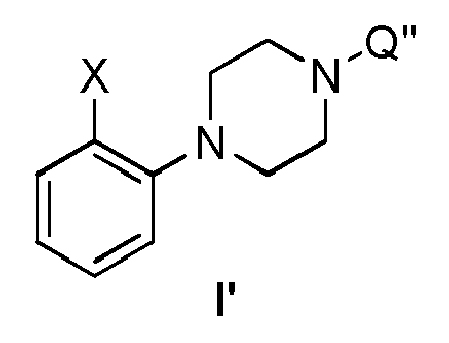
- (22) A compound of formula I'

- (23) A compound of formula IVb'

- (24) A compound of formula Ic, Id, Ig, or Ih


- (25) Use of the compounds as defined in any one of item 22 to 24 in the preparation of vortioxetine or a salt thereof.
- (26) A process for the preparation of a pharmaceutical composition comprising a compound of formula IVa, or a salt thereof

- a) preparing a compound of formula IVa, or a salt thereof, by carrying out the process according to any one of items 1 to 21, and
- b) mixing the compound of formula IVa, or a salt thereof, with a pharmaceutically acceptable carrier and/or excipient.
- The new process defined above provides vortioxetine, or salts thereof, in a high yield without the need of using the palladium catalyst and phosphine ligand, nor expensive starting materials, which provides an industrially applicable, environmentally friendly and economically improved process for obtaining vortioxetine, or salts thereof. The present invention further provides new intermediate compounds that are highly useful as key intermediates in the preparation of vortioxetine or salts thereof. The intermediates are crystalline, suitable for optional purification by recrystallization.
- The invention is described below in further detail by embodiments, without being limited thereto.
- A general concept of the process of the present invention may be represented in Scheme 1. Compound I is subjected to the lithiation reaction to form a (2-(piperazin-1-yl)phenyl)lithium intermediate II or II'. Any known lithiation method can be used for this step, for example, alkyl lithium or lithium amide reagents can be used, preferably C1-C10 alkyl lithium reagents, most preferably n-, s-, or t-butyllithium (BuLi) in an aprotic solvent is used. In the next step, the (2-(piperazin-1-yl)phenyl)lithium intermediate II is converted either to the compound of formula IVb, if Q in the compound of Formula I is the amino protecting group Pg, or directly to vortioxetine (IVa), if Q in the compound of Formula I is hydrogen or the 2,4-dimethylphenylsulfide moiety of formula

- In case Q in the compound of formula I is hydrogen or an amino protecting group, the compound of formula IVa or IVb, respectively, is formed by the reaction of substitution, wherein the 2,4-dimethylphenylsulfide moiety is introduced using 1,2-bis(2,4-dimethylphenyl)disulfane (IIIa) or 2,4-dimethylphenylsulfenyl halide, preferably 2,4-dimethylphenyl hypochlorothioite (IIIb). In case the Pg-protected compound of formula IVb is formed, a deprotection step is needed to convert it to the compound of formula IVa (vortioxetine).

- Optionally, the vortioxetine compound obtained by the process of the present invention can also be converted to a salt thereof, for example to a hydrobromide salt (IVa.HBr) or a hydrochloride salt (IVa.HCl).
- According to a preferred embodiment, the lithium compound II or II' is not isolated and reacts with an appropriate electrophile, which can be included on the molecule I itself, if Q in the compound of formula I is the 2,4-dimethylphenylsulfide moiety, or is added during the substitution step as described above and in more detail in the specific embodiments of vortioxetine synthesis that follow.
- In a specific embodiment presented in Scheme 2, 1-phenylpiperazine (Ia) or 1-(2-bromophenyl)piperazine (Ib), respectively, is used as the starting compound, which is transformed to the ortho-lithiated compound II' by using standard lithiated procedures, preferably using n-, s-, or t-BuLi in aprotic solvent, preferably ethers and alkanes. The most preferable ethers used are diethyl ether and tetrahydrofuran (THF), while the most preferable alkanes used are hexane and cyclohexane. Lithiation occurs at an appropriate temperature, depending on the compound, the solvent, and the lithiating agent used. If, for example, s-BuLi in cyclohexane is used to lithiate the compound Ia, the lithiation may occur, for example, at 50°C (see Example 1). If, in another example s-BuLi in THF is used to lithiate the compound Ib, the lithiation may occur, for example, at -78°C (see Example 2). In the next step the 2,4-dimethylphenylsulfide moiety can be introduced by the reaction of substitution by adding the 1,2-bis(2,4-dimethylphenyl)disulfane (IIIa) or 2,4-dimethylphenyl hypochlorothioite (IIIb), respectively, as the electrophiles into the reaction pot. The substitution can be conducted in an aprotic solvent, for example in THF. The obtained compound of formula IVa (vortioxetine) can be purified. Optionally, IVa can also be converted to a salt thereof.

- In a further specific embodiment of the present invention shown in Scheme 3, the starting compound is selected from the group consisting of the N-trityl (Ic and Id) and N-Boc (Ie and If) protected compounds, which are prepared from the corresponding compounds of formula I, wherein Q is hydrogen (Ia and Ib). The introduction of the amino protecting group is performed in the presence of a base, for example, the base can be selected from the group consisting of tertiary amines, pyridine, carbonates, phosphates. The preferred base is triethylamine. Lithiation and introduction of 2,4-dimethylphenylsulfide moiety may occur under the same reaction conditions as described above. First, lithiation is conducted using an appropriate lithiation agent, preferably n-, s-, or t-BuLi in an aprotic solvent. The substitution preferably occurs by using the compound IIIa or IIIb, respectively, to give compounds IVb' or IVb", depending on the protecting group used.

- Due to the presence of the amino protecting group, the deprotection step is needed to obtain the compound of formula IVa. The deprotection conditions depend on the nature of the respective protecting group. For example, in case of N-Tr and N-Boc protecting groups, acidic conditions are used. If for instance HBr in any acid resistible solvent is used for the deprotection step, the vortioxetine HBr salt (IVa.HBr) is obtained in one step. Similarly, if HCl is used, the vortioxetine HCl salt is obtained.
- In a further specific embodiment of the present invention presented in Scheme 4, the 1-phenylpiperazine (Ia) is protected using a silyl amino protecting group, preferably trimethylsilyl (TMS) to give the compound Ig, which is preferably not isolated. In the next step lithiation is conducted using n-, s- or t-BuLi in an aprotic solvent. The substitution is conducted using a compound IIIa or IIIb, respectively, to give the compound IVa. In this case the deprotection step is conducted during the isolation of IVa, as the TMS protecting group is readily removed, for example by washing the TMS-protected compound of formula IVa (IVb"') with water.

- In a further specific and preferred embodiment shown in Scheme 5, the process of the present invention starts from 2,4-dimethylbenzenethiol, which is transformed to 2,4-dimethylphenyl hypochlorothioite (IIIb). IIIb in the next step reacts in the presence of a base, preferably triethylamine, with 1-phenylpiperazine (Ia) or 1-(2-bromophenyl)piperazine (Ib) to afford 1-((2,4-dimethylphenyl)thio)-4-phenylpiperazine (Ig) or 1-(2-bromophenyl)-4-((2,4-dimethylphenyl)thio)-piperazine (Ih) as a white solid. Compounds Ig and Ih are then lithiated using BuLi, preferably using n- or s-BuLi, at low temperatures, preferably at -100 to -50°C, most preferably at about -80°C, in aprotic solvents, preferably in ethers or alkanes, most preferably in tetrahydrofuran. This is followed by elevating the temperature to the range from 0°C to 50°C, preferably to room temperature, in order to accomplish the re-arrangement of the 2,4-dimethylphenylsulfide group, to give vortioxetine (IVa).
- The reaction from 2,4-dimethylbenzenethiol to the compound Ig or Ih can also be made according to one-pot methodologies. In the first step IIIb is formed using trichloroisocyanuric acid (TCCA) in EtOAc at 0°C. After 30 min Et3N is added, followed by compound Ia or Ib to give intermediates Ig or Ih.

- The vortioxetine compound, or a salt thereof, prepared according to the invention may be used or administered on its own, preferably it is administered as a pharmaceutical composition comprising vortioxetine, or a salt thereof, and a pharmaceutically acceptable excipient and/or carrier. Further, the vortioxetine compound, or a salt thereof, prepared according to the invention may be combined with other drugs, especially with drugs used for the treatment of depression and anxiety.
- In a further aspect of the present invention, a pharmaceutical composition comprising the compound of formula IVa (vortioxetine), or a salt thereof, is prepared by comprising the steps of preparing the compound of formula IVa, or a salt thereof, as described above, and mixing the compound of formula IVa, or a salt thereof, with a pharmaceutically acceptable carrier and/or excipient. The administration form can be suitably chosen, e.g. a form suitable for oral, parenteral, rectal administration and/or administration by inhalation, and the dosage form may be solid, liquid, or powdery. Therefore, the pharmaceutical composition comprising vortioxetine, or a salt thereof, prepared according to the invention may suitably be in the form of tablets, pills, capsules, syrups, powders or granules for oral administration; or as sterile parenteral or subcutaneous solutions, suspensions for parenteral administration; or as suppositories for rectal administration.
- Suitable excipients and/or carriers include, without being limited to, diluents, binders, disintegrants, lubricants, etc. For example, the compound or a finely divided form thereof, or particles comprising the compound, are mixed with a carrier or binder substance, e.g. a mono-, di- or polysaccharide such as sugars and starch, a sugar alcohol or another polyol. For example, lactose, saccharose, sorbitol, mannitol, starch, cellulose derivatives, a binder such as polyvinylpyrrolidone, and a lubricant such as magnesium stearate, calcium stearate, polyethylene glycol, waxes, paraffin, and the like are mixed, and then compressed into tablets. The compound or a finely divided form thereof, or particles containing the same may be coated by another substance. The powder mixture or particles containing the compound may also be dispensed into capsules.
- The pharmaceutical composition comprising vortioxetine, or a salt thereof, prepared according to the invention in a desired dose is generally suitable to treat a disease or condition of a patient in need thereof, speciffically to display a desired activity when treating the depression and anxiety.
- Further embodiment of the present invention resides in the provision of valuable intermediate compounds useful in the synthesis of a compound of formula IVa (vortioxetine). In particular, the compounds of formula I'

the compound of formula IVb'
- The preferred intermediate compounds useful in the synthesis of a compound of formula IVa (vortioxetine) are Ic, Id, Ig, Ih and IVb'

- The following Examples are non-limiting and serve to illustrate the invention.
-
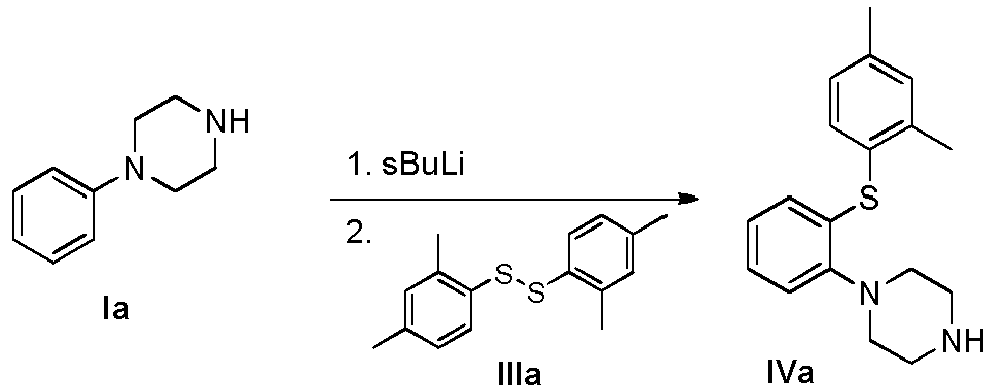
- To a solution of Ia (0.5 g, 3.08 mmol) in dry cyclohexane (10 mL) while stirring at 25°C was slowly added s-BuLi (6.78 mmol). Obtained mixture was stirred at 50°C for 16 h, then it was cooled to room temperature, and solution of IIIa (1.27 g, 4.62 mmol) in dry THF (10 mL) was added. After stirring for 24 h 10 mL water and 10 mL EtOAc were added. Organic layer is then washed with brine (2 x 20 mL), dried over Na2SO4, and solvent is evaporated to give crude product, which is purified by chromatography to give title compound. 1H NMR (CDCl3, 500 MHz) δ 1.63 (br s, 1 H), 2.33 (s, 3H), 2.37 (s, 3H), 3.02-3.09 (m, 8H), 6.52 (m, 1 H), 6.87 (m, 1 H), 7.04 (m, 1 H), 7.06-7.10 (m, 2H), 7.16 (m, 1 H), 7.39 (d, J = 7.8 Hz, 1 H); MS (ESI) m/z: 299 [MH]+.
-

- To a solution of Ib (0.71 g, 2.93 mmol) in dry THF (10 mL) sBuLi (6.44 mmol) was added at-78°C. After stirring for 15 min, solution of IIIb (0.96 g, 3.52 mmol) in dry THF (5 mL) was added at -78°C. Obtained reaction mixture was then stirred at room temperature for 17 h then 10 mL water and 20 mL EtOAc were added. Water layer was separated and organic layer was washed with brine (2 x 20 mL), dried over Na2SO4, and solvent was evaporated to give crude product, which was dissolved in iPrOAc (10 mL). 48% HBr (0.33 mL) was then added and obtained mixture was stirred at room temperature for 1 h. Precipitate was filtered off, washed with iPrOAc (2 x 10 mL) and dried to give title compound as off-white powder (0.78 g, 70% yield): 1H NMR (DMSO-d6 , 500 MHz) δ 2.23 (s, 3H), 2.32 (s, 3H), 3.15-3.27 (m, 8H), 6.40 (m, 1 H), 6.96 (m, 1 H), 7.08-7.17 (m, 3H), 7.24 (m, 1 H), 7.32 (d, J = 7.8 Hz, 1 H), 8.85 (br, 2H).
-

- To a solution of 1-phenylpiperazine Ia (5.0 g, 30.8 mmol), Et3N (5.15 mL, 37.0 mmol) in CH2Cl2 (30 mL) TrCl (9.0 g, 32.4 mmol) was added. After stirring for 2 h at room temperature water (100 mL) was added and product was extracted to CH2Cl2 (2 x 30 mL). Combined organic layers were dried over Na2SO4, and solvent was evaporated. To the residue MeOH (50 mL) was added, and obtained mixture was stirred at room temperature. White precipitate was then filtered off, washed with MeOH (2 x 25 mL) and dried to afford title compound Ic as white powder (11.72 g, 94% yield): DSC (onset): 173°C; 1H NMR (CDCl3, 500 MHz) δ 2.07-2.91 (br m, 4H), 3.35 (m, 4H), 6.87 (m, 1 H), 6.93 (m, 2H), 7.20 (m, 3H), 7.25-7.34 (m, 8H), 7.56 (m, 6H); MS (ESI) m/z: 405 [MH]+.
-

- To a solution of 1-(2-bromophenyl)piperazine Ib (7.43 g, 30.8 mmol), Et3N (6.44 mL, 46.2 mmol) in CH2Cl2 (40 mL) TrCl (9.0 g, 32.4 mmol) was added. After stirring for 1 h at room temperature 50 mL of saturated aqueous NaHCO3 solution was added. After stirring for 15 min organic phase was separated, dried over Na2SO4, and solvent was evaporated. To the residue MeOH (50 mL) was added, and obtained mixture was stirred at room temperature. After cooled to-18°C, white precipitate was filtered off, washed with MeOH (2 x 20 mL) and dried to afford title compound Id as white powder (14.5 g, 97% yield): DSC (onset): 225°C; 1H NMR (CDCl3, 500 MHz) δ 3.23 (br m, 8H), 6.91 (m, 1 H), 7.16-7.22 (m, 4H), 7.28-7.33 (m, 7H), 7.51-7.60 (m, 7H); MS (ESI) m/z: 484 [MH]+.
-

- To a solution of Ic (0.84 g, 2.07 mmol) in dry Et2O (10 mL) and dry THF (5 mL) while stirring at 25°C was slowly added s-BuLi (2.17 mmol). Obtained mixture was stirred at room temperature for 1.5 h then a solution of IIIa (0.74 g, 2.69 mmol) in dry THF (5 mL) was added. After stirring for 3 days at room temperature 10 mL water and 10 mL EtOAc were added. Organic layer is then washed with brine (2 x 20 mL), dried over Na2SO4, and solvent is evaporated to give crude product, which is purified by chromatography to give title compound. MS (ESI) m/z: 541 [MH]+.
-

- To an ice-cold solution of Id (1.0 g, 2.07 mmol) in dry THF (10 mL) was added s-BuLi (2.17 mmol). Obtained reaction mixture was stirred at 0°C for 15 min then solution of IIIa (0.74 g, 2.69 g) in dry THF (5 mL) was added. After stirring for 3 days at room temperature water (25 mL) and EtOAc (15 mL) were added. Water layer was separated and washed with EtOAc (20 mL). Combined organic layers were dried over Na2SO4, salts were filtered off and filtrate was concentrated to afford yellow oil, which was crystalized from CH2Cl2/MeOH mixture to afford title compound as a white powder (0.85 g, 76% yield): MS (ESI) m/z: 541 [MH]+.
-

- To a solution of tert-butyl 4-(2-bromophenyl)piperazine-1-carboxylate If (1.0 g, 2.93 mmol) in dry THF (10 mL) sBuLi (2.69 mL, 3.22 mmol) was added at -78°C. After stirring for 15 min, solution of IIIa (0.96 g, 3.52 mmol) in dry THF (5 mL) was added at -78°C. Obtained reaction mixture was then stirred at room temperature for 18 h, then 20 mL water was added and product was extracted to EtOAc (2 x 10 mL). Combined organic layers were washed with brine (2 x 20 mL), dried over MgSO4, and solvent was evaporated to give crude product, which was purified by chromatography (methylcyclohexane/EtOAc) to afford title compound IIb as yellowish oil, which crystalized upon standing (0.96 g, 83% yield): 1H NMR (CDCl3, 500 MHz) δ 1.51 (s, 9H), 2.33 (s, 3H), 2.37 (s, 3H), 3.02 (m, 4H), 3.63 (m, 4H), 6.53 (dd, J = 1.4, 7.9 Hz, 1 H), 6.88 (m, 1 H), 7.02-7.05 (m, 2H), 7.08 (m, 1 H), 7.16 (m, 1 H), 7.38 (d, J = 7.8 Hz, 1 H); MS (ESI) m/z: 399 [MH]+.
-

- To a solution of trichloroisocyanuric acid (TCCA) (2.24 g, 9.65 mmol) in EtOAc (50 mL) was slowly added 2,4-dimethylbenzenethiol (0.49 mL, 3.62 mmol). Obtained reaction mixture was stirred at room temperature for 30 min, then Et3N (10.1 mL, 72.3 mmol) and solution of Ia (4.46 g, 27.5 mmol) in EtOAc (50 mL) was added. After stirring at room temperature for 2 h, salts were filtered off, washed with EtOAc (2 x 20 mL), and filtrate was concentrated. To the remaining MeOH (100 mL) was added and the obtained mixture was stirred at room temperature for 1 h. White precipitate was filtered off, washed with MeOH (2 x 20 mL) and dried to afford title compound as white powder (6.17 g, 75% yield): 1H NMR (CDCl3, 500 MHz) δ 2.35 (s, 3H), 2.41 (s, 3H), 3.16 (m, 4H), 3.25 (m, 4H), 6.89 (m, 1 H), 6.91-6.94 (m, 2H), 7.06 (m, 1 H), 7.08 (m, 1 H), 7.26-7.30 (m, 2H), 7.53 (d, J = 7.8 Hz, 1 H); MS (ESI) m/z: 299 [MH]+.
-

- To a solution of Ib (0.82 g, 3.41 mmol) and Et3N (0.60 mL, 4.31 mmol) in EtOAc (5 mL) was slowly added IIIb (0.62 g, 3.59 mmol) while stirring at room temperature. After stirring for 1h reaction mixture was concentrated, heptane (10 mL) was added, salts were filtered off and washed with heptane (2 x 10 mL), and filtrate was concentrated to afford title compound as yellow oil, which crystalized upon standing (1.07 g, 83% yield): 1H NMR (CDCl3, 500 MHz) δ 2.34 (s, 3H), 2.39 (s, 3H), 3.11 (m, 4H), 3.19 (m, 4H), 6.93 (m, 1 H), 7.04-7.08 (m, 3H), 7.28 (m, 1 H), 7.53 (d, J = 7.6 Hz, 1 H), 7.55 (dd, J = 7.6, 1.4 Hz, 1 H); MS (ESI) m/z: 377 [MH]+.
- To a solution of trichloroisocyanuric acid (2.24 g, 9.65 mmol) in EtOAc (50 mL) was slowly added 2,4-dimethylbenzenethiol (0.49 mL, 3.62 mmol). Obtained reaction mixture was stirred at room temperature for 30 min, then Et3N (10.1 mL, 72.3 mmol) and solution of Ib (6.62 g, 27.5 mmol) in EtOAc (50 mL) was added. After stirring at room temperature for 2 h, salts were filtered off, washed with EtOAc (2 x 20 mL), and filtrate was concentrated. To the remaining MeOH (100 mL) was added and the obtained mixture was stirred at room temperature for 1 h. White precipitate was filtered off, washed with MeOH (2 x 20 mL) and dried to afford title compound as white powder (8.36 g, 81% yield): 1H NMR (CDCl3, 500 MHz) δ 2.34 (s, 3H), 2.39 (s, 3H), 3.11 (m, 4H), 3.19 (m, 4H), 6.93 (m, 1 H), 7.04-7.08 (m, 3H), 7.28 (m, 1H), 7.53 (d, J = 7.6 Hz, 1 H), 7.55 (dd, J = 7.6, 1.4 Hz, 1 H); MS (ESI) m/z: 377 [MH]+.
-

- To a solution of Ih (0.5 g, 1.48 mmol) in dry THF (10 mL) was added sBuLi (1.48 mmol) while stirring at -80°C. Obtained reaction mixture was stirred at -80°C for 15 min then reaction temperature was slowly increased to room temperature. After stirring at room temperature for 1 h, water (2 mL) and EtOAc (10 mL) were added. Organic phase was then washed with water (2 x 25 mL) and brine (2 x 25 mL), dried over Na2SO4 and concentrated to afford crude product, which is then purified by chromatography to afford title compound (0.22 g, 50% yield): 1H NMR (CDCl3, 500 MHz) δ 1.63 (br s, 1 H), 2.33 (s, 3H), 2.37 (s, 3H), 3.02-3.09 (m, 8H), 6.52 (m, 1 H), 6.87 (m, 1H), 7.04 (m, 1 H), 7.06-7.10 (m, 2H), 7.16 (m, 1 H), 7.39 (d, J = 7.8 Hz, 1 H); MS (ESI) m/z: 299 [MH]+.
-
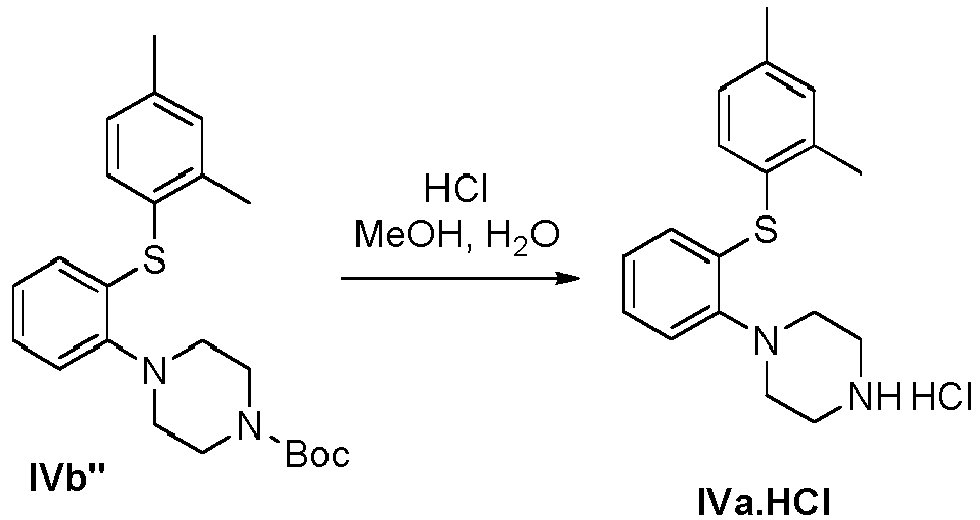
- A mixture of IVb" (1.78 g, 4.47 mmol), MeOH (10 mL) water (2 mL), and 37% HCl (6 mL) was stirred at room temperature for 3 days. To the reaction mixture water (30 mL) was added, precipitate was filtered off. After washing with water (10 mL) and MeOAc (2 x 20 mL) it was dried to afford title compound as HCl salt. Off white powder (1.27 g, 85% yield): DSC: Onset 230.31°C, Peak 323.15°C.
-

- A solution of IVb' (1.0 g, 1.85 mmol) in EtOAc (25 mL) 48% HBr (0.5 mL) was added. Obtained reaction mixture was stirred at room temperature for 6 h. Precipitate was filtered off, washed with EtOAc (2 x 10 mL), and dried to afford title compound as a beige powder (0.41 g, 59% yield): 1H NMR (DMSO-d6 , 500 MHz) δ 2.23 (s, 3H), 2.32 (s, 3H), 3.15-3.27 (m, 8H), 6.40 (m, 1 H), 6.96 (m, 1 H), 7.08-7.17 (m, 3H), 7.24 (m, 1 H), 7.32 (d, J = 7.8 Hz, 1 H), 8.85 (br, 2H).
-
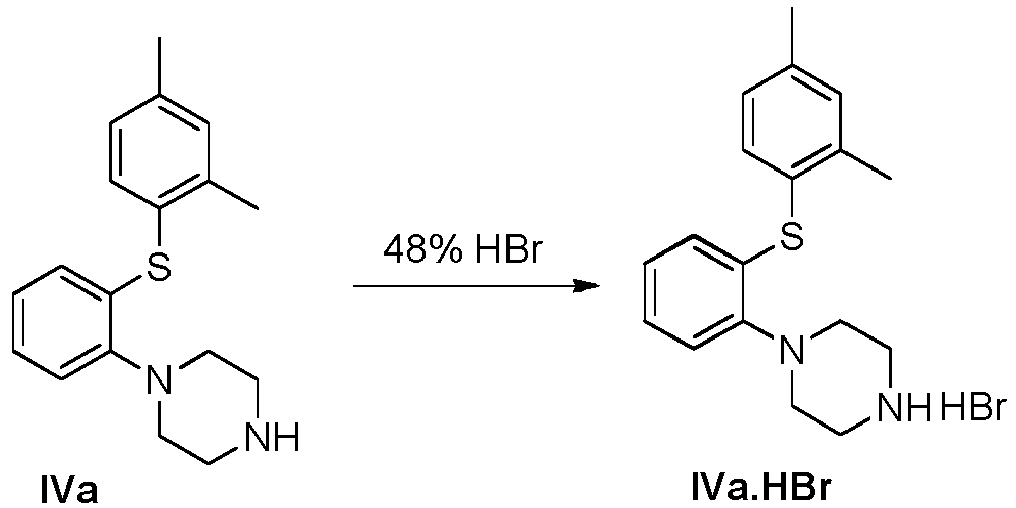
- To a solution of vortioxetine IVa (1.80 g, 6.03 mmol) in iPrOAc (20 mL) at room temperature 48% HBr (0.68 mL, 6.03 mmol) was slowly added. Obtained mixture was stirred at room temperature for 1 h, white precipitate was then filtered off, washed with acetone (2 x 20 mL), and dried to afford title compound as white powder (2.15 g, 94% yield): DSC: Onset 221.74°C, Peak 223.86°C; 1H NMR (DMSO-d6 , 500 MHz) δ 2.23 (s, 3H), 2.32 (s, 3H), 3.15-3.27 (m, 8H), 6.40 (m, 1 H), 6.96 (m, 1 H), 7.08-7.17 (m, 3H), 7.24 (m, 1 H), 7.32 (d, J = 7.8 Hz, 1 H), 8.85 (br, 2H).
-

- To a solution of trichloroisocyanuric acid TCCA (0.28 g, 1.21 mmol) in EtOAc (5 mL) was slowly added 2,4-dimethylbenzenethiol (0.49 mL, 3.62 mmol) at 0°C. After stirring at 0°C for 1 h EtOAc was evaporated, heptane (10 mL) was added, white precipitate was filtered off, washed with heptane (2 x 10 mL), and filtrate was evaporated to afford title compound IIIb as an orange oil (0.62 g, 99% yield): 1H NMR (CDCl3, 500 MHz) δ 2.37 (s, 3H), 2.60 (s, 3H), 7.05 (m, 1H), 7.16 (m, 1 H), 7.66 (d, J = 7.9 Hz, 1 H).
Claims (15)
- A process for the manufacture of a compound of formula IVa, or a salt thereof,
 a) reacting a compound of formula I

by lithiation, to give a compound of formula II or II' b) converting the compound of formula II or II' into the compound of formula IVa,c) optionally, converting the obtained compound of formula IVa into the salt thereof.
 - The process according to claim 1, wherein Q in the compound of formula I represents hydrogen, and step b) is conducted by introducing the 2,4-dimethylphenylsulfide moiety to the compound of formula II' to give a compound of formula IVa.
- The process according to claim 1, wherein Q in the compound of formula I represents an amino protecting group, and step b) is conducted by introducing the 2,4-dimethylphenylsulfide moiety to the compound of formula II to give a compound of formula IVb

- The process according to claim 2 or claim 3, wherein the 2,4-dimethylphenylsulfide moiety is introduced using 1,2-bis(2,4-dimethylphenyl)disulfane or 2,4-dimethylphenylsulfenyl halide, preferably 2,4-dimethylphenyl hypochlorothioite.
- The process according to claim 1, wherein Q in the compound of formula I represents the 2,4-dimethylphenylsulfide moiety of formula

step b) is conducted by the re-arrangement of the 2,4-dimethylphenylsulfide moiety to give the compound of formula IVa. - The process according to claim 5, wherein the lithiation temperature is from -100°C to -50°C, and the re-arrangement of the 2,4-dimethylphenylsulfide moiety is conducted at a temperature of from 0°C to 50°C.
- The process according to claim 5 or claim 6, wherein the compound of formula I, wherein Q represents the 2,4-dimethylphenylsulfide moiety of formula
 a) reacting 2,4-dimethylbenzenethiol with trichloroisocyanuric acid to give 2,4-dimethylphenyl hypochlorothioite, andb) reacting the 2,4-dimethylphenyl hypochlorothioite with the compound of formula I"
- The process according to claim 1, wherein the compound of formula II or II' is not isolated.
- The process according to any one of the previous claims, wherein the lithiation is conducted with n-, s- or t-butyllithium in an aprotic solvent.
- The process according to claim 9, wherein the aprotic solvent is an ether or an alkane.
- The process according to any one of the previous claims, wherein the salt of the compound of formula IVa is a hydrobromide salt or a hydrochloride salt.
- A compound of formula I'
- A compound of formula IVb'

- Use of the compounds as defined in claim 12 or claim 13 in the preparation of vortioxetine or a salt thereof.
- A process for the preparation of a pharmaceutical composition comprising a compound of formula IVa, or a salt thereof
 a) preparing a compound of formula IVa, or a salt thereof, by carrying out a process according to any one of claims 1 to 11, andb) mixing the compound of formula IVa, or a salt thereof, with a pharmaceutically acceptable carrier and/or excipient.
Priority Applications (3)
| Application Number | Priority Date | Filing Date | Title |
|---|---|---|---|
| EP13195067.7A EP2878596A1 (en) | 2013-11-29 | 2013-11-29 | Synthesis of vortioxetine via (2-(piperazine-1-yl)phenyl)lithium intermediates |
| CN201480074384.XA CN105939995A (en) | 2013-11-29 | 2014-11-28 | Synthesis of vortioxetine via (2-(piperazine-1 -yl)phenvl)lithium intermediates |
| PCT/EP2014/075929 WO2015079018A1 (en) | 2013-11-29 | 2014-11-28 | Synthesis of vortioxetine via (2-(piperazine-1 -yl)phenvl)lithium intermediates |
Applications Claiming Priority (1)
| Application Number | Priority Date | Filing Date | Title |
|---|---|---|---|
| EP13195067.7A EP2878596A1 (en) | 2013-11-29 | 2013-11-29 | Synthesis of vortioxetine via (2-(piperazine-1-yl)phenyl)lithium intermediates |
Publications (1)
| Publication Number | Publication Date |
|---|---|
| EP2878596A1 true EP2878596A1 (en) | 2015-06-03 |
Family
ID=49674215
Family Applications (1)
| Application Number | Title | Priority Date | Filing Date |
|---|---|---|---|
| EP13195067.7A Ceased EP2878596A1 (en) | 2013-11-29 | 2013-11-29 | Synthesis of vortioxetine via (2-(piperazine-1-yl)phenyl)lithium intermediates |
Country Status (3)
| Country | Link |
|---|---|
| EP (1) | EP2878596A1 (en) |
| CN (1) | CN105939995A (en) |
| WO (1) | WO2015079018A1 (en) |
Cited By (3)
| Publication number | Priority date | Publication date | Assignee | Title |
|---|---|---|---|---|
| CN105315184A (en) * | 2015-06-26 | 2016-02-10 | 上海医药工业研究院 | Preparation method and intermediate of vortioxetine |
| WO2017162536A1 (en) * | 2016-03-21 | 2017-09-28 | H. Lundbeck A/S | Vortioxetine prodrugs |
| GB2557867A (en) * | 2015-11-18 | 2018-07-04 | Azad Pharmaceutical Ingredients Ag | New synthetic path to vortioxetine salts |
Families Citing this family (2)
| Publication number | Priority date | Publication date | Assignee | Title |
|---|---|---|---|---|
| CN107445890A (en) * | 2016-05-30 | 2017-12-08 | 复旦大学 | A kind of method that asymmetric disulphide is synthesized using sym-closene |
| US11707461B2 (en) * | 2017-09-20 | 2023-07-25 | Zhejiang Huahai Pharmaceutical Co., Ltd | N-formyl vortioxetine and preparation method thereof and solid preparation of vortioxetine |
Citations (6)
| Publication number | Priority date | Publication date | Assignee | Title |
|---|---|---|---|---|
| WO2003029232A1 (en) | 2001-10-04 | 2003-04-10 | H. Lundbeck A/S | Phenyl-piperazine derivatives as serotonin reuptake inhibitors |
| WO2007144005A1 (en) | 2006-06-16 | 2007-12-21 | H. Lundbeck A/S | 1- [2- (2, 4-dimethylphenylsulfanyl) -phenyl] piperazine as a compound with combined serotonin reuptake, 5-ht3 and 5-ht1a activity for the treatment of cognitive impairment |
| WO2008113359A2 (en) * | 2007-03-20 | 2008-09-25 | H. Lundbeck A/S | 1- [2-(2,4-dimethylphenylsulfanyl)-phenyl] piperazine as a compound with combined serotonin reuptake, 5-ht3 and 5-ht1a activity for the treatment of pain or residual symptoms in depression relating to sleep and cognition |
| WO2009062517A1 (en) * | 2007-11-13 | 2009-05-22 | H. Lundbeck A/S | Therapeutic uses of compounds having combined sert, 5-ht3 and 5-ht1a activity |
| WO2010094285A1 (en) * | 2009-02-17 | 2010-08-26 | H. Lundbeck A/S | Purification of 1-[2-(2,4-dimethylphenylsulfanyl)phenyl]piperazine |
| WO2013102573A1 (en) | 2012-01-03 | 2013-07-11 | H. Lundbeck A/S | Process for the manufacture of 1-[2-(2,4-dimethyl-phenylsulfanyl)-phenyl]-piperazine |
-
2013
- 2013-11-29 EP EP13195067.7A patent/EP2878596A1/en not_active Ceased
-
2014
- 2014-11-28 CN CN201480074384.XA patent/CN105939995A/en active Pending
- 2014-11-28 WO PCT/EP2014/075929 patent/WO2015079018A1/en not_active Ceased
Patent Citations (6)
| Publication number | Priority date | Publication date | Assignee | Title |
|---|---|---|---|---|
| WO2003029232A1 (en) | 2001-10-04 | 2003-04-10 | H. Lundbeck A/S | Phenyl-piperazine derivatives as serotonin reuptake inhibitors |
| WO2007144005A1 (en) | 2006-06-16 | 2007-12-21 | H. Lundbeck A/S | 1- [2- (2, 4-dimethylphenylsulfanyl) -phenyl] piperazine as a compound with combined serotonin reuptake, 5-ht3 and 5-ht1a activity for the treatment of cognitive impairment |
| WO2008113359A2 (en) * | 2007-03-20 | 2008-09-25 | H. Lundbeck A/S | 1- [2-(2,4-dimethylphenylsulfanyl)-phenyl] piperazine as a compound with combined serotonin reuptake, 5-ht3 and 5-ht1a activity for the treatment of pain or residual symptoms in depression relating to sleep and cognition |
| WO2009062517A1 (en) * | 2007-11-13 | 2009-05-22 | H. Lundbeck A/S | Therapeutic uses of compounds having combined sert, 5-ht3 and 5-ht1a activity |
| WO2010094285A1 (en) * | 2009-02-17 | 2010-08-26 | H. Lundbeck A/S | Purification of 1-[2-(2,4-dimethylphenylsulfanyl)phenyl]piperazine |
| WO2013102573A1 (en) | 2012-01-03 | 2013-07-11 | H. Lundbeck A/S | Process for the manufacture of 1-[2-(2,4-dimethyl-phenylsulfanyl)-phenyl]-piperazine |
Non-Patent Citations (7)
| Title |
|---|
| BANG-ANDERSEN ET AL., J. MED. CHEM., vol. 54, 2011, pages 3206 - 3221 |
| BENNY BANG-ANDERSEN ET AL: "Discovery of 1-[2-(2,4-Dimethylphenylsulfanyl)phenyl]piperazine (Lu AA21004): A Novel Multimodal Compound for the Treatment of Major Depressive Disorder", JOURNAL OF MEDICINAL CHEMISTRY, vol. 54, no. 9, 12 May 2011 (2011-05-12), pages 3206 - 3221, XP055058222, ISSN: 0022-2623, DOI: 10.1021/jm101459g * |
| CHANDRASEKHAR S ET AL: "Single-step conversion of N-benzyl, N-trityl and N-diphenylmethyl amines to t-butyl carbamates using polymethylhydrosiloxane", TETRAHEDRON LETTERS, vol. 44, no. 10, 3 March 2003 (2003-03-03), PERGAMON, GB, pages 2057 - 2059, XP004410057, ISSN: 0040-4039, DOI: 10.1016/S0040-4039(03)00172-2 * |
| DATABASE REGISTRY [Online] CHEMICAL ABSTRACTS SERVICE, COLUMBUS, OHIO, US; 2 August 2006 (2006-08-02), XP002724108, retrieved from STN Database accession no. 898065-26-4 * |
| DATABASE REGISTRY [Online] CHEMICAL ABSTRACTS SERVICE, COLUMBUS, OHIO, US; 28 July 2006 (2006-07-28), XP002724109, retrieved from STN Database accession no. 896554-56-6 * |
| DATABASE REGISTRY [Online] CHEMICAL ABSTRACTS SERVICE, COLUMBUS, OHIO, US; 6 March 2001 (2001-03-06), XP002724110, retrieved from STN Database accession no. 325810-36-4 * |
| LIU ET AL., TOXICITY OF PALLADIUM, TOXICOLOGY LETTERS, vol. 4, 1979, pages 469 - 473 |
Cited By (3)
| Publication number | Priority date | Publication date | Assignee | Title |
|---|---|---|---|---|
| CN105315184A (en) * | 2015-06-26 | 2016-02-10 | 上海医药工业研究院 | Preparation method and intermediate of vortioxetine |
| GB2557867A (en) * | 2015-11-18 | 2018-07-04 | Azad Pharmaceutical Ingredients Ag | New synthetic path to vortioxetine salts |
| WO2017162536A1 (en) * | 2016-03-21 | 2017-09-28 | H. Lundbeck A/S | Vortioxetine prodrugs |
Also Published As
| Publication number | Publication date |
|---|---|
| CN105939995A (en) | 2016-09-14 |
| WO2015079018A1 (en) | 2015-06-04 |
Similar Documents
| Publication | Publication Date | Title |
|---|---|---|
| AU2024202897A1 (en) | Manufacture of compounds and compositions for inhibiting the activity of shp2 | |
| US10550138B2 (en) | Chiral spiro phosphorus-nirogen-sulphur tridentate ligand, preparation method and application thereof | |
| EP2981520B1 (en) | New process for the synthesis of 1-(2-((2,4-dimethylphenyl)thio)phenyl)piperazine | |
| CA2732883C (en) | C7-fluoro substituted tetracycline compounds | |
| CA2576388A1 (en) | Methods and compositions for modulating sphingosine-1-phosphate (s1p) receptor activity | |
| WO2015079018A1 (en) | Synthesis of vortioxetine via (2-(piperazine-1 -yl)phenvl)lithium intermediates | |
| Xie et al. | New efficient synthesis of trisubstituted imidazolidine-2-thiones and thiazoles via vinyliminophosphoranes | |
| KR20130006506A (en) | Process for preparing benzoxaboroles | |
| WO2022012630A1 (en) | Method for synthesizing c-nucleoside compound | |
| EP2894154A1 (en) | Synthesis of vortioxetine via (2-(piperazine-1-yl)phenyl)aniline intermediates | |
| WO1992005165A1 (en) | Diphenylpiperazine derivative and drug for circulatory organ containing the same | |
| CN106220624A (en) | Key intermediate in Eliquis synthesis and impurity: Eliquis diol ester | |
| KR102547709B1 (en) | azetidine derivatives | |
| EP2930171A1 (en) | Synthesis of vortioxetine via (2,4-dimethylphenyl)(2-iodophenyl)sulfane intermediate | |
| US10738064B2 (en) | Chiral α-amino tertiary boronic esters | |
| JPS6159308B2 (en) | ||
| EP2389358B1 (en) | Synthetic process for anticancer drug fluorapacin and trisulfide derivatives | |
| JP2004511548A (en) | Method for preparing N-substituted 2-sulfanilimidazole | |
| US7714127B2 (en) | Process for making heteroaryl amine intermediate compounds | |
| WO2015197096A1 (en) | Preparation and medical use of triazenes | |
| EP3906235B1 (en) | Method for preparing sulfonamides drugs | |
| CN103044313A (en) | Method for synthesising carbazole compounds | |
| CN119451969A (en) | Cyclic boric acid esters and their uses | |
| JP6853958B2 (en) | Diaryliodonium salt containing pentafluorosulfanylpyridyl group | |
| CN117551078A (en) | Aromatic monocyclic derivatives and their preparation methods and uses |
Legal Events
| Date | Code | Title | Description |
|---|---|---|---|
| PUAI | Public reference made under article 153(3) epc to a published international application that has entered the european phase |
Free format text: ORIGINAL CODE: 0009012 |
|
| 17P | Request for examination filed |
Effective date: 20131129 |
|
| AK | Designated contracting states |
Kind code of ref document: A1 Designated state(s): AL AT BE BG CH CY CZ DE DK EE ES FI FR GB GR HR HU IE IS IT LI LT LU LV MC MK MT NL NO PL PT RO RS SE SI SK SM TR |
|
| AX | Request for extension of the european patent |
Extension state: BA ME |
|
| STAA | Information on the status of an ep patent application or granted ep patent |
Free format text: STATUS: THE APPLICATION HAS BEEN REFUSED |
|
| 18R | Application refused |
Effective date: 20150621 |