EP2877438B1 - Method for making porous ceo2-stabilized zro2 ceramics - Google Patents
Method for making porous ceo2-stabilized zro2 ceramics Download PDFInfo
- Publication number
- EP2877438B1 EP2877438B1 EP13729965.7A EP13729965A EP2877438B1 EP 2877438 B1 EP2877438 B1 EP 2877438B1 EP 13729965 A EP13729965 A EP 13729965A EP 2877438 B1 EP2877438 B1 EP 2877438B1
- Authority
- EP
- European Patent Office
- Prior art keywords
- ceramic
- ceo
- zro
- densified
- porous
- Prior art date
- Legal status (The legal status is an assumption and is not a legal conclusion. Google has not performed a legal analysis and makes no representation as to the accuracy of the status listed.)
- Active
Links
- 239000000919 ceramic Substances 0.000 title claims description 118
- 238000000034 method Methods 0.000 title claims description 36
- MCMNRKCIXSYSNV-UHFFFAOYSA-N Zirconium dioxide Chemical compound O=[Zr]=O MCMNRKCIXSYSNV-UHFFFAOYSA-N 0.000 claims description 159
- RKTYLMNFRDHKIL-UHFFFAOYSA-N copper;5,10,15,20-tetraphenylporphyrin-22,24-diide Chemical compound [Cu+2].C1=CC(C(=C2C=CC([N-]2)=C(C=2C=CC=CC=2)C=2C=CC(N=2)=C(C=2C=CC=CC=2)C2=CC=C3[N-]2)C=2C=CC=CC=2)=NC1=C3C1=CC=CC=C1 RKTYLMNFRDHKIL-UHFFFAOYSA-N 0.000 claims description 24
- CETPSERCERDGAM-UHFFFAOYSA-N ceric oxide Chemical compound O=[Ce]=O CETPSERCERDGAM-UHFFFAOYSA-N 0.000 claims description 23
- 229910000422 cerium(IV) oxide Inorganic materials 0.000 claims description 23
- 238000010438 heat treatment Methods 0.000 claims description 20
- 238000005245 sintering Methods 0.000 claims description 19
- 238000002490 spark plasma sintering Methods 0.000 claims description 19
- 239000007858 starting material Substances 0.000 claims description 14
- 239000011148 porous material Substances 0.000 claims description 12
- 239000013078 crystal Substances 0.000 claims description 8
- 230000000052 comparative effect Effects 0.000 description 13
- 239000000843 powder Substances 0.000 description 13
- 239000000203 mixture Substances 0.000 description 9
- 238000003754 machining Methods 0.000 description 8
- 230000009466 transformation Effects 0.000 description 8
- OKTJSMMVPCPJKN-UHFFFAOYSA-N Carbon Chemical compound [C] OKTJSMMVPCPJKN-UHFFFAOYSA-N 0.000 description 7
- 229910002804 graphite Inorganic materials 0.000 description 7
- 239000010439 graphite Substances 0.000 description 7
- PNEYBMLMFCGWSK-UHFFFAOYSA-N aluminium oxide Inorganic materials [O-2].[O-2].[O-2].[Al+3].[Al+3] PNEYBMLMFCGWSK-UHFFFAOYSA-N 0.000 description 6
- 239000002994 raw material Substances 0.000 description 6
- 238000001878 scanning electron micrograph Methods 0.000 description 6
- 238000002360 preparation method Methods 0.000 description 5
- 238000003825 pressing Methods 0.000 description 5
- 230000009467 reduction Effects 0.000 description 5
- VYPSYNLAJGMNEJ-UHFFFAOYSA-N Silicium dioxide Chemical compound O=[Si]=O VYPSYNLAJGMNEJ-UHFFFAOYSA-N 0.000 description 4
- GWEVSGVZZGPLCZ-UHFFFAOYSA-N Titan oxide Chemical compound O=[Ti]=O GWEVSGVZZGPLCZ-UHFFFAOYSA-N 0.000 description 4
- 238000004458 analytical method Methods 0.000 description 4
- QVGXLLKOCUKJST-UHFFFAOYSA-N atomic oxygen Chemical compound [O] QVGXLLKOCUKJST-UHFFFAOYSA-N 0.000 description 4
- 230000008859 change Effects 0.000 description 4
- 238000000280 densification Methods 0.000 description 4
- 239000011888 foil Substances 0.000 description 4
- 229910052760 oxygen Inorganic materials 0.000 description 4
- 239000001301 oxygen Substances 0.000 description 4
- 230000008569 process Effects 0.000 description 4
- 230000015556 catabolic process Effects 0.000 description 3
- 239000003086 colorant Substances 0.000 description 3
- 238000001816 cooling Methods 0.000 description 3
- 229910052593 corundum Inorganic materials 0.000 description 3
- 238000006731 degradation reaction Methods 0.000 description 3
- 239000005548 dental material Substances 0.000 description 3
- 239000000463 material Substances 0.000 description 3
- 238000005259 measurement Methods 0.000 description 3
- 238000007254 oxidation reaction Methods 0.000 description 3
- 239000008188 pellet Substances 0.000 description 3
- 238000007493 shaping process Methods 0.000 description 3
- 238000012360 testing method Methods 0.000 description 3
- 229910001845 yogo sapphire Inorganic materials 0.000 description 3
- RUDFQVOCFDJEEF-UHFFFAOYSA-N yttrium(III) oxide Inorganic materials [O-2].[O-2].[O-2].[Y+3].[Y+3] RUDFQVOCFDJEEF-UHFFFAOYSA-N 0.000 description 3
- KKCBUQHMOMHUOY-UHFFFAOYSA-N Na2O Inorganic materials [O-2].[Na+].[Na+] KKCBUQHMOMHUOY-UHFFFAOYSA-N 0.000 description 2
- ODINCKMPIJJUCX-UHFFFAOYSA-N calcium oxide Inorganic materials [Ca]=O ODINCKMPIJJUCX-UHFFFAOYSA-N 0.000 description 2
- 229910052681 coesite Inorganic materials 0.000 description 2
- 238000009770 conventional sintering Methods 0.000 description 2
- 229910052906 cristobalite Inorganic materials 0.000 description 2
- CJNBYAVZURUTKZ-UHFFFAOYSA-N hafnium(IV) oxide Inorganic materials O=[Hf]=O CJNBYAVZURUTKZ-UHFFFAOYSA-N 0.000 description 2
- 238000007731 hot pressing Methods 0.000 description 2
- 238000010191 image analysis Methods 0.000 description 2
- JEIPFZHSYJVQDO-UHFFFAOYSA-N iron(III) oxide Inorganic materials O=[Fe]O[Fe]=O JEIPFZHSYJVQDO-UHFFFAOYSA-N 0.000 description 2
- 238000004519 manufacturing process Methods 0.000 description 2
- 230000007246 mechanism Effects 0.000 description 2
- 238000003801 milling Methods 0.000 description 2
- 230000000399 orthopedic effect Effects 0.000 description 2
- 230000001590 oxidative effect Effects 0.000 description 2
- 230000005855 radiation Effects 0.000 description 2
- 239000000377 silicon dioxide Substances 0.000 description 2
- 229910052682 stishovite Inorganic materials 0.000 description 2
- 229910052905 tridymite Inorganic materials 0.000 description 2
- 239000000654 additive Substances 0.000 description 1
- 239000012620 biological material Substances 0.000 description 1
- 229910000420 cerium oxide Inorganic materials 0.000 description 1
- 238000009694 cold isostatic pressing Methods 0.000 description 1
- 230000006835 compression Effects 0.000 description 1
- 238000007906 compression Methods 0.000 description 1
- 230000003247 decreasing effect Effects 0.000 description 1
- 239000011351 dental ceramic Substances 0.000 description 1
- 239000004053 dental implant Substances 0.000 description 1
- 210000004513 dentition Anatomy 0.000 description 1
- 238000007723 die pressing method Methods 0.000 description 1
- 238000005516 engineering process Methods 0.000 description 1
- 238000001914 filtration Methods 0.000 description 1
- 238000010304 firing Methods 0.000 description 1
- 229910002078 fully stabilized zirconia Inorganic materials 0.000 description 1
- 239000002241 glass-ceramic Substances 0.000 description 1
- 238000000227 grinding Methods 0.000 description 1
- 238000003384 imaging method Methods 0.000 description 1
- 150000002500 ions Chemical class 0.000 description 1
- 238000000462 isostatic pressing Methods 0.000 description 1
- MRELNEQAGSRDBK-UHFFFAOYSA-N lanthanum oxide Inorganic materials [O-2].[O-2].[O-2].[La+3].[La+3] MRELNEQAGSRDBK-UHFFFAOYSA-N 0.000 description 1
- 238000011068 loading method Methods 0.000 description 1
- CPLXHLVBOLITMK-UHFFFAOYSA-N magnesium oxide Inorganic materials [Mg]=O CPLXHLVBOLITMK-UHFFFAOYSA-N 0.000 description 1
- 239000012528 membrane Substances 0.000 description 1
- 229910044991 metal oxide Inorganic materials 0.000 description 1
- 150000004706 metal oxides Chemical class 0.000 description 1
- 230000004048 modification Effects 0.000 description 1
- 238000012986 modification Methods 0.000 description 1
- 239000002105 nanoparticle Substances 0.000 description 1
- 230000003287 optical effect Effects 0.000 description 1
- 229910052574 oxide ceramic Inorganic materials 0.000 description 1
- 239000011224 oxide ceramic Substances 0.000 description 1
- BMMGVYCKOGBVEV-UHFFFAOYSA-N oxo(oxoceriooxy)cerium Chemical compound [Ce]=O.O=[Ce]=O BMMGVYCKOGBVEV-UHFFFAOYSA-N 0.000 description 1
- KTUFCUMIWABKDW-UHFFFAOYSA-N oxo(oxolanthaniooxy)lanthanum Chemical compound O=[La]O[La]=O KTUFCUMIWABKDW-UHFFFAOYSA-N 0.000 description 1
- RVTZCBVAJQQJTK-UHFFFAOYSA-N oxygen(2-);zirconium(4+) Chemical compound [O-2].[O-2].[Zr+4] RVTZCBVAJQQJTK-UHFFFAOYSA-N 0.000 description 1
- 229910002077 partially stabilized zirconia Inorganic materials 0.000 description 1
- 230000000737 periodic effect Effects 0.000 description 1
- 239000006104 solid solution Substances 0.000 description 1
- 239000007921 spray Substances 0.000 description 1
- 230000006641 stabilisation Effects 0.000 description 1
- 238000011105 stabilization Methods 0.000 description 1
- 229910002076 stabilized zirconia Inorganic materials 0.000 description 1
- 239000003381 stabilizer Substances 0.000 description 1
- 239000000126 substance Substances 0.000 description 1
- 230000003746 surface roughness Effects 0.000 description 1
- 230000036346 tooth eruption Effects 0.000 description 1
- 230000001131 transforming effect Effects 0.000 description 1
- 238000007514 turning Methods 0.000 description 1
- 238000003826 uniaxial pressing Methods 0.000 description 1
- 229910001928 zirconium oxide Inorganic materials 0.000 description 1
Images

Classifications
-
- C—CHEMISTRY; METALLURGY
- C04—CEMENTS; CONCRETE; ARTIFICIAL STONE; CERAMICS; REFRACTORIES
- C04B—LIME, MAGNESIA; SLAG; CEMENTS; COMPOSITIONS THEREOF, e.g. MORTARS, CONCRETE OR LIKE BUILDING MATERIALS; ARTIFICIAL STONE; CERAMICS; REFRACTORIES; TREATMENT OF NATURAL STONE
- C04B35/00—Shaped ceramic products characterised by their composition; Ceramics compositions; Processing powders of inorganic compounds preparatory to the manufacturing of ceramic products
- C04B35/01—Shaped ceramic products characterised by their composition; Ceramics compositions; Processing powders of inorganic compounds preparatory to the manufacturing of ceramic products based on oxide ceramics
- C04B35/48—Shaped ceramic products characterised by their composition; Ceramics compositions; Processing powders of inorganic compounds preparatory to the manufacturing of ceramic products based on oxide ceramics based on zirconium or hafnium oxides, zirconates, zircon or hafnates
- C04B35/486—Fine ceramics
-
- C—CHEMISTRY; METALLURGY
- C04—CEMENTS; CONCRETE; ARTIFICIAL STONE; CERAMICS; REFRACTORIES
- C04B—LIME, MAGNESIA; SLAG; CEMENTS; COMPOSITIONS THEREOF, e.g. MORTARS, CONCRETE OR LIKE BUILDING MATERIALS; ARTIFICIAL STONE; CERAMICS; REFRACTORIES; TREATMENT OF NATURAL STONE
- C04B35/00—Shaped ceramic products characterised by their composition; Ceramics compositions; Processing powders of inorganic compounds preparatory to the manufacturing of ceramic products
- C04B35/01—Shaped ceramic products characterised by their composition; Ceramics compositions; Processing powders of inorganic compounds preparatory to the manufacturing of ceramic products based on oxide ceramics
- C04B35/48—Shaped ceramic products characterised by their composition; Ceramics compositions; Processing powders of inorganic compounds preparatory to the manufacturing of ceramic products based on oxide ceramics based on zirconium or hafnium oxides, zirconates, zircon or hafnates
- C04B35/486—Fine ceramics
- C04B35/488—Composites
-
- A—HUMAN NECESSITIES
- A61—MEDICAL OR VETERINARY SCIENCE; HYGIENE
- A61C—DENTISTRY; APPARATUS OR METHODS FOR ORAL OR DENTAL HYGIENE
- A61C13/00—Dental prostheses; Making same
- A61C13/08—Artificial teeth; Making same
- A61C13/083—Porcelain or ceramic teeth
-
- A—HUMAN NECESSITIES
- A61—MEDICAL OR VETERINARY SCIENCE; HYGIENE
- A61C—DENTISTRY; APPARATUS OR METHODS FOR ORAL OR DENTAL HYGIENE
- A61C8/00—Means to be fixed to the jaw-bone for consolidating natural teeth or for fixing dental prostheses thereon; Dental implants; Implanting tools
-
- A—HUMAN NECESSITIES
- A61—MEDICAL OR VETERINARY SCIENCE; HYGIENE
- A61C—DENTISTRY; APPARATUS OR METHODS FOR ORAL OR DENTAL HYGIENE
- A61C8/00—Means to be fixed to the jaw-bone for consolidating natural teeth or for fixing dental prostheses thereon; Dental implants; Implanting tools
- A61C8/0012—Means to be fixed to the jaw-bone for consolidating natural teeth or for fixing dental prostheses thereon; Dental implants; Implanting tools characterised by the material or composition, e.g. ceramics, surface layer, metal alloy
-
- A—HUMAN NECESSITIES
- A61—MEDICAL OR VETERINARY SCIENCE; HYGIENE
- A61K—PREPARATIONS FOR MEDICAL, DENTAL OR TOILETRY PURPOSES
- A61K6/00—Preparations for dentistry
- A61K6/80—Preparations for artificial teeth, for filling teeth or for capping teeth
- A61K6/802—Preparations for artificial teeth, for filling teeth or for capping teeth comprising ceramics
- A61K6/818—Preparations for artificial teeth, for filling teeth or for capping teeth comprising ceramics comprising zirconium oxide
-
- A—HUMAN NECESSITIES
- A61—MEDICAL OR VETERINARY SCIENCE; HYGIENE
- A61K—PREPARATIONS FOR MEDICAL, DENTAL OR TOILETRY PURPOSES
- A61K6/00—Preparations for dentistry
- A61K6/80—Preparations for artificial teeth, for filling teeth or for capping teeth
- A61K6/802—Preparations for artificial teeth, for filling teeth or for capping teeth comprising ceramics
- A61K6/822—Preparations for artificial teeth, for filling teeth or for capping teeth comprising ceramics comprising rare earth metal oxides
-
- B—PERFORMING OPERATIONS; TRANSPORTING
- B82—NANOTECHNOLOGY
- B82Y—SPECIFIC USES OR APPLICATIONS OF NANOSTRUCTURES; MEASUREMENT OR ANALYSIS OF NANOSTRUCTURES; MANUFACTURE OR TREATMENT OF NANOSTRUCTURES
- B82Y30/00—Nanotechnology for materials or surface science, e.g. nanocomposites
-
- C—CHEMISTRY; METALLURGY
- C04—CEMENTS; CONCRETE; ARTIFICIAL STONE; CERAMICS; REFRACTORIES
- C04B—LIME, MAGNESIA; SLAG; CEMENTS; COMPOSITIONS THEREOF, e.g. MORTARS, CONCRETE OR LIKE BUILDING MATERIALS; ARTIFICIAL STONE; CERAMICS; REFRACTORIES; TREATMENT OF NATURAL STONE
- C04B35/00—Shaped ceramic products characterised by their composition; Ceramics compositions; Processing powders of inorganic compounds preparatory to the manufacturing of ceramic products
- C04B35/622—Forming processes; Processing powders of inorganic compounds preparatory to the manufacturing of ceramic products
- C04B35/64—Burning or sintering processes
- C04B35/645—Pressure sintering
-
- C—CHEMISTRY; METALLURGY
- C04—CEMENTS; CONCRETE; ARTIFICIAL STONE; CERAMICS; REFRACTORIES
- C04B—LIME, MAGNESIA; SLAG; CEMENTS; COMPOSITIONS THEREOF, e.g. MORTARS, CONCRETE OR LIKE BUILDING MATERIALS; ARTIFICIAL STONE; CERAMICS; REFRACTORIES; TREATMENT OF NATURAL STONE
- C04B38/00—Porous mortars, concrete, artificial stone or ceramic ware; Preparation thereof
- C04B38/0038—Porous mortars, concrete, artificial stone or ceramic ware; Preparation thereof by superficial sintering or bonding of particulate matter
-
- C—CHEMISTRY; METALLURGY
- C04—CEMENTS; CONCRETE; ARTIFICIAL STONE; CERAMICS; REFRACTORIES
- C04B—LIME, MAGNESIA; SLAG; CEMENTS; COMPOSITIONS THEREOF, e.g. MORTARS, CONCRETE OR LIKE BUILDING MATERIALS; ARTIFICIAL STONE; CERAMICS; REFRACTORIES; TREATMENT OF NATURAL STONE
- C04B38/00—Porous mortars, concrete, artificial stone or ceramic ware; Preparation thereof
- C04B38/0051—Porous mortars, concrete, artificial stone or ceramic ware; Preparation thereof characterised by the pore size, pore shape or kind of porosity
- C04B38/0054—Porous mortars, concrete, artificial stone or ceramic ware; Preparation thereof characterised by the pore size, pore shape or kind of porosity the pores being microsized or nanosized
-
- C—CHEMISTRY; METALLURGY
- C04—CEMENTS; CONCRETE; ARTIFICIAL STONE; CERAMICS; REFRACTORIES
- C04B—LIME, MAGNESIA; SLAG; CEMENTS; COMPOSITIONS THEREOF, e.g. MORTARS, CONCRETE OR LIKE BUILDING MATERIALS; ARTIFICIAL STONE; CERAMICS; REFRACTORIES; TREATMENT OF NATURAL STONE
- C04B38/00—Porous mortars, concrete, artificial stone or ceramic ware; Preparation thereof
- C04B38/0051—Porous mortars, concrete, artificial stone or ceramic ware; Preparation thereof characterised by the pore size, pore shape or kind of porosity
- C04B38/0058—Porous mortars, concrete, artificial stone or ceramic ware; Preparation thereof characterised by the pore size, pore shape or kind of porosity open porosity
-
- C—CHEMISTRY; METALLURGY
- C04—CEMENTS; CONCRETE; ARTIFICIAL STONE; CERAMICS; REFRACTORIES
- C04B—LIME, MAGNESIA; SLAG; CEMENTS; COMPOSITIONS THEREOF, e.g. MORTARS, CONCRETE OR LIKE BUILDING MATERIALS; ARTIFICIAL STONE; CERAMICS; REFRACTORIES; TREATMENT OF NATURAL STONE
- C04B38/00—Porous mortars, concrete, artificial stone or ceramic ware; Preparation thereof
- C04B38/0051—Porous mortars, concrete, artificial stone or ceramic ware; Preparation thereof characterised by the pore size, pore shape or kind of porosity
- C04B38/0061—Porous mortars, concrete, artificial stone or ceramic ware; Preparation thereof characterised by the pore size, pore shape or kind of porosity closed porosity
-
- C—CHEMISTRY; METALLURGY
- C04—CEMENTS; CONCRETE; ARTIFICIAL STONE; CERAMICS; REFRACTORIES
- C04B—LIME, MAGNESIA; SLAG; CEMENTS; COMPOSITIONS THEREOF, e.g. MORTARS, CONCRETE OR LIKE BUILDING MATERIALS; ARTIFICIAL STONE; CERAMICS; REFRACTORIES; TREATMENT OF NATURAL STONE
- C04B38/00—Porous mortars, concrete, artificial stone or ceramic ware; Preparation thereof
- C04B38/0067—Porous mortars, concrete, artificial stone or ceramic ware; Preparation thereof characterised by the density of the end product
-
- C—CHEMISTRY; METALLURGY
- C04—CEMENTS; CONCRETE; ARTIFICIAL STONE; CERAMICS; REFRACTORIES
- C04B—LIME, MAGNESIA; SLAG; CEMENTS; COMPOSITIONS THEREOF, e.g. MORTARS, CONCRETE OR LIKE BUILDING MATERIALS; ARTIFICIAL STONE; CERAMICS; REFRACTORIES; TREATMENT OF NATURAL STONE
- C04B2111/00—Mortars, concrete or artificial stone or mixtures to prepare them, characterised by specific function, property or use
- C04B2111/00474—Uses not provided for elsewhere in C04B2111/00
- C04B2111/00836—Uses not provided for elsewhere in C04B2111/00 for medical or dental applications
-
- C—CHEMISTRY; METALLURGY
- C04—CEMENTS; CONCRETE; ARTIFICIAL STONE; CERAMICS; REFRACTORIES
- C04B—LIME, MAGNESIA; SLAG; CEMENTS; COMPOSITIONS THEREOF, e.g. MORTARS, CONCRETE OR LIKE BUILDING MATERIALS; ARTIFICIAL STONE; CERAMICS; REFRACTORIES; TREATMENT OF NATURAL STONE
- C04B2235/00—Aspects relating to ceramic starting mixtures or sintered ceramic products
- C04B2235/02—Composition of constituents of the starting material or of secondary phases of the final product
- C04B2235/30—Constituents and secondary phases not being of a fibrous nature
- C04B2235/32—Metal oxides, mixed metal oxides, or oxide-forming salts thereof, e.g. carbonates, nitrates, (oxy)hydroxides, chlorides
- C04B2235/3201—Alkali metal oxides or oxide-forming salts thereof
-
- C—CHEMISTRY; METALLURGY
- C04—CEMENTS; CONCRETE; ARTIFICIAL STONE; CERAMICS; REFRACTORIES
- C04B—LIME, MAGNESIA; SLAG; CEMENTS; COMPOSITIONS THEREOF, e.g. MORTARS, CONCRETE OR LIKE BUILDING MATERIALS; ARTIFICIAL STONE; CERAMICS; REFRACTORIES; TREATMENT OF NATURAL STONE
- C04B2235/00—Aspects relating to ceramic starting mixtures or sintered ceramic products
- C04B2235/02—Composition of constituents of the starting material or of secondary phases of the final product
- C04B2235/30—Constituents and secondary phases not being of a fibrous nature
- C04B2235/32—Metal oxides, mixed metal oxides, or oxide-forming salts thereof, e.g. carbonates, nitrates, (oxy)hydroxides, chlorides
- C04B2235/3205—Alkaline earth oxides or oxide forming salts thereof, e.g. beryllium oxide
- C04B2235/3208—Calcium oxide or oxide-forming salts thereof, e.g. lime
-
- C—CHEMISTRY; METALLURGY
- C04—CEMENTS; CONCRETE; ARTIFICIAL STONE; CERAMICS; REFRACTORIES
- C04B—LIME, MAGNESIA; SLAG; CEMENTS; COMPOSITIONS THEREOF, e.g. MORTARS, CONCRETE OR LIKE BUILDING MATERIALS; ARTIFICIAL STONE; CERAMICS; REFRACTORIES; TREATMENT OF NATURAL STONE
- C04B2235/00—Aspects relating to ceramic starting mixtures or sintered ceramic products
- C04B2235/02—Composition of constituents of the starting material or of secondary phases of the final product
- C04B2235/30—Constituents and secondary phases not being of a fibrous nature
- C04B2235/32—Metal oxides, mixed metal oxides, or oxide-forming salts thereof, e.g. carbonates, nitrates, (oxy)hydroxides, chlorides
- C04B2235/3217—Aluminum oxide or oxide forming salts thereof, e.g. bauxite, alpha-alumina
-
- C—CHEMISTRY; METALLURGY
- C04—CEMENTS; CONCRETE; ARTIFICIAL STONE; CERAMICS; REFRACTORIES
- C04B—LIME, MAGNESIA; SLAG; CEMENTS; COMPOSITIONS THEREOF, e.g. MORTARS, CONCRETE OR LIKE BUILDING MATERIALS; ARTIFICIAL STONE; CERAMICS; REFRACTORIES; TREATMENT OF NATURAL STONE
- C04B2235/00—Aspects relating to ceramic starting mixtures or sintered ceramic products
- C04B2235/02—Composition of constituents of the starting material or of secondary phases of the final product
- C04B2235/30—Constituents and secondary phases not being of a fibrous nature
- C04B2235/32—Metal oxides, mixed metal oxides, or oxide-forming salts thereof, e.g. carbonates, nitrates, (oxy)hydroxides, chlorides
- C04B2235/3224—Rare earth oxide or oxide forming salts thereof, e.g. scandium oxide
- C04B2235/3229—Cerium oxides or oxide-forming salts thereof
-
- C—CHEMISTRY; METALLURGY
- C04—CEMENTS; CONCRETE; ARTIFICIAL STONE; CERAMICS; REFRACTORIES
- C04B—LIME, MAGNESIA; SLAG; CEMENTS; COMPOSITIONS THEREOF, e.g. MORTARS, CONCRETE OR LIKE BUILDING MATERIALS; ARTIFICIAL STONE; CERAMICS; REFRACTORIES; TREATMENT OF NATURAL STONE
- C04B2235/00—Aspects relating to ceramic starting mixtures or sintered ceramic products
- C04B2235/02—Composition of constituents of the starting material or of secondary phases of the final product
- C04B2235/30—Constituents and secondary phases not being of a fibrous nature
- C04B2235/32—Metal oxides, mixed metal oxides, or oxide-forming salts thereof, e.g. carbonates, nitrates, (oxy)hydroxides, chlorides
- C04B2235/3231—Refractory metal oxides, their mixed metal oxides, or oxide-forming salts thereof
- C04B2235/3232—Titanium oxides or titanates, e.g. rutile or anatase
-
- C—CHEMISTRY; METALLURGY
- C04—CEMENTS; CONCRETE; ARTIFICIAL STONE; CERAMICS; REFRACTORIES
- C04B—LIME, MAGNESIA; SLAG; CEMENTS; COMPOSITIONS THEREOF, e.g. MORTARS, CONCRETE OR LIKE BUILDING MATERIALS; ARTIFICIAL STONE; CERAMICS; REFRACTORIES; TREATMENT OF NATURAL STONE
- C04B2235/00—Aspects relating to ceramic starting mixtures or sintered ceramic products
- C04B2235/02—Composition of constituents of the starting material or of secondary phases of the final product
- C04B2235/30—Constituents and secondary phases not being of a fibrous nature
- C04B2235/32—Metal oxides, mixed metal oxides, or oxide-forming salts thereof, e.g. carbonates, nitrates, (oxy)hydroxides, chlorides
- C04B2235/3231—Refractory metal oxides, their mixed metal oxides, or oxide-forming salts thereof
- C04B2235/3244—Zirconium oxides, zirconates, hafnium oxides, hafnates, or oxide-forming salts thereof
- C04B2235/3246—Stabilised zirconias, e.g. YSZ or cerium stabilised zirconia
-
- C—CHEMISTRY; METALLURGY
- C04—CEMENTS; CONCRETE; ARTIFICIAL STONE; CERAMICS; REFRACTORIES
- C04B—LIME, MAGNESIA; SLAG; CEMENTS; COMPOSITIONS THEREOF, e.g. MORTARS, CONCRETE OR LIKE BUILDING MATERIALS; ARTIFICIAL STONE; CERAMICS; REFRACTORIES; TREATMENT OF NATURAL STONE
- C04B2235/00—Aspects relating to ceramic starting mixtures or sintered ceramic products
- C04B2235/02—Composition of constituents of the starting material or of secondary phases of the final product
- C04B2235/30—Constituents and secondary phases not being of a fibrous nature
- C04B2235/32—Metal oxides, mixed metal oxides, or oxide-forming salts thereof, e.g. carbonates, nitrates, (oxy)hydroxides, chlorides
- C04B2235/327—Iron group oxides, their mixed metal oxides, or oxide-forming salts thereof
- C04B2235/3272—Iron oxides or oxide forming salts thereof, e.g. hematite, magnetite
-
- C—CHEMISTRY; METALLURGY
- C04—CEMENTS; CONCRETE; ARTIFICIAL STONE; CERAMICS; REFRACTORIES
- C04B—LIME, MAGNESIA; SLAG; CEMENTS; COMPOSITIONS THEREOF, e.g. MORTARS, CONCRETE OR LIKE BUILDING MATERIALS; ARTIFICIAL STONE; CERAMICS; REFRACTORIES; TREATMENT OF NATURAL STONE
- C04B2235/00—Aspects relating to ceramic starting mixtures or sintered ceramic products
- C04B2235/02—Composition of constituents of the starting material or of secondary phases of the final product
- C04B2235/30—Constituents and secondary phases not being of a fibrous nature
- C04B2235/34—Non-metal oxides, non-metal mixed oxides, or salts thereof that form the non-metal oxides upon heating, e.g. carbonates, nitrates, (oxy)hydroxides, chlorides
- C04B2235/3418—Silicon oxide, silicic acids or oxide forming salts thereof, e.g. silica sol, fused silica, silica fume, cristobalite, quartz or flint
-
- C—CHEMISTRY; METALLURGY
- C04—CEMENTS; CONCRETE; ARTIFICIAL STONE; CERAMICS; REFRACTORIES
- C04B—LIME, MAGNESIA; SLAG; CEMENTS; COMPOSITIONS THEREOF, e.g. MORTARS, CONCRETE OR LIKE BUILDING MATERIALS; ARTIFICIAL STONE; CERAMICS; REFRACTORIES; TREATMENT OF NATURAL STONE
- C04B2235/00—Aspects relating to ceramic starting mixtures or sintered ceramic products
- C04B2235/02—Composition of constituents of the starting material or of secondary phases of the final product
- C04B2235/50—Constituents or additives of the starting mixture chosen for their shape or used because of their shape or their physical appearance
- C04B2235/54—Particle size related information
- C04B2235/5418—Particle size related information expressed by the size of the particles or aggregates thereof
- C04B2235/5445—Particle size related information expressed by the size of the particles or aggregates thereof submicron sized, i.e. from 0,1 to 1 micron
-
- C—CHEMISTRY; METALLURGY
- C04—CEMENTS; CONCRETE; ARTIFICIAL STONE; CERAMICS; REFRACTORIES
- C04B—LIME, MAGNESIA; SLAG; CEMENTS; COMPOSITIONS THEREOF, e.g. MORTARS, CONCRETE OR LIKE BUILDING MATERIALS; ARTIFICIAL STONE; CERAMICS; REFRACTORIES; TREATMENT OF NATURAL STONE
- C04B2235/00—Aspects relating to ceramic starting mixtures or sintered ceramic products
- C04B2235/60—Aspects relating to the preparation, properties or mechanical treatment of green bodies or pre-forms
- C04B2235/604—Pressing at temperatures other than sintering temperatures
-
- C—CHEMISTRY; METALLURGY
- C04—CEMENTS; CONCRETE; ARTIFICIAL STONE; CERAMICS; REFRACTORIES
- C04B—LIME, MAGNESIA; SLAG; CEMENTS; COMPOSITIONS THEREOF, e.g. MORTARS, CONCRETE OR LIKE BUILDING MATERIALS; ARTIFICIAL STONE; CERAMICS; REFRACTORIES; TREATMENT OF NATURAL STONE
- C04B2235/00—Aspects relating to ceramic starting mixtures or sintered ceramic products
- C04B2235/60—Aspects relating to the preparation, properties or mechanical treatment of green bodies or pre-forms
- C04B2235/612—Machining
-
- C—CHEMISTRY; METALLURGY
- C04—CEMENTS; CONCRETE; ARTIFICIAL STONE; CERAMICS; REFRACTORIES
- C04B—LIME, MAGNESIA; SLAG; CEMENTS; COMPOSITIONS THEREOF, e.g. MORTARS, CONCRETE OR LIKE BUILDING MATERIALS; ARTIFICIAL STONE; CERAMICS; REFRACTORIES; TREATMENT OF NATURAL STONE
- C04B2235/00—Aspects relating to ceramic starting mixtures or sintered ceramic products
- C04B2235/65—Aspects relating to heat treatments of ceramic bodies such as green ceramics or pre-sintered ceramics, e.g. burning, sintering or melting processes
- C04B2235/656—Aspects relating to heat treatments of ceramic bodies such as green ceramics or pre-sintered ceramics, e.g. burning, sintering or melting processes characterised by specific heating conditions during heat treatment
- C04B2235/6562—Heating rate
-
- C—CHEMISTRY; METALLURGY
- C04—CEMENTS; CONCRETE; ARTIFICIAL STONE; CERAMICS; REFRACTORIES
- C04B—LIME, MAGNESIA; SLAG; CEMENTS; COMPOSITIONS THEREOF, e.g. MORTARS, CONCRETE OR LIKE BUILDING MATERIALS; ARTIFICIAL STONE; CERAMICS; REFRACTORIES; TREATMENT OF NATURAL STONE
- C04B2235/00—Aspects relating to ceramic starting mixtures or sintered ceramic products
- C04B2235/65—Aspects relating to heat treatments of ceramic bodies such as green ceramics or pre-sintered ceramics, e.g. burning, sintering or melting processes
- C04B2235/656—Aspects relating to heat treatments of ceramic bodies such as green ceramics or pre-sintered ceramics, e.g. burning, sintering or melting processes characterised by specific heating conditions during heat treatment
- C04B2235/6565—Cooling rate
-
- C—CHEMISTRY; METALLURGY
- C04—CEMENTS; CONCRETE; ARTIFICIAL STONE; CERAMICS; REFRACTORIES
- C04B—LIME, MAGNESIA; SLAG; CEMENTS; COMPOSITIONS THEREOF, e.g. MORTARS, CONCRETE OR LIKE BUILDING MATERIALS; ARTIFICIAL STONE; CERAMICS; REFRACTORIES; TREATMENT OF NATURAL STONE
- C04B2235/00—Aspects relating to ceramic starting mixtures or sintered ceramic products
- C04B2235/65—Aspects relating to heat treatments of ceramic bodies such as green ceramics or pre-sintered ceramics, e.g. burning, sintering or melting processes
- C04B2235/658—Atmosphere during thermal treatment
- C04B2235/6581—Total pressure below 1 atmosphere, e.g. vacuum
-
- C—CHEMISTRY; METALLURGY
- C04—CEMENTS; CONCRETE; ARTIFICIAL STONE; CERAMICS; REFRACTORIES
- C04B—LIME, MAGNESIA; SLAG; CEMENTS; COMPOSITIONS THEREOF, e.g. MORTARS, CONCRETE OR LIKE BUILDING MATERIALS; ARTIFICIAL STONE; CERAMICS; REFRACTORIES; TREATMENT OF NATURAL STONE
- C04B2235/00—Aspects relating to ceramic starting mixtures or sintered ceramic products
- C04B2235/65—Aspects relating to heat treatments of ceramic bodies such as green ceramics or pre-sintered ceramics, e.g. burning, sintering or melting processes
- C04B2235/658—Atmosphere during thermal treatment
- C04B2235/6583—Oxygen containing atmosphere, e.g. with changing oxygen pressures
- C04B2235/6584—Oxygen containing atmosphere, e.g. with changing oxygen pressures at an oxygen percentage below that of air
-
- C—CHEMISTRY; METALLURGY
- C04—CEMENTS; CONCRETE; ARTIFICIAL STONE; CERAMICS; REFRACTORIES
- C04B—LIME, MAGNESIA; SLAG; CEMENTS; COMPOSITIONS THEREOF, e.g. MORTARS, CONCRETE OR LIKE BUILDING MATERIALS; ARTIFICIAL STONE; CERAMICS; REFRACTORIES; TREATMENT OF NATURAL STONE
- C04B2235/00—Aspects relating to ceramic starting mixtures or sintered ceramic products
- C04B2235/65—Aspects relating to heat treatments of ceramic bodies such as green ceramics or pre-sintered ceramics, e.g. burning, sintering or melting processes
- C04B2235/658—Atmosphere during thermal treatment
- C04B2235/6587—Influencing the atmosphere by vaporising a solid material, e.g. by using a burying of sacrificial powder
-
- C—CHEMISTRY; METALLURGY
- C04—CEMENTS; CONCRETE; ARTIFICIAL STONE; CERAMICS; REFRACTORIES
- C04B—LIME, MAGNESIA; SLAG; CEMENTS; COMPOSITIONS THEREOF, e.g. MORTARS, CONCRETE OR LIKE BUILDING MATERIALS; ARTIFICIAL STONE; CERAMICS; REFRACTORIES; TREATMENT OF NATURAL STONE
- C04B2235/00—Aspects relating to ceramic starting mixtures or sintered ceramic products
- C04B2235/65—Aspects relating to heat treatments of ceramic bodies such as green ceramics or pre-sintered ceramics, e.g. burning, sintering or melting processes
- C04B2235/66—Specific sintering techniques, e.g. centrifugal sintering
- C04B2235/661—Multi-step sintering
-
- C—CHEMISTRY; METALLURGY
- C04—CEMENTS; CONCRETE; ARTIFICIAL STONE; CERAMICS; REFRACTORIES
- C04B—LIME, MAGNESIA; SLAG; CEMENTS; COMPOSITIONS THEREOF, e.g. MORTARS, CONCRETE OR LIKE BUILDING MATERIALS; ARTIFICIAL STONE; CERAMICS; REFRACTORIES; TREATMENT OF NATURAL STONE
- C04B2235/00—Aspects relating to ceramic starting mixtures or sintered ceramic products
- C04B2235/65—Aspects relating to heat treatments of ceramic bodies such as green ceramics or pre-sintered ceramics, e.g. burning, sintering or melting processes
- C04B2235/66—Specific sintering techniques, e.g. centrifugal sintering
- C04B2235/661—Multi-step sintering
- C04B2235/662—Annealing after sintering
- C04B2235/663—Oxidative annealing
-
- C—CHEMISTRY; METALLURGY
- C04—CEMENTS; CONCRETE; ARTIFICIAL STONE; CERAMICS; REFRACTORIES
- C04B—LIME, MAGNESIA; SLAG; CEMENTS; COMPOSITIONS THEREOF, e.g. MORTARS, CONCRETE OR LIKE BUILDING MATERIALS; ARTIFICIAL STONE; CERAMICS; REFRACTORIES; TREATMENT OF NATURAL STONE
- C04B2235/00—Aspects relating to ceramic starting mixtures or sintered ceramic products
- C04B2235/65—Aspects relating to heat treatments of ceramic bodies such as green ceramics or pre-sintered ceramics, e.g. burning, sintering or melting processes
- C04B2235/66—Specific sintering techniques, e.g. centrifugal sintering
- C04B2235/666—Applying a current during sintering, e.g. plasma sintering [SPS], electrical resistance heating or pulse electric current sintering [PECS]
-
- C—CHEMISTRY; METALLURGY
- C04—CEMENTS; CONCRETE; ARTIFICIAL STONE; CERAMICS; REFRACTORIES
- C04B—LIME, MAGNESIA; SLAG; CEMENTS; COMPOSITIONS THEREOF, e.g. MORTARS, CONCRETE OR LIKE BUILDING MATERIALS; ARTIFICIAL STONE; CERAMICS; REFRACTORIES; TREATMENT OF NATURAL STONE
- C04B2235/00—Aspects relating to ceramic starting mixtures or sintered ceramic products
- C04B2235/70—Aspects relating to sintered or melt-casted ceramic products
- C04B2235/72—Products characterised by the absence or the low content of specific components, e.g. alkali metal free alumina ceramics
-
- C—CHEMISTRY; METALLURGY
- C04—CEMENTS; CONCRETE; ARTIFICIAL STONE; CERAMICS; REFRACTORIES
- C04B—LIME, MAGNESIA; SLAG; CEMENTS; COMPOSITIONS THEREOF, e.g. MORTARS, CONCRETE OR LIKE BUILDING MATERIALS; ARTIFICIAL STONE; CERAMICS; REFRACTORIES; TREATMENT OF NATURAL STONE
- C04B2235/00—Aspects relating to ceramic starting mixtures or sintered ceramic products
- C04B2235/70—Aspects relating to sintered or melt-casted ceramic products
- C04B2235/74—Physical characteristics
- C04B2235/76—Crystal structural characteristics, e.g. symmetry
- C04B2235/765—Tetragonal symmetry
-
- C—CHEMISTRY; METALLURGY
- C04—CEMENTS; CONCRETE; ARTIFICIAL STONE; CERAMICS; REFRACTORIES
- C04B—LIME, MAGNESIA; SLAG; CEMENTS; COMPOSITIONS THEREOF, e.g. MORTARS, CONCRETE OR LIKE BUILDING MATERIALS; ARTIFICIAL STONE; CERAMICS; REFRACTORIES; TREATMENT OF NATURAL STONE
- C04B2235/00—Aspects relating to ceramic starting mixtures or sintered ceramic products
- C04B2235/70—Aspects relating to sintered or melt-casted ceramic products
- C04B2235/74—Physical characteristics
- C04B2235/77—Density
-
- C—CHEMISTRY; METALLURGY
- C04—CEMENTS; CONCRETE; ARTIFICIAL STONE; CERAMICS; REFRACTORIES
- C04B—LIME, MAGNESIA; SLAG; CEMENTS; COMPOSITIONS THEREOF, e.g. MORTARS, CONCRETE OR LIKE BUILDING MATERIALS; ARTIFICIAL STONE; CERAMICS; REFRACTORIES; TREATMENT OF NATURAL STONE
- C04B2235/00—Aspects relating to ceramic starting mixtures or sintered ceramic products
- C04B2235/70—Aspects relating to sintered or melt-casted ceramic products
- C04B2235/74—Physical characteristics
- C04B2235/78—Grain sizes and shapes, product microstructures, e.g. acicular grains, equiaxed grains, platelet-structures
- C04B2235/781—Nanograined materials, i.e. having grain sizes below 100 nm
-
- C—CHEMISTRY; METALLURGY
- C04—CEMENTS; CONCRETE; ARTIFICIAL STONE; CERAMICS; REFRACTORIES
- C04B—LIME, MAGNESIA; SLAG; CEMENTS; COMPOSITIONS THEREOF, e.g. MORTARS, CONCRETE OR LIKE BUILDING MATERIALS; ARTIFICIAL STONE; CERAMICS; REFRACTORIES; TREATMENT OF NATURAL STONE
- C04B2235/00—Aspects relating to ceramic starting mixtures or sintered ceramic products
- C04B2235/70—Aspects relating to sintered or melt-casted ceramic products
- C04B2235/74—Physical characteristics
- C04B2235/78—Grain sizes and shapes, product microstructures, e.g. acicular grains, equiaxed grains, platelet-structures
- C04B2235/785—Submicron sized grains, i.e. from 0,1 to 1 micron
-
- C—CHEMISTRY; METALLURGY
- C04—CEMENTS; CONCRETE; ARTIFICIAL STONE; CERAMICS; REFRACTORIES
- C04B—LIME, MAGNESIA; SLAG; CEMENTS; COMPOSITIONS THEREOF, e.g. MORTARS, CONCRETE OR LIKE BUILDING MATERIALS; ARTIFICIAL STONE; CERAMICS; REFRACTORIES; TREATMENT OF NATURAL STONE
- C04B2235/00—Aspects relating to ceramic starting mixtures or sintered ceramic products
- C04B2235/70—Aspects relating to sintered or melt-casted ceramic products
- C04B2235/74—Physical characteristics
- C04B2235/78—Grain sizes and shapes, product microstructures, e.g. acicular grains, equiaxed grains, platelet-structures
- C04B2235/786—Micrometer sized grains, i.e. from 1 to 100 micron
-
- C—CHEMISTRY; METALLURGY
- C04—CEMENTS; CONCRETE; ARTIFICIAL STONE; CERAMICS; REFRACTORIES
- C04B—LIME, MAGNESIA; SLAG; CEMENTS; COMPOSITIONS THEREOF, e.g. MORTARS, CONCRETE OR LIKE BUILDING MATERIALS; ARTIFICIAL STONE; CERAMICS; REFRACTORIES; TREATMENT OF NATURAL STONE
- C04B2235/00—Aspects relating to ceramic starting mixtures or sintered ceramic products
- C04B2235/70—Aspects relating to sintered or melt-casted ceramic products
- C04B2235/96—Properties of ceramic products, e.g. mechanical properties such as strength, toughness, wear resistance
-
- C—CHEMISTRY; METALLURGY
- C04—CEMENTS; CONCRETE; ARTIFICIAL STONE; CERAMICS; REFRACTORIES
- C04B—LIME, MAGNESIA; SLAG; CEMENTS; COMPOSITIONS THEREOF, e.g. MORTARS, CONCRETE OR LIKE BUILDING MATERIALS; ARTIFICIAL STONE; CERAMICS; REFRACTORIES; TREATMENT OF NATURAL STONE
- C04B2235/00—Aspects relating to ceramic starting mixtures or sintered ceramic products
- C04B2235/70—Aspects relating to sintered or melt-casted ceramic products
- C04B2235/96—Properties of ceramic products, e.g. mechanical properties such as strength, toughness, wear resistance
- C04B2235/963—Surface properties, e.g. surface roughness
-
- C—CHEMISTRY; METALLURGY
- C04—CEMENTS; CONCRETE; ARTIFICIAL STONE; CERAMICS; REFRACTORIES
- C04B—LIME, MAGNESIA; SLAG; CEMENTS; COMPOSITIONS THEREOF, e.g. MORTARS, CONCRETE OR LIKE BUILDING MATERIALS; ARTIFICIAL STONE; CERAMICS; REFRACTORIES; TREATMENT OF NATURAL STONE
- C04B2235/00—Aspects relating to ceramic starting mixtures or sintered ceramic products
- C04B2235/70—Aspects relating to sintered or melt-casted ceramic products
- C04B2235/96—Properties of ceramic products, e.g. mechanical properties such as strength, toughness, wear resistance
- C04B2235/9646—Optical properties
- C04B2235/9661—Colour
Definitions
- the present invention is directed to a method for preparation of a porous, pre-densified CeO 2 -stabilized ZrO 2 ceramic.
- ZrO 2 zirconia
- Pure zirconia is of very limited interest as the tetragonal to monoclinic phase transformation occurring on cooling after sintering is accompanied by shear strain and volume expansion. This change of shape in the transforming volume can result in fracture and, hence, structural unreliability of fabricated components.
- oxides such as Y 2 O 3 , CeO 2 , MgO, CaO or other, in particular 4f-element oxides, to zirconia lowers the tetragonal to monoclinic transformation temperature and therefore stabilizes the tetragonal phase to a certain extent (see Hannink et al., J. Am. Ceram. Soc., 83[3] 461 (2000 )).
- the tetragonal phase remains metastable and is able to transform under mechanical stress (stress-induced phase (2000)).
- the tetragonal phase remains metastable and is able to transform under mechanical stress (stress-induced phase transformation).
- partially or fully stabilized zirconia exhibits a transformation toughening mechanism that acts to resist crack propagation.
- the stress-induced phase transformation is accompanied by a volumetric expansion which, at a crack tip, includes compressive stresses.
- the stress-induced phase transformation enhances the strength and fracture toughness and the transformation toughening mechanism combined with zirconia's bio-inertness led to the use of stabilized tetragonal zirconia polycrystals (TZP) in orthopedics and dental restorations.
- ZTP stabilized tetragonal zirconia polycrystals
- Y-TZP Y 2 O 3 -doped zirconia polycrystals
- Ce-TZP ceria-doped zirconia polycrystals
- the preparation of Ce-TZP is described to comprise firing for 1 h at about 1500°C and the grain size after fabrication is reported to be in the range of 2 to 3 ⁇ m.
- Monolithic CeO 2 -stabilized tetragonal zirconia polycrystals are for example described by Tsukuma et al.
- Ce-TZP is prepared by conventional pressing and sintering techniques, namely by an uniaxial compacting of the CeO 2 -stabilized zirconia powders followed by an isostatic pressing to obtain green compacts which are then sintered in air at 1400 to 1600°C for 2h.
- the average grain-size of the obtained Ce-TZP samples is reported to be 0.5 to 2.5 ⁇ m, with generally being around 1.5 ⁇ m.
- US 2008/0303181 teaches a dental material shaded to match the colors of natural dentition comprising Ce-TZP and a coloring agent.
- the Ce-TZP is prepared by pressing and conventional sintering techniques such as compression of a shaped body, pre-sintering of the shaped body at a temperature of about 800 to 1300°C, soft machining of the pre-sintered body and then densely-sintering at a temperature of 1200 to 1600°C.
- JP2007022889 discloses a sintered ceramic used for making an orthoprosthesis for teeth.
- the zirconia contains 8-12 mol% CeO 2 . It 2 has an open porosity of 5-30%.
- the amount of alumina is 0.5-50 vol.%, the amount of stabilised zirconia 50-99.5 vol.%.
- FR2946979 discloses making stabilised zirconia, where the stabilisant can be ceria, by using SPS at 50-150 MPa.
- the crystals are of nanosize, 5-50 nm.
- the preferred sintering temperature is 1100-1250°C.
- One use of these sintered zirconia ceramics is for filtration membranes, in which case the sintered ceramic has a porosity of 4-30%, preferably 6-25%.
- the heating rate of the SPS treatment can be 50°C/ min.
- the amount of ceria stabilisant is 0-20 mole%.
- EP2500009 discloses a zirconia dental ceramic stabilised with 1-8 mole % of ceria.
- the porous ceramic has a porosity of 40-60% and an average pore diameter of 50-200 nm.
- the invention is directed to a method for preparing a pre-densified CeO 2 -ZrO 2 ceramic, namely a porous CeO 2 -stabilized ZrO 2 ceramic having a density of 50.0 to 95.0%, preferably 60.0 to 90.0%, more preferably 70.0 to 85.0%, relative to the theoretical density of zirconia, and an open porosity of 5 to 50%, preferably 10 to 30%, more preferably 14 to 25%, and most preferably 15 to 23%.
- the porous ceramic prepared according to the invention preferably has a closed porosity of less than 5%, more preferably less than 2% and most preferably less than 1%.
- the open pores of the porous ceramic prepared according to the invention are characterized by a mean pore diameter of 10 to 500 nm, more preferably 25 to 300 nm and most preferably 50 to 200 nm.
- the porous ceramic prepared according to the invention is preferably in the form of equiaxed, fine-grained polycrystalline aggregates.
- the grains of the porous ceramic have an average grain size of 10 to 500 nm, preferably 20 to 400 nm or 25 to 300 nm, more preferably 50 to 200 nm, like 60 to 200 nm or 80 to 180 nm.
- tetragonal ZrO 2 is the main crystalline phase of the porous ceramic.
- the porous ceramic comprises tetragonal ZrO 2 in an amount of 50 to 100 vol.-%, preferably 70 to 100 vol.-%, more preferably 90 to 100 vol.-% and most preferably 95 to 100 vol.-%, like 97 to 100 vol.-%, based on the total volume of crystals of the ceramic.
- the specific combination of density and open porosity of the pre-densified, porous ceramic prepared according to the invention results in that the porous ceramic is very suitable for the preparation of a dense CeO 2 -stabilized ZrO 2 ceramic having improved properties, such as improved microstructure and mechanical properties, and in particular meeting the need for translucency of dental restorations.
- the porous CeO 2 -stabilized ZrO 2 ceramic is in the form of a pre-densified blank or body.
- the porous pre-densified Ce-TZP can be shaped to a dental restoration by e.g. milling or grinding, preferably by machining using CAD/CAM technology, particularly if the Vickers hardness HV 5 is lower than 800 daN/mm 2 , preferably lower than 500 daN/mm 2 .
- the method according to the invention for preparing the porous CeO 2 -stabilized ZrO 2 ceramic comprises
- a powder raw material or compact green comprising ZrO 2 and CeO 2 is used as CeO 2 -containing ZrO 2 starting material.
- the starting material comprises 6 to 12 mol% of CeO 2 , more preferably 10 to 12 mol% of CeO 2 , such as 12 mol% of CeO 2 .
- the starting material is pre-densified, i.e. its density is increased by pressure, heat, radiation or combinations thereof.
- step (a) is performed in such a way that at the end of pre-densifying the ceramic is not in the form of a fully or nearly fully dense CeO 2 -ZrO 2 ceramic.
- the ceramic is characterized by the above described density of 50 to 95%, preferably 60 to 90%, more preferably 70 to 85%, relative to the theoretical density of zirconia.
- the pre-densifying step (a) is performed by spark plasma sintering (SPS).
- spark plasma sintering is a rather fast sintering technique, wherein pulsed DC current passes through a graphite die containing the starting material so that heat is generated internally and high heating and cooling rates can be obtained.
- the CeO 2 -containing ZrO 2 starting material is heated to a sintering temperature of 950 to 1350°C, preferably 1050 to 1250°C.
- the starting material is heated at a heating rate of 1 to 400°C/min, preferably 5 to 100°C/min, more preferably 20 to 100°C/min or 50 to 100°C/min.
- pre-densification of step (a) is carried out without any holding time, i.e. that the temperature is decreased as soon as the maximum pre-densification temperature is arrived.
- the SPS method of step (a) preferably comprises pressing the CeO 2 -containing ZrO 2 starting material at a pressure of 0 to 500 MPa, like 20 to 300 MPa, particularly 50 to 250 MPa.
- the pulsed DC current of the SPS method can be characterized by a voltage from 1 to 20 V and/or by an amperage from 0.1 to 10 kA.
- the sequence of pulses applied to the starting material may be any suitable sequence such as 1 to 30 ms with current (on) and 1 to 30 ms with no current (off), for instance 5 to 15 ms with current (on) and 1 to 10 ms with no current (off), such as 10 ms with current (on) and 5 ms with no current (off).
- the method for preparing the porous ceramic comprises (b) re-oxidizing the porous ceramic obtained in step (a) .
- Such a re-oxidation can be conducted by heating the pre-densified ceramic obtained in step (a) in an oxidizing atmosphere, in particular air.
- the ceramic obtained in step (a) is heated to a temperature of 400 to 1200°C, more preferably 600 to 1000°C, like 800°C.
- the re-oxidation should be conducted so that no further densification takes place during step (b). If step (a) is performed by spark plasma sintering at a relatively low temperature, such as 1100°C or 1150°C, the obtained pre-densified porous ceramic is usually of rather light color, e.g. light grey, and there is then generally no need for a re-oxidation step (b).
- the densified CeO 2 -stabilized ZrO 2 ceramic which can be prepared from the porous ceramic according to the first aspect.
- the densified CeO 2 -stabilized ZrO 2 ceramic has a density of 97.0 to 100.0%, like 98.0 to 100.0%, preferably 99.0 to 100.0%, like 99.5 to 100.0%, more preferably 100.0%, relative to the theoretical density of zirconia.
- the densified CeO 2 -stabilized ZrO 2 ceramic is also characterized in that it comprises grains having an average grain size of 50 to 1000 nm like 600 to 1000 nm, preferably 100 to 800 nm, more preferably 400 to 700 nm.
- tetragonal ZrO 2 is substantially the only crystalline ZrO 2 phase of the densified ceramic.
- the densified ceramic preferably comprises tetragonal ZrO 2 in an amount of 90 to 100 vol.-%, preferably 95 to 100 vol.-%, more preferably 97 to 100 vol.-%, like 98.0 to 100 vol.% or 99.0 to 100.0 vol.-%, such as 100 vol.-%, based on the total volume of crystals of the densified ceramic.
- the microstructure of the densified ceramic can further be characterized in that the residual pores have a mean diameter of less than 150 nm, like 5 to less than 150 nm or 10 to less than 150 nm, preferably less than 100 nm, more preferably less than 80 nm, and most preferably less than 20 nm, such as 10 nm.
- the open porosity and the closed porosity of the densified ceramic according to the invention are each lower than 1%.
- the densified ceramic described herein has improved mechanical and optical properties, such as translucency.
- the densified ceramic has a Vickers hardness of more than 8,000 MPa, like 8,500 to 12,000 MPa, preferably 8,500 to 11,000 MPa and more preferably 8,800 to 9,500 MPa.
- the densified ceramic has a biaxial flexural strength of more than 700 MPa, such as 700 MPa to 900 MPa like 700 MPa to 800 MPa.
- the densified ceramic is characterized in that it has a light color suitable for dental applications, although it can be prepared by reducing sintering techniques, which are usually reported to result in an undesired color change.
- the densified ceramic of the invention has a color characterized by L* values of 80 to 95, a* values of -4 to 0 and b* values of 14 to 25.
- the porous ceramic prepared according to the invention as well as the densified ceramic prepared therefrom comprise 6 to 12 mol%, more preferably 8 to 12 mol%, like 9.0 to 12 mol% or 10 to 12 mol%, like 11.0 to 12 mol%, such as 12 mol% of CeO 2 , based on the total ceramic composition. Furthermore, it is preferred that the porous ceramic prepared according to the invention as well as the densified ceramic prepared therefrom comprise 82 to 94 mol%, more preferably 86 to 90 mol%, such as 88 mol.% of ZrO 2 or a mixture of ZrO 2 with small amounts of HfO 2 , based on the total ceramic composition.
- the ceramics can comprise 0 to 0.50 wt.-%, preferably 0.10 to 0.40 wt.-%, such as 0.30 to 0.40 wt.-% of Al 2 O 3 , and/or 0 to 0.50 wt.-%, preferably 0.10 to 0.20 wt.-% of SiO 2 .
- the ceramics can comprise small amounts of further components, additives or imputities like metal oxides independently selected from the group consisting of Fe 2 O 3 , TiO 2 , Na 2 O, CaO, La 2 O 3 and mixtures thereof.
- the densified CeO 2 -stabilized ZrO 2 ceramic can be prepared by a method comprising
- step (a') a porous CeO 2 -stabilized ZrO 2 ceramic is provided, preferably by preparing it using the above described steps of pre-densifying (a) and optional re-oxidizing (b).
- the porous CeO 2 -ZrO 2 ceramic can be shaped, preferably by machining like direct ceramic machining. Briefly, a die or a wax pattern of the desired dental restoration is scanned, an enlarged restoration is designed by computer software (CAD) and the pre-densified, porous ceramic provided in step (a') is milled by computer aided machining (CAM).
- CAD computer software
- CAM computer aided machining
- step (d) the pre-densified, porous ceramic is further densified to arrive at the final density.
- densifying in step (d) is performed in an oxygen-containing atmosphere, preferably by sintering in an atmosphere having an oxygen partial pressure of more than 5 kPa, such as more than 10 or more than 15 kPa, more preferably by sintering in air. It is particularly preferred to sinter the porous ceramic provided in step (a') or obtained in step (c) by heating it to a temperature from 1100 to 1550°C, preferably 1200 to 1500°C.
- the heating rate applied in step (d) is 1 to 100 K/min, 2 to 50 K/min or 5 to 20 K/min.
- the combination of the porosity controlling pre-densifying step (a) and the densifying step (d) provides a highly dense CeO 2 -ZrO 2 ceramic with submicrometric grain size and improved mechanical properties.
- the densified ceramic is characterized by a hardness of more than 9 GPa and an acceptable color avoiding orange to dark brown colors.
- a porous CeO 2 -stabilized ZrO 2 ceramic described above or of a densified CeO 2 -stabilized ZrO 2 ceramic described above for the preparation of dental restorations, preferably dental frameworks, dental abutments and dental implants, as well as for the manufacture of precision devices, such as watches, or medical devices.
- the term "density” refers to the bulk density of a ceramic according to ASTM C373. Thus, the density is determined by using the ASTM procedure C373, which is based on Archimedes' principle. Unless otherwise indicated, densities specified herein are relative to the theoretical density of zirconia which is 6.23 g/cm 3 .
- the open porosity and the closed porosity of the ceramics are each determined by using the ASTM procedure C373.
- T for tetragonal phase
- M for monoclinic phase
- C for a cubic Ce-enriched phase which appears close to the Zr-Ce-O cubic solid solution as described by Xu et al. (s ee supra ).
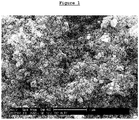
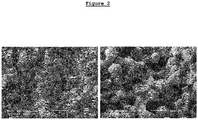
- the average grain size and the mean pore diameter of the ceramics are determined by SEM imaging (Zeiss Supra 40VP).
- the average grain size is determined by an image analysis using SEM and an image treatment software (ImageJ).
- the average grain size is the arithmetical mean of the diameter of 30 grains that are statistically selected from SEM images of three different fracture surfaces of the sample taking into account a Lince program correction factor of 1.2 on the diameters obtained from 2D SEM picture analysis.
- the mean pore diameter is determined by an image analysis using SEM and an image treatment software (ImageJ).
- the mean pore diameter is the arithmetical mean of the diameter of 30 pores that are statistically selected from SEM images of three different fracture surfaces of the sample taking into account a Lince program correction factor of 1.2 on the diameters obtained from 2D SEM picture analysis.
- the Vickers hardness of a sample is determined using a Test-well FV-700 indenter with a load of 30kg and a dwell time of 10s. At least 5 indents per sample are effected.
- the biaxial flexural strength of a ceramic is determined in accordance with ISO6872-2008 by a piston-on-three-ball test. Loading is performed at 1mm/min up to failure.
- the determination of color values is done with a CM-3700d spectrometer (Company Konica-Minolta).
- the values L*, a*, b* are measured according to the DIN5033 and DIN6174 standard.
- the sample size for color measurements is as follows: Diameter: ⁇ 15-20mm Thickness: 2mm ⁇ 0.025mm Plane parallel: ⁇ 0.05mm Surface roughness: ⁇ 18 ⁇ m
- the 12Ce-TZP powder was pre-densified by using spark plasma sintering (SPS) techniques.
- SPS spark plasma sintering
- a graphite cylindrical die with an internal diameter of 20mm was used.
- a graphite foil was rolled and slid into the die to cover its internal surface.
- a plunger covered by a circular piece of graphite foil was introduced into the die.
- 6g of the 12Ce-TZP powder were introduced into the die by means of a spatula and finally a second plunger covered by a graphite foil was placed above the powder.
- This assembly was put in the SPS apparatus (HP D25 from FCT GmbH, Germany) between the pushing electrodes.
- the vacuum chamber was closed and the parameters were set.
- the chosen atmosphere was a vacuum of 10 -2 bar, and the pulsed direct current was set to the following sequence: 10ms time on, then 5ms time off.
- the sintering was performed with a heating rate of 50°C/min.
- a pressure of 76 MPa was applied before heating and maintained during sintering.
- the attained sintering temperature was 1150°C, measured by pyrometer. Once this temperature attained, the temperature was reduced down to room temperature in 13 minutes. After sintering, the sample was removed from the die and cleaved graphite foil chips were removed.
- the spark plasma sintered sample was put in a crucible on a bed of ceramic powder (12 CeO 2 -ZrO 2 ) having the same chemical composition as the sample. Then, the crucible with the sample was placed in a furnace with air circulation, heated at 5°C/min up to 1300°C and held for 2 hours at this temperature. Finally, the heating was stopped and the furnace was cooled down to room temperature.
- Daiichi CEZ-12-2 was used in this comparative example instead of Daiichi CEZ-12-1.
- the composition of Daiichi CEZ-12-2 was similar to that of Daiichi CEZ-12-1, but the powder additionally contained 4,5 wt.-% of organic molecules that enhances its pressing behavior.
- This powder was uniaxially die-pressed into a disk with a pressure of 50 MPa. Then, a cold isostatic pressing was performed with a pressure of 280 MPa.
- the sintering was performed according to the following process: heating up to 600°C at 1°C/min, dwelling for 2 hours, heating up to 1430°C at 5°C/min, dwelling for 2 hours and finally cool down to room temperature at 8°C/min.
- a pressed pellet of the Daiichi CEZ-12-2 powder was prepared by uniaxial die-pressing with a pressure of 200 MPa. Debindering was performed according to the following procedure: heating up to 600°C at 1°C/min, dwelling for 2hours and then cooling at 5°C/min. The debindered pellet was then processed into a densified CeO 2 -stabilized ZrO 2 ceramic sample using the steps of pre-densifying by SPS and subsequent densifying as described in Example 1.
- a densified CeO 2 -stabilized ZrO 2 ceramic sample was prepared as described in Example 2, with the exception that in the SPS process step a peak temperature of 1150°C and a heating rate of 20°C/min were used.
- a series of 10 densified CeO 2 -stabilized ZrO 2 ceramic samples having a thickness of 1.2 mm and a diameter of 13 mm was prepared as described in Example 2. After sintering, biaxial testing specimen were prepared as described in ISO6872-2008.
- a densified CeO 2 -stabilized ZrO 2 ceramic sample was prepared as described in Example 1, with the exception that in the SPS process a peak temperature of 1250°C and a heating rate of 20°C/min were used.
- a series of 10 pellets of Daiichi CEZ-12-2 were prepared by CAD-CAM machining (Cerec 3 milling unit, Sirona, Austria) of presintered blocks.
- the presintered blocks were obtained by shaping via uniaxial pressing at 250MPa and presintering at 1000°C for 2 hours. After presintering and CAD-CAM machining the disks were sintered at 1400°C for 2 hours, and finally prepared as described in ISO6872-2008 for biaxial flexural testing.
- Table 2 Properties of the samples after pre-densifying Density Open porosity Closed porosity Crystal phases Example 1 79.4% 20.2% 0.4% T Example 2 84% 21.8% 0.2% T Example 3 81.6% 17.75% 0.65% T+M Example 4 80.0% 19.5% 0.5% T Comparative example 2 96.7% 0.7% 2.6% T+M+C
- Table 3 summarizes properties of samples in the fully densified state. Table 3: Properties of the samples after densifying Density Open porosity Closed porosity Crystal phases Example 1 100% 0% 0% T Example 2 100% 0% 0% T Example 3 100% 0% 0% T Example 4 > 99.5% 0% 0% T Comparative example 1 98.5% 0.3% 1.2% T Comparative example 2 95.6% 0.4% 4% T Comparative example 3* > 99.5% 0% 4.0% T * Average grain size of densified ceramic was 1.1 ⁇ m.
Landscapes
- Chemical & Material Sciences (AREA)
- Engineering & Computer Science (AREA)
- Ceramic Engineering (AREA)
- Health & Medical Sciences (AREA)
- Materials Engineering (AREA)
- Organic Chemistry (AREA)
- Structural Engineering (AREA)
- Oral & Maxillofacial Surgery (AREA)
- Life Sciences & Earth Sciences (AREA)
- Public Health (AREA)
- Veterinary Medicine (AREA)
- Animal Behavior & Ethology (AREA)
- Epidemiology (AREA)
- General Health & Medical Sciences (AREA)
- Manufacturing & Machinery (AREA)
- Dentistry (AREA)
- Composite Materials (AREA)
- Nanotechnology (AREA)
- Orthopedic Medicine & Surgery (AREA)
- Plastic & Reconstructive Surgery (AREA)
- Inorganic Chemistry (AREA)
- Physics & Mathematics (AREA)
- Condensed Matter Physics & Semiconductors (AREA)
- General Physics & Mathematics (AREA)
- Crystallography & Structural Chemistry (AREA)
- Compositions Of Oxide Ceramics (AREA)
- Dental Preparations (AREA)
- Dental Prosthetics (AREA)
Description
- The present invention is directed to a method for preparation of a porous, pre-densified CeO2-stabilized ZrO2 ceramic.
- It is well known to use glass-ceramics and/or polycrystalline sintered ceramics, like Al2O3 or ZrO2, as biomaterials for orthopedic or dental applications such as dental restorations. In particular, zirconia (ZrO2) is unique amongst oxide ceramics due to its excellent mechanical properties, and a wide scientific background on ZrO2 ceramics has been established since the 1980's.
- Pure zirconia is of very limited interest as the tetragonal to monoclinic phase transformation occurring on cooling after sintering is accompanied by shear strain and volume expansion. This change of shape in the transforming volume can result in fracture and, hence, structural unreliability of fabricated components. Thus, it was a remarkable finding in the field of ceramics that the addition of oxides, such as Y2O3, CeO2, MgO, CaO or other, in particular 4f-element oxides, to zirconia lowers the tetragonal to monoclinic transformation temperature and therefore stabilizes the tetragonal phase to a certain extent (see Hannink et al., J. Am. Ceram. Soc., 83[3] 461 (2000)). The tetragonal phase remains metastable and is able to transform under mechanical stress (stress-induced phase (2000)). The tetragonal phase remains metastable and is able to transform under mechanical stress (stress-induced phase transformation). Thus, partially or fully stabilized zirconia exhibits a transformation toughening mechanism that acts to resist crack propagation. In particular, the stress-induced phase transformation is accompanied by a volumetric expansion which, at a crack tip, includes compressive stresses. Hence, the stress-induced phase transformation enhances the strength and fracture toughness and the transformation toughening mechanism combined with zirconia's bio-inertness led to the use of stabilized tetragonal zirconia polycrystals (TZP) in orthopedics and dental restorations.
- Among tetragonal zirconia ceramics, the Y2O3-doped zirconia polycrystals (Y-TZP) takes today a preeminent position as an all-ceramic dental material. It usually contains 3 mol% yttria as a stabilizer (3Y-TZP) (see Denry et al., Dental Materials 24 (2008), 299-307). Furthermore, small amounts of alumina, such as 0.25 wt.-%, have been shown to act as sintering aid.
- Moreover, Chevalier et al. (Annu. Rev. Mater. Res. 2007 (37), 1-32) found out that the presence of small alumina quantities (0.15 to 3 wt.-%) slows down the low temperature degradation (LTD) of zirconia which is assumed to be caused by oxygen vacancies formed by adding of Y2O3 as trivalent ion oxide into the ZrO2 structure. Another promising way to reduce low temperature degradation is described to be the addition of other oxides such as CeO2 to a Y-TZP to provide a Ce-Y-TZP.
- Hannink et al. (see supra) describe that stabilization of tetragonal ZrO2 in ceria-doped zirconia polycrystals (Ce-TZP) can occur over a wide range of compositions, like 12-20 mol% CeO2, with 12 mol% Ce-TZP being preferred. The preparation of Ce-TZP is described to comprise firing for 1 h at about 1500°C and the grain size after fabrication is reported to be in the range of 2 to 3 µm.
Monolithic CeO2-stabilized tetragonal zirconia polycrystals are for example described by Tsukuma et al. (Journal of Materials Science 20 (1985) 1178-1184) and Attaoui et al. (Journal of the European Ceramic Society 27 (2007) 483-486). According to these documents, Ce-TZP is prepared by conventional pressing and sintering techniques, namely by an uniaxial compacting of the CeO2-stabilized zirconia powders followed by an isostatic pressing to obtain green compacts which are then sintered in air at 1400 to 1600°C for 2h. The average grain-size of the obtained Ce-TZP samples is reported to be 0.5 to 2.5 µm, with generally being around 1.5 µm.
US 2008/0303181 teaches a dental material shaded to match the colors of natural dentition comprising Ce-TZP and a coloring agent. Likewise, the Ce-TZP is prepared by pressing and conventional sintering techniques such as compression of a shaped body, pre-sintering of the shaped body at a temperature of about 800 to 1300°C, soft machining of the pre-sintered body and then densely-sintering at a temperature of 1200 to 1600°C.JP2007022889 -
FR2946979 -
EP2500009 discloses a zirconia dental ceramic stabilised with 1-8 mole % of ceria. The porous ceramic has a porosity of 40-60% and an average pore diameter of 50-200 nm. - While the monolithic Ce-TZP ceramics prepared by pressing and conventional sintering techniques actually show a very high fracture toughness, a major disadvantage of this material is that its hardness and strength are relatively low.
- Xu et al. (Journal of the European Ceramic Society 25 (2005) 3437-3442) deal with the microstructure of CeO2-doped ZrO2 ceramics prepared by spark plasma sintering (SPS) in comparison to the microstructure of ceramics prepared by hot-pressing. While the hot-pressed samples are reported to show no tetragonal ZrO2 phase at all, the sample sintered by SPS was found to contain monoclinic and tetragonal ZrO2 phases with a volume ratio of 2:1 and therefore resulted in an unsatisfactory low tetragonal phase content in view of the desired stress-induced phase transformation, in particular for dental applications. Another problem that limits the application of the above methods is the susceptibility of Ce-TZP to reduction. Since in the hot-pressing process as well as in the SPS process a graphite die is filled with the raw material powder, there is a strongly reducing atmosphere and reduction of Ce4+ to Ce3+ can easily be observed by the accompanying color change turning to brown which is an additional major drawback.
- Cruz et al. (J. Am. Ceram. Soc. (2012), Volume 95, Issue 3, 901-906, DOI: 10.111/j.1551-2916.2011.04978.x) describe the preparation of 10 mol% CeO2-doped ZrO2 ceramics via SPS at 1200°C with 5 min holding time or without holding time. While the relative density of the samples prepared without holding time is described to be only 97.9 %, the sample sintered for 5 min is reported to be more dense, but characterized by the presence of significant amounts of a monoclinic phase and pyrochlore I phase, besides the desired tetragonal phase.
- Thus, it is the object of the invention to avoid one or more disadvantages of the state of the art described above, and to provide a highly tetragonal CeO2-ZrO2 ceramic with an acceptable color and improved density and mechanical properties, especially improved hardness and strength, which make the material useful for dental applications.
- This object is solved by a method for preparing a porous, pre-densified CeO2-stabilized ZrO2 ceramic according to claims 1 to 8.
- The invention is directed to a method for preparing a pre-densified CeO2-ZrO2 ceramic, namely a porous CeO2-stabilized ZrO2 ceramic having a density of 50.0 to 95.0%, preferably 60.0 to 90.0%, more preferably 70.0 to 85.0%, relative to the theoretical density of zirconia, and an open porosity of 5 to 50%, preferably 10 to 30%, more preferably 14 to 25%, and most preferably 15 to 23%.
- The porous ceramic prepared according to the invention preferably has a closed porosity of less than 5%, more preferably less than 2% and most preferably less than 1%.
- It is also preferred that the open pores of the porous ceramic prepared according to the invention are characterized by a mean pore diameter of 10 to 500 nm, more preferably 25 to 300 nm and most preferably 50 to 200 nm.
- Moreover, the porous ceramic prepared according to the invention is preferably in the form of equiaxed, fine-grained polycrystalline aggregates. In particular, the grains of the porous ceramic have an average grain size of 10 to 500 nm, preferably 20 to 400 nm or 25 to 300 nm, more preferably 50 to 200 nm, like 60 to 200 nm or 80 to 180 nm.
- Furthermore, tetragonal ZrO2 is the main crystalline phase of the porous ceramic. The porous ceramic comprises tetragonal ZrO2 in an amount of 50 to 100 vol.-%, preferably 70 to 100 vol.-%, more preferably 90 to 100 vol.-% and most preferably 95 to 100 vol.-%, like 97 to 100 vol.-%, based on the total volume of crystals of the ceramic.
- It has been surprisingly found that the specific combination of density and open porosity of the pre-densified, porous ceramic prepared according to the invention results in that the porous ceramic is very suitable for the preparation of a dense CeO2-stabilized ZrO2 ceramic having improved properties, such as improved microstructure and mechanical properties, and in particular meeting the need for translucency of dental restorations.
- Preferably, the porous CeO2-stabilized ZrO2 ceramic is in the form of a pre-densified blank or body. The porous pre-densified Ce-TZP can be shaped to a dental restoration by e.g. milling or grinding, preferably by machining using CAD/CAM technology, particularly if the Vickers hardness HV5 is lower than 800 daN/mm2, preferably lower than 500 daN/mm2.
- The method according to the invention for preparing the porous CeO2-stabilized ZrO2 ceramic comprises
- (a) pre-densifying a CeO2-containing ZrO2 starting material to provide the porous ceramic.
- Typically, a powder raw material or compact green comprising ZrO2 and CeO2 is used as CeO2-containing ZrO2 starting material. The starting material comprises 6 to 12 mol% of CeO2, more preferably 10 to 12 mol% of CeO2, such as 12 mol% of CeO2. The starting material is pre-densified, i.e. its density is increased by pressure, heat, radiation or combinations thereof. In accordance with the invention, step (a) is performed in such a way that at the end of pre-densifying the ceramic is not in the form of a fully or nearly fully dense CeO2-ZrO2 ceramic. In fact, at the end of step (a) the ceramic is characterized by the above described density of 50 to 95%, preferably 60 to 90%, more preferably 70 to 85%, relative to the theoretical density of zirconia.
- The pre-densifying step (a) is performed by spark plasma sintering (SPS).
- Generally, spark plasma sintering is a rather fast sintering technique, wherein pulsed DC current passes through a graphite die containing the starting material so that heat is generated internally and high heating and cooling rates can be obtained. The CeO2-containing ZrO2 starting material is heated to a sintering temperature of 950 to 1350°C, preferably 1050 to 1250°C. Moreover, the starting material is heated at a heating rate of 1 to 400°C/min, preferably 5 to 100°C/min, more preferably 20 to 100°C/min or 50 to 100°C/min. Furthermore, it is preferred that pre-densification of step (a) is carried out without any holding time, i.e. that the temperature is decreased as soon as the maximum pre-densification temperature is arrived.
- In addition to heating, the SPS method of step (a) preferably comprises pressing the CeO2-containing ZrO2 starting material at a pressure of 0 to 500 MPa, like 20 to 300 MPa, particularly 50 to 250 MPa.
- The pulsed DC current of the SPS method can be characterized by a voltage from 1 to 20 V and/or by an amperage from 0.1 to 10 kA. Moreover, the sequence of pulses applied to the starting material may be any suitable sequence such as 1 to 30 ms with current (on) and 1 to 30 ms with no current (off), for instance 5 to 15 ms with current (on) and 1 to 10 ms with no current (off), such as 10 ms with current (on) and 5 ms with no current (off).
- Since suitable pre-densifying methods according to the invention, such as spark plasma sintering, are usually carried out in non-oxidizing atmospheres or even reducing environments, reduction of Ce4+ to Ce3+ may take place during step (a). Such a reduction can be easily observed in the pre-densified ceramic by the accompanying color change of the sample. Besides color, reduction of Ce4+ to Ce3+ may also affect low temperature degradation properties and the stability of the tetragonal phase of ZrO2 at room temperature. Thus, in one embodiment the method for preparing the porous ceramic comprises
(b) re-oxidizing the porous ceramic obtained in step (a) . - Such a re-oxidation can be conducted by heating the pre-densified ceramic obtained in step (a) in an oxidizing atmosphere, in particular air. Preferably, the ceramic obtained in step (a) is heated to a temperature of 400 to 1200°C, more preferably 600 to 1000°C, like 800°C. In particular, the re-oxidation should be conducted so that no further densification takes place during step (b). If step (a) is performed by spark plasma sintering at a relatively low temperature, such as 1100°C or 1150°C, the obtained pre-densified porous ceramic is usually of rather light color, e.g. light grey, and there is then generally no need for a re-oxidation step (b).
- Also disclosed is a densified CeO2-stabilized ZrO2 ceramic which can be prepared from the porous ceramic according to the first aspect. The densified CeO2-stabilized ZrO2 ceramic has a density of 97.0 to 100.0%, like 98.0 to 100.0%, preferably 99.0 to 100.0%, like 99.5 to 100.0%, more preferably 100.0%, relative to the theoretical density of zirconia. The densified CeO2-stabilized ZrO2 ceramic is also characterized in that it comprises grains having an average grain size of 50 to 1000 nm like 600 to 1000 nm, preferably 100 to 800 nm, more preferably 400 to 700 nm.
- Preferably, tetragonal ZrO2 is substantially the only crystalline ZrO2 phase of the densified ceramic. Accordingly, the densified ceramic preferably comprises tetragonal ZrO2 in an amount of 90 to 100 vol.-%, preferably 95 to 100 vol.-%, more preferably 97 to 100 vol.-%, like 98.0 to 100 vol.% or 99.0 to 100.0 vol.-%, such as 100 vol.-%, based on the total volume of crystals of the densified ceramic.
- In one embodiment, the microstructure of the densified ceramic can further be characterized in that the residual pores have a mean diameter of less than 150 nm, like 5 to less than 150 nm or 10 to less than 150 nm, preferably less than 100 nm, more preferably less than 80 nm, and most preferably less than 20 nm, such as 10 nm. Furthermore, it is also preferred that the open porosity and the closed porosity of the densified ceramic according to the invention are each lower than 1%.
- Without wishing to be bound to any particular theory, it is assumed that due to the combination of very low porosity content and very small grain size the densified ceramic described herein has improved mechanical and optical properties, such as translucency.
- In particular, the densified ceramic has a Vickers hardness of more than 8,000 MPa, like 8,500 to 12,000 MPa, preferably 8,500 to 11,000 MPa and more preferably 8,800 to 9,500 MPa.
- It is also preferred that the densified ceramic has a biaxial flexural strength of more than 700 MPa, such as 700 MPa to 900 MPa like 700 MPa to 800 MPa.
- Moreover, the densified ceramic is characterized in that it has a light color suitable for dental applications, although it can be prepared by reducing sintering techniques, which are usually reported to result in an undesired color change. Preferably, the densified ceramic of the invention has a color characterized by L* values of 80 to 95, a* values of -4 to 0 and b* values of 14 to 25.
- The porous ceramic prepared according to the invention as well as the densified ceramic prepared therefrom comprise 6 to 12 mol%, more preferably 8 to 12 mol%, like 9.0 to 12 mol% or 10 to 12 mol%, like 11.0 to 12 mol%, such as 12 mol% of CeO2, based on the total ceramic composition. Furthermore, it is preferred that the porous ceramic prepared according to the invention as well as the densified ceramic prepared therefrom comprise 82 to 94 mol%, more preferably 86 to 90 mol%, such as 88 mol.% of ZrO2 or a mixture of ZrO2 with small amounts of HfO2, based on the total ceramic composition. In addition to CeO2 the ceramics can comprise 0 to 0.50 wt.-%, preferably 0.10 to 0.40 wt.-%, such as 0.30 to 0.40 wt.-% of Al2O3, and/or 0 to 0.50 wt.-%, preferably 0.10 to 0.20 wt.-% of SiO2. Moreover, the ceramics can comprise small amounts of further components, additives or imputities like metal oxides independently selected from the group consisting of Fe2O3, TiO2, Na2O, CaO, La2O3 and mixtures thereof.
- The densified CeO2-stabilized ZrO2 ceramic can be prepared by a method comprising
- (a') providing a porous CeO2-stabilized ZrO2 ceramic described above or obtainable by a method described above for preparing the porous CeO2-stabilized ZrO2 ceramic,
- (c) optionally shaping the porous ceramic provided in step (a'), and
- (d) densifying the porous ceramic provided in step (a') or obtained in step (c) to obtain the densified CeO2-stabilized ZrO2 ceramic.
- In step (a') a porous CeO2-stabilized ZrO2 ceramic is provided, preferably by preparing it using the above described steps of pre-densifying (a) and optional re-oxidizing (b).
- In optional step (c), the porous CeO2-ZrO2 ceramic can be shaped, preferably by machining like direct ceramic machining. Briefly, a die or a wax pattern of the desired dental restoration is scanned, an enlarged restoration is designed by computer software (CAD) and the pre-densified, porous ceramic provided in step (a') is milled by computer aided machining (CAM).
- In step (d), the pre-densified, porous ceramic is further densified to arrive at the final density. According to a preferred embodiment, densifying in step (d) is performed in an oxygen-containing atmosphere, preferably by sintering in an atmosphere having an oxygen partial pressure of more than 5 kPa, such as more than 10 or more than 15 kPa, more preferably by sintering in air. It is particularly preferred to sinter the porous ceramic provided in step (a') or obtained in step (c) by heating it to a temperature from 1100 to 1550°C, preferably 1200 to 1500°C. Preferably, the heating rate applied in step (d) is 1 to 100 K/min, 2 to 50 K/min or 5 to 20 K/min. Moreover, it is preferred to hold the maximum sinter temperature for 0 to 5h, preferably 0 to 3h. It is particularly preferred that step (d) is performed in the absence of any periodic current pulses applied to the porous ceramic.
- Thus, also disclosed is a method for preparing a densified CeO2-stabilized ZrO2 ceramic comprising
- (a) pre-densifying a CeO2-containing ZrO2 starting material to provide a pre-densified, porous CeO2-stabilized ZrO2 ceramic body having a density of 50 to 95%, preferably 60 to 85%, relative to the theoretical density of zirconia, and an open porosity of 5 to 50%, preferably 10 to 30%, more preferably 14 to 25%, most preferably 15 to 23%.;
- (b) optionally re-oxidizing the pre-densified, porous ceramic body obtained in step (a);
- (c) optionally shaping the pre-densified, porous ceramic body obtained in step (a) or (b), preferably by machining; and
- (d) densifying the pre-densified, porous ceramic body obtained in step (a), (b) or (c) to obtain the densified CeO2-stabilized ZrO2 ceramic, preferably by sintering in an oxygen-containing atmosphere.
- It has surprisingly found that, the combination of the porosity controlling pre-densifying step (a) and the densifying step (d) provides a highly dense CeO2-ZrO2 ceramic with submicrometric grain size and improved mechanical properties. In particular, the densified ceramic is characterized by a hardness of more than 9 GPa and an acceptable color avoiding orange to dark brown colors.
- Hence, also disclosed is the use of a porous CeO2-stabilized ZrO2 ceramic described above or of a densified CeO2-stabilized ZrO2 ceramic described above for the preparation of dental restorations, preferably dental frameworks, dental abutments and dental implants, as well as for the manufacture of precision devices, such as watches, or medical devices.
- The above described properties of the pre-densified, porous ceramic prepared according to the invention and of the densified ceramic are determined as follows.
- As used herein, the term "density" refers to the bulk density of a ceramic according to ASTM C373. Thus, the density is determined by using the ASTM procedure C373, which is based on Archimedes' principle. Unless otherwise indicated, densities specified herein are relative to the theoretical density of zirconia which is 6.23 g/cm3.
- The open porosity and the closed porosity of the ceramics are each determined by using the ASTM procedure C373.
- For microstructure analysis, X-ray diffractograms are recorded (Bruker D8 Advance with Cu Kα radiation). The amount of tetragonal ZrO2 is determined by Retvield analysis as described in Cruz et al. (see supra).
- The observed crystal phases summarized in Tables 2 and 3 are identified by different letters: T for tetragonal phase, M for monoclinic phase and C for a cubic Ce-enriched phase which appears close to the Zr-Ce-O cubic solid solution as described by Xu et al. (see supra).
- The average grain size and the mean pore diameter of the ceramics are determined by SEM imaging (Zeiss Supra 40VP).
- The average grain size is determined by an image analysis using SEM and an image treatment software (ImageJ). In particular, the average grain size is the arithmetical mean of the diameter of 30 grains that are statistically selected from SEM images of three different fracture surfaces of the sample taking into account a Lince program correction factor of 1.2 on the diameters obtained from 2D SEM picture analysis.
- The mean pore diameter is determined by an image analysis using SEM and an image treatment software (ImageJ). In particular, the mean pore diameter is the arithmetical mean of the diameter of 30 pores that are statistically selected from SEM images of three different fracture surfaces of the sample taking into account a Lince program correction factor of 1.2 on the diameters obtained from 2D SEM picture analysis.
- The Vickers hardness of a sample is determined using a Test-well FV-700 indenter with a load of 30kg and a dwell time of 10s. At least 5 indents per sample are effected.
- The biaxial flexural strength of a ceramic is determined in accordance with ISO6872-2008 by a piston-on-three-ball test. Loading is performed at 1mm/min up to failure.
- The determination of color values is done with a CM-3700d spectrometer (Company Konica-Minolta). The values L*, a*, b* are measured according to the DIN5033 and DIN6174 standard.
- The special settings for color measurements are as follows:
Lighted up area / measuring aperture: 7mm x 5mm Type of measure: remission / reflection Measuring number: single measurement Measuring range: 400 - 700nm Color of the background: L* = 93.11 a* = -0.64 b* = 4.22 - The sample size for color measurements is as follows:
Diameter: Ø 15-20mm Thickness: 2mm ±0.025mm Plane parallel: ± 0.05mm Surface roughness: ∼18µm - The invention is further illustrated by the following examples.
- A non-spray dried submicrometric powder comprising about 88 mol% of zirconium oxide and about 12 mol% of cerium oxide produced by Daiichi, Japan was used as starting raw material (Daiichi CEZ-12-1). The exact composition of the raw material is given in Table 1.
Table 1: Composition of Daiichi CEZ-12-1 raw material in wt.-% ZrO2+HfO2 CeO2 Al2O3 SiO2 Fe2O3 TiO2 Na2O CaO H2O 83.4±0.4 15.6-16.4 0.30 0.15 0.01 0.15 0.03 0.05 0.50 - In the first step, the 12Ce-TZP powder was pre-densified by using spark plasma sintering (SPS) techniques. A graphite cylindrical die with an internal diameter of 20mm was used. A graphite foil was rolled and slid into the die to cover its internal surface. Then, a plunger covered by a circular piece of graphite foil was introduced into the die. Next, 6g of the 12Ce-TZP powder were introduced into the die by means of a spatula and finally a second plunger covered by a graphite foil was placed above the powder. This assembly was put in the SPS apparatus (HP D25 from FCT GmbH, Germany) between the pushing electrodes. The vacuum chamber was closed and the parameters were set. The chosen atmosphere was a vacuum of 10-2 bar, and the pulsed direct current was set to the following sequence: 10ms time on, then 5ms time off. The sintering was performed with a heating rate of 50°C/min. A pressure of 76 MPa was applied before heating and maintained during sintering. The attained sintering temperature was 1150°C, measured by pyrometer. Once this temperature attained, the temperature was reduced down to room temperature in 13 minutes. After sintering, the sample was removed from the die and cleaved graphite foil chips were removed.
- In a second step, the spark plasma sintered sample was put in a crucible on a bed of ceramic powder (12 CeO2-ZrO2) having the same chemical composition as the sample. Then, the crucible with the sample was placed in a furnace with air circulation, heated at 5°C/min up to 1300°C and held for 2 hours at this temperature. Finally, the heating was stopped and the furnace was cooled down to room temperature.
- As a modification of the powder from Example 1, commercial powder Daiichi CEZ-12-2 was used in this comparative example instead of Daiichi CEZ-12-1. The composition of Daiichi CEZ-12-2 was similar to that of Daiichi CEZ-12-1, but the powder additionally contained 4,5 wt.-% of organic molecules that enhances its pressing behavior. This powder was uniaxially die-pressed into a disk with a pressure of 50 MPa. Then, a cold isostatic pressing was performed with a pressure of 280 MPa. The sintering was performed according to the following process: heating up to 600°C at 1°C/min, dwelling for 2 hours, heating up to 1430°C at 5°C/min, dwelling for 2 hours and finally cool down to room temperature at 8°C/min.
- A pressed pellet of the Daiichi CEZ-12-2 powder was prepared by uniaxial die-pressing with a pressure of 200 MPa. Debindering was performed according to the following procedure: heating up to 600°C at 1°C/min, dwelling for 2hours and then cooling at 5°C/min. The debindered pellet was then processed into a densified CeO2-stabilized ZrO2 ceramic sample using the steps of pre-densifying by SPS and subsequent densifying as described in Example 1.
- A densified CeO2-stabilized ZrO2 ceramic sample was prepared as described in Example 2, with the exception that in the SPS process step a peak temperature of 1150°C and a heating rate of 20°C/min were used.
- A series of 10 densified CeO2-stabilized ZrO2 ceramic samples having a thickness of 1.2 mm and a diameter of 13 mm was prepared as described in Example 2. After sintering, biaxial testing specimen were prepared as described in ISO6872-2008.
- A densified CeO2-stabilized ZrO2 ceramic sample was prepared as described in Example 1, with the exception that in the SPS process a peak temperature of 1250°C and a heating rate of 20°C/min were used.
- A series of 10 pellets of Daiichi CEZ-12-2 were prepared by CAD-CAM machining (Cerec 3 milling unit, Sirona, Austria) of presintered blocks. The presintered blocks were obtained by shaping via uniaxial pressing at 250MPa and presintering at 1000°C for 2 hours. After presintering and CAD-CAM machining the disks were sintered at 1400°C for 2 hours, and finally prepared as described in ISO6872-2008 for biaxial flexural testing.
- Some properties of ceramic samples in the pre-densified state are summarized in Table 2.
Table 2: Properties of the samples after pre-densifying Density Open porosity Closed porosity Crystal phases Example 1 79.4% 20.2% 0.4% T Example 2 84% 21.8% 0.2% T Example 3 81.6% 17.75% 0.65% T+M Example 4 80.0% 19.5% 0.5% T Comparative example 2 96.7% 0.7% 2.6% T+M+C - As can be seen from Table 2, after SPS treatment the samples of Examples 1 to 4 have a density of about 75 to 85% of the theoretical density and a closed porosity of less than 1%.
- Table 3 summarizes properties of samples in the fully densified state.
Table 3: Properties of the samples after densifying Density Open porosity Closed porosity Crystal phases Example 1 100% 0% 0% T Example 2 100% 0% 0% T Example 3 100% 0% 0% T Example 4 > 99.5% 0% 0% T Comparative example 1 98.5% 0.3% 1.2% T Comparative example 2 95.6% 0.4% 4% T Comparative example 3* > 99.5% 0% 4.0% T * Average grain size of densified ceramic was 1.1 µm. - After the second heat treatment, the samples of Examples 1 to 5 were fully dense (100 % of theoretical density). Moreover, after the second heat treatment only tetragonal phases have been observed in all samples.
-
Figure 1 shows an SEM image of the pre-densified CeO2-ZrO2 ceramic obtained in Example 1. It can be seen that the microstructure of this sample is characterized by very fine, spherical Ce-TZP nanoparticles having a diameter of about 100 nm. -
Figure 2 shows an SEM image of the densified CeO2-ZrO2 ceramic obtained in Example 1 (left picture) and an SEM image of the CeO2-ZrO2 ceramic obtained in Comparative Example 1 (right picture). As can be seen, the densification was nearly complete (close to 100 % of theoretical density) and only some very small pores of less than 80 nanometers in their biggest dimension were visible in the sample prepared according to the invention (Example 1). Moreover, the grain sizes obtained in the sample of Example 1 are about half of the grain sizes obtained for the sample of Comparative Example 1. The average grain size of the densified ceramic according to Example 1 was 0.6 ± 0.1 µm. -
Figure 3 shows an SEM image of the densified CeO2-ZrO2 ceramic obtained in Comparative Example 2. In contrast to the fully densified sample of Example 1, the ceramic of Comparative Example 2 is characterized by several, clearly visible pores of about 200 nm. - The mechanical properties of the samples obtained in the examples are given in Table 4.
Table 4: Mechanical properties of the samples after densifying Vickers Hardness (GPa) Standard deviation Biaxial flexural strength (MPa) Standard deviation Example 1 9.070 47 Example 2 9.013 38 Example 3 9.096 43 Comparative Example 1 8.390 23 624 35 Example 4 >720 35
Claims (8)
- Method for preparing a porous CeO2-stabilized ZrO2 ceramic having a density of 50.0 to 95.0%, relative to the theoretical density of zirconia, and an open porosity of 5 to 50% and comprising tetragonal ZrO2 in an amount of 50 to 100 vol.-%, based on the total volume of crystals of the ceramic, wherein the method comprises(a) pre-densifying a CeO2-containing ZrO2 starting material to provide the porous ceramic,wherein the starting material comprises 6 to 12 mol% of CeO2 and the pre-densifying in step (a) is performed by spark plasma sintering which includes heating the CeO2-containing ZrO2 starting material to a sintering temperature of 950 to 1350°C, preferably 1050 to 1250°C, and heating the CeO2-containing ZrO2 starting material at a heating rate of 1 to 400°C/min, preferably 5 to 100°C/min, more preferably 50 to 100°C/min.
- Method according to claim 1, comprising
(b) re-oxidizing the porous ceramic obtained in step (a) . - Method according to claim 1 or 2, wherein the porous ceramic has a density of 60.0 to 90.0%, preferably 70.0 to 85.0%.
- Method according to any one of claims 1 to 3, wherein the porous ceramic has an open porosity of 10 to 30%, preferably 14 to 25%, more preferably 15 to 23%.
- Method according to any one of claims 1 to 4, wherein the porous ceramic has a closed porosity of less than 5%, preferably less than 2%, more preferably less than 1%.
- Method according to any one of claims 1 to 5, wherein the pores of the ceramic have a mean pore diameter of 10 to 500 nm, preferably 25 to 300 nm, more preferably 50 to 200 nm.
- Method according to any one of claims 1 to 6, wherein the grains of the ceramic have an average grain size of 10 to 500 nm, preferably 25 to 300 nm, more preferably 50 to 200 nm.
- Method according to any one of claims 1 to 7, wherein the porous ceramic comprises tetragonal ZrO2 in an amount of 70 to 100 vol.-%, preferably 90 to 100 vol.-%, based on the total volume of crystals of the ceramic.
Priority Applications (1)
| Application Number | Priority Date | Filing Date | Title |
|---|---|---|---|
| EP13729965.7A EP2877438B1 (en) | 2012-06-20 | 2013-06-20 | Method for making porous ceo2-stabilized zro2 ceramics |
Applications Claiming Priority (3)
| Application Number | Priority Date | Filing Date | Title |
|---|---|---|---|
| EP12172818 | 2012-06-20 | ||
| PCT/EP2013/062889 WO2013190043A2 (en) | 2012-06-20 | 2013-06-20 | CeO2-STABILIZED ZrO2 CERAMICS FOR DENTAL APPLICATIONS |
| EP13729965.7A EP2877438B1 (en) | 2012-06-20 | 2013-06-20 | Method for making porous ceo2-stabilized zro2 ceramics |
Publications (2)
| Publication Number | Publication Date |
|---|---|
| EP2877438A2 EP2877438A2 (en) | 2015-06-03 |
| EP2877438B1 true EP2877438B1 (en) | 2019-02-27 |
Family
ID=48656056
Family Applications (1)
| Application Number | Title | Priority Date | Filing Date |
|---|---|---|---|
| EP13729965.7A Active EP2877438B1 (en) | 2012-06-20 | 2013-06-20 | Method for making porous ceo2-stabilized zro2 ceramics |
Country Status (7)
| Country | Link |
|---|---|
| US (2) | US10315958B2 (en) |
| EP (1) | EP2877438B1 (en) |
| JP (1) | JP6063040B2 (en) |
| KR (1) | KR20150034177A (en) |
| CN (2) | CN108439979B (en) |
| PT (1) | PT2877438T (en) |
| WO (1) | WO2013190043A2 (en) |
Families Citing this family (14)
| Publication number | Priority date | Publication date | Assignee | Title |
|---|---|---|---|---|
| JP6581903B2 (en) | 2013-05-10 | 2019-09-25 | クラレノリタケデンタル株式会社 | Zirconia sintered body, zirconia composition, zirconia calcined body, and dental prosthesis |
| EP3137013A4 (en) * | 2014-04-30 | 2018-09-19 | Osseodyne Surgical Solutions, LLC | Osseointegrative surgical implant |
| WO2015168332A2 (en) * | 2014-04-30 | 2015-11-05 | Osseodyne Surgical Solutions, Llc | Osseointegrative surgical implant |
| US9822039B1 (en) * | 2016-08-18 | 2017-11-21 | Ivoclar Vivadent Ag | Metal oxide ceramic nanomaterials and methods of making and using same |
| CN108622932A (en) * | 2018-06-20 | 2018-10-09 | 苏州山人纳米科技有限公司 | A kind of preparation method of nano composite oxides zirconium |
| CN109106459B (en) * | 2018-08-28 | 2020-04-28 | 西安交通大学 | Zirconia false tooth with gradient mechanical property and manufacturing method thereof |
| EP3659548B1 (en) * | 2018-11-29 | 2025-01-01 | Ivoclar Vivadent AG | Method for producing a dental restoration |
| EP4269354A4 (en) * | 2020-12-24 | 2024-12-25 | Kuraray Noritake Dental Inc. | PRE-SINTERED ZIRCONIA BODY |
| KR102735662B1 (en) * | 2021-01-26 | 2024-12-02 | 에이온 주식회사 | Artificial tooth root, artificial bone and manufacturing method thereof |
| JP2024503903A (en) * | 2021-01-26 | 2024-01-29 | エイオン シーオー エルティディ | Artificial tooth root, artificial bone and manufacturing method thereof |
| US12239500B2 (en) | 2023-02-15 | 2025-03-04 | Ivoclar Vivadent Ag | Pre-sintered multi-layered dental mill blank, process for preparing the same, and uses thereof, and a sintering process |
| EP4737427A1 (en) * | 2024-11-01 | 2026-05-06 | Manufacture d'Horlogerie Audemars Piguet SA | Method for producing a technical ceramic component |
| WO2026093833A1 (en) | 2024-11-01 | 2026-05-07 | Manufacture D'horlogerie Audemars Piguet Sa | Method for manufacturing a part made of technical ceramic |
| CN121913767B (en) * | 2026-03-26 | 2026-07-21 | 济南大学 | Rod-shaped A2B2O7Preparation method and application of pyrochlore structure strengthened and toughened ZTA ceramic |
Citations (7)
| Publication number | Priority date | Publication date | Assignee | Title |
|---|---|---|---|---|
| WO2001070643A2 (en) * | 2000-03-23 | 2001-09-27 | Zircoa Inc. | Wear resistant ceramic |
| US20050079971A1 (en) * | 2003-08-22 | 2005-04-14 | Matsushita Electric Works, Ltd. | ZrO2-Al2O3 composite ceramic material |
| JP2007022889A (en) * | 2005-07-21 | 2007-02-01 | Matsushita Electric Works Ltd | Ceramic sintered compact for orthoprosthesis, orthoprosthesis, and method for manufacturing these |
| US20080303181A1 (en) * | 2006-05-23 | 2008-12-11 | Ivoclar Vivadent Ag | Shaded Zirconia Ceramics |
| FR2946979A1 (en) * | 2009-06-19 | 2010-12-24 | Electricite De France | MANUFACTURE OF LOW-THICK METALLIC OXIDE AUTOSUPPORT CERAMIC MATERIALS |
| EP2377506A1 (en) * | 2010-04-16 | 2011-10-19 | Ivoclar Vivadent AG | Composite ceramic material comprising zirconia |
| EP2500009A1 (en) * | 2011-03-17 | 2012-09-19 | 3M Innovative Properties Company | Dental ceramic article, process of production and use thereof |
Family Cites Families (9)
| Publication number | Priority date | Publication date | Assignee | Title |
|---|---|---|---|---|
| JPS58120571A (en) * | 1982-01-09 | 1983-07-18 | 日本特殊陶業株式会社 | High-tenacity ceramic sintered body |
| CH688894A5 (en) * | 1993-05-07 | 1998-05-15 | Metoxit Ag | Using yttrium-stabilized zirconium oxide for the production of semifinished products for prostheses through dense sintering |
| TW312079B (en) * | 1994-06-06 | 1997-08-01 | Ibm | |
| US6087285A (en) * | 1997-10-13 | 2000-07-11 | Tosoh Corporation | Zirconia sintered body, process for production thereof, and application thereof |
| JP2008511524A (en) * | 2004-09-01 | 2008-04-17 | アドバンスド ナノテクノロジー リミテッド | Zirconia ceramic |
| WO2009042110A1 (en) * | 2007-09-21 | 2009-04-02 | New York University School Of Medicine | Bioactive graded ceramic-based structures |
| US8278231B2 (en) * | 2008-11-24 | 2012-10-02 | Exxonmobil Chemical Patents Inc. | Heat stable formed ceramic, apparatus and method of using the same |
| ATE509003T1 (en) * | 2009-03-31 | 2011-05-15 | Schott Ag | PRODUCTION PROCESS FOR TRANSPARENT CERAMICS WITH A PYROCHLORINE COMPOSITION |
| US8399372B2 (en) * | 2009-05-18 | 2013-03-19 | Exxonmobil Chemical Patents Inc. | Stabilized ceramic composition, apparatus and methods of using the same |
-
2013
- 2013-06-20 EP EP13729965.7A patent/EP2877438B1/en active Active
- 2013-06-20 KR KR1020157001200A patent/KR20150034177A/en not_active Withdrawn
- 2013-06-20 WO PCT/EP2013/062889 patent/WO2013190043A2/en not_active Ceased
- 2013-06-20 JP JP2015517765A patent/JP6063040B2/en not_active Expired - Fee Related
- 2013-06-20 CN CN201810425504.6A patent/CN108439979B/en active Active
- 2013-06-20 US US14/409,801 patent/US10315958B2/en active Active
- 2013-06-20 CN CN201380031475.0A patent/CN104470871A/en active Pending
- 2013-06-20 PT PT13729965T patent/PT2877438T/en unknown
-
2019
- 2019-04-25 US US16/394,061 patent/US11040914B2/en not_active Expired - Fee Related
Patent Citations (7)
| Publication number | Priority date | Publication date | Assignee | Title |
|---|---|---|---|---|
| WO2001070643A2 (en) * | 2000-03-23 | 2001-09-27 | Zircoa Inc. | Wear resistant ceramic |
| US20050079971A1 (en) * | 2003-08-22 | 2005-04-14 | Matsushita Electric Works, Ltd. | ZrO2-Al2O3 composite ceramic material |
| JP2007022889A (en) * | 2005-07-21 | 2007-02-01 | Matsushita Electric Works Ltd | Ceramic sintered compact for orthoprosthesis, orthoprosthesis, and method for manufacturing these |
| US20080303181A1 (en) * | 2006-05-23 | 2008-12-11 | Ivoclar Vivadent Ag | Shaded Zirconia Ceramics |
| FR2946979A1 (en) * | 2009-06-19 | 2010-12-24 | Electricite De France | MANUFACTURE OF LOW-THICK METALLIC OXIDE AUTOSUPPORT CERAMIC MATERIALS |
| EP2377506A1 (en) * | 2010-04-16 | 2011-10-19 | Ivoclar Vivadent AG | Composite ceramic material comprising zirconia |
| EP2500009A1 (en) * | 2011-03-17 | 2012-09-19 | 3M Innovative Properties Company | Dental ceramic article, process of production and use thereof |
Non-Patent Citations (7)
| Title |
|---|
| BOUTZ M M R ET AL: "The effect of ceria co-doping on chemical stability and fracture toughness of Y-TZP", JOURNAL OF MATERIALS SCIENCE, KLUWER ACADEMIC PUBLISHERS, DORDRECHT, vol. 30, no. 7, 1 January 1995 (1995-01-01), pages 1854 - 1862, XP008161012, ISSN: 0022-2461, DOI: 10.1007/BF00351622 * |
| HUANG S G ET AL: "Composition design and mechanical properties of mixed (Ce,Y)-TZP ceramics obtained from coated starting powders", JOURNAL OF THE EUROPEAN CERAMIC SOCIETY, ELSEVIER SCIENCE PUBLISHERS, BARKING, ESSEX, GB, vol. 25, no. 13, 1 August 2005 (2005-08-01), pages 3109 - 3115, XP027618356, ISSN: 0955-2219, [retrieved on 20050801] * |
| JENQ-GONG DUH ET AL: "Sintering, Microstructure, Hardness, and Fracture Toughness Behavior of Y2O3-CeO2-ZrO2", JOURNAL OF THE AMERICAN CERAMIC SOCIETY, BLACKWELL PUBLISHING, MALDEN, MA, US, vol. 71, no. 10, 1 October 1988 (1988-10-01), pages 813 - 819, XP008161008, ISSN: 0002-7820, [retrieved on 20050308], DOI: 10.1111/J.1151-2916.1988.TB07528.X * |
| MUCCILLO E N S ET AL: "Synthesis of Zirconia-Based Solid Electrolyte Powders by the Coprecipitation Technique", vol. 299-300, 1 January 1999 (1999-01-01), pages 70 - 79, XP008161014, ISSN: 0255-5476, Retrieved from the Internet <URL:10.4028/www.scientific.net/MSF.299-300.70> DOI: 10.4028/WWW.SCIENTIFIC.NET/MSF.299-300.70 * |
| XIE Z ET AL: "Microwave processing and properties of ceramics with different dielectric loss", JOURNAL OF THE EUROPEAN CERAMIC SOCIETY, ELSEVIER SCIENCE PUBLISHERS, BARKING, ESSEX, GB, vol. 19, no. 3, 1 March 1999 (1999-03-01), pages 381 - 387, XP004157747, ISSN: 0955-2219, DOI: 10.1016/S0955-2219(98)00203-9 * |
| YIN S ET AL: "PREPARATION OF POROUS CERIA DOPED TETRAGONAL ZIRCONIA CERAMICS BY CAPSULE FREE HOT ISOSTATIC PRESSING", BRITISH CERAMIC TRANSACTIONS, INSTITUTE OF MATERIALS, LONDON, GB, vol. 98, no. 1, 1 January 1999 (1999-01-01), pages 19 - 23, XP000803560, ISSN: 0967-9782 * |
| ZHOU Z ET AL: "Preparation of machinable Ce-TZP/CePO4 composite ceramics by liquid precursor infiltration", JOURNAL OF THE EUROPEAN CERAMIC SOCIETY, ELSEVIER SCIENCE PUBLISHERS, BARKING, ESSEX, GB, vol. 23, no. 10, 1 September 2003 (2003-09-01), pages 1649 - 1654, XP004414721, ISSN: 0955-2219, DOI: 10.1016/S0955-2219(02)00368-0 * |
Also Published As
| Publication number | Publication date |
|---|---|
| CN108439979B (en) | 2024-06-07 |
| PT2877438T (en) | 2019-06-06 |
| CN104470871A (en) | 2015-03-25 |
| JP2015529609A (en) | 2015-10-08 |
| WO2013190043A3 (en) | 2014-03-20 |
| US20150191397A1 (en) | 2015-07-09 |
| US20190248709A1 (en) | 2019-08-15 |
| KR20150034177A (en) | 2015-04-02 |
| JP6063040B2 (en) | 2017-01-18 |
| CN108439979A (en) | 2018-08-24 |
| WO2013190043A2 (en) | 2013-12-27 |
| US11040914B2 (en) | 2021-06-22 |
| EP2877438A2 (en) | 2015-06-03 |
| US10315958B2 (en) | 2019-06-11 |
Similar Documents
| Publication | Publication Date | Title |
|---|---|---|
| US11040914B2 (en) | CeO2-stabilized ZrO2 ceramics for dental applications | |
| US9545363B2 (en) | Machinable zirconia comprising titania nanopowder | |
| CN111658552B (en) | Zirconia laminate | |
| US9783459B2 (en) | Zirconium oxide-based composite material | |
| JP6393328B2 (en) | Control of sintering kinetics of oxide ceramics. | |
| EP2975011B1 (en) | Sintered zirconia compact, and zirconia composition and calcined compact | |
| US7608552B2 (en) | Dental material or product and method of forming a dental product | |
| Apel et al. | Introduction to a tough, strong and stable Ce-TZP/MgAl2O4 composite for biomedical applications | |
| EP4082991A1 (en) | Production method for workable zirconia composite sintered body, raw material composition for workable zirconia composite sintered body, and workable zirconia composite calcined body | |
| CN104995155B (en) | Single-phase and heterogeneous material based on zirconium oxide | |
| JP7747125B2 (en) | Zirconia sintered body | |
| KR101575561B1 (en) | Manufacturing Method of Polycrystalline Aluminum Oxynitride with Improved Transparency | |
| JP7729555B2 (en) | Method for manufacturing zirconia composite ceramics and method for manufacturing dental zirconia ceramic prostheses | |
| JP2024120924A (en) | Zirconia calcined body | |
| KR20220050805A (en) | Dental zirconia mill blank for cutting and machining including indium and yttrium | |
| KR20100065719A (en) | Manufacturing method of zro2-al2o3 based ceramic block for tooth-restorative | |
| JP7820618B1 (en) | Manufacturing method for ceramic calcined body | |
| WO2025206348A1 (en) | Method for producing ceramic calcined body | |
| JP2025156254A (en) | Manufacturing method for ceramic calcined body | |
| JP2025156253A (en) | Method for producing ceramic calcined body | |
| Kim et al. | Fabrication of an All-Ceramic Implant by Slip Casting of Nanoscale Zirconia Powder | |
| Li et al. | Development of Tough and Strong Zirconia Ceramics for Dental Implants | |
| Li et al. | CAD/CAM Zirconia for Dental Application | |
| KR20250174840A (en) | Multilayer gradation zirconia dental block having high strength and high permeability and manufacturing method thereof |
Legal Events
| Date | Code | Title | Description |
|---|---|---|---|
| PUAI | Public reference made under article 153(3) epc to a published international application that has entered the european phase |
Free format text: ORIGINAL CODE: 0009012 |
|
| 17P | Request for examination filed |
Effective date: 20150112 |
|
| AK | Designated contracting states |
Kind code of ref document: A2 Designated state(s): AL AT BE BG CH CY CZ DE DK EE ES FI FR GB GR HR HU IE IS IT LI LT LU LV MC MK MT NL NO PL PT RO RS SE SI SK SM TR |
|
| AX | Request for extension of the european patent |
Extension state: BA ME |
|
| RIN1 | Information on inventor provided before grant (corrected) |
Inventor name: COURTOIS, NICOLAS Inventor name: RITZBERGER, CHRISTIAN Inventor name: REVERON, HELEN Inventor name: ROTHBRUST, FRANK Inventor name: RHEINBERGER, VOLKER Inventor name: HOELAND, WOLFRAM Inventor name: CHEVALIER, JEROME Inventor name: SCHWEIGER, MARCEL |
|
| DAX | Request for extension of the european patent (deleted) | ||
| RIN1 | Information on inventor provided before grant (corrected) |
Inventor name: HOELAND, WOLFRAM Inventor name: ROTHBRUST, FRANK Inventor name: RHEINBERGER, VOLKER Inventor name: REVERON, HELEN Inventor name: COURTOIS, NICOLAS Inventor name: CHEVALIER, JEROME Inventor name: SCHWEIGER, MARCEL Inventor name: RITZBERGER, CHRISTIAN |
|
| STAA | Information on the status of an ep patent application or granted ep patent |
Free format text: STATUS: EXAMINATION IS IN PROGRESS |
|
| 17Q | First examination report despatched |
Effective date: 20170105 |
|
| GRAP | Despatch of communication of intention to grant a patent |
Free format text: ORIGINAL CODE: EPIDOSNIGR1 |
|
| STAA | Information on the status of an ep patent application or granted ep patent |
Free format text: STATUS: GRANT OF PATENT IS INTENDED |
|
| RIC1 | Information provided on ipc code assigned before grant |
Ipc: C04B 35/486 20060101AFI20180911BHEP Ipc: C04B 111/00 20060101ALI20180911BHEP Ipc: A61C 8/00 20060101ALI20180911BHEP Ipc: C04B 38/00 20060101ALI20180911BHEP Ipc: A61C 13/083 20060101ALI20180911BHEP Ipc: C04B 35/645 20060101ALI20180911BHEP Ipc: B82Y 30/00 20110101ALI20180911BHEP Ipc: A61K 6/02 20060101ALI20180911BHEP |
|
| INTG | Intention to grant announced |
Effective date: 20181005 |
|
| GRAS | Grant fee paid |
Free format text: ORIGINAL CODE: EPIDOSNIGR3 |
|
| GRAA | (expected) grant |
Free format text: ORIGINAL CODE: 0009210 |
|
| STAA | Information on the status of an ep patent application or granted ep patent |
Free format text: STATUS: THE PATENT HAS BEEN GRANTED |
|
| AK | Designated contracting states |
Kind code of ref document: B1 Designated state(s): AL AT BE BG CH CY CZ DE DK EE ES FI FR GB GR HR HU IE IS IT LI LT LU LV MC MK MT NL NO PL PT RO RS SE SI SK SM TR |
|
| REG | Reference to a national code |
Ref country code: GB Ref legal event code: FG4D |
|
| REG | Reference to a national code |
Ref country code: CH Ref legal event code: EP |
|
| REG | Reference to a national code |
Ref country code: AT Ref legal event code: REF Ref document number: 1101064 Country of ref document: AT Kind code of ref document: T Effective date: 20190315 |
|
| REG | Reference to a national code |
Ref country code: IE Ref legal event code: FG4D |
|
| REG | Reference to a national code |
Ref country code: DE Ref legal event code: R096 Ref document number: 602013051393 Country of ref document: DE |
|
| REG | Reference to a national code |
Ref country code: CH Ref legal event code: NV Representative=s name: KELLER AND PARTNER PATENTANWAELTE AG, CH |
|
| REG | Reference to a national code |
Ref country code: NL Ref legal event code: FP |
|
| REG | Reference to a national code |
Ref country code: PT Ref legal event code: SC4A Ref document number: 2877438 Country of ref document: PT Date of ref document: 20190606 Kind code of ref document: T Free format text: AVAILABILITY OF NATIONAL TRANSLATION Effective date: 20190524 |
|
| REG | Reference to a national code |
Ref country code: SE Ref legal event code: TRGR |
|
| PGFP | Annual fee paid to national office [announced via postgrant information from national office to epo] |
Ref country code: NL Payment date: 20190515 Year of fee payment: 7 |
|
| REG | Reference to a national code |
Ref country code: LT Ref legal event code: MG4D |
|
| PG25 | Lapsed in a contracting state [announced via postgrant information from national office to epo] |
Ref country code: FI Free format text: LAPSE BECAUSE OF FAILURE TO SUBMIT A TRANSLATION OF THE DESCRIPTION OR TO PAY THE FEE WITHIN THE PRESCRIBED TIME-LIMIT Effective date: 20190227 Ref country code: LT Free format text: LAPSE BECAUSE OF FAILURE TO SUBMIT A TRANSLATION OF THE DESCRIPTION OR TO PAY THE FEE WITHIN THE PRESCRIBED TIME-LIMIT Effective date: 20190227 Ref country code: NO Free format text: LAPSE BECAUSE OF FAILURE TO SUBMIT A TRANSLATION OF THE DESCRIPTION OR TO PAY THE FEE WITHIN THE PRESCRIBED TIME-LIMIT Effective date: 20190527 |
|
| PG25 | Lapsed in a contracting state [announced via postgrant information from national office to epo] |
Ref country code: HR Free format text: LAPSE BECAUSE OF FAILURE TO SUBMIT A TRANSLATION OF THE DESCRIPTION OR TO PAY THE FEE WITHIN THE PRESCRIBED TIME-LIMIT Effective date: 20190227 Ref country code: RS Free format text: LAPSE BECAUSE OF FAILURE TO SUBMIT A TRANSLATION OF THE DESCRIPTION OR TO PAY THE FEE WITHIN THE PRESCRIBED TIME-LIMIT Effective date: 20190227 Ref country code: GR Free format text: LAPSE BECAUSE OF FAILURE TO SUBMIT A TRANSLATION OF THE DESCRIPTION OR TO PAY THE FEE WITHIN THE PRESCRIBED TIME-LIMIT Effective date: 20190528 Ref country code: LV Free format text: LAPSE BECAUSE OF FAILURE TO SUBMIT A TRANSLATION OF THE DESCRIPTION OR TO PAY THE FEE WITHIN THE PRESCRIBED TIME-LIMIT Effective date: 20190227 Ref country code: IS Free format text: LAPSE BECAUSE OF FAILURE TO SUBMIT A TRANSLATION OF THE DESCRIPTION OR TO PAY THE FEE WITHIN THE PRESCRIBED TIME-LIMIT Effective date: 20190627 Ref country code: BG Free format text: LAPSE BECAUSE OF FAILURE TO SUBMIT A TRANSLATION OF THE DESCRIPTION OR TO PAY THE FEE WITHIN THE PRESCRIBED TIME-LIMIT Effective date: 20190527 |
|
| PG25 | Lapsed in a contracting state [announced via postgrant information from national office to epo] |
Ref country code: EE Free format text: LAPSE BECAUSE OF FAILURE TO SUBMIT A TRANSLATION OF THE DESCRIPTION OR TO PAY THE FEE WITHIN THE PRESCRIBED TIME-LIMIT Effective date: 20190227 Ref country code: RO Free format text: LAPSE BECAUSE OF FAILURE TO SUBMIT A TRANSLATION OF THE DESCRIPTION OR TO PAY THE FEE WITHIN THE PRESCRIBED TIME-LIMIT Effective date: 20190227 Ref country code: CZ Free format text: LAPSE BECAUSE OF FAILURE TO SUBMIT A TRANSLATION OF THE DESCRIPTION OR TO PAY THE FEE WITHIN THE PRESCRIBED TIME-LIMIT Effective date: 20190227 Ref country code: ES Free format text: LAPSE BECAUSE OF FAILURE TO SUBMIT A TRANSLATION OF THE DESCRIPTION OR TO PAY THE FEE WITHIN THE PRESCRIBED TIME-LIMIT Effective date: 20190227 Ref country code: SK Free format text: LAPSE BECAUSE OF FAILURE TO SUBMIT A TRANSLATION OF THE DESCRIPTION OR TO PAY THE FEE WITHIN THE PRESCRIBED TIME-LIMIT Effective date: 20190227 Ref country code: AL Free format text: LAPSE BECAUSE OF FAILURE TO SUBMIT A TRANSLATION OF THE DESCRIPTION OR TO PAY THE FEE WITHIN THE PRESCRIBED TIME-LIMIT Effective date: 20190227 Ref country code: DK Free format text: LAPSE BECAUSE OF FAILURE TO SUBMIT A TRANSLATION OF THE DESCRIPTION OR TO PAY THE FEE WITHIN THE PRESCRIBED TIME-LIMIT Effective date: 20190227 |
|
| PGFP | Annual fee paid to national office [announced via postgrant information from national office to epo] |
Ref country code: AT Payment date: 20190515 Year of fee payment: 7 |
|
| REG | Reference to a national code |
Ref country code: DE Ref legal event code: R097 Ref document number: 602013051393 Country of ref document: DE |
|
| PG25 | Lapsed in a contracting state [announced via postgrant information from national office to epo] |
Ref country code: PL Free format text: LAPSE BECAUSE OF FAILURE TO SUBMIT A TRANSLATION OF THE DESCRIPTION OR TO PAY THE FEE WITHIN THE PRESCRIBED TIME-LIMIT Effective date: 20190227 Ref country code: SM Free format text: LAPSE BECAUSE OF FAILURE TO SUBMIT A TRANSLATION OF THE DESCRIPTION OR TO PAY THE FEE WITHIN THE PRESCRIBED TIME-LIMIT Effective date: 20190227 |
|
| PLBE | No opposition filed within time limit |
Free format text: ORIGINAL CODE: 0009261 |
|
| STAA | Information on the status of an ep patent application or granted ep patent |
Free format text: STATUS: NO OPPOSITION FILED WITHIN TIME LIMIT |
|
| REG | Reference to a national code |
Ref country code: SE Ref legal event code: EUG |
|
| PG25 | Lapsed in a contracting state [announced via postgrant information from national office to epo] |
Ref country code: MC Free format text: LAPSE BECAUSE OF FAILURE TO SUBMIT A TRANSLATION OF THE DESCRIPTION OR TO PAY THE FEE WITHIN THE PRESCRIBED TIME-LIMIT Effective date: 20190227 Ref country code: SE Free format text: LAPSE BECAUSE OF NON-PAYMENT OF DUE FEES Effective date: 20190621 |
|
| 26N | No opposition filed |
Effective date: 20191128 |
|
| GBPC | Gb: european patent ceased through non-payment of renewal fee |
Effective date: 20190620 |
|
| PG25 | Lapsed in a contracting state [announced via postgrant information from national office to epo] |
Ref country code: SI Free format text: LAPSE BECAUSE OF FAILURE TO SUBMIT A TRANSLATION OF THE DESCRIPTION OR TO PAY THE FEE WITHIN THE PRESCRIBED TIME-LIMIT Effective date: 20190227 |
|
| REG | Reference to a national code |
Ref country code: BE Ref legal event code: MM Effective date: 20190630 |
|
| PG25 | Lapsed in a contracting state [announced via postgrant information from national office to epo] |
Ref country code: TR Free format text: LAPSE BECAUSE OF FAILURE TO SUBMIT A TRANSLATION OF THE DESCRIPTION OR TO PAY THE FEE WITHIN THE PRESCRIBED TIME-LIMIT Effective date: 20190227 |
|
| PG25 | Lapsed in a contracting state [announced via postgrant information from national office to epo] |
Ref country code: GB Free format text: LAPSE BECAUSE OF NON-PAYMENT OF DUE FEES Effective date: 20190620 Ref country code: IT Free format text: LAPSE BECAUSE OF NON-PAYMENT OF DUE FEES Effective date: 20190620 Ref country code: IE Free format text: LAPSE BECAUSE OF NON-PAYMENT OF DUE FEES Effective date: 20190620 |
|
| PG25 | Lapsed in a contracting state [announced via postgrant information from national office to epo] |
Ref country code: BE Free format text: LAPSE BECAUSE OF NON-PAYMENT OF DUE FEES Effective date: 20190630 Ref country code: LU Free format text: LAPSE BECAUSE OF NON-PAYMENT OF DUE FEES Effective date: 20190620 |
|
| PG25 | Lapsed in a contracting state [announced via postgrant information from national office to epo] |
Ref country code: FR Free format text: LAPSE BECAUSE OF NON-PAYMENT OF DUE FEES Effective date: 20190630 |
|
| PG25 | Lapsed in a contracting state [announced via postgrant information from national office to epo] |
Ref country code: PT Free format text: LAPSE BECAUSE OF NON-PAYMENT OF DUE FEES Effective date: 20200420 |
|
| REG | Reference to a national code |
Ref country code: CH Ref legal event code: PFA Owner name: IVOCLAR VIVADENT AG, LI Free format text: FORMER OWNER: IVOCLAR VIVADENT AG, LI |
|
| REG | Reference to a national code |
Ref country code: NL Ref legal event code: MM Effective date: 20200701 |
|
| REG | Reference to a national code |
Ref country code: AT Ref legal event code: MM01 Ref document number: 1101064 Country of ref document: AT Kind code of ref document: T Effective date: 20200620 |
|
| PG25 | Lapsed in a contracting state [announced via postgrant information from national office to epo] |
Ref country code: NL Free format text: LAPSE BECAUSE OF NON-PAYMENT OF DUE FEES Effective date: 20200701 |
|
| PG25 | Lapsed in a contracting state [announced via postgrant information from national office to epo] |
Ref country code: AT Free format text: LAPSE BECAUSE OF NON-PAYMENT OF DUE FEES Effective date: 20200620 Ref country code: CY Free format text: LAPSE BECAUSE OF FAILURE TO SUBMIT A TRANSLATION OF THE DESCRIPTION OR TO PAY THE FEE WITHIN THE PRESCRIBED TIME-LIMIT Effective date: 20190227 |
|
| PG25 | Lapsed in a contracting state [announced via postgrant information from national office to epo] |
Ref country code: HU Free format text: LAPSE BECAUSE OF FAILURE TO SUBMIT A TRANSLATION OF THE DESCRIPTION OR TO PAY THE FEE WITHIN THE PRESCRIBED TIME-LIMIT; INVALID AB INITIO Effective date: 20130620 Ref country code: MT Free format text: LAPSE BECAUSE OF FAILURE TO SUBMIT A TRANSLATION OF THE DESCRIPTION OR TO PAY THE FEE WITHIN THE PRESCRIBED TIME-LIMIT Effective date: 20190227 |
|
| PG25 | Lapsed in a contracting state [announced via postgrant information from national office to epo] |
Ref country code: MK Free format text: LAPSE BECAUSE OF FAILURE TO SUBMIT A TRANSLATION OF THE DESCRIPTION OR TO PAY THE FEE WITHIN THE PRESCRIBED TIME-LIMIT Effective date: 20190227 |
|
| P01 | Opt-out of the competence of the unified patent court (upc) registered |
Effective date: 20230607 |
|
| REG | Reference to a national code |
Ref country code: AT Ref legal event code: UEP Ref document number: 1101064 Country of ref document: AT Kind code of ref document: T Effective date: 20190227 |
|
| PGFP | Annual fee paid to national office [announced via postgrant information from national office to epo] |
Ref country code: DE Payment date: 20230522 Year of fee payment: 11 |
|
| PGFP | Annual fee paid to national office [announced via postgrant information from national office to epo] |
Ref country code: CH Payment date: 20230702 Year of fee payment: 11 |
|
| REG | Reference to a national code |
Ref country code: DE Ref legal event code: R119 Ref document number: 602013051393 Country of ref document: DE |
|
| REG | Reference to a national code |
Ref country code: CH Ref legal event code: PL |
|
| PG25 | Lapsed in a contracting state [announced via postgrant information from national office to epo] |
Ref country code: DE Free format text: LAPSE BECAUSE OF NON-PAYMENT OF DUE FEES Effective date: 20250101 |
|
| PG25 | Lapsed in a contracting state [announced via postgrant information from national office to epo] |
Ref country code: CH Free format text: LAPSE BECAUSE OF NON-PAYMENT OF DUE FEES Effective date: 20240630 |