EP2876968A1 - A method and apparatus for performing discontinuous reception - Google Patents
A method and apparatus for performing discontinuous reception Download PDFInfo
- Publication number
- EP2876968A1 EP2876968A1 EP14187689.6A EP14187689A EP2876968A1 EP 2876968 A1 EP2876968 A1 EP 2876968A1 EP 14187689 A EP14187689 A EP 14187689A EP 2876968 A1 EP2876968 A1 EP 2876968A1
- Authority
- EP
- European Patent Office
- Prior art keywords
- monitoring
- macro cell
- cell
- enb
- small cell
- Prior art date
- Legal status (The legal status is an assumption and is not a legal conclusion. Google has not performed a legal analysis and makes no representation as to the accuracy of the status listed.)
- Withdrawn
Links
Images




Classifications
-
- H—ELECTRICITY
- H04—ELECTRIC COMMUNICATION TECHNIQUE
- H04J—MULTIPLEX COMMUNICATION
- H04J3/00—Time-division multiplex systems
- H04J3/16—Time-division multiplex systems in which the time allocation to individual channels within a transmission cycle is variable, e.g. to accommodate varying complexity of signals, to vary number of channels transmitted
-
- H—ELECTRICITY
- H04—ELECTRIC COMMUNICATION TECHNIQUE
- H04W—WIRELESS COMMUNICATION NETWORKS
- H04W84/00—Network topologies
- H04W84/02—Hierarchically pre-organised networks, e.g. paging networks, cellular networks, WLAN [Wireless Local Area Network] or WLL [Wireless Local Loop]
- H04W84/04—Large scale networks; Deep hierarchical networks
- H04W84/042—Public Land Mobile systems, e.g. cellular systems
- H04W84/045—Public Land Mobile systems, e.g. cellular systems using private Base Stations, e.g. femto Base Stations, home Node B
-
- H—ELECTRICITY
- H04—ELECTRIC COMMUNICATION TECHNIQUE
- H04W—WIRELESS COMMUNICATION NETWORKS
- H04W16/00—Network planning, e.g. coverage or traffic planning tools; Network deployment, e.g. resource partitioning or cells structures
- H04W16/24—Cell structures
- H04W16/32—Hierarchical cell structures
-
- H—ELECTRICITY
- H04—ELECTRIC COMMUNICATION TECHNIQUE
- H04W—WIRELESS COMMUNICATION NETWORKS
- H04W24/00—Supervisory, monitoring or testing arrangements
- H04W24/08—Testing, supervising or monitoring using real traffic
-
- H—ELECTRICITY
- H04—ELECTRIC COMMUNICATION TECHNIQUE
- H04W—WIRELESS COMMUNICATION NETWORKS
- H04W76/00—Connection management
- H04W76/20—Manipulation of established connections
- H04W76/28—Discontinuous transmission [DTX]; Discontinuous reception [DRX]
-
- H—ELECTRICITY
- H04—ELECTRIC COMMUNICATION TECHNIQUE
- H04L—TRANSMISSION OF DIGITAL INFORMATION, e.g. TELEGRAPHIC COMMUNICATION
- H04L5/00—Arrangements affording multiple use of the transmission path
- H04L5/0001—Arrangements for dividing the transmission path
- H04L5/0003—Two-dimensional division
- H04L5/0005—Time-frequency
- H04L5/0007—Time-frequency the frequencies being orthogonal, e.g. OFDM(A) or DMT
- H04L5/001—Time-frequency the frequencies being orthogonal, e.g. OFDM(A) or DMT the frequencies being arranged in component carriers
-
- Y—GENERAL TAGGING OF NEW TECHNOLOGICAL DEVELOPMENTS; GENERAL TAGGING OF CROSS-SECTIONAL TECHNOLOGIES SPANNING OVER SEVERAL SECTIONS OF THE IPC; TECHNICAL SUBJECTS COVERED BY FORMER USPC CROSS-REFERENCE ART COLLECTIONS [XRACs] AND DIGESTS
- Y02—TECHNOLOGIES OR APPLICATIONS FOR MITIGATION OR ADAPTATION AGAINST CLIMATE CHANGE
- Y02D—CLIMATE CHANGE MITIGATION TECHNOLOGIES IN INFORMATION AND COMMUNICATION TECHNOLOGIES [ICT], I.E. INFORMATION AND COMMUNICATION TECHNOLOGIES AIMING AT THE REDUCTION OF THEIR OWN ENERGY USE
- Y02D30/00—Reducing energy consumption in communication networks
- Y02D30/70—Reducing energy consumption in communication networks in wireless communication networks
Definitions
- Embodiments of the invention relate to a method and an apparatus for performing discontinuous reception.
- LTE Long-term Evolution
- 3GPP 3 rd Generation Partnership Project
- Embodiments of the present invention are directed to Evolved-Universal-Terrestrial-Radio-Access Network (E-UTRAN) small-cell enhancements.
- the small-cell enhancements can be applied to user equipment (UE) that are not capable of carrier aggregation.
- UE-mobility functionality can include the performing of cell detection, the collecting of measurements, the performing of evaluations, and the performing of different types of reporting.
- Embodiments of the present invention can provide robust mobility for single carrier UEs in Dual-Carrier deployments with optimal opportunities for offloading.
- a heterogeneous network may include one or more wireless access points, or base stations, such as, for example, a E-UTRAN Node B base station serving macro cells, and one or more small cell base stations serving small cells.
- a small cell base station (or a wireless access point or a remote radio head, for example) may be implemented to cover a small cell, or a coverage area, examples of which include a residence, a small business, a building, an office, or a small area.
- the small cell base station may be configured to have some of the functionality found in a typical base station, such as, for example, an E-UTRAN NodeB (eNB) base station, but the small cell base station may have less/smaller coverage/range and lower power capabilities given its limited coverage area or class.
- a small cell base station may have limited (or non-ideal) backhaul connection that may have higher latency or lower throughput than macro cell base stations. This limited backhaul connection may affect communication between the small cell base station and other base stations and other network elements or nodes.
- a user equipment may act as an access point or a base station for other devices (multiple devices, or part of device to device communication or group communication), so that in some cases, also, a user equipment could be considered as a limited capability base station or small cell.
- the small cell base station may be implemented as a femtocell wireless access point/base station having power sufficient for a cell serving wireless devices within a limited range of about tens of meters.
- Picocell base stations are another example of a small cell base station, but picocell base stations have somewhat greater range, serving a small area on the order of about 100-200 meters.
- the small cell base station may be implemented as a secondary base station, for example, as a secondary cell (SCell) eNB in carrier aggregation.
- SCell secondary cell
- a secondary eNB (SeNB).
- wireless service providers view small cell base stations as a way to extend service coverage into a small cell, as a way to offload traffic to the small cell base stations, and/or as a way to provide enhanced service, such as, for example, higher data rates, lower latencies, energy efficiency and the like, within the small cell, when compared to the larger macro cell served by a typical base station, such as, for example, the eNB base station.
- the macro cell base station may be also implemented as a primary base station, for example, as a primary cell (PCell) eNB in carrier aggregation and may also be called a master eNB (MeNB).
- PCell primary cell
- MeNB master eNB
- embodiments of the present invention can be applied to a macro cell (or MeNB) and/or a small cell (or SeNB), other embodiments can apply to other cell sizes or types as well. As well, it may be applied to other RATs (Radio access Technology). In addition, embodiments of the invention could be applied to at least in part to UE's D2D connection, e.g., UE's connection to NW could be master and D2D connection would be the secondary or vice-versa.
- Mobility of user equipment (UE) in heterogeneous-network (HetNet) deployments can be challenging in some cases. In particular, the management of a UE's outbound mobility from a small-cell can be challenging. While a UE is mobile in a heterogeneous network, it is desirable to ensure that the UE can provide a proper user experience and can provide proper throughput (TP).
- TP throughput
- Managing small-cell outbound mobility is a challenge when the small cells are deployed on a carrier other than a macro carrier.
- CA carrier aggregation
- DRX discontinuous reception
- TS Technical Specification
- Performance requirements are listed in 3GPP TS 36.133.
- the previous approaches are silent with regard to providing TDM DRX for non-CA capable UEs.
- Non-CA capable UEs can be UEs that do not have two receivers/transmitters.
- One approach for allowing both UEs that are capable of CA and UEs that are incapable of CA to both effectively use small cells is to apply a time-division-multiplexing-based (TDM-based) approach.
- TDM-based approach the UE (while being in the small cell) is configured to maintain a connection with the macro cell.
- the macro cell can maintain the UE connection while the UE is being served by the small cell.
- Fig. 1 illustrates a configuration that uses a TDM-based approach in accordance with embodiments of the invention.
- Fig. 1 illustrates a mechanism of using a TDM pattern 100 to allow the UE 101 to know when to listen to a macro cell 102 and when to listen to a small cell 103.
- the TDM pattern between the macro cell 102 and the small cell 103 can be configured such that the UE 101 receives from the macro cell 102 for 6 ms out of every 80 ms or so.
- the UE 101 can receive from the macro cell 102 for 6 ms, other embodiments can use other patterns.
- TDM-based approach is to use the macro cell to exchange control data, while the small cell can be used to exchange user data.
- the macro cell can be used to exchange mobility control information, such as measurement reports, handover commands, etc.
- Bearer splitting means that an EPS bearer can be routed via more than one eNB, typically MeNB and SeNB in dual connectivity. This is similar to Release 10/11 carrier aggregation, where one bearer can be scheduled via multiple cells. In carrier aggregation, the two or more cells are served by the same eNB, whereas in dual connectivity, at least some of the cells are served by another eNB. Therefore, the macro layer can offer similar mobility robustness regardless of the type of cell that the UE is using to exchange data.
- the TDM pattern shown in Fig. 1 can be seen as a gap pattern from a small cell point of view.
- the UE can have time gaps in its connection to the small cell. During these small time gaps, the UE is able to measure and monitor the macro cell while being served by the small cell. In other words, the UE will monitor and measure the macro cell during the defined gaps.
- the pattern of the time gaps can be similar to existing gap patterns defined for inter-frequency/Radio-Access-Technology measurements, for example.
- One advantage of describing the TDM pattern as gap pattern, from a small cell point of view, is that procedures and requirements defined for measurement gaps can be reused.
- a UE may need (or is allowed) 1 ms for switching between frequencies, leaving 5 ms for measurements.
- the UE may measure on an MeNB carrier and monitor the PDCCH of MeNB for less than the entire 6 ms gap, for example.
- the UE may also monitor (or be required to monitor) the MeNB PDCCH for a shorter time than it measures on MeNB carrier, e.g., 2 ms, which could be towards the end of the gap. This can allow the UE more time switching and tuning the receiver before it needs to start monitoring PDCCH. This could mean that the DRX "onDuration" in MeNB is shorter than the TDM gap and may have a different start offset than the gap.
- the DRX cycle of the UE in MeNB may also be configured longer than the TDM gap (or a measurement gap if used for this purpose) in SeNB so that UE monitors PDCCH of MeNB, e.g., every second gap instead of every gap. This can enable the UE to measure more frequently than it needs to monitor MeNB PDCCH, or allow the UE to measure also other frequencies than the MeNB frequency.
- the numbers given here are one example, different patterns and requirements may be used as well.
- activity on the macro cell includes a triggering of a macro-cell change. If the UE measures and follows the macro cell, the macro-cell event triggers a measurement report which is sent (by the UE) to the macro cell (via control signaling).
- HARQ Hybrid-Automatic-Repeat-Request
- a UE can be configured to monitor a macro cell in connection with dual connectivity. Signaling can be initiated in the macro cell.
- the DRX of the macro cell (or a serving cell served by a master evolved node B (MeNB)) takes priority over monitoring activity in a small cell or a serving cell served by secondary evolved node B (SeNB). For example, data/control transmissions of the MeNB can be assigned higher priority over the transmissions of the SeNB.
- MeNB master evolved node B
- SeNB secondary evolved node B
- the monitoring and the scheduling on the macro cell has a higher priority than the monitoring of activity occurring with the small cell.
- One way to implement such functionality is to define the DRX activity of the macro cell as taking priority over the DRX activity of the small cell.
- Embodiments of the present invention can be implemented in a variety of ways. Two different examples of implementing the embodiments are described below. However, other embodiments are not to be limited by the examples described below.
- the DRX pattern of a macro cell i.e., the DRX pattern between the UE and the MeNB
- the DRX pattern of a macro cell can be configured according to a gap pattern of the aforementioned TDM pattern.
- the DRX onDuration can be configured to be 5ms, and the DRX cycle 80 ms, and the drxStartOffset such that the MeNB onDuration coincides with the TDM gap of SeNB.
- the UE can receive the DCI of the macro cell during the gap portions of the gap pattern. At this time, the UE monitors/measures macro-cell operation.
- the UE starts a DRX inactivity timer. As long as the DRX inactivity timer is running, the UE continues to monitor/measure the macro cell. For example, the UE can monitor the macro cell's DCI (downlink control information) for scheduling occasions and for performing measurements.
- the inactivity timer expires (potentially including related pending Hybrid-Automatic-Repeat-Request (HARQ) retransmissions as specified in TS 36.321)
- the UE returns to normal behavior, which can include returning to monitor/measure the SeNB (small-cell).
- HARQ Hybrid-Automatic-Repeat-Request
- the UE's DRX onDuration in MeNB may be configured to coincide with the TDM gap of SeNB, but have a shorter duration, e.g., 2 ms out of 5 ms, and/or the MeNB DRX cycle may be longer than a TDM gap periodicity.
- the SeNB does not configure the UE with a TDM gap pattern, but, instead, there is an implicit TDM pattern as the MeNB DRX (or master DRX) has priority over SeNB.
- a UE can be configured with a master DRX, and can also be optionally configured with a secondary DRX.
- the UE can apply the master DRX configuration for the MeNB, and the UE can apply the secondary DRX configuration for the SeNB. If the UE is in Active Time in the MeNB (according to the master DRX, for example), the UE can monitor the Physical-Downlink-Control-Channel (PDCCH) transmitted from the MeNB. Otherwise, the UE can monitor the PDCCH transmitted from the SeNB, according to the secondary DRX (if the UE is configured to do so). Some additional time may be allowed for the UE to switch from monitoring/measuring the MeNB to monitoring/measuring the SeNB and vice versa.
- PDCH Physical-Downlink-Control-Channel
- the SeNB can have another DRX pattern, but that DRX pattern may be overridden by the MeNB DRX. If the UE is not in Active Time in either the MeNB or SeNB, the UE has a DRX opportunity (and may omit receiving any PDCCH and, for example, can turn the receiver's power off). As an example, the UE can be primarily served by the SeNB, and the UE can receive communication from the MeNB, for example, 6 subframes out of every 80 subframes. Besides measurements, the UE can receive the PDCCH. The UE can monitor DCI information.
- the UE In the event that the UE is scheduled by the MeNB during the Active Time of the Master DRX pattern of MeNB (as dependent upon an DRX inactivity timer, DRX retransmission timer, etc.), the UE generally would continue listening to the MeNB longer than the 6 subframe gap, until the MeNB stops transmitting. This allows a network to start scheduling a UE basically anytime (taking the DRX pattern into account) from the MeNB so that it can receive, for example, potentially important control signaling (such as a handover (HO) command, for example).
- HO handover
- Another way to implement an embodiment of the present invention is to define new specific timers related to how long of a time the UE should monitor/measure the macro cell or MeNB when scheduling on the macro cell or MeNB occurs.
- the timer can be of a configurable length. Every time the scheduling occurs, the timer can be restarted. In one embodiment, the timer runs from the end of a last scheduling occurence and for a given period of time.
- the UE After no longer being required to perform macro-cell monitoring, according to this priority rule, the UE returns to a former behavior, which could correspond to the monitoring/measuring of a small cell or the UE could be staying in a macro cell.
- the UE may be configured to signal the SeNB when the UE returns to the SeNB from the macro cell, every time or when it exceeded the duration of the gap pattern or when the DRX in MeNB was extended, e.g., because DRX inactivity timer was started.
- the UE may also be aware that the UE is going to send a measurement report (or scheduling request or other transmission) to the macro cell while still monitoring the small cell.
- the UE may indicate the small cell of this beforehand so that small cell could suspend scheduling of the UE until it returns to small cell.
- Embodiments of the present invention can increase control signaling robustness. Embodiments of the present invention can also ensure robust mobility. Embodiments of the present invention can also reduce signaling delay. With embodiments of the present invention, there may be no need to change macro-cell behavior related to signaling and scheduling.
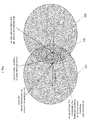
- a UE can move through macro cell 200, small cell 201, and macro cell 202.
- the UE can be configured with small cell SeNB 201.
- the UE can be configured with TDM dual connectivity (DC).
- DC TDM dual connectivity
- a macro cell measurement event report can be triggered (for instance, another macro cell becomes better than current macro cell). For example, a macro-cell handover can occur.
- the UE can be handed over to macro cell 202. The UE can then resume a normal operation.
- Fig. 3 illustrates the use of TDM patterns in accordance with embodiments of the invention.
- Fig. 3 illustrates the TDM patterns which are used by embodiments of the present invention as a UE moves between macro cells and a small cell (as previously described in reference to Fig. 2 ).
- a UE can enter a small cell.
- the UE is configured with the small cell (SeNB) and be configured with TDM dual connectivity.
- a macro cell event report can be triggered.
- the UE eventually arrives in a second macro cell, as described above.
- the UE can be handed over to the second macro cell and may be called to resume a normal operation, i.e., the SeNB configuration is removed.
- the portions of time corresponding to the darker color are the times when the UE is measuring/monitoring the given eNB.
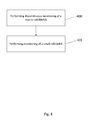
- Fig. 4 illustrates a flowchart of a method in accordance with embodiments of the invention.
- the method illustrated in Fig. 4 includes, at 400, performing discontinuous monitoring of a macro cell/MeNB.
- the method, at 401, also includes performing monitoring of a small cell/SeNB.
- the monitoring of the macro cell/MeNB and the monitoring of the small cell/SeNB are performed using a time-division-multiplexing pattern.
- the monitoring of the macro cell/MeNB has higher priority over the monitoring of the small cell/SeNB.
- both DRX operations can be assumed to follow the existing DRX operation as specified in TS 36.321.
- the UE when the UE is configured with TDM dual connectivity, the UE follows DRX active time in SeNB and monitors SeNB according to a secondary DRX pattern, except for TDM gaps during which the UE monitors MeNB.
- the master DRX pattern is aligned with the TDM gaps such that master DRX onDuration coincides with the TDM gaps.
- MeNB schedules something to the UE during the Master DRX onDuration (or equivalently during the TDM gap)
- a Master DRX inactivity timer is started and the UE stays monitoring the MeNB and receiving from MeNB.
- UE follows primarily the master DRX Active Time, i.e., every time the UE is in DRX Active Time in MeNB, the UE monitors MeNB and only if the UE is not in Active Time, according to master DRX, the UE may monitor SeNB (according to secondary DRX configured for SeNB).
- SeNB Serving DRX Active Time
- the UE mostly monitors SeNB since the master DRX Active Time (Long DRX onDuration) coincides with the TDM gaps.
- Fig. 5 illustrates a flowchart of a method in accordance with embodiments of the invention.
- the method illustrated in Fig. 5 includes, at 500, performing, by a network node, activity with a user equipment.
- the activity with the user equipment is performed using a time-division-multiplexing pattern.
- the method also includes, at 501, initiating a timer.
- the user equipment monitors a macro cell/MeNB while the timer is running.
- Fig. 6 illustrates an apparatus in accordance with embodiments of the invention.
- the apparatus can be a user device.
- the apparatus can be a network node, such as a base station or an evolved Node B, for example.
- Apparatus 10 can include a processor 22 for processing information and executing instructions or operations.
- Processor 22 can be any type of general or specific purpose processor. While a single processor 22 is shown in Fig. 5 , multiple processors can be utilized according to other embodiments.
- Processor 22 can also include one or more of general-purpose computers, special purpose computers, microprocessors, digital signal processors (DSPs), field-programmable gate arrays (FPGAs), application-specific integrated circuits (ASICs), and processors based on a multi-core processor architecture, as examples.
- DSPs digital signal processors
- FPGAs field-programmable gate arrays
- ASICs application-specific integrated circuits
- Apparatus 10 can further include a memory 14, coupled to processor 22, for storing information and instructions that can be executed by processor 22.
- Memory 14 can be one or more memories and of any type suitable to the local application environment, and can be implemented using any suitable volatile or nonvolatile data storage technology such as a semiconductor-based memory device, a magnetic memory device and system, an optical memory device and system, fixed memory, and removable memory.
- memory 14 include any combination of random access memory (RAM), read only memory (ROM), static storage such as a magnetic or optical disk, or any other type of non-transitory machine or computer readable media.
- the instructions stored in memory 14 can include program instructions or computer program code that, when executed by processor 22, enable the apparatus 10 to perform tasks as described herein.
- Apparatus 10 can also include one or more antennas (not shown) for transmitting and receiving signals and/or data to and from apparatus 10.
- Apparatus 10 can further include a transceiver 28 that modulates information on to a carrier waveform for transmission by the antenna(s) and demodulates information received via the antenna(s) for further processing by other elements of apparatus 10.
- transceiver 28 can be capable of transmitting and receiving signals or data directly.
- Processor 22 can perform functions associated with the operation of apparatus 10 including, without limitation, precoding of antenna gain/phase parameters, encoding and decoding of individual bits forming a communication message, formatting of information, and overall control of the apparatus 10, including processes related to management of communication resources.
- memory 14 can store software modules that provide functionality when executed by processor 22.
- the modules can include an operating system 15 that provides operating system functionality for apparatus 10.
- the memory can also store one or more functional modules 18, such as an application or program, to provide additional functionality for apparatus 10.
- the components of apparatus 10 can be implemented in hardware, or as any suitable combination of hardware and software.
- Apparatus 700 can be a user equipment, for example.
- Apparatus 700 can include a first performing unit 701 that performs discontinuous monitoring of a macro cell/MeNB.
- Apparatus 700 can also include a second performing unit 702 that performs monitoring of a small cell/SeNB.
- the monitoring of the macro cell/MeNB and the monitoring of the small cell/SeNB are performed using a time-division-multiplexing pattern.
- the monitoring of the macro cell/MeNB has higher priority over the monitoring of the small cell/SeNB.
- Apparatus 800 can be a network node, for example.
- Apparatus 800 can include a performing unit 801 that performs activity with a user equipment. The activity with the user equipment is performed using a time-division-multiplexing pattern.
- Apparatus 800 can also include an initiating unit 802 that initiates a timer. The user equipment monitors a macro cell/MeNB while the timer is running.
Landscapes
- Engineering & Computer Science (AREA)
- Computer Networks & Wireless Communication (AREA)
- Signal Processing (AREA)
- Mobile Radio Communication Systems (AREA)
Abstract
A method and apparatus can be configured to perform discontinuous monitoring of a macro cell/MeNB. The method can also include performing monitoring of a small cell/SeNB. The monitoring of the macro cell/MeNB and the monitoring of the small cell/SeNB are performed using a time-division-multiplexing pattern. The monitoring of the macro cell/MeNB has higher priority over the monitoring of the small cell/SeNB.
Description
- Embodiments of the invention relate to a method and an apparatus for performing discontinuous reception.
- Long-term Evolution (LTE) is a standard for wireless communication that seeks to provide improved speed and capacity for wireless communications by using new modulation/signal processing techniques. The standard was proposed by the 3rd Generation Partnership Project (3GPP), and is based upon previous network technologies. Since its inception, LTE has seen extensive deployment in a wide variety of contexts involving the communication of data.
-
- For proper understanding of the invention, reference should be made to the accompanying drawings, wherein:
-
Fig. 1 illustrates a configuration that uses a Time-Division-Multiplexing-based (TDM-based) approach in accordance with embodiments of the invention. -
Fig. 2 illustrates an example of mobility in accordance with embodiments of the invention. -
Fig. 3 illustrates the use of TDM patterns in accordance with embodiments of the invention. -
Fig. 4 illustrates a flowchart of a method in accordance with embodiments of the invention. -
Fig. 5 illustrates a flowchart of a method in accordance with embodiments of the invention. -
Fig. 6 illustrates an apparatus in accordance with embodiments of the invention. -
Fig. 7 illustrates an apparatus in accordance with embodiments of the invention. -
Fig. 8 illustrates an apparatus in accordance with embodiments of the invention.
-
- Embodiments of the present invention are directed to Evolved-Universal-Terrestrial-Radio-Access Network (E-UTRAN) small-cell enhancements. The small-cell enhancements can be applied to user equipment (UE) that are not capable of carrier aggregation. UE-mobility functionality can include the performing of cell detection, the collecting of measurements, the performing of evaluations, and the performing of different types of reporting. Embodiments of the present invention can provide robust mobility for single carrier UEs in Dual-Carrier deployments with optimal opportunities for offloading.
- A heterogeneous network may include one or more wireless access points, or base stations, such as, for example, a E-UTRAN Node B base station serving macro cells, and one or more small cell base stations serving small cells. For example, a small cell base station (or a wireless access point or a remote radio head, for example) may be implemented to cover a small cell, or a coverage area, examples of which include a residence, a small business, a building, an office, or a small area. The small cell base station (for example, a home base station (HNB), a home E-UTRAN NodeB base station (HeNB), a WiFi access point, and the like) may be configured to have some of the functionality found in a typical base station, such as, for example, an E-UTRAN NodeB (eNB) base station, but the small cell base station may have less/smaller coverage/range and lower power capabilities given its limited coverage area or class. Furthermore, a small cell base station may have limited (or non-ideal) backhaul connection that may have higher latency or lower throughput than macro cell base stations. This limited backhaul connection may affect communication between the small cell base station and other base stations and other network elements or nodes. A user equipment may act as an access point or a base station for other devices (multiple devices, or part of device to device communication or group communication), so that in some cases, also, a user equipment could be considered as a limited capability base station or small cell. For example, the small cell base station may be implemented as a femtocell wireless access point/base station having power sufficient for a cell serving wireless devices within a limited range of about tens of meters. Picocell base stations are another example of a small cell base station, but picocell base stations have somewhat greater range, serving a small area on the order of about 100-200 meters. The small cell base station may be implemented as a secondary base station, for example, as a secondary cell (SCell) eNB in carrier aggregation. It may also be called a secondary eNB (SeNB). Accordingly, wireless service providers view small cell base stations as a way to extend service coverage into a small cell, as a way to offload traffic to the small cell base stations, and/or as a way to provide enhanced service, such as, for example, higher data rates, lower latencies, energy efficiency and the like, within the small cell, when compared to the larger macro cell served by a typical base station, such as, for example, the eNB base station. The macro cell base station may be also implemented as a primary base station, for example, as a primary cell (PCell) eNB in carrier aggregation and may also be called a master eNB (MeNB).
- Even though embodiments of the present invention can be applied to a macro cell (or MeNB) and/or a small cell (or SeNB), other embodiments can apply to other cell sizes or types as well. As well, it may be applied to other RATs (Radio access Technology). In addition, embodiments of the invention could be applied to at least in part to UE's D2D connection, e.g., UE's connection to NW could be master and D2D connection would be the secondary or vice-versa. Mobility of user equipment (UE) in heterogeneous-network (HetNet) deployments can be challenging in some cases. In particular, the management of a UE's outbound mobility from a small-cell can be challenging. While a UE is mobile in a heterogeneous network, it is desirable to ensure that the UE can provide a proper user experience and can provide proper throughput (TP).
- In the future, the quantity of overall wireless-data transmissions is expected to substantially increase. One way to service this increased quantity of wireless transmissions is to increase the deployment of small cells.
- However, as described above, when a UE is moving outbound from a small cell, managing the outbound mobility of the UE can be challenging. Managing small-cell outbound mobility is a challenge when the small cells are deployed on a carrier other than a macro carrier.
- One previous approach of effectively using small cells is to use the carrier aggregation (CA) feature as already defined in
3GPP Release 10. Although this approach is a feasible approach, this approach is not applicable in circumstances where UEs are not CA-capable UEs. - Further, with the previous approaches, discontinuous reception (DRX) rules are defined in 3GPP Technical Specification (TS) 36.321. DRX configuration is specified in 3GPP TS 36.331. Performance requirements are listed in 3GPP TS 36.133. The previous approaches are silent with regard to providing TDM DRX for non-CA capable UEs.
- In view of the above, there exists a need to allow both UEs that are capable of CA and UEs that are incapable of CA to effectively use small cells. Non-CA capable UEs can be UEs that do not have two receivers/transmitters. One approach for allowing both UEs that are capable of CA and UEs that are incapable of CA to both effectively use small cells is to apply a time-division-multiplexing-based (TDM-based) approach. In this TDM-based approach, the UE (while being in the small cell) is configured to maintain a connection with the macro cell. Specifically, the macro cell can maintain the UE connection while the UE is being served by the small cell.
-
Fig. 1 illustrates a configuration that uses a TDM-based approach in accordance with embodiments of the invention.Fig. 1 illustrates a mechanism of using aTDM pattern 100 to allow theUE 101 to know when to listen to amacro cell 102 and when to listen to asmall cell 103. For example, the TDM pattern between themacro cell 102 and thesmall cell 103 can be configured such that the UE 101 receives from themacro cell 102 for 6 ms out of every 80 ms or so. Although the UE 101 can receive from themacro cell 102 for 6 ms, other embodiments can use other patterns. - One example of a TDM-based approach is to use the macro cell to exchange control data, while the small cell can be used to exchange user data. For example, the macro cell can be used to exchange mobility control information, such as measurement reports, handover commands, etc.
- If bearer splitting is supported, a network can be more flexible regarding in which cell the network schedules the UE, but the macro-cell connection can still act as a "backup" if the small-cell connection fails for some reason. Bearer splitting means that an EPS bearer can be routed via more than one eNB, typically MeNB and SeNB in dual connectivity. This is similar to
Release 10/11 carrier aggregation, where one bearer can be scheduled via multiple cells. In carrier aggregation, the two or more cells are served by the same eNB, whereas in dual connectivity, at least some of the cells are served by another eNB. Therefore, the macro layer can offer similar mobility robustness regardless of the type of cell that the UE is using to exchange data. - The TDM pattern shown in
Fig. 1 can be seen as a gap pattern from a small cell point of view. The UE can have time gaps in its connection to the small cell. During these small time gaps, the UE is able to measure and monitor the macro cell while being served by the small cell. In other words, the UE will monitor and measure the macro cell during the defined gaps. The pattern of the time gaps can be similar to existing gap patterns defined for inter-frequency/Radio-Access-Technology measurements, for example. One advantage of describing the TDM pattern as gap pattern, from a small cell point of view, is that procedures and requirements defined for measurement gaps can be reused. As an example, of 6 ms gap, a UE may need (or is allowed) 1 ms for switching between frequencies, leaving 5 ms for measurements. Thus, the UE may measure on an MeNB carrier and monitor the PDCCH of MeNB for less than the entire 6 ms gap, for example. The UE may also monitor (or be required to monitor) the MeNB PDCCH for a shorter time than it measures on MeNB carrier, e.g., 2 ms, which could be towards the end of the gap. This can allow the UE more time switching and tuning the receiver before it needs to start monitoring PDCCH. This could mean that the DRX "onDuration" in MeNB is shorter than the TDM gap and may have a different start offset than the gap. The DRX cycle of the UE in MeNB may also be configured longer than the TDM gap (or a measurement gap if used for this purpose) in SeNB so that UE monitors PDCCH of MeNB, e.g., every second gap instead of every gap. This can enable the UE to measure more frequently than it needs to monitor MeNB PDCCH, or allow the UE to measure also other frequencies than the MeNB frequency. The numbers given here are one example, different patterns and requirements may be used as well. - A difficulty arises when the UE is served on the small cell, while activity starts on the macro cell. One example of activity on the macro cell includes a triggering of a macro-cell change. If the UE measures and follows the macro cell, the macro-cell event triggers a measurement report which is sent (by the UE) to the macro cell (via control signaling).
- At the time activity occurs on the macro cell, if the UE is constrained to use the given gap pattern to perform data exchange with the macro cell, at least some signaling will be adversely affected and at least Hybrid-Automatic-Repeat-Request (HARQ) (as currently defined) will not operate properly. Further, by restricting the scheduling points in the MeNB to the defined gaps (by restricting the scheduling points to occur every 80 ms), the robustness of the mobility on the macro will be impacted. This will generally delay the mobility signaling. Such a delay will potentially lead to reduced mobility robustness in the form of increased Handover failures (HOFs) and radio link failures (RLFs).
- In embodiments of the present invention, a UE can be configured to monitor a macro cell in connection with dual connectivity. Signaling can be initiated in the macro cell. The DRX of the macro cell (or a serving cell served by a master evolved node B (MeNB)) takes priority over monitoring activity in a small cell or a serving cell served by secondary evolved node B (SeNB). For example, data/control transmissions of the MeNB can be assigned higher priority over the transmissions of the SeNB.
- As such, the monitoring and the scheduling on the macro cell has a higher priority than the monitoring of activity occurring with the small cell. One way to implement such functionality is to define the DRX activity of the macro cell as taking priority over the DRX activity of the small cell.
- Embodiments of the present invention can be implemented in a variety of ways. Two different examples of implementing the embodiments are described below. However, other embodiments are not to be limited by the examples described below.
- In one embodiment, existing DRX rules and timers, as specified in TS 36.321, can be used. The DRX pattern of a macro cell (i.e., the DRX pattern between the UE and the MeNB) can be configured according to a gap pattern of the aforementioned TDM pattern. For example, the DRX onDuration can be configured to be 5ms, and the DRX cycle 80 ms, and the drxStartOffset such that the MeNB onDuration coincides with the TDM gap of SeNB. Specifically, the UE can receive the DCI of the macro cell during the gap portions of the gap pattern. At this time, the UE monitors/measures macro-cell operation. Once the UE is scheduled in the macro cell (during the on-duration, but not necessarily limited to the on-duration), the UE starts a DRX inactivity timer. As long as the DRX inactivity timer is running, the UE continues to monitor/measure the macro cell. For example, the UE can monitor the macro cell's DCI (downlink control information) for scheduling occasions and for performing measurements. When the inactivity timer expires (potentially including related pending Hybrid-Automatic-Repeat-Request (HARQ) retransmissions as specified in TS 36.321), the UE returns to normal behavior, which can include returning to monitor/measure the SeNB (small-cell). In some example embodiments, the UE's DRX onDuration in MeNB may be configured to coincide with the TDM gap of SeNB, but have a shorter duration, e.g., 2 ms out of 5 ms, and/or the MeNB DRX cycle may be longer than a TDM gap periodicity. In some example embodiments, the SeNB does not configure the UE with a TDM gap pattern, but, instead, there is an implicit TDM pattern as the MeNB DRX (or master DRX) has priority over SeNB.
- A UE can be configured with a master DRX, and can also be optionally configured with a secondary DRX. The UE can apply the master DRX configuration for the MeNB, and the UE can apply the secondary DRX configuration for the SeNB. If the UE is in Active Time in the MeNB (according to the master DRX, for example), the UE can monitor the Physical-Downlink-Control-Channel (PDCCH) transmitted from the MeNB. Otherwise, the UE can monitor the PDCCH transmitted from the SeNB, according to the secondary DRX (if the UE is configured to do so). Some additional time may be allowed for the UE to switch from monitoring/measuring the MeNB to monitoring/measuring the SeNB and vice versa. Essentially, the SeNB can have another DRX pattern, but that DRX pattern may be overridden by the MeNB DRX. If the UE is not in Active Time in either the MeNB or SeNB, the UE has a DRX opportunity (and may omit receiving any PDCCH and, for example, can turn the receiver's power off). As an example, the UE can be primarily served by the SeNB, and the UE can receive communication from the MeNB, for example, 6 subframes out of every 80 subframes. Besides measurements, the UE can receive the PDCCH. The UE can monitor DCI information.
- In the event that the UE is scheduled by the MeNB during the Active Time of the Master DRX pattern of MeNB (as dependent upon an DRX inactivity timer, DRX retransmission timer, etc.), the UE generally would continue listening to the MeNB longer than the 6 subframe gap, until the MeNB stops transmitting. This allows a network to start scheduling a UE basically anytime (taking the DRX pattern into account) from the MeNB so that it can receive, for example, potentially important control signaling (such as a handover (HO) command, for example).
- Another way to implement an embodiment of the present invention is to define new specific timers related to how long of a time the UE should monitor/measure the macro cell or MeNB when scheduling on the macro cell or MeNB occurs. The timer can be of a configurable length. Every time the scheduling occurs, the timer can be restarted. In one embodiment, the timer runs from the end of a last scheduling occurence and for a given period of time.
- After no longer being required to perform macro-cell monitoring, according to this priority rule, the UE returns to a former behavior, which could correspond to the monitoring/measuring of a small cell or the UE could be staying in a macro cell.
- The UE may be configured to signal the SeNB when the UE returns to the SeNB from the macro cell, every time or when it exceeded the duration of the gap pattern or when the DRX in MeNB was extended, e.g., because DRX inactivity timer was started. The UE may also be aware that the UE is going to send a measurement report (or scheduling request or other transmission) to the macro cell while still monitoring the small cell. In an embodiment, the UE may indicate the small cell of this beforehand so that small cell could suspend scheduling of the UE until it returns to small cell.
- Embodiments of the present invention can increase control signaling robustness. Embodiments of the present invention can also ensure robust mobility. Embodiments of the present invention can also reduce signaling delay. With embodiments of the present invention, there may be no need to change macro-cell behavior related to signaling and scheduling.
-
Fig. 2 illustrates an example of mobility in accordance with embodiments of the invention. Referring toFig. 2 , a UE can move throughmacro cell 200,small cell 201, andmacro cell 202. As the UE moves intosmall cell 201, the UE can be configured withsmall cell SeNB 201. The UE can be configured with TDM dual connectivity (DC). While the UE is insmall cell 201 connected to both SeNB and MeNB, receiving data from SeNB and monitoring MeNB, a macro cell measurement event report can be triggered (for instance, another macro cell becomes better than current macro cell). For example, a macro-cell handover can occur. Once the UE exitssmall cell 201 intomacro cell 202, the UE can be handed over tomacro cell 202. The UE can then resume a normal operation. -
Fig. 3 illustrates the use of TDM patterns in accordance with embodiments of the invention.Fig. 3 illustrates the TDM patterns which are used by embodiments of the present invention as a UE moves between macro cells and a small cell (as previously described in reference toFig. 2 ). Referring toFig. 3 , a UE can enter a small cell. At such time, the UE is configured with the small cell (SeNB) and be configured with TDM dual connectivity. As described above, while the UE is within the small cell, a macro cell event report can be triggered. The UE eventually arrives in a second macro cell, as described above. The UE can be handed over to the second macro cell and may be called to resume a normal operation, i.e., the SeNB configuration is removed. Referring toFig. 3 , the portions of time corresponding to the darker color are the times when the UE is measuring/monitoring the given eNB. -
Fig. 4 illustrates a flowchart of a method in accordance with embodiments of the invention. The method illustrated inFig. 4 includes, at 400, performing discontinuous monitoring of a macro cell/MeNB. The method, at 401, also includes performing monitoring of a small cell/SeNB. The monitoring of the macro cell/MeNB and the monitoring of the small cell/SeNB are performed using a time-division-multiplexing pattern. The monitoring of the macro cell/MeNB has higher priority over the monitoring of the small cell/SeNB. As an example, both DRX operations can be assumed to follow the existing DRX operation as specified in TS 36.321. With embodiments of the present invention, when the UE is configured with TDM dual connectivity, the UE follows DRX active time in SeNB and monitors SeNB according to a secondary DRX pattern, except for TDM gaps during which the UE monitors MeNB. The master DRX pattern is aligned with the TDM gaps such that master DRX onDuration coincides with the TDM gaps. When MeNB schedules something to the UE during the Master DRX onDuration (or equivalently during the TDM gap), a Master DRX inactivity timer is started and the UE stays monitoring the MeNB and receiving from MeNB. Thus, by indicating that master DRX has higher priority, it is meant that UE follows primarily the master DRX Active Time, i.e., every time the UE is in DRX Active Time in MeNB, the UE monitors MeNB and only if the UE is not in Active Time, according to master DRX, the UE may monitor SeNB (according to secondary DRX configured for SeNB). During TDM dual connectivity, the UE mostly monitors SeNB since the master DRX Active Time (Long DRX onDuration) coincides with the TDM gaps. -
Fig. 5 illustrates a flowchart of a method in accordance with embodiments of the invention. The method illustrated inFig. 5 includes, at 500, performing, by a network node, activity with a user equipment. The activity with the user equipment is performed using a time-division-multiplexing pattern. The method also includes, at 501, initiating a timer. The user equipment monitors a macro cell/MeNB while the timer is running. -
Fig. 6 illustrates an apparatus in accordance with embodiments of the invention. In one embodiment, the apparatus can be a user device. In another embodiment, the apparatus can be a network node, such as a base station or an evolved Node B, for example.Apparatus 10 can include aprocessor 22 for processing information and executing instructions or operations.Processor 22 can be any type of general or specific purpose processor. While asingle processor 22 is shown inFig. 5 , multiple processors can be utilized according to other embodiments.Processor 22 can also include one or more of general-purpose computers, special purpose computers, microprocessors, digital signal processors (DSPs), field-programmable gate arrays (FPGAs), application-specific integrated circuits (ASICs), and processors based on a multi-core processor architecture, as examples. -
Apparatus 10 can further include amemory 14, coupled toprocessor 22, for storing information and instructions that can be executed byprocessor 22.Memory 14 can be one or more memories and of any type suitable to the local application environment, and can be implemented using any suitable volatile or nonvolatile data storage technology such as a semiconductor-based memory device, a magnetic memory device and system, an optical memory device and system, fixed memory, and removable memory. For example,memory 14 include any combination of random access memory (RAM), read only memory (ROM), static storage such as a magnetic or optical disk, or any other type of non-transitory machine or computer readable media. The instructions stored inmemory 14 can include program instructions or computer program code that, when executed byprocessor 22, enable theapparatus 10 to perform tasks as described herein. -
Apparatus 10 can also include one or more antennas (not shown) for transmitting and receiving signals and/or data to and fromapparatus 10.Apparatus 10 can further include atransceiver 28 that modulates information on to a carrier waveform for transmission by the antenna(s) and demodulates information received via the antenna(s) for further processing by other elements ofapparatus 10. In other embodiments,transceiver 28 can be capable of transmitting and receiving signals or data directly. -
Processor 22 can perform functions associated with the operation ofapparatus 10 including, without limitation, precoding of antenna gain/phase parameters, encoding and decoding of individual bits forming a communication message, formatting of information, and overall control of theapparatus 10, including processes related to management of communication resources. - In an embodiment,
memory 14 can store software modules that provide functionality when executed byprocessor 22. The modules can include anoperating system 15 that provides operating system functionality forapparatus 10. The memory can also store one or more functional modules 18, such as an application or program, to provide additional functionality forapparatus 10. The components ofapparatus 10 can be implemented in hardware, or as any suitable combination of hardware and software. -
Fig. 7 illustrates an apparatus in accordance with embodiments of the invention.Apparatus 700 can be a user equipment, for example.Apparatus 700 can include afirst performing unit 701 that performs discontinuous monitoring of a macro cell/MeNB.Apparatus 700 can also include asecond performing unit 702 that performs monitoring of a small cell/SeNB. The monitoring of the macro cell/MeNB and the monitoring of the small cell/SeNB are performed using a time-division-multiplexing pattern. The monitoring of the macro cell/MeNB has higher priority over the monitoring of the small cell/SeNB. -
Fig. 8 illustrates an apparatus in accordance with embodiments of the invention.Apparatus 800 can be a network node, for example.Apparatus 800 can include a performingunit 801 that performs activity with a user equipment. The activity with the user equipment is performed using a time-division-multiplexing pattern.Apparatus 800 can also include an initiatingunit 802 that initiates a timer. The user equipment monitors a macro cell/MeNB while the timer is running. - The described features, advantages, and characteristics of the invention can be combined in any suitable manner in one or more embodiments. One skilled in the relevant art will recognize that the invention can be practiced without one or more of the specific features or advantages of a particular embodiment. In other instances, additional features and advantages can be recognized in certain embodiments that may not be present in all embodiments of the invention. One having ordinary skill in the art will readily understand that the invention as discussed above may be practiced with steps in a different order, and/or with hardware elements in configurations which are different than those which are disclosed. Therefore, although the invention has been described based upon these preferred embodiments, it would be apparent to those of skill in the art that certain modifications, variations, and alternative constructions would be apparent, while remaining within the spirit and scope of the invention.
Claims (14)
- A method, comprising:performing (400), by a user equipment, discontinuous monitoring of a macro cell or master eNB (102); andperforming (401), by the user equipment, monitoring of a small cell or secondary eNB (103), wherein the monitoring (400) of the macro cell or master eNB (102) and the monitoring (401) of the small cell or secondary eNB (103) are performed using a time-division-multiplexing pattern, and the monitoring (400) of the macro cell or master eNB (102) has higher priority over the monitoring of the small cell or secondary eNB (103).
- The method according to claim 1, wherein the monitoring (400) of the macro cell or master eNB (102) comprises monitoring the macro cell or master eNB (102) to exchange control data, and the monitoring (401) of the small cell or secondary eNB (103) comprises monitoring the small cell or secondary eNB (103) to exchange user data.
- The method according to any of claims 1-2, wherein the monitoring of the macro cell or master eNB (102) comprises monitoring based on a timer, and the monitoring continues while the timer is running.
- The method according to any of claims 1-3, wherein the monitoring of the macro cell or master eNB (102) comprises monitoring the macro cell's or master eNB's (102) downlink-control information.
- The method according to any of claims 1-4, wherein the monitoring of the macro cell or master eNB (102) and the monitoring of the small cell or secondary eNB (103) using the time-division-multiplexing pattern comprises receiving from the macro cell or master eNB (102) for every 6 ms out of every 80 ms.
- An apparatus (10, 700), comprising:means (701) for performing discontinuous monitoring of a macro cell or master eNB (102); andmeans (702) for performing monitoring of a small cell or secondary eNB (103),
wherein the monitoring of the macro cell or master eNB (102) and the monitoring of the small cell or secondary eNB (103) are performed using a time-division-multiplexing pattern, and the monitoring of the macro cell or master eNB (102) has higher priority over the monitoring of the small cell or secondary eNB (103). - The apparatus according to claim 6, wherein the monitoring of the macro cell or master eNB (102) comprises monitoring the macro cell or master eNB (102) to exchange control data, and the monitoring of the small cell or secondary eNB (103) comprises monitoring the small cell or secondary eNB (103) to exchange user data.
- The apparatus according to any of claims 6-7, wherein the monitoring of the the macro cell or master eNB(102) comprises monitoring based on a timer, and the monitoring continues while the timer is running.
- The apparatus according to any of claims 6-8, wherein monitoring of the macro cell or master eNB (102) comprises monitoring the macro cell'sor master eNB's (102) downlink-control information.
- The apparatus according to any of claims 6-9, wherein the monitoring of the macro cell or master eNB (102) and the monitoring of the small cell or secondary eNB (103) using the time-division-multiplexing pattern comprises receiving from the macro cell or master eNB (102) for every 6 ms out of every 80 ms.
- A computer program product, embodied on a non-transitory computer readable medium, the computer program product configured to control a processor to perform a method according to any of claims 1-5.
- A method, comprising:performing (500), by a network node, activity with a user equipment, wherein the activity with the user equipment is performed using a time-division-multiplexing pattern; andinitiating (501) a timer, wherein the user equipment monitors a macro cell or master eNB (102) while the timer is running.
- An apparatus (10, 800), comprising:means (801) for performing activity with a user equipment, wherein the activity with the user equipment is performed using a time-division-multiplexing pattern; andmeans (802) for initiating a timer, wherein the user equipment monitors a macro cell or master eNB (102) while the timer is running.
- A computer program product, embodied on a non-transitory computer readable medium, the computer program product configured to control a processor to perform a process a method of claim 12.
Applications Claiming Priority (1)
| Application Number | Priority Date | Filing Date | Title |
|---|---|---|---|
| US201361888913P | 2013-10-09 | 2013-10-09 |
Publications (1)
| Publication Number | Publication Date |
|---|---|
| EP2876968A1 true EP2876968A1 (en) | 2015-05-27 |
Family
ID=51690842
Family Applications (1)
| Application Number | Title | Priority Date | Filing Date |
|---|---|---|---|
| EP14187689.6A Withdrawn EP2876968A1 (en) | 2013-10-09 | 2014-10-06 | A method and apparatus for performing discontinuous reception |
Country Status (2)
| Country | Link |
|---|---|
| US (1) | US20150098452A1 (en) |
| EP (1) | EP2876968A1 (en) |
Families Citing this family (13)
| Publication number | Priority date | Publication date | Assignee | Title |
|---|---|---|---|---|
| US9661657B2 (en) * | 2013-11-27 | 2017-05-23 | Intel Corporation | TCP traffic adaptation in wireless systems |
| US10075988B2 (en) * | 2014-01-06 | 2018-09-11 | Intel IP Corporation | Discontinuous reception (DRX) alignment techniques for dual-connectivity architectures |
| KR102155523B1 (en) * | 2014-01-20 | 2020-09-14 | 삼성전자 주식회사 | Method and apparatus for determining a conncetion configuration and performing a handover in wireless communication system supporting a dual connectivity |
| US20150282080A1 (en) * | 2014-03-28 | 2015-10-01 | Broadcom Corporation | System, device, and method for configuring dual drx cycles |
| US10499451B2 (en) * | 2014-06-13 | 2019-12-03 | Apple Inc. | Adaptive C-DRX management |
| JP6813481B2 (en) * | 2015-05-15 | 2021-01-13 | 京セラ株式会社 | Wireless terminals and base stations |
| US11252641B2 (en) * | 2017-02-02 | 2022-02-15 | Acer Incorporated | Method of system information transmission and acquisition |
| CA3065088A1 (en) * | 2017-06-02 | 2018-12-06 | Guangdong Oppo Mobile Telecommunications Corp., Ltd. | Discontinuous reception method, terminal device and network device |
| CN109586943B (en) * | 2017-09-28 | 2021-05-11 | 维沃移动通信有限公司 | Resource switching configuration method, device and device |
| US11356873B2 (en) * | 2019-02-22 | 2022-06-07 | Qualcomm Incorporated | Monitoring for downlink (DL) control messages based on multiple monitoring durations |
| US11399414B2 (en) * | 2019-04-08 | 2022-07-26 | Parallel Wireless, Inc. | Mobile base station bubble network |
| CN110691431B (en) * | 2019-11-07 | 2021-12-21 | 展讯通信(上海)有限公司 | Configuration method and device of auxiliary DRX (discontinuous reception) parameter, storage medium, base station and terminal |
| US20230189041A1 (en) * | 2021-12-09 | 2023-06-15 | Qualcomm Incorporated | Enhanced radio resource management (rrm) measurement gap procedure |
Citations (3)
| Publication number | Priority date | Publication date | Assignee | Title |
|---|---|---|---|---|
| US20120082077A1 (en) * | 2010-10-01 | 2012-04-05 | Yujian Zhang | Apparatus and methods of time domain multiplexing solutions for in-device coexistence |
| WO2014017769A1 (en) * | 2012-07-24 | 2014-01-30 | Pantech Co., Ltd. | Apparatus and method for discontinuous reception in multiple component carrier system |
| WO2014094885A1 (en) * | 2012-12-21 | 2014-06-26 | Telefonaktiebolaget L M Ericsson (Publ) | Technique for operating communication devices in a heterogeneously deployed network |
-
2014
- 2014-10-06 EP EP14187689.6A patent/EP2876968A1/en not_active Withdrawn
- 2014-10-06 US US14/507,459 patent/US20150098452A1/en not_active Abandoned
Patent Citations (3)
| Publication number | Priority date | Publication date | Assignee | Title |
|---|---|---|---|---|
| US20120082077A1 (en) * | 2010-10-01 | 2012-04-05 | Yujian Zhang | Apparatus and methods of time domain multiplexing solutions for in-device coexistence |
| WO2014017769A1 (en) * | 2012-07-24 | 2014-01-30 | Pantech Co., Ltd. | Apparatus and method for discontinuous reception in multiple component carrier system |
| WO2014094885A1 (en) * | 2012-12-21 | 2014-06-26 | Telefonaktiebolaget L M Ericsson (Publ) | Technique for operating communication devices in a heterogeneously deployed network |
Also Published As
| Publication number | Publication date |
|---|---|
| US20150098452A1 (en) | 2015-04-09 |
Similar Documents
| Publication | Publication Date | Title |
|---|---|---|
| EP2876968A1 (en) | A method and apparatus for performing discontinuous reception | |
| KR102358537B1 (en) | Ue autonomous radio resource configuration extension | |
| JP6430534B2 (en) | System and method for avoiding in-device coexistence interference for dual connection | |
| US8743723B2 (en) | Methods, apparatus and systems for applying almost blank subframe (ABS) patterns | |
| US20190150014A1 (en) | Early measurement reporting for cell access | |
| EP2946593B1 (en) | Inhibiting the transmission of measurement reports from a ue when the ue is in an inactive mode and applies drx | |
| US20190313475A1 (en) | METHODS AND APPARATUS FOR CELL VERIFICATION UNDER UE eDRX | |
| KR20210116602A (en) | Wireless communication method, terminal device and network device | |
| US20170251512A1 (en) | Configured condition for radio resource control connection re-establishment procedure | |
| US10306533B2 (en) | Methods and apparatuses for facilitating dormant cell discovery | |
| US20170127473A1 (en) | Dual connectivity management | |
| US10645621B2 (en) | Small cell offloading command | |
| KR20230122682A (en) | UE capability information processing method, device, device and storage medium | |
| US10231222B2 (en) | Method and apparatus for handling carrier aggregation and related signaling | |
| JP7478161B2 (en) | PDCCH monitoring method and device | |
| WO2018070911A1 (en) | A wireless device, a network node and methods therein for optimizing paging in a communications network | |
| US9706417B2 (en) | Method and apparatus for reporting master information block decoding status of neighbor cell in wireless communication system | |
| EP2869647A1 (en) | Mobility state estimate or mobility history information reporting | |
| JP2008236436A (en) | User apparatus, base station apparatus and method used in mobile communication system | |
| WO2016087708A1 (en) | Latency reduction for user equipment with bursty interactive traffic | |
| CN105594281A (en) | Coordination for PBCH | |
| KR20220065895A (en) | Signal transmitting method, detection method, device therefor and communication system | |
| KR20200023470A (en) | Signaling to Improve Multicarrier Utilization | |
| CN117750423A (en) | Activation/deactivation of preconfigured measurement gaps | |
| US10085161B1 (en) | Dynamic variation of radio link failure timer duration for relay backhaul link, with timer duration being set based on number of served UEs |
Legal Events
| Date | Code | Title | Description |
|---|---|---|---|
| PUAI | Public reference made under article 153(3) epc to a published international application that has entered the european phase |
Free format text: ORIGINAL CODE: 0009012 |
|
| 17P | Request for examination filed |
Effective date: 20141006 |
|
| AK | Designated contracting states |
Kind code of ref document: A1 Designated state(s): AL AT BE BG CH CY CZ DE DK EE ES FI FR GB GR HR HU IE IS IT LI LT LU LV MC MK MT NL NO PL PT RO RS SE SI SK SM TR |
|
| AX | Request for extension of the european patent |
Extension state: BA ME |
|
| RAP1 | Party data changed (applicant data changed or rights of an application transferred) |
Owner name: NOKIA TECHNOLOGIES OY |
|
| STAA | Information on the status of an ep patent application or granted ep patent |
Free format text: STATUS: THE APPLICATION IS DEEMED TO BE WITHDRAWN |
|
| 18D | Application deemed to be withdrawn |
Effective date: 20151128 |