EP2876927A1 - Core network node, wireless terminal, method for controlling congestion, and non-temporary computer-readable medium - Google Patents
Core network node, wireless terminal, method for controlling congestion, and non-temporary computer-readable medium Download PDFInfo
- Publication number
- EP2876927A1 EP2876927A1 EP13820418.5A EP13820418A EP2876927A1 EP 2876927 A1 EP2876927 A1 EP 2876927A1 EP 13820418 A EP13820418 A EP 13820418A EP 2876927 A1 EP2876927 A1 EP 2876927A1
- Authority
- EP
- European Patent Office
- Prior art keywords
- wireless terminal
- nas
- timer value
- software
- request
- Prior art date
- Legal status (The legal status is an assumption and is not a legal conclusion. Google has not performed a legal analysis and makes no representation as to the accuracy of the status listed.)
- Withdrawn
Links
- 238000000034 method Methods 0.000 title claims description 58
- 230000004048 modification Effects 0.000 claims description 9
- 238000012986 modification Methods 0.000 claims description 9
- 238000013468 resource allocation Methods 0.000 claims description 9
- 230000003213 activating effect Effects 0.000 claims 1
- 238000010295 mobile communication Methods 0.000 abstract description 15
- 238000007726 management method Methods 0.000 description 104
- 238000004891 communication Methods 0.000 description 25
- 238000010586 diagram Methods 0.000 description 17
- 230000006870 function Effects 0.000 description 12
- 238000012545 processing Methods 0.000 description 10
- 230000004044 response Effects 0.000 description 9
- 238000012546 transfer Methods 0.000 description 8
- 230000005540 biological transmission Effects 0.000 description 4
- 230000006872 improvement Effects 0.000 description 4
- 230000008859 change Effects 0.000 description 3
- 238000005516 engineering process Methods 0.000 description 3
- 230000008901 benefit Effects 0.000 description 2
- 238000012423 maintenance Methods 0.000 description 2
- 230000015654 memory Effects 0.000 description 2
- 230000003287 optical effect Effects 0.000 description 2
- 239000004065 semiconductor Substances 0.000 description 2
- 230000011664 signaling Effects 0.000 description 2
- 230000004913 activation Effects 0.000 description 1
- 230000000903 blocking effect Effects 0.000 description 1
- 230000010485 coping Effects 0.000 description 1
- 230000001419 dependent effect Effects 0.000 description 1
- 230000000694 effects Effects 0.000 description 1
- VJYFKVYYMZPMAB-UHFFFAOYSA-N ethoprophos Chemical group CCCSP(=O)(OCC)SCCC VJYFKVYYMZPMAB-UHFFFAOYSA-N 0.000 description 1
- 230000007774 longterm Effects 0.000 description 1
- 230000007246 mechanism Effects 0.000 description 1
- 239000013307 optical fiber Substances 0.000 description 1
Images






Classifications
-
- H—ELECTRICITY
- H04—ELECTRIC COMMUNICATION TECHNIQUE
- H04W—WIRELESS COMMUNICATION NETWORKS
- H04W28/00—Network traffic management; Network resource management
- H04W28/02—Traffic management, e.g. flow control or congestion control
- H04W28/0289—Congestion control
-
- H—ELECTRICITY
- H04—ELECTRIC COMMUNICATION TECHNIQUE
- H04W—WIRELESS COMMUNICATION NETWORKS
- H04W28/00—Network traffic management; Network resource management
- H04W28/16—Central resource management; Negotiation of resources or communication parameters, e.g. negotiating bandwidth or QoS [Quality of Service]
-
- H—ELECTRICITY
- H04—ELECTRIC COMMUNICATION TECHNIQUE
- H04L—TRANSMISSION OF DIGITAL INFORMATION, e.g. TELEGRAPHIC COMMUNICATION
- H04L67/00—Network arrangements or protocols for supporting network services or applications
- H04L67/34—Network arrangements or protocols for supporting network services or applications involving the movement of software or configuration parameters
-
- H—ELECTRICITY
- H04—ELECTRIC COMMUNICATION TECHNIQUE
- H04L—TRANSMISSION OF DIGITAL INFORMATION, e.g. TELEGRAPHIC COMMUNICATION
- H04L69/00—Network arrangements, protocols or services independent of the application payload and not provided for in the other groups of this subclass
- H04L69/28—Timers or timing mechanisms used in protocols
Definitions
- the present invention relates to congestion control of a mobile communication system.
- a multiple access mobile communication system enables a plurality of wireless terminals to perform wireless communication substantially simultaneously, by sharing radio resources including at least one of time, frequency, and transmission power among the plurality of wireless terminals.
- Typical examples of multiple access schemes include TDMA (Time Division Multiple Access), FDMA (Frequency Division Multiple Access), CDMA (Code Division Multiple Access), or OFDMA (Orthogonal Frequency Division Multiple Access), and any combination thereof.
- TDMA Time Division Multiple Access
- FDMA Frequency Division Multiple Access
- CDMA Code Division Multiple Access
- OFDMA Orthogonal Frequency Division Multiple Access
- a mobile communication system includes a wireless terminal and a network.
- a network includes a RAN (Radio Access Network) and an MCN (Mobile Core Network).
- the wireless terminal communicates with an external network (e.g., the Internet, a packet data network, PSTN (Public Switched Telephone Networks)) through the RAN and the MCN.
- an external network e.g., the Internet, a packet data network, PSTN (Public Switched Telephone Networks)
- PSTN Public Switched Telephone Networks
- a RAN includes base stations and a radio resource management function.
- a radio resource management function may be arranged in an RAN node different from a base station, or may be arranged in a base station.
- the radio resource management function is arranged in an RNC (Radio Network Controller).
- the radio resource management function is arranged in an EPS (Evolved Packet System) of 3GPP or LTE (Long Term Evolution).
- EPS Evolved Packet System
- LTE Long Term Evolution
- An MCN includes one or more transfer nodes that relay traffic, and one or more control nodes that perform mobility management, session management (bearer management), etc.
- a transfer node function and a control node function may be integrally arranged in one node, for example, as an SGSN (Serving GPRS Support Node) of a PS (Packet Switched) domain and an MSC (Mobile-services Switching Center) of a CS (Circuit Switched) domain of the UMTS.
- the control node sends and receives NAS (Non-Access Stratum) messages to and from wireless terminals.
- NAS Non-Access Stratum
- NAS messages are control messages transparently sent or received between a wireless terminal and an MCN without being terminated in a RAN and without being dependent on a wireless access technology of a RAN.
- NAS messages sent from a wireless terminal to a MCN include a NAS request message, such as an attach request, a session (bearer) request, and a location update request.
- NAS request messages from a wireless terminal include at least one of an Attach Request, a Service Request, a PDN connectivity request, a Bearer Resource Allocation Request, a Bearer Resource Modification Request, a TAU (Tracking Area Update) Request, and an RAU (Routing Area Update) Request.
- NAS messages sent from an MCN to a wireless terminal include an ACCEPT message and a REJECT message that are replies to NAS request messages.
- Non-Patent Literature 1 discloses APN (Access Point Name)-based session management congestion control and mobility management congestion control, and general NAS-level mobility management congestion control.
- the APN is an identifier of an external network used in the EPS.
- the APN-based congestion control is executed to suppress an overload or congestion concerning a particular APN.
- the general NAS-level mobility management congestion control is executed under a general overload situation not concerning a particular APN.
- an MME Mobility Management Entity
- the MME is a control node that is arranged in a core network (an EPC (Evolved Packet Core)) of the EPS.
- the wireless terminal whose NAS request has been rejected activates a NAS backoff timer and suppresses sending of NAS requests until the NAS backoff timer expires with some exceptions, such as a detach (disconnect of a connection), an emergency call, and a response to a paging.
- the NAS backoff timer is called a Session Management back-off timer, a Mobility Management back-off timer, or a back-off timer T3346, etc.
- a length of a timer value (i.e., a backoff time) of a NAS backoff timer is designated by a core network.
- a REJECT message sent to a wireless terminal by a control node (e.g., MME or SGSN) located within the core network to reject a NAS request, includes designation of the backoff timer value.
- the control node e.g., MME
- Non-Patent Literature 1 describes that the NAS backoff timer value should be selected so that the postponed NAS requests do not simultaneously occur.
- Non-Patent Literature 1 describes a method to cope with an overload concerning MTC (Machine Type Communication).
- MTC is also called M2M (Machine-to-Machine) communication or sensor network communication.
- MTC Machine Type Communication
- M2M Machine-to-Machine
- sensor e.g., sensors relating to environment, agriculture, or transportation
- a wireless terminal for MTC is called an MTC device.
- Non-Patent Literature 1 describes that backoff timer values imposed on MTC devices may be randomized in order to prevent repetition of a load peak due to concentration of communication of the MTC devices.
- Non-Patent Literature 1 describes that a wireless terminal for a MTC device may be configured as a low priority terminal, and that a long backoff timer may be imposed on the low priority terminal. Furthermore, Non-Patent Literature 1 describes that the low priority terminal sends a low priority identifier to an MME during a NAS signaling procedure. The low priority identifier is used to decide whether or not the MME accepts the NAS request from the wireless terminal.
- Patent Literature 1 discloses MTC congestion control, which includes NAS-level congestion control for blocking communication of a particular MTC application. For example, when receiving a NAS request (e.g., a PDN Connectivity Request or an Attach Request) from an MTC device concerning the particular MTC application, a network node (e.g., an MME or an SGSN) sends a REJECT message including designation of a backoff timer value.
- a network node e.g., an MME or an SGSN
- the particular MTC application may be identified by an APN or MTC group identifier.
- random backoff timer values may be allocated to different MTC devices belonging to the same MTC group in order to prevent increase in a network load when backoff timers of the plurality of MTC devices expire.
- Non-Patent Literature 1 describes that a backoff timer value may be sent to a wireless terminal by an ACCEPT message (e.g., an Attach Accept message, an RAU Accept message, or a TAU Accept message) responding to a NAS request from the wireless terminal.
- an ACCEPT message e.g., an Attach Accept message, an RAU Accept message, or a TAU Accept message
- Patent Literature 1 U.S. Patent Application Publication No. 2011/0199905
- Non-Patent Literature 1 3GPP TS 23.401 V10.8.0 (2012-06 )
- the present inventor examined in detail a situation in which wireless terminals having different communication amounts, time (delay) tolerance, mobility, etc., such as a smartphone and an MTC device, are accommodated in a mobile communication system.
- the inventor then has found out various problems on NAS-level congestion control using a NAS backoff timer.
- a technical idea obtained by the inventor in order to cope with these problems contributes to improvement of the NAS-level congestion control.
- a core network node includes a notification unit configured to notify a wireless terminal of a timer value of a Non-Access Stratum (NAS) backoff timer arranged in the wireless terminal to suppress sending of a NAS request message.
- the timer value is determined based on software information that indicates software installed in the wireless terminal or indicates a version or a revision of the software.
- wireless terminal comprising control unit configured to receive a timer value which is determined based on software information that indicates software installed in the wireless terminal or indicates a version or a revision of the software, set, based on the timer value, a Non-Access Stratum (NAS) backoff timer to suppress sending of a NAS request message, and activate the backoff timer.
- NAS Non-Access Stratum
- a method, for congestion control including notifying a wireless terminal of a timer value of a Non-Access Stratum (NAS) backoff timer arranged in the wireless terminal to suppress sending of a NAS request message.
- the timer value is determined based on software information that indicates software installed in the wireless terminal or indicates a version or a revision of the software.
- a core network node includes a determination unit and a notification unit.
- the determination unit is configured to acquire subscriber data of a wireless terminal from a subscriber server, and determine, based on the subscriber data, a timer value of a Non-Access Stratum (NAS) backoff timer arranged in the wireless terminal to suppress sending of a NAS request message.
- the notification unit is configured to notify the wireless terminal of the timer value.
- NAS Non-Access Stratum
- a wireless terminal includes a control unit configured to receive from the core network node a timer value that is determined based on a subscriber data, set, based on the timer value, a NAS (Non-Access Stratum) backoff timer to suppress sending of a NAS request message, and activate the backoff timer.
- a control unit configured to receive from the core network node a timer value that is determined based on a subscriber data, set, based on the timer value, a NAS (Non-Access Stratum) backoff timer to suppress sending of a NAS request message, and activate the backoff timer.
- NAS Non-Access Stratum
- a method, for congestion control includes: acquiring subscriber data of a wireless terminal from a subscriber server, and determining, based on the subscriber data, a timer value of a Non-Access Stratum (NAS) backoff timer arranged in the wireless terminal to suppress sending of a NAS request message; and notifying the wireless terminal of the timer value.
- NAS Non-Access Stratum
- a core network node includes a notification unit configured to notify a wireless terminal of a timer value of a Non-Access Stratum (NAS) backoff timer arranged in the wireless terminal to suppress sending of a NAS request message.
- the timer value is determined based on an external network with which the wireless terminal communicates through a radio access network and a core network.
- NAS Non-Access Stratum
- a wireless terminal includes a control unit configured to receive a timer value determined according to an external network with which the wireless terminal communicates through a radio access network and a core network, set, based on the timer value, a Non-Access Stratum (NAS) backoff timer to suppress sending of a NAS request message, and activate the backoff timer.
- NAS Non-Access Stratum
- a method, for congestion control includes notifying a wireless terminal of a timer value of a Non-Access Stratum (NAS) backoff timer arranged in the wireless terminal to suppress sending of a NAS request message.
- the timer value is determined according to an external network with which the wireless terminal communicates through a radio access network and a core network.
- NAS Non-Access Stratum
- the above-mentioned aspects can contribute to the improvement of the NAS-level congestion control.
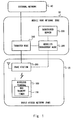
- Fig. 1 shows a configuration example of a mobile communication system according to some embodiments including the first embodiment.
- the mobile communication system includes a RAN (radio access network) 20 and an MCN (mobile core network) 30.
- the RAN 20 includes a base station 200.
- the base station 200 is connected to a wireless terminal 100 by a radio access technology.
- the wireless terminal 100 has a wireless interface, is connected to the base station 200 by the radio access technology, and is connected to the MCN 30 through the RAN 20.
- the wireless terminal 100 communicates with an external network 40 through the RAN 20 and the MCN 30.
- the external network 40 includes the Internet, a packet data network, or PSTN, or any combination thereof.
- the RAN 20 includes, for example, a UTRAN (Universal Terrestrial Radio Access Network) or an E-UTRAN (Evolved UTRAN), or a combination thereof.
- the base station 200 corresponds to a NodeB and an RNC.
- the base station 200 corresponds to an eNB (E-UTRAN NodeB). Note that although only one wireless terminal 100 and one base station 200 are shown in Fig. 1 for convenience of explanation, the mobile communication system may include a plurality of wireless terminals 100 and a plurality of base stations 200.
- the wireless terminal 100 has a NAS backoff timer 110.
- the NAS backoff timer 110 is used for suppressing sending of a NAS request message from the wireless terminal 100.
- the wireless terminal 100 activates the NAS backoff timer 110 in response to, for example, receiving from the MCN 30 a REJECT message that is a reply to a NAS request (e.g., an attach request, a connection request, a location update request).
- the wireless terminal 100 suppresses sending of NAS requests until the NAS backoff timer expires with some exceptions, such as a detach (disconnect of a connection), an emergency call, and a response to a paging.
- the NAS backoff timer is called a Session Management back-off timer, a Mobility Management back-off timer, or a back-off timer T3346.
- a method for determining a timer value of the NAS backoff timer 100 will be mentioned later.
- the MCN 30 is a network mainly managed by an operator that provides mobile communication services.
- the MCN 30 includes a CS (Circuit Switched) core or a PS (Packet Switched) core, or a combination thereof.
- the MCN 30 is, for example, an EPC in the EPS or a GPRS (General Packet Radio Service) packet core in a UMTS, or a combination thereof.
- the MCN 30 includes a mobility management node 300, a transfer node 310, and a subscriber server 320.
- the transfer node 310 provides a user plane function including circuit switching or transfer of user data transmitted and received between the wireless terminal 100 and the external network 40.
- the transfer node 310 includes a user plane function of an MSC, a user plane function of an SGSN, and a GGSN (Gateway GPRS Support Node).
- the transfer node 310 includes a Serving Gateway (S-GW) and a PDN Gateway (P-GW).
- S-GW Serving Gateway
- P-GW PDN Gateway
- the subscriber server 320 is a database holding subscriber data of the wireless terminal 100, and the subscriber server 320 is, for example, an HSS (Home Subscriber Server) or an HLR (Home Location Server).
- the subscriber server 320 sends the subscriber data to the mobility management node 300 in response to a request from the mobility management node 300.
- the mobility management node 300 is a control plane node, and performs management regarding the wireless terminal 100 including mobility management (e.g., location registration) and session (bearer) management (e.g., bearer establishment, bearer configuration change, bearer release).
- the mobility management node 300 sends and receives NAS messages to and from the wireless terminal 100, and indicates the timer value of the NAS backoff timer 110 to the wireless terminal 100.
- the mobility management node 300 includes a control plane function of an SGSN.
- the mobility management node 300 includes an MME.
- Fig. 2 shows a configuration example of the mobility management node 300 according to some embodiments including the embodiment.
- the mobility management node 300 includes a timer value determination unit 301 and a timer value notification unit 302.
- the timer value determination unit 301 determines a timer value (i.e., a NAS backoff time) of the NAS backoff timer 110.
- the timer value of the NAS backoff timer 100 may be sent from another node, e.g., the subscriber server 320 etc. to the mobility management node 300 (timer value determination unit 301).
- the timer value notification unit 302 notifies the wireless terminal 100 of the determined timer value.
- the timer value notification unit 302 transmits an REJECT message (e.g., an Attach Reject message, a Service Reject message, an RAU Reject message, or a TAU Reject message) including the timer value, in rejecting the NAS request from the wireless terminal 100.
- the timer value notification unit 302 may transmit an ACCEPT message (e.g., an Attach Accept message, a Service Accept message, an RAU Accept message, or a TAU Accept message) including the timer value, in accepting the NAS request from the wireless terminal 100.
- Fig. 3 shows a configuration example of the wireless terminal 100 according to some embodiments including the first embodiment.
- the wireless terminal 100 includes a wireless transceiver 101, a control unit 102, and the NAS backoff timer 110.
- the wireless transceiver 101 has a communication function with the RAN 20, and establishes radio connection with the base station 200. Specifically, the wireless transceiver 101 receives a downlink signal including a plurality of physical downlink channels from the base station 200. In addition, the wireless transceiver 101 transmits an uplink signal including a plurality of physical uplink channels to the base station 200.
- the control unit 102 sends and receives signaling messages to and from the RAN 20 and the MCN 30 through the wireless transceiver 101, and controls the wireless transceiver 101 for transmission and reception of user data or for a CS call. Furthermore, the control unit 102 receives the timer value of the NAS backoff timer 110 from the mobility management node 300 through the wireless transceiver 101, and sets the NAS backoff timer 110 based on the timer value. The control unit 102 activates (actuates) the NAS backoff timer 110 in response to a predetermined condition, such as when the NAS request is rejected.
- the control unit 102 suppresses sending of NAS requests, with some exceptions, until the NAS backoff timer 110 expires or a predetermined timer stop condition is satisfied.
- Some exceptions include, for example, at least one of a detach (disconnect of a connection), an emergency call, and a response to a paging.
- the NAS request messages to be suppressed may include at least one of a Service Request, a PDN Connectivity Request, a Bearer Resource Allocation Request, a Bearer Resource Modification Request, an Attach Request, and a Tracking Area Update Request.
- the mobility management node 300 determines the NAS backoff time (timer value of the NAS backoff timer 110) imposed on the wireless terminal 100 based on software information that indicates software installed in the wireless terminal 100 or indicates a version or a revision of the software.
- the software information may be sent from the wireless terminal 100 to the MCN 30 at the time of attach or location update of the wireless terminal 100.
- the software information may be sent from the subscriber server 320 to the mobility management node 300.
- the software information may be included as a part of identification information of the wireless terminal 100.
- the software information may be a 2-digit SVN (Software Version Number) contained in an IMEISV (International Mobile Equipment Identity Software Version).
- the SVN is a code for indicating the revision of software installed in the wireless terminal 100.
- the mobility management node 300 may determine the NAS backoff time (timer value of the NAS backoff timer 110) imposed on the wireless terminal 100 in accordance with a determination policy associated with the software information of the wireless terminal 100. That is, the determination policy to determine the NAS backoff time is changed based on the software information of the wireless terminal 100, and thus the NAS backoff time according to the software information of the wireless terminal 100 is eventually determined. In other words, it can be said that the software information of the wireless terminal 100 is associated with the determination policy to determine the NAS backoff time. It can be also said that the software information of the wireless terminal 100 indicates the determination policy for determining the NAS backoff time.
- the mobility management node 300 may decide itself the determination policy of the NAS backoff time corresponding to the software information, or may receive the determination policy associated with the software information of the wireless terminal 100 from another node (e.g., the subscriber server 320).
- the determination policy to determine the NAS backoff time may prescribe a length of the NAS backoff time and whether the NAS backoff time is fixed or random.
- Candidates of the determination policy to determine the NAS backoff time may include variations, such as (a) the NAS backoff time is set to be a first fixed position (e.g., 10 minutes), (b) the NAS backoff time is set to be a second fixed position (e.g., 30 minutes), (c) the NAS backoff time is randomly determined from 10 to 30 minutes, and (d) the NAS backoff time is randomly determined from 30 to 100 minutes.
- the mobility management node 300 may select one determination policy from these determination policy candidates of the NAS backoff time based on the software information of the wireless terminal 100.
- Fig. 4 is a flowchart showing one example of a determination procedure of the NAS backoff time (timer value of the NAS backoff timer 110) according to the first embodiment.
- the mobility management node 300 acquires software information of the wireless terminal 100.
- the mobility management node 300 determines the NAS backoff timer value imposed on the wireless terminal 100 based on the software information of the wireless terminal 100.
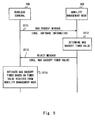
- Fig. 5 is a sequence diagram showing one example of a NAS-level congestion control procedure according to the first embodiment.
- the NAS request from the wireless terminal 100 triggers the mobility management node 300 to acquire the software information of the wireless terminal 100.
- the wireless terminal 100 sends to the mobility management node 300 a NAS request message including the software information of the wireless terminal 100.
- This NAS request message is, for example, an attach request, a location update request (e.g., a TAU Request, an RAU Request), or a service request.
- step S112 the mobility management node 300 determines the NAS backoff timer value of the wireless terminal 100 based on the software information of the wireless terminal 100.
- step S113 the mobility management node 300 sends a NAS REJECT message to the wireless terminal 100 on the ground of an overload or congestion of the core network 30.
- the REJECT message of step S113 indicates rejection of the NAS request of step S111, and includes the NAS backoff timer value.
- step S 114 the wireless terminal 100 sets the NAS backoff timer 110 based on the timer value received from the mobility management node 300, and activates the timer 110.
- the wireless terminal 100 may determine a randomized timer value using the timer value received from the mobility management node 300 as a parameter (e.g., an upper-limit value).
- the NAS backoff time (timer value of the NAS backoff timer 110) imposed on the wireless terminal 100 is determined based on the software information that indicates software installed in the wireless terminal 100 or indicates version or revision of the software. Accordingly, in this embodiment, NAS-level congestion control according to software installed in the wireless terminal 100 can be performed. For example, there is a case where wireless terminals manufactured by the same manufacturer or wireless terminals of the same model are used for a plurality of applications, and where they are different in communication amounts, time (delay) tolerance, or priority, etc. depending on the applications.
- a communication amount, time (delay) tolerance, or priority of the wireless terminal 100 cannot be specified only by referring to hardware identification information (e.g., IMEI) of the wireless terminal 100.
- IMEI hardware identification information
- communication amount, time (delay) tolerance, or priority of the wireless terminal 100 can be determined based on the software information of the wireless terminal 100.
- an appropriate NAS backoff time according to the application of the wireless terminal 100 can be determined accordingly. Consequently, the embodiment can contribute to improvement of the NAS-level congestion control.
- an SVN Software Version Number contained in as IMEISV is used as one of the software information.
- the IMEI is a fixed code defined by the hardware of the wireless terminal 100, while the SVN is configurable. Accordingly, a mobile operator or a manufacturer of the wireless terminal 100, for example, can set the SVN after shipping the wireless terminal 100. For this reason, by utilizing the SVN, a particular terminal group (e.g., low priority terminals) can be easily designated, and a PA unique to the particular terminal group can be easily determined.
- the mobility management node 300 (timer value determination unit 301) is configured to acquire subscriber data of the wireless terminal 100 from the subscriber server 320 and determine a NAS backoff time (a timer value of the NAS backoff timer 110) imposed on the wireless terminal 100 based on the subscriber data.
- the mobility management node 300 operates to determine the NAS backoff time imposed on the wireless terminal 100 not in accordance with information received from the wireless terminal 100 but in accordance with information (e.g., priority information, timer determination policy) included in the subscriber data.
- Fig. 6 is a flowchart showing one example of a determination procedure of the NAS backoff time (timer value of the NAS backoff timer 110) according to the embodiment.
- the mobility management node 300 acquires the subscriber data of the wireless terminal 100 from the subscriber server 320.
- the mobility management node 300 determines an NA backoff timer value imposed on the wireless terminal 100 based on the subscriber data of the wireless terminal 100.
- the subscriber data may include priority information indicating a priority level of the wireless terminal 100.
- the priority information may be flag information that directly explicitly indicates whether or not the wireless terminal 100 has low priority. Note that since the priority level is utilized for the determination of the NAS backoff time in the embodiment, the priority level may be related to time tolerance of the wireless terminal 100. In other words, a delay-tolerant wireless terminal may be assigned lower priority than a terminal that performs non-delay-tolerant communication.
- the mobility management node 300 may determine a longer value as the NAS backoff timer value if determining that the wireless terminal 100 has low priority, compared with a case of determining not. For example, the priority information may indicate whether or not the wireless terminal 100 is associated with particular MTC (Machine Type Communication) that allows delay.
- MTC Machine Type Communication
- the priority information may be type (model) information of the wireless terminal 100.
- the type information of the wireless terminal 100 may be given based on a difference in devices in which the wireless terminal 100 is mounted, such as a common mobile terminal (e.g., a mobile phone, a smartphone, and a tablet computer), an automobile, a railway vehicle, and a vending machine.
- a common mobile terminal e.g., a mobile phone, a smartphone, and a tablet computer
- the difference in devices in which the wireless terminal 100 is mounted implicitly indicates a difference in time tolerance.
- the subscriber data may include policy information indicating the determination policy to determine the NAS backoff time.
- the mobility management node 300 may determine the NAS backoff time (timer value of the NAS backoff timer 110) imposed on the wireless terminal 100 in accordance with the determination policy designated by the subscriber data of the wireless terminal 100.
- Fig. 7 shows a specific example of the determination policy (policy information) held by the subscriber server 320.
- the subscriber server 320 may associate mobility types of a plurality of wireless terminals 100 with their respective wireless terminal identifiers (MSIDs).
- the MSID may be called a subscriber identifier.
- the MSID is, for example, an IMSI (International Mobile Subscriber Identity).
- the type A indicates that a backoff timer value is set to be a fixed value (e.g., 30 minutes).
- the type B indicates that the backoff timer value is randomly determined in a first time range (e.g., 10 to 30 minutes).
- the type C indicates that the backoff timer value is randomly determined in a second time range (e.g., 30 to 100 minutes).
- Fig. 8 is a sequence diagram showing one example of a NAS-level congestion control procedure according to the second embodiment.
- Fig. 8 shows a procedure in which the mobility management node 300 acquires subscriber data at the time of receiving a NAS request (e.g., the attach request or the location update request) from the wireless terminal 100.
- the wireless terminal 100 sends a NAS request message to the mobility management node 300.
- the mobility management node 300 in response to reception of the NAS request message, the mobility management node 300 requests the subscriber server 320 to send the subscriber data of the wireless terminal 100.
- the request transmitted in step S212 includes the MSID (i.e., an ID managed by the subscriber server 320, for example, the IMSI) of the wireless terminal 100.
- MSID i.e., an ID managed by the subscriber server 320, for example, the IMSI
- the mobility management node 300 receives the subscriber data of the wireless terminal 100 from the subscriber server 320.
- This subscriber data for example, includes the priority information of the wireless terminal 100, or the determination policy to determine the NAS backoff time applied to the wireless terminal 100.
- step S214 the mobility management node 300 determines the NAS backoff timer value of the wireless terminal 100 based on the subscriber data (e. g the priority information or the determination policy) of the wireless terminal 100.
- step S215 the mobility management node 300 sends a NAS REJECT message to the wireless terminal 100 on the ground of an overload or congestion of the core network 30.
- the REJECT message of step S215 indicates rejection of the NAS request of step S211, and includes the NAS backoff timer value.
- step S216 the wireless terminal 100 sets the NAS backoff timer 110 based on the timer value received form the mobility management node 300, and activates the timer 110.
- the wireless terminal 100 may determine a randomized timer value using the timer value received from the mobility management node 300 as a parameter (e.g., an upper-limit value).
- the mobility management node 300 may acquire the subscriber data of the wireless terminal 100 from an old mobility management node, instead of the subscriber server 320, in response to receiving a location update request from the wireless terminal 100. In this case, the mobility management node 300 does not need to request transmission of the subscriber data from the subscriber server 320.
- the old mobility management node is a mobility management node that manages a location registration area where the wireless terminal 100 was located in the past, and holds the subscriber data received from the subscriber server 320 at the time of attach of the wireless terminal 100.
- Fig. 9 is a sequence diagram showing another example of the NAS-level congestion control procedure according to the embodiment. Processing in steps S221 to S223 is similar to processing in steps S211 to S213 of Fig. 8 .
- the mobility management node 300 holds the NAS backoff timer value or the timer determination policy determined based on the subscriber data of the wireless terminal 100 as a context (e.g., a UE CONTEXT) regarding the wireless terminal 100.
- the mobility management node 300 sends an ACCEPT message with respect to the NAS request message of step S221.
- step S226 the wireless terminal 100 sends a NAS request message to the mobility management node 300.
- step S227 the mobility management node 300 sends a NAS REJECT message to the wireless terminal 100 on the ground of an overload or congestion of the core network 30.
- the REJECT message of step S227 indicates rejection of the NAS request of step S227, and includes a NAS backoff timer value based on the NAS backoff timer value or the determination policy determined in step S224.
- step S228 the wireless terminal 100 sets the NAS backoff timer 110 based on the timer value received from the mobility management node 300, and activates the timer 110.
- the NAS backoff timer value imposed on the wireless terminal 100 is determined based on the subscriber data of the wireless terminal 100.
- a mechanism for determining different NAS backoff timer values for a plurality of wireless terminals 100 is introduced by coping (improvement) of the core network 30, and thereby an impact given to the wireless terminal 100 is small.
- wireless terminals manufactured by the same manufacturer, wireless terminals of the same model, or wireless terminals of the same software version (revision) are used for a plurality of applications, and where they are different in communication amounts, time (delay) tolerance, or priority, etc. depending on the applications.
- the NAS backoff timer value different for each wireless terminal 100 can be determined by using the setting of the subscriber data.
- the subscriber data can be changed by the mobile operator for his own convenience and, for example, can be also temporarily changed.
- dynamic or temporary change of the NAS backoff time applied to the wireless terminal 100 or the determination policy to determine the NAS backoff time can be easily made compared with the case of using information received from the wireless terminals 100, such as the software information, mentioned in the first embodiment.
- the mobility management node 300 (timer value determination unit 301) is configured to determine a NAS backoff time (a timer value of the NAS backoff timer 110) imposed on the wireless terminal 100 based on the external network 40 with which the wireless terminal 100 communicates through the RAN 20 and the MCN 30.
- the mobility management node 300 (timer value determination unit 301) is configured to change the NAS backoff time (timer value of the NAS backoff timer 110) imposed on the wireless terminal 100 according to which external network 40 the wireless terminal 100 communicates with.
- the mobility management node 300 may acquire, from the wireless terminal 100 or the subscriber server 320, identification information (e.g., an APN) of the external network 40 with which the wireless terminal 100 communicates.
- identification information e.g., an APN
- the mobility management node 300 may impose a longer NAS backoff time on the wireless terminal 100, compared with the case where the identification information does not.
- the network for low priority communication is, for example, a network for particular time-tolerant MTC service that allows delay.
- the particular time-tolerant MTC service is, for example, smart metering.
- the identification information (e.g., the APN) of the external network 40 indicates a network for high priority communication
- the mobility management node 300 may impose a shorter NAS backoff time on the wireless terminal 100, than otherwise.
- the mobility management node 300 may determine the NAS backoff time (timer value of the NAS backoff timer 110) imposed on the wireless terminal 100 in accordance with a determination policy associated with the external network 40 with which the wireless terminal 100 communicates. That is, the determination policy to determine the NAS backoff time is changed based on the external network 40 with which the wireless terminal 100 communicates, and the NAS backoff time according to the external network 40 is determined accordingly. In other words, it can be said that the external network 40 with which the wireless terminal 100 communicates is associated with the determination policy to determine the NAS backoff time. It can be also said that the identification information (e.g., the APN) of the external network 40 with which the wireless terminal 100 communicates indicates the determination policy to determine the NAS backoff time.
- the identification information e.g., the APN
- Fig. 10 is a flowchart showing one example of a determination procedure of the NAS backoff time (timer value of the NAS backoff timer 110) according to the embodiment.
- the mobility management node 300 acquires the identification information (e.g., the APN) of the external network 40 with which the wireless terminal 100 communicates.
- the mobility management node 300 determines the NAS backoff timer value imposed on the wireless terminal 100 based on the identification information (e.g., the APN) of the external network 40.
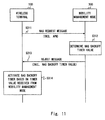
- Fig. 11 is a sequence diagram showing a first example of a NAS-level congestion control procedure according to the embodiment.
- the mobility management node 300 receives the identification information of the external network 40 from the wireless terminal 100.
- the wireless terminal 100 sends to the mobility management node 300 a NAS request message including the identification information (e.g., the APN) of the external network 40.
- This NAS request message is, for example, an attach request, a location update request (e.g., a TAU Request, an RAU Request), a connection request, or a service request.
- step S312 the mobility management node 300 determines the NAS backoff timer value of the wireless terminal 100 based on the identification information of the external network 40 with which the wireless terminal 100 communicates.
- step S313 the mobility management node 300 sends a NAS REJECT message to the wireless terminal 100 on the ground of an overload or congestion of the core network 30.
- a REJECT message of step S313 indicates rejection of the NAS request of step S311, and includes the NAS backoff timer value.
- step S314 the wireless terminal 100 sets the NAS backoff timer 110 based on the timer value received from the mobility management node 300, and activates the timer 110.
- the wireless terminal 100 may determine a randomized timer value using the timer value received from the mobility management node 300 as a parameter (e.g., an upper-limit value).
- Fig. 12 is a sequence diagram showing a second example of the NAS-level congestion control procedure according to the embodiment.
- the mobility management node 300 acquires, from the subscriber server 320, the identification information (e.g., the APN) of the external network 40 with which the wireless terminal 100 communicates.
- the procedure of Fig. 12 is similar to the procedure shown in Fig. 8 except that subscriber data in step S323 includes the identification information (e.g., a subscribed APN) of the external network 40.
- the mobility management node 300 receives a NAS request from the wireless terminal 100, requests the subscriber server 320 to send the subscriber data, and receives the subscriber data from the subscriber server 320.
- This subscriber data includes the identification information (e.g., the subscribed APN) of the external network 40 with which the wireless terminal 100 communicates.
- step S324 the mobility management node 300 determines the NAS backoff timer value of the wireless terminal 100 based on the identification information of the external network 40 with which the wireless terminal 100 communicates. Processing in steps S325 to S326 may be similar to that in steps S215 to S216 of Fig. 8 .
- the mobility management node 300 may acquire the subscriber data of the wireless terminal 100 from an old mobility management node, instead of the subscriber server 320, in response to receiving a location update request from the wireless terminal 100. In this case, the mobility management node 300 does not need to request the transmission of the subscriber data from the subscriber server 320.
- Fig. 13 is a sequence diagram showing a third example of the NAS-level congestion control procedure according to the embodiment.
- Fig. 13 similarly to Fig. 9 , shows a case where the mobility management node 300 rejects a NAS request after receiving another NAS request. Processing in steps S331 to S333 is similar to processing in steps S321 to S323 of Fig. 12 .
- step S334 the mobility management node 300 holds the NAS backoff timer value or the timer determination policy determined based on the identification information of the external network 40 with which the wireless terminal 100 communicates, as a context (e.g., the UE CONTEXT) regarding the wireless terminal 100.
- a context e.g., the UE CONTEXT
- step S335 the mobility management node 300 sends an ACCEPT message with respect to a NAS request message of step S331.
- Processing in subsequent steps S336 to S338 may be similar to that in steps S226 to S228 shown in Fig. 9 .
- the NAS backoff time (timer value of the NAS backoff timer 110) imposed on the wireless terminal 100 is determined based on the external network 40 with which the wireless terminal 100 communicates. Determining the NAS backoff time according to the external network 40 is particularly effective in a case where the external network 40 has an association with a communication amount, time (delay) tolerance or priority, etc. of the wireless terminal 100.
- the external network 40 with which the wireless terminal 100 communicates is determined according to a contract with the mobile operator or according to service utilized by the wireless terminal 100. Accordingly, in some implementations, the wireless terminal 100 that is used for particular MTC service is considered to communicate with the external network 40 exclusively for this MTC service.
- the mobility management node 300 can judge the time tolerance or the priority level of the wireless terminal 100 according to the external network 40 with which the wireless terminal 100 communicates, and thus can determine an appropriate NAS backoff time according to the time tolerance or the priority level.
- the examples have been shown where the mobility management node 300 determines the NAS backoff timer value.
- determination of the NAS backoff timer value may be made by a node different from the mobility management node 300.
- the determination of the NAS backoff timer value may be made by a network node different from the mobility management node 300 (e.g., the subscriber server 320) or a network management system arranged in the core network 30.
- the network management system may be called an OAM (Operation Administration and Maintenance) server, an OMC (Operation and Maintenance Centre), an NM (Network Manager), or an EM (Element Manager).
- the mobility management node 300 may receive the NAS backoff timer value of the wireless terminal 100 from another network node or a network management system, and may send the backoff timer value to the wireless terminal 100.
- the processing for determining a NAS backoff timer value described in the first to third embodiments may be implemented by using a semiconductor processing device including an ASIC (Application Specific Integrated Circuit). Further, the processing may be implemented by causing a computer system including at least one processor (e.g., a microprocessor, an MPU or a DSP (Digital Signal Processor)) to execute a program. More specifically, one or more programs including instructions for causing a computer system to perform the algorithms for determining a NAS backoff timer value described with reference to the flowcharts and sequence diagrams may be created and supplied to a computer system.
- the processing for setting and activation of the NAS backoff timer 110 performed by the wireless terminal 100 may also be implemented by causing a computer system to execute a program.
- Non-transitory computer readable media include any type of tangible storage media.
- Examples of non-transitory computer readable media include magnetic storage media (such as flexible disks, magnetic tapes, hard disk drives, etc.), optical magnetic storage media (e.g., magneto-optical disks), CD-ROM (Read Only Memory), CD-R, CD-R/W, and semiconductor memories (such as mask ROM, PROM (Programmable ROM), EPROM (Erasable PROM), flash ROM, RAM (random access memory), etc.).
- the program may be provided to a computer using any type of transitory computer readable media.
- Transitory computer readable media examples include electric signals, optical signals, and electromagnetic waves.
- Transitory computer readable media can provide the program to a computer via a wired communication line (e.g., electric wires, and optical fibers) or a wireless communication line.
- a core network node including a notification unit that notifies a wireless terminal of a timer value of a Non-Access Stratum (NAS) backoff timer arranged in the wireless terminal to suppress sending of a NAS request message, in which the timer value is determined based on software information that indicates software installed in the wireless terminal or indicates a version or a revision of the software.
- NAS Non-Access Stratum
- SVN Software Version Number
- IMEISV International Mobile Equipment Identity Software Version
- the NAS request message includes at least one of a Service Request, a PDN Connectivity Request, a Bearer Resource Allocation Request, a Bearer Resource Modification Request, an Attach Request, and a Tracking Area Update Request.
- a wireless terminal comprising control unit that receives a timer value which is determined based on software information that indicates software installed in the wireless terminal or indicates a version or a revision of the software, sets, based on the timer value, a Non-Access Stratum (NAS) backoff timer to suppress sending of a NAS request message, and activates the backoff timer.
- a timer value which is determined based on software information that indicates software installed in the wireless terminal or indicates a version or a revision of the software, sets, based on the timer value, a Non-Access Stratum (NAS) backoff timer to suppress sending of a NAS request message, and activates the backoff timer.
- NAS Non-Access Stratum
- SVN Software Version Number
- IMEISV International Mobile Equipment Identity Software Version
- a method for congestion control including notifying a wireless terminal of a timer value of a Non-Access Stratum (NAS) backoff timer arranged in the wireless terminal to suppress sending of a NAS request message, in which the timer value is determined based on software information that indicates software installed in the wireless terminal or indicates a version or a revision of the software.
- NAS Non-Access Stratum
- the determination policy is selected from a plurality of policies including a first policy in which the timer value is set to be a predetermined fixed value and a second policy in which the timer value is randomly determined.
- a program for causing a computer to perform a method for congestion control includes notifying a wireless terminal of a timer value of a Non-Access Stratum, NAS, backoff timer arranged in the wireless terminal to suppress sending of a NAS request message, and the timer value is determined based on software information that indicates software installed in the wireless terminal or indicates a version or a revision of the software.
- a core network node including:
- MTC Machine Type Communication
- the NAS request message includes at least one of a Service Request, a PDN Connectivity Request, a Bearer Resource Allocation Request, a Bearer Resource Modification Request, an Attach Request, and a Tracking Area Update Request.
- a wireless terminal including a control unit that receives a timer value from the core network node described in any one of Supplementary Notes B1 to B8, sets, based on the timer value, a NAS (Non-Access Stratum) backoff timer to suppress sending of a NAS request message, and activates the backoff timer.
- a control unit that receives a timer value from the core network node described in any one of Supplementary Notes B1 to B8, sets, based on the timer value, a NAS (Non-Access Stratum) backoff timer to suppress sending of a NAS request message, and activates the backoff timer.
- NAS Non-Access Stratum
- a method for congestion control including:
- the determination policy is selected from a plurality of policies including a first policy in which the timer value is set to be a predetermined fixed value and a second policy in which the timer value is randomly determined, and the determination policy is held by the subscriber server so as to be associated with the wireless terminal.
- a core network node including a notification unit that notifies a wireless terminal of a timer value of a Non-Access Stratum (NAS) backoff timer arranged in the wireless terminal to suppress sending of a NAS request message, in which the timer value is determined based on an external network with which the wireless terminal communicates through an radio access network and a core network.
- NAS Non-Access Stratum
- MTC Machine Type Communication
- the NAS request message includes at least one of a Service Request, a PDN Connectivity Request, a Bearer Resource Allocation Request, a Bearer Resource Modification Request, an Attach Request, and a Tracking Area Update Request.
- a wireless terminal including a control unit that receives a timer value determined according to an external network with which the wireless terminal communicates through a radio access network and a core network, sets, based on the timer value, a Non-Access Stratum (NAS) backoff timer to suppress sending of a NAS request message, and activates the backoff timer.
- NAS Non-Access Stratum
- the wireless terminal described in Supplementary Note C7 in which the timer value is determined to be a longer value in a case where the external network is a first network for low priority, compared with a case where the external network is not.
- MTC Machine Type Communication
- the wireless terminal described in any one of Supplementary Notes C7 to C9 in which the NAS request message includes at least one of a Service Request, a PDN Connectivity Request, a Bearer Resource Allocation Request, a Bearer Resource Modification Request, an Attach Request, and a Tracking Area Update Request.
- a method for congestion control including notifying a wireless terminal of a timer value of a Non-Access Stratum (NAS) backoff timer arranged in the wireless terminal to suppress sending of a NAS request message, in which the timer value is determined according to an external network with which the wireless terminal communicates through an radio access network and a core network.
- NAS Non-Access Stratum
- the first network is a network associated with Machine Type Communication (MTC).
- MTC Machine Type Communication
- the determination policy is selected from a plurality of policies including a first policy in which the timer value is set to be a predetermined fixed value and a second policy in which the timer value is randomly determined.
- a program for making a computer perform a method for congestion control, in which the method includes notifying a wireless terminal of a timer value of a Non-Access Stratum (NAS) backoff timer arranged in the wireless terminal to suppress sending of a NAS request message, and in which the timer value is determined according to an external network with which the wireless terminal communicates through a radio access network and a core network.
- NAS Non-Access Stratum
Landscapes
- Engineering & Computer Science (AREA)
- Computer Networks & Wireless Communication (AREA)
- Signal Processing (AREA)
- Quality & Reliability (AREA)
- Mobile Radio Communication Systems (AREA)
Abstract
Description
- The present invention relates to congestion control of a mobile communication system.
- A multiple access mobile communication system enables a plurality of wireless terminals to perform wireless communication substantially simultaneously, by sharing radio resources including at least one of time, frequency, and transmission power among the plurality of wireless terminals. Typical examples of multiple access schemes include TDMA (Time Division Multiple Access), FDMA (Frequency Division Multiple Access), CDMA (Code Division Multiple Access), or OFDMA (Orthogonal Frequency Division Multiple Access), and any combination thereof. Unless noted otherwise, the terminology "mobile communication system" used in the specification refers to a multiple access mobile communication system.
- A mobile communication system includes a wireless terminal and a network. A network includes a RAN (Radio Access Network) and an MCN (Mobile Core Network). The wireless terminal communicates with an external network (e.g., the Internet, a packet data network, PSTN (Public Switched Telephone Networks)) through the RAN and the MCN.
- A RAN includes base stations and a radio resource management function. A radio resource management function may be arranged in an RAN node different from a base station, or may be arranged in a base station. For example, in a UMTS (Universal Mobile Telecommunications System) of 3GPP (3rd Generation Partnership Project), the radio resource management function is arranged in an RNC (Radio Network Controller). Meanwhile, in an EPS (Evolved Packet System) of 3GPP or LTE (Long Term Evolution), the radio resource management function is arranged in a base station (eNB).
- An MCN includes one or more transfer nodes that relay traffic, and one or more control nodes that perform mobility management, session management (bearer management), etc. A transfer node function and a control node function may be integrally arranged in one node, for example, as an SGSN (Serving GPRS Support Node) of a PS (Packet Switched) domain and an MSC (Mobile-services Switching Center) of a CS (Circuit Switched) domain of the UMTS. The control node sends and receives NAS (Non-Access Stratum) messages to and from wireless terminals. NAS messages are control messages transparently sent or received between a wireless terminal and an MCN without being terminated in a RAN and without being dependent on a wireless access technology of a RAN. NAS messages sent from a wireless terminal to a MCN include a NAS request message, such as an attach request, a session (bearer) request, and a location update request. For example, in a case of the EPS, NAS request messages from a wireless terminal include at least one of an Attach Request, a Service Request, a PDN connectivity request, a Bearer Resource Allocation Request, a Bearer Resource Modification Request, a TAU (Tracking Area Update) Request, and an RAU (Routing Area Update) Request. Meanwhile, NAS messages sent from an MCN to a wireless terminal include an ACCEPT message and a REJECT message that are replies to NAS request messages.
- There has been known NAS-level congestion control for suppressing an overload or congestion of a core network (for example, refer to Non-Patent Literature 1 and Patent Literature 1). Non-Patent Literature 1 discloses APN (Access Point Name)-based session management congestion control and mobility management congestion control, and general NAS-level mobility management congestion control. The APN is an identifier of an external network used in the EPS. The APN-based congestion control is executed to suppress an overload or congestion concerning a particular APN. The general NAS-level mobility management congestion control is executed under a general overload situation not concerning a particular APN. When such NAS-level congestion control is executed, an MME (Mobility Management Entity) rejects a NAS request which is received from the wireless terminal and relates to session management or mobility management. Note that the MME is a control node that is arranged in a core network (an EPC (Evolved Packet Core)) of the EPS. The wireless terminal whose NAS request has been rejected activates a NAS backoff timer and suppresses sending of NAS requests until the NAS backoff timer expires with some exceptions, such as a detach (disconnect of a connection), an emergency call, and a response to a paging. In the EPS, the NAS backoff timer is called a Session Management back-off timer, a Mobility Management back-off timer, or a back-off timer T3346, etc.
- A length of a timer value (i.e., a backoff time) of a NAS backoff timer is designated by a core network. For example, a REJECT message, sent to a wireless terminal by a control node (e.g., MME or SGSN) located within the core network to reject a NAS request, includes designation of the backoff timer value. Note that the control node (e.g., MME) must avoid a number of wireless terminals almost simultaneously performing NAS requests postponed by the backoff timer. For that reason, Non-Patent Literature 1 describes that the NAS backoff timer value should be selected so that the postponed NAS requests do not simultaneously occur.
- In addition, Non-Patent Literature 1 describes a method to cope with an overload concerning MTC (Machine Type Communication). MTC is also called M2M (Machine-to-Machine) communication or sensor network communication. When MTC is implemented in a mobile communication system, a wireless terminal function is arranged at a machine (e.g., a vending machine, a smart meter, an automobile, a railway vehicle) or a sensor (e.g., sensors relating to environment, agriculture, or transportation). A wireless terminal for MTC is called an MTC device. Non-Patent Literature 1 describes that backoff timer values imposed on MTC devices may be randomized in order to prevent repetition of a load peak due to concentration of communication of the MTC devices. In addition, Non-Patent Literature 1 describes that a wireless terminal for a MTC device may be configured as a low priority terminal, and that a long backoff timer may be imposed on the low priority terminal. Furthermore, Non-Patent Literature 1 describes that the low priority terminal sends a low priority identifier to an MME during a NAS signaling procedure. The low priority identifier is used to decide whether or not the MME accepts the NAS request from the wireless terminal.
- Patent Literature 1 discloses MTC congestion control, which includes NAS-level congestion control for blocking communication of a particular MTC application. For example, when receiving a NAS request (e.g., a PDN Connectivity Request or an Attach Request) from an MTC device concerning the particular MTC application, a network node (e.g., an MME or an SGSN) sends a REJECT message including designation of a backoff timer value. The particular MTC application may be identified by an APN or MTC group identifier. In addition, random backoff timer values may be allocated to different MTC devices belonging to the same MTC group in order to prevent increase in a network load when backoff timers of the plurality of MTC devices expire. In addition, Non-Patent Literature 1 describes that a backoff timer value may be sent to a wireless terminal by an ACCEPT message (e.g., an Attach Accept message, an RAU Accept message, or a TAU Accept message) responding to a NAS request from the wireless terminal.
- [Patent Literature 1]
U.S. Patent Application Publication No. 2011/0199905 - [Non-Patent Literature 1] 3GPP TS 23.401 V10.8.0 (2012-06)
- The present inventor examined in detail a situation in which wireless terminals having different communication amounts, time (delay) tolerance, mobility, etc., such as a smartphone and an MTC device, are accommodated in a mobile communication system. The inventor then has found out various problems on NAS-level congestion control using a NAS backoff timer. A technical idea obtained by the inventor in order to cope with these problems contributes to improvement of the NAS-level congestion control. Some specific examples of the technical idea will be apparent from the following description regarding embodiments and the drawings.
- In an aspect, a core network node includes a notification unit configured to notify a wireless terminal of a timer value of a Non-Access Stratum (NAS) backoff timer arranged in the wireless terminal to suppress sending of a NAS request message. The timer value is determined based on software information that indicates software installed in the wireless terminal or indicates a version or a revision of the software.
- In an aspect, wireless terminal comprising control unit configured to receive a timer value which is determined based on software information that indicates software installed in the wireless terminal or indicates a version or a revision of the software, set, based on the timer value, a Non-Access Stratum (NAS) backoff timer to suppress sending of a NAS request message, and activate the backoff timer.
- In an aspect, a method, for congestion control, including notifying a wireless terminal of a timer value of a Non-Access Stratum (NAS) backoff timer arranged in the wireless terminal to suppress sending of a NAS request message. The timer value is determined based on software information that indicates software installed in the wireless terminal or indicates a version or a revision of the software.
- In an aspect, a core network node includes a determination unit and a notification unit. The determination unit is configured to acquire subscriber data of a wireless terminal from a subscriber server, and determine, based on the subscriber data, a timer value of a Non-Access Stratum (NAS) backoff timer arranged in the wireless terminal to suppress sending of a NAS request message. The notification unit is configured to notify the wireless terminal of the timer value.
- In an aspect, a wireless terminal includes a control unit configured to receive from the core network node a timer value that is determined based on a subscriber data, set, based on the timer value, a NAS (Non-Access Stratum) backoff timer to suppress sending of a NAS request message, and activate the backoff timer.
- In an aspect, a method, for congestion control, includes: acquiring subscriber data of a wireless terminal from a subscriber server, and determining, based on the subscriber data, a timer value of a Non-Access Stratum (NAS) backoff timer arranged in the wireless terminal to suppress sending of a NAS request message; and notifying the wireless terminal of the timer value.
- In an aspect, a core network node includes a notification unit configured to notify a wireless terminal of a timer value of a Non-Access Stratum (NAS) backoff timer arranged in the wireless terminal to suppress sending of a NAS request message. The timer value is determined based on an external network with which the wireless terminal communicates through a radio access network and a core network.
- In an aspect, a wireless terminal includes a control unit configured to receive a timer value determined according to an external network with which the wireless terminal communicates through a radio access network and a core network, set, based on the timer value, a Non-Access Stratum (NAS) backoff timer to suppress sending of a NAS request message, and activate the backoff timer.
- In an aspect, a method, for congestion control, includes notifying a wireless terminal of a timer value of a Non-Access Stratum (NAS) backoff timer arranged in the wireless terminal to suppress sending of a NAS request message. The timer value is determined according to an external network with which the wireless terminal communicates through a radio access network and a core network.
- The above-mentioned aspects can contribute to the improvement of the NAS-level congestion control.
-
-
Fig. 1 is a diagram showing an illustrative configuration of mobile communication systems according to first to third embodiments. -
Fig. 2 is a diagram showing an illustrative configuration of mobility management nodes according to the first to third embodiments. -
Fig. 3 is a diagram showing an illustrative configuration of wireless terminal according to the first to third embodiments. -
Fig. 4 is a flowchart showing an example of a determination procedure of a NAS backoff timer value according to the first embodiment. -
Fig. 5 is a sequence diagram showing an example of a congestion control procedure according to the first embodiment. -
Fig. 6 is a flowchart showing an example of a determination procedure of a NAS backoff timer value according to the second embodiment. -
Fig. 7 is a diagram showing an example of a policy for determining a NAS backoff timer value according to the second embodiment. -
Fig. 8 is a sequence diagram showing an example of a congestion control procedure according to the second embodiment. -
Fig. 9 is a sequence diagram showing an example of a congestion control procedure according to the second embodiment. -
Fig. 10 is a flowchart showing an example of a determination procedure of a NAS backoff timer value according to the third embodiment. -
Fig. 11 is a sequence diagram showing an example of a congestion control procedure according to the third embodiment. -
Fig. 12 is a sequence diagram showing an example of a congestion control procedure according to the third embodiment. -
Fig. 13 is a sequence diagram showing an example of a congestion control procedure according to the third embodiment. - Hereinafter, specific embodiments will be explained in detail with reference to drawings. In drawings, the same or corresponding elements are denoted by the same reference numerals, and a repeated explanation is omitted as needed for clarity of the explanation.
-
Fig. 1 shows a configuration example of a mobile communication system according to some embodiments including the first embodiment. The mobile communication system includes a RAN (radio access network) 20 and an MCN (mobile core network) 30. TheRAN 20 includes abase station 200. Thebase station 200 is connected to awireless terminal 100 by a radio access technology. Thewireless terminal 100 has a wireless interface, is connected to thebase station 200 by the radio access technology, and is connected to theMCN 30 through theRAN 20. Additionally, thewireless terminal 100 communicates with an external network 40 through theRAN 20 and theMCN 30. The external network 40 includes the Internet, a packet data network, or PSTN, or any combination thereof. TheRAN 20 includes, for example, a UTRAN (Universal Terrestrial Radio Access Network) or an E-UTRAN (Evolved UTRAN), or a combination thereof. In the UTRAN, thebase station 200 corresponds to a NodeB and an RNC. In the E-UTRAN, thebase station 200 corresponds to an eNB (E-UTRAN NodeB). Note that although only onewireless terminal 100 and onebase station 200 are shown inFig. 1 for convenience of explanation, the mobile communication system may include a plurality ofwireless terminals 100 and a plurality ofbase stations 200. - The
wireless terminal 100 has aNAS backoff timer 110. TheNAS backoff timer 110 is used for suppressing sending of a NAS request message from thewireless terminal 100. Thewireless terminal 100 activates theNAS backoff timer 110 in response to, for example, receiving from the MCN 30 a REJECT message that is a reply to a NAS request (e.g., an attach request, a connection request, a location update request). Thewireless terminal 100 suppresses sending of NAS requests until the NAS backoff timer expires with some exceptions, such as a detach (disconnect of a connection), an emergency call, and a response to a paging. In an EPS, the NAS backoff timer is called a Session Management back-off timer, a Mobility Management back-off timer, or a back-off timer T3346. A method for determining a timer value of theNAS backoff timer 100 will be mentioned later. - The
MCN 30 is a network mainly managed by an operator that provides mobile communication services. TheMCN 30 includes a CS (Circuit Switched) core or a PS (Packet Switched) core, or a combination thereof. TheMCN 30 is, for example, an EPC in the EPS or a GPRS (General Packet Radio Service) packet core in a UMTS, or a combination thereof. In the example shown inFig. 1 , theMCN 30 includes amobility management node 300, atransfer node 310, and asubscriber server 320. - The
transfer node 310 provides a user plane function including circuit switching or transfer of user data transmitted and received between thewireless terminal 100 and the external network 40. For example, in a case of the UMTS, thetransfer node 310 includes a user plane function of an MSC, a user plane function of an SGSN, and a GGSN (Gateway GPRS Support Node). Meanwhile, in a case of the EPS, thetransfer node 310 includes a Serving Gateway (S-GW) and a PDN Gateway (P-GW). - The
subscriber server 320 is a database holding subscriber data of thewireless terminal 100, and thesubscriber server 320 is, for example, an HSS (Home Subscriber Server) or an HLR (Home Location Server). Thesubscriber server 320 sends the subscriber data to themobility management node 300 in response to a request from themobility management node 300. - The
mobility management node 300 is a control plane node, and performs management regarding thewireless terminal 100 including mobility management (e.g., location registration) and session (bearer) management (e.g., bearer establishment, bearer configuration change, bearer release). Themobility management node 300 sends and receives NAS messages to and from thewireless terminal 100, and indicates the timer value of theNAS backoff timer 110 to thewireless terminal 100. For example, in the case of the UMTS, themobility management node 300 includes a control plane function of an SGSN. Meanwhile, in the case of the EPS, themobility management node 300 includes an MME. -
Fig. 2 shows a configuration example of themobility management node 300 according to some embodiments including the embodiment. In an example ofFig. 2 , themobility management node 300 includes a timer value determination unit 301 and a timer value notification unit 302. The timer value determination unit 301 determines a timer value (i.e., a NAS backoff time) of theNAS backoff timer 110. Note that in some embodiments, the timer value of theNAS backoff timer 100 may be sent from another node, e.g., thesubscriber server 320 etc. to the mobility management node 300 (timer value determination unit 301). The timer value notification unit 302 notifies thewireless terminal 100 of the determined timer value. For example, the timer value notification unit 302 transmits an REJECT message (e.g., an Attach Reject message, a Service Reject message, an RAU Reject message, or a TAU Reject message) including the timer value, in rejecting the NAS request from thewireless terminal 100. The timer value notification unit 302 may transmit an ACCEPT message (e.g., an Attach Accept message, a Service Accept message, an RAU Accept message, or a TAU Accept message) including the timer value, in accepting the NAS request from thewireless terminal 100. -
Fig. 3 shows a configuration example of thewireless terminal 100 according to some embodiments including the first embodiment. In an example ofFig. 3 , thewireless terminal 100 includes awireless transceiver 101, acontrol unit 102, and theNAS backoff timer 110. Thewireless transceiver 101 has a communication function with theRAN 20, and establishes radio connection with thebase station 200. Specifically, thewireless transceiver 101 receives a downlink signal including a plurality of physical downlink channels from thebase station 200. In addition, thewireless transceiver 101 transmits an uplink signal including a plurality of physical uplink channels to thebase station 200. Thecontrol unit 102 sends and receives signaling messages to and from theRAN 20 and theMCN 30 through thewireless transceiver 101, and controls thewireless transceiver 101 for transmission and reception of user data or for a CS call. Furthermore, thecontrol unit 102 receives the timer value of theNAS backoff timer 110 from themobility management node 300 through thewireless transceiver 101, and sets theNAS backoff timer 110 based on the timer value. Thecontrol unit 102 activates (actuates) theNAS backoff timer 110 in response to a predetermined condition, such as when the NAS request is rejected. Thecontrol unit 102 suppresses sending of NAS requests, with some exceptions, until theNAS backoff timer 110 expires or a predetermined timer stop condition is satisfied. Some exceptions include, for example, at least one of a detach (disconnect of a connection), an emergency call, and a response to a paging. In the case of the EPS, the NAS request messages to be suppressed may include at least one of a Service Request, a PDN Connectivity Request, a Bearer Resource Allocation Request, a Bearer Resource Modification Request, an Attach Request, and a Tracking Area Update Request. - Hereinafter, there will be explained determination of a NAS backoff time (a timer value of the NAS backoff timer 110) according to the first embodiment. In this embodiment, the
mobility management node 300 determines the NAS backoff time (timer value of the NAS backoff timer 110) imposed on thewireless terminal 100 based on software information that indicates software installed in thewireless terminal 100 or indicates a version or a revision of the software. The software information may be sent from thewireless terminal 100 to theMCN 30 at the time of attach or location update of thewireless terminal 100. Alternatively, the software information may be sent from thesubscriber server 320 to themobility management node 300. In some implementations, the software information may be included as a part of identification information of thewireless terminal 100. The software information may be a 2-digit SVN (Software Version Number) contained in an IMEISV (International Mobile Equipment Identity Software Version). The SVN is a code for indicating the revision of software installed in thewireless terminal 100. - The
mobility management node 300 may determine the NAS backoff time (timer value of the NAS backoff timer 110) imposed on thewireless terminal 100 in accordance with a determination policy associated with the software information of thewireless terminal 100. That is, the determination policy to determine the NAS backoff time is changed based on the software information of thewireless terminal 100, and thus the NAS backoff time according to the software information of thewireless terminal 100 is eventually determined. In other words, it can be said that the software information of thewireless terminal 100 is associated with the determination policy to determine the NAS backoff time. It can be also said that the software information of thewireless terminal 100 indicates the determination policy for determining the NAS backoff time. - The
mobility management node 300 may decide itself the determination policy of the NAS backoff time corresponding to the software information, or may receive the determination policy associated with the software information of thewireless terminal 100 from another node (e.g., the subscriber server 320). The determination policy to determine the NAS backoff time may prescribe a length of the NAS backoff time and whether the NAS backoff time is fixed or random. Candidates of the determination policy to determine the NAS backoff time may include variations, such as (a) the NAS backoff time is set to be a first fixed position (e.g., 10 minutes), (b) the NAS backoff time is set to be a second fixed position (e.g., 30 minutes), (c) the NAS backoff time is randomly determined from 10 to 30 minutes, and (d) the NAS backoff time is randomly determined from 30 to 100 minutes. Themobility management node 300 may select one determination policy from these determination policy candidates of the NAS backoff time based on the software information of thewireless terminal 100. -
Fig. 4 is a flowchart showing one example of a determination procedure of the NAS backoff time (timer value of the NAS backoff timer 110) according to the first embodiment. In step S11, the mobility management node 300 (timer value determination unit 301) acquires software information of thewireless terminal 100. In step S12, the mobility management node 300 (timer value determination unit 301) determines the NAS backoff timer value imposed on thewireless terminal 100 based on the software information of thewireless terminal 100. -
Fig. 5 is a sequence diagram showing one example of a NAS-level congestion control procedure according to the first embodiment. In the example shown inFig. 5 , the NAS request from thewireless terminal 100 triggers themobility management node 300 to acquire the software information of thewireless terminal 100. In step S111, thewireless terminal 100 sends to the mobility management node 300 a NAS request message including the software information of thewireless terminal 100. This NAS request message is, for example, an attach request, a location update request (e.g., a TAU Request, an RAU Request), or a service request. - In step S112, the
mobility management node 300 determines the NAS backoff timer value of thewireless terminal 100 based on the software information of thewireless terminal 100. In step S113, themobility management node 300 sends a NAS REJECT message to thewireless terminal 100 on the ground of an overload or congestion of thecore network 30. The REJECT message of step S113 indicates rejection of the NAS request of step S111, and includes the NAS backoff timer value. - In
step S 114, thewireless terminal 100 sets theNAS backoff timer 110 based on the timer value received from themobility management node 300, and activates thetimer 110. Note that in step S114, thewireless terminal 100 may determine a randomized timer value using the timer value received from themobility management node 300 as a parameter (e.g., an upper-limit value). - As mentioned above, in this embodiment, the NAS backoff time (timer value of the NAS backoff timer 110) imposed on the
wireless terminal 100 is determined based on the software information that indicates software installed in thewireless terminal 100 or indicates version or revision of the software. Accordingly, in this embodiment, NAS-level congestion control according to software installed in thewireless terminal 100 can be performed. For example, there is a case where wireless terminals manufactured by the same manufacturer or wireless terminals of the same model are used for a plurality of applications, and where they are different in communication amounts, time (delay) tolerance, or priority, etc. depending on the applications. In this case, there is a possibility that a communication amount, time (delay) tolerance, or priority of thewireless terminal 100 cannot be specified only by referring to hardware identification information (e.g., IMEI) of thewireless terminal 100. In contrast with this, in the embodiment, for example, communication amount, time (delay) tolerance, or priority of thewireless terminal 100 can be determined based on the software information of thewireless terminal 100. In the embodiment, even in the case where wireless terminals manufactured by the same manufacturer or wireless terminals of the same model are used for a plurality of applications, an appropriate NAS backoff time according to the application of thewireless terminal 100 can be determined accordingly. Consequently, the embodiment can contribute to improvement of the NAS-level congestion control. - In addition, in one of specific examples of the embodiment, an SVN (Software Version Number) contained in as IMEISV is used as one of the software information. The IMEI is a fixed code defined by the hardware of the
wireless terminal 100, while the SVN is configurable. Accordingly, a mobile operator or a manufacturer of thewireless terminal 100, for example, can set the SVN after shipping thewireless terminal 100. For this reason, by utilizing the SVN, a particular terminal group (e.g., low priority terminals) can be easily designated, and a PA unique to the particular terminal group can be easily determined. - In this embodiment, configurations of a mobile communication system, the
mobility management node 300 and thewireless terminal 100 may be the same as those of the examples shown inFigs. 1 to 3 . In the embodiment, the mobility management node 300 (timer value determination unit 301) is configured to acquire subscriber data of thewireless terminal 100 from thesubscriber server 320 and determine a NAS backoff time (a timer value of the NAS backoff timer 110) imposed on thewireless terminal 100 based on the subscriber data. In other words, themobility management node 300 operates to determine the NAS backoff time imposed on thewireless terminal 100 not in accordance with information received from thewireless terminal 100 but in accordance with information (e.g., priority information, timer determination policy) included in the subscriber data. -
Fig. 6 is a flowchart showing one example of a determination procedure of the NAS backoff time (timer value of the NAS backoff timer 110) according to the embodiment. In step S21, the mobility management node 300 (timer value determination unit 301) acquires the subscriber data of thewireless terminal 100 from thesubscriber server 320. In step S22, the mobility management node 300 (timer value determination unit 301) determines an NA backoff timer value imposed on thewireless terminal 100 based on the subscriber data of thewireless terminal 100. - The subscriber data may include priority information indicating a priority level of the
wireless terminal 100. The priority information may be flag information that directly explicitly indicates whether or not thewireless terminal 100 has low priority. Note that since the priority level is utilized for the determination of the NAS backoff time in the embodiment, the priority level may be related to time tolerance of thewireless terminal 100. In other words, a delay-tolerant wireless terminal may be assigned lower priority than a terminal that performs non-delay-tolerant communication. Themobility management node 300 may determine a longer value as the NAS backoff timer value if determining that thewireless terminal 100 has low priority, compared with a case of determining not. For example, the priority information may indicate whether or not thewireless terminal 100 is associated with particular MTC (Machine Type Communication) that allows delay. In this case, the priority information may be type (model) information of thewireless terminal 100. The type information of thewireless terminal 100 may be given based on a difference in devices in which thewireless terminal 100 is mounted, such as a common mobile terminal (e.g., a mobile phone, a smartphone, and a tablet computer), an automobile, a railway vehicle, and a vending machine. The difference in devices in which thewireless terminal 100 is mounted implicitly indicates a difference in time tolerance. - Further or alternatively, the subscriber data may include policy information indicating the determination policy to determine the NAS backoff time. In this case, the
mobility management node 300 may determine the NAS backoff time (timer value of the NAS backoff timer 110) imposed on thewireless terminal 100 in accordance with the determination policy designated by the subscriber data of thewireless terminal 100.Fig. 7 shows a specific example of the determination policy (policy information) held by thesubscriber server 320. As shown inFig. 7 , thesubscriber server 320 may associate mobility types of a plurality ofwireless terminals 100 with their respective wireless terminal identifiers (MSIDs). The MSID may be called a subscriber identifier. The MSID is, for example, an IMSI (International Mobile Subscriber Identity). Three kinds of determination policies of types A to C are shown inFig. 7 . The type A indicates that a backoff timer value is set to be a fixed value (e.g., 30 minutes). The type B indicates that the backoff timer value is randomly determined in a first time range (e.g., 10 to 30 minutes). The type C indicates that the backoff timer value is randomly determined in a second time range (e.g., 30 to 100 minutes). -
Fig. 8 is a sequence diagram showing one example of a NAS-level congestion control procedure according to the second embodiment.Fig. 8 shows a procedure in which themobility management node 300 acquires subscriber data at the time of receiving a NAS request (e.g., the attach request or the location update request) from thewireless terminal 100. In step S211, thewireless terminal 100 sends a NAS request message to themobility management node 300. In step S212, in response to reception of the NAS request message, themobility management node 300 requests thesubscriber server 320 to send the subscriber data of thewireless terminal 100. The request transmitted in step S212 includes the MSID (i.e., an ID managed by thesubscriber server 320, for example, the IMSI) of thewireless terminal 100. In step S213, themobility management node 300 receives the subscriber data of thewireless terminal 100 from thesubscriber server 320. This subscriber data, for example, includes the priority information of thewireless terminal 100, or the determination policy to determine the NAS backoff time applied to thewireless terminal 100. - In step S214, the
mobility management node 300 determines the NAS backoff timer value of thewireless terminal 100 based on the subscriber data (e. g the priority information or the determination policy) of thewireless terminal 100. In step S215, themobility management node 300 sends a NAS REJECT message to thewireless terminal 100 on the ground of an overload or congestion of thecore network 30. The REJECT message of step S215 indicates rejection of the NAS request of step S211, and includes the NAS backoff timer value. - In step S216, the
wireless terminal 100 sets theNAS backoff timer 110 based on the timer value received form themobility management node 300, and activates thetimer 110. Note that in step S216, thewireless terminal 100 may determine a randomized timer value using the timer value received from themobility management node 300 as a parameter (e.g., an upper-limit value). - Note that for example, the
mobility management node 300 may acquire the subscriber data of thewireless terminal 100 from an old mobility management node, instead of thesubscriber server 320, in response to receiving a location update request from thewireless terminal 100. In this case, themobility management node 300 does not need to request transmission of the subscriber data from thesubscriber server 320. Note that the old mobility management node is a mobility management node that manages a location registration area where thewireless terminal 100 was located in the past, and holds the subscriber data received from thesubscriber server 320 at the time of attach of thewireless terminal 100. -
Fig. 9 is a sequence diagram showing another example of the NAS-level congestion control procedure according to the embodiment. Processing in steps S221 to S223 is similar to processing in steps S211 to S213 ofFig. 8 . In step S224, themobility management node 300 holds the NAS backoff timer value or the timer determination policy determined based on the subscriber data of thewireless terminal 100 as a context (e.g., a UE CONTEXT) regarding thewireless terminal 100. In step S225, themobility management node 300 sends an ACCEPT message with respect to the NAS request message of step S221. - In step S226, the
wireless terminal 100 sends a NAS request message to themobility management node 300. In step S227, themobility management node 300 sends a NAS REJECT message to thewireless terminal 100 on the ground of an overload or congestion of thecore network 30. The REJECT message of step S227 indicates rejection of the NAS request of step S227, and includes a NAS backoff timer value based on the NAS backoff timer value or the determination policy determined in step S224. In step S228, thewireless terminal 100 sets theNAS backoff timer 110 based on the timer value received from themobility management node 300, and activates thetimer 110. - As mentioned above, in the second embodiment, the NAS backoff timer value imposed on the
wireless terminal 100 is determined based on the subscriber data of thewireless terminal 100. There is an advantage in the embodiment that a mechanism for determining different NAS backoff timer values for a plurality ofwireless terminals 100 is introduced by coping (improvement) of thecore network 30, and thereby an impact given to thewireless terminal 100 is small. In addition, there is a case where wireless terminals manufactured by the same manufacturer, wireless terminals of the same model, or wireless terminals of the same software version (revision) are used for a plurality of applications, and where they are different in communication amounts, time (delay) tolerance, or priority, etc. depending on the applications. In this case, in the embodiment, the NAS backoff timer value different for eachwireless terminal 100 can be determined by using the setting of the subscriber data. - Furthermore, the subscriber data can be changed by the mobile operator for his own convenience and, for example, can be also temporarily changed. For this reason, in the embodiment, dynamic or temporary change of the NAS backoff time applied to the
wireless terminal 100 or the determination policy to determine the NAS backoff time can be easily made compared with the case of using information received from thewireless terminals 100, such as the software information, mentioned in the first embodiment. - In this embodiment, configurations of a mobile communication system, the
mobility management node 300, and thewireless terminal 100 may be the same as those of the examples shown inFigs. 1 to 3 . In the embodiment, the mobility management node 300 (timer value determination unit 301) is configured to determine a NAS backoff time (a timer value of the NAS backoff timer 110) imposed on thewireless terminal 100 based on the external network 40 with which thewireless terminal 100 communicates through theRAN 20 and theMCN 30. In other words, the mobility management node 300 (timer value determination unit 301) is configured to change the NAS backoff time (timer value of the NAS backoff timer 110) imposed on thewireless terminal 100 according to which external network 40 thewireless terminal 100 communicates with. Themobility management node 300 may acquire, from thewireless terminal 100 or thesubscriber server 320, identification information (e.g., an APN) of the external network 40 with which thewireless terminal 100 communicates. - For example, when the identification information (e.g., the APN) of the external network 40 indicates a network for low priority communication, the
mobility management node 300 may impose a longer NAS backoff time on thewireless terminal 100, compared with the case where the identification information does not. The network for low priority communication is, for example, a network for particular time-tolerant MTC service that allows delay. The particular time-tolerant MTC service is, for example, smart metering. Meanwhile, when the identification information (e.g., the APN) of the external network 40 indicates a network for high priority communication, themobility management node 300 may impose a shorter NAS backoff time on thewireless terminal 100, than otherwise. - The
mobility management node 300 may determine the NAS backoff time (timer value of the NAS backoff timer 110) imposed on thewireless terminal 100 in accordance with a determination policy associated with the external network 40 with which thewireless terminal 100 communicates. That is, the determination policy to determine the NAS backoff time is changed based on the external network 40 with which thewireless terminal 100 communicates, and the NAS backoff time according to the external network 40 is determined accordingly. In other words, it can be said that the external network 40 with which thewireless terminal 100 communicates is associated with the determination policy to determine the NAS backoff time. It can be also said that the identification information (e.g., the APN) of the external network 40 with which thewireless terminal 100 communicates indicates the determination policy to determine the NAS backoff time. -
Fig. 10 is a flowchart showing one example of a determination procedure of the NAS backoff time (timer value of the NAS backoff timer 110) according to the embodiment. In step S31, the mobility management node 300 (timer value determination unit 301) acquires the identification information (e.g., the APN) of the external network 40 with which thewireless terminal 100 communicates. In step S32, the mobility management node 300 (timer value determination unit 301) determines the NAS backoff timer value imposed on thewireless terminal 100 based on the identification information (e.g., the APN) of the external network 40. -
Fig. 11 is a sequence diagram showing a first example of a NAS-level congestion control procedure according to the embodiment. In an example ofFig. 11 , themobility management node 300 receives the identification information of the external network 40 from thewireless terminal 100. Specifically, in step S311, thewireless terminal 100 sends to the mobility management node 300 a NAS request message including the identification information (e.g., the APN) of the external network 40. This NAS request message is, for example, an attach request, a location update request (e.g., a TAU Request, an RAU Request), a connection request, or a service request. - In step S312, the
mobility management node 300 determines the NAS backoff timer value of thewireless terminal 100 based on the identification information of the external network 40 with which thewireless terminal 100 communicates. In step S313, themobility management node 300 sends a NAS REJECT message to thewireless terminal 100 on the ground of an overload or congestion of thecore network 30. A REJECT message of step S313 indicates rejection of the NAS request of step S311, and includes the NAS backoff timer value. - In step S314, the
wireless terminal 100 sets theNAS backoff timer 110 based on the timer value received from themobility management node 300, and activates thetimer 110. Note that in step S314, thewireless terminal 100 may determine a randomized timer value using the timer value received from themobility management node 300 as a parameter (e.g., an upper-limit value). -
Fig. 12 is a sequence diagram showing a second example of the NAS-level congestion control procedure according to the embodiment. In an example ofFig. 12 , themobility management node 300 acquires, from thesubscriber server 320, the identification information (e.g., the APN) of the external network 40 with which thewireless terminal 100 communicates. The procedure ofFig. 12 is similar to the procedure shown inFig. 8 except that subscriber data in step S323 includes the identification information (e.g., a subscribed APN) of the external network 40. Specifically, in steps S321 to S323, themobility management node 300 receives a NAS request from thewireless terminal 100, requests thesubscriber server 320 to send the subscriber data, and receives the subscriber data from thesubscriber server 320. This subscriber data includes the identification information (e.g., the subscribed APN) of the external network 40 with which thewireless terminal 100 communicates. - In step S324, the
mobility management node 300 determines the NAS backoff timer value of thewireless terminal 100 based on the identification information of the external network 40 with which thewireless terminal 100 communicates. Processing in steps S325 to S326 may be similar to that in steps S215 to S216 ofFig. 8 . - Note that, for example, the
mobility management node 300 may acquire the subscriber data of thewireless terminal 100 from an old mobility management node, instead of thesubscriber server 320, in response to receiving a location update request from thewireless terminal 100. In this case, themobility management node 300 does not need to request the transmission of the subscriber data from thesubscriber server 320. -
Fig. 13 is a sequence diagram showing a third example of the NAS-level congestion control procedure according to the embodiment.Fig. 13 , similarly toFig. 9 , shows a case where themobility management node 300 rejects a NAS request after receiving another NAS request. Processing in steps S331 to S333 is similar to processing in steps S321 to S323 ofFig. 12 . In step S334, themobility management node 300 holds the NAS backoff timer value or the timer determination policy determined based on the identification information of the external network 40 with which thewireless terminal 100 communicates, as a context (e.g., the UE CONTEXT) regarding thewireless terminal 100. In step S335, themobility management node 300 sends an ACCEPT message with respect to a NAS request message of step S331. Processing in subsequent steps S336 to S338 may be similar to that in steps S226 to S228 shown inFig. 9 . - As mentioned above, in the embodiment, the NAS backoff time (timer value of the NAS backoff timer 110) imposed on the
wireless terminal 100 is determined based on the external network 40 with which thewireless terminal 100 communicates. Determining the NAS backoff time according to the external network 40 is particularly effective in a case where the external network 40 has an association with a communication amount, time (delay) tolerance or priority, etc. of thewireless terminal 100. The external network 40 with which thewireless terminal 100 communicates is determined according to a contract with the mobile operator or according to service utilized by thewireless terminal 100. Accordingly, in some implementations, thewireless terminal 100 that is used for particular MTC service is considered to communicate with the external network 40 exclusively for this MTC service. In this case, themobility management node 300 can judge the time tolerance or the priority level of thewireless terminal 100 according to the external network 40 with which thewireless terminal 100 communicates, and thus can determine an appropriate NAS backoff time according to the time tolerance or the priority level. - The above-mentioned first to third embodiments may be appropriately combined.
- In the first to third embodiments, the examples have been shown where the
mobility management node 300 determines the NAS backoff timer value. However, determination of the NAS backoff timer value may be made by a node different from themobility management node 300. For example, the determination of the NAS backoff timer value may be made by a network node different from the mobility management node 300 (e.g., the subscriber server 320) or a network management system arranged in thecore network 30. The network management system may be called an OAM (Operation Administration and Maintenance) server, an OMC (Operation and Maintenance Centre), an NM (Network Manager), or an EM (Element Manager). In this case, themobility management node 300 may receive the NAS backoff timer value of thewireless terminal 100 from another network node or a network management system, and may send the backoff timer value to thewireless terminal 100. - The processing for determining a NAS backoff timer value described in the first to third embodiments may be implemented by using a semiconductor processing device including an ASIC (Application Specific Integrated Circuit). Further, the processing may be implemented by causing a computer system including at least one processor (e.g., a microprocessor, an MPU or a DSP (Digital Signal Processor)) to execute a program. More specifically, one or more programs including instructions for causing a computer system to perform the algorithms for determining a NAS backoff timer value described with reference to the flowcharts and sequence diagrams may be created and supplied to a computer system. The processing for setting and activation of the
NAS backoff timer 110 performed by thewireless terminal 100 may also be implemented by causing a computer system to execute a program. - These programs can be stored and provided to a computer using any type of non-transitory computer readable media. Non-transitory computer readable media include any type of tangible storage media. Examples of non-transitory computer readable media include magnetic storage media (such as flexible disks, magnetic tapes, hard disk drives, etc.), optical magnetic storage media (e.g., magneto-optical disks), CD-ROM (Read Only Memory), CD-R, CD-R/W, and semiconductor memories (such as mask ROM, PROM (Programmable ROM), EPROM (Erasable PROM), flash ROM, RAM (random access memory), etc.). The program may be provided to a computer using any type of transitory computer readable media. Examples of transitory computer readable media include electric signals, optical signals, and electromagnetic waves. Transitory computer readable media can provide the program to a computer via a wired communication line (e.g., electric wires, and optical fibers) or a wireless communication line.
- Furthermore, the embodiments stated above are merely examples of application of the technical ideas obtained by the present inventor. Needless to say, these technical ideas are not limited to those described in the above embodiments and the reference embodiment, and may be changed in various ways.
- For example, the whole or part of the illustrative embodiments disclosed above can be described as, but not limited to, the following supplementary notes.
- A core network node including a notification unit that notifies a wireless terminal of a timer value of a Non-Access Stratum (NAS) backoff timer arranged in the wireless terminal to suppress sending of a NAS request message,
in which the timer value is determined based on software information that indicates software installed in the wireless terminal or indicates a version or a revision of the software. - The core network node described in Supplementary Note A1, in which the software information is sent from the wireless terminal to a core network.
- The core network node described in Supplementary Note A1 or A2, in which the software information includes a Software Version Number (SVN) contained in an International Mobile Equipment Identity Software Version (IMEISV).
- The core network node described in any one of Supplementary Notes A1 to A3, in which the timer value is determined in accordance with a determination policy associated with the software information.
- The core network node described in Supplementary Note A4, in which the determination policy is selected from a plurality of policies including a first policy in which the timer value is set to be a predetermined fixed value and a second policy in which the timer value is randomly determined.
- The core network node described in any one of Supplementary Notes A1 to A5, in which the NAS request message includes at least one of a Service Request, a PDN Connectivity Request, a Bearer Resource Allocation Request, a Bearer Resource Modification Request, an Attach Request, and a Tracking Area Update Request.
- A wireless terminal comprising control unit that receives a timer value which is determined based on software information that indicates software installed in the wireless terminal or indicates a version or a revision of the software, sets, based on the timer value, a Non-Access Stratum (NAS) backoff timer to suppress sending of a NAS request message, and activates the backoff timer.
- The wireless terminal described in Supplementary Note A7, in which the software information is sent from the wireless terminal to a core network.
- The wireless terminal described in Supplementary Note A7 or A8, in which the software information includes a Software Version Number, SVN, contained in an International Mobile Equipment Identity Software Version, IMEISV.
- The wireless terminal described in any one of Supplementary Notes A7 to A9, in which the NAS request message includes at least one of a Service Request, a PDN Connectivity Request, a Bearer Resource Allocation Request, a Bearer Resource Modification Request, an Attach Request, and a Tracking Area Update Request.
- A method for congestion control, including notifying a wireless terminal of a timer value of a Non-Access Stratum (NAS) backoff timer arranged in the wireless terminal to suppress sending of a NAS request message,
in which the timer value is determined based on software information that indicates software installed in the wireless terminal or indicates a version or a revision of the software. - The method described in Supplementary Note A11, in which the software information is sent from the wireless terminal to a core network.
- The method described in Supplementary Note A11 or A12, in which the software information includes a Software Version Number (SVN) contained in an International Mobile Equipment Identity Software Version (IMEISV).
- The method described in any one of Supplementary Notes A11 to A13, in which the timer value is determined in accordance with a determination policy associated with the software information.
- The method described in Supplementary Note A14, in which the determination policy is selected from a plurality of policies including a first policy in which the timer value is set to be a predetermined fixed value and a second policy in which the timer value is randomly determined.
- A program for causing a computer to perform a method for congestion control, in which
the method includes notifying a wireless terminal of a timer value of a Non-Access Stratum, NAS, backoff timer arranged in the wireless terminal to suppress sending of a NAS request message, and
the timer value is determined based on software information that indicates software installed in the wireless terminal or indicates a version or a revision of the software. - A core network node including:
- a determination unit that acquires subscriber data of a wireless terminal from a subscriber server, and determines, based on the subscriber data, a timer value of a Non-Access Stratum (NAS) backoff timer arranged in the wireless terminal to suppress sending of a NAS request message; and
- a notification unit that notifies the wireless terminal of the timer value.
- The core network node described in Supplementary Note B1, in which the subscriber data includes priority information indicating whether or not the wireless terminal has low priority.
- The core network node described in Supplementary Note B2, in which the determination unit determines a longer value as the timer value if the wireless terminal is determined to have the low priority, compared with a case where the wireless terminal is determined not.
- The core network node described in Supplementary Note B2 or B3, in which the priority information indicates whether or not the wireless terminal is associated with Machine Type Communication (MTC).
- The core network node described in Supplementary Note B1, in which the subscriber data includes a determination policy to determine the timer value.
- The core network node described in Supplementary Note B5, in which the determination unit determines the timer value in accordance with the determination policy.
- The core network node described in Supplementary Note B5 or B6, in which the determination policy is selected from a plurality of policies including a first policy in which the timer value is set to be a predetermined fixed value and a second policy in which the timer value is randomly determined, and the determination policy is held by the subscriber server so as to be associated with the wireless terminal.
- The core network node described in any one of Supplementary Notes B1 to B7, in which the NAS request message includes at least one of a Service Request, a PDN Connectivity Request, a Bearer Resource Allocation Request, a Bearer Resource Modification Request, an Attach Request, and a Tracking Area Update Request.
- A wireless terminal including a control unit that receives a timer value from the core network node described in any one of Supplementary Notes B1 to B8, sets, based on the timer value, a NAS (Non-Access Stratum) backoff timer to suppress sending of a NAS request message, and activates the backoff timer.
- A method for congestion control, including:
- acquiring subscriber data of a wireless terminal from a subscriber server, and determining, based on the subscriber data, a timer value of a Non-Access Stratum (NAS) backoff timer arranged in the wireless terminal to suppress sending of a NAS request message; and
- notifying the wireless terminal of the timer value.
- The method described in Supplementary Note B10, in which the subscriber data includes priority information indicating whether or not the wireless terminal has low priority.
- The method described in Supplementary Note B11, in which the determination unit determines a longer first value as the timer value if the wireless terminal is determined to have the low priority, compared with a case where the wireless terminal is determined not.
- The method described in Supplementary Note B11 or B12, in which the priority information indicates whether or not the wireless terminal is associated with Machine Type Communication (MTC).
- The method described in Supplementary Note B10, in which the subscriber data includes a determination policy to determine the timer value.
- The method described in Supplementary Note B14, in which the determining includes determining the timer value in accordance with the determination policy.
- The method described in Supplementary Note B14 or B15, in which the determination policy is selected from a plurality of policies including a first policy in which the timer value is set to be a predetermined fixed value and a second policy in which the timer value is randomly determined, and the determination policy is held by the subscriber server so as to be associated with the wireless terminal.
- A program for causing a computer to perform a method for congestion control, in which
the method includes: - acquiring subscriber data of a wireless terminal from a subscriber server, and determining, based on the subscriber data, a timer value of a Non-Access Stratum (NAS) backoff timer arranged in the wireless terminal to suppress sending of a NAS request message; and
- notifying the wireless terminal of the timer value.
- A core network node including a notification unit that notifies a wireless terminal of a timer value of a Non-Access Stratum (NAS) backoff timer arranged in the wireless terminal to suppress sending of a NAS request message, in which
the timer value is determined based on an external network with which the wireless terminal communicates through an radio access network and a core network. - The core network node described in Supplementary Note C1, in which the timer value is determined to be a longer value in a case where the external network is a first network for low priority, compared with a case where the external network is not.
- The core network node described in Supplementary Note C2, in which the first network is a network associated with Machine Type Communication (MTC).
- The core network node described in any one of Supplementary Notes C1 to C3, in which the timer value is determined in accordance with a determination policy associated with the external network.
- The core network node described in Supplementary Note C4, in which the determination policy is selected from a plurality of policies including a first policy in which the timer value is set to be a predetermined fixed value and a second policy in which the timer value is randomly determined.
- The core network node described in any one of Supplementary Notes C1 to C5, in which the NAS request message includes at least one of a Service Request, a PDN Connectivity Request, a Bearer Resource Allocation Request, a Bearer Resource Modification Request, an Attach Request, and a Tracking Area Update Request.
- A wireless terminal including a control unit that receives a timer value determined according to an external network with which the wireless terminal communicates through a radio access network and a core network, sets, based on the timer value, a Non-Access Stratum (NAS) backoff timer to suppress sending of a NAS request message, and activates the backoff timer.
- The wireless terminal described in Supplementary Note C7, in which the timer value is determined to be a longer value in a case where the external network is a first network for low priority, compared with a case where the external network is not.
- The wireless terminal described in Supplementary Note C8, in which the first network is a network associated with Machine Type Communication (MTC).
- The wireless terminal described in any one of Supplementary Notes C7 to C9, in which the NAS request message includes at least one of a Service Request, a PDN Connectivity Request, a Bearer Resource Allocation Request, a Bearer Resource Modification Request, an Attach Request, and a Tracking Area Update Request.
- A method for congestion control, including notifying a wireless terminal of a timer value of a Non-Access Stratum (NAS) backoff timer arranged in the wireless terminal to suppress sending of a NAS request message, in which
the timer value is determined according to an external network with which the wireless terminal communicates through an radio access network and a core network. - The method described in Supplementary Note C11, in which the timer value is determined to be a longer value in a case where the external network is a first network for low priority, compared with a case where the external network is not.
- The method described in Supplementary Note C12, in which the first network is a network associated with Machine Type Communication (MTC).
- The method described in any one of Supplementary Notes C11 to C13, in which the timer value is determined in accordance with a determination policy associated with the external network.
- The method described in Supplementary Note C14, in which the determination policy is selected from a plurality of policies including a first policy in which the timer value is set to be a predetermined fixed value and a second policy in which the timer value is randomly determined.
- A program for making a computer perform a method for congestion control, in which
the method includes notifying a wireless terminal of a timer value of a Non-Access Stratum (NAS) backoff timer arranged in the wireless terminal to suppress sending of a NAS request message, and in which
the timer value is determined according to an external network with which the wireless terminal communicates through a radio access network and a core network. - This application is based upon and claims the benefit of priority from Japanese Patent Application No.
2012-161408 filed on July 20, 2012 -
- 20
- RADIO ACCESS NETWORK (RAN)
- 30
- MOBILE CORE NETWORK (MCN)
- 40
- EXTERNAL NETWORK
- 100
- WIRELESS TERMINAL
- 101
- WIRELESS TRANSCEIVER
- 102
- CONTROL UNIT
- 110
- NAS BACKOFF TIMER
- 200
- BASE STATION
- 300
- MOBILITY MANAGEMENT NODE
- 301
- TIMER VALUE DETERMINATION UNIT
- 302
- TIMER VALUE NOTIFICATION UNIT
- 310
- TRANSFER NODE
- 320
- SUBSCRIBER SERVER
Claims (16)
- A core network node comprising notification means for notifying a wireless terminal of a timer value of a Non-Access Stratum, NAS, backoff timer arranged in the wireless terminal to suppress sending of a NAS request message,
wherein the timer value is determined based on software information that indicates software installed in the wireless terminal or indicates a version or a revision of the software. - The core network node according to Claim 1, wherein the software information is sent from the wireless terminal to a core network.
- The core network node according to Claim 1 or 2, wherein the software information includes a Software Version Number, SVN, contained in an International Mobile Equipment Identity Software Version, IMEISV.
- The core network node according to any one of Claims 1 to 3, wherein the timer value is determined in accordance with a determination policy associated with the software information.
- The core network node according to Claim 4, wherein the determination policy is selected from a plurality of policies including a first policy in which the timer value is set to be a predetermined fixed value and a second policy in which the timer value is randomly determined.
- The core network node according to any one of Claims 1 to 5, wherein the NAS request message includes at least one of a Service Request, a PDN Connectivity Request, a Bearer Resource Allocation Request, a Bearer Resource Modification Request, an Attach Request, and a Tracking Area Update Request.
- A wireless terminal comprising control means for receiving a timer value which is determined based on software information that indicates software installed in the wireless terminal or indicates a version or a revision of the software, setting, based on the timer value, a Non-Access Stratum, NAS, backoff timer to suppress sending of a NAS request message, and activating the backoff timer.
- The wireless terminal according to Claim 7, wherein the software information is sent from the wireless terminal to a core network.
- The wireless terminal according to Claim 7 or 8, wherein the software information includes a Software Version Number, SVN, contained in an International Mobile Equipment Identity Software Version, IMEISV.
- The wireless terminal according to any one of Claims 7 to 9, wherein the NAS request message includes at least one of a Service Request, a PDN Connectivity Request, a Bearer Resource Allocation Request, a Bearer Resource Modification Request, an Attach Request, and a Tracking Area Update Request.
- A method for congestion control, comprising notifying a wireless terminal of a timer value of a Non-Access Stratum, NAS, backoff timer arranged in the wireless terminal to suppress sending of a NAS request message,
wherein the timer value is determined based on software information that indicates software installed in the wireless terminal or indicates a version or a revision of the software. - The method according to Claim 11, wherein the software information is sent from the wireless terminal to a core network.
- The method according to Claim 11 or 12, wherein the software information includes a Software Version Number, SVN, contained in an International Mobile Equipment Identity Software Version, IMEISV.
- The method according to any one of Claims 11 to 13, wherein the timer value is determined in accordance with a determination policy associated with the software information.
- The method according to Claim 14, wherein the determination policy is selected from a plurality of policies including a first policy in which the timer value is set to be a predetermined fixed value and a second policy in which the timer value is randomly determined.
- A non-transitory computer-readable medium storing a program for causing a computer to perform a method for congestion control, wherein
the method includes notifying a wireless terminal of a timer value of a Non-Access Stratum, NAS, backoff timer arranged in the wireless terminal to suppress sending of a NAS request message, and
the timer value is determined based on software information that indicates software installed in the wireless terminal or indicates a version or a revision of the software.
Applications Claiming Priority (2)
| Application Number | Priority Date | Filing Date | Title |
|---|---|---|---|
| JP2012161408 | 2012-07-20 | ||
| PCT/JP2013/003363 WO2014013661A1 (en) | 2012-07-20 | 2013-05-28 | Core network node, wireless terminal, method for controlling congestion, and non-temporary computer-readable medium |
Publications (2)
| Publication Number | Publication Date |
|---|---|
| EP2876927A1 true EP2876927A1 (en) | 2015-05-27 |
| EP2876927A4 EP2876927A4 (en) | 2016-03-23 |
Family
ID=49948505
Family Applications (1)
| Application Number | Title | Priority Date | Filing Date |
|---|---|---|---|
| EP13820418.5A Withdrawn EP2876927A4 (en) | 2012-07-20 | 2013-05-28 | Core network node, wireless terminal, method for controlling congestion, and non-temporary computer-readable medium |
Country Status (4)
| Country | Link |
|---|---|
| US (1) | US20150181462A1 (en) |
| EP (1) | EP2876927A4 (en) |
| JP (1) | JPWO2014013661A1 (en) |
| WO (1) | WO2014013661A1 (en) |
Cited By (2)
| Publication number | Priority date | Publication date | Assignee | Title |
|---|---|---|---|---|
| WO2019015473A1 (en) * | 2017-07-19 | 2019-01-24 | 华为技术有限公司 | Data processing method, mobility management device and terminal device |
| WO2019052163A1 (en) * | 2017-09-14 | 2019-03-21 | 西安中兴新软件有限责任公司 | Method and device for wakeup processing |
Families Citing this family (25)
| Publication number | Priority date | Publication date | Assignee | Title |
|---|---|---|---|---|
| EP2693800A1 (en) * | 2012-08-03 | 2014-02-05 | Panasonic Corporation | Radio Resource Managment for Dual Priority Access |
| US9661676B2 (en) * | 2013-12-23 | 2017-05-23 | Alcatel Lucent | Method and apparatus for restricting UE session management procedure retry after network rejection |
| JP6515929B2 (en) * | 2014-07-14 | 2019-05-22 | 日本電気株式会社 | Method and apparatus for connection management |
| JP6196591B2 (en) * | 2014-09-01 | 2017-09-13 | 日本電信電話株式会社 | Backoff control method and backoff control device |
| US10506458B2 (en) * | 2015-11-19 | 2019-12-10 | Lg Electronics Inc. | Operation method for terminal operating in congested network situation in wireless communication system and apparatus therefor |
| KR102135394B1 (en) * | 2016-01-18 | 2020-07-17 | 엘지전자 주식회사 | Congestion control method and apparatus therefor in wireless communication system |
| US10575318B2 (en) | 2016-02-11 | 2020-02-25 | Lg Electronics Inc. | Data transmission method and user equipment, and data reception method and base station |
| US10230685B2 (en) | 2016-05-20 | 2019-03-12 | At&T Intellectual Property I, L.P. | Subscriber session director |
| US20220046728A1 (en) * | 2016-06-19 | 2022-02-10 | Platform Science, Inc. | Method And System For Dynamic Wireless Connection Management |
| EP3735097B1 (en) | 2016-07-05 | 2021-09-29 | Samsung Electronics Co., Ltd. | A method for handling control plane data in a wireless network |
| US10750400B2 (en) | 2016-09-30 | 2020-08-18 | Qualcomm Incorporated | Processing a data packet received over control plane in congestion scenario |
| JP6705513B2 (en) * | 2017-02-01 | 2020-06-03 | 日本電気株式会社 | Management system, management device, management method and program |
| EP3596965A4 (en) * | 2017-03-15 | 2020-11-18 | Nokia Solutions and Networks Oy | BACK-OFF TIMER FOR NETWORK RECONNECTION |
| US10693918B2 (en) | 2017-06-15 | 2020-06-23 | Palo Alto Networks, Inc. | Radio access technology based security in service provider networks |
| US10721272B2 (en) * | 2017-06-15 | 2020-07-21 | Palo Alto Networks, Inc. | Mobile equipment identity and/or IOT equipment identity and application identity based security enforcement in service provider networks |
| US10834136B2 (en) | 2017-06-15 | 2020-11-10 | Palo Alto Networks, Inc. | Access point name and application identity based security enforcement in service provider networks |
| US10708306B2 (en) | 2017-06-15 | 2020-07-07 | Palo Alto Networks, Inc. | Mobile user identity and/or SIM-based IoT identity and application identity based security enforcement in service provider networks |
| US10812532B2 (en) | 2017-06-15 | 2020-10-20 | Palo Alto Networks, Inc. | Security for cellular internet of things in mobile networks |
| US11050789B2 (en) | 2017-06-15 | 2021-06-29 | Palo Alto Networks, Inc. | Location based security in service provider networks |
| US10939347B2 (en) * | 2018-01-17 | 2021-03-02 | Mediatek Singapore Pte. Ltd. | Application of NAS-level congestion control timer values at intersystem change |
| US12192765B2 (en) * | 2019-02-15 | 2025-01-07 | Nokia Technologies Oy | Management of user equipment security capabilities in communication system |
| WO2023050317A1 (en) * | 2021-09-30 | 2023-04-06 | 北京小米移动软件有限公司 | Tracking region processing method and apparatus, communication device and storage medium |
| US12309624B2 (en) | 2022-08-31 | 2025-05-20 | T-Mobile Usa, Inc. | Responding to device-reported events in a network using modified identifiers systems and methods |
| US12610392B2 (en) | 2022-11-01 | 2026-04-21 | T-Mobile Usa, Inc. | Telecommunication network resource allocation using assigned temporary identifiers systems and methods |
| WO2024243880A1 (en) * | 2023-05-31 | 2024-12-05 | Nokia Shanghai Bell Co., Ltd. | Dynamic non-access stratum timer value in non-terrestrial network |
Family Cites Families (7)
| Publication number | Priority date | Publication date | Assignee | Title |
|---|---|---|---|---|
| US20110199905A1 (en) | 2010-02-12 | 2011-08-18 | Interdigital Patent Holdings, Inc. | Access control and congestion control in machine-to-machine communication |
| US8724477B2 (en) * | 2010-06-03 | 2014-05-13 | Panasonic Corporation | Communication terminal tranmitting or receiving a signal according to a set timing determined by a maximum or minimum value of a backoff time and control apparatus communication method, computer program and integrated circuit performing the same |
| CA2801918C (en) * | 2010-06-07 | 2016-05-17 | Interdigital Patent Holdings, Inc. | Method and apparatus for transmitting service request messages in a congested network |
| KR20120032648A (en) * | 2010-09-29 | 2012-04-06 | 주식회사 팬택 | Device and method and for transmitting rach preamble |
| JP5347009B2 (en) * | 2010-11-04 | 2013-11-20 | 宏達國際電子股▲ふん▼有限公司 | Timer setting method and related communication apparatus |
| US20130185372A1 (en) * | 2012-01-16 | 2013-07-18 | Alcatel-Lucent Usa Inc. | Management of user equipment security status for public warning system |
| US20140010078A1 (en) * | 2012-07-09 | 2014-01-09 | Motorola Mobility Llc | Method and system and reducing congestion on a communication network |
-
2013
- 2013-05-28 US US14/416,042 patent/US20150181462A1/en not_active Abandoned
- 2013-05-28 JP JP2014525692A patent/JPWO2014013661A1/en active Pending
- 2013-05-28 WO PCT/JP2013/003363 patent/WO2014013661A1/en not_active Ceased
- 2013-05-28 EP EP13820418.5A patent/EP2876927A4/en not_active Withdrawn
Cited By (3)
| Publication number | Priority date | Publication date | Assignee | Title |
|---|---|---|---|---|
| WO2019015473A1 (en) * | 2017-07-19 | 2019-01-24 | 华为技术有限公司 | Data processing method, mobility management device and terminal device |
| US11272399B2 (en) | 2017-07-19 | 2022-03-08 | Huawei Technologies Co., Ltd. | Data processing method, mobility management device, and terminal device |
| WO2019052163A1 (en) * | 2017-09-14 | 2019-03-21 | 西安中兴新软件有限责任公司 | Method and device for wakeup processing |
Also Published As
| Publication number | Publication date |
|---|---|
| EP2876927A4 (en) | 2016-03-23 |
| JPWO2014013661A1 (en) | 2016-06-30 |
| WO2014013661A1 (en) | 2014-01-23 |
| US20150181462A1 (en) | 2015-06-25 |
Similar Documents
| Publication | Publication Date | Title |
|---|---|---|
| EP2876927A1 (en) | Core network node, wireless terminal, method for controlling congestion, and non-temporary computer-readable medium | |
| EP2501191B1 (en) | Methods for handling reachability of a mobile device | |
| EP2878162B1 (en) | A node and method for priority of application based handling of a paging request | |
| CN104871600B (en) | A kind of network selection method and core network equipment | |
| US8938233B2 (en) | Enhanced access control in LTE advanced systems | |
| CN102469505B (en) | Method for dealing with query overload in wireless communication system | |
| EP3930384A1 (en) | Dedicated core networks (dcn) selection | |
| US10123302B2 (en) | Paging control apparatus, paging method, wireless terminal, and non-transitory computer-readable medium | |
| US20150359026A1 (en) | Radio communication system, radio access network node, communication device, and core network node | |
| US20180175929A1 (en) | Method, apparatus, and system for d2d relay | |
| CN104995972A (en) | Mobile communication system, service platform, network-parameter control method, and non- transitory computer-readable medium | |
| EP3065450A1 (en) | Core network device, wireless terminal, and communication control method therefor | |
| KR20110137652A (en) | Wireless communication system and connection method between user terminal and mobility management entity | |
| EP2731365A1 (en) | Method and system for implementing packet switch domain short message service, and user equipment | |
| EP3493565B1 (en) | Triggering with time indicator | |
| US20130013792A1 (en) | Triggering With QoS Parameters | |
| EP3537762A1 (en) | Scef entity, control device, communication method, and non-transitory computer-readable medium | |
| US9537817B2 (en) | Method and apparatus for obtaining destination IP address | |
| JP6507236B2 (en) | Method for access point name (APN) based group congestion control, network node and computer program product | |
| WO2015088411A1 (en) | Methods and apparatuses for communicating in a communication system comprising a home communication network and visiting communication networks | |
| JP2015002468A (en) | Method and device for determining timer value of nas back-off timer, wireless terminal, and program | |
| CN102761958A (en) | Bearing management method and system capable of supporting multi-access | |
| CN102469550A (en) | Method and device for processing signaling congestion | |
| US20210204193A1 (en) | Access barring control |
Legal Events
| Date | Code | Title | Description |
|---|---|---|---|
| PUAI | Public reference made under article 153(3) epc to a published international application that has entered the european phase |
Free format text: ORIGINAL CODE: 0009012 |
|
| 17P | Request for examination filed |
Effective date: 20150220 |
|
| AK | Designated contracting states |
Kind code of ref document: A1 Designated state(s): AL AT BE BG CH CY CZ DE DK EE ES FI FR GB GR HR HU IE IS IT LI LT LU LV MC MK MT NL NO PL PT RO RS SE SI SK SM TR |
|
| AX | Request for extension of the european patent |
Extension state: BA ME |
|
| DAX | Request for extension of the european patent (deleted) | ||
| RA4 | Supplementary search report drawn up and despatched (corrected) |
Effective date: 20160223 |
|
| RIC1 | Information provided on ipc code assigned before grant |
Ipc: H04W 28/02 20090101AFI20160217BHEP |
|
| 17Q | First examination report despatched |
Effective date: 20170206 |
|
| STAA | Information on the status of an ep patent application or granted ep patent |
Free format text: STATUS: THE APPLICATION HAS BEEN WITHDRAWN |
|
| 18W | Application withdrawn |
Effective date: 20170508 |