EP2876838A1 - Average-complexity ideal-security order-preserving encryption - Google Patents
Average-complexity ideal-security order-preserving encryption Download PDFInfo
- Publication number
- EP2876838A1 EP2876838A1 EP14003273.1A EP14003273A EP2876838A1 EP 2876838 A1 EP2876838 A1 EP 2876838A1 EP 14003273 A EP14003273 A EP 14003273A EP 2876838 A1 EP2876838 A1 EP 2876838A1
- Authority
- EP
- European Patent Office
- Prior art keywords
- database
- encryption
- encrypted data
- engine
- order
- Prior art date
- Legal status (The legal status is an assumption and is not a legal conclusion. Google has not performed a legal analysis and makes no representation as to the accuracy of the status listed.)
- Granted
Links
Images



Classifications
-
- H—ELECTRICITY
- H04—ELECTRIC COMMUNICATION TECHNIQUE
- H04L—TRANSMISSION OF DIGITAL INFORMATION, e.g. TELEGRAPHIC COMMUNICATION
- H04L63/00—Network architectures or network communication protocols for network security
- H04L63/04—Network architectures or network communication protocols for network security for providing a confidential data exchange among entities communicating through data packet networks
- H04L63/0428—Network architectures or network communication protocols for network security for providing a confidential data exchange among entities communicating through data packet networks wherein the data content is protected, e.g. by encrypting or encapsulating the payload
-
- H—ELECTRICITY
- H04—ELECTRIC COMMUNICATION TECHNIQUE
- H04L—TRANSMISSION OF DIGITAL INFORMATION, e.g. TELEGRAPHIC COMMUNICATION
- H04L9/00—Cryptographic mechanisms or cryptographic arrangements for secret or secure communications; Network security protocols
- H04L9/14—Cryptographic mechanisms or cryptographic arrangements for secret or secure communications; Network security protocols using a plurality of keys or algorithms
-
- G—PHYSICS
- G06—COMPUTING OR CALCULATING; COUNTING
- G06F—ELECTRIC DIGITAL DATA PROCESSING
- G06F21/00—Security arrangements for protecting computers, components thereof, programs or data against unauthorised activity
- G06F21/60—Protecting data
- G06F21/62—Protecting access to data via a platform, e.g. using keys or access control rules
- G06F21/6218—Protecting access to data via a platform, e.g. using keys or access control rules to a system of files or objects, e.g. local or distributed file system or database
- G06F21/6227—Protecting access to data via a platform, e.g. using keys or access control rules to a system of files or objects, e.g. local or distributed file system or database where protection concerns the structure of data, e.g. records, types, queries
-
- H—ELECTRICITY
- H04—ELECTRIC COMMUNICATION TECHNIQUE
- H04L—TRANSMISSION OF DIGITAL INFORMATION, e.g. TELEGRAPHIC COMMUNICATION
- H04L2209/00—Additional information or applications relating to cryptographic mechanisms or cryptographic arrangements for secret or secure communication H04L9/00
- H04L2209/76—Proxy, i.e. using intermediary entity to perform cryptographic operations
-
- H—ELECTRICITY
- H04—ELECTRIC COMMUNICATION TECHNIQUE
- H04L—TRANSMISSION OF DIGITAL INFORMATION, e.g. TELEGRAPHIC COMMUNICATION
- H04L9/00—Cryptographic mechanisms or cryptographic arrangements for secret or secure communications; Network security protocols
- H04L9/008—Cryptographic mechanisms or cryptographic arrangements for secret or secure communications; Network security protocols involving homomorphic encryption
-
- H—ELECTRICITY
- H04—ELECTRIC COMMUNICATION TECHNIQUE
- H04L—TRANSMISSION OF DIGITAL INFORMATION, e.g. TELEGRAPHIC COMMUNICATION
- H04L9/00—Cryptographic mechanisms or cryptographic arrangements for secret or secure communications; Network security protocols
- H04L9/06—Cryptographic mechanisms or cryptographic arrangements for secret or secure communications; Network security protocols the encryption apparatus using shift registers or memories for block-wise or stream coding, e.g. DES systems or RC4; Hash functions; Pseudorandom sequence generators
- H04L9/0618—Block ciphers, i.e. encrypting groups of characters of a plain text message using fixed encryption transformation
- H04L9/0637—Modes of operation, e.g. cipher block chaining [CBC], electronic codebook [ECB] or Galois/counter mode [GCM]
Definitions
- Embodiments relate to encryption, and in particular, to encryption that allows the processing of data in encrypted form.
- Order-preserving encryption allows many queries (including range queries) to be performed on encrypted data, without requiring modification of the database engine. Such queries may be practical in terms of performance, offering for example, the ability to perform searching of encrypted data present on the cloud.
- an ideal-security order-preserving encryption offers indistinguishability under ordered chosen plaintext attack (IND-OCPA) scheme, leaking nothing but the order. That is, the ideal encryption of plaintexts ⁇ 7, 12, 19 ⁇ is ⁇ 1, 2, 3 ⁇ i.e. exactly their order.
- IND-OCPA ordered chosen plaintext attack
- Embodiments provide ideal security, order-preserving encryption (OPE) of data of average complexity, thereby allowing processing of the encrypted data (e.g. at a database server in response to received queries).
- OPE order-preserving encryption
- Particular embodiments achieve high encryption efficiency by processing plaintext in the order preserved by an existing compression dictionary already available to a database.
- Encryption is based upon use of a binary search tree of n nodes, to construct an order-preserving encryption scheme having ⁇ (n) complexity and even O(n), in the average case.
- a probability of computationally intensive updating (which renders conventional OPE impractical for ideal security) is substantially reduced by leveraging the demonstrated tendency of a height of the binary search tree to be tightly centered around O(log n).
- An embodiment utilizing such an encryption scheme is described in the context of a column-store, in-memory database architecture comprising n elements.
- OPE according to embodiments is compatible with adjustable encryption approaches.
- An embodiment of a computer-implemented method comprises causing an engine on a client, to create a dictionary copy preserving an order of data stored in a database on a server.
- the engine is caused to execute an algorithm encrypting the data on the dictionary copy according to the order, and caused to update the data stored in the database according to an update probability.
- the engine is caused to create further encrypted data from the encrypted data, to send the further encrypted data to the server, and to send a cryptographic key to allow decryption of the further encrypted data.
- An embodiment of a non-transitory computer readable storage medium embodies a computer program for performing a method comprising causing an engine on a client, to create a dictionary copy preserving an order of data stored in a database on a server.
- the engine is caused to execute an algorithm encrypting the data on the dictionary copy according to the order.
- the engine is caused to update the data stored in the database according to an update probability.
- the engine is caused to create further encrypted data from the encrypted data, to send the further encrypted data to the server, and to send a cryptographic key to allow decryption of the further encrypted data.
- An embodiment of a computer system comprises one or more processors and a software program executable on said computer system.
- the software program is configured to cause an engine on a client, to create a dictionary copy preserving an order of data stored in a database on a server.
- the software program is configured to cause the engine to execute an algorithm encrypting the data on the dictionary copy according to the order.
- the software program is configured to cause the engine to update the data stored in the database according to an update probability.
- the software program is further configured to cause the engine to create further encrypted data from the encrypted data, to cause the engine to send the further encrypted data to the server, and to cause the engine to send a cryptographic key to allow decryption of the further encrypted data.
- the algorithm comprises constructing a binary search tree comprising n nodes.
- the algorithm further comprises adding a buffer of at least 2 log n bits to the encrypted data to reduce the update probability.
- the further encrypted data is created using homomorphic encryption to allow aggregation on the database.
- the further encrypted data is created using deterministic encryption to allow selection on the database.
- the database is in the structured query language (SQL).
- SQL structured query language
- the database comprises a column-store in-memory database.
- encryption may be implemented as part of an encrypted, in-memory, column-store database.
- the speed of processing can be enhanced further if the data is stored in main memory.
- in-memory database architectures are available, including but not limited to: the HANA database available from SAP AG of Walldorf, Germany; the SYBASE IQ database also available from SAP AG; the Microsoft Embedded SQL for C (ESQL/C) database available from Microsoft Corp. of Redmond, Washington; and the Exalytics In-Memory database available from Oracle Corp. of Redwood Shores, California.
- column-store databases process the entire column of data for operations, such as a selection.
- the speed of transferring data from the main memory to the CPU may comprise a bottleneck.
- One optimization to improve speed is to compress the data. This can significantly improve the processing performance.
- a common compression technique is order-preserving dictionary compression.
- dictionary compression data values are replaced by data identifiers. Their relation is stored in a dictionary.
- a dictionary is order-preserving, if the order relation of the data identifiers is the same as the order relation of the data values. Order-preserving dictionaries offer the benefit that select operations (even for range queries) can be performed without accessing the dictionary.
- the database operator is fed with the data identifier (or data identifiers for range queries) to select and can then process the column.
- OPE may recognize that the order-preserving dictionary of a column-store in-memory database, can also offer an ideal-secure order-preserving encryption.
- embodiments may leverage this activity in designing an encrypted database that integrates with the existing dictionary.
- One conventional approach to achieving this goal could be to strip the dictionary of the data values, and keeping those at the client instead. This achieves ideal-security for the order-preserving encryption, since the database only learns the data identifiers. However, this undesirably prevents operations from occurring at the server (e.g. on the cloud in a Data-as-a-Service DaaS configuration) that would require access to the data values (such the aggregation operation commonly used in analytical workloads).
- encryption may be layered from order-preserving on the innermost layer, over deterministic encryption to randomized encryption on the outermost layer.
- one or more layers of encryption may be removed before executing the operator. This results in significantly better security, since only a subset of columns needs to be encrypted order-preserving.
- ideal security, order-preserving encryption (OPE) of data of average complexity is provided, thereby allowing processing of the encrypted data (e.g. at a database server in response to received queries).
- Particular embodiments achieve high encryption efficiency by processing plaintext in the order preserved by an existing compression dictionary already available to a database.
- Encryption is based upon use of a binary search tree of n nodes, to construct an order-preserving encryption scheme having ⁇ (n) complexity and even O(n), in the average case.
- a probability of computationally intensive updating (which renders conventional OPE impractical for ideal security) is substantially reduced by leveraging the demonstrated tendency of a height of the binary search tree to be tightly centered around O(log n).
- An embodiment utilizing such an encryption scheme is described in the context of a column-store, in-memory database architecture comprising n elements.
- OPE according to embodiments is compatible with adjustable encryption approaches.
- Embodiments of OPE schemes as described herein may smoothly integrate with adjustable encryption approaches mentioned above.
- the order-preserving encryption may typically be the innermost layer of an onion of encryption.
- Embodiments may thus result in encryption being performed (mostly) at the client. This is because since other layers of encryption may be applied.
- Figure 1 shows an embodiment of architecture 100 of client and database integration.
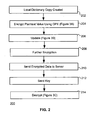
- Figure 2 shows a simplified flow diagram illustrating steps of a process 200 according to an embodiment.
- Figure 1 shows a client-server architecture 100, wherein data store 102 and order preserving dictionary 104 are present on the database server 106.
- a dictionary copy 108 comprising the plaintext values is created on the client 110 by an engine 111.
- plaintext x is encrypted utilizing the ideal security OPE according to an algorithm ENCRYPT.
- Figure 1 shows insertion of plaintext x 112 to the client, followed by encryption thereon using cryptographic keys 114 to create encrypted data y 116, stored as a dictionary copy. This encryption occurs according to the same order preserved by the dictionary copy. Details regarding a specific encryption algorithm are provided below in connection with Figure 3A .
- the order-preserving encryption scheme is mutable. Thus, it may be necessary to update all ciphertexts, as shown in 130 of Figure 1 and step 206 of Figure 2 .
- a second algorithm e.g. as shown in Figure 3B , re-encrypts the entire local dictionary.
- a second algorithm e.g. as shown in Figure 3B
- re-encrypts the entire local dictionary As discussed herein, however, owing to the inherent characteristics of data of average complexity, it is expected that such updates will infrequently be needed.
- Encryption to the topmost layer currently stored in the database is performed. Then, update commands are issued to replace all current dictionary values with their new ciphertexts.
- the ciphertext is encrypted further by the engine using a proxy-reencryptable deterministic (DET) encryption scheme.
- DET proxy-reencryptable deterministic
- RTD standard randomized
- AES Advanced Encryption Standard
- step 120 of Figure 1 and step 210 of Figure 2 the encrypted data is then sent by the engine to the server on which the database resides.
- each value is encrypted.
- encryption is performed at the SQL layer, and does not interfere with the dictionary of the in-memory, column-store database. Instead, a local copy is maintained at the client, and updates are performed using the SQL update command.
- the final ciphertext is sent as the data value in the insert or update commands to the database.
- a local copy of the dictionary is maintained on the client with the corresponding plaintext values.
- a separate copy may be sent in homomorphic encryption.
- SELECT operation requiring either deterministic (DET) or order-preserving encryption (OPE)
- the corresponding key is sent to the database which decrypts using a stored procedure (shown in Figure 3C ). That decryption is permanent, and not restored.
- embodiments readily allow the application of onion encryption (e.g. in multiple successive layers) on the client, and the database is often encrypted on higher layers than order-preserving encryption.
- Figure 3A shows the encryption of plaintext x i in the order preserved by the dictionary (x - 1 to x N ) to produce corresponding ciphertext y i whose order is preserved - i.e. ( y -1 to y M )
- the encryption algorithm of Figure 3A also shows an update (step 3.2), which involves the steps in the Algorithm 2 illustrated Figure 3B .
- step 3.2 Given the tendency of the height of a random binary search tree to be tightly centered around O(log n), with n being a number of elements in a database, it is expected that the need for such a computationally intensive update step in cases of average complexity data, will be infrequent.
- Figure 4A is a simplified schematic view illustrating ideal-security order-preserving encryption according to an embodiment.
- Figure 4A shows the efficient processing of the plaintext (in the same order preserved by the existing dictionary), resulting in the corresponding ciphertext representing a mean (i.e., an even distribution of points along the Y-axis).
- Figure 4B is a simplified schematic view illustrating a conventional approach to implementing order-preserving encryption.
- the conventional encryption scheme of Figure 4B would be expected to result in the corresponding ciphertext representing a randomly chosen value (i.e. an uneven distribution of points along the Y-axis).
- the inefficiency cost incurred by such a conventional approach renders it impractical to implement the ideal-security OPE achievable according to embodiments as described herein.
- x 1 , ... , x i , ... , x n be the sequence of plaintexts inserted, such that 0 ⁇ x i ⁇ N.
- y 1 , ... , y i , ... , y n be the corresponding ciphertexts, such that 0 ⁇ y i ⁇ M.
- M A description of how to choose M is provided later below.
- the ciphertexts y i may be modified during the process of encryption.
- x j 1 , ... , x j m and y j 1 ,..., y j m be the ordered sequence of distinct plaintexts and ciphertexts, respectively.
- the input to the encryption algorithm is a plaintext x i .
- Encryption is stateful and stores an ordered list of plaintext-ciphertext pairs ⁇ x i , y i ⁇ . This list is initialized to ⁇ -1, -1 ⁇ , ⁇ N, M ⁇ .
- the output of the encryption i.e. the ciphertext y i , is sent to the database server.
- the update algorithm (Algorithm 2 of Figure 3B ) potentially updates all ciphertexts produced so far. It re-encrypts all (distinct) plaintexts in order, i.e. the median element first and so on. Thus, it produces a (temporarily) balanced tree.
- the state of the encryption algorithm is updated on the database client. This updated state is sent to the database server and its persistent data is updated - potentially all database rows. This affects not only the column store, but also the entire dictionary.
- the decryption algorithm (Algorithm 3 of Figure 3C ) is simple lookup in the state.
- the following security game is defined between an encryptor E and an adversary Adv based on the IND-OCPA definition allowing for update operations.
- Let win Adv be the random variable indicating the success of the adversary in the above game.
- Theorem 2 the OPE scheme according to embodiments is (perfectly) IND-OCPA secure.
- Lemma 3 if the sequences of x 1 b , have the same order relation, the state of the encryption will contain the same y j 1 ,... independent of b.
- Step 2 is a check within one of the two sequences x 1 b , and since they have the same order relation, the condition will evaluate the same in both cases. Then, due to the induction assumption the return value y j k will be the same independent of b.
- Updates are triggered in step 3 of Algorithm 1. Clearly, the choice is only made by the values of y j k , y j k +1 . Due to the induction assumption the choice is therefore independent of b.
- the encryption algorithm outputs the same values y i and performs the same update operations in both cases of b. Therefore, any adversary Adv can at best guess the value b' .
- Insertion order is now discussed. As shown the OPE scheme is ideal secure, but it does leak additional information to the order. Namely, when observing the encryption at the database, i.e. the values y i , one can determine a partial order of insertion. Encryption schemes according to embodiments form a binary search tree. The lowest bit set in the ciphertext marks the height in tree (if M is a power of 2). The lower the height, the later the element has been inserted. Of course, the adversary cannot determine the insertion order between elements of the same height. Therefore it remains a partial order.
- the IND-OCPA definition cannot account for the insertion order, since - as in any other chosen plaintext attack - the adversary controls this insertion order. It is therefore known to the adversary. Hence, it is not surprising that embodiments still can fulfill this strict security definition.
- a cost model for the algorithms is defined. Local operations on the client can be implemented efficiently - even for large plaintext sets -, since there are no complex (cryptographic) computations (such as modular exponentiations or bilinear maps). Instead all computations are simple arithmetic and simple data structure lookups. As discussed above, update operations on the database are costly. Therefore, the cost of inserting one element into the database is mainly considered. Since delay in communication is the main cost, the number of rounds of interaction between the database server and the client is counted as the cost of one insertion.
- cost O (1) that is, Algorithm 1 has cost O (1) if steps 3.1 to 3.4 are not executed.
- a single update operation has cost O ( n ), since all elements so far are to be updated: that is, Algorithm 2 has cost O ( n ). Probability of an update is now determined in the best case, average case, and worst case.
- Theorem 4 in the best case algorithm embodiments incur cost O ( n ) in communication with the database server. This is also the theoretical lower bound.
- the worst case is also easy to analyze.
- Theorem 5 in the worst case algorithm embodiments incur cost O ( n 2 / log n ) in communication with the database server.
- Theorem 6 if the ciphertext domain M > 2 ⁇ N , then in the average case under uniform input distribution our algorithms incur cost O ( n ) in communication with the database server.
- the height of a random binary search tree is tightly centered around O (log n ).
- the ciphertexts are from a binary search tree.
- the first plaintext element inserted is the root
- Lemma 8 let X n,h be the (random) set of nodes at depth h. Then, there is a (universal) constant C 2 > 2 such that, for i > 0, we have Pr [ X n,E [ H n ]+ i ⁇ 0 ⁇ ] ⁇ C 2 2 i/2 .
- Fig. 5 illustrates hardware of a special purpose computing machine configured to implement encryption according to an embodiment.
- computer system 501 comprises a processor 502 that is in electronic communication with a non-transitory computer-readable storage medium 503.
- This computer-readable storage medium has stored thereon code 504 corresponding to a dictionary copy.
- Code 505 corresponds to an engine.
- Code may be configured to reference data stored in a database of a non-transitory computer-readable storage medium, for example as may be present locally or in a remote database server.
- Software servers together may form a cluster or logical network of computer systems programmed with software programs that communicate with each other and work together in order to process requests.
- Computer system 610 includes a bus 605 or other communication mechanism for communicating information, and a processor 601 coupled with bus 605 for processing information.
- Computer system 610 also includes a memory 602 coupled to bus 405 for storing information and instructions to be executed by processor 601, including information and instructions for performing the techniques described above, for example.
- This memory may also be used for storing variables or other intermediate information during execution of instructions to be executed by processor 601. Possible implementations of this memory may be, but are not limited to, random access memory (RAM), read only memory (ROM), or both.
- a storage device 603 is also provided for storing information and instructions.
- Storage devices include, for example, a hard drive, a magnetic disk, an optical disk, a CD-ROM, a DVD, a flash memory, a USB memory card, or any other medium from which a computer can read.
- Storage device 603 may include source code, binary code, or software files for performing the techniques above, for example.
- Storage device and memory are both examples of computer readable mediums.
- Computer system 610 may be coupled via bus 605 to a display 612, such as a cathode ray tube (CRT) or liquid crystal display (LCD), for displaying information to a computer user.
- a display 612 such as a cathode ray tube (CRT) or liquid crystal display (LCD)
- An input device 611 such as a keyboard and/or mouse is coupled to bus 605 for communicating information and command selections from the user to processor 601. The combination of these components allows the user to communicate with the system.
- bus 605 may be divided into multiple specialized buses.
- Computer system 610 also includes a network interface 604 coupled with bus 605.
- Network interface 604 may provide two-way data communication between computer system 610 and the local network 620.
- the network interface 604 may be a digital subscriber line (DSL) or a modem to provide data communication connection over a telephone line, for example.
- DSL digital subscriber line
- Another example of the network interface is a local area network (LAN) card to provide a data communication connection to a compatible LAN.
- LAN local area network
- Wireless links are another example.
- network interface 604 sends and receives electrical, electromagnetic, or optical signals that carry digital data streams representing various types of information.
- Computer system 610 can send and receive information, including messages or other interface actions, through the network interface 604 across a local network 620, an Intranet, or the Internet 630.
- computer system 610 may communicate with a plurality of other computer machines, such as server 615.
- server 615 may form a cloud computing network, which may be programmed with processes described herein.
- software components or services may reside on multiple different computer systems 610 or servers 631-635 across the network.
- the processes described above may be implemented on one or more servers, for example.
- a server 631 may transmit actions or messages from one component, through Internet 630, local network 620, and network interface 604 to a component on computer system 610.
- the software components and processes described above may be implemented on any computer system and send and/or receive information across a network, for example.
Landscapes
- Engineering & Computer Science (AREA)
- Computer Security & Cryptography (AREA)
- Computer Networks & Wireless Communication (AREA)
- Signal Processing (AREA)
- Theoretical Computer Science (AREA)
- Computer Hardware Design (AREA)
- General Engineering & Computer Science (AREA)
- Health & Medical Sciences (AREA)
- Databases & Information Systems (AREA)
- Bioethics (AREA)
- General Health & Medical Sciences (AREA)
- Software Systems (AREA)
- Physics & Mathematics (AREA)
- General Physics & Mathematics (AREA)
- Computing Systems (AREA)
- Information Retrieval, Db Structures And Fs Structures Therefor (AREA)
- Storage Device Security (AREA)
Abstract
Description
- Embodiments relate to encryption, and in particular, to encryption that allows the processing of data in encrypted form.
- Unless otherwise indicated herein, the approaches described in this section are not prior art to the claims in this application and are not admitted to be prior art by inclusion in this section.
- Order-preserving encryption (OPE) allows many queries (including range queries) to be performed on encrypted data, without requiring modification of the database engine. Such queries may be practical in terms of performance, offering for example, the ability to perform searching of encrypted data present on the cloud.
- A number of order-preserving encryption schemes have previously been proposed. Nevertheless, the security of these schemes remains under discussion.
- Intuitively, an ideal-security order-preserving encryption offers indistinguishability under ordered chosen plaintext attack (IND-OCPA) scheme, leaking nothing but the order. That is, the ideal encryption of plaintexts {7, 12, 19} is {1, 2, 3} i.e. exactly their order.
- However, such IND-OCPA encryption is difficult to achieve. For example, in the ideal order-preserving encryption above, the ciphertext of 13 and 19 conflict.
- The inability to design such an encryption scheme with linear-length ciphertexts, where the encryption scheme is static and stateless, has been demonstrated. Accordingly, some researchers settle for a weaker security notion (random order-preserving function). That security definition, however may leak at least half of the bits.
- Another approach modifies construction of the encryption scheme (calling it an encoding scheme). This approach assumes it is not possible to construct an encryption scheme, even if the encryption function can be stateful. This approach then settles for an interactive protocol which updates the encryption on inserts.
- While such an approach achieves the goal of ideal-security, it calls for updating the ciphertexts when inserting new values. Such updates are necessary, yet impose a high communication cost because any immutable encryption scheme must have exponential ciphertext size.
- Thus, there is a need for systems and methods providing novel approaches for order-preserving encryption.
- Embodiments provide ideal security, order-preserving encryption (OPE) of data of average complexity, thereby allowing processing of the encrypted data (e.g. at a database server in response to received queries). Particular embodiments achieve high encryption efficiency by processing plaintext in the order preserved by an existing compression dictionary already available to a database. Encryption is based upon use of a binary search tree of n nodes, to construct an order-preserving encryption scheme having Ω(n) complexity and even O(n), in the average case. A probability of computationally intensive updating (which renders conventional OPE impractical for ideal security) is substantially reduced by leveraging the demonstrated tendency of a height of the binary search tree to be tightly centered around O(log n). An embodiment utilizing such an encryption scheme is described in the context of a column-store, in-memory database architecture comprising n elements. OPE according to embodiments is compatible with adjustable encryption approaches.
- An embodiment of a computer-implemented method comprises causing an engine on a client, to create a dictionary copy preserving an order of data stored in a database on a server. The engine is caused to execute an algorithm encrypting the data on the dictionary copy according to the order, and caused to update the data stored in the database according to an update probability. The engine is caused to create further encrypted data from the encrypted data, to send the further encrypted data to the server, and to send a cryptographic key to allow decryption of the further encrypted data.
- An embodiment of a non-transitory computer readable storage medium embodies a computer program for performing a method comprising causing an engine on a client, to create a dictionary copy preserving an order of data stored in a database on a server. The engine is caused to execute an algorithm encrypting the data on the dictionary copy according to the order. The engine is caused to update the data stored in the database according to an update probability. The engine is caused to create further encrypted data from the encrypted data, to send the further encrypted data to the server, and to send a cryptographic key to allow decryption of the further encrypted data.
- An embodiment of a computer system comprises one or more processors and a software program executable on said computer system. The software program is configured to cause an engine on a client, to create a dictionary copy preserving an order of data stored in a database on a server. The software program is configured to cause the engine to execute an algorithm encrypting the data on the dictionary copy according to the order. The software program is configured to cause the engine to update the data stored in the database according to an update probability. The software program is further configured to cause the engine to create further encrypted data from the encrypted data, to cause the engine to send the further encrypted data to the server, and to cause the engine to send a cryptographic key to allow decryption of the further encrypted data.
- In certain embodiments the algorithm comprises constructing a binary search tree comprising n nodes.
- According to some embodiments the algorithm further comprises adding a buffer of at least 2 log n bits to the encrypted data to reduce the update probability.
- In various embodiments the further encrypted data is created using homomorphic encryption to allow aggregation on the database.
- In particular embodiments the further encrypted data is created using deterministic encryption to allow selection on the database.
- According to some embodiments the database is in the structured query language (SQL).
- In certain embodiments the database comprises a column-store in-memory database.
- The following detailed description and accompanying drawings provide a better understanding of the nature and advantages of various embodiments.
-
-
Figure 1 shows an architecture of client and database integration according to an embodiment. -
Figure 2 is a simplified flow diagram showing a process according to an embodiment. -
Figure 3A illustrates an encryption algorithm according to an embodiment. -
Figure 3B illustrates an update procedure referenced in the encryption algorithm ofFigure 3A . -
Figure 3C illustrates a decryption algorithm according to an embodiment. -
Figure 4A is a simplified schematic view illustrating ideal-security order-preserving encryption according to an embodiment. -
Figure 4B is a simplified schematic view illustrating conventional order-preserving encryption exhibiting less security. -
Figure 5 illustrates hardware of a special purpose computing machine configured to implement encryption according to an embodiment. -
Figure 6 illustrates an example of a computer system. - Described herein are techniques for providing encryption. In the following description, for purposes of explanation, numerous examples and specific details are set forth in order to provide a thorough understanding of the present invention. It will be evident, however, to one skilled in the art that the present invention as defined by the claims may include some or all of the features in these examples alone or in combination with other features described below, and may further include modifications and equivalents of the features and concepts described herein.
- As an initial matter, encryption according to various embodiments may be implemented as part of an encrypted, in-memory, column-store database. Thus, the characteristics of such a database structure are now introduced.
- Column-store databases exhibit good performance for analytical workloads. To achieve this, they store the data column-wise, instead of row-wise. All data for a certain column can thus be accessed and processed quickly.
- Moreover, the speed of processing can be enhanced further if the data is stored in main memory. A variety of such in-memory database architectures are available, including but not limited to: the HANA database available from SAP AG of Walldorf, Germany; the SYBASE IQ database also available from SAP AG; the Microsoft Embedded SQL for C (ESQL/C) database available from Microsoft Corp. of Redmond, Washington; and the Exalytics In-Memory database available from Oracle Corp. of Redwood Shores, California.
- In-memory, column-store databases process the entire column of data for operations, such as a selection. Hence, the speed of transferring data from the main memory to the CPU may comprise a bottleneck.
- One optimization to improve speed, is to compress the data. This can significantly improve the processing performance.
- A common compression technique is order-preserving dictionary compression. In dictionary compression, data values are replaced by data identifiers. Their relation is stored in a dictionary.
- The following shows one example of a dictionary for currency values.
DATA IDENTIFIER DATA VALUE (in $) 1 0.99 2 1.54 3 9.23 - A dictionary is order-preserving, if the order relation of the data identifiers is the same as the order relation of the data values. Order-preserving dictionaries offer the benefit that select operations (even for range queries) can be performed without accessing the dictionary. The database operator is fed with the data identifier (or data identifiers for range queries) to select and can then process the column.
- However, a SELECT operation that needs to access the dictionary can be costly. This is also true for update or insert operations which may often need to recompute the entire column of data (possibly also implicating further compression operations).
- According to embodiments, OPE may recognize that the order-preserving dictionary of a column-store in-memory database, can also offer an ideal-secure order-preserving encryption. In particular, given that the in-memory database already performs this dictionary operation automatically (although not as encryption operation), embodiments may leverage this activity in designing an encrypted database that integrates with the existing dictionary.
- One conventional approach to achieving this goal, could be to strip the dictionary of the data values, and keeping those at the client instead. This achieves ideal-security for the order-preserving encryption, since the database only learns the data identifiers. However, this undesirably prevents operations from occurring at the server (e.g. on the cloud in a Data-as-a-Service DaaS configuration) that would require access to the data values (such the aggregation operation commonly used in analytical workloads).
- An alternative conventional approach could be to encrypt the data values in the dictionary. This alternative conventional approach also achieves ideal-security on the database. But, it imparts O(n log n) cost for inserting n number of database elements. This is because each element needs to be sorted into the dictionary.
- A disadvantage shared by both of these conventional approaches, is that the database needs to be encrypted in OPE.
- Under the concept of adjustable encryption, encryption may be layered from order-preserving on the innermost layer, over deterministic encryption to randomized encryption on the outermost layer. In such adjustable encryption schemes, depending on the operation performed one or more layers of encryption may be removed before executing the operator. This results in significantly better security, since only a subset of columns needs to be encrypted order-preserving.
- According to embodiments, ideal security, order-preserving encryption (OPE) of data of average complexity is provided, thereby allowing processing of the encrypted data (e.g. at a database server in response to received queries). Particular embodiments achieve high encryption efficiency by processing plaintext in the order preserved by an existing compression dictionary already available to a database. Encryption is based upon use of a binary search tree of n nodes, to construct an order-preserving encryption scheme having Ω(n) complexity and even O(n), in the average case. A probability of computationally intensive updating (which renders conventional OPE impractical for ideal security) is substantially reduced by leveraging the demonstrated tendency of a height of the binary search tree to be tightly centered around O(log n). An embodiment utilizing such an encryption scheme is described in the context of a column-store, in-memory database architecture comprising n elements. OPE according to embodiments is compatible with adjustable encryption approaches.
- Embodiments of OPE schemes as described herein, may smoothly integrate with adjustable encryption approaches mentioned above. Thus, the order-preserving encryption may typically be the innermost layer of an onion of encryption.
- Embodiments may thus result in encryption being performed (mostly) at the client. This is because since other layers of encryption may be applied.
- A specific OPE encryption scheme according to particular embodiments, is now described in connection with
Figures 1 and2 . In particular,Figure 1 shows an embodiment of architecture 100 of client and database integration.Figure 2 shows a simplified flow diagram illustrating steps of aprocess 200 according to an embodiment. -
Figure 1 shows a client-server architecture 100, whereindata store 102 andorder preserving dictionary 104 are present on thedatabase server 106. In afirst step 202, adictionary copy 108 comprising the plaintext values is created on theclient 110 by anengine 111. - In a
second step 204, plaintext x is encrypted utilizing the ideal security OPE according to an algorithm ENCRYPT. In particular,Figure 1 shows insertion of plaintext x 112 to the client, followed by encryption thereon usingcryptographic keys 114 to create encrypted data y 116, stored as a dictionary copy. This encryption occurs according to the same order preserved by the dictionary copy. Details regarding a specific encryption algorithm are provided below in connection withFigure 3A . - The order-preserving encryption scheme according to embodiments is mutable. Thus, it may be necessary to update all ciphertexts, as shown in 130 of
Figure 1 and step 206 ofFigure 2 . In the event that the encryption algorithm triggers such an update, a second algorithm (e.g. as shown inFigure 3B ), re-encrypts the entire local dictionary. As discussed herein, however, owing to the inherent characteristics of data of average complexity, it is expected that such updates will infrequently be needed. - Encryption to the topmost layer currently stored in the database, is performed. Then, update commands are issued to replace all current dictionary values with their new ciphertexts.
- As such an update operation may be costly, its occurrence is desired to be kept to a minimum. A detailed discussion of achieving this goal, both theoretically and practically, is provided later below in connection with performance evaluation.
- In
step 208, the ciphertext is encrypted further by the engine using a proxy-reencryptable deterministic (DET) encryption scheme. Finally, this ciphertext is encrypted using a standard randomized (RND) encryption algorithm. One example can be the Advanced Encryption Standard (AES) in counter mode. - As shown in
step 120 ofFigure 1 and step 210 ofFigure 2 , the encrypted data is then sent by the engine to the server on which the database resides. Thus before inserting (or updating) a database row, each value is encrypted. - For database integration, encryption is performed at the SQL layer, and does not interfere with the dictionary of the in-memory, column-store database. Instead, a local copy is maintained at the client, and updates are performed using the SQL update command.
- The final ciphertext is sent as the data value in the insert or update commands to the database. A local copy of the dictionary is maintained on the client with the corresponding plaintext values.
- A separate copy may be sent in homomorphic encryption. With a SELECT operation requiring either deterministic (DET) or order-preserving encryption (OPE), in
step 212 the corresponding key is sent to the database which decrypts using a stored procedure (shown inFigure 3C ). That decryption is permanent, and not restored. - The overall design shown in
Figure 1 allows operating the encrypted database on the SQL layer. That is, the dictionary on the server is not interfered with. Instead, the data values are modified on the client, and standard SQL commands are used. - Furthermore, embodiments readily allow the application of onion encryption (e.g. in multiple successive layers) on the client, and the database is often encrypted on higher layers than order-preserving encryption.
- A specific OPE encryption algorithm is now illustrated in connection with
Figure 3A , and discussed in detail later below.Figure 3A shows the encryption of plaintext xi in the order preserved by the dictionary (x-1 to xN ) to produce corresponding ciphertext yi whose order is preserved - i.e. (y-1 to yM ) - The encryption algorithm of
Figure 3A also shows an update (step 3.2), which involves the steps in theAlgorithm 2 illustratedFigure 3B . Given the tendency of the height of a random binary search tree to be tightly centered around O(log n), with n being a number of elements in a database, it is expected that the need for such a computationally intensive update step in cases of average complexity data, will be infrequent. -
Figure 4A is a simplified schematic view illustrating ideal-security order-preserving encryption according to an embodiment.Figure 4A shows the efficient processing of the plaintext (in the same order preserved by the existing dictionary), resulting in the corresponding ciphertext representing a mean (i.e., an even distribution of points along the Y-axis). - By contrast,
Figure 4B is a simplified schematic view illustrating a conventional approach to implementing order-preserving encryption. By processing the plaintext according to a mean (rather than in order), the conventional encryption scheme ofFigure 4B would be expected to result in the corresponding ciphertext representing a randomly chosen value (i.e. an uneven distribution of points along the Y-axis). The inefficiency cost incurred by such a conventional approach, renders it impractical to implement the ideal-security OPE achievable according to embodiments as described herein. - An example is now present in connection with a specific encryption, update, and decryption algorithms presented in
Figures 3A-3B . - Let x 1 , ... , xi, ... , xn be the sequence of plaintexts inserted, such that 0 ≤ xi < N. Let y 1, ... , yi, ... , yn be the corresponding ciphertexts, such that 0 ≤ yi < M. A description of how to choose M is provided later below. Note the ciphertexts yi may be modified during the process of encryption. Let x j
1 , ... , x jm and y j1 ,..., yjm be the ordered sequence of distinct plaintexts and ciphertexts, respectively. - Consider the following example: N = 16 and M = 256. Let n = 3, x 1 = 13, x 2 = 5 and x 3 = 7. Then m = 3, y 1 = 128, y 2 = 64 and y 3 = 96 (without necessity for any ciphertext modification). For the ordered sequence we have j 1 = 2, j 2 = 3 and j 3 = 1, i.e., x j
1 =5, y j1 = 64, and so on. - The input to the encryption algorithm (
Algorithm 1 ofFigure 3A ) is a plaintext x i. Encryption is stateful and stores an ordered list of plaintext-ciphertext pairs 〈xi , yi〉. This list is initialized to 〈-1, -1〉, 〈N, M〉. The output of the encryption, i.e. the ciphertext yi , is sent to the database server. - The update algorithm (
Algorithm 2 ofFigure 3B ) potentially updates all ciphertexts produced so far. It re-encrypts all (distinct) plaintexts in order, i.e. the median element first and so on. Thus, it produces a (temporarily) balanced tree. - The state of the encryption algorithm is updated on the database client. This updated state is sent to the database server and its persistent data is updated - potentially all database rows. This affects not only the column store, but also the entire dictionary.
- The decryption algorithm (
Algorithm 3 ofFigure 3C ) is simple lookup in the state. - Security, and in particular the idea security achieved according to embodiments, is now discussed. Proof of the IND-OCPA secure status of the encryption scheme, despite its update algorithm, is now provided. This implies the update operation does not impact security.
- Specifically, the following security game is defined between an encryptor E and an adversary Adv based on the IND-OCPA definition allowing for update operations.
- 1) The encryptor E chooses a random bit b.
- 2) The encryptor E and the adversary Adv engage in a polynomial number of rounds in which the adversary may be adaptive. At round i:
- a) The adversary Adv sends values

- b) The encryptor E returns

1 , ..., xji ), then the adversary may observe the updated list y j1 , ... , y ji .
- a) The adversary Adv sends values
- 3) The adversary Adv outputs b', its guess for b.
- The adversary Adv wins the game if its guess is correct (b = b') and the sequences


- Definition 1: an OPE scheme is (perfectly) IND-OCPA secure if for all p.p.t. adversaries Adv Pr[winAdv ] = 1/2.
- Theorem 2: the OPE scheme according to embodiments is (perfectly) IND-OCPA secure.
- Proof: observe that the encryption algorithm (
Algorithm 1 ofFigure 3A ) will start with the same initial state independent of b. The following lemma is now stated. - Lemma 3: if the sequences of

1 ,... independent of b. - Proof: this is proven by induction. Assume it holds for round i. Then since the sequences have the same order relation, the algorithm will find pairs with the same yj
k , y jk+1 instep 1 due to the induction assumption. -
Step 2 is a check within one of the two sequences
k will be the same independent of b. - Updates are triggered in
step 3 ofAlgorithm 1. Clearly, the choice is only made by the values of yjk , y jk+1 . Due to the induction assumption the choice is therefore independent of b. - Then the computation also leads to same y i in step 4. The state is therefore updated with an xi of the same order relation and the same y i. Hence, the induction holds for i + 1.
- Clearly,
Lemma 3 holds for i = 0, since it starts with the same initial state. - In summary, the encryption algorithm outputs the same values y i and performs the same update operations in both cases of b. Therefore, any adversary Adv can at best guess the value b'.
- Insertion order is now discussed. As shown the OPE scheme is ideal secure, but it does leak additional information to the order. Namely, when observing the encryption at the database, i.e. the values y i, one can determine a partial order of insertion. Encryption schemes according to embodiments form a binary search tree. The lowest bit set in the ciphertext marks the height in tree (if M is a power of 2). The lower the height, the later the element has been inserted. Of course, the adversary cannot determine the insertion order between elements of the same height. Therefore it remains a partial order.
- First, this leakage is not considered to be problematic in the use with encrypted databases. Determining the time of compromise in an encrypted database is excruciatingly difficult and therefore the worst-case that the database is always compromised is assumed. Under this worst-case assumption, the adversary obtains the insertion order anyway - even in case of a same-time indistinguishability definition.
- Second, the IND-OCPA definition cannot account for the insertion order, since - as in any other chosen plaintext attack - the adversary controls this insertion order. It is therefore known to the adversary. Hence, it is not surprising that embodiments still can fulfill this strict security definition.
- Domain coverage is now discussed. The security of order preserving encryption relies on the assumption that the plaintext values only sparsely populate their domain. If all values in a domain are encrypted, order-preserving encryption is completely insecure - even if ideal secure. The ideal secure order-preserving encryption of the values from 1 to n is 1 to n, i.e. plaintexts and ciphertexts are identical. While not yet quantified, this observation may be kept in mind when using order-preserving encryption.
- Clearly, this assumption is violated when encrypting auto-increment counters. The order-preserving encryption of an auto-increment counter - often used as identifiers and foreign keys in databases - is the counter itself. It therefore should not be order-preserving encrypted at all.
- This also alleviates the problem that auto-increment counters incur the maximum encryption cost according to embodiments. They result in the maximum number of update operations possible, since they follow the worst-case schedule of encryptions. Yet, since they are not to be encrypted at all (for security reasons), they do not represent a problem (for performance reasons.
- Performance is now discussed. A theoretical analysis considers the best case, the average case and the worst case complexity of an algorithm according to an embodiment. For the average case, a uniform distribution of the input is assumed.
- First, a cost model for the algorithms is defined. Local operations on the client can be implemented efficiently - even for large plaintext sets -, since there are no complex (cryptographic) computations (such as modular exponentiations or bilinear maps). Instead all computations are simple arithmetic and simple data structure lookups. As discussed above, update operations on the database are costly. Therefore, the cost of inserting one element into the database is mainly considered. Since delay in communication is the main cost, the number of rounds of interaction between the database server and the client is counted as the cost of one insertion.
- Second, the complexity of the basic algorithms is determined. If encryption proceeds without update, then only the new ciphertext is needed to be sent to the database: cost O(1): that is,
Algorithm 1 has cost O(1) if steps 3.1 to 3.4 are not executed. A single update operation has cost O(n), since all elements so far are to be updated: that is,Algorithm 2 has cost O(n). Probability of an update is now determined in the best case, average case, and worst case. - Theorem 4: in the best case algorithm embodiments incur cost O(n) in communication with the database server. This is also the theoretical lower bound.
- Proof: the best case is when all elements of a perfectly balanced binary search tree are inserted in pre-order traversal. In this best case, no update is ever needed, since the result is also a perfectly balanced binary search tree. Hence, for n elements cost nO(1) = O(n). This is also the lower bound, because each of the n elements is sent at least once.
- The worst case is also easy to analyze.
- Theorem 5: in the worst case algorithm embodiments incur cost O(n 2/ log n) in communication with the database server.
- Proof: as already pointed out above, the worst case adversarial schedule of plaintext inputs results in an update operation roughly all O(log M) elements. As shown later below, M = O(n) is chosen such that M > 2N. That is, there is always at least log N ciphertext space to be filled before an update operation. Therefore the worst case cost is:

- Theorem 6: if the ciphertext domain M > 2λ N, then in the average case under uniform input distribution our algorithms incur cost O(n) in communication with the database server.
- Proof: for analyzing the average case complexity, it is again noted that the height of a random binary search tree is tightly centered around O(log n). According to embodiments, the ciphertexts are from a binary search tree. The first plaintext element inserted is the root
- (the center ciphertext). Subsequent plaintext are placed to the left or right depending on their order relation.
- Theorem 7: let Hn be the height of a random binary search tree of n nodes. Then, E[Hn ] = 4.31107 · · · ln n - 1, 95302 · · · ln ln n + O(1) and Var[Hn ] = O(1).
- Note that the maximum length of a ciphertext directly corresponds to the height of the tree. This implies for encryption schemes according to embodiments, on average a ciphertext space O(log n) will be sufficient. Furthermore, since the variance is constant, it will be sufficient with high probability.
- Accordingly, embodiments use a value of M = O(n). Furthermore, the probability Pr[Upd] is reduced. The average complexity for all insertions is n(1 + Pr[Upd]O(n)). For Pr[Upd] ≤ O(1/n), O(n) overall average complexity is achieved.
- Lemma 8: let Xn,h be the (random) set of nodes at depth h. Then, there is a (universal) constant C 2 > 2 such that, for i > 0, we have Pr[X n,E[H
n ]+i ≠0̸] <C 22i/2. - This means that the probability of encountering a ciphertext with length longer than the expected value, decreases exponentially with the length of the ciphertext. Hence, if a buffer of at least 2 log n bits is added to the ciphertext length, then the probability of exceeding that buffer is at most O(1/n). This accomplishes the probability of an update Pr[Upd]≤ O(1/n).
- In summary, for a plaintext space of N = 2 l , a ciphertext space of λl bits, i.e. M = 2λl is recommended. The expected average case complexity of inserting n elements is then O(n). Clearly, λ ≥ 4.31107 + 2, but the choice of λ can also be evaluated in experiments.
-
Fig. 5 illustrates hardware of a special purpose computing machine configured to implement encryption according to an embodiment. In particular,computer system 501 comprises aprocessor 502 that is in electronic communication with a non-transitory computer-readable storage medium 503. This computer-readable storage medium has stored thereoncode 504 corresponding to a dictionary copy.Code 505 corresponds to an engine. Code may be configured to reference data stored in a database of a non-transitory computer-readable storage medium, for example as may be present locally or in a remote database server. Software servers together may form a cluster or logical network of computer systems programmed with software programs that communicate with each other and work together in order to process requests. - An
example system 600 for implementing encryption, is illustrated inFig. 6 .Computer system 610 includes abus 605 or other communication mechanism for communicating information, and aprocessor 601 coupled withbus 605 for processing information.Computer system 610 also includes amemory 602 coupled to bus 405 for storing information and instructions to be executed byprocessor 601, including information and instructions for performing the techniques described above, for example. This memory may also be used for storing variables or other intermediate information during execution of instructions to be executed byprocessor 601. Possible implementations of this memory may be, but are not limited to, random access memory (RAM), read only memory (ROM), or both. Astorage device 603 is also provided for storing information and instructions. Common forms of storage devices include, for example, a hard drive, a magnetic disk, an optical disk, a CD-ROM, a DVD, a flash memory, a USB memory card, or any other medium from which a computer can read.Storage device 603 may include source code, binary code, or software files for performing the techniques above, for example. Storage device and memory are both examples of computer readable mediums. -
Computer system 610 may be coupled viabus 605 to adisplay 612, such as a cathode ray tube (CRT) or liquid crystal display (LCD), for displaying information to a computer user. Aninput device 611 such as a keyboard and/or mouse is coupled tobus 605 for communicating information and command selections from the user toprocessor 601. The combination of these components allows the user to communicate with the system. In some systems,bus 605 may be divided into multiple specialized buses. -
Computer system 610 also includes anetwork interface 604 coupled withbus 605.Network interface 604 may provide two-way data communication betweencomputer system 610 and thelocal network 620. Thenetwork interface 604 may be a digital subscriber line (DSL) or a modem to provide data communication connection over a telephone line, for example. Another example of the network interface is a local area network (LAN) card to provide a data communication connection to a compatible LAN. Wireless links are another example. In any such implementation,network interface 604 sends and receives electrical, electromagnetic, or optical signals that carry digital data streams representing various types of information. -
Computer system 610 can send and receive information, including messages or other interface actions, through thenetwork interface 604 across alocal network 620, an Intranet, or theInternet 630. For a local network,computer system 610 may communicate with a plurality of other computer machines, such asserver 615. Accordingly,computer system 610 and server computer systems represented byserver 615 may form a cloud computing network, which may be programmed with processes described herein. In the Internet example, software components or services may reside on multipledifferent computer systems 610 or servers 631-635 across the network. The processes described above may be implemented on one or more servers, for example. Aserver 631 may transmit actions or messages from one component, throughInternet 630,local network 620, andnetwork interface 604 to a component oncomputer system 610. The software components and processes described above may be implemented on any computer system and send and/or receive information across a network, for example. - The above description illustrates various embodiments along with examples of how aspects of the present invention may be implemented. The above examples and embodiments should not be deemed to be the only embodiments, and are presented to illustrate the flexibility and advantages of the present invention as defined by the following claims. Based on the above disclosure and the following claims, other arrangements, embodiments, implementations and equivalents will be evident to those skilled in the art and may be employed without departing from the spirit and scope of the invention as defined by the claims.
Claims (14)
- A computer-implemented method comprising:causing an engine on a client, to create a dictionary copy preserving an order of data stored in a database on a server;causing the engine to execute an algorithm encrypting the data on the dictionary copy according to the order;causing the engine to update the data stored in the database according to an update probability;causing the engine to create further encrypted data from the encrypted data;causing the engine to send the further encrypted data to the server; andcausing the engine to send a cryptographic key to allow decryption of the further encrypted data.
- The computer-implemented method of claim 1 wherein the algorithm comprises constructing a binary search tree comprising n nodes.
- The computer-implemented method of claim 2 wherein the algorithm further comprises adding a buffer of at least 2 log n bits to the encrypted data to reduce the update probability.
- The computer-implemented method of any one of the preceding claims wherein the further encrypted data is created using homomorphic encryption to allow aggregation on the database.
- The computer-implemented method of any one of the preceding claims wherein the further encrypted data is created using deterministic encryption to allow selection on the database.
- The computer-implemented method of any one of the preceding claims wherein the database is in the structured query language (SQL).
- The computer-implemented method of any one of the preceding claims wherein the database comprises a column-store in-memory database.
- A non-transitory computer readable storage medium embodying a computer program for performing a method according to any one of claims 1 to 7.
- A computer system comprising:one or more processors;a software program, executable on said computer system, the software program configured to:cause an engine on a client, to create a dictionary copy preserving an order of data stored in a database on a server;cause the engine to execute an algorithm encrypting the data on the dictionary copy according to the order;cause the engine to update the data stored in the database according to an update probability;cause the engine to create further encrypted data from the encrypted data;cause the engine to send the further encrypted data to the server; andcause the engine to send a cryptographic key to allow decryption of the further encrypted data.
- A computer system as in claim 9 wherein the algorithm comprises constructing a binary search tree comprising n nodes.
- A computer system as in claim 10 wherein the algorithm further comprises adding a buffer of at least 2 log n bits to the encrypted data to reduce the update probability.
- A computer system as in any one of claims 9 to 11 wherein the further encrypted data is created using homomorphic encryption to allow aggregation on the database.
- A computer system as in any one of claims 9 to 12 wherein the further encrypted data is created using deterministic encryption to allow selection on the database.
- A computer system as in any one of claims 9 to 13 wherein the database comprises a column-store in-memory database.
Applications Claiming Priority (1)
| Application Number | Priority Date | Filing Date | Title |
|---|---|---|---|
| US14/088,123 US9037860B1 (en) | 2013-11-22 | 2013-11-22 | Average-complexity ideal-security order-preserving encryption |
Publications (2)
| Publication Number | Publication Date |
|---|---|
| EP2876838A1 true EP2876838A1 (en) | 2015-05-27 |
| EP2876838B1 EP2876838B1 (en) | 2018-03-14 |
Family
ID=51625768
Family Applications (1)
| Application Number | Title | Priority Date | Filing Date |
|---|---|---|---|
| EP14003273.1A Active EP2876838B1 (en) | 2013-11-22 | 2014-09-22 | Average-complexity ideal-security order-preserving encryption |
Country Status (3)
| Country | Link |
|---|---|
| US (1) | US9037860B1 (en) |
| EP (1) | EP2876838B1 (en) |
| CN (1) | CN104657673B (en) |
Cited By (1)
| Publication number | Priority date | Publication date | Assignee | Title |
|---|---|---|---|---|
| EP3151461A1 (en) * | 2015-10-01 | 2017-04-05 | Sap Se | Frequency-hiding order-preserving encryption |
Families Citing this family (25)
| Publication number | Priority date | Publication date | Assignee | Title |
|---|---|---|---|---|
| KR102219476B1 (en) * | 2014-05-14 | 2021-02-24 | 삼성전자주식회사 | A method for performing encryption of data and an apparatus therefor |
| US9825758B2 (en) | 2014-12-02 | 2017-11-21 | Microsoft Technology Licensing, Llc | Secure computer evaluation of k-nearest neighbor models |
| US9787647B2 (en) * | 2014-12-02 | 2017-10-10 | Microsoft Technology Licensing, Llc | Secure computer evaluation of decision trees |
| US9553721B2 (en) * | 2015-01-30 | 2017-01-24 | Qualcomm Incorporated | Secure execution environment communication |
| US9608809B1 (en) | 2015-02-05 | 2017-03-28 | Ionic Security Inc. | Systems and methods for encryption and provision of information security using platform services |
| US9830470B2 (en) | 2015-10-09 | 2017-11-28 | Sap Se | Encrypting data for analytical web applications |
| EP3384424A4 (en) * | 2015-12-03 | 2019-07-24 | Unbound Tech Ltd | Securing sql based databases with cryptographic protocols |
| CN105610793B (en) * | 2015-12-18 | 2018-10-26 | 江苏大学 | A kind of outsourcing data encryption storage and cryptogram search system and its application process |
| US10740474B1 (en) | 2015-12-28 | 2020-08-11 | Ionic Security Inc. | Systems and methods for generation of secure indexes for cryptographically-secure queries |
| US10503730B1 (en) | 2015-12-28 | 2019-12-10 | Ionic Security Inc. | Systems and methods for cryptographically-secure queries using filters generated by multiple parties |
| US10255454B2 (en) * | 2016-02-17 | 2019-04-09 | Microsoft Technology Licensing, Llc | Controlling security in relational databases |
| US10360390B2 (en) * | 2016-12-14 | 2019-07-23 | Sap Se | Oblivious order-preserving encryption |
| US10580225B2 (en) * | 2017-03-31 | 2020-03-03 | Toyota Motor Engineering & Manufacturing North America, Inc. | Privacy-aware signal monitoring systems and methods |
| US10476662B2 (en) | 2017-04-10 | 2019-11-12 | City University Of Hong Kong | Method for operating a distributed key-value store |
| CN107292192A (en) * | 2017-05-25 | 2017-10-24 | 南京邮电大学 | The Order Preserving Encryption Method of low regulation in a kind of cloud computing environment |
| US10601580B2 (en) * | 2017-11-20 | 2020-03-24 | International Business Machines Corporation | Secure order preserving string compression |
| CN109840420B (en) * | 2017-11-24 | 2023-07-04 | 广东亿迅科技有限公司 | Data analysis processing method and device based on memory encryption and decryption |
| US10885216B2 (en) * | 2018-01-18 | 2021-01-05 | Sap Se | Secure substring search to filter encrypted data |
| US11042650B2 (en) * | 2018-12-06 | 2021-06-22 | International Business Machines Corporation | Sargable query-predicate evaluation for encrypted databases |
| US10746567B1 (en) | 2019-03-22 | 2020-08-18 | Sap Se | Privacy preserving smart metering |
| US11048816B2 (en) * | 2019-04-02 | 2021-06-29 | Sap Se | Secure database utilizing dictionary encoding |
| US11251936B2 (en) * | 2019-11-07 | 2022-02-15 | Cognizant Technology Solutions India Pvt. Ltd | System and method for performing homomorphic aggregation over encrypted data |
| US12099997B1 (en) | 2020-01-31 | 2024-09-24 | Steven Mark Hoffberg | Tokenized fungible liabilities |
| KR102916407B1 (en) * | 2023-12-12 | 2026-01-22 | 한국전자통신연구원 | System and method for searching multidemensional ranges for encrypted data and apparatus for the same |
| CN120386786B (en) * | 2025-06-27 | 2025-12-02 | 中国测绘科学研究院 | A method and apparatus for constructing a ciphertext spatial index based on hierarchical order-preserving encryption |
Citations (1)
| Publication number | Priority date | Publication date | Assignee | Title |
|---|---|---|---|---|
| EP2270684A1 (en) * | 2009-06-28 | 2011-01-05 | Sap Ag | Dictionary-based order-preserving string compression for main-memory column stores |
Family Cites Families (11)
| Publication number | Priority date | Publication date | Assignee | Title |
|---|---|---|---|---|
| US7426752B2 (en) * | 2004-01-05 | 2008-09-16 | International Business Machines Corporation | System and method for order-preserving encryption for numeric data |
| US7395437B2 (en) * | 2004-01-05 | 2008-07-01 | International Business Machines Corporation | System and method for fast querying of encrypted databases |
| WO2005119960A2 (en) * | 2004-06-01 | 2005-12-15 | Ben-Gurion University Of The Negev Research And Development Authority | Structure preserving database encryption method and system |
| US7870398B2 (en) * | 2007-01-25 | 2011-01-11 | International Business Machines Corporation | Integrity assurance of query result from database service provider |
| US20100146299A1 (en) * | 2008-10-29 | 2010-06-10 | Ashwin Swaminathan | System and method for confidentiality-preserving rank-ordered search |
| US9684710B2 (en) * | 2009-05-28 | 2017-06-20 | Microsoft Technology Licensing, Llc | Extending random number summation as an order-preserving encryption scheme |
| US9059851B2 (en) * | 2010-02-23 | 2015-06-16 | Salesforce.Com, Inc. | Method and computer program product for order preserving symbol based encryption |
| US8806223B2 (en) * | 2011-05-03 | 2014-08-12 | Douglas Norman Crowe | System and method for management of encrypted data |
| CN102394923A (en) * | 2011-10-27 | 2012-03-28 | 周诗琦 | Cloud system platform based on n*n display structure |
| US9195835B2 (en) * | 2012-03-01 | 2015-11-24 | Salesforce.Com, Inc. | System and method for initializing tokens in a dictionary encryption scheme |
| CN102843372B (en) * | 2012-08-28 | 2014-12-10 | 西安交通大学 | Order-preserving encryption method based on random interval partition |
-
2013
- 2013-11-22 US US14/088,123 patent/US9037860B1/en active Active
-
2014
- 2014-09-22 EP EP14003273.1A patent/EP2876838B1/en active Active
- 2014-11-21 CN CN201410678001.1A patent/CN104657673B/en active Active
Patent Citations (1)
| Publication number | Priority date | Publication date | Assignee | Title |
|---|---|---|---|---|
| EP2270684A1 (en) * | 2009-06-28 | 2011-01-05 | Sap Ag | Dictionary-based order-preserving string compression for main-memory column stores |
Non-Patent Citations (4)
| Title |
|---|
| CARSTEN BINNIG ET AL: "Dictionary-based order-preserving string compression for main memory column stores", PROCEEDINGS OF THE 35TH SIGMOD INTERNATIONAL CONFERENCE ON MANAGEMENT OF DATA, SIGMOD '09, 1 January 2009 (2009-01-01), New York, New York, USA, pages 283, XP055165746, ISBN: 978-1-60-558551-2, DOI: 10.1145/1559845.1559877 * |
| RALUCA ADA POPA ET AL: "An Ideal-Security Protocol for Order-Preserving Encoding", SECURITY AND PRIVACY (SP), 2013 IEEE SYMPOSIUM ON, IEEE, 19 May 2013 (2013-05-19), pages 463 - 477, XP032431341, ISBN: 978-1-4673-6166-8, DOI: 10.1109/SP.2013.38 * |
| RALUCA ADA POPA ET AL: "CryptDB", OPERATING SYSTEMS PRINCIPLES, ACM, 2 PENN PLAZA, SUITE 701 NEW YORK NY 10121-0701 USA, 23 October 2011 (2011-10-23), pages 85 - 100, XP058005747, ISBN: 978-1-4503-0977-6, DOI: 10.1145/2043556.2043566 * |
| STEFAN HILDENBRAND ET AL: "Query Processing on Encrypted Data in the Cloud by", 1 January 2011 (2011-01-01), XP055165730, Retrieved from the Internet <URL:http://dx.doi.org/10.3929/ethz-a-007313562> DOI: 10.3929/ethz-a-007313562 * |
Cited By (4)
| Publication number | Priority date | Publication date | Assignee | Title |
|---|---|---|---|---|
| EP3151461A1 (en) * | 2015-10-01 | 2017-04-05 | Sap Se | Frequency-hiding order-preserving encryption |
| CN107070847A (en) * | 2015-10-01 | 2017-08-18 | Sap欧洲公司 | Frequency hides order-preserving encryption |
| US9800558B2 (en) | 2015-10-01 | 2017-10-24 | Sap Se | Frequency-hiding order-preserving encryption |
| CN107070847B (en) * | 2015-10-01 | 2021-05-04 | Sap欧洲公司 | Frequency Hiding Order Preserving Encryption |
Also Published As
| Publication number | Publication date |
|---|---|
| EP2876838B1 (en) | 2018-03-14 |
| CN104657673A (en) | 2015-05-27 |
| US9037860B1 (en) | 2015-05-19 |
| US20150149773A1 (en) | 2015-05-28 |
| CN104657673B (en) | 2020-02-07 |
Similar Documents
| Publication | Publication Date | Title |
|---|---|---|
| EP2876838B1 (en) | Average-complexity ideal-security order-preserving encryption | |
| US11615202B2 (en) | Mathematical method for performing homomorphic operations | |
| CN110110163B (en) | Safe substring search to filter encrypted data | |
| US11341128B2 (en) | Poly-logarithmic range queries on encrypted data | |
| EP2876573B1 (en) | Encrypted in-memory column-store | |
| US7890774B2 (en) | System and method for fast querying of encrypted databases | |
| US10089487B2 (en) | Masking query data access pattern in encrypted data | |
| US10833841B2 (en) | Leakage-free order-preserving encryption | |
| CN108701198B (en) | Safety control system and method | |
| EP3151461B1 (en) | Frequency-hiding order-preserving encryption | |
| Kerschbaum et al. | Optimal average-complexity ideal-security order-preserving encryption | |
| US9852306B2 (en) | Conjunctive search in encrypted data | |
| US9740879B2 (en) | Searchable encryption with secure and efficient updates | |
| US12045364B1 (en) | Mathematical method for performing homomorphic operations | |
| CN106934301B (en) | A secure outsourced data processing method for relational databases supporting ciphertext data operations | |
| CN106571905A (en) | Numeric data homomorphic order-preserving encryption method | |
| CN119918088A (en) | Homomorphic keyword privacy information retrieval method and system based on polynomial links | |
| CN106874379B (en) | Ciphertext cloud storage-oriented multi-dimensional interval retrieval method and system | |
| Abdelraheem et al. | Executing boolean queries on an encrypted bitmap index | |
| Xu et al. | Hub: Heterogeneous bucketization for database outsourcing | |
| PAVANI et al. | Trusted Database and Optimized Query Processing with Data Confidentiality |
Legal Events
| Date | Code | Title | Description |
|---|---|---|---|
| PUAI | Public reference made under article 153(3) epc to a published international application that has entered the european phase |
Free format text: ORIGINAL CODE: 0009012 |
|
| 17P | Request for examination filed |
Effective date: 20140922 |
|
| AK | Designated contracting states |
Kind code of ref document: A1 Designated state(s): AL AT BE BG CH CY CZ DE DK EE ES FI FR GB GR HR HU IE IS IT LI LT LU LV MC MK MT NL NO PL PT RO RS SE SI SK SM TR |
|
| AX | Request for extension of the european patent |
Extension state: BA ME |
|
| R17P | Request for examination filed (corrected) |
Effective date: 20151126 |
|
| RBV | Designated contracting states (corrected) |
Designated state(s): AL AT BE BG CH CY CZ DE DK EE ES FI FR GB GR HR HU IE IS IT LI LT LU LV MC MK MT NL NO PL PT RO RS SE SI SK SM TR |
|
| 17Q | First examination report despatched |
Effective date: 20160225 |
|
| GRAP | Despatch of communication of intention to grant a patent |
Free format text: ORIGINAL CODE: EPIDOSNIGR1 |
|
| INTG | Intention to grant announced |
Effective date: 20171025 |
|
| GRAS | Grant fee paid |
Free format text: ORIGINAL CODE: EPIDOSNIGR3 |
|
| GRAA | (expected) grant |
Free format text: ORIGINAL CODE: 0009210 |
|
| AK | Designated contracting states |
Kind code of ref document: B1 Designated state(s): AL AT BE BG CH CY CZ DE DK EE ES FI FR GB GR HR HU IE IS IT LI LT LU LV MC MK MT NL NO PL PT RO RS SE SI SK SM TR |
|
| REG | Reference to a national code |
Ref country code: GB Ref legal event code: FG4D |
|
| REG | Reference to a national code |
Ref country code: CH Ref legal event code: EP Ref country code: AT Ref legal event code: REF Ref document number: 979838 Country of ref document: AT Kind code of ref document: T Effective date: 20180315 |
|
| REG | Reference to a national code |
Ref country code: IE Ref legal event code: FG4D |
|
| REG | Reference to a national code |
Ref country code: DE Ref legal event code: R096 Ref document number: 602014022231 Country of ref document: DE |
|
| REG | Reference to a national code |
Ref country code: NL Ref legal event code: MP Effective date: 20180314 |
|
| REG | Reference to a national code |
Ref country code: LT Ref legal event code: MG4D |
|
| PG25 | Lapsed in a contracting state [announced via postgrant information from national office to epo] |
Ref country code: LT Free format text: LAPSE BECAUSE OF FAILURE TO SUBMIT A TRANSLATION OF THE DESCRIPTION OR TO PAY THE FEE WITHIN THE PRESCRIBED TIME-LIMIT Effective date: 20180314 Ref country code: CY Free format text: LAPSE BECAUSE OF FAILURE TO SUBMIT A TRANSLATION OF THE DESCRIPTION OR TO PAY THE FEE WITHIN THE PRESCRIBED TIME-LIMIT Effective date: 20180314 Ref country code: FI Free format text: LAPSE BECAUSE OF FAILURE TO SUBMIT A TRANSLATION OF THE DESCRIPTION OR TO PAY THE FEE WITHIN THE PRESCRIBED TIME-LIMIT Effective date: 20180314 Ref country code: NO Free format text: LAPSE BECAUSE OF FAILURE TO SUBMIT A TRANSLATION OF THE DESCRIPTION OR TO PAY THE FEE WITHIN THE PRESCRIBED TIME-LIMIT Effective date: 20180614 Ref country code: HR Free format text: LAPSE BECAUSE OF FAILURE TO SUBMIT A TRANSLATION OF THE DESCRIPTION OR TO PAY THE FEE WITHIN THE PRESCRIBED TIME-LIMIT Effective date: 20180314 |
|
| REG | Reference to a national code |
Ref country code: AT Ref legal event code: MK05 Ref document number: 979838 Country of ref document: AT Kind code of ref document: T Effective date: 20180314 |
|
| PG25 | Lapsed in a contracting state [announced via postgrant information from national office to epo] |
Ref country code: GR Free format text: LAPSE BECAUSE OF FAILURE TO SUBMIT A TRANSLATION OF THE DESCRIPTION OR TO PAY THE FEE WITHIN THE PRESCRIBED TIME-LIMIT Effective date: 20180615 Ref country code: SE Free format text: LAPSE BECAUSE OF FAILURE TO SUBMIT A TRANSLATION OF THE DESCRIPTION OR TO PAY THE FEE WITHIN THE PRESCRIBED TIME-LIMIT Effective date: 20180314 Ref country code: BG Free format text: LAPSE BECAUSE OF FAILURE TO SUBMIT A TRANSLATION OF THE DESCRIPTION OR TO PAY THE FEE WITHIN THE PRESCRIBED TIME-LIMIT Effective date: 20180614 Ref country code: LV Free format text: LAPSE BECAUSE OF FAILURE TO SUBMIT A TRANSLATION OF THE DESCRIPTION OR TO PAY THE FEE WITHIN THE PRESCRIBED TIME-LIMIT Effective date: 20180314 Ref country code: RS Free format text: LAPSE BECAUSE OF FAILURE TO SUBMIT A TRANSLATION OF THE DESCRIPTION OR TO PAY THE FEE WITHIN THE PRESCRIBED TIME-LIMIT Effective date: 20180314 |
|
| REG | Reference to a national code |
Ref country code: FR Ref legal event code: PLFP Year of fee payment: 5 |
|
| PG25 | Lapsed in a contracting state [announced via postgrant information from national office to epo] |
Ref country code: IT Free format text: LAPSE BECAUSE OF FAILURE TO SUBMIT A TRANSLATION OF THE DESCRIPTION OR TO PAY THE FEE WITHIN THE PRESCRIBED TIME-LIMIT Effective date: 20180314 Ref country code: RO Free format text: LAPSE BECAUSE OF FAILURE TO SUBMIT A TRANSLATION OF THE DESCRIPTION OR TO PAY THE FEE WITHIN THE PRESCRIBED TIME-LIMIT Effective date: 20180314 Ref country code: AL Free format text: LAPSE BECAUSE OF FAILURE TO SUBMIT A TRANSLATION OF THE DESCRIPTION OR TO PAY THE FEE WITHIN THE PRESCRIBED TIME-LIMIT Effective date: 20180314 Ref country code: PL Free format text: LAPSE BECAUSE OF FAILURE TO SUBMIT A TRANSLATION OF THE DESCRIPTION OR TO PAY THE FEE WITHIN THE PRESCRIBED TIME-LIMIT Effective date: 20180314 Ref country code: NL Free format text: LAPSE BECAUSE OF FAILURE TO SUBMIT A TRANSLATION OF THE DESCRIPTION OR TO PAY THE FEE WITHIN THE PRESCRIBED TIME-LIMIT Effective date: 20180314 Ref country code: ES Free format text: LAPSE BECAUSE OF FAILURE TO SUBMIT A TRANSLATION OF THE DESCRIPTION OR TO PAY THE FEE WITHIN THE PRESCRIBED TIME-LIMIT Effective date: 20180314 Ref country code: EE Free format text: LAPSE BECAUSE OF FAILURE TO SUBMIT A TRANSLATION OF THE DESCRIPTION OR TO PAY THE FEE WITHIN THE PRESCRIBED TIME-LIMIT Effective date: 20180314 |
|
| PG25 | Lapsed in a contracting state [announced via postgrant information from national office to epo] |
Ref country code: SM Free format text: LAPSE BECAUSE OF FAILURE TO SUBMIT A TRANSLATION OF THE DESCRIPTION OR TO PAY THE FEE WITHIN THE PRESCRIBED TIME-LIMIT Effective date: 20180314 Ref country code: AT Free format text: LAPSE BECAUSE OF FAILURE TO SUBMIT A TRANSLATION OF THE DESCRIPTION OR TO PAY THE FEE WITHIN THE PRESCRIBED TIME-LIMIT Effective date: 20180314 Ref country code: CZ Free format text: LAPSE BECAUSE OF FAILURE TO SUBMIT A TRANSLATION OF THE DESCRIPTION OR TO PAY THE FEE WITHIN THE PRESCRIBED TIME-LIMIT Effective date: 20180314 Ref country code: SK Free format text: LAPSE BECAUSE OF FAILURE TO SUBMIT A TRANSLATION OF THE DESCRIPTION OR TO PAY THE FEE WITHIN THE PRESCRIBED TIME-LIMIT Effective date: 20180314 |
|
| REG | Reference to a national code |
Ref country code: DE Ref legal event code: R097 Ref document number: 602014022231 Country of ref document: DE |
|
| PG25 | Lapsed in a contracting state [announced via postgrant information from national office to epo] |
Ref country code: PT Free format text: LAPSE BECAUSE OF FAILURE TO SUBMIT A TRANSLATION OF THE DESCRIPTION OR TO PAY THE FEE WITHIN THE PRESCRIBED TIME-LIMIT Effective date: 20180716 |
|
| PLBE | No opposition filed within time limit |
Free format text: ORIGINAL CODE: 0009261 |
|
| STAA | Information on the status of an ep patent application or granted ep patent |
Free format text: STATUS: NO OPPOSITION FILED WITHIN TIME LIMIT |
|
| PG25 | Lapsed in a contracting state [announced via postgrant information from national office to epo] |
Ref country code: DK Free format text: LAPSE BECAUSE OF FAILURE TO SUBMIT A TRANSLATION OF THE DESCRIPTION OR TO PAY THE FEE WITHIN THE PRESCRIBED TIME-LIMIT Effective date: 20180314 |
|
| 26N | No opposition filed |
Effective date: 20181217 |
|
| PG25 | Lapsed in a contracting state [announced via postgrant information from national office to epo] |
Ref country code: SI Free format text: LAPSE BECAUSE OF FAILURE TO SUBMIT A TRANSLATION OF THE DESCRIPTION OR TO PAY THE FEE WITHIN THE PRESCRIBED TIME-LIMIT Effective date: 20180314 |
|
| PG25 | Lapsed in a contracting state [announced via postgrant information from national office to epo] |
Ref country code: MC Free format text: LAPSE BECAUSE OF FAILURE TO SUBMIT A TRANSLATION OF THE DESCRIPTION OR TO PAY THE FEE WITHIN THE PRESCRIBED TIME-LIMIT Effective date: 20180314 |
|
| REG | Reference to a national code |
Ref country code: CH Ref legal event code: PL |
|
| REG | Reference to a national code |
Ref country code: BE Ref legal event code: MM Effective date: 20180930 |
|
| REG | Reference to a national code |
Ref country code: IE Ref legal event code: MM4A |
|
| PG25 | Lapsed in a contracting state [announced via postgrant information from national office to epo] |
Ref country code: LU Free format text: LAPSE BECAUSE OF NON-PAYMENT OF DUE FEES Effective date: 20180922 |
|
| PG25 | Lapsed in a contracting state [announced via postgrant information from national office to epo] |
Ref country code: IE Free format text: LAPSE BECAUSE OF NON-PAYMENT OF DUE FEES Effective date: 20180922 |
|
| PG25 | Lapsed in a contracting state [announced via postgrant information from national office to epo] |
Ref country code: CH Free format text: LAPSE BECAUSE OF NON-PAYMENT OF DUE FEES Effective date: 20180930 Ref country code: BE Free format text: LAPSE BECAUSE OF NON-PAYMENT OF DUE FEES Effective date: 20180930 Ref country code: LI Free format text: LAPSE BECAUSE OF NON-PAYMENT OF DUE FEES Effective date: 20180930 |
|
| PG25 | Lapsed in a contracting state [announced via postgrant information from national office to epo] |
Ref country code: MT Free format text: LAPSE BECAUSE OF NON-PAYMENT OF DUE FEES Effective date: 20180922 |
|
| PG25 | Lapsed in a contracting state [announced via postgrant information from national office to epo] |
Ref country code: TR Free format text: LAPSE BECAUSE OF FAILURE TO SUBMIT A TRANSLATION OF THE DESCRIPTION OR TO PAY THE FEE WITHIN THE PRESCRIBED TIME-LIMIT Effective date: 20180314 |
|
| PG25 | Lapsed in a contracting state [announced via postgrant information from national office to epo] |
Ref country code: HU Free format text: LAPSE BECAUSE OF FAILURE TO SUBMIT A TRANSLATION OF THE DESCRIPTION OR TO PAY THE FEE WITHIN THE PRESCRIBED TIME-LIMIT; INVALID AB INITIO Effective date: 20140922 |
|
| PG25 | Lapsed in a contracting state [announced via postgrant information from national office to epo] |
Ref country code: MK Free format text: LAPSE BECAUSE OF NON-PAYMENT OF DUE FEES Effective date: 20180314 |
|
| PG25 | Lapsed in a contracting state [announced via postgrant information from national office to epo] |
Ref country code: IS Free format text: LAPSE BECAUSE OF FAILURE TO SUBMIT A TRANSLATION OF THE DESCRIPTION OR TO PAY THE FEE WITHIN THE PRESCRIBED TIME-LIMIT Effective date: 20180714 |
|
| PGFP | Annual fee paid to national office [announced via postgrant information from national office to epo] |
Ref country code: DE Payment date: 20250919 Year of fee payment: 12 |
|
| PGFP | Annual fee paid to national office [announced via postgrant information from national office to epo] |
Ref country code: GB Payment date: 20250918 Year of fee payment: 12 |
|
| PGFP | Annual fee paid to national office [announced via postgrant information from national office to epo] |
Ref country code: FR Payment date: 20250922 Year of fee payment: 12 |