EP2876282A1 - Combined cycle caes technology (ccc) - Google Patents
Combined cycle caes technology (ccc) Download PDFInfo
- Publication number
- EP2876282A1 EP2876282A1 EP13751593.8A EP13751593A EP2876282A1 EP 2876282 A1 EP2876282 A1 EP 2876282A1 EP 13751593 A EP13751593 A EP 13751593A EP 2876282 A1 EP2876282 A1 EP 2876282A1
- Authority
- EP
- European Patent Office
- Prior art keywords
- cavern
- air
- auxiliary fluid
- cycle
- combined cycle
- Prior art date
- Legal status (The legal status is an assumption and is not a legal conclusion. Google has not performed a legal analysis and makes no representation as to the accuracy of the status listed.)
- Granted
Links
Images

Classifications
-
- F—MECHANICAL ENGINEERING; LIGHTING; HEATING; WEAPONS; BLASTING
- F02—COMBUSTION ENGINES; HOT-GAS OR COMBUSTION-PRODUCT ENGINE PLANTS
- F02C—GAS-TURBINE PLANTS; AIR INTAKES FOR JET-PROPULSION PLANTS; CONTROLLING FUEL SUPPLY IN AIR-BREATHING JET-PROPULSION PLANTS
- F02C6/00—Plural gas-turbine plants; Combinations of gas-turbine plants with other apparatus; Adaptations of gas-turbine plants for special use
- F02C6/14—Gas-turbine plants having means for storing energy, e.g. for meeting peak loads
- F02C6/16—Gas-turbine plants having means for storing energy, e.g. for meeting peak loads for storing compressed air
-
- F—MECHANICAL ENGINEERING; LIGHTING; HEATING; WEAPONS; BLASTING
- F01—MACHINES OR ENGINES IN GENERAL; ENGINE PLANTS IN GENERAL; STEAM ENGINES
- F01K—STEAM ENGINE PLANTS; STEAM ACCUMULATORS; ENGINE PLANTS NOT OTHERWISE PROVIDED FOR; ENGINES USING SPECIAL WORKING FLUIDS OR CYCLES
- F01K23/00—Plants characterised by more than one engine delivering power external to the plant, the engines being driven by different fluids
- F01K23/02—Plants characterised by more than one engine delivering power external to the plant, the engines being driven by different fluids the engine cycles being thermally coupled
- F01K23/06—Plants characterised by more than one engine delivering power external to the plant, the engines being driven by different fluids the engine cycles being thermally coupled combustion heat from one cycle heating the fluid in another cycle
- F01K23/10—Plants characterised by more than one engine delivering power external to the plant, the engines being driven by different fluids the engine cycles being thermally coupled combustion heat from one cycle heating the fluid in another cycle with exhaust fluid of one cycle heating the fluid in another cycle
-
- F—MECHANICAL ENGINEERING; LIGHTING; HEATING; WEAPONS; BLASTING
- F01—MACHINES OR ENGINES IN GENERAL; ENGINE PLANTS IN GENERAL; STEAM ENGINES
- F01K—STEAM ENGINE PLANTS; STEAM ACCUMULATORS; ENGINE PLANTS NOT OTHERWISE PROVIDED FOR; ENGINES USING SPECIAL WORKING FLUIDS OR CYCLES
- F01K3/00—Plants characterised by the use of steam or heat accumulators, or intermediate steam heaters, therein
-
- F—MECHANICAL ENGINEERING; LIGHTING; HEATING; WEAPONS; BLASTING
- F01—MACHINES OR ENGINES IN GENERAL; ENGINE PLANTS IN GENERAL; STEAM ENGINES
- F01K—STEAM ENGINE PLANTS; STEAM ACCUMULATORS; ENGINE PLANTS NOT OTHERWISE PROVIDED FOR; ENGINES USING SPECIAL WORKING FLUIDS OR CYCLES
- F01K7/00—Steam engine plants characterised by the use of specific types of engine; Plants or engines characterised by their use of special steam systems, cycles or processes; Control means specially adapted for such systems, cycles or processes; Use of withdrawn or exhaust steam for feed-water heating
-
- Y—GENERAL TAGGING OF NEW TECHNOLOGICAL DEVELOPMENTS; GENERAL TAGGING OF CROSS-SECTIONAL TECHNOLOGIES SPANNING OVER SEVERAL SECTIONS OF THE IPC; TECHNICAL SUBJECTS COVERED BY FORMER USPC CROSS-REFERENCE ART COLLECTIONS [XRACs] AND DIGESTS
- Y02—TECHNOLOGIES OR APPLICATIONS FOR MITIGATION OR ADAPTATION AGAINST CLIMATE CHANGE
- Y02E—REDUCTION OF GREENHOUSE GAS [GHG] EMISSIONS, RELATED TO ENERGY GENERATION, TRANSMISSION OR DISTRIBUTION
- Y02E60/00—Enabling technologies; Technologies with a potential or indirect contribution to GHG emissions mitigation
- Y02E60/16—Mechanical energy storage, e.g. flywheels or pressurised fluids
Definitions
- the present invention relates to a system that has been specially conceived to store energy by compressing atmospheric air and confining it in tanks or caverns, so that a significant improvement of the overall efficiencies can be obtained versus current technology, as well as an important reduction of the volume requirements of the tanks or caverns.
- CAES energy storage technology is based on the storage of compressed atmospheric air.
- the compressor When there is a surplus of energy in the electric power grid, the compressor is activated, compressing atmospheric air to a predetermined pressure, consuming the excess power from the mains.
- the resulting compressed air is stored in a natural cave, abandoned mine or salt dome cavern (a tank cannot be used due to the huge dimensions it should have and the high pressures it would have to withstand, if large amounts of energy want to be stored).
- shut-off valve In order to keep the energy stored until energy demand rises again in the power grid, it is enough to maintain the cave closed by a shut-off valve. When the power grid finally requires more energy, the valve opens and pressurized air is vented out and used to drive a turbine and generate electricity.
- thermodynamic cycle followed by the atmospheric air (Brayton cycle) with another thermodynamic cycle followed by an auxiliary fluid, that is confined in the same cavern within a membrane, in which thermodynamic cycle the auxiliary fluid suffer volume variations, so allowing the entry and exit of compressed atmospheric air into and out of the cavern.
- auxiliary fluid there are many feasible cycles that could be followed by the auxiliary fluid and that involve a substantial change in its volume. For example, it could follow two sections of a Rankine cycle, one during the air compression and entry into the cavern process and the other during the air outlet and turbininig process, such that:
- the cycle followed by the auxiliary fluid may have multiple layouts.
- the cold focus of the Rankine cycle can be located either at the temperature at which the auxiliary fluid is stored, so that the Rankine cycle section to follow by the auxiliary fluid during the air compression and entry into the cavern process is just passing through the condenser, or at a lower temperature, to achieve optimum energy efficiency, but at the cost of having to carry out turbining sections during periods when there is an excess of electricity in the power grid (ie, during the air compression and entry into the cavern process).
- cavern volume requirements implicate that it will be feasible to excavate caverns through hard rock mining, instead of solution mining in salt domes. This fact expands in a very important way the range of possible locations for CAES plants, and, in addition, it will also allow feasibility for much lower power rating plants (excavation by dissolving salts in salt domes is only feasible if carried out for large volumes), and secondly it will also allow that the caverns can be thermally insulated. Likewise, it will even stop being absolutely unthinkable to use pressurized tanks rather than caverns.
- CCC technology opens the door to many possible combinations for further energy efficiency optimizations.
- heat of the turbine exhaust gases can be harnessed as a heat source for another Rankine cycle, operated with the auxiliary fluid itself or with other organic fluids.
- CCC technology has other advantages that make it overcome with regard to electricity generation many other electricity generation processes in general:
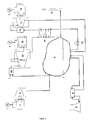
- Figure 1 shows, on an illustrative and non-limiting basis, a preferred embodiment of the invention, which is to store energy from the electric power grid (1) with a CCC plant technology, in which, during periods in which there is excess power in the power grid, the electric motor (2) drives the compressor (3), which captures atmospheric air and compresses it adiabatically in a single stage up to a pressure around 40 bar and the resulting temperature, around 550 °C.
- This compressed air is circulated through a heat exchanger (4), where it transfers heat to a heat storage system (5), for example a molten salt heat storage system with two tanks at different temperatures, dropping its temperature down to 250 ° C and having a pressure equal to the corresponding vapor pressure of water at that temperature (about 39,75 bar).
- a heat storage system (5) for example a molten salt heat storage system with two tanks at different temperatures, dropping its temperature down to 250 ° C and having a pressure equal to the corresponding vapor pressure of water at that temperature (about 39,75 bar).
- Air compression could also have been carried out in several stages, with intermediate coolings and transferring heat to the heat storage system (5).
- an artificial cavern (6) which has been excavated by hard rock mining, and whose interior walls are thermally insulated.
- the artificial cavern (6) was initially full of water in saturated steam state under the same conditions of pressure and temperature than the incoming compressed air (250 ° C and around 39.75 bar).
- the condenser (8) can be refrigerated by a cooling tower (9) as shown in Figure 1 , or, providing the high temperature at which it works, the heat released in it can be stored in the heat storage system (5) or used as a heat source for an auxiliary Rankine cycle operating with water at low temperatures or with an organic fluid.
- Saturated liquid water is redirected back to the artificial cavern (6), sharing space with the remaining saturated steam water, but occupying much less space than when in saturated steam state, and thus allowing the membrane (7) to be gradually filled with the incoming 250 ° C and about 39,75 bar compressed air.
- the plant remains inactive until electricity demand in the electric power grid is such that it is required to generate electricity. Then it begins to extract saturated liquid water from the cavern, being driven by the pump (10) into a heat exchanger (11) and subsequently into a boiler (12) where water is regasified and further heated until it turns into steam state at high pressure and temperature conditions, to make it then pass through a steam turbine (13) which drives an alternator (14) that generates electrical energy and returns it into the electric power grid (1).
- Saturated steam water occupies much more volume than before when it comes back into the cavern, and displaces the air enclosed within the membrane (7), which comes out of the artificial cavern (6) and is heated in a heat exchanger (15), which takes heat from the heat storage system (5), and subsequently in a boiler (16), to be finally turbined in the turbine (17), which could be the same machine that the compressor (3) but operating in reverse sense, which drives the alternator (18), producing electricity and injecting it into the electric power grid (1).
- Exhaust gases from the turbine (17), which have an important thermal energy, are used to regasify and further heat the auxiliary fluid through the heat exchanger (11) and subsequently they are sent either to the exit chimney (19), or to be stored in the thermal storage system (5) or to be used as a heat source for an auxiliary Rankine cycle operating with water at low temperatures or with an organic fluid.
- shut-off valves are shut again and plant remains inactive until there is again an excess of electricity in the power grid such that it is required to be stored, beginning again to perform the complete cycle described, and being repeated the whole process indefinitely.
- Figure 1 shows, on an illustrative and non-limiting basis, another preferred embodiment of the invention, which is to store energy from the electric power grid (1) with a CCC plant technology, in which, during periods in which there is excess power in the power grid, the electric motor (2) drives the compressor (3), which captures atmospheric air and compresses it adiabatically in a single stage up to a pressure around 60 bar and the resulting temperature, around 650 ° C.
- Compressed air is circulated into an artificial cavern (6), which has been excavated by hard rock mining, and whose interior walls are thermally insulated.
- the artificial cavern (6) was initially full of water in saturated steam state at 60 bar and the corresponding temperature at which 60 bar is the water vapor pressure, that is around 275 ° C.
- an impermeable membrane (7) flexible, thermally insulating and able to withstand working temperatures of at least 650 ° C on the air side and 275 ° C on the water steam side, fabricated for example as a sandwich with a ceramic mat on the inside and flexible steel sheets on the outside.
- This membrane (7) is initially completely folded, leaving all the artificial cavern space for the water in saturated steam state as explained.
- the condenser (8) can be refrigerated by a cooling tower (9) as shown in Figure 2 , or, providing the high temperature at which it works, the heat released in it can be stored in a heat storage system or used as a heat source for an auxiliary Rankine cycle operating with water at low temperatures or with an organic fluid.
- Saturated liquid water is redirected back to the artificial cavern (6), sharing space with the remaining saturated steam water, but occupying much less space than when in saturated steam state, and thus allowing the membrane (7) to be gradually filled with the incoming 60 bar and 650 ° C compressed air.
- the plant remains inactive until electricity demand in the electric power grid is such that it is required to generate electricity. Then it begins to extract saturated liquid water from the cavern, being driven by the pump (10) into a heat exchanger (11) and subsequently into a boiler (12) where water is regasified and further heated until it turns into steam state at high pressure and temperature conditions, to make it then pass through a steam turbine (13) which drives an alternator (14) that generates electrical energy and returns it into the electric power grid (1).
- Saturated steam water occupies much more volume than before when it comes back into the cavern, and displaces the air enclosed within the membrane (7), which comes out of the artificial cavern (6) and is heated in a boiler (16), to be finally turbined in the turbine (17), which could be the same machine that the compressor (3) but operating in reverse sense, which drives the alternator (18), producing electricity and injecting it into the electric power grid (1).
- Exhaust gases from the turbine (17), which have an important thermal energy, are used to regasify and further heat the auxiliary fluid through the heat exchanger (11) and subsequently they are sent either to the exit chimney (19), or to be stored in the thermal storage system or to be used as a heat source for an auxiliary Rankine cycle operating with water at low temperatures or with an organic fluid.
- shut-off valves are shut again and plant remains inactive until there is again an excess of electricity in the power grid such that it is required to be stored, beginning again to perform the complete cycle described, and being repeated the whole process indefinitely.
Landscapes
- Engineering & Computer Science (AREA)
- Chemical & Material Sciences (AREA)
- Combustion & Propulsion (AREA)
- Mechanical Engineering (AREA)
- General Engineering & Computer Science (AREA)
- Engine Equipment That Uses Special Cycles (AREA)
- Luminescent Compositions (AREA)
- Apparatus For Radiation Diagnosis (AREA)
Abstract
Description
- The present invention relates to a system that has been specially conceived to store energy by compressing atmospheric air and confining it in tanks or caverns, so that a significant improvement of the overall efficiencies can be obtained versus current technology, as well as an important reduction of the volume requirements of the tanks or caverns.
- CAES energy storage technology is based on the storage of compressed atmospheric air. When there is a surplus of energy in the electric power grid, the compressor is activated, compressing atmospheric air to a predetermined pressure, consuming the excess power from the mains. The resulting compressed air is stored in a natural cave, abandoned mine or salt dome cavern (a tank cannot be used due to the huge dimensions it should have and the high pressures it would have to withstand, if large amounts of energy want to be stored).
- In order to keep the energy stored until energy demand rises again in the power grid, it is enough to maintain the cave closed by a shut-off valve. When the power grid finally requires more energy, the valve opens and pressurized air is vented out and used to drive a turbine and generate electricity.
- Building plants with this technology can be much more economically feasible than building pumped storage hydro plants, the most widespread large scale energy storage system that exists today. But the main disadvantage of CAES technology is the low efficiencies that can be achieved, resulting in a very low feasibility of the operation of the plants. In fact, although it is a technology developed over thirty years ago, there are only two CAES plants operating in the world today.
- In addition, the enormous demand on cavern volume requirements and pressures to withstand reduces dramatically the range of possible locations for this type of plants, being restricted, as explained, to places where there are natural caves, abandoned mines or salt domes.
- It is difficult to find available natural caverns or abandoned mines, so that both CAES plants operating today were built using salt domes. This involves a number of additional problems such as the inability to thermally insulate the caverns (the excavation is performed by dissolving salts through a borehole about 600 m deep), or high levels of suspended particles in the air when it comes out of the cavern.
- The solution to these problems is to combine the thermodynamic cycle followed by the atmospheric air (Brayton cycle) with another thermodynamic cycle followed by an auxiliary fluid, that is confined in the same cavern within a membrane, in which thermodynamic cycle the auxiliary fluid suffer volume variations, so allowing the entry and exit of compressed atmospheric air into and out of the cavern.
- There are many feasible cycles that could be followed by the auxiliary fluid and that involve a substantial change in its volume. For example, it could follow two sections of a Rankine cycle, one during the air compression and entry into the cavern process and the other during the air outlet and turbininig process, such that:
- initial and final states of each section are at the same pressure
- the initial state of the air compression and entry into the cavern process matches the final state of the air outlet and turbining process, and it is a state of very low density, ie, superheated steam, saturated steam or wet steam with high steam dryness
- the final state of the air compression and entry into the cavern process matches the initial state of the air outlet and turbining process, and it is a state of very high density, ie, subcooled liquid, saturated liquid or wet steam with low dryness
- during periods of air compression and entry into the cavern I air outlet and turbining, the auxiliary fluid is forced to get out of the membrane, follow its section of the Rankine cycle, and re-enter the membrane again, in a continuous process which causes that the auxiliary fluid confined in the membrane has a total decreasing / increasing volume, thereby allowing entry of air into the cavern I displacing air out of the cavern
- during periods in which air is left stored in the cavern as well as during periods in which cavern is left empty of air, the auxiliary fluid is stored within the membrane in the final state corresponding to the Rankine cycle section that had previously followed
- As stated above, the cycle followed by the auxiliary fluid may have multiple layouts. As examples, the cold focus of the Rankine cycle can be located either at the temperature at which the auxiliary fluid is stored, so that the Rankine cycle section to follow by the auxiliary fluid during the air compression and entry into the cavern process is just passing through the condenser, or at a lower temperature, to achieve optimum energy efficiency, but at the cost of having to carry out turbining sections during periods when there is an excess of electricity in the power grid (ie, during the air compression and entry into the cavern process).
- Providing that pressures at the start and the end of both sections of the Rankine cycle are the same, and that the auxiliary fluid volume occupied within the membrane is gradually reduced during the air compression and entry into the cavern process and increased during the air outlet and turbining process, cavern air filling and emptying operations are performed at constant pressure, leading to an improvement in turbines and compressors efficiencies on one side and to a drastic reduction in cavern volume requirements.
- These reductions in cavern volume requirements implicate that it will be feasible to excavate caverns through hard rock mining, instead of solution mining in salt domes. This fact expands in a very important way the range of possible locations for CAES plants, and, in addition, it will also allow feasibility for much lower power rating plants (excavation by dissolving salts in salt domes is only feasible if carried out for large volumes), and secondly it will also allow that the caverns can be thermally insulated. Likewise, it will even stop being absolutely unthinkable to use pressurized tanks rather than caverns.
- Thus it will be possible to store air at high temperatures and to use water or organic fluids as auxiliary fluid, since, provided the process carried out in a CAES plant, the higher the temperature at which air is stored the greater will be the overall system efficiency. In addition, this will allow use natural cold sources for the condenser as water or atmospheric air.
- Thereby, the result is the combination of a Brayton cycle (followed by the air) with a Rankine cycle (followed by the auxiliary fluid). This layout also allows harnessing Brayton cycle residual heat in the exhaust gases for regasification and heat of the auxiliary fluid in order to make it follow its Rankine cycle.
- We have called this whole process, which is the basis of the invention, "Combined Cycle CAES Technology" or "CCC Technology", and, as described, it is a process with a much higher efficiency in every way than CAES conventional technology. With CCC technology multiple objectives are achieved:
- optimize energy efficiency of the plant
- optimize cavern or tank volume requirements to store the air
- expand the range of possible locations for CAES plants
- enable operation at high temperatures
- work with air clean of impurities
- CCC technology opens the door to many possible combinations for further energy efficiency optimizations. For example, heat of the turbine exhaust gases can be harnessed as a heat source for another Rankine cycle, operated with the auxiliary fluid itself or with other organic fluids.
- On the other hand, and providing latest technological advances that have been developed in terms of thermal insulation materials, it is possible to fabricate adiabatic membranes, so that, as well as being flexible and able to separate compressed air from the auxiliary fluid, they are able to maintain a temperature gap between both. This will allow to store the air even at higher temperatures than those of the auxiliary fluid, and, therefore, it will be possible to think on compressing the air in a single stage, without intermediate coolings, and storing it at the temperature it acquires after compression. This process requires more energy consumption, but this fact means no inconvenience because this energy consumption is required when there is an excess of energy in the power grid which has to be stored, ie, actually what this process will mean is that there will be a new significant reduction in tank or cavern volume requirements, because energy stored per unit volume will be higher.
- The great advantage of this process is that when air enters the turbine it will not be necessary to heat it again, which results in a spectacular increase in the energy efficiency of the system.
- Performing the compression and the turbining with single stages also enables to use the same machine for both functions, as in the pumped storage hydro plants.
- But in addition to all advantages that have been exposed, CCC technology has other advantages that make it overcome with regard to electricity generation many other electricity generation processes in general:
- it allows to make a constant volume extra heating of the compressed air and/or the auxiliary fluid inside the tanks or caverns, because they are designed to withstand high working pressures, ie, using tanks or caverns as boilers, but with the great advantage over conventional boilers that they can withstand high working pressures and have enough volume to perform a constant volume heating inside them, thus increasing the energy efficiency in a spectacular way
- it is perfectly possible to hybridize it with renewable energy and even with nuclear energy
- There are other interesting CCC layouts:
- performing a reverse process, storing the compressed air within the membrane and leaving the auxiliary fluid on the outside of it, which can represent some mechanical advantages, due to the different densities of the air and the auxiliary fluid in its different states
- using an auxiliary tank or cavern for storing the auxiliary fluid when it is in liquid state, being as well confined within a membrane inside the auxiliary tank or cavern, being filled the rest of the auxiliary tank or cavern with compressed air from the main tank or cavern, so that compressed air is transferred from the auxiliary tank or cavern to the main tank or cavern when the auxiliary tank or cavern is being filled with liquid auxiliary fluid and in the opposite direction when it is being emptied, thus achieving to maintain constant pressure in the auxiliary tank or cavern as well and allowing differentiated constant volume heating of the air and the auxiliary fluid during the period in which the air is stored in the cavern, that is, during the period prior to extraction and turbining
- in the above case of working with an auxiliary tank or cavern, the auxiliary fluid can be stored in two states of the Rankine cycle it is obliged to follow which are at different pressures, taking advantage of the existence of two tanks or caverns, being possible for example to match the section to follow during air compression and entry into the main tank or cavern with the condenser and pumping section of the Rankine cycle, thus consuming energy at the pump during periods in which there is an excess of electrical energy in the power grid
- using the heat released in the condenser of the Rankine cycle as a heat source for another additional Rankine cycle, which operates with the same auxiliary fluid at different pressures or with water or an organic fluid
- using the heat released in the condenser of the Rankine cycle as a heat source for another additional Rankine cycle, which operates with the same auxiliary fluid at different pressures or with water or an organic fluid, being stored in a new tank or auxiliary cavern thermally insulated in order to be extracted and turbined when there is a high electricity demand in the electric power grid
- storing the heat released in the condenser of the Rankine cycle and / or the heat released in the intermediate compressor coolings with a thermal storage system, so that this heat can be subsequently used as a heat source to preheat the air coming out of the cavern prior to turbining it, to regasificate the auxiliary fluid and/or as a heat source for another additional Rankine cycle, which operates with the same auxiliary fluid at different pressures or with water or an organic fluid when there is a high electricity demand in the electric power grid
- To complement the description that is being made and in order to help having a better understanding of the invention features, two figures are provided which, on an illustrative and non-limiting basis, represent the following:
-
Figure 1 .- It shows a process diagram of one of the possible layouts of a CCC technology plant, which stores the compressed air at the same pressure and temperature conditions than the auxiliary fluid (water) is stored, and which has a thermal storage system for the heat generated during the compression of the atmospheric air -
Figure 2 .- It shows a process diagram of one of the possible layouts of a CCC technology plant with adiabatic membranes, which stores the air at a higher temperature than the temperature of the auxiliary fluid (water) - Two preferred embodiments of the invention are exposed below, as both layouts may have a significant market projection:
-
Figure 1 shows, on an illustrative and non-limiting basis, a preferred embodiment of the invention, which is to store energy from the electric power grid (1) with a CCC plant technology, in which, during periods in which there is excess power in the power grid, the electric motor (2) drives the compressor (3), which captures atmospheric air and compresses it adiabatically in a single stage up to a pressure around 40 bar and the resulting temperature, around 550 °C. - This compressed air is circulated through a heat exchanger (4), where it transfers heat to a heat storage system (5), for example a molten salt heat storage system with two tanks at different temperatures, dropping its temperature down to 250 ° C and having a pressure equal to the corresponding vapor pressure of water at that temperature (about 39,75 bar).
- Air compression could also have been carried out in several stages, with intermediate coolings and transferring heat to the heat storage system (5).
- Subsequently compressed air is circulated into an artificial cavern (6), which has been excavated by hard rock mining, and whose interior walls are thermally insulated. The artificial cavern (6) was initially full of water in saturated steam state under the same conditions of pressure and temperature than the incoming compressed air (250 ° C and around 39.75 bar).
- In the air inlet into the artificial cavern (6) there is an impermeable membrane (7), flexible and able to withstand working temperatures of 250 ° C, such as flexible teflon. This membrane is initially completely folded, leaving all the artificial cavern space for the water in saturated steam state as explained.
- As air enters into the membrane (7), it displaces saturated steam water, which goes out of the artificial cavern (6) and is circulated to the condenser (8), where it is liquefied at constant pressure and temperature, to become saturated liquid at the same pressure and temperature conditions. The condenser (8) can be refrigerated by a cooling tower (9) as shown in
Figure 1 , or, providing the high temperature at which it works, the heat released in it can be stored in the heat storage system (5) or used as a heat source for an auxiliary Rankine cycle operating with water at low temperatures or with an organic fluid. - Saturated liquid water is redirected back to the artificial cavern (6), sharing space with the remaining saturated steam water, but occupying much less space than when in saturated steam state, and thus allowing the membrane (7) to be gradually filled with the incoming 250 ° C and about 39,75 bar compressed air.
- Process continues until the membrane (7) is completely full of air and saturated steam water has fully been transformed into saturated liquid water, or until there is a demand on the power grid that makes preferable to stop storing energy. At this point the shut-off valves of the artificial cavern (6) are shut, and air and water are left stored in the cavern, with the CCC plant completely stopped, with no electrical energy consumption or generation.
- The plant remains inactive until electricity demand in the electric power grid is such that it is required to generate electricity. Then it begins to extract saturated liquid water from the cavern, being driven by the pump (10) into a heat exchanger (11) and subsequently into a boiler (12) where water is regasified and further heated until it turns into steam state at high pressure and temperature conditions, to make it then pass through a steam turbine (13) which drives an alternator (14) that generates electrical energy and returns it into the electric power grid (1).
- At the outlet of the steam turbine water is again in saturated steam state around 39.75 bar and 250 ° C, being redirected back into the cavern.
- Saturated steam water occupies much more volume than before when it comes back into the cavern, and displaces the air enclosed within the membrane (7), which comes out of the artificial cavern (6) and is heated in a heat exchanger (15), which takes heat from the heat storage system (5), and subsequently in a boiler (16), to be finally turbined in the turbine (17), which could be the same machine that the compressor (3) but operating in reverse sense, which drives the alternator (18), producing electricity and injecting it into the electric power grid (1).
- Exhaust gases from the turbine (17), which have an important thermal energy, are used to regasify and further heat the auxiliary fluid through the heat exchanger (11) and subsequently they are sent either to the exit chimney (19), or to be stored in the thermal storage system (5) or to be used as a heat source for an auxiliary Rankine cycle operating with water at low temperatures or with an organic fluid.
- This process continues until electricity demand in the power grid drops enough to justify stopping the plant or until the artificial cavern (6) is completely empty of air and is completely filled with saturated steam water,
- From this point, shut-off valves are shut again and plant remains inactive until there is again an excess of electricity in the power grid such that it is required to be stored, beginning again to perform the complete cycle described, and being repeated the whole process indefinitely.
- It has been assumed, as an example, working with a flexible teflon sheet at 250 C and at pressure of about 39.75 bar, which is the vapor pressure of water at that temperature. But is perfectly possible using other materials such as flexible steel foils, which are able to operate at much higher temperatures, being also flexible and impermeable to air and water steam. Thus it is perfectly possible to reproduce other preferred embodiments of the invention using similar processes but operating at higher temperatures and at the water vapor pressure corresponding to those temperatures.
- As it has been explained in the section "Description of the Invention", the higher the working pressure and temperature the higher the overall efficiencies that will be obtained, and maximum pressure and temperature working conditions will be determined by the structural strength of the tanks or caverns, and by the availability of thermal insulation and other materials.
-
Figure 1 shows, on an illustrative and non-limiting basis, another preferred embodiment of the invention, which is to store energy from the electric power grid (1) with a CCC plant technology, in which, during periods in which there is excess power in the power grid, the electric motor (2) drives the compressor (3), which captures atmospheric air and compresses it adiabatically in a single stage up to a pressure around 60 bar and the resulting temperature, around 650 ° C. - Compressed air is circulated into an artificial cavern (6), which has been excavated by hard rock mining, and whose interior walls are thermally insulated. The artificial cavern (6) was initially full of water in saturated steam state at 60 bar and the corresponding temperature at which 60 bar is the water vapor pressure, that is around 275 ° C.
- In the air inlet into the artificial cavern (6) there is an impermeable membrane (7), flexible, thermally insulating and able to withstand working temperatures of at least 650 ° C on the air side and 275 ° C on the water steam side, fabricated for example as a sandwich with a ceramic mat on the inside and flexible steel sheets on the outside. This membrane (7) is initially completely folded, leaving all the artificial cavern space for the water in saturated steam state as explained.
- As air enters into the membrane (7), it displaces saturated steam water, which goes out of the artificial cavern (6) and is circulated to the condenser (8), where it is liquefied at constant pressure and temperature, to become saturated liquid at 60 bar and 275 ° C. The condenser (8) can be refrigerated by a cooling tower (9) as shown in
Figure 2 , or, providing the high temperature at which it works, the heat released in it can be stored in a heat storage system or used as a heat source for an auxiliary Rankine cycle operating with water at low temperatures or with an organic fluid. - Saturated liquid water is redirected back to the artificial cavern (6), sharing space with the remaining saturated steam water, but occupying much less space than when in saturated steam state, and thus allowing the membrane (7) to be gradually filled with the incoming 60 bar and 650 ° C compressed air.
- Process continues until the membrane (7) is completely full of air and saturated steam water has fully been transformed into saturated liquid water, or until there is a demand on the power grid that makes preferable to stop storing energy. At this point the shut-off valves of the artificial cavern (6) are shut, and air and water are left stored in the cavern, with the CCC plant completely stopped, with no electrical energy consumption or generation.
- The plant remains inactive until electricity demand in the electric power grid is such that it is required to generate electricity. Then it begins to extract saturated liquid water from the cavern, being driven by the pump (10) into a heat exchanger (11) and subsequently into a boiler (12) where water is regasified and further heated until it turns into steam state at high pressure and temperature conditions, to make it then pass through a steam turbine (13) which drives an alternator (14) that generates electrical energy and returns it into the electric power grid (1).
- At the outlet of the steam turbine water is again in saturated steam state around 60 bar and 275 ° C, being redirected back into the cavern.
- Saturated steam water occupies much more volume than before when it comes back into the cavern, and displaces the air enclosed within the membrane (7), which comes out of the artificial cavern (6) and is heated in a boiler (16), to be finally turbined in the turbine (17), which could be the same machine that the compressor (3) but operating in reverse sense, which drives the alternator (18), producing electricity and injecting it into the electric power grid (1).
- Exhaust gases from the turbine (17), which have an important thermal energy, are used to regasify and further heat the auxiliary fluid through the heat exchanger (11) and subsequently they are sent either to the exit chimney (19), or to be stored in the thermal storage system or to be used as a heat source for an auxiliary Rankine cycle operating with water at low temperatures or with an organic fluid.
- This process continues until electricity demand in the power grid drops enough to justify stopping the plant or until the artificial cavern (6) is completely empty of air and is completely filled with saturated steam water.
- From this point, shut-off valves are shut again and plant remains inactive until there is again an excess of electricity in the power grid such that it is required to be stored, beginning again to perform the complete cycle described, and being repeated the whole process indefinitely.
- Indicated values of pressure and temperature in both preferred embodiment modes of the invention that have been exposed are approximate and only for guidance, as they have been roughly calculated assuming ideal processes and with no regard to losses.
- Working values in real plants depend on the actual processes and operating conditions that are acceptable in terms of the strength of the tanks or caverns and thermal insulation materials available.
- In both preferred embodiments it has been assumed working with saturated liquid and steam water, although systems can be designed to work in areas of wet steam, superheated steam or subcooled liquid.
Claims (18)
- st -. Combined Cycle CAES (Compressed Air Energy Storage) technology, characterized by combining the thermodynamic cycle followed by atmospheric air (Brayton cycle) in conventional CAES technology, (i.e., technology for storing energy based on the storage of compressed atmospheric air in a cavern) with another thermodynamic cycle is followed by an auxiliary fluid, that is confined in the same cavern within a membrane, in which thermodynamic cycle the auxiliary fluid suffer volume variations, so allowing the entry and exit of compressed atmospheric air into and out of the cavern
- nd -. Combined Cycle CAES technology, according to claim 1, characterized by that in it the auxiliary fluid is made to follow two sections of a Rankine cycle, one during the air compression and entry into the cavern process and the other during the air outlet and turbininig process, such that:- initial and final states of each section are at the same pressure- the initial state of the air compression and entry into the cavern process matches the final state of the air outlet and turbining process, and it is a state of very low density, ie, superheated steam, saturated steam or wet steam with high steam dryness- the final state of the air compression and entry into the cavern process matches the initial state of the air outlet and turbining process, and it is a state of very high density, ie, subcooled liquid, saturated liquid or wet steam with low dryness- during periods of air compression and entry into the cavern / air outlet and turbininig, the auxiliary fluid is forced to get out of the membrane, follow its section of the Rankine cycle, and re-enter the membrane again, in a continuous process which causes that the auxiliary fluid confined in the membrane has a total decreasing / increasing volume, thereby allowing entry of air into the cavern / displacing air out of the cavern- during periods in which air is left stored in the cavern as well as during periods in which cavern is left empty of air, the auxiliary fluid is stored within the membrane in the final state corresponding to the Rankine cycle section that had previously followed
- rd - Combined Cycle CAES technology, according to previous claims, characterized by that in it the cold focus of the Rankine cycle is set at the temperature at which the auxiliary fluid is stored
- th -. Combined Cycle CAES technology, according to previous claims, characterized by that in it the cold focus of the Rankine cycle is set at a lower temperature than the temperature at which the auxiliary fluid is stored
- th -. Combined Cycle CAES technology, according to previous claims, characterized by having thermal insulation on the inside of the tank or cavern, so that air and auxiliary fluid storage can be performed at high temperatures
- th -. Combined Cycle CAES technology , according to previous claims, characterised by using heat from the exhaust gases from the turbine as a heat source for regasifying and further heating the auxiliary fluid in order to make it follow its Rankine cycle
- th -. Combined Cycle CAES technology, according to previous claims, characterized by using heat from the exhaust gases from the turbine as a heat source for an additional Rankine cycle, which operates with the auxiliary fluid at lower temperatures or with an organic fluid
- th -. Combined Cycle CAES technology, according to previous claims, characterized by using adiabatic membranes, which in addition to being flexible and separating the compressed air from the auxiliary fluid are able to maintain a temperature gap between them
- th -. Combined Cycle CAES technology, according to claim 8, characterized by having adiabatic membranes fabricated as a sandwich with an insulating material mat on the inside and flexible, impermeable and working temperature resistant sheets on the outside
- th -. Combined Cycle CAES technology, according to claims 8 and 9, characterized by performing air compression in a single stage, without intermediate coolings, storing it at the temperature acquired after compression
- th -. Combined Cycle CAES technology, according to claim 9, characterized by using the same machine as air compressor and turbine, reversing rotor rotation direction
- th -. Combined Cycle CAES technology, according to previous claims, characterized by making an extra constant volume heating of compressed air and / or of the auxiliary fluid inside the tanks or caverns, ie, using tanks or caverns as boilers
- th -. Combined Cycle CAES technology, according to previous claims, characterized by storing the compressed air in the interior of the membrane, leaving the auxiliary fluid on the outside of the membrane
- th -. Combined Cycle CAES technology, according to previous claims, characterized by using an auxiliary tank or cavern for storing the auxiliary fluid when it is in liquid state, being as well confined within a membrane inside the auxiliary tank or cavern, being filled the rest of the auxiliary tank or cavern with compressed air from the main tank or cavern, so that compressed air is transferred from the auxiliary tank or cavern to the main tank or cavern when the auxiliary tank or cavern is being filled with liquid auxiliary fluid and in the opposite direction when it is being emptied, thus achieving to maintain constant pressure in the auxiliary tank or cavern as well and allowing differentiated constant volume heating of the air and the auxiliary fluid during the period in which the air is stored in the cavern, that is, during the period prior to extraction and turbining
- th -. Combined Cycle CAES technology, according to claim 14, characterized by performing auxiliary fluid storage in two states of the Rankine cycle it is obliged to follow which are at different pressures, taking advantage of the existence of two tanks or caverns
- th -. Combined Cycle CAES technology, according to previous claims, characterized by using the heat released in the condenser of the Rankine cycle as a heat source for another additional Rankine cycle, which operates with the same auxiliary fluid at different pressures or with water or an organic fluid
- th -. Combined Cycle CAES technology, according to claim 16, characterized by storing the additional Rankine cycle operation fluid in a new auxiliary tank or cavern thermally insulated in order to be extracted and turbined when there is a high electricity demand in the elecfric power grid
- th -. Combined Cycle CAES technology, according to previous claims, characterized by storing the heat released in the condenser of the Rankine cycle and / or the heat released in the intermediate compressor coolings and / or the remaining heat in turbine exhaust gases in a thermal storage system, so that this heat can be subsequently used as a heat source to preheat the air coming out of the cavern prior to turbining It, to regasificate the auxiliary fluid and/or as a heat source for another additional Rankine cycle, Which operates with the same auxiliary fluid at different pressures or with water or an organic fluid when there is a high electricity demand in the electric power grid
Applications Claiming Priority (2)
| Application Number | Priority Date | Filing Date | Title |
|---|---|---|---|
| ES201200228A ES2423973B1 (en) | 2012-02-23 | 2012-02-23 | Technology fall combined cycle (CCC) |
| PCT/ES2013/000061 WO2013124504A1 (en) | 2012-02-23 | 2013-02-22 | Combined cycle computer-aided engineering technology (ccc) |
Publications (3)
| Publication Number | Publication Date |
|---|---|
| EP2876282A1 true EP2876282A1 (en) | 2015-05-27 |
| EP2876282A4 EP2876282A4 (en) | 2016-08-24 |
| EP2876282B1 EP2876282B1 (en) | 2020-07-15 |
Family
ID=49005046
Family Applications (1)
| Application Number | Title | Priority Date | Filing Date |
|---|---|---|---|
| EP13751593.8A Not-in-force EP2876282B1 (en) | 2012-02-23 | 2013-02-22 | Combined cycle caes technology (ccc) |
Country Status (7)
| Country | Link |
|---|---|
| US (1) | US9816437B2 (en) |
| EP (1) | EP2876282B1 (en) |
| CN (1) | CN104204462B (en) |
| BR (1) | BR112014019689A8 (en) |
| ES (1) | ES2423973B1 (en) |
| IN (1) | IN2014DN07737A (en) |
| WO (1) | WO2013124504A1 (en) |
Families Citing this family (45)
| Publication number | Priority date | Publication date | Assignee | Title |
|---|---|---|---|---|
| US9322295B2 (en) | 2012-10-17 | 2016-04-26 | General Electric Company | Thermal energy storage unit with steam and gas turbine system |
| US9376962B2 (en) * | 2012-12-14 | 2016-06-28 | General Electric Company | Fuel gas heating with thermal energy storage |
| WO2014165961A1 (en) * | 2013-04-02 | 2014-10-16 | Aliasghar Hariri | Power generation by converting low grade thermal energy to hydropower |
| GB2532281A (en) * | 2014-11-17 | 2016-05-18 | Demetair Systems | A waste heat recovery system combined with compressed air energy storage |
| JP6614878B2 (en) * | 2014-12-25 | 2019-12-04 | 株式会社神戸製鋼所 | Compressed air storage power generation apparatus and compressed air storage power generation method |
| US10294861B2 (en) | 2015-01-26 | 2019-05-21 | Trent University | Compressed gas energy storage system |
| GB2535181A (en) * | 2015-02-11 | 2016-08-17 | Futurebay Ltd | Apparatus and method for energy storage |
| FR3034813B1 (en) * | 2015-04-13 | 2019-06-28 | IFP Energies Nouvelles | SYSTEM AND METHOD FOR STORING AND RECOVERING COMPRESSED AIR ENERGY WITH CONSTANT VOLUME HEATING |
| JP6510876B2 (en) * | 2015-05-01 | 2019-05-08 | 株式会社神戸製鋼所 | Compressed air storage power generation method and compressed air storage power generation device |
| US20170168597A1 (en) * | 2015-12-09 | 2017-06-15 | Lenovo (Singapore) Pte. Ltd. | Pen hover range |
| JP6649141B2 (en) * | 2016-03-18 | 2020-02-19 | 株式会社神戸製鋼所 | Compressed air storage power generator |
| GB2552963A (en) * | 2016-08-15 | 2018-02-21 | Futurebay Ltd | Thermodynamic cycle apparatus and method |
| DE102016115421A1 (en) * | 2016-08-19 | 2018-02-22 | Erneo Energiespeichersysteme Gmbh | Method for energy storage and energy delivery in a power supply network, compressed gas storage power plant and computer program |
| CN106401907A (en) * | 2016-09-28 | 2017-02-15 | 东莞市联洲知识产权运营管理有限公司 | Novel compressed air energy storage device |
| AU2018216179B2 (en) | 2017-02-01 | 2023-03-09 | Hydrostor Inc. | A hydrostatically compensated compressed gas energy storage system |
| US11187622B2 (en) * | 2017-03-08 | 2021-11-30 | Florida Turbine Technologies, Inc. | Apparatus and process for testing a large combustor using a CAES facility |
| WO2018161172A1 (en) | 2017-03-09 | 2018-09-13 | Hydrostor Inc. | A thermal storage apparatus for a compressed gas energy storage system |
| JP6705770B2 (en) * | 2017-04-21 | 2020-06-03 | 株式会社神戸製鋼所 | Compressed air storage power generator |
| JP6885777B2 (en) * | 2017-04-26 | 2021-06-16 | 株式会社神戸製鋼所 | Compressed air storage power generator |
| GB2567821A (en) | 2017-10-24 | 2019-05-01 | Storelectric Ltd | Compressed air energy storage system with thermal management system |
| WO2019149623A1 (en) * | 2018-01-31 | 2019-08-08 | Ss&A Power Development Ag | Energy storage device and system |
| CN108591027B (en) * | 2018-03-29 | 2019-08-06 | 华北电力大学 | A kind of large-scale compression air energy storage systems of the double states of gas/liquid |
| CN108561294B (en) * | 2018-03-29 | 2019-08-06 | 华北电力大学 | A kind of control method of the large-scale compression air energy storage systems of the double states of gas/liquid |
| CA3099437A1 (en) | 2018-05-17 | 2019-11-21 | Hydrostor Inc. | A hydrostatically compensated compressed gas energy storage system |
| US12297056B2 (en) | 2018-05-17 | 2025-05-13 | Hydrostor Inc. | Construction elements and maintenance methods for compressed air energy storage systems |
| EP3911588B1 (en) | 2019-01-15 | 2025-03-05 | Hydrostor Inc. | A compressed gas energy storage system |
| US20210388809A1 (en) * | 2019-02-08 | 2021-12-16 | Hydrostor Inc. | Accumulator over-pressurization in a hydrostatically compensated compressed air energy storage system |
| WO2020160635A1 (en) | 2019-02-08 | 2020-08-13 | Hydrostor Inc. | A compressed gas energy storage system |
| WO2020172748A1 (en) | 2019-02-27 | 2020-09-03 | Hydrostor Inc. | A hydrostatically compensated caes system having an elevated compensation liquid reservoir |
| WO2021163065A1 (en) | 2020-02-10 | 2021-08-19 | Conlon William M | Flexible integration of stored heat and electric resources (fisher) |
| FR3117164B1 (en) * | 2020-12-03 | 2022-11-18 | Ifp Energies Now | Compressed gas energy storage and recovery system and method with Rankine cycle |
| US12584589B2 (en) | 2021-04-29 | 2026-03-24 | Hydrostor Inc. | Inhibiting the champagne effect in hydrostatically compensated CAES systems |
| US11721980B2 (en) | 2021-11-15 | 2023-08-08 | Kalindha Rashmi LLC | Power generation system employing power amplifying thermo-mechanical inverter technology |
| US12562579B2 (en) | 2021-11-15 | 2026-02-24 | Kalindha Rashmi LLC | Power generation system employing power amplifying thermo-mechanical inverter technology |
| US12253285B2 (en) | 2021-12-03 | 2025-03-18 | Power8 Tech. Inc. | Geothermal energy storage and conversion systems and methods |
| US12180919B2 (en) | 2021-12-03 | 2024-12-31 | Power8 Tech. Inc. | Power tunnel |
| US12355238B2 (en) | 2021-12-03 | 2025-07-08 | Power8 Tech. Inc. | Energy storage systems and methods using heterogeneous pressure media and interactive actuation module |
| US12234797B2 (en) | 2021-12-03 | 2025-02-25 | Powers8 TECH INC. | Smart controlling systems for energy storage |
| CN114542220A (en) * | 2021-12-22 | 2022-05-27 | 中国能源建设集团江苏省电力设计院有限公司 | Phase modulator based on compressed air energy storage power generation system and operation method thereof |
| CN114575950B (en) * | 2022-03-10 | 2023-04-25 | 中国科学院上海应用物理研究所 | Heat-storage type peak regulation power station |
| TWI868722B (en) * | 2022-06-06 | 2025-01-01 | 美商能源8科技公司 | Energy storage system and method utilizing sheltered space |
| WO2023239631A1 (en) * | 2022-06-06 | 2023-12-14 | Power8 Tech Inc. | Power tunnel |
| TW202424404A (en) | 2022-09-13 | 2024-06-16 | 美商能源8科技公司 | Concentrated solar power storage system and method |
| CN116006443B (en) * | 2023-01-05 | 2025-11-21 | 中国科学院工程热物理研究所 | Salt cavern compressed air energy storage and gas release system and gas release method |
| CN117318315B (en) * | 2023-09-25 | 2024-04-30 | 水利部交通运输部国家能源局南京水利科学研究院 | Adiabatic pumping compressed air energy storage device and method based on multi-stage water circulation |
Family Cites Families (14)
| Publication number | Priority date | Publication date | Assignee | Title |
|---|---|---|---|---|
| IL31440A (en) | 1968-02-14 | 1973-02-28 | Lang W | Method and apparatus for increasing the efficiency of electric power generating plants |
| US3538340A (en) * | 1968-03-20 | 1970-11-03 | William J Lang | Method and apparatus for generating power |
| US3677008A (en) * | 1971-02-12 | 1972-07-18 | Gulf Oil Corp | Energy storage system and method |
| DE2236059C2 (en) * | 1972-07-22 | 1974-08-22 | Rheinisch-Westfaelisches Elektrizitaetswerk Ag, 4300 Essen | Air pump storage plant for power plants |
| US3831373A (en) | 1973-02-08 | 1974-08-27 | Gen Electric | Pumped air storage peaking power system using a single shaft gas turbine-generator unit |
| GB1583648A (en) * | 1976-10-04 | 1981-01-28 | Acres Consulting Services | Compressed air power storage systems |
| US4237692A (en) * | 1979-02-28 | 1980-12-09 | The United States Of America As Represented By The United States Department Of Energy | Air ejector augmented compressed air energy storage system |
| US5052856A (en) * | 1990-08-13 | 1991-10-01 | Tek M Rasin | Method for underground storage of gas |
| JP2000014052A (en) * | 1998-06-23 | 2000-01-14 | Mitsubishi Heavy Ind Ltd | Compressed air storing power generation equipment |
| DE102004028531A1 (en) * | 2004-06-11 | 2006-01-05 | Alstom Technology Ltd | Method for operating a power plant, and power plant |
| DE102004028530B4 (en) | 2004-06-11 | 2015-05-21 | Alstom Technology Ltd. | Method for operating a power plant |
| WO2009146101A2 (en) * | 2008-04-02 | 2009-12-03 | The Regents Of The University Of California | Carbon dioxide (co2) as cushion gas for compressed air energy storage (caes) |
| US8572972B2 (en) * | 2009-11-13 | 2013-11-05 | General Electric Company | System and method for secondary energy production in a compressed air energy storage system |
| GB2476489B (en) * | 2009-12-23 | 2012-02-15 | Global Power And Energy Ltd | Compressed Air Energy Storage Systems |
-
2012
- 2012-02-23 ES ES201200228A patent/ES2423973B1/en not_active Expired - Fee Related
-
2013
- 2013-02-22 IN IN7737DEN2014 patent/IN2014DN07737A/en unknown
- 2013-02-22 CN CN201380009268.5A patent/CN104204462B/en active Active
- 2013-02-22 EP EP13751593.8A patent/EP2876282B1/en not_active Not-in-force
- 2013-02-22 BR BR112014019689A patent/BR112014019689A8/en not_active IP Right Cessation
- 2013-02-22 US US14/377,427 patent/US9816437B2/en not_active Expired - Fee Related
- 2013-02-22 WO PCT/ES2013/000061 patent/WO2013124504A1/en not_active Ceased
Also Published As
| Publication number | Publication date |
|---|---|
| BR112014019689A8 (en) | 2017-07-11 |
| WO2013124504A8 (en) | 2014-09-12 |
| IN2014DN07737A (en) | 2015-05-15 |
| US9816437B2 (en) | 2017-11-14 |
| ES2423973B1 (en) | 2014-09-08 |
| CN104204462B (en) | 2016-10-19 |
| US20150000248A1 (en) | 2015-01-01 |
| BR112014019689A2 (en) | 2017-06-20 |
| CN104204462A (en) | 2014-12-10 |
| WO2013124504A1 (en) | 2013-08-29 |
| ES2423973A1 (en) | 2013-09-25 |
| EP2876282A4 (en) | 2016-08-24 |
| EP2876282B1 (en) | 2020-07-15 |
Similar Documents
| Publication | Publication Date | Title |
|---|---|---|
| US9816437B2 (en) | Combined cycle CAES technology (CCC) | |
| KR102738623B1 (en) | Energy storage plants and processes | |
| US8479502B2 (en) | Increased power in compressed-gas energy storage and recovery | |
| Jin et al. | Dynamic modeling and design of a hybrid compressed air energy storage and wind turbine system for wind power fluctuation reduction | |
| US8387375B2 (en) | Systems and methods for optimizing thermal efficiency of a compressed air energy storage system | |
| US4873828A (en) | Energy storage for off peak electricity | |
| US11591957B2 (en) | Energy storage apparatus and method | |
| US20140352295A1 (en) | Installation for storing thermal energy and method for the operation thereof | |
| EP2559881A2 (en) | Adiabatic compressed air energy storage system and corresponding method | |
| CN106879259A (en) | Compressed air stores TRT and compressed air storage electricity-generating method | |
| CN102782286A (en) | Compressed air energy storage system | |
| KR102084796B1 (en) | A system for saving and generating the electric power using supercritical carbon dioxide | |
| Milewski et al. | Compressed air energy storage systems | |
| US12601323B2 (en) | Onshore wind turbine generator set having a compressed energy storage system | |
| KR101162319B1 (en) | Method for compressed air storage and generating electricity | |
| AU2017433381B2 (en) | System and method to store and generate energy where a pressure is released into a liquid circuit which in turn moves a liquid turbine to generate power. | |
| US12352503B2 (en) | Thermoelectric device for storage or conversion of energy | |
| Jílek et al. | Electricity storage systems using compressed air | |
| EP2594748A1 (en) | Energy storage and recovery system comprising a thermal storage and a pressure storage | |
| CN212690123U (en) | Multi-energy combined power generation system | |
| US12160102B1 (en) | Energy storage system | |
| Badyda et al. | F104 COMPRESSED AIR STORAGE SYSTEMS AS A PEAK LOOPING POWER STATION IN POLISH CONDITIONS (Energy Storage and Load Leveling) | |
| Carro Paulete et al. | Integration of energy storage systems based on transcritical CO2: Concept of CO2 based electrothermal energy and geological storage | |
| HK40060376A (en) | Energy storage plant and process | |
| CN119801688A (en) | A compressed air energy storage system |
Legal Events
| Date | Code | Title | Description |
|---|---|---|---|
| PUAI | Public reference made under article 153(3) epc to a published international application that has entered the european phase |
Free format text: ORIGINAL CODE: 0009012 |
|
| 17P | Request for examination filed |
Effective date: 20150127 |
|
| AK | Designated contracting states |
Kind code of ref document: A1 Designated state(s): AL AT BE BG CH CY CZ DE DK EE ES FI FR GB GR HR HU IE IS IT LI LT LU LV MC MK MT NL NO PL PT RO RS SE SI SK SM TR |
|
| RA4 | Supplementary search report drawn up and despatched (corrected) |
Effective date: 20160722 |
|
| RIC1 | Information provided on ipc code assigned before grant |
Ipc: F02C 6/16 20060101AFI20160718BHEP Ipc: F01K 7/00 20060101ALI20160718BHEP |
|
| STAA | Information on the status of an ep patent application or granted ep patent |
Free format text: STATUS: EXAMINATION IS IN PROGRESS |
|
| 17Q | First examination report despatched |
Effective date: 20181105 |
|
| GRAP | Despatch of communication of intention to grant a patent |
Free format text: ORIGINAL CODE: EPIDOSNIGR1 |
|
| STAA | Information on the status of an ep patent application or granted ep patent |
Free format text: STATUS: GRANT OF PATENT IS INTENDED |
|
| INTG | Intention to grant announced |
Effective date: 20191018 |
|
| GRAS | Grant fee paid |
Free format text: ORIGINAL CODE: EPIDOSNIGR3 |
|
| GRAA | (expected) grant |
Free format text: ORIGINAL CODE: 0009210 |
|
| STAA | Information on the status of an ep patent application or granted ep patent |
Free format text: STATUS: THE PATENT HAS BEEN GRANTED |
|
| AK | Designated contracting states |
Kind code of ref document: B1 Designated state(s): AL AT BE BG CH CY CZ DE DK EE ES FI FR GB GR HR HU IE IS IT LI LT LU LV MC MK MT NL NO PL PT RO RS SE SI SK SM TR |
|
| REG | Reference to a national code |
Ref country code: GB Ref legal event code: FG4D Ref country code: CH Ref legal event code: EP |
|
| REG | Reference to a national code |
Ref country code: IE Ref legal event code: FG4D |
|
| REG | Reference to a national code |
Ref country code: DE Ref legal event code: R096 Ref document number: 602013070714 Country of ref document: DE |
|
| REG | Reference to a national code |
Ref country code: AT Ref legal event code: REF Ref document number: 1291274 Country of ref document: AT Kind code of ref document: T Effective date: 20200815 |
|
| REG | Reference to a national code |
Ref country code: LT Ref legal event code: MG4D |
|
| REG | Reference to a national code |
Ref country code: AT Ref legal event code: MK05 Ref document number: 1291274 Country of ref document: AT Kind code of ref document: T Effective date: 20200715 |
|
| REG | Reference to a national code |
Ref country code: NL Ref legal event code: MP Effective date: 20200715 |
|
| PG25 | Lapsed in a contracting state [announced via postgrant information from national office to epo] |
Ref country code: LT Free format text: LAPSE BECAUSE OF FAILURE TO SUBMIT A TRANSLATION OF THE DESCRIPTION OR TO PAY THE FEE WITHIN THE PRESCRIBED TIME-LIMIT Effective date: 20200715 Ref country code: ES Free format text: LAPSE BECAUSE OF FAILURE TO SUBMIT A TRANSLATION OF THE DESCRIPTION OR TO PAY THE FEE WITHIN THE PRESCRIBED TIME-LIMIT Effective date: 20200715 Ref country code: PT Free format text: LAPSE BECAUSE OF FAILURE TO SUBMIT A TRANSLATION OF THE DESCRIPTION OR TO PAY THE FEE WITHIN THE PRESCRIBED TIME-LIMIT Effective date: 20201116 Ref country code: AT Free format text: LAPSE BECAUSE OF FAILURE TO SUBMIT A TRANSLATION OF THE DESCRIPTION OR TO PAY THE FEE WITHIN THE PRESCRIBED TIME-LIMIT Effective date: 20200715 Ref country code: HR Free format text: LAPSE BECAUSE OF FAILURE TO SUBMIT A TRANSLATION OF THE DESCRIPTION OR TO PAY THE FEE WITHIN THE PRESCRIBED TIME-LIMIT Effective date: 20200715 Ref country code: NO Free format text: LAPSE BECAUSE OF FAILURE TO SUBMIT A TRANSLATION OF THE DESCRIPTION OR TO PAY THE FEE WITHIN THE PRESCRIBED TIME-LIMIT Effective date: 20201015 Ref country code: GR Free format text: LAPSE BECAUSE OF FAILURE TO SUBMIT A TRANSLATION OF THE DESCRIPTION OR TO PAY THE FEE WITHIN THE PRESCRIBED TIME-LIMIT Effective date: 20201016 Ref country code: SE Free format text: LAPSE BECAUSE OF FAILURE TO SUBMIT A TRANSLATION OF THE DESCRIPTION OR TO PAY THE FEE WITHIN THE PRESCRIBED TIME-LIMIT Effective date: 20200715 Ref country code: BG Free format text: LAPSE BECAUSE OF FAILURE TO SUBMIT A TRANSLATION OF THE DESCRIPTION OR TO PAY THE FEE WITHIN THE PRESCRIBED TIME-LIMIT Effective date: 20201015 Ref country code: FI Free format text: LAPSE BECAUSE OF FAILURE TO SUBMIT A TRANSLATION OF THE DESCRIPTION OR TO PAY THE FEE WITHIN THE PRESCRIBED TIME-LIMIT Effective date: 20200715 |
|
| PG25 | Lapsed in a contracting state [announced via postgrant information from national office to epo] |
Ref country code: IS Free format text: LAPSE BECAUSE OF FAILURE TO SUBMIT A TRANSLATION OF THE DESCRIPTION OR TO PAY THE FEE WITHIN THE PRESCRIBED TIME-LIMIT Effective date: 20201115 Ref country code: RS Free format text: LAPSE BECAUSE OF FAILURE TO SUBMIT A TRANSLATION OF THE DESCRIPTION OR TO PAY THE FEE WITHIN THE PRESCRIBED TIME-LIMIT Effective date: 20200715 Ref country code: LV Free format text: LAPSE BECAUSE OF FAILURE TO SUBMIT A TRANSLATION OF THE DESCRIPTION OR TO PAY THE FEE WITHIN THE PRESCRIBED TIME-LIMIT Effective date: 20200715 Ref country code: PL Free format text: LAPSE BECAUSE OF FAILURE TO SUBMIT A TRANSLATION OF THE DESCRIPTION OR TO PAY THE FEE WITHIN THE PRESCRIBED TIME-LIMIT Effective date: 20200715 |
|
| PG25 | Lapsed in a contracting state [announced via postgrant information from national office to epo] |
Ref country code: NL Free format text: LAPSE BECAUSE OF FAILURE TO SUBMIT A TRANSLATION OF THE DESCRIPTION OR TO PAY THE FEE WITHIN THE PRESCRIBED TIME-LIMIT Effective date: 20200715 |
|
| REG | Reference to a national code |
Ref country code: DE Ref legal event code: R097 Ref document number: 602013070714 Country of ref document: DE |
|
| PG25 | Lapsed in a contracting state [announced via postgrant information from national office to epo] |
Ref country code: RO Free format text: LAPSE BECAUSE OF FAILURE TO SUBMIT A TRANSLATION OF THE DESCRIPTION OR TO PAY THE FEE WITHIN THE PRESCRIBED TIME-LIMIT Effective date: 20200715 Ref country code: SM Free format text: LAPSE BECAUSE OF FAILURE TO SUBMIT A TRANSLATION OF THE DESCRIPTION OR TO PAY THE FEE WITHIN THE PRESCRIBED TIME-LIMIT Effective date: 20200715 Ref country code: IT Free format text: LAPSE BECAUSE OF FAILURE TO SUBMIT A TRANSLATION OF THE DESCRIPTION OR TO PAY THE FEE WITHIN THE PRESCRIBED TIME-LIMIT Effective date: 20200715 Ref country code: CZ Free format text: LAPSE BECAUSE OF FAILURE TO SUBMIT A TRANSLATION OF THE DESCRIPTION OR TO PAY THE FEE WITHIN THE PRESCRIBED TIME-LIMIT Effective date: 20200715 Ref country code: EE Free format text: LAPSE BECAUSE OF FAILURE TO SUBMIT A TRANSLATION OF THE DESCRIPTION OR TO PAY THE FEE WITHIN THE PRESCRIBED TIME-LIMIT Effective date: 20200715 Ref country code: DK Free format text: LAPSE BECAUSE OF FAILURE TO SUBMIT A TRANSLATION OF THE DESCRIPTION OR TO PAY THE FEE WITHIN THE PRESCRIBED TIME-LIMIT Effective date: 20200715 |
|
| PLBE | No opposition filed within time limit |
Free format text: ORIGINAL CODE: 0009261 |
|
| STAA | Information on the status of an ep patent application or granted ep patent |
Free format text: STATUS: NO OPPOSITION FILED WITHIN TIME LIMIT |
|
| PG25 | Lapsed in a contracting state [announced via postgrant information from national office to epo] |
Ref country code: AL Free format text: LAPSE BECAUSE OF FAILURE TO SUBMIT A TRANSLATION OF THE DESCRIPTION OR TO PAY THE FEE WITHIN THE PRESCRIBED TIME-LIMIT Effective date: 20200715 |
|
| 26N | No opposition filed |
Effective date: 20210416 |
|
| PG25 | Lapsed in a contracting state [announced via postgrant information from national office to epo] |
Ref country code: SK Free format text: LAPSE BECAUSE OF FAILURE TO SUBMIT A TRANSLATION OF THE DESCRIPTION OR TO PAY THE FEE WITHIN THE PRESCRIBED TIME-LIMIT Effective date: 20200715 |
|
| PG25 | Lapsed in a contracting state [announced via postgrant information from national office to epo] |
Ref country code: SI Free format text: LAPSE BECAUSE OF FAILURE TO SUBMIT A TRANSLATION OF THE DESCRIPTION OR TO PAY THE FEE WITHIN THE PRESCRIBED TIME-LIMIT Effective date: 20200715 |
|
| REG | Reference to a national code |
Ref country code: DE Ref legal event code: R119 Ref document number: 602013070714 Country of ref document: DE |
|
| PG25 | Lapsed in a contracting state [announced via postgrant information from national office to epo] |
Ref country code: MC Free format text: LAPSE BECAUSE OF FAILURE TO SUBMIT A TRANSLATION OF THE DESCRIPTION OR TO PAY THE FEE WITHIN THE PRESCRIBED TIME-LIMIT Effective date: 20200715 |
|
| GBPC | Gb: european patent ceased through non-payment of renewal fee |
Effective date: 20210222 |
|
| REG | Reference to a national code |
Ref country code: BE Ref legal event code: MM Effective date: 20210228 |
|
| PG25 | Lapsed in a contracting state [announced via postgrant information from national office to epo] |
Ref country code: CH Free format text: LAPSE BECAUSE OF NON-PAYMENT OF DUE FEES Effective date: 20210228 Ref country code: LI Free format text: LAPSE BECAUSE OF NON-PAYMENT OF DUE FEES Effective date: 20210228 Ref country code: LU Free format text: LAPSE BECAUSE OF NON-PAYMENT OF DUE FEES Effective date: 20210222 |
|
| PG25 | Lapsed in a contracting state [announced via postgrant information from national office to epo] |
Ref country code: GB Free format text: LAPSE BECAUSE OF NON-PAYMENT OF DUE FEES Effective date: 20210222 Ref country code: FR Free format text: LAPSE BECAUSE OF NON-PAYMENT OF DUE FEES Effective date: 20210228 Ref country code: IE Free format text: LAPSE BECAUSE OF NON-PAYMENT OF DUE FEES Effective date: 20210222 Ref country code: DE Free format text: LAPSE BECAUSE OF NON-PAYMENT OF DUE FEES Effective date: 20210901 |
|
| PG25 | Lapsed in a contracting state [announced via postgrant information from national office to epo] |
Ref country code: BE Free format text: LAPSE BECAUSE OF NON-PAYMENT OF DUE FEES Effective date: 20210228 |
|
| PG25 | Lapsed in a contracting state [announced via postgrant information from national office to epo] |
Ref country code: HU Free format text: LAPSE BECAUSE OF FAILURE TO SUBMIT A TRANSLATION OF THE DESCRIPTION OR TO PAY THE FEE WITHIN THE PRESCRIBED TIME-LIMIT; INVALID AB INITIO Effective date: 20130222 |
|
| PG25 | Lapsed in a contracting state [announced via postgrant information from national office to epo] |
Ref country code: CY Free format text: LAPSE BECAUSE OF FAILURE TO SUBMIT A TRANSLATION OF THE DESCRIPTION OR TO PAY THE FEE WITHIN THE PRESCRIBED TIME-LIMIT Effective date: 20200715 |
|
| PG25 | Lapsed in a contracting state [announced via postgrant information from national office to epo] |
Ref country code: MK Free format text: LAPSE BECAUSE OF FAILURE TO SUBMIT A TRANSLATION OF THE DESCRIPTION OR TO PAY THE FEE WITHIN THE PRESCRIBED TIME-LIMIT Effective date: 20200715 |
|
| PG25 | Lapsed in a contracting state [announced via postgrant information from national office to epo] |
Ref country code: MT Free format text: LAPSE BECAUSE OF FAILURE TO SUBMIT A TRANSLATION OF THE DESCRIPTION OR TO PAY THE FEE WITHIN THE PRESCRIBED TIME-LIMIT Effective date: 20200715 |
|
| PG25 | Lapsed in a contracting state [announced via postgrant information from national office to epo] |
Ref country code: TR Free format text: LAPSE BECAUSE OF FAILURE TO SUBMIT A TRANSLATION OF THE DESCRIPTION OR TO PAY THE FEE WITHIN THE PRESCRIBED TIME-LIMIT Effective date: 20200715 |