EP2871878A1 - Communication management device and communication management method - Google Patents
Communication management device and communication management method Download PDFInfo
- Publication number
- EP2871878A1 EP2871878A1 EP12880352.5A EP12880352A EP2871878A1 EP 2871878 A1 EP2871878 A1 EP 2871878A1 EP 12880352 A EP12880352 A EP 12880352A EP 2871878 A1 EP2871878 A1 EP 2871878A1
- Authority
- EP
- European Patent Office
- Prior art keywords
- pair
- communication
- managed devices
- combination
- available
- Prior art date
- Legal status (The legal status is an assumption and is not a legal conclusion. Google has not performed a legal analysis and makes no representation as to the accuracy of the status listed.)
- Granted
Links
- 238000004891 communication Methods 0.000 title claims abstract description 246
- 238000007726 management method Methods 0.000 title claims description 60
- 230000005684 electric field Effects 0.000 claims description 4
- 238000010586 diagram Methods 0.000 description 13
- 230000014759 maintenance of location Effects 0.000 description 9
- 230000000717 retained effect Effects 0.000 description 7
- 238000013461 design Methods 0.000 description 6
- 238000012360 testing method Methods 0.000 description 6
- 238000011156 evaluation Methods 0.000 description 5
- 238000005259 measurement Methods 0.000 description 5
- 230000033228 biological regulation Effects 0.000 description 2
- 230000005540 biological transmission Effects 0.000 description 2
- 230000001149 cognitive effect Effects 0.000 description 2
- 238000000034 method Methods 0.000 description 2
- 230000001934 delay Effects 0.000 description 1
- 230000000694 effects Effects 0.000 description 1
- 238000012986 modification Methods 0.000 description 1
- 230000004048 modification Effects 0.000 description 1
- 238000001228 spectrum Methods 0.000 description 1
- 238000006467 substitution reaction Methods 0.000 description 1
Images


Classifications
-
- H—ELECTRICITY
- H04—ELECTRIC COMMUNICATION TECHNIQUE
- H04W—WIRELESS COMMUNICATION NETWORKS
- H04W16/00—Network planning, e.g. coverage or traffic planning tools; Network deployment, e.g. resource partitioning or cells structures
- H04W16/14—Spectrum sharing arrangements between different networks
-
- H—ELECTRICITY
- H04—ELECTRIC COMMUNICATION TECHNIQUE
- H04W—WIRELESS COMMUNICATION NETWORKS
- H04W40/00—Communication routing or communication path finding
- H04W40/02—Communication route or path selection, e.g. power-based or shortest path routing
- H04W40/12—Communication route or path selection, e.g. power-based or shortest path routing based on transmission quality or channel quality
-
- H—ELECTRICITY
- H04—ELECTRIC COMMUNICATION TECHNIQUE
- H04W—WIRELESS COMMUNICATION NETWORKS
- H04W72/00—Local resource management
- H04W72/04—Wireless resource allocation
- H04W72/044—Wireless resource allocation based on the type of the allocated resource
- H04W72/0453—Resources in frequency domain, e.g. a carrier in FDMA
-
- H—ELECTRICITY
- H04—ELECTRIC COMMUNICATION TECHNIQUE
- H04W—WIRELESS COMMUNICATION NETWORKS
- H04W76/00—Connection management
- H04W76/10—Connection setup
- H04W76/14—Direct-mode setup
-
- H—ELECTRICITY
- H04—ELECTRIC COMMUNICATION TECHNIQUE
- H04W—WIRELESS COMMUNICATION NETWORKS
- H04W84/00—Network topologies
- H04W84/18—Self-organising networks, e.g. ad-hoc networks or sensor networks
Definitions
- the present invention relates to a communication management device provided for the purpose of managing communication devices to operate under a television white space (TVWS) environment and a communication management method thereof, and particularly relates to a communication management device and a communication management method suitable for the case where a parallel network structure (a mesh network) can be formed by a plurality of communication devices being managed devices making a group.
- TVWS television white space
- a parallel network structure a mesh network
- a communication device being the secondary user used under such an environment inquires of a dedicated database about TV channels, for example. That is, current position information of the communication device is transmitted to the database, and a list of frequencies available (effective) at the position is obtained from the database. Then, a frequency to be used is selected from the frequencies of the list and as the secondary user, wireless communication is operated.
- the secondary user there is conceived an embodiment in which a plurality of communication devices are connected to one another in a manner to form a mesh, and even when only one of the communication devices has a function to communicate with the Internet and the like, all the communication devices can be connected to the Internet and the like through a meshed network. Further, as long as the plurality of communication devices form a mesh as above, when these communication devices perform communication with one another, the communication is completed in the network (the mesh network), so that it is efficient.
- management for maintaining the mesh network is required, and further, communication is performed by using the white space, so that management for the communication is also required.
- well maintaining communication qualities while accommodating a change in momentarily changeable communication environment is important for the secondary users capable of forming a mesh network in the white space.
- the present invention has an object to provide a communication management device provided for the purpose of managing communication devices to operate under a television white space (TVWS) environment and a communication management method thereof, the communication management device and the communication management method thereof being applied to a parallel network structure (a mesh network) formed by a plurality of managed devices making a group and being capable of well maintaining communication qualities while accommodating a momentarily changeable communication environment.
- TVWS television white space
- a parallel network structure a mesh network
- a communication management device being one embodiment of the present invention includes: a storing unit configured to store and retain a corresponding list, the list making each geographical position of a plurality of managed devices to be managed correspond to available frequencies indicating frequencies available at the each geographical position; a first specifying unit configured to specify, for each combination pair being arbitrary two managed devices out of the plurality of managed devices, frequencies available in common by the arbitrary two managed devices as pair available frequencies based on the corresponding list; a notifying unit configured to notify the pair available frequencies, to each of the arbitrary two managed devices related to the pair available frequencies; an acquiring unit configured to acquire each of pair communication qualities being a quality of communication in the each combination pair obtained when each of the pair available frequencies specified for the each combination pair is used from each of the plurality of managed devices; a defining unit configured to define, for the each combination pair, a best pair available frequency out of the pair available frequencies, being capable of obtaining a best of the pair communication qualities and to define a best pair communication quality out of the
- This communication management device stores and retains a corresponding list where each geographical position of a plurality of managed devices to be managed and available frequencies indicating frequencies available at the each geographical position are made to correspond. Then, it specifies, for each of all the combination pairs of two managed devices of the plurality of managed devices, frequencies available in common by the two managed devices as pair available frequencies based on the above-described corresponding list. Further, it notifies the pair available frequencies to each of the two managed devices related to the pair available frequencies.
- it specifies, for each of the combination pairs, all the paths including paths where communication is relayed by another managed device as candidate paths corresponding to each of the combination pairs. Then, it calculates, based on information of the best pair communication quality, path communication qualities as communication quality of each of the candidate paths where one or more communications of the combination pair using the best pair available frequency are made for each of the combination pairs. Further, it selects the candidate path where the best path communication quality is obtained from the candidate paths as a use path for each of the combination pairs.
- each of the plurality of managed devices directs each of the plurality of managed devices to perform communication between one and another of the combination pair by using the use path where one or more communications connecting the combination pair using the best pair available frequency is made.
- the communication through such a use path it is possible to well maintain the communication qualities while accommodating a momentarily changeable communication environment. This is because originally, each of the pair communication qualities being quality of communication between the combination pair obtained when the pair available frequencies are used is acquired from each of the plurality of managed devices, and based on it, the communication between one and another of the combination pair by using the use path connecting one or more communications using the best pair available frequency is performed.
- a communication management method being another embodiment of the present invention includes: storing and retaining a corresponding list, the list making each geographical position of a plurality of managed devices to be managed correspond to available frequencies indicating frequencies available at the each geographical position; specifying, for each combination pair being arbitrary two managed devices out of the plurality of managed devices, frequencies available in common by the arbitrary two managed devices as pair available frequencies based on the corresponding list; notifying the pair available frequencies to each of the arbitrary two managed devices related to the pair available frequencies; acquiring each of pair communication qualities being a quality of communication in the each combination pair obtained when each of the pair available frequencies specified for the each combination pair is used from each of the plurality of managed devices; defining, for the each combination pair, a best pair available frequency out of the pair available frequencies, being capable of obtaining a best of the pair communication qualities and defining a best pair communication quality out of the pair communication qualities, corresponding to the best pair available frequency; specifying, for the each combination pair, all of paths connecting one and another of the each combination pair, each of the paths
- This communication management method is a management method conforming to the above-described communication management device.
- a communication management device provided for the purpose of managing communication devices to operate under a television white space (TVWS) environment and a communication management method thereof, the communication management device and the communication management method thereof being applied to a mesh network and being capable of well maintaining communication qualities while accommodating a momentarily changeable communication environment.
- TVWS television white space
- a second acquiring unit configured to acquire the geographical position from each of the plurality of managed devices; a transmitting unit configured to transmit each of the geographical positions to a database; and a receiving unit configured to receive the corresponding list transmitted from the database as information corresponding to the each geographical position for the purpose of storing and retaining the corresponding list.
- this mode is a mode in which the communication management device can make inquiries to the database even in the case when each of the managed devices does not have a connection to the database.
- this mode it is also possible that they inquire of the database about the available frequency in the managed device and the communication management device acquires information of the available frequencies being the information corresponding to each geographical position from the managed devices to collect the information of the available frequencies as the above-described corresponding list.
- one of the managed devices is provided with the configuration as the communication management device, in other words, it is a configuration in which one of communication devices positioned in parallel that are capable of forming a mesh is also the communication management device.
- the communication management device in other words, it is a configuration in which one of communication devices positioned in parallel that are capable of forming a mesh is also the communication management device.
- a mode it is possible to design that it further includes a second directing unit configured to direct each of the plurality of managed devices to measure each of the pair communication qualities. That is, this is a mode in which when a change in communication environment is detected on the communication management device side, for example, in order to update a mesh structure (link states), a direction to start an operation of the update is given temporarily.
- a direction to start an operation of the update is given temporarily.
- the pair communication qualities are qualities based on one or more pieces of information out of, mutual electric field intensity between one and another of the each combination pair that are capable of using the pair available frequencies and are related to the pair communication qualities, maximum communication speed, delay, jitter, a packet loss rate, and a bit error rate between the one and the other of the each combination pair that are obtained when the pair available frequencies are used.
- the plurality of pair communication qualities can also be used.
- a certain evaluation function can be used depending on the nature of the used pair communication quality.
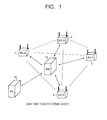
- FIG. 1 is a system configuration diagram to explain a mesh network under a white space where a communication management device being one embodiment of the present invention can be provided.
- this system includes: managed devices 1, 2, 3, and 4 (as an example, four devices are applied, but the number of devices are not limited); a communication management device (a mesh manager: MM) 10; and a database 20.
- the managed devices 1 to 4 are wireless communication devices positioned in parallel to one another, and each can be regarded as a base station (BS) or a mobile base station, for example, or each can be also regarded as a terminal (a mobile terminal, in particular) managed by the communication management device 10.
- BS base station
- the managed devices 1 to 4 each can include a terminal (not illustrated) to be connected thereto.
- the managed devices 1 to 4 are each configured to operate under the TVWS environment.
- a link for communication can be established.
- communication can be made between all the arbitrary managed devices. This is because another managed device can be used as a relay device.
- Such a mesh network structure has a solution to a question which path including a relay should be used between all the arbitrary two managed devices in order to obtain the best communication quality between the arbitrary two managed devices, but the solution is unobvious, and further the solution also fluctuates according to a change in communication environment.
- electric field changes of use frequencies caused by the positions of the managed devices 1 to 4 being moved, a conflict with another secondary user, and the like can be thought.
- the communication management device 10 is provided in a state capable of being connected to all the managed devices 1 to 4 for the purpose of managing the managed devices 1 to 4. Functions necessary for the management will be described in detail later, but to put it simply, the functions are to search for the solution to the question which path including a relay should be used between all the arbitrary managed devices under the TVWS environment in order to obtain the best communication quality between the arbitrary managed devices and to direct each of the managed devices 1 to 4 to establish necessary links according to result of the search.
- the database 20 is a server provided on the Internet so as to at least provide information on available frequencies to secondary users to be operated under the TVWS environment without affecting primary users. It is essential that the available frequencies to be transmitted back should not at least affect primary users, and it is also possible to presuppose that frequencies already allocated to other secondary users are removed. In the system illustrated in FIG. 1 , it is presupposed that the connection to the database 20 is performed exclusively by the management device 10. However, a configuration such that the managed devices 1 to 4 each is directly connected to the database 20 is not excluded.
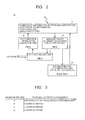
- FIG. 2 is a functional block diagram illustrating the configuration of the communication management device being one embodiment of the present invention.
- this communication management device 10 includes: a communication function unit 11 for managed devices; a managed device information storage and retention unit 12; a database inquiry unit 13; a test direction information generation unit 14; and an established link determination unit 15.
- FIG. 2 illustrates the functional block diagram, and when functions and operations of the configuration in this drawing are each explained, FIG. 3 or FIG. 8 is used as a reference as necessary.
- the communication function unit 11 for managed devices has a function to acquire a geographical position from each of the managed devices.
- the managed devices are each at least provided with a function to specify a current geographical position of its own device by using a GPS satellite, for example, which is not mentioned in the explanation in FIG. 1 .
- Each of the acquired geographical positions is sent to the managed device information storage and retention unit 12 to be stored and retained therein.
- the communication function unit 11 and the managed device information storage and retention unit 12 also have other important functions, but in detail the functions will be described later.
- Each of the geographical positions of the managed devices stored and retained in the managed device information storage and retention unit 12 is sent to the database inquiry unit 13.
- the database inquiry unit 13 transmits each of the geographical positions sent from the information storage and retention unit 12 to the database and inquires about a frequency band available at the position (and additionally, maximum transmission power and further several regulations of use depending on the case).
- the information is a corresponding list such that the available frequency corresponding to the geographical position of the managed device A, for example, is a.
- a plurality of available frequencies a exist potentially in general. The same can be said with regard to the other managed devices B to D and available frequencies b to d.
- illustration of "maximum transmission power and further various regulations of use" is omitted.
- the corresponding list obtained from the database is stored and retained in the database inquiry unit 13 and is sent to the test direction information generation unit 14.
- the test direction information generation unit 14 specifies, for each of all the combination pairs of two managed devices of the managed devices, a frequency available in common by the two managed devices as a pair available frequency based on the corresponding list. This will be further explained as blow with reference to FIG. 4 .
- link pairs there are 6 pairs of A-B, A-C, A-D, B-C, B-D, and C-D.
- the number of pairs can be calculated by n C 2 generally (combinations of two arbitrarily selected from n pieces of managed devices).
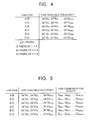
- Frequencies available for each link pair can be conceived as frequencies available in common by the two related managed devices, and as illustrated in FIG. 4 , with regard to a link pair A-B, for example, (a ⁇ b) 1 , (a ⁇ b) 2 , ⁇ , and (a ⁇ b) nAB can be cited and specified.
- a ⁇ b ⁇
- the same can be said also in the other link pairs.
- the test direction information generation unit 14 sends the pair available frequency specified as above to the communication function unit 11, and thereby the communication function unit 11 notifies the pair available frequency to one of the two related managed devices together with identification information of the other managed device and notifies the pair available frequency to the other of the two related managed devices together with identification information of the one managed device.
- the pair available frequency becomes part of direction information used for measuring communication quality in each of the managed devices.
- Each of the managed devices having had the pair available frequency notified thereto measures pair communication quality being quality of communication between the related combination pair obtained when the pair available frequency is used by actually supplying small-scale test data, for example.
- pair communication quality maximum communication speed, delay, jitter, a packet loss rate, and a bit error rate, and the like between the two managed devices obtained when the pair available frequencies are used can be cited as an example.
- the pair communication quality at least one of them can be used, but some of them may also be measured to be used.
- the measurement of the pair communication quality in the individual managed devices is designed to be performed periodically, for example, with respect to all the link pairs regardless of whether or not the link state is established.
- a result of the measurement is collected (or reported) and acquired from the individual managed devices via the communication function unit 11, and is stored and retained in the managed device information storage and retention unit 12 (it may be accumulated but at least the latest one is stored and retained).
- pair communication quality Q corresponds to each pair available frequency of the individual link pairs.
- each of the pair communication qualities Q is not single but is plural as above (namely, Q becomes a vector quantity).
- the information illustrated in FIG. 5 is sent to the established link determination unit 15 from the storage and retention unit 12.
- an operation of acquiring the geographical position from each of the managed devices, acquiring the information of the frequency available at the position ( FIG. 3 ) from the database, and reporting the information of the pair available frequencies obtained thereby ( FIG. 4 ) to the related managed devices is also preferably performed periodically. This is because there are possibilities that the position of the managed device is moved, due to another cause, the communication environment changes and thereby the pair available frequencies also vary.
- the established link determination unit 15 first uses the information illustrated in FIG. 5 sent from the storage and retention unit 12 to select the best pair communication quality to be the best from the pair communication qualities contained in the information for each link pair, and further defines the best pair available frequency being the pair available frequency corresponding to this.
- the best pair communication quality in the link pair A-B for example, is expressed as Q AB* and the best pair available frequency corresponding to it is expressed as (a ⁇ b)*, a list of all the link pairs illustrated in FIG. 6 is obtained.
- the pair communication quality Q is a vector quantity
- a coefficient used for the weighted average can be set and selected appropriately according to specifications required for the communication.
- the established link determination unit 15 next specifies, for each combination pair, all the paths including paths where communication is relayed by another managed device as candidate paths corresponding to each combination pair.
- all the paths can be specified as candidate paths similarly (see the chart in FIG. 7 ).
- the established link determination unit 15 subsequently calculates, based on the information of the best pair communication quality illustrated in FIG. 6 , path communication quality as the communication quality of each of the candidate paths where the communication between the combination pair using the best pair available frequency is made for each combination pair.
- path communication quality of A-D-B can be calculated by using the best pair communication quality Q AD* of A-D and the best pair communication quality Q BD* of B-D (being the same as D-B).
- an evaluation function can be set.
- the quality is "delay,” for example, a total delay amount of the path results in the sum of delays at the individual link pairs, so that the evaluation function can be set as the sum of delay amounts of the individual link pairs.
- the quality is "communication speed,” with regard to the total communication speed of the path, the link pair having the minimum communication speed becomes a bottleneck, so that the evaluation function can be set as a function in which the minimum value is selected from the delay amounts of the individual link pairs.
- an evaluation function of an expression such as, for example, "1 - (1 - bit error rate A-D )•(1 - bit error rate B-D )" where the total error rate of the path is calculated can be set.
- the established link determination unit 15 subsequently selects the candidate path where the best path communication quality is obtained from the candidate paths as a use path for each combination pair.
- the candidate path illustrated in bold oblique type for each combination pair has the best path communication quality to thus be selected.
- the pair communication quality is a vector quantity in general
- the path communication quality also becomes a vector quantity having the same element number.
- a coefficient used for the weighted average can be set and selected appropriately according to specifications required for the communication.
- the established link determination unit 15 finally generates information to direct each of the managed devices to perform the communication between the combination pair by using the above-described use path where the communication between the link pair using the best pair available frequency is made.
- This direction information is transmitted to the individual managed devices from the established link determination unit 15 via the communication function unit 11.
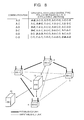
- the network of the managed devices is brought into a state where established links and unestablished links exist as illustrated in FIG. 7 , for example.
- 4 links of A-B, B-C, B-D, and C-D are the established links, and as long as they are established, all the "selected paths" in the list in FIG. 7 are established. That is, the quality of communication between all the respective two managed devices becomes the best.
- the communication management device being one embodiment of the present invention has been explained.
- the communication between the managed devices is performed by using the use path selected as above, it is possible to well maintain the communication qualities while accommodating the momentarily changeable communication environment. This is because originally, each of the pair communication qualities obtained when the pair available frequencies are used is acquired from the individual managed devices, and based on it, the communication between the link pair using the best pair available frequency is performed by the use path.
- the link states of the mesh network are established as illustrated in FIG. 7 , for example, when the communication environment changes somewhat, by the steps explained by using FIG. 3 to FIG. 7 , the link states can be changed so that another use path may be selected.
- FIG. 8 One example obtained after the change is illustrated in FIG. 8 .
- 3 of A-B, A-D, and B-C are the established links, and as long as they are established, all the "following selected paths" in the list in FIG. 8 are established. That is, the quality of communication between all the respective two managed devices becomes the best.
- the embodiment explained above is suitable for the case when a communication infrastructure is established temporarily or the case when a communication infrastructure is handled urgently at the time of disaster, for example. That is, even if a plurality of base stations are installed at appropriate positions without a strict plan, the best links are established automatically while accommodating communication environment changes, and thereby it is possible to establish a network covering an areally broad region.
- the geographical position is acquired from each of the managed devices, each of the geographical positions is transmitted to the database, and for the purpose of storing and retaining the corresponding list, the corresponding list transmitted from the database as the information corresponding to the individual geographical positions is received, but the above-described embodiment can also be configured as follows. That is, when each of the managed devices has a function to connect to the database, it inquires of the database about the available frequency in the managed device and the information of the available frequencies being the information corresponding to the individual geographical positions is transmitted from the managed devices, and thereby the information can be collected as the above-described corresponding list in the communication management device.
- the communication management device exists independently from the managed devices, but the communication management device may also function as one of the managed devices. That is, this is that one of the managed devices is provided with the configuration as the communication management device, and in other words, this is a configuration in which one of communication devices positioned in parallel that are capable of forming a mesh is also a management device.
- the communication management device it is possible to make an independent device take on the function as the communication management device, and it is also possible to make one of communication devices positioned in parallel that are capable of forming a mesh take on the function as the communication management device.
- a function to direct each of the managed devices to measure each of the pair communication qualities is provided in the communication management device. That is, this is an embodiment in which when a communication environment change is detected on the communication management device side, for example, in order to change a mesh structure (link states), a direction to start an operation of the change is given temporarily.
Landscapes
- Engineering & Computer Science (AREA)
- Computer Networks & Wireless Communication (AREA)
- Signal Processing (AREA)
- Mobile Radio Communication Systems (AREA)
Abstract
Description
- The present invention relates to a communication management device provided for the purpose of managing communication devices to operate under a television white space (TVWS) environment and a communication management method thereof, and particularly relates to a communication management device and a communication management method suitable for the case where a parallel network structure (a mesh network) can be formed by a plurality of communication devices being managed devices making a group.
- Standards of wireless communication to use the same frequency band as that of a television broadcast being a licensed business and to be capable of being operated with no such a license, have been investigated. In these standards, a television broadcaster is regarded as a primary user, and only when a licensed frequency band of the primary user is not used, a secondary user is allowed to operate wireless communication in the frequency band (the licensed frequency band that is not used = white space).
- In order to confirm that no TV signals exist, a communication device being the secondary user used under such an environment inquires of a dedicated database about TV channels, for example. That is, current position information of the communication device is transmitted to the database, and a list of frequencies available (effective) at the position is obtained from the database. Then, a frequency to be used is selected from the frequencies of the list and as the secondary user, wireless communication is operated.
- On the other hand, as one embodiment of the secondary user, there is conceived an embodiment in which a plurality of communication devices are connected to one another in a manner to form a mesh, and even when only one of the communication devices has a function to communicate with the Internet and the like, all the communication devices can be connected to the Internet and the like through a meshed network. Further, as long as the plurality of communication devices form a mesh as above, when these communication devices perform communication with one another, the communication is completed in the network (the mesh network), so that it is efficient.
- With regard to the secondary users that can form a mesh network, management for maintaining the mesh network is required, and further, communication is performed by using the white space, so that management for the communication is also required. Particularly, it is conceived that well maintaining communication qualities while accommodating a change in momentarily changeable communication environment is important for the secondary users capable of forming a mesh network in the white space.
-
- Non-Patent Document 1: IEEE802.11af Task Group, http://mentor.ieee.org/802.11/
- Non-Patent Document 2: IEEE802.19.1 Task Group, http://mentor.ieee.org/802.802.19/documents
- Non-Patent Document 3: Federal Communications Commission, Unlicensed Operation in the TV Broadcast Bands, Second Memorandum Opinion and Order, FCC, 10-17-4, Sept. 23,2010.
- Non-Patent Document 4: Ofcom, Digital Dividend: Cognitive Access, Consultation on License Exempting Cognitive Devices using Interleaved Spectrum, July 2009.
- Non-Patent Document 5: IETF RFC 3626, Optimized Link State Routing Protocol (OLSR)
- The present invention has an object to provide a communication management device provided for the purpose of managing communication devices to operate under a television white space (TVWS) environment and a communication management method thereof, the communication management device and the communication management method thereof being applied to a parallel network structure (a mesh network) formed by a plurality of managed devices making a group and being capable of well maintaining communication qualities while accommodating a momentarily changeable communication environment.
- In order to solve the above-described problems, a communication management device being one embodiment of the present invention includes: a storing unit configured to store and retain a corresponding list, the list making each geographical position of a plurality of managed devices to be managed correspond to available frequencies indicating frequencies available at the each geographical position; a first specifying unit configured to specify, for each combination pair being arbitrary two managed devices out of the plurality of managed devices, frequencies available in common by the arbitrary two managed devices as pair available frequencies based on the corresponding list; a notifying unit configured to notify the pair available frequencies, to each of the arbitrary two managed devices related to the pair available frequencies; an acquiring unit configured to acquire each of pair communication qualities being a quality of communication in the each combination pair obtained when each of the pair available frequencies specified for the each combination pair is used from each of the plurality of managed devices; a defining unit configured to define, for the each combination pair, a best pair available frequency out of the pair available frequencies, being capable of obtaining a best of the pair communication qualities and to define a best pair communication quality out of the pair communication qualities, corresponding to the best pair available frequency; a second specifying unit configured to specify, for the each combination pair, all of paths connecting one and another of the each combination pair, each of the paths being capable of relaying other managed devices out of the plurality of managed devices as candidate paths of the each combination pair; a calculating unit configured to calculate, for the each combination pair, based on information of the best pair communication quality, each of path communication qualities being a quality of communication in each of the candidate paths connecting one or more communications in the each combination pair using the best pair available frequency; a selecting unit configured to select, for the each combination pair, a path out of the candidate paths, the path having a best quality in the path communication qualities as a use path for the each combination pair; and a directing unit configured to direct each of the plurality of managed devices to perform communication between one and another of the each combination pair by using the use path connecting one or more communications in the each combination pair using the best pair available frequency.
- This communication management device stores and retains a corresponding list where each geographical position of a plurality of managed devices to be managed and available frequencies indicating frequencies available at the each geographical position are made to correspond. Then, it specifies, for each of all the combination pairs of two managed devices of the plurality of managed devices, frequencies available in common by the two managed devices as pair available frequencies based on the above-described corresponding list. Further, it notifies the pair available frequencies to each of the two managed devices related to the pair available frequencies.
- Next, it acquires pair communication qualities being qualities of communication in the combination pair obtained when the pair available frequencies specified for the combination pair are used from each of the plurality of managed devices. Then, it defines, for each of the combination pairs, the pair available frequency at which the best pair communication quality is obtained as the best pair available frequency and defines the pair communication quality corresponding to the best pair available frequency as the best pair communication quality.
- Next, it specifies, for each of the combination pairs, all the paths including paths where communication is relayed by another managed device as candidate paths corresponding to each of the combination pairs. Then, it calculates, based on information of the best pair communication quality, path communication qualities as communication quality of each of the candidate paths where one or more communications of the combination pair using the best pair available frequency are made for each of the combination pairs. Further, it selects the candidate path where the best path communication quality is obtained from the candidate paths as a use path for each of the combination pairs.
- Finally, it directs each of the plurality of managed devices to perform communication between one and another of the combination pair by using the use path where one or more communications connecting the combination pair using the best pair available frequency is made. According to the communication through such a use path, it is possible to well maintain the communication qualities while accommodating a momentarily changeable communication environment. This is because originally, each of the pair communication qualities being quality of communication between the combination pair obtained when the pair available frequencies are used is acquired from each of the plurality of managed devices, and based on it, the communication between one and another of the combination pair by using the use path connecting one or more communications using the best pair available frequency is performed.
- Further, a communication management method being another embodiment of the present invention includes: storing and retaining a corresponding list, the list making each geographical position of a plurality of managed devices to be managed correspond to available frequencies indicating frequencies available at the each geographical position; specifying, for each combination pair being arbitrary two managed devices out of the plurality of managed devices, frequencies available in common by the arbitrary two managed devices as pair available frequencies based on the corresponding list; notifying the pair available frequencies to each of the arbitrary two managed devices related to the pair available frequencies; acquiring each of pair communication qualities being a quality of communication in the each combination pair obtained when each of the pair available frequencies specified for the each combination pair is used from each of the plurality of managed devices; defining, for the each combination pair, a best pair available frequency out of the pair available frequencies, being capable of obtaining a best of the pair communication qualities and defining a best pair communication quality out of the pair communication qualities, corresponding to the best pair available frequency; specifying, for the each combination pair, all of paths connecting one and another of the each combination pair, each of the paths being capable of relaying other managed devices out of the plurality of managed devices as candidate paths of the each combination pair; calculating, for the each combination pair, based on information of the best pair communication quality, each of path communication qualities being a quality of communication in each of the candidate paths connecting one or more communications in the each combination pair using the best pair available frequency; selecting, for the each combination pair, a path out of the candidate paths, the path having a best quality in the path communication qualities as a use path for the each combination pair; and directing each of the plurality of managed devices to perform communication between one and another of the each combination pair by using the use path connecting one or more communications in the each combination pair using the best pair available frequency.
- This communication management method is a management method conforming to the above-described communication management device.
- According to the present invention, it is possible to provide a communication management device provided for the purpose of managing communication devices to operate under a television white space (TVWS) environment and a communication management method thereof, the communication management device and the communication management method thereof being applied to a mesh network and being capable of well maintaining communication qualities while accommodating a momentarily changeable communication environment.
-
-
FIG. 1 is a system configuration diagram used for explaining a mesh network under a white space where a communication management device (MM) being one embodiment of the present invention can be provided; -
FIG. 2 is a functional block diagram illustrating a configuration of the communication management device being one embodiment of the present invention; -
FIG. 3 is an explanatory diagram illustrating, as an example, a corresponding list of managed devices and available frequencies that can be acquired from a database by adatabase inquiry unit 13 illustrated inFIG. 2 ; -
FIG. 4 is an explanatory diagram illustrating available frequencies for each link pair that can be generated by a test directioninformation generation unit 14 illustrated inFIG. 2 ; -
FIG. 5 is an explanatory diagram illustrating correspondences of pair communication quality to each link pair and to each pair available frequency that can be stored and retained by a managed device information storage andretention unit 12 illustrated inFIG. 2 via acommunication function unit 11 for managed devices; -
FIG. 6 is an explanatory diagram illustrating the best pair available frequency and the best pair communication quality for each link pair that are defined by an establishedlink defining unit 15 illustrated inFIG. 2 ; -
FIG. 7 is an explanatory diagram illustrating a use path for each combination pair selected by the establishedlink determination unit 15 illustrated inFIG. 2 and is a system configuration diagram illustrating a mesh network where results are reflected; and -
FIG. 8 is an explanatory diagram illustrating a use path for each combination pair selected by the establishedlink determination unit 15 illustrated inFIG. 2 , which is different from the one illustrated inFIG. 7 and is a system configuration diagram illustrating a mesh network where results are reflected. - As a mode of the present invention, it further includes: a second acquiring unit configured to acquire the geographical position from each of the plurality of managed devices; a transmitting unit configured to transmit each of the geographical positions to a database; and a receiving unit configured to receive the corresponding list transmitted from the database as information corresponding to the each geographical position for the purpose of storing and retaining the corresponding list.
- In this mode, the communication management device acquires information of the geographical position from each of the managed devices and transmits each of the geographical positions to the database, to then make inquiry. That is, this mode is a mode in which the communication management device can make inquiries to the database even in the case when each of the managed devices does not have a connection to the database. Conversely, in the case when each of the managed devices has a connection to the database, it is also possible that they inquire of the database about the available frequency in the managed device and the communication management device acquires information of the available frequencies being the information corresponding to each geographical position from the managed devices to collect the information of the available frequencies as the above-described corresponding list.
- Further, as a mode, it is possible to design that it further includes a functioning unit configured to function as one of the plurality of managed devices. That is, in this mode, one of the managed devices is provided with the configuration as the communication management device, in other words, it is a configuration in which one of communication devices positioned in parallel that are capable of forming a mesh is also the communication management device. As above, it is possible to make an independent device take on the function as the communication management device, and it is also possible to make one of communication devices positioned in parallel that are capable of forming a mesh take on the function as the communication management device.
- Further, as a mode, it is possible to design that it further includes a second directing unit configured to direct each of the plurality of managed devices to measure each of the pair communication qualities. That is, this is a mode in which when a change in communication environment is detected on the communication management device side, for example, in order to update a mesh structure (link states), a direction to start an operation of the update is given temporarily. In addition to the case of giving a direction described above, it is also possible to design that, for example, the measurement of the pair communication quality is performed periodically in the plurality of managed devices, results of the measurements are reported to the communication management device each time, and the results are accumulated in the communication management device.
- Further, as a mode, it is possible to design that the pair communication qualities are qualities based on one or more pieces of information out of, mutual electric field intensity between one and another of the each combination pair that are capable of using the pair available frequencies and are related to the pair communication qualities, maximum communication speed, delay, jitter, a packet loss rate, and a bit error rate between the one and the other of the each combination pair that are obtained when the pair available frequencies are used. These are concrete examples of the pair communication qualities. The plurality of pair communication qualities can also be used. Incidentally, when path communication quality is calculated by using the pair communication quality, a certain evaluation function can be used depending on the nature of the used pair communication quality.
- Based on the above description, there will be explained an embodiment of the present invention below with reference to the drawings. First, with reference to
FIG. 1 , there will be explained a mesh network under a white space where a communication management device in an embodiment can be provided.FIG. 1 is a system configuration diagram to explain a mesh network under a white space where a communication management device being one embodiment of the present invention can be provided. - As illustrated in the same drawing, this system includes: managed
devices database 20. The manageddevices 1 to 4 are wireless communication devices positioned in parallel to one another, and each can be regarded as a base station (BS) or a mobile base station, for example, or each can be also regarded as a terminal (a mobile terminal, in particular) managed by thecommunication management device 10. When being a (mobile) base station, the manageddevices 1 to 4 each can include a terminal (not illustrated) to be connected thereto. The manageddevices 1 to 4 are each configured to operate under the TVWS environment. - For each combination pair of two of the managed
devices 1 to 4 (to be sometimes denoted by A to D, hereinafter), a link for communication can be established. When at least one link is established when seen from the individual managed devices even though all the illustrated links are not established, communication can be made between all the arbitrary managed devices. This is because another managed device can be used as a relay device. - Such a mesh network structure has a solution to a question which path including a relay should be used between all the arbitrary two managed devices in order to obtain the best communication quality between the arbitrary two managed devices, but the solution is unobvious, and further the solution also fluctuates according to a change in communication environment. As the typical changes in communication environment, electric field changes of use frequencies caused by the positions of the managed
devices 1 to 4 being moved, a conflict with another secondary user, and the like can be thought. - The
communication management device 10 is provided in a state capable of being connected to all the manageddevices 1 to 4 for the purpose of managing the manageddevices 1 to 4. Functions necessary for the management will be described in detail later, but to put it simply, the functions are to search for the solution to the question which path including a relay should be used between all the arbitrary managed devices under the TVWS environment in order to obtain the best communication quality between the arbitrary managed devices and to direct each of the manageddevices 1 to 4 to establish necessary links according to result of the search. - The
database 20 is a server provided on the Internet so as to at least provide information on available frequencies to secondary users to be operated under the TVWS environment without affecting primary users. It is essential that the available frequencies to be transmitted back should not at least affect primary users, and it is also possible to presuppose that frequencies already allocated to other secondary users are removed. In the system illustrated inFIG. 1 , it is presupposed that the connection to thedatabase 20 is performed exclusively by themanagement device 10. However, a configuration such that the manageddevices 1 to 4 each is directly connected to thedatabase 20 is not excluded. - Next,
FIG. 2 is a functional block diagram illustrating the configuration of the communication management device being one embodiment of the present invention. In other words, it illustrates an internal structure of thecommunication management device 10 illustrated inFIG, 1 . As illustrated inFIG. 1 , thiscommunication management device 10 includes: acommunication function unit 11 for managed devices; a managed device information storage andretention unit 12; adatabase inquiry unit 13; a test directioninformation generation unit 14; and an establishedlink determination unit 15. -
FIG. 2 illustrates the functional block diagram, and when functions and operations of the configuration in this drawing are each explained,FIG. 3 orFIG. 8 is used as a reference as necessary. - First, the
communication function unit 11 for managed devices has a function to acquire a geographical position from each of the managed devices. The managed devices are each at least provided with a function to specify a current geographical position of its own device by using a GPS satellite, for example, which is not mentioned in the explanation inFIG. 1 . Each of the acquired geographical positions is sent to the managed device information storage andretention unit 12 to be stored and retained therein. Thecommunication function unit 11 and the managed device information storage andretention unit 12 also have other important functions, but in detail the functions will be described later. - Each of the geographical positions of the managed devices stored and retained in the managed device information storage and
retention unit 12 is sent to thedatabase inquiry unit 13. Thedatabase inquiry unit 13 transmits each of the geographical positions sent from the information storage andretention unit 12 to the database and inquires about a frequency band available at the position (and additionally, maximum transmission power and further several regulations of use depending on the case). - From the database, for example, information on frequency available in each of the managed devices (a corresponding list) illustrated in
FIG. 3 is transmitted back. The information is a corresponding list such that the available frequency corresponding to the geographical position of the managed device A, for example, is a. A plurality of available frequencies a exist potentially in general. The same can be said with regard to the other managed devices B to D and available frequencies b to d. Incidentally, inFIG. 3 , illustration of "maximum transmission power and further various regulations of use" is omitted. The corresponding list obtained from the database is stored and retained in thedatabase inquiry unit 13 and is sent to the test directioninformation generation unit 14. - The test direction
information generation unit 14 specifies, for each of all the combination pairs of two managed devices of the managed devices, a frequency available in common by the two managed devices as a pair available frequency based on the corresponding list. This will be further explained as blow with reference toFIG. 4 . - In the system illustrated in
FIG. 1 , with regard to all the combination pairs of two managed devices of the managed devices (to be sometimes referred to as link pairs below, which means that they have a possibility to be established as a link and is not related to whether they are actually in a link state), as illustrated inFIG. 4 , there are 6 pairs of A-B, A-C, A-D, B-C, B-D, and C-D. The number of pairs can be calculated by nC2 generally (combinations of two arbitrarily selected from n pieces of managed devices). - Frequencies available for each link pair can be conceived as frequencies available in common by the two related managed devices, and as illustrated in
FIG. 4 , with regard to a link pair A-B, for example, (a∩b)1, (a∩b)2, ···, and (a∩b)nAB can be cited and specified. Incidentally, generally, there is also a possibility that no frequencies available in common exist (namely a∩b = φ) and no pair available frequencies exist. With regard to the above point, the same can be said also in the other link pairs. - The test direction
information generation unit 14 sends the pair available frequency specified as above to thecommunication function unit 11, and thereby thecommunication function unit 11 notifies the pair available frequency to one of the two related managed devices together with identification information of the other managed device and notifies the pair available frequency to the other of the two related managed devices together with identification information of the one managed device. The pair available frequency becomes part of direction information used for measuring communication quality in each of the managed devices. - Each of the managed devices having had the pair available frequency notified thereto measures pair communication quality being quality of communication between the related combination pair obtained when the pair available frequency is used by actually supplying small-scale test data, for example.
- As such pair communication quality, maximum communication speed, delay, jitter, a packet loss rate, and a bit error rate, and the like between the two managed devices obtained when the pair available frequencies are used can be cited as an example. For the pair communication quality, at least one of them can be used, but some of them may also be measured to be used. Further, as one of the pair communication qualities, it is also possible to use (mutual) electric field intensity between one managed device and the other managed device that are capable of using the pair available frequencies and are related to the pair communication quality.
- The measurement of the pair communication quality in the individual managed devices is designed to be performed periodically, for example, with respect to all the link pairs regardless of whether or not the link state is established. A result of the measurement is collected (or reported) and acquired from the individual managed devices via the
communication function unit 11, and is stored and retained in the managed device information storage and retention unit 12 (it may be accumulated but at least the latest one is stored and retained). - The latest information stored and retained as above is illustrated in
FIG. 5 , for example. That is, pair communication quality Q corresponds to each pair available frequency of the individual link pairs. There is also a possibility that each of the pair communication qualities Q is not single but is plural as above (namely, Q becomes a vector quantity). The information illustrated inFIG. 5 is sent to the establishedlink determination unit 15 from the storage andretention unit 12. By the way, in the case of the link pair having no pair available frequency, with regard to the pair communication quality of the link pair, a numeral value indicating the worst quality, for example, can be given for convenience. - Incidentally, in order that the measurement of the pair communication quality in the individual managed devices should be performed periodically for all the link pairs, an operation of acquiring the geographical position from each of the managed devices, acquiring the information of the frequency available at the position (
FIG. 3 ) from the database, and reporting the information of the pair available frequencies obtained thereby (FIG. 4 ) to the related managed devices is also preferably performed periodically. This is because there are possibilities that the position of the managed device is moved, due to another cause, the communication environment changes and thereby the pair available frequencies also vary. - The established
link determination unit 15 first uses the information illustrated inFIG. 5 sent from the storage andretention unit 12 to select the best pair communication quality to be the best from the pair communication qualities contained in the information for each link pair, and further defines the best pair available frequency being the pair available frequency corresponding to this. Here, when the best pair communication quality in the link pair A-B, for example, is expressed as QAB* and the best pair available frequency corresponding to it is expressed as (a∩b)*, a list of all the link pairs illustrated inFIG. 6 is obtained. - Incidentally, in order to select the best pair communication quality when the pair communication quality Q is a vector quantity, it is possible to apply a method in which an element of the vector quantity is weighted averaged to be defined by a scalar value, for example, or the like. A coefficient used for the weighted average can be set and selected appropriately according to specifications required for the communication.
- The established
link determination unit 15 next specifies, for each combination pair, all the paths including paths where communication is relayed by another managed device as candidate paths corresponding to each combination pair. In the case of the combination pair of A-B, for example, with regard to the candidate path, 5 paths of A-B, A-C-B, A-D-B, A-C-D-B, and A-D-C-B are specified. With regard also to the other combination pairs, all the paths can be specified as candidate paths similarly (see the chart inFIG. 7 ). - By the way, it is possible to calculate the number of candidate paths existing for one combination pair by i=0∑n-2 (n-2)Ci•i! generally. This expression is that i being the number of devices to be a relay device is used as a parameter, the relay device is selected by (n-2)Ci, (n-2)Ci and i! being sequence of possible paths for the relay device are multiplied, and the product of the multiplication is added in ∑ finally.
- The established
link determination unit 15 subsequently calculates, based on the information of the best pair communication quality illustrated inFIG. 6 , path communication quality as the communication quality of each of the candidate paths where the communication between the combination pair using the best pair available frequency is made for each combination pair. When the combination pair is A-B and the candidate path is A-D-B, for example, the path communication quality of A-D-B can be calculated by using the best pair communication quality QAD* of A-D and the best pair communication quality QBD* of B-D (being the same as D-B). - As is clear from the list illustrated in
FIG. 7 , in this case, 5 types of path communication qualities are calculated for each combination pair. There are 6 pairs of the combination pairs in this case, so that 30 types of path communication qualities in total are calculated. In order to compact a calculation amount, when there exists a link to which a "numerical value indicating the worst quality" is given in the path, for example, it is also possible to design that the calculation of the path is stopped (is not performed). - In order to calculate the path communication quality from the plurality of best pair communication qualities as above, based on the nature of the quality, an evaluation function can be set. When the quality is "delay," for example, a total delay amount of the path results in the sum of delays at the individual link pairs, so that the evaluation function can be set as the sum of delay amounts of the individual link pairs. Further, when the quality is "communication speed," with regard to the total communication speed of the path, the link pair having the minimum communication speed becomes a bottleneck, so that the evaluation function can be set as a function in which the minimum value is selected from the delay amounts of the individual link pairs. Further, when the quality is a "bit error rate," an evaluation function of an expression such as, for example, "1 - (1 - bit error rate A-D)•(1 - bit error rate B-D)" where the total error rate of the path is calculated can be set.
- The established
link determination unit 15 subsequently selects the candidate path where the best path communication quality is obtained from the candidate paths as a use path for each combination pair. In the list illustrated inFIG. 7 , for example, it is set that the candidate path illustrated in bold oblique type for each combination pair has the best path communication quality to thus be selected. Incidentally, when the pair communication quality is a vector quantity in general, the path communication quality also becomes a vector quantity having the same element number. In order to select the best in such a case, for example, it is possible to apply a method in which an element of a vector quantity of the best is weighted averaged to be defined by a scalar value, or the like. A coefficient used for the weighted average can be set and selected appropriately according to specifications required for the communication. - The established
link determination unit 15 finally generates information to direct each of the managed devices to perform the communication between the combination pair by using the above-described use path where the communication between the link pair using the best pair available frequency is made. This direction information is transmitted to the individual managed devices from the establishedlink determination unit 15 via thecommunication function unit 11. By such a direction, the network of the managed devices is brought into a state where established links and unestablished links exist as illustrated inFIG. 7 , for example. In this case, 4 links of A-B, B-C, B-D, and C-D are the established links, and as long as they are established, all the "selected paths" in the list inFIG. 7 are established. That is, the quality of communication between all the respective two managed devices becomes the best. - In the foregoing, the communication management device being one embodiment of the present invention has been explained. As long as the communication between the managed devices is performed by using the use path selected as above, it is possible to well maintain the communication qualities while accommodating the momentarily changeable communication environment. This is because originally, each of the pair communication qualities obtained when the pair available frequencies are used is acquired from the individual managed devices, and based on it, the communication between the link pair using the best pair available frequency is performed by the use path.
- When the link states of the mesh network are established as illustrated in
FIG. 7 , for example, when the communication environment changes somewhat, by the steps explained by usingFIG. 3 to FIG. 7 , the link states can be changed so that another use path may be selected. One example obtained after the change is illustrated inFIG. 8 . In this case, 3 of A-B, A-D, and B-C are the established links, and as long as they are established, all the "following selected paths" in the list inFIG. 8 are established. That is, the quality of communication between all the respective two managed devices becomes the best. - The embodiment explained above is suitable for the case when a communication infrastructure is established temporarily or the case when a communication infrastructure is handled urgently at the time of disaster, for example. That is, even if a plurality of base stations are installed at appropriate positions without a strict plan, the best links are established automatically while accommodating communication environment changes, and thereby it is possible to establish a network covering an areally broad region.
- Next, there will be explained modified examples of the above-explained embodiment supplementally. In the above-described embodiment, the geographical position is acquired from each of the managed devices, each of the geographical positions is transmitted to the database, and for the purpose of storing and retaining the corresponding list, the corresponding list transmitted from the database as the information corresponding to the individual geographical positions is received, but the above-described embodiment can also be configured as follows. That is, when each of the managed devices has a function to connect to the database, it inquires of the database about the available frequency in the managed device and the information of the available frequencies being the information corresponding to the individual geographical positions is transmitted from the managed devices, and thereby the information can be collected as the above-described corresponding list in the communication management device.
- Further, in the above-described embodiment, the communication management device exists independently from the managed devices, but the communication management device may also function as one of the managed devices. That is, this is that one of the managed devices is provided with the configuration as the communication management device, and in other words, this is a configuration in which one of communication devices positioned in parallel that are capable of forming a mesh is also a management device. As above, it is possible to make an independent device take on the function as the communication management device, and it is also possible to make one of communication devices positioned in parallel that are capable of forming a mesh take on the function as the communication management device.
- Further, it is also possible to design that a function to direct each of the managed devices to measure each of the pair communication qualities is provided in the communication management device. That is, this is an embodiment in which when a communication environment change is detected on the communication management device side, for example, in order to change a mesh structure (link states), a direction to start an operation of the change is given temporarily.
- In the foregoing, while certain embodiments of the present invention have been described, these embodiments have been presented by way of example only, and are not intended to limit the scope of the inventions. Indeed, the novel embodiments described herein may be embodied in a variety of other forms; furthermore, various omissions, substitutions and changes in the form of the embodiments described herein may be made without departing from the spirit of the inventions. The accompanying claims and their equivalents are intended to cover such forms or modifications as would fall within the scope and sprit of the inventions.
Claims (6)
- A communication management device comprising:a storing unit configured to store and retain a corresponding list, the list making each geographical position of a plurality of managed devices to be managed correspond to available frequencies indicating frequencies available at the each geographical position;a first specifying unit configured to specify, for each combination pair being arbitrary two managed devices out of the plurality of managed devices, frequencies available in common by the arbitrary two managed devices as pair available frequencies based on the corresponding list;a notifying unit configured to notify the pair available frequencies to each of the arbitrary two managed devices related to the pair available frequencies;an acquiring unit configured to acquire each of pair communication qualities being a quality of communication in the each combination pair obtained when each of the pair available frequencies specified for the each combination pair is used from each of the plurality of managed devices;a defining unit configured to define, for the each combination pair, a best pair available frequency out of the pair available frequencies, being capable of obtaining a best of the pair communication qualities and to define a best pair communication quality out of the pair communication qualities, corresponding to the best pair available frequency;a second specifying unit configured to specify, for the each combination pair, all of paths connecting one and another of the each combination pair, each of the paths being capable of relaying other managed devices out of the plurality of managed devices as candidate paths of the each combination pair;a calculating unit configured to calculate, for the each combination pair, based on information of the best pair communication quality, each of path communication qualities being a quality of communication in each of the candidate paths connecting one or more communications in the each combination pair using the best pair available frequency;a selecting unit configured to select, for the each combination pair, a path out of the candidate paths, the path having a best quality in the path communication qualities as a use path for the each combination pair; anda directing unit configured to direct each of the plurality of managed devices to perform communication between one and another of the each combination pair by using the use path connecting one or more communications in the each combination pair using the best pair available frequency.
- The communication management device according to claim 1, further comprising:a second acquiring unit configured to acquire the geographical position from each of the plurality of managed devices;a transmitting unit configured to transmit each of the geographical positions to a database; anda receiving unit configured to receive the corresponding list transmitted from the database as information corresponding to the each geographical position for the purpose of storing and retaining the corresponding list.
- The communication management device according to claim 1, further comprising:a functioning unit configured to function as one of the plurality of managed devices.
- The communication management device according to claim 1, further comprising:a second directing unit configured to direct each of the plurality of managed devices to measure each of the pair communication qualities.
- The communication management device according to claim 1,
wherein the pair communication qualities are qualities based on one or more pieces of information out of, mutual electric field intensity between one and another of the each combination pair that are capable of using the pair available frequencies and are related to the pair communication qualities, maximum communication speed, delay, jitter, a packet loss rate, and a bit error rate between the one and the other of the each combination pair that are obtained when the pair available frequencies are used. - A communication management method comprising:storing and retaining a corresponding list, the list making each geographical position of a plurality of managed devices to be managed correspond to available frequencies indicating frequencies available at the each geographical position;specifying, for each combination pair being arbitrary two managed devices out of the plurality of managed devices, frequencies available in common by the arbitrary two managed devices as pair available frequencies based on the corresponding list;notifying the pair available frequencies to each of the arbitrary two managed devices related to the pair available frequencies;acquiring each of pair communication qualities being a quality of communication in the each combination pair obtained when each of the pair available frequencies specified for the each combination pair is used from each of the plurality of managed devices;defining, for the each combination pair, a best pair available frequency out of the pair available frequencies, being capable of obtaining a best of the pair communication qualities and defining a best pair communication quality out of the pair communication qualities, corresponding to the best pair available frequency;specifying, for the each combination pair, all of paths connecting one and another of the each combination pair, each of the paths being capable of relaying other managed devices out of the plurality of managed devices as candidate paths of the each combination pair;calculating, for the each combination pair, based on information of the best pair communication quality, each of path communication qualities being a quality of communication in each of the candidate paths connecting one or more communications in the each combination pair using the best pair available frequency;selecting, for the each combination pair, a path out of the candidate paths, the path having a best quality in the path communication qualities as a use path for the each combination pair; anddirecting each of the plurality of managed devices to perform communication between one and another of the each combination pair by using the use path connecting one or more communications in the each combination pair using the best pair available frequency.
Applications Claiming Priority (2)
| Application Number | Priority Date | Filing Date | Title |
|---|---|---|---|
| JP2012151651A JP5896377B2 (en) | 2012-07-05 | 2012-07-05 | Communication management apparatus and communication management method |
| PCT/JP2012/007628 WO2014006664A1 (en) | 2012-07-05 | 2012-11-28 | Communication management device and communication management method |
Publications (3)
| Publication Number | Publication Date |
|---|---|
| EP2871878A1 true EP2871878A1 (en) | 2015-05-13 |
| EP2871878A4 EP2871878A4 (en) | 2016-06-01 |
| EP2871878B1 EP2871878B1 (en) | 2017-07-26 |
Family
ID=49881459
Family Applications (1)
| Application Number | Title | Priority Date | Filing Date |
|---|---|---|---|
| EP12880352.5A Not-in-force EP2871878B1 (en) | 2012-07-05 | 2012-11-28 | Communication management device and communication management method |
Country Status (6)
| Country | Link |
|---|---|
| US (1) | US9544781B2 (en) |
| EP (1) | EP2871878B1 (en) |
| JP (1) | JP5896377B2 (en) |
| CA (1) | CA2878229A1 (en) |
| SG (1) | SG11201500021WA (en) |
| WO (1) | WO2014006664A1 (en) |
Cited By (1)
| Publication number | Priority date | Publication date | Assignee | Title |
|---|---|---|---|---|
| EP3097724A4 (en) * | 2014-01-20 | 2017-11-01 | Telefonaktiebolaget LM Ericsson (publ) | Internetworking between radio resource management and spectrum controller |
Families Citing this family (1)
| Publication number | Priority date | Publication date | Assignee | Title |
|---|---|---|---|---|
| CN120554841A (en) | 2018-04-10 | 2025-08-29 | 三菱化学株式会社 | Conductive composition, conductive film, and laminate |
Family Cites Families (11)
| Publication number | Priority date | Publication date | Assignee | Title |
|---|---|---|---|---|
| JPWO2009084465A1 (en) * | 2007-12-28 | 2011-05-19 | 日本電気株式会社 | Wireless communication system, wireless communication method, and wireless device |
| JP5066455B2 (en) * | 2008-01-28 | 2012-11-07 | Kddi株式会社 | Wireless communication path determination device and wireless communication path determination method |
| US8213874B2 (en) * | 2009-04-06 | 2012-07-03 | Progeny Lms, Llc | System and method for dynamic frequency assignment |
| EP2491754B1 (en) * | 2009-10-20 | 2018-11-21 | Nokia Technologies Oy | Channel availability for white-space devices, associated apparatus and methods |
| US8599773B2 (en) * | 2009-11-17 | 2013-12-03 | Samsung Electronics Co., Ltd. | Method and system for selective scalable channel-based station enablement and de-enablement in television band white spaces |
| US8571566B2 (en) * | 2010-04-08 | 2013-10-29 | Qualcomm Incorporated | Methods and apparatus for determining and assigning spectrum for wireless communications |
| WO2011162460A1 (en) * | 2010-06-22 | 2011-12-29 | Lg Electronics Inc. | Method and apparatus of operating channel request and responding to the operating channel request in a wireless local area network system |
| JP5581975B2 (en) | 2010-07-07 | 2014-09-03 | ソニー株式会社 | COMMUNICATION CONTROL DEVICE, COMMUNICATION CONTROL METHOD, COMMUNICATION SYSTEM, AND COMMUNICATION DEVICE |
| US20120008604A1 (en) * | 2010-07-09 | 2012-01-12 | Nokia Corporation | Enablement for reallocated bandwidth environments |
| US9124347B2 (en) * | 2011-04-04 | 2015-09-01 | Qualcomm Incorporated | Systems and methods for communication in a white space |
| CN103548370B (en) * | 2011-05-19 | 2017-08-11 | 日本电气株式会社 | Spectrum control system, spectrum control method, wireless communication system |
-
2012
- 2012-07-05 JP JP2012151651A patent/JP5896377B2/en active Active
- 2012-11-28 CA CA2878229A patent/CA2878229A1/en not_active Abandoned
- 2012-11-28 WO PCT/JP2012/007628 patent/WO2014006664A1/en not_active Ceased
- 2012-11-28 US US14/412,413 patent/US9544781B2/en active Active
- 2012-11-28 SG SG11201500021WA patent/SG11201500021WA/en unknown
- 2012-11-28 EP EP12880352.5A patent/EP2871878B1/en not_active Not-in-force
Cited By (2)
| Publication number | Priority date | Publication date | Assignee | Title |
|---|---|---|---|---|
| EP3097724A4 (en) * | 2014-01-20 | 2017-11-01 | Telefonaktiebolaget LM Ericsson (publ) | Internetworking between radio resource management and spectrum controller |
| US10123251B2 (en) | 2014-01-20 | 2018-11-06 | Telefonaktiebolaget Lm Ericsson (Publ) | Internetworking between radio resource management and spectrum controller |
Also Published As
| Publication number | Publication date |
|---|---|
| EP2871878B1 (en) | 2017-07-26 |
| WO2014006664A1 (en) | 2014-01-09 |
| US20150230097A1 (en) | 2015-08-13 |
| SG11201500021WA (en) | 2015-03-30 |
| JP2014017540A (en) | 2014-01-30 |
| CA2878229A1 (en) | 2014-01-09 |
| JP5896377B2 (en) | 2016-03-30 |
| US9544781B2 (en) | 2017-01-10 |
| EP2871878A4 (en) | 2016-06-01 |
Similar Documents
| Publication | Publication Date | Title |
|---|---|---|
| Saelens et al. | Impact of EU duty cycle and transmission power limitations for sub-GHz LPWAN SRDs: An overview and future challenges | |
| EP2317812B1 (en) | Method for adjusting the frequency band used in a cognitive wireless system and wireless communication device | |
| Ahmed et al. | Channel assignment algorithms in cognitive radio networks: Taxonomy, open issues, and challenges | |
| Hou et al. | Optimal spectrum sharing for multi-hop software defined radio networks | |
| KR101465639B1 (en) | Methods and apparatus for determining and assigning spectrum for wireless communications | |
| US9794774B2 (en) | Method and apparatus for cognitive radio coexistence | |
| EP2770789B1 (en) | Contextual and predictive prioritization of spectrum access | |
| US8385286B2 (en) | Resource sharing between secondary networks | |
| Liotta et al. | A survey on networks for smart‐metering systems | |
| US20130155879A1 (en) | Quasi-dynamic spectrum access for internet of things (iot) applications | |
| CN102835151A (en) | Controlling dynamically-changing traffic load of whitespace devices for database access | |
| CN102450055A (en) | Channel discovery and disconnection in networks over white spaces and other portions of the spectrum | |
| US20180213421A1 (en) | Predicting future spectrum utilization | |
| US7167463B2 (en) | System and method for creating a spectrum agile wireless multi-hopping network | |
| US9544781B2 (en) | Communication management device and communication management method | |
| US11223931B2 (en) | Wireless sensor system, wireless terminal device, relay device, communication control method, and communication control program | |
| Winter et al. | Wireless coexistence and spectrum sensing in industrial Internet of Things: An experimental study | |
| JP2013017153A (en) | Multi-hop communication method, multi-hop communication system, and communication terminal | |
| Zhong et al. | Towards cheat-proof cooperative relayfor cognitive radio networks | |
| JP6376220B2 (en) | Wireless access system | |
| Rakheja et al. | ROSALNet: A spectrum aware TDMA mesh network for rural Internet connectivity | |
| KR101506340B1 (en) | Method of priori information based routing protocol and the cognitive radio sensor network system the method applied thereto | |
| Ulucinar et al. | Distributed joint flow-radio and channel assignment using partially overlapping channels in multi-radio wireless mesh networks | |
| Yao et al. | Practical cross‐layer routing and channel assignment in cognitive radio ad hoc networks | |
| Cuzanauskas et al. | Cognitive radio test bed for optimized channel selection in IEEE 802.11-based networks. |
Legal Events
| Date | Code | Title | Description |
|---|---|---|---|
| PUAI | Public reference made under article 153(3) epc to a published international application that has entered the european phase |
Free format text: ORIGINAL CODE: 0009012 |
|
| 17P | Request for examination filed |
Effective date: 20150128 |
|
| AK | Designated contracting states |
Kind code of ref document: A1 Designated state(s): AL AT BE BG CH CY CZ DE DK EE ES FI FR GB GR HR HU IE IS IT LI LT LU LV MC MK MT NL NO PL PT RO RS SE SI SK SM TR |
|
| AX | Request for extension of the european patent |
Extension state: BA ME |
|
| DAX | Request for extension of the european patent (deleted) | ||
| RA4 | Supplementary search report drawn up and despatched (corrected) |
Effective date: 20160503 |
|
| RIC1 | Information provided on ipc code assigned before grant |
Ipc: H04W 76/02 20090101ALN20160427BHEP Ipc: H04W 40/12 20090101ALI20160427BHEP Ipc: H04W 16/14 20090101AFI20160427BHEP Ipc: H04W 84/18 20090101ALI20160427BHEP Ipc: H04W 72/04 20090101ALN20160427BHEP |
|
| RIC1 | Information provided on ipc code assigned before grant |
Ipc: H04W 16/14 20090101AFI20161223BHEP Ipc: H04W 84/18 20090101ALI20161223BHEP Ipc: H04W 76/02 20090101ALN20161223BHEP Ipc: H04W 40/12 20090101ALI20161223BHEP Ipc: H04W 72/04 20090101ALN20161223BHEP |
|
| GRAP | Despatch of communication of intention to grant a patent |
Free format text: ORIGINAL CODE: EPIDOSNIGR1 |
|
| RIC1 | Information provided on ipc code assigned before grant |
Ipc: H04W 76/02 20090101ALN20170112BHEP Ipc: H04W 16/14 20090101AFI20170112BHEP Ipc: H04W 40/12 20090101ALI20170112BHEP Ipc: H04W 72/04 20090101ALN20170112BHEP Ipc: H04W 84/18 20090101ALI20170112BHEP |
|
| RIC1 | Information provided on ipc code assigned before grant |
Ipc: H04W 40/12 20090101ALI20170125BHEP Ipc: H04W 76/02 20090101ALN20170125BHEP Ipc: H04W 84/18 20090101ALI20170125BHEP Ipc: H04W 72/04 20090101ALN20170125BHEP Ipc: H04W 16/14 20090101AFI20170125BHEP |
|
| INTG | Intention to grant announced |
Effective date: 20170207 |
|
| GRAS | Grant fee paid |
Free format text: ORIGINAL CODE: EPIDOSNIGR3 |
|
| GRAA | (expected) grant |
Free format text: ORIGINAL CODE: 0009210 |
|
| AK | Designated contracting states |
Kind code of ref document: B1 Designated state(s): AL AT BE BG CH CY CZ DE DK EE ES FI FR GB GR HR HU IE IS IT LI LT LU LV MC MK MT NL NO PL PT RO RS SE SI SK SM TR |
|
| REG | Reference to a national code |
Ref country code: GB Ref legal event code: FG4D |
|
| REG | Reference to a national code |
Ref country code: CH Ref legal event code: EP |
|
| REG | Reference to a national code |
Ref country code: AT Ref legal event code: REF Ref document number: 913316 Country of ref document: AT Kind code of ref document: T Effective date: 20170815 |
|
| REG | Reference to a national code |
Ref country code: IE Ref legal event code: FG4D |
|
| REG | Reference to a national code |
Ref country code: DE Ref legal event code: R096 Ref document number: 602012035172 Country of ref document: DE |
|
| REG | Reference to a national code |
Ref country code: FR Ref legal event code: PLFP Year of fee payment: 6 |
|
| REG | Reference to a national code |
Ref country code: NL Ref legal event code: MP Effective date: 20170726 |
|
| REG | Reference to a national code |
Ref country code: LT Ref legal event code: MG4D |
|
| REG | Reference to a national code |
Ref country code: AT Ref legal event code: MK05 Ref document number: 913316 Country of ref document: AT Kind code of ref document: T Effective date: 20170726 |
|
| PG25 | Lapsed in a contracting state [announced via postgrant information from national office to epo] |
Ref country code: AT Free format text: LAPSE BECAUSE OF FAILURE TO SUBMIT A TRANSLATION OF THE DESCRIPTION OR TO PAY THE FEE WITHIN THE PRESCRIBED TIME-LIMIT Effective date: 20170726 Ref country code: HR Free format text: LAPSE BECAUSE OF FAILURE TO SUBMIT A TRANSLATION OF THE DESCRIPTION OR TO PAY THE FEE WITHIN THE PRESCRIBED TIME-LIMIT Effective date: 20170726 Ref country code: LT Free format text: LAPSE BECAUSE OF FAILURE TO SUBMIT A TRANSLATION OF THE DESCRIPTION OR TO PAY THE FEE WITHIN THE PRESCRIBED TIME-LIMIT Effective date: 20170726 Ref country code: FI Free format text: LAPSE BECAUSE OF FAILURE TO SUBMIT A TRANSLATION OF THE DESCRIPTION OR TO PAY THE FEE WITHIN THE PRESCRIBED TIME-LIMIT Effective date: 20170726 Ref country code: SE Free format text: LAPSE BECAUSE OF FAILURE TO SUBMIT A TRANSLATION OF THE DESCRIPTION OR TO PAY THE FEE WITHIN THE PRESCRIBED TIME-LIMIT Effective date: 20170726 Ref country code: NL Free format text: LAPSE BECAUSE OF FAILURE TO SUBMIT A TRANSLATION OF THE DESCRIPTION OR TO PAY THE FEE WITHIN THE PRESCRIBED TIME-LIMIT Effective date: 20170726 Ref country code: NO Free format text: LAPSE BECAUSE OF FAILURE TO SUBMIT A TRANSLATION OF THE DESCRIPTION OR TO PAY THE FEE WITHIN THE PRESCRIBED TIME-LIMIT Effective date: 20171026 |
|
| PG25 | Lapsed in a contracting state [announced via postgrant information from national office to epo] |
Ref country code: PL Free format text: LAPSE BECAUSE OF FAILURE TO SUBMIT A TRANSLATION OF THE DESCRIPTION OR TO PAY THE FEE WITHIN THE PRESCRIBED TIME-LIMIT Effective date: 20170726 Ref country code: IS Free format text: LAPSE BECAUSE OF FAILURE TO SUBMIT A TRANSLATION OF THE DESCRIPTION OR TO PAY THE FEE WITHIN THE PRESCRIBED TIME-LIMIT Effective date: 20171126 Ref country code: BG Free format text: LAPSE BECAUSE OF FAILURE TO SUBMIT A TRANSLATION OF THE DESCRIPTION OR TO PAY THE FEE WITHIN THE PRESCRIBED TIME-LIMIT Effective date: 20171026 Ref country code: ES Free format text: LAPSE BECAUSE OF FAILURE TO SUBMIT A TRANSLATION OF THE DESCRIPTION OR TO PAY THE FEE WITHIN THE PRESCRIBED TIME-LIMIT Effective date: 20170726 Ref country code: LV Free format text: LAPSE BECAUSE OF FAILURE TO SUBMIT A TRANSLATION OF THE DESCRIPTION OR TO PAY THE FEE WITHIN THE PRESCRIBED TIME-LIMIT Effective date: 20170726 Ref country code: GR Free format text: LAPSE BECAUSE OF FAILURE TO SUBMIT A TRANSLATION OF THE DESCRIPTION OR TO PAY THE FEE WITHIN THE PRESCRIBED TIME-LIMIT Effective date: 20171027 Ref country code: RS Free format text: LAPSE BECAUSE OF FAILURE TO SUBMIT A TRANSLATION OF THE DESCRIPTION OR TO PAY THE FEE WITHIN THE PRESCRIBED TIME-LIMIT Effective date: 20170726 |
|
| PG25 | Lapsed in a contracting state [announced via postgrant information from national office to epo] |
Ref country code: DK Free format text: LAPSE BECAUSE OF FAILURE TO SUBMIT A TRANSLATION OF THE DESCRIPTION OR TO PAY THE FEE WITHIN THE PRESCRIBED TIME-LIMIT Effective date: 20170726 Ref country code: CZ Free format text: LAPSE BECAUSE OF FAILURE TO SUBMIT A TRANSLATION OF THE DESCRIPTION OR TO PAY THE FEE WITHIN THE PRESCRIBED TIME-LIMIT Effective date: 20170726 Ref country code: RO Free format text: LAPSE BECAUSE OF FAILURE TO SUBMIT A TRANSLATION OF THE DESCRIPTION OR TO PAY THE FEE WITHIN THE PRESCRIBED TIME-LIMIT Effective date: 20170726 |
|
| REG | Reference to a national code |
Ref country code: DE Ref legal event code: R097 Ref document number: 602012035172 Country of ref document: DE |
|
| PG25 | Lapsed in a contracting state [announced via postgrant information from national office to epo] |
Ref country code: SK Free format text: LAPSE BECAUSE OF FAILURE TO SUBMIT A TRANSLATION OF THE DESCRIPTION OR TO PAY THE FEE WITHIN THE PRESCRIBED TIME-LIMIT Effective date: 20170726 Ref country code: SM Free format text: LAPSE BECAUSE OF FAILURE TO SUBMIT A TRANSLATION OF THE DESCRIPTION OR TO PAY THE FEE WITHIN THE PRESCRIBED TIME-LIMIT Effective date: 20170726 Ref country code: EE Free format text: LAPSE BECAUSE OF FAILURE TO SUBMIT A TRANSLATION OF THE DESCRIPTION OR TO PAY THE FEE WITHIN THE PRESCRIBED TIME-LIMIT Effective date: 20170726 Ref country code: IT Free format text: LAPSE BECAUSE OF FAILURE TO SUBMIT A TRANSLATION OF THE DESCRIPTION OR TO PAY THE FEE WITHIN THE PRESCRIBED TIME-LIMIT Effective date: 20170726 |
|
| PLBE | No opposition filed within time limit |
Free format text: ORIGINAL CODE: 0009261 |
|
| STAA | Information on the status of an ep patent application or granted ep patent |
Free format text: STATUS: NO OPPOSITION FILED WITHIN TIME LIMIT |
|
| PG25 | Lapsed in a contracting state [announced via postgrant information from national office to epo] |
Ref country code: MC Free format text: LAPSE BECAUSE OF FAILURE TO SUBMIT A TRANSLATION OF THE DESCRIPTION OR TO PAY THE FEE WITHIN THE PRESCRIBED TIME-LIMIT Effective date: 20170726 |
|
| 26N | No opposition filed |
Effective date: 20180430 |
|
| PG25 | Lapsed in a contracting state [announced via postgrant information from national office to epo] |
Ref country code: CH Free format text: LAPSE BECAUSE OF NON-PAYMENT OF DUE FEES Effective date: 20171130 Ref country code: LI Free format text: LAPSE BECAUSE OF NON-PAYMENT OF DUE FEES Effective date: 20171130 |
|
| PG25 | Lapsed in a contracting state [announced via postgrant information from national office to epo] |
Ref country code: LU Free format text: LAPSE BECAUSE OF NON-PAYMENT OF DUE FEES Effective date: 20171128 Ref country code: SI Free format text: LAPSE BECAUSE OF FAILURE TO SUBMIT A TRANSLATION OF THE DESCRIPTION OR TO PAY THE FEE WITHIN THE PRESCRIBED TIME-LIMIT Effective date: 20170726 |
|
| REG | Reference to a national code |
Ref country code: BE Ref legal event code: MM Effective date: 20171130 |
|
| REG | Reference to a national code |
Ref country code: IE Ref legal event code: MM4A |
|
| PG25 | Lapsed in a contracting state [announced via postgrant information from national office to epo] |
Ref country code: MT Free format text: LAPSE BECAUSE OF NON-PAYMENT OF DUE FEES Effective date: 20171128 |
|
| PG25 | Lapsed in a contracting state [announced via postgrant information from national office to epo] |
Ref country code: IE Free format text: LAPSE BECAUSE OF NON-PAYMENT OF DUE FEES Effective date: 20171128 |
|
| PG25 | Lapsed in a contracting state [announced via postgrant information from national office to epo] |
Ref country code: BE Free format text: LAPSE BECAUSE OF NON-PAYMENT OF DUE FEES Effective date: 20171130 |
|
| PGFP | Annual fee paid to national office [announced via postgrant information from national office to epo] |
Ref country code: DE Payment date: 20181120 Year of fee payment: 7 |
|
| PGFP | Annual fee paid to national office [announced via postgrant information from national office to epo] |
Ref country code: GB Payment date: 20181120 Year of fee payment: 7 Ref country code: FR Payment date: 20181123 Year of fee payment: 7 |
|
| PG25 | Lapsed in a contracting state [announced via postgrant information from national office to epo] |
Ref country code: HU Free format text: LAPSE BECAUSE OF FAILURE TO SUBMIT A TRANSLATION OF THE DESCRIPTION OR TO PAY THE FEE WITHIN THE PRESCRIBED TIME-LIMIT; INVALID AB INITIO Effective date: 20121128 |
|
| PG25 | Lapsed in a contracting state [announced via postgrant information from national office to epo] |
Ref country code: CY Free format text: LAPSE BECAUSE OF FAILURE TO SUBMIT A TRANSLATION OF THE DESCRIPTION OR TO PAY THE FEE WITHIN THE PRESCRIBED TIME-LIMIT Effective date: 20170726 |
|
| PG25 | Lapsed in a contracting state [announced via postgrant information from national office to epo] |
Ref country code: MK Free format text: LAPSE BECAUSE OF FAILURE TO SUBMIT A TRANSLATION OF THE DESCRIPTION OR TO PAY THE FEE WITHIN THE PRESCRIBED TIME-LIMIT Effective date: 20170726 |
|
| PG25 | Lapsed in a contracting state [announced via postgrant information from national office to epo] |
Ref country code: TR Free format text: LAPSE BECAUSE OF FAILURE TO SUBMIT A TRANSLATION OF THE DESCRIPTION OR TO PAY THE FEE WITHIN THE PRESCRIBED TIME-LIMIT Effective date: 20170726 |
|
| PG25 | Lapsed in a contracting state [announced via postgrant information from national office to epo] |
Ref country code: PT Free format text: LAPSE BECAUSE OF FAILURE TO SUBMIT A TRANSLATION OF THE DESCRIPTION OR TO PAY THE FEE WITHIN THE PRESCRIBED TIME-LIMIT Effective date: 20170726 |
|
| REG | Reference to a national code |
Ref country code: DE Ref legal event code: R119 Ref document number: 602012035172 Country of ref document: DE |
|
| PG25 | Lapsed in a contracting state [announced via postgrant information from national office to epo] |
Ref country code: AL Free format text: LAPSE BECAUSE OF FAILURE TO SUBMIT A TRANSLATION OF THE DESCRIPTION OR TO PAY THE FEE WITHIN THE PRESCRIBED TIME-LIMIT Effective date: 20170726 |
|
| GBPC | Gb: european patent ceased through non-payment of renewal fee |
Effective date: 20191128 |
|
| PG25 | Lapsed in a contracting state [announced via postgrant information from national office to epo] |
Ref country code: DE Free format text: LAPSE BECAUSE OF NON-PAYMENT OF DUE FEES Effective date: 20200603 Ref country code: FR Free format text: LAPSE BECAUSE OF NON-PAYMENT OF DUE FEES Effective date: 20191130 Ref country code: GB Free format text: LAPSE BECAUSE OF NON-PAYMENT OF DUE FEES Effective date: 20191128 |