EP2871256A1 - Magnesium alloy for precipitation strengthening extrusion and method of manufacturing the same - Google Patents
Magnesium alloy for precipitation strengthening extrusion and method of manufacturing the same Download PDFInfo
- Publication number
- EP2871256A1 EP2871256A1 EP14191846.6A EP14191846A EP2871256A1 EP 2871256 A1 EP2871256 A1 EP 2871256A1 EP 14191846 A EP14191846 A EP 14191846A EP 2871256 A1 EP2871256 A1 EP 2871256A1
- Authority
- EP
- European Patent Office
- Prior art keywords
- weight
- magnesium alloy
- less
- alloy
- phase
- Prior art date
- Legal status (The legal status is an assumption and is not a legal conclusion. Google has not performed a legal analysis and makes no representation as to the accuracy of the status listed.)
- Withdrawn
Links
Images






Classifications
-
- C—CHEMISTRY; METALLURGY
- C22—METALLURGY; FERROUS OR NON-FERROUS ALLOYS; TREATMENT OF ALLOYS OR NON-FERROUS METALS
- C22C—ALLOYS
- C22C23/00—Alloys based on magnesium
-
- B—PERFORMING OPERATIONS; TRANSPORTING
- B22—CASTING; POWDER METALLURGY
- B22D—CASTING OF METALS; CASTING OF OTHER SUBSTANCES BY THE SAME PROCESSES OR DEVICES
- B22D21/00—Casting non-ferrous metals or metallic compounds so far as their metallurgical properties are of importance for the casting procedure; Selection of compositions therefor
- B22D21/02—Casting exceedingly oxidisable non-ferrous metals, e.g. in inert atmosphere
- B22D21/04—Casting aluminium or magnesium
-
- C—CHEMISTRY; METALLURGY
- C22—METALLURGY; FERROUS OR NON-FERROUS ALLOYS; TREATMENT OF ALLOYS OR NON-FERROUS METALS
- C22C—ALLOYS
- C22C23/00—Alloys based on magnesium
- C22C23/02—Alloys based on magnesium with aluminium as the next major constituent
-
- C—CHEMISTRY; METALLURGY
- C22—METALLURGY; FERROUS OR NON-FERROUS ALLOYS; TREATMENT OF ALLOYS OR NON-FERROUS METALS
- C22C—ALLOYS
- C22C23/00—Alloys based on magnesium
- C22C23/04—Alloys based on magnesium with zinc or cadmium as the next major constituent
-
- C—CHEMISTRY; METALLURGY
- C22—METALLURGY; FERROUS OR NON-FERROUS ALLOYS; TREATMENT OF ALLOYS OR NON-FERROUS METALS
- C22F—CHANGING THE PHYSICAL STRUCTURE OF NON-FERROUS METALS AND NON-FERROUS ALLOYS
- C22F1/00—Changing the physical structure of non-ferrous metals or alloys by heat treatment or by hot or cold working
- C22F1/06—Changing the physical structure of non-ferrous metals or alloys by heat treatment or by hot or cold working of magnesium or alloys based thereon
-
- C—CHEMISTRY; METALLURGY
- C22—METALLURGY; FERROUS OR NON-FERROUS ALLOYS; TREATMENT OF ALLOYS OR NON-FERROUS METALS
- C22F—CHANGING THE PHYSICAL STRUCTURE OF NON-FERROUS METALS AND NON-FERROUS ALLOYS
- C22F1/00—Changing the physical structure of non-ferrous metals or alloys by heat treatment or by hot or cold working
- C22F1/12—Changing the physical structure of non-ferrous metals or alloys by heat treatment or by hot or cold working of lead or alloys based thereon
Definitions
- the present invention relates to a magnesium alloy for precipitation strengthening extrusion, and more particularly to a tin-containing magnesium alloy having superior mechanical properties, such as tensile strength, yield strength, and elongation.
- magnesium (Mg) alloys have the lowest density among currently developed structural alloys, and exhibit superior properties regarding electromagnetic shielding and vibration absorption.
- Demand for Mg alloys is on the rise in various fields, such as transportation machines, industries related to portable components, etc.
- a cast product manufactured through melting and casting is subjected to homogenization heat treatment before being extruded.
- a precipitation strengthening Mg alloy is subjected to aging after the extrusion in order to improve mechanical properties to some extent.
- plastic deformation materials produced through the extrusion have typically been alloys containing solute contents within the solubilities of Mg, such as AZ31.
- Mg extrusion material alloys having high strength and high tenacity contain a large amount of alloying elements added thereto.
- some crystallized phases that have been created after casting during homogenization heat treatment subsequent to melting and casting remain intact inside grains or at the grain boundary, causing irregular distributions of second phases after plastic deformation. This consequently brings adverse effects on the mechanical properties.
- solution treatment and aging are carried out before the extrusion to control the distribution and size of the second phases that can improve the strength of materials even after extrusion.
- the solution treatment is designed with an optimized temperature range in which the crystallized phases created after the melting and casting can be re-dissolved into the matrix. With the aging, the distribution of the second phases mentioned as a problem of the related-art process can be made uniform.
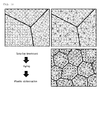
- FIG. 2 schematically illustrates respective steps of a related-art method of manufacturing a Mg alloy including tin (Sn)
- FIG. 3A schematically illustrates the state of the structure of a Mg alloy including Sn manufactured by the method illustrated in FIG. 2 .
- raw materials i.e. Mg, Sn, and other alloying elements
- Mg, Sn, and other alloying elements are melted to form molten metal and are subjected to casting, homogenization, plastic deformation, and annealing.
- the second phases remaining after homogenization or newly created precipitation phases mainly remain inside grains, at grain boundaries, or in regions near the grain boundaries and, when subjected to plastic deformation such as extrusion, have an irregular distribution in a specific direction (extrusion direction) of the second phases.
- the rate of recrystallization increases near the second phase.
- a Mg-Sn-based alloy manufactured by the related-art method has irregular distributions of second phases, as illustrated in FIG. 3A .
- the size of grains is as small as several micrometers due to the recrystallization and the pinning effect at the crystal grain boundaries.
- coarse crystal grains of 10 ⁇ m or larger are distributed. This results in a problem in that the average size of crystal grains increases, which makes the distribution of crystal grain size irregular, thereby worsening mechanical properties.
- Various aspects of the present invention provide a magnesium (Mg) alloy able to overcome the above-mentioned problems of the related-art Mg alloy and have a uniform size of second phases, and a method of manufacturing the same.
- Mg magnesium
- Mg alloy having a reduced size of second phases and having both superior elongation and superior tensile strength and a method of manufacturing the same.
- a Mg alloy including: an element selected from the group consisting of more than 0 weight% and 14 weight% or less of Sn, more than 0 weight% and 5 weight% or less of Li, more than 0 weight% and 40 weight% or less of Pb, more than 0 weight% and 17 weight% or less of Al, and more than 0 weight% and 5 weight% or less of Zn; and a remainder of Mg, wherein a second phase including at least one selected from the group consisting of Mg 2 Sn, Mg 2 Zn 3 , Mg 47.2 Zn 36.9 Al 16.9 , Mg 17 Al 12 , ⁇ -Mg/ ⁇ -Li phase, and Mg 2 Pb is formed in the alloy, the second phase includes precipitation phases, and, among the precipitation phases constituting the second phase, precipitation phases having a size exceeding 10 ⁇ m are less than 0.1% of the entire precipitation phases.
- the second phase of the Mg alloy is uniformly distributed in entire crystal grains.
- the size of crystal grains of the Mg alloy is preferably substantially evenly distributed.
- the Mg alloy may be a plastically deformed plate member.
- the plastically deformed plate member may be an extruded plate member.
- a method of manufacturing a Mg alloy including the following steps of: dissolving and casting raw materials including an element selected from the group consisting of more than 0 weight% and 14 weight% or less of Sn, more than 0 weight% and 5 weight% or less of Li, more than 0 weight% and 40 weight% or less of Pb, more than 0 weight% and 17 weight% or less of Al, and more than 0 weight% and 5 weight% or less of Zn and a remainder of Mg; subjecting the cast Mg alloy to solution treatment; subjecting the Mg alloy, which has undergone solution treatment, to aging; and plastically deforming the aged Mg alloy, wherein a second phase comprising at least one selected from the group consisting of Mg 2 Sn, Mg 2 Zn 3 , Mg 47.2 Zn 36.9 Al 16.9 , Mg 17 Al 12 , ⁇ -Mg/ ⁇ -Li phase, and Mg 2 Pb is formed in the alloy, the second phase comprises
- the plastic deformation is preferably extrusion.
- the second phase is uniformly distributed in entire crystal grains.
- the size of crystal grains of the Mg alloy is preferably substantially evenly distributed.
- the description that the second phase is uniformly distributed in the entire crystal grains according to the present invention should be interpreted relatively. That is, the description that the second phase is uniformly distributed in the entire crystal grains does not mean that second phases or precipitation phases are concentrated at grain boundaries of crystal grains or at specific portions inside the grains, or are concentrated at some crystal grains and scarcely exist in some crystal grains as illustrated in FIG. 3A , but means that second phases or precipitate phases are distributed in almost all crystal grains in the substantially same amount and, even in each crystal grain, are not distributed at the grain boundary of the crystal grain but are evenly distributed inside the entire crystal grain as illustrated in FIG. 3B .
- the description that the size of crystal grains of the Mg alloy is substantially evenly distributed is also relative: not all crystal grains have the same physical size, but small crystal grains have a size of a number of ⁇ m, and large crystal grains have a size exceeding 10 ⁇ m, as long as all crystal grains have substantially the same size in terms of metallography, within a range of a number of ⁇ m.
- the Mg alloy according to the present invention or the Mg alloy manufactured by the method according to the present invention is advantageous in that second phases are uniformly distributed inside crystal grains, the size of which is 10 ⁇ m or less. Therefore, the Mg alloy according to the present invention has both superior elongation and tensile strength.
- FIG. 1 schematically illustrates respective steps of a method of manufacturing a Mg alloy according to an exemplary embodiment of the present invention
- FIG. 3B schematically illustrates the state of the structure of a Mg alloy including Sn manufactured by the method illustrated in FIG. 1 .
- a Mg alloy including Sn according to an exemplary embodiment of the present invention is subjected to solution treatment, instead of related-art homogenization, and is subjected aging, plastic deformation, and annealing.
- a Mg alloy including Sn obtained by melting and casting raw materials is subjected to solution treatment to form a supersaturated solid solution.
- the Mg ally creates crystallized phases after casting, and the crystallized phases can be re-dissolved into the matrix through the solution treatment.
- aging is performed at suitable heat treatment time and temperature so that the precipitation phase (Mg 2 Sn phase) can have even distribution inside grains and at grain boundaries.
- the second phase i.e. precipitate phase
- the size of recrystallization crystal grains also exhibits uneven distribution.
- the second phase i.e. precipitation phase
- the second phase has even distribution
- the size of recrystallization crystal grains can also have even distribution.
- Mg-5Sn refers to an alloy including 5 weight% of Sn and a remainder of Mg.
- Mg-5Sn-5Zn refers to an alloy including 5 weight% of Sn, 5 weight% of Zn, and the remainder of Mg.
- Mg-5Sn-5Zn-2Al refers to an alloy including 5 weight% of Sn, 5 weight% of Zn, 2 weight% of Al, and a remainder of Mg.
- Case 1 refers to a Mg alloy manufactured by the related-art method
- Case 2 refers to a Mg alloy manufactured by an exemplary embodiment of the present invention.
- Case1_Mg-5Sn-5Zn refers to a Mg alloy manufactured by the related-art method.
- Case1_Mg-5Sn-5Zn includes 5 weight% of Sn, 5 weight% of Zn, and a remainder of Mg.
- Mg alloys described with reference to FIG. 4 to FIG. 9 are, particularly, Mg alloys manufactured under the following conditions:
- Component elements of each alloy described above are measured in terms of weight%, are melted in an electric resistance furnace that is maintained at 750°C in SF 6 +CO 2 mixed gas atmosphere, and are cast in a mold having a diameter of 52mm and a length of 100mm.
- test piece After casting, the test piece is loaded into an electric resistance furnace maintained at 330°C, is maintained for 24 hours, and is water-cooled.
- thermometer is attached to the test piece, and, when the temperature reaches 270°C, the test piece is instantly extruded at an extrusion ratio of 19:1.
- the above method gives a rod-shaped test piece having an initial diameter of 49.5 mm and, after extrusion, a plate-shaped test piece with cross section of 25 ⁇ 4 mm 2 .
- Mg-Sn binary alloy is maintained at 450°C for 24 hours and is water-cooled.
- Mg-Sn-Zn(-Al) alloy is maintained at 330°C for 18 hours, is temperature-raised to 450°C for two hours, maintained for 12 hours, and is water-cooled.
- Test pieces are loaded into an electric resistance furnace maintained at 200°C.
- Mg-Sn binary alloy is maintained for 500 hours, and Mg-Sn-Zn(-Al) ternary (quaternary) alloy is maintained for 24 hours. Subsequently, both of the alloys are air-cooled.
- the above method gives a rod-shaped test piece having an initial diameter of 49.5 mm and, after extrusion, a plate-shaped test piece with cross section of 25 ⁇ 4 mm 2 .
- test piece having ASTM specification gauge length of 25mm (KSB0801 proportional test piece no. 13B) is machined and subjected to a tensile test under a condition of initial strain rate: 1 ⁇ 10 -3 .
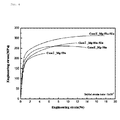
- FIG. 4 illustrates engineering stress and engineering strain curves of Mg alloys according to an exemplary embodiment of the present invention and related-art Mg alloys. It is clear from FIG. 4 that, given the same composition, the alloys according to the present embodiment have stresses about 20% better than those of the related-art alloys.
- FIG. 5 illustrates a relationship between the UTS and elongation of Mg alloys according to an exemplary embodiment of the present invention and related-art Mg alloys. It is clear from FIG. 5 , with regard to alloys of all compositions, both UTS and elongation of alloys according to the present embodiment are superior to those of the related-art alloys.
- FIG. 6A to FIG. 6C are SEM pictures of Mg alloys at a step after solution treatment and aging and before plastic deformation in connection with manufacturing of Mg alloys of various compositions according to an exemplary embodiment of the present invention.
- coarse crystallized phases created after casting are distributed at grain boundaries.
- small second phases are uniformly distributed inside/outside grains. That is, white portions appearing at grain boundaries in the low-magnification pictures in FIG. 6A to FIG. 6C are pre-precipitated second phases, and the formation of uniform second phases inside grains is also appreciated.
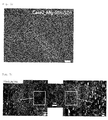
- FIG. 7A and FIG. 7B are scanning electron microscopy (SEM) pictures of a Mg alloy manufactured by a related-art method ( FIG. 7A ) and a SEM picture of a Mg alloy manufactured according to an exemplary embodiment of the present invention ( FIG. 7B ).
- SEM scanning electron microscopy
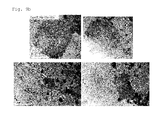
- FIG. 8A is a picture taken after the extrusion of a Mg alloy according to the related-art method, second phases appear as white portions, and it is clear that the distribution is not even because a test piece that had irregular distribution of second phases before plastic deformation has been extruded with no modification.
- FIG. 8B is a picture taken after the extrusion of a Mg alloy that has been formed by an exemplary embodiment according to the present invention, and it is clear that, compared with the case of FIG. 8A , small second phases are distributed evenly.
- FIG. 9A and FIG. 9B are TEM pictures of Mg alloys formed by a related-art method ( FIG. 9A ) and according to an exemplary embodiment of the present invention ( FIG. 9B ). Similar to the results of SEM pictures described above, it is clear that the Mg alloy according to an exemplary embodiment of the present invention, compared with the Mg alloy formed by the related-art method, has smaller second phases distributed evenly.
Landscapes
- Chemical & Material Sciences (AREA)
- Engineering & Computer Science (AREA)
- Mechanical Engineering (AREA)
- Materials Engineering (AREA)
- Metallurgy (AREA)
- Organic Chemistry (AREA)
- Physics & Mathematics (AREA)
- Thermal Sciences (AREA)
- Crystallography & Structural Chemistry (AREA)
- Extrusion Of Metal (AREA)
Abstract
Description
- The present invention relates to a magnesium alloy for precipitation strengthening extrusion, and more particularly to a tin-containing magnesium alloy having superior mechanical properties, such as tensile strength, yield strength, and elongation.
- For the sake of performance improvement and weight reduction of various mechanical devices, there have been ongoing studies to make mechanical devices, more particularly, various components thereof lightweight. As a metallic material for such weight reduction of components, magnesium (Mg) alloys have the lowest density among currently developed structural alloys, and exhibit superior properties regarding electromagnetic shielding and vibration absorption. Demand for Mg alloys is on the rise in various fields, such as transportation machines, industries related to portable components, etc.
- According to a Mg extrusion process of the related art, a cast product manufactured through melting and casting is subjected to homogenization heat treatment before being extruded. In some cases, a precipitation strengthening Mg alloy is subjected to aging after the extrusion in order to improve mechanical properties to some extent.
- In the related art, plastic deformation materials produced through the extrusion have typically been alloys containing solute contents within the solubilities of Mg, such as AZ31. In contrast, recent Mg extrusion material alloys having high strength and high tenacity contain a large amount of alloying elements added thereto. In the Mg extrusion material alloys, some crystallized phases that have been created after casting during homogenization heat treatment subsequent to melting and casting remain intact inside grains or at the grain boundary, causing irregular distributions of second phases after plastic deformation. This consequently brings adverse effects on the mechanical properties.
- In order to overcome the above problem, solution treatment and aging are carried out before the extrusion to control the distribution and size of the second phases that can improve the strength of materials even after extrusion. The solution treatment is designed with an optimized temperature range in which the crystallized phases created after the melting and casting can be re-dissolved into the matrix. With the aging, the distribution of the second phases mentioned as a problem of the related-art process can be made uniform.
- For reference,
FIG. 2 schematically illustrates respective steps of a related-art method of manufacturing a Mg alloy including tin (Sn), andFIG. 3A schematically illustrates the state of the structure of a Mg alloy including Sn manufactured by the method illustrated inFIG. 2 . - As illustrated in
FIG. 2 , according to the related-art method of manufacturing a Mg-Sn-based alloy, raw materials, i.e. Mg, Sn, and other alloying elements, are melted to form molten metal and are subjected to casting, homogenization, plastic deformation, and annealing. - In order to obtain a Mg alloy having high strength, however, alloying elements have recently been added above the solubility in order to add high strength and high tenacity. That is, after casting, the crystallized phases of elements added above the solubility exist in the form of second phases, which are stable at room temperature. Therefore, crystallized phases that have been created in the α-Mg matrix remain intact at the homogenization temperature, and in particular, in the case of a precipitation strengthening-type alloying element, parts of supersaturated elements precipitate in the form of precipitates in the homogenization temperature range. That is, as illustrated in
FIG. 3A , the second phases remaining after homogenization or newly created precipitation phases mainly remain inside grains, at grain boundaries, or in regions near the grain boundaries and, when subjected to plastic deformation such as extrusion, have an irregular distribution in a specific direction (extrusion direction) of the second phases. In addition, when dynamic/static recrystallization occurs after plastic deformation, the rate of recrystallization increases near the second phase. As a result, a Mg-Sn-based alloy manufactured by the related-art method has irregular distributions of second phases, as illustrated inFIG. 3A . In a region having a large distribution of second phases, the size of grains is as small as several micrometers due to the recrystallization and the pinning effect at the crystal grain boundaries. However, in a region having a small distribution of second phases, coarse crystal grains of 10 µm or larger are distributed. This results in a problem in that the average size of crystal grains increases, which makes the distribution of crystal grain size irregular, thereby worsening mechanical properties. - The information disclosed in the Background of the Invention section is provided only for better understanding of the background of the invention and should not be taken as an acknowledgment or any form of suggestion that this information forms a prior art that would already be known to a person skilled in the art.
- Various aspects of the present invention provide a magnesium (Mg) alloy able to overcome the above-mentioned problems of the related-art Mg alloy and have a uniform size of second phases, and a method of manufacturing the same.
- Also provided is a Mg alloy having a reduced size of second phases and having both superior elongation and superior tensile strength and a method of manufacturing the same.
- According to an aspect of the present invention, there is provided a Mg alloy including: an element selected from the group consisting of more than 0 weight% and 14 weight% or less of Sn, more than 0 weight% and 5 weight% or less of Li, more than 0 weight% and 40 weight% or less of Pb, more than 0 weight% and 17 weight% or less of Al, and more than 0 weight% and 5 weight% or less of Zn; and a remainder of Mg, wherein a second phase including at least one selected from the group consisting of Mg2Sn, Mg2Zn3, Mg47.2Zn36.9Al16.9, Mg17Al12, α-Mg/β-Li phase, and Mg2Pb is formed in the alloy, the second phase includes precipitation phases, and, among the precipitation phases constituting the second phase, precipitation phases having a size exceeding 10 µm are less than 0.1% of the entire precipitation phases.
- The second phase of the Mg alloy is uniformly distributed in entire crystal grains.
- The size of crystal grains of the Mg alloy is preferably substantially evenly distributed.
- The Mg alloy may be a plastically deformed plate member.
- In this case, the plastically deformed plate member may be an extruded plate member.
- According to another aspect of the present invention, there is provided a method of manufacturing a Mg alloy, the method including the following steps of: dissolving and casting raw materials including an element selected from the group consisting of more than 0 weight% and 14 weight% or less of Sn, more than 0 weight% and 5 weight% or less of Li, more than 0 weight% and 40 weight% or less of Pb, more than 0 weight% and 17 weight% or less of Al, and more than 0 weight% and 5 weight% or less of Zn and a remainder of Mg; subjecting the cast Mg alloy to solution treatment; subjecting the Mg alloy, which has undergone solution treatment, to aging; and plastically deforming the aged Mg alloy, wherein a second phase comprising at least one selected from the group consisting of Mg2Sn, Mg2Zn3, Mg47.2Zn36.9Al16.9, Mg17Al12, α-Mg/β-Li phase, and Mg2Pb is formed in the alloy, the second phase comprises precipitation phases, and, among the precipitation phases constituting the second phase, precipitation phases having a size exceeding 10 µm are less than 0.1% of the entire precipitation phases.
- In this case, the plastic deformation is preferably extrusion.
- The second phase is uniformly distributed in entire crystal grains.
- The size of crystal grains of the Mg alloy is preferably substantially evenly distributed.
- Meanwhile, the description that the second phase is uniformly distributed in the entire crystal grains according to the present invention should be interpreted relatively. That is, the description that the second phase is uniformly distributed in the entire crystal grains does not mean that second phases or precipitation phases are concentrated at grain boundaries of crystal grains or at specific portions inside the grains, or are concentrated at some crystal grains and scarcely exist in some crystal grains as illustrated in
FIG. 3A , but means that second phases or precipitate phases are distributed in almost all crystal grains in the substantially same amount and, even in each crystal grain, are not distributed at the grain boundary of the crystal grain but are evenly distributed inside the entire crystal grain as illustrated inFIG. 3B . - Furthermore, the description that the size of crystal grains of the Mg alloy is substantially evenly distributed is also relative: not all crystal grains have the same physical size, but small crystal grains have a size of a number of µm, and large crystal grains have a size exceeding 10 µm, as long as all crystal grains have substantially the same size in terms of metallography, within a range of a number of µm.
- The Mg alloy according to the present invention or the Mg alloy manufactured by the method according to the present invention is advantageous in that second phases are uniformly distributed inside crystal grains, the size of which is 10 µm or less. Therefore, the Mg alloy according to the present invention has both superior elongation and tensile strength.
-
-
FIG. 1 schematically illustrates respective steps of a method of manufacturing a Mg alloy according to an exemplary embodiment of the present invention; -
FIG. 2 schematically illustrates respective steps of a related-art method of manufacturing a Mg alloy; -
FIG. 3A andFIG. 3B schematically illustrate the state of the structure of Mg alloys, manufactured by the methods illustrated inFIG. 1 and FIG. 2 , respectively; -
FIG. 4 illustrates engineering stress and engineering strain curves of Mg alloys according to an exemplary embodiment of the present invention and related-art Mg alloys; -
FIG. 5 illustrates a relationship between the UTS and elongation of Mg alloys according to an exemplary embodiment of the present invention and related-art Mg alloys; -
FIG. 6A to FIG. 6C are SEM pictures of Mg alloys at a step after solution treatment and aging and before plastic deformation in connection with manufacturing of Mg alloys of various compositions according to an exemplary embodiment of the present invention; -
FIG. 7A andFIG. 7B are SEM pictures of a Mg alloy manufactured by a related-art method (FIG. 7A ) and of a Mg alloy manufactured according to an exemplary embodiment of the present invention (FIG. 7B ); -
FIG. 8A is a picture taken after the extrusion of a Mg alloy according to a related-art method; -
FIG. 8B is a picture taken after the extrusion of a Mg alloy that has been formed by an exemplary embodiment according to the present invention; and -
FIG. 9A andFIG. 9B are TEM pictures of Mg alloys formed by a related-art method (FIG. 9A ) and according to an exemplary embodiment of the present invention (FIG. 9B ). - Hereinafter, an exemplary embodiment of a magnesium (Mg) alloy according to the present invention and a method of manufacturing the same will be described in detail with reference to the accompanying drawings.
-
FIG. 1 schematically illustrates respective steps of a method of manufacturing a Mg alloy according to an exemplary embodiment of the present invention, andFIG. 3B schematically illustrates the state of the structure of a Mg alloy including Sn manufactured by the method illustrated inFIG. 1 . - As illustrated in
FIG. 1 , a Mg alloy including Sn according to an exemplary embodiment of the present invention is subjected to solution treatment, instead of related-art homogenization, and is subjected aging, plastic deformation, and annealing. - That is, as illustrated in
FIG. 3B , according to an exemplary embodiment of the present invention, a Mg alloy including Sn obtained by melting and casting raw materials is subjected to solution treatment to form a supersaturated solid solution. According to the present embodiment, the Mg ally creates crystallized phases after casting, and the crystallized phases can be re-dissolved into the matrix through the solution treatment. Thereafter, aging is performed at suitable heat treatment time and temperature so that the precipitation phase (Mg2Sn phase) can have even distribution inside grains and at grain boundaries. - That is, when homogenization is performed after casting according to the prior art, the second phase, i.e. precipitate phase, exhibits uneven distribution, and the size of recrystallization crystal grains also exhibits uneven distribution. When solution treatment and aging are performed according to the present embodiment, in contrast, the second phase, i.e. precipitation phase, has even distribution, and the size of recrystallization crystal grains can also have even distribution.
- In addition, when homogenization is performed according to the prior art, fine precipitates may occur even at homogenization and plastic deformation temperatures, but coarse crystallized phases formed after casting are largely distributed unevenly. According to the present embodiment, in contrast, a precipitation process occurs by means of aging before plastic deformation, so that large second phases that have a size of 2 µm or larger trigger undergo nucleation during recrystallization throughout the entire alloy, due to the PSN (particle stimulated nucleation) effect. Precipitate phases generated during aging, second phases that grow slowly. Small precipitates that have been generated during plastic deformation and since grown with a size of about 2 µm or less are distributed at grain boundaries after creation of recrystallization grains and disturb the growth of grains (pinning effect). Therefore, the alloy according to the present embodiment subjected to solution treatment and aging has a big difference regarding the microstructure, compared with an alloy subjected to related-art homogenization, and exhibits substantially improved mechanical properties.
- Results of comparisons between a Mg alloy formed according to an exemplary embodiment of the present invention and a Mg alloy formed using related-art homogenization using various methods will now be described with reference to
FIG. 4 to FIG. 9 . Hereinafter, for reference, Mg-5Sn refers to an alloy including 5 weight% of Sn and a remainder of Mg. Mg-5Sn-5Zn refers to an alloy including 5 weight% of Sn, 5 weight% of Zn, and the remainder of Mg. Mg-5Sn-5Zn-2Al refers to an alloy including 5 weight% of Sn, 5 weight% of Zn, 2 weight% of Al, and a remainder of Mg. In addition, Case 1 refers to a Mg alloy manufactured by the related-art method, andCase 2 refers to a Mg alloy manufactured by an exemplary embodiment of the present invention. For example, Case1_Mg-5Sn-5Zn refers to a Mg alloy manufactured by the related-art method. Case1_Mg-5Sn-5Zn includes 5 weight% of Sn, 5 weight% of Zn, and a remainder of Mg. - Furthermore, Mg alloys described with reference to
FIG. 4 to FIG. 9 are, particularly, Mg alloys manufactured under the following conditions: - Component elements of each alloy described above are measured in terms of weight%, are melted in an electric resistance furnace that is maintained at 750°C in SF6+CO2 mixed gas atmosphere, and are cast in a mold having a diameter of 52mm and a length of 100mm.
- After casting, the test piece is loaded into an electric resistance furnace maintained at 330°C, is maintained for 24 hours, and is water-cooled.
- After the test piece is loaded into an electric resistance furnace (inside an extruder) maintained at 300°C, a thermometer is attached to the test piece, and, when the temperature reaches 270°C, the test piece is instantly extruded at an extrusion ratio of 19:1.
- The above method gives a rod-shaped test piece having an initial diameter of 49.5 mm and, after extrusion, a plate-shaped test piece with cross section of 25×4 mm2.
- Mg-Sn binary alloy is maintained at 450°C for 24 hours and is water-cooled. Mg-Sn-Zn(-Al) alloy is maintained at 330°C for 18 hours, is temperature-raised to 450°C for two hours, maintained for 12 hours, and is water-cooled.
- Test pieces are loaded into an electric resistance furnace maintained at 200°C. Mg-Sn binary alloy is maintained for 500 hours, and Mg-Sn-Zn(-Al) ternary (quaternary) alloy is maintained for 24 hours. Subsequently, both of the alloys are air-cooled.
- In the same manner as the process of Case 1, after the test piece is loaded into an electric resistance furnace (inside an extruder) maintained at 300°C, a thermometer is attached to the test piece. When the temperature reaches 270°C, the test piece is instantly extruded at an extrusion ratio of 19:1.
- The above method gives a rod-shaped test piece having an initial diameter of 49.5 mm and, after extrusion, a plate-shaped test piece with cross section of 25×4 mm2.
- A test piece having ASTM specification gauge length of 25mm (KSB0801 proportional test piece no. 13B) is machined and subjected to a tensile test under a condition of initial strain rate: 1×10⁻³.
-
FIG. 4 illustrates engineering stress and engineering strain curves of Mg alloys according to an exemplary embodiment of the present invention and related-art Mg alloys. It is clear fromFIG. 4 that, given the same composition, the alloys according to the present embodiment have stresses about 20% better than those of the related-art alloys. - In addition,
FIG. 5 illustrates a relationship between the UTS and elongation of Mg alloys according to an exemplary embodiment of the present invention and related-art Mg alloys. It is clear fromFIG. 5 , with regard to alloys of all compositions, both UTS and elongation of alloys according to the present embodiment are superior to those of the related-art alloys. -
FIG. 6A to FIG. 6C are SEM pictures of Mg alloys at a step after solution treatment and aging and before plastic deformation in connection with manufacturing of Mg alloys of various compositions according to an exemplary embodiment of the present invention. When homogenization is solely performed before plastic deformation according to the related-art method, coarse crystallized phases created after casting are distributed at grain boundaries. It is clear fromFIG. 6A to FIG. 6C that, as a result of aging after solution treatment, small second phases are uniformly distributed inside/outside grains. That is, white portions appearing at grain boundaries in the low-magnification pictures inFIG. 6A to FIG. 6C are pre-precipitated second phases, and the formation of uniform second phases inside grains is also appreciated. -
FIG. 7A andFIG. 7B are scanning electron microscopy (SEM) pictures of a Mg alloy manufactured by a related-art method (FIG. 7A ) and a SEM picture of a Mg alloy manufactured according to an exemplary embodiment of the present invention (FIG. 7B ). It is appreciated from the picture in the middle ofFIG. 7A , a low-magnification picture, that second phases are concentrated at the right-hand side and are scarcely distributed on the left-hand side. That is, the size of grains in the region of a small distribution of second phases is larger than that of the region of a large distribution, meaning that the structure has different grain sizes depending on the amount of distribution of second phases. In contrast, it is appreciated fromFIG. 7B that, compared withFIG. 7A , the second phases are distributed evenly, and the grain size is uniform and small. -
FIG. 8A is a picture taken after the extrusion of a Mg alloy according to the related-art method, second phases appear as white portions, and it is clear that the distribution is not even because a test piece that had irregular distribution of second phases before plastic deformation has been extruded with no modification. In contrast,FIG. 8B is a picture taken after the extrusion of a Mg alloy that has been formed by an exemplary embodiment according to the present invention, and it is clear that, compared with the case ofFIG. 8A , small second phases are distributed evenly. -
FIG. 9A andFIG. 9B are TEM pictures of Mg alloys formed by a related-art method (FIG. 9A ) and according to an exemplary embodiment of the present invention (FIG. 9B ). Similar to the results of SEM pictures described above, it is clear that the Mg alloy according to an exemplary embodiment of the present invention, compared with the Mg alloy formed by the related-art method, has smaller second phases distributed evenly. - Although a method of manufacturing a Mg alloy, which includes Sn, and advantageous effects thereof have been described above, those skilled in the art, to which the present invention pertains, could understand that the Mg alloy according to the present invention can be applied similarly when Zn, Al, Li, and Pb are included, besides Sn. It is apparent to a person skilled in the art to which the present invention pertains that various changes and modifications can be made to the above configuration. Therefore, the scope of the present invention is solely limited by the accompanying claims.
Claims (11)
- A magnesium alloy comprising:an element selected from the group consisting of more than 0 weight% and 14 weight% or less of Sn, more than 0 weight% and 5 weight% or less of Li, more than 0 weight% and 40 weight% or less of Pb, more than 0 weight% and 17 weight% or less of Al, and more than 0 weight% and 5 weight% or less of Zn; anda remainder of Mg, whereina second phase comprising at least one selected from the group consisting of Mg2Sn, Mg2Zn3, Mg47.2Zn36.9Al16.9, Mg17Al12, α-Mg/β-Li phase and Mg2Pb is formed in the alloy, the second phase comprises precipitation phases, and, among the precipitation phases constituting the second phase, precipitation phases having a size exceeding 10 µm are less than 0.1% of the entire precipitation phases.
- The magnesium alloy of claim 1, wherein the second phase of the magnesium alloy is uniformly distributed in entire crystal grains.
- The magnesium alloy of claim 1, wherein the size of crystal grains of the magnesium alloy is substantially evenly distributed.
- The magnesium alloy of claim 3, wherein the second phase is Mg2Sn phase.
- The magnesium alloy of claim 3, wherein the magnesium alloy is a plastically deformed plate member.
- The magnesium alloy of claim 3, wherein the plastically deformed plate member is an extruded plate member.
- A method of manufacturing a magnesium alloy, the method comprising:melting and casting raw materials comprising an element selected from the group consisting of more than 0 weight% and 14 weight% or less of Sn, more than 0 weight% and 5 weight% or less of Li, more than 0 weight% and 40 weight% or less of Pb, more than 0 weight% and 17 weight% or less of Al, and more than 0 weight% and 5 weight% or less of Zn and a remainder of Mg;subjecting the cast magnesium alloy to solution treatment;subjecting the magnesium alloy that has undergone solution treatment to aging; andplastically deforming the aged magnesium alloy, whereina second phase comprising at least one selected from the group consisting of Mg2Sn, Mg2Zn3, Mg47.2Zn36.9Al16.9, Mg17Al12, α-Mg/β-Li phase, and Mg2Pb is formed in the alloy, the second phase comprises precipitation phases, and, among the precipitation phases constituting the second phase, precipitation phases having a size exceeding 10 µm are less than 0.1% of the entire precipitation phases.
- The method of claim 7, wherein the size of crystal grains of the magnesium alloy is substantially evenly distributed.
- The method of claim 7, wherein the second phase is uniformly distributed in entire crystal grains.
- The method of one of claims 7 to 9, further comprising: after the plastically deforming the aged magnesium alloy, annealing the plastically deformed alloy.
- The method of claim 10, wherein the plastic deformation is extrusion.
Applications Claiming Priority (1)
| Application Number | Priority Date | Filing Date | Title |
|---|---|---|---|
| KR1020130133968A KR101614004B1 (en) | 2013-11-06 | 2013-11-06 | Magnesium alloy for precipition hardened extrusion and manufacturing method of the magnesium alloy |
Publications (1)
| Publication Number | Publication Date |
|---|---|
| EP2871256A1 true EP2871256A1 (en) | 2015-05-13 |
Family
ID=51900144
Family Applications (1)
| Application Number | Title | Priority Date | Filing Date |
|---|---|---|---|
| EP14191846.6A Withdrawn EP2871256A1 (en) | 2013-11-06 | 2014-11-05 | Magnesium alloy for precipitation strengthening extrusion and method of manufacturing the same |
Country Status (3)
| Country | Link |
|---|---|
| US (1) | US20150122379A1 (en) |
| EP (1) | EP2871256A1 (en) |
| KR (1) | KR101614004B1 (en) |
Cited By (2)
| Publication number | Priority date | Publication date | Assignee | Title |
|---|---|---|---|---|
| CN105603282A (en) * | 2015-12-30 | 2016-05-25 | 天津理工大学 | Method for preparing magnesium alloy laparoscope hemostasis clip |
| CN106239000A (en) * | 2016-08-30 | 2016-12-21 | 南京惠德机械有限公司 | A kind of Automobile engine bracket weld jig |
Families Citing this family (4)
| Publication number | Priority date | Publication date | Assignee | Title |
|---|---|---|---|---|
| US20160333434A1 (en) * | 2014-01-28 | 2016-11-17 | United Technologies Corporation | Enhanced surface structure |
| CN109943696A (en) * | 2017-12-21 | 2019-06-28 | 中国科学院金属研究所 | A method for improving the strength of precipitation-strengthened alloys by utilizing matrix nanostructures |
| CN109735755B (en) * | 2019-03-13 | 2023-03-21 | 北京科技大学 | Mg-Sn-Li-Zn magnesium alloy capable of being reinforced by two-stage aging and preparation method thereof |
| CN110284031B (en) * | 2019-07-12 | 2020-09-25 | 北京科技大学 | Mg-Sn-Li magnesium alloy capable of being rapidly aged and strengthened and preparation method thereof |
Citations (3)
| Publication number | Priority date | Publication date | Assignee | Title |
|---|---|---|---|---|
| JP2007138227A (en) * | 2005-11-16 | 2007-06-07 | Sumitomo Electric Ind Ltd | Magnesium alloy material |
| CN102703785A (en) * | 2012-04-27 | 2012-10-03 | 太原理工大学 | High-strength indirect-extruded Mg-Sn-based alloy and preparation method thereof |
| WO2013115490A1 (en) * | 2012-01-30 | 2013-08-08 | 한국기계연구원 | Magnesium alloy having high ductility and high toughness, and preparation method thereof |
Family Cites Families (4)
| Publication number | Priority date | Publication date | Assignee | Title |
|---|---|---|---|---|
| KR100509648B1 (en) | 2003-05-23 | 2005-08-24 | 연우인더스트리(주) | High formability the Magnesium alloy and manufacture method of the Magnesium alloy product thereof |
| JP2007277660A (en) | 2006-04-10 | 2007-10-25 | Nissan Motor Co Ltd | Magnesium alloys and die-cast products |
| BRPI0919653A2 (en) * | 2008-10-22 | 2015-12-08 | Sumitomo Electric Industries | product formed of magnesium alloy and magnesium alloy sheet |
| KR101276665B1 (en) | 2012-02-03 | 2013-06-19 | 한국기계연구원 | Magnesium alloy heat-treatable at high temperature |
-
2013
- 2013-11-06 KR KR1020130133968A patent/KR101614004B1/en not_active Expired - Fee Related
-
2014
- 2014-11-05 EP EP14191846.6A patent/EP2871256A1/en not_active Withdrawn
- 2014-11-06 US US14/534,320 patent/US20150122379A1/en not_active Abandoned
Patent Citations (3)
| Publication number | Priority date | Publication date | Assignee | Title |
|---|---|---|---|---|
| JP2007138227A (en) * | 2005-11-16 | 2007-06-07 | Sumitomo Electric Ind Ltd | Magnesium alloy material |
| WO2013115490A1 (en) * | 2012-01-30 | 2013-08-08 | 한국기계연구원 | Magnesium alloy having high ductility and high toughness, and preparation method thereof |
| CN102703785A (en) * | 2012-04-27 | 2012-10-03 | 太原理工大学 | High-strength indirect-extruded Mg-Sn-based alloy and preparation method thereof |
Non-Patent Citations (4)
| Title |
|---|
| BUHA J ET AL: "Natural Aging in Mg-Zn(-Cu) Alloys", METALLURGICAL AND MATERIALS TRANSACTIONS A, SPRINGER-VERLAG, NEW YORK, vol. 39, no. 9, 22 May 2008 (2008-05-22), pages 2259 - 2273, XP019696317, ISSN: 1543-1940 * |
| JIAN-FENG NIE: "Precipitation and Hardening in Magnesium Alloys", METALLURGICAL AND MATERIALS TRANSACTIONS A, SPRINGER-VERLAG, NEW YORK, vol. 43, no. 11, 21 July 2012 (2012-07-21), pages 3891 - 3939, XP035117781, ISSN: 1543-1940, DOI: 10.1007/S11661-012-1217-2 * |
| RASHKOVA B ET AL: "Precipitation processes in a Mg-Zn-Sn alloy studied by TEM and SAXS", MATERIALS SCIENCE AND ENGINEERING A: STRUCTURAL MATERIALS:PROPERTIES, MICROSTRUCTURE & PROCESSING, LAUSANNE, CH, vol. 494, no. 1-2, 25 October 2008 (2008-10-25), pages 158 - 165, XP024100385, ISSN: 0921-5093, [retrieved on 20080412], DOI: 10.1016/J.MSEA.2008.04.005 * |
| SASAKI T T ET AL: "A high-strength Mg-Sn-Zn-Al alloy extruded at low temperature", SCRIPTA MATERIALIA, ELSEVIER, AMSTERDAM, NL, vol. 59, no. 10, 1 November 2008 (2008-11-01), pages 1111 - 1114, XP025504722, ISSN: 1359-6462, [retrieved on 20080806], DOI: 10.1016/J.SCRIPTAMAT.2008.07.042 * |
Cited By (2)
| Publication number | Priority date | Publication date | Assignee | Title |
|---|---|---|---|---|
| CN105603282A (en) * | 2015-12-30 | 2016-05-25 | 天津理工大学 | Method for preparing magnesium alloy laparoscope hemostasis clip |
| CN106239000A (en) * | 2016-08-30 | 2016-12-21 | 南京惠德机械有限公司 | A kind of Automobile engine bracket weld jig |
Also Published As
| Publication number | Publication date |
|---|---|
| US20150122379A1 (en) | 2015-05-07 |
| KR101614004B1 (en) | 2016-04-21 |
| KR20150052891A (en) | 2015-05-15 |
Similar Documents
| Publication | Publication Date | Title |
|---|---|---|
| KR101159790B1 (en) | Magnesium alloy having high ductility and high toughness and process for preparing the same | |
| US20150122379A1 (en) | Magnesium alloy for precipitation strengthening extrusion and method of manufacturing the same | |
| JP5834077B2 (en) | Aluminum alloy and method for producing extruded profile using the same | |
| BRPI0919523B1 (en) | MAGNESIUM ALLOYS CONTAINING RARE EARTH | |
| JP6893354B2 (en) | Magnesium-based alloy extender | |
| CN111989415B (en) | 6XXX aluminum alloys for extrusions having excellent impact properties and high yield strength, and methods of making the same | |
| JP7785366B2 (en) | Aged magnesium alloy material and its manufacturing method | |
| EP2835437B1 (en) | Magnesium alloy, magnesium alloy member and method for manufacturing same, and method for using magnesium alloy | |
| KR101700419B1 (en) | Method for preparing high-strength magnesium alloy extruded material using low temperature and slow speed extrusion process and magnesium alloy extruded material manufactured thereby | |
| JP2014152361A (en) | Ultrahigh strength magnesium wrought alloy having ductility | |
| JP2021070871A (en) | Aluminum alloy forging and production method thereof | |
| KR101993506B1 (en) | Precipitation hardening magnesium alloy for extruding and method for manufacturing the same | |
| US20220364213A1 (en) | Method for Producing Aluminum Alloy Extrusion | |
| KR20160136832A (en) | High strength wrought magnesium alloys and method for manufacturing the same | |
| JP2019196519A (en) | Aluminum alloy wire and method for producing the same | |
| JP6967437B2 (en) | A method for manufacturing an aluminum die-cast alloy, an automobile member using an aluminum die-cast alloy, and an aluminum die-cast alloy. | |
| WO2009123084A1 (en) | Magnesium alloy and process for producing the same | |
| JP5201500B2 (en) | Magnesium alloy material and method for producing the same | |
| KR101680041B1 (en) | Wrought magnesium alloy having high ductility and high toughness and method for preparing the same | |
| KR20150139693A (en) | Precipitation hardening magnesium alloy for extruding and method for manufacturing the same | |
| JP6726058B2 (en) | Manufacturing method of Al alloy casting | |
| CN105986157A (en) | Magnesium alloy and preparing method thereof | |
| JP5412666B2 (en) | Magnesium alloy and manufacturing method thereof | |
| JP2019196520A (en) | Aluminum alloy wire and method for producing the same | |
| KR20140050172A (en) | High strength and high toughness magnesium alloy with suppressed discontinuous precipitation |
Legal Events
| Date | Code | Title | Description |
|---|---|---|---|
| PUAI | Public reference made under article 153(3) epc to a published international application that has entered the european phase |
Free format text: ORIGINAL CODE: 0009012 |
|
| 17P | Request for examination filed |
Effective date: 20141105 |
|
| AK | Designated contracting states |
Kind code of ref document: A1 Designated state(s): AL AT BE BG CH CY CZ DE DK EE ES FI FR GB GR HR HU IE IS IT LI LT LU LV MC MK MT NL NO PL PT RO RS SE SI SK SM TR |
|
| AX | Request for extension of the european patent |
Extension state: BA ME |
|
| R17P | Request for examination filed (corrected) |
Effective date: 20151112 |
|
| RBV | Designated contracting states (corrected) |
Designated state(s): AL AT BE BG CH CY CZ DE DK EE ES FI FR GB GR HR HU IE IS IT LI LT LU LV MC MK MT NL NO PL PT RO RS SE SI SK SM TR |
|
| 17Q | First examination report despatched |
Effective date: 20160715 |
|
| STAA | Information on the status of an ep patent application or granted ep patent |
Free format text: STATUS: EXAMINATION IS IN PROGRESS |
|
| STAA | Information on the status of an ep patent application or granted ep patent |
Free format text: STATUS: THE APPLICATION IS DEEMED TO BE WITHDRAWN |
|
| 18D | Application deemed to be withdrawn |
Effective date: 20170126 |