EP2871223A1 - Composite for organic light-emitting diode, organic light-emitting layer including same, and organic light-emitting diode - Google Patents
Composite for organic light-emitting diode, organic light-emitting layer including same, and organic light-emitting diode Download PDFInfo
- Publication number
- EP2871223A1 EP2871223A1 EP20130813173 EP13813173A EP2871223A1 EP 2871223 A1 EP2871223 A1 EP 2871223A1 EP 20130813173 EP20130813173 EP 20130813173 EP 13813173 A EP13813173 A EP 13813173A EP 2871223 A1 EP2871223 A1 EP 2871223A1
- Authority
- EP
- European Patent Office
- Prior art keywords
- group
- substituted
- unsubstituted
- chemical formula
- compound
- Prior art date
- Legal status (The legal status is an assumption and is not a legal conclusion. Google has not performed a legal analysis and makes no representation as to the accuracy of the status listed.)
- Withdrawn
Links
- 0 Cc1c(*)c(*)c(*)c(*)c1* Chemical compound Cc1c(*)c(*)c(*)c(*)c1* 0.000 description 5
- BEOVHNARPTUSMK-UHFFFAOYSA-N C1C(c(cc2)cc3c2c(cc(cc2)-c4ccc(c(cccc5)c5[n]5-c6cccc(-c7nc(-c8ccccc8)nc(-c(cc8)ccc8-c(cc8)cc9c8c(cc(cc8)-c%10ccc(c%11ccccc%11[n]%11-c%12cccc(-c%13cc(-c%14ccccc%14)nc(-c%14ccccc%14)n%13)c%12)c%11c%10)c8[n]9-c8cccc9c8cccc9)c7)c6)c5c4)c2[n]3-c2cc3c(cccc4)c4c(cccc4)c4c3cc2)=CC=CC1c1cc(-c2cc(-[n]3c4cc(-c(cc5)cc(c6c7cccc6)c5[n]7-c(cc5)ccc5-c5cccc6c5cccc6)ccc4c4c3cccc4)ccc2)nc(-c2ccccc2)n1 Chemical compound C1C(c(cc2)cc3c2c(cc(cc2)-c4ccc(c(cccc5)c5[n]5-c6cccc(-c7nc(-c8ccccc8)nc(-c(cc8)ccc8-c(cc8)cc9c8c(cc(cc8)-c%10ccc(c%11ccccc%11[n]%11-c%12cccc(-c%13cc(-c%14ccccc%14)nc(-c%14ccccc%14)n%13)c%12)c%11c%10)c8[n]9-c8cccc9c8cccc9)c7)c6)c5c4)c2[n]3-c2cc3c(cccc4)c4c(cccc4)c4c3cc2)=CC=CC1c1cc(-c2cc(-[n]3c4cc(-c(cc5)cc(c6c7cccc6)c5[n]7-c(cc5)ccc5-c5cccc6c5cccc6)ccc4c4c3cccc4)ccc2)nc(-c2ccccc2)n1 BEOVHNARPTUSMK-UHFFFAOYSA-N 0.000 description 1
- XBQCZDVZRLYMKP-UHFFFAOYSA-N C1C=CC=CC1c1cc(-c(cc2)ccc2-[n](c2ccccc2c2c3)c2ccc3-c2ccc(c3ccccc3[n]3-c4cc(-c5ccccc5)cc(-c5ccccc5)c4)c3c2)nc(-c2ccccc2)c1 Chemical compound C1C=CC=CC1c1cc(-c(cc2)ccc2-[n](c2ccccc2c2c3)c2ccc3-c2ccc(c3ccccc3[n]3-c4cc(-c5ccccc5)cc(-c5ccccc5)c4)c3c2)nc(-c2ccccc2)c1 XBQCZDVZRLYMKP-UHFFFAOYSA-N 0.000 description 1
- MTRSNKWOPYBRMA-UHFFFAOYSA-N C[Si+](C)(C)c(cc1)ccc1-[n]1c(ccc(-c(cc2)cc3c2c2ccccc2[n]3-c2cccc(-c3cc(-c4ccccc4)nc(-c4ccccc4)c3)c2)c2)c2c2c1cccc2 Chemical compound C[Si+](C)(C)c(cc1)ccc1-[n]1c(ccc(-c(cc2)cc3c2c2ccccc2[n]3-c2cccc(-c3cc(-c4ccccc4)nc(-c4ccccc4)c3)c2)c2)c2c2c1cccc2 MTRSNKWOPYBRMA-UHFFFAOYSA-N 0.000 description 1
- GYUPALAGRMRCAF-UHFFFAOYSA-N Cc(cc1)ccc1-[n]1c2cc(-c(cc3)cc(c4c5cccc4)c3[n]5-c(cc3)ccc3-c3nc(-c4ccccc4)cc(-c4ccccc4)c3)ccc2c2ccccc12 Chemical compound Cc(cc1)ccc1-[n]1c2cc(-c(cc3)cc(c4c5cccc4)c3[n]5-c(cc3)ccc3-c3nc(-c4ccccc4)cc(-c4ccccc4)c3)ccc2c2ccccc12 GYUPALAGRMRCAF-UHFFFAOYSA-N 0.000 description 1
- IUUFWEYCJRMWHM-UHFFFAOYSA-N c(cc1)ccc1-c(cc1)ccc1-[n]1c(ccc(-c2ccc(c3ccccc3[n]3-c4cccc(-c5cc(-c6ccccc6)nc(-c6ccccc6)n5)c4)c3c2)c2)c2c2c1cccc2 Chemical compound c(cc1)ccc1-c(cc1)ccc1-[n]1c(ccc(-c2ccc(c3ccccc3[n]3-c4cccc(-c5cc(-c6ccccc6)nc(-c6ccccc6)n5)c4)c3c2)c2)c2c2c1cccc2 IUUFWEYCJRMWHM-UHFFFAOYSA-N 0.000 description 1
- YZSSRZUAIXDBEQ-UHFFFAOYSA-N c(cc1)ccc1-c(cc1)ccc1-c(cc1)ccc1-[n]1c(ccc(-c(cc2)cc3c2c2ccccc2[n]3-c2cccc(-c3cc(-c4ccccc4)nc(-c4ccccc4)c3)c2)c2)c2c2c1cccc2 Chemical compound c(cc1)ccc1-c(cc1)ccc1-c(cc1)ccc1-[n]1c(ccc(-c(cc2)cc3c2c2ccccc2[n]3-c2cccc(-c3cc(-c4ccccc4)nc(-c4ccccc4)c3)c2)c2)c2c2c1cccc2 YZSSRZUAIXDBEQ-UHFFFAOYSA-N 0.000 description 1
- FIMFMGYUCRCBLR-UHFFFAOYSA-N c(cc1)ccc1-c1cc(-c2ccccc2)cc(-[n](c(cccc2)c2c2c3)c2ccc3-c(cc2)cc3c2c2ccccc2[n]3-c2cccc(-c3cc(-c4ccccc4)nc(-c4ccccc4)c3)c2)c1 Chemical compound c(cc1)ccc1-c1cc(-c2ccccc2)cc(-[n](c(cccc2)c2c2c3)c2ccc3-c(cc2)cc3c2c2ccccc2[n]3-c2cccc(-c3cc(-c4ccccc4)nc(-c4ccccc4)c3)c2)c1 FIMFMGYUCRCBLR-UHFFFAOYSA-N 0.000 description 1
- GCHAWXBUQYOVJM-UHFFFAOYSA-N c(cc1)ccc1-c1cc(-c2ccccc2)nc(-c2cc(-[n]3c(ccc(-c(cc4)cc5c4c4ccccc4[n]5-c(cc4)ccc4-c4cccc5c4cccc5)c4)c4c4c3cccc4)ccc2)c1 Chemical compound c(cc1)ccc1-c1cc(-c2ccccc2)nc(-c2cc(-[n]3c(ccc(-c(cc4)cc5c4c4ccccc4[n]5-c(cc4)ccc4-c4cccc5c4cccc5)c4)c4c4c3cccc4)ccc2)c1 GCHAWXBUQYOVJM-UHFFFAOYSA-N 0.000 description 1
- OHKHTVABEVMNPN-UHFFFAOYSA-N c(cc1)ccc1-c1cccc(-[n]2c(ccc(-c3ccc(c(cccc4)c4[n]4-c5nc(-c6ccccc6)cc(-c6ccccc6)c5)c4c3)c3)c3c3ccccc23)c1 Chemical compound c(cc1)ccc1-c1cccc(-[n]2c(ccc(-c3ccc(c(cccc4)c4[n]4-c5nc(-c6ccccc6)cc(-c6ccccc6)c5)c4c3)c3)c3c3ccccc23)c1 OHKHTVABEVMNPN-UHFFFAOYSA-N 0.000 description 1
- YFQYBFMKPSSUNU-UHFFFAOYSA-N c(cc1)ccc1-c1cccc(-[n]2c(ccc(-c3ccc(c4ccccc4[n]4-c5cccc(-c6cc(-c7ccccc7)nc(-c7ccccc7)c6)c5)c4c3)c3)c3c3c2cccc3)c1 Chemical compound c(cc1)ccc1-c1cccc(-[n]2c(ccc(-c3ccc(c4ccccc4[n]4-c5cccc(-c6cc(-c7ccccc7)nc(-c7ccccc7)c6)c5)c4c3)c3)c3c3c2cccc3)c1 YFQYBFMKPSSUNU-UHFFFAOYSA-N 0.000 description 1
- MXXUPHCBRWACPR-UHFFFAOYSA-N c(cc1)ccc1-c1cccc(-[n]2c3cc(-c(cc4c5ccccc55)ccc4[n]5-c(cc4)ccc4-c4nc(-c5ccccc5)cc(-c5ccccc5)c4)ccc3c3ccccc23)c1 Chemical compound c(cc1)ccc1-c1cccc(-[n]2c3cc(-c(cc4c5ccccc55)ccc4[n]5-c(cc4)ccc4-c4nc(-c5ccccc5)cc(-c5ccccc5)c4)ccc3c3ccccc23)c1 MXXUPHCBRWACPR-UHFFFAOYSA-N 0.000 description 1
Images
Classifications
-
- C—CHEMISTRY; METALLURGY
- C09—DYES; PAINTS; POLISHES; NATURAL RESINS; ADHESIVES; COMPOSITIONS NOT OTHERWISE PROVIDED FOR; APPLICATIONS OF MATERIALS NOT OTHERWISE PROVIDED FOR
- C09K—MATERIALS FOR MISCELLANEOUS APPLICATIONS, NOT PROVIDED FOR ELSEWHERE
- C09K11/00—Luminescent materials, e.g. electroluminescent or chemiluminescent
- C09K11/06—Luminescent materials, e.g. electroluminescent or chemiluminescent containing organic luminescent materials
-
- C—CHEMISTRY; METALLURGY
- C07—ORGANIC CHEMISTRY
- C07F—ACYCLIC, CARBOCYCLIC OR HETEROCYCLIC COMPOUNDS CONTAINING ELEMENTS OTHER THAN CARBON, HYDROGEN, HALOGEN, OXYGEN, NITROGEN, SULFUR, SELENIUM OR TELLURIUM
- C07F15/00—Compounds containing elements of Groups 8, 9, 10 or 18 of the Periodic Table
-
- H—ELECTRICITY
- H10—SEMICONDUCTOR DEVICES; ELECTRIC SOLID-STATE DEVICES NOT OTHERWISE PROVIDED FOR
- H10K—ORGANIC ELECTRIC SOLID-STATE DEVICES
- H10K50/00—Organic light-emitting devices
- H10K50/10—OLEDs or polymer light-emitting diodes [PLED]
- H10K50/11—OLEDs or polymer light-emitting diodes [PLED] characterised by the electroluminescent [EL] layers
-
- H—ELECTRICITY
- H10—SEMICONDUCTOR DEVICES; ELECTRIC SOLID-STATE DEVICES NOT OTHERWISE PROVIDED FOR
- H10K—ORGANIC ELECTRIC SOLID-STATE DEVICES
- H10K85/00—Organic materials used in the body or electrodes of devices covered by this subclass
- H10K85/30—Coordination compounds
- H10K85/321—Metal complexes comprising a group IIIA element, e.g. Tris (8-hydroxyquinoline) gallium [Gaq3]
- H10K85/324—Metal complexes comprising a group IIIA element, e.g. Tris (8-hydroxyquinoline) gallium [Gaq3] comprising aluminium, e.g. Alq3
-
- H—ELECTRICITY
- H10—SEMICONDUCTOR DEVICES; ELECTRIC SOLID-STATE DEVICES NOT OTHERWISE PROVIDED FOR
- H10K—ORGANIC ELECTRIC SOLID-STATE DEVICES
- H10K85/00—Organic materials used in the body or electrodes of devices covered by this subclass
- H10K85/30—Coordination compounds
- H10K85/341—Transition metal complexes, e.g. Ru(II)polypyridine complexes
- H10K85/342—Transition metal complexes, e.g. Ru(II)polypyridine complexes comprising iridium
-
- H—ELECTRICITY
- H10—SEMICONDUCTOR DEVICES; ELECTRIC SOLID-STATE DEVICES NOT OTHERWISE PROVIDED FOR
- H10K—ORGANIC ELECTRIC SOLID-STATE DEVICES
- H10K85/00—Organic materials used in the body or electrodes of devices covered by this subclass
- H10K85/40—Organosilicon compounds, e.g. TIPS pentacene
-
- H—ELECTRICITY
- H10—SEMICONDUCTOR DEVICES; ELECTRIC SOLID-STATE DEVICES NOT OTHERWISE PROVIDED FOR
- H10K—ORGANIC ELECTRIC SOLID-STATE DEVICES
- H10K85/00—Organic materials used in the body or electrodes of devices covered by this subclass
- H10K85/60—Organic compounds having low molecular weight
- H10K85/649—Aromatic compounds comprising a hetero atom
- H10K85/654—Aromatic compounds comprising a hetero atom comprising only nitrogen as heteroatom
-
- H—ELECTRICITY
- H10—SEMICONDUCTOR DEVICES; ELECTRIC SOLID-STATE DEVICES NOT OTHERWISE PROVIDED FOR
- H10K—ORGANIC ELECTRIC SOLID-STATE DEVICES
- H10K85/00—Organic materials used in the body or electrodes of devices covered by this subclass
- H10K85/60—Organic compounds having low molecular weight
- H10K85/649—Aromatic compounds comprising a hetero atom
- H10K85/657—Polycyclic condensed heteroaromatic hydrocarbons
- H10K85/6572—Polycyclic condensed heteroaromatic hydrocarbons comprising only nitrogen in the heteroaromatic polycondensed ring system, e.g. phenanthroline or carbazole
-
- C—CHEMISTRY; METALLURGY
- C09—DYES; PAINTS; POLISHES; NATURAL RESINS; ADHESIVES; COMPOSITIONS NOT OTHERWISE PROVIDED FOR; APPLICATIONS OF MATERIALS NOT OTHERWISE PROVIDED FOR
- C09K—MATERIALS FOR MISCELLANEOUS APPLICATIONS, NOT PROVIDED FOR ELSEWHERE
- C09K2211/00—Chemical nature of organic luminescent or tenebrescent compounds
- C09K2211/10—Non-macromolecular compounds
- C09K2211/1003—Carbocyclic compounds
- C09K2211/1007—Non-condensed systems
-
- C—CHEMISTRY; METALLURGY
- C09—DYES; PAINTS; POLISHES; NATURAL RESINS; ADHESIVES; COMPOSITIONS NOT OTHERWISE PROVIDED FOR; APPLICATIONS OF MATERIALS NOT OTHERWISE PROVIDED FOR
- C09K—MATERIALS FOR MISCELLANEOUS APPLICATIONS, NOT PROVIDED FOR ELSEWHERE
- C09K2211/00—Chemical nature of organic luminescent or tenebrescent compounds
- C09K2211/10—Non-macromolecular compounds
- C09K2211/1003—Carbocyclic compounds
- C09K2211/1011—Condensed systems
-
- C—CHEMISTRY; METALLURGY
- C09—DYES; PAINTS; POLISHES; NATURAL RESINS; ADHESIVES; COMPOSITIONS NOT OTHERWISE PROVIDED FOR; APPLICATIONS OF MATERIALS NOT OTHERWISE PROVIDED FOR
- C09K—MATERIALS FOR MISCELLANEOUS APPLICATIONS, NOT PROVIDED FOR ELSEWHERE
- C09K2211/00—Chemical nature of organic luminescent or tenebrescent compounds
- C09K2211/10—Non-macromolecular compounds
- C09K2211/1018—Heterocyclic compounds
- C09K2211/1025—Heterocyclic compounds characterised by ligands
- C09K2211/1029—Heterocyclic compounds characterised by ligands containing one nitrogen atom as the heteroatom
-
- C—CHEMISTRY; METALLURGY
- C09—DYES; PAINTS; POLISHES; NATURAL RESINS; ADHESIVES; COMPOSITIONS NOT OTHERWISE PROVIDED FOR; APPLICATIONS OF MATERIALS NOT OTHERWISE PROVIDED FOR
- C09K—MATERIALS FOR MISCELLANEOUS APPLICATIONS, NOT PROVIDED FOR ELSEWHERE
- C09K2211/00—Chemical nature of organic luminescent or tenebrescent compounds
- C09K2211/10—Non-macromolecular compounds
- C09K2211/1018—Heterocyclic compounds
- C09K2211/1025—Heterocyclic compounds characterised by ligands
- C09K2211/1044—Heterocyclic compounds characterised by ligands containing two nitrogen atoms as heteroatoms
-
- C—CHEMISTRY; METALLURGY
- C09—DYES; PAINTS; POLISHES; NATURAL RESINS; ADHESIVES; COMPOSITIONS NOT OTHERWISE PROVIDED FOR; APPLICATIONS OF MATERIALS NOT OTHERWISE PROVIDED FOR
- C09K—MATERIALS FOR MISCELLANEOUS APPLICATIONS, NOT PROVIDED FOR ELSEWHERE
- C09K2211/00—Chemical nature of organic luminescent or tenebrescent compounds
- C09K2211/10—Non-macromolecular compounds
- C09K2211/1018—Heterocyclic compounds
- C09K2211/1025—Heterocyclic compounds characterised by ligands
- C09K2211/1059—Heterocyclic compounds characterised by ligands containing three nitrogen atoms as heteroatoms
-
- C—CHEMISTRY; METALLURGY
- C09—DYES; PAINTS; POLISHES; NATURAL RESINS; ADHESIVES; COMPOSITIONS NOT OTHERWISE PROVIDED FOR; APPLICATIONS OF MATERIALS NOT OTHERWISE PROVIDED FOR
- C09K—MATERIALS FOR MISCELLANEOUS APPLICATIONS, NOT PROVIDED FOR ELSEWHERE
- C09K2211/00—Chemical nature of organic luminescent or tenebrescent compounds
- C09K2211/18—Metal complexes
- C09K2211/185—Metal complexes of the platinum group, i.e. Os, Ir, Pt, Ru, Rh or Pd
-
- H—ELECTRICITY
- H10—SEMICONDUCTOR DEVICES; ELECTRIC SOLID-STATE DEVICES NOT OTHERWISE PROVIDED FOR
- H10K—ORGANIC ELECTRIC SOLID-STATE DEVICES
- H10K2101/00—Properties of the organic materials covered by group H10K85/00
- H10K2101/10—Triplet emission
-
- H—ELECTRICITY
- H10—SEMICONDUCTOR DEVICES; ELECTRIC SOLID-STATE DEVICES NOT OTHERWISE PROVIDED FOR
- H10K—ORGANIC ELECTRIC SOLID-STATE DEVICES
- H10K50/00—Organic light-emitting devices
-
- H—ELECTRICITY
- H10—SEMICONDUCTOR DEVICES; ELECTRIC SOLID-STATE DEVICES NOT OTHERWISE PROVIDED FOR
- H10K—ORGANIC ELECTRIC SOLID-STATE DEVICES
- H10K50/00—Organic light-emitting devices
- H10K50/10—OLEDs or polymer light-emitting diodes [PLED]
Definitions
- a composition for an organic light emitting diode, and an organic emission layer and an organic light emitting diode including the same are disclosed.
- An organic optoelectric device is a device requiring a charge exchange between an electrode and an organic material by using holes or electrons.
- An organic optoelectric device may be classified as follows in accordance with its driving principles.
- a first organic optoelectric device is an electronic device driven as follows: excitons are generated in an organic material layer by photons from an external light source; the excitons are separated into electrons and holes; and the electrons and holes are transferred to different electrodes as a current source (a voltage source).
- a second organic optoelectric device is an electronic device driven as follows: a voltage or a current is applied to at least two electrodes to inject holes and/or electrons into an organic material semiconductor positioned at an interface of the electrodes, and the device is driven by the injected electrons and holes.
- Examples of an organic optoelectric device include an organic photoelectric device, an organic light emitting diode, an organic solar cell, an organic photo conductor drum, an organic transistor, and the like, which require a hole injecting or transport material, an electron injecting or transport material, or a light emitting material.
- organic light emitting diode has recently drawn attention due to an increase in demand for flat panel displays.
- organic light emission refers to conversion of electrical energy into photo-energy.
- Such an organic light emitting diode converts electrical energy into light by applying current to an organic light emitting material. It has a structure in which a functional organic material layer is interposed between an anode and a cathode.
- the organic material layer includes a multi-layer including different materials, for example a hole injection layer, a hole transport layer, an emission layer, an electron transport layer, and an electron injection layer, in order to improve efficiency and stability of an organic light emitting diode.
- an organic light emitting diode when a voltage is applied between an anode and a cathode, holes from the anode and electrons from the cathode are injected to an organic material layer and recombined to generate excitons having high energy.
- the generated excitons generate light having certain wavelengths while shifting to a ground state.
- a phosphorescent light emitting material may be used for a light emitting material of an organic light emitting diode in addition to the fluorescent light emitting material.
- a phosphorescent material emits lights by transporting the electrons from a ground state to an exited state, non-radiance transiting of a singlet exciton to a triplet exciton through intersystem crossing, and transiting a triplet exciton to a ground state to emit light.
- an organic material layer includes a light emitting material and a charge transport material, for example a hole injection material, a hole transport material, an electron transport material, an electron injection material, and the like.
- the light emitting material is classified as blue, green, and red light emitting materials according to emitted colors, and yellow and orange light emitting materials to emit colors approaching natural colors.
- a maximum light emitting wavelength is shifted to a long wavelength or color purity decreases because of interactions between molecules, or device efficiency decreases because of a light emitting quenching effect. Therefore, a host/dopant system is included as a light emitting material in order to improve color purity and increase luminous efficiency and stability through energy transfer.
- a material constituting an organic material layer for example a hole injection material, a hole transport material, a light emitting material, an electron transport material, an electron injection material, and a light emitting material such as a host and/or a dopant, should be stable and have good efficiency.
- a hole injection material, a hole transport material, a light emitting material, an electron transport material, an electron injection material, and a light emitting material such as a host and/or a dopant
- the low molecular organic light emitting diode is manufactured as a thin film in a vacuum deposition method and can have good efficiency and life-span performance, and a polymer organic light emitting diode is manufactured in an inkjet or spin coating method has an advantage of low initial cost and being large-sized.
- Both low molecular organic light emitting and polymer organic light emitting diodes have an advantage of self-light emitting, high speed response, wide viewing angle, ultra-thin, high image quality, durability, large driving temperature range, and the like. In particular, they have good visibility due to self-light emitting characteristics compared with a conventional LCD (liquid crystal display) and have an advantage of decreasing a thickness and weight of LCD up to a third, because they do not need a backlight.
- a composition for an organic optoelectric device being capable of providing an organic light emitting diode having characteristics such as high efficiency, long life-span and the like may be provided.
- An organic emission layer, an organic light emitting diode and a display device including the composition for an organic optoelectric device may be provided.
- composition for an organic light emitting diode including a compound for an organic optoelectric device represented by the following Chemical Formula S-1 and a compound for an organic optoelectric device represented by the following Chemical Formula X-1 is provided.
- the organic optoelectric device including the composition for an organic optoelectric device has excellent electrochemical and thermal stability and life-span characteristics, and high luminous efficiency at a low driving voltage.
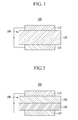
- FIGS. 1 and 2 are cross-sectional views showing organic light emitting diodes according to various embodiments of the present invention including the compounds for an organic optoelectric device according to one embodiment of the present invention.
- substituted refers to one substituted with deuterium, a halogen, hydroxy group, an amino group, a substituted or unsubstituted C1 to C30 amine group, a nitro group, a substituted or unsubstituted C3 to C40 silyl group, a C1 to C30 alkyl group, a C1 to C10 alkylsilyl group, a C3 to C30 cycloalkyl group, a C6 to C30 aryl group, a C1 to C20 alkoxy group, a fluoro group, a C1 to C10 trifluoroalkyl group such as a trifluoromethyl group and the like, or a cyano group, instead of at least one hydrogen of a substituent or a compound.
- the two adjacent substituents of the substituted halogen, hydroxy group, an amino group, a substituted or unsubstituted C1 to C20 amine group, a nitro group, a substituted or unsubstituted C3 to C40 silyl group, C1 to C30 alkyl group, C1 to C10 alkylsilyl group, C3 to C30 cycloalkyl group, C6 to C30 aryl group, C1 to C20 alkoxy group, fluoro group, C1 to C10 trifluoroalkyl group such as trifluoromethyl group and the like, or cyano group may be fused to form a ring.
- hetero refers to one including 1 to 3 hetero atoms selected from the group consisting of N, O, S, and P, and remaining carbons in one functional group.
- alkyl group refers to an aliphatic hydrocarbon group.
- the alkyl group may be a C1 to C20 alkyl group. More specifically, the alkyl group may be a C1 to C10 alkyl group or a C1 to C6 alkyl group.
- a C1 to C4 alkyl group may have 1 to 4 carbon atoms in alkyl chain which may be selected from the group consisting of methyl, ethyl, propyl, isopropyl, n-butyl, iso-butyl, sec-butyl, and t-butyl.
- alkyl group may be a methyl group, an ethyl group, a propyl group, an isopropyl group, a butyl group, an isobutyl group, a t-butyl group, a pentyl group, a hexyl group, an ethenyl group, a propenyl group, a butenyl group, a cyclopropyl group, a cyclobutyl group, a cyclopentyl group, a cyclohexyl group, and the like.
- Aryl group refers to a cyclic functional group where all elements have p-orbitals, and these p-orbitals forms conjugation and includes monocyclic or fused ring polycyclic (i.e., rings sharing adjacent pairs of carbon atoms) groups.
- Heteroaryl group refers to aryl group including 1 to 3 hetero atoms selected from the group consisting of N, O, S, and P, and remaining carbons. When the heteroaryl group is a fused ring, each ring may include 1 to 3 hetero atoms.
- the substituted or unsubstituted aryl group and/or a substituted or unsubstituted heteroaryl group may be a substituted or unsubstituted phenyl group, a substituted or unsubstituted naphthyl group, a substituted or unsubstituted anthracenyl group, a substituted or unsubstituted phenanthryl group, a substituted or unsubstituted naphthacenyl group, a substituted or unsubstituted pyrenyl group, a substituted or unsubstituted biphenylyl group, a substituted or unsubstituted p-terphenyl group, a substituted or unsubstituted m-terphenyl group, a substituted or unsubstituted chrysenyl group, a substituted or unsubstituted triphenylenyl group, a substituted or unsubstituted
- hole characteristics refer to characteristics that holes formed in the anode is easily injected into the emission layer and transported in the emission layer due to conductive characteristics according to HOMO level. More specifically, it is similar to electron-repelling characteristics.
- Electron characteristics refer to characteristics that electron formed in the cathode is easily injected into the emission layer and transported in the emission layer due to conductive characteristics according to LUMO level. More specifically, it is similar to electron-withdrawing characteristics.
- composition for an organic light emitting diode including a compound for an organic optoelectric device represented by the following Chemical Formula S-1; and a compound for an organic optoelectric device represented by the following Chemical Formula X-1.
- Ar 1 and Ar 2 are independently, a substituted or unsubstituted C6 to C30 aryl group or a substituted or unsubstituted C2 to C30 heteroaryl group.
- At least one of the Ar 1 or Ar 2 may be a substituted or unsubstituted C2 to C30 heteroaryl group having electron characteristics.
- the L 1 and L 2 may be independently, a single bond, a substituted or unsubstituted C2 to C6 alkenylene group, a substituted or unsubstituted C2 to C6 alkynylene group, a substituted or unsubstituted C6 to C30 arylene group, a substituted or unsubstituted C2 to C30 heteroarylene group, or a combination thereof.
- n1 and n2 may be independently integers of 1 to 3.
- the R 1 to R 6 may be independently hydrogen, deuterium, a halogen, a cyano group, a hydroxyl group, an amino group, a substituted or unsubstituted C1 to C20 amine group, a nitro group, a carboxyl group, a ferrocenyl group, a substituted or unsubstituted C1 to C20 alkyl group, a substituted or unsubstituted C6 to C30 aryl group, a substituted or unsubstituted C2 to C30 heteroaryl group, a substituted or unsubstituted C1 to C20 alkoxy group, a substituted or unsubstituted C6 to C20 aryloxy group, a substituted or unsubstituted C3 to C40 silyloxy group, a substituted or unsubstituted C1 to C20 acyl group, a substituted or unsubstituted C2 to C20 alkoxycarbonyl group
- R 1 to R 16 are independently hydrogen, deuterium, a substituted or unsubstituted C1 to C10 alkyl group, a substituted or unsubstituted C6 to C20 aryl group, or -SiR 17 R 18 R 19 , wherein the R 17 to R 19 are independently a C1 to C6 alkyl group, one of the R 1 to R 8 is a functional group represented by the following Chemical Formula X-2, one of the R 9 to R 16 is a functional group represented by the following Chemical Formula X-2, L is a bidentate ligand of a monovalent anion, and is a ligand coordination-bonding with iridium through unshared electron pair of carbon or heteroatom, and n and m are independently integers of 0 to 3, and n + m is one of integers of 1 to 3,
- R 20 to R 24 are independently hydrogen, deuterium, a substituted or unsubstituted C1 to C10 alkyl group, a substituted or unsubstituted C6 to C20 aryl group, or -SiR 17 R 18 R 19 , * is a portion where it linked to a carbon atom, in the above Chemical Formulae X-1 and X-2, one of the R 1 to R 16 and R 20 to R 24 is -SiR 17 R 18 R 19 or a tert-butyl group.
- the compound for an organic optoelectric device represented by the above Chemical Formula X-1 necessarily has a substituted or unsubstituted phenyl group represented by the above Chemical Formula X-2 in a main ligand having a 2-phenylpyridine backbone and in addition, necessarily -SiR 17 R 18 R 19 or a tert-butyl group.
- the main ligand is marked as a bonding number of n or m among the ligands combined with iridium through a coordination bond.
- the compound for an organic optoelectric device represented by the above Chemical Formula X-1 may have excellent heat resistance stability and life-span characteristics and high luminous efficiency at a low driving voltage.
- An organic optoelectric device manufactured by using a phosphorescent material has a drawbak of sharply decreased efficiency at a high current density by an extinction phenomenon due to saturation of a triplet exited state.
- This drawback may be overcome by introducing a very bulky substitutent into a luminous material or making the luminous material have a branch having a dendrimer structure to prevent the triplet-triplet extinction phenomenon.
- a dopant as the luminous material according to one embodiment of the present invention also has decreased interactions among molecules due to introduction of -SiR 17 R 18 R 19 or a stert-butyl group and a phenyl group having a large steric hindrance and thus, prevents the triplet-triplet extinction phenomenon and resulantly, may realize excellent life-span and luminous efficiency.
- the introduction of a bulky substitutent may have an effect on decreasing a deposition temperature due to decreased interactions among the molecules.
- one main ligand may have one -SiR 17 R 18 R 19 , or one tert-butyl group.
- n may be an integers of 1 to 3
- one of the R 1 to R 4 may be -SiR 17 R 18 R 19 or a tert-butyl group, and the rest of the R 1 to R 4 may be independently hydrogen, deuterium, or a substituted or unsubstituted C1 to C10 alkyl group.
- one of the R 5 to R 8 may be the functional group represented by the above Chemical Formula X-2, and the rest of the R 5 to R 8 may be independently hydrogen, deuterium, or a substituted or unsubstituted C1 to C10 alkyl group.
- the compound for an organic optoelectric device may realize excellent heat resistance stability, life-span characteristics and luminous efficiency.
- a ligand may have an overall three dimensional shape by introducing a bulky substituent such as the - SiR 17 R 18 R 19 or the tert-butyl group and the phenyl group thereinto, and accordingly, a dopant as a luminous material also has a bulky three dimensional structure and suppresses interactions among the molecules and thus, realizes a device having excellent life-span characteristics and luminous efficiency.
- n may be an integer of 1 to 3
- R 2 may be -SiR 17 R 18 R 19 or a tert-butyl group
- R 6 may be a phenyl group
- R 1 , R 3 to R 5 , R 7 and R 8 may be independently hydrogen, deuterium, or a substituted or unsubstituted C1 to C10 alkyl group.
- the compound for an organic optoelectric device may have excellent heat resistance stability, life-span characteristic and luminous efficiency.
- the phenyl group when a phenyl group is substituted at the R 6 position, the phenyl group may not change color purity of green luminescence but increases entire volume of molecules and minimizes interactions among the molecules and thus, realize a light emitting device having high efficiency and a long life-span.
- n may be an integer of 1 to 3
- one of the R 1 to R 4 may be the functional group represented by the above Chemical Formula X-2
- another of R 1 to R 4 may be -SiR 17 R 18 R 19 or a tert-butyl group
- the rest of the R 1 to R 4 and R 5 to R 8 may be independently hydrogen, deuterium, or a substituted or unsubstituted C1 to C10 alkyl group.
- the -SiR 17 R 18 R 19 or tert-butyl group and the functional group represented by Chemical Formula X-2 may be bonded at an ortho, meta, or para position.
- n may be an integer of 1 to 3
- R 2 may be a phenyl group
- R 3 may be -SiR 17 R 18 R 19 or a tert-butyl group
- R 1 , R 4 to R 8 are independently hydrogen, deuterium, or a substituted or unsubstituted C1 to C10 alkyl group.
- the compound for an organic optoelectric device may have excellent heat resistance stability, life-span characteristics, and luminous efficiency.
- n may be an integer of 1 to 3
- one of the R 1 to R 4 may be -SiR 17 R 18 R 19 or a tert-butyl group, and the rest of the R 1 to R 4 may be independently hydrogen, deuterium, or a substituted or unsubstituted C1 to C10 alkyl group.
- one of the R 5 to R 8 may be the functional group represented by the above Chemical Formula X-2, and the rest of the R 5 to R 8 may be independently hydrogen, deuterium, or a substituted or unsubstituted C1 to C10 alkyl group.
- m may be an integer of 1 to 3
- one of the R 9 to R 12 may be the functional group represented by the above Chemical Formula X-2
- another of R 9 to R 12 may be -SiR 17 R 18 R 19 or a tert-butyl group
- the rest of the R 9 to R 12 and R 13 to R 16 are independently hydrogen, deuterium, or a substituted or unsubstituted C1 to C10 alkyl group.
- the -SiR 17 R 18 R 19 or tert-butyl group and the functional group represented by Chemical Formula X-2 may be bonded at an ortho, meta, or para position.
- the main ligand may have a phenyl group substituted with the -SiR 17 R 18 R 19 or the tert-butyl group. That is to say, in the above Chemical Formula X-1, one of the R 1 to R 8 may be a functional group represented by the following Chemical Formula X-2, one of the R 9 to R 16 may be a functional group represented by the following Chemical Formula X-2, and in the above Chemical Formula X-2, one of the R 20 to R 24 may be -SiR 17 R 18 R 19 or a tert-butyl group, and the rest of the R 1 to R 16 that is unsubstituted with the functional group represented by the above Chemical Formula X-2 may be independently hydrogen, deuterium, or a substituted or unsubstituted C1 to C10 alkyl group.
- the compound for an organic optoelectric device is suppressed from interactions among molecules due to introduction of the -SiR 17 R 18 R 19 or the tert-butyl group as a bulky substitutent and may realize excellent heat resistance stability, life-span characteristics and luminous efficiency and also, lower a deposition temperature.
- the -SiR 17 R 18 R 19 or tert-butyl group when the -SiR 17 R 18 R 19 or tert-butyl group is substituted at the R 22 in Chemical Formula X-2, the -SiR 17 R 18 R 19 or tert-butyl group has an effect on increasing the entire volume of molecules and thus, minimizing interactions among the molecules.
- n may be an integer of 1 to 3
- at least one of the R 1 to R 8 may be a substituted or unsubstituted C1 to C20 alkyl group, and specifically an unsubstituted C1 to C10 alkyl group. In this case, thermal stability may be improved.
- the R 17 to R 19 may be independently a methyl group. That is to say, the -SiR 17 R 18 R 19 may be a trimethylsilyl group.
- the compound for an organic optoelectric device may realize excellent heat resistance stability, life-span characteristics and luminous efficiency.
- n + m may be 3.
- n or m may be 3. This means that the ligand represented by L is not included in the Chemical Formula X-1. In this case, its synthesis may become easier and the compound may be stabilized. Accordingly, it may be applied to provide a light emitting device having excellent life-span characteristics.
- n + m may be 1 or 2. This means that at least one ligand represented by L is included in Chemical Formula X-1. In this case, a color of the compound may be tuned.
- L may be an auxiliary ligand, and may be selected from the following Chemical Formula L-1 to Chemical Formula L-14.
- the asterisk (*) denotes a position bonding with iridium (Ir)
- R 101 to R 103 are independently hydrogen, deuterium, a C1 to C30 alkyl group substituted or unsubstituted with a halogen, a C6 to C30 aryl group substituted or unsubstituted with a C1 to C30 alkyl, or a halogen.
- R 104 to R 115 are independently hydrogen, deuterium, a halogen, a substituted or unsubstituted C1 to C30 alkyl group, a substituted or unsubstituted C1 to C30 alkoxy group, a substituted or unsubstituted C3 to C30 cycloalkyl group, a substituted or unsubstituted C2 to C30 alkenyl group, a substituted or unsubstituted C6 to C30 aryl group, a substituted or unsubstituted C1 to C30 heteroaryl group, a substituted or unsubstituted C1 to C30 amino group, a substituted or unsubstituted C6 to C30 arylamino group, SF 5 , a trialkylsilyl group having a substituted or unsubstituted C1 to C30 alkyl group, a dialkylarylsilyl group having a substituted or unsubstituted C1 to
- R 116 to R 117 are independently hydrogen, deuterium, a C1 to C30 alkyl group substituted or unsubstituted with a halogen, or a C6 to C30 aryl group substituted or unsubstituted with a C1 to C30 alkyl.
- Chemical Formula X-1 may be one of the following Chemical Formulae M-1 to M-55, Chemical Formulae P-1 to P-26 and Chemical Formulae Q-1 to Q-11. These have a structure where the main ligand is substituted with one phenyl group and one trimethylsilyl group. However, these are specific examples of Chemical Formula X-1 which is not limited thereto.
- Chemical Formula X-1 may be one of the following Chemical Formulae B-1 to B-65, Chemical Formulae C-1 to C-18, and Chemical Formulae D-1 to D-6. These have a structure where the main ligand is substituted with one phenyl group and one trimethylsilyl group in Chemical Formula X-1.
- Chemical Formula X-1 which is not limited thereto.
- the above Chemical Formula S-1 may be represented by the following Chemical Formula S-2.
- the ligand may be advantageous in terms of synthesis and also, stably prepared by substituting the position No. 3 of electrochemically unstable carbazole.
- a bandgap and a triplet energy bandgap may be improved by further non-flattening a molecular structure and limiting a conjugation length.
- Ar 1 and Ar 2 are independently a substituted or unsubstituted C6 to C30 aryl group or a substituted or unsubstituted C2 to C30 heteroaryl group, at least one of Ar 1 or Ar 2 is a substituted or unsubstituted C2 to C30 heteroaryl group having electron characteristics
- L 1 and L 2 are independently a single bond, a substituted or unsubstituted C2 to C6 alkenylene group, a substituted or unsubstituted C2 to C6 alkynylene group, a substituted or unsubstituted C6 to C30 arylene group, a substituted or unsubstituted C2 to C30 heteroarylene group, or a combination thereof
- n1 and n2 are independently integers of 1 to 3
- R 1 to R 6 are independently hydrogen, deuterium, a halogen, a cyano group, a hydroxyl group, an amino group, a substituted or un
- the above Chemical Formula S-1 may be represented by the following Chemical Formula S-3.
- a bandgap and a triplet energy bandgap may be improved by further non-flattening a molecular structure and limiting a conjugation length.
- Ar 1 and Ar 2 are independently a substituted or unsubstituted C6 to C30 aryl group or a substituted or unsubstituted C2 to C30 heteroaryl group, at least one of Ar 1 or Ar 2 is a substituted or unsubstituted C2 to C30 heteroaryl group having electron characteristics
- L 1 and L 2 are independently a single bond, a substituted or unsubstituted C2 to C6 alkenylene group, a substituted or unsubstituted C2 to C6 alkynylene group, a substituted or unsubstituted C6 to C30 arylene group, a substituted or unsubstituted C2 to C30 heteroarylene group, or a combination thereof
- n1 and n2 are independently integers of 1 to 3
- R 1 to R 6 are independently hydrogen, deuterium, a halogen, a cyano group, a hydroxyl group, an amino group, a substituted or un
- the above Chemical Formula S-1 may be represented by the following Chemical Formula S-4.
- a bandgap and a triplet energy bandgap may be improved by further non-flattening a molecular structure and limiting a conjugation length.
- Ar 1 and Ar 2 are independently a substituted or unsubstituted C6 to C30 aryl group or a substituted or unsubstituted C2 to C30 heteroaryl group, at least one of Ar 1 or Ar 2 is a substituted or unsubstituted C2 to C30 heteroaryl group having electron characteristics
- L 1 and L 2 are independently a single bond, a substituted or unsubstituted C2 to C6 alkenylene group, a substituted or unsubstituted C2 to C6 alkynylene group, a substituted or unsubstituted C6 to C30 arylene group, a substituted or unsubstituted C2 to C30 heteroarylene group, or a combination thereof
- n1 and n2 are independently integers of 1 to 3
- R 1 to R 6 are independently hydrogen, deuterium, a halogen, a cyano group, a hydroxyl group, an amino group, a substituted or un
- the above Chemical Formula S-1 may be represented by the following Chemical Formula S-5.
- thermal stability may be increased by introducing a bulky biphenyl substitutent.
- ETU is a substituted or unsubstituted C2 to C30 heteroaryl group having electron characteristics
- L 1 is a single bond, a substituted or unsubstituted C2 to C6 alkenylene group, a substituted or unsubstituted C2 to C6 alkynylene group, a substituted or unsubstituted C6 to C30 arylene group, a substituted or unsubstituted C2 to C30 heteroarylene group, or a combination thereof
- n1 is an integer of 1 to 3
- R 1 to R 6 are independently hydrogen, deuterium, a halogen, a cyano group, a hydroxyl group, an amino group, a substituted or unsubstituted C1 to C20 amine group, a nitro group, a carboxyl group, a ferrocenyl group, a substituted or unsubstituted C1 to C20 alkyl group, a substituted or unsub
- the above Chemical Formula S-1 may be represented by the following Chemical Formula S-6.
- luminous efficiency and life-span of a device may be increased, since a kink-shaped bulky biphenyl substitutent suppresses interactions among molecules.
- ETU is a substituted or unsubstituted C2 to C30 heteroaryl group having electron characteristics
- L 1 is a single bond, a substituted or unsubstituted C2 to C6 alkenylene group, a substituted or unsubstituted C2 to C6 alkynylene group, a substituted or unsubstituted C6 to C30 arylene group, a substituted or unsubstituted C2 to C30 heteroarylene group, or a combination thereof
- n1 is an integer of 1 to 3
- R 1 to R 6 are independently hydrogen, deuterium, a halogen, a cyano group, a hydroxyl group, an amino group, a substituted or unsubstituted C1 to C20 amine group, a nitro group, a carboxyl group, a ferrocenyl group, a substituted or unsubstituted C1 to C20 alkyl group, a substituted or unsub
- the above Chemical Formula S-1 may be represented by the following Chemical Formula S-7.
- the introduction of the methyl substitutent may lower a deposition temperature and thus, a process temperature in a process of manufacturing a device.
- ETU is a substituted or unsubstituted C2 to C30 heteroaryl group having electron characteristics
- L 1 is a single bond, a substituted or unsubstituted C2 to C6 alkenylene group, a substituted or unsubstituted C2 to C6 alkynylene group, a substituted or unsubstituted C6 to C30 arylene group, a substituted or unsubstituted C2 to C30 heteroarylene group, or a combination thereof
- n1 is an integer of 1 to 3
- R 1 to R 6 are independently hydrogen, deuterium, a halogen, a cyano group, a hydroxyl group, an amino group, a substituted or unsubstituted C1 to C20 amine group, a nitro group, a carboxyl group, a ferrocenyl group, a substituted or unsubstituted C1 to C20 alkyl group, a substituted or unsub
- the substituted or unsubstituted C2 to C30 heteroaryl group having electron characteristics may be selected from the group consisting of a substituted or unsubstituted imidazolyl group, a substituted or unsubstituted triazolyl group, a substituted or unsubstituted tetrazolyl group, a substituted or unsubstituted oxadiazolyl group, a substituted or unsubstituted oxatriazolyl group, a substituted or unsubstituted thiatriazolyl group, a substituted or unsubstituted benzimidazolyl group, a substituted or unsubstituted benzotriazolyl group, a substituted or unsubstituted pyridinyl group, a substituted or unsubstituted pyrimidinyl group, a substituted or unsubstituted triazinyl group, a substituted or unsubstituted
- substituted or unsubstituted C2 to C30 heteroaryl group having electron characteristics may be represented by one of the following Chemical Formulae E-1 to E-5.
- the above Chemical Formula S-1 may be represented by one of the following Chemical Formulae 3 to 54. But, it is not limited thereto.
- the above Chemical Formula S-1 may be represented by one of the following Chemical Formulae A-2 to A-26. But, it is not limited thereto.
- the above Chemical Formula S-1 may be represented by one of the following Chemical Formulae O-1 to 0-18. But, it is not limited thereto.
- the above Chemical Formula S-1 may be represented by one of the following Chemical Formulae T-1 to T-474. But, it is not limited thereto.
- the compound for an organic optoelectric device represented by the above Chemical Formula S-1 of he present invention may be one of Chemical Formula A-19, Chemical Formula A-20, Chemical Formula A-22, Chemical FormulaA-23, Chemical Formula T-35, Chemical Formula T-36, Chemical Formula T-40, Chemical Formula T-41, Chemical Formula T-77, Chemical Formula T-81, Chemical Formula T-82, Chemical Formula T-96, Chemical Formula 4, Chemical Formula 5, Chemical Formula 53 or Chemical Formula 54, wherein the compound represented by the above Chemical Formula X-1 may be a composition for an organic light emitting diode of Chemical Formula M-1, P-2, P-3, C-1, C-6 or B-18.
- a weight ratio of the compound for an organic optoelectric device represented by the above Chemical Formula S-1 and the compound for an organic optoelectric device represented by the above Chemical Formula X-1 may be 1:99 to 99:1.
- an organic thin layer including the composition for an organic light emitting diode is provided.
- the organic thin layer may be specifically an emission layer.
- an organic optoelectric device in another embodiment, includes an anode, a cathode, and at least one or more organic thin layer between the anode and the cathode, and at least one of the organic thin layers may include the compound for an organic optoelectric device.
- the compound for an organic optoelectric device is used in an organic thin layer and thus improves life-span characteristics, efficiency characteristics, electrochemical stability, and thermal stability of an organic optoelectric device, and lowers a driving voltage.
- the organic optoelectric device may be an organic light emitting diode, an organic photoelectric device, an organic solar cell, an organic transistor, an organic photo-conductor drum, or an organic memory device.
- the organic optoelectric device may be an organic light emitting diode.
- FIGS. 1 to 5 are cross-sectional views showing organic light emitting diodes including the compound for an organic optoelectric device according to one embodiment of the present invention.
- organic light emitting diodes 100 and 200 includes an anode 120, a cathode 110, and at least one organic thin layer 105 between the anode and the cathode.
- the anode 120 includes an anode material having a large work function to help hole injection into an organic thin layer.
- the anode material includes: a metal such as nickel, platinum, vanadium, chromium, copper, zinc, and gold, or alloys thereof; a metal oxide such as zinc oxide, indium oxide, indium tin oxide (ITO), and indium zinc oxide (IZO); a bonded metal and oxide such as ZnO:Al or SnO 2 :Sb; or a conductive polymer such as poly(3-methylthiophene), poly[3,4-(ethylene-1,2-dioxy)thiophene] (PEDT), polypyrrole, and polyaniline, but is not limited thereto. It is preferable to include a transparent electrode including indium tin oxide (ITO) as an anode.
- ITO indium tin oxide
- the cathode 110 includes a cathode material having a small work function to help electron injection into an organic thin layer.
- the cathode material includes: a metal such as magnesium, calcium, sodium, potassium, titanium, indium, yttrium, lithium, gadolinium, aluminum, silver, tin, and lead, or alloys thereof; or a multi-layered material such as LiF/Al, Liq/Al, LiO 2 /Al, LiF/Ca, LiF/Al, and BaF 2 /Ca, but is not limited thereto. It is preferable to include a metal electrode including aluminum as a cathode.
- the organic light emitting diode 100 includes an organic thin layer 105 including only an emission layer 130.
- a double-layered organic light emitting diode 200 includes an organic thin layer 105 including an emission layer 230 including an electron transport layer (ETL), and a hole transport layer (HTL) 140.
- the organic thin layer 105 includes a double layer of the emission layer 230 and hole transport layer (HTL) 140.
- the emission layer 130 also functions as an electron transport layer (ETL), and the hole transport layer (HTL) 140 layer has an excellent binding property with a transparent electrode such as ITO or an excellent hole transport capability.
- an organic light emitting diode may further include an electron transport layer (ETL), an electron injection layer (EIL), a hole injection layer, and the like, as an organic thin layer 105 in FIG. 1 or FIG. 2 .
- the emission layers 130 and 230, the hole transport layer (HTL) 140 or even though not drawn in the drawings, one selected from the group consisting of the electron transport layer (ETL), the electron injection layer (EIL), the hole injection layer (HIL) and a combination thereof which constitute the organic thin layer 105 may include the compound for an organic optoelectric device.
- the compound for an organic optoelectric device may be used in the emission layers 130 and 230, and may be used as a green phosphorescent dopant material in the emission layers.
- the organic light emitting diode may be manufactured by: forming an anode on a substrate; forming an organic thin layer in accordance with a dry coating method such as evaporation, sputtering, plasma plating, and ion plating or a wet coating method such as spin coating, dipping, and flow coating; and providing a cathode thereon.
- a dry coating method such as evaporation, sputtering, plasma plating, and ion plating
- a wet coating method such as spin coating, dipping, and flow coating
- a display device including the organic optoelectric device is provided.
- a compound represented by the above Chemical Formula 4 as specific examples of a compound for an organic optoelectric device according to the present invention was synthesized through a method provided in the following Reaction Scheme 1.
- a compound represented by the above Chemical Formula 5 as specific examples of a compound for an organic optoelectric device according to the present invention was synthesized through a method provided in the following Reaction Scheme 2.
- a compound represented by the above Chemical Formula 14 as specific examples of a compound for an organic optoelectric device according to the present invention was synthesized through a method provided in the following Reaction Scheme 3.
- a compound represented by the above Chemical Formula A-2 as specific examples of a compound for an organic optoelectric device according to the present invention was synthesized through a method provided in the following Reaction Scheme 4.
- a compound represented by the above Chemical Formula A-10 as specific examples of a compound for an organic optoelectric device according to the present invention was synthesized in a method of the following Reaction Scheme 5.
- a compound represented by the above Chemical Formula A-12 as specific examples of a compound for an organic optoelectric device according to the present invention was synthesized in a method of the following Reaction Scheme 3.
- a compound represented by the above Chemical Formula 3 as specific examples of a compound for an organic optoelectric device according to the present invention was synthesized in a method of the following Reaction Scheme 7.
- a compound represented by the above Chemical Formula 54 as specific examples of a compound for an organic optoelectric device according to the present invention was synthesized in a method of the following Reaction Scheme 8.
- a glass substrate coated with a ITO (Indium tin oxide) to be1500 A-thick was washed with a distilled water ultrasonic wave.
- the coated glass substrate was ultrasonic wave-washed with a solvent such as isopropyl alcohol, acetone, methanol and the like, dried, delivered to a plasma cleaner, washed for 5 minutes by using an oxygen plasma, and then, delivered to a vacuum depositor.
- HTM N-(biphenyl-4-yl)-9,9-diphenyl-N-(4-(9-phenyl-9H-carbazole)-3-yl)phenyl)9H-fluorene-2-amine
- Chemical Formula Z-1 was deposited on the ITO substrate to form a 1200 A-thick hole injection layer (HIL).
- CBP hole transport layer
- PhGD tris(3-methyl-2-pyridine)iridium
- An organic light emitting diode was manufactured according to the same method as Comparative Example 1 except for using the compound synthesized in Example 10 instead of the compound according to Comparison Preparation Example 1 as a host for an emission layer and the compound synthesized in Example 11 instead of the dopant used in Comparative Example 1.
- An organic light emitting diode was manufactured according to the same method as Preparation Example 1 except for using the compound synthesized in Example 12 instead of the compound synthesized in Example 11 as a dopant for an emission layer.
- An organic light emitting diode was manufactured according to the same method as Preparation Example 1 except for using the compound synthesized in Example 13 instead of the compound synthesized in Example 11 as a dopant for an emission layer.
- An organic light emitting diode was manufactured according to the same method as Preparation Example 1 except for using the compound synthesized in Example 14 instead of the compound synthesized in Example 11 as a dopant for an emission layer.
- An organic light emitting diode was manufactured according to the same method as Preparation Example 1 except for using the compound synthesized in Example 15 instead of the compound synthesized in Example 11 as a dopant for an emission layer.
- An organic light emitting diode was manufactured according to the same method as Preparation Example 1 except for using the compound synthesized in Example 12 instead of the compound synthesized in Example 11 as a dopant for an emission layer and the compound synthesized in Example 2 instead of the compound used in Preparation Example 1 as a host for an emission layer.
- An organic light emitting diode was manufactured according to the same method as Preparation Example 1 except for using the compound synthesized in Example 13 instead of the compound synthesized in Example 12 as a dopant for an emission layer.
- An organic light emitting diode was manufactured according to the same method as Preparation Example 1 except for using the compound synthesized in Example 12 instead of the compound synthesized in Example 11 as a dopant for an emission layer and the compound synthesized in Example 1 instead of the compound used in Preparation Example 1 as a host for an emission layer.
- An organic light emitting diode was manufactured according to the same method as Preparation Example 8 except for using the compound synthesized in Example 13 instead of the compound synthesized in Example 12 as a dopant for an emission layer.
- the obtained organic light emitting diodes were measured for current value flowing in the unit device while increasing the voltage from 0 V to 10 V using a current-voltage meter (Keithley 2400), and the measured current value was divided by area to provide the results.
- Luminance was measured by using a luminance meter (Minolta Cs-1000A), while the voltage of the organic light emitting diodes was increased from 0 V to 10 V.
- the luminance, current density, and voltage obtained from the (1) and (2) were used to calculate current efficiency (cd/A) at the same luminance (9000 cd/m 2 ).
- Example 13 A decreasing time of a current efficiency (cd/A) was measured maintaining luminance (cd/m 2 ) at 6000 cd/m 2 .
- [Table 1] Host material of emission layer Dopant material of emission layer Driving voltage (V) 6000 cd/m 2 Luminous efficiency (cd/A) Life-span (h,T97%) Comparative Example 1 CBP Z-2 8 46 1 Preparation Example 1 Example 10 Example 11 4.39 55 60 Preparation Example 2 Example 10 Example 12 4.43 49.8 55 Preparation Example 3 Example 10 Example 13 4.36 48.4 58 Preparation Example 4 Example 10 Example 14 4.61 47.8 50 Preparation Example 5 Example 10 Example 15 4.62 46.1 55 Preparation Example 6 Example 2 Example 12 4.26 50.2 63 Preparation Example 7 Example 2 Example 13 4.25 50.0 57 Preparation Example 8 Example 1 Example 12 4.24 50.2 59 Preparation Example 9 Example 1 Example 13 4.13 51.5 55
- the organic light emitting diodes manufactured by using a material provided in the present invention showed much excellent driving voltage and efficiency compared with an organic light emitting diodes manufactured by using CBP as a reference material in terms of luminous efficiency.
- the organic light emitting diodes manufactured by using a compound provided in the present invention showed life-span ranging from 30 hours to 63 hours at most, while the organic light emitting diode manufactured by using CBP showed sharply-decreased life-span of less than one hour.
- the compound manufactured in the present invention may be used as a satisfactory material for an organic light emitting diode.
Landscapes
- Chemical & Material Sciences (AREA)
- Engineering & Computer Science (AREA)
- Materials Engineering (AREA)
- Physics & Mathematics (AREA)
- Spectroscopy & Molecular Physics (AREA)
- Organic Chemistry (AREA)
- Inorganic Chemistry (AREA)
- Crystallography & Structural Chemistry (AREA)
- Optics & Photonics (AREA)
- Electroluminescent Light Sources (AREA)
- Plural Heterocyclic Compounds (AREA)
Abstract
Description
- A composition for an organic light emitting diode, and an organic emission layer and an organic light emitting diode including the same are disclosed.
- An organic optoelectric device is a device requiring a charge exchange between an electrode and an organic material by using holes or electrons.
- An organic optoelectric device may be classified as follows in accordance with its driving principles. A first organic optoelectric device is an electronic device driven as follows: excitons are generated in an organic material layer by photons from an external light source; the excitons are separated into electrons and holes; and the electrons and holes are transferred to different electrodes as a current source (a voltage source).
- A second organic optoelectric device is an electronic device driven as follows: a voltage or a current is applied to at least two electrodes to inject holes and/or electrons into an organic material semiconductor positioned at an interface of the electrodes, and the device is driven by the injected electrons and holes.
- Examples of an organic optoelectric device include an organic photoelectric device, an organic light emitting diode, an organic solar cell, an organic photo conductor drum, an organic transistor, and the like, which require a hole injecting or transport material, an electron injecting or transport material, or a light emitting material.
- Particularly, an organic light emitting diode (OLED) has recently drawn attention due to an increase in demand for flat panel displays. In general, organic light emission refers to conversion of electrical energy into photo-energy.
- Such an organic light emitting diode converts electrical energy into light by applying current to an organic light emitting material. It has a structure in which a functional organic material layer is interposed between an anode and a cathode. Herein, the organic material layer includes a multi-layer including different materials, for example a hole injection layer, a hole transport layer, an emission layer, an electron transport layer, and an electron injection layer, in order to improve efficiency and stability of an organic light emitting diode.
- In such an organic light emitting diode, when a voltage is applied between an anode and a cathode, holes from the anode and electrons from the cathode are injected to an organic material layer and recombined to generate excitons having high energy. The generated excitons generate light having certain wavelengths while shifting to a ground state.
- Recently, it has become known that a phosphorescent light emitting material may be used for a light emitting material of an organic light emitting diode in addition to the fluorescent light emitting material. Such a phosphorescent material emits lights by transporting the electrons from a ground state to an exited state, non-radiance transiting of a singlet exciton to a triplet exciton through intersystem crossing, and transiting a triplet exciton to a ground state to emit light.
- As described above, in an organic light emitting diode, an organic material layer includes a light emitting material and a charge transport material, for example a hole injection material, a hole transport material, an electron transport material, an electron injection material, and the like.
- The light emitting material is classified as blue, green, and red light emitting materials according to emitted colors, and yellow and orange light emitting materials to emit colors approaching natural colors.
- When one material is used as a light emitting material, a maximum light emitting wavelength is shifted to a long wavelength or color purity decreases because of interactions between molecules, or device efficiency decreases because of a light emitting quenching effect. Therefore, a host/dopant system is included as a light emitting material in order to improve color purity and increase luminous efficiency and stability through energy transfer.
- In order to implement excellent performance of an organic light emitting diode, a material constituting an organic material layer, for example a hole injection material, a hole transport material, a light emitting material, an electron transport material, an electron injection material, and a light emitting material such as a host and/or a dopant, should be stable and have good efficiency. However, development of an organic material layer forming material for an organic light emitting diode has thus far not been satisfactory and thus there is a need for a novel material. This material development is also required for other organic optoelectric devices.
- The low molecular organic light emitting diode is manufactured as a thin film in a vacuum deposition method and can have good efficiency and life-span performance, and a polymer organic light emitting diode is manufactured in an inkjet or spin coating method has an advantage of low initial cost and being large-sized.
- Both low molecular organic light emitting and polymer organic light emitting diodes have an advantage of self-light emitting, high speed response, wide viewing angle, ultra-thin, high image quality, durability, large driving temperature range, and the like. In particular, they have good visibility due to self-light emitting characteristics compared with a conventional LCD (liquid crystal display) and have an advantage of decreasing a thickness and weight of LCD up to a third, because they do not need a backlight.
- In addition, since they have a response speed 1000 time faster microsecond unit than LCD, they can realize a perfect motion picture without after-image. Accordingly, based on these advantages, they have been remarkably developed to have 80 times efficiency and more than 100 times life-span since they come out for the first time in the late 1980s, and recently, they keep being rapidly larger such as a 40-inch organic light emitting diode panel.
- They are simultaneously required to have improved luminous efficiency and life-span in order to be larger. Therefore, there are needs for developments for a stable and efficient organic material layer material for an organic light emitting diode.
- A composition for an organic optoelectric device being capable of providing an organic light emitting diode having characteristics such as high efficiency, long life-span and the like may be provided.
- An organic emission layer, an organic light emitting diode and a display device including the composition for an organic optoelectric device may be provided.
- In one embodiment of the present invention, a composition for an organic light emitting diode including a compound for an organic optoelectric device represented by the following Chemical Formula S-1 and a compound for an organic optoelectric device represented by the following Chemical Formula X-1 is provided.


- In the above Chemical Formulae S-1 and X-1, each substituent is the same as in the following "the detailed description of the present invention."
- The organic optoelectric device including the composition for an organic optoelectric device has excellent electrochemical and thermal stability and life-span characteristics, and high luminous efficiency at a low driving voltage.
-
FIGS. 1 and 2 are cross-sectional views showing organic light emitting diodes according to various embodiments of the present invention including the compounds for an organic optoelectric device according to one embodiment of the present invention. - Hereinafter, embodiments of the present invention are described in detail. However, these embodiments are exemplary, and the present invention is not limited thereto and is limited by the claims.
- In the present specification, when a definition is not otherwise provided, "substituted" refers to one substituted with deuterium, a halogen, hydroxy group, an amino group, a substituted or unsubstituted C1 to C30 amine group, a nitro group, a substituted or unsubstituted C3 to C40 silyl group, a C1 to C30 alkyl group, a C1 to C10 alkylsilyl group, a C3 to C30 cycloalkyl group, a C6 to C30 aryl group, a C1 to C20 alkoxy group, a fluoro group, a C1 to C10 trifluoroalkyl group such as a trifluoromethyl group and the like, or a cyano group, instead of at least one hydrogen of a substituent or a compound.
- The two adjacent substituents of the substituted halogen, hydroxy group, an amino group, a substituted or unsubstituted C1 to C20 amine group, a nitro group, a substituted or unsubstituted C3 to C40 silyl group, C1 to C30 alkyl group, C1 to C10 alkylsilyl group, C3 to C30 cycloalkyl group, C6 to C30 aryl group, C1 to C20 alkoxy group, fluoro group, C1 to C10 trifluoroalkyl group such as trifluoromethyl group and the like, or cyano group may be fused to form a ring.
- In the present specification, when specific definition is not otherwise provided, "hetero" refers to one including 1 to 3 hetero atoms selected from the group consisting of N, O, S, and P, and remaining carbons in one functional group.
- In the present specification, when a definition is not otherwise provided, "alkyl group" refers to an aliphatic hydrocarbon group.
- The alkyl group may be a C1 to C20 alkyl group. More specifically, the alkyl group may be a C1 to C10 alkyl group or a C1 to C6 alkyl group. For example, a C1 to C4 alkyl group may have 1 to 4 carbon atoms in alkyl chain which may be selected from the group consisting of methyl, ethyl, propyl, isopropyl, n-butyl, iso-butyl, sec-butyl, and t-butyl.
- Specific examples of the alkyl group may be a methyl group, an ethyl group, a propyl group, an isopropyl group, a butyl group, an isobutyl group, a t-butyl group, a pentyl group, a hexyl group, an ethenyl group, a propenyl group, a butenyl group, a cyclopropyl group, a cyclobutyl group, a cyclopentyl group, a cyclohexyl group, and the like.
- "Aryl group" refers to a cyclic functional group where all elements have p-orbitals, and these p-orbitals forms conjugation and includes monocyclic or fused ring polycyclic (i.e., rings sharing adjacent pairs of carbon atoms) groups.
- "Heteroaryl group" refers to aryl group including 1 to 3 hetero atoms selected from the group consisting of N, O, S, and P, and remaining carbons. When the heteroaryl group is a fused ring, each ring may include 1 to 3 hetero atoms.
- More specifically, the substituted or unsubstituted aryl group and/or a substituted or unsubstituted heteroaryl group may be a substituted or unsubstituted phenyl group, a substituted or unsubstituted naphthyl group, a substituted or unsubstituted anthracenyl group, a substituted or unsubstituted phenanthryl group, a substituted or unsubstituted naphthacenyl group, a substituted or unsubstituted pyrenyl group, a substituted or unsubstituted biphenylyl group, a substituted or unsubstituted p-terphenyl group, a substituted or unsubstituted m-terphenyl group, a substituted or unsubstituted chrysenyl group, a substituted or unsubstituted triphenylenyl group, a substituted or unsubstituted perylenyl group, a substituted or unsubstituted indenyl group, a substituted or unsubstituted furanyl group, a substituted or unsubstituted thiophenyl group, a substituted or unsubstituted pyrrolyl group, a substituted or unsubstituted pyrazolyl group, a substituted or unsubstituted imidazolyl group, a substituted or unsubstituted triazolyl group, a substituted or unsubstituted oxazolyl group, a substituted or unsubstituted thiazolyl group, a substituted or unsubstituted oxadiazolyl group, a substituted or unsubstituted thiadiazolyl group, a substituted or unsubstituted pyridyl group, a substituted or unsubstituted pyrimidinyl group, a substituted or unsubstituted pyrazinyl group, a substituted or unsubstituted triazinyl group, a substituted or unsubstituted benzofuranyl group, a substituted or unsubstituted benzothiophenyl group, a substituted or unsubstituted benzimidazolyl group, a substituted or unsubstituted indolyl group, a substituted or unsubstituted quinolinyl group, a substituted or unsubstituted isoquinolinyl group, a substituted or unsubstituted quinazolinyl group, a substituted or unsubstituted quinoxalinyl group, a substituted or unsubstituted naphthyridinyl group, a substituted or unsubstituted benzoxazinyl group, a substituted or unsubstituted benzthiazinyl group, a substituted or unsubstituted acridinyl group, a substituted or unsubstituted phenazinyl group, a substituted or unsubstituted phenothiazinyl group, a substituted or unsubstituted phenoxazinyl group, or a combination thereof, but is not limited thereto.
- In the present specification, hole characteristics refer to characteristics that holes formed in the anode is easily injected into the emission layer and transported in the emission layer due to conductive characteristics according to HOMO level. More specifically, it is similar to electron-repelling characteristics.
- Electron characteristics refer to characteristics that electron formed in the cathode is easily injected into the emission layer and transported in the emission layer due to conductive characteristics according to LUMO level. More specifically, it is similar to electron-withdrawing characteristics.
- According to one embodiment of the present invention, provided is a composition for an organic light emitting diode including a compound for an organic optoelectric device represented by the following Chemical Formula S-1; and a compound for an organic optoelectric device represented by the following Chemical Formula X-1.

- In the above Chemical Formula S-1, Ar1 and Ar2 are independently, a substituted or unsubstituted C6 to C30 aryl group or a substituted or unsubstituted C2 to C30 heteroaryl group.
- At least one of the Ar1 or Ar2 may be a substituted or unsubstituted C2 to C30 heteroaryl group having electron characteristics.
- The L1 and L2 may be independently, a single bond, a substituted or unsubstituted C2 to C6 alkenylene group, a substituted or unsubstituted C2 to C6 alkynylene group, a substituted or unsubstituted C6 to C30 arylene group, a substituted or unsubstituted C2 to C30 heteroarylene group, or a combination thereof.
- The n1 and n2 may be independently integers of 1 to 3.
- The R1 to R6 may be independently hydrogen, deuterium, a halogen, a cyano group, a hydroxyl group, an amino group, a substituted or unsubstituted C1 to C20 amine group, a nitro group, a carboxyl group, a ferrocenyl group, a substituted or unsubstituted C1 to C20 alkyl group, a substituted or unsubstituted C6 to C30 aryl group, a substituted or unsubstituted C2 to C30 heteroaryl group, a substituted or unsubstituted C1 to C20 alkoxy group, a substituted or unsubstituted C6 to C20 aryloxy group, a substituted or unsubstituted C3 to C40 silyloxy group, a substituted or unsubstituted C1 to C20 acyl group, a substituted or unsubstituted C2 to C20 alkoxycarbonyl group, a substituted or unsubstituted C2 to C20 acyloxy group, a substituted or unsubstituted C2 to C20 acylamino group, a substituted or unsubstituted C2 to C20 alkoxycarbonylamino group, a substituted or unsubstituted C7 to C20 aryloxycarbonylamino group, a substituted or unsubstituted C1 to C20 sulfamoylamino group, a substituted or unsubstituted C1 to C20 sulfonyl group, a substituted or unsubstituted C1 to C20 alkylthiol group, a substituted or unsubstituted C6 to C20 arylthiol group, a substituted or unsubstituted C1 to C20 heterocyclothiol group, a substituted or unsubstituted C1 to C20 ureide group, a substituted or unsubstituted C3 to C40 silyl group, or a combination thereof.


- In the above Chemical Formula X-1, R1 to R16 are independently hydrogen, deuterium, a substituted or unsubstituted C1 to C10 alkyl group, a substituted or unsubstituted C6 to C20 aryl group, or -SiR17R18R19, wherein the R17 to R19 are independently a C1 to C6 alkyl group, one of the R1 to R8 is a functional group represented by the following Chemical Formula X-2, one of the R9 to R16 is a functional group represented by the following Chemical Formula X-2, L is a bidentate ligand of a monovalent anion, and is a ligand coordination-bonding with iridium through unshared electron pair of carbon or heteroatom, and n and m are independently integers of 0 to 3, and n + m is one of integers of 1 to 3,

- In the above Chemical Formula X-2, R20 to R24 are independently hydrogen, deuterium, a substituted or unsubstituted C1 to C10 alkyl group, a substituted or unsubstituted C6 to C20 aryl group, or -SiR17R18R19, * is a portion where it linked to a carbon atom, in the above Chemical Formulae X-1 and X-2, one of the R1 to R16 and R20 to R24 is -SiR17R18R19 or a tert-butyl group.
- The compound for an organic optoelectric device represented by the above Chemical Formula X-1 necessarily has a substituted or unsubstituted phenyl group represented by the above Chemical Formula X-2 in a main ligand having a 2-phenylpyridine backbone and in addition, necessarily -SiR17R18R19 or a tert-butyl group. The main ligand is marked as a bonding number of n or m among the ligands combined with iridium through a coordination bond.
- Herein, the compound for an organic optoelectric device represented by the above Chemical Formula X-1 may have excellent heat resistance stability and life-span characteristics and high luminous efficiency at a low driving voltage.
- An organic optoelectric device manufactured by using a phosphorescent material has a drawbak of sharply decreased efficiency at a high current density by an extinction phenomenon due to saturation of a triplet exited state. This drawback may be overcome by introducing a very bulky substitutent into a luminous material or making the luminous material have a branch having a dendrimer structure to prevent the triplet-triplet extinction phenomenon. A dopant as the luminous material according to one embodiment of the present invention also has decreased interactions among molecules due to introduction of -SiR17R18R19 or a stert-butyl group and a phenyl group having a large steric hindrance and thus, prevents the triplet-triplet extinction phenomenon and resulantly, may realize excellent life-span and luminous efficiency.
- In addition, the introduction of a bulky substitutent may have an effect on decreasing a deposition temperature due to decreased interactions among the molecules.
- More specifically, in the above Chemical Formula X-1, one main ligand may have one -SiR17R18R19, or one tert-butyl group.
- For example, in the above Chemical Formula X-1, n may be an integers of 1 to 3, one of the R1 to R4 may be -SiR17R18R19 or a tert-butyl group, and the rest of the R1 to R4 may be independently hydrogen, deuterium, or a substituted or unsubstituted C1 to C10 alkyl group. At the same time, one of the R5 to R8 may be the functional group represented by the above Chemical Formula X-2, and the rest of the R5 to R8 may be independently hydrogen, deuterium, or a substituted or unsubstituted C1 to C10 alkyl group. In this case, the compound for an organic optoelectric device may realize excellent heat resistance stability, life-span characteristics and luminous efficiency. A ligand may have an overall three dimensional shape by introducing a bulky substituent such as the - SiR17R18R19 or the tert-butyl group and the phenyl group thereinto, and accordingly, a dopant as a luminous material also has a bulky three dimensional structure and suppresses interactions among the molecules and thus, realizes a device having excellent life-span characteristics and luminous efficiency.
- For specific examples, in the above Chemical Formula X-1, n may be an integer of 1 to 3 R2 may be -SiR17R18R19 or a tert-butyl group, R6 may be a phenyl group, and R1, R3 to R5, R7 and R8 may be independently hydrogen, deuterium, or a substituted or unsubstituted C1 to C10 alkyl group. In this case, the compound for an organic optoelectric device may have excellent heat resistance stability, life-span characteristic and luminous efficiency.
- Specifically, when a phenyl group is substituted at the R6 position, the phenyl group may not change color purity of green luminescence but increases entire volume of molecules and minimizes interactions among the molecules and thus, realize a light emitting device having high efficiency and a long life-span.
- For another example, in the above Chemical Formula X-1, n may be an integer of 1 to 3, one of the R1 to R4 may be the functional group represented by the above Chemical Formula X-2, another of R1 to R4 may be -SiR17R18R19 or a tert-butyl group, and the rest of the R1 to R4 and R5 to R8 may be independently hydrogen, deuterium, or a substituted or unsubstituted C1 to C10 alkyl group. Herein, the -SiR17R18R19 or tert-butyl group and the functional group represented by Chemical Formula X-2 may be bonded at an ortho, meta, or para position.
- For specific examples, in the above Chemical Formula X-1, n may be an integer of 1 to 3, R2 may be a phenyl group, R3 may be -SiR17R18R19 or a tert-butyl group, and R1, R4 to R8 are independently hydrogen, deuterium, or a substituted or unsubstituted C1 to C10 alkyl group. In this case, the compound for an organic optoelectric device may have excellent heat resistance stability, life-span characteristics, and luminous efficiency.
- For another example, in the above Chemical Formula X-1, n may be an integer of 1 to 3, one of the R1 to R4 may be -SiR17R18R19 or a tert-butyl group, and the rest of the R1 to R4 may be independently hydrogen, deuterium, or a substituted or unsubstituted C1 to C10 alkyl group. At the same time, one of the R5 to R8 may be the functional group represented by the above Chemical Formula X-2, and the rest of the R5 to R8 may be independently hydrogen, deuterium, or a substituted or unsubstituted C1 to C10 alkyl group. At the same time, m may be an integer of 1 to 3, one of the R9 to R12 may be the functional group represented by the above Chemical Formula X-2, another of R9 to R12 may be -SiR17R18R19 or a tert-butyl group, and the rest of the R9 to R12 and R13 to R16 are independently hydrogen, deuterium, or a substituted or unsubstituted C1 to C10 alkyl group.
- Herein, the -SiR17R18R19 or tert-butyl group and the functional group represented by Chemical Formula X-2 may be bonded at an ortho, meta, or para position.
- For another example, in the above Chemical Formula X-1, the main ligand may have a phenyl group substituted with the -SiR17R18R19 or the tert-butyl group. That is to say, in the above Chemical Formula X-1, one of the R1 to R8 may be a functional group represented by the following Chemical Formula X-2, one of the R9 to R16 may be a functional group represented by the following Chemical Formula X-2, and in the above Chemical Formula X-2, one of the R20 to R24 may be -SiR17R18R19 or a tert-butyl group, and the rest of the R1 to R16 that is unsubstituted with the functional group represented by the above Chemical Formula X-2 may be independently hydrogen, deuterium, or a substituted or unsubstituted C1 to C10 alkyl group. Herein, the compound for an organic optoelectric device is suppressed from interactions among molecules due to introduction of the -SiR17R18R19 or the tert-butyl group as a bulky substitutent and may realize excellent heat resistance stability, life-span characteristics and luminous efficiency and also, lower a deposition temperature.
- Specifically, when the -SiR17R18R19 or tert-butyl group is substituted at the R22 in Chemical Formula X-2, the -SiR17R18R19 or tert-butyl group has an effect on increasing the entire volume of molecules and thus, minimizing interactions among the molecules.
- In the above Chemical Formula X-1, n may be an integer of 1 to 3, at least one of the R1 to R8 may be a substituted or unsubstituted C1 to C20 alkyl group, and specifically an unsubstituted C1 to C10 alkyl group. In this case, thermal stability may be improved.
- In the -SiR17R18R19, the R17 to R19 may be independently a methyl group. That is to say, the -SiR17R18R19 may be a trimethylsilyl group. In this case, the compound for an organic optoelectric device may realize excellent heat resistance stability, life-span characteristics and luminous efficiency.
- In the above Chemical Formula X-1, n + m may be 3. In addition, in the above Chemical Formula X-1, n or m may be 3. This means that the ligand represented by L is not included in the Chemical Formula X-1. In this case, its synthesis may become easier and the compound may be stabilized. Accordingly, it may be applied to provide a light emitting device having excellent life-span characteristics.
- In addition, in the above Chemical Formula X-1, n + m may be 1 or 2. This means that at least one ligand represented by L is included in Chemical Formula X-1. In this case, a color of the compound may be tuned.
- In the above Chemical Formula X-1, L may be an auxiliary ligand, and may be selected from the following Chemical Formula L-1 to Chemical Formula L-14. However, these are examples of the ligand represented by L, which is not limited thereto.


- In the above Chemical Formulae L-1 to L-14, the asterisk (*) denotes a position bonding with iridium (Ir), and R101 to R103 are independently hydrogen, deuterium, a C1 to C30 alkyl group substituted or unsubstituted with a halogen, a C6 to C30 aryl group substituted or unsubstituted with a C1 to C30 alkyl, or a halogen.
- R104 to R115 are independently hydrogen, deuterium, a halogen, a substituted or unsubstituted C1 to C30 alkyl group, a substituted or unsubstituted C1 to C30 alkoxy group, a substituted or unsubstituted C3 to C30 cycloalkyl group, a substituted or unsubstituted C2 to C30 alkenyl group, a substituted or unsubstituted C6 to C30 aryl group, a substituted or unsubstituted C1 to C30 heteroaryl group, a substituted or unsubstituted C1 to C30 amino group, a substituted or unsubstituted C6 to C30 arylamino group, SF5, a trialkylsilyl group having a substituted or unsubstituted C1 to C30 alkyl group, a dialkylarylsilyl group having a substituted or unsubstituted C1 to C30 alkyl group and a C6 to C30 aryl group, or a triarylsilyl group having a substituted or unsubstituted C6 to C30 aryl group.
- R116 to R117 are independently hydrogen, deuterium, a C1 to C30 alkyl group substituted or unsubstituted with a halogen, or a C6 to C30 aryl group substituted or unsubstituted with a C1 to C30 alkyl.
- Specific examples of the above Chemical Formula X-1 may be one of the following Chemical Formulae M-1 to M-55, Chemical Formulae P-1 to P-26 and Chemical Formulae Q-1 to Q-11. These have a structure where the main ligand is substituted with one phenyl group and one trimethylsilyl group. However, these are specific examples of Chemical Formula X-1 which is not limited thereto.





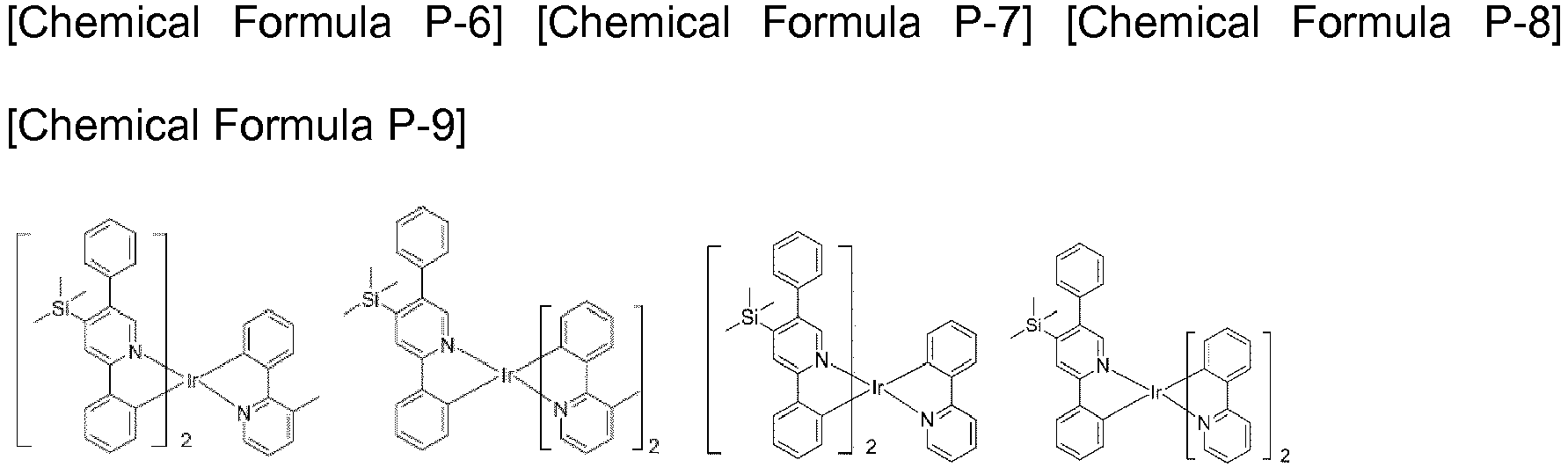





- For another example, the above Chemical Formula X-1 may be one of the following Chemical Formulae B-1 to B-65, Chemical Formulae C-1 to C-18, and Chemical Formulae D-1 to D-6. These have a structure where the main ligand is substituted with one phenyl group and one trimethylsilyl group in Chemical Formula X-1. However, these are examples of Chemical Formula X-1 which is not limited thereto.





- The above Chemical Formula S-1 may be represented by the following Chemical Formula S-2. In this case, the ligand may be advantageous in terms of synthesis and also, stably prepared by substituting the position No. 3 of electrochemically unstable carbazole.
- In addition, a bandgap and a triplet energy bandgap may be improved by further non-flattening a molecular structure and limiting a conjugation length.


- In the above Chemical Formula S-2, Ar1 and Ar2 are independently a substituted or unsubstituted C6 to C30 aryl group or a substituted or unsubstituted C2 to C30 heteroaryl group, at least one of Ar1 or Ar2 is a substituted or unsubstituted C2 to C30 heteroaryl group having electron characteristics, L1 and L2 are independently a single bond, a substituted or unsubstituted C2 to C6 alkenylene group, a substituted or unsubstituted C2 to C6 alkynylene group, a substituted or unsubstituted C6 to C30 arylene group, a substituted or unsubstituted C2 to C30 heteroarylene group, or a combination thereof, n1 and n2 are independently integers of 1 to 3, and R1 to R6 are independently hydrogen, deuterium, a halogen, a cyano group, a hydroxyl group, an amino group, a substituted or unsubstituted C1 to C20 amine group, a nitro group, a carboxyl group, a ferrocenyl group, a substituted or unsubstituted C1 to C20 alkyl group, a substituted or unsubstituted C6 to C30 aryl group, a substituted or unsubstituted C2 to C30 heteroaryl group, a substituted or unsubstituted C1 to C20 alkoxy group, a substituted or unsubstituted C6 to C20 aryloxy group, a substituted or unsubstituted C3 to C40 silyloxy group, a substituted or unsubstituted C1 to C20 acyl group, a substituted or unsubstituted C2 to C20 alkoxycarbonyl group, a substituted or unsubstituted C2 to C20 acyloxy group, a substituted or unsubstituted C2 to C20 acylamino group, a substituted or unsubstituted C2 to C20 alkoxycarbonylamino group, a substituted or unsubstituted C7 to C20 aryloxycarbonylamino group, a substituted or unsubstituted C1 to C20 sulfamoylamino group, a substituted or unsubstituted C1 to C20 sulfonyl group, a substituted or unsubstituted C1 to C20 alkylthiol group, a substituted or unsubstituted C6 to C20 arylthiol group, a substituted or unsubstituted C1 to C20 heterocyclothiol group, a substituted or unsubstituted C1 to C20 ureide group, a substituted or unsubstituted C3 to C40 silyl group, or a combination thereof.
- The above Chemical Formula S-1 may be represented by the following Chemical Formula S-3. In this case, a bandgap and a triplet energy bandgap may be improved by further non-flattening a molecular structure and limiting a conjugation length.

- In the above Chemical Formula S-3, Ar1 and Ar2 are independently a substituted or unsubstituted C6 to C30 aryl group or a substituted or unsubstituted C2 to C30 heteroaryl group, at least one of Ar1 or Ar2 is a substituted or unsubstituted C2 to C30 heteroaryl group having electron characteristics, L1 and L2 are independently a single bond, a substituted or unsubstituted C2 to C6 alkenylene group, a substituted or unsubstituted C2 to C6 alkynylene group, a substituted or unsubstituted C6 to C30 arylene group, a substituted or unsubstituted C2 to C30 heteroarylene group, or a combination thereof, n1 and n2 are independently integers of 1 to 3, and R1 to R6 are independently hydrogen, deuterium, a halogen, a cyano group, a hydroxyl group, an amino group, a substituted or unsubstituted C1 to C20 amine group, a nitro group, a carboxyl group, a ferrocenyl group, a substituted or unsubstituted C1 to C20 alkyl group, a substituted or unsubstituted C6 to C30 aryl group, a substituted or unsubstituted C2 to C30 heteroaryl group, a substituted or unsubstituted C1 to C20 alkoxy group, a substituted or unsubstituted C6 to C20 aryloxy group, a substituted or unsubstituted C3 to C40 silyloxy group, a substituted or unsubstituted C1 to C20 acyl group, a substituted or unsubstituted C2 to C20 alkoxycarbonyl group, a substituted or unsubstituted C2 to C20 acyloxy group, a substituted or unsubstituted C2 to C20 acylamino group, a substituted or unsubstituted C2 to C20 alkoxycarbonylamino group, a substituted or unsubstituted C7 to C20 aryloxycarbonylamino group, a substituted or unsubstituted C1 to C20 sulfamoylamino group, a substituted or unsubstituted C1 to C20 sulfonyl group, a substituted or unsubstituted C1 to C20 alkylthiol group, a substituted or unsubstituted C6 to C20 arylthiol group, a substituted or unsubstituted C1 to C20 heterocyclothiol group, a substituted or unsubstituted C1 to C20 ureide group, a substituted or unsubstituted C3 to C40 silyl group, or a combination thereof.
- The above Chemical Formula S-1 may be represented by the following Chemical Formula S-4. In this case, a bandgap and a triplet energy bandgap may be improved by further non-flattening a molecular structure and limiting a conjugation length.

- In the above Chemical Formula S-4, Ar1 and Ar2 are independently a substituted or unsubstituted C6 to C30 aryl group or a substituted or unsubstituted C2 to C30 heteroaryl group, at least one of Ar1 or Ar2 is a substituted or unsubstituted C2 to C30 heteroaryl group having electron characteristics, L1 and L2 are independently a single bond, a substituted or unsubstituted C2 to C6 alkenylene group, a substituted or unsubstituted C2 to C6 alkynylene group, a substituted or unsubstituted C6 to C30 arylene group, a substituted or unsubstituted C2 to C30 heteroarylene group, or a combination thereof, n1 and n2 are independently integers of 1 to 3, and R1 to R6 are independently hydrogen, deuterium, a halogen, a cyano group, a hydroxyl group, an amino group, a substituted or unsubstituted C1 to C20 amine group, a nitro group, a carboxyl group, a ferrocenyl group, a substituted or unsubstituted C1 to C20 alkyl group, a substituted or unsubstituted C6 to C30 aryl group, a substituted or unsubstituted C2 to C30 heteroaryl group, a substituted or unsubstituted C1 to C20 alkoxy group, a substituted or unsubstituted C6 to C20 aryloxy group, a substituted or unsubstituted C3 to C40 silyloxy group, a substituted or unsubstituted C1 to C20 acyl group, a substituted or unsubstituted C2 to C20 alkoxycarbonyl group, a substituted or unsubstituted C2 to C20 acyloxy group, a substituted or unsubstituted C2 to C20 acylamino group, a substituted or unsubstituted C2 to C20 alkoxycarbonylamino group, a substituted or unsubstituted C7 to C20 aryloxycarbonylamino group, a substituted or unsubstituted C1 to C20 sulfamoylamino group, a substituted or unsubstituted C1 to C20 sulfonyl group, a substituted or unsubstituted C1 to C20 alkylthiol group, a substituted or unsubstituted C6 to C20 arylthiol group, a substituted or unsubstituted C1 to C20 heterocyclothiol group, a substituted or unsubstituted C1 to C20 ureide group, a substituted or unsubstituted C3 to C40 silyl group, or a combination thereof.
- The above Chemical Formula S-1 may be represented by the following Chemical Formula S-5. In this case, thermal stability may be increased by introducing a bulky biphenyl substitutent.

- In the above Chemical Formula S-5, ETU is a substituted or unsubstituted C2 to C30 heteroaryl group having electron characteristics, L1 is a single bond, a substituted or unsubstituted C2 to C6 alkenylene group, a substituted or unsubstituted C2 to C6 alkynylene group, a substituted or unsubstituted C6 to C30 arylene group, a substituted or unsubstituted C2 to C30 heteroarylene group, or a combination thereof, n1 is an integer of 1 to 3, and R1 to R6 are independently hydrogen, deuterium, a halogen, a cyano group, a hydroxyl group, an amino group, a substituted or unsubstituted C1 to C20 amine group, a nitro group, a carboxyl group, a ferrocenyl group, a substituted or unsubstituted C1 to C20 alkyl group, a substituted or unsubstituted C6 to C30 aryl group, a substituted or unsubstituted C2 to C30 heteroaryl group, a substituted or unsubstituted C1 to C20 alkoxy group, a substituted or unsubstituted C6 to C20 aryloxy group, a substituted or unsubstituted C3 to C40 silyloxy group, a substituted or unsubstituted C1 to C20 acyl group, a substituted or unsubstituted C2 to C20 alkoxycarbonyl group, a substituted or unsubstituted C2 to C20 acyloxy group, a substituted or unsubstituted C2 to C20 acylamino group, a substituted or unsubstituted C2 to C20 alkoxycarbonylamino group, a substituted or unsubstituted C7 to C20 aryloxycarbonylamino group, a substituted or unsubstituted C1 to C20 sulfamoylamino group, a substituted or unsubstituted C1 to C20 sulfonyl group, a substituted or unsubstituted C1 to C20 alkylthiol group, a substituted or unsubstituted C6 to C20 arylthiol group, a substituted or unsubstituted C1 to C20 heterocyclothiol group, a substituted or unsubstituted C1 to C20 ureide group, a substituted or unsubstituted C3 to C40 silyl group, or a combination thereof.
- The above Chemical Formula S-1 may be represented by the following Chemical Formula S-6. In this case, luminous efficiency and life-span of a device may be increased, since a kink-shaped bulky biphenyl substitutent suppresses interactions among molecules.

- In the above Chemical Formula S-6, ETU is a substituted or unsubstituted C2 to C30 heteroaryl group having electron characteristics, L1 is a single bond, a substituted or unsubstituted C2 to C6 alkenylene group, a substituted or unsubstituted C2 to C6 alkynylene group, a substituted or unsubstituted C6 to C30 arylene group, a substituted or unsubstituted C2 to C30 heteroarylene group, or a combination thereof, n1 is an integer of 1 to 3, and R1 to R6 are independently hydrogen, deuterium, a halogen, a cyano group, a hydroxyl group, an amino group, a substituted or unsubstituted C1 to C20 amine group, a nitro group, a carboxyl group, a ferrocenyl group, a substituted or unsubstituted C1 to C20 alkyl group, a substituted or unsubstituted C6 to C30 aryl group, a substituted or unsubstituted C2 to C30 heteroaryl group, a substituted or unsubstituted C1 to C20 alkoxy group, a substituted or unsubstituted C6 to C20 aryloxy group, a substituted or unsubstituted C3 to C40 silyloxy group, a substituted or unsubstituted C1 to C20 acyl group, a substituted or unsubstituted C2 to C20 alkoxycarbonyl group, a substituted or unsubstituted C2 to C20 acyloxy group, a substituted or unsubstituted C2 to C20 acylamino group, a substituted or unsubstituted C2 to C20 alkoxycarbonylamino group, a substituted or unsubstituted C7 to C20 aryloxycarbonylamino group, a substituted or unsubstituted C1 to C20 sulfamoylamino group, a substituted or unsubstituted C1 to C20 sulfonyl group, a substituted or unsubstituted C1 to C20 alkylthiol group, a substituted or unsubstituted C6 to C20 arylthiol group, a substituted or unsubstituted C1 to C20 heterocyclothiol group, a substituted or unsubstituted C1 to C20 ureide group, a substituted or unsubstituted C3 to C40 silyl group, or a combination thereof.
- The above Chemical Formula S-1 may be represented by the following Chemical Formula S-7. In this case, the introduction of the methyl substitutent may lower a deposition temperature and thus, a process temperature in a process of manufacturing a device.

- In the above Chemical Formula S-7, ETU is a substituted or unsubstituted C2 to C30 heteroaryl group having electron characteristics, L1 is a single bond, a substituted or unsubstituted C2 to C6 alkenylene group, a substituted or unsubstituted C2 to C6 alkynylene group, a substituted or unsubstituted C6 to C30 arylene group, a substituted or unsubstituted C2 to C30 heteroarylene group, or a combination thereof, n1 is an integer of 1 to 3, and R1 to R6 are independently hydrogen, deuterium, a halogen, a cyano group, a hydroxyl group, an amino group, a substituted or unsubstituted C1 to C20 amine group, a nitro group, a carboxyl group, a ferrocenyl group, a substituted or unsubstituted C1 to C20 alkyl group, a substituted or unsubstituted C6 to C30 aryl group, a substituted or unsubstituted C2 to C30 heteroaryl group, a substituted or unsubstituted C1 to C20 alkoxy group, a substituted or unsubstituted C6 to C20 aryloxy group, a substituted or unsubstituted C3 to C40 silyloxy group, a substituted or unsubstituted C1 to C20 acyl group, a substituted or unsubstituted C2 to C20 alkoxycarbonyl group, a substituted or unsubstituted C2 to C20 acyloxy group, a substituted or unsubstituted C2 to C20 acylamino group, a substituted or unsubstituted C2 to C20 alkoxycarbonylamino group, a substituted or unsubstituted C7 to C20 aryloxycarbonylamino group, a substituted or unsubstituted C1 to C20 sulfamoylamino group, a substituted or unsubstituted C1 to C20 sulfonyl group, a substituted or unsubstituted C1 to C20 alkylthiol group, a substituted or unsubstituted C6 to C20 arylthiol group, a substituted or unsubstituted C1 to C20 heterocyclothiol group, a substituted or unsubstituted C1 to C20 ureide group, a substituted or unsubstituted C3 to C40 silyl group, or a combination thereof.
- The substituted or unsubstituted C2 to C30 heteroaryl group having electron characteristics may be selected from the group consisting of a substituted or unsubstituted imidazolyl group, a substituted or unsubstituted triazolyl group, a substituted or unsubstituted tetrazolyl group, a substituted or unsubstituted oxadiazolyl group, a substituted or unsubstituted oxatriazolyl group, a substituted or unsubstituted thiatriazolyl group, a substituted or unsubstituted benzimidazolyl group, a substituted or unsubstituted benzotriazolyl group, a substituted or unsubstituted pyridinyl group, a substituted or unsubstituted pyrimidinyl group, a substituted or unsubstituted triazinyl group, a substituted or unsubstituted pyrazinyl group, a substituted or unsubstituted pyridazinyl group, a substituted or unsubstituted purinyl group, a substituted or unsubstituted quinolinyl group, a substituted or unsubstituted isoquinolinyl group, a substituted or unsubstituted phthalazinyl group, a substituted or unsubstituted benzoquinolinyl group, a substituted or unsubstituted quinoxalinyl group, a substituted or unsubstituted quinazolinyl group, a substituted or unsubstituted acridinyl group, a substituted or unsubstituted phenanthrolinyl group, and a substituted or unsubstituted phenazinyl group, but is not limited thereto.
- More specifically, the substituted or unsubstituted C2 to C30 heteroaryl group having electron characteristics may be represented by one of the following Chemical Formulae E-1 to E-5.


- The above Chemical Formula S-1 may be represented by one of the following Chemical Formulae 3 to 54. But, it is not limited thereto.


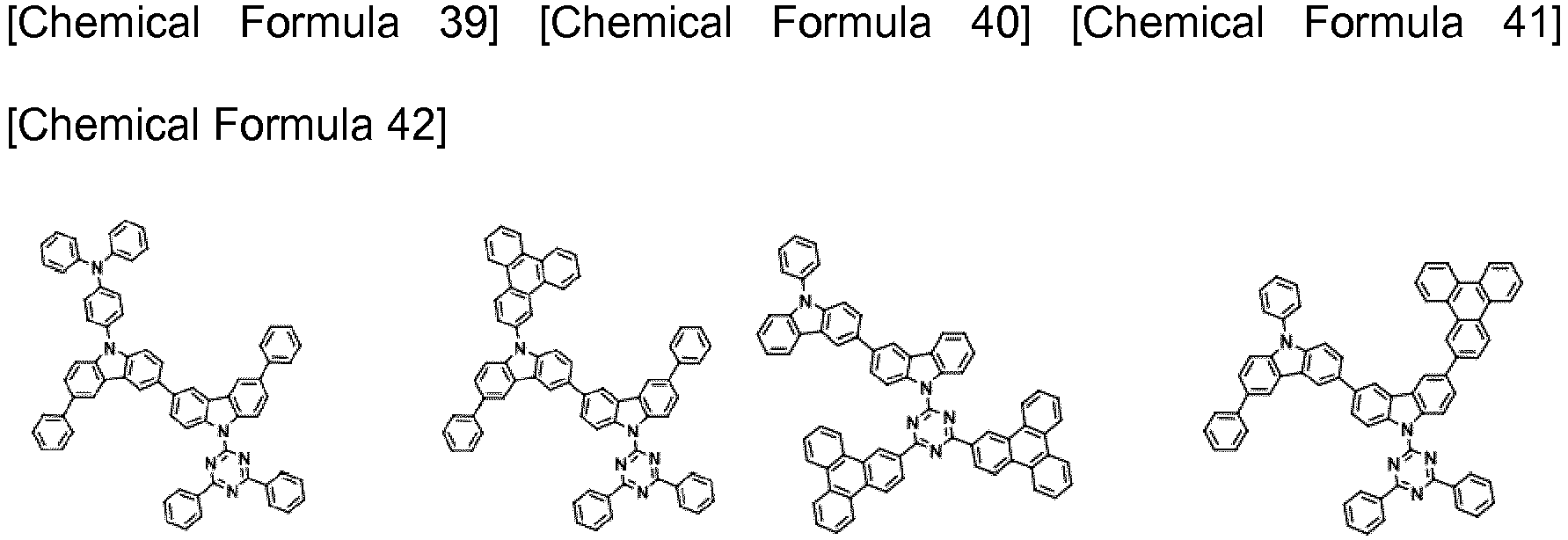


- The above Chemical Formula S-1 may be represented by one of the following Chemical Formulae A-2 to A-26. But, it is not limited thereto.


- The above Chemical Formula S-1 may be represented by one of the following Chemical Formulae O-1 to 0-18. But, it is not limited thereto.

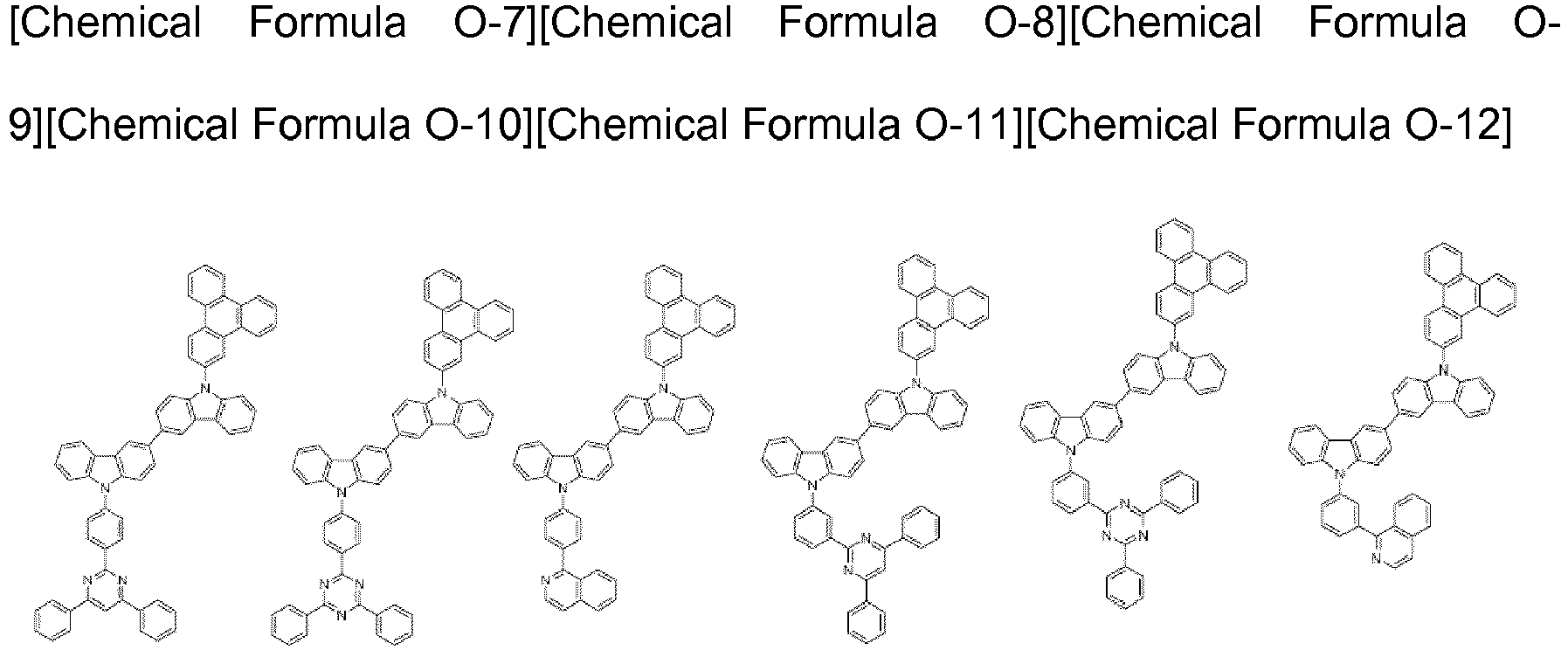

- The above Chemical Formula S-1 may be represented by one of the following Chemical Formulae T-1 to T-474. But, it is not limited thereto.


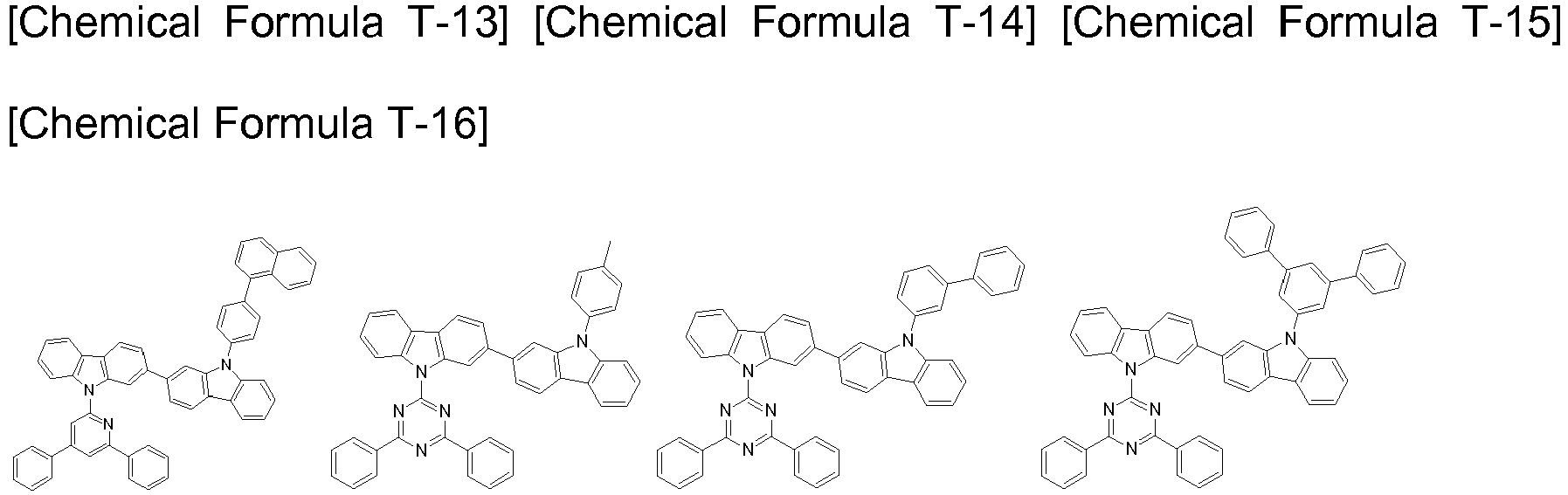

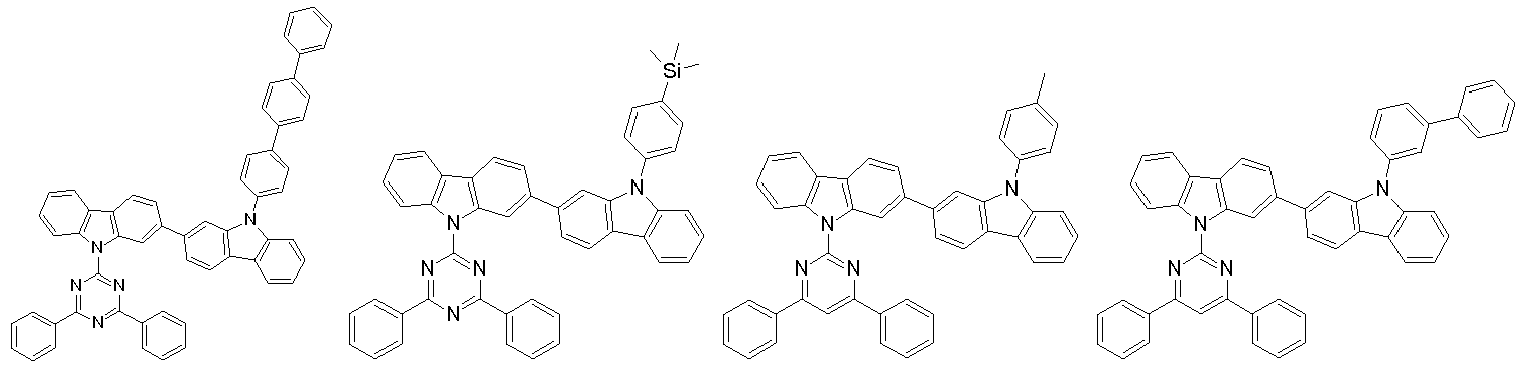





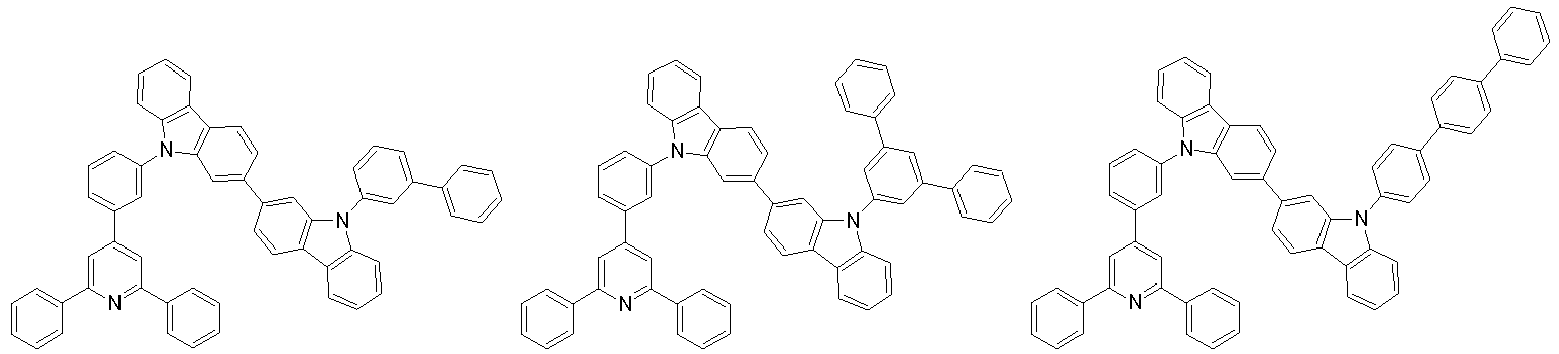






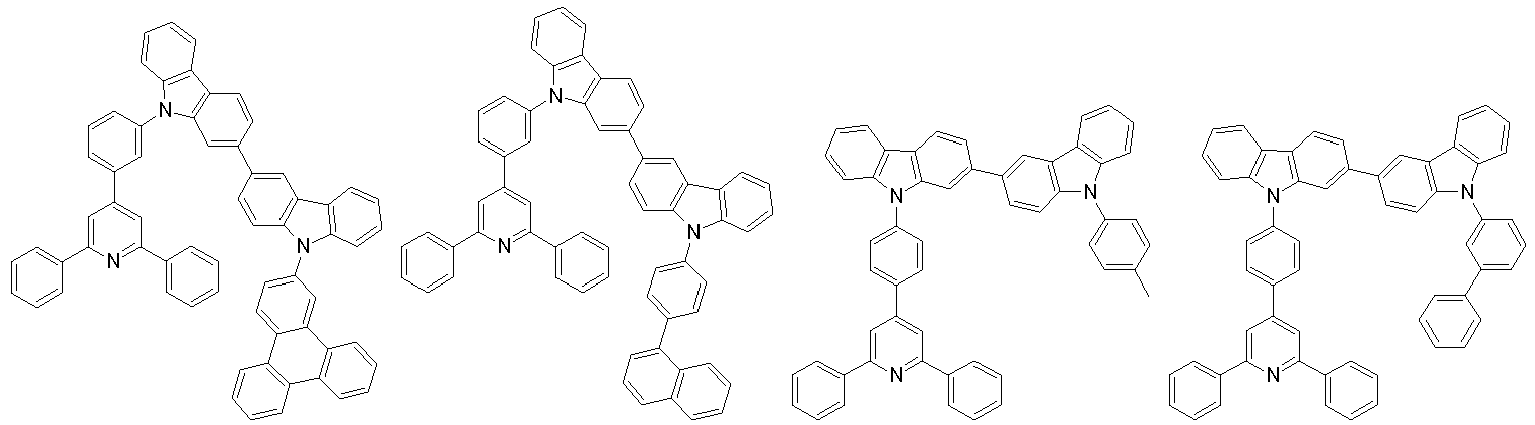





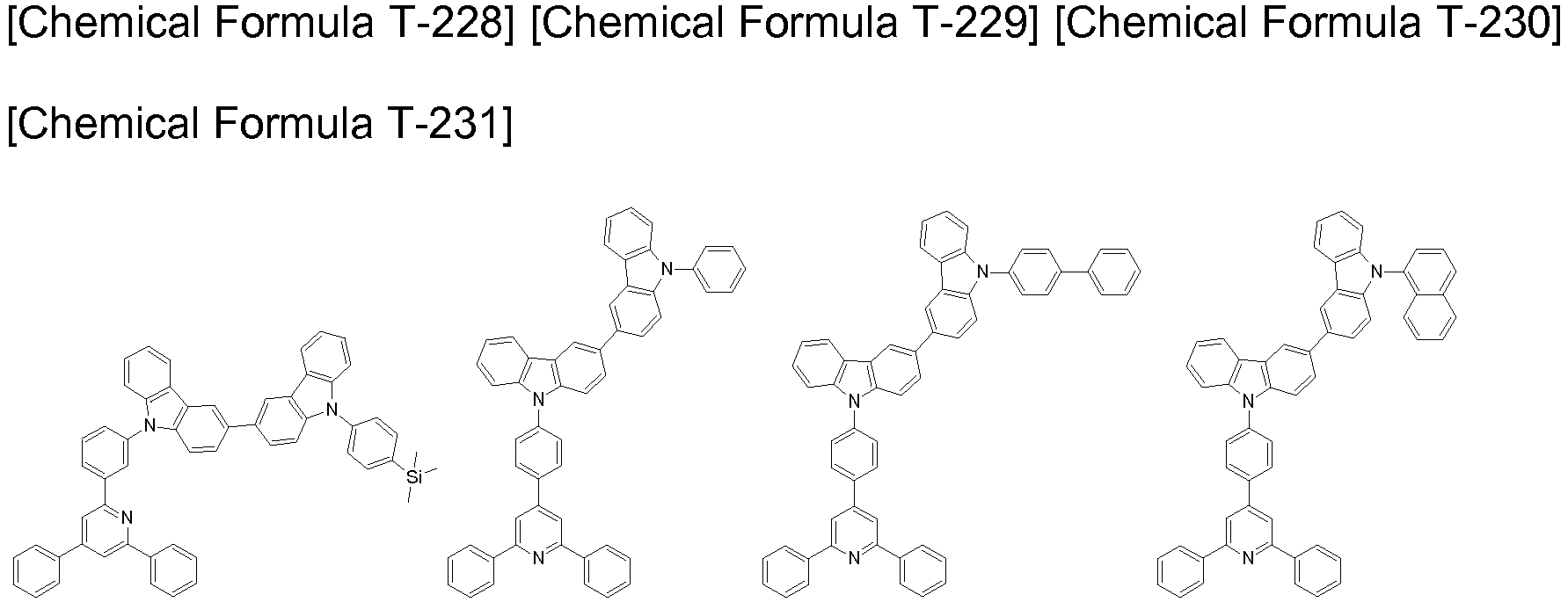





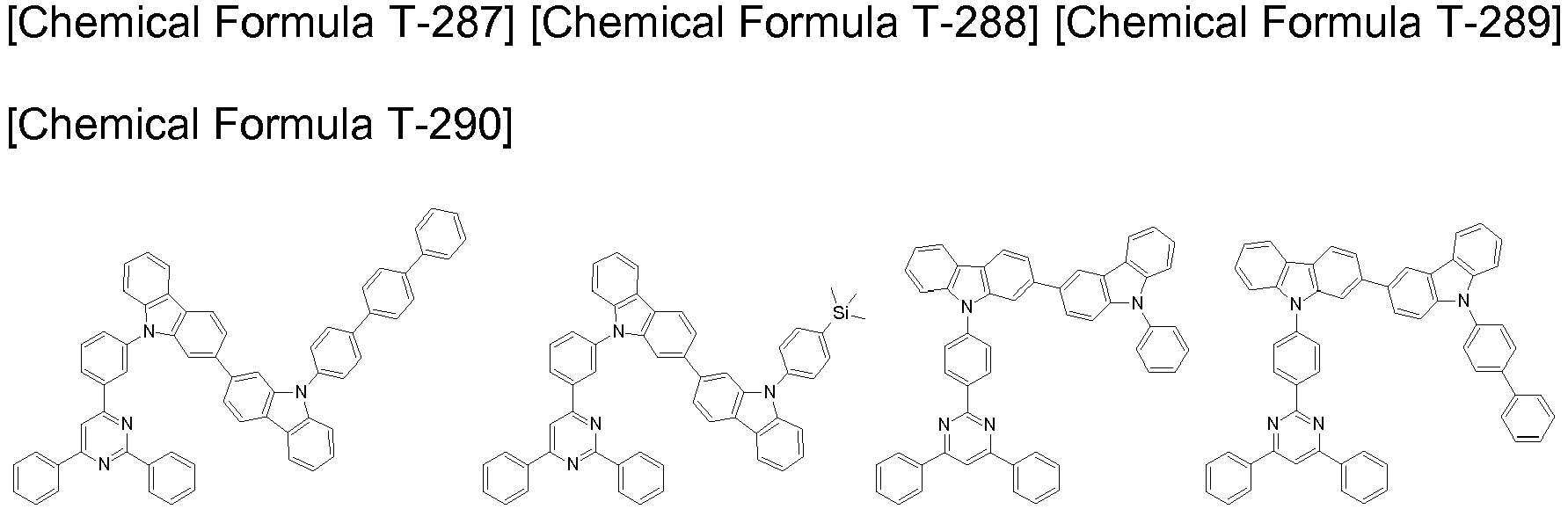


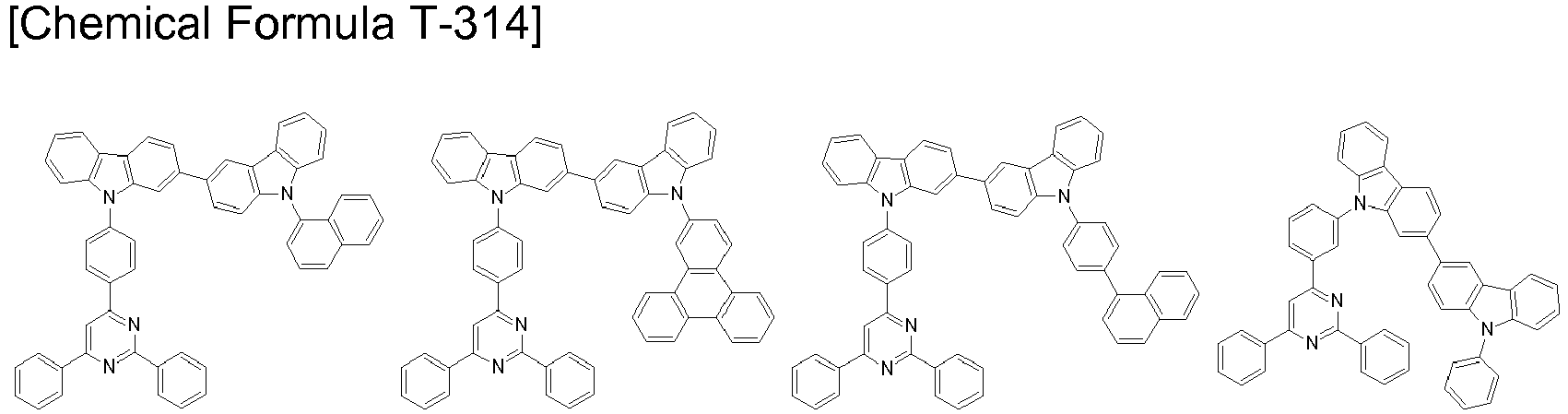


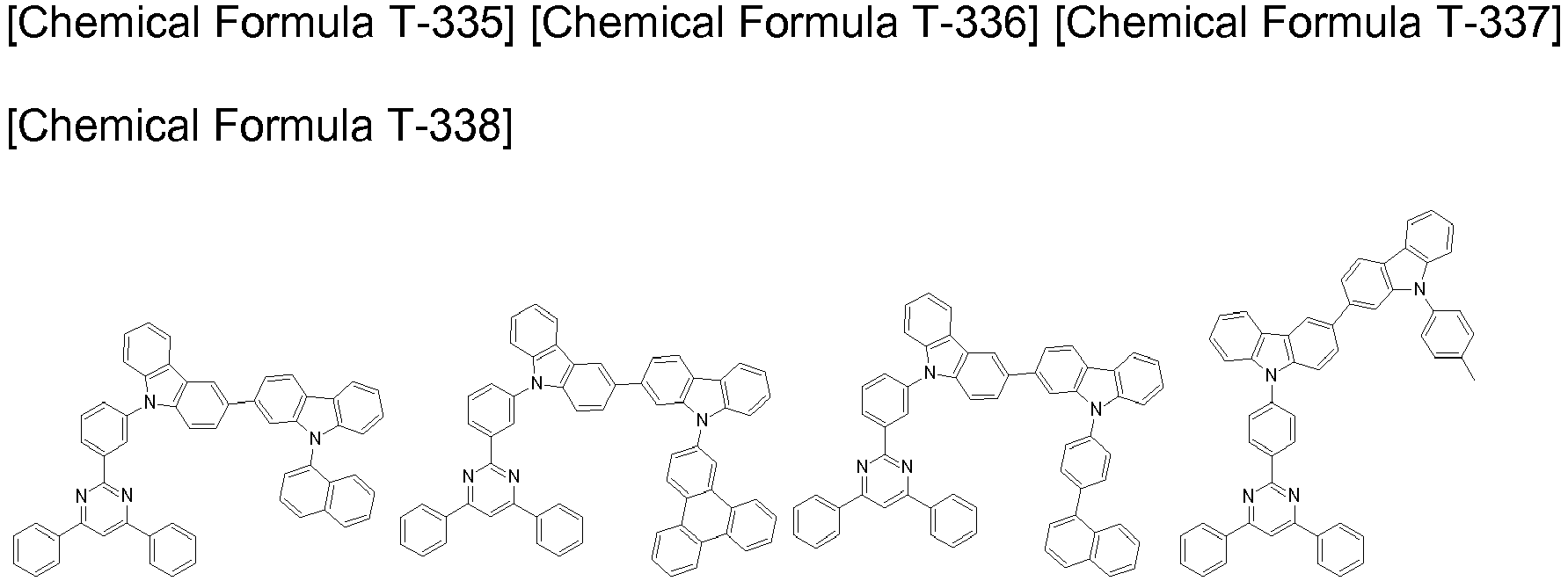


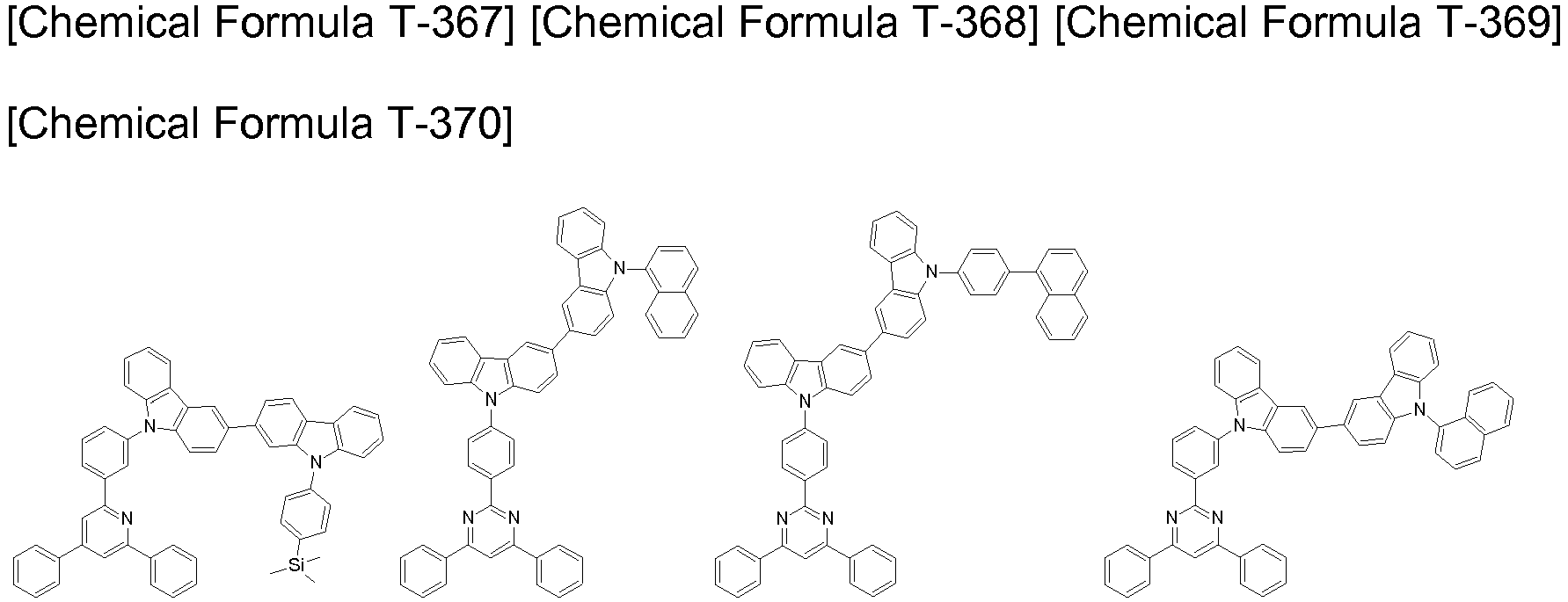


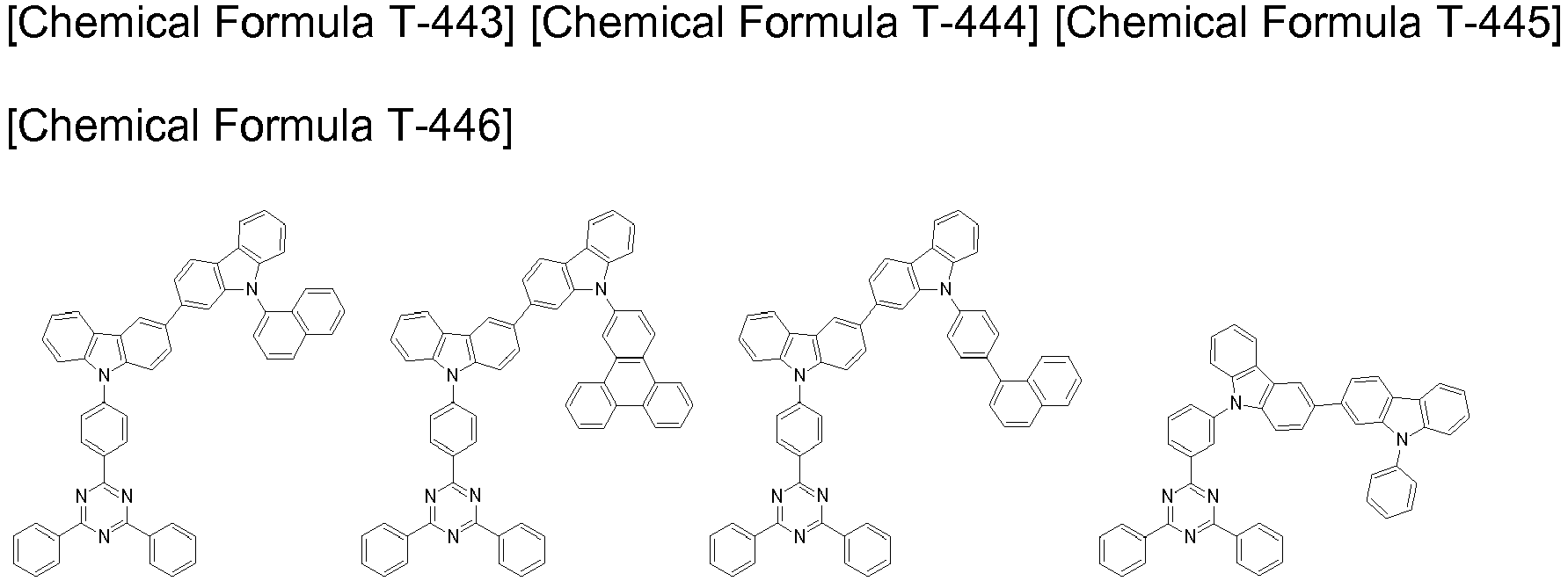


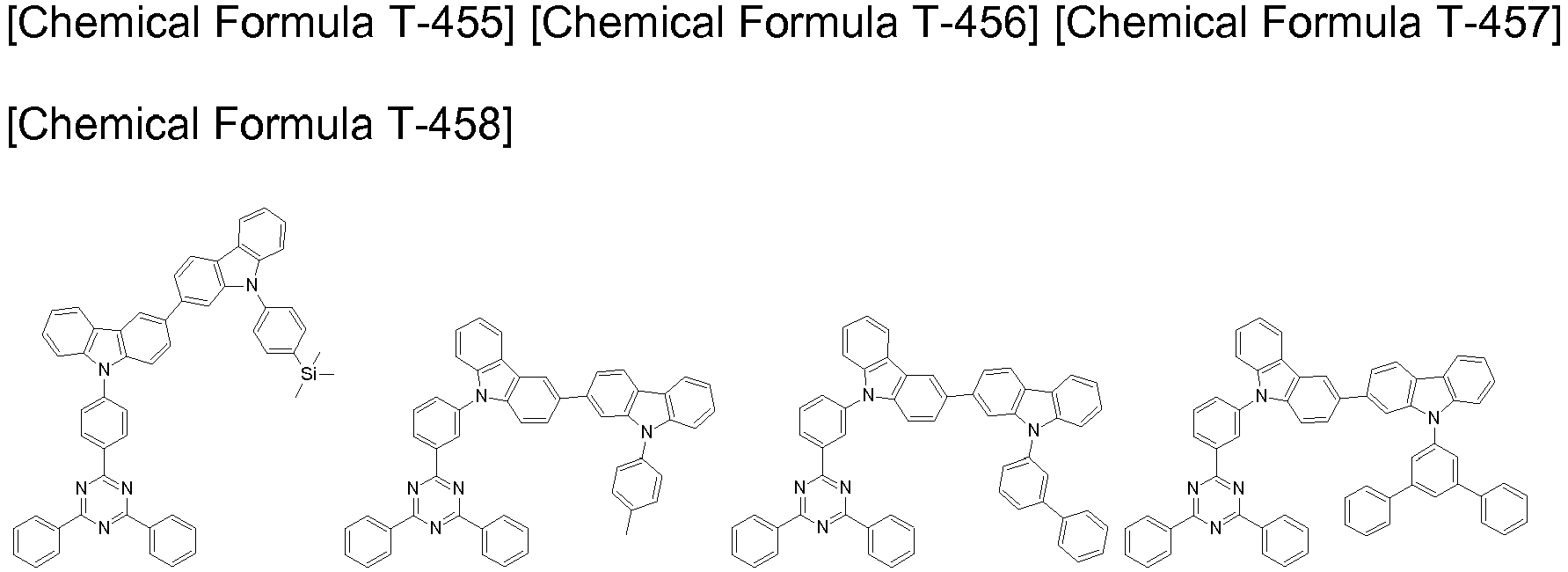


- The compound for an organic optoelectric device represented by the above Chemical Formula S-1 of he present invention may be one of Chemical Formula A-19, Chemical Formula A-20, Chemical Formula A-22, Chemical FormulaA-23, Chemical Formula T-35, Chemical Formula T-36, Chemical Formula T-40, Chemical Formula T-41, Chemical Formula T-77, Chemical Formula T-81, Chemical Formula T-82, Chemical Formula T-96, Chemical Formula 4, Chemical Formula 5, Chemical Formula 53 or Chemical Formula 54, wherein the compound represented by the above Chemical Formula X-1 may be a composition for an organic light emitting diode of Chemical Formula M-1, P-2, P-3, C-1, C-6 or B-18.
- On the other hand, a weight ratio of the compound for an organic optoelectric device represented by the above Chemical Formula S-1 and the compound for an organic optoelectric device represented by the above Chemical Formula X-1 may be 1:99 to 99:1.
- In another embodiment of the present invention, an organic thin layer including the composition for an organic light emitting diode is provided.
- The organic thin layer may be specifically an emission layer.
- In another embodiment of the present invention, an organic optoelectric device includes an anode, a cathode, and at least one or more organic thin layer between the anode and the cathode, and at least one of the organic thin layers may include the compound for an organic optoelectric device.
- The compound for an organic optoelectric device is used in an organic thin layer and thus improves life-span characteristics, efficiency characteristics, electrochemical stability, and thermal stability of an organic optoelectric device, and lowers a driving voltage.
- The organic optoelectric device may be an organic light emitting diode, an organic photoelectric device, an organic solar cell, an organic transistor, an organic photo-conductor drum, or an organic memory device.
- More specifically, the organic optoelectric device may be an organic light emitting diode.
FIGS. 1 to 5 are cross-sectional views showing organic light emitting diodes including the compound for an organic optoelectric device according to one embodiment of the present invention. - Referring to
FIGS. 1 and 2 , organiclight emitting diodes anode 120, acathode 110, and at least one organicthin layer 105 between the anode and the cathode. - The
anode 120 includes an anode material having a large work function to help hole injection into an organic thin layer. The anode material includes: a metal such as nickel, platinum, vanadium, chromium, copper, zinc, and gold, or alloys thereof; a metal oxide such as zinc oxide, indium oxide, indium tin oxide (ITO), and indium zinc oxide (IZO); a bonded metal and oxide such as ZnO:Al or SnO2:Sb; or a conductive polymer such as poly(3-methylthiophene), poly[3,4-(ethylene-1,2-dioxy)thiophene] (PEDT), polypyrrole, and polyaniline, but is not limited thereto. It is preferable to include a transparent electrode including indium tin oxide (ITO) as an anode. - The
cathode 110 includes a cathode material having a small work function to help electron injection into an organic thin layer. The cathode material includes: a metal such as magnesium, calcium, sodium, potassium, titanium, indium, yttrium, lithium, gadolinium, aluminum, silver, tin, and lead, or alloys thereof; or a multi-layered material such as LiF/Al, Liq/Al, LiO2/Al, LiF/Ca, LiF/Al, and BaF2/Ca, but is not limited thereto. It is preferable to include a metal electrode including aluminum as a cathode. - Referring to
FIG. 1 , the organiclight emitting diode 100 includes an organicthin layer 105 including only anemission layer 130. - Referring to
FIG. 2 , a double-layered organiclight emitting diode 200 includes an organicthin layer 105 including anemission layer 230 including an electron transport layer (ETL), and a hole transport layer (HTL) 140. As shown inFIG. 2 , the organicthin layer 105 includes a double layer of theemission layer 230 and hole transport layer (HTL) 140. Theemission layer 130 also functions as an electron transport layer (ETL), and the hole transport layer (HTL) 140 layer has an excellent binding property with a transparent electrode such as ITO or an excellent hole transport capability. In one embodiment of the present invention, an organic light emitting diode may further include an electron transport layer (ETL), an electron injection layer (EIL), a hole injection layer, and the like, as an organicthin layer 105 inFIG. 1 or FIG. 2 . - In
FIG. 1 or FIG. 2 , the emission layers 130 and 230, the hole transport layer (HTL) 140 or even though not drawn in the drawings, one selected from the group consisting of the electron transport layer (ETL), the electron injection layer (EIL), the hole injection layer (HIL) and a combination thereof which constitute the organicthin layer 105 may include the compound for an organic optoelectric device. - Particularly the compound for an organic optoelectric device may be used in the emission layers 130 and 230, and may be used as a green phosphorescent dopant material in the emission layers.
- The organic light emitting diode may be manufactured by: forming an anode on a substrate; forming an organic thin layer in accordance with a dry coating method such as evaporation, sputtering, plasma plating, and ion plating or a wet coating method such as spin coating, dipping, and flow coating; and providing a cathode thereon.
- In another embodiment of the present invention, a display device including the organic optoelectric device is provided.
- Hereinafter, the embodiments are illustrated in more detail with reference to examples. These examples, however, should not in any sense be interpreted as limiting the scope of the present invention.
- A compound represented by the above Chemical Formula 4 as specific examples of a compound for an organic optoelectric device according to the present invention was synthesized through a method provided in the following Reaction Scheme 1.

- 5 g (20 mmol) of 3-bromo-carbazole, 9 g (24 mmol) of N-phenyl-carbazole boronic acid pinacolate (X-02004, Alchem pharmtech, Inc.) and 100 mL of tetrahydrofuran and a 2 M-potassium carbonate aqueous solution were mixed in a 250 mL round-bottomed flask equipped with an agitator having a nitrogen atmosphere and then, heated and refluxed for 12 hours under a nitrogen stream. When the reaction was terminated, a solid produced by pouring hexane to the reactant was filtered and then, dissolved in a mixed solution of toluene and tetrahydrofuran (a volume ratio of 50:50), activated carbon and anhydrous magnesium sulfate were added thereto, and the mixture was agitated. The solution was filtered and recrystallized by using dichloromethane and hexane, obtaining 7.8 g of a compound A (a yield of 60 %).
- 3.5 g (8.55 mmol) of an intermediate product represented by the compound A, 2.74 g (10.26 mmol) of 2-chloro-4,6-diphenyl-pyrimidine, NaH and dimethylformamide were put in a 100 mL round flask and agitated at room temperature under a nitrogen stream. Then, an organic solvent was removed from the resultant under reduced pressure distillation, and 3.823 g (a yield: 70 %) of a compound represented by Chemical Formula 4 was separated therefrom through column chromatography (Elemental analysis result of the compound represented by Chemical Formula 4: calcd. C46H30N4: C, 86.49; H, 4.73; N, 8.77; found: C, 86.24; H, 4.89; N, 8.55).
- A compound represented by the above Chemical Formula 5 as specific examples of a compound for an organic optoelectric device according to the present invention was synthesized through a method provided in the following Reaction Scheme 2.

- 3.5 g (8.55 mmol) of an intermediate product represented by thecompound A, 2.74 g (10.26 mmol) of 2-chloro-4,6-dibiphenyl-pyrimidine, NaH and dimethylformamide were put in a 100 mL round flask and then, agitated at room temperature under a nitrogen stream. Then, an organic solvent was removed from the resultant under reduced pressure distillation, and 4.1 g (a yield: 75 %) of a compound represented by Chemical Formula 5 was separated therefrom through column chromatography. The elemental analysis result of the obtained compound represented by Chemical Formula 5 was as follows. calcd. C45H29N5: C, 84.48; H, 4.57; N, 10.95; found: C, 84.24; H, 4.65; N, 10.55
- A compound represented by the above Chemical Formula 14 as specific examples of a compound for an organic optoelectric device according to the present invention was synthesized through a method provided in the following Reaction Scheme 3.


- 25 g (0.103 mol) of 3-phenyl-9H-carbazole (
EP 10940631A1 - 21.8 g (67.7 mmol) of the compound 14-1, 24.1 g (94.78 mmol) of bispinacolatodiboron, 13.3 g (135.4 mmol) of potassium acetate, and 2.764 g (3.39 mmol) of palladium diphenyl phosphinoferrocene dichloride were dissolved in 300 mL of toluene in a 500 mL round flask, and the solution was heated and refluxed for 12 hours. The reaction was terminated by pouring the reactant to water, an organic layer was separated, twice washed with water, and then, concentrated. The product was separated through column chromatography, obtaining 16 g of a compound 14-2 (6-phenylcarbazol-3-yl boronic acid pinacolate) (a yield: 64 %).
- 5 g (12.6 mmol) of 3-bromo-N-phenyl-6-phenylcarbazole, 5.56 g (15 mmol) of 6-phenylcarbazol-3-yl boronic acid pinacolate, 100 mL of tetrahydrofuran, and a 2 M-potassium carbonate aqueous solution were mixed in a 250 mL round-bottomed flask equipped with an agitator having a nitrogen atmosphere and then, heated and refluxed under a nitrogen stream for 12 hours. When the reaction was terminated, a solid produced by pouring the reactant to hexane was filtered and dissolved in a mixed solution of toluene and tetrahydrofuran (a volume ratio of 50:50), activated carbon and anhydrous magnesium sulfate were added thereto, and the mixture was agitated. The solution was filtered and then, recrystallized by using dichloromethane and hexane, obtaining 6.5 g of a compound B (a yield of 65 %).
- 6 g (10.5 mmol) of an intermediate product represented by the compound B, 3.44 g (12.84 mmol) of 2-chloro-4,6-diphenyl-triazine, NaH and dimethylformamide were put in a 250 mL round flask and then, agitated at room temperature under a nitrogen stream. Then, an organic solvent was removed therefrom under a reduced pressure distillation, and column chromatography was performed, obtaining 3.825 g of a compound represented by Chemical Formula 14 (a yield: 70 %).
- The elemental analysis result of obtained comound represented by Chemical Formula 14 was as follows. calcd. C57H37N5: C, 86.45; H, 4.71; N, 8.84; found: C, 86.15; H, 4.57; N, 8.57
- A compound represented by the above Chemical Formula A-2 as specific examples of a compound for an organic optoelectric device according to the present invention was synthesized through a method provided in the following Reaction Scheme 4.

- 28.4 g (115.46 mmol) of 3-bromocarbazole, 36.95 g (138.55 mmol) of 2-chloro-4,6-diphenyl-pyrimidine, and 6.93 g of NaH were added to dimethylformamide in a 1000 mL round flask, and the mixture was agitated at room temperature for 12 hours under a nitrogen stream. The reactant was added to distilled water to perform crystallization. The crystallized solid was filtered and recrystallized by using monochlorobenzene and hexane, obtaining 53 g of a compound represented by an intermediate C (a yield: 96 %).
- 22.26 g (46.7 mmol) of the compound C and 20.71 g (56.1 mmol) of N-phenyl-carbazole boronic acid pinacolate were mixed with 200 mL of tetrahydrofuran, 200ml of toluene and 200ml of a 2M-potassium carbonate aqueous solution in a 1,000 mL round-bottomed flask equipped with an agitator having a nitrogen atmosphere, and the mixture was heated and refluxed for 12 hours under a nitrogen stream. When the reaction was terminated, a solid produced by pouring the reactant to hexane was filtered and dissolved again in a mixed solution of toluene and tetrahydrofuran (a volume ratio of 50:50), activated carbon and anhydrous magnesium sulfate were added thereto, and the mixture was agitated. The solution was filtered and then, recrystallized by using chlorobenzene and methanol, obtaining 20 g of a compound A-2 (a yield: 70 %). (calcd. C46H30N4: C, 86.49; H, 4.73; N, 8.77; found: C, 86.44; H, 4.74; N, 8.75)
- A compound represented by the above Chemical Formula A-10 as specific examples of a compound for an organic optoelectric device according to the present invention was synthesized in a method of the following Reaction Scheme 5.


- 17.66 g (71.7 mmol) of 2-bromo-carbazole, 22.08 g (59.8 mmol) of N-phenyl-carbazole boronic acid pinacolate, 100 mL of tetrahydrofuran and 100 ml of a 2 M-potassium carbonate aqueous solution were mixed in a 500 mL round-bottomed flask equipped with an agitator having a nitrogen atmosphere, and the mixture was heated and refluxed under a nitrogen stream for 12 hours. When the reaction was terminated, a solid produced by pouring hexane to the reactant was filtered and then, dissolved again in a mixed solution of toluene and tetrahydrofuran (a volume ratio of 50:50), activated carbon and anhydrous magnesium sulfate were added thereto, and the mixture was agitated. The solution was filtered and recrystalized by using dichloromethane and hexane, obtaining 19 g of a compound D (a yield: 65 %).
- 8.3 g (20.53 mmol) of the compound D, 7.64 g (24.64 mmol) of 2-bromo-4,6-diphenylpyridine and 3.35 g (34.9 mmol) of tertiarybutoxysodium were dissolved in 200 ml of toluene in a 500 mL round-bottomed flask equipped with an agitator having a nitrogen atmosphere, and 0.47 g (0.51 mmol) of palladium dibenzylideneamine and 0.77ml (1.54 mmol) of tri-tert-butylphosphine were added thereto in a dropwise fashion. The reaction solution was heated at 110 °C and agitated under a nitrogen stream for 12 hours. When the reaction was terminated, a solid produced by pouring methanol to the reactant was filtered and then, dissolved again in chlorobenzene, activated carbon and anhydrous magnesium sulfate were added thereto, and the mixture was agitated. The solution was filtered and recrystallized by using chlorobenzene and methanol, obtaining 11 g of a compound A-10 (a yield: 84 %). (calcd. C47H31N3: C, 88.51; H, 4.90; N, 6.59; found: C, 88.49; H, 4.91; N, 6.61)
- A compound represented by the above Chemical Formula A-12 as specific examples of a compound for an organic optoelectric device according to the present invention was synthesized in a method of the following Reaction Scheme 3.


- 22.22 g (90.3 mmol) of 2-bromocarbazole, 37.94 g (135.5 mmol) of 4-iodobiphenyl and 18.72 g (135.5 mmol) of potassium carbonate were dissolved in 400 ml of dimethylsulfoxide in a 1,000 mL round-bottomed flask equipped with an agitator having a nitrogen atmosphere, and 3.26 g (135.47 mmol) of 1,10-phenanthroline and 1.79 g (18.06 mmol) of copper chloride (I) were added thereto in a dropwise fashion. The reaction solution was heated at 150 °C and agitated under a nitrogen stream for 12 hours. When the reaction was terminated, a solid produced by pouring distilled water to the reactant was filtered and dissolved again in chlorobenzene, activated carbon and anhydrous magnesium sulfate were added thereto, and the mixture was agitated. The solution was filtered and then, recrystallized by using chlorobenzene and methanol, obtaining 25 g of a compound E (a yield: 70 %).
- 18.2 g (46.7 mmol) of the compound E and 16.4 g (56.1 mmol) of 3-carbazole boronic acid pinacolate were mixed with 200 mL of tetrahydrofuran, 200 ml of toluene and 200 ml of a 2M-potassium carbonate aqueous solution in a 1,000 mL round-bottomed flask equipped with an agitator having a nitrogen atmosphere, and the mixture was heated and refluxed under a nitrogen stream for 12 hours. When the reaction was terminated, a solid produced by pouring hexane to the reactant was filtered and dissolved in chlorobenzene again, activated carbon and anhydrous magnesium sulfate were added thereto, and the mixture was agitated. The solution was filtered and recrystallized by using chlorobenzene and methanol, obtaining 19.0 g of a compound F (a yield: 64 %).
- 9.73 g (20.1 mmol) of the compound F, 7.47 g (24.10 mmol) of 2-bromo-4,6-diphenylpyridine and 3.28 g (34.1 mmol) of tertiarybutoxysodium were dissolved in 180 ml of toluene in a 500 mL round-bottomed flask equipped with an agitator having a nitrogen atmosphere, and 0.46 g (0.5 mmol) of palladium dibenzylideneamine and 0.75 ml (1.51 mmol) of tri-tert-butylphosphine were added thereto in a dropwise fashion. The reaction solution was heated and agitated at 110°C for 12 hours under a nitrogen stream. When the reaction was terminated, a solid produced by pouring methanol to the reactant was filtered and dissolved in chlorobenzene again, activated carbon and anhydrous magnesium sulfate were added thereto, and the mixture was agitated. The solution was filtered and then, recrystallized by using chlorobenzene and methanol, obtaining 9.9 g of a compound A-12 (a yield: 70 %). (calcd. C53H35N3: C, 89.17; H, 4.94; N, 5.89; found: C, 89.29; H, 4.96; N, 5.82.)
- A compound represented by the above Chemical Formula 3 as specific examples of a compound for an organic optoelectric device according to the present invention was synthesized in a method of the following Reaction Scheme 7.

- 26.96 g (81.4 mmol) of N-phenyl carbazole-3-boronic acid pinacolate, 23.96 g (97.36 mmol) of carbazole-3-boronic acid, 230 mL of tetrahydrofuran and 100 ml of a 2 M-potassium carbonate aqueous solution were mixed in a 500 mL round-bottomed flask equipped with an agitator having a nitrogen atmosphere and then, heated and refluxed under a nitrogen stream for 12 hours. When the reaction was terminated, a solid produced by pouring methanol to the reactant was filtered and then, dissolved again in chlorobenzene, activated carbon and anhydrous magnesium sulfate were added thereto, and the mixture was agitated. The solution was filtered and recrystallized by using chlorobenzene and methanol, obtaining 22.6 g of a compound J (a yield: 68 %).
- 22.42 g (54.88 mmol) of the compound J, 20.43 g (65.85 mmol) of 2-bromo-4,6-diphenylpyridine and 7.92 g (82.32 mmol) of tertiarybutoxysodium were dissolved in 400 ml of toluene in a 500 mL round-bottomed flask equipped with an agitator having a nitrogen atmosphere, and 1.65 g (1.65 mmol) of palladium dibenzylideneamine and 1.78 g (4.39 mmol) of tri-tert-butylphosphine were added thereto in a dropwise fashion. The reaction solution was heated and agitated at 110 °C for 12 hours under a nitrogen stream. When the reaction was terminated, a solid produced by pouring methanol to the reactant was filtered and dissolved again in chlorobenzene, activated carbon and anhydrous magnesium sulfate were added thereto, and the mixture was agitated. The solution was filtered and then, recrystallized by using chlorobenzene and methanol, obtaining 28.10 g of a compound represented by Chemical Formula 3 (a yield: 80 %). (calcd. C47H31N3: C, 88.51; H, 4.90; N, 6.59; found: C, 88.62; H, 4.80; N, 6.47)
- A compound represented by the above Chemical Formula 54 as specific examples of a compound for an organic optoelectric device according to the present invention was synthesized in a method of the following Reaction Scheme 8.


- 42.97 g (174.57 mmol) of 3-bromocarbazole, 56.1 g (209.5 mmol) of 2-chloro-4,6-diphenyl-triazine, and 10.48 g (261.86 mmol) of NaH were added to dimethylformamide in a 1000 mL round flask, and the mixture was agitated at room temperature for 12 hours under a nitrogen stream. The reactant was added to distilled water to perform crystallization. The crystallized solid was filtered and then, recrystallized by using monochlorobenzene and hexane, obtaining 82 g of a compound represented by an intermediate K (a yield: 98 %).
- 70.57 g (147.85 mmol) of the compound K, 52.01 g (177.42 mmol) of carbazole-3-boronic acid pinacolate, 800 mL of a mixed solution of tetrahydrofuran and toluene (a volume ratio=1:1) and 400 mL of a 2 M-potassium carbonate aqueous solution were mixed in a 2 L round-bottomed flask equipped with an agitator having a nitrogen atmosphere and then, heated and refluxed under a nitrogen stream for 12 hours. When the reaction was terminated, a solid produced by pouring methanol to the reactant was filtered and dissolved again in chlorobenzene, activated carbon and anhydrous magnesium sulfate were added thereto, and the mixture was agitated. The solution was filtered and then, recrystallized by using chlorobenzene and methanol, obtaining 66 g of a compound L (a yield: 79 %).
- 10.1 g (17.88 mmol) of the compound L, 5 g (21.46 mmol) of 2-bromobiphenyl and 3.44 g (35.76 mmol) of tertiarybutoxysodium were dissolved in 400 ml of toluene in a 1 L round-bottomed flask equipped with an agitator having a nitrogen atmosphere, and 1.03 g (1.79 mmol) of palladium dibenzylideneamine and 2.17 g (5.36 mmol) of tri-tert-butylphosphine were added thereto in a dropwise fashion. The reaction solution was heated and agitated at 110 °C for 12 hours under a nitrogen stream. When the reaction was terminated, a solid produced by pouring methanol to the reactant was filtered and then, dissolved again in chlorobenzene, activated carbon and anhydrous magnesium sulfate were added thereto, and the mixture was agitated. The solution was filtered and recrystallized by using chlorobenzene and methanol, obtaining 9.40 g of a compound represented by Chemical Formula 54 (a yield: 73 %). (calcd. C52H34N4: C, 87.37; H, 4.79; N, 7.84; found: C, 87.47; H, 4.80; N, 7.78)
-

- 19.3 g (53.06 mmol) of N-biphenyl-3-carbazole boronic acid and 10.9 g (44.22 mmol) of 3-bromo carbazole were mixed with 140 mL of a mixed solution of tetrahydrofuran and toluene (a volume ratio=1:1) and 80 mL of a 2 M-potassium carbonate aqueous solution in a 500 mL round-bottomed flask equipped with an agitator having a nitrogen atmosphere, and the mixture was heated and refluxed under a nitrogen stream for 12 hours. When the reaction was terminated, a solid produced by pouring methanol to the reactant was filtered and then, dissolved again in chlorobenzene, activated carbon and anhydrous magnesium sulfate were added thereto, and the mixture was agitated. The solution was filtered and recrystallized by using chlorobenzene and methanol, obtaining 13.7 g of a compound M (a yield: 64 %).
- 9.6 g (19.82 mmol) of the compound M, 9.2 g (23.8 mmol) of 2-(4-bromophenyl)-4,6-diphenylpyridine (
WO2011-081290 , Page 36) and 3.2 g (33.7 mmol) of tertiarybutoxysodium were dissolved in 160 mL of toluene in a 500 mL round-bottomed flask equipped with an agitator having a nitrogen atmosphere, and 0.454 g (0.5 mmol) of palladium dibenzylideneamine and 0.6 g (1.49 mmol) of tri-tert-butylphosphine were added thereto in a dropwise fashion. The reaction solution was heated and agitated at 110 °C for 12 hours under a nitrogen stream. When the reaction was terminated, a solid produced by pouring methanol to the reactant was filtered and dissolved again in chlorobenzene, activated carbon and anhydrous magnesium sulfate were added thereto, and the mixture was agitated. The solution was filtered and recrystallized by using chlorobenzene and methanol, obtaining 14 g of a compound 0-13 (a yield: 89 %). (calcd. C59H39N3: C, 89.70; H, 4.98; N, 5.32; found: C, 89.57; H, 4.83; N, 5.65) -


- 85.0 g (350.0 mmol) of 2-bromocarbazole, 110.95 g (860.0 mmol) of 2-chloro-4,6-diphenyl-triazine, and 20.72 g of NaH were added to dimethylformamide in a 2000 mL round flask, and the mixture was agitated at room temperature for 12 hours under a nitrogen stream. The reactant was added to distilled water to perform crystallization. The crystallized solid was filtered and then, recrystallized by using monochlorobenzene and hexane, obtaining 138 g of an intermediate compound represented by Chemical Formula T-36-1 (a yield: 84 %).
- 23.34 g (48.89 mmol) of the compound represented by Chemical Formula D-36-1, 19.53 g (53.78 mmol) of N-(3-biphenyl)-carbazole boronic acid pinacolate, 100 mL of tetrahydrofuran, 100 ml of toluene and 100 ml of a 2 M-potassium carbonate aqueous solution were mixed in a 1,000 mL round-bottomed flask equipped with an agitator having a nitrogen atmosphere and then, heated and refluxed under a nitrogen stream for 12 hours. When the reaction was terminated, a solid produced by pouring hexane to the reactant was filtered and dissolved in a mixed solution of toluene and tetrahydrofuran (a volume ratio of 50:50), activated carbon and anhydrous magnesium sulfate were added thereto, and the mixture was agitated. The solution was filtered and recrystallized by using chlorobenzene and methanol, obtaining 21 g of a compound represented by Chemical Formula T-36 (a yield: 60 %). (calcd. C51H33N5: C, 85.57; H, 4.65; N,1 9.78 ; found: C, 85.88; H, 4.74; N, 9.71)
-

- 87 g (377.97 mmol) of 5-trimethylsilyl-2-bromopyridine (Organic Electrinics 10 (2009) P.1066-1073), 89.82 g (453.56 mmol) of 3-biphenylboronic acid, 630 mL of 1,4-dioxane, and 378 mL of a 2 M-potassium carbonate aqueous solution were mixed in a 2 L round-bottomed flask equipped with an agitator having a nitrogen atmosphere, 13.1 g (11.34 mmol) of tetrakistriphenyl phosphine palladium (0) was added thereto, and the mixture was heated and refluxed for 12 hours under a nitrogen stream. When the reaction was terminated, an organic layer was separated, and the solvent therein was all removed. The resultant was treated through column chromatography, obtaining 53.34 g of a compound 1 (a yield: 47 %).
- 22.36 g (74 mmol) of the compound 1, 8.8 g (29 mmol) of iridium chloride, 123 mL of 2-ethoxyethanol, and 41 mL of distilled water were put in a 500 mL round-bottomed flask and then, heated and refluxed for 24 hours. When the reaction was terminated, the resultant was cooled down to room temperature, and then, a solid produced during the reaction was filtered and washed with water and methanol. The solid was dried in a vacuum oven, obtaining 15.8 g of a compound 2 (a yield: 64 %).
- 23 g (13.95 mmol) of the compound 2, 3.072 g (30.68 mmol) of 2,4-pentanedione, and 14.78 g (139.47 mmol) of sodium carbonate were put in a 500 mL round-bottomed flask and dissolved in 140 mL of 2-ethoxyethanol, and then, the solution was heated and refluxed for 5 hours. When the reaction was terminated, the resultant was cooled down to room temperature, and a solid produced therein was filtered. The solid was treated through column chromatography, obtaining 13 g of a compound 3 (a yield: 52 %).
- 13.584 g (15.16 mmol) of the compound 3 and 13.8 g (45.47 mmol) of the compound 1 were dissolved in 150 mL of glycerol in a 250 mL round-bottomed flask, and the solution was heated and refluxed at 220 °C for 12 hours. The reaction was terminated by pouring water to the reactant, and a solid produced therein was filterd. The solid was washed with water and methanol and then, dissolved in dichloromethane, separated through column chromatography, and recrystalized, obtaining 9 g of a compound M-1 (a yield: 27 %). (calcd. C60H60IrN3Si3: C, 65.54; H, 5.50; Ir, 17.48; N, 3.82; Si, 7.66; found: C, 65.62; H, 5.53; N, 3.91;)
-

- 30.0 g (33.48 mmol) of the compound 3 of Example 11 and 15.58 g (100.44 mmol) of 2-phenylpyridine were dissolved in a 300 mL of glycerol in a 250 mL round-bottomed flask, and the solution was heated and refluxed at 220 °C for 12 hours. The reaction was terminated by pouring water to the reactant, and a solid produced therein was filtered. The solid was washed with water and methanol and then, dissolved in dichloromethane, separated through column chromatography, and recrystallized, obtaining 9.54 g of a compound P-2 (a yield: 30 %).
calcd. C51H48IrN3Si2: C, 64.39; H, 5.09; Ir, 20.20; N, 4.42; Si, 5.90; found: C, 64.28; H, 5.04; N, 4.44; -

- 79.32 g (511.10 mmol) of 2-phenylpyridine, 61.04 g (204.44 mmol) of iridium chloride, 852 mL of 2-ethoxyethanol, and 283 mL of distilled water were put in a 100 mL round-bottomed flask and then, heated and refluxed for 24 hours. When the reaction was terminated, the resultant was cooled down to room temperature, and a solid produced during the reaction was filtered and then, washed with water and methanol. The solid was dried in a vacuum oven, obtaining 80 g of a compound P-3-1 (a yield: 73 %).
- 80 g (74.62 mmol) of the compound P-3-1, 16.42 g (164.04 mmol) of 2,4-pentanedione, and 79.06 g (746.20 mmol) of sodium carbonate were dissolved in 800 mL of 2-ethoxyethanol in a 2000 mL round-bottomed flask, and the solution was heated and refluxed for 5 hours. When the reaction was terminated, the resultant was cooled down to room temperature, and a solid produced therein was filtered. The solid was treated through column chromatography, obtaining 25.04 g of a compound P-3-2 (a yield: 56 %).
- 25.0 g (41.68 mmol) of the compound P-3-2 and 1 37.94 g (125.04 mmol) of the comound according to Example 11 were dissolved in 450 mL of glycerol in a 250 mL round-bottomed flask, and the solution was heated and refluxed at 220 °C for 12 hours. The reaction was terminated by pouring water to the reactant, and a solid produced therein was filtered. The solid was washed with water and methanol, dissolved in dichloromethane, then, separated through column chromatography, and recrystallized, obtaining 10.71 g of a compound P-3 (a yield: 32 %).
calcd. C42H36IrN3Si: C, 62.82; H, 4.52; Ir, 23.94; N, 5.23; Si, 3.50; found: C, 62.79; H, 4.50; N, 5.20; -

- 5 g of a compound P-11 (a yield: 31 %) was synthesized by using 13.001 g (14.51 mmol) of the compound 3 according to Example 11 and 10.679 g (43.53 mmol) of a compound K-1-1 (
KR2011-0065496A
calcd. C58H54IrN3Si2: C, 66.89; H, 5.23; Ir, 18.46; N, 4.03; Si, 5.39; found: C, 66.92; H, 5.24; N, 4.09; -

- 4.8 g of a compound P-12 (a yield: 30 %) was synthesized by using 16.2 g (37.67 mmol) of a compound K-1-3 and 34.3 g (113.02 mmol) of the compound 1 according to Example 11 in a 250 mL round-bottomed flask according to the same method as the method of manufacturing the compound M-1.
calcd. C56H48IrN3Si: C, 68.40; H, 4.92; Ir, 19.55; N, 4.27; Si, 2.86; found: C, 68.50; H, 4.90; N, 4.29; -


- 130.11 g (491.27 mmol) of 5-bromo-2-chloro-4-trimethylsilylpyridine (AC2A0F7FP, AINNOS, ABI Chem,), 118.06 g (968.24 mmol) of phenylboronic acid, 560 mL of THF, 560 mL of toluene, and 560 mL of a 2.5 M-potassium carbonate aqueous solution were mixed in a round-bottomed flask equipped with an agitator having anitrogen atmosphere, 24.32 g (21.05 mmol) of tetrakistriphenylphosphinepalladium (0) was added thereto, and the mixture was heated and refluxed for 12 hours under a nitrogen stream. When the reaction was terminated, an organic layer was separated, and a solvent remaining there was all removed. The product was treated through column chromatography, obtaining 83.04 g of a compound P-10-1 (a yield: 65 %).
- 35.57 g (117.22 mmol) of the compound P-10-1, 14.01 g (46.89 mmol) of iridium chloride, 195 mL of 2-ethoxyethanol, and 65 mL of distilled water were put in a 500 mL round-bottomed flask and then, heated and refluxed for 24 hours. When the reaction was terminated, the resultant was cooled down to room temperature, and a solid produced during the reaction was filtered and washed with water and methanol. The product was dried in a vacuum oven, obtaining 27.5 g of a compound P-10-2 (a yield: 70 %).
- 23 g (13.95 mmol) of the compound P-10-2, 3.072 g (30.68 mmol) of 2,4-pentanedione, and 14.78 g (139.47 mmol) of sodium carbonate were dissolved in 140 mL of 2-ethoxyethanol in a 500 mL round-bottomed flask, and the solution was heated and refluxed for 5 hours. When the reaction was terminated, the resultant was cooled down to room temperature, and a solid produced therein was filtered. The solid was treated through column chromatography, obtaining 13 g of a compound P-10-3 (a yield: 52 %).
- 6.37 g of a compound P-10 (a yield: 40 %) was synthesized by using 13 g (14.49 mmol) of the compound P-10-3 and 13.19 g (43.48 mmol) of the compound P-10-1 in a 500 mL round-bottomed flask according to the same method as the method of manufacturing the compound M-1.
calcd. C60H60IrN3Si3: C, 65.54; H, 5.50; Ir, 17.48; N, 3.82; Si, 7.66; found: C, 65.62; H, 5.60; N, 3.90; -


- 6.13 g of a compound P-13 (a yield: 38 %) was synthesized by using 3 15 g (16.72 mmol) of the compound according to Example 11 and 8.49 g (50.17 mmol) of 3-methyl-2-phenylpyridine (TCI M0932) in a 250 mL round-bottomed flask according to the same method as the method of manufacturing the compound M-1.
calcd. C52H50IrN3Si2: C, 64.70; H, 5.22; Ir, 19.91; N, 4.35; Si, 5.82; found: C, 64.80; H, 5.27; N, 4.45; -

- 99.12 g (586.11 mmol) of 3-methyl-2-phenylpyridine, 70.0 g (234.44 mmol) of iridium chloride, 976 mL of 2-ethoxyethanol, and 326 mL of distilled water were put in a 2 L round-bottomed flask and then, heated and refluxed for 24 hours. When the reaction was terminated, the resultant was cooled down to room temperature, and a solid produced therein during the reaction was filtered and washed with water and methanol. The solid was dried in a vacuum oven, obtaining 90.5 g of a compound P-14-1 (a yield: 68 %).
- 90.5 g (80.22 mmol) of the compound P-14-1, 17.67 g (176.48 mmol) of 2,4-pentanedione, and 110.87 g (802.18 mmol) of sodium carbonate were dissolved in 850 mL of 2-ethoxyethanol in a 2 L round-bottomed flask, and the solution was heated and refluxed for 5 hours. When the reaction was terminated, the resultant was cooled down to room temperature, and a solid produced therein was filtered. The solid was treated through column chromatography, obtaining 39.57 g of a compound P-14-2 (a yield: 51 %).
- 24.13 g of a compound P-14 (a yield: 36 %) was synthesized by using 39 g (80.64 mmol) of the compound P-14-2 and 73.42 g (241.92 mmol) of the compound 1 according to Example 11 in a 1 L round-bottomed flask according to the same method as the method of preparing the compound M-1.
calcd. C44H40IrN3Si: C, 63.59; H, 4.85; Ir, 23.13; N, 5.06; Si, 3.38; found: C, 63.68; H, 4.93; N, 5.13; -


- 88.99 g (415.77 mmol) of 2-bromo-5-tert-butylpyridine (P10255, Afferchem Inc.), 98.80 g (498.92 mmol) of 3-biphenylboronic acid, 693 mL of 1,4-dioxane, and 416 mL of a 2 M-potassium carbonate aqueous solution were mixed in a 2 L round-bottomed flask equipped with an agitator having a nitrogen atmosphere, 14.41 g (12.47 mmol) of tetrakistriphenylphosphinepalladium (0) was added thereto, and the mixture was heated and refluxed for 12 hours under a nitrogen stream. When the reaction was terminated, an organic layer was separated, and a solvent therein was all removed. The obtained solid was treated through column chromatography, obtaining 52.58 g of a compound W-1-1 (a yield: 44 %).
- 32.75 g (113.96 mmol) of the compound W-1-1, 13.55 g (44.66 mmol) of iridium chloride, 190 mL of 2-ethoxyethanol, and 63 mL of distilled water were put in a 500 mL round-bottomed flask and then, heated and refluxed for 24 hours. When the reaction was terminated, the resultant was cooled down to room temperature, and a solid produced during the reaction was filtered and washed with water and methanol. The solid was drined in a vacuum oven, obtaining 27.3 g of a compound W-1-2 (a yield: 60 %).
- 24.57 g (15.35 mmol) of the compound W-1-2, 3.38 g (33.75 mmol) of 2,4-pentanedione, and 16.26 g (153.42 mmol) of sodium carbonate were dissolved in 154 mL of 2-ethoxyethanol in a 500 mL round-bottomed flask, and the solution was heated and refluxed for 5 hours. When the reaction was terminated, the resultant was cooled down to room temperature, and a solid produced therein was filtered. The solid was treated through column chromatography, obtaining 14.41 g of a compound W-1-3 (a yield: 54 %).
- 14.41 g (16.68 mmol) of the compound W-1-3 and 14.37 g (50.02 mmol) of the compound W-1 were dissolved in 165 mL of glycerol in a 250 mL round-bottomed flask, and the solution was heated and refluxed at 220 °C for 12 hours. The reaction was terminated by pouring water to the reactant, and a solid produced therein was filtered. The solid was washed with water and methanol, dissolved in dichloromethane, separated through column chromatography, and then, recrystalized, obtaining 6.84 g of a compound W-1-4 (Chemical Formula C-1) (a yield: 39 %). (calcd. C63H60IrN3: C, 71.97; H, 5.75; Ir, 18.28; N, 4.00; found: C, 71.99; H, 5.53; N, 3.95;)
-

- 214.98 g (733.73 mmol) of 2,5-dibromo-3-tert-butylpyridine (P23033, Afferchem, Inc.), 205.77 g (1687.59 mmol) of boronic acid, 1222 mL of 1,4-dioxane, and 734 mL of a 2 M-potassium carbonate aqueous solution were mixed in a 4 L round-bottomed flask equipped with an agitator having a nitrogen atmosphere, 42.39 g (36.68 mmol) of tetrakistriphenylphosphinepalladium (0) was added thereto, and the mixture was heated and refluxed under a nitrogen stream for 12 hours. When the reaction was terminated, an organic layer was separated, and a solvent therein was all removed. The resultant was treated through column chromatography, obtaining 126.65 g of a compound W-2-1 (a yield: 60 %).
- 126.65 g (440.67 mmol) of the compound W-2-1, 52.63 g (176.26 mmol) of iridium chloride, 734 mL of 2-ethoxyethanol, and 245 mL of distilled water were heated and refluxed for 24 hours in a 2 L round-bottomed flask. When the reaction was terminated, the resultant was cooled down to room temperature, and a solid produced during the reaction was filtered and washed with water and methanol. The solid was dried in a vacuum oven, obtaining 104.23 g of a compound W-2-2 (a yield: 59 %).
- 104.23 g (65.12 mmol) of the compound W-2-2, 14.34 g (143.26 mmol) of 2,4-pentanedione, and 90.00 g (651.22 mmol) of sodium carbonate were dissolved in 703 mL of 2-ethoxyethanol in a 2 L round-bottomed flask, and the solution was heated and refluxed for 5 hours. When the reaction was terminated, the resultant was cooled down to room temperature, and a solid produced therein was filtered. The solid was treated through column chromatography, obtaining 39.06 g of a compound W-2-3 (a yield: 35 %).
- 14.26 g of the compound W-2-4 (Chemical Formula C-13) (a yield: 30 %) was synthesized by using 39.06 g (45.20 mmol) of the compound W-2-3 and 38.98 g (135.62 mmol) of the compound W-2-1 in a 500 mL round-bottomed flask according to the same method as the method of preparing the compound W-1-4.
calcd. C63H60IrN3: C, 71.97; H, 5.75; Ir, 18.28; N, 4.00; found: C, 72.01; H, 5.80; N, 3.91; -

- 7.6 g of a compound W-1-5 (a yield: 31 %) was synthesized by using 18.92 g (21.9 mmol) of compound W-1-3 according to Example 19 and 18.89 g (65.71 mmol) of the compound W-2-1 in a 1000 mL round-bottomed flask according to the same method as the method of preparing the compound W-1-4.
calcd. C63H60IrN3: C, 71.97; H, 5.75; Ir, 18.28; N, 4.00, found: C, 72.03; H, 5.80; N, 4.02; -

- 10.5 g of a compound W-1-6 (Chemical Formula C-6) (a yield: 35 %) was synthesized by using 28.2 g (32.64 mmol) of the compound W-1-3 and 2-15.2 g (97.92 mmol) of phenylpyridine in a 500 mL round-bottomed flask according to the same method as the method of preparing the compound W-1-4.
calcd. C53H48IrN3: C, 69.25; H, 5.26; Ir, 20.91; N, 4.57, found: C, 69.30; H, 5.12; N, 4.60; -

- 9.88 g of a compound W-1-7 (Chemical Formula D-2) (a yield: 32 %) was synthesized according to the same method as the method of preparing the compound W-1-4 by using 28.6 g (33.08 mmol) of the compound W-1-3 and 16.8 g (99.25 mmol) of 2-2'-toluylpyridine in a 500 mL round-bottomed flask.
calcd. C54H50IrN3C, 69.50; H, 5.40; Ir, 20.60; N, 4.50, found: C, 69.55; H, 5.43; N, 4.61; -

- 6.1 g of a compound W-2-5 (Chemical Formula D-3) (a yield: 31 %) was synthesized by using 16.17 g (18.71 mmol) of the compound W-2-3 and 16.13 g (56.14 mmol) of the compound W-1-1 in a 1000 mL round-bottomed flask according to the same method as the method of preparing the compound W-1-4.
calcd. C63H60IrN3: C, 71.97; H, 5.75; Ir, 18.28; N, 4.00 found: C, 71.90; H, 5.83; N, 4.12; -


- 9.72 g of a compound W-2-6 (Chemical Formula C-11) (a yield: 36 %) was synthesized by using 25.92 g (29.38 mmol) of the compound W-2-3 and 13.68 g (88.13 mmol) of 2-phenylpyridine in a 500 mL round-bottomed flask according to the same method as the method of preparing the compound W-1-4.
calcd. C53H48IrN3: C, 69.25; H, 5.26; Ir, 20.91; N, 4.57 found: C, 69.33; H, 5.28; N, 4.63; -

- 8.62 g of a compound W-2-7 (Chemical Formula D-4) (a yield: 32 %) was synthesized by using 25.74 g (29.77 mmol) of the compound W-2-3 and 15.12 g (89.33 mmol) of 2-2'-toluylpyridine in a 500 mL round-bottomed flask according to the same method as the method of preparing the compound W-1-4.
calcd. C54H50IrN3: C, 69.50; H, 5.40; Ir, 20.60; N, 4.50, found : C, 69.65; H, 5.38; N, 4.62; -

- 11.16 g of a compound W-3-4 (Chemical Formula C-17) (a yield: 36 %) was synthesized by using 23.62 g (39.39 mmol) of the compound P-3-2 and 33.96 g (118.16 mmol) of the compound W-1-1 in a 1000 mL round-bottomed flask according to the same method as the method of preparing the compound W-1-4.
calcd. C43H36IrN3: C, 65.63; H, 4.61; Ir, 24.42; N, 5.34 found: C, 65.65; H, 4.58; N, 5.42; -

- 9.21 g of a compound W-3-5 (Chemical Formula C-12) (a yield: 33 %) was synthesized by using 21.26 g (35.45 mmol) of the compound P-3-2 and 30.56 g (106.34 mmol) of the compound W-2-1 in a 1000 mL round-bottomed flask according to the same method as the method of preparing the compound W-1-4.
calcd. C43H36IrN3: C, 65.63; H, 4.61; Ir, 24.42; N, 5.34, found : C, 65.67; H, 4.68; N, 5.32; -

- 9.20 g of a compound W-3-4 (Chemical Formula D-5) (a yield: 29 %) was synthesized by using 24.44 g (38.93 mmol) of the compound P-14-2 and 33.57 g (116.80 mmol) of the compound W-1-1 in a 1000 mL round-bottomed flask according to the same method as the method of preparing the compound W-1-4.
calcd. C46H40IrN3: C, 66.31; H, 4.95; Ir, 23.58; N, 5.16, found: C, 66.27; H, 4.98; N, 5.12; -

- 8.57 g of a compound W-4-5 (Chemical Formula D-6) (a yield: 30 %) was synthesized by using 22.00 g (35.04 mmol) of the compound P-14-2 and 30.21 g (105.12 mmol) of the compound W-2-1 in a 1000 mL round-bottomed flask according to the same method as the method of preparing the compound W-1-4.
calcd. C45H40IrN3: C, 66.31; H, 4.95; Ir, 23.58; N, 5.16, found: C, 66.30; H, 4.99; N, 5.22; - A glass substrate coated with a ITO (Indium tin oxide) to be1500 A-thick was washed with a distilled water ultrasonic wave. When the washing with distilled water was terminated, the coated glass substrate was ultrasonic wave-washed with a solvent such as isopropyl alcohol, acetone, methanol and the like, dried, delivered to a plasma cleaner, washed for 5 minutes by using an oxygen plasma, and then, delivered to a vacuum depositor. The ITO transparent electrode was used as an anode, and HTM (N-(biphenyl-4-yl)-9,9-diphenyl-N-(4-(9-phenyl-9H-carbazole)-3-yl)phenyl)9H-fluorene-2-amine) represented by the following Chemical Formula Z-1 was deposited on the ITO substrate to form a 1200 A-thick hole injection layer (HIL).

- On the hole transport layer (HTL), CBP as a host doped with 7 wt% of PhGD (tris(3-methyl-2-pyridine)iridium) represented by the following Chemical Formula Z-2 as a green phosphorescent dopant was vacuum-deposited to form a 300 A-thick emission layer.


- Then, on the emission layer upper, 50 A-thick BAlq (bis(2-methyl-8-quinolinolato-N1,O8)-(1,1'-biphenyl-4-olato)aluminum)) represented by the following Chemical Formula Z-3 and 250 A-thick Alq3 (tris(8-hydroxyquinolinato)aluminium) represented by and the following Chemical Formula Z-4 were sequentially stacked, forming an electron transport layer (ETL). On the electron transport layer (ETL), 5 A-thick LiF and 1000 A-thick Al were sequentially vacuum-deposited to form a cathode, manufacturing an organic light emitting diode.


- An organic light emitting diode was manufactured according to the same method as Comparative Example 1 except for using the compound synthesized in Example 10 instead of the compound according to Comparison Preparation Example 1 as a host for an emission layer and the compound synthesized in Example 11 instead of the dopant used in Comparative Example 1.
- An organic light emitting diode was manufactured according to the same method as Preparation Example 1 except for using the compound synthesized in Example 12 instead of the compound synthesized in Example 11 as a dopant for an emission layer.
- An organic light emitting diode was manufactured according to the same method as Preparation Example 1 except for using the compound synthesized in Example 13 instead of the compound synthesized in Example 11 as a dopant for an emission layer.
- An organic light emitting diode was manufactured according to the same method as Preparation Example 1 except for using the compound synthesized in Example 14 instead of the compound synthesized in Example 11 as a dopant for an emission layer.
- An organic light emitting diode was manufactured according to the same method as Preparation Example 1 except for using the compound synthesized in Example 15 instead of the compound synthesized in Example 11 as a dopant for an emission layer.
- An organic light emitting diode was manufactured according to the same method as Preparation Example 1 except for using the compound synthesized in Example 12 instead of the compound synthesized in Example 11 as a dopant for an emission layer and the compound synthesized in Example 2 instead of the compound used in Preparation Example 1 as a host for an emission layer.
- An organic light emitting diode was manufactured according to the same method as Preparation Example 1 except for using the compound synthesized in Example 13 instead of the compound synthesized in Example 12 as a dopant for an emission layer.
- An organic light emitting diode was manufactured according to the same method as Preparation Example 1 except for using the compound synthesized in Example 12 instead of the compound synthesized in Example 11 as a dopant for an emission layer and the compound synthesized in Example 1 instead of the compound used in Preparation Example 1 as a host for an emission layer.
- An organic light emitting diode was manufactured according to the same method as Preparation Example 8 except for using the compound synthesized in Example 13 instead of the compound synthesized in Example 12 as a dopant for an emission layer.
- Current density change, luminance change, and luminous efficiency of each organic light emitting diode according to the Preparation Examples 1 to 9 and Comparison Preparation Example 1 depending on a voltage were measured. Specific measurement methods are as follows, and the results are shown in the following Table 1.
- The obtained organic light emitting diodes were measured for current value flowing in the unit device while increasing the voltage from 0 V to 10 V using a current-voltage meter (Keithley 2400), and the measured current value was divided by area to provide the results.
- Luminance was measured by using a luminance meter (Minolta Cs-1000A), while the voltage of the organic light emitting diodes was increased from 0 V to 10 V.
- The luminance, current density, and voltage obtained from the (1) and (2) were used to calculate current efficiency (cd/A) at the same luminance (9000 cd/m2).
- A decreasing time of a current efficiency (cd/A) was measured maintaining luminance (cd/m2) at 6000 cd/m2.
[Table 1] Host material of emission layer Dopant material of emission layer Driving voltage (V) 6000 cd/m2 Luminous efficiency (cd/A) Life-span (h,T97%) Comparative Example 1 CBP Z-2 8 46 1 Preparation Example 1 Example 10 Example 11 4.39 55 60 Preparation Example 2 Example 10 Example 12 4.43 49.8 55 Preparation Example 3 Example 10 Example 13 4.36 48.4 58 Preparation Example 4 Example 10 Example 14 4.61 47.8 50 Preparation Example 5 Example 10 Example 15 4.62 46.1 55 Preparation Example 6 Example 2 Example 12 4.26 50.2 63 Preparation Example 7 Example 2 Example 13 4.25 50.0 57 Preparation Example 8 Example 1 Example 12 4.24 50.2 59 Preparation Example 9 Example 1 Example 13 4.13 51.5 55 - Referring to Table 1, the organic light emitting diodes manufactured by using a material provided in the present invention showed much excellent driving voltage and efficiency compared with an organic light emitting diodes manufactured by using CBP as a reference material in terms of luminous efficiency. In addition, when a life-span was evaluated by measuring how much time it took until luminous efficiency decreased by 3 %, the organic light emitting diodes manufactured by using a compound provided in the present invention showed life-span ranging from 30 hours to 63 hours at most, while the organic light emitting diode manufactured by using CBP showed sharply-decreased life-span of less than one hour. As shown in the aforementioned device characteristics, the compound manufactured in the present invention may be used as a satisfactory material for an organic light emitting diode.
- While this invention has been described in connection with what is presently considered to be practical exemplary embodiments, it is to be understood that the invention is not limited to the disclosed embodiments, but, on the contrary, is intended to cover various modifications and equivalent arrangements included within the spirit and scope of the appended claims. Therefore, the aforementioned embodiments should be understood to be exemplary but not limiting the present invention in any way.
<Description of Symbols> 100 : organic light emitting diode 110 : cathode 120 : anode 105 : organic thin layer 130 : emission layer 140 : hole transport layer (HTL) 230 : emission layer + electron transport layer (ETL)
Claims (28)
- A composition for an organic light emitting diode, comprising:a compound for an organic optoelectric device represented by the following Chemical Formula S-1 and a compound for an organic optoelectric device represented by the following Chemical Formula X-1:wherein, in the above Chemical Formula S-1,
 Ar1 and Ar2 are independently a substituted or unsubstituted C6 to C30 aryl group or a substituted or unsubstituted C2 to C30 heteroaryl group,at least one of the Ar1 or Ar2 is a substituted or unsubstituted C2 to C30 heteroaryl group having electron characteristics,L1 and L2 are independently a single bond, a substituted or unsubstituted C2 to C6 alkenylene group, a substituted or unsubstituted C2 to C6 alkynylene group, a substituted or unsubstituted C6 to C30 arylene group, a substituted or unsubstituted C2 to C30 heteroarylene group, or a combination thereof,n1 and n2 are independently integers of 1 to 3, andR1 to R6 are independently hydrogen, deuterium, a halogen, a cyano group, a hydroxyl group, an amino group, a substituted or unsubstituted C1 to C20 amine group, a nitro group, a carboxyl group, a ferrocenyl group, a substituted or unsubstituted C1 to C20 alkyl group, a substituted or unsubstituted C6 to C30 aryl group, a substituted or unsubstituted C2 to C30 heteroaryl group, a substituted or unsubstituted C1 to C20 alkoxy group, a substituted or unsubstituted C6 to C20 aryloxy group, a substituted or unsubstituted C3 to C40 silyloxy group, a substituted or unsubstituted C1 to C20 acyl group, a substituted or unsubstituted C2 to C20 alkoxycarbonyl group, a substituted or unsubstituted C2 to C20 acyloxy group, a substituted or unsubstituted C2 to C20 acylamino group, a substituted or unsubstituted C2 to C20 alkoxycarbonylamino group, a substituted or unsubstituted C7 to C20 aryloxycarbonylamino group, a substituted or unsubstituted C1 to C20 sulfamoylamino group, a substituted or unsubstituted C1 to C20 sulfonyl group, a substituted or unsubstituted C1 to C20 alkylthiol group, a substituted or unsubstituted C6 to C20 arylthiol group, a substituted or unsubstituted C1 to C20 heterocyclothiol group, a substituted or unsubstituted C1 to C20 ureide group, a substituted or unsubstituted C3 to C40 silyl group, or a combination thereof,wherein, in the above Chemical Formula X-1,
 R1 to R16 are independently hydrogen, deuterium, a substituted or unsubstituted C1 to C10 alkyl group, a substituted or unsubstituted C6 to C20 aryl group, or -SiR17R18R19,the R17 to R19 are independently a C1 to C6 alkyl group,at least one of the R1 to R8 is a functional group represented by the following Chemical Formula X-2,at least one of the R9 to R16 is a functional group represented by the following Chemical Formula X-2,L is a bidentate ligand of a monovalent anion, and is a ligand coordination-bonding with iridium through unshared electron pair of carbon or heteroatom, andn and m are independently integers of 0 to 3, and n + m is one of integers of 1 to 3,wherein, in the above Chemical Formula X-2,
 R20 to R24 are independently hydrogen, deuterium, a substituted or unsubstituted C1 to C10 alkyl group, a substituted or unsubstituted C6 to C20 aryl group, or -SiR17R18R19, and* is a portion where it linked to a carbon atom,wherein, in the above Chemical Formulae X-1 and X-2,one of the R1 to R16 and R20 to R24 is -SiR17R18R19 or a tert-butyl group.
 - The composition for an organic light emitting diode of claim 1, wherein in the above Chemical Formula X-1,
n is an integer of 1 to 3
one of the R1 to R4 is -SiR17R18R19 or a tert-butyl group, and the rest of the R1 to R4 is independently hydrogen, deuterium, or a substituted or unsubstituted C1 to C10 alkyl group, and
one of the R5 to R8 is the the functional group represented by the above Chemical Formula 2, and the rest is independently hydrogen, deuterium, or a substituted or unsubstituted C1 to C10 alkyl group. - The composition for an organic light emitting diode of claim 1, wherein in the above Chemical Formula X-1,
m is an integer of 1 to 3,
one of the R9 to R12 is the the functional group represented by the above Chemical Formula 2,
the rest of the R9 to R12 is -SiR17R18R19 or a tert-butyl group, and
the rest of the R9 to R12 and R13 to R16 are independently hydrogen, deuterium, or a substituted or unsubstituted C1 to C10 alkyl group. - The composition for an organic light emitting diode of claim 1, wherein in the above Chemical Formula X-1,
n is an integer of 1 to 3,
one of the R1 to R4 is the functional group represented by the above Chemical Formula 2, and the rest of the R1 to R4 is -SiR17R18R19 or a tert-butyl group, and
the rest of the R1 to R4 and R5 to R8 are independently hydrogen, deuterium, or a substituted or unsubstituted C1 to C10 alkyl group. - The composition for an organic light emitting diode of claim 1, wherein in the above Chemical Formula X-1,
one of the R1 to R8 is a functional group represented by the following Chemical Formula 2, and one of the R9 to R16 is a functional group represented by the following Chemical Formula 2,
in the above Chemical Formula 2, one of the R20 to R24 is -SiR17R18R19 or a tert-butyl group, and
the rest of the R1 to R16 that is not substituted with the functional group represented by the above Chemical Formula 2 is independently hydrogen, deuterium, or a substituted or unsubstituted C1 to C10 alkyl group. - The composition for an organic light emitting diode of claim 1, wherein in the above Chemical Formulae X-1 and X-2, R17 to R19 are independently a methyl group.
- The composition for an organic light emitting diode of claim 1, wherein in the above Chemical Formula X-1,
n is an integer of 1 to 3
R2 is -SiR17R18R19 or a tert-butyl group,
R6 is a phenyl group, and
R1, R3 to R5, R7 and R8 are independently hydrogen, deuterium, or a substituted or unsubstituted C1 to C10 alkyl group. - The composition for an organic light emitting diode of claim 1, wherein in the above Chemical Formula X-1
n is an integer of 1 to 3
R2 is a phenyl group,
R3 is -SiR17R18R19 or a tert-butyl group, and
R1, R4 to R8 are independently hydrogen, deuterium, or a substituted or unsubstituted C1 to C10 alkyl group. - The composition for an organic light emitting diode of claim 1, wherein in the above Chemical Formula X-1
n is an integer of 1 to 3, and
at least one of the R1 to R8 is a substituted or unsubstituted C1 to C20 alkyl group. - The composition for an organic light emitting diode of claim 1, wherein in the above Chemical Formula X-1, n + m is 3.
- The composition for an organic light emitting diode of claim 1, wherein in the above Chemical Formula X-1, n + m is 1 or 2.
- The composition for an organic light emitting diode of claim 1, wherein in the above Chemical Formula X-1,
L is one of the following Chemical Formulae L-1 to L-14:

 the asterisk (*) denotes a position bonding with iridium (Ir),R101 to R103 are independently hydrogen, deuterium, a C1 to C30 alkyl group substituted or unsubstituted with a halogen, a C6 to C30 aryl group substituted or unsubstituted with a C1 to C30 alkyl, or a halogen,R104 to R115 are independently hydrogen, deuterium, a halogen, a substituted or unsubstituted C1 to C30 alkyl group, a substituted or unsubstituted C1 to C30 alkoxy group, a substituted or unsubstituted C3 to C30 cycloalkyl group, a substituted or unsubstituted C2 to C30 alkenyl group, a substituted or unsubstituted C6 to C30 aryl group, a substituted or unsubstituted C1 to C30 heteroaryl group, a substituted or unsubstituted C1 to C30 amino group, a substituted or unsubstituted C6 to C30 arylamino group, SF5, a trialkylsilyl group having a substituted or unsubstituted C1 to C30 alkyl group, a dialkylarylsilyl group having a substituted or unsubstituted C1 to C30 alkyl group and a C6 to C30 aryl group, or a triarylsilyl group having a substituted or unsubstituted C6 to C30 aryl group, andR116 to R117 are independently hydrogen, deuterium, a C1 to C30 alkyl group substituted or unsubstituted with a halogen, or a C6 to C30 aryl group substituted or unsubstituted with a C1 to C30 alkyl.
 - The composition for an organic light emitting diode of claim 1, wherein the above Chemical Formula X-1 is one of the following Chemical Formulae M-1 to M-55, Chemical Formulae P-1 to P-26, or Chemical Formulae Q-1 to Q-11:


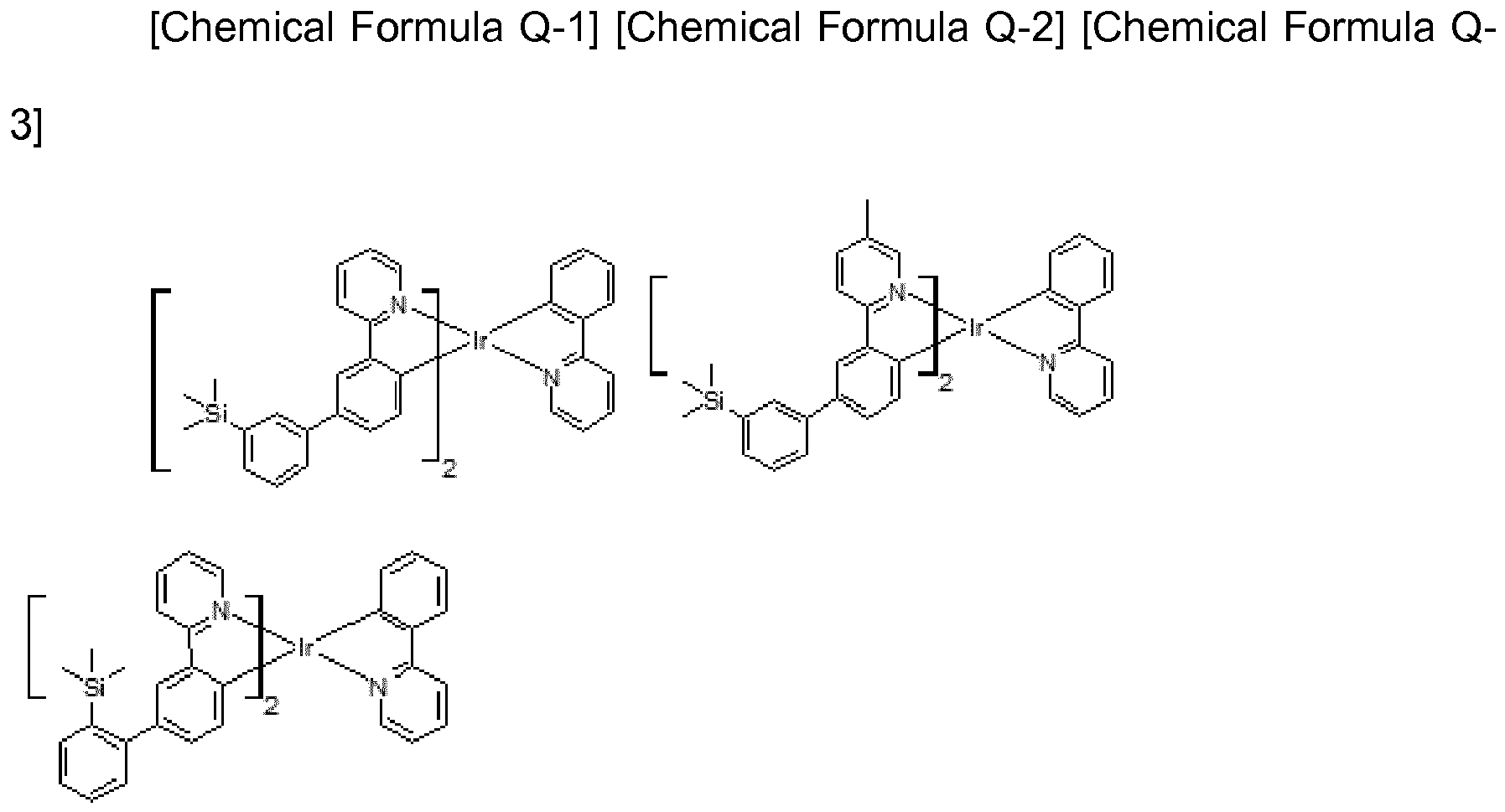


- The composition for an organic light emitting diode of claim 1, wherein the above Chemical Formula X-1 is one of the following Chemical Formulae B-1 to B-65, Chemical Formulae C-1 to C-18, or Chemical Formulae D-1 to D-6:


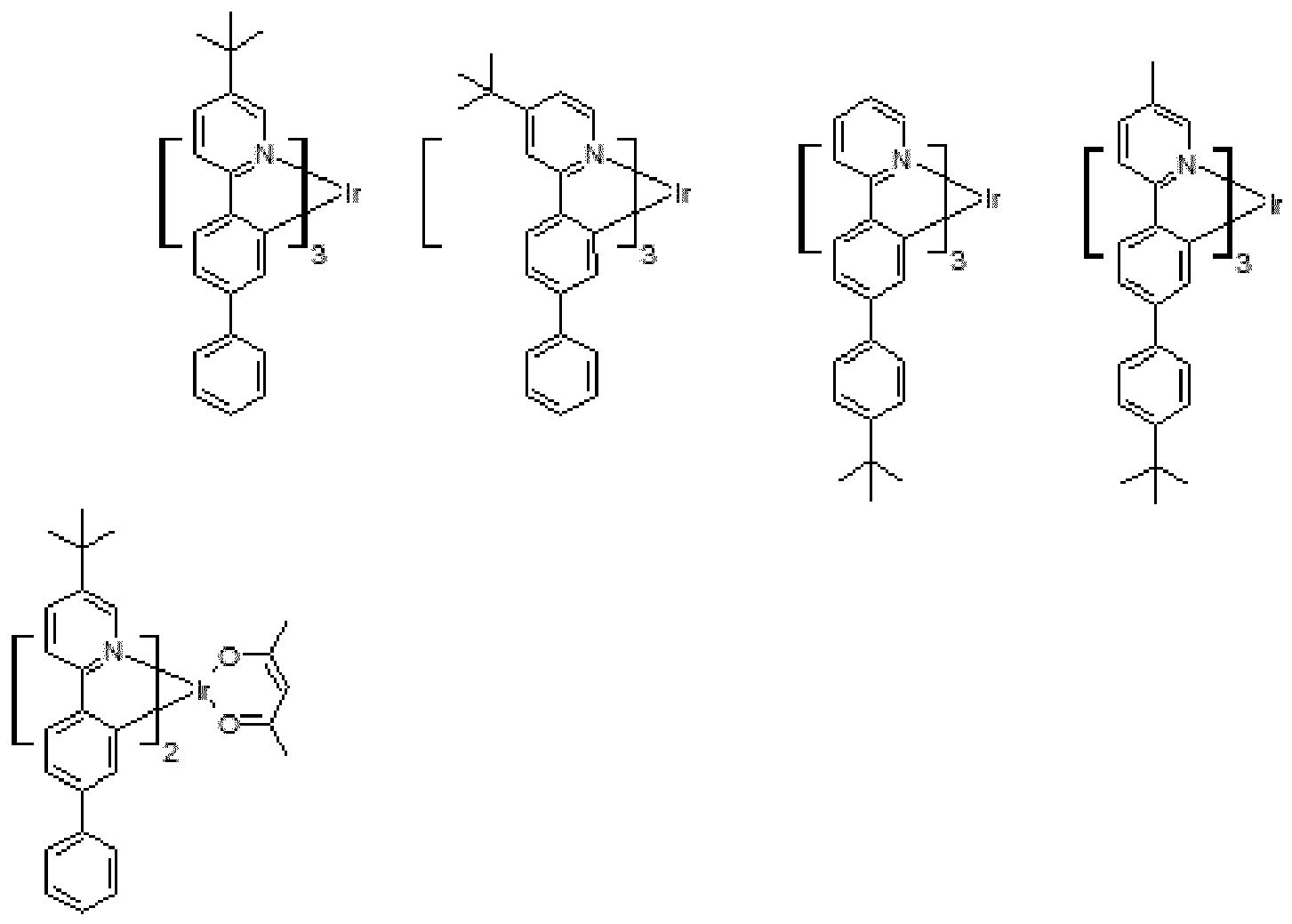
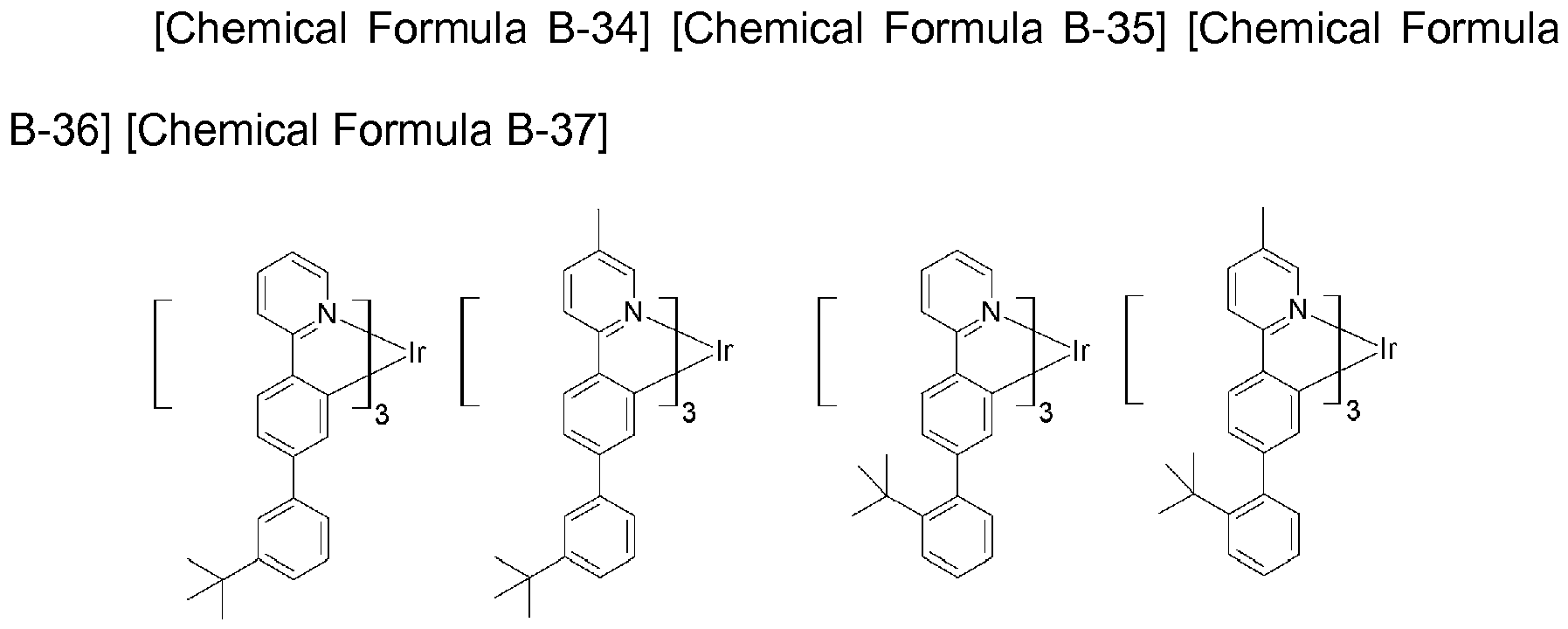





- The composition for an organic light emitting diode of claim 1, wherein the above Chemical Formula S-1 is represented by the following Chemical Formula S-2:
 Ar1 and Ar2 are independently a substituted or unsubstituted C6 to C30 aryl group or a substituted or unsubstituted C2 to C30 heteroaryl group,at least one of Ar1 or Ar2 is a substituted or unsubstituted C2 to C30 heteroaryl group having electron characteristics,L1 and L2 are independently a single bond, a substituted or unsubstituted C2 to C6 alkenylene group, a substituted or unsubstituted C2 to C6 alkynylene group, a substituted or unsubstituted C6 to C30 arylene group, a substituted or unsubstituted C2 to C30 heteroarylene group, or a combination thereof,n1 and n2 are independently integers of 1 to 3, andR1 to R6 are independently hydrogen, deuterium, a halogen, a cyano group, a hydroxyl group, an amino group, a substituted or unsubstituted C1 to C20 amine group, a nitro group, a carboxyl group, a ferrocenyl group, a substituted or unsubstituted C1 to C20 alkyl group, a substituted or unsubstituted C6 to C30 aryl group, a substituted or unsubstituted C2 to C30 heteroaryl group, a substituted or unsubstituted C1 to C20 alkoxy group, a substituted or unsubstituted C6 to C20 aryloxy group, a substituted or unsubstituted C3 to C40 silyloxy group, a substituted or unsubstituted C1 to C20 acyl group, a substituted or unsubstituted C2 to C20 alkoxycarbonyl group, a substituted or unsubstituted C2 to C20 acyloxy group, a substituted or unsubstituted C2 to C20 acylamino group, a substituted or unsubstituted C2 to C20 alkoxycarbonylamino group, a substituted or unsubstituted C7 to C20 aryloxycarbonylamino group, a substituted or unsubstituted C1 to C20 sulfamoylamino group, a substituted or unsubstituted C1 to C20 sulfonyl group, a substituted or unsubstituted C1 to C20 alkylthiol group, a substituted or unsubstituted C6 to C20 arylthiol group, a substituted or unsubstituted C1 to C20 heterocyclothiol group, a substituted or unsubstituted C1 to C20 ureide group, a substituted or unsubstituted C3 to C40 silyl group, or a combination thereof.
 - The composition for an organic light emitting diode of claim 1, wherein the above Chemical Formula S-1 is represented by the following Chemical Formula S-3:
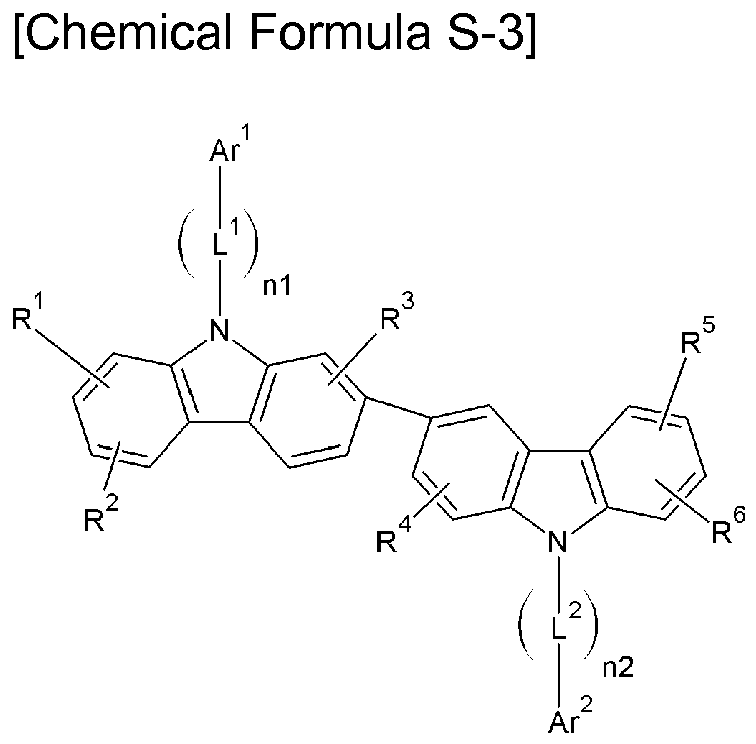 Ar1 and Ar2 are independently a substituted or unsubstituted C6 to C30 aryl group or a substituted or unsubstituted C2 to C30 heteroaryl group,at least one of Ar1 or Ar2 is a substituted or unsubstituted C2 to C30 heteroaryl group having electron characteristics,L1 and L2 are independently a single bond, a substituted or unsubstituted C2 to C6 alkenylene group, a substituted or unsubstituted C2 to C6 alkynylene group, a substituted or unsubstituted C6 to C30 arylene group, a substituted or unsubstituted C2 to C30 heteroarylene group, or a combination thereof,n1 and n2 are independently integers of 1 to 3, andR1 to R6 are independently hydrogen, deuterium, a halogen, a cyano group, a hydroxyl group, an amino group, a substituted or unsubstituted C1 to C20 amine group, a nitro group, a carboxyl group, a ferrocenyl group, a substituted or unsubstituted C1 to C20 alkyl group, a substituted or unsubstituted C6 to C30 aryl group, a substituted or unsubstituted C2 to C30 heteroaryl group, a substituted or unsubstituted C1 to C20 alkoxy group, a substituted or unsubstituted C6 to C20 aryloxy group, a substituted or unsubstituted C3 to C40 silyloxy group, a substituted or unsubstituted C1 to C20 acyl group, a substituted or unsubstituted C2 to C20 alkoxycarbonyl group, a substituted or unsubstituted C2 to C20 acyloxy group, a substituted or unsubstituted C2 to C20 acylamino group, a substituted or unsubstituted C2 to C20 alkoxycarbonylamino group, a substituted or unsubstituted C7 to C20 aryloxycarbonylamino group, a substituted or unsubstituted C1 to C20 sulfamoylamino group, a substituted or unsubstituted C1 to C20 sulfonyl group, a substituted or unsubstituted C1 to C20 alkylthiol group, a substituted or unsubstituted C6 to C20 arylthiol group, a substituted or unsubstituted C1 to C20 heterocyclothiol group, a substituted or unsubstituted C1 to C20 ureide group, a substituted or unsubstituted C3 to C40 silyl group, or a combination thereof.
 - The composition for an organic light emitting diode of claim 1, wherein the above Chemical Formula S-1 is represented by the following Chemical Formula S-4:

 Ar1 and Ar2 are independently a substituted or unsubstituted C6 to C30 aryl group or a substituted or unsubstituted C2 to C30 heteroaryl group,at least one of Ar1 or Ar2 is a substituted or unsubstituted C2 to C30 heteroaryl group having electron characteristics,L1 and L2 are independently a single bond, a substituted or unsubstituted C2 to C6 alkenylene group, a substituted or unsubstituted C2 to C6 alkynylene group, a substituted or unsubstituted C6 to C30 arylene group, a substituted or unsubstituted C2 to C30 heteroarylene group, or a combination thereof,n1 and n2 are independently integers of 1 to 3, andR1 to R6 are independently hydrogen, deuterium, a halogen, a cyano group, a hydroxyl group, an amino group, a substituted or unsubstituted C1 to C20 amine group, a nitro group, a carboxyl group, a ferrocenyl group, a substituted or unsubstituted C1 to C20 alkyl group, a substituted or unsubstituted C6 to C30 aryl group, a substituted or unsubstituted C2 to C30 heteroaryl group, a substituted or unsubstituted C1 to C20 alkoxy group, a substituted or unsubstituted C6 to C20 aryloxy group, a substituted or unsubstituted C3 to C40 silyloxy group, a substituted or unsubstituted C1 to C20 acyl group, a substituted or unsubstituted C2 to C20 alkoxycarbonyl group, a substituted or unsubstituted C2 to C20 acyloxy group, a substituted or unsubstituted C2 to C20 acylamino group, a substituted or unsubstituted C2 to C20 alkoxycarbonylamino group, a substituted or unsubstituted C7 to C20 aryloxycarbonylamino group, a substituted or unsubstituted C1 to C20 sulfamoylamino group, a substituted or unsubstituted C1 to C20 sulfonyl group, a substituted or unsubstituted C1 to C20 alkylthiol group, a substituted or unsubstituted C6 to C20 arylthiol group, a substituted or unsubstituted C1 to C20 heterocyclothiol group, a substituted or unsubstituted C1 to C20 ureide group, a substituted or unsubstituted C3 to C40 silyl group, or a combination thereof.
 - The composition for an organic light emitting diode of claim 1, wherein the above Chemical Formula S-1 is represented by the following Chemical Formula S-5:
 ETU is a substituted or unsubstituted C2 to C30 heteroaryl group having electron characteristics,L1 is a single bond, a substituted or unsubstituted C2 to C6 alkenylene group, a substituted or unsubstituted C2 to C6 alkynylene group, a substituted or unsubstituted C6 to C30 arylene group, a substituted or unsubstituted C2 to C30 heteroarylene group, or a combination thereof,n1 is an integer of 1 to 3, andR1 to R6 are independently hydrogen, deuterium, a halogen, a cyano group, a hydroxyl group, an amino group, a substituted or unsubstituted C1 to C20 amine group, a nitro group, a carboxyl group, a ferrocenyl group, a substituted or unsubstituted C1 to C20 alkyl group, a substituted or unsubstituted C6 to C30 aryl group, a substituted or unsubstituted C2 to C30 heteroaryl group, a substituted or unsubstituted C1 to C20 alkoxy group, a substituted or unsubstituted C6 to C20 aryloxy group, a substituted or unsubstituted C3 to C40 silyloxy group, a substituted or unsubstituted C1 to C20 acyl group, a substituted or unsubstituted C2 to C20 alkoxycarbonyl group, a substituted or unsubstituted C2 to C20 acyloxy group, a substituted or unsubstituted C2 to C20 acylamino group, a substituted or unsubstituted C2 to C20 alkoxycarbonylamino group, a substituted or unsubstituted C7 to C20 aryloxycarbonylamino group, a substituted or unsubstituted C1 to C20 sulfamoylamino group, a substituted or unsubstituted C1 to C20 sulfonyl group, a substituted or unsubstituted C1 to C20 alkylthiol group, a substituted or unsubstituted C6 to C20 arylthiol group, a substituted or unsubstituted C1 to C20 heterocyclothiol group, a substituted or unsubstituted C1 to C20 ureide group, a substituted or unsubstituted C3 to C40 silyl group, or a combination thereof.
 - The composition for an organic light emitting diode of claim 1, wherein the above Chemical Formula S-1 is represented by the following Chemical Formula S-6:
 ETU is a substituted or unsubstituted C2 to C30 heteroaryl group having electron characteristics,L1 is a single bond, a substituted or unsubstituted C2 to C6 alkenylene group, a substituted or unsubstituted C2 to C6 alkynylene group, a substituted or unsubstituted C6 to C30 arylene group, a substituted or unsubstituted C2 to C30 heteroarylene group, or a combination thereof,n1 is an integer of 1 to 3, andR1 to R6 are independently hydrogen, deuterium, a halogen, a cyano group, a hydroxyl group, an amino group, a substituted or unsubstituted C1 to C20 amine group, a nitro group, a carboxyl group, a ferrocenyl group, a substituted or unsubstituted C1 to C20 alkyl group, a substituted or unsubstituted C6 to C30 aryl group, a substituted or unsubstituted C2 to C30 heteroaryl group, a substituted or unsubstituted C1 to C20 alkoxy group, a substituted or unsubstituted C6 to C20 aryloxy group, a substituted or unsubstituted C3 to C40 silyloxy group, a substituted or unsubstituted C1 to C20 acyl group, a substituted or unsubstituted C2 to C20 alkoxycarbonyl group, a substituted or unsubstituted C2 to C20 acyloxy group, a substituted or unsubstituted C2 to C20 acylamino group, a substituted or unsubstituted C2 to C20 alkoxycarbonylamino group, a substituted or unsubstituted C7 to C20 aryloxycarbonylamino group, a substituted or unsubstituted C1 to C20 sulfamoylamino group, a substituted or unsubstituted C1 to C20 sulfonyl group, a substituted or unsubstituted C1 to C20 alkylthiol group, a substituted or unsubstituted C6 to C20 arylthiol group, a substituted or unsubstituted C1 to C20 heterocyclothiol group, a substituted or unsubstituted C1 to C20 ureide group, a substituted or unsubstituted C3 to C40 silyl group, or a combination thereof.
 - The composition for an organic light emitting diode of claim 1, wherein the above Chemical Formula S-1 is represented by the following Chemical Formula S-7:
 ETU is a substituted or unsubstituted C2 to C30 heteroaryl group having electron characteristics,L1 is a single bond, a substituted or unsubstituted C2 to C6 alkenylene group, a substituted or unsubstituted C2 to C6 alkynylene group, a substituted or unsubstituted C6 to C30 arylene group, a substituted or unsubstituted C2 to C30 heteroarylene group, or a combination thereof,n1 is an integer of 1 to 3, andR1 to R6 are independently hydrogen, deuterium, a halogen, a cyano group, a hydroxyl group, an amino group, a substituted or unsubstituted C1 to C20 amine group, a nitro group, a carboxyl group, a ferrocenyl group, a substituted or unsubstituted C1 to C20 alkyl group, a substituted or unsubstituted C6 to C30 aryl group, a substituted or unsubstituted C2 to C30 heteroaryl group, a substituted or unsubstituted C1 to C20 alkoxy group, a substituted or unsubstituted C6 to C20 aryloxy group, a substituted or unsubstituted C3 to C40 silyloxy group, a substituted or unsubstituted C1 to C20 acyl group, a substituted or unsubstituted C2 to C20 alkoxycarbonyl group, a substituted or unsubstituted C2 to C20 acyloxy group, a substituted or unsubstituted C2 to C20 acylamino group, a substituted or unsubstituted C2 to C20 alkoxycarbonylamino group, a substituted or unsubstituted C7 to C20 aryloxycarbonylamino group, a substituted or unsubstituted C1 to C20 sulfamoylamino group, a substituted or unsubstituted C1 to C20 sulfonyl group, a substituted or unsubstituted C1 to C20 alkylthiol group, a substituted or unsubstituted C6 to C20 arylthiol group, a substituted or unsubstituted C1 to C20 heterocyclothiol group, a substituted or unsubstituted C1 to C20 ureide group, a substituted or unsubstituted C3 to C40 silyl group, or a combination thereof.
 - The composition for an organic light emitting diode of claim 1, wherein the substituted or unsubstituted C2 to C30 heteroaryl group having electron characteristics is selected from the group consisting of a substituted or unsubstituted imidazolyl group, a substituted or unsubstituted triazolyl group, a substituted or unsubstituted tetrazolyl group, a substituted or unsubstituted oxadiazolyl group, a substituted or unsubstituted oxatriazolyl group, a substituted or unsubstituted thiatriazolyl group, a substituted or unsubstituted benzimidazolyl group, a substituted or unsubstituted benzotriazolyl group, a substituted or unsubstituted pyridinyl group, a substituted or unsubstituted pyrimidinyl group, a substituted or unsubstituted triazinyl group, a substituted or unsubstituted pyrazinyl group, a substituted or unsubstituted pyridazinyl group, a substituted or unsubstituted purinyl group, a substituted or unsubstituted quinolinyl group, a substituted or unsubstituted isoquinolinyl group, a substituted or unsubstituted phthalazinyl group, a substituted or unsubstituted benzoquinolinyl group, a substituted or unsubstituted quinoxalinyl group, a substituted or unsubstituted quinazolinyl group, a substituted or unsubstituted acridinyl group, a substituted or unsubstituted phenanthrolinyl group, and a substituted or unsubstituted phenazinyl group.
- The composition for an organic light emitting diode of claim 1, wherein the substituted or unsubstituted C2 to C30 heteroaryl group having electron characteristics is one of the following Chemical Formulae E-1 to E-5:

- The composition for an organic light emitting diode of claim 1, wherein the above Chemical Formula S-1 is represented by one of the following Chemical Formulae 3 to 5, A-10, A-11, A-19, A-20, A-21, A-22, A-23, A-24, A-25, A-26, Chemical Formula T-11, Chemical Formula T-14, Chemical Formula T-15, Chemical Formula T-19, Chemical Formula T-24, Chemical Formula T-25, Chemical Formula T-35, Chemical Formula T-36, Chemical Formula T-40, Chemical Formula T-41, Chemical Formula T-45, Chemical Formula T-46, Chemical Formula T-65 or Chemical Formula T-66:
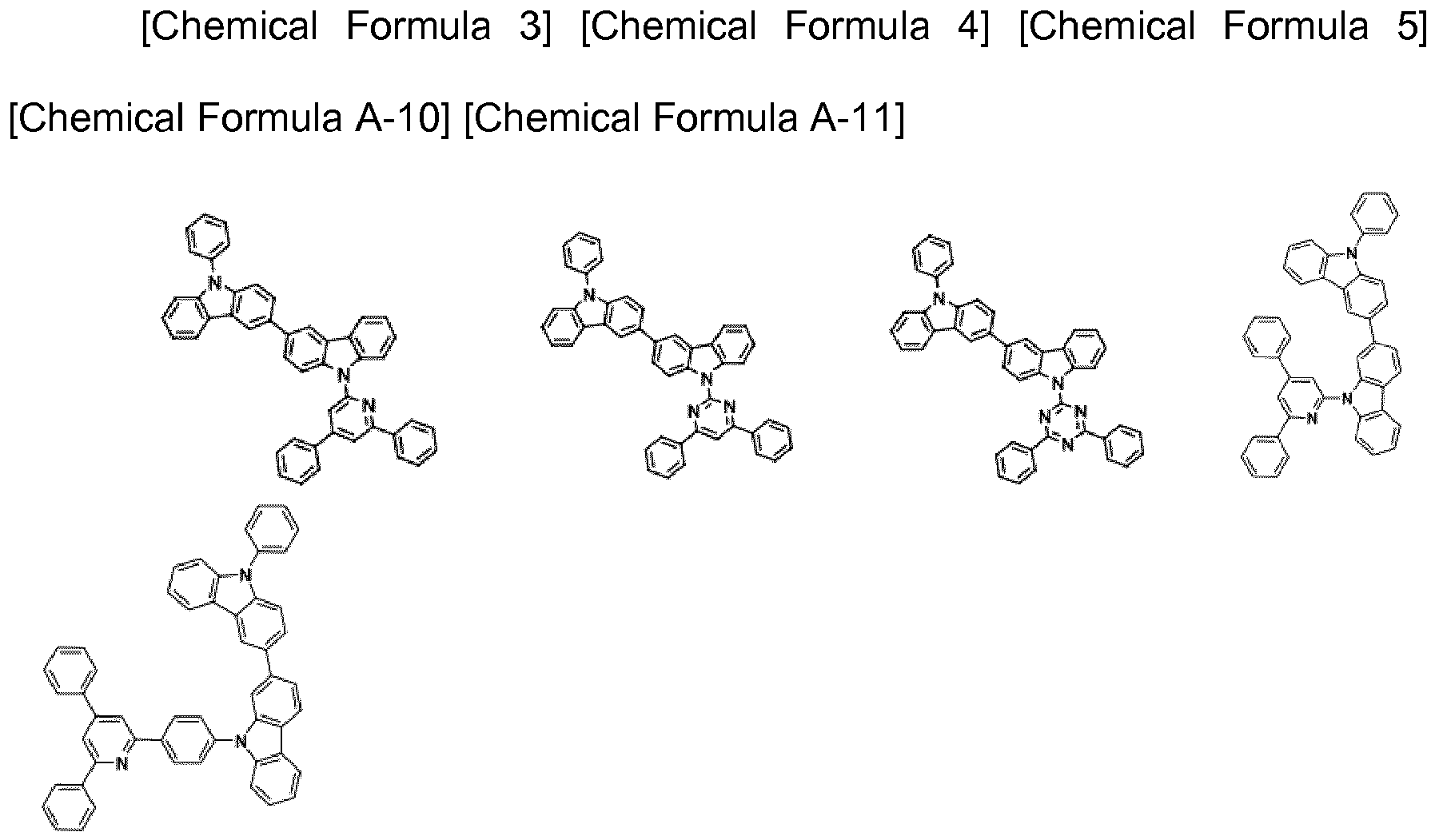


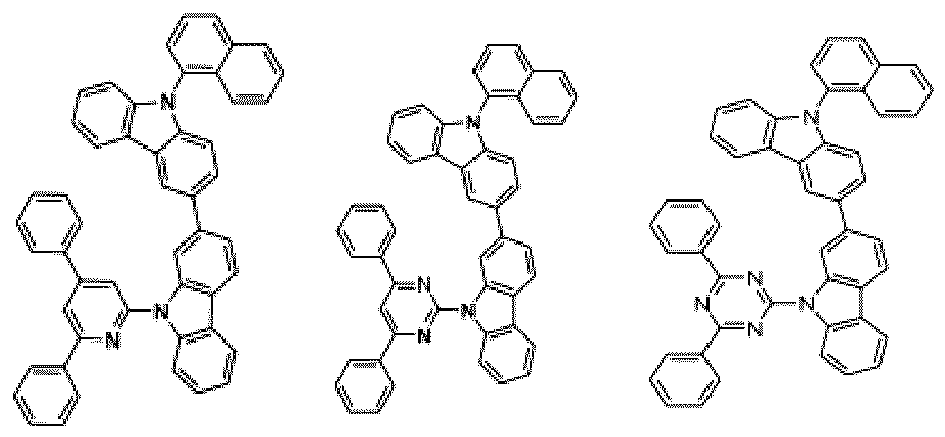


- The v composition for an organic light emitting diode of claim 1, wherein the compound for an organic optoelectric device represented by the above Chemical Formula S-1 is one of Chemical Formula A-19, Chemical Formula A-20, Chemical Formula A-22, Chemical Formula A-23, Chemical Formula T-35, Chemical Formula T-36, Chemical Formula T-40, Chemical Formula T-41, Chemical Formula T-77, Chemical Formula T-81, Chemical Formula T-82, Chemical Formula T-96, Chemical Formula 4, Chemical Formula 5, Chemical Formula 53 or Chemical Formula 54, and the compound represented by the above Chemical Formula X-1 is one of Chemical Formula M-1, P-2, P-3, C-1, C-6 or B-18:


- The composition for an organic light emitting diode of claim 1, wherein a weight ratio of the compound for an organic optoelectric device represented by the above Chemical Formula S-1 and the compound for an organic optoelectric device represented by the above Chemical Formula X-1 is 1:99 to 99:1.
- An organic thin layer comprising the composition for an organic light emitting diode of any one of claim 1 to claim 25.
- The organic thin layer of claim 26, wherein the organic thin layer is an emission layer.
- An organic light emitting diode, comprising
an anode, a cathode, and
at least one organic thin layer interposed between the anode and the cathode,
wherein the organic thin layer is the organic thin layer of claim 26.
Applications Claiming Priority (3)
| Application Number | Priority Date | Filing Date | Title |
|---|---|---|---|
| KR20120073091 | 2012-07-04 | ||
| KR20120124954 | 2012-11-06 | ||
| PCT/KR2013/005952 WO2014007564A1 (en) | 2012-07-04 | 2013-07-04 | Composite for organic light-emitting diode, organic light-emitting layer including same, and organic light-emitting diode |
Publications (2)
| Publication Number | Publication Date |
|---|---|
| EP2871223A1 true EP2871223A1 (en) | 2015-05-13 |
| EP2871223A4 EP2871223A4 (en) | 2016-02-24 |
Family
ID=49882258
Family Applications (1)
| Application Number | Title | Priority Date | Filing Date |
|---|---|---|---|
| EP13813173.5A Withdrawn EP2871223A4 (en) | 2012-07-04 | 2013-07-04 | COMPOSITE FOR ORGANIC ELECTROLUMINESCENT DIODE, ORGANIC ELECTROLUMINESCENT LAYER CONTAINING THE SAME, AND ORGANIC ELECTROLUMINESCENT DIODE |
Country Status (6)
| Country | Link |
|---|---|
| US (1) | US20150021585A1 (en) |
| EP (1) | EP2871223A4 (en) |
| JP (1) | JP2015524610A (en) |
| KR (1) | KR101686076B1 (en) |
| CN (1) | CN104271703A (en) |
| WO (1) | WO2014007564A1 (en) |
Families Citing this family (47)
| Publication number | Priority date | Publication date | Assignee | Title |
|---|---|---|---|---|
| EP2674429B1 (en) | 2011-02-07 | 2020-12-23 | Idemitsu Kosan Co., Ltd. | Biscarbazole derivative and organic electroluminescent element using same |
| KR101588941B1 (en) | 2011-02-07 | 2016-01-26 | 이데미쓰 고산 가부시키가이샤 | Biscarbazole derivative and organic electroluminescent element using same |
| KR102384222B1 (en) * | 2014-09-26 | 2022-04-07 | 삼성전자주식회사 | Organometallic compound and organic light emitting device including the same |
| KR102417121B1 (en) * | 2014-10-17 | 2022-07-06 | 삼성디스플레이 주식회사 | Organic light-emitting device |
| KR102429870B1 (en) * | 2014-10-17 | 2022-08-05 | 삼성전자주식회사 | Organic light emitting device including the same |
| KR102429869B1 (en) * | 2014-10-17 | 2022-08-05 | 삼성전자주식회사 | Organic light emitting device including the same |
| KR102343144B1 (en) * | 2014-10-17 | 2021-12-27 | 삼성디스플레이 주식회사 | Organic light-emitting devices |
| US10003035B2 (en) * | 2014-11-28 | 2018-06-19 | Samsung Electronics Co., Ltd. | Organometallic compound and organic light-emitting device including the same |
| US20160164012A1 (en) | 2014-11-28 | 2016-06-09 | Samsung Electronics Co., Ltd. | Organometallic compound and organic light-emitting device including the same |
| US11672167B2 (en) | 2015-03-13 | 2023-06-06 | Samsung Electronics Co., Ltd. | Organometallic compound and organic light-emitting device including the same |
| KR102429871B1 (en) * | 2015-03-13 | 2022-08-05 | 삼성전자주식회사 | Organometallic compound and organic light emitting device including the same |
| KR102424977B1 (en) | 2015-04-14 | 2022-07-26 | 삼성디스플레이 주식회사 | Condensed-cyclic compound and organic light emitting device comprising the same |
| KR102630644B1 (en) | 2015-12-17 | 2024-01-30 | 삼성디스플레이 주식회사 | Organic light emitting device |
| KR102501666B1 (en) * | 2016-01-11 | 2023-02-21 | 덕산네오룩스 주식회사 | Compound for organic electronic element, organic electronic element using the same, and an electronic device thereof |
| US10672997B2 (en) * | 2016-06-20 | 2020-06-02 | Universal Display Corporation | Organic electroluminescent materials and devices |
| KR102054276B1 (en) | 2016-06-29 | 2019-12-10 | 삼성에스디아이 주식회사 | Compound for organic optoelectronic device, composition for organic optoelectronic device and organic optoelectronic device and display device |
| KR102027961B1 (en) * | 2016-06-29 | 2019-10-02 | 삼성에스디아이 주식회사 | Compound for organic optoelectronic device, composition for organic optoelectronic device and organic optoelectronic device and display device |
| KR102050000B1 (en) | 2016-07-12 | 2019-11-28 | 삼성에스디아이 주식회사 | Compound for organic optoelectronic device, composition for organic optoelectronic device and organic optoelectronic device and display device |
| KR102054277B1 (en) | 2016-07-29 | 2019-12-10 | 삼성에스디아이 주식회사 | Composition for organic optoelectronic device and organic optoelectronic device and display device |
| US11158817B2 (en) | 2017-01-05 | 2021-10-26 | Samsung Sdi Co., Ltd. | Compound for organic optoelectronic device, composition for organic optoelectronic device and organic optoelectronic device and display device |
| KR102504132B1 (en) | 2017-08-21 | 2023-02-28 | 삼성디스플레이 주식회사 | Cyclometallic compound, organic light emitting device comprising the same and emitting apparatus comprising the organic light emitting device |
| EP3617215A1 (en) * | 2018-08-31 | 2020-03-04 | Samsung Electronics Co., Ltd. | Organometallic compound, organic light-emitting device including the organometallic compound, and diagnostic composition including the organometallic compound |
| US12391713B2 (en) | 2019-03-29 | 2025-08-19 | Samsung Electronics Co., Ltd. | Organometallic compound, organic light-emitting device including the same, and electronic apparatus including the organic light-emitting device |
| CN112480180A (en) | 2019-09-11 | 2021-03-12 | 三星电子株式会社 | Organometallic compound, organic light emitting device including the same, and electronic apparatus including the organic light emitting device |
| KR102906606B1 (en) * | 2019-12-10 | 2025-12-30 | 삼성전자주식회사 | Organometallic compound, organic light emitting device including the same and a composition for diagnosing including the same |
| KR102773495B1 (en) * | 2020-02-10 | 2025-02-28 | 삼성디스플레이 주식회사 | Organic light emitting device |
| KR20210126201A (en) * | 2020-04-09 | 2021-10-20 | 삼성디스플레이 주식회사 | Organometallic compound and organic light emitting device comprising the same |
| JP2022036077A (en) * | 2020-08-21 | 2022-03-04 | 三星電子株式会社 | Organometallic compound and organic light-emitting device including the same, and electronic apparatus including the organic light-emitting device |
| WO2022101171A1 (en) * | 2020-11-10 | 2022-05-19 | Merck Patent Gmbh | Sulfurous compounds for organic electroluminescent devices |
| US20220407020A1 (en) * | 2021-04-23 | 2022-12-22 | Universal Display Corporation | Organic electroluminescent materials and devices |
| EP4631325A1 (en) | 2022-12-08 | 2025-10-15 | Merck Patent GmbH | Organic electronic device and special materials for organic electronic devices |
| KR20250124370A (en) | 2022-12-19 | 2025-08-19 | 메르크 파텐트 게엠베하 | Materials for electronic devices |
| CN120826409A (en) | 2023-03-20 | 2025-10-21 | 默克专利有限公司 | Materials for organic electroluminescent devices |
| KR20260058873A (en) | 2023-08-29 | 2026-04-29 | 메르크 파텐트 게엠베하 | Materials for organic electroluminescent devices |
| CN121753522A (en) | 2023-08-30 | 2026-03-27 | 默克专利有限公司 | Material for organic light emitting device |
| CN121753521A (en) | 2023-08-30 | 2026-03-27 | 默克专利有限公司 | Material for organic light emitting device |
| CN121773745A (en) | 2023-08-30 | 2026-03-31 | 默克专利有限公司 | Material for organic light emitting device |
| CN121969629A (en) | 2023-10-04 | 2026-05-01 | 默克专利有限公司 | Materials for organic electroluminescent devices |
| WO2025104058A1 (en) | 2023-11-16 | 2025-05-22 | Merck Patent Gmbh | Materials for organic electronic devices |
| WO2025119821A1 (en) | 2023-12-05 | 2025-06-12 | Merck Patent Gmbh | Material composition for organic electroluminescent devices |
| WO2025168515A1 (en) | 2024-02-06 | 2025-08-14 | Merck Patent Gmbh | Materials for organic electronic devices |
| WO2025195961A1 (en) | 2024-03-19 | 2025-09-25 | Merck Patent Gmbh | Organic light-emitting devices |
| WO2025228800A1 (en) | 2024-04-30 | 2025-11-06 | Merck Patent Gmbh | Materials for organic electronic devices |
| WO2026017608A1 (en) | 2024-07-15 | 2026-01-22 | Merck Patent Gmbh | Materials for organic light-emitting devices |
| WO2026017607A1 (en) | 2024-07-15 | 2026-01-22 | Merck Patent Gmbh | Organic light-emitting device |
| WO2026017611A1 (en) | 2024-07-15 | 2026-01-22 | Merck Patent Gmbh | Organic light emitting device |
| WO2026017612A1 (en) | 2024-07-15 | 2026-01-22 | Merck Patent Gmbh | Organic light-emitting device |
Family Cites Families (13)
| Publication number | Priority date | Publication date | Assignee | Title |
|---|---|---|---|---|
| JPS60258354A (en) * | 1984-06-06 | 1985-12-20 | 日本鋼管株式会社 | Composite damping floor |
| JPH02117614A (en) * | 1988-10-26 | 1990-05-02 | Yoshihisa Kita | Bound incense stick and binding treatment of incense stick in production of incense stick |
| EP1094063A1 (en) | 1999-10-18 | 2001-04-25 | Applied Research Systems ARS Holding N.V. | 9-(Piperazinylalkyl)carbazoles as Bax-modulators |
| KR100880220B1 (en) * | 2004-10-04 | 2009-01-28 | 엘지디스플레이 주식회사 | Iridium compound light emitting compound including phenyl pyridine group having organic silicon and organic electroluminescent device using the same as color developing material |
| KR101073232B1 (en) * | 2006-11-07 | 2011-10-12 | 쇼와 덴코 가부시키가이샤 | Iridium complex compound, organic electroluminescent device obtained by using the same, and uses of the device |
| WO2010027583A1 (en) | 2008-09-03 | 2010-03-11 | Universal Display Corporation | Phosphorescent materials |
| JP4474493B1 (en) * | 2009-07-31 | 2010-06-02 | 富士フイルム株式会社 | Organic electroluminescence device |
| JP4500364B1 (en) | 2009-08-31 | 2010-07-14 | 富士フイルム株式会社 | Organic electroluminescence device |
| KR20110079197A (en) | 2009-12-31 | 2011-07-07 | 제일모직주식회사 | Compound for organic photoelectric device and organic photoelectric device comprising same |
| WO2011132683A1 (en) * | 2010-04-20 | 2011-10-27 | 出光興産株式会社 | Bis-carbazole derivative, material for organic electroluminescent element and organic electroluminescent element using same |
| KR20110122051A (en) * | 2010-05-03 | 2011-11-09 | 제일모직주식회사 | Compound for organic photoelectric device and organic photoelectric device comprising same |
| US9954180B2 (en) * | 2010-08-20 | 2018-04-24 | Universal Display Corporation | Bicarbazole compounds for OLEDs |
| DE112011103600B4 (en) * | 2010-10-28 | 2018-05-03 | Furuya Metal Co., Ltd. | A method of producing a complex of tris-ortho metalated iridium |
-
2013
- 2013-07-04 JP JP2015520064A patent/JP2015524610A/en active Pending
- 2013-07-04 WO PCT/KR2013/005952 patent/WO2014007564A1/en not_active Ceased
- 2013-07-04 KR KR1020130078409A patent/KR101686076B1/en active Active
- 2013-07-04 CN CN201380022952.7A patent/CN104271703A/en active Pending
- 2013-07-04 EP EP13813173.5A patent/EP2871223A4/en not_active Withdrawn
-
2014
- 2014-10-08 US US14/509,538 patent/US20150021585A1/en not_active Abandoned
Also Published As
| Publication number | Publication date |
|---|---|
| KR20140005804A (en) | 2014-01-15 |
| WO2014007564A1 (en) | 2014-01-09 |
| EP2871223A4 (en) | 2016-02-24 |
| KR101686076B1 (en) | 2016-12-13 |
| JP2015524610A (en) | 2015-08-24 |
| US20150021585A1 (en) | 2015-01-22 |
| CN104271703A (en) | 2015-01-07 |
Similar Documents
| Publication | Publication Date | Title |
|---|---|---|
| EP2871222B1 (en) | Compound for organic optoelectric device, organic optoelectric device comprising same, and display apparatus comprising organic optoelectric device | |
| CN110294703B (en) | Composition for organic photoelectric device, organic photoelectric device and display device | |
| US20150021585A1 (en) | Composition for organic light-emitting diode, organic light-emitting layer including same, and organic light-emitting diode | |
| CN110785863B (en) | Organic photodiodes and display devices | |
| EP3514846B1 (en) | Compound for organic optoelectronic device, organic light emitting diode including same, and display device including the organic light emitting diode | |
| EP3492553B1 (en) | Composition for organic optoelectronic element, organic optoelectronic element, and display device | |
| EP3032606B1 (en) | Organic optoelectric device and display device | |
| EP3480278B1 (en) | Compound for organic optoelectronic device, composition for organic optoelectronic device, organic optoelectronic device and display apparatus | |
| EP2799515B1 (en) | Compound for organic optoelectric device, organic light-emitting diode including same, and display device including organic light-emitting diode | |
| TWI500604B (en) | Composition for organic optoelectric device and organic optoelectric device and display device | |
| EP3015527B1 (en) | Organic compound for optoelectric device and composition for optoelectric device and organic optoelectric device and display device | |
| US8673460B2 (en) | Heterocyclic derivative and organic light emitting device using same | |
| EP3486299B1 (en) | Compound for organic optoelectronic device, composition for organic optoelectronic device, organic optoelectronic device, and display device | |
| CN110088110B (en) | Novel compound and organic light-emitting element comprising same | |
| JP7227767B2 (en) | Organometallic compounds, organic light-emitting devices, and diagnostic compositions containing the same | |
| EP3006433B1 (en) | Compound, organic light emitting element comprising same, and display device comprising organic light emitting element | |
| WO2015053459A1 (en) | Organic alloy for organic optoelectronic device, organic optoelectronic device, and display device | |
| EP2980878A1 (en) | Organic electroluminescent element, and lighting device and display device which are provided with same | |
| CN109438518A (en) | For the mono-substituted diaza benzo imidazole carbenes metal complex in organic light emitting diode | |
| CN115872959A (en) | Luminous auxiliary material, preparation method and application thereof, and luminous device | |
| WO2018093026A1 (en) | Organic optoelectronic diode and display device | |
| WO2014104545A1 (en) | Compound for organic optoelectronic device, organic light-emitting element including same, and display apparatus including said organic light-emitting element | |
| EP3680309B1 (en) | Composition for organic optoelectronic element, organic optoelectronic element, and display device | |
| CN112592333B (en) | Compound for organic photoelectric device, organic photoelectric device and display device | |
| EP2998380A1 (en) | Compound for organic optoelectric device, organic light-emitting diode including same, display device including organic light-emitting diode |
Legal Events
| Date | Code | Title | Description |
|---|---|---|---|
| PUAI | Public reference made under article 153(3) epc to a published international application that has entered the european phase |
Free format text: ORIGINAL CODE: 0009012 |
|
| 17P | Request for examination filed |
Effective date: 20141030 |
|
| AK | Designated contracting states |
Kind code of ref document: A1 Designated state(s): AL AT BE BG CH CY CZ DE DK EE ES FI FR GB GR HR HU IE IS IT LI LT LU LV MC MK MT NL NO PL PT RO RS SE SI SK SM TR |
|
| AX | Request for extension of the european patent |
Extension state: BA ME |
|
| DAX | Request for extension of the european patent (deleted) | ||
| RA4 | Supplementary search report drawn up and despatched (corrected) |
Effective date: 20160125 |
|
| RIC1 | Information provided on ipc code assigned before grant |
Ipc: H01L 51/54 20060101ALI20160119BHEP Ipc: H01L 51/50 20060101ALI20160119BHEP Ipc: C09K 11/06 20060101AFI20160119BHEP |
|
| STAA | Information on the status of an ep patent application or granted ep patent |
Free format text: STATUS: THE APPLICATION HAS BEEN WITHDRAWN |
|
| 18W | Application withdrawn |
Effective date: 20160428 |