EP2870139B1 - Novel adamantyl derivatives as cannabinoid receptor 2 agonists - Google Patents
Novel adamantyl derivatives as cannabinoid receptor 2 agonists Download PDFInfo
- Publication number
- EP2870139B1 EP2870139B1 EP13732543.7A EP13732543A EP2870139B1 EP 2870139 B1 EP2870139 B1 EP 2870139B1 EP 13732543 A EP13732543 A EP 13732543A EP 2870139 B1 EP2870139 B1 EP 2870139B1
- Authority
- EP
- European Patent Office
- Prior art keywords
- dihydro
- adamantan
- methanone
- hydrogen
- indol
- Prior art date
- Legal status (The legal status is an assumption and is not a legal conclusion. Google has not performed a legal analysis and makes no representation as to the accuracy of the status listed.)
- Not-in-force
Links
- 0 CC(C)N(CC(*)*)c1c(*)cccc1* Chemical compound CC(C)N(CC(*)*)c1c(*)cccc1* 0.000 description 4
Classifications
-
- C—CHEMISTRY; METALLURGY
- C07—ORGANIC CHEMISTRY
- C07D—HETEROCYCLIC COMPOUNDS
- C07D471/00—Heterocyclic compounds containing nitrogen atoms as the only ring hetero atoms in the condensed system, at least one ring being a six-membered ring with one nitrogen atom, not provided for by groups C07D451/00 - C07D463/00
- C07D471/02—Heterocyclic compounds containing nitrogen atoms as the only ring hetero atoms in the condensed system, at least one ring being a six-membered ring with one nitrogen atom, not provided for by groups C07D451/00 - C07D463/00 in which the condensed system contains two hetero rings
- C07D471/04—Ortho-condensed systems
-
- A—HUMAN NECESSITIES
- A61—MEDICAL OR VETERINARY SCIENCE; HYGIENE
- A61K—PREPARATIONS FOR MEDICAL, DENTAL OR TOILETRY PURPOSES
- A61K31/00—Medicinal preparations containing organic active ingredients
- A61K31/33—Heterocyclic compounds
- A61K31/395—Heterocyclic compounds having nitrogen as a ring hetero atom, e.g. guanethidine or rifamycins
- A61K31/435—Heterocyclic compounds having nitrogen as a ring hetero atom, e.g. guanethidine or rifamycins having six-membered rings with one nitrogen as the only ring hetero atom
- A61K31/47—Quinolines; Isoquinolines
-
- A—HUMAN NECESSITIES
- A61—MEDICAL OR VETERINARY SCIENCE; HYGIENE
- A61P—SPECIFIC THERAPEUTIC ACTIVITY OF CHEMICAL COMPOUNDS OR MEDICINAL PREPARATIONS
- A61P1/00—Drugs for disorders of the alimentary tract or the digestive system
- A61P1/02—Stomatological preparations, e.g. drugs for caries, aphtae, periodontitis
-
- A—HUMAN NECESSITIES
- A61—MEDICAL OR VETERINARY SCIENCE; HYGIENE
- A61P—SPECIFIC THERAPEUTIC ACTIVITY OF CHEMICAL COMPOUNDS OR MEDICINAL PREPARATIONS
- A61P1/00—Drugs for disorders of the alimentary tract or the digestive system
- A61P1/16—Drugs for disorders of the alimentary tract or the digestive system for liver or gallbladder disorders, e.g. hepatoprotective agents, cholagogues, litholytics
-
- A—HUMAN NECESSITIES
- A61—MEDICAL OR VETERINARY SCIENCE; HYGIENE
- A61P—SPECIFIC THERAPEUTIC ACTIVITY OF CHEMICAL COMPOUNDS OR MEDICINAL PREPARATIONS
- A61P13/00—Drugs for disorders of the urinary system
- A61P13/12—Drugs for disorders of the urinary system of the kidneys
-
- A—HUMAN NECESSITIES
- A61—MEDICAL OR VETERINARY SCIENCE; HYGIENE
- A61P—SPECIFIC THERAPEUTIC ACTIVITY OF CHEMICAL COMPOUNDS OR MEDICINAL PREPARATIONS
- A61P17/00—Drugs for dermatological disorders
- A61P17/02—Drugs for dermatological disorders for treating wounds, ulcers, burns, scars, keloids, or the like
-
- A—HUMAN NECESSITIES
- A61—MEDICAL OR VETERINARY SCIENCE; HYGIENE
- A61P—SPECIFIC THERAPEUTIC ACTIVITY OF CHEMICAL COMPOUNDS OR MEDICINAL PREPARATIONS
- A61P19/00—Drugs for skeletal disorders
- A61P19/02—Drugs for skeletal disorders for joint disorders, e.g. arthritis, arthrosis
-
- A—HUMAN NECESSITIES
- A61—MEDICAL OR VETERINARY SCIENCE; HYGIENE
- A61P—SPECIFIC THERAPEUTIC ACTIVITY OF CHEMICAL COMPOUNDS OR MEDICINAL PREPARATIONS
- A61P19/00—Drugs for skeletal disorders
- A61P19/08—Drugs for skeletal disorders for bone diseases, e.g. rachitism, Paget's disease
- A61P19/10—Drugs for skeletal disorders for bone diseases, e.g. rachitism, Paget's disease for osteoporosis
-
- A—HUMAN NECESSITIES
- A61—MEDICAL OR VETERINARY SCIENCE; HYGIENE
- A61P—SPECIFIC THERAPEUTIC ACTIVITY OF CHEMICAL COMPOUNDS OR MEDICINAL PREPARATIONS
- A61P25/00—Drugs for disorders of the nervous system
- A61P25/04—Centrally acting analgesics, e.g. opioids
-
- A—HUMAN NECESSITIES
- A61—MEDICAL OR VETERINARY SCIENCE; HYGIENE
- A61P—SPECIFIC THERAPEUTIC ACTIVITY OF CHEMICAL COMPOUNDS OR MEDICINAL PREPARATIONS
- A61P29/00—Non-central analgesic, antipyretic or antiinflammatory agents, e.g. antirheumatic agents; Non-steroidal antiinflammatory drugs [NSAID]
-
- A—HUMAN NECESSITIES
- A61—MEDICAL OR VETERINARY SCIENCE; HYGIENE
- A61P—SPECIFIC THERAPEUTIC ACTIVITY OF CHEMICAL COMPOUNDS OR MEDICINAL PREPARATIONS
- A61P35/00—Antineoplastic agents
-
- A—HUMAN NECESSITIES
- A61—MEDICAL OR VETERINARY SCIENCE; HYGIENE
- A61P—SPECIFIC THERAPEUTIC ACTIVITY OF CHEMICAL COMPOUNDS OR MEDICINAL PREPARATIONS
- A61P37/00—Drugs for immunological or allergic disorders
- A61P37/02—Immunomodulators
-
- A—HUMAN NECESSITIES
- A61—MEDICAL OR VETERINARY SCIENCE; HYGIENE
- A61P—SPECIFIC THERAPEUTIC ACTIVITY OF CHEMICAL COMPOUNDS OR MEDICINAL PREPARATIONS
- A61P43/00—Drugs for specific purposes, not provided for in groups A61P1/00-A61P41/00
-
- A—HUMAN NECESSITIES
- A61—MEDICAL OR VETERINARY SCIENCE; HYGIENE
- A61P—SPECIFIC THERAPEUTIC ACTIVITY OF CHEMICAL COMPOUNDS OR MEDICINAL PREPARATIONS
- A61P9/00—Drugs for disorders of the cardiovascular system
-
- A—HUMAN NECESSITIES
- A61—MEDICAL OR VETERINARY SCIENCE; HYGIENE
- A61P—SPECIFIC THERAPEUTIC ACTIVITY OF CHEMICAL COMPOUNDS OR MEDICINAL PREPARATIONS
- A61P9/00—Drugs for disorders of the cardiovascular system
- A61P9/10—Drugs for disorders of the cardiovascular system for treating ischaemic or atherosclerotic diseases, e.g. antianginal drugs, coronary vasodilators, drugs for myocardial infarction, retinopathy, cerebrovascula insufficiency, renal arteriosclerosis
-
- C—CHEMISTRY; METALLURGY
- C07—ORGANIC CHEMISTRY
- C07D—HETEROCYCLIC COMPOUNDS
- C07D209/00—Heterocyclic compounds containing five-membered rings, condensed with other rings, with one nitrogen atom as the only ring hetero atom
- C07D209/02—Heterocyclic compounds containing five-membered rings, condensed with other rings, with one nitrogen atom as the only ring hetero atom condensed with one carbocyclic ring
- C07D209/04—Indoles; Hydrogenated indoles
- C07D209/08—Indoles; Hydrogenated indoles with only hydrogen atoms or radicals containing only hydrogen and carbon atoms, directly attached to carbon atoms of the hetero ring
-
- C—CHEMISTRY; METALLURGY
- C07—ORGANIC CHEMISTRY
- C07D—HETEROCYCLIC COMPOUNDS
- C07D209/00—Heterocyclic compounds containing five-membered rings, condensed with other rings, with one nitrogen atom as the only ring hetero atom
- C07D209/02—Heterocyclic compounds containing five-membered rings, condensed with other rings, with one nitrogen atom as the only ring hetero atom condensed with one carbocyclic ring
- C07D209/44—Iso-indoles; Hydrogenated iso-indoles
-
- C—CHEMISTRY; METALLURGY
- C07—ORGANIC CHEMISTRY
- C07D—HETEROCYCLIC COMPOUNDS
- C07D215/00—Heterocyclic compounds containing quinoline or hydrogenated quinoline ring systems
- C07D215/02—Heterocyclic compounds containing quinoline or hydrogenated quinoline ring systems having no bond between the ring nitrogen atom and a non-ring member or having only hydrogen atoms or carbon atoms directly attached to the ring nitrogen atom
- C07D215/04—Heterocyclic compounds containing quinoline or hydrogenated quinoline ring systems having no bond between the ring nitrogen atom and a non-ring member or having only hydrogen atoms or carbon atoms directly attached to the ring nitrogen atom with only hydrogen atoms or radicals containing only hydrogen and carbon atoms, directly attached to the ring carbon atoms
- C07D215/08—Heterocyclic compounds containing quinoline or hydrogenated quinoline ring systems having no bond between the ring nitrogen atom and a non-ring member or having only hydrogen atoms or carbon atoms directly attached to the ring nitrogen atom with only hydrogen atoms or radicals containing only hydrogen and carbon atoms, directly attached to the ring carbon atoms with acylated ring nitrogen atom
-
- C—CHEMISTRY; METALLURGY
- C07—ORGANIC CHEMISTRY
- C07D—HETEROCYCLIC COMPOUNDS
- C07D215/00—Heterocyclic compounds containing quinoline or hydrogenated quinoline ring systems
- C07D215/02—Heterocyclic compounds containing quinoline or hydrogenated quinoline ring systems having no bond between the ring nitrogen atom and a non-ring member or having only hydrogen atoms or carbon atoms directly attached to the ring nitrogen atom
- C07D215/12—Heterocyclic compounds containing quinoline or hydrogenated quinoline ring systems having no bond between the ring nitrogen atom and a non-ring member or having only hydrogen atoms or carbon atoms directly attached to the ring nitrogen atom with substituted hydrocarbon radicals attached to ring carbon atoms
- C07D215/14—Radicals substituted by oxygen atoms
-
- C—CHEMISTRY; METALLURGY
- C07—ORGANIC CHEMISTRY
- C07D—HETEROCYCLIC COMPOUNDS
- C07D215/00—Heterocyclic compounds containing quinoline or hydrogenated quinoline ring systems
- C07D215/02—Heterocyclic compounds containing quinoline or hydrogenated quinoline ring systems having no bond between the ring nitrogen atom and a non-ring member or having only hydrogen atoms or carbon atoms directly attached to the ring nitrogen atom
- C07D215/16—Heterocyclic compounds containing quinoline or hydrogenated quinoline ring systems having no bond between the ring nitrogen atom and a non-ring member or having only hydrogen atoms or carbon atoms directly attached to the ring nitrogen atom with hetero atoms or with carbon atoms having three bonds to hetero atoms with at the most one bond to halogen, e.g. ester or nitrile radicals, directly attached to ring carbon atoms
- C07D215/20—Oxygen atoms
- C07D215/22—Oxygen atoms attached in position 2 or 4
- C07D215/233—Oxygen atoms attached in position 2 or 4 only one oxygen atom which is attached in position 4
-
- C—CHEMISTRY; METALLURGY
- C07—ORGANIC CHEMISTRY
- C07D—HETEROCYCLIC COMPOUNDS
- C07D215/00—Heterocyclic compounds containing quinoline or hydrogenated quinoline ring systems
- C07D215/02—Heterocyclic compounds containing quinoline or hydrogenated quinoline ring systems having no bond between the ring nitrogen atom and a non-ring member or having only hydrogen atoms or carbon atoms directly attached to the ring nitrogen atom
- C07D215/16—Heterocyclic compounds containing quinoline or hydrogenated quinoline ring systems having no bond between the ring nitrogen atom and a non-ring member or having only hydrogen atoms or carbon atoms directly attached to the ring nitrogen atom with hetero atoms or with carbon atoms having three bonds to hetero atoms with at the most one bond to halogen, e.g. ester or nitrile radicals, directly attached to ring carbon atoms
- C07D215/48—Carbon atoms having three bonds to hetero atoms with at the most one bond to halogen
- C07D215/50—Carbon atoms having three bonds to hetero atoms with at the most one bond to halogen attached in position 4
-
- C—CHEMISTRY; METALLURGY
- C07—ORGANIC CHEMISTRY
- C07D—HETEROCYCLIC COMPOUNDS
- C07D215/00—Heterocyclic compounds containing quinoline or hydrogenated quinoline ring systems
- C07D215/02—Heterocyclic compounds containing quinoline or hydrogenated quinoline ring systems having no bond between the ring nitrogen atom and a non-ring member or having only hydrogen atoms or carbon atoms directly attached to the ring nitrogen atom
- C07D215/16—Heterocyclic compounds containing quinoline or hydrogenated quinoline ring systems having no bond between the ring nitrogen atom and a non-ring member or having only hydrogen atoms or carbon atoms directly attached to the ring nitrogen atom with hetero atoms or with carbon atoms having three bonds to hetero atoms with at the most one bond to halogen, e.g. ester or nitrile radicals, directly attached to ring carbon atoms
- C07D215/48—Carbon atoms having three bonds to hetero atoms with at the most one bond to halogen
- C07D215/54—Carbon atoms having three bonds to hetero atoms with at the most one bond to halogen attached in position 3
-
- C—CHEMISTRY; METALLURGY
- C07—ORGANIC CHEMISTRY
- C07D—HETEROCYCLIC COMPOUNDS
- C07D217/00—Heterocyclic compounds containing isoquinoline or hydrogenated isoquinoline ring systems
- C07D217/02—Heterocyclic compounds containing isoquinoline or hydrogenated isoquinoline ring systems with only hydrogen atoms or radicals containing only carbon and hydrogen atoms, directly attached to carbon atoms of the nitrogen-containing ring; Alkylene-bis-isoquinolines
- C07D217/04—Heterocyclic compounds containing isoquinoline or hydrogenated isoquinoline ring systems with only hydrogen atoms or radicals containing only carbon and hydrogen atoms, directly attached to carbon atoms of the nitrogen-containing ring; Alkylene-bis-isoquinolines with hydrocarbon or substituted hydrocarbon radicals attached to the ring nitrogen atom
-
- C—CHEMISTRY; METALLURGY
- C07—ORGANIC CHEMISTRY
- C07D—HETEROCYCLIC COMPOUNDS
- C07D217/00—Heterocyclic compounds containing isoquinoline or hydrogenated isoquinoline ring systems
- C07D217/02—Heterocyclic compounds containing isoquinoline or hydrogenated isoquinoline ring systems with only hydrogen atoms or radicals containing only carbon and hydrogen atoms, directly attached to carbon atoms of the nitrogen-containing ring; Alkylene-bis-isoquinolines
- C07D217/06—Heterocyclic compounds containing isoquinoline or hydrogenated isoquinoline ring systems with only hydrogen atoms or radicals containing only carbon and hydrogen atoms, directly attached to carbon atoms of the nitrogen-containing ring; Alkylene-bis-isoquinolines with the ring nitrogen atom acylated by carboxylic or carbonic acids, or with sulfur or nitrogen analogues thereof, e.g. carbamates
-
- C—CHEMISTRY; METALLURGY
- C07—ORGANIC CHEMISTRY
- C07D—HETEROCYCLIC COMPOUNDS
- C07D241/00—Heterocyclic compounds containing 1,4-diazine or hydrogenated 1,4-diazine rings
- C07D241/36—Heterocyclic compounds containing 1,4-diazine or hydrogenated 1,4-diazine rings condensed with carbocyclic rings or ring systems
- C07D241/38—Heterocyclic compounds containing 1,4-diazine or hydrogenated 1,4-diazine rings condensed with carbocyclic rings or ring systems with only hydrogen or carbon atoms directly attached to the ring nitrogen atoms
- C07D241/40—Benzopyrazines
- C07D241/42—Benzopyrazines with only hydrogen atoms, hydrocarbon or substituted hydrocarbon radicals, directly attached to carbon atoms of the hetero ring
-
- C—CHEMISTRY; METALLURGY
- C07—ORGANIC CHEMISTRY
- C07D—HETEROCYCLIC COMPOUNDS
- C07D265/00—Heterocyclic compounds containing six-membered rings having one nitrogen atom and one oxygen atom as the only ring hetero atoms
- C07D265/28—1,4-Oxazines; Hydrogenated 1,4-oxazines
- C07D265/34—1,4-Oxazines; Hydrogenated 1,4-oxazines condensed with carbocyclic rings
- C07D265/36—1,4-Oxazines; Hydrogenated 1,4-oxazines condensed with carbocyclic rings condensed with one six-membered ring
Definitions
- the present invention relates to organic compounds useful for therapy and/or prophylaxis in a mammal, and in particular to compounds that are preferential agonists of the Cannabinoid Receptor 2.
- the invention relates in particular to a compound of formula (I) wherein
- the compound of formula (I) is particularly useful in the treatment or prophylaxis of e.g. pain, in particular chronic pain, atherosclerosis, regulation of bone mass, inflammation, ischemia, reperfusion injury, fibrosis including systemic fibrosis, liver fibrosis, lung fibrosis, kidney fibrosis and systemic sclerosis, chronic kidney diseases including kidney fibrosis, chronic allograft nephropathy, diabetic nephropathy, hypertensive nephropaty, lupus nephritis and glomerulonephropathy, heart diseases including angina pectoris, cardiomyopathy, heart failure and myocardial infarction, autoimmune diseases including rheumatoid arthritis and systemic lupus erythematosus, graft versus host diseases, burning, hypertrophic scars, keloids, gingivitis, liver cirrhosis, tumors, pyrexia or thermal injury.
- pain in particular chronic pain, atheros
- the cannabinoid receptors are a class of cell membrane receptors belonging to the G protein-coupled receptor superfamily. There are currently two known subtypes, termed Cannabinoid Receptor 1 (CB1) and Cannabinoid Receptor 2 (CB2).
- CB1 receptor is mainly expressed in the central nervous (i.e. amygdala cerebellum, hippocampus) system and to a lesser amount in the periphery.
- CB2 which is encoded by the CNR2 gene, is mostly expressed peripherally, on cells of the immune system, such as macrophages and T-cells ( Ashton, J. C. et al. Curr Neuropharmacol 2007, 5(2), 73-80 ; Miller, A. M. et al.
- CB2 receptor agonists have been steadily on the rise during the last decade (currently 30-40 patent applications/year) due to the fact that several of the early compounds have been shown to have beneficial effects in pre-clinical models for a number of human diseases including chronic pain ( Beltramo, M. Mini Rev Med Chem 2009, 9(1), 11-25 ), atherosclerosis ( Mach, F. et al. J Neuroendocrinol 2008, 20 Suppl 1, 53-7 ), regulation of bone mass ( Bab, I. et al. Br J Pharmacol 2008, 153(2), 182-8 ), neuroinflammation ( Cabral, G. A. et al.
- Ischemia/reperfusion (I/R) injury is the principal cause of tissue damage occurring in conditions such as stroke, myocardial infarction, cardiopulmonary bypass and other vascular surgeries, and organ transplantation, as well as a major mechanism of end-organ damage complicating the course of circulatory shock of various etiologies. All these conditions are characterized by a disruption of normal blood supply resulting in an insufficient tissue oxygenation. Re-oxygenation e.g., reperfusion is the ultimate treatment to restore normal tissue oxygenation. However the absence of oxygen and nutrients from blood creates a condition in which the restoration of circulation results in further tissue damage. The damage of reperfusion injury is due in part to the inflammatory response of damaged tissues.
- White blood cells carried to the area by the newly returning blood, release a host of inflammatory factors such as interleukins as well as free radicals in response to tissue damage.
- the restored blood flow reintroduces oxygen within cells that damages cellular proteins, DNA, and the plasma membrane.
- Remote ischemic preconditioning represents a strategy for harnessing the body's endogenous protective capabilities against the injury incurred by ischemia and reperfusion. It describes the interesting phenomenon in which transient non-lethal ischemia and reperfusion of one organ or tissue confers resistance to a subsequent episode of "lethal" ischemia reperfusion injury in a remote organ or tissue. The actual mechanism through which transient ischemia and reperfusion of an organ or tissue confers protection is currently unknown although several hypotheses have been proposed.
- the humoral hypothesis proposes that the endogenous substance (such as adenosine, bradykinin, opioids, CGRP, endocannabinoids, Angiotensin I or some other as yet unidentified humoral factor) generated in the remote organ or tissue enters the blood stream and activates its respective receptor in the target tissue and thereby recruiting the various intracellular pathways of cardioprotection implicated in ischemic preconditioning.
- the endogenous substance such as adenosine, bradykinin, opioids, CGRP, endocannabinoids, Angiotensin I or some other as yet unidentified humoral factor
- CB2 can also be of interest in sub-chronic and chronic setting.
- Specific upregulation of CB1 and CB2 has been shown to be associated in animal models of chronic diseases associated with fibrosis ( Garcia-Gonzalez, E. et al. Rheumatology (Oxford) 2009, 48(9), 1050-6 ; Yang, Y. Y. et al. Liver Int 2009, 29(5), 678-85 ) with a relevant expression of CB2 in myofibroblasts, the cells responsible for fibrosis progression.
- CB2 receptor Activation of CB2 receptor by selective CB2 agonist has in fact been shown to exert anti-fibrotic effect in diffuse systemic sclerosis ( Garcia-Gonzalez, E. et al. Rheumatology (Oxford) 2009, 48(9), 1050-6 ) and CB2 receptor has emerged as a critical target in experimental dermal fibrosis ( Akhmetshina, A. et al. Arthritis Rheum 2009, 60(4), 1129-36 ) and in in liver pathophysiology, including fibrogenesis associated with chronic liver diseases ( Lotersztajn, S. et al. Gastroenterol Clin Biol 2007, 31(3), 255-8 ; Mallat, A. et al. Expert Opin Ther Targets 2007, 11(3), 403-9 ; Lotersztajn, S. et al. Br J Pharmacol 2008, 153(2), 286-9 ).
- the compounds of the invention bind to and modulate the CB2 receptor and have lower CB1 receptor activity.
- alkyl signifies a straight-chain or branched-chain alkyl group with 1 to 8 carbon atoms, particularly a straight or branched-chain alkyl group with 1 to 6 carbon atoms and more particularly a straight or branched-chain alkyl group with 1 to 4 carbon atoms.
- Examples of straight-chain and branched-chain C 1 -C 8 alkyl groups are methyl, ethyl, propyl, isopropyl, butyl, isobutyl, tert.-butyl, the isomeric pentyls, the isomeric hexyls, the isomeric heptyls and the isomeric octyls, particularly methyl, ethyl, propyl, butyl and pentyl more particularly methyl, ethyl, propyl, isopropyl, isobutyl, tert.-butyl and isopentyl.
- Particular examples of alkyl are methyl, ethyl, isopropyl and tert.-butyl, more particularly methyl, isopropyl and ter.-butyl.
- alkoxy signifies a group of the formula alkyl-O- in which the term “alkyl” has the previously given significance, such as methoxy, ethoxy, n-propoxy, isopropoxy (or isopropyloxy), n-butoxy, isobutoxy, sec.butoxy and tert.butoxy, particularly methoxy, ethoxy, isopropoxy and n-butoxy.
- halogen or "halo”, alone or in combination, signifies fluorine, chlorine, bromine or iodine and particularly fluorine, chlorine or bromine, more particularly fluorine and chlorine.
- halo in combination with another group, denotes the substitution of said group with at least one halogen, particularly substituted with one to five halogens, particularly one to four halogens, i.e. one, two, three or four halogens.
- Particular halogens are fluorine, bromine and chlorine.
- haloalkyl alone or in combination, denotes an alkyl group substituted with at least one halogen, particularly substituted with one to five halogens, particularly one to three halogens.
- a particular "haloalkyl” is trifluoromethyl.
- carbonyl alone or in combination, signifies the -C(O)- group.
- nitro alone or in combination, signifies the -NO 2 group.
- amino alone or in combination, signifies the primary amino group (-NH 2 ), the secondary amino group (-NH-), or the tertiary amino group (-N-).
- salts refers to those salts which retain the biological effectiveness and properties of the free bases or free acids, which are not biologically or otherwise undesirable.
- the salts are formed with inorganic acids such as hydrochloric acid, hydrobromic acid, sulfuric acid, nitric acid, phosphoric acid, particularly hydrochloric acid, and organic acids such as acetic acid, propionic acid, glycolic acid, pyruvic acid, oxalic acid, maleic acid, malonic acid, succinic acid, fumaric acid, tartaric acid, citric acid, benzoic acid, cinnamic acid, mandelic acid, methanesulfonic acid, ethanesulfonic acid, p-toluenesulfonic acid, salicylic acid, N-acetylcystein.
- salts derived from an inorganic base include, but are not limited to, the sodium, potassium, lithium, ammonium, calcium, magnesium salts.
- Salts derived from organic bases include, but are not limited to salts of primary, secondary, and tertiary amines, substituted amines including naturally occurring substituted amines, cyclic amines and basic ion exchange resins, such as isopropylamine, trimethylamine, diethylamine, triethylamine, tripropylamine, ethanolamine, lysine, arginine, N-ethylpiperidine, piperidine, polyamine resins.
- the compound of formula (I) can also be present in the form of zwitterions.
- Particularly preferred pharmaceutically acceptable salts of compounds of formula (I) are the salts of hydrochloric acid, hydrobromic acid, sulfuric acid, phosphoric acid and methanesulfonic acid.
- one of the starting materials or compounds of formula (I) contain one or more functional groups which are not stable or are reactive under the reaction conditions of one or more reaction steps
- appropriate protecting groups as described e.g. in " Protective Groups in Organic Chemistry” by T. W. Greene and P. G. M. Wuts, 3rd Ed., 1999, Wiley, New York
- Such protecting groups can be removed at a later stage of the synthesis using standard methods described in the literature.
- protecting groups are tert-butoxycarbonyl (Boc), 9-fluorenylmethyl carbamate (Fmoc), 2-trimethylsilylethyl carbamate (Teoc), carbobenzyloxy (Cbz) and p-methoxybenzyloxycarbonyl (Moz).
- the compound of formula (I) can contain several asymmetric centers and can be present in the form of optically pure enantiomers, mixtures of enantiomers such as, for example, racemates, mixtures of diastereoisomers, diastereoisomeric racemates or mixtures of diastereoisomeric racemates.
- asymmetric carbon atom means a carbon atom with four different substituents. According to the Cahn-Ingold-Prelog Convention an asymmetric carbon atom can be of the "R” or "S" configuration.
- the invention relates in particular to the following:
- the invention further relates to a compound selected from 1-(Adamantane-1-carbonyl)-2,3-dihydro-1H-quinolin-4-one; 1-(Adamantane-1-carbonyl)-1,2,3,4-tetrahydro-quinoline-4-carboxylic acid tert-butylamide; 1-(Adamantane-1-carbonyl)-1,2,3,4-tetrahydro-quinoline-3-carboxylic acid methyl ester; Adamantan-1-yl-(4-hydroxymethyl-4-isopropyl-3,4-dihydro-2H-quino lin-1-yl)-methanone; Adamantan-1-yl-(8-methyl-3,4-dihydro-2H-quinolin-1-yl)-methanone; Adamantan-1-yl-(4-ethoxy-3,4-dihydro-2H-quinolin-1-yl)-methanone; Adamantan-1-yl-(6-
- the invention further relates to a compound selected from Adamantan-1-yl-(5-fluoro-2,3-dihydro-indol-1-yl)-methanone; Adamantan-1-yl-(4-isopropyl-3,4-dihydro-2H-quinoxalin-1-yl)-methanone; Adamantan-1-yl-(4-butoxy-3,4-dihydro-2H-quinolin-1-yl)-medianone; and Adamantan-2-yl-(2,3-dihydro-indol-1-yl)-methanone.
- the invention further relates to a compound of formula (I) as defined above, for the treatment or the prevention of diseases which are modulated by the Cannabinoid Receptor 2.
- the invention thus also relates to:
- the compounds of the present invention are particularly useful in the treatment of pain.
- fibrosis including systemic fibrosis, liver fibrosis, lung fibrosis, kidney fibrosis and systemic sclerosis, chronic kidney diseases including kidney fibrosis, chronic allograft nephropathy, diabetic nephropathy, hypertensive nephropaty, lupus nephritis and glomerulonephropathy, heart diseases including angina pectoris, cardiomyopathy, heart failure and myocardial infarction, autoimmune diseases including rheumatoid arthritis and systemic lupus erythematosus, graft versus host diseases, burning, hypertrophic scars, keloids, gingivitis, liver cirrhosis, tumors, pyrexia or thermal injury is also described.
- the invention also relates to a compound selected from Adamantan-1-yl-(3,4-dihydro-1H-isoquinolin-2-yl)-methanone; Adamantan-1-yl-(3,4-dihydro-2H-quinolin-1-yl)-methanone; Adamantan-1-yl-(2, 3-dihydro-benzo[1,4]oxazin-4-yl)-methanone; Adamantan-1-yl-(4-hydroxy-3,4-dihydro-2H-quinolin-1-yl)-methanone; Adamantan-1-yl-(2-methyl-2,3-dihydro-indol-1-yl)-methanone; Adamantan-1-yl-(2,3-dihydro-indol-1-1-yl)-methanone; Adamantan-1-yl-(5-bromo-2,3-dihydro-indol-1-yl)-methanone; 1-(
- the compounds defined above may be formulated by mixing at ambient temperature at the appropriate pH, and at the desired degree of purity, with physiologically acceptable carriers, i.e., carriers that are non-toxic to recipients at the dosages and concentrations employed into a galenical administration form.
- physiologically acceptable carriers i.e., carriers that are non-toxic to recipients at the dosages and concentrations employed into a galenical administration form.
- the pH of the formulation depends mainly on the particular use and the concentration of compound, but preferably ranges anywhere from about 3 to about 8.
- a compound of the invention is formulated in an acetate buffer, at pH 5.
- the compounds of the invention are sterile.
- the compound may be stored, for example, as a solid or amorphous composition, as a lyophilized formulation or as an aqueous solution.
- compositions are formulated, dosed, and administered in a fashion consistent with good medical practice.
- Factors for consideration in this context include the particular disorder being treated, the particular mammal being treated, the clinical condition of the individual patient, the cause of the disorder, the site of delivery of the agent, the method of administration, the scheduling of administration, and other factors known to medical practitioners.
- the compounds of the invention may be administered by any suitable means, including oral, topical (including buccal and sublingual), rectal, vaginal, transdermal, parenteral, subcutaneous, intraperitoneal, intrapulmonary, intradermal, intrathecal and epidural and intranasal, and, if desired for local treatment, intralesional administration.
- Parenteral infusions include intramuscular, intravenous, intraarterial, intraperitoneal, or subcutaneous administration.
- the compounds of the present invention may be administered in any convenient administrative form, e.g., tablets, powders, capsules, solutions, dispersions, suspensions, syrups, sprays, suppositories, gels, emulsions, patches, etc.
- Such compositions may contain components conventional in pharmaceutical preparations, e.g., diluents, carriers, pH modifiers, sweeteners, bulking agents, and further active agents.
- a typical formulation is prepared by mixing a compound of the present invention and a carrier or excipient.
- Suitable carriers and excipients are well known to those skilled in the art and are described in detail in, e.g., Ansel, Howard C., et al., Ansel's Pharmaceutical Dosage Forms and Drug Delivery Systems. Philadelphia: Lippincott, Williams & Wilkins, 2004 ; Gennaro, Alfonso R., et al. Remington: The Science and Practice of Pharmacy. Philadelphia: Lippincott, Williams & Wilkins, 2000 ; and Rowe, Raymond C. Handbook of Pharmaceutical Excipients. Chicago, Pharmaceutical Press, 2005 .
- the formulations may also include one or more buffers, stabilizing agents, surfactants, wetting agents, lubricating agents, emulsifiers, suspending agents, preservatives, antioxidants, opaquing agents, glidants, processing aids, colorants, sweeteners, perfuming agents, flavoring agents, diluents and other known additives to provide an elegant presentation of the drug (i.e., a compound of the present invention or pharmaceutical composition thereof) or aid in the manufacturing of the pharmaceutical product (i.e., medicament).
- buffers stabilizing agents, surfactants, wetting agents, lubricating agents, emulsifiers, suspending agents, preservatives, antioxidants, opaquing agents, glidants, processing aids, colorants, sweeteners, perfuming agents, flavoring agents, diluents and other known additives to provide an elegant presentation of the drug (i.e., a compound of the present invention or pharmaceutical composition thereof) or aid in the manufacturing
- the preparation of compounds of formula (I) of the present invention may be carried out in sequential or convergent synthetic routes. Syntheses of the compounds of the invention are shown in the following schemes. The skills required for carrying out the reactions and purifications of the resulting products are known to those skilled in the art. The substituents and indices used in the following description of the processes have the significance given herein before unless indicated to the contrary.
- the compounds of formula (I) can be manufactured by the methods given below, by the methods given in the examples or by analogous methods. Appropriate reaction conditions for the individual reaction steps are known to a person skilled in the art. Also, for reaction conditions described in literature affecting the described reactions see for example: Comprehensive Organic Transformations: A Guide to Functional Group Preparations, 2nd Edition, Richard C.
- reaction sequence is not limited to the one displayed in the schemes, however, depending on the starting materials and their respective reactivity, the sequence of reaction steps can be freely altered.
- Starting materials are either commercially available or can be prepared by methods analogous to the methods given below, by methods described in references cited in the description or in the examples, or by methods known in the art.
- Synthesis of the compound of formula (I) in case A 2 is absent can be carried out as follows.
- Substituted and unsubstituted 1- and 2-adamantane carboxylic acids or acid chlorides (II) are either commercially available or can be synthesised according to methods known in the art.
- the respective acid or acid chlorides (II) can be reacted with suitable amines in the presence of a base like NEt 3 or DIPEA (diisopropylethylamine) to yield final adamantyl derivatives (I).
- Synthesis of the compound of formula (I) in case A 2 is -NH- can be carried out as follows.
- Substituted and unsubstituted 1- and 2-adamantane isocyanates (III) are either commercially available or can be synthesised according to methods known in the art.
- the respective derivatives (III) can be reacted with suitable amines in the presence of a base like NEt 3 or DIPEA to yield final adamantyl derivatives (I).
- the invention therefore also relates to a process for the preparation of a compound of formula (I) as defined above comprising one of the following steps:
- a suitable base for the process of the invention can be for example NEt 3 or DIPEA.
- the affinity of the compounds of the invention for cannabinoid CB1 receptors was determined using recommended amounts of membrane preparations (PerkinElmer) of human embryonic kidney (HEK) cells expressing the human CNR1 or CNR2 receptors in conjunction with 1.5 or 2.6 nM [3H]-CP-55,940 (Perkin Elmer) as radioligand, respectively.
- Binding was performed in binding buffer (50 mM Tris, 5 mM MgCl2, 2.5 mM EDTA, and 0.5% (wt/vol) fatty acid free BSA, pH 7.4 for CB1 receptor and 50 mM Tris, 5 mM MgCl 2 , 2.5 mM EGTA, and 0.1% (wt/vol) fatty acid free BSA, pH 7.4 for CB2 receptor) in a total volume of 0.2 ml for 1h at 30°C shaking.
- the reaction was terminated by rapid filtration through microfiltration plates coated with 0.5% polyethylenimine (UniFilter GF/B filter plate; Packard).
- Bound radioactivity was analyzed for Ki using nonlinear regression analysis (Activity Base, ID Business Solution, Limited), with the Kd values for [3H]CP55,940 determined from saturation experiments.
- the compounds of formula (I) show an excellent affinity for the CB2 receptor with affinities below 10 ⁇ M, more particularly of 1 nM to 3 ⁇ M and most particularly of 1nM to 100 nM.
- the compounds according to formula I have an activity in the above assay (Ki) particularly of 0.5 nM to 10 ⁇ M, more particularly of 0.5 nM to 3 ⁇ M and most particularly of 0.5 nM to 100 nM.
- CHO cells expressing human CB1 or CB2 receptors are seeded 17-24 hours prior to the experiment 50.000 cells per well in a black 96 well plate with flat clear bottom (Corning Costar #3904) in DMEM (Invitrogen No. 31331), 1x HT supplement, with 10 % fetal calf serum and incubated at 5% CO 2 and 37°C in a humidified incubator.
- the growth medium was exchanged with Krebs Ringer Bicarbonate buffer with 1 mM IBMX and incubated at 30 °C for 30 min. Compounds were added to a final assay volume of 100 ⁇ l and incubated for 30 min at 30 °C.
- the assay (Roche Diagnostics) was stopped by the addition of 50 ⁇ l lysis reagent (Tris, NaCl, 1.5% Triton X100, 2.5% NP40, 10% NaN 3 ) and 50 ⁇ l detection solutions (20 ⁇ M mAb Alexa700-cAMP 1:1, and 48 ⁇ M Ruthenium-2-AHA-cAMP) and shaken for 2h at room temperature.
- 50 ⁇ l lysis reagent Tris, NaCl, 1.5% Triton X100, 2.5% NP40, 10% NaN 3
- 50 ⁇ l detection solutions (20 ⁇ M mAb Alexa700-cAMP 1:1, and 48 ⁇ M Ruthenium-2-AHA-cAMP) and shaken for 2h at room temperature.
- the time-resolved energy transfer is measured by a TRF reader (Evotec Technologies GmbH), equipped with a ND:YAG laser as excitation source.
- the plate is measured twice with the excitation at 355 nm and at the emission with a delay of 100 ns and a gate of 100 ns, total exposure time 10s at 730 (bandwidth 30 nm) or 645 nm (bandwidth 75 nm), respectively.
- cAMP content is determined from the function of a standard curve spanning from 10 ⁇ M to 0.1 nM cAMP.
- EC 50 values were determined using Activity Base analysis (ID Business Solution, Limited). The EC 50 values for a wide range of cannabinoid agonists generated from this assay were in agreement with the values published in the scientific literature.
- All compounds according to the invention are CB2 agonists with EC 50 below 3 uM, particularly below 1uM, more particularly below 0.5 uM, and selectivity versus CB1 in the corresponding assay of at least 10 fold.
- PathHunterTM ⁇ -arrestin CHO-K1 CNR1 cell line (catalog number #93-0200C2) and the ⁇ -arrestin CHO-K1 CNR2 cell line (catalog number #93-0706C2) were purchased from DiscoveRx Corporation.
- the cell line was engineered to express the ⁇ -galactosidase EA fragment fused to ⁇ -arrestin and the ProLink complementary peptide fused to the target receptor.
- the PathHunterTM protein complementation assay (DiscoveRx Corporation #93-0001) was performed according to the manufacturer's protocol.
- Assay plates were seeded containing 7500 (CNR1) and 10000 (CNR2) cells in 384 well plates (Corning Costar #3707, white, clear bottom) in 20 ⁇ L cell plating reagent 2 (Discoverx #93-0563R2A). After incubation at 37 °C (5% CO 2 95% relative humidity) overnight, 5 ⁇ l of test compound was added (1% final DMSO concentration) and the incubation continued at 30 °C for 90 min. Detection reagent (12 ⁇ l) was then added and the incubation continued at room temperature for 60 min. Plates were then analyzed for a chemiluminescent signal using a Victor 3 V reader (Perkin Elmer).
- Film coated tablets containing the following ingredients can be manufactured in a conventional manner: Ingredients Per tablet Kernel: Compound of formula (I) 10.0 mg 200.0 mg Microcrystalline cellulose 23.5 mg 43.5 mg Lactose hydrous 60.0 mg 70.0 mg Povidone K30 12.5 mg 15.0 mg Sodium starch glycolate 12.5 mg 17.0 mg Magnesium stearate 1.5 mg 4.5 mg (Kernel Weight) 120.0 mg 350.0 mg Film Coat: Hydroxypropyl methyl cellulose 3.5 mg 7.0 mg Polyethylene glycol 6000 0.8 mg 1.6 mg Talc 1.3 mg 2.6 mg Iron oxide (yellow) 0.8 mg 1.6 mg Titan dioxide 0.8 mg 1.6 mg
- the active ingredient is sieved and mixed with microcrystalline cellulose and the mixture is granulated with a solution of polyvinylpyrrolidone in water. The granulate is then mixed with sodium starch glycolate and magnesium stearate and compressed to yield kernels of 120 or 350 mg respectively. The kernels are lacquered with an aq. solution / suspension of the above mentioned film coat.
- Capsules containing the following ingredients can be manufactured in a conventional manner: Ingredients Per capsule Compound of formula (I) 25.0 mg Lactose 150.0 mg Maize starch 20.0 mg Talc 5.0 mg
- the components are sieved and mixed and filled into capsules of size 2.
- Injection solutions can have the following composition: Compound of formula (I) 3.0 mg Polyethylene glycol 400 150.0 mg Acetic acid q.s. ad pH 5.0 Water for injection solutions ad 1.0 ml
- the active ingredient is dissolved in a mixture of Polyethylene glycol 400 and water for injection (part).
- the pH is adjusted to 5.0 by addition of acetic acid.
- the volume is adjusted to 1.0 ml by addition of the residual amount of water.
- the solution is filtered, filled into vials using an appropriate overage and sterilized.
Landscapes
- Chemical & Material Sciences (AREA)
- Organic Chemistry (AREA)
- Health & Medical Sciences (AREA)
- Pharmacology & Pharmacy (AREA)
- Public Health (AREA)
- General Health & Medical Sciences (AREA)
- Animal Behavior & Ethology (AREA)
- Veterinary Medicine (AREA)
- Medicinal Chemistry (AREA)
- Life Sciences & Earth Sciences (AREA)
- General Chemical & Material Sciences (AREA)
- Nuclear Medicine, Radiotherapy & Molecular Imaging (AREA)
- Chemical Kinetics & Catalysis (AREA)
- Bioinformatics & Cheminformatics (AREA)
- Engineering & Computer Science (AREA)
- Physical Education & Sports Medicine (AREA)
- Rheumatology (AREA)
- Orthopedic Medicine & Surgery (AREA)
- Immunology (AREA)
- Urology & Nephrology (AREA)
- Heart & Thoracic Surgery (AREA)
- Pain & Pain Management (AREA)
- Cardiology (AREA)
- Epidemiology (AREA)
- Pharmaceuticals Containing Other Organic And Inorganic Compounds (AREA)
- Gastroenterology & Hepatology (AREA)
- Neurology (AREA)
- Biomedical Technology (AREA)
- Dermatology (AREA)
- Vascular Medicine (AREA)
- Neurosurgery (AREA)
- Acyclic And Carbocyclic Compounds In Medicinal Compositions (AREA)
- Indole Compounds (AREA)
- Quinoline Compounds (AREA)
- Other In-Based Heterocyclic Compounds (AREA)
- Heterocyclic Carbon Compounds Containing A Hetero Ring Having Nitrogen And Oxygen As The Only Ring Hetero Atoms (AREA)
- Nitrogen Condensed Heterocyclic Rings (AREA)
- Organic Low-Molecular-Weight Compounds And Preparation Thereof (AREA)
Description
- The present invention relates to organic compounds useful for therapy and/or prophylaxis in a mammal, and in particular to compounds that are preferential agonists of the Cannabinoid Receptor 2.
- The invention relates in particular to a compound of formula (I)

- A1 is -CH2- or -C(O)-;
- one of R1 and R2 is hydrogen and the other one is -A2-C(O)-R3;
- A2 is -NH- or absent;
- R3 is (A), (B) or (C);

- A3 is -CR18R19-, -NR20- or -C(O)-;
- A4 is nitrogen or -CR12-;
- R4 is hydrogen or alkoxycarbonyl;
- R5 is hydrogen or alkyl;
- R6 and R7 are independently selected from hydrogen and alkyl;
- R8 and R9 are independently selected from hydrogen and alkyl;
- R10 R11, R12 and R13 are independently selected from hydrogen, alkyl, nitro, fluoro, chloro, haloalkyl and alkoxy, provided that they are not all hydrogen at the same time;
- or R13 is alkoxycarbonyl and R10, R11 and R12 are all hydrogen at the same time;
- or R10, R11, R12 and R13 are all hydrogen at the same time, provided that:
- at least two of R6, R7, R8 and R9 are alkyl and the other ones are hydrogen;
- or A1 is -C(O)-;
- or R1 is hydrogen and R2 is is -A2-C(O)-R3;
- R14 and R17 are independently selected from hydrogen and halogen;
- R15 and R16 are independently selected from hydrogen, morpholinyl and halogen;
- one of R18 and R19 is hydrogen and the other one is independently selected from alkylaminocarbonyl, hydroxyalkyl, alkyl, alkoxy and alkoxyalkoxy;
- or one of R18 and R19 is hydroxyalkyl and the other one is alkyl;
- or R18 and R19 are both hydrogen at the same time, provided that R4 is alkoxycarbonyl or R5 is alkyl; and
- R20 is alkyl;
- or a pharmaceutically acceptable salt thereof
- The compound of formula (I) is particularly useful in the treatment or prophylaxis of e.g. pain, in particular chronic pain, atherosclerosis, regulation of bone mass, inflammation, ischemia, reperfusion injury, fibrosis including systemic fibrosis, liver fibrosis, lung fibrosis, kidney fibrosis and systemic sclerosis, chronic kidney diseases including kidney fibrosis, chronic allograft nephropathy, diabetic nephropathy, hypertensive nephropaty, lupus nephritis and glomerulonephropathy, heart diseases including angina pectoris, cardiomyopathy, heart failure and myocardial infarction, autoimmune diseases including rheumatoid arthritis and systemic lupus erythematosus, graft versus host diseases, burning, hypertrophic scars, keloids, gingivitis, liver cirrhosis, tumors, pyrexia or thermal injury.
- The cannabinoid receptors are a class of cell membrane receptors belonging to the G protein-coupled receptor superfamily. There are currently two known subtypes, termed Cannabinoid Receptor 1 (CB1) and Cannabinoid Receptor 2 (CB2). The CB1 receptor is mainly expressed in the central nervous (i.e. amygdala cerebellum, hippocampus) system and to a lesser amount in the periphery. CB2, which is encoded by the CNR2 gene, is mostly expressed peripherally, on cells of the immune system, such as macrophages and T-cells (Ashton, J. C. et al. Curr Neuropharmacol 2007, 5(2), 73-80; Miller, A. M. et al. Br J Pharmacol 2008, 153(2), 299-308; Centonze, D., et al. Curr Pharm Des 2008, 14(23), 2370-42), and in the gastrointestinal system (Wright, K. L. et al. Br J Pharmacol 2008, 153(2), 263-70). The CB2 receptor is also widely distributed in the brain where it is found primarily on microglia and not neurons (Cabral, G. A. et al. Br J Pharmacol 2008, 153(2): 240-51).
- The interest in CB2 receptor agonists has been steadily on the rise during the last decade (currently 30-40 patent applications/year) due to the fact that several of the early compounds have been shown to have beneficial effects in pre-clinical models for a number of human diseases including chronic pain (Beltramo, M. Mini Rev Med Chem 2009, 9(1), 11-25), atherosclerosis (Mach, F. et al. J Neuroendocrinol 2008, 20 Suppl 1, 53-7), regulation of bone mass (Bab, I. et al. Br J Pharmacol 2008, 153(2), 182-8), neuroinflammation (Cabral, G. A. et al. J Leukoc Biol 2005, 78(6), 1192-7), ischemia/reperfusion injury (Pacher, P. et al. Br J Pharmacol 2008, 153(2), 252-62), systemic fibrosis (Akhmetshina, A. et al. Arthritis Rheum 2009, 60(4), 1129-36; Garcia-Gonzalez, E. et al. Rheumatology (Oxford) 2009, 48(9), 1050-6), liver fibrosis (Julien, B. et al. Gastroenterology 2005, 128(3), 742-55; Munoz-Luque, J. et al. J Pharmacol Exp Ther 2008, 324(2), 475-83).
- Ischemia/reperfusion (I/R) injury is the principal cause of tissue damage occurring in conditions such as stroke, myocardial infarction, cardiopulmonary bypass and other vascular surgeries, and organ transplantation, as well as a major mechanism of end-organ damage complicating the course of circulatory shock of various etiologies. All these conditions are characterized by a disruption of normal blood supply resulting in an insufficient tissue oxygenation. Re-oxygenation e.g., reperfusion is the ultimate treatment to restore normal tissue oxygenation. However the absence of oxygen and nutrients from blood creates a condition in which the restoration of circulation results in further tissue damage. The damage of reperfusion injury is due in part to the inflammatory response of damaged tissues. White blood cells, carried to the area by the newly returning blood, release a host of inflammatory factors such as interleukins as well as free radicals in response to tissue damage. The restored blood flow reintroduces oxygen within cells that damages cellular proteins, DNA, and the plasma membrane.
- Remote ischemic preconditioning (RIPC) represents a strategy for harnessing the body's endogenous protective capabilities against the injury incurred by ischemia and reperfusion. It describes the intriguing phenomenon in which transient non-lethal ischemia and reperfusion of one organ or tissue confers resistance to a subsequent episode of "lethal" ischemia reperfusion injury in a remote organ or tissue. The actual mechanism through which transient ischemia and reperfusion of an organ or tissue confers protection is currently unknown although several hypotheses have been proposed.
- The humoral hypothesis proposes that the endogenous substance (such as adenosine, bradykinin, opioids, CGRP, endocannabinoids, Angiotensin I or some other as yet unidentified humoral factor) generated in the remote organ or tissue enters the blood stream and activates its respective receptor in the target tissue and thereby recruiting the various intracellular pathways of cardioprotection implicated in ischemic preconditioning.
- Recent data indicates that endocannabinnoids and their receptors, in particular CB2 might be involved in pre-conditioning and contribute to prevent reperfusion injury by downregulation of the inflammatory response (Pacher, P. et al. Br J Pharmacol 2008, 153(2), 252-62). Specifically, recent studies using CB2 tool agonists demonstrated the efficacy of this concept for reducing the I/R injury in the heart (Defer, N. et al. Faseb J 2009, 23(7), 2120-30), the brain (Zhang, M. et al. J Cereb Blood Flow Metab 2007, 27(7), 1387-96), the liver (Batkai, S. et al. Faseb J 2007, 21(8), 1788-800) and the kidney (Feizi, A. et al. Exp Toxicol Pathol 2008, 60(4-5), 405-10).
- Moreover, over the last few years, a growing body of literature indicates that CB2 can also be of interest in sub-chronic and chronic setting. Specific upregulation of CB1 and CB2 has been shown to be associated in animal models of chronic diseases associated with fibrosis (Garcia-Gonzalez, E. et al. Rheumatology (Oxford) 2009, 48(9), 1050-6; Yang, Y. Y. et al. Liver Int 2009, 29(5), 678-85) with a relevant expression of CB2 in myofibroblasts, the cells responsible for fibrosis progression.
- Activation of CB2 receptor by selective CB2 agonist has in fact been shown to exert anti-fibrotic effect in diffuse systemic sclerosis (Garcia-Gonzalez, E. et al. Rheumatology (Oxford) 2009, 48(9), 1050-6) and CB2 receptor has emerged as a critical target in experimental dermal fibrosis (Akhmetshina, A. et al. Arthritis Rheum 2009, 60(4), 1129-36) and in in liver pathophysiology, including fibrogenesis associated with chronic liver diseases (Lotersztajn, S. et al. Gastroenterol Clin Biol 2007, 31(3), 255-8; Mallat, A. et al. Expert Opin Ther Targets 2007, 11(3), 403-9; Lotersztajn, S. et al. Br J Pharmacol 2008, 153(2), 286-9).
- The compounds of the invention bind to and modulate the CB2 receptor and have lower CB1 receptor activity.
- In the present description the term "alkyl", alone or in combination, signifies a straight-chain or branched-chain alkyl group with 1 to 8 carbon atoms, particularly a straight or branched-chain alkyl group with 1 to 6 carbon atoms and more particularly a straight or branched-chain alkyl group with 1 to 4 carbon atoms. Examples of straight-chain and branched-chain C1-C8 alkyl groups are methyl, ethyl, propyl, isopropyl, butyl, isobutyl, tert.-butyl, the isomeric pentyls, the isomeric hexyls, the isomeric heptyls and the isomeric octyls, particularly methyl, ethyl, propyl, butyl and pentyl more particularly methyl, ethyl, propyl, isopropyl, isobutyl, tert.-butyl and isopentyl. Particular examples of alkyl are methyl, ethyl, isopropyl and tert.-butyl, more particularly methyl, isopropyl and ter.-butyl.
- The term "alkoxy", alone or in combination, signifies a group of the formula alkyl-O- in which the term "alkyl" has the previously given significance, such as methoxy, ethoxy, n-propoxy, isopropoxy (or isopropyloxy), n-butoxy, isobutoxy, sec.butoxy and tert.butoxy, particularly methoxy, ethoxy, isopropoxy and n-butoxy.
- The term "oxy", alone or in combination, signifies the -O- group.
- The terms "halogen" or "halo", alone or in combination, signifies fluorine, chlorine, bromine or iodine and particularly fluorine, chlorine or bromine, more particularly fluorine and chlorine. The term "halo", in combination with another group, denotes the substitution of said group with at least one halogen, particularly substituted with one to five halogens, particularly one to four halogens, i.e. one, two, three or four halogens. Particular halogens are fluorine, bromine and chlorine.
- The term "haloalkyl", alone or in combination, denotes an alkyl group substituted with at least one halogen, particularly substituted with one to five halogens, particularly one to three halogens. A particular "haloalkyl" is trifluoromethyl.
- The terms "hydroxyl" and "hydroxy", alone or in combination, signify the -OH group.
- The term "carbonyl", alone or in combination, signifies the -C(O)- group.
- The term "nitro", alone or in combination, signifies the -NO2 group.
- The term "amino", alone or in combination, signifies the primary amino group (-NH2), the secondary amino group (-NH-), or the tertiary amino group (-N-).
- The term "pharmaceutically acceptable salt" refers to those salts which retain the biological effectiveness and properties of the free bases or free acids, which are not biologically or otherwise undesirable. The salts are formed with inorganic acids such as hydrochloric acid, hydrobromic acid, sulfuric acid, nitric acid, phosphoric acid, particularly hydrochloric acid, and organic acids such as acetic acid, propionic acid, glycolic acid, pyruvic acid, oxalic acid, maleic acid, malonic acid, succinic acid, fumaric acid, tartaric acid, citric acid, benzoic acid, cinnamic acid, mandelic acid, methanesulfonic acid, ethanesulfonic acid, p-toluenesulfonic acid, salicylic acid, N-acetylcystein. In addition these salts may be prepared form addition of an inorganic base or an organic base to the free acid. Salts derived from an inorganic base include, but are not limited to, the sodium, potassium, lithium, ammonium, calcium, magnesium salts. Salts derived from organic bases include, but are not limited to salts of primary, secondary, and tertiary amines, substituted amines including naturally occurring substituted amines, cyclic amines and basic ion exchange resins, such as isopropylamine, trimethylamine, diethylamine, triethylamine, tripropylamine, ethanolamine, lysine, arginine, N-ethylpiperidine, piperidine, polyamine resins. The compound of formula (I) can also be present in the form of zwitterions. Particularly preferred pharmaceutically acceptable salts of compounds of formula (I) are the salts of hydrochloric acid, hydrobromic acid, sulfuric acid, phosphoric acid and methanesulfonic acid.
- If one of the starting materials or compounds of formula (I) contain one or more functional groups which are not stable or are reactive under the reaction conditions of one or more reaction steps, appropriate protecting groups (as described e.g. in "Protective Groups in Organic Chemistry" by T. W. Greene and P. G. M. Wuts, 3rd Ed., 1999, Wiley, New York) can be introduced before the critical step applying methods well known in the art. Such protecting groups can be removed at a later stage of the synthesis using standard methods described in the literature. Examples of protecting groups are tert-butoxycarbonyl (Boc), 9-fluorenylmethyl carbamate (Fmoc), 2-trimethylsilylethyl carbamate (Teoc), carbobenzyloxy (Cbz) and p-methoxybenzyloxycarbonyl (Moz).
- The compound of formula (I) can contain several asymmetric centers and can be present in the form of optically pure enantiomers, mixtures of enantiomers such as, for example, racemates, mixtures of diastereoisomers, diastereoisomeric racemates or mixtures of diastereoisomeric racemates.
- The term "asymmetric carbon atom" means a carbon atom with four different substituents. According to the Cahn-Ingold-Prelog Convention an asymmetric carbon atom can be of the "R" or "S" configuration.
- The invention relates in particular to the following:
- A compound of formula (I) wherein A1 is -CH2-;
- A compound of formula (I) wherein R1 is -A2-C(O)-R3 and R2 is hydrogen;
- A compound of formula (I) wherein A3 is -CR18R19- or -NR20-;
- A compound of formula (I) wherein:
- one of R18 and R19 is hydrogen and the other one is independently selected from tert-butylaminocarbonyl, hydroxymethyl, isopropyl, methoxy, ethoxy, isopropoxy, n-butoxy and methoxyethoxy;
- or one of R18 and R19 is hydroxymethyl and the other one is isopropyl;
- or R18 and R19 are both hydrogen at the same time, provided that R4 is methoxycarbonyl or R5 is methyl;
- A compound of formula (I) wherein one of R18 and R19 is hydrogen and the other one is methoxyethoxy or n-butoxy;
- A compound of formula (I) wherein R20 is methyl or isopropyl;
- A compound of formula (I) wherein R6 and R7 are independently selected from hydrogen and methyl;
- A compound of formula (I) wherein R6 and R7 are both hydrogen at the same time;
- A compound of formula (I) wherein R6 and R7 are both methyl at the same time;
- A compound of formula (I) wherein one of R6 and R7 is hydrogen and the other one is methyl;
- A compound of formula (I) wherein R8 and R9 are independently selected from hydrogen and methyl;
- A compound of formula (I) wherein R8 and R9 are both hydrogen at the same time;
- A compound of formula (I) wherein R8 and R9 are both methyl at the same time;
- A compound of formula (I) wherein one of R8 and R9 is hydrogen and the other one is methyl;
- A compound of formula (I) wherein R10 is hydrogen, alkyl or alkoxy, and R11, R12 and R13 are independently selected from hydrogen, alkyl, nitro, fluoro, chloro, haloalkyl and alkoxy, provided that R10, R11, R12 and R13 are not all hydrogen at the same time;
- A compound of formula (I) wherein R10 is hydrogen, methyl or methoxy, and R11, R12 and R13 are independently selected from hydrogen, methyl, nitro, fluoro, chloro, trifluoromethyl and methoxy, provided that R10, R11, R12 and R13 are not all hydrogen at the same time;
- A compound of formula (I) wherein R11 is hydrogen, nitro, halogen, alkyl or haloalkyl, and R10, R12 and R13 are independently selected from hydrogen, alkyl, nitro, fluoro, chloro, haloalkyl and alkoxy, provided that R10, R11, R12 and R13 are not all hydrogen at the same time;
- A compound of formula (I) wherein R11 is hydrogen, nitro, fluoro, methyl or trifluoromethyl, and R10, R12 and R13 are independently selected from hydrogen, methyl, nitro, fluoro, chloro and methoxy, provided that R10, R11, R12 and R13 are not all hydrogen at the same time;
- A compound of formula (I) wherein R12 is hydrogen, halogen, nitro or alkyl, and R10, R11 and R13 are independently selected from hydrogen, alkyl, nitro, fluoro, chloro, haloalkyl and alkoxy, provided that R10, R11, R12 and R13 are not all hydrogen at the same time;
- A compound of formula (I) wherein R12 is hydrogen, fluoro, nitro or methyl, and R10, R11 and R13 are independently selected from hydrogen, methyl, nitro, fluoro, chloro, trifluoromethyl and methoxy, provided that R10, R11, R12 and R13 are not all hydrogen at the same time;
- A compound of formula (I) wherein R13 is hydrogen, halogen, alkyl or alkoxy, and R10, R11 and R12 are independently selected from hydrogen, alkyl, nitro, fluoro, chloro, haloalkyl and alkoxy, provided that R10, R11, R12 and R13 are not all hydrogen at the same time.
- A compound of formula (I) wherein R13 is hydrogen, fluoro, chloro, methyl or methoxy, and R10, R11 and R12 are independently selected from hydrogen, methyl, nitro, fluoro, trifluoromethyl and methoxy, provided that R10, R11, R12 and R13 are not all hydrogen at the same time;
- A compound of formula (I) wherein R13 is methoxycarbonyl and R10, R11 and R12 are all hydrogen at the same time;
- A compound of formula (I) wherein R14 and R17 are independently selected from hydrogen and fluoro;
- A compound of formula (I) wherein R15 and R16 are independently selected from hydrogen, fluoro, chloro and morpholinyl;
- A compound of formula (I) wherein R3 is (A);
- A compound of formula (I) wherein R3 is (B);
- A compound of formula (I) wherein R3 is (C);
- The invention further relates to a compound selected from
1-(Adamantane-1-carbonyl)-2,3-dihydro-1H-quinolin-4-one; 1-(Adamantane-1-carbonyl)-1,2,3,4-tetrahydro-quinoline-4-carboxylic acid tert-butylamide;
1-(Adamantane-1-carbonyl)-1,2,3,4-tetrahydro-quinoline-3-carboxylic acid methyl ester;
Adamantan-1-yl-(4-hydroxymethyl-4-isopropyl-3,4-dihydro-2H-quino lin-1-yl)-methanone;
Adamantan-1-yl-(8-methyl-3,4-dihydro-2H-quinolin-1-yl)-methanone;
Adamantan-1-yl-(4-ethoxy-3,4-dihydro-2H-quinolin-1-yl)-methanone;
Adamantan-1-yl-(6-nitro-2,3-dihydro-indol-1-yl)-methanone;
Adamantan-1-yl-(5-nitro-2, 3-dihydro-indo 1-1-yl)-methanone;
Adamantan-1-yl-(4, 6-difluoro-2, 3-dihydro-indol-1-yl)-methanone;
Adamantan-1-yl-(6-trifluoromethyl-2, 3-dihydro-indo 1-1-yl)-methanone;
Adamantan-1-yl-(5-fluoro-2,3-dihydro-indol-1-yl)-methanone;
Adamantan-1-yl-(4-chloro-2,3-dihydro-pyrrolo[3,2-c]pyridin-1-yl)-methanone;
Adamantan-1-yl-(1,3-dihydro-isoindol-2-yl)-methanone;
Adamantan-1-yl-(7-methoxy-2,3-dihydro-indol-1-yl)-methanone;
Adamantan-1-yl-(3,3-dimethyl-2,3-dihydro-indol-1-yl)-methanone;
1-(Adamantane-1-carbonyl)-2,3-dihydro-1H-indole-4-carboxylic acid methyl ester;
Adamantan-1-yl-(2,3-dimethyl-2,3-dihydro-indol-1-yl)-methanone;
Adamantan-l-yl-(5-methyl-2,3-dihydro-indol-1-yl)-methanone;
Adamantan-1-yl-(6-methyl-2,3-dihydro-indol-1-yl)-methanone;
Adamantan-1-yl-(7-methyl-2,3-dihydro-indol-1-yl)-methanone;
Adamantan-1-yl-(4-methoxy-2,3-dihydro-indol-1-yl)-methanone;
Adamantan-1-yl-(4-methyl-2,3-dihydro-indol-1-yl)-methanone;
Adamantan-1-yl-(4-methyl-3,4-dihydro-2H-quinoxalin-1-yl)-methanone;
Adamantan-1-yl-(4-isopropyl-3,4-dihydro-2H-quinoxalin-1-yl)-methanone;
Adamantan-1-yl-[4-(2-methoxy-ethoxy)-3,4-dihydro-2H-quinolin-1-yl]-methanone;
Adamantan-1-yl-(4-butoxy-3,4-dihydro-2H-quinolin-1-yl)-methanone;
Adamantan-1-yl-(4-isopropoxy-3,4-dihydro-2H-quinolin-1-yl)-methanone;
Adamantan-1-yl-(4-methoxy-3,4-dihydro-2H-quinolin-1-yl)-methanone;
Adamantan-2-yl-(2,3-dihydro-indol-1-yl)-methanone;
Adamantan-1-yl-(5,6-difluoro-2,3-dihydro-indol-1-yl)-methanone;
5-(2,3-Dihydro-indole-1-carbonyl)-adamantan-2-one;
1,3-Dihydro-isoindole-2-carboxylic acid adamantan-1-ylamide;
Adamantan-1-yl-(5-chloro-6-morpholin-4-yl-1,3-dihydro-isoindol-2-yl)-methanone;
Adamantan-1-yl-(4-fluoro-1,3-dihydro-isoindol-2-yl)-methanone; and
Adamantan-1-yl-(5-fluoro-1,3-dihydro-isoindol-2-yl)-methanone. - The invention further relates to a compound selected from
Adamantan-1-yl-(5-fluoro-2,3-dihydro-indol-1-yl)-methanone;
Adamantan-1-yl-(4-isopropyl-3,4-dihydro-2H-quinoxalin-1-yl)-methanone;
Adamantan-1-yl-(4-butoxy-3,4-dihydro-2H-quinolin-1-yl)-medianone; and
Adamantan-2-yl-(2,3-dihydro-indol-1-yl)-methanone. - The invention further relates to a compound of formula (I) as defined above, for the treatment or the prevention of diseases which are modulated by the Cannabinoid Receptor 2.
- The invention thus also relates to:
- A compound of formula (I) for use as a medicament;
- A pharmaceutical composition comprising a of formula (I);
- A compound of formula (I) for use in the treatment or the prevention of pain, in particular chronic pain, atherosclerosis, regulation of bone mass, inflammation, ischemia, reperfusion injury, fibrosis including systemic fibrosis, liver fibrosis, lung fibrosis, kidney fibrosis and systemic sclerosis, chronic kidney diseases including kidney fibrosis, chronic allograft nephropathy, diabetic nephropathy, hypertensive nephropaty, lupus nephritis and glomerulonephropathy, heart diseases including angina pectoris, cardiomyopathy, heart failure and myocardial infarction, autoimmune diseases including rheumatoid arthritis and systemic lupus erythematosus, graft versus host diseases, burning, hypertrophic scars, keloids, gingivitis, liver cirrhosis, tumors, pyrexia or thermal injury; and
- The compounds of the present invention are particularly useful in the treatment or the prevention of chronic kidney diseases, in particular kidney fibrosis, chronic allograft nephropathy, diabetic nephropathy, hypertensive nephropaty, lupus nephritis and glomerulonephropathy.
- The compounds of the present invention are particularly useful in the treatment of pain.
A compound selected from
Adamantan-1-yl-(3,4-dihydro-1H-isoquinolin-2-yl)-methanone;
Adamantan-1-yl-(3,4-dihydro-2H-quinolin-1-yl)-methanone;
Adamantan-1-yl-(2,3-dihydro-benzo[1,4]oxazin-4-yl)-methanone;
Adamantan-1-yl-(4-hydroxy-3,4-dihydro-2H-quinolin-1-yl)-methanone;
Adamantan-1-yl-(2-methyl-2,3-dihydro-indol-1-yl)-methanone;
Adamantan-1-yl-(2,3-dihydro-indol-1-yl)-methanone;
Adamantan-1-yl-(5-bromo-2,3-dihydro-indol-1-yl)-methanone;
1-(Adamantane-1-carbonyl)-2,3-dihydro-1H-indole-5-carboxylic acid methyl ester; and
2,3-Dihydro-indole-1-carboxylic acid adamantan-1-ylamide;
for the treatment or the prevention of a disease modulated by CB2 is also described. - A compound selected from
Adamantan-1-yl-(3,4-dihydro-1H-isoquinolin-2-yl)-methanone;
Adamantan-1-yl-(3,4-dihydro-2H-quinolin-1-yl)-methanone;
Adamantan-1-yl-(2,3-dihydro-benzo[1,4]oxazin-4-yl)-methanone;
Adamantan-1-yl-(4-hydroxy-3,4-dihydro-2H-quinolin-1-yl)-methanone;
Adamantan-1-yl-(2-methyl-2,3-dihydro-indol-1-yl)-methanone;
Adamantan-1-yl-(2,3-dihydro-indol-1-yl)-methanone;
Adamantan-1-yl-(5-bromo-2,3-dihydro-indol-1-yl)-methanone;
1-(Adamantane-1-carbonyl)-2,3-dihydro-1H-indole-5-carboxylic acid methyl ester; and
2,3-Dihydro-indole-1-carboxylic acid adamantan-1-ylamide; - for the treatment or the prevention of pain, in particular chronic pain, atherosclerosis, regulation of bone mass, inflammation, ischemia, reperfusion injury, fibrosis including systemic fibrosis, liver fibrosis, lung fibrosis, kidney fibrosis and systemic sclerosis, chronic kidney diseases including kidney fibrosis, chronic allograft nephropathy, diabetic nephropathy, hypertensive nephropaty, lupus nephritis and glomerulonephropathy, heart diseases including angina pectoris, cardiomyopathy, heart failure and myocardial infarction, autoimmune diseases including rheumatoid arthritis and systemic lupus erythematosus, graft versus host diseases, burning, hypertrophic scars, keloids, gingivitis, liver cirrhosis, tumors, pyrexia or thermal injury is also described.
- The invention also relates to a compound selected from
Adamantan-1-yl-(3,4-dihydro-1H-isoquinolin-2-yl)-methanone;
Adamantan-1-yl-(3,4-dihydro-2H-quinolin-1-yl)-methanone;
Adamantan-1-yl-(2, 3-dihydro-benzo[1,4]oxazin-4-yl)-methanone;
Adamantan-1-yl-(4-hydroxy-3,4-dihydro-2H-quinolin-1-yl)-methanone;
Adamantan-1-yl-(2-methyl-2,3-dihydro-indol-1-yl)-methanone;
Adamantan-1-yl-(2,3-dihydro-indol-1-1-yl)-methanone;
Adamantan-1-yl-(5-bromo-2,3-dihydro-indol-1-yl)-methanone;
1-(Adamantane-1-carbonyl)-2,3-dihydro-1H-indole-5-carboxylic acid methyl ester; and
2,3-Dihydro-indole-l-carboxylic acid adamantan-1-ylamide;
for the treatment or the prevention of pain. - The compounds defined above may be formulated by mixing at ambient temperature at the appropriate pH, and at the desired degree of purity, with physiologically acceptable carriers, i.e., carriers that are non-toxic to recipients at the dosages and concentrations employed into a galenical administration form. The pH of the formulation depends mainly on the particular use and the concentration of compound, but preferably ranges anywhere from about 3 to about 8. In one example, a compound of the invention is formulated in an acetate buffer, at pH 5. In another embodiment, the compounds of the invention are sterile. The compound may be stored, for example, as a solid or amorphous composition, as a lyophilized formulation or as an aqueous solution.
- Compositions are formulated, dosed, and administered in a fashion consistent with good medical practice. Factors for consideration in this context include the particular disorder being treated, the particular mammal being treated, the clinical condition of the individual patient, the cause of the disorder, the site of delivery of the agent, the method of administration, the scheduling of administration, and other factors known to medical practitioners.
- The compounds of the invention may be administered by any suitable means, including oral, topical (including buccal and sublingual), rectal, vaginal, transdermal, parenteral, subcutaneous, intraperitoneal, intrapulmonary, intradermal, intrathecal and epidural and intranasal, and, if desired for local treatment, intralesional administration. Parenteral infusions include intramuscular, intravenous, intraarterial, intraperitoneal, or subcutaneous administration.
- The compounds of the present invention may be administered in any convenient administrative form, e.g., tablets, powders, capsules, solutions, dispersions, suspensions, syrups, sprays, suppositories, gels, emulsions, patches, etc. Such compositions may contain components conventional in pharmaceutical preparations, e.g., diluents, carriers, pH modifiers, sweeteners, bulking agents, and further active agents.
- A typical formulation is prepared by mixing a compound of the present invention and a carrier or excipient. Suitable carriers and excipients are well known to those skilled in the art and are described in detail in, e.g., Ansel, Howard C., et al., Ansel's Pharmaceutical Dosage Forms and Drug Delivery Systems. Philadelphia: Lippincott, Williams & Wilkins, 2004; Gennaro, Alfonso R., et al. Remington: The Science and Practice of Pharmacy. Philadelphia: Lippincott, Williams & Wilkins, 2000; and Rowe, Raymond C. Handbook of Pharmaceutical Excipients. Chicago, Pharmaceutical Press, 2005. The formulations may also include one or more buffers, stabilizing agents, surfactants, wetting agents, lubricating agents, emulsifiers, suspending agents, preservatives, antioxidants, opaquing agents, glidants, processing aids, colorants, sweeteners, perfuming agents, flavoring agents, diluents and other known additives to provide an elegant presentation of the drug (i.e., a compound of the present invention or pharmaceutical composition thereof) or aid in the manufacturing of the pharmaceutical product (i.e., medicament).
- The preparation of compounds of formula (I) of the present invention may be carried out in sequential or convergent synthetic routes. Syntheses of the compounds of the invention are shown in the following schemes. The skills required for carrying out the reactions and purifications of the resulting products are known to those skilled in the art. The substituents and indices used in the following description of the processes have the significance given herein before unless indicated to the contrary. In more detail, the compounds of formula (I) can be manufactured by the methods given below, by the methods given in the examples or by analogous methods. Appropriate reaction conditions for the individual reaction steps are known to a person skilled in the art. Also, for reaction conditions described in literature affecting the described reactions see for example: Comprehensive Organic Transformations: A Guide to Functional Group Preparations, 2nd Edition, Richard C. Larock. John Wiley & Sons, New York, NY. 1999). It was found convenient to carry out the reactions in the presence or absence of a solvent. There is no particular restriction on the nature of the solvent to be employed, provided that it has no adverse effect on the reaction or the reagents involved and that it can dissolve the reagents, at least to some extent. The described reactions can take place over a wide range of temperatures, and the precise reaction temperature is not critical to the invention. It is convenient to carry out the described reactions in a temperature range between -78 °C to reflux. The time required for the reaction may also vary widely, depending on many factors, notably the reaction temperature and the nature of the reagents. However, a period of from 0.5 h to several days will usually suffice to yield the described intermediates and compounds. The reaction sequence is not limited to the one displayed in the schemes, however, depending on the starting materials and their respective reactivity, the sequence of reaction steps can be freely altered. Starting materials are either commercially available or can be prepared by methods analogous to the methods given below, by methods described in references cited in the description or in the examples, or by methods known in the art.

- Synthesis of the compound of formula (I) in case A2 is absent can be carried out as follows. Substituted and unsubstituted 1- and 2-adamantane carboxylic acids or acid chlorides (II) are either commercially available or can be synthesised according to methods known in the art. The respective acid or acid chlorides (II) can be reacted with suitable amines in the presence of a base like NEt3 or DIPEA (diisopropylethylamine) to yield final adamantyl derivatives (I).

- Synthesis of the compound of formula (I) in case A2 is -NH- can be carried out as follows. Substituted and unsubstituted 1- and 2-adamantane isocyanates (III) are either commercially available or can be synthesised according to methods known in the art. The respective derivatives (III) can be reacted with suitable amines in the presence of a base like NEt3 or DIPEA to yield final adamantyl derivatives (I).
- The invention therefore also relates to a process for the preparation of a compound of formula (I) as defined above comprising one of the following steps:
- (a) The reaction of a compound of formula (D)

- (b) The reaction of a compound of formula (E)

wherein- one of Ra and Rb is hydrogen and the other one is -COOH or -COCl;
- one of Rc and Rd is hydrogen and the other one is -N=C=O;
- and wherein A1 and R3 are as defined above.
- A suitable base for the process of the invention can be for example NEt3 or DIPEA.
- The invention will now be illustrated by the following examples which have no limiting character.
-

- A mixture of 20 mg (0.15 mmol) 1,2,3,4-tetrahydroisoquinoline, 32.8 mg (0.165 mmol) 1-adamatanecarbonyl chloride and 45.5 mg (0.45 mmol) NEt3 in 2 mL DCM was shaken at room temperature overnight. The mixture was evaporated and subjected to column chromatography on reversed phase eluting with a gradient formed from acetonitrile, water and formic acid to yield after evaporation of the product containing fractions 30.1 mg (68 %) of the title compound as white solid. MS(m/e): 296.3 (MH+).
-

- A mixture of 24.5 mg (0.18 mmol) 1,2,3,4-tetrahydroquinoline, 37.3 mg (0.188 mmol) 1-adamatanecarbonyl chloride and 44.4 mg (0.34 mmol) DIPEA in 1 mL DCM was shaken at room temperature for 4h. The mixture was evaporated, dissolved in DMF and subjected to column chromatography on reversed phase eluting with a gradient formed from acetonitrile, water and formic acid to yield after evaporation of the product containing fractions 34.9 mg (64 %) of the title compound as white solid. MS(m/e): 296.3 (MH+).
-

- A mixture of 25.2 mg (0.17 mmol) 2,3-dihydroquinolin-4(1H)-one and 52.9 mg (0.26 mmol) adamatanecarbonyl chloride in 0.9 mL dioxane and 0.041 mL pyridine was shaken at 110 °C for 16 h. The mixture was evaporated, dissolved in DMF and subjected to column chromatography on reversed phase eluting with a gradient formed from acetonitrile, water and formic acid to yield after evaporation of the product containing fractions 11.5 mg (22 %) of the title compound as white solid. MS(m/e): 310.4 (MH+).
-

- In analogy to the procedure described for the synthesis of adamantan-1-yl-(3,4-dihydro-2H-quinolin-1-yl)-methanone (example 2) the title compound was prepared from N-tert-butyl-1,2,3,4-tetrahydroquinoline-4-carboxamide and adamatanecarbonyl chloride as white solid. MS(m/e): 395.3 (MH+).
-

- In analogy to the procedure described for the synthesis of adamantan-1-yl-(3,4-dihydro-2H-quinolin-1-yl)-methanone (example 2) the title compound was prepared from methyl 1,2,3,4-tetrahydroquinoline-3-carboxylate and adamatanecarbonyl chloride as colourless viscous oil. MS(m/e): 354.4 (MH+).
-

- In analogy to the procedure described for the synthesis of adamantan-1-yl-(3,4-dihydro-2H-quinolin-1-yl)-methanone (example 2) the title compound was prepared from (4-isopropyl-1,2,3,4-tetrahydroquinolin-4-yl)methanol hydrochloride and adamatanecarbonyl chloride as white solid. MS(m/e): 368.3 (MH+).
-

- In analogy to the procedure described for the synthesis of adamantan-1-yl-(3,4-dihydro-1H-isoquinolin-2-yl)-methanone (example 1) the title compound was prepared from 3,4-dihydro-2H-benzo[b][1,4]oxazine and adamatanecarbonyl chloride as yellow solid. MS(m/e): 298.4 (MH+).
-

- In analogy to the procedure described for the synthesis of adamantan-1-yl-(3,4-dihydro-1H-isoquinolin-2-yl)-methanone (example 1) the title compound was prepared from 8-methyl-1,2,3,4-tetrahydroquinoline and adamatanecarbonyl chloride as white solid. MS(m/e): 310.4 (MH+).
-

- A mixture of 0.6 g (1.94 mmol) 1-(Adamantane-1-carbonyl)-2,3-dihydro-1H-quinolin-4-one and 0.11 g (2.91 mmol) NaBH4 in 20 mL methanol was stirred at room temperature. The mixture was evaporated, taken up on isolute and subjected to column chromatography on silica eluting with a gradient formed from heptane and TBME to yield after evaporation of the product containing fractions 0.557 g (92 %) as white solid. MS(m/e): 312.4 (MH+).
-

- In analogy to the procedure described for the synthesis of adamantan-1-yl-(3,4-dihydro-1H-isoquinolin-2-yl)-methanone (example 1) the title compound was prepared from 2-methylindoline and adamatanecarbonyl chloride as white solid. MS(m/e): 296.4 (MH+).
-

- In analogy to the procedure described for the synthesis of adamantan-1-yl-(3,4-dihydro-1H-isoquinolin-2-yl)-methanone (example 1) the title compound was prepared from indoline and adamatanecarbonyl chloride as white solid. MS(m/e): 282.4 (MH+).
-

- A mixture of 0.1 g (0.32 mmol) adamantan-1-yl-(4-hydroxy-3,4-dihydro-2H-quinolin-1-yl)-methanone and 35 mg (55% in oil, 0.8 mmol) NaH in 5 mL THF at 0 °C was treated with 0.15 g (0.99 mmol) iododethane and allowed to stir to room temperature and subsequently heated to 50 °C overnight. The mixture was diluted with water and extracted with ethyl acetate. The combined organic phases were dried with MgSO4, filtered and evaporated. The residue was subjected to column chromatography on reversed phase eluting with a gradient formed from acetonitrile, water and formic acid to yield after evaporation of the product containing fractions 24.5 mg (22 %) of the title compound as colourless solid. MS(m/e): 340.3 (MH+).
-

- In analogy to the procedure described for the synthesis of adamantan-1-yl-(3,4-dihydro-1H-isoquinolin-2-yl)-methanone (example 1) the title compound was prepared from 6-nitroindoline and adamatanecarbonyl chloride as white solid. MS(m/e): 327.3 (MH+).
-

- In analogy to the procedure described for the synthesis of adamantan-1-yl-(3,4-dihydro-1H-isoquinolin-2-yl)-methanone (example 1) the title compound was prepared from 5-nitroindoline and adamatanecarbonyl chloride as white solid. MS(m/e): 327.3 (MH+).
-

- In analogy to the procedure described for the synthesis of adamantan-1-yl-(3,4-dihydro-1H-isoquinolin-2-yl)-methanone (example 1) the title compound was prepared from 5-nitroindoline and adamatanecarbonyl chloride as white solid. MS(m/e): 327.3 (MH+).
-

- In analogy to the procedure described for the synthesis of adamantan-1-yl-(3,4-dihydro-1H-isoquinolin-2-yl)-methanone (example 1) the title compound was prepared from 4,6-difluoroindoline and adamatanecarbonyl chloride as white solid. MS(m/e): 318.2 (MH+).
-

- In analogy to the procedure described for the synthesis of adamantan-1-yl-(3,4-dihydro-1H-isoquinolin-2-yl)-methanone (example 1) the title compound was prepared from 6-(trifluoromethyl)indoline and adamatanecarbonyl chloride as white solid. MS(m/e): 350.3 (MH+).
-

- In analogy to the procedure described for the synthesis of adamantan-1-yl-(3,4-dihydro-1H-isoquinolin-2-yl)-methanone (example 1) the title compound was prepared from 5-fluoroindoline and adamatanecarbonyl chloride as white solid. MS(m/e): 300.3 (MH+).
-

- In analogy to the procedure described for the synthesis of adamantan-1-yl-(3,4-dihydro-1H-isoquinolin-2-yl)-methanone (example 1) the title compound was prepared from methyl indoline-5-carboxylate and adamatanecarbonyl chloride as white solid. MS(m/e): 340.2 (MH+).
-

- In analogy to the procedure described for the synthesis of adamantan-1-yl-(3,4-dihydro-1H-isoquinolin-2-yl)-methanone (example 1) the title compound was prepared from 4-chloro-2,3-dihydro-1H-pyrrolo[3,2-c]pyridine and adamatanecarbonyl chloride as white solid. MS(m/e): 317.2 (MH+).
-

- In analogy to the procedure described for the synthesis of adamantan-1-yl-(3,4-dihydro-1H-isoquinolin-2-yl)-methanone (example 1) the title compound was prepared from isoindoline and adamatanecarbonyl chloride as white solid. MS(m/e): 282.4 (MH+).
-

- In analogy to the procedure described for the synthesis of adamantan-1-yl-(3,4-dihydro-1H-isoquinolin-2-yl)-methanone (example 1) the title compound was prepared from 7-methoxyindoline and adamatanecarbonyl chloride as white solid. MS(m/e): 312.4 (MH+).
-

- In analogy to the procedure described for the synthesis of adamantan-1-yl-(3,4-dihydro-1H-isoquinolin-2-yl)-methanone (example 1) the title compound was prepared from 3,3-dimethylindoline and adamatanecarbonyl chloride. MS(m/e): 310.4 (MH+).
-

- In analogy to the procedure described for the synthesis of adamantan-1-yl-(3,4-dihydro-1H-isoquinolin-2-yl)-methanone (example 1) the title compound was prepared from methyl indoline-4-carboxylate and adamatanecarbonyl chloride. MS(m/e): 340.2 (MH+).
-

- In analogy to the procedure described for the synthesis of adamantan-1-yl-(3,4-dihydro-1H-isoquinolin-2-yl)-methanone (example 1) the title compound was prepared from 2,3-dimethylindoline and adamatanecarbonyl chloride. MS(m/e): 310.4 (MH+).
-

- In analogy to the procedure described for the synthesis of adamantan-1-yl-(3,4-dihydro-1H-isoquinolin-2-yl)-methanone (example 1) the title compound was prepared from 5-methylindoline and adamatanecarbonyl chloride. MS(m/e): 296.4 (MH+).
-

- In analogy to the procedure described for the synthesis of adamantan-1-yl-(3,4-dihydro-1H-isoquinolin-2-yl)-methanone (example 1) the title compound was prepared from 6-methylindoline and adamatanecarbonyl chloride. MS(m/e): 296.4 (MH+).
-

- In analogy to the procedure described for the synthesis of adamantan-1-yl-(3,4-dihydro-1H-isoquinolin-2-yl)-methanone (example 1) the title compound was prepared from 7-methylindoline and adamatanecarbonyl chloride. MS(m/e): 296.4 (MH+).
-

- In analogy to the procedure described for the synthesis of adamantan-1-yl-(3,4-dihydro-1H-isoquinolin-2-yl)-methanone (example 1) the title compound was prepared from 4-methoxyindoline and adamatanecarbonyl chloride. MS(m/e): 312.4 (MH+).
-

- In analogy to the procedure described for the synthesis of adamantan-1-yl-(3,4-dihydro-1H-isoquinolin-2-yl)-methanone (example 1) the title compound was prepared from 4-methylindoline and adamatanecarbonyl chloride. MS(m/e): 296.4 (MH+).
-

- In analogy to the procedure described for the synthesis of adamantan-1-yl-(3,4-dihydro-1H-isoquinolin-2-yl)-methanone (example 1) the title compound was prepared from 1-methyl-1,2,3,4-tetrahydroquinoxaline and adamatanecarbonyl chloride. MS(m/e): 311.4 (MH+).
-
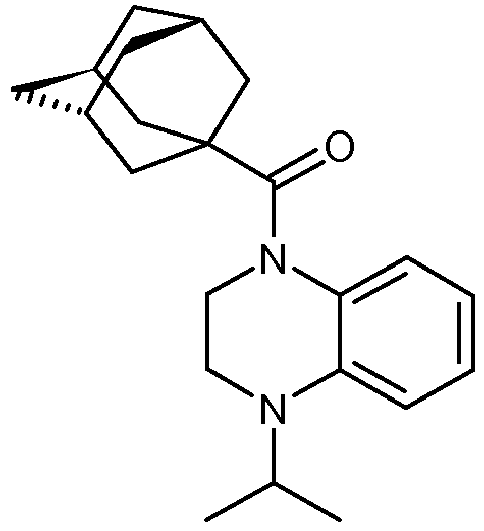
- In analogy to the procedure described for the synthesis of adamantan-1-yl-(3,4-dihydro-1H-isoquinolin-2-yl)-methanone (example 1) the title compound was prepared from 1-isopropyl-1,2,3,4-tetrahydroquinoxaline and adamatanecarbonyl chloride. MS(m/e): 339.4 (MH+).
-

- In analogy to the procedure described for the synthesis of adamantan-1-yl-(4-ethoxy-3,4-dihydro-2H-quinolin-1-yl)-methanone (example 12) the title compound was prepared from adamantan-1-yl-(4-hydroxy-3,4-dihydro-2H-quinolin-1-yl)-methanone and 1-bromo-2-methoxyethane in THF. MS(m/e): 370.3 (MH+).
-

- In analogy to the procedure described for the synthesis of adamantan-1-yl-(4-ethoxy-3,4-dihydro-2H-quinolin-1-yl)-methanone (example 12) the title compound was prepared from adamantan-1-yl-(4-hydroxy-3,4-dihydro-2H-quinolin-1-yl)-methanone and 1-iodobutane as colourless solid. MS(m/e): 368.3 (MH+).
-
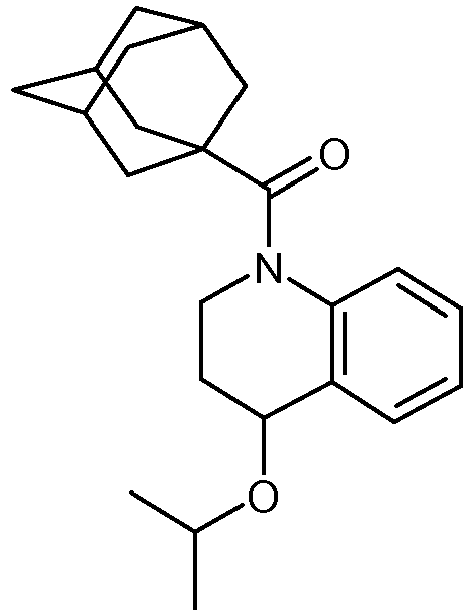
- In analogy to the procedure described for the synthesis of adamantan-1-yl-(4-ethoxy-3,4-dihydro-2H-quinolin-1-yl)-methanone (example 12) the title compound was prepared from adamantan-1-yl-(4-hydroxy-3,4-dihydro-2H-quinolin-1-yl)-methanone and 2-iodopropane as colourless solid. MS(m/e): 354.4 (MH+).
-

- In analogy to the procedure described for the synthesis of adamantan-1-yl-(4-ethoxy-3,4-dihydro-2H-quinolin-1-yl)-methanone (example 12) the title compound was prepared from adamantan-1-yl-(4-hydroxy-3,4-dihydro-2H-quinolin-1-yl)-methanone and methyliodide as light brown solid. MS(m/e): 326.3 (MH+).
-

- A mixture of 24.2 mg (0.134 mmol) adamantane-2-carboxylic acid, 20 mg (0.168 mmol) indoline, 64.7 mg (0.2 mmol) TBTU and 43.4 mg (0.336 mmol) DIPEA in 1 mL DMF was stirred at room temperature overnight. Formic acid was added and the mixture was subjected to column chromatography on reversed phase eluting with a gradient formed from acetonitrile, water and NEt3 to yield after evaporation of the product containing fractions 14.1 mg (30 %) of the title compound. MS(m/e): 282.4 (MH+).
-

- A mixture of 35.7 mg (0.2 mmol) 1-adamantyl isocyanate, 20 mg (0.168 mmol) indoline and 51 mg (0.5 mmol) NEt3 in 2 mL DCM was shaken at room temperature overnight and evaporated to dryness. The residue was taken up in DMF and subjected to column chromatography on reversed phase eluting with a gradient formed from acetonitrile, water and formic acid to yield after evaporation of the product containing fractions 15.2 mg (30 %) of the title compound as white solid. MS(m/e): 297.4 (MH+).
-

- In analogy to the procedure described for the synthesis of adamantan-1-yl-(3,4-dihydro-1H-isoquinolin-2-yl)-methanone (example 1) the title compound was prepared from 5,6-difluoroindoline and adamatanecarbonyl chloride as light brown solid. MS(m/e): 318.3 (MH+).
-

- In analogy to the procedure described for the synthesis of adamantan-2-yl-(2,3-dihydro-indol-1-yl)-methanone (example 37) the title compound was prepared from indoline and 4-keto-1-adamantanecarboxylic acid. MS(m/e): 296.2 (MH+).
-

- In analogy to the procedure described for the synthesis of adamantan-2-yl-(2,3-dihydro-indol-1-yl)-methanone (example 37) the title compound was prepared from indoline and 3-hydroxyadamantane-1-carboxylic acid. MS(m/e): 298.2 (MH+).
-
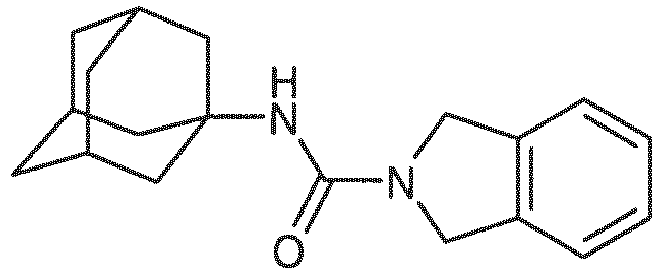
- In analogy to the procedure described for the synthesis of 2,3-Dihydro-indole-1-carboxylic acid adamantan-1-ylamide (example 38) the title compound was prepared from isoindoline and 1-adamantyl isocyanate as light brown solid. MS(m/e): 297.3 (MH+).
-

- In analogy to the procedure described for the synthesis of adamantan-1-yl-(3,4-dihydro-1H-isoquinolin-2-yl)-methanone (example 1) the title compound was prepared from 4-(6-chloroisoindolin-5-yl)morpholine hydrochloride and adamatanecarbonyl chloride as white solid. MS(m/e): 401.4 (MH+).
-

- In analogy to the procedure described for the synthesis of adamantan-1-yl-(3,4-dihydro-1H-isoquinolin-2-yl)-methanone (example 1) the title compound was prepared from 4-fluoroisoindoline hydrochloride and adamatanecarbonyl chloride as white solid. MS(m/e): 300.3 (MH+).
-

- In analogy to the procedure described for the synthesis of adamantan-1-yl-(3,4-dihydro-1H-isoquinolin-2-yl)-methanone (example 1) the title compound was prepared from 5-fluoroisoindoline hydrochloride and adamatanecarbonyl chloride as white solid. MS(m/e): 300.2 (MH+).
- The following tests were carried out in order to determine the activity of the compounds of formula (I).
- The affinity of the compounds of the invention for cannabinoid CB1 receptors was determined using recommended amounts of membrane preparations (PerkinElmer) of human embryonic kidney (HEK) cells expressing the human CNR1 or CNR2 receptors in conjunction with 1.5 or 2.6 nM [3H]-CP-55,940 (Perkin Elmer) as radioligand, respectively. Binding was performed in binding buffer (50 mM Tris, 5 mM MgCl2, 2.5 mM EDTA, and 0.5% (wt/vol) fatty acid free BSA, pH 7.4 for CB1 receptor and 50 mM Tris, 5 mM MgCl2, 2.5 mM EGTA, and 0.1% (wt/vol) fatty acid free BSA, pH 7.4 for CB2 receptor) in a total volume of 0.2 ml for 1h at 30°C shaking. The reaction was terminated by rapid filtration through microfiltration plates coated with 0.5% polyethylenimine (UniFilter GF/B filter plate; Packard). Bound radioactivity was analyzed for Ki using nonlinear regression analysis (Activity Base, ID Business Solution, Limited), with the Kd values for [3H]CP55,940 determined from saturation experiments. The compounds of formula (I) show an excellent affinity for the CB2 receptor with affinities below 10 µM, more particularly of 1 nM to 3 µM and most particularly of 1nM to 100 nM.
- The compounds according to formula I have an activity in the above assay (Ki) particularly of 0.5 nM to 10 µM, more particularly of 0.5 nM to 3 µM and most particularly of 0.5 nM to 100 nM.
- CHO cells expressing human CB1 or CB2 receptors are seeded 17-24 hours prior to the experiment 50.000 cells per well in a black 96 well plate with flat clear bottom (Corning Costar #3904) in DMEM (Invitrogen No. 31331), 1x HT supplement, with 10 % fetal calf serum and incubated at 5% CO2 and 37°C in a humidified incubator. The growth medium was exchanged with Krebs Ringer Bicarbonate buffer with 1 mM IBMX and incubated at 30 °C for 30 min. Compounds were added to a final assay volume of 100 µl and incubated for 30 min at 30 °C. Using the cAMP-Nano-TRF detection kit the assay (Roche Diagnostics) was stopped by the addition of 50 µl lysis reagent (Tris, NaCl, 1.5% Triton X100, 2.5% NP40, 10% NaN3) and 50 µl detection solutions (20 µM mAb Alexa700-cAMP 1:1, and 48 µM Ruthenium-2-AHA-cAMP) and shaken for 2h at room temperature. The time-resolved energy transfer is measured by a TRF reader (Evotec Technologies GmbH), equipped with a ND:YAG laser as excitation source. The plate is measured twice with the excitation at 355 nm and at the emission with a delay of 100 ns and a gate of 100 ns, total exposure time 10s at 730 (bandwidth 30 nm) or 645 nm (bandwidth 75 nm), respectively. The FRET signal is calculated as follows: FRET = T730-Alexa730-P(T645-B645) with P = Ru730-B730/Ru645-B645, where T730 is the test well measured at 730 nM, T645 is the test well measured at 645 nm, B730 and B645 are the buffer controls at 730 nm and 645 nm, respectively. cAMP content is determined from the function of a standard curve spanning from 10 µM to 0.1 nM cAMP.
- EC50 values were determined using Activity Base analysis (ID Business Solution, Limited). The EC50 values for a wide range of cannabinoid agonists generated from this assay were in agreement with the values published in the scientific literature.
- All compounds according to the invention are CB2 agonists with EC50 below 3 uM, particularly below 1uM, more particularly below 0.5 uM, and selectivity versus CB1 in the corresponding assay of at least 10 fold.
- For example, the following compounds showed the following human EC50 values (expressed in uM) in the functional cAMP assay described above:
Example Ec50:CB1 - hu cAMP Ec50:CB2 - hu cAMP 1 >10 0.0694 2 >10 0.0716 3 >10 0.3303 4 >10 0.4447 5 >10 0.2211 6 >10 0.4 7 >10 0.1801 8 >10 0.2766 9 >10 0.2652 10 >10 0.2612 11 >10 0.0232 12 >10 0.0186 13 >10 0.0194 14 >10 0.082 15 >10 0.0115 16 >10 0.054 17 >10 0.0146 18 >10 0.0046 19 >10 0.0706 20 >10 0.2725 21 >10 0.0199 22 >10 0.0264 23 >10 0.0159 24 >10 0.0421 25 >10 0.1632 26 >10 0.0104 27 >10 0.0066 28 >10 0.0557 29 >10 0.0296 30 >10 0.0043 31 >10 0.0289 32 >10 0.0062 33 >10 0.0213 34 >10 0.0072 35 >10 0.1221 36 >10 0.0272 37 >10 0.0067 38 >10 0.0024 39 >10 0.0176 40 >10 0.5937 41 >10 0.4923 42 >10 0.0221 43 >10 0.0822 44 >10 0.0589 45 >10 0.0417 - PathHunter™ β-arrestin CHO-K1 CNR1 cell line (catalog number #93-0200C2) and the β-arrestin CHO-K1 CNR2 cell line (catalog number #93-0706C2) were purchased from DiscoveRx Corporation. The cell line was engineered to express the β-galactosidase EA fragment fused to β-arrestin and the ProLink complementary peptide fused to the target receptor. The PathHunter™ protein complementation assay (DiscoveRx Corporation #93-0001) was performed according to the manufacturer's protocol. Assay plates were seeded containing 7500 (CNR1) and 10000 (CNR2) cells in 384 well plates (Corning Costar #3707, white, clear bottom) in 20µL cell plating reagent 2 (Discoverx #93-0563R2A). After incubation at 37 °C (5% CO2 95% relative humidity) overnight, 5 µl of test compound was added (1% final DMSO concentration) and the incubation continued at 30 °C for 90 min. Detection reagent (12 µl) was then added and the incubation continued at room temperature for 60 min. Plates were then analyzed for a chemiluminescent signal using a Victor 3V reader (Perkin Elmer).
- Film coated tablets containing the following ingredients can be manufactured in a conventional manner:
Ingredients Per tablet Kernel: Compound of formula (I) 10.0 mg 200.0 mg Microcrystalline cellulose 23.5 mg 43.5 mg Lactose hydrous 60.0 mg 70.0 mg Povidone K30 12.5 mg 15.0 mg Sodium starch glycolate 12.5 mg 17.0 mg Magnesium stearate 1.5 mg 4.5 mg (Kernel Weight) 120.0 mg 350.0 mg Film Coat: Hydroxypropyl methyl cellulose 3.5 mg 7.0 mg Polyethylene glycol 6000 0.8 mg 1.6 mg Talc 1.3 mg 2.6 mg Iron oxide (yellow) 0.8 mg 1.6 mg Titan dioxide 0.8 mg 1.6 mg - The active ingredient is sieved and mixed with microcrystalline cellulose and the mixture is granulated with a solution of polyvinylpyrrolidone in water. The granulate is then mixed with sodium starch glycolate and magnesium stearate and compressed to yield kernels of 120 or 350 mg respectively. The kernels are lacquered with an aq. solution / suspension of the above mentioned film coat.
- Capsules containing the following ingredients can be manufactured in a conventional manner:
Ingredients Per capsule Compound of formula (I) 25.0 mg Lactose 150.0 mg Maize starch 20.0 mg Talc 5.0 mg - The components are sieved and mixed and filled into capsules of size 2.
- Injection solutions can have the following composition:
Compound of formula (I) 3.0 mg Polyethylene glycol 400 150.0 mg Acetic acid q.s. ad pH 5.0 Water for injection solutions ad 1.0 ml - The active ingredient is dissolved in a mixture of Polyethylene glycol 400 and water for injection (part). The pH is adjusted to 5.0 by addition of acetic acid. The volume is adjusted to 1.0 ml by addition of the residual amount of water. The solution is filtered, filled into vials using an appropriate overage and sterilized.
Claims (21)
- A compound of formula (I)
 A1 is -CH2- or -C(O)-;one of R1 and R2 is hydrogen and the other one is -A2-C(O)-R3;A2 is -NH- or absent;R3 is (A), (B) or (C);
 A3 is -CR18R19-, -NR20- or -C(O)-;A4 is nitrogen or -CR12-;R4 is hydrogen or alkoxycarbonyl;R5 is hydrogen or alkyl;R6 and R7 are independently selected from hydrogen and alkyl;R8 and R9 are independently selected from hydrogen and alkyl;R10 R11, R12 and R13 are independently selected from hydrogen, alkyl, nitro, fluoro, chloro, haloalkyl and alkoxy, provided that they are not all hydrogen at the same time;or R13 is alkoxycarbonyl and R10, R11 and R12 are all hydrogen at the same time;or R10, R11, R12 and R13 are all hydrogen at the same time, provided that:at least two of R6, R7, R8 and R9 are alkyl and the other ones are hydrogen;or A1 is -C(O)-;or R1 is hydrogen and R2 is is -A2-C(O)-R3;R14 and R17 are independently selected from hydrogen and halogen;R15 and R16 are independently selected from hydrogen, morpholinyl and halogen;one of R18 and R19 is hydrogen and the other one is independently selected from alkylaminocarbonyl, hydroxyalkyl, alkyl, alkoxy and alkoxyalkoxy;or one of R18 and R19 is hydroxyalkyl and the other one is alkyl;or R18 and R19 are both hydrogen at the same time, provided that R4 is alkoxycarbonyl or R5 is alkyl; andR20 is alkyl;or a pharmaceutically acceptable salt thereof
 - A compound according to claim 1, wherein A1 is -CH2-.
- A compound according to claim 1 or 2, wherein R1 is -A2-C(O)-R3 and R2 is hydrogen.
- A compound according to any one of claims 1 to 3, wherein A3 is -CR18R19- or -NR20-.
- A compound according to any one of claims 1 to 4, wherein one of R18 and R19 is hydrogen and the other one is independently selected from tert-butylaminocarbonyl, hydroxymethyl, isopropyl, methoxy, ethoxy, isopropoxy, n-butoxy and methoxyethoxy; or one of R18 and R19 is hydroxymethyl and the other one is isopropyl; or R18 and R19 are both hydrogen at the same time, provided that R4 is methoxycarbonyl or R5 is methyl;
- A compound according to any one of claims 1 to 5, wherein one of R18 and R19 is hydrogen and the other one is methoxyethoxy or n-butoxy.
- A compound according to any one of claims 1 to 6, wherein R20 is methyl or isopropyl.
- A compound according to any one of claims 1 to 7, wherein R6 and R7 are independently selected from hydrogen and methyl.
- A compound according to any one of claims 1 to 8, wherein R8 and R9 are independently selected from hydrogen and methyl.
- A compound according to any one of claims 1 to 9, wherein R10 is hydrogen, alkyl or alkoxy, and R11, R12 and R13 are independently selected from hydrogen, alkyl, nitro, fluoro, chloro, haloalkyl and alkoxy, provided that R10, R11, R12 and R13 are not all hydrogen at the same time.
- A compound according to any one of claims 1 to 10, wherein R11 is hydrogen, nitro, halogen, alkyl or haloalkyl, and R10, R12 and R13 are independently selected from hydrogen, alkyl, nitro, fluoro, chloro, haloalkyl and alkoxy, provided that R10, R11, R12 and R13 are not all hydrogen at the same time.
- A compound according to any one of claims 1 to 11, wherein R12 is hydrogen, halogen, nitro or alkyl, and R10, R11 and R13 are independently selected from hydrogen, alkyl, nitro, fluoro, chloro, haloalkyl and alkoxy, provided that R10, R11, R12 and R13 are not all hydrogen at the same time.
- A compound according to any one of claims 1 to 12, wherein R13 is hydrogen, halogen, alkyl or alkoxy, and R10, R11 and R12 are independently selected from hydrogen, alkyl, nitro, fluoro, chloro, haloalkyl and alkoxy, provided that R10, R11, R12 and R13 are not all hydrogen at the same time.
- A compound according to any one of claims 1 to 13, wherein R14 and R17 are independently selected from hydrogen and fluoro.
- A compound according to any one of claims 1 to 14, wherein R15 and R16 are independently selected from hydrogen, fluoro, chloro and morpholinyl.
- A compound according to any one of claims 1 to 15 selected from
1-(Adamantane-1-carbonyl)-2,3-dihydro-1H-quinolin-4-one;
1-(Adamantane-1-carbonyl)-1,2,3,4-tetrahydro-quinoline-4-carboxylic acid tert-butylamide;
1-(Adamantane-1-carbonyl)-1,2,3,4-tetrahydro-quinoline-3-carboxylic acid methyl ester;
Adamantan-1-yl-(4-hydroxymethyl-4-isopropyl-3,4-dihydro-2H-quinolin-1-yl)-methanone;
Adamantan-1-yl-(8-methyl-3,4-dihydro-2H-quinolin-1-yl)-methanone;
Adamantan-1-yl-(4-ethoxy-3,4-dihydro-2H-quinolin-1-yl)-methanone;
Adamantan-1-yl-(6-nitro-2,3-dihydro-indol1-1-yl)-methanone;
Adamantan-1-yl-(5-nitro-2, 3-dihydro-indol-1-yl)-methanone;
Adamantan-1-yl-(4,6-difluoro-2,3-dihydro-indol-1-yl)-methanone;
Adamantan-1-yl-(6-trifluoromethyl-2,3-dihydro-indol-1-yl)-methanone;
Adamantan-1-yl-(5-fluoro-2,3-dihydro-indol-1-yl)-methanone;
Adamantan-1-yl-(4-chloro-2,3-dihydro-pyrrolo[3,2-c]pyridin-1-yl)-methanone;
Adamantan-1-yl-(1,3-dihydro-isoindol-2-yl)-methanone;
Adamantan-1-yl-(7-methoxy-2,3-dihydro-indol-1-yl)-methanone;
Adamantan-1-yl-(3,3-dimethyl-2,3-dihydro-indol-1-yl)-methanone;
1-(Adamantane-1-carbonyl)-2,3-dihydro-1H-indole-4-carboxylic acid methyl ester;
Adamantan-1-yl-(2,3-dimethyl-2,3-dihydro-indol-1-yl)-methanone;
Adamantan-1-yl-(5-methyl-2,3-dihydro-indol-1-yl)-methanone;
Adamantan-1-yl-(6-methyl-2,3-dihydro-indol-1-yl)-methanone;
Adamantan-1-yl-(7-methyl-2,3-dihydro-indol-1-yl)-methanone;
Adamantan-1-yl-(4-methoxy-2,3-dihydro-indol-1-yl)-methanone;
Adamantan-1-yl-(4-methyl-2,3-dihydro-indol-1-yl)-methanone;
Adamantan-1-yl-(4-methyl-3,4-dihydro-2H-quinoxalin-1-yl)-methanone;
Adamantan-1-yl-(4-isopropyl-3,4-dihydro-2H-quinoxalin-1-yl)-methanone;
Adamantan-1-yl-[4-(2-methoxy-ethoxy)-3,4-dihydro-2H-quinolin-1-yl]-methanone;
Adamantan-1-yl-(4-butoxy-3,4-dihydro-2H-quinolin-1-yl)-methanone;
Adamantan-1-yl-(4-isopropoxy-3,4-dihydro-2H-quinolin-1-yl)-methanone;
Adamantan-1-yl-(4-methoxy-3,4-dihydro-2H-quinolin-1-yl)-methanone;
Adamantan-2-yl-(2,3-dihydro-indol-1-yl)-methanone;
Adamantan-1-yl-(5,6-difluoro-2,3-dihydro-indol-1-yl)-methanone;
5-(2,3-Dihydro-indole-1-carbonyl)-adamantan-2-one;
1,3-Dihydro-isoindole-2-carboxylic acid adamantan-1-ylamide;
Adamantan-1-yl-(5-chloro-6-morpholin-4-yl-1,3-dihydro-isoindol-2-yl)-methanone;
Adamantan-1-yl-(4-fluoro-1,3-dihydro-isoindol-2-yl)-methanone; and
Adamantan-1-yl-(5-fluoro-1,3-dihydro-isoindol-2-yl)-methanone. - A compound according to any one of claims 1 to 16 selected from
Adamantan-1-yl-(5-fluoro-2,3-dihydro-indol-1-yl)-methanone;
Adamantan-1-yl-(4-isopropyl-3,4-dihydro-2H-quinoxalin-1-yl)-methanone;
Adamantan-1-yl-(4-butoxy-3,4-dihydro-2H-quinolin-1-yl)-methanone; and
Adamantan-2-yl-(2,3-dihydro-indol-1-yl)-methanone. - A process for the preparation of a compound of formula (I) as defined in any one of claims 1 to 17 comprising one of the following steps:(a) The reaction of a compound of formula (D)
 (b) The reaction of a compound of formula (E)
whereinone of Ra and Rb is hydrogen and the other one is -COOH or -COCl;one of Rc and Rd is hydrogen and the other one is -N=C=O;and wherein A1 and R3 are as defined in any one of claims 1 to 15. - A compound according to any one of claims 1 to 17 for use as a medicament.
- A pharmaceutical composition comprising a compound according to any one of claims 1 to 17.
- A compound as defined in any one of claims 1 to 17 for use in the treatment or the prevention of pain, in particular chronic pain, atherosclerosis, regulation of bone mass, inflammation, ischemia, reperfusion injury, fibrosis including systemic fibrosis, liver fibrosis, lung fibrosis, kidney fibrosis and systemic sclerosis, chronic kidney diseases including kidney fibrosis, chronic allograft nephropathy, diabetic nephropathy, hypertensive nephropaty, lupus nephritis and glomerulonephropathy, heart diseases including angina pectoris, cardiomyopathy, heart failure and myocardial infarction, autoimmune diseases including rheumatoid arthritis and systemic lupus erythematosus, graft versus host diseases, burning, hypertrophic scars, keloids, gingivitis, liver cirrhosis, tumors, pyrexia or thermal injury.
Priority Applications (1)
| Application Number | Priority Date | Filing Date | Title |
|---|---|---|---|
| EP13732543.7A EP2870139B1 (en) | 2012-07-04 | 2013-07-01 | Novel adamantyl derivatives as cannabinoid receptor 2 agonists |
Applications Claiming Priority (3)
| Application Number | Priority Date | Filing Date | Title |
|---|---|---|---|
| EP12174968 | 2012-07-04 | ||
| PCT/EP2013/063773 WO2014005968A1 (en) | 2012-07-04 | 2013-07-01 | Novel adamantyl derivatives as cannabinoid receptor 2 agonists |
| EP13732543.7A EP2870139B1 (en) | 2012-07-04 | 2013-07-01 | Novel adamantyl derivatives as cannabinoid receptor 2 agonists |
Publications (2)
| Publication Number | Publication Date |
|---|---|
| EP2870139A1 EP2870139A1 (en) | 2015-05-13 |
| EP2870139B1 true EP2870139B1 (en) | 2016-06-15 |
Family
ID=48703559
Family Applications (1)
| Application Number | Title | Priority Date | Filing Date |
|---|---|---|---|
| EP13732543.7A Not-in-force EP2870139B1 (en) | 2012-07-04 | 2013-07-01 | Novel adamantyl derivatives as cannabinoid receptor 2 agonists |
Country Status (11)
| Country | Link |
|---|---|
| US (1) | US9090615B2 (en) |
| EP (1) | EP2870139B1 (en) |
| JP (1) | JP2015521652A (en) |
| KR (1) | KR20150027824A (en) |
| CN (1) | CN104395290A (en) |
| BR (1) | BR112014032996A2 (en) |
| CA (1) | CA2876443A1 (en) |
| HK (1) | HK1202546A1 (en) |
| MX (1) | MX2014015491A (en) |
| RU (1) | RU2015101818A (en) |
| WO (1) | WO2014005968A1 (en) |
Families Citing this family (6)
| Publication number | Priority date | Publication date | Assignee | Title |
|---|---|---|---|---|
| CN105143220B (en) | 2013-03-07 | 2018-06-22 | 豪夫迈·罗氏有限公司 | Pyrazole derivatives |
| PE20151559A1 (en) | 2013-03-26 | 2015-11-05 | Hoffmann La Roche | NEW PYRIDINE DERIVATIVES |
| BR112015027394A8 (en) | 2013-05-02 | 2018-01-30 | Hoffmann La Roche | pyrrolo [2,3-d] pyrimidine derivatives as cb2 receptor agonists |
| HRP20181141T1 (en) | 2013-05-02 | 2018-09-21 | F. Hoffmann - La Roche Ag | Purine derivatives as cb2 receptor agonists |
| AU2014317229B2 (en) | 2013-09-06 | 2018-11-08 | F. Hoffmann-La Roche Ag | Novel triazolo(4,5-d)pyrimidine derivatives |
| CA3000661C (en) * | 2015-09-30 | 2024-04-02 | Nigel H. Greig | Thalidomide analogs and methods of use |
Family Cites Families (2)
| Publication number | Priority date | Publication date | Assignee | Title |
|---|---|---|---|---|
| JP5223864B2 (en) * | 2007-06-27 | 2013-06-26 | 大正製薬株式会社 | Compound having 11β-HSD1 inhibitory activity |
| WO2012027564A1 (en) * | 2010-08-26 | 2012-03-01 | Millennium Pharmaceuticals, Inc. | Substituted hydroxamic acids and uses thereof |
-
2013
- 2013-07-01 JP JP2015519157A patent/JP2015521652A/en active Pending
- 2013-07-01 EP EP13732543.7A patent/EP2870139B1/en not_active Not-in-force
- 2013-07-01 CA CA 2876443 patent/CA2876443A1/en not_active Abandoned
- 2013-07-01 HK HK15103218.3A patent/HK1202546A1/en unknown
- 2013-07-01 MX MX2014015491A patent/MX2014015491A/en unknown
- 2013-07-01 RU RU2015101818A patent/RU2015101818A/en unknown
- 2013-07-01 KR KR20157002874A patent/KR20150027824A/en not_active Withdrawn
- 2013-07-01 CN CN201380034653.5A patent/CN104395290A/en active Pending
- 2013-07-01 WO PCT/EP2013/063773 patent/WO2014005968A1/en not_active Ceased
- 2013-07-01 BR BR112014032996A patent/BR112014032996A2/en not_active IP Right Cessation
-
2014
- 2014-12-22 US US14/578,935 patent/US9090615B2/en not_active Expired - Fee Related
Also Published As
| Publication number | Publication date |
|---|---|
| US20150111886A1 (en) | 2015-04-23 |
| CN104395290A (en) | 2015-03-04 |
| US9090615B2 (en) | 2015-07-28 |
| HK1202546A1 (en) | 2015-10-02 |
| EP2870139A1 (en) | 2015-05-13 |
| CA2876443A1 (en) | 2014-01-09 |
| BR112014032996A2 (en) | 2018-05-15 |
| RU2015101818A (en) | 2016-08-27 |
| KR20150027824A (en) | 2015-03-12 |
| MX2014015491A (en) | 2015-03-06 |
| WO2014005968A1 (en) | 2014-01-09 |
| JP2015521652A (en) | 2015-07-30 |
Similar Documents
| Publication | Publication Date | Title |
|---|---|---|
| KR102228764B1 (en) | Heterocyclic amides as kinase inhibitors | |
| EP2964646B1 (en) | Novel pyrazol derivatives | |
| AU2013354278B2 (en) | Novel pyridine derivatives | |
| EP3483163B1 (en) | Triazolo[4,5-d]pyrimidine derivatives as cb2 receptor antagonists | |
| US9090615B2 (en) | Adamantyl derivatives as cannabinoid receptor 2 agonists | |
| EP2928882B1 (en) | Pyrazine derivatives as cb2 receptor agonists | |
| EP2991988B1 (en) | Pyrrolo[2,3-d]pyrimidine derivatives as cb2 receptor agonists | |
| EP3386951B1 (en) | Phenyl derivatives as cannabinoid receptor 2 agonists | |
| EP2044057A2 (en) | Derivatives of ureas of piperidine or pyrrolidine, their preparation and their therapeutical use | |
| HUE031254T2 (en) | Novel pyrazine derivatives | |
| JP2021529157A (en) | New compounds useful for medical treatment | |
| EP3475281A1 (en) | Novel [1,2,31triazolo[4,5-d]pyrimidine derivatives | |
| EP3814337B1 (en) | Pyridine and pyrazine derivatives as preferential cannabinoid 2 agonists | |
| EP3475280B1 (en) | Novel [1,2,3]triazolo[4,5-d]pyrimidine derivatives | |
| US12180196B2 (en) | Azetidine-substituted pyridine and pyrazine compounds as inhibitors of cannabinoid receptor 2 | |
| EP3475283B1 (en) | Novel[1,2,3]triazolo[4,5-d]pyrimidine derivatives | |
| NZ622847A (en) | [1,2,3]triazolo[4,5-d]pyrimidine derivatives as agonists of the cannabinoid receptor 2 agonists |
Legal Events
| Date | Code | Title | Description |
|---|---|---|---|
| PUAI | Public reference made under article 153(3) epc to a published international application that has entered the european phase |
Free format text: ORIGINAL CODE: 0009012 |
|
| 17P | Request for examination filed |
Effective date: 20150204 |
|
| AK | Designated contracting states |
Kind code of ref document: A1 Designated state(s): AL AT BE BG CH CY CZ DE DK EE ES FI FR GB GR HR HU IE IS IT LI LT LU LV MC MK MT NL NO PL PT RO RS SE SI SK SM TR |
|
| AX | Request for extension of the european patent |
Extension state: BA ME |
|
| DAX | Request for extension of the european patent (deleted) | ||
| GRAP | Despatch of communication of intention to grant a patent |
Free format text: ORIGINAL CODE: EPIDOSNIGR1 |
|
| INTG | Intention to grant announced |
Effective date: 20160112 |
|
| GRAS | Grant fee paid |
Free format text: ORIGINAL CODE: EPIDOSNIGR3 |
|
| GRAA | (expected) grant |
Free format text: ORIGINAL CODE: 0009210 |
|
| AK | Designated contracting states |
Kind code of ref document: B1 Designated state(s): AL AT BE BG CH CY CZ DE DK EE ES FI FR GB GR HR HU IE IS IT LI LT LU LV MC MK MT NL NO PL PT RO RS SE SI SK SM TR |
|
| REG | Reference to a national code |
Ref country code: CH Ref legal event code: EP Ref country code: GB Ref legal event code: FG4D |
|
| REG | Reference to a national code |
Ref country code: IE Ref legal event code: FG4D |
|
| REG | Reference to a national code |
Ref country code: AT Ref legal event code: REF Ref document number: 806448 Country of ref document: AT Kind code of ref document: T Effective date: 20160715 |
|
| REG | Reference to a national code |
Ref country code: DE Ref legal event code: R096 Ref document number: 602013008612 Country of ref document: DE |
|
| REG | Reference to a national code |
Ref country code: LT Ref legal event code: MG4D |
|
| REG | Reference to a national code |
Ref country code: NL Ref legal event code: MP Effective date: 20160615 |
|
| PG25 | Lapsed in a contracting state [announced via postgrant information from national office to epo] |
Ref country code: FI Free format text: LAPSE BECAUSE OF FAILURE TO SUBMIT A TRANSLATION OF THE DESCRIPTION OR TO PAY THE FEE WITHIN THE PRESCRIBED TIME-LIMIT Effective date: 20160615 Ref country code: NO Free format text: LAPSE BECAUSE OF FAILURE TO SUBMIT A TRANSLATION OF THE DESCRIPTION OR TO PAY THE FEE WITHIN THE PRESCRIBED TIME-LIMIT Effective date: 20160915 Ref country code: LT Free format text: LAPSE BECAUSE OF FAILURE TO SUBMIT A TRANSLATION OF THE DESCRIPTION OR TO PAY THE FEE WITHIN THE PRESCRIBED TIME-LIMIT Effective date: 20160615 |
|
| REG | Reference to a national code |
Ref country code: AT Ref legal event code: MK05 Ref document number: 806448 Country of ref document: AT Kind code of ref document: T Effective date: 20160615 |
|
| PG25 | Lapsed in a contracting state [announced via postgrant information from national office to epo] |
Ref country code: NL Free format text: LAPSE BECAUSE OF FAILURE TO SUBMIT A TRANSLATION OF THE DESCRIPTION OR TO PAY THE FEE WITHIN THE PRESCRIBED TIME-LIMIT Effective date: 20160615 Ref country code: LV Free format text: LAPSE BECAUSE OF FAILURE TO SUBMIT A TRANSLATION OF THE DESCRIPTION OR TO PAY THE FEE WITHIN THE PRESCRIBED TIME-LIMIT Effective date: 20160615 Ref country code: RS Free format text: LAPSE BECAUSE OF FAILURE TO SUBMIT A TRANSLATION OF THE DESCRIPTION OR TO PAY THE FEE WITHIN THE PRESCRIBED TIME-LIMIT Effective date: 20160615 Ref country code: SE Free format text: LAPSE BECAUSE OF FAILURE TO SUBMIT A TRANSLATION OF THE DESCRIPTION OR TO PAY THE FEE WITHIN THE PRESCRIBED TIME-LIMIT Effective date: 20160615 Ref country code: HR Free format text: LAPSE BECAUSE OF FAILURE TO SUBMIT A TRANSLATION OF THE DESCRIPTION OR TO PAY THE FEE WITHIN THE PRESCRIBED TIME-LIMIT Effective date: 20160615 Ref country code: GR Free format text: LAPSE BECAUSE OF FAILURE TO SUBMIT A TRANSLATION OF THE DESCRIPTION OR TO PAY THE FEE WITHIN THE PRESCRIBED TIME-LIMIT Effective date: 20160916 |
|
| PG25 | Lapsed in a contracting state [announced via postgrant information from national office to epo] |
Ref country code: BE Free format text: LAPSE BECAUSE OF NON-PAYMENT OF DUE FEES Effective date: 20160731 |
|
| PG25 | Lapsed in a contracting state [announced via postgrant information from national office to epo] |
Ref country code: EE Free format text: LAPSE BECAUSE OF FAILURE TO SUBMIT A TRANSLATION OF THE DESCRIPTION OR TO PAY THE FEE WITHIN THE PRESCRIBED TIME-LIMIT Effective date: 20160615 Ref country code: RO Free format text: LAPSE BECAUSE OF FAILURE TO SUBMIT A TRANSLATION OF THE DESCRIPTION OR TO PAY THE FEE WITHIN THE PRESCRIBED TIME-LIMIT Effective date: 20160615 Ref country code: IS Free format text: LAPSE BECAUSE OF FAILURE TO SUBMIT A TRANSLATION OF THE DESCRIPTION OR TO PAY THE FEE WITHIN THE PRESCRIBED TIME-LIMIT Effective date: 20161015 Ref country code: SK Free format text: LAPSE BECAUSE OF FAILURE TO SUBMIT A TRANSLATION OF THE DESCRIPTION OR TO PAY THE FEE WITHIN THE PRESCRIBED TIME-LIMIT Effective date: 20160615 Ref country code: IT Free format text: LAPSE BECAUSE OF FAILURE TO SUBMIT A TRANSLATION OF THE DESCRIPTION OR TO PAY THE FEE WITHIN THE PRESCRIBED TIME-LIMIT Effective date: 20160615 Ref country code: CZ Free format text: LAPSE BECAUSE OF FAILURE TO SUBMIT A TRANSLATION OF THE DESCRIPTION OR TO PAY THE FEE WITHIN THE PRESCRIBED TIME-LIMIT Effective date: 20160615 |
|
| REG | Reference to a national code |
Ref country code: DE Ref legal event code: R119 Ref document number: 602013008612 Country of ref document: DE |
|
| PG25 | Lapsed in a contracting state [announced via postgrant information from national office to epo] |
Ref country code: AT Free format text: LAPSE BECAUSE OF FAILURE TO SUBMIT A TRANSLATION OF THE DESCRIPTION OR TO PAY THE FEE WITHIN THE PRESCRIBED TIME-LIMIT Effective date: 20160615 Ref country code: ES Free format text: LAPSE BECAUSE OF FAILURE TO SUBMIT A TRANSLATION OF THE DESCRIPTION OR TO PAY THE FEE WITHIN THE PRESCRIBED TIME-LIMIT Effective date: 20160615 Ref country code: BE Free format text: LAPSE BECAUSE OF FAILURE TO SUBMIT A TRANSLATION OF THE DESCRIPTION OR TO PAY THE FEE WITHIN THE PRESCRIBED TIME-LIMIT Effective date: 20160615 Ref country code: PL Free format text: LAPSE BECAUSE OF FAILURE TO SUBMIT A TRANSLATION OF THE DESCRIPTION OR TO PAY THE FEE WITHIN THE PRESCRIBED TIME-LIMIT Effective date: 20160615 Ref country code: PT Free format text: LAPSE BECAUSE OF FAILURE TO SUBMIT A TRANSLATION OF THE DESCRIPTION OR TO PAY THE FEE WITHIN THE PRESCRIBED TIME-LIMIT Effective date: 20161017 Ref country code: SM Free format text: LAPSE BECAUSE OF FAILURE TO SUBMIT A TRANSLATION OF THE DESCRIPTION OR TO PAY THE FEE WITHIN THE PRESCRIBED TIME-LIMIT Effective date: 20160615 |
|
| REG | Reference to a national code |
Ref country code: CH Ref legal event code: PL |
|
| PG25 | Lapsed in a contracting state [announced via postgrant information from national office to epo] |
Ref country code: MC Free format text: LAPSE BECAUSE OF FAILURE TO SUBMIT A TRANSLATION OF THE DESCRIPTION OR TO PAY THE FEE WITHIN THE PRESCRIBED TIME-LIMIT Effective date: 20160615 |
|
| PLBE | No opposition filed within time limit |
Free format text: ORIGINAL CODE: 0009261 |
|
| STAA | Information on the status of an ep patent application or granted ep patent |
Free format text: STATUS: NO OPPOSITION FILED WITHIN TIME LIMIT |
|
| PG25 | Lapsed in a contracting state [announced via postgrant information from national office to epo] |
Ref country code: FR Free format text: LAPSE BECAUSE OF NON-PAYMENT OF DUE FEES Effective date: 20160816 Ref country code: CH Free format text: LAPSE BECAUSE OF NON-PAYMENT OF DUE FEES Effective date: 20160731 Ref country code: LI Free format text: LAPSE BECAUSE OF NON-PAYMENT OF DUE FEES Effective date: 20160731 Ref country code: DE Free format text: LAPSE BECAUSE OF NON-PAYMENT OF DUE FEES Effective date: 20170201 |
|
| REG | Reference to a national code |
Ref country code: FR Ref legal event code: ST Effective date: 20170331 |
|
| REG | Reference to a national code |
Ref country code: IE Ref legal event code: MM4A |
|
| 26N | No opposition filed |
Effective date: 20170316 |
|
| PG25 | Lapsed in a contracting state [announced via postgrant information from national office to epo] |
Ref country code: DK Free format text: LAPSE BECAUSE OF FAILURE TO SUBMIT A TRANSLATION OF THE DESCRIPTION OR TO PAY THE FEE WITHIN THE PRESCRIBED TIME-LIMIT Effective date: 20160615 |
|
| PG25 | Lapsed in a contracting state [announced via postgrant information from national office to epo] |
Ref country code: IE Free format text: LAPSE BECAUSE OF NON-PAYMENT OF DUE FEES Effective date: 20160701 |
|
| PG25 | Lapsed in a contracting state [announced via postgrant information from national office to epo] |
Ref country code: SI Free format text: LAPSE BECAUSE OF FAILURE TO SUBMIT A TRANSLATION OF THE DESCRIPTION OR TO PAY THE FEE WITHIN THE PRESCRIBED TIME-LIMIT Effective date: 20160615 Ref country code: LU Free format text: LAPSE BECAUSE OF NON-PAYMENT OF DUE FEES Effective date: 20160701 |
|
| GBPC | Gb: european patent ceased through non-payment of renewal fee |
Effective date: 20170701 |
|
| PG25 | Lapsed in a contracting state [announced via postgrant information from national office to epo] |
Ref country code: GB Free format text: LAPSE BECAUSE OF NON-PAYMENT OF DUE FEES Effective date: 20170701 |
|
| PG25 | Lapsed in a contracting state [announced via postgrant information from national office to epo] |
Ref country code: HU Free format text: LAPSE BECAUSE OF FAILURE TO SUBMIT A TRANSLATION OF THE DESCRIPTION OR TO PAY THE FEE WITHIN THE PRESCRIBED TIME-LIMIT; INVALID AB INITIO Effective date: 20130701 |
|
| PG25 | Lapsed in a contracting state [announced via postgrant information from national office to epo] |
Ref country code: MK Free format text: LAPSE BECAUSE OF FAILURE TO SUBMIT A TRANSLATION OF THE DESCRIPTION OR TO PAY THE FEE WITHIN THE PRESCRIBED TIME-LIMIT Effective date: 20160615 Ref country code: CY Free format text: LAPSE BECAUSE OF FAILURE TO SUBMIT A TRANSLATION OF THE DESCRIPTION OR TO PAY THE FEE WITHIN THE PRESCRIBED TIME-LIMIT Effective date: 20160615 Ref country code: MT Free format text: LAPSE BECAUSE OF NON-PAYMENT OF DUE FEES Effective date: 20160731 |
|
| PG25 | Lapsed in a contracting state [announced via postgrant information from national office to epo] |
Ref country code: BG Free format text: LAPSE BECAUSE OF FAILURE TO SUBMIT A TRANSLATION OF THE DESCRIPTION OR TO PAY THE FEE WITHIN THE PRESCRIBED TIME-LIMIT Effective date: 20160615 |
|
| PG25 | Lapsed in a contracting state [announced via postgrant information from national office to epo] |
Ref country code: AL Free format text: LAPSE BECAUSE OF FAILURE TO SUBMIT A TRANSLATION OF THE DESCRIPTION OR TO PAY THE FEE WITHIN THE PRESCRIBED TIME-LIMIT Effective date: 20160615 Ref country code: TR Free format text: LAPSE BECAUSE OF FAILURE TO SUBMIT A TRANSLATION OF THE DESCRIPTION OR TO PAY THE FEE WITHIN THE PRESCRIBED TIME-LIMIT Effective date: 20160615 |